The importation of certain drugs are sometimes approved by the Director Board of the National Medicine Regulatory Authority (NMRA), even in the absence of such approval from the relevant expert committee, according to Senior Consultant Physician Dr. Ananda Wijewickrama.
Speaking during Ada Derana’s ‘Big Focus’ programme with regards to the importation of drugs, Dr. Wijewickrama made a shocking claim that certain unregistered drugs are also being imported to the country.
When inquired as to who made these decisions, Dr. Wijewickrama stated that the said decisions are made by the Board of Directors of the NMRA, albeit in the absence of the approval of the expert committee, whose purpose is to grant the said ‘emergency’ approval of certain drugs.
They import drugs that are being rejected by the expert committee. The chairman of the Board of Directors claims that approval for these drugs needs to be given if the Health Ministry has made the decision”, he stated in this regard.
The Criminal Investigation Department (CID) on Tuesday (18 July) obtained approval from the court to investigate nine bank accounts belonging to Pastor Jerome Fernando, who recently found himself in hot water after making controversial statements during a sermon.
The order was issued by Colombo Fort Magistrate Thilina Gamage this morning (18), upon consideration of a motion filed by the CID in this regard.
Accordingly, the CID was granted permission to investigate the bank accounts which had been opened at several banks including People’s Bank, Sampath Bank, HNB, DFCC, HSBC, NDB and Seylan Bank.
The nine bank accounts belonging to the self-styled ‘prophet’ which are under investigation include his private accounts, and those belonging to his private firm, church and his wife, Melanie Dianne Vancuylenberg.
Fernando had stirred up much controversy after making several ‘derogatory’ statements regarding Buddhism, Christianity, Hinduism and Islam during a sermon he delivered, after which the CID launched a probe into the matter on 15 May, on orders of President Ranil Wickremesinghe.
Despite the Colombo Fort Magistrate having imposed an overseas travel ban against Fernando on 16 May, as per a request made by the CID, Fernando had already left for Singapore on 14 May, and is yet to return to the country.
President Ranil Wickremesinghe has stated that the 13th Amendment will be implemented with full powers, except Police Powers, subject to agreement among political parties in parliament.
Outlining his plans for the devolution of power, President Wickremesinghe said that the 13th Amendment with full powers, except Police Powers, as outlined under List 1, will be implemented including specified functions in List 3 in the provincial councils list.
Meanwhile, a draft law for the Office of National Unity and Reconciliation (ONUR) has been sent to the Attorney General for constitutionality review, and is due to be presented to Parliament shortly, the President’s Media Division (PMD) reported.
The national action plan on reconciliation drafted by ONUR is also due to be presented to Cabinet soon.
Furthermore, the Interim Secretariat for the Truth Seeking Mechanism was established with the Director General being appointed.
Accordingly, applications are invited for key staff to facilitate stakeholder consultations and draft guidelines, while the formal mechanism in this regard will commence after the necessary law is enacted.
Moreover, the President also discussed the Anti-Terrorism Bill during a meeting with Tamil Parliamentarians representing the North and East.
Speaking in this context, the Head of State said that the Drafting Committee is expected to review the EU proposals on 18 July, adding that the Bill will be re-gazetted after all relevant amendments have been discussed and appropriate action is taken
Kurundi is set deep in the Nagacholai Forest reserve. Santhabodhi thera said that a large extent of Nagacholai forest surrounding the Kurundi Vihara was illegally cleared in 2019 and 2020 and five acres were turned into paddy fields. The Kurundi pond was enlarged into a lake to make sure that it could not be treated as a pond belonging to a monastery.
Sashi Kumar, a powerful person” who owns over 100 acres of paddy fields in Mullativu had carried out the task. Valuable trees such as kalumadiriya, ebony, were cut down and burnt. Archaeology Department and Forest Department complained to the police about this.
Santhabodhi said that they have filed a case against those who had cleared the land and enlarged the pokuna. The case is going on, he said in 2023. They have accepted that they are at fault. They have no documents to support what they did. At least three cases are still pending at the Mullaitivu Courts, noted Sunday Times in June 2023.
The Tamil Separatist Movement has its own story, regarding this matter. Sunday Times was told that in 2013, Mullativu farmers had returned to their 15 acres of paddy fields and cultivated them for two years. This land is now being claimed by the Archaeology Department, they complained. They also said that they had been intimidated by the army and a group of Buddhist monks who claimed that the land belonged to a Buddhist shrine.
The Kurundi team dismissed this story as a fabricated one. There is no long history of cultivation by farmers in the disputed area, no evidence of cultivation at all, they said. The disputed area is pure forest reserve. Aerial views of the Nagacholai Forest confirm this. The deforested ‘paddy land’ is the only flat land in the area. It stands out. It is very conspicuous.
TNA MP Sumanthiran said that that Tamils have been cultivating paddy in Kurundi for centuries. This is a blatant lie, said Santhabodhi. There are no paddy lands here, and no people who have been farming for hundreds of years. There are no human settlements anywhere near Kurundi. The nearest village is 6 kms away.
The ‘paddy land’ Sumanthiran is referring to is illegally cleared forest land, turned into paddy lands. However, no paddy cultivation has taken place. Eka vee etayak vath ne. Instead in 2020 we saw bulldozers parked there. Ven Ellawala Medhananda supports this argument. He had done archaeological research at Mullativu before the war, during the war (under military protection) and after the war. He said that there were no paddy lands near the Kurundi Vihara. He dismissed the claim.
The Tamil Separatist Movement now plans to encircle Kurundi , so that Kurundi cannot expand into a monastery. The idea of surrounding a Buddhist temple is not a new one . The tactic has been going on for some time. In Colombo certain Buddhist temples are encircled by Muslim owned buildings.
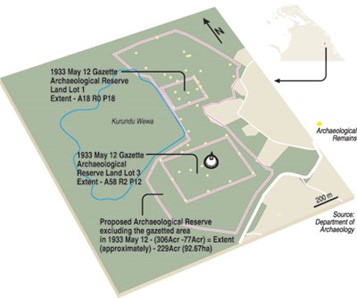
Tamil Separatist Movement plans to confine Kurundi to its original 78 acre plot. TNA MPs said that they do not challenge the original gazetting of 78 acres of land as an archaeological reserve. They object to proposed new acquisition of 229 acres of surrounding land.
Suresh Kumar said the same thing. Suresh Kumar is determined to stay in the picture. He met the Pivithuru Hela Urumaya delegation when they came on an inspection tour to Kurundi in June 2023. He said that they had no objection to the 78 acres already given to Kurundi, but they objected to further expansion.
Tamil Separatist Movement has decided to get hold of the extra 229 acres now requested by Kurundi. TNA said that they had been promised 229 acres of land from Thannimurippu. Clearly this is the 229 acres now requested by Kurundi. They said that the Director General of the Archaeology had agreed at a meeting, to withdraw the directive seeking to acquire an additional 229 acres but did not do so . He did not handover the land either.
Sunday Times looked at this. The newspaper reported, that on March 13 , Director General of Archaeology had sent a request for a Survey Order to the Divisional Secretary of Maritimepattu, Mullaitivu seeking assistance to survey a new area of 229 acres of surrounding Kurundi temple in order to declare it as an archaeological reservation since archaeological artifacts had been found in the area.
Internal written communiqués between the Mullaitivu District Secretariat and Maritimepattu Divisional Secretariat seen by Sunday Times indicate it was decided to survey five acres of additional land for the use of the Department of Archaeology. The decision, the written directives noted, was based on a decision taken during the District Development Committee meeting held on January 15 which was chaired by President Wickremasinghe, concluded Sunday Times.
In June 2023, TNA decided to use the President Ranil Wickremasinghe to put a stop to Kurundi expansion. President Wickremasinghe had supported Tamil Separatist Movement during the Eelam war. He supported the Ceasefire Agreement which gave the LTTE full power in the north and east. He was also involved in the Millennium City raid which cruelly exposed the army’s intelligence network. LTTE had always wanted to crush this network.
The TNA were sure that President Ranil Wickremasinghe would support them this time too. TNA asked the President to summon the Archaeology department officers for a meeting and briefed him as to what he should say. TNA wanted him to ask two questions. why this sudden interest in the Buddhist remains in the north and east and why demand such a vast extend of land for Kurundi..
President Ranil Wickremasinghe duly called a meeting with the Archaeology Department officials on July 8, 2023. He wanted to know why this sudden emphasis on the Buddhist ruin in the north and east.
Director General, Archaeology , Anura Manatunga, explained that no archaeological work had been done in north and east due to the war. they were now making up for lost time. It was not special attention. President Wickremasinghe replied that the Department of Archaeology should forget North and east and do Maha vihara, Malvatu oya then Dimbulagala and Magama. He also wanted the Archaeology Department to forward an annual plan for excavation, presumably for approval.
Manatunga also added that as the Department funds were not sufficient to do excavations, the department accepted financial support from third parties including the sangha, to carry out its work in North and Eastern provinces. President cracked down on this. He said that a government department like the Archaeology department must not used private funds, it can only use government funds.
President then questioned the extra 229 acres for Kurundi. Kurundi cannot possibly extend to 300 acres. That was more than the extent of land held by Maha vihara, Jetavana and Abhayagiri combined in Anuradhapura .Impossible he said. He wanted the Kurundi request for 229 acres withdrawn and the boundary stones removed.
This discussion, shown on television news, excited comment. Viewers were contemptuous about the reference to temples in Anuradhapura . The land extent would have been limited for any temple In the capital city of Anuradhapura. Kurundi is a monastic complex outside the capital city, said critics scornfully.
Others were concerned about the whole meeting. Ven Medagoda Abeyratne stated that the Archaeology department had been asked to remove the boundary stones. This is Pera nimithi. We now see what it is ahead for us, he said. He also met the Malwatte and Asgiriya high priests, regarding the matter. The Archaeology Department had been told to remove the boundary stones, he reported. This indicates a greater danger to come, he said. They are getting ready to violate the Antiquities Act.
Ven. Omalpe Sobitha said President was helping the Tamil Separatist cause. the Tamil Separatist Movement is now getting ready to destroy the ancient Buddhist vihara using the President . Gombaddala Damitha said that they were now trying to get what they failed get through war, the control over land . Pahiyangala Ananda said that the law suits initiated by the Tamil Separatist Movement regarding Kurundi are not going their way. That is why they want to get this land soon.
One aspect of this matter has so far escaped attention. The Tamil Separatist Movement has long known about Kurundi and has anticipated that the Department of Archaeology would descend on it someday.
Kurundi was not reachable for the Buddhists during the Eelam war but it was accessible for the Tamil Separatist Movement. Tamil Separatists have gone there ,probably just after the war and taken a good look around Kurundi. They would have inspected the ruins, seen their potential for a Buddhist revival, and decided to take over the site. This is evident in their actions.
In Kurundi there is an area which was given over to metal production, probably iron manufacture .It Is precisely this area that has been deforested and turned into paddy fields and the soil stacked elsewhere. This cannot be accidental.
The Tamil Separatist Movement has explored the Buddhist ruins thoroughly. They decided that the most important building would have been the pilimage, located it and damaged it. The most damage is found in the pilimage said the archaeologists.The pilimage has been destroyed in a violent manner, excavators said. The Buddha statue found there has been deliberately damaged, in a ‘sahasika’ manner. The damaged items were shown on television news. In a newly cemented area,inside the pilimage, the Tamil Separatist Movement has placed a trident to show the existence of an ancient kovil. They have used the ancient korovak gala for the kovil.
Unfortunately for the Tamil Separatist Movement , the old emphasis on the pilimage no longer exists. Today, it is the chaitya and the Bo tree that are objects of worship. Therefore the focus today is on the Kurundi stupa. Buddhists are waiting to go and worship there, once it is completed. Tamil Separatist Movement is alarmed. (continued)
(from ‘Relief of Ceylon’, Chapter V, The Way Ahead)
‘The study of the problem of agriculture & industry necessarily involves the study of the relief of the country before a comprehensive scheme could be intelligently planned for agriculture and industry.
In the centre of the island is the hill country over 1000ft. in elevation. The rest of the country is lowlands or plains which can be subdivided into 3 sections, the South East Plain, the South West Plain and the Northern Plain.
The hill country consists of mountain ranges rising up to 8,000ft. Most of the rivers in Ceylon take their source from this region. The Mahaveli Ganga and its tributaries form the main streams of this region. In this region there are over fifty waterfalls; the main waterfalls are the Aberdeen Laxapana Falls at an elevation of 3,000 ft., the Devon and Ramboda Falls at an elevation of 5,000 ft; and the Diyaluma, Kurunduoya. Manawela and Dunhinda Falls which are some of the more important falls. Only the Aberdeen Laxapana Falls has been harnessed for hydroelectric power so far.
The South West Plain extends from the hill country to the west coast between the Deduru Oya in the North and Walawe Ganga in the South. This plain has the largest and most populated river valley settlements. Except for the Deduru Oya all the rivers have their upper catchment areas in the hill country. The Maha Oya, Kelani Ganga, Kalu Ganga, Gin Ganga are the main rivers. All these rivers in their lower reaches form an extensive flood plains. The Rakwana and Deniyaya Hills are separated from the main hill country by the Kalu Ganga and Walawe Ganga Valleys.
The South East Plain lies between the Walawe Ganga and the Mahaveli Ganga. The Walawe Ganga, Kirindi Ganga, Menik Ganga and Kumbukkan Oya directly drain the hill country in the south.
The Central Region of the coast of the South East Plain is a high plateau extending from the Badulla hill range to almost the eastern sea coast. This region includes the fertile and historic Wellassa region and Buttala Wedirata. The Gal Oya, Heda Oya and other small rivers drain this region to the sea. On either side of this plateau are the plains of the Mahaveli Ganga and some of its tributaries and the basins of Walawe Ganga and Kirindi Ganga.
The central plateau and the flat river valley provide enormous possibilities for water conservation, hydroelectricity and extensive irrigation schemes with diversion of water from one river basin to another.
The East Coast is studded with lagoons, some of which are silted and now cultivated with paddy. By deepening of the rivers and by building a network of canals along the coast, we could easily provide drainage, water transport and irrigation for these low-lying coastal plains extending from Tangalle through Ambalantota, Hambantota, Batticaloa, Trincomalee, and MulIativu right up to the Jaffna lagoon.
Water conservation and diversion of water from one river basin to another, would mean the harnessing of the waters of the Mahaveli Ganga & its tributaries, the Laggal Oya, Badulu Oya, Uma Oya and Kotmale Oya, and the Walawe Ganga, Kirindi Ganga, Menik Ganga and Kumbukkun Oya with the rivers in the Eastern Coast which dry up in the dry seasons, partially or completely. These include Wil Oya, Heda Oya, Karanda Oya, Gal Oya, Andella Oya, Mundori Oya, Maduru Oya, Pankulam Aru, Yan Oya, Moo Oya, and several other streams.
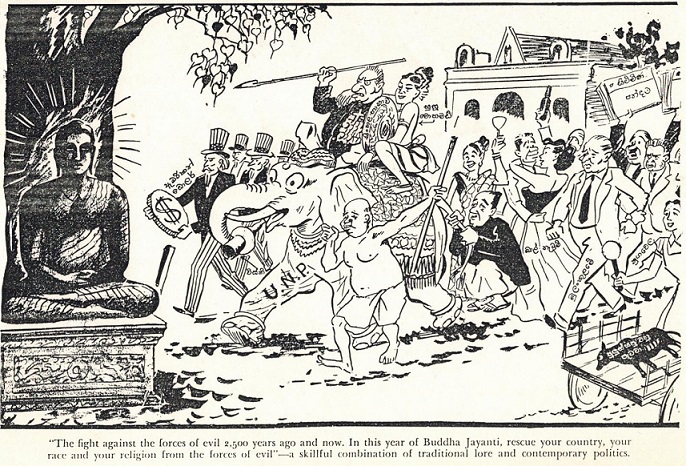
These rivers can be made permanent streams feeding millions of people in this plain. The benefits of such a grand scheme must stir the enthusiasm of every patriotic citizen to unite for the struggle to overthrow this reactionary UNP Government, which shamelessly continues to defend its policy of selection of an uneconomic project for the development of only the lower basin of one river, the Gal Oya, with the help of the US experts at a prohibitive cost.
The Northern Plain extends from the Matale hills in the central region and lies between the Deduru Oya and the Mahaveli Ganga. From the Matale hills in the South the plain slopes away towards the West, Northwest, Northeast and East, thus providing a remarkably favorable natural relief for the diversion of the Mahaveli Ganga through a main canal for irrigation and water transport and for feeding the rivers that flow fanwise from the centre of this plain to the West and East coasts. Such a scheme involves several dams and reservoirs in the middle and upper catchment areas of the Mahaveli and its tributaries, including the Amban Ganga.
Such a scheme can feedall the streams in the Northern Plain that flow westwards and eastwards but now dry up for the greater part of the year. Such a scheme which could be economically developed with Soviet & Chinese technical aid & essential equipment, will be able to irrigate over 3 million acres. Additional advantages will be production of hydroelectric power at points where the water level changes and provision of cheap water transport. We also secure permanent protection of the country from floods and soil erosion by the scientific harnessing of flood waters and protection of the rivers from silting.
The natural relief of our country indicates that the central hilly region which is less than 5,000 square miles or one fifth of the entire country, control the future destiny of our people.
Effective control of all our big rivers can only be carried out by the building of big dams in this region in order to conserve water in big reservoirs. We thereby augment water supply for hydroelectricity and also make it possible to divert water from one basin to another. The numerous waterfalls can only be harnessed to provide maximum hydroelectric power by such a comprehensive scheme for water conservation which will ensure a steady flow of water even in the dry seasons of the year.’
Boys’ academic outcomes are sinking at an unprecedented rate. At university, girls now outnumber boys by two to one. Here, in a speech to an international policy workshop organized by the National Academy of Sciences of Sri Lanka, I venture into the minefield of political impropriety and argue that boys and girls should not be treated equally when it comes to education. I show also that unless we fix this problem, we risk serious societal outcomes, not just when it comes to crime but also to political outcomes. BREXIT and Trump, after all, were in large measure results of revolts by the ‘uneducated’ against the elites. While I do not offer prescriptions (to do so in a data vacuum would be foolish), society, and especially feminists, must sit up and take notice, if for no other reason, then purely from self-interest.
The name Anandasagaree certainly does not get a stamp of approval from the Government of Sri Lanka with very valid reason hence the recent denial of an entry Visa to Sri Lanka by the Government of Sri Lanka to Gary Anandasagaree.
Canadian MP Gary Anandasagaree inasmuch as his father V Anandasagaree of the Tamil National Alliance both play major roles in misleading the world about the recent Tamil insurrection in Sri Lanka and campaign hard to bring Sri Lanka to disrepute in their own way albeit similarly when it comes to subject content as both are propagandists who broadcast misleading information both in Canada as well as Sri Lanka, at times with no tangible corroborating detailed evidence and always very supportive of the deposed and outlawed Tamil Tigers who tried to impede the Sovereign Rights of Sri Lanka through armed insurrection and failed yet continue their related campaigns often gobbled up by sources who then bedevil Sri Lanka in the name of Human Rights Violations none of which have come to fruition once the real facts are examined and investigated.
What the world is probably unaware of is that based on the atrocities of the Tamil Tigers and the retaliatory action of the Sri Lanka Armed forces in defense of Sovereign Territory and Territorial Integrity, lives were lost and a heavy toll incurred in the nearly four decade long insurrection where the issue of human rights violations is really a non issue based on the parities and disparities which affected both sides involved in the conflict. It is at times even contested by some Tamils who are veritably aware of of the realities involved.
Based on the vast nature and expanse of the conflict there were quite logically and unfortunately a colossal loss of life but the realities of definition cannot be distorted to suit sources who attempt to wrongfully convey facts as they envision to suit their agendas and in doing so mislead all the wrong sources with aspersions and aggressive intentions against Sri Lanka which needs to be addressed towards correction.
On the other side of the divide the Canadian Anandasagaree continues his campaign to misinform and mislead the objectives of Sri Lanka relative to the conflict and has a large supportive following of disgruntled Tamils ever ready to take up the cause of bringing Sri Lanka to disrepute as seen by the recent response of the Canadian Prime Minister Mr. Justin Trudeau who has been outspoken about a cause he seemed to know little about relative to realities beyond hearsay or misrepresented information.
This is probably why Sri Lanka to all intents and purposes has refused an entry visa to the junior Mr Anandasagaree where his father still continues to continue a covert supportive campaign in favour of the Tamil Tigers and attempt to justify their actions which could have in reality destroyed Sovereign Sri Lanka or greatly disrupted her well being.
Prime Minister Shehbaz Sharif on Monday expressed his gratitude to Sri Lanka for supporting and helping Pakistan in reaching an agreement with the International Monetary Fund.
During a telephonic conversation with Sri Lankan President Ranil Wickremesinghe, PM Shehbaz acknowledged the role played by Sri Lanka as a friend and well-wisher of Pakistan.
The PM said both Islamabad and Colombo are close and reliable friends and commended the island nation’s role in regional peace and prosperity.
PM Shehbaz also expressed confidence that the two nations will soon come out of the vortex of current economic difficulties.
Reciprocating the PM’s sentiments of goodwill, the Sri Lankan president said Pakistan is a close friend and helping friends is friendship.
Wickremesinghe appreciated Shehbaz’s efforts in steering the country out of a difficult situation and felicitated him on reaching an agreement with the IMF.
On the occasion of PM Shehbaz’s meeting with Managing Director IMF Kristalina Georgieva, the Sri Lankan President stressed that the IMF should help Pakistan.
The Sri Lankan president had informed the MD IMF about the problems faced by his country due to default and stressed that Pakistan should be saved from this situation.
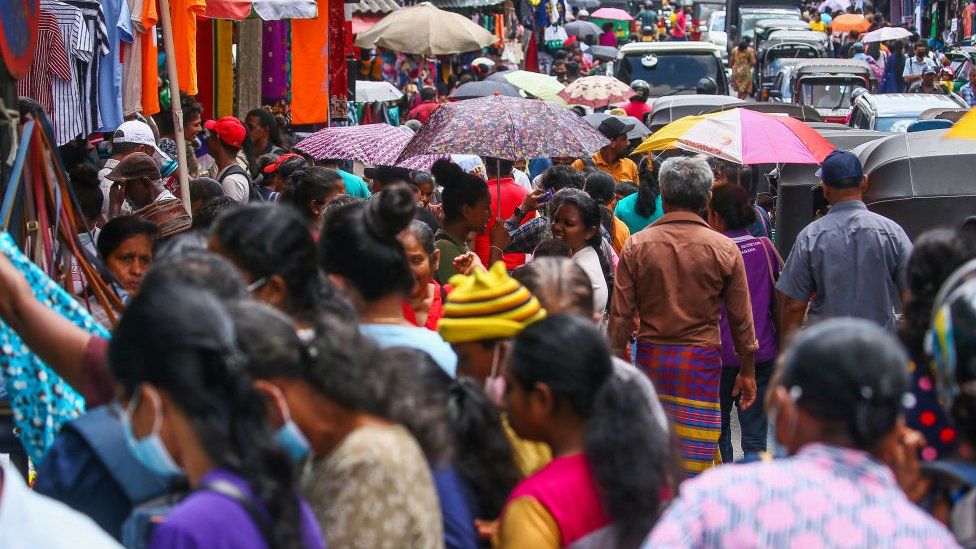
Image caption,Colombo’s public spaces, restaurants and shops are bustling with locals and tourists
By Archana Shukla
BBC News, Colombo
At first glance, life in Sri Lanka’s financial capital Colombo looks deceptively normal.
Roads are packed with traffic, public spaces and restaurants are full of both locals and tourists, while shops are bustling.
It is hard to imagine that just a year ago, this was a country struggling with massive shortages after it ran out of foreign currency.
With no money to buy fuel, roads were empty with even public transport at a standstill. Sri Lanka had to go back to pandemic-era measures such as online classes and working from home. But even this was not practical because of power cuts – some of which went on for up to 13 hours a day.
Food, medicine and other essentials were also in short supply, exacerbating the crisis. People had to stand in such long queues in the brutal heat, that at least 16 people – mainly the elderly – died.
But now, just a year later, food, fuel and medicine are available again, offices, schools and factories are all open, and public transport is back up and running.
Restaurants, especially high-end ones, are bustling.
“Last year this time I was on the verge of selling my restaurant. We had to close for a few days as the shortage of fuel meant no customers were coming. But now footfall has gone up nearly 70%,” said Chathura Ekanayake who runs a fine dining restaurant in Colombo.
The country’s main source of foreign currencies – tourism – is also witnessing a revival. The industry has recorded a 30% jump in revenue from the previous year.
“The recovery has been magical for us. Last year we didn’t even know if the country would survive”, said Hiran Cooray, CEO of Jetwings Symphony, a leading travel and hospitality player in Sri Lanka.
Despite these good news stories, Sri Lanka’s economy is still in a precarious place.
The country still has more than $80bn (£61.1bn) of debt – both foreign and domestic. In the worst of the crisis last year, the country defaulted on its foreign debt for the first time in its history.
Ranil Wickremesinghe who took charge as President after widespread protests saw then-ruler Gotabaya Rajapaksa resign, has managed to secure a lifeline of $2.9bn from the International Monetary Fund (IMF).
This has been crucial to opening other funding channels and easing shortages, but the money came with strict economic and governance policy reforms. The country is now seeking to restructure terms of its debt payments with both foreign and domestic lenders, as mandated by the IMF.
The main focus has been on restructuring its $36bn of foreign debt. This includes more than $7bn of loans from China, Sri Lanka’s largest bilateral creditor.
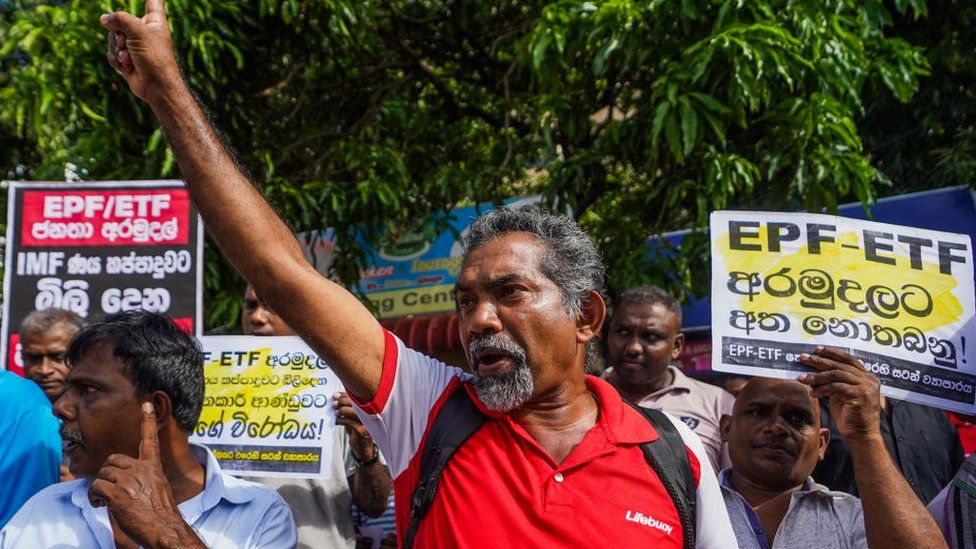
However, it is the restructuring of domestic debt that is likely to have a much bigger impact on the Sri Lankan people. Domestic borrowing accounts for around 50% of the country’s total debt. Sri Lanka’s cabinet recently approved a domestic debt restructuring proposal, but it has drawn massive criticism as it aims to cut workers’ pensions, while banks will not be affected. There have been protests against the proposals in Colombo.
It highlights that while life may seem to have returned to normal, in reality people are still struggling.
Image caption,Protesters tell the government not to touch pension funds
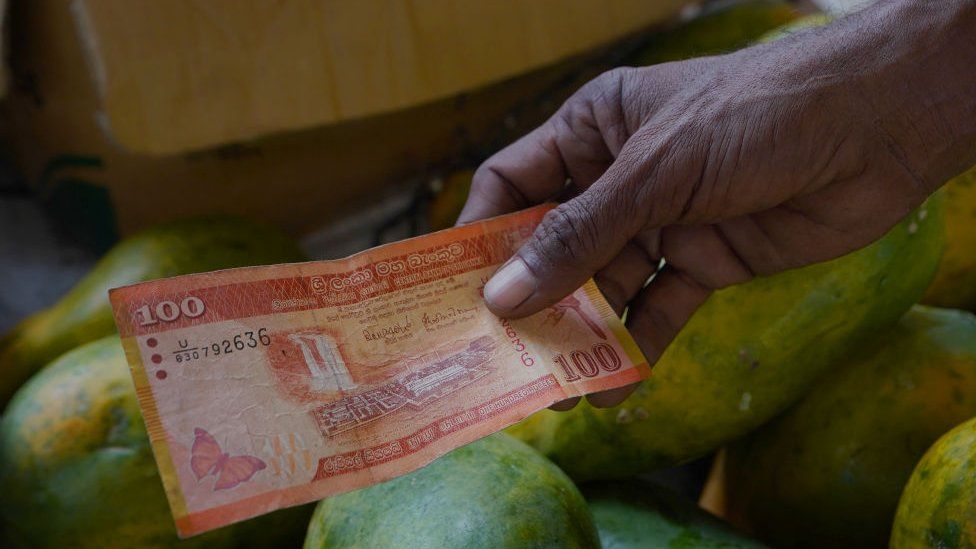
Essentials are available, but unaffordable for many. Things are more expensive than ever before. Almost half of all Sri Lankan families spend about 70% of their household income on food alone. And prices of food, clothing and housing are continuing to rise.
To add to the burden, income tax has been hiked to as much as 36% and subsidies on everything from food to household bills have been removed.
One area where this has had a huge impact is electricity bills, which have soared by 65% after the subsidy was removed.
“Many families from the middle class have now slipped below the poverty line,” said Malathy Knight, a senior economist with private think tank Verite Research.
And according to the World Bank, this is likely to continue for a while.
“Poverty is projected to remain above 25% in the next few years due to the multiple risks to households’ livelihoods,” it said in a report. The organisation has extended a $700m loan to Sri Lanka for budgetary support, including $200m for the poor and vulnerable.
This is a dramatic fall for a country that was long held up as an economic success story and had one of the highest average incomes in South Asia. The quality of its infrastructure, its free public health and education systems and its high levels of social development have all been held in high regard.
So how did things get so bad?
The government blamed the crisis on the Covid pandemic, which badly affected tourism. However, although the pandemic was a factor, disastrous economic policies were more to blame. Populist moves like big tax cuts in 2019 cost the government $1.4bn in annual revenues. And a move to ban imports of chemical fertilisers in 2021 caused a domestic food shortage.
In order to cut expenses further the government has proposed privatising state-owned enterprises like Sri Lankan Airlines, Sri Lankan Insurance Corporation and Sri Lanka Telecom. This has triggered a fresh wave of protests – this time by trade unions.
“The government should not put the burden of the reforms on the salaried class and middle class who are already affected by the economic crisis,” said Anupa Nandula, the Vice President of the Ceylon Bank Employees Union.
Mr Nandula and his union participated in a recent demonstration against the proposal to privatise the Sri Lankan Insurance Corporation. He believes privatisation will lead to massive job losses and further burden the working class.
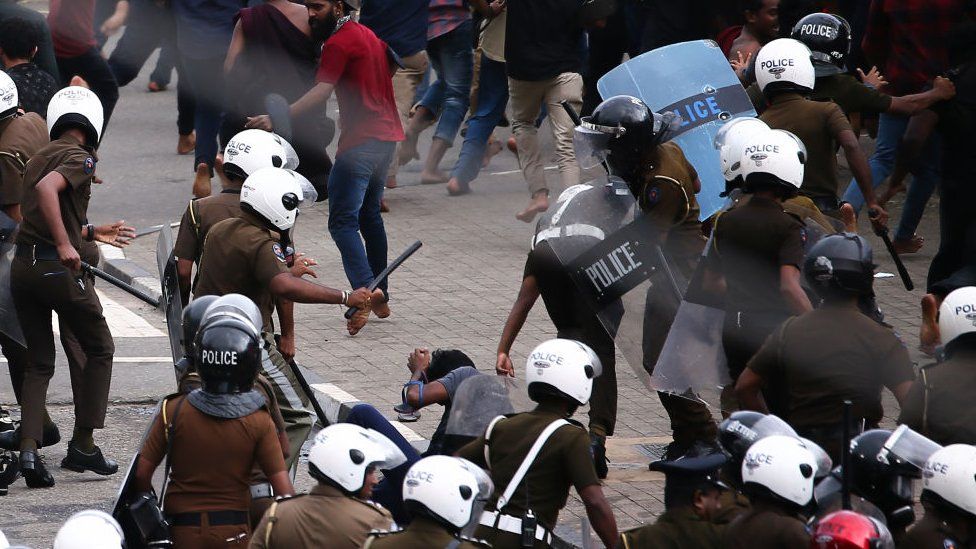
Ever since last year’s demonstrations were violently broken up, Sri Lankan authorities have been using force – such as tear gas, water cannon and even beating protesters. But experts warn that this is not a tactic that can work.
Rather than using force, the government needs to be transparent and explain that reshaping the economy will be tough, says Bhavani Fonseka, a constitutional lawyer working with Centre for Policy Alternatives.
“I think people since the crisis has happened have gotten used to a harder lifestyle. But in the absence of information coming, in the absence of answers being given, there is growing uncertainty and fear that we will go back to a crisis point.”
This fascinatingpost by Graham Shaw draws attention to the little known role that Sri Lanka (then Ceylon) played in the Indian National Movement by becoming a critical entry-point for nationalists and revolutionary literatures that would otherwise have found it impossible to enter India. A perfectly timed post as both countries mark the 75th anniversary of their independence from British colonial rule.
A little-known link between Sri Lanka (then Ceylon) and the Indian freedom struggle was its role in combating the elaborate censorship measures put in place by the British in India to keep the territories it controlled ‘sanitised’, and especially Communism-free. During the 1920s, the island proved a convenient ‘back-door’ for smuggling both ‘seditious’ literature and ‘dangerous’ persons into British India.
Two prominent figures in the Indian freedom struggle, the Bengali nationalist Manabendranath Roy (better known as M. N. Roy) and the crusading British journalist (and editor of The Bombay Chronicle) Benjamin Guy Horniman, both successfully exploited the Ceylonese ‘back-door’. Their stratagems are revealed in the British Library’s archive of ‘Indian Political Intelligence’ (IPI), a shadowy unit within the India Office in London charged with monitoring the activities of Indian nationalists and their sympathisers in Britain and continental Europe, working closely with the Intelligence Bureau in the Home Department of the British Government of India in New Delhi.
Roy, founder of the original Communist Party of India at Tashkent in 1920 and a leading figure in the Comintern, was relentlessly pursued across western Europe by IPI agents desperate to disrupt the production and circulation of his newspaper The Vanguard, first issued on 15 May 1922. In November that year, IPI reported that Roy had contacted Paul-Vaillant-Coutourier, a founding member of the French Communist Party, for assistance in smuggling copies of the newspaper and other nationalist literature from the port of Marseilles to the French enclave of Pondicherry (now Puduchery) on India’s Coromandel coast. Coutourier admitted that the French Communist Party had yet to establish lines of communication with reliable ‘comrades’ in Pondicherry, and therefore suggested that Roy make arrangements with Simon Sabiani, the ruthless Corsican Communist boss of Marseille’s Fourth Canton, a working-class area near the docks. Roy’s first thought had been to enlist Indian sailors (lascars) as couriers, but Coutourier informed him that very few ever visited Marseille; that the ships they served on usually only remained in port for a single night; and that they rarely left the docks to visit the city.
In the summer of 1923 Roy himself travelled to Marseille on a Mexican passport under the alias Roberto Allen to negotiate with Sabiani. He authorised Sabiani to spend up to 1,000 French francs a month to pay for the services of Italian Communists in smuggling literature aboard ships. The plan was to send one half of each consignment of The Vanguard in the weekly P&O mail-boats despite the risk, however small, that they might be seized by Customs on reaching British India. The other half of each consignment would be sent on the fortnightly French mail-boats owned by the well-known company Messageries Maritimes. Sabiani knew some of the crew aboard the French ships who were sympathetic to the Communist cause, but the chief advantage was that they sailed directly to Colombo or Rangoon (now Yangon) without calling at any British Indian port.
In September 1923 IPI reported that as many as 1,200 copies of The Vanguard were being sent via Messageries Maritimes vessels every two weeks. At Colombo, the mails bound for French India were unloaded without being inspected and reshipped to Pondicherry where, unlike at ports in British India, there was no legal provision for incoming mails to be subjected to examination by police or postal officers. Even if they suspected parcels might contain copies of The Vanguard, the French port officials had no powers to seize and destroy them. From Pondicherry, Roy’s newspaper and other Communist literature could easily be smuggled into British India on foot or on bicycle — Roy’s contact there, Ram Charan Lal Sharma, announced proudly that he had recently purchased two for that express purpose! Even though Ceylon was a British colony, there had been no cooperation between its colonial administration and that of India to control this mail route. The Colombo ‘back-door’ had not been closed — to Communist literature at least.
The repressive Rowlatt Act (passed by the Imperial Legislative Council of India in February 1919) unleashed a wave of protests led by Mahatma Gandhi. When rioting broke out in Bombay (now Mumbai) on 11 April, Governor Sir George Ambrose Lloyd declared that The Bombay Chronicle’s publication of Gandhi’s passive resistance manifesto had been a prime cause. Lloyd was determined to be rid of Horniman, its passionately pro-nationalist editor. Rather than put him on trial, Lloyd chose to deport him on 26 April under Defence of India (Consolidation) Rules of 1915, modelled on the British 1914 Defence of the Realm Act (DORA) sanctioning extra national security measures in wartime.
Back in Britain, Horniman campaigned vigorously for Indian independence, but was also determined to return to India. In December 1919, October 1920 and July 1921 he applied for a passport to India but each time was refused on advice from the Governor of Bombay Presidency. With the Indian DORA due to lapse at the end of August 1921, the British Indian Government passed the Passport (Entry into India) Act in 1920 under which anyone not possessing a passport valid for India could be denied entry. But issuing a passport for India to a British subject was the responsibility of the Passport Office (then part of the Foreign Office in London), not the India Office.
Horniman again applied in September 1921, May 1922, September 1923 and January 1924, and was still refused a passport for India after special intervention from the India Office, labelling him ‘a dangerous anti-Government agitator’. Campaigns mounted in support of Horniman’s return to India both in Britain and India itself met with no success. In March 1924 his case was raised in the House of Commons as a constitutional issue: that the indefinite penalisation of a British subject without trial or legal process was a grave infringement of personal liberty. Given Horniman’s profession, the ban was also seen as an attack on press freedom. Even the Secretary of State for India Lord Sidney Haldane Oliver felt there were insufficient grounds for a satisfactory defence of the ban in Parliament, but Viceroy Rufus Isaacs, 1st Marquess of Reading, insisted that the view of the local representative government (the Bombay Legislative Council) must be the paramount consideration.
After six years of refusals, the exasperated Horniman changed tack. On 13 October 1925 he successfully applied on health grounds for a passport to travel to France. In Paris he learnt that his passport was valid for entry to all French possessions (including Pondicherry). To his surprise, the British Consulate in Paris informed him that no special endorsement was needed to visit Ceylon, or any other part of the British Empire — except India.
On 19 December, Horniman left Marseille for Colombo on the S.S. d’Artagnan belonging to Messageries Maritimes. While on board, Horniman was informed there were no ships sailing from Colombo to Pondicherry; he would have to travel there by train. At Colombo, the police at first refused him disembarkation but when he challenged the decision he was reluctantly allowed to land. Fearing possible arrest, he immediately took the train north to Talaimannar. From there he boarded the ferry across to Dhanushkodi at the tip of the Indian peninsula extending out to Adam’s Bridge (now Rama’s Bridge/Rama Setu). As at Colombo, on the Indian side police initially denied him right of disembarkation and informed him that he would have to take the ferry back to Colombo. With a strong police guard on board there was no chance of escaping. But after consultation with senior officials the police had no choice but to let him land.
Horniman was home free in British India. His initial plan to enter via French India had proved unnecessary because of a loophole in the 1920 Passport (Entry into India) Act. That legislation only sanctioned the removal of persons without a valid passport who had entered India overland via Chaman in Baluchistan or the Khyber Pass, or directly by sea but not via a port in Ceylon, an exemption included to meet the needs of Indian estate labourers travelling regularly between India and Ceylon at the time.
The news of Horniman’s return to British India caused consternation in the India Office. There was nothing that could be done: he could not be prosecuted under the 1920 Indian Passport Act as it stood, and it could not be amended retrospectively to apply in his case. While a blame game played out between government departments in Britain, India and Ceylon, Horniman was back at the heart of Bombay journalism — thanks to the ‘back-door’ provided by Ceylon.
*
NOTE: Geographical names have been rendered in their historic spellings of the period; modern names have been indicated at the first instance.
The views expressed here are those of the author and do not represent the views of the ‘South Asia @ LSE’ blog, the LSE South Asia Centre or the London School of Economics and Political Science. Please click here for our Comments Policy.
This blogpost may not be reposted by anyone without prior written consent of LSE South Asia Centre; please e-mail southasia@lse.ac.uk for permission.
U.S. Treasury Secretary Janet Yellen said on Sunday she was eager” to work with China on areas of mutual interest, including debt restructurings for poorer countries, and that multilateral development banks needed reforms before capital increases could be considered.
At a press conference before a meeting of Group of 20 finance ministers and central bankers in India, Yellen said her visit to Beijing last week helped put the U.S.-China relationship on surer footing” and that the world’s two biggest economies had an obligation to the world to cooperate on areas of mutual concern”.
There is much more work to do. But I believe this trip was an important start,” Yellen said. I am eager to build on the groundwork that we laid in Beijing to mobilise further action.”
Concerns remain about China’s unfair trade practices, which prompted Washington to impose tariffs on Beijing. They really have not been addressed,” she said.
U.S. corporations want to see an environment where they could invest and thrive in China”, Yellen said.
Washington will continue to cut off Russia’s access to military equipment and technologies that Moscow needs in the invasion of Ukraine, Yellen said.
One of our core goals this year is to combat Russia’s efforts to evade our sanctions. Our coalition is building on the actions we’ve taken in recent months to crack down on these efforts,” she added.
India, which chairs the G20 this year, has sought a largely neutral stance on the war, generally declining to blame Russia for the invasion Moscow launched in February last year, urging a diplomatic solution and sharply boosting its purchases of Russian oil even as Western nations seek to squeeze Moscow.
Yellen said she would continue to push hard at the G20 meeting, in Gandhinagar in the northwestern Indian state of Gujarat, for full and timely participation of all bilateral official creditors on pending debt restructurings”.
She said she discussed Zambia’s restructuring with her Chinese counterparts and, although it took too long to negotiate, differences were overcome.
We should apply the common principles we agreed to in Zambia’s case in other cases – rather than starting at zero every time. And we must go faster,” Yellen said, adding she hoped debt treatments for Sri Lanka and Ghana could be finalised quickly so the International Monetary Fund (IMF) could move forward with initial loan programme reviews this fall.
She said a debt restructuring user guide” was needed for borrowing countries and other stakeholders to provide clarity about the process.
Yellen said the IMF’s Poverty Reduction and Growth trust, which provides zero-interest loans to the world’s poorest countries, needed to be put on sounder financial footing. The U.S. Treasury is ready to assist the IMF to consider options for this, including using internal fund resources, she said.
‘BETTER BANKS’ Yellen also laid out a number of next steps for the evolution of the World Bank and other multilateral development banks, but said that any exploration of capital increases for the institutions can only be considered after implementing reforms aimed at expanding their role beyond poverty reduction to tackle global challenges such as climate change and pandemics.
We should build better banks, not just bigger banks,” Yellen said.
She repeated her estimate that multilateral development banks could collectively boost lending by $200 billion over a decade from internal resources through balance sheet reforms now being implemented or considered. They could boost this further by implementing recommendations from last year’s G20 Capital Adequacy Framework report, she said.
Among other World Bank reform steps, Yellen said she was pushing for a new set of principles that would allow the targeted use” of the bank’s concessional financing for global challenges, including climate change and measures to boost such resources.
She said she would like the World Bank to explore options for lending to sub-sovereign and supra-sovereign borrowers like the COVAX vaccine initiative.
Yellen said the United States was committed to implementing a global corporate minimum tax deal reached in 2021 despite the lack of action by the U.S. Congress to do so. She said negotiations on technical details of the deal’s Pillar 1 – reallocation of taxing rights on large multinationals including big technology firms – were very close” to completion.
The Inland Revenue Department (IRD) says that it has collected a total tax revenue of Rs. 696,946 million for the first half of this year.
In comparison, the revenue collected from the income tax during the first half of 2022 amounted to a total of Rs. 361,832 million, according to the department.
Accordingly, the collected Tax Revenue of the first half of this year shows a positive growth of 93% compared to last year, the Commission General of the IRD said in a statement.
He also mentioned that the factors such as decisive changes of the tax policy, the gradual recovery of the economic situation of the country and the efficiency of the efforts of the IRD are the reasons for this positive growth.
I am especially grateful to the honorable taxpayers for their cooperation to uplift the economic strength of the country and the officers of public and private institutions who supported this in various ways for this success”, the department’s CG added.
‘Before you study the economics, study the economists!’
*
‘The US decided to undertake… an influencecampaign
behind the scenes, providing favors…through grants,
training grants & money for individuals involved
in participating to get them to flip their decision…
Stakeholders from China have left that project
and have struck out on their own to try to construct
what has been seemingly seen as competing cables
at the same time along similar routes…
A key pressure point in this process is:
Who is going to actually manufacture & lay the cable across the ocean?
Not necessarily who’s going to own the cable or where the cable is going to land.’
(see ee Random Notes)
NATO-media outlet Thomson-Reuters dates this cable drama as unfolding rapidly under cover of the covid roller-coaster of the last few years. ee gathers together here some English media bric-a-brac, which chose not to directly report on such underwater soundings at the time. We start with a grab of random historical references (especially about the ongoing attempt to monopolize the Indian Ocean), then to recent news about the financing & construction of telegraph & submarine cables. These sources could not or simply do not wish to flash some oxygen (to mix a metaphor) into the do-doings of those professing a ‘free & open Indo-Pacific’.
The story intrigues. Encapsulated within it is the perfidy of SLTelecom, whose privatization is hailed as a success story – the hijacking of a public service done just as the move from landlines to mobile phones was being effected. Now it is being handed over to the World Bank!
SLTelecom long refused to invest its vast profits in producing any equipment, much of which is imported via Japan. Japan’s claim that Colombo Dockyard is Sri Lankan, to then demand government contracts, is also here examined. Colombo Dockyard apparently ‘built’ (actually, assembled!) a ship for Japan to lay submarine cables. The local English media views industry as only children’s building-block games! The ‘cable’ business has however always been linked to European imperialism and economic exploitation. ee has recalled the English sabotage of the boat-building industry. ee now records here again the supine and backward nature of Sri Lanka’s grandly elocuted ‘IT industry’ – which does not make a screw! (see ee Focus, Fake Dockyards)
here we whirl between rivers named red & yellow
a himalayan dance of fire pivots on our head
as about us waves from west & east are roiled
to dash on the rocks. o how they froth!
time streams fast at the edges of the planet
as the receding tides of the beach
try drag us into the wider ocean
Last ee reported, the US ‘compensated’ & warned Sri Lanka Telecom and other country providers not to work with China’s subsea project. Yet China produces and supplies the most modern and efficient internet submarine cabling. This production & supply is the main issue, not the English media-blasted charges about using the cables to spy on other countries. The ‘English-built’ Kandy Road still links plantation, fort and port. This very internet to which we are bound – hand, eye, ear & mind – is set up after all by the US military to primarily connect its researchers & suppliers – DARPANET, etc. Sigh. The US is always projecting its own grimy practices onto others.
The US threats & bribes directed at forcing countries to submit to the US’ monopoly over subsea cable routes, did not rate attention by free traders (who whinge about rule of law & laissez-faire) and the protectionists (who oppose encroachments on our sovereignty) – all radio silent.
*
This submarine cable hullabaloo arrived midst all manner of ‘digital’ news: The Washington-based World Bank’s International Finance Corporation has been ‘selected’ to ‘help’ sell off Sri Lanka Telecom, SriLankan Airlines, etc. The World Bank & their IFC already have their fingers deep in the orifices of the country’s banks, openly manipulating the ‘rigged’ stock market, etc.
• US financial ratings agency Fitch has fallen in love with us again. Fitch is ‘positive’ (not like an AIDS test but), about the government ‘unbundling CEB’s generation, transmission & distribution process by transferring CEB’s resources to 14 companies established under the Companies Act as part of the country’s energy sector reforms.’ Let there be light?
• The cabinet has also cleared an Indian-financed digital identity for every citizen, in addition to a national identity card – India promises 300million Indian rupees to this Sri Lanka Unique Digital Identity (SL-UDI) project.
• The IMF has threatened Sri Lanka to desist from taxing telecom providers. Digital multinationals should be paying at least a $100mn annually. A set of media-made-eminent economists – Stiglitz, Ghosh, Piketty – belonging to an NGO funded by the German & Norwegian state has kindly objected, on our behalf. The IMF has denied this. Very kind indeed! Yet the roots of our discontent lie deeper and relate to the prevention & sabotage of industrial production.
*
‘Of all countries in South & Southeast Asia,
Ceylon has the most unstable economy.
The present crisis in the country exhibits many features born of this instability
…different in character from the earlier economic crises…
The present crisis arises from a deeper cause…
The present crisis is much more serious & much less temporary than earlier ones.
It is not a passing disturbance capable of adjustment. It is not possible to meet it
with relief schemes or other ad hoc remedies. In fact, it is fundamentally different.
It is of the greatest importance to understand this new fact about the crisis.
It is not caused by prices or demand for our gods, but by lack of produced wealth.
The question we have to ask is this:
Why is production remaining static?
Why do we not produce more?‘
– The Way Ahead (Idiri Maga), Introduction, SA Wickremasinghe, 1955
ee was curious about the Communist Party of Sri Lanka’s role in proposing the Mahaveli’s revitalization back in the 1950s. Some readers have been led to believe the Mahaveli project was of colonial or UNP origin. ee is curious about the link between DJ Wimalasurendra’s exertions to formulate an energy policy and his influence on later CP thought. This ee excerpts references to the Mahaveli’s power in Wickremasinghe’s Idiri Maga classic (see, ee Focus).
*
‘Sri Lanka must ensure adequate nutrition
for pregnant, breastfeeding women: Amnesty International’
(see ee Sovereignty)
*
‘A child needs 2 packets of powdered milk per week’ – Daily Mirror
(ee Agriculture)
So! The media is bullish – that’s stockmarket-speak for ‘optimistic’. Hard-to-please Fitch is optimistic about the Domestic Debt Restructuring (DDR) renamed DDO – removing ‘restructuring’ and adding ‘optimization’. Brilliant PR stuff, huh? And happier still is Fitch that the Ceylon Electricity Board (CEB) is being ‘unbundled’ to private companies. And duly the stock market doth sing hallelujah in falsetto to the IMF’s dictat. And now, Amnesty International is giving Sri Lanka advice on breastfeeding! Maybe because the Minister of Agriculture is being breastfed by the World Bank and USAID’s soya lobby. The Ministry of Education is similarly learning tuition lessons after hours. The WB sets their menu… um, curriculum. The UN World Food Program (WFP) has taken over the Ministry of Health’s dentures chattering about diet and malnutrition. No caveats against imported gluten, Unilever’s carcinogenic Astra Margarine or New Zealand’s powdered milk, banned in their own countries.
While the government sets about their ‘labor reform’, the UN International Labor Organisation (ILO) is promoting youthful ‘disruptors’ with the Ceylon Chamberof Commerce & the US government. The ILO is even teaching us to grind chilies! Those who daily deemed Gota a despot, now admire the suave callisthenics of Batalanda Wicka. US media outlet EconomyNexthas an earnest Englishman recounting India’s independence struggle – full of the old orientalisms and the hookah fragrances of idealism. Maybe, the local brownies need to be reminded about the yards of indigenous airs they wrap themselves in.
Amnesty Inc’s latest concerns are timely. Dr Priyani Soysa, once hounded by Swiss Nestlé for exposing their attempt to ‘substitute’ mother’s milk, passed away a few months ago – with several obituaries but none recalling her monumental MNC (multinational corporation) battle (ee calls Soysa, Dr, cos she was a real doctor, albeit with the most human afflictions). Amnesty Inc was quiet then about such MNC moves. They’re even more quiet now despite the ruckus. Nestlé meanwhile, after posting record profits, has opted to go ‘private’, delisting from the stock market. Shareholders, some feel milked. Others creamed.
Since we cannot trust the English media to divulge the truth, we have to divine astrological signs to sense changes in the world. The Indian Foreign Secretary dropped by to meet the President. Then came Bollywood superstar Rajinikanth, plus the good news that ‘top stars’ are attending the Mrs India Inc Season 4 in Colombo! Does this stellar fog in this latitude of the Bay of Bengal augur greater turbulence? – to use a meteorological metaphor – as we approach the 2023rd twenties of July. Refer here to the annual markings to recall what some call ‘Black July’ – yet we always see these & other such Julys (Julies?) as white: July 1980, July 1983, July 1987, July 2022. Why White Julys? Because we have always seen the old ‘hidden hand’ – an euphemism quite popular in the 1980s, when such horrors unfolded – to manifest the agenda of genuflection, evident in full array.
News arrived this week that the US & Canada – another infamous Core Group – sponsors those gangs in Haiti, to pave the way for invasion (see ee Sovereignty, Caricom Caves). Such news shows why we have to go near full astrological, cos we do not have all the information, and only can read signs that barely manifest, at least openly, in the media. About Julys then and now and thenceforth. And as usual, with time, we get to see subtleties, nuances, facets and other vertebral narratives that put these apocryphal events in their time and place.
*
‘Without economic freedoms to import something,
or transfer a legally earned rupee,
grand plans to develop the country will come to nothing’
– ee Economists, US EconomyNext’s Bellwether
• US state-owned media in Sri Lanka, EconomyNext constantly harangues about ‘free trade’, and liberalizing imports & exports. This made ee recall the integral English & US ‘free trade’ in slaves & opium. After all, ee was busy catching up on news about China beginning to provide their own internet submarine cabling to Asia & Africa, which would be more advanced and built faster. The whites wish China will pack up and go home 15thC Ming-dynasty style, and leave the ocean open to the savagery & underdevelopment that the Portuguese & Spanish unleashed on these seas beginning about the 16thC.
ee’s tale this week begins to look at the origins of European transgressions in the Oceans, named Indian and the Pacific. From the Atlantic Triangle Trade of chattel slavery – the largest commerce of the 16-19th century – to the largest triangle business in the 19th century: the English opium trade in the Indian Ocean, which brought us modernity by gunboat.
The triangle of financing English manufactures, Indian opium and Chinese tea, give us background into the banking practices of Standard Chartered & HSBC. Here then are the origins of ‘accounting’ games played by ‘exporters’ of all kinds to bleed Sri Lanka – goods mostly ‘assembled’ via inflated imports.
This week reinforced again the unreliability of economists. The Sunday Times’ Nimal Sanderatne admitted that contrary to the President & the Central Bank governor’s promises,the ‘EPF & ETF would suffer losses & retirement benefits of private sector employees would be eroded’. Sanderatne attempts Churchillian charlatanry calling such promises – ‘factual inexactitude’ (seeee Economists).
For such ‘inexactitudes’, we may have to thank the ‘communication strategy’ of London Ceylon Tobacco Co’s Suresh Shah, who is the government pointman in charge of selling off government resources.
Meanwhile, over 100 academics have objected to the government undermining labor laws. Interestingly, they note the obsession with an ‘export-oriented economy’. Yet they notably avoid mentioning the IMF (see ee Focus). They observe: ‘The economy of the plantations is on the cusp of change and the Malaiyaha worker is staring into a future of fragmentation…’ Why use the ‘passive voice’? Why not tell who is making the ‘change’. Don’t they know? They may have forgotten the great English expertise in human resources bestowed upon this country’s plantocracy:
*
‘During the whole of the 18thC, English slave traders
furnished the sugar planters of France & Spain with half a million Negroes…
England was not only the foremost slave trading country in the world;
she had become… the ‘honourable slave carriers’ of her rivals…
By 1795 Liverpool alone had five-eighths of the English slave trade and
three-sevenths of the whole European slave trade…’
– Eric Williams, Capitalism & Slavery
1795 rings bells for us. English multinational Unilever now dominates Sri Lanka’s economy, economically and culturally, and holds our home market hostage. Unilever is directly traced to the Company of Royal Adventurers Trading to Africa (later Royal African Company, now Unilever). The RAC shipped more African slaves to the Americas during the Atlantic slave trade than any other company. Unilever’s founder, chief patron to English Queen Victoria’s Belgian cousin Leopold obtained control over palm oil production in the Congo & West Africa…
Incorporated in 1663 for a period of 1,000 years, 64 years after the East India Co (EIC) was set up, the RAC was founded by the beheaded Charles I’s orphans – Charles II and his brother, the Duke of York. We now have one head hunter who is called Charles III. And the RAC’s offshoots still cripple us…
In 1698 the Royal African Company lost its monopoly in slaving, and the right of a free trade in slaves was recognized as a fundamental & natural right of Englishmen. 90 years later, England’s Privy Council Committee in 1788 paid special attention to the fact that, of the annual English export of slaves from Africa, two-thirds were disposed of to foreigners.
The East India Co too would in the 19thC lose its monopoly. Out of this arose the private merchants who then reassembled as Unilever in the 20thC. Unilever today outsources its production to 3rd-parties who appear ‘independent’ and thus defy the country’s labor laws. They control media through advertising. Our academics have to use euphemisms, yet our politicians and media openly ensure Unilever’s will will be done.
The Ambassador of Türkiye to Sri Lanka says the elements of FETÖ (Fethullahist Terrorist Organization) – the group behind the foiled 2016 coup bid – have been eliminated from Sri Lanka after successful joint efforts by the two nations against terrorism.
Addressing the Democracy and National Unity Day Commemoration Ceremony in Colombo on Saturday (July 15), Ambassador Demet Şekercioğlu said Türkiye continues to engage with the Sri Lankan authorities with enhanced intelligence sharing to build a strong, vigilant and comprehensive response to terrorism.
On July 15, 2016, the government of Türkiye President Recep Tayyip Erdoğan defeated an attempted coup d’état by FETÖ members, which claimed the lives of 251 citizens and left thousands of others injured. The day is commemorated as the Democracy and National Unity Day in Türkiye.
The ambassador said the tragic events that unfolded on July 15t were not merely acts of terror;, but a blatant affront to the founding principles that define the Republic of Türkiye and its people – the principles of democracy, freedom, and the rule of law.
She said the malicious acts witnessed on July 15, 2016 were not results of an overnight attempt., but the climax of many years of meticulous planning and covert operations by the FETÖ led by Fetullah Gülen.
Şekercioğlu highlighted that Türkiye’s fight against FETO has been unwavering, and combating these elements of terror has been one of its top priorities both within and outside of the country.
Meanwhile, Türkiye Foreign Minister has thanked the country’s Asian partners for their support in the fight against FETO.
Addressing a news conference at the ASEAN-Türkiye Sectoral Dialogue Partnership Trilateral Meeting held in Jakarta, Indonesia, Minister Hakan Fidan recognized and appreciated the cooperation of Türkiye’s friends from the Asian region in the fight against FETO.
The sentience of animals like crabs, lobsters & prawns (decapod crustaceans), calls for their legal protection.
The welfare of decapod crustaceans remains largely unprotected, and they are truly voiceless. Their suffering at the humans is a blot on our moral conscience.
There is compelling scientific evidence that they are sentient and therefore can experience pain, and in light of the extreme practices they are subjected to, the animal welfare movement of Sri Lanka must take up their cause.
There must be a legal requirement for food processors, supermarkets, and restaurants to consider their welfare during storage, handling, or killing. Invertebrates are also animals as defined in the Animal Welfare Bill. There must be Regulations and Codes of Practice in the new draft Animal Welfare Act to cover crustaceans such as Shrimp, Crab, and Lobster.
These animals i.e., crabs and lobsters are frequently killed by breaking off the legs, head, or tail, and then being boiled alive. It has been estimated that an edible crab boiled alive may remain conscious for at least three minutes.
In restaurants that specialize in Crab and Lobster culinary, they can be often seen crammed together in brightly lit tanks with no consideration for their welfare and they are killed in the most inhumane and barbaric manner.
Even high-profile people who have enough money to live in great comfort and ought to behave like national role models showing love and compassion for sentient beings, have unfortunately taken to this unpitying trade and thereby have brought shame on themselves and their respected sports and alma mater (school).
Amendment to Animal Welfare (Sentience) Bill following LSE report on decapod and cephalopod sentience
Crabs, octopus and lobsters to be recognised as sentient beings in government policy decision making
Decapod crustaceans and cephalopod molluscs will be recognised under the scope of the Animal Welfare (Sentience) Bill
Amendment to Bill follows London School of Economics and Political Science (LSE) scientific research findings on decapod and cephalopod sentience
Existing industry practices will not be affected and there will be no direct impact on shellfish catching or in restaurant kitchens
The scope of the Animal Welfare (Sentience) Bill has today been extended to recognise lobsters, octopus and crabs and all other decapod crustaceans and cephalopod molluscs as sentient beings.
The move follows the findings of a government-commissioned independent review by the London School of Economics and Political Science (LSE) which concluded there is strong scientific evidence decapod crustaceans and cephalopod molluscs are sentient.
The Animal Welfare (Sentience) Bill already recognises all animals with a backbone (vertebrates) as sentient beings. However, unlike some other invertebrates (animals without a backbone ), decapod crustaceans and cephalopods have complex central nervous systems, one of the key hallmarks of sentience.
Today’s announcement will not affect any existing legislation or industry practices such as fishing. There will be no direct impact on the shellfish catching or restaurant industry. Instead, it is designed to ensure animal welfare is well considered in future decision-making.
Animal Welfare Minister Lord Zac Goldsmith said:
The UK has always led the way on animal welfare and our Action Plan for Animal Welfare goes even further by setting out our plans to bring in some of the strongest protections in the world for pets, livestock and wild animals.
The Animal Welfare Sentience Bill provides a crucial assurance that animal wellbeing is rightly considered when developing new laws. The science is now clear that decapods and cephalopods can feel pain and therefore it is only right they are covered by this vital piece of legislation.
The Bill, when it becomes law, will establish an Animal Sentience Committee made up of experts from within the field. They will be able to issue reports on how well government decisions have taken account of the welfare of sentient animals with Ministers needing to respond to Parliament.
Ministry to consult President’s Secretariat on composition
Pipeline can link Nagapattinam refinery to SL storage
The Government will appoint a committee to evaluate the proposal submitted by the Indian Oil Corporation (IOC) for an oil distribution pipeline connecting Nagapattinam, Tamil Nadu to Trincomalee and Colombo, the Ministry of Power and Energy said yesterday (15).
The proposal comes days before President Ranil Wickremesinghe is to visit New Delhi on the invitation of Indian Premier Narendra Modi.
According to the Ministry of Power and Energy Secretary M.P.D.U.K. Mapa Pathirana, the committee will be appointed soon.
We have only received this recently and a committee will be appointed soon to evaluate it. We will need expert help to analyse this proposal,” Pathirana said.
A senior Government official close to the subject said that the composition of the committee would likely be decided following a discussion between the Ministry of Power and Energy and the President’s Secretariat.
According to him, the IOC is keen to establish a pipeline to Sri Lanka which will link domestic storage potential to the new nine million metric tonnes per annum (MMTPA) refinery at Nagapattinam, established through a joint venture by Chennai Petroleum Corporation Ltd. (CPCL) and IOC.
The senior official opined that the pipeline may be a more economical option for the IOC to establish than constructing a new refinery in Trincomalee Bay. IOC already manages several long-distance oil pipelines in India.
Last week, Minister of Power and Energy Kanchana Wijesekera took to Twitter to announce that the IOC proposal had been discussed.
A proposal by IOC for an oil distribution pipeline connecting Nagapattinam, Trincomalee, and Colombo was discussed yesterday. I requested them to look at a two-way oil and gas pipeline taking into consideration the Government’s development plan for Trinco Tank Farm and energy hub, future developments of refineries, oil and gas exploration, pipeline connections to domestic LPG terminals that will target regional oil and gas export markets while enabling energy requirements of both countries. Project feasibility, technical requirements will be assessed before finalisation of the project scope for approval. Officials of Indian High Commision, Ministry of Power and Energy, CPC, CPSTL, PDASL, IOC and LIOC participated,” Wijesekera tweeted.
Earlier, State-owned Ceylon Petroleum Corporation (CPC) and Lanka Indian Oil Company (LIOC), a subsidiary of IOC, signed an agreement to jointly develop the 1930s-era Trincomalee Oil Tank Farm which had been neglected over the decades.
The move drew criticism from some Opposition parties and trade unions which objected to ‘national assets’ being sold off to foreign companies. However, according to the CPC, LIOC has pledged close to $ 180 million to rehabilitate the oil tank farm and bring it back into operation.
Attempts to contact the LIOC regarding the IOC proposal failed.
Until recently, there had been a significant absence in research on Sri Lanka’s fireflies; previous work was by British scientists a couple hundred years ago, but now a new surge in research has led to new findings in the pipeline for publication.
Recent research has led to the rediscovery of Luciola nicolleri, a firefly not seen since its description 100 years ago, and Curtos costipennis, a new discovery in Sri Lanka.
Glowworms are the larval stage of fireflies, and folklore has it that once stung by them, treatment would require mud from the depths of the ocean and stars from the sky, indicating a difficult cure — shot down by experts as myth, confirming fireflies do not harm human life.
A beautiful and common sight just a decade ago, fireflies are fast disappearing from urban landscapes due to loss of habitat, increasing temperatures and pollution levels, affecting their reproduction signals in the form of bioluminescent lights.
COLOMBO — Fireflies, with their bioluminescent rears, are fascinating species that appeal to people’s imaginations, especially those of children. In Sri Lanka, the first systematic study of fireflies was carried out by British naturalists in the 18th century, but afterward, there was a loss of interest in studying these fascinating creatures.
Shedding new light on Sri Lanka’s firefly fauna, researchers and at least one enthusiastic amateur continue to study them today, resulting in several discoveries. Sri Lanka is home to 16 firefly species, while Abscondita perplexa and Asymmetricata humeralis are more common and show a countrywide distribution. In 2022, research on A. humeralis conducted by Dammika Wijekoon and Hemantha Wegiriya of the University of Ruhuna showed that male A. humeralis can look different in color and pattern, highlighting that there can be more secrets in the world of fireflies to be investigated.
Wijekoon and Wegiriya initiated their study on fireflies in 2009 and have already made several significant discoveries. In 2010, the researchers recorded Curtos costipennis for the first time in Sri Lanka, making it the first firefly member of the genus Curtos found in Sri Lanka.
Their study in 2022 re-recorded Luciola nicolleri after a lapse of 100 years. The species was first described in 1922. L. nicolleri has not been recorded since its discovery, a highly significant finding as it was considered possibly extinct.
The studies further showed that fireflies prefer terrestrial grassland habitats and Uva province, where 11 species out of the 16 are found, has a role to play in their conservation. Both Sabaragamuwa and Southern provinces, too, have a rich firefly diversity, according to this study.
Fireflies are soft-bodied, light-emitting insects classified under the family Lampyridae. There are about 2,000 firefly species in the world and most of them can emit light through a chemical process using an enzyme produced in their body.
Each species has different intensities and patterns of light, and this phenomenon usually happens in twilight as a mechanism that is used by female fireflies to attract a partner, said Wijekoon, one of the co-authors of the study.
The enzyme involved in light production is called luciferases and when this reacts to oxygen, it begins to flash. Scientists also believe that fireflies can control the frequency and intensity of flashing by controlling the oxygen levels to the light-producing organs.
Sri Lankans know another species that emits light, but they are not flying and have a worm-like appearance: glowworms. People often consider glowworms to be distinct, not knowing that it is the larval stage of the firefly, Wijekoon told Mongabay.
Glowworms mainly feed on small snails and slugs, first injecting venom to immobilize the prey. This habit has given the creature a scary reputation, where folklore has it that if stung by a glowworm, treatment would require mud from the oceans and stars from the sky, indicating the difficulties in treatment. Glowworms also have a neurotoxin venom similar to that of some snakes, but their mouths are very small, and the venom released is negligible.
A glowworm feeds on a snail. Image courtesy of Dhammika Wijekoon.
Shashi Prabath, a teacher at Vidyaloka Science Institute, is fascinated by the study of fireflies. He continues to study them and is trying his best to rear them. To pursue the factual status of the local myth, Prabath even wanted to be bitten by a glowworm.
I tried to get bitten by one of them, but the glowworm didn’t bother initially, However, after I applied slime on my finger, I did get bitten. But it was like an ant’s bite and only a little pain, which reduced after a few hours,” Prabath added.
Prabath also tries to rear fireflies from the stages of eggs and has successfully managed to raise them. He is currently working on a research paper.
A field guide that can be used to identify firefly species with a description of their behavior could be the first step in popularizing firefly studies among the public interested in this charismatic insect, he said. Taking the first step, Wijekoon published the book Fireflies of Sri Lanka,” which is the first-ever comprehensive book on the taxonomy and ecology of fireflies in Sri Lanka, addressing the long-felt need and research gap in firefly literature in the country.
The book contains species names, information on males and females, identification characters, ecological remarks, active time periods, distributions and larval and egg characteristics wherever available. This book offers the first-ever detailed description of the systematics and ecology of Sri Lankan fireflies.
A female Lamprigera tenebrosa firefly. Image courtesy of Dhammika Wijekoon.
Firefly tourism is also popular in many other regions. For example, Research on nature tourism shows increased interest among nature-based tourists in firefly tourism. Sri Lanka has the potential to look at such tourism possibilities as some of the pristine sites still harbor a healthy population of fireflies,” Wijekoon said.
Nighttime river safaris could be an ideal way of observing fireflies without disturbing the natural vegetation, experts say. Some countries like the U.S. have species that have synchronized lighting, which provides a spectacular scene. Much is still unknown about Sri Lanka’s firefly fauna, Wijekoon said.
Decades ago, fireflies were a common sight that brought much joy to children, adding magic to the twilight hours — but this has become a thing of the past in many areas, especially in urban gardens. Not only the loss of suitable vegetation, but light pollution, too, is a major contributor to the decrease in firefly populations, said Wijekoon.
When there are too many outdoor lights, fireflies fail to communicate with each other, and firefly reproduction cycles take a hit. In addition, the fireflies need moisture, but the soil is getting increasingly dry. Pesticide use is another factor that contributes to the decline of fireflies.
Wijekoon is also a member of the IUCN Species Survival Commission Firefly Specialist Group and said it is important to focus on conservation of these charismatic insects. To highlight the need for action, the first weekend of July is declared World Firefly Day by the International Firefly Network.
Citations:
De Silva, D. R., Wijekoon, D., Sandun Nalaka Bandara, K. V., & Wegiriya, H. (2022, June). Re-record of Luciola nicolleri (Coleoptera: Lampyridae: Luciolinae) from Sri Lanka. Paper presented at International Firefly Symposium, Parque Biologico de Gaia, Portugal.
Wijekoon, D., & Wegiriya, H. (2022). Fireflies of Sri Lanka. Malabe, Sri Lanka: Sarasavi Publishers (Pvt) Ltd.
Lewis, S. M., Thancharoen, A., Wong, C. H., López‐Palafox, T., Santos, P. V., Wu, C., … Reed, J. M. (2021). Firefly tourism: Advancing a global phenomenon toward a brighter future. Conservation Science and Practice, 3(5). doi:10.1111/csp2.391
Sri Lankan President Ranil Wickremesinghe, also the Sri Lanka’s finance minister, made this remark while addressing the Indian CEO Forum this week.
Sri Lanka would want to see the Indian Rupee used as much as the US dollar, President Ranil Wickremesinghe has said, days ahead of his first official visit to New Delhi.
President Wickremesinghe, also the Sri Lanka’s finance minister, made this remark while addressing the Indian CEO Forum this week.
“Just as East Asia, including countries like Japan, Korea and China, witnessed significant growth 75 years ago, it is now India’s turn, along with the Indian Ocean region,” President Wickremesinghe said.
President Wickremesinghe is expected to visit New Delhi next week, his first since becoming president a year ago amidst unprecedented economic and political turmoil in the island nation.
President Wickremesinghe’s comments were in response to the chair of the Forum, TS Prakash, who in his address had called for the enhanced use of the Indian rupee in the Sri Lankan economy.
“It makes no difference to us if India (the Indian rupee) becomes a common currency. We will have to figure out how to go about it. We must become more open to the outside world”, President Wickremesinghe said.
“The world is evolving and India is undergoing rapid development, particularly under Prime Minister Modi’s leadership”, he added.
He also said that Sri Lanka benefits from its proximity to India, coupled with a rich history, cultural heritage and longstanding trading relationships spanning 2,500 years, The Daily Mirror newspaper quoted him as saying.
President Wickremesinghe has steered the island nation out of the economic crisis and said the economy is recovering despite its slowness.
“Once we complete debt restructuring our focus will shift towards a comprehensive growth agenda. This entails a massive overhaul of our economy, legal framework and systems aligning our path with that of India,” he said.
The 74-year-old Sri Lankan politician was elected through parliament to fill in the rest of the term of the ousted president Gotabaya Rajapaksa.
Sri Lanka-India relationship history points to that it was unusual that Ranil Wickremesinghe’s tour to Delhi had taken a year to happen, analysts noted.
India had thrown a lifeline to the last days of the Rajapaksa presidency with an economic assistance package that amounted to 4 billion dollars.
Sri Lanka used the Indian credit lines to import essentials and fuel as the country was gripped in forex shortages which triggered massive street protests.
Meanwhile, the High Commissioner of India in Sri Lanka Gopal Bagle who was at the July 13 event, said that the Indian government and the Indian business community have helped the island nation in recuperating from the last year’s financial crisis.
“Even during the initial crisis, Indian businessmen began doing business in Sri Lanka to demonstrate to the rest of the world that the country’s financial status is stable,” Mr Bagle was quoted as saying by the Sri Lankan media.
The All Share Price Index (ASPI) of the Colombo Stock Exchange (CSE) crossed the 10,500-point mark at the end of trading today (14 July).
Accordingly, the ASPI gained 103.50 points today, closing at 10,595.02 points.
Meanwhile, the day’s turnover was recorded at Rs. 2.70 billion, while the S&P SL20 went up by 60.88 points to close at 3,119.20, marking an increase of 1.99%
Reports have revealed that the lighting system of the ‘Golden Gate Kalyani’ bridge which was declared open in 2021 is no longer in operation, as several electric cables have been hampered with and stolen.
Speaking in this regard at a press briefing in Colombo today (14 July), the Director General of the Road Development Authority (RDA) explained that a loss of nearly Rs. 270 million has been incurred as a result.
He further raised concerns about several such robberies that have also taken place on the Katunayake, Central and Southern highways, and thereby urged the public to inform the police of any such thefts, via the hotline 1969.
The ‘Golden Gate Kalyani’ bridge was vested with the public on 21 November 2021, at a cost of Rs. 50 billion
President Ranil Wickremesinghe has instructed the Ministry of Health to expedite the approval process for drugs endorsed by the Food and Drugs Administration (FDA).
The Head of State issued these directives in response to the drug shortage caused by existing procedures, the President’s Media Division (PMD) reported.
Accordingly, the Health Ministry was ordered to expedite the approval process for drugs endorsed by the FDA (U.S. Food and Drug Administration), and were also asked to look into the possibility of directly ordering FDA- and UK-approved drugs, without going through the existing NMRA process.
Meanwhile, the Ministry was also asked to propose amendments to the NMRA Act which would enable swift action to be taken in the event any obstacles arise pertaining to the importing of medication.
Earlier today (14 July), President Wickremesinghe instructed the Ministry to extend the retirement age of doctors to 63, until the end of 2024.
He also noted that the Ministry must ensure that there is no delay in people receiving medicinal drugs and, emphasising that it is required for all available medicinal drugs in the country.
He stressed that all Health Ministry-run websites must indicate the total amount of medicinal drugs available as well as the amount available in each hospital, adding that the networking system will enable the exchange of medicinal drugs between hospitals.
All human progress has depended on ‘new questions’ rather than on ‘new answers’ to the old questions.” Alfred North Whitehead — Science and the Modern World, 1925
Sinhala [language]’s survival as a clearly Indo-Aryan language can be considered a minor miracle of linguistic and cultural history” –James W. Gair, Studies in South Asian Linguistics: Sinhala and other South Asian languages, 1998, Chapter 14: How Dravidanized was Sinhala phonology? Pages 185-199).
In his opinion page letter (Island, 1/14/08), the American-living anthropology professor H. L. Seneviratne (HLS) stated that (1) Sinhalese are a variety” of Tamils and (2) that Sinhala language is Tamil, in its grammatical and syntactic structure, with a 20% Tamil vocabulary. On opinion number 2, no one denies Tamil influence on the Sinhala language. The traditional question has been the extent of this influence.”
JA suggests an out-of-the-box thinking on Sinhala and questions the west-worshipping thinking of English-educated professors. Encouraged by new discoveries by Talageri, and his own ‘field work’ JA proposes a new theory. In his book Talageri suggests that Indo-European languages went from India to Asia Minor. Then he stumbled on to the word vatura in Sinhala and the other unusual words such as oluva (head), bella (neck), kakula (leg) and kalava (thigh). These words are not found in Sanskrit, Pali, Tamil or any other language. So, JA asks, is it not possible that a Sinhala language went north and west from ancient Sri Lanka? After all the Yavanas mentioned in the Mahavamsa are present-day Iranians. He disagrees with TGP’s suggestion in 1932 that Sinhala had more affinity with the Semitic and Phoenician script. He says Semitic and Phoenician scripts which write from right to left does not have all the sounds that the Sinhala and Brahmi scripts commonly shared.
Malayalam is a new language, and the remarkable similarity between Sinhala and Malayalam letters makes one wonder if Sinhala letters influenced Malayalam letters. The reason for this is the possibility that Sinhala could be even older than Sanskrit or Pali. The Sinhala words vatura (water) and hakuru (jaggery) are found in Germanic languages and not in Indo-Aryan languages. Why?