MUCH NEEDED FOREIGN RESERVES 

December 10th, 2022

By Dr Sarath Obeysekera Chairman Advisory Board for EDB to develop Marine and Offshore Industry 

Preamble

This proposal has been made with an action plan to develop NAUTICAL TOURISM with much emphasis on Entertainment Based facilities for tourists who will be tempted to visit Sri Lankan shores. This document is an outline of the idea, and a complete discussion is needed in person to elaborate in detail.

Already existing entertainment-based Casino Industry currently existing in the country can be further expanded with support from the government to attract tourists from China, Hongkong, Singapore,Europe and middle eastern countries.

Timeline 

Special Cabinet paper shall be submitted by the Minister in Charge of Investment promotion and Port city / Immigration to fast-track implementation plan.

Immediate Request for Proposal to be issued to Tour Operators to commence Operations with a view to attract Visitors for entertainment tours.

Infrastructure 

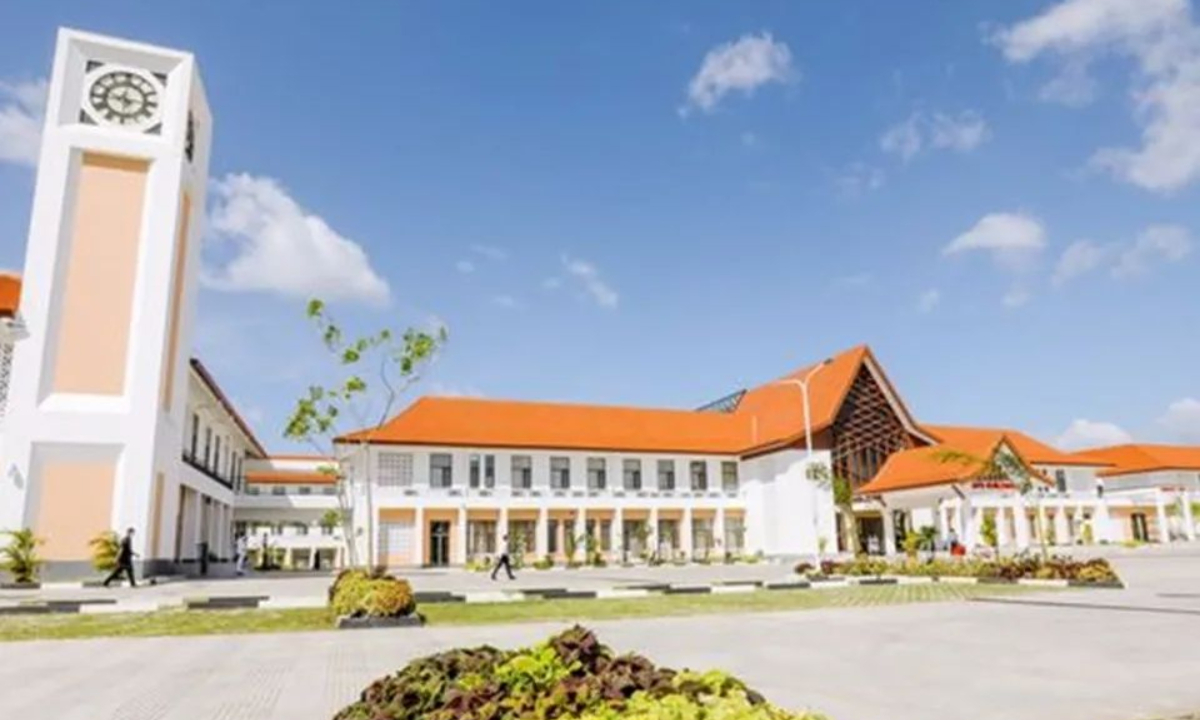
• With the newly developed Port City and the Marina, where base of the operations can be established by accommodating Leisure Crafts and Larger Cruises which can accommodate up to 500 passengers to birth and collect tourists who may arrive from the listed countries.

• Rather than waiting for fully fledged construction work to be completed, government should invite private investors to install prefabricated birthing area with all the infrastructure facilities required for tourists to wait on until check into cruisers are ready to travel.

• Food and Duty-free Alcohol outlets to be established like duty free shops in the landing area for passengers to purchase before sailing.

• Transport facilities for tourists who arrive in Sri Lanka on visas granted at arrival can be welcomed at the airport and transported via the airport highway to Port City.

• For passengers who may want to be in the city of Colombo can be accommodated in few City hotels in the vicinity of the Port City.

Regulatory Framework and other facilities 

• Sri Lanka Tourist Board shall make their officers at arrival location to receive the visitors who come to Sri Lanka to get on board the Cruisers for sailing and arrange transport from the Airport to Port City. This could be outsourced to a private sector company.

• Separate immigration counter to be made available for Port city visitors / entertainment.

• Separate area at the exit of the airport to be made available for buses for picking up the passengers to be transported to Port City. Again, this could be outsourced for private company.

• SLTDA shall market the availability of such entertainment tours using their agents and Sri Lankan Embassies abroad with emphasis that visiting Sri Lanka will help the nation to generate income to support the country during these difficult times.

• All necessary government approvals for operating such cruises shall be provided via one stop shop under BOI.

• Government shall establish licence structure and tax scheme to generate income for state coffers.

Market Survey for Cruisers and Operators

• Sri Lankan companies such as Expo Lanka, Aitken Spence, Hayley’s, Ceylon Shipping Corporation and other tour agents shall be requested to carry out a market survey to invite Cruise Operators to establish their Operations in the Port City .

• Existing Leisure Craft Operators shall also beallowed to operate from Port City Marina to receive High Net Worth visitors for short tours around the island with Destination to Trinco Sober Island for few days prior to joining the entertainment Cruises.

• Cruises shall /may sail to Maldives and return to the port city to depart.

• Alternatively Cruise operators can allow passengers to berth in Maldives on the way to Colombo?

Our Contribution

Having spent many years Abroad and in Sri Lanka in the Oil and Gas industry, Ship Building and management sector, I have exposure and a thorough knowledge of the spoken subjects. I have also represented similar idea on a couple of TV programs ( Derana – Aluth Parlimentuwa ) during the past few weeks.

I am happy to overlook and arrange a workable practical mechanism for the discussed subject, provided all red tapes are removed and given authority to manage without any interference fromministerial levels.

We are more than happy to visit for a meeting and discuss a way forward in this massive industry which can overwhelmed Sri Lanka with foreign income.

By Dr Sarath Obeysekera

Chairman Advisory Board for EDB to develop Marine and Offshore Industry 

 POLITICAL UPHEAVALS OF CHANGE

December 10th, 2022

LANKAWEB EDITORIAL

Regardless of all the political upheavals of  change which have been realistically fortuitous for Sri Lanka under the present administration,  the country is still facingunprecedented crises in many areas.

Despite all the promises made by the administration which realistically  is of a ‘pro tem’ nature and hardly a legitimately elected one exercised by the will of the people veritably, immediate actions are necessary  to resolve the political and socio-economic crises, including aggravating social unrest and severe damage to the livelihoods and well-being of all corners of society.

Distinguished members of parliament, opposition political parties, many  individuals of wisdom and civil societies have already recommend many  viable options. So far, none of them have been met or accepted effectively  by the country’s political authority which seems to have the proverbial “

 head buried in the sand – ostrich ” mentality and the President  continues his merry way ,at times in an authoritative manner which  also seems to have leanings towards strong arm tactics which is detrimental towards the well being of the Nation.

The dissenting Tamil opposition groups probably watch on with relish as they too have contributed covertly to all the negative happenings with in the country and there is a definite felt need to confront them.

Many observers watch the current state of hardships Sri Lankans are undergoing with anger, dismay and sorrow which has been brought about needlessly by the irresponsible, misguided and avaricious leadership of a previous regime who still need to be held accountable and brought to justice where the present President seems to be turning a blind eye towards this responsibility and there is speculation he is being  covertly manipulated by the very regime that has brought the country  to this state albeit with no tangible evidence to prove this allegation despite being a distinct possibility in the minds of some analysts.

 Sri Lanka in the aftermath of all she has suffered now has to  build a  prosperous and peaceful society towards posterity where people are  free from wants and fear of persecution and violence. The vulnerable  need to protected, and opportunities made available for all citizens  to fulfill their aspirations to their complete potential.

The foundation of this success will rest on the the importance placed on  public trust. Anyone in power, whether a political leader, a  high-level government official, or an industrial leader who rescinds  this concept and acts against the grain of legality and primarily the will of the people needs to be removed from power if responsible for committing any act of losing  public trust where an independent and accountable platform needs to be  set in place, based on merit, ensuring the rights of the public making  sure that the government functions according to regulations, even  when there is a semblance of political instability.Needless to say this is an aspect of governance the president needs to pay imperative attention to.

Separation of the powers of the Legislature, Executive and the Judiciary has been of prime importance which should ensure checks and balances against excesses.

Working for the well-being of the country and its citizens whilst respecting the institutions of a parliamentary democracy which should enable these branches of government to build public trust where Sri Lanka can learn much from this concept in overcoming the current crisis.

 As a country, Sri Lanka is blessed with natural resources and a work  force second to none, if given a chance. All around the world, Sri  Lankans have risen to very high levels in academia and industries, yet  opportunities are not available and industries are not fostered in Sri Lanka equitably. There is a blatant disregard for public trust  and the public voice since the public has been made powerless by weakening  governance and politicization of critical institutions.The past and  current protests in Sri Lanka are timely actions to restructure,  reform, and balance the three pillars of the political economy – the  State, Markets, and Civil Society. Observing effectively the citizens’ genuine grievances, concerns, desires  and responding to them promptly is the only way one can save the country for future generations.Not suppressing them through threats of force.

 The citizens have lost their trust in the government in a climate of  uncertainty.The President, Prime Minister and his associates in  Administration should restructure their current policies,  positions and general elections held somewhere down the road.

 Perhaps parliament should select through confidential voting two potential candidates outside the ruling parties for the future President and Prime Minister.

 It appears that what is going on in the country is a slow progress and simply a means for  an overly ambitious President to ensure his legacy despite provisions of restitution made towards some of the country’s dire needs through a proportion of timely actions which have only been met in a token manner and the people appeased only marginally.

Needs which virtually brought a once proud Nation to her knees which have to be supplemented in their entirety for the Nation to function smoothly again.

Traffic and Road Conditions in Sri Lanka

December 10th, 2022

Dr sarath obeysekera

Traffic Safety and Road Conditions

While in Sri Lanka, U.S. citizens may encounter road conditions that differ significantly from those in the United States. Vehicular traffic in Sri Lanka moves on the left (British style). Traffic in Colombo can be congested. Narrow two-lane highways, overloaded trucks, poorly driven buses, and a variety of conveyances on the road, ranging from ox carts and bicycles to new four-wheel-drive vehicles, make driving dangerous. Unexpected road blocks and one-way streets are common and may not be clearly marked. Many visitors hire cars and drivers for long trips through the country. Individuals who choose to hire three-wheeled vehicles (tuks” or three wheelers”) should use metered vehicles or negotiate prices beforehand to avoid confrontations upon arrival. If you are renting a vehicle, you should specifically request one with working seatbelts.

Above information on Country Reports web site clearly gives  a bleak picture about our discipline and maintaining law and order , on the roadways 

It gives an impression that we are a country with jungle law 

Today I listened to a lady law maker talking like a street gram vendor 

And yet boss of the country cannot do much 

Parliament is just like the law and order on the roadways 

In developed countries various allegation lead to resignation of ministers if his heads misbehave 

Yesterday the top man of a state transport was sacked by the minister and the head refuses to budge , just like the private bus driving along our roads refusing to give in right of way to others 

I also heard about two top level bosses of a state regulatory body where one was sacked  and other one was given marching orders

This shows that board of directors have some powers to convince the ministers to take action against the bosses of any organisations

Problem is that orders given by the ministers are also sometimes disregarded by the bosses of state institutions because they may be backed by other more powerful politicians who control reins of the government 

Just like the fact that we need to have disciplined three wheelers and private bus drivers , Sri Lanka should discipline politicians and the stooges running state organisations

Dr sarath obeysekera  

CBSL Governor sets record straight on export remittances and conversions

December 10th, 2022

Courtesy The Daily Mirror

  • Says wants to make it clear that based on Sept. and Oct. data, exporters are not keeping money abroad
  • Points out 25% export proceeds not converted due to dollars being utilised for local purchases
  • JAAF reiterates that its members strictly abide by CBSL laws on repatriating export income                         

Apparel industry points out, given current economic milieu, companies use a considerable portion of export proceeds to purchase raw materials, fuel and other items essential
The issues revolving around the exporters repatriating income were clarified this week by the Central Bank of Sri Lanka (CBSL) chief, who set the record straight on export remittances and conversions.

Dr. Nandalal Weerasinghe

CBSL Governor Dr. Nandalal Weerasinghe stated in an interview recently that, of the exports in September and October, the exporters have repatriated or brought 100 percent of export earnings into the banking system.


I want to make it very clear that based on the data for those two months, the exporters are not keeping money abroad,” said Dr. Weerasinghe.


Responding to the claims made by the authorities, where it was pointed out that the exporters are not bringing in their earnings to the country, which is impacting the status of the economy, the Joint Apparel Association Forum (JAAF) asserted that its membership strictly abides by the Central Bank laws on repatriating the export income, reiterating that the apparel sector brings back the entirety of its export proceeds to Sri Lanka.


In this regard, Dr. Weerasinghe went on to say that in the case of the apparel sector, the industry refers to a local value addition of 50 percent.


Accordingly, the CBSL investigations have confirmed that 25 percent of export proceedings in average have been directly converted to rupees by the exporters. The CBSL was looking into the remaining 25 percent of export proceedings.


Dr. Weerasinghe noted however that this may be due to the exporters utilising these dollars for approved local purchases. These would include the purchase of both diesel from CPC and LIOC and domestically produced raw materials which are required for the industry.


In light of the statement made by Dr. Weerasinghe, the JAAF reiterated that under the existing regulations set out by the CBSL, the exporters are permitted to make outward payments for purchases of raw materials and the remaining proceeds are converted automatically by the respective commercial banks on the seventh day of the following month.


In addition to the payments made to overseas suppliers, the growth of the local supply chain also means that the apparel companies could pay up to 25 percent of their inward foreign currency remittances to indirect exporters in Sri Lanka.


As mentioned by the governor, these additional dollar payments may not be accounted for properly, which has led to misconceptions surrounding the industry’s foreign exchange conversions,” the JAAF said in a statement.


Given the current economic milieu in the country, companies use a considerable portion of export proceeds to purchase raw materials, fuel and other items essential for seamless operations in the event of unforeseen crises.


This is aligned with a preparedness formula, which nearly all exporters have implemented, having learned lessons from crises experienced in the last three years,” elaborated the JAAF.
Further, it stressed that the industry has been a mainstay in contributing towards vital essentials for the country, including fuel, medicine and food during the worst of the financial crisis.
The JAAF members are acutely conscious of the crucial role they play in keeping the economic wheels turning. Dr. Weerasinghe also placed on record his appreciation to the apparel sector for its 
continued support.


We are confident that the companies in our membership have been abiding by the law, ensuring that the export proceeds are repatriated for the economic benefit of the country. 
The JAAF member companies have and will continue to comply with the existing regulations and will strive to complement all efforts taken by the CBSL and government in providing the much-needed assistance to all stakeholders of the economy, to redirect Sri Lanka’s economy to a path of recovery and growth,” the JAAF said.


Dr. Weerasinghe also spoke of reconciling the exports of the top 100 exporting companies to establish both the direct conversion and amounts paid in foreign currency to local suppliers. The JAAF is committed to working with the CBSL to ensure that this reconciliation is done at the earliest.


The JAAF member companies acknowledge Dr. Weerasinghe’s remarks on the need for strict foreign exchange repatriation and conversion requirements over the short term to tide over the current economic hardships.


The JAAF similarly commends Dr. Weerasinghe’s remarks on the need to periodically relax the repatriation and conversion requirements as it does not work” and move towards creating a suite of positive incentives that will encourage the voluntary repatriation and conversion in line with global standards and practices.

Tourist arrivals for first week of Dec. already cross15,000 mark

December 10th, 2022

Courtesy The Daily Mirror

  • Daily arrival average increases to 2,302
  • Russia and India rank as top two source markets for SL tourism
  • United Kingdom regains position as third largest tourist traffic generator for SL
  • Arrivals for January 1-December 7 period total 644,186
  • Influx contributed by arrival of luxury cruise Azamara

The tourist arrivals for the first seven days of December have already crossed the 15,000 mark, indicating the revival of the hard-hit sector is on track.
The provisional data from the Sri Lanka Tourism Development Authority (SLTDA) showed that for the December 1-7 period, the arrivals to the island nation totalled 16,169. This brings the total number of arrivals for the year, ending on December 7, 2022, to 644,186.


The daily arrival average for the first week of December is 2,302. In the recent weeks, with the start of the winter season, the daily arrival average for Sri Lanka tourism has been increasing.

 The top three source markets for Sri Lanka tourism witnessed a slight change for the first week of December. The Russian Federation tops the list as the largest tourist traffic generator for Sri Lanka, accounting for 21 percent of the tourist arrivals for the month so far. Ranking second is India, contributing to 18 percent of the total arrivals. Back on the third rank is the United Kingdom, which brought in 10 percent of the total number of tourists 
to the country. 


In the month of October, the United Kingdom slipped to the fourth position. Taking over as the third largest tourist traffic generator last month was Germany, which in the first week of December ranked at the fifth position.


Taking the fourth position is Australia, contributing to 6 percent of the total arrivals.


Contributing to the increased tourist arrival numbers is the arrival of the luxury cruise Azamara that called on the Colombo Port on December 4. The vessel brought in 600 passengers and 400 crew members who were on the island for three days.


Coming alive this month was also the FIFA Zone in Colombo, set up to lure football fans to Sri Lanka, between the ongoing matches at the World Cup in Qatar, Doha.
However, the Tourism Ministry and SLTDA have not shared the numbers and the success of the promotional packages that are being rolled out for the FIFA World Cup spectators.

IMF chief Georgieva cites ‘fruitful exchange’ with China on debt issues

December 10th, 2022

Courtesy Adaderana

(Reuters) – International Monetary Fund chief Kristlina Georgieva said she had a fruitful exchange” with her Chinese counterparts this week on her repeated calls for accelerating debt treatments for countries like Zambia and Sri Lanka.

Georgieva, World Bank President David Malpass and other financial leaders met in person in China’s Anhui province this week with officials from the People’s Bank of China, China’s finance ministry and its EXIM Bank and China Development Bank.

Georgieva said the discussions touched on the common framework for debt treatment set up in late 2020 by China, the United State and other Group of 20 major economies, as well as some specific cases of countries seeking debt relief.

Implementation of the common framework process has been halting, with only one country, Chad, having completed the debt treatment process, and its agreement not resulting in any actual reductions of the country’s debt.

Zambia is pushing hard to finish its debt restructuring in the first quarter of 2023.

We need to build on the momentum of the agreement on Chad’s debt treatment and accelerate and finalize the debt treatments for Zambia and Sri Lanka, which would allow for disbursements from the IMF and multilateral development banks,” Georgieva said in a statement.

Georgieva said other countries also faced mounting debt distress given tightening global financial conditions.

We talked about how we can prevent individual cases of debt distress from triggering a global debt crisis,” she said, calling again for quicker, more predictable progress on debt treatments and expansion of the framework to more countries.

Malpass, in his remarks at the meeting, said the discussions focused on the urgent need for more rapid progress on debt issues, adding, Changes in China’s positions are critical in this effort.”

He welcomed support voiced by Premier Li Keqiang for a systematic engagement on debt” during the meetings, and underscored the need for transparent disclosure of China’s loan contracts, and removal of non-disclosure and non-restructuring clauses and hidden collateral and escrow arrangements.

Greater transparency will help investors make informed decisions, build trust, and accelerate the debt reconciliation and restructuring processes,” he said.

Georgieva said she saw space for a platform for more systematic engagement on debt issues, where China can play an active role,” but gave no further details.

Source: Reuters

–Agencies

Dollar Leakage

December 8th, 2022

Sugath Kulatunga

Now, ex-Finance Minister BR has also threatened to bring in new regulations against exporters who default on repatriation of the full amount of export proceeds. Here again, the proposal is confined to exports only and confined to getting back the full amount of the export value as declared. It is not about trade mis-invoicing.  Was he as Minister of Finance not aware of this scam? The extent of this global crime was brought to the notice of the public by Global Financial Integrity (GFI) as far back as 2008. UNCTAD published a report in 2019 giving a methodology for detecting mis-invoicing. UNCTAD reports are circulated to all member states. Even if the GFI findings were not readily available the UNCTAD report would have been seen by at least the bureaucracy involved in finance and trade. It definitely would have been available in the citadel of knowledge the Central Bank.

It is encouraging that the government has at least late in the day decided to bring in new laws/regulations to stop this dollar leakage. During the last few months, the government has brought in dozens of new laws and amendments to existing ones. The government has also spent substantial time and effort to bring the 21st Amendment to the Constitution with the intention of fostering a political solution to the economic crisis. Meanwhile, the government has been soft peddling this issue and was happy to declare the country as bankrupt and begging the IMF for a paltry 3.9 billion USD and has not taken an earnest effort to stop this leak and recover as much of the lost revenue. The annual loss of revenue from trade misinvoicing only is estimated at over USD 10 billion.

This scandalous state of affairs has prevailed for a long time and some estimates indicate that the total loss over time may be more than the total foreign debt of the country. This could not have happened unless there was collusion between authorities and traders. Late Elmo de Silva in his autobiography names his previous Customs Department as one of the primary delinquents of corruption. One wonders to what extent it had spread to financial institutions and other government agencies. One might conclude that the chief delinquent is the government which has followed the maxim of the three wise monkeys.

MP Wimal Weerawansa has pointed out that legal action cannot be taken on errant traders as the legal provision enabling such action was removed in 1917 by the then Minister of Finance. If that is so the solution is to restore the previous provision which only requires a simple resolution in Parliament. If it had been done with a gazette notice a fresh gazette is all that is required.

The GREATEST LIE

December 8th, 2022

RANJITH SOYSA

Yesterday’s Island reported the Minister Bandula Gunawardana claiming that only

way to stop the crippling shortages is by selling state assets. And, he was endorsing

the remarks of Ranil Wickramasinghe who also was canvassing to sell Telcom,

Insurance Corp etc to enable to build a reserve of $3 billion!

But, according to a think tank of University of Peradeniya , the exporters of

Sri Lanka has hoarded a sum of $6.8 billion in 2022 in foreign countries!

Further, the Minister of Justice is now formulating laws to recover $53 billion

held in foreign countries by our  exporters for nearly 13 years,!

So, why not revise the Exchange Control law URGENTLY and read the law to the culprits while

compelling the doggy exporters to return at least 10% of the foreign exchange legally

due to Sri Lanka and arrange to get the balance funds within a reasonable

period. The country can then wait till mid 2023 and collect the IMF loan too, if necessary

rather than hurrying to kill the geese that lay golden eggs,

RANJITH SOYSA

Jehan Perera and Anandasangaree: Two Indian F ghosts [how can you unite by dividing?]

December 8th, 2022

C. Wijeyawickrema, LL.B., Ph.D

මේ දිනවල රටේ තිබෙන ඊළම් ප්‍රශ්ණය 2023 පෙබරවාරි 4 ට පෙර විසඳන්න බලනවා යන තදියම අතරේ, ඉන්දියන් පෙඩරල් ක්‍රමය ඒ සඳහා විසඳුම යයි NGO ඩොලර් මුදලාලි කෙනෙක්වන ජෙහාන් පෙරේරා විසින් අයිලන්ඩ් පත්‍රයට පසුගියදා ලියූ ලිපිය දැක මෙම සටහන ලිවීමට සිතුනේ ඔහුට ඉතිහාසය මතක් කර දීමටය. ඊළම් ව්‍යාපාරයට කරදෙන සිංහල නම් ඇති තුන්දෙනෙක් මට මතක්වේ. ක්‍රිස්තියානි ජෙහාන් පෙරේරා, ක්‍රිස්තියානි මාක්ස්වාදී දයාන් ජයතිලක (කලින් දයාන් සිල්වා) හා මාක්ස්වාදී නිර්මාල් දේවසිරි ඒ අයය. විග්නේෂ්වරන් පස්සේ ගොස් දයාන් පාඩමක් ඉගෙන ගෙන නැත. උතුරු පලාතේ මහඇමතිවූ වහාම  විග්නේෂ් දෙමළ ජෙනොසයිඩ් යෝජනා පාස් කරණ විට දයාන් ගල උඩ සිටිනා බළලෙක් විය. ජෙහාන් තිරණයෙන් පිටුපස සිටිමින් පාක්යශෝති මෙන් දියයටින් ගින්දර ගෙනියන්නේය.

ලන්දේසි කාලයේදී ත්‍රිකුණාමළ වරාය අයිතිවූයේ උඩරට රජුට බව ජෙහාන්ට ඉගැන්වූයේ මියගිය ගාමිණී ඊරියගොල්ල විසිනි. රටේ ඉතිහාසය හා භූගෝල විද්‍යාව  ගැන ජෙහාන්ට තිබෙන්නේ මෙවැනි අවුල් වැටහීමකි. එසේ නොවේ නම් ඉන්දියන් F ක්‍රමය ඔහු බදාගන්නේ නැත. ඉන්දියන් F ක්‍රමය ආනන්දසංගාරිගේ ගැලවුම්කරුවිය. අඩුතරමින් ඔහුගේ පුතාවත් එයට  එකඟ නොවීය. ඒ පුතා දැන් කැනඩාවේ සිට එහි මන්ත්‍රීකෙනෙක් වශයෙන් ඊළම් ව්‍යාපාරය ජයටම කරගෙන යයි.

ජෙහාන් DBS ජෙයරාජ් පාරේ යමින් පෙඩරල් යනු ඊළම් නොවේය යන සුප්‍රිම් උසාවි තීරණය ගැනද ඉහළින් කතාකරයි. නඩුකාරයින් නඩුවේ කොලය බලා එක අයෙක් දුන් දිවුරුම් පෙත්සම සළකා මෙම නිගමනයට ආවේය.  තමන් 1976 වඩ්ඩුකෝඩ්ඩෙයි ප්‍රකාශය අනුව රට කඩන්නට  තවදුරටත් ක්‍රියා නොකරණබව එම දිවුරුම් පෙත්සමය! කොසොවෝ ප්ලෑන ගැන චෙල්වනායගම් කතාකලේ 1940 ස් ගණන් වලය. මේ නිසා උසාවිය විසින් ලංකාවේ දමළ නිජභූමියක් තිබේය යන ඊළම් කතාව නොසළකා හැරීම කබරගොයා තලගොයා කිරීමේ නඩු තීන්දු දීමේ ලෝක රීතියය.

මෙම නඩුකාරයිනුත්, දෙමළ නම් ඇති ඊළම්කාරයින් හා සිංහල නම් ඇති පෙඩරල්කාරයිනුත් උත්තර දියයුතු සරල ප්‍රශ්ණය නම් How can you unite by dividing යන්නය. එකට තිබෙන රටක් දෙකකට කඩා එකට සාමයෙන් ජීවත්වන රටක් ලෝකයේ නැත. එය හරියට කැඩෙන්නට යන විවාහයක දෙන්නෙක් එක ගෙයක ඉන්නවා වෙනුවට එක ඉඩමේම ගෙවල් දෙක්කට ගොස් විවාහය පවත්වා ගත හැකියයි සිතනවා වැනිය.

වෙන්වු ප්‍රදේශ එකතුවී සාදාගත් ඇමෙරිකාවේ පවා ප්‍රාන්තවලට පෙඩරල් හමුදා යැවීමට සිදුවූ අවස්ථා එමටය. ඉන්දියාව කියා රටක් ප්‍රාන්ත එකතුකර සැදුවේය. ප්‍රාන්ත රාජ්‍ය මධ්‍යම ආණ්ඩුවේ බලයට යටත් විය. ඊට අමතරව කිසිම ප්‍රාන්ත රාජ්‍යකට සමස්ත  මධ්‍යම රජයේ බලයෙන් සියේට 5 කට වඩා ජනබලයක් හෝ භූමි ප්‍රමාණයක් හෝ නැත. ලංකාවේ නිජභූමි කතාව මීට වෙනස්ය.

මෙම පෙඩරල් කලබගෑණිය ගැන දීර්ග පර්යේෂණ ලිපියක් භූගෝලවිද්‍යා මහාචාර්ය G. H. පීරිස් විසින් ලියා ඇත. ජෙහාන් NGO කාරයෙක් නොව උපාසකයෙක් නම් ඒ ලිපිය කියවා ඊට විරුද්ධව ඇති කරුණු පෙන්වා දිය හැකිය. දයාන් ජයතිලකවද ඊට හවුල් කරගත හැකිය. ඔවුන්ට ලංකාවෙබ් වෙබ් අඩවියට ලිවිය හැකිය.0

මෙහි පහතින් ඇත්තේ 2007 දී ආනන්ද සංගාරීට මා යැවු ලිපියකි. එහි අසන ප්‍රශ්ණ හා එහි කර ඇති විග්‍රහය දැන් 2022 අගදී ජෙහාන් පෙරේරා ගෙන්ද ඇසිය ඇසිය යුතුව ඇත. එසේ නැත්නම් ජෙහාන් සංගාරිගේ අවතාරයකි

===============

Mr. Anandasangaree’s latest plea- Is it reasonable?

The Island, 2007/09/24

Mr. A is repeating his plea for a fair and just political solution within a united Sri Lanka (The Island Sept. 13). Colvin (1972 Constitution), JRJ (1987 agreement with Rajiv G plus his13th Amendment), RP (secretly arming LTTE), RP and CBK (offer of the Northern Province to Prabakaran for 10 years), Ranil W (2002 CFA agreement) and CBK (P-Toms) each perhaps, thought s/he, was presenting a fair and just solution.
By using the term conscience,” some Tamil writers (example, The Voice of Conscience,” S. Thavarajah, ‘The Island’, 5/30/2007) tried to give a moralistic bath” to fairness and justness. I do not wish to take that path or ask whether Mr. A’s plea is morally justifiable for the simple reason that what is moral is influenced by one’s religious convictions. For example, the American president and the ex-prime minister Tony Blair and a large community of Christians, worldwide, believe that God is on their side in their invasion of Iraq. Killing for self-defence is tolerated under the Judeo-Christian (legal?) tradition but not according to the Buddhist way of life.


Because of subjective (internal mind), issues inherent in terms such as fairness,” justness,” and consciousness,” I wish to ask Mr. A, an objective (external to the inner mind) question. Does his plea pass the reasonableness test?
Mr. A’s plea for a fair and just political solution is based on the thesis that the unitary label will not deliver a [much needed] political defeat for LTTE [Prabakaran] and unitary state will not be acceptable to Tamil and Muslim people.” This thesis does not have the support of verifiable/verified facts. People in Jaffna, Trincomalee or Batticaloa did not then, or do not now, oppose the term unitary. It was the Colombo-living separatist Tamil leaders who propagated an anti-unitary ploy to protect and continue the privileged status they enjoyed under colonialism. Mr. A’s alternate, thesis that only under a united label that Tamils-Muslims-Sinhalese could live together, in harmony is also redundant because Tamils and Muslims in the North and East are moving to the South to live in harmony in Sinhalese villages.
Under a vocabulary of fair, just and conscience one could hide the old F” formula which is lurking in the dark. But an application of the reasonable man/woman’s test could throw some light on why sharing of power with people (instead of creating a new set of Tamil politicians), has no connection with a constitutional label. I believe in the concept of empowerment of people at the village level proposed to the APRC by the SLFP in April 2007, which is similar to the Panchayathi Raj Institutes system implemented by India in 1976 under the Panchayathi Institutes law and wish to submit the following set of questions for Mr. A’s consideration.

1. Does he accept SJV Chelvanayagam’s ‘theory’ that there is a traditional Tamil homeland in Sri Lanka?
2. Does he reject the Pondicherry sub-model under the Indian ‘F’ model? (the late Neelan Thiruchelvam rejected it, ref. Mrs. Chandrika;s package deals 1995-2000).
3. How does he propose to handle the demands of Muslims in the East (Oluvil declaration) and the Indian Tamils in plantation areas?
4. Does he know that the idea of a separate Tamil state in Ceylon first began in 1919 just one year after Tamil leaders in India demanded a separate country for them in India?
5. Does he think that the colonial master who said, India is a myth” and promoted the idea that there are two Indias,” yet rejected GG Ponnambalam’s plan or SWRD’s federal proposal for Ceylon because they did not want to apply any more the divide-and rule policy in Ceylon?
6. Does he not think that the reason for rejecting Ponnambalam-SWRD plans by the British was realities of geography and history of Ceylon?
7. Does he deny that in 1948 there were two Ceylons? The Colombo-Ceylon of SJVC-Naganathan-DSS-JRJ-NM-Colvin-Leslie-Sir John-civil servants, and the Village Ceylon of Sinhala-Tamil speaking masses?
8. Does he deny the fact that Nehru’s language-based federal set up installed in 1956 did not help the Indian common man or woman but created a second tier of set of corrupt and exploitative politicians at the regional level?
9. Does he deny that this was exactly what has happened with the white elephant called the PCs in Sri Lanka?
10. Does he deny that the Indian F system that he marvels at is on logs (kota uda)? The use of presidential rule power has become a thing in the past and the Indian PM is depending on Tamil Nadu or other regional votes to keep his job.
11. Does he deny that no matter what happens in Sri Lanka, the Tamil Nadu factor is going to be a permanent threat” to Sri Lanka due to the shallow sea separating the two land areas?
12. Does he not know that in Tamil Nadu there are demands for two separate states within itself and Sri Lanka is an easy escape goat for Tamil politicians to divert such demands with Ravana identified as a just Tamil king who fought against the evil Rama and Seetha? Karunanidhi says Rama is a myth.
13. Does he think that Karuna was wrong in giving up claims for a homeland and demanding give us what Colombo gets?”
14. Does he deny the fact that the Tamils and Muslims are richer than the Sinhalese in Colombo or in other towns and cities in Sri Lanka?
15. Does he deny the fact that Tamils and Muslims have other lands as homelands (or source regions) whereas for the Sinhala Buddhists of only 15 millions or so Sri Lanka is the only fair and just” source region?
16. Can Mr. A deny that the problem in Sri Lanka is mismanagement by a group of Colombo people and an Indian F model will not be the solution to people’s misery?
17. Why does he not think that the solution is eradication of corruption, crime, and the dirty politician after the military solution to the terrorist acts of a small group of Tamils? Even the Hindu editorial says that terrorists must be militarily defeated (9/17/2007). This was also the story that General Petraeus told the American Congress last week.
18. Why does he think that a unitary constitution will give room for further agitation” but an F” constitution will not give room for further agitation? The history of F” is exactly the opposite of this.
19. If Mr. A is right in telling us that a unitary proposal will kill the hopes Tamils,” why is it that more and more Tamils want to come to the south and live amongst the Sinhalese?
20. Why does Mr. A not see the need to empower people at the village level? How does a Hindu village or a Muslim village affected injuriously by a unitary constitution?
21. Why does Mr. A not see the need to arrange administrative units based on ecology and not on language or religion. What is wrong with water basin-based village boundaries and district or provincial boundaries?
22. Would Mr. A, please read the following books which document how the Federal giant USA is failing in serving its people to come out of poverty and misery? Yes, poverty and misery inside the world’s super power.
(a) The Radical Center by Ted Halstead and Michael Lind (2001) – how the two political parties (Republican and Democratic) ruined the USA.
(b) Where have all the leaders gone? by Lee Iacocca (2007) – how corrupt the American political leadership has become.
(c) Assault on Reason by Albert Gore (2007) – how the experiment called the American Republic is failing so rapidly.
(d) The Genius of Impeachment: The Founders’ Cure for Royalism by John Nichols (2006) – why President Bush should be impeached for violating the U.S. Constitution.

Two non-Hindu politicians, (Manmohan Singh and Sonia Gandhi), prepared a court document denying the Rama-Seetha story. It took NM Perera thirty years (1935-1964), to visit the Dalada Maligava with a tray of jasmine flowers. Some terrorist-supporting Tamils sarcastically write that though a Christian, the late Kadirgamar’s funeral rights were conducted by Buddhist monks.” Karuna, a one-time ruthless killer is not hated by the average Sinhala woman anymore. People used to call C. A. S. Marikkar, Sinhala Marikkar.” Jeyaraj Fernandopulle has a better chance to be a second Kadirgamar. The JHU said it would vote for Bakir Markan Marker instead of Ranil or Chandrika if the three were in a presidential contest. Mr. A declined an offer by the JHU for a seat in parliament. It was a Muslim, Abdul Kalam, last Indian President, who said that the solution to world’s problems lies in Buddhism.
A Buddhist cannot discriminate against another human being (human rights?), because his/her way of life is based on the concept of impermanence (anichcha); unlike in western religions, in Buddhism life is cyclical (birth and death) and not uni-directional.

Some politicians with non-Buddhist birth wear Buddhist masks for political reasons but from Anagarika Dharmapala to Gunapala Malalasekera, no Buddhist leader preached discrimination.
Is there any lesson that Mr. A could learn from the above facts about fairness and justness. Mr. A has not shown, at least to this writer, who had lived with Tamil roommates and a lot of Tamils, that he is still not taking the Ponnambalam-Chelvanayagam path of betrayal of both the ordinary Tamil and the Sinhala. The fact that Prabakaran is all out to kill him may allow some anti-national NGOs and some foreign ambassadors to project him as a symbol of moderates” (moderation), but he, the million-rupee salaried NGO mudalalis and the so-called international community, cannot use that as an excuse to ignore the need for him to pass the reasonableness test. I hope Mr. A would prove me wrong.

යුරෝපා සංගමයේ නියෝජිතයන් අග්‍රාමාත්‍යවරයා හමුවෙයි

December 8th, 2022

අග්‍රාමාත්‍ය මාධ්‍ය අංශය

අග්‍රාමාත්‍ය දිනේෂ් ගුණවර්ධන මහතා හා යුරෝපා සංගමයේ සාමාජික රටවල තානාපතිවරුන් අතර සාකච්ඡාවක්  2022.12.08 දා අරලියගහ මන්දිරයේදී පැවැත්විණි.
රටතුළ ආර්ථික, සමාජීය සහ දේශපාලන ස්ථාවරත්වය ඇති කිරීම සඳහා රජය ගෙන ඇති පියවර සහ එහි ප්‍රතිඵල සම්බන්ධයෙන් අග්‍රාමාත්‍යවරයා තානාපතිවරුන් දැනුවත් කළේය.
මෙම සාකච්ඡාවට යුරෝපා සංගමයේ තානාපති ඩෙනිස් චිබි (Denis Chibi), ජර්මනියේ තානාපති හොල්ගර් සූබර්ට් (Holger Seubert), නෙදර්ලන්ත තානාපති බොනී හොබච් (Bonnie Horbach), ප්‍රංශ තානාපති ජීන් ෆ්‍රැන්සුවා පැක්ටෙට්  (Jean-Francois Pactet) සහ රුමේනියානු තානාපති කාර්යාල දූත මණ්ඩල ප්‍රධානි වික්ටර් ටියුඩ්ජියා (Victor Tiudjia)  සහ අග්‍රාමාත්‍ය ලේකම් අනුර දිසානායක යන මහත්ම මහත්මීහු සහභාගී වුහ.

අග්‍රාමාත්‍ය මාධ්‍ය අංශය

Gun violence and human rights in the USA: should the US concentrate on fixing the situation in its own country first rather than offering counsel or advise to others?

December 8th, 2022

Sufian siddique

The United States is regarded as the largest democracy or fully democratic nation in the world. The question of whether the United States believes it is its “right” to warn other nations of the world about kidnappings, killings, or violations of human rights may follow from this introduction. However, a number of publications claim that the state of human rights in the US is deteriorating daily. Gun violence, murder, and police brutality are all on the rise. The US public is concerned that the justice system in the “vocal” nation is failing to uphold international human rights.

A study on the state of American human rights in 2021 was released in the middle of this year by China’s State Council Information Office. In comparison to other years, the report claims that the US human rights situation has gotten worse. Due to political unrest, the government was unable to contain the corona pandemic, which resulted in millions of deaths throughout the nation. Deaths from gun violence have increased concurrently. The political rights of the American people are violated by “false democracy,” and aggressive behavior by law enforcement authorities makes life tough for immigrants and refugees in the country.

Concerning is also the nation’s escalating prejudice against ethnic minorities, particularly those of Asian heritage. Numerous observers claim that the US government’s unilateral activities have brought up fresh humanitarian problems all around the world.

Deaths from gun violence statistics

The US Centers for Disease Control and Prevention (CDC) recently revealed statistics showing that 2020 had the most gun-related fatalities of any other year. This includes a record number of gun suicides and shooting deaths.

The whole statistics relating to gun attacks in the United States will be available in 2020, according to Pew Research Center’s analysis of data gathered from a variety of sources, including the CDC, FBI, and US-based public opinion polling and research organization.

In those instances, there were 45 000 fatalities in the nation that year.

According to the CDC, there have been more gun suicides than gun deaths in the United States for years. 44 percent of gun-related fatalities in the nation in 2020 were homicides, while 24 292 were suicides (19,384). In addition, there were 611 deaths involving police enforcement that year, 535 “unintentional” gun deaths, and more than 400 deaths due to “unspecified causes”.

A total of 45,222 persons lost their lives in gun-related incidents in 2020, up 14.2% from the previous year, 25.2% from five years prior, and 43.2% from ten years prior.

In recent years, there has been an increase in gun violence in the United States. The number of fatalities was 19,384 in 2020, the most since 1968. In that year, gun deaths increased by 34% from 2019; by 49% from five years prior; and by 75% from ten years prior.

Analysis of Gun Violence Comparative

The United States has a far greater rate of gun violence than other nations, particularly wealthy nations. Several countries in Latin America experience this violence, despite the fact that the United States ranks higher than the United States in terms of it, according to a 2018 study by the University of Washington’s Institute for Health Metrics and Evaluation of 195 countries and territories.

How many people die in mass shootings each year in the US?

Giving a definitive response to this question is challenging. due to the fact that “mass shooting” or “mass gun attack” have no universal definition. Its definition can change depending on a number of factors, such as the attack’s circumstances and the number of casualties.

A mass shooting, as defined by the Federal Bureau of Investigation, or FBI, takes place when one or more people deliberately participate in the killing or attempted killing of people in a populous area. This definition states that 38 individuals (excluding the assailants) died in such occurrences in 2020.

A mass shooting is defined as an occurrence in which four or more individuals are shot, even if no one is fatally wounded, according to the US Gun Violence Archive, an online database of gun violence incidents (except the gunman). 513 individuals were killed by gun violence in 2020, according to this definition. However, they are characterized, mass shootings in the US result in more fatalities annually than all other forms of gun violence put together.

Police are “hiding.”

The first five months of this year saw more than 200 fatalities in the United States, according to various monitoring organizations. New concerns have been raised regarding the role of US police as the public is alarmed by a string of shootings.

A Washington Post analysis claims that since 2015, there have been an average of 1,000 police fatalities per year in the US. The Washington Post began compiling information on each shooting involving police officers performing their duties in the United States in 2015.

An inquiry conducted earlier in 2014 when an unarmed black man named Michael Brown was slain by the police in Ferguson, USA, revealed that half of the shootings and acts of police torture were not documented.

The number and circumstances of fatal shootings, as well as overall victimization rates, were found to have stayed largely similar over the course of that time, according to a Washington Post examination of more than five years’ worth of media coverage, social media posts, and police records.

Additionally, 1,049 persons were murdered by police shootings last year, or in 2021.

The Washington Post estimates that 1,000 individuals lose their lives on average each year in gun attacks or other comparable situations throughout the country. In police shootings, the same number of persons were killed. Black people make up the majority of victims as a percentage of the population, despite the fact that white people make up half of the victims in police shootings. The percentage of black people in the US population is around 13%. Also, men between the ages of 20 and 40 make up more than 95% of those slain by police.

Racism

On May 14 of this year, 2:30 PM local time is present. The sound of gunfire suddenly shook a supermarket in Buffalo, New York’s second-largest and most-black city. An assault gun that can fire semi-automatically was being used indiscriminately by an 18-year-old. Body armored military personnel in uniform carried out the assault. Additionally, the young man was live-streaming his heinous spree online using a camera. On that day, a local police officer described the attack’s aftermath as resembling strolling through the set of a “horror movie.” But everything was actual. It was a war zone.

In that shooting in Buffalo, 13 individuals were shot. Ten of them perished. 11 of the 13 victims shot, according to the police, were black. The FBI labeled the incident as one of “violent extremism.” Stephen Belangia, the FBI agent in charge of the Buffalo office, told the BBC that the incident was being looked into as a “hate crime” and a case of racially motivated violent extremism.

Immediately following this assault, Peyton S. Gendron, a suspected gunman, was taken into custody by the neighborhood police. He was accused of murder in the “first degree.” The investigation then turned up more newsworthy facts. The young man, according to information obtained, published a 180-page “manifesto” online in support of white nationalist views. In his venomous writings, he also called immigrants and black people “substitutes” for white people.

And as a result, a fresh debate over racism in the United States is sparked.

Recently, the far-right political philosophy in the US that whites are being “replaced” by blacks has migrated into the mainstream Republican Party politics. Additionally, a large number of US media figures are promoting this philosophy, which is then subtly affected by Republican Party talking points.

The young man who attacked Buffalo tried to use the idea that immigration is weakening white people in the United States to defend his diabolical attack. And he used a lot of racist language against black Americans in his manifesto.

The Buffalo assailant claimed to have been motivated by the 2019 attacks on two mosques in Christchurch, New Zealand, which resulted in the deaths of 51 worshipers. His assertion is consistent with the event. Brenton Tarrant, the assailant from Christchurch, was using the camera to stream the assault live online. Before the attack, he also released a manifesto of his own.

But the Christchurch slaughter had less of an impact on the Buffalo attackers than did domestic unrest.

The U.S. Gun Violence Archive reports that from January through May, there were about 200 shootings or other gun attacks nationwide. Additionally, a newly released study found that between 2019 and 2020, the overall death rate from gun attacks in the US climbed by roughly 35%.

The Buffalo Massacre, however, stands notable due to the political aspect of the attack as well as the sheer number of casualties. According to analysts, the episode must be viewed in light of the rising acceptance of racism and political violence in the US.

The independent news source Education Week in the US reports that 17 US states have lately passed legislation restricting or outlawing the teaching of “critical race theory” or of racism and sexuality, and another 12 states are considering doing the same. In addition, conversations about deleting some texts that can foster racist sentiments are ongoing.

But these group efforts have also rendered the racist and xenophobic past of the United States laughable. The country’s current poverty, unemployment, and social illiteracy have come under the spotlight as a result of discussions of America’s racial history.

A significant fraction of black Americans in the United States is violent, according to several social scientists, as a result of generations of neglect, neglect, and lack of opportunity. Many white people in the nation feel unsafe as a result. And from that uncertainty comes hatred.

In America, there is an increase in gun violence. More than 200 individuals have died in gun attacks throughout the nation up until May of this year, according to various local media. Legislators and experts demand modification of the private arms control law in this circumstance.

They claim that in the United States, gun violence has become a significant social issue that cannot be resolved.

For this, strict legislation and enforcement are required. The US administration should concentrate on fixing the situation in its own country first rather than offering counsel or advise to others.

Sufian siddique

ඇමරිකාව, චීනය, ඉන්දියාව, ජපානය, පකිස්ථානය ලෝක බලවතුන්ට එකම ඉඩම දීලා මේක විසඳන්න කියා මට කියනවා…- ජනපති

December 8th, 2022

– ජනාධිපති මාධ්‍ය අංශය

දුරදිග නොබලා ජනප්‍රිය තීන්දු තීරණ ගැනීම හේතුවෙන් අද රට බලවත් දුෂ්කරතාවකට මුහුණ දී සිටින බවත්, රටේ අනාගතය යහපත් කිරීමට නම් ජනප්‍රිය නොවන තීන්දු තීරණ ගැනීමට සිදුව තිබෙන බවත් ජනාධිපති රනිල් වික්‍රමසිංහ මහතා පැවසීය.

ජනාධිපතිවරයා මේ බව පැවසුවේ පාර්ලිමේන්තුවේ (08) අයවැය තෙවැනි වර කියැවීමේ විවාදයට එක්වෙමිනි.

රට මෙවැනි ආර්ථික අර්බුදයකට පත්වීමට වැරදි තීන්දු තීරණ ගත් පර්ශ්වයන් සහ ඒ සම්බන්ධයෙන් සොයා බැලීමට පාර්ලිමේන්තු තේරීම් කාරක සභාවක් පත් කරන ලෙස මෙහිදී මන්ත්‍රීවරු කළ ඉල්ලීමට ජනාධිපතිවරයා සිය එකඟත්වය පළ කර සිටියේය.

ඒහිදී වැඩිදුරටත් අදහස් දැක්වූ ජනාධිපතිවරයා මෙසේද පැවසීය.

‘පළමුවෙන්ම මම මහවැලි ඉඩම් පිළිබඳ ප්‍රශ්නය ගැන පැහැදිලි කරන්න ඕන. 1977 වන විට මේ රටේ ඉඩම් තිබුණේ ඉඩම් කොමසාරිස්වරයා යටතේ. අපි විශාල ඉඩම් කොටසක් දුන්නා මහවැලි අධිකාරියට, ඒ වගේම ඉඩම් කොටසක් නාගරික සංවර්ධන අධිකාරියට ලබා දුන්නා. තවත් සංස්ථා කිහිපයක් ඉඩම් ලබා ගත්තා. දැන් කොතනද ඉඩම් තිබෙන්නේ, මොකක්ද වේලා තිබෙන්නේ කියලා අපි කවුරුවත් දන්නේ නැහැ. පළමුව අපි ආණ්ඩුවට අයත් ඉඩම් ටික සොයා ගත යුතුයි.ඉන් පසුව කාටද එම ඉඩම් ලබාදී තිබෙන්නේ කියලා දැනගන්න පුළුවන්. අනවශ්‍ය ලෙස දී තිබෙනවා නම් ඒවා අහෝසි කරන්න පුළුවන්. එම කටයුතු පිළිබඳ තමයි දැන් අපි අවධානය යොමු කර තිබෙන්නේ.

ඒ නිසා ප්‍රාදේශීය ලේකම්වරයා යටතේ මේ වැඩකටයුතු කරගෙන යාමට උපදෙස් දී තිබෙනවා. නමුත් ‍ප්‍රාදේශීය ලේකම්වරයාට කැමති පරිදි ඉඩම් ලබා දිය නොහැකියි. අපි ඒ සඳහා කමිටුවක් පත්කරනවා. එමඟින් පුළුල්ව සොයා බලා නීතිවිරෝධී ආකාරයට ඉඩම් ලබාදී තිබෙනවා නම් ඒ සියලු හිමිකම් අහෝසි කරන්න පියවර ගන්නවා.

මහවැලි ඉඩම් ගැන අද විවිධ ප්‍රකාශ කරනවා. මෙම සියලු ඉඩම් තිබුණේ ඉඩම් කොමසාරිස්වරයා යටතේ. දැන් ගොඩක් ස්ථානවල ජනතාව පදිංචි කර අවසන්. සමහර ස්ථානවල තවමත් පදිංචි කිරීම් සිදු කරනවා. එම ඉඩම්වලට ගැටලුවක් නැහැ. ඒත් විශේෂයෙන් මහවැලි බී” කලාපය, සී” කලාපය සහ එච්” කලාපයේ වගේම අනුරාධපුර, පොළොන්නරුව ප්‍රදේශවල තිබෙන ඉඩම් පිළිබඳවත් සොයා බලා එම ඉඩම් විධිමත් අයුරින් ජනතාවට ලබාදීමට පියවර ගත යුතුයි.

මේ වෙනකොට මහවැලියෙනුයි, කෘෂිකර්ම දෙපාර්තමේන්තුවෙනුයි දෙකෙන්ම කෘෂිකර්ම කටයුතු කළත් අපට තවම අස්වැන්න වැඩිකර ගැනීමට හැකි වෙලා නැහැ. මේ මොහොතේ අපි බලන්නේ අස්වැන්න ඉහළ නංවා ගැනීම පිළිබඳව පමණයි. වෙනත් හේතු නැහැ. ඒ නිසා කිසිවෙකු මේ පිළිබඳ බිය වීමට අවශ්‍ය නැහැ කියලා සඳහන් කරන්න ඕනෑ.

ඒ වගේම තවත් කාරණාවක් කිව යුතුයි. රාජ්‍ය නොවන විශ්වවිද්‍යාල පිහිටුවීම පිළිබඳව අපි එදා එකඟතාවක් ඇති කර ගත්තා. ඒ අනුව දෙසැම්බර් 12, 13 දිනවල අපේ හිටපු උසස් අධ්‍යාපන ඇමතිවරු සහ අනෙක් මන්‍ත්‍රීවරු සියලුදෙනා එකතුවෙලා මේ ගැන සාකච්ඡා කරලා ලබන ජනවාරි මාසය වන විට තීරණයක් ගනිමු. ඊට පස්සේ රාජ්‍ය නොවන විශ්වවිද්‍යාල ආරම්භ කරන්න අපිට පුළුවන්.

ඒ වගේම අපි එකඟවුණා සෑම අධීක්ෂණ කමිටුවකටම තරුණයින් පස් දෙනෙක් පත් කරන්න. එම නිර්නායක ටික ලබන සතිය වන විට ඉදිරිපත් කරන්න කියලා මම ඉල්ලනවා. නැත්නම් අපේ තරුණයින් ඒකටත් මොකද වුණේ කියා අපෙන් ප්‍රශ්න කරාවි.

මම තව කාරණයක් කියන්න කැමැතියි. අපේ බලශක්ති අමාත්‍යවරයාත් ඒ පිළිබඳ සඳහන් කළා. අපිට විදුලි ගාස්තු වැඩි කරන්න සිදු වෙනවා. පසුගිය අගෝස්තු මාසයේත් විදුලි බිලේ වැඩිවීමක් සිදු වුණා. නමුත් එය ප්‍රමාණවත් නැහැ.

දැන් තවත් බිලියන 151ක අලාභයක් ලැබෙන්න නියමිතව තිබෙනවා. ඒ වගේම 2013 සිට මේ දක්වා අපේ සම්පුර්ණ අලාභය බිලියන 300යි. මේ කාලය තුළ අපි බිලියන 300ක් සෙවිය යුතුයි. ඒ එක්කම ලබන වස‍‍රේ නියඟයක් ඇති වුවහොත් අපිට වැඩිපුර රුපියල් බිලියන 420ක් අවශ්‍ය වෙනවා. සාමාන්‍ය පරිදි වර්ෂාව ලැබුණොත් රුපියල් බිලියන 352ක් අවශ්‍ය වෙනවා. වැඩි වර්ෂාවක් ලැබිලා ගංවතුර තත්ත්වයක් ඇති වුණොත් බිලියන 295ක් අවශ්‍ය වෙනවා. අපි කොහොමද මෙම මුදල් සොයා ගන්නේ. එතැනයි ගැටලුව තිබෙන්නේ.

ආණ්ඩුවට ආදායමක් නැහැ. මුදල් මුද්‍රණය කළොත් රුපියලේ අගය අඩු වෙනවා. වැට් බදු වැඩි කළොත් එතනත් ප්‍රශ්න මතු වෙනවා. තෙවනුව තිබෙන්නේ විදුලි ගාස්තුව වැඩි කිරීම. අපිට පුළුවන් විදුලි බල කප්පාදුවක් කරන්න. නමුත් මම ඒකට කැමති වුණේ නැහැ. මොකද අ.පො.ස උසස් පෙළ විභාගය තිබෙන්නේ ජනවාරී, පෙබරවාරී මාසවල නිසා. ඒ නිසා විදුලි කප්පාදුවක් කරන්න බැහැ. ඒ පිළිබඳ දෙමාපියන්ගෙන් දැඩි ඉල්ලීමක් තිබෙනවා. අපි මේ පිළිබඳ කතා කළා.

අපි කැමති නැහැ විදුලි ගාස්තු වැඩිකරන්න. අපිත් දේශලපාලනයේ ඉන්නේ. ජනතාවට තිබෙන පීඩනය අපි දන්නවා.

ඒත් මොකක්ද අපිට තිබෙන විකල්පය. අපි අසීරුවෙන් මේ ආර්ථිකය ඉදිරියට ගෙනල්ලා තිබෙනවා. දැන් චීනය සමඟත් සාකච්ඡා කරලා තිබෙනවා, එතැනින් ඊළග පියවරට යන්න අපිට පුළුවන්. එහෙත් අපිට ආදායම් පෙන්නන්න බැරි නම් අපිට පිටින් ආධාර ලැබෙන්නේ නැහැ.

ඒ නිසා කණගාටුවෙන්, අකමැත්තෙන් වුණත් අපිට මෙම තීරණ ගන්න වෙනවා. අපිට රට ගැන හිතලා වැඩ කරන්න වෙනවා. ජනප්‍රිය නොවන තීන්දු ගන්න වෙනවා. හැබැයි ඒ තීන්දු නිසා අනාගතය යහපත් වෙනවා. අපි හැමදාම ජනප්‍රිය තීන්දු ගත්ත නිසා තමයි අද මෙතන ඉන්නේ. මීට පෙර ‍මෙවන් තත්ත්වයකට මුහුණදීමට සිදු වුණේ නැහැ. 2013න් පස්සේ අපි විදුලි ගාස්තු වැඩි කළේ නැහැ. අද අපි ඉන්න තත්ත්වය පිළිබඳව අපි සියලු දෙනාම වගකිව යුතුයි. අනිත් රටවල් අසීරු තීන්දු තීරණ ගත්තා. නමුත් අපි ඒකෙන් පැනලා ගියා. දැන් අපෙන් අහනවා මොකක්ද කරන්නේ කියලා.

ශ්‍රී ලංකා විදුලිබල පනතේ සඳහන්වන අන්දමට සාමාන්‍ය ප්‍රතිපත්තිය වන්නේ විදුලි මිල ගණන් පිළිබඳ උපදේශයන් නිකුත් කළ හැක්කේ ඇමතිතුමාට බවත්, එම ප්‍රතිපත්තීන් බදු ව්‍යුහ සිද්ධාන්තයකට අනුව හෝ වෙනත් සිද්ධාන්තයකට අනුව සැකසිය හැකියි. පනතේ 30වන වගන්තියේ, 2වන උප වගන්තියට අනුව මහජන උපයෝගීතා කොමිසම එය ක්‍රියාත්මක කිරීමට බැඳි සිටිනවා. කිසිවෙකුට මෙයට පරිභාහිරව ක්‍රියාත්මක විය නොහැකියි. මහජන උපයෝගීතා කොමිසමේ කෙටුම්පත එදා සකස් කළේ මම. එහි තිබෙන බලතල කා සතුවද තිබෙන්නේ කියා මම හොඳින් දන්නවා.

මම දන්නේ නැහැ ඇයි සභාපතිතුමා ජනතාව නොමග යවන්නේ කියලා. සභාපතිතුමා කරපු ප්‍රකාශය පිළිබඳවත් මට පැමිණිලි කිහිපයක් ලැබිලා තිබෙනවා. මෙතුමා සඳහන් කරලා තිබෙනවා විදුලි බිල වැඩි කරන්න දෙන්නේ නැහැ කියලා. එතුමා තමයි ට්‍රිලියම් සමාගමේ සභාපති. ට්‍රිලියම් සමාගම තමයි වැඩියෙන් විදුලිබලය ලබා ගන්නේ.

එතුමා පිළිබඳ එක් එක් සංවිධාන විසින් ලබාදුන් ලිපි මා සතුව තිබෙනවා. ට්‍රිලියම් රෙසිඩන්ස්, ට්‍රිලියම් හැව්ලොක් රෙසිඩන්ස්, ටිලියම් රෙසිඩන්ස් කොළඹ 07, ට්‍රිලියම් රෙසිඩන්ස් මීගමුව වගේ ව්‍යාපාර රැසක් ඔහුට තිබෙනවා. ඒ කියන්නේ විදුලි බිල වැඩි වුණම එතුමාගේ වියදම් වැඩි වෙනවා. එතුමාට කරන්න තිබුණේ ඒ කොමිසමේදි කියන්න, මම ට්‍රිලියම් සමාගමේ සභාපති, මේ විදුලිබිල වැඩි වුණොත් ඒක මට බලපානවා. ඒ නිසා කරුණාකරලා මම මේ රැස්වීමට එන්නේ නැහැ කියලා. මටත් එහෙම සමාගම් තිබෙනව නම් මමත් කැමති නැහැ විදුලි බිල වැඩි කරනවට.

මම දුටුවා ඉංජි‍නේරු සංගමය කියලා තිබෙනවා විදුලි බිල වැඩිකරන්න වුවමනා නැහැ කියලා. නමුත් අපි දන්නවා එහි තිබෙන අඩුව. නොරොච්චෝලේ මෙගා වොට් 100ක සුළං විදුලි බලාගාරයක් සඳහා ඉදිරිපත් කර ඇති මිල ගණන් ඩොලර් මිලියන 321යි, හම්බන්තොට මෙගා වොට් 500ක සුළං විදුලි බලාගාරයට ඉදිරිපත් කර ඇති මිල ගණන් ඩොලර් බිලියන 1.4යි. මඩකලපුව දිස්ත්‍රික්කයේ ඇති බෆලෝ අයිලන්ඩ් බලාගාරය සඳහා ඩොලර් මිලියන 68ක් ඉදිරිපත් කර තිබෙනවා. පුත්තලමේ ඇති මෙගා වොට් 250ක සුළං විදුලි බලාගාරය සඳහා ඩොලර් මිලියන 204ක මිල ගණන් ඉදිරිපත් කර තිබෙනවා. මම පළමුවෙන්ම ඉල්ලා සිටිනවා මේවා සම්මත කර දෙන්න කියලා.

නොරොච්චෝලේ බලාගාරයට තව මාස 06කට අවශ්‍ය ගල් අඟුරු ගන්න ති‍බෙනවා. මොකද මාස 06කට නැවකට එම ප්‍රදේශයට ගමන් කළ නොහැකි තත්ත්වයක් ඇති වෙනවා. 2001 මම අගමැති ධූරයට පත් වුණම නොරොච්චෝලේ ව්‍යාපාතිය නතර කළා. ඒ මාස 06 ගැටලුව නිසා. අපේ ආණ්ඩුව පරාජය වුණාට පස්සේ ඔවුන් නැවත ඊළග ආණ්ඩුවට ගිහින් කිව්වා මේක කරමු, මෙතන තමයි හරි තැන කියලා. ඒවා කරපු අය දැන් නැහැ. විශ්‍රාම ගිහින්. ඒත් මම මේවා මතක් කරන්න කැමතියි.

අපිට 2002දී විදුලිබලය ගැන වාර්තාවක් දුන්නා. ඒ අනුව 2003 දී මේ දැන් තිබෙන කෙටුම්පතම තමයි කරු ජයසූරිය මහත්තයාත් විදුලිබල අමාත්‍යවරයා ලෙස ඉදිරිපත් කළේ. අපි 2004 පරාජය වුණාට පස්සේ එය ක්‍රියාත්මක කළේ නැහැ. ඒක ක්‍රියාත්මක නොකර, මේ අය කිව්වා 2007 පනත ගේන්න කියලා. එම පනත අනුව කිසිම විදුලි බලාගාරයක් ඇති කරලා නැහැ.

2017, 2018 අපි ඉන්දියාව සහ ජපානය සමඟ කතා කරලා එල්.එන්.ජී විදුලිබලාගාර දෙකක් ලබා ගත්තා. අපේ ආණ්ඩුව පරාජ වුණාට පස්සේ මොකක්ද මේ අය කළේ, මේ තිබෙන ගිවිසුම් අහෝසි කරන්නෙත් නැතිව ඇමරිකාවේ නිව්‍ ෆෝට්‍රස් එකට දුන්නා. ඊට පස්සේ ඒකටත් අකමැති වෙලා චීනයටයි, පකිස්ථානයටයි ලබා දුන්නා.

එකම භූමියේ ඉන්දියාව, ජපානය, ඇමරිකාව, චීනය, පකිස්ථානය ඉන්නවා. ලෝක යුද්ධයක් ඇති නොවුණ එක තමයි මෙතන නොවුන ලොකුම දේ. රුසියාව විතරයි නැත්තේ. දැන් මේක විසඳන්න කියලා මට කියනවා. ලෝකේ හැමතැනම ඉන්න බලවතුන්ට එකම ඉඩම දිලා. ඉන්දියාවයි, ජපානයයි සමඟ එල්.එන්.ජී බලාගාර දෙක හැදුව නම් අද ඒකවත් ඉතුරු වෙනවා.

රට මෙවැනි ආර්ථික අර්බුදයකට පත්වීමට වැරදි තීන්දු තීරණ ගත්තේ කවුද, ඔවුන්ට ලබාදෙන දඩුවම කුමක්දැයි මෙහිදි පාර්ලිමේන්තු මන්ත්‍රීවරු ප්‍රශ්න කළ අතර ඊට ප්‍රතිචාර දක්වමින් ජනාධිපතිවරයා සඳහන් කර සිටියේ පාර්ලිමේන්තුවේ එකඟතාව මත ඒ සඳහා තේරීම් කාරක සභාවක් පත් කළ හැකි බවයි.

– ජනාධිපති මාධ්‍ය අංශය

Sri Lanka’s most beautiful train journey

December 8th, 2022

Courtesy BBC

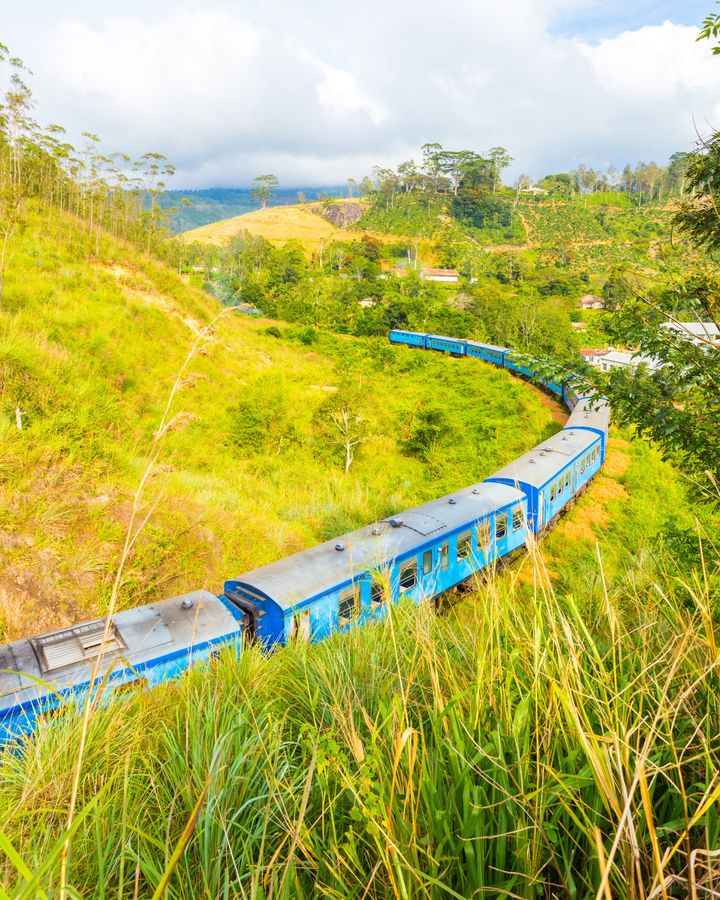
The Colombo to Badulla railway is so enchantingly beautiful that it’s become a bucket list adventure for many visitors.

I was woken by the long, forlorn sound of the siren. The brakes hissed and screeched as our train chugged up the hill and pulled into Radella, a station along one of the most beautiful train journeys in the world: the Colombo to Badulla railway.

“The journey is so enthralling that you don’t want to take your head out of the window,” said Dayawathie Ekanayake, who has travelled extensively by train across the island during her career as a finance consultant. “It makes you feel constantly in awe. You wonder about what comes next – is it a waterfall? A stupa-like tea garden? Or is it mist-clouded peaks? You never know. You just have to keep looking.”

Since my first journey along this route seven years ago, I have returned numerous times, eagerly jumping off the train to explore towns and hamlets flanked by tea estates. The 291km track takes in a mix of deep gorges, craggy cliffs, cascading falls, lakes and rivers from Sri Lanka’s west coast into its mountainous interior. It twists and turns through 46 tunnels, snaking past high montane canopy with bright red rhododendrons and wild ferns, a fragment of the native hill country forest cover left untouched by British colonisers. On a bright day, sun-drenched hills stretch down to the glistening southern coastline from the train window as far as the eye can see.The train journey has become an Instagram sensation in recent years (Credit: Mystockimages/Getty Images)

The train journey has become an Instagram sensation in recent years (Credit: Mystockimages/Getty Images)

This slow, 10-hour long journey might be inconvenient for the modern-day traveller, but it’s so enchantingly scenic that it’s become a bucket list adventure for many visitors.

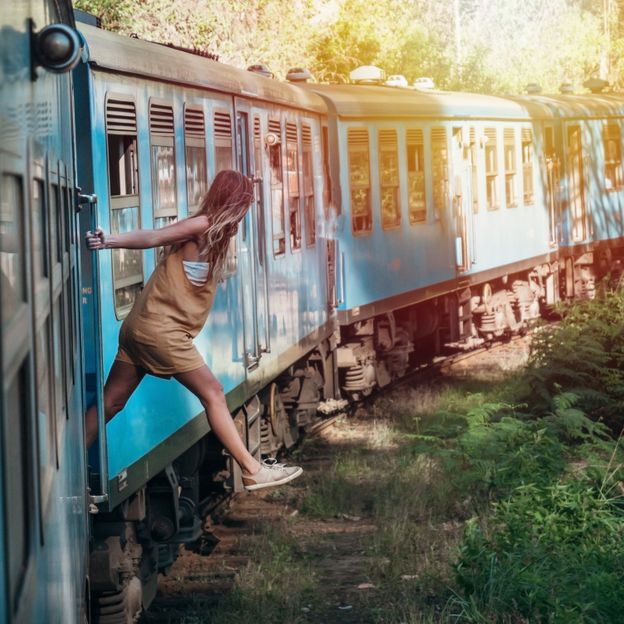
But it’s not just the views that has travellers in awe. The train journey itself has become an Instagram sensation in recent years, with travel bloggers risking their lives to take photos of themselves hanging off the door as the train rumbles past rickety bridges (some of them have been criticised for their dramatic poses). Yet, the journey is also tied to Sri Lanka’s colonial history and gives passengers a deeper understanding of the island-nation.

A NEW TRAIN FOR TOURISTS

While the railway was originally opened for trade, only a fraction of it now transports goods. As well as daily passenger trains, a new tourist train named Ella Odyssey opened in March and stops at several key points along the route – in addition to the usual station halts – to soak in the panoramic views from the open windows and doors.

During British colonisation in the 19th Century, Sri Lanka was the third-largest coffee exporter in the world. As demand rose, it became expensive to ferry coffee on bullock carts from the central mountains to Colombo for shipment, especially with road conditions deteriorating during the monsoon months. Estates had to therefore store their coffee for long periods of time, causing the quality and value to deteriorate. So British estate owners pushed for a rail system to transport coffee. In 1867, the British completed a railway from the city of Kandy in central Sri Lanka to the coastal city of Colombo.

“The British didn’t build railways to help locals travel,” explained Sanka Abeysinghe, naturalist at the luxury boutique hotel chain Teardrop Hotels, who also conducts railway hikes for resort guests. “They designed railways to transport estate produce.”

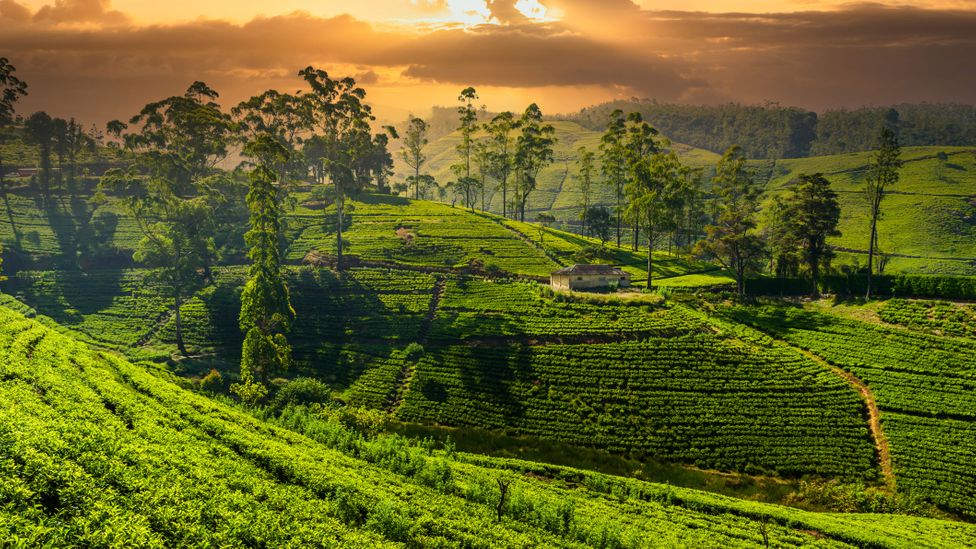
I boarded the train in Colombo, leaving the muggy heat and low country farmlands to slowly ascend towards the rocky mountains surrounding Kandy. Cutting through rugged terrain, the train climbed 426m over a 21km stretch, passing through 12 tunnels, hugging treacherous curves along the mountains and soaring above thick tropical jungle.The cool, misty climate in Sri Lanka's hill country creates the perfect conditions for growing tea (Credit: Anton Petrus/Getty Images)

The cool, misty climate in Sri Lanka’s hill country creates the perfect conditions for growing tea (Credit: Anton Petrus/Getty Images)

After leaving Kandy, we passed fertile riverine valleys, and entered Sri Lanka’s hill country. Tea flourishes in these damp, wet highlands, so, “when tea became prominent, after the coffee rust epidemic – a fungi disease that hindered the coffee trade [in 1869] – the British wanted to extend the railways to transport tea from the mountains to Colombo,” Abeysinghe explained.

In the 1870s, the British began to expand the railway from Peradeniya, a railway junction near Kandy, extending the route to the terminal station Badulla in 1924. This 178km-long stretch involved navigating through rainy, forested mountains, steep ridges and a series of sharp twists and turns by building an impressive mix of bridges, viaducts, tunnels and embankments. It took 52 years to complete.

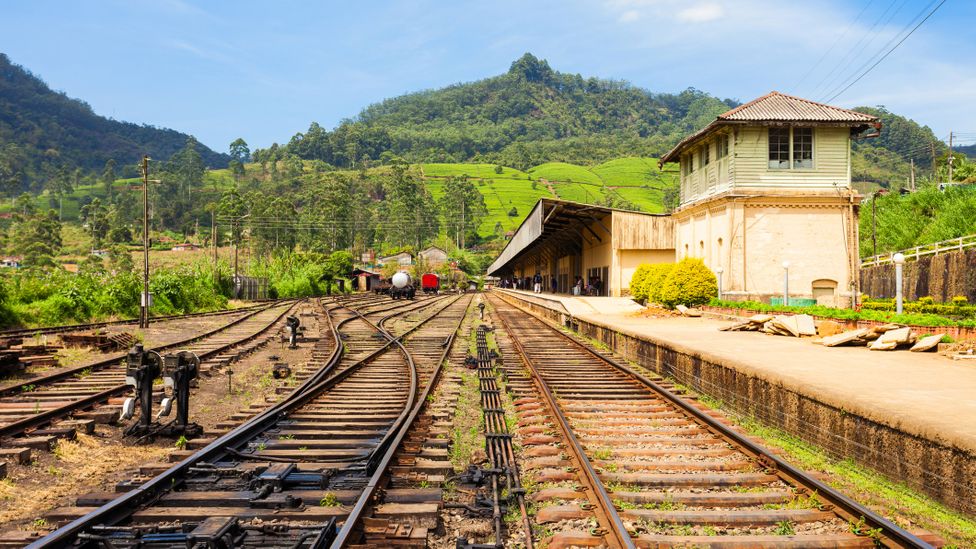
We pushed out of the mountains, and over the next three hours we passed small and well-kept British-era railway stations like Galboda and Watawala, which were built solely for the purpose of transporting tea from each estate. We sluggishly ascended past Hindu temples tucked in tea gardens, small housing settlements where the tea estate labourers live, and turpentine forests shrouded in swirling mist. Sometime after leaving Hatton – the gateway town to Adam’s Peak, a holy mountain for pilgrims of all faiths – we entered the Poolbank Tunnel, the longest of the 46 tunnels at more than half a kilometre in length.

“You cannot really see the light at the end of the tunnel here,” Abyesinghe said, chuckling.At Nanu Oya, visitors can tour the plantations and learn about the history of tea on the island (Credit: Saiko3p//Getty Images)

At Nanu Oya, visitors can tour the plantations and learn about the history of tea on the island (Credit: Saiko3p//Getty Images)

From here, young passengers eagerly hung from the door to see the gushing cascades of the spectacular St Clair’s Falls through tea bushes. Cold air drifted in from the open windows and rising mist cloaked the towering Great Western mountain range. Many passengers got off the train at Nanu Oya, a tea-country town where visitors can tour the plantations and learn about the history of tea on the island; but I stayed on board, climbing up to Pattipola, the highest broad gauge railway station in the world. From here, we finally left the cold central hills, travelling past dairy farms towards the sun-drenched south-eastern mountains.

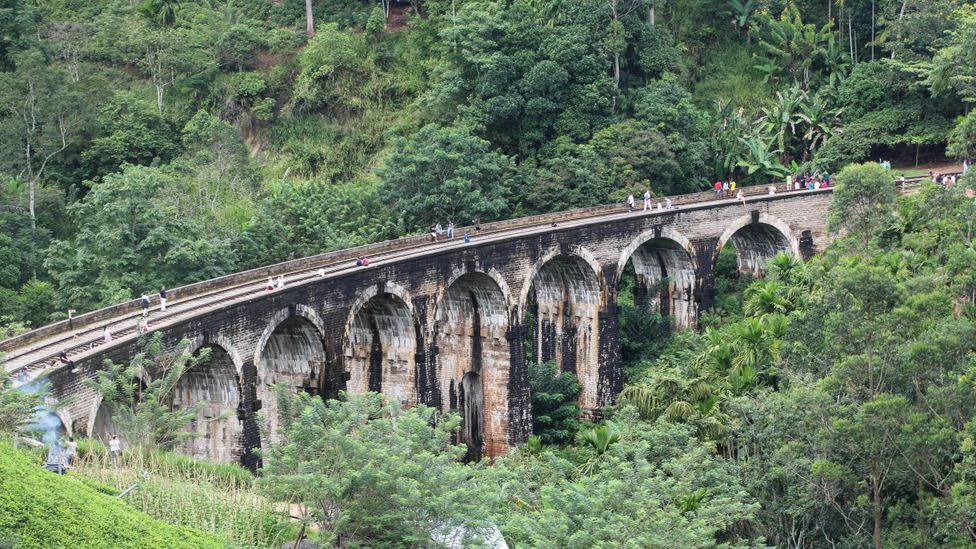
After a couple of hours later, we pulled in at Ella. Over the last decade, this once-sleepy village has turned into a lively tourist hub with cafes and bars lining the streets and people posing for photos in front of the picturesque Nine Arch Bridge, a viaduct with nine arches that soars over tropical jungles of plantain trees and areca nut palms and has become one of the most photographed spots on the island.

Flanked by thick jungle and tea plantations, the bridge was designed by British engineer Harold Marwood, but according to folklore, it never would have been built were it not for local knowledge.

It’s said that during World War One, when it was difficult to source steel from Europe, British engineers had to rethink the bridge design. Since colonial rulers had little to no knowledge about local construction materials, a Sri Lankan builder chipped in to help. Locals completed the engineering marvel using only bricks, stone and cement.Nine Arch Bridge is one of the most photographed spots in Sri Lanka (Credit: Nathan Mahendra)

Nine Arch Bridge is one of the most photographed spots in Sri Lanka (Credit: Nathan Mahendra)

Looking out of the train window, I gazed at the 90m-long viaduct rising through the trees, connecting Ella to the highland town of Demodara. The British also needed a way to manage the steep incline of the terrain from here. “The climb was too abrupt to handle for the engines,” Abeysinghe said.

Again, folklore gives credit to locals who found a way to solve the problem by creating a spiralling track. As we reached Demodara Loop, the train halted at Demodara for passengers to deboard, snaked around a hillock and re-appeared from a 134m-long tunnel right beneath the station.

According to legend, local engineer DW Wimalasurendra worked at the site and thought of this spiral design after seeing a kankami (a tea estate worker who manages South Indian labourers) tying and re-tying his turban. The cutting-edge engineering allowed the train to avoid the steep climb.The spiral track at Demodara Loop is said to have been inspired by a worker tying and re-tying his turban (Credit: Pius99/Getty Images)

The spiral track at Demodara Loop is said to have been inspired by a worker tying and re-tying his turban (Credit: Pius99/Getty Images)

We were nearing the end of the journey, and the train slowly descended to the sleepy, terracotta-roofed town of Hali Ela to terminate at the city of Badulla in the lower central hills.

As we pulled into the station, I realised that despite having travelled extensively around the world, I’ve often felt happiest during this slow journey through my own country. In many ways, as the train snakes past the century-old tea bushes, British stations and settlements of tea-estate communities, it quietly reveals the story of an island to those willing to put down their phones and look for it.

Join more than three million BBC Travel fans by liking us on Facebook, or follow us on Twitter and Instagram.

If you liked this story, sign up for the weekly bbc.com features newsletter called “The Essential List”. A handpicked selection of stories from BBC Future, Culture, Worklife and Travel, delivered to your inbox every Friday.

Presidential election next year?

December 8th, 2022

Courtesy The Daily Mirror

Whilst highlighting that a Presidential election is the best option when it comes to seeking a mandate of the people, UNP stalwart Navin Dissanayake today said one could expect a presidential poll in August 2023. 

“The best option to hold a Presidential election, as people can elect a new president after one whom they elected had left the post. Therefore expect a Presidential election in August 2023,” Dissanayake told a media briefing. 

“The Predident believes in conducting elections on time and therefore there won’t be a postponement of polls,” he said. 

“Also there is a suggestion that all three polls, including the general, Presidential and local government election be held on the same day by amending the constitution. I have also made the same suggestion to the President.” he added.

At the same time, he said the presidency should be abolished as the incumbent President is also expressed such opinion. (Yohan Perera)

Uvatenne Sumana Thera remanded over alleged financial fraud

December 8th, 2022

Courtesy The Daily Mirror

Chief incumbent of the Maligawatta Sri Bodhirajarama Vihara Uvatenne Sumana Thera has been remanded till December 14 by Colombo Chief Magistrate’s Court over an alleged financial fraud relating to coconut oil deal.

The CID alleged that Sumana Thera had issued eight dishonored cheques amounting to Rs.58 million in lieu of purchasing coconut oil from a businessman in Dematagoda.

The CID told the court that the suspect monk had purchased 84,240 kg of coconut oil while acting in the capacity of a private company director. (Lakmal Sooriyagoda)

President slams Janaka Ratnayake, says PUCSL cannot overrule electricity tariff hike

December 8th, 2022

Courtesy Adaderana

President Ranil Wickremesinghe made special revelations regarding the increase in electricity tariffs and claimed that Chairman of the Public Utilities Commission of Sri Lanka (PUCSL) Janaka Ratnayake has no power in this regard.

Speaking in Parliament this morning (08 Dec), Wickremesinghe addressed recent concerns pertaining to the proposed increase in electricity tariffs.

Stating that the Ceylon Electricity Board (CEB) is currently at a loss of Rs. 300 billion incurred since 2013, Wickremesinghe stated that in the event a drought takes place next year, an additional Rs. 420 billion is required.

If it rains normally, Rs. 352 billion is required, if it rains and there are floods, Rs. 295 billion is required. How do we find these? The government has no income. That’s the problem,” he emphasized, adding that there are only three solutions to the issue, to print money, to increase the Value-Added Tax (VAT), or to increase the electricity tariffs.

Explaining the disadvantages all three solutions would bring about, the President stated that although they understand the burden of the people, there is no better alternative than to increase the electricity tariffs, adding that such unpopular decisions have to be made in certain instances for the betterment of both the country, and the future of its people.

We are here because we didn’t always make difficult decisions. We have not increased our electricity tariffs since 2013. Everyone should be held responsible for that. Other countries made difficult decisions. We ran away from them,” he said.

Commenting on the recent remarks made by PUCSL Chairman Janaka Ratnayake, the President accused him of leading society astray with his claims that he will not allow for an increase in electricity tariffs.

Wickremesinghe also revealed that Ratnayake is the chairman of several organizations, including Trillium, which currently buys the most units of electricity. When the tariffs on electricity are increased, his own expenses increase,” he said, attributing this to Ratnayake’s hesitance towards the increase.

The power of making this decision lies with the relevant minister and the cabinet,” Wickremesinghe clarified, adding that the PUCSL Act was drafted by the President himself, and thus, such claims are calling for a meeting between the two, following several complaints that were received in this regard.

He further quoted the Act, citing that in the event an electricity tariff is imposed by the relevant Ministry, the PUCSL has no authority to act in a manner that is incompatible with the said decision.

PSC to look into those responsible for Sri Lanka’s economic bankruptcy

December 8th, 2022

Courtesy Adaderana

President Ranil Wickremesinghe says a parliamentary select committee will be appointed on a resolution by parliament to look into those who led the economy to bankruptcy with incorrect fiscal policies.

The President made this remark joining the debate on budget proposals in parliament today (Dec. 08), in response to a query made by parliamentarians as to who drove the country to such a bankruptcy and how to hold them responsible, the President’s Media Division reported.

Speaking on the issues faced by banks, the President said the banks will have to auction their property if people do not settle loans.

But the issue is that the people also have no money to buy such property. Therefore, we are discussing with the IMF to solve these issues. I think we all have to get together and think how this financial sector is to be lifted. We can blame each other. I can say I am not responsible. But the fact is that we can’t have the banks collapsing. So we have to come back to banking.”

That’s why, I want the Banking Oversight Committee”, the President added during his speech.

CBSL governor hopeful of securing creditor assurances in December

December 8th, 2022

Courtesy Adaderana

Central Bank Governor Dr. Nandalal Weerasinghe says that Sri Lanka can expect approval for the USD 2.9 billion International Monetary Fund (IMF) Rapid Financing Instrument in January next year, as creditor assurances from countries including China and India can be obtained this month.
 
Joining ‘@HydePark’ current affairs programme on Ada Derana 24, the governor said that Sri Lanka should not fear IMF involvement, as in the case of Greece following its financial crisis, but instead look to the success in India and South Korea following IMF bailout.

In response to a question whether it will take until March 2023 to secure the IMF bailout package, Dr. Nandalal Weerasinghe pointed out that it depends on the ability to obtain assurances from bilateral creditors, and that the creditors have sufficient information to decide their contribution for them to determine on what kind of conclusion that they have to make towards restoring Sri Lanka’s sustainability for a long period.

First step is getting assurances from all creditors”, he noted.

The CBSL chief further mentioned that the IMF needs a maximum of 2-3 weeks to get the programme approved, adding that the approval can be obtained in January, if the assurances are secured during this month.

Crisis situations faced by India and South Korea previously are comparable to Sri Lanka, Dr. Nandalal Weerasinghe said, highlighting that those countries too have obtained similar bailout packages. But that they took correct measures and never went back to the IMF, he added.

Parliamentary Select Committee to look into those who led the economy to bankruptcy

December 8th, 2022

Courtesy Hiru News

President Ranil Wickremesinghe said during the Budget Debate today that a Parliamentary Select Committee will be established on a resolution by the Parliament, to look into those who led the economy to bankruptcy with incorrect fiscal policies.

President Ranil Wickremesinghe said that the country has had to face adverse repercussions today due to the short sighted popular decisions taken in the past and unpopular decisions have had to be taken for the future prospects of the country.

The President made this observation today (08) taking part in the third reading debate of the budget proposal for the financial year 2023.

He said further that a Parliamentary Select Committee will be established on a resolution by the Parliament to look into those who led the economy to bankruptcy with their incorrect fiscal policies.

The statement made by President Ranil Wickremesinghe is as follows:

Some members discussed of the Mahaweli lands. The lands of the state were under the Land Commissioner until 1977. Due to the rapid development, some of the urban and rural lands were brought under the Urban Development Authority, Mahaweli Authority, and several other corporations. But now, no one knows as to where those lands are or what they are doing with them. Hence the government is concerned to find out as to where the government lands are, and to whom they have been given. Although this is done through Divisional Secretary, he cannot issue lands as he wishes and a committee will be appointed in this connection. The government hopes to cancel all those grants of lands. Some spoke against taking over Mahaweli lands but they were all under the Land Commissioner earlier. By now people have been settled in most of the lands under those institutions. But the rest have not been handed over to the Land Ministry by the Agriculture Ministry. Some institutions are still in the process of settling the people in those lands. We don’t have any issue with them. They can continue to develop them and settle people in them. However the government owned lands in Mahaweli B, C and H zones and lands in Anuradhapura and Polonnaruwa should be identified and make them available for the public to use. Despite the agriculture is developed by both Mahaweli Authority and Agriculture Ministry, so far we have not been able exceed the harvest above 6 Mt of paddy per hectare. That is the government’s concern and nobody needs to worry of this government’s move.

In addition, in accordance with the Education Minister’s request, we agreed to establish nongovernmental universities. Hence when we meet on 12 and 13, let’s discuss this matter with the former education ministers and other MPs and let’s reach a decision by next January. Thereafter we can establish those universities.

I would like to request the Speaker, as if we discussed earlier to appoint five youth to each Ministerial Consultative Committee, we can soon finalise the criteria of selecting them without delay. If we delayed it, the youth would inquire as to what has happened to it.

The Energy Minister said that electricity tariffs were increased last August. However the increase is not ample as it is estimated that the loss would be Rs. 151 billion. The total loss since 2013 is Rs. 300 billion. If drought prevails next year, we need Rs. 420 billion for next year’s electricity. If it rained, we need Rs. 352 billion while Rs. 295 is required if rained so much to have floods. How are we going to find this money? We would have to print money, but Rupee would depreciate. We would have to increase VAT but it would increase the price of all commodities or to charge it direct.

However the parents requested not to cut power due to GCE (A/L) examinations of their children. Nobody including the politicians is willing to increase the prices. What is the option we have other than that?

After the discussions with China, we can go to the next step if we handle the economy somehow or other now with difficulty. If we can’t show the profits at such a situation we also suffer losses, nobody outside would aid us. The Prime Minister and I discussed this matter and we have to take decisions which are not popular for the sake of the country. The other countries at a time took those decisions not popular but were beneficial to their countries. We have not increased the electricity bills since 2013 and all of us are responsible for the loss. Now what are we going to do? If you have a deficit of Rs. 400 billion, what are you going to do? There are only 03 options: print money, put on VAT or charge directly.

I was the one who initiated to draft the Public Utilities Commission of Sri Lanka (PUCSL) Act. There the powers are vested on Minister and the Cabinet. There is a letter from the Attorney General which says it is evident from the afore mentioned provisions in the Sri Lanka Electricity Act general policy guidelines of pricing could be issued by the Minister and that such policy may be framed in the form of a tariff structure formula or by any other method. In terms of section 30 sub section 2 and 3 of that the aforesaid the PUCSL could be statutory obliged to give effect to such policy. It is observed that neither the Sri Lanka Electricity Act nor the PUCSL Act No 35/2002 contain any provision to empowers the PUSL to vary or act in variants of such policy guidelines.

I know it well, as I was the one who drafted the PUCSL Act and it comes within the ambit of my ministry. I don’t know as to why this Chairman misleads the people. I’ve got to meet this Chairman as I have received several complaints against him and his statements. He says that he does not allow increasing the electricity tariffs. He has not been vested with any power in that connection. How could the country run the economy, if we can’t increase the electricity tariff?

The said chairman is the Chairman of the Trilliam Group too. He is the one who buys highest amount of electricity.

Building diversified portfolio on luxury real estate. Trillium: As a developer we aim to create the most luxuriant living spaces, offices and hotels at sought after locations where our design and architecture are obtained through exceptional levels of expertise. How much electricity is consumed by luxurious apartments?

He has Trillium Residencies, Trillium Havelock Residencies, Trillium Residencies Colombo 07, Trillium Hotels Colombo 07, Trillium Residencies Negombo, Trillium Villas. So when the electricity prices increases his expenditure increases. As the Chairman of the PUCSL he has conflict of interest with that decision, so he had to disassociate himself from that meeting. He didn’t do that. They want me to have an inquiry. But under the law, the power of inquiry lies with the Parliament. So I will leave for the members of the Parliament to decide what has to be done. I don’t think this type of things can go on. You are chairman of a public corporation; you must know how you should behave. You are not a monkey who dances into organ. If I had something such, even I would not be pleased with the electricity tariffs going up.

I don’t like electricity bills going up at my home, but as I have none, it’s no problem to me. I saw that the Engineering Association viewed that the electricity bills did not need to be increased. I know the issue there. I’ve got the letter sent by State Minister Dilum Amunugama on those power plant projects none of which have yet been approved. They are 100mw off shore wind power plant in Norochchole at USD 321million, 500mw off shore wind power plant in Hambantota at USD 1.4 billion, 100mw solar power plant in Buffalo Island, Batticaloa at USD 68 million, 250mw wind power plant in Dutch Bay, Puttalam at USD 204 million. I would ask them first to pass these and then pass their resolution against the increase of electricity tariff.

We have to import coal for six months for Norochchole coal power plant as for six months we cannot import coal due to the condition of the sea there. In 2001, I stopped the project of the construction of this Norochcole power plant due to this six months issue. But when we were defeated, they convinced the successor government, that this was the suitable place to construct the coal power plant. Those persons who instructed the government now have retired. In 2002, when we got World Bank aids, we were given a report on electricity on unbundling. We did not implement it and we were later defeated in 2004. Then, these officers requested the government to bring the Act in 2007. Thereafter not a single electricity power plant could be set up. Following dialogues with India and Japan, the UNP government could come to agreements to get two LNG power plants. After we were defeated the successor government, without cancelling those agreements granted it to New Fortress company in USA. Thereafter, as they did not like New Fortress, they gave it back to Pakistan and China. So within the same premises, there were China, Pakistan, India, USA, Japan and only Russia was not there. It was wonderful that a world war did not ignited there as there were five main powers in the world. Now there is no LNG or anything here and now they ask me to solve this issue. If the Japanese and the Indians were allowed, the LNG could have been a reality. So I asked you members here not to query about it again.

Another matter is the Banks’ issue. If the people do not settle loans, the banks will have to auction their property. But the issue is that the people too have no money to by such property. Therefore, we are discussing with the IMF to solve these issues. I think we all have to get together and think how this financial sector is to be lifted. We can blame each other. I can say I am not responsible. But the fact is that we can’t have the banks collapsing. So we have to come back to banking.

That’s why; I want the Banking Oversight Committee.

Responding to a query made by parliamentarians as to who drove the country to such a bankruptcy and what is the punishment for them , President Ranil Wickremesinghe said that a Parliamentary Select Committee will be established on a resolution by the Parliament to look into it.

Why doesn’t IMF/World Bank propose pruning Sri Lanka’s Parliament & recovering from Big tax defaulters first!

December 7th, 2022

Shenali D Waduge

Was Sri Lanka’s economic crisis precipitated by an externally planned course to incrementally result in outcome? This is a question Sri Lankans need to ask themselves. How far have Sri Lanka’s elected leaders, paid policy advisors failed to read the external threats & mitigate internal measures to address them, instead of blindly following external advice? Another question for Sri Lankans to answer.

Sri Lanka is in a default status. Why does IMF/World Bank not place these conditions instead of demanding governments cut welfare of the ordinary people & increase taxes of tax payers while defaulters and corrupt get away!

  • Ministers & MPs cut down on their entourage / overseas travel & other unnecessary waste including clearly defining what the state pays for and what Ministers & MPs have to personally pay for.
  • Well aware that the externally-imposed Provincial Council system is a white-elephant why is there no recommendations to scrap it & save millions from its maintenance? Why is the waste & corruptions by politicians and top corporates not targeted instead of targeting the military for ulterior motives.
  • Why doesn’t IMF/WB insist Govt go after defaulters & big time tax evaders & recover from them?
  • Why doesn’t IMF/WB insist Govt crack down on black money circulating & catch the culprits
  • Why doesn’t the IMF/WB insist Govt review tax holidays/import levies etc given to investors & monitor how far investors have actually invested what they promised?
  • Why doesn’t IMF/WB encourage local entrepreneurs & SMEs and encourage govt to give then better facilities to serve the nation?

There are countless more measures that IMF/WB can insist GoSL to implement instead of increasing taxes on utilities, raising prices of essential goods & making life miserable for the common people in particular the tax payers while tax evaders/the corrupt/wasters enjoy a field day.

At the same time the People of Sri Lanka must wake up to reality. We see a segment of society 24×7 enjoying luxuries, another segment barely surviving & another segment finding life impossible. This cannot continue. There has to be some austerity measures across the board & must include that of those living in luxury as well. Some common dos & don’ts have to get applied & be followed by all if Sri Lanka is to come out of this rut instead of eternally taking loans & taking more loans to pay off previous loans/interest. We have to put a stop to this ugly practice. 

IMF was originally set up to work with member states to ensure stability of the international financial system & correct balance-of-payment maladjustments but instead of helping governments avoid currency crisis IMF ended up pressurizing them to stop regulations on cross-border trade creating trade imbalances.

IMF policies attracted huge inflow of foreign money to emerging market economies” across Latin America & Asia via loans & speculative investments & this set the stage for eventual financial meltdown that took place in Mexico in 1994 and in Russia, Brazil & Asia from 1997-1998. When the financial inflows could not be sustained billions of dollars were pulled out of these countries resulting in currencies & stock markets going into freefall. This paved way for IMF to enter with new loans & bail outs aligned with foreign banks & financiers & poverty-stricken people insisted their governments complied, little aware of the dangers they were walking into. Ultimately the taxpayers ended up footing the bill. IMF even insisted that uncollectible private debts were converted to public debt Now do Sri Lankans understand what has happened in Sri Lanka?

Over 90 countries have been subject to IMF/WB structural adjustments – where are these countries now? Sri Lanka has taken 16 IMF loans – but where is Sri Lanka today?

IMF claims it has replaced structural adjustment loans with a new term – comprehensive development framework.

IMF provides financial support to countries suffering external payment difficulties. IMF loans are not for development but meant to balance payment financing with repayment with interest. A country falls into debt, IMF enters gives loan based on internal structural changes & country has to repay amount given as loan with interest.

IMF staff visit countries to discuss economic policy with government officials. These are incorporated into an analysis presented to the 7 largest industrial countries (G7)

Majority of developing countries are guilty of high levels of external borrowing in the 1980s & they have not been able to eliminate this legacy.

Sri Lanka is guilty of living beyond its means & the sooner it realizes this, the better for Sri Lanka. The question is why doesn’t IMF try to eliminate the root cause of the imbalance instead of always targeting the poorer segments of society?

Isn’t IMF also guilty of disorderly adjustment because the very areas that IMF highlights by such adjustment is happening in Sri Lanka – shortage of goods, black markets, high rates of inflation, build up of external payment arrears.

IMF’s neoliberal objectives can be seen in requiring debt-ridden states to forsake their resources by privatizing public enterprises. Why does IMF not concentrate on reviving public enterprises by showing how governments can turn public entities around – why does IMF always demand to pass public ownership to private hands?

IMF entices countries to

  • Cut govt spending on education, health care, environment, price-subsidies for basic necessities such as food, grains & cooking oils
  • Devalues national currency & encourages increase of exports by privatization of natural resources, reducing labor wages & subsidizing export oriented foreign investments.
  • Liberalizes (opens) financial markets to attract short term investments that create financial instability & foreign liabilities
  • Eliminate tariff & other import controls resulting in increase of imported goods (consumer) purchased with borrowed foreign exchange intentionally undermining local industry/SMEs/Entrepreneurs & adversely affecting agricultural producers who cannot compete with cheap imports – this results in straining foreign exchange accounts & deepening external debt in the long term

The World Bank was created to assist reconstruction & development of territories of member nations by facilitating investment of capital for productive purposes as well as to promote long-range balanced growth of international trade.

WB’s original mandate was to focus on financing post-World War 2 reconstruction of Europe but when Europe did not show interest in mortgaging its economy to foreign bankers, the WB began to market its loans to newly independent former colonies by investing in training & education to indoctrinate bureaucrats & economics of the developing nations to follow its economic ideology – equating development with export-led economic growth fueled by foreign borrowing & investment. This is where economists of developing nations have erred!

Thus loans were used to finance infrastructure projects & then imports that were beyond the export earnings of a country – eventually forcing nations to take larger loans to service payment of interest due on previous loans. The more nations borrowed – the bigger the loan needed to pay the interest. Ultimately nations became loan addicts.

This was how developing nations were trapped by the international monetary agencies. IMF & WB rewarded nations with more loans after they accepted conditional structural adjustments putting them in more debt.

Countries were pressured into increasing export of their natural resources & goods from cheap labor – this in turn made nations import dependent while their economies came under foreign ownership/influence. Notice how the slow takeover of national economies were taking shape.

In 1980 total external debt of developing countries was $609billion

In 2001 total external debt of developing countries was $2.4trillion (after 20 years of structural adjustments)

Countries end up paying more on debt-service payments than it does on its people. This is how the West drains the wealth of the Third World. It is not a question of giving loans at less interest – the issue is the manner countries are enticed to take loans and more loans to pay off loans. How can they ever think of ever getting out of debt!

The IMF/WB that provide loans (even at low interest) their objective is to enable global corporations to take control over the natural resources & their markets. Note the manner that the companies that enter as investors” are energy & agriculture sectors. The WB financed roads, electric grids were built primarily to serve global corporations – this was no different to why during colonial rule roads and train services were built to plunder resources out of the country.

WB stands guilty of contributing to global greenhouse gas emissions via fossil fuel projects by global corporations that it promotes. Unfortunately ADB, IDB are copying this same model.

Are IMF/WB & WTO really representative of the Global South Third World Nations?

WTO bias is seen in the banana example. 1999 – Caribbean. WTO informs Europe that they could not give import preference to bananas produced by small banana farmers because it posed a threat to 2 US agribusiness companies – Chiquita & Dole which control the world’s banana trade. Europe refused to comply with WTO. US imposed 100% tariffs on numerous European exports which WTO sanctioned – this shows the bias of WTO to US govt & US corporates.

How can the Third World come out of its loan addictions” when IMF/WB keep them addicted to it. How can there be fair trade when WTO ensures there isn’t. WTO rules & systems are used by giant corporates & their allied governments on national governments.

What good is a WTO that regulates governments to protect corporations? Why should everything be imported? Why cannot countries be encouraged to grow their own first. Priority to ensure a nation feeds its people first. How did imported items become cheaper than what is grown and sold locally? Why should locally entrepreneurs and producers be drowning in debt attempting to feed their own when governments are encouraged to import & the system rewards imports. Does trade & investment liberalization really bring economic growth – if so, where is the growth? Do we not see increased imbalances in the global & local economy as well as inequalities.

Shenali D Waduge

Is Global South being robbed & corrupted & scorned for it?

December 7th, 2022

Shenali D Waduge

An interesting article by Caitlin Johnstone titled Robbing the Global South, then scorning its poverty: notes from the edge of the narrative matrix” gives much food for thought. She quotes Michael Parenti poor countries are not under-developed”…they are over-exploited”.

She claims the poverty of the developing world is as a result of western theft & exploitation & she likens it to ‘mugging someone and then scorning them for their empty wallet”. She goes on to say that the western civilization prides itself in being better at killing and stealing than others and admits that the West continue its invading and plundering of nations while justifying.

She also brings to the surface the profiling by West and showcases how China is always described as Chinese Communist Party” to immediately bring negative emotions in people. This profiling is being done to individuals & countries West feels a threat or West wants to bully into submission. The main objective of this exercise using Western media & its other foot soldiers is to detach the people from those being targeted.

Re-colonization of former colonies is resuming under different nomenclatures & those that are blocking it are at the receiving end of West’s soft & hard tools!

Global North became rich after plundering Global South during 500 years of colonial rule. Europe’s industrial revolution came from forced labor, stolen resources, illegal taxes, genocide, displacement of natives, planned disease & unimaginable crimes against humans and even animals.

Imperials left only after preparing an economic & trade order to be dictated by them with their rules & laws & an education system that would church brown sahibs and western bootlickers. The educational-social system did not encourage nationalism & scorned those that though western-educated understood the discriminations natives were subject to & wished to reverse them.

131 countries make up the Global South covering countries in South America/Caribbean/African Continent/Asia Asia-Pacific (without Australia & New Zealand)

How many of the Global South are in debt to Global North & how much does Global North make from interest paid in dollars by Global South for loans given by Global North ruled international monetary agencies? How much is the Global North still reliant on the Global South which is often ignored?

Doesn’t the Global North appropriate tens of billions of tonnes of raw materials & hours of human labor per year from Global South? Will Global North have smartphones, laptops, computer chips & cars without Global South who manufacture them? Why are salaries in the Global South kept below that of Global North? What about the discrepancies in the taxing & import/exports of goods?

The New Political Economy, covered the unequal exchange in the 1980s & 1990s as a result of neoliberal structural adjustment programs of IMF which were imposed on Global South nations. It is estimated that the Global North drains from the South commodities worth $2.2trillion per year which would suffice to eliminate extreme poverty globally. The journal estimates that from 1960 the total drain (from South to North) is $62 trillion. The net growth in the North relies on appropriation from the rest of the world. The Global South is clueless about this reality. Global North includes US, Canada, Australia, New Zealand, Israel, Japan, Korea & rich economies of Europe.

It is estimated that for every dollar of aid Global South receives, they lose $14 in drain through unequal exchange rates which varies from country to country (this omits other losses that include illicit financial outflows & profit repatriation). Wake up to the reality that poor countries are developing rich countries – not the other way round. Pro-Western economists justify low wages in South though such has to be seen as part of inequalities for political power.

[Plunder in the Post-Colonial Era: Quantifying Drain from the Global South Through Unequal Exchange, 1960–2018 by Jason Hickel, Dylan Sullivan & Huzaifa Zoomkawala]

Global North rules all international decision making apparatus. IMF & World Bank are monopolized by Western nations. The same happens in all of the international trade organizations. Global North are the creditors who use their power to dictate economic policy in nations they place in debt via loans. Global North also controls 97% of the world’s patents. They have the most powerful companies which are propped up by their governments & now function as transnational corporations some of which are more powerful & rich than nation states. These MNCs/TNCs use their clout to make demands on Global South on the camouflage of investment which invariably ends up draining profits back home to Global North. Why is Global South unable to understand these links & how the world actually runs? The Global North may be sophisticated, but the resources are in Global South.

Notice how IMF structural adjustment programs also target the working sector demanding cuts in wages, reduction of labor rights & other welfare measures in exchange for loans! The aim of these conditions was to facilitate cheap labor for Global North corporates resulting in Global South being dependent on Global North firms for ‘investments’ & jobs and these factories use cheap labor to provide for the people in Global North. See how the best of fruits, vegetables etc always get exported to the Global North for their consumption & the left overs are consumed by the Global South that grows them!

https://www.uab.cat/web/newsroom/news-detail/advanced-countries-wealth-depends-on-the-appropriation-of-resources-and-labour-from-the-global-south-1345830290613.html?detid=1345857040508

While the Global North preaches ‘democracy’ will it consider giving fairer economic opportunity for Global South on par with Global North? Will they allow developing nations to use tariffs, subsidies to build sovereign economic capacity on their own? Would they consider bringing labor wages on par as per their equal” mantra often subject to international forums only.

The reality that has to be understood is that there is unfair play economically & politically which is why the developing world can develop only to the level Global North allows it to. That China has done the unthinkable is why China has become the enemy of the Global North. That Russia is also gaining momentum is why Global North is unified in trying to prevent such.

Where does India fit in – India has given up its non-aligned policy to become partners with US though India’s friendship with Russia is kept on track. Global North is exerting tremendous pressure on India vis a vis this stand & India will be recipient of these displeasures by other means.

There is another reality that we cannot ignore – there are ultra-rich in Global South while there are poorer segments of society in Global North. 1% hold global wealth. The rest are just managing.

Infrastructure-wise the Global North is more developed but living conditions of some in the North are worse than in Global South. Inequality prevails everywhere – within countries & societies, regions & continents. There are inequalities in health, education, income & living conditions. The best of medicines, clothes, toys, foods etc are available in some countries while the worst are dispatched to the rest. Every inequality is an opportunity for those who wish to gain profit.

Yet can wealth be measured in terms of money alone – Bhutan happy index claims otherwise. Many in Global North who have been living high-work pressure lives are now seeking solace in mindfulness & yoga as a means to detox their minds & bodies. Inadvertently the Global South clamour to go to Global North & take over the lifestyle that many are giving up. So we are seeing another form of reset.

Today with rising populations, dwindling resources, there is a clamour to secure the resources that are in Global South control & bring them under iron fist of Global North’s corporations. We see this happening using deteriorating economic and political conditions as a landscape prepared for this ultimate goal. Sri Lanka is a case in point where we have to wonder how far the economic & political collapse was engineered to enable Global North to dictate to Sri Lanka & ultimately control its future. Similarly, we are seeing the world being reset and the future looks bleak unless the vast majority of people realize what a handful are up to.

Are Global South being corrupted & robbed by the very rich nations & their entities that scorn them thereafter?

Shenali D Waduge

Japan’s attack on Pearl Harbour changed the course of world history

December 7th, 2022

Senaka Weeraratna

Today, December 7 is the 81st anniversary of the Japanese attack on Pearl Harbour which finally led to the liberation of the oppressed people in European colonies in Asia and Africa and other parts of the world. 

The fightback of the Japanese Imperial Army, Navy, and Air Force, and Japanese people destroyed the myth of the so-called Invincibility of the Western colonial countries and the untenable Christian concept of Manifest Destiny, which promoted the idea of White Supremacism and the collapse of all other civilizations which were not rooted in Judeo – Christian doctrines.  

The importance of the overthrow of Western colonial powers in Asia in a massive counter-attack led by Imperial Japan should not, therefore, be underestimated. 

If the intervention of Imperial Japan had not taken place beginning with the bombing of Pearl Harbour on December 07, 1941, then the end of oppression & exploitation by Western colonialism would have continued for a longer time 

decades upon decades. The entire world would have turned into one big colony of Western imperialistic powers.  

Of all the major countries that took part in the Second World War, Japan was the only country that declared the liberation of fellow Asians from Western imperialism under the banner ‘Asia for Asia’, as one of its primary goals.  No other country in the West or East declared or committed itself to the grant of freedom to Asians and Africans in European colonies, following victory in the war.

In 1939 the end of Western Colonialism was never in sight. But the entry of Japan into WW2 in December 1941 turned things around and shaped the emergence of a new world that ultimately ended Western hegemony. This is starkly clear in historical terms and it cannot be ignored. Japan is entitled to credit for this huge achievement despite losing the war-making immense blood sacrifices. 

Senaka Weeraratna

රට තුළ සිටින ගෘහ සේවිකාවන්ගේ සේවා තත්වයන් හා ආරක්ෂාව තහවුරු කිරීමට විශේෂ ක්‍රමවේදයක්

December 7th, 2022

Manusha Media

රට තුළ සේවයේ යෙදෙන ගෘහ සේවිකාවන්ගේ සේවා තත්වයන් සහ ආරක්ෂාව තහවුරු කිරීම සදහා විශේෂ ක්‍රමවේදයක් ක්‍රියාත්මක කිරීමට කම්කරු සහ විදේශ රැකියා අමාත්‍ය මනුෂ නානායක්කාර මහතා තීරණය කර තිබේ.

ඒ සදහා වන වැඩසහටනක් වහාම ක්‍රියාත්මක කරන ලෙස කම්කරු කොමසාරිස් ජනරාල්වරයාට අමාත්‍යවරයා උපදෙස් ලබාදී ඇත. අමාත්‍යාංශයේ මාසික ප්‍රගති සමාලෝචන සහ ඉදිරි වැඩ සටහන් සැලසුම් සම්බන්ධයෙන් වන සාකච්ඡාවේදී මෙම ක්‍රමවේදය සකස් කිරීම සදහා වන තීරණය ගත්තේය.

මේ වන විට ගෘහ සේවිකාවන් ලෙස විදේශ රැකියා සදහා පිටත්කර යන ශ්‍රමිකයින්ගේ ආරක්ෂාව සම්බන්ධයෙන් කටයුතු කිරීම සදහා ක්‍රමවේදයක් ශ්‍රී ලංකා විදේශ සේවා නියුක්ති කාර්යාංශය හරහා ක්‍රියාත්මක කරන නමුත් දේශීය වශයෙන් ගෘහ සේවයේ යෙදෙන ශ්‍රමිකයින් සම්බන්ධයෙන් සොයා බැලීම සදහා නිශ්චිත ක්‍රමවේදයක් නොමැතිවීම සම්බන්ධයෙන් අමාත්‍යවරයා සිය අවධානය යොමු කළේය. ඒ අනුව දේශීය ගෘහ සේවිකාවන් සම්බන්ධයෙන් සොයා බැලීම සදහා ක්‍රමවේදයක් සකස් කරන ලෙසට අමාත්‍යවරයා දැනුම් දුන්නේය.

‘‘හැමෝම කතා කරන්නේ විදේශ රටවල සිටින ගෘහ සේවිකාවන් ගැන විතරයි. ඔවුන් හිංසාවට පත්වීම ගැන විතරයි. ගෘහ සේවිකාවන් ලෙස විදේශ ගත වන සංඛ්‍යාවට වඩා වැඩි සංඛ්‍යාවක් රට ඇතුළේ ගෘහ සේවිකාවන් ලෙස කටයුතු කරනවා. මේ නිසා දේශීය වශයෙන් සේවයේ යෙදෙන ගෘහ සේවිකාවන් සම්බන්ධයෙන් වැඩි අවධානයක් යොමු කළ යුතුයි. ඒ නිසා  ඔවුන්ගේ ආරක්ෂාව හා සේවා තත්වයන් සම්බන්ධයෙන් වන විශේෂ ක්‍රමවේදයක් ක්‍රියාත්මක කරනවා වැඩිදුරටත් අදහස් දැක්වූ අමාත්‍යවරයා සදහන් කළේය.

ගරු ජනාධිපති තුමනි ගරු අග්‍රාමාත්‍ය තුමනි. ශ්‍රී ලන්කාවේ වාර්ෂික නිදහස් සමරු උළෙල පැවැත්විය යුත්තේ මැයි මස 22 දාද?පෙබවාරි 4 දාද? 

December 7th, 2022

ආචාර්ය සුදත් ගුණසේකර මහනුවර.

                    මෙම ලිපිය ලිවීමට මා අදහස් කළේ පසුගිය දිනක මේ රජයද ලබන වසරේද උත්කර්ෂවත් අන්දමින් නිදහස් දිනය පෙබ 4 දාම පැවැත්වීමට තිරණය කොට ඇතැයි ප්‍රවුර්තියක් පලවී තිබුණු නිසාය

මේ රටේ නිදහස් දිනය පැවැත්විය යුත්තේ කවදාදැයි අපි තිරණය කළ යුත්තේ 1815 ආරම්භවූ ඉන්ග්‍රීසි අධිරාජ්‍යවාදී පාලනයෙන් ශ්‍රී ලන්කාවට සැබෑ සහ සම්පූර්ණ දේශපාලන නිදහස ලැබුණු දිනය අනුවය.ඒ අනුව එම පාලනයෙන් පළමුවෙන්ම පූර්ණ නිදහස ලැබුණේ 1948 පෙබ 4 වනදාද එසේ නැත්නම් 1972 මැයි 22 දා ද යන්න පළමුව පැහැදිළිකොට ගත යුතුය.

1948 පෙබ 4 වනදා ඉන්ග්‍රීසි අධිරාජ්‍ය වාදීන්ගේ වසර 133 ක රිජු යටත් විජිත පාලනය අවසන්කොට එක්තරා දේශපාලන නිදහසක් මේ රටට ලැබුණු බව අපි කවුරුත් දනිමු.එහෙත් පහතින් විස්තරකොට ඇති පරිදි එය කිසිසේත්ම සම්පූර්ණ නිදහසක් නොවුන බවද අපි දනිමු. ඇත්ත වශයෙන්ම මේ රටට එන්ගලන්ත දේශපාලන යදම් ග්‍රහනයෙන් මිදී ස්වාධීන රටක් වශයෙන් ක්‍රියාකිරීමේ දේශපාලන නිදහස ලැබුණේ මේ රට නිදහස් ජනරජයක් වශයෙන් ප්‍රකාෂ කරණලද 1972 මැයි මස 22 දාය. තවදුරටත් 72 මැයි 22 දා සිදුවූයේ නිදහස ලැබීමකට වඩා ලබාගැනීමකි. ඒ බව අධිරාජ්‍යවාදී ගැතිකමින් හා පටු පක්ෂ දේශපාලනයෙන් දෑස් අන්ධ නොවූ සිහිමොලේ ඇති ඕනෑම නොදරුවකු වුවද හොඳාකාරවම දනී.

මා එසේ සඳහන් කළේ දැනට නිදහස් දිනය ගැන මත දෙකක් තිබෙණ නිසාය.ඉන් පළමුවැන්න දේශපාලන හා නයිතික වශයෙන් 1815 ට පසුව මේ රට පූර්ණ නිදහස් ස්වාධීන රාජ්‍යක් බවට පත්වූයේ ශ්‍රී ලන්කාවේ ජනතාවගේ ස්වාධීනත්වය තහවුරු කරගත් ජනරජයක් වශයෙන් ප්‍රකාෂිත 1972 මැයි මස 22 දාය යන ප්‍රබුද්ධ මතයයි. දෙවැන්න, මේ රටට නිදස ළැබුනේ 1948 පෙබ 4 දාය යන අධිරාජ්‍යවාදී ගැතිකමින් හා පටු පක්ෂ දේශපාලනයෙන් සිහි විකල්වූ එසේම  මේ රටට දේශපාලන නිදහස ලබා දුන්නේ සේනානායකලා මිස බන්ඩාරනායකලා නොවේ, එසේම  එ.ජා. ප. ය මිස ශ්‍රී. ලන්. නි. ප. නොවේ, යන මතයේ දැඩිව එල්බගෙන සිටින දේශපාලන මලබද්ධ කාරයින්ගේ දැඩි මතයයි.

ඒ අනුව මේ රටට 1972 මැයිම 22 ද සැබෑ නිදහස ලබාදුන් බන්ඩාරනායක මැතිනියගේ රජය 1972 සිට 1978 දක්වාම මේ රටේ නිදහස් දිනය වශයෙන් පවත්වන ලද්දේද  ශ්‍රී ලන්කාවේ ජනරජ දිනය වූ මැයි මස 22 දාය

                     යථාර්තය එය වුවද 1977 සිදු වූ දේශපාලන පෙරළියෙන් පසු බලයට පත්වූ එ.ජ.ප. රජයේ අග්‍රාමාත්‍ය ජේ ආර්. ජයවර්ධන මහතාගේ බන්ඩාරනායක භීතිය සහ දැඩි බටහිර ගැතිකම අනුව ගත් තනි තීරණය මත 1978 නිදහස් දිනය නැවතත් සුද්දන් විසින් නියමකරණලද  දිනය වූ පෙබ 4 ටම ආපසු කැන්දාගෙන එන ලදී.මේ වු කළී සින්හල බෞද්ධයකු විසින් කිසිසේත්ම නොකළයුතු ඉතාමත්ම නින්දා සහගතවූද එසේම අමනොඥ වූද, දේශද්‍රෝහි වූද, ජාතිද්‍රෝහීවූද පහත් පෙලේ මෝඩ තීරණයකි.

1972 දී මේ රට පූර්ණ නිදහස් ස්වාධීන ජනරජයක් බවට පත්කොට 1948 සිට 1972 දක්වා වසර 24 ක කාලයක්තුල පිරිමි අගමැතිවරුන් 6 දෙනකුට ඉටුකිරීමට නොහැකිවූ අයිතිහාසික ජාතික මෙහෙවරක් ඉටුකකළ ලෝකයේ ප්‍රථම කාන්තා අගමැතිනිය වශයෙන් ලෝක වාර්තාවක්ද තබනලද එසේම 1976 නොබැඳි ජාතීන්ගේ සමුලුවෙන් ලෝක නායිකාවක් වෂයෙන්ද කිරුළු පලැඳි නූතන විහාරමහා දේවිය වෂයෙන් ප්‍රකටවූ ඒ ලක්මාතාවට  එතුමිය විසින් සිදුකරණලද ඒ මහඟු ජාතික මෙහෙවරට ලන්කා පුත්‍රයකු වූ ජේ ආර් ජයවර්ධ ජනාධිපතිවරයා සැළකූ හැටියි ඒ. 

ඉහතින් දවනලද කරුණු අනුව මේ රටේ සැබෑ ජාතික නිදහස් දිනය පැවැත්විය යුත්තේ කවදාදැයි තිරණය කළ යුත්තේ ශ්‍රී ලන්කාවට අධිරාජ්‍යවාදී පාලනයෙන් සැබෑ සහ සම්පූර්ණ දේශපාලන නිදහස ලැබුණු දිනය අනුවය. එසේම එම තීරණය ගත හැක්කේ මේ රටේ පර්මාධිපත්‍ය හිමි මහජනතාවට පමණි. එම නිසා ජනතාවගේ අනුමැතියක් හෝ ජන රමක් නැතිව කිසිවෙකුට එවැනි තීරණ ගත නොහැක. 1972 වසරේදී බන්ඩාරනායක මැතිනිය එම තීරණය ගණු ලැබුයේ ඒ සඳහා ලබාගත් 2/3 කජනවරමක් මතය. එහෙත් ජේ. ආර්. 1978 දි එය වෙනස්කොට නැවත පැරණි පෙබ 4 දාම නිදහස් දිනය පැවැත්වීමට තීරණය කලේ ඔහුගේ තනි තීරණය මතය.

එබැවින් වර්ථමාන රජය හෝ එම තිරණය වෙනස්කොට ලබන වසරේ සිට හෝ  මේ රටට සැබෑ නිදහස ලබාගත් මැයි මස 22 මේ රටේ ජාතික දිනය පැවැත්වීමට පියවර ගෙන1978 දි ගත් ඒ වැරැදි තීරණය නිවැරැදි කරන මෙන් සමස්ථ ලන්කාවාසි ජනතව වෙනුවෙන්ම මම ඉල්ලා සිටිමි. ඒ වූ කලී මේ රටේ දෑහිතැති මුළුමහත් ජනතාවගේම අපේක්ෂාව බවද ඔබ තුමන් වටහාගනු ඇතැයි මම විස්වාශ කරමි.

මේ රටේ නිදහසේ පුරාණය

            මේ රට බ්‍රිතාන්‍යයේ යටත් විජිතයක් වූයේ 1815 මාර්තු 2 දිනය. එදා සිට වසර 133 ක කුරිරු, පීඩාකාරී හා කොල්ලකාරී යටත් විජිත පාලනයකින් පසු 1947 සෝල්බරි ව්‍යවස්ථාව අනුව 1948 පෙබ. 4 දා සිට බ්‍රතාන්‍ය පාලනයෙන් ලන්කාවට නිදහස ප්‍රදානය කළේයයි කියයි. එහෙත් ඉන් පසුව වුවද 1972 දී දේශප්‍රේමි ජනතාවගේ මෙහෙයුම සහ බන්ඩාරනායක මැතිනියගේ නායකත්වය යටතේ මේ රට පූර්ණ නිදහස් ජනරජයක් බවට පත් කරන තුරු මේ රට නිදහස් රාජ්‍යකැයි කීම අමු මුසාවකි. 

1948 දී එතෙක් පැවැති  ඉන්ග්‍රීසින්ගේ රිජු පාලනය වෙනුවට මේ රටේ චන්දදායකයින් විසින් පත්කරගනු ලැබූ නියෝජිතයින් ගෙන් සමන්විත පාර්ලිමේන්තුවක් මගින්, සෝල්බරී ආණ්ඩුක්‍රම ව්‍යවස්ථාව අනුව රට පාලනය කරණ ක්‍රමවේදයක් අපට හඳුන්වාදුන් බව සැබෑ වූවද 1948 මේ රටට ලැබුණේ කිසිසේත්ම සම්පූර්ණ ස්වරාජ්‍යක් නොවේ.

එම ව්‍යවස්ථාව නිර්මාණය කළේ ජෙනින්ග්ස් නැමති බ්‍රිතාන්‍යය ඉන්ග්‍රීසි ජාතික ව්‍යවස්ථා විසාරධයාය.  එය මුල සිට අගටම බ්‍රතාන්‍යය. 1815 මාර්තු මස 2 දා ඉන්ග්‍රීසි අධිරාජ්‍යවාදීන් විසින්  කුමන්ත්‍රණයෙන් හා වන්චාවෙන් අපෙන් මේ රට උදුරාගෙන වසර 133 ක පීඩාකාරි හා මර්ධනකාරී කොල්ලකෑමෙන් පසු ඔවුන්ගේ අයිතිවාසිකම් තවදුරටත් ආරාක්ෂා කෙරෙන පරිදි  ඔවුන් විසින්ම සකස්කරණලද  ඔවුන්ගේම ආණ්ඩුක්‍රම ව්‍යවස්ථාවක් අනුව ක්‍රියාත්මක වියයුතු ආණ්ඩු ක්‍රමයක් ක්‍රියාත්මක කිරීම සඳහා ඔවුන්ගේ කොන්ත්‍රක්කුව  ඔවුන් විසින්ම මැනවින් පුරුදු පුහුණු කරනළද නාගරික කලු සුද්දන් පිරිසකට 1948 පෙබ 4 දා භාරදුන් බව ද ඇත්තකි.

 සැබෑ තත්වය එසේ වුවද 2023 ද නිදහස් උත්සවය අති උත්කර්ෂවත් අන්දමින් ගාලු මුවදොර පිටියේදි පැවැත්වීමට ජනාධිපතිවරයා උපදෙස් දී ඇතැයිද ඒ සඳහා අනු කොමිටි 10ක්ද පත්කර ඇතැයිද පසුගියදා  වාර්තවූ බැවින්  තවදුරටත් 1978 සිටම  කල පරිදි යලිත් පෙබරවාරි 4 දාම මේ රටේ නිදහස් උත්සවය පැවැත්ව්ම කිසේත්ම අනුඅමත නොකරණ දේෂප්‍රේමියකු වෂයෙන් ප්‍රමාදවී හෝ මේ වරද නිවැරැදිකොට ගෙන 2023  වසරේ සිට හෝ  1972 සීට 1978 දක්වා සිදුකළ පරිදි මේ රට් ජනරජයක් බවට පත්වූ මැයිමස 22 ජාතික නිදහස් දිනය වයෙන් යලිත් ප්‍රකාශකොට  එදිනට ජාතික නිදහස් දිනය පවත්වන මෙන් මම මේ රජයෙන් ඉල්ලා සිටිමි. රජය කෙරෙහි දැනට සීග්‍රයෙන් පිරිහෙමින් පවතින ජන ප්‍රසාදය ආරක්ෂාකර ගැනීමටද එවැනි තිරණයක් ගැනීම කාලෝචිත බවද කියනු කැමැත්තෙමි.

කෙසේ වුවද ගරු ජනාධිපති තුමාට පෙබ 4 දාටත් උත්සවයක් පැවැත්වීමට අවශ්‍යමනම් පෙබ 4 දාට රටේ පාලනය ඉන්ග්‍රීසින් විසින් අප රටට භාරදුන් දවස සන්කෙත්වත් කිරීමක් වෂයෙන් පමණක් ජනාධිපති කාර්‍යාලය තුලදී බ්‍රතාන්‍ය මහකොමසාරිස් වරයාගේ සාභාගිත්වයෙන් චාම් උත්සවයක්පැ වැත්විය හැක.

එසේ නොමැතිව රට දරුණු ආර්ථික අහේනියකට වැටී සිටින මෙවැනි අවස්ථාවක මේ රටට කිසිදාක නොලැබුණු නිදහසක් වෙනුවෙන් ත්‍රිවිධ  හමුදා පෙලපාලි, ගුවන් සන්දර්ෂන, පාසැල් ලමුන් දහස් ගානක්ද සාභාගීකෙරෙන සන්ස්කෘතික නැටුම් සන්දර්ශන වැනි බොරු ශෝභන සඳහා මහජන මුදල් කෝටි ගණනක් නාස්ති කිරිම සහ දසදහස් ගණනින් මිනිස් ශ්‍රමය නාස්ති කිරීමද කිසිසේත්ම  සුදුසු නැත

ප්‍රථමයෙන්ම මෙම ලිපියේ මාතෘකාවෙන් අසා ඇති ප්‍රශ්නයට ජාතියක් වශයෙන් අපි උත්තරයක් සොයා ගතයුතුය. එම උත්තරය අනුව මේ රටට නියම නිදහස ලැබුණු දිනය තෝරාගෙන එම දිනය මුල්කොටගෙනය, අපි ජාතික උත්සවය පැවැත්විය යුත්තේ. එම තීරනය කළයුත්තේ තාවකාලිකව රටේ නායකත්වයට පත්වන දේශපාලන පක්ශ නායකයින් නොවේ. එය කළයුත්තේ රටේ පරමාධිපත්ත්‍ය හිමි දේෂප්‍රේමී මහජනතාව විසිනි. ජනතාව එවැනි උත්සව වලට අසතුටුනම් එවැන්නක් නොපැවිත්වීම රජයේ වගකීමයි.

නිදහසේ ඉතිහාසය

1815 මාර්තුමස 2 දා චිර ප්‍රසිද්ධ උඩරට ගිවිසුමෙන් ඉන්ග්‍රීසීන් විසින් අල්ලාගත්/උඩරට නිළමේලා ගිවිසුමකින් ඉන්ග්‍රීසීන්ට භාරදුන් සින්හලේ රාජධානියේ ඉන්ග්‍රීසින්ගේ රිජු පාලනය අවසන්කොට මේ රට වැසියන්ගේ චන්දයෙන් තෝරාගත් මන්ත්‍රිවරුන් 95 ක් හා සුද්දන් විසින්ම පත්කළ ඔවුන්ගේ නියෝජිතයින් වූ මන්ත්‍රිවරුන් 6 දෙනකුද සමඟ 101 දෙනකුගේ පහල මන්ත්‍රණ සභාවකින් සහ 31 දෙනකුගෙන් යුත් උත්තර මන්ත්‍රණ සභාවක් සහිත පාර්ලිමේන්තුවකින් මේ රට පාලනය වන ක්‍රමයක් 1948 දී සෝල්බරී ව්‍යවස්වෙන් නිර්දේෂ කොට තිබිණ. 1948 නිදහස නමින් හැඳින්වූයේද ළැබුණේද එපමණි. ඒ අනුව රිජු හා වසර 133 ක අධිරාජ්‍යවාදී පීඩාකාරී ඉන්ග්‍රීසි පාලනයෙන් එක්තරා නිදහසක් සහ 1815 සිට 1948 පෙබ 4 වනදින තෙක් පැවති අධිරාජ්‍යවාදී සූරාකෑමේ පාලන ක්‍රමයේ වෙනසක් සිදුවූ බව අපි අවිවාදයෙන් පිළිගනිමු. එසේම වර්ෂ 1948 පෙ 4 වනදා මේ රටේ ජනතාවට තමන්ගේම නියෝජිතයින් මගින් තම රට පාලනය කරගැනීමට විධිවිධාන සලස්වා බ්‍රිතාන්‍ය ජාතිකයින් එතෙක් රිජුව කරනලද පාලනයෙන් ඉවත්ව ගිය බව සැබවි. ඒ තාක් දුරට වර්ෂ 133 කට පසු ඉන්ග්‍රීසින්ගේ රිජු පාලනයෙන් නාමිකව මේ රට නිදහස් වූ බවද  සැබවි. එහෙන් ඔවුන් 1948 දී මෙහි ස්ථාපිතකොට ගිය පාලන ක්‍රමයෙන් මේ රටට කිසිදු ස්වාධීන පාලනයක් හෝ නිදහසක් නම් කිසිසේත්ම නොලැබුණු බව 1948 සිට 1972 අතර රට පාලනය වූ සැටියෙන් මනාව පැහැදිලිවෙයි.

උදාහරණය වශයෙන් 1948 පෙබ 4 දා ලැබුණා කියන මේ ඊණියා නිදහස ගැන කළකිරුණු සින්හල බෞද්ධ බළවේගවල මෙහෙයුමෙන් බන්ඩාරනායක මහතාගේ ප්‍රධානත්වයෙන් 1951 දි ශ්‍රී ලන්කා නිදහස් පක්ෂය නමින් නව දේශපාලන පක්ෂයක් බිහිවූයේද 1948 පෙබ 4 දා මේ රටට හෝ එහි වැසියන්ට ඔවුන් අපේක්ෂාකළ නිදහස අධිරාජ්‍යවාදින්ගෙන් නොලැබුණ නිසා අධිරාජ්‍යවාදී ග්‍රහනයෙන් ශ්‍රී ලන්කාව මුළුමනින්ම නිදහස්කර ගැනීමේ ඒ උතුම් අරමුණ පෙරදැරිකොට ගෙනයයි මම සිතමි.

1956 දි පළමුවරට දේශීය සන්ස්කෘතියේ පුනරුදයක්

ඒ අනුව දෙස, බස, හා රැස සහ බුදු දහම පදනම්කොට ගොඩනැගුණු දේශීය සන්ස්කෘතියේ පුනරුදයක සහ නිදහසක චායාවක් හෝ මේ රටේ මිනිසුන් 1815න් පසු පළමුවරට දුටුවේ 1956 දි සිදුවූ දේශපාලන වෙනසෙන් පසුවය.කෙසේ වුවද රට තුල මෙන්ම ඉන් බාහිරවද ගොඩ  නැගී තිබුණු අධිරාජ්‍යවාදී බලවේග නිසා ජෙනින්ග්ස්- ඩී එස් – සෝල්බරී තුන්කට්ටුව විසින් දමනලද අධිරාජ්‍යවාදී ව්‍යවස්ථා පදනම ප්‍රබලව දිගටම ක්‍රියාත්මක විය. 

මෙම අවාසනාවන්ත සහ අඳුරු යුගයේ නිමාව දක්නට ලැබුණේ 1972 වසරේ මැයි 22 වන දින 1815 න් පසු පළමුවරට මේ රටේ පිනට පහලවූ බන්ඩාරනායක මැතිනියගේ රජය විසින් මේ රට පූර්ණ නිදහස්, නිවහල් ස්වාධීන ජනරජයක් බවට පත්කිරීමෙන් පසුවය. ඇත්ත වෂයෙන්ම ශ්‍රී ලන්කාව සැබෑ සහ එසේම පූර්ණ නිදහස් ජනරජ‍යක් බවට පත්විය යුතුව තිබුනේ ඊට වසර 24 කට පෙර 1948 පෙබ 4 දාය. නමුත් මේ රටට සැබෑ හා එසේම පූර්ණ දේශපාලන නිදහස ලබාගත්තේ 1972 මැයි මස 22 දාය. එමනිසා අනිවාර්‍යයෙන්ම අපි සැබෑ නිදහස් දින සමරු උලෙළ පැවැත්වියයුත්තේ ශ්‍රී ලන්කාව අධිරාජ්‍යවාදී පාලන ග්‍රහණයෙන් මුලුමනින්ම මිදී, පූර්ණ නිදහස් ජනරජයක් බවට පත්වූ 1972 මැයි මස 22 විය යුතුය. කෙසේ වුවද එය නිදහස් දිනය වශයෙන් නම් කිරිමට වියතුන් අසතුටුනම් ජනරජ දිනය වශයෙන් එය නම් කල හැක.

1972 ජනරජයේ උදාව නිමිත්තෙන් රාජ්‍ය උත්සවය 1815 සින්හලේ ජාතියේ නිදහස අහිමිවු කන්ද උඩරට සෙන්කඩගල නුවර ශ්‍රී දළදා මන්දිරය අභියස මහමලුවේ දීම මහත් උත්කර්ෂවත් අන්දමින් පැවැත්වින. එදිනම දිවයිනපුරා නගර ගම්දනව් වලද මෙම ප්‍රීතිය අරභයා නිදහස් උත්සව පවැත්වින ඉන් පසු 1977 දක්වා සෑම වසරකදීම මැයි 22 වන දින ජාතික නිදහස් දිනය වශයෙන් වසරක් පාසා ජනරජ දින උත්සවය දිවයින පුරා පැවැත්වින.එහෙත් ඒ තුලින් දේශානුරාගි ජනබලයක් සහ ජාතික පිබිදීමක් මාජය තුල ගොඩනැන්වීමට ජන නායකයින් අසමත්විය. එවැනි ජනමතයක් ගොඩ නැගී තිබුණේනම්1977 පැවති මැතිවරණයෙන් බලයට පත්වූ බටහිර හිතවාදි ජේ. ආර්. ගේ රජය 1978 දී මැයි 22 ජනරජ දිනය වෙනුවට යලිත් ආධිරාජ්‍ය බලවේග පෙබ් 4 දිනම පැවැත්විමට තීරණය කළ අවස්ථාවේ ඊට වුරුද්ධව නැගී සිටිනු නොඅනුමානය. ඊනියා උගතුන් සහ බුද්ධිමතුන් කියන අයගෙන් හෝ යටත් පිරිසෙයින් ජාතියේ මුරදේවතාවුන්ගෙන් හෝ එම ජාති ද්‍රෝහි, දේශ ද්‍රෝහී, පුද්ගල ද්‍රෝහී, සහ මැතිනිය කෙරෙහි පැවති වයිරය පදනම්වු එම අසීලාචර තීරණයට කිසිදු විරෝධයක් මතු නොවීය.

එතැන් සිට 1994 එ.ජා.ප. රජය පරාජයවන තුරුම ලන්කා ජනරජය කිසිම දිනක වෙසක් මස වෙසක් පොහොයෙන් ස වෙසක් සඳින් රට හා ජාතිය ආලෝකමත් වූ වෙසක් මස 22 ඒ උතුම් ජනරජදිනය උත්සවය නොපැවැත්වින. අධිරාජ්‍යවාදී පාලනයෙන් මව්බිමට පූර්ණ නිදහස ලබාදුන් බන්ඩාරනායක මැතිනියගේ ප්‍රජා අයිතිය පවා වසර 7 කට අහිමිකළ ජෙ.ආර්. මේ අන්දමින් එතුමියගෙන් පළිගැනීමේ චේතනාවෙන් එසේ කිරීම ගැන කිසිවෙක් පුදුම නොවනු ඇත. ඔහුට පසු ජනාධිපති වශයෙන් පත්වූ ප්‍රේමදාස ජනාධිපති වරයාද 1990, 91.92සහ 93 සිදුකළ පරිදිම විජේතුන්ග ජනාධිපති වරයාද1994 වසරේද එ.ජා, ප. ප්‍රතිපත්තිය අනුවම නිදස්දිනය පෙබ 4 දිනම පැවත්විය. ඊටත් වඩා පුදුමය වූයේ  විජේතුන්ගගෙන් පසු ජනාධිපතිකමට පත්වූ මැතිනියගේම සහජාත දුවනියක් වූ චන්ද්‍රිකා ජනාධිපති වරියද තම මව විසින්ම ඇතිකල ජනරජ දිනය වෙනස්කොට පෙබ 4 ම නිදහස් දිනය සැමරීය.එසේම ඉන් පසු ජනාධිපතිවූ  මහින්ද රාජපක්ෂ, මයිත්‍රීපාල සිරිසේන මෙන්ම ශ්‍රී ලන්කා නිදහස් පාක්ශිකයෙකුමවූ ගෝඨාභය රාජපක්ශද පෙබ 4 දිනම නිදහස් උත්සවය පැවැත්විය. රටක් ජාතියක් ගැන කිසිදු අභිමානයක් නැති මෙවැනි නායකයින් ගැන අපි ලජ්ජාවියයුතුය.

ලෝකයේ පළමු කන්තා අගමැතිවරිය වශයෙන් ලෝක වාර්තාවක්   තබා 1976 නොබැඳි ජාතීන්ගේ සමුළුව ලන්කාවේ තබා ලෝක සිතියමේ අපගේ දිවයිනේ නම  බබලවා මේ රටට අසීමිත ජාත්‍යන්තර කීර්තියක් ලබාදුන් එසේම 1948 සිට වසර 24 ක් ගතවනතුරුත් පිරිමි අගමැතිවරුන් 6 දෙනෙකුටත් ලබාගැනීමට නොහැකිවූ පූර්ණ නිදහස 1972 දි මේ රටට ලබාදී රටට,දැයට හා සමයට අසම සම සේවාවක් සිදුකොට වාර්තා පිට වාර්තා තැබූ ජාතියේ මාතාවට  කෙරෙන ගවුරවයක්  වශයෙන් හෝ මැයි 22 ජනරජ  දිනය ජාතියේ නිදහස් දිනය වෂයෙන් ප්‍රකාශකොට වසරක් පාසා එය අනුස්මරණය නොකෙරීම කෘතවේදි ලාන්කික ජනතාවටම කරණ මහත් නින්දාවකි. 

1972 මැයි මස 22 ජනරජ දිනටයට වඩා පෙබ 4 වන දින නිදහස් දිනය වශයෙන් සැලකිය යුතුයි කියන එසේම පෙබ 4 ජාතියේ නිදහස් දිනය වෂයෙන් සිහිකරන සියලුම කුහක  දේශපාලකයින්ගෙන් ප්‍රථමයෙන්ම මම පහත සඳහන් ප්‍රස්න 10 අසමි.

1.1815 දී ඉන්ග්‍රීසින් විසින් උඩරට ගිවිසුමෙන් භාරගත්  මාලදිවදියින අතුලු සියලුම දූපත් 1948 දී ආපසු ලැබුනාද?

2. 1815 මාර් 2 උඩරට ගිවිසුමෙන් භාරදුන් රටේ නම වූ සින්හලේ කියන මේ රටේ නමවත් 1948 දී ලබාගත්තාද?

3.මේ රටේ හා ජාතියේ හදවත වූ කන්ද උඩරටින්, සුද්දන් විසින් තේ වගාව සඳහා බලහත්කාරයෙන් අල්ලාගත් ලක්ෂ 6 ක් පමණවූ මහපොලවේ නිරවුල් අයිතිය සහ භුක්තිය අපට ආපසු ලැබුනාද?

4.වසර 2500 ක් පුරා සින්හලයින් සතුව තිබුණු එම ඉඩම්වල සුද්දන්ගේ තේ වතුවල වහල් මෙහෙයට දකුණු ඉන්දියාවෙන් ගෙනවිත් පදින්ච්කළ ලක්ශ දොලහක් පමණවූ දෙමළ කම්කරු හමුදාව ආපසු ඉන්දියාවට හෝ එන්ගලන්තට රැගෙනගොස් සින්හල අපගේ ඒ මව්බිමේ නිරවුල්  භුක්තිය අපට ආපසු දුන්නා  

5. වසර 2500 ක් පුරා පැවති එසේම 1815 දී ද පැවැති මේ රටේ රාජ්‍ය භාෂාව වූ සින්හල භෂාව සහ රාජ්‍ය ආගම වූ බුද්දාගම්, රාජ්‍ය භාෂාව සහ රාජ්‍ය ආගම වෂයෙන් ප්‍රකාෂ කලාද

6 වසර 2500 ක් පුරාර මේ රටේ පැවති සින්හල නීතියෙන් රට පාලනය කිරීමේ පරම අයිතිය ලබාගත්තාද? යටත් පිරිසෙයින් මේ රට තුලදීම අවසාන අභියාචන බලයක් හෝ ඇති අධිකරණ ක්‍රමයක් අපට ලැබුනාද

7. 1815 සිට ඔවුන් පාලනය කළ අපගේ මව්බිම නිදහස් නිවහල් ස්වාධීන රටක් වශයෙන් අපට අවශ්‍ය අන්දමට පාලනය කරගැනීමේ පූර්ණ අයිතිය අපට දුන්නාද?

8 එන්ගලන්තේ නීතිඥ්යෙක් විසින් ඒ රටේ සන්ස්කෘතියට අනුව නිර්මාණය කරනලද ආණ්ඩුක්‍රම ව්‍යවස්ථාවක් වෙනුවට අපගේම රාෂ්ට්‍ර පාලන හා සන්ස්කෘතික පදනම අනුව සකස්වූ ආණ්ඩුක්‍රම ව්‍යවස්ථාවක්තාවක් නිර්මාණය කරගැනිමේ අයිතිය හා නිදහසින් පසු මේ රට පාලනය කලයුතු ක්‍රමය අතුලු සියලු කරුනු ඇතුලත් අපේම ආන්ඩුක්‍රම ව්‍යවස්ථාවක් සකස්කරගැනීමේ අයිතිය ලබාගත්තාද

සිහිමොලේ ඇති ඕනෑම පුරවැසියෙකුට මෙයට දිය හැකි එකම පිලිතුර නම් කිසිසේත්ම නැත යන්නය.

පූර්ණ නිදහස් රාජ්‍යක් වශයෙන් ලබාගතයුතු කිසිම අයිතියක් එදා නොලැබුණේනම් ඇත්තවශයෙන්ම පෙබ 4 නිදහස් දිනය වශයෙන් සලකන ඔබලාට ලැබුණේ මොනවාද?

1815 දී අප ජාතියට අහිමිවූ මේ කිසිවක් 1948 පෙබ 4 වනදා නොලැබුණේනම් මේ රටට නිදහස ලැබුණු දිනය වශයෙන් ඔබ තවමත් එදින සමරන්නේ කුමන පදනමක් මතද එසේ නැතිනම් මොලේ ආරුවකින්දයි මම ඔබගෙන් අසමි.

1948 ලැබුණායයි කියන නිදහසේ හැටි මෙන්න.

1948 අපට ලැබුණේ අධිරාජ්‍යවාදි යදම්වළින් බැඳි තවමත් බ්‍රිතාන්‍ය මහරජ අපගේද මහරජ වශයෙන් පිළිගන්නා ඔවුන් විසින්ම සකස්කරණලද ආණ්ඩු ක්‍රමව්‍යවස්තාවක් යටතේ පාලනයවන බ්‍රතාන්‍ය පොදුරාජ්‍ය මණ්ඩලය තුල ඩොමිනියන් තත්වයක් හා මේ රටේ මිනිසුන්ගේ චන්දයෙන් පත්කරගත් කලුසුද්දන්ගෙන් සැදුම්ලත් පාර්ලිමේන්ත්ව සහ උත්තර මන්ත්‍රී මණ්ඩලයක් සහිත සීමිත නිදහසක් පමණි. ඒ බව   1948 පෙබරවාරි 10 වනදා පැවති පළමු නිදහසේ නි උත්සවයේ ප්‍රධාන අමුත්තා වූ ග්ලොසෙටර්හි ආදිපාදවරයා විසින්ම  එදින  ඔහුගේ කතාව ‘ message From His Majesties king of Ceylon”  යනුවෙන් ප්‍රකාශකිරීමෙන්ම තවදුරටත් සනාත වෙයි.

එසේම සෝල්බරී ව්‍යවස්ථාවේ 45 වන වගන්තිය අනුව1948න් පසුවද මේ රටේ විධායක බලය රැඳී තිබුණේ බ්‍රතාන්න්‍ය මහරජ අතය. ඔහු වෙනුවට එම බලය මෙහි ක්‍රියාත්මක කළේ ඔහු විසින්ම පත්කරණු ලැබූ අග්‍රආණ්ඩුකාරයෙකු විසිනි.

1948 ඉන්ග්‍රීසීන් විසින් ලන්කාවට ඊනියා නිදහස දීමේ පසු බිම

1948 පෙබරවාරි 4දාසිදුවුයේ1947දී ඉන්දියාව බ්‍රතාන්ය ග්‍රහනයෙන් ඉවත්වීමත් සමග කඩාවැටුණු ඉන්ග්‍රීසි බල අධිකාරීය ආරක්ෂාකර ගැනීමට ලන්කාව හෝ හොඳින් තබාගැනීම වාසිදායක බව සිතු බැවින් ඔවුන්ගේ ඔනෑ එපාකම් ඉටුකර ගතහැකි සුවච කීකරු ගෝලබාල පිරිසක් අතට මෙහි පාලන බලය දී තෝන් ලණුව තමන් අතේ ම තබාගෙන යාම සදහා අග්නිදිග ආසියාවේ සුදුසුම රට ලන්කාව බව බව ඔවුන් කල්පනාකල බැවිනි. ඒ ඉන්දියාව නැති උනත් අග්නිදිග ආසියාවේ තම අධිරාජ්‍යයේ අනාගත වැදගත් කටයුතු කරගැනීම සදහා ශ්‍රී ලන්කාව උපාය මාර්ගික වශයෙන් තබාගතයුතු බව ඔවුන් උපකල්පනය කළ බැවිනි.

ගෝලීය පිහිටීම අනුව වානිජමය සහ යුධමය වශයෙන් ඉන්දීය සාගරයේ හරි මැද පිහිටීම, මානසික වශයෙන් බුද්ධිශෝධනය කළ තමන්ට අවනත පාලක පැලැන්තියක් එහි සිටිම, ඔවුන් රටින් පිටවී ගියද ඔවුන්ගේ අවශ්‍යතා අනුව ක්‍රියාකරන පිරිසක් ඒ වනවිටත් ඔවුන් විසින් මෙහි නිර්මාණය කොට තිබීම නිසා. හමින් කලු වුවද සුද්දන්ටත් වඩා හොදින් තමන්ගේ කටයුතු ඔවුන් සිදු කරන බව දිවැසින් මෙන් දැක ඇත. අදටත් මේ රටේ ක්‍රියත්මකවෙන දේශපාලනය දෙස බලන ඕනෑම කෙනෙකුට ඒ බව මැනවින් පැහැදිළි වේ.  

සෝල්බරී ව්‍යවස්ථාව ජෙනින්ග්ස් සකස්කළේ ඊනියා නිදහසින් පසුව වුවද බ්‍රිතාන්‍ය අධිරාජ්‍යයේ අරමුණු ඉටුකර ගැනීමේ උපාය මාර්ගයක් වශයෙනි.ඒ බව මෙම ව්‍යවස්ථාවේ එක් එක් වගන්තියක් පාසා ගැබ්ව ඇත.

සෝල්බරී ව්‍යවස්ථාව ජෙනින්ස් විසින් නිර්මාණය කළේ ඉහත සඳහන් වැඩපිලිවෙල ක්‍රියාත්මක කරගැනීමේ තෝන්ලණුව වශයෙන් මිස අපගේ රට දියුණු කිර්‍රිමට සකස්කළ නිති ලේඛ්යණක් වශයෙන් නොවේ. අපේ මෝඩ දේශපාලකයින් සෝල්බරි විවස්ථාව ධාතු කරඬුවක් මෙන් පිළි ගත් බව පෙනේ.  එහි අන්තර්ගතය දෙස විමසිල්ලෙන් බලන ඔනෑම කෙනෙකුට, කපටි සුද්දන්ගේ එම යටි අරමුණ පැහැදිළිවම දැකගත හැක. ඔවුන්ගේම වෙස්ට්මින්ස්ටර් පාර්ලිමේන්තු ක්‍රමය, නිලතල ධූරාවළිය, අභියාචන කෙලවර ප්‍රිවිකෞන්සලේ (සාමිමණ්ඩලයේ) තබාගත් අධිකර යාන්ත්‍රණය, රාජ්ය පාලනක්‍රමය, භාෂාව, ආණ්ඩුකාරයා පත්කිරීමේ බලය, නීති අණපනත් සම්මත කිරීමේ විධි විධාන, අපගේ ආරක්ෂාවට වඩා අදිරාජ්‍යයේ අරක්ෂාව රැකෙන ක්‍රම සහ විධිවලින් එය පිරී ඇත.

  ඒ අතරම ඔවුන්ගේ බෙදා පාලනය කිරීමේ උපායක් වශයෙන් 1948 වන විට මේ රට තුල ජාතීන් කීපයක් සිටින බව ව්‍යවස්ථාවෙන්ම ප්‍රකාශකොට 29 වන වගන්තියෙන් ලන්කා ඉතිහාසයේ පළමු වතාවට කිසිම දවසක මෙහි නොසිටි සුලුජාතීන් නම් අමුතුම ජාතියක් ඇතිකොට ඇත. ඒ අනුව 1832 මේ රට බෙදා පාලනය කිරීම සදහා ඔවුන් රට බෙදු පලාත් පදනම් කරගෙන සින්හල දෙමල හා මුස්ලිම් ආදී වශයෙන් ජනකොටස් බෙදා රට අවුල්කිරීම සහ සින්හලයින්ද සතුරු කන්ඩායම්වලට බෙදීමට පක්ෂ දේශපාලන ක්‍රමයද හන්දුන්වා දෙමින් සෝල්බරී විවස්ථාව නම්වූ මලතොණ්ඩුව අපේ ගෙලේ එල්ලා එය මාරුවෙන් මාරුවට තමන් විසින්ම වසර 133 ක් තිස්සේ හදා වඩා මනස් ශෝධනය කල කලුසුද්දන් පිරිසක් ලවා දක්කා මේ රට විනාශකිරිමට අවශය සියළු විධිවිධාන යොදා ජාතියක පන්සකූලය දීමට පමණක් ඉතිරිකොටය, ඔවුන් ගියේ.

මීට අමතරවව මේ රට සදාකාලිකව අස්ථාවර කිරීම සදහා ඔවුන්ගේ ව්‍යාපාර සහ වතු අධිරාජ්‍යයේ වහල් මෙහෙයට දකුනු ඉන්දියාවෙන් මෙහි ගෙන ආ ලක්ෂ 12 කට වැඩි බ්‍රතාන්‍යය පුරවැසියන් ද මෙහි අතරමන්කොට යාමෙන් මේ රටේ අනාගත දේශපාලන, ආර්ථික, සාමාජික හා සන්ස්කෘතික වශයෙන් මහා ගිනිකන්දක් නිර්මාණයකොට යාමටද සුද්දා අමතක කළේ නැත. 1948 පසුවී 75 වසරක් ගතව ඇතත් රටක් වශයෙන් ජාතියක් වශයෙන් අප තවමත් හිර වී සිටින්නේ ඒ අධිරා ජ්‍යවාදී මාරාන්තික මළපුඩුවේම නොවේද.

එපමණක් නොව 1948 සුද්දන් මේ රට්න් පිටවී ගියත් ජාත්‍යන්තර මට්ටමින් රිජුව කෙරෙන විවිධ බලපෑම් වලට අමතරව ඊනියා ජාත්‍යන්තර සන්විධාන හරහාද ඔවුන් විසින් කරණුලබන තර්ජන ගර්ජන දෙස බැලීමෙන්ද අප තවමත් ඔවුන්ගේ යටත් විජිතයක්ය යන මානසිකත්වයෙන් ඔවුන් කටයුතු කරන බව ඉතා පහැදිලිය. මේ රටේ නිදහස් දිනය පැවැත්වෙන දවස පවා ඔවුන් අපට නියමකොටදී ගොස් ඇත. පෙබරවාරි 4 දින 1948 ව්‍යවස්ථාව ලියූ ජෙනින්ස්ගේ බිරිඳගේ උපන්දිනය යයිද කියවේ.

මේ රටට තවමත් කිසිදු නිදහසක් ලැබී නැතිබව මා ප්‍රකාශ කරණුයේ මේ නිසාය.මෙසේ පිට රැටියෙකුගේ බිරිඳකගේ උපන්දින සැමරීමට වසර 2500 කටත් වැඩි අභිමානවත් ඉතිහාශයක් ඇති කිතුවසින් පෙර 543 සිට රජුන් රැජිනියන් 193 දෙනෙකු විසින් පාලනය කරනලද ශ්‍රේෂ්ඨ ඉතිහාසයක් හා සම්ප්‍රදායක් ඇති මෙ රටේ ලෝකයේමකයේම ප්‍රථම කාන්තා අගමැතිවරීය  වෂයෙන් නිදහසින් වසර 24කට පසු අගමැතිවරු 6 දෙනෙකුටබැරිවූ නිදහස් ජනරජය බවට ප්‍රකාශකල 1972 මැයි 22 නිදහස් දිනය වෂයෙන් මේ රටේ කුහක දේශපාලක්යින් නොසලකන්නේ ඇයි?

අප ලබා ඇති නිදහසේ නියම තත්වය එසේ වුවද වසරක් පාසා  පෙබරවාරි 4 දා නිදහස සැමරීමට යයි කියා ජාතික ධනය කෝටිගනනින් මෙන්ම  රටේ  සන්වර්ධනයට ඵලදායක අන්දමින් යෙදියයුතු වටිනා මිනිස් සම්පත් ද නාස්ති කරමින් 75 වන වරටත් අපේ රටේ දේශපාලකයින් මේ පවත්වන්ට කඩි මුඩියේ සූදානම් වන්නේ කාට ලැබුණු නිදහසක් අරභයාදැයි මම අසමි.

මගේ අදහසේ හැටිය 48 නිදහස ලැබුනායයි කියන්ට අපට ඉතිරිව ඇත්තේ නමෝ නමෝ මාතා සින්දුව පමණි. එයද 2015 සිට දෙමලෙන්ද ගයයි.

1815 දී ජාතියට අහිමිවූ අපේ ජාතික කොඩියද 1948 දී නැවත් නොඉසවූ නිසා අපට ජාතියක් වශයෙන් කොඩියක්ද නැත. ඒ වෙනුවට දැනට ඇත්තේ 1953 දී පටිදෙකක් ගසා දේශපාලකයින් හදාගත් අපබ්බ්‍රන්ශ නිර්මාණයකි. මේ අතර යාන්තමින් වසර 24 කට පසු හෝ 1972 දී සිරිමා බන්ඩාරනායක මැතිනිය මේ රට ජනරජයක් බවට පත්කොට, බ්‍රතාන්‍ය ප්‍රිවිකවුසලයේ අභියාචනා ග්‍රහණයෙන් අධිකරණයද නිදහස්කොට එක්තරා අන්දමක ස්වාධීන බවක් ඇතිකලාය. එතුමිය එදා එසේ නොකළානම් අදටත් අපේ ශ්‍රේෂ්ඨාධිකරණයේ අභියාචනා සියල්ල පසිඳලණු ලබන්නේ එන්ගලන්තයේ ප්‍රිවි කවුන්සලයේමය.

ඊනියා නිදහස ලබුණායයි කියන 1948 න් පසු 

පළමු වරට1972 මැයි මස 22 දා පහත සඳහන් දෑ සිදුවිය,

1ශ්‍රි ලන්කාව  ස්වාධීන ජනරජයක් වශයෙන් ප්‍රකාශ කිරීම

2ethek විධායකයේ ප්‍රධානියා වූ brithaanYa raja/rAjina   wenuwata apeima  අග්‍රාණ්ඩුකාරයා  මේ රටෙ මහජන චන්දයෙන් පත්වූ  රජයේ අගමැතිවරයා විසින් පත් කිරීම

3 ශ්‍රී ලන්කාපාර්ලිමේන්තුවේ සම්මත වන අනපනත් බ්‍රිතාන්‍ය රැජිනගේ නමින් සම්මත කිරීම අහෝසිකොට ශ්‍රී ලන්කා පාර්ලිමේන්තුව විසින් සම්මත කිරීම

4 රජයේ ප්‍රධානියා වන අග්‍රාමාත්‍යවරයා මේ රටේ අග්‍රා ණ්ඩුකාරයා විසින් පත්රණු ලැබීම

5 1948 සිට බ්‍රිතාන්‍ය රජයට තිබුණු ආරක්ෂක බැඳීම් අහෝකිරීම.

6 1948 න් පසු පළමු වරට මේ රටේ වසර 2500 ක් පුරා පැවති සම්ප්‍රදාය අනුව බුද්ධාගමට ප්‍රමුඛස්ථානය දීම සහ බුද්ධ සාශසනය සුරක්ෂිත කිරීම සහ පෝෂනය කිරීම රජයේ වගකීම වශයෙන්ම  ව්‍යවස්ථාගතකොට නීතිගත කිරීම

7 ජනතාව විසින් පත්කොට ගත් නියෝජිතයින් විසින් විෂේශ ව්‍යවස්ථා ශභාවකින් නව ජනරජ ව්‍යවස්ථාවක් සම්මතකොට ගැනීම.

අනුව ඇත්තවසයෙන්ම මේ රටට දේශපාලන නිදහස ලබාගත්තේත්  පූර්ණ  නිදහස ළැබුණේත් 1948 පෙබ් 4 නොව, 1972 මැයි මස 22 දායයි මම අවධාරණයෙන් ප්‍රකාශ කරමි.

එමනිසා මේ ර රටේ නිදහසේ මාතාව වසයෙන් උපහාර කළයුත්තේ බන්ඩාරනායක මැතිනියටයයි යයි මම සිතමි.

එහෙත් තවමත් බටහිර ගැති අපේ දේශපාලකයින්ගේ කුහක කමේ මහත කොපමණදැයි කිවහොත් අද දක්වාම රටේ සුදුසු තැනක ඇයගේ පිළිරුවක්වත් පිහිටුවා නැත. මා හිතන අන්දමට 1948 ලබා නොගත්, එසේම 48 දී නොලැඹුණු නිදහසක් සිහිකිරීම සදහා ගොඩනැගූ ඊනියා නිදහස් මන්දිරය දැන්වත්   ජනරජයක් බවට පත්වූ දිනය සිහිකිරීම සදහා ජනරජ මන්දිරය වශයෙන් නම්කල යුතුය. ඒ අනුව එම චතුරස්ශ්‍රය ජනරජ චතුරස්ශ්‍රය වශයෙන් නම්කල යුතුයයිද මම යෝජනා කරමි. මේ  රටේ නියම නිදහසේ මාතාවවූ  බන්ඩාරනායක මැතිනියගේ පිලිරුව සෑදිය යුත්තේ එහිමය. ඊට අමතරව  කටුනායක බන්ඩාරනයක ගුවන් තොටුපලේ ප්‍රධාන ඇතුල්වීම අබියසද මහනුවර නගරයේ මහමලුව වැනි ප්‍රසිද්ධ තැනකද රත්නපුර බලන්ගොඩ නගරයේ හෝ බලන්ගොඩ වලව්වට අතුල්වන තැන හෝ  පිහිටුවිය යුතුයයිද  මම යෝජනා කරමි. ඒ ශ්‍රේෂ්ඨ නායිකාව අප අතහරින් නික්මගොස් දැනට වසර 23කටම ආසන්නය.මේ රට කොල්ලක්කාපු එසේම දසදහස් ගණනින් මිනිසුන් මරාදාපු අධිරාජ්‍යවාදී සොල්දාදුවන්හ්ගේ මෙන්ම තුට්ටුදෙකේ දේශපාලඥ්යින්ගේද පිලිරූවලින් අඩුවක් නැති මේ රටේ මෙවැනි ශ්‍රේෂ්ඨ නායිකාවගේ පිළිරුවක් හෝ ඉදිකිරිමට අපොහොසත් වූ ශ්‍රී. ලන්කාකාරයින්ට දෑස් ඇරීම සඳහා හෝ ඇය වෙනුවෙන් ඊලඟ ජනරජ දිනයට් හෝ සුදුසු තැනක එක පිළිරුවක් හෝ ඉදිකර ඇයට ගරුකලයුතුයයි මම සිතමි.

නිදහසට පසුවදනක්

පුන්චි කාලයේ අපට කියා දී තිබුණේ ලන්කාවට නිදහස ලැබුණේ 1948 පෙබරවාරි 4 දා කියල. ඔහොම සුරන්ගනා කථා කියා අප රවටන්ට පුලුවන්කම ඒ කාලේ තිබුණා. නමුත් හය හතර තේරෙනකොට අපට තේරුනා 48 මේරටට හා ජනතාවට සැබෑ නිදහසක් නොලැබුණු බව. පාසැලේදීත් එහෙම එකක් 48 ලැබුනා කියා උගැන්ණුවා. ප්‍රජාචාර පොත්පත්වලත් තිබුණේත් එහෙමයි. වසරක් පාසා පත්තරවලත් මහත් උජාරුවට අතිරේක දැම්මා. වසරක් පාසා ඒ සදහා මහජන මුදල් කෝටිගණන් වැයකොට කලින්කළ බලයට ආපු දේශපාලකයින්ගේ පුහු උජාරුව පෙන්වීමට  ගෝල්පේස් එක පැත්තේ ත්‍රිවිධ හමුදා ආචාර, රථ පෙලපාලි. ගුවන් සන්දර්ශන, පාසැල් ලමුන් සියදහස් ගානක් කට්ට අව්වේ වේ ල වේලා පෙලපාලියේ ගෙන යමින් වසරක් පාසා අපේ රටේ දේශපාලකයින් කරන මේ නාඩගම ජාතික ධන විනාශයක් මෙන්ම හුදු සේතාම්බර පඨසලු සන්දර්ශනයක් බව තේරුනේ ලොකු මහත්වී රට තොට ගැන අවභෝධයක් ඇති උනාට පස්සෙ.

මම මේ ගැන පළමුවරට ලියන්ට පත්ටන්ගත්තේ 1997 දිවයිනේ නිදහස් දින අතිරේකයෙන්

එවකට දිවයින පුවත් පතේ ප්‍රධාන කතුවරයා වු මගේ මිත්‍ර උපාලී තෙන්නකෝන් මට ඇරයුමක් කලා ඒ වසරේ නිදහස් දින පුවත්පත් අතිරේකයට ලිපියක් ලියන්ට කියල. ඒ අනුව යැවූ ලිපියෙන් කරුණු දෙකක් මට කියන්ට ඔනෑකලා. පලමුකරුණ 1948 මේ රටට කිසිම නිදහසක් ලැබුනේ හෝ ලබාගත්තේ නැති බව.

මා පලමු වතාවට 1948 දී මේ රටට හෝ මහජන්තාවට කිසිදු නිදහසක් නොලැබුණු බව ප්‍රකාශකලේ එම ලිපියෙනි.  එදා සිට මේ දක්වා මට ලැබුණු හැම අවස්ථාවකදීම තවත් කරුණු ද එක් කොට මා මේ ගැන ලියා ඇත. විවිධ අවස්ථාවල රැස්වීම්වලදී කථාකොට ඇත. එහෙත් කිසිම රජයකට මා කියන පනිවිඩය තේරුම් ගැනීමට අද දක්වාම පුලුවන්වී නැත. අපේ රටේ ජාතිකත්වය හඳුනන, ඇත්ත තේරුම් ගන්ට හැකි එසේම ජනමතයට කන්දෙන දේශපාලකයින් නැතිබව එයින්ම පැහැදිළිවේ. 1948 වන විට ආසියාවේම ජපානයට පමණක් දෙවැනි වූ දියුනුම ආර්ථිකය තිබුණු මේ රට වර්තමානයේ ආර්ථික වශයෙන් ඇෆ්ගනිස්ථානයට පමණක් දෙවැනි වන තත්වයට වැටීම ගැන මේ අනුව අපි කිසිසේත්ම පුදුම විය යුතු නැත.

මෙවැනි අතිශයින්ම සෝචනීය තත්වයක් තිබියදී ලබන වසරේත් 75 වන වරටත් මේ ප්‍රෝඩාව සහ රජ විහිලු සන්ධර්ශනය පැවැත්වීමට යලිත් සුදානම් වීමෙන්ම දසක දෙකකුත් වසර තුනක්ම තිස්සේ මා කියන, ලියන මේ කථාව නායක දේශපාලන බීරි අලින්ගේ කන්වලට ඇසුණු බවක් නම් මට නොපෙනේ.

ලබන වසරේත් ඉනියා නිදහස් උත්සවය පැවැත්වීම්මට දැන් ලහි ලහියේ රජය කටයුතුකරන බව ඇසේ. මේ ලිපිය පලවන විට සමහරවිටත් ඒ සේතාම්බර පටසලු සන්ධර්ශනයට විශාල මුදලක් වැයකොට තිබිය හැක. එහෙත් මාගේ මේ තනි සටන කවදාහෝ දිනන බව මට ඉස්තිර වශයෙන්ම විස්වාශය. මන්ද මේ රට නිදහස් ජනරජයක් වූයේ 1972 මැයි මස 22 දා යන සත්‍ය කිසිවෙකුට කිසිදිනක ඉතිහාසයෙන් මැකිය නොහැකි බැවිනි.එබැවින් එය දිනන තුරු හෝ මා මැරෙනතුරු හෝ රට වෙනුවෙන්, ජාතිය වෙනුවෙන් සහ සාශනය වෙනුවෙන් මම මගේ මේ සටන දිගටම හුදකලාවම හෝ ඒකචාරි සින්කයකු මෙන් ගෙනයමි

මෙම ලිපිය අවසන් කිරීම සන්දහා අවසාන වශයෙන් මේ ඇස්නැති, කන් නැති, මොලයක් නැති එසේම රටට හා ජාතියට අබමල් රේණුවක ආදරයක් නැති දේශපාලකයින් සියලුදෙනාගෙන්ම පහත සදහන් ප්‍රශ්න කීපය මම අසමි.

1.විදේශ ආධිපත්‍යකින් කිසියම් රටකට නිදහස ලැබෙනවා කියන්නේ මොකක්ද.

1948 දී ලන්කාවට දුන්නායයි කියන කථාවෙන් පමණක් නිදහස්, නිවහල් නමුත් ක්‍රියාවෙන් අධිරාජ්‍ය වාදයේ යදම්වලින් දස අතට විළන්ගු දැමූ සෝල්බරී ව්‍යවස්ථාවෙන් අපට ලබා දුන්නායයි කියන  නිදහස කුමක් ද?

2.1948 දී ලැබුණායයි කියන නිදහස එසේම එදා සිට මෙදා දක්වා ජාතියේ අපමණ ධනස්කන්දයක් වැයකොට මහත් උජාරුවෙන් සමරණ ජාතික නිදහස තියෙන්නෙ කොහෙද, එය ලැබී ඇත්තේ කාටද.මාරුවෙන් මාරුවට දේශපාලනය කරන අයට පමණක් නොවේද

3.වසර 2500 කට වැඩි කාලයක් අපට උරුමව තිබී 1815 දී අපට අහිමිවූ 1815 දි සුද්දාට භාරදෙනකොට සින්හලේ රාජධානිය සතුව තිබුණු, මාර්තු 2 උඩරට ගිවිසුමෙන් සුද්දාට භාර දුන් මාලදිවයින් ඇතුලු සිහලේ රාජධානිය 1948 දී අපට ආපසු ලැබුණාද.

4.1815 පැවති රටේ නම වූ සින්හලේ කියන නමවත් (සුද්දා සින්හලයින්ගේ රට යන අරුතෙන් එය සිලොන් කී) ආපසු 1948 දී ලබාගත්තාද.

5.1815 මේ රටේ රාජ්‍ය භාෂාව වූ සින්හල භාෂාව අද වනතුරුත් මේ රටේ රාජ්‍ය භාෂාව, පාලන හා අධිකරන භාෂාව වෂයෙන් ස්ථාපිත වුනාද.

6.කිතු වසට පෙර 307 සිට මේ රටේ රාජ්‍ය ආගම වූ බුද්ධාගමට  නිසිතැන ලබුණාද

7.1815 සුද්දට භාරදුන් ලක් පොලවේ නිරවුල් හිස් භුක්තිය 48 දී ලබාගත්තද, අදවනතුරුත් නැති බව ඔබ දන්නවාද

8.1815 වනතුරු රටේ ජාතිය වශයෙන් හැදින්වූ සින්හල ජාතිය යන නමවත් 1948 දී ලබාගත්තද.

9.ඉතිහාසයේ වරින් වර පැමිණි සහ සුද්දන් ඔවුන්ගේ වතුවල සහ ව්‍යාපාරවල වැඩට ඉන්දියාවෙන් ගෙනා සුද්දන්ගේ වහල්ලු මේ රටෙන් සුද්ද්දන් යනවිට ආපසු ගෙනියන්ට කියා බලකොට සින්හලයාගේ ජන්ම භූමිය නිදහස් කරගත්තද.

10.සුද්දාගේ පාලනය සදාලිකවම තවදුරටත් මේ රටේ පවත්වාගෙන යාම සදහා අයිවෝ ජෙනින් විසින්, මේ රට බෙදා පාලනය කිරිම, දෙම ළ සහ මුසල්මානු සුළුජන කොටස් 29 වන වගන්තියෙන් බලවත්කොට සින්හල ජාතිය සහ සම්බුද්ධ සාශනය මේ රටින් තුරන් කිරීමේ මරඋගුල වයෙන් සකස්කල සෝල්බරී ව්‍යවස්ථාව අනුවම එන්ගලන්තයේ සුද්දන්ගේ නියෝජිතයින් වන කලු සුද්දන් විසින්ම තවදුරටත්  මේ රට පාලනය කරන බව ඔබ දන්නවාද.

11 ඒ මරඋගුලෙන් ගැලවී මේ රටේ පාලනයට පදනම වියයුතු රටට ගැලපෙන රටේ 2500 ශිෂ්ඨාචාරයේ පදනම මත ආණ්ඩුකරම විවස්ථාවක් හදාගත්තද. (ඉන්දියව තම විවස්ථාව හදන්ට පටන්ගත්තේ 1935. ඒක භාර කලේ ශ්‍රේෂ්ඨ භාරත පුත්‍රයෙක්වූ ඇම්බෙඩ්කාර්ට බව ඔබලා    දන්නවාද)

12.අපගේ දේශයට හා සන්ස්කෘතියට ආවේනික වු ශිෂ්ඨාරය මත පදනම්වූ නීති ක්‍රමයක හා පාලන ක්‍රමයක අවශ්‍යතාව ගැන ඔබ සිහිනෙන් හෝ සිතා තියෙනවාද

13.1948 ඊනියා නිදහස ලැබී වසර 75 ක් ගතවීත් 2500 පුරා මේ රටේ සිෂ්ඨාචාරය ගොඩනැගූ, ඉන්දීය සහ බටහිර ආක්‍රමනිකයින්ගෙන් සිය ජීවිත පුදා රට ජාතිය බේරාගත් උඩරට  සින්හල භූමිපුත්‍රයින්ගේ අහිමිවූ උරුමයන් හා අයිතිවාසිකම් ආපසු ලබා දුන්නාද.

14.ඊනියා නිදහසින් පසු 75 වසරක් ගතව ඇතත් ස්වාධීන, ස්වයිරී හා සැබෑ නිදහස් හා ආර්ථික වශයෙන් සමුර්ධිත රටක් ඔබලා මේ පොලව මත ස්ථාපිත කලාද

15.1948 දී නිදහසක් ලැබුනානම් 1961 දි රජයට විරුද්ධව ලියනගේ ඇතුලු කණ්ඩායම කළ කුමන්තරණය සහ 1971 දී J.වි. පී කැරැල්ලද රැජිනගේ ආණ්ඩුවට එරෙහිව කරනලද කුමන්ත්‍රණ වසයෙන් හැදින්වුයේ ඇයි?

16.1948 දී නිදහස ලබා තිබුනානම් 62 රාජ්‍ය විරෝධී කුමන්ත්‍රණයේ විත්තිකරුවන් බ්‍රිතාන්‍ය සාමිමණ්ඩලයට අභියායාචනයක් කලේ ඇයි

17.1947 දී ඉන්ග්‍රීසි පාලනයෙන් නිදහස ලබාගත් භාරතය 1951 දී ජනරජයක් වසයෙන් ප්‍රකාශ කලානම් 1972 දී බන්ඩාරනායක මැතිනිය කරනතුරු  වසර 24 ක් තිස්සේ කිසිවෙකු එය නොකලේ ඇයි?.

තවද,

අදටත් අපි කිසිදිනක නොලැබුණ නිදහසක් සැමරීමට මන්දිරයක් සහ චතුරස්‍රයක් අපි නම්කොට ඇත. එහි පළමු නම වූයේ 1848 මාතලේ නිදහස් සටනේදී වීර සින්හලයින් දහස් ගණනින් මරාදමා ඇතැම් අවස්ථා වලදි මළමිනී දින ගනන් මිනිසුන් භය ගැන්වීම සඳහා මහජන ප්‍රදර්ශනය සඳහා ප්‍රසිද්ධ ස්ථානවල එල්ලා තැබූ මිනිමරුවකුවූ ටොරින්ග්ටන් ආණ්ඩුකාරයාගේ නමය.1948න් පසු එය අද වනතුරුම කිසිදාක නොලැබූ නිදහසක් නමින් නිදහස් චතුරස්‍රය විය. එමනිසා දැන්වත් එය මේ රට පුර්ණ නිදහස් ජනරයක් බවට පත්වූ 1972 මැයි මස 22 දින ඒ අයිතිහාසික සිද්ධිය අනුස්මරණය කිරීම සඳහා වහාම එය ජනරජ චතුරශ්‍රසය වශයෙන් නම්කොට එහි ප්‍රමුඛ තැනෙක රට ජනරජයක් බවට පත්කළ ඒ වීර මාතාවගේ පිලිරුවක් නොපමාව ස්ථාපිත කිරීමට රජය පියවර ගතයුතුයයි මම යෝජනා කරමි

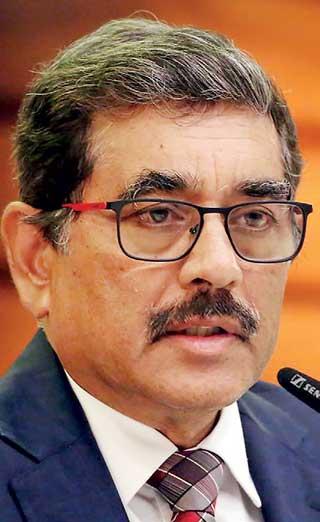
අරගලය දෙස ආපසු හැරී බලන කලාකරුවන් ගැන ජාතික සංවිධානවල ඇගයීමක්

December 7th, 2022

Lanka Lead News

ප්‍රවීන රංගන ශිල්පී ගිහාන් ප්‍රනාන්දු මහතා කලාකරුවෙක් ලෙස ඊනියා අරගලය ගැන ඉදිරිපත් කරන මතය පිළිබදව ලංකා ලීඩ් ජාතික සංවිධානවල මතය විමසන ලදී.

මේ වසන්ත බණ්ඩාර මහතාගේ අදහස් ඔහුගේ වචනයෙන්,

‘‘ගිහාන් සමග අපි සියයට සියයක්ම එකඟ වෙනවා. ජාතික සංවිධානවලට අරගලය ආරම්භයේදීම ඒ ගැන නිවැරැදි විග්‍රහයක් තිබුණා. ඒක වික්ටෝරියා නූලන්ඩ්ගේ පිටපතට අනුව රඟපාන නාට්‍යයක් බවට.

නීතිඥ සංගමයේ සහ ඇමරිකානු තානාපතිනිය ගෝඨාභය කියන දුප්පත් ජනාධිපතිවරයාව සහ ඔහුව පාවාදීම සදහා ආරක්ෂක හමුදාවට පැනවූ මානසික බාධකවල ශක්තිය අරගෙන පොඩි කොල්ලො කුරුට්ටො ටිකක් තමයි ඒක ආරම්භ කළේ. ඕනෑම සටනකින් පසු දේශපාලන වාසි ලබාගන්න බලන දේශපාලන බලවේග ඊට සෘජුවම හා වක්‍රව සහයෝගය ලබාදුන්නා. ඩයස්පෝරාව සහ ඉස්ලාම් අන්තවාදීන් අරමුදල් සහ බුරියානි දුන්නා.

කලාකාරයෝ කියන අහිංසකයෝ සහ ආණ්ඩුව කෙරෙහි කලකිරී සිටි අවංක තරුණ, තරුණියෝ ඊට සහාය දැක්වුවා නාට්‍යයේ පිටපත කාගෙද කියල දන්නෙ නැතුව. ජාතිකවාදී කියන දේශපාලන නායකයෝ පවා ඒ ‘‘හුජ්ජ කොල්ලන්ට‘‘ බයේ උන් කියපු විදිහට වැඩේ කළා. ඔවුන්ව කොතරම් පැටලිලාද කියනව නම් සමහරු සමාව ඉල්ලනවා ගෝඨාභය බලයට ගෙනල්ලා සජිත්ව පරද්දපු එක ගැන. නමුත් ඔවුන් ඇත්තටම සමාව ඉල්ලන්න ඕනෙ ඊනියා අරගලයට බයවෙලා රට අමාරුවේ දැමීම ගැන

China supports financial bodies on Sri Lanka debt talks: ministry

December 7th, 2022

Courtesy Global Times

China-aided nephrology hospital in Sri Lanka

China-aided nephrology hospital in Sri Lanka

China maintains good long-term cooperative relations with international financial institutions including the IMF and supports relevant financial institutions to properly negotiate and address debt issues with Sri Lanka, Chinese Foreign Ministry spokesperson Mao Ning said on Monday, in response to media reports about an IMF team’s visit to China this week to discuss debt restructuring for Sri Lanka.

We urge relevant countries and international financial institutions to work with China to continue playing an active role in helping Sri Lanka cope with its difficulties, help the country relieve debt burdens and achieve sustainable development,” Mao said, while noting that China has empathy with the difficulties and challenges faced by Sri Lanka.

According to a Reuters report on Thursday, IMF Managing Director KristalinaGeorgieva said that she will travel to Beijing this week with heads of other international institutions to discuss actions on debt relief for some developing countries. 

World Bank President David Malpass told the conference that he would join the discussions in Beijing, along with officials from the World Trade Organization, Organization for Economic Cooperation and Development and others, according to the report. 

On September 1, Sri Lanka reached an agreement with the IMF to obtain $2.9 billion over four years to help salvage the country from its worst economic crisis. 

According to an IMF statement, the agreement is contingent on the implementation by the authorities of prior actions, and on receiving financing assurances from Sri Lanka’s official creditors and making a good-faith effort to reach a collaborative agreement with private creditors.” 

In November, Sri Lanka postponed a round of debt restructuring talks, which officials said would give the country time to provide clarifications sought by its creditors. Sri Lanka has set a target of getting board-level IMF approval in December, another Reuters report said. 

Sri Lanka’s largest creditors are international financial organizations like the World Bank and the Asian Development Bank, and a substantial amount is also owed to other institutional investors from the West,  including those on Wall Street, Sri Lanka’s Ambassador to China PalithaKohona told the Global Times in a previous interview. Other creditors include Japan, China and India. Only about 10 percent of Sri Lanka’s external debt is owed to China.

Sri Lanka has defaulted on a massive amount of debt – over $56 billion, according to a Washington Post report, and many of the 22 million people in Sri Lanka have been left without daily necessities, fuel, food and medications.

The economy of Sri Lanka is expected to contract by 8.7 percent in 2022 and inflation recently exceeded 60 percent, according to IMF

Economic Support to Sri Lanka Not Based on Communal Approach: Jaishankar in Rajya Sabha

December 7th, 2022

Courtesy News18

On the issue of Palestine, Jaishankar said India stands for a two-state solution, with the two states living peacefully side-by-side (Image: YouTube/MEA)

On the issue of Palestine, Jaishankar said India stands for a two-state solution, with the two states living peacefully side-by-side (Image: YouTube/MEA)

The voting was on the UN Human Rights Council draft resolution on promoting, reconciliation, accountability and human rights in Sri Lanka

External Affairs Minister S Jaishankar on Wednesday justified the government’s support to Sri Lanka, saying India would be shirking its responsibility if it did not step forward to support a crisis-hit neighbour.

The economic support that India offered to Sri Lanka during its worst post-independence economic crisis was for the entire country and not based on any communal approach, he said.

On the issue of Palestine, he said India stands for a two-state solution, with the two states living peacefully side-by-side.

MDMK member Vaiko had sought explanation from the minister for India abstaining from voting on a draft resolution of the UN Human Rights Council on Sri Lanka in Geneva.

The voting was on the UN Human Rights Council draft resolution on promoting, reconciliation, accountability and human rights in Sri Lanka.

Vaiko said lakhs and lakhs of Tamils were killed, women were raped, children were killed and the then government in Sri Lanka gave weapons and still the Indian government is providing support to Sri Lanka.

In his response, the minister said India absenting from a vote against Sri Lanka in the UN Human Rights Commission was in accordance with the long-standing position — which was also followed by previous governments — that it is the most constructive way of addressing, advancing the interest of Tamil community in Sri Lanka.” That continues to be our approach,” he said.

On the support to the island nation, he said, We have given support to the entire Sri Lanka which also include the Tamil community.” We have not taken the communal approach in giving support,” he said. To have a neighbour in this kind of a serious economic situation, we would be shirking our responsibilities if we did not step forward at that moment and that is exactly what we have done.” In response to a question from AIADMK member M Thambidurai on the status of India-Sri Lanka agreement of 1987 which was signed to protect rights of Tamils, Jaishankar said the agreement has been the basis for changes in Sri Lanka, including provincial councils.

In our view, it is still an agreement that continues to remain the foundation of how both our relationship with Sri Lanka is conducted and how Sri Lanka itself looks at its own future. I would like to assure him that we continue to do it. It is very much on our radar. We are very, very supportive of it,” the minister said.

On the concerns of some members about India’s stand on the Palestine issue, he said New Delhi supports a two-state solution.

We want a two-state solution with the two states living peacefully side by side,” he said.

Some of the members suggested that our support or empathy for the Palestinians has changed. In fact, our financial support for the Palestinian refugee welfare agency has gone up in the tenure of this government.” BJD member Sujeet Kumar raised the matter of former Navy officers being in detention in Qatar for closed to 100 days on allegations of espionage.

Jaishankar said that it is a very sensitive case.

…because their interests are foremost in our minds, I can only say we have been seized of the matter. Our ambassador, senior officials have been in continuous touch with the Qatari Government on this. Our effort is obviously to ensure that they are not treated unfairly and that the sooner we can bring them back…so I can I assure you that they are very much, very, very strongly in our priorities in respect of Qatar,” the minister said.

CPI(M) member A A Rahim raised the issue of detention of 16 Indian sailors in Nigeria.

Jaishankar said the government has been in touch with the crew since August.

They are facing a number of charges in court. There are a number of charges including oil smuggling against them. We have given them consular support. Out High Commissioner has gone to see them. It is again our endeavour to ensure that they are not unjustly treated,” the minister said.

Sri Lanka lifts Covid-19 restrictions for overseas travellers

December 7th, 2022

Courtesy Hindustan Times

Travellers to Sri Lanka would be free of mandatory Covid-19 restrictions with the lifting of a circular issued in 2021, Asela Gunawardena, the Director General of Health Services said.

Sri Lanka on Wednesday decided to discontinue the Covid-19 vaccination certificate for travellers entering the island nation, officials said.

Travellers to Sri Lanka would be free of mandatory Covid-19 restrictions with the lifting of a circular issued in 2021, Asela Gunawardena, the Director General of Health Services said.

Accordingly, the mandatory requirement of producing the Covid-19 vaccination certificate to enter the country would be no longer needed with effect from Wednesday.

The mandatory regulation to produce a pre-boarding or on-arrival negative Covid-19 test (PCR/Rapid Antigen Test) (RAT) by any person arriving in Sri Lanka from overseas has also been removed from Wednesday.

Any foreigner who tests positive for Covid-19 after arriving in Sri Lanka will be required to isolate for a period of 7 days at a private hospital/hotel/place of residence.

Sri Lanka mandated the carrying of a negative Covid-19 test and proof of vaccination when it opened its borders to foreign arrivals amidst the Covid crisis in 2021.

Unilaterally terminating LRT project cost over Rs. 5 Bn to Sri Lanka: audit report.

December 7th, 2022

Courtesy Adaderana

Sri Lanka incurred a loss of staggering Rs. 5,978 million after the previous government unilaterally decided to terminate the Light Rail Transit (LRT) project funded by Japan, a report compiled by the National Audit Office revealed.

The project was initiated in 2016 with the aim of reducing the traffic congestion in the city of Colombo and to provide better public transportation facility to the commuters.

Plans were afoot to construct seven lines, covering several areas from Rail Transit System (RTS) 1-7 as Green, Yellow, Red, Purple, Pink, Olive and Grey. Out of these seven lines, RTS 1 (Green) and RTS 4 (Purple) had been planned to be constructed first.

However, according to an MoU pertaining to this project, it had been decided to consider RTS 1 line as a future project, by giving priority to RTS 4 line from Borella to Malabe.

These two lines had been planned to be constructed under six construction packages and the Japan International Cooperation Agency (JICA) had agreed to provide financial facilities under concessionary credit conditions and the Oriental Consultants Global Company of Japan had agreed to provide consultancy service in collaboration with several other companies.

JICA had provided the facility of paying the said loan during a period of 40 years including a grace period of 12 years and the annual interest rate thereon was 0.1 percent.

However, then-government under former President Gotabaya Rajapaksa unilaterally decided to terminate the LRT project in 2020. Approval was granted by the directive of former president and the Cabinet decision dates September 28, 2020 for the unilateral termination of activities of the project with immediate effect by the government of Sri Lanka, citing that this project as costly and not cost-effective.

According to the audit report, it was observed that termination of the loan agreement could result in damaging the mutual trust and confidence in transactions between Japan and Sri Lanka.

It was further observed that there was no proper understanding and agreement amongst relevant institutions relating to the termination of this project or the loan agreement.

If further action is not taken either to recommence the project by utilizing the results achieved from the expenditure of Rs. 5,977 million already incurred or to commence an alternative project, it was observed as an uneconomic expenditure incurred by the government of Sri Lanka, the report mentioned.

The claim of Rs.5,169 million relating to loss of profit, requested by the Oriental Consultants Global Company Limited which is the main consultancy company or the sum paid for the said request as well as the interest to be paid in future on delay of compensation or any other payment made, is definitely an uneconomic expenditure for the Government of Sri Lanka, the report read further.

It says that if the Oriental Consultants Global Company Limited – the consultancy company in this project – decides to present itself in international courts for arbitration, the Sri Lankan government would have to incur a high cost.

The report stresses that maximum effort should be made to convert the uneconomic nature of expenditure into economic nature by utilizing the unsettled commitments incurred and property vested already for the project or for an alternative program.

Further, effort should be made to reach an agreement necessary for maintaining the repayment of the disbursement of Rs.5,066 million obtained by December 2021 on prescribed concessionary rates even after terminating the loan agreement unilaterally and in making observations by the General Treasury relating to Cabinet Memoranda, it added.

Meanwhile, maximum effort should be made to give independent professional observations beyond extending support for decisions expected through said Memoranda, are several recommendations presented by the audit report.

Merchandise export earnings decline, trade deficit contracts in Oct. 2022

December 7th, 2022

Courtesy Adaderana

Earnings from merchandise exports declined in October 2022 – on a year-on-year basis – for the first time since March 2022 due to lower earnings from garments exports, the Central Bank of Sri Lanka (CBSL) says.

The decline in import expenditure continued in October 2022, (y-o-y), for the eighth consecutive month, despite recording an increase, compared to September 2022.

The merchandise trade deficit recorded a notable contraction in October 2022, compared to the previous year.

Meanwhile, the workers’ remittances steadied and earnings from tourism improved in October 2022, whereby earnings from tourism crossed over USD 1 bn during January-October 2022, while workers’ remittances reached about USD 3 bn from January to October 2022.

Foreign investment in the government securities market and the Colombo Stock Exchange (CSE) recorded a marginal net inflow during October 2022.

The central bank says it continued to provide forex requirement to finance essential imports, exhausting the liquid level of gross official reserves.

Meanwhile, the weighted average spot exchange rate in the interbank market remained around Rs. 363 per US dollar during the month.


Copyright © 2026 LankaWeb.com. All Rights Reserved. Powered by Wordpress