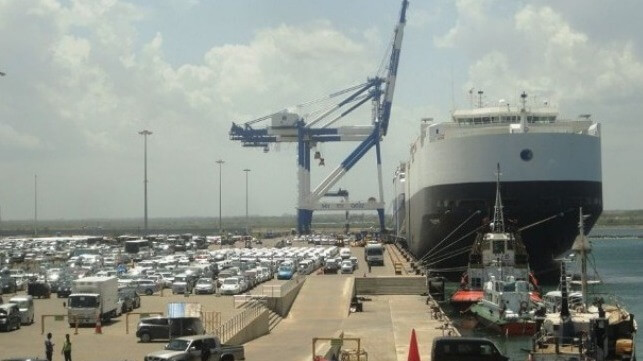
Urban poverty triples in Sri Lanka amid enduring crisis  

October 11th, 2022

Meera Srinivasan Courtesy The Hindu

A woman sitting by the fireplace at meal time in a shanty in Colombo in Sri Lanka on October 5.World Bank flags need for higher social security in the island  

As Sri Lankans continue braving their worst economic crisis since Independence, urban poverty on the island has tripled in the last year, from 5% to 15 %, according to a recent World Bank report.    

Sri Lanka is experiencing its highest poverty rate since 2009 [when the civil war ended], and an erosion of the steady gains in welfare made between 2006 and 2019,” the Bank noted in its recent Sri Lanka Development Update titled ‘Protecting the poor and vulnerable in a time of crisis’, released earlier this month.  

While 80% of Sri Lanka’s poor still live in rural areas, the poverty rate in urban areas has tripled since 2021, and half the population in estate areas is currently living below the poverty line, it said, referring to Sri Lanka’s hill country that is home to the island’s historically-neglected Malaiyaha Tamils. About 1.5 lakh people, mostly women, from the million-strong community work in the tea estates, bringing in crucial foreign exchange to the country.  They live in dire conditions, in colonial era line rooms, and labour hard to be paid their hard-won LKR 1000 daily wage (roughly ₹ 225). 

Also read: Sri Lanka’s Malaiyaha Tamils living in inhumane, degrading conditions: U.N. expert

Across districts, Mullaitivu in the Tamil-majority Northern Province continues to be the poorest — 57 % poverty recorded in 2022 — followed by neighbouring Kilinochchi and Nuwara Eliya in the Central Province [hill country], the report said.  

The update comes while Sri Lanka struggles to cope with a harrowing economic crash, that forced the government to default on its $50 billion foreign debt in April. The following months witnessed enormous shortages of essentials, including food staples, fuel and medicines, as well as an unprecedented people’s uprising that ousted former President Gotabaya Rajapaksa. Backed by a parliamentary vote, senior politician Ranil Wickremesinghe was elected President in July. While essential supplies have since improved, with the government’s fuel rationing policy and repurposed World Bank funds, the fundamental macroeconomic problems remain.

Headline inflation increased to 69.8% in September 2022, while food inflation spiked to 94.9%. Amid frequent local media reports of hunger and starvation, resulting in a rise in school dropouts in some areas, the World Food Programme and the UN’s Food and Agriculture Organization have assessed that nearly a third of Sri Lanka’s 22 million population are food insecure since the crisis hit.  

Emphasising that national security is ensured not only with the military, but also through food and economic security, President Wickremesinghe has called for urgent measures”, his office said on Tuesday, following a review meeting of the government’s ‘National Food Security and Nutrition Assurance Programme’. His government, while facing growing public criticism over inadequate action and repression, is counting on a $2.9 billion package from the International Monetary Fund (IMF), that will be released only after Sri Lanka’s creditors commit to a debt restructuring programme.  

Social security in focus

As part of its recommendations, the World Bank has urged the government to increase financing for social assistance; come up with a social protection strategy, that includes an operational Welfare Benefits Board and a Social Registry, to enable effective targeting of social security programmes, given the addition of newly poor” families. It has also called for an increase in cash transfers, to account for the double-digit inflation.  

Meanwhile, rights watchdog Amnesty International, in a report on the current economic situation in Sri Lanka released on October 4, made a case for universal social security that sections in Sri Lanka have also sought.

Highlighting limitations to existing programmes in Sri Lanka, Amnesty, in the report titled ‘We are near total breakdown’ pointed to the lack of sufficient funding, inadequacy of the level of benefits, poor targeting, and the exclusion of a large proportion of people due to administrative inadequacies.” The targeting of benefits based on levels of poverty has been criticised by experts for arbitrariness, excluding people who should be covered, stigmatising effects, and higher administrative costs,” the report said.  

Two Australians arrested for bribing Sri Lankan officials for lucrative contracts

October 11th, 2022

Courtesy Adaderana

Two Australian men have been charged with bribing Sri Lankan officials to secure infrastructure contracts worth millions of dollars.

Australian police arrested the pair last month after a decade-long investigation spanning several countries.

The men, aged 67 and 71, worked for a company which has been accused of misconduct in South Asian countries.

They are yet to respond to the charges and will face court on Tuesday.

The Australian Federal Police (AFP) say the men arranged bribes of more than A$ 304,000 ($ 190,000, £ 172,000) to government officials between 2009 and 2016.

The bribes were allegedly made in the pursuit of two Sri Lankan projects – which police did not name – worth A$ 14m.

The charges follow an investigation into SMEC International Pty Ltd, an Australian-based engineering firm, which involved authorities from the US, Canada, India and elsewhere.

More arrests and charges are possible, the AFP said.

Corruption undermines fair competition and can have disastrous consequences for developing economies, global anti-poverty and development efforts,” Detective Supt Helen Schneider said.

Originally known as the Snowy Mountains Engineering Corporation, SMEC was formed in 1949 to build an iconic Australian infrastructure project. It has since grown to employ 5,400 staff in many countries.

In 2017, the World Bank temporarily barred SMEC and four subsidiaries in India, Bangladesh and Sri Lanka from bidding for any of its contracts.

The World Bank said it had discovered evidence linking the company to suspected inappropriate payments” in Sri Lanka and Bangladesh.

At the time, a spokesperson for SMEC said the allegations did not relate to any Australian projects, and that the company would continue to strengthen its corporate integrity compliance programmes.

Protests have erupted in Sri Lanka this year over corruption allegations and the country’s worst economic crisis in history.


Source: BBC

Bond scam: Charges against Mahendran, Aloysius & other accused dropped

October 11th, 2022

Courtesy Adaderana

Colombo High Court Trial-at-Bar has accepted that charges cannot be maintained under the Public Properties Act against former Governor of the Central Bank of Sri Lanka (CBSL), Arjun Mahendran, Perpetual Treasuries Ltd, Arjun Aloysius and the other defendants over the case on Treasury Bond auction of 27 February 2015.

The order was issued by a two-thirds majority of the three-member High Court bench which consisted of Justices Sanjeewa Morayas, Damith Thotawatta and Namal Balalle.

President’s office strikes at Bandula, says SL will remain ’middle income’

October 11th, 2022

Courtesy The Daily Mirror

Contradicting Cabinet Spokesman Bandula Gunawardane, President’s Media Division (PMD) said Sri Lanka will remain a middle-income country.

The PMD said in a statment that the government is pursuing a “reverse graduation” policy for a limited period of time.

Cabinet Spokesman Bandula Gunawardane told the weekly Cabinet briefing this morning that the cabinet of ministers had approved a proposal to downgraded Sri Lanka from a middle income to low income status.

The immediate rectification by the President’s Office seems to show a rift between the Cabinet of Ministers and President Ranil Wickremesinghe.

Sri Lanka seeks ‘low income country’ status; move to ease financial support

October 11th, 2022

Courtesy WION

The Sri Lankan cabinet has approved a proposal to downgrade the country’s status from a middle-income country to a low-income country. The cabinet spokesperson says Sri Lankan GDP is expected to decline further and that this step was being taken to unlock more financial support from international institutions.

Sri Lanka’s status to be downgraded to ‘low-income country’

October 11th, 2022

Courtesy Adaderana

The Cabinet of Ministers has granted approval for the proposal to downgrade Sri Lanka’s status from a ‘middle-income country’ to a ‘low-income country’, the Cabinet Spokesman says.

Joining the Cabinet press meeting held today, Minister Bandula Gunawardene stated that Sri Lanka was declared a middle-income country in accordance with international classification, adding that foreign loan assistance cannot be obtained under concessional conditions when a country is internationally recognized as a middle-income country.

This classification is done according to the per capita income of the country, the minister explained while emphasizing that Sri Lanka’s per capita income dropped in recently along with the economic downturn.

If we refer to the history, during the period of 56 years from 1948 to 2004, the average economic growth rate of our country was less than 5 percent for more than a century.”

At the time of the independence, the per capita income of the country was USD 120 and it took 56 years to reach USD 1,000 mark, he added.

Minister Bandula Gunawardena, who mentioned that especially with the end of the civil war and the conflicts in the northern and eastern parts of the country, economic activities were expanded to a larger extent, further stated that thereafter, there was an awakening in the mass production process.

As a result, by 2014, when the per capita income reached USD 3,827, Sri Lanka got out of the ‘low-income’ classification and joined the ‘middle-income’ status. In 2017, it was USD 4,074, in 2018 it decreased to USD 4,057 and in 2019 it further dropped to USD 3,848. In 2020, it was USD 3,695 and USD 3,815 in the year 2021.”

Since this per capita income is expected to continue to drop in 2022, the international organizations have informed the Minister of Finance that in order to facilitate the intervention of the international organizations in obtaining concessional loan assistance during this difficult time, the country should be classified as a ‘low-income country’ again, he explained further.

Ready to intervene at any time to ensure food, economic security – President

October 11th, 2022

Courtesy Adaderana

A country’s security is not only ensured militarily but is also secured through food and economic security, President Ranil Wickremesinghe has emphasized.

The President said this during the progress review meeting of the National Food Security and Nutrition Assurance Program held at the Presidential Secretariat last morning (11).

Emphasizing that urgent measures should be taken to provide the country with fuel and food, the President said that if necessary, he could intervene through state security regulations.

The President also noted that if the implementation of the food security and nutrition assurance program is hampered due to the collapse of the state machinery, he is ready to intervene at any moment to resolve these issues.

President Ranil Wickremesinghe also pointed out the need to modernize agriculture and enact legislation on food security through this program.

The multi-sectoral joint mechanism to empower rural economic revitalization centres to ensure food security and nutrition was recently implemented across the island under the theme No citizen should be allowed to starve due to the lack of food”, on the directives of President Ranil Wickremesinghe.

Also, the progress of the program at the district level was examined during this discussion and it was stated that rural economic revitalization committees have been established at the village level in all districts and programs have been initiated to ensure food security and nutrition.

Discussions also centred on the issues that could arise during the cultivation process in the relevant districts, while special attention was placed on the supply of fertilizer, land issues, unavailability of seeds and the crop damage caused by wild animals.

President Ranil Wickremesinghe stated that measures have been taken to solve these problems in consultation with the relevant institutions and instructed the authorities to expedite the process of resolving the issues that further remain to be resolved.

Having paid attention to the progress presented by the district secretaries about the implementation of the program in each district the President informed the officials to identify separately the crop cultivations done at the rural level to create food security and to identify the areas suffering from food shortages and submit a report on the matter immediately.

Based on this information, the President also directed the officials to implement a food bank and community kitchen programs to cover every district under the leadership of the District Secretaries.

Further, the President instructed the relevant departments to continue implementing this program until 2023, mustering the contribution of all the government officials, armed forces, civil defence force, government and non-governmental organizations, to ensure the nutritional needs of the people and to prepare for the world economic crisis that may occur in the future, through this programme.
The President further stated that after 03 weeks, a report on the progress of this program should be sent to the Cabinet every week.

Speaking at this discussion, Prime Minister Dinesh Gunawardena pointed out the need to speed up the provision of land for new cultivators and follow a formal system for it.

He also noted that the upcoming rainy season is conducive to cultivation and highlighted the importance of educating the people at the rural level on engaging in agricultural activities without delay.

Cabinet and State Ministers including Prime Minister Dinesh Gunawardena, Senior Advisor to the President on National Security and Chief Staff of the President Sagala Ratnayake, Secretary to the President Saman Ekanayake, Senior Advisor to the President on Food Safety Dr Suren Batagoda and government officials including Secretaries of the line Ministries and District Secretaries participated in this discussion.


-PMD

UNDP says 54 countries including Sri Lanka need immediate debt relief

October 11th, 2022

Courtesy Adaderana

The United Nations’ Development Programme (UNDP) joined on Tuesday the chorus of institutions and charities warning that a serious debt crisis is now taking hold in the poorest parts of the world.

In a new report, the UNDP estimated that 54 countries, accounting for more than half of the world’s poorest people, now needed immediate debt relief to avoid even more extreme poverty and give them a chance of dealing with climate change.

A serious debt crisis is unfolding across developing economies, and the likelihood of a worsening outlook is high,” the report published on Tuesday said.

The warning comes as the International Monetary Fund and World Bank hold meetings in Washington this week amid rising global recession worries and a crop of debt crises from Sri Lanka and Pakistan to Chad, Ethiopia and Zambia.

Achim Steiner, UNDP administrator, urged a string of measures, including writing off debt, offering wider relief to greater numbers of countries and even adding special clauses to bond contracts to provide breathing space during crises.

It is urgent for us to step up and find ways in which we can deal with these issues before they become at least less manageable and perhaps unmanageable,” he told reporters.

Without effective debt restructuring, poverty will rise and desperately needed investments in climate adaptation and mitigation will not happen.

The UNDP’s report also called for a recalibration of the G20-led Common Framework – the plan designed to help countries pushed into financial trouble by COVID-19 pandemic restructure debt. Only Chad, Ethiopia and Zambia have used it so far.

It is urgent for us to step up and find ways in which we can deal with these issues before they become at least less manageable and perhaps unmanageable,” he told reporters.

Without effective debt restructuring, poverty will rise and desperately needed investments in climate adaptation and mitigation will not happen.

The UNDP’s report also called for a recalibration of the G20-led Common Framework – the plan designed to help countries pushed into financial trouble by COVID-19 pandemic restructure debt. Only Chad, Ethiopia and Zambia have used it so far.

Its proposal was to expand the Common Framework’s eligibility so that all heavily indebted countries could utilise it rather just the 70 or so poorest countries, and for any debt payments to be automatically suspended during the process.

Both will act as an incentive for creditors to participate and to maintain a reasonable timeline, and it could also remove some of the hesitancy caused by rating fears for debtor countries,” the report said.

It also recommended creditors should have a legal duty to cooperate in good faith” in a Common Framework restructurings and that countries could offer to take eco-friendly measures to encourage creditors to write their down debt.

It makes a lot of sense,” the report said. Not only have these countries contributed the least to, but bear the highest cost of, climate change”.


Source: Reuters

Time to identify our friends and enemies

October 10th, 2022

Sangadasa Akurugoda

Sri Lanka is facing an unprecedented economic crisis, since independence, due to the depletion of foreign exchange reserves. Meanwhile, the Resolution against Sri Lanka titled ‘Promoting reconciliation, accountability and human rights in Sri Lanka’ was passed at the UNHCR few days ago.  The resolution against Sri Lanka, as usual, was proposed by a group of states comprising the so-called Core Group on Sri Lanka (UK, US, Canada Germany etc) and introduced by the UK Ambassador to UNHCR, Rita French. The countries voted for the resolution are well known pro-western countries while the counties voted against the resolution (especially China and Pakistan) are well known for supporting us whenever we are in trouble. 

At many times in our history, the sovereignty and independence of our motherland has been damaged due to foreign interference. We remember very well how separatist terrorism grew due to the intervention of India, Norway and same group   of the western countries (today appearing as ‘Core Group on Sri Lanka’}  in the most recent era and how it became a curse for the country for thirty years. Instead of helping the Sri Lankan government to eradicate terrorism the western countries then appeared as donor countries / Co-chairs ’ and almost forced the then government to bow down to the conditions laid down by the terrorist group, since we were made to dependent economically on those neo colonialists.  What would have been the situation in the country today, if the country continued to follow the CFA (Cease Fire Agreement) signed in 2002 and the P-TOMS (Post-Tsunami Operational Management Structure) signed 2005 as advised by the so-called Co-Chairs, instead of eradicating terrorism militarily under the right political leadership in 2009?   Thus the basic question is whether there is any difference between what these westerners were doing in the past and what they are doing now exploiting the country’s economic crisis.


Thus the eradication of terrorism militarily, no doubt, was of ‘grave concern’ to some countries (including those who trained and armed the racial groups at the very beginning), who are interested in maintaining their ‘superiority’ over the others. On the other hand, the eradication of terrorism also caused tremendous hardship to the political wings of the militarily eliminated LTTE, the TNA and the GTF, the politicians who signed pacts with the terrorist leader and promoted so-called political solutions for three decades, and the NGOs. They were exploring every possible political avenue, by any means necessary, to install a puppet regime to achieve their goals.

Apart from being in the midst of immense economic hardship, patriotic goals of the people who elected a President with a remarkable mandate of 6.9 million during the last Presidential election are also unexpectedly facing many obstacles and challenges. By hook or crook, the President elected by the people’s vote is no more and he was replaced by a Parliamentarian completely rejected by the people during the last Parliamentary election, but elected through Parliamentary votes!

 It is apparent now, that the country is moving fast towards its foreign policies prior to 1956 and moving away from the countries that helped us economically and politically in many ways since then. We were under foreign powers for centuries due to the acts of saboteurs and traitors. Throughout our history, invaders manipulate public opinion to retain power more than artilleries. Portuguese, Dutch and British invaders used the above weapons with the enormous support from power-hungry segments of society.

The West won the world not by superiority of its ideas or values or religion but rather by its superiority in applying organised violence. Westerners often forget this fact, non Westerners never do.‘ British Duplicity in ‘The PROTECTION OF HUMAN RIGHTS in Sri Lanka’ (http://archives.dailynews.lk/2013/04/04/fea01.asp ) The Uva Wellassa region where thousands of our forefathers laid down their lives for the liberation of the country from the clutches of British imperialism is one of the example in our history where the he British rulers massacred thousands of Sinhala youth and a mass exodus of people continued from the area as the irrigation tanks and the property of the people were destroyed by the British rulers after the 1818 rebellion.

Unless we are fully aware of what is going on, and act wisely to defeat the sinister motives of those enemies, the much awaited peace, stability and progress of our country, prior to last Presidential election, will be at stake.


අරගලයට ළමුන් ගෙනවිල්ලා හියුමන් ශීල්ඩ් එකක් ලෙස භාවිතා කරන එක

October 10th, 2022

Dr Ruwan M Jayatunge M.D.

අරගලයට ළමුන් ගෙනවිල්ලා හියුමන් ශීල්ඩ් එකක් ලෙස භාවිතා කරන එක වැරදියි. ඒක තමයි ප්‍රභාකරනුත් කලේ .

ලංකාවේ ළමා සොල්දාදුවන් මුලින්ම ඇති කලේ රෝහණ විජේවීර විසිනි. 1971 දී ළමා සොල්දාදුවන් හඳුන්වන ලද්දේ රතු ගැටවු ලෙසටය. 1971 කැරැල්ලේදී සමහර රතු ගැටවු නොහොත් ළමා සොල්දාදුවන් මිනිස් ඝාතන පවා කරන ලදි. 1988 / 1989 ජවිපෙ දෙවන කැරැල්ලේදීද ළමා සොල්දාදුවන් මගින් මිනී මැරවීම, බස් , රජයේ ගොඩනැගිලි ගිනි තැබ්බවීම කරවන ලදි. ළමා සොල්දාදුවන් බහුල වශයෙන් භාවිතා කරන ලද්දේ වේලුපිල්ලේ ප්‍රභාකරන් විසිනි. ඔහු බේබි බ්‍රිගේඩ් නම් ළමා සොල්දාදුවන් බළකායක් පිහිටුවන ලදි. ළමා සොල්දාදුවන් අත් විඳින ක්‍ෂිතමය යුද අත්දැකීම් නිසා ඔවුන් ගේ මනසට වන දුර්විපාක ගැන අළලා මනෝ වෛද්‍ය මහාචාර්‍ය දයා සෝමසුන්දරම් සමග මා විසින් ලියන ලිපියක් පහත දැක්වේ. මෙම පත්‍රිකාව මුලින්ම පළ වූයේ කේම්බ්‍රිජ් විශ්ව විද්‍යාලයේ මනෝ විද්‍යා ජර්නලයකය  Read;  https://www.cambridge.org/core/books/abs/essentials-of-global-mental-health/child-soldiers/C868557CA43324AB571DDF9E3DD54F06

Child soldiers (Chapter 23) - Essentials of Global Mental Health

CAMBRIDGE.ORG

රජයේ ඉඩම් ගොවීන්ට  වගා කිරීමට ලබා දීමේදී  කිසිම රජයේ  නිලධාරියෙකු එයට හරස් විය යුතු නැහැ.-අග්‍රාමාත්‍ය දිනේෂ් ගුණවර්ධන

October 10th, 2022

අග්‍රාමාත්‍ය මාධ්‍ය අංශය

රජයේ ඉඩම්  විවිධ චක්‍රලේඛප්‍රකාරව වගා කිරීම සඳහා ගම්වල ගොවීන්ට  ලබා දීමට  රජය නියෝග කර ඇති බැවින් කිසිම රජයේ  නිලධාරියෙකු එයට හරස් නොවිය යුතු බව අග්‍රාමාත්‍ය දිනේෂ් ගුණවර්ධන  මහතා අවධාරණය කරයි.
හෝමාගම කඳනවත්ත ප්‍රදේශයේ ගොවී, කාන්තා සංවිධාන සහ ස්වේච්චා සංවිධාන වෙත 2022.10.10 දිනේෂ් ගුණවර්ධන මහතා සහ යදාමිණී ගුණවර්ධන මහතාගේ  පාර්ලිමේන්තු විමධ්‍යගත අරමුදලෙන් භාණ්ඩ බෙදා දීමේ අවස්ථාවේදී  අග්‍රාමාත්‍යවරයා මේ බව සඳහන් කළේය.
එහිදී වැඩිදුරටත් අදහස් දැක්වූ අග්‍රාමාත්‍ය දිනේෂ් ගුණවර්ධන මහතා –
 අපි ආර්ථික වශයෙන් මුහුණ දෙන්නෙ ගැටලු සහගත කාලයකටයි. ඊට මුහුණ දීමට අප සියලු දෙනා අත්වැල් බැඳගෙන කටයුතු කළ යුතුයි. පළමුවෙන් තිබෙන සටන ආහාර අතින් ස්වයංපෝෂිත තත්වයන් ඇතිකර ගැනීමයි. ගමින් ගමට හැම දෙයක්ම නිෂ්පාදනය කරන්න බැරි උනත් රට ආහාර අතින් ස්වයංපෝෂිත භාවයට ගෙන එන්න ජීවත් වෙන අයගේ එකමුතුවට පුළුවන්කම තිබෙනවා.
මේ ප්‍රදේශ විශේෂයෙන් ගොවිතැන් බත් කරපු ප්‍රදේශ. විශාල භූමි භාගයන් එසේ කළේ නැති වුණත්  ප්‍රමාණික ව ඒ කටයුතුවලට එකතු වෙලා කාන්තා ගොවි සංවිධාන  සහ අනෙකුත්  ගොවි සංවිධාන විශාල උනන්දුවක් ඒ පිළිබඳව දැක්වූවා.ඒ ගැන රජය විශාල විශ්වාසයක් ඔබ කෙරෙහි තබා තිබෙනවා. ඒ විශ්වාසයට ලබාදිය හැකි සෑම සහයෝගයක් ම ලබා දීමට    රජය බැඳී සිටිනවා.ජාතික පුනර්ජීවනය සඳහා ගමින් ගමට වැඩසටහන ග්‍රාම සේවා කොට්ටාශ දහහතර දහස් දෙසීයක ක්‍රියාත්මක කෙරෙනවා. ලංකාවේ කෘෂි බෝග නිෂ්පාදනය ඒ සමගම විවිධ අත්කම් හා කුඩා කර්මාන්ත කරන අයට ශක්තිය දෙන්න අපි කටයුතු කළා. විශේෂයෙන් ගොවි  ජනතාව හා බැඳුණු සියලු  ජනතාවගෙන් අපි ඉල්ලා සිටින්නේ මේ කර්තව්‍යයට ඔබ සැමගේ සහයෝගය දිය හැකි ප්‍රමාණයන්ගෙන් දායක වෙන්න කියලා.
 මේ ප්‍රශ්නය අප ජය ගත යුතුමයි. ඒ ජයග්‍රහණ නිලධාරීන්ට තනියම ගන්න බැහැ. ජයග්‍රහණය කරන්න වෙන්නේ මහජන සංවිධාන සිවිල් සංවිධාන කාන්තා පාර්ශවය සියලු දෙනා එකතු වුණොත් පමණයි. මේ රටේ හොඳ භූමියක් තියෙනවා. ඕනම දෙයක් වැව්වොත් මාස හය හතකින් ඵලදාව නෙළා ගන්න පුළුවන්.
ඒ වෙනුවෙන් අපි උනන්දු වෙලා සහයෝගය දීලා අදාළ නිලධාරින්ට  සහාය වෙලා වෙලා කටයුතු කළ යුතුයි.
එහිදී අදහස් දැක්වූ පාර්ලිමේන්තු මන්ත්‍රී යදාමිණී ගුණවර්ධන මහතා –
කැළණිවැලි දුම්රිය මාර්ගය ඉලක්ක සහගත ලෙස වැඩි දියුනු කිරීම කළ යුතුයි. කැළණිවැලිය ප්‍රධාන දුම්රිය මාර්ගයක්. කැළණිවැලි දුම්රිය මාර්ගය මීට වඩා පහසුකම් සහිතව සකස් කරන්න අපිට පුළුවන් වුනොත් ලක්ෂ ගණන් වියදම් කරලා පිටරටින් ගෙන තෙල් ටිකට වැය කරන මුදල අපට ඉතුරු කරගන්න පුලුවන්. ඒක අනාගත පරපුර වෙනුවෙන්  ආයෝජනය කරන්නත් පුළුවන්.
මීට වසර දහයකට පෙර මෙම ප්‍රදේශයේ පිරිසුදු පානීය ජලය පිළිබඳ විශාල ප්‍රශ්නයක් තිබුණා. අග්‍රාමාත්‍ය දිනේෂ් ගුණවර්ධන මහතා නාගරික සංවර්ධන අමාත්‍යවරයා  හැටියට එදා  පිටිපන ප්‍රදේශයේ දැවැන්ත සංවර්ධන කාර්යයක් ආරම්භ කළා. එහිදී පාසල් ඇතුළු රජයේ ආයතන රාශියක් ගෙන්වා ලංකාවේ කේන්ද්‍රීය සංවර්ධන භූමියක් මේ ප්‍රදේශය අවට සංවිධානය කර එම ප්‍රදේශයට ඇදී එන මහ ජනතාවට අවශ්‍ය මූලික පහසුකම වූ පානීය ජල පහසුකම  පිළිබඳව අවධානය යොමු කළා.
   ලංකාවේ ප්‍රධානතම විශ්ව විද්‍යාලයක් වන පාලි හා බෞද්ධ විශ්ව විද්‍යාලය පිටිපන ප්‍රදේශයට ගෙන ආවා. පසුව හරිත විශ්වවිද්‍යාලය ඇතුළු විශ්වවිද්‍යාල පද්ධතියක් එදා මේ ප්‍රදේශයට ගෙන ඒමට අවශ්‍ය සැලසුම් සකස් වුණේත්  අග්‍රාමාත්‍යවරයා උසස් අධ්‍යාපන අමාත්‍යවරයා ලෙසයි.
 . කලටුවාව ලබුගම හරහා කොළඹට නල මගින් ජලය ගෙන ගියත් මේ ප්‍ර දේශවලට නල එළීමක් සිදුවුණේ නැහැ. අග්‍රාමාත්‍යවරයා එදා  ජල සම්පාදන අමාත්‍යවරයා හැටියට මීට අවුරුදු දහයකට පෙර ඉංජිනේරුවරුන්ට කිව්වා ඒ  නළ විදලා  මේ ප්‍රදේශයට  ජල නළ එලන්න කියලා. එහෙම තමයි ඔබේ ගෙවල් වලට නළ ජලය ලබා දුන්නේ. අද දහ පහළොස් ගුණයකින් මේ ඉඩම්වල වටිනාකම වැඩිවෙලා. ජල සම්පාදන අමාත්‍යවරයා හැටියට අග්‍රාමාත්‍යවරයා ඔබට ලබාදුන්නු විශාලතම දායාදය තමයි ඒ විදියට සෑම බිම් අඟලකම වටිනාකම දහ පහළොස් ගුණයකින් වැඩිකර දීම. ප්‍රදේශයේ ජනතාවට වෙනුවෙන් සිදුකළ ඒ සංවර්ධන ජයග්‍රහණයක්.
මෙම අවස්ථාවට හෝමාගම ප්‍රාදේශීය සභා මන්ත්‍රී වරුන් වන  විකුම් කිත්සිරි, කමල් චන්දන,  රංජිත් හේවාවසම් ඇතුළු  ස්වේච්ඡා සංවිදාන නියෝජිතයින්  සහභාගි වූහ.


ලලිත්  රෝහණ ලියනගේ
අග්‍රාමාත්‍ය මාධ්‍ය ලේකම්

ඡන්දයට සුදානම් ද? ප්‍රතිසංස්කරණ පරාද ද?

October 10th, 2022

රජිත් කීර්ති තෙන්නකෝන් හිටපු ආණ්ඩුකාර හා ප්‍රජා කටයුතු පිළිබඳ ජනාධිපති අධ්‍යක්ෂ ජෙනරාල් 

පොහොට්ටුවේ කළුතර රැළිය 22 වන ආණ්ඩුක්‍රම ව්‍යවස්ථා සංශෝධනයට ප්‍රතිචාර දැක්වීමකි.  22 සංශෝධනය විසින් ලංකාවේ පක්ෂ දේශපාලනය උණුසුම් කර ඇති ප්‍රමාණයේ පිළිබිඹුවකි.

පක්ෂ නායකවරුන් ගේ රැස්වීමේ දී 22 සංශෝධනයට කමිටු අවස්ථාවේ සංශෝධන ඉදිරිපත් කිරීම පිළිබඳ නීතිපතිවරයා සහ පාර්ලිමේන්තු මහ ලේකම්වරයා මත දෙකක් දැරුවෝය.  මෙවැන්නක් ගැන පාර්ලිමේන්තුවට පූර්වාදර්ශ තිබුණේ ද නැත. ශ්‍රේෂ්ඨාධිකරණ තීන්දුව හා නඩු සටහන් අනුව, වසර 2 ½ කින් ජනපතිවරයාට (රනිල්ට) පාර්ලිමේන්තුව විසිරුවා හැරිය බවත්, එය වෙනස් කිරීමට (වසර 4  ½ දක්වා වැඩි කිරීමට) නොහැකි බවත් නීතිපති හෙළි කළේය. පොහොට්ටුව, ඩලස් කණ්ඩායම, විමල් කණ්ඩායම, අනුර ප්‍රියදර්ශන කණ්ඩායමේ අභිලාශය වූවේ වසර 4 ක් හෝ වසර 4 ½ ක් යන තුරු ඡන්දය කල් දමා ගැනීම ය. තව මාස 6 කින්, ජනාධිපතිවරයාට තමන් කැමති ඕනෑම වෙළාවක පාර්ලිමේන්තුව විසිරුවා හැරිය හැකිය. 

සජබ හා ජවිපෙ සතුට

වහා මහා මැතිවරණයක් ඉල්ලන්නේ සජබ සහ ජවිපෙ යි. සජබට ඇත්තේ මන්ත්‍රී ධූර 38 කි. විපක්ෂයේ හවුල් පක්ෂ සමඟ ඡන්ද 49 යි.  පොහොට්ටුවේ සහ විමල්, ඩලස්, අනුර ප්‍රියදර්ශන, ශ්‍රීලනිප කණ්ඩායම්වල සහාය නැතිව පාර්ලිමේන්තුව විසිරුවා හැරීමේ යෝජනාවක් සම්මත කරන්නට විපක්ෂ නායක/ජ.වි.පෙ.ට  නොහැකිය.! දැන් විපක්ෂයේ ද ඉරණම ඇත්තේ ජනපති අතේය.

මාර්තුවල පාර්ලිමේන්තුව විසිරුවා හැරීමේ බලය ජනාධිපතිවරයාට ලැබීම ගැන පක්ෂ දෙකම සතුටුය.  සජබ බහුතරයකගේ මතය පක්ෂ දෙක එක්විය යුතු බවය.  ‘රනිල් එක්ක අපට ආණ්ඩු කළ හැකියි‘ ඔවුහු කියති.

ජනපති බලය අඩු කරන්නේ නැතුව වුවත් හෝ ඡන්දයකට යන්නට පවා ඔවුන් කැමති ය. අගමැති කැබිනට් මණ්ඩලය පත් කිරීමේ අද පවතින පරම බලය ජනපති රනිල් අත තිබිය දී පවා ඡන්දයට සජබ කැමතිය. ඒ නිසාම ඔවුන් දැන් රනිල් ජනාධිපතිවරයා දැඩි ලෙස විවේචනය කරන්නේ නැත. පාර්ලිමේන්තුවට ගෙන ආ රාජාසන කතාව, අයවැය, 22 සංශෝධනය වැනි කිසිදු යෝජනාවලට විරුද්ධ  වූවේ ද නැත. සාධනීය විවේචණයකින් ඔබ්බට යන්නේම නැත.  ආණ්ඩුව ලබාදුන් මුදල්, කෝපා ඇතුළු කමිටු සියල්ල නිතරඟයෙන් බාර ගත්තෝය.  තවම විපක්ෂයේ බව පෙන්වන්නට ‘කෝප් ඡන්දය‘ වැනි කෘතීම අවස්ථා නිර්මාණය කර පරාජය වන්නේය.

ද්‍රවිඩ ජාතික සන්ධානයේ සුමන්දිරන් සහ ශානක්‍යන් ගේ දැඩි විවේචන පවා අඩුවී ඇත.   ද්‍රවිඩ ජාතික සන්ධානයේ නිල මතය ආණ්ඩුවට ආර්ථික ප්‍රශ්නය විසඳන්නට ඉඩ දිය යුතු බවය.  ඡන්දයක් ඔවුන්ට ඕනෑ නැත. ඡන්දකට ගියත් ප්‍රශ්නයක් ද නැත.

ඡන්දයකට යාම ඩලස් (13), විමල් (13), අනුර ප්‍රියදර්ශන (6) ට මාර්තු මැතිවරණයක් අතිශයින් අවාසිදායක ය.  ප්‍රධාන පක්ෂ තුන (සජබ, එජාප, පොහොට්ටුව) සමඟ සන්ධාන ගත නොවන්නේ නම් ඔවුන්ට අනිවාර්යයෙන්ම ශ්‍රීලනිප සමඟ හෝ සන්ධාගතවීමට සිදුවන්නේ ය.  තනිව තරඟ කර දිස්ත්‍රික් ආසන ජය ගත නොහැකි බව රහසක් නොවේ.

අරගලය ඇරඹීමට පෙර ජවිපෙ ට තිබුණු කැමැත්ත රට පුරා ගිණි තැබීම් මාලාව සමඟ ආපහු හැරී ඇත.  නාගරිකයේ ඔවුන්ගේ ජයප්‍රියත්වය ඉහළය.  ජවිපෙ 2004 පාර්ලිමේන්තුවේ ආසන 31 ක් ලැබීය. පළාත් සභාවේ ආසන 81 ක් දිනුවේය.  ජවිපෙ – පෙරටුගාමී බෙදීම නිසා එදා ජවිපෙට තිබූ බලය අද තිබේද? නැත!

රත්නපුර, කළුතර, කුරුණෑගල, මොණරාගල, හම්බන්තොට, අනුරාධපුර, පොළොන්නරුව, මාතර, ගාල්ල පොහොට්ටුව සතු බලය අවතක්සේරු කළ නොහැකිය.  මාතලේ, මහනුවර, බදුල්ල, පුත්තලම, කෑගල්ල දිස්ත්‍රික්කවල සිංහල බහුතර ඡන්දදායකයින් සංඛ්‍යාවක් සිටින ආසන කිහිපයේ ද තත්වය එයම වේ.

ජවිපෙ හා පෙරටුගාමීන් ගේ බෙදීම ජවිපෙ හි පාර්ලිමේන්තු ආසන සංඛ්‍යාව සීමා කළේ යම් ලෙසක ද, 2020 දී එජාප – සජබ බෙදීම නිසා එයම සිදු විය. පාරම්පරික එජාප පාක්ෂිකයා ලක්ෂ 12 ක් ඡන්ද පොළට ගියේ නැත. සජබ ඉදිරි මැතිවරණයක දී තනි විශාලතම පක්ෂය විය හැකි යැයි ඔවුන් සිතන බව සන්දර්භයකදී වුව ද, සජබ ට පාර්ලිමේන්තුවේ සරළ බහුතරය (ආසන 113 ක්) පහසු නැති බව ඔවුහු දනිති.

මේ සියල්ල කියන්නේ මාස 6 කින් පසුව ඕනෑම මොහොතක එළැඹෙන මැතිවරණයක දී කිසිදු පක්ෂයකට බහුතර බලය හිමි නොවන බව ය.

තරුණ නියෝජනය කෝ?

වත්මන් පාර්ලිමේන්තුවේ තරුණ නියෝජනය 13% කි.  නවක මන්ත්‍රීවරුන් 79 ක් 2020 පාර්ලිමේන්තුවට ආවේය.  අවු. 25-30 මන්ත්‍රීවරුන් ඇත්තේ 5 ක් පමණී. ඡන්දයෙන් පත් වූ 196 න් 142 ක් ම වයස 60 ට අඩු නමුත්,  මිනිසුන්ට පෙනෙන්නේ මෙය නාකි පාර්ලිමේන්තුවක් ලෙස ය. වයස 80 ට වැඩි සම්බන්ධන්, වාසුදේව හා විග්නේෂ්වරන් ගැන හැමෝම කථා කරති. 70 ට වැඩි ජනපති, අගමැති, හිටපු ජනපති ගැන කතා කරති. නමුත්, කිසිවෙකුට තරුණයින් පාර්ලිමේන්තුවට ගෙනන ක්‍රමයක් ගැන අදහසක් හෝ වැඩපිළිවෙලක් නැත.

1981 දිස්ත්‍රික් සංවර්ධන සභාවෙන් රංජිත් මද්දුම බණ්ඩාර, ඉම්තියාස් බාකීර් මාකර්, මර්වින් ජේ කුරේ,  උපාලි පියසෝම, ජස්ටින් ගලප්පත්ති, ගුණපාල තිස්සකුට්ටිආරච්චි, සුරනිමල රාජපක්ෂ තරුණයින් පාර්ලිමේන්තු ආවේය.  තරුණ කෝටාව යටතේ පලාත් පාලනයෙන් දේශපාලන ඇරඹී මහින්ද අමරවීර,  නිශාන්ත පෙරේරා, සහන් ප්‍රදීප්, සම්පත් අතුකෝරල,  අජිත් රාජපක්ෂ, විරසුමන වීරසිංහ, අගලවත්ත මංජු, චාමර සම්පත් දසනායක, ශාන්ත බණ්ඩාර, අශෝක ප්‍රියන්ත ඇතුළු 20 කට වැඩි සංඛ්‍යාවක් පාර්ලිමේන්තු ආවෝය. තරුණ කෝටාව නොවන්නට මේ කිසිවෙකුත් පාර්ලිමේන්තු එන්නේ නැත. 

තරුණයින් හා කාන්තාවන්ට ඊලඟ ඡන්දයට පෙර දොර විවර කළ යුතුය. ආංශික අධීක්ෂණ කාරක සභා හෝ ජන සභා හෝ පළාත් පාලනය හරහා හෝ තරුණයින් දේශපාලනයට ගෙන්වා නොගන්නේ නම් ඊලඟ පාර්ලිමේන්තුවටත් ‘නාකි පාර්ලිමේන්තුව‘ යැයි බැන බැන සිටින්නට සිදු වනු ඇත.     

සජබ-එජාප වෙන්ව තරඟ කරන්නේ නම් එජාප පාක්ෂිකයින් ඡන්දපොළට එන්නේ නැත.  එජාප සුළු ජාතික ඡන්ද පදනම ද අද සජබට නැත. එය වක්‍රව පොහොට්ටුවට වාසි සහගත ලෙස පසුගිය ජනපතිවරණයේ ද, මහා මැතිවරණයේ ද හැසිරෙනු ලැබීය.  පළාත් පාලන ඡන්දයක බලය සජබ/එජාප කඳවුරට ගැනීමට නම් කුඩා පක්ෂ තමන්ට වටා ගොනු කර ගත යුතුය.    

ජවිපෙ කොයිබටද?

නාගරික මධ්‍ය පන්තිය ජවිපෙ ට යම් ආකර්ෂණයක් ඇතත් ඔවුන්ගේ ඡන්ද පදනම ගොවි, ධීවර, හා අව වරප්‍රසාදිත කණ්ඩායම් හි ආකර්ෂනය තවමත් ඔවුන්ට නැ.  2004 දී මෙන් පාර්ලිමේන්තු ආසන 41 ක්, පළාත් සභා ආසන 81 ක් ලබා ගැනීම පහසු නැත. පාර්ලිමේන්තුව වට කිරීමට ජනතාව කැඳවීම සහ මැයි 9 රට පුරා සිදු වූ ගිණි තැබීම්  ද,

දෙවන අරගලයට නායකත්වය දීමේ කතාව ද විසින් නාගරික මැද පන්තිය හේතු ඇතිව හෝ නැතිව ජවිපෙ න් තාවකාලිකව නමුත් දුරස්ථව ඇත. එජාප – සජබ බෙදීම සේම ජවිපෙ – පෙරටුගාමී බෙදීම ඔවුන්ගේ සංවිධාන ශක්තිය හා ජීව ගුණය පහත දමා ඇත.

ප්‍රතිසංස්කරණ ව්‍යාපාරය

ජනපති බලය අඩු කිරීම, ස්වාධීන කොමිෂන් සභා නැවත පිහිටුවීම, ප්‍රසම්පාදන කොමිෂන් සභාව පිහිටුවීම, නැතිව ඡන්දයකට යාම තුලින් යහපාලන සංකල්පය තුල බලාපොරොත්තු වූ තුලන හා සංවරණ ක්‍රියාව යථාර්ථයක් වන්නේ නැත. මේ වන විට සාධාරණ සමාජයක් සඳහා වූ ව්‍යාපාරය ඇතුළු සිවිල් සංවිධාන උත්සහ කරන්නේ පවතින අර්බුදය තුල ප්‍රතිසංස්කරණ දිනා ගැනීමට ය.

අතිශයින් පක්ෂග්‍රාහී වූ මේ මැතිවරණ කොමිසම, පොලිස් කොමිසම හා  රාජ්‍ය සේවා කොමිසම යටතේ ඡන්දයක යාමත් ඉන් පසුව ආණ්ඩු පිහිටුවීමත් අර්බුදකාරී වනු ඇති බව සිවිල් ක්‍රියාකාරිහු හොඳින්ම දනිති.  2018 දින 52 ආණ්ඩුවෙන් පසුව නැවත එජාප කැබිනට් මණ්ඩලය පත් කරන විට එවකට බලතල සීමා කර තිබූ මෛත්‍රිපාල සිරිසේන ජනාධිපතිතුමා සරත් ෆොන්සේකා, පාලිත රංගේ බණ්ඩාර මන්ත්‍රීවරුන්ට කිසිම අමාත්‍යාංශයක් දුන්නේ නැත. එවැනි තත්වයකට පත්වීමට කිසිදු සජබ මන්ත්‍රීවරයෙකු නැවත සුදානම් වන්නේ නැත. ආණ්ඩු පක්ෂය ද ජනාධිපතිවරයා සෘජුව විවේචනය නොකරන්නේ ඒ නිසාය.

නියමිත දිනට ඡන්දය පවත්වන්නේ නම් මහා මැතිවරණයකට තව වසර 3 ½ ක් තිබේ. ව්‍යවස්ථාවට අනුව තව මාස 6 කින් ජනාධිපතිවරයාට මහා මැතිවරණයක් කැඳවිය හැකිය. ඡන්දයක් ඉල්ලන කණ්ඩායමක් සිටී.  ඡන්දයකින් දිනන්නට බැරි කණ්ඩායමක් ද සිටී. ඒ සියල්ලම අතර  මිනිසුන් මිලියන 20 දැවැන්ත ජීවන අරගලයක නිරතව සිටී.  ඔවුන් අමතක කර දේශපාලනය කථා කිරීම විහිළුවකි.

රජිත් කීර්ති තෙන්නකෝන් හිටපු ආණ්ඩුකාර හා ප්‍රජා කටයුතු පිළිබඳ ජනාධිපති අධ්‍යක්ෂ ජෙනරාල් 

Sri Lanka’s Newest Airline FitsAir Flies to Dubai

October 10th, 2022

Courtesy Travel Radar

Earlier this week, Sri Lanka’s newest airline took to the skies on its inaugural international flight to Dubai. FitsAir, formerly known as ExpoAir, is Sri Lanka’s first and only private airline.

Passengers flying with FitsAir will now be able to board a flight to one of the world’s most cosmopolitan cities from Sri Lanka’s main airport, Colombo’s Bandaranaike International Airport. The inaugural flight, as documented above by the airline itself, happened on October 5th and will continue to operate at a frequency of three times a week.

The airline begins operations in the midst of an economical crisis in Sri Lanka. With a lack of fuel currently affecting the nation, the timing of Fitsair’s appearance in the aviation industry would seem to be one of misfortune. However, the airline is surprisingly optimistic about its future as it prepares to create a small hub in Jaffna Airport, located in northern Sri Lanka.

Fight for the Skies: Sri Lanka’s Newest Airline in Competition With Struggling Sri Lankan Airlines

Although only having a few days as an active airline, talks of competition between FitsAir and Sri Lankan Airlines are already in the air.

Things haven’t been looking too good for Sri Lanka’s flag carrier as in the past it has been forced to cut down on several routes due to the effects of the pandemic, and the current state of Sri Lanka’s economy led to the government partially selling the airline. This, along with a new, low-cost airline, could potentially lead to Sri Lankan Airlines’ fall from grace as FitsAir swoops into the scene.

As of now, FitsAir is flying with six aircraft in its fleet, but with plans to continue its flight expansion with more routes to more airports, it’s safe to say that the skies are looking clear for this promising airline.

Russian airline Aeroflot resumes flights to Sri Lanka after 4 months

October 10th, 2022

Courtesy Adaderana

A Russian airlines Aeroflot flight arrived at the Bandaranaike International Airport this morning (10), resuming flights between Moscow and Colombo after a lapse of 4 months.

Russia’s flagship carrier had announced that it is suspending commercial flights to Sri Lanka after the island nation’s authorities detained the airline’s Airbus A330 jet on June 02.

On June 03, Aeroflot reported that the departure of its SU-289 flight from Colombo to Moscow scheduled for June 2 was at first delayed and then cancelled due to the absence of permit from Sri Lanka’s aviation authorities.

This was after the Colombo Commercial High Court satisfied a complaint filed by Ireland’s Celestial Aviation Trading Limited leasing company against Aeroflot and banned its Airbus A330 jet from leaving the country until June 16. 

However, on July 15, the Colombo Commercial High Court dismissed the case filed by an Irish company against Russia’s Aeroflot airline with costs.

Last month, Aeroflot decided to resume flights from Moscow to Sri Lanka with effect from October 09, 2022. 

Starting from October, Aeroflot will resume regular flights to Colombo, Bangkok, and Goa. Flights will be operated on Airbus A330 aircraft,” the airlines said in a statement.

From October 09, the airline will resume Colombo flights, which will initially operate twice a week.

From October 30, Aeroflot will re-launch seven weekly flights to Bangkok, and from November 02, the airline will operate up to three weekly services to Goa. 

World Bank and IMF warn of risks of global recession

October 10th, 2022

Courtesy Adaderana

World Bank President David Malpass and International Monetary Fund Managing Director Kristalina Georgieva warned on Monday of a growing risk of global recession and said inflation remained a continuing problem after Russia’s invasion of Ukraine.

There’s a risk and real danger of a world recession next year,” Malpass said in a dialogue with Georgieva at the start of the first in-person meetings of the two institutions since the COVID-19 pandemic.

He cited slowing growth in advanced economies and currency depreciation in many developing countries, as well as ongoing inflation concerns.

The IMF chief last week said the global lender would downgrade its forecast for 2.9% global growth in 2023 when it releases its World Economic Outlook on Tuesday, citing the shocks caused by the COVID-19 pandemic, Russia’s invasion of Ukraine and climate disasters on all continents.

On Monday, she noted that economic activity is slowing down in all three major economies – Europe, which has been hit hard by high natural gas prices, China, where housing volatility and COVID-19 disruptions are dragging down growth, and the United States, where interest rate hikes are starting to bite.”

Slowing growth in advanced economies, rising interest rates, climate risks and continuing high food and energy prices are hitting developing countries particularly hard, both leaders said, calling for concerted action to help emerging markets.

Georgieva, the first IMF chief from an emerging market economy, said advanced economies needed to get the big, scary danger of debt crisis under control” because it would affect all countries, not just those with high debt burdens.

Not the rosy picture. But if we joined forces, if we act together, we can reduce the pain that is ahead of us in 2023.”

Georgieva said the IMF will be advocating this week for central banks to continue their efforts to contain inflation, despite the negative impact on growth.

If they don’t do enough, she said, we are in trouble. … We cannot afford inflation to be a runaway train.”

Fiscal measures should be well targeted” to ensure they did not add more fuel to the flames of inflation.”

Malpass, who came under fire last month for declining to say whether he accepts the scientific consensus on global warming, said officials at the bank were working hard to free up more funds to address climate problems facing so many developing countries.

Georgieva said the world needed a staggering $3 to $6 trillion to address climate change and it was essential to increase collaboration with the private sector and leverage funds on scale” to help meet the needs.


Source: Reuters
-Agencies

No state official should interfere in govt land allotments to farmers for cultivation – PM

October 10th, 2022

Courtesy Adaderana

Prime Minister Dinesh Gunawardena emphasizes that since the government has instructed to give the government lands to the farmers of the villages for cultivation in accordance with circular measures, no government official should interfere with it.

The Prime Minister mentioned this during the distribution of goods from the Parliamentary Decentralized Fund of Mr. Dinesh Gunawardena and Mr. Yadamini Gunawardena to organizations of farmers, women’s and voluntary entities in Homagama, Kandanawatta area on Monday (10).

We are facing difficult times economically. We all have to work together to face it. The first battle is to achieve self-sufficiency in food production. Even if it is not possible to produce everything from village to village, the unity of the people living there has the potential to bring the country to self-sufficiency in terms of food,” said the Prime Minister.

He further said that the government has placed a lot of trust in the potential of farmers and the government was obliged to give all possible support to that belief. Village to village program for national revival is being implemented in fourteen thousand two hundred village service sectors.

At the same time, the government has worked to give strength to those who do various handicrafts and small industries in Sri Lanka, he said. We request all the people, especially those associated with the farmers, to contribute to this task as much as you can support,” the Prime Minister said.

We must overcome this problem. The officials cannot take those victories alone. We will win only if all the public organizations, civil organizations and the women’s side come together. There is good land in this country. If you plant anything, you can harvest the fruit in six to seven months,” he said.

Voluntary organization representatives including the members of Homagama Pradeshiya Sabha Vikum Kitsiri, Kamal Chandana and Ranjith Hewawasam were present at the occasion.

Sri Lanka needs a stable national policy that doesn’t change with every govt – President

October 10th, 2022

Courtesy Adaderana

President Ranil Wickremesinghe noted that the country needs a national policy that does not change with every government that comes to power and invited everyone to commit to building the country on one national policy without party differences.

The President pointed out that to build a developed economy and raise Sri Lanka to the pinnacle of the world, a solid economic policy as well as political stability is a must. Hence, he invited everyone to join hands to discuss the national policy framework using the Jathika Sabhawa” (National Council) as a platform.

President Wickremesinghe stated this while declaring open the first life-saving pharmaceutical manufacturing plant established in Sri Lanka today (10).

The President also pointed out that he is working towards establishing a national policy to prepare an export economy using competitive and modern technology.

Expressing his views further, the President said, First let me congratulate the Chairman of this company. He is a farsighted individual. He had a good understanding of the drug shortage the country is facing. He also understood that the local market is insufficient. Therefore, this company has taken steps to develop our export industry, not only to supply medicines needed domestically but also by producing medicines needed internationally.

We sincerely hope that this project commenced by this young entrepreneur will progress to greater heights. This project has created great employment opportunities for many. This investment has been done at a time when the country’s economy is facing its hardest period. Our budget deficit is one factor that has contributed to the collapse of our economy.

The foreign exchange we receive is not sufficient to meet our needs.

Therefore we have to obtain loans every year. Currently, we are in a situation where we are unable to pay the debt. Our economy must be rebuilt. If we are to succeed we must remember one thing. We must earn the required foreign exchange. A deficit of foreign exchange cannot be maintained. It is not possible to maintain a budget deficit. Our aim should be to keep the surplus of the expenditure head. For this, we need to increase our foreign income.

For that purpose, the goods produced for export, the crops grown and the services provided should be increased. We need an export-oriented economy that uses the most competitive technology.

Today people are facing grave difficulties. Many have lost their jobs. Some have to skip meals and be in hunger. We need to find long-term solutions to address these issues. It is not possible to go back and find solutions. That is why plans are being made today to create a very competitive, modern technology-based export economy. That is why we should make policies.

This establishment that we are declaring open today was initiated when Maithripala Sirisena was the President and I was the Prime Minister. Rajitha Senaratne was the Health Minister at that time. All of us contributed to taking this forward.

This is one result of the initiatives taken by the Good Governance regime. We worked in silence. Then the government changed and a new government was elected. After Gotabhaya Rajapaksa came to power this program was not halted.

Generally, when one government loses power and another one comes to power, the work done by the previous government is halted. However, this project was not stopped and now I am declaring this establishment open as the President.

We should all follow one national policy. we can engage in our daily debates. However, we need to make one national policy. If we continue with that national policy, we will never fail. We made the mistake of changing policies with every change of government. Even when the ministers changed within the government, the policies were changed. So how can you expect the country to prosper?

We must have a good economic framework. There should be a good social framework as well as a political framework.

Our economic framework depends on the stability of the political framework. If a stable political system cannot be established, the people of the country will suffer.

Today, all the parties are represented here, except the JVP. Therefore, I would like to invite everyone to work according to a national framework. Then, whether or not governments change, will not become an issue. That is why several committees have been created so that everyone in parliament can engage.

We created the ‘Jathika Sabha’ (National council) and I would like to make it a stage to discuss the establishment of a national policy and to implement it.

Today the stage has been set to earn foreign exchange through this new venture. Just as this project that was commenced in 2017 could have been brought forward, I am confident that we can all unite and agree on one policy. Let us make it a reality.


Health Minister Keheliya Rambukwella said;

Professor Senaka Bibile’s policy was to export pharmaceutical products and that is what the Yaden Laboratories (PVT) LTD is doing now. During the COVID pandemic, the country strongly felt the need for medicines. 

Today Yaden Laboratories (PVT) LTD has come forward as a pharmaceutical exporting company to which we should extend our fullest cooperation. We will extend our fullest support to the Yaden Institute to make its mark in the international sphere. 

We should extend a supportive hand to these young entrepreneurs who can bring in the foreign currency that the country requires today. This will also help retain the much needed foreign exchange within the country as well.”

Mr Shashimal Dissanayake, Chairman of Yaden Laboratories Pharmaceutical Manufacturing Company:

Yaden Company has come a long way in the past ten years. This laboratory was started in 2012 by two people. 

Today, our laboratory can produce 100% high-quality medicines.

This pharmaceutical laboratory has created history in Sri Lanka today. Currently, there are 110 laboratory staff and 20 technicians working here. Our laboratory is equipped with state-of-the-art facilities.

This laboratory has been established with the primary objective of providing medicines needed by Sri Lankans.

Accordingly, there is an opportunity to save a lot of the country’s money that would otherwise be spent on importing drugs.”

President Ranil Wickremesinghe also made a note in the guest book of Yaden Institute.

Former President Maithripala Sirisena, Minister of Ports and Shipping Nimal Siripala de Silva, Minister of Plantation Industries Ramesh Pathirana, Minister of Agriculture Mahinda Amaraweera, Senior Advisor to the President on National Security and Chief of Staff to the President Sagala Ratnayake, Senior Advisor to the President Ruwan Wijewardane, State Ministers Lasanta Alagiyawanna, Sudarshani Fernandopulle, Members of Parliament Pavithra Vanniarachchi, Duminda Dissanayake, Mayantha Dissanayake, Sujith Sanjaya, Harshana Rajakaruna, Nimal Lanza, J.C Alawathuwala, Eran Wickramaratne, and Chief of Defense Staff General Shavendra Silva were present at this occasion.

Bodu Bala Sena (BBS) and Sepal Amarasinghe – Part II

October 9th, 2022

C. Wijeyawickrema, LL.B., Ph.D.

  සවුදි රජපවුලට බැන්නොත් මරනවා…” – YouTube

Introduction

After seeing the above YouTube piece by Sepal (Oct 2, 2022), I felt there is nothing more to discuss with him about Ven. GG. Because with this second video Sepal has proven that the BBS stand is correct. He can easily find out whether he received a fake email by tracing the IP address of the computer from which it came. Whether it’s a prank or not, Sepal’s reaction revealed how frail we humans are. He should have ignored this email. Sepal’s recent videos on Paba-Damita, university ragging, Surein Raghuwan are rational dissections like cutting butter with a hot knife. But, if Sepal could get so upset by one Wahabi email in a lifetime, one could imagine the kind of agony Ven. GG must have gone through for almost a decade for trying to tell three objective truths: 1. Sinhala Buddhists are leaderless; 2. There is unethical religious conversion, and 3. Wahabism/Sharia invasion is real. On top of that sharia and evangelical agents have infiltrated all strategically important institutions and jobs. Cricket as well as the Attorney G’s dept. are on the victims list!

Evangelical power

The treasure of a big political party, a 13-A supporter, is the head pastor of a large born-again church system. Now there are over 500 such sheds, houses, or huts in rural areas. There were news reports in the past of smashing Buddha statutes by converts to born again sects and urinating on the rubble. RanilW has been branded as anti-Buddhist until his house was burnt and a collection of precious Buddha statutes was found. Who broke the heads of these priceless statutes? A Buddhist would not do it. SajithP’s sister was questioned by the CID about the arson incident at Ranil’s house and then suddenly she left the country with her family. Was it possible that some rascals came with her did this crime without her knowledge? This is the extent of penetration by Christian fundamentalists. Ven. Ampitiye Sumanaratana, once punished a pastor when he got caught operating unethical propaganda work targeting innocent villagers in Batticaloa.

Ven. GG’s role in Sri Lankan politics

The conspiracy to destroy Ven. GG had no limits. Even black magic was tried. At the last election, a coup by the so-called democratic establishment sabotaged his nomination papers for three districts that had wider support base for him, and then when his ‘party’ got one bonus seat, he was cheated again by a fellow monk he trusted for a long time and saved him from death from a fast unto death! One Ven. GG in the parliament could have handled 224 others in any ideological and practical debate/argument/confrontation relating to the plight of Sinhala Buddhists. Ven. GG faces so many police magistrate court cases filed by Muslim politicians, sometimes several cases for the same incident! In most of these what Ven. GG pointed out was that the archaeology law has no religious or ethnic bias, and it is common law applicable to all residents in the island (resident monks cannot dig ground even for a toilet pit without prior permission from the archeology dept if the temple land is marked as protected territory). But officers are a helpless lot in dealing with Muslim politicians.

One such case against him relates to his comment about the destruction of the smaller stupas (පරිවාර චෛත්‍ය) encircling the Somawathi Stupa flood protection zone. Muslim settlers use the stupa base as high ground to erect cattle sheds despite warning signs. They remove the signposts! This is deliberate wanton action done with the support of Muslim politicians to erase the island’s historical record.  It is different from them taking ancient rock pieces routinely as ලිග්ගල්, හෝදන රෙදි අතුල්ලන ගල්, වැසිකිලි-කැසිකිලි ගල් etc. He is accused of telling Somawathi land is not Allah’s property.  The irony is big lawyers ask big money to argue on his behalf, while Muslim politicians have all the money in the world to hire one like Abraham Sumanthiran, who anyway failed to prevent RanajanR going to jail!

In another case he was accused of violating a court order prohibiting the cremation of the body of the chief priest of the Gurukanda Raja Maha Vihara within the temple land. A few days ago in the parliament, Gajendra Ponnambalam accused of officers violating a court order suspending renovation of the Kurudumalei Raja Maha Vihara. In this case magistrate involved withdrew one of his previous (arbitrary?) orders after an onsite inspection.  These two temples are on the paths taken by ancient Buddhist missions from India bringing sacred relics.

Blessing in disguise

Sepal’s video gave me an opportunity to ponder on how important and timely a phenomenon like BBS in Sri Lanka’s present predicament. It is a case of අන්තෝජටා-බහිජටා. In a situation like that in the absence of rational thinkers such as the late Carlo Fonseka, people like Sepal needs to examine critically the recommendations made by Ven. GG’s OC-OL report. Look at the mess. Sarath Fonseka says a revolution is a must. Amnesty International, suspected as an arm of the western new imperialism, with which Kumar Rupasinghe had deals then, predicts bad luck for SL. All foreign agencies led by Geneva HRC issue warnings ranging from malnutrition of children to the need for foreign judges. Parliament is like a pot warming slowly with 225 mad crabs swimming in it. Separatist elements are hopeful that 13-A+ would be added to 22A. The evil triangle, its officer leg, operates as usual. Protests are everywhere in the name of democratic right to protest, but to end democracy and balkanize the island. Is it possible to avoid UN-R2P trap? Buddhist monks are confused, shortsighted, and divided. They are failing in fulfilling their historic role as guardians of the Sinhala nation, its language and religion.  This did not mean harming other minorities.  For them Bodu Bala Sena provides a rational path based on ‘Buddhist politics.’  Even the president RanilW has advanced from his Lichchavi ideals preached during the so-called yahapalana days to Dantakuuta Jathaka examples now in October 2022 (ref. his speeches in the parliament and at the workshop for govt. media personnel).

Victor Ivan-Karu Jayasuriya and BBS

From its inception in May 2012 to the One Country-One Law Report in 2022 Ven. GG has evolved as a mature national leader following the Buddhist Middle Path. Sinhala Buddhist, Muslim, Tamil separatist and Marxist politicians of all kinds tried to condemn BBS, but Muslim and Tamil people demonstrated their confidence and trust in Ven. GG at numerous OC-OL hearings. Giving him this task was one bold Hitler-like decision taken by GotabhayaR as president. OC-OL takes the country on a path towards system change.

President RanilW, like the proverbial man who ate honey facing three deaths (මරණ තුනක් ඇති මිනිහෙක් පැණි කෑය), mentioned twice now his decision to meet with the demand made by the Galle Face crowd for people’s Councils (මහජන සභා) at the grassroot level. This idea is lifeblood of the Peratugami strategy of system revolution. And like the motherhood no politician old or young opposes the words, Jana Sabha!  RanilW first said to Samantha Power that Karu J and Victor I are preparing plans to convert 14,000 GSN units as People’s Councils. Again, at the workshop for govt media directors he reiterated (Oct. 7) that KaruJ’s  jana sabha plan will be implemented from next week.

Bodu Bala Sena and LLRC (Buddhist self-reliance)

These new developments must be like honey in Ven. GG’s ears. BBS has been a people-centered peace and prosperity movement started in May 2012 aimed at an unconventional system change which politicians threatened by its message tried to derail with falsehood. I sent a set of suggestions to BBS in March 2013 titled, ‘Bodu Bala Sena and LLRC (Buddhist self-reliance), based on my independent understanding of its role (my first ever direct communication took place only in June 2022).  An improved version of this in Sinhala was sent again in Sept. 2014 (ref. link below).

ජන සභා සංකල්පය තුලින් සාමකාමි තිරසර ලංකාවක් බිහි කර ගැනීම (බෞද්ධ දේශපාලනය)
Posted on September 25th, 2014

හැඳින්වීම

මෙම සංදේශය පිළියෙල කරන ලද්දේ මේ මස 28 දා පැවැත්වෙන බොදු බල සේනා මහා සංඝ සමුළුවේදී සංවාදයට ලක් කල හැකි යෝජනාවක් වශයෙනි. මෙහි දැක්වෙන මූලික අදහස නම් ගම් මටටමින් පුර වැසියන්ට බලය පවරා දෙන පක්‍ෂ දේශපාලනයෙන් තොර (නිදසුන: ගැමි දිරිය වැඩ සටහන) පරිසර නිර්‌ණායක අනුව මායිම් වෙන් කරනු ලබන ජන සභා පිහිටුවීමේ අවශ්‍යතාවය ය. (රටේ ප්‍රශ්න වලින් 70% ක පමණ මේ මඟින් විසඳා ගත හැකිය). ඌව චන්දයෙන් පෙනී ගිය කරුණක් නම් (හැම දෙනාම අමතක කර දමන්නට හදන) බොදු බල සේනාවට විරුද්ධව කතා කල ඇමතිලා දෙන්නෙක්ම ලැබූ පරාජය ය. ඉදිරි චන්ද වලදී බොදු බල සේනාව විසින් 1956 දී මෙන් බලවේගයක් ගොඩ නඟණු නිසැකය.

LankaWeb – ජන සභා සංකල්පය තුලින් සාමකාමි තිරසර ලංකාවක් බිහි කර ගැනීම (බෞද්ධ දේශපාලනය)
2014/9/25

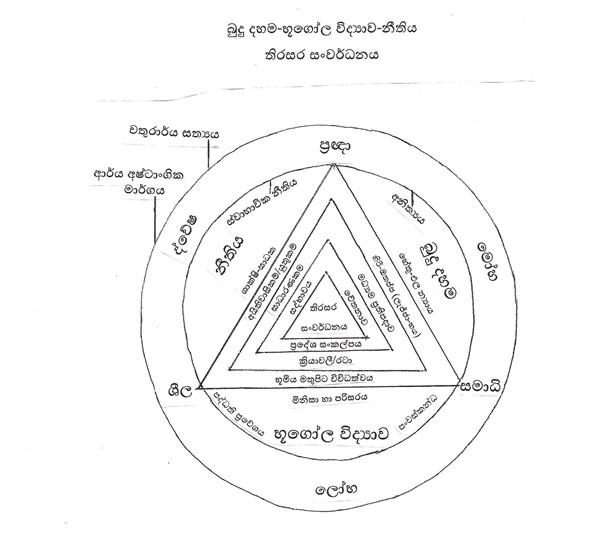
These documents are resurrected again for people like Sepal to read and understand the other side to their one-track Marxist ideology. Sepal regrets that JVP and the Peratugamis did not act in unison to topple the parliament to finish their Aragalaya to capture power for the people! Aragalaya became a fraud. Pathum Kerner is missing. Motivation Appachchi is going to contest the next presidential election. Damitha, the working activist now certifies that Sajith faithfully adheres to the five basic tenets of Buddhism (පන්සිල් පද පහ). Previously, early in the Aragalaya Dulika Marapana shouted set fire and vanished from the radar.  Because the essay below is too long, I will only copy the first two paragraphs of it here. Unfortunately, the original essay found on Lankaweb website (archives) has some formatting defects. Therefore, the link to it cannot be given. Instead, a cleaned version will be presented as Sepal-part III. Both these essays, Sinhala and English are useful to KaruJ (and Victor Ivan) in finetuning his/their people’s council project, especially the diagram below.

Source:       රට කැබලි නොකර සිස්ටම් චේන්ජ් කිරීම (බුදු දහම හා ජන සභා සංකල්පය)

                   2022

Bodu Bala Sena and LLRC (Buddhist self-reliance)
Posted on March 31st, 2013

C. Wijeyawickrema, LL.B., Ph.D.

Need for a new map of terrain

What empowers a Sinhala/Tamil medium graduate left Sri Lanka in frustration to become a professor, a scientist, or a research director for example, in USA facing world-wide competition? How was it possible for young men from poor Sri Lanka to win the world cup of cricket by team effort? What reasons were the behind the capacity of village girls and boys in Sri Lanka to end a thirty-year war in less than three years surprising the whole world? In each case the old map of terrain which was not real and not true was replaced or revised with a new map, new model. Since 1832 Sri Lanka used the Eurocentric-colonial map/model. Prior to that Sri Lanka had a map based on the trinity of village, tank and the temple guided by a philosophy set out in the Buddhist Jataka Stories, 550 of them. That model was based on truth and reality. In 2013 the Bodu Bala Sena (BBS) is acting to discard the old map (Colombo black-white model). We cannot escape from freedom and avoid challenge. We must be open to challenge.

Compare you-tube video clips of monks Dambara Amila, Bellanvila Wimalaratane and Baddegama Samitha with the monks Kirama Wimalajothi and Galabodaaththe Gnanasara. You can almost touch the pain the latter two monks undergo in their feeling of responsibility (Those who are genuine in their public service mission get angry and agitated like what we heard of the Anagarika Dharmapala). The former three are reading old unreal maps without any feelings, like those Marxists happened to be in front of Jetavanaramaya, Somawathiya or the Tissa weva. For them they are just brick and water. There is no national pride, no goose bumps. Meanwhile the types of Azath Salley sents secret SMS to mosques! 

Reasonableness Doctrine

In these times of our seeing the Buddhist King Pasenadi Kosol’s Sixteen Dreams in real life, Bodu Bala Sena (BBS) reminds one the idea known as the Pas Maha Balum. BBS is in the right place at the right time. If one surf the English medium websites like the anti-Sinhala Buddhist Colombo Telegraph and newspapers, what jumps out is venom and confusion against BBS. Those English-speaking local and foreign agents who refused to come before the LLRC then are the ones now in the forefront demanding the implementation of its report.  This same – this war is not winnable boat – people are so confused, they think that BBS is all about Taliban-based halal and pretend that they did not know or see the BBS website. Under colonial assault the first Buddhist Renaissance began shortly after the 1848 genocide culminating with an ideological victory at the Great Panadura Debate in 1873. The public cheating of Buddhists by partisan politics since 1948 deteriorated so badly with a crook and criminal system of governing that began after 1978, forcing the arrival of the Bodu Bala Sena Movement in 2012. The business of BBS is open discussion and debate, no lurking in the dark.

BBS is an idea based on the Middle Path doctrine in Buddhism. In ancient Greece and in China there was the idea of the Middle Way, but the Buddhist Middle Path goes along with the phenomenon of impermanence and the cyclical nature of life (not linear). Buddhism is simply the Four Noble Truths and the Eight-Fold Noble path (4NT+8NP).  This Middle Path is nothing but the reasonableness doctrine of the modern Western world.  For example, it was this reasonableness which allowed women to become Buddhist monks 2600 years ago. In modern politics or global geopolitics reasonableness is equated as moderates or compromise of give and take. Majorities and minorities compromise in modern representative capitalist democracies. Rights as well as duties, not escape from freedom! Because BBS is based on reasonableness doctrine it was ready to discuss openly the merit and demerit of Halal certification and the gonibilla full face cover. What is reasonable in Afghanistan or dessert sands of Arabia or in Paris or London may not be reasonable in the context of Sri Lankan history and geography. Thus, marijuana can be legal in Bangladesh but not whiskey. If Muslim MPs did not like to see pork served in the parliament canteen, was it reasonable to ban pork from 90% of others’ choice of almost free lunch that all the MPs are enjoying?

The Euro Without German Industry

October 9th, 2022

  Courtesy The Unz Review


The reaction to the sabotage of three of the four Nord Stream 1 and 2 pipelines in four places on Monday, September 26, has focused on speculations about who did it and whether NATO will make a serious attempt to discover the answer. Yet instead of panic, there has been a great sigh of diplomatic relief, even calm. Disabling these pipelines ends the uncertainty and worries on the part of US/NATO diplomats that nearly reached a crisis proportion the previous week, when large demonstrations took place in Germany calling for the sanctions to end and to commission Nord Stream 2 to resolve the energy shortage.

The German public was coming to understand what it will mean if their steel companies, fertilizer companies, glass companies and toilet-paper companies were shutting down. These companies were forecasting that they would have to go out of business entirely – or shift operations to the United States – if Germany did not withdraw from the trade and currency sanctions against Russia and permit Russian gas and oil imports to resume, and presumably to fall back from their astronomical eight to tenfold price increase.

Yet State Department hawk Victoria Nuland already had stated in January that one way or another Nord Stream 2 will not move forward” if Russia responded to the accelerating Ukrainian military attacks on the Russian-speaking eastern oblasts. President Biden backed up U.S. insistence on February 7, promising that there will be no longer a Nord Stream 2. We will bring an end to it. … I promise you, we will be able to do it.”

Most observers simply assumed that these statements reflected the obvious fact that German politicians were fully in the US/NATO pocket. Germany’s politicians held fast turbines refusing to authorize Nord Stream 2, and Canada soon seized the Siemens dynamos needed to send gas through Nord Stream 1. That seemed to settle matters until German industry – and a rising number of voters – finally began to calculate just what blocking Russian gas would mean for Germany’s industrial firms, and hence domestic employment.

Germany’s willingness to self-impose an economic depression was wavering – although not its politicians or the EU bureaucracy. If policymakers were to put German business interests and living standards first, NATO’s common sanctions and New Cold War front would be broken. Italy and France might follow suit. That prospect made it urgent to take the anti-Russian sanctions out of the hands of democratic politics.

Despite being an act of violence, sabotaging the pipelines has restored calm to US/NATO diplomatic relations. There is no more uncertainty about whether Europe may break away from U.S. diplomacy by restoring mutual trade and investment with Russia. The threat of Europe breaking away from the US/NATO trade and financial sanctions against Russia has been solved, seemingly for the foreseeable future. Russia has announced that the gas pressure is falling in three of the four pipelines, and the infusion of salt water will irreversibly corrode the pipes. (Tagesspiegel, September 28.)

Where do the euro and dollar go from here?

Looking at how this will reshape the relationship between the U.S. dollar and the euro, one can understand why the seemingly obvious consequences of Germany, Italy and other European economies severing trade ties with Russia have not been discussed openly. The solution is a German and indeed Europe-wide economic crash. The next decade will be a disaster. There may be recriminations against the price paid for letting Europe’s trade diplomacy be dictated by NATO, but there is nothing that Europe can do about it. Nobody (yet) expects it to join the Shanghai Cooperation Organization. What is expected is for its living standards to plunge.

German industrial exports and attraction of foreign investment inflows were major factors supporting the euro’s exchange rate. To Germany, the great attraction in moving from the deutsche mark to the euro was to avoid its export surplus pushing up the D-mark’s exchange rate and pricing German products out of world markets. Expanding the eurozone to include Greece, Italy, Portugal, Spain and other countries running balance-of-payments deficits prevented the euro from soaring. That protected the competitiveness of German industry.

After its introduction in 1999 at $1.12, the euro sank to $0.85 by July 2001, but recovered and indeed rose to $1.58 in April 2008. It has been drifting down steadily since then, and since February of this year the sanctions have driven the euro’s exchange rate below parity with the dollar, to $0.97 this week.

The major deficit problem has been rising prices for imported gas and oil, and products such as aluminum and fertilizer requiring heavy energy inputs for their production. And as the euro’s exchange rate declines against the dollar, the cost of carrying Europe’s US-dollar debt – the normal condition for affiliates of U.S. multinationals –rises, squeezing profits.

This is not the kind of depression in which automatic stabilizers” can work to restore economic balance. Energy dependency is structural. To make matters worse, the eurozone’s economic rules limit its budget deficits to just 3% of GDP. This prevents its national governments supporting the economy by deficit spending. Higher energy and food prices – and dollar-debt service – will leave much less income to be spent on goods and services.

As a final kicker, pointed out by Pepe Escobar on September 28 that Germany is contractually obligated to purchase at least 40 billion cubic meters of Russian gas a year until 2030. … Gazprom is legally entitled to get paid even without shipping gas. … Berlin does not get all the gas it needs but still needs to pay.” A long court battle can be expected before money will change hands. And Germany’s ultimate ability to pay will be steadily weakening.

It seems curious that the U.S. stock market soared over 500 points for the Dow Jones Industrial Average on Wednesday. Maybe the Plunge Protection Team was intervening to try and reassure the world that everything was going to be all right. But the stock market gave back most of these gains on Thursday as reality no longer could be brushed aside.

German industrial competition with United States is ending, helping the U.S. trade balance. But on capital account the euro’s depreciation will reduce the value of U.S. investments in Europe and the dollar-value of any profits they may still earn as the European economy shrinks. Reported global earnings by U.S. multinationals will fall.

The effect of U.S. sanctions and the New Cold War outside of Europe

The ability of many countries to pay their foreign and domestic debts already was reaching the breaking point before the anti-Russian sanctions raised world energy and food prices. The sanctions-driven price increases have been compounded by the dollar’s rising exchange rate against nearly all currencies (ironically, except against the ruble, whose rate has soared instead of collapsing as U.S. strategists tried in vain to make happen). International raw materials are still priced mainly in dollars, so the dollar’s currency appreciation is further raising import prices for most countries.

The rising dollar also raises the local currency cost of servicing foreign debts denominated in dollars. Many European and Global South countries already have reached the limit of their ability to service their dollar-denominated debts, and are still coping with the impact of the Covid pandemic. Now that US/NATO sanctions have driven up world prices for gas, oil and grain – and with the dollar’s appreciation raising the cost of servicing dollar-denominated debts – these countries cannot afford to import the energy and food that they need to live if they have to pay their foreign debts. Something has to give.

On Tuesday, September 27, U.S. Secretary of State Antony Blinken shed crocodile tears and said that attacking Russian pipelines was in no one’s interest.” But if that really were the case, no one would have attacked the gas lines. What Mr. Blinken really was saying was Don’t ask Cui bono.” I don’t expect NATO investigators to go beyond accusing the usual suspects that U.S. officials automatically blame.

U.S. strategists must have a game plan for how to proceed from here. They will try to maintain a neoliberalized global economy for as long as they can. They will use the usual ploy for countries unable to pay their foreign debts: The IMF will lend them the money to pay – on the condition that they raise the foreign exchange to repay by privatizing what remains of their public domain, natural-resource patrimony and other assets, selling them to U.S. financial investors and their allies.

Will it work? Or will debtor countries band together and work out ways to restore the world of affordable oil and gas prices, fertilizer prices, grain and other food prices, metals and raw materials supplied by Russia, China and their allied Eurasian neighbors, without U.S. conditionalities” such as have ended European prosperity?

An alternative to the U.S.-designed neoliberal order is the great worry for U.S. strategists. They cannot solve the problem as easily as sabotaging Nord Stream 1 and 2. Their solution probably will be the usual U.S. approach: military intervention and new color revolutions hoping to gain the same power over Global South and Eurasia that America’s diplomacy via NATO wielded over Germany and other European countries.

The fact that U.S. expectations for how anti-Russian sanctions would work out against Russia have been just the reverse of what actually has happened gives hope for the world’s future. The opposition and even contempt by U.S. diplomats toward other countries acting in their own economic interest deems it a waste of time (and indeed, to be unpatriotic) to contemplate how foreign countries might develop their own alternative to the U.S. plans. The assumption underlying this U.S. tunnel vision is that There Is No Alternative – and that if they don’t think about such a prospect, it will remain unthinkable.

But unless other countries work together to create an alternative to the IMF, World Bank, International Court, World Trade Organization and the numerous UN agencies now biased toward the U.S/NATO by U.S. diplomats and their proxies, the coming decades will see the U.S. economic strategy of financial and military dominance unfold along the lines that Washington has planned. The question is whether these countries can develop an alternative new economic order to protect themselves from a fate like that which Europe this year has imposed upon itself for the next decade.

← The Federal Reserve and Debt

Anti-Terror Agency Conducts Searches Against LTTE Supporters In Tamil Nadu

October 9th, 2022

Tamil Nadu-Press Trust of India

he searches were conducted in Salem and Sivagangai districts on Saturday and led to the recovery of incriminating materials including digital devices like compact discs related to LTTE.

New Delhi: 

The NIA conducted searches at two locations in Tamil Nadu in a case related to two self-radicalised Liberation Tigers of Tamil Eelam supporters planning attacks on commercial establishments and important leaders in the state, an official said on Sunday.

The searches were conducted in Salem and Sivagangai districts on Saturday and led to the recovery of incriminating materials including digital devices like compact discs related to LTTE, a Sri Lanka-based banned terrorist group, a spokesperson of the National Investigation Agency said.

Books on LTTE, photos of LTTE leaders including its slain chief Prabhakaran, incriminating documents, invoices, bills for materials used for manufacturing illegal firearms, ammunition and explosive substances, seeds for making poison, and jungle survival kits were also seized during the raids, the official said.

The case was initially registered against the two individuals on May 19 at Omalur police station in Tamil Nadu and re-registered by the NIA on July 25, the spokesperson said.

The Geopolitics Of Voting At UNHRC On Resolution Against Sri Lanka – Analysis

October 9th, 2022

By  Courtesy eurasiareview

The  stance on human rights appears to have been determined by the member’s geopolitical predilections and national interest

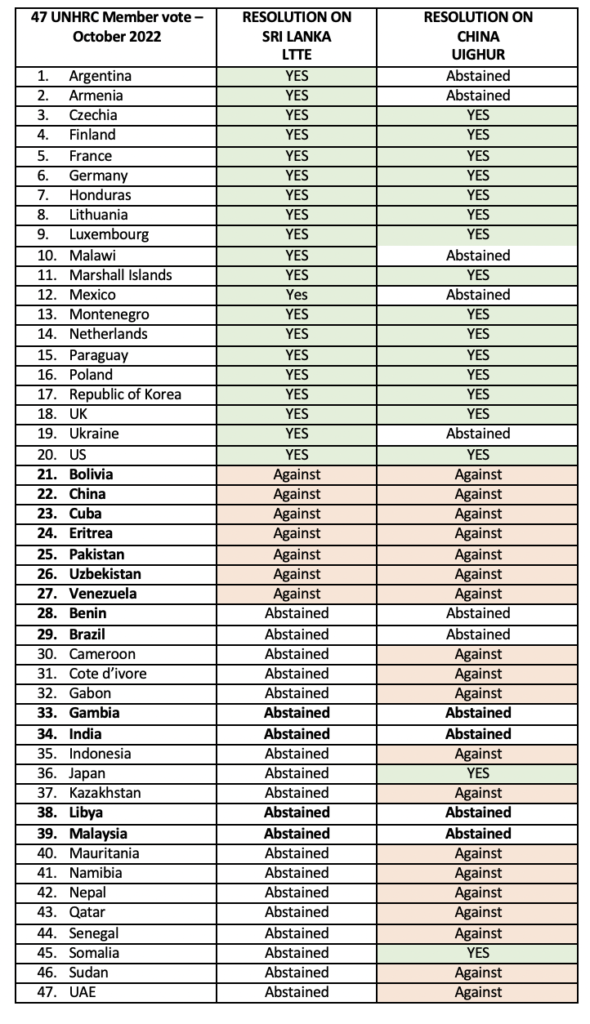
Looking at the voting on the UN Human Rights Council’s resolution on Sri Lanka on October 6, it appears that the decisions taken by the 47 members were determined by their respective positions in geopolitics and their national interest.  

The 20 members who voted for the resolution castigating Sri Lanka for alleged human rights violations, were Western nations and their political allies. Japan, which is a firm ally of the West, however, struck a different path. It abstained perhaps due to its national interest vis-à-vis Sri Lanka. Those who voted against the resolution had been at odds with the West geopolitically. And those who abstained either had mixed feelings about the West’s agendas or had other more important national interests at stake.     

Among those who said aye” were hardcore Western nations, such as the US, UK, France, Germany and the Netherlands. These were also votaries of the Western concept of human rights. Among others countries that said aye” were those feeling threatened by the Russian invasion of Ukraine and had been flocking to the West and NATO. Many of these are new States that had emerged from the former Soviet Union but are now harboring fears of Russian expansionism. Ukraine, which voted for the resolution, is being aided by the West to fight Russia. 

Countries like Armenia, the Czech Republic, Lithuania and Finland, also fear that they might be Russia’s next target and have flocked to the US camp. Poland remembers that the USSR had occupied it ahead of World War II. Montenegro, which had emerged from the ruins of Yugoslavia, had joined NATO in 2017 and was firmly in the Western camp. Paraguay, Argentina and Honduras in South America, and South Korea in Asia, had been firm allies of the US. 

However, it is remarkable that there was only one African country, Malawi and one Asian country, South Korea, among the 20 that went along with the US-led Western alliance in the Council.      

The Nays 

Among the seven countries that voted against the resolution, there were none from Europe. All of them had serious differences with the US. The nays were Bolivia, China, Cuba, Pakistan, Eritrea, Uganda and Venezuela. In 2008, Bolivia had expelled the US Ambassador. Even now the US has been pressing Bolivia to improve its rights record.  US-Eritrea tensions were related to rights violations. In 2021, the US had imposed selective sanctions. 

Uzbekistan is close to China as China is the largest trading partner. China has also been increasing its development loans to Uzbekistan as it regards Uzbekistan as a critical part of its Belt and Road Initiative. Uzbekistan’s voting against the resolution, with China, therefore, stood to reason. China’s hostility to the US needs no explanation. As for Pakistan, it has had a love-hate relationship with the US. It has also been a firm ally of Sri Lanka. 

The US had broken off diplomatic relations with Venezuela in 2019, after accusing its authoritarian leader Maduro of electoral fraud. The Trump administration then tried to topple Maduro by sanctioning Venezuelan oil exports. Maduro responded by seeking economic and diplomatic help from Russia, as well as Iran and China. 

Abstentions

Among the abstaining 20 countries, there was only one pro-US country, namely, Japan. Japan has always taken a soft line on Sri Lanka trying to reform it by helping it economically rather than sanctioning or shaming it publicly. The other countries in the group either had problems with the West, or had a tendency to take independent postures (ex: Malaysia) or had geopolitical reasons to be neutral (ex: India). Under the Trump Presidency, US-Brazil relations were good, but not under Biden. Trump supported the right wing President Bolsonaro. But Bolsonaro is now being electorally challenged by the leftist Luiz Inacio Lula” da Silva. 

Cameroon’s relations with the US have been under strain over human rights abuses, in particular in the Anglophone Northwest and Southwest Regions of the country, and also over the pace of political and economic liberalization. In troubled Cote d’Ivoire, the US has been trying to help restore peace and support a democratic government whose legitimacy could be accepted by all the citizens of Cote d’Ivoire. In Gabon, China’s presence is manifest. In 2019 China was the buyer of 63% of the products sold by Gabon on the world market. 74.8% of the products sold during this reference year consisted of hydrocarbons. 

Relations between the US and Gambia had not improved significantly due to the human rights and freedom of press shortcomings, which resulted in the suspension of Gambia’s compact with the Millennium Challenge Corporation (MCC) in June 2006. The US is involved in Mauritania on a wide array of issues, including human rights and the rule of law. In Namibia, there is a marked Chinese presence. There are scores of Chinese official development projects, through grants, concessional loans and preferential export buyers’ credit running to millions of RMB. Namibia is amenable to Chinese influence. 

Given persistent troubles in Somalia, the US Embassy there was closed from 1991 to 2018. Senegal remained neutral at the UNHRC voting though its relations with the US had been good. US Secretary of State Blinken would be visiting the country in November.

The US has had problems with Sudan over terrorism. Although Sudan  publicly supported the international coalition actions against the al Qaida network and the Taliban in Afghanistan, it had criticized US air strikes in that country. In response to Sudan’s continued complicity in unabated violence in Darfur, President Bush had imposed economic sanctions on Sudan in May 2007. But in December 2020, Sudan’s designation as a State Sponsor of Terrorism was rescinded.

The UAE irked the US in December 2018, when it reopened its embassy in Syria, reatoring ties with the government of anti-US, pro-Russian President Bashar al-Assad. In January 2019, the UAE hosted a Syrian trade delegation that was led by a businessman who had been on the U.S. Treasury sanctions list since 2011. As the UAE’s relations with China were intensifying, its alliance with the US began to face turbulence.

Additionally, China has been the biggest buyer of crude oil from the Gulf region. China has been broadening its economic and political footprint across the Middle East, which has created tension in UAE-US relations. In November 2021, the US warned the UAE about a Chinese military presence in it. US intelligence had found that China was secretly building a military facility at a port in Abu Dhabi. Following several American meetings and visits by the US officials, the site construction was halted. Despite that, the US officials said that extensive Chinese presence in the UAE could endanger the planned US$ 23 billion deal of F-35 fighter jets, Reaper drones and other advanced munitions.

China’s Gains in Africa

The UNHRC voting shows Chinese gains in Africa and the relative weakness of the US in that continent. According to the National Bureau of Asian Research, China appears to be seeking a loose, partial, and malleable hegemony over the global South, making the African continent a strategic priority for Beijing.” China has brought under the BRI umbrella, the Digital Silk Road, which is focused on improving information and communications technology and digital capabilities in Africa.

Most importantly, unlike the US and the West, China does not promote its authoritarian model of governance. It is, in fact, indifferent or blind to the type of regime that exists in a client State. Local regimes find this to be very convenient. Local nationalisms detest preaching by outsiders especially former colonial powers or the new imperialist” powers. These nationalistic feelings came to Sri Lanka’s aid at the time of voting in the UNHRC. Though the resolution was carried, Sri Lankan nationalists drew comfort from the fact that the majority of the UNHRC members (27 out of 47) either said nay” or abstained.

P. K. Balachandran

P. K. Balachandran is a senior Indian journalist working in Sri Lanka for local and international media and has been writing on South Asian issues for the past 21 years.

A strong dollar is wreaking havoc on emerging markets. A debt crisis could be next

October 9th, 2022

By Joe Rennison and Isabella Simonetti Courtesy Khaleej Times 

Low-income countries, like Ghana and Pakistan, were already struggling during the pandemic. The dollar’s strength is adding to their woes

The average household in Ghana is paying two-thirds more than it did last year for diesel, flour and other necessities. In Egypt, wheat is so expensive that the government has fallen half a billion dollars short of its budget for a bread subsidy it provides to its citizens. And Sri Lanka, already struggling to control a political crisis, is running out of fuel, food and medical supplies.

A strong dollar is making the problems worse.

Compared with other currencies, the US dollar is the strongest it has been in two decades. It is rising because the Federal Reserve has increased interest rates sharply to combat inflation and because America’s economic health is better than most. Together, these factors have attracted investors from all over the world. Sometimes they simply buy dollars, but even if investors buy other assets, like government bonds, they need dollars to do so — in each case pushing up the currency’s value.

That strength has become much of the world’s weakness. The dollar is the de facto currency for global trade, and its steep rise is squeezing dozens of lower-income nations, chiefly those that rely heavily on imports of food and oil and borrow in dollars to fund them.

We are living in a world with little fires everywhere,” said Mohamed El Erian, president of Queens’ College, part of Cambridge University, and former CEO of Pimco, a $2 trillion bond manager. If we don’t pay attention, these little fires could become much bigger.”

Higher food and energy costs resulting from Russia’s war with Ukraine were already hurting some emerging-market countries. The rising dollar, whose strength is measured against a basket of currencies representing America’s major trading partners, has exacerbated those problems by making it even more expensive to import vital commodities using weaker currencies.

A strong dollar forces countries to use more of their own currency to buy the same quantity of goods. That higher price means they are inadvertently importing more inflation along with their grain and fuel. And because they borrow in dollars, they have to pay interest in dollars, which adds to their financial distress.

Some countries are already in default. Others are teetering on the brink. A sovereign debt crisis could soon spread, derailing the fragile recovery from the pandemic and amplifying the likelihood of a severe global downturn.

Things are looking a little shaky at the moment,” said Leland Goss at the International Capital Markets Association, a trade body. There does seem to be a consensus that we could face for the first time in a while not one but a whole raft of countries going into restructurings.”

Four emerging-market countries have defaulted on their debts so far this year, according to S&P Global Ratings: Russia, Sri Lanka, Belarus and Ukraine. Another 10 countries are in severe stress”: Argentina, Lebanon, Ghana, Suriname, Zambia, Ethiopia, Burkina Faso, Congo-Brazzaville, Mozambique and El Salvador, according to the ratings agency. Of the 94 emerging-market sovereigns S&P rates around the world, over one-quarter rank as B-minus, a low-quality rating indicative of a high-risk investment.

The bleak situation is part of the collateral damage from Russia’s war with Ukraine and the Fed’s fight against inflation, and it highlights the global connections that have left the fate of countries around the world inextricably linked to decisions made in Moscow and Washington, D.C.

We are in a fragile situation,” El Erian said. Country after country is flashing amber, and some are already flashing red.”

Many lower-income countries were already struggling during the pandemic.

Roughly 22 million people in Ghana, or one-third of its population, reported a decline in their income between April 2020 and May 2021, according to a survey from the World Bank and Unicef. Adults in almost half of the households with children surveyed said they were skipping a meal because they didn’t have enough money. Almost three-quarters said the prices of major food items had increased.

Then came Russia’s invasion of Ukraine. The war between two of the world’s largest exporters of food and energy led to a big surge in prices, especially for importers like Ghana. Consumer prices have gone up 30 per cent for the year through June, according to data from the research firm Moody’s Analytics. For household essentials, annual inflation has reached 60 per cent or more this year, the S&P data shows.

To illustrate this, consider the price of a barrel of oil in dollars versus the Ghanaian cedi. At the beginning of October last year, the price of oil stood at $78.52 per barrel, rising to nearly $130 per barrel in March before falling back to $87.96 at the beginning of this month, a one-year increase of 12 per cent in dollar terms. Over the same period, the Ghanaian cedi has weakened more than 40 per cent against the dollar, meaning that the same barrel of oil that cost roughly 475 cedi a year ago now costs more than 900 cedi, almost twice as much.

Adding to the problem are large state-funded subsidies, some taken on or increased through the pandemic, that are now weighing on government finances.

Ghana’s president cut fuel taxes in November 2021, losing roughly $22 million in projected revenue for the government — the latest available numbers.

In Egypt, spending on what the government refers to as supply commodities,” almost all of which is wheat for its long-running bread subsidy, is expected to come in at around 7 per cent of all government spending this year, 12 per cent higher — or more than half a billion dollars — than the government budgeted.

As costs ballooned throughout the pandemic, governments took on more debt. Ghana’s public debt grew to nearly $60 billion from roughly $40 billion at the end of 2019, or to nearly 80 per cent of its gross domestic product from around 63 per cent, according to Moody’s.

It’s one of four countries listed by S&P, alongside Pakistan, Nigeria and Sri Lanka, where interest payments alone account for more than half of the government’s revenues.

We can’t forget that this is happening on the back end of a once-in-a-century pandemic in which governments, to try and support families as best they could, did borrow more,” said Frank Gill, an analyst at S&P. This is a shock following up on another shock.”

In May, Sri Lanka defaulted on its government debt for the first time in its history. Over the past month, the governments of Egypt, Pakistan and Ghana have all reached out to the International Monetary Fund for a bailout as they struggle to meet their debt-financing needs, no longer able to turn to international investors for more money.

I don’t think there is a lot of appetite to lend money to some of these countries,” said Brian Weinstein, co-head of credit trading at Bank of America. They are incredibly vulnerable at the moment.”

That vulnerability is already reflected in the bond market.

In 2016, Ghana borrowed $1 billion for 10 years, paying an interest rate of more than 8 per cent. As the country’s financial position has worsened and investors have backed away, the yield — indicative of what it would now cost Ghana to borrow money until 2026 — has risen to above 35 per cent.

It’s an untenable cost of debt for a country in Ghana’s situation. And Ghana is not alone. For bonds that also mature in 2026, yields for Pakistan have reached almost 40 per cent.

We have concerns where any country has yields that calls into question their ability to refinance in public markets,” said Charles Cohen, deputy division chief of monetary and capital market departments at the IMF.

The risk of a sovereign debt crisis in some emerging markets is very, very high,” said Jesse Rogers, an economist at Moody’s Analytics. Rogers likened the current situation to the debt crises that crushed Latin America in the 1980s — the last time the Fed sought to quell soaring inflation.

Already this year, more than $80 billion has been withdrawn from mutual funds and exchange-traded funds — two popular types of investment products — that buy emerging-market bonds, according to EPFR Global, a data provider. As investors sell, the United States is often the beneficiary, further strengthening the dollar.

It’s by far the worst year for outflows the market has ever seen,” said Pramol Dhawan, head of emerging markets at Pimco.

Even citizens in some of these countries are trying to exchange their money for dollars, fearful of what’s to come and of further currency depreciation — yet inadvertently also contributing to it.

For pockets of emerging markets, this is a really challenging backdrop and one of the most challenging backdrops we have faced for many years,” Dhawan said.

This article originally appeared in The New York Times

Buddhism revived under Modi govt: Global Buddhist body; hails India’s mission

October 9th, 2022

Courtesy Rediff

India has seen a great revival of Buddhism in the country under Prime Minister Narendra Modi-led government, said a Sri Lankan Buddhist monk as the International Buddhist Confederation celebrates Abhidhamma Day on Sunday.

IMAGE: Prime Minister Narendra Modi and Nepalese Prime Minister Sher Bahadur Deuba at the Shilanyas ceremony of the India International Centre for Buddhist Culture and Heritage in Lumbini, May 16, 2022. Photograph: ANI Photo

Abhidhamma Day, a Theravada Buddhist tradition which celebrates Gautama Buddha’s descent from heaven after teaching his mother the Abhidhamma, will take place on Sunday.

Some prominent monks from Sri Lanka, Myanmar, Nepal and Bhutan will assemble in India’s Uttar Pradesh to celebrate the event.

Buddhist monk Waskaduwe Mahindawansa Mahanayake Thero of Sri Lanka, who is also participating in the event, said, “Today on the eve of the full moon, we, the international Buddhist community, have gathered in India to celebrate this important festival tomorrow. Especially under the Modi government, we see a great revival of Buddhism in India. Buddhism is about compassion and happiness.”

He recalled PM Modi’s message at the United Nations and hailed India’s mission “to save the planet from conflict and violence” through the principles of Buddhism.

“We saw PM Modi recently mentioning at the UN that India has given Buddhism to the world to save the planet from conflict and violence. We all appreciate this global mission. We thank the IBC and the government of India for inviting us here in UP to participate in this much important event,” the monk added.

PM Modi, together with Nepal Prime Minister Sher Bahadur Deuba, in May this year, participated in the shilanyas ceremony for the construction of the India International Centre for Buddhist Culture and Heritage at a plot in Lumbini belonging to the IBC.

Moreover, a Buddhist circuit under the Swadesh Darshan Yojana by the ministry of tourism has seen the development of 5 projects worth Rs 325.53 crore.

The “Buddha Purnima Express” special train has also been started by IRCTC to facilitate travel within the Buddhist circuit.

Abhidhamma Day is celebrated on the full moon of the seventh month of the Burmese lunar year which starts in April and coincides with the end of the (first) Rains Retreat and the Pavarana festival.

To mark the auspicious day, the IBC, in collaboration with Gautam Buddha University, Greater Noida, is organizing the International Abhidhamma Divas.

It was at Sankassiya, presently known as Sankisa Basantapur, Farrukhabad, Uttar Pradesh where the Sakhyamuni descended from the celestial domain of the thirty-three divine beings (Tavatimsa-devaloka) to Sankassiya after teaching Abhidhamma Pitaka (a basket of ultimate things) to his mother.

The chief guest at the event will be Dr Ashin Nanissara (Sitagu Sayadaw), Chancellor, Sitagu International Buddhist Academies, Myanmar.The participation of the Chief Minister of UP, Yogi Adityanath, chancellor, Gautam Buddha University as the guest of honour is yet to be confirmed.

The Abhidhamma Divas, last year was organised at Kushinagar at Mahaparinirvana temple, where the Prime Minister Narendra Modi was the chief guest.

He also inaugurated the international airport at the Buddhist pilgrimage town.

According to the Theravada tradition, it is believed that this day is blessed as the Buddha had gone to heaven to teach Abhidhamma Pitaka (a basket of ultimate things) to his mother.

The teaching took three months after which Buddha came back to Earth.

His followers too mark the three-month time by staying at one place and praying. It is known as the three-month rainy retreat – Varshavaas or Vassa – for the Buddhist monks and nuns.

The place is documented by the Asokan marker — Asokan elephant pillar signifying the importance of the place and of the event.

It is noted in the Buddhist texts that after teaching Abhidhamma to the Devas and his mother as witness, he descended here.

Eminent monks from Sri Lanka, Myanmar, Nepal, Bhutan, ambassadors based in India and other diplomats representing various countries will also take part in the Abhidhamma Divas.

This is the third flagship program of the IBC while the other two being Buddha Purnima and the Asadha Purnima.

Other highlights of the day’s event include a panel discussion on the ‘Significance of Abhidhamma’, a book launch- titled ‘Recent Development in the studies of Abhidhamma in India’, a screening of the film on IBC’s project in Lumbini and the day concludes with a cultural programme by students of Buddhist universities.

IBC is a Buddhist umbrella body that serves as a common platform for Buddhists worldwide. It is headquartered in New Delhi, India.

Established under the patronage of the supreme Buddhist religious hierarchy, it currently has a global membership of over 320 monastic and lay organisations, including world bodies, national and regional federations, monasteries, international organizations and institutions.

United by the motto, “collective wisdom, united voice”, IBC aims to make Buddhist values and principles a part of the global discourse by presenting a united Buddhist voice on issues that concern all humankind.

The IBC stands for transparency, inclusiveness and a balanced representation of various traditions, gender and emerging Buddhist communities in Africa, the Caribbean and South America.

Praised by followers of Buddha Dharma from around the world for including both Sangha and laity in its governing structure, IBC has been hailed by the international media as a forward-looking, credible and action-oriented World Buddhist umbrella Body.

The IBC also stands for the preservation, development and promotion of Buddhist heritage, both tangible and intangible worldwide, especially the holy sites like Bodh Gaya in India, where Buddha attained Enlightenment, as well as many others.

To gather the collective wisdom of Buddhists around the world to speak with a united Buddhist voice; to make Buddhist values part of global engagement while working to preserve and promote Buddhist heritage, traditions and practices.

President plans to halve number of LG members before next election

October 9th, 2022

Courtesy Adaderana

President Ranil Wickremesinghe said that a referendum will be called to decide on the parliamentary electoral system if the Select Committee which is proposed to be established fails to reach a decision on the matter by July next year.

He made this observation during a discussion with a group of professionals held at the Presidential Secretariat today (09).

The President said that the desired changes to the political system should be brought about in accordance with the aspirations of the people, as the majority of the population in the country rejects the existing political system. 

He added that accordingly, he expects to reduce the number of council members of local authorities (Municipal Councils, Urban Councils and Pradeshiya Sabhas) from 8000 to 4000 and to implement the ‘Jana Sabha’ system, before the next election.

He said further that the executive power of the Pradeshiya Sabha should be vested on a chairman-based committee instead of same being vested on a single chairman. Laws will be drafted for this amendment before the next local government election, he said.

Pointing out that the main cause of political corruption is the Preferential Vote System, the President said that the country should immediately switch to a list based electoral system with non-preferential votes or a mixed system (single and proportional system). Limitations should also be imposed by the election law on the money spent on election propaganda.

The statement made by the President during the discussion is as follows;

There are two main issues before the country today. One is the economic collapse while the other is the rejection of the political system by the majority of the population. Many are of the view that the cause of the economic collapse is the existing political system.

As we have discussed at length the measures to be taken to revive the economy, I would not intend to talk on it any longer here but we should focus our attention instead on the political program. Today, the political system of the country is questioned by the majority of the people and they demand all 225 members to be dumped into the Diyawanna Oya. It is not because of individuals but because of the political system that is rejected by them.

It was not the political parties that initiated the protests last March. The people did not participate in protests by the political parties but they came forward independently. Unfortunately, by May and June, different political organizations took this movement into their own hands and then the violence crept in. Along with the violence they attempted to oust the government and the struggle collapsed with it.

Still the people are of the view that the existing political system should be changed. Everybody rejects violence. And we have had to accept it and have to move forward changing these attitudes.

Different groups have been formed within the Parliament due to the party system. It is not a secret that I was supported by the ruling party to be elected as the President. A few voted with other contestants. Opposition members too voted in my favor. SJB as well as members of the Tamil parties too voted in my favor. Hence, I was supported by both sides.

I work for the people irrespective of narrow party lines. Currently, in accordance with the opposition’s request, a Parliamentary National Assembly has been established. In addition committees such as Monitoring Committees too have been established. But these have not yet been completed. Some participate in the National Assembly and some don’t. The country expects everyone to work together. We should not end here.

We should consider the people’s aspirations and should act accordingly. As the People are fed up with village level politics, we accept a new concept today. It is not the government but former Speaker Karu Jayasuriya who recommended the Jana Sabha System.

To unite the public organizations in that village level and working in one committee is what Janasabha is all about. This system which existed before as Gramodaya Mandala is commendable. However, the Gramodaya Mandala had a connection with the government whereas the Janasabha has not. We hope to implement this public assembly program.

There should be proper coordination with the Pradeshiya Sabhas during the functioning of the Jana Sabhas (Public Councils). The Pradeshiya Sabhas will not be allowed to remove the Jana Sabha. We need to plan how we will work together. There are many questions about the Pradeshiya Sabha system. Many of these Pradeshiya Sabhas do not even make a profit. They are sustained on tax money. Municipal Councils and Pradeshiya Sabhas that receive money utilize it to pay salaries. Hence, we have to think about this system.

However, last time we increased the number of Pradeshiya Sabha members from 4000 to 8000. This was not what the people asked for. This was done following discussions between the party leaders. Now, we have to reduce this number back again to 4000 prior to the next election.

Therefore, let’s work to amend those laws in the parliament. Let’s start this program from there. And there is another urgent amendment. The Chairmen of these Pradeshiya Sabhas are the executive heads. Some people are against it. Before the Pradeshiya Sabha system, there was no such power when there were Municipal Councils and Village Councils (Gam Sabha). Therefore, I propose to entrust the executive power of these Pradeshiya Sabhas toa chairman-based committee instead of a single chairman. The head of it would be the Pradeshiya Sabha Chairman.

Now there are finance committees. Let’s create such an executive committee. We need to accomplish these two things before the next local government elections. I would like to specifically mention that it is something we must do. We have informed the ministers to prepare the necessary draft law.

Similarly, many people are not in favour of this preferential system. No one thought of the preference system initially. Mr. JR Jayawardena, after much thought, proposed the list based electoral system in 1975, which was accepted by other parties. Because it was based on ratios. Accordingly, we held the Urban council elections and the Municipal Council elections. We continued this system successfully. However, in 1988 the parties in parliament suddenly took a decision to bring in the preferential system instead of the list system. Moreover, not just one preference, but three preferences. It was further decided to increase the number of members of parliament from 196 to 225.

The main reason for corruption in this country’s politics is the preferential system. Hence, we need to prepare a new voting system. A decision should be taken to implement either the list method without preference, or the mixed method (single and proportional method). A decision should be taken after discussions before the upcoming election and that election should be held under the new system.

Then, the suitable people would be elected. This is something that we have to do. Today there is no agreement among the parties. The main parties are told one thing and the minor parties are told another. We cannot progress in this manner. The political parties need to take a decision in this regard.

I discussed this matter with the Justice Minister as well. We will propose a parliamentary select committee to decide on the parliament voting system. That committee has to convene and discuss the matter. This matter cannot be delayed because by July next year a decision should be taken. Failing which, I will opt for a referendum to seek public opinion on which electoral system is preferred.

People will be informed about this and discussions will be held about these methods. They can then discuss and choose one method. Therefore, the Parliament Select Committee should finish the activities entrusted to them. If not, I will leave it in the hands of the people to do the work. We can’t escape from these responsibilities. We must move on.

A lot of money is spent on elections today. I voted the old way back in 1977, spending was limited back then. Today, some people spend 20-30, 50 million per election. How do we repay these? Members of Parliament have been imprisoned by this method.

Therefore, we need to curtail the election expenditure through the election laws. When I contested the 1977 elections, there were limitations. We had to work in keeping with these limitations. We were unable to even spend on posters. Hence, we must introduce limitations on election expenditure.

Another factor is that there is no youth representation in our political parties today. Many work with the same old people just for namesake. There are no new organizations. Therefore, a separate law should be presented regarding the constitution of political parties, their work, how to recruit members, how to select central committees, and how to select candidates.

Currently, countries like Germany have laws called the Political Party Law. We should also act accordingly. There are rules about how to collect money, what are the cases where money cannot be collected. Then you can work transparently. Anyone can go to court against it.

Because there is transparency, and because election expenses are limited, the parliaments of those countries give money to political parties. Money is also given for elections. It is better to give from Parliament and not from private institutions. They have imposed restrictions. Even America has this system. Therefore, we should also bring in this system. I intend to appoint a separate commission to present their proposals in this regard. All this needs to be done next year.

With a new economy, there must be a new attitude. Also, some people lay blame that action is not taken against MPs. Action can be taken against MPs if they have flouted disciplinary laws. I will present to Parliament the code of conduct and values of the MPs, similar to that in the British Parliament.

Parliament needs to approve it. In England, there is a Parliamentary Standard Act, if it is not acted upon, it will be reported. When they report it, they have to leave because of popular opinion. No other step can be taken. Recently, one MP was removed from the debate.

If we bring all these rules and regulations, if we make these amendments, we can win the people’s trust. Then many people will go and vote in the next election. We can expect around 85% voter turnout.

We need to change attitudes. There is no point in going on protest marches in the old-fashioned way. Now what is happening is that political parties have started leaning on the protest struggles to get public support. But, these protest struggles are not dependent on political parties. We have to bring rules and regulations according to the opinions of the people and give them the opportunity to appoint people who they want elected to parliament. This is the work that we should do in the future.”

Secretary General of the United National Party (UNP) Palitha Range Bandara, UNP Chairman and Parliamentarian Wajira Abeywardena, UNP Senior Vice Chairman and National Organizer Akila Viraj Kariyawasam, Chief of Staff to the President and Senior Advisor to the President on National Security Sagala Ratnayake, Senior Advisor to President on Parliamentary Affairs Prof Ashu Marasinghe, Secretary to the President Saman Ekanayake, Former Minister Thilak Marapana PC and professionals including former Vice Chancellor of the University of Sabaragamuwa Prof Sunil Shantha, Attorneys-at-Law, Medical Specialists, doctors, engineers, professors and university lecturers participated in the event.

Source: PMD

FROM THE MAY FOURTH MOVEMENT OF 1919 TO GALLE FACE GREEN 2022 

October 8th, 2022

By Sena Thoradeniya

Preamble

This essay was originally written in April 2022, attempting to provide information in a nutshell of protest movements and demonstrations that had taken place demanding either anti-imperialist interventions, political reforms or ouster of rulers, beginning from the May Fourth Movement in China in 1919. Our aim was to provide new insights to a few selected Protest Movements to the Galle Face Protesters, the political parties behind the Protest, newly emerged ideologues and patron saints of the Protesters, inviting  all of them to  study these movements well, their consequences and draw from their learning aspects to map out a course of action suitable to concrete conditions of Sri Lanka. In this essay we have left out Uprisings of the Slaves and Serfs, Peasant Wars and Uprisings, Civil Wars, Democratic and Socialist Revolutions and National Liberation Struggles. Protest Movements were selected at the writer’s discretion.     

Unfortunately, we could not find space in print media to publish this essay. Had the editors of print media were mindful of the contents of this essay, we could have taught some important lessons beneficial for the Galle Face Protesters as well as their Godfathers.

1. The May Fourth Movement of 1919

We begin with the May Fourth Movement in China which was an anti-imperialist political and cultural movement that began on May 04, 1919 inspired by the Great October Revolution in Russia.  

On May 04, 1919 the students of Peking started a march and a protest campaign, soon after they discovered that the ministers were concurring with the Japanese diplomats to allow Japan to legalise Japanese seizure of some territories in China in accordance with the Treaty of Versailles. After the marchers were fired on by police forces and a number of students were arrested the protest movement spread throughout the country like a prairie fire. Chinese national bourgeoisie, workers, miners and railway men joined the struggle resulting in removal of pro-Japanese officials and China announcing that it would not sign the Treaty of Versailles.

This was the beginning of the New Democratic (not Socialist) Revolution of China. Chinese revolutionists became disillusioned with their previous ideal, western capitalist democracy. It was the Chinese Marxists that had provided key slogans to May Fourth Movement. Hundreds of Chinese intellectuals participated in the struggle and they differentiated themselves from the liberals and fought against feudal classicism. Culmination of this struggle was the formation of the Chinese Communist Party in 1921.

This Movement laid the groundwork for the First Revolutionary Civil War of China (1924-1927).  

Chairman Mao in his article The May 4 th Movement” (1939), said that the May 4 th Movement marked a new stage in China’s bourgeois-democratic revolution against imperialism and feudalism. The cultural reform movement which grew out of the May 4 th Movement was only one of the manifestations of this revolution.”  Mao in this article, whilst praising the role played by the intellectuals in this movement emphasised that the intellectuals will accomplish nothing if they fail to integrate and identify themselves with masses of people.

One aspect of this movement was cultural revival. This marked a new chapter in Chinese academic and cultural development. The foundation for this was laid by Lu Xun (1881-1936), considered as the pioneer of the Cultural Revolution of China. Lu Xun, in a poem written in 1934 said that thunder comes from where the silence is”.  

Some relevant learning points good to know by the Galle Face Protesters are given under each sub-heading:

FIRST: The May Fourth Movement was an anti-imperialist movement, whereas Galle Face Protesters were ignorant of the manipulations of the imperialists and neo-colonialists and no one protested against the selling of national assets to foreigners.

SECOND: The May Fourth Movement spread throughout the country and the country arose against imperialism. Sri Lanka’s Protest spread to suburbs of Colombo as a pots and pans” struggle, called by the Protesters themselves as a Kussiye Vilapya (lament of the kitchen).

THIRD: The May Fourth Movement resulted in the formation of a broad united front; Galle Face Protest was destined to disintegrate even before the eviction by security forces.

FOURTH: Participants of the May Fourth Movement became disillusioned with western capitalist democracy: very soon it was disclosed that Galle Face Protest was a brainchild of Western Powers, foreign-funded NGOs and MNCs.

FIFTH: Hundreds of Chinese intellectuals participated in the struggle and they differentiated themselves with the liberals, integrated and identified with the masses of people. At Galle Face some so-called Professionals including a few medical men held press conferences and issued press statements forming new NGOs, upholding their personal agendas. It was like feasting on somebody else’s nuptial night. One or two of them would seek elections to the legislature using the Protest as a pedestal.

SIXTH: The May Fourth Movement aimed at a cultural revival too. At Galle Face we saw a hotchpotch of feudal, decadent, moribund and lumpen cultures.

SEVENTH: The May Fourth Movement paved the way for the formation of the Chinese Communist Party which liberated China from the shackles of comprador-bourgeoisie and feudal lords.  JVP and FSP wormed their way into Galle Face and tried to use the Protest as an avenue to accomplish their ulterior motives.   

EIGHTH: The May Fourth Movement brought forth a cultural giant like Lu Xun. Galle Face was a haven for third grade soap opera actors and actresses.

2. December 09 th Student Movement, 1935

The December 09 th Movement is one of the greatest patriotic student movements in China. On that day over ten thousand Peiping (present Beijing) students carried a petition campaign and demonstrations in support of the demand that the Kuomintang Government resist Japanese aggressors. It turned into a struggle against Japanese imperialism and the Kuomintang reactionaries. Very soon it turned into a nation-wide movement. There was a serious depression in the capitalist world towards the end of 1929. Japanese imperialists launched a large-scale attack on China hoping to conquer the whole country and was able to occupy China’s North Eastern Provinces and by 1935 stretched out to Northern China. Kuomintang Government tried to please the aggressors at the expense of national interests. 

On December 09, 1935 Peiping students broke through many barricades put up by the Kuomintang troops and police. Kuomintang Government suppressed the Protesters with utmost cruelty. Ice cold water was sprayed regardless of bitterly cold winds. Troops attacked students with broad swords, knotted whips and wooden stakes. Plainclothesmen arrested students.

A larger demonstration was held on December 16. Students of other big cities joined the struggle. They travelled throughout the country arousing the peasants for about three weeks spreading the message to resist against Japan. Doing so they integrated with the workers and peasants and other broad masses. This alerted the nation for the War of Resistance Against Japan. Under the leadership of the Communist Party they founded a progressive youth organisation and became a part of the revolutionary movement. After the War of Resistance began students in batches went to Yanan, the cradle of Chinese Revolution and enemy rear to take part in the struggle.

Yang Mo’s The Song of Youth”, translated into Sinhala as Yawwana Geethaya”,magnificently portrays the students’ struggle.

FIRST: December Ninth Movement was against Japanese aggression and inaction of local reactionaries.

SECOND: Although brutally suppressed the students travelled throughout the country and integrated with the masses of people.

THIRD: This heralded the beginning of the War of Resistance against Japan.

FOURTH: Students did not occupy Chiang Kai-shek’s mansions or set ablaze houses of other politicians.

FIFTH: A fair amount of Galle Face Protesters was led by JVP and FSP, with its arm Anthare; none of them had such a trailblazing programme.

3. Protests Over Occupation of Okinawa, Japan

In 1945, with the defeat of Japan, Okinawa was occupied by the US. A protest movement began against the Japanese-American Security Treaty of 1960 and US military bases in Japan, supposed to be the largest US military bases outside US. Hundreds of Protesters stormed Japan’s National Diet building and forced Prime Minister Nobusuke Kishi to resign. But it was only in 1972, after 27 years, Okinawa was returned to Japan. The strong Japanese student movement splintered after severe disagreements over whom to blamed for the failure to stop the revised Security Treaty being signed.

FIRST: Despite the Protests US kept their bases for well over 27 years.

SECOND: Disagreements arose in the Japanese student movement, one of the strongest in the world.    

4. Prague Spring” in 1968

In former Czechoslovakian Socialist Republic. When reformist Alexander Dubcek was elected as First Secretary of the Czechoslovakian Communist Party a period of pollical liberalisation and protests followed from January to August 1968. Dubcek attempted to grant additional rights and to divide the country into three republics. Dubcek’s programme of liberalisation was known as socialism with a human face.” Sri Lankans may remember how CBK was brought to power with the tag line, market economy with a human face”, which resulted in selling government assets including the plantations nationalised by her mother. After Soviet and Warsaw Pact tanks entered Prague, Dubcek was replaced by Gustav Husak. Later after the fall of the USSR, Czechoslovakia was divided into two Republics as Slovakia (Slovak Republic) and Czech Republic (Czechia).

FIRST: What had happened in Czechoslovakia was an attempt of restoration of capitalism in the guise of liberalisation and socialism with a human face”.

SECOND: It was the forerunner of Solidarity” in Poland, the so-called Euro-Communism” in Europe and Glasnost” and Perestroika” in the USSR which brought the collapse of Communism in the Soviet Union, Eastern Europe and Central Asia. 

5. May 68 Paris”

This is the protest movement that began in Paris spearheading demonstrations, general strikes and occupation of universities and factories. The then President of France Charles de Gaulle fearing a civil war secretly fled to Germany. Left-oriented students protested against capitalism, consumerism and American imperialism and opposing the Vietnam War as well. Sympathy strikes were organised by trade unions and it was estimated around 11 million workers participated in these strikes.  Conflicts arose amongst trade unions and left parties. Counter demonstrations were organised by the Gaullists, National Assembly was dissolved and at the ensuing elections Gaullists emerged stronger than before.

May Paris, inspired several protest movements in Europe and elsewhere in general and particularly protest art”.

It was the time that rural plebian revolutionaries in Sri Lanka were preparing for an armed revolt; but we have no evidence to support that they were inspired by May 68”. In 1967 Regis Debre, a young Parisienne published his book, Revolution in Revolution”. In some Latin American countries, this book was used by the guerillas as a handbook. Imprisoned for 30 years in Bolivia he was pardoned with the interventions made by the Pope and De Gaulle. Later he functioned as an advisor to French President Francoise Mitterrand.

Some in Sri Lanka including the writer studied this English translation and tried to identify whether there were any parallels between the revolutionary cells” described by Debre in his book and JVP grassroot level small groups.  But Wijeweera was averse to any theory except his own! Only inspiration he got was from his contemporary at Moscow, who overtook the tiny island of Zanzibar in one night, of the size of Colombo, governed by a Sultan which had no army of its own.

FIRST: Paris 68” was against capitalism, consumerism, US imperialism and Vietnam War. Galle Face Protesters’ main objective was ousting the President. We have not heard any slogan against imperialism, capitalism or consumerism, and any slogan showing solidarity to people struggling in other countries against oppression and exploitation. How can they? When they were funded by imperialists and business conglomerates?

SECOND: Millions of workers participated in protests in Paris. At Galle Face a handful of trade union leaders showed their faces. One of them got an appointment as President’s Trade Union Advisor with RW’s ascendance.

THIRD: The pseudo-revolutionary Regis Debre’s case is an interesting one. He was pardoned with the interventions of the Pope and De Gaulle. Later he became an advisor to Mitterrand. This reminds us the upward mobility of some rehabilitated” revolutionaries”  ‘who participated in the 1971 insurrection, later as Professors, Vice Chancellors, UGC Chairmen, Ministers, top bureaucrats, Media barons and the middle rung of the NGO coterie.

6. Aboriginal Tent Embassy”

Originated in 1972, this is a movement started by Australian Aborigines against White supremacists demanding justice, land and political rights and sovereignty to Aborigines and the Torres Islander people. It is a permanent protest movement originated in Canberra opposite the Old Parliament House. The Tent Embassy” first, was established with four men under a beach umbrella. In 2003 it was damaged by arsonists.

These traditional custodians of the Australian Continent dislike being called aborigines” or indigenous people”. They proudly identify themselves as Kooris. It is evident that the Australian Government has not taken seriously the issues related to the Tent Embassy”. Still aborigines” are deprived of better educational, health and housing facilities. They are the most impoverished, the most disease-prone, the most marginalised, the most discriminated segment of the society. The highest unemployment percentages and lowest life expectancy percentages are recorded among them.  Nevertheless Tent Embassy” continues as the longest protest movement in history which celebrated its 50 th anniversary this year. Problems of the Aborigines remain unresolved.  

Mention should be made of the annual NAIDOC Week (National Aborigines and Islanders Day of Celebration) in which the Aborigines and Islanders of Torres Straits participate in a massive demonstration and meet at the Federation Square, Melbourne.

This writer’s novel Yaara Yaathrika” (2015), is also a cultural expedition to Aboriginal Sacred Sites, which celebrates Aborigine art and its philosophy and spirituality Dreamtime”.

FIRST: Tent Ambassadors” remain where they were because they have no hidden political agenda, to create anarchy and destabilise the country or ousting the incumbent rulers, calling for a system change” or regime change.

SECOND: Giving some solid reasons I have stated in an earlier article that the Galle Face Protest would have erupted into a violent uprising even without an attack on the Protesters on May 09.

7. Protests in South Korea

During the Japanese occupation Korean Students and people fought against Japanese rule demanding Korea’s independence. After the establishment of the Republic of Korea (South Korea) protests grew against military dictatorships and suppression, forcing governments to hold elections and institute democratic reforms.

 Students in South Korea rose against the Government of Syngman Rhee, the authoritarian ruler backed by the US after he rigged elections in 1960. This protest movement is known as the April Revolution. Students in a march to the Presidential Palace demanded new and fair elections. Police shot at demonstrators of Masan University. The demonstrations forced Rhee to resign. CIA flew him to Hawaii. 

Park Chung-hee, an Army General, came to power leading a military coup in 1961. In 1972 he declared Martial Law, introduced an authoritarian constitution and carried out a brutal dictatorial rule repressing political dissent.  Park having complete control of the military and media easily suppressed students’ uprising. He was assassinated in 1979 following Bu-Ma (Busan and Masan Universities) student demonstrators who called for democratic reforms.

In 1980, in what was known as Gwangju Uprising against military rule armed citizens fought against soldiers and police. Chonnam University students who were fighting against martial law government were brutally suppressed, fired upon, killed and some were raped.

June Democratic Struggle in 1987, a pro-democracy movement forced the government to hold elections and carry out democratic reforms.  Protests led to the eventual end of south Korea’s dictatorship in 1987.  

FIRST: In South Korea students rose against military dictatorships and suppression calling for democratic reforms.

SECOND: The Protesters were brutally suppressed, killed and raped.

THIRD: At the Galle Face it was a struggle against an imaginary dictator, an example for modern myth-making and a fantasy, a fight against a Tin Tin (Katin Putin- Weda Tin Tin”) as the sloganeers chanted.

8. Thammasat University Massacre in October 1976

This is the violent crackdown by Thai police and lynching by para-military units and bystanders against the leftist protesters who occupied Bangkok’s Thammasat University and adjacent areas, protesting against the return of former dictator of Thailand, Thanom Kittikachorn. More than 40 protesters were killed and hundreds were injured by Thai police and so-called village scouts. Unofficial reports state that more than 100 demonstrators were killed. Some were assaulted, sexually abused, shot and burnt alive and thousands were arrested.

FIRST: It was a struggle against a dictator.

SECOND: Protesters were assaulted, killed, sexually abused and burnt alive.   

9. Sandinista Revolution of 1978-1979 in Nicaragua

This signifies the struggle waged by Sandinista National Liberation Front to oust Nicaraguan dictator Anastasia Somoza. Although the forces led by Daniel Ortega governed Nicaragua after ousting its dictator, it had to meet resistance from Contras (Contra War), a rightist group backed by the U.S.  At the election held in 1990 anti-Sandinista coalition defeated the party of Ortega. Daniel Ortega’s brother Humberto defected. From then onwards a see-saw battle began.

FIRST: Even when liberators” come into power US does not allow them to have a trouble-free administration.

SECOND: US installs their proxies and civil wars begin. 

10. Iranian Revolution in 1978-1979

It culminated with the overthrow of Shah Mohamed Reza Pahlavi, popularly known as King Shah. In 1953 King Shah gained power in the country in a coup d’état supported by the Americans. Shah overthrew the democratically elected progressive Prime Minister Mohamed Mossadegh who nationalised Anglo-Iranian Oil Company, a British oil company that enjoyed monopoly over extraction and sale of Iranian oil.

Demonstrations began in 1977 leading to a civil disobedience campaign. It was supported by religious groups, Islamist[U1]  organisations as well as leftists. Although Shah left Iran as an exile, street fighting began between guerillas and other militant groups and troops loyal to Shah. University of Teheran was used as a center of student protesters and movie theatres, super markets, government and police buildings were either seized, looted and burnt. By about 1982 Khomeini crushed the rival factions and consolidated his power. He became the supreme leader of Iran; power being grabbed by Islamic fundamentalists.

In 1958 Sri Lankan women also wept when Shah divorced his beautiful wife Soraya who were not able to give him an heir-apparent and married Farah Diba a woman 19 years younger to him. 

FIRST: Protesters at Galle Face should have known that there were local Ayatollahs in saffron robes and white cassocks who had become their messiahs.

SECOND: Iran was not able to go back to Mossadegh era.

THIRD: Now after 43 years, Iranian students are protesting, some uncovering their heads without mandatory hijab and cutting their pony tails in protest over the death of a girl called Mahsa Amini. Inspired by social media and internet Iran’s Gen Z are shouting slogans against the Islamic Republic. The rulers of Iran had identified it as planned foreign plot by US and Israel Zionists. In accordance to the Western narrative as happened in relation to Galle Face Protest, protests are being held in the US, Canada and West European capitals against Iran. 

FOURTH: It is very tragic that in Sri Lanka none of the Pohottuwa politicos was able to voice his/her opinion to point out the foreign connexons of the Galle Face Protest. They saw only the enemy within.

11. Peoples’ Power” in the Philippines in 1986

When Marcos declared martial law in the Philippines thousands of people were either killed, disappeared or tortured.

A series of public protests began in Metro Manilla in 1986 and ended Ferdinand Marcos’ dictatorships aided and abetted by the US. Sometimes it was called Yellow Revolution due to the yellow ribbons worn by the Protesters, a symbol of protest following the assassination of Beningo Ninoy” Aquino in 1983 upon his return to the country from exile. Marcos fled to Hawaii. Aquino’s widow, Corazon Aquino, a housewife was installed as the President. The protest movement was supported by over two million people consisting of civilians, political and military groups and Catholic religious groups led by the Archbishop of Cebu Province.

A significant factor of this struggle was Fidel Ramos, later a 5-star General breaking away from Marcos and supporting the newly established government of Corazon Aquino. Later he became the President of the Philippines.

Rodrigo Duterte who became the President in 2016 became famous for his brutal war against drug lords. Sirisena said that he had learned a lot from Duterte in combating drugs and organised crime. He wanted to reintroduce capital punishment. But he could not prevent the Easter Sunday attack. He was holidaying in Mount Elizabeth, Singapore!  

FIRST: Archbishop of Cebu Province did not have an axe to grind with Marcos, we suppose. 

SECOND: In Sri Lanka, Fonseka has found an easy path to power piggybacking on IUSF and FSP becoming their redeemer. Has he heard of Fidel Ramos? We do not know. No wonder. JVP supported him in his Presidential campaign.

THIRD: It was an irony of history that Marcos’ son, Ferdinand Bongbong” Marcos becoming the President of the Philippines this year. This has stimulated some Sri Lankans to have hopes of a comeback of Rajapaksas. A meeting was held at Kalutara on 08 October. Nava Lanka Freedom Party of Welgama has appointed many political rejects as electoral organisers of his new party, some who were responsible for MR’s downfall. One of them has stated that CBK can lift the country out of its present predicament. Now the unfortunate voters have to think whether they are enthroning the mother, son or the holy ghost”.

In South Korea Park Chung-hee’s daughter became President in 2013 and was sentenced for a 24- year prison term in 2018. Thaksin Shinawatra’s sister Yingluck became the Prime Minister of Thailand and was removed by a constitutional court.

12. Tiananmen Incident in 1989

Since the death of Chairman Mao in 1976 capitalist-roaders inside and outside the party hastened their plotting to overthrow the Communist rule in China. In 1989 an open revolt erupted at the Tiananmen Square in Beijing, using university and high school students influenced by capitalist ideas as protesters and demonstrators, calling for more individual rights and freedom. After a military crackdown the authorities were able to clear the Square from protesters.

13. Red Shirts” in Thailand

Following the 2006 coup d’état which deposed Thai Prime Minister Thaksin Shinawatra, groups of demonstrators supporting him commenced a protest campaign, wearing red shirts. Among the demonstrators were various groups representing diverse political groups, left-wing progressives, liberals and academics, students, rural workers outside Bangkok and some business people. Around 90 protesters were killed and more than 2000 were wounded during clashes between Protesters and Thai security forces. Protests continued.  Arson attacks in Bangkok caused a loss around billions of Thai Bahts.

The last major protest began in March 2009. Tens of thousands of people occupied Bangkok, stormed the Parliament forcing the Members of Parliament to flee. When the forces tried to disperse the protesters, 17 protesters were killed. But the Red Shirts” took their positions in the Central Business District (CBD) of Bangkok and continued the protest for several weeks. Government troops moved into the Red Shirt” camps, smashing the barricades and cleared the camp. Some leaders were arrested and some were killed.

Later the Red Shirts” supported Yingluck Shinawatra, sister of Thaksin. In 2011 Yingluck became the first woman Prime Minister of Thailand. Mass protests began against her government too. She was removed from office in 2014 by a Constitutional Court decision.

Yingluck visited Sri Lanka in 2013, as the Thai government dignitary to attend the 260 th anniversary of the founding of the Siam Maha Nikaya in Sri Lanka. She addressed the Sri Lankan Parliament at Kotte, the third visiting foreign dignitary to do so at Kotte. Earlier her brother Thaksin too had addressed the Sri Lankan parliamentarians.

FIRST: The Red Shirts” protested against the ouster of a Prime Minister.

SECOND:  Military crackdown dismantled protesters’ barricades and they were severely beaten; some leaders were arrested, some were killed.

THIRD: Arson attacks in Bangkok.

FOURTH:  Later Red Shirts” supported the sister of the deposed PM, she herself was removed by a court decision. Whom we are propping up cannot be our saviours. We are absolutely not certain to whom the Galle Face Protesters would support, out of the corrupt lot when it comes to an election.

14. Arab Spring”

The so-called Arab Spring” commenced in the beginning of 2010 s turned into an Arab Winter” in no time.  Arab Spring”, was associated with a series of anti-government protests, uprisings, violent clashes, armed attacks, violent crackdowns and ouster of some authoritarian rulers. Instead of giving a detailed description of it what is more important in the current Sri Lankan context is the role played by the social media and the aftermath of the so-called Spring. Protesters of any country should be aware of the present conditions of Tunisia, Egypt, Yemen, Libya, and Syria whether the Protesters had found the Promised Land.

In Tunisia the President Ben Ali was forced to stepdown. Hosni Mubarak in Egypt left office ceding power to military officers. Protests in Yemen developed into a civil war. In Bahrain protests were violently suppressed by security forces aided by forces from Saudi Arabia and UAE. An international coalition led by NATO launching air strikes reduced Libya into ashes. Protests calling for the resignation of Bashar al-Assad in Syria resulted in a brutal crackdown and superpower intervention. Muslim Brotherhood” in Egypt that supported the protest campaign formed a political party of its own and Mohammed Morsi was elected as its representative. Later a massive protest called for Morsi’s resignation and he was removed and placed under house arrest. Violence erupted in 2013; security forces attacked Muslim Brotherhood” supporters killing nearly 50 protesters and wounding hundreds of people. Muslim Brotherhood” was banned by a Cairo court. Its activities were suppressed and the outfit was designated as a terrorist organisation.

FIRST: In a TV interview a Galle Face Protester stated that they learnt a lot from the social media used in Arabi Wasanthaya”. But there was no need for the Protesters to worry about the reach of their social media platforms as almost all TV stations in Sri Lanka, their anchormen and reality show presenters and judges had become an integral part of Galle Face Green. Free wi-fi and data cards were provided by big businessmen. On the 09 th of May we saw how some TV anchormen acting as agent-provocateurs. For them showing torched palatial mansions, hotels, luxury vehicles and busses was like showing Wesak pandals erected during normal Wesak nights.

SECOND: Galle Face Protesters were more advanced than their Arab Spring” brethren in the use of social media. WhatsApp groups sent registration numbers of busses that had transported Pohottuwa supporters to Temple Trees meeting and exact locations of the houses and other properties of Pohottuwa politicians. A Christian priest stationed at a nearby five-star hotel used his YouTube channel to incite viewers not to allow any outbound bus to pass unchecked. Within a few minutes the island was turned into an inferno. It was not a spontaneous response as some Colombo cocktail party scribes had written. A former Minister whose house was set on fire had alleged that preliminary plans were made on 03 rd and 04 th May, days before the goon attack.

THIRD: July 09, was the day all TV channels enjoyed extraordinary pleasure in telecasting the on-going events.  People thronging into occupied buildings”, cooking, feasting, enjoying luxuries were good news for them for several days. In a subtle way they all justified vandalism that took place. One of these TV anchors described a man sleeping on the President’s bed as a man who may not possess even a cardboard to rest and those dipping in the swimming pool as men who had not seen such a luxury in their lives.

THE TIME IS NOT STILL RIGHT TO EVALUATE THE OVERALL REPERCUSSIONS OF THE SO-CALLED SRI LANKA SPRING”.

15. Occupy Wall Street” (OWS) in 2011

Protests erupted in New York City’s Wall Street against economic inequality, corruption and influence of corporates on government and in politics. OWS slogan We are the 99%”, referred to income inequality of the US, between the wealthiest 1% and the rest. Occupation of public space, civil disobedience, picketing were the means used by the Protesters.  They occupied banks, business conglomerates, college and university campuses.

FIRST: One similarity with the Galle Face Green was OWS also having a library. What they called The People’s Library” was staffed by professional librarians unlike our showmen.

SECOND: Unlike our Protesters who had beautiful tents, OWS Protesters slept either in sleeping bags or under blankets in severe weather conditions.

THIRD: Total cost of their meals was $ 1000 per day. Galle Face Green food supply stunted the Mahapali Dana Shalawa” in ancient Anuradhapura.

FOURTH: OWS Protesters used bathrooms of nearby business establishments or friends provided facilities for shower. How our protesters became more affluent than their American counterparts having mobile toilets and gully bowsers to remove solid waste? Have they become a part of 1 % of Sri Lanka with the funds provided by unknown sources?

FIFTH: OWS protesters were not allowed by the law enforcement authorities either to use amplifiers or megaphones. When the New York City Mayor announced that the occupying areas should be vacated Protesters clashed with the police. Police dispersed the Protesters and over 200 were arrested. OWS protesters did not have a set of clear-cut demands and it fizzled out without achieving anything worthwhile.

SIXTH: Galle Face Protesters as OWS Protesters did, did not oppose income inequalities in the society.  In their ghetto- like enclave they enjoyed all luxuries including free sex. Security forces did not do any harm to them. They were merely watching with thrill and awe.

16. Guatemala

In 2020 protests began in Guatemala City and several other parts of Guatemala.  Hundreds of Guatemalans protested outside Presidential Palace, setting fire to tires, throwing paint all over and blocking roads holding banners demanding the resignation of President Alejandro Giammattei. These protests were supported by Guatemalan indigenous leaders, social activists and student organisations.  They also called for the resignation of 125 of 160 members of the Congress. Protesters stormed National Congress building, broke windows and threw inflammable devices.

In an earlier article we described how the JVP and the Galle Face Protesters incited people to rise against Rajapaksasa as happened in Guatemala.

17. Conclusion

Some learning points are given in the above text itself while describing each struggle under different headings.  Others do not need any elaboration because the leaning points are clearly manifested and drawing conclusions is easy.

It is very difficult to say that Galle Face Protest brought forth new ideas and new leaders. Some say generally any Protest transforms the consciousness of the Protesters. In Sri Lanka it can be measured only by future events. But the present signs show that it has fizzled out.   The Protest seemed to be successful as the Protesters achieved their immediate objective, ousting GR. Only a few Protesters and their handlers and behind the scene manipulators knew its outcome.

Because of the inherent features of informal groups, they cannot continue after achieving the main objective. Although Galle Face Protesters went back promising to regroup so far only JVP and FSP cum IUSF were able to flex their muscles sporadically. So, the next proclaimed surge” is being limited to rhetoric.

Economic woes and the price hikes are being absorbed by the resilient people.  Middle class is gradually returning back to its own life style. Colombo Book Fair, Lotus Tower, musical shows, Hellfire”, Odyssey Railway Trips”, safari parks, Colombo Octoberfest, proposed Bungy Jumping have become pull factors to return to normalcy.

Theoreticians with their esoteric theorising who saw the Middle Class as the driving force/ the midwife of their fantasy revolution and who were engrossed in modern myth-making should re-educate themselves about the class characteristics of the Middle Class. Their mouths water copiously when they see respect in which those small moneybags are held”. So wrote Mao. Many leading Galle Face Protesters succumbed to dollar bags is common knowledge.   

Absence of formal organisational structures, not used to work within formal organisational settings, obstinacy and unwillingness to negotiations were the hallmarks of the Galle Face Protesters. When MR invited them for negotiations, we had our doubts: of them who has negotiation skills and who can negotiate at the negotiation table. They denounced their opponents, using vituperative, strongest possible language showing how they lack communication skills. A set of black clad, unshaven, yellow turbaned, pigtailed, partly-qualified Junior Manager level youth were unleashed by some handlers as orchestrated by   foreign masters. Handlers do not need them any further as they have achieved their main objective and will think about a new set of Protesters in future.                                 

What we need today, is a movement similar to that of the May Fourth Movement. Start from the beginning. But this cannot be expected from those who were in the forefront of this Protest who represented elements of sub-culture including underwear fetishism”.


 [U1]

If UN can shut lid on China’s Uighurs, why not wind up bogus allegations against Sri Lanka?

October 8th, 2022

Shenali D Waduge

The statement by the Chinese foreign affairs spokesperson is poignant & relevant to Sri Lanka as well this is a victory for developing countries & a victory for truth & justice…. Human rights must not be used as a pretext to make up lies & interfere in other countries internal affairs or to contain, coerce & humiliate others”. In 2009 Sri Lanka became the only nation to militarily end a terrorist movement while rescuing close to 300,000 people being used by LTTE as human shields, hostages and some even shot dead. Without applauding Sri Lanka for this achievement, the UN, Western bloc of nations and their cohorts the Church & NGOs sided with LTTE Diaspora drumming a series of accusations that continue based on well-funded propaganda sans facts or evidence. The attacks are sustained for the very reasons that the Chinese spokesman has highlighted human rights” used as a pretext to make up lies & interfere” in the internal affairs of Sri Lanka and to contain, coerce and humiliate” those who ended 3 decades of terror in Sri Lanka. There are plenty of may have been killed” in Sri Lanka’s allegations too but no names, no dead bodies, no skeletons – so what war crimes or ‘genocide’.

In 2018 UN announced a network of detention centres in Xianjiang claiming at least one million Uighurs were being held. UNHRC head Michelle Bachelet called for ‘unfettered’ access to the region.

https://theconversation.com/un-report-on-chinas-abuse-of-uyghurs-is-stronger-than-expected-but-missing-a-vital-word-genocide-189917

UN was allowed and Bachelets report did not mention ‘genocide’ but claimed ‘serious human rights violations’ had been committed and that detention of Uighurs and other Muslims may constitute ‘international crimes in particular crimes against humanity’. https://news.un.org/en/story/2022/08/1125932

However, the UNHRC will not be debating Uighurs inspite of UNHRC alleging Uighur abuses may amount to crimes against humanity” this echoes the UNSG’s panel report claiming 40,000 ‘may have been killed”. Both cases the use of ‘may’ does not confirm that anything did actually happen. May certainly does not connote to mean such crimes did happen.

https://www.bbc.com/news/world-asia-62744522

The motion to debate Uighur issue was defeated with 19 votes against the debate, 17 votes for debate and 11 countries abstaining. Ironically, many of those that voted against the debate were from Muslim-majority countries – UAE, Qatar, Pakistan, Somalia, Indonesia. Even Ukraine abstained as did India.

Michele Taylor the US representative at UNHRC is right about one thing ‘no country represented here today has a perfect human rights record’ – however the US knows that more countries are treated different than others & small countries like Sri Lanka are often the punching bag. Powerful countries only want to use international forums to advance their interests and their interests alone. Human rights has become a fashionable means to exert international pressure against countries. Sri Lanka is one good example.

While China was able to strike politicized issues off the UNHRC table within 4 years of becoming a political issue – Sri Lanka has been struggling to meet the lies and coercions since 2009. Annually, new sets of non-conflict related items gets plugged into resolutions that use Tamils” as a camouflage for political agendas.

The flipside of gathering more witnesses against Sri Lanka’s Armed Forces means that they have an overwhelming challenge to produce the names and details of the dead without simply holding memorials and commemoration ceremonies. These events that are mostly to mourn dead LTTE are promoting the event as mourning civilian” dead. Sri Lanka cannot be accused of killing LTTE terrorists and claiming LTTE dead is ‘genocide’.

We live in times of fake news, fake stories and false flags. We saw how a distinguished war veteran like Colin Powell lied to the UN General Assembly holding a test tube! Who remembers this lie that led to the bombing of Iraq?

Maybe those blowing hot & cold over the decision regarding the Uyghurs would like to recall the lies and false flags used to invade & occupy Iraq, Afghanistan, Libya, Syria and so many other countries by US & NATO & these nations continue to be occupied illegally.

Thus, we question, how much of the Uyghur narrative is actually factual?

When powerful majority-Muslim states voted against debating the issue siding with China, we have to wonder how much of this issue is politically based given that it is being drummed by the anti-China bloc claiming to be siding with the Muslims. Weren’t these the very countries that have blown the Middle East into the cave days since 2001?

Funnily enough the same anti-China bloc are the one’s that keep on passing resolutions against Sri Lanka. It has become an annual farce where lies get drummed and no evidence gets shown. Sri Lankan delegation returns home slapped with conditions tied to loans/aid and other trade transactions.

Naturally, the decision has bugged the Uyghur Diaspora no different to the LTTE Diaspora operating from overseas holding foreign passports. Both diaspora operating from western countries.

It is now 13 years since UN has been drumming baseless allegations against Sri Lanka wasting time annually on taking up Sri Lanka & plugging issues that can easily be addressed during the UPR sessions. Country-specific resolutions and picking on a conflict that has already ended and 13 years old is creating ugly precedents that will impact other countries too.

Thankfully, Muslim majority countries have realized the hidden objective behind the Uyghur issue targeting China and voted to not debate the issue.

The countries that voted for Sri Lanka’s resolution (Argentina, Armenia, Malawi, Mexico & Ukraine decided to abstain from voting to debate China’s Uyghur issue.

Benin, Brazil, Gambia, India, Libya, Malaysia abstained from voting on Sri Lanka & China.

Indonesia that abstained in Sri Lanka’s vote, voted against the debate on China.

It is time the UN stopped being childish and continuing the charade for political gains of select bloc countries.

It is time Sri Lanka do more than reject resolutions thrown at us unfairly. It is time Sri Lanka asked some hard questions & demand answers – the legality of the resolutions that are country-specific and on a conflict that has ended using a personally commissioned report which was never tabled at the UN General Assembly, UN Security Council of the UNHRC is what Sri Lanka should be asking and demanding answers at every session without committing to any of the demands the resolutions expect Sri Lanka to abide by. It is time Sri Lanka gets some answers for a change and start placing some hard questions on the UNHRC table.

We are happy that China does not have to put up with the bandwagon of lies that Sri Lanka has been having to deal with since 2009.

Shenali D Waduge

ත්‍රස්තවාදය වැළක්වීමේ පනත අහෝසි කිරීම නොව සංශෝධනය කිරීම ප්‍රමාණවත්

October 8th, 2022

චානක බණ්ඩාරගේ

ශ්‍රී ලංකාව වනාහි ත්‍රස්තවාදයට ඉක්මනින් ගොදුරු වන රටකි – ලොව ත්‍රස්තවාදයෙන් උපරිමව බැට කෑ රටවල් අතරින් ශ්‍රී ලංකාව ඉහලින්ම සිටී.

ප්‍රභාකරන් නායකත්වය දැරූ LTTEය යනු ලෝකයේ තිබු දරුණුතම ත්‍රස්තවාදී සංවිධානයකි.  

පසුගිය වසර 50 තුල අප නිරන්තරයෙන් කෘර ත්‍රස්තවාදී ග්‍රහණයට ලක්වීමු. ඒ, 1971 සහ 1988 ජවිපෙ (සිංහල) ත්‍රස්තවාදය, 1976 පමණ ඇරභී 2009 දක්වා පැවතී ද්‍රවීඩ ත්‍රස්තවාදය (LTTE සහ අනෙක් කණ්ඩායම්), සහ 2019 දී අප මුහුණ පෑ දරුණු මුස්ලිම් (සහරාන්) ත්‍රස්තවාදයයි.

1979 න් පසු සියළු ත්‍රස්තවාදයන්  සාර්ථක ලෙස අවසානයේ මැඩලීමට රජයනට හැකි වුයේ  ත්‍රස්තවාදය වැළක්වීමේ පනතට ස්තුති වන්ත වෙන්න බව රටට ආදරේ කරන මධ්‍යස්ථ මතධාරීහු පිළිගනිති.

අද රටේ ත්‍රස්තවාදයක් නැති බවත් ඒ නිසා ත්‍රස්තවාදය වැලක්වීමේ පනත අහෝසි කල යුතු බවත් කීම මෝඩ තර්කයකි. මෙම පනතින් කෙරෙන්නේ ත්‍රස්තවාදය පැන නැඟීමට පෙර එය නතර කර දැමීමය. එය ඉතා අත්‍යාවශ්‍ය කාර්යයකි.

විශාල ගණනක් අහිංසකයන් මැරූ දෙහිවල දුම්රිය බෝමබ කරුවෝ සිරගත කලේ මෙම පනතට ස්තුතිවන්ත වෙන්නය. පිටකොටුව, CTO, මරදාන, කටුනායක ගුවන්තොටුපොළ, මහ බැංකුව, අකුරැස්ස, ජාඇල, අනුරාධපුරය, මහනුවර, කැබිතිගොල්ලැව ආදී ප්‍රදේශ වල, 2019 පාස්කු ඉරිදා – දහස් ගණනින් අහිංසක ජනයා – සිංහල, දෙමල, මුස්ලිම්, බර්ගර්, විදේශිකයෝ – ත්‍රස්තවාදී බෝම්බ වලින් මියගියහ, තුවාලකරුවන් බවට පත් වුහ. සමහරක් එම අපරාධකරුවෝ අදත් සිරබත් කති.

මෙවැනි පනත් අද ලෝකයේ සෑම රටකම පාහේ ඇත.

ත්‍රස්තවාදය මැඬලීමේ පනත අහෝසි කල යුතුයයි යනුවෙන් අද රට තුල අති දැවැන්ත ව්‍යාපාරයක් ගොඩ නැඟී ඇත. එයට දේශප්‍රේමින් යයි අප සිතා සිටියවුන්ද එක්වී සිටිනු දැකීම කණගාටුවට කරුණකි. මොවුන් මේ සිදු කරන්නේ රට නැවත අඝාධයට ගෙන යාම යයි මේ අයට නොවැටහෙන්නේ ඇයි?

මෙම දැවැන්ත ව්‍යාපාරයේ නායකත්වය දරන්නේ TNA බව සැමට නොරහසකි.  සුමන්තිරන් සහ රාසමානික්කම් ‘ත්‍රස්තවාදය වැළක්වීමේ  පනත අහෝසි කරනු’ යයි කියා ඉල්ලන, රට පුරා ක්‍රියාත්මක වන ජංගම වැඩ සටහනක් ඇත. මෙය ඉතා සක්‍රීයය. කුරුනෑගල, මහනුවර, දෙවුන්දර, හම්බන්තොට ජනතාව පවා වල නොකැඩි මොවුන්ගේ පෙත්සමට අත්සන් තබත්. ජනතාවගෙන්  අත්සන් ලබා ඔවුන් සකස් කරන අවසන් පෙත්සම මොවුන් යවනුයේ ජෙනිවා වලට, බටහිර රාජ්‍යයනට සහ බටහිර  නොයෙක් NGO වලට නොවේද?

ජෙනිවා වලදී, වෙනත් බටහිර රටවලදී සහ NGO වලදී මොවුන් ඉල්ලන්නේ ශ්‍රී ලාංකික යුධ විරුවන් නොකළ අපරාධ වලට නඩු අසා දඬුවම් කිරීම, ශ්‍රී ලංකාවට සම්බාධක දැමීම, ශ්‍රී ලංකාවට විදෙස් ආධාර ලබා නොදීම,  අසාධාරණ වූ දෙමළ අයිතිවාසිකම් ඉල්ලීම වැනි දේයි. ඉදින්, සත්‍ය වශයෙන්ම රටට ආදරය කරනවුන් මෙවැනි අය හා සම්බන්ධ වන්නේ ඇයි?

TNA මේ රටේ බෙදීම අපේක්ෂාවෙන් කටයුතු කරයි. ඒ බව නොතේරෙන්නෝ මෝඩයෝය.  

TNA පාර්ලිමේන්තුවේ LTTEහි proxy පක්ෂය ලෙස වැඩ කල බව කාටත් දැන් අමතකය.

සුමන්තිරන්, රාසමානික්කම් දේශප්‍රේමින් නොවේ. දකුණේ ජනතාවට අද ‘සීනිබෝල’ කථා කියන ඔවුන් විදේශගත වූ විට රටට විරුද්ධව වැඩ කරති.

‘ශ්‍රී ලංකාව දුර්වලව වැටි සිටින මේ අවස්ථාවේ අප අපේ අරමුණු ඉෂ්ට කර ගැනීමට උපරිමව වැඩ කරමු’  වැනි අදහසක් රාසමානික්කම් කැනඩාවේ රැලියකදී මෑතකදී ඉංග්‍රීසී බසින් කීය. රාසමානික්කම් එදා දෙමළ බසින් දීර්ඝ, වේගවත් කථාවක් කළේය. ඔහු දෙමලෙන් කීවේ කුමක්ද? සුමන්තිරන් වනාහි විදේශගත වූ සැනින් ශ්‍රී ලංකාවට හතුරුකම් කල අයෙක් බව මෙම ලියුම්කරු අත්දැකීමෙන් හොඳාකාරව දනී.  

නැවතත්; මෙවැන්නන්ගේ යටි අදහස් සිංහලයාට  නොතේරෙන්නේ මන්ද?

‘සිංහලයා මෝඩයා කැවුම් කන්න යෝධයා’ කියා රොබර්ට් නොක්ස් එදා කීවේ ඒ නිසාය.

ත්‍රස්තවාදය වැළක්වීමේ පනත ඉතා දරුණු, ම්ලේච්ච එකක් ලෙස එයට විරුද්ධව කටයුතු කරන්නෝ පවසත්. එය වැරදිය. කලින් සඳහන් කලාක් මෙන් එය නිසා විවිධ ස්වරුපයෙන් ආ ත්‍රස්තවාදය මැඩලීමට රජයනට හැකි විය.

ශ්‍රී ලංකාවේ ත්‍රස්තවාද මර්ධන පනත එතරම් දරුණු නම් 9/11 වලින් පසු ඇමරිකාව සහ බටහිර රටවල් සම්මත කරගත් ත්‍රස්තවාදය වැළක්වීමේ පනත් ගැන මේ අය කියන්නේ කුමක්ද? ඇමරිකාව ඒ රටේ නිතියට ප්‍රකාරව   ග්වන්ටානමෝ බේ සහ අබුග්රයිබ් හි මුස්ලිම් ත්‍රස්තවාදී සැකකරුවන්හට සැලකුවේ ඉතා ම්ලේච්ඡ, අමානුෂික භාවයෙනි. එංගලන්තයේ ත්‍රස්තවාදය සම්බන්ධ වරදකරුවෙකුට අවමව වසර 14ක සිරදඬුවමක් හිමිවේ.  ප්‍රංශය ත්‍රස්ත සිරකරුවන් දීර්ඝ කාලයන් චෝදනා ගොනු නොකර, නීතීඥ සහාය නොදී,  සිර කර තබා ගනී. ස්පාඥ්යයේ ත්‍රස්ත සැකකරුවන්ව අමානුෂික,කෘර වධ හිංසා වලට ලක් වන බවට නිරන්තර චෝදනා නැගේ. ඕස්ත්‍රේලියාවේ ක්‍රියාත්මක වන දැඩි ත්‍රස්ත මර්ධන පනත් වල සඳහන් ‘control orders’ මඟින් ත්‍රස්ත සැකකරුවන්ගේ සෑම ක්‍රියාවක්ම ඔවුන් නිදහස් වූ පසු පවා අධීක්ෂණයට ලක්කල හැක. අහිංසකයන් වූ වෛය්ද්‍ය මොහමඩ් හනීෆ් (බ්‍රිතාන්‍ය ජාතික) සහ ශිෂ්‍යයෙක් වූ මොහොමඩ් කාමර් (ශ්‍රී ලාංකික) ඕස්ත්‍රේලියාවේ ත්‍රස්ත පනත යටතේ අත් විඳී ඉතා කටුක, දුෂ්කර තත්වයන් මුළු ලොවම දනී.

ශ්‍රී ලාංකාවේ ත්‍රස්තවාද මර්ධන පනතේ කෘර වගන්ති වශයෙන් විචාරකයන්ට දැක්විය හැක්කේ පහත ඒවාය. වෙනත් රටවල ත්‍රස්ත මර්ධන පනත් හා සසඳන කල මේවා එතරම් දරුණු වගන්ති නොවේ. කෙසේ නමුත්, මෙම ප්‍රශ්ණය සාමකාමිව නිරාකරණය කර ගැනීම උදෙසා, එකී පනත අහෝසි නොකර, එහි ඇති ‘දැඩි’ වගන්ති පිළිබඳව රජය විසින් සිදු කල හැකි සංශෝධන මෙම ලියුම්කරු මෙසේ පහතින් සඳහන් කරයි:

  1. 9 (1) – සැකකරුවකු මාස 18 දක්වා, චෝදනා ගොනු නොකර ආරක්ෂක ඇමතිගේ නියෝගයෙන් රඳවා තබා ගත හැක.

සංශෝධිත පනතේ මේ කාලය අඩු කල හැක – මාස 9ට වැනි.

  1. 10 – ආරක්ෂක ඇමතිගේ උක්ත නියෝගය අවසාන තීරණය වන අතර කිසිම අධිකරණයකට එය විභාග කල නොහැක.

අත් අඩංගුවට ගැනීමෙන් මාස 4කින් පසු, ගරු අභියාචනාධිකරණයට රිට් පෙත්සමක් මඟින් ඇප අයදුම් පතක් ඉල්ලා සිටීමට අවස්ථාව ලබා දිය යුතුයි. කෙසේ වෙතත් ගරු අභියාචනාධිකරණය මඟින් ඇප ලබා නොදෙන තත්වයන් තවදුරටත් පවත්වා ගත යුතුයි. ඇප ලබා දිය යුතුම අවස්ථාවක් නම්  ඉතා දැඩි කොන්දේසි යටතේ පමණක් එය ලබා දිය යුතුයි – දිනපතා හෝ අඩුම තරමින් සතියකට දින 4ක් ලඟම ඇති පොලිස් ස්ථානයට වාර්ථා කිරීම, විදේශ ගමන් තහනම, නියමිත ග්‍රාම සේවක වසම තුල පමණක්  වාසය කිරීම වැනි.

  1. 2 – ‘ත්‍රස්තවාදය’ පිලිබඳ පවත්නා නිර්වචනය ඉතා පුළුල් වන අතර එය ආණ්ඩුක්‍රම ව්‍යවස්ථාවේ 14වෙනි වගන්තියෙන් ලබා දෙන භාෂණමය නිදහස සමඟ ගැටේය යන්න.

මෙම නිර්වචනය මීට වඩා පටු කල හැකියි; නමුත් එය ඉතා ප්‍රවේශමින් සිදු කල යුතුයි. මෙම නිර්වචනයෙන් ජනතාවට ඇති භාෂනමය නිදහස කිසිසේත් මොට නොකළ යුතුයි. එම නිදහස තරයේ සුරැකිය යුතුයි. නමුත්, මෙයින් අදහස් කරන්නේ මියගිය ත්‍රස්ත නායකයන් සිහි කිරීමේ උත්සව, ශ්‍රී ලංකාව තුල වෙනම රාජ්‍යක් බිහි කිරීමේ දේශපාලනමය රැස්වීම්/ප්‍රකාෂණ කිරීමේ දැනට තිබෙන තහනම ඉවත් විය යුතු බව නොවේ (බෙදුම්වාදීන් පනත අහෝසි කරන්නැයි කියා ඉල්ලන්නේ මෙවැනි දේට ඉඩ දෙන ලෙසය).  

  1. 6(1) – පොලිස් නිලධාරියෙකුට ත්‍රස්ත සැකකරුවෙකු අත් අඩංගුවට ගත හැකි වීම.

මේ බලය වෙනස් නොකළ යුතුයි.

  • 7 (1) – මහේස්ත්‍රාත් තුමෙකුට ත්‍රස්ත සිරකරුවෙකුට ඇප ලබා දිය හැක්කේ නීතිපති එකඟ වුවහොත් පමණි.

මෙය වෙනස් කල යුතුය. නමුත් ඇප කොන්දේසි ඉතා දැඩි විය යුතුයි.  උක්ත ii. බලන්න.

  • 7 (3) – පොලිසියට ත්‍රස්ත  සැකකරුවෙකු ප්‍රශ්ණ කිරීමට විවිධ ස්ථානවලට රැගෙන යාමේ ඇති නිදහස.

මෙයට, සැකකරුගේ නීතිඥයාට සහභාගී වීමට ඉඩ දිය යුතුය වශයෙන් සංශෝධනය විය යුතුය.  

  • 15 (a) – ත්‍රස්ත සැකකරුවකු රඳවා තැබිය යුතු ස්ථානය ආරක්ෂක ලේකම් තුමා සතුවේ.

මෙම බලය ආරක්ෂක ලේකම් නොව ආරක්ෂක අමාත්‍යතුමාට පැවරිය යුතුයි.

  • 16 – ත්‍රස්ත සැකකරුවෙක් ලබා දෙන ප්‍රකාශයක් ඔවුනට විරුද්ධව නඩු විභාගයකදී භාවිතා කල හැක.

තමන් කෘර වධ හිංසා යටතේ එවැනි ප්‍රකාශයක් ලබා දුන්නේ යයි සැකකරුවකු නඩු විභාගයකදී ප්‍රකාශ කල හොත් එහි නිරවද්‍යතාවය ගරු අධිකරණය විසින් නඩු විභාගය්දී විභාගයට ලක් කල යුතුය. එම ප්‍රකාශය සත්‍යක් බව සනාථ වුවහොත් එකී සාක්ෂි ගරු අධිකරණය විසින් නිශේධනය කළ යුතුයි.

  1. 26, 28 – සැකකරුවන් කෘර වධ හිංසාවට ලක් කිරීමට මෙම වගන්ති ඉවහල් වේ යයි පනතේ විවේචකයෝ පවසත්.

මෙවැනි වගන්ති ලොව සෑම රටකම පාහේ ත්‍රස්තවාදය මර්ධන පනත් වල අඩංගුය. සංශෝධිත 16 වගන්තිය මඟින් (ඉහත) කෘර නිලධාරින්ව නඩු විභාගයේදී හෙළිවනු ඇත. එවැනි සාක්ෂි නිෂ්ප්‍රභා වනු ඇත.

ත්‍රස්තවාදී පනත හඳුන්වා දුන් දිනයේ පටන් (1979) බෙදුම්දීන්ට උවමනා වුයේ මෙම පනත කෙසේ හෝ අහෝසි කර දැමීමටය. මෙතෙක් කල් ඔවුන් ජයග්‍රණය නොකළහ. දැන් ඔවුන්  ජයග්‍රහණය  අභිමුඛව සිටී. ඔවුන් ප්‍රීති ඝෝෂා නගන්නේ එහෙයිනි.

මෙම පනත අහෝසි කල පසු වෙනත් පනතක් සම්මත කර ගත හැකි බව ඔවුහු කියති, නමුත් ඔවුන් කිසිදා නැවත ත්‍රස්තවාදය අහෝසි කරන පනතක් සම්මත කර ගැනීමට ඉඩ නොදෙන බව බුද්ධිමතුන් දනී. ජෙනිවා සහ බටහිර රටවල් නව පනතක් ගෙන ඒමට විරුද්ධව නොයෙක් තහංචි පනවනු ඇත.  මේ නිසා කළ යුත්තේ දැනට තිබෙන පනත අහෝසි කිරීම නොව ඉහත දක්වා ඇති පරිදි පනත සංශෝධනයට ලක් කිරීමයි. එවිට එය ඉතාම සාධාරණ පනතක් බවට පත්වනු ඇත.

ජෙනිවා, බටහිරට බියවී අපට ජීවත් විය නොහැක. අප හරි දේ කර, ඒ බව මුළු ලොවටම පැහැදිලි කර පෙන්වමු. දක්ෂ, අවංක ඇමතිවරු, තානාපතිවරු සහ රජයේ නිලධාරීන් අවශ්‍ය මේ නිසයි.

විරෝධතා කරුවන් සමහරෙකුගේ අවශ්‍යතාව කෙසේ හෝ ඊළම පිහිටුවා ගැනීමටය. ත්‍රස්තවාදී මර්ධන පනත අහෝසී වූ වහාම රජයට ප්‍රධාන වශයෙන් ඉතිරි වන්නේ අපරාධ නඩු විධාන සංග්‍රහයයි (Criminal Procedure Code – Act No 15 of 1979).  මෙයට ත්‍රස්ත ක්‍රියාවන් හසු කරගැනීම ඉතා අපහසුය.

ශ්‍රී ලංකාවේ රජයන් මෙම අගනා ත්‍රස්ත පනත ඉතා නින්දිත ලෙස අවභාවිත කල බව රහසක් නොවේ. තමන්ගේ සතුරන්ට ‘පාඩම් ඉගැන්වීමට’ සෑම රජයක්ම මෙම පනත යොදා ගතී. ඔවුනගේ හුදු ආත්මාර්ථකාමී, පළිගැනීමේ ආශාවන් නිසා අද අමාරුවේ වැටි තිබෙන්නේ ශ්‍රී ලංකා මාතාවය. ඔවුන්ගේ මෙවැනි දේ බෙදුම්වාදීන් උලුප්පා පෙන්වා දෙති; එයින් වාසි ලබා ගනිති.

උද්ඝෝෂකයන් කල යුත්තේ රජයන් විසින් ත්‍රස්ත පනත භාවිතා කර සිදු කරන නිතී විරෝධී ක්‍රියාවලට විරුද්ධව සටන් කිරීමය. රටට අත්‍යාවශ්‍ය වූ ත්‍රස්ත මර්ධන පනත අහෝසි කරන මෙන් ඉල්ලා සිටීම නොවේ.

නැවතත්; වරද ඇත්තේ රජයන්ගේ  අමනොඥ්ය ක්‍රියාවන් වල මිස ත්‍රස්ත මර්ධන පනතේ නොවේ. බස් රථයක රියදුරු බීමත්ව ගොස් එය නිතර හප්පන්නේ නම් නැණවත් බස් රථ හිමියා කරනුයේ බස් රථයේ රියදුරුව ඉවත් කිරීම මිස මුදල් ආකරයක් වූ බස් රථය විකුණා දැමීම නොවේ.

7 පෙබරවාරි 2022 දින ඇමරිකාවේ Human Rights Watch ආයතනයේ වාර්තාවක පහත සඳහන් චේදය මෙසේ පල කරමි:

In June 2021, a Tamil opposition politician, Shanakiyan Rasamanickam, claimed in parliament that over 100 people had been arrested under the PTA for social media posts.[115] In Batticaloa, police detained 19 people in November 2020 for allegedly posting online birthday wishes for the late LTTE leader Velupillai Prabhakaran, who was killed in 2009.

ත්‍රස්තවාදය පිලිබඳ  පනත අහෝසි කිරීමෙන් පසු කිසි බියක් නොමැතිව උතුරේ සහ නැගෙනහිර ප්‍රභාකරන්  උපන්දිනය, වෙනත් දෙමළ ත්‍රස්තවාදී වැඩ සටහන්/උත්සව මහ ඉහලින් පැවැත්වීමට බෙදුම්වාදීන් කටයුතු කරනු ඇත. LTTE සොහොන් බිම් නැවත ඉදි කරනු ඇත. ඊලම ඉල්ලා ඔවුන්  උතුරේ සහ නැගෙනහිර හර්තාල් කරනු ඇත. හමුදා කඳවුරු වටලනු ඇත.  දැන් පලාලි වල ජාත්‍යාන්තර ගුවන්තොටුපලක්ද ඇති නිසා, රට ඉතා දරුණුව ආර්ථිකව වැටී තිබෙන මේ සමයේ, උතුරේ වෙනම රාජ්‍යක් ප්‍රකාශ කිරීමට පවා ඔවුන් පසුබට නොවනු ඇත.  

රට ඉතා දුර්වලව ඇති නිසා, ඉන් අනියත වාසි ලබා, ප්‍රභාකරන්ට යුද්ධයෙන් ජය ගත නොහැකි වූ ද්‍රවිඩ ඊලම ‘මොළයෙන්’ ලබා ගැනීමයි මේ අයගේ වෑයම (රාසමානික්කම් කැනඩාවේදී ඉංග්‍රීසියෙන් කීවේ මෙය නොවේද?).

මෙවර ජෙනිවා චන්දයෙන් ඔවුන් දිනුවේ අති බහුතරයෙනි.  

මෙවැනන් හා සම්බන්ධව වැඩ නොකිරීමට සියළු දේශප්‍රේමින් වග බලා ගත යුතුය.

මෙම ලිපිය අවසන් කිරීමට මෙම විශේෂ සටහන් දැක්වීම උචිත යයි මෙම ලියුම්කරු කල්පනා කරයි:

යුධ හමුදාවේ ගජබා රෙජිමේන්තු පලඛයක දෙමළ භාෂාව සඳහන් නොවුණි කියා රාසමානික්කම් මැසිවිලි නැගීය. වව්නියාවෙන් උතුරට A9 මාර්ගයේ සවිකර තිබෙන පළාත් සභාවෙන් අනුමත අති දැවැන්ත බිල්බෝඩ් වල සඳහන් වනුයේ දෙමළ (සහ සමහරවිට ඉංග්‍රීසි) භාෂාව පමණක් බව, උතුරේ පාරවල සිංහල නාම පුවරු ඇත්තේ ඉතා අල්පව බව රාසමානික්කම්ට නොපෙනෙන්නේ මන්ද? කිසිදා ශ්‍රී ලංකාවේ සිටියා යයි වාර්තා වී නැති දෙමළ  රජවරුන්ගේ පිළිම මෑතකදී යාපනය නගර මධ්‍යයේ සහ එක් ප්‍රධාන කෝවිලක් ඉදිරියේ ඉදිකර තිබීම ගැන රාසමානික්කම් පවසන්නේ කුමක්ද?

අදත් සිංහල ජාතිකයෙකුට උතුරේ (සහ ඇතැම් නැගෙනහිර) ඉඩම් කොටසක් මිලදී ගැනීමට, බද්දට ගැනීමට, ගොවිපලක් ආරම්භ කිරීමට නොහැකිය/ඉතාම අපහසුය. සිංහලයෙක් මඩකලපුවේ ඉඩමක් මිලදී ගෙන එහි පදිංචි වෙනවාට රසමානික්කම් විරුද්ධ නොවන්නේද? ඔහු වරක් මේවා වෙනුවෙන් දීර්ඝ පාගමනක් සංවිධානය නොකළේද? මේ නිසා, ඔහුව එවකට සිටී ඇමරිකන් තානාපතිනියගේ ප්‍රශසංසාවට ලක් නොවිනිද?

බෙදුම්වාදීන්ගේ මෙවැනි අසාධාරණකම්, දෙපිට කාට්ටුකම් ජෙනිවා වලට, බටහිරට ගිය විට පැවසීමට රජයනට හෝ දේශප්‍රේමිනට නොහැකි වී ඇත. අපේ ඇති මුලිකම දුර්වලකම මෙයයි. අප විදේශගත ‘සතුරාට’ කිසිදාක නිසි ලෙස පිළිතුරු සපයා  නැත; කරුණු පැහැදිලි කර දී නැත.

ද්‍රවිඩ ජාතිකයෙකුට කිලිනොච්චි අත් හැර ගම්පහ පදිංචි වීමට හැකියාවක් ඇත. මුස්ලිම් ජාතිකයෙකුට අක්කරෙයිපත්තු  අත්හැර තංගල්ලේ පදිංචි විය හැක. මෙය රටේ දෙමළ, මුස්ලිම් ජනගහණයන් වර්ධනයට ඉමහත් රුකුලකි. නමුත්, ගම්පහ හෝ තංගල්ලේ වෙසෙන සිංහලයෙකුට කිලිනොච්චි හෝ අක්කරෙයිපත්තු ඉඩමක් මිලදී ගෙන ගෙයක් සදා ගැනීම ගැන ද්‍රවිඩ (සහ මුස්ලිම්) දේශපාලඥයන් තදින්ම විරුද්ධ වෙත්.  

ඕනෑම කෙනෙකුට රටේ ඕනෑම ප්‍රදේශයක ජීවත් වීමේ හැකියාව සහ නිදහස ආණ්ඩුක්‍රම ව්‍යාවස්ථාවේ  14වෙනි වගන්තියෙන් රටේ සියළු රටවැසියන්ට ලබාදී ඇත (freedom of movement). සිංහල පවුලක් වැල්වැටිතුරේ ගොස් ජීවත්වීමට තේසවලාමේ නිතිය ඍජුව හරස් නොවේ. උතුරේ ඉඩම් පිළිබඳව තේසවලාමේ නීතියේ බලපෑම ඉතා අල්පය.

නියම සන්හිඳියාව වන්නේ රටවැසියෙකුට තමන් කැමති ඕනෑම පලාතක ජීවත්වීමේ අයිතිය හිමිවීම බව රාසමානික්කම්ලා, සුමන්තිරන්ලා ප්‍රසිද්ධියේ ප්‍රකාශ කිරීමයි. සිංහලයන් ගොස් උතුරේ පදිංචිමට (සංවිධානාත්මකව, රජයේ අනුග්‍රහයෙන් ජනාවාස තැනීම නොවේ) ඔවුන් සහාය ලබා දිය යුතුයි.

අද දකුණ ජනයාගෙන් පිරි ඉතිරි ගොස් පර්චස් 2න් පවා මිනිසුන් නිවෙස් තනා ගනිති. කොළඹ නගර සභා බල ප්‍රදේශය තුල අද සිංහල, දෙමල, මුස්ලිම් ජනතාව 1/3 පමණ බැගින් සම සමව  ජීවත්වෙත් (1970 දශකයේ දී කොළඹ ජනගහනයෙන් 70%ක් පමණ සිංහලය).

ජනාවාසයට සුදුසු හිස් ඉඩම් විශාල ප්‍රමාණයෙන් ඇත්තේ උතුරේ සහ නැගෙනහිරය – මෙය මේ රටේ 1/3 ක භුමි භාගයකි. මුහුදු තීරයෙන් 2/3ක්  පමණ වේ. සිංහලයා ද ගොස් මේ ප්‍රදේශවල පදිංචි විය යුතුය. නැවතත්; එය ආණ්ඩුක්‍රම ව්‍යාවස්ථාවෙන් ඔවුනට ලැබී ඇති ව්‍යවස්ථාත්මක අයිතියකි.

මෙම මූලික අයිතිය – සිංහලයන්ට උතුරේ සහ නැගෙනහිර නිදහසේ පදිංචි වීමේ අයිතිය – ඉල්ලා උද්ඝෝෂකයන්, අරගලකරුවන් සටන් පාට කිව යුතුය. එය අරගලයේ ප්‍රධාන ඉල්ලීමක් විය යුතුය.

TNA සහ වෙනත් ද්‍රවිඩ නායකයන්ගෙන් මේ පිළිබඳව වූ ඔවුන්ගේ ස්ථාවරය කෙලින්ම ප්‍රශ්ණ කල යුතුය.

මෙයට විරුද්ධ වන්නෝ ජාතීවාදීන් (racists) වශයෙන් ප්‍රසිද්ධියේ නම් කල යුතුය.

Special train to A’pura every weekend from today

October 8th, 2022

Courtesy The Daily Mirror

The Railway Department will operate a special express train service on every Saturday from today to facilitate the tourists and pilgrims travelling to Anuradhapura from Colombo Fort.

The train will leave for Anuradhapura every Saturday and return to Fort every Sunday.
 
The train would haul 10 first-class air-conditioned compartments with 480 seats.

The fare for one-way journey will be Rs. 2,500, the department said. (Chaturanga Samarawickrama)

“We see great revival of Buddhism in India under Modi govt”: International Buddhist Confederation

October 8th, 2022

Courtesy ANI

“We see great revival of Buddhism in India under Modi govt”: International Buddhist Confederation
Read more At:
https://www.aninews.in/news/national/general-news/we-see-great-revival-of-buddhism-in-india-under-modi-govt-international-buddhist-confederation20221008235750/

Hambantota Port – Myths and Realities

October 8th, 2022

Nadir Mumtaz Courtesy The Maritime Executive

Port of hambantota cargo operations with ro/ro vessels
Ro/ro operations at the Port of Hambantota (file image)

The Port of Colombo is located near the route between the Strait of Malacca and the Suez Canal, which is one of the busiest shipping lanes in the world. Around 36,000 vessels pass annually on this key corridor between Asia and Europe, including about 4,500 tankers. As the Port of Colombo has been traditionally used as a transshipment hub for container ships, the Sri Lankan authorities thought it wise to construct the new Port of Hambantota on the island’s southern tip as a bunkering and repair hub.

The Port of Hambantota commenced operations on a small scale in 2010, prior to China’s Belt and Road Initiative (BRI). The BRI is a contemporary response to the post-WWII European Recovery Program, better known as the Marshall Plan, which was designed by the US to bolster Western European economies after the war. The Belt and Road Initiative has over 140 signatory parties, including EU members. China has so far initiated around 3500 BRI-related projects worldwide, mostly in low- and middle-income countries, and Hambantota Port is one such initiative.

The government of Sri Lanka’s first significant loan for Hambantota was obtained from China’ Export Import Bank (Exim) for a sum of $307 million. Accompanying this loan was a condition that China Harbor Engineering Construction (CHEC) would construct the port. It is not unusual for China to insist that its state-owned enterprises have exclusive rights to build projects financed by Chinese banks.

Long-term lease

Contrary to popular belief, the debt servicing costs on account of the loans obtained from Exim bank were not significant in the overall context of the external loan portfolio of Sri Lanka, with loan installments (including interest) amounting to less than five percent of Sri Lanka’s total external debt repayments. As the second phase of the Hambantota port project has not commenced, loans for this phase have not been obtained.

Five loans for the port (excluding loans obtained for a bunkering facility project) were acquired in the period from 2007 to 2014. Including concessionary loans, the entire loan portfolio pertinent to the construction of Hambantota port amounted to $1.263 billion. One possible disadvantage to the concessionary loan structure could be that the payback period was not too long and had an in-built shorter grace period, but Chinese loans in such projects are regularly rolled over.  

The scandal surrounding the Hambantota port sale” is not justified as the acquiring transaction was not contingent on default by Sri Lanka on its external debt to China’s Exim bank; rather it was a lease arrangement for a period of 99 years at a consideration of $1.12 billion. Sri Lanka has not transferred ownership of the port. The arrangement of the lease is distinct from loans pertinent to port construction and it is noteworthy that the lease was not accompanied by cancellation of debt due by Sri Lanka to China.

Substantive port operations and accompanying revenues are now the exclusive domain of China Merchants Port Holdings Company (CMPort), which was transferred an 85 percent stake  effective December 2017. For the sake of appearances, Sri Lanka retains a 15 percent stake in the joint stock company. Significantly, foreign countries are not permitted to use Hambantota’s port facilities for military purposes without obtaining permission from the Sri Lankan government.

Maritime Wisdom

The debate over the wisdom of developing Sri Lanka’s second port will remain until Hambantota port is in full swing commercially. Despite government-commissioned feasibility studies finding that a port at Hambantota was not economically viable, the project went ahead. Emboldened, CMPort sought an additional 15,000 acres of land around the port to develop an industrial zone. The business model of the project catered to bunkering, but the creation of the turning basin itself disrupted the ill-conceived project. After dredging and then flooding of the land, a huge boulder was exposed which would be an impediment for the entry of oil tankers. It took CHEC almost a year to blast it away, and speculations abounded over whether the charges of the contractor ($40 million) were justified.

From a port construction point of view, facilities have been developed for refuelling, quays and four berths for ships. For protecting the port from the ocean swell, two breakwaters measuring 312 meters and 988 meters in length were constructed using material excavated from the construction of other parts of the port. The project incorporates interlocking concrete blocks to protect the port from high seas. The access channel for the port is 210 meters wide and 17 meters deep to cater to vessels up to 100,000 dwt. The project envisages an oil depot housing eight tanks for marine fuel, three for aviation fuel and three for liquid petroleum gas (LPG). The first phase of the project was completed in the year 2010. The next proposed phase is ambitious and includes dredging for a deeper basin, quays, berm breakwater revetment and the fashionable artificial island (a typical feature in the East, Far East and Middle East).

Business modeling indicated that Colombo and Hambantota are appealing as domestic and transshipment container handlers respectively. As Hambantota Port was floundering commercially in its early years, car carrier vessels were diverted to give it some traffic, but the situation remained dismal: only 34 ships berthed at Hambantota in 2012, while 3,667 vessels berthed at Colombo in that year.

Can Hambantota Port Divert Bunkering from Singapore?

Singapore retained its position as the world’s prime bunkering destination in 2018 with annual bunker sales volume nearing close to 50 million tonnes. The hallmark of Singapore’s bunkering success is transparency, driven by mandatory installation of flow meters,  stringent regulatory checks  and a one-window digitalized approach. Over decades, Singapore has developed its infrastructure for refining and storage to supply vessels with fuel.

For Hambantota Port to thrive, Sri Lankan policymakers need to appreciate the Asian bunkering fuel market. Only about 10 ports sell bunker fuel in significant quantities, since ships can traverse long distances without refueling. China’s bunkering destinations are behind Singapore with annual bunker sales of 16.9 million tons. Chinese maritime policy makers are establishing the Zhoushan archipelago as a bunkering hub and establishing advanced crude oil refineries to produce greater volumes of very low sulfur fuel oil, accompanied by tax exemptions so that marine fuels produced by these refineries are internationally competitive. The provincial authorities have pumped in almost $80 million to expand the anchorage and construct additional shipping channels at Zhoushan.

Fledgling bunker destinations like Hambantota also need to envisage the development of supply chains for LNG bunkering, which is increasingly available in the leading bunkering destinations. In the current economic scenario prevailing in Sri Lanka, whether Hambantota Port’s sponsors can arrange additional investment for LNG infrastructure remains a question mark.

LNG bunkering stations are constructed with LNG storage facilities equipped with multiple LNG bunkering facilities integrating divergent bunkering mechanisms. Europe is the leader in LNG bunkering, having most of 50 bunkering stations in operation and 13 more bunkering stations under construction. Singapore, China and South Korea are striving to join the fuel supply chain revolution. In China, an inland LNG bunkering station network has come of age, a coastal LNG bunkering station is being explored and around 300 vessels converted to LNG powered fuel. These established LNG players have a head start over Hambantota Port.

Nadir Mumtaz is a maritime analyst based in Pakistan. 


Copyright © 2026 LankaWeb.com. All Rights Reserved. Powered by Wordpress