Politics should not be used to advance religions and vice versa. Similarly, avoid using sports to advance religions. It will lead to both the nation’s and sport’s demise. In fact, it should make illegal to make any religious gestures on a playing field.
Sri Lanka Cricket should take a very serious look at the incident involving one of their current players and take prompt action.
If any code of conduct is involved, then deal with it to bring him back to his senses.
Not that you shouldn’t have faith in paranormal forces!
Don’t market it to everyone!
Giving such accolades will undermine the performances of the others who were in the team.
And eventually, it will affect their level of contribution in future endeavours.
Sri Lanka’s current taxation system is only focused on taxing income and consumption. How about wealth? Sri Lanka has a horrible disparity between the top 1% and the bottom 50%. The top 1% (about 200,000 people) owns 32% of the wealth while the bottom 50% (over 11 million people) owns just 3.7% of the wealth. This is an unsustainable situation for a country in a deep debt trap and multiple economic crises.
If all income taxes and consumption taxes are removed, everyone will have more money to buy essentials, build up savings and invest in industry in time to come. The loss can be recovered by taxing the super rich via a wealth tax. Most of their wealth idles without earning a return.
Land and houses are a good starting place. Land and houses should be subject to wealth tax based on the total floor area, the extent of the land and the location. Each postcode, town or village has their average value. When the value of a property exceeds a certain threshold, it can be taxed at 5% of its assessed value. This can more than offset for the loss in income taxes and VAT.
If the economy was doing well, wealth taxes are counterproductive to some extent due to capital flight – that is people will sell local assets and invest elsewhere. However, given the dollar crunch, this is not possible today. Therefore, wealth tax can successfully increase government revenue without impacting income and consumption.
It is easier to administer as well and there are no dodgy deductions. Paying 5% of their wealth is no big deal for those with assets over the threshold. They too benefit by not having to pay taxes on their income and consumption.
Wealth tax will also lead to good economic and social behaviours. Overcrowding in cities will ease, there will be more dwellings for needy people, import of gold and other luxury goods will reduce, illegally earned money will be taxed (at the moment illegally earned money is totally tax free as income is not declared), tax collection will be fairer and the wealthy will put their assets to producing income.
Health Minister Keheliya Rambukwella says that the news reports being circulated claiming that the ‘Thriposha’ distributed among newborn babies and mothers contain the carcinogen called Aflatoxin is completely false.
Speaking in parliament today (21) the Health Minister said there is no Aflatoxin in Thriposha and that legal action will be taken against the health official who made that statement.
I asked about that story yesterday evening. I say it in this Parliament with responsibility that it is a blatant lie,” Rambukwella said.
The minister said that he instructed the Secretary to the Health Ministry to take legal action against those involved in spreading this misinformation.
He said this is a very unfair story because they are attempting to cause panic is society by claiming this contains the carcinogen Aflatoxin and that if they make such a statement, they need to get permission from the secretary.
Malaysia’s Cabinet has agreed to recruit 10,000 workers from Sri Lanka after taking into account the state of the country which has been hit by an economic crisis, says Minister Datuk Seri M. Saravanan.
In a statement on Wednesday (Sept 21), the Malaysian Human Resources Minister said the Sri Lankan government had submitted an official application to supply manpower involving a quota of 10,000 workers.
The Cabinet, at its meeting last Sept 14, agreed to hire foreign workers to help Sri Lanka which is facing its worst economic crisis, he said, urging Malaysian industry and employers to support the government’s gesture by employing workers from Sri Lanka to fill vacancies in sectors allowed to hire foreign workers.
According to Saravanan, employers who have been given quota approval and have settled the levy payment should seize the opportunity.
As of last Sept 14, levy payments had been made for 416,634 applications for foreign workers, he said, adding that employers keen to hire foreign workers can contact the ministry’s Migrant Worker Management Division or the Peninsular Malaysia Labour Department for more information.
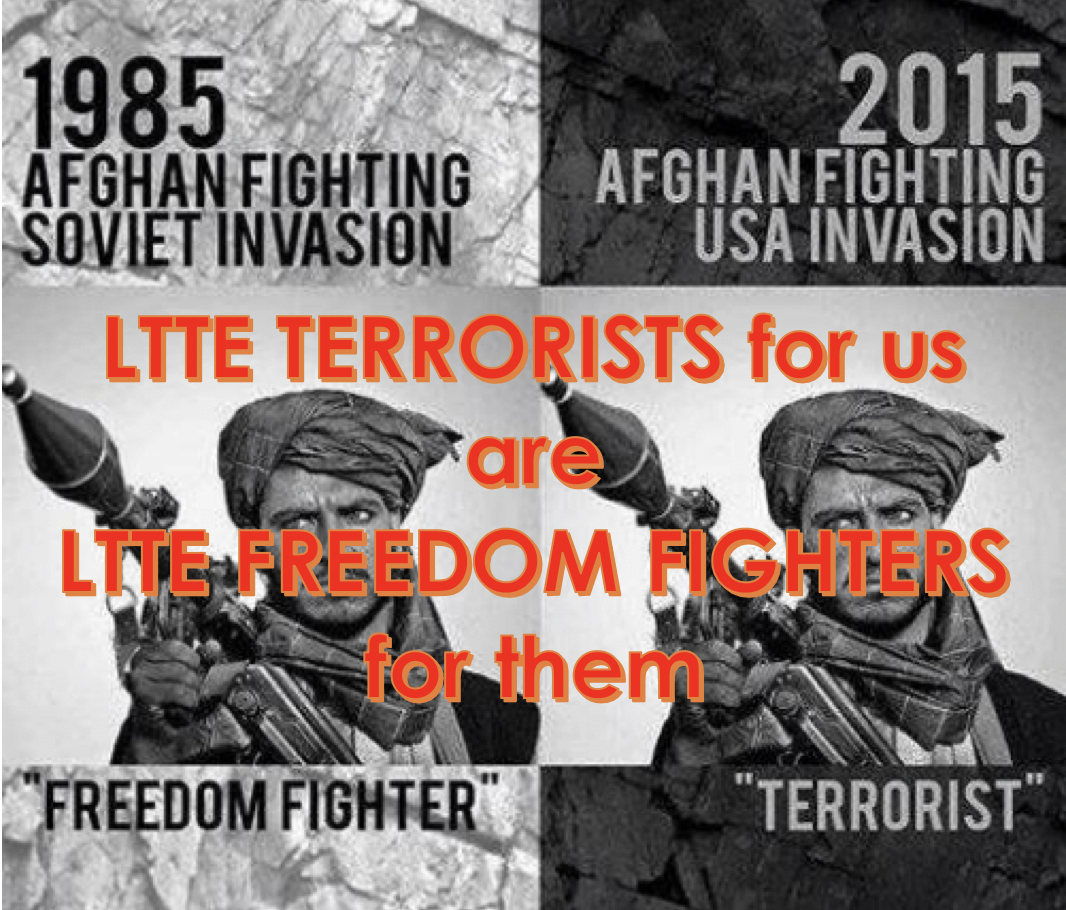
Dravida Nadu was a Christian Missionary movement & Tamil Eelam is possibly too. How India got wrangled to train & arm LTTE in a project initially rooted by the Church is a puzzle and something for India to think about. However, while LTTE remains banned by
Watching the pomp and pageantry & honoring of traditions and customs for the Queens funeral saddened me because while our people are happy to praise the British history & its customs, they frown down on our own.
This is primarily the fault of our education system, poor communication & media & failure of the Maha Sangha and Buddhist associations to ensure the citizens of Sri Lanka knew their history, was aware of their traditions, heritage, culture & customs.
Many of these foreign MPs are issuing statements on ‘Genocide’ without having the common sense to even verify if such took place. A look at population statistics would make any to wonder how can genocide take place if Tamil population is increasing. As for war crimes – without names of supposed dead, without bodies, without skeletons without mass graves – how can a national army be accused of war crimes and murder! Some of the foreign MPs are even attending pro-LTTE commemorations where the hype is about ‘civilian’ dead when in reality these MPs are attending to foolishly mourn LTTE dead. Havent the foreign intel briefed these MPs before attending such functions. It is such a joke to see foreign MPs issue statements that are really meant for LTTE dead while it is virtually impossible to ascertain who were the civilian dead as LTTE had a trained civilian armed unit. Any LTTE civilian unit member dying during hostilities is not entitled to civilian status.
Moreover, how many of these foreign MPs can confirm that anyone dying inside the conflict zone were only killed by Sri Lankan forces and not LTTE. Didn’t they know that LTTE shot dead fleeing Tamil civilians? Didn’t their governments & envoys appeal to LTTE to release civilians? Didn’t UNSG also appeal to release children, women and the elderly? All appeals LTTE refused to oblige.
Since the end of the conflict numerous foreign MPs have taken part in petitions and have regularly issued statements and have been regular visitors to pro-LTTE events in their countries knowing their countries have banned LTTE. What is the meaning of banning an entity as terrorist when their own MPs attend events that promote these terrorists?
LTTE could not be defeated for 3 decades because of the foreign hands involved & linked to LTTE.
While the Church first inspired self-determination for Tamils, India gave its soil to train Tamil militants, Tamil Nadu politicians openly backed them, foreign intel also trained them, LTTE were allowed to freely open foreign offices & station LTTE members, while foreign govts banned LTTE, these offices ran without issue, LTTE’s international head quarters was London. Foreign MPs are in competition to issue the best statement on behalf of the LTTE, foreign governments have funded NGOs & INGOS to provide support to the LTTE & foreign media helped paint an ugly picture of the Sinhalese majority & Sri Lanka in general. Foreign funded human rights organizations were brought in to showcase trumped up charges which went into foreign funded reports and these became the Bible used in Geneva.
Any TRUTH COMMISSIOn cannot omit naming all of these foreign MPs who attended pro-LTTE events overseas, who gave speeches standing next to huge cut outs of Prabakaran, who attended mourning events of LTTE dead and issue statements for a homeland and separatism which goes against diplomatic protocols and constitute interference into the internal affairs, sovereignty of nations.
If a TRUTH COMMISSION is not going to be naming and shaming these foreign MPs – there is no need to spend money on such a commission for omissions that seek to camouflage the TRUTH.
What kind of joke is this – soldiers are dying to defend the nation from terrorists, foreign MPs are shaking hands with the terrorists!
Any insurgency has to have a base for the recruitment of cadres, training and indoctrination observed analysts. JVP decided to use the universities of Sri Lanka for this purpose. The university was ideal for this purpose. It was a loosely organized enclave. The university is a good recruiting ground for the JVP, observed critics. First year students were the most vulnerable.
By 1978, JVP had established itself in the universities as the strongest group among the students. JVP has pushed out all the other political parties and is able to dominate in student matters, said an informant in 2007. Other parties have no involvement now in student politics. The JVP leaders come in expensive vehicles, park them outside campus and walk into the campus.
Weeramunda did a survey of ragging in three universities in 2007, University of Sri Jayewardenepura, University of Kelaniya and University of Colombo. He observed that the JVP alone, of all political parties, has succeeded in obtaining a firm foothold in the student bodies of all three universities. UGC report on ragging (2018) stated that that JVP continued to maintain its foothold in the student bodies of universities.
JVP does not have the support of the majority of students. The JVP group, who do the university ragging, are a minority compared to the overall student population in the universityobserved Hettiarachchi in 2020. Only 2.7 %of students who completed more than 75 % of attendance found to be harassing their juniors through ragging said UGC in 2018. About 10 or 15 students are activists. Others follow like sheep, said an informant in 2007.
However, despite small numbers, JVP has succeeded in recruiting and indoctrinating new batches of enthusiastic supporters and activists every year from the university, said analysts.
JVP is assured of a continuous supply of new entrants with the recruitment of new batches of entrants every year, they said. Through ragging, JVP managed to replenish its cadres, by catching some of the freshers into its net every year.
Weeramunda (2008) stated that JVP has followed a systematic method to recruit and indoctrinate new batches of enthusiastic supporters and a hardcore of activists every year, from the new arrivals in the university. JVP’s methods were founded on the principle of making the most out of laxities and weaknesses of the university system, Weeramunda said.
The JVP modus operandi consist of a series of clandestine operations that takes the form of a hidden insurgency, Weeramunda continued. JVP starts by running awareness programme for new entrants before they enter the university by contacting them privately at the district level and preparing them for entering the university.
Next, when the freshers arrive in university, JVP administers an orientation programme for new entrants for a period of 3 months. They do this with the approval of the university authorities. This is most effective in the Arts faculty where the freshers are more vulnerable and the JVP is strongest, observed Weeramunda.
During this period, the new entrant is given a new identity, with a new name, shown the administrative setup, the facilities available such as library, hostel and medical services and how to use them, names of seniors, and rules for behavior within the university. This would have been gratefully received by those coming from remote areas.
Freshers were also treated to lectures on free education, history of the JVP, JVP’s role as protectors of student rights and sacrifices made by JVP heroes. Freshers are forced to memorize the names and deeds of student heroes” and sing the student hero song at events, said informants. Many of these heroes died in the 1988-89 uprising after they had left the university. Those like Samantha Withanage who resisted ragging and were brutally murdered on campus are not mentioned. Dead activists were also commemorated on Vira Sisya Day.
Seniors then subjected the freshers to serious ragging. This was done for multiple purposes, one of which was to replenish the JVP cadre in the university. Those who ragged well were made JVP union leaders or batch representatives in the university.
Every year, a new set of leaders are appointed from the second years, for JVP work. The JVP group meet and decided each year who is going to contest student union elections and who is going to rag, reported Weeramunda.
Seniors secured the loyalty of certain pro-rag followers from among the freshers. These freshers then become informants and betray their fellow peers, noted critics. They report on fellow freshers. They act as messengers to the seniors.
Freshers now rag freshers in a new trend, informants reported in 2007. Undergrads failed to see the significance. They simply complained, we freshers have to rag other freshers. But this was a test to select JVP recruits.
The ragging helped JVP to enroll its next generation of JVPers. It helped spot potential JVPers among the freshers. The more aggressive students and those who have earned a good ragging record from the first year batch are recruited into to the party, said Weeramunda.
This small group were then secretly indoctrinated outside the campus on the JVP policies. They were given lectures on free education, history of the JVP and the JVP role as protectors of student rights and the sacrifices made by JVP heroes. JVP spends money on this and that cannot be stopped, remarked informants.
Weeramunda explained, those undergoing the ‘rag’ are watched and promising freshers are recruited into the JVP. The more aggressive students and those who ragged the freshers well were selected. They were then indoctrinated secretly, outside the campus on JVP ideology. They are taught the history of colonialism, its negative impacts on society and economy, JVP vision of a socialist state, JVP’s organization, and the responsibilities of JVP cadres. These recruits are promised jobs and told that their role is to influence other students. Student leaders believe they have power, said informants.
Outside elements then start to control these students, said informants. Student activists are given cell phones so that they could maintain contact with JVP leaders and carry out their instructions. JVP pays the activists and targets are set for them. These undergrads do not attend lectures. They assign students to stand in for them and copy notes.
The JVP seniors in the university puts the new recruits to work. They are made to paste posters, attend pickets and demonstrations and learn to lead various protests. The party gives money to display expensive banners and posters.
At least once a month undergrads are sent out across to all corners of the island to collect money for the JVP. Collecting (keta hollanawa) is done by the freshers, under JVP direction. JVP recruits were given a monthly wage in return for organizing tin collections all over the country. A person from outside comes to collect the collection.
JVP has fulltime workers assigned to each university for this and they are given a target for every year. At Ruhuna each group was given one till and they were expedited to go everywhere, even to small places, like Angunakolapalessa Walasmulla, as well as Beliatta, Tangalle. They get about 2 lakhs from a town, the total is about 10 million.
JVP used students to show to the public that they have power. There is a march every year for one reason or another in the university , directed against the university administration. If there is a protest tomorrow, the leaders are there in the hostels tonight, informants said in 2007.
Students are also used for public demonstrations and protests. The students activists are expected to synchronize protests and demonstrations in all campuses so that they have maximum impact .
First year students who support the JVP are made to participate in protests taking place outside the university . Freshers are placed right in front, while the seniors stayed safely at the back.These protests mostly end with water cannons and tear gas and the freshers were the first to be affected.
Most of these students don’t even know why they are demonstrating. They go unwillingly. We walk to UGC or Parliament. We have no idea what will happen, whether we would be sprayed with tear gas or water. But we had to go in the front, said undergrads.
In one instance we were taken to picket and 10 of our students were suspended. In another instance, seniors took us to picket and as a result, we were not able to attend lectures. They promised us that they would see that we had no problem about attendance but they did not do so and we were penalized for not attending lectures. We trusted the seniors a lot but they let us down.
University students leave the university after four years and move onto adult life. JVP must be able to ensure their loyalty after they leave university . Weeramunda found that about 10-15 students per university continue JVP activities throughout their university years and continue to work for the JVP after they have left the university . Student leaders are promised jobs after they leave. This is welcome news for rural youth, who cannot be sure they would get a job after graduation. This gives them the chance also, of joining the power elite.
The university was also used for recruiting for the baby brigade of the JVP. The Students Union of Kelaniya University, holds arts festival called Bihi Dora and invites schools to participate and compete in its events. They identify skilled school children, give them prizes and certificates and catch them at an early age, said informants in 2007.
Minister Manusha Nanayakkara hands over the vehicle import permit to the first recipient’s nominee”
The nominated representative of the first recipient of the newly introduced programme to allow Sri Lankan migrant workers to import an electric vehicle after remitting money through official channels received the relevant vehicle import permit from Minister of Labour and Foreign Employment Manusha Nanayakkara today.
Daham Perera the authorized representative of the Sri Lankan migrant worker who imported the vehicle received the vehicle import permit from Minister Nanayakkara.
The minister on the occasion noted that the decision to allow Sri Lankan migrant workers who remit money through official channels to import an electric vehicle has been much appreciated and inquiries in this regard by workers are increasing on a daily basis.
Any Sri Lankan who lives, works or holds dual citizenship in a foreign country are eligible to import an electric vehicle under the scheme. Those sending USD 20,000 or more between May 1, 2022 and December 31, 2022, can obtain a permit to import an electric car. Those who remit USD 3000 or more via official channels from May 1st 2022 to May 2023 are eligible to import an electric motorcycle.
The minister emphasized that it is mandatory remittances directed to Sri Lanka are sent through the legal channels such as the banking system to be eligible for this benefit. The minister further said that it was also mandatory that 50 percent of the money sent has been converted into rupees. He said the motorcycle or the car can be imported for a value not exceeding 50 percent of the amount remitted.
Minister Manusha Nanayakkara further said;
Importing vehicles to Sri Lanka is currently prohibited. But only foreign workers who send dollars to the country have the facility to import an electric vehicle. So make the most of this opportunity. Enjoy this reward. As a ministry, we fully support it. Similarly, the tax levied on the import of luxury vehicles will also be revised in the future.
But the permission is only to import electric vehicles. These vehicles should be unused vehicles. Either brand new or mileage should be ‘0’. Similarly, it is mandatory to import within one year of the first registration.
As the ministry, we hope that the battery pack and electric motor of this imported vehicle should have a warranty of at least three years. This should be ensured by the manufacturer, importer and exporter. It should also be ensured that the battery is disposed in accordance with international electric vehicle road safety standards and approved standard procedures. The remittances sent to Sri Lanka can be converted into rupees and the taxes for this can be paid. They must also be subject to Department of Motor Vehicles compliance. A car should have at least 200 kilometers mileage after charging once. Similarly, a report of all money remitted to Sri Lanka should be submitted through the relevant bank.The minister further said that the relevant application and information can be downloaded from the website of the Ministry of Labour or the Foreign Employment Bureau. He said after producing proof that money has been remitted through official channels and the documents related to the importation of the vehicle, the measures to initiate providing the vehicle import permit can be carried out.The vehicle imported in this way cannot be transferred to a third party until two years after its registration. The minister also said for persons wanting to transfer ownership before two years facilities have been provided to do so by making a payment in USD equivalent to 10 percent of the CIF value of the vehicle.
As the Indo-Pacific region represents the world’s economic and strategic center of gravity, the Indian Ocean today is becoming the centerpiece of all geo-strategic play. So, Cooperation in the region is crucial to implementing the international community’s global agenda, including achieving the UN’s Sustainable Development Goals. Major powers like the US have enhanced and deepened their strategic engagement and leadership roles with countries in the region. The Indo-Pacific Armies Management Seminar, or IPAMS, is a U.S. Army Pacific (USARPAC) initiated conference that is aimed at facilitating and enhancing interactions among the armies of the Indo-Pacific region. This year’s 46th Seminar, co-hosted by the Bangladesh Army and US Army Pacific (USARPAC), concluded in Dhaka. The objective of IPAMS is to promote peace and stability in the region through mutual understanding, dialogue, and friendship. It is the largest conference for land forces in the region and one of the preeminent army engagements that provide a platform for the senior military leadership of Indo-Pacific regional ground forces to exchange views and opinions on peace and stability.
This year’s conference brought together senior officers of the military forces of 24 countries. Under the theme of “Possibilities and Challenges for Maintaining Peace and Security in the Indo-Pacific Region,” the main focus of the event was “robust peacekeeping,” “women empowerment,” and “land power in regional cooperation.” Apart from these, peacekeeping operations, humanitarian assistance, disaster relief, leadership development, countering transnational crime, and empowering women were being discussed.
Significance of Military diplomacy
Bangladesh has historically been part of ancient Indo-Pacific connectivity. It is indeed in Bangladesh’s interest to advocate and work for an open, resilient and interconnected Indo-Pacific. In a broader sense, its own continuing sustainability as an independent, sovereign, prosperous nation-state depends on this idea. With close to 40 nations comprising its make-up, the Indo-Pacific region covers more than half of the earth’s surface, home to 60% of the world’s population producing 60% of global GDP, contributing two-thirds of current global growth. By 2030, the overwhelming majority (90%) of the 2.4 billion new members of the middle class entering the global economy will live in the Indo-Pacific. 7 of the world’s 10 largest armies are in the region where border disputes and sovereignty concerns are headline events. Therefore, maintaining peace and security across the region is central to global progress.
However, the conference brings army senior leaders together to discuss differences, establish trust, mitigate miscalculations, resolve challenges, and find commonality among multinational-professional soldiers. There are issues that cannot be solved in isolation by just one or two countries. This platform allows military leaders in the region to get together, share their ideas, and find a collective solution to a pressing and immediate problems. The relationships developed throughout the seminar and through Army-to-Army engagements would help to identify issues of common interest for arriving at pragmatic multi-lateral solutions, and dealing with the escalating threats.
It is imperative to build trust at the strategic level. So, the armies need to work together with the public sector in policy-making and lay out a development foundation that links economic and social development with the protection of the environment and natural resources. The IPAMS promotes network building among military chiefs at all levels to join forces in coping with the world’s various changes and challenges for sustainable advancement of the region. The forums provide a unique opportunity to advance understanding of key issues while showing respect for each other’s role in promoting security and stability. It would build interpersonal relations, mutual trust, and confidence among the ground forces in the region, which would reduce tensions. “The IPAMS can create a sense of friendship and warmth so that peace and stability prevail in the region,” PM Sheikh Hasina said while addressing the opening ceremony of the seminar.
The meetings are yet another symbol of the close cooperation between Bangladesh and the United States. It also paved the way for stronger cooperation between the armies of the two countries. Charles A. Flynn, commanding general of the U.S. Army Pacific, assured that the United States will cooperate with Bangladesh and other Indo-pacific countries to ensure the security of this important region. Again, the Bangladesh Army Chief expressed hope that working together will give the Bangladesh army a lot of scopes to learn as the US Army is one of the best in the world and very developed.
While the militaries of the participating countries discussed disaster management, transnational crime, security issues, and women’s empowerment, the issue of Rohingya refugees who have fled from violence in Myanmar is not overlooked. It is undeniable that since the Rohingya crisis erupted in the Indo-Pacific region’s heartland, it has all the potential to directly threaten the peace and stability in the region. Because of the prolonged stay of more than 1 million Rohingya refugees in crowded camps, the economy, environment, security, and socio-political stability in the region will be seriously affected. A delegation of top military officials from 24 countries, including the U.S., Canada, Australia, Japan, Indonesia, India, China, and Vietnam, visited the refugee camps in Cox’s Bazar, where Rohingyas expressed their desire to go back to their home country of Myanmar’s Rakhine State and not to any third country. The members of the group witnessed the plight of the Rohingyas firsthand and developed a “clear perception” of the gravity of the refugee crisis and the need for their repatriation to Myanmar.
Organizing such an international military conference is a great achievement for Bangladesh Army. Noteworthy, The Bangladesh military’s positive and active role has earned the nation an international reputation with political and diplomatic mileage. The Armed Forces of Bangladesh have glorified the country on the global stage through their brilliant participation in UN peacekeeping missions. As the UN peacekeeping operations have been evolving continuously, Bangladesh has regularly been carrying out the performance appraisal of its peacekeepers and taking measures to cope with future challenges. Despite being a late entrant (in 1988) as a troop contributor, Bangladesh has emerged as a credible UN partner over the last three decades. Since 1988, Bangladesh has participated in 54 peacekeeping missions in 40 different countries across 5 continents with more than 175,000 uniformed personnel, including over 1,800 female peacekeepers. Currently, there are over 7,000 troops and police deployed in 10 missions (as per data from the Armed Forces Division). Praising the Bangladesh Army, US Army General Charles A. Flynn said: “The Bangladesh Army is known for its leadership globally because of its contributions to UN peacekeeping operations. Its peacekeeping campus and training center are not just known within the region, they are known internationally. There are many, many things that the US Army and so many other armies can learn from the experiences of the Bangladeshi Army in their international and global commitment to humanitarian assistance, disaster relief, and peacekeeping operations. “ This acknowledgment has once again proved that our armed forces are a vital factor in upholding global peace and are able to keep our country safe from the subversive activities of internal and external enemies.
Last but not least, this conference is a critical opportunity to connect with the world’s military leaders to foster alliance partnerships and cooperative relationships. It is expected that dialogues like these will further strengthen ties between the Indo-Pacific countries and the Bangladesh Army and increase possibilities for mutual cooperation to cope with recent challenges in order for the region to move forward in a secure and sustainable manner.
‘Countering America’s Adversaries through Sanctions Act’ commonly known as CAATSA is considered the most fatal weapon which is used against the countries not in good books of America. Just a few months back, it was in the news that the US authorities were considering imposing sanctions on India because of its trade ties with Russia. It was all being done as a part of US’ isolation strategy during the ongoing conflict between Russia and Ukraine those days. Situation became more serious when India stood in the line of those 35 countries which abstained themselves from voting at the United Nations against the Russian advancement in Ukraine. Certainly the Indian decision of going against the US will and desire was not very much encouraging rather pleasing for the US authorities, military as well as political. At political level both the Democrats and Republicans raised their concerns about India’s stance of ‘going against the wind’ and it was being apprehended that this decision would create distances between India and America. It was also in the air that the Biden administration might impose sanctions upon India under the ‘CAATSA law’ which imposes certain restrictions on the countries purchasing defense materials from Russia, North Korea and Iran but nothing such ever happened. In spite of all these fears and apprehensions India is still the ‘blue-eyed boy’ of US. Experts on the subject are of the opinion that this sheer misunderstanding on the part of the US authorities would prove a seriously painful shock to the US policy-makers, somewhere in near or far future.
of Trust- U.S. India relations from Truman to Trump’ Meenakshi Ahmed is considered an expert on India-US relations. Recently she penned down an article in the Atlantic with the title, ‘America Has Never Really Understood India’. She said, Russia’s invasion of Ukraine has resurrected Cold War hostilities, harkening back to a world in which the United States saw itself pitted in a Manichaean struggle, facing a choice between good and evil. The U.S. is using similar rhetoric today to persuade countries to isolate and punish Moscow.” She further says, President Joe Biden has garnered support among his NATO allies to impose crippling sanctions on Russia, but his efforts elsewhere have been only partially successful. Australia and Japan—which, along with the U.S., make up three-quarters of the Quad, a relatively new Asian-security grouping—have signed on, but India, the fourth member of the bloc, has declined to join the chorus of condemnation.” If India were a very serious and sincere partner of the US, it must have been the first one to offer all cooperation in this regard.
Almost eight years back in March 2015, Crispin Rovere penned down an article in The Interpreter with the title, ‘India is no ally of the US’. The writer said, As for India and the US, I find it astonishing that after more than 50 years of being repeatedly burned, some Americans still have not learned their lesson and continue insisting that China and India are ‘natural competitors’. This is false. China and India are historical competitors, but such competition is not necessarily ‘natural’ and certainly nothing like the strategic competition that exists between China and the US. After all, any Chinese expansion in the Western Pacific will be at America’s expense. It is hard to argue that India’s expansion into the Indian Ocean is being actively resisted by China. India is not a pro-Western democratic bulwark, and never will be.” Last year on April 15, 2021, same apprehensions were expressed by Chirayu Thakkar regarding uncertainty of US-India relations in an article appeared in the Stimson.
Chirayu Thakkar said, For the last 20 years, the United States has mostly overlooked its divergences with India in multilateral forums as the relationship paid economic, strategic, and political dividends bilaterally, whereas the costs of divergences at the multilateral level were negligible. In spite of such exceptionalism enjoyed by New Delhi, U.S. diplomats at all levels reminded their Indian counterparts that India’s obstinate role at the UN was increasingly at odds with our emerging strategic proximity.” With a restructuring of the global order, continuous assault on rules-based order, and China’s rise as a common strategic adversary, the costs of their inability to work together in the global governance arena can be much higher for both countries today.” Subrahmanyam Jaishankar’s book ‘The India Way: Strategies for an Uncertain World’ is no doubt an eye-opener to all those who are misguided by the notion that India would always remain an ally of the US, keeping all its national interest aside. The writer has very emphatically tried to explain that India has no plan to align itself fully with either the U.S. or China. He says, This is a time for us to engage America, manage China, reassure Russia, and bring Japan into play.” Dov S. Zakheim is a senior adviser at the Center for Strategic and International Studies and vice chairman of the board for the Foreign Policy Research Institute. In September 2021, his review on Shankar’s book was published in the Hill, in which he tried to make his readers realize that whatever Jaishankar said in his book, must not be taken for granted as he had been a former ambassador to both Washington and Beijing; moreover he is the son of Krishnaswamy Subrahmanyam who is recognized as the ‘father of India’s nuclear program’. Krishnaswamy Subrahmanyam is the person who maintained close ties with Moscow even as he was perhaps the leading advocate of the 2007 Indo-U.S. Agreement on Civilian Nuclear Cooperation. If such a well-informed and well-connected person does not find harmony in American and Indian interests, it means the actual situation is altogether different from what apparently seems. If India is not fair in its relationship with US, why US is wasting its resources on making India ‘the regional god-father’. It seems the most proper time when US must revise the list of its friends
Discussions are underway between central banks to allow Russian credit cards to operate in Sri Lanka. Last year almost 17,000 Russian tourists visited the island. The country is in economic recovery and also hopes to obtain a loan to buy fuel.
Colombo (AsiaNews) – Sri Lankan authorities are considering joining the Russian Mir payment system: discussions are currently underway between the country’s central bank and that of Moscow. Launched in 2017, Mir is a payment and money transfer channel operated by the Russian National Payment Card System.
According to senior government officials surveyed by AsiaNews, Mir is an easy payment system but ‘it is necessary to obtain the Central Bank’s approval’ for the talks to continue.
On 6 March, Visa and Mastercard suspended operations in Russia following the invasion of Ukraine. Since then, holders of Visa and Mastercard bank cards issued in Russia cannot pay for goods and services outside their country. The US and its allies have sanctioned Moscow with exclusion from Swift, the main international payments system, which is controlled by Washington.
The use of Mir, however, would allow Russian tourists to use their credit cards while in Sri Lanka, something that – government officials say – the local authorities “would be happy to allow”.
Data from the Sri Lanka Tourism Authority show that in 2021, despite the covid-19 pandemic, Russia was among the top countries in terms of the number of tourists visiting the island with almost 17,000 entries.
Since the protests that have affected the country in recent months “are now over and the island is a safe tourist destination”, visitors will mainly return in November and December, AsiaNews sources say.
According to sources in the Ministry of Transport, “there is hope that flights between Sri Lanka and Russia will start by mid-October”.
Meanwhile, the authorities in Colombo are also continuing discussions with Moscow on the possibility of obtaining a loan for the purchase of Russian oil to ‘alleviate the fuel crisis in Sri Lanka’ that has gripped the country for months. The Wickmeresinghe administration expects ‘great support’ from Russia for economic recovery: according to sources in the Ministry of Transport and Highways, discussions on obtaining a loan are going ‘very well’.
According to local officials, already ‘former President Gotabaya Rajapaksa had asked Russian President Vladimir Putin to provide Sri Lanka with a loan to buy oil from Russia’.
About 50 per cent of Russian exports to Sri Lanka are machinery and equipment, while about one third are grain, mainly wheat. Until 2018, Sri Lanka was one of the world’s largest buyers of Russian chrysotile asbestos, which is used in the construction industry, but the government has decided to stop using asbestos by 2029, so the volume of purchases has decreased significantly. Sri Lanka exports tea to Russia, which accounts for 50% of its exports, and textiles, which account for 40% of exports.
Bilateral relations between Moscow and Colombo also include agreements on science, technology and innovation, tourism, culture, space exploration and fisheries.
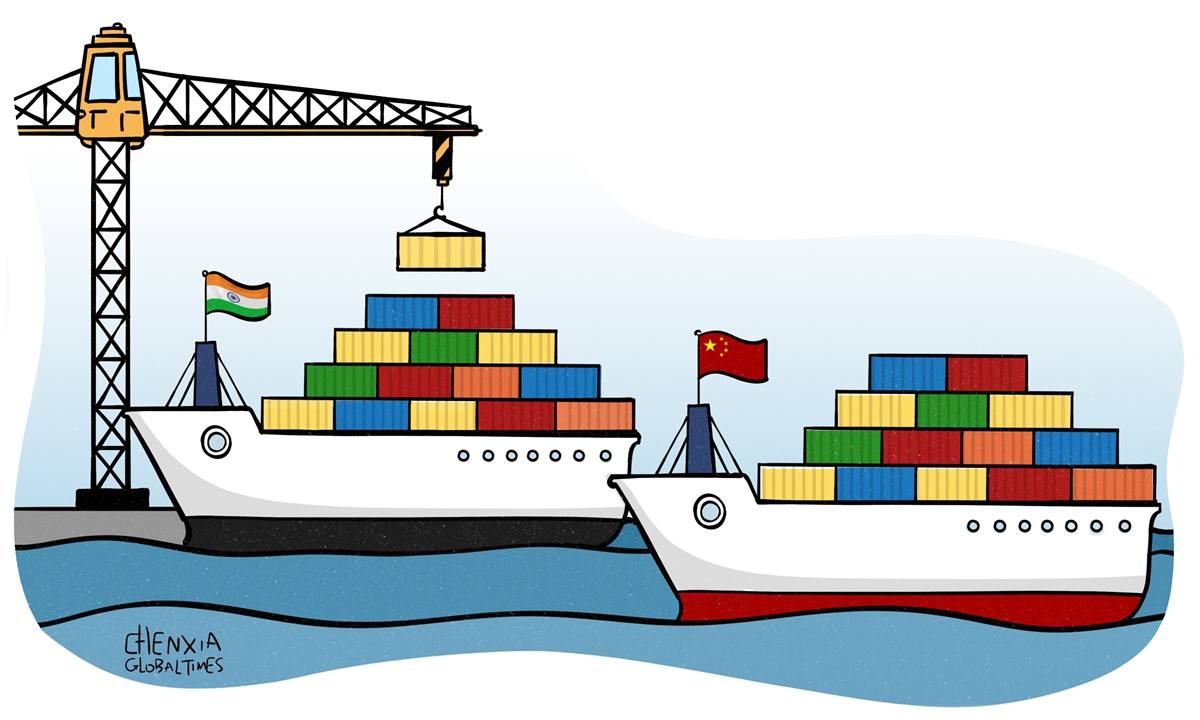
Illustration: Chen Xia/Global Times With a total of $968 million in loans in four months of 2022, India “has emerged as Sri Lanka’s largest bilateral lender, overtaking China in the process,” India’s ANI news agency reported on Monday, citing Daily Financial Times.
Sri Lanka has borrowed not only from China but despite this, Chinese loans have been specifically targeted by anti-China forces. Critics have accused China of what they call a “debt trap,” saying that the so-called “debt trap diplomacy” has “become a cause of Sri Lanka’s economic crisis.” Their debt trap lies is a narrative that the US-led camp has used to defame and smear China. The West’s anti-China narrative should not derail Sri Lanka’s cooperation with its friends.
Ruchira Kamboj, India’s permanent representative to the UN, was quoted by the ANI report as saying that India had provided nearly $4 billion in food and financial assistance to Sri Lanka. “In our immediate neighborhood, we are continuing to help our good friend and neighbor Sri Lanka to ensure food security,” Kamboj said.
Some Western observers have lauded India’s help to Sri Lanka, but China is being blamed by the West for providing same loans and economic assistance to the nation. Those observers should stop their double standards in criticizing a so-called Chinese debt trap. Loans and aid to Sri Lanka should not be treated differently based on which country they come from.
China is one of the largest infrastructure construction partners and main source of foreign investment of Sri Lanka. China has worked with Sri Lanka to help meet its financing needs and improve its ability for sustainable development. China does not impose its will on others or seek any political gains. This is why developing countries, Sri Lanka included, think highly of their cooperation with China.
Sri Lanka needs to pursue economic development and the country has the right to freely choose its cooperative partners. Sri Lankan Minister of Foreign Affairs Ali Sabry said in August that he thanked the Chinese government and people for their timely assistance to Sri Lanka in times of difficulty. “With special and long-lasting bilateral relationship, Sri Lanka and China have always trusted and supported each other,” Xinhua reported.
Sabry’s words came after some Western media outlets deliberately hyped up China-India competition over Sri Lanka’s economic woes. The BBC said in July that Sri Lanka’s desperate financial need, in a way, has helped New Delhi regain its influence in the nation after “China made inroads by offering loans and other forms of financial aid for infrastructure projects in the past 15 years.”
Any attempt to incorporate geopolitical thinking into economic issues won’t help resolve the economic crisis unfolding in Sri Lanka. India does not have to view Chinese investments and loans in Sri Lanka from a competitive perspective. Countries should put geopolitical thinking aside and avoid falling into a trap set by the West, which aimed to heat up competition between China and India.
It is a false proposition that India has overtaken China to become Sri Lanka’s largest lender. China has stressed many times that it is neither the only creditor nor the largest creditor of Sri Lanka. Only around 10 percent of Sri Lanka’s external debt is owed to China.
China has pledged to do its utmost and to make full use of the channels available to deliver help to the Sri Lankan society. We believe India will do the same. India has also done a lot in helping Sri Lanka and its effort is commendable, but it will be meaningless if some attempt to compare India to China in terms of economic presence in Sri Lanka
China and India need cooperation, not competition in Sri Lanka. Chinese Foreign Ministry spokesperson Zhao Lijian said in June that China is ready to work with India and the rest of the international community to help Sri Lanka and other developing countries experiencing difficulty to pull through the hardship as early as possible. Although the West’s anti-China narrative deliberately hyped up China-India competition, India should be vigilant to avoid falling into the trap set by the West.
A farmer tragically died of a fatal infection caused by swallowing a fish bone.B.M.Munasinghe via IJSCR
A Sri Lankan farmer tragically perished after swallowing a fish bone, which pierced his intestine and triggered a fatal infection. A case report detailing the freak accident was published in the International Journal of Surgery Case Reports.”
The 60-year-old unnamed patient had reported to the coastal District General Hospital of Sri Lanka, after experiencing three days of abdominal pain, vomiting, constipation and a distended belly, per the report.
Suspecting he was going into septic shock, medics rushed the man to intensive care, where scans revealed that his abdomen was filling with fluid. This symptom suggested that his kidneys had stopped working — a possible sign of sepsis, where the body’s immune system attacks its own organs.
1of3
The fish bone extracted from the farmer’s intestine.B.M.Munasinghe via IJSCR
The fish bone had created a small hole in the man’s lower intestine.B.M.Munasinghe via IJSCR
The patient didn’t recall swallowing the fish bone.B.M.Munasinghe via IJSCR
A subsequent two-hour operation revealed a small hole in his intestine, which the medical staff discovered was caused by an 0.8-inch-long fishbone. However, the farmer didn’t recall ingesting the 2-centimeter shard, the Daily Mail reported.
Nonetheless, the seemingly innocuous bone fragment had reportedly perforated his bowel, causing fecal matter to seep out and infect his abdominal wall. As a result, the intestine ballooned in size while yellow pus accumulated around the hole.
In an attempt to save the patient, doctors sliced a 3.9-inch (10 cm) segment of the intestine and drained the perforation with the aim of reattaching the healthy bowel after the infection was eradicated. Despite their efforts, the patient passed away following cardiac arrest” just eight hours after his admission to the emergency room, per the report.
Interestingly, fish bones are the leading cause of gastrointestinal perforations,” the study authors wrote.
In regions where fish is a staple food, fish bones are not uncommon culprits of FBs [ingested foreign bodies],” the case report states. The jagged, sharp nature of fish bones makes them more prone to inflict mucosal injuries and subsequent perforations.”
A local fisherman holds a bucket of freshly caught fish just after returning to shore in Mannar, Sri Lanka, on Aug. 16, 2022.REUTERS
And while the outcome is favorable in most instances, nonspecific symptoms coupled with poor imaging resources can result in a delayed diagnosis, which doctors believed occurred with the aforementioned case.
It was only some important people who had accompanied President Ranil Wickremesinghe on his recent tour to Britain to attend the funeral of British Monarch Queen Elizabeth II, a spokesperson from the President’s office confirmed today.
According to the spokesperson, only President Wickremesinghe, Ms. Wickremesinghe, a special aide, three security personnel and the Director International Affairs attached to the President’s office were in the tour party. The Director International Affairs had to join in the tour to organize media coverage in Britain,” she said.
She was responding to comments made by MP Kumara Welgama, who said the delegation which the President took to Britain was ‘a little high’. (Yohan Perera and Ajith Siriwardana)
Following controversy over grounded aircraft by its government, Aeroflot has announced that it will resume services to Sri Lanka.
It is understood that from October, the Moscow-Colombo route will be reinstated, on conditions being promised by the Sri Lankan government that none of its planes will be grounded or arrested.
On top of this, Sri Lankan media have reported that another carrier is due to operate this route as well, which comes as no surprise given how lucrative the Russian market still is at present.
For example, the country is the ninth largest outbound market with annual spending of nearly $50bn for holidays abroad.
Back in June, Sri Lankan authorities grounded an Aeroflot Airbus A330 due to an arrest warrant approved on behalf of leasing giant GECAS.
The arrest warrant was issued on behalf of Selective Aviation Trading Limited, which is in alignment with aircraft lessor GECAS, as the leasing giant looks to acquire some aircraft stolen by the Russian Government.
Such nationalization of aircraft took place through the re-registering of aircraft back to the Russian registry of RA.
Now, these aircraft are doing international flights; this does open up the potential for groundings to occur once again, meaning the lessors will actually be able to get their aircraft back.
RA-73702 was the particular aircraft in question. Then, around three days after that, the Sri Lankan courts lifted the ban, allowing the aircraft to leave the country.
It is also understood that this is a result of political pressure from Russia, with the Sri Lankan Ambassador in Moscow being summoned to the Kremlin for an explanation, according to local media.
By the end of July, there was a lot of hope from travel authorities in Sri Lanka hoping that Aeroflot would resume services to Colombo from Moscow soon, following the grounded aircraft saga. Such diplomatic rows have created a worsened relationship between Sri Lanka and Russia, but Aeroflot is interested in returning to the capital
A CAA official told the Daily Mirror in Sri Lanka: They have not committed yet. But we believe they are planning on resuming flights soon. However, they will likely run into the existing issues of jet fuel shortage and fund repatriation issues”. On top of this, Aeroflot will want to make a comeback to the Sri Lankan capital, especially with UAEbased carrier Flydubai occupying a lot of its market share since the route suspension.
Flydubai currently accounts for 35.2% of Russian arrivals into Sri Lanka, with the obvious stopover in Dubai not putting travelers off from traveling to the region per se.
That being said, however, Russian tourist arrivals fell to 1,610 in June, which is a substantial decrease. Either way, this will be good news more on the side of Aeroflot, who is looking to generate as much revenue where possible, given its destination list being limited due to the ongoing Ukraine Crisis. (Aviation source news)
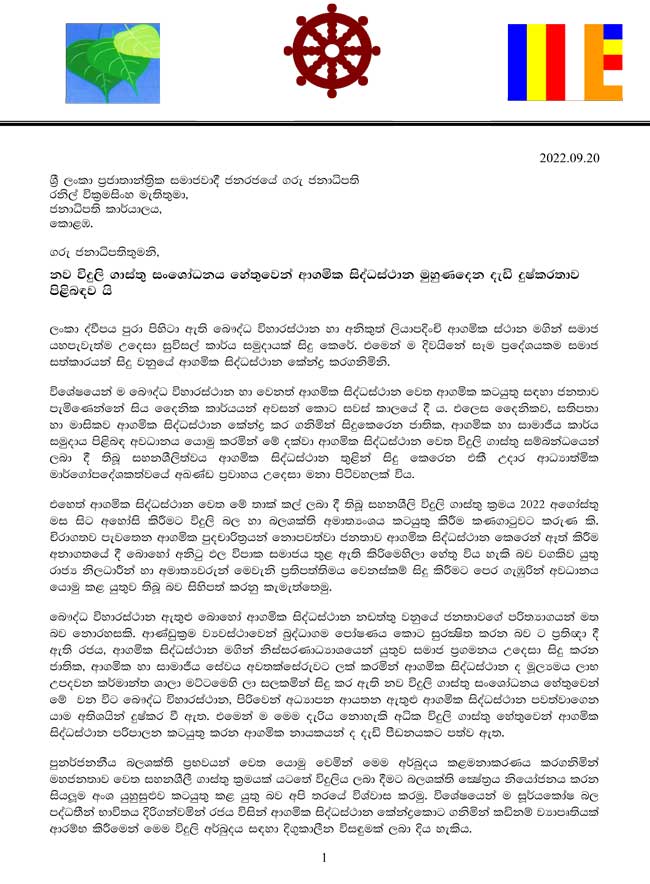
In a letter to the President, the Chief Prelates of the three Buddhist Chapters today request for a methodical and concessionary electricity tariff policy for places of religious worship.
The Mahanayake Theros, informing about the severe difficulty faced by religious places of worship due to the new electricity tariff revision, state that it is regrettable that the concessional electricity tariff system that was given to religious places until now has been cancelled.
The letter further pointed out that an extremely difficult situation has arisen due to the new revision of electricity tariffs, which they say has been done by underestimating the social service provided by religious shrines and treating them at the level of factories generating financial profit.
The joint letter is signed by Most Ven. Thibbatuwawe Sri Siddhartha Sumangala Mahanayaka Thero of the Malwathu Chapter, Most Ven. Dr. Warakagoda Dhammasiddi Sri Gnanarathabidhana Mahanayake Thero of the Siyamopali Maha Nikaya – Asgiriya Chapter, Most Ven. Dodampahala Chandrasiri Maha Nayaka Thero of Sri Kelayanivasa, Amarapura Maha Nikaya and Maha Nayaka Thero of the Ramanna Maha Nikaya, Most Ven. Makulewe Wimalaabhidana Thero.
India said on Tuesday it had begun talks with Sri Lanka on restructuring its debt and promised to support the crisis-hit neighbour mainly through long-term investments after providing nearly $4 billion of financial aid.
Sri Lanka, a tourism-dependent South Asian country of 22 million, is struggling with its worst economic crisis in more than seven decades, which has led to shortages of essentials and the ouster of a president.
The country earlier this month reached a preliminary deal with the International Monetary Fund for a loan of about $2.9 billion contingent on it receiving financing assurances from official creditors and negotiations with private creditors.
The High Commission of India in Colombo said it held the first round of debt talks with Sri Lankan officials on Sept. 16.
The discussions held in a cordial atmosphere symbolise India’s support to early conclusion and approval of a suitable IMF programme for Sri Lanka,” the High Commission said.
Sri Lanka will make a presentation to its international creditors on Friday, laying out the full extent of its economic troubles and plans for a debt restructuring.
The Indian High Commission also said New Delhi would continue to support Colombo in all possible ways, in particular by promoting long-term investments from India in key economic sectors”.
India’s support to Sri Lanka this year has included a $400 million currency swap, a $1 billion credit line for essential goods and a $500 million line for fuel. In addition, India has also deferred payment on Sri Lankan imports of about $1.2 billion and given a credit line of $55 million for fertiliser imports.
Reuters reported last week, citing sources, that India did not plan to provide fresh financial support to Sri Lanka, as the island’s battered economy had begun to stabilise.
The High Commission said India had ongoing development projects worth about $3.5 billion in Sri Lanka, whose president earlier this month asked his officials to resolve obstacles to projects backed by India. He did not specify the obstacles or the projects.
President Ranil Wickremesinghe has said Sri Lanka will turn a free trade agreement with India into a comprehensive economic and technological partnership.
Garvin Karunaratne, former Government Agent, Matara, 19/9/2022
The present Government has already embarked on a programme of privatization, despite the fact that it has no mandate from the people.
In the Presidential Election where over sixty percent of people voted and elected Gotabhaya as the President, as well as in the General Election where the Podujana Permuna was elected the premise was that State Assets would not be privatized. , Our former President, Mahinda Rajapaksa is an avowed personality on this issue. The Privatization of State Assets is not approved by him. Thus the present Government has no mandate from the people to privatize any State Asset. This is an important fact and our learned judiciary is kindly reminded of this fact, because if the Government yet moves on privatization it is only the Judiciary that the people have to depend on. .
The present Government should also take note and stop the privatization of State Assets forthwith, be they even incurring a loss forthwith.
The news today in Lankadeepa-18/9, discloses that many Government farms are to be privatized. They are all national assets- Bopatala in Nuwara Eliya- 1133 acres, Kottukachchiya- 500 acres, Nikaweratiys-1954 acres, Oyamaduwa- in Anuradhapura-1477 acres, Parangasweva-1632 acres, Weerawila- 412 acres. All these are areas where the State farms have to be worked to perfection to enable the maximum crop which will be held as achievable to farmers. Instead, if these are sold to the private sector it is a great loss as there is no guidance ever possible to show to the farmers. If any of these are not paying that is entirely due to their being run inefficiently and the managers and the officers above have to be held responsible. Instead of doing that task, trying to get rid of this by privatization is definitely not in the national interest.
The remedy for loss making institutions is to make them profitable. There is no other way. We do have administrators amongst us who can accomplish that task. I am definite as I was a member of the Administrative Service and am personally aware of the ability of our administrators. There should be no political meddling. Our administrators are veterans who can sort out anything. Recently petty political persons have been posted as the Head of the District Coordinating Committees. Dr Sudath Gunasekera, former Permanent Secretary to the Prime Minister Sirimavo has voiced himself that this is detrimental. In my days, the Government Agent was at the font of the district administration. If a petty political person is to be in charge why have Government Agents . Do away with them. Why have any staff officers; have a few clerical officers to carry out orders. If our Government is interested in performance the administrators have to be tasked.
Let us now step back and see how privatizations have not been in the interests of the country.
It will be found on any assessment that the Privatization of State Assets has ruined both Sri Lanka as well as Developed Countries. .
Let us consider what happened in Brazil: The Government of Brazil appointed a Committee of Inquiry that estabished that eleven transnational corporations brought into Brazil $ 298.8 million in capital, created and re invested profits of $ 693 million and repatriated as much as $ 744 million.(Latin America Economic Report: Jan 1976) Privatization brought heavy profits to investors, profits that should been with the people.
What happened in privatization of State Assets in the UK is revealing.
Take the UK. When I first stepped onto the fast trains in the UK in 1969, it was a marvel, the envy of the developed countries. Prime Minister Margaret Thatcher privatized it by dividing the routes and further taking the rail track away from the route rail companies. Rail track neglected maintaining the track. Instead of investing in new technology to ensure the safety of commuters, Rail Track paid fantastic salaries to the higher staff and paid plush dividends to the shareholders. Even safety devices
that are commonly used in France and other European Countries are not in place. The result- repeated rail crashes killing around a hundred people and in the Imperial British manner there are Royal Commissions that present reports. In the hands of Rail Track the reports end up in the garbage. Today the people avoid the railways like the plague.”
Recently there was a rail crash in London where four commuters lost their lives. It was found on investigation that the Railtrack in the UK does not follow the basic technology of an engine coming to a halt if it goes through a red light and proceeds on an unauthorized track. This is standard equipment in many other developed countries but not adopted in the UK because the multinational that has taken over the track does not want to spend a few million pounds to have this installed. To that multinational it is more important to make profits and provide a good dividend to its shareholders than to adopt safety measures that will save the life of its commuters.”
Take what happened in the USA. The Golden State of California a few years ago, privatized the electricity distribution system and a few years later found that the charges that were levied by the distribution companies was so high that an investigation had to be held. The companies were found to have jacked up the rates to the consumers and provided fantastic dividends to the shareholders and even a mighty company like Enron had cooked up its books to enable the distribution companies to make profits. The State of California had to buy back the two distribution companies.’
In Sri Lanka, take the privatization of Ceylon Oxygen: the ugly side is the fantastic increase in staff salaries amounting to as much as 680% between 1990 and 1998… 60% of the equity of the company is held by Norsk Hydro, a Norwegian Multinational… the loss of sovereignty is important…. After privatization the profit goes as follows: 60% to Norsk Hydro of Norway, 10% to the employees and the rest- 30% to the shareholders, mostly from Europe and USA!…. The profits is to the Government of Norway and to the affluent in Norway and Europe and America.” It is important to note that the profit was earlier coming to Sri Lanka benefitting every citizen.”
Take what happened to the Tyre Corporation of Sri Lanka, a factory donated by Russia, which according to its Chief Chemist Hector Perera, who installed it, had the capacity to make all the tyres Sri Lanka required.Privatization is hailed on grounds of efficiency on attracting foreign funds to expand and develop. What is not talked of is the fact that the foreign investor will earn fat profits and the country has lost control over its asset. The Tyre Factory that was privatized to a local industrialist got into the clutches of CEAT, an Indian Giant.” Henceforth the profits go to that foreign multinational and Sri Lanka is yet importing most of its tyre requirements.
Sri Lanka had a well developed Ceylon Transport Board- a bus service that provided a superb service. It was well run for the people and even the Chairman Anil Munasinghe often used it , unannounced. It had a state of the art factory that made bus bodies employing thousands of workers. This was privatized and the new owners pillaged the factory and sold off the machines and left valuable machines to rot. Today the bus service is very inefficient. That was the contribution of privatization.
Take the rice mills in Sri Lanka. Rice Mills was within my department- the Agrarian Services and once I was in charge of rice mills in the Southern Province. I had a state of the art Lewis Grant Rice Mill at Ambalantota milling a thousand bushels of paddy a day. It worked 24 hours a day and was serviced- with resurfacing rollers on Sundays. It worked not stop from Monday morning till Saturday evening milling paddy and employed two hundred workmen. When this was abandoned with the privatization programme, the rice mill- a valuable asset was laid to rot. Once in the Eighties I stepped in and gazed in reverence at the rice mill which was under me and cared for with my life as I would have been then sacked if it was neglected.
Paddy Seed Farms in Sri Lanka that found the miracle seeds- H4 and H8 which doubled the yield, found in the Fifties, years before the IRRI- the International Rice Research Institute was established, were privatized. Then Sri Lanka produced all the seed paddy it needed and plans were laid down for their systematic distribution to farmers. This caused increased yields. After the privatization of the seed farms the farmers cannot even find seed paddy.
The above true details of privatization both in Sri lanka as well as in Developed UK and the USA serve as an eye opener to our present leaders who are pursuing privatization programmes.
Privatization at times is said to have become a method of obtaining commissions in the selection of private companies and many allegations have been made.
As shown above in detail, privatization is not in the interests of the country and should be abandoned. It has also been shown that the present government though pursuing privatization has no mandate from the people. Someday the persons pursuing privatization will be held responsible and will have to pay for this misadventure.
(All quotes are from my book:How the IMF Ruined Sri Lanka & Alternative Programmes of Success: Godages:2006)
The university rag” was carried out by the senior students who are instructed by the Student Unions, who in turn are led by the Inter University Federation of Students (IUFS) which is controlled by the JVP. The leaders were elusive, observed critics. The seniors who rag are invariably connected to the Students’ Union confirmed academics. Everything is done by the Students Union, said Vice Chancellor of Ruhuna, Prof Amarasena speaking in 2019.
JVP first concentrates on getting control of the Student Union in a university. Before 1977, there were many political parties in the union but now it is dominated by one party, the JVP. There were physical clashes between JVP and UNP in Peradeniya student union elections of 1982. JVP does not allow other parties to function said informants in 2007.Vice Chancellor University of Ruhuna stated in 2019 that in the past, Students Union had representatives of all parties. Now all the seats got to the winning group. None for the rest.
Student unions control access to the university hostels. Hostels are the breeding ground for JVP cadres. There is no one to check what is happening in them said critics. In Kelaniya the Union did not want a protective fence built around the hostel.
The Union decides who should be in the hostel and cram 7 or 8 students into one room. Hostellers were selected depending on their loyalty to JVP. Hostels are politically aligned. Telawala hostel n University of Colombo was pro JVP in 2007. Hostels were also used as safe houses for people engaged in political activities.
All photos in all universities are done by one company with payoffs to people in the SU, said an informant in 2007. Having the batch photo” is one way of making money for student activists.Those critical of the Union are not allowed to appear in the batch photo..
The Students Unions are not seen in a favorable light. SC is more interested in political problems and not about genuine student problems said critics also there is no transparency in financial dealings. JVP resists any attempts to enforce transparency, said informants. The bank accounts of the Students Union are private accounts not available to the Accounts branch of the university.
The university is easy on the matter. When the university gives a grant to the student Council, it does not demand transparency in how this money is spent. The Council uses that money for political activities.
There is the charge of misappropriation of funds. At University of Sri Jayewardenepura, no one knows how the money collected for things like the batch photo (350 per head) is spent. The Union also showed bogus accounts such as spending 250,000 for a torana. In 1998 the sale of tickets for heart surgery for one student brought in 8 lakhs. Student had died in the meantime and the union only had to spend for the funeral, what happened to the rest of the money asked critics.
Student Unions declare that they are against ragging, though this stance is questionable in the light of the reports received, said Daily Mirror Critics want to know why IUSF does not get on the road and demonstrate if they are not behind the ragging.
The Students Union has publicly declared, over and over again, that there is absolutely no ragging in the university. Undergraduates appearing on talk shows strongly contradicted this statement, and said that there was serious ragging in the university and it was the Student Union that was behind it.
Representatives of the Students union also went on television and YouTube to state their case. They said there was no ragging in the university, but were evasive and did not discuss the matter directly. They spoke of other matters.
IUSF spoke on You Tube Regarding the University of Ruhuna matter of 2019. The IUSF rejected the charge that they had run a torture chamber. It had been sealed by the earlier Vice Chancellor. The speaker did not however say whether that VC was doing torture or stopping torture. The speaker said they completely rejected the charge that they were responsible for the buckets of condoms. We say prove this, said the speaker.
The IUSF turned the attack on the present VC, who they said was not doing what he was expected to do, which was to run the university, not poke his nose into what the IUSF was doing. VC is not looking at student problems. Students have lots of problems. We want 6% budget for education. Many are without schools today. On the other hand forget University. Hospitals also lack services and their need is greater. However IUSF stopped SAITM. The speaker did not see the contradiction.
The speaker then went on to higher matters. The country and its university were both in a bad way. The university has failed the country, instead of turning out good persons they are turning out robots. IUSF intends to change this.
The IUSF wants to change the country too. We are engaged in a political activity. We take whatever political position we think necessary, as governments change. IUSF is with all political parties. UNP is also in it together with JVP and FSP, concluded the speaker. (https://youtu.be/yYZT1KwUR4s)
Parākramabāhu I (Sinhala: මහා පරාක්රමබාහු, c. 1123–1186), or Parakramabahu the Great, was the king of Polonnaruwa from 1153 to 1186.
Last King of Sri Lanka was from India & Spoke Tamil.
Sri Vikrama Rajasinha (1780 – January 30, 1832) was the last king of Ceylon (now Sri Lanka) and the last of four kings from the Tamil and Telugu origin of Nayakar dynasty. He was eventually deposed by the British under the terms of the Kandyan Convention.
King Sri Vikrama Rajasinha – House of Kandy Nayakar | Kandy – (1798 – 18… www.mahawansaya.com
Sri Lankan History – Kings – Governors – Prisidents – Ministers www.mahawansaya.com
Sri Vikrama Rajasinha (1780 – January 30, 1832, born Kannasamy Nayaka) was the last of four Kings, to rule the last Sinhalese monarchy of the Kingdom of Kandy in Sri Lanka. The Nayak Kings were Telugu Buddhists[1] that spoke Tamil. The King was eventually deposed by the British under the terms of the Kandyan Convention, in 1815, ending over 2300 years of Sinhalese monarchy on the island. The island was incorporated into the British Empire, and Sri Vikrama Rajasinha was succeeded by George III, as monarch of British Ceylon.
Who was better? Tamil King or the British King?
Express Your Opinion – Read What Others Say! The Independent Interactive Voice of Sri Lanka on the Internet.
Sarath Wijesinghe President’s Counsel former Ambassador to UAE and Israel President Ambassador’s Forum
Memory and Imagination
Israel – a friend of Sri Lanka – leader on innovations agriculture and a world Power though a tiny nuclear nation
Sri Lanka is a friend of the State of Israel maintaining friendly relations since the birth of Israel in 1948 after having suffered over 4000 years and struggle over 2000 years to each the Promised Land with blood sweat and hard work of the Jews ill-treated persecuted and gone through difficulties for generations. The developments since the inception is miraculous in – deed. Country produces 90% of food and self-sufficient in many main areas exporting fresh and products to the world except the immediate neighbours due the ongoing conflicts carrying on normal lives regardless of impending threats taking necessary precautions with modern innovative methods. Israel developed to what it is today as a result of hardships undergone for generations and memories they were carrying on for generations with the ultimate of grouping as a country in the dream land based on bitter memories they have imagined and learnt from. When Israel was established by a group led by ‘Ben Gurian’- the father of Israel, it has been a barren land full of desert with no water except the water in river of ‘Galali’ they had to share with neighbours where the disputes were settled by a subsequent agreement on sharing water. Jews were a persecuted group living various parts of the world looking for a country of their own. Their aspirations were to reign the loss promised land controlled by the ‘’Otaman’’ Empire with some Jews were living in this area. Jews were enterprising and wealthy and who continued to maintain the dialog with the community. During the decolonization process British gave independence to establish the State of Israel with no resources whatever leaving only the human resource.
Memory and Innovations
Memory deals with familiar things, imagination deals with the unknown. Jews imagined based on bitter and unpleasant memories and determined to develop based on innovations and technology in their country with no natural resources other than manpower. Imagination requires risking and departure from the familiar. Remembering is common and easier, Imagination is different and difficult and connected to innovations. Imagination are thoughts compelled due to unforeseen circumstances and unexpected needs of an individual or/and a group of people. They had to be hard working and innovative to meet the hard life hardships and to succeed in life fighting with the nature and neighbours. They started the struggle with agriculture with most difficult circumstances and succeeded on innovations and imaginations. Memory an innovations combined has made Israel what it is today. They had no state for thousands of years spread worldwide as refugees, but never gave up the imagination determination and to make the God’s predictions a reality on a state of Israel. Today is is a tiny but a strong and powerful nuclear nation fully backed by USA mainly due to the pressure of the richest Jews in USA and West realities helpful to us.
Sri Lankans to imagine innovate and leap frog in our own way and style
Time has come to Sri Lankans to imagine the future as has been done by Israelis suffered over 2000 years uprooting and chasing away from countries and areas they were living and making a life difficult for themselves. Visionaries in Malaysia, Dubai, and Singapore brought the country to the path of success when Seeds of new Israel grew from the imagination of an exiled people determined for thousands of years keeping identities intact wherever they are worldwide. With the establishment of the State of Israel in a small land environment when soil was hostile and the Israelis had to create themselves anew with human resources will power and directions of vision and visionaries. The only capital at the dispersal was human capital with no natural resources in the barren land which is mostly desert. It is different in Sri Lanka with proud history of over 30,000 thousand and written history of 2600 years with inheritance of most advanced irrigation systems and traditional agriculture and other developments that is known to the world over. Sri Lanka has been a developed nation self-sufficient country wide as leaders of agriculture with irrigations systems the world has full praise for. The miraculous success of Israel was said by the first Prime Minister and the father of the nation David Ben-Gurion that Are experts on what was. There is no expert on what will be. Ben –Gurion foresaw what will be for the people congregated in the Promised Land from all over arrived with no future in the horizon. To become an expert on the future vision must replace experience. He is one of many who voyaged the unknown but determined promised land from various parts of the world to create the Israel for what it is today with minimum resources except human resources mainly with vision and determination.
Sri Lanka to regain lost glory in Agriculture and Water Technology
What is needed for Sri Lanka to regain the lost glory of thousands of years with a new vision with visionary or visionaries? Shimon Peres once President Prime Minister of Israel and a soldier started life in a Kibbutz” invited CEOs of world’s five car makers to discuss on the future of the vehicle industry invent an electric car for the tiny nation sandwiched among large and oil rich Arab enemy’s right round with eternal fighting with each other and want of energy and oil for survival and development. Israel had to invent new ways of living, Kibbutzim, Moshvim, development towns, communities where not existed. They drilled and laboured and demanded much from themselves by all with drams and innovations by the ordinary and the visionaries so much so even today average Israel is an innovator in his own way.
Challenges and setting of innovative Start-up Companies and SME’s
When they discovered the land is infertile they turned into inventions and technology thereby majority was compelled to think new innovators and knowledgeable on technology until they reached the position of the leader of start-up companies with over 60,00 start-up companies superseding any average country in the west including USA naming Israel a start-up nation. The Kibbutz became an incubator, and the farmer scientist. High Tec in Israel began with Agriculture. Even with little land with less water Israel became an became a leader in agricultural transforming technology 95% agriculture. Technology was 95% of the secrete of Israel s prodigious agriculture productivity they now share with the world including major powers turned on them for advice and directions with innovations and entrepreneurship to reach the leader on earth on agriculture and technology in a country heterogeneous country with seventy different nationalities a monotheists melting point of that bought with it the culture language and culture of the four corners of the earth.
Military success and weapon trade to the world
Another commonly cited factor in Israel’s success is the country’s military and defence industry which has produced successful spin of companies when other countries have conscription and large militaries do not see a similar impact may be due to leadership determination and a vision in those countries.
Water Companies in Israel and Advancements of Historical water technology
Lanka has a great history over thousands of years by visions and visionary leaders developed the nation on world standards mainly on agriculture with room for reactivation the great systems in place then with the network of water canals in line with rivers and water resources in abundance. Sri Lanka has the following major rivers in addition to minor rivers and canals spread length and breadth of the country. They are ‘’Mahavali’’, ‘’Malwatta’’ ,’’KalaOya’’ ,’’Kelani’’ ,’’Yang Oya’’ ‘’Daduru Oya’’, ‘’Walawa River’’, ‘’Maduru Oya’’, ‘’MhaOya’’, ‘’Kelani Ganga’’, ‘’Kirindi Oya’’,’’ Kumbakan Oya’’, ‘’Menik Ganga’’, ‘’Gin Ganga’’ ‘’Ma Oya’’ and ‘’Gal Oya’’ are some of the major rivers in addition to the network of medium and mediam sized water seems in abundance. Secret of success of Israel is due to many reasons and it is time to mention few today when we are in the door steps of a major calamity due to the Corona Pandemic the world powers too have been major victims and helpless loosing thousands of lives untreated.
Leader in Agriculture and general situation
Today small Israel is a nuclear world power and a leading exporter of Fruits vegetables and arms to the world advising world powers on innovations agriculture and technology due to achievements as a result of hard work and innovations. It was natural that Israel’s had to embrace the internet software computer the telecomm nations arenas In these industries borders distances and shipping costs are practically irrelevant As Israel venture capital ‘’Orna Berry’’ told High Telecom nations became national sport to help us defend against the claustrophobia that is life in a small country surrounded by enemies which is a necessity rather that mere preference or convenience. In Sri Lanka mobile phone has penetrated into the deep country of 110% with a fair majority of the citizen-many young is using internet for day to day life education and business which is a progressive sign. But it is doubtful whether we make use of the income consumed for data and other expenditure for innovators and agriculture to the expected and required amount. They used Kibbutz’s as incubators at the initial stages in the nation converting the farmer to a scientist transforming 95% Israel Agriculture to technology and innovations. High Tec in Israel began with agriculture and innovations. Even with little land and less water, Israel became a leader on agritculture. It is a highly advanced free market primarily knowledge based economy higher developed enjoying higher standards than many western countries. It has second largest number of start-up companies after US and China. Intel Microsoft, Apple built their first overseas research and development facilities in Israel when IBM Google HP Cisco Systems and other Centres in the country. They reached the highest position in the world with hard work, determination, and moreover the innovations they are experts of as a result of sheer necessity. When they attained independence in 1948 they were inherited with a barren land covered with deserts with no water except the Galilei River in an extremes corner of the country which is the only large pond available in place of rivers and large and small scale waves in Sri Lanka with planned irrigation schemes inherited by great kings who made Sri Lanka self-sufficient and powerful in all respects.
Kibbuthz and Moshavism as Incubators
Having realized the need for water they prepared a pipeline to the nearby Ares of Galilei and invested heavily on water companies on desalination of sea water which is an expensive and complicated process which is commercially used today for agriculture and industry with potential to sell to the neighbours. When they realised water was scarce they invented new ways of living in Kibbutzim, Moshavim”, development towns while dreaming and aiming at innovations as the only alternative. They were intellectuals – yet chose to till the land with their own hands when they discovered the land was infertile and water insufficient they turned to inventions and technology. Kibbutz became an incubator, the farmer scientist Hi -Tec in Israel began with agriculture with little as only a protein of land could be used the rest being the desert land and less water to become an agriculture leader transferring 95% agriculture based on technology despite attacked by enemies seven times during the initial stages of the nation building. Israel today is far ahead of western standards in every respect but went through most difficult periods with coupon books of one egg a week, how then did this start up state not only survived but morph from a besieged back water to a hi-tech powerhouse that has achieved hundred fold economic growth in seventy years! One explanation is that adversity, like necessity, breeds inventiveness Other small and threatened countries such as Korea Singapore and Taiwan can also boast growth records that are as impressive as Israel’s But none of them have array of start-ups that compares with Israel’s Where does Sri Lanka stand in this challenging maize of competition? Is Sri Lanka needs to find an answer today sandwiched and thrashed to the wall with other nations on Corona issue which does not appear to be having an end soon. Israel’s tiny population is made of some seventy different nationalities, do not share language, education of culture but a monotheists tic melting pot of a diaspora that brought back with the culture language and customs of the four corners of the earth. Israel has a victim of Corona but immediate steps have taken in prevention and introducing new drugs and technology with the inherent innovativeness and promptness in facing challenges. Israel is a unique nation with a mixture of aging population and emerging young generation, marrying at early ages compulsory army service and high percentage of University Education on innovations science technology It most of whom are potential innovators and initiators of start-up and SME unites in abundance. This proves that in the midst of confusion there has to be brain wash and brainstorming sessions aiming at Sri Lankan identity and vision for all the ethnic Sri Lankans will be possible as a sheer necessity in the forthcoming economic, social, diplomatic, health challenges in all other areas which is inevitable.
Offshore gas fields, Dead Sea minerals (potash, magnesium)
Exclusive economic zone
WHY NOT US? IF USA, CHINA, INDA AND MANY OTHER NATIONS JOIN WITH ISRAEL ON AGRITCUTURE AND INNOVATIONS
Israel is linked with many countries in many sectors mainly on agriculture, technology, and innovations. They are prepared to work with us and it is our opportunity to partner with them despite some concerns on political issues common to many including us in Geneva. This paper is prepared by me and open to discussions to improve and implement. My memories in UAE and Israel are enclosed. Open to discussions.
Sarath Wijesinghe President’s Counsel, former Ambassador to UAE and Israel and President Ambassador’s Forum sarathdw28@gmail.com. 00447401756756 UK/094777880166 active in UK and worldwide.
Sri Lanka has a strong case for demanding and obtaining reparations from all three Western colonial powers i.e., the Portuguese, Dutch, and the British. We were victims under Colonial Rule. This is indisputable. This is the Message that the Sri Lanka Human Rights Commission must convey to the World instead of appearing shamelessly to join hands, as was done under the Yahapalanaya Govt. (2015 – 2019), with Western countries at UNHRC and in turn co – drafting Resolutions against our own Soldiers who sacrificed their precious lives to free this country from Terrorism. We have peace today in Sri Lanka because of our Ranviru and no one else can take credit for their unique victory over Terrorism.
Let it not be said by posterity that Sri Lanka failed to obtain Reparations not because we lacked a convincing case but because we were unable to produce leaders who were devoid of moral cowardice.
UGC conducted a study titled ‘Ragging, Sexual and Gender Based Violence in Sri Lankan University System’ in 2018. The study was done in eight universities. Nearly 15000 students were interviewed and 1551 staff responses were obtained. The study had certain limitations, such as a short time given for the questionnaires, small number of interviews but yielded valuable data.
The UGC reported that more than half of the sample (51.1%) were subjected to verbal harassments, about 34.3 % of students were subjected to psychological violence, about 23.8% to physical abuse and about 16.6 % were subjected to sexual harassments during ragging.
Almost half of the respondents at each of the eight campuses polled said they had been ragged and harassed. The ragging mostly consisted of verbal abuse, but also included physical and sexual harassment said UGC report.
According to the UGC sample survey the Arts Faculty experienced the most ragging. 45% those doing Arts experienced ragging, followed by Management 40%, Science 38%, Medical 31% and Engineering 15. %
Students had reported multiple forms of harassment. “Soft” ragging such as eating together, reciting sexually explicit poems, and watching pornographic material for extended periods of time. Hard ragging included sleep deprivation, being forced to remain in uncomfortable physical positions for extended periods of time, physical assault, vigorous exercise, and sexually explicit acts.
Undergraduates made no distinction between soft and hard ragging. It was all hard for them. They found both types of ragging unpleasant and frightening. They carry out all sorts of sexual attacks on us. You have to obey otherwise you will be subject to much worse rags, said undergrads.
There was also control. Female undergrads had to walk looking down. They had to wear fresher dress for the whole year. Hostel dress for men is sarong and shirt but without underwear.
The majority of the freshers are scared and submit as commanded by the seniors without complaint thinking that this torture will last only during the rag season. However, the rag goes on for one year said undergrads.
The serious ‘ragging took place in the hostel between 6 to 8.30am, 11 to -12 am, and 4.30 to 7 pm, with breaks in between for lectures. I was ragged from 6.8, then 11-2, then 4.-7. It was inhuman ragging said one undergrad in a television presentation on university ragging. JVP activists are in full control in the campus after 6.00, said an informant from University of Kelaniya in 2007. Anyone found inside the campus after 9.30 pm was thrown out.
The ragging was a planned one, planned to the last detail, well before the start of the rag. They have first aid teams ready for those in need of treatment after the grueling demands of the rag such as push up and squat exercises. Girls also take part in ragging. They are used to pacify those who are ragged, this is also organized, said undergrads. They pretend that they do not know anything and ask us, What happened, Malli”. This was part of the rag.
There is a systemic transfer of the ragging methods form one year to the next. They got ready the year before, said undergrads. Those selected to do the next ragging have to follow a ragging course.One month before the next set of fresher are due to come in, there is a meeting where four leaders, two girls and two boys are appointed as rag leaders and deputy. The ragging team included girls as well. They are seen aggressively participating in the video clips available on You Tube
The seniors have been introduced as the ‘saviors’ of freshers. Freshers are repeatedly told that freshers cannot survive university life without the support of seniors. We are told that the seniors are there to protect and look after us. We only have them. This would have been welcome news to freshers coming from backward areas. Freshers tolerated all the physical, verbal and emotional harassments out of fear of losing this link with the seniors.
Seniors helped them to find boarding houses, but these were places where it was safe to rag the students, observed Hettiarachchi. But freshers could not get close to the seniors. They were not allowed to question seniors. They had to bow to the second years. Any refusal to do so would make us receive a slap or be forced to kneel on sand or pebbles”.
Colombo, September 19: In 1796, the British took over Ceylon from the Dutch after a brief military operation launched from Madras. The change in regime put the White Dutch and people of mixed Dutch-Ceylonese blood (called Dutch Burghers) in a quandary. They wondered what their position would be under the new dispensation. But in five decades, resistance was replaced by total identification, with English becoming the Dutch Burghers’ mother tongue and with little or no downgrading of their social position.
The questions for which they were groping for answers were: Would Ceylon remain permanently under the British or would it be handed back to the Dutch perhaps as part of a settlement in Europe? The return of the Cape (in South Africa) to the Dutch in 1803 strengthened such hopes. Should they transfer their allegiance to the British and carry on as usual, or should they migrate to Batavia (modern-day Jakarta which was the headquarters of Dutch possessions in the East), or should they move to some other part of Dutch-ruled Asia?
ADVERTISEMENT
Alicia Schrikker’s Caught Between Empires. VOC Families in Sri Lanka after the British Take-over, 1806-1808 (Dans Annales de démographie historique 2011) tells the story of the Dutch-Ceylonese dilemma.
The Dutch Burghers’ dilemma reflected the close links that existed between them and the Verenigde Oostindische Compagnie or VOC (the Dutch East India Company which ruled Ceylon and many pockets in Asia and Africa in the 17 th and 18 th. Centuries). The VOC’s tentacles had stretched from Deshima in Japan to Cape Town in South Africa across Ceylon and Cochin in Kerala.
The areas controlled by the VOC were highly organized and run by permanently staffed civil and military personnel comprising White Dutch as well as Dutch-Asians. All of them belonged to the VOC-world”, a trans-oceanic network of business and kinship networks. People moved from one Dutch settlement to another for earning a living, making a career or fortune.
According to Schrikker, in the 18 th.century, the VOC had some 3000 to 4000 employees in Ceylon. The majority of these lived and worked in Jaffna, Galle and Colombo. A great variety of functions for the VOC were performed by the Eurasian or mestizo population either directly and indirectly. Some of these people separated from the VOC and became the middle-class backbone of the Ceylonese urban economy. Others retained a direct bond with the VOC. The majority of clerks had been locally born mestizo boys, Schrikker points out.
The British takeover of Ceylon in 1796 cruelly snapped the link between the community and the VOC. While many White Dutch left for Batavia, the captured military officers were shipped to India. Some White Dutch and most Dutch Asians were left behind. Those left behind had the option of transferring their allegiance to the British. But their loyalty to the Dutch State or attachment to the VOC was so strong, that they would not take the required oath.
However, the British needed their services as they preferred to follow the Dutch system of administration after the Madras system they brought along failed to get the locals’ support. Eventually, after a generation, the Dutch-Ceylonese joined the British bandwagon but not before undergoing extreme privation with no salaries or pensions coming in for years. Barring the upper crust, most were forced to live in squalid conditions. Lethargy, Drunkenness and licentiousness marked the lives of many.
Their representations to the Dutch headquarters in Batavia for help drew no response. It was only in 1806, after a 10 year gap, that the Batavian authorities sent out a mission to Ceylon to pick up the stranded VOC employees and to look after the needy members of the community who had to stay put. Rudolph Prediger was appointed Commissioner of the repatriation and rehabilitation. Prediger’s visit resulted in little over a thousand being repatriated. Pensions were granted to some needy cases. Many wanted pensions rather than repatriation. Ceylon had Dutch pensioners till the early 1830s.
Composition of the VOC Community
The VOC community in Ceylon was highly mixed. In the 17 th-century mercantile and military settlements of the VOC around the Indian Ocean, White Dutch women were extremely scarce. Schrikker says that despite some attempts to transport Dutch girls and women to the East, marriage and unofficial alliances with local women and slaves were the order of the day. The slaves were both local Ceylonese and girls from South India, Bengal and East and South Africa.
The offspring of these alliances, people of various degrees of mixed decent, formed the backbone of the VOC world in Asia. The Asian influence on the VOC households was reinforced by the intimate relations with slave women within the household, who apart from being housekeepers functioned as wet-nurses, raised the children and were kept as concubines,” she notes. Some concubines were business partners too.
But a constant influx of new Dutch Company servants reinforced the Dutch element in these Asian societies. Furthermore, sons of high-ranking Company officials were sent home to the Netherlands from the age of seven to receive a Dutch education and upbringing and to prepare them for a career in Asia or in the Netherlands. This enabled Dutch culture to get reinforced constantly in Dutch Burgher households in Ceylon and other parts of the VOC world.
Schrikker points out that the VOC wedding market transcended the local VOC stations. Wedding arrangements were made both locally and across the Indian Ocean. In turn, the intra-Asian family ties could provide sons and cousins with job and business opportunities across the ocean.” The Dutch Burghers were therefore open to the wide world outside from the earliest days.
However, as in the other Dutch communities in Asia, people were very much aware of the degree to which mestizo-families had mixed blood. Pure, white, Dutchness remained the ideal. But besides ancestry, education and networking determined a person’s status, and from this status derived one’s career perspectives. This resulted in many Dutch Burghers acquiring an education and moving up in the professions.
However, in his study of careers within the Ceylonese VOC establishment, Albert van den Belt showed that civil servants coming from the Netherlands got ahead more quickly and ended up higher on the social ladder than people who worked their way up locally. But under the supervision of the VOC social institutions, like the orphan chamber, were set up in the coastal towns, to guarantee some degree of welfare and security for the needy members, Schrikker points out.
Upper Class Objection
Schikker points out that from the start, to the annoyance of the upper class of Dutch Burghers, the British used the term Dutch Burgher” for the entire Dutch-Eurasian urban community. Eighty-four prominent Dutch Burgher residents of Colombo submitted an appeal which stated in no uncertain terms that they could not simply be equated with the mixed urban citizenry and certainly did not appreciate the umbrella term Dutch burghers. They were a class of their own, one that had governed the VOC and produced its governors. They distanced themselves from the lower staff of mixed descent and the common man” who in the VOC years had been granted burghers status and was mainly active in the urban economy and local administration.”
Schrikker noted that it took more than a generation before the Dutch Burghers emotionally detached themselves from the VOC world and started to see themselves as members of the British Empire. It was only in the mid- 19th.Century, that they internalized the nomenclature Dutch Burgher.
They continued to emphasize their VOC-ties and used it to represent themselves as an elite division among the Dutch Burghers, but paradoxically, used the English language media and cultural frameworks to express themselves.” Their mother tongue became English. Dutch and Portuguese patois (used by the hoi polloi) disappeared without a trace. Their position in the British-headed colonial Ceylonese social order remained high.
The seven Sri Lankans in Ukraine who were allegedly captured and tortured by Russian soldiers in the Kharkiv region are not medical students, State Minister of Foreign Affairs Tharaka Balasuriya confirmed.
Earlier today (Sep. 19), a journalist from Kyiv and Kharkiv region’s police disclosed appalling details about the torture the seven victims had to endure while in captivity of the Russian soldiers.
Addressing the media, State Minister Balasuriya explained that the group of Sri Lankans in question were in an attempt to travel to Europe illegally.
He also explained that all Sri Lankans in Ukraine who wished to return to Sri Lanka were expatriated at the outset of the Russian invasion.
Detailing the victims’ time in Russian captivity, Serhii Bolvinov, head of the Investigative Department of the National Police in the Kharkiv region, said they had been kept in inhuman conditions, and were forced to work as cleaners. He added that the woman was kept in solitary confinement for two months.
On 16 September, Ukrainian President Volodymyr Zelenskyy announced that seven Sri Lankan citizens who had been held captive by the Russian soldiers since March were rescued in the liberated territories of the Kharkiv region.
Sri Lanka has landed in trouble due to bad advice and silly policy decisions. We already have a Lessons Learned & Reconciliation Commission. We have had 3 successive UNHRC Resolutions. We have faced an UNHRC investigation. So far, while we have been accused of killing 40,000 upto 200,000 Tamils, no names, no dead bodies, no skeletons, no mass graves have been found. So where does that leave ‘genocide’ charges? However, those insisting on TRUTH should be ready to face the TRUTH & the truth must start with how Tamil militancy emerged. Therefore, 3 decades of LTTE terror started off in India with Indian Government’s nod of approval. Is India ready to face the TRUTH & is Sri Lanka ready to place the TRUTH? If not, do not waste money on any TRUTH COMMISSIONS!
TRUTH: India violated Sri Lanka’s territorial integrity & Constitution.
Prabakaran was almost captured by Sri Lankan Troops in Vadamarachchi in 1987. India ORDERED Sri Lanka to cease hostilities. India sent its Air Force & evacuated Prabakaran to India.
Indian Air Force dropped food violating Sri Lanka’s air space. Indian Foreign Minister Natwar Singh called Sri Lanka’s envoy in Delhi 30 minutes before dropping 25 tons of food on 4 June 1987 at 4p.m. 5 AN-32s were escorted by 5 Mirage 2000s (armed with 2 Matra Magic AAMs & 3 drop tanks) from Bangalore airport. 35 national & international journalists joined this flight with 7 on each of the 5 planes. There are witness to this violation. Sri Lanka’s envoy was told that any opposition ‘would be met by force’ signaling a crime of aggression.
Signing of Indo-Lanka Accord on 29 July 1987 drafted by India to suit India’s interest.
TRUTH: India was only USING TAMIL MILITANCY / USING CONCERN FOR TAMIL CARD”
Indian intel boasted ‘we will have Prabakaran in our custody within 72 hours’.
IPKF ended up gunning down Tamils, raping Tamil women, attacking Sinhalese villages. India did not take action against any of the Indian soldiers committing the crimes.
TRUTH: India allowed LTTE to use Chennai as Logistics Hub
1982 shooting in Pondy Bazaar involving Prabakaran
1990 Feb – Indian police constable killed by Sri Lankan Tamil militants in Pattinamkathan in Ramanathapuram District.
1990 June 19 – 13 EPRLF leaders including K Padmanabha & 2 Indians killed in Kodambakkam, Chennai.
TRUTH: India allowed LTTE to run offices in Tamil Nadu
11 Aug 1996 Deposition by S C Chandrahasan mentions LTTE having office in Madras in 1983. That LTTE’s main base was in Madurai. LTTE had office in Adayar area in Madras. LTTE were using offices for propaganda. LTTE’s spokesman Anton Balasingham came to live in Madras with his wife Adele.
17 Aug 1996 Deposition by Anita Pratap Journalist too mentions LTTE offices in Tamil Nadu. She mentions LTTE office in Besant Nagar, South Madras. That Lawrence Thilagar, Yogi were operating the office.
TRUTH: India ADMITTING training LTTE before 1983 riots
India’s envoy to Colombo J N Dixits book reveals these are boys who were trained by us (Indian Intel) from 1977”
M Karunanidhi Chief Minister of Tamil Nadu in his affidavit No. 187/94 it is a well known fact that the LTTE & other Sri Lankan Militant camps were established in India ever since 1982 in tune with the policy of the Central Govt at that time. The Tamil militants were given military training & allowed to have their own training camps in India”………. I state that the Congress Governments under the Prime Ministership of late Smt. Indira Gandhi and late Thiru Rajiv Gandhi encouraged, trained and supported the LTTE and other Tamil Militant groups.”
Mohandas – then Dir Gen. Police (affidavit no. 64/92-JCI)
….The issue had become very sensitive, and meanwhile, the Prime Minister’s advisors were working overtime, giving facilities to the militants, particularly the TELO (Tamil Ealam Liberation Organisation) to be trained in the use of modern arms in the camps organised in Tamil Nadu, Karnataka, Uttar Pradesh, New Delhi and elsewhere. The idea was that after the training, they would be supplied with arms and sent to Northern Sri Lanka to engage the Sri Lankan troops in guerrilla action. It was supposed to be a top secret operation without even the knowledge of the State Government and its Intelligence agency. (at least as far as Tamil Nadu was concerned.”…..The insurgency operation was so clumsily organised that it was, before long, an open secret. Each training camp was a mini Union Territory completely controlled by Central agencies, into which the State Intelligence or the State Police had no access.”
US Think Tank Council of Foreign Relations says RAW helped to train and arm the LTTE in the 1970s”
Indira Gandhi entrusted the full military training of Tamil militants to the RAW –Research and Analysis Wing. Two officers Samy and Ravi Menon who colluded with Sri Lankan Tamil Chandrahasan formerly of TULF. RAW wanted LTTE to liaise with only itself instead of directly with the GOI and when LTTE didn’t listen to RAW, RAW began to divide the different militant groups. LTTE-EPRLF / LTTE-TELO clashes of 1986 directly attributed to RAW.
April 5, 1988 Wikileaks cable quotes J N Dixit that India had agreed to pay LTTE Rs.50lakhs per month which was paid in July 1987.This was to make up for the tax loss for the LTTE upon IPKF arrival. It was also a payment that sealed Prabakaran’s agreement to the Indo-Lanka Accord.
Rajiv Gandhi gifted his own bullet proof vest to Prabakaran just before the signing of the Indo-Lanka Accord.
Indian camps for Sri Lankan militants: Mohandas, then Director General Police (Intelligence), Tamil Nadu in letter dated 8 Feb 1986 included particulars of strength, weaponry and type of training given in camps.
TRUTH: India allowed GUERILLA TRAINING for Sri Lankan Tamil Militants
Training camps were in Chakrata (near Dehra Dun) in Uttar Pradeesh, in Karnataka (Bangalore cantonment). 30 camps were set up in Tamil Nadu (Koli Hills, Magaral, Kulathur, Sirumalai, Orathanad, Theni, Pattukottai, Kumbakonam, Uchipuli, Vikravandi, Aranthangi were some)
Trained cadre were housed in safe locations at Uchipuli, Mantapam, Thangachimadam (all around Rameswaram) and Arcotthurai, Vizhunthamavadi, Vedaranyam and Point Calimere (around Nagapattinam) and were later ferried to the Jaffna peninsula to fight the Sri Lankan Army. Injured cadres were similarly brought back to Tamil Nadu for treatment.
Sri Lankan Militants trained in camps by Indian Govt
LTTE:- 6 camps were reported being conducted by the LTTE
District of Anna (1 camp), Thanjavur West (1 camp), Thanjavur East (1 camp), Salem (1 camp, Madurai (1 camp) and Ramnad ( 1 camp) of Tamil Nadu. The total strength of trainees in these camps was reported to be 495 cadres including 90 female Tigers. The camp at Sirumalai (Anna district) was the only camp were all the 90 female Tigers were getting training along with 40 male Tigers. The largest LTTE camp was located at Kumbarapatti in Salem district. The training comprised Arms Training, swimming, boat driving and physical training. The camps were equipped with transport facilities such as Jeeps, Vans, motor cycles etc.
TELO:- Five camps organised by Tamil Eelam Liberation Organisation (TELO) were reported to be running in the districts of Ramnad ( 3 camps) and Salem ( 2 camps). There were totally 233 male cadres undergoing this training which comprised Physical Training, Arms training, swimming and boat driving.
EROS:- Eelam Revolutionary Organisers (EROS) were reported to be conducting two camps in the districts of Ramnad and Pasumpon Muthuramalingam districts. There were 8 male trainees in these camps which were imparting Physical Training and Arms Training.
EPRLF: The Eelam Peoples Revolutionary Liberation Front (EPRLF)was reported to be conducting 7 training camps in the districts of Thanjavur West (3 camps), South Arcot (2 camps), Trichy ( 1 camp) and Ramnad (1 camp) with a total strength of 73 male trainees who were being trained in Guerilla warfare, Physical Training and Arms training. These camps reportedly possessed sophisticated weapons such as Light Machine -guns as well as transport vehicles.
PLOT:- The Peoples Liberation Organisation for Tamil Eelam (PLOT)was conducting training in 18 camps located in the districts of Thanjavur West (11 camps), Pudukottai ( 4 camps), Tirunelvei East (2 camps) and Thanjavur East (1 camp). Totally 2236 cadres in addition to 94 female cadres were getting trained in these camps. The camps possessed transport facilities, boats and some weapons. Predominantly, the training comprised guerrilla warfare and also Physical Training, Swimming and Boat Driving.
Other assorted organisations were also conducting their camps in Tamil Nadu such as Tamil Eelam Army (TEA) – 2 camps, 31 trainees; TELA -Kanthan group ( 3 camps, 117 trainees); TELA-Rajan group (1 camp, 10 trainees); TENA (1 camp, 25 trainees); RELO ( 1 camp, 13 trainees; NLFT (1 camp, 2 trainees); ECRP (1 camp, 4 trainees) and TMPP ( 1 camp, 6 trainees).
Thus a total of 3179 males and 184 females (3363 cadres) were trained by the Indian Government in India in secret during 1983-1986. These groups were allowed to run their own offices in Tamil Nadu.
…each training camp was a mini-Union Territory completely controlled by Central agencies, into which the State intelligence or the State police had no entry. It was almost a take-over of chunks of Tamil Nadu territory by the Centre, but MGR was unmoved.”
(The Man and the Myth” K. Mohandas, former Director-General of Police (Intelligence), Tamil Nadu)
In one of his many informal chats with me later on, Prabakaran was to confide that they received massive doses of financial and military assistance from India and were provided training facilities in Tamil Nadu. Interestingly, during 1983 and 1984, the Intelligence Bureau and the Research and Analysis Wing (the two Indian intelligence agencies) got directly involved in training the militant Tamil groups and providing assistance to them.”
(From The IPKF in Sri Lanka” by Lt. Gen. Depinder Singh, Overall Force Commander IPKF)
It is a fact that Tamil Nadu Chief Minister M.G. Ramachandran provided sufficient finances to the LTTE to purchase arms and supplies even after the IPKF was launched against this militant group.”
(From Assignment Colombo” by J N Dixit, former Foreign Secretary and Indian High Commissioner in Sri Lanka)
TRUTH: Rajiv Gandhis’ death did not stop India’s links with LTTE
India did not break ties with LTTE even after assassination of Rajiv Gandhi in May 1991.
PM Narasimha Rao filed a special leave petition in the Indian Supreme Court restraining Jain Commission to exclude period 1981 to June 1987.
The Rao govt even attempted to wind up the Jain Commission’s role in 1992.
Subramaniyam Swamy has openly accused the spouse & widow of Rajiv Gandhi with links to LTTE smuggling Indian artifacts to be sold in Italy.
QUESTION: Did India have a role in 1983 July riots?
The answer to this needs to be looked at from the angle of how India that secretly trained Tamil militants in guerilla warfare were to bring them out into the open and justify Tamil militancy while also justifying India’s interference. Was July 1983 instigated to enable both to take place?
If attacks were ‘orchestrated” it succeeded to present notion that Tamils were being attacked & justified Tamils taking arms. Tamils fleeing for safety to India, justified India’s right to interfere.
Those who lived in Sri Lanka knew that attackers knew which houses to attack. Tamil friends of politicians were not attacked. Attacks eventually enabled many who weren’t attacked to pose infront of houses that were attacked & apply for asylum to western shores.
Salman Haider Foreign Secretary in his affidavit No 343/96-JCI answers
the riots of July 1983 …………. Led to a significant upsurge in public sentiment in Tamil Nadu in support of the Sri Lankan Tamils. The large number of Tamils killed in the riots led to calls for Indian military intervention in Sri Lanka.”
TRUTH: Tamil Nadu links to LTTE
Interim Report of Jain Commission claims the growth and survival of LTTE in Tamil Nadu was nurtured by DMK led by Karunanidhi
Karunanidhi’s response to Congress Jitendra Prasada was
If Indira Gandhi and Rajiv Gandhi support the LTTE, they become desh bhakts (patriots). If Karunanidhi supports it, the LTTE becomes anti-national”
Jain Commission’s report asked
why India did not declare LTTE anti-national when it was fighting the IPKF?”
TRUTH: Tamil Nadu Chief Minister M G R Ramachandran gave money to LTTE.
TRUTH: Indian Govt arranged supply of arms, rifles, pistols, rocket propelled grenades, rocket launchers, rockets to Sri Lankan Militants
Under Rajiv Gandhi the Indian Government continued to supply arms and ammunition including anti-aircraft guns to the LTTE and EROS and cadres were brought to India for military training where they were taught to fire surface-to-air missiles. EROS cadres were also taught to lay sea mines.
TRUTH: India SECRETLY trained Sri Lankan Tamil militants before 1983 July riots (this questions if killing of 13 Sri Lankan soldiers leading to riots was pre-planned to create a domino effect that would enable India to directly interference in Sri Lanka’s internal affairs)
TRUTH: The Tamil Diaspora enabled Tamil militant propaganda but the flip side of this resulted in Tamil militants getting adopted” for western agendas & being christened by their footsoldiers.
TRUTH:
Had India not trained, armed, financed Tamil militancy
Had India not interfered in Sri Lanka’s internal affairs
Had India not violated Sri Lanka’s sovereignty & territorial integrity
Had India not coerced Constitutional changes to pass 13a
Had India not threatened Sri Lanka to not capture Prabakaran in 1987 – Prabakaran would have been captured by Sri Lankan troops & Sri Lanka would not have had to suffer 3 decades of terror, killing of innocent civilians, unnecessary loss of Sri Lankan soldiers, collapse of Sri Lanka’s economy, damage & destruction to property, unnecessary loss of Tamil children kidnapped & turned into child soldiers, unnecessary loss of LTTE & other combatants & their leaders for a ‘war’ that these Tamils & Militants must eventually realize they were being used to fight other people’s wars.
TRUTH: LTTE & Other Militant groups were only guinea pigs in a larger political game that would never have given them an Eelam but would have got them to create an Eelam for the invisible hands that were steering them.
TRUTH: India’s nurturing of Tamil militancy created a monster that went on to kill Tamils, Sinhalese, Muslims & even foreigners, bomb civilian and public places, kidnap children & turn them into child soldiers, trained children to commit suicide by biting cyanide capsule, taught to bomb and commit guerilla warfare.
Questions for India
Does a friend allow its soil to be used to nurture terrorists & terrorism?
Does a friend allow its soil to be used as a terrorist logistics hub?
Does a friend stop a terrorist from being captured & whisk the terrorist in a helicopter to safety?
Does a friend threaten a friend
Does a friend violate the territorial integrity of the friend
Does a friend force constitutional changes.
Given all this knowledge – would you consider India a friend?
If above and more is not going to be covered by a TRUTH COMMISSION, then Sri Lankans must demand GoSL do not venture into ANY TRUTH COMMISSION wasting tax payers money.
Sri Lanka’s governance cost doubled since the introduction of provincial councils in 1988. A new layer was introduced to governance which was never needed. A white elephant. Instead of one minister of education, health, etc. now we have 10 of them; 9 from provincial councils. Corruption, waste, etc. also doubled. Tax collection had to be increased to maintain provincial councils. All right-thinking people know they are white elephants but none has the courage to call for their removal.
India introduced provincial councils using gunboat diplomacy. But Sri Lanka keeps feeding the provincial council system. India has repeated its demand to fully implement 13A and further empower provincial councils. If India wants them, India must pay for them. Sri Lanka sees no use of provincial councils.
In fact, removing the entire layer of provincial councils goes a very long way in containing state expenses and creating a budget surplus. As long as provincial councils are there, Sri Lanka will never be able to achieve a budget surplus.
Achieving a budget surplus of 2.3% of the GDP by 2025 is an IMF condition to receive IMF assistance.
Provincial councils double-handle funds, have 450 councilors, pay salary and perks to them and a very large number of clerical staff. Removing these has no adverse impact on the nation. Sri Lanka was governed much more efficiently and cheaply for 30 years before provincial councils were introduced.
Mark my word, Sri Lanka will never be able to achieve a budget surplus if provincial councils remain and as a result will not get full IMF assistance.
The German Dharmaduta Society will mark its 70th Anniversary (1952-2022) commencing with a talk on ‘Buddhism in Germany’ by Ven. Pandit Thalpawila Kusalagnana Thero on Wednesday, September 21, 2022, from 4.00 – 5.00 p.m., at the Siri Vajirarama Temple in Bambalapitiya. The talk will be relayed on the Zoom platform and YouTube.
Ven. Kusalagnana is a Buddhist Scholar with several academic qualifications. He has an M.A. (Buddhist Studies), U. of Kelaniya, Rajakiya Pandita, Oriental Studies Society, M.A. (Indology), U. of Hamburg, among others. He is the Head of a Team currently engaged in translating the Pali Tripitaka into German.
He is the Principal of the Bhikkhu Training Centre, Siri Vajiragnana Dharmayathanaya in Maharagama, and Visiting lecturer on Pali, University of Hamburg, He is a resident monk of Das Buddhistische Haus (Berlin Vihara) since July 2021. He has been a resident of Germany for the last 15 years, is fluent in German and English, and conducts Seminars and Meditation Retreats in Germany.
Birth of German Dharmaduta Society
The German Dharmaduta Society (originally known as the Lanka Dhammaduta Society) was founded on Sept. 21, 1952, by Asoka Weeraratna, who also founded the Berlin Buddhist Vihara on the premises of Das Buddhistische Haus in Berlin – Frohnau, and Mitirigala Nissarana Vanaya (Forest Hermitage).
Much of the GDS work in the initial period was done in an upstairs back room of the now-defunct well-known business enterprise, Messrs. P.J. Weeraratna & Sons, 2nd Division, Maradana, where the office of the Society was first located. Ven. Nyanatiloka Maha Thera (a well-respected German monk) was the first Patron of the Society.
In 1956 this Office was shifted to the newly built Headquarters and Training Centre at 417, Bullers Road (Bauddhaloka Mawatha), Colombo 7, which was declared open by the then Prime Minister S.W.R.D. Bandaranaike on August 7, 1956.
Buddhist Mission to Germany
The Society was the first to send from Sri Lanka a Theravada Buddhist Mission to Germany in June 1957. It comprised Ven. Soma, Ven. Kheminde and Ven. Bope Vinitha, all recruited from the Vajiraramaya Temple, and Asoka Weeraratna, then Hony. Secretary of the Society.
It must be noted that though Sri Lanka could not afford to give Germany, ravaged by a world war, houses, cars, or food, nevertheless Sri Lanka via the German Dharmaduta Society gave them a gift far more valuable – the teachings of the Dhamma which led them on a spiritual journey eschewing materialistic riches and one which teaches the elimination of human suffering by the conquest of the mind. The spectacular growth of atheism in almost all European countries today is largely due to the influence of Buddhism being the only major world religion that teaches Self – Reliance and high ethical conduct without reference or dependence on an external saviour.
Purchase of Das Buddhistische Haus – an epoch-making event
One of Asoka Weeraratna’s most significant contributions to the spread of Buddhism in Germany was the critical role that he played in the purchase of Das Buddhistische Haus” which the German Buddhist scholar and medical Dr. Paul Dahlke had established in 1924 before his death four years later. Das Buddhistiche Haus, having an extent of nearly 6 acres, is situated in the picturesque suburb of Frohnau in North Berlin, and was considered the Center of German Buddhism during Dr. Dahlke’s time.
Asoka Weeraratna personally negotiated with the nephew of the late Dr. Paul Dahlke and bought the property in December 1957 on behalf of and in the names of the five Trustees of the German Dharmaduta Society (which comprised Dudley Senanayake (former Prime Minister of Sri Lanka) Henry Amarasuriya, Dr. P.B. Fernando, Nelson Soysa, Proctor, S.C., and Asoka Weeraratna). Today, it is the oldest Theravada Buddhist center in Europe. It has been designated as a National Heritage site since 1995 by the German public authorities and enjoys their protection.
The Ceylon Daily News (Dec. 21, 1957) reported the purchase of Das Buddhistische Haus, the title of which property was acquired by the Trustees of the GDS, on December 13, 1957, as follows:
The acquisition of these premises last week is an epoch-making event, not only because these premises, will be the first Vihara and permanent Buddhist settlement which a Buddhist Country of the East owns in Europe but also because it will be a step forward in the successful achievement of founding the Buddha Sasana in Germany and the other countries of the West.”
German Dharmaduta Society transformed Das Buddhistische Haus, into a Buddhist Vihara and has continued to sponsor monks from Sri Lanka since 1957 to take up residence at this Vihara thereby playing a key role in cementing religious and cultural relations between the two countries. The current chief resident monk is Ven. Pelane Dhamma Kusala Thera. The caretaker of the Temple is Mr. Tissa Weeraratna, a nephew of the founder Asoka Weeraratna.
Today, there are impressive Buddhist activities in Germany. Many German Buddhists regard Buddhism in Sri Lanka as their spiritual home. The Berlin Vihara continues to be an important center in the dissemination of Theravada Buddhism in Europe.