Sri Lanka appears to be wary about going for FTA with China

September 28th, 2022

By P.K.Balachandran/Daily Mirror

Colombo, September 28: Reporting on the meeting between the Sri Lankan Foreign Minister Ali Sabry and his Chinese counterpart, Wang Yi, last Friday on the sidelines of the 71st UN General Assembly session in New York, the Chinese embassy in Colombo said that the two sides had agreed to speed up the negotiation process and strive for an early conclusion of a Free Trade Agreement (FTA), thereby boosting the confidence in and stabilizing the expectations for their economic and trade cooperation.”

Significantly, from the Sri Lankan side, there was no press release on the Sabry-Wang meeting. Minister Sabry had tweeted, but his tweet made no mention of an FTA. Sabry said: Had a productive discussion with Foreign Minister Wang Yi of China. We discussed bilateral ties and cooperation between multilateral agencies. Minister Yi assured that China will offer steadfast support to the Sri Lankan economic recovery.”

While Sri Lanka has been prevaricating and dragging its feet on the FTA since talks on it began way back in 2015, China has been very keen on it, frequently reiterating it, and even making it a condition for continued financial investments in Sri Lanka. Chinese Premier Li Keqiang told his Sri Lankan counterpart Mahinda Rajapaksa on April 22, 2022, that while China had empathy for Sri Lanka’s economic plight and was keen on helping it, there ought to be an early start of the negotiations and signing of the Free Trade Agreement, so as to enhance mutually beneficial cooperation.” Li was warning that further dilly-dallying on the FTA would affect the flow of Chinese economic aid.

Mahinda Rajapaksa, being sensitive to China, caught on to this and said: Sri Lanka is ready to strengthen cooperation with China in finance, economy, trade and tourism and advance the negotiation of the bilateral free trade agreement.” By saying so, the then Prime Minister,  Mahinda Rajapaksa, had made an important commitment to China, knowing only too well that it would not be easy to fulfill it, given the stiff resistance to the FTA in the Sri Lankan Establishment and the larger business community. In fact, in response to a query on the FTA, the then President, Gotabaya Rajapaksa, had said that the Chinese were asking for too much”.

Qi Zhenhong, the Chinese Ambassador to Sri Lanka, had also discussed the FTA with the then Lankan Foreign Minister G L Peiris. The Sri Lankan statement on the meeting said that Ambassador Qi, while stating that China had signed over 26 FTAs, an FTA with Sri Lanka would immensely benefit the Sri Lankan local market and products. On his part, Minister Peiris promised to start the 7th round of talks. However, the economic crisis which intensified put paid to that.

China’s lukewarm response to Sri Lanka’s cries for help to face an unprecedented forex crisis, forced Sri Lanka to turn to the IMF and India. India quickly came up with a US$ 4 billion aid package and strengthened its relations with Sri Lanka, to China’s dismay.  China did announce a loan and buyer’s credit totaling US$ 2.5 billion, but that was not implemented.

However, eventually, China did announce emergency aid of around US$ 31 million, including 5,000 tonnes of rice, pharmaceuticals, production materials and other essentials.  A further consignment of medicines worth 12.5 million RMB (LKR  650 million) from China under its 500 million RMB emergency humanitarian, arrived last Friday.

While all this showed China’s desire to help Sri Lanka (to the extent possible as it keeps saying), the issue of FTA could be a stumbling block to the betterment of economic relations if that is made a condition for extending any substantial help to Sri Lanka. The FTA casts a heavy burden on Sri Lanka given the general fear of being flooded by Chinese goods with very little prospect of Sri Lankan goods finding a market in China.

In 2020, China exported US$ 4.01 billion worth of goods to Sri Lanka. The main products were light rubberized knitted fabric ( US$ 241 million),  broadcasting equipment (US$ 225 million), and refined petroleum (US$127 million). In the same year, Sri Lanka exported only US$ 266 million worth of goods to China. The main products were tea (US$ 60.4 million), coconut and other vegetable fibers (US$ 24.2 million) and knit T-shirts (US$ 18.5 million). There is this a yawning trade deficit. Could Sri Lanka narrow it by signing an FTA?

When talks on the FTA broke down in 2017, the stumbling block apparently was Beijing’s rejection of Colombo’s demand for a review of the FTA after 10 years. But according to EconomyNext, the real issue was opposition from the entrenched Lankan monopolists. China also wanted zero tariffs on 90% of the goods sold to each other as soon as the FTA was signed, while Sri Lanka wanted it to start with zero tariffs on only half of the products concerned and expand gradually over 20 years. Sri Lanka’s demands were reasonable from the point of view of a smaller and less-develped economy.

However, if the Lankan government abandons or toes down its protectionist policy, and if the business community and the entrepreneurial class also stop clamoring for protection, an FTA with China could work to Sri Lanka’s advantage as indeed FTAs with other countries would also do.  

A 2015 study of a possible FTA between China and Sri Lanka by the Colombo-based Institute of Policy Studies (IPS) found that Lanka would have a comparative advantage in 243 items. In addition, there were an additional 299 products with trading potential vis-à-vis China. For example, Sri Lanka can push for a place in the Chinese market for its vegetable products, rubber and plastics, the study said.

But the IPS also says that, being a smaller and weaker economy, Sri Lanka would have to negotiate for softer Rules of Origin (ROO). And also that it would be better to go for product-wise ROO than a comprehensive ROO applying across-the-board.  Also, since developed countries get over the disabilities emanating from FTAs by putting up Non-Tariff Barriers (NTB), Sri Lanka should get a firm commitment that such barriers will not be put up by China.

Since the Chinese, in general, go for agreements based on reciprocity, Sri Lanka should deftly negotiate for an asymmetric deal given the asymmetry between the two economies, the IPS suggests.

To make the FTA work at the ground level, Sri Lankan businessmen should be given practical and up-to-date information on trade opportunities in China by a government institution. Presently, businessmen are largely on their own. Cultural differences and institutional practices often lead to misunderstandings and miscalculations, the IPS study points out.  

But all this is for the future. At the present time, Sri Lanka is too deeply involved in managing the on-going economic crisis, and is unlikely to have the time or inclination to start discussing a complex and controversial issue like an FTA with China. Sri Lanka’ silence on the discussion in New York between Ali Sabry and Wang Yi, indicates this.

END  
Wickremesinghe’s bid to revive Sri Lanka-Singapore FTA appears unrealistic

September 28th, 2022

By P.K.Balachandran Courtesy NewsIn.Asia

Colombo, September 28 (Counterpoint):  Sri Lankan President Ranil Wickremesinghe told Singapore’s Prime Minister Lee Hsien Loong in Tokyo on Tuesday, that Sri Lanka would give priority to reviving the Sri Lanka-Singapore Free Trade Agreement (SLSFTA) of 2018. The SLSFTA, which was signed when Wickremesinghe was Prime Minister, became operational on May 1, 2018, but only to be disregarded by the end of the year following a recommendation of a Presidential Commission of Inquiry (COI) that it should be re-negotiated.

While the promise of revival of the moribund pact may please the Singaporean Prime Minister, Wickremesinghe would find it very difficult to carry out his promise because the political and economic conditions in Sri Lanka are not yet conducive for the SLSFTA.

ADVERTISEMENT

In fact, they are worse than they were in 2018. Firstly, the opposition is questioning the legitimacy of Wickremesinghe’s Presidency and the country itself is preoccupied with finding a way out of an unprecedented economic crisis. The objections raised by the political and business communities in 2018, will be raised again.  

The Sri Lankan business community opposed the SLSFTA fearing extinction due to an inability to withstand competition from Singaporean goods and services. The Professionals’ National Front (PNF) had urged President Maihripala Sirisena to revoke the SLSFTA and  take steps to prepare a National Trade Policy first.

The Presidential Commission, chaired by retired Colombo University Economics Professor W.D. Lakshman, had pointed out how the removal of import duties within a period of three years would impact domestic industries and also the Lankan consumer. It had given assessments of the impact on the services sector. It also pointed out that all the stakeholders were not consulted prior to signing the agreement. It set out guidelines on how the SLSFTA should take shape in the future.

In April 2021, the next government led by Gotabaya Rajapaksa appointed a 21-member National Negotiation Committee (NNC) to go into Sri Lanka’s pending FTAs, including the SLSFTA. That committee recommended 18 amendments to the SLFTA.

However, nothing was done as a follow-up as Sri Lanka had by then rapidly slid into an unprecedented economic crisis marked by an acute shortage of foreign exchange. Even the successor government led by Wickremesinghe himself could not do anything because of an exacerbation of the political and economic crises.

Be that as it may, President Wickremesinghe himself has long-term plans to make the Lankan economy a hub in the Indian Ocean. As part of this plan, he is for closer trade and investment relations with South and South East Asia, particularly India, Singapore, Japan and ASEAN. Hence his interest in reviving the SLSFTA.

Trade Figures   

According to Singaporean sources, Singapore’s imports from Sri Lanka stand at Singapore$ 178 million while Singapore’s exports to Sri Lanka are worth Singapore$ 2.5 billion. Bilateral trade between Singapore and Sri Lanka grew at an average rate of 7% annually from 2005 to 2015. Singapore is Sri Lanka’s fourth-largest investor followed by China, Hong Kong, and India. Singapore’s FDI accounted for 5.3% of Sri Lanka’s GDP between 2014 and 2017.

Key Features of SLSFTA

According to Janaka Wijayasiri and Kithmina Hewage of the Colombo-based Institute of Policy Studies, the key features of the SLSFTA are: Customs duties on 50% of tariff lines are to be eliminated immediately by Sri Lanka (approximately 3600 tariff lines). This would be gradually increased to 80 % over a period of 12 years. Singapore already grants Sri Lanka tariff free-access on 99% of goods. All goods under the agreement would have to fulfill Rules of Origin (ROO) of 35% Domestic Value Addition (DVA).  For some export products, specific process rules will apply.  No ASEAN cumulation would be allowed under the FTA.”

Sri Lanka’s Negative List would account for 20 % of the country’s tariff lines and contains sensitive items based on revenue and domestic considerations (i.e., petroleum products, alcohol and tobacco). Under the agreement, international standards and practices have been adopted to reduce non-tariff measures impeding trade.”

There would be better access to service sector markets in Singapore and Sri Lanka, with liberalization across different modes of trade in services, in sectors such as professional and trade-related services, environmental services, construction, and tourism. Movement of natural persons would be linked to commercial presence (e.g., intra-corporate transferees). Only Singaporean and Sri Lankan nationals would be recognized under the Agreement.”

The chapter on investment provides a binding commitment and framework guaranteeing predictability and transparency for investors. Government procurement (GP) is included in the agreement, ensuring Sri Lankan businesses can compete with Singapore businesses for government contracts. This is the first time Sri Lanka has included GP in its trade agreements. There will be reduced business costs and red tape around customs processing, competition law, and technical and quarantine standards. There will be a clear process to settle disputes.”

Plus Points

Wijayasiri and Hewage say that are two compelling arguments supporting the SLASFTA. At the bilateral level, it provides reciprocal benefits for both countries. It will enhance bilateral trade, improve the economic and investment relationship, and provide more secure and open access for goods, services, and investments in Sri Lanka and Singapore. But more importantly, it will help Sri Lanka advance the government’s policy of trade liberalization, and signal its commitment to economic reforms.”

The FTA is also expected to encourage greater investment flows between the two countries. Singapore sees potential in Sri Lanka as a destination for Singaporean investments and a gateway to rest of South Asia, given the proximity to and trade agreements with countries in the South Asian region.”

At the regional level, the agreement serves Sri Lanka’s broader engagement with one of the fastest growing regions in the world – ASEAN. Stronger relations with Singapore can help Sri Lanka’s standing in South-East Asia and participation in global value chains.”

Reducing Dependence on EU and US

Sri Lanka’s overdependence on European and American export markets increases the economy’s vulnerability to external shocks, such as the economic recession in 2008 and the loss of GSP+ concessions in 2010. But diversification of both export markets and the basket of exports are thus vital to position the Sri Lankan economy on a more sustainable footing,” the IPS said.

Need for a New Outlook and Safeguards

However, the success of such an agreement, would depend greatly on a sustained political will along with domestic institutional and economic policy reforms to facilitate better export sector growth and investment,” IPS stressed. For instance, Sri Lanka’s complex para-tariff structures and the existence of other non-tariff barriers could severely undermine the success of the SLSFTA.”

Wijayasiri and Hewage also point out that economic liberalization efforts often create pockets of sub-industries that lose out. Therefore, the government should create adequate safeguards through trade adjustment assistance schemes. Government should also ensure that the broader economy does not lose out on potential benefits due to resistance by special interests, IPS said.

If Wickremesinghe is to implement the SLSFTA, he would have to consider the report of the W.D.Lakshman committee which sought re-negotiations and also the 18 amendments sought by the National Negotiating Committee of April 2021. One of the major complaints against the government in 2018 was that it entered into the SLSFTA without consulting all the stakeholders. Government has to take the path of wide consultations before inking any fresh agreement.

This task is not going to be easy as the left parties and also the middle-of-the-road Samagi Jana Balawegaya (SJB) have heightened their nationalistic posture with an eye on the coming elections. They are  also constantly threatening to hit the streets in protest. Since their basic aim is to dethrone the illegitimate Wickremesinghe-Rajapaksa” government, they would use any stick to beat the government with including the SLSFTA.

PM invites France to invest in fishery, agriculture, IT, renewable energy, electronics, tourism sectors

September 28th, 2022

Courtesy The Daily Mirror

Prime Minister Dinesh Gunawardena said he is hopeful that French investors would enter into new areas of investment such as fishery, agriculture, information technology (IT), renewable energy, electronics and tourism sectors.

He said this at a function to bid farewell to the outgoing French Ambassador Eric Lavertu at the Prime Minister’s Office in Colombo on Tuesday (27).

“Sri Lanka has vast potential in information technology, tourism and agriculture and France will undertake more projects once the global economic situation get over the current difficult phase. He said that fisheries development has the potential of bringing-in foreign exchange as there is a demand for seafood in Europe,” Ambassador Lavertu said.

The Ambassador thanked the Prime Minister for assisting the Alliance Francaise institute to return to its former location and increase its network.

PM praised the French language programmes undertaken by Alliance Francaise outside Colombo to facilitate the students in those areas to study the language.

He thanked the Ambassador for his untiring efforts to promote ties and cooperation between Sri Lanka and France during his tenure and the Ambassador assured the Premier that bilateral relations between the two nations would be continued by his successor.

President Media gets new unit to counter disinformation

September 28th, 2022

Courtesy The Daily Mirror

In parallel with the International Day for Universal Access to Information which falls today, a new unit Counter Disinformation Unit” was launched by the President Media division.

This program was initiated under the guidance of President’s Secretary Saman Ekanayake at the President’s Office in Colombo.

With the aim of countering disinformation and to solve public problems immediately a new webpage Response” was also launched by the President Media Division this evening (28th).

(pmd.gov.lk/counter-disinformation -unit) President’s attention has been constantly drawn to the public problems which appear in the media, and one of the objectives of the new unit established today is to verify the news and direct it to the relevant authorities of the government to solve the people’s problems promptly.

It was observed recently that the real problems of the people have been suppressed and there has been more room for intentional disinformation. Accordingly, the new unit will identify the disinformation and reveal the truth.

Court issues arrest warrant on Dhammaloka Thera

September 28th, 2022

Courtesy The Daily Mirror

Colombo Chief Magistrate’s Court today issued a warrant for the arrest of Ven. Uduwe Dhammaloka thera of Alan Mathiniyaramaya Temple in Polhengoda for not appearing in Court over a private plaint filed against him for allegedly using loudspeakers in a manner of causing nuisance.

When case came up before Colombo Additional Magistrate, Dhammaloka thera was not present in Court. Further magisterial inquiry put off for October 31.

On December 6, 2016 the Court had issued a conditional order preventing Ven. Uduwe Dhammaloka thera from using loudspeakers in a manner of causing nuisance at Alan Mathiniyaramaya Temple in Polhengoda between 5.00 a.m. and 6.00 a.m.

The Court had made this order taking into consideration a private plaint filed by six parties including former Minister Milinda Moragoda and Centre for Environmental Justice alleging that loudspeakers used by Ven.Uduwe Dhammaloka at Alan Mathiniyaramaya Temple in Polhengoda was causing an annoyance and disturbance to the residents.

Through this private plaint, the six complainants sought the Court’s jurisdiction to avert noise pollution taking place in the area in terms of the section 98 of the Criminal Procedure Code.

The six complainants Gavinda Jayasinghe, Dr.Kalinga Kaluperuma, Diren R. Halok, Milinda Moragoda, Kamalesh Johnpillai and Centre for Environmental Justice informed Court that they were compelled against their will to listen to the amplified sounds which emanate from the loudspeakers at the Alan Mathiniyaramaya Temple. They said the authorities have turned a blind eye to their complaints made on several occasions.(Lakmal Sooriyagoda)

Apparels, textiles boost August exports income

September 28th, 2022

Courtesy The Daily Mirror

  • August merchandise exports income tops US$ 1.2bn
  • Apparel & textile exports up 15% to US$ 565mn
  • Jan-Aug. cumulative exports up 12% to US$ 8.85bn
  • Cumulative apparel & textile up 19% to US$ 4.08bn

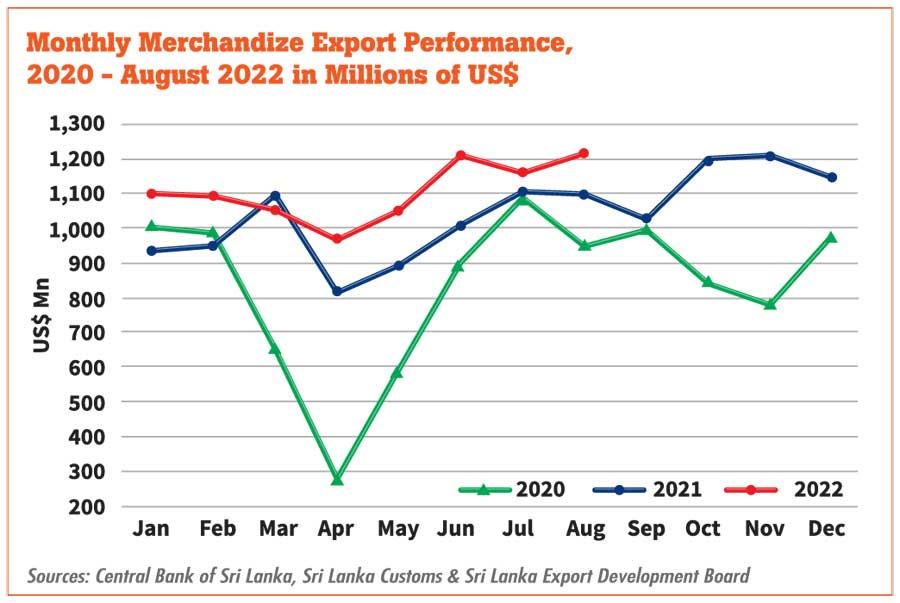
Sri Lanka recorded its highest merchandise export income so far for this year in the month of August amid increased export earnings from textile & apparel exports, the data released by the Export Development Board showed.
August became the fourth consecutive month to report over one billion dollars of export income as the month saw a merchandise export income of US$ 1.21 billion, up 10 percent from the same month in 2021.


Apparel & textile exports nearly accounted for half of the export income in August, as such exports generated US$ 565.37 million, up 15.03 percent from a year ago.
Tea exports also rose 6.52 percent year-on-year (YoY) to US$ 124.41 million, while rubber-based exports rose 8.11 percent YoY to US$ 99.83 million.


Diamond, gems and jewellery exports also rose 95.23 percent YoY to US$ 45.24 million in August. 
Seafood exports in August rose 37.04 percent YoY to US$ 25.53 percent and spice and essential oil exports edged up by 0.8 percent YoY to US$ 40.11 million. 
However, petroleum products exports fell 10.07 percent YoY to US$ 114.84 million while coconut-based products exports also fell 3.71 percent YoY to US$ 71.21 million. 


Meanwhile, for the January-August 2022 period, apparel and textile imports increased 19.30 percent YoY to US$ 4.08 billion.
However, both tea and rubber cumulative export income for the period fell 7.16 percent and 0.46 percent to US$ 819.31 million and US$ 705.70 million respectively. 


Diamond, gems and jewellery exports rose 37.67 percent to US$ 234.83 million. 
During the January-August period the United States (US) emerged as the biggest export destination for Sri Lanka accounting for little over US$ 2.3 billion out of the cumulative export income of US$ 8.85 billion for the period, up 12.01 percent YoY.

The United Kingdom (UK) and India were the second and third biggest buyers of Lankan produce.
In terms of regions, the United States and the European Union (EU), excluding the UK, emerged as the top buyers of Lankan produce. 


Sri Lanka benefits from trade concessions from the US, EU and the UK.  During January-August 2022 period, exports to Sri Lanka’s free trade agreement (FTA) partners accounted for 7.2 percent of total merchandise exports to US$ 623.17 million, up by 10.11 percent.


Although exports to India increased by 12.77 percent YoY US$ 570.46 million, exports to Pakistan decreased by 12.28 percent YoY to US$ 60.08 million during the period under consideration.  Meanwhile, the estimated value of services exports for the period of January-August 2022 was US$ 1.31 billion, up 5.58 percent YoY. The services exports estimated by EDB consist of ICT/BPM, construction, financial services and transport & logistics.

Tourism back on track for recovery: SLTDA Chief says on World Tourism Day

September 28th, 2022

Courtesy The Daily Mirror

Although Sri Lanka tourism had to face some unprecedented challenges over the past couple of years, the industry is now back on track for recovery, said the Sri Lanka Tourism Development Authority (SLTDA).

 Giving a positive message on World Tourism Day, the state agency highlighted that over the past couple of months, the number of tourist arrivals has increased, showing progress from the situation the industry was previously in. 


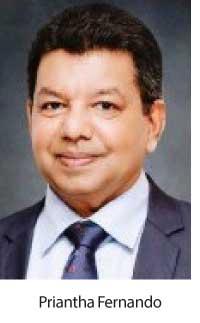
Over the years provincial economies and rural communities have greatly benefited whilst contributing towards the tourism model of the country,” said SLTDA Chairman Priantha Fernando in his message for WTD 2022 which Sri Lanka celebrated yesterday.

He added that tourism has helped the communities develop by not only providing the much-needed opportunities but also providing a livelihood.


This year the United Nations World Tourism Organization (UNWTO) highlights the concept of ‘Rethinking Tourism’ and focuses on re-imagining the sector’s growth, both in terms of size and relevance. Accordingly, Sri Lanka tourism has set ‘Rural and Community Tourism’ as its focus and theme for the year, keeping in line with the global theme of the UNWTO.  As the island nation strives to move towards economic revival after the repeated shocks it has witnessed in the last three years, Fernando asserted that Sri Lanka Tourism will help address the key issue with regard to the shortage of foreign currency, whilst providing a source of revenue and income to the individuals who are directly and indirectly benefited by tourism. 


As the regulator and the apex tourism body in Sri Lanka, the SLTDA is committed with our efforts to revive the industry and support the millions that depend on tourism. 


We are focused on identifying solutions with a long-term plan to realign tourism with a futuristic outlook in mind,” said the SLTDA Chief. He elaborated that it is imperative for all stakeholders and citizens to step up and contribute towards this cause by having a positive outlook towards tourism and help promote the picturesque island nation by disseminating positive messaging. 

SL welcomes 21,000 tourists during first 3 weeks of Sept.

Tourist arrivals for the first three weeks of September have reached 21,000.
Provisional data shared by the Sri Lanka Tourism Development Authority (SLTDA) showed that for the 1 to 21 September period, a total of 21,068 international visitors had entered the island nation. 
The first week of September saw 7,182 visitors entering the country, whereas the second and third week welcomed 6,408 and 7,478 tourist arrivals.


The average daily arrival rate for the month as of week three was 1,003.
The top three tourist traffic generators for September were India, the United Kingdom and Australia, which contributed to 22 percent, 9.5 percent, and 7.9 percent to the total arrivals during the first three weeks of the month. 

For the 1 January to 21 September 2022 period, Sri Lanka had welcomed a total of 517,498 tourists.

Inaugural meeting of National Council on Sep. 29

September 28th, 2022

Courtesy Adaderana

The inaugural meeting of the National Council is scheduled to be held tomorrow (Sep. 29) under the patronage of the Speaker of Parliament, Mahinda Yapa Abeywardena.

The meeting will commence at 10.30 a.m. in parliament.

On Sep. 23, the Speaker announced to the parliament the list of Members of Parliament who have been nominated for the National Council which was established as per the proposal of Prime Minister Dinesh Gunawardena.

The National Council consists of members representing parliament from the respective political parties.

President Ranil Wickremesinghe in bilateral talks with Prime Ministers of Japan and Singapore

September 28th, 2022

Courtesy Hiru News

President Ranil Wickremesinghe held bilateral talks with Japanese Foreign Minister Yoshimasa Hayashi and Singapore Prime Minister Lee Hsien Loong.

The discussions are taking place in Tokyo, Japan.

President Ranil Wickremesinghe also called on His Majesty Emperor Naruhito at Imperial Palace in Tokyo.

President Wickremesinghe left the island last morning (Sep. 26) on an official visit to Japan and the Philippines.

During his two-day official visit to Japan, the President is expected to participate in the funeral ceremony of former Prime Minister of Japan Shinzo Abe.

He will also engage in bilateral discussions with the Japanese Prime Minister and Finance Minister, during this tour.

After concluding his Japan visit, President Ranil Wickremesinghe is scheduled to leave for the Philippines to preside over the meeting of the Governors of the Asian Development Bank (ADB).

During his visit to the Philippines, President Wickremesinghe will hold discussions with the President of the Philippines Ferdinand Romualdez Marcos Jr. and the President of the Asian Development Bank (ADB) Masatsugu Asakawa.

The President is scheduled to return to the island upon completion of his official tour on September 30.

UNITING THE PEOPLE FOR THE COUNTRY  Part 1

September 27th, 2022

BY EDWARD THEOPHILUS

The administration of Sri Lanka has encountered a gigantic task of uniting the people of the country after the ARAGALAYA, the challenge seems to be an arduous task. People in the country are divided based on various ideologies and policy matters of the government. It is natural, that people have a variety of characteristics, but divisions in Sri Lanka have unrecognized strings behind the divisions that may be unknown to many.   Human beings naturally have differences, they are subject to control by many organizations to a greater extent with different purposes which attempt to achieve a variety of aspiring and targets. On the other hand, the reasons for deviations may be biological or social or involve both together. 

When critically observing the history of Sri Lanka it provides sufficient evidence that the people of Sri Lanka were disunited for a long time for a variety of reasons such as to avoid suffering and issues. Many problems were created for a variety of reasons, and under an authoritative rule, the people were united because the law and punishments in the authoritative regimes forced them to be together rather than scattered life, and lawbreakers were subjected to punishments. This means that people in history were united in fear of punishment as well as to avoid individual sufferings from the actions of invaders and influences.  Was such pressured unity was true or false may be difficult to estimate and behavioural decrees of the authoritative regimes forced people to unite. Modern people may not understand the truth about unity in history. According to the scattered behaviour of the nation, the current president of Sri Lanka may need to apply an ascendancy rule to a certain extent, this means Sri Lanka needs an authoritative rule than an extreme democracy. People need to be united for the country while they are engaged in assorted activities. When critically observing the way the current president’s rule during the past few months it proves that the president is willing to apply ascendancy rule than extreme democracy.

The human division of the country was a significant feature of the culture of Sri Lanka since its origin as a separate state, geological evidence indicates that Sri Lanka was a part of India and geologically joined with India for a long time.  When analytically investigating and comparing apprehensiveness for the disunity among people in other countries of the world, Sri Lanka always gives evidence that it had been disunited to achieve various purposes and the disunity had a relationship with many social, cultural, religious and ethnic factors. Modern Sri Lanka has similar types of discrepancies in policy matters, but politicians are reluctant to disclose disparities and always talk about unity. Is unity a magic word when referring to Sri Lanka, it should be determined by academics.

The historical experience further indicates that clergy in Buddhism assisted to unite people despite the division of clergies themselves based on the caste of the monks which was contrary to the philosophy of Buddhism. It can be seen in religious practices associated with the enjoyment of people.                                                                                                                                                                                                                                                                                                                                                                                                                                                                                                                                                                                                                                                                While it is observing many factors contributed to the division of clergy, it also seems to be various issues related to laities. This means that the laities were not holy and committed many wrong acts and have been willing to maintain disparities based on castes and asset ownership,  areas of residence and many other matters.  

Against the views of historians who have not presented acceptable factors for the division, Sri Lanka was a divided country. For example, many kings recognized a divided country such as Ruhuna, Pihiti and Maya. Despite the past administration, modern politicians are working against the decentralisation of the selected areas of power of the central government and creating a provincial council system.  Uniting people together would be a giant task, the attitudes or the way they are thinking with contrasts have become noticeable divisions of characteristics of Sri Lankan society. Academically, it explains that the way people think is based on the motivation or direction of education, however, the lack of value education in the education system has contributed to disunity since the first inhabitants. It seems that current politicians use religious and ethnic aspects to misguide the thinking of people and their advantages.

Ms Samantha Power, a US policymaker viewed that politicians and bureaucrats are responsible for the current economic downturn as a major reason after independence and politicians want to change the bureaucrats as docile of them. Donor countries must advise the government that politics and bureaucracy must be separated and bureaucrats need to consider the reasonable points presented after consultation with the public.   However, politicians should not give an upper hand in the policymaking and implementation process, the reality in Sri Lanka is giving an upper hand to politicians without consulting voters.    

The other significant factor reflected in history was kings who governed the country knew real reasons for disunity and used an authoritative administration to keep people in a united and silent framework. It was a locked strategy that was successful to a certain extent. Could present Sri Lanka apply the past strategy is burdensome decision-making, modern world associate with human rights and social freedom which are against the authoritative regimes. People of the country need education and promoting qualities to live in a democratic framework sharing values. 

The past administration under various kings and queens gave a strong message to the people that they should maintain silent behaviour scaring them to go forward against authoritative regimes. Capital punishment for agitators was acknowledged by rulers and the people of the country agreed with the decisions of the authoritative regimes.  Robert Knox clearly stated in his book this situation and King Rajasinghe 11 wanted to lock and kill agitators. Therefore, the concept of democracy may regard as giving ladders to monkeys and the weakness in a democratic system that directs the responsibility of various control measures to the government. Neither people nor any other organization is subject to the responsibility of maintaining democratic values in society. This was the bloomer when giving democratic administration and people were not educated on the responsibility of the public. That is why the Aragala people push the blame on the government disregarding the responsibility of the public.   

The values must be respected in a democratic administration and also equally responsible for maintaining such values without harming anyone in society. The education system is not breeding values in society and providing practical support for applying values in society. Education in Sri Lanka has no practical strategy on how to maintain values in the social and economic environment. For example, the ARAGALAYA disregarded the responsibility of people to respect values. In many western countries, kids learn values at schools and such education they maintain in society after school education. Many university students in Sri Lanka are behaving in an irresponsible way harming kids by ragging and inhuman sex slavery activities. I would like to note that in 1973 I observed that university students rejected ragging which contained criminal behaviour among students.   

Policymakers in education do not know about values and how to practically apply value education in the system. If it has been in the education system during the past several decades no ARAGALAYA would be in society since 1971. A person who illegally entered the RUPAVAHINI Corporation was interviewed by a Journalist, Chamuditha Samarawickrama and showed the criminal elements of ARAGALAYA. 

UNITING THE PEOPLE FOR THE COUNTRY – PART 2

September 27th, 2022

BY EDWARD THEOPHILUS

Since the administration of King Vijaya, the application of values did not work in society because the behaviour of King Vijaya showed that he had no values and was not concerned about practising values in society. King Vijaya was a lawbreaker and was deported from his country as he was behaving harmful way to peace-loving people and leaders of the ARAGALAYA were ideal models of Vijaya who destroyed peace-loving inhabitants who were called the HELA community.  

Religions attempted to educate religions-related values that aimed to get respect from the laity. The authoritative administration in the past and the democratic administration used in modern society in Sri Lanka could not see the application of values. It is not an accustomed term in Sri Lanka. The political administration, as well as the general society, is responsible for maintaining democratic values. The public disregarded values and many analysts expressed that the government is accountable for strategies to suppress democratic rights, but people are too accountable individually in terms of the legal structure to protect values. The best example was the ARAGALAYA this year which looked like a self-centred attempt and hidden terrorist strategy rather than encompassing the responsibility of all in society. 

The prime aim of the president, Mr Ranil Wickremasinghe is to unite the people of the country as they are divided by many political parties, religious groups and others. When critically analysing the attempt of Wickremasinghe it seems people neither know the policies of political parties nor religions and roles they play. People have valid or baseless reasons to get away from government policies and many like to look for stupid reasons aligning with self-centred attitudes. It seems that the difficult task for the president would be changing self-centred attitudes and it could be done by educating people but not any other strategy. Educating values in schools would be the concrete way to change attitudes. Since the era of the Portuguese, education has been directed to certain groups and poor and rural people were neglected by the education policy framework.

I watched an interview with Mr Nandana Lokuwithana by a journalist and Mr Lokuwithana showed how he respected values and opposite views; it was a good show for educating policymakers on how they should apply values in the education system as well as in government service. Mr Ranil Wickremasinghe needs to consider incorporating value education with studies in various subjects and leaders of Aragalaya might go against this strategy in education. This is a selected strategy for the moment in education and many actions that should be taken by the president.         

As I observed the initial task that is difficult to implement with the agreement of all political parties is uniting people for the country and many political parties based on religions and ethnic groups should be banned by the government and grouping people based on religion or ethnic groups or any other need to ban for the benefit of the country. If anyone investigates the origin of political parties it would show that the objective of political parties had been violated since the beginning because the authority allowed to establish parties with erroneous objectives.  This type of policy action might be observed by a few people in the country and the government was silent. Kings and Queens in history successfully used an authoritative strategy to control the disunity and the current president should educate international leaders about this administrative predicament to control the society.

Many international leaders have understood the situation in the Indian Subcontinent and dictatorships in Pakistan and other countries were tolerated, if the president, Ranil Wickremasinghe attempts to unite people it might fail and the authoritative administration should use it if fails to be successful.    

Sri Lanka has populated by many people who cannot disclose how they gain ownership of assets; this is the root course of the beginning of ARAGALAYA and a quickly investigating of how gained the ownership of assets would be the way of satisfying people. If there was malpractice in acquiring assets all assets should be given to the government and be used to initiate economic projects that would be helpful to lower-income earners and the unemployed. This will be the best way to settle ARAGALAYA. For example, Rohitha Rajapaksa stated a hotel was owned by him who never engaged in a job and how did he get funds to build a large hotel is a significant issue and there may be many cases like this.  The government should audit and investigate such cases and be made justice to people.

Auditing assets of all people would be a challenging task as well as a process of policy implementation to bring justice to all and it is the best way to unite people for the country. When observing the asset structure, it is difficult to imagine how did people quickly get rich. I suspect that direct or indirect illegal drug business had been the major way of acquiring assets and political corruption such as making commissions from the project implementation has been the way of acquiring assets since the independence. The Search for a solution to the current economic backwardness while uniting people for the country.

Nevertheless, no political party including Marxist parties might agree with this solution as they also contributed to the problems of the country and Marxist parties don’t like to accept the blame and want to push part of the blame to other political parties.  In this background, president Ranil Wickremasinghe has a giant task. He must not listen to bull-shiting political parties and dishonest politicians in whichever political party.      

‘Rebuild Sri Lanka’ by Derana TV Channel

September 27th, 2022

Sugath Kulatunga,

Derana TV Channel must be congratulated on the new program they have introduced under the title ‘Rebuild Sri Lanka’ and brilliantly conducted by the dynamic Chatura de Alwis. I hope other channels also follow this example and devote more time on development issues rather than wasting time on never ending cheap TV drama and on longer and cheaper and violent Tamil films.

The recent discussion was with a distinguished panel consisting of Chairman EDB, Chairman Tea Board and a very knowledgeable representative from the apparel sector. The discussion was well focused on different aspects of export development based on statistical tables well presented by Chatura. It was a delight to note that the discussion was pivoted on the balance of trade issue, a subject criminally overlooked by all governments for decades.

Discussion was more oriented towards marketing and brought out key issues and possible solutions. The country -wise segmentation of the marketing of tea was a valuable idea. The importance of anticipating global changes in market development was another excellent concept. Without taking away of the many astute ideas that were discussed I would have liked if some of the following themes were also covered.

Sri Lanka is not a large-scale producer other than in commodities and garments. In other areas of small volumes, we should resort to niche marketing. It was revealed that as the small and medium scale enterprises contribute to around 80% of the production in the economy, they should be supported to venture into the international market. I hope that this is confined to medium scale sector and not to the small-scale sector which is not equipped for export marketing other than perhaps in the services sector like BPO. In many countries, SMEs work on subcontract production arrangement with large enterprises. This is an area that we should focus on without encouraging less export ready small enterprises to enter the international market. In a previous FB post, I described how an emerging and very productive subcontract production system was preempted by the 200 garment factories project. A crying need for prospective SMEs is a portfolio of feasibility studies which we do not have.

One more suggestion to introduce new technology and increase exports is to have special incentives for pioneering projects. An earlier EDB scheme for this was offhandedly abandoned by a previous management. Ironically recently India has announced an outlay of INR 1.97 Lakh Crores for the Production Linked Incentive (PLI) Schemes across 14 key sectors, to create national manufacturing champions.

Value addition as a priority strategy was stressed but not many specific suggestions emerged. There is space for value addition even in our major commodities. For instance, in Tea, we could promote more branded teas like Dilmah. In the 1960s there was an instant tea formula which was tested by the CISIR. One does not know what happened to that. Now with Nano technology, even a nano urea has been produced. Our scientists should be encouraged to work on an instant tea like the instant coffee.

It is known that the best value in rubber products is from latex products. Should we not increase production of latex to be converted into high value latex-based manufactures? Among coconut products we should focus on the product fetching the highest value. Coconut oil is too valuable to be sold as a cooking oil. It could be converted into cosmetics.

We are very proud of our spices, but we have not made use of that high quality in producing and marketing value added products. There should be a tax on the export of raw export of spices which should be channeled to enhance value addition. Is it not possible at least to introduce a SL branded spice pack? In spices like pepper and cinnamon we need to focus on supplying a more processed product demanded by the end users. Colombo Dockyard has demonstrated the ability of the country for high tech and high value products like ship building. They should be supported to expand.

In promoting Exports and investment of Sri Lanka the diplomatic and trade representatives of the country should play a more active role. Our representatives in the developed countries should be given a target of at least one investment proposal and one new import opportunity once every year. Diplomats would argue that they have a more important function of political representation. The impact of their political representation could be gauged from the number of votes and the number of abstentions by the countries they represent on resolutions against Sri Lanka at the UNHRC. It is also time that we go beyond country promotion in investment but engage in the promotion of specific projects like oil exploration and alternate energy.

It would be useful if these discussions are open to comments by viewers by text messages rather than by voice which consumes more time. Only the more relevant text messages could be taken for discussion. I wish the Rebuild Sri Lanka program every success. I am glad that it is not titled ‘Regaining Sri Lanka”.

REDUCTION OF CEB SALARIES BY 30%

September 27th, 2022

Sasanka De Silva Pannipitiya

It is not a secret that the Ceylon Electricity Board (CEB) has never made any profits. 

The public must always chip in by paying more taxes to cover their expenses by pumping money from the government coffers.

Another generator at the Norochchole plant has been shut down, and social media is rife with news that a 10-hour power cut is on the cards.

If that is true, the CEB income will be further reduced by more than 40%, and how do the authorities plan to bridge the gap?

Naturally, increasing taxes and tariffs is the only way they know, and we have no say or control over the matter.

How about reducing the salaries of the CEB, including the minister who is responsible, by at least 30% to bridge the shortfall?

If for some reason, when a household income drops, either the household will use their reserves to supplement the shortfall or take measure to reduce their expenditure accordingly to meet the situation.

In the case of CEB, as I said from the beginning, they have no reserves whatsoever, and therefore the only option now available to them is to make necessary cutbacks on their expenditures.

Such a measure would only affect some families (around 300,000 heads), but it would be negligible compared to raising taxes on the entire population. 

Until they find a way to at least cover their expenditure, the shortfall amount should be adjusted by imposing prorated reductions in their employees’ salaries and not imposing more taxes on the entire population.

The same methodology should be applicable to all government-run entities with always have negative balances. 

Sasanka De Silva

Pannipitiya.

Asian Development Bank vows more help for crisis-hit Sri Lanka

September 27th, 2022

Courtesy CNA

MANILA/TOKYO: The Asian Development Bank (ADB) is ready to provide further financial support to Sri Lanka, a top official of the regional lender said on Tuesday (Sep 27), as the Indian Ocean nation battles its worst economic crisis in more than seven decades.

The remarks came after an ADB pact this month for an emergency loan of U$200 million to ensure access to food and protect livelihoods after months of shortages of key essential items which sparked protests that forced out the president.

“As a key long-term partner, the ADB stands ready to provide further support,” the bank’s president, Masatsugu Asakawa, told reporters at its annual gathering.

Sri Lanka’s economy has contracted and it is suffering from very high inflation severely affecting living standards, Asakawa said. The annual figure exceeded 70 per cent in August.

“So we are working closely with the government in supporting the country in this challenging time,” he added.

Asakawa said he was confident Colombo was working to finalise a staff-level agreement with the International Monetary Fund (IMF) for a loan of about US$2.9 billion, by seeking financing assurances from creditors, among other steps.

“After the IMF program is completed, we will consider to join another, by providing additional financial resources to join other rescue packages for Sri Lanka,” said Asakawa, a former Japanese vice finance minister for international affairs.

Asakawa pointed to the risks of abrupt capital outflows from Asia and the prospect of very sharp currency depreciation continuing for some time, as the US central bank tightens monetary policy aggressively.

However, Asia has become more resilient against financial turmoil, with an improved current account balance and sufficient accumulation of foreign reserves, than it was during the Asian financial crisis of the late 1990s, he added.

Yet portfolio capital movement is very fast and volatile, Asakawa said.

“It’s always a good thing to be very vigilant on this broader capital movement,” he added.

“I’m also trying to enhance our regional financial co-operation efforts, including that of ASEAN+3,” he said, referring to a grouping of China, Japan and South Korea with Southeast Asian nations.

SriLankan Airlines seeks foreign investor

September 27th, 2022

By Feizal Samath Courtesy TTG Asia

Sri Lanka is planning to offer a 49 per cent ownership and management stake in its loss-making national carrier to cut losses and transform the airline to a profitable venture.

The move would signal a return to foreign management and partnership after a 10-year contract with Emirates ended in March 2008 without any extension. The Dubai carrier had a 43 per cent stake (at an investment of US$70 million) and full management control of the airline.

SriLankan Airlines does not own any aircraft – its entire fleet of 23 planes are on lease.

Civil aviation minister Nimal Siripala De Silva said the airline has suffered huge losses so far and could be in deeper trouble unless an outsider takes over soon.

The airline’s accumulated loss in the 2020-2021 financial year was 49.7 billion rupees (US$138 million). During Emirates management from March 2007 to March 2008, it was profitable leading up to the last year with a profit of five billion rupees.

From March 2008 to March 2009, while under Sri Lankan government control, a loss of 10 billion rupees was reported.

From 2016 to 2019, a similar effort to secure a foreign investor to the airline was also unsuccessful

The IMF’s Monumental Malpractice

September 27th, 2022

Steve Forbes

For decades, the International Monetary Fund has been the scourge of countries that get into economic trouble, yet its authority has never been seriously challenged. Today, this is especially dangerous. The deadly combination of inflation and food shortages is putting numerous nations on the brink of disaster. A few, most notably Sri Lanka, are already in chaos.

All too many countries are particularly vulnerable because they loaded themselves with debt during the easy-money years following the 2008-09 financial crisis, when interest rates were virtually nonexistent. Now, with the cost of money rising and open-ended central bank ATMs closing, scores of these governments will be hard-pressed to service their debts. For a number of poorer nations this means not only will the paltry incomes of people already living in real poverty shrink, but there will also be outright hunger, if not famine—a dire situation made worse by the deadly food games Vladimir Putin is playing with Ukraine’s critical grain exports.

What’s disturbing is that the amount of money these countries owe is unknown. China has lent prodigious amounts to a number of nations, but transparency here is hardly robust.

The IMF is supposed to be the economic doctor to which countries turn when they get into trouble. IMF teams fly into stricken nations and negotiate” (in the Tony Soprano sense of the word) the terms for governments to receive bailout money. The problem is that the IMF is guilty of economic quackery on a global scale. The IMF’s foremost demand is that a country devalue its currency, yet making a currency less valuable is the very definition of inflation. It’s like telling someone who has pneumonia to go sit in the snow.

The IMF thinks the cure for inflation is to make people poorer; therefore, it forces countries to raise taxes. The agency also orders the removal of politically popular subsidies—usually for certain foods and fuel. In principle, this is fine, but the IMF’s timing is dreadful. People living mostly on the margins see their life supports disappearing, and riots result.

The IMF should, instead, be prescribing what economist Nathan Lewis dubs The Magic Formula”: low tax rates and stable money. This combination always works. Instead of devaluations, countries should adopt currency boards, whereby their money is fixed to a reliable currency such as the Swiss franc. Currency boards unfailingly stop inflation in its tracks.

Yet the IMF’s record of cockeyed, counterproductive remedies has yet to provoke a serious challenge from its major donors, primarily the United States.

With so many countries in desperate straits, this chronic malfeasance will provoke destructive turmoil and lead to unnecessary death. True, the countries to which the IMF ministers are usually guilty of reckless spending and too much government control of their economies. But that doesn’t warrant administering patently harmful medicines to them.

Take perennially mismanaged Pakistan, which just negotiated an IMF rescue package. True to form, the IMF imposed higher taxes and the elimination of fuel subsidies, and riots rocked the country.

Circular issued for public officers on expression of opinions on social media

September 27th, 2022

Courtesy Adaderana

Expression of opinions on social media by public officers without following the Establishment Code shall constitute an offence leading to disciplinary action, the Secretary to the Ministry of Public Administration says.

This was conveyed in a circular titled Expression of opinions on social media by public officers” published today (Sep. 27).

In the communique, Mr. M.P.K. Mayadunne also noted that carrying out an activity that should not be carried out by an officer who is not entitled to the exercise of political rights as per Section 1, Chapter XXXII, Volume I of the Establishment Code through social media by an officer not entitled to the exercise of political rights shall also constitute an offence that leads to taking disciplinary action.

Japan ready to play leading role with creditors to restructure Sri Lanka’s debt – Japanese FM

September 27th, 2022

Courtesy Adaderana

President Ranil Wickremesinghe held discussions with Japan’s Foreign Minister Yoshimasa Hayashi this morning in Tokyo.

During the meeting, Foreign Minister Hayashi welcomed Sri Lanka’s progress with the IMF and expressed his country’s willingness to take a leading role in Sri Lanka’s creditor talks, the PMD reported.

President Wickremesinghe expressed regret over the breakdown of relations between Japan and Sri Lanka following the cancellation of several investment projects by the former Government. The President stressed that he was keen to restart those projects, the statement said.

The President also indicated that the Government was interested in Japan investing in Sri Lanka’s renewable energy projects.

Japan Foreign Minister Hayashi explained that Japan had increased its commitment to renewable energy and would be willing to explore future investment opportunities in Sri Lanka.

The Foreign Minister also explained that Japan would begin the skilled worker examinations in January 2023 for Sri Lankan migrant workers.

The President appreciated the support extended by Japan on the international stage and expressed the Government’s willingness to support both Japan’s and India’s campaign to become permanent members of the United Nations Security Council. 

The Foreign Minister welcomed the news, stressing that Asia required greater representation on the world stage, the release added.

-PMD

IMF Economy-IMF Tells Bolivia To Drop Its Successful Economic Model.

September 26th, 2022

Courtesy orinoco tribune

The IMF released a report today on the Bolivian economy in which it recommends adopting drastic neoliberal measures, including; reducing workers’ salaries, cutting public investments, and ending currency controls. These policies have turned Bolivia from one of the poorest countries in the region into it’s fastest-growing economy.

The report takes aim at the government’s spending on development, saying, The government must restrict spending, including eliminating the end of year wage bonus for workers, they must restrict the growth of wages for public sector workers, and limit the growth of public investment and subsidies.”

The ‘end-of-year wage bonus’ for workers (in both the public and private sector) refers to a policy introduced under Evo Morales that requires employers to pay their workers a bonus equal to double their monthly wage, but only if annual GDP growth is over 4.5%.

Bolivia Has the Lowest Inflation in Latin America

https://orinocotribune.com/bolivia-has-the-lowest-inflation-in-latin-america/embed/#?secret=QqSgqm3NJo#?secret=WSEhgoWTNm

The bulk of public investment is destined for infrastructure, while the majority of subsidies are for ensuring the price of fuel doesn’t rise. Bolivia is the only country in the region to see no rise in fuel prices, a policy that has kept inflation at less than 2%, unlike the rest of South America.

The report even states that fuel prices must rise, and the inflation that would inevitably cause could be offset by cash-transfer programs for the poorest sectors, says the IMF:

The successful implementation of an increase in domestic fuel prices will require recycling a part of the budget savings in cash transfer programs aimed at the poorest deciles of the population.”

Bolivia’s Economy Minister, Marcelo Montenegro, emphatically rejected the report, stating today; They prescribe the old recipes from many decades ago where they call for reducing subsidies, lowering public spending, gradually eliminating the end of year bonus for workers. We are not going to accept these recommendations because we are a sovereign country, and we have a sovereign economic policy.”

Bolivia’s Arce Rejects IMF Loan Negotiated Irregularly by Former De Facto Ruler Jeanine Áñez

https://orinocotribune.com/bolivias-arce-rejects-imf-loan-negotiated-irregularly-by-former-de-facto-ruler-jeanine-anez/embed/#?secret=XYqTJEc2CO#?secret=vQmPMCLCaF

The policies criticized by the IMF have helped Bolivia reduce poverty by over 50% since Evo Morales took office in 2006. It has also helped keep inflation at the lowest rate in Latin America. Meanwhile, when IMF policies were implemented in the early 2000s, over 60% of the country lived below the poverty line.

In a recent speech in Brazil, Bolivia’s President Luis Arce stated that the country’s impressive growth is due to rejecting IMF recommendations; We are in better conditions because, since 2006, Bolivia doesn’t have a single agreement with the IMF. In 2020 with the de facto government, they tried to enter into a loan program with the IMF, which we stopped as soon as we entered government, we reversed that IMF loan because believe the best way to make economic policy is to have a sovereign monetary and economic policy without being submitted to any international organism.”

https://orinocotribune.com/imf-tells-bolivia-to-drop-its-successful-economic-model/

*Biznomics Market Update 26.09.2022*

1) Ghana has begun debt-restructuring talks for local bonds. The nation is preparing its debt-sustainability plan for the IMF, under its 17th program. *Ghana’s currency has lost 39% this year, the world’s second-worst with Sri Lanka leading the list*. Sri Lanka too has now approached the IMF for the 17th time since 1965 and has intimated that it might have to consider the same fate for its local LKR debt (Bills and Bonds) following in the footsteps of Ghana.

2) The Central Bank of Sri Lanka budget 2023 to include further *fiscal tightening, an increase in*; *a)Corporate income tax* *b)Personal income tax* *c)Telecommunication levy* *d)Value added Tax and removing tax exemptions (CIT and VAT), and improving tax compliance through strengthening the collection*.  Sri Lanka’s projected growth rate to be below its potential until 2027, growth is expected to reach 3% by 2027. The primary surplus is to reach 2,.3% of GDP while the current account deficit remains at 1.2% of GDP until 2027.

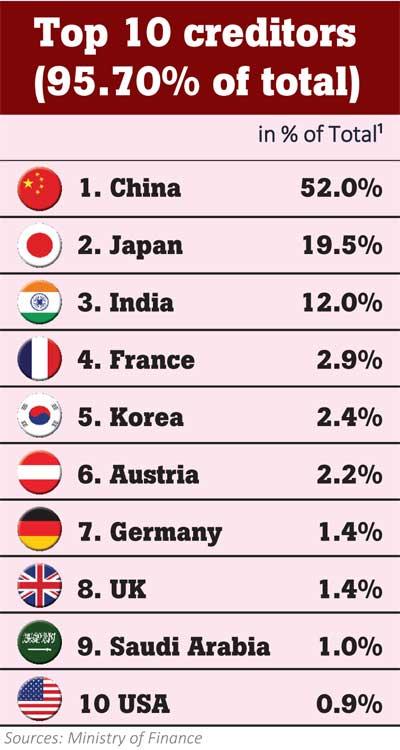
3) *Sri Lanka’s bilateral creditors account for USD 14 billion*. Paris Club members USD 4.7 billion, non-Paris club members 9.3 billion of which China amounts to USD 7.3 billion and India USD 1.6 billion. The top 10 bilateral creditors 1) China (52%); 2) Japan (19%) ; 3) India (12%) ; 4) France (2.9%) ; 5) Korea (2.4%) ; 6) Austria (2.2) ; 7) Germany (1.4%) ; 8 ) UK (1.4%) ; 9) Saudi Arab (1.0%) ; 10) USA (0.9%)

4) *China’s trade surplus is set to top a record $1 trillion this year*, but its not enough to stop the yuan from sliding against the surging dollar as business confidence wanes, according Macquarie Group Ltd. While China’s goods surplus is on track to reach the highest ever in world history, exporters have been reluctant to convert their foreign exchange back into yuan given the plunge in business sentiment this year.

5) *Giorgia Meloni looks set to become Italy’s first far-right leader since World War 2*. The election follows the collapse of Mario Draghi’s broad-based coalition government in the summer.

6)  *H&M’s COS debuts at New York Fashion Week with see-now-buy-now show*. The brand, which launched in 2007, has grown to over 30 markets worldwide. They have become known for their higher-end quality compared to their parent company H&M’s approach to fast fashion.

*Biznomics Research*

Some historical facts to demolish the myths being circulated

September 26th, 2022

Shenali Waduge

The Best Solution to Hunger: Beans and Other Legumes

September 26th, 2022

Dilrook Kannangara

Many nations including Sri Lanka face a hunger problem. Instead of looking for easy ways out, blaming this and that and finding faults with everything suggested, nothing much happens in Sri Lanka.

Various types of beans grow in all parts of the island. Beans can be grown in a small garden. Almost all households in rural areas can grow beans and other legumes. They are easy to cook, high in protein, carbohydrates and vitamins and currently have few pests. Unlike readily edible crops, beans do not attract thieves. Legumes extract nitrogen from the air which enriches the soil.

Instead of trying to promote everything, the government should launch a low-cost campaign to promote the growing of various types of beans and legumes around the island as a solution to hunger. What’s more interesting is that garden produce are not affected by inflation which is set to rise to unprecedented levels when higher VAT and other taxes kick in soon.

විදේශ ගත ශ්‍රමිකයින් සදහා වන විශ්‍රාම වැටුප් යෝජනා ක්‍රමය

September 26th, 2022

Manusha Media

විදේශ ගත ශ්‍රමිකයින් සදහා වන විශ්‍රාම වැටුප් යෝජනා ක්‍රමය ආරම්භ කළේ විදේශ ගත ශ්‍රමිකයින්ට අපගේ ප්‍රතිඋපකාරය පළ කිරීමටයි – අමාත්‍ය මනුෂ නානායක්කාර මනුසවි විශ්‍රාම වැටුප් යෝජනා ක්‍රමය අරඹමින් කියයි

මනුෂ්‍යත්වයේ නාමයෙන්, දශක ගණනාවක විගමනික ශ්‍රමිකයන්ගේ අපේක්ෂාව යථාර්ථයක් කරමින්,  ‘මනුසවි‘ සමාජ ආරක්ෂණ දායක  විශ්‍රාම වැටුප් යෝජනා ක්‍රමය ආරම්භ කිරීමට හැකි වූ බවත්, ඉදිරියේ දී මෙරට සෑම කම්කරුවකු ම සුරක්ෂිත කරන සාමාජ ආරක්ෂණ ජාලයක් නිර්මාණය කරන බවත්, කම්කරු හා විදේශ රැකියා අමාත්‍ය මනුෂ නානායක්කාර මහතා පැවැසීය.
 
ඒ කම්කරු හා විදේශ රැකියා අමාත්‍ය මනුෂ නානායක්කාරගේ සංකල්පයකට අනුව විදේශ රැකියාවේ නිරතවූවන්ගේ විශ්‍රාමික දිවිය සවිමත් කිරීම සඳහා හඳුන්වා දෙන මනුසවි” සමාජ ආරක්ෂණ දායක විශ්‍රාම වැටුප් යෝජනා ක්‍රමය, අද (26) ශ්‍රී ලංකා විදේශ සේවා නියුක්ති කාර්යංශ  ශ්‍රවණාගාරයේ දී ජනගත කරමිනි.

විදේශ ගත ශ්‍රමිකයින් සදහා වන විශ්‍රාම වැටුප් ක්‍රමය අනුව විදේශ ගත ශ්‍රමිකයා ලබාදෙන දායකත්ව මුදල සහ කාලය අනුව ලබාගන්නා විශ්‍රාම වැටුප තීරණය වේ. ඒ අනුව වයස අවුරුදු හැට සම්පූර්ණ වූ පසුව විශ්‍රාම වැටුප ලබාගැනීමට හැකිය.

 මනුසවි” සමාජ ආරක්ෂණ දායක විශ්‍රාම වැටුප් යෝජනා ක්‍රමය ජනගත කළ අමාත්‍යවරයා,

අපට වුවමණා වුණේ රටට සලකන විගමනික ශ්‍රමිකයන් වෙනුවෙන් මනුස්සත්වයේ නාමයෙන් ප්‍රතිඋපකාර දැක්වීමට පමණයි. අද මේ අපි වෙනුවෙන්, රට වෙනුවෙන් කැප වුණු ඒ මිනිස්සු වෙනුවෙන්, රටට අවශ්‍ය තෙල් ටික, බෙහෙත් ටික, ගෑස් ටික ගන්න උපකාර කරන, ඒත් මෙච්චර කාලයක් නොසලකා හැරි ඒ පිරිස වෙනුවෙන් උපරිමය කරන්න පමණයි.
 
අද අපිට පුළුවන් වුණා මනුසත්කමේ නාමයෙන් විගමනික ශ්‍රමිකයන් වෙනුවෙන් ‘මනුසවි‘ සමාජ ආරක්ෂණ දායක  විශ්‍රාම වැටුප් යෝජනා ක්‍රමය ආරම්භ කරන්න. සමාජ ආරක්ෂණ මණ්ඩලය, සමාජ සවිබල ගැන්වීමේ අමාත්‍යංශය, විදේශ සේවා නියුක්ති කාර්යංශය මෙහි සුවිශේෂී වැඩ කොටසක් කළා. මනුසවි විශ්‍රාම වැටුප යථාර්ථයක් කර ගැනීමට සහයෝගය දීපු ඒ සියලු දෙනාට ම මනුෂ්‍යත්වයේ නාමයෙන් ස්තුතිවන්ත වෙනවා.

විදෙස්ගත වන අවස්ථාවේ දී ම මෙම විශ්‍රාම වැටුප් ක්‍රමය ආරම්භ කළ හැකියි.  ස්වකීය අභිමතය පරිදි මාසික ව ඩොලර් එකොළහක මුදලක් වසර හතරක් තිස්සේ මෙයට යොමු කළොත් පනස් පහෙන් පසු රුපියල් විසිදහසක ආරම්භක තලයේ මාසික විශ්‍රාම වැටුපක් හිමි වෙනවා.ඒක ආරම්භක තලය. එහෙත් තමන්ට කැමැති සැලසුමක් තමන්ගේ කැමැත්ත අනුව තෝරා ගන්න අවස්ථාව තියෙනවා. තමන්ගේ වැටුප සහ කැමැත්ත අනුව අනාගත විශ්‍රාම දිවිය සැලසුම් කර ගන්න නිදහස තියෙනවා. ඉදිරියේ දී මෙය තවත් වැඩි දියුණු කිරීමට, මෙහි ප්‍රතිලාභ තව දුරටත් පුළුල් කිරීමට කටයුතු කරනවා. සමාජ ආරක්ෂණ අමාත්‍යංශය, සමාජ ආරක්ෂණ මණ්ඩලයට එහි ප්‍රමුඛ වගකීමක් හිමි වෙනවා.

අපිට අවශ්‍ය රටේ මිනිස්සු හොද සමාජ ආරක්ෂණ වැඩපිළිවලක් තුළ ස්ථාවර කිරීමට. සමාජයේ සෑම පුද්ගලයෙක් ම ආරක්ෂා කළ හැකි සමාජ ආරක්ෂණ දැලක් නිර්මාණය කිරීමට. මේ සුරක්ෂිතභාවය නොමැති නිසා ම දැඩි පීඩණයකට ලක් වුණු රටක් තමයි අපි. මිනිහෙක් වැටෙන වෙලාවට සුරක්ෂිතව අල්ලා ගන්න, රැකබලා ගන්න ආරක්ෂිත දැලක් නිර්මාණය කිරීමට කම්කරු අමාත්‍යංශය විදියට වැඩපිළිවලක් සකස් කරගෙන යනවා. ඒ මේ රටේ කම්කරුවා වෙනුවෙන්. රැකියාව අහිමි වීමක දී, වන්දියක් ලබාගත යුතු අවස්ථාවක දී, අර්ධ හෝ පූර්ණ දුබලතාවක දී,  සෞඛ්‍ය පහසුකම් මෙන් ම හදිසි අභාවයක දී කොහොමද අපේ කම්කරුවන් රැක ගන්නේ, එය විශ්‍රාම වැටුපක් දක්වා වර්ධනය කරන්නේ කෙසේ ද යනාදී වශයෙන් පුළුල් සමාජ ආරක්ෂණ ක්‍රමවේදයක් සම්බන්ධයෙන් කම්කරු දෙපාර්තමේන්තුව විදියට අපි සලකා බලමින් ඉන්නවා, යනුවෙන් ද පැවැසීය.

එහි දී පැමිණ සිටි පිරිස ඇමැතූ අමාත්‍යවරයා වැඩිදුරටත් මෙසේ ද පවසා සිටියේ ය.

‘රටේ ක්‍රමානුකූල ව ගොඩනැගුනු ආර්ථික ප්‍රශ්නයට අනුරූපීව දේශපාලන අර්බුදයක් නිර්මාණය වුණා. ඩොලර් හිගය, ආහාර හිගය, කළුකඩ මුදලාලිලා මිල දෙගුණ තෙගුණ කිරීම, වෙළෙද ඒකාධිකාරයන් නිර්මාණය කරගෙන අධික ලාබ ලබමින් මිනිස්සු බරපතල පීඩාවකට ලක් කිරීම නිසා රටත් සමාජයත් බරපතල තත්ත්වයකට පත් වෙලා තියෙන්නේ. සිංහල අවුරුද්දට කෝදුරු කැවුමක් එල්ලලා බෙදාහදා ගන්නා සම්ප්‍රදායක හිටිය අපේ සමාජය විෂම වෙන්නේ වෙනස්  මේ තත්ත්වයන් එක්ක. පාරේ යන වාහන නවත්තලා තෙල් ටික බලෙන් අදලා ගන්න තරමට ම මේක බරපතල වුණා.

ව්‍යාපාරිකයන්ගේ වගේ ම මිනිස්සුත් මනුස්සකම පැත්තකට දැමීම, යහපත් ගුණාංග නැති කර ගැනීම තුළ රටේ මිනිස්සු ම නොවිදිනා දුන් විදිද්දී, මනුස්සත්වයේ නාමයේ තීන්දුවක් ගන්න වුණා. බලය ගැන විතරක් හිතුවා නම් රනිල් වික්‍රමසිංහ හෝ අපි මේ දේශපාලන තීන්දුව ගන්නේ නෑ. රටේ මිනිස්සු තෙල් පෝලිම්, බෙහෙත් පෝලිම් අස්සේ මැරිලා වැටෙද්දී, පැය දහය දොළහ විදුලිය විසන්ධි වෙද්දී  ඒවට සංඛ්‍යාලේඛන නෑ. ඒ නිසා අපිට දේශපාලනය වෙනුවට මනුෂ්‍යත්වය ගැන විතරක්  හිතන්න වුණා. ඒ නිසා අපි එදා මනුස්සත්වයේ නාමයෙන් මේ තීන්දුව ගත්තා. අපේ පෞද්ගලික වාසි, දේශපාලන අනාගතය පැත්තකින් තියෙලා මේ තීන්දුව ගත්තේ ඒ මනුෂ්‍යත්වයේ නාමයෙනුයි.

ඒක දේශපාලනික වශයෙන් ඉතා අමාරු තීරණයක්. ඒ නිසයි අපි මිනිස්සුන්ගෙන් ඉල්ලීමක් කළේ මනුස්සත්වයේ නාමයෙන් එකතු වෙලා මේ තත්ත්වයෙන් ගොඩ එමු කියලා. මිනිස්සුන්ගේ දුක තේරෙන, හදවතට දැනෙන පිරිස අපිත් එක්ක එකතු වුණා. ඒත් අපේ විගමනික ශ්‍රමිකයන්ට සමහර අය කිව්වේ තමන්ගේ ආණ්ඩුවක් එනතුරු, බලයට එනතුරු සල්ලි එවන්න එපා කියලා. තමන් ආවාම මාසෙකට ඩොලර් බිලියනයක් ගේනවා ඒත් දැන් එවන්න එපා කියලයි කිව්වේ. හැත්තෑ දෙකේ ඉදන් කියන ඒ දවස උදා වෙනකල් අපේ මිනිස්සු තව කොච්චර කාලයක් දුක් විදින්න ඕනේ ද? නොකියා කියන්නේ උඹලා ඩොලර් එවන්න එපා, එතකල් මේ රටේ මිනිස්සු දුක් විදපුවාවේ, පාරේ මැරිලා වැටුණාවේ කියන එක නේද?

හැබැයි මනුස්සකම තියෙන විගමනික ශ්‍රමිකයෝ මනුස්සකමේ නාමයෙන් රටට ඩොලර් එව්වා.  ඩොලර් මිලියන දෙසිස විස්සට වැටිලා තිබුණු විදෙස් ප්‍රේශන අගෝස්තු වෙද්දී තුන්සිය විස්ස වුණා. ඒ මනුෂ්‍යත්වය නිසා. නීත්‍යනුකූල ව රටට මුදල් එව්වේ මනුෂ්‍යත්වය නිසා. ඒ නිසා තමයි මනුෂ්‍යත්වයේ නාමයෙන් අපිත් එයාලට සලකන්නේ.

කුඩම්මාගේ සැලකිල්ල ලැබුණු විගමනික ශ්‍රමිකයන්ට ගුවන් තොටුපල බලාපොරොත්තුවේ දොරටුවක් නිර්මාණය කළා. ඉතිහාසයේ වැඩි ම තීරුබදු සහනය දුන්නා. රටේ කිසිවකුට වාහනයක් ගෙන්විය නොහැකි වකවානුවක එවන මුදලට වටිනාකමක් දෙන්න වාහන බලපත්‍රයක් දුන්නා.  විදෙස්ගතවීම් වලට බාධා කළ නීති රීති සංශෝධනය කළා. ඒ ඔවුන් රටට ඉටුකරන යුතුකම වෙනුවෙන් අපිත් ඔවුන්ට මනුෂ්‍යත්වයේ දෑත දිගු කළ යුතු නිසයි.

ඉතා කෙටි කාලයක් තුළ මේ සියල්ල කරද්දී කාලයක් තිස්සේ කළ නොහැකි වූ  තවත් දෙයක් තිබුණා. 2012 ඉදන් මේ ගැන කතා කළා. 2015 ආණ්ඩුවේ ප්‍රතිපත්ති ප්‍රකාශයෙත් කියනවා විගමනික ශ්‍රමිකයන් වෙනුවෙන් විශ්‍රාම වැටුපක් හ දුන්වා දෙනවා කියලා. ඒත් මේ මොහොත වන තුරුත් ඒක ක්‍රියාත්මක කරගන්න බැරි වුණා

ඒත් අපි ශ්‍රී ලංකා සමාජ ආරක්ෂණ මණ්ඩලය සමග එක්ව විදේශ ගත ශ්‍රමිකයින් සදහා වන විශ්‍රාම වැටුප අපිට ආරම්භ කිරීමට හැකියාව ලැබුණා. යනුවෙන් ද පවසා සිටියේ ය.

කම්කරු හා විදේශ රැකියා රාජ්‍ය අමාත්‍ය ජගත් පුෂ්පකුමාර, සමාජ සවිබලගැන්වීම් රාජ්‍ය අමාත්‍ය අනුප පැස්කුවල්, යන මහත්වරු මෙහිදී අදහස් දැක්වූහ.

කම්කරු සහ විදේශ රැකියා අමාත්‍යාංශයේ ලේකම්  ආර්.පී. ඒ. විමලවීර, විදේශ සේවා නියුක්ති කාර්යංශයේ සභාපති මහේන්ද්‍ර කුමාරසිංහ , සාමාන්‍යාධිකාරී ප්‍රියන්ත සේනානායක, ශ්‍රී ලංකා සමාජ ආරක්ෂණ මණ්ඩලයේ සභාපති සමන් හදරාගම, සාමාන්‍යාධිකාරී ප්‍රසන්න කළුආරච්චි  ඇතුළු නිලධාරීහු රැසක් ද සහභාගී වී සිටියහ.


Comment on the U-tube propaganda that mislead the public.

September 26th, 2022

Chandre Dharmawardana

I have gone thorough the following U-tube video and I am sad to see this kind of unsubstantiated claims misleading the public. This is just one of many.

[ටවුම මැද්දේ වගා කරන, ගල් පොළොවේ කුඹුරු කරන, ගොවි රජාගේ විශ්වකර්ම වැඩ

I urge the Sri Lankan scientific community to not to ignore this sort of thing says “this stuff is rubbish and so we don’t need to comment on the obvious“, or that there are too many of these and we don’t have time for it.

Countering the growth of weeds is necessary not only in a farm, but also in society

 It is the failure to counter this sort of nonsense that led to a group of local “scientists”, aided and abetted by Western funded local NGOs who are linked to Elite upper-class social groups in the West that led to the Fertilizer fisco in Sri Lanka.

ටවුම මැද්දේ වගා කරන, ගල් පොළොවේ කුඹුරු කරන, ගොවි රජාගේ විශ්වකර්ම වැඩ MAHA PURASAARAMAK.

  • People should look at this video and should note that anyone can plant anywhere if they have seeds. BUT WHAT IS THE HARVEST, given the effort and labour? Negligible.
  • People should note that anything planted close to a roadway where there are cars, diesel trucks, buses etc., going and belching out exhaust smoke (and toxins) will end up with seeds, tubers, vegetables that are polluted. The amount of pollution that fall on the soil at any given moment is small, but the plants, as they grow collect toxins (as they don’t have kidneys to  detoxify). This concentration effect is known as phyto-accumulation.
  • So, if you want clean food, use clean soil, away from roadways and urban pollution.
  •  Use of fertilizers containing even 10 times the toxins (like Cd, As) above the threshold prescribed by SL standards will NOT increase the soil concentration of these toxins by even few parts per billion, as can be simply demonstrated.

You see that the paddy plants he is showing have not grown properly, yellowish instead of lush green due to lack of nitrogen etc. Signs of stunted growth are all over on the plants he is showing.

If people can think that they can get get harvests from “Nikam Gal polowen” (sheer stone ground), as is claimed by this person, they are fooling themselves.

Whether it is a human baby, or a tiny plant, or a grown up adult , we know the amount of nutrient needed each day. If not there will be poor growth.

You don’t get something from nothing.

Adding a little goma (cow dung) and leaves collected around the garden cannot supply the needed nutrients.

In ancient times when  people did not have fertilizers, they began with a newly burnt Chena (“Nava-daeli hena”) in  a new, unused part of the forest.

That soil is fertile from having been a part of the forest, and the ash from the burning of the forest. But after three or four years  it has to be abandoned, and left for “puran” for some time until it grows a “Mukalaana” and recovers, ready to be burnt once again.

Such non-fertilizer cultivation may give you about 1.8-2 metric tonnes/hectare of paddy.  If fertilizer were used, it will give  5-8 metric tonnes per hectare.

But if you are not doing the burning and puran cycle, then you cannot get even the 1.8-2 metric tonnes/hectare of harvest,  if you start with a rocky infertile soil.

Even if this man’s urban plot on rocky soil may produce a very meager harvest, it will reduce to nothing very soon, after a few planting kanna. He does not say anywhere in his U-tube what yield he expects from the area of land he is cultivating.

Today, anyone can make a U-tube, and create an exaggerated “PURA-SAARASNG” talk that misleads the public and even the politicians.  It is their moment of glory – being a hero! Govi Rajaa !

It is this sort of nonsense, readily believed by many who have heard the claim that in ancient times we had plenty of food, who fell into the trap that the ex-President Gotabhaya Rajapaksa fell into.

He banned fertilizers, taking these myths on trust, instead of asking the likes of Ven. Ratana, Dr. Jayasumana, Asoka Abeygunawardana, Sanath Goonatileke of Californa,  and others of their ilk to demonstrate that their ideas work, by declaring, say, one of two villages to become “fully organic”, or “fully hela govithaena”, and seeing  what the harvests they get, if it is enough, and how it dwindles to nothing in just a couple of planting seasons.

The facts are well known to agricultural scientists.

The fact is that this “Govi Rajaa” is claiming to be able to do miracles (Visva-karma!).

 He does not use water to grow paddy. Goda-kumbura methods is a well known technique, and then weeds have to be removed regularly manually, and the plot watered adequately, with regular supply of fertilizer. If it is organic fertilizer, then tonnes of fertilizer, and not “just a bit of o-dung and leaves, stra”, that are needed.

The Mada-Kumbura method is used to take advantage of monsoon rains and use the water to prevent weeds growing. Rice is a grass that grows in water, unlike many weeds that grow on a Goda-Kumbura. Here too, adequate supply of nutrient is needed, since use of water leads to soil leaching and erosion

But if President Gotabhaya wanted to implement this kind of thing against the advise  of the scientific community (falsely claimed to be part of the fertilizer mafia), he should have first tried it on a small scale and satisfied for himself that it is actually so.

There are people who think that going fully organic is the right policy but that it should have been done more slowly, over a 10 year period. Even if it is streatched over a 50 year period.

That is also false.

IT CANNOT BE DONE due to simple reasons of land and water availability, soil chemistry and plant physiology, unless the world population can be halved, and unless that remaining half becomes vegetarian, and assuming that there is global warming is controlled.

[If you can post my message at the bottom of the U-tube for the benefit of others, I think it would be helpful to make people critical of it].

Chandre Dharmawardana

8 state-of-the-art Chronic Kidney Disease Screening Vehicles donated by China

September 26th, 2022

Courtesy Hiru News

Today, 8 state-of-the-art CKD (Chronic Kidney Disease) Screening Vehicles (mobile labs) worth LKR 660 million donated by China entered commissioning in 8 CKDu affected areas, i.e. Anuradhapura, Polonnaruwa, Vavuniya, Trincomalee, Ampara, Kurunagala, Matale, Badulla.

SriLankan people especially in the rural area are suffering in relation to CKD, known as the “silent killer”;, as patients live with the disease for years before showing symptoms. Early screening and detection will spare the patients with limited healthcare access from pain says the Chinese Embassy.

The 8 Screening Vehicles is part of joint effort to change the CKDs status quo, following the China Sri Lanka Friendship National Nephrology Hospital in Polonnaruwa for treatment, and Joint Research & Demonstration Center for Water Technology in Kandy to find the cause.

Personnel training and equipment examining have been an important part of the donation, before the 8 mobile labs enter commissioning the embasy said in a tweet.

Sri Lanka already started ‘low level’ talks with India, China on debt restructuring – President

September 26th, 2022

Courtesy Adaderana

President Ranil Wickremesinghe says that discussion on restructuring Sri Lanka’s bilateral debt has already commenced with India and China at a lower level and that he is visiting Japan to discuss their role it the process.

He stated that talks with China would go to a higher level probably after the National Congress of the Chinese Communist Party. 

The President stated this during an exclusive interview with StratNews Global Editor-in-Chief Nitin A. Gokhale.

Responding to a question regarding the progress made thus far with regard to resolving the economic crisis, he said:

We’ve had discussion with the IMF. We have come to a staff level agreement. But now we have to deal with our creditors. We didn’t have to do that earlier, we didn’t have this serious crisis. But now we have to deal with our creditors. We are unable to service our debts. Once we have a final… come to a conclusion with the creditors then we will go back to the IMF board. 

So, if you are looking at what is the phase we are in, okay we are implementing the prior actions that are required under the staff-level agreement and we have started the discussions with the bilateral creditors. Once that’s over I think we have to do with the private creditors. 

I’m going to Japan to discuss with the Japanese government their role. We already started some talks with India, but at a lower level. We are just starting the talks with China. We’ll have to go to a higher level, but we have to now see whether we do it before the party conference or after. 

Since we are just starting the talks it may have to be just after the conference. But we will first talk with Japan then we will have the discussion with India.” 

The Sri Lankan President also admits that allowing a Chinese research vessel to dock at Hambantota last month was a difficult decision. 

He said the decision to allow the ship was taken while Gotabaya Rajapaksa was President and that his government found no grounds to reverse that decision.

India had expressed its strong objection over Sri Lanka’s move to allow the ship, after which the Lankan government delayed its arrival, drawing displeasure from China. 

Wickremesinghe also defended his comment that Hambantota Port was being used as a punching bag”.

Sri Lanka to purchase oil from Iran on government to government deal

September 26th, 2022

Courtesy The Daily Mirror

Sri Lanka is to purchase crude oil from Iran on a government to government deal, a Minister said today.

Foreign Minister Ali Sabry told Daily Mirror over the phone that he had a cordial discussion with his Iranian counterpart Hossein Amir-Abdollahian on the sidelines of the 77th Session of the UN General Assembly in New York.

The Minister said crude oil purchase is one of the key areas discussed,” he said.

We discussed a range of bilateral issues aimed at strengthening the cordial bilateral relationship,” he said.

The Iranian Minister has promised to instruct his country’s ambassador in Colombo to follow up with the Sri Lankan line ministry to finalize the arrangements for crude oil imports.

It is better to purchase fuel from Iran on a government to government deal. Then, we can transact without intermediaries,” Mr. Sabry added.

Trading with Iran is hampered because of US sanctions. (Kelum Bandara)

IMF bailout at least 3-4 months away as assurances from bilateral creditors essential

September 26th, 2022

Courtesy The Daily Mirror

  • Sri Lankan officials promote ad-hoc bilateral creditor platforms to expedite process 
  • Bilateral assurances expected around mid-November 
  • Private creditor assurance could come by way of ‘good faith’ engagement by officials 
  • ISB holders form two groups representing international and local bondholders to assess restructuring  

Any fund disbursements from the International Monetary Fund (IMF) to crisis-hit Sri Lanka could be at least 3-4 months away from now as financing assurances from the country’s bilateral creditors remain a key sticking point for the IMF executive board to green light its bail-out programme, a presentation made to creditors by the Sri Lankan officials on last Friday showed. 


Sri Lankan officials on Friday met its creditors virtually to update them of the breadth and depth of the multifaceted crisis faced by Sri Lanka, the reform path since undertaken towards the staff-level agreement with the IMF and particularly the need to restore debt sustainability as an important precondition to unlock any fund flows back to the country. 


Sri Lankan people are undergoing an endless misery everyday as they are squeezed to the bone amid soaring prices of everyday goods and services as both monetary and fiscal policies were tightened after the rupee collapsed by 80 percent.  


Representing the Sri Lankan side the Governor of the Central Bank and the Secretary to the Ministry of Finance who together addressed the creditors expressed hopes to obtain financing assurance from both the public and private creditors by mid November before the IMF Board is expected to approve the programme in mid-December-January 2023. 


While agreements are expected to be reached in principle with all creditors within this time frame, the negotiations would continue through the second quarter of next year before the renegotiated debt agreements are legally implemented.


The financing assurances could take two forms based on the profile of the creditor groups – official and private. 
The financing assurances from official creditors would mean commitment to grant Sri Lanka debt treatment compatible with the macro-economic framework and debt sustainability constraints in the IMF programme.

To expedite this process, the officials promote the formation of an ad-hoc bilateral creditor coordination platform which allows, the official bilateral creditors to give their financing assurances to the IMF collectively after having debated among themselves, with the IMF and the Government of Sri Lanka on the general contours of the debt treatment required to support the restoration of debt sustainability,” the presentation said.


Sri Lanka’s bilateral creditors include the Paris Club members and non-Paris Club members led by China and India accounting for 52.0 percent and 12.0 percent respectively out of a total of US$ 13.8 billion worth of bilateral debt which includes government guaranteed State-owned enterprise debt.
President Ranil Wicremesinghe on Thursday met the ambassadors representing Sri Lanka’s bilateral creditors seeking expedited financing assurances. 


According to the data presented on the outstanding public debt, Sri Lanka had US$ 46.6 billion worth of foreign currency debt, US$ 34.0 billion of US$ equivalence of local currency debt, making up for US$ 80.5 billion of total public debt by the June end, working out to 122 percent of Gross Domestic Product (GDP).  
The private foreign currency debt amounted to US$ 18.8 billion, out of which bonded ones including the international sovereign bonds (ISBs) and Sri Lanka Development Bonds made up of US$ 14.5 billion by the end of June. 


Meanwhile, the financing assurances from private creditors would mean Sri Lanka making a ‘good faith’ effort to reach collaborative agreement with them which includes engaging in early dialogue and sharing relevant information on a timely basis. 


These private bondholders of Sri Lanka’s ISBs have organised themselves into two main creditor committees—one consisting of 100 members of international investors and another consisting of eight local private banks holding slightly in excess of a billion dollars worth of ISBs. 
The former group represents more than 55 percent of ISBs non-domestic holdings, led by a steering committee of 10 members advised by Rothschild and White & Case while the latter is advised by Baker & Mackenzie.

REVOCATION OF COAL TENDER AND HOW TO AVOID SUCH ANTIC IN FUTURE. 

September 25th, 2022

Sasanka De Silva Pannipitiya.

It is obvious that there is some behind-the-scenes work involved in the recent coal tender revocation.

Calling for a new tender allows opportunists to gain an unfair advantage and deceptive gains once more.

How to avoid such an incident occurring in the future is as paramount as securing the next consignment before the country falls again into total darkness.

Failing to fulfil the contractual obligations is a good reason not to release the deposited tender fee by the party who got it awarded.

The other steps are to

  1. ban and blacklist the company in question for life for participating in future tenders.
  2. blacklist the chairman and other company directors.

The purpose of the second measure is to avoid the same entity resurfacing under another name with the same bunch of crooks posing as directors etc.

Furthermore, those who have been blacklisted for a certain period will automatically lose their credibility and will not find any more directorships in other companies.

If no such blacklist exists currently, one similar to CRIB should be created immediately.

Sasanka De Silva

Pannipitiya.

2023 මාර්තු 30  පැවැහ්වීමට යෝජිත පලාත්පාලන මැතිවරණය

September 25th, 2022

සුදත් ගුණසේකර මහනුවර 25.9.2022.

මේ සඳහා මැතිවරණ කොමිසම  ප්‍රකාශය  කරණුයේ නොවැ  11 දාට පසුව බවද  දැනට පවතින ආසන සන්ක්‍යාව අඩුකිරීමට  පාර්ලිමේන්තු කාරක සභාවේ නිර්දෙශ සහ සන්සෝධන මෙතෙක්ලැබි නොමැති බැවින් මේ වරද පසුගිගිය, එනම් 2018 පැවැති මැතිවරණයේ දී තොරාගත් නොයෝජිතයින්  සන්ක්‍යාවම තෝරාගන්නා බවද මැතිවරණ  කොමිසන් සභාවේ සභාපති පවසා ඇතැයි  නො 25 ඉරිදා අරුණ පුවත් පතේ සඳහන් වෙයි.
අද රටේ පවතින ආර්ථික තත්වය යටතේ  මෙම ආසන සන්ක්‍යාව අඩුකරණ මෙන් යෝජනා ඉදිරිපතව ඇති බැවින් එම නව සන්ක්‍යාව වහාම මැතිවරණ කොමිසම වෙත දන්වනමෙන් අපි ඉල්ලා සිටිමු

Securing the Assets in Stolen asset recovery Initive.

September 25th, 2022

A Guide for Practitioners Courtesy Worldbank Group

5.1 Introductory Remarks
Efforts toward asset confiscation are of little value if, at the end of the day, no asset is available for confiscation. Stolen assets may be hidden or moved out of reach in a short period, while investigation and confiscation proceedings may take years, often giving the target ample time to move or dissipate assets. Therefore, it is critical that measures be taken to secure the assets that may become subject to a confiscation judgment. These measures, referred to as provisional measures,” include the seizure and restraint of assets and should be taken as close to the beginning of the case as possible to secure the
assets, where feasible, and until the conclusion of the confiscation proceedings.1
Under the United Nations Convention against Corruption (UNCAC), article 54 (2),states parties are required to take the necessary measures to permit the freezing or seizing of assets based upon either a court’s (or other competent authority’s) order or arequest that provides a reasonable basis for the requested state party to believe thatthere are sufficient grounds for taking such actions and that the property wouldeventually be subject to an order of confiscation.” States are also required to consider
measures to preserve property for confiscation based on a lower threshold, such as onthe basis of a foreign arrest or criminal charge related to the acquisition of such property.In most jurisdictions, the laws governing provisional measures involve the balancing of two opposing principles: On one hand, the public interest requires that suspected proceeds and instrumentalities of crime be preserved and maintained until the end of the confiscation case (as discussed in box 5.3, on Switzerland’s constitutional power to freeze assets to protect its national interests).2 On the other hand, individuals’ right to
enjoy the own

5.2 Terminology: Seizure and Restraint
In both common and civil law jurisdictions, two distinct mechanisms have been developed to control and preserve assets that may be subject to confiscation: seizure and restraint.

Seizure means taking physical possession of the targeted asset. Although a prior court order or authorization from prosecutors or investigative judges might generally be required, some jurisdictions grant law enforcement officers the right to seize assets. For example, bulk cash or other assets reasonably suspected or believed” to be the proceeds or instrumentalities of a crime may be seized, in exigent circumstances, without a prior court order. Such powers are particularly useful for seizing suspicious cash that is transported across international boundaries in contravention of cash import or export reporting laws.
A restraint order is a form of mandatory injunction issued by a judge or a court that restrains any person from dealing with or disposing of the assets mentioned in the order, pending the determination of confiscation proceedings. Unlike seizure orders,restraint orders do not result in the physical possession of the asset. Judicial authorization is usually required, although some jurisdictions permit restraint to be ordered by prosecutors or other authorities.

The terminology for seizure and restraint of assets may vary among jurisdictions. For example, one jurisdiction may seize” bank accounts, whereas another may restrain” them. Other jurisdictions have introduced other terms, such as freezing” or blocking.”Practitioners should be aware of the distinction between the terms when sending or receiving an order involving another jurisdiction and should ensure that requests use terminology that can be understood. Hence, it may be a good idea to describe the purpose of the order instead of simply using the name of the order to be requested, because the terminology may confuse the recipient authorities. (For additional information on drafting requests for mutual legal assistance [MLA], see chapter 9, section 9.2.)

5.3 Provisional Order Requirements
In most jurisdictions, provisional measures typically require a judicial authorization by a judge or investigating magistrate. Many jurisdictions also allow for emergency or short-term provisional measures to be implemented administratively, through either the financial intelligence unit (FIU), law enforcement agency, or other authority under law. (For a discussion of emergency provisional measures, see chapter 8, section 8.5.4 and chapter 9, section 9.2.6.) Jurisdictions may also have varying evidentiary and procedural requirements for obtaining provisional orders.

5.3.1 Evidentiary Requirements
The requirements for obtaining a seizure or restraint order usually involve the following (for seizure orders, see also chapter 3, section 3.4.8):
• Either (a) a target is suspected of having committed an offense from which a benefit has been derived (value-based confiscation), or (b) the assets being sought are linked to criminal activities (property-based confiscation). (See chapter 7 for adiscussion of property-based and value-based confiscation.)
• Proceedings have been instituted or are about to be instituted.
In some jurisdictions, criminal proceedings will allow the seizure of substitute assets that can be
seized or frozen if the proceeds of the crime were previously spent. In nonconviction based (NCB) confiscation proceedings, however, there is often a requirement that the assets be directly traced back to the crime.
In common law jurisdictions, these requirements are generally established on a reasonable grounds to believe” or probable cause” standard of proof.
Similarly, in civil law jurisdictions, the decision will rest with the prosecutor’s or judge’s belief in
that the freezing order is necessary to avoid diversion or loss of assets during the investigation. Additional requirements may include grounds to believe that there is a risk of dissipation or that the assets are subject to confiscation and an undertaking as to damages.

In the United Kingdom, an interim freezing order (IFO) may be made if the court has issued an unexplained wealth order (UWO) regarding the property in question (as further discussed in chapter 3, box 3.11). The freezing of the property identified in a UWO prevents the property from being dissipated while it is subject to the order (Home Office 2017, 16). Box 5.1 describes the efforts to freeze assets
belonging to a former Nigerian minister, Diezani Alison-Madueke.

For a freezing order to be enforceable against the assets belonging to politically exposed persons (PEPs) in foreign countries, legislation in Switzerland (box 5.3) and Canada requires the fulfillment of a number of conditions, including the following:
• Loss of power by the foreign government
• Notoriously high corruption levels in the country
• Assets likely to have been acquired by corruption, criminal mismanagement, or
other felonies
• Collapse of the judicial system
• Country’s inability to satisfy MLA requirements
• Safeguarding of national interests (in the case of Switzerland)9
• Internal turmoil and uncertain political situation in the foreign state, as well as
international relations interests (in the case of Canada).10

5.3.2 Procedural Requirements
Applicable rules of procedure for a seizure or restraint order may be outlined in confiscation laws or may incorporate criminal or civil procedural laws by reference. Common law jurisdictions, for example, require the application to be in writing, while the application or motion usually consists of two documents: (a) the seizure warrant or restraint order, and (b) the supporting affidavit. Box 5.2 describes affidavits and the
important evidence to include.
In contrast, civil law jurisdictions may simply require a recitation of the facts demonstrated by relevant documents or evidence contained in the case file before the judicial authority. In certain civil law jurisdictions, however, prosecutors or investigative judges may seize or restrain assets based only on a demonstrated need to preserve evidence or avoid dissipation of assets subject to confiscation.

Provisional measures can be contested or appealed by targets and their families or associates,11 particularly when substantial property interests are subject to restraint orseizure. The result is that the application process for provisional measures may be converted into a mini trial in which allegations supporting the application are challenged.
In some countries that are often key to asset recovery procedures, given the size of their financial systems (including the United States), practitioners must keep in mind that the process can hit procedural obstacles. Mindful that provisional measures simply require a reasonable belief of certain facts, prosecutors should urge the court to avoid deliberating upon the ultimate merits of the case, which will be determined at trial. This determination is most appropriately left to the court dealing with the related prosecution and confiscation.
Many jurisdictions permit the prosecutor to make applications for provisional measures ex parte, or without notice to the asset holders, on the notion that notice would tip them off and create an opportunity to move or hide assets. In some jurisdictions, prosecutors or investigative magistrates have an absolute right to proceed ex parte if they choose; others may permit such applications only if certain conditions are satisfied, such as showing a risk of dissipation.
If there is any risk that notice of an application for a restraint order will result in the dissipation of the assets or if the assets subject to the restraint are inherently moveable (such as funds in a bank account, jewelry, cash, or vehicles), good practice dictates that the application proceed on an ex parte basis.
An ex parte order may be effective for a limited time, during which the applicant must either (a) provide notice to the asset holder and an opportunity for a hearing, or (b) apply to the court for an extension of time in which to do so. Some jurisdictions require that the asset holder be provided with details of the proceedings, such as a transcript.

5.3.3 Provisional Restraint or Seizure of Assets in Foreign Jurisdictions
There are various avenues to achieve seizure or restraint of assets located in foreign jurisdictions. On receipt of a jurisdiction’s request, the authorities in the foreign jurisdiction may enforce the restraint or seizure order that is in place in the requesting jurisdiction. Alternatively, the authorities in the requested jurisdiction may apply for a domestic restraint or seizure order based upon the facts provided by the

For full report read

https://star.worldbank.org/publications/asset-recovery-handbook-guide-practitioners-second-edition


Copyright © 2026 LankaWeb.com. All Rights Reserved. Powered by Wordpress