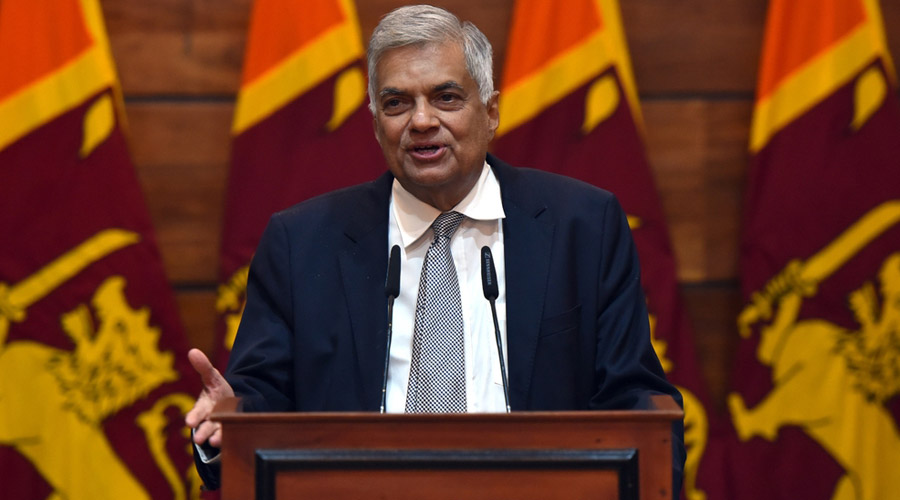
TNA to support forming of all-party government

August 1st, 2022

Courtesy Adaderana

The Tamil National Alliance (TNA) on Monday announced that it will support President Ranil Wickremesinghe’s efforts to form an all-party national government to help the country to recover from the worst economic crisis.

TNA leader and veteran Tamil political leader R Sampanthan told reporters that the move to form an all-party government is the best step to be taken right now and his party will support the move.

Another Tamil National Alliance (TNA) spokesman said that the party has decided that the formation of an all-party government would be suitable in order to tackle the economic and political crisis that Sri Lanka is faced with. However, the TNA has not made a decision yet to take up Cabinet positions in such a government.

President Wickremesinghe last week wrote to the members of Parliament calling on them to join him to form a national all-party government to tackle the island nation’s economic crisis.

The government is currently engaged in great efforts to gradually restore normalcy to the political and social unrest created by the economic crisis that the country is facing today. Accordingly, initial plans required to implement a systematic economic programme are being formulated while preliminary measures are also being undertaken for the creation of economic stability,’’ Wickremesinghe said in the letter on Friday.

The main opposition party Samagi Jana Balavegaya (SJB), however, said that invitations to form the all-party government must be extended to parties and not individuals.

TNA had officially supported Wickremesinghe’s rival Dullas Alahapperuma in the parliamentary vote on July 20 to elect the successor to the resigned president Gotabaya Rajapaksa. But at least a few of their 10 MPs were believed to have favoured Wickremesinghe in the secret vote against the party’s stand.

President Wickremesinghe is to ceremonially address Parliament on Wednesday where he is expected to make his policy speech.

Sri Lankan MPs on July 20 elected Wickremesinghe as the country’s new president, with the majority of the vote coming from lawmakers representing ousted President Rajapaksa’s Sri Lanka Podujana Peramuna (SLPP) party.

Wickremesinghe on Wednesday said his government’s main priorities are to fix the country’s ailing economy and end the severe fuel shortage that has exacerbated after the last shipment under the Indian credit line arrived in the country in June.

Source: PTI

Social activist ‘Ratta’ arrested by CCD

August 1st, 2022

Courtesy Adaderana

Social activist and YouTuber Rathindu Senaratne, popularly known as ‘Ratta’, has been arrested by officers of the Colombo Crimes Division – Colombo Central.

He has been arrested for allegedly violating a court order during a protest at Bank of Ceylon Mawatha in Colombo on 21 May.

Senaratne had arrived at the CCD, earlier today, to record a statement regarding the protest staged near the Polduwa Junction on July 13.

Meanwhile the Colombo Fort Magistrate today issued an order barring three persons including social activist Rathindu Senaratne from traveling overseas. 

First person to forcibly enter Presidential Secretariat on July 09 arrested

August 1st, 2022

Courtesy Adaderana

Police have arrested the first person to allegedly forcibly enter the premises of the Presidential Secretariat in Colombo during the protests on July 09.

Police said that the suspect, a 38-year-old male from Pannipitiya, was arrested by a special police investigation unit today. 

The premises, which had been blocked by protesters for more than 100 days, was overrun and stormed by protesters on July 9 demanding the resignation of then president Gotabaya Rajapaksa.

Cabinet approval for 22nd Amendment to Constitution

August 1st, 2022

Courtesy Adaderana

The draft of the 22nd Amendment to the Constitution has been approved by the Cabinet of Ministers, the Justice Ministry said.

The draft constitutional amendment was presented to the Cabinet by Minister of Justice, Prison Affairs and Constitutional Reforms, Dr. Wijeyadasa Rajapakshe and subsequently approved by the Cabinet.

The amendment, which had been referred to as the 21st Amendment so far, will in fact be the 22nd Amendment, as another draft 21st Amendment has already been gazetted.

Policy approval of the Cabinet of Ministers was given on 2022.06.20 for the preliminary draft for the 22nd Amendment to the Constitution and the 22nd constitutional amendment bill has been prepared by the legal draftsman accordingly. 

The Attorney General had informed that the bill is in accordance with the Constitution. 

Consequently, the Cabinet of Ministers had approved the proposal presented by the Minister of Justice, Prison Affairs and Constitutional Reforms, to publish the 22nd Constitutional Amendment Bill in the Government Gazette and thereafter present the same in Parliament for approval

The 22nd Amendment was initially tabled in the Cabinet on June 06 by Minister Wijeyadasa Rajapakshe and the discussion on it had been adjourned on multiple occasions due to failure to reach a consensus.

The Constitutional Amendment is expected to empower Parliament over the executive president and annul the 20A to the Constitution, which had given unfetted unfettered powers to President after abolishing the 19th Amendment.

Under the 22A, the President, the Cabinet of Ministers and the National Council will be held accountable to the Parliament. Fifteen Committees and Oversight Committees are also accountable to Parliament.

The proposals for the 22nd Amendment to the Constitution were published in a gazette notification issued on June 29, 2022.

Time for New Solutions for Sri Lanka. Fight for Private Creditor Debt Cancellation.

July 31st, 2022

Charith Gunawardena

With the whole world watching the deteriorating political, economic and humanitarian situation unfolding in Sri Lanka, and while we pray for swift solutions to food, fuel and medical shortages, there is now an opportunity to reinvent how countries caught in post-Covid 19 debt traps recover from crippling debt and re-emerge as healthy, functioning economies.

Sri Lanka like many other countries seeking International Monetary Fund (IMF), bailouts is in a difficult position. Corrupt governments have mismanaged the nation’s finances and agreed to predatory loans with exploitive interest rates. Having absconded from the country they ravaged, they have left millions of everyday citizens on the hook for their crimes and ineptitude. 

In the case of Sri Lanka, the country has internal and external borrowings of over $50 billion (60% of GDP), that it cannot service, crucially over 40% of that is to private creditors, many of whom are charging predatory interest rates. The loans from multilateral institutions (over 20% of external debt) and bilateral arrangements (30%) are on more concessionary payment terms.

The traditional solution, to turn to the IMF, will likely result in crippling austerity measures and the selling off of our national assets and resources, leaving us even less able to revive our economy on our own steam. This is unacceptable and I would suggest not inevitable.

Sri Lanka is not the only country in this position. It is the canary in the coal mine. The pandemic, the war in Ukraine and resulting inflation have hamstrung several nations in the global south who may soon be facing their own disasters. The instability this will cause will be detrimental to global politics and economies writ large. Problems like these are not isolated and do not stay put. They travel, taking their consequences with them across the planet.

The solutions to these troubles are as unique and complicated as each individual country, but what they all share is some measure of debt cancellation and delayed or restructured repayment. I am not suggesting Sri Lanka default on its external loans to other governments or multilateral institutions. 

I am suggesting that instead of thinking in the short-term and selling off our assets, the very things that could be used to revive the economy, we declare null and void the remainder of the debt to extortionary private lenders, and instead create a plan for how Sri Lanka’s people and resources can work to revive the economy and repay those restructured multilateral loans and bilateral loans from our allies. Taking a genuinely non-aligned position in the geopolitical battles between larger nations is a pre-requisite to request assistance from across the world.

The benefits to this are myriad. First and foremost, it gives Sri Lankans a chance at long-term independence and prosperity, and shield against climate change. There has been 16 rounds of standard IMF bailout packages since 1965 and they have all failed to deliver sustainable solutions. The current model of prioritising benefits to lenders rather than local populations is wrongheaded and it simply doesn’t work. 

The IMF should bail out people, not accommodate corporations. If they did, the people would, in time, be able to pay back their loans. Sri Lanka is rich is resources and assets which can be leveraged to create a booming economy. The issue is not insolvency, it is illiquidity.

Secondly, we must take a progressive stand against the ability of exploitive private creditors to make deals with corrupt leaders who ultimately are not held responsible for the outcomes. 

By including private creditors, such as worlds’s largest asset manager BlackRock, in IMF debt restructuring negotiations, they are being rewarded for their destructive lending practices, and are encouraged to continue, causing generations-worth of economic damage to struggling nations. Sri Lanka should default on loans to predatory private creditors, and it should do so jointly with other low-income countries. 

Yes, the lenders will sue. There is no international court that can force countries to pay them back, but the loans are subject to the laws in which the lenders are based, most often New York and London, and they may pursue claims to overseas assets. This is our opportunity to mobilise for greater economic fairness and to campaign for changes to these laws for the better.

Currently countries in economic hardship do not have the bankruptcy protections granted to businesses. If the owners of a company that cannot pay its bills can be shielded from its creditors to avoid destitution, then surely a country that supports the lives and welfare of millions of people should be entitled to the same protections. 

If low-income countries default together, we shine a light on this issue and put pressure on the United States and United Kingdom governments to enact legislation that will protect distressed governments. The change required is systemic and necessitates that we stand together and that new models work for the people. Yes, this will be a fight, but a fight worth engaging in, and one in which there will be support from around the world.

Debt cancellation is not a fairy tale. It can and has happened, to greater and lesser extents, and it can happen for Sri Lanka, but the call needs to come from the people. The current government will not engage in this type of structural change without pressure. The people need to demand it. They need to demand fairness and the opportunity to thrive. 

Debt cancellation in these circumstances is justice. I would encourage every Sri Lankan, and every citizen of countries in similar straits, to consider the idea. Talk about it with your friends and family. Discuss it within Sri Lankan civil society. Demand that our leaders fight for it. The diaspora wants to help and will speak up within their countries calling for their governments to support these ideas. If Sri Lankans ask for it, organisations like Debt Justice UK, Asian Peoples’ Movement on Debt and Development, Jubilee USA, and others, can support the fight.

The whole planet is in recovery mode. Now is the time for large-scale change based on reframing what economic justice looks like. Debt is not a moral issue. Allowing people to suffer and die is a moral issue.

Charith Gunawardena, former Local Councillor for London Borough of Enfield in the United Kingdom representing the Green Party and a member of the Sri Lankan diaspora.

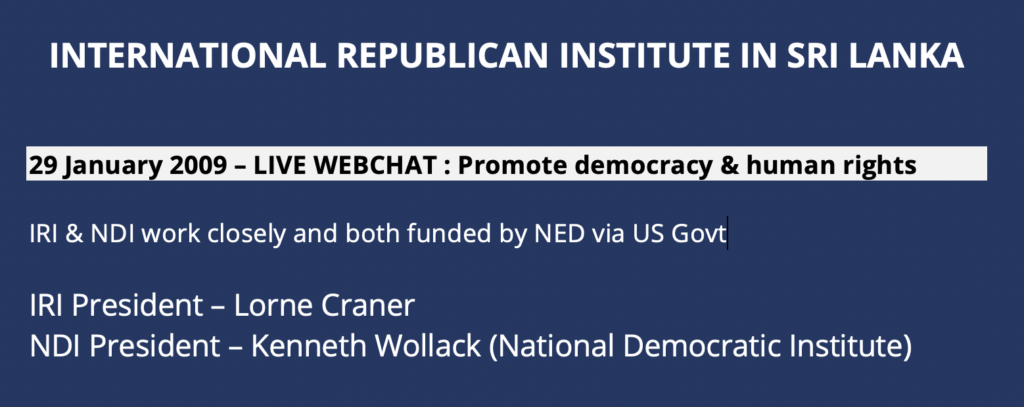
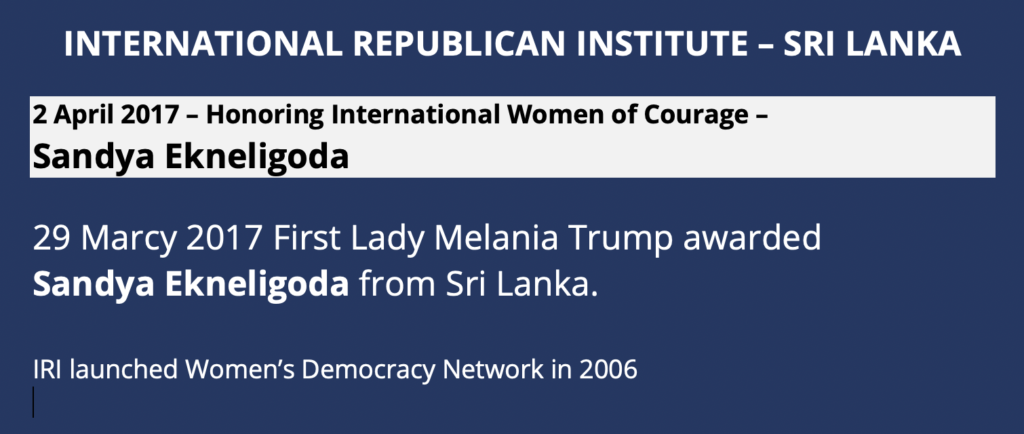
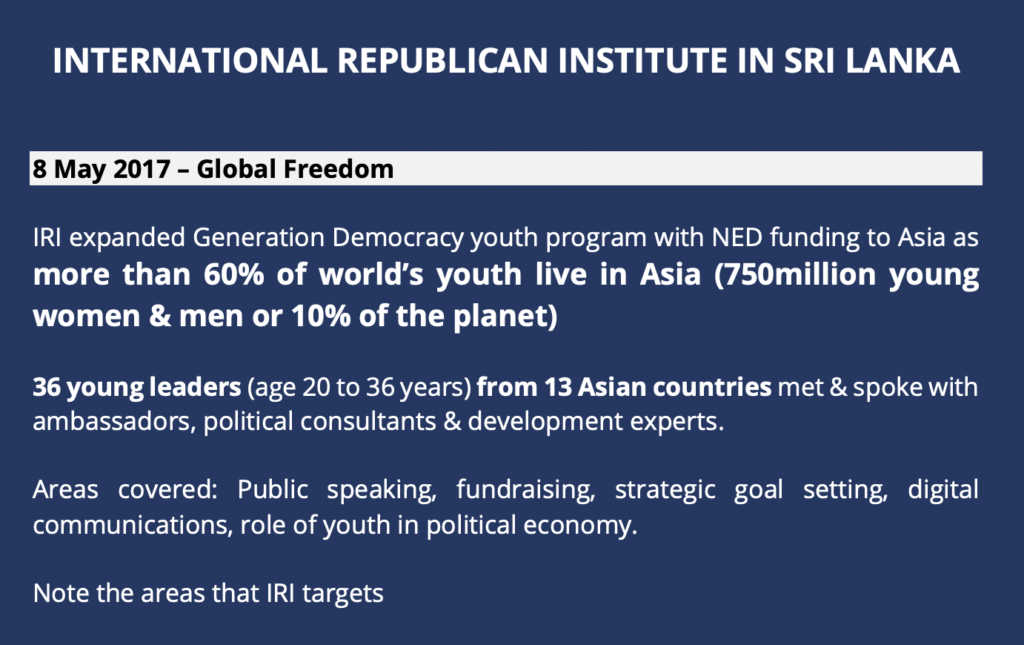
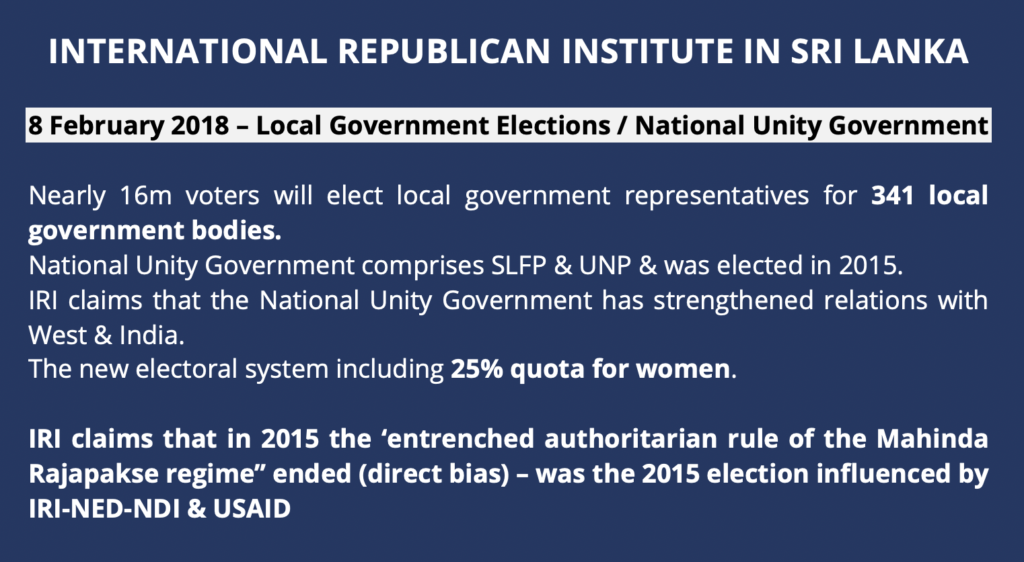
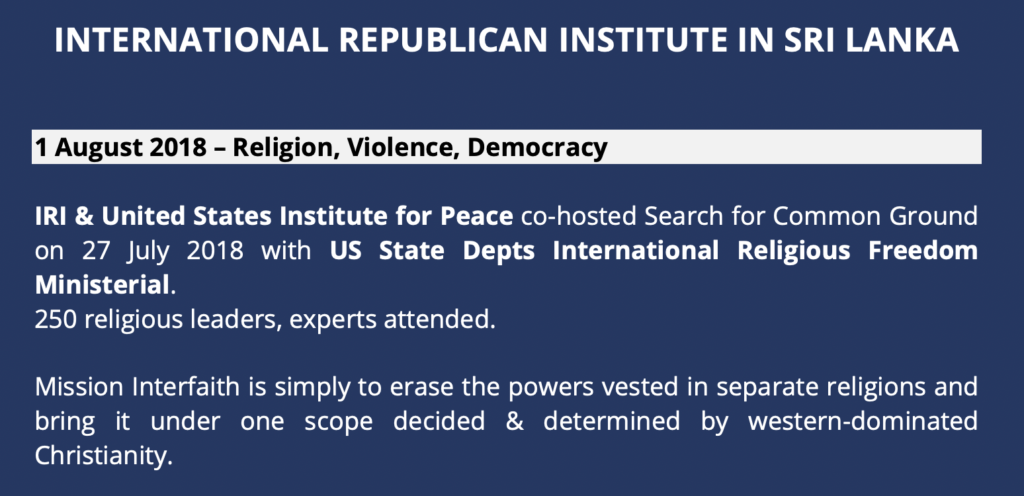
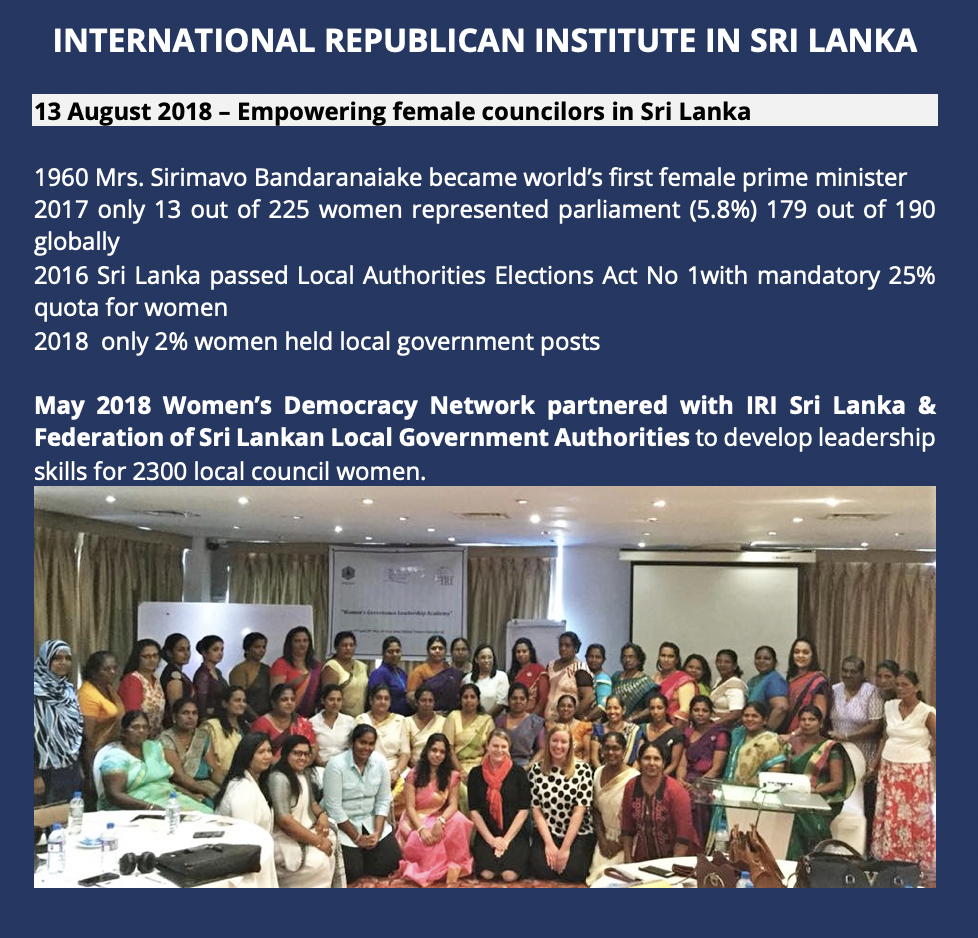
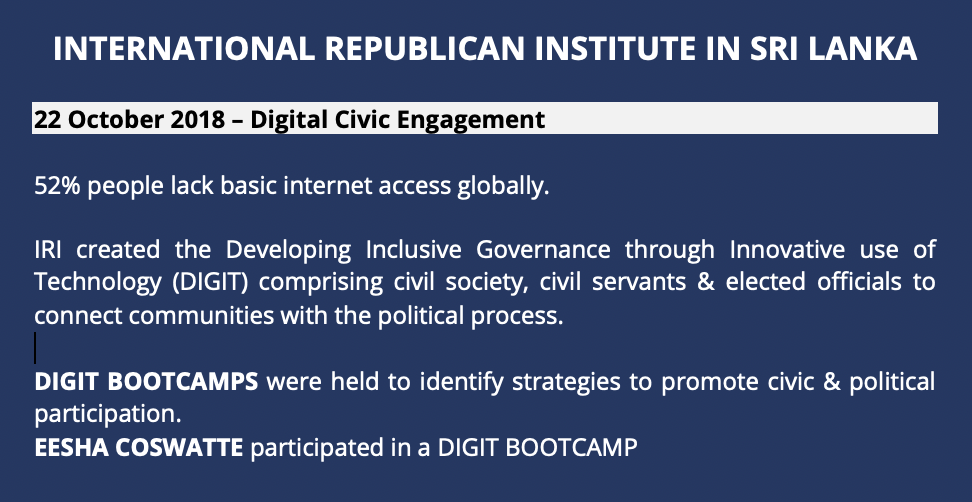
Regime Change Role of International Republican Institute (IRI) in Sri Lanka

July 31st, 2022

Shenali D Waduge

US foreign policy does not change whatever party comes to power. American Exceptionalism is at the forefront of US foreign policy for Democrats & Republicans. Soft-power tools are terms democracy” freedoms” rights” gender equality” youth empowerment” lavishly used to exert pressure on third world target nations. The International Republic Institute was led by late John McCain while National Democratic Institute was led by late Madeleine Albright. Nothing happens in a country which is of geopolitical interest naturally or spontaneously. This is what citizens must understand first of all. All the leaders following ‘national’ themes are often ousted. It takes a smart ‘national’ leader to outsmart the regime change operators balancing the threats & challenges but rolling out national programs regardless.

https://www.iri.org/who-we-are/

National Democratic Institute was created by the CIA in 1983 for the purpose of working with civil society to advance US foreign policy. NED together with IRI and NDI are operational in Sri Lanka.

IRI budget has been over $300,000

NED has a budget of over $2million

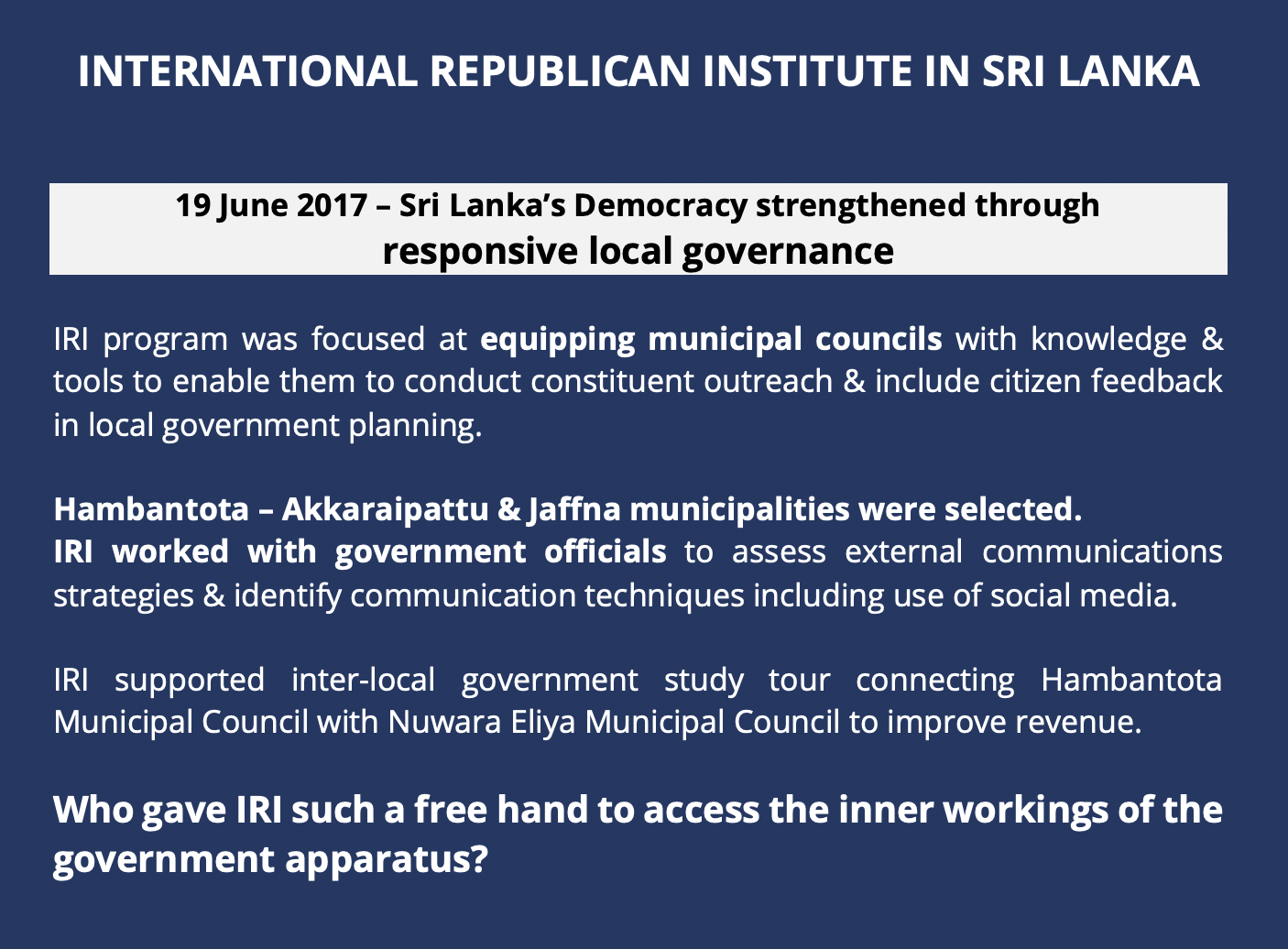
Why would IRI-NED-NDI be targeting local government authorities, spending on training and using these trainees as a podium to get closer to the citizens?

Why IRI wish to poke its nose into electoral registers of voters in Sri Lanka? What is the information they are picking from these lists and more importantly what do they propose to do with them?

How far is the Sri Lankan Government & its intelligence agencies looking at the deeper ramifications of these ‘interferences’ on the guise of helping ‘democracy’?

Is IRI-NED-NDI registered in Sri Lanka?

Is the Govt monitoring their funding & the funds allocated for their programs against what they claim to have achieved?

What do we know about the Federation of Sri Lankan Local Government Authorities that IRI is working close with & funding it via USAID, UK Govt & Canadian Govt. https://fslga.lk These foreign govts & their fronts are getting direct access to the people and public servants via the FSLGA.

What is the espoused outcome of ‘teaching democracy” for these foreign entities using local NGOs as a means to get close to influence citizens, communities, public servants & even political parties. How far have they influenced people’s lives & in what way & to what agendas?

How oblivious are Sri Lankans to the manner that these entities use this very format to carry out coloured revolutions in other parts of the world influencing election outcomes and brainwashing voters on who to vote for & who not to vote for?

President Bush in 2005 had thanked IRI for its role in American foreign policy helping to create ‘democractic change’ in more than 100 countries by training ‘the next generation of leaders’. Encrypted what does this mean? It means that IRI has triggered influence in over 100 countries to align with US agenda via its ‘harmless’ and ‘innocent’ community efforts.

The manner IRI-NED-NDI-USAID has got close to citizens & communities in particular the youth & women has enabled a series of coloured revolutions to suddenly emerge – Rose, Orange, Purple, Tulip, Cedar, Saffron in Middle East & East Europe and now onwards to Asia where Sri Lanka had its own dosage since early 2022.

It was quick, calculated and backed by diplomatic messages to allow the chaos to continue. What we saw from the attacks to the President’s private residence to what unfolded since May onwards to July in Sri Lanka was nothing drawn out by locals but what locals were individually & collectively tasked to do, making them think that they were the architects when in reality the real brains would have written back home a single sentence ‘mission completed successfully’.

https://srilankaexpress.org/cia-ned-iri-in-sri-lanka

Perhaps IRI’s work in other countries may open Sri Lankan people’s eyes.

Haiti is one example Sri Lankans will find similarities with.

IRI – HAITI

Program Officer Stanley Lucas ran the training.

Kim Ives a journalist with Haiti Progress newspaper was one of the trainees.

Andre Apaid a Haitian politician was one of the leaders of the street demonstrations against Aristide.

Others trained were linked to opposition political parties.

US took side of the demonstrators and found fault with Aristide for not handling the violence. US urged Aristide to step down & leave Haiti.

US sent a plane to take Aristide to Central African Republic.

IRI – VENEZUELA 

IRI presence increased in 2001 with Hugo Chavez anti-US rhetoric.

US granted IRI $300,000 in 2001

While NDI worked with mainstream political parties IRI worked with Opposition entities.

IRI nurtured opposition figures on how to criticize Chavez.

In April 2002, a group of military officers launched a coup against Chavez. This showed IRI involvement with Venezuelan military.

IRI even issued a statement on 12 April 2002 praising the ‘bravery’ of the military. IRI is alleged to have promoted a false statement that Chavez had resigned though he had not.

Demonstrators, the Presidential guards and segments of the armed forces however, backed Chavez and he returned to power. The coup resulted in 40 deaths.

IRI – CAMBODIA

IRI supported Opposition party of Sam Rainsy linked to US. IRI wrote the speeches, managed the campaign and virtually ruled Cambodia from behind the scenes.

The irony however, is that while entities like IRI-NED-NDI-USAID blatantly interfere in internal affairs of countries denting the credibility of US envoys and missions, some of the leaders of the countries that US agents operate are no saints themselves. It is as a result of poor management of national leaders that allows entities like IRI-NED-NDI-USAID to fish in troubled waters and make the water mirkier by various psyops and false narratives to align with their foreign policy goals.

A weak nation made weak by political leaderships elected to power can be made weaker when mischief makers enter the fray and add to the smoke.

In Sri Lanka, we have to admit that leaders of all political parties have failed to put nation and national agendas first. It is as a result of this failure that subvertive elements enter the fray to create further mayhem and utilize the vulnerable situation to their advantage. The tide can be reversed only if leaders come up with a strong national plan, mechanisms that win the confidence of the people and strategies to deal with subvertive elements at play. The lack of such or when leaders are dependent on the subversive elements for their political survival confounds the situation.

Shenali D Waduge

WHAT IS THE SOLUTION FOR STAGFLATION IN SRI LANKA?

July 31st, 2022

BY EDWARD THEOPHILUS

Stagflation means double-digit inflation seems in many countries as a result of the post-Corona pandemic, and the temporary solution to this situation being used by many countries is to increase subsidies to lower income earners, how these countries spend for subsidies (Source of funds) has not been disclosed and it could assume that printing money generates funds for subsidies. Is it the economically logical way of finding funds for spending?   Money printing or more printed money added for circulation is one reason for stagflation.  Printing money for subsidies in all countries and it seems that no alternative policy actions have for the chaotic situation.

Two major definitions for inflation were before the 1960s, the demand full and cost-push. Milton Freidman further defined the reason that increases the volume of money in the economy and his solution was imposing a tax to attract excess money back to the government treasury. Sri Lanka has not a specific tax to attract money from the economy. During wartime, there was a tax to collect funds for subsidies and a similar type of tax should have been introduced by the government to find funds for the Corona period.  

The major reason for stagflation is production-related problems, which means lower production in all areas of the economy and the government needs to encourage production, it will increase employment opportunities and reduce the payment of subsidies.  Consumers of subsidies should be accountable to the government for providing information about how they worked to make revenue instead of depending on the subsidies.      

Stagflation has been impinging Lanka since the late 1950s and the government policy did not focus the measures of inflation control by productive measures and the policy of the government was concerned with weak measures such as price control, rationing the distribution of goods and services and many policy actions were related to so-called socialist policies. Many socialist policies had been introduced by the government since 1956 but they were like sand castles.

As reported in newspapers in Sri Lanka inflation rate in July 2022 is 60.8% and the highest contribution to the average inflation was from food 90.9% and transport a huge contribution of 143.6%.  These statics advise the government that if it can control the inflation in the food and transport sectors the stagflation could reduce to a single digit. In many countries, inflation in the food and transport sectors shows that it is higher and the solution for the food area is to increase production and transport is to develop a plan considering the cost of the transport sector.

Sri Lanka cannot develop programs to control stagflation in isolation and needs to consider the ways other countries are using and developed countries know how these two-area influence human lives. Therefore, developed countries have a system of close monitoring of inflation, especially in food and transport areas.

Data presented by the Census and Statistics Department in Sri Lanka indicate that the non-food sector contributes 46.5% and this means the government policy framework needs to consider policies and procedures for all three areas to control stagflation.

Inflation control in Sri Lanka needs a macroeconomic plan with an appropriate framework that indicates vital factors relate to the economy. What are the contributing factors to the inflation model in Sri Lanka, and how the variation of factors is monitored by policymakers may not be clear.    

Illicit drugs in Sri Lanka have contributed more than 20% of the total money supply consists of drug money and people associated with the illicit drug business are influenced by vital people (politicians) in the society, so it is difficult to control drug money. Many politicians are indirectly associated with the illicit drug business. Sometimes, they get funds from drug dealers. Since the early 1980s, I was being observed that people were overspending and what was the source of funds, one was earning from employment overseas and the other was related to illicit drug dealing.    

The major solution to stagflation would be concerned with many factors.  Why government economists are silent on these issues?

As indicated in statistics 90.9 inflation in the food industry could be reduced to less than 10% if the policymakers attempt to develop programs for increasing food production. Has the government listed the items of the food industry and what kind of actions should take to increase production and distribution of such items?

A considerable part of the stagflation in Sri Lanka has been contributed by weak policymakers and the lack of knowledge of policymakers to manipulate policies to control the inflation.

Unheard Voices of Youth and Women, The Referendum and All-party government.

July 31st, 2022

Sugath Kulatunga

In the present system of governance there are two deep rooted shortcomings which have surfaced frequently, but no acceptable solution has been found. The explosive issue of the neglect of the voice of youth was addressed partially after the 1971 JVP insurgency, but practical mechanisms have not been institutionalized to meet the concerns. This dilemma has emerged in a more complex state in the form of the Aragalaya with the stringent voice of go home”. This voice has been orchestrated by many unfriendly elements local and foreign which have sensed an opportunity to ravage Sri Lanka.

There has been more sympathy for a place for the voice of women. An ineffective attempt was made with amendments to the local authorities’ law of prescribing a quota for the representation of women which is impractical.

There is now a talk of looking at a new constitution after introducing the 22nd Amendment. One cannot understand why the government cannot consider the recommendations of the Special Presidential Committee which has already presented their report. Whatever the steps the government takes to Amend the Constitution the two key issues of youth and women’s representation should be addressed.

The solution is to introduce a second chamber for youth which should represent men and women between 18 and 35 years of age on a ratio of 50 percent for each category. They should be elected based on one man and one woman for each District to be elected by the members of local authorities and Pradeshiya Sabha by secret ballot.

To cut costs and give legitimacy, the youth Parliament should meet in the present Parliament and be serviced by the present staff of the Parliament. They should enjoy the same privileges as the members of the Parliament.

The Youth Parliament should have the same powers of the previous Senate to delay legislation and initiate legislation for the consideration of the Parliament. This proposal goes beyond the Peoples Council demanded by the Aragalaya in which ‘there is legal binding for representatives of the Peoples Struggle to intervene/create an impact’.

This demand is for representation for the Aragalaya leaders only and not for the youth in general. This would only be a junta which would impose their will on others.

This proposal might sound outlandish but desperate situations call for unconventional solutions.

REFERENDUM

The provision for a Peoples’ Referendum in our Constitution is another instrument which ensures right of franchise and the sovereignty of the people. The Referendum can be made operative by the Cabinet of Ministers, the Supreme Court, or the President under specific conditions as shown below.

Article 80(2) Where the Cabinet of Ministers has certified that any Bill or any provision thereof is intended to be submitted for approval by the People at a Referendum or where the Supreme Court has determined that a Bill or any provision thereof requires the approval of the People at a Referendum,

Article 85(2) The President may in his discretion submit to the People by Referendum any Bill (not being a Bill for the repeal or amendment of any provision of the Constitution, or for the addition of any provision to the Constitution, or for the repeal and replacement of the Constitution, or which is inconsistent with any provision of the Constitution), which has been rejected by Parliament.

But there is no means by which the people themselves can make it operative. Referendum is as expensive to hold as a general election. In this context a Referendum has been invoked in the country only once and that too for the wrong purpose of extending the life of the Parliament.

In our democracy the people can use the power franchise in selecting a government only once in 5 years unless the Parliament is dissolved earlier. In between elections the voice of the people is muted. This makes people to resort to demonstrations and Aragalayas. The government also takes decisions on conjecture. A typical guesstimate decision was the overnight ban on chemical fertilizer.  It was done with good intentions on the advice of a small coterie of pseudo experts, not anticipating an adverse response from the farmers.

What the country needs is a mechanism to consult the people and for the people to show their response at an intermediate level between the Parliament and the grassroot constituency. Fortunately, we have such a representative level at the Divisional level where a new constituency for referenda of around 8000 elected members of Pradeshiya Sabha and local authorities could be introduced. While the government can invoke a referendum at the will of the President or on a simple majority of the Parliament expressed in a secret ballot, the people could also demand a referendum to express their will with a simple majority of the new constituency registered in a secret ballot.

Such a procedure will be less expensive than the disastrous consequences of unilateral decisions taken by the center.

All Party Government

As children we used to hear about the Andi Hath Denage Kanda Haliya. (The pot of gruel of the seven wayfarers). A new version of this pot is being proposed as an all-party government. One cannot see much merit in this proposal other than sharing cabinet posts and the attendant perks. This is not the time for making every decision a compromised decision to please all parties inclusive of what are known as three wheeler parties with only one or two elected representatives. But they are the groups which subscribe to extreme and narrow views. It is the experience in parliamentary democracies in the West and the East that strong single party leadership delivered results under difficult conditions. There were no all-party arrangements in governments of Lee Quan Yew, Mahathir, president Park of the East or of Thatcher, Adenauer or Regan in the West. They had strong single party governments. In Sri Lanka even within a single party, discord emerge on personal loyalties or key policy decisions. The dissention between the Chairman and Secretary of the SLPP is a good example. Historically Coalition governments have not been successful in the country. The SLFP – Philip coalition disintegrated after the demise of SWRD. The 1970 coalition between the SLFP and the left did not survive the full term. The last coalition between UNP and SLFP of the Yahaplanaya was a calamity.

The present political parties in the country are merely greedy for power which bestows personal benefits. They would not like to sacrifice the selfish motives in the national interest. The kind of conduct of opposition political parties during the separatist war was bordering on treason. The best that these power-hungry political parties may do is to agree on a common program to resolve the economic crisis. Tragically there are no signs of such a move. They are playing the traditional political games.

Sugath Kulatunga

POHOTTU AS USA’ S PROXY Part 8Da

July 31st, 2022

KAMALIKA PIERIS

Wiswa Warnapala declared that violence was first injected into the politics of Sri Lanka by the JVP. JVP was a violent murderous movement from the very beginning. They were guilty of gruesome killings, said Rohan Gunaratne.

Despite JVP ‘s attempts to identify itself with Fidel Castro and Ché Guevara,  JVP had more in common with the Peruvian Sendero Luminoso (Shining Path), and Kampuchea’s Khmer Rouge, said Tisaranee Gunasekera. Its use of lethal violence is very similar to Shining Path. Like the Khmer Rouge it eliminated anyone who opposed them.

It is quite clear that we believed in violence from the outset, said former JVPer Indrawansa   de Silva. I was busy enlarging the maps of Colombo district, marking bridges to be blown up so we could immobilize the army, pinpointing where the counter revolutionaries, reactionaries and traitors reside so we could take care” of them when we gained power, Indrawansa said.

Our writings, classes, publications, posters and public speeches were very open about our belief in violence. Destruction must precede construction. And if we were to kill en masse to reach our goal so be it. We didn’t shy away from saying how brutal we could be. Had we succeeded it is more than likely that Sri Lanka would have ended up worse than Cambodia under Pol Pot, concluded Indrawansa.

JVP was from the beginning, trained for armed violence. A rudimentary form of military training was given at the camps, with sketches of guns on the blackboard, pictures of rifles being circulated and rifle drills and karate being taught. These camps were held in places like Kurunegala, Akmeemana, Tissamaharama, Elpitiya and Anuradhapura. As part of the militarisation of the Movement, every member was asked to have a gun and 10 cartridges ready.

On the night of the 5th of April, 1971 the J. V. P. was responsible for violence, on a scale which had never been experienced in Sri Lanka, observed Samaranayake. JVP attacked 92 police stations.   They were all in ‘Sinhala’ areas. JVP only killed in Sinhala areas.  Estate owners were killed. At Deniyaya, there was the high profile killing of the popular Dr Rex de Costa, who had openly helped the Deniyaya police during the insurgency. A friend told me that three of her husband’s cousins, who owned tea small holdings in Matara, were shot and killed. JVP also killed their accomplices so as not to leave any evidence. 

JVP killed during the 1971 insurgency and they also killed as they retreated when the insurgency failed. One JVPer said that after the 1971 insurgency failed and he was retreating, he had carried out several murders of alleged informants, political opponents and vigilantes on his way from Kegalle to Wilpattu.

Gamini Samaranayake said 200 guerrillas from the Kegalle and Kurunegala districts retreated to Wilpattu National Park in two lots under the cover of darkness and along unpopulated tracks. During the day they camped in isolated areas either on the mountains or in the jungles. This retreat was marked by murder, arson and looting. Only about 30 reached their destination.

JVP’s favorite method of murder was by slitting the throat. Their preferred way was not with a knife but with a blade, slowly, enjoying the agony of the victim. They then hanged the head of the murdered on a pole, gate, and fence or placed it on a wall. This was said in a letter to Island newspaper by ‘Old Soldier’. To kill one needed special expertise. When JVP needed large number of killers in 1987 they recruited professional killers. JVP had close links with Piliyandala mafia, said Chandraprema. DJV used common criminals and contract killers as well, said Rohan Gunaratne.

In 1987, the JVP moved weapons to strategic locations in Colombo and other southern spots. JVP distributed arms to its loyalists in the villages as well.

On the day of the signing of the Indo-Lankan accord,in 1987,  Upatissa Gamanayake, General Secretary, came to the safe house in Hokandara, where a large haul of weapons was in place. He met JVP activists and briefed them on the course of action to be taken. They were told to take positions in Colombo, Kaduwela, Welikada, Battaramulla Homagama and Maharagama. JVP was getting ready to carry out violence.

The JVP provided a three year period of terror from 1987-1989. It was a relentless, daily round of killings, sabotage and strikes organized by the JVP and of counter-terror by security forces.  This period saw a huge number of ambushes, kidnapping, torture and assassinations.

In 1987 an estimated 40,000 died, mostly men, leaving women and children. In January    1988 the JVP terror campaign was in full swing. By November 1988, Sri Lanka experienced near total anarchy. This continued at an increased level and the country witnessed unprecedented violence in 1989.

The peak was in 1989 when the JVP was effectively running a parallel government with a military power and, to some extent, popular support said Nirmal Ranjith Dewasiri. The entire country experienced a terrible wave of violence and collapse of law and order in 1989, said Wiswa Warnapala. 

Individuals or organizations were warned or intimidated with messages dropped in the night to homes or posters or graffiti that appeared over night. Those that did not cooperate were brutally killed, with the repercussions extended to their family members. Executions were mostly carried out at night with armed groups coming to the homes of the victims and carrying them away to be tortured, executed and left as an example.

Sagarika Gomes was killed because she read the Rupavahini news when the JVP had forbidden it and many of the newscasters refused to present the evening news. She was kidnapped from her home on September 13 1989, by a group of armed men. She was then taken to the beach, raped and killed.

DJV murdered probably thousands of people and crippled the country with violently-enforced general strikes for two years, said the media. Killings took place in both urban and rural areas DJV killed 30 politicians, 23 academics, one clergy, two government officials, 89 civilians and 61service personnel, from July 1987 to January 1990. DJV killed more than seventy (70) members of parliament between July and November 1989.  In most cases the funerals of these victims were not allowed by the DJV, traditional final rights were not allowed and the caskets were to be carried below knee level as a mark of disrespect, concluded the media.

After Wijeweera and Gamanayake were killed Saman Piyasiri Fernando, head of DJV and Lalith Wijeratne, (Aravinda) had taken over leadership of JVP. There was an immediate escalation of violence.  UNP supporters were killed in Tangalle, Ahangama, Poddala, Ambalangoda Hikkaduwa, Akuressa and Baddegama. This violence fizzled out when Saman and Lalith were arrested, said Chandraprema.

JVP also committed murders for personal reasons and robberies for personal gain, added Chandraprema. They had long lists of persons to be eliminated. Prof  Patuwatavithana,  when Chairman of Plywood Corporation   had  refused to reinstate four officers and nine employees of Kosgama Complex   who had been dismissed for fraud. He was shot and killed.

Indradasa Godahewa said that JVP killed 1342 government supporters, 353 government servants, 250 policemen, 284 policemen, 163 servicemen, and 80 home guards. 3 university dons, 2 education officers, 44 principals of schools, and 57 teachers. They destroyed 430 post offices, 78 DDC offices, 59 GA/AGA offices, and 59 agrarian centers, 17 Superintendants of estates were killed. JVP assassinated some senior monks as well. They included Pohaddaramulle Pemaloka, Thambugala Sumanasiri, Vellatota Pannadassi and Kotikawatte Sadhatissa, said Behra.

Many civilians including a cultivation officer in Anamaduwa, cooperative chairmen of Weuda and a CTB driver were killed   JVP also killed surrendering JVP cadres. They killed two families of surrendered cadres in Anuradhapura.

We had a small family estate at Mawaramandiya, near Kadawatha,    said Garvin Karunaratne. The community leader of the area was one Wijesinghe. He was the President of the Cooperative society and was helpful to anyone that wanted anything done. He happened to be close to the leaders of the United National Party but he helped everyone irrespective of political party affiliations. I too visited his home when anyone known to me in the area had to face a problem with the government.

 He was hacked to pieces one night. The JVP had held him guilty of attending the funeral of a victim of its violence. Wijesinghe had arranged for a proper funeral to take place. The JVP order was that no funeral be held and the body be carried below the knee level and buried incognito. Wijesinghe’s murder sent creeps through everyone in the area. His brothers too left the village and his death left a power vacuum never to be filled ever again.

The DJV carried out a large number of political murders. It killed more than 70 Members of Parliament between July 1989 and November 1989. The DJV murdered probably thousands of people, said analysts. Killings took place in both urban and rural areas. DJV targeted opponents. 

On December 15, 1986, the DJV abducted and murdered Daya Pathirana, the leader of the Independent Students’ Union (ISU) of the Colombo University, which was a rival students’ union. Analysts see this as the significant starting point of political assassinations.

JVP assassin Lionel Ranasinghe widely believed to be responsible for at least 41 targeted high-profile killings. Ranasinghe’s victims included Sri Lanka Mahajana Pakshaya (SLMP) leader Vijaya Kumaratunga, Professor Stanley Wijesundera, Director, CID, Terrence Perera, UNP General Secretary Nandalal Fernando and UNP Colombo Municipal Council member Jayantha Mallimarachchi. Sub Inspector of Police T.C.D. Rajapaksa attached to the Counter Subversive Unit (CSU), Narahenpita police. Lionel Ranasinghe shot him at Ambagahapura, Maharagama on Sept 22, 1988.

There was also   a JVP Bhikkhu death squad called Kudahapola Balakaya, operating in the JVP insurrection in 1980s. These were Buddhist monks who were also terrorists.  At night they would done civilian clothes and go out and commit murders and as monks would do the last rights later on, said Chandraprema.

Here is a list of some persons killed in 1987-89

Marxists.

The JVP always maintained that it was the only genuine Marxist-Leninist revolutionary movement in Sri Lanka.  JVP tried to make this a reality by killing all other Marxists. Wijeweera   wanted leaders of all leftist parties destroyed before the revolution, reported Gunaratna.

The JVP is the only ‘Left’ party in Sri Lanka which has engaged in killing fellow Leftists. The older Marxist parties in Sri Lanka did not kill each other, though they had deep differences with each other. This indicates that JVP was not a true Leftist party at all, but a killer organization.

Hundreds of leftist leaders, activists, sympathizers were killed in1988-89, said Chandraprema. PD Wimalasena, veteran LSSP trade union activist and manager of Star Press was shot inside the Press in May 1989.  In 1988 LW Panditha, Communist Party trade union stalwart was killed in Dematagoda.  Gamini Medagedara, Communist Party, was killed at Polonnaruwa.

KAD Saddhatissa, a retired school principal living in Akuressa and supporter of Communist Party, was killed while he was sick and in bed. His son was also killed. JVP then ordered the perturbed villagers not to put up white flags. No flags went up. Six members of a NLSSP family were killed at Pujapitya in Katugastota, in 1989.

JVP’s main target was not the old left but the so called ‘new left’ because only they could have functioned as an alternative to the JVP. JVP launched a massive campaign against leftist activists who were seen to be rivals of JVP. JVP   shot and killed a lot of student leftist leaders, such as Yapa Bandara of the University of Kelaniya.

The killing of Daya Pathirana signaled the beginning of a concerted campaign aimed at exterminating all those leftists who were competitors, said Tisaranee Gunasekera. Daya Pathirana was the leader of the Independent Students Union (ISU) of the University of Colombo. He and the ISU led by him was the sole obstruction to the JVP’s domination of the university students’ movement. Taking over the universities was vital. The Inter-University Students Federation (IUSF) had an important role to play.  There were gang wars between ISU and Deshiya Sisya Viyaparaya of the JVP.

The Pathirana killing was a targeted assassination.  JVP did not have good hit squads at the time, and had developed links with the underworld for the purpose.  Pathirana was killed by hired killers from Piliyandala underworld.

 Pathirana, along with a colleague Somasiri, was abducted on 15th December 1986 and taken to a lonely spot off the Bolgoda Lake in Piliyandala. The JVP abductors then began to torture him and Somasiri, demanding information about other students and left activists. The intervention of a group of pilgrims – it was the full moon poya day – saved the life of Somasiri. Pathirana succumbed to his wounds.

Police

JVP killed police in 1971 and then again in 1987. JVP killed many policemen in cold blood. A reserve constable was killed while drinking tea at a Kegalle hotel.  Police on duty at Hingurakgoda town were killed with knives.   At Pitakotte two constables were   stabbed.  Policeman on guard duty at CSU unit at Uduwella, Galle was shot dead. A reserve police constable was beheaded in Matara.

Police sergeant Wijesooriya was shot and killed in Hungama in 1987. In June 1988 JVP stabbed policeman at Minneriya. A policeman was shot and killed in Alawwa in 1988. JVP also shot the administrative officer coordinating the police HQ. He was on his way to church. At Kudagammana in June 1988, JVP   fired at police patrol and killed one PC. In 1989 police sergeant was shot dead in Middeniya,   and one   PC was killed in landmine blast in Embilipitiya.

JVP   attacked police patrols and even resorted to killing unarmed constables on beat duty and traffic duty. JVP assassinated several servicemen and policemen in their homes or while on leave or off duty when they could not defend themselves. Director CID and Director, Counter subversive Drive were gunned down close to their homes while on their way to work.

POHOTTU AS USA’ S PROXY Part 8Db

July 31st, 2022

KAMALIKA PIERIS

The JVP’s Political Bureau  its highest decision  making body decided  in September 1970 decided to begin collecting arms, with Loku Athula placed in charge of the armed section and directed to collect 100,000 bombs. At the next PB meeting, held at year-end, Loku Athula reported that 3,000 bombs were ready.

The hand bomb was the JVPs main weapon. But guns and ammunition were also being purchased and stolen and stored by the JVP, in one instance at the Talagalle Temple at Homagama, which was raided by the Police. Uniforms for JVP combatants were being produced secretly, mainly at Vidyodaya Campus; a blue shirt and trouser with pockets, a cartridge belt, boots and helmet. JVP refilled their cartridges to       reuse them in shot guns with small charge, said Ranatunge.

JVP manufactured bombs. In 1970 JVP had experimented with making safety bombs and Molotov cocktails.  “Bombs were also being made using cheena chatti, cast iron shells, dynamite and an elementary mechanism to blow them up. Empty tinkiri tins were ordered from factories and sent around the country to make crude bombs,” said Sunanda Deshapriya.  JVP conducted training classes in bombs at Kandy, Matale, Nuwara  Eliya, Moneragala, Ampara, Polonnaruwa, Trincomalee, Kalutara. In  1970 3000 bombs were sent  to Badulla, Anuradhapura, Trincomalee and Jaffna.   

A past pupil of a leading school in Kandy had acquired the knowhow to manufacture bombs from a forensic book in the British Council Library and was teaching his accomplices in the Peradeniya University and elsewhere the art of assembling the bombs. The bombs that the militants did make were not that lethal. They were mainly smoke bombs that we just kicked out of the way, said Tassie Seneviratne.

Edward  Gunawardene had examined the bombs thrown t them in  Kurunegala Police station. These ‘bombs’ were crude and primitive. In each of these we found a large ‘batta’ cracker the fuse of which came out of a hole in the lid of a cigarette tin. Round the ‘batta’ was a layer of tightly compressed fibres akin to the fibres in a squirrels nest. On the outer side of the compressed fibre were barbs cut off barbed wire and rusted nails. A thousand of such ‘bombs’ could not have matched the destructive force of a modern hand grenade. This state of unpreparedness was perhaps the foremost reason why the insurrection fizzled out early.

Wijeweera also gave instructions to Piyasiri to build under-ground storage facilities to hide their stock of weapons and explosives, but on 9 March an explosion at one of these hideouts, in Nelundeniya, killed five. This drew attention, nationally to the fact that the JVP was arming itself.

The JVP had hidden a large number of detonators in the ceiling of a room in Peradeniya University’s Marrs Hall and due to the heat, they began exploding like firecrackers. The explosions went on for five days. When the Police arrived and searched the halls of residence, they also found a stock of detonators at Hilda Obeysekera Hall.

A fresh set of weapons  were needed for the 1987  insurgency. Collection of weapons started in early 1987    and weapons training began in mid 1987. The instructors were deserters from the army.

Weapons were purchased for Rs. 50,000 from Nimrods. Galkatas manufacture increased in Weeraketiya, Beliatte and Middeniya in 1987,  but this was not sufficient. Guns were got after breaking into houses Island wide. There was a set pattern in doing this. JVP collected pistols and shotguns from people who had gun licenses from the Government. They only took the guns and ammunition, nothing else.

A spate of gun thefts were reported from Hakmana, Deniyaya, Nochchiyagama, and Balangoda in 1987. There were reports in May 1987 that more and more youths were collecting such weapons from houses in the south. 600 weapons, mostly shot guns were taken by JVP in July 1987. An ASP reported that his pistol and ammunition had been   stolen from his car in May 1987. 24 shot guns were taken from   villagers in Kohombana area in August 1988. 

There was also increasing theft of firearms from police stations and military stations.  JVP took guns and ammunition from Bentota and Kurunegala police stations and from Kotelawala Defence Academy, Panagoda army camp and Modera army     camp.

JVP  also had a quantity of quick firing automatic rifles better than what the IPKF had, said Chandraprema. Peradeniya undergrads were  armed with lethal weapons, observed Wiswa. Where did they get these guns Peradeniya academics asked.

The frequent use of landmines by the JVP indicated that JVP was receiving regular supplies of explosives from overseas, said Intelligence. The mystery surrounding the sources of arms supply to the JVP has not been resolved, said analysts. Occasional bombings  took place in the second insurgency too. There was a bomb in Gampaha in 1989.

POHOTTU AS USA’ S PROXY Part 8E

July 31st, 2022

KAMALIKA PIERIS

JVP was given a new lease of life when the UNP came to power in 1977. Under the previous SLFP government JVPers were brought before the Criminal Justice Commission, (CJC) a special tribunal set up through a special Act of Parliament. JVPers were charged with waging war against the lawfully elected government, breaking the peace, loss of human life, possession of arms and explosives.

The CJC had been permitted to accept evidence that would otherwise have been inadmissible under the Evidence Ordinance. The UNP government of 1977 declared that this was a violation of justice. The UNP government repealed the Criminal Justice Commission Act and all the JVP convicts including Rohana Wijeweera, became free in 1978.

 Once they were freed, JVP started its usual activities, such as meetings. The police challenged the JVP at every possible turn.  When the police intervened at the Tissamaharama JVP mass rally in 1978 JVP complained to JR and Premadasa.  

JVP assassinated UNP activists.  UNP Chairman was attacked in December 1987.  UNP branch meeting at Kotahena attacked in 1988. Senkadagala UNP office was bombed and six persons died.

 UNP officials were killed in Colonne, Embilipitiya, Suriyawansa, Panamure, Balangoda and Kuttigala.  UNP Provincial councilor was killed in his house at Wanathamulla in 1989. At Pitipana, UNP candidate for PC elections was killed together with wife, daughter, supporters and home guards. A UNP supporter was taken away at midnight, tied to a tree, tortured, and killed brutally, there were many such instances, said Evans Cooray.

JR Jayewardene (1977-1989) released JVPers held in prison in three bouts.  65 university students were released by August 5, 1987. In October 1988 government had released fifty detainees as a good will measure.

The biggest release was in March 1989, about 1500 JVP detainees from Boossa and Moratuwa were released and the proscription against JVP was lifted. By April 1989 JVP was   a major force.  They had posters on all the walls possible and was starting hartals, said Gunaratna.

In November 1988 JR invited JVP for talks.  Gunaratna says JR had offered to dissolve Parliament and have an interim government if JVP stopped violence. In 1989 he invited the JVP to the All Party Conference. JVP ignored both requests.

JVP knew it had the support of JR and knew when to use it.  When the police intervened at the Tissamaharama JVP mass rally in 1978 JVP complained to JR and Prime Minister.   Shantha Bandara, was captured in 1988 but was released on intervention of JR.  JVP had threatened to retaliate if Shantha Bandara was executed.  There was support of another sort too from the top.   Instead of using pepper gas, plastic bullets and other means of riot control, JR’s government used live ammunition for the school demonstrations organized by the JVP.

JR had repeatedly told the forces that Wijeweera was in Sinharaja and kept telling the army to search Sinharaja. Wijeweera was on an estate. Chandraprema commented that the JVP leadership did not go into the jungles.  If Wijeweera had been in the jungles he would never have got caught, JVP had watch posts on top of trees.

JVP was crushed by the SLFP government of Ms Bandaranaike in the 1970s. JVP did not forget this.  W.A.Wiswa Warnapala was SLFP organizer for Kegalle in the 1980s. In 1987, party activity in Kegalle was done amidst JVP terror, he said. JVP threatened Wiswa with death and he was prevented from going to certain villages by blocking the road to these places.

JVP mounted a campaign of violence in Kegalle to prevent a free and fair election. They wanted to prevent the voters from voting     also from   participating in election activity. There was a large spate of political violence throughout the country at the time.    The SLFP organizers were provided with guns and were expected to arrange for their own security. The intensity of JVP violence reached its peak after the announcement of Sirimavo as presidential candidate in 1988, said Wiswa Warnapala. 

There was a spate of killings of SLFP candidates between Presidential election   (1988) and Parliamentary elections (1989).  In 1988, there was a bomb attack on SLFP rally at Matara  and another at the SLFP meeting at Badulla.  In 1989 SLFP Parliamentary candidates were killed in droves and supporters too. SLFP member for Dambagalla was shot dead in June 1988. JVP planned to take SLFP away from Bandaranaikes.  JVP liquidated thousands of SLFP supporters. Most had a personal allegiance to Bandaranaikes.

JVP attempted to disrupt the Presidential election of 1988 and Parliamentary election of 1989. The JVP killed voters and candidates.  JVP declared an unofficial curfew and people had to remain indoors. When they went electioneering down south, they found electricity supply cut off, Kalutara streets deserted, shops closed. Same at Alutgama and Galle, recalled Evans Cooray, who accompanied Premadasa on his election campaign. Even the friend where they ate was scared to host us, he said.

During the 1988 election, JVP atrocities in south were increasing. People kept away from election rallies.    Hand bombs were exploding at the site of the meetings. At one meeting, probably Dodanduwa, the audience was just one old female betel seller. She came near the stage and leaned against it listening. She was killed the next day, said Cooray.

However, the UNP knew to outwit the JVP .At Dodanduwa meeting Premadasa spoke through loudspeakers and the people listened from behind closed doors. He did so at other meetings as well. He spoke for hours to empty seats, knowing that they were listening to him behind closed doors, said Cooray.

How was the JVP able to exercise such power when the country had strong elected governments?   The answer is, because the heads of these governments pandered to the JVP and did not allow the government or armed forces to crush JVP.

When Wijeweera was arrested in 1970 Prime Minister Sirimavo Bandaranaike released him. Wijeweera thereafter held a dozen spectacular, well attended     rallies all over the island in August-October 1970.

Ranasinghe Premadasa (1989-1993) who succeeded JR as President was also supportive of the JVP. He had a secret meeting with JVP leaders on 1 August 1989. Premadasa asked JVP to come for talks, several times. Others opposed this.  One said it was futile to release JVP and ask them to join democratic stream, their activities must be met with force. Premadasa gave JVP venues to address meetings, but those who objected to JVP went and booked them beforehand. Clearly, the administration was getting fed up with JVP.

While the President of Sri Lanka danced attendance on the JVP, the army and police had stayed alert. The security establishment knew all along what the JVP was doing, but their hands were tied.

In the period 1983-1987    state Intelligence knew that JVP cells were being built at village level.  UNP government was told, it took no action, but the police crackdown continued, said Gunaratna.  The Police also suspected that an attack was being planned but the authorities and the Parliamentarians had ignored the information given to them.

Government knew in 1986 from an arrested JVPer that there were plans to capture power through armed struggle, also that there was a secret programme of recruitment. But government took no action.   In 1987,   arrests were made after the after     Galgamuwa and Maradankadawala bank robberies and Kalebokka estate pay roll and this provided further concrete information on JVP.  Lastly, Ministry of Defence was given a report in late 1988 predicting the creation of an insurgent movement.

By 1988, the villagers were fed up of the JVP, said Chandraprema.  In Meetiyagoda,   when the JVP had arrived to kill a villager, the villagers had beaten to death the two hit men and arrested a third. But JVP issued death threats and the village youth responsible for the killing, had panicked and run away.

By August 1989 JVP started losing popularity, said Gunaratna. When President Premadasa held his first mobile ministry on November2, 1989, JVP could not prevent people from attending it, thousands turned up.

Finally, the armed forces moved in and the insurgency was crushed in late 1989 and early 1990, with almost the entire leadership being executed.But when they were caught the JVP leadership had wanted to meet the President. 

Time for ‘System Change’

July 31st, 2022

By Dr. Tilak S. Fernando Saturday, July 30, 2022 – Daily News

The Seventh Executive President of the Socials Republic of Sri Lanka, Nandasena Gotabaya Rajapaksa RWP RSP, finally had to leave the country after a public campaign that commenced on March 31, 2022 at his private residence in Mirihana, Nugegoda.

On June 9, followed a rampage when protesters at Galle Face were allegedly beaten up by Sri Lanka Podujana Peramuna (SLPP) supporters, with iron bars and sticks. Among the protesters were looters and thugs who misbehaved engaging in looting and arson where substantial modern houses of Parliamentarians and Government Ministers suffered heavy losses, including their luxury vehicles.

Gotabaya Rajapaksa was given a grace period of one month to step down from the Presidency. After a month, on July 9 large crowds made a forced entry into the President’s House at Fort, Colombo just before the President left the President’s House. ‘GotaGoHome’ was the slogan protesters used.

The CID has so far collected ‘clear facial images of 20 suspects involved in the arson attack on the private residence of President Ranil Wickremesinghe at 5th Lane, Kollupitiya on July 9, 2022. The CID has managed to collect these images from the videos and photos released to social media by people who were present at the time of the arson attack from the unedited footage obtained from media organisations.

The CID has also found out that one of the suspects has gone to the UK via Dubai. The CID requested the public to assist them with identifying the suspects from their personal smart phones. Accordingly, photos are to be made public from the Police Headquarters. Apparently, the Fingerprint Department also visited every corner to ascertain the devastation that had been done at the President’s House, the Presidential Secretariat and the Prime Minister’s official residence.

The media stated that the fingerprints do match with the Crime Registry Office in Colombo where fingerprints of many known criminals were stored. It was also found that several people involved in the Aragalaya were among them.

Making History

The former President goes into Sri Lanka’s history books as the only President who had to quit the Executive Presidency midway due to unprecedented public protest. He was elected at the Presidential Elections held on November 16, 2019, with an impressive majority with a Government that had a two thirds majority in Parliament. The public expected so many changes from President Rajapaksa at the beginning, but his incompetency in selecting square pegs in round holes rather than those who helped him to walk into the Executive Presidency led to his downfall. His former advisers were professionals (Viyathmaga) but it was unfortunate that his so-called ‘favourite’ advisers’ or charlatans (the correct word) spoiled everything in the end.

The public initially was not aware of his whereabouts. Some speculated that he was hiding in a bunker, or flown to the Trincomalee Naval base, but later it appeared that he had flown to the Maldives Islands, his first destination and then proceeded to Singapore. He issued his letter of resignation from Singapore on July 15. There were only two instances of Sri Lankan Presidents or Prime Ministers resigning from their posts. One was when Prime Minister Dudley Senanayake was forced to resign confronting a major trade union strike in the country in 1952. It was a voluntary resignation but not out of any public agitation. The second instance was when President Ranasinghe Premadasa was assassinated during a May Day rally. Here, of course, Dingiri Banda Wijetunga became the President without much hassle. On July 15, 2022, the Speaker received by email about President Gotabaya Rajapaksa’s letter of resignation officially.

The Prime Minister at the time, Ranil Wickremesinghe, was officially appointed as the President on July 20 in Parliament by a secret ballot.

Enter New President

There were three candidates contesting for the Presidency. Ultimately, Ranil Wickremesinghe received the majority of votes after a secret ballot out of the Parliamentarians. Meanwhile, those who are involved in the ‘Aragalaya’ insisted that Ranil Wickremesinghe should step down and let someone who is better qualified to function as the President. Whatever people may say about Ranil Wickremesinghe, he is an internationally recognised politician with loads of experience in Parliament; He was the only one out of 225 MPs in Parliament who bravely took up the challenge to resolve the economic crisis in Sri Lanka right now.

During his tenure as the acting President, he showed more charisma in comparison with former President Gotabaya Rajapaksa. But there were comments about his decision to expel the Aragalaya crowd from the Secretariat. The explanation by the Police was that the protestors gave a number of excuses as to why they were not vacating the entrance of the Secretariat. Meanwhile, the President had so many duties to perform at his office and the blocking of its entrance had to be cleared. The protesters were dragged out early in the morning on that day which caused a dent in the new President’s image.

Ranil Wickremesinghe who was appointed as the President on July 20, 2022, has a difficult task ahead of him in pulling the country out of the dangerous predicament it is facing at present. There are no quick solutions to boosting the economy, which is going through difficult times. Let’s be honest and ask ourselves; Are there any qualified politicians in the country who are internationally recognised and who are capable of negotiating with international leaders, especially with the IMF? Former Finance Minister Ali Sabry, PC did a fine job in explaining to the IMF about the dire position in the country; he has been reappointed as the Minister of Foreign Affairs once again to negotiate with the IMF.

Unrest and turmoil or continuous demonstrations will not help to bring about a change to the ‘system’. It is up to the clergy and his Eminence the Cardinal who have as a prime duty to feed some logic into the minds of the protesters in saving the country from plunging into anarchy, far worse than people had seen in the past. Therefore, both parties have no alternative but to advise the protesters to strictly adhere and respect Sri Lanka’s Constitution because no country will be able to survive without giving pride of place to law and order.

In a ‘system change’ which the young protesters were frantic about, the new procedures should include wiping out corruption and bribery as a main feature. An independent Judiciary, with a much effective public service and efficient Police should be a criterion in projecting a new beginning.

tilakfrnando@gmail.com

ශ්‍රී ලංකා නීතිඥ සංගමයේ ඇතැම් හැසිරීම් පිළිගැනීමට බැහැ-අධි නීතිඥ මනෝලි ජිනදාස

July 31st, 2022

Courtesy Lanka Lead News

නීතිඥ සංගමයේ සාමාජික අධිනීතිඥ මනෝලි ජිනදාස මහත්මිය හිරු ප්‍රවෘත්ති සමග සම්මුඛ සාකච්ඡාවකට එක් වෙමින් ශ්‍රී ලංකා නීතිඥ සංගමයේ ඇතැම් ක්‍රියාකලාපයන් සම්බන්ධයෙන් සංගමයේ සාමාජිකයින්ට ගැටලු පවතින බව පවසා සිටියි.

එහිදී ඇය සඳහන් කළේ නීතිඥ සංගමයට අදාළ නොවන කරුණු සම්බන්ධයෙන් නිකුත් කරන ඇතැම් ප්‍රවෘත්ති නිවේදන හේතුවෙන් සංගමයේ පැවැත්මට ද ගැටලු මතුවිය හැකි බව අවධාරණය කළාය.

ගුවන් යානය තුලදී ධානිෂ් අලි නැමැත්තා අත් අඩංගුවට ගැනීම සම්බන්ධයෙන් නැගූ ප්‍රශ්නයට පිළිතුරු දෙමින් ඇය පවසා සිටියේ,අදාළ පොලිස් නිලධාරීන් එම පුද්ගලයා අත් අඩංගුවට ගැනීම නීත්‍යානුකූල අයුරින් සිදු කර ඇති බවයි.

Aragalaya backfired? Where are we heading?

July 31st, 2022

By Dr Upul wijayawardhana Courtesy Island

Whilst the economy, the basic underlying problem that needs urgent attention remains largely unattended by all concerned, political changes have moved at an alarming pace. So fast, that the totally unexpected has happened. Who would have imagined that Ranil, humiliatingly rejected by the voters in August 2020, would achieve his lifelong ambition in the most bizarre manner? The way, party after party, pledged support to Dulles made most of us believe that he would be our eighth president. When Sajith, who would have been the outright winner in a contest for verbosity, withdrew from the race at the last moment offering his support to Dulles it was pretty obvious that we were heading for a new era: Dulles/Sajith government. That was till the votes were counted! Even more surprising than Ranil’s victory was his massive majority.

A stunned silence pervaded not only in the parliament but also across the country!This, obviously, is not what the ‘Aragalists’ wanted! Interestingly, judging by the behaviour of the ambassadors as well as the lack of customary messages of congratulations, it looks as if this is not what the West wanted either. Ranil, the flagbearer of the West, has received congratulatory messages only from China and Russia! What an interesting and inexplicable paradox? Afterall, however bizarre the circumstances of Ranil’s ascent to the presidency, his election is constitutional and legal. This behaviour of the West surely adds credence to the suggestion that it played a significant role in the Aragalaya.

If so, there is yet another paradox: Is West in cahoots with ultra-leftists! There is no doubt whatsoever that,what started as a protest by those suffering severe economic hardships was seized by the JVP and FSP. The pronouncements by their leaders confirmed this and since their seizure the protests turned violent. The occupations of the president’s house, presidential secretariat, Temple Trees and Prime Minister’s office certainly were marred by violence. Accounts circulating show that Gota, to his credit, behaved in an exemplary manner instructing the security forces not to use force on the encroachers. This was in total contrast to the image of ‘Gota the dictator’ created! Once he escaped the mob, what should have happened? The protestors should have withdrawn instead of continuing to occupy and vandalise places of strategic importance.

The mobs went even further. They invaded television stations and nearly took over the parliament. If they succeeded in taking over the parliament on 13th night, perhaps, we may be having JVP/FSP rule today!What is happening now seems to be full of paradoxes! Celebrating Gota’s departure, a jubilant Omalpe Sobitha declared Sinhala Buddhist domination is over!” Is it not surprising that statement came from someone who is supposed to be the Anunayaka of the Southern Chapter of Ramanna Nikaya? Perhaps, he is Anunayaka when he imparts honours on Sajith but forgets that when he speaks as a political bhikkhu surrounded by Catholic priests! I have held Ramanna Nikaya in high esteem because of caste-neutrality but have lost it to a degree because of this unwarranted statement by a high-up in the Nikaya. Further, I am saddened to note that the Mahanayaka of Ramanna Nikaya did not counter this.

At lease he should have stated that no purpose is served by hurting majority sentiment. Though some accuse MPs of voting Ranil for money, it is quite possible some Sinhala Buddhist MPs may have voted in retaliation to the prevailing antiSinhala Buddhist campaign, as exemplified by the unwarranted utterance of this man in robes!Basil was turned away from the airport apparently by immigration officials who had taken the law to their hands. I have been very critical of Basil’s actions but do not endorse this type of discriminatory behaviour. In fact, Basil being kept in Sri Lanka by immigration officials too may have helped Ranil. There is no doubt that Basil is a capable organiser and used his talents! Much is made of the removal of protestors from the presidential secretariat. Interestingly, no one seems to question why they were there or why they should be there.

It is said that they were to leave the next day. But do they have the right to decide when they should leave? Do they have the right to disregard a court order? Can you take their word? I am no admirer of Ranil but have to admit that he took appropriate action as the president, so that he can function from his secretariat. When ambassadors tweeted, he called them and gave them a perfectly logical and legal explanation. He pointed out how protestors invading the Congress were treated in USA! When the ambassadors tried to fall back on BASL, he pointed out that the statements issued were based on the political agenda of the BASL president. This reminds me of the GMOA statements issued a while ago on the basis of the former GMOA president’s agenda! The US ambassador demonstrated undiplomatic defiance by tweeting a message very similar to her previous one, after meeting Ranil.

Perhaps, she imagines herself to be a viceroy! As headlined by Shamindra Ferdinando it looks like New Prez on a collision course with Western powers” (The Island, 27 July) and the question is what the Western powers want? Have they lost trust in Ranil because he is associated with Rajapaksas? Dulles? Do they want Sajith to be president as they feel he is manipulatable? Worse still, would they have been happy with a JVP/FSP takeover? Unfortunately,working towards economic recovery still seems a dream. So would be an all-party government as leaders seem busy finding excuses. Everyone seems to be obsessed with protests and protestors than the economy. It was interesting reading an appeal to the president by members of my profession, in the news item titled Group of senior docs calls for maximum restraint by govt. in tackling volatile situations” (The Island, 27 July). It is a pity they did not extend their appeal to the protesters and leaders of political parties behind protestors too, reminding them that they also have a part to play. More importantly, they should have appealed to all politicians to form an all-party government to get us out of the economic mess.Many questions remain unanswered and one wonders where we are heading. It looks as if masterminds are at play. Who they are and what their game plan is, no one seems to know !

Samagi Jana Balawegaya is a green light for an all-party government

July 31st, 2022

Courtesy Hiru News

The Samagi Jana Balawega declared that there should be discussions with the party leaders to form an all-party government.

Its national organizer Tissa Attanayake said this while addressing the media in Kandy yesterday

Lanka nod to China ship, India wary

July 31st, 2022

Courtesy The Telegraph OnLine

The southern deep-sea port of Hambantota is considered strategically important for its location

Sri Lankan President Ranil Wickeresinghe

Sri Lankan President Ranil Wickeresinghe

Sri Lanka has allowed a Chinese research vessel to dock at the Hambantota port next month, the island nation’s army spokesman said on Sunday, days after India said it carefully monitors any development having a bearing on its security and economic interests.            

The southern deep-sea port of Hambantota is considered strategically important for its location. The port, located in the hometown of the Rajapaksa family, has been developed largely with Chinese loans.  

Asked for his comment on reports about the possible docking of the Chinese spacecraft tracking ship Yuan Wang 5 at the Hambantota port, Sri Lankan Army spokesman Colonel Nalin Herath said his country routinely gave clearance to commercial and military ships from many countries to go past and also enter Sri Lankan waters.              

We have given permission and clearance to the Chinese vessel in that context,” Herath told PTI.      

Yuan Wang 5 is expected to dock in Hambantota port from August 11 to 17 for replenishment” and will conduct satellite control and research tracking in the northwestern part of the Indian Ocean region in August and September.        

India has said it carefully monitors any development having a bearing on its security and economic interests. We are aware of reports of a proposed visit by this vessel to Hambantota in August,” external affairs ministry spokesperson Arindam Bagchi said in New Delhi when asked about the reports of the proposed visit by a Chinese vessel.

The government carefully monitors any development having a bearing on India’s security and economic interests and takes all necessary measures to safeguard them,” he said on Thursday.   

Sri Lanka’s main Tamil minority party TNA on Sunday said China’s military presence in the Indian Ocean would give India a legitimate defence concern and that Colombo should not accentuate that by providing space for Chinese military presence.           

Chinese spacecraft tracking ship Yuan Wang 5 entering the Hambantota harbour on August 11 has again given rise to tensions in the region. We do not take sides with regard to power struggles between other countries,” the TNA said in a statement.          

BRISL (Belt & Road Initiative Sri Lanka), a Colombo-based organisation studying China’s ambitious connectivity project, said the visit of Yuan Wang-5 to Hambantota port will be an excellent opportunity for Sri Lanka and the regional developing nations to learn and develop their own space programmes”.    

India has traditionally taken a stern view of Chinese military vessels in the Indian Ocean and has protested such visits with Sri Lanka in the past.      

India’s concerns have been focused on Hambantota port in particular. In 2017, Colombo leased the southern port to China Merchant Port Holdings, after Sri Lanka was unable to keep its loan repayment commitments, fanning fears over potential use of the port for military purposes.          

The proposed visit by the vessel comes when Sri Lanka is grappling with a severe economic crisis.              

India has been at the forefront of extending economic assistance to Sri Lanka as it faces its worst economic crisis since 1948.

As the new Sri Lankan President looks to pull the country out of the crisis, India last week said it would continue to assist the island nation and support its people in their quest for stability and prosperity. PTI

Sri Lanka: President Wickremesinghe says not the time for Rajapaksa to return

July 31st, 2022

Courtesy Khaleej Times

Sri Lanka’s new president Ranil Wickremesinghe said on Sunday it was not the right time for former president Gotabaya Rajapaksa to return to the country as it could inflame political tensions, the Wall Street Journal reported.

“I don’t believe it’s the time for him to return,” Wickremesinghe said in an interview with the Journal. “I have no indication of him returning soon.”

Rajapaksa, after facing calls to resign over his handling of the country, fled on July 13 and stepped down from his position.

Days later, Wickremesinghe won a vote in parliament to become the new president.

Wickremesinghe has remained in contact with Rajapaksa to deal with administrative handover issues and other government business, the Journal said.

ALSO READ:

The crisis-hit country has been in talks with the International Monetary Fund on a bailout package. In April, Sri Lanka had suspended repayments on about $12 billion of foreign debt and has payments of nearly $21 billion due by the end of 2025.

Wickremesinghe expected the IMF staff-level agreement to be reached by the end of August, the report said, adding that Sri Lanka will have to secure upwards of $3 billion from other sources next year to support essential imports including fuel, food and fertilisers.

He also told the newspaper it would be months before Sri Lankans would see any marked improvement in their economic circumstances.

Easter Sunday attack suspects still engage in politics: Cardinal

July 31st, 2022

Courtesy The Daily Mirror

Those who set off bombs on Easter Sunday in 2019 are still engaged in politics and work as police officers to date, Archbishop of Colombo His Eminence Cardinal Malcolm Ranjith said today.

Delivering a sermon at the festive mass held to mark the annual feast of St. James Church, Mutuwal, Cardinal Ranjith said the truth behind the Easter Sunday attacks have been swept under the carpet as powerful people in the country were behind them.

Those who set off bombs in three churches and a few hotels in 2019 are still engaged in politics and also work as police officers. Our cry for justice has been neglected because of this. However, we as Catholics will have to keep on praying that justice would be done,” the Cardinal said.

Also no proper investigations have been carried out on the recovery of a hand grenade at All Saints’ Church in Borella. It was the powerful people who were part of the previous government and those from the defence establishment had kept the hand grenade in that church. However innocent people including the caretakers were arrested. They were assaulted and have been forced to place their signatures on certain documents,” he added.

Catholics in the Mutuwal area have been great witnesses of Catholicism in the past. They launched a struggle (aragalaya) during the catholic schools were taken over by the government in the 1960s. We can pay tribute to them today only if we emulate them and become faithful Catholics,” he also said.(Yohan Perera)

Elections after another two and a half years – Manusha

July 31st, 2022

Courtesy Adaderana

Minister Manusha Nanayakkara says that the incumbent government will continue permanently for the next two and a half years and another election will only be held after that.

He stated that the political stability demanded by the world has been provided today through the country’s parliament. 

This stable government will continue to operate permanently for the next two and a half years. After two and a half years, elections will be held,” he said. 

Because if the state is not stable, the economy cannot be built. Now the government is stable, the economy can be built,” the minister said. 

Patali Champika says no invitation to form all-party govt

July 31st, 2022

Courtesy Adaderana

MP Patali Champika Ranawaka says that they have not received an invitation to join an all-party government.

The former minister stated this while speaking to the media after attending an event held at the Viharamahadevi Park in Colombo.

Asked why they are still holding back despite being invited to join an all-party government, he said that in the letter sent by the President, he has not invited to join an all-party government.

In this letter, he has asked for our opinion on a constitutional amendment based on the 19th amendment and the oversight committee to be created before the parliament. We will provide answers to that,” he said. 

He has not invited to form an all-party government,” Ranawaka said, referring to the President’s letter.

He said the President has sought their opinion on the aforementioned two matters for a common programme. 

The parliamentarian said they hope that President will present the Throne Speech and present his views on the economic and political program and the democratic programme that he is going to implement. 

Trust in the government will not build under the ongoing programme, he said. 

Sri Lanka clarifies on Chinese research vessel to dock at Hambantota Port

July 31st, 2022

Courtesy Adaderana

Sri Lanka has allowed a Chinese research vessel to dock at the Hambantota port next month, the island nation’s Army spokesman said on Sunday, days after India said it carefully monitors any development having a bearing on its security and economic interests.

The southern deep-sea port of Hambantota is considered strategically important for its location. The port, located in the hometown of the Rajapaksa family, has been developed largely with Chinese loans.

Asked for his comment on reports about the possible docking of the Chinese spacecraft tracking ship ‘Yuan Wang 5’ at the Hambantota port, the Sri Lankan Army spokesman Colonel Nalin Herath said Sri Lanka routinely gives clearance to enter commercial and military ships from many countries to go past and also enter Sri Lankan waters.

We have given permission and clearance to the Chinese vessel in that context,’’ Herath told PTI.

Yuan Wang 5 is expected to dock in Sri Lanka’s Hambantota port from August 11-17 for ‘replenishment’ and will conduct satellite control and research tracking in the north western part of the Indian Ocean region through August and September.

India has said it carefully monitors any development having a bearing on its security and economic interests. ‘‘We are aware of reports of a proposed visit by this vessel to Hambantota in August,’’ India’s External Affairs Ministry Spokesperson Arindam Bagchi said in New Delhi when asked about the reports of a proposed visit by a Chinese vessel. 

‘‘ The government carefully monitors any development having a bearing on India’s security and economic interests and takes all necessary measures to safeguard them,’’ he said on Thursday.

Meanwhile, Sri Lanka’s main Tamil minority party TNA on Sunday said China’s military presence in the Indian Ocean would give India a legitimate defence concern and that Colombo should not accentuate that by providing space for Chinese military presence.

Chinese spacecraft tracking ship Yuan Wang 5 entering the Hambantota Harbour on August 11 has again given rise to tensions in the region. We do not take sides with regard to power struggles between other countries,’’ the TNA said in a statement.

BRISL (Belt & Road Initiative Sri Lanka), a Colombo-based organisation studying China’s ambitious connectivity project, said ‘‘the visit of Yuan Wang-5 to Hambantota port will be an excellent opportunity for Sri Lanka and the regional developing nations to learn and develop their own space programmes.’’ India has traditionally taken a stern view of Chinese military vessels in the Indian ocean and has protested such visits with Sri Lanka in the past.

India’s concerns have been focused on Hambantota port in particular. In 2017, Colombo leased the southern port to China Merchant Port Holdings, after Sri Lanka was unable to keep its loan repayment commitments, fanning fears over potential use of the port for military purposes.

The proposed visit by the vessel comes when Sri Lanka is grappling with a severe economic crisis.

India has been at the forefront of extending economic assistance to Sri Lanka as it is grappling with the worst economic crisis since 1948.

As the new Sri Lankan president looks at pulling the country out of its economic crisis, India last week said that it will continue to assist the island nation and support its people in their quest for stability and prosperity.

Source: PTI

–Agencies

A Message for our Leaders

July 30th, 2022

By Garvin Karunaratne

If President Gotabhaya had taken action on the suggestions in my  Paper: The Way Out of the Economic Abyss besetting Sri Lanka published in the Lanka Web on 11 th March 2022, he would not be in the present plight. Our country would also have been saved from its present disastrous situation.

It is up to our present Leaders our President  and Prime Minister to take immediate action to bring about the production of all items that we imported and in that process create employment and incomes to our people and also aim at exports to earn dollars.  We have done it earlier and we have the men and also the funds to attend to it.  Our Divisional Development Programme was entirely financed with Rupees and Cents. The Youth Self Employment Programme of Bangladesh which I designed and established which has by now guided over three million to be commercially viably self employed, making things for sale in Bangladesh was entirely done with locally printed Taka.  It is wrong to state that printing money causes inflation. All Third World countries ordained their devcelopment with local currency till the IMF took over their development.  Having destroyed the countries and devalued their currencies enabling them to import all  our products at a discount( discounted to the extent of the devaliuation) they are laughing to the bank. 

The IMF and the World Bank are vacillating giving frivolous reasons. It is actually by following the IMF’s Structural Adjustment Programme provisions to the very letter from  1978 that we have come to this state of anarchy.

 Let me hope and pray that our present leaders will not make the mistake that President Gotabhaya did.

The Way Out of the economic abyss besetting Sri Lanka

Posted on March 11th, 2022

by Dr Garvin Karunaratne

A depleted treasury- living on loans like a beggar on the streets, endless food queues-, is unfortunately Sri Lanka today. Today it is reported that the dollar has fetched over Rs 260  and unless one can imagine the cost of imports. A New Programme to make everything we import is mandatory and I hope our leaders understand this fact. 

Till 1977 Sri Lanka managed its economy without any foreign debt.

The IMF’s Structural Adjustment Programme imposed on Sri Lanka in 1977 ruled that the Public Sector should not do any commercial activities. Consequently all progressive programmes that brought production and poverty alleviation that had been implemented had to be abandoned. Though Departments could be abolished or abandoned, the personnel continued confined to the  barracks.

How can the administrators who manned these great programmes be brought back to man the ship?

My mind traverses back to two successful programmes . How these two programmes achieved success and who administered them may offer us ideas as to how we can proceed. 

The First is the Green Revolution in Sri lanka. When I joined the service of the Government in 1955 the battle for the use of high yielding paddy varieties was attended to by the Department of Agriculture and I being an Assistant Commissioner in the Department for the Development of Agricultural Marketing joined in. This Programme got a shot in the arm when the Paddy Lands Act was passed in1958 by Minister Philip Gunawardena. A new Department of Agrarian Services was formed overnight. The man behind the scene for the Paddy Lands Act and the creation of the Department was Dr. GVS de Silva, the Minister’s Private Secretary, a lecturer in Economics at the University of Peradeniya. The Department that was created overnight was the Department of Agrarian Services- MS Perera of the CCS was appointed the Commissioner. Instead of recruiting new hands GVS and MS Perera handpicked administrators whom they thought were efficient. I, Ediriweera and Mano Handy from the Marketing Department, GLDP Senaratne, Wickrema Gunasekara from the DROs, LNT Mendis, TG Peris  from Land Development and many more. This Department was entrusted with the task of implementing the Paddy Lands Act. I was entrusted with implementing the PLAct in Matara. Before long there was chaos in Parliament and Minister Philip Gunawardena was forced out by the forces of the right. However his socialist mission did not die. It was carried on by us. I implemented the Paddy Lands Act in Kegalla and later in 1963 and 1964 in Anuradhapura. What was special with the Paddy lands Act was the formation of cultivation committees which planned paddy cultivation. For the first time a vibrant people’s organization attended to paddy cultivation. 

The next stage came with the victory of the United National Party under Dudley Senanayake in 1965. He willingly took on the mantle of the Green Revolution headon. He never found fault with what had been done by the earlier government. If it was progressive, he furthered it. He made many changes. In the Districts the administrative head was the Government Agents who had hitherto nothing to do with paddy cultivation. However the GA was the key figure in any District. He brought in the GA to be in charge of the Green Revolution. The GA had a host of departments under him and to enable the GA to devote his sole attention to the Green Revolution he created a post of Additional GA in every district. .At Kegalla as the Additional GA, I was entrusted with all the work hitherto done by the GA. In addition I also assisted him in paddy cultivation work. The GA was also gazetteed as Deputy Director of Agrarian Services, of Agriculture and Cooperatives and his only task was furthering paddy cultivation. The GA was given an official vehicle for his use. And the progress of the programme was monitored closely by the Prime Minister personally. The GA Conference concentrated entirely on the progress of paddy cultivation. Once at this conference a GA said that there was only one jeep for a District and suggested that an additional jeep should be given to enable the paddy programme to succeed. . The Prime Minister immediately made an order that three jeeps should be given to each district. Then the yield of paddy was reported by the agricultural officers in each District. The Prime Minister wanted to be certain of the veracity and ordered that yields should also be checked by crop cutting surveys attended to by staff officers of other Departments. This was done. I had the task of being with the Prime Minister every Saturday and Sunday for the entire day for two full years, when he came to his electorate. I was at the Warakapola Rest House by nine in the morning to greet him and accompany him to a host of meetings, some organized by me and many organized by his supporters. Accompanying him meant I had to answer all his questions about the progress in paddy cultivation and he was never short of prying questions..

It was this administrative process headed by the GA that enabled Sri Lanka to achieve self sufficiency in paddy production by 1970, even while giving a ration of 2 kilos of rice per week on the ration free, the only country to do so. .

The key elements that enabled success lies in hand picking officers with proved ability and providing them with full powers to forge ahead.

The second Programme is the Divisional Development Councils Programme of the Sirimavo Government of 1970-1977

Under this DDCP agricultural farms and small industries were established all over the island. I laboured on this Programme in Matara in 1971-1973 and in addition to agricultural farms and small craft industries done in all districts, created a Mechanized Boatyard making seaworthy boats- established in two months. Under my direction my Planning Officer unearthed the art of making crayons and as instructed by me Sumanapala Dahanayake, the Member of Parliament for Deniyaya in his capacity as the President of the Coop Union established a crayon factory done in two weeks working on a 24 hour a day schedule. . It was developed to have islandwide sales. Mine was the only District to have two viable industries, successfully established. 

When President Jayawardena took charge in 1977 the DDCProgramme was abandoned at the instance of the IMF and the administrators consigned to the barracks.

The Government Agents, the king pin that made Sri Lanka self sufficient by 1970 and also implemented the DDCP Programme of 1970-1977 have no job now because his tasks were actually handed over to the Additional Government Agents in 1967. Today the Government Agents- very senior officers lay dormant, getting back some tasks that were earlier handed over to the Additional Government Agent. They have to be brought back and charged with the task of delivering the country out of the present abyss.

 Sri Lanka has all natural resources  sufficient  to be taken out of the present abyss. The Government is kindly requested to take the bull by the horns and   marshall the administrators to work. 

Take Coop Crayon, the art of making crayons equal to the world famous Crayola crayons of today was unearthed by my Planning Officer Vetus Fernando, a chemistry grad of the University of Colombo, who had no experience whatsoever after he left the University, aided by two science teachers of Rahula College, Matara. It took three months of experiments from six to midnight every day locked up in a school lab.  Thereafter crayons were successfully produced in a cooperative union headed by a member of parliament of the area- Sumanapala Dahanayake.  This success proves  that we can make everything we import and therein lies the employment and the production the country requires. Even exports can be aimed at. Sri Lanka became self sufficient in making jam, juice and tomatoe sauce in three years and eight percent of the pineapple products were  exported, done by the Marketing Department, where I worked then as an Assistant Commissioner.. 

Our leaders should act fast to get a programme of making everything we need. The success stories quoted proves that we can be a success.

With my experience and academic knowledge I can put my neck out to make a firm statement that Sri Lanka can even today make all fruit juices, jam and tomatoe products within one year- the mango trees are full of fruit and over half goes waste. We do not have a Cannery. The Kandy Area is ideal to plant vanilla and we spend millions to import it. Get planting vanilla, passion fruit. Once the Kandy area was producing gherkins for export. In my days in charge of the Tripoli Market my Marketing Officers were busy buying produce and the Canning Factory was working twenty four hours a day. Assistant Commissioner Oswald Tillekeratne was a task master and he not only made Sri Lanka self sufficient in jam, juice and tomatoe sauce but also built up an export trade in pineapple. Eight percent of the production was exported. Similar veteran administrators have to be found and put to work. 

Take Paper, President Gotabhaya resurrected the Valachenai Paper Mill and our country is full of paddy straw and illuk to make paper. This is a simple task that can be done within months. Order a few small scale paper making machines from India and install them in the colony areas and within six months Sri Lanka can be self sufficient. That was the speed at which I established the Mechanized Boatyard at Matara.

It is unfortunate to note that since 1977 our country has not had a single employment creation programme. The last was the Divisional Development Councils Programme of 1970-1977. Is it not sad that our Governments since 1977 to date for some four decades has been sleeping. Perhaps the officials of the IMF and our advisors from the IMF are ruling us.  From the late Seventies the IMF reined in the Third World to make it import goods from the Developed Countries so that the loans granted ended with profit back in their banks, leaving the Third World countries with a debt. That was the marvellous task well done by the IMF.  Sad our leaders fail to understand even now. 

No foreign exchange is necessary. The theory that printing money is causing inflation is a nonsensical theory by theoretical economists. Inflation comes when you waste printed money by giving free handouts like Samurdhi and fantastic salaries like a million rupees a month to consultants . .

We  also should follow the blue print that was followed since we achieved independence in 1948 to 1977, It was a country not in debt and our development- opening up land, irrigation work, agriculture etc. all development tasks were  done with local Rupees. Foreign exchange is required only to get down machinery but as I have pointed out  again and again in many industries like canning fruit, in making paper, making perfumes, making hardware items, we can easily re-coup the outlay on machinery within the very first year. We are importing  many items we can easily make like step ladders which can easily be made. Why are we creating work for people in Thailand and Singapore. It is a simple task to make three wheelers- only the engine has to be imported. 

Let me close with the request that our leaders should immediately approve a programme to make every item that we import and marshall our senior administrators who are now confined to the barracks.

. Though our own Divisional Development Councils Programme created only 33.271 employment in six  years- 1971-1977, I can assure employment to over a 50,000  in the very first year if I am involved in any form. We administrators have proved our worth in Sri Lanka as well as overseas and what we need is to be called upon to get active.  It is left to our leaders to take the lead. 

Garvin Karunaratne, Ph.D. Michigan State University,

Author of:

How the IMF Ruined Sri Lanka and Alternative Programmes of Success, (Godages;2006)

How the IMF Sabotaged Third World Development(Kindle/Godages:2017)

Selling the Motherland & Ideas for Developing Sri Lanka (Godages: 2022)

How the IMF’s Structural Adjustment Destroyed Sri Lanka(Godages:2022)

රනිල්-දිනේෂ් සගයින් දෙදෙනා හා කළුකොඳයාවේ ප්‍රඥාශෙඛර මොඩලය

July 30th, 2022

චන්ද්‍රසිරි විජයවික්‍රම, LL.B., Ph.D 

හැඳින්වීම

2017 දී මුලින් ලියන ලද කළුකොඳයාවේ ප්‍රඥාශෙඛර මහනාහිමියන්ගේ ජාතික මෙහවර යන ලිපිය මීට පෙර දෙවතාවක්ම ලංකාවෙබ් වෙබ් අඩවියේ පලවිය. ඒ අවස්ථා දෙකේදී ලියු හැඳින්වීම් මෙම රචනාව ආරම්භයේ කොපිකර ඇත. මෙය නැවත වතාවක් රටවැසියා  විසින් කියවිය යුතුයයි සිතෙන්නේ, කාලෝචිත වන්නේ, කරුණු කීපයක්ම නිසාය.

*(1) <ගෝල්පේස් ගෝ-හෝම් විකාරයට> මේ වනවිට සරත් ෆොන්සේකාද හොට පටලවා ගෙන ඇත; (2) සිවුරට අවඥා කරමින් සිටි රංජන් රාමනායක හිරෙන් නිදහස්වීමට නියමිතය; (3) අරගලකාරයින්, ජේ.වී.පී-පෙරටුගාමී-අන්තරේ යන හැමෝම ජනතාවට බලයදීම, මහජන සභා පිහිටුවීම ගැන කතාකරමින් සිටී;.(4) රනිල් වික්‍රමසිංහ ජනාධිපතිද සිස්ටම් චේන්ජ් එකකට සූදානම්ය; (5) ලැජ්ජාව නැතිනම් භය වත් (හිරි-ඔත්තප්ප) නැති සමාජයක් කඩා වැටෙන්නේය; (6) දියවන්නා හෝටලයේ මන්ත්‍රීලා හිස ගසා දැමු කිකිලියන්සේ හැසිරෙමින් සිටී; ඇමතිවරු 70 ක් ලෝකයේ කිසිම රටක නැත. (7) සිස්ටම් චේන්ජ් එකක් ගැන හොඳම නිදසුන කළුකොඳයාවේ 1933 මොඩලයය. එය විප්ලවයකින් තොර විප්ලවයකි.

මෙම ලිපිය කියවා ජනාධිපති, අගමැති, විසින් කල යුතු කළුකොඳයාවේ මොඩලය අනුව රටේ ජන සභා සිස්ටම් එකක් පිහිටුවීම භාර ඇමතිකෙනෙක් පත්කිරීමය. අනිත් හැම කතාම පරණ බයිලා ගායනාවමය.

කළුකොඳයාවේ මහනාහිමි හා හිට්ලර්
Posted on May 5th, 2021

හැදින්වීම

2017 පෙබරවාරි මස මුලින් ලියන ලද මෙම ලිපියේ මාතෘකාව 

කළුකොඳයාවේ මහනාහිමි හා හිට්ලර්
Posted on May 5th, 2021

හැදින්වීම

2017 පෙබරවාරි මස මුලින් ලියන ලද මෙම ලිපියේ මාතෘකාව වූයේ, රට ගොඩගන්නට වෙහෙසුණු කළුකොඳයාවේ මහනාහිමි” කියාය. එය කළුකොඳයාවේ ප්‍රඥාශෙඛරවූයේ, රට ගොඩගන්නට වෙහෙසුණු කළුකොඳයාවේ මහනාහිමි” කියාය. එය කළුකොඳයාවේ ප්‍රඥාශෙඛර මහනාහිමි හා හිට්ලර්” යනුවෙන් වෙනස් කලයුතුය කියා මට සිතුනේ, දැන් 2021 මැදවන විට රටේ දක්නට ලැබෙන අසතුටුදායක, අවිනීත සමාජ දේශපාලන වාතාවරණය නිසාය. හිට්ලර් කෙනෙක්වෙලා හෝ රට බේරා ගන්න යයි 2019 ජනාධ්පති මැතිවරණයට පෙර හාමුදුරුනමක් කල අනුශාසනාවක්, විකෘතිකර, ගෝඨාභය චන්ද අපේක්ෂකයාව ගෝනි බිල්ලෙක් සේ හුවා දක්වන්නට සජිත් හා අනුර කුමාර පිල් ගත් අශොභන වෑයම සිංහල බෞද්ධ ජනතාව ප්‍රතික්ෂේප කලේය.

මේ වනවිට උඩුදුවා ගොස් ඇති, ලංකාව වෙලාගෙන, ගිලගෙන සිටින, – දේශපාලකයා-නිලධාරියා-එන්ජීඕකාරයා- යන දුෂ්ට ත්‍රිකෝණය වෙනුවට ගම් මට්ටමින්, ග්‍රාම සේවක වසම් හෝ ප්‍රාදේශීය සභා කොට්ඨාශ මට්ටමින්, නව පරිපාලන ත්‍රිකෝණයක් බිහිකල හැකි බව, කළුකොඳයාවේ හිමිදුන් 1930-40 දශක වලදී රටට පෙන්වා දුන්නේය. උන්වහන්සේ ඒකාලයේ ඒ සඳහා යොදාගත්තේ පොලිසිය, පන්සල හා ග්‍රාම සංවර්ධන සමිතිය යන ත්‍රිත්වයය.

මෙම අතිශයින් සාර්ථකවූ දීප ව්‍යාප්ත වැඩ සටහන සුද්දන්, කළුසුද්දන් හා නිලධාරීන් විසින් කඩාකප්පල් කර දමන ලදී. ඩොනමෝර් ඇමතිවරුන් වූ ඩී. බි. ජයතිලක, ඩී. ඇස්. සේනානායක හා බණ්ඩාරනායක යන තිදෙනා මෙන්ම, මැලේරියා බඩුමළු බෙදමින් ගිය තරුණ මාක්ස්වාදීන්ද මීට වගකිව යුතුය. එංගලන්තයෙන් ගෙනා පක්ෂ දේශපාලන ක්‍රමය ලංකාව විනාශ කලේය. 2009 දී රට දෙකඩ වීමෙන් බේරාගැනීම හැරෙන විට, රටේ සිටි අගමැතිලා/ජනාධිපතිලා කර ඇති අඥාන ක්‍රියා නිසා අද ජනයා දුකට වැටී ඇත. ඔවුන් බොහෝ විට හැසිරී ඇත්තේ ආත්මාර්ථකාමී ලෙසටය. ඊළග චන්දය දිනන්නේ කෙසේද, වස්තු සම්භාර එකතු කරගන්නේ කෙසේද යනාදිය සිතමින්ය.

මීට වෙනස් ආකාරයකට ක්‍රියාකිරීමක් සිංහල බෞද්ධ ජනයා ගෝඨාභය ජනාධිපතිතුමාගෙන් බලාපොරොත්තුවේ. අවුරුදු 72 ක් පුරා සිටි ආකාරයේ තවත් කබල් දේශපාලක පංචස්කන්ධයක් නොවේ. උභතෝකෝටික ප්‍රශ්ණ ජාලාවකට ඔහු මැදිවී, හිරවී සිටී. විශේෂයෙන් විරුද්ධ පක්ෂය හා දෙස් විදෙස් සතුරු බලවේග ගෙනයන අසාධාරණ, අසත්‍ය, සංවිධානාත්මක ප්‍රහාර ගැන සිතන විට, සිංගප්පූරුවේ ලී ක්වාන් මතක් වෙන්නේ, ඔහු ඊට ඉඩදුන්නා නම් ඒ දූපත අදටත් මඩවඟුරක් වන්නට තිබුණ නිසාය. බොරු ප්‍රජාතන්ත්‍රවාදයක් යටතේ, විශේෂයෙන් 1978 න් පසු සිදුවී ඇත්තේ රජය මගින්ම ජනතාවට වස කැවීම නොවේද?

හිට්ලර් කෙනෙක් වෙලා හෝ රට බේරාගන්න යැයි කීමෙන් අදහස් වුනේ විනය ගරුක ශිෂ්ට සමාජයක් ගොඩනගා ගැනීමය. සතුටින් පිරි රටවැසියෙක් (හැපිනස්) මතුවන්නේ එමගින් පමණය. කොරෝනා වසංගතය අපට පෙන්වන්නේ රටේ මිනිසුන්ට නිදහස හා සාමය ලඟා කරදීම දැනට පවතින සුද්දගෙ නීතිය, බොරු නීතියේ ආධිපත්‍යය වැනි සුරංගනා කතාවලින් කල නොහැකි බවය. සම්මුතිවාදී ග්‍රාම මට්ටමේ පාලන ක්‍රමයකින් එය කල හැකි බව, ගම-වැව-දාගැබ යන අපගේ අතීත සමාජ, ආර්ථික, දේශපාලන ත්‍රිත්වය      (මොඩලය) නූතන සමාජයට අනුව ගලපා ගැනීමක් කළුකොඳයාවේ මොඩලය මගින් සිදුවිය.

පලාත් සභා නම් මර උගුල වෙනුවට, මෙම ක්‍රමය ක්‍රියාවේ යොදවාවිය යන්න ජන මූල සභා” යන චන්ද ප්‍රකාශණයේ තේරුම නොවේද කියා සිතේ. මේ මගින් රටේ ප්‍රශ්ණ වලින් සියේට හැත්තෑවක් පමණම විසඳා ගත හැකිය. එය දැන් මෙන් නොව සැබැම ප්‍රජාතන්ත්‍රවාදයක් කල හැකි වන්නේ ගම් මට්ටමින් බලතුලනය කිරීමෙන්ය. පක්ෂ දේශපාලනයෙන් තොරව තෝරාගත් නියෝජිතයින් 12 දෙනෙක්, පන්සලකින් හාමුදුරුනමක් බැගින් (කෝවිල්/පල්ලිද සමඟ ) හා පොලිසි/යුද හමුදා නිලධාරීන් යන කොටස් තුන අළුත් පාලන ත්‍රිකෝණය ය. මාසයකට වරක් පොදු මහජන රැස්වීමක් මගින් ප්‍රගතිය සමාලෝචනය ( මොනිටර් ) කරණු ලැබේ.

1802 න් පසු ලංකාවේ ඉතිහාසය පන්සල හා පාලකයින් (සුද්දන් හා 1948 න් පසු කළුසුද්දන්) අතර ඇතිවූ නොනවතින ගැටුමක/ අරගලයක කතාවක් නොවේද යනුවෙන් විමසා බලන විට හඳුනා ගතහැකි අවධි අතරින් එක් අවධියක් වන්නේ, අනාගාරික ධර්මපාලතුමා අනුව යමින් කළුකොඳයාවේ නාහිමිඳුන් කල උදාර ජාතික මෙහෙවරය. හීනටිගල ධම්මරතන හිමියනුත්, හොරණ ප්‍රදේශයේදී විල්මට් ඒ පෙරේරාත් මෙවන් ක්‍රියාවල නිරත විය.

මුර දේවතා සංකල්පය ලෝකයේ වෙන කිසිම බෞද්ධ සමාජයක දක්නට නැති සංසිද්ධියකි. නෝත් ආණ්ඩුකාරයාගේ සිට හා 1940 ස් ගණන් වල ඩී.බී-ඩී. ඇස් කාලයේ, පොලිටිකල් මන්ක්ස්” යනුවෙන් හංවඩු ගැසීමට ලක්වූ රට ජාතිය වෙනුවෙන් අරගල කල හාමුදුරුවරුන්ට 1978 න් පසු එල්ලවූ අභියෝග එමටය. 2015 න් පසු උදාවූ යහපාලන මරාළයේ, සිංහල බෞද්ධ විරෝධී, මහාවංශ විරෝධී කුමණ්ත්‍රණ ව්‍යාපාරය, රන්ජන් අල්ෆොන්සෝ රාමනායක හිරගෙට යාමෙන් වැලලී ගියත් මළේ නැත. මේ නිසා මෙම පන්සලේ ඉතිහාස කතාව වැඩිදුරටත් විමසිය යුතුය.

=========

රට ගොඩගන්නට වෙහෙසුණු කළුකොඳයාවේ මහනාහිමි

February, 5, 2020

හැඳින්‌වීම

හාමුදුරුවරු දේශ-පාලනයට ඒමට විරුද්‌ධව කතා කරන අළුත්ම උදාහරණය වන්නේ කිරිබත්ගොඩ ඤාණානන්ද හිමියන් ය. 1802 පමණ සිටම නෝත් ආණ්ඩුකාරයා විසින් ආරම්භකල පන්සල කොන් කිරීමේ තර්‌කය එහි උච්චතම හා කැතම තලයකට ගෙනාවේ රංජන් රාමනායක විසිනි. ඔහු එය කලේ යහපාලන-විදේශ බලවේග වල මෝඩ ඒජන්ත වශයෙනි. ලංකාවේ සුද්දන්ගේ හා 1931 සිට කළු සුද්දන්ගේ පාලන කාලය, පාලක කල්ලි හා පන්සල අතරවූ නිරන්තර අරගලයක ඉතිහාසය නොවේදැයි විමසන විට, නොයෙක් අඩු ලුහුඬු කම් තිබෙන හාමුදුරුවරු රටේ සිටියත්, ලංකාවේ සිංහල බෞද්‌ධ ශිෂ්ටාචාරය, ත්‍රිපිටකය හා භාෂාව රැක ගත්තේ සිවුර හා පන්සල බව සක්සුදක් සේ පැහැදිලිවේ. පන්සල්වල අද දක්නට ලැබෙන පිරිහීමට වගකිව යුත්තේද සුද්දගෙ හා කළු සුද්දගෙ නීතිය බවද පෙනීයයි.

හාමුදුරුනමකට පාර්ලිමේන්තුවට ගිහිල්ලා කරන්න දෙයක් තිබෙනවාද යනුවෙන් කිරිබත්ගොඩ හිමියන් අසණ ප්‍රශ්ණය, මැතිවරණ කොමිසමේ සභාපති, නොයෙක් රාජ්‍ය නොවන ඩොලර් සංවිධාන හා කාදිනල්තුමාද අසණ ප්‍රශ්ණයේම කොටසකි. හාමුදුරුවරු නිසා නොවේ නම් ගෝඨාභය කෙනෙකු ජනාධිපති නොවන බවත්, රංජන්ගේ හඬපට අනුව රනිල්ලාට බලය ලැබුනොත් සිංහල බෞද්‌ධයාට උගන්වන නරක (කුණු හරුප) පාඩම ගැන රංජන් හිරුණිකාට කිව් කතාවත් ගැන සිතන විටත්, යමෙක් හාමුදුරුවරුන් ගැන මේ දක්වන්නේ කිඹුල් කදුළු හෙලීමක්ද යන සැකයක් මතුවේ. ලංකාව බේර ගත්තේ මේ රටේ මුරදේවතාවරුවූ හාමුදුරුවරු වීම මංගල සමරවීර, චන්ද්‍රිකා, හා අශීලාචාර ලෙස වේදිකාවල කතාකරණ දඹර අමිල හිමි වැනි අයගේ ඊර්ෂ්‍යාවට හේතුවී ඇත (සිවුර හොරුන්ටද සැඟවිය හැකි කැලැයකි).

මේ රටේ දේශපාලකයින් ධ‌ර්‍මධර, විනයධර හාමුදුරුවරුන්ගේ උපදෙස් පිළිගත්තේ නැත. කාදිනල්තුමාගේ ටෙලිපොන් කෝල් එකක බලය වැන්නක් ඔවුන්ට නොවීය. නොයෙක් බෞද්‌ධ ශාසන කොමිෂම් නිර්දේශ විහිළුවක් විය. ගංගොඩවිල සෝම, මාදුළුවාවේ සෝභිත වැනි හිමිවරු සැක සහිත ලෙස අපවත් වීම හා ජාතික හෙළ උරුමය හතුරු බලවේග වලට නතුවීම වටහා ගත හැක්කේ ඉහතින් සඳහන් කල පාලක-පන්සල අතර අරගලයේ එක් එක් අවධීන්, අවස්ථා වශයෙනි. සිංහල පක්‍ෂ දේශපාලකයින් සිංහල බෞද්‌ධයාට සළකන්නේ, සමහර පිරිමින් හිත හොඳ ගෑණුන්ට සළකන අන්දමටම යන්න ප්‍රසිද්‌ධියේ පෙන්‌වා දීමට 2012 මැයි මස බිහිවූ බොදු බල සේනාවට සිදුවූයේ කුමක් නිසාදැයි කිරිබත්ගොඩ හිමියන් සිතුවාද?

ආරණ්‍යගතව සිටි, අවුරුදු හතලිකින් චන්දය පාවිච්චි නොකල හාමුදුරුවරු පවා ගෝඨාභයට චන්දය දීමට ආවේ ඇයිද යන ප්‍රශ්නය අප විසින් වැඩිදුරටත් සළකා බැලිය යුතු නොවේද? ඇල්ලේ ගුණවංශ හාමුදුරුවන් කියන අන්දමට, දේශපාලකයින්ට කොඩි උස්සාගෙන ගොස් අන්තිමට පන්සලට ඉතුරුවුණේ කොඩි වල පොලු පමණක් නම්, හාමුදුරුවරු පාර්ලිමේන්තුවට යනවා වෙනුවට කල යුත්තේ කුමක්ද යන්න සිවුරු දඩයමේ යෙදී ඉන්නා ගිහි දේශපාලකයින් විසින් යෝජනා කල යුතුය. දැනට පවත්‌වා ගෙන යන බොරු නියෝජිත ප්‍රජාතන්ත්‍රවාදය ඉදිරියේ මේ රටේ වැදගත් භික්‍ෂූන්ට දේශ-පාලන බලයක් තිබිය යුතුබව ඔප්පු කරන්නේ මුස්ලිම් දේශපාලකයින් හා දෙමළ ඊළම්වාදීන් විසින්‌ය. කළුකොඳයාවේ ප්‍රඥාශෙඛර නාහිමියන්ගේ කතාන්තරය, විශේෂයෙන් සිංහල බෞද්‌ධයින් විසින් ‌කියවිය යුතුවන්නේ ඒ නිසාය.

========

රට ගොඩගන්නට වෙහෙසුණු කළුකොඳයාවේ මහනාහිමි

February 2nd, 2017

ගිහි-පැවිදි භේදය

කළුකොඳයාවේ ප්‍රඥාශෙඛර මහානායක හිමියන්ගේ ස්වයංලිඛිත චරිතකථා පොත (1970) කියවිය යුතුය කියා මට සිතුනේ එච් එල් සෙනෙවිරත්න මහතා විසින් ලියූ ද වර්ක් ඔෆ් කින්ස් (1999) යන පොත කියවූ පසුවය. එම පොතෙන් ඔහු කියා සිටියේ රජවරුන් විසින් කලයුතු වැඩ වලට හාමුදුරුවරුන් අත ගසා ඇතිබවය. හාමුදුරුවරු ආරණ්‍යගතව භාවනායෝගීව සිටිය යුතු බවත්,  දේශය පාලනය කිරීමේ කාරියට අතනොගැසිය යුතු බවත්, යනුවෙන් ඔහුගේ පොතේ සඳහන් එක්තරා ගැමියෙකුගේ මතය  ඔහුගේද මතයවූ බව පෙනේ.  ඔහු විශ්ව විද්‍යාලයේදී මාක්ස්වාදීයෙක්ව සිටියේය. ලෝ වැසියාගේ  හිතසුව  පිණිස ගම් නියම් ගම් සැරිසරණ ලෙස පස්වග මහණුන්ට බුදුහාමුදුරුවන් දුන් උපදේශය පන්සිල් පද කියාදීමට හැර, මිනිසුන්ගේ කුසගිනි නිවීම, සාමය හා සතුට ලබාදීම යනාදී කාරණා ඊට ඇතුලත් නොවන්නේය යන්න මේ මතයේ හරයය. එහෙත් 1916 දී සිටම කළුකොඳයාවේ ප්‍රඥාශෙඛර හිමියන් කියා සිටියේ ආගමකින් කළ යුතු කාර්‍ය්‍යය නම් මිනිසුන්ගේ ජීවිත සකස් කිරීම (හැදීම) බවත්, ඒ සඳහා ජීවිත නොමඟ යාමට ඇති හේතු මොනවාදැයි සොයා බලා එම හේතු වළක්වා ගැණීමට උපදෙස් දියයුතු බවත් ය (ප්‍රඥාශෙඛර චරිතය, 230 පිටුව).

පන්සල හා ගම

තමන්ගේ වැරදි මතය අන්තයටම ගෙන ගිය එච් එල්, ලංකාවේ ප්‍රශ්නවලට (සිංහල-දෙමළ?) වගකිව යුතු වල්පොල රාහුල හා යක්කඩුවේ ප්‍රඥාරාම යන හාමුදුරුවරුන් දෙන්නා යයි  කියා සිටියේය. ඔහුගේ පොත ලිවීමේදී රාහුල හාමුදුරුවන් (1907-97) ගෙන්ද උදව් ලබාගත් බව  සඳහන් කර තිබූනත්, ඔහුගේ මේ බරපතල චෝදනාවට පිළිතුරු දීමට උන්වහන්සේට අවස්ථාවක් නොලැබුණේ පොත පිටවන විට උන්වහන්සේ ජීවතුන් අතර නොසිටීමය. පන්සල හා ගම අතර තිබුණ ගසට පොත්‌ත වැනි බැඳීම නමැති සුද්දන්ට මතුවූ උභතෝකෝටික ප්‍රශ්නය නෝත් ආණ්ඩුකාරයා දැනගත්තේ 1805 දීය (312 පිටුව). දැන් 2017 දී මේ ප්‍රශ්නය කළු සුද්දන්ට හා එන් ජී ඕ මුදලාලිලාට ලොකුම හිසරදයක් වී ඇත. ඔවුන් වටකරගෙන බෞද්ධාගමට හා ශාසනයට පහර දෙන්නේ ඒ නිසාය. පන්සලේ පූජා කිරීමට මල් කැඩීමෙන් මීමැස්සන්ට පැනි නැතිවන නිසා සත්‌ව හිංසාවක් වෙන බවත්, කුඩා ළමුන් මහණ කිරීමෙන් ඔවුන්ගේ මානව අයිතිවාසිකම් කඩවන බවත් කියන තරමට එය උන්මත්‌තක ව ඇත.

බෞද්ධයා රැවටීම

2003 දෙසැම්බර් 12 දින, කුමණ්ත්‍රනයක් සේ පෙනෙන ආකාරයට සිදුවූ සෝම හාමුදුරුවන්ගේ නැතිවීමත් සමඟ යටගිය සිංහල බෞද්ධ බලවේගය, 2012 මැයි මස ඇරඹුණ බොදු බල සේනාව විසින්, පන්සලේ බණ මඩුවෙන්, ප්‍රසිද්ධ වේදිකාවට ගෙන යාමත් සමඟ මේ ප්‍රහාරය අමුතුම වේශයක් ගෙන ඇත. දේශපාලකයින් විසින් සිංහල බෞද්ධයාව හිත හොඳ ගැහැනියක් සේ සැළකීමට විරුද්ධව මිලිටන්ට් ව්‍යාපාරයක ඇති අවශ්‍යතාවය, වතුර සොයා ගොස් ලිප් බොක්කේ හිරවූ බෝධි සත්‌ව නාගයා විසින් දර ඉපලක් ගත් මැහැලියට ඉගැන්වූ පාඩමේ කාලෝචිත භාවය, බොදු බල සේනාව රටටම හා ලෝකයටම එලිකර දුන්නේය.  හාමුදුරුවරු දේශපාලනයෙන් ඉවත්‌විය යුතුයයි කී අයගේ සටන අන්තිමේදී ඇමෙරිකන් තානාපතිනි මිචෙල් සිසන් අට පිරිකර සමඟ කෝට්ටේ නාග විහාරයට යෑමෙන් කෙළවර විය. කබරගොයා තලගොයා විය. මාදුළුවාවේ සෝභිත හාමුදුරුවන්ගේ රට වෙනුවෙන් පෙන්වූ හොඳ හිත හා ජීවිතය පරාජිත මනසකින්, සැක මතුකරමින් සිංගප්පූරු වෛද්‍ය ගුවන් යානයක් තුල අවසාන විය.

වර්‍ෂ 2001 වනවිට  ප්‍රඥාශෙඛර ස්වයංලිඛිත චරිත පොතක් ලංකාවෙන් හොයා ගැනීම හරියට කළුනික සොයනවා වගේ විය. අන්තිමේදී බොහෝ දෙනෙක් හා සම්බන්‌ධකම් තිබූ මගේ බිරිඳගේ සොහොයුරා මේ පොත හොයා ගත්තේ ඔහුට, 1970 දී ඒ පොත මුද්‍රණය කල අයව දැන සිටි කෙනෙක්ව හෝටලයකදී අහම්බෙන් මුණ ගැසීම නිසාය. පොත් ලෙස කපා පිළියෙල නොකල එහි මුද්‍රිත කොල මිටි කීපයක් ඔහු ලඟ ඉතිරිවී තිබුණේය. ඉන් එකක් ලබාගෙන ඒවා කපා පොතක් ලෙස බන්ඳවා ඔහු මට එව්වේය. මේ පොත හොයා ගත්තේ කෙසේදැයි මියගිය ආනන්ද ගුරුගේ මහතාද වරක් මගෙන් ඇසුවේය. හිටගෙන නිදා ගන්නා, නිදාගෙන බණ කියන උන්වහන්සේ ගැන මතකයක් අද කාලයේ ලංකාවේ මිනිසුන්ට නැත. හාමුදුරුනමක් වශයෙන් බණ දහම් අංශයෙන් උන්වහන්සේ විසින් කර ඇති සේවය විෂ්මය දනවයි. තනි පුද්ගලයෙක් මේ සියල්ල කලේ කෙසේද යන්න අදහා ගැනීමට පවා අපහසු වුවත්, උන්වහන්සේ  ඒ සියල්ල දිනපතා දිනපොතක ලියා තබා ඇත.

අනාගාරික ධර්‍මපාලතුමාගේ ආදර්‌ශය

1895 දෙසැම්බර් 30 දා උපන් දොන් ඉඟෝනිස් නමැති දරුවා, කළුකොඳයාවේ ප්‍රඥාශෙඛර නමින් පැවිදිවූයේ 1911 පෙබරවාරි 23 වන දාය. සතිපතා සෙනසුරාදා දිනයේ පන්සලට ලැබෙන සිංහල බෞද්ධයා පත්‍රය කියවීම හාමුදුරුවන්ගේ පුරුද්දක් විය. එහි කොටස් වශයෙන් පළවූ අනාගාරික ධර්‌මපාලතුමාගේ දැන ගත යුතු කරුණු නමැති දීර්‍ඝ ලිපිය උන්වහන්සේගේ අදහස් වෙනස් අතකට පෙරළුවේය. <ගිහියා වේවා පැවිද්දා වේවා මේ සිංහල රට ජන්මභූමි කොට ඇත්තෙක් වී නම් සියරට වෙනුවෙන්, ආගම වෙනුවෙන්, ප්‍රජාව වෙනුවෙන් සේවාවක් කළ යුතුයයි මට අවබොධ වූයේ එම දැන ගත යුතු කරුණු කියවීමෙනි. කවර ජාතික ආගමික සේවාවක් හෝ කිරීම ජීවිතලාභයෙහි ඵලයකැයි එම ලියවිලි කියවීමෙන් වැටහී ගිය මා තුළ ඇතිවූයේ අතිශය උද්වේගයකි> (119 පිටුව). මේ වන විට උන්වහන්සේගේ වයස අවුරුදු විස්සකි (1916). ලංකාව අද වැටී ඇති අවාසනාවන්ත ඉරණම ගැන සිතන විට මේ හාමුදුරුවන් 1930-50 අතර කාලය තුල ග්‍රාම සංවර්‍ධන ව්‍යාපාරය උදෙසා කල කැප කිරීම රටට ලැබී නැතිවී ගිය දියසේන කුමාරයෙක්ගේ සේවාවක් වැනිය.

බණමඩුව හා පාංශකූලය

ක්‍රිස්තියානි හා මාක්ස්වාදී සම්භවයක් ඇති රාවය පත්‌තරේ වික්ටර් අයිවන් වැනි අය හා නා නා මාදිලියේ දෙස් විදෙස් සුද්දන්, කළු සුද්දන්, ඊලම්කාරයින් හා පල්ලි නිකායිකයින්, සිවුර, බණ මඩුවට හා පාංශකූලයට සිරකර තැබීමට දැන් 2017 වනවිට කරගෙන යන අඛණ්ඩ ව්‍යාපාරයට, දැනට අවුරුදු සීයකට පෙර, 1916 දී සිට 1970 ගණන් වනතුරුම න්‍යායාත්මක, ප්‍රායෝගික හා යථාර්‍ථවාදී බෞද්ධ පිළිතුරක් උන්වහන්සේ විසින් දී ඇති ආකාරය අති විශිෂ්ටය. රාහුල හාමුදුරුවන්ගේ භික්‍ෂුවකගේ උරුමය නම් පොතත්, 1956 නිහඬ විප්ලවයට බලපෑ යක්කඩුවේ හාමුදුරුවන්ගේ විද්‍යාලංකාර ප්‍රකාශනයත් පළවූයේ 1946 දීය. 1931-32 වන විට ආරම්භකර ග්‍රාමප්‍රතිසංස්කරණය හා අපරාධමර්‍දනය නමින් කාරණා 99 කින් යුත් පොත් පිංචක් ලෙස 1942 දී කළුකොඳයාවේ හාමුදුරුවන් විසින් ඒ ව්‍යාපාරය ගැන කල විස්තරය, කළු සුද්දන්ගේ හා එන් ජී ඕ පොත්පත් ලේඛනාදියේ සඳහන් නොවේ. එය කූඨ ලෙස යටගසා, වලලා දමා ඇත. අද 2017 දී කොසොල් රජතුමාගේ සීන සැබෑවී ඇති අවධියක හා රටේ ජනාධිපතිවරයා විසින් බෞද්ධ රාජ්‍ය සංකල්පය ලෝකයටම පතුරවාලීමට ක්‍රියාකරමින් සිටිනා අවස්ථාවක (2017 ලෝක වෙසක් දිනය ලංකාවේ පැවැත්‌වීමද සමඟ), 1931 දී ඇරඹූ ඒ අනගි ව්‍යාපාරය කළු සුද්දන් විසින් කඩාකප්පල් කර දැමූ බව දන්නේ කී දෙනාද?

බෞද්ධ දේශපාලනය

ලංකාවට හූනියමක් වී ඇති පක්‍ෂ දේශපාලන බොරුවල, ලංකාවට නොගැලපෙන සුද්දන් ඇටවූ නියෝජිත ප්‍රජාතන්ත්‍රවාදය නමැති නාස් ලණුව, 13 වන සංශොධනය නම් මර උඟුල, දෙමළ ඊලම්වාදය හා මුස්ලිම් ශාරියාවාදය, ගම් මට්ටමින් මහජනතාවට බලය මාරුවන ජන සභා ක්‍රමය, මහජාතිය හා අනිත් ජන වාර්ගික කොටස් සමඟ සංහිඳියාව හා තිරසර සංවර්‌ධන මාවත, යන මේ අද ලංකාව මුහුණදී සිටින උභතෝකෝටික නොහොත් අන්තෝ ජටා-බහි ජටා ප්‍රශ්න වලට 1931 දී සිට කළුකොඳයාවේ හාමුදුරුවන් ගත් විසඳුම මිස වෙන විසඳුමක් තිබේද යන්න මේ පොත කියවන්නට ලැබුණා නම් අතුරැලියේ රතන හා ගලබොඩ අත්තේ ඥානසාර හිමිවරුන්ටත් රටේ ජනාධිපතිවරයාටත් ප්‍රත්‍යක්‍ෂ වනවා නිසැකය. දැන් බදාගෙන දඟලන සිංගප්පූරු-ඉන්දියන්-චීන, හෝ දකුණු අප්‍රිකා මොඩල් වෙනුවට මෙම කළුකොඳයාවේ මොඩලය (ක්‍රමවේදය) අපේ උරුමය නොවේද? ගස් කොලන් කපා දමමින් රටට කරනා මෙගාඩීල් විනාශය වෙනුවට පරිසරය රැකගන්නා ගම-වැව-දාගැබ නම් සිංහලේ ත්‍රිත්‌වයද මේ මොඩලය මය.

කළුකොඳයාවේ මොඩලය

තවමත් පිරිවෙන් ශිෂ්‍යයෙකු වශයෙන් සිටියදීම, දෙමටගොඩ කොලොන්නාව පාරේ කුලී ගෙයක පවත්වා ගෙන ගිය ධර්‌මදාන සමිතියක උප‌අනුශාසකවරයා වශයෙන් 1917 ජනවාරි 21 පත්‌වූ හාමුදුරුවෝ, දෙවසරකට පසු එහි ප්‍රධාන අනුශාසකවරයා විය. මෙම සමිතිය විසින්  ද්‌විභාෂා (සිංහල හා ඉංග්‍රීසි) රාත්‍රී  පුණ්‍ය පාසැලක් ආරම්භ කරන ලදී. ගිහියන් හා පැවිද්දන් විසින් ඉංග්‍රීසි භාෂාව ඉගෙන ගැනීමේ ඇති වැදගත්කම (ප්‍රයෝජනය) උන්වහන්සේ නිතරම සඳහන් කර ඇත. 1931-32 කාලයේ ශ්‍රෙෂ්ඨාධිකරණ විනිසුරු එම් ටී අක්බාර් මහතාගේ මාර්‍ගදේශකත්‌වයෙන් පැවති දීප ව්‍යාප්ත අපරාධමර්‌දන ව්‍යාපාරයට හාමුදුරුවන්ගේ එක්‌වීම සිදුවන්නේ 1933 ජනවාරි මාසයේ කොළඹ ආනන්ද විදුහලේ පැවැත්‌වූ මහ සභාවකට අනුශාසනයක් දීමට ලැබුණු අරාධනාවට පසුවය.

පක්‍ෂ දේශපාලනය නම් වසංගතය බෝවීමට කලින් අපරාධම‌ර්‌දන ව්‍යාපාරයේ මුල් තැනක් ගෙන ක්‍රියාකල උන්වහන්සේ, 1931 න් පසු පක්‍ෂ දේශපාලනය රටට කරන විනාශය මෙහිදී පෙන්වා දුන්නේය. ගම් වැසියාගේ ජීවනත‌ත්වය උසස් කිරීමේ අවශ්‍යතාවයද පෙන්වා දෙමින් කල අනුශාසනය පොතක් ලෙස මුද්‍රණය කිරීමට එය අසා සිටි අක්බාර් විනිසුරු අරාධනාවක් කලේය. එය පියසේන නිශ්ශංක කතුවරයා විසින් පසුදා සිටම ග්‍රාමප්‍රතිසංස්කරණය හා අපරාධමර්‌දනය යන සිරස් තලයෙන් සිළුමිණ පත්‍රයේ කොටස් වශයෙන් පළකරණ ලදී (242 පිටුව).

මෙම පොතේ අදහස් අත්‌හදා බැලීම පිණිස තෝරාගත්තේ (අපරාධමර්‌දන-ග්‍රාමාරක්‍ෂක මහාසංගමය, 1933 අප්‍රියෙල් 30 දා පිහිටුවන ලදී) හේවාගම්කෝරළය ය. 1934 දී කෝරළය පුරා පැතුරුණු මැලේරියා වසංගතය නිසා හැම ගමකම ශාඛා පිහිටුවීමට නොහැකි වුවත්, මුදලිවරු, පොලිසිය, දිසා විනිසුරු හා මන්ත්‍රී ෆොරැස්ටර් ඔබේසේකරද එයට සහාය ලබාදුන්නේය. මේ අතර 1912 දී රටේ මුලින් ආරම්භවුණ අමද්‍ය ව්‍යාපාරයට නව පණ දීමක් 1933 දී සිදුවිය.

මාවනැල්ල පොලිස් සථානාධිපති  ඩී. අබේවර්ණ මහතාගේ මැදිහත් වීමෙන් 1940 සැප්තැම්බර්  27 දා රාත්‍රියේ එලිවනතුරු එවකට කෑගල්ලේ උප පොලිස් සුපිරින්ටැන්ඩන්ට් ව සිටි ඔස්මන් ද සිල්වා සමඟ පැවැත්වූ ග්‍රාම සංවර්‍ධන ව්‍යාපාරයට අදාල සාකච්චාව ඓතිහාසික සිදුවීමක්, කැස්බාවන් දෙන්නෙක් දියට දැමීමක් යයි  හාමුදුරුවෝ සටහන් කර ඇත (366 පිටුව). කෑගලු දිස්ත්‍රික්කයේ ග්‍රාම සංවර්‍ධන ව්‍යාපාරය ඇරඹුණේ එලෙසය. දිස්ත්‍රික්කයේ පොලිස් ස්ථාන හය පුරාම සමිති බිහිවීම ඇරඹුණේ 1940 නොවැම්බර් 25 ප්‍රසිද්ධ රැස්වීමකට පසුවය. 1941 අප්‍රියෙල් වනවිට දිත්‍රික්කයේ ස්ථාන 73 ක ග්‍රාම සංවර්‍ධන-ජාතිකෝත්සව සංවිධානය කරන ලදී. මේ නිසා සිංහල අවුරුදු කාලයේදී දිස්ත්‍රික්කයේ  කිසිම  අපරාධයක් සිදු නොවීය. ගම් බිම් කෙත් වතු සරු සාර වෙමින් දිලෙන්නට විය. උන්වහන්සේගේම වචනයෙන් කියතොත් < මෙයට පෙර අවුරුදු දහයක් පමණ කල් ප්‍රත්‍යක්‍ෂාවබොධයක් නැතිව සිහිනයෙන් දකින්නාක් මෙන් රටට අවශ්‍ය සංවර්‍ධන ව්‍යාපාරය නම් මේ යයි සිතා ඒ පිළිඹඳව මම අනුශාසනය කෙරෙමින් සිටියෙමි. ක්‍රියාත්මක ව්‍යාපාරයකට සම්බද්‌ධ වන්නට හැකි වූයේ කෑගලු දිස්ත්‍රික්කයේදීය. මා දකිමින් සිටි සිහිනය ස්වල්පකාලයක් තුළ දීම සත්‍යයක් වූ බව ප්‍රත්‍යක්‍ෂයෙන් දත හැකි වූයේය> (371 පිටුව).

මේ නිසා රටේ ඉතිරි දිස්ත්‍රික් 20 තුළද මේ ක්‍රමය ක්‍රියාත්මක කිරීමටත්, ඊට පෙර  කෑගලු දිස්ත්‍රික්කයේ ව්‍යාපාරය ආදර්‍ශ ප්‍රදේශයක් වශයෙන් ස්ථාවරත්වයට පත්කර ගැනීමටත්, රජයේ සහයෝගය ලබාගතයුතු බව වටහාගත් හාමුදුරුවෝ ඒ සඳහා අමාත්‍ය මණ්ඩලයේ ප්‍රධාන ඇමතිවරයාවූ සර් දොන් බාරොන් ජයතිලක මහතා හමුවිය. දිස්ත්‍රික්කයේ සංචාරයක් කල එතුමා එහි අගය අවබොධකරගත් බව දැන්වූ විට එසේනම් ව්‍යාපාරය ස්ථාවර කරගන්නා තෙක් ඔස්මන්ඩ් සිල්වා මහතාට අවුරුද්දක් දෙකක් මේ දිස්ත්‍රික්කයේම ඉන්නට ඉඩ සලසා දෙන මෙන් ඔහුගෙන් ඉල්ලා සිටියේය. මෙයට හේතුව වූයේ රටට හෝ රටවැසියාට හිතකර ලෙස රාජකාරිය කරණ නිලධාරීන්ට ප්‍රමාණවත් කාලයක් එම ස්ථානයේම  රැඳී සිටින්නට ඉඩ නොදීම එදා පාලනතන්ත්‍රයේ උසස් ධර්‍මතාවක් මෙන් ක්‍රියාත්මක වන බව පෙනෙන්නට තිබුණ හෙයිනි. රට හදන්නට උත්සාහ කිරීමේ ප්‍රතිඵලයක් වශයෙන් ඔස්මන්ඩ් සිල්වා මහතාව වෙන පෙදෙසකට මාරුකර යවන්නට යත්න දරණ පිරිසක් ඒ වන විටත් මතුවී සිටින බව උන්වහන්සේට ආරංචිවී තිබුණේය. <එහෙයි, ඔබ වහන්සේගේ ඉල්ලීම ඉටු කරන්නට හැකිතාක් උත්සාහ කරණවා යයි ඔහු කී නිසා එයින් මම තෘප්තියට පත්වීමි> (372 පිටුව).

එසේ වුවත් සිදුවූයේ කුමක්ද? රජයේ සිවිල් නිලධාරියෙකු මේ ව්‍යාපාරය ගැන පරීක්‍ෂාකිරීමට පත්කල බව ප්‍රසිද්ධ විය. කෑගලු දිත්‍රික්කයේ ගමක් පාසා ගොවිතැන්බත් සරුවී ඇත. ගම් රැසක පාලුවට තිබූ ඉඩම් කැබලි වැවිලිවලින් පිරී ඇත. අපරාධ සියේට පනහකින් අඩුවී ඇත. බොහෝ නිලධාරීන් ඔස්මන්ඩ් සිල්වාගේ මේ ව්‍යාපාරයට සහයෝගය දුන්නේ එය අතිශයින්ම සාර්ථකවූ නිසාය. නමුත් දේශ ද්‍රොහී ප්‍රබල නිලධාරීන්ට එය ඇහේ කටු ගසන්නාක් මෙන් විය. හාමුදුරුවන්ගේ සහාය නිසා  ආගම් භේදය පිළිඹඳ කුමන්ත්‍රණයක්ද  ඇතිවුයේ යයි කියති. < අපගේ ව්‍යාපාරය කවර ආගමික ප්‍රචාරයක් සඳහා වත් ආයුධ කර නොගන්නා ලදී. කෑගලු දිස්ත්‍රික්කයේ ඉතා ස්වල්ප දෙනෙකුන් හැර හැම දෙනාම වාගේ බෞද්ධයෝය. ප්‍රදේශයේ සෞඛ්‍ය තත්වයේ සැළකිය යුතු දියුණුවක් ඇතිවිය. සොරකම, වංචාව, දුරාචාරය, සූදුව හා සුරාපානය බෙහෙවින් ම අඩුවිය> (374 පිටුව).

මේ හැර ඔස්මන්ඩ් සිල්වා මහතාගේ පුද්ගලික ජීවිතය පිළිඹඳ කරුණු පවා හුවා දැක්‌වින (පසු කළෙක ඔහු විවාහ වන්නේ පොලිස්පති සර් රිචඩ් අළුවිහාරේ ගේ දියණිය සමඟය). අන්තිමේදී ව්‍යාපාරය කඩා කප්පල් කර දැමූ නිලධාරී වාර්‍තාවත් සමඟ ඔහුව බම්බලපිටියේ පොලිස් අභ්‍යාසවිද්‍යාලයේ අධිපති ලෙස උසස්කර මාරු කර යවන ලදී. එතැනට ගම් වැසියන් යන්නේ නැත. තමන් දුන් ප්‍රතිඥාව වෙනස් කළේ ඇයිදැයි විමසූ විට ජයතිලක මහතා දුන් ක්‍ෂණික පිළිතුර වූයේ පාලන ව්‍යවස්ථාව අනුව මාරුව කළයුතුම බවය. එහෙත් ප්‍රතිඥාව දෙන විට තිබුණේද ඒ ව්‍යවස්ථාවමය (376 පිටුව). කෙසේවෙතත් කෑගල්ලේ ග්‍රාම සංවර්‍ධන ව්‍යාපාරය  කුරුණෑගල හා මහනුවර දිස්ත්‍රික් වලටද ව්‍යාප්තවිය. <එහෙත් රජයේ ප්‍රබල නිලධරයෙකුගේ අවංක හෘදයංගම සහයෝගය නැතිව අපගේ අනුශාසනයෙන් හා මාර්ගෝපදේශකත්වයෙන් පමණක් මෙබඳු පෘථුල ක්‍රියාමාර්‍ගයක් සමෘද්‌ධ කල නොහැකි බව හොඳින් ප්‍රත්‍යක්‍ෂ විය. කෑගලු දිස්ත්‍රික්කයේ සියළුම ග්‍රාම සංවර්‍ධන සමිති ඒකාබද්‌ධකොට පිහිටුවා ගන්නා ලද ග්‍රාම සංවර්‍ධන සමිති සම්මේලනයේ අනුශාසක ධූරයට ද 1941 දෙසැම්බර් 27 දා මම පත්කර ගන්නා ලද්දේ වෙමි> (386 පිටුව).

ඔස්මන්ඩ් සිල්වා මහතා බම්බලපිටියෙන් උතුරු පළාතට ගොස් ඉන්පසු වයඹ පළාතේ සුපුරින්ටැන්ඩන්ට් ලෙස මාරුවිය. කෑගලු දිස්ත්‍රික්කයේ ග්‍රාම සංවර්‍ධන ව්‍යාපාරයෙන් වඩා ලාත් ප්‍රත්‍යක්‍ෂ ප්‍රතිඵල ලැබූවෝ හීන යයි සම්මත කුලවලට අයත් අයය. ඔවුන් හා සම්බන්‌ධතා ඇති කුරුණෑගල ජනයා ඔස්මන්ඩ් සිල්වාට මේ ව්‍යාපාරය ආරම්භ කරණ මෙන් ආරාධනය කළත් කෑගල්ලේදී උගත් පාඩම් නිසා ඔහු ඒ ගැන යුහුසුලු නොවීය. ඔහු හමුවූ හමුවීමට ගිය හාමුදුරුවෝ කෑගල්ලේදී මෙන් නොව මුලින්ම පොලිසිය හා දිසාපති අතර සම්බන්ධකමක් ඇති කරගතයුතු බව සාකච්චා කළේය. එවකට කුරුණෑගල දිශාපතිවූ බී එෆ් පෙරේරාගේ සහයෝගය ලබාගත්තේ මේ නිසාය. ප්‍රථම රැස්වීම පැවැත්වූයේ 1948 ඔක්තෝබර් 14 දා වාරියපොළ පාදෙණිය විහාරස්ථානයේ දීය. <මෙසේ වන්නි හත්පත්තුවේ කෘෂිකර්‍ම ව්‍යාපාරය කෙතරම් සමෘද්‌ධ වී ද යත්: අනුරාධපුර යුගයෙන් මෙපිට වන්නියේ මෙතරම් දියුණුවක් ඇති නොවූ හෙයින් එයට මූලිකව මං පෑදූ ඔස්මන්ඩ් සිල්වා මහතාට වන්නි දෙවියෝ යයි ඔහු තුමූ නම් කළ හ> (405 පිටුව).

බෞද්ධ, හින්දු, මුස්ලිම්, ක්‍රිස්තියානි ජනයා සිටින හලාවත දිස්ත්‍රික්කයේ කොස්වත්ත පොලිස් කොට්‌ඨාශයට අයත් මොරකැළේ ගම කෙතරම් දුශ්චරිත වලින් යුක්තවූවාද යත් කොස්වත්තේ පොලිසියක් තබන්නට වූයේ ඒ නිසායයි කියැවින. ගමේ පවුල් 175 න් 135 ක්ම හැළි අරක්කු පෙරණ මිනී මරා  ගන්නා අය විය. එහෙත් ග්‍රාම සංවර්‍ධන ව්‍යාපාරය නිසා ගම වෙනස් විය. කොස්වත්තට දැන් පොලිසියක් අවශ්‍ය නැත, එය වසා දැමිය යුතුය කියන තැනට පත්‌ව්‌ය (407 පිටුව).

මේ වකවානුවේදී 1935 සිට මාක්ස්වාදීන් කලේ සූරියමල් විකිණීම (පොපිමල් වලට එරෙහිව) හා මැලේරියා වසංගතයේදී ආධාර බෙදීමය. එය ඒ කාලයේ ලංකාවේ හැමෝම කල දෙයකි. මෑත කාලයේ සුනාමිය වගේය. මැයි දිනයේදී බිල්ඩින්වලට ගල් ගසන බංගවේවා දේශපාලනය ආවේ 1948 ට පසුවය. බ්‍රේස්ගේඩල්ව හංඟා ගැනීම හෝ ජේලර්ගේ අනුදනුම ඇතිව හිරෙන් පලායාම හෝ ඉන්දියන් වතුකම්කරුවන් ගැන මිස ලංකාවේ ගැමියන්ගේ දුක් ගැනවිලි ඔවුන්ට අදාල නොවීය. ඔවුන්ගේ කම්කරු ව්‍යාපාරය ව්‍යාජ, රතු කළු සුද්දන්ගේ වැඩක් කියා මට සිතෙන්නේ මේ නිසාය. 1971 හා 1988-9 ට පසුව අද වනවිට ජේ වී පී එක කරන්නේත් මෙවැනිම අතරමංවූ දේශපාලනයක් යයි මට සිතේ. මොලය පෑදී කළුකොඳයාවේ හාමුදුරුවන් සමඟ එකතුවූවා නම් ලංකාවට කුමක් වන්නට ඉඩ තිබුණාද? මුදල් ඇමති ලෙස ඇන් ඇම් දළදා මාලිගාවට නෙළුම් මල් බන්දේසියක් අරගෙන ගියේ 1964 දීය.

ගැමි දිරිය වැඩ සටහන

 පක්‍ෂ දේශපාලනයෙන් තොරව, නිලධාරීන් විසින් ඉතා සාර්‍ථක ලෙස ගම්වල ගෙනගිය ව්‍යාපාරයක් ලෙස ගැමි දිරිය වැඩ සටහන හඳුන්වා දිය හැකිය. මෙය ලංකාවේ උතුරු හා නැඟෙනහිර පළාත් වලටද හඳුන්වා දෙනවා වෙනුවට දේශපාලකයින් එය කඩා කප්පල්කර දමන ලදී. මා මේ බව දන්නේ මෙම ව්‍යාපෘතිය පිලියෙළකල නිලධාරියාත්, එහි අධ්‍යක්‍ෂක ලෙස අවංක සේවයක් කල නිලධාරියාත්, යන දෙන්නාවම මා පුද්ගලිකවම දන්නා නිසාය. ගම කරට ගත්තා සේ හැසිරෙමින් 1970 සිට විවිධ දේශපාලකයින් විසින් කරන ලද ආණ්ඩුවේ ගම් සංවර්‌ධන වැඩ, සමෘධි-දිවි නැඟුම යන නම් වලින් තිබෙතත් එය කළුකොඳයාවේ මොඩලය මෙන් සම්මුතිවාදී දේශපාලනයක් නොවේ. ඒවා පක්‍ෂ දේශපාලන බරකරත්‌ත ය. ස්වාභාවික මායිම් සහිත ජන සභා ක්‍රමයක් ඇතිකර (දැනට ඇති 14,020ක් වන ග්‍රාම සේවා නිලධාරී වසම් වෙනුවට) රට ගලවා ගත හැකි ආකාරය තේරුම් ගැනීමට, 1933 දී කළුකොඳයාවේ හාමුදුරුවන් පෙන්වා දුන් කාරණා 99 න් අද වනවිට යල් පැන ඇතැයි කිව හැක්කේ ඉතා සුළු ප්‍රමාණයක් පමණය.  

ලෑන්ඩ් ඔෆ් තව දියව්.

July 30th, 2022

ජයන්ත හේරත්

’60

’70

’80

ගණන් වල

අපි නෑවේ

සීතල වතුරය.

කන්දෙන්

ලන්දෙන්

වැස්සෙන් 

ලිඳෙන්,

ඇලෙන් 

ගලා ආ වතුරය.

මුලින් දැනුන තද හීතල

ටික වෙලාවක් ගියාම දැනෙන්නේ නැත,

සුන්දර වතුර ටිකය

මරුය.

ජර්මනිය

ළඟදී

සීතල වතුරෙන් නාන්නට පටන් ගෙනය,

ආලෝකමත් කර තිබු

විශේෂ ස්ථාන කළුවරට, හඳපානට බාර දීලාය

මේවා “තිරසාර දියුණුවේ”

ලක්ෂණ වෙන්නට පටන් ගෙනය, 

සීමිත සම්පත් අපහරණය

දියුණුව නොවන බව

වැටහීමම

ලොකු ජයග්රහණයකි.

රුසියාව හා යුක්රේනය

කියා දෙන පාඩම්ය.

සිස්ටම් එක චේන්ජ් ය.

දෙයියන්නාන්සේ

ඉර එලිය දෙන්නේ 

දවසේ

පැය 12 ය.

24 ම ඉර එලිය දෙන්නේ නැත.

ඉර එලියට

බහින  විට

අවදි වන්නට අපට පුරුද්දක් තිබුනේය,

ඉරු බැස යන කොට දවසේ වැඩ කටයුතු

නිමා කරන්නටද පුරුද්දක් හදා ගෙන තිබුනේය.

අපතේ යවන්නට තියා

පරෙස්සමෙන්වත් පාවිච්චියට වත් 

විදුලිය තිබුනේ නැත.

කොම්පියුටර් තිබුනේ නැත.

දැන්

මිලියන 22 ටම

කොම්පියුටර් ය.

කිරි එන්නේ

අන්තර් ජාලයෙන්ය.

විදුලිය නැත්නම්

ජාලය වැඩ කරන්නේ නැත.

ජාලය නැත්නම්

අරගල නැත.

සිස්ටම් එක චේන්ජ් වන්නට පෙර

ය-වර්ධන

ජිම් එක

ගෙදර මුළුතැන්ගෙය ය.

මෝල් ගහෙන් වංගෙඩියේ වී කෙටුවෙත් අපිය,

කුල්ලෙන් වී පෙලුවෙත් අපිය,

හාල් ගරන ස්කිල් එකද තිබුනි,

මිරිස් ගල, අපේ අතින් ඉස්සරහට පස්සට  ගොස්

ඇඹරුවේ මිරිස් තුනපහ ගුලිය.

ගස්  නැගීම

බැසීම

exercise ය.

දැන්

system 1 change ය.

චේන්ජ් එක konstant ය.

living standard ඇමරිකන් ය.

වේගයෙන් යන්න

අති ධාවනකාරී මහා මාර්ග තිබේ,

සුකොපභොගී වාහන තිබේ.

ඉන්න තට්ටු ගෙවල් තිබේ.

කිරි එන්නේ

අන්තර් ජාලයෙන්ය.

විදුලිය නැත්නම්

ජාලය වැඩ කරන්නේ නැත.

ජාලය වැඩ කරන්නේ නැත්නම්

කරන්නේ අරගලය.

ඇමරිකන් තානාපති

ජනාදිපතිය.

නව 

අරගල කාරයෝ

යන්නේ ජිම්ය.

කරන්නේ කය වර්දනය.

කන්නේ රෙස්ටෝරන්ට් බුරියානිය

බොන්නේ බීරය කොකාය

තරබාරුය,

හැතැම්ම කාලක් ඇවිද ගන්නට බැරිය

හැදෙන්නෙ NCD මය

අයි ෆෝන් එක

අලුත් දෙයියන්වහන්සේය

අතේ මය.

කරන්න දඟලන්නේ සිස්ටම් චේන්ජ් ය.

චේන්ජ් විය යුත්තේ තමන් ය.

සිතන ක්‍රමය ය. 

තමන්ගේ

ජීවත් වන ක්‍රමය

චේන්ජ්වීම

ක්රමයෙන්

සිස්ටම් චේන්ජ් බවට

හැරෙන බව තේරුම් කර ගන්නට

පැහැදිලි දැකීමක් නැත.

අනුන්ගේ

ෆොසිල ඉන්ධන

වර්ෂ ගණනාවක්

හූරා ගෙන

අධි පහසුකම්

ලබන්නට බැරිය.

ෆොසිල ඉන්ධන ඇති මිනිස්සු

ඒවා නැති මිනිස්සුන්ට

තව තව අඩු මිලට දෙන්න යන්නේද නැත.

හැම රටක්ම කරන්නේ

මුලින් තමන් රැක ගැනීමය,

අනෙකා ගැන හිතන්නේ

ඉන් අනතුරුවය.

විදේශවලින් කරන ගනුදෙනු

රම්ය සුරම්ය සුභ නැත.

කාගේ හෝ සම්පතක් හූරා ගෙන කා

තම සුබසිද්ධිය රකින්නට බැරිය.

පැය 24රේම දල්වන්නට

විදුලිය හෙවිමත්

පැය 24රේම

highway එකේ දුවන්නට 

ඉන්ධන හෙවිමත්

තකතීරුය.

පෙට්‍රල් ඩීසල් 

නැතිනම්

විසඳුම 

ඉලෙකට්‍රික් කාර් ය

ඉලෙකට්‍රික් බයිසිකල්ය.

ඩොලර්

නැත්නම්

ඩොලර් හෙවිය යුතුය.

රටින්

කටට නොව

තමන්ගෙන් රටටය.

The Tokyo Trials – How America Sabotaged Justice in the Far East, 1945-58

July 30th, 2022

Senaka Weeraratna

A critical comment

Japanese leaders have unfortunately paid the supreme penalty for their defiance of the West. They were brought before Tribunals which in the words of their own American judges were nothing but ‘ high grade lynch mobs’. In a sense, these Tribunals were nothing but ‘ Kangaroo Courts’.

A survey of Courts set up by colonial authorities all over the world in European colonies to try freedom fighters, whether they be black, brown, yellow, or even white, shows a remarkable consistency in the manipulation of justice to serve the political ends of colonial rulers.

Victor’s Justice was what was served to those who had fought for the freedom of their people and were unfortunate to be defeated and then be brought before courts accused of committing crimes against peace, humanity, and war crimes.

The International Military Tribunal for the Far East (also known as the Tokyo Trials) was a larger and more sophisticated manifestation of Kangaroo Court-type trials held in European colonies during the last 500 years.

In Sri Lanka, the rebels who fought in freedom struggles in 1818 and 1848 were executed and the entire communities in rebel-controlled territories were subject to vicious reprisals e.g. Uva- Wellassa (1818) and Matale (1848) that were not very different from what happened to the innocent civilians in Lidice in Nazi-occupied Czechoslovakia in 1942.

The Nuremberg Trials for major Nazi War Criminals (1946) and the Tokyo Trials for Japanese wartime leaders were not conducted on the same footing though there were some similarities in respect to the procedure adopted. There were critical differences in the alleged war crimes. Racial prejudice against the accused of the Tokyo Trials stood out prominently. This was not surprising as the Japanese proposal for Racial Equality was rejected by several western countries in the League of Nations in 1919.  The Jewish Holocaust was the highlight of war crimes in the European theater of war. It had no parallel in the history of any country though antisemitism has religious roots. There were no such similar crimes in the Greater East Asian War. The Judges in the Nuremberg Trials were all Europeans. The majority of Judges in the Tokyo Trials were European though the theater of war was exclusively Asian.

In excluding Asians from the panel of Judges bar three out of the eleven judges the authorities displayed a crass colonial attitude of contempt and insensitivity to Asian claims for equality and like treatment.

Only one Judge had the spine and moral backbone to challenge the legitimacy of the Trial. He was the legal luminary Justice Radhabinod Pal (India). In his 1, 235-page landmark dissent he condemned the trial as unjust and unreasonable, contributing nothing to lasting peace. He saw the exclusion of western colonialism and US use of nuclear (Atom Bomb) weapons, on Hiroshima and Nagasaki from the list of war crimes and the sidelining of Japanese judges (of the vanquished nation) from the bench of the IMTFE, as signifying the failure of the Tribunal to provide anything other than the opportunity for the victors to retaliate ” Justice Pal referred to the US dropping of Atomic Bombs on Japanese cities and innocent Japanese civilians as the worst atrocities of the war comparable to Nazi crimes. Weren’t Western countries morally guilty as well in practicing colonialism? If the acts of aggression of Western countries were not indictable as war crimes why should only Japan be singled out for war crimes, was Justice Pal’s line of thinking. In every aspect of the Tokyo Trials, there was unfairness and perversion of justice to achieve both political and unlawful objectives. Basically, the trials were one-sided and lacked even the trappings of Justice. The conviction of the Japanese leaders was based on grounds that were not criminal at the time of the commission of such conduct. Retroactive trials are bad in law and unsustainable in societies that respect the Rule of War.  In applying the method of selectivity and singling out the Japanese and in turn excluding the victors i.e. British (India), Dutch (Indonesia), French (Vietnam), Russia (Poland), and America (Philippines) from any form of investigation for war crimes in their colonies the controllers of the Trials showed extreme bias and prejudice, and lack of impartiality.

Japan is a part of the proud Asian civilization. Asia’s liberation after centuries of evil colonialism of the West was largely due to Japan’s daring effort to rid Asia of Western dominance.

Should Asia not be grateful to Japan for having come to our rescue when we were down and out? How shall we repay our debt to Japan for contributing to our liberation from the stranglehold of western colonialism? We must try to wipe out the ignominy of the Japanese being judged and convicted as war criminals and wrongdoers in show trials that did not have even the slightest attribute or pretense of fairness and impartiality.

Enlightened leaders of Asia drawn from various professional and academic backgrounds must convene a Tribunal of Judges (like the Kuala Lumpur War Crimes Tribunal which works as a court of conscience rather than as an UN-Backed body that has powers to enforce its determinations) to re-examine the verdicts of these so-called ‘Tokyo Trials’ and set aside the flawed judgments as unacceptable as they constitute a travesty of justice.   ‘Asia for Asians’ is not a slogan of the past. It has power and relevance in this ‘ Asian Century. It is Asia’s turn to ensure Justice for its fellow Asians. There is no greater feat of Justice in Asia than to have a Re – Trial for the wrongfully convicted Japanese leaders by the International Military Tribunal for the Far East. Even the dead are entitled to be exonerated from false charges and wrongful convictions. Former Tokyo Governor Shintaro Ishihara made the following observation in 1995 Many Westerners act as if Human Rights are their moral ace in the hole, until their abysmal record in Asia is cited, and their position collapses like a pack of cards. Pointing out their hypocrisy does not deter the Americans, however. They blunder on badgering Asian Governments …. ”

” Heramba Lal Gupta, one of the leaders of the Indian Independence Movement, gave the following speech in 1946: “I think that the International Military Tribunal for the Far East will surely be re-evaluated by the nations of Asia by the time we enter the twenty-first century, and then, a second Tokyo Trial will be held where Asia and all the world will regain its good sense and will judge all deeds in a fair, equal, and truthful manner. At that time, all the war heroes of the United States and of the great powers of Europe, who have been committing acts of aggression against Asia for many years, will receive stern punishments. Conversely, the Japanese who were accused of serious crimes by the IMTFE, especially the seven killed as Class A war criminals, will be rehabilitated, and the day may come when they shall be worshipped like gods as the saviors of Asia. That is what should rightfully happen.

Kase Toshikaz   

Mr. Kase Toshikaz participated in the surrender ceremony accompanying plenipotentiary Shigemitsu Mamoru. He was standing right beside Foreign Minister Shigemitsu on USS Missouri as he held back his tears and signed the Instrument of Surrender at the table placed directly in front of General MacArthur. When Hideaki Kase was in middle school, he had asked his father what was going through his mind while he was on board the USS Missouri. His father`s reply was as follows: “Although Japan had been defeated in battle, we had liberated the people of Asia from hundreds of years of oppression and enslavement. As I stood on the deck of the USS Missouri, I knew in my heart with pride that Japan had actually won the war, insofar as we had led Asia into a great new era of history. Shigemitsu felt the same way.” Mr. Kase says: ” As I grew up, I felt the same pride and sorrow that my father did the day that he stood on the deck of the USS Missouri. These feelings have still not left me. The impact of Asia’s liberation, which Japan had won at such a high price, was soon felt on the African continent as well. The peoples of Africa, who had been oppressed by Western powers, achieved their independence, one after another. Japan played a monumental role in human history. Today’s world of racial equality was forged through battles fought by Japan.”

Senaka Weeraratna

POHOTTU AS USA’ S PROXY Part 8c

July 30th, 2022

KAMALIKA PIERIS

One of the tasks assigned to the JVP in 1987-89 was to    weaken the Sri Lanka army and divert military attention away from the Eelam war. The first targets of the JVP in 1987 were, therefore, armed forces and police.

JVP targeted the armed services and the police in both insurgencies. JVP infiltration of armed service in 1987-89 was more successful than in 1971 observed Chandraprema. From 1984 onwards JVP had infiltrated the armed forces.

Eventually JVP’s DJV had a registry with names of over 700 service personnel from police, army, navy and air force who held membership in JVP or supported it. The registry also showed how to contact them. 

JVP successfully infiltrated the lower rungs of the police and armed services. Three policemen attached to Kandana and Middeniya police     stations were JVP activists. A pro JVP  police officer had infiltrated the military police of the army. JVP also had a military officer in the Ops Combine   audio visual unit. He had given JVP the names and addresses of officers engaged in anti JVP operations. At Athurugiriya a soldier killed tenother soldiers in the night.

Infiltrating the army was not difficult as persons were recruited to army and police without full screening in 1984, said Godahewa. But the army soon realized that its lower rungs had been infiltrated. There were acts of indiscipline and appropriation of arms. The army suspended its training of one batch of recruits suspecting that they were JVPers. And the batch recruited in 1986 to the army was not sent for training until they were fully screened.

There was  another benefit from the infiltration. JVP infiltration helped to retard army attacks on the JVP. There was   at least a degree of hesitation, said Rohan Gunaratna. The government found that the army was not that eager to go after the JVP in March- April 1987 said Chandraprema. 

JVP asked the security forces to desert and join JVP.    The JVP was able to get some service men to desert, mainly from the lower and middle grades. There were over 150 desertions, between 1984-1987   and there were     250 desertions from 1987 onwards, said Chandraprema.  They were asked to bring a weapon with them but   most of the desertions took place without weapons.

These deserters were useful to the JVP .The JVP  military campaign in the south was started by three deserters from the army.  Another deserter, a ‘trained ex army man,’ led the operation at Pallekelle. Army deserters had trained JVP in three locations in Kandy district.

However, JVP was unable to infiltrate the armed forces in the number needed to generate large scale desertions.  In late June 1989 the JVP repeated its call to the armed forces to defect from the State by July 29, 1989, but large-scale desertions did not happen.

JVP had also hoped for a large scale mutiny of army. JVP were waiting for forces to mutiny and come to their side but this did not happen, though JVP waited a long time, said Chandraprema. JVP  even approached those who were suspended from the army.  

JVP  humiliated the armed services. In October 1988 an army detachment was attacked with stones by demonstrating school children in Ambalantota. Family members of security forces were made to walk at the head of JVP demonstrations, so that they would be the first to be killed if the force opened fire.

An Increasing number of youth were reported,   when arrested, in 1987, to have in their possession detailed maps of army camps, important government institutions, and residences of government politicians. One youth had several maps of the Panagoda army camp. It was obvious that JVP   was planning large scale strike against the state, noted Chandraprema.

Saman Piyasiri, head of the DJV, had plans of vital military installations, photographs and documents, in his house when he was taken into custody.  The photos included installation of the military police headquarters Sri Lanka.

JVP launched their attacks on military establishments at the height of the Eelam wars. The JVPs armed wing, the  Deshapremi Janatha Vyapaaraya had planned to attack 10 army camps simultaneously in April 15 1987 and seize weapons.

On 15 April 1987, JVP attacked the Pallekele Army Camp in Kandy. Lead by a former soldier, under the directions of Shantha Bandara, JVP successfully raided Pallekelle and took off with firearms and ammunition. JVP   seized 12 Type 56 assault rifles, seven sub-machine guns and ammunition.  The daring and ingenuity of the Pallekelle raid in early hours of New Year day showed the imprint of a well organized movement, said Godahewa. 

When the 1987 Vadamarachchi campaign was turning out well, three days after the Indian ‘parippu’ drop, JVP launched two armed attacks on the Katunayake air force base and Kotelawala Defence Academy,  removing a valuable haul of weapons from each.  They had support inside the Air force base    and were able to take away eleven T56 and 15 submachine guns.

In Oct 1987 JVP  attacked Kallar army camp in Trincomalee and  after a   20 minute gun battle, over ran the camp and took away a huge amount of  weapons, six T56, three LMG spare barrels,  This was the JVP ‘s Largest haul of weapons to date. The Kallar army camp was near Mahindapura in Serunuwara in the Kantalai police division.

In Jan 1988 JVP attacked the army training camp at Kumbukke in Horana. In April 1988 there was a second attack on Katunayake Air Base and JVP took away weapons and ammunition. In November 1988 JVP attacked the Pannala National Air Force training camp .The arms haul from Pannala was bigger than those from Kallar. At Pannala JVP was helped by an air force deserter.   There was also an unsuccessful attack on Panagoda army camp.

In the period 1987-1989, soldiers were killed not only by the LTTE but also by the JVP. JVP targeted and   killed members of the armed forces. In 1988, a soldier of Gemunu watch was beheaded when he was on leave at Weeraketiya. In 1989 two soldiers were knifed at Tyre Corporation,  two NIB officers were gunned down in Timbirigasyaya  and a soldier who came to celebrate New Year at Navagamuwa was killed on his way to see an Avurudu play and his severed head displayed. Many STF officers were killed when they came home on visit or on sick leave.

In 1988 JVP ambushed an army commando unit sent out on to track down JVP killers at Kirula in Hungama area. Three commandos died. In April 1989, there was a spate of landmine blasts in Embilipitiya, four soldiers were killed. There were    landmines in Hungama, Tissamaharama, Angunokolapelssa, Kamburupitiya, Urubokka, and Middeniya as well. Land mine in Medirigiriya killed four police officers.

JVP specially targeted the Counter Subversive Unit (CSU) set up to hunt them down. CSD operatives were handpicked as targets, their homes were burned and loved ones killed.  In 1987 PC Sapukotana of Matara police was stabbed and killed. This was the beginning of a series of attacks on CSU operatives, said Gunaratna.   Peliyagoda CSU sub inspector Wickremasinghe was   killed as he was driving. In December 1987 JVP shot dead the Director of the CSU, Terrence Perera. CSU  did not develop after his death.

JVP  activated land mines against army in 1989, in Aug 1989 6 soldiers lost  their lives due to a land mine explosion in Middeniya. Six army died in land mine blast at Wahacotte Matale district. 1989.

DJV   used the army. Soldiers who went on leave were used to attack security force installations.  Some were asked to desert and bring a weapon with them. DJV also roped in  those who were  suspended from the army.  The three who started the JVP  military campaign in south  were  deserters from the army in the north.

JVP threatened the armed forces and asked them to leave their jobs. Parents of servicemen were ordered to get their sons to desert under threat they will be killed if they do not obey. If the JVP hierarchy suspected anyone of being of assistance to the services, they were shot dead. Only a handful of persons could attend these funerals.

JVP killed a soldier who had come on leave to Matara. His head was severed and hung on the branch of a tree. Father refused a military   funeral indicating that he had been intimidated by the JVP. Also no villagers at funeral house. The village priest also no there, military had to bring a priest from elsewhere, also summoned villagers guaranteeing their safely.

JVP then decided on strong arm tactics. JVP issued threats to members of the armed services and police that they should resign or be killed. JVP threatened the families of service personnel who did not desert.  Police officers investigating JVP activity also got death threats. Letters were sent to OIC of police directing them to release suspects already taken into custody. Due to JVP threat many in the army retired or  left the service.

JVP radio repeatedly warned that August 1989 was the deadline for security forces personnel of all ranks to desert or face the consequences which was death.  In  the Ranabima bulletin of 21st April 1989, JVP specially threatened the families of those active in counter-insurgency operations, the  Rapid Deployment Force (RDF) and the Special Task Force (STF). Chandraprema observed that a similar threat had  been made in 1988 as well.

 In 1989 JVP carried out their threats. JVP already had the addresses of captains, lieutenants, and second lieutenants. Over hundred homes of military men were set on fire in south and northwest.   JVP killed 122 members of families of security forces and police in the most brutal fashion. Some were hacked to death, some were burned alive in their homes which were set on fire. JVP  made no   allowance for old people or children.

One such case was the murder of mother, brother, sister in law and two nephews of a DIG ( Udugampola) who was serving in the south. They were shot and whilst still alive, their residence was set on fire with them inside. The IGP had said he wanted to finish off the JVP.

No one in the JVP took responsibility for the decision to kill servicemen. They all denied it when  they were arrested. JVP’s deputy leader Gamanayake had said that this threat was not intended to be carried out, but only to neutralize active sections of the security forces.

JVP’s decision to kill family members of the security forces and to destroy their property was the main factor in changing the security forces’ approach towards the JVP. The security forces became very angry.  Among the public also, there was a wave of indignation against JVP. JVP had made an irrevocable and fatal mistake.

No sooner had they issued death threats to the families of the servicemen, posters appeared all over the country under the name of vigilante group, Deshapremi Sinhala Tharuna Peramuna, announcing, Ape ekata thope dolahak!”

Deshapremi Sinhala Tharuna Peramuna also circulated a note to the families of the JVPers, which read as follows:

“Dear father/Mother/Sister,

“We know that your son/brother/husband is engaged in a brutal murder under the pretence of patriotism. Your son/brother/husband, the so-called patriot, has cruelly taken the lives of mothers like you, of sisters, of innocent little children. In addition he has started killing the family members of the heroic Sinhalese soldiers who fought with the Tamil Tigers and sacrificed their lives, in order to protect the motherland.

“It is not amongst us, ourselves, the Sinhalese people, that your son/brother/husband has launched the conflict in the name of patriotism? Is it then right that you, the wife/mother/sister of this person who engages in human murder of children should be free to live? Is it not justified to put you to death? From this moment, you and all your family members must be ready to die. May you attain nirvana! Deshapremi Sinhala Tharuna Peramuna.”

Then came the counter attack. There were ruthless series of counter terrorist groups, PRRA, Black cats, Yellow cats, Rajaliya, Ukussa. They killed  JVPers and dismembered the bodies and hung placard round their necks warning similar fate to others.

‘In October 1989 after Capt T.E. Nagahawatte, the Assistant Registrar of the Peradeniya University, who was also a volunteer soldier was killed by two gunmen inside the University premises, eighteen heads were found the next day placed neatly around the University pond. The headless corpses had been placed in various postures in the vicinity. Bodies kept appearing by the dozen in the rest of the country, as well.’

The army in its turn, attacked the JVP. A Sri Lankan Army official said ‘we have learned too many lessons from Vietnam and Malaysia. We must destroy the insurgents completely. We have no choice. ‘  At Embilipitiya  Army intercepted JVP letters at the post office itself, so no extortion letters reached the public. The public appreciated the army effort. By December 1989 all members of the new JVP committee were taken in,  the last was  taken in January 1990. 

POHOTTU AS USA’ S PROXY Pt 8b

July 30th, 2022

KAMALIKA PIERIS

The notion that in 1971 the JVP was only interested in taking over police stations is incorrect. This was only a cover. Even then, the target was the armed forces and the military installations. During the 1971 insurgency, JVP took over the Anuradhapura air strip and was eyeing the one at Vavuniya. JVP planned to establish military units in each police area in the country. 

At the Urubokka Conference, the suggestion made that projectiles such as rockets would be effective against the Army’s Panagoda Cantonment, at Homagama. In early 1970, at the Dondra Conference, , the details of recruitment, training, uniforms, and collecting information on the Armed Forces, were discussed.

In both JVP insurgencies, 1971 and 1987, JVP tried to infiltrate all four security services, police, army, navy and air force.  The 1971 insurgency this was not very successful in this. Only about ten persons became   JVP supporters in each of the four services in 1971 said Chandraprema. Some joined the JVP when the insurgency ended.  However, Godahewa observed that several members of the armed forces were recruited into the JVP and used very discreetly.

Wijeweera had tried to recruit   army personnel who were thought to be loyal to SLFP, but they were not interested. however, JVP also  gave its ‘classes’ to soldiers stationed at Diyatalawa. Wijeweera was more successful with the navy

. Wijeweera targeted the Sri Lanka navy from the very beginning. This is not well known.A list of navy personnel were submitted to him by a contact.   Wijeweera met this group at Trincomalee navy base and spoke to them,   probably in 1965. And a group of JVP navy men” was created. Many naval personnel attended the JVP classes in 1966 and 1967. Naval ratings who were close to Wijeweera were among the instructors at the JVP training camps.

Uyangoda alias “Oo Mahattaya” of the JVP Uyangoda held classes for Naval personnel, made contact with Air Force personnel in Wanathamulla and Katunayake, and delivered lectures to them.

Uyangoda had visited Karainagar naval base in 1971 and met one these JVP navy men. This navy man had succeeded in posting pro JVP sailors to work at the armories of the outstation navy bases, telling his superior that they were trustworthy men. The gullible superior had believed him. If the JVP plan had succeeded in 1971 it would have been disastrous for the navy as well as the country, said Indradasa Godahewa.

JVP was also planning to take over Trincomalee by sending JVPers parading as football players to start the insurgency there. Towards the end of March, 1971, the Trincomalee Naval Base received a letter from the Peradeniya University requesting to arrange a football match between university students and Navy personnel on the naval base grounds n Trincomalee on April 5. The letter also requested the Navy to arrange for the university team to spend the night at the base, since it was difficult for them to return to Peradeniya the same day after the match.

The naval authorities were wary.  The Navy decided it was not safe to allow a football match between the Navy and University team at Trincomalee. The university authorities were informed that the naval base grounds could not be given for the match.

If the match was held as planned, one of the Navy men who would have participated was Able Seaman H.M. Tillekeratne, one of the Navy’s best football players. A strong well-built man, Tillekeratne was serving at the Navy’s Elara Camp in Karainagar at the time.

Able Seaman H.M. Tillekeratne was the ‘Coordinating Officer’ between the Navy and the JVP, and the JVP was planning to appoint him as North-East commander if they seized power.     He was in the habit of regularly travelling between the Elara Camp and the Trincomalee Naval Base.  He was conducting political classes for some Navy personnel. 

JVP planned to take over the navy bases in Jaffna or at least their weapons. Sailors who supported the JVP has been posted to the armories there. Within 48 hours of the JVP uprising Superintendent of Police Jaffna, received a message from Colombo of a suspected move to put sleeping tablets into the water filters at the Elara Camp’s officers mess.

Since the army and navy had refused to go over to the JVP wholesale, it was necessary to somehow put them out of action during the 1971 insurgency. JVP had planned to put laxatives and sleeping pills into the food in the army and navy camps.  They   were   going to introduce an ayurvedic laxative, japala seeds, which tasted like coffee. If taken in excess it could even cause death by dehydration. This was known as the ‘japala plot’. The army was aware that something of the sort had been planned. Around March 1971 army officers who were in camp had heard that there was a threat to poison them, said one commentary.

On April 4, Tillekeratne was on duty at the Elara Camp  when the JVP insurgency began. By this time the CID had got wind of Tillekeratne’s strong connection with the JVP. Within 48 hours of the JVP uprising Superintendent of Police Jaffna, received a message from Colombo of a suspected move by Tillekeratne to put sleeping tablets into the water filters at the Elara Camp’s officers mess.  The police took immediate action.

Tillekeratne was ordered to go to Chunnakam and thereafter proceed to Palaly Airport for the flight to Colombo.  He knew the game was up.  There was no question he would be arrested as soon as he arrived in Colombo. Tillekeratne headed for Chunnakam in a Navy jeep.

What happened next was like a scene from a gangster movie, said Janaka Perera. Upon reaching the power station Tillekeratne got off the jeep, instructing the driver to keep the engine running.  Tillekeratne then walked nonchalantly towards the power station, which was guarded by a detachment from the Elara Camp. They knew him well. When he entered the power station the naval guards who had completed their duty the previous night were relaxing. They had kept their submachine guns aside. Suddenly, Tillekeratne picked up one of the guns ordered the other Navy men to raise their hands.

All obeyed Tillekeratne, except Petty Officers Cecil Gunasekera, N.J.T. Costa and another. Since the three men were his close friends they thought he was joking. He then repeated his order. “This is my last warning. Are you putting up your hands or not?”  But the three men ignored him.

Then Tillekeratne opened fire, killing two of them –Gunasekera and Costa – on the spot. Several others were seriously injured, among them a Navy PT instructor, T.M.N. Abdul, who was crippled for life as a result. 

Following the shooting Tillekeratne, according to Abdul, had forced two other Navy men at gun point to load the jeep with all the weapons and ammunition he had seized from his colleagues, and accompany him in the vehicle.  Tillekeratne’s aim was to join the insurgents.

Suspecting that he would try to flee Jaffna, the SP Sunderalingam, promptly telephoned ASP Mendis, manning the Elephant Pass Police check point to be on the alert for the jeep carrying Tillekeratne.  As soon as the message was received, the policemen at the check point along with army personnel waited for the vehicle to appear. A short while later they saw the jeep at a distance. They waited until it came close and then ordered the driver to stop. Their guns were aimed at the jeep.  At first it appeared the vehicle was going to slow down. Suddenly Tillekeratne tried to grab the submachine gun on his seat. But those manning the check point were faster. Their shots killed Tillekeratne and the driver on the spot.

After Tillekeratne’s death, police searched his personal belongings and found secret documents, and several bottles of sleeping tablets which were to be put into the water filters of the Elara Camp’s officers’ mess. Tillekeratne’s plan was to seize all weapons and ammunition from the camp’s magazine, before joining his JVP comrades, after making naval officers unconscious.

Sri Lanka President announces postponement of reaching agreement with IMF

July 30th, 2022

Courtesy News.am

Sri Lankan President Ranil Wickremesinghe said on Saturday that reaching an agreement with the International Monetary Fund to help bring the country out of the economic crisis has been pushed back to September due to unrest in recent weeks, AP reported.

The President of Sri Lanka said that negotiations with the IMF on a package of measures to rescue the economy did not move forward after these incidents.

Six-time prime minister and veteran politician Wickremesinghe is unpopular because he is backed by the majority of lawmakers backed by the powerful Rajapaksa family that has ruled Sri Lanka for most of the past two decades.

Wickremesinghe authorized the military to dismantle protest camps that had been set up near the president’s office for more than 100 days. Several people, including protest leaders, were arrested during the crackdown.

He was elected to complete the five-year term of his predecessor, Gotabaya Rajapaksa, who fled to Singapore after protesters angered by economic hardships broke into his official residence and occupied several key government buildings.

Sri Lanka announced in April that it was suspending foreign loan repayments due to a severe foreign exchange shortage. The island nation’s external debt is $51 billion, of which $28 billion must be paid by 2027.

The currency crisis has led to shortages of many essential imports such as fuel, medicines and cooking gas.

Chinese ship set to dock in Sri Lanka

July 30th, 2022

Meera Srinivasan Courtesy The Hindu

Chinese vessel Yuan Wang 5. Photo: brisl.org

Chinese vessel Yuan Wang 5. Photo: brisl.org

It is arriving for replenishment, says Colombo

Days after denying reports of the scheduled arrival of a Chinese research vessel, and following India’s clear message” about carefully monitoring” the development, Sri Lanka’s Ministry of Defence on Saturday confirmed that the vessel had sought clearance to call at the southern Hambantota Port in August.

The vessel will be in Hambantota from August 11 to 17, mainly for replenishment, including fuel,” Sri Lanka’s Defence Ministry media spokesman Col. Nalin Herath said.

Reports of the vessel — Yuan Wang 5 — involved in space and satellite tracking, came to New Delhi’s notice earlier this week, when External Affairs Ministry spokesman Arindam Bagchi told the weekly media briefing that India carefully monitors any development having a bearing on its security and economic interests”.

Soon after, China said it hopes that relevant parties” would refrain from interfering with its legitimate maritime activities”, news agency Reuters reported. The remark indicated that the Chinese vessel’s arrival could potentially leave Colombo caught between New Delhi and Beijing’s interests once again.

While the Ministry of Defence in Colombo did not explain why it had earlier denied the vessel’s arrival, Col. Herath said: Such vessels periodically come from various countries such as India, China, Japan, Australia. It is nothing unusual.”

However, geostrategic analysts are closely watching the development, given past tensions between Colombo and New Delhi, especially after Colombo allowed a Chinese nuclear-powered submarine Changzheng 2 to dock at its port in 2014.

Sri Lanka President Wickremesinghe says IMF agreement delayed after unrest

July 30th, 2022

Courtesy The New Arab

Sri Lanka’s president said on Saturday that an agreement with the International Monetary Fund (IMF) to help pull the bankrupt nation out of its economic crisis has been pushed back to September because of unrest over the past weeks.

President Ranil Wickremesinghe, in his first speech since he was elected by parliament on 20 July, said even though he as the prime minister had aimed to reach an agreement by early August, it has now been pushed back by a month.

Wickremesinghe was elected to complete the five-year term of his predecessor Gotabaya Rajapaksa, who fled to Singapore after protesters angry over economic hardships stormed his official residence and occupied several key government buildings.

Wickremesinghe said talks with the IMF on a rescue package had not moved since those incidents.

Sri Lanka announced in April that it is suspending repaying its foreign loans because of a serious shortage of foreign currency.

The island nation owes $51 billion in foreign debt, of which $28 billion must be paid by 2027.

The currency crisis led to a shortage of many critical imported items like fuel, medicine and cooking gas.

Wickremesinghe on Friday wrote to 225 lawmakers in parliament to join him in a multi-party government to face the crisis.

He reiterated the call on Saturday saying that blaming former leaders will not solve the problem but everyone should get together to stop the country from falling further.

Wickremesinghe, a six-time prime minister and veteran politician, is unpopular because he is supported by majority lawmakers who are backed by the powerful Rajapaksa family, which has ruled Sri Lanka for most of the past two decades.

Many accuse Wickremesinghe of protecting the Rajapaksas, who are widely blamed for corruption and misrule that led to the crisis.

Wickremesinghe has empowered the military to dismantle protest camps that had been set up near the president’s office for more than 100 days.

Several people, including protest leaders, have been arrested in the crackdown.


Copyright © 2026 LankaWeb.com. All Rights Reserved. Powered by Wordpress