Energy minister Kanchana Wijesekera said oil cargoes due last week did not turn up while those scheduled to arrive next week will also not reach due to “banking” reasons.
Sri Lanka has virtually run out of petrol and diesel after several expected shipments were delayed indefinitely, the energy minister said Saturday while apologising to motorists for the worsening fuel crisis. Kanchana Wijesekera said oil cargoes that were due last week did not turn up while those scheduled to arrive next week will also not reach Sri Lanka due to banking” reasons.
Sri Lanka is facing a serious shortage of foreign exchange to finance even the most essential imports, including food, fuel and medicines and is appealing for international handouts.
Wijesekera said the state-run Ceylon Petroleum Corporation was unable to say when fresh oil supplies will be on the island. The CPC had also shut its only refinery over a shortage of crude oil, he added. The refinery started operation earlier this month using 90,000 tonnes of Russian crude oil bought through Dubai-based Coral Energy on two-month credit terms.
Wijesekera said he regretted that deliveries of petrol, diesel and crude oil shipments due earlier this week and next week” would not be fulfilled on time for banking and logistical reasons”. Scarce supplies left in the country will be distributed through a handful of pumping stations, he said.
The Ministry of Education has issued a statement regarding the manner in which academic activities will be conducted in schools during the coming week (June 27 – July 1).
Schools in cities and suburbs which did not have schools last week have been directed to conduct schools on Tuesdays, Wednesdays and Thursdays – three days during the week. The principals of these schools have been given the power to decide the number of school days for primary school activities.
Relevant academic activities are to be conducted through online methodology and home-based activities on days when students are not coming to school.
Accordingly, the academic activities of other schools where there is no fuel shortage for transport activities should continue in the coming week in the same manner as implemented from June 20 to 24.
Furthermore, the Ministry of Education has instructed the principals of these schools to adopt a flexible policy of exempting their teachers from personal leave in view of the inconvenience caused to them in reporting for duty due to fuel shortages
The Minister of Finance has issued an order to reduce the amount of foreign currency retained in possession by an individual in Sri Lanka from USD 15,000 t0 USD 10,000 or its equivalent in other foreign currency.
The directive, issued pursuant to Section 08 of Foreign Exchange Act No. 12 of 2017, is effective from the 16th of June.
In a statement, the Central Bank of Sri Lanka (CBSL) said the decision was taken with the intention of attracting foreign currency in the hands of the public into the formal banking system.
According to the CBSL, an amnesty period of 14 working days effective from the date of the Order (June 16, 2022) is granted for persons in, or resident in, Sri Lanka who hold foreign currency notes in possession for the following:
• To deposit into a Personal Foreign Currency Account or into a Business Foreign Currency Account as specified in the Order, or
• To sell to an Authorized Dealer (A licensed commercial bank or National Savings Bank)
At the end of the said amnesty period, the CBSL has the right to initiate actions against persons who hold foreign currency in possession by violating the Order, in terms of the provisions of the Foreign Exchange Act.
For further information, the general public can contact any licensed commercial bank or National Savings Bank, or refer to the Order under Section 8 of the Foreign Exchange Act published in the Gazette (Extraordinary) Notification No. 2284/34 dated 16 June 2022 via the official website of the Department of Foreign Exchange (www.dfe.lk).
They can also contact the Department of Foreign Exchange via 011-2477255, 011-2398511 and dfe@cbsl.lk.
A high-level delegation representing the U.S. Department of the Treasury and the U.S. Department of State will visit Sri Lanka from June 26- 29, the U.S. Embassy in Colombo says.
Members of the delegation include Deputy Assistant Secretary of Treasury for Asia Robert Kaproth and Ambassador Kelly Keiderling, who is also the Deputy Assistant Secretary of State for South and Central Asia.
The visitors will meet with a wide range of political representatives, economists, and international organizations.
In all their meetings, they will explore the most effective ways for the U.S. to support Sri Lankans in need, Sri Lankans working to resolve the current economic crisis, and Sri Lankans planning for a sustainable and inclusive economy for the future, the U.S. Embassy said further in its statement.
This visit underscores our ongoing commitment to the security and prosperity of the Sri Lankan people,” said U.S. Ambassador to Sri Lanka, Julie Chung. As Sri Lankans endure some of the greatest economic challenges in their history, our efforts to support economic growth and strengthen democratic institutions have never been more critical.”
Over the past two weeks, the U.S. has announced $120 million in new financing for Sri Lankan small and medium-sized businesses, a $27 million contribution to Sri Lanka’s dairy industry and $5.75 million in humanitarian assistance to help those hit hardest by the economic crisis.
The United States also committed $6 million in new grants to provide livelihood assistance to vulnerable populations, and technical assistance on financial reform that will help stabilize the economy.
In the coming months, the U.S. will continue to support Sri Lankans as they revive their economy, combat food insecurity, and promote public health and education. The United States also strongly supports Sri Lanka’s decision to seek assistance from the International Monetary Fund, which can provide the most durable resolution to the present crisis.
The preceding essay recorded the diplomatic exchanges between the government of USA and the government of Sri Lanka after Ranil Wickremesinghe became Prime Minister in May 2022. In the same month, Ambassador, Julie Chung met with several officials in Colombo. These interviews were mentioned in the media, often accompanied with a prominent photo. This gave USA further visibility in the island. It was intended to show that once again the USA had come to stay in Sri Lanka.
Julie Chung, the U.S. Ambassador to Sri Lanka had met with Ranil Wickremesinghe even before he became Prime Minister. Ambassador Chung had met with UNP Leader and former Prime Minister Ranil Wickremasinghe on March 21 at the latter’s private residence in Colombo, reported the media. The official Twitter account of Ambassador Julie Chung said, Thank you RW for meeting with me to discuss ways the U.S. and Sri Lanka can work together to find sustainable solutions to today’s urgent economic challenges .
U.S. Ambassador Chung called on Speaker Mahinda Yapa Abeywardena in Parliament, on May 27. This was her first meeting with the Speaker.The U.S. Ambassador said that she hopes the government, including the new Prime Minister, would be able to bring about political stability and overcome the current economic crisis, reported the media.
The Ambassador also emphasized the need to carry out the political reforms desired by the people and to safeguard democracy in the country.She also wished to enhance relations between the two countries through the Sri Lanka-USA Parliamentary Friendship Association. The Speaker expressed his gratitude to the United States of America for its continued support to strengthening democracy in Sri Lanka.
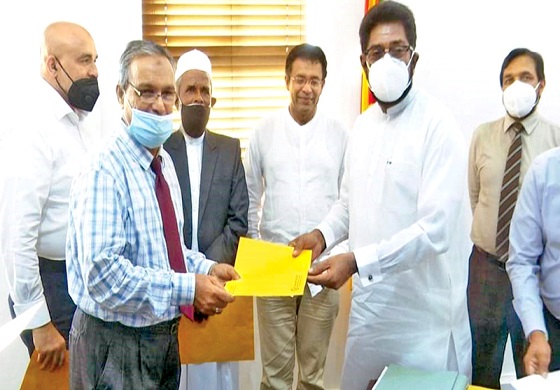
Ambassador Julie Chung met Foreign Minister GL Pieris. She told him that the United States is a friend of Sri Lanka and United States will continue to support Sri Lanka during this difficult time. U.S. Ambassador met with Justice Minister Ali Sabry and discussed their ‘shared commitment’ to the rule of law. Ambassador Chung met Kanchana Wijesekera, Minister for energy and handed over a US grant of USD 19 million for use in the power and energy sector. Newspapers carried a photo of Chung and Wijesekera.
Ambassador Chung met the Janatha Vimukthi Peramuna (JVP) leaders on May 14to discuss the current crisis in the country. The Ambassador visited the party’s Pelawatta head office and held discussions with JVP leader Anura Dissanayake and Information Secretary Vijitha Herath. Ambassador Chung said she met with the JVP Leaders to discuss the urgent challenges facing Sri Lankans.
The US delegation and the JVP leaders spent about an hour discussing the current economic, political and social crisis in Sri Lanka. I continue to meet with a wide range of political representatives to encourage the Sri Lankan government’s efforts to move toward solutions to the economic crisis,” the Ambassador said in a tweet.
Ambassador Chung met with Commander of the Navy, Vice Admiral Nishantha Ulugetenne at the Navy Headquarters on 20th May 2022. It was the first official interaction between them, said the media. During the cordial meeting, the U.S. Ambassador and Commander of the Navy exchanged views on several matters of bilateral importance, also the expeditious transfer of Ex U.S. Coast Guard Cutter Douglas Munro which was undergoing refurbishment at Seattle, U.S.
US ambassador called on Commander of the Air force and discussed bilateral issues. The news report carried a photo of the two at the meeting.
Ambassador Chung met with the American Chamber of Commerce in Sri Lanka. Ms Chung said that the U.S. is committed to working with the local partners to foster a Sri Lankan economy that is sustainable, innovative and inclusive. She further discussed with AmCham ways to increase the prosperity of all Sri Lankans, reported the media.
USA also made well publicized donations, during this period. The aid was routed through U.S. Agency for International Development (USAID).
In April 2022, it was announced that the Sri Lanka Institute of Biotechnology (SLIBTEC) will collaborate with the USAID to boost innovation in the biotechnology sector by establishing Sri Lanka’s first Biotechnology Innovation Park. Technical expertise will be provided through USAID’s PARTNER project for the next two years. SLIBTEC will use this support to develop its operational framework. PARTNER will also provide support in areas such as the park design, research management policy and training opportunities.
In June 2022 it was announced that USAID is partnering with the Institute of Chartered Accountants of Sri Lanka (CA Sri Lanka) and the Association of Public Finance Accountants of Sri Lanka (APFASL) to strengthen Sri Lanka’s accounting and auditing sectors. This partnership will train approximately 600 public sector accountants and audit professionals and 1,200 officers on IT applications and other platforms. The training, conducted in all nine provinces, will strengthen the capacity of public sector accounting and auditing professionals on the recent developments and applications of SLPSAS 11-20, enhancing public sector financial management functions.
On June 15 Ambassador Chung attended a signing ceremony for an agreement that will provide technical assistance to VEGA Innovations to help them further develop Sri Lanka’s electric vehicle sector.
VEGA Innovations is a Sri Lanka-based electric vehicle automobile manufacturer of electric two-wheelers, three-wheelers, supercars, and electric vehicle chargers. It provides electric vehicles (EV) research and development services to clients throughout the world, as well as designing and manufacturing EV components such as high-performance inverters, drive trains, and battery packs.
The agreement, to be funded by USAID, will support VEGA Innovations’ efforts to promote the adoption of electrical vehicles, including electric tuk tuks”. It will also help pilot a charging network for electric vehicles and support the manufacturing of locally designed batteries and inverters.
On June 13 Ambassador Chung attended the signing ceremony for a Memorandum of Understanding with the Sri Lankan Department of Agriculture, for a $27 million project that aims to double the milk production of Sri Lankan dairy farmers participating in the U.S. Department of Agriculture’s Food for Progress initiative. The project began in late 2017 and has already benefited 25,000 Sri Lankan dairy farmers, increasing their milk production by an average of 68 percent to date.
The Embassy of the United States of America announced in June 2022 that the U.S. International Development Finance Corporation (DFC) had approved $120 million for helping small and medium-sized businesses .
For seventy years, the United States has provided foreign assistance, loans, and trade opportunities to help grow the Sri Lankan economy and support the Sri Lankan people,” said Ambassador Chung, when inaugurating this project.
The projects include a $100 million direct loan to the Commercial Bank of Ceylon, to expand lending to micro-, small-, and medium-sized enterprises (MSMEs) and address the credit gap for women-owned businesses, which represent 25% of MSMEs in Sri Lanka.
A $15 million loan was given to BPPL Holdings PLC, a polyester yarn manufacturer incorporating recycled plastic materials. The loan will support increased production and strengthen Sri Lanka’s recycling infrastructure in support of efforts to reduce plastic waste in Sri Lanka. A $5 million loan went to Ma’s Tropical Food Processing (Private) Limited, a sustainable food company, to finance its expansion and grow its supplier network.
USA is now becoming aware of the need to recognize the cultural interests in the countries it wishes to dominate. Ambassador Chung visited Kandy in March to preside over events marking two milestones in the United States’ long-standing support to preserving Sri Lanka’s diverse cultural heritage.
On 14 March, Ambassador Chung and University of Peradeniya Vice Chancellor held a closing ceremony for the US Ambassadors Fund for Cultural Preservation (AFCP) project that documented and preserved four traditional ritual dance forms and related crafts.
The USD 116,000 grant, initiated in 2016, supported the university’s effort to preserve and to share the following performing arts traditions: 1) upcountry Kandyan Kohomba Kankariya dance, 2) Northern and Eastern Tamil Koothu dance drama, 3) Adivasi rituals and cultural practices from Eastern Province, and 4) a southern dance-drama rituals and performance from the Kolam tradition in Southern Province. Recordings of these intangible forms of Sri Lanka’s heritage are now archived under the Department of Fine Arts, Faculty of Arts, and University of Peradeniya.
Since 2001, the AFCP has funded 14 projects in Sri Lanka, including the conservation of the Rajagala Buddhist forest monastery, the preservation of Buddhist, Hindu, and other collections in the Anuradhapura Archaeological Museum, and the restoration of the Batticaloa Dutch Fort. The preservation of the intangible heritage of ritual music and dance forms of the Adivasi, Tamil, and Buddhist communities discussed above was one of these projects.
.Then on March 15, Ambassador Chung and Director General of Archeology launched a new project, a $265,000 grant for the conservation of the Kings’ Palace in the Dalada Maligawa premises.
Professor Charitha Herath is doing an excellent job as Chairman of COPE and deserves the accolades and thanks of the public for this performance. He calls a spade a spade and has already made a few upstarts of high posts admit their mistakes. He is even prepared to propose changes in the Standing Orders of the Parliament to punish the miscreants responsible for the present economic crisis. Recent COPE examination revealed many questionable expenditure-like projects in the CEB which are not in operation, but Project Managers appointed and paid fat salaries. CEB has also been meeting the income tax liabilities of taxable CEB officials. The Port spends a huge sum of money to provide free meals to employees. The amount spent on cashew nuts was Rs 47 million. But what COPE can do is merely to name and shame and perhaps propose changes in the system.
One thing that is worrisome is that COPE examinations are postmortem exercises. Most times the offenders are not in the scene at the time the corporation goes before COPE.. It is like closing the stable door after the horses have bolted.
COPE examinations are based on the report of the Auditor General and COPE does not go beyond the immediate report of the Auditor General.
Is it not possible to introduce a preventive system where the Auditor General reports to the COPE when it comes to his notice a major fraud or irregularity taking place in an institution? Auditor General has his representative in all major corporations and the Agenda of Board meetings and board papers are made available to the AG’s representative before a board meets. Therefore, he should be getting prior information of a brewing fraud. In addition, there is no shortage of whistleblowers in our institutions who would be monitoring suspicious activities and bring them to the notice of the AG’s representative and he in turn can make an immediate report to the AG who then can use his discretion and make a confidential report to the Chairman of the COPE. It is then left to the Chairman of COPE to take immediate remedial action by summoning the parties concerned. If such pre-audit is not allowed under the present standing orders, they should be changed to adopt this procedure. Pre-audit will be an effective deterrent to such fraudulent activities.
Stray information on granting deeds of lands in the news is fairly indicative of the fact that Prime Minister Ranil Wickremasinghe has unofficially commenced implementing the MCC Project in Sri Lanka, which he stated he will sign if he, the UNP won the 2019 Presidential Election. At the election President Rajapaksa made a firm statement that he will not sign the MCC Compact Agreement.
I enclose a news item I have just read in Economy Next:.
Sri Lankan landowners without deeds to be legally granted ownership
Friday June 24, 2022 5:28 pm
ECONOMYNEXT – Sri Lanka plans to legally grant land and house ownership to millions of people who do not have a deed to their own lands and homes, Prime Minister Ranil Wickremesinghe’s office said.
Quoting Tourism Minister Harin Fernando, the statement said on Friday June 24 that between 1,000 and 3,000 deeds will be issued to land owners every week under a newly launched programme with the objective of giving legal rights to those who have lost their land.
The programme, titled ‘Land for All’, began Friday morning at the prime minister’s office in Colombo, it said. The project is implemented by the Ministry of Tourism and Lands through the Land Reforms Commission and the Department of the Land Commissioner General.
Title deeds were issued in Puttalam and Kurunegala Divisional Secretariats on Friday parallel to the event in Colombo, the statement said. (Colombo/Jun24/2022)
This is serious news and deserves immediate attention by our leaders to arrest give away of the sovereignty of our country. One important aspect of the MCC Compact Programme was to bestow full rights of ownership to land alienated by the Crown. Our founder leader D.S.Senanayake had gone to great pains to evolve a method of ensuring that land alienated by the crown should always remain with the peasantry.
It is important to note that Prime Minister Ranil Wickremasinghe is actually a make shift Prime Minister appointed in this time when Sri Lanka is facing an unprecedented economic crisis. Instead of handling the economic crisis by implementing programmes to get back to production and employment he is busy with other tasks like privatising assets and now he has actually commenced implementing the MCC Project provisions though very unofficially..
It is time that the Presidenbt who handed over the country to Ranil Wickremasinghe should make a note of what is really happening.
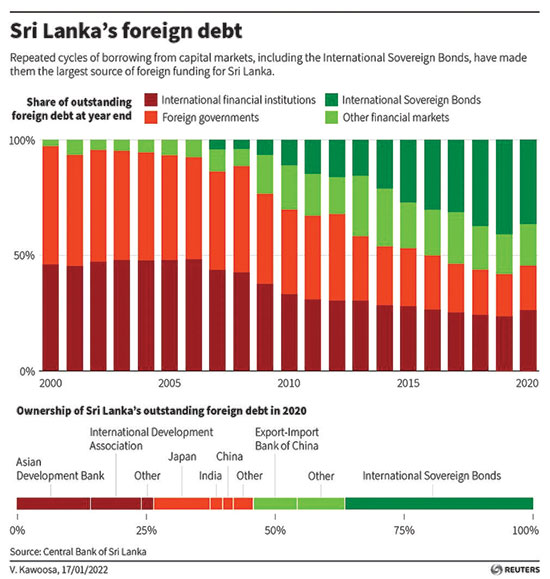
Figure 1. Sri Lanka’s foreign debt from 2000 -2020 ( from https://www.reuters.com/markets/rates-bonds/sri-lanka-edge-debt-burden-mounts-2022-01-17/)
As a layman in the subject of political economy, nonetheless interested in discerning the real background to the historic debt crisis that Sri Lanka is undergoing at present, I have been reading many reports, including expert views, opinion statements, institutional press releases, think-tank analyses, COPE reports, etc., that are plentiful on the internet. Based on these readings, I was able to synthesize a layman’s review, which I thought of putting out to a wider readership to stimulate constructive discourses from the more knowledgeable authorities and others alike, especially on the solutions that are available for our country to come out of this huge debt crisis. One of the major criticisms of the general public is that although warnings of this impending disaster had been made repeatedly at official meetings among technocrats and bureaucrats, the general public was not sufficiently alerted early enough, especially via popular media, to shake up the bureaucracy to make a timely course correction.
We all are now aware that Sri Lanka has an accumulated foreign debt of US $ 51 billion at the time of pre-emptive sovereign default of foreign currency repayment which happened in March/April 2022. The following Figure 1, with a series of histograms that appeared on the web, provides a relatively easy understanding of the progression of our cumulated foreign debt over the years since 2000 and its proportional ownership of creditors/lenders. It had been prepared by Reuters in January 2022 sourcing Central Bank information and colour-coded to apportion the foreign debt accumulated since 2000. The proportional ownership has been grouped into several categories of lenders in this chart, such as International Financial Institutions (IDA, ADB, etc. in red), foreign governments (Japan, China, India, etc. in orange), International Sovereign Bond Issuers (Goldman Sachs, Black Rock, and Pacific Investment Management, Vanguard, etc., in green!!) and other capital market lenders (Exim banks, etc., in pale green).
This figure reveals that a higher proportion of foreign funding for Sri Lanka’s development projects as well as to bridge the annual budget deficits in the early 2000 period, came via bilateral and multilateral donor contributions (red and orange color codes), when Sri Lanka was still a Lower Middle-Income Country (LMIC). However, this trend has been changing since 2007 or so, when Sri Lanka started obtaining loans at relatively higher interest rates from International Sovereign Bonds (ISBs) and other Financial Capital Markets. The contribution of ISBs increased significantly from around 2015 and reached an all-time high in 2019 almost at the same time when Sri Lanka was elevated to an Upper Middle-Income category (UMIC) for a short period of time by the World Bank. However, a year later, Sri Lanka was down-graded again as a lower-middle income country after it recorded a US$ 4,020 per capita income for 2020. Apparently, when a country reaches an Upper Middle-Income level, it is not entitled to concessionary loans but must seek funding from International Capital Markets at the internationally prevailing competitive interest rates. Sri Lanka’s access to international capital markets (with International Sovereign Bonds issuances since 2007) brought a shift to commercial borrowing and an increase in external interest rates to be paid back in short periods of time.
Consequently, Sri Lanka’s foreign debt apportioning in 2022, as per Figure 1, which has been computed using information from Sri Lanka’s Central Bank, indicates that over 35% of the island’s debt is owned by US and UK-based ISBs. The balance of foreign debt in 2022 is owned by the aforesaid bi-lateral and multilateral agencies. Some of these latter agencies, usually charge lower interest rates on concessionary terms. They have even gone to the extent of being more compassionate to express their willingness to further delay the debt repayment while at the same time being charitable enough to donate humanitarian aid in the form of food, fuel, and medicine during this crisis period. It is clear that the root cause of Sri Lanka’s default, at this time, is due to the disproportionate accumulation of ISBs and other such financial instruments in recent times. Higher interest rates over short periods of time needed to be paid, for refinancing the loans already taken. (See the graph)
This annual progression of the ‘sovereign debt trap’ also led to the speculation of unsustainability of Sri Lanka’s foreign debt from 2019 onwards leading to a progressive downgrading of credit ratings by the three leading credit rating agencies – Moody’s Investor Services, Standard and Poor’s (S&P), and the Fitch Group. This downgrading by credit rating agencies further deepened Sri Lanka’s debt crisis, pushing us into one of the worst economic crises in modern history.
The Verite Research Strategic Analysis Working Paper published in October 2021provides an analysis on this. For the five years, from 2021 to 2025, the annual average repayments due on servicing external debt maturities is US$ 4,400 million. In contrast, from 2015 to 2018, the government only had to repay an annual average of US$ 2,700 million as external debt repayment. To meet those debt repayments, during 2015 to 2018, the government borrowed on average US$ 1,900 million through ISBs in a year, as indicated in Figure 1. Since the beginning of 2020, the yields of ISBs have more than doubled and the credit ratings of the sovereign bonds were also downgraded multiple times, in 2020, leading to high risks of default in 2021 preventing further borrowing from the international markets. This forced the government to use its already depleting reserves to meet the external debt obligations, while at the same time, meeting the urgent healthcare emergencies resulting from the rapid spread of the COVID 19 pandemic which demanded lockdowns over months, associated economic losses and also for meeting increasing healthcare needs.
While it has been widely reported in the western media that Sri Lanka is a victim of a ‘Chinese debt trap’, our increased dependency on International Sovereign Bonds, over recent times is also equally, if not more, responsible for the default, at this time, as Sri Lanka has been compelled to borrow money from international capital markets at higher rates to be paid back over short periods of time. These funds were needed for the repayment of the loans already taken for the settlement of earlier taken loans/their interests while providing at the same time, the shortfall of social welfare benefits from the lost tax revenue as a result of ill-advised tax rebates granted in 2019. The resultant drop in revenue amounted to 3% of GDP – from 12.6% in 2019 to 9.2% in 2020. The revenue as a share of GDP for 2020 has apparently been the lowest in the post-independence history of Sri Lanka that led to huge deficits which need to be financed through borrowing, resulting in increasing debt.
Notwithstanding some of these unanticipated debilitating economic cataclysms, some political analysts speculate whether Sri Lanka was duped into a situation of ‘pumped and dumped’ by the Western interests. The World Bank up-graded Sri Lanka to a Lower Middle-Income Country (LMIC) in 1997, and then to the short-lived Upper Middle-Income Country in 2019 thus making it ineligible for lower interest rates for national development thus compelling to borrow from International Capital Markets. This fortuitously coincided with the 2019 Easter Sunday bombing spree which started the rapid downward spiraling of Sri Lanka’s economy.
On top of these, internal mismanagement of our economy also has contributed in no small measure to this predicament. The infamous bond scams, unbridled corruption and nepotism at the highest levels, imprudent decisions of the then monitory board of the Central Bank, and more significantly, holding on to such irrational decisions for a long period thus bleeding our foreign exchange reserves by over US$ 5.5, as reported by one of its members at a recent COPE meeting.
So, it surmises that both external interventions as well as internal economic mismanagement has contributed to the present-day debt crisis leading to ‘Arab Spring’ style protests by segments of the general public fueled by opportunistic politicians and their invisible handlers. It has been transmitted in some academic fora that Sri Lanka’s default seemed to follow a systematic, deliberate, and planned route to haul Sri Lanka into IMF’s and Washington’s clutches. This likelihood had apparently been in the air for some time – at least since the rejection of the Millennium Challenge Corporation (MCC) compact by the Sri Lankan Government in December 2019.
The MCC compact for Sri Lanka was designed to reduce poverty through improved transportation network and providing secure land titles to small holder farmers and other Sri Lankan landholders. The Special Presidential Commission Report which examined the draft MCC Compact has recommended the rejection of the Compact in its current form as it not only imperils Sri Lanka’s economic sovereignty but also undermines the land and human rights of her citizens. We need to be vigilant at this stage at which we are in a desperate situation in meeting day-to-day needs of the people as well as fulfilling debt obligations through their restructuring. There are indications that a number of stealthy moves are already at play to undermine the rights of the people (see recent press releases by Dr. Gunadasa Amarasekera of the Federation of National Organisations).
Some political analysts argue that this ‘staged default’ would enable the IMF to effectively take control of strategic geopolitical positioning by influencing Sri Lanka’s economic policy initiatives compromising its sovereignty. It is also speculated that by doing so, they can stave off the Chinese influence (despite China being a leading member of the IMF) and more significantly, make it difficult for Sri Lanka to source its oil, gas and other energy requirements at discounted rates from sanctions-hit Russia. Ironically, India continues to avail themselves to the discounted oil and gas supplies from Russia despite some resistance from her western partners while helping to meet our energy needs through loans and grants. It is a pity that Sri Lanka is far too late in looking into this possibility of negotiating with Russia directly for supplementing our long-term fossil fuel and other energy needs in exchange for our tea exports.
Sri Lanka is apparently caught between the devil and the deep blue sea for being located in a geostrategic position abundantly endowed with strategically important natural resources. While being at the centre of the Indian Ocean Sea Lanes of Communication (SLOC) with an extensive ocean and land-based mineral resources, including premium grade graphite and rare earth elements, some political analysts are of the view that Sri Lanka suffers from a ‘Paradox of Plenty’ or perhaps, a geostrategic ‘Resource Curse’. This phenomenon often afflicts countries blessed with abundant natural resources, like Sri Lanka. According to the Global Wealth Databook 2020 of the Credit Suisse Research Institute, the total wealth of Sri Lanka is estimated to be USD 351 billion while admitting at the same time that the quality of wealth data used for this estimation to be poor. A more realistic estimate could indeed yield even a higher value and Sri Lanka appears to be far from bankrupt, on that count. Despite all these, we have been having a slower economic development prone to poor governance, corruption and cronyism over successive political regimes since independence. This economic wealth of Sri Lanka may be a key constituent put on offer in attracting creditors to our national-scale real estate assets at this crucial stage of negotiations for debt relief.
The US Ambassador to Sri Lanka and the Maldives, Julie Chung, in a recent press release remarked that Sri Lanka is at the heart of the Indo-Pacific oceanscape, sitting next to some of the world’s busiest shipping lanes through which about half the world’s container ships and two-thirds of the world’s oil shipments pass. According to her, Sri Lanka has the potential to play a pivotal role in the health of world trade. It is not surprising, therefore, the former US Under Secretary for South and Central Asia, Alice G. Well, a few years ago, called Sri Lanka a ‘valuable piece of real estate’ in the Indian Ocean. Still others have termed Sri Lanka ‘an unsinkable aircraft carrier’ in the Indian Ocean – much more strategic than the Chargos Island which was handed back to the people of Mauritius by the British (and hence US occupation ended) in February 2019 after the International Court of Justice in the Hague ruled that the latter’s occupation of Chargos Island was illegal under International Law.
Furthermore, it was none other than the US Secretary Blinken who had recently reported that in today’s world, cyberspace and cyber security are increasingly important and, as part of their vision for the Indo-Pacific, the United States looks to coordinate with partners to ensure an open and secure internet and to implement a framework for responsible behavior in cyberspace.
With a background of this politico-geostrategic wealth, the Sri Lanka Government is up against tough bargaining with the IMF and their designated creditors to raise USD 8 – 12 billion or perhaps even more from the lease or sale of at least some of these valuable ‘real estate’ assets belonging to the public of Sri Lanka which have been grossly mismanaged over decades by successive governments. Dr. Nishan De Mel of Verite Research says, When the IMF determines that a country’s debt is not sustainable, the country needs to take steps to restore debt sustainability prior to IMF lending”. These steps would undoubtedly feel quite painful in particular to the poorest and most vulnerable sectors of the country.
Prime Minister Wickremasinghe recently stated in the Parliament that SriLankan Airlines, with all its assets would be the first to be privatized to relieve the debt burden. Among the other valuable public assets that are being considered to go under the hammer according to reports on the web are Mattala and Ratmalana airports, Sri Lanka Telecom shares, and the Sri Lanka Insurance Corporation to name a few. Then there are physical assets like Sri Lanka’s marine Exclusive Economic Zone which include the already identified oil and gas deposits, Under-sea Data Cable Routes, the strategic island’s telecom frequencies important for cyber-security. These are a part of this ‘real estate’ package – the cynosure of many powerful global political players backed by leading international financiers – up for negotiations in the name of debt restructuring. Some economists are of the opinion that divesting these strategic public assets resulting from mismanagement, corruption, and ignorance of the potential value of these resources, is tantamount to throwing the baby with the bath water!
The debt restructuring and bridge financing negotiations with the IMF, if successful, may be able to provide us short term debt relief tied with very stringent conditions such as tightening our monitory policy, raising taxes, reduction of government expenditure and wastage, introducing a fuel and utilities pricing formula reflecting the market prices, among others. Although Sri Lanka promised a number of similar adjustments in the during earlier rounds of negotiations with the IMF (in 2009 and 2016), none of them were implemented in full as planned since these would have resulted in high social and political costs.
With such a track record, the conventional IMF debt restructuring formula may not help to overcome our efforts in moving toward bridging the trade deficit. This is primarily because Sri Lanka continues to spend more foreign exchange than its receipt of revenue through the export of goods and services. This indeed has been the root cause of our long-term external debt problem. Economists argue that going to the IMF alone will not fix this problem. According to them, the IMF will simply put a sticking plaster on our arterial wound and send us home. If Sri Lanka continues haemorrhaging foreign exchange with its typical laissez-faire approach, we may have to go back again to the IMF in two years’ time asking for yet more debt relief!.
IMF has just concluded a joint technical session with Sri Lanka to determine a roadmap for restoring macro-economic stability and debt sustainability that will serve as a platform for the negotiations with other creditors/lenders, later. Furthermore, this joint initiative once implemented in compliance with IMF conditions, is expected to increase investors’ confidence and also in securing additional resources from the IMF, the World Bank, Asian Development Bank, and other such agencies.
Amidst all these, there appears to be a silver lining in the dark financial clouds that hovering over Sri Lanka at present where even an adversity of this magnitude could be turned into an excellent medium or long-term investment opportunity. The silver lining in the dark horizon is that the leading international donor agencies are steadily moving towards ‘sustainable financing’ in compliance with the Paris Agreement on Climate Change in the present green economic era.
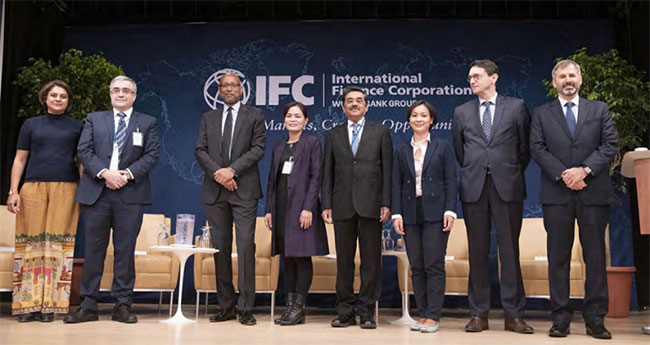
From left : Ms. Amena Arif, Country Manager of Sri Lanka and Maldives, IFC. Archil Mestvirishvili, Deputy Governor, National Bank of Georgia. Ethiopis Tafara, Vice President, MIGA Lay Rachana, Sustainable Finance Committee Chair, Association of Banks in Cambodia, Deputy General Manager/ Chief Risk Officer of FTB Dr. P Nandalal Weerasinghe, Prsent Governor, Central Bank of Sri Lanka, Serey Chea, Director General, National Bank of Cambodia Jan Van Bilsen, Senior Manager, IFC, Kyle Kelhofer, Country Manager of Cambodia, IFC
Sustainable finance refers to the process of taking environmental, social and governance (ESG) criteria (developed by the United Nations Principles for Responsible Investment – PRI) into account, when making investment decisions in the financial sector. These in turn will lead to more long-term investments in sustainable economic activities and projects.
Sri Lanka, too ,joined this bandwagon in developing a Roadmap for Sustainable Finance way back in 2016/2017. It is aimed at integrating ESG criteria into financial decision-making processes in order to help build a more resilient and sustainable green economy. These sustainable finance practices are expected to promote assistance to make the businesses greener, climate-friendly, and socially inclusive.
This Sustainable Finance Road Map for Sri Lanka was launched in 2019 with financial assistance from the Biodiversity Finance Initiative (BIOFIN) from the UNDP and technical support from the International Finance Corporation. In this ‘new normal’ era of post-pandemic banking, sustainable finance is expected to become a key mover in achieving social, economic, and environmental goals in a green economic milieu.
The Biodiversity Finance Plan (BFP) for Sri Lanka (2018 – 2024), prepared collectively by the then Ministry of Finance and Media, The Ministry of National Policies and Economic Affairs, and the Ministry of Mahaweli Development and Environment, in 2019, intends to support sustainable biodiversity management efforts of Sri Lanka by mobilizing finance for investing in biodiversity by both the public and private sector.
A considerable amount of background preparatory work, detailed in three technical reports (i.) Policy and Institutional Review, (ii.) Biodiversity Expenditure Review, and (iii) Financial Need Assessment, has gone into developing this Biodiversity Finance Plan for Sri Lanka. It is expected to achieve national biodiversity targets that include conservation, sustainable management, and equitable distribution of benefits among all stakeholders, the three main pillars of the Convention on Biodiversity.
During this process, the national biodiversity and climate change-related strategic plans viz. National Biodiversity Action plan (NBSAP 2016-2022), National REDD+ Investment Framework and Action Plan (NRIFAP 2018-2022), National Action Programme for Combating Land Degradation in Sri Lanka (NAP-CLD 2015 -2024), and National Adaptation Plan for Climate Change Impacts in Sri Lanka (2016 – 2025) have been consulted for estimating the financial gap constraining investment needed for their effective implementation.
In addition, the vision of the BFP is directly linked to the following Sustainable Development Goals (SDGs), Goal 13: Climate Action; Goal 14: Life below Water, and Goal 15: Life on Land. It is indirectly linked to several other SDGs such as Goal 6: Clean Water and Sanitation, Goal 11: Sustainable Cities and Communities, and Goal 12: Responsible Consumption and Production.
The BFP has been designed to meet the biodiversity financing needs of the country by mobilising resources for investing in conserving biodiversity, promoting its sustainable use, and equitable sharing of its benefits. This is to be achieved with the participation of all major stakeholders – the government, the corporate sector, and the community. Thirteen different finance solutions viz. sustainable standards and certification, eco-labels, green lending, corporate social responsibility, lotteries, payment for ecosystem services, green bonds, ecotourism, conservation license plates, carbon markets, lobbying for public budget allocations, and diaspora savings and investment, have been identified based on the information given in national and sectoral planning documents of Sri Lanka. Each of these has been elaborated on in some detail with action plans in the BFP 2018-2022 document.
Judicious resource mobilization
Most of the prioritised financial solutions listed above are already in operation, though at a modest scale. They need to be scaled up with judicious resource mobilization to be more responsive to the conservation and sustainable development, equitable sharing of biodiversity and ecosystem service benefits. Consequently, with all this background preparative work accomplished, Sri Lanka is in a strong position to make the current adversity into an opportunity of a lifetime.
Green Bonds: One of the fastest developing financial or refinancing solutions on a global scale is coming from issuance of sustainability-linked international sovereign green bonds and other similar instruments such as sustainability-linked bonds, climate bonds and social bonds. The repayment of debt using these green bonds and the like is tied to the achievement of instituional environmental, social and governance (ESG) targets, such as greenhouse gas emission reductions. The growth of green bonds in the global capital markets has been explosive in recent times and is increasingly attracting attention of the corporate entities around the globe. Global Green Bond investments have topped US$ 500 billion in 2021 for the first time and it is expected to reach $ 1 trillion this year.
Most of the green bonds in the world have been issued to finance relatively large projects in the areas of Renewable energy, Transport, Pollution prevention and control, Water and waste management, Environmentally sustainable land-use, agriculture and forestry, Reduction in carbon emission, and Green infrastructure, and since of late for Biodiversity conservation.
Importance of biodiversity
Governments, major financial centers and central banks world over are greening their financial systems by developing green bond guidance, green taxonomies, regulation, and reporting guidelines. Investors worldwide are waking up to the importance of incorporating biodiversity as part of ESG risk assessments and their effective management. This is due in part to the increasing focus on this topic since the United Nation’s Intergovernmental Science-Policy Platform on Biodiversity and Ecosystem Services (UN-IPBES) produced its landmark Global Assessment Report on Biodiversity and Ecosystem Services in May 2019, casting the spotlight on the alarming declines of biodiversity worldwide.
Although Sri Lanka has not yet availed herself of this innovative financial solution of investing in Green Bonds, it is ideally placed to benefit from this emerging opportunity, for Sri Lanka being one of 36 global hotspots of biodiversity. Sri Lanka has actively participated in sustainability-focused investments through the Sustainable Banking Network of the International Finance Corporation, and it is a fortuitous coincidence that the present Governor of the Central Bank, himself, has taken an active role in this global network activities in the past (see photo attached).
The Central Bank of Sri Lanka and the financial sector, in general, have been moving in the direction of sustainable financing with the preparation of the required technical details listed earlier. The latest addition to it is the ‘Sri Lanka Green Finance Taxonomy’ (a classification system established to provide guidelines for integrating sustainability into investment decisions), published by the Central Bank on 06th May 2022. Green Bond Principles (GBP) is one of several well-known taxonomies that provide guidelines specific to green bonds.
Consequently, Sri Lanka has already put in place the necessary institutional infrastructure in financial markets for entering into green bond initiatives. Furthermore, Sri Lanka has been raising international finance by issuing bonds since 2007. As such, the government and the financial institutions are quite familiar and well equipped with the necessary groundwork to enter the international (green) bond market. The BFP reports that the Government of Sri Lanka recommends the issuing of international sovereign green bonds as a sustainable finance solution to mobilize relatively large sums of debt capital for investing in large-scale biodiversity projects, combatting land degradation, arresting habitat and species loss, maritime reef conservation, coastal conservation, and sustainable energy.
All these project documents prepared with broader consultation and supported by the respective UN agencies (viz. NBSAP, NRIFAP, NAPCLD, and NAPCCI) are therefore, consistent with the global conventions as well as national-level policies and strategies on biodiversity, climate change, and land degradation.
The Wildlife and Forest Conservation Departments have carried out several biodiversity and ecosystem management projects, including the preparation of two pilot scale novel Landscape Management Plans – one for Sinharaja Rain Forest Complex and the other for Hurulu-Kaudulla-Kantale with financial support from the Ecosystem Conservation and Management Project (ESCAMP 2018-2022) of the World Bank. These plans are available as excellent opportunities for consideration in raising funds from international capital markets for restructuring at least some of the ISBs into Green Bonds. Similarly, Forestry Sector Master Plan first prepared in 1995 is being revised to meet the present-day forestry sector needs which again, together with NBSAP, NRIFAP, NAPCLD, and NAPCCI are good candidates for similar capital investment considerations during the debt restructuring process.
Sustainable energy
With respect to sustainable energy, especially the generation of electricity has become one of the most critical issues at present in Sri Lanka. The UNDP and ADB joint assessment of ‘Sri Lanka’s Power Sector – 100% Electricity Generation through Renewable Energy by 2050’ provides opportunities for green-bond solutions, among others in this area. Sri Lanka being one of the 43 countries of the Climate Vulnerable Group which are disproportionately affected by climate change, has signed the declaration at the 22nd COP meeting of UNFCCC in Marrakech, Morocco, in 2016, to reach these ambitious renewable electricity generation targets by 2050.
However, the UNDP-ADB joint assessment records that the Long-term Generation Expansion Plan (LTGEP) for Sri Lanka, 2015 – 2034 ( http:// pucsl.gov.lk/english/wp-content/uploads/2015/09/Long-Term-Generation-Plan-2015-2034-PUCSL.pdf) envisages adding at least two more coal-fired power plants, one in Trincomalee (2 x 300 MW) in 2029 onwards and the other in the Southern Region (3 x 300 MW) from 2027 onwards. The report however cautions that stiff resistance from local communities and possible litigation moves by environmental groups may lead to change this long-term generation plan. According to the same report (table 41: p 113), several thermal power plants are likely to be retired from operation due to their age -related mal-functioning and these capacities also will also need urgent replacements to ensure Sri Lanka’s growing electricity demands. Therefore, actual future coal-based capacity addition to our national grid may be much lower than planned. The same report adds that by 2050, the 100 percent Renewable Energy scenario can potentially save US$18-US$19 billion on imported coal as compared with the base case scenario, which relies heavily on coal.
‘Least cost principle’
The Ceylon Electricity Board’s long-term generation planning is based on the least cost principle” which has led to its focus on significantly cheap coal-based capacity development. However, they have not considered the environmental and health cost externalities in their calculations. Inclusion of the cost of carbon emission, air-quality and health related issues and other externalities would provide a more realistic picture of benefit/cost of the use of coal for electricity generation. Unfortunately, the natural resource economists have not yet brought these environmental and health costs associated with coal-fired power plants in Sri Lanka to the attention of the CEB. Alternatively, it may be that the information available either from Sri Lanka or our neighboring countries have not been taken into consideration in the calculation of ‘least cost’.
Unless these developments are taken into consideration, the roadmap developed as a part of the LTGEP, while making provisions for increased adoption of renewable energy in the electricity generation mix, is unlikely to be the basis on which the Sri Lanka can transform its power sector into a 100 percent RE sector by 2050. Consequently, there is a pressing need for updating the LTGEP with the global shifts to renewable energy sources mandated by the Sri Lankan government in compliance with the UNFCCC recommendations. Such projects could be very attractive for international donors, and they may rank very high in eligibility for Green Bond investments.
COP 26 summit
Furthermore, at the COP 26 meeting of the UNFCCC held in Glasgow in 2021 set a new gold standard on the ‘Paris Alignment of international public finance’ to move away from Coal – the single biggest contributor to climate change by the end of 2021. Sri Lanka along with Chile, Montenegro and their European partners pledged that no new Coal Power Plants to be constructed in their respective countries. Alok Sharma, the British Minister of State at the cabinet office who was also the COP 26 president announced that more than 40 countries reached a deal and pledged to phase out coal – the dirtiest fossil fuel – by the 2040s. Two notable exceptions apparently had been the USA and China although the US has pledged to end public financing for fossil fuel projects abroad without any carbon capture and storage technology, by the end of 2022.
In the light of these recent developments, there is more than a silver lining in our gloomy horizon that through effective engagement at the future negotiations with the IMF and the lenders/creditors, Sri Lanka can capitalize on its current debt restructuring process to transform some of her International Sovereign Bonds to Green Bonds for funding Non-conventional Renewable Energy projects. These projects typically involve renewable energy generation and emission reductions among other benefits. Shifting from a coal power to a solar power project in Sampur in eastern Sri Lanka may be one such project put forward by the national Thermal Power Corporation of India recently although the details of the agreement have not been made public, as yet.
Enormous potential
There is an enormous potential for Sri Lanka to tap into these green/sustainability bond markets to finance its infrastructure projects/investments such as in waste management, renewable energy projects, biodiversity conservation, public transportation, climate change adaptation and mitigation. As shown above, large/medium/small scale green investment project plans have already been prepared and the sustainable financing infrastructure is already in place, and what is needed is a matter of prioritizing these differently sized projects in consultation with appropriate stakeholder groups.
Sri Lanka is a relatively small island with unparallel diversity of physical, biological and cultural features. Most of her leading agricultural exports are in the hands of a diverse set of smallholders which, in a way, are more resilient to cataclysmic changes that may come with the vagaries of the climate from time to time. Therefore, the biodiversity finance projects need not only conserve and sustainably utilize the natural resources but also take adequate measures to distribute the benefits equitably among these smallholders who had been the backbone of the Sri Lankan enterprise.
Finally, although Sri Lanka has been caught somewhat unawares in a fierce tropical storm, the charting out of it seems to be reasonably well laid out by the technocrats with the support from the international agencies. In order to steady the ship in these visciously turbulent waters, obviously we need a matching political leadership with a clear vision, calm but stern demeanor and strong commitment to steer the ship out of the rough seas to calmer waters. The least we need at this critical moment of despondency is a mutiny on board the ship which will only help those prying to grab the best of – as some would call it – ‘this unsinkable aircraft carrier’ in the Indian ocean. Concluded.
Sri Lanka has been hit by a triple whammy of economic shocks and has gone to the IMF for a bailout. It may just be the first domino to fall in a global debt crisis.
Sri Lanka is undergoing a full-scale economic collapse and political crisis, with every chance of further violent unrest. Last week the parliamentary speaker warned of an imminent hunger crisis. This week the new” prime minister, Ranil Wickremesinghe, a septuagenarian on his fifth stint as PM since the 1990s, warned that the country had run out of petrol, and that it desperately needed $75m of foreign currency to pay for essential imports to avoid social collapse.
For months, the government of president Gotabaya Rajapaksa has been struggling to cope with an inflationary spiral and a lack of foreign reserves that has led to shortages of food, fuel and medicines, and rolling power cuts. In recent weeks, public anger has spilled over onto the streets. There have been multiple cabinet reshuffles and failed attempts to form a national unity government.
But so far Rajapaksa has clung on – albeit without a fully functioning government – in part because the opposition doesn’t fancy the job of fixing his mess.
What’s caused the crisis?
A mix of long-run factors and shorter-term triggers. Sri Lanka’s economy has long been dominated by export-orientated crops and more recently the garment industry. Its economy is therefore highly vulnerable to global economic downturns and external shocks, with declines in exports driving regular balance-of-payments crises from the mid-1960s onwards.
Advertisement
Still, until now post-independence Sri Lanka has never defaulted on its sovereign debt and was a relative success story by South Asian standards.
What went wrong?
Gotabaya Rajapaksa is from one of Sri Lanka’s dominant political families with influence dating back to the 1930s. In 2005 Mahinda Rajapaksa, Gotabaya’s brother, was elected president, and many other members of the family have taken up senior positions since then.
Even before the Rajapaksas took power, financial trouble was brewing”, says Karl Schultz on Bloomberg. During the family’s first stint in office (under the presidency of Gotabaya’s brother Mahinda in 2005-2015), the government took out big loans from China to invest in infrastructure projects. But many of those stalled and foreign debt more than doubled between 2010 and 2020.
Things got worse from 2019, due to a combination of terrible luck and disastrous policy decisions. In April that year, Sri Lanka’s thriving $4.4bn tourism sector took a big blow from a series of church bombings that killed nearly 300 people, including some foreign nationals.
What was the effect of that?
Tourism collapsed by as much as 80%, and then the following spring the pandemic hit, making any recovery impossible. Together, these blows would have challenged any government. But the Rajapaksas proved unequal to the task. Gotabaya Rajapaksa was popular for bringing an end to the 26-year civil war as a head of the ministry of defence in 2009, during the time when Mahinda was president.
Though accused of war crimes in the fight against the Tamil Tigers – and corruption – he was elected by a landslide in 2019 on a security-focused platform in the wake of the bombings. He then brought Mahinda back as PM, along with several more relatives as ministers. But untrammelled authority seems to have gone to the Rajapaksas’ heads”, says The Economist.
What have the Rajapaksas done wrong?
First, they immediately pushed through massive but unaffordable tax cuts that seriously weakened the government’s finances, despite warnings that they were recklessly dangerous. They then failed to reverse course as the pandemic halted tourism, downgrades closed the door to fresh borrowing and foreign reserves dwindled.
Next, with the economy and fiscal position worsening fast, in April 2021, the Rajapaksas banned the use of chemical fertilisers to try and save money. The predictable result was chaos, and a slump in rice production of between one quarter and one third – and an even bigger crash for tea, a key export earner.
A formal default looks imminent, and the government’s chances of clinging on appear slim. The threat this time round for the Rajapaksas’ survival is real,” political commentator Kusal Perera told the Financial Times. They want someone to take over who could diffuse this heat, and after a while to negotiate an exit path for them.”
The country is due to pay $8bn this year in debt repayments and interest on a foreign debt pile of $50bn. But its foreign reserves are now down to a few tens of millions of dollars – in effect nothing – leading it to suspend payments last month and start talks with the IMF on yet another bailout.
The government is also seeking new bilateral loans from the US, China and Japan. Sri Lanka is the first country to buckle” under the mounting pressure of the three-pronged” global crisis, says Larry Elliott in The Guardian – namely, the pandemic, the rising cost of debt, and the sharp increase in global food, fuel and fertiliser prices caused by Russia’s invasion of Ukraine. It’s the first, but unlikely to be the last.
Where’s next?
The list is long and varied”, says Elliott. The UN’s trade and development arm, UNCTAD, recently assessed that 69 countries are currently facing a triple whammy of shocks in the form of rising food prices, rising energy prices and tighter financial conditions.
Of these, 25 nations are in Africa, 25 in Asia and the Pacific, and 19 in Latin America and the Pacific. So far, the IMF has opened rescue talks with Egypt and Tunisia – both big wheat importers – and with Pakistan, which has imposed power cuts because of the high cost of imported energy.
Sub-Saharan African countries at risk include Ghana, Kenya, South Africa and Ethiopia. Argentina recently signed a $45bn debt deal with the IMF, and other Latin American countries at risk include El Salvador and Peru.
Rising interest rates and soaring inflation will leave many governments with unsustainable debts. Get set for a wave of sovereign defaults, says Jonathan Compton
It is unlikely that Barbados, Lebanon or Sri Lanka ever enters your investment thinking. Perhaps now they should. For although all are minnows in a sea of whales in financial terms, they are – to mix animal metaphors – dead canaries in the coal mine. In the last four years, each has gone bankrupt. Barbados defaulted on its foreign debt when a new government took office in 2018, Lebanon stopped paying after a series of economic crisis in 2020 and Sri Lanka did the same amid an economic meltdown last month.
All three went bust for what are effectively identical reasons, as did Argentina – which in 2020 defaulted for the ninth time in its history – and others. Economists would vigorously disagree, citing various theories instead, but the core problem in all cases is gargantuan government corruption – from elected politicians to lowly bureaucrats – robbing their treasuries and misspending whatever is left, along with woeful tax collection systems. Couple this with a complete lack of confidence in their legal systems and governance by domestic and foreign investors alike, and money flees abroad while economic activity plunges. Thus Sri Lanka, long self-sufficient in food, is now begging for foreign supplies as farmers can no longer afford to buy seeds or plant crops.
Sovereign default is a vague term, but one that can be defined as the failure by a government to pay the interest or capital on its foreign currency debt (usually bonds) when due. There are many sub-definitions of default, such as failing to repay local government debt, changing interest terms on loans, or radically debasing the currency. However, there are four immutable rules: sovereign default is normal, cyclical and (with very few exceptions) inevitable for every country; the contentious fourth rule is that sometimes it is the best option. These rules have been forgotten and although the world is slowly drowning in debt, investors are remarkably and foolishly unconcerned.
An unprecedented bubble
The huge growth in access and availability of credit dating from the World War II has stimulated an unprecedented level of real economic growth and wealth. There are multiple benefits to the ability to borrow. For governments, it allows them to build necessary infrastructure. Companies can invest and expand, and thus employ more people. People get the opportunity to enjoy a once inconceivable lifestyle, from home ownership to foreign holidays and a host of consumer goods. However, problems arise when the interest, the capital or both cannot be repaid.
We are in an unprecedented credit bubble. Before the pandemic, the numbers were already alarming. The total stock of global debt had already more than doubled between the 2008 financial crash and 2020 to $226trn or about 2.5 times the world’s total GDP. Partially because of the costs of the pandemic it has since soared to more $300trn (3.5 times global GDP), according to the Institute for International Finance. Notable within these numbers is that government debt has overtaken all the rest combined for the first time and that, unsurprisingly, China has roared into the room to the extent that the increase since 2007 in money terms in its non-financial-sector corporate debt and household debt has been greater than all the advanced economies combined.
Debt is always a high-wire balancing act, requiring a combination of being able to pay the interest, giving an impression you can repay the capital and, most importantly, convincing lenders you’re a good risk so that will pony up more loans. The spectacular surge in debt was possible primarily because interest rates persistently declined to zero and were even negative for several major countries. This allowed governments to issue bonds in record quantities not just for new borrowing, but also to replace older, more expensive loans with larger but overall cheaper new ones. Thus despite ever-rising debts, their interest costs tumbled.
This has reversed. Central banks have under-estimated inflation and are rushing to catch up with a rapid series of interest-rate increases. Suddenly new debt becomes more expensive. At the end of 2021, the governments of heavily indebted developed economies and raggedy republics alike were paying peanuts in terms of the interest cost as a percentage of their revenue, such as France at a mere 3.3%, or Sudan at 5.2%. Globally, interest costs were about 6% of all government revenue last year.
Yet as rates rise, the annual cost of borrowing reverts to the more normal level of low double digits, and higher for many countries. For the first time in nearly 20 years governments globally are going to find new funding for healthcare, pensions, education or infrastructure difficult, while painful cuts in previously untouchable areas will be required. The popular and electoral reaction to this situation is unlikely to be one of calm acceptance.
Japan leads the way
The financial strength of a given country is often measured by its debt-to-GDP ratio, the level of general government debt relative to the size of the economy. As a rule of thumb, over 90% is a default red flag. Yet it is an imprecise tool, as demonstrated by Japan. Its debt-to GDP has been above that level since last century and is a world-beating 260%, yet it’s having no problem in paying its interest bill or raising new loans. Many other advanced economies are also well above red-flag levels, such as the UK, US and many eurozone countries.
Japan offers a clue as to how some developed countries will – for a while at least – mitigate the inevitable squeeze. In Japan, the largest holder of bonds is the central bank and because it is a government subsidiary, the government doesn’t have to pay these back. It also now purchases 70% of all new bonds. Most of the rest are bought by banks, insurance and trust firms, not because their directors are especially dim or patriotic, but because they are forced to by the government for their core reserves and key ratios. It’s a brilliant three-card trick, which to date has allowed stagnant” Japan to enjoy an enviably high standard of living and for decades to keep interest rates ultra-low.
Other developed countries belatedly imitated Japan, witness the independent” Bank of England, which owns around a third of all UK government bonds. But, like all three-card tricks, eventually the sucker punters realise the con. In the case of Japan, the yen has been tumbling because of low interest rates. In the UK and US, inflation, an end to quantitative easing and other factors are pushing interest rates higher.
However, there is one further trick that these countries have left, which will be the last throw before governments must either slash borrowing – leading to recession – or default. These central banks will simply write off the bonds they have bought from their governments. Purists will be appalled because their books will no longer balance”, but does anyone really believe the books of central banks balance anyway? Meanwhile, bondholders will love it, since the risk of them not being repaid diminishes because debt-to-GDP ratios will have been slashed.
These options are available only to some of the G20 advanced countries. Most other nations are already being squeezed, despite the reality that interest rates remain far below long-term averages and massively negative in real terms, even after recent rises. Thus many economies are in for a battering.
Rising rates not only affect the price of credit, but also its availability. Suddenly, once-feted borrowers are finding their friends have disappeared. Meanwhile, the surges in commodity and food prices are shredding personal incomes. These are unlikely to revert to previous levels for many years, even if the invasion of Ukraine were to cease tomorrow, so there is no hope of relief to be had there. Since commodities and food account for a far higher proportion of personal expenditure in developing economies than in the wealthiest economies and domestic consumption is the key economic driver in most countries, this will weaken economic growth and thus tax revenue. A few commodity-producing countries will escape, but the economies of many commodity producers perceived as safe” have become more diversified, so benefit less.
A holistic view of the risks
I mentioned that high debt-to-GDP ratios are only a rough guide to financial strength. There are several reasons why they should be treated with caution. First, many countries may have a low ratio at the government level, but corporate- and personal-level borrowing in foreign currencies has been growing. Such mismatches – borrowing in one currency to invest at home in another – are notoriously destabilising.
Next is capital flows. Smaller countries are usually very dependent on foreign investment. This is always fickle and can swing on election results, threats from neighbours, or a rise in, say, energy and food prices. Weak or despotic leaders also spook the horses. Historical data shows a clear pattern. Sovereign defaults always surge following a spike in interest rates and a slowdown or reversal in capital flows – the conditions that we are seeing today.
Two major international bodies exist to ensure that in theory defaults neither happen nor spread. The less important is the Paris Club, founded in 1956. With 22 permanent members from wealthy countries, plus international observers, it meets frequently to resolve problems in indebted countries. Recently it has linked up with a G20 initiative called the Common Framework with similar aims. It is highly politicised: its members’ prime concerns seem to be either to protect their domestic banks from losing their shirts from foolish lending, or areas of specific self-interest. Thus France will fight hard to rescue Tunisia, but not, say, Kenya, while Britain will do the opposite.
The decline of the IMF
The better-known body is the International Monetary Fund (IMF). Every United Nations country has to pay into this, on a proportionate basis to the size of their economies and guarantee further funding (though many – such as the US – are in arrears). Its theoretical firepower after recent new commitments is immense at a trillion dollars. Still, my hunch is that neither the IMF nor the Paris Club will be able to cope in coming years, even if the IMF’s funders actually pay in.
The IMF was an idealistic and admirable creation (see below), but has become fossilised and disingenuous. I have watched its brazenness with admiration. Under its constitution it can never write off a loan. However, it has special powers to suspend payments, in some cases seemingly forever. It also claims to have suffered very few losses, which is mischievously dishonest.
For example, Pakistan has borrowed 22 times. It has never repaid a cent, except either through new loans from the IMF or from the Gulf states, who also appear never to have been repaid. The IMF’s largest borrower is Argentina, which has defaulted five times since 1980. Like Pakistan, it goes through the pretence of repaying some debt, but takes more IMF money to do so.
The result is that the IMF has created dependent vassal states to which it is in turn in thrall. These countries can never be weaned off aid, but the IMF cannot be seen to write off the bad debts. The IMF list of outstanding loans and repayments shows $107bn on loan. Looking through this list, only a compulsive gambler would bet more than a quarter will ever be repaid. On top of this glaring problem of unrepayable debts, there is the damage the IMF often causes with its cures” – although rarely enforced – and its willingness to deal with any despot or dictator. It’s a sorry decline.
In total, 147 governments have defaulted on debts since 1960. Only eight countries have not defaulted or utterly debased their currencies since 1900. I know a major debt-default storm is coming because it has started. Defaults are already on the rise and are going up faster than the increasingly opaque data. Many defaults are bilateral – such as African and Asian countries failing to repay loans to China or Russia – and never reported. Most probably it spreads later this year and next among smaller or less developed countries. Yet so large is the debt bubble that there have to be some major casualties further out as interest rates rise.
For all the considerable academic work on signals of likely default, the best guide has been a country’s previous form. Proven serial defaulters – such as Argentina, Greece, Mexico, Portugal, Spain and Turkey – must be in the cross-hairs. So too may those with alarming debt-to-GDP ratios and little hope of growing out of the problem, such as Italy or South Africa. However, the EU countries on the list will probably be part of the endgame, as every ruse will be tried to avoid such an event. Despite being a historic serial defaulter, China is low on my list because it has very little foreign debt. However, it ranks highly for the likelihood of a banking collapse, because of its domestic debt splurge.
Should investors run for the hills? From government bonds, yes – if only because the 40-year bull market has ended. From cash too, given rising inflation. But they should also be strolling towards equities. Companies with the right characteristics can and do survive defaults and worse. Just as it was once thought impossible that bond yields could be negative, so it has been forgotten that on extreme occasions some companies have been seen as a better credit risk than their national governments. So don’t be fooled by those many hands out at sea waving at you to join them. They are not in a happy place.
I wish I knew what Bretton Woods was, but I’m too embarrassed to ask
The Bretton Woods agreement was born out of the need to have a more open and better regulated financial world after the end of World War II, avoiding the economic rivalries and protectionism that resulted from, and worsened, the Great Depression. In July 1944, 730 delegates from 44 countries gathered in Bretton Woods, New Hampshire, to discuss how best to go about achieving their aims.
The key outcomes of the conference included: establishing a system of fixed exchange rates, under which all currencies were pegged to the dollar and the dollar was convertible into gold; setting up the International Monetary Fund (IMF); and setting up the International Bank for Reconstruction and Development (IBRD), which later became the World Bank.
The IMF was intended to be a forum for international economic cooperation that would promote sound economic policies among its members – effectively the keeper of the rules. It would also provide financial support to members with balance of payments problems, so that regular international trade could function.
The IBRD originally provided funding to help countries that had been devastated by the war. Later, its aims shifted to supporting economic development – including funding infrastructure – and then it focused on attempting to reduce poverty in developing countries.
The IBRD became operational in June 1946 and the IMF in March 1947. The exchange-rate system became operational in 1958 when exchange controls were eliminated for current-account transactions and member currencies became convertible. While the IMF and World Bank still exist today, the exchange-rate agreement ended in the early 1970s when US president Richard Nixon ended the gold standard in America so that dollars could no longer be converted to gold. The system of fixed exchange rates fell apart and most major currencies began to float freely.
Prime Minister Ranil Wickremesinghe, who took office in May, was emphasising the monumental task he faces in turning around an economy he said is heading for rock bottom”
Sri Lanka’s prime minister says the island nation’s debt-laden economy has collapsed” as it runs out of money to pay for food and fuel.
Short of cash to pay for imports of such necessities and already defaulting on its debt, it is seeking help from neighbouring India and China and from the International Monetary Fund.
Prime Minister Ranil Wickremesinghe, who took office in May, was emphasising the monumental task he faces in turning around an economy he said is heading for rock bottom”.
Sri Lankans are skipping meals as they endure shortages, lining up for hours to try to buy scarce fuel. It’s a harsh reality for a country whose economy had been growing quickly, with a growing and comfortable middle class, until the latest crisis deepened.
HOW SERIOUS IS THIS CRISIS?
The government owes $51 billion and is unable to make interest payments on its loans, let alone put a dent in the amount borrowed.
Tourism, an important engine of economic growth, has sputtered because of the pandemic and concerns about safety after a spate of terror attacks. And its currency has collapsed by 80 per cent, making imports more expensive and worsening inflation that is already out of control, with food costs rising 57 per cent, according to official data.
The result is a country hurtling towards bankruptcy, with hardly any money to import gasoline, milk, cooking gas and toilet paper.
Political corruption is also a problem; not only did it play a role in the country squandering its wealth, but it also complicates any financial rescue for Sri Lanka.
Anit Mukherjee, a policy fellow and economist at the Centre for Global Development in Washington, said any assistance from the IMF or World Bank should come with strict conditions to make sure the aid isn’t mismanaged.
Still, Mukherjee noted that Sri Lanka sits in one of the world’s busiest shipping lanes, and so letting a country of such strategic significance collapse is not an option.
HOW IS IT AFFECTING REAL PEOPLE?
Tropical Sri Lanka normally is not lacking in food but people are going hungry.
The UN World Food Programme says nearly nine of 10 families are skipping meals or otherwise skimping to stretch out their food, while three million are receiving emergency humanitarian aid.
Doctors have resorted to social media to try to get critical supplies of equipment and medicine. Growing numbers of Sri Lankans are seeking passports to go overseas in search of work.
Government workers have been given an extra day off for three months to allow them time to grow their own food. In short, people are suffering and desperate for things to improve.
WHY IS THE ECONOMY IN SUCH DIRE STRAITS?
Economists say the crisis stems from domestic factors such as years of mismanagement and corruption.
Much of the public’s ire has focused on President Gotabaya Rajapaksa and his brother, former Prime Minister Mahinda Rajapaksa.
The latter resigned after weeks of anti-government protests that eventually turned violent.
Conditions have been deteriorating for the past several years. In 2019, Easter suicide bombings at churches and hotels killed more than 260 people. That devastated tourism, a key source of foreign exchange.
The government needed to boost its revenues as foreign debt for big infrastructure projects soared, but instead, Rajapaksa pushed through the largest tax cuts in Sri Lankan history. (The tax cuts were recently reversed.)
Creditors downgraded Sri Lanka’s ratings, blocking it from borrowing more money as its foreign reserves sank. Then tourism flatlined again during the pandemic.
In April 2021, Rajapaksa suddenly banned imports of chemical fertilizers. The push for organic farming caught farmers by surprise and decimated staple rice crops, driving prices higher.
To save on foreign exchange, imports of other items deemed to be luxuries also were banned.
Meanwhile, the Ukraine war has pushed prices of food and oil higher. Inflation was near 40 per cent and food prices were up nearly 60 per cent in May.
WHY DID THE PRIME MINISTER SAY THE ECONOMY HAS COLLAPSED?
Such a stark declaration might undermine any confidence in the state of the economy and it didn’t reflect any specific new development.
Wickremesinghe appeared to be underscoring the challenge his government faces in turning things around as it seeks help from the IMF and confronts criticism over the lack of improvement since he took office weeks ago.
He’s also fending off criticism from within the country. His comment might be intended to try to buy more time and support as he tries to get the economy back on track.
The Finance Ministry says Sri Lanka has only $25 million in usable foreign reserves. That has left it without the wherewithal to pay for imports, let alone repay billions in debt.
Meanwhile, the Sri Lankan rupee has weakened in value to about 360 to $1. That makes the costs of imports even more prohibitive.
Sri Lanka has suspended repayment of about $7 billion in foreign loans due this year out of $25 billion to be repaid by 2026.
WHAT IS THE GOVERNMENT DOING ABOUT IT?
Wickremesinghe has ample experience. This latest is his sixth term as prime minister. So far, Sri Lanka has been muddling through, mainly supported by $4 billion in credit lines from neighbouring India.
An Indian delegation was in the capital Colombo on Thursday for talks on more assistance, but Wickremesinghe warned against expecting India to keep Sri Lanka afloat for long.
Sri Lanka pins last hopes on IMF,” said Thursday’s headline in the Colombo Times newspaper.
The government is in negotiations with the IMF on a bailout plan and Wickremesinghe on Wednesday said he expects to have a preliminary agreement with the IMF by late July.
The government also is seeking more help from China. Other governments like the US, Japan and Australia have provided a few hundred million dollars in extra support.
Earlier this month, the United Nations began a worldwide public appeal for assistance. So far, projected funding barely scratches the surface of the $6 billion the country needs to stay afloat over the next six months.
To counter Sri Lanka’s fuel shortage, Wickremesinghe told The Associated Press in a recent interview that he would consider buying more steeply discounted oil from Russia to help tide the country through its crisis.
The Committee of Public Enterprises (COPE) has decided to further examine the controversial Adani Wind and Solar power project in the Northern Sri Lanka when the Ceylon Electricity Board (CEB) comes up for investigation.
The COPE said so after former Chairman of CEB M.M.C. Ferdinando appeared before the parliamentary watchdog committee yesterday (23) over a statement he made at the proceedings on June 10.
The COPE has made available Ferdinando’s explanation dated June 06, 2011 addressed to the Chairman, and members of the Committee On Public Enterprises. The text of the letter: I wish to place on record my unreserved apology for the comment I made at the COPE meeting held on 10.6.201 on a matter pertaining to the M/S Adani Investment in the Country. In replying to the allegation made against me on the proposed Mannar and Pooneryn Wind and Solar Project with Adani Energy Ltd to generate Renewable energy of 500 Mw, I explained the circumstances behind the issuance of my letter dated 25.11.2021.(a copy is attached for easy reference) During this discussion I became so emotional due to pressures and unreasonable allegation levelled against me to issue this official letter of request. Therefore due to the unexpected pressure and emotions I was compelled without limitation to express the word India Agamathi balakara bawa kiwwa” (stressed by the Hon Prime Minister of India), which is totally incorrect and I wish to withdraw the relevant statement as it was a genuine mistake and was never intended to cause any embarrassment to this Committee or any party.”
Ferdinando resigned after alleging that President Gotabaya Rajapaksa intervened on behalf of the Adani Group.
During yesterday’s proceedings, the COPE highlighted a problem created by Ferdinendo’s interpretation of the Adani investment as a government to government transaction though it was not. The COPE question is how Ferdinando arrived at the conclusion in the absence of any written documentation or at least a joint statement.
Political interference, mismanagement, corruption still galore
The Sirisena-Wickremesinghe government had not utilised USD 1.1 bn received for leasing Hambantota Port to China Merchants Port Holdings Company in 2017, to settle a loan obtained for the construction of the facility during Mahinda Rajapaksa’s administration, the Committee of Public Enterprises (COPE) was told yesterday.
Auditor General W. P. C. Wickramaratne participated in the COPE inquiry into the Sri Lanka Ports Authority (SLPA) audit reports of 2020 and 2021 and current developments.
The yahapalana government leased a 70% stake of the port for 99 years after declaring its intention to settle the loan. However, it transpired at the COPE proceedings chaired by Prof. Charitha Herath, on Wednesday (22) that the USD 1.2 billion received for the long lease had been utilised for other purposes.
The then Ports and Shipping Minister Mahinda Samarasinghe signed the agreement on Sri Lanka’s behalf after Arjuna Ranatunga gave up the ministry as he opposed the deal. The Island yesterday brought this development to the notice of Ranatunga, who promised to comment once he studied the matter.
The watchdog committee pointed out that though the Treasury had paid back the loan and interest in installments, proper accounts hadn’t been maintained. As a result of bank interest balance (Rs. 147,746 mn) and foreign reserve loss (Rs 31,545 mn) being removed from SLPA accounts sans approval from the Treasury or the Cabinet-of-Ministers, and state accounts, didn’t give any indication of the amount of foreign loans obtained for building Hambantota port.
During COPE proceedings, it was also revealed that the Magampura Port Management Services Company, which had brought fuel required for ships on a USD 24 mn loan secured from a local bank, kept the stock till it expired. Subsequently, the consignment was sold for USD 3.5 mn, thereby causing a loss of USD 20.5 mn. The COPE has advised the Ports and Shipping Ministry Secretary to initiate legal action against the board of directors as well as its advisors.
The COPE noted that the Sri Lanka Ports Authority had continued to make recruitments outside the procedures laid down by the Management Services Department and the Salaries Commission.
It transpired at the COPE meeting that overtime payments for 2021 alone amounted to Rs 5,850 mn. This included Rs.1,173 mn paid for workers assigned to sections categorised as overstaffed. As a result of recruitment of approximately 1,500 unskilled workers, the skilled workers had to be paid overtime. The COPE was told some workers earned monthly overtime for as many as 400 hours.
The COPE also questioned why only Rs 600 mn had been given to the Treasury from 2016 to 2021 though it earned revenue of Rs. 69,686 during this period.
Dr. Wijedasa Rajapaksa, Minister of Justice, Prisons and Constitutional Reforms states that the constitution as well as the structure of political parties should be changed.
Addressing an awareness seminar on the 21st Amendment to the Constitution, the Minister said that the political parties in the country were not based on principles.
On closer reflection, economic mismanagement and the Covid-19 pandemic have compelled Sri Lanka to battle its worst economic crisis in seven decades.
The spirited demonstration by Buddhist monks in Colombo on Monday was direly symptomatic of the grave crisis within. While the International Monetary Fund (IMF) has begun bailout talks, the island nation’s cabinet has cleared a critical constitutional amendment to dilute the powers of the President, hoping that this could mollify the protesters in the midst of the ballooning tension. The situation is virtually beyond control. On closer reflection, economic mismanagement and the Covid-19 pandemic have compelled Sri Lanka to battle its worst economic crisis in seven decades.
To that must be added the woeful dearth of foreign exchange that has stalled the imports of essentials, notably fuel, food and medicines. The initiative to reduce presidential powers is aimed at appeasing protesters. But there is a strident call for Gotabaya Rajapaksa to resign. Will he? Or won’t he? The amendment was tabled and passed in the cabinet”, said the tourism minister, Harin Fernando, in a tweet, adding that the proposal will now be advanced to the country’s Parliament.
There is a groundswell of public opinion against President Gotabaya and his influential family. Both have been accused by the people of mishandling the economy. The people have gone against the ruling family, somewhat reminiscent of the Philippines in February 1987. Sri Lanka suspended payment of $ 12 billion of foreign debt in April and is seeking up to $3 billion from the IMF to bring its public finances on track and access what they call bridge financing”.Efforts are on to structure Sri Lanka’s loan programme with the IMF.
While the fate of the constitutional amendment against the Presidency is as yet rather uncertain, public distress at the prolonged shortages is growing. Protesters blocked an entrance to the pivotal finance ministry and police had to help out officials to attend the IMF meeting. It is a measure of the public fury that the gates of the finance ministry near the office of the President were blocked. Outside the office, the protesters have staged a sit-in since early April.
Sri Lankans, angered by long queues for fuel (often overnight), had a face-off with security forces over the weekend. At two petrol stations, troops fired shots in the air to control the crowds, a military spokesman said. The country had only 12,300 litres of petrol and 4,000 tons of diesel in stock at the time. Sri Lanka’s central bank has since released $90 million to purchase two shipments.
Considering the tottering economy, it is open to question whether the truncated authority of the President will be able to turn the tide at this late hour. It is a torpid state of affairs, perhaps next only to Pakistan where Prime Minister Shehbaz Sharif has succeeded to a direly depleted economic inheritance.The fact that cannot but raise concern in Colombo and further afield is the absence of a blueprint for survival.
If you want a war with Iran, Russia, China and Venezuela tell me why and how it would benefit Americans
So Honest Joe Biden is now going to give another $1.2 billion to the Ukrainians on top of the sixty or so billion that is already in the pipeline, but who’s counting, particularly as Congress refused to approve having an inspector general to monitor whose pockets will be lined. The money will be printed up without any collateral or borrowed” and the American taxpayer will somehow have to bear the burden of this latest folly that is ipso facto driving much of the world into recession. And it will no doubt be blamed on Vladimir Putin, a process that is already well under way from president mumbles. But you have to wonder why no one has told Joe that the whole exercise in pushing much of the world towards a catastrophic war is a fool’s errand. But then again, the clowns that the president has surrounded himself with might not be very big on speaking the truth even if they know what that means.
Having followed the Ukraine problem since the United States and its poodles refused to negotiate seriously with Vladimir Putin in the real world, I have had to wonder what is wrong with Washington. We have had the ignorant and impulsive Donald Trump supported by a cast of characters that included the mentally unstable Mike Pompeo and John Bolton followed by Biden with the usual bunch of Democratic Party rejects. By that I mean deep thinkers about social issues who would not be able to run a hot dog stand if that were what they were forced to do to make a living. But they are real good at shouting freedom” and democracy” whenever questioned concerning their motives.
Indeed, opinion polls suggest that there is a great deal of unrest among middle and working class Americans who see a reversion to Jimmy Carter era financial instability, at that time caused by the oil embargo. Well, there is a new energy embargo in place brought about by the Biden Administration’s desire to wage proxy war to weaken” Russia. Analysts predict that the costs for all forms of energy will double in the next several months and surging energy costs will impact the prices of other essentials, including food. Given all that, the fundamental issue plaguing both Democrats and Republicans is their inability to actually explain to the American people why the country’s foreign and national security policy always seems to be on the boil, searching for enemies and also creating them when they do not exist, even when the results are damaging to the interests of actual Americans.
That a serious discussion of why the United States needs to have a military that costs as much as the next nine nations in that ranking combined is long overdue and rarely addressed outside the alternative media. The 2023 military budget has been increased from this year’s, totaling $858 billion, and, if one includes the constantly growing largesse to Ukraine, approaching a hitherto unimaginable trillion dollars. The military budget has become a major driver of the country’s unsustainable deficits. The deaths of millions of people directly and indirectly in the wars started in 9/11 aside, the wars of choice have cost an estimated $8 trillion.
The Constitution of the United States makes it clear that a national army was only acceptable to the Founders when it was dedicated to defending the country from foreign threats. Do Americans really believe that bearing the burden of having something like 1,000 military bases scattered around the world really makes them safer? The recent rapid collapse of the security situation in Afghanistan suggests that having such bases turns soldiers and bureaucrats into potential hostages and is therefore a liability. One might also suggest that the insecurity currently prevailing in the country can in large part be attributed to the government’s depiction of numerous threats” in order to justify both the commitment and the expense.
So where does all the money go? And what are the threats? Starting with a war that the United States is de facto though not de jure involved in, Ukraine, what was the Russian threat that demanded Washington’s intervention? Well, if one discards the nonsense of a rules based international order” or a plucky little democracy Ukraine fighting valiantly against the Russian bear, Moscow did not threaten the United States in any way before the missiles starting flying. Putin sought to negotiate a settlement with Ukraine based on a number of perceived existential Russian national security interests, all of which were negotiable, but the US and its friends were uninterested in compromise while also plying the corrupt Zelensky regime with weapons, money and political support. The final result is a conflict that will likely only end when the last Ukrainian is dead and it includes the possibility that a misstep by the United States and Russia could lead to a nuclear holocaust. To put it succinctly, what is going on does not enhance US national security, nor does it benefit Americans economically.
And then there is China. Biden let the cat out of the bag on his recent trip to the Far East. He stated that the United States would defend Taiwan if China were to attempt to annex it. In saying that, Biden demonstrated that he does not understand the strategic ambiguity that the US and the Chinese have preferred over the past fifty years as an alternative to war. The White House for its part quickly issued a correction to the Biden statement, explaining that it was not true that Washington is obligated to defend Taiwan. Some uber hawkish congressmen have apparently found the Biden gaffe appealing and are promoting a firm US commitment to defend Taiwan, coupled with a $4.5 billion military assistance package, of course.
At the same time, some officials in the Pentagon and the usual gaggle of congressmen also keep warning about the over the horizon threat from China as an excuse to boost defense spending. Most recently, there was alarm over Chinese participation in a meeting in May in Fiji to consider a China-Pacific Islands free trade pact! In reality, the only serious current threat from China is as an economic competitor. A trade war with China would be a disaster for the US economy, which is heavily dependent on Chinese manufactured goods, but Beijing, with its relatively small military budget, does not pose a physical threat to the United States.
And let’s not ignore Iran which has been hammered by economic sanctions and also through the covert killing of its officials and scientists. The US/Israeli war on Iran has also spilled over into neighboring Syria, where Washington actually has troops on the ground occupying the country’s oil producing region and stealing the oil. Iran’s possible expansion of its nuclear program to produce a weapon was effectively impeded through monitoring connected to a multilateral 2015 agreement called the Joint Comprehensive Plan of Action (JCPOA) but Donald Trump, unwisely and acting against actual American interests, withdrew from it. Joe Biden has been warned by Israel not to re-enter the agreement, so he will no doubt comply with Prime Minister Naftali Bennett’s determination to have Washington continue to apply extreme pressure” on the Islamic Republic. Does either Iran or its ally Syria threaten the United States in any way? No. Their crime is that they are in the same neighborhood as the Jewish state, which finds the US government easy to manipulate into acting against its own interests.
Finally, in America’s own hemisphere there is Venezuela, which has been elevated to the status of Washington’s most hated nation in the region. Venezuelans have been subjected to increasingly punitive US sanctions, including some new ones just last week, which hurt the poorer citizens disproportionately but have not brought about regime change. Why the animosity? Because the country’s leader Nicolas Maduro is still in power in spite of a US assertion that the country’s opposition leader Juan Guaido should rightfully and legitimately be in charge after a possibly fraudulent election in 2018. The latest therapy applied by the United States on Caracas consisted of blocking the country as well as Nicaragua and Cuba from participating in the recent meeting of the Ninth Summit of the Americas which was held in Los Angeles. A State Department spokesman explained that the move was due to the three countries lacking democratic governances.” Mexican President Lopez Obrador protested against the move and removed himself from his country’s delegation, saying There can’t be a Summit of the Americas if not all countries of the American continent are taking part.” The despicable US Senator Robert Menendez of the Senate Foreign Relations Committee then felt compelled to add his two cents, criticizing the Mexican president and warning that his decision to stand with dictators and despots” would hurt US-Mexico relations. So where was the threat from Venezuela (and Cuba and Nicaragua) and why is the US involved at all? Beats me.
What all of this means is that there is absolutely no standard of genuine national security that motivates the US’s completely illegal aggression in many parts of the world. What occurs may be linked to a desire to dominate or a madness sometimes described as exceptionalism” and/or leadership of the free world,” neither of which has anything to do with actual security. And the American people are paying the price both in terms of decline in standards of living due to the upheaval created in Ukraine and elsewhere as well as a completely understandable loss of faith in the US system of government. By all means, let us shrink the US military until it is responsive to actual identifiable threats. Let’s elect a president who will follow the sage advice of President John Quincy Adams, who declared that Americans should not go abroad to slay dragons they do not understand in the name of spreading democracy.” At this point, one can only imagine an America that is at peace with itself and with what it represents while also being considered a friend to the rest of the world.
Philip M. Giraldi, Ph.D., is Executive Director of the Council for the National Interest, a 501(c)3 tax deductible educational foundation (Federal ID Number #52-1739023) that seeks a more interests-based U.S. foreign policy in the Middle East. Website is councilforthenationalinterest.org, address is P.O. Box 2157, Purcellville VA 20134 and its email is inform@cnionline.org.
Most Bangladeshi and India media report read that the West Bengal Chief Minister Mamata Banerjee has received 600 kg of mangoes from Bangladesh Prime Minister Sheikh Hasina as part of her “mango-hilsa diplomacy.”
Hasina delivered mangoes to President Ram Nath Kovind and Prime Minister Narendra Modi last week, according to the Bangladesh Deputy High Commission in this country.
According to a Bangladesh’s deputy high commission official in Kolkata, a few more chief ministers in the eastern region will likely receive similar gifts. President Kovind, Prime Minister Modi, and the chief ministers of West Bengal, Tripura, and Assam received mangoes from Prime Minister Hasina last year as well. Hasina delivered mangoes from Rajshahi, including kinds like Golapkhas and Amrapali, as it is the peak season for the delectable fruit in Bangladesh.
India is a longtime friend of Bangladesh. Keeping that friendship intact, Prime Minister Sheikh Hasina sent mangoes for her friend Indian President Ramnath Kobind and Prime Minister Narendra Modi, just like last year. On Friday afternoon, 1,200 kg of Amrapali mangoes were delivered to the residences of the President and Prime Minister of India.
The mango was delivered as a gift to the respective diplomatic channels by the Bangladesh High Commission in New Delhi, India. Prime Minister Sheikh Hasina’s gift of mango and hilsa is further strengthening the diplomatic relations and friendship between the two countries.
Last year too, during the mango season, Sheikh Hasina sent ‘Amrapali’ and Haribhanga mangoes as gifts to the President of India, Prime Minister, Bengal Chief Minister Mamata Banerjee, Tripura Chief Minister Manik Sarkar and Assam Chief Minister Himanta Bishwa Sharma.
Since last year, Sheikh Hasina has started mango diplomacy. A day before the meeting of the Joint Working Group (JCC) between Bangladesh and India last week, Prime Minister Sheikh Hasina sent mangoes. Foreign Minister attended the JCC meeting. Abdul Momen has completed his visit successfully. The JCC meeting was held in Delhi on June 19. The JCC discussed the overall issues of bilateral relations, including Prime Minister Sheikh Hasina’s upcoming visit to India. Incidentally, Prime Minister Modi and President Kobind visited Bangladesh last year to attend the 50th anniversary of Bangladesh’s independence and the birth centenary of Sheikh Mujibur. And Narendra Modi has recently invited Prime Minister Sheikh Hasina to visit India through External Affairs Minister S Jayashankar.
According to media reports, On September 6 and 7, Prime Minister Sheikh Hasina will travel to India to meet with her Indian counterpart, Narendra Modi. The schedule has been set by Delhi and Dhaka, and the Prime Minister verbally approved.
The Joint Consultative Commission meeting between Indian External Affairs Minister S Jaishankar and Bangladeshi Foreign Minister AK Abdul Momen on June 19 included discussion of the Prime Minister-level meeting’s itinerary.
According to a representative of the foreign ministry, the two nations will hold a Joint Rivers Commission (JRC) meeting before the PM-level summit in New Delhi. The JRC has not met at the ministerial level in the past ten years, despite the fact that the sharing of water from transboundary rivers is a major concern for the two nations. In October of this year, Prime Minister Hasina last traveled to India.
The PM’s visit is vital for the two nations’ bilateral ties, which have significantly improved over the past 15 years, particularly in light of Bangladesh’s role as India’s gateway to its northeastern states. India has also praised Bangladesh’s involvement for upholding a zero-tolerance attitude toward the insurgents who had previously caused unrest in the northeastern states of India.
India and Bangladesh are attempting to improve regional collaboration, particularly in connecting South and Southeast Asia, in the wake of the Covid-19 outbreak and the Russia-Ukraine war, which severely interrupted the global supply chain.
In order to ensure early preparation for any natural catastrophes like floods and storms, Bangladesh also requests India’s assistance in managing the transboundary river basin as a whole and in exchanging weather data.
Since the Sylhet region is experiencing severe flooding mostly as a result of high rainfall in the Indian hill states of Meghalaya and Assam, the issue has become more crucial than ever.
PM Hasina has made an admirable gesture Both last year and this year, we had a good crop of mangoes. They are more than welcome if they assist to deepen bonds and improve the harmony between the two nations. It should assist in resolving any bilateral difficulties.
The Teesta water-sharing agreement is one of the many persistent disagreements between Bangladesh and India. Since a few years ago, there has been talk over the Teesta water-sharing deal between Bangladesh and India. However, there is no longer a Teesta problem. The sharing of Teesta River water became the most crucial topic of dispute following the Ganges Treaty in 1996. At the two nations’ ministerial-level conference in August 1983, the Teesta water-sharing issue between Bangladesh and India was first raised.
Manmohan Singh, who was India’s prime minister at the time, traveled to Dhaka in September 2011. A Teesta water-sharing deal was scheduled to be inked at that time. The temporary agreement had a 15-year term. The agreement establishes Bangladesh’s entitlement to 37.5% of the Teesta’s water and India’s right to 42.5% of it. However, Mamata Banerjee, the chief minister of West Bengal, blocked the treaty from being finalized.
Prime Minister Sheikh Hasina traveled to India later in 2014. The Teesta Treaty was anticipated to be signed following this trip to India. The PM met with Mamata Banerjee, the chief minister of West Bengal, during the trip. Even so, the West Bengal Chief Minister was not on board.
She claimed that the primary factor influencing her disapproval was her unwillingness to provide water to Bangladesh at the expense of North Bengal’s residents. Even in 2015, Indian Prime Minister Narendra Modi traveled to Dhaka alongside West Bengal Chief Minister Mamata Banerjee. Despite the Teesta Treaty receiving great press at the time, nothing came of it. There are 54 rivers that cross the boundary between Bangladesh and India. In 43 of these, India controls the majority of the seas, which is essentially unjust to its neighbors.
In essence, refusing to sign the Teesta River accord is a denigration of the good neighborly relations between India and Bangladesh. India had to keep in mind that Bangladesh is a reliable ally in the area. It is frequently claimed that the bilateral relations between Bangladesh and India are at their peak right now. Bangladesh has however made it clear that it still views India as its most crucial neighbor and ally.
As Bangladesh PM has been practicing and showing her liberal neighborhood mindset towards India particularly through ‘Hilsa-Mango’ diplomacy, it is India’s especially West Bengal’s Mamata Banerjee should show such kind of proactive reactions. India’s central government always maintained a narrative that West Bengal chief minister Mamata Banerjee’s continuous opposition has been the key obstacle in signing the Teesta deal. So, there was a subtle hint that only Mamata could be a welcome relief to break the stalemate. As per her quotation, I love Bangladesh but Bengal is my priority. But Mamata must be understood and agreed the reality. Bangladeshi people deserve the right on the river. Not signing the treaty is belittling the unneighborly spirit between India -Bangladesh. As crucial as collaborative cooperation is for the two countries; effective river water management, it’s also necessary for Indian counterparts to assess Bangladesh’s shared rivers. Making one’s life simpler shouldn’t come at the expense of others. As Bangladesh PM is set to visit to India this year, Mamata Banerjee should give green signal to the center to sign the long-pending treaty because this is the long pending promise of India to Bangladesh.
A successful resolution to the Teesta issue will boost bilateral ties between India and Bangladesh while also helping Bangladesh’s economy. India will gain a lot from the Teesta Treaty. If this bilateral agreement is implemented, it will be able to satisfy all Bangladeshi stakeholders. India will undoubtedly be able to fortify its position as Bangladesh’s staunch ally and develop a solid diplomatic and economic alliance. The bondage between the two Bengalis from two countries would be further strengthened. Thus, we can understand easily what the return should India’s Mamata Banerjee provide to Bangladesh against the PM’ Sheikh Hasina’s ‘Mango Diplomacy. Only the answer is ‘the sign of Teesta water’ agreement between two brotherly neighbours.
The writer is a Dhaka based women and human rights activist.
Sarath Wijesinghe President’s Counsel former Ambassador to UAE and Israel
It is a Trained Important and Useful Profession
World is in need of caregivers and skilled labour and employees in other areas that brings dollars to their respective countries. Care giver producing countries require much needed foreign currency including Sri Lanka immersed in the dollar crisis. Our workers are educated committed and respected and it is time to explore the world of employment opportunities.Today opportunities are opened to the skilled and educated labourand it is time for us to fill the Gap created in need of labour force in many countries. You are advised to browse the net for jobs overseas.
Care givers are trained professional giving care, and looking after the elderly sick and disabled. It is a profession that needs proper training and certification by recognized institutions. Elderly, sick, and disabled need care and assistance when loved ones are unable to help them. Now the elderly population is growing faster with sick and disable needs care and assistance care giving has become a fast growing and lucrative erosion. State has come forward to assist the elderly and needs as a duty by themselves to the population and there are arrangements by local authorities and employers of the needs have adopted measures to adopt schemes to help the inmates in care homes. Those who have contributed for insurance schemes, accrued salaries including provident funds, and left with funds and properties need care givers to spend the rest of life with comforts and proper medical attention. It is a useful profession as looking after elders is a civic duty and a duty of the governance. In developed countries such as UK, Japan, EU, and Israel the scheme is organized and streamlined. In less developed countries it is a civic duty with some contributions from the state to needs and the home of the elders and institutions for elders and needy. Care giving is a skill developed by teaching and professional raining. World needs the skilled trained and educated, not unskilled with O/L A/L with no competence in English other languages or IT. Employment bureau and many private training centres are set p by the government and private sector which is the need of the hour today. Care is needed to the elderly, disabled and children and sick. It is provided by the state, individuals and organizations by trained staff. There are specialized hospitals and institutions cater them on voluntary and payment basis worldwide by trained and untrained. It is the duty of the governance to monitor, supervise and regulate the caregiving and caregivers which includes proper training.
Training Professionals to the Profession
Training is mandatory to be a caregiver and many other professions in most countries. In Israel the candidate should be over 21 and a high school graduate, in addition to go through training in an institution and obtaining certification from the professional institution. In the United Kingdom the professional is more organised and professionalized. Caregiving institution as are regulated by the state and the professionals are trained and supervised by state and pirate institutions. This is the case in Japan, Europe and many developed countries, and even in less developed nations. Caregiving is stressful and needs training patience and human nature. Nurses are trained to treat and look after patients after having gone through an arduous course of studies including training. It is a merit to look after patients, elderly and needs based on any religion and there specialized agencies and groups set us and trained to treat and look after such as red cross, and similar organizations and voluntary and professional organizations to provide trained professionals as a service and for a payment. Organizations and institutions have set up institutions worldwide offering training personnel with competence and temperament to serve the making in need of assistance. In developed countries the professional services are expensive and the less developed countries have come forward to provide competent labour forces to the much needed group requiring help and assistance for a reasonable high payment, especially in countries where the life span is high. It is a trade that requires training to train skills when includes the need to train all skilled labour which is the need of the hour in any country when there is a great demand for skilled labour in every field. A young man with O/L, A/L or a graduate is no use to the employer unless trained and skilled. It is the duty of the individual and the governance to provide for this training which generates foreign exchange to the country.
Elderly and Disable population
Life span is high in countries such as japan, Israel, Europe and many with a high percentage of elderly population. In Europe, Japan and Israel the percentage of the elderly population is gradually increasing with a result the need of more and more care for the elderly, in addition to the patients that needs care part and full time, which is somewhat expensive in their standards when Asian and African labour force has come forward to fill the need. For reasons unexplained the elderly and disable population is gradually unceasing with rising need of more and more trained care givers. Due to medical blunders and health issues the disable population is dangerously in the rise with the rising of the life span due to the improvement of health care with NHS and UK population as a classic example, with Japan and Israel with high concentration of elderly population. Looking after elderly and disable is hard tiring and needs lot of patience which is needs considerable training and guidance. They need care and assistance especially when looking after full time 24 hour of the day when the stress is shared by the giver and taker equally, when long and professional taking is needed to avoid unfortunate situations. In UK nurses are converting to caregivers as it is lucrative and convenient with able and wealthy employers. Care homes in UK are assisted by the local authorities and very profitable. Care homes in Sri Lanka are mostly free managed by voluntary organizations. There are few private caregiving institutions managed for the retired, affluent and those with pensions and savings which is fast growing today. Nursing and caregiving is a lucrative and demanding profession in all parts of the world. Nurses in Sri Lanka is well trained educate smart but at times lacking in language and improved skills. Once thee requirements are fulfilled the wold will need our nurses and caregivers.
Employment offering countries and training schemes
Asia and Africa has come forward as leaders on providing employees, and many other emerging countries in the Eastern Europe has entered the team. Philippine is in the lead in providing employment to the world with 35% of the population in foreign employment trained by the state from the school as a home industry producing professionals, Nurses, caregivers, and minor employees to the world with their considerable knowledge of English and forwardness, followed by other Asian nations such as India, Sri Lanka, Bangladesh and African countries. India provides trained and untrained labour with the huge population and Sri Lanka too have come forward as friendly, hardworking and educated clan wining hearts and minds of the employer as hardworking, sincere, and friendly, with the potential of the industry taking off as lucrative and money making to the respective countries in need of much needed foreign currency. Some countries are needed foreign labour to manage their domestic affairs with an example of UAE with 18% of the native population is depending on the rest to manage the country with the powerful workforce, with the hospitability industry is fully dominated by the outside workers when the locals are in business with the newly founded Oil (in 1961 they found oil in Middle East) with the economic boom to attract foreign labour. Now the world needs foreign labour and less developed countries need the foreign currency for their economy, for Asian and African countries.
Training of Caregivers Worldwide
Most of the training has to be physical only few online as the training involved human contacts and human physiology and human contacts. English IT and other subjects could be taught online but not the actual training that needs human touch and handling. This is very professionally done in the UK and USA with proper standards through expensive of course followed by arduous regularization process supervised by state and professional institutions. Training is given by the Sri Lanka Bureau of Foreign Employment and there are nearly 900 agencies registered with the Bureau to provide employment registered in the website. The Bureau is expected to regularise, monitor, and look after the prospective employees and manage the training and employment schemes of the institution. The training offered by the SLEB is recognized by the employers, who depend on the institution for training and other professional dealings. In addition to the other private agencies SLEB is also engaged in training and recruitment of all sectors including caregiving. The salary of a caregiver according to the website is Rs 573000/ which is NIS 5300 with an expenditures of Rs 3,50,000/ for which the candidate is entitled to a bank loan. The reputation of the agencies are not satisfactory with many complaints to the police on fraud disapprobation mistrust, and fraud, with some complains on the SLBFE on inefficiency and some complaints against individuals. Training institutions and schemes in other parts of the world is shown in websites which has access online. It is time on the genuine labour agencies and those who aspire to be agents to be strictly professional and honest to win over the prospective employers to generate much needed foreign currency for the country on employment. Country depend on the Bureau of employment as the main competent regulator it is the duty of the governance to encourage them to draw up programs with the private sector to trained skilled labour, when one million youth is wasting time as three wheel drivers mainly the school leavers looking for easy money with least effort which is a criminal waste of young talents when Israel every young man is an innovator self-employed with training from the training institutions.
Way forward with the way out to solve the Dollar Crisis and providing skilled labour to the world.
World needs skilled, educate and committed labour for their work force, with language abilities It and other skills which are easily acquired in Sri Lanka. Good news is new training centres are emerging and job opportunities are fast growing. For UK, USA, Japan, EU and even in Middle East only on skilled labour and professionals. What is requited is the need commitment and the opportunities for the trainee aspirants. Demand is so high by the world for skilled labour and we are unable to provide the requirements though the process and procedure for training is accessible available and affordable. We need vigorous campaign and it is the duty of the young to explore their mobiles that has the penetration of 110% of the population. It is the duty of the media and Employment Bureau to give vigorous publicity on this matter in all ways and means. Good news is that many countries are approaching us for skilled labour and it is the duty of the Embassies Ambassadors and the foreign Ministry to be active in this sphere. In Embassies the Employment Bureau comes under the Ambassador and they are the agents of the government to promote and communicate with the counters and employers in this endeavoured. The employer providing nation must provide properly trained staff wit given skills not to disappoint the receiving country. Israel pays high salaries for agriculture workers and the Sri Lankan side once provided unskilled in disciplined labour who organized strikes for extra facilities which disappointed the state and the employer which is only an example to be avoided. Let us learn from mistakes and sufferings and start a new leaf of life with a campaign for proper training and committed working population to bring lost prosperity to Sri Lanka. (The author of this article Ambassador Sarath Wijesinghe could be contacted on sarath7@hotmail.co.uk)
As an example emerging concept of the Blue Economy has been embraced by the Government of Seychelles as a mechanism to realise sustainable economic development based ,around an ocean-based economy.
Seychelles intention is to implement the Blue Economy concept at the national level as a framework to foster an integrated approach for sustainable development programmes.
The critical gap however, is the mechanism for its implementation at the national level. Limited, if any, practical information is currently available to countries, notably small states, wishing to implement these concepts.
This is predominately so, as information that does exist focuses primarily on land-based economic development or has a strong focus on conservation rather than on the sustainable use of the investment in an ocean-based economy for national benefit.
( Rice ,Live stock only ??? )
This roadmap will necessarily require the definition of short, medium and long-term actions across a broad range of sectors and will also require fundamental changes to the traditional institutional arrangements that exist to support management of marine sectors and resources in Sri Lanka
A coordinated, whole of Government approach will be a necessary condition for successful implementation of the Blue Economy.
Recent changes in the attitude of Sri Lankan Government should establish a dedicated agency to oversee completion and implementation for the Blue Economy Roadmap.
However, while Sri Lanka has existing capacity for some key sectors of the Blue Economy (e.g. fisheries) it lacks the overarching policy and strategic expertise required to make this transition effectively.
As such, the Government of Sri Lanka should seek the assistance of the Commonwealth Secretariat and the World Bank with the provision of a long-term in-country technical expert to assist the Government complete this transition effectively.In addition, up to two additional technical experts may be required on a short-term basis (6 months) to undertake specific technical activities that are expected to arise as the project progresses.
Goal
The project aims to assist the Government of Sri Lanka in developing and implementing a National Blue Economy Roadmap, the purpose being to establish the broad direction for future investment in and development of a sustainable ocean-based economy in our country.
The purpose of the specific request for long-term (and shorter-term) technical adviser(s), is to assist the Government of Sri Lanka to review, validate and implement the Roadmap and more importantly, to support Sri Lanka in its transition to a more integrated ocean-based economy.
Question is whether newly appointed Technocrats have any idea about the Blue Economy ?
As an example a recent visit by Japanese Delegation initiated by the Prime Ministry’s office consisting private companies have expressed willingness, to develop Fishery Industry.
Unfortunately some advisors in the PM’s office are only promoting implementation of Ice making Plants on Land to conserve fish caught in the deep ocean.
What our so called experts have failed to understand is that 70% of the fish brought on shore is rotten because Sri Lanka has not developed a Mother Vessel Concept to collect fish as soon as they are caught ,preserve them until they reach the shore .
Fishermen using Multiday fishing Vessels go to Ocean carrying few tons of Ice blocks to preserve fish .By the time they return after an almost three weeks, ice is melted and fish is not even good for making Dry Fish!
Almost all big fish you find in the market is not good for Human Consumption
When this delegation was taken to Dikovita Harbour (a grandiose western style harbour facility built with foreign funding) during wee hours of the day by my team, they were aghast and disgusted to note that the fish unloaded in the morning by fishermen is not suitable for Human Consumption!
One polite young Japanese Lady murmured to us and asked Is this fish for dogs or for making chicken feed?”
I took the liberty of calling PMs’ office and explained that installation of Hybrid Ice Making plants of Japanese Technology on land is not what we need.
We need MOTHER VESSELS to be anchored in the Ocean with Seawater Ice making Plants to collect them rather than waiting for three weeks
Mother vessels are Stationery Self sustained ISLANDS in the ocean which can not only provide Ice, but Fuel and .Emergency Assistance to multy-day fishing vessels of 40 to 55 feet which hardly have Ice Making Plants on Board ( They do not even have generators on board but use batteries for night lights !)
Impact
The successful and sustainable implementation of the Blue Economy Strategic Roadmap will ultimately deliver the following outcomes:
Ocean ecosystems and biodiversity recovered and protected.
Increased investment in existing ocean-based economic sectors.
New data and knowledge on Sri Lankan ocean space available.
Marine-based aquaculture sector and marine biotechnology products and processes developed and implemented.
Protective measures and greater use of surveillance and enforcement tools provides greater protection for Seychelles.
Fisheries and aquaculture management improved through equitable, non-subsidized and sustainable practices.
Utilization of renewable energy from the ocean, ( i,e Harnessing Wave energy )
Surveillance of offshore waters strengthened through enhanced maritime domain awareness and law enforcement. The above is expected to contribute to the goals of the Government of Sri Lanka
Capacity built and new research/data sectors developed.
Streamlined implementation with an overarching system in place.
The main beneficiaries of the project will be the Ministry of Finance, Trade and The Blue Economy. In addition, a range of government agencies/ministries that have responsibility for the management of marine resources and sectors, including Marine resources, tourism, environment management, maritime transport, economic development and investment, maritime security and offshore petroleum will also benefit. In this context Ministry of Tourism may be amalgamated with Ministry in Charge of Fishery and Aquatic Resources?
A broad range of relevant stakeholders and citizens will ultimately benefit from this intervention, including existing marine industry sectors, marine user groups and local communities.
Outputs
Implementation of accelerated blue economy program (like Mahaweli for Farmers)
Comprehensive and strategic advice provided to the Minister of Finance, Trade and the Blue Economy, Ministry Secretary and relevant stakeholders including private Sector responsible for the Blue Economy.
Relevant documentation e.g. policy papers, project management documents, project status and evaluation documents prepared and submitted.
Review of the current Roadmap ( if any) including additional improvement/amendments in the content leading to the validation of the Road Map.
Stakeholder engagement and consultation facilitated as required, including the establishment of stakeholder bodies.
Strategies, focus areas and projects for implementation of the Blue Economy Roadmap identified, approved and implemented.
Resources (financial, human capacity and technical) necessary to execute projects for implementation of the Blue Economy Roadmap, identify, solicited and secured.
Strategic partnerships between Sri Lanka and our neighbours such as Maldives and Seychelles and relevant partners including, but not limited to: development agencies, private sector organizations, and marine research institutes, established and maintained.
Consistent implementation of the Roadmap across government and its respective agencies, in particular, working closely with Sri Lankan Ministry of Fisheries , Ministry of Environment, Ministry of Energy Ministry , , Ministry of Investment, Entrepreneurship Development and National Agency for Aquatic Resources etc.
Blue Economy roadmap and policy for Sri |Lanka should be promoted domestically, regionally and internationally.
The Queen appears on the Buckingham Palace balcony with Royal Family members to watch the flypast.
Queen Elizabeth II’s Platinum Jubilee celebrations in England were held with the pomp and pageantry, stemming from the grandeur of Britain’s unique traditions. Born to be a Queen is extraordinary, and to be the Head of the Commonwealth and the longest serving monarch in the UK is even greater accountability. Queen Elizabeth II, nee Elizabeth Alexandra Mary, was born on April 21, 1926. She became the Queen of England on February 6, 1952, after her father’s demise. King George VI of Great Britain and Northern Ireland died in his sleep at the royal estate at Sandringham after a long illness.
Local Celebrations
The Association of British Residents and Commonwealth Expatriates (ABR) celebrated the Queen’s Platinum Jubilee on June 5 at the Bougainvillea Ballroom at Galadari Hotel in Colombo with High Tea followed by a sumptuous banquet. The celebrations commenced at 5 p.m., with earlier British residents filling the Ballroom. It appeared during the festivity, like being in Britain with a British atmosphere, where everyone wore caps epitomising the Union Jack. A popular band played Western music too, which the participants enjoyed thoroughly by dancing. Sharp at 10 p.m., the celebrations came to an end after playing both the Sri Lankan national anthem and the British–God Save the Queen”.
The Queen’s Birthday Parade together with the jubilee celebrations in London stood officially on Thursday June 2. The colour was trooped by the 1st Battalion, Irish Guards. More than 1,200 officers and soldiers from the Household Division put on a display of military pageantry on Horse Guards Parade, together with hundreds of Army musicians and around 240 horses. During the Queen’s official Birthday Parade cum jubilee celebrations, a Royal Gun Salute was fired. Once the parade ended, the Royals returned to Buckingham Palace, where Members of the Royal Family made an appearance on the balcony to watch a memorable flypast.
Royal History
Princess Elizabeth was third in line to succeed to the British throne. Still, providence forced her to become the Queen of England unexpectedly. Prince Edward was in the line of succession before Princess Elizabeth, but the Prince abdicated the throne to marry a divorcee (Wallis Simpson), which provoked a constitutional crisis.
On the Queen’s Platinum Jubilee, she delivered a speech to the nation and across the Commonwealth: I know that many happy memories will be created during this festive occasion. I continue to be inspired by the goodwill shown to me. I hope that the coming days will allow me to reflect on all that has been achieved during the last seventy years. We look to the future with confidence and enthusiasm.”
The Queen addressed the Speaker of the Scottish Parliament: It is a pleasure to invite you to address this special occasion. I would also like to congratulate you and the Scottish Parliament for being able to mark the new session of Parliament in this safe and welcoming manner during what has been a very trying period. You carry the weighty responsibility of being a strong advocate for the Parliament and I know you will strive to use your judgement to lead this Parliament by demonstrating fairness, respect and impartiality. While some of you will have differences of opinion, I trust you will continue to work together. Your service is carried out in the presence of the Mace, and I encourage you to draw inspiration from the founding principles of Wisdom, Justice, Compassion and Integrity. I hope you can reaffirm the importance of everything you do as a Member of this Parliament.” It was a classic advice to current Sri Lankan Parliamentarians.
Addressing the Engineering and Technology in the UK to mark its 150th anniversary, Queen Elizabeth said: Your 150th anniversary provides an opportunity to recognise the dedication and hard work of all those working in the engineering and technology field. That made a difference to society to give equal rights to people.”
The Queen’s Travels
Queen Elizabeth II has carried all the responsibilities for the last 70 years. Over the years, she travelled to every corner of the globe, and thousands of miles in England, shaking millions of hands without devising any grip to protect her fingers.
At one time, during her reign, the Queen called for a radical overhaul of the monarchy, involving a referendum before an heir could become the Head of State. The well-known ‘Demos’ report suggested that the Royal Family send its children to State schools rather than Eton University and benefit from the National Health Service. The report showed that 66 per cent of Britons wanted a monarchy that reflected the approach of the late Princess Diana. The 35-page report written by Tim Hanes and Mark Leonard stressed the importance of modernising the monarchy stating that the Queen is ‘not the Head of State’ but ‘the head of society’. The Queen agreed that the law needed changing to give females equal rights to succeed to the throne, overturning the 800-year-old royal tradition.
The Queen celebrating her Platinum Jubilee in 2022 never forgot about her late husband- Duke of Edinburgh. She said: For me, in the months since the death of my beloved Philip, I have drawn great comfort from the warmth and affection of the many tributes to his life and work – from around the country, the Commonwealth and the world. His sense of service, intellectual curiosity and capacity to squeeze fun out of any situation – were all irrepressible. That mischievous, enquiring twinkle was as bright at the end as when I first set eyes on him.”
Prince Philip created The Duke of Edinburgh’s Award, which offers young people throughout the Commonwealth and beyond the chance of exploration and adventure. It will remain an astonishing success in the future. He was also an early champion of taking the Royal family of the environment.
The Queen said finally: I hope my Platinum Jubilee year will allow people to enjoy a sense of togetherness. Thank you for the enormous changes over the last seventy years of social, scientific and cultural confidence you placed in me.”
The Ministry of Public Administration says that a committee has been appointed to look into the possibility of granting 05 years of leave to government employees to work in the private sector.
Secretary to the ministry Mr. M.M.P.K. Mayadunne stated that a seven-member committee has been appointed for this purpose and that the said committee is to submit its report to the Cabinet of Ministers within two weeks.
Incidentally it has been decided at the Cabinet meeting held on June 13 to grant leave with no pay, to be spent in or out of the country, to public officers under special provisions, deviating from the provisions existing in the Establishments Code regarding the granting of leave with no pay, until further notice.
Accordingly, public officers are able to obtain leave with no pay to be spent out of Sri Lanka subjected to a total period of five years at the maximum, so as to be able to make it applicable to the seniority and pension of the officer to leave abroad or to engage in an employment in a foreign institution.
The Government of India, as a close friend of Sri Lanka, will extend its fullest support to the island nation in overcoming the current difficult situation, Indian Foreign Secretary Vinay Kwatra told President Gotabaya Rajapaksa today (June 23).
The Indian Foreign Secretary made these remarks during a meeting with President Gotabaya Rajapaksa at the President’s House in Colombo this morning.
The Indian delegation arrived on the island to consider further financial assistance to Sri Lanka.
Sri Lanka has already received essential food items, fuel, medicine and fertilizer under the Indian credit line facility. The Indian delegation noted that the Government of India and the political authorities are committed to providing continued support to Sri Lanka.
On behalf of the government and the people of Sri Lanka, the President conveyed his gratitude to the Government of India for its significant role in assisting Sri Lanka in difficult times.
Both sides discussed the future course of action of the Indian aid programme to stabilize and revive the Sri Lankan economy, at length.
The delegation also expressed confidence that the country would recover soon after overcoming this difficult period.
Indian Economic Relations Secretary Ajay Seth, Chief Economic Adviser Dr. V Anantha Nageswaran, Indian High Commissioner to Sri Lanka Gopal Baglay, Deputy High Commissioner Vinod K Jacob, Joint Secretary (IOR) Kartik Pande and Secretary to the President Gamini Senarath also participated in this discussion.
KRISHAN FRANCIS COLOMBO, SRI LANKA THE ASSOCIATED PRESS Courtesy The Globe and Mail
Sri Lanka’s debt-laden economy has collapsed” after months of shortages of food, fuel and electricity, its Prime Minister told lawmakers Wednesday, in comments underscoring the country’s dire situation as it seeks help from international lenders.
Prime Minister Ranil Wickremesinghe told Parliament the South Asian country is facing a far more serious situation beyond the mere shortages of fuel, gas, electricity and food. Our economy has completely collapsed.”
While Sri Lanka’s crisis is considered its worst in recent memory, Mr. Wickremesinghe’s assertion that the economy has collapsed did not cite any specific new developments. It appeared intended to emphasize to his critics and opposition lawmakers that he has inherited a difficult task that can’t be fixed quickly, as the economy founders under the weight of heavy debts, lost tourism revenue and other effects from the pandemic, as well as surging costs for commodities.
Lawmakers of the country’s two main opposition parties are boycotting Parliament this week to protest against Mr. Wickremesinghe, who became Prime Minister just over a month ago and is also Finance Minister, for not having delivered on his pledges to turn the economy around.
Mr. Wickremesinghe said Sri Lanka is unable to purchase imported fuel, even for cash, because of heavy debt owed by its petroleum corporation.
Currently, the Ceylon Petroleum Corporation is US$700-million in debt,” he told lawmakers. As a result, no country or organization in the world is willing to provide fuel to us. They are even reluctant to provide fuel for cash.”
Mr. Wickremesinghe took office after days of violent protests over the country’s economic crisis forced his predecessor to step down. In his comments Wednesday, he blamed the previous government for failing to act in time as Sri Lanka’s foreign reserves dwindled.
The foreign currency crisis has crimped imports, creating severe shortages of food, fuel, electricity and other essentials such as medicines, forcing people to stand in long lines to obtain basic needs.
If steps had at least been taken to slow down the collapse of the economy at the beginning, we would not be facing this difficult situation today. But we lost out on this opportunity. We are now seeing signs of a possible fall to rock bottom,” he said.
So far, Sri Lanka has been muddling through, mainly supported by US$4-billion in credit lines from neighbouring India. But Mr. Wickremesinghe said India would not be able to keep Sri Lanka afloat for long.
It also has received pledges of US$300-million-US$600-million from the World Bank to buy medicine and other essential items.
Sri Lanka has already announced that it is suspending repayment of US$7-billion in foreign debt due this year, pending the outcome of negotiations with the International Monetary Fund on a rescue package. It must pay US$5-billion on average annually until 2026.
Mr. Wickremesinghe said IMF assistance seems to be the country’s only option now. Officials from the agency are visiting Sri Lanka to discuss a rescue package. A staff-level agreement is likely to be reached by the end of July.
We have concluded the initial discussions and we have exchanged ideas on various sectors such as public finance, finance, debt sustainability, stability of the banking sector and the social security network,” Mr. Wickremesighe said.
Representatives of financial and legal advisers to the government on debt restructuring, Lazard and Clifford Chance, are also visiting the island and a team from the U.S. Treasury will arrive next week, he said.