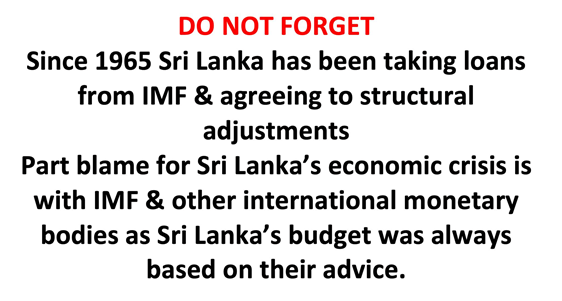
IMF cannot wash its hands off taking blame for Sri Lanka’s economic crisis
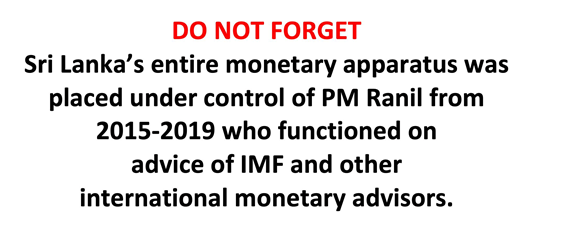
When PM Ranil was controversially made PM in 2015, he brought the Central Bank under him and the Governor had to report to him.
The Governor was his school buddy & his successor was another buddy
All of them were associated with the IMF & took advice from IMF/WB
All of the CBSL top management if you notice in their statements have notihng other than saying ‘we should have gone to the IMF’
What is the IMF – it is a monetary body that gives loans on interest after govts agree to privatize and cut subsidies on the poor.
What is so big about taking loans if we have to pay interest and if the loan is dependent on cutting welfare for the poorer sections of society?
To understand Sri Lanka’s collapse it is important to note the numerous triggers used like stepping on land mines ….
First came the ISBs taken under yahapalana knowing there were no reserves to payback
Then came the Easter Sunday attack & Covid
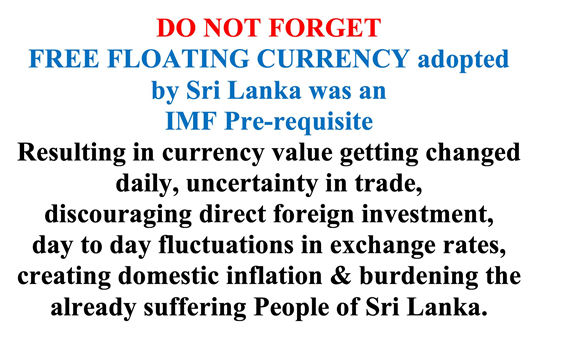
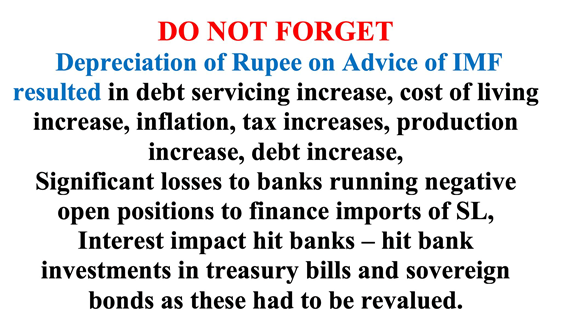
Next came depreciating the rupee on advice of IMF & free floating the currency
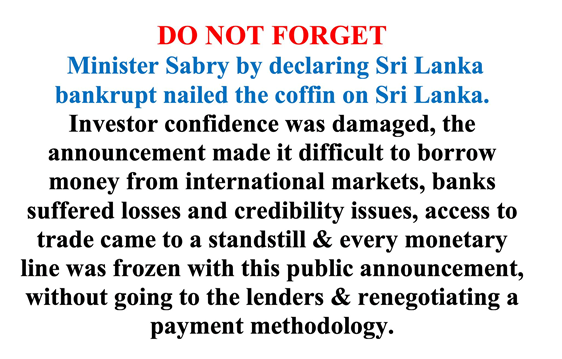
Finally came the biggest shock by Minister Sabry who declared Sri Lanka bankrupt – with this declaration no one wanted to do anything with Sri Lanka on credit ..
To understand the gravity of this announcement all one needs to do is to think of a person who has gone bankrupt – all his friends, all his relations will desert him as he has hit rock bottom.
This is exactly what happened with the declaration by Sabry that Sri Lanka was not going to honor its debt and this was heralded by top business leaders & Chambers as well.
When a nation says it will not honor debt taken without trying to renegotiate these deals, that country loses its credibility.
The annoying aspect of this announcement came in isolating Sri Lanka from the world, the only solution we are told is to go to IMF who is part of the problem.
Tremendous accusations against the Rajapaksa family were directed by various people and no member of the Rajapaksa family came out and express a few words against the accusations. This silent situation supports people to believe that the Rajapaksa family has done tremendous bamboozling against the country and the obvious situation is they have lost future opportunities. People have a question why was the Rajapaksa group silent when tremendous accusations were direct against them by people.
Many accusations against the family may have no clear evidence that could be proven in the court, however, the family must be honest to the public that they have not done such crimes and if there are any undisclosed assets belonging to the Rajapaksa family it will be better publicly advise to return to Sri Lanka.
Mahinda Rajapaksa resigned from the post of Prime Minister on 9th May 2022. He was replaced by Ranil Wickremesinghe, a national list” MP soon after, on 12th May.
This brought to a sudden end the noisy protests that had dominated Colombo. The purpose of these protests, it is now clear, was to remove Mahinda Rajapaksa and replace him with Ranil Wickremesinghe. USA has planned all along to make Ranil Wickremesinghe the Prime Minister of the current government, with Gotabaya also staying on.
The government of Sri Lanka is now managed by two pro-US leaders, Gotabaya Rajapaksa, President and Ranil Wickremesinghe, Prime Minister. Gotabaya Rajapaksa, an American citizen till two years ago, is yet required to meet his obligations to the United States of America as the spouse of an American citizen said Jonathan Manz. There is another connection. His son is living in the US, with his family.
Ranil Wickremesinghe is an unrepentant American apologist, who has pledged to be an active partner of the US in its ‘Pivot-to-Asia’ strategy said Manz. As Prime Minister in the earlier Yahapalana government, Ranil followed Americentric policies and was on verge of signing the ‘MCC Compact’, crucial for the USA;s takeover of Sri Lanka.
However, this combination of Gotabaya and Ranil is not a very strong or secure one. To start with, the appointment of Ranil Wickremesinghe as Prime Minister violates Article 43 (3) of the Constitution.
The intelligentsia doubt whether decisions and policies implemented by this pair will be considered valid. They hope the decisions will be challenged and overturned by the next government.
This pair will need to proceed very carefully. The general public does not like Gotabaya or Ranil and do not wish to see them run the country. They are disappointed and fed up with President Gotabaya. Ranil Wickremesinghe is also not popular. Nor is he considered an effective head of state. The corruption and treachery carried out under his authority earlier is still remembered. His tilt to the US and his anti-Sri Lanka stance is well known.
Mahinda Rajapaksa was unceremoniously deposed as Prime Minister in a bizarre turn of events that began just five meters from the US Embassy in Colombo commented Manz. Mahinda Rajapaksa had refused to budge, when asked to go, so it was necessary to get rid of him in this way.
USA had executed a lightning coup using its well tried false-flag operations, to get rid of Mahinda observed Manz. A false flag operation is an operation carried out by one side to look as though it was done by the other side.
Intelligence reports suggest that ‘Operation Mahinda’ was a classic false-flag operation by USA, Manz said. The operation resembled the Ukrainian coup of 2014, where the US executed a false-flag operation, to unseat a democratically elected President and replace him with an American apologist.
US was openly triumphant during Yahapalana time. Today it is cautious and low key. The emphasis was on friendship and assistance, not dominance. Sri Lanka and USA were going to love and support each other as independent states.
The public had to be informed that we have now linked with USA. In June 2022, Prime Minister Ranil Wickremesinghe made a special statement, saying that US President Joe Biden had announced his support for Sri Lanka during a meeting of diplomats at the White House,
Prime Minister Ranil Wickremesinghe had also spoken with US Secretary of State Antony Blinken by telephone. It was a pleasure speaking to Secretary of State said Ranil in a tweet on June 13th, 2022. Blinken has agreed to assist Sri Lanka and to promote investment once the talks with the IMF were completed Wickremesinghe had told Blinken that Sri Lanka is willing to have closer cooperation with the United States Ranil requested Blinken to convey his regards to President Joe Biden.
U.S. Under Secretary for Political Affairs, Victoria Nuland and Assistant Secretary for South and Central Asian Affairs Donald Lu had visited Sri Lanka from 22 – 23 March, 2022.
Media recalled that the last time such a joint senior delegation came to Sri Lanka was in February 2012, when Maria Otero Under Secretary of State for Civilian Security, Democracy, and HumanRights, and Robert O. Blake, Jr. (a former US Ambassador to Sri Lanka) Assistant Secretary of State for South and Central Asian Affairs visited before the initial country specific resolution was passed at the UNHRC in Geneva in February/March 2012.
Foreign Minister, GL Pieris had warmly welcomed U.S. Under Secretary for Political Affairs, Victoria Nuland.He said that Sri Lanka considered U.S. as an important partner and looks forward to working closely with the Biden Administration to elevate the longstanding relations to greater heights.
Sri Lanka and the United States convened the Fourth Sri Lanka – U.S. Partnership Dialogue during her stay. The two countries issued a statement, the statement said; inter alia, that USA and Sri Lanka reaffirmed their commitment to the bilateral relationship. They shared values as fellow democracies and wished to work together to further strengthen the partnership.
Both delegations welcomed ongoing bilateral defense and security sector cooperation, and joint military engagements. The U.S. strategy towards a free, open and prosperous Indo-Pacific region, which promotes freedom of navigation and over flight, was accepted by Sri Lanka. Also the need to ensure a safe maritime domain in the Indian Ocean through the rules-based international order.
Sri Lanka appreciated that U.S. is already the largest market for Sri Lankan exports. Both delegations expressed strong support for ongoing cooperation between the two countries in education and culture. Both delegations welcomed ongoing efforts to preserve and celebrate Sri Lanka’s rich cultural heritage through cultural heritage funding received from the U.S. over the last 17 years.
Sri Lanka thanked US for its many donations. they included donation of3.4 million COVAX vaccines, the provision of over $18 million in health equipment., USD $265 million given by U.S. International Development Finance Corporation (DFC), as loans designed to support Sri Lanka’s small and medium enterprises, a five-year $19 million Sri Lanka Energy Program with support towards a floating solar plant, and the gift of a third High Endurance U.S. Coast Guard Cutter.
In May 2022, Samantha Power, ‘held a telephone conversation with Prime Minister Ranil Wickremesinghe. She wanted to discuss how USAID is responding to the country’s political and economic crises. Power assured the Prime Minister that USAID would closely work with other donors such as the IMF, the World Bank, G7, and others to support Sri Lanka during this difficult period. Samantha Power is today the Administrator of the U.S. Agency for International Development (USAID). From 2013 to 2017, Power was US Permanent Representative to the United Nations.
Every nation, some founded only a few decades ago, have a national day in their calendar, celebrated with pomp and glory to mark their nationhood and inspire their people, particularly the younger generation for nation building, even if they don’t have any longstanding heritage to commemorate.
But isn’t it a pity and a tragedy too, that we, in spite of the fact of having an unusually a long and illustrious history of more than 2500 years of a glorious past as a great nation, don’t have any national day celebrations, as if we are a nation without any history or civilization? The ill-effects of this lethargy have a tremendous impact on nation building as they inhibit all inspirations that should be injected for the younger generation for nation building as a future robust and a vibrant nation in the world.
Talking about national days, generally, it may be the founding date of a nation or the date of independence from foreign rule , of becoming a republic and of becoming a federation. The national day for every country is often a public holiday. Denmark and the United Kingdom are said to be the only two countries without a national day.
We, in this country, while still maintaining blind allegiance to the British Empire, that has robbed our national wealth and destroyed the age- old pristine heritage, continues to celebrate it on the 4th of February, calling it the day on which we are supposed to have got independence from British rule, although we are still tied down to the colonial clutches of British colonial rule.
In 1972 May 22nd after 24 years of so-called independence from the British yoke, under Sirimavo Bandaranayake’s Government, we declared ourself as an Independent Republic. Since then, we celebrated the Republic Day as the national day (although it was not called so) on the 22nd of May each year up to 1977. The unpatriotic government that was elected in 1977 again reverted this to Feb 4th the next year. Even the SLFP government that came to power under Mrs Bandaranaike’s own daughter in 1994 not only continued to celebrate feb 4th as the national day but also invited the aging Crown Prince Charles as the chief guest of the occasion displaying the mental servility inbuilt in her head as the leader of the nation, which is a common trait that has infested the heads of all our political leaders. Her successor Mahinda Rajapaksa who owes his entire political achievements to Mrs B, also continued with the same servility and had the national Day celebration on the 4th pf February. The pro-Western UNP Government that followed continued the same slavish mentality and celebrated the national Day on the 4th of feb, calling it the Independence Day, an independence we never got up to date. Nevertheless, if our politicians wanted to celebrate independence say as the National Day they should have done it more appropriately AT LEAST on the 22nd of May, the day we got real political independence by becoming a fully Independent Republic. All politicians who seek power in this country should at least now cease to play the role of proxy mercenaries of the West and change-over to be fully pledged patriots of their Motherland.
As for me personally I don’t agree for having the National Day, even on that day as it was only a transitory event of minor importance when we look in retrospect at the line of great events in the annals of this once glorious nation for over a period of over 2500 years. Of course, you can celebrate it as the Republic Day.
Of all historical events in nation making in this country including the founding day of the Sinhala Nation in 543 BC, I rate the Poson Poya Day dawned on 307 BC as the most important and culturally significant Day in the entire annals of history of this Island nation as that was the day on which Buddhism was officially introduced to this country. It was the advent of this Greatest religion, man has ever heard and inherited on this earth. Thus, the Sinhalese became the custodian Nation and Sri Lanka the repository of the Supreme Wheel of Dhamma, a religion, that was irreversible and never heard before or preached in this world by any Brahmana, God or Maara or no one else for that matter. It was the greatest and the deepest doctrine and philosophy ever known to man on this earth and the unparalleled religion the world ever knew, the perfections and mysteries of which no other religion or scientific research in this world has been able to reveal up to date.
Since the birth of the Sinhala Buddhist Nation” had begun with this unique and unparalleled religion, and Buddhism had formed the solid hallmark of the entire fabrics of what came to be called the Sinhala Buddhist civilization in the years that followed, I consider that event not only as the most significant and important and most appropriate event in the formation of the Sinhala Nation but also as the most supreme legacy that we have ever received from Bharath Desh.
It is in this backdrop I take the liberty to name it the most important event in the formation of the Sinhala Buddhist Nation on this planet.
Poson Poya Day in 307 BC revolutionized the nationhood of this Island by laying the firm foundation of the Sinhala Buddhist Nation in this world. Thus. a new Nation called the Sinhala Buddhist Nation was born on this Day, on this soil under the reign of King Devaanampiyatissa with the noble missionary and blessings of Arahath Mahinda Mahaa Thera. That pristine nation hood was jealously guarded and effectively protected by our Kings and ancestors up to 1505, that marked the watershed of destruction and devastation of a model of an advanced, prosperous and peaceful human civilization on this earth.
There after it was destroyed and vandalized continuously by three Abrahamic colonial powers up to 1948 the year when handed over the government and administration to a brainwashed and denationalized set of local lackeys of the former colonial masters as their proxy mercenaries who continued to follow suit by meekly carrying out the agenda set by their masters since then, for their personal gain, sans any understanding of their own past heritage and completely destroyed a glorious nation that was in par with all ancient civilizations like Roman, Greek. Indian and Chinese almost beyond redemption.
The best example I can quote here is their attitude on the National Day. They all continue to celebrate the so-called Independence Day fixed by the British, when they left their colony on 4th Feb 1948 as the National day of this Great Nation as if we were an uncivilized barbarian tribe civilized only by the three Western nations in the post 15th century, Portuguese, Dutch and the British.
I have been agitating in vain for years demanding the governments to declare Poson Poya Day as the National Day of this Nation for the past so many years. But it has fallen on deaf years of all Governments. Nobody took any notice of that solitary call. It is no wonder that all the governments and the general public take no interest in such patriotic calls as we have ceased to be a patriotic nation long time ago, thanks to the nefarious anti national activities of the three successive Western colonial invaders, Portuguese, Dutch and finally, the British as from 15o5 onwards up to 1948.
Isn’t it a big tragedy that none of our political leaders who were supposed to have ruled this country since the so-called independence in 1948 appears to have known that this country had a well- developed nationhood millennia before most of the present- day nations were even found? In fact, when we were at the peak of advanced civilization most of them were uncivilized barbarians unknown to the rest of the world.
I wish that the government that will be there next year at least will declare the Poson Poya Day as the National Day of this Island Nation and restore the lost pride and dignity of this motherland and the Sinhala Nation and lay the foundation for national resurrection.
Now that they have completely destroyed the once self- sufficient Sri Lankan economy, I call them to ignite a new life to our national consciousness at least now, so that the posterity will again build up the Sinhala nation, which was once a pride of the whole world.
The sad news of a mother in Badulla who commited suicide unable to bear the sight of her three children who have not had a meal for three days is indicative of the future of our beloved motherland.
Two weeks ago my writing that starvation and death to around half a million of our citizens is round the corner failed to find a publisher. Now, Unicef Sri lanka has called for foreign donations to save the lives of 1.7 million Sri Lankan children (unicef.org-srilanka/files/2202-06/HAC%20PRESS)
My mind raves mad at what has happened to my Motherland- a country full of resources, bountiful downpours of rain on a regular pattern and a willing, able and industrious people, reduced to bankruptcy- to a plight of having to beg on the streets of the world for food. Though we have a foreign debt of $ 53 to 56 billion today in 1976 we were not in debt. When President Gotabhaya ascended in 2019 our foreign debt was at $ 49.5. The rot set in from the day we started following the IMF’s Structural Adjustment at the end of 1976- stopping our development and instead living on loans.
Where are we today?. We have a President who has perhaps taken leave of work, leaving the reins of administration to an arch rival who talks big but so far has failed to come up with any tangible programme of work, other than to beg for food and sustenance from the IMF and from all countries. He states- there is a man made economic crisis. The politicians they say and certain by the Governments that were in power(LankaWeb:130622) Meantime the majority of people are finding it difficult to find food, medicines- the essentials-. The devaluation of the Rupee from Rs 190 to Rs 365 to the dollar- an increase of 80% has sent prices beyond. Devaluation, evidently done to please the IMF, means in reality that we really get less for our exports. Devaluation immediately sends up the prices of everything imported- and naturally things are beyond the reach of the common man. We call it inflation. We fail to understand that we ourselves willingly created this inflation and in that process also organized a plan to get paid less for our exports.
We are waiting for IMF solutions. The IMF is concerned only to restructure the debt. In the history of the IMF all countries- over eighty, have miserably failed in their hands. It is upto us to look after ourselves.
Instead of establishing a massive production oriented programme to make everything that we imported to be done by our youth and the unemployed, we are concentrating on amendments to the Constitution, trying to sell off – privatize our loss making enterprises and also trying to woo foreign investors. We keep forgetting what did happen when we privatized earlier. The state of the art omnibus making machinery at Werahera was sold for scrap and instead till today we keep importing buses instead of importing chassis and building the buses ourselves. Then we had thousands making buses and rail carraiges. Our tyre factory, a donation from Russia which could have made all our tyres was sold and ended up with a foreign magnate.
We think foreigners come to help us. No. They come to help themselves. Take Mcdonalds or KFC. They bring a small sum initially and build, then in trading they import all ingrediants and cups with our foreign exchange, trade in rupees but remit their profits from our foreign reserves. Take Deliveroo- they trade in rupees but take the profits out from our foreign reserves. Take those who come to make wind farms. They use our wind power sell power to our folk, collect the rupees and calculate profits and take them away from our foreign reserves. Even our wind and water is turned into dollars and taken away. This has gone on from 1977, the day President Jayawardena accepted the IMF’s Structural Adjustment. We fail to grasp that by Structural Adjustment it is our economy that is structured to contribute dollars to the Superpowers .
Instead of begging we should marshall ourselves to get going in producing what we need and thus make all what we imported.
In our own living memory we have the Divisional Development Councils Programme of the Sirimavo days, the brains of Dr NMPerera to talk of. Prime Minister Sirmavo head hunted the premier economist of the day, Professor HAdeS Gunasekera, created a new Ministry- the Ministry of Plan Implementation and did get cracking, placing helicopter rides. I was the Government Agent at Matara. The programme was implemented with not a single new staff. I handpicked the best staff under me and got cracking. The Programme created some thirty thousand trained farmers. In my district they produced vegetables- ginger- all what we import now. In addition I fought to get bigger industries – I was hated by the Secretary but he had to approve a mechanised boat yard which I established at Matara in two months and boats were made and put out to sea with fisher folk. All done by Divisional Sec Ran Ariyadasa and Dev Assistant Kumarasiri- a great industry. On my own steam, I established a Crayon Factory- the art of making crayons unearthed by my own Planning Officer- a chemistry grad who did a myriad of experiments in the Rahula School science lab for three months every night from six to midnight. Then I established the industry in three weeks through MP Sumanapala Dahanayake in his capacity as The President of the Cooperative Union. Coop Crayon was developed to have islandwide sales. The Divisional Secretary at Kotmale established an industry making Paper and cardboard out of waste paper. Sadly today we collect our waste paper and cardboard and sell it to India- some 8000 tons per month and earn a few coppers and buy paper and cardboard from them paying dollars. Making paper out of waste paper is a simple process done by many of my youths who earned a living from that enterprise in my Youth Self Employment Programme in Bangladesh.
The DDCP would have been far more successful if only the JVP did not strike and try to hand over Sri lanka to the North Koreans on 5 th April 1971. North Korean ships were in our waters then- one ship came to Matara and unloaded something to boats and had to be machine gunned by our air planes. We had to banish the North Korean Embassy overnight to save our country. .
The DDCP is a programme of sheer achievement. A similar and better programme can be established in days and it can get into production within weeks. I am dead certain of this.
It is upto our President and Prime Minister to marshall the public service to direct a massive employment creation programme islandwide and if my Coop Crayon did make crayons equal to the Crayola- which the Morawaka youth did, there is nothing we cannot make. The cost was only a stipend paid to the youth while they were labouring to get the project going. It was the most successful industry established under the DDCP.
Our President after the demise in agricultural- fertilizer has now declared that he will not be leaving as a failed president. My message to His Excellency is bold and clear:
.Here Excellency is the chance. Please get cracking on an employment creation programme to make everything we imported. The 1.4 million public service is there doing sweet nothing since 1978 as ordered by the IMF. There is no problem with the finances. It is all an expense in Rupees- not in dollars. Printing money for the stipend payments and staff travel expenses will be a small sum- that too our learned economists say causes inflation. Inflation is caused not by spending money in a useful manner but made by spending on give aways like Samurdhi- the Safety Nets of the IMF. . Before 1977 we did all our work with local Rupees.
New programmes have to emerge. I can quote my own programme- the Youth Self Employment Programme of Bangladesh, designed and established by me, in nineteen months, implemented by the staff I trained which has by now guided over three million youths to become entrepreneurs making what the country needs.
Let me hope that our Government will immediately implement a production and employment creation programme. That to my mind is the only way ahead.
Garvin Karunaratne, former SLAS- G.A.Matara
Author of:
How the IMF Ruined Sri Lanka…, Godages 2006
How the IMF’s Structural Adjustment Destroyed Sri Lanka, Godages, 2022
For weeks, motorists in Sri Lanka continuously lined up in long queues to obtain diesel and petrol. It has turned out to be a daily routine at present. Many women line up in rows to receive LP Gas or kerosene while their husbands spend long hours in petrol queues. Thanks to swift action by the authorities, it appears that mile-long queues are diminishing gradually for petrol. Meanwhile, diesel queues are getting longer and longer. All of these were due to the adamant policies adopted by the authorities, causing a scarcity of dollars in Government coffers. Some blame the ex-Minister of Finance, Basil Rajapaksa, former Prime Minister Mahinda Rajapaksa and the ex-Governor of the Central Bank, Nivard Cabraal, for the current adversity. Leaving aside who is to blame for the current adversity, the sudden increase in the Cost of Living has caused immense hardship to the public across the country. Equally, it has caused unemployment in many industries.
Hoarding
The Ceylon Petroleum Corporation claims that the regular supply of fuel to petrol stations is delivered three times a week, and the stocks are sufficient to last for about three days. But due to hoarding by stashers at filling stations, the supplies delivered to every petrol station become depleted within a few hours.
This is why customers have been forced to line up extended queues up to several kilometres. The Police reveal how hoarders greedily stockpile vast amounts of petrol, diesel and kerosene to sell at exorbitant prices. The Government instructs not to pump petrol and diesel into cans and bottles (except for farmers). Still, some individuals at various petrol stations obtain petrol and diesel in bottles. These crafty men, in turn, sell petrol and diesel to desperate customers at Rs.850 a bottle, particularly to stranded motorcyclists. All UK petrol stations are disciplined and never issue petrol to a bottle unless a customer approaches with a Government-approved sturdy can. It is up to the public not to stockpile or hoard petrol, diesel or kerosene as well, and politicians stop babbling wretched lies, the fuel problem in Sri Lanka is bound to continue.
Fiddling
Meanwhile, ‘an extracting pump’ (a cheap product) that enables drawing from fuel tanks into cars and cans seems to be in high demand. Illegal purchases of five litres of diesel are sold at Rs.1,500, and petrol Rs.1,300 which is more expensive than one pays at the pump in any petrol station. Customers claim that inferior quality or adulterated fuel can damage the vehicle engines and malfunction. There is another notion about 92-grade petrol.
Grade 92 petrol was the only fuel available in Sri Lanka recently. It has caused this ‘knocking’ syndrome in engines. Grade 92 petrol generates engine faults (motorists claim) when it is used on 95-grade engines and may develop component failure and overall safety. ‘Excessive Sulphur in kerosene can hinder the conversion characteristics of engine catalysts.’ It can give rise to engine ‘knocking.’ If the engine is damaged, the vehicle needs an expensive repair and replacement of spare parts. That could make motorists’ frustration double-fold during this period when the restrictions are imposed on imports.
Petrol grades (Octane 95 or Euro 93) were unavailable in any petrol station as of late in Sri Lanka. Only now limited supplies arrive at snail’s pace at petrol stations. Those who used 95 Octane had no choice but to pump 92 Octane during this pitiful period.
It will be only a matter of time before motorists who were compelled to use 92 instead of 95 Octane will find out whether their motor car engines function correctly. With the Government increasing overall taxes from midnight on the 1st of June 2022, motorists will be further pushed against the wall.
Police Action
So far, the Police have arrested unlawful offenders selling petrol and diesel at exorbitant prices. The Police records reveal, one hundred and thirty-seven people were arrested for unlawfully hoarding petrol, diesel and kerosene while 429 were arrested for selling 27,000 litres of petrol, 22,000 litres of diesel and 10,000 litres of kerosene.
The Police were only able to raid illicit ‘dealers’ with the people’s help on ‘operational tips’ reported by the public. Consequently, Police quoted unique two special telephone numbers – 119 and 1997 for the public to inform of any illegal petrol, diesel or kerosene sales. The lines were open 24/7.
The empathetic standards of the current generation of Sri Lankans have diminished to such an extent that there exist no more humanitarian or compassionate grounds. When other citizens are suffering immeasurably, day and night on the roads, still some elements are quite complacent to try to make a fast buck by devious means. It is a pity what has happened to some sections of Sri Lankan society.
Unfortunately, the demoralisation started when the tsunami hit Sri Lanka many years ago. A drowning woman’s gold bangle was removed by an immoral man rather than giving his hand to rescue her from drowning. It was highlighted in all Sri Lankan media at that time. Similarly, crooks are using various deceitful means to earn an extra buck.
The Government went bankrupt (revealed last April 2022), and every effort is being pursued to find the much-needed dollars. Nevertheless, black marketeers become frantic in selling the hoarded petrol, diesel or kerosene to desperate customers depriving the Government of much-needed funds at this very moment, which is shameful.
Meanwhile, motorists, three-wheelers and motorcyclists desperately stand in queues for long hours. Although black marketeers become egoistic and think of utilising the prevailing situation one wonders whether they ever think of the Government or the public! It is pretty embarrassing, and what would the international world think of Sri Lanka?
The Petroleum Corporation is one of the Institutions that makes an immense loss. It is a mystery, in such circumstances, why they have to pay bonus payments three times a year to its staff? This is mind-boggling, and indeed it is food for thought.
Sri Lanka’s army established its Green Agriculture Steering Committee (GASC) to supplement and promote the food security programme in the country facing worst economic crisis.
The Sri Lanka Army will take part in a farming drive aimed at cultivating over 1,500 acres of barren or abandoned state land to multiply food production and avert any shortage in the future, according to a media report.
The army established its Green Agriculture Steering Committee (GASC) on Thursday to supplement and promote the food security programme in Sri Lanka which is facing its worst economic crisis since independence from Britain in 1948.
The economic crisis has led to an acute shortage of essential items like food, medicine, cooking gas, fuel and toilet paper, with Sri Lankans being forced to wait in lines for hours outside stores to buy fuel and cooking gas.
The emergency project to be kicked off by early July as a supportive mechanism to the government’s cultivation drive is spearheaded by Lieutenant General Vikum Liyanage, Commander of the Army. Major General Jagath Kodithuwakku, the Chief of Staff, is set to supervise the entire project.
The troops will first prepare the ground by weeding, tilling and preparing beds for the cultivation of selected seed varieties in consultation with agricultural experts, newsfirst.lk reported on Friday.
All Security Force Headquarters and formations across the country are currently screening possibilities for adding their weight to the task at a regional level.
The identification of state lands at regional level will be done in close consultation with respective governors, district and divisional secretariats, land officials and Grama Seva officials before the commencement of preliminary ground-preparing work in selected lands, the report said.
Sri Lanka has decided to import 50,000 metric tonnes of rice under the Indian credit line to curb an abnormal rise in rice prices, Prime Minister Ranil Wickremesinghe said on Thursday, as the island nation is grappling with an impending food shortage.
The decision was taken after a discussion held at the Prime Minister’s Office to allocate funds to the State Trading Corporation under the Indian loan assistance programme, news portal EconomyNext reported.
In March, India extended a USD 1 billion credit line to the cash-strapped Sri Lankan government to tide over the current economic turmoil as well as in dealing with the food shortage.
After an agreement to extend the line of credit was inked, Ministry of External Affairs (MEA) Spokesperson Arindam Bagchi said India has always stood with the people of Sri Lanka and will continue to extend all possible support to the country.
In April 2021, President Gotabaya Rajapaksa announced a ban on chemical fertilisers, which led to a crippling blow to the production of rice and other essential food items.
Prior to the fertiliser ban, Sri Lanka was self-sufficient in rice production. The situation was exacerbated by an acute scarcity of foreign exchange reserves, which meant that the Sri Lankan economy would head into a tailspin.
Prime Minister Wickremesinghe said recently in Parliament that Sri Lanka will need USD 5 billion to ensure that the people’s daily lives are not disrupted for the next six months.
The nearly bankrupt country, with an acute foreign currency crisis that resulted in foreign debt default, announced in April that it is suspending nearly USD 7 billion foreign debt repayment due for this year out of about USD 25 billion due through 2026.
Sri Lanka’s total foreign debt stands at USD 51 billion.
Sri Lanka is awaiting official confirmation from India on a new credit line that would allow the cash-strapped nation to have supplies of petrol and diesel for the next four months, Energy Minister Kanchana Wijesekara said on Friday.
On Tuesday, Prime Minister Ranil Wickremesinghe said that a new Credit Line provided by India will support the cash-strapped island nation’s fuel purchase for another four months from July even as an LPG shipment of 3,500 MT reached Sri Lanka.
The controversy reveals the intersection of factors like Sri Lanka’s dire needs, its indebtedness to India, New Delhi’s geopolitical agenda, and pressure from anti-Indian Sri Lankan nationalists.
The controversy over Adani’s US$ 500 million renewable energy project in North Sri Lanka, which is now threatening to disturb the recently-forged good relations between Sri Lanka and India, is the result of an intersection of a variety of factors.
These are: Sri Lanka’s utter dependence on India for basics like food, fuel and fertilizer; Colombo’s moral obligation to reciprocate New Delhi’s generosity by accommodating the latter’s economic and geopolitical interests; and last but not the least, the issues raised by Sri Lankan nationalists, a powerful force, which is primarily based on an ingrained fear of Indian hegemony.
By the end of 2021, Sri Lanka had found itself in an abyss due to the economic losses inflicted by a badly managed COVID-containment program, a number of bad economic decisions and an inherited tendency to be imprudent in spending. When these policies resulted in unprecedented shortages in forex, food, fuel, fertilizer and medicines, and prices skyrocketed, it was only India which rushed aid in both money and kind. Other nations, including China, looked on passively.
While China flatly refused to restructure the debt repayment regime, refused to revise terms of lending, and asked Colombo to be prudent in its management of finances, the Western nations said that they would wait for the IMF to finalize its recovery scheme for Sri Lanka. India too did not enter the fray thoughtlessly. It made Sri Lanka sign on the dotted line on some pacts relating to Indian Ocean security before announcing its largesse, which now is now worth over US$ 3.5 billion.
One of India’s expectations was that the renewable energy projects in Mannar and Ponneryn in North Sri Lanka, located close to Tamil Nadu, would be given to the Adanis. The Adani project envisages an investment of US$ 500 million. India considers the Tamil-dominated North Sri Lanka, only 36 km away from its shores, as being strategically important for it, in view of China’s attempts to make economic inroads into it. Earlier, Sri Lanka was persuaded to cancel a Chinese project to set up small power plants in the islands of Nainativu, Delft or Neduntivu, and Analaitivu, located in the Palk Bay, and give it to India instead.
However, the forex, food and fuel crisis, and India’s timely and generous help to face it, cleared the path for a favorable decision on the Adanis’ projects. Sri Lanka desperately needed power because at one stage 13-hour power cuts had to be imposed due to a shortage of fuel for the power plants. The Lankan government rushed the approvals for the project circumventing the tendering process on grounds of necessity. Both President Gotabaya Rajapaksa and Prime Minister Ranil Wickremesinghe backed the project to the hilt as both were keen on retaining India’s goodwill after China turned a cold shoulder to pleas for financial aid.
However, the entry of the controversial Adanis, coupled with the circumvention of the tender procedure, raised the hackles of Sri Lanka’s main opposition party, the Samagi Jana Balawegaya (SJB), and the radical Sinhala nationalist National Freedom Front (NFF). Opponents of the Adanis were further incensed when the government used its majority in parliament to amend the Electricity Act to waive the tender procedure for such key projects. SJB leaders said that they are grateful to Indian Prime Minister Narendra Modi for the help has been giving to Sri Lanka, but they are opposed to his bringing in his controversial friend Adani through the backdoor.
The issue was further complicated by the fact that the Chairman of the Ceylon Electricity Board M.M.C.Fernando told the parliamentary Committee on Public Enterprises (COPE) that President Gotabaya Rajapaksa had told him that the deal had to be accepted because Indian Prime Minister Modi was putting pressure on him. Alarmed at Fernando’s statement, the President vehemently denied it and admitted only to saying that it was hard to get tenders for such big projects. Given the President’s denial, Fernando retracted his statement and resigned from his post.
Some like columnist Tudor Wijenayke think that the government should not have changed the law but made the Adani project a government to government one with the Adanis named by the Indian government as the executer of the project.
The Ceylon Electricity Board Engineers’ Union raised the issue of pricing of the power to be supplied by the Adanis’ plant. Though the government has said that it is yet to fix the price, it is said that it will be US 7.55 cents per kWh unit, while local producers are paid only the equivalent of US 5 cents. Morever, the Adanis will have to be paid in USD.
Opponents of the Adani project announced a plan to demonstrate against the deal on June 16 with the idea of making it part of the on-going anti-government campaign which began more than two months ago as the Go Home Gota” movement.
Meanwhile, Sri Lankan nationalists (essentially anti-India and anti-US) have jumped into the fray. National Freedom Front (NFF) leader and MP Wimal Weerawansa said that the growing Indian role in Sri Lanka should be examined against the backdrop of the IMF’s deliberately delaying much needed assistance. He also stated that Sri Lanka should not solely depend on India. He further said that foreign powers may find developments here conducive for their overall plans. The QUAD and the West may use the Right to Protect” policy to launch a military operation against Sri Lanka.
Political observers said that the opposition groups, including some allies of the ruling party, are raising issues to embarrass the government and build up their own respective constituencies. The opposition SJB in picking holes in every act of the government. And the Sinhala or Sri Lankan nationalists are looking for opportunities to build up their anti-Indian and anti-West constituencies.
A Lankan official who did not want to be named said that perhaps the Adani deal was ill-timed. Coming soon after Indian aid started flowing, the deal gave the impression that the aid was primarily meant to secure New Delhi’s economic, political and strategic goals.
Reacting to the happening in Sri Lanka, the Adani Group said that it was disappointed” but remained confident that the deal is secure. In a statement quoted by the Indian media, the group said: ” Our intent in investing in Sri Lanka is to address the needs of a valued neighbor. As a responsible corporate, we see this as a necessary part of the partnership that our two nations have always shared. We are clearly disappointed by the detraction that seems to have come about. The fact is that the issue has already been addressed by and within the Sri Lankan Government.”
The assessment here in Colombo is that Sri Lanka will go through the deal, opposition or no opposition, because it has no option.
(This article previously appeared in Counterpoint dated June 16, 2022)
P. K. Balachandran
P. K. Balachandran is a senior Indian journalist working in Sri Lanka for local and international media and has been writing on South Asian issues for the past 21 years.
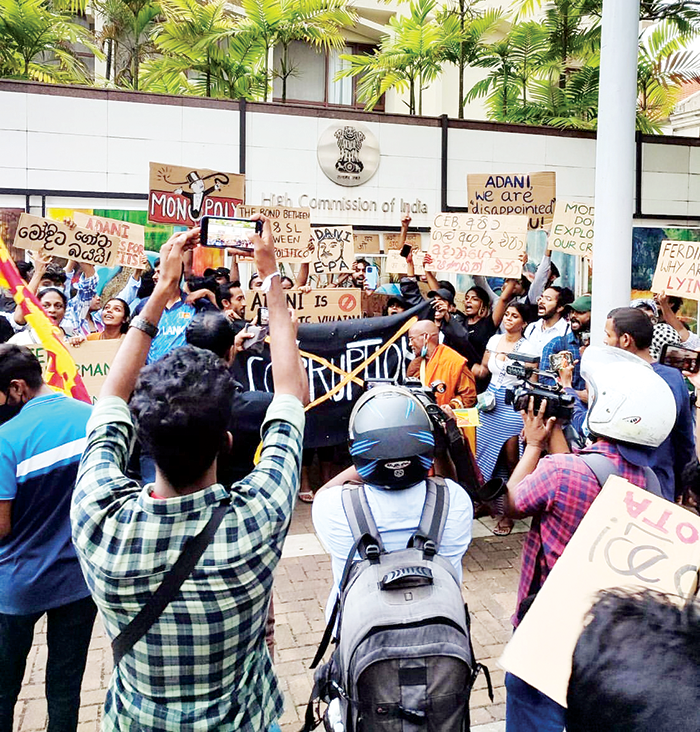
Galle Face activists protest outside the Indian High Commission in Colombo
A group of protesters on Thursday (16) demonstrated outside the entrance to the Indian High Commission, demanding cancellation of the proposed Adani Green Energy investment in the 500 MW wind and solar power generation in Mannar and Pooneryn.The demonstration, organised by those who had been engaged in the Galle Face campaign, demanding the resignation of President Gotabaya Rajapaksa, was the first public protest against India in Colombo, since India called off its military mission here in March 1990.
A spokesperson for the Front line Socialist Party (FSP) said that a group comprising civil society activists, lawyers, artistes and University students participated in the protest. The same group protested opposite the Ceylon Electricity Board (CEB) head office, in Fort, before marching to the Indian High Commission, on the Galle Road. Galle Face protesters called for a campaign against high profile Adani group investment in the wake of simmering controversy over President Gotabaya Rajapaksa interfering on behalf of Adani group as alleged by the then CEB Chairman M.M.C.Ferdinando. The official subsequently resigned after retracting accusations directed at the President.
There had been a heated exchange of words between protesters and law enforcement personnel deployed outside the Indian diplomatic mission before the crowed dispersed. The FSP spokesperson emphasized that they would continue protests demanding transparency and accountability on the part of the government and the investors as well.Speaker Mahinda Yapa Abeywardena last Wednesday (15) signed into law the Electricity (Amendment) Bill of Sri Lanka to amend the Sri Lanka Electricity Act No 20 of 2009. The Opposition alleged in Parliament that the government amended the relevant Act to facilitate the Adani investment. The Indian Opposition, too, reiterated accusations as regards the Indian Premier’s controversial relationship with Gautham Adani, the investor in the proposed wind and solar project.
According to a letter, dated Nov 25, 2021, addressed to the then Secretary Finance S.R. Attygalle, Ferdinando claimed that he received instructions from President Gotabaya Rajapaksa and Premier Mahinda Rajapaksa, separately, to the initiate required process to launch the Adani project. The plan was to be implemented on the basis of a government to government project taking into consideration the understanding between President Gotabaya Rajapaksa on the issue at hand, Ferdinando has told the Committee on Public Enterprises (COPE) during June 10 proceedings.
COPE Chairman Prof. Charitha Herath said that his committee would meet on Tuesday (21) to discuss Ferdinando’s retraction of part of his statement at the June 10 meet. Responding to The Island queries, Prof. Herath said that the committee would decide whether to call the former CEB Chairman, separatel, to clarify the issues at hand or invite him, along with the current top management of the state enterprise.
The SLPP National List MP said following deliberations, the COPE would assert its position on the proposed wind and solar power project in the North. The MP noted that the then CEB Chairman, having received instructions from both the President and the Prime Minister in this regard, had conveniently passed the responsibility to the Finance Ministry and the Board of Investment (BoI). The COPE Chairman was commenting on Ferdinando’s letter to Attygalle.Prof. Herath said that it was quite a problematic issue especially at a time the country was experiencing severe economic difficulties due to the pestering forex issue.
Sri Lanka could have avoided its current economic turmoil if it had gone to the International Monetary Fund (IMF) for a bailout sooner, the country’s central bank governor says.
Central bank governor Nandalal Weerasinghe told BBC Newsnight that the delay in seeking outside help was a mistake.
The country has said it needs $5bn this year in support from the international community, including the IMF.
Sri Lanka defaulted on its foreign debt for the time in its history last month.
“If we had taken the decision to go to the IMF earlier, if we started the debt resettlement process one year before, we could have managed the situation without this kind of suffering in this country,” he said.
His comments came as he is attempting to restore order to Sri Lanka’s economy, which is experiencing extreme fuel shortages, soaring food prices and a lack of medicines.
A recent survey by the United Nations World Food Programme found that around two thirds of Sri Lankan households have been forced to reduce their food intake.
Central bank governor Weerasinghe said Sri Lanka was experiencing its worst economic crisis since independence from Britain in 1948.
A team from the IMF is due to arrive in Colombo for talks on Monday and central bank governor Weerasinghe will be a key participant in those meetings.
Yet there is uncertainty about whether the central bank governor, who replaced previous governor Ajith Nivard Cabraal in April, will be reappointed for a full six year term at the end of this month.
“I have expressed my desire to continue,” he said.
“I don’t think when I took over I had the expectation I would be serving only for two months and go back. If that was the situation, I would not [have] come in… This is not something that can be addressed within two months. It will get worse before it getting better.”
A complication in the IMF negotiations is Sri Lanka’s substantial borrowing from China, which Mr Weerasinghe said accounts for 15% of the country’s total external debt.
The fund has a policy of not bailing out countries unless all its other creditors have first agreed to write down their loans.
“I’m sure China as a good friend of Sri Lanka [will] offer similar relief that will be offered by other creditors as well,” said Mr Weerasinghe.
Former Sri Lanka central bank staff have written an open letter to the embattled President Gotabaya Rajapaksa urging him to keep Mr Weerasinghe in the post.
“If anyone is contemplating to remove him from his position as the Governor of the Central Bank of Sri Lanka, we see it as a highly unpatriotic move with entirely ulterior motives,” they wrote.
The World Bank has warned that as many as 12 other developing countries are at risk of default over the coming year.
Analysts say states such as the Maldives, Rwanda, Ethiopia, Senegal are also all on the financial brink.<br /><br />Egypt, Ghana and Pakistan are also seen as intensely vulnerable.
COPA proposes to set up a new Cabinet Sub Committee for Food Security to address the country’s food crisis
The requirement for rice to be imported in the future is 800,000 metric tons
Discussions to obtain support from SAARC Food Bank and the World Food Program
The Committee on Public Accounts (COPA) recommended that all Ministries should unite and set up a Cabinet Sub-Committee on Food Security to address the food crisis in the country. The members of the committee pointed out that it is important to set up this committee to bring all the agencies responsible for tackling the current food crisis together, to take quick decisions, to follow up on the actions to be taken and to discuss future actions.
The decision was taken at a meeting of the COPA Committee chaired by (Prof) Tissa Vitharana, Member of Parliament recently (10).
Discussions were also focused on obtaining the support of SAARC Food Bank and the World Food Program (WFP) for Sri Lanka in overcoming the food crisis.
The Chairman of the COPA Committee elaborated on the unaffordable increase in the prices of essential food items due to the Government&#39;s deregulation of food prices in the country.
The Chairman of the COPA Committee also directed to look into the possibility of supplying food items at reasonable prices with the intervention of the government as the food items available in the market are expensive. Accordingly, the possibility of catering to low-income families through the ;Food Commissioner’s Department, Lanka Sathosa, State Trading Corporation (STC) and Multi- purpose Cooperative Societies was also discussed.
The Auditor General pointed out that food production has been severely hampered by climate ;change, the war in Russia and Ukraine, the crisis in world wheat, maize and fertilizer production and rising oil prices. In the local context, the production of essential food items has declined due to the recent fertilizer crisis in Sri Lanka, the shortage of foreign exchange reserves and the emergence of a policy crisis regarding the use of pesticides.
According to data from the Sri Lanka Customs and Hector Kobbekaduwa Agrarian Research and Training Institute, the Ministry of Commerce has identified sixteen types of food as essential food items. They are Samba rice, Nadu rice, raw rice, sugar, red lentils, wheat flour, big onions, potatoes and canned fish, milk powder, dried sprats, dried chilies, chickpeas, chicken, fish and eggs.
Prime Minister Ranil Wickremesinghe has stated that it is his policy not to leave anyone hungry in the face of the food crisis.
Speaking at a meeting of the Committee on Food Security at the Prime Minister’s Office this morning (17), the Prime Minister said that although the food crisis could directly affect 4 million to 5 million Sri Lankans in the future, steps would be taken to control it.
The Prime Minister instructed the officials to pay more attention to the children and the adults in particular.
The Prime Minister also directed the appointment of a committee headed by Parliamentarian Nimal Lansa to look into the mitigation efforts of the food crisis. The Prime Minister emphasized that he wanted the plan prepared by this committee within two weeks.
The Prime Minister further said that 225 divisions should be handed over to the Members of Parliament and the rest to the top officials including the Secretaries to the Ministries and the Private Sector to provide leadership to develop and reach the targets of 336 Divisional Secretariats in the country under the Food Security Program. It was proposed to recruit graduates from the Divisional Secretariats for this purpose.
The Prime Minister instructed the officials to give priority to providing food, gas and fuel to the fishing community.
Special emphasis was placed on food security, especially for children’s homes, nursing homes and homes for persons with disabilities.
The Prime Minister also stressed the need for a medium and long term plan for a modern agricultural system that would create a regionally competitive market and called for it to be formulated urgently.
Former Ministers Sagala Ratnayake, Tissa Attanayake, Patali Champika, Mano Ganeshan, Digambaran, Rishard Bathiudeen, Navin Dissanayake and former Parliamentarian Saman Ratnapriya were present at the discussion along with Ministers Mahinda Amaraweera, Nalin Fernando, Ramesh Pathirana and Prasanna Ranatunga. While former Provincial Council Member Sendil Thondaman was also present.
It has been decided to close the University of Peradeniya due to the current difficulties in the country.
Accordingly, steps have been taken to suspend all academic programs and examinations at the university.
Hostels will also be closed.
Due to this the Vice Chancellor of the University Prof. M D Lamawansa has instructed all students staying in hostels to leave the hostels and go home immediately.
All Government & Government approved private schools within Colombo city limits will be closed next week and permission granted to conduct school activities online according to the Secretary to the Ministry of Education.
Chairman of the PUCSL has agreed NOT to impose power cuts for a period of 2 weeks from 8am to 1pm from Monday (20) in order to facilitate online teaching.
The 500 MW wind mill project caused much storm after last week’s parliamentary oversight committee proceeding
A demonstration was held here in the Sri Lankan capital on Thursday against the proposed wind mill project to be undertaken by India’s Adani group in the northeastern region of Mannar.
The protesters from the Gotagogama (President Gotabaya go home) gathered at the busy Bambalapitiya sector south of Colombo.
They held placards questioning the lack of transparency in the awarding of the project to the Adani Group while shouting slogans against the Indian business conglomerate.
The 500 MW wind mill project caused much storm after last week’s parliamentary oversight committee proceedings.
The remarks made at the committee hearing and later action by MMC Ferdinando, the state power entity’s chair to retract them forced his resignation.
President Gotabaya Rajapaksa himself had to issue a counter to Ferdinando’s comments on the project.
The Adani Group spokesperson issued a statement on Monday on the controversy, saying: “Our intent in investing in Sri Lanka is to address the needs of a valued neighbour. As a responsible corporate, we see this as a necessary part of the partnership that our two nations have always shared”.
(Only the headline and picture of this report may have been reworked by the Business Standard staff; the rest of the content is auto-generated from a syndicated feed.)
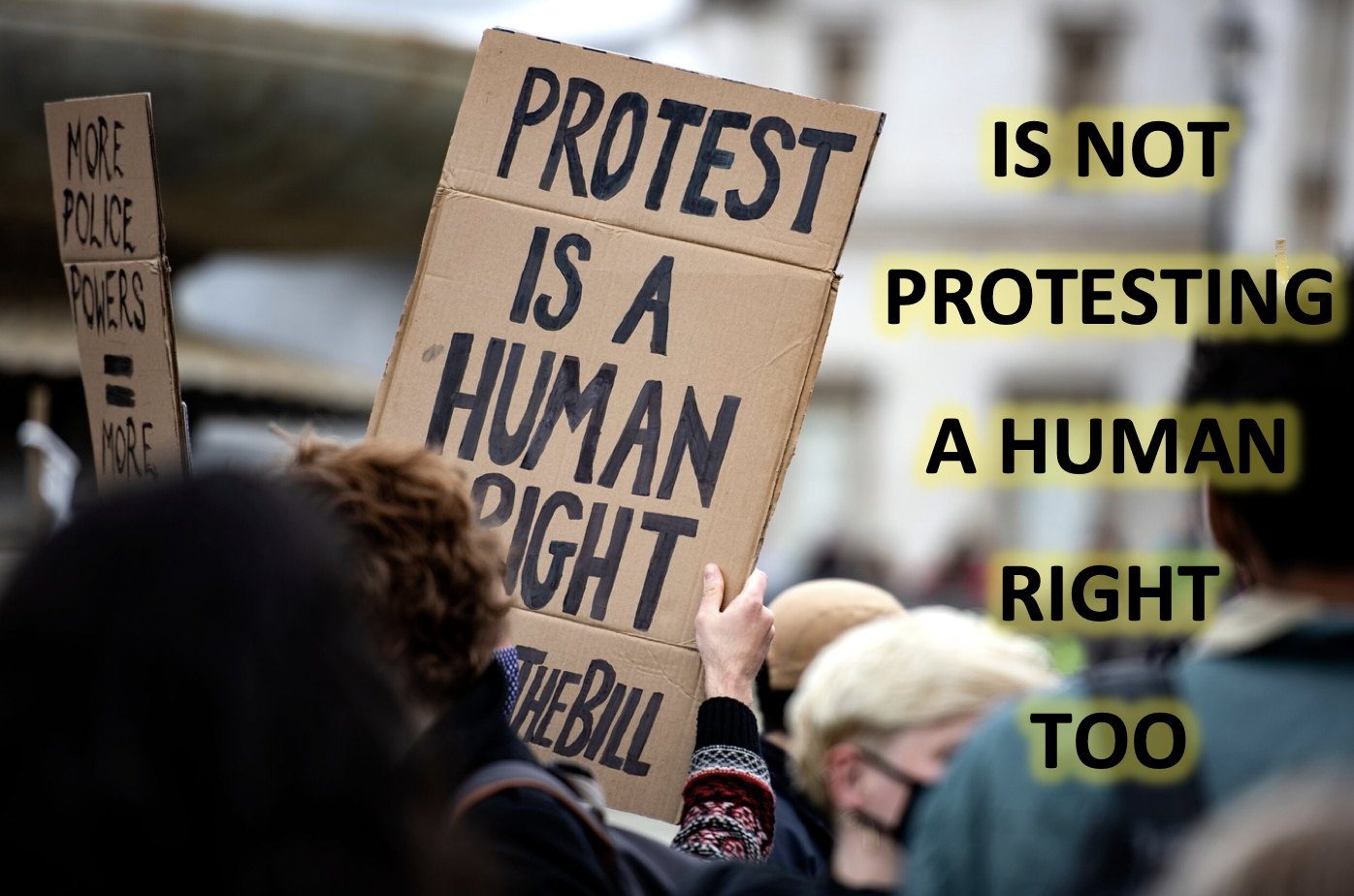
It is legal to protest but there are restrictions. Are protestors aware of the restrictions? If not, the onus is on the Sri Lankan Govt, the Sri Lankan Police to clearly make public what is legal and what is not & it must be communicated by the Govt’s Media division. GoSL must define what is a peaceful protest, who is a peaceful protestor & how does a peaceful protest and peaceful protestor becomes violent & what legal action can be taken against them by the Govt & law enforcements. Legislations or additional legislations must be issued immediately.
Let’s not forget that any protest/demonstration/march is taking place on public space, which means this space is meant not only for the protesting individuals/groups but others as well. Therefore, the law that one’s human rights cannot overstep the human rights of another remains valid & applicable. This is where police are brought in to ensure the protestors do not exceed their rights but also displaying tolerance towards peaceful protestors.
Protest/demonstrate/march in a public space
What laws protect the right to protest in Sri Lanka?
What laws protect the rights of the protestor in Sri Lanka?
When does a peaceful protest become violent? When does a peaceful protestor become violent?
What is a peaceful protest?
Who is a peaceful protestor?
Are there restrictions to hold a peaceful protest?
Ex: a protest or assembly during a plague that may cause a national public health risk
Govt & Police must outline at which instances even peaceful protests can be restricted & what are the restrictions the govt can impose (ex: limiting the number of protestors/protests to gather – distance to be followed – areas permitted etc)
UK passed additional legislation restricting right to assembly & gave the UK police powers to break groups, fine or even arrest who committed offence.
What constitutes a violent protest?
What constitutes a violent protestor?
What is the law applicable if protests/protestors become violent and inflicts damage to people or property (public or private)
As protestors occupy public space there has to be a statute of limitation to their protests – protestors cannot occupy public places indefinitely. This essentially constitutes trespassing & illegal occupation.
Limitations to protests must be outlined in legislation.
What is the ‘restraint’ that law enforcement must abide during a peaceful protest?
What actions can the law enforcements take when peaceful protests become violent?
These must be clearly defined and publicly made aware of.
In what ways can protestors protest – the mediums they can use, the slogans they can use etc must include what constitutes freedom of expression. This is a very sensitive area but a legal explanation with deterrents & actions that can be taken in violating freedom of expression must be provided.
Clear definitions must be made.
It must be added that anyone who is a public figure and as such enjoying tax payers money have to accept peaceful protests against them.
What are the actions that can be legally taken against those that commit public disorder, serious damage to property & life of the community or even intimidation of people.
GoSL must have these clearly outlined in an existing Act amended or a new Public Order Act giving limitations, restrictions, duration and even amount of people allowed to participate by defining the protests/demonstrations and marches.
The police have to not only protect protestors but uphold the peace of non-protestors as well. Therefore, protestors may demand their rights but they cannot ignore that the rights of non-protestors are equally to be upheld and protected.
It is very important that the definitions are clearly legislated and communicated and not only the people but the police are also well aware of the powers they yield and the restrictions with which they too much function.
Categorize Protests
Any protest must take place with permission – written permission must be granted only after it meets the conditions that have been defined.
(written request – requirement for advance notice – date/time – contact details of those in charge) with the approval – a list of dos and donts must be given to the organizers so they are aware of the limitations to their protests and the consequences if they violate.
This has to be conveyed to the police who are aware of the category of protest under which permission has been given and the restrictions with which the protest is bound by. This makes it easy for the police to know what are acceptable and not-acceptable and what actions the police can and cannot take.
Punitive actions
If protests & protestors violate the conditions with which they have been allowed to protest, there has to be appropriate actions against them legislatively made clear. We cannot have a situation where lawyers run to courts to provide free legal advice and clap at protestors who have caused harm or damage to public property.
A first time offence and repetitive offences must carry double fines or community service given current economic situation..
With a powerful Public Order Act in place, with clear definitions for rights and restrictions, punitive actions etc – people not only will have a right to protest, non-protestors will not be inconvenienced while public spaces will not be occupied indefinitely.
It is because protestors and police do not know their rights, do not know what defines a protest and what are the limitations & restrictions applicable to all, unnecessary strife and animosities arise.
Therefore, the Govt without wasting time on bringing constitutional amendments must take up topics that are timely and that has led to a lot of misunderstandings, misrepresenations and misfortunes and bring legislation or amend existing legislation & communicate to the general public, the law enforcements & the legal fraternity who appear to be more confused than everyone else.
The pontiff has lamented military conflicts across the globe and said the Russia-Ukraine crisis may have been provoked”
Pope Francis has suggested that World War III is already in progress, as evidenced by intertwined elements” at work in the Russia-Ukraine crisis and other conflicts across the globe.
A few years ago, it occurred to me to say that we are experiencing a third world war fought piecemeal,” the head of the Catholic Church said in a May 19 interview with Jesuit media outlets that was published on Tuesday. Today, for me, World War III has been declared.”
The Pope noted that while the fighting in Ukraine pricks our sensibilities more,” wars also are ongoing in such places as northern Nigeria and Myanmar, and nobody cares.” He added, The world is at war. This is something that should give us pause for thought.”
What is happening to humanity that has had three world wars in a century … ? You have to think that in a century there have been three world wars, with all the arms trade behind it.
Acknowledging criticism for his failure to condemn Russian President Vladimir Putin and his past comments suggesting that NATO expansion onto Russia’s doorstep might have provoked the crisis, the pontiff denied being pro-Putin.” He said such a claim would be simplistic and erroneous.”
I am simply against turning a complex situation into a distinction between good guys and bad guys, without considering the roots and self-interests, which are very complex,” he said. While we witness the ferocity and cruelty of Russian troops, we should not forget the problems and seek to solve them.”
Asked how the Jesuit editors should report on the Eastern European conflict in a way that contributes to a peaceful future, Francis replied, We have to get away from the common mindset of Little Red Riding Hood. Little Red Riding Hood was good, and the wolf was the bad guy. Here, there are no metaphysical good guys and bad guys, in the abstract. Something global is emerging, with elements that are closely intertwined with each other.”
He also cautioned against focusing only on the brutality and ferocity” of the conflict. The danger is that we only see this, which is monstrous, and miss the whole drama that is unfolding behind this war, which was perhaps somehow either provoked or not prevented. I also note the interest in testing and selling weapons. It is very sad, but at the end of the day, that is what is at stake.”
Francis praised the heroism of the Ukrainian people in defending their country, but he pointed to outside interests putting them in peril. What is before our eyes is a situation of world war, global interests, arms sales, and geopolitical appropriation, which is martyring a heroic people,” he said.
The pontiff reiterated his concern, first made public in an interview last month, that NATO may have instigated Moscow’s military offensive against Kiev. He recalled a conversation with a head of state, whom he identified only as a wise man,” a couple of months before the fighting began. He told me that he was very concerned about the way NATO was acting. I asked him why, and he said, ‘They are barking at the gates of Russia, and they don’t understand that the Russians are imperial and they will not allow any foreign power to approach them.’”
Francis also warned that after many of Ukraine’s Western backers opened their hearts” to the women and children fleeing the country in the early days of the conflict, support for its refugees is already cooling down.” He added, Who will take care of these women? We need to look beyond the concrete action of the moment and see how we will support them so that they don’t fall into human trafficking or end up being used, because the vultures are already circling.”
This is absolute madness. When the country is on its knees, the top of the pinnacle seeks more holidays?
Why don’t the government make the entire week a holiday?
I have seen many Sri Lankan-educated Sinhala in the USA, UK, EU, and Singapore, not getting far in their job, despite qualifications & experience, because they are Lethargic & Lazy. Whilst the Sri Lankan Tamils, keep their head down and get on with the job.
Look at just down the road, what Singapore has done out of a muddy, fisheries backwater, which Sri Lanka tried to emuítate.
Singapore during the same period ~75 years became a Highly Developed country. whilst Sri Lanka went down to a poor desolate bankrupt loser, begging from all the neighbors.
The British colonials ran Sri Lanka or Ceylon for their own needs, without too many give-aways.
What has Ceylon or Sri Lanka done since the independence?
Gone from one World Back Loan to another!!
All is not lost yet.
Within a very short period, the Government with “good leadership” may turn the lazy Sri Lankans into self-sufficiency.
Give the farmers more incentive to cultivate and produce not only for their needs but also to generate revenue-generating exports.
Sri Lanka is rich, if the population decides to venture forth, the harvests could be immense.
Since the independence, the Ruling Families, Senanayake, Bandaranayake, Kotalawela, Premadasa, and Rajapaksa, did get themselves richer and let the peasants down to subservience.
Will the acting Prime Minister Wickramasinghe do any better?
I doubt it!
Are there any potential leaders in the next generation who would put the country First, and forget the Holidays??
LankaWeb – Fridays to be declared holidays for public sector for 3 months
Express Your Opinion – Read What Others Say! The Independent Interactive Voice of Sri Lanka on the Internet.
As an example of how people of different religions can live together, cooperate together, and simply be together, Bangladesh is regarded. Bangladesh is a country that values religious liberty, harmony, and tolerance. Bangladesh’s population is made up of a diverse spectrum of religious groupings and ethnic groups. Such communities and groups live in harmony, putting aside their differences and learning to embrace and respect the diverse and diversified culture that has contributed to Bangladesh’s equality.
Bangladesh stands out as a shining example of a country with unwavering social and religious peace. This country is an example of social harmony because of its rich culture of tolerance and respect among everyone regardless of their views and viewpoints. Their liberal attitudes have contributed to the nation’s synchronization.
The administration of Prime Minister Sheikh Hasina maintains a Ministry of Religious Affairs. All mosques, temples, churches, pagodas, and Gurdwaras in Bangladesh are under the Ministry’s jurisdiction.
Can anyone imagine a Muslim country constructing a Buddhist monastery in Nepal (a religiously Hindu country)? Recently, it established a clear example for all countries in the world that Bangladesh is the global role model of communal harmony. The Bangladesh government is interested in and intends to maintain Bangladesh as a non-communal Bangladesh.
In Bagerhat district, a Hindu man contributed property for the construction of a mosque, and a local Awami League leader (9Muslim guy) handed aside a section of his land to be utilized as a cremation site. Hindus can use this space to foster communal harmony in their community.
The initiative by Dharmarajika Buddhist monastery to distribute food to poor and destitute Muslims is a shining example of social harmony between two groups from two different religions in this South Asian country.
Bangladesh can be regarded as the world’s champion and role model for communal harmony. People have lived here with long-term intercommunal peace and confidence. The world is well aware of and admires Bangladesh’s inter-communal harmony. Bangladeshis adhere to the policy of “religion is everyone’s festival; everyone has equal respect for all religions.”
Bangladesh, as a secular state, strives to protect the rights of all ethnic and religious groups. Inter-communal harmony is synonymous with Bengali culture. It is one of the few countries in the world where Muslims, Hindus, Christians, Buddhists, and various ethnic tribes coexist peacefully.
The government of Bangladesh, led by Prime Minister Sheikh Hasina, believes in inter-communal harmony. She makes every effort to participate in religious and cultural programs. Anyone can see that she is dedicated to protecting the rights of all groups. Sheikh Hasina’s regime is committed to ensuring this.
Various religious holidays such as Eid of the Muslim community, Pujas of the Hindu community, Easter Sunday, Christmas Day of the Christian community, and Buddha Purnima are held simultaneously in Bangladesh during Mangal Shobhajatra or Mangal Jatra at dawn on the first day of the Bengali New Year. Muslim festivals such as Eid al-Fitr, Eid al-Azha, Milad al-Nabi, Muharram, Chand Raat, Shab-e-Baraat, and BishwaIjtema; Hindu festivals such as Durga Puja and Janmashtami; Buddhist festival of Buddha Purnima; Christian festival of Christmas; and secular festivals such as Pohela Boishakh, Nabanna, Language Movement Day, Independence Day, Rabindra Jay in the Chittagong Hill Tracts region, Bengalis and non-Bengalis celebrate tribal holidays such as Biju, Sangria, Baisabi, and others together. Bangladesh has no religious or racial boundaries. Everyone is there for everyone else. In Bangladesh, people of all religions and nationalities are united.
“I usually say that religion is a personal matter, but festivals are open to everyone.” Peace, friendship, and peace are our pride,” said Bangladeshi Prime Minister Sheikh Hasina, adding that the communal harmony that has existed here for thousands of years must be preserved at all costs.
Islam, Hinduism, Buddhism, and Christianity are the four major religions in the country. Muslims account for around 88.3 percent of the population. The majority of Muslims in Bangladesh are Sunnis; however, Shia Muslims make up roughly 3% of the Muslim population. About 10.5 percent of the population is Hindu. Buddhists and Christians make up the majority of the others.
Durga Puja, observed by Hindus, Christmas, observed by Christians on December 25, and Buddha Purnima, observed by Buddhists, are some of the other holidays observed by other communities. These celebrations reflect not only the imprint of religion, but also the imprint of the society and the nation.
The Sheikh Hasina -led Awami League slogan ‘Dhormo Jaar Jaar, Utsob Shobar,’ (Religion as per one’s own, but festivals common to all” as a testimony of its secular values has set a precedent in international community and is an asset for establishing a shining example in South Asia on regarding communal harmony.
As a result, the government has given enough security for religious minorities’ celebrations, such as the Durga Puja. Over 30,000 Durga Pujas were held across the country in 2017, all of which went off without a hitch. In Bangladesh, 31,272 Durga Pujas are being held this year. This reflects the general sense of security in the country, not just among the Hindu minority.
Despite the historic liberal Bengali culture and the country’s secular underpinnings, which were established following the Liberation War of 1971, the fortunes of religious minorities have changed depending on which political dispensation is in power.
The AL-led government has taken a number of substantial steps to maintain and improve the country’s secular underpinnings. In the country’s 1972 Constitution, the Awami League, which led the Liberation War under Bangabandhu Sheikh Mujibur Rahman, integrated secularism as a guiding principle of the state alongside democracy, nationalism, and socialism.
After that, whenever the AL was in power, it tried to protect these ideals as well as the interests and welfare of religious minorities. The Chittagong Hill Tracts (CHT) Peace Accord, signed by PMSH in 1997, marked a turning point in the region’s peace efforts.
Everyone in Bangladesh has equal rights, and no one is labeled as a religious minority. Attacks on the Buddhist community in Ramu upazila of Cox’s Bazar and attacks on different temples in Cumilla were some separate incidents in Bangladesh. Those mentioned how social media could sometimes play a negative role, as fake Facebook IDs were previously used to instigate communal attacks.
There are some misconceptions, misinformation, propaganda regarding the decreasing of number and persecution of minority in Bangladesh that is not absolutely true. However, this perception is entirely false. Unfairly and without basis, Bangladesh is portrayed as a nation that discriminates against its minorities, especially Hindus. The separate incidents can’t and don’t symbolize the mindset of the whole Bangladeshi people. Senior government officials visit regularly a number of the impacted locations and given the Hindu community members assurances that they will receive proper protection and reimbursement for any losses.
There are also many ways to realise religious harmony in Bangladesh. Needless to say, Bangladesh has been winning admiration and appreciation worldwide as a moderate Muslims dominated country.
Community harmony abounds in Bangladesh. People from all faiths interact together in this place. Since the dawn of time, this custom has persisted. Muslims make up 90% of the population, however there are also peacefully coexisting Hindus, Buddhists, and Christians. For the people of Bangladesh, this is surely a source of pride in South Asia.
Dr. Abantika Kumari is an Assistant Professor at the History Department of Allahabad College, Uttar Pradesh, India. She is also a researcher particularly focused on South Asia. She can be contacted at abanthikakumari@gmail.com
The Bangladeshi NGO Odhikar has been deregistered by the Prime Minister’s Office’s NGO Affairs Bureau. The company’s registration renewal application was denied on June 12 due to a bureau application.
The license of the private voluntary organization Odhikar has not been renewed, according to NGO Bureau Bangladesh, due to financial irregularities, foreign grants, moving money into personal accounts other than designated bank accounts, and other inconsistencies.
Despite the government’s claim that Odhikar is required to send regular information on operations, working people, and a list of ongoing projects to the NGO Bureau, Odhikar has not done so in the last seven years. The Bangladeshi NGO Odhikar has been deregistered by the Prime Minister’s Office’s NGO Affairs Bureau. On Judgment Day, the agency submitted an application. The registration of ‘Odhikar’ has been canceled, according to an order issued by the NGO Bureau, for a variety of reasons, including engaging in actions that degrade the country’s image in the international arena. The information required for registration and non-payment of additional fees and VAT imposed by the new law, as well as no response or explanation for objections to the eight financial audit reports of foreign-funded projects, are among the reasons listed on the Odhikar.org website (odhikar.org). Making accusations against Bangladesh and failing to respond adequately to security agency reports on money transaction discrepancies in three projects.
The information that Odhikar has posted on its own website concerning suspected extrajudicial killings, including purported disappearances and murders, has harmed Bangladesh’s reputation overseas, according to the NGO Bureau. To verify the information, the NGO office requests the person’s full name and address. The cause of the case, however, was not disclosed by the company.
Odhikar, a non-governmental voluntary organization in Bangladesh, has been operating without renewing its license for the past seven years. However, the organization is pathetically failing to provide information regarding its actions to the NGO Affairs Bureau. Detailed information on any NGO’s activities, such as the source of finances for conducting activities, updated information about the activities, information about the working individuals, a list of ongoing projects, and so on, must be given to the Bureau of Regular NGOs, according to the concerned. This rule has not been followed by Odhikar.
But, under the guise of a court writ suit, Odhikar is carrying out its activities without informing the NGO Bureau. Officials who are concerned have labeled the situation as illegal.On March 25, 1995, Odhikar, a non-governmental volunteer organization, was registered with the NGO Bureau. Odhikar has made declarations and comments on a number of contentious topics. However, the report’s transparency and the reliability of the data have been questioned at times.
From October 2001 to May 2006, Adilur Rahman Khan, the founder and main leader of Odhikar 7, served as the Deputy Attorney General. By publishing a list of people slain in skirmishes between law enforcement and Hefazat protestors in Dhaka’s Motijheel on May 5 and 6, 2013, the Odhikar NGO generated a big controversy. According to a report released on Odhikar’s website on June 10 of that year, the fighting claimed the lives of 61 Hefazat activists. The report had substantial inaccuracies, according to a preliminary examination by law enforcement. For instance, having the names of five persons on the list many times, adding 11 fictional names to the list, adding the names of those who died of natural causes due to physical disease, adding the names of six people who died outside of Dhaka, and so on.
The Ministry of Information requested a report detailing the list under the Right to Information Act on July 10, 2013, to clear up the uncertainty, but Odhikar refused.Under the guise of confidentiality, the agency refused to submit information to the NGO bureau. In this case, a case was brought under the Information Technology Act against Adilur Rahman Khan, Odhikar’s General Secretary, and Nasir Uddin Allan, Director. The Dhaka Cyber Tribunal is hearing the case.
According to media sources, the NGO Bureau’s rights have discovered several severe anomalies in the NGO’s actions. In violation of the law, the corporation operated eight accounts, including two personal accounts. The NGO had eight audit objections when it applied for re-registration.The NGO bureau was warned by the government’s security agency about bad activity and discrepancies in financial transactions in Odhikar’s three initiatives. The bureau later demanded an explanation several times, but Odhikar was unable to produce one that was adequate. Odhikar failed to submit the project report to the local administration every year and at the end of the project time, despite the fact that it was required.
Many people believe the Bangladeshi government would remove Adhikari’s license if it continues to hide its human rights abuses from the international community. That is not the case, however. The United States has sanctioned RAB and its top seven officers. The United States may rely on unsourced statistics from the human rights organization. Bangladesh, on the other hand, has been warning the NGO about its negative operations for years. The organization, on the other hand, did not believe it was necessary to hear the proper authority’s procedural orders. However, if the group’s license is removed as a result of the RAB sentence, it’s possible that the incense will be canceled as well. On the other hand, that’s a very different tale. As a result, tying the RAB sentence to the Odhikar situation is inexcusable and irresponsible.It is a Bangladeshi human rights organization that has been aiming to damage Bangladesh’s image by supplying and disseminating misleading, erroneous, and unjustified facts to the Bangladeshi people and the rest of the world.
Even the money’s origins are unknown. Some powerful interests in Western countries may be able to donate money to human rights groups. The group spreads false information regarding the human rights situation to international human rights groups. As a result, it’s easy to deduce that it promotes the interests of people with vested interests. As a result of recent US sanctions against RAB and its seven executives, some speculate that Odhikar could be pursued by Bangladeshi authorities.They should keep in mind, however, that the human rights organization has been working in Bangladesh for several years without their license being renewed. Every organization and individual has the legal right to work in the country, but the government must legalize it. Odhikar, being a company, is required to follow the country’s standards, rules, and laws. Many people believe Bangladesh is powerless to cancel the organization’s license. But why is it the case? Is Odhikar operating in defiance of Bangladesh’s legal system? Odhikar will not be able to do so if he follows the proper protocol. Authorities have issued many warnings. Isn’t seven years sufficient? On the other hand, no one, even organizations, has the authority to deliberately smear a country’s image by supplying and disseminating false information.
Has the organization right to tarnish the image of the country by disseminating misinformation about the human rights issue in the country?
Since they are funded by donors, they naturally feel loyal towards whichever group is providing the funding. Because these NGOs are funded by donors, they feel driven to gather negative information, thinking that if only positive information is collected, their funding will be cut off. Politics might or might not play a role here.
Because they are financed by contributors, they are naturally loyal to the organizations that supply the funds. Even huge non-governmental organizations rely on donations, and they struggle if they don`t get the cash they need. This is exactly what happened throughout the pandemic.
NGOs were largely inactive throughout the outbreak. The NGOs were unable to offer much funds because the western world was also suffering from the pandemic`s effects. There is a limitation in this sense.
The methodology utilized to collect this data has been questioned. The procedures utilized by data collectors are not accurate. They employ an ineffective methodology. They must produce and share the data with the appropriate authority if they are truthful in their data collection method. That, however, was not the case. This is also a stumbling block. What are the stumbling blocks? I believe they have a nefarious motivation. Critics must remember that the Bangladeshi authority did not make a mistake in this regard. The group`s license is revoked for legitimate reasons.
Colombo, June 15: On the face of it, China appears to be shedding its aloofness and trying to create the impression that it is also helping Sri Lanka overcome the current grave economic crisis. It says that it has pumped in US$ 76 million so far.
But that sum pales into insignificance in comparison with India’s largesse of US$ 3.5 billion. What is glaring is the absence of a willingness on China’s part to restructure the repayment of its loans, and the conditions which it has attached to the use of the funds given.
Beijing’s tough stance gives the impression that it does not consider it worthwhile to put any more money into Sri Lanka or go out of the way to be considerate to it.
Apparently, China thinks that Sri Lanka has not created a climate for economic growth which will help attract Chinese and foreign investment. For Beijing, the real solution to Sri Lanka’s current crisis lies in promoting economic growth, securing FDIs, increasing trade and signing an FTA with it.
China believes that Sri Lanka’s problems are of its own making. Therefore, first and foremost task for Sri Lanka should be to set its house in order. If the Western nations want Sri Lanka to agree to the IMF’s conditions before they consider pumping in money or make investments, China wants Sri Lanka to create a suitable climate for Chinese investment and sign a Free Trade Agreement with it. Chinese Foreign Minister Wang Yi and other top officials had made this very clear to the Lankan Establishment.
However, Sri Lankans have a different way of looking at this. President Gotabaya Rajapaksa had told Bloomberg News that China is not helping because it has lost interest in South Asia as such, and that it is concentrating on South East Asia and Africa instead. Therefore, there is little chance of securing Chinese help now. But Prime Minister Ranil Wickremesinghe has a different perception. He told WION TV that China is very much involved in South Asia through its military engagement with India on the Himalayan border and its economic stakes in Pakistan, Sri Lanka and the Maldives.
Unlike Gotabaya Rajapaksa, Wickremesinghe believes that negotiations with China on loan rescheduling will help and that he can get China to waive the conditions attached to its loans. He pointed to the difficulty created by the fact that China is not a member of the Paris Club which works out re-scheduling loan repayments.
However, if China persists with its line of seeking radical changes in the way the Sri Lankan economy is run, chances of any meaningful aid coming from it are dim. And that could mean that Sri Lanka will have no option but to hitch its fortunes to India and the West rather than China.
Wickremesinghe told WION that Sri Lanka had to rely on India during the present crisis because China remained aloof and came up with conditions, while India rushed material aid and loosened its purse strings. Naturally, Sri Lanka had to opt to go with India (and as a follow-up, go to the IMF with India’s help). The Chinese Ambassador, Qi Zhenhong, complained about the swing towards India and suggested that China itself could have helped Sri Lanka negotiate a good deal with the IMF given its clout in that organization.
But his suggestion came too late. Taking Chinese help when India had already taken up Sri Lanka’s case with the IMF would have put off India, China’s geo-strategic rival in South Asia. Moreover, the Gotabaya Rajapaksa government had taken a decision to hitch its security wagon to New Delhi, and has been increasingly and closely working with the Indian security establishment.
However, China has, of late, expressed an interest in working with India in the Sri Lankan case. Its foreign ministry spokesman, Zhao Lijian, told the media that India has done a lot to help Sri Lanka and China is ready to work with India and the rest of the international community. Prime Minister Wickremesinghe has a plan to put in place a multilateral aid consortium, including China and India.
But the worrying questions are: Will India accommodate China, its geopolitical rival? Will China allow repayment of its loans to be restructured as it did in the case of Pakistan? According to Lankan economist Umesh Moramudali, China has become risk averse” and might hesitate to be very accommodative.
Chinese Foreign Ministry spokesman Zhao Lijiang said on June 8 that Sri Lanka should boost its own effort, protect the stability and credibility of the investment and financing partners and ensure the stability and credibility of its investment and financing environment.”
On June 9, 2022, the Director-General of the Department of Asian Affairs of the Foreign Ministry Liu Jinsong told Ambassador of Sri Lanka Dr. Palitha Kohona that Sri Lanka should stick to the independent domestic and foreign policies, by which he meant that it should not fall prey the West’s machinations.
On January 9, 2022 Chinese Foreign Minister Wang Yi had told President Gotabaya Rajapaksa that Sri Lanka should make good use of the two growth engines, the (Chinese-built) Colombo Port City and Hambantota Port projects, tap the opportunities of the enforcement of the Regional Comprehensive Economic Partnership (RCEP) and China’s vast market, and discuss the restart of talks on a free trade agreement between China and Sri Lanka to send more positive signals to the world and contribute to Sri Lanka’s economic recovery and development.” He further said that if these are done, China would encourage competent Chinese enterprises to invest and develop in Sri Lanka. But this is a tall order for Sri Lanka.
In March 2022, Chinese Ambassador Qi Zhenhong said that Beijing is considering a loan of US$ 1 billion, and a credit line of US $ 1.5 billion, in addition to the US$2.8 billion assistance that it had extended to Sri Lanka since the outbreak of the pandemic. Asked if China had taken a decision on President Gotabaya Rajapaksa’s request to restructure Chinese loans, the Ambassador said both sides are negotiating. He further said that the two countries are negotiating a Free Trade Agreement and that its successful completion and signing will open up” the Chinese market for Sri Lanka’s exports.
However, the promised loan and buyers credit have not come. Negotiations on loan repayment are stuck and talks on the FTA are at a standstill. FTAs are an anathema to Sri Lankans.
Role of Geopolitics
China’s reluctance to put money into Sri Lanka is partly due to its geopolitical rivalry with India. China was put off by Sri Lanka’s decision to cancel a project given to the Chinese firm Sinosoar-Etechwin to install hybrid renewable energy systems” in Nainativu, Delft or Neduntheevu and Analaitivu islands, located in the Palk Bay in North Sri Lanka, after India raised security issues.
The cancellation of the island power projects had taken place when China was showing an interest in investing in the North, if only to challenge to India’s claim to have exclusive rights in the Tamil-dominated area. Ambassador Qi asserted that Tamils love China”. China has established a sea cucumber farm and factory in the North. It is also interested in getting a foothold in the Tamil-speaking Eastern Province, in which India has 99 oil tanks and an interest in the Trincomalee harbor which is seen as a strategic asset.
(A version of this article appeared in Counterpoint on June 15, 2022)
An official report on the possible mid-air collision avoided by UL 504 has been filed by the crew upon their return to the BIA yesterday which has confirmed that due to the vigilance and action taken by the crew, they had managed to avert one of the worst mid-air collisions.
Sri Lankan Airlines however seem to be unaware of this report filed by its own crew and have released a statement saying UL 504 was not at risk of a mid-air collision with another aircraft at any point, despite their official document confirming it. Sri Lankan Airlines clearly seem to be misleading the public at this point or simply are unaware of the official mandatory documents filed by their own staff.
While it is confirmed that the vigilance and quick decision-making by the pilot and crew avoided this mid-air collision, Sri Lankan Airlines failed to answer the calls by Daily Mirror last evening when we attempted to re-confirm the story.
It is the document that the Daily Mirror later came in possession of that divulged the exact details.
The report clearly mentions that there was a British Airways flight above at 35,000 feet in the Turkish Airspace and the UL504 crew observed an ATC conversation between BA AIR and Ankara Control regarding a possible intermittent transponder failure on BA AIR.
In the crew’s own words, “Due to the vigilance and the action taken by the crew on UL504, managed to avert one of the worst mid-air collisions.”
The UL pilot and crew who had been vigilant had detected a British Airways flight just 15 miles away from them flying at 35,000 feet and informed the air traffic control at Ankara that there was a flight already above.
The British Airways flight which was on its way to Dubai and then Singapore had left Heathrow just shortly after the UL flight had taken off.
If the UL captain had climbed to the requested height, the UL flight would have faced a mid-on collision with the British Airways flight, as it was flying at a faster speed than the UL flight. Upon landing at the BIA the passengers safely disembarked from the flight along with the crew and a report on the incident was filed. (Jamila Husain)
The Embassy of the United States of America announced today that the U.S. International Development Finance Corporation (DFC) Board of Directors has approved USD 120 million in new loans to grow and support the Sri Lankan economy.
For seventy years, the United States has provided foreign assistance, loans, and trade opportunities to help grow the Sri Lankan economy and support the Sri Lankan people,” said U.S. Ambassador to Sri Lanka Julie Chung.
Today’s announcement is good news for the private sector, as the DFC’s USD 120 million in new investments will reach small and medium-sized businesses and help to provide equity, jobs, and futures,” she added.
The projects announced today include a USD 100 million direct loan to the Commercial Bank of Ceylon, Sri Lanka’s leading commercial private bank, to expand lending to micro-, small-, and medium-sized enterprises (MSMEs) and address the credit gap for women-owned businesses, which represent 25% of MSMEs in Sri Lanka.
In addition, DFC announced a USD 15 million loan to BPPL Holdings PLC, a polyester yarn manufacturer incorporating recycled plastic materials.
The loan will support increased production and strengthen Sri Lanka’s recycling infrastructure in support of efforts to reduce plastic waste in Sri Lanka.
Also announced today was a USD 5 million loan to MA’s Tropical Food Processing (Private) Limited, a sustainable food company, to finance its expansion and grow its supplier network. This effort will strengthen Fair Trade practices in Sri Lanka and create new jobs, with an emphasis on increasing women’s employment.
These new loans build on DFC’s existing portfolio in Sri Lanka of nearly USD 300 million in funding for the MSME sector over the past two years.
The diverse set of transactions announced today will make real impact across a range of sectors and development challenges,” said DFC CEO Scott Nathan. These transactions showcase how DFC strategically catalyzes private capital where it matters most.”
Around the world, DFC partners with the private sector to finance solutions to critical challenges, investing across sectors including energy, health care, critical infrastructure, and technology. DFC also provides financing for small businesses and women entrepreneurs in order to create jobs in emerging markets. DFC investments adhere to high standards and respect the environment, human rights, and worker rights.
These announcements may be subject to congressional notification in Washington and other administrative approvals. The U.S embassy said more information will be made available when funds are ready for disbursement.
It took US 60 years (19 Aug 2013) of silence and denial to finally admit to its role in toppling the elected PM of Iran Mohammad Mossadegh on 19 August 1953. There was no social media then, no artificial intelligence, no NGOs of the kind present today, all it took was one US CIA agent – Kermit Roosevelt Jnr (grandson of US President Theodore Roosevelt). Kermit Roosevelt toppled a leader in just 4 days. Operation Ajax was the name of the coup started on 15th August 1953 and ending with the ouster on 19th August 1953. Kermit died aged 84 years in 2000 and was not alive to see US take responsibility for the coup he orchestrated.
Who was Mohammad Mossadegh
He was a leader the Iranians held in high esteem & elected by the Iranian people in 1951.
Iran had a constitutional Monarchy with Mohammad Reza Pahlavi remained monarch & Mossadegh becoming PM.
Where did he go wrong
He began introducing a range of social & economic policies that led to the nationalization of Iranian oil which didn’t go too well with UK who controlled Iran’s oil via Anglo-Iranian Oil Co.
London based financier William D’Arcy struck oil in Iran in 1908 & an Anglo-Persian Agreement was signed giving Britain control over Iran’s army, treasury, transport system & communications network. Nationalizing oil meant nullifying that agreement.
This meant it would end UK’s monopoly of Iran’s reserves for 45 years (1908)
Britain secured US assistance to orchestrate Mossadegh’s overthrow.
Lesson here is – any leader going against Western corporate interest will be overthrown!
Outcome of overthrowing Mossadegh
CIA chased a democratically elected leader & brought in Mohammad Reza Pahlavi – the Shah of Iran. The Shah ruled for 25 years until 1979. Years of brutal suppression for which US has to account for.
Who was Kermit Roosevelt
Kermit joined Office of Strategic Services (OSS) in 1947 which was the predecessor of CIA. It was in February 1953 that British intel agents approached CIA head Allen Dulles & his brother Secretary of State John Foster Dulles (no nepotism here) to assign Kermit for the task. A request made in February 1953, received final approval in June 1953, Kermit arrived in Iran on 19 July 1953 and exactly a month later the coup succeeded after Kermit hired protestors/demonstrators & military officials. Leaders of US & UK were President Eisenhower and British PM Churchill.
Part of Operation Ajax was to work with nicknames – Shah was Boy Scout’ and Mossadegh was Old Bugger”.
What was Kermits role in the overthrow of Mossadegh
Kermit Roosvelt knew communication was key.
He bought people in media bribing them. Nothing new – we see it happening even presently.
Kermit got these paid media personnel to come up with anti-Mossadegh propaganda.
That happens even now in all parts of the world.
Kermit next turned to tapping the Islamic clergy – a tactic used presently too.
Kermit paid Iranians to protest – he paid for the banners – he paid for the slogans.
Kermit also tapped Iran’s military including Gen. Zahedi.
Kermit then plotted to capture Mossadegh from his home.
The 1st coup attempt failed. The 2nd didn’t.
Mossadegh was captured after CIA tapped Iranians to capture their leader.
He was placed under house arrest (14 years) until he died on 5 March 1967.
Countries that are geopolitically significant where US & West have their hotspots, the manner they operate cannot be missed.
Look at how Iran fell and tie them up with countries also under West’s radar.
US does not like negative public criticism – what do they do, they buy over the press and communication channels & Voice of America radio is used to counter criticisms
US spent a lot of energy showing concerns for Iranians & their welfare – to build trust, popular personalities invited for tea & sharing their photos is a good clue.
If US used slogan anti-communism, anti-Soviet previously, present context is anti-China
Locals that US tapped in Iran were wealthy landowners (pro-West elite society), university professors & students, secondary school teachers & even students (presentploy of gifting laptops and smartphones is a clue), professionals, government employees, leaders of public opinion, religious leaders, village headmen, tribal chief, labor leaders, army officers. (same coterie getting tapped presently too)
The Campaign US deployed against Mossadegh was to paint him as being sympathetic towards communism, that he was directly dealing with the Soviets & that he was planning to surrender Northern Iran provinces to the Soviet Union,
The Campaign US deployed against Mossadegh vis a vis economy was to blame him – calling him corrupt & dictatorial
US used religious leaders against Mossadegh
US used false information (Black Propaganda) – which included threatening people
US plan included staged attacks (similar to the 9 May 2022) which was to be supported with fake documents of Mossadegh giving instructions for attacks
US plan was to divide segments of society against Mossadegh but creating lies & distancing nationalists away from Mossadegh to isolate him (similarities with Sri Lanka)
CIA knew that they could influence the top tier of Iranians & succeed
US State Dept agreed that they faced 3 issues following the ouster of PM Mossadegh
Allegation of US role in deposing Mossadegh
Allegation that Gen. Zahedi was a US puppet
Nullifying Mossadegh as the Iranian hero.
Geopolitical importance of Iran for US/UK
Iran was needed to block Soviet access to the Persian Gulf. This meant the West required to ensure Iran’s oil reserves remained accessible to Western companies stationed in Iran since 1908.
Declassified documents revealing details of Operation Ajax is a public admission of CIA role in regime change which the US State Dept denied previously. US Secretary of State Madeline Albright in 2000 and President Obama in 2009 also referred to US role in coup. How many other coups has US denied while declassified documents have shown quite the opposite.
1000 pages of documents on the 1953 coup reveal that the 1st attempt failed and US advised to call off the operation but CIA agent Kermit went ahead & on his own will carried out the coup using ‘rented’ crowds (protestors)
Hired crowds became a hallmark of US regime change operations in the present decade as well.
Iranian protestors did not know the US had funded the protests – they knew only years later.
The speculation of US involvement was raised but denied.
It took 60 years for US to admit to hiring and funding the protests and opposition needed to oust an elected PM.
The same blueprints are happening even in Sri Lanka.
What we can be sure of is that we shall only know the truth decades later!
Bangladesh has recently been depicted by some in the international media saying ‘there will be no Hindus left in Bangladesh in the next 30 years if the current rate of exodus continues’ and Hindus are fleeing to India’. However, this understanding is completely incorrect. Bangladesh is being depicted unfairly and without evidence as a country that discriminates against its minorities, particularly Hindus. There is no doubt that Bangladesh has seen a steady outflow of Hindus since Partition. Minorities accounted for 23.1% of the population in 1951, but only 9.6% in 2011.A recently published book has predicted that there will be no Hindus left in Bangladesh in the next 30 years if the current rate of exodus continues. According to the book, 11.3 million Hindus were either forced to leave the country or migrated between 1964 and 2013. The author of the book, said the rate of exodus over the last 49 years paints a grim picture for the Hindu minority in Bangladesh where their population remains just 8.2 percent according to the last census.
The book, perhaps, is unable to make understand of the real situation in Bangladesh. The author has failed to depict the real scenario of Bangladesh. For example, Priya Saha a Hindu minor rights activist, participated in the Second Ministerial to Advance Religious Freedom held at the US Department of State in Washington, DC on July 16-18, 2019. In a video clip that went viral on social media, that Priya Saha was heard telling Trump: “Sir, I’m from Bangladesh … 37 million Hindus, Buddhists and Christians are disappeared. Please help us – for the Bangladeshi minor people. We want to stay in our country. In a video message, Priya Saha explained her position and tried to defend her remarks tagging Abul Barkat’s research findings. Then the[u1] author said in 2019 Priya Saha has distorted his research findings by her comments during an interaction with US President Donald Trump that 37 million Hindus, Buddhists and Christians have disappeared in Bangladesh. However, the author’s works sparked a controversy in Bangladesh. On the other hand, during the eruption of communal violence in Bangladesh against Hindu minorities in 2021, a countless arguments and numerous criticisms had been brought to light. Some claimed that Bangladesh has become quite a case of ethnic cleansing- subtly but forcefully ousting Hindu minorities across the border. Some even went further claiming that Bangladesh has failed to form a state where different religious and ethnic groups can coexist based on the principle of secularism- one of the four fundamental pillars of the liberation war in 1971. To cast evidence to those criticisms, most of them point fingers to the continuous decline of Hindu minority population in Bangladesh- a case drawn to demonstrate Bangladesh as a prolific ground of persecution against Hindu. But an objective discernment to those allegations, especially through comprehensive statistical appraisal, relative systemic endeavors and broader political landscape, makes them, in most part, lose their grounds.
Statistics and Apparent Assumptions
According to the BBS (Bangladesh Bureau of Statistics) data, the percentage of Hindu community to total population was 13.5% in 1974, on Bangladesh’s first population census, which, as of the latest census in 2011, stands at 8.5%, and again increases to 10.7% in 2015. Ostensibly, these statistical figures, continuous decline in percentage, seem to confer voice to predominant arguments about the decline of Hindu population. But mere percentage estimation tells only the half truth about the broader demographic landscape of Hindu minority in Bangladesh. If we take the increase in total number, other than mere percentage, over the years along with other factors that have contributed to decline, into account, it will substantially clarify the whole picture and weaken the predominant narratives about the decrease of the number and persecution of Hindus in Bangladesh.
Taking the total number into account, in 1974, the number of Hindu populations was 10.31 million which hit slightly above 12.7 million in 2011 and 17 million in 2015. It is seen that the total number has remained increasing whereas percentage to total Muslim population, due to relatively higher growth in the number of Muslim populations from 65.24 million in 1974 to135.4million in 2011, has kept decreasing. It is true that growth in numbers is a little slow among Hindu population and could hit 22 million by 2011 only if it increased linearly in terms of percentage as reported in 1974 (13.5%). But that is not because of any systematic persecution against the minority rather, in most part, of international economic migration, relatively lower birth and high mortality rate among Hindu population, higher rate of contraceptive use and particular political reality in the history of Bangladesh.
According to the study paper prepared by researchers from ICDDR, B’s Health Systems and Population Studies Division and the University of North Carolina (Chapel Hill), studying the population data of 1989-2016 of Matlab Upazila in Chadpur to find out why Hindus have lower population growth than Muslims, the birth rate of Hindu populace in every thousand falls short by 3 points comparing to Muslims. While the probability of having a child among the Muslim women is 35, it is 32 among Hindu women.
The study found that the tendency to late marriage and having not more than 2 children and relatively higher use of contraceptives also contribute to the low birth rate among Hindu populace. Even higher numbers of deaths, 4 more than that of Muslims in every ten thousand, can also be subscribed to the decrease in percentage. Finally, researchers concluded that 71 percent of low growth rate may be attributed to the the low rates of fertility and 23 percent to the international out-migration by Hindus.
In the report, they also observed that, since 2006, more Hindus have been opting for countries other than India for out-migration. Only 36 percent of the migrating Hindus of Matlab went to India between 2005 and 2012, but the bigger portion of them went to the states other than India for better living- a countervailing evidence against predominant propaganda that more Hindus have been leaving for India due to persecution.
Political Upheaval and Systemic liability
To be true, the percentage of Hindu minority comparing with that of Muslim has declined over last 50 years. But this estimation has overlooked a subtle but solid point: a fundamental political upheaval and constitution of Bangladesh from 1975 to 1991. Just take the number into account, from 1974 to 1991, percentage of Hindu minority to total population came down from 13.5 to 10.5 in 16 years. But, after the end of anti-secularism fueled military rule in 1991 and installation of constitutional democracy, percentage decline got little slower- 10.5 in 1991 to 8.5 in 2011 within 20 years of time span. In 2011, after the 15th amendment of Bangladesh constitution, secularism was restored which especially which has contribution to increase of percentage of Hindu people to total populace to 10.7% point in 2015. Unlike, its two bordering states- Myanmar and India, the former denying Muslim Rohingya minority of citizenship since 1982 out of pathological hatred and the latter rendering Muslims stateless through anti-Muslim laws, Bangladesh has never, particularly since 1991, intended to promote any discriminatory policy, be it in practice or by laws. Praiseworthy and prompt action taken by the Government of Bangladesh against the menace of recent Durga Puja incident, is a glaring example of this.
Minority is such a phenomenon which every country must possess, be it ethnic or linguistic or religious. But state sanctioned discriminatory policy, inherent ethnic or religious tension or historical schism mobilized by for political score usually contribute to violence against minorities. However, in Bangladesh mostly politically cornered vested groups have played out on minority to stoke crisis and tame the situation to their end. Besides long cherished pluralistic sentiment in Bangladesh is, rather in times, menaced by ‘spill-over effect’of politics and policies in proximate neighbors, of course by political fringe groups.
Officials granted leave for one working day a week and ‘provided with the facilities to engage in agricultural activities in their backyards’, cabinet said
The country’s unprecedented economic downturn has left staple foods in short supply and 4 out of 5 people in the nation of 22 million were forced to skip meals
Crisis-hit Sri Lanka is asking civil servants to take an extra day off each week to grow crops in their backyards in a bid to forestall a looming food shortage.
The island nation’s unprecedented economic downturn has left several staple foods in short supply, along with petrol and medicines, and rampant inflation is ravaging household budgets.
It seems appropriate to grant government officials leave for one working day of the week and provide them with the necessary facilities to engage in agricultural activities in their backyards,” a cabinet statement said Tuesday.
The extra day off would be a solution to the food shortage that is expected to occur in the future”, the statement read, adding that cutting down on civil servant commutes would also help reduce fuel consumption.
Last week the United Nations warned Sri Lanka was facing a dire humanitarian crisis”, and said four out of five people in the nation of 22 million were forced to skip meals.
Motorists, meanwhile, have suffered through months of chronic petrol and diesel shortages, and long queues of vehicles outside filling stations are a regular sight around the country.
Public employees will have every Friday off for the next three months without a pay cut, according to the cabinet decision, but the arrangement will not apply to essential services staff.
The government also said any members of the 1.5 million-strong public sector who wanted to travel abroad to find work would be given up to five years of unpaid leave without affecting their seniority or pensions.
‘Sometimes I sleep in the tuk-tuk: taxi mum among the casualties of Sri Lanka’s economic crisis
The move is aimed at encouraging more people to get foreign jobs and send money back to the island, which is labouring under a critical shortage of foreign currency to buy imports.
Sri Lanka has defaulted on its US$51 billion foreign debt and is in talks with the International Monetary Fund for a bailout.
Public protests have demanded the resignation of President Gotabaya Rajapaksa over mismanagement of the country’s economy and the severe hardships facing its people.
Rajapaksa introduced sweeping tax cuts soon after coming to power in November that have been blamed for leaving the island without the means to pay for essential imports.
The cash shortfall was worsened by the Covid-19 pandemic, which savaged the local tourism industry and cut remittances sent back home by Sri Lankans working abroad
Sri Lanka is in a dire situation. Known as the “Pearl of the Indian Ocean,” the country is facing the worst economic crisis since independence in 1948. Western media has taken this opportunity to hype up the so-called Chinese debt trap, alleging that Sri Lanka is on the verge of economic collapse because it was unable to repay its large loans from China. They add that the Belt and Road Initiative (BRI) has brought a heavy burden to the Sri Lankan economy, and constantly pitting the Sri Lankan government and its people against China, while turning a blind eye to those who are really behind all this.
Caught fire by accumulated debt
There are many causes for Sri Lanka’s economic crisis, among which the foreign exchange crisis is the main factor. Since its independence, Sri Lanka has suffered from internal and external troubles. It has been carrying trade deficits and relying on loans for years. Due to the combined impact of a string of terrorist attacks in April 2019, the COVID-19 pandemic and the Russia-Ukraine conflict, the country’s pillar industries including tourism, overseas remittances, tea and garments have been hit hard and it has rapidly drained its reserves.
What’s worse, Sri Lanka introduced a low tax regime in late 2019, which caused the government a loss of more than $1.4 billion in revenue, further limiting its capability to purchase foreign exchange.
While foreign exchange earnings have plummeted, Sri Lanka’s import payments have continuously increased. Sri Lanka’s production materials and daily necessities are highly dependent on imports, and the armed conflict between Russia and Ukraine has triggered a surge in global commodity prices. Taking energy as an example, 60 percent of Sri Lanka’s electricity is generated from coal and oil, which both need to be imported. The global oil price increased by six-fold from $18 a barrel in April 2020 to above $100 a barrel now.
At the beginning of 2021, the Sri Lankan government banned the import of chemical to prevent the outflow of foreign exchange, resulting in large-scale crop failures, and the government had to replenish food reserves from abroad, further exacerbating the shortage of foreign exchange.
Sri Lanka’s foreign exchange reserves have plummeted by about 70 percent in the past two years. Its reserves stand at around $1.9 billion at the end of March, while its foreign debt obligations for this year exceed $7 billion. On April 12, the Sri Lankan government officially announced the temporary suspension of foreign debt payments, defaulting on its $50.7 billion foreign debt. On May 19, the government announced that it had failed to repay a total of $78 million in debt, which marked the nation’s first sovereign debt default since it gained independence.
The U.S.-led West have been pouring oil on the flames after setting fire
Although Sri Lanka has been in debt for many years, it has previously maintained a good record of foreign debt repayment. The Russia-Ukraine conflict, which was caused by the U.S.-led West intervention, had a very serious impact on Sri Lanka’s economy, which was already in bad shape, and leading to its default. It is the hegemony and the greed of capital of the U.S.-led West that are the root causes of the economic crisis faced by Sri Lanka and other developing countries.
The mounting sanctions imposed on Russia by the U.S.-led West have been pushing global food and energy prices to new heights, and there are also restrictions on Russian financial and aviation sectors. The food prices surged in Sri Lanka due to soaring prices of wheat and corn triggered by the Russia-Ukraine conflict.
Sri Lanka exports about $150 million of tea and other commodities to Russia annually. However, as more and more Russian banks are banned from the SWIFT network, Sri Lanka was unable to obtain foreign exchange by exporting to Russia. In January this year, Russia was Sri Lanka’s largest source of tourists, but in March, the state-run national carrier of Sri Lanka suspended its flights to Russia due to the Western sanctions.
In terms of debt structure, most of Sri Lanka’s debts are in the form of international sovereign bonds, and the Asian Development Bank and Japan are its main lenders. According to Central Bank of Sri Lanka data, as of October 2021, Sri Lanka’s international sovereign bonds reached $11.82 billion, accounting for 34.1 percent of total external debt. In terms of bilateral loans, Japan and India ranked first and second, with $3.54 billion (10.2 percent) and $790 million (2.3 percent) respectively, higher than China.
China’s bilateral loans to Sri Lanka are not the largest. Even with financial market loans (Exim Bank of China) included, it only accounts for 10 percent, and most of the loan interest rates are much lower than the capital markets, among which over 60 percent are concessional loans, and the remaining 40 percent are interest-free loans. So Sri Lanka’s debt repayment problems have very little to do with Chinese loans.
In fact, Sri Lanka is not the only country that suffers from the economic crisis. The Federal Reserve and other major central banks have raised interest rates to quell inflation, which drives up borrowing costs and may bring debt crisis to many developing countries. Turmoil triggered by rising food and energy prices is already gripping countries like Egypt, Tunisia and Peru. Scarcities of food, energy and finance put more than 70 countries at risk of following Sri Lanka into default, says United Nations, according to a recent report by the Wall Street Journal.
The trap of so-called Chinese debt trap
In recent years, governments and media of the U.S.-led West have tied the concept of the “debt trap” to China as a weapon to tarnish China’s reputation and the BRI in order to counter China’s promotion of BRI, maintain their political and economic hegemony, and prevent the developing countries from participating in the BRI.
A view of Sri Lanka’s Hambantota International Port, May 6, 2021. /Xinhua
The Hambantota Port is a most cited case by the U.S.-led West in hyping up the “Chinese debt trap.” It is falsely claimed that China used the port to drag Sri Lanka deep in debt and would transform it into a military base in the future. But the fact is that the Hambantota Port added $1.12 billion of foreign exchange reserves for Sri Lanka to repay some short-term foreign debts. What’s more, the Hambantota Port is difficult to use as a military base due to water depth limitations, and the Sri Lankan government has explicitly prohibited the use of the Hambantota Port as a foreign military base.
On the contrary, India has recently partially acquired the Trincomalee Port situated on the eastern coast of Sri Lanka, which is a large natural port from a military point of view and used to be a strategic oil terminal for the British army during World War II. Because the United States intended to build a “economic corridor” and highway from Trincomalee to Colombo through the the Millennium Challenge Corporation (MCC), which is obviously for military purposes, the United States, India and other countries have played deaf and dumb.
As a close neighbor of Sri Lanka, China has been sincerely helping Sri Lanka develop its economy. Instead of causing any crisis, China has over the years provided selfless help and firm support to Sri Lanka in socio-economic development. Especially since the onset of the COVID-19 pandemic, China and Sri Lanka have supported each other and pulled through together, writing a new chapter of China-Sri Lanka friendship. Chinese Premier Li Keqiang noted that China empathizes with Sri Lanka for its difficulties and challenges, and China is ready to provide much-needed livelihood assistance for Sri Lanka within its capacity.
The Sri Lankan government have explicitly refuted the myth of “Chinese debt trap” time and time again. Recently, Ranil Wickremesinghe, Sri Lanka prime minister and leader of the United National Party, expressed his gratitude to China for assisting Sri Lanka in overcoming difficulties in all aspects and stressed that the government will continue to attach great importance to developing ties with China and push forward BRI projects in the country, accelerate the development of the Colombo Port City, Hambantota Port and other major cooperation projects, make every effort to protect the safety of Chinese institutions and personnel in Sri Lanka.
The international community, especially the developing countries, need to be wary of the trap of “Chinese debt trap” set by the U.S.-led West,which is a systematic move orchestrated by the U.S. to obstruct the BRI. Countries should endeavor to safeguard their national security and development interests, strengthen international cooperation, including those under the BRI, increase their representation and voice in global economic governance, and promote the establishment of a more just and reasonable international economic order. For developing countries including China, underdevelopment is the biggest trap, and the political, economic, military, and cultural hegemony of the U.S.-led West is the real trap.
Editor’s note: Feng Guoquan is a commentator on international affairs. The article was first published by The People’s Daily in Chinese on June 11, 2022. The article reflects the author’s views, and not necessarily those of CGTN.