Daily count of coronavirus cases climbs to 679 and confirms another 19 deaths

November 8th, 2021

Courtesy Adaderana

The Health Ministry says that another 167 persons have tested positive for the novel coronavirus today, pushing the daily count of new cases to 679.

This brings the tally of Covid-19 cases confirmed in the country to 545,935 while over 16,500 infected patients are currently being treated across the island. 

The Director General of Health Services has confirmed another 19 coronavirus related deaths for November 07, increasing the death toll in Sri Lanka due to the virus to 13,875.

The deaths confirmed today include 13 males and 06 females, according to figures released by the Govt. Information Department.  

Eight of the victims are between the ages 30-59 years while the remaining 11 patients are in the age group of 60 years and above.

Bangladesh’s Mega Projects help Bangladesh in reviving its economy during this pandemic

November 7th, 2021

MD Pathik Hasan

Bangladesh’s ability to spend money has increased even earlier. Ability to borrow and repay foreign loans has also increased. In the meantime, Bangladesh has also written its name in the list of middle-income countries. Top 10 Mega Project in Bangladesh such as Padma Bridge, Dhaka Metro Rail, Dhaka-Chittagong Elevated Expressway, Dhaka to Chittagong Express Railway, Dhaka-Sylhet 4 Lane Highway, Dhaka Cox’s Bazar Railway Link, Dhaka Elevated Expressway, Paira Deep Sea Port, 4 Lane Expansion of Major Highways in Bangladesh, Ruppur Nuclear Power Plant that will change the country rapidly

The development partners have also been informed about the capacity of internal resources by implementing large projects like the Padma Bridge with their own funds. Besides, construction work of Metro Rail, Karnaphuli Tunnel, Bay Terminal, Ruppur Nuclear Power Station, Dhaka Elevated Expressway, Bus Rapid Transit, Third Terminal of the airport is also going ahead in the Corona epidemic. The workers and engineers are working day and night in compliance with the hygiene rules. Almost the same scene has been seen in the case of Metrorail Line-6. Again, Bangladesh is going to rise to a unique height in terms of foreign lending with loans from the reserves. Through which Bangladesh is going to write the name in the list of lenders from the borrower. The central bank has made almost all preparations to lend 200 million to Sri Lanka. Again, a portion of the reserve will be spent on infrastructure construction.

According to a leading Bangladesh media outlets  New age bd, The Bangladesh Bank completed disbursement of the $200-million bailout fund to cash crisis-hit Sri Lanka amid a deepening foreign reserve crisis in the country on September 23, 2021.

This is definitely a matter of pride for our country. Not only that, it is also a big positive milestone for Bangladesh’s foreign debt. At one time Bangladesh only borrowed from foreign companies or countries. That day has changed. The capacity of Bangladesh has increased. Bangladesh is now emulating many, especially in terms of economic potential. ‘

Meanwhile, Bangladesh’s economy is showing its potential where many countries of the developed world are affected by the Corona epidemic. After managing the first wave, it is now handling the second and third waves. Government officials and experts say that if these mega projects can be implemented, Bangladesh’s status in the world court will increase a lot. It will bring radical change in the communication and infrastructure sector. The concerned people think that this change will take Bangladesh to a unique height in terms of development to the world.

It is learned that after the absolute victory in the ninth parliamentary elections and the formation of the government in early 2009, massive development activities started all over the country. As the government remained unchanged in the second term, the development activities gained more momentum. Development activities like running horses started in important sectors including roads, infrastructure, power and energy of the whole country including Dhaka. Incredible success in the power and energy sector comes after overcoming long-standing obstacles. Following this, the Awami League formed the government after winning the 11th national election for the third time in a row. Earlier, at the beginning of the second term, the government started work on about a dozen large projects on priority basis in the related sectors including communication, power and energy, with the aim of creating employment and achieving rapid economic growth. Going forward quite fast. The per capita income and GDP growth of the people of the country is increasing rapidly. But early last year, the Covid-19 epidemic began around the world. As a result, disaster also hit the economy of Bangladesh. Although the pace of work of mega projects has slowed down due to the epidemic that has been going on for a year and a half, the work of these projects is being carried out in compliance with the strict hygiene rules.

Significant progress has been made in the work of the much-discussed Padma Bridge and Metrorail. As of last June, the overall progress of Metrorail Line-6 ​​has been 67.63 percent. The progress of the Padma Bridge project has been more than 93 percent. It is hoped that the Padma Bridge will be opened to traffic within the stipulated time. The construction of Bangladesh’s first tunnel under the Karnaphuli River has not stopped even during the second wave of the Corona epidemic. The construction work of Karnafuli Tunnel is going on in spite of various obstacles including labor crisis and disruption in the supply of construction materials during the Corona epidemic. Although the pace of work is a bit slower than usual, the project participants are optimistic about making it suitable for traffic within the stipulated time. In the meantime, the overall work progress of the mega project has been 70 percent.

According to Bangladeshi media outlets, Work is not progressing as usual in the second wave of the corona. Necessary construction materials are not arriving on time due to corona. Anyone involved in the project cannot go to work earlier than one month due to strict quarantine. All in all, the pace of work has slowed down a bit. However, efforts are being made to complete the project quickly.

The overall progress of the Bus Rapid Transit (BRT) project is about 35 percent till September. The Planning Commission of Bangladesh has approved the extension of the project till June, 2022. Besides, overall assistance is being provided to the Roads and Highways Department for revising the DPP of the project, according to the bridge department. Construction of Dhaka-Ashulia Elevated Expressway project has also been delayed.

Bangladesh is moving fast in terms of infrastructure development. Besides, Bangladesh is a role model for many countries in the world in terms of economic development and poverty alleviation. As a result, if these mega projects are completed, the image of the country will be much brighter to the outside world; Many Bangladeshi Economist think that this will take Bangladesh to a seat of unique dignity.

In the meantime, the Padma Bridge has created a bond between the two sides. Last minute activities are going on. If all goes well, it will be opened for traffic in June 2022.

Similarly, the activities of 10 fast-track (highest priority) mega projects are being carried out by breaking the dam of the ongoing Corona epidemic. The 10 first track mega projects have finally gotten some momentum, ushering hope for positive change in the country’s economy and people’s livelihood.

Meanwhile, after a long wait, the proposed Bangabandhu Railway Bridge is finally seeing the light of day. Prime Minister Sheikh Hasina is going to lay the foundation stone of this project. If the project is implemented, the pressure on the Bangabandhu Bridge over the Jamuna River will be reduced. The risk of Bangabandhu Bridge will also be reduced. At the same time, transportation of goods from North Bengal will be easier. Reduce the cost of transporting goods; Which will bring positive changes in the economic situation and social life of the region. The government thinks that it will also make a significant contribution to the overall economy of the country. 2,07,08 crore.

The average progress of the nine projects till December is 56.31 percent. When implemented, it will add about two percent growth to the country’s economy.

Therefore, the Ministry of Finance has also termed the projects as Transformational projects. By 2025, Bangladesh will reach its dream through the implementation of these projects.

Apart from this, construction of single line dual gauge track from Cox’s Bazar via Dohazari-Ramu and Ghundhum near Ramu-Myanmar, LNG terminal, Payra deep seaport and Matarbari power project.

Communication development and economy will be integrated. It will make the movement of products and people much easier. Will ensure sustainable power generation. This will result in massive investment and increase in employment.

And all the mega projects together will add about two percent growth to the country’s GDP. And because of this, the goal of the Eighth Five-Year Plan – to achieve 7.50 percent GDP growth by 2025 – will be easy to meet.

These mega projects are helping Bangladesh to revive and transform its economy in South Asia, Bangladesh is going to be a South Asian economic miracle. Bangladesh has proved already that Bangladesh is a rising economic super star in Bangladesh. Many countries in the world can take lesson from Bangladesh. Every country can follow the Economic model and utilize the approach to revive its economy averting the all-stagnant economic situation for ensuring sustainable economic growth.

බතුයි – පොල්සම්බලුයි නෙවෙයි දැන් සිගරට් – බුලත්විටත් නෑ

November 7th, 2021

රජිත් කිර්ති තෙන්නකෝන් දකුණ හා මධ්‍යම පළාත් හිටපු ආණ්ඩුකාර

ගෑස් හිඟය අසීමිත සම්පත් හොරා කෑමේ ප්‍රතිලයක්

වැරදි ආර්ථික මිල පාලන ප්‍රතිපත්තිය සහ අසීමිතව මූල්‍ය අක්‍රමිකතාවයන් වෙළෙපොළේ දැවැන්ත ගෑස් හිඟයක් නිර්මාණය කර ඇත.  ඉස්සර බතුයි – පොල්සම්බලුයි ගැන කතා කරපු අයට දැන් සිගරට් – බුලත්විටත් නෑ” යැයි හිටපු ආණ්ඩුකාර රජිත් කිර්ති තෙන්නකෝන් පවසයි.

මාසිකව ලංකාවට ගෑස් මෙ.ටො. 45,000 ක් අවශ්‍යයි. ලෝක වෙළෙඳපොල මිල අනුව ඒ සඳහා ඩොලර් මිලියන 35 සිට 36 දක්වා මුදලක් අවශ්‍ය වේ.  ලිට්රෝ ගෑස් සමාගමට ඩොලර් සැපයූ ස්ටෑන්ඩර්ඩ් චාටර් බැංකුව මේ වන විට ණයවර ලිපි විවෘත කිරීම නවතා දමා තිබෙනවා. රාජ්‍ය බැංකු තවදුරටත් ගෑස් සමාගම් දෙකක අවශ්‍ය ඩොලර් සැපයීමට නොහැකිවීම පත්වීම ගෑස් හිඟවීමට මුලිකම හේතුවයි.  හිටපු ආණ්ඩුකාර තෙන්නකෝන් මේ බව පැවසුවේ නාරාහේන්පිට පැවති  රැස්වීමක් අමතමිනි.

හිගයක් නැතිව ගෑස් දෙන්න නම්,  ලාෆ්ස් සමාගමට ඩොලර් මිලියන 9.5 ක්, ලිට්රෝ සමාගමට ඩොලර් මිලියන 24  මාසයකට අවශ්‍යයි.  මෙයට අමතවර පෙට්‍රල්, ඩීසල් සහ භුමිතෙල් ඇතුළු ඉන්ධන ආනයනය මාසයකට තවත් ඩොලර් මිලියන 250 ක් අවශ්‍ය වේ.  පසුගිය මාස හතර පුරාම නැවත නැවතත් මෙම ඩොලර් අවශ්‍යතාව සපයන්න  වානිජ්‍ය බැංකුවලට බැරි වුණා. ඉස්සරවෙලාම  කහ පැහැති ගෑස් නැතිවුණා.  දැන් නිල් පාට සිලින්ඩර නෑ. ඉදිරියේ මේ තත්වය තවත් උග්‍ර වෙනවා. 

රජයේ ලොකු ලොකු ටෙන්ඩර් කිසිම පාරද්‍රශ්‍ය ක්‍රමයක් නැතිව දෙනවා.  චීන අශුචි පොහොර ආනයනය කෝටි 800 ක් විනාශ කලා. නැනෝ පොහොර, සීනි, පොල්තෙල් ආනයන එකම මගඩියක්.  රටේ අත්‍යවශ්‍ය ද්‍රව්‍ය මිලදී ගැනීමට විධිමත් යාන්ත්‍රණයක් නෑ. භාණ්ඩ හිඟයක් නිර්මාණය කර හදිසි මිලදී ගැනීම් සිදු කිරීම රජයේ උපක්‍රමයයි.  එහි මිල දරාගැනීමට සිදුව ඇත්තේ පාරිභෝගිකයාටයි. ඉස්සර සම්බෝලයි – බතුයි කාලා ජීවත්වෙන්න පුළුවන් වුණා. දැන් සිගරට් එකක් – බුලත්විටක් නැති තැනකට රට පත්වෙලා.  

ලිට්රෝ අර්බුදය හොරකම් කිරීමට පාර කපා ගැනීමක්.  ගෑස් සැපයුම 2022 ඉවර වෙන බව නිලධාරි දන්නවා.  නව ගැණුම්කරුවෙකු තෝරා පත් කර ගැනීමේ ප්‍රසම්පාදන ක්‍රියාවලියට මාස 4 ක් යනවා.  ඒ අනුව, ඉදිරියේ දී හදිසි මිලදී ගැනීම් ලෙස ලිට්රෝ සමාගමට ගෑස් ගන්න සිද්ධ වෙනවා.  දැනටමත් ලාෆ්ස් සමාගම ගෑස් මිලදී ගන්නා මිලට දෙගුණයකට ආණ්ඩුවේ සමාගම ගෑස් ගන්නේ යැයි ද තෙන්නකෝන් මහතා පැවසීය.

රජිත් කිර්ති තෙන්නකෝන් දකුණ හා මධ්‍යම පළාත් හිටපු ආණ්ඩුකාර

Chinese fertilizer company issues letter of demand for US$ 8 million in three days for alleged improper rejection

November 7th, 2021

Courtesy NewsIn.Asia

Colombo, November 7 (News 1st):  Qingdao Seawin Biotech Group Co., Ltd., the Chinese Organic Fertilizer Manufacturer has sent a Letter of Demand (LOD) to the National Plant Quarantine Service. The Letter of Demand, seen by News 1st., says that Qingdao Seawin Biotech Group Co., Ltd., has suffered significant loss and damage in a sum of US$ 8 Million and continues to suffer further loss and damage due to loss of reputation and goodwill as well as existing and potential business, due to the negligent conduct of the Nationak Plant Quarantine Service.

The LOD noted that the NPQS make a payment of US$ 8 Million within 3 days from the date hereof for the loss and damage caused to Qingdao Seawin Biotech Group Co., Ltd.

However, the Director General of Agriculture Dr. Ajantha De SIlva told Exclusively to News 1st that no such Letter of Demand was received.

The Chinese Organic Fertilizer manufacturer Qingdao Seawin Biotech Group Co., LTD says in a statement: It is incomprehensible that Sri Lanka has does not honor the contracts and mislead its people with false test results at a time of soaring global fertilizer prices and shortage.”

It added that the raw materials used in the organic fertilizer which it exported to Sri Lanka are humic acid, amino acid, seaweed, and that these raw materials themselves do not contain Erwinia, adding that they are very safe and high-efficiency organic fertilizer.

Quindao Seawin Biotech states that the false report that a Chinese company exported organic fertilizer containing harmful microorganisms to Sri Lanka misled many people and consumers who don’t not know the truth, and caused a great obstacle to fair trade of export enterprise”

The company states that what the media and National Plant Quarantine Service officials disclosed that the products contained Erwinia, is not consistent with the facts, and that it is a serious smear behavior.”

The company goes on to note that the production process of this organic fertilizer that was exported, includes a necessary process of high-temperature sterilization at 600℃ for 20 min.

It adds that the lethal condition of the detected Erwinia is 45-50℃, and can be completely eliminated in 10 mins.

Therefore, after 20 minutes of sterilization process at 600℃, it is impossible for any form Erwinia to remain in the organic fertilizer.

The statement went on to note that the organic fertilizer exported this time has passed the test of the third-party testing company designated by SLSI (Sri Lankan Standards Institution). It added that however, the importer has not applied for the import permit certificate.

Besides, the plant quarantine certificate issued by the Chinese Customs has also clearly stated that the plant products have been inspected and/or tested according to appropriate procedures and are considered to be free from quarantine pests specified by the importing country/region.

In addition the company said the technical Center of Qingdao Customs of Qingdao also tested this batch of products on the 2nd of October, and the results also shows that there is no Erwinia.

The statement read that the enterprise has passed the ISO9000, and the series of products have passed the ECCERT and OMRI organic certification.

It added that the it is one of the top ten organic fertilizer brands in China, and it has been exported to more than 50 countries without any complaint or punishment in more than 20 years.

The Chinese company repeatedly proposed to entrust a third-party global qualified testing institute to re-test the products. However, the statement read that still there is no response from the importer.

There will be a shortage of food – Basil

November 7th, 2021

Courtesy Lankacnews

Basil Rajapaksa, Minister of Finance has stated that only one third of the lands cultivated during the Maha season have been prepared for cultivation.

He has pointed this out at a cabinet meeting chaired by Prime Minister Mahinda Rajapaksa during a discussion on the fertilizer crisis.

At present paddy fields and other cultivations have been successfully prepared only in the Kurunegala and North Eastern districts and the Minister of Finance has pointed out with statistics.

If the situation continues like this, the country will face a food shortage in the future, said Basil Rajapaksa.

Chinese company demands US $ 8 Mn from National Plant Quarantine Services Dy. Director

November 7th, 2021

Kelum Bandara Courtesy The Daily Mirror

Qingdao Seawin Biotech Group Co Ltd, the Chinese company that supplied the controversial stock of fertilizer, demanded   US $ 8 million from Additional Director- National Plant Quarantine Services Dr W.A.R. T.  Wickramaarachchi within three days starting from November 5 and warned of legal action otherwise.  

Sri Lanka rejected the shipment on the basis that samples provided by the company contained harmful bacteria called ‘Erwinia’. However, the supplier disputed it.

The company has sent a letter of demand asking for this payment through its lawyer M.J.S. Fonseka.

Mr. Fonseka says in the letter, I write on the instructions of my client namely Qingdao Seawin Biotech Group Co Ltd of No. 127,Huizhiqiao Road, High-tech Industrial Development Zone, Qingdao, Shandong, China. I am instructed that the National Plant Quarantine Service of the Department of Agriculture conducted several purported tests on samples of Solid Organic Fertlizer supplied and/or to be supplied by client above named under two contracts between my client and the Ceylon Fertilizer Co. Ltd and Colombo Commercial Fertilizers Ltd respectively. I am instructed that you have under you signature issued a purported test report dated 8th September 2021 bearing Your Ref: NPQS/PATHO/OF/2021/01 stating that the sample of Solid Organic fertilizer bearing No. 388 (Sea Weed Organic Granular) was found to be highly contaminated with gram-positive and gram-negative bacteria and that the “preliminary studies have revealed that bacteria to be Bacillus spp. and Erwinia spp. which can be pathogenic to plants.” 

I am further instructed that upon a purported analysis of samples of the product of my client you have under your signature issued a further report dated 27th September 2021 stating inter alia that such “Samples are suspected to be contaminated with several bacterial species including Erwinia.”

Subsequently, by the Final Report dated 4 th October 2021 bearing Your Reference No:NPQS/FT/2021/011 issued by you under your signature you have both samples of Seaweed Organic Granular Fertilizer drawn from load port and the production line “were contaminated with soft-rot causing Erwinia spp” upon carrying out a purported pathogenicity test thereon,” .

The company asserts that it has suffered a loss of US $ million and continues to suffer further loss and damage due to loss of reputation and goodwill as well as existing and potential business.

The company maintains that it is the largest and the number one organic fertilizer manufacturer in China, and its product Seaweed Organic Granular Fertilizer is exported to more than 50 countries worldwide including USA, Germany, Italy, Spain, Australia and New Zealand over long period of time and has an extensive State and private customer base in such countries.

It says the raw materials used in manufacturing the subject products are commercialized organic raw materials, Amino acids, Humic acid, Seaweed and clay. The production process is Roller Double Drying Process at temperature of 600°c.

All pathogenic bacteria raw materials will be killed and it is free from pathogenic pests and bacteria,” it  says.

Expert advisor, sustainable farming and the rice farmer

November 7th, 2021

by M. P. Dhanapala, Retired Director, Rice Research and Development, Batalagoda

Email: ,maddumadhanapala@yahoo.com

Tel: 071 8412444

The two critical facts relevant to rice farming in Ceylon/Sri Lanka that one might consider seriously when dealing with farmers are as follows:

1. Rice cultivation is the least remunerative of all occupations and that the farmers grow rice mainly because of the social dignity attached to it (Bevan, 1914),

2. And that farming is an independent profession that cannot be governed by rules and regulations.

Now we can witness that both the above aspects are being overlooked. Farmers come out with slogans demanding fertilizer because they know that the little profit they had in rice farming is denuded by the unfamiliar organic manure based sustainable rice cultivation. And now they are adamant that they would not cultivate rice if inorganic fertilizers and other agro-chemicals are not allowed. No rules or regulations can force them to cultivate their lands, unless they do it voluntarily. You may intimidate them by threatening to confiscate the land, but this may worsen the situation.

They humiliate policy makers, because right now they are the most affected by this abrupt change in the policy. You may interpret this as a politically motivated issue and take the least resistant path, but this is real. This is the situation we witness almost daily from the news telecasts in TV, radio and news papers; the farmers are almost on the verge of losing the only opportunity for their hand to mouth existence. They have families to look after, children to educate and meet the basic requirements of food and clothing, even if the shelter and health facilities are available. You need not have a sixth sense, but just common sense to predict this situation.

One of the farmers on a hunger strike at Elahera, demanding fertilizer and agro chemicals, was quoted on TV responding to a Div. Secretary who told him to use the liquid nano urea and see , by saying, ” Madam, you get a salary at the end of each month for sure, but we get nothing and cannot afford to wait six months to see the results of this experiment as we do not know what will happen. Let them do it and show us”. So the writing is on the wall and we are set to get a double punch, Covid and Famine.

I worked in paddy fields of the RRDI, Batalagoda for 31 long years; drinking the so called contaminated water from wells adjoining paddy fields manured with inorganic fertilizers and breathing polluted air of Wasa Visa” generated by herbicides and pesticides. So did the work force and other field staff (skilled and unskilled). We never had bottled water for drinking or air conditioned rooms for working in or salubrious conditions outside in the field, but never complained. I hope my kidneys are functional at this age; also my four children did not end up in cancer hospital. And we never had any incidences of kidney failures other than occasional stones in the urinary system, probably due to drinking hard water and inadquate intake of clean water. Now, we know chronic kidney disease of unidentified etiology (CKDu) is confined to one region, but the use of fertilizer and other agrochemicals is well distributed throughout the country.

There is enough scientific evidence published and communicated through media, regarding the root causes of CKDu, but our educated advisors do not respond or are reluctant to accept this insisting that the disease is caused by inorganic fertilizers and other agro-chemicals. Also, they brand the scientific informants as recepients of rewards from chemical companies for promoting their products. I have never received any reward from any company.

When it comes to fertilizer and other agro-chemicals, the most sensitive group is a handful of medical professionals. They have inculcated misconceptions in the minds of policy makers and the general public that cannot be easily got rid of. However, we are grateful to them for their great concern for our health. Now, let me ask who introduced Chlorinated Hydro Carbon, DDT, to control the malaria mosquito domestically? Was it the Department of Agriculture (DOA) or the Rice Research and Development Institute (RRDI)? During my childhood, I had seen DDT spraying of such a heavy density in one shot, almost white washing” the walls and the cadjan roof of our homes at least once a year with DDT.

This is the first insecticide introduced to Ceylon/Sri Lanka. If I ask medical opinion on this, someone might say casually, the risk of malaria (certain death then) is much higher than that of carrying a small quantum of DDT in the liver. Fair-enough. Some medical professionals are crazy, highlighting that the modern rice varieties are hybrids or genetically transformed entities. They do not know that they do not know, same as we do not know many things in the medical field. We don’t have any genetically transformed rice varieties or hybrid varieties in Sri Lanka, except Bg 407, the seeds of which are not being produced (Govikam Sangarawa, Page 11-17, 2020). If I turn back and ask, what is Humulin administered to manage diabetes or what are those vaccines like, Astra-Zeneca, Pfizer, Sputnik, Moderna, Sinopharm etc. administered to protect from COVID 19, the answer may be that ” they are non-virulent or mild products (DNA/RNA) to build up the immune system by antibody formation or by cross-protection”.

Aren’t they genetically modified material ? We have nothing against them, but aren’t they products of multinational companies? I do not want to ask the second question about the rewards because I respect the medical profession. Why then the diabolical standards of medical professionals (not all) that are not in favor of agriculture, on which they also depend for their own needs of food for existence. The recommended usage of agro-chemicals, approved by the Registrar of Pesticides, is within the safe limits as any of the medical prescriptions are, to patients. No casualties were reported so far due to eating rice of modern varieties produced using agrochemicals. Those claims on the spread of non-communicable diseases are based on incomplete scientific evidence.

There are procedures to circumvent these incidences if needed (Govikam Sangarawa, Page 11-17, 2020). We have well defined Good Agricultural Practices (GAP) as recommendations, but no trained extension staff at ground level to excute them; this important fact was deliberately ignored with provincialization. But, now that is history.

The expert advisors, like some of us, are from the same school of thought though our teachers and the thinking processes are different. We cannot rule out the generation gap or the possibility of emerging outliers though the school is the same. I am from the old generation when we had only one School of Agriculture (Department of Agriculture) and one Faculty of Agriculture (University of Ceylon). Both of these were located at Peradeniya. Like the first generation of fertilizer, urea for example, I also learnt from the first generation of teachers in the Faculty of Agriculture; some of them were teachers of the school of Agriculture earlier.

I was totally confused when the farmers were told that urea will be replaced with liquid nitrogen”. No fool would believe it if he knew the status of liquid nitrogen in storage and the temperature at which nitrogen will remain in the liquid state. And also argue why the gaseous nitrogen cannot enter the plant system through stomata and perform its function within the plant the way that carbon dioxide or oxygen in the atmosphere does. We have nitrogen, more than any other gas in the atmosphere. Please excuse me as I am from the old school and unfamiliar with the so=called nano-technology.

Now the farmers are more confused when we were talking of third or fourth generation of nano-urea formulation as the source of nitrogen. Earlier we were talking of organic nitrogen extracts from seaweeds. The so-called nano-urea may be different from first generation urea, which is not considered organic in organic farming. The nano-urea cargo received from India is within the country and being distributed among the rice farmers. Also, this is described as very efficient; four times as efficient when compared to first generation urea as a fertilizer, but comes as a solution and has to be applied through foliar means to be absorbed through stomata, hydathodes etc. on the leaf surface. As it appears, I do not smell anything wrong other than that stomata are concentrated on the lower surface of the leaf; it may work much better than urea applied to the root zone soil, if everything goes according to the expectations, in spite of the fact that the source of nitrogen is the so called prohibitive urea.

My first concern is, have this product/technology being field tested in scientifically designed experiments? Whether this technology is appropriate; feasible, sustainable, economically viable and as effective as or better than the soil application of urea? Also, can this nano-urea look after the peak requirements of nitrogen at different growth stages of the rice plant?; that is, timely applications at different growth stages of the plant is needed or not.

Rice, being a grass, has a fibrous root system. Anyone who has done basic botany would know that absorption of water and nutrients is the major function of the root system, beside anchorage of the plant. Water ascends through vessels (xylem) by the evapo-transpirational pull, but the nutrient elements need energy to travel up against the osmotic gradient. Similarly, the shoot system of the rice plants has distinct functions. Evapo-transpiration, gaseous exchange (CO2 and O2), in addition to trapping solar radiation for hydrolysis of water to generate energy for different physiological processes within the plant, are the primary functions of the shoot system. Apart from performing these functions, the shoot system of the rice plant is not naturally or evolutionarily designed to absorb water or nutrients, the functions performed primarily by the root system. This may not be so in epiphytes and xerophytes, however. To my mind, therefore, foliar feeding of the rice plant appears similar to feeding someone from the distal/wrong end of the alimentary canal; besides, nitrogen is not a micro element but a major nutrient required in large quantities. Therefore, efficacy of foliar absorption of nutrients in rice is needed to be determined prior to the recommendation of the intended technology.

Now, we are going to replace a technology (soil application of urea) which is appropriate and well established, with an alternative technology based on inconclusive evidence of expert advisors, but unfamiliar to the rice farmer. This is ready for implementation. These expert advisors therefore can come out from their hiding places to demonstrate this technological package for rice farmers of different agro-ecological regions to convince them. We should not blame the staff of rice research for the failure to implement this innovative and valuable technological package in the field. It is the responsibility of the advisors to promote the package by demonstrating it to the farmers and establish their recognition in the minds of the public. They fail in their duty if this new technology is not demonstrated to the new generation of rice farmers they intend to bring up in the country and help the government to alleviate the farmer unrest.

I have all the rights to demand the expert advisors to demonstrate their Technological Package” as I was recognized in 2014 by the President’s Award (His Excellency President Mahinda Rajapaksa) for development of modern rice varieties and spearheading the development of a technological package to acheive self-sufficiency in rice.

Should Sri Lanka engage LNG floating regassification vessel for electric power?

November 7th, 2021

by Nalin Gunasekera Courtesy The Island

In many countries, an LNG project is the largest investment ever undertaken, and a country’s future creditworthiness may hang in the balance. Unfulfilled commitments for any reason can lead to millions of dollars of losses.

LNG – A Non-Technical Guide by Michael Tusiani, 2011

The writer Nalin Gunasekera (nalin.gunasekera@hotmail.com) has spent 40 years in the oil and gas industry and many years in leasing and operating floating LNG regassification vessels in more than 10 countries, representing Royal Dutch/Shell, Mitsui and Mitsubishi, the largest LNG vessel owner/operators and LNG traders in the world. Shell is the licensee for the largest gas reserves in the world and the custodian of gas and floating systems technology. Nalin received the Anniversary Technical Excellence Award from Shell for a floating system regarded as a ‘market trend setter’. He trained as an engineer in the University of Ceylon and at University College London as a government post-graduate scholar. He lives in Australia, the largest global LNG producer in 2021 and host to the highest density of floating production vessels in the world, and the technically most advanced ever built, Prelude, by Shell, costing US$ 12 billion. Nalin has participated in the roles of client, consultant and contractor, representing the largest institutions in the industry.

Part 1

(Part 2 to follow will cover FSRU technology, commercial transactions, LNG procurement, LNG suppliers, HSSE (health, safety, security, and environment), insurance, jurisdictions, future challenges to LNG, and regional energy policy changes.)

Where are these FSRUs today and where are they planned in the region?

Government of Sri Lanka (GoSL) seeks to join the region consisting of India, Pakistan, Bangladesh, Indonesia, Malaysia, Thailand, Myanmar, Philippines, Vietnam, and Cambodia, in turning to regassified LNG as an energy source to supplement others by installing an FSRU. South and South-East Asia are becoming the epicentre in LNG regassification, with these countries turning to a gas-based-economy to benefit from increasing LNG supply globally with lower harmful emissions compared with coal and oil.These countries have recognised that LNG although not ‘green’ will nevertheless be needed to assist the economy to transition to net zero carbon emissions (NZE), even if the immediate outcome is not NZE. Some countries in the region have more than one FSRU in operation or planned since India, Pakistan, Indonesia, Bangladesh already have their LNG regassification initiatives proven to be wise decisions.According to Natural Gas World, in 2020, eight new FSRU terminals were installed/commissioned in Bahrain, Croatia, Brazil (two), India, Indonesia, Myanmar and Puerto Rico (out of a total of about 50). Vietnam with its long shoreline is planning for 130 GW of power generation with LNG, supported by four FSRUs, with Exxon-Mobil investing in their transition to gas. Cambodia is planning to have 3,600 MW of LNG powered power generation by 2030 with Japanese and Chinese assistance and have FSRUs planned.Countries such as India, Bangladesh, Brazil, Indonesia with two FSRUs, have their own natural gas domestic reserves currently in production; they are however supplementing with regassified LNG from an FSRU. Their LNG may be sourced overseas rather than locally.

The current self-funded proposal by NFE for Sri Lanka (SL) is with payment guarantees by the US Government. This is most welcome at a time when SL is desperate to attract foreign direct investment to provide confidence and credibility to the global investor community.

Would Mannar Basin reserves development be threatened by the FSRU?

The Mannar reserves if developed will supplement natural gas from the FSRU, it will not be a threat.

Australia and Qatar are the largest LNG suppliers worldwide supplying about 75mtpa (million tons per annum) each out of a global total of about 350 mtpa. Despite this LNG trade dominance, Australia is planning to have at least three FSRUs: one by Vopak, in Port Philip Bay Victoria, the second by Viva Energy, in Geelong, Victoria for delivery in 2024, and the third in Port Kembla NSW. This is because LNG shipped to FSRUs is more cost-effective than installing long pipelines from remotely located natural gas production plants. Australia may not be regassing their own LNG (locked up in long term contracts) but will be regassing LNG from the open market on possibly long-term-take-or-pay contracts. They have sought two guaranteed gas buyers on take-or-pay terms to finance the project who possess AAA high investment-grade-credit-ratings to minimise risk to the investor.

Indonesia, a major exporter of LNG of about 25 mtpa with their own natural gas production network is turning to FSRUs.

What are the prospects for the Mannar development?

Deep water reservoirs for development are for those with very deep pockets. Their risks are severe and the outcomes uncertain.

An overhead slide from a deep-water presentation

The Mannar field is a deep-water development with two wells drilled 30 to 60 km from shore in 1,350m to 1,500m water-depth. If this field had been appraised to be feasible, its development would have competed with the FSRU.In countries such as in India, Bangladesh, Indonesia, Thailand, Myanmar, Brazil and in many others, domestic natural gas production supplements the FSRU. The two complement each other. However, the prospects of the Mannar basin must be reviewed in the current context.

The development of petroleum resources requires the government to enter into a partnership with oil companies. It is the oil companies that have the financial strength, expertise, and capacity/capability to explore the resources. They possess the requisite technology and skills to develop the resources and are willing to assume the financial risk.

The parties have different goals and agenda. The government’s primary focus is the benefit of the country, while the oil companies’ goal is maximising shareholder returns. There is tension in reconciling the value‐laden goals of governments with profit-oriented goals of the companies. Yet there is also some synergy for the two parties, government and oil company, in trying to maximise returns to their respective stakeholders.

The oil industry has already lost its appeal to investors. Any financing from capital markets will face challenges given the need to be transparent in disregarding policies of monetary authorities and investor banks concerning divestment and avoidance of fossil fuel investments. The banks would face a backlash from the public who would be concerned about their shareholder returns, in the context of today’s focus on COP 26 goals. Fossil fuel projects will therefore largely require self-funding, for which the oil companies have no appetite today. Having made losses in the past years, oil companies are selling off their assets to pay dividends, and do not see a future. They are cutting staff regularly.

Deep water developments are costly requiring much larger reservoir sizes to justify investment. Since the Indian exploration company Cairn left SL in Jan 2007 due to the discovery of low reserves, there has not been any noteworthy investment in appraising the Mannar field. Further, the field is not close to landfall and may require subsea infrastructure and high pressure boosting of the reservoir. The writer is able, from his own experience, to confirm that these sub-sea facilities are prone to failure. These marginal fields for development require a recognised, credible, independent-third-party-verification for investment. This has not been done.The expectation today is that several viable fields ready for development will not be monetised, being unable to access finance. The projection is that 30% to 40% of viable fields may never be monetised. This is given the ‘perfect storm’ created by the recent crash in oil and gas prices (now rising suddenly, which may be temporary with future trajectory unknown) as well as Covid-19 and UNFCCC COP 26 potential mandates against fossil fuel. However, this may change if the 2050 NZE targets are unviable.

Deep water technology is largely with the majors such as Shell, Exxon-Mobil, Chevron, TOTAL, etc. They have made significant losses in recent years and are unable to self-fund having no access to finance.

Complex subsea architecture in deep-water Mannar is remotely located and in the event of failure require subsea intervention. Physical diver intervention is not possible due to the depth of water in excess of 1.3 km. The intervention facilities, DP DSV ROV (dynamically positioned diving support vessels with remote operated vessels) are extremely expensive to mobilise/demobilise, costing USD 10 mil or more when remote. (The writer was involved in remote deep-water interventions where fields have been abandoned due to intervention costs being unjustifiable and the outcomes uncertain).

SL’s investment grade is so low that for any field development the financing costs above LIBOR (London Interbank Offered Rate) will be extraordinarily high. This is reflected in the country’s status of ‘default category with no prospect of recovery’ by rating agencies such as S&P.

These marginal investments are considered high risk being still at the pre-development exploratory stage and since Jan 2007 have not been able to attract an oil company for exploratory wells.

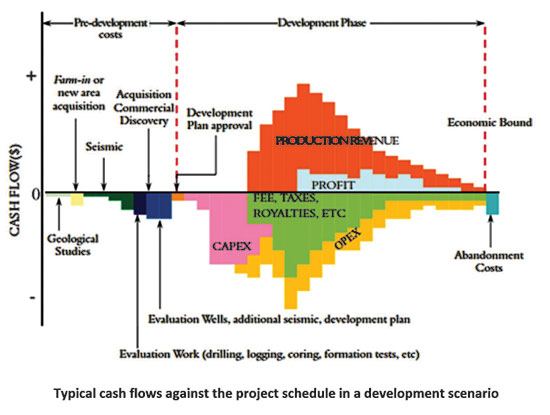
Given their marginal nature, oil companies expect a disproportionately high return with minimal or no taxation/royalties for their investment as they have significant outgoings. It is not unusual for governments who are new to the industry to end up with minimal or no revenue; ultimately left with facilities with a significant negative value to be removed at the taxpayer expense.A typical project to be executed may take several years as seen above with many uncertain outgoings. Australia’s major gas field Browse which commenced exploration in 1967, and has already been appraised to be viable for investment with 12 TCF (Trillion cubic feet) of recoverable gas, is continuously postponed given the global uncertainties.However, when the future of the industry was certain, there have been oil fields that were delivered in 14 months after appraisal, unlike today when the future is uncertain.

The Mannar field, at best, may have to wait to be developed until the investment climate improves and the uncertainties are minimised.

Is there a risk to SL if the FSRU is not installed by NFE?

The past three/four GoSL FSRU tender invitation attempts, were only meaningless academic exercises with no guarantee of payment by an investment grade credible entity. The GoSL is akin to someone seeking to purchase a new Rolls Royce with insufficient money to buy an old Morris Minor, and then engaging highly paid consultants who see ‘cash in chaos’, and take the GoSL for a ride. The last invitation to tender proposed under Swiss Challenge process against SKE&S’s unsolicited proposal did not attract a single prospective bid after more than four or five extensions to the closing date of tender over about eight months.

The current CEB tender is no different with no guaranteed payment security package by a credible investment grade party offered to the bidders. This will eventually be required. A toxic combination of misinformation in the public domain and unregulated malfunctioning of the electricity sector by the Ministry of Power and CEB has crippled SL’s economy perhaps beyond repair. Understandably they will attempt to wrest control over this project from any other competing ministry.India faced many challenges similar to SL in these projects in countering misinformation in the public domain by self-appointed experts, who had no exposure to industry norms, complex technology, or any understanding or experience in the highly specialised nature of offshore oil and gas business and their complex commercial transactions. SL is not any different with misinformation from (a) ideologues who see energy transition to NZE without intermediate steps such as LNG or other realistic options, (b) those with vested interests in importing coal and diesel, (c) ignorance of the complexity of industry norms, and (d) complete ignorance and disregard of the industry state of play. These cannot be understood overnight by those with vested interests, and others in isolation who are making outlandish demands. They create confusion amongst themselves, with the public at large, policy formulators and decision makers.If this FSRU is not installed, there is a likelihood that the power generation with diesel will continue and expand with increasing unbearable losses and environmental damage, which has been the past record in power generation. Under the new international consensus that may develop following UNFCCC COP26, countries continuing with heavy reliance on coal and oil may face punitive measures such as carbon tariffs on exports and other trade and commerce.

What is an FSRU? How does an FSRU work?

A Floating Storage and Re-gasification Unit (FSRU) is a floating vessel that is permanently moored at a site where it can receive LNG from tankers/carriers, store and regasify the LNG and send it as natural gas to shore via a subsea pipeline at a rate required by the natural gas users. The natural gas upon receipt at landfall from the FSRU would be transferred via pipelines on land to the end user power generators such as at Kerawalapitiya.

NFE will be supplying an FSRU and the associated pipelines. The project components are leased being supplied under EPCIC (Engineering, Procurement, Construction, Installation and Commissioning) and O&M (Operation and Maintenance) terms of responsibility for a specified period called the ‘fixed term’ with a period of optional extensions at predetermined commercial terms.

The figure above shows Moheshkhali FSRU Bangladesh with its submerged turret loading mooring and dynamic riser which is exposed to monsoons, operating since 2018. The vessel has a disconnectable mooring which disconnects from the vessel by lowering the swivel during high storm surges (such as monsoons as experienced in SL) and reconnects when the weather is benign. The vessel ‘weathervanes’ (rotates) about the single-point-mooring with the meteorological oceanographic variations in wind, wave and current. The vessel motions are determined analytically and verified by model tests to meet Classification Society requirements. There are other forms of shallow water moorings.

The mooring and riser technology is proprietary and technically complex in which the writer has specialized along with their commercial transactions in vessel leasing and operations.

A dis-connectable mooring system is where the floating installation has a propulsion system and a means of disengaging the installation from its mooring and riser systems to allow the installation to ride out severe weather or seek refuge under its own power for a specified design environmental condition.

A disconnectable moored vessel requires a full marine crew, must be flagged as required by IMO (International Maritime Organisation) with the vessel likely being in transit during its tenure. The writer has supplied many of these complex mooring systems which remain proprietary technology.This is completely new technology to SL, lacking any exposure to offshore oil and gas industry standards, codes, practices, industry norms, risks, analytical methods, Classification Society Rules under which they are designed and constructed, their insurance requirements, health safety and security and environmental practices, and complex multiple jurisdictions. Their commercial transactions are notoriously complex.NFE would remain as the single point responsible for all components up to the end user of the gas. The removal of the installation or transfer to the GoSL at the end of the lease is an option. In the case of SL, the vessel will be handed over to GoSL for continued operation after 10 years. In some countries the vessel when handed over has been a liability being a ‘rust bucket’ having a considerable negative value requiring the taxpayer to fund its removal, costing more than USD 50 mil. The ability of GoSL to undertake the operation and maintenance at hand over may raise questions (as in securing insurance such as P&I insurance, to be explained in Part 2), when the operator’s competency will be questioned by the insurer. This is a form of due diligence in determining GoSL’s capability to operate the facility by an independent third party. These are lessons to be learnt from cases in South East Asia, when vessels were handed over with unintended consequences.

Daily count on new coronavirus cases climbs to 626 and confirms another 15 coronavirus deaths

November 7th, 2021

Courtesy Adaderana

The Health Ministry says that 168 more persons have tested positive for Covid-19, increasing the daily count of new cases to 626.

This is the third consecutive day that the daily count of new cases has exceeded 600. 

The total number of coronavirus cases reported in the country thus far has risen to 545,256 with this.

The Director General of Health Services has confirmed another 15 coronavirus related deaths for November 06, increasing the death toll in the country due to virus to 13,856.

According to the figures released today, the deaths include 08 males and 07 females.

Three of the patients are between the ages of 30-59 years while the rest are aged 60 years and above. 

Low-caste Malabaris pretending to be high-caste Jaffna Tamils

November 6th, 2021

H. L. D. Mahindapala

The year 1505 is a memorable date etched in the minds of those who knows anything about the history of Sri Lanka. It is the year in which the Portuguese arrived and opened up a new chapter in the history of the nation. But hardly anyone remembers 1215 – the year in which the Malabaris of S. India invaded Jaffna and paved the path for changing the history of the peninsula. A new history of the Tamils began to unravel in the Northern peninsula of Sri Lanka when the island was invaded by the Malabaris in 1215.  It is a date under-played and under-reported in the history of the nation. Even the Tamils of Jaffna do not make a fuss about this date because it blasts their myth of Tamils occupying the nation form the dawn of time”, as stated in their famous political manifesto, the Vadukoddai Resolution. The importance of 1215 is in the fact that it is the first year in the history of the Tamils of Jaffna. There was no permanent settlement or Tamil kingdom before that. It is the year in which the ancestors of modern Tamils in Jaffna first set foot in Sri Lanka to settle down and make it their permanent home. Jaffna Tamils of today came from the womb of the Malabaris who invaded Sri Lanka in 1215.  As new migrants their antecedents do not run beyond 1215 into the classical Sinhala-Buddhist era when the Chola colonialists and other political adventurers ruled Sri Lankan for brief intervals.  That was a different period with no connection to Jaffna as the homeland” of Tamils. It was separated not only by time but also by geography and history. For instance, the oldest archaeological finds of burial urns in Ponparippu are in  the mainland and not in the peninsula. Jaffna owes its existence as an exclusive ethnic enclave to the year 1215 when the Malabari invaders opened the gates for the other Malabaris to flood Jaffna and become permanent settlers.  It was in 1215 that the Jaffna Tamils began to make a history of their own. The fact that there were Tamils in other parts of the island before 1215 doesn’t entitle the Jaffna Tamils who came after 1215 to a heritage dating back to pre-Christian times. There is no connectivity between the new migrants who came from Malabar and the old Tamil settlers. They are as far apart as the Jaffna Tamils are from the Indian Tamils in the estates. Just as much as the Indian Tamils can claim their heritage from the 19th century the Jaffna Tamils can claim a history that starts only from 1215 and not from pre-Christian times.

The arrival of the Portuguese in 1505  had a far less impact than the invasion of the Malabaris 1215.  The Portuguese introduced Catholicism, the baila culture and trade with the West on a mass scale – all of which changed the culture of the nation marginally. Its 114-year occupation (1505 – 1619) did not lead to the creation of a sizeable enclave of Portuguese which accumulated political power to make extreme ethnic  demands. The Western colonisers were only temporary occupiers but not permanent settlers.  Nor did they aim to change the demography of the colonised domain into ethnic enclaves packed with their compatriots. Their aim essentially was to exploit the resources for profit. But the Malabari invasion of 1215 was aimed at making of Jaffna a permanent colony for Malabari settlers. It is their invasion and subsequent importing of Malabaris on a mass scale that changed the demography of Jaffna into a Vellala colony. The mass migration of Malabaris who contributed to the making of modern Jaffna has not received the attention it deserves. The Malabaris are the last invaders who came from  S. India. Unlike the other previous invaders from S. India they decided to settle down as colonists in Jaffna. This separates the Malabaris from previous migrants from S. India. They were an entirely new category of migrants with no historical links to previous Tamil-speaking migrants. In settling down as colonists the invading Malabaris began a new history not connected to other Tamils who came before as merchants, mercenaries, marauders, and political adventurers. It was the Malabari invaders in post-1215 period who increased the Tamil-speaking population to a dominant demographic position in the peninsula.  It is the flooding of Jaffna with the Malabari Vellalas that made it a homeland for the Vellalas. 

The homeland” concept of modern-day Jaffna Tamils began with the Malabari settlers. As direct descendants of the Malabaris who had given up the idea of going back to their homes in Malabar,  the only option available was to make Jaffna their homeland”.  It was natural for the homeland” concept to develop firmly in the minds of the new colonisers. They eventually slipped into the prevailing culture of Jaffna dominated by the Tamil language. There were no major obstacles  for the Tamil-speaking Malabaris to merge with the Tamil-speaking Jaffnaites. The Tamil identity grew with the rise of the new Tamil consciousness created by Arumuka Navalar, the Vellala guru in the 19th century.

As new settlers, with nowhere else to go,  the necessity of making Jaffna their homeland” gathered a political momentum. Some were imported as slaves to the native land owners, who were the early Malabari settlers, and the Dutch. Their situation was similar to that of the English convicts who settled down in Australia. With no way of going back to their motherland in England they developed an attachment to the new land and became Australians.  They got acclimatised to the new environment. Their new consciousness came out of the new Australian environment. Likewise, the homeless Malabaris became Jaffnaites. Because they came with the idea of settling down the idea of making Jaffna their homeland”  turned into a compulsive ideology. They came in large numbers, wave after wave,  and paved the path for the establishment of a permanent settlement for the new colonists. The Dutch colonial masters too engaged in importing Malabaris for cheap labour. These migratory waves strengthened the power of the Vellalas.

The Vellala factor that dominates modern Jaffna too came with the Malabaris. The Malabaris  were the Sudra Vellalas, lowest-caste in the classical social hierarchy of India. It is the continuous flood of  Malabari migrants that turned Jaffna into a colony dominated by the Sudra Vellalas. The other three high castes – Brahmins, (priests/intellectuals), Kshatriya (warriors) and Vaisyas (merchants) – stayed behind because the Indian sastras (holy texts) forbade high castes to leave the shores of India. The low-caste Sudra Vellalas came in waves after the first invasion in 1215. The influx of  Sudra Vellalas swelled the ranks of the demographically miniscule Tamil community in Jaffna. Jaffna then was a multi-ethnic territory shared by the Sinhala-Buddhists and the Muslims. There was a numerically formidable community of Sinhala-Buddhists in Jaffna. It was the flooding of Jaffna with the low-caste Malabaris that led to the rise and dominance of the Vellalas in Jaffna. The (1) increased migratory waves of Malabaris and (2) the subsequent ethnic cleansing of  the peninsula by the Jaffna kings of the Buddhists and Muslims tilted the demographic balance in favour of the Vellalas.

It is these two factors that  led to the creation of near a mono-ethnic enclave of Jaffna dominated by the Vellalas. The Jaffnaites of today are not the direct descendants of the Tamils who came in the first pre-Christian Mesolithic wave, or later with the imperialist invaders of the Chola period. Contemporary Jaffna, which the Tamils call their homeland”, was populated by the Malabaris who came in migratory waves from Malabar in the post-1215  invasion. Today the Vellalas stand as the majority in Jaffna, nearly 52 %. The  Vellala caste increased rapidly from 37 % of the population of Jaffna in early nineteenth century to over 50 percent today” indicates that people of other castes were incorporated into the caste system of the Vellalas. (The Ambivalence of Freedom : Slaves in Jaffna,  Sri Lanka in the Eighteenth and Nineteenth Centuries, Nira Wickramasinghe and Alicia Schrikker, in the Journal of Asian Studies, Vol. 78. No.3, (August) 2019). For instance, the Madapallis, a caste that was competing for supremacy in the caste hierarchy, merged with the Vellalas in time and virtually disappeared from the existential demographic map. Besides, Hindu Jaffna was a land without the Brahmins – the priest/intellectual caste that stood at the peak of the Hindu caste hierarchy of India. It is the Vellalas that stepped in as the substitute for the missing Brahmins at the top. This made Jaffna a mediocre copy of the classical Hindu society of India.

Hindu society without the Brahmins was like the Roman Catholics without the Pope who derives his sanctity from St. Peter, the original founder of the Catholic Church. There is sanctity and legitimacy in coming down directly from the original sacred source. In other words, Vellalaism manufactured in the 13th century lacked the essential sacred ingredient that made ancient Brahmanism the divinely ordained authority in India. Vellalaism lacked authenticity and sanctity of Brahmanism. However, amidst all the contributory strands that led to rise of the Vellalas as the dominant force in Jaffna the major factor that pushed the Vellalas to the top was the flooding of the  Jaffna with the low-caste Vellala colonisers from Malabar. The Malabari demographics made them the formidable force initially. The political power acquired later made it the dominant force. The available evidence makes it clear that despite the boasting of the high status of the Vellalas, mainly with fake historical claims of sanctity drawn from antiquity, they are, by and large, the remnants of the low-caste Malabaris from S. India. In short, the high caste Vellalas of Jaffna are the low-caste Malabaris from India.

When the Malabaris invaded Jaffna in 1215 it was occupied by Hindus, Buddhists and Muslims. The massive migratory waves of the Sudra Vellalas that came subsequently enabled them to outnumber the coeval communities.  Until the arrival of the Malabaris Jaffna was a multi-ethnic society. The invader, Magha Kalinga, became the first king of Jaffna in 1215. It was the Malabari invasions that paved the way to make Jaffna a near mono-ethnic community. It is the descendants of the migrant Malabaris that constitute the majority in Jaffna today. They were known as Malabaris during the Dutch and the early British periods. Even Hugh Cleghorn, whom the Tamils quote often, referred to the  Tamils as Malabaris. The Malabaris were also imported by the Dutch for cheap labour like the way the British imported new waves of indentured labour from S. India — Tamils who are not connected to the other Tamils of Sri Lanka except in the use of the Tamil language. 

The first permanent settlement of the Tamils began with the invaders from Malabar occupying Jaffna, says Prof. K. Indrapala, the first professor of history of Jaffna University. This  makes the contemporary Jaffnaites the direct descendants of the Malabaris who invaded the North after 1215. They have no links to the early Tamil migrants who came in the pre-historic Mesolithic  wave, or later as Chola invaders. Those migrants either went back to India, or settled down in small merchant colonies in Anuradhapura, Polonnaruwa, Mannar etc., or assimilated with the Sinhalese. They did not settle down in Jaffna as their homeland. If they considered Jaffna their homeland they would not have settled down outside Jaffna.  The early Tamil settlements of the Mesolithic and the post-Chola periods  were below the neck of Jaffna. The early settlers in the mainland were merchants, mercenaries, marauders and political adventurers.  Prof. Indrapala labels the two early usurpers Sena and Guttika and Elara as political adventurers”. (p. 46 – Journal of the Ceylon Branch of the Royal Asiatic Society, Vol. XIII, 1969)

Clearly, Jaffna became a homeland” for the Tamils only after Magha Kalinga invaded Sri Lanka in 1215 and made it a colony for the Malabaris to settle down. Jaffna was not the homeland” from the dawn of time” as the Tamils would like to imagine. Yalapana Vaipava Malai ((YVM) — a historical garland) mentions the numerous waves of Vellala migrants from S. India to Jaffna. Before Jaffna was invaded by the Malabaris, it was shared as common territory both by the Tamils and the Sinhalese.  The prominent presence of Sinhala-Buddhists in Jaffna is known by the numerous Sinhala place-names, says Prof. Indrapala. The presence of the Sinhala-Buddhists must have been significant because YVM mentions several inter-ethnic clashes between the two major communities. Mylvakanam, the historian, also mention the Sinhala-Buddhist rebelling against the Tamil kings. A political rebellion against the Tamil king could have taken place only if there was a substantial concentration of Sinhala-Buddhists in Jaffna.

Later the Jaffna kings ethnically cleansed Jaffna by forcibly dislodging the Sinhala-Buddhists. The insane fury” of Sankili (p. 33 — YVM) turned towards the Sinhala-Buddhists after he exterminated the Tamil Catholics in Mannar in 1544. After expelling the Sinhala-Buddhists the Tamil insane fury” turned against the Muslims. Jaffna became a near mono-ethnic enclave only after the ethnic cleansing of successive Tamil kings. It is this ethnically cleansed Jaffna that the Jaffnaites call their homeland” now. Jaffna was the homeland” of all communities before the ethnic cleansing. After the ethnic cleansing they claimed it to be a mono-ethnic homeland” of only the Tamils. It is to reinforce the exclusive claim of Northern territory to the Jaffna Vellalas that the Tamil intellectual industry is engaged indefatigably in rewriting history. For instance, they believe that they are the descendants of the original Dravidian migrants who came in the Mesolithic era when the recorded historical facts confirm that the Jaffnaites are the descendants of those who arrived only after 1215. So how can they claim a heritage from the dawn of time”?

The time when the Tamils arrived first is a complex issue that is lost in the mists of time. But what is indisputable is that the modern-day Tamils of Jaffna are the descendants of the Malabaris who are not connected in any way to the early Tamil settlers in the mainland, below the neck of Jaffna.  According to historical facts, Jaffna today is occupied mainly by the Tamil-speaking Malabaris who flooded Jaffna in the post-1215 invasion and settled down to make it their home.  The descendants of these Malabari settlers are far distant from  the original Tamils who settled down in the Mesolithic and post-Chola periods. They are as far apart as the Indian Tamils in hills are to the  Tamils of Jaffna. Just as much as Jaffnaites of today are historically, culturally and politically separate from the Tamils of the hill country Indians, the Malabaris who migrated in the 13th and 14th centuries had no links to the early Tamil settlers who domiciled in the mainland. The Malabaris are an entirely different wave of Indians, some of whom were imported by the Dutch like the way the British imported indentured labour from S. India.

The different waves of migration from S. India, though they all spoke Tamil, did not lead to the consolidation of the migrants into one solid front. The Tamils who came in the classical Sinhala-Buddhist era, the Malabaris who came after the invasion of 1215 and the indentured labour imported by the British are three different waves of migration not linked to each  other. To begin with they came at different periods in time and settled down in different regions creating their own cultures. Their cultural differences separated them into different political units, each with their specific needs and interests. They failed even to form a cohesive front that would link them organically into a formidable common force. S. J. V. Chelvanayakam, realising the necessity  to confront the majority Sinhalese with  large numbers, launched the iyakkum” (movement) of the Thamil Payasam Makkal ( the Tamil-speaking people). But it collapsed as the Vellala political agenda clashed with the interest of the other Tamil-speaking Muslims and Indians. Besides, the regional differences that generated different interests, motivations, and objectives were far stronger than the Tamil language that linked them. Other than language, the Malabaris, who later became  Jaffna Tamils in the 19th century, adopted an ethnic arrogance that looked down upon all the other Tamil-speaking people. This includes the Batticoloa Tamils who are territorially located in the eastern part of Tamil Eelam. Chelvanayakam referred to them superciliously as the trousered people of Batticoloa”. (p. 32 – S. J. V. Chelvanayakam and the Crisis of Sri Lankan Tamil Nationalism, 1947- 1977, A Political Biography by A. J. Wilson.) The arrogance of the low-caste Malabaris who later became the high-caste Vellalas knew no limits. They went all out to grab the leadership of the proposed pan-Tamil movement which failed because its political agenda was driven by Vellala arrogance and interests. The idea of the Iyakkam’ was to unite the Tamil-speaking people against the Sinhalese. But the political agenda consisted mainly that of Vellala issues. They were muscling in to dominate the Iyakkam” – a move that did not appeal to the other Tamil-speaking Indian estate and Muslim leaders. Even the Vadukoddai War” (a.k.a. Eelam War”) cracked wide open and foundered eventually on the regional differences between Karuna Amman of the Eastern and Velupillai Prabhakaran of the Northern Province – the arrogant king makers.

A close  scrutiny of Northern politics will reveal that it has failed repeateadly because they had pursued intransigent and arrogant politics. G. G. Ponnamabalam, representing 11 % of Tamils, insisted on getting 50 % of power when he was given 45% . Prabhakaran who was given maximum power, with international guarantees, rejected all offers insisting on 100% of power.  His insane fury” (YVM) made him believe that he possessed invincible power to achieve  all what he wants. It is the Tamil people that eventually paid for the intransigence and arrogance of their leaders. The Tamils went down the wrong track mainly by misreading their history. They still continue to believe in a glorified history that is not there. Theirs is an eternal struggle to overcome the inferiority of their mediocre  history. The perennial agony in their psyche is caused by their inability to forget their inglorious origins: they can’t accept the historical fact that they are the low-caste Malabaris who are pretending to be high-caste Vellalas. It has made them congenital idiots”. (Prof. Kumar David).

The fundamental flaw in the Vellala political culture is that they are intransigently dressed in Emperor’s clothes, refusing to accept the prediction of the revered Tamil prophet  Supathidda-muni who told the Jaffna King: The sovereignty (which has gone to the Portuguese, Dutch and British)  will never again come back to your descendants.”  (p. 29 — Yalapana Vaipava Malai, translated by C. Brito, 1879.)

Isn’t it time for the misguided Vellalas to come out of their delusional diadem and face the grim realities of history?

Time to identify enemies within

November 6th, 2021

Sangadasa Akurugoda

According to media reports, while addressing at the SLPPs 5th National Convention, Prime Minister Mahinda Rajapaksa said the SLPP was duty bound to preserve the unity among its coalition allies who had fought for the same cause. Recalling the sacrifices made by those who contributed towards the SLPP’s historic victory, the PM said, ‘’the size of a political party did not matter, and what really mattered was the goal. These parties have been with us through thick and thin. They are neither crutches nor a cat’s paw of the SLPP. Therefore, all parties must unite, and making that happen is our responsibility.”  While admitting the apparent frustration among the youth and those who voted for the SLPP during the last Presidential and Parliamentary elections, PM has stressed the need to be involved in politics among the people similar to how they manage government institutions after securing power after the elections.

During the last Presidential election, Presidential candidate Gitabhaya Rajapaksa received a 6.9 million mandate and, no doubt, majority of those who voted for him must have thought that Gotabhaya is the only answer to their majority of the problems. When we think about how Gotabhaya performed as the Secretary of the Ministry of and Urban Development, their expectations are reasonable to some extent.  Although Gotabhaya’s performance in managing government institutions is well aware, his state administration is yet to be seen since no state administration is detached from politics.

The ruling coalition, similar to all other coalition government we had since independence, consists of parliamentarians with different interests. Although Mahinda Rajapaksa has done a wonderful thing during his tenure of office as the President of the country up to 2015, by keeping all these elements together, probably with the intention of achieving political stability as a short term measure, while defeating terrorism, upgrading economy and country’s infra structure, we have witnessed some of its negative effects at the end. Corruptions charges were leveled against some of his close associates and similar to what we hear even today. We remember how one of them departed to USA soon after the 2015 election results were announced, accepting the responsibility for the defeat. There may be leading elements in the government who are working with similar sinister agendas even today.

SLPP rebels vow to scuttle New Fortress deal were talking about an American Agent and elements abusing the mandate people had given to Gotabhaya Rajapaksa. When talking about how the project has been awarded to a non-tendered company while the tenders submitted for a project are being evaluated, Leader of Pivithuru Hela Urumaya, Minister of Energy Udaya Gammanpila stated that the present government is engaged in more serious corruption far worse than those of JR, Premadsa , Chandrika and Ranil which were branded as extremely corrupt eras.

Although the above speech of the PM is commendable, it would have been much better, as the leader of the SLPP, if he has taken action to find out who are the main culprits, within the party, responsible for making the public unhappy and for treating minor allies of the coalition as crutches or cat’s paws.

We were under foreign powers for centuries due to the acts of saboteurs and traitors. We have witnessed, during our life time, how powerful are enemies within, when destabilising regimes. If the incumbent government is not taking any action, the public must be aware of these enemies, as a priority, should rally against such elements in order to protect our nation.

Sangadasa Akurugoda

POLITICS IN SRI LANKA Part 2

November 6th, 2021

KAMALIKA PIERIS

 SIR JOHN KOTELAWALA

Sir John Kotelawala was Prime Minister of Ceylon from 1953 to 1956. He was strongly pro-USA.Nayani Melegoda records that the USA Secretary of State had visited Ceylon when Sir John was Prime Minister, date not given. 

Sir John was firmly anti communist. He banned communist books and periodicals from arriving into Ceylon   and refused to permit a China good will mission to come in 1953. He refused to allow soviet scientists to come to watch the solar eclipse in 1954, but allowed those from USA, UK, Canada, Japan and India. He also refused to allow the Ceylon hockey, soccer and table tennis teams to take part in the World Youth Festival in Warsaw in 1955.

Sri John squashed all objections to the visit of Queen Elizabeth II in 1954. He cancelled all telegrams sent to London casting doubts on the matter.  The visit was a great success. The royal couple got a rapturous welcome with pandals.

DUDLEY SENANAYAKE.

Dudley Senanayake was Prime Minister three times. 1952-1953, 1960, 1965- 1970. Dudley Senanayake was a truly charismatic leader, said Edward Gunawardena. By his exemplary behavior he enjoyed the respect of both sides of the House. He was an excellent debater. If he had to make a speech it was a studied contribution. If he was not in the chamber he would be in discussion with his colleagues and members of the opposition as well; or he would be in the library or even learning different aspects of Parliamentary procedure from the Clerk of the House.

A remarkable characteristic of Dudley was his ability to concentrate and focus his mind on what had to be done. If he had to attend a function where he had to make a speech, he would prepare his speech in the car with his eyes closed, seemingly but not asleep. When parliamentary sessions were due he would closet himself in his room either at Woodlands or the annexe at Temple Trees for hours, sometimes smoking the pipe as well as cigarettes, concentrating on the agenda for the morrow, concluded Edward.

Others were not so impressed. Dudley Senanayake embodies the ideal, a head of state who does not shake the boat, makes no changes, said one critic. Four times Prime Minister, what did he do, the public asked. He seems to have done nothing. In his time a lot of jungle was cut down to no purpose, came the reply.

For decades people had suspected that Dudley and JR had known of the 1962 coup. Ms Bandaranaike, when she came to know about it also decided to keep it a secret.  But today the secret participation of both Dudley and JR in the 1962 coup is no longer secret. (C. Wijeyawickrema. Island 4.3.09 p 9).

Raja de Silva, former Commissioner of archaeology, had this to say. In 1968, there was provision in the Estimates of the Archaeological Department for the appointment of an Assistant Commissioner (Excavations). The Public Service Commission gazetted the notice calling for applications, and one day five members of the board of interview (myself included) sat in the board-room of the PSC waiting to interview each applicant. I noticed that the peon had whispered to each of three interview board members that there was a telephone call at the office of Secretary/PSC, next door. I was the next to be similarly telephoned, whereupon the following conversation took place.

de Silva (AC): Hello.

Bradman Weerakoon, Secretary to the Prime Minister (S/PM): Hello, Raja, Brad here. I have a message for you from the PM.

AC: Is it the same message that you gave the other interview board members?

S/PM: Yes, the PM is interested in one of the applicants you are about to interview (and he named the applicant).

AC: Brad, the post is for an officer of my Department, and I want the best.

S/PM: Understood. Anyway, I was asked to convey the message.

AC: Message received.

Siran Deraniyagala was the best applicant, and he was appointed to the new post in 1968 said Raja de Silva. (Island 17.10.21 p 9) (continued)

Sri Lanka and Bangladesh Can Benefit from Growing Trade Ties

November 6th, 2021

MD Pathik Hasan

Trade potential in multiple sectors: Many Bangladeshi products have bright potential in the Sri Lankan market. Similarly, there are huge possibilities for Lankan products in Bangladesh. Now it is high time to address the need to increase the participation of the private sector in the two countries. Sri Lankan entrepreneurs should invest in Bangladesh to serve their own business interests.

Sri Lanka has invested in Bangladesh’s power sector. Some more opportunities are there for Sri Lankan investors in Bangladesh’s special economic zones, industrial parks and high-tech parks.

The two countries can exchange their experiences in agriculture including paddy cultivation, and freshwater fish farming, tourism, cricket diplomacy as also Covid-19 vaccine diplomacy. Bangladesh has an interest in acquiring technical knowledge from Sri Lanka on coastal, aquaculture, marine culture and deep-sea fishing. More institutional cooperation in the field of education for technical training and skill development can strengthen the ties.

Bangladeshi nurses and other health workers can be trained in Sri Lanka, which can benefit from importing world-class medicines from Bangladesh.

Bangladesh has been doing well in the electronics field, and its products are available in Nepal now. Sri Lanka can import electronics products from Bangladesh to fulfill the demands of its people.

Even Rajapaksa has praised the digital transformation of Bangladesh under the leadership of PM Sheikh Hasina and emphasized increasing trade and expanding the scope of business between the two countries. He lauded Hasina’s leadership in tackling the pandemic. He evinced interest in exchanging experiences on blue economy and disaster management.

Extending port facilities: Sri Lanka has already allowed Bangladesh to use the seaport of Hambantota in its Southern Province. This throws open a huge opportunity for Bangladesh. Bangladesh-Sri Lanka trade volume in money terms is USD 61 million. The government is thinking of increasing it further.

Apart from this, Dhaka is also thinking of providing various facilities to bring investment to Sri Lanka. Chittagong port has historic connectivity with Colombo port. By using Hambantota port, Bangladesh can reach Central Asia, West Asia, Eurasia, Russia, China through the utilization of Pakistan’s Gwadar port and Iran’s Chabahar port.

Sri Lankan Prime Minister Mahinda Rajapaksa visited Bangladesh to mark the birth centenary of Its founder Bangabandhu Sheikh Mujibur Rahman and also the golden jubilee of Bangladesh’s independence and had detailed talks with Prime Minister Sheikh Hasina. The meeting agreed to take trade relations between the two countries to new heights. The meeting also signed six memoranda of understanding on bilateral cooperation.

Various regional and international issues were discussed during the one-hour summit. During the meeting, Sheikh Hasina stressed the need for a free trade agreement between the two countries, saying the amount of trade is less than expected. For this, both sides should quickly go for a free trade agreement.

According to the Bangladesh Bank, the country’s trade volume with Sri Lanka is very low. In the 2019-20 financial year, only goods worth Bangladesh Tk 473 crore were imported from Sri Lanka to Bangladesh. In the same financial year, only Bangladesh Tk 325 crore worth of goods were exported from Bangladesh.

Bangladesh signed its maiden preferential trade agreement with Bhutan in December 2020, with the people of the two nations reaping the dividends. If a free trade agreement is signed, then only the sky would be the limit for Bangladesh-Sri Lanka business relations.

Maritime security: The Colombo Security Conclave held earlier this month has ushered in opportunities for both Bangladesh and Sri Lanka concerning maritime security.  

Sri Lanka has recently been suffering from a foreign exchange reserve crisis. As per the latest reports, it has only USD 500 million in foreign exchange reserves. With this reserve, Colombo can’t meet its import expenses for three months. To keep the reserves risk-free, at least three months of import expenditure has to be kept aside.

Bangladesh has decided to lend USD 250 million to the Central Bank of Sri Lanka from its foreign exchange reserves. To this end, Bangladesh Bank is going to sign a memorandum of understanding with the Central Bank of Sri Lanka. According to Sri Lankan media outlets, Bangladesh has already disbursed USD 50 million to Sri Lankan authorities. This will pave the way for new multi-dimensional economic relations.

The Bangladesh government has taken the initiative to export 21 products to Sri Lanka with duty-free facilities. At the same time, the two countries have started expanding bilateral trade, increasing investment, and developing their shipping and tourism industries.  Readymade garments, medicines, jute and jute products, ceramics, juices, food products, vegetables, peppers, construction materials, melamine, paper and paper boards, flowers, plastic products, leather and leather products, shoes, soybean oil, potatoes, fertilizers and cosmetics from Bangladesh have a huge demand in the Sri Lankan market.

The Bangladesh government’s efforts to get a duty-free market facility for the export of these products show Sri Lanka is becoming increasingly important in increasing regional trade. As a result of various initiatives, Bangladesh’s trade relations with Sri Lanka will get further strengthened. The friendly relations between the two nations are also playing an important role in increasing trade and investment.

PM Sheikh Hasina is very keen to strengthen ties with all South Asian countries. She has been laying stress on economic diplomacy and ordered all government officials to ensure maritime trade and blue economy are given precedence in the government’s agenda. There is huge potential in tapping marine resources in the Bay of Bengal region; Sri Lanka can assist Bangladesh in this area. 

Bangladesh has taken the initiative, whose significance is huge, not just for the two countries but for South Asia. Both states should now build upon their growing business relations for mutual benefit.  

Making ‘Freedom of Expression’ Commit Suicide!

November 6th, 2021

Palitha senanayake

This is just about to happen, and this impending calamity is not taking place in some remote corner, in some ‘banana republic’ under a despot, but in the heart of democracy and between the two champions of modern civilized values; between the US and Britain.

The case of extradition of Julian Assange is currently being heard in Britain. It has now reached the stage where every single point of the Americans prosecution in the original hearing in September is being accepted by the British Supreme Court. This is despite the CIA involvement by 30 of its officials with Thor Deyson – their prime witness from Iceland, having recanted on his testimony + a history of being arrested for more cases of fraud. Thus, it is now accepted that ‘the activities of wikileaks and its founder, Julian Assange, has a valid case to stand trial in the United States’ ; i.e. for ‘endangering the US national security establishment’.

However, there is one issue that stands between the extradition of Assange and the accepted international norms and that is Julian Assange’s health. In addition to Julian’s failing health caused by years of incarceration, there is this recommendation by Professor Koppelman, who is a professor of psychiatry and his evaluation that Julian might, or was very likely, to commit suicide, if sent to the United States.

John Shipton, the father of WikiLeaks founder was present at this trial and his comments were, ‘The prosecutor outlined his case, he canvassed the assurances of the United States that Julian wouldn’t be thrown into some dungeon somewhere forgotten. Of course, we all know that those assurances or barriers because, you know, we have in front of us nine cases, where assurances were given and then reneged upon.’

The question before the civilized world now is; what is the crime Assange committed that tantamount to endangering the US national security establishment?

WikiLeaks published documents of political or historical importance that were censored or otherwise suppressed.  Notable among these had been the mails connected to the America operation in Iraq where drones and thousands of robot soldiers had been deployed against the Iraqi forces and  then against the Iraqi public. It also revealed many casualties the US forces were responsible for during their Afghan operation which the US army dismissed as ‘collateral’. Collateral is a term used in war parlance to describe unavoidable civilians deaths but the facts disclosed by the leaked cables pointed that the civilian deaths in Iraq and Afghanistan were in fact deliberate warranting their re-classifications as ‘war crimes’.

However, the most interesting of the disclosures by the Wikileaks cables relate to the chemical weapon attack that took place in Douma, Syria, on the 14th April 2018. The US, French and British forces launched an attack on the Government buildings and support infrastructure in Damascus, alleging that the Syrian government of Bashir Al Azzad had used chemical weapons against the rebel forces. Subsequently however an investigation was conducted by the OPCW (Organization for the Prohibition of Chemical Weapons) on the allegation. The findings of this investigation, was again suppressed but Wikleaks leaked these papers that suggested that the chemicals used in the attack were not the type of chemical weapons that the Syrian Government possessed. Strangely, the attack also did not harm the rebels, as alleged, but affected the civilian population badly. All in all the investigation papers, though fell short of  naming the US, the allied forces and the rebels they supported,  had sufficient evidence to suggest that the chemical attack was the result of a staged act by the rebels to make way for direct intervention by the US and allies.  

Most of these revelations of Wikileaks relate to the period of the Obama administration where Hillary Clinton was the Secretary of State and the lurid mail revelations that bordered on human cruelty, in an imperial mindset, embarrassed Ms Clinton and eventually spoiled her Presidential stakes in 2016.

Wikileaks also published some confidential mails relating on the Sri Lankan war in 2010 and those suggested that the US State department was fully aware of and was complicit, with the ground situation but the allegations of HR violations against the SL forces was a post-conflict development, necessitated due to  war victorious  Rajapakse regime’s close relationship with China.  

Thus, it is now clear that the Wikileaks founder, who never leaked mails relating to the internal mechanism of the pentagon  or about the US  arms industry, has in no way endangered the US national security but  is being punished for exposing the war crimes of the US administration. This in fact is the anti- thesis of the basic value of democratic governance that the western nations crow so much about. Media freedom is considered sacrosanct by the democratic west and they often flaunt its absence in the developing countries, as being the reason for their lack of progress and development. 

Naturally the world powers, especially UK and US, whose abuse of power lay badly exposed, have been offended and hence they have imprisoned Jullian Assange on triumphed-up charges. The hypocrisy here is that it is not the national security of big powers that Assange exposed, but the insecurity of powerless nations in the world. However, Julian Assange, despite agitations by many journalists and those who truly believe in the freedom of press, has been  languishing in the Ecuadorian embassy since 2010 and then  jailed in Britain, charged with all types of innuendos, ranging from rape to cybercrimes..

Ironically, the mainstream world media today, led again by the US and British media corporations, do not take up Assange’s case but subtly denounce the Wikileaks initiator, as such exposure would entail a sense of cognitive dissonance that would threaten their allegiance to the status quo narratives that justifies the world they know and love.

In a wide-ranging mainstream media reporting on Julian Assange, award-winning journalist John Pilger, blasted the Guardian for its repeated diatribe on the WikiLeaks founder. The Guardian editorial made a case for extraditing the Australian to the US, where he could face 175 years behind bars for possession and dissemination of classified information. Pilger offered his interpretation of what the insinuations actually meant. What the Guardian was really saying was this: ‘We are the fourth estate, the bearers of true liberal principles, the guardians of sacred rights. Such as, the right to suck up to power, the right to invade countries and the right to smear those who expose our double standards and, if necessary, the right to destroy them, he said. 

The INGO, Journalist Sans Boarders, who consider protecting journalist in all countries of the world, against Government and other vested  interests, to be their primary obligation and in the process they often take Governments in developing countries to task for not allowing journalists to be free in their profession. The JSF even took issues with the Sri Lankan Government’s advocacies to the local journalists, at the height of the LTTE war in 2009, that they should not report the war in a negative vein. Ironically, when  the man who exposed the war crimes of the super powers is being literally sentenced to death, the JSF is deafeningly silent.

 Thus it is not a case of, Journalist Sans frontiers, but rather a case of, Journalist Sans Selective Frontiers.

An in-depth study about TRADE between British and it’s Colonies-Eye Popping Revelations: US$45 Trillion Fraud By British Raj In India Alone

November 6th, 2021

Senaka Weeraratna

There is a story that is commonly told in Britain that the colonisation of India – as horrible as it may have been – was not of any major economic benefit to Britain itself. If anything, the administration of India was a cost to Britain. So the fact that the empire was sustained for so long – the story goes – was a gesture of Britain’s benevolence.

New research by the renowned economist Utsa Patnaik – just published by Columbia University Press – deals a crushing blow to this narrative. Drawing on nearly two centuries of detailed data on tax and trade, Patnaik calculated that Britain drained a total of nearly $45 trillion from India during the period 1765 to 1938.

It’s a staggering sum. For perspective, $45 trillion is 17 times more than the total annual gross domestic product of the United Kingdom today.

How did this come about?

It happened through the trade system. Prior to the colonial period, Britain bought goods like textiles and rice from Indian producers and paid for them in the normal way – mostly with silver – as they did with any other country. But something changed in 1765, shortly after the East India Company took control of the subcontinent and established a monopoly over Indian trade.

Here’s how it worked. The East India Company began collecting taxes in India, and then cleverly used a portion of those revenues (about a third) to fund the purchase of Indian goods for British use. In other words, instead of paying for Indian goods out of their own pocket, British traders acquired them for free, “buying” from peasants and weavers using money that had just been taken from them.

It was a scam – theft on a grand scale. Yet most Indians were unaware of what was going on because the agent who collected the taxes was not the same as the one who showed up to buy their goods. Had it been the same person, they surely would have smelled a rat.

Some of the stolen goods were consumed in Britain, and the rest were re-exported elsewhere. The re-export system allowed Britain to finance a flow of imports from Europe, including strategic materials like iron, tar and timber, which were essential to Britain’s industrialisation. Indeed, the Industrial Revolution depended in large part on this systematic theft from India.

On top of this, the British were able to sell the stolen goods to other countries for much more than they “bought” them for in the first place, pocketing not only 100 percent of the original value of the goods but also the markup.

After the British Raj took over in 1858, colonisers added a special new twist to the tax-and-buy system. As the East India Company’s monopoly broke down, Indian producers were allowed to export their goods directly to other countries. But Britain made sure that the payments for those goods nonetheless ended up in London. 

How did this work? Basically, anyone who wanted to buy goods from India would do so using special Council Bills – a unique paper currency issued only by the British Crown. And the only way to get those bills was to buy them from London with gold or silver. So traders would pay London in gold to get the bills, and then use the bills to pay Indian producers. When Indians cashed the bills in at the local colonial office, they were “paid” in rupees out of tax revenues – money that had just been collected from them. So, once again, they were not in fact paid at all; they were defrauded.

Meanwhile, London ended up with all of the gold and silver that should have gone directly to the Indians in exchange for their exports.

This corrupt system meant that even while India was running an impressive trade surplus with the rest of the world – a surplus that lasted for three decades in the early 20th century – it showed up as a deficit in the national accounts because the real income from India’s exports was appropriated in its entirety by Britain. 

Some point to this fictional “deficit” as evidence that India was a liability to Britain. But exactly the opposite is true. Britain intercepted enormous quantities of income that rightly belonged to Indian producers. India was the goose that laid the golden egg. Meanwhile, the “deficit” meant that India had no option but to borrow from Britain to finance its imports. So the entire Indian population was forced into completely unnecessary debt to their colonial overlords, further cementing British control. 

Britain used the windfall from this fraudulent system to fuel the engines of imperial violence – funding the invasion of China in the 1840s and the suppression of the Indian Rebellion in 1857. And this was on top of what the Crown took directly from Indian taxpayers to pay for its wars. As Patnaik points out, “the cost of all Britain’s wars of conquest outside Indian borders were charged always wholly or mainly to Indian revenues.” 

And that’s not all. Britain used this flow of tribute from India to finance the expansion of capitalism in Europe and regions of European settlement, like Canada and Australia. So not only the industrialisation of Britain but also the industrialisation of much of the Western world was facilitated by extraction from the colonies.

Patnaik identifies four distinct economic periods in colonial India from 1765 to 1938, calculates the extraction for each, and then compounds at a modest rate of interest from the middle of each period to the present. Adding it all up, she finds that the total drain amounts to $44.6 trillion. This figure is conservative, she says, and does not include the debts that Britain imposed on India during the Raj.

These are eye-watering sums. But the true costs of this drain cannot be calculated. If India had been able to invest its own tax revenues and foreign exchange earnings in development – as Japan did – there’s no telling how history might have turned out differently. India could very well have become an economic powerhouse. Centuries of poverty and suffering could have been prevented.

All of this is a sobering antidote to the rosy narrative promoted by certain powerful voices in Britain. The conservative historian Niall Ferguson has claimed that British rule helped “develop” India. While he was prime minister, David Cameron asserted that British rule was a net help to India.

This narrative has found considerable traction in the popular imagination: according to a 2014 YouGov poll, 50 percent of people in Britain believe that colonialism was beneficial to the colonies.

Yet during the entire 200-year history of British rule in India, there was almost no increase in per capita income. In fact, during the last half of the 19th century – the heyday of British intervention – income in India collapsed by half. The average life expectancy of Indians dropped by a fifth from 1870 to 1920. Tens of millions died needlessly of policy-induced famine.

Britain didn’t develop India. Quite the contrary – as Patnaik’s work makes clear – India developed Britain.

What does this require of Britain today? An apology? Absolutely. Reparations? Perhaps – although there is not enough money in all of Britain to cover the sums that Patnaik identifies. In the meantime, we can start by setting the story straight. We need to recognise that Britain retained control of India not out of benevolence but for the sake of plunder and that Britain’s industrial rise didn’t emerge sui generis from the steam engine and strong institutions, as our schoolbooks would have it, but depended on violent theft from other lands and other peoples.

Sri Lanka has a very positive outlook

November 6th, 2021

WORLD BANK VP HARTWIG SCHAFER WITH INDEEWARI AMUWATTE 

Indo-Lankan seminar on Ayurveda held

November 6th, 2021

Courtesy NewsIn.Asia

Colombo, November 6 (newsin.asia): On the occasion of the 6th Ayurveda Day, Swami Vivekananda Cultural Center, the cultural arm of the High Commission of India, Colombo, organised a seminar on 2nd November, 2021 on the theme Ayurveda for Poshan”, in a hybrid mode. A limited number of participants attended the seminar at the Center whereas other participants, including from India, Sri Lanka and Singapore, attended the seminar in a virtual mode. The key objectives of the seminar were to promote exchanges of recent researches in Ayurveda and to spread awareness about Ayurveda for better health and living.

Every year, since 2016, the Government of India celebrates the Ayurveda Day on Dhanvantari Jayanti (Dhanteras) for promotion, propagation and popularization of Ayurveda. The day commemorates the birth anniversary of Lord Dhanvantari, who is referred to as the ‘God of Ayurveda’ in Sushruta Samhita, an ancient Sanskrit text on medicine and surgery. Dhanteras is also first of the five days celebration of Deepavali, the festival of light.

The High Commissioner of India to Sri Lanka, H.E. Shri Gopal Baglay was the Chief Guest at the seminar. Conveying his greetings on Dhanteras and Deepavali, High Commissioner highlighted the importance of Ayurveda as a holistic system of medicine that focuses on prevention of disease as well as promotion of health. He underlined the fact that Ayurveda, as a natural system of medicine, promotes harmony of the body and the environment. He highlighted the contribution of Buddhism to the development and spread of Ayurveda and recalled the important roles played by world renowned Indian universities, such as Nalanda, Takshila, and Vikramshila, as well as noted Buddhist scholars and vaidya physicians, such as Vagbhata and Nagarjuna, in the development and spread of Ayurveda.

Senior Prof. Priyani Paranagama, Director of the Institute of Indigenous Medicine, University of Colombo, graced the occasion as the Guest of Honour. Addressing the participants, she highlighted the significance of the centuries old tradition of Ayurveda as a system of medicine and noted that the western medicinal science is increasingly taking note of Ayurveda. Dr. Dhammika Abeygunawardhana, Commissioner, Department of Ayurveda, also attended the seminar.

Other distinguished speakers from Sri Lanka included Dr. Danister L. Perera, Ayurvedic Physician, former Registrar of Ayurveda Medical Council, former Director of Sri Lanka Conservation and Sustainable use of Medicinal Plants Project; Dr. Pathirage Kamal Perera, Senior Lecturer, Department of Ayurveda Pharmacology and Pharmaceutics, Institute of Indigenous Medicine, University of Colombo, Consultant Physician in National Ayurveda Teaching Hospital, Colombo; and Dr. Ajith Amarasinghe, Consultant Pediatrician and Clinical Allergist.

Eminent speakers from India included Dr. Amit Singh, Chief Medical Officer, Arogyadham, an integrative Medicine Hospital in Bangalore; Prof. Dr. Govinda Sharma, Department of Rasashastra and Bhaishajya Kalpana, SDM College of Ayurveda and Hospital, Karnataka; Prof. Dr. Suhas Kumar Shetty, Head-Department of Manasaroga, Dean of Research & Development, SDM College of Ayurveda and Hospitals; Dr. Vasudha Sharma, Medical Director and Co-founder of Vivekananda Health Global- Chain of Integrative medicine based centers; and Dr. Shreyes S., Consultant & Associate Professor, Rajiv Gandhi Education society’s Ayurvedic Medical College, Karnataka.

From Singapore, Dr. Satyam Tripathi, Clinical Researcher and Author, Ayurveda Yoga Therapy Consultant, and Director, Union Yoga Ayurveda, also spoke on the occasion.

The scholars highlighted the significance of Ayurveda in eradicating impurities, boosting immunity, and maintaining harmony in life. They also elucidated the role of diet, herbs, and spices in Ayurvedic treatment. The webinar was attended by about 100 participants, which included students of Ayurveda from Sri Lanka and India.

The Ministry of Ayurveda, Yoga, Naturopathy, Unani, Siddha, Sowa-Rigpa and Homoeopathy (abbreviated as AYUSH) of Government of India and the Sri Lankan Ministry of Health, Nutrition and Indigenous Medicine have undertaken a series of initiatives for promotion, education, research and propagation of indigenous alternative medicine systems. Both the Ministries have also released specific guidelines that boost immunity and promote good health and hygiene to help combat the coronavirus.

Lack of consultations has led to Lankan government’s taking inappropriate and unpopular decisions

November 6th, 2021

By P.K.Balachandran Courtesy NewsIn.Asia

Colombo, November 6 (Counterpoint): Gotabaya Rajapaksa came to power through the November 2019 Presidential election with a thumping majority. His party, the Sri Lanka Podujana Peramuna (SLPP), secured a two thirds majority in the August 2020 parliamentary elections. People had high hopes of rapid economic development under the stewardship of Gotabaya Rajapaksa, who was known for his development-orientation as well his no-nonsense military mindset.

But despite his awesome reputation of doing what his predecessors could not do (vanquish the dreaded LTTE as Sri Lanka’s Defense Secretary) and his reputation as an efficient administrator gained from his post-war stint as Urban Development Secretary, Gotabaya Rajapaksa has been found wanting as President of the country. As a result, the SLPP is set to face an uphill task when elections are called for the nine Provincial Councils early next year.   

With the SLPP’s political prospects looking dim, its parliamentary allies are becoming rebellious, threatening to break away and fight the coming elections independently if their demands are not met. Their basic demand is: consult us and take us into confidence as equal stakeholders in governance. But the President as well as the SLPP leader Basil Rajapaksa appear to care little for them.

The opposition Samagi Jana Balwegaya (SJB) led by Sajith Premadasa and the United National Party (UNP) led by Ranil Wickremesinghe are increasingly taking an aggressive stance on issues. School teachers and Principals are on the warpath, as are trade unions of the Ceylon Electricity Board and the ports. Prices of essential commodities have hit the roof, pinching the pocket of the common man.

Lankan farmers have been barred from using chemical fertilizers and pesticides and are forced to use organic fertilizers which are in short supply. According to one of the leading English dailies, in some cases, farmers have been reluctant to cultivate a good part of their lands due to uncertainty over availability of organic fertilizers. The government caused severe anxiety in the tea industry (a major export crop) because of the ban on chemical fertilizers and pesticides. Later, reason dawned, and chemical fertilizers were made available to the planters.

Shortfalls in cultivation are bound to impinge on food security. The government has said that it will import food to make up for any shortage. But there is severe dollar crunch which does not make imports a panacea.  

Organic fertilizers imported from China were found to have a harmful bacteria and the consignment was not allowed in. The Chinese government said that testing was not proper and demanded that it be done by a neutral agency in Europe. But on a court order, the State owned Peoples’ Bank stopped payment to the Chinese company concerned. The Chinese government then blacklisted the Peoples Bank.  There was also a controversy over the efficacy and cost of the nano nitrogen fertilizer procured from India, but the issue has died down and nano nitrogen fertilizer is being imported without a hitch.

A deal with an American company New Fortress to set up a power plant using LNG is being opposed tooth and nail by the Ceylon Electricity Board workers who say that the deal is opaque, not in Sri Lanka’s interest in the long term, and will put on the backburner the national plan to go for renewable sources of energy within a given time span. Electricity Board chairman M.C.Fernando’s plea that the terms of the deal with New Fortress cannot be revealed because of a secrecy clause has only added to the controversy. He also said that the deal has a political rationale which will not go down well with the people unless it is properly explained to them. Electricity workers have threatened to cause a 48-hour island-wide blackout if the New Fortress deal is not abandoned but the President has reiterated that the deal is in the best interest of Sri Lanka.

The COVID-19 pandemic, which struck the island nation in early 2020 and is yet to go away, has been a major reason for the government’s poor performance. But the government’s poor handling of the health crisis and its economic spin off has been equally important. Too many cooks have spoilt the broth as far as health crisis management is concerned. Multiple voices from the government and outside, and statements of multiple spokesmen of the government, have confused the people. Extended lockdowns, called at the insistence of medical professionals, brought the economy to a grinding halt, hurting the poor and the daily wage earners the most. Shortages created by halts to imports and inter-provincial movement restrictions, were exacerbated by hoarders. At one stage, the government had to invoke emergency regulations to set matters right.

The government’s inability to take decisions after due consultations, the ad hoc nature of the decisions taken, a lack of clarity in decisions announced and an inability to implement decisions, combined to pull the economy down to the detriment of the common man. President Gotabaya Rajapaksa has been taking decisions without consulting his ministers, his MPs and SLPP’s alliance partners. The army and other uniformed services were put in key decision-making and implementing positions, sidelining the civil service. Army personnel’s methods of working and their mindset have turned out to be unsuitable for dealing with civil problems. Decisions were taken without a broad-based consultative process involving grassroots-level political functionaries, Ministers, MPs and party workers. Frustration is widespread though not publicly expressed.

The Lankan government had its ears to the ground when Mahinda Rajapaksa was President. It has now lost its touch with ground realities. Mahinda Rajapaksa constantly met people. He had an open house and encouraged people to open up. He did not shut himself in an office and issue orders. He maintained contact with every level of the political structure and the bureaucracy.

As Prime Minister now, Mahinda Rajapaksa is engaged in firefighting to the extent possible, but without upsetting the applecart.  He has advised SLPP leaders to keep the minor parties in the alliance in the loop about government’s thinking and get them involved in decision making. Those who stood by the SLPP during the elections, should not be disregarded,” he said. He has also pointed out that the youth are getting disillusioned and that the party should bring them back into the fold. On the import of allegedly polluted organic fertilizers from China, which has soured relations with Beijing, Mahinda Rajapaksa had said that government should agree to the Chinese proposal to get the samples tested at a neutral and well established testing laboratory in Europe.

Without prior consultation with the political apparatus available with the government, President Gotabaya Rajapaksa set up a Presidential Task Force to study and draft a law to being about One Country, One law”. But the 13-member Task Force has no Tamil or Christian representatives. And its Chairperson is the hardline, anti-Muslim Buddhist monk Ven. Galagodaaththe Gnanasara Thera. The minorities and liberals naturally fear that the Task Force will suggest measures entirely in tune with the political interests of the Sinhala-Buddhist majority.

And the PTF is likely to be very hard on the Muslims whose institutions it is expected to reform on priority. Since some of the Muslim institutions are rooted in Islam they are immutable. Therefore, there is bound to be resistance from the Muslim community.

Bishop J. Winston S. Fernando, President of the Catholic Bishops’ Conference of Sri Lanka, has urged the President to repeal the gazette notification for the appointment of the Task Force.

COVID death toll moves up by 20

November 6th, 2021

Courtesy Adaderana

The total number of people who died of COVID-19 infection in Sri Lanka moved up as 20 more fatalities were confirmed by the Director-General of Health Services on Friday (November 05).

The new development has pushed the official death toll from the virus outbreak in the country to 13,841.

The latest victims include 10 males and 10 females, the Department of Government Information said.

According to official data, 06 deaths were reported among elderly people aged above 60 years. In addition, 14 people aged between 30-59 years have also fallen victim to the virus infection.

Daily COVID cases count hits 617 today

November 6th, 2021

Courtesy Adaderana

The daily count of COVID-19 cases confirmed in Sri Lanka moved to 617 today (November 06) as 135 more people were tested positive for the virus, the Epidemiology Unit said.

This brings the total number of confirmed cases of coronavirus reported in the country to 544,630.

As many as 514,912 recoveries and 13,841 deaths have been confirmed in Sri Lanka since the COVID-19 outbreak.

More than 15,800 active cases in total are currently under medical care, official figures showed.

ගෝඨාභය පඹයෙක්, බලන්න පහුගිය කාලේ ගත්ත මෝඩ තකතීරු ගොන් තීරණ, ඕලමොට්ටලම කැබිනට් එක මේ,හරක් රැලක් ඉන්නේ

November 6th, 2021

ගෝඨාභය කියන්නේ පඹයෙක්, බලන්න පහුගිය කාලේ ගත්ත මෝඩ තකතීරු ගොන් තීරණ, නිදහසින් පස්සේ ආව ඕලමොට්ටලම කැබිනට් එක මේ, හරක් රැලක් ඉන්නේ- ආණ්ඩුවේ හවුල්කරුවෙක් හිටපු ඇමති ඩේව් ගුණසේකරගෙන් ජනපතිට දැඩි විවේචනයක්

Chinese Embassy in Colombo accuses US of expanding its military bases

November 6th, 2021

Meera Srinivasan Courtesy The Hindu

Reaction to the recent Pentagon report on military developments involving China

Reactingsharply to a Pentagon report on security developments involving China, flagging the Asian giant’s likely consideration” of overseas military bases in countries such as Sri Lanka, the Chinese Embassy in Colombo accused the United States of widespread military occupation.

A thief believes everybody steals. Despite the withdrawal of U.S military bases and troops from Afghanistan, the US continues to maintain about 750 military bases abroad. These bases are costly in a number of ways: financially, politically, socially, and environmentally,” the Colombo-based Embassy said on Twitter, responding to a local journalist’s tweet on the US Department of Defense report. The official handle of the Chinese mission also shared a map showing “military bases controlled by the U.S.”.

The Chinese Embassy’s response comes amid a well-known geopolitical contest between the U.S. and China for greater influence in the strategic Indian Ocean region. The U.S.’s preoccupation with China’s growing influence in Sri Lanka has been consistent in the post-war decade, irrespective of the party in power. In a visit to Colombo in October 2020, former U.S. Secretary of State Mike Pompeo, from the Donald Trump administration, called China a predator” in Sri Lanka, while the U.S., he said, was a friend”.

The Chinese Embassy’s tweet is not the first instance of the China-US clash is playing out in Sri Lanka. US Ambassador in Colombo Alaina B. Teplitz, who recently completed her term, has openly criticised Chinese projects. Voicing concern over the legislation passed in Sri Lanka to govern the China-backed Port City in capital Colombo, she had remarked that there were openings for either corrupt influences or potential of illicit financing, money laundering and things like that. US companies are going to be wary of that”. China, in turn, accused the US Ambassador of violating diplomatic protocol” and suggested that the US quit the addiction” to preaching”, and applying double standards.”

While China-backed projects have in the past sparked questions within Sri Lanka on due process and transparency, there is currently mounting resistance to the US’s involvement in a key energy deal in the island nation. Last month, the Ceylon Electricity Board agreed to sell a 40% stake in a power plant in Kerawelapitiya, near Colombo, to US firm New Fortress Energy, and trade unions are resisting the move that they say, gives the U.S. a monopoly over LNG sales to the country.

Despite differences with the US over war-time rights abuses in Sri Lanka, and amid Washington’s persisting concerns over Colombo’s proximity to Beijing, the ruling Rajapaksa administration has maintained close links with the US.

President Gotabaya Rajapaksa was formerly a US citizen as well. He surrendered his US citizenship to meet a legal requirement to run for President in 2019. Finance Minister Basil Rajapaksa, the younger brother of President Gotabaya and PM Mahinda Rajapaksa, is a dual citizen of Sri Lanka and the US.

The Adoption of Organic Agriculture by Sri Lanka Was a Debacle. (Others, take note.)

November 6th, 2021

By  Courtesy European Scientist

The Adoption of Organic Agriculture by Sri Lanka Was a Debacle.  (Others, take note.)

All of us have had the experience of learning things, as the saying goes, the hard way.”  That phenomenon has been captured perfectly by a meme found lately on everything from  to T-shirts to sign-boards:

The message is blunt but insightful, and applies to both individuals’ and governments’ decisions. Predictable governmental policy missteps can be costly, in terms of both lives and lucre. Consider, for example, the U.S. government’s disastrous handling of thewithdrawal from Afghanistan in August, which led to significant numbers of deaths and injuries, and the abandonment of huge amounts of material. Another, a near-miss, occurred in 1897, when the Indiana House of Representatives unanimously passed House Bill 246, a measure that redefined the value of π, the ratio of the circumference of a circle to its diameter. Fortunately, the bill died in the state senate.

Less obvious are recent changes in international agricultural policies and their impact, which in some respects seem to be the beginning of a slippery slope to a catastrophe worthy of a Shakespearian tragedy.  The journey begins with the European Union’s Farm to Fork (F2F) Biodiversity Strategy, picks up a glimmer of hope with the post-Brexit change in the U.K.’s policy on the genome editing of crops, and concludes with Sri Lanka’s own-goal debacle of the Green Sri Lanka” policy of transformation to organic agriculture.

F2F VS BREXIT : A DISAGREEMENT ON GENETIC ENGINEERING

The F2F Biodiversity Strategy commits the EU to reducing the use of chemical pesticides by 50% and of fertilizers by 20%, while farming at least 25% of current agricultural land exclusively with organic farming practices. Given the inefficiency and lower yields of organic agriculture, food prices would inevitably rise, while international trade, farmers’ revenues, and agricultural production would plunge. Because organic agriculture often requires tilling, which releases CO2, efforts to reduce greenhouse gas emissions would be impaired. A USDA-Economic Research Service impact assessment predicts that the EU’s policy initiatives would reduce gross farm income by 16%, with an annual increase in per capita food cost of 130 euros ($151). Other analyses, such as this and this, are more pessimistic.

The reviews described above do not consider the role that Brexit — the U.K.’s withdrawal from the European Union — will play with respect to the EU and other U.K. trading partners, now that they have decided to change trajectories from the ill-fated one taken by Europe, and instead embrace new technologies in agriculture such as genome editing. Although the break from EU agricultural policy could disrupt familiar, well-established relationships, the risk is well worth it, as new trading opportunities will be forged among nations that are more than willing to employ innovations in agriculture.  Moreover, it is the scientifically correct” thing to do, inasmuch as there is a seamless continuum of techniques of genetic modification, ranging from selection and breeding, through mutagenesis, wide crosses, recombinant DNA technology, and, most recently, genome editing. Thus, there is no scientific justification for excessive regulation of the newer, more precise, more predictable technologies.

Until now, the UK has been a principal export market for the EU, so its digression from the EU F2F policy will ally Britain with new trading partners that welcome cutting edge new breeding technologies, including genome editing. While it may be a big step for UK policy, however, it is far from a complete one. Illogically, Britain continues to be squeamish about recombinant DNA-modified crops, the predecessor genetic engineering technology of genome editing.

When related to crops, genetic engineering is an umbrella term that involves altering a plant’s genome. This can include the deletion (or silencing) of a plant’s genes, the insertion into a crop’s genome of the same gene from a closely related crop (cisgenesis”), or even from a completely unrelated organism (transgenesis). Plant breeders have long been able to introduce desirable new traits with a variety of techniques, including mutagenesis, wide cross breeding, polyploidy and protoplast fusion. Recombinant DNA technology, or gene splicing,” which has been around since the 1970s, has elicited significant opposition from activists.  Genome editing, the newest of genetic engineering technologies, can do the same sorts of things and much more. All of these genetic USDAmodifications have the same desired result: the introduction or enhancement of an advantageous trait, such as resistance to pests, higher yield, or enhanced nutritional content.

Britain’s acceptance of genome editing as an important tool to improve the efficiency and yield of their agriculture — by creating disease resistant, nutritionally improved crops — while throwing technologies such as recombinant DNA under the bus is not atypical.  There is a widespread misimpression that because recombinant DNA modification is often transgenic — involving the introduction of heterologous, or foreign, DNA, such as a gene that expresses a protein toxic to insect pests — it is somehow less natural” than genome editing, in which the genetic modification is more limited and may not be transgenic.  Genome editing, on the other hand, has been lauded as a technology that does not require the insertion of foreign DNA, celebrated as a way to change a genome by merely making a discrete, precise change.

Meanwhile, the EU maintains that for regulatory purposes, genome-edited and transgenic crops be classified (read: stigmatized) as no different, in the sense of needing to be subject to excessive andsui generisregulation. That restricts opportunities for their own scientists to conduct research and development that involves field trials with new crops that, for example, may be very useful to address drought, floods, or climate change. The post-Brexit British deviation from the EU’s approach is certainly a step forward, albeit a maddeningly small one. The F2F strategy, if implemented in the UK, would without question disadvantage British farmers, inflate consumer prices, and weaken food security.

ALL-ORGANIC SRI LANKA: A (PREDICTABLE) DISASTER

As the UK plots its course on this and many other issues, and the EU becomes even more entrenched in its unscientific, regressive agricultural policy surrounding organically grown vs genetically engineered crops, it seems a propitious time to review an extreme example of a predictably awful agricultural policy: Sri Lanka’s decision last summer to convert the country completely to organic agriculture. What can we learn from their decision to become the first country to pursue 100% organic food production and ban the use of all chemical pesticides and fertilizers?

How many ways can you spell disaster? Quite a few it seems, as farm incomes, food security and the nation’s economy have already tumbled. Following the doctrine of the new Green Sri Lanka” task force policy, Sri Lanka banned the importation of synthetic fertilizers and other chemical inputs, including pesticides and herbicides. As a result, agricultural production has decreased and rural poverty is up.  For example, tea production has been reduced by 35%, and rice paddy farming by 25% with the conversion to organic manure.  Similarly, coconut yields are predicted to drop by 30%. On average, a drop in agricultural productivity of 20% could result in a drop of gross domestic product of more than 3%.

In October, Sri Lanka’s agricultural policy disarray took some new, bizarre turns. First, the government violated its own ban by importing from Lithuania 30,000 tons of potassium chloride, calling it (inaccurately) organic fertilizer” — a characterization reminiscent of Newspeak, the fictional propagandistic language coined by George Orwell in Nineteen Eighty-Four,” marked by euphemism, circumlocution, and the inversion of customary meanings.  Then, days later, the government formally backed down, reversing the ban on imports of chemical fertilizers.

LYSENKO’S THROWBACK

How could this ongoing debacle have happened? Simple — uninformed, flawed decisions based on wishful thinking instead of science. The task force excluded many scientists in agriculture and replaced them with others who have questionable credentials. This new task force” apparently lacks respect for evidence-based facts; rather, the source of their logic and reasoning is obscure. Even more disconcerting is the fact that this reversal of agricultural policy came in the midst of the COVID-19 pandemic, which was accompanied by higher food prices, trade disruptions and a freefall of the tourist industry. That was no time to try a dubious, untested, unscientific policy.

The conversion to an extreme, primitive, all-organic farming policy should serve as a warning sign, not only for the EU, but also for developing countries under its influence. Countries that deludely follow the same path could quickly find themselves in similar dire straits. In the best of times, organic agriculture’s yields are, on average, about 20% lower than conventional agriculture. And that is when there is plenty of organic waste such as manure or compost. At present, there is not nearly enough waste to go around in Sri Lanka.

This ideological idiocy is reminiscent of the policies instituted in the old Soviet Union in the 1930s, when Communist ideologue Trofim Lysenko was put in charge of the nation’s agricultural policy.  He considered plant genetics to be reactionary and evil, because he believed it reinforced the status quo and precluded the capacity for change. He even denied that genes existed and banned the use of pesticides and fertilizers. He believed that plants and animals in the proper setting and exposed to the right stimuli could be remade to an almost infinite degree. His modernization” of Soviet agriculture resulted in crop failures, famine, and the death of at least 7 million. Not having learned from the catastrophe of the USSR, in the late 1950s, Communist China adopted Lysenko’s methods and endured even worse famines. At least 30 million are thought to have died of starvation.

Sri Lanka is only the most recent country to ignore the lessons of history. The substitution of ideology and wishful thinking for science exacerbates food insecurity and rural poverty, particularly in a country such as Sri Lanka which has a large fraction of its population living on the edge of extreme destitution. Is this what Europe wants to emulate? The recent finding that copper sulfate, a fungicide widely used by French (and other) organic farmers, has permeated the entire population of France, and in particular children who consume organic products, should be a warning to Europeans and others. Although copper at sufficient levels is toxic to both humans and the environment, it has been the go to” product for organic farmers who have little else at their disposal to protect certain of their crops. If this toxic compound continues to be incorporated into the F2F biodiversity strategy, the situation will become increasingly grim.

Policymakers worldwide should heed the unfortunate examples of the EU and Sri Lanka and adjust their policies accordingly.  As philosopher George Santayana reminded us, those who cannot remember the past are condemned to repeat it.

POLITICS IN SRI LANKA Part 1

November 5th, 2021

KAMALIKA PIERIS

This series contains snippets of information on the Prime Ministers of Sri Lanka collected while researching into social issues. It is a by-product of my main research. The essays include bouquets as well as brickbats.

D.S. SENANAYAKE

D.S. Senanayake (1884-1952) was the first Prime Minister of Sri Lanka.   DS’s father, Don Spater prospered by doing surface mining of plumbago and purchasing plumbago owned by others.  He lived in Mirigama. Mirigama was plumbago area.

D.S. Senanayake started as a clerk in the Surveyor General’s Department but left to manage the family properties. He was so successful in this that he was asked to manage other properties as well. He managed the Kahatagaha plumbago mines owned by the Attygalle family.  In 1914 he was a member of the commission that went to Madagascar to inquire into its graphite industry. The others in the Commission were Henry de Mel and T.G .Hunter, a mining expert.

 Don Spater sent his eldest son FR Senanayake to Cambridge and Middle Temple, London. FR   was expected on his return to   enter politics and provide leadership for the independence movement. But FR died in 1926 and   DS came into prominence, noted by KM de Silva.

D.S. Senanayake’s standing as a successful manager of plantation and plumbago mines was such that he was able to enter Parliament on that alone. There he established a reputation for sound common sense and shrewd judgment of men and politics, said KM de Silva. He had a fine memory. He never took a note but remembered everything, said HAJ Hulugalle.

The remarkable thing about DS Senanayake was that there was nothing remarkable about him, said DB Dhanapala.  DS does not figure in the book by Ramachandra Guha on makers of modern Asia, observed KM de Silva.

I do not think the first Prime Minister of Sri Lanka can be dismissed in that manner. DS did not lead the independence movement,   certainly, he only functioned as its acceptable leader, but DS did not play a completely passive role.

When Soulbury commission visited Sri Lanka, DS made sure that the Commission saw a well functioning successful colony. He took them on a conducted tour balanced between agriculture and culture, to Peradeniya, Minipe, Kandy Dambulla Sigiriya, Polonnaruwa, Minneriya and Anuradhapura.  DS had also asked Sri Jayana to present a private performance of Udarata dance before Soulbury. I came across this when writing on dance in British Ceylon.

The Soulbury tours involved a great deal of organization, and the government officers and private citizens were warned ahead to provide a welcome.  DS wanted the Commission to see that the Ceylon government was efficient. This effort of DS was very successful. The Soulbury Commission made special mention of these tours in their report.

It was generally agreed in 1951 that UNP was held together by the personality of its popular leader, observed Nayani Melegoda. Under Mr. Senanayake, Ceylon was the most untroubled country in Asia, said Hulugalle.’

In December 1951 DS accompanied by son Dudley   had visited Australia. There is a YouTube clip on this which should be viewed by those who admire DS. He was interviewed on his arrival.  He looked confident and spoke in fluent, stylish English. He said that he had come to see the agricultural advances made in Australia.  He looked a highly westernized Asian Prime Minister, complete with shaggy moustache. This news clip would have been shown in cinemas around the world .It would have enhanced the image of Sri Lanka. The link is https://www.youtube.com/watch?v=Q1nNZjbtXss

JR Jayewardene confirmed that DS was heavily pro-British. DS Senanayake had to consider the question of defence, said JR.  Since we could not afford to look after ourselves DS decided the best people to look after us were the British and he signed a defence pact with them. We would allow them to use our bases with our consent and we would help the British if they were attacked. DS was aware that the Englishmen were democratic at home and imbued with a sense of fairness. Once we got independence his distrust of them disappeared, said JR.

DS was pro-USA and against Communism. He gave harbour facilities to the US fleet on its way to the Korean War. DS permitted the Rubber –Rice pact with China, against America’s wishes.  But at the same time, was negotiating with America regarding selling our rubber in bulk to USA, said JR.

However DS supported Asian countries.  He refused to allow the Dutch to use Sri Lanka’s   airport for military action against Indonesia.  In 1951 he asked J R to speak on behalf of Japan at San Francisco.

From the very beginning UNP gained the trust of the minorities. Muslims, Moors and Christian were firm supporters, said KM de Silva. DS was on excellent terms with the President of the UNP, Dr. M.C.M. Kaleel.

 DS was imprisoned during the 1915 Sinhala Muslim riots. When he was released DS went all over the country in the company of  Abdur Rahman, the Nominated Muslim Member of the Legislative Council and brought about peace between the Muslim and Sinhalese communities, recalled Imthiaz Bakeer Markar in 2021. At large gatherings, I remember Mr. Senanayake saying how he went and lived in Muslim houses and had his meals with them.

DS included the Tamil Congress Leader G.G. Ponnambalam in his first post independence Cabinet. Kandiah Vaithiananthan, later Sir Kandiah Vaithiananthan, was his Permanent Secretary for Defence and external affairs. The Sinhalese complained that most of the new industries were located in Tamil speaking areas  such as Valaichchenai, Paranthan, and Kankesanturai. DS ignored the complaint.

The Secretary of the DS Senanayake Memorial Society wrote in 2018 to say that that DS was a great and exemplary leader with a deep commitment to Buddhism. When Dudley was born, DSS had offered 25 acres of land to Botale temple. DS had restored Ruvanveli,      rehabilitated the chaitya at   Mahiyangana and Kirivehera at Kataragama. He established the Salgala forest monastery. He had attended religious ceremonies in major temples. When he was sworn in as Prime Minister he had worshipped at Polwatte temple in Colombo 3.

However, it is well known that DS refused to consider requests to make Sinhala the state language and Buddhism the state religion. When Sinhala Maha Sabha brought before the UNP  the    issue of  making Buddhism  the state religion, DS had said, ‘it goes against the concept of Buddhism .‘ DS had also refused to set up a Buddhist Commission and the Buddhist had to do it themselves.

D.S. Senanayake became Minister for Agriculture in 1931. He held this position for 17 years. In 1935 he drew attention to the need to use the Mahaweli waters. This is forgotten today. My recall is that SA Wickremasinghe also drew attention to the Mahaweli waters at a talk given before the SLMA, (then Ceylon Branch of  BMA)  in the 1930s or 1940s.

In the 1930s, DS Senanayake started the process of restoring old abandoned tanks and irrigation systems in the Dry Zone and settling Sinhala farmers from the Kandyan areas as colonists in the Anuradhapura, Polonnaruwa and Kantalai areas, said Ajit Kanagasunderam. 

This was the central plank of DS’s policy and was done to alleviate the acute land hunger among Kandyan peasantry whose ancestors had their lands confiscated for coffee and tea plantations. His objective was to create a nation of “self-sufficient, prosperous peasantry”. These irrigation, rehabilitation and settlement projects, although piece meal, were done at a very reasonable cost and can be considered a great success, concluded Kanagasunderam.

DS decided to shift landless families from the densely populated wet zone to the less populated Dry zone. DS thought it would be good to turn them into prosperous farmers of the Dry Zone.  The villagers were reluctant because there was Malaria in the Dry Zone.  

The State Council was critical of this policy of colonizing the Dry Zone while plenty of land was available in the wet zone. It was possible to bring into cultivation an extent of 10,000 to 15,000 acres of land in the south and western provinces at a lesser cost than the proposed new schemes. Land Commission also was not enthusiastic about Dry Zone colonization. Dry Zone had malaria, drought, scarcity of water, and wild animals.

But DS went ahead. DS wanted colonization of the Dry Zone. Minneriya was the first scheme. The plan was to develop 50,000 acres of land at Minneriya. They were given six acres of wet land and 2.5 acres of dry land. Money was given as an outright grant and was not to be recovered. The first group of land recipients under this scheme arrived at Minneriya on April 30, 1933. But as D.S. Senanayake himself admitted, some of them failed as cultivators.  They were probably not farmers to start with and did not possess the necessary skills. They were engaged in low income jobs like casual labor back home.  Some died of malaria.  

These colonists of the 1930s faced elephant attacks. Junglewallah recalled that Forest Department officials had been asked by DS to drive off the herds of elephants that were devastating the cultivated lands of the colonists in the newly opened out settlements in Minneriya and Hingurakgoda. The colonists were chiefly from Mr. Senanayake’s electorate, Mirigama, including his ancestral Botale, and there had been numerous instances where the elephants had destroyed huts and killed the colonists. The settlers were threatening to pull out and return home unless something was done to drive off the elephants.

The Minneriya project was able to withstand these problems.  Between 1936 and 1940, landless peasants as well as some middle class people of the Wet and Intermediate Zones were settled in Minneriya. From 1936 onwards, the government adopted a policy of paying money to new settlers to clear the land and build houses.

The Minneriya Colonization scheme became successful and a complex settlement pattern evolved of which 90 percent were agricultural settlements, said WI Siriweera. The Minneriya scheme was very successful, agreed Meegama. Minneriya was DS’s great achievement, said KM de Silva.

After Minneriya came Karaganda colonization scheme of 17,000 acres, fed by   Balaluwewa. This was followed by    Hingurakgoda, Bakamuna, Hunilowewa, Nachchaduwa  and Minipe colonization schemes,  climaxing with Gal Oya.

Minipe ela scheme started in 1934. When I left Minipe in 1945 Malaria was coming under control and there was a clamor for allotments, recalled M. Rajendra. Once malaria was controlled, there was a dramatic change. Applications exceeded availability. The size of allotment was reduced. The restoration of the ancient irrigation system was also promoted.

Gal Oya Project was started in 1949. This project was a shining example of what can be achieved – all objectives were met, it was financed from our own resources and managed by Sri Lankans and there was never any hint of scandal. It was a pity that at the end communal anti-Tamil riots marred the record but this did not diminish the achievement itself, said Kanagasunderam.

DS decided that it was important to preserve the peasantry. The preservation of the peasantry was to be the basis of the new land policy of the time. Decades later, this was heavily condemned. Critics called it, the unusual phenomenon of re-peasantisation.

 This new peasantry would be settled in the Dry Zone. There would be outright grants of land, leases under peasant proprietor scheme, and a new tenurial system where alienation by the grantee by sale or mortgage would be restricted and lands alienated would pass to a nominated heir.  Grantees could not subdivide the allotment, thus preventing fragmentation. Also they could not mortgage the land.  

DS’s objective was to create a nation of “self-sufficient, prosperous peasantry”. What he did however, was to create an impoverished   dependant peasantry. Philip Gunawardena, who became Minister of Agriculture in the 1956 government, was very critical of the colonization schemes of D.S Senanayake.  The independent peasant small holder as dreamt by DS Senanayake   does not exist, said Philip. The majority of the owner cultivators held less than one acre and that one acre could not provide a living for a family. Many small holders were wage laborers as well.

 In a recent Patha Dumbara survey 45 % neither owned paddy nor had anything to do with paddy production. The remaining 55 % also did not depend wholly on paddy cultivation.  A pauperized peasantry has been created. . This is the picture, of the much idolized ‘peasant proprietor,’ said Philip in 1957.  Many had become tenant farmers in these schemes.  There was indebtedness and wage laborers  , confirmed others.

Increasing the peasant ownership of small lots of paddy would not solve anything, said Philip. Paddy cannot be grown in small un-economic units. You cannot offer land divided up into five acres and three acres, as high land and low land  and ask the farmer to cultivate, because he cannot get a good return. Also the fertility of the land varies. It was not possible to apply modern techniques of farming to small holdings of 5 or 3 or 2 acre farms either.  You need large units.   The land had to be worked in large units to be productive, concluded Philip. 

DS was responsible for creating the Government Film Unit in 1948. World War II had ended and Mountbatten’s South East Asia Command (SEAC) was disbanding. Large stocks of military equipment went under the hammer but not the film section. DS took all the equipment and sent it to the Irrigation Department stores in Colombo.  It was a windfall. There were cameras, tripods and trolleys. Two professional Mitchell 35mm Cine cameras with full lenses in excellent condition also a 35 mm Gaumont Kalee and Walturdaw projectors. H.A.J. Hulugalle was made Director of Information, and was asked to start a Government Film Unit. The Mission Hut building of the RAF in Ratmalana became the GFU headquarters.

DS was also responsible for hiring the documentary film maker Guilio Petroni to head the Government Film Unit. Petroni had been recruited by three nationalist Sinhala business men who had set up a company  Vishvaranga Movietone Company. They had traveled to Italy in search of a documentary filmmaker in order to train young aspiring Ceylonese in the art of the film. Petroni arrived here with two others, Frederico Serra and Giogio Calabria to find that the company no longer existed. They were then recruited by DS Senanayake  to run the Government Film Unit.

DS interest in cinema did not end there. DS Senanayake wanted a film made   of his colonization schemes.  He wanted a film about a peasant family in the dry zone in the Polonnaruwa area. It was to be called ‘New Horizons’ and Petroni was to direct it using a full shooting crew.

The Prime Minister came to the GFU in Ratmalana to see the rushes. He did not like what he saw. He wrote to Hulugalle saying that certain changes should be made to the film New Horizons” under production in the GFU. This letter is reproduced in full in Hulugalle’s book on DS.

 DS gave an elaborate list of all the things he wanted shown in the film.  DS wanted the film to start with an abandoned tank shown together with dagobas. He suggested Padaviya tank. Then some good village scenes showing the clearing and planting of chena, by villagers. This should be depicted in greater detail, he said with reference to the rushes he saw. Preparation of both high and low land must be shown.  There should be a shot of watchers perched on the fork of a tree, driving away wild animals. There should be an elephant or two to show the difficulties famer has to undergo.

Then the film must move on to the irrigation scheme. A map of the whole area should be given with contours showing how the scheme would look when  completed. Then the actual construction work done by the Irrigation Department should be shown. This could be filmed at Hurulu. The complete anicut must be shown, take Minipe also Elahera. Then clearing of jungle must be shown. First the old method where the undergrowth is cleared by hand the trees felled and stumps taken out by hand. Then the new method at Gal Oya where it is done by bulldozers and heavy drag chains.

DS Senanayake wanted a house belonging to a colonist shown together  with the plan of the house.. They must show the man being given the keys to the house as well as plants to be grown on high land, such as coconut, jak, lime, mangoes, and oranges. Then he  must be taken to the cattle pool and advised that he could purchase two head of cattle, cow and bull. He must be told, better get  a cow for milking purposes and share the bull for cultivation with another bull. The film must show the cattle being purchased on credit card and repayment made on installments.   The film must also show the medical services.

 The last scene should not be a rest house scene. Village people do not dine that way said DS. Instead have a visitor come to the colony, to   meet a colonist who is now very prosperous.  The visitor must be shown eating well at a table piled with rice, curries, fruits etc. the film must end with the visitor asking how he too can become a colonist. Hulugalle had doubts as to whether all this could be crammed into one film and whether the director would agree. (Continued)

Ref. Taskforce headed by Gnanasara Thera; Pre-determined objectives

November 5th, 2021

Dr Sudath Gunasekara

Following comments are made on the article that appeared under the above heading in the media in the name of the 6.9million who voted the President in August 2019

Task force headed by Gnanasara Thera; Pre-determined objectives 

(Yes. of cause, it was a set of unresolved burning objectives that remained unresolved for71 years since1948. These were issues that had to be settled in 1948 as we got the so-called Independence, Unfortunately, none of that sort took place. Instead, they only transferred the administration to their lackeys to be carried out, on their behalf within the British Commonwealth of Nations tightly tied under the Soulbury Constitution made by them to meet their colonial objectives. These issues had been simmering under the embers of nationalism until 2019 where people made a firm resolution to elect a national leader to get this long-awaited job done).

The appointment of Venerable Gnanasara thero to head a Presidential Task Force (PTF   ) raises several issues  related to both governance and national reconciliation           

(Not at all. It has only fired the first salvo towards proper governance and national reconciliation Therefore no one should get perturbed, over the appointment of this PTF as it will lay the foundation for political stability and good governance for years to come).

(The only way for national reconciliation is to go back to the situation in 1815. Before 1815 we had only one nation. That was the Sinhala nation. Tamils and Muslims were there even then. But they all were part of the Sinhala nation. It was the Suddas who raised the T & M to the status of nations in order to destroy the Sinhala nation.)

An examination of the mandate of the newly appointed PTF reveals that it is required and empowered to

(1) Make a study of the implementation of the concept ‘One Country, One Law’ within Sri Lanka and prepare a draft act for the said purpose and

(2) To study the draft acts and amendments already prepared by the Justice Ministry in relation to this subject and to submit suitable amendments where appropriate.

(This Mandate is given meant to fulfil this target. And nothing short of it)

While the ‘One Country, One Law’ concept was widely used in the 2019 Presidential election and the 2020 Parliamentary elections by the Sri Lanka Podujana Peramuna (SLPP) as a slogan to mobilise the Sinhala Buddhist votes, what it meant was never clearly articulated during the campaign nor has it been explained in the terms of reference of the new Presidential Task Force .

(Above is the explanation)

People are therefore left to figure out what it means. The utterances and actions of the chief theoretician of this concept, the Ven. Galagodathe Gnanasara thero, can help to shed light on what is envisaged by him as the ‘One Country, One Law’ concept.

To him (as per his own utterances) it means, among other things, the repealing of the Muslim Marriage and Divorce Act (MMDA), including the Quazi system, the closing down of madrasas ,

(Of cause yes they have to be repealed as this is a Sinhala Buddhist country and not a Muslim country).

 reinterpreting of the religious teachings of Islam, including the Quran, and compelling Muslims to practice their religion according to his understanding of Islam .

(Yes it also has to be in conformity with the Law of the Land That is the Sinhala Law that was there from ancient times up to 1815)

The Muslim representatives on this Task Force themselves are not described with the respect befitting a PTF member in the Gazette notification. One is described as Moulavi Mohamed without even his initials mentioned, while another is simply described as a lecturer .

(In the above context it is irrelevant whether a Muslim man is there or not in that Committee. Because this is not a Muslim country. In any case a Muslim or a Tamil in this Committee will never agree with the Sinhala majority as it had always been at all the pas t

Committees, They will write a dissent or a rider the most, disagreeing with the Sinhala members.

Therefore, it Is a big joke to have Muslims or Tamils in such Committees My strong contention on this matter is No Portuguese, Dutch or British, Muslim or Tamil will ever make Laws to protect this Land of the Sinhala people or the Sinhala nation. Therefore, none other than a patriotic Sinhala Buddhist should ever been appointed any Committee like this that decides the destiny of the Sinhala nation or their historical Motherland

Actually, there should not have been a Muslim in this Committee As this is the Land of the Sinhala Nation. Because they were the people who have found this land, built up its civilization and protected against all invasions from India, the West and any other throughout history by all these alien forces)

In such a context one is somewhat baffled by the cry that there is no representation of other communities, women or youth. One would have thought that no community would wish to be associated with an exclusive process that seemingly has a pre-determined objective  that undermines national reconciliation  and national unity.

(Of cause This is exactly what should have been done in 1948 when the white colonial men left the shores. The only way for national reconciliation is to accept that status quo  by the minority communities and reconcile with the Sinhala nation .if they want to enjoy life in this country.. Excellent if they decline to accept the fact that this is the Land of the Sinhala nation from time immemorial and it had never been a Muslim Land.  All those The ancestors of present day Muslim who live in this country were allowed to stay here only under the conditions that they have agreed to abide by the ancient Sinhala Kings. So if now they cannot abide by that ancient tradition they have no right to live in this country. The Government should, therefore, take action to deport such people to their original lands.)

There are also calls from some quarters for the Muslim representatives in the PTF to decline to participate in the work  .

(Excellent if they decline to accept the fact that this is the Land of the Sinhala nation from time immemorial and it had never been a Muslim Land. The ancestors of presentday Muslim who live in this country were allowed to stay here only under the conditions that they have agreed to abide by the ancient Sinhala Kings. So if now they cannot abide by that ancient tradition they have no right to live in this country. The Government should, therefore, take action to deport such people to their original lands.)

(This does not arise as already all Muslim MPP are led by Ali Sabry have decline to do so. The only thing left for them is to quit their seats in Parliament and forego all privileges enjoyed by them as MPP. Why should the Sinhala public pay for their enemies out of their tax money?

What would be more appropriate , however, is to call for all those Muslims who supported the Government at the last elections  to take a stand and step down from the positions they hold in Government as they have contributed to the plight the Muslim community is facing today.

(No Muslim or Tamil supported this Government. Therefore, it does not arise. I ask How many Muslims supported this government. The President clearly said that he did not get any at the Ruwanweli Seya address.).

Another task entrusted to the PTF is to study the draft acts and amendments that have already been prepared by the Justice Ministry in relation to this subject and to suggest suitable amendments. This inevitably leads us to the conclusion that the Justice Ministry’s MMDA Reforms are in fact in pursuance of the Gnanasara doctrine of ‘One Country, One Law’ although it has been presented as a response to demands of women’s groups.

The rationale behind entrusting such a task (however unacceptable) to a PTF is questionable .

(You must understand that these laws are made for the Land of the Sinhalese and not for an Arabic State).

The elevation of Ven. Gnanasara thero to head the PTF sanitises all his actions and also indicates that the Government does not find his conduct objectionable.

The Presidential Commission to probe the Easter attacks (PCOI) passed several strictures on him and recommended that the Attorney General should consider instituting legal action agains

him and further recommended that the Bodu Bala Sena (BBS) of which he is the leader be banned .

If we concede to their demands next time, they might ask the Government of this country to ban the yellow robe for Buddhist monks claiming that it is against the Quran)

It is interesting to note the qualities of the Ven. monk that prompted the President to appoint him as the chairperson of the PTF .

(Do you people expect and want a criminal   like Saharan or ,Badurdeen or an Ulama  who wants all people other than Muslims killed, entrusted with the task of making Laws for this land?)

The Gazette Extraordinary dated 26.10.2021 states as follows: Now, therefore, I, Gotabaya Rajapaksa, President of the Democratic Socialist Republic of Sri Lanka, reposing great trust and confidence in your prudence, ability and fidelity, appoint you the said …..”

What is even more worrying is the powers given to the PTF by the President as set out in the Gazette where he states I do hereby require and direct all public officers and other persons to whom the said task force may issue instructions or from whom assistance for provision of services may be requested, to comply with all such instructions, render all such assistance and furnish all such information as may be properly complied with, rendered and furnished on that behalf. AND, I do hereby require and direct the said task force to report to me all instances where any Government employee or an officer in any ministry, government department, state corporation or any such institution who delay the performance of duties and fulfillment of responsibilities or fail to perform such duties and responsibilities to be entrusted by the said task force.”

While the appointment of the Ven. Monk to head the PTF has been criticised and questioned by all shades of opinion in the country, it also came in for considerable flak at the meeting of the leaders of constituent parties of the Government presided by the President and Prime Minister.

The first to raise the matter was National Congress Leader A. L. M. Athaullah, who stated the appointment was criticised not only by minorities but also by Buddhists.

Gevindu Kumaratunge, the leader of the nationalist Yuthukama organisation, questioned how a person who had broken the law of the land could be appointed to a body which was entrusted the task of making new laws  .

Finance Minister Basil Rajapaksa however struck a different note and pointed out that the President who had a mandate from 69 lakhs of voters did not need anyone’s permission to make any appointment and was therefore entitled to appoint whom he wanted .

(Although I do not agree with all what he did, including the abolition of the Kandyan Peasantry Commissioners Department and the Kandyan Peasantry Development Authority in Jan 2014, I fully  agree with his stand  on this issue)

The embarrassment of other ministers with regard to the appointment was also quite evident when they avoided and declined to answer questions posed by journalists .

(Not only Muslim MPP and Ministers but even those Sinhalese Ministers and MPP who disagree with the President’s decision on this long delayed-almost by 75 years since 1948 – national issue should immediately resign from all their present positions and say good bye to politics in this country as no one who go against the Sinhala Buddhist traditions in this country should take any active part in the country’s national politics Such traitors should be deported to a Muslim  country).

The embarrassment of other ministers with regard to the appointment was also quite evident when they avoided and declined to answer questions posed by journalists. posts and say goodbye to politics in this country.

(In the light of the criticism made by the writer of this article and the comments I have made regarding them I don’t think a single Muslim including Ali Sabry who is not prepared to accept that this was, is and will be the land of the Sinhala people in future and they have no alternative option but to accept that gospel truth if they want to live and make their living on this Island and this is not an Arab land. If they are not prepared accept that fact there is only one option. That is to pack up and go back to their Motherlands where they can enjoy all extremist Muslim terrorism without conspiring and trying to capture this only land of the Sinhala nation on this planet).

Resumption of work of TAPI Gas pipeline project in Afghanistan brings new hope for the region

November 5th, 2021

MD Pathik Hasan

Turkmenistan-Afghanistan-Pakistan-India gas pipeline is a regional connectivity project for supplying gas to fulfill the public demand from Turkmenistan to India’s Fajilka (Punjab). It a great regional initiative proposed by ADB and taken by four regional countries. The TAPI gas pipeline seems to a bridge between South Asia and Central Asia. We know Central Asia is a huge source of Natural gas. But Pakistan and India are very needy regarding the gas demand. It aims to monetise Turkmenistan’s gas reserves and supply them to neighbouring countries to promote the use of natural gas and improve energy security.

The regional connectivity gas  pipeline will supply natural gas from the Turkmenistan’s  through Afghanistan into Pakistan and then to India. Construction on the project in Turkmenistan inaugurated to construct the gas pipeline on 13 December 2015,work on the Afghan section began in February 2018, and work on the Pakistani section was planned to commence in December 2018.

The TAPI pipeline project was launched in 2016. The TAPI pipeline is expected to carry 33 billion cubic meters of natural gas per year. The 1,814-kilometer gas pipeline stretches from Galkinesh, the world’s second-largest gas field, to the Indian city of Fazilka, near the Pakistan border.

Work on the TAPI project in Afghanistan began in February 2016. The 617 km pipeline of the gas pipeline was planned to pass through Afghanistan. But due to internal situation, security in Afghanistan and India-Pakistan tensions, regional issues the connectivity project wasn’t implemented.

There was a speculation whether the connectivity project will be completed finally at all.  Taliban’s takeover the Kabul on August 15, 2021 increased the speculation. Now the speculation is over. The region is going to see the implementation of the connectivity project that may bring prosperity for the region.

Work on Afghanistan’s part of the TAPI gas pipeline project from Turkmenistan to Afghanistan and India via Pakistan is about to begin soon. Afghanistan’s acting foreign minister, Amir Khan Muttaki, has said that work on Afghanistan’s part of the TAPI gas pipeline project from Turkmenistan to Afghanistan and Pakistan via India will resume soon. He made the remarks at a news conference after a meeting with Turkmen Foreign Minister Rashid Meredov in Kabul on October 31, 2021. Earlier on October 30, the Turkmen foreign minister arrived in Kabul on a two-day visit.

The countries in the region should play a sincere role in cooperation in trade, economic cooperation, energy, counter-terrorism, disaster management, infrastructure and education for multilateral benefit. The Turkmenistan-Afghanistan-Pakistan-India (TAPI) gas pipeline and the CASA-1000 power transmission project would increase the cooperation amongst the regional countries.

Muttaki said the two sides discussed strengthening political ties and economic ties during the Turkmen foreign minister’s visit. “Important issues like TAPI, rail connectivity and electricity have been discussed,” he said. We have discussed strengthening the projects that have already started.

The Afghan blockade of the ambitious and multimillion-dollar gas pipeline between Turkmenistan, Afghanistan, Pakistan and India (TAPI) has been removed. The pipeline is expected to reduce South Asia’s energy shortages.

The planned pipeline is 1,814 km long. It will start supplying gas from Turkmenistan’s largest gas field in 2020. There were security concerns as the pipeline passed through war-torn Afghanistan. Turkmen gas will go to India and Pakistan through Afghanistan. Turkmenistan will export 33 billion cubic meters of gas every year.

The President of Turkmenistan said that this gas pipeline is important politics for the Central Asian countries. The pipeline was in question because of India’s relationship with Pakistan. But the Indian foreign secretary described the pipeline as a new chapter in cooperation between the four countries.

Pakistan is very interested to complete the project. Afghanistan, Pakistan including India would benefit from the gas pipeline connectivity project.  Afghanistan’s interim government has given already the green signal to complete the projects. Basically, this gas projects would fulfill the demand of energy, electricity and gas in Afghanistan, Pakistan including India. the project was expected to create 2,000 new employment opportunities. implementation of the TAPI gas pipeline project was beneficial for the entire region, with Afghanistan alone to get $1 billion as transit fee and royalty.

Pakistan will be the main customer of Turkmen gas. Pakistan has long suffered from energy shortages that affect families and businesses alike. Load shedding is a very common term in Pakistan now. That is why the supply of gas and electricity has become an integral part of the election manifestos of political parties.

The project will bring clean fuel to the growing economies of India It will provide energy-hungry India gas to run its power plants. TAPI’s uninterrupted gas flow will be extremely important for India’s energy sector.

There is energy and gas crisis in Afghanistan, Pakistan and India. This could help to fulfill the growing need of the people. India, Afghanistan and Pakistan have been facing energy crisis. TAPI has the potential to solve the energy woes of Pakistan and India. The pipeline is expected to facilitate a unique level of trade and cooperation across the region, as well as support peace and security between the four countries. More than 1.5 billion people in Afghanistan, Pakistan and India are expected to benefit from the long-term energy security provided by the project. Also, the project is expected to increase Turkmenistan’s revenue through gas sales. Afghanistan and Pakistan will also benefit from transit fees.

Although Taliban’s the Kabul takeover on August 15, 2021 has changed the geo-politics in the region, there are some issues where all regional countries can work together for ensuring the mutual interest in the region. Although India was an active stakeholder in this project, now India’s position in this regard is not clear. But India should remain in this project for its own interest. There might have some bilateral problems in India-Pakistan, but that is not issue. All regional states including India and Pakistan can work closely in the sector of trade and connectivity for ensuring the common greater interest. If this gas project can be extended to Bangladesh, Nepal, Bhutan in the near future, all regional actors would benefit from the connectivity project. It is true that Resumption of TAPI pipeline project in Afghanistan brings a new hope for the region.

The article was first published in Pakistan’s leading daily Pakistan Today”.

SRI LANKAN NATION

November 5th, 2021

Jayantha Liyanage,

There is no such thing as Sri Lankan nationalism, because there is no Sri Lankan nation and there was no Ceylonese nation before 1972 either. It was DR N.M Perera tried to create a Ceylonese nation but failed.

Only a Sinhala nation exists in substance without an official recognition. There is no mention about the name of a nation in any of the Constitutions (Solbury, 1972 or 1978 Republican constitution). In 1972 Constitution, the Preamble says as a Nation” but without a name. The question arises as to why Dr. Colvin forgot to say as a Sri Lankan Nation” and it could not have been a mistake. There is no other legal documents exists which says that the name of this country’s nation is Sri Lanka. I have read all the Constitutions including the Solbury Constitution (the Order in Council). But I could no find the name of the nation. The reason is because Sri Lanka cannot fulfill the necessary criterions to become a nation according to the internationally accepted definition for a nation. Sri Lanka does not have the two most important requirements, common decent and the language requirement. The is no such thing as the Sri Lankan language. But the Sinhala nation has all the requirements.

It was King Pandukahabaya who created the Sinhala nation in the year 437 BCE by uniting the four tribes and it was during that time, the nations started to arise. The Sinhala nation lasted until 1815. The British under their Divide & Rule policy denied the Sinhala people their historical national rights and have even accorded illegal immigrants equal status to that of the Sinhala people.  Gota, MR, Sajith, Ranil are the protectors (Kalusuddhas) of the British Divide and Rule policy under the false Sri Lankan nation concept in political stages.

Sri Lanka is only a state because it has been recognized by the UN and other countries. As long as Sri Lankan nation myth exists, the Sinhala nation cannot raise its head.  The two party domination will continue as long as this myth exits and the Sinhala people are unaware their historical rights.

The end result of this Sri Lankan nation myth is that various ethnic groups are trying to grab a piece for themselves. Tamils in the North, Muslims in the East. The Sinhala people are divided and fighting each other under the myth of Sri Lankan nation. The main parties have created a kind of mental terrorism – do not think as a Sinhala nation because it is Jathivadaya (Sinhala nationalism) – that would hurt the Tamils & Muslims. An utter nonsense? 

The Tamils under their Thimpu Principles (see the attached doc) asking the Sri Lankan government to recognize Tamils as a nation.  The Muslims have just one agenda – turn the whole world Muslim.

SJP is the only Sinhala nationalist organization that is trying to end this Sri Lankan nation myth and restore the historical rights of the Sinhala people.

The Sinhala constitution project is aimed at restoration of the historical rights of the Sinhala people. First as bargaining strategy when the government is going to enact another Republican constitution with full powers to the Provincial councils under the Indian pressure.  Mere protesting will not do, as before the government would certainly ask WHAT IS YOUR ALTERNATIVE?

Jayantha Liyanage,

All member states should revive the SAARC as a regional platform

November 5th, 2021

MD Pathik Hasan

The official journey of the South Asian Association for Regional Cooperation (SAARC) started in 1985 when seven states namely India, Pakistan, Bangladesh, Nepal, Bhutan, Sri Lanka and the Maldives formed this regional platform. Later in 2007, Afghanistan joined SAARC. Sri Lanka and the Maldives are island states among the eight SAARC members. On the other hand, Nepal, Bhutan and Afghanistan are landlocked countries.

Realising that the unprecedented progress that other regions of the world have made by increasing regional communication and cooperation, the same development of this region is possible if the communication and cooperation between the states in this region can be increased to the desired level.

Comparing SAARC with other blocs

The EU, ASEAN, GCC and other regional blocs have achieved prosperity by joining the regional alliances. Citizens of these regional alliances excluding some member states are not required to obtain visas if they wish to travel from one allied country to another. Citizens of these regions can travel from one country to another by road, rail, sea or air without any hindrance in their respective territories. Even citizens of these regions can travel from one country to another in private cars. These regional alliances give more importance to regional trade in the development of their respective regions. It accelerated the development of these regions to increase regional trade.

After the establishment of SAARC, it was hoped that citizens of one country would be able to travel to another without a visa. One country would provide transit facilities to another country as required, including moving from one country to another by private car. But that goal has not yet been achieved. And, the prospect of achieving that in the near future is not very bright.

The main objective of establishing SAARC was to make the region one of the most prosperous in the world by enhancing regional connectivity and cooperation. But, almost 30 years after the establishment, it is clear that there is still a long way to go to achieve that goal.

India is the largest of the SAARC countries in terms of size and population. The second place belongs to Pakistan. Before the establishment of SAARC, India and Pakistan were engaged in three all-out wars. The state of Bangladesh was born in 1971 in Pakistan through a hardcore struggle. Perhaps, this background has also blocked the region to move ahead as other blocs.

Capitalizing on available resources

The SAARC region is home to more than a quarter of the world’s population. This region is the most populous region in the world. In recent times, the countries of the region have made great strides in agriculture. While the industrial development of the region is promising, there is a need to harness the potential for further development along the way. The scope of regional trade between SAARC countries is still limited. If this scope is expanded, the SAARC member states will be able to achieve unprecedented development within their own borders.

Among the SAARC countries, Nepal and Bhutan are bounded on the east, west and south by India. Although the two states are bordered by China on the north side, their entire border is rugged. So, communication in that direction is very impenetrable. Nepal and Bhutan are completely dependent on India for foreign trade. Although these two countries have long demanded transit facilities from the regional structure of SAARC through the two seaports of Chittagong and Mongla in Bangladesh, the slow pace of implementation has tarnished the spirit of SAARC.

The seven states of eastern India are called the Seven Sisters. As these seven states are surrounded by other states, these states maintain communication with the mainland of India through a narrow route called the Chicken Neck Corridor. Communication through this route is time-consuming and expensive. India is interested in establishing transit by road, rail and waterways with these seven states through Bangladesh. Although the transit is open by water, it is not fruitful throughout the year due to the low navigability of the rivers in different places.

On the other hand, Bangladesh is on the way to develop the infrastructure required for transit by road and rail for the usage of transit. Bangladesh would like to be a transit hub between South Asia and South-East Asia. Bangladesh is focusing on regional connectivity more. Bangladeshi Prime Minister Sheikh Hasina is liberal in this regard. She always urges regional countries to be connected. She wants to make the way for Nepal and Bhutan for the usage of Bangladeshi seaports such as Chattogram, Mangla, Payra ports and Saidpur airport in Nilphamari.

Immediate concerns

We know the Afghan Crisis. A platform of regional countries like SAARC is needed to address such problems. But now, SAARC is inactive due to the Indo-Pak dispute. Pakistan and India should work together to revive SAARC for the maximisation of regional interests. 

Meanwhile, 54 common rivers flowing through India have fallen into the Bay of Bengal through Bangladesh. By unilaterally withdrawing water from most of these rivers upstream, India is using it to maintain the navigability of inland rivers, including hydropower generation and irrigation in agriculture. Bangladesh has faced an unfavourable situation due to the unilateral withdrawal of water by India and the consciousness of SAARC never allows one neighbouring state to create an unfavourable environment for another neighbour. India should work together with Bangladesh in regard to better regional benefits. India should complete a fair Teesta agreement with Bangladesh soon to maximise the mutual benefit. As a big fish in this region, it has some accountability towards others.

Disregarding and ignoring the spirit of SAARC as other SAARC member states are smaller than it, India has always shown a great vicious attitude towards other SAARC member states. Due to this behaviour of India, SAARC is failing to reach its goal on the one hand and the political stability of other SAARC member states is also being endangered on the other hand.

Although India has road and rail links with Bangladesh and Pakistan, trade is being conducted through transhipment due to the lack of transit facilities. Communication is not very easy as the citizens of these three countries also need a visa to communicate. It is as easy as possible for an Indian citizen to travel to these two countries by obtaining a visa from Bangladesh and Pakistan; it is not easy for the citizens of these two countries to travel to that country by getting an Indian visa.

At present, the trade between Nepal and Bhutan with Bangladesh is being handled through transhipment in the absence of transit. As a result, the import and export expenditure of both the states is increasing.

India’s economy is growing rapidly. Bangladesh’s economy is also booming day by day. Besides, the economies of all other countries in South Asia are also developing. Under the scope of regional cooperation, the following provisions should be introduced to reap benefits from this platform:

  • Transit facilities between SAARC countries are opened
  • The visa system is abolished
  • The currency of one country is easily exchanged in another country or common currency is introduced
  • Travel facility from one country to another in a private car is introduced
  • The flow of electricity, gas, oil and water from one country to another is made easily available
  • The same SIM card can be used to talk from one country to another easily and cheaply
  • The scope of trade is maximised

This requires the SAARC countries to show the highest level of friendship and harmony towards each other and to make the best use of opportunities and cooperation. All member states should revive the SAARC as a regional platform.

End monkey business now and get serious for once!

November 5th, 2021

By Rohana R. Wasala 

(Continuation of ‘Don’t forget people who elected you, Mr President!’/November 2, 2021)

My gut feeling is that the Presidential Task Force, if it is what I think it is, i.e., a brilliantly thought out ploy with an ulterior motive, is meant to abort the new constitution making project. It was probably designed to divide Sinhala Buddhists and Hindu Tamils, also create suspicion between the former and Christians, while pacifying radicalized Muslims. This will help …………

The PTF has been established, according to the gazette notification, Focusing on the fact that administration of justice, its implementation and protection under the law should be fair by all as set out in the Constitution of the Democratic Socialist Republic of Sri Lanka, Whereas, it is indicated under fundamental rights therein that no citizen should be discriminated against in the eye of law on meted out special treatment on ground of nationality, religion, caste or any other grounds; And whereas, the implementation of the concept; one country, one law within Sri Lanka is reflected as a methodology of ensuring nationally and internationally recognized humanitarian values, And whereas, the fact that all citizens are treated alike in the eye of the law should be further ensure, ….”. This provides an idea of the brief that the PTF received. 

In implicit response to the mostly negative reception of the news of its establishment among the people, Ven. Gnanasara has repeatedly tried to rationalize the One Country One Law concept; but that is unnecessary for there is no quarrel about the cogent reasons that led to the call for the One Country One Law idea; the need for a single legal system has been correctly identified by the majority of the general public, with the negligible exception of a few religious extremists whose established religious traditions come into conflict with the country’s secular laws. The question is about the rationale of the establishment of the PTF.

Through the extraordinary gazette notification the president authorizes the task force  to make such inquiries and issue such instructions as are required for the purpose of executing the tasks so entrusted”.  The President appoints, as secretary to the PTF, his Senior Assistant Secretary Ms Jeevanthie Senanayake.  He further requires and directs all public officers and other persons to whom the said Task Force may issue instructions or from whom assistance for provision of services may be requested, to comply with all such instructions, render all such assistance and furnish all such information as may be properly complied with, rendered and furnished on that behalf”.  The President demands that the PTF report to him all instances where any Government employee or an officer in any ministry, government department, state corporation or any such institution who delay the performance of duties and fulfillment of responsibilities or fail to perform such duties and responsibilities to be entrusted by the said Task Force”. Surely, the President did not draft this legal document. President Gotabaya has been known for his spartan discipline and blemishless moral character as a person, and his strict disciplinarianism as a civil administrator. The last instruction to the PTF (to report to him instances, if any, of insubordination or non-cooperation) smacks of coercion and authoritarianism, for which no need should arise in this context. Why did the drafter include that sort of phraseology? It does not reflect favourably on the President. Food for thought. He directs the members  to submit reports to me at least once a month and submit the final report on or before 28th February, 2022”.

Getting a Buddhist monk involved in governance matters (in the form of virtual nationalistic legal framing) is the last thing I would have expected from a president who the people hoped would bring about a systemic change in the mode of government. In Sri Lanka’s long history, the kings maintained a close relationship with the monks, only as religious advisers, not as partners in making laws or ruling. As a whistleblower, Ven. Gnanasara Thera exposed the existence of burgeoning religious extremism years ago, but his exposures did not get enough recognition by the authorities for some reason. Instead, he was unfairly condemned as an irresponsible rabble-rouser intent on troublemaking for some political advantage. Ven. Gnanasara is trying to provide the initiative that only politicians and the Mahanayakes could and should provide in resolving the single issue that has caused him to deviate from his religious vows and engage in the rough and tumble of mundane agitational activism . But he is not equipped to play that role in any way. His berserk behaviour finally landed him in jail for contempt of court. Had he been more disciplined in his protests, he wouldn’t have been thus treated, in spite of his intentions having been genuinely benign as well as patriotic. His personality defect has damaged not only his personal reputation and his cause, and his credibility as a defender of the Buddha Sasanaya, the people and the country.

The Thera  has been led astray by the cynical opportunism of politicians who exploit the sensitive perennial issue of the threat posed to the country’s age-old Buddha Sasanaya/the Buddhist religious-cultural establishment and to its historic archaeological heritage in the form of ruins scattered, particularly, in the north and east. The threat comes from the local representatives of forms of the religious fundamentalism that is sweeping across the whole world, especially by different sects of potentially violent Islamic/Íslamist extremists, sponsored by moneyed foreign agents. Treasure hunters cause probably more damage to this heritage. Behind the religious extremists seems to stand the Western imperialist juggernaut that uses religious fundamentalism and other forms of extremism to destabilise nation states that it wants to control to achieve varied geopolitical ends at the latter’s expense. 

What the monks are demanding is protection for the Buddhist establishment from this threat. Theirs is not a political struggle; they are not fighting for political ends. What they say is: Stop unfair proselytisation of poverty stricken Buddhists and Hindus who are equally subject to subversion by numerous foreign funded, politicized fundamentalist Christian and Islamic sects. The problem can be easily sorted out if the politicians have the political will to do so, and if the politicians in power at any time get the government servants working in the vulnerable areas to implement the available archaeological conservation  and protection laws without abandoning their responsibilities for illicit monetary gains. The indifference and inaction of the traditional Mahanayakes (their culpable innocence and ignorance are inexcusable) form the other strong factor that betrays Buddhist interests. 

My criticism of the establishment of a Presidential Task Force for the implementation of the One Country One Law headed by a Buddhist monk does not mean a rejection of that important objective. It must be achieved during the presidency of Gotabaya Rajapaksa. For that, a proper strategy must be adopted. However, as the Bar Council of Sri Lanka, has pointed out, the PTF has no role to play in implementing the stated concept, because the functions assigned to it are already being performed by the available constitutionally established institutions including the Parliament and the Ministry of Justice (The Island/November 3); so, it is a redundant body. The only ‘benefit’ that has accrued from the controversial move is that it has given the opportunistic minority politicians who hide behind extremists, without supporting them openly, extra ammunition for their blasts of criticism against the nationalist government. 

Incidentally, the Sri Lanka Podujana Peramuna (SLPP), created by Basil Rajapaksa and led by Mahinda Rajapaksa (the current Finance Minister, and Prime Minister, respectively) held its 5th National Convention at the Nelum Pokuna Theatre, Colombo on November 2, 2021. Minister Basil Rajapaksa emphasized the importance of MR’s leadership. President Gotabaya congratulated the party, in a message, on its great success within a short time of its inauguration, reflected in its winning of a near two thirds of parliamentary seats (in August 2020). PM Mahinda Rajapaksa said, among other things, that the teacher strike and the farmer agitations would not have dragged on so long if they had maintained more political engagement with them (Did he mean showering cajolery on them?). He also made special mention of the young people who voluntarily beautified towns and cities across the country with beautiful wall paintings (when the new government came into being in 2019 with the election of the current president, whose advent generated in them the new spirit of hope that inspired them to engage in that voluntary exercise without any expectation of a reward); those youths, the PM remembered, by doing that, indicated their wish that politicians should not spoil the street walls with their ugly political posters. Where are those young people now? He asked, and provided his own answer: If they have joined the queue of passport applicants (who want to acquire a passport with the intention of leaving the country looking for greener pastures abroad), we should engage in the kind of politics that will encourage them to return”. If the PM is genuine about what he is saying here, we may expect him to stop monkeying around with monks and to change his attitude towards patriotic young politicians of all parties and communities vis a vis his own son. 

The PM must have meant what he said. If he really does, he will not relapse into the the 73 year long monkey business of taking the monks for rides or flights. It is disgraceful how political monks are conducting themselves at this critical time, especially that sneaky Ratana Thera, who stole the national list MP post from Gnanasara Thera, who actually earned it for their party, is causing embarrassment to Gotabaya and the government through his hasty implementation (for expected personal political reputation) of the organic fertilizer initiative. Ven. Gnanasara said, to his credit, talking about the PTF, that in the future the youth of the country must come forward to save the nation. The country is not short of of young men and women who are capable of providing a sound modern leadership to the country if only their way is not obstructed by ambitious oldies whose ‘Vaulting ambition, which overleaps itself, And falls on th’other… ‘ (i.e., excess of ambition lands them somewhere else than where they want to reach, lands them in trouble, as happened to Macbeth in the Shakespeare play).

It should be hoped that this occasion (the 5th anniversary of the SLPP) be utilised as an opportune moment to reflect on past errors, and resolve not to repeat them, and introduce a course correction, starting with rethinking a new approach to the implementation of the One Country One Law idea, that ensures the participation of all Sri Lankans, especially the young from all the communities, something that can be done through the existing agencies. 

Conclusion

My gut feeling is that the Presidential Task Force, if it is what I think it is, i.e., a brilliantly thought out ploy with an ulterior motive, is meant to abort the new constitution making project. (I have no idea of whose brainchild this could be.) It was probably designed to divide Sinhala Buddhists and Hindu Tamils, also create suspicion between the former and Christians, while pacifying radicalized Muslims for some unspecified reason. This might help revive the defeated separatist project, and breathe new life into secretly growing Islamism, and together help foreign designs on Sri Lanka, provoked purely by big power geopolitics due to its strategically important location in the Indo-Pacific region. Pitting guilless Islamist critic Gnanasara Thera against an Ulama Council maulavi by putting them in the same panel of advisors is like putting a dove and a cat in the same cage; for when it comes to religion, a believing Muslim will not compromise their religious principles to accommodate human reason. The government’s failure to achieve its key objective of introducing a new constitution  will delight the still operative forces which were behind the 2015 regime change (they may even have acquired new allies by now). It is good to remember that Mahinda Rajapaksa was betrayed by his lieutenant three times in a row between 2015 and 2019, which does not reflect well on his sense of judgement; it could be a different traitor this time.

President Gotabaya Rajapaksa is probably the most ethically and morally honest person ever to hold that post. The frustrated regime changers are now propagating the faint fictitious notion that he benefited from the April 2019 Easter Sunday Islamist bombings and that the intelligence services that had reached the highest professional efficiency levels under him as Defence Secretary during MR’s time had some connection with them. The charge that the government is deliberately slow in meting out justice to those responsible for the Easter bombings is, I think, 100% false. All peace- and justice-loving Sri Lankans including me want to see the Easter attacks perpetrators receive condign punishment at the earliest possible; the highest involved (be it president Maithripala Sirisena, prime minister Ranil Wickremasinghe, during whose watch the suicide bomb attacks happened or any other individuals accountable) shouldn’t be spared. I, for one, believe that President Gotabaya, PM Mahinda, and others in the government will be satisfied with no less.

However, even the Cardinal seems to have accepted that false allegation, in spite of repeated assurances given him by the President to the contrary. Two reasons for the Cardinal’s misgivings that occur to me are: potentially guilty former president Sirisena seems to be looking for refuge under his erstwhile boss that he betrayed three times, now PM; the other reason could be Gnanasara Thera’s arrogant, totally frivolous and uncalled for remarks about the Cardinal’s activism regarding the Muturajawela environmental issue. Gnanasara Thera was reported as having said about the Cardinal in this connection: I warn the Cardinal that he should not overstep his boundaries!” That alone should have disqualified the monk for the post that he has been appointed. I personally believe that the President, as a practising Buddhist, can receive much more constructive advice from the Cardinal than from Gnanasara Thera. 

The paragraph quoted below is about one of the academics that I find mentioned as a panel member of the PTF. It happens to be the concluding paragraph of an article of mine that was carried in the Lankaweb online journal on May 1, 2020 (Interested readers may look it up there: https://www.lankaweb.com/news/items/2020/05/01/academic-adolescents-against-the-nationalist-cause/): 

It is strange that this academic was not informed enough about the existing local realities (not exclusively those uncovered with evidence by the BBS – Bodu Bala Sena) relating to the problem of the menace posed to Sri Lankans of all races and religions and worldviews, especially to Sinhala Buddhists and Tamil Hindus who together form over 80% of the population,  from Abrahamic religious fundamentalists (not from the mainstream adherents of those religions), when he wrote to that international journal. These monks do ‘deliberate on their views and stances before involving the public…’; there is nothing wrong with their actions, but whatever can they do if they are misreported to the world by indifferent media, and immature ill-informed academics? (A personal opinion)”

Finally, when the disciplined voters of the country (unfortunately, they don’t have enough disciplined politicians to serve them) voted for a new president and a new parliament about two years ago, they never expected a yahapalanaya type of government to come to power again, whatever happens later. Apparently, the country hasn’t  still emerged from its evil legacy. Gotabaya Rajapaksa started off with the purest intentions. Buddhists believe in the truth of the saying: dhammo have rakkhati dhammacari” the dhamma protects the faithful follower of the dhamma”. He need not fear. But whatever he is intent on doing, he should first win the agreement and support of the common people before trying it. 

Anyone with an average familiarity with the recent political history of the world know that patriotic leaders of independent countries who don’t serve the interests of more powerful nations at the expense of the welfare and wellbeing of their own people are not safe. Their safety depends on the people’s goodwill, provided democracy is allowed to rule. But as we know today, countries find themselves ruled from outside. That is an unpleasant reality, we can hardly overcome. In Sri Lanka, the two traditional parties or alliances have two different attitudes to this predicament. One favours it, the other opposes it. These are respectively the UNP/SJB and the SLFP/SLPP. The second, the nationalistic party/alliance, has a problem managing foreign interference, with which the UNP/SJB seem comfortable with. Nationalists support forces that protect the country’s democracy, independence, and sovereignty. Gotabaya is a nationalist leader. Nationalists need not be demoralised when they are falsely attacked as ethno-nationalist extremists by NGO mercenaries.

If Gotabaya Rajapaksa is able to bring in a new constitution as a non-party product that is fashioned according to the common consensus of all parliamentarians (including essentially all young ones, that is, those under 40, for example) who do not have to vote for it under duress, let that be the greatest achievement he will be remembered for. Such a constitution should be one that does not divide the nation on language, religion, or race bases. It will eliminate the influence of extremists, and definitely incorporate the One Country One Law principle. Giving anything a special place or special protection, as experience shows, invariably turns out to be counter-productive. So, this has to be avoided. This is a controversial suggestion, but it will be achievable, if the gerontocrats make way for the brilliant youth of the country to take centre stage in the political arena.

The Royal Audience and the Presentation of the Letter of Credence by Ambassador C.A. Chaminda I. Colonne to the King Maha Vajiralongkorn Phra Vajiraklaochaoyuhua of the Kingdom of Thailand

November 5th, 2021

Embassy and Permanent Mission of Sri Lanka Bangkok, Thailand

The King Maha Vajiralongkorn Phra Vajiraklaochaoyuhua of the Kingdom of Thailand has graciously granted a Royal Audience to C.A. Chaminda I. Colonne, Ambassador Extraordinary and Plenipotentiary of Sri Lanka to the Kingdom of Thailand, and Permanent Representative to UNESCAP, on 04th November 2021, for the Presentation of Letter of Credence at Ambara Villa, Dusit Palace in Bangkok.

The King Maha Vajiralongkorn Phra Vajiraklaochaoyuhua extended sincere best wishes to the President Gotabaya Rajapaksa and recalled strong long-standing relations with Sri Lanka. While congratulating Sri Lanka’s newly appointed Ambassador Chaminda Colonne, the King Maha Vajiralongkorn Phra Vajiraklaochaoyuhua assured fullest support of the Kingdom in discharging her official duties and fulfillment of the mission. 

Ambassador Chaminda Colonne conveyed warm greetings from the President Gotabaya Rajapaksa of Sri Lanka to the King Maha Vajiralongkorn Phra Vajiraklaochaoyuhua, and assured her fullest cooperation  and support in enhancing and consolidating excellent longstanding bonds of friendship and cooperation with the Kingdom. Ambassador Colonne also extended an invitation for His Majesty to visit Sri Lanka.

Ambassadors of Vietnam, Slovakia, Kenya, Turkey and Nigeria also presented their Letters of Credence on the same day.

Ambassador Colonne is also concurrently accredited to the Kingdom of Cambodia and Lao People’s Democratic Republic.

Embassy and Permanent Mission of Sri Lanka

Bangkok, Thailand


Copyright © 2026 LankaWeb.com. All Rights Reserved. Powered by Wordpress