Who is responsible for the future of 4.3 Million students in this country? The Government, or the truant teacher band on strike?

October 7th, 2021

Dr. Sudath Gunasekara.

This is a copy of a letter addressed to the Secretary of the Ministry of education, Sri Lanka by a concerned citizen.

Dr. Sudath Gunasekara. Former Secretary to PM Sirimavo Bandaranayaka,  Sec. Ministry of Technical Education and Addl Sec Ministry of Education.7.10/2021.

Mahanuwara

The Secretary Ministry of Education

Dear Secretary, Prof Kapila,

I am writing this note to you as a one-time teacher, a Principal of a school, Secretary Ministry of Technical Education and Additional Sec to Ministry of Higher Education to draw your immediate attention to the month’s old Joseph Stalin’s teachers strike.

It is now almost three months for this comic and stale drama dragging on without a solution. This raises a most fundamental question. Is there a Government in this country today? 4.3 million Students at home but without a teacher to teach. Conversely 140.000 teachers on strike not attending to their work, engaged in Island wide protest demonstrations asking for higher salaries. But getting their full salaries regularly paid from public funds without any return to education for the money they get. How long are we going to tolerate this situation as a nation is the million dollar question?

As a concerned citizen and a retired senior public servant I am deeply surprised as to why the Government is not taking any action to settle this problem by talking to them face to face and offering a reasonable solution on the premise that they have a genuine grievance. It is a fact that here is a big anomaly between the salaries paid to them and the salaries paid to some other public servants due to haphazard decisions taken by some Ministers of all governments. But one must realize that the salaries of    one category cannot be changed overnight without looking in to the salary structure of the entire public Sector.  This takes time. It is the bounden duty of the Government to revise such salary schemes at least once in every five years. If the politicians think it is only their salaries and other benefits and those of their favorites that need regular increases, then that is a sad mistake.

Nevertheless I don’t agree what the teacher community is doing and the way they are doing it. After all teaches are an intelligent and responsible part of the society not only in disseminating knowledge to children but also setting an example to the whole society as to how they should behave.

On the other hand teacher also should understand that they work only five hours a day, five days a week and nine months a year. But they get paid for the whole year. As such it is not correct for them to compare their salaries with those of other categories some of them who work practically every day eight hours and throughout the year with no long vacation.

 Another factor standing against their action is the timing. They being an accepted intelligent and a disciplined segment of the society should understand the ethic and morality of behaving like thugs and illiterate hooligans exposing their nudity on the public highways. These educated and intelligent teachers must also look at the quality and social standing of the trade union leaders who take them on a blind alley leading to a dead end where they will end despised and ridiculed by the society. Therefore In my opinion it is time for them at least now to open their eyes and minds and also hearts as an intelligent and responsible segment of the society who are wedded to an honorable and noble job to re-think twice and reconsider  their folly and return to work immediately without degrading this noble profession any more.

Meanwhile it is also noteworthy as to how Tamil, Muslim and international schools are running without any interruption.

 I also request them to look at the way how the members in the health sector and the members of the Three Forces work, rather get killed’ physically and mentally, often keeping their lives at high risk, day and night to save the nation from the present Covid disaster. Therefore it is high time for the teachers to change their hard attitudes at least now and return to what I call A teacher’s mental framework’ and avoid getting stoned and manhandled by the unruly public mob, and finally condemned by the entire society. This was the impression of what will happen in few days to come, I got, as I was watching yesterday’s news over the TV.

Mr Secretary  I suggest you address these teacher community in this vein and language and request them to report back immediately within 3 days  promising them justice so that you can reopen the schools filled with children and teachers on the 22 of this month. Thensanity will return to schools once again without getting tarnished, thereby preserving the image of one of the noblest professions in the world. As for me I am proud to say that in my 35 years of public service my time as the Principal and teacher Sanghabodhi Mahavidyaalaya, Minipe was the most memorable period. Job satisfaction wise honestly it was even better than my assignment as the Secretary to the Prime Minister of this country Mrs Sirima Bandaranaayaka. This is why I consider the teaching profession to be nobler even than the medical profession as even they were taught by their teachers and 1/3 of what they are today, they owe to their teachers as the other 2/3 is equally divided between one’s parents and oneself.

If they don’t respond your request positively then you have no alternative but to serve them with an AR 191 notice.

If they don’t respond your request positively then you have no alternative but to use your powers as Secretary to the Ministry of Education who is responsible for the proper implementation of the Government’s Educational policy of the Government, to put an end to this coup against the government and to protect the birth rights of a 4.3 million student population in this country. Then, you will go down in history as a hero who won the 3 months old war against 4.3 million students by an unruly mob of 140,000 selfish men and women called teachers, misdirected by a lunatic called Joseph Stalin a professional trade unionist who has never being a professional teacher to lead a noble profession.

 I suggest you follow the following cause of action even reluctantly, as it is your duty as a public servant by the children and the country

Although it is already too late and stale, I suggest that at least now you take some stern action against these rubble rousers to put an end to this nuisance, if you want to open the schools on the 22nd.

First as a person with wisdom you give them a final notice asking them to report for duties immediately through the press, radio and TV, informing them that if they don’t report for duty within 3 days as directed, they will be treated as persons who have ceased to be teachers anymore under AR 191 as they have left the Service on their own, without informing the Authorities. I also suggest that you send a copy of this notice to all heads of schools, Training colleges etc asking them to report to you as to who don’t report at the end of the 3rd day.

If they fail to report as directed serve all of them with AR 191 notice informing their services have been terminated. That will put an end to this 3 months old nuisance once and for all, leaving the truant 140,000 teachers jobless.

I can assure you that at least 95 % of the Teachers, except those who are heavily involved in private tuition as their source of income will report for duty, once this is done

Concurrently call for application from qualified persons immediately for recruiting new teachers. Once they are appointed put them under a strict code of conduct as they are expected to arm the younger generation not only with knowledge but also with discipline so that they will also not behave like the present day teachers.

At the same time ask the Government to arrest both Joseph Stalin and Mahinda Jayasinha under the PTA and take action against them for conspiracy and mutiny against the Government and whatever other charges appropriate for their offences like instigating public gathering violating the rules imposed by the health authorities making room for another Covid crisis.

 The whole country is against this strike

Practically all the teachers to whom I have spoken are against this strike. They also see it as an anti-government, anti-social, unethical, and uncivilized action manipulated by an anti-government extremist group to fulfill their hidden political ideologies.

As the Government headed by an Executive President with a 2/3 majority in Parliament, with 70 Ministers, 9 governors all over the country has failed to settle a simple problem like this, people have begun to ask as to why we have a government with a top heavy governing machinery to maintain a set of politicians and public servants spending 85 % of the total tax collectors money in this country. They also ask the very pertinent question as to why not hand over the Ministry of Agriculture and food to Dudly Sirisena and Education to Stalin.

As a senior citizen who had been watching this pathetic situation with sadness and much concern, I just want to ask you, as a favorite of this Government, as to why you didn’t take action against these truant teachers under AR 191, as the Secretary of the Ministry, who is responsible for the smooth running of the education system in this country. Once again I suggest you just serve AR 191 and that will put an end to this 3-month-old nuisance.  Not only that, this will create a precedent so that no public servant will resort to this type of cheap gimmick in the foreseeable future.

The moment you take this course of action, other than those who are heavily involved in private tuition as their main source of income without doing their duty in schools in any case will definitely return to work.  Practically all the teachers to whom I have spoken are against this strike as they are fed up by staying at home and getting despised by the society. They see it as an anti-government, anti-social, unethical, and uncivilized action by an anti-government extremist group.

If a Government headed by an Executive President with a 2/3 majority in Parliament also can’t solve even a simple problem like this, then why are we having a Government spending 85% of the national tax collections on the upkeep of politicians and a public service.  This is a very pertinent question everybody is asking today. They also ask as to why we have  a government if the Government is going to leave the destiny of Education in this country in the hands of a group of lunatics and social enemies  who had never being good teachers in their life time other than  acting as rubble rousers only throughout their lives.

I am copying this note to the Minister /Education Mr. Dinesh Gunawardhana and also to the Press.

How to Solve Most of the Problems Facing Sri Lanka

October 7th, 2021

by Daya Madawita

Dear Mr. President, Prime Minister and Members of Parliament,  

Please Amend the Constitution to Safeguard Sri Lanka from External Forces while Ensuring Ethnic and Religious Harmony

Most of the international and internal problems facing Sri Lanka, such as, UNHRC interventions, European GSP+ concessions, the Indian dictates to enact the 13th amendment in full and ethnic, as well as, religious problems, can be solved if my recommendations are implemented in full.

I am writing this, as a patriotic Sri Lankan, with the hope that the President of Sri Lanka and the Members of Parliament including the PM will get the chance to read this and think seriously about implementing my proposals given below. If the President and the Prime Minister implement my proposals, the ethnic, religious and other problems of discrimination or perceived discrimination in our country can be solved, while ensuring the unitary status of the country and in doing so, become the most respected political leaders of Sri Lanka. It is also a good chance for most of the MPs to do something worthwhile for the country by helping to pass new legislation incorporating my proposals.

My proposals, along with the reasons why they are necessary, are given below:

All ethnic and religious problems, such as, Tamil, Muslim or any other problems can be solved by enshrining a Bill of Rights in the constitution, which guarantees equal rights to every citizen of Sri Lanka irrespective of race, religion, caste, gender or sexual orientation. Although the present constitution mentions about equal rights, it does not guarantee its implementation.

It is also important to ensure in the constitution that all laws are applicable equally to every citizen, such as, land ownership, marriage and divorce laws etc. irrespective of race or religion. There should not be different laws or different court systems for different ethnic or religious groups or for different parts of the country.

• Bring in anti-discrimination legislation preventing discrimination based on religion, race, caste or gender etc. Then the Tamil politicians will have no legs to stand on, but ordinary Tamils, especially the low caste Tamils, will welcome it.

 • Appoint an independent and powerful commission to oversee this legislation with sub-offices in provinces with Assistant Commissioners with judicial powers to solve any problems of discrimination or else let the present court system to adjudicate on such cases.

     • Get rid of the 13th amendment and abolish the Provincial Council system, which then becomes superfluous. The demands of Tamils for devolution of power to the provinces and the colossal waste of money and corruption due to provincial councils can be eliminated. Instead, have District Development Councils and Village Councils as in the old days.

• Amend the constitution to change the present parliamentary election system of preferential voting in districts and bring in an election system as in the 1972 constitution where electorates are demarcated for each seat so that the highest vote getter in each electorate is elected. This will eliminate corruption and fighting between members of the same party. Otherwise, copy the Australian election system for the parliament, if no one gets 50% of the votes, which is very good. This is the most important way to eliminate corruption. If a Member of Parliament is corrupt or does not do a proper job, he or she can be defeated at the next election.

If the Government implement my proposals, there is no need for a new constitution, which would need a referendum. You will only need a 2/3rd majority in the parliament to amend the existing constitution. I am sure that the President and the PM will be able to convince most MPs, except some Muslim and Tamil Vellala MPs, to vote for these proposals and at the same time take the wind out of the sails of the Tamil separatists. Without waiting for a new constitution, adopt these proposals immediately as a stopgap measure.

The Muslims have been living in harmony with other ethnic groups for a long time, until about the 1990s, after which some Muslims became radicalised, which led to recent riots, as well as, Easter Sunday bombings. I hope that the proposed amendments will prevent such happenings.

Conclusion

I have no doubt that our President Gotabaya Rajapaksa would love to be remembered as the Statesman who saved the country from foreign influences and unified the country without dividing it on ethnic lines. People, especially the Sinhalese, will hail him as the saviour of our country if he repeals the 13th amendment. As we all know, this is the only country the Sinhalese have and we all want the President, as the Head of the State, to save the unitary status of the country and preserve it for future generations. If he allows a new constitution to devolve power to the provinces or let things go on as it is now, the people who voted for him will be disappointed. I hope and pray that our President has the wisdom and the ability to implement my proposals without listening to his advisors who misled him about banning chemical fertilisers and essential agrochemicals, which caused immense hardships to farming communities and the plantation sector. It is not too late to reverse this decision, which alienated more than 60% of his vote base and will ruin the economy. If he does not reverse his decision, the agricultural and plantation sectors will collapse and will cause immense hardships to poor people who may have to starve in the future. The President, PM and the Minister of Agriculture should read the two articles in the Island newspaper written by Dr. Parakrama Waidyanatha about a month or so back on kidney disease and agrochemicals and the other in reply to Dr. Padeniya, proving that the kidney disease is not caused by chemical fertilisers or agrochemicals with verifiable data and plausible arguments.

May the Gods that protect our country bless our President, the PM and the MPs and guide them to do the right thing by implementing my proposals and not give more powers to the Provinces or bring in a new constitution which may cause ethnic and religious problems, as well as, problems for the country internationally.

Yours sincerely,

Daya Madawita

THE ELEPHANT IN SRI LANKA Part 13

October 7th, 2021

KAMALIKA PIERIS

revised   12.10.21

There is a strong pro-elephant lobby in Sri Lanka which says the elephant must not be domesticated. It must be left alone, to wander in the forest. There are no forests left for it to wander in, since those forests were converted to tea estates during British rule.

 Therefore the elephant is now kept as a protected species in elephant reserves. These ‘managed elephant reserves’ come under the Department of Wildlife Conservation. The reserves are generous in size, specially at Wilpattu and Yala, taking into consideration the small size of Sri Lanka.

The state also provides elephant orphanages for the protection and preservation of elephants. (Section 29 of the Fauna and Flora Ordinance). In their natural state, Elephants are very caring and operate as small matriarchal family units in larger herds. They will look after ‘orphaned’ baby elephants.

Elephant activists are opposed to the idea of individual ownership of elephants. An elephant cannot have an individual owner as they come under Public Property in the existing laws, said  one activist. This is a howler. The term ‘Public property’ as defined in Offences against Public Property Act, No. 12 of 1982 means the property of the Government, any department, statutory board, public corpora-ration, bank, co-operative society or co-operative-union”.  Elephant activists also said that the elephant, in its free state should come under the Zoological Gardens Department. That is another howler.

The very term elephant ‘owner’ was incorrect, these activists said. Wild animals such as elephants could not be ‘owned’ by anyone. Those who hold elephants on legal permits given by the  Department of Wildlife Conservation are elephant caretakers”. this is a borrowed observation.In 2018 courts in the Indian state of Uttarakhand ruled that animals both wild and domestic are not property but legal entities” on whose behalf humans must act as guardians.

However, individual can own elephants in Sri Lanka. It is legal.    The Fauna and Flora protection Ordinance speaks of Registration and licensing of elephants (section 22a) and Penalty for unlawful possession of elephant (Section 23).Put together, it implies lawful ownership. This is well known and had been going on for years. Elephants can have a private owner and tame elephants have been registered all these years observed Jayantha Jayewardene.   There is no ‘caretaker ‘nonsense either.  Owners are liable in courts if anything happens to the precious elephant.

Captive elephant industry is a violation of animal rights. It’s cruel, inhumane and contradicts the teachings of Lord Buddha, said one activist. True we had a culture of taking elephants in perahera for around 200 years. But we now know that this is harmful we must make changes to culture and continue the perahera without elephants, said another.

These elephant activists pounce on the use of elephants in perahera, which takes place once a year  but they ignore the elephants trapped in the Dehiwela zoo.  At Dehiwela, there is daily evening performance where elephants perform antics such as wiggling their backs to music, hopping on one foot and standing up on their hind legs.

One activist has launched a campaign to expose the cruel treatment given to elephants. He posted video clips of a tusker whose limbs were repeatedly jabbed with a goad by an angry mahout. The tusker was identified as Raju, one of the elephants belonging to the Dalada Maligawa and currently held at a temple belonging to the Asgiri Vihara.

Another said that captive elephants were genetically and ecologically dead animals.  Elephants in the wild roam free procreate and provide ecological services. They disperse seeds, knock down old trees and allow new growth of plants. When an elephant is removed from the habitat, all these actions cease,” he said.

Unlike larger African elephants, which have never been domesticated in large numbers, Asian elephants have worked closely with humans for millennia said elephant experts. The anthropologist Katy Moran who spent some months studying elephant care in Sri Lanka , has  commented on this. Her comments indicate some degree of ignorance as to the situation in Sri Lanka  also idealism, but they are worth noting. Moran later became Principal Investigator for the Smithsonian, where she documented traditional systems of elephant management and their uses for conservation and sustainable development.

The unique work potential of domesticated elephants is underdeveloped in Sri Lanka, said Katy. Elephant labor can substitute for small lift and traction machinery and accomplish equivalent tasks for comparative costs. Elephants can haul one- to two-ton loads about a mile each day at costs competitive with the mechanized equipment that Sri Lanka now imports. Elephant use could cut the incalculable costs to Sri Lanka of increased dependency on foreign governments for imported machinery, fuel and parts, which also results in increased trade deficits for the island’s economy.

Not only are elephants an underutilized resource for traction in terrain that is too soft or steep for wheeled vehicles, but no roads need be built to use elephants and they do not degrade the environment with their tracks. “Fuel” for elephants is abundant in the local environment. More importantly, this naturally renewable resource can duplicate itself continued Katy.

Domesticated elephants can also be exported. This will help the economy. Markets abroad could be developed easily since Asian elephants are highly valued in zoos and circuses in the West, continued Katy.

A captive breeding program could be developed since Asian elephants have an endangered conservation status. A breeding program could offer Sri Lanka a field center for basic and applied research, training and education in veterinary medicine, elephant husbandry, population genetics, zoology, anthropology and a comparison of in situ and ex situ conservation methodology, said Katy.

Most importantly, elephant domestication offers Sri Lankan access to, benefits from, and participation in utilization of their most valued national natural resource, the Asian elephant. Employment of traditional elephant management technology for capture, training and maintenance generates pride in ancient Sri Lankan traditions and offers the means for economic development to the people. Ensuring elephants “a right to live and move about in any part of this land” integrates the goals of development and conservation of the species. It nurtures the values that are a motivating force in Sri Lanka, proven by the very survival of elephants in both wild and captive states on this small island for over 25 centuries, concluded Katy.

Although Sri Lanka is reported to have well over 50 Non Governmental Organizations (NGO) dealing with elephants, very few of them actively contribute towards the well being of the elephants at the field level said Dangolla and Silva. Only the MEF contributes towards the health care aspects of captive elephants by providing veterinary services, and housing for sick domestic elephants at their premises.

Millennium Elephant Foundation (MEF) is a rescue and care home for tame elephants Wikipedia  described MEF. It is situated on a 15-acre estate in Kegalle owned by the late Sam Samarasinghe, a dedicated animal lover. The estate has been the home of Samarasinghe family and their elephants for many generations.

The estate became an elephant oriented tourist concern. Called Club Concept Elephant Bath in 1979.  in1999, on the death of the owner, with the support of the World Animal Protection society, it was made a sanctuary for captive elephants, with proper caretaking facilities and medical services. It is the only certified non-profit organization working with captive elephants in Sri Lanka it has cared for more than 80 elephants.

MEF finds and takes in mistreated elephants paying the elephant owners a monthly wage. Many of the elephants are recovered from the logging industry, within which poor living and working conditions can cause tusk injuries, potentially resulting in breakages, nerve damage, and gum disease.

The other elephants MEF rescues come from elephants that individual people keep in their home gardens, temple-owned elephants which are often neglected when not used for religious purposes, and the elephants hotels keep captive for tourism.

The elephant owners are not obliged to cover any of the costs. Many of them turn to MEF when they are no longer capable of coping with the immense cost of keeping an elephant. MEF covers all medical, food bills, and a salary for the mahout. The average daily expenditure on an elephant amounts to around Rs.7000.

These elephants are taken care of by 13 local mahouts and a number of foreign volunteers. Every elephant has a night bed at which it is fed in the evening and tied throughout the night. In the morning, each elephant is bathed in the river and fed its breakfast in a day bed. The food, which is delivered daily from off the premises, consists of coconut, kitul, and jackfruit bundles. Each elephant’s daily consumption is counted and recorded.

A daily veterinary check is carried out on each elephant which involves a foot sweep to check for foot rot, and the feeding of a vitamin dough ball containing all the vitamins and supplements each elephant requires . The foundation maintains a close working relationship with Dr. Ashoka Dangolla, of the Veterinary faculty at University of Peradeniya.  This has  led to the establishment of a Mobile Veterinary Unit (MVU) that provides medical services for sick and injured elephants throughout the country. MEF also runs the Footsteps Elephant Consultancy, the only mahout training program to be recognized and accredited by the  Department of Wildlife Conservation.

Tourists can observe and ride the elephants at MEF as well as assist with their daily washing in the Kuda Oya River that runs through the grounds. MEF ensures that it strictly abides by the guidelines set by the Sri Lanka Tourism Development Authority

In the afternoons, the elephants are taken to an open area where they have the chance to search for hidden baskets of fruit and roam around on their own. This  is a period of relaxation and play , it allows them to socialize and develop relationships with each other.[6]

MEF  uses traditional methods of elephant training which involve the use of pressure points known as nila points and the ankus. The ankus is used to apply strong, clear pressure in very particular points that the elephant is trained to react to. When used correctly, the ankus does not cause the elephant any pain. However, MEF is now turning to  new  a mahout training program meant to shift elephant training towards a rewards base style, where the elephant gets a treat when it has successfully completed a verbal command given by the mahout.  ( Continued)

THE ELEPHANT IN SRI LANKA Part 12

October 7th, 2021

KAMALIKA PIERIS

revised 12.10.21

Certain elephant NGOs have focused exclusively on the perahera elephant. It was reported in 2044 that the donation of mature male elephants to selected temples had met with loud protests from NGOs.

Ven. Deranagama Kusaladamma of Sri Sambodhi vihara, Colombo said the Viharaya has been prevented from holding its seventh annual Perahera in 2016 because NGOs and a recently appointed Director General of the Wildlife Department were taking action to   prevent the Perahera activities of the temples.

Buddhists responded. Several foreign funded NGOs in Sri Lanka are trying to discourage the Perahera tradition in temples while masquerading as protectors of elephants,” they said. It is a sinister, politically motivated move’ by several NGOs, masquerading as protectors of elephants.

There is an open  campaign to obstruct the Kandy Esala Perahera on the grounds of violation of animal rights and harassment of elephants taking part. This is yet another indication of the deep animosity towards Buddhism harbored by non-Buddhists in Sri Lanka. But this is the first time that peraheras, specially, the Esala Perahera has been targeted.

Ven. Bellanwila Wimalaratne said that NGOs protest anything that forms part of our cultural tradition. The perahera culture is an integral part of the Sinhala Buddhist heritage and it could not be terminated just because animal rights are against using elephants in procession.  Those who claim to defend the rights of elephants do nothing for the welfare of these animals. They have not spent a cent to feed them. The NGOs are not interested in protecting the fowls, pigs and cows that are killed each day. Why don’t they resist sale of cattle for slaughter, also horses used in racing.

Elephants in this country have been well looked after and cared for by the Buddhist monks for many centuries before the NGOs came here with their foreign funds, the Sangha said.  From ancient  times,  Heads of State have gifted elephants to temples. Myanmar, Burma and Thailand have also  gifted  elephants to temples as diplomatic  gesture.. John Amaratunga, Minister for Christian affairs ,gifted a baby elephant to Purana vihara of Hendala in 2003 to mark his 25 years in politics. Buddhist temples have traditionally looked after the  baby elephants gifted to them. . 

Currently, there are around 150 domesticated elephants in Sri Lanka. A practical programme  has been implemented to look into the welfare of domesticated elephants,” said Tamed Elephant Owners Association President Nilanga Dela in 2021. It is only the elephant owners who know about these methods and not animal rights activists.

Removing elephants from  ‘peraheras’  did not  turn out the way the NGOs hoped. In 2016, The Cabinet    decided to withdraw its ban on the adoption of baby elephants. Cabinet granted approval for the adoption of baby elephants by individuals and religious places under specific conditions. They could be used in Perahera and religious processions. Individuals wishing to adopt an elephant will have to pay  10 million rupees while temples will get them for free.

The temple authorities now find it impossible to fill a perahera by collecting elephants from all over. Those elephants are no  more. It was now necessary to create a pool of  trained elephant  in a single location, to be used for this once a year walk. This is clearly an activity which must come under the Maha Sangha.

This idea had been  discussed by the Diyawadana Nilame in the 1990s. It was planned to breed and train elephants that belonged to the Maligawa, other temples and private owners on land provided by the Maligawa. 3 years were needed to train an elephant or a tusker to take part in a perahera.

The land for such a project should not be less than 100 acres and should have diverse terrain and good soil, allowing a natural environment for these elephants. There should be large trees to provide shade and a stream or a river close by. There would be a need to create grasslands as fodder and an unproductive farmland will be the ideal, said experts. the project did not materialize.  If they had launched the project as planned in the 1990s by now there would have been an adequate number of elephants they said.

A cabinet paper was  drafted in 2004 where it was suggested that male tuskers at the Pinnawela Elephant Orphanage could be trained and sent  for peraheras without using domestic elephants.

Instead In July 2016, Cabinet approved  the maintaining of  a pool of elephants, for  participation in cultural activities  as a government activity..  ’The perahera culture of Sri Lanka has a great history and has attracted the world’s attention. It is essential to use elephants in peraheras,” Cabinet said. A pool of about 35 elephants consisting of about 35 tuskers, and female elephants will be  created under the Zoological Department with elephants obtained from Pinnawela Elephant Orphanage and from Udawalawe Eth Athuru Sevana, with the objective of training for perahera purposes. Mahouts too will be trained at the facility on how ‘to treat the animals in the correct manner.”

In March 2021 The Maha Sangha met President Gotabaya Rajapaksa to discuss the issue of perahera elephants. The  team included Anunayake of the Asgiriya Chapter, chief  incumbent of Tissamaharama , Kelaniya  and Gangarama Temples, the Diyawadana Nilame and President of the Tamed Elephant Owners Association.

The delegation pointed out that Perahera is  part of the indigenous heritage and the Maha Sangha and the government are responsible for upholding and preserving this heritage. Remnants of  the indigenous elephant culture still remained. The tradition of conducting religious rites after the death of elephants still exists today, the delegation said..But there is now a substantial shortage of trained elephants for Peraheras. About 80 of the available elephants  are now over 50 years of age. There is a need for a short term and long plan for this matter. ( Continued)

මධ්‍යම සංස්කෘතික අරමුදල ප්‍රතිව්‍යුහගත කිරීමේ පංච පුද්ගල කමිටු වාර්තාව අග්‍රාමාත්‍යතුමාට භාරදෙයි

October 7th, 2021

අග්‍රාමාත්‍ය මාධ්‍ය අංශය

මධ්‍යම සංස්කෘතික අරමුදල ප්‍රතිව්‍යුහගත කිරීම සඳහා නිර්දේශ ඉදිරිපත් කිරීමට පත් කළ පංච පුද්ගල කමිටුව අදාළ වාර්තාව අද (07) දින පෙරවරුවේ අග්‍රාමාත්‍ය මහින්ද රාජපක්ෂ මහතාට අරලියගහ මන්දිරයේ දී භාර දුන්හ.

බුද්ධශාසන, ආගමික හා සංස්කෘතික කටයුතු අමාත්‍යවරයා වශයෙන් අග්‍රාමාත්‍ය මහින්ද රාජපක්ෂ මහතාගේ උපදෙස් පරිදි මෙම පංච පුද්ගල කමිටුව පත්කර තිබිණි.

ධීවර දෙපාර්තමේන්තුවේ අධ්‍යක්ෂ ජනරාල් සුසන්ත කහවත්ත මහතාගේ සභාපතිත්වයෙන් යුතු මෙම කමිටුවේ සෙසු සාමාජිකයන් ලෙස කළමනාකරණ සේවා දෙපාර්තමේන්තුවේ අධ්‍යක්ෂ නිලූෂා බාලසූරිය, අග්‍රාමාත්‍ය කාර්යාලයේ ජ්‍යෙෂ්ඨ සහකාර ලේකම් ප්‍රියංග නානායක්කාර, තොරතුරු තාක්ෂණ කළමනාකරණ දෙපාර්තමේන්තුවේ අධ්‍යක්ෂ එඩ්වඩ් පීරිස් සහ එම දෙපාර්තමේන්තුවේම සහකාර අධ්‍යක්ෂ මධුෂානි වර්ණසූරිය මහත්ම මහත්මීහු කටයුතු කළහ.

මධ්‍යම සංස්කෘතික අරමුදල පිළිබඳව පූර්ණ අධ්‍යනයක් කොට එය සම්පූර්ණයෙන් ප්‍රතිව්‍යුහගත කෙරේ” යනුවෙන් සඳහන් සෞභාග්‍යයේ දැක්ම ජාතික ප්‍රතිපත්ති ප්‍රකාශය අනුව යමින් අග්‍රාමාත්‍යතුමා ඊට අදාළ නිර්දේශ ඉදිරිපත් කිරීම සඳහා මෙම කමිටුව පත් කර තිබිණි.

ඒ අනුව මධ්‍යම සංස්කෘතික අරමුදල පිළිබඳව පූර්ණ අධ්‍යනයක් කර ප්‍රතිව්‍යුහගත කිරීම සඳහා නිර්දේශ ඇතුළත් වාර්තාව සකස් කළ බව කමිටු සමාජිකයෝ අග්‍රාමාත්‍යතුමා හමුවේ පැවසූහ.

මෙම වාර්තාවේ ඇතුළත් නිර්දේශ ක්‍රියාත්මක කිරීම මඟින් ඉදිරියේ දී මධ්‍යම සංස්කෘතික අරමුදල එහි අරමුණු සාක්ෂාත් කරගත හැකි වඩාත් ඵලදායී ආයතනයක් බවට පත් කළ හැකිවනු ඇතැයි අග්‍රාමාත්‍යතුමා මෙහි දී විශ්වාසය පළ කළේය.

ඒ අනුව වාර්තාවේ සඳහන් නිර්දේශ කඩිනමින් ක්‍රියාත්මක කරන ලෙස අදාළ නිලධාරීන්ට අග්‍රාමාත්‍යතුමා මෙහි දී උපදෙස් දුන්නේය.

මෙතෙක් කිසිවෙකුගේ ඇස නොගැටුණු පුරාවිද්‍යා ස්ථාන මෙරට ඇති බව තමන්ගේ විශ්වාසය බව ප්‍රකාශ කළ අග්‍රාමාත්‍යතුමා ඒවා පිළිබඳව සොයා බලා අවධානය යොමු කරමින් නිසි ක්‍රියාමාර්ග ගන්නැයි නිලධාරීන් දැනුවත් කළේය.

මේ අතර ශ්‍රී ලංකාවට පැමිණෙන විදෙස් සංචාරකයින් සඳහා සියලුම  පුරාවිද්‍යා ස්ථාන නැරඹීමට මාර්ගගත ක්‍රමයට එක් ප්‍රවේශපත්‍රයක් නිකුත් කරන්නැයි අග්‍රාමාත්‍යතුමා මෙහි දී නිලධාරීන්ට උපදෙස් දුන්නේය.

ඒ සඳහා සංචාරක මණ්ඩලය සමඟ සාකච්ඡා කරමින් අවසන් තීරණයකට එළැඹෙන ලෙස ද අග්‍රාමාත්‍යතුමා දැනුම් දුන්නේය.

එකම ප්‍රදේශයේ දී පුරාවිද්‍යා කෞතුකාගාර කිහිපයක් වෙනුවෙන් ප්‍රවේශ පත්‍ර ලබා ගැනීමට සිදුවීමෙන් දේශීය සංචාරකයන් ද විවිධ අපහසුතාවලට ලක්වන බව පෙන්වා දුන් අග්‍රාමාත්‍යතුමා, යම් පුරාවිද්‍යා කලාපයක කෞතුකාගාර සියල්ල ආවරණය වන පරිදි එක් ප්‍රවේශපත්‍රයක් සාධාරණ මිලකට හඳුන්වා දෙන්නැයි කියා සිටියේය.

මෙම අවස්ථාවට අග්‍රාමාත්‍ය ලේකම් ගාමිණී සෙනරත්, බුද්ධශාසන, ආගමික හා සංස්කෘතික කටයුතු අමාත්‍යාංශයේ ලේකම් මහාචාර්ය කපිල ගුණවර්ධන, මහාභාරකාර තැන්පත් නීතිඥ ගනේෂ් ධර්මවර්ධන, පුරාවිද්‍යා අධ්‍යක්ෂ ජනරාල් මහාචාර්ය අනුර මනතුංග, මධ්‍යම සංස්කෘතික අරමුදලේ අධ්‍යක්ෂ ජනරාල් පුරාවිද්‍ය මහාචාර්ය ගාමිණී රණසිංහ මහත්වරු ඇතුළු පිරිසක් එක්ව සිටියහ.

රසායනික පොහොර භාවිතය වෙනුවට කාබනික පොහොර භාවිතා කර වගා කිරීම සම්බන්ධයෙන් ගැටලු හේතුවෙන් ගොවීන් මහා පරිමාණ වගාවන් සිදු කිරීමෙන් ඈත් වන බව කියයි

October 7th, 2021

තිසර සමල් – අනුරාධපුර

රසායනික පොහොර භාවිතය වෙනුවට කාබනික පොහොර භාවිතය ප්‍රචලිත කිරීමට වත්මන් රජය ගත් තීරණය සම්බන්ධයෙන් ගොවීන්ගේ පවතින මතය සම්බන්ධයෙන් විමසා බැලීම සඳහා සූර්ය බල, සුළං හා ජල විදුලි ජනන රාජ්‍ය අමාත්‍යය දුමින්ද දිසානායක මහතා අනුරාධපුර තිරප්පනය ප්‍රදේශයේ මිරිස්, වට්ටක්කා  ඇතුළු ඒළවලු හා අතිරේක  භෝග වගා කරන ගොවීන් හමුවී ඔවුන් සමඟ සාකච්ජා කර ගොවි බිම්ද නිරීක්ෂණය කරනු ලැබීය.

අනුරාධපුර දිස්ත්‍රික්කයේ, තිරප්පනය ප්‍රාදේශීය ලේකම් කොට්ඨාශයේ මාවතවැව,ඉලුප්පුකන්නිය, පුළියන්කුළම, ගැටලාව යන ගම්මානයන්හි ගොවි ජනතාව හමුවී ඔවුන් සමඟ අමාත්‍යයවරයා මේ සම්බන්ධයෙන් සාකච්ඡා කළහ.

එහිදී ගොවීන් කියා සිටියේ රසායනික පොහොර භාවිතය වෙනුවට කාබනික පොහොර භාවිතා කර වගා කිරීම සම්බන්ධයෙන් ගැටලු පවතින බවයි. එම ගැටලු හේතුවෙන් ගොවීන් මහා පරිමාණ වගාවන් සිදු කිරීමෙන් ඈත් වන බවද ‌ඔවුන් වැඩිදුරටත් පැවසීය.

එහිදී  අමාත්‍යයතුමන් විමසා  සිටියේ, යූරියා වෙනුවට දියර නයිට්‍රජන් දෙනවා නම්, අනෙක්  කාබනික පොහොර වර්ගත් දෙනවා නම් ඒක විශ්වාස කරලා වගා කටයුතු ආම්භ කරන්න බැරිද?  යනුවෙනි.

අපේ හේන් වල තියෙන්නේ මානා, එක වැස්සක් වැහැපු ගමන් මානා හැදෙන විදිහට කියන්න අවශ්‍ය නෑනේ, වල් මර්ධනය කරන්න රසායනික නැතුව අපි වගා කරලා වැඩක් නෑ.කාබනික පොහොර මීට කලින් පාවිච්චි කරපු නැති නිසා මහා පරිමාණයෙන් වගා කරන්න භයයි දැන් ගොවියෝ.අක්කර 05 ක් වගා කරපු කෙනෙක් දැන් වගා කරන්නේ අක්කරයක් විතර, ගොවියෝ දැන් කබලෙන් ලිපට වැටිලා ඉන්නේ, ගොවියන්ට ආයේ වෙන්න දෙයක් නෑ. යූරියා පොහොර අදටත් තියෙනවා, දැන් වුණත් පොහොර ගෙන්වන්නම් 1500ට දුන්න පොහොර මිටිය දැන් රුපියල් 6500 යි,ඒ කියන්නේ පොහොර රට ඇතුලේ තියෙනවා.ඇයි මේ ගොවියෝ අසරණ කෙරුවේ.දැන් කරපු වගාවල් වලට ඉතින් රුපියල් 6500 ට හරි පොහොර ගෙනත් ගහනවා.වගාව මැරෙන්න ඇරලා බලන් ඉන්න බෑනේ. අපි මින් ඉස්සරහට අපේ කෑමට විතරක් වගා කරගන්නවා. මේ තියෙන මිළට  අපිට වගා කරන්න බෑ.ඇමතිතුමා යමුකෝ අපේ වගාවල් බලන්න.අපිට බර්ටි ඇමතිතුමා වතුර මෝටර් 120 ක් මේ ගමට දුන්නා.අපි අදටත් වගා කරන්නේ ඒවාගෙන්, බර්ටි ඇමතිතුමා  උපදින උපදින ආත්මයක සවි ශක්තිය ලැබෙන්න කියලා ප්‍රාර්ථනා කරනවා යැයි පැවසීය.

අනතුරුව පුලියන්කුළම ගම්මානයේ හේන් යාය වෙත ගිය අමාත්‍යයතුමන් එම ගොවීන්ගේ හඩටද ඇහුම්කන් දුන්හ.එහිදීද  ගොවීන් ඉල්ලා  සිටියේ සහන මිලට පොහොර ලබා දීමට අවශ්‍යය කටයුතු කරන ලෙසයි. වල් නාශක, කෘමි නාශක ඇතුළු රසායනික දියර වර්ගද මිල සීඝ්‍රයෙන් ඉහළ ගොස් ඇතැයි එහිදී ගොවීන් පෙන්වා දුන්හ.අත -කණ -කර තියලා තමා අපි මේ වගාවල් කරන්නේ ඒත් අපිට හොඳ මිලක්වත් නෑ.

අනතුරුව අමාත්‍යයවරයා තවත් ගොවීන් පිරිසක් හමුවී ,ආණ්ඩුව සූදාමන් වෙලා ඉන්නේ පුද්ගලික අංශය හරහා කාබනික දියර පොහොර ආනයනය කරන්න, වගාවන්ට අවශ්‍ය පෝෂක ටික ගෙන්වන්න තමයි තීරණය කරලා තියෙන්නේ.ඒක විශ්වාස කරලා වගා කරන්න ලෑස්තිද යැයි විමසීය.

 ‌එහිදී ගොවි මහතෙකු කියා සිටියේ, කෘෂිකර්ම ඇමති මේවට වග කියන්න ඔ්න, මේ අනුරාධපුර දිස්ත්‍රික්කයේ  කෙනෙක්වත් කෘෂිකර්ම ඇමතිකමට දැම්මා නම් එයා මේ දුක දකිනවා.ලාම්පු තෙල් ගන්න, පොහොර ගන්න අපිට ලොකු මුදලක් යනවා.කොළඹ ඒ.සී කාමර වල ඉන්න ඇමතිලා මේවා දන්නේ නෑ.අපේ ඇමති කෙනෙක් හිටියා නම් මේ ප්‍රශ්න ටික දන්නවා.

අපි කොහොමද ආණ්ඩුව විශ්වාස කරන්නේ දැන්, සත පහකට විශ්වාස නෑ, ජනාධිපතිතුමා කිව්වේ පොහොර ටික නිකං දෙනවා ගොවියට කියලා.අපිට නිකං ඔ්න නෑ, සහන මිලටවත් අපිට පොහොර ටික දුන්නා නම් ඇති.ඔබතුමා මෙහෙම හරි ආවා අපේ දුක අහන්න, ඒකට ස්තූතියි.වෙන කිසි කෙනෙක් ආවේ නෑ,

අනතුරුව අදහස් දැක්වූ අමාත්‍යයතුමන් කියා සිටියේ,

වගාව නිසා තමා ඔයාලගේ ආර්ථිකය ශක්තිමත් වෙලා තියෙන්නේ, මොනයම් හේතුවක් නිසා හරි ඔයගොල්ල වගාව අතෑරියෝත් ඔයගොල්ලන්ට තියන ලාභය නැති වෙනවා. ඔයගොල්ලන්ගේ අස්වැන්න ලැබෙන් නෑ කියන්නේ රටේ ආහාර සුරක්ෂිතතාවටත් ඒක සෘජුවම බලපානවානේ,ඒ නිසා මේ ප්‍රශ්න සේරම කථා බහ කරලා නිරාකරණය කර ගන්න අවශයයි.තරහා වෙලා වැඩකුත් නෑ, රැවටිලා වැඩකුත් නෑ, හැබැයි මේ දෙකම එක තැනතකට ඇවිත් වගාව නොකලොත් ගොවියාගේ ආර්ථිය වගේම රටේ ආර්ථිකයත් වැටෙනවා.මේක රණ්ඩු කර ගන්න ගහගන්න දෙයක් නෙමෙයි.අපි ඔක්කොම එකතු වෙලා මේ වැඩේ කරන්න අවශයයි.මම මේ ගමන ආවෙත් ගොවියෝ එක්ක සාකච්ජා කරලා ගොවියන්ගේ මතය අවසාන ‌මෙහොතත් බළධාරීන්ට කියන්න මේකේ බරපතලකම කියන්න.මේ දියර පොහොර ගැන විශ්වාසයක් නැත්නම් ඔයගොල්ල වගා කරන්න කැමති නෑ නේ,ඒක ලොකු ප්‍රශ්නයක් වෙනවා ඉස්සරහට යැයි පැවසීය.

මෙම අවස්ථාවට ශ්‍රී ලංකා නිදහස් පක්ෂ මිහින්තලය ආසන සංවිධායක සරත් ඉලංගසිංහසභාපති නිදහස් බඩඉරඟු ගොවි සන්සදයේ සභාපති  ඒ.ටී.එම් ඒකනායක යන මහත්වරුන් ඇතුළු ගොවි සංවිධාන නියෝජිතයින් ඇතුළු ගොවි ගෙවිලියන් පිරිසක් සහභාගී වූහ.

පොහොර නොමැති කම නිසා ගොවියෝ වගා කරන්න යම්කිසි අවිනිශ්චිතභාවයකින්-ප්‍රාදේශීය සම්බන්ධීකරණ කමිටු තිරප්පනය

October 7th, 2021

තිසර සමල්

පොහොර නොමැති කම නිසා ගොවියෝ වගා කරන්න යම්කිසි අවිනිශ්චිතභාවයකින් ඉන්නවා නම් , වෙනදා මේ වෙන කොට සුද්ධ කරන ඉඩම් තාමත් සුද්ධ කරලා නැත්නම් මේකේ ලොකු අවධානමක් තියෙනවා. අමතර භෝග වලට පොහොර නිර්දේශය තාමත් නෑ, කියන්නේ කවදාද වගාව කරන්නේ. මම මේ ටික ගැන ප්‍රශ්න කරන්නේ තරහකට නෙමෙයි, මේවා කොළඹට කියන්න, මේවා ලොකු මහත්වරුන්ට කියන්න. ඔයගොල්ල දිස්ත්‍රික්කයේ සාකච්ජාවේදී මේ ඇත්ත කථාව කියන්න යැයි රාජ්‍යය අමාත්‍යය දුමින්ද දිසානායක මහතා තිරප්පනය ප්‍රාදේශීය සම්බන්ධීකරණ කමිටුවේදී ගොවිජන සේවා නිළධාරීන්ට උපදෙස් ලබා දුන්හ.

තිරප්පනය ප්‍රාදේශීය සම්බන්ධීකරණ කමිටු රැස්වීම සූර්ය බල, සුලං හා ජල විදුලි ජනන සංවර්ධන රාජ්‍යය අමාත්‍යය දුමින්ද දිසානායක මහතාගේ සභාපතීත්වයෙන් තිරප්පනය ප්‍රාදේශීය සභා ශ්‍රවණාගාරයේදී පැවැත්විණි.එහිදී ඉදිරියේදී ප්‍රදේශයේ සිදු කෙරෙන සංවර්ධන කටයුතු සම්බන්ධයෙන් මෙන්ම, සිදු කෙරුණු කටයුතු වල ප්‍රගතියද ආයතන හා අංශ මට්ටමින් සමාලෝචනය කෙරිණි.

එහිදී පවතින පොහොර ගැටලුව හා ඒ සම්බන්ධයෙන් ගොවිජනතාව තුළ පවතින මතය සම්බන්ධයෙන්,ගොවිජන සේවා දෙපාර්තමේන්තුව නියෝජනය කරමින් පැමිණි නිළධාරීවරයාගෙන් අමාත්‍යයතුමන් ප්‍රශ්න කර සිටි අතර, ගොවිජන සේවා  නිළධාරීවරයා කියා සිටියේ,කාබනික පොහොර වගාව සඳහා කාබනික පොහොර නිෂ්පාදනයට ගොවීන් යොමු කරමින් සිටින බවත්, මෙතෙක්  අතිරේක භෝග සඳහා පොහොර නිර්දේශය තවමත්  ලැබී නැති බවයි.

එවිට අමාත්‍යය දුමින්ද දිසානායක මහතා කියා සිටියේ, මම ගම්වල ඇවිදින කොට දැක්ක දේ තමයි, අනුරාධපුර බඩඉරඟු අක්කර 1 25000 ක් පමණ වගා කරපු එක,දැන් කවුරුත් වගා කරන්නේ නෑ, පොහොර සම්බන්ධයෙන් හරියට පණිවිඩයක් ගිහින් නැති නිසා, මම ශෂේන්ද්‍ර ඇමතිතුමත් එකක් කථා කරහමත් කිව්වේ පොහොර ටික පුද්ගලික අංශයෙන් අමතර භෝග වලට ගේනවා කියලා.හැබැයි පණිවිඩය ගොවිජන සේවා මධ්‍යස්ථාන හරහා ගමට යන්න ඕන, හැබැයි ඔයගොල්ලෝ තාම මේ පණිවිඩය ගමට කියලා නෑනේ. ඔයගොල්ලන්ගේ සේරම හැදෙන්නෙත් කාබනික පොහොර මෙට්ට්‍රික් ටොන් 1100 ක් විතර,  අක්කර 10 000 ක් විතර වගා කරන්න මේ හදලා තියෙන කාබනික පොහොර මදිනේ.මේවා කොළවල ගණන් හැදුනට බිමේ ප්‍රායෝගිකව වෙයිද මේක, තාම බඩඉරඟු බීජවත් වෙළඳපලට ඇවිත් නෑනේ? මම මේ ටික ගැන ප්‍රශ්න කරන්නේ තරහකට නෙමෙයි, මේවා කොළඹට කියන්න, මේවා ලොකු මහත්වරුන්ට කියන්න. ඔයගොල්ල දිස්ත්‍රික්කයේ සාකච්ජාවේදී මේ ඇත්ත කථාව කියන්න. දිස්ත්‍රික්කයෙන් මේ ටික යන්න ඕන උඩහට.මුදල් අමාත්‍යංශයත් එක්ක අපි කරපු සාකච්ජා වලදී මම මේවා කිව්වම ඇමතිවරු ගාව ලැයිස්තු තියෙනවා ඔයගොල්ල යවපු ලැයිස්තු,ඒ අයට කරන්න දේකුත් නෑ, ලැයිස්තු වල තියෙන්නේ නිළධාරීන් යවන තොරතුරු ටිකනේ, ඇත්තටම ගොවියෝ පොහොර නැති නිසා වගා කරන්න යම්කිසි අවිනිශ්චිතභාවයකින් ඉන්නවා නම් , වෙනදා මේ වෙන කොට සුද්ධ කරන ඉඩම් තාමත් සුද්ධ කරලා නැත්නම් මේකේ ලොකු අවධානමක් තියෙනවා.අපි දැන් ලෑස්ති කර ගන්න ඕන පුද්ගලික අංශය හරහා කාබනික නයිට්‍රජන් ගෙන්වන්න සූදානමක් තියෙනවා නේ, මේ අවශ්‍යය ටික අපි මෙහෙට ගෙන්වා ගන්න ඕන, මේක පළමුවැනියටම ගේන ටික නිසා ව්‍යාපාරිකයොත් 100%ක් ගෙන්වන්නේ නෑ,   ඒ නිසා අපි දක්ෂ වෙලා, නිළධාරී උනන්දු වෙලා  අපිට අවශ්‍ය ප්‍රමාණය වෙන් කරගෙන, අපි මෙච්චරක් ඕන කියලා ගෙන්වා ගත්තොත් තමයි අපිට ගොවියා ආරක්ෂා කර ගන්න පුලුවන් වෙන්නේ, ඕන වෙලාවට පොහොර ටික නැති වුණොත් වැඩක් නැති වෙනවානේ.ඒ නිසා නියම තොරතුරු ටික දෙන ගමන් ප්‍රායෝගික තත්වය පැහැදිලි කරන්න.අමතර භෝග වලට පොහොර නිර්දේශය තාමත් නෑ, කියන්නේ කවදාද වගාව කරන්නේ, 15 වැනිදා වෙන කොට වගා කටයුතු ඉවර වෙන්න එපැයි.තාමත් අපි ගාව පොහොර නිර්දේශය නැත්නම් මොනවාද දාන්නේ. ඔයගොල්ලන්ට දොස් කියලා වැඩක් නෑ, හැබැයි මේ ප්‍රශ්න ටික උඩහට ගෙනියන්න යැයි පැවසීය.

මෙම අවස්ථාවට හිටපු උතුරු මැද මහ ඇමති එස්.එම් රංජිත් සමරකෝන, තිරප්පනය ප්‍රාදේශීය සභා සභාපති රොෂාන් ඉලංගසිංහ යන මහත්වරුන් ඇතුළු දේශපාලන නියෝජිතයින්, තිරප්පනය ප්‍රාදේශීය ලේකම් සජිදා භාණූ මහත්මිය ඇතුළු රාජ්‍යය නිළධාරීන් එක්ව සිටියහ.

Sri Lanka projected to grow by 3.3 percent amidst uncertainties

October 7th, 2021

Courtesy NewsIn.Asia

Sri Lanka’s economy is projected to grow by 3.3 percent in 2021, but the medium-term outlook is clouded by pre-existing macroeconomic weaknesses and the economic scarring from the COVID-19 pandemic.

A gradual recovery will likely lead to corresponding improvements in labor market conditions. Most countries in South Asia are far from pre-pandemic trend levels, says the World Bank in its twice-yearly regional update.

The latest South Asia Economic Focus titled Shifting Gears: Digitization and Services-Led Development projects the region to grow by 7.1 percent in 2021 and 2022. While the year-on-year growth remains strong in the region, albeit from a very low base in 2020, the recovery has been uneven across countries and sectors. South Asia’s average annual growth is forecast to be 3.4 percent over 2020-23, which is 3 percentage points less than it was in the four years preceding the pandemic.

COVID-19 has left long-term scars on the region’s economy, the impacts of which can last well into the recovery. Many countries experienced lower investment flows, disruptions in supply chains, and setbacks to human capital accumulation, as well as substantial increases in debt levels. The pandemic is estimated to have caused 48 to 59 million people to become or remain poor in 2021 in South Asia. Sri Lanka’s poverty at $3.20 per day poverty line is projected to fall to 10.9 percent in 2021, which is still significantly above the 2019 level of 9.2 percent.

Sri Lanka has done well to vaccinate more than 50 percent of the total population so far and the Government is now focusing on targeted measures to prevent further COVID-19 waves, which could dampen the economic recovery,” said Faris Hadad-Zervos, Country Director of the World Bank for Maldives, Nepal, and Sri Lanka. The pandemic has brought unprecedented disruptions to education and the learning losses will be a drag on the country’s human capital gains. Targeted policies to reverse trends of long-term inequality and reduce gaps in equity are priority to realize growth prospects.”

In Sri Lanka, continued macroeconomic challenges, particularly the high debt burden, large refinancing needs, and weak external buffers will adversely affect growth and poverty reduction over the medium term. Despite increased policy rates and price controls imposed by the government, inflationary pressure is expected to remain strong amid partial monetization of the fiscal deficit, currency depreciation, and rising global commodity prices. Food insecurity could worsen and poverty reduction slow if food prices remain elevated and shortages continue.

As countries build back, they have a chance to rethink their long-term development models. With the emergence of new digital technologies, South Asia has an opportunity to shift gears from a traditional manufacturing-led growth model and capitalize on the potential of its services sector.

In the medium to long term, digital technologies could become an important engine for job growth in Sri Lanka. However, despite widescale ownership of cellphones in Sri Lanka, the digital revolution will fall short of expectations without expansion of high-speed networks and accessible data on the whole island. Sri Lanka could provide new opportunities for economic mobility through policies that expand or universalize access to digital infrastructure, and investments in digital literacy are a prerequisite for widely shared benefits from these new opportunities.

Countries in South Asia have a strong comparative advantage in exporting services, particularly business processes and tourism, whereas they have struggled to break into manufacturing export markets,” said Hans Timmer, World Bank Chief Economist for the South Asia RegionTo realize the potential of the services-led development, the region needs to rethink regulations and establish new institutions to support innovation and competitiveness.”

Ruling on two Sri Lankans’ deportation from Japan found to be unconstitutional

October 7th, 2021

Courtesy The Japan Times

Lawyers representing two Sri Lankan men hold a news conference on Sept. 22 in Tokyo following a Tokyo District Court ruling. | KYODO

Lawyers representing two Sri Lankan men hold a news conference on Sept. 22 in Tokyo following a Tokyo District Court ruling. | KYODO

A Japanese high court ruling that Japanese immigration authorities’ decision to deport two Sri Lankan men without allowing them to take legal action after they were denied refugee status was unconstitutional officially became final on Thursday.

Both the government and the plaintiffs did not file an appeal against the Tokyo High Court’s decision before the deadline on Wednesday.

According to a lawyer representing the plaintiffs, this is the first court decision in Japan that has found that immigration authorities’ actions in a deportation case were unconstitutional.

The two men were detained at an immigration facility in December 2014 after their applications for refugee status were turned down, according to the ruling and other sources.

Even though the two men intended to file a lawsuit to call for a reversal of their application rejection, they were sent back to Sri Lanka the day after they were informed that their subsequent objection had been dismissed.

On Sept. 22 this year, the high court recognized that the immigration authorities had intentionally delayed notifying them of the dismissal although the rejection decision had been issued over 40 days before that.

In light of the immigration authorities’ conduct being found unconstitutional and them essentially depriving the two men of an opportunity to undergo a judicial review of their rejection as refugees, the court ordered the state to pay a total of ¥600,000 in compensation.

As an appeal in a civil lawsuit is accepted under limited circumstances, the central government had decided that it would be difficult to file an appeal.

Good Karma Hospital series 4 begins filming in SL

October 7th, 2021

Courtesy The Daily Mirror

Amanda Redman – who portrays Dr Lydia Fonseca in the ITV drama – is “honoured” that the cast and crew have been able to return to Sri Lanka to shoot the Good Karma Hospital series 4, the next instalment of the six-part drama – which is set in southern India – amid the coronavirus pandemic.

She said: “After such a difficult and challenging year for the whole world and film industry it is an honour to return to our beloved Sri Lanka with its wonderful film crews and actors to make this much-loved series four possible.

“We can’t wait to get started. The storylines are bigger and better than ever.”

As well as Amanda, regular stars Amrita Acharia, Neil Morrissey, Darshan Jariwala and Nimmi Harasgama will also return for the fourth season, which will feature guest appearances from the likes of ‘Downton Abbey’ actress Raquel Cassidy, Line of Duty’s Ace Bhatti, ‘Enola Holmes’ star Connor Catchpole, Feel Good’s Chetna Pandya, and ‘Our Girl’ actor Jonas Khan.

What’s more, several stars are joining as new series regulars.

Our Girl’s Harki Bhambra will star as high-flying and charismatic Dr Samir Hasan, a British Asian surgeon.

And ‘Ginny & Georgia’ star Rebecca Ablack has joined the cast as confident and dynamic Dr Nikita ‘Niki’ Sharma, a young, newly qualified doctor whose father is a highly successful surgeon in Kochi and who has insisted all his children spend a year doing something “difficult”.

ITV Drama Commissioner Chloe Tucker said: “We are delighted that ‘The Good Karma Hospital’ is returning to our screens.

“Tiger Aspect have brilliantly taken on the challenge of shooting in Sri Lanka again during these difficult times, and this series introduces us to exciting new characters alongside much-loved cast, and fantastic stories from Dan Sefton and the writing team.”

Govt. to remove price controls on four essential items

October 7th, 2021

Courtesy Adaderana

The government has decided to remove the price controls on cement, LP gas, milk powder and wheat flour, says State Minister of Co-operative Services, Marketing Development and Consumer Protection Lasantha Alagiyawanna.

The decision was taken during a special meeting between President Gotabaya Rajapaksa and the Cabinet of Ministers held this evening (October 07).

The President has directed the officials not to allow room for unnecessary and arbitrary increases in prices, the state minister said further.

PM inaugurates three water supply projects to facilitate families in North

October 7th, 2021

Courtesy Adaderana

The Prime Minister has inaugurated important milestones of the Jaffna-Kilinochchi Water Supply Project which aims to provide safe drinking water to the population of the city of Jaffna and its surrounding urban and rural areas.

Jointly financed by Asian Development Bank (ADB) and the Sri Lankan government, the 266 million USD Jaffna-Kilinochchi Water Supply Project is expected to provide safe piped water to 186 Grama Niladhari Divisions by 2025 benefitting more than 300,000 people in 122,000 families in Northern Sri Lanka, the Prime Minister’s Office said in a statement.

The construction of the Thalaiyadi Sea Water Treatment Plant and the Jaffna City water distribution network – two important milestones of the Jaffna-Kilinochchi Water Supply Project was remotely inaugurated by the Prime Minister on Wednesday (October 06) from the Temple Trees.

By 2023, high-tech water purification technology in the Thalaiyadi Seawater Treatment Plant is designed to convert 24,000 m3/day seawater into safe drinking water distributed through the new distribution network was initiated on Wednesday in Jaffna city.

In addition, the Prime Minister also declared opened, a smaller, 300 m3/day Nagadeepa Seawater Treatment Plant which would directly benefit 5,000 families in Nagadeepa, Analaitivu and Eluvaitivu. This project was funded by Japan Fund for Poverty Reduction (JFPR) and administrated by ADB.

Mr. Kenichi Yokoyama, Director General of ADB’s South Asia Department addressed the gathering online and congratulated the relevant water projects.

Chief Incumbent of Nagadeepa Raja Maha Viharaya and Chief Sangha Nayaka of Northern Province, Most Venerable Navandagala Paduma Kiththi Tissa Thero and other religious leaders and the people of Jaffna expressed their views on the benefits of these projects to the government including the President and the Prime Minister through video technology.

Minister of Water Supply Vasudeva Nanayakkara stated that Prime Minister Mahinda Rajapaksa’s intention in 2019 was not to defeat anyone but to end the conflict. Restoring the lifestyle destroyed by the conflict was his most prominent priority. The Prime Minister insisted that this water supply system is an absolute necessity of the people of North and that it is imperative that we establish this for the betterment of people of North.”

Minister of Fisheries Douglas Devananda, Ambassador of France to Sri Lanka Eric Lavertu, Secretary to the Prime Minister Gamini Senarath, Secretary to the Ministry of Water Supply Dr. Priyath Bandu Wickrama and Executive Chairman at National Water and Drainage Board Nishantha Ranatunga were present at this virtual ceremony.

State Minister of Rural and Divisional Drinking Water Supply Projects Development Sanath Nishantha, Deputy Chairperson of Committees Angajan Ramanathan, Governor of the Northern Province P.S.M. Charles and other officials were present at the location of the Nagadeepa Water Treatment Plant.

COVID: Sri Lanka records 44 more deaths

October 7th, 2021

Courtesy Adaderana

The Epidemiology Unit of the Ministry of Health says 638 more people were tested positive for the novel coronavirus so far today (October 07).

This brings the total number of confirmed cases of COVID-19 reported in the country to 523,416.

Reportedly, more than 31,400 virus-infected patients are undergoing treatment at the moment at hospitals, treatment centres, and undergoing home-based care. 

The total number of coronavirus recoveries reached 478,761 after 435 more patients were discharged from medical care earlier today.

Meanwhile, the total number of people, who fell victim to COVID-19 infection in Sri Lanka, moved up as 44 more fatalities were confirmed by the Director-General of Health Services on Wednesday (October 06).

The new development has pushed the official death toll from the virus outbreak in the country to 13,229.

Daily COVID infections tally hits 772 today

October 7th, 2021

Courtesy Adaderana

The daily total of new COVID-19 cases moved to 772 today (October 07) as 134 more people were tested positive for the virus, the Epidemiology Unit of the Health Ministry said.

This brings the tally of coronavirus infections confirmed in the country so far to 523,550.

More than 31,500 active cases are currently under medical care at hospitals, treatment centres and homes.

Total recoveries from the virus infection reached 478,761 earlier today as 435 more patients were discharged from medical care upon returning to health.

Meanwhile, 44 new COVID-related fatalities confirmed by the Director-General of Health Services on October 06 took the official death toll to 13,229.

Sri Lanka; Rudderless and Clueless? Or is it?

October 7th, 2021

By Raj Gonsalkorale

Ask not what you can do for the country, but what the country can do for you –Pandora revelations

The Pandora revelations have shown how much some political leaders have loved themselves and the extent of their greed. Perhaps they have found a way to take this wealth to their next life as well. In the context of the revelations, John Kennedy has probably turned in his grave with the Pandora revelations paraphrasing of his famous quote Ask not what the country can do for you, but what you can do for your country”.

From Royalty to Prime Ministers and ministers and businessmen & women, it appears that a few have robbed the wealth of many to fatten individual coffers. A program on ABC TV in Australia stated that the Pandora revelations showed that this shadowy off shore economy accounted for 10% of the world’s GDP and deprived countries across the world billions of dollars in tax income, and money that could have helped to reduce the gap between the haves and have nots and improve basic services to millions of people at the lower end of the scale in societies throughout the world.

Sri Lanka too is in the headlines but for the wrong reasons. Nirupama Rajapaksa, a close relative of the ruling Rajapaksa family, and her husband, Thiru Nadesan, have been named as being amongst the people found in the Pandora box. This is unfortunate for Sri Lanka and it is a serious hit on its credibility when it is trying hard to attract much needed foreign investments.

Unless there is a full, independent investigation and any wrongdoings exposed and wrongdoers taken to task, Sri Lanka will suffer the ignominy that this revelation is only the tip and not the berg of potentially a huge iceberg.

This revelation could not have come at a worse time for Sri Lanka which appears to be in a situation that may be described as one of being up the river, without a paddle”, meaning, the country is in an unfortunate economic situation, lost in mid-stream, unprepared and without much resources to remedy the matter.

The COVID pandemic has without doubt exacerbated the situation, with two major sources of foreign currency revenue, tourism and remittances gravely affected as a result.

Short of a major long term infusion of funds via the IMF, the country looks set to enter into numerous short term credit agreements with several countries to secure supplies of food, medicines, petroleum and other essentials. Whatever way one looks at it, belt tightening may have to exceed the levels advocated by Dr N M Perera in the early seventies when the country experienced a serious financial situation on account of what was then referred to as the oil shock” when OPEC countries decided to raise the price of oil.

The prospect of an avalanche of tourists and tourist dollars, and a mighty rush to resume activity in the Middle East that employed so many Sri Lankans, is very unlikely. This will leave a yawning gap in foreign exchange earnings for a considerable period of time. With agriculture product exports of tea, rubber, coconut, spices etc, IT related service exports, garment exports being the main stay for foreign income, the country will have to seek borrowings, to fund its imports and to pay existing loans and interest on such loans. The governments ambitious Foreign Direct Investment (FDI) targets are yet to come to fruition. The Pandora revelations has made it much worse. The pandemic itself shows signs of abatement with vaccination rates progressing at a fast pace.

However, the attendant toll, in income disruptions for a vast number of person’s dependent on a daily wage, or those in the tourist industry, has been severe and still is. Besides this, basic food shortages, steep prices of some essentials have hit the lower, lower middle and middle income households very badly and their struggles with the pandemic have been compounded.

In this tumultuous and unstable situation, many are concerned, very concerned, about what appears to be a government that is showing signs of being rudderless and leaderless, and signs of internal dissention.

Differences of opinion within is obviously different to dissention from within, and it is a healthy sign of democracy.  The LNG deal, supposedly approved by the Cabinet, but the subject minister seeming to take a different view outside the cabinet points to dissention rather than a difference of opinion. The minister concerned is spearheading an effort to explore gas and petroleum reserves in the Mannar basin and one cannot but wonder whether this is not in the interest of some who hold a different view about how the petroleum and gas needs of the country should be met and the potential that exists for a vast infusion of foreign direct investments to exploit possible under sea wealth.

It is not long ago that the major constituent of the government itself called for the resignation of this particular minister thus helping to define what it is to be rudderless.

In a well-researched article titled The LNG Saga – Some unanswered questions! Urgent responses needed by Eng. Parakrama Jayasinghe published in the Island newspaper (https://island.lk/the-lng-saga-some-unanswered-questions-urgent-responses-needed/), the benefits and pit falls of the agreement has been well articulated. The LNG Saga” as Eng Jayasinghe has called it is not good news to potential investors and FDIs. This saga appears to portend dangers that arise from being clueless deliberately or otherwise on matters of such importance.

What is confusing is the subject minister voicing an opinion contrary to what is understood as a cabinet decision of which the minister concerned is a member. This leaves onlookers with an impression that there are two cabinets in the country. A cabinet and an inner cabinet and that transparency is selective depending on which cabinet makes critical economic decisions. In the context of the Pandora revelations, the concerns that the general public will have on the process of governance, decision making on projects involving huge amounts of money, will increase and provide fodder to social media usurpers to misinform the public on matters of strategic importance to the country.

In this somewhat seemingly disjointed governance climate, the statement made by the Foreign Minister in Parliament, which could be interpreted to be a re set of foreign policy of the country, should be welcomed. One hopes that the minister has articulated the view of the entire government and not sections of it. It is also hoped that the Opposition political parties too are in agreement with the views expressed as bi partisanship of foreign policy is an important element of governance.

This statement appears more than a foreign policy re set and more like an economic policy re set revolving around internationalisation of the country’s economic policy. It recognises the importance of global economic alignment and the superfluous nature of modern political non alignment. Virtually every country is economically aligned to other countries, friend or foe, although political and security alignment via numerous kinds of groupings, separates them. This dichotomy appears absurd and it does give rise to the scepticism that security concerns are creations of the world’s biggest industry, the so called defence industry”. Where diplomacy is practiced on the one hand for economic alignments, sabre rattling is used on the other hand for security threats” with the very same countries. Sri Lanka of course cannot do any sabre rattling even if it wanted to, and the Minister has rightly stated that diplomacy will be sharpened and fine-tuned to serve the country’s interests.

In this context, the ministers statement on the need for a multinational, multi-lateral investment climate is implicit although not explicit. He has rightly implied that the age of Parakramabahu was a golden era while the world is a different one today.

Inter connectivity via technology and technology in general has transformed vistas of prosperity and it is making existing and past notions of nationhood with physical borders and conventional security means increasingly obsolete. In the context of internationalisation, opportunities that arise to meet the needs and challenges associated with it can be grasped only if countries look outside the wells they are in.  The need to address human rights issues, avenues for peacebuilding amongst communities, reaching out to Tamil Diaspora organisations and the need to engage them in economic and social development activity in the country, not just in the North and East, is very explicit. What is needed now is specific action to address these issues from all sides.

Yohani – Manike Mage Hithe ….The story of her rise to stardom – Based on True Stories

October 6th, 2021

London to Colombo

THE ELEPHANT IN SRI LANKA Part 10

October 6th, 2021

KAMALIKA PIERIS

Regulations on the registration of tame elephants were first issued in the Registration and Licensing of Tuskers and Elephants Regulations, 1991 published in the Gazette Extraordinary No. 662/4 of 14 May 1991 in accordance with Sections 71 and 22a of the Wildlife Conservation Ordinance. In this gazette elephants are not allowed to be used for work or tourism. Every licence issued under this gazette stated that these animals can only be used for cultural activities, including processions. 

In 2014, Minister of Wildlife Resources Conservation had submitted a Cabinet Memorandum to update the 1991 Orders under the title “Preparation of Regulations on Registration and Maintenance of Tame Elephants”.

In 2016, Minister of Sustainable Development and Wildlife, prepared a series of directives to regularize the registration of elephants and to provide protection and improvement and submitted them to the Cabinet. The Ordinance did not mention the use of the animals for work, nor mentioned their use for tourism.

Then on August 19, 2021, an extraordinary gazette on Protection, Wellbeing and Regularisation of Registration of Tamed Elephants Regulations No. 1 of 2021 was published. These orders were issued in accordance with Sections 71 and 22A of the Wildlife Conservation Ordinance.

 Under the first part of this three-part series, orders have been issued for the protection and welfare of tame elephant, the second part to regulate the registration of tame elephants and the third part to obtain tame elephants for historical and cultural processions.

The new gazette is an improvement of the previous gazette and has some features that help elephants, said Jayantha Jayawardena. These include registration of elephants, numbering, and microchips. We wanted to microchip tame elephants earlier so that they could be identified but it was sabotaged. The new law provides for control

. The new gazette is beneficial to elephants if it is implemented. The law has been there all this time but not implemented Jayantha said. Later there could be another gazette that is better than this. We must remember that we have to work within a framework of politicization. 

However, the animal rights fraternity has frowned upon several clauses which seem to be causing more harm than good for elephants, which ideally belong in the wild. They have raised concerns over a few loosely drafted clauses.

The gazette states ‘reasonable steps using minimum force in keeping with traditional methods could be taken to control an elephant that behaves violently’. Who would determine ‘minimum force’ and ‘unnecessary pain’ asked the NGOs. This clause looks like an attempt to justify a certain level of abuse and torture.

Earlier, limitations were imposed on using elephants for advertisements, tourism-related activities, carrying people etc. the gazette seems to be legalizing some of these activities.

The use of the bullhook and knife has also been made legal in this gazette.The pointed bullhook is an instrument of harm and torture. The traditional bull hook had a globular edge that added pressure to an elephant’s pressure points was more friendly. But now, this friendly instrument has been made illegal and the more damaging one has been legalized.

These gazetted regulations do more harm to elephants than help,”  said Rally for Animals Rights and Environment (RARE).

  Part 1 on ‘Regulations for Protection and wellbeing of tamed elephants’ are just loose and vague sentences without definitions and have no legal enforceability. The use of such imprecise terminology leaves many of these regulations open to the cruelest of interpretations and effectively renders them useless. On the other hand, no penalties or punishments have been stipulated. These rules have been  drafted by those who seek to exploit and profit from elephants

RARE thinks hat Tame Elephant Owners Association was behind these regulations. The Association  has  no interest in elephant welfare but of increasing the number of captive elephants and use them for commercial purposes.

the gazette states that that an application for obtaining tame elephants for any temple or devalaya where a historical or cultural procession is organised should be submitted to the Tame Elephant Owners’ Association and recommended to the Commissioner of Buddhist Affairs and subject to the approval of the Secretary to the Ministry in charge of the subject on his recommendation. .

Rally for Animals Rights and Environment (RARE) said the new gazette will –

  • Exempt perahera from these regulations as well as any other animal welfare laws,
  • Legally accept traditional methods of elephant control without defining what they are.
  • Give authority over registration process to Tame Elephant Association and Ministry of Buddhasasana, two bodies that have vested interest. it will dilute powers of Director Generals of DWC and DNZG
  • Give Ministry of Buddhasasana sole approving authority over gifting captive elephants in the custody of DWC and NZG Department to temples. These include 88 Zoo/ Pinnawela Elephant Orphanage elephants, 37 Court object elephants.
  • Help elephant smugglers to register their illegal elephants by giving provisions to register any unregistered elephants they have in possession 
  • There were serious concerns about wild baby elephants meant to be released at Udawalawe ETH as there have been occasions where ETH elephant calves have been gifted to the army and temples by changing custody. 
  • Revive and legally recognize elephant riding, towing vehicles and pulling weight using elephants, and mandate the lowest and cruelest standards for the like mandate the howdah or saddle for riding and traditional mouthpieces for logging.
  • Deceive the eco-friendly foreign travelers that have been avoiding Sri Lanka’s captive elephant attractions due to the cruelty that have been exposed. ( continued)

THE ELEPHANT IN SRI LANKA Part 9

October 6th, 2021

KAMALIKA PIERIS

In 2021, to the dismay of the anti-Buddhist NGOs, there was a reversal.  Pohottu government issued a gazette, the Fauna and Flora (Protection, Well-being and Regularization of Registration) of Tamed Elephants Regulations No. 01 of 2021 which allowed for the registration of un-registered elephants.

The Criminal Investigations Department (CID) then informed the Colombo Magistrate that it was not possible to continue with the cases against those who were charged with the illegal possession of elephants because the new gazette notification allows for the post- registration of the animals. 14   elephants were then released to their original keepers who were told they had to register the elephants under their names within three months.

These 14 elephants belong to the 39 elephants had been seized from the hands of their owners in 2016 because the owners did not have valid registration papers for them. The elephants have been living for the past few years at the Pinnawela Elephant Orphanage.

One such elephant was Bhanu. Officials of the Wildlife Department took ‘Bhanu’ into their custody in October 2016 as the Ruhunu Kataragama Devalaya was unable to show registration. The tusker was handed over to the Department of National Zoological Gardens and was kept at the Pinnawela Elephant Orphanage until it was transferred to the Ridiyagama Safari Park.

‘Bhanu’, which had been roaming free at the Ridiyagama Safari Park in Hambantota since September 2019 was returned to the Ruhunu Kataragama Devalaya in keeping with a court order. It is heart breaking to imagine the suffering Bhanu and the other 14 elephants will have to undergo as they would have to be corralled once again be in chains for the rest of their lives said the elephant loving NGOs.

The court’s order to release the elephants to the suspects have drawn strong protests from wildlife activists. Multiple legal actions are being prepared to challenge the gazette and the two court decisions. Environmental groups and other lawyers said that the Colombo Magistrate’s final order of September 6 regarding the release of elephants was erroneous and should be set aside. A court case pending under existing regulations should be concluded according to the legal framework at the time the case was filed.

The Centre for Environmental Justice (CEJ) said it has filed a writ in the Court of Appeal for an order to return the 14 elephants to government care. It was preparing documents for an appeal to review the Magistrate Court orders and will also challenge the gazette notice.

They say they will seek a stay order on the implementation of the gazette notification. They were of the opinion that the ruling will encourage the capture of baby elephants from the wild. They also note that although previous wildlife regulations had banned the use of elephants in commercial activities, this gazette had laid out guidelines to using elephants for rides.

Sunil Dharmabandu, a dedicated animal lover residing in the UK said that Buddhist monks who keep elephants in their temples are only concerned about the prestige value they bring, the more elephants they have, the better and of course, there is the income that they bring in.

Caparisoned elephants and a tusker carrying the relics watched by spectators annually in different parts of the country must stop. The perahera elephants marched for days on end so tourists and locals can feel ‘blessed’, said Sunil

Buddhism has no place for pomp and pageantry inflicting cruelty on animals! Lay Buddhists have been hoodwinked throughout by cunning monks into believing that elephants are part and parcel of our “culture”.  Elephants are wild animals that should be returned to their natural habitat, and any risks carefully managed by moving them to sanctuaries for greater protection, continued Sunil.

Buddhists could boycott all temples who imprison elephants in their precincts and engage in peaceful protests outside, campaign in every possible way, make representations to local and government authorities, environmentalists and seek international support .

Animal lovers and rights activists who show genuine compassion for these hapless and magnificent creatures should co-coordinate their actions worldwide to make such cruel practices in the name of Buddhism not tolerated anymore, concluded Sunil.

S.A.Abeyratne, wrote from USA in June 2016,   saying, as a veterinarian I am aware of the importance of elephant feet care. All their huge weight rests on this. In USA the feet of an elephant are cleaned and washed twice daily. All four feet should be provided with pad trim and nails filed once in two weeks. Also they need to wag their ears, to get rid of sweat. When the ears are covered with sheath, as in the perahera, they cannot do this.  At festivals they are not given proper care or food,  in the wild they eat small amounts of grass all day long. When domesticated they get only one meal a day. That too is a small amount of leaves.

Elephants must be registered and  annually examined, he advised. There must be rules on care of elephants, including cleaning and care of elephant feet, worming, and vaccinations. The mahouts must be trained, they  must pass an exam, be registered as mahouts,  and  tested for liquor at perahera.  Veterinarians must be present at perahera and they must be trained in elephant control.

 The NGOs say the elephant is a ‘wild animal’ that  should be in the forest. The toenails will get   trimmed  naturally  as the elephant  moves around in the forest, but what about worming and vaccination, asked critics. (continued)

Singapore passes controversial law to counter foreign interference

October 6th, 2021

Courtesy BBC

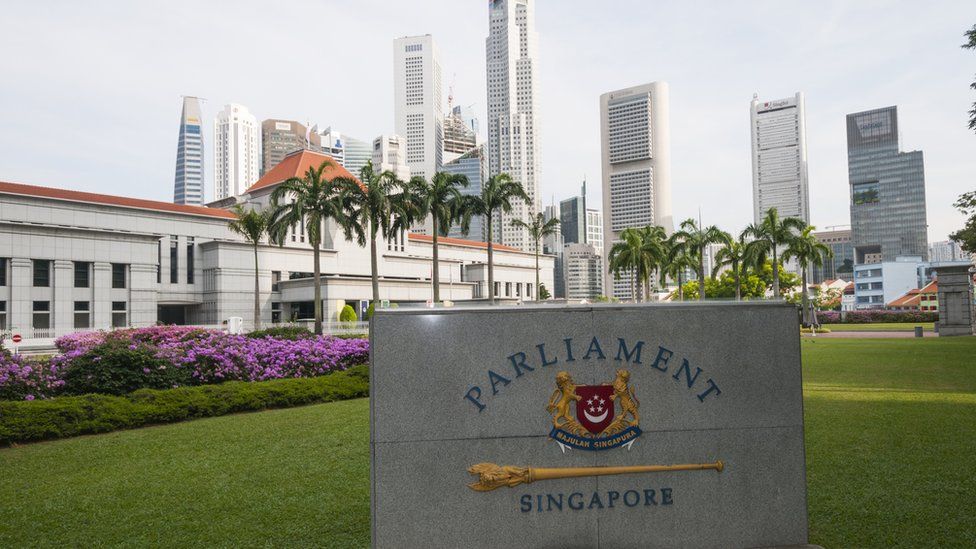
Singapore Parliament Building

Singapore has passed a controversial law aimed at countering foreign interference in domestic affairs, in a move that critics say could be used to stifle dissent.

It allows authorities to order social media sites and Internet providers to disclose user information or block content that they deem hostile.

Singapore says such a law is needed to counter “serious threats”.

The law was passed on Monday after 10 hours of heated parliamentary debate.

It will give the government powers to act against local proxies – people in Singapore that are deemed to have carried out “hostile information campaigns” on behalf of foreign entities.

The government can also designate organisations or individuals as “politically significant persons” if their work is directed towards a political end. This means they could be require to disclose their funding sources.

But the broad scope of the Foreign Interference (Countermeasures) Act, also known as Fica, has sparked concern.

“Today’s passage of FICA constitutes a human rights disaster for community activists, independent media, and opposition politicians because it hands arbitrary power to the Singaporean government to punish anyone based on vague allegations of involvement with foreigners,” Phil Robertson, deputy Asia director at Human Rights Watch, said in a statement.

“Using this law, the government can… shut down viewpoints it doesn’t like. Once again, Singapore demonstrates how little faith it has in its democracy by resorting to political measures better suited to authoritarian regimes that don’t trust their people.”

Singapore has defended the need for such laws saying its multi-ethnic population made it more vulnerable to “hostile information campaigns [that would] mislead Singaporeans on political issues [or] stir up dissent and disharmony by playing up controversial issues such as race and religion”.

Breaking this law could lead to a heavy fine or a jail term.

National implications

Fica allows the home affairs minister to order investigations in the public interest to “expose hostile information campaigns”, based on suspicion of foreign interference.

An offence is committed if a person publishes something in Singapore on behalf of a foreign entity to “influence a target to do something that is or is likely to be prejudicial to Singapore’s interests, incite feelings of hatred or diminish public confidence in the authorities”, according to an earlier Straits Times report.

Instead of open court, an independent panel chaired by a judge will hear appeals against the minister’s decisions. This is necessary as matters may involve sensitive intelligence with implications for national security, the government said.

“This Bill is intended to address a serious threat that concerns our national security and sovereignty,” Law and Home Affairs Minister K. Shanmugam said.

“And these are important to ensure that Singaporeans continue to make our own choices on how we should govern our country and live our lives.”

The small city-state joins nations such as Australia and Russia, which have in recent years passed laws to deter foreign interference.

This comes after Singapore passed a controversial anti-fake news law in 2019 that gives authorities sweeping powers to police online platforms and even private chat groups.

COVID-19 Changed the World!

October 6th, 2021

By Dr. Tilak S. Fernando

FOCUS

COVID-19 is a deadly infectious disease caused by the SARS-CoV-2 virus. Many become victims of the pandemic daily. The severity of the disease depends on the person’s immune system, some recover without special treatment; others become seriously ill. 

As a last resort, ICU units give oxygen to patients who suffer from pneumonia. Many world leaders have become victims as the virus does not have any class distinctions or social barriers when it affects a person.

 Delta variant 

The variant identified as Delta is supposed to be deadly. The bug can travel in the atmosphere to infect many people. The figures keep on increasing daily. Meanwhile, critics against vaccinations say that unusual blood clots are a possible side effect of the vaccine. Blood clots in circulation are usually deadly as they may precipitate pulmonary embolism, strokes, and heart attacks. 

Nevertheless, critics say because of the vigorous campaign by the Government, in tandem with the rumour generated fear factor, people rush to various vaccination centres en masse to get the jab. 

The Sri Lanka Government obtained sufficient stocks of various kinds of injections and carried out an inoculation campaign. On 20 July 2021, Sri Lanka reached the top of the world community list on vaccination programmes. It has now embarked on a vigorous vaccination programme to immunise young school children over 12 years with the Pfizer vaccine. \

Schoolchildren 

Bearing in mind that the young today will be statesmen tomorrow, it goes without saying that keeping schools closed indefinitely will only help bring up a set of nincompoops due to the lack of formal education. Since the closure of all schools, children learnt online, but the children’s future was hampered when the teachers went on strike and came on to the streets aided by trade unions and several political parties. 

After haggling for the last 24 years, the rebellious teachers want the whole of their demands met at once like a shot in the back The Government recognises their needs are genuine. Due to the COVID-19 pandemic, the global economy, along with Sri Lanka’s has collapsed. However, the Government is ready to meet their demands in the November 2021 Budget. 

It is crystal clear that school teachers do not seem to care about the children’s education. Their only objective seems to be, that in spite of the pandemic, to get their demands met though the country is struggling to solve the dollar crisis. The rich will somehow manage to educate their children by sending them to international schools in Sri Lanka or to overseas universities. 

Meanwhile, it is hilarious to learn through Social Media that prominent political party leaders who lead teacher protests educate their children in Ireland and the UK. It clearly shows the duplicity of their political ideology. It is the poor children who get affected. 

Schoolteachers are supposed to be intelligent, but in this instance they have come out to the streets and make a noisy din forgetting about their commitment and dedication towards their pupils, especially during the pandemic. Have teachers sadly become wound toys by wicked and selfish union leaders with ulterior motives to debase and defile the present Government?

COVID-19 changed the world 

Everyone in the world needs to change their lifestyles to suit the COVID-19 pandemic. The pandemic will be with the people for several years to come, akin to a typical nose cold. A good thing about COVID-19 is it has brought some discipline in Sri Lanka, especially when travelling by buses in comfort- which is a blessing in disguise, rather than getting packed like sardines inside.

 At times not even a strong person can maintain one’s balance when drivers recklessly manipulate their buses. Therefore, people must learn to live with COVID-19, whereby self-discipline becomes foremost in the schedule. 

The COVID-19 pandemic made the people the world over a disciplined society to a certain extent. However, some individuals still do not pay any heed to health advice or Government instructions. Simultaneously, different countries adopt various methods to open their lands, concentrating on their economy. Sri Lanka again introduced a ‘shut down’ and opened on 01 October 2021. 

Religious ceremonies 

Meanwhile, the Buddhist clergy organised impassioned programmes in various parts of the island and conducted special programmes by chanting ‘pirith’; other religious leaders performed their sanctified religious events to curb the spreading of the disease. 

There seems to be an impact on such religious observations towards the downtrend of the infected persons and deaths, but the medical experts indicate that ‘Sri Lanka is not yet out of the woods’!

 The remarkable aspect what COVID-19 has brought is mainly to discipline the public in many ways. It assisted people in familiarising themselves with online services using computers and children to study online.

Many entrepreneurs have devised various methods to generate income rather than adopting a defeated attitude! Also, it has helped to cut down on unnecessary expenses by paying expensive bills to funeral parlours and associated services; organising buffets to feed the sympathisers who visit the funeral house. When a person dies as a COVID-19 victim, the dead body gets incinerated within 24 hours. It also cuts down the virtual indebtednes to banks by relatives (by trying to keep up with the Joneses).

 The difference of opinion in the society is whether all are equal before the law: as far as disposal of the dead bodies are concerned. All this means the relatives will never get a chance to see the deceased relative’s face. The deceased individual cannot see any such activity, but these traditions of glorified funerals have come down for generations.

Another good news is about mortality reduced to zero rate ‘with fast recovery and no severe complications’ reported on COVID-19 patients in Ayurveda hospitals in Sri Lanka. Only recently, President Gotabaya Rajapaksa took a firm decision to seek Ayurveda assistance.

 Many Sri Lankans believe that ancestral treatment has existed since time immemorial. Records show how Sri Lankans had weathered many an infectious disease in the past with Ayurveda and local orthodox medicine. 

With the onslaught of COVID-19, many Homoeopaths, Ayurvedic doctors, and traditional doctors have invented numerous methods and preparations to fight against the Covid-19 virus and its variants, enabling a boosted immune system to fight against the infection , and also as a prophylactic. 

The latest is an inhaler using rare traditional herbs in Sri Lanka, where ancestors used to combat epidemics. While using the inhaler one needs not be fearful in gobbling any concoctions Kasaya or paniya anymore. It is available in the local market, and is said to kill any virus, COVID-19 plus variants, and other viruses.

 tilakfernando@gmail.com 

ත්‍රීකුණාමලය තෙල් ටැංකි පිළිබඳ ගම්මන්පිල ඇමතිගේ දේශ ද්‍රෝහි ප‍්‍රකාශය හෙලා දකිමු. We condemn Minister Gammanpila treacherous statement on Trincomalee oil tanks.

October 6th, 2021

ලංකා ඛනිජ තෙල් පොදු සේවක සංගමය.

1. අණ්ඩුව නියෝජනය කරන ඛනිජ තෙල් විෂය භාර ගරු අමාත්‍යවරයා 2021. 10. 04 මාධ්‍ය සාකච්ජාවේදී ත්‍රී’මලේ තෙල් ටැංකි දැනටම ඉන්දියාව සතු බවට කරන ලද සාවද්‍ය ප්‍රකාශය දේශ ද්‍රෝහි ක්‍රියාවක් ලෙස අප දැඩි පිළිකුලෙන් යුතුව හෙලා දකිමු,

2. මෙම තෙල් ටැංකි සංකීරණය නීතිමය වශයෙන් මෙතෙක් ඉන්දියාවට පවරා නොමැති බව නීතිඥයෙකු ලෙසත් , දේශ ප්‍රේමියෙකු යැයි කියාගන්නා පුද්ගලයෙකු ලෙසත්, විපක්ෂයේ සිටියදී අප හටද ඒ බව තහවුරු කල පුද්ගලයෙකු ලෙසත් දැනට විෂය භාර ඇමති වරයා ලෙසත් හොදාකාරවම දන්නා බව අප හොදින් දනිමු,

3‍. මෙම ප්‍රකාශය අප දකින්නේ හුදෙක් සුළු ප්‍රකාශයක් ලෙස නොව මෙම තෙල් ටැංකි ඉන්දියාවට නීතිමය ලෙස වසර 50 කට පවරා දීමට එතුමන් ඉදිරිපත් කොට ඇති යොජනාව රහසේම බලාත්මක කිරීමට සමාජය නොමඟ යැවීම සඳහා හිතා මතා සැලසුම් සහගතව යටි අරමුණින් කරන ලද ප‍්‍රකාශයක් ලෙසයි,

4. මෙම පිළිකුල් සහගත ප‍්‍රකාශය පිළිබදව අප වෘත්තීය සමිති ලෙසත්, රටේ සමාන්‍ය පුරවැසියන් ලෙසත් මහත් භිතියට පත්වන්නෙමු. ඒ මෙම තෙල් ටැංකි සංකීරණය ඉන්දීය තෙල් සමාගමකට නීතිමය ලෙස ලබා දීම සමඟ කෙටි කලකින් තෙල් බෙදා හැරීමේ සමස්ථ පාලනයම ඉන්දියාව සතු වනු නියත බැවිනි,
 
5. 1987 ජුලි 29 අත්සන් කල ඉන්දු ලංකා ගිවිසුමේ කිසිදු සෘජු කොන්දේසියකට තෙල් ටැංකි පිළිබදව සඳහනක් නොමැත. මෙහි සඳහන් වන්නේ එම ගිවිසුමේ අරමුණ මතය. J.R ජයවර්ධන මෙම ටැංකි සංකීරණය ඇමරිකාවට බදු දීමට දැරූ උත්සහය නතර කිරිමට රජීව් ගාන්ධි මහතා ජයවර්ධන මහතාට එවන ලද ලිපියක මෙම ක්‍රියාව කලාපීය හා ඉන්දීය ආරක්ෂාවට බලපාන බැවින් එය වැලැක්වීමට කොන්දේසි කිහිපයක් ඉදිරිපත් කරන ලදි. එහි 2(iii) ජේදයේ මෙම ටැංකි සංකීරණය ඉන්දියාව සමඟ එක්ව සංවර්ධනය කල යුතු බව ප‍්‍රකාශ කරන ලදි. එම ලිපියට එකඟතාවය පලකොට JR ලිපියක් යවා ඇත. එම ලිපි දෙක මෙම ගිවිසුමේ ඇමිණුමක් ලෙස එක් කොට ඇත,

6. මෙය කිසිදු ලෙස නීතිමය පැවරීමක් වන්නේ කෙසේද? මීලඟට ඇමතිවරයා 2003 ගිවිසුමක් ගැන කථා කරයි. 1987 ගිවිසුමෙන් පවරා ඇත්නම් 2003 පවරන්නට උත්සහ කරන්නේ කුමන හේතුවකටද? එනම් 1987 අවබෝධතා ගිවිසුමකින් නීතිමය පැවරීමක් සිදුකල නොහැකි බව ඔහුම පැහැදිලි කරයි,

7. 2003 පෙබරවාරි 07 මුදල් අමාත්‍යංශයේ ලේඛම් ලෙස චරිත රත්වත්තේ, තෙල් සංස්ථා සභාපති ලෙස දහම් විමලසේන ලංකා ඉන්දීය තෙල් සමාගම වෙනුවෙන් එම් නාගේෂ්වරන් යන අය අත්සන් කල තාවකාලික ලේඛනයේ 1.2 කොන්දේසිය සදහන් වන්නේ උක්ත දින සිට මාස 06ක් ඇතුලත විධිමත් බදු ගිවිසුමකට එළඹෙන බවයි. නමුත් මෙතෙක් එම බදු ගිවිසුමට එලඹ නොමැති බැවින් 2003. 08. 06 පසු LIOC යට චීන වරායේ සිටිය නොහැකි බව ඉතා හොදින් පැහැදිලි කලේද ගම්මන්පිල ඇමතිවරයා විපක්ෂයේ සිටියදීය,

8. 2017. 03. 02 ඉන්දීය තෙල් සමාගමේ ශ්‍යාම් බෝරා මහතා නීතිපතිවරයාට ලිපියක් යවා ඇත්තේ ඛනිජ තෙල් පොදු සේවක සංගමය වන අප ගොනු කර ඇති මානව හිමිකම් නඩුව පාදක කරගනිමිනි. එහි පැහැදිලිව සදහන් කරන්නේ 1987 නොව තවත් අවස්ථා ගණනාවකදී ඉන්දියාව සහ ලංකාව අතර අවබෝධතා ගිවිසුම් වල මෙම ටැංකි සංකීරණය පිළිබදව සදහන් වුවද 2003 පෙබරවාරි 07 ගිවිසුමේ සදහන් පරිදි නීතිමය ගිවිසුමකට මෙතෙක් එළඹ නොමැති බවත් තමාට නීතිමය ලෙස මෙය අයිති නොවන නිසා සංවර්ධනය කල නොහැකි බවත්, ලංකා රජයට මේ පිළිබදව කිහිප වතාවකදී දැනුම් දුන්නද එය ඉටු නොවුණු බවත්ය. එම නිසා මෙම පැවරීම ඉක්මනින් කිරීමට කටයුතු කරන ලෙස ඉල්ලා සිටින ලදි,

9. එනම් LIOC යද තමාට මෙතෙක් මෙය නීතිමය ලෙස පවරා නොමැති බව පිලිගනී. නමුුත් උදය ගම්මන්පිල ඇමතිතුමන් එය පවරා ඇති බව පවසයි,

10. අර්ජුන රණතුංග ඇමතිවරයා මෙම ටැංකි ඉන්දියාවට පැවරීමට කැබිනට් අනුමැතිය ලබා ගත්තේය. එය ඉන්දියාවට පැවරුවේ 87 නම් නැවත කැබිනට් අනුමැතිය කුමකටද? මේ සම්බන්ධයෙන් 18/318 හා 18/319 ලෙස මූලික අයිතිවාසිකම් පෙත්සම් 02 අධිකරණයේ ක්‍රියාත්මක වන්නේත් ඇමතිවරයා විපක්ෂයේ සිටියදී දුන් සහයෝගය මතය, 11. අවසාන වශයෙන්  අප ප්‍රශ්න කරන්නේ මේවා ඉන්දියා සතු නම් ඔවුන්ට සියල්ල පරිහරණයට බලය ඇත්නම් 87 සිට මේ දක්වා බලය ඉල්ලා ගිවිසුම් යදීද? ඇමතිවරයා ඔවුනට ටැංකි ලබා දීමට වෘත්තීය සමීති වලට යෝජනා ඉදිරිපත් කරයිද? දැනටමත් මෙහි අයිතිය රජය සතුය,

12. මේ ඔහු ඉදිරිපත් කල පහල අංගනයේ ටැංකි 15 LIOC යටතේත්, ඉහල අංගනයෙන් ටැංකි 24 CPC යටතේ ඉතිරි ටැංකි 61 LIOC/CPC පොදු සමාගමක් ලෙස වසර 50 කට ඉන්දියාවට බලය දීමට ගෙන ආ යොජනාව ක්‍රියාත්මක කිරීමට දරණ කූට උපායක එක් ජවනිකාවක් පමණි. මෙය පිළිකුලෙන් යුතුව හෙළාදකින අතර අප සැවොම එක්ව මෙය පරාජය කරන්නෙමු.

ජනතාවට ජාතික සම්පත් ආරක්ෂා කර ගැනීමට එක්වන ලෙස ආයාචනා කරමු.

ස්තූතියි.

මෙයට,
අශෝක රංවල
සභාපති,
ලංකා ඛනිජ තෙල් පොදු සේවක සංගමය.

කොරෝනා මර්දනයට හොද ක‍්‍රම දේශීය වෛද්‍ය ක‍්‍රමයේ තිබෙනවා – නිසි ක‍්‍රමවේදයකින් තොරව දරුවන්ට එන්නත ලබාදීම භයානකයි – බෙංගමුවේ නාලක හිමියෝ

October 6th, 2021

CDPC Media Unit

කොරෝනා වෛරසයෙන් බේරීම සදහා එන්නතට වඩා හොද ක‍්‍රම දේශීය වෛද්‍ය ක‍්‍රමය තුළ පවතින බවත්, නිසි ක‍්‍රමවේදයකින් තොරව කුඩා දරුවන්ට එන්නත් ලබාදීම භයානක විය හැකි බවත් ශ‍්‍රී ලංකා දේශීය වෛද්‍ය සංගමයේ සභාපති බෙංගමුවේ නාලක හිමියෝ පැවසූහ.

එන්නත ලබාගැනීමෙන් පසුව අතුරු ආබාධ ඇතිවූ අයට දේශීය වෛද්‍ය ක‍්‍රම වෙත යොමු වන්නැයි ආරාධනා කරන බවද ගාල්ලේදී පැවති ප‍්‍රවෘත්ති සාකච්ඡුාවකදී බෙංගමුවේ නාලක හිමියෝ පැවසූහ.

එහිදී වැඩිදුරටත් අදහස් දැක්වූ උන්වහන්සේ මෙසේද පැවසූහ

මම ශ්‍රී ලංකා වෛද්‍ය සම්මේලනයේ සභාපති ලෙස වගකීමෙන් කියනවා අපේ වෛද්‍ය සම්මේලනයේ හා ආයුර්වේද වෛද්‍යවරුන් ඇතුලුව දේශීය වෙදකම භාවිත කරන වෛද්‍යවරු කියනවා මේ රෝගය සුවපත් කරන්න අපට ප්‍රතිකාර තියෙනවා කියලා. මේක සෙම්ප්‍රතිශ්‍යාවක් වගේ  රෝගයක්. හැබැයි සෙම්ප්‍රතිශ්‍යාව  රෝගය නරක් වුණොත් නියුමෝනියාව හැදෙනවා. මේ රොගයත්  එහෙමයි. නියුමෝනියා තත්තවට පැමිණිය අයටත් දේශීය ප්‍රතිකාර තියෙනවා.  තුන්දොස් වලින් සෙම මුල්කරගෙන තමයි මේ රෝගය හැදෙන්නේ . ඒ සෙමට කරන ප්‍රතිකාර කලාම මේ රෝගය සුවපත් වෙනවා. ඒ නිසා සමහරු උත්සහ දරණවා මේ ක්‍රියාවලියෙන්   ලෝකේ අංක එකට පැමිණෙන් . ඒක මෝඩකමක් මෝඩ කථාවක්. මොකද අපට එහෙම ඔිනේ නැහැ. අපට ඔිනේ මේ රෝගය සුවපත් කිරීමෙන් ලෝක‌යේ අංක එකට එන්න. ඒක ඔය ක්‍රියාවලියෙන් නම් කවදාවත් කරන්න බැහැ. ඒවා කරන්න පුලුවන් අපේ දේශීය වෙදකම තුලින්. ඒ සදහා අපේ වෙදමහත්වරුන් ඇප කැපවි පොරොන්දු වෙලා දැනට ඉන්නවා ඒ සදහා අවස්ථාව ලැබෙනකල්.

මේ පුංචි දරුවන් මේ ක්‍රියාවලියට  යොදා ගැනීම නම් ඉතාමත් භයානකයි. මේ අහිංසක දරුවන් මොනවාද  දන්නේ. ඒ අය වෙනුවෙන් කිසියම් ප්‍රකාශකයට දෙමාපියන් අත්සන් කරනවා. ඒ අය ජීවත් වුණොත් අතුරු ආබාධ හැදිලා ඉන්නගමන් ඒ අය දෙමාපියන්ට  සාප කරයි. ඒ නිසා මේවැඩේ නම් කරන්න එපා . කිසියම් බටහිර හෝදේශීය වෛද්‍යවරයෙක්  මේවා නිෂ්පාදනය කළ අය මේ ක්‍රියාවලිය මගින් මේ රෝගය සුවපත් වෙනවාකියලා පොරොන්දු දෙන්නේ නැහැ. මෙයින් මරණය වළකිනවා කියලා කියන්නෙත් නැහැ.

එක්තරා වෛද්‍යයෙක් ප්‍රකාශ කලා මේක්‍රියාවලියෙන් ලිංගික දුබලතා ඇතිවෙනවාද නැතිවෙනවද කියලා කියන්න බැහැකිව්වා. මෙතනම තියෙනවා යම් අවිස්වාසයක්. ඇයි මේ අවිස්වාසය පදනම් කරගෙන මේ ක්‍රියාවලිය ක්‍රියාත්මක කරන්නේ. දරුවන් නොලැබ ඉන්න කියලා තවත් කෙනෙක් කියනවා‍. තවත් වෛද්‍යවරියක් කියනවා හැම අවුරුද්දක් පාසාම මේ ක්‍රියාවලිය කරන්න ඔිනේ කියලා. මේ විදිහට මේ ක්‍රියාවලිය ක්‍රියාත්මකරකන විට අපිට දරුසම්පත නැතිවෙලා යනවා. අපිට මහනකරන්න දරුවෙක් නැති වෙයි දෙමාපියන්ව රැක බලාගන්නත් දරුවෙකු ඉතිරිවෙන්නේ නැහැ අනාගතයේදී. ඒ  තරම් භයානක තත්ත්වයක් අපට පෙනෙනවා. හදවතක් ඇති කෙනෙකුට මනුෂ්‍යත්වට ගරුකරන කෙනෙකුට මේ ක්‍රියාවලිය අනුමත කරන්න බැහැ. මේවායේ මූලිකයෝ මොනවගේ අරමුණකින්ද මේවා පටන් ගත්‌තේ කියලා ඔය සමාජ මාධ්‍ය ජාලාවල කරුණු ඇතිව ප්‍රකාශ වෙනවා වෙයිකියලා. මම මේ ක්‍රියාවලියට අනුගත වෙන්නේම නැහැ.  මමඅනික් අයට මේ ක්‍රියාවලියට අනුගත වෙන්න එපා කියලා කියන්නෙත් නැහැ. හැබැයි ඒ ක්‍රියාවලියෙන් වාලකී සිටින්න කියලා අපි කියනවා.

රජයට සම්බන්ධ මාධ්‍ය හා රජය මගින් හැමතිස්සෙම බලපෑම් කරනවා. හැබැයි ඒ කිසිදු බලපෑමක් උසාවියකට  ඉදීපත් කිරිමට තරම් ලිඛිතව දෙන්නේ නැහැ. කටවචනයෙන් කියනවා විතරයි. අපේ නීතීඥ මහත්වරුන් කුමක්හෝ නඩුනිමිත්තකි හොයනවා. හොයාගන්න මේ අය මේ ගැන කිසිවක් ලියන්න් නැහැ. මේ තරම් කපටි කයිරාටික විදිහට මේක ක්‍රියාත්මක කරන්නේ මොකටද?  කරුණාවෙන් ඉල්ලා සිටිනවා අපි මේ අපේ රටතුල අනාගත පරපුරට ජිවත් වෙන්න ඉඩතියන්න. විශේෂයෙන් තරුණ තරුණියන් සහ කුඩා දරුවන් මෙි ක්‍රියාවලියෙන් වැලකි සිටින්න. දෙමාපියන් හොදට හිතට ගන්න. තමන්ගේ දරුවන්ව මේ ක්‍රියාවට භාජනය කරන්න එපා කියලා. දරුවන් අතර මුලින්ම ආබාධිත පිරිස තෝරා ගත්තේ ඇයි?  මේක පරික්ෂණයක් නේ. ඒ අයට මොනවාද වෙන්‌නේ කියලා බලාගන්න පුලුවන්. ආබාධිත වුණත් දරුවෝ. ඒ වගේ තක්කඩිකම්කරන්න හොද නැහැ. ඒවා කරන අයට ඒවා විපාක දෙනවා. අයේ දෙකක් නැහැ. බුදදහමට අනුව අපිට හිතන්න පුලුවන්. එවැනි ක්‍රියාවල පලවිපාක ඉතාමත් හොදින් පැහැදිලි කර දෙන්න පුලුවන්‍. ඒ නිසා අපි තරයේ විරුද්ධ වෙනවා මේ ක්‍රියාවලියට පුංචි දරුවන් හා තරුණ තරුණියන් පාසල් දරුවන් සම්බන්ධ කර ගැනීම .දෙමාපියන්ගෙන් අපි ඉල්ලීමක් කරනවා මේ සදහා අවසර නොදෙන ලෙස.

ඒ වගේම අපේ අනාගත පරපුරු රැක ගන්න දේශීය වෛද්‍ය ක්‍රමය තුලින් මේ කොරෝනා උවදුරට ප්‍රතිකාර ලබා ගන්නා ලෙස ඒ වගේම ක්‍රියාවලිය නිසා අතුරු ආබාධ හැදුන අයට ආරාධනා කරනවා  අපේ දේශීය වෛද්‍යවරුන් වෙත ගොස් ප්‍රතිකාර ලබා  ගන්නා ලෙස.” 

ජනයාගේ ඉඩම්වල පුරාවස්තු කළමනාකරණය කිරීම

October 6th, 2021

මතුගම සෙනෙවිරුවන්

              ලංකාව පුරා සැමතැනකින්ම ‌ෙඑතිහාසික වටිනාකමකින් යුත් පුරාවස්තු රාශියක් හමු වී තිබේ.විහාස්ථාන නටබුන් ශිලා ලේඛන මෙන්ම වාරිමාර්ග නටබුන්ද ඒ අතර වෙයි.මේවායින් ඇතැම් පුරාවස්තු හමු වන්නේ ජනතාව සන්තක පෞද්ගලික ඉඩම් වලය.ඉංග්‍රීසීන් විසින් මුඩු බිම් පනත යටතේ රජයට පවරා ගන්නා ලද ඉඩම් පසුව වතු වැවිලි සඳහාද මධ්‍යම පන්තික පුද්ගලයන්ටද වෙන්දේසි කිරීම නිසා මෙවැනි තත්වයක් උදා වී තිබේ. උතුර සහ නැගෙනහිර පළාත් වල බහුතරයක් මෙවැනි ඉඩම් දෙමළ සහ මුස්ලිම් ජනයාට වෙන්දේසි කර තිබේ.පුරාවිද්‍යෘ ආඥා පනත යටතේ මෙවැනි පුරාවස්තු ගැසට් කර තිබෙන්නේ ස්මාරක වශයෙනි.එවිට ඉඩමේ අයිතියක් පුරාවිද්‍යා දෙපාර්තමේන්තුවට නෑත.එබැවින්  ඒ පුරාවස්තු සියල්ල බෙහෙවින්ම අනාරක්ෂිතය.වෙසෙසින් නැගෙනහිර සහ උතුරු පළාතේ තත්වය ඉතාමත් බරපතලය.කුඹුරු ඉඩම් වලට යාව පවතින ස්ථූප සහ ආරාම ගොඩනැගිලි වරින් වර ඩෝසරයට යටවෙයි.දිවයිනේ අනෙක් පළාත් වලද තත්වය තරමක් බරපතලය.ඉඩම අයිති කරුවා දෙමළ හෝ මුස්ලිම් පුද්ගලයෙකු නම් මෙම පුරාවස්තු විනාශ කිරිම හෝ අතුරුදහන් කරනුයේ ඉඩම් අල්ලා ගැනීමේ අරමුණින් සහ ආගමික වුවමනාවෙන්ය. සිංහල පුද්ගලයෙකු නම් ඉඩම් කට්ටි කිරීම හෝටල් සෑදීම වැනි විවිධ සංවර්ධන අවශ්‍යතා සඳහා පුරාවස්තු වනසා දැමීම සිදු කරයි.මෑතකදී පුරාවිද්‍යා දේපාර්තමෙන්තුව විසින් මඩකලපු දිස්ත්‍රික්කයේ ‌ෙඑතිහිසික ස්ථාන තිස්පහක පමණ මායිම් කණු සිටවා පැමිණි ඇත. මේ වන විට ඒම කණු ගලවා ගත් ප්‍ර දේහ වැසි ජනයා ගෙමිදුල් වල බංකු සාදාගෙන තිබේ.ජනයා සතු ඉඩම් වල තිබෙන පුරාවස්තු සම්බන්ධව කලුතර දිස්ත්‍රික්කයේ අත් දැකීම් කීපයක් බහාලීම උචිතයයි සිතමි.

     කලුතර දිස්ත්‍රික්කයේ මදුරාවල ප්‍රාදේශීය ලේකම් කොට්ඨාශයේ වරකගොඩ ගනේ උඩ පවතින පුරාවිද්‍යා භූමියකට අත්වූ ඉරණමයි.ගම්පළ සහ කෝට්ටේ යුගයන්ට සමකාලීන වාස්තු ස්වරුපයෙන් යුක්ත මාළිගා භූමියක් මෙහි හමු වන අතර එම ස්ථානයේ දැනට විහාරස්ථානයක් පවතී.මෙම භූමියට ප්‍රවිශ්ඨ වීම පිණිස පුරාණයේ අඩි 30 ක පමණ පළලකින් යුක්ත පඩි පෙළක් තිබී ඇත.දළදා වහන්සේ වැඩැම්මවීම පිණිස අලි ඇතුන් ට ගමන් කිරීමට පහසු වනු පිණිස මෙම පඩි පෙළ සකස් කරන්නට ඇතැයි සිතමි.ඒ ආසන්නයේ ශිලාලේඛනයක්ද ඇත.අවාසනාවකට මෙම පඩි පෙළ පවතින්නේ පෞද්ගලික ඉඩමකයි.එහි රබර් වවා තිබුණි.මෙහි පැරණි අයිතිකරු කාලයක් තිස්සේ මෙම භූමිය ආරක්ෂා කරගත්තේය. ඔහු වයෝවෘද්ධ වීමෙන් පසු ඉඩම දරුවන්ට ලියා දෙන ලදී. පසුව දරුවන් විසින් ඉඩම කට්ටි කර බෙදා ගැනීමට බෙදුම් නඩුවක් දැමූ  අතර ඒ අතරවාරයේ එක්තරා දිනකදී  ඉඩම් කට්ටියේ  අයිතිකරු විසින් පඩිපෙළ ඩෝසරයකට යට කරන ලදී.නිදන් සෙවීමේ අරමුණින් හෝ ඉඩම් සුද්ද කිරීමේ අරමුණින් ඔහු එසේ කර ඇත. අවසානයේ බන්ධනාගාර ගතව දඩයකට යටත්ව නිදහස් විය.ඒ අගනා පඩි පෙළ විනාශ විය.

     මෙම දිස්ත්‍රික්කය තුල රයිගම් සහ පස්යොදුන් කෝරළ වල අනුරාධපුර යුගයට අයත් නටබුන් රාශියක් විසිර පවතී. විශේෂයෙන් කටාරම් කෙටූ ගල් ලෙන් විශේෂිතය.මෙම ගල් ලෙන් අතැම් විට ජනයා සතු ඉඩම් වලද වැවිලි සමාගම් සතු ඉඩම් වලද බහුලව දක්නට ලැබේ.රයිගම් කෝරළයේ ප්‍රබුද්ධගම අසල ගල්ලෙන කටාරම් කෙටූ විහාල ගල්ලෙනකි. වරාය නගරයට අවශ්‍ය ගල් ලබා ගැනීම සඳහා කලුතර දිස්ත්‍රික්කය තුළ ගල් කොරි රාශියක් මේ වන විට පිහිටුවා තිබේ.විවිධසමාගම් ගල් පර්වත ලබා ගැනීමට දැඩි කැමැත්තකින් පසුවේ.

යටකී. ප්‍රබුද්ධගම ගල්ලෙන තිබෙන පර්වතය වතු සමාගමකට අයත් බැවින් එයද ගල්කොරියකට ලබා ගැනීමට උත්සාම දරනු ලැබීය. මේ අවස්ථාවේ දී මදුරාවල ප්‍රා දේශීය ලේකම් තුමිය මැදිහත්ව මෙම ගල් ලෙන බේරා ගැනීමට කටයුතු කර ඇත.වලල්ලාවිට ප්‍රා දේශීය ලේකම් කොට්ඨාශයට අයත් ගුලවිට ගල්ලෙනකටද මෙවැනි ඉරනමක් අත් වන්නට තිබුණි.එයට හේතුව ගල්කොරියක් සඳහා පුරාවිද්‍යා දෙපාර්තමේනුතව විසින්ම අවසර ලබා දීමයි.පසුව ගල් කොරියට ඉස්මත්තේ තිබෙන ගල්ලෙන තුළ ආදි මානවයාගේ ශිලා මෙවලම් හමු වීම නිසා ඒ ගල් ලෙනද බේරා ගනු ලැබිණ.

    මෙවැනි විනාශ කිරීම් මෙන්ම විනාශ කිරීමට උත්සාහ දැරීමද් අනන්ත අප්‍රමාණය. වර්තමාන සංවර්ධන ප්‍රවේශයන් තුළ ජාතික උරුමයන් සහ පරිසරය පිළිබඳ නිවැරදි තක්සේරුවක් නොතිබීම මෙයට එක් හේතුවක්ය.මෙම පැරණි නටබුන්  ආරක්ෂා කරලීමට පුරාවිද්‍යා ආඥා පනතේ .තිබෙන්නේ සීමිත ඉඩකඩක් පමණකි.ඒ. සෑම ඉඩමක්ම පවරා ගැනීමටද නොහැකිය.ඉඩම් භුක්තිය පිළිබඳ විවිධ ගැටළු දක්නට ලැබේ.හවුල් අයිතිය තිබෙන ඉඩම් පවරා ගැනීමද දුෂ්කරය.මෙවැනි ප්‍රශ්ණ වලට පිළීතරු සෙවීමට මෙතෙක් උත්සාහ දරා නොමැත.පුරාවිද්‍යා ආඥා පනත වෙනස් කිරීම පිණිස මේ වන විට යෝජනා කැඳවා ඇති බැවින් යම් විසඳුම් කීපයක් යෝජනා කිරීම උචිත යයි සිතමි. පුරාවස්තුව පවතින ඉඩමේ අයිතිකරු සහ පුරාවිද්‍යා නිළධාරීන් අතර තිබෙන සම්බන්ධය මෙහිදී මූලිකව වැදගත්ය.ඉන්පසු පුරාවිද්‍යා අධ්‍යක්ෂ ජනරාල් වරයා සහ අයිතිකරු අතර යම් ගිවිසුමක් ඇති කරලීම කල යුතු යැයි සිතමි.ඒ අනුව  කොන්දේසි ඇතුලත් කර  මෙම ස්මාරක නැවත ගැසට් කිරීම කල යුතුයයි සිතමි.මෙවැනි පියවරයන් මගින්  පුරාවස්තු නිවරදිව කළමනාකරණය කිරීමට හැකිවෙයි. ඒ සඳහා  නව විෂයක් හඳුන්වා දීම අත්‍යවශ්‍ය වන්නේ  ඉහත කී ගැටළු තත්වයන් නිසාය.නඩු පැවරීමෙන් සහ දඩ නියම කිරීමෙන් පමණකි පුරාවස්තු ආරක්ෂා වන්නේ නැත.

මතුගම සෙනෙවිරුවන්

Old Ceylon – An Elegy

October 6th, 2021

Aegle Creations

A visual poem using old imagery of Sri Lanka, then known as ‘Ceylon’. Original poem by Thivanka R. Perera about the gradual breakdown of traditional Sri Lankan society following numerous foreign invasions and infighting.

ක්‍රීඩාවේ ජාත්‍යන්තර ජයග්‍රහණ කරා යාමට අවශ්‍ය මාවත නිර්මාණය කිරීමට ක්‍රීඩා අමාත්‍යාංශය ප්‍රමුඛ ආයතන සියල්ල නිරන්තර සූදානමින්.

October 6th, 2021

තරුණ හා ක්‍රීඩා, සංවර්ධන සම්බන්ධීකරණ හා අධීක්ෂණ අමාත්‍ය හා ඩිජිටල් තාක්ෂණ සහ ව්‍යවසාය සංවර්ධන රාජ්‍ය අමාත්‍ය නාමල් රාජපක්ෂ මහතා –

පසුගියදා පැවති ලෝක ශූරතා රෝදපුටු ටෙනිස් තරගාවලියේ දී 06 ස්ථානයට පැමිණි ශ්‍රී ලාංකේය ක්‍රීඩකයන් අගයමින් අද (06) දින තරුණ හා ක්‍රීඩා අමාත්‍යාංශයේ දී පැවති උත්සවයේදී අමාත්‍යවරයා  මේ බව පැවසීය.

පසුගිය සැප්තැම්බර් මස 27 සිට ඔක්තෝම්බර් 03 දක්වා රටවල් 16ක සහභාගීත්වයෙන් ඉතාලියේ සාඩිනියා නගරයේ පැවති ලෝකශූරතා රෝදපුටු ටෙනිස් තරගාවලියේ  දී 06  වන ස්ථානය ජයග්‍රහණය කිරීමට ශ්‍රී ලංකා රෝදපුටු ටෙනිස් කණ්ඩායම සමත් විය.

පවතින වසංගත තත්ත්වය හමුවේ වුවද ජගත් වැලිකල මහතාගේ පුහුණුකිරීම් හා මග පෙන්වීම යටතේ සුරේෂ් ධර්මසේන, ලසන්ත රත්නවීර, ඩී.එම්. ගාමිණි යන ක්‍රීඩකයන් තිදෙනා මෙම තරගාවලියදී ශ්‍රී ලංකාව ලෝක ශ්‍රේණිගත කිරීම්වල 06 වන ස්ථානය දක්වා ඔසවා තැබීය.

එහිදී අමාත්‍යවරයා මෙසේ ද කීය.

‘‘ඉතිහාසයේ පළමු වතාවට අපේ රෝදපුටු ටෙනිස් කණ්ඩායමට ලෝකයේ 06 වන ස්ථානය ලබාගත හැකි වී තිබෙනවා.

මෙතෙක් අපි බලාපොරොත්තු වූ ඉලක්කයන් සියල්ල අභිබවා යන්න මේ තරුණ ක්‍රීඩකයින්ට හැකියාව ලැබිලා තිබෙනවා.

අද ශ්‍රී ලංකා ක්‍රීඩා ඉතිහාසයේ ඉතාමත් සුවිශේෂී දිනයක්.

අනෙකුත් ක්‍රීඩාවල ක්‍රීඩක ක්‍රීඩිකාවන්ටත් තම ක්‍රීඩා සැලැස්ම පිළිබදව හා තමන්ට මුහුණදෙන්න තිබෙන අභියෝග පිළිබදව ඉතාමත් අනාගතවාදීව සහ බලාපොරොත්තු සහගතව බලන්න පුලුවන් පිළිතුරක් මේ ක්‍රීඩකයින් ඔබට ලබා දී තිබෙනවා.

අමාත්‍යාංශයක් විදියට අපි නිරන්තරයෙන් උත්සාහ කරන්නෙ ජාත්‍යන්තරය ජයගන්න පුලුවන් ක්‍රීඩක ක්‍රීඩිකාවන් බිහි කරන්න.

ග්‍රාම නිළධාරී කොට්ඨාශ තරගාවලිය ජයග්‍රහණය කරන ඒක, පසු කාලීනව ප්‍රාදේශීය ලේකම් කොට්ඨාශ තරගාවලි ජයග්‍රහණය කරන ඒක ලොකු ජයග්‍රහණයක් කියලා උනන්දු වුණ කාලයක් තිබුණා.

තවත් කාලෙක  දිස්ත්‍රික්කය ජයග්‍රහණය කිරීමත්, පළාත් ජයග්‍රහණය කිරීම, ඒ් කියන්නේ ජාතික ක්‍රීඩා උළෙල ජයග්‍රහණය කිරීම තමයි ලබන ලොකුම ජයග්‍රහණය විදියට දැක්කේ. අද අපි එතනින් එහාට යා යුතුයි.

එයට හොදම උදාහරණය පැරාලිම්පික් රන් පදක්කමක් දිනාගත්තා, රෝදපුටු ටෙනිස් කණ්ඩායම ලෝකෙන්ම 06 වෙනි ස්ථානයට පත් වුණා.

දකුණු ආසියාවේ වේගවත්ම ක්‍රීඩකයා ශ්‍රී ලංකාවෙන් බිහිවුණා. උස පැනීමේන් දකුණු ආසියානු වාර්තාවක් තබන්න හැකිවෙලා තිබෙනවා. කාන්තා මේස පන්දු ක්‍රීඩිකාවන් 12 වෙනි ස්ථානය දිනාගෙන තිබෙනවා. වොලිබෝල් ක්‍රීඩාවෙන් ද ලෝකශ්‍රේණිගත කිරීම්වල 50 වෙනි තැන රැදෙන්න අපිට හැකියාව ලැබුණා.

ක්‍රීඩාවේ  ජාතික ජයග්‍රහණ තුළින් ඔබ්බට ගොස් ජාත්‍යන්තර ජයග්‍රහණ පිළිබඳව බලාපොරොත්තුවක් ඇති කරගන්න වගේම ජාත්‍යන්තර ජයග්‍රහණ ලබන්නත් අපිට හැකියාව ලැබුණා.

ජාත්‍යන්තර ජයග්‍රහණ කේන්ද්‍ර කරගත් වැඩපිළිවෙළක් ක්‍රියාත්මක කළ යුතුයි කියන කාරණය‍ පිළිබඳ අපි අමාත්‍යාංශයක් විදියට විශ්වාස කරනවා. එහි ප්‍රතිඵල අපිට දකින්න ලැබෙනවා.

විශේෂයෙන්ම අද මම රෝදපුටු ටෙනිස් කණ්ඩායමට සුබ පතනවා. ඔවුන් විශාල කැපකිරීමක් කළා පහුගිය කාලය පුරාවටම. අපි ඒක දැක්කා. ජාතික ක්‍රීඩා සභාව ඒ සඳහා සහයෝගය ලබා දුන්නා.

ජාත්‍යන්තර ජයග්‍රහණ කරා යන්න ඔබ සැමට අවශ්‍ය මාවත නිර්මාණය කරන්න ක්‍රීඩා අමාත්‍යාංශය ප්‍රමුඛ ආයතන සියල්ල නිරන්තරයෙන් සූදානමින් සිටිනවා.

මේ ජයග්‍රහණය දැනගත් වහාම මම SLT මොබිටෙල් ආයතනයට කතා කළා.

අපි කාර්‍යසාධනය පාදක කරගත් දිරි දීමනා ක්‍රමවේදයක් අනුගමනය කරන්නේ. මේ සදහා අපි SLT මොබිටෙල් ආයතනයේ අනුග්‍රහය ඉල්ලුවා.

ඉතාම උද්යෝගයෙන් දින කිහිපයක් ඇතුළත අවශ්‍ය සියලුම වැඩ කටයුතු සිදු කර ක්‍රීඩකයන් සඳහා ඒ අදාළ දීමනා ලබා දෙන්න ඔවුන් කටයුතු කළා.

කොවිඩ් 19 වසංගතය සමග වෙනදා මෙන් ලොකු උත්සවයක් පවත්වන්න බැහැ. නමුත් මෙවැනි චාම් උත්සවයකින් හෝ ඔවුන්ව දිරි ගන්වන්න ලැබීම පිළිබදව සතුටු වෙනවා.

06 වන ස්ථානයේ නතර නොවී පළමු වන තැනට ඉතාමත් කෙටි කාලයකින් පැමිණීමට හැකියාව ලැබේවා‘යි ප්‍රාර්ථනා කරනවා.‘‘

SLT මොබිටෙල් ආයතනය විසින් ජයග්‍රාහී රෝදපුටු ටෙනිස් කණ්ඩායමට සුබ පැතුම් එක් කරමින් ක්‍රීඩකයන් තිදෙනාට රුපියල් මිලියනය (රු.1,000,000/-) බැගින් සහ පුහුණුකරු වෙත රුපියල් දෙලක්ෂ පනස් දහසක (රු. 250,000/-) මූල්‍යමය ප්‍රදානයක් ලබාදෙමින් ඔවුන්ට දිරිගැන්වීම් ලබාදුණි.

මෙම අවස්ථාවට තරුණ හා ක්‍රීඩා අමාත්‍යාංශයේ ලේකම් අනුරාධ විජේකෝන්, ක්‍රීඩා සංවර්ධන දෙපාර්තමේන්තුවේ අධ්‍යක්ෂ ජනරාල් අමල් එදිරිසූරිය, ජාතික පැරාලිම්පික් කමිටුවේ ලේකම් බ්‍රිගේඩියර් බන්දුල බණ්ඩාර, ශ්‍රී ලංකා ටෙලිකොම් සමූහයේ ප්‍රධාන විධායක නිලධාරී ලලිත් සෙනෙවිරත්න යන මහත්වරුන් ඇතුළු පිරිසක් සහභාගී වූහ.

මාධ්‍ය ඒකකය,

තරුණ හා ක්‍රීඩා අමාත්‍යංශය,

සංවර්ධන සම්බන්ධීකරණ හා අධීක්ෂණ අමාත්‍යාංශය,

ඩිජිටල් තාක්ෂණ හා ව්‍යවසාය සංවර්ධන රාජ්‍ය අමාත්‍යංශය.

කොවිඩ් වලට සීමා වූ දරුවන්ගේ අධ්‍යාපනය, නැවත ප්‍රකෘතිමත් කිරීමේ හදවත ගුරුවරුන් – අග්‍රාමාත්‍ය මහින්ද රාජපක්ෂ මහතා

October 6th, 2021

අග්‍රාමාත්‍ය මාධ්‍ය අංශය

කොවිඩ් වසංගතයට සීමා වූ දරුවන්ගේ අධ්‍යාපනය නැවත ප්‍රකෘතිමත් කිරීමේ හදවත් ඇත්තේ ගුරුවරුන්ට බව අග්‍රාමාත්‍ය මහින්ද රාජපක්ෂ මහතා අද (06) දින පැවසීය.

ලෝක ගුරු දිනයට සමඟාමීව අධ්‍යාපන අමාත්‍යාංශය සංවිධානය කළ ගුරු දින උත්සවයට වීඩියෝ තාක්ෂණය ඔස්සේ සුබ පැතුම් එක් කරමින් අග්‍රාමාත්‍යතුමා මේ බව සඳහන් කළේය.

ගුරුවරුන් වෙනුවෙන් අධ්‍යාපන අමාත්‍යාංශය ඔස්සේ පළමු වතාවට හැඳුනුම්පතක් නිකුත් කිරීම ද මෙම උත්සවයට සමඟාමීව සිදුවිය.

අග්‍රාමාත්‍ය මහින්ද රාජපක්ෂ මහතා ගුරු දිනය නිමිත්තෙන් වීඩියෝ තාක්ෂණය ඔස්සේ කළ සම්පූර්ණ සුබ පැතුම් පණිවුඩය මෙසේය.

අපේ ආදරණීය ගුරුවර ගුරුවරියන් අතීතයේ පටන්ම සමබර පුරවැසියන් දැයට  බිහිකරන්න කැපවූ බව අපි දන්නවා.

මුළු මහත් ජාතියේම හෙට දවස වෙනුවෙන් ඔබ මේ කරන කාර්යය අපි හැමදාමත් අගය කරනවා.

ගුරුවරුන් ලෙස සමස්ත මානව වර්ගයාගේ යහ පැවැත්ම වෙනුවෙන් ඔබ ඉටු කරන කාර්යය කිසි ලෙසකත් අප  අවතක්සේරුවට ලක්කරන්නේ නැහැ. ඒ නිසාම රජයක් ලෙස ගුරු වෘත්තියට ලබා දෙන පිළිගැනීම තවදුරටත් තහවුරු කරනවා.

ගුරු ගෞරවය රැක්ක සහ රකින රජයක් ලෙස ඔබගේ සාධාරණ ඉල්ලීම්වලට ඇහුම්කම් දෙන්න අපි ලැහැස්ති බව සිහිපත් කරන්න ඕන. වෘත්තිය අරගලවල දී ගුරු ගෞරවය පිළිබඳව සිතන ලෙසත්, දරුවන්ගේ නැණස පෑදීමේ ක්‍රියාවලිය අඛණ්ඩව ඉටු කරන ලෙසත් අප ඔබගෙන් ඉල්ලා සිටිනවා.

මුළු ලෝකයම වසංගතයක් හමුවේ අසරණ වී සිටින අවස්ථාවක පංති කාමරයේ සිටි භෞතික දරුවා වෙනුවට නිවසේ සිටින ඩිජිටල් දරුවාට ඉගැන්වීමට ඔබ ගන්නා වෙහෙස කොපමණ ද කියලා අපි හොඳාකාරවම දන්නවා.

රාජ්‍ය සේවයේ නියැලුනත් ඔබට මේ දක්වා විධිමත් රාජකාරී හැඳුනුම්පතක් තිබුණේ නැහැ. පළමු වතාවටයි “ලෝක ගුරු දිනය”ට සමඟාමීව ඔබට අධ්‍යාපන අමාත්‍යාංශයෙන් හැඳුනුම්පතක් නිකුත් කරන්න කටයුතු කරලා තියෙන්නේ.

අපට ඕනේ දැයේ අනාගතය භාරගන්න දරුවන්ට හොඳ ම දේ දෙන්න. ඒ වෙනුවෙන් විශ්වීය තත්ත්වයට ගැළපෙන ශ්‍රී ලාංකික ගුරුවරයා නිර්මාණය කිරීමේ අභියෝගය අද අපි භාරගෙන තිබෙනවා. අධ්‍යාපන ඇමතිතුමා ඇතුළු සියලු දෙනා ඒ වෙනුවෙන් කරන කාර්යය භාරය අපි සැමවිටම අගය කරනවා.

ගුරුවරුන් වනාහි ශක්තිමත් දුණුදිය යි. දරුවන් වනාහි ඒ දුන්නෙහි රැඳී ඉන් මිදී ඉදිරියට ඇදෙන ඊතල යි”. ඛලීල් ජිබ්රාන් නම් වූ දාර්ශනිකයා පැවසූ පරිදි එම ඊතල වඩාත් තියුණු කිරීමත් නිවැරදි ඉලක්කය වෙත එල්ල කිරීමත් ගුරුවරුන්ගේ කාර්යය භාරය කියලයි මා විශ්වාස කරන්නෙ.

ඒ නිසා කොවිඩ් වසංගතයට සීමා වූ දරුවන්ගේ අධ්‍යාපනය නැවත ප්‍රකෘතිමත් කිරීමේ හදවත් ඇත්තේ ගුරුවරුන් වන ඔබ සතුව බව නැවතත් සිහිපත් කරනවා.

දරුවන්ගේ නැණස පාදමින් දැයක් නුවණින් ඒකාලෝක කරන්න ශ්‍රී ලාංකික ගුරු පරපුරට ශක්තිය ධෛර්ය ලැබේවා! යැයි මා ප්‍රාර්ථනා කරනවා.

ඔබ සැමට නිරෝගිමත් අනාගතයක් වේවා ! යැයි අග්‍රාමාත්‍යතුමා පැවසීය.

Alleged transfer of national resources – Committee appointed to investigate

October 6th, 2021

Courtesy Hiru News

Opposition Leader Sajith Premadasa has stated that a National Steering Committee headed by the Secretary-General of the Samagi Jana Balawegaya, Ranjith Madduma Bandara will be appointed to discuss the action to be taken against the alleged transfer of national resources by the Government to foreign companies.

He was speaking at a discussion with trade union representatives of the United Alliance of Oil, Ports, and Electricity against the sale of national resources at the Opposition Leader’s Office today (06).

Leaders of the trade unions representing the Ports Petroleum Corporation and the Ceylon Electricity Board were present at the discussion.

Meanwhile, the United People’s Freedom Alliance (UPFA) today filed a fundamental rights petition in the Supreme Court seeking the annulment of a Cabinet resolution passed on April 27 banning the sale and use of chemical fertilizers.

Condominium market loses steam in 2Q

October 6th, 2021

Courtesy The Daily Mirror

Sri Lanka’s condominium market which got off to a robust start in the first three months of 2021 slowed in the second quarter, though activity was higher than from a year ago levels as the pandemic induced restrictions appeared to have had a bearing on the pace at which the uptakes of apartment units took place. 


According to the ‘Condominium Property Volume Index compiled by the Central Bank for the second quarter, condominium sales had slumped to between 100 and 150 levels of the index readings from over 250 levels reached in the first quarter. 

While the single condominium project category and units below Rs.25 million have continued to remain the most preferred category of buyers, there was a shift observed towards the higher priced categories with units priced between Rs.25 to Rs.50 million. 


For instance condominium units priced below Rs.25 million comprised of 62 percent of the total sales in the 2Q21, down from 70 percent in 1Q21 while the units priced at between Rs.25 and Rs.50 million rose to a share of 24 percent from 20 percent in 1Q’21 and 8 percent a year ago.  The majority of condominium buyers were Sri Lankan residents and only a few condominiums were purchased by dual citizens and foreigners,” the Central Bank said. 


Meanwhile, the majority of the purchases or 47 percent have been for immediate living while the purchases for investment purpose also rose, supported by the low interest rates in the market, specially for housing.  The government has capped the housing loan interest rates at 7 percent, fixed for five years with the objective of enhancing housing ownership as well as to revitalise the construction sector which remained lacklustre for over 5 years before it further weakened by the pandemic.  The quarterly survey also indicates the growing preference for vertical living in the urban and suburban settings by a growing majority seeking higher convenience for work, education and other recreational activities in the city.   Although the pandemic made possible remote working for a large majority, it failed to become a strong incentive for people to abandon city dwelling.


Meanwhile, the quarterly Central Bank survey also found that major buyers had used their own funds as their primary source of funds while those who financed the purchases through bank loans have also seen an increase in the 2Q21.  The majority funding requirement of developers have been through pre-sale deposits followed by bank loans and developer equity.  It could be observed that the proportions of pre-sale deposits and bank loans in the developers’ funding portfolio were increased during 2Q, 2021,” the survey results found. 


Despite the initial setbacks suffered from the pandemic, Sri Lanka’s construction and real estate activities expanded by robust 18.2 percent and 5.5 percent respectively in the 2Q21 from a year ago levels, predominantly supported by the incentives provided by the government and low interest rates.

NIA names six from TN for trafficking Sri Lankans

October 6th, 2021

Courtesy The New Indian Express

The victims were lured on the pretext of getting jobs in Canada, but were instead forcefully confined in Karnataka and Tamil Nadu.

BENGALURU: The National Investigation Agency (NIA) on Tuesday filed a chargesheet against six accused persons from Tamil Nadu for their alleged involvement in an organised international human trafficking racket of 38 Sri Lankan nationals. The victims were lured on the pretext of getting jobs in Canada, but were instead forcefully confined in Karnataka and Tamil Nadu.

The chargesheet was filed before the NIA Special Court in Bengaluru against Dhinakaran alias Ayya, Kasi Viswanathan, Rasool, Satham Ushen alias Saddam Hussain, Abdul Muheetu, and Socrates, under Sections 343, 344, 370(3), and 120B of the Indian Penal Code (IPC).  

The Mangaluru South police station registered an FIR on June 10 this year against 25 Sri Lankans under Sections 120B, 370, 420 of IPC, Section 14 of the Foreigners’ Act, and Section 12(1A) of the Passports Act, 1967, for allegedly staying in a lodge without valid documents. During police raids, 13 more Sri Lankans were apprehended.

The investigation established that 38 Sri Lankans were trafficked to India in four batches this year, between February 27 and April 10. The charge sheeted persons, as part of the larger conspiracy with Sri Lankan suspects/ accused persons, had trafficked and confined the Sri Lankans at various places in Tamil Nadu and Karnataka without any contact with their family members, with the objective to misguide their families that they were on board a ship to Canada,” the NIA stated.

The 38 trafficked Sri Lankans were promised that they would be sent to Canada and were charged a fee ranging between Rs 3.5 lakh and Rs 10 lakh Sri Lankan Rupees, worth around Rs 1.83 crore by an absconding accused and a Sri Lankan national, Easan, and his associates in the island country and India,” added the Central agency.

Top 15 best organic fertilizers with their NPK value

October 6th, 2021

by Dr. Shaun Murphy Courtesy Farming Ocean

Organic fertilizer

If your plants are failing to thrive, dropping leaves, turning yellow, or diseased, it could be an imbalance in your soil nutrients that’s killing your plants.

These are the best organic fertilizer for vegetables, indoor plant, fruit trees, flowers and many more.

let’s look into a list of the 15 most useful and powerful organic or natural fertilizers with their NPK ratio that can bring a revolution in organic gardening if used properly.

Welcome to the farming ocean, Let’s talk about the top 15 organic fertilizer.

We will also learn how to use these and also show you some organic fertilizers you have never heard of before.

And finally, we will show you how to make a cocktail mixture out of these for ease of application and calculate the final NPK value of this powder.

All that’s Coming up! Let’s start with a brief introduction and basic concepts before we list out the fertilizers. Please do not skip this information.

Well, We all know that the Major plant nutrients or Macronutrients found in fertilizer are nitrogen (N), phosphorus (P) and potassium(K) – that’s NPK and each fertilizer has a ratio of these nutrients mentioned on the labels.

This NPK ratio is very important to decide what you want to achieve from your plants.

People also read: Organic manures 

Nitrogen (N) is required for the growth of foliage, that’s the leaves of the plant.

Phosphorus (P) is important for strong root growth and flowering and fruiting.

Potassium (K) helps regulate important functional processes in a plant and make the plant healthy.

The Minor trace elements or Micronutrients are also important and include iron (Fe), boron (B), chlorine (Cl), manganese (Mn), zinc (Zn), copper (Cu), sulphur and many more. Here is about the best organic fertilizer in India.

We also know that the use of Chemical or Synthetic fertilizers are harmful and hazardous to all living organisms on earth. On the other hand, we also know the benefits of using organic fertilizers.

Having said that, Now let’s list them one by one with few important points on each of them. These fertilizers are also good for lawn and indoor plants.

And by the end of this blog, I bet, you will be really amazed to know so many organic options for fertilizers and many non-animal substitutes for vegan gardeners.

Table of Contents

List of organic fertilizers

1. Cow Dung Manure also called cow manure

Cow Dung Manure: This has been the universal fertilizer for ages. Not only cow dung, but you can also use horse dung, goat dung and so on.

But remember, it has to be fully decomposed to be used as a fertilizer. we will also talk about cattle manure nutrient content.

How to make cow due manure?

  • Fresh desi cow dung and urine should be mixed well with 10 parts of water in the barrel and allowed to ferment for a day.
  • Add one kg of jaggery for the next day along with decomposed fruits, vegetables or practically any vegetative matter available on the farm.

Cow dung manure nutrients content-

  • Generally, It has an NPK ratio of 2:1:1 +/-0.5 and this has a decent amount of all three major nutrients, as well as many essential nutrients such as Ca, Mg, S, Zn, B, Cu, Mn etc.

How to use cow dung manure?

  • Apart from mixing it in your potting mix in about 30% proportion, generally a handful of cow dung once every month or twice a month is good enough for most flowering and fruiting plants.

2. Vermicompost

Vermicompost: This is nothing but earthworm poop or earthworm castings.

How to make vermicompost?

  1. Step 1: Assemble Composting Bins
  2. Step 2: Add Spacers to Bottom
  3. Step 3: Make Lid
  4. Step 4: Get Some Starter Material
  5. Step 5: Add Worms
  6. Step 6: Keep Feeding Em
  7. Step 7: Use Your Compost

Vermicompost nutrients content-

  • Generally, It has an NPK ratio of 2:1:1 +/-0.5 and can be used in place of cow dung manure or a mixture of both.
  • Vermicompost is rich in NKP (nitrogen 2-3%, potassium 1.85-2.25% and phosphorus 1.55-2.25%), micronutrients, beneficial soil microbes and also contain ‘plant growth hormones & enzymes’.

Vermicompost price

  • 500 gm = about 2 to 3$

How to use vermicompost?

  • Apart from mixing it in your potting mix in about 30% proportion, generally a handful of vermicompost once in a month or twice a month is good enough for most flowering and fruiting plants.
farmingocean.com

3. Blood Meal

Blood Meal: This fertilizer is created using powdered animal blood.

How to make a blood meal?

  • In order to make a blood meal using the solar method, blood should be collected from abattoirs.
  • It is then boiled while stirring constantly, and when moisture has considerably reduced to between 10 per cent and 12 per cent, it should be spread on a clean surface and allowed to sun-dry or oven-dry.

Blood meal nutrients content-

  • Generally, This has an NPK ration of 12:1.5:0.5. This means it is high in nitrogen and low in other elements.
  • It is one of the highest non-synthetic sources of nitrogen. It usually comes from cattle or hogs as a slaughterhouse by-product.

How to use a blood meal?

  • One important point to remember while using blood meal is it is highly acidic and overdose can cause fertilizer burn which usually happens with chemical fertilizers.
  •  But the advantage of using blood meal is its highly fast-acting like the chemical fertilizers and can be used to quickly heal ailing plants with nitrogen deficiency.
  • Add half to 1 teaspoon near the roots of the plant and water the plant and You should see the results within 2 weeks.

4. Fish Meal Organic Manure

Fish Meal: as the name suggests, its made from fish and fish bones.

How to make a fish meal fertilizer?

  • Fishmeal is made by cooking, pressing, drying, and grinding fish or fish waste into a solid.
  • Most of the water and some or all of the oil is removed. Four or five tonnes of fish are needed to manufacture one tonne of dry fishmeal.

Fish meal nutrients content-

  • Generally, It has an NPK ratio of 5:2:2 or may be different depending on the company label.

How to use a fish meal fertilizer?

  • Fish meal is primarily used as a protein supplement in compound feed. As of 2010, about 56% of fish meal was used to feed farmed fish, about 20% was used in pig feed, about 12% in poultry feed, and about 12% in other uses, which included fertilizer.

This too is a fairly fast-acting fertilizer similar to a blood meal and apart from nitrogen, It has decent amounts of phosphorus and calcium well.

5. Chicken or Poultry Manure

How to make chicken manure?

Step 1: Collect Materials – Think of bedding material, such as rice hulls and wood shavings, and put it in a composting bin.

You’re aiming for approximately 25 per cent manure and 75 per cent other materials, which can include the aforementioned bedding material, leaves, plant material or kitchen scraps, and lawn clippings.

You should have at least 1 cubic foot of material to allow the composting process to heat the pile up to an internal temperature of 140 to 160 degrees F, which will kill pathogenic bacteria.

Step 2: Add Water – You’re looking for the pile to match the texture of a wet sponge.

Step 3: Monitor Temperature – Do this daily with a composting thermometer, which you can find online or at a home-improvement store, and keep a temperature log to refer to.

Your goal is to reach a temperature between 140 to 160 degrees F and maintain that temperature for three days.

The temperature is key: Submitting compost samples to a lab for detection of pathogens is not practical or effective.

However, temperatures of 160 degrees F or higher will kill salmonella and common bacterial pathogens found in poultry manure.

If you don’t achieve that temperature, the chances of pathogen survival for an extended period of time will increase.

Step 4: Repeat – While the internal part of your pile is treated, the outside is not. Therefore, repeat the process at least two more times to make sure all parts of the pile have been treated.

Step 5: Cure – Put the compost in a covered pile for at least 80 days. This waiting period helps to ensure that the pathogenic bacteria have been killed.

Chicken or Poultry Manure nutrients content-

  • This generally has an NPK of 4:3:3 +/-1 and has more nitrogen content than cow dung. This is also fast-acting and hence overdose can burn your plants. Use very little dosage, similar to a blood meal.

How to use chicken or Poultry manure?

  • The Best way to use these 3 fertilizers – that’s blood meal, fish meal and chicken manure, is to add a small amount to the soil before planting or to quickly heal a plant with nutrient deficiencies.

6. Bone Meal

Bone Meal: This needs no introduction. This is made from powdered animal bones which is available either as fine steamed bone meal powder or coarse powder for slower release, which’s for the entire growth cycle of a plant.

How to make bone meal organic fertilizer?

  1. Start off by collecting bones. Normally, I’ll save bones in the freezer until I have a sufficient amount.
  2. The next step is to clean and sterilize the bones for use. Since I like to get the most out of my bones, I’ll normally make broth to clean and sterilize them. To do this, spread the bones on a baking sheet and place them under the broiler for 10-15 minutes. Next, let the bones gently simmer with just enough water to cover them, for 5-8 hours. By the end of this time, the bones will easily strip clean of any fat or meat tissue still stuck to them.
  3. Dry the bones. Once stripped clean, I just spread the bones on a plate and place them in a well-ventilated area to dry. Normally, I’ll wait about a month for the bones to dry completely. This makes it easy to turn into a powder.
  4. Once the bones are brittle and dry, crush them into a fine powder. The best way to achieve this is with some muscle and a mortar and pestle. Work small batches at a time to create an evenly fine powder.
  5. Once ground up, the homemade bone meal for plants is now ready to use.

Bone meal nutrient content-

  • This generally has an NPK of 4:20:0.
  • In addition to the protein (amino acids), meat and bone meal is an excellent source of calcium and phosphorus and some other minerals (K, Mg, Na, etc.).
  • The ash content of the meat and bone meal normally ranges from 28 to 36 %; calcium is 7 to 10 % and phosphorus 4.5 to 6 %.

How to use a bone meal?

  • Add bone meal to the soil at the rate of 10 pounds to 100 square feet. The phosphorous releases slowly for up to 4 months.
  • Adding bonemeal to your garden is easy.
  • Add it to the soil before planting anything to help to nourish the plant.
  • Add a few tablespoons into the bottom of the planting hole when planting.
  • Apply bone meal to the compost pile – follow the fertilizer label

This is high in phosphorous content and very important for strong roots and healthy flowering and fruiting. Adding one tablespoon per medium-sized container mixed into the potting soil is sufficient for the entire growth cycle.

People also read: Effects of modern agriculture

7. Rock Phosphate

How to make Rock phosphate organic fertilizer?

  • Phosphate rock is a naturally-occurring fertilizer. In most cases, it reacts with sulfuric acid to make phosphoric acid (P2O5) before it can be used.
  • The acid is added to pulverized phosphate rock. Phosphoric acid is then processed further to create good fertilizers for gardens, trees, flowers, and vegetables.When sulphuric acid is used, the resulting chemical, which is called ‘Normal or single phosphate (SSP),’ is made, which contains 16-21% of phosphorus content.
  • The production of SSP starts by mixing the phosphate rock and sulphuric acid in a reactor. After that, the mixture is transferred to a slow-moving conveyor.
  • It is then cured for at least 4-6 weeks before it is packaged and shipped as a fertilizer. All phosphate fertilizer plants have phosphoric and sulfuric acid production facilities.

Rock phosphate nutrient content-

  • Rock Phosphate: This is a vegan alternative to a bone meal with high phosphorous content with NPK of about 0:20:0.

How to use Rock phosphate fertilizer?

You can either add this while you are preparing potting mix – 1 tablespoon mixed with a potting mix volume of a 12 to a 15-inch container or use 1 to 2 teaspoons of once in about 3 months per plant of it already in soil or potted.

8. Seaweed

How to make seaweed organic fertilizer?

  • There is disagreement amongst gardeners about soaking or rinsing fresh seaweed to remove sea salt. Some experts suggest soaking the seaweed for about an hour and/or rinsing it.
  • Other experts argue that the salt is minimal and rinsing removes valuable nutrients. Either way, fresh seaweed is generally dried before being tilled into the garden, mixed into compost bins, laid as mulch, or made into DIY seaweed fertilizer tea or powder.
  • Once dried, seaweed can be used immediately in the garden or chopped up, mulched, or ground.
  • DIY seaweed fertilizers can be made by simply grinding or pulverizing dried seaweed and sprinkling it around plants.
  • DIY seaweed fertilizer teas are made by soaking dried seaweed in a pail or barrel of water with a partially closed lid. Infuse the seaweed for several weeks then strain.
  • Seaweed fertilizer tea can be watered in at the root zone or used as a foliar spray.
  • The strained remains of the seaweed can be mixed into compost bins or gardens.

Seaweed organic fertilizer nutrient content-

  • This fast-acting fertilizer is available for free along most coastlines. Its NPK is about 2:1:4. It’s high in potassium as well. It also has plenty of micronutrients like zinc and iron. Seaweed is considered highly beneficial to plants that need high levels of potassium.
  • Commercially it’s available as either Zyme Granules or Seaweed liquid extract which also contains humic acid, fulvic acids and other useful amino acids.

How to use Seaweed organic fertilizer?

  • You can add half to one teaspoon per plant once a month to nourish them with seaweed nutrients.
  • Liquid seaweed extract can be used to quickly revive an ailing plant of nutrient deficiencies by spraying it on the leaves – that’s called foliar feeding and also by watering the plant.

The dosage is 10 ml per litre of water. Make sure you spray more on the underside of the leaves because the stomata or the openings are more in number on the underside.

9. Humic Acid and Fulvic Acid

These are rather growth enhancers and final break-down constituents of the natural decay of plant and animal materials.

Humic acids are an excellent natural and organic way to provide plants and soil with a concentrated dose of essential nutrients, vitamins and trace elements.

Humic acids chelate complex nutrient compounds in the soil to convert them to a form suitable for plant absorption. This reduces fertilizer usage by up to 30% and increases flowering and fruiting by up to 70%.

So, How to use this? The Dosage is 1 teaspoon per litre of water. Mix it well and water 1 cup, that’s about250 ml of it per plant.

If you are using liquid add 3 ml per litre and water your plants. You should see results within 2 weeks.

10. Organic Micronutrient Granules

Organic Micronutrient Granules: This type of fertilizers contains both major NPK nutrients and micronutrients like Calcium, Sulphur, Zinc, Copper, Iron, Boron, Molybdenum, Manganese, Chlorine, etc.

You can add about 1 teaspoon of it per plant once in a month. You can watch a detailed video on various micronutrient deficiency patterns from a link in the description below.

11. Neem Cake and Neem Cake Powder

Neem Cake and Neem Cake Powder: This is both a good fertilizer as well as a good soil pesticide. It’s actually the leftover product after neem oil extraction, any cake for that matter is a leftover product.

Neem Cake and Neem Cake Powder nutrient content-

  • Neem cake has an adequate quantity of npk in organic form for plant growth. Being a totally botanical product it contains 100% natural neem NPK content and other essential micro nutrients as N (Nitrogen 2.0% to 5.0%), P (Phosphorus 0.5% to 1.0%), K (Potassium 1.0% to 2.0%), Ca (Calcium 0.5% to 3.0%), Mg (Magnesium 0.3% to 1.0%), S (Sulphur 0.2% to 3.0%), Zn (Zinc 15 ppm to 60 ppm), Cu (Copper 4 ppm to 20 ppm), Fe (Iron 500 ppm to 1200 ppm), Mn (Manganese 20 ppm to 60 ppm). It is rich in both sulphur compounds

How to use Neem Cake and Neem Cake Powder?

  • You can mix about 10% of it while preparing your potting mix to avoid soil pests. You can also sprinkle it around your existing plants.
  • You can also make a liquid fertilizer or neem cake tea by adding one handful per litre of water and allow it to brew for at least 24hours and then water your plant directly or by further diluting in water.

12. Mustard Cake and Powder

Mustard Cake and Powder: Typical NPK ratio of Mustard oil cake stands at 4-1-1.

This is another natural source of NPK and increases flowering in plants. The use is similar to how we discussed Neem cake powder.

13. Epsom Salt

Epsom Salt: This is the best source of magnesium for plants. It’s chemically magnesium sulfate. Magnesium is the central most atom of the chlorophyll molecule.

You all know chlorophyll is very essential for photosynthesis – that’s plant food production.

You can watch a detailed video on the uses of Epsom salt and how to use it from the link in the description.

14. Soyabean Meal

Soybean Meal: This also needs a special mention, especially for vegans who can use this as a substitute for a bone meal for phosphorous supply.

15. OTHER ORGANIC FERTILIZERS

OTHER ORGANIC FERTILIZERS: that need a mention, like Alfalfa Meal, Azomite, Cottonseed meal, Feather meal, Green Sand and so on.

Well, Now let’s see how to prepare the cocktail fertilizer mix. With so many Organic Fertilizers in hand, using them all one by one is a tough task.

So what I always do is mix them all and total the NPK value approximately and use them with a certain dosage per plant.

This time I decided to mix only the dry stuff excluding vermicompost and cow dung manure.

Let’s mix all the other ingredients and make a cocktail mix and total the NPK value and use accordingly.

Do not worry too much about overdosage, because most are organic fertilizers and will not harm your plant. To get a better idea on making the NPK and making this cocktail universal fertilizer.

Thank you.


Copyright © 2026 LankaWeb.com. All Rights Reserved. Powered by Wordpress