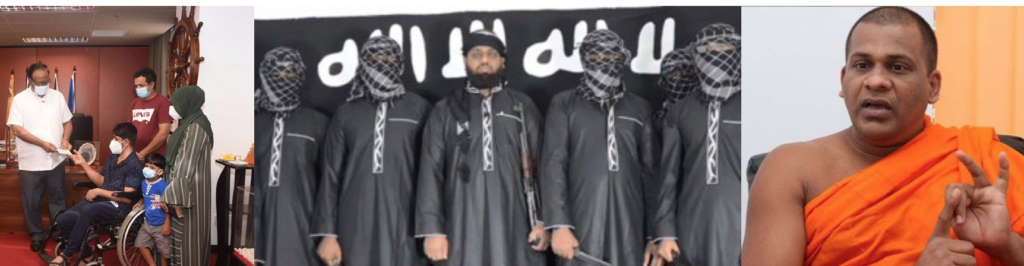
ඇමතිවරුන්ට කටඋත්තර නැති වෙන…ඇමතිවරුන්ට හිනා යන ජනතා ප්‍රශ්න…

October 1st, 2021

තිසර සමල් – අනුරාධපුර

රට හදන සෞභාග්‍යයේ දැක්ම ප්‍රථිපත්ති ප්‍රකාශයට අනුව වාරී සෞභාග්‍යා ජාතික වැඩසටහන යටතේ ග්‍රාමීය වැව්/අමුණු සංවර්ධනය කිරීමේ ව්‍යාපෘතිය යටතේ, අනුරාධපුර, මහඉලුප්පල්ලම මහවැලි කොට්ඨාශයට අයත් මරදන්කල්ල වැව ප්‍රථිසංස්කරණ කටයුතු සමාරම්භ කිරීම ඉඩම් අමාත්‍යය එස්.එම් චන්ද්‍රසේන හා  මහවැලි කළාප ආශ්‍රීත ඇළවේලී හා ජනාවාස පොදු යටිතල පහසුකම් සංවර්ධන රාජ්‍යය අමාත්‍යය සිරිපාල ගම්ලත් යන මහත්වරුන්ගේ ප්‍රධානත්වයෙන් අද (01) ආරම්භ විය.

සුභ මොහොතින් වැවෙහි ප්‍රථිසංස්කරණ කටයුතු සමාරම්භ කෙරුණු අතර, එය පවතින නිරෝධායන නීතීන්ට අනුව අවම ජන සහභාගීත්වයකින් පැවැත්විණි.

අනතුරුව අමාත්‍යයවරුන් දෙපළ වෙත මාධ්‍යවේදීන් ප්‍රශ්න කීපයක් යොමු කරනු ලැබීය.

සහල් මිල සම්බන්ධයෙන් තිබුණ ගැසට් නිවේදනය වෙනස් වුණා, ඒ ගැන ඔබතුමාගේ අදහස මොකක්ද යැයි රාජ්‍යය අමාත්‍යය සිරිපාල් ගම්ලත් මහතාගෙන් මාධ්‍යවේදීන් විමසා සිටියේය.

එවිට අමාත්‍යය සිරිපාල ගම්ලත් මහතා නිහඩව සිටි අතර,ඒ අසල සිටි ඉඩම් අමාත්‍යය එස්.එම් චන්ද්‍රසේන මහතා එතුමාගෙන් ඒක අහන්න එපා යැයි මාධ්‍යයට පැවසීය.

කොළඹ වරායේ බටහිර පර්යන්තයේ 51%ක්  ඉන්දියාවේ සමාගමකට විකුණු බවට ප්‍රකාශයක් තියෙනවා ඒ ගැන අදහස මොකක්ද ? යැයි නැවත සිරිපාල ගම්ලත් අමාත්‍යයතුමන්ගෙන් මාධ්‍යවේදීන් විමසා සිටියේය.

මං හිතන්නේ මට වඩා හොඳට අපේ කැබිනට් ඇමතිතුමා මේ ගැන මේ වෙලාවේ පැහැදිලි කරයි.මහවැලියේ මොනවා හරි තියෙනවා නම් මගෙන් අහන්න මම උත්තර දෙන්නම් යැයි පැවසීය.

අනතුරුව මාධ්‍යවේදීන් ඉඩම් අමාත්‍යය එස්.එම් චන්ද්‍රසේන මහතාගෙන් විමසා සිටියේ,සහල් මිළ පාලනය සම්බන්ධයෙන් තිබුණ ගැසට්ටුව හදිස්සියේම වෙනස් වුණා, ඒ ගැන මොකක්ද ඔබතුමාගේ අදහස..?

කොක් හඩලා සිනා සුණු ඉඩම් අමාත්‍යයවරයා, වෙන එකක් අහන්නකෝ.. යනුවෙන් පවසා සිනාසුනී.

ඇමතිතුමා ඉන්දියාවේ අදානී සමාගමට කොළඹ වරායේ බටහිර පර්යන්තයේ කොටසක් විකුණුවා කියනවා,ඒක ගැන මොකක්ද ඔබතුමාගේ අදහස ? යැයි අනතුරුව මාධ්‍යවේදීන් විමසා සිටි අතර, ඊට පිළිතුරු ලෙස,

අපේ රටේ වරායවල් ටික හදාගන්න ඕන, ගුවන්තොටුපලවල් ටික හදාගන්න ඕන,රටට  විදුලිය අපි ලබා ගන්න ඕන, ඇත්තටම අපි පුංචි රටක් හැටියට, ඒ වගේම යහපාලන ආණ්ඩුවේ අවුරුදු 05 ක් විශාල වශයෙන් හානියක් කරපු රටක් ආර්ථික වශයෙන්, මහබැංකු මංකොල්ලය, ඒ වගේම සහරාන්ගේ බෝම්බ සිද්ධියත් එක්ක විනාශ වෙලා තිබුණ රටක් තමයි ගෝඨාභය රාජපක්ෂ මැතිතුමා ඇතුළු අපේ රජය භාරගත්තේ,ඒ ගොල්ල ඒක නොදන්නවා වගේ එක එක විවේචන කරනවා.අපිට විදුලිය ගන්න විදුලි බලාගාර හදනකොට ඒකට විරුද්ධ වෙනවා.මේ පැත්තෙන් වරායවල් ටික ප්‍රථිසංස්කරණය කරන කොට ඒකට විරුද්ධ වෙනවා.ආර්ථිකය කඩා වැටිලා තියෙන රටක් සමාගම් වලින් හෝ රටකින් මූල්‍ය ආධාර අරන් අපි ඒවා කරන්න ඕන, එහෙම නැතිව අපි පැත්තකට වෙලා හිටියොත් රට නිකම්ම නිකං රටක් වෙයි, මිනිස්සු නිකම්ම නිකං මිනිස්සු වෙයි, ආණ්ඩුවත් නිකම්ම නිකං ආණ්ඩුවක් වෙයි.එහෙම වෙන්න බෑ, අපි වැව් 14 000 ක් මේ වෙන කොට ප්‍රථිසංස්කරණය කරන්න ලෑස්ති කරලා තියෙනවා.මොරගහකන්ද ජලාශය  රජරටට ලබා දෙනවා, ඒ වගේම වාරී මාර්ග අමාත්‍යංශයෙන් විශාල වැඩ කොටසක් කර ගෙන යනවා.ඒ වගේම ග්‍රාමීය පාරවල් ලක්ෂයක් කාපට් කරනවා.තවත් සංවර්ධන වැඩ විශාල වශයෙන් කරනවා.ඒ වගේම ගරු මුදල් ඇමතිතුමා ග්‍රාමසේවා වසමකට රුපියල් ලක්ෂ 30 ගානේ සංවර්ධන කටයුතු වලට ලබා දී තිබෙනවා.ඒ කොට්ඨාශයේ ඡන්දයෙන් පත් වෙච්ච මන්ත්‍රීවරයාට ලක්ෂ 40 ක් ලබා දෙනවා.පාර්ලිමේන්තු මන්ත්‍රීවරයෙකුට ලක්ෂ 1000 ක් ලබා දෙනවා.හිටපු පළාත් සභා මන්ත්‍රීවරුන්ට ලක්ෂ 200 ක් ලබා දෙනවා.මේවා මේ අමාත්‍යංශ වලින් සිදු කරන වැඩ වලට අමතරව.මහවැලි අමාත්‍යංශයෙන්, වාරී මාර්ග අමාත්‍යංශයෙන්, ඉඩම් අමාත්‍යංශයෙන් අනෙකුත් අමාත්‍යංශ වලින් කෙරෙන කටයුතු වලට අමතරව, මේ වගේ විශාල වැඩ කොටසක් කරාගෙන යනකොට මේවා හොඳයි කියන්නේ නෑ, කොහේ හරි කොනක් අල්ලාගෙන ආණ්ඩුවට බැනිල්ල තමයි කරන්නේ.ඒ පිළිබඳව අපි ඉතාම කණගාටු වෙනවා.කොරෝනා වසංගතය වෙලාවේදී එන්නත්කරණය වැඩියෙන්ම කරන රට බවට පත් වෙලා තියෙනවා අපේ රට.දැන් මේක අඩු වේගන යනවා.ගෝඨාභය රාජපක්ෂ මැතිතුමන්ගේ මග පෙන්වීම යටතේ ඉතාම ඉක්මනින්, මේ වසංගතයත් ඉක්මනින් අවසන් වුණාට පස්සේ, ඉස්සරහට තියෙන අවුරුදු 3 ½ අපි ජනතාවට පොරොන්දු වෙච්ච සියලුම පොරොන්දු, සෞභාගයේ ඉදිරි දැක්ම කියන වැඩපිළිවෙල අපි අවසන් කරනවා.එතකොට ඔය කට මැට දොඩවන අයට පැත්තකට වෙලා ඉන්න වෙයි යැයි  ඉඩම් අමාත්‍යය එස්.එම් චන්ද්‍රසේන මහතා පැවසීය.

අද ලෝක ළමා දිනය හෝ විශ්ව ළමා දිනය නොවේ!

October 1st, 2021

රජිත් කීර්ති තෙන්නකෝන් 

මුහුණු පොතේ ලෝක ළමා දින, විශ්ව ළමා දින සුබ පැතුම් වැහි වැහැලාය.  අද ලෝක ළමා දිනය නොවේ.  අත්වැරැද්දකින් ලංකාවේ ළමා දිනය සමරණ දිනයයි.

1954 දී විශ්ව ළමා දින සැමරුම ආරම්භ විය.  1959 නොවැම්බර් 20 දී එක්සත් ජාතීන්ගේ සම්මේලනය විසින් ළමා අයිතිවාසිකම් පිළිබඳ ප්‍රඥප්තිය (Declaration of the Rights of the Child) සම්මත කර ගන්නා ලදී. 1989 නොවැම්බර් 20 දින එක්සත් ජාතීන් විසින් ළමා අයිතිවාසිකම් පිළිබඳ ප්‍රකාශනය (Convention on the Rights of the Child)  සම්මත විය.  ලංකාව 1990 ජනවාරි 26 ළමා අයිතිවාසිකම් සම්මුතියට අත්සන් කළා. එය ලංකාවේ බලාත්මක කෙරෙුණේ 1991 ජුලි 12 යි.

ඉතිං 1990 සිට ලෝක ළමා දිනය විදිහට සලකන්නේ සැමරුම් උත්සව තියන්නේ මේ  ප්‍රඥප්ති දෙකක් සම්මත කර ගත් නොවැම්බර් 20 යි. ලංකාවේ බහුතරයක් පෝස්ට් දාන අද (ඔක්තෝබර් 1) නොවේ.

ලෝක ළමා දිනය සමරන්නේ ඇයි ද? යන්න එක්සත් ජාතීන්ගේ සංගමයත්, යුනිසෙෆ් ආයතනයත් මෙසේ ප්‍රකාශ කරයි.  ‘‘World Children’s Day offers each of us an inspirational entry-point to advocate, promote and celebrate children’s rights, translating into dialogues and actions that will build a better world for children.‘‘  ඉතිං, මම මේ සටහන මගේ ‘ඇඩ්වකසි පාට් එක‘ වෙනුවෙන් ලියා තබමි.

අද ලෝක වැඩිහිටි දිනය දවසත් එක්ක ලංකාවේ ලෝක ළමා දිනය කියා ටොම් පචයක් සමරන්නේ ඇයි?

ඒක අත්වැරැද්දක්.  අපි දැන් සෑහෙන්න කාලයක් ළමයින්ට වෙච්ච අත් වැරැද්ද ඔක්තෝබර් 1 දින සමරනවා. 

ප.ලි. 2019 මම මේක නිවැරදි කරන්න කතා කළා. ලොක්කෙක් කිව්වා, ‘සර් ජනාධිපතිවරණය තියෙන්නේ නොවැ. 16 . සර් දන්නවානේ ආණ්ඩුව මාරුවෙන්න පුළුවන්. ඉතිං අපි මේ සැරේටත් ඔක්තෝබර් 1 දා ළමා දිනය සමරමු කියලා.   2019 ළමා දින නිල උත්සවය  තිබුණේ මාතලේ නිසා ආණ්ඩුකාරවරයා ලෙස නිල උත්සවයේ ආරාධිතයෙක් විදිහට මට යන්න සිද්ධ වුණා.

ලබන අවුරුද්දේවත් අත් වැරැද්ද නිවැරදි කරලා නොවැම්බර් 20 ලෝකයත් එක්ක විශ්ව ළමා දිනය සමරමු.

රජිත් කීර්ති තෙන්නකෝන් 

කබ්රාල් වැඩ පෙන්නයි.. අත්‍යවශ්‍ය නොවන භාණ්ඩ ආනයන සීමා ඉවතට.. සය මසික සැලැස්ම එලිදක්වයි..

October 1st, 2021

උපුටා ගැන්ම ලංකා සී නිව්ස්

ශ්‍රී ලංකා මහ බැංකුවේ අධිපති අජිත් නිවාඩ් කබ්රාල් මහතා විසින් ‘සාර්ව ආර්ථික සහ මූල්‍ය පද්ධති ස්ථායීතාව සහතික කිරීම සඳහා වන සය මාසික පෙර දැක්ම’ අද (01) දින ප්‍රකාශයට පත්කරනු ලැබීය.

ශ්‍රී ලංකා මහ බැංකු පරිශ්‍රයේ දී අද පෙරවරුවේ මෙම එළිදැක්වීම සිදුකළ අතර අත්‍යාවශ්‍ය නොවන ආනයන සඳහා පනවා තිබූ සියයට 100 ක ආන්තික තැන්පතු අවශ්‍යතාවය වහාම අහෝසි කිරීම, ජාත්‍යන්තර ස්වෛරීය බැඳුම්කර දළ දේශීය නිෂ්පාදිතයෙන් ප්‍රතිශතයක් ලෙස 10%ක ප්‍රමාණයකට අඩු කිරීම, දැනට ලබා දී තිබෙන ණය පමා කිරීමේ ක්‍රමවේදය තවදුරටත් කරගෙන යාම සඳහා අවශ්‍ය ද්‍රවශීලතාවය ලබා දීම ඇතුළු කරුණු රැසක් මෙහිදී ප්‍රකාශයට පත්කෙරිණි.

පහත දැක්වෙන්නේ එහි සඳහන් කරුණු කිහිපයකි.

  • රටේ බොරතෙල් බිල්පත් ගෙවීමට අවශ්‍ය මුදල් සපයමින් විදේශ විනිමය වෙළෙඳපොළ වෙත ද්‍රවශීලතාවය වැඩි කිරීම.
  • විනිමය අනුපාතිකය පිළිබඳ සහතිකයක් ලබා දී රුපියල් වටිනාකම මගින් නාමනය කරන ලද රජයේ සුරැකුම්පත්වල ආයෝජනය ප්‍රවර්ධනය කිරීම.
  • අත්‍යාවශ්‍ය ලෙස රුපියල් බවට පරිවර්තනය කිරීමට සිදුවන ඒ ක්‍රියාමාර්ගය දියත් කිරීම.
  • අපනයන සඳහා බදු සහන – රජයට කියා සිටිනවා ඕනෑම අපනයනයක් අපනයනයක් බවට පත්වෙන්නේ ඒ අපනයනය අන්තිමටම රැපියල් බවට පත් වීම හරහා. රුපියල් එන්නට ඕනේ රටට. ඒ නිසා විශේෂ සහන ආකාරයට බදු සහනයක් ලබා දීම, සාමාන්‍යෙන් බදු ගෙවන්නේ සියයට 28 නම් එය සියයට 14 බවට පත්කරන්නේ ඒ පදනම මත.
  • දැනට ලබා දී තිබෙන ණය පමා කිරීමේ ක්‍රමවේදය තවදුරටත් කරගෙන යාම සඳහා අවශ්‍ය වෙනවා නම් ද්‍රවශීලතාවය ඒ ද්‍රවශීලතාවය ලබා දීමට මහ බැංකුව ඉදිරිපත් වීම.
  • Parate execution වලින් දේපළ පවරා ගැනීම සහ  වාහන පවරා ගැනීම ඊළඟ මාස 06 තුළ දී නැවැත්වීමට බැංකු සහා බැංකු නොවන ක්ෂේත්‍රයට නියෝග ලබා දීම.
  • වසංගතය ඔස්සේ ව්‍යාපාරවලට වී ඇති හානිය දුරුකිරීම සඳහා ණය වැඩිපුර ගෙවීමට ඇති තැන්වල දී, ණය ගෙවීමට අපහසු වෙන තැන්වල දී, ණය ප්‍රමාද කිරීම වෙනුවෙන් සහනයක් ලබා දීමට රුපියල් මිලියන 15,000 ක් වෙන් කිරීම.
  • දැනට පිටරටවල්වලට යන අයට තමන්ගේ මුදල් ගෙනයාමට දී තිබෙන සහන ජනවාරි 01 සිට දිගටම ලබා දීම. අධ්‍යාපන සහ සෞඛ්‍ය සඳහා මුදල් ලබා ගැනීමට බලාපොරොත්තු වෙන අයට මුදල් ලබා දීම.
  • අත්‍යාවශ්‍ය නොවන, හදිසි නොවන ආනයන සඳහා පනවා තිබූ ආන්තික මුදල් තැන්පතු අවශ්‍යතාවය වහාම ක්‍රියාත්මක වන පරිදි අත්හිටුවීම.
  • 2022 ජනවාරි 01 සිට බලපැවැත්වෙන පරිදි විදේශ විනිමය ගනුදෙනු අධීක්ෂණය සඳහා ජාත්‍යන්තර ගනුදෙනු වාර්තා කරන පද්ධතියක් ස්ථාපිත කිරීම.
  • සේවා සම්බන්ධ විදේශ විනිමය ගලා ඒම් අධීක්ෂණය කිරීම සහ එම මුදල් ආපසු රට තුළට ගෙන්වා ගැනීම සහ පරිවර්තනය කිරීම සහතික කිරීම.
  • කල්පිරෙන ණය ගැනීම සහ සෑම අවස්ථාවක දීම ණය නොවන මූලාශ්‍ර හරහා ලැබෙන නව ලැබීම් මගින් පියවීම.
  • වෙළෙඳපොළ තුළ ඉහළ මට්ටම් පවතී නම් 2022 වසරේ ජනවාරි මාසයේ සහ ජූලි මාසයේ කල්පිරෙන ජාත්‍යන්තර ස්වෛරීය බැඳුම්කරයන් හි සමස්ත නිකුතුව ආපසු මිල දී ගැනීම සඳහා සලකා බැලීම.
  • ජාත්‍යන්තර ස්වෛරීය බැඳුම්කර දළ දේශීය නිෂ්පාදිතයෙන් ප්‍රතිශතයක් ලෙස 10%ක ප්‍රමාණයකට අඩුකිරීම.
  • ස්වෛරීය ශ්‍රේණිගත කිරීම ඉහළ නැංවීමට පියවර ගැනීම.
  • නිල මාර්ග ඔස්සේ විදේශ සේවා නියුක්තිකයන්ගේ ප්‍රේෂණ ලබා ගැනීමට දිරි ගැන්වීම.
  • මුදල් හුවමාරු කරන්නන්ගේ බලපත්‍ර 27 ක් අද සිට නැවත ලබා දීම.

– adaderana

100% cash margin rule on non-essential imports removed

October 1st, 2021

Courtesy The Daily Mirror

The 100 percent cash margin rule on non-essential imports will be removed with immediate effect, the Central Bank Governor Ajith Nivard Cabraal said.

Presenting the ‘Six-month Road Map for ensuring macro-economic and financial system stability,’ Cabraal this morning, Cabraal said a decision towards this was taken considering the hardships faced by the importers and consumers as a result of significant increases in prices of such commodities.

The Central Bank under the previous Governor Prof.W.D. Lakshman, in early last month decided to impose a 100 percent cash margin deposit requirement against the importation of selected goods of non-essential/non-urgent nature made under letters of credit.

The decision to impose the cash margin deposit requirement is expected to support the ongoing efforts to preserve the stability of the exchange rate and foreign currency market liquidity, particularly by discouraging excessive imports of speculative nature,” the Central Bank said.

95% of over-30 population fully vaccinated in Sri Lanka

October 1st, 2021

Courtesy Adaderana

The President’s Media Division says that approximately 95% of the country’s population over the age of 30 years has been vaccinated with both doses of Covid-19 vaccines. 

Issuing a statement, it said that those in the age group of 20-30 years and children aged between 12-19 years are currently being vaccinated. 

This observation was made at the online meeting of the Special Committee on COVID-19 Control chaired by Finance Minister Basil Rajapaksa this morning (October 01).

Approximately 95% of the total population over the age of 30 has been vaccinated with both doses. The vaccination of people in the age group of 20 to 30 years and the vaccination of children aged 12 to 19 years, who are with chronic diseases, is being carried out successfully. 

The Special Committee on COVID-19 Control decided to conduct a comprehensive census of vaccinations as soon as possible.

Easter Attacks: Court serves charges on Pujith and Hemasiri

October 1st, 2021

Courtesy Adaderana

The Colombo High Court has served charges on former Inspector General of Police (IGP) Pujith Jayasundera and former Defense Secretary Hemasiri Fernando.

The duo was served charged over the negligence of duties on the 2019 Easter Sunday terror attacks.

The case was taken up before the Trial-at-Bar at the Colombo High Court today (October 01).

Subsequently, the next hearing of the case was scheduled for November 22.

Sri Lanka records 58 new COVID-19 fatalities

October 1st, 2021

Courtesy Adaderana

The total number of people who fell victim to COVID-19 infection in Sri Lanka moved up as 58 more fatalities were confirmed by the Director-General of Health Services on Thursday (Sep. 30).

The new development has pushed the official death toll from the virus outbreak in Sri Lanka to 12,964.

As per the data released by the Department of Government Information, the latest victims include 27 males and 31 females.

As many as 48 deaths were reported among elderly people aged above 60 years. In addition, 10 individuals aged between 30-59 years have also succumbed to the virus infection.

Covid-19: another 249 cases takes daily count to 893

October 1st, 2021

Courtesy Adaderana

The Ministry of Health says that another 249 persons have tested positive for Covid-19, increasing the daily count of new cases reported within today to 893.

Accordingly, this brings the total number of Covid-19 cases registered in Sri Lanka to 518,775.

47,726 coronavirus infected patients are currently under medical care and home-based care across the island while total recoveries stands at 458,085.

The death toll due to the virus meanwhile has risen to 12,964.

THE ELEPHANT IN SRI LANKA Part 4

September 30th, 2021

KAMALIKA PIERIS

revised 12.10.21

In the Udarata kingdom, the forests in the central highland were a protected reserve where elephants lived undisturbed. British and European writers have given us information on these habitats. The districts, in which the elephants most abound, are all hilly and mountainous, they said. There was not a mountain or a lofty piece of land which the elephant had not traversed.

 The elephants generally keep along the backbone of a chain of hills, avoiding steep gradients, they added. But there is no range so elevated as to be inaccessible to them.  In 1840, Skinner had found the spore of an elephant on the summit of Sri Pada.  In 1847   elephants were found on the Ramboda pass on the road to Nuwara Eliya”.

The agility of the elephants to negotiate the steepest hill was highlighted in the Ceylon Observer (1865), regarding an attempt to capture elephants in Avissawella.   The kraal was constructed close to a wall of rock so precipitous and high that they did not think an additional barrier was necessary. The elephants climbed up the rocks and escaped. ”

European writers spoke of the Elephant paths” created by the elephants in the hill country. When a herd of twenty or thirty of these colossal beasts have marched in single file through the woods, an open road of some yards wide is left ready beaten, as good as heart can desire in a wilderness, said  Ernst Haeckel  (1883)speaking of an elephant path in the Nilu  forest at Horton Plains.

These paths were well known to the Sinhalese. The Portuguese, when approaching Balana fort, had tried to enter from the rear, using the Ali mankada, two leagues from Balane. But   they found it   well fortified. This showed that the elephant corridors were known to the public.

Elephants had some sort of steering instinct. When crossing valleys from ridge to ridge, through forests so dense as to   prevent a view   of   what is ahead, the elephants invariably select the route which was the safest path between the two points. ‘The elephant’s path is an excellent specimen of engineering. It winds judiciously’, said Hooker, writing in the Himalayan Journal . The British used these elephant paths, alimankada, when they created the upcountry road network for the estates and estate towns.

The British were not interested in the elephant trade. They continued the capture of elephants for some time but it was low-priority. The number of kraals were reduced. The British abolished the Elephant Hunt in 1832  and the export of elephants came to an end.

British rule was not a happy time for the elephants. The elephant lost its royal status and its protected position. Instead, the British engaged in shooting elephants as a form of sport. Large numbers of elephants were killed in this way, as sport. The present Ruhuna National Park was the Resident Sportsmen’s Shooting Reserve, an area reserved for the sporting pleasure of British residents in the country.

the magnificent elephant was declared a pest and hunted for sport. It is recorded that at the beginning of the nineteenth century there were at least 19 500 elephants and at the turn of the twentieth century there were only an estimated 2 000. This drastic reduction was brought about by indiscriminate capture and wanton killing (Jayewardene, 1994).

 A reward of a few shillings was placed for the head of an elephant, and from 1845 – 1856, 3500 rewards were claimed in the Northern Province alone. Tennent records the official killing from 1845 – 1856 as being 5500 elephants in the Northern and Southern Province. During the period 1851 – 1856, a similar reward of a paltry number of shillings was paid for 2000 elephants killed in the Southern Province between Galle and Hambantota.

Major Thomas Rogers had killed 1500 elephants. Captain Galloway and Major Skinner are each reputed to have killed over 750 elephants. Many others had killed 250-300 elephants each. Such willful decimation of elephants was never seen before, observed Ashley de Vos. 

Elephants were also shot by the planters. British planters, who were opening up coffee and tea plantations shot trespassing elephants without hesitation. Not only did the British government encourage and condone killings but it also paid a bounty for each elephant killed, saying the elephant was an agricultural pest.

The British administration   also provided guns freely to villagers to keep away elephants from their cultivations. Farmers, who had hitherto protected their crops from marauding elephants by other means, now had a much easier method. They shot at them and either maimed or killed them.

Elephant populations that had been able to withstand the detrimental effects of capture all these years now started diminishing. There was wanton and indiscriminate destruction of the elephant herds.

The British administration did not kill all the elephants. They kept some to be used for their purposes.  Trained elephants were used to start the tea plantations. The elephants were first used to destroy the forests which had been their home. They were used to clear the virginal montane forests to plant tea, cinchona and coffee.  Elephants uprooted the trees in these forests and cleared the area

They were next used for drawing logs for the construction of buildings, and stones and rocks for constructing bridges, culverts, and walls in the plantations.

Thirdly, they were used to transport machinery and other heavy items needed for the tea factory on the plantation. Most plantations employed elephants on a rate determined daily on the type of work they performed said Ranjith Bandara and Clem Tisdell.  Picture of Elephants taking a boiler From Marshall, Sons & Co., Gainsboro England to a tea factory, Ceylon can be seen at https://www.pinterest.com/pin/127156389450093372/.

Elephants were used for other types of haulage too. Elephants were used to bring in the fifty four granite pillars used in the Trinity College Chapel, in the building period, 1923 to 1935. Elephants were used to transport the granite stone blocks quarried in Aruppola. They were 18 feet long and 3 feet square each weighing about 3 metric tons. These   were loaded on trolleys specially made for transporting one pillar at a time. One elephant pulled the trolley and another pushed from behind.

The blocks were hauled by two elephants, one pulling and one pushing, for a distance of three miles to the school premises; and then another three hundred feet up the slope of the hill to the Chapel site”. They were brought to Kandy at the rate of 2 per month.

Photographs of elephants hauling in pillars to the chapel site   can be seen at https://www.trinitycollege.lk/2019/11/05/pioneering-days-of-the-trinity-college-chapel-images-from-1922-to-1935/

Elephants were also used to bring stone pillars to the new building at Dalada Maligawa, Kandy. Carved granite pillars seventy to hundred feet high had to be erected for the new building at the back of the Dalada Maligawa. British engineers said such haulage was not possible. Tikiri Banda Panabokke, Minister of Health in State Council (1931) had said it could be done using elephants. And so it proved , recalled Panabokke’s grandson, Derrick Nugawela.

Wealthy individuals   owned elephant drawn carts during the British occupation. Sir Solomon Dias Bandaranaike had owned a huge cart, about ten feet high, for transporting coconut and paddy from his estates. Sirimavo Bandaranaike had gifted this to the Martin Wickremasinghe Museum and it is on exhibit there.

The British rulers do not seem to have interfered with elephants in temples, elephants in peraheras, elephants bathing or private ownership of elephants. The Kandyan chiefs were allowed to hold kraals, and from 1800 to 1900, fifty two kraals were held. The last Kraal was held in 1952, said Jayantha Jayewardene. (Continued)

Does Terror ideology stem from hate verses in scripts – Gnanasara Thero & Minister Sarath Weerasekera

September 30th, 2021

Shenali D Waduge

What is the reason for 99% of terrorists resorting to suicide terrorism & other forms of terror? What differentiates these terrorists from others is that they quote their holy verses before committing the crime. How connected is this to the overall fear by non-Muslims regarding these verses? If the duty of intel & security authorities is to ensure another 21/4 does not repeat & to ensure the country is safe & secure for all citizens, not just one community, why is it that their efforts end up being diverted by well-funded campaigns citing ‘islamophobia’! Their duty cannot be diluted simply because some NGO figures or others in high positions claim anything against their community is offensive. Most of these reactions are for their own personal/political gains & have nothing to do with concern for their community. When 99% of global attacks are related to terrorism based on religious superiority and by 4 main groups of which ISIS wants to create a Caliphate in Sri Lanka and when the Easter Sunday suicide bombers claim to be part of the ISIS, why should Muslims feel offended when someone says that a terrorist attack may happen in the future. Is it not because Tamil leaders and Tamils pooh-poohed LTTE that LTTE was allowed to grow & become lethal? Therefore, citizens cannot ignore that the Easter Sunday attack took Sri Lanka by surprise, though local intel were aware of pocket groups aligned to the ideology & had been monitoring them. Verbal statements is nowhere near as deadly as an attack that took place on 21/4. It was no isolated attack motivated by an isolated objective. Therefore, no one should take offence when anyone publicly says that the threat of future attacks persists – isn’t this why 32 countries of the world continue to ban LTTE even after its demise in May 2009? So long as the ideology is the source of the terrorism – the State & its citizens have every right to be alert.

When all of the Islamic/Islamist terrorists commit mass murder in the name of their religion, which included the Sri Lankan student-turned refugee who stabbed 5 persons in New Zealand – there is certainly cause for concern. Why are those who got offended by the Admiral’s or the thero’s interviews/statements not offended more by these suicide bombers committing mass murder in the name of their religion.

Many denounced the crime after it was committed but until it was committed, no one knew he was going to. However, in the case of the 21/4 suicide bombers, there was a nexus planning to execute the crime – this nexus was much larger than the 9 suicide bombers who think they went to heaven!

This is the very reason that the Sri Lankan authorities cannot and should not let their guard down simply because there appears to be a campaign to divert the attention under a feigned projection of targeting ALL Muslims.

Let us remind all that quite a number of the said community was aware of large numbers of swords being hidden in various places across the island. How many reported this? There were foreign preachers in remote parts of the island, how many reported these? The arrests made soon after 21/4 revealed that the majority of them were in the intel monitoring list and if we recall some of these special units were disbanded after 2015 crippling their operations. The person who reported the Mawanella Buddha statue disfiguring, was eventually shot by Zaharan’s group and today remains injured for life. https://www.dailymirror.lk/breaking_news/Informant-of-Easter-Sunday-suspects-rewarded/108-218514

When Islamic scholar Usthaz Rasheed Hajjul Akbar (uncle of those who defamed the Buddha statue on Mawanella) was detained by CID in August 2019, Latheef Farook was quick to write in his defence Demonised, battered and ostracised Muslim community of Sri Lanka is deeply disturbed at the detention of respected Islamic scholar”. The National Shoora Council, All Ceylon YMMA conference, All Ceylon Union of Muslim League Youth Front, Muslim Council of Sri Lanka, Muslim Media forum and All Ceylon Jamiathul Ulema even petitioned for his release. He was arrested in March 2021 under PTA – https://www.newsfirst.lk/2021/03/13/ex-leader-of-jamaat-e-islami-arrested-under-pta/

Therefore, the onus is on the Muslim community to be alert to the preachers that preach to them, the mosques that preach radicalism, the foreign preachers that arrive etc. Have such reports been made since 21/4 to the security agencies as the nexus that plotted to commit 21/4 is still at large – Muslims must help locate the locals involved in this mass murder, whatever powerful positions they hold and powerful people should not use their clout to prevent investigations or arrest citing islamophobia” – we do not wish to see a bloodbath similar to 21/4.

Planning to kill close to 300 innocent people is nothing that can be forgotten or forgiven. What often happens is that political/economical & social pressures are exerted to delay or divert the punishment of the perpetrators as we have seen regarding the campaign around the arrested lawyer linked to 21/4 whose charity was accepting funds from an internationally banned entity. Given the international clout of these entities & personages linked to them, can we expect true justice? While the same parties will be quoting all the law books when they claim to be ‘discriminated’.

Therefore, instead of nit-picking on statements and carrying wrong placards – everyone is duty-bound to ensure no innocent live is compromised in the name of religion or controversial religious texts.

Alternatively, it is good to tabulate the verses being quoted by terrorists and either issue a global clarification or have them removed altogether if it can prevent radicalization & extremisms.

With ISIS claiming to make Sri Lanka a Caliphate & knowing the Western-brains that manipulate ISIS, Muslims must understand the dangers lurking which requires them to ensure that their youth do not get roped into radicalism. The issue at hand is the fact that suicide in the name of religion is regarded as a noble act & not something to abhor and this factor must be looked into by the Muslim community. Our goal is to prevent another generation of brainwashed youth who become mere pawns in a bigger game that seeks to only kill & destroy & destabilize nations. We must now understand the bigger picture. Politicians of this community must not commit the same mistake that the politicians linked to LTTE did – a camouflage to gain votes & enjoy parliamentary privileges and political panache!

What the Government should do to get rid of the present financial crisis ailing the country?

September 30th, 2021

Dr Sudath Gunasekara 

Definitely one doesn’t need to be a financial or an economic wizard or a John Keynes to un-mess this mess that has emerged as a direct result of mismanagement of the nation’s economy by all those who were in charge of Governance in this country, since 1977. What you need is only common sense and the guts to take a decision do it. Therefore the following set of proposals is listed here for the consideration and immediate action by the Government.”Lindata wetunu miniha linkatenma goda enta one’ is the most appropriate adage I can quote here. This mess is nothing but a collective mess created by our own politicians. Therefore the onerous of taking the full responsibility for this national crime as well as finding a suitable remedy for the malady, they themselves have jointly created, also falls definitely on all their heads, including those who are dead and gone to hell.

The present government must take these decisions immediately before the situation become worse that might lead even to a civil war against it, going by the way how things are already getting out of control around the country. A stitch in time saves nine. But in doing so I must warn the government that it has to completely forget about the vote fever, because it is your responsibility and unbounded duty by the nation at this critical time.

35 very important steps that have to be taken immediately to ease the present crisis.

1 Stop all extravagant and wasteful expenses of the government

2 Ban the import of all luxury and non-essential goods

3 Increase the prices of local products to encourage local production

4 Remove extra perks to all politicians and public Servants (It is said that 85% of national income is spent on maintaining politicians and public servants supposed to be the highest per-man ratio in the world)

5 Stop all state tamasas and useless political functions for image building and meetings of public servants to the bare minimum limiting them to the most essentials.  

6 Close down all Governors Offices and allow the Government Agents and Divisional AGAA and Grama Seva Niladharis to run the Administration and Coordination of development in their Districts, Divisions and Graama Niladhari Units

7 Close down the 9 Provincial Councils epidemic permanently now that they have ceased to function almost for the past 5 years without any disruption of day to day to governance of the country. Attaché public servants displaced as a result to suitable Government offices in the districts

  1. Use the PG buildings to house public offices presently housed on rented out buildings.
  2.  And transfer the functions done by the PCC to the GAA’s and AGAA’s offices and the respective line Ministry sub-offices in the Districts so that the smooth delivery of services to people will continue uninterrupted.

8 Scrap all superfluous government institutions such as mushroom Ministries, Departments and statutory bodies created to provide jobs for supporters of politicians

9 Reduce the number of Ministers and Ministries to 15 and appoint a Minister and a Deputy under him to run each Ministry instead of having 70 different Ministries, 30 Cabinet and 40 State Ministers, (as if the Cabinet Ministers are not Ministers of the Sri Lankan State at present) in this small country just to provide employment for a set of unproductive Politicians at high cost just to keep them satisfied with no substantive contribution to the country but has only increased  duplication, waste, corruption, confusion, inefficiency and rivalry among them. This move will drastically reduce the number of wasteful institutions, excess officials, waste and corruption and also reduce hundreds of government institutions that waste billions of public funds with no substantive contribution to the country but making us a nation of beggars.

10 Close down all the Embassies and Consular Offices of smaller countries and ask the nearest Embassy to overlook them.

11 Close down all Pradeiya Sabhas (mere duplicates of Provincial Councils) and go back to the former VC system and allocate PS buildings to line departments working in the areas, and assign the present Members to their respective Village Council areas to work under the District Commissioners of Local Government

12 Stop payments for all officials for attending meetings, as they are only part of their official duties

13Limit the number of vehicles and personal staff to Ministers and Deputies including security

14 Withdraw official vehicles from all public officers and let all public servants to have their own vehicles to do their official travelling and pay a commuted allowance and mileage for travelling out of duty stations on official duties. Provide them with a loan to buy a vehicle like in the past for which the Govt need not provide drivers or fuel. It is interesting to note that even in America, whhic is supposed to be the richest country in the world no politician or public servant is given official vehicles, drivers or fuel and they have to pay even for parking in the parking lots.

15 Never renew the duty free Vehicle system to anybody including politicians and public servants. However the Government may have a system of duty free system of vehicles, machinery and raw material etc under strict and close supervision for agricultural and Industrial sector to promote development in those sectors.

16 Let the Public Servants run the Ministries under the general supervision of the respective Ministry Secretaries. Do away with the present practice of providing a band of personal staff that virtually run the Ministries today making it a mockery and a mere political party office killing the spirit and the essence of an impartial public service. Provide only a private Secretary.

17 Stop providing houses for Politicians in Colombo. Instead provide them with a common place, like in the past (Sravasti) for them to stay when they come to Colombo on duty for the 8 days they are expected to attend so that they will be compelled to live in their electorates for the rest of the month.

Transactions in Embassies

18 Get the Diplomats to attend to all government to Government business and cut down all unnecessary foreign travel for politicians except under very special situations

The need to have the Supply and Cadre Division in the Treasury reactivated and strictly complied with its rules and regulations

19 Get the Treasury to have fixed cadre for all Ministries and Government Departments and statutory bodies and corporations that should not be exceeded without the prior approval of the Treasury to expenditure under treasury control and to stop packing public institutions with unqualified political appointees 

20 Remove all excess staff of all public institutions as early as possible after a quick survey by the Supply and Cadre Division.

21 Give all Government institutions daily, monthly and annual targets to ensure that every person does a quantum of work for the money he/she is paid and hold the heads of the Divisions responsible for running those institutions efficiently and profitably

Payment of fabulous salaries for certain public Sector employees

                                                                                                                                                                                                                                                                                                                                                                                                                                                                                                     22 Stop all fabulous salary payments made to some people Like the Chairman of Air Lanka for example which was reported in the press few days ago as Rs 32 lahks a month.

 Recovery of CB scan money

23Take immediate action to recover money robed from the CB and confiscate the properties of all found guilty in addition to other punishments under law.

24 Entrust Administration to professional public servants and stop politicians from meddling with day to day Administration of Government institutions and thereby disrupting smooth governance of the country.

25 Also close down Regional and Divisional offices of Government Departments and corporations etc opened in the recent past just to recruit more people to public Service as a fashion without considering the ramifications involved in public spending with no parallel improvement in the delivery of public services.

National Austerity Year

26 Declare a national Austerity year and Agricultural Production year and give top priority for self-sufficiency and export development in the agricultural sector.

Remove all duel citizens from Parliament

27 Remove all Ministers and MPP who are dual citizens both in the Govt and the opposition in Parliament immediately as they are persons with divided allegiance and keep those places vacant until a general election  

 Inquire in to assets of MPP in Parliament form 1977

28 Initiate actions to Identify Politicians who have been in Parliament from 1970 and investigate their assets at the time of joining and the present and confiscate all wealth proved had been illegally a)amazed and remove the civil right of those found guilty for life

Defeated Politicians holding public positions

29 Remove all defeated and ex-politicians holding appointments as Diplomatas, and any other post at Home like Chairmen of state institutions and replace them with professional men who can do those jobs to increase efficiency and profit.

The need for a vigorous national food Production Drive

30 Commence a vigorous National food Production Drive in the agricultural and livestock sectors with a full gear of the Government like loans, implements, fertilizer, guaranteed prices and extension services, storage and marketing facilities for domestic and export market with incentives like tax concessions to be followed up with a staggered import ban on all items on all Agricultural an dallied products.

Reduce the number of politicians and public servants in the country

31 I have found that the number of Politicians and public servants has undergone a tremendous increase since 1977 due to increasing the number of public institutions and multiplying administrative divisions like GS and Local Government units. As a result it has been reported that today there is one politician for every 3232 persons and one public servant for every 16 people in this country and 85 % of annual public revenue is spent on the upkeep of politicians and public servants. This I think is the highest figure for any country in the world. In addition to this curse, is the very high expenditure on social welfare, like health, education and public relief that has to be met with the balance 15 %. No wonder the country’s economy has fallen to this level.

Reduce the extremely high number of Public holidays for any country in the world as it we are living in the Aalakamandaava.

32 Reduce the extremely high number of Public holidays to internationally accepted average of 12 per year to increase the number of man days that could be gainfully used for development

For example you can use the following model

National Holidays

1April 13th and 14th Sinhala New Year day    2days

2 Vesak Poya                                                      2 days

3 Republic Day May 22                                     1 day

4 Poson Poya Jatika dinaya                              1 day

5 National heroes Day (has to be decided)   1 Day (May 9) LTTE Defeat

Optional Public Holidays. Sundays 12/ or the balance 10 Depoya Common to all   to be decided after discussion. This will make the total no of Public holidays  either  17 or 19  This will boost production in all sectors due to an increase in the number of working hours            

All other holidays presently declared as National Holidays like Christmass, Good Friday. Maha Sivaratri, Deepawali Thaipongal, Mohomads Birth Day, Hajji Festival, Ramasan Should be declared holidays only for the respective religious communities. This I think is the best arrangement any Government should make to protect the country’s Sinhala Buddhist identity.

33 Withdraw political rights from all public servants, other than the right to vote to bring back discipline and sanity to public service so that we can have an efficient and productive and disciplined loyal public service under strict supervision of the immediate supervisory officers.

34 Remove the 29 National list MPP from Parliament who are not elected by the people by a motion with the consensus of other parties pending Amendment to the Constitution.

35 Stop payment of bonuses and overtime in all institutions that don’t show a profit in their annual balance sheets and also make annual confidential reports compulsory in all Ministries, departments and statutory institutions

Important: I request some one knowledgeable and competent to calculate the net savings that would accrue to the Government under the implementation of each of these items, if they are implemented.

This is only a few important ideas that came to one man’s head at random. I invite readers to add any other important issue that comes to their mind to make the operation a fuller success.

                                 පාලකයින්ට ණුවන පහල වේවා!

                     මගේ රටත් ජාතියත් මේ අර්බුධයෙන් ගොඩ ඒවා !

THE ELEPHANT IN SRI LANKA Part 2

September 30th, 2021

KAMALIKA PIERIS

Dhanesh Wisumperuma has researched into Religious Use of Elephants in Ancient Sri Lanka (Gajah 37 (2012) 16-21). He provides the following information.

Elephants were first used in Buddhist ceremonial processions, to receive and transport Buddhist relics from one place to another.  King Devanampiyatissa   used the state elephant to carry   relics to be enshrined in the Thuparama.

Parakramabahu I went mounted on his favorite beautiful elephant”, to receive the Tooth and Bowl relics when they were brought back from the south where they had been sent for safety during the Chola  wars.  Other elephants as well as horses were also part of this event.

In addition to relics, the    Pujavaliya (13 century) was also taken in procession on the back of the royal elephant, to show veneration, since it was a book on Buddhist religious offerings.

 The Mahavamsa shows that the Anuradhapura kings regularly had peraheras for the temples. I find it difficult to believe that elephants were not a part of these, everybody else seems to have been included. But there does not seem to be any documented reference to elephants in peraheras during this period.

When the Mahathupa was restored during the Polonnaruwa period, the procession included elephants illuminated with lamps. Parakramabahu II (1236-1270) held a seven day festival for the Tooth Relic, for which he used many elephants and horses in the procession. Vijayabahu IV (1270-1272) organized a procession to transfer the Tooth and Bowl relics of the Buddha from Dambadeniya to Polonnaruwa. The relics were taken on a chariot and the perahera included rows of highly caprisoned elephants.

King Mahadathika Mahanaga (7-19 AD) was the first king to donate an elephant to a temple. The tradition continued thereafter. Parakramabahu IV   celebrated a festival for Tooth and Bowl Relics by gifting elephants, as well as other items, to the temple.

The decision to get a tusker to carry the Tooth relic in a procession seems to have developed much later. Dalada Sirita (14 century) contained a manual for the conduct of festivals for the Tooth Relic. Dalada Sirita says for a procession during public displays of the Tooth Relic, the relic must be enshrined in a casket and placed on a decorated chariot, pulled by a tusked elephant with auspicious marks.

Ama H. Vanniarachchy has   researched into the tuskers who carried the Tooth relic at the Esala Perahera of the Dalada Maligawa in Kandy. The Relic Casket is carried and paraded only on a majestic tusker, accompanied by two other tuskers besides him, said Ama. Out of all the tamed tuskers of the country, only few are chosen as suitable enough to carry the Relic Casket. Not only their physical looks but also their personality and intelligence is considered, she added.

 She provides a comprehensive list of the important tuskers who graced the Kandy Esala Perahera with emphasis on those who    carried the relic casket in Kumbal and Randoli peraheras.

The first mentioned is Maha Raja owned by Clifford Ratwatte, 13 feet in height with perfectly proportioned body. He carried the casket from the 1920s until 1940s. After Maha Raja, the   Idampitie tusker owned by the Mawanalle Idampitiya Walawwa carried the casket.

Then it was the turn of Maligawe Raja. Raja was captured by Umeru Lebbe in 1925 under permit at Eravur. He was bought by Mampitiye Disawe in 1925 and in 1931 was     gifted to the Dalada Maligawa. Raja’s first Dalada Perahera was in 1937. He was the leading tusker in Dalada Peraheras till 1987.

He was declared a National Treasure by President J.R. Jayewardene. Raja’s picture was printed in the thousand rupee note and a 75 cent stamp was also released with the picture of Raja. This was the first time in Asia that a stamp was released in honor of an animal. Raja received a State funeral when he died in 1988.

Wewaladeniya Raja was a majestic tusker captured in 1974 at Agunakolapalassa area.  He carried the casket from 1986. Heiyanthuduwe Raja was caught at Hambantota Kattakakaduwa forest in 1945.  He had 11 feet long tusks.  He carried the Relic Casket form 1991 to 2000. His skeleton is displayed at the Colombo National Museum. 

Millangoda Raja was caught in 1945 at, Anamaduwa area in Puttalam. Millangoda Raja owned the longest tusks of South Asia.  When he died, his body was preserved and is now at Molagoda Millangoda Walawwa.

Kataragama Vasana was captured in a forest near Anuradhapura and given to the Zoo. He was gifted to the Kataragama Devale when he was 5 or 6 years old. He is the lead tusker at Kataragama Perahera and lives in Kataragama. He comes up to Kandy for the Esala perahera in a special truck. He has carried the Relic Casket in several peraheras.

Sinha Raja, when a baby was separated from his herd, during the civil war in the North. He was   found in the forests in Vavuniya by the Sinha Regiment and brought to the Peradeniya Veterinary hospital for treatment for his injuries. Once he was cured he was gifted to Dalada Maligawa. Noted for his intelligence and grandeur Sinha Raja   has carried the Relic Casket at Dalada Peraheras. As at 2020, he is the sub leader of the elephant troop at the Dalada Maligawa in 2020. 

From the earliest times the Sri Lanka elephant has been depicted and glorified on temple and palace walls in sculptural or in painted form, said Ashley de Vos. Paintings of elephants, datable to the Anuradhapura period have been found at Dimbulagala and Kotiyagala. There is a painting of a happy, smiling elephant at Mara vidiya cave at Dimbulagala.   https://si.wikipedia.org/wiki/Drawing_of_an_elephant_from_Dimulagala_Mara_Vidiya.jpg.

Elephants figure prominently in cave paintings at Miella in Kotiyagala. We noticed four .One elephant is engaged in water sports, another is carrying a lotus in its trunk. A third gives the impression it is ready to run. Lastly the frontal view of a moving elephant is shown. In the middle of an intricate ceiling design, there is also an elephant within a circle with its tail bent, reported the team at Amazing Lanka.com”.  https://amazinglanka.com/wp/en/miella/

Paintings perish, but, there are plenty of stone sculptures of elephants still remaining. https://www.alamy.com/stock-photo/sri-lanka-temple-elephant-carving.html. Elephants are featured on moon stones, walls, ponds and entrances. The moonstones in Anuradhapura are well known. Moonstone from Magul Maha Vihara, Lahugala depicts a row of tamed elephants with a rope across their belly and two mahouts.

Continuous freezes of sculptured dancing elephants are a pleasure to behold, observed Ashley de Vos. They can be seen at Ruvanveliseya. There is a row of elephants in the palace wall  in Polonnaruwa .There are several elephants carved in stone at Gadaladeniya, two free standing  at the entrance and a third in the wall.

We have all seen Isurumuniya’s delightful bas relief carving of elephants frolicking by a small pond at the entrance. One young tusker is shown already in the water looking forward to the others joining him. Ranmasu Uyana which is adjoining Isurumuniya also has similar frolicking elephants in one of the pools.

 Isurumuniya has other elephant carvings. There is an elephant carved on the outer wall of a Korawakgala. This is a standing tusker with a prominent kumbasthala. It is at the entrance of a cave shrine. Also, two tuskers can be seen seated on the side of the two guard stones at this entrance. 

 HCP Bell reports a full relief rock carving of an elephant, on the banks of the Mahaweli River. This has now disappeared.

“This piece of animal sculpture is probably unique in Ceylon. Cut in full round from a rock, life-size, are the head and shoulders of an elephant whose feet the river washed when low. The elephant stands in the water, looking slightly upstream, as though hesitating to cross. At present the river in semi-flood reaches its eyes. There are signs of ‘sets’ for some building’s foundations on a boulder adjoining, but no ruins or inscriptions are known likely to afford a clue to the object of this solitary tour de force of a skilful sculptor concluded Bell.” Unfortunately this rock sculpture no longer exists, having been blasted probably by fishermen dynamiting fish, said Jayantha Jayawardena.   (Continued)

පරිවාස භාරයේ සිටින දරුවන් නිවැරදි වෘත්තීය දිශානතියකට යොමු කිරීම වෙනුවෙන් නිපුණතා සංවර්ධන රාජ්‍ය අමාත්‍යාංශය හා කාන්තා හා ළමා සංවර්ධන රාජ්‍ය අමාත්‍යාංශය එක්වෙයි

September 30th, 2021

නිපුණතා සංවර්ධන, වෘත්තීය අධ්‍යාපන, පර්යේෂණ හා නව නිපැයුම් රාජ්‍ය අමාත්‍යාංශය

මීට සමගාමීව වෘත්තීය මාර්ගෝපදේශනයේ නව දිශානතිය පෙන්වාදෙන Youthjobs.lk වෙබ් අඩවිය දියත් කෙරේ

නිපුණතා සංවර්ධන, වෘත්තීය අධ්‍යාපන, පර්යේෂණ හා නව නිපැයුම් රාජ්‍ය අමාත්‍ය, විශේෂඥ වෛද්‍ය සීතා අරඹේපොල මැතිණියගේ සංකල්පයක් අනුව පරිවාසභාරයේ සිටින ළමුන්ට නිවැරදි වෘත්තීය අධ්‍යාපනයක් ලබාදීම වෙනුවෙන් අවබෝධතා ගිවිසුමක් අත්සන් කිරීම රාජ්‍ය අමාත්‍ය, විශේෂඥ වෛද්‍ය සීතා අරඹේපොල මැතිණියගේ සහ කාන්තා හා ළමා සංවර්ධන, පෙර පාසල් හා ප්‍රාථමික අධ්‍යාපන, පාසල් යටිතල පහසුකම් හා අධ්‍යාපන සේවා රාජ්‍ය අමාත්‍ය පියල් නිශාන්ත මැතිතුමාගේ ප්‍රධානත්වයෙන් අද (30) දින සිදුකෙරිණි.

කාන්තා හා ළමා සංවර්ධන, පෙර පාසල් හා ප්‍රාථමික අධ්‍යාපන, පාසල් යටිතල පහසුකම් හා අධ්‍යාපන සේවා රාජ්‍ය අමාත්‍යාංශ ලේකම් කුමාරි ජයසේකර  මහත්මිය සහ නිපුණතා සංවර්ධන, වෘත්තීය අධ්‍යාපන, පර්යේෂණ හා නව නිපැයුම් රාජ්‍ය අමාත්‍යාංශ ලේකම් දීපා ලියනගේ මහත්මිය විසින් මෙම අවබෝධතා ගිවිසුම අත්සන් කිරීම සිදුකරන ලදී.

ශ්‍රී ලංකා වෘත්තීය පුහුණු අධිකාරි පරිශ්‍රයේ දී අත්සන් කෙරුණු මෙම අවබෝධතා ගිවිසුම හරහා ළමා නිවාසවල සිටින ළමුන්ගේ නිපුණතා මට්ටම් හදුනාගෙන ඔවුන්ගේ හැකියාවන් අනුව නිවැරදි වෘත්තීය දිශානතියකට යොමුකරමින් සමාජගතකිරීම මෙහි මූලික අරමුණයි.

ඒ අනුව මෙම පාඨමාලා අවසානයේදී නිපුණතා සංවර්ධන, වෘත්තීය අධ්‍යාපන, පර්යේෂණ හා නව නිපැයුම් රාජ්‍ය අමාත්‍යාංශයේ වෘත්තීය අධ්‍යාපන ආයතන සම්බන්ධීකරණයෙන් ජාතික වෘත්තීය සුදුසුකම් සහතික (NVQ) පිරිනැමීම සිදුකරයි.

 මෙයට සමගාමීව නිපුණතා සංවර්ධන, වෘත්තීය අධ්‍යාපන, පර්යේෂණ හා නව නිපැයුම් රාජ්‍ය අමාත්‍යාංශය මගින් පාසල් සිසු සිසුවියන්ගේ වෘත්තීය අධ්‍යාපනයේ නිවැරදි දිශානතිය පෙන්වාදෙන ‘ඔබට ඔබ සොයා දෙන YOU CAN SRI LANKA’ වෘත්තීය මාර්ගෝපදේශන ජාතික වැඩසටහන යටතේ යාවත්කාලීන කරන ලද www.youthjobs.lk වෙබ් අඩවිය දියත් කිරිම අද (30) දින නිපුණතා සංවර්ධන, වෘත්තීය අධ්‍යාපන, පර්යේෂණ හා නව නිපැයුම් රාජ්‍ය අමාත්‍ය විශේෂඥ වෛද්‍ය සීතා අරඹේපොල මහත්මියගේ ආරාධනයෙන් ගරු අධ්‍යාපන අමාත්‍ය දිනේෂ් ගුණවර්ධන මැතිතුමන් විසින් සිදුකෙරිණ.

මෙම වෙබ් අඩවිය හරහා පුද්ගලයගේ රුචිකත්වයන්, හැකියා හඳුනාගනිමින් ඔවුන්ව නිවැරදි වෘත්තිය දිශානතියට ගෙනයාම සිදුකරන අතර, වයස 16 අඩු පිරිස සඳහා වෘත්තීය ලැදියා පරීක්ෂණය හා වයස 16 වැඩි පිරිස සඳහා වෘත්තීය යතුර ලෙස පරික්ෂණයන් මෙම වෙබ්අඩවිය තුළ ඇතුලත් වේ.

තවද මෙම වෙබ් අඩවිය තුළ දැනට මාර්ගගතව කෙරෙන දේශන (Webinar) ඇතුලත් කර ඇති අතර වෘත්තීය පුහුණු ක්ෂේත්‍රයට අදාළ විශේෂඥයින් මෙම දේශනමාලා පවත්වනු ලබයි. මීට අමතරව නිපුණතා සංවර්ධන, වෘත්තීය අධ්‍යාපන, පර්යේෂණ හා නව නිපැයුම් රාජ්‍ය අමාත්‍යාංශයේ වෘත්තීය පුහුණු ආයතන පිළිබඳවද තොරතුරු ද වෙබ්අඩවිය තුළින් ලබාගැනීමේ හැකියාව පවතියි.

මෙම අවස්ථාවට ගරු අධ්‍යාපන අමාත්‍ය දිනේෂ් ගුණවර්ධන මැතිතුමන්, ගරු රාජ්‍ය අමාත්‍ය, විශේෂඥ වෛද්‍ය සීතා අරඹේපොල මැතිනිය, ගරු අධ්‍යාපන ප්‍රතිසංස්කරණ රාජ්‍ය අමාත්‍ය සුසිල් ප්‍රේමජයන්ත මැතිතුමන්, ගරු කාන්තා හා ළමා සංවර්ධන රාජ්‍ය අමාත්‍ය පියල් නිශාන්ත මැතිතුමන්, අධ්‍යාපන අමාත්‍යාංශ ලේකම්, මහාචාර්ය කපිල පෙරේරා මැතිතුමන්, රාජ්‍ය අමාත්‍යාංශ ලේකම්වරුන්, වෘත්තීය අධ්‍යාපන ආයතන ප්‍රධානීන් ඇතුළු පිරිසක් සහභාගී විය.

මාධ්‍ය ඒකකය
නිපුණතා සංවර්ධන, වෘත්තීය අධ්‍යාපන, පර්යේෂණ හා නව නිපැයුම් රාජ්‍ය අමාත්‍යාංශය

ලෝක ළමා දින පණිවුඩය

September 30th, 2021

මහින්ද රාජපක්ෂ ශ්‍රී ලංකා ප්‍රජාතාන්ත්‍රික සමාජවාදී ජනරජයේ අග්‍රාමාත්‍ය

ළමා අයිතීන් සුරැකීම සඳහා ප්‍රමුඛතාව දීම සියලුම මානව වර්ගයාගේ අතිමහත් යුතුකමකි. වැඩිහිටියන්ට එම යුතුකම මතක්කර දෙමින් සැමරෙන ලෝක ළමා දින” සැමරුම වෙනුවෙන් සුබ පැතුම් එක්කරනුයේ ඉමහත් සතුටිනි.

ලොව ලස්සන වන්නේ දූ දරුවන්ගෙනි. එමෙන්ම රටක මෙන්ම ලෝකයේ අනාගතය රැඳී ඇත්තේ ළමා පරපුර මතය. ඔවුන්ගේ ලෝකය වැඩිහිටියන්ගේ ලෝකයට වඩා අතිශය සුන්දරය. ඒ මිහිර ඔවුන්ට බාධාවකින් තොරව හිමිකර දීම වැඩිහිටියන් සතු වගකීමකි.

මේ බව තේරුම් ගනිමින් රජයක් ලෙස අපි හැම විටම ළමා අයිතිවාසිකම් තහවුරු කිරීමට කැපවී සිටිමු. ගුණ නැණ බෙලෙන් යුතු දරු පරපුරක් අනාගතයේ අඳුරු දුරලනු ඇතැයි යන්න අපගේ විශ්වාසයයි. සෞභාග්‍යයේ දැක්ම ප්‍රතිපත්ති ප්‍රකාශය ඔස්සේ ද අපි ඊට ප්‍රතිඥා දී ඇත්තෙමු.

ඒ අනුව පසුගිය කාලය තුළ පාසල් අධ්‍යාපනය අනිවාර්ය කිරීමේ හා ළමා මෙහෙකාර සේවය සමාජයෙන් ඈත් කිරීම සඳහා වූ අණ පනත් කිහිපයක් සංශෝධනය කිරීමට ලැබීම අප ලැබු ජයග්‍රහණයකි.

කොවිඩ් වසංගතය හේතුවෙන් ලොව අන් රටවල මෙන්ම අපේ රටේ දරුවන්ගේ ළමා කාලය අතිශය සංකීර්ණ වී තිබේ. නිදහසේ දුව පැන යෑමේ නිදහස අහිමිව නිවෙස්වලට කොටුවීම දරුවන්ට පීඩාවක් ගෙන දෙන බව නොරහසකි.

ඒ නිසා ගෝලීය වසංගතයක් පවතින මෙවන් කාලයක දරුවන්ව නිවසේ දී මානසික පීඩාවන්ට ලක්නොවන අයුරින් රැකබලා ගැනීමට උනන්දු වන්නැයි දෙමාපිය වැඩිහිටියන්ගෙන් මා ඉල්ලා සිටිමි.

දරුවන් සඳහා අවශ්‍ය කොවිඩ් ප්‍රතිශක්තීකරණ එන්නත්කරණය දැනටමත් රජය විසින් ආරම්භ කර ඇති අතර විශේෂ අවශ්‍යතා ඇති දරුවන්ට ප්‍රමුඛත්වය දෙමින් එය කඩිනමින් අවසන් කිරීම රජයේ අපේක්ෂාවයි.

කාන්තා හා ළමා සංවර්ධන පෙර පාසල් හා ප්‍රාථමික අධ්‍යාපන, පාසල් යටිතල පහසුකම් හා අධ්‍යාපන සේවා රාජ්‍ය අමාත්‍යාංශය සමඟ එක්ව පරිවාස හා ළමාරක්ෂක සේවා දෙපාර්තමේන්තුව ලෝක ළමා දිනය නිමිත්තෙන් ළමා නිර්මාණ එළිදැක්වීමට අවස්ථාව සළසා තිබීම ප්‍රශංසනීය වේ.

සියල්ලට පෙර දරුවන්” තේමාවෙන් ශ්‍රී ලංකාව මෙවර අර්ථවත්ව සමරන ලෝක ළමා දින අභිමතාර්ථ සාර්ථක කර ගැනීම උදෙසා කැපවන්නැයි ඉල්ලා සිටිමි.

අපි දරුවන්ගේ ලෝකය ලස්සන කරමු.

මහින්ද රාජපක්ෂ ශ්‍රී ලංකා ප්‍රජාතාන්ත්‍රික සමාජවාදී ජනරජයේ අග්‍රාමාත්‍ය

Seven new airlines to operate direct flights to Sri Lanka soon

September 30th, 2021

Courtesy The Daily News

For the first time US-Bangla Airlines, the leading premium airline of Bangladesh will fly to Colombo from November 1.

Minister of Tourism Prasanna Ranatunge said that with the successful COVID vaccination drive and the drastic reduction of deaths and infections, Sri Lanka Tourism is once again picking up and this is the reason for new airlines to fly to Sri Lanka and the country being removed from the ‘COVID Red list’ too has helped towards new airlines patronizing Sri Lanka.

AEROFLOT airlines will launch flights from November 4 and the frequency is two a week. In addition Russia’s largest Charter airline AZUR Air, will fly to Colombo from October 11.

Neos airlines is an Italian leisure airline that has included Colombo to their radar and will operate flights from November 1. AIR FRANCE too will add Colombo from November 1. Minister Ranatunga said that in addition the second largest airline of Israel, Arkia Airlines is in talks to operate flights to Colombo this year. In addition Swiss Air Lines, the flag carrier of Switzerland, too would touch Sri Lanka at the end of the year.

Currently Colombo international airport is serviced by 16 international cargo and passenger airlines. The Minister also said that in addition to Colombo, four airlines are expected to operate flights to Mattala as well. Meanwhile SriLankan Airlines too will announce several new destinations commenting from the end of the year.

‘Pushback Against China’: Indian Firm Signs 35-Year Lease to Run Strategic Port in Sri Lanka

September 30th, 2021

Dhairya Maheshwari Courtesy Sputnik

Ships and gantry cranes at the Colombo Harbour, Sri Lanka - Sputnik International, 1920, 30.09.2021

CC BY-SA 4.0 / Rehman Abubakr / Ships and gantry cranes at the Colombo Harbour, Sri Lanka

The awarding of the contract for Colombo’s West Container Terminal to Adani Group marks the first time that an Indian firm will manage such operations in Sri Lanka. At the same time, a state-backed Chinese company already operates the Hambantota Port on a 99-year lease. The same Chinese company is also developing another port terminal at Colombo.India’s largest private ports company APSEZ has signed a 35-year lease with Sri Lanka’s state-owned operator of major commercial ports SLPA (Sri Lanka Ports Authority) to develop and run the West Container Terminal at Colombo under a Build, Operate and Transfer (BOT) model, an official told Sputnik.The signing ceremony to seal the contract was held virtually on Thursday.The Adani Ports and Special Economic Zones Ltd. (APSEZ) is a subsidiary of Adani Enterprises, the Indian business conglomerate backed by billionaire Gautam Adani.

 As per the terms of the lease agreement, APSEZ will develop and manage operations at the Colombo port terminal in partnership with its local partner John Keells Holdings PLC.In a disclosure to the Colombo Stock Exchange on Thursday, John Keels Holdings said that work during the first phase of the terminal will commence early next year and would be completed within a span of two years.While Adani will have a 51 percent stake in profits from the port operations for the next 35 years, the Sri Lankan company will have 34 percent ownership in the lease venture.The Sri Lankan Ministry of Ports and Shipping and the SLPA awarded a letter of intent to run the operations of the container terminal in March, as per a company statement.The Indian company said that it intends to reach an operational capacity of 3.5 million twenty-foot equivalent units (TEUs) over the next three decades. The quay length at the proposed container terminal will be around 1,400 metres with a depth of 20 metres.At least 45 percent of the trans-shipments originating from or destined to India pass through the Colombo port, which currently has five functioning terminals — Colombo International Container Terminal (CICT), Unity Container Terminal, East Container Terminal (ECT), South Asia Gateway Terminal and the Jaya International Terminal.The West Container Terminal is one of the three proposed terminals slated to come up in the future.The Sri Lankan government of President Gotabaya Rajapaksa had in February this year scrapped a government-to-government contract signed between his predecessor, and the Indian and Japanese governments to develop the ECT. It was done in the wake of protests by local trade unions and opposition objecting to foreign ownership” of the strategic asset.In fact, Sri Lankan Minister of Ports and Shipping Rohitha Abeygunawardena has said that the government would own a 100 percent” stake in all Sri Lankan ports after 35 years.At the time, the Indian foreign ministry accused Sri Lanka of dishonouring” their international commitments and said that discussions were underway to make Colombo understand the importance of adhering to international commitments”.

Pakistan Prime Minister Imran Khan speaks during a joint news conference with Afghan President Ashraf Ghani at the Presidential Palace in Kabul, Afghanistan, Thursday, Nov. 19, 2020 - Sputnik International, 1920, 22.02.2021

Sri Lanka Cancels Pakistani PM Imran Khan’s Address to Parliament to Avoid ‘Clash’ With India22 February, 12:50 GMTSri Lankan Foreign Secretary Jayanath Colombage termed the awarding of West Container Terminal contract to the Indian company as a compromise”, meant to make up for the decision to boot India and Japan out of the government-to-government contract to operate the East Container Terminal.

India’s ‘Security Concerns’ Over China’s Influence in Sri Lanka

Another of the Colombo port terminals — Colombo International Container Terminal (CICT) — is being developed by Beijing’s state-backed China Merchants Port Holdings, a Hong-Kong headquartered company.During the visit of Chinese President Xi Jinping to Sri Lanka in 2014, Beijing also proposed to develop a Special Economic Zone (SEZ) comprising the land reclaimed from the sea.

(File) A Sri Lankan Budhist monk takes pictures of an unseen Sri Lankan airlines Airbus A-340 which transported President Mahinda Rajapakse who became the first passenger to go through the facility, at the new Mattala Rajapaksa International Airport in Mattala, in the southeast of the island on March 18, 2013 - Sputnik International, 1920, 07.07.2018

India Buys ‘World’s Emptiest Airport’ Adjoining Chinese-Run Hambantota Seaport7 July 2018, 07:02 GMTIn May this year, the Sri Lankan parliament approved the Colombo Port City Economic Commission Bill in bid to formalise the SEZ plan, evoking a sharp response from New Delhi.

We have been closely following recent developments from our security perspective. We have also noted the concerns that have been raised in Sri Lanka regarding several aspects of the framework for the Colombo Port City.”

“We expect Sri Lanka will remain mindful of our excellent bilateral cooperation, including for mutual security in our shared environment, which includes the maritime domain,” an Indian Foreign Ministry spokesperson said in June, addressing queries on potential security implications for India from an increased Chinese presence in Sri Lanka.

‘Pushback Against China’

Former Indian Navy officer Seshadri Vasan, who currently heads the Indian think tank Chennai Centre for China Studies (C3S), told Sputnik that the awarding of the WCT contract to India should be viewed as a pushback” against Beijing’s rising influence in Sri Lanka, which shares close cultural and economic ties with New Delhi.The port project was possibly offered as a face-saver to the Indian company. The Sri Lankan government wanted to pacify India, while at the same time it doesn’t want to antagonise China,” says Vasan.He says that the involvement of an Indian company in Colombo serves India’s and economic as well as strategic interests”.

Given the fact that a huge amount of our container traffic passes through Colombo, it is only in India’s interest that we have a presence there.”

“On the other hand, it also serves to negate China’s advantage in potentially controlling merchant vessels coming from and bound for India,” explains the Navy veteran.The think-tanker also reckons that the Sri Lankan government must have been under tremendous pressure” from China in snatching away the contract for developing ECT in February this year, noting that China has disputes with both Japan (East China Sea) and India (Ladakh border standoff).

Eight prisoners at Anuradhapura prison file FR against Lohan Ratwatte

September 30th, 2021

Courtesy The Daily Mirror

Eight prisoners detained under the Prevention of Terrorism Act (PTA) at the Anuradhapura prison today filed a Fundamental Rights petition in Supreme Court against the alleged criminal conduct on the part of the State Minister Lohan Ratwatte. The petitioners are seeking an order in respect of the alleged serious offences committed by State Minister Ratwatte at the Anuradhapura Prison on I2th of September 2021.

 The petitioners are also seeking an interim order transferring them to a prison in the Northern Province where their cases are lodged. The petitioners stated that on 12th of September around 6.05 pm, the ten detainees were asked to come out into the Prison complex’s courtyard. They said State Minister and another person who appeared to be his Secretary, some others who looked like his security detail and some Prison guards were there. 

They said State Minister told the detainees to stand in a semi-circle and ordered them to kneel before him.  The petitioners alleged the State Minister started to abuse them in Sinhala saying that the President had given him all the power in relation to PTA Prisoners and that he could either release them or shoot them dead. The petitioners further said the State Minister had a pistol in his hand and appeared to be intoxicated. 

  “The State Minister then demanded to know what crime each of the detainees had committed. He kept shouting abuse at the detainees for a while and then ordered eight Petitioners to go in. The detainees were all in great shock and fear. Later, the Prison officials told them that the Minister has gone out of the Prison and for them not to be fearful,” the petitioners stated. 

The petitioners are seeking a declaration that their fundamental rights guaranteed under Articles12(1) and 12(2) have been infringed by the respondents. They also seeking an interim orders to enlarge  them on bail. State Minister Lohan Ratwatte, Justice Minister Ali Sabry, Prison Superintendent of Anuradhapura M.H.R. Ajith, Commissioner General of Prisons Upuldeniya and Attorney General were named as the respondents in the petition.

 The petition had been filed through Attorney-at-law Mohan Balendran. (Lakmal Sooriyagoda)

New health guidelines to be followed after lifting of quarantine curfew

September 30th, 2021

Courtesy Adaderana

Health guidelines to be followed once the quarantine curfew imposed country-wide is lifted tomorrow (October 01) have been issued by the Ministry of Health.

The quarantine curfew imposed on the whole country will be lifted with restrictions from 04.00 am tomorrow.

As per the new guidelines, all non-essential travel is restricted from 10.00 pm to 04.00 am daily.

Supermarkets, pharmacies, groceries, and shops are only allowed to serve 10% of the accommodation capacity at a time.

Further public transport will be restricted to seating capacities.

In addition, indoor or outdoor parties, celebrations, gatherings are not allowed until further notice.

The guidelines dictate that tuition classes are also not permitted to be held even after the curfew is lifted. However, pre-schools can be opened to children up to 50% of the capacity of the premises.

Salons and barbershops may operate on an appointment basis.

Wedding ceremonies may be held with 10 attendees in presence between October 01-15.

Further, funerals of non-COVID-19 deaths must be carried out within 24 hours of releasing the body with only 10 persons attending at any given time.

India’s Adani Group signs Build-Operate-Transfer deal to develop West Container Terminal of Colombo Port

September 30th, 2021

Courtesy Adaderana

India’s Adani Group has signed a Build-Operate-Transfer (BOT) agreement with its local partner John Keells Holding s (JKH) and Sri Lanka Ports Authority (SLPA), to jointly develop the West Container Terminal (WCT) of the Colombo Port.

The agreement will be an investment exceeding USD 700 million.

In March, the WCT of the Colombo Port was approved to be developed as a Public-Private Limited Company in partnership with India’s Adani Ports and Special Economic Zone Limited (APSEZ Consortium) along with its local representative John Keells Holding PLC (APSEZ Consortium), and SLPA.

The terminal is to be developed on a 35-year Build, Operate, and Transfer (BOT) basis with the aforementioned stakeholders.

The port terminal will have a quay length of 1,400 meters and a depth of 20 meters, making it a prime trans-shipment cargo destination to handle ultra-large container carriers, according to the filing from Adani Ports.

It will be the first-ever Indian port operator in Sri Lanka and hold 51% in the joint venture.

Police initiate inquiry on CID officers who interrogated journalists

September 30th, 2021

Courtesy Adaderana

An inquiry has been initiated into the unprofessional and irresponsible behavior displayed by certain officers of the Criminal Investigations Department (CID) by interrogating several media persons disregarding the instructions not to do so, the Police Headquarters says.

Minister of Public Security Sarath Weerasekara yesterday (Sep. 29) called for an inquiry into the relevant incident.

The relevant directives were given to the Inspector-General of Police (IGP) C.D. Wickramaratne.

Further, the minister has instructed the IGP to hand over the investigations into the garlic scam from the Peliyagoda Special Crimes Division to the CID and to conduct a comprehensive probe.

Reportedly, Prime Minister Mahinda Rajapaksa had directed the CID not to question the journalists who reported the recent garlic scam, however, despite the instructions, the investigators had recorded statements from them.

COVID death toll moves up with 59 new fatalities

September 30th, 2021

Courtesy Adaderana

Director-General of Health Services on Wednesday (Sep. 29) confirmed 59 new COVID-related deaths in Sri Lanka.

According to the Department of Government Information, 28 males and 31 females have succumbed to the novel coronavirus in the recent past.

New victims include 11 people aged between 30 – 59 years and 47 others aged 60 years and above. One female youth aged below 30 years has also succumbed to the virus.

Following the latest development, Sri Lanka’s COVID-related death toll now stands at 12,906.

Sri Lanka reports 912 COVID-19 cases on Thursday

September 30th, 2021

Courtesy Adaderana

The Ministry of Health reported a total of 912 persons have tested positive for Covid-19 today, (September 30).

This brings the total number of confirmed cases of Coronavirus registered in Sri Lanka to 517,377.

Total recoveries have increased to 457,488 while currently, 46,983 infected patients are under medical care and home-based care. 

The death toll meanwhile has risen to 12,906.

THE ELEPHANT IN SRI LANKA Part 3

September 29th, 2021

KAMALIKA PIERIS

REVISED 12.10.21

When the Portuguese captured the maritime provinces of Sri Lanka they found a flourishing export trade in elephants, developed   over the centuries by the Sinhala king. The Portuguese  , who had never seen an elephant before,  found that the Ceylon elephant was superior, compared to elephants from other countries, and traders were prepared to pay twice or even up to four times for them. The Portuguese quickly got involved in the elephant export trade. They established a special unit called the Elephant Hunt for the capture and export of elephants. When the Dutch defeated the Portuguese in 1655, the Elephant Hunt had nearly 3 000 men in its employ.

The elephants were caught in two kraals. The person in charge was called the Gajanayake. The Portuguese maintained an annual demand of 37 elephants for export from the kraals. Elephants were led, tied to tame ones, to the Jaffna peninsula and to Kayts for export. The Portuguese used Kayts for the export of elephants.  The elephants were driven into the Jaffna peninsula by a shallow ford that separated it from the mainland. This was later bridged and given the name Elephant Pass.  It is most unlikely that the Portuguese would have created this route. This would have been the existing trade route.

In 1507 the Viceroy of India sent a gift of a small elephant, imported from Ceylon, to King Manuel of Portugal. After seven years in Lisbon this elephant, named Annone, was presented to Pope Leo X and moved to Rome. Annone, lived in Rome for three years but died after developing stomach trouble due to the variety of food given to it by visitors and admirers. There is a memorial in Rome to Annone the first elephant in the Vatican (Hulugalle, 1969).

The Dutch  who    also had never seen an elephant before   found, in their turn,  that the elephant trade  was a lucrative one. They too latched on to it. They increased the size of the Elephant Hunt so as to increase their income through the export of elephants (Jayewardene, 1994).

The Ceylon elephant continued to be greatly desired in India for war and as draught animals. Bengal and Golconda Muslim merchants  came along to purchase them. The sales took place in the port of Kayts , reported the Dutch .

During the colonial occupation of the country, elephants are known to have been captured in the Avissawella, Negombo, Mannar, Kalutara, Matara, Kurunegala, Anuradhapura, Polonnaruwa, Trincomalee, Batticaloa, Buttala area.  During the Dutch period, an elephant had even found its way into the Colombo Fort. This shows that the elephants were in a habit of moving down from the thick forested hills in search of food and water. Elephants were usually captured when they ventured into the forests in the lower plains. 

The Dutch had to obtain permission from the  Udarata king to capture elephants which were within the Udarata kingdom. The king agreed to the Dutch capturing 20 to 30 animals each year, but the Dutch constantly exceeded this figure, capturing around 150 each year and 200 in one year.

Considering the 100 year duration of  Dutch  rule, the possible total number of elephants exported is a staggering 11,250 specimens in their prime, said Ashley de Vos.. The trade brought in an average of 100,000 Guilders per year. 

Elephants were caught in kraals, in the Matara Dissawa area and Udawalawe. A group of persons known as Baddenas were sent into the jungles to look for suitable herds of elephants to be captured in kraals .When the herds were sighted, the Dissawa of the area was informed, and he in turn gave instructions to hold a kraal.

The kraal was an elaborate and specialized  operation which was carried out by a caste of people  whose occupation it was”. There was  a Master of the Hunt who was responsible for the whole organization. Those engaged in capturing and training elephants held land  in payment for their work.

A very large stable had been built to house the captured elephants, , with a Gajanayake in charge, in Matara. These stables  were at the site of the present Kachcheri. In 1697 there were 97 elephants in these stables.  The animals were bathed twice a day in a nearby river, very likely the Nilwala.

The animals  that were for sale, were marched northwards to Jaffna by land along the coastal road to Mannar or Kayts. They were marched tied to tame elephants. This route had a special problem, many rivers  had to be crossed. This was a problem. The elephants were shipped in large flat bottom wooden barges, ten at a time, to the  Coromandel Coast in India. The elephants were often sold before they were properly trained.

The elephant caravan  had to pass through the Udarata Kingdom on their way and special permission had to be sought for this transit.   One notes that under Sinhala rule, elephants would not have had to    do  this long trek from Matara to Jaffna. They would have been captured higher up.

Johann Wolfgang Heydt was a German who worked for the VOC in Sri Lanka . He spent over two years in Sri Lanka. Heydt has  given a detail description of how the Dutch elephant trap” works. Near the gates, on which entrance they have ready some tame elephants, which must as if show the way, and must enter first.  These then the wild ones follow, until they are brought into an open space provided with 2 or 3 drop-gates, on which men sit hidden. As soon as these see that the wild elephants have been brought through by the tame ones, they cut the Rottangs (rattans) which hold up the gate, so that they fall and enclose the place. Then they take again the tame elephants and let them show the way to the wild ones, until they lead each into a very long and narrow path, so that he cannot turn around unless he is very small: and so he goes along this passage until he comes to the end of it, and as soon as he is there, they quickly push in some tree trunks behind him, so that he cannot now go backwards.

Then they try to tie him up, and bring him slowly forward, between two tame elephants. If now he will not go forward, they set a third behind him, which must belabour him with his trunk in a most pitiful manner, so that he begins to weep and to cry out: and afterwards they bring him into a place destined for this purpose, and look after him well, and seek daily, now with kindness, now with beatings, to make him tame, seeing that they have a quite extraordinary intelligence, more than other beasts”.

Heydt has an equally interesting account of what happens to the elephant after capture and the need to partially train them prior to export. He refers to Matara fort as being full of trees, bushes and coconut gardens, which are very abundant, not only inside the fort but outside as well, creating the impression of a forest totally hiding the buildings .a large number are brought to Matara yearly, or at least every 2 years. The elephants are placed for safety between trees, which are planted 4 by 4 conveniently for this, where they can be better disciplined than in the stables.

Heydt then goes on to describe how animals are measured, examined and priced for the international market and then escorted tied to tame elephants to the point of shipment. While I was still in Colombo, there came thus (tied) beside tame elephants yearly 50 – 60 which had been taken here, to be sent from there to the Coromandel Coast and Bengal: since the Kings there buy them from the Company to use them for their pomp. They remained usually for 3 to 4 weeks near Colombo before they went further, and first must be measured, according to the custom there, both in height and length.

At this measuring attention was given also to the tail, whether it were complete; and had also its tufts complete, on which are hairs, very thick which are about 4 or at the most 6 inches long, hanging down on both sides of the tufts .When selling or purchasing these beasts one also looks very closely at the ears, seeing that in the case of many these are highly torn. Those  which have good ears and tails, and no visible defects, are highly valued:

The impression given by  such description, specially for gullible readers is that the  Dutch,  due to their innate superiority, were able to improve on the elephant capturing methods used for  centuries by the Sinhalese. This is most unlikely. The Dutch were not familiar with elephants and knew nothing about  capturing them  and shipping them. What they did was to latch on to the  trade established by the  Sinhala kings,  use the  methods developed by them, use the  trained groups who  were traditionally engaged in this work and take the profits.( continued)

රස්සාවට අශුචි කෑම – කෘෂි බිස්නස් වැලැක්වූ දෙපාර්තමේන්තු නිලධාරීන්ගේ කතාව

September 29th, 2021

රජිත් කීර්ති තෙන්නකෝන්

චීන අසූචි කාබනික පොහොර රටට ගෙන ඒමේ උත්සහය පරාජය වී ඇත. නිවේදනයට අනුව පොහොර තොගය රටට ගේන්නේ නැත. කතාව ඇත්තනම් නැව ආපහු හරවා යැවිය යුතුය.  

ලංකාව ‘අර්විනියා උවදුරෙන් බේරාගත් රහංගල කෘෂිකර්ම පර්යේෂණ මධ්‍යස්ථානයේ ‘ඇලිස්නෝනා‘ නම් කාන්තාවයි. ඒ මෙයට වසර  57 පෙරය. අද එය නැවත කෘෂිකර්ම අධ්‍යක්ෂ ජෙනරාල්වරයා විසින් සිදු කර ඇත. ඇලිස්නෝනා – රස්සාවට වඩා රටට ආදරය කළ ගැහැණිය ගේ කතාව ලෝකයම කියවිය යුතුය.  

1963-64 ආසන්නයේ ආචාර්ය ඩඩ්ලි සීසර් නම් ජර්මන් (හෝ නෙදර්ලන්ත) කෘෂි විද්‍යාඥයා ලංකාවේ අඩි 5000 ට අඩු කලාපයේ (එනම් වැලිමඩ, ඌවපරණගම, බණ්ඩාරවෙල, හපුතලේ අල (අර්තාපල්) හදන්නට බැරි බව රජයට වාර්තා කළේය. කෘෂිකර්ම දෙපාර්තමේන්තුවේ විෂයානුබද්ධ නිලධාරි (Subject matter officer – SMO)  නෝමන් ගුණතිලක (අල මහත්තයා) ලංකාවේ අඩි 5000ට අඩු ප්‍රදේශවලත් අල හැදිය හැකි යැයි ස්ථීර මතයක විය.  අල මහත්තයා ගමේ මිනිස්සුත් එක්ක වගාව කරගෙන ගියේය. (කෘෂිකර්ම දෙපාර්තමේන්තුවේ නිල ධූරාවලියේ විෂයානුබද්ධ නිලධාරි යනු කෘෂිකර්ම නිලධාරි (AI මහත්තයාට) උඩ තනතුරයි.  ගැටුම කෘෂි විද්‍යාඥයායෙකු සමඟය.

1964 හෝ ඒ ආසන්නයේ දිනක සී.පී. ද සිල්වා කෘෂිකර්ම අමාත්‍යාංශයේ නිලධාරි පිරිවරා රහංගල අල වගාව බලන්නට ආවේය.  (එදා කෘෂිකර්ම අධ්‍යක්ෂ ජෙනරාල් ප්‍රනාන්දු හෝ ජිනේන්ද්‍රදාස වැනි නමක් තිබූ අයෙකි) 

නිලධාරි කියන්නේ අඩි 5000 ට අඩු රහංගල අල හදන්නට බෑ කියාය. ගොවිපල කම්කරුවෝ, ගොවි සංවිධාන නියෝජිතයෝ කියන්නේ අල හැදෙන බව ය.

ඇලිස්නෝනා ගොවිපලේ කම්කරු කාන්තාවකි.   

‘සර්.. එන්න මේ පැත්තත් බලන්න. ඇලිස්නෝනා කියයි.

ඇලිස්නෝනා ඇමතිතුමා ලිඳක් ලඟට කැදවා ගෙන යයි. ගොවිපල කළමනාකරු එක වලක්වන්නට හදයි.

ඇලිස්නෝනා සී.පී. ද සිල්වා ඇමතිතුමාට ලිඳ ත්, එහි පාවෙන කුණු අර්තාපල් ද පෙන්නයි.  

සර්………  මේ කුණු වෙච්ච අල තියෙන වතුර අරගෙන හිටවන්න තියෙන බීජ අලවලට (බීජ අර්තාපල්) ගහන්න (ස්ප්‍රේ කරන්න) කියලා මේ සර් අපිට කිව්වා. 

සර් ……….. ඒ වතුර ගහන අල තමයි ගොවීන්ට වගා කරන්න දෙන්නේ.  ඒවා හැදෙන්නේ නෑ. මැරිලා යනවා. 

සර්………. මේ කුණු වෙච්ච අල වල තියෙන විෂ නිසා අල ගස් කුණු වෙනවා.

කම්කරු ගැහැණිය ඇමතිට සිද්ධිය විස්තර කර දෙයි.

සී.පී.ද සිල්වා ට අර්තාපල් ආනයනයෙන් කොමිස් ගන්නට අදහසක් තියෙන්නට නැත.  ගජ මිතුරන් අර්තාපල් බිස්නස් කරන්නට ද නැතිව ඇත.  ඇමති සී.පී. ද සිල්වා එදා කොළඹ ඇවිත් පළමුවෙන්ම කළේ රහංගල ගොවිපළේ කලමනාකරු ඇතුළු පිරිසකගේ වැඩ තහනම් කිරීමය.  අල හදන්න බෑ කියූ රොත්තක්ම ඒ අතර විය.  ආචාර්ය ඩඩ්ලි සීසර් ගේ අර්වීනියා වසංගතයෙන් එදා ලංකාව බේරාගත්තේ කම්කරු ගැහැණිය යි.

ඇලිස්නෝනා ගේ ස්වාමියා බොරලන්ද කිරියාදෝවේ  වීරසේකර මාමා ය.  මේ කතාව, හොඩියේ නැත්තම් දෙකේ දී, උදේ රැස්වීමේ මම මුලින්ම ඇසුවෙමි.  දවස, ලංකාදීප ඇතුළු පත්තර තුනක් මේ කතාව පල කර තිබුණි.  

අල වගාවේ සියළු වගකීම කෘෂිකර්මයේ කණිෂ්ඨ නිලධාරියෙකු වූ නෝමන් ගුණතිලක ට පැවරුනේය.  එදා පටන් රහංගල අල වගාව, සංස්කෘතියකි.  කටු මැටි ගැසූ ගෙවල්වල මිනිස්සු ගොවි මහත්වරු වූහ.  මිනිස්සු ‘අල මහත්තයාගේ ‘ ගල් පිළිරුවක් හීන්නාරංගොල්ල පන්සලේ පිහිටුවීය.  බුදුන්ට පුදන මල් සුවඳ, දෙවියන්ට පුදන දුම් සුවඳ විදිමින් අල මහත්තයා නිවන් දකිනා තුරු සැනසෙන්නේය.

1965 එජාපය ආණ්ඩු පිහිටවූ පසුව කෘෂිකර් ඇමතිවරයා වූවේ එම්.ඩී. බණ්ඩා ය.  අගමැති ඩඩ්ලි සේනානායක ය.  වැලිමඩ මන්ත්‍රී පර්සි සමරවීය ය.  මගේ සීයා, ටී.ඇම්.මැණික්රාල, උඩුකිඳ ගම්සභාවේ සභාපති හෝ උපසභාපති ය.   ඩඩ්ලිත්, කෘෂිකර්ම ඇමති එම්.ඩී.බණ්ඩාත් අල ගලවන කාලයක උඩුකිඳ අල වගාව බලන්නට රහංගල ආවේය. 

රහංගල දී මල් මාලයක් දමා අගමැති පිළිගත්තේ ගොවි සමිතියේ සභාපති ඇලිස්නෝනා ය.  අල වගාව ඇගේ පවුලට ඉසුරු ගෙනවිත් තිබුණි.  වාහනයක යා නොහැකි ගොවිබිම්වල අගමැති-ඇමති පයින් ගියේය.

වගා කරන්න ගොවියෝ පාරක් ඉල්ලුවේය.  අගමැති තම්බපු අල සහ එළවළු කන ගමන්  ‘ඔව් ඔව් පාරක් ඕනි. මට හිතාගන්න බෑ ඔහෙලා බර උස්සාගෙන කොහොම යනවා ද කියලා.  මට මගේ ඇඟ උස්සාගෙනවත් එන්න බැරි වුනා‘ ඩඩ්ලි කියූ බව එදා එහි සිටි තරුණයෙක් කිවේය.

හැම තැනම ඇවිදලා ඩඩ්ලි කන්දේපුහුල්පල ගමේ KMS ලොරි ව්‍යාපාරයේ  ගරාජය ලඟ කුඹුරකට සරුසාර අල වගාවට ලගාවූවේය.  ගොවියා අප්පුහාමි ය. ශූර කැරට් ගොවියෙකු වූ අප්පුහාමි ට ගමේ මිනිස්සු කිව්වේ ‘කැරට් අප්පුහාමි‘ කියා ය.  මේ කතාව මට කිව්වේ ඒ කැරට් අප්පුහාමි ම ය.

අගමැතිතුමා  අල ගහක් පෙන්නලා මගෙන් ඇහුවා මේකේ ගෙඩි කීයක් ඇද්ද? කියලා.  මම කිව්වා මේකේ හැටියට නම් අල ගෙඩි 26 ක් වත් තියෙන්න ඕනි කියලා.  අගමැතිතුමා කැමරාව අරගෙන කුඹුරට බැහැලි ඡායාරූප ගත්තා.   මම අල පදුර ගැලෙව්වා.  ඒකේ ගෙඩි 27 ක් තිබ්බා.  අගමැතිතුමා අලත්, අපිත් එතුමාගේ කැමරාවෙන් පොටෝ ගත්තා.

අගමැතිතුමා හයියෙන් හිනාවෙලා කිව්වා, තමුසේ හරියටම ගාන කිව්වේ මට හොරෙන් ගලවලා බලලා නේද කියලා.‘‘ කැරට් අප්පුහාමි ගේ හිනාව මට තවමත් මතකය.

චීන අශුචි ආනයන කතාවට කෘෂිකර්ම ලේකම් මහාචාර්ය ජයසිංහ මගේ දේශපාලනය ඈදා තිබුණි.  ගොවියාගේ දේශපාලනය තමන්ගේ දරු පවුල රැකීමය.  කැරට් අප්පුහාමි කවදාවත් එජාපයට ඡන්දය නොදුන් ගමේ හිටි හොඳම ශ්‍රී ලංකා කාරයා ය. සී.පී. නවත්තපු තැනින් ඇම්.ඩී. බණ්ඩා ද, ඩඩ්ලි ද, වැලිමඩ රාජරත්න ද අල වගාව ඉස්සරහට ගෙන ගියා මිස කොමිස් පිටුපස යන්නට ගියේ නැත. එජාපයට විරුද්ධව රාජරත්නගේ ඡන්දපොල නියෝජිතයා වුනේ ඇලිස්නෝනා ගේ ස්වාමියා ය.

මේ සිද්ධිය ලංකාවේ අල වගාවේ සුවිශේෂතම කඩඉම ය.  කොළඹ ගිය අගමැති ඩඩ්ලි-කෘෂි ඇමති බණ්ඩා ලංකාවට කෑම අල ගෙනඒම තහනම් කළේය.  ලංකාව අර්තාපල්වලින් ස්වයං පෝෂිත වූවේය. කැරට් අප්පුහාමි ලා – ඇලිස්නෝන ලා ධනවත් ගොවියෝ වූහ.

ගොවිතැන නගන්නට එදා දේශපාලනඥයින්ට උනන්දුවක් පමණක් නොව දැක්මක් ද තිබුණි. එදා ආණ්ඩුව ගොවියාට බීජ අල  හොන්ඩරයක්  රු. 28 ට දුන්නේය.  අද නම් අදහන්නටත් බැරිය. ආණ්ඩුව ගොවියාගේ අල අස්වැන්න (කන අල) හොන්ඩරය රු. 32 ගානේ මිලදී ගත්තේය. බීජ අල හොන්ඩරයකින් එක හොන්ඩරයක අස්වැන්නක් තිබුණත් රු. 4 ක් ගොවියාට ලාබය ය.  උඩුකිඳ අල ගොවියා ලංකාවේ වැඩිම ආදායම ලබන ගොවියා බවට පත්වූවේ එහෙමය.

අද බීජ අල හොන්ඩරයක් රු. 20,000 කි. අස්වැන්න (කන අල) හොන්ඩරයක් රු. 6000 කි.  මේ ආණ්ඩුව ඔක්තෝබර් කඳු කන්නට පොහොර නොදී, දිලීර, කෘමිනාශක නොදී විනාශ කරන්නට හදන්නේ මෙහෙම ගොඩ නැගු අල වගාවයි.

අද එයින් වසර 57 කට පසුව, දෙවරක් නොව තුන්වරක් පර්යේෂනාගාර පරීක්ෂණ අසමත් වූ නිසා අද චීන අශුචි ගෙන්වීම නතර විය.

ආචාර්ය ඩඩ්ලි සීසර් ලා අදත් එක එක වේශයෙන් කෘෂිකර්ම අමාත්‍යාංශයේ සිටී.  2021 මැයි 10 දින පෙ.ව. 9.30 ට කොළඹ කච්චේරියේ නිල මැදුර ශ්‍රවණාගාරයේ රැස්වූ සීසර් ලා ගේ පළමු නාඩගම අද අවසන් විය.  වාසනාවකට ඇලිස්නෝන ලා ද තවමත් අඩු නැතුව කෘෂිකර්ම දෙපාර්තමේන්තුවේ ත්, කෘෂිකර්ම කේෂ්ත්‍රෙය්ත් ඇත. මේ සටහන එදා – මෙදා ලංකාවේ කෘෂිකර්මාන්තය සීසර් ලාගෙන් රැකගත් ඒ උතුම් මිනිසුන් වෙනුවෙනි.

රජිත් කීර්ති තෙන්නකෝන්

The hug that helped change medicine

September 29th, 2021

CNN

In 1995, a baby was saved by the hug of her sibling. CNN’s Lisa Sylvester reports on a twin bond that has lasted.

How the organic agriculture ideology destroyed the Sri Lankan economy

September 29th, 2021

Courtesy The Manila Times

Sri Lanka, an island nation south of India, is experiencing a food and economic emergency. Just a decade ago, the country emerged victorious from the destructive and protracted war waged by the Tamil Tigers occupying the northeastern part of the country. After winning the battle against the internal insurgents, the Sri Lankan government started to rebuild its economy. Its march to recovery was successful until it was halted by the outbreak of the Covid-19 pandemic.

Already reeling from the adverse effects of Covid-19, Sri Lankan President Gotabaya Rajapaksa made the costly mistake of banning the importation of all chemical fertilizers. He wanted to make his country the first in the world to be recognized as a hundred-percent producer of organic agriculture products. However, nature operates differently and the decision backfired.

Organic agriculture farms have lower productivity levels than those using chemical fertilizers. Thus, overall, Sri Lankan farm productivity declined at a time its people direly needed adequate food supply. Due to lower productivity, organic agricultural products are priced higher. Given the loss of jobs and incomes as a result of the pandemic, organic agriculture made it difficult for the Sri Lankan government to ensure adequate food supply.

During a light banter I had with a group of agricultural scientists at the University of the Philippines (UP) Los Baños, Dr. Emil Javier, former UP president and current national scientist, reprimanded another colleague who advocates for a comprehensive adoption of organic agriculture in the country. Javier claimed that what they were doing was verging on foolishness and nowhere was it based on science. He cited that in palay (unmilled rice) production, one needs to bombard the plant with nitrogen when it is in the “panicle stage” to ensure that the grains developed robustly.

He then asked, “Where would you get that massive amount of organic fertilizer to provide the proper amount of fertilizer to the palay crop?” “So, you have to gather all the carabao, cow and horse’s dung or gather and process tons of rotting leaves to provide adequate nitrogen to millions of hectares of our palay farms?” he continued. Unsurprisingly, the agricultural scientist colleague of ours, who associates himself with the so-called “progressive groups” in the country, could not provide a satisfactory response.

Making matters worse

The Sri Lankan government made matters worse by subsidizing the importation of organic fertilizer. This placed tremendous pressures on their foreign exchange reserves and led to the depreciation of the Sri Lankan rupee. The government tried to impose exchange controls to ensure access to badly needed foreign exchange to buy organic fertilizer, and eventually, in importing more food as the food supply situation tightened. Again, this led to the further depletion of their foreign exchange reserves, the depreciation of the Sri Lankan currency, and expectedly, higher inflation.

Eventually, the government had to call in the military to prevent hoarding, speculation by traders, and to ensure orderly rationing of food commodities. It had to resort to foreign borrowings to be able to access valuable foreign exchange as its reserves were already depleted. In such a bind, the Sri Lankan government will undoubtedly taste the bitter pill of the conditionalities that its creditors will impose. Definitely, one of these bitter pills will be the abandonment of the comprehensive organic agriculture program.

Clarification

Lest I be misunderstood, I am not an anti-organic agriculture advocate. The point that I am driving at, as in many issues in development, is that there is no absolute truth that one should peddle and prescribe as a panacea to the problems of a country, particularly a developing one. There is indeed a place for organic agriculture in the development of our agricultural sector. But its insertion must be made in a manner where its benefits considerably outweigh its costs.

Organically produced agricultural products serve a niche market. Those who can afford them and/or who are health conscious are the sure consumers of these products. The rest of the consuming public, particularly the poor, may not be able to afford them, except if they are tillers themselves who plant their farms or their backyards with organically grown crops. In fact, organic farming is best suited to small farms as it benefits from labor rendered free by the family members. Organic agriculture is a labor-intensive undertaking.

It is with a sense of realism that organic agriculture advocate and my friend Pablito Villegas, co-convenor of One Organic Movement, admitted that “immediate conversion from chemical to organic is not recommended due to the consequent loss in crop yields.” This is the kind of mindset that must imbue pro-organic agriculture groups so that they are anchored in reality while slowly building organic agriculture’s base and strength for greater acceptance and adoption by the farming community.

Lessons of Sri Lanka

The most valuable lesson that can be derived from the economic and food emergency situation in Sri Lanka is that agriculture is a science and successful agriculture follows sound economic principles. One cannot chart the direction of agriculture development based on gut feel, common sense, and worse, ideology. The result will be a disaster such as the one manifested by the Sri Lankan experience.

Agriculture development requires an understanding of the country’s agronomic strengths and which among the crops/products being cultivated in the country enjoy a comparative advantage. It demands a better understanding of the markets (both local and international) and the strength of institutions mandated to promote agricultural development. It needs a better appreciation of the behavior of agricultural producers to determine which among the array of incentives will move them to a certain desired change in direction. And more importantly, it seeks a leadership dedicated to promoting the rapid and sustained growth of the sector toward improving not only the overall welfare of farmers and fishers but the consumers who constitute the vast majority of the people in a country.|

Sri Lanka suspends importing organic fertilizer from Chinese company

September 29th, 2021

Courtesy Adaderana

Sri Lanka has suspended importing organic nitrogen fertilizer from a Chinese company for the Maha Season, says Agriculture Minister Mahindananda Aluthgamage.

The decision was taken after harmful bacteria were identified in tested samples sent by the relevant company.

Although the laboratory test results had revealed that the samples contained harmful microorganisms and bacteria, fertilizer stocks imported from the said Chinese company have been distributed among the farmers after changing the laboratory records, Minister Aluthgamage added.

In this backdrop, the focus of the government has fallen on providing sufficient fertilizer to the farmers without any shortages for this year’s Maha Season, he noted.

As a responsible government, we will continue to ensure that harmful fertilizers are not imported to Sri Lanka,” the Agriculture Minister stressed.

Snowden Hails ‘Best News in Long Time’ as Canada Grants Asylum to Family Who Hid Him in Hong Kong

September 29th, 2021

Svetlana Ekimenko Courtesy Sputnik

A picture of former US NSA Contractor Edward Snowden posted on Twitter - Sputnik International, 1920, 29.09.2021

The Sri Lankan family of four were part of a group of impoverished refugees living in Hong Kong who agreed to shelter Edward Snowden for about two weeks after his bombshell revelations in 2013.A family of four who offered shelter to former US intelligence contractor Edward Snowden in their Hong Kong apartment when he was on the run after blowing the lid on NSA spying have been granted asylum by Canada.

Supun Thilina Kellapatha, Nadeeka Dilrukshi Nonis, and their children Sethumdi and Dinath landed in Toronto on Tuesday to start their new lives,” according to a statement by non-profit group For the Refugees. Originally from Sri Lanka, the family were faced deportation in Hong Kong after their refugee claims were rejected.

The family was part of a group of seven refugees from Sri Lanka and the Philippines who offered Snowden shelter in 2013. The whistleblower went on Twitter to applaud the best news in a long time.”

The non-governmental group also previously helped two other Snowden guardian angels,” as they were dubbed; Vanessa Rodel and her daughter Keana, originally from the Philippines but living in Hong Kong at the time, were given asylum in Canada in 2019. The seventh member of the group, Sri Lankan army deserter Ajith Pushpakumara, remains in Hong Kong, where his safety is still at risk,” according to For the Refugees.

We are happy with the end result – at least for six of the seven,” For the Refugees President Marc-Andre Seguin was quoted by AFP as saying.We are asking that Canada [again] do the right thing and admit the last of Snowden’s guardian angels before it’s too late,” he added.Snowden fled the United States to Hong Kong and then to Russia after revealing thousands of classified documents exposing vast US surveillance put in place after 9/11.

Edward Snowden He spent more than a month stranded in a Moscow airport while Washington was trying to get him deported to America to face a criminal trial on spying charges. He was granted asylum in Russia and received a three-year residence permit in the summer of 2014, which was extended and eventually replaced by a permanent one.

Midnight LNG deal with US firm raises hackles in Sri Lanka

September 29th, 2021

By ASOKA BANDARAGE Courtesy  Asia Times

Electrical union and opposition politicians blast the deal on economic and environmental grounds

LNG exporters like Qatar are currently much better positioned than the US to satisfy Europe’s natural gas demand. Photo: iStock
A tanker transporting LNG. While natural gas is considered a ‘bridge fuel’ toward sustainability, its extraction, processing and transportation emit greenhouse gases. Photo: iStock

On September 17, New Fortress Energy (NFE), a US-based energy infrastructure company, signed a momentous legal agreement with the government of Sri Lanka. The signing apparently took place in the dead of the night, at 12:06am, and the foreigner who came for the signing swiftly returned to the US on a flight at 2am.

The back-door deal allows NFE to build a terminal for liquefied natural gas (LNG) off the coast of Colombo. It also enables NFE to purchase, for US$250 million, the Sri Lankan Treasury’s 40% stake in West Coast Power (WCP), which owns the Yugadanavi 310-megawatt power plant in Kerawalapitya, a contributor to the national electricity grid.

NFE would have the right to build a new LNG terminal aiming to increase output to 700MW, with a target of 350MW by 2023. NFE will initially supply an estimated 1.2 million gallons (4.54 million liters) of LNG a day to the government, with expectations of significant growth as new power plants become operational.

This complex deal, involving a floating LNG terminal (also known as a floating storage regasification unit, or FSRU), power plants and energy sales estimated to be worth $6 billion, is likely the largest contract the Sri Lankan government has ever made with a private company. It also threatens Sri Lanka with a loss of hundreds of millions of dollars, and a serious compromise of the country’s energy security.

Interestingly, the chairman and chief executive of New Fortress Energy is Wes Edens, the American billionaire deemed the new king of sub-prime lending” by the Wall Street Journal in 2015 (and a slumlord” by community protesters in Milwaukee, Wisconsin). He is also a big donor to the US Democratic Party and a co-owner of the Milwaukee Bucks basketball team.

Celebrating his deal with pandemic-ravaged, debt-ridden and economically desperate Sri Lanka, Edens said: This is a significant milestone for Sri Lanka’s transition to cleaner fuels and more reliable, affordable power. We are pleased to partner with Sri Lanka by investing in modern energy infrastructure that will support sustainable economic development and environmental gains.”

Local opposition

In Sri Lanka, however, the trade-union alliance and other mass organizations, as well as several cabinet ministers and members of Parliament, are protesting the agreement. They are calling for its abrogation on grounds that it threatens national political, economic and energy security.

The Ceylon Electricity Board Engineers’ Union (CEBEU) is championing the resistance, and says the agreement violates the government’s own National Energy Policy, approved in August 2019.

The policy clearly states in Strategy 3.1.2 that considering the impact to the national energy security, operation of the first LNG terminal and LNG procurement shall be kept under state control.”

The policy also states in 3.8.2 that the procurement of plant, equipment, crude oil and other fuels as well as power purchase agreements and similar concessions, will be made through a streamlined competitive bidding scheme ensuring transparency and accountability.”

The CEBEU argues that the NFE’s unsolicited proposal” contradicts the procurement policies and principles” of the National Energy Policy and the Sri Lanka Electricity Act.

As CEBEU president Saumya Kumarawadu explains, the signing of the NFE agreement during the ongoing bidding process has completely disrupted the transparent and formal procedures to procure a LNG terminal facility and pipelines through competitive offers from other parties more favorable to Sri Lanka.

The CEBEU fears that the agreement would result in the Ceylon Electricity Board, the longtime provider of electricity to the country, losing its ability and mandate to supply the cheapest source of power under its least- cost operating guidelines.

The CEBEU has extensively examined the pricing formulas for LNG supply in the NFE agreement, and considers them very much disadvantageous to Sri Lanka.” It cites offensive conditions of the agreement, including:

  • Inclusion of very high Take or Pay (TOP) gas volumes than the actual minimum requirement of the country with strict conditions that NFE should be paid irrespective of whether the contracted volumes are consumed or not.
  • Contract term initially for five years with almost definite compelled further extensions.
  • Exclusive rights of suppling LNG to Sri Lanka electricity generation.
  • NFE being granted all tax exemptions/benefits/investment incentives available under Sri Lankan law.”

Sri Lankan activists argue that under the NFE agreement, the supply of LNG may not be limited to just the electricity sector but could also extend to other sectors such as transport and domestic usage, giving a foreign company enormous control over the country.

As the CEBEU points out: The main aim of NFE is not the mere US$250 million investment in shares of WCPL but the securing of multibillion-dollar LNG supply contract without a competition and with exclusive rights of supplying LNG to the whole country with undefined extended duration beyond five years with massive controlling power on the country’s national security and energy security and with guaranteed exorbitant profits.”

Given the Asia-Pacific Strategy of the US to control the Indian Ocean, including strategically located Sri Lanka, local activists point out the dangers of complete dependence on the US for LNG supply to local power plants. The Frontline Socialist Party lamented that the US will not let us off the hook once they establish their foothold here. We are in deep trouble.”

An August 2 press release by the National Joint Committee of Sri Lanka points out that the current government was elected into office with a massive mandate to safeguard national resources and strategic assets from neocolonial exploitation. The current economic crisis and external political pressure should not be excuses to sell the country for short-term political and economic expedience.

This, of course, is the situation for many countries, not only Sri Lanka.

NFE and LNG in global context

NFE is a global company with an expanding network of liquefied natural gas (LNG) terminals, power generation facilities and natural gas logistics infrastructure” around the world. With operations in North America, Europe, the Caribbean, Central America and Africa it has positioned itself to be the leader in the world’s transition to LNG and to light the world.”

As in Sri Lanka, NFE presents its global LNG projects as clean, cheap and safe alternatives to coal and oil.” However, activists (and energy experts critical of greenwashing”) question its assumptions and practices.

As the Natural Resources Defense Council (NRDC) points out in its report Sailing to Nowhere: Liquefied Natural Gas is not an Effective Climate Strategy,” expansion of US-produced LNG could have enormous environmental impacts and costs for decades to come.”

LNG production involves extensive use of hydraulic fracturing (fracking”) – the process of injecting liquid at high pressure into subterranean rocks to force open fissures and extract oil or gas – and LNG processing can increase air pollution and contaminate water supplies, harming human and environmental health.

Fracking-driven expansion has transformed the US from a gas importer to a gas exporter, aggressively seeking overseas markets to sell its oversupply. While natural gas is considered a bridge fuel” toward sustainability, with lower carbon-dioxide emissions than coal or oil, the extraction, processing and transportation of gas emits greenhouse gases, including through leaks and releases from wells, pipelines, storage and processing facilities.

Methane, the principal component of the gas, is the second-biggest driver of climate change, and gas production systems are the second-largest emitters of methane in the US.

The NRDC concludes that using LNG to replace other, dirtier fossil fuels is not an effective strategy to reduce climate-warming emissions. In fact, if the LNG export industry expands as projected, it is likely to make it nearly impossible to keep global temperatures from increasing above the 1.5 degrees Celsius threshold for catastrophic climate impacts.”

The Public Accountability Initiative, a non-profit organization that researches connections between corporate and government power, argues: Financial firms like Wes Edens’ New Fortress Energy are critical players in propping up the fossil fuel industry, which is responsible for our current climate crisis.”

Ecological alternatives

Social and environmental activists also point out that while NFE and other power companies seek to make huge profits from LNG, flooding energy markets in places such as Puerto Rico and others in the Caribbean with fracked gas will not build resilience.

Instead, they call for localized renewable energy sources, such as rooftop and community solar and distributed micro-grid technologies, which are more sustainable and more resilient to natural disasters such as earthquakes and hurricanes than centralized fossil-generated power.

Sri Lanka, like Puerto Rico, is an environmentally challenged island that needs to heed these warnings. The recent environmental devastation off the coast of Sri Lanka caused by the explosion of the X-Press Pearl ship carrying toxic cargo should provoke similar demands for action. For example, strict regulations on the maritime transport of toxic substances, including LNG, are desperately needed to avoid further disasters.

If the Democratic administration in the US is genuinely committed to mitigating climate change, it needs to move away from the global export of dangerous and controversial LNG. Instead, economically struggling countries and regions like Sri Lanka and Puerto Rico need to be allowed, with their sovereignty intact, to develop truly clean, safe and cheap energy sources, such as solar and wind power, that uphold local and bioregional paths to environmental and human protection.TAGGED:Electricity generationLNGOpinionSri Lanka

ASOKA BANDARAGE

Asoka Bandarage PhD is the author of Sustainability and Well-Being, The Separatist Conflict in Sri Lanka, Women, Population and Global Crisis, Colonialism in Sri Lanka and many other publications. She serves on the boards of the Interfaith Moral Action on Climate and Critical Asian Studies and has taught at Yale, Brandeis, Mount Holyoke, Georgetown, American and other universities.

Mill owners cannot determine the price of paddy’ (Video)

September 29th, 2021

Courtesy Hiru News

Agriculture Minister Mahindananda Aluthgamage stated that the mill owners are not able to determine the price of paddy, and it is done only by the Government.

The Minister stated this in response to a statement made yesterday (28) by the owner of a large-scale paddy mill, Dudley Sirisena.

Although the Cabinet decided to remove the control price imposed on rice yesterday, the relevant Gazette Notification has not been issued yet.

However, convening a press conference yesterday, businessman Dudley Sirisena announced the new prices of rice and paddy in front of the mill owners.

Agriculture Minister Mahindananda Aluthgamage responded to his statement at a media briefing held in Colombo today (29). The Minister stated that businessman Dudley Sirisena could not decide the price of rice in the country.

Despite the Minister making such a statement, rice was being sold in many parts of the country at the prices announced by Dudley Sirisena yesterday.

Meanwhile, queues were seen in many parts of the island to obtain milk powder.

People, as well as shop owners, stated that there is not enough cement in the market to carry out production activities


Copyright © 2026 LankaWeb.com. All Rights Reserved. Powered by Wordpress