Written by Varsha Sriram | Courtesy The Indian Exprewss
A Sri Lankan song that is viral on Instagram has spawned covers in several regional languages in India. A look at what has made the Sinhala song so popular
Since its release, this version of ‘Manike Mage Hithe’ has not only become one of the most popular tunes for Instagram Reels in India but has also become a hit on streaming platforms such as Apple Music, Amazon Music and Spotify.
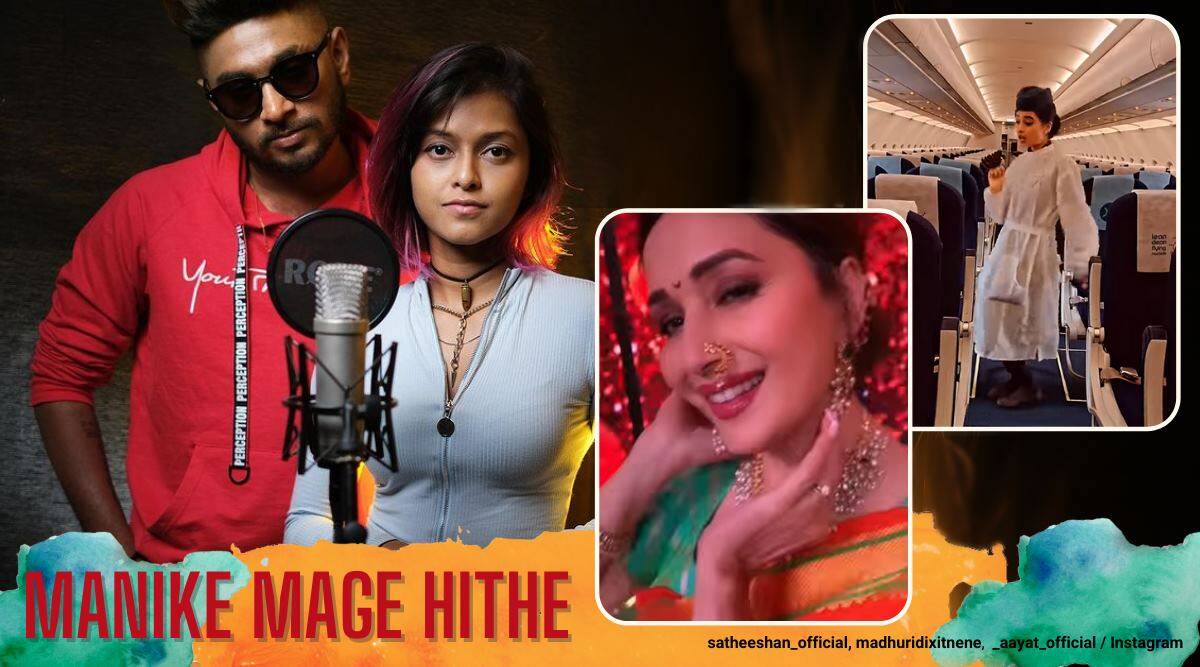
From Amitabh Bachchan and Madhuri Dixit and social media influencers to usual Instagrammers, all have hopped on to the trend of making reels with a Sri Lankan song — ‘Manike Mage Hithe’. Some have the song as background music in their videos, some have danced to it; others have simply hummed to the tune.
The current version of the viral Sinhala song was released in May 2021 and is sung by Sri Lankan singer-rappers Yohani and Satheeshan, who became overnight sensations not only in Sri Lanka but also in India.
Not many, however, know that the song was originally released in Sri Lanka as a single in July last year and was produced by music producer Chamath Sangeeth – and not by Yohani whose version of the song is currently viral. The original was sung by singer Satheeshan along with rapper Dulan ARX, who is also the lyricist of the song.
Speaking about the making of the original song, Sangeeth said, In 2020, Satheeshan had requested me to produce a song for him. When he came back to me five months later, I did not like the song I had produced for him, and so the music underwent drastic change for a week. I made a new song which is the original version of Manike Mage Hithe so that it matched his voice.”
The Sri Lankan music producer said that Dulan ARX was roped in to write the lyrics for the song and was also asked to rap to make the song creative.
The song, Sangeeth said, talks about a beautiful girl in a rural village in Sri Lanka. The boy who sings the song is in love with this girl and he tells her not to ignore him and make him lose his feelings,” he said.
The music video directed by Hasith Aryan featured Madushi Soysa, Kasun Tharaka and Ruwan Priyadarshana. Since we felt that the song will be a great hit, we got in Hasith Aryan to do the music video for the song,” Sangeeth added.
After a year since the release of the original song, Sangeeth got together with Sri Lankan singer-rapper Yohani to release a duet cover of the same song in May 2021 featuring the original singer Satheeshan.
We collaborated with Yohani when we were amidst a lockdown, as we were unable to go out. The cover was done in the most simple way with what was available to us at that time,” Sangeeth said.
Since its release, this version of ‘Manike Mage Hithe’ has not only become one of the most popular tunes for Instagram Reels in India but has also become a hit on streaming platforms such as Apple Music, Amazon Music and Spotify. It has also crossed over 100 million views on YouTube. It became Number 1 in iTunes’ top 100 in Sri Lanka, India and Maldives, top viral 50 in Spotify India and Spotify Global.
Chamath Sangeeth said that he never imagined that this version would make it this far and become an overnight sensation. Manike Mage Hithe is the only song that has become a viral hit outside the country (Sri Lanka) which is the first for Sri Lanka’s music industry.
It still feels like a dream to me to have achieved this much success and I am unbelievably happy,” Sangeeth said.
‘Manike Mage Hithe’ in Indian languages
Every now and then, a trend goes viral on Instagram Reels that is becoming extremely popular in the country. ‘Manike Mage Hithe’, which was released in May this year, is one such trend.
From music producer Yashraj Mukhate’s cover, to a video of an air hostess dancing to the song on an empty plane, the number of people who hopped on to the trend increased over the last few weeks, simultaneously increasing the views of each video.
Since the song that went viral was the cover sung in Sinhalese, several YouTube artists felt that putting out versions of the song in different Indian languages would reach a wider range of audience.
One such artist was Anas Shajahan from Kerala. As soon as I heard the song on Instagram, I felt that making a cover of it would reach a larger audience,” he said.
Anas made a Tamil version of the song and uploaded it on his YouTube channel. Once this version started to get a lot of attention, Sangeeth contacted Anas and said he wished to collaborate and make an official version of the song with Yohani.
I rewrote the song in Malayalam and since Yohani did not know the language, I had to teach her the words in both Malayalam and Tamil,” Anas said.
While the meaning in Sinhalese is different from the one in Tamil and Malayalam, Anas said he understood the theme of the song and wrote the lyrics based on that. The Tamil and Malayalam versions of the song were officially released on C Music South Channel on 26th July 2021.
The version which Anas did with Yohani is a great success. He has a great voice and the lyrics were good. There were a lot of comments on Yohani’s page to go for a Tamil version of this song as well. This prompted me to invite him to do the official Tamil version for Manike Mage Hithe,” Sangeeth said.
There have been multiple other versions by different singers that have gone viral with millions of views. Some opted to directly translate the Sinhalese song into Hindi or other regional languages and some artists gave their own twist and meaning to the song.
Pune-based singer-rapper Muzistar released a Hindi version on July 30. The song was sent to Muzistar by a friend of his and he fell in love with it and thought that the song was melodious.
Writing the lyrics was the hard part and it took me two days to do it. I retained Yohani’s portions of the song and replaced the male part with my own writing,” Muzistar said.
While Muzistar’s version has now been removed from YouTube, his Hindi version became famous, making even Bollywood star Amitabh Bachchan to share it. When I found out that the legend Amitabh Bachchan had shared my version of the song, I began to tear up. Though I was extremely happy, I also shed happy tears,” he said.
When asked how Chamath Sangeeth felt about the number of Indian versions being made on his song, he said, I’m truly honoured and happy that they have remade my song in all these languages. As far as I’ve heard, this song has been remade in around 75 versions.”
This song is made in many languages along with this Hindi version that you know of. But none of them are recognised versions of this song apart from the Tamil/Malayalam one,” Sangeeth said.
Most of the social media users admitted that they did not understand the language or meaning of the song, but that did not stop them from getting addicted to it.
Amrit Ramnath, a singer-composer based out of Chennai, says the simplicity of Manike Mage Hithe was what attracted him the most. I think the song is very catchy and accessible, which is why it works so well even though it’s not a very commonly known language,” he said.
He believed the beauty of accessible music such as this song was that it traverses across language and culture. The song would have been a hit even if it was in an even lesser-known language simply because of the melodic structure and recall value of the song,” Amrit said.Also Read
Beginning of more collaborations
With the success of Manike Mage Hithe in India, the question of ‘will the song pave the way for more collaboration between Indian and Sri Lankan artistes?’ naturally arises.
Sangeeth said, I would definitely think that we will have more collaboration in the future between the Indian and Sri Lankan artistes as India is our neighbour and a very friendly country. Our Sri Lankan artistes have had a history of working with Indian artistes before. Manike Mage Hithe has created a great environment today for artists to work together and I think that only now Indian fans have started loving Sinhala songs.”
Chamath reveals there are plans to make an official Hindi version of the song and discussions are underway with – Series for it. He confirms Yohani has not collaborated with anyone apart from Anas Shahjahan and Satheeshan.Chennai News
He believes ‘Manike Mage Hithe’ has created more avenues for him to showcase his talents. I have had collaborations with Indian artists like Salman Ali, Haricharan, Pragathi Guru Prasad, even before this song, and you will be able to see more collaborations in the future,” he said.
The Central Bank will soon announce a policy package in the form of a short-term Roadmap to provide clarity with regard to the movement of Sri Lanka’s macro-economic fundamentals, Central Bank Governor Ajith Nivard Cabraal said after taking office yesterday.
The Central Bank’s first and urgent priority under my watch, will be to provide clarity with regard to the movement of Sri Lanka’s macro-economic fundamentals in the desired path and thereby ensure stability in the financial sector. Towards that goal, the Central Bank will need to take the required steps that will reflect its own commitment towards that objective, and will therefore soon announce a policy package in the form of a short-term Road Map that could then be followed by all stakeholders,” he said.
He said that he was extremely privileged to lead the Central Bank once again and was humbled by the trust and confidence reposed in him by the President, Prime Minister and Finance Minister to take up the responsibility.
He also appreciated the good wishes that he had received from thousands of our countrymen.
I will assure all of them that they will not be let down, and the economy will be steered towards continued stability. I also look forward to the close cooperation of the wonderful team of persons at the Central Bank as well the support from all stakeholders with whom I will have early consultations,” he said.
The government, bankers, importers, exporters, lenders, borrowers, investors, developers, service providers, industrial businesses, exchange houses, retailers, wholesalers and most importantly, the people of Sri Lanka must experience economic stability. It is then that undue fears are allayed, and damaging expectations are not escalated,”
To achieve that objective, the Central Bank will need to provide clear and firm guidance to all economic stakeholders particularly at turbulent times, such as the current times. Therefore, the Central Bank’s first and urgent priority under my watch, will be to provide clarity with regard to the movement of Sri Lanka’s macro-economic fundamentals in the desired path and thereby ensure stability in the financial sector,” he said.
KCI Metro Link Korea Co and the GBK Consortium of more than 15 South Korean companies have signed a memorandum of understanding to undertake a feasibility study for a light rail line running north from Colombo to Bandaranaike International Airport and Negombo, along with an associated mixed use development.
The project is being backed by a US$500m loan from Export-Import Bank of Korea to Sri Lanka, with more than US$1bn of further funding expected to be raised from international investors, the Railway Gazette reported.
Speaking at the signing ceremony in Seoul, Sri Lanka’s ambassador Dr A Saj U Mendis said countries including South Korea and Malaysia had experienced rapid development owing to improved connectivity, and he believed Sri Lanka was now in similar position to South Korea 30 years ago and well positioned to receive foreign investment.
The total number of people who fell victim to COVID-19 infection in Sri Lanka moved up as 118 more fatalities were confirmed by the Director-General of Health Services on Wednesday (Sep. 15).
The new development has pushed the official death toll from the virus outbreak in Sri Lanka to 11,817.
According to the data released by the Department of Government Information, the latest victims include 61 males and 57 females.
As many as 95 deaths were reported among elderly people aged above 60 years.
In addition, 23 individuals aged between 30-59 years have also succumbed to the virus infection.
The Epidemiology Unit of the Health Ministry reports that another 889 persons have tested positive for COVID-19 in Sri Lanka, moving the daily total of new cases to 2,271.
This brings the total number of confirmed cases of coronavirus reported in the country to 498,694.
As many as 428,590 recoveries and 11,817 deaths have been confirmed in Sri Lanka since the outbreak of the pandemic.
The Epidemiology Unit’s data showed that 58,287 active cases are currently under medical care.
Approval has been granted to two state-owned companies to import organic fertilizer for crops including tea, coconut, and rubber, Minister of Agriculture Mahindananda Aluthgamage said.
Previously, fertilizer was allowed to be imported only for paddy cultivation.
The two state-owned companies will be permitted to import organic fertilizer for other crops as well.
Meanwhile, steps have been taken to allow the private sector to import fertilizer so that all crops can obtain fertilizer from the market without any shortage by October.
For the first time in Sri Lanka, organic fertilizer required for paddy cultivation using organic fertilizer is being produced in the country and sufficient quantities of organic nitrogen and potassium have been imported, Minister Aluthgamage says.
The Minister further said that 300 kilos of nitrogen and 45 kilos of potassium per hectare will be provided to the farmers free of charge.
More than four out of five UK adults have now had two jabs, but reported daily Covid cases remain high.
Meanwhile, it’s been confirmed that millions of people will get booster vaccines – while children aged 12-15 will be offered single doses.
Why are infections still high when so many are vaccinated?
The vaccines are designed to protect people against becoming seriously ill or dying from Covid-19.
They’re less effective at stopping people becoming infected by the virus, developing mild symptoms or passing it on.
Although the vaccine does still reduce the likelihood of these things happening, it might only stop half of infected people from transmitting the virus.
Even if 100% of people in the UK were double vaccinated, the virus would still spread – but the key difference is that far fewer people would become seriously ill.
Do vaccines prevent hospitalisation and death?
They strongly prevent vaccinated people from getting Covid symptoms – and are even better at stopping people from ending up in hospital.
But effectiveness also depends on how well each vaccine works against individual variants. The most common variant in the UK today is Delta.
Public Health England (PHE) studies suggest having two vaccine doses protect 80% of people against getting symptoms from the Delta variant. That’s lower than the Alpha variant (89%), because Delta is more infectious. The PHE also found:
Vaccines are 96% effective at preventing hospitalisation
Covid deaths in the double-jabbed are four times lower than in the unvaccinated
But there will always be some deaths, particularly in the oldest and most vulnerable, because vaccines aren’t perfect.
In England, adults and those within three months of turning 18 can book a jab online or by calling 119. You can also visit a walk-in clinic without an appointment. All 16 and 17-year-olds are asked to make an appointment through their GP.
The Tamil Separatist
Movement was not crushed by the Eelam defeat. They knew it was going to happen
and were ready for it. The Movement created two new organizations after the war
ended, ‘Transitional government
of Tamil Eelam’(TGTE) and the
‘Global TamilForum’ (GTF). TNA is the local representative in these two groups.
Transitional
government of Tamil Eelam
A Transitional government of Tamil Eelam
(TGTE) was set up May 2010 in the US. It
is a government in
exile set up by
the Sri Lankan
Tamil Diaspora who wish
to establish Tamil Eelam. TGTE said that that like the Jews, the Tamil
community was a transnational population, no longer confined to a single nation.
A community like that needs a transnational government. Therefore, a government
in exile was be set up. However, analysts said that the world will not take the
TGTE seriously.
The advisory committee of the TGTE recommended that aTransnational Constituent Assembly of Tamil Eelam be formed
consisting of 135 members. Of these, 115 would be elected and the remaining 20
shall consist of delegates selected by the elected assembly to represent
regions where elections aren’t feasible.
The distribution of the 115 elected
representatives is: Australia 10, Benelux 3, Canada 25, Denmark 3, Finland 1,
France 10, Germany 10, Ireland 1, Italy 3, New Zealand 2, Norway 3, South
Africa 3, Sweden 1, Switzerland 10, UK 20 and USA 10.
The distribution of the 20 appointed delegates
is: Caribbean & South America 1, India 5, Malaysia 3, Mauritius 1, Middle
East 2, Oceania 1, Rest of Africa 1, Rest of Asia 1, Rest of Europe 1,
Singapore 2 and South Africa 2.
Elections were held in May 2010. Working
groups were established in countries with significant Diaspora communities to organize
elections. The inaugural assembly met between 17 May 2010 and 19 May 2010 at
the National Constitution Center
in Philadelphia,
USA. Visvanathan
Rudrakumaran,
former international legal advisor to the LTTE was appointed Prime Minister .Rudrakumaran is the son of
the former Jaffna Mayor Rajah Viswanathan.
He is a US citizen and lives in New York City. TGTE established offices in all the European
countries where there is a significant number of Tamil Diaspora. It has held
three sessions in USA in 2010 and 2011.
TGTE is committed to an independent sovereign
state of Tamil Eelam in Sri Lanka’s north and east. On
19 May 2013, the TGTE unveiled its Tamil Eelam Freedom Charter, which seeks to take
the Vaddukoddai Resolution forward. The Charter said, inter alia, that the
North and East of Sri Lanka are the traditional homelands of the Tamil people,
the people of Tamil Eelam have an inherent right to self-determination, and the
creation of an independent and sovereign State of Tamil Eelam remains the only
viable option.
President Maitripala
Sirisena faced protests by supporters of the TGTE when he visited London for a
Commonwealth Summit meeting in 2018. TGTE launched a campaign titled
“#GoBackMY3” . The British government turned a blind eye to TGTE
displaying LTTE flags at the Commonwealth Summit, observed Shamindra Ferdinando. This was the
first time that LTTE flags were displayed at protests against a Sri Lanka Head
of state.
TGTE also
displayed banners. Banners declared ‘Sri Lanka President wanted for genocide’, ‘Tamil
Eelam is the only solution’, ‘UK stop protecting genocidal Sri Lanka’, ‘Let
Tamils decide referendum now’,’ Justice delayed justice denied, ‘Tamils want
action not words,’ We don’t want a Constitution,’ final solution is Tamil
Eelam,’ where are the surrendered?
TGTE urged the
CHOGM to suspend Sri Lanka from the Commonwealth, until Sri Lanka fully
implemented the recommendations made by the UNHRC. TGTE said that Sri Lanka
should be referred to the International Criminal Court and a UN conducted
Referendum was needed for the Tamils to decide their future and to ensure a
peaceful, permanent political solution.
TGTE is a make-believe organization formed by
an immoderate attorney who has nothing else to do. If he had been a competent
attorney, he would have had a lucrative practice and little time for
campaigning for an imaginary Eelam, said Kanthar Balanathan.
Global Tamil Forum
Global Tamil
Forum (GFT) was started in 2010 and is headed by Fr S.J.Emmanuel, former Vicar
General of Jaffna, now in Germany, said Rohan Guneratne in 2010. Global Tamil
Forum consists of 14 Tamil Diaspora
groups, including ATC Australia, BTF
UK, DFTA Denmark, NCET Norway, NZTC and WTS New Zealand, STF Sweden, TRF
Malaysia, USTPAC US, ETU Europe, TEMP France, CTC Canada, TCF+KV Netherlands,
MT Mauritius, STF Switzerland, and GT Italy, said Shanaka Jayasekera in 2011.
Global Tamil
Forum grew out of the British Tamil Forum, (BTF) which had been established in 2006 to
influence British opinion. BTF has a strong presence in UK and did
constituency based lobbying, influencing British politicians.
BTF funded the setting up of the
GTF Secretariat in London. Global Tamil Forum (GTF) was ‘inaugurated’ in the
House of Commons in February 2010. All
major British political parties were represented at the inauguration, reported
Shamindra Ferdinando.
GFT soon became an influential grouping with
access to British and US administration. GFT
represents influential Tamil Diaspora groups in Europe Australia, US when
necessary, said analysts. GTF has
called for the creation of an ‘autonomous Tamil region’ in merged north and
east.The 13th Amendment was too weak and fragile.
The GTF worked
closely with the TNA. GTF spokesman, Suren Surendiran said that among the
issues they worked closely on was the accountability issue. They had joined up with TNA to push for full
implementation of the Geneva Resolution 30/1, inclusive of foreign judges.
GTF stated that all concerned Tamil
organisations had met in 2012 [ probably
in London] to discuss Tamil genocide, destruction of Tamil peoples
identity, oppression, threat to Tamil claim to north and east, and legitimate
aspiration of Tamil people through negotiated political solution. This discussion continued in Berlin in
January 2013. Participants included
TGTE, GTF, and International Council of Eelam Tamils. The Sri Lanka
component consisted of Tamil National Alliance, Tamil National
Peoples Forum, and Tamil civil society representatives.
The British Tamil Forum organization a two
day conference in the UK In 2014 to censure Sri Lanka. One session was
scheduled to take place in the House of Commons and a delegation of the TNA had
arrived from Sri Lanka for this conference.
In 2014, in response to Sri Lanka’s action of March
2014 the Global Tamil Forum urged the UK to intervene on its behalf at
the UN Security Council to prevent Sri Lanka government exploiting UN Security
Council Resolution 1373 of 2011 ( UNSCR 1378) to attack 16 Diaspora groups as
well as 424 individual.
In 2015 GTF welcomed the UNHRC report that
strongly indicated war crimes and crimes against humanity in the Eelam war IV. GTF
recommended an international special court for criminal prosecution. GTF is in
full agreement with the report and supports a hybrid court. It must include substantial participation
of international personnel at each stage of the investigation and trial process,
said GTF.
The
violations reported are serious crimes of
concern to the international community as a whole, continued GTF. It made harrowing reading, indicating the
horrific level of abuse suffer by the Tamil civilians at the hands of
the Sri Lanka armed forces, including indiscriminate shelling, extrajudicial
killings, enforced disappearance, denial of humanitarian assistance, ill
treatment of IDPs torture and sexual violence.
GFT welcomes the Geneva resolution (34/L 1) of
2017 co-sponsored by Sri Lanka, which reaffirmed full implementation of the 30/1. The
GTF said it cautiously welcomes the unanimous adoption of the resolution and
the fact that it was sponsored by forty seven countries. Twenty
seven countries spoke at the Interactive Dialogue on Sri Lanka.
However, a
comprehensive, time-bound implementation strategy was urgently needed. The victims and their families from the Tamil
community have very little faith in the government, and any belief that justice
is possible is entirely due to the assurance of international involvement.
The role played by major international powers
and their trust in the impartiality of the UNHRC processes, has been very
important in preventing them from descending into a state of despair. GTF the GTF would like to reaffirm its
commitment to a process that will lead to true accountability and a sense of
closure to the trauma experienced by the surviving victims., the statement
concluded.
A GTF delegation
led by Suren Surendiran met with President Sirisena at the Hilton in Park Lane
in 2015. The goodwill was so great, they even took a dinner of string hoppers, kiri hodi, and pol sambol for Sirisena and his entourage,
reported Sunday Times. He was thrilled. Also present was then Foreign Minister
Mangala Samaraweera. They talked passionately about resolving the issues before
them through dialogue. That did not go far said analysts.
THE
PARK LANE HILTON IN MARCH 2015 – The then President Maitripala Sirisena with a
delegation from the Global Tamil Forum (GTF). Seated on his left is Suren
Surendiran, now GTF spokesperson. On his right is Father S.J. Emmanuel and
seated next to him is the then Foreign Minister, Mangala Samaraweera.
In
2016 a delegation of
the GTF, representing US, UK, Canada, Australia and
Germany met USA’s Assistant
Secretary of State, Nisha Biswal and Assistant Secretary for Human
rights, Tom Malinowski at Washington.
A joint delegation of Tamil organizations went to New York in
March 2018 and held talks with UN, US and Norwegian officials in the US. The delegation
comprised Jaffna District MP and TNA spokesman M. A. Sumanthiran, GTF President
Rev. Father S. J. Emmanuel resident in Sri Lanka, United States Tamil Political
Action Council (USTPAC), Canadian Tamil Congress (CTC), Norwegian Tamil Forum
(NTF), Australian and the United Kingdom organizations.
The visit was part of GTF-TNA continued engagement with the
international community to ensure that Yahapalana government fully implemented
the 2015 Resolution. Suren
Surendiran, who had been a member of this delegation, told Island that
the mission discussed ways and means to
ensure a time-bound implementation plan for two
Resolutions and the requirement for UNHRC monitoring and
oversight over Sri Lanka beyond March 2019. Resolution 34/1 covers the period
up to March 2019.
Island asked, why did they want
UN oversight and monitoring of Sri Lanka even beyond 2019, Surendiran said that
in case the current government couldn’t fully implement the 2015 pledges,
continuous international oversight was needed over the next government that
comes in. Constant watch was needed until
the full implementation of the 2015 Resolution.
The GTF said
they were able to secure key appointments with the highest levels of authority
at the UN, US Administration and Norway. The
delegation had met United Nations under Secretary General for Political Affairs
Jeffrey Feltman and Director for Asia and Pacific Division Ms Mari Yamashita at
the main UN building in New York. The delegation also met Senior Republican
Congressman Bill Johnson and senior staff of the Foreign Relations Committee at
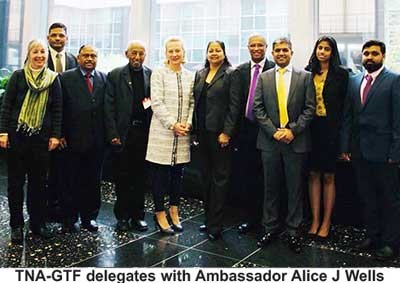
Capitol Hill. The GTF said that Ambassador Alice J Wells, Principal Deputy
Assistant Secretary for South and Central Asia had promised to take up their
concerns with US missions in Geneva and Colombo.
Deputy US
Permanent Representative to the UN, Ambassador Kelley E Currie, who is also the
Representative to the United Nations Economic and Social Council, met the
delegates at the US Mission at the UN Plaza, 1st Avenue. Ambassador
Currie has reiterated US commitment for the full implementation
of Resolution 30/1 and promised to discuss points of concern with the
missions in Geneva and in Colombo.
The delegation also met Norwegian Permanent Representative to the UN Tore Hattrem, at one time Norwegian Ambassador in Colombo. Hattrem had assured the delegation that Norway shared their concerns. Norwegian Mission in Geneva and the Norwegian government in Oslo were interested in a time-bound implementation plan, with benchmarks.
Top
UN official Feltman (fourth from left) with TNA and GTF delegates (Rev Fr
Emmanuel-third from left, MP Sumanthiran-fifth from left) and
Surendiran-extreme right)
GTF in a post
published by the Canadian Tamil Congress in 2020 said the Tamil people’s
struggle for democratic rights in Sri Lanka has a long history and since
independence the desire of Tamils to live as a free people has not been
diminished by the many setbacks and the tests of endurance faced by Tamils in
their onward march for justice, dignity and equality.
When the
fangs of the majoritarian state unfairly target minority communities, even the
theoretical possibility of legal recourse can be significant. So, it is vital
that Tamil, Muslim and Christian communities study their electoral options and
act wisely, said GTF.
In 2021 Suren
Surendiran, gave an interview to Island
where he said that the Tamil community did not believe in commissions appointed
by the government of Sri Lanka to address post-war reconciliation issues. In an
interview with the BBC Sinhala service, Surendiran said that the Tamil community
looked to the UNHRC to address their grievances.
GTF complained
that Government of Sri Lanka falsely claims that these resolutions are against
Sri Lanka and her people. Instead of dealing with issues like any mature
progressive country will and should, the government of Sri Lanka creates a
false narrative that these resolutions are undermining the sovereignty of Sri
Lanka and that the international community, especially the powerful western
countries are undermining Sri Lanka and her people and their war heroes.
GTF issued a
statement when the government of Sri Lanka rejected Resolution 30/1 .GTF said
the government of Sri Lanka had rejected this resolution, but even all the
neighboring countries” did not support that position. The countries voting in favor
cover all regions across the globe and several countries who would have
traditionally voted against such a resolution recognized the criticality of the
situation in Sri Lanka and decided to abstain. Tamils are grateful to the US
Administration that initiated the original process of promoting reconciliation
and accountability in Sri Lanka in 2012.
Unlike in the
previous years when the outcome at the UNHRC was eagerly sought by the Tamil
community, the interests and expectations this year were much more widespread,
reported the media. The Muslim community, which was openly victimized through
forced cremations and expected bursa ban; the Christian community which is
highly disappointed with the dishonest approach towards Easter bombing
investigations, and indeed the majority community which is increasingly
becoming unsettled with the authoritarian and militarized trajectory the
country is adopting. . The Government of Sri Lanka, by rejecting this
resolution, is undoubtedly isolating itself from the international community,
said GTF.
A third
organization ‘International Council of Eelam Tamils’, was
set up by the ‘Nediyawan faction in Norway. The movement started
in 2009 immediately after the war. It was
led by Perimpanayagam Sivapalan, known as Nediyawan, a hard core LTTE. Nediyawan is only a figure head, the matter
is controlled by a group of pro LTTE activists said one analyst. Nediyawan faction objected to the appointment
of Rudrakumaran as head of TGTE.
This movement controls more than 150 Tamil
schools in Europe. These schools are used to inculcate Tamil nationalist
sentiments and hatred toward Sinhalese in the mind of the younger generation of
Tamils said an analyst.
The leaders of these three groups
are interested only in building their personal and political power and
financial strength, said Rohan Guneratne in 2011. These leaders and their
children are very well off in
Europe. (Continued)
Reincarnation means a ‘soul’ moving from one and taking birth in another
human body after death. Hypnosis uses to identify memories of past life.
Buddhists and Hindus have a shared belief over incarnations. In Western
countries ‘past-life practitioners’ use hypnosis, which has become more
or less a business.
A session with a hypnotist can last up to forty minutes and it is
expensive. Clinical psychiatrists and psychologists widely reject Regression. A
2006 survey found that most of the samples studied by mental health
professionals rated ‘Past Lives therapy’ as a treatment for ‘mental
disorders.’ Those who are in search of a ‘spiritual experience’ may
consider it favourably.
The technique used by hypnotists involves the subject having to answer a
set of questions, and the hypnotised reveals his events of ‘ allegedly’
on one’s past life! Scientists say it misrepresents as a realistic recording of
previous events rather than a factual set of recollections.
Scientists maintain that hypnosis and suggestive questions leave the
subject particularly likely to hold distorted memories. ‘Created memories can become
indistinguishable from memories based on events that occurred during the
subject’s life.’ They
believe it combines experiences, knowledge, imagination, and suggestion or how
the hypnotist guides the hypnotised.
Religious view
In the 2nd century BC, Hindu scholar Patanjali in his Yoga
scriptures discussed the idea of a person’s soul becoming burdened with an
accumulation of impressions (karma) from previous lives, and he called
it ‘regression.’ The Chinese deity Meng Po (‘Lady of Forgetfulness’)
believed to prevent souls from remembering their past lives by giving people ‘a bittersweet drink to
erase all memories before climbing the reincarnation wheel.’ The
Seven truths of Jainism’ deal with the soul and its attachment to karma. It
reveals that karma can stick to one’s soul and to be free from the cycle of
rebirth and death, one must separate karma from the soul!
Psychiatrists & Psychologists
Clinical Psychiatrists and psychologists widely reject past life
regression. A 2006 survey of mental health professionals rated ‘Past Lives’
therapy as a ‘discredited’ treatment for mental disorders. They say that
‘memories
recovered by hypnosis result from narratives created by the subconscious mind
using imagination, forgotten information and suggestions by the therapist.’ Such memories created
under hypnosis can be indistinguishable memories from actual memories. Those
who believe in reincarnation are more likely to report such memories than those
who refuse to believe.
Examples
Examinations of three individuals’ apparent past life regression ( Bridey,
Murphy, Jane Evans) on the Internet reveal their memories were ‘superficially’
convincing. However, upon investigation by experts in languages who used
historical periods revealed flaws in all three individuals.
Moviemakers used the evidence was found the pattern in each speech
during the 16th century to convey the impressions of English speech, rather
than actual rebirth memories”! The date, too, was completely inaccurate!
But at the same time, it was recognised as ‘printing errors in historical
pamphlets! ‘ The reported topic was historically accurate from the Roman era,
but identical information found simultaneously was in a 1947 novel set.
A study on Regression.
A study in 1976 found that forty per cent of hypnotisable subjects
described new identities and used different names when suggested to regress
their past birth memories. In the 1990s, a series of experiments undertaken by
Nicholas Spanos examined the nature of the alleged past-life memory
descriptions elaborately with vivid details. It, however, was not indicative of
the validity of the therapeutic method.
‘Human
memory involves the ability to both preserve and recover information one has
experienced. Memories experienced in past lives can be vivid based on one’s
present life, and it is impossible to differentiate from real memories of
actual events; any damage could be difficult to undo’ experts
say. Past life regression is exhausted on the premise of reincarnation
according to many accredited organisations of the APA (American Psychological
Association).
They have begun to refute this method as unethical! Scientists consider
past life regression is immoral because it lacks evidence to support such
claims! ‘The hypnotic responsiveness justifies past life regression and
places the participant in a vulnerable position to establish false memories.
Such false memories may be harmful,’ says Gabriel Andrade, Assistant
Professor, College of Medicine, Ajman University, United Arab Emirates. He
points out that past life regression violates the principle of ‘not harm process’,
which is part of the Hippocratic Oath taken by doctors. (Treat the ill to
the best ofone’s ability).
Personal experience of the author
Peter Kalu, the author of the book: ‘Plan your next birth’ has
gone through the experience of regression after the writer published a review
on his book. He has written his experiences of regression, which the writer
chose to describe in detail as follows:
” Peter Kalu says, Dr. Azard
Uduman (the
hypnotist) came on ‘zoom’ ( Internet) and first wanted to know why I needed to
involve in Regression? I told him that it was out of curiosity!” Dr. Azard
Uduman then hypnotised me. I am tolerant with hypnosis. Within few minutes, I
was in a hypnotic state and kept on listening to Dr. Uduman. “He took
me through a flight of steps, doors and corridors in a building, until I
entered a park. I sat on a beautiful bench in the park.”
He kept
on chatting continuously and indicated there was a white screen in front of me.
After a few seconds, I
could see a large screen and I stared interestingly at the screen . Dr. Uduman
kept on guiding me in my hypnotised position. Next, I saw a wall with pictures
annexed to it with various deities. I kept on gazing at a particular deity,
which I could recognise as Lord Ganesh ( the elephant god! in Hinduism).
Dr. Azard guided me to keep looking at Lord Ganesh. The next moment the
elephant moved and his trunk wanted to touch me. At that moment, I could hear
Dr. Uduman say: ‘Let the elephant touch you with his trunk.”
I
also heard Dr. Uduman say that the ‘elephant god’ ( the deity) wished to
communicate with me! Seconds later, I saw a person dressed in immaculate white
carrying some garlands – he wore jewellery around his neck. Many devotees
accompanied the man. Next I saw everyone in the large gathering worshipping the
man clad in white.The man performed ‘ a Hindu’ service. After the pooja was
over,the
elephant deity re-appeared.”
Next, I
mounted the elephant as it was about to move forward. I realised the man clad
in white was the chief priest of the Hindu temple. Meanwhile, a Buddhist monk
appeared on the scene.”
Suddenly,
it dawned on me that I was posing as the Hindu Priest in the Hindu Devale.
Next moment when I set my eyes on the Buddhist monk, I immediately dismounted
from the elephant and walked up to the Buddhist priest.”
He
welcomed me adoringly. The Buddhist monk became quite affectionate, and we
started chattering like two old friends. When our conversation ended, still
walking forward, we both ( the Buddhist priest and self) came to a
ferryboat near a waterway. There were approximately fifty people on the
ferryboat. The ferryboat started to move slowly, and finally we landed on an
island not very far from where we began the journey.”
The
Buddhist priest guided me towards a temple on the island and introduced me to
the Chief Prelate of the temple. I could see myself sitting in front of the
head of the temple and listening to the chief priest’s sermon (Bana).
After listening to the discourse, I became a Buddhist. I was curious about the
Hindu, Priest, Kovil, and Hindu followers and my appearance as the Kovil
Poosari. Still, Dr. Uduman consoled me stating that what I did was a noble act!
Finally, I chose to live in the temple as a Buddhist till I eventually died.”
I
saw my dead body cremated with honour. After the funeral, I distinctly saw my
parents, as a young couple, both with receding hair. It was supposed to be the
beginning of my birth in Sri Lanka as a Buddhist.”
All such details coincide with the scientific proofs mentioned
above. One wonders whether Peter Kalu, being a devout Buddhist, memories
created under hypnosis was indistinguishable information stored in his
retention and reflected as previous life’s data more vividly!
After all, at the end of the exercise, he lost £40 (approx. Rs 12,000)
as the fee for the hypnotist. One wonders whether is it is worth going through
Regression and for what purpose? It’s food for thought!!
23Mar 21 is a red-letter day for Sri Lanka. On this day, the little island
nation once again bloodied the nose of America when she defeated its plan to
drive home a deep nail of American colonialism into her.
America,
unleashed its running-dogs at the UNHRC, hoping to establish a second Attorney
General’s department in Sri Lanka under the direct control of the UNHRC,
thereby setting the stage to fry our heroic soldiers in the American Electric
chairs.
America
was hoping to establish this mechanism by illegally vesting the power of the UN
Security Council with the UNHRC, using a unanimous (or consensual) resolution
against Sri Lanka as its executionary tool.
America
laboured and laboured and ultimately gave birth to a mouse, Resolution 46/1.
The
Resolution, totally contradictory to the multilateral spirit of the UN was not
unanimous and consequently is not binding on Sri Lanka in any way.
There
is not a sausage the Americans can do with it and the Global South, which
foresaw the dangers of the American conspiracy, do not give a tuppeny damn to
the defanged outcome, Resolution 46/1.
But
during the process America deviously budgeted a sum of 2 million USD for the
establishment of this investigative and prosecuting mechanism, arguing that it
did so thinking that the resolution would be passed consensually. (It is
rumoured that de Livera has been shortlisted by the Americans to head the
parallel AG’s department).
The
monies so set aside in the draft budget is usable only if the budgeted amount
is approved at this year’s annual sessions.
The
news on the grapevine is that the present administration in the Foreign
Ministry is showing scant interest on the matter; no moves are being made to
ensure that the monies budgeted by the US are NOT passed.
If
the US budgeted money is passed at the UN by default due to disinterest and
inattention of the Foreign Ministry, it could cause meaningless problems for
Sri Lanka and the Global South.
It
was in similar circumstances, in March this year, that Mahinda was compelled to
cut across diplomatic lines of protocol and achieve what he did; he ensured there
was no consensual vote for the running-dog resolution.
Alarmed
by the current events, Mahinda reportedly took the initiative to muster
international support to ensure that the US budgeted money for the
establishment of the parallel AG’s department would not be passed.
When
the Americans learnt of Mahinda’s moves, they moved immediately to
strait-jacket him; Peiris and Colombage were attached to Mahinda’s
entourage.
On
10 Sep 21 Mahinda, the charismatic Sri Lankan leader, left for Italy to give
the keynote address at the G20 Interfaith Forum that began on the twelfth.
One
of those accompanying Mahinda was G.L. Peiris who, during two years of the
covid crisis as Education Minister, left the children of Sri Lanka completely
education-less, without even a shred of a plan to boast of.
That
has been the history of Peiris from a lethargic adolescence to the geriatric
present of sparse tresses of dyed hair.
Peiris
was sacked from his educational portfolio.
In
a virtual unbroken political career of 30 years Peiris has survived and
thrived, simply by making himself available as a stooge for the national and
international centres of power; he had a good grounding, when he wooed and
received beneficence from the estate of arch white supremacist and
segregationist, Cecil Rhodes.
Today,
Peiris does not squirm when toadying for yankee Basil who is under strict
American oath to work loyally towards achieving America’s objectives in Sri
Lanka.
Unfortunately
for Sri Lanka, Peiris, on being sacked, was given the Foreign Ministry
Portfolio replacing Dinesh Gunawardena.
Gunawardena
is not exactly a favourite of the Americans, having ably supported Mahinda
during the March UNHRC issue.
Dinesh
also put the record straight on 6.9 million people voting GR into power so that
GR could fulfil his pledge to the people of pursuing a committed Non-Aligned
foreign policy and rejecting outright any hint of Sri Lanka being a Neutral
State.
This
reconfirmation probably cost Dinesh his job in the Foreign Ministry.
Mahinda’s
visit to Italy is shrouded in mystery; many red herrings have been drawn across
the path and these are a source of distraction.
Was
there a plan by the American Rajapaksas to destroy Mahinda’s image in the eyes
of the Sri Lankan people?
In
today’s context, News telecasts and social media are portraying seething anger
against the Government, throughout the country, allegedly for serious acts of
commission and omission.
Most
of that anger is vented on GR who is considered by the people as an absolute
failure and singly responsible for today’s sorry state of affairs in the
country.
Mahinda
on the other hand evokes plenty of empathy from the people who believe that Sri
Lanka would not be in this position had he been in the saddle; there is an
impression amongst the people that he is being deliberately side-lined and that
there are undercurrents of a campaign to discredit him and the Sri Lankan
Rajapaksas.
It was in this
background that people were surprised to see the demonstrations in Bologna and
the subsequent news coverage of these incidents; they were all targeting
Mahinda and non-whatsoever against the American ‘Paksas’
Many
believe that the Americans are behind this campaign and that it is being
conducted with the support of the strong Yankee fifth column in this country.
Mahinda has for long been a bugbear for the Americans.
Will
there be similar demonstrations when the Sri Lankan delegation to the General
Assembly arrives in New York?
It
may have gone unnoticed that Geneva is just 277 miles away from Bologna and
that the 48th session of the UNHRC began on 13 September. Sri
Lanka is very much on the agenda at these sessions.
If
Peiris is one end of Mahinda’s strait jacket the other end is Colombage.
It
would be recalled that pastor Colombage, with strong links with an insidious US
funded think tank was talking with the enemy CORE group to hammer out a
consensual resolution when he should have been talking with our friends in the
Global South and the NAM to defeat the resolution; he is on record to
‘boastfully’ proclaim that Sri Lanka would surrender, but only after a fight.
Joker
Colombage’s plans were thwarted when Mahinda suddenly intervened.
Knowing
the calibre of Peiris, Colombage and the others of their ilk at the Foreign
Ministry and with the UN station in Geneva being handled by a person who owes
his appointment for being the author of an obsequious biography, the country
must be made alert to what is happening.
If
the unsolicited American monies are approved by the UN, the country and the
people are forewarned about who should be held responsible for this lapse and
who should be held responsible, in the consequent future for the incarceration
of our heroic soldiers and the colonisation of our country.
All
of these people are put on notice; the country will never forgive you.
Through its 2011 documentary (film/video)
titled ‘Sri Lanka’s Killing Fields’, UK’s Channel 4 TV misled the UK people and
the World asserting that Sri Lanka’s military during the last stages of the war
against the LTTE committed gruesome war crimes and crimes against humanity. The
writer can state with absolute certainty and responsibility that the Channel 4
film is full of lies.
This is his Study.
The deceptions are so clever even some Sinhalese who are knowledgeable of the war have murmured to the other did our Army really commit such crimes”?
We say some scenes of the video though
depicts as being shot in Sri Lanka may have been shot outside of Sri Lanka
using actors (and they are fine actors indeed).
Many scenes have been stage managed,
people were crying and wailing for the camera. It is reasonable to believe that
some of the blood that are shown are not real blood but dye and/or paint (eg: 9:31,
12:55, 35:49, 38:24 – minutes of the YouTube video – ‘Sri Lanka’s Killing
Fields’ uploaded by ‘Real Stories’ on 20 September 2015).
E. A.
Yfantis, a professor of computer science at University of Nevada-Las Vegas specialising
in computer graphics and image processing stated: “based on
mathematical analysis, blood in the 3GP videos is not real blood. …. and that
“videographic and mathematical analysis of the two 3GP videos show
that the videos either were edited, or staged, or both”.
It is possible that some scenes,
especially some gruesome hospital scenes, were filmed on location in Tamilnadu.
There are about 70 million Tamils living there. There are over 30 million
Malayalis in Kerala. There is a lot of sympathy for the LTTE in those places.
Finding people therein to act for Sri Lanka’s separatist cause is very
easy.
AA Gill of the UK Sunday Times described the footage: “Not a second of
this has been shot by Channel 4; none of the eyewitness accounts comes from
journalists”.
The main message of the film is that they
targeted hospitals”, they raped Tamil women” and they killed thousands of
Tamil civilians including children”; the Channel 4 achieved this objective very
well. The film won the prestigious BAFTA Award for the Best Current Affairs
documentary, and also won several UK and international TV and Journalism
awards. According to Callum Macrae, the Director, for making this film the
Channel 4 team was nominated for the Nobel Peace Prize in 2012.
After watching the documentary many
believe that Sri Lankan soldiers committed most gruesome atrocities (war
crimes) that no other recent Army has committed (note the thousands of comments
the world population has posted after watching the film on YouTube, over several
different channels).
Channel 4 has a duty to disclose true
facts, but they failed to do so. This allows those who are directly affected by
the video, including the Government of Sri Lanka, to file legal action against Channel
4. Even belatedly, initiating legal action against Channel 4 is the correct way
forward. It is a matter of obtaining
Special Leave from the UK Court to file action out of time. An attempt, worth trying especially given
these new findings.
In this instance, the writer, as a
conciliatory measure, asks Channel 4 to immediately accept that the film has
serious flaws or agree to subject the film to an impartial investigation/Sri
Lankan government examination to determine its accuracy/authenticity (say, within
four weeks hereof). This may be the only
way for Channel 4 to avoid legal action and preserve its good name. Channel 4
being a reputed UK media establishment is prudent to comply with this open demand.
Shyam
Tekwani, an expert in terrorism and media at the Asia-Pacific Center for
security Studies who has extensively covered the Sri Lankan conflict, compared
the “tone and tenor” of the documentary to that of productions by the
LTTE’s propaganda wing, and opined that “Clearly an effort to
sensationalise and shock with carefully selected and edited footage, the
documentary weakens its case and invites an investigation into its own
credibility and accountability to journalistic norms”.
Many deceptions/ serious concerns in Channel
4 video – The Study
Channel 4 has admitted that they produced the documentary solely through records and mobile phone and small camera films given to them by Tamil civilians (mostly living in the UK) and LTTE supporters. They also admit using some of Sri Lankan government (Army and Air Force) war footage. Did they obtain permission from the Sri Lankan government to use/edit them? No. Thus, a clear copyrights infringement on their part. Legal action can be initiated against Channel 4 in Sri Lanka for contravening the country’s copyrights laws. Sri Lanka can claim millions of rupees from Channel 4.
When Sri Lanka requested Channel 4 to subject the films/videos/photos for independent scrutiny and to provide them with copies and also to reveal their sources (for their own examination); Channel 4 failed to comply. Channel 4’s excuse was that if they are divulged, Sri Lanka will take revenge from those parties. This is a bizarre excuse. These are Tamils permanently living in the UK and the West, how can the Sri Lankan government punish them? Channel 4’s excuse is both cunning and flimsy.
One of the key Channel 4 witnesses Dr Shanmugarja continues to work as a doctor in the North, the government has not done him any harm. There are at least 3 other similar Tamil doctors currently working in Sri Lanka. No harm has brought upon them.
Wikipedia reports how humanely the Sri Lankan government treated former LTTE leaders, their family members and ordinary Tamils who had close association with the LTTE (this again shows that the excuse put forward by Channel 4 has no validity): I. Daya Master, the head of the media division of the LTTE was given full protection by the government and allowed him to operate his own private news desk. He is currently in Jaffna. II.Sasirekha, the wife of the former leader of the LTTE political wing SP Thamilchelvam has stated she was well treated by the Army. She has stated when having abdominal pains she was admitted to the National hospital in Colombo. Her children had attended an international school in Colombo. She has stated that she has no plans to migrate to any other country and wants to live the rest of her life in Sri Lanka. III.Sathyadevi, the wife of the leader of Sea Tigers, Soosai has stated that she never thought the government would treat her and her family so well. IV. After the war, over 110,000 LTTE combatants were captured by the government. None of them were harmed. All of them were well taken care of and were promptly rehabilitated. They now live as free citizens.
Channel 4 states that in order to make the film, they were collecting devastating evidence against Sri Lanka for 2 years (0.55). Anyone would agree that there are Tamil elements (civilian and LTTE) who will go to any extent to prepare and provide them with bogus information.
When Sri Lanka is validly claiming that the tapes are inaccurate/unauthentic and the evidence presented in the documentary is false; it is unconscionable for Channel 4 to remain silent, and continue to promote it.
Sri Lanka is in a quagmirical situation. It has been accused of most heinous crimes by Channel 4 which Sri Lanka has denied. Channel 4 states Sri Lanka is not responding to the allegations. It is Channel 4 that refuses to provide Sri Lanka with information about the mobile phone/small camera records/films.
It is clear – after making baseless, blatant allegations, Channel 4 now prevents Sri Lanka from proving her innocence. This is Channel 4 denying Sri Lanka of natural justice.
What Channel 4 has done was to edit Sri Lankan government and Tamil video footage to the maximum and producing their documentary (film/video). In this, there has been so much of content mixing. And, Channel 4 would not divulge the sources of information. They detest scrutiny. This is unconscionable conduct of the highest proportion on their part.
In the video, a figure of more than 40,000 civilian killings is stated. It is a mere guess by Mr Gordon Weiss, the then Colombo based UN Officer. He had first stated that only 7,000 were killed (he failed to substantiate even this number). This figure continues to escalate. Mr Sumanthiran of TNA has stated that the figure is 100,000.
Mr Weiss stated that the Government forces shelled the no-fire zone. How did he know this? He was in Colombo.
If 40,000 people (Tamil civilians) died at the last stages of the war under the hands of the government, given that Mr Weiss was the UN spokesperson in Sri Lanka at the time, he may be personally liable for not doing enough to protect them (why did he/the UN not raise the alarm at that time)? The families of the dead people and the casualties (if any) may be able to sue Mr Weiss/the UN in this regard, for failing to trigger R2P (Responsibility to Protect – an international law principle).
If such a massacre took place, would India have stayed silent? India closely monitored the situation, especially the utmost safety of the Tamil civilians. India regards Sri Lankan Tamils somewhat as their own citizens. India’s RAW has a strong presence in Sri Lanka. Then, the US, UK and EU who have diplomatic presence in Sri Lanka did not raise any alarm that the civilians were being killed. There was a Dravidian BBC reporter stationed in Colombo. It is true that the UK and French Foreign Ministers arrived in Sri Lanka just before the war ended. They wanted Sri Lanka to stop the war immediately. It is rumored that they came to save the life of Prabhakaran. Their efforts failed.
The documentary failed to mention that Mr Weiss may have had a vested interest in not stating the truth as before the end of the war he was asked to leave Sri Lanka by the Sri Lankan Government. Thus, he had a grudge against Sri Lanka. Furthermore, he wanted to sell his book, which severely criticises Sri Lanka. At the launch of his book in Melbourne in July 2011, under examination by this writer (who was the sole voice for the Sinhalese at the posh event), Mr Weis admitted that the figure of 40,000 is incorrect, and he had himself previously stated it was 7,000. The examination was so intent Mr Weiss had to state words similar to the effect: this is my party, please do not spoil it”.
See, ‘Weiss gets wiser’ by HLD Mahindapala in ‘Brief Colonial History of Ceylon’, 10/7/11 – At a book launch held in Melbourne last week, he changed his figure again and came down to 10,000* under questioning by Chanaka Bandarage, a lawyer. Bandarage then asked why the brochure had mentioned 40,000. Weiss had disowned responsibility and passed the buck to the Deakin University which produced the brochure.” (*Mr Mahindapala is slightly wrong here – what the writer questioned Mr Weiss was that when he had first stated that 7,000 civilians were killed (not 10,000 as reported by Mr Mahindapala), why did he later change it to 40,000).
In the documentary Mr Weiss states what the UN was doing at that time was not enough” (44:80). He has severely criticised the UN. But, today he is back with them. (He is the head of the UN (WFP) food aid distribution program for Northern Ethiopia, based in Nairobi, Kenya). It is worth watching how and when he would create another major controversy for countries/UN.
Channel 4 failed to mention that they had had serious issues with the Sri Lankan Government in the past, and some of their journalists were asked to leave Sri Lanka. It has been reported that Channel 4 journalists’ visa applications to Sri Lanka were refused.
Apart from Mr Weiss, Channel 4’s other main source of information is Vany Kumar. Channel 4 introduces her as a British Tamil. Her birthplace is Sri Lanka and has maintained very close ties with Sri Lanka. Channel 4 concealed this information from the viewers. Vany Kumar makes ten separate appearances in the 49 minutes documentary. It is reasonable to suspect that she was instrumental in providing Channel 4 with most of the dubious Tamil war videos. Vany Kumar was relaying various Sri Lankan government atrocities allegedly committed against Tamils during the last stages of the war. Throughout the video she maintained a smile but in the subsequent Channel 4 video (‘No Fire Zone – Sri Lanka Killing Fields’, produced in 2013), she cried and sobbed. Who is Vany Kumar?
According to Channel 4 Vany Kumar is a young English Tamil woman who has left London to spend 6 months with her relatives in Sri Lanka” (10:35).
According to Wikipedia, ‘Vany Kumar is alleged to have operated in the UK under an alleged LTTE front – Tamil Youth Organization (TYO) and she is alleged to have had links with the LTTE. It is stated that she arrived in Sri Lanka in 2008 at the request of Castro (former head of the LTTE Foreign Division) and underwent military training’. But Channel 4 portrays her as an innocent, impartial expert of the war.
Per Wikepedia …. after Kumar’s arrival in Vanni, she underwent one month of weapons training and was enlisted under Sothiya regiment of LTTE. She had also possessed a dog tag with a cardre number issued by the Sothiya regiment, and a cyanide capsule. She had also worked for the Castro branch of the LTTE international wing.” (If these facts are incorrect both Channel 4 and Vany Kumar had ample opportunity to correct them; they have not done so).
In the later Channel 4 video (‘No Fire Zone’) Vany Kumar acknowledged that she was a friend of LTTE’s News reader, Isipriya. This evidences her close LTTE connections.
Most of the Channel 4 documentary (Sri Lanka’s Killing Fields) is made on the assertions made by Mr Weiss – a dishonest personality and Vany Kumar – who alleges to have close terrorist links. In the documentary it is obvious that both are lying terribly. Their body language proves this. Both display vague, sly behavior. In such a situation, the allegations made in the video have very little credibility.
It is now proven that Vany Kumar has given a wrong name for this documentary. Channel 4 in the later video (‘No Fire Zone’) introduced her as Vani Viji. They did not give any explanation for the change in the name. What is Vany Kumar’s real name, no one knows, except herself. Is she a Bio-Medical Technician as portrayed by Channel 4? Then, they must prove this.
According to Wikipedia: Government investigations had revealed that Vany Kumar, who had gone by at least 4 different names including Dr. Tamilvani, Damilvany Kumar and Damilvany Gananakumar, arrived in Sri Lanka on 28 February 2008.” Vany Kumar is not a medical doctor.
The fact of lying establishes a bad credibility for her. She is the principal witness of the documentary and relates firsthand accounts of the war. When she can lie about her own name, how can one believe other things that she relates in the video?
Channel 4 attempts to show that the Sri Lankan Government was fighting a war against Tamil civilians and not the most brutal, barbaric terrorist group, the Tamil Tigers (LTTE). This is very inappropriate conduct for a reputed media organisation.
Channel 4 went to most extraordinary lengths to accuse that the Sri Lankan government was deliberately killing hundreds and thousands of innocent Tamil civilians (8:25) – …. civilians were bombed, herded and corralled’. ‘In these killing fields tens and thousands of them were destined to die, targeted by deliberate gunmen fire” (note the use of the word ‘deliberately’ by them; not even ‘recklessly’ or ‘negligently’).
Channel 4’s focus has been to show that the government has committed cold blooded murder of thousands of women and children. Thus, the video is full of such scenes. They know that by that way they would receive enormous praise, and condemnation to Sri Lanka.
It is the Tamil Tigers (LTTE) that slit open bellies of rural pregnant Sinhalese mothers, killed rural Sinhalese infants after grabbing them from feeding mothers and then smashing them down on the ground, killed Buddhist priests cold bloodedly (35 senior/student monks on one occasion) and committed various other brutal and heinous crimes against the Sinhalese (and some Muslims) such as suicide bombings, rape, bus bombings, and the killing of thousands of Sinhalese, Muslim and innocent Tamils by numerous other brutal ways. None of these were shown/stated in the documentary.
Channel 4 wrongly states that the Government herded the civilians to the no-fire zone. What happened was that the LTTE forced people to go with them. People had no other choice. Due to this there were zero people in the villages. The government then created a no-fire zone for the civilians. The government promised everyone including the UN and the international community that it will not shell the no-fire zone. The government kept its promise to the letter.
A government video (1st video) showing the Air Force’s Kfir jet bombing an LTTE target is deceptively used in the documentary to show that the Air Force was bombing innocent civilians. Channel 4 has linked this 1st video with a 2nd video that shows a group of people (actors) in a trench. Channel 4 blended the two videos to intentionally create the drama.
According to the government it was an older air attack – that had happened much earlier than the final stages of the war. But, according to Channel 4 it was during the last stages of the war.
Channel 4 admits that the Kfir attack is an Air Force footage and they were provided with the 2nd video by Tamils that shows people hiding in the trench in fear of the Kfir attack. Jon Snow, the narrator, unashamedly states about the 2nd video we don’t know who shot this. It may be a Tiger cameraman, it may be a civilian” (9:34).
This is how the UK’s premier TV station has produced a documentary that has won many awards for producing a documentary against an independent nation.
Channel 4 amalgamated the two videos to produce the final product – the damaging documentary. The discredit/disrepute they have caused to Sri Lanka and her people is enormous. True, the government is entitled to damages, it is difficult to place a monetary value at this stage upon Channel 4’s wrongful/unethical conduct. Sri Lanka can claim millions of pounds.
As Vany Kumar is the person who explains the Kfir incident, it is possible that she provided the 2nd video to Channel 4. It seems Channel 4 is prepared to telecast any ‘garbage’ that serves their purpose.
In the last stages of the war all people were confined to the no-fire zone. There were no people living in homes. But, according to Channel 4 these people with small children were still in their own houses. That simply could not have happened.
In reality, this could not happen the way it was shown. Channel 4 was able to show it because the 2nd video is an artificial incident created by using Tamil actors.
People in the trench– rather than trying to save their lives were preoccupied about the video (9:46). They continuously ask bizarre questions as don’t take the video”, what are you going to do video”, Can you hear us” etc. Even the children are heard constantly uttering the word ‘video’. They were using other stage managed questions such as – please get in the bunker”, They are killing us”, Please God save all of these children” etc. This shows nothing else but fine coaching and acting.
Those people are not lying on the trench but were standing on it – so that they are well visible in the video. They continuously parrot the words – they are killing our children”. This is to obtain international sympathy/attention.
Anyone would agree that if people are in real fear of their lives (being attacked by an Air Force), they do not go on talking about a video that someone was making. In the documentary, everyone seems to be more focused on the video than the air attack (In the 2nd ‘No Fire Zone’ film, the utterings about the ‘video’ have been removed, and the Kfir jet scene has been reduced to only few seconds).
If the Kfir jet actually attacked the civilians and/or their surroundings there needs to be evidence about it. Though people were screaming loudly, the video does not show any signs of the bombing. There is no jet sound, smoke or collateral damage caused by the jet.
It is obvious that the way they express fear in the trench is unreal. This is because they are actors. This scene is a fine example that Channel 4 has produced a fabricated product.
A photo appeared soon after the war showing women running towards a shelter – some had infants in their hands war (this was not shown on this particular Channel 4 video, but on a previous one). The photo’s message was that the government was shelling women and children in the no-fire zone. But, in a corner of the photo, a young woman was seen taking photos of the fleeing mothers. This woman was laughingly doing it – she was full of smiles and was thoroughly enjoying her act. She too was photographing the stage managed act; she had appeared on the photo inadvertently. In the photo, thick smoke is seen in the distance. That same smoke is seen in this video (13:22), proving that the bombing scene in the documentary is a farce. Tamil Separatists who are hell bent on promoting their cause have provided fake documents/videos to Channel 4. Channel 4 has used them knowing that they are fake.
Channel 4 is lying in stating that ‘the government forces were determined to maximize civilian casualties, they used the tactic of bombing/shelling them’ (17:29). It further lied: the government shelled food distribution lines and systematically denied people of humanitarian aid” (21:40)
Elsewhere in the video, Channel 4 states that the LTTE was holding people as a human shield (20:30) and the LTTE was firing at civilians who were fleeing the no-fire zone (ie, those who were seeking the government’s protection (26:30). This is true. People were desperate to get on to the government side. LTTE knew their survival dependent on the presence of civilians because the government would not bomb the civilians. Thus, LTTE tried their best to keep the civilians in their proximity. LTTE was unhesitant to shoot down civilians who tried to flee. Channel 4 reported …cornered Tiger fighters fired on civilians who tried to escape” – (24:15).
Though the government had no access to it and it was in the LTTE territory, the government was desperate in saving the civilians, thus demarcated a safe area exclusively for them (no-fire zone). The LTTE including its leadership was congregated elsewhere – mostly in Vellmullivaikal and on the Northern Mullaitivu beaches (Nandikadal lagoon was the Eastern border). In the no-fire zone civilians who tried to flee died/became injured as a result of the direct LTTE gunfire. Some died after getting caught in the LTTE missiles that targeted the government forces. Civilians would have died owing to natural causes. In the LTTE congregated areas thousands of them died under the hands of the government forces. So, there were deaths happening in the final stages of the war. Channel 4 tries to attribute all of them on the government’s account.
Mr Weiss plucked the number, 40,000 from thin air and the whole world adopted it. None have been able to substantiate this. If such a large number was killed there ought to exist mass graves. After the war, for 6 years, the North was ruled by TNA – the LTTE’s proxy in the parliament. Mr Vigneswaran, a separatist, was the Chief Minister. If such mass graves exist, they would have made a huge cry.
One should acknowledge that many Tamils left Sri Lanka after the end of the war. Some dead Tiger combatants and Sri Lankan military personnel whose bodies could not be traced are accounted as disappeared persons (missing people). These must have been included in Mr Weiss’ 40,000.
As deaths had occurred in the no-fire zone (above point 48), it is possible to infer that there were sick and injured people there. As stated before, the LTTE was in control of the area. The government had no access to the no-fire zone (until about 18 May 2009). It is wrong for Channel 4 to state that the injured people in the no-fire zone hospital were victims of the government shelling. We must not discount that the LTTE terrorists who suffered causalities were also treated in that hospital. Channel 4 did not mention this. Of the hospital scenes that may be authentic, some of the sick people ought to be LTTE terrorists.
Again, the government strictly kept its promise of not shelling the no-fire zone. The Tigers were shelling, but the government was unable to fire-back. Thus, Sri Lanka lost a large number of brave soldiers unnecessarily.
It is possible that there were doctors (eg. Dr Shanmugarajah) treating the injured in the makeshift hospital located in the school of Mullivykkal (located in close proximity to the no-fire zone). But, the number of the injured in those medical units is unknown. Channel 4 knows the numbers but would not divulge them. This is unethical conduct on their part. Given the background of Vany Kumar et al, it is reasonable to suspect that if not all, at least some of the hospital video footage is unauthentic. The manner in which some sick/injured people behave – they resemble more of actors than genuine patients.
Channel 4 states it was an unequal
war (9:07). But they failed to mention that the LTTE fought a conventional war
with the Sri Lankan forces using heavy artillery. They had a Navy and an Air
force. Furthermore, they had the added advantage of having suicide bombers.
Channel 4 failed to state that over a
period of 30 years, the LTTE was responsible for the killing of at least 80,000
innocent Sri Lankan civilians.
Channel 4 referred to ‘Darusman
Report’ as the UN report. This is wrong. This was not a report called for by
the UN Security Council or the UN Human Rights Council (UNHRC), but by Mr Ban
Ki Moon in his personal capacity as the UN Secretary General. Per Mr Weiss ‘Mr
Moon rejected his own Commission’s recommendations’ (46.25). It is well
known that after the report was published some authors of the Darusman Report started
a fierce campaign against Sri Lanka (this raises the question of their impartiality).
To this day, they continue their extreme agitation against Sri Lanka.
In the film – Channel 4 states
there were people who were outside of the UN gate (blue colour) in Wanni pleading the UN not to leave (4:36). This iron
gate is flat, it has no open space. Then, on the same day, a large group of children
are seen waving through an open space of a different iron gate (white/black
colour). This gate has a wide open space towards the top. UN states the
children were also pleading them not to go (4:55) (but, some of them seem to be
smiling and in a jovial mood). One UN Officer (Benjamin Dix) almost cryingly relates
in the video (5:20) … there was one girl at the end … she had real sadness in
her face. I was quite emotional at that point.
Her face really captured…. Her compassion.” Channel 4 must explain the
discrepancy – how is it that the same UN office has two entirely different main
gates? Also, whether or not the children are child actors (this is because they
very much seem to be so).
Per the video three young girls in the
no-fire zone were wailing after an alleged bombing raid by the government
forces that had killed their mother. The
video states they were not allowed to leave their bunker” (19:27).
This is a ridiculous accusation to be made against the government. Channel 4 itself has acknowledged that until the
middle of May 2009, the no fire zone was held under the strict command and control
of the LTTE. This means it is reasonable to assume that it was the LTTE that
was holding the girls in the bunker after they killed the mother (if that is
what had happened).
This scenery (19:21 – 19:58) is very much of
a farce. There is no doubt that it was created by using actors. Apart from above point 58, the main reason
for stating this is: In (19:22) a man in light green sarong with yellowish chequered
short sleeved shirt (1st man) was idly loitering around dead bodies lying
on the ground in open, including a body that was wearing a blue shirt. In (19:25)
(within 3 seconds), he is seen wailing with the girls in the bunker (it is more
of a hut). Therein, he was somewhat laughing for few seconds (note, his mouth is
covered with hand; two of the girls also seem to be first laughing, then
wailing). In (19:37) (within 12 seconds)
the 1st man who seems to have been directed by someone, suddenly comes
out of the hut and goes near the blue shirt dead body. In (19:49) (within 12
seconds) he sits near the blue shirt body and seen wailing. When this happens another man wearing very
similar attire (2nd man), is seen sitting near a dead body that has
an orange coloured garment (note, he was not there in (19:22) scene – so he had
just arrived). The orange garment dead
body lies next to the blue shirt dead body. This 2nd man is seen comforting
the orange garment dead body, but when the 1st man arrives near the
blue shirt dead body, he stops wailing and keeps looking at the 1st
man. Basically, the 2nd man was
showing more interest in the 1st man’s wailing than his own
wailing. In (19:54) the 1st
man is again seen wailing inside the hut with the 3 girls (thus, he had spent
only 5 seconds wailing on the blue shirt dead body). In (19:58), he is again seen wailing on the
blue shirt dead body (this time, he had spent only 4 seconds with the wailing
girls). At this time, a bear bodied man with his sarong folded in half (3rd
man) enters the scene and starts worshiping and wailing on the blue shirt dead
body.
Obviously, this entire scene is very poorly
choreographed. In fact, their behavior seems laughable. Why Channel 4 decided
to telecast such fabricated content to an educated audience is beyond belief.
The girls’ wailing is ingenuine. They seem
to be wailing for the camera. They wail shouting the word ‘Mama’. Given that
all the three girls are of same age (about 16), how can they all be sisters? Surely
Channel 4 knows that these people are acting for a script.
Realising that that acting was so obvious
and very visible, in the later video prepared by Channel 4 (‘No Fire Zone’),
they more or less eliminated this scene. Only a very short clip was shown. But,
Channel 4 cannot escape from the accusation that they produced a new video in
order to remove so many dubious scenes of this video.
Per the documentary, in another incident, the
government had shelled the no-fire zone (13:27). Channel 4 must explain: (i)
why the man in blue folded sarong, who was lying on ground with other men, was
laughing for few seconds when the shelling was happening (13:49) (in a war
situation, such a thing cannot happen). (ii) all know that the no fire-zone was
a bare, sandy land with hardly any trees. But, this incident takes place in a fertile,
green coconut estate; could it be that the incident took place on location in
Kerala, India than Mullivykkal?
Per the video, the government on 26/1/09
deliberately shelled people leaving the no-fire zone where many died including a
young boy (14), son of Raja.
Earlier the video accused the government of
shelling the no-fire zone to kill terrorists.
Now it states the government was killing those who were leaving the
no-fire zone (17:27). What is the rationale for this, when the fleeing people
are not terrorists?
Again, when the government wanted people to
leave the no-fire zone, why should it kill those very people when they are leaving
it? If Raja’s son actually died, could it not have been due to LTTE shelling?
It is the same video that states that the LTTE
showed brutal disregard to civilians and on 9/2/09 a female suicide bomber killed
a large number of soldiers and Tamil civilians (20:07). In such a situation,
how can Channel 4 apportion all deaths (40,000) on the government’s account?
Note that Raja (18:06) and the man living
in London who had seen the carnage in the no-fire zone hospital (12:09) are one
and the same person. This is another incident that proves Channel 4’s lying.
It is strange that Channel 4 has a footage
of Raja’s son sighing his last breath in the hospital (18:20). Is this
authentic? Then, how did it come to be – who shot it?
Raja (Father) states each
time I sees the boy’s dying video …. (18:21) – this seems a lie. No father
could watch such a video again and again, if his son actually died.
The
truth – Puthukutiriappu (PTK) hospital had no patients when the battle between
the Army and the LTTE started fighting in that area. But, the documentary shows
two women (in the hospital) loudly crying that their legs were injured due to the
government shelling (14:01). But, their injuries are not shown. The location
that they were in does not resemble that of a hospital. This scene could well
have been shot elsewhere and the two women could well be actors.
Putumattalan
(PT) hospital – there is nil evidence that it was bombed. Channel 4 states
after the government shelled the hospital the staff and the injured were
evacuated to Mullivykkal (23:00). But, elsewhere in
the video, Channel 4 states that patients in Mullivykkal hospital were the
victims of government’s indiscriminate shelling of the no-fire zone (not the PT
hospital). This is a clear contradiction on their part.
In one scene Channel 4 states Vany Kumar was treating injured patients
in the hospital (23:30). It is difficult
to state with certainty that the woman shown is indeed Vany Kumar. Even if it is
her, why was she in full of smile and in happy mood? Is it because the filming was happening the
way she wanted? How could anyone smile if they are surrounded by dying injured
patients?
According
to Channel 4, Dr Shanmugarajah was a Tamil doctor at Mullivykkal.
Dr Shanmugarajah continues to works in Sri Lanka. He now denies the
assertions he has made in the Channel 4 video. He severely attacks Mr Weiss’
statement that Sri Lankan government attacked hospitals and makeshift medical
facilities. Dr Shanmugarajah clearly
states that ‘Sri Lanka’s Killing Fields’ video has grossly exaggerated facts
(see Wikipedia).
Per Wikipedia – .Dr. Shanmugarajah, the medical
officer (anesthesia) of Teaching Hospital, Jaffna and former RDHS of Mullaitivu
states that “When LTTE asked me to put the figure as 1,000, I said that
it is totally unacceptable and that I have not gone and seen such numbers. …..
he also refuted the claims of Channel 4 witness Vany Kumar, who alleged that he
cut off the leg of a 6-year-old boy without giving local anesthetic (28:35),
(laughingly) saying “We did not conduct any sort of surgery without giving
anesthesia. That would’ve killed the boy”.
Nadesan
and Puladivan’s photos wearing ties are shown (42:37) implying they were
civilians, but they were guerilla fighters, so was Isipriya. It is alleged that they were all fighters at
the last stages of the war; so during the confrontation the Sri Lankan forces
may have killed them (not sure who actually killed them). There are prior photos
depicting these two gentleman and Isipriya in LTTE uniforms. Of course, Channel
4 would not show them. This raises the suspicion that Channel 4 covers up.
Isipriya
is introduced as the Tamil female TV presenter. What Channel 4 did not say is
that she was the Tamil female presenter of the LTTE TV. This is deliberate
misleading conduct on Channel 4’s part.
Surely
Channel 4 knew that she was a Tamil Tiger. In the beginning of the video Channel
4 acknowledges that they did 2 years of research to prepare the documentary.
According
to the Sri Lankan government, Isipriya was a high profile LTTE cadre tasked
to handle the motivation of suicide Black Tigers” (Wikipedia).
Channel
4 stated it was the dead body of Isipriya. Was it actually of her?
The
face of the dead body does not resemble that of Isipriaya. May be another job of photo editing?
It
is alleged that the photo shown as of Isipriya’s body had been published
sometime before in a pro LTTE website as that of Prabhakaran’s daughter. In Channel 4 documentary, it has become of Isipriya’s. Tomorrow it could be someone else?
The
scores of dead bodies strewn on the ground were those of the Tamil terrorists (Charles
Anthony – Prabhakaran’s son’s body was there too), but they were deceptively
shown to viewers to believe that they were civilians (41:57), (43:39). These
are Sri Lankan military footage, Channel 4 is lying in saying they were
provided to them by a reliable source (Sinhalese critic of the government).
Channel 4 states that Putumattalan
hospital was shelled on 12 May 2009 and it holds meta data to prove this. If it
is a genuine media organisation, why cannot it present them for independent scrutiny
and for Sri Lankan government’s examination?
Channel 4 states that another scene
of the film was authentic because its meta data confirmed it to being made on
15 May 2009. But, Channel 4 does not present them in the open for examination/investigation.
As stated before, when very serious allegations are made against Sri Lanka,
Channel 4 is legally obliged to provide particulars to Sri Lanka as otherwise
it is impossible for Sri Lanka to rebut the claims.
Patients lying in the open,
crying and wailing – unless Channel 4 puts out meta data, it is reasonable to
allege that all or some of the scenes are stage managed. There never were such
open hospitals in Sri Lanka (without a building) even during the war time. Even
Mullyvikkal hospital had buildings – according to the video, it was a school.
It very much resembles that people are artificially dressed with blood soaked
bandages and blood soaked faces/bodies (this is why Channel 4 must provide the
footage for independent examination/investigation and also to the Sri Lankan
government).
A woman says two months before the end of the war she and her
daughter surrendered to the government and they were raped by soldiers (37:37).
The funny aspect is that the interview is conducted in the no-fire zone
background. This simply could not happen.
If she had surrendered to the government, how can she still be in the
no-fire zone for the Channel 4 interview?
Surely Channel 4 will correct this mistake or eliminate this clip
altogether in their next video, but the lie is already exposed.
This woman states all the
women were raped, then they were taken away and shot” (37:55) – Here, leading
questions were put to the older woman, she had no choice but to answer in the
affirmative: ‘Yes’.
The woman was asked the question – were all women raped”. She
replies ‘all the women’ (37:55). Channel 4 does not say how many women were
there and raped.
She says both herself and
her daughter were raped (38:56). She does not say why only the two of them were
spared. Channel 4 must provide the
answer.
It is a hallmark in the entire video that Channel 4 after
questioning interviewees feed them with answers that they must give. This is
against basic journalistic norms and ethics (and they boast that the Nobel
Peace Committee was considering giving them the Nobel Peace Prize!).
In the last stages of the war it is difficult to comprehend how
the Sri Lankan soldiers could go round raping women when they were engaged in a
brutal war fare with Tamil Tigers. All the civilians were either in the two IDP
camps or in the no-fire zone. Civilians
were confined to the no-fire zone which was under the LTTE command. If women
were raped inside the no-fire zone, it would have happened under the LTTE’s
watch.
Where people had surrendered – the two IDP camps were full of
people and the International Red Cross was also present in the camps. All the IDPs were meticulously searched
before they were registered. They were very well cared for. It is impossible to
believe that the surrendered women were raped and shot dead by the military.
This is another big lie fabricated by Channel 4.
The video, in another scene, alleges that those who were raped and
summarily executed were dead LTTE women (43:55). It is difficult to come to
such a conclusion merely looking at the photos.
Solid forensic evidence must be provided that they were raped. Most of
Channel 4 evidence seems to be hearsay. Basically, Channel 4 is conducting a ‘trial
by media’.
Colonel Ramesh
(41:20) – how can Channel 4 call him a Colonel, when the LTTE was not an
accepted military. Ramesh is seen questioned, then his dead body is shown. There is no video of him being killed. Channel
4 did not explain the missing link – the actual footage of killing Ramesh.
The scene
depicting Ramesh being questioned – according to Sri Lankan military, it was
questioning done on a much earlier occasion (not in the last stages of the war).
The actual death had happened later during the final stages of the war, in an
entirely different scenario.
Channel 4 has
prepared Ramesh’s story by blending many videos together. They have been
careful to hide this from the viewer.
Per Wikipedia, Ramesh gave leadership
to Kattankudy mosque massacre which killed 147 Muslim civilians who were
praying inside the mosque. He led the
Habarana bus massacre that killed 127 Sinhalese. He is linked with the
Aranthalawa massacre that killed 35 Buddhist monks in one spot.
Dead terrorists in naked – this seems to be the normal practice in
any brutal warfare. Once the enemy is killed (the LTTE guerillas) then it is
normal to undress them to carry out a full body search (they could have worn
suicide vests etc). The LTTE did the same to Sri Lankan Army. But, this fact
was not disclosed to the viewer.
The female bodies
shown do not resemble the typical Sri Lankan Tamil woman (38:20 – 40:06).
Tamils are generally of darker skin than the Sinhalese; there is not a single
darker skin dead body. Also Tamil women are generally shorter and have long
hair. Apart from being very fair, all these
female dead bodies seem to be of taller women with shorter hair.
The male bodies
also do not resemble the typical Sri Lanka Tamil man. Tamil men are generally of
darker skin than the Sinhalese; there is not a single darker skin dead body. Most
Tamil men wear a moustache. But, in the Channel 4 video scenes all dead bodies seem
to be very fair men without moustaches (38:20 – 40:06; 44:13).
The scene of
shooting people in their head at close range – one ‘Army’ Officer has long hair
(34:18); the Sri Lankan Army did not allow its men to grow long hair.
The Video alleges that 400,000 were living in the no-fire zone.
This is wrong. After the war only 280,000 ended up in camps and this was the
maximum number of civilians affected in the last stages of the war.
No-fire zone satellite images – they were from an Air force file,
but shown as part of the Channel 4 video.
Loading dead bodies into a truck by the Army – the dead people
(including female) ought to be not Tamil civilians but Tamil terrorists (39:22). But the
video never states this, compelling viewers to assume they are civilians.
It is very plausible
that in the scenes (33:48 – 34:41), what actually happened was that Tamil
Tigers wearing Sri Lankan Army uniforms were executing Sri Lankan Army
personnel. (Note the alleged killer in Army uniform in scene (39.10), has a
moustache and speaks similar to how Tamils speak Sinhalese.
Again, the people shown in Sri Lankan army uniforms and shooting
on the victims heads cannot be members of the Sri Lankan armed forces but Tamil
Tigers who had worn Sri Lankan Army uniforms. The dead, though depicted as the
LTTE could well be Sri Lankan Army soldiers (during the war the LTTE tortured
and killed many Sri Lanka soldiers and they filmed these killings for
propaganda to collect money from the Tamil Diaspora).
In the scenes where the Sri Lankan soldiers killing the LTTE
prisoners, it is possible that Sinhala
words were dubbed into to show that the atrocities were committed by the Sri
Lankan Army. The Sinhalese voices do not
correspond or relate to the actions in the background.
Lots of Army soldiers in the video resemble Tamils, not Sinhalese.
Most of the Army soldiers were speaking Sinhalese with a Tamil
accent (38:57). In reality this cannot happen. They ought to be Tamils wearing
Sri Lanka Army uniforms.
On 1 July 2011
Swarnawahini, a prominent Sri Lankan TV station, telecast on their Live
at 8 programme what it claimed to be an unaltered version of a video
used on the Channel 4 documentary showing uniformed men summarily executing
eight bound and blindfolded men. In the version telecast by Swarnavahini the
men in uniform were speaking in Tamil whereas on the Channel 4 documentary they
were speaking in Sinhala. Per Wikipedia, an investigation by a UN commissioned
panel of independent experts found that the Sinhala version was authentic.
Again, it is alleged that Tamil actors have acted as the Sri
Lankan army. It is these videos that they have produced to Channel 4,
conveniently placing the blame on the Sri Lankan military – that, the Army had
killed Tamil civilians. This is why Channel 4 must present evidence to the Sri
Lankan government for independent scrutiny.
Most of the film footage have been of good quality, they could not
have been done by mobile phones/small cameras.
Even the UN expert, Grant Fredericks has stated that optical zooms had
been used, by saying this he placidly admitted that the videos were doctored.
This is because at that time mobile cameras did not have optical zooms, maximum
of what they had were digital zooms.
There are about 17 frames of videos that are inconsistent with the
original video. This shows that the videos have been heavily edited with
sophisticated video software. Because of the editing, they have more than one ‘video
layer’ and the audios do not get not synchronized.
According
to Professor Yfantis: Careful analysis of the two 3GP videos which
included both frame by frame visual inspection as well as the robust
mathematical attributes of the video frames, has led us to the conclusion that
this is a very deliberate and orchestrated video”. His report also detailed the fact that the
video file was named “produce.3gp”, suggesting that the video file
may have been a result of some form of video editing software.
Jon Snow described Sri Lanka’s IDP camps as brutal places
where internees were left short of food, water and medicine. … where stories of
rape, violence and disappearances were rife” (44:55). This is a deliberate
lie on Channel 4’s part. Former male/female IDP’s have provided sworn evidence
that they were afforded with excellent facilities; and no such activities as
described by Mr Snow ever took place.
‘Gotabhaya’ was not Sri Lanka’s Defence Minister
(41:01), he was only an administrative officer (Secretary of Defence). The Defence Minister was someone else. This
was not a mere innocent mistake but a deliberate act on Channel 4’s part. It was
a wild attempt by them perhaps to implicate Mr G Rajapakse in the accusations
that they have made in the video. This
shows the cussedness of Channel 4 – how they would deliberately provide
wrongful information to viewers with an ulterior motive.
AA
Gill of the UK Sunday Times criticised Jon Snow’s narration in the video as: “intemperate and partisan“,
and stated that “it was all held together by assumptions”.
Realising that there are too many obvious lies and deceptions in
the video, Channel 4 in 2013 went ahead and prepared the second video titled,
‘No Fire Zone – Sri Lanka Killing Fields’. It was an attempt to eliminate the most
extremely dubious footage of this video. This is nothing else but dishonesty on
their part. The primary reason why Channel 4 prepared this new video is because
they want people to stop watching ‘Sri Lanka’s Killing Fields’, and start
watching the new video.
True ‘No Fire Zone’ has new content, but it appears that video is
also full of lies, deceptions and fabrications. The writer shall provide an
analysis about that video as well.
The writer is the President of Sri Lanka Support Group (Global)
srilankasupportgroup@bigpond.com
Colombo, Sept 15 (DailyMirror) – Members of the Dawoodi Bohra Community in Sri Lanka distributed cooked food to health workers and army personnel who were involved in the vaccination drive in the Western Province today.
The initiative is part of a worldwide project launched by the International Dawoodi Bohra Spiritual Leader, His Holiness Dr. Syedna Mufaddal Saifuddin under the ‘Project Rise’ program to ensure citizens receive their meals during the pandemic.
The program has been ongoing in Sri Lanka for over 10 days where daily hundreds of families are given food in several districts.
Prime Minister Mahinda Rajapaksa on Tuesday (Sep. 14) engaged in a cordial discussion with Sri Lankan expatriates from various parts of Italy.
The audience has recalled the triumphs gained through the diplomatic relations established during the PM Rajapaksa’s tenure as the President, the Prime Minister’s Office said in a media release.
The foresighted decision taken to establish a Sri Lankan Consulate General in Milan has drastically increased efficiency in providing consular services, the expatriates have pointed out.
After taking into account a request made by the expatriates, the Prime Minister has directed the Minister of Foreign Affairs, Prof. G.L. Peiris to discuss with the Italian government on the possibility of keeping the existing Italian 20-year-service pension scheme active even if the beneficiary returns to Sri Lanka permanently.
Acting Ambassador of Sri Lanka to Italy, Sisira Seneviratne also attended this discussion.
PM Rajapaksa, who is currently in Bologna, Italy to join the G20 Interfaith Forum, is scheduled to attend several diplomatic meetings afterwards, the statement read further.
Ajith Nivard Cabraal has officially assumed duties as the 16th Governor of the Central Bank of Sri Lanka, a short while ago.
I am extremely privileged to lead the Central Bank once again and deeply humbled by the trust and confidence reposed in me by the President, Prime Minister and Finance Minister to take up this responsibility.”
I will assure all of them that they will not be let down, and the economy will be steered towards continued stability,” he said, in an initial statement upon taking office.
Cabraal had received his letter of appointment from President Gotabaya Rajapaksa this morning (15).
With the resignation of the previous Governor Professor W. D. Lakshman, Cabraal was named for the position.
Cabraal resigned from his positions as State Minister and parliamentarian to take on the new role.
Accordingly, he received his letter of appointment from the President at the Presidential Secretariat in the presence of Secretary to the President P. B. Jayasundara.
Cabraal, a veteran Chartered Accountant, has previously served as the Governor of CBSL from 2006 to 2016.
The Director General of Health Services has confirmed another 132 Covid-19 related deaths for September 14, increasing the death toll in the country due to the virus to 11,699.
According to the figures released by the Govt. Information Department, the deaths reported today includes 66 males and 66 females.
Three of the victims including two females are below the age of 30 years while twenty-eight are aged between 30 – 59.
A hundred and one of the deaths reported are persons aged 60 and above.
The Epidemiology Unit of the Health Ministry reported that 572 more people were tested positive for COVID-19 in Sri Lanka today (Sep. 15), moving the daily total of new cases to 2,314.
According to the Government Information Department, the new cases were associated with the New Year Cluster.
This brings the tally of coronavirus infections confirmed in the country to 496,423.
Official data showed that more than 57,400 active cases are currently under medical care at hospitals, treatment centres and homes.
Total recoveries from the virus infection reached 427,254 earlier today as 11,605 more patients were discharged from medical care upon returning to health.
Meanwhile, Sri Lanka registered 132 new COVID-related fatalities confirmed by the Director-General of Health Services on Sep. 14. The new development pushed the official death toll from the virus outbreak in Sri Lanka to 11,699.
China told the United Nations Human Rights Council on Tuesday (Sep. 14) that it opposes the interference of powerful nations in the internal affairs of Sri Lanka.
Delivering a statement at the 3rd meeting of the UNHRC General Debate of the 48th regular session, the Permanent Representative of China to the United Nations Office in Geneva, Ambassador Chen Xu also voiced deep concerns about the human rights issues in the United States, Canada, the United Kingdom and Australia.
These states interfere with the internal affairs of other countries under the pretext of human rights and implement unilateral coercive measures and military interference against sovereign states which gravely violate the human rights of the people of other countries.”
The Office of the United Nations High Commissioner for Human Rights (OHCHR) should give sufficient attention to the above-mentioned issues, the Chinese ambassador stressed.
He further stated that China appreciates the Sri Lankan government for actively promoting and protecting the human rights, advancing national reconciliation and combating terrorism.
State Minister of Prison Management & Prisoners’ Rehabilitation Lohan Ratwatte has resigned from his position over the incidents at the Anuradhapura and Welikada prisons.
A statement issued by the President’s Media Division said that the parliamentarian has accepted responsibility for the incidents involving him at the Welikada and Anuradhapura prisons premises and decided to resign from his post as State Minister of Prison Management & Prisoners’ Rehabilitation.
He has informed President Gotabaya Rajapaksa of this decision and the President has accepted his resignation, the PMD said.
Ratwatte’s resignation comes in the wake of accusations that he forcefully entered the Welikada and Anuradhapura prison premises with a group of friends while under the influence of alcohol on Sunday (12).
In his letter of resignation, the MP who hails from an influential political family, says that he has decided to tender his resignation with the aim of avoiding causing further inconvenience to the government.
Opposition Leader Sajith Premadasa as well as opposition parties including the Tamil National Alliance (TNA) and the Tamil National People’s Front (TNPF) had called for the immediate resignation of the State Minster in the wake of the incidents.
Premadasa said he vehemently condemns the disgraceful & illegal behavior” of the government minister at the Anuradhapura Prison Complex.
This disgusting, unlawful act amply exemplifies the anarchical situation that exists in our country. It is incumbent upon this government to protect the human rights of all citizens of our motherland.”
This unlawful & despicable act is a further illustration of the precipitous decline in the present human rights situation in our country. I call upon the President for the immediate removal of this minister from office,” he said.
Our Central Bank Governor Professor Luckshman is due to leave on 14 th September. Is important to note that when he assumed duties at the end of 2019 he vowed to follow neoliberal policies, negotiate with the IMF and aim at a stable and sustainable economy”(28/12/2019). He failed and in January 2021 decided that he will move away from an import oriented market economy towards a production oriented strategy”(FT 5/1/2021). The economy of Sri Lanka went into a tail spin due to the fact that Sri Lanka was in debt to the tune of $ 56 billion with a service payment of $ 4 to 5 billion a year, exacerbated due to the Covid epidemic which erased the incomes our economy derived from the Middle East Workers and Tourism. In Professor Colombage’s words, it was a severe situation.
Externally, the country’s foreign reserves
have fallen to less than $ 3 billion, as against the debt commitments of over $
6 billion to be settled within the next 12 months, apart from having to meet
day-to-day import outlays. The banking sector is running short of foreign
exchange. As a result, the US dollar is traded at around Rs. 230 within the
banking circles, despite the Central Bank’s insistence to keep it at Rs. 200
per dollar. The black-market rate is reported to be high as much as Rs. 260 per
dollar.”
Professor Luckshman could only curtail imports
of non essential items but had no further action taken either to collect all
the foreign exchange that entered the country or to get things produced locally
like what Premier Sirimavo did when she created a separate Ministry of Plan
Implementation and head hunted the most eminent economist of the time Professor
HAdeSGunasekera and came forth with the Divisional Development Councils
Programme to create employment and production.
It is to be seen how the new Governor Cabral
would handle the situation.
Sri Lanka was till 1977 a country that was not
in debt. How did a country that had no
foreign debt degenerate to have a foreign debt of $ 56 billion, within the five decades 1978 to today. Perhaps this long story is best detailed in
my article:
Playing poodle to the IMF is not the way ahead
Posted on January 12th, 2020 in Lanka Web.
It is heartening to note that our new Governor of the Central
Bank had understood that the IMF’s neoliberal economics that we have
closely followed from 1978, has miserably failed.(Sri Lanka’s new chief
flays Neo Liberalism”: Economy Next 28/12/19)
Following the IMF since 1978- for over four decades, has made us
become a heavily indebted country, a situation from which there is no return.
My two books, How the IMF Ruined Sri Lanka and Alternative Programmes of
Success(2006: Godages) and How the IMF Sabotaged Third World
Development(Godages & Kindle:2017) which happen to be the only books
that are critical of the IMF’s teachings that also provide details of how
salvation can be reached may be of service. In fact my guru, Professor George
Axinn, Professor of International Development at Michigan State
University in his introduction to my 2006 book: How the IMF Ruined Sri
Lanka wrote: It is hoped that this timely book will enable international
organizations to arrest the trend of failures.”
In detail, in the late Seventies, the IMF took on the new role
of prescribing the path to be taken by the Third World countries to run
their economies. This was the Structural Adjustment Program the IMF
imposed on every country that sought financial help. In the Early
Seventies the Oil Sheiks increased the price of oil threefold and many
countries had to flock to the IMF for help. The IMF laid down conditions that
the countries had to follow if they are to get financial assistance and
following the neoliberal policies was insisted on.
. The IMF was the institution established by the United
Nations to help and guide all countries in financial matters and no one
questioned what the IMF did.
Since gaining independence the Third World Countries had
to manage their finances. The incoming foreign exchange, mainly from
exports, was carefully handled and spent with great care, for essential goods
and items that were required for national development. I speak through sheer
experience. I was once in charge of allocating foreign exchange for small
industrialists in Sri Lanka. We registered them after inspection where we
carefully looked into what they produced, whether it was required for our
country. In case their production required any item imported- raw material
or machinery, an allocation of foreign exchange was allowed. Anyone could apply
for foreign exchange for travel or imports. Each case was looked into in detail
by the Controller of Exchange of the Central Bank. No allocation of foreign
exchange was made for foreign studies, unless the study could not be done in
the country or the study was required for national development. A budget
deficit was not heard of. A small deficit in any year had to be covered in the
next year. It was a strictly controlled situation because the country had to
manage with the foreign exchange it had. We had no other option whatsoever.
Countries had two budgets, a Foreign Exchange Budget and a
Local Currency Budget. The foreign exchange budget had to manage all our
foreign expenditure, within the incoming foreign exchange while the Local
Currency Budget was managed with tax collection supplemented by printed local
currency,
The IMF Model- the Structural Adjustment Programme, liberalized
the use of foreign exchange. The IMF prescribed that the countries
should allow anyone any amount of foreign exchange for
everything-for luxury travel, for importing anything, for foreign studies and
advised the countries to raise funds by privatizing State assets and also by
borrowing foreign exchange if the country could not meet the demand. The IMF
initially, gave loans at low interest and even gave periods of grace, when no
repayment was charged. This helped the countries, and the leaders did not care
about borrowing because they may not be in charge when the loans have to
be repaid.
Even a small commercial entrepreneur, a sweets peddler on
the street, will know that this Model of extravagant spending, without matching
the expenses to what is available is a guaranteed recipe for disaster, but the
IMF bluffed its way through, by retaining the likes of erudite professionals
like Stiglitz and Sachs, with whom no one could ever argue and win.
The IMF laid down various conditions that had to be followed.
The conditions laid down were carefully decided to help the
Developed Countries. Paul Volker tells us of how the conditionality was
decided.
As Chairman of the
Federal Reserve , along with administrative colleagues, major foreign
Central Banks and especially the IMF, could arrange stop gap official
financing and set out appropriate conditions for the heavily indebted
borrower countries (determined) out of our common concern about threats
to the American and the global banking system”(From Banker to the World)
The funds obtained on loan were actually used to pay the debts
and because the debts were to the IMF and financial institutions of the
Developed Countries. Thus the foreign exchange that came in was shunted
back with profits (the interest), back to the Developed Countries.
However the country’s books recorded the loan as a debt and this is the how the
foreign debt has ballooned.
Imports were not to be controlled.
The incoming foreign exchange was to be collected by the banks
and to be used for imports and payments. The Government provided a list of
items which should not be imported. The banks were to decide the exchange rate
at which they would buy and sell the foreign exchange that came into the
country. It was no longer to be controlled by the Government. It was supposed
to be done by the process of supply and demand, but because the relaxed use of
foreign exchange caused a great demand, when the supply was inadequate,
the local currency was inevitably devalued. Devaluation meant that all exports
were discounted to the amount of the devaluation. In 1978 Sri Lanka devalued
the Rupee by 101%. (Rs. 15.70 to Rs. 31.50) This devaluation meant that
our exports were sold at half price while we had to pay double-101% more
for imports.
A High interest rate was imposed. This meant that entrepreneurs
in the country had to obtain loans at high interest rates. In Sri Lanka,
when this Neo Liberal- Free Trade Model was enforced, the bank loan rate
was raised to 25%. The local entrepreneurs could not compete with the
imports that came in without paying tariffs or paying low tariffs. The result
was that local entrepreneurs gave up their businesses. Instead they found
easy money by depositing the money in Fixed Deposits. Imports took the place of
local production and this increased the debt of the country. This was
advantageous to the Developed Countries because they found buyers for their
manufactures.
The Private Sector was enthroned as the engine of growth and the
Public Sector activities were constrained. The problem is that the aim of
the Private Sector is to gain the maximum profit while the aim of the Public
Sector is the development of the Country.
The commercial infrastructure that the country had built to
enable development had to be abolished. This included the guaranteed
price scheme for paddy, loan schemes to spur production and these had to
be abolished. In Sri Lanka this also included the Marketing Department that
offered high prices for vegetables and fruits and simultaneously conducted
sales at fair prices to consumers through a network of small shops to avoid
inflation. The aim of the Marketing Department was to break even and therefore
kept a margin of around 15% to cover cost of transport and wastage, while the
Private Sector traders kept a margin of 100%. This Scheme helped the
producer because a price higher than what was paid by traders was offered to
producers. Simultaneously the produce was sold at cheap rates to consumers in
cities, at Fair Price Shops. This effectively controlled inflation.
The Marketing Department also ran a Cannery that purchased stocks of fruits and
produced jam, food preparations and juice, making the country self
sufficient thereby saving foreign exchange spent for imports. There was
the Cooperative Wholesale Establishment that purchased essential items abroad
and sold keeping a low margin to avoid importers charging high prices.
The Small Industries Department imported cotton yarn for distribution
to textile makers. It also guided handloomers to get into production.
It provided expertise for cooperative powerlooms to make fabric. The
Department had a Research Unit at Velona to help the powerlooms. Thus Sri Lanka
had a developed textile industry. We were self sufficient in producing all
our textiles.
This entire commercial infrastructure necessary for national
development was abolished at the instance of the IMF on the grounds that the
Public Sector should not deal with commerce. This was inimical for development.
The IMF recommends that countries should obtain Foreign
investment. Currently the Third World Countries are bending backwards to
entice foreigners to invest in Sri Lanka.. Investors come in search of
profits. One area of Foreign Investment is Water. Opening up water
services for investors mean that foreign companies come in establish
water storage and purification systems and sell water to the people.
They(foreign companies) collect profits for ever. This is the process set up by
the IMF for capital(foreign exchange ) to flow back from the Third
World to the Developed Countries. Water services and purification
systems are simple well known devices that can be easily set up by local
entrepreneurs, but the locals are not provided with inducements like tax
haven periods and loans at reasonable interest to get into business. What has
happened when foreign investors invest in water is that the local resource of
water too has been converted to foreign exchange to flow from Third World
countries to the Developed Countries!
Third World countries have enticed McDonalds, Pizza Hut
and such Multinationals to come in. They bring in a small sum of foreign
exchange initially to establish their business. They get into local
trading in the local currency, but take away the profits in foreign currency
for ever without paying any taxes. It amounts to a net loss of our foreign
reserves.
Foreign companies getting into trading in local Rupees – like
Uber etc. also amounts to a net loss of our foreign exchange as though they
calculate profits in Rupees they take away their profits in foreign currency.
One of the latest inroads is hotel bookings by foreign companies over the
internet. Hotel bookings done insist on payment in Rupees to the hotelier, but
the internet companies gets fifteen percent of the payment paid to them in
foreign currency. Again this goes from our reserves. It is sad that our Central
Bank fails to even understand how our foreign reserves are being robbed by
these foreign investors.
Overall all the economies of the Third World got
restructured by the IMF’s Structural Adjustment Programme and foreign exchange
flowed from the Third World Countries to the Developed Countries.
Tremendous funds were sent out of the Third World
countries to the Developed Countries. The debt service alone flowing from
Developing Countries to the Developed Countries amounts to $ 600 billion
annually. This amounts to five times the Aid budget. The WTO’s Agreement
on Intellectual Property (TRIPS) collects $ 60 billion annually. (Jackson
Hickel: ‘Aid in Reverse: How Poor Countries develop Rich Countries’, in Global
Policy(newleftproject.org)
Thus as far as Third World countries are concerned foreign
investment bore a negative result.
On the whole every aspect of the IMF’s Structural Adjustment
Programme caused poverty in Third World countries and created a
situation where foreign exchange flowed from the Third World back to the IMF
and the Developed Countries.
Milton Friedman of the Chicago School of Economics, the
author of the Free Trade- Liberalization Neoliberal Model of the IMF died
recently having taken all Third World countries and even some European
countries to their graves.
All these countries have followed the Neo Liberal –Free Trade
Model. This Model also brought riches in billions from the Third World to
the Developed Countries.
Yet the IMF holds on to this Neo liberal-Free Trade Model, like
flogging a dead horse. It is upto the IMF to understand their mistake and
provide a growth strategy. The single strategy used by the IMF is to impose
Austerity, which only brings about more poverty in the country. The rich are
supported as their life style and mode of living- purchase of luxury cars and
luxury items, travel, sending their offspring for foreign education and
holidays all create a flow of foreign exchange from the Third World countries
to the Developed Countries.
This is not a Model for Development; instead it is a Model
designed to make the Third World countries indebted , create the flow of
foreign exchange from the Third World countries to the Developed
Countries, in short to make the Third World countries ‘colonies’ of the
Developed Countries.
Isn’t it sad that the IMF despite its failures over the past
four decades has failed to find an algorithm to bring about growth and
prosperity. My book: How the IMF Sabotaged Third World Development(Kindle)
documents this story of how the Third World countries were gradually brought
under the IMF control. Their Model of Development actually enriched the
Developed Countries at the cost of Third World Countries.
As far as economic development is concerned, the IMF Model
of Development is not functioning in the interests of the Third World
countries. Already the ruler of Ecuador has decided not to pay up the
loans, because the loans were non developmental.
It is upto our leaders to ensure that loans are obtained for
development purposes only and not used to provide for luxury living, the import
of luxury cars and luxury travel all for the rich.
It is not surprising that the neoliberal policies imposed on Sri
Lanka by the IMF has resulted in our having accumulated a foreign debt of some
$ 55 to 60 billion, a debt to service which our country has to pay $ 4.8
billion in 2020.
The solution
In view of the fact that foreign direct investment has today a
negative effect on our foreign resources, the only option available to the
Government is to insist that where the profit comes from trading in the local
currency, the profit cannot be taken away in foreign currency. In the days
before the IMF introduced its Structural Adjustment Programme, the USA had to
collect payments for the supply of food under the PL 480 in local currency. .
Then the USA offered this money to US agribusiness firms at below market
interest.(Wessel & Hantman: Trading the Future) The Government has to
understand the basic fact that foreign investment brings a negative
result to our own foreign reserves in case the investors trade in the local
currency.
The only path available to the Government is to follow import
substitution, where we ourselves produce what we import and stop imports. We
save the foreign exchange spent for imports and also find incomes for workers
in the process. This has to be done on a massive scale. Our country has a great
deal of experience in handling import substitution type of industries. We
hand a Marketing Department Cannery that was able to make Sri Lanka self
sufficient in all food preparations, fruit juice and jam. It would be of interest
to note that self sufficiency was achieved within three years-1955 to 1958.
Once we produced around fifty percent of our Paper requirements. During the
Divisional Development Councils Programme of Mrs Bandaranayake in 1971-1977 we
established many successful industries. There was a Paper Making Industry
established in Kotmale, a Mechanised Boat Making Industry was established at
Matara. The Crayon Factory established in Morawaka is well known for its
success. The art of making Crayons was unearthed at the Rahula College Science
Lab at Matara after three month long experiments under my personal
direction. A crayon is a sophisticated product and if we could have produced
crayons and successfully marketed it, which we did achieve, we can be dead certain
of being able to spearhead a programme of import substitution.
That to me is the only method of economic development available
to us.
Over to our new leaders. Hope the message in this Paper reaches
our leaders.
Garvin Karunaratne
Former G.A. Matara
Author of How the IMF Ruined Sri Lanka & Alternative
Programmes of Success(Godages) 2006 & How the IMF Sabotaged Third
World Development(Kindle & Godages)2017
Professor Nalin Abeysekera Ph.D.(University of Colombo) ,B. Sc Mkt. (Special) (University of Sri Jayewardenepura), MBA (University of Colombo), MCIM(UK), Chartered Marketer (UK), MSLIM, MAAT, Dip in CMA
As Sri Lankans, most of us are blessed with the free
education of this country. If you compare this blessing word of free
education” with the globe you would understand more value of this. And we have
seen people just consider free education
is all about education for free” and think it is merely like a product or
service given free of charge. In this context, Jayawardena (2013) defined free
education as Free Education is not only to provide ‘education’ at free of cost
but to provide equitable access to every child irrespective of the demography,
exploit the individual strengths and cultivate good values to become a
law-abiding citizen”. The actual meaning of Free Education” needs to be the
communicated for all who blessed with this as we can see people could not
understand the real value of it in Sri Lanka. As per Khosla(2019) Sri Lanka
has shocked the world with its success in its system of education. Within less
than forty years of independence, the number of schools has increased by 50
percent. In fact, the number of students has increased by 300 percent”.
With this Blessed free education”, we should not forget the
name of Blessed person”, Dr C.W.W Kannangara ,Father of Free education. This
is what I have extracted from the site of United nations Sri Lanka
In 1943, Dr C. W. W. Kannangara the Minister of Education, introduced
the Free Education Bill in the State Council. After much debate, it was
approved for implementation and on 1 October 1945 the Free Education Policy
came into effect. This policy states that every child above the age of five and
not more than sixteen is entitled to free education. It has benefited
generations of students and has enabled Sri Lanka to succeed in achieving the
Millennium Development Goal of Universal Primary Education”. I have seen many
scholars on the globe (only few can be seen in Sri Lanka) have written on Dr. Kannangara
and his remarkable contribution to the education sector. This country should
read and respect this unsung hero .One Scholar Willemijn Wuister(Colonial
& Global History, Leiden University, Netherlands) in his study in 2018
titled Colonial Education: A case study of education in late-colonial Ceylon
from the 1930s until independence” allocated one section for Dr Kannangara
and his contribution to education sector . Refer to the excerpts below
Kannangara proposed the idea of free education, in
which education would be free ‘from Kindergarten to University’, for
every citizen of Ceylon.11 It meant that every pupil was free of paying any
fees for education. It took him 16 years of lobbying and advocating in
the State Council, before his plan of free education became reality in
Ceylon in 1945. The implementation of this free education scheme made an
end to the social inequality that was inherently promoted by the colonial
education system. For this reason, Kannangara is remembered as ‘the
Father of Free Education’ in Sri Lanka nowadays. Wuister(2018) argued that A
lot has already been written about education in the Commonwealth Countries. For
unclear reasons, Ceylon always seems to be left out of these studies.
This is remarkable since a system of ‘free education’ was set up in Ceylon in
the 1930s and implemented in the 1940s. The ‘system’ refers to all the
primary and secondary schools in Ceylon and other forms of education that were
offered, for example the University of Ceylon which was established
during this period as well. An important outcome of the implementation of
free education, is that the literacy rates in Sri Lanka have become very high
compared to other Commonwealth Countries like India, Bangladesh and
Pakistan.Nowadays, the literacy rate in Sri Lanka is much higher in comparison
with the world-wide standard. The period in which the fundaments of this system
were laid is therefore important to analyze (Wuister,2018).”
It is important to note that Immediately the
educational reports presented in 1944 M.S. Aney who had come as a representative
of India to listen to the Free Education Bill walking to Dr. Kannangara
stated that had he presented this Bill in India as an Indian, he would
have been worshipped as a god. Giving the right of free education to
all the children in Sri Lanka was implemented”(Sedere,2016).As
Sedere(2016) vividly elaborated our father of Education” has lost his seat
within 2-3 years after he has introduced free duction to this country To the
surprise of many the hero Dr. C. W. W. Kannangara who brought about free
education and liberated the rural poor, lost his seat at the next parliamentary
elections in 1947. Mr. Wilmet A. Perera defeated Dr. Kannangara with the help
of the affluent rich and the socialists camp(Sedere,2016)”.
We have seen Sri Lankans are really famous for celebrating
many heroes. I would like to suggest everyone who has gained from Free
education have to take The oath of
Kannangara” by pledging that the To mark the respect to free education we will perform our duty to the
nation forever by contributing to general public and country at large”.
(The writer is Professor in Management Studies Open
University of Sri Lanka and You can reach Professor Abeysekera on nabey@ou.ac.lk )
Defence Secretary Gen (retd) Kamal Gunaratne
recently made a very sensible statement urging the public not to be misled by
false claims made on Easter carnage. Many fake information concerning the state
of the investigations are published in some of the main media as well as the
social media which are apparently attempting to fish in troubled waters. The
social media especially is fuelled by the anti -government motives for a long
time beginning with series of fake stories on the destruction of the
environment to the cargo ship Xpress
Pearl which caught fire, with disguised commentaries by pointing the finger to
‘corruption’ on the part of the government.
These fake stories move from one subject to
the other in quick succession, but the essence is to draw the cork on the
government and put it at unenviable position. One can easily conclude that the
fake information programs on social media perhaps is part of a well-organized
movement financed and encouraged by foreign and local groups who are promoting
the well-known game of regime change in Sri Lanka.
On the subject of the investigations into the
Easter bombing the Defence Secretary specifically mentioned that the burden of
proof is crucial to the final outcome and that is the reason for the state
agencies taking time to fine tune the proceedings. While on the subject of Sri
Lankan government’s attempt to file charges I quote below a report from Ementra
regards the trail of suicide bombers in Paris in 2015.
The biggest trial in modern French history opens on
Wednesday (Sept 2021) , with 20 suspects charged in the November 2015 Paris
attacks in which 130 people were killed and hundreds more injured, with an
expected nine months of hearings set to reopen still raw wounds.”
One would no doubt will agree that France has one of
the best intelligence and prosecution machinery at her disposal and it has
taken more than 5 years to bring the suspects to trail. Isn’t it fair to grant
Sri Lankan government and the law-making authorities a reasonable time to get
their act together for effective legal action for an incident which took place
in 2019! Unfortunately, there is at least one face book entry in the social
media , very popular among the government bashers of a person who is supposed to be a catholic
priest with pictures of the damaged churches and in the midst of the debris a
picture of the present President! Pray; doesn’t he speak with his tongue in his
cheek?
Guwahati: Can the proprietors of mainstream newspapers and satellite news channels be compelled to make their annual balance sheets public in India? Or will it be possible to ask the professional journalists to go for self-declarations about their assets so that they can question the financial integrity of individuals in other professions including in politics!
As the Union information & broadcasting ministry in New Delhi has taken initiatives to review the guidelines for working journalist’s welfare schemes, a northeast India-based scribes’ body urged the mainstream media houses and seasoned journalists of the country to display transparency in their financial transactions to qualify for such benefits.
Journalists’ Forum Assam (JFA), in a recent media statement, opined that the professional media houses should show their financial balance sheets describing how much money they spent annually for the benefits of their regular employees including the working journalists.
At the same time, the so-called rich and glamorous journalists should reveal their assets (along with liabilities) as they demand transparency from employees in other sectors. It becomes necessary to reduce the erosion in goodwill from their valued readers, listeners and viewers before it’s too late, asserted the forum.
Mentionable is that the I&B ministry (under the Government of India) decided to have a look at the existing guidelines of various journo-welfare schemes and get appropriate recommendations for the required changes. The changing media scenario has made it necessary to redefine the professional guidelines of journalists, who are duly engaged with both traditional and modern/digital media outlets.
The review committee is expected to maintain the parity between the government accredited (recognized) and non-recognized scribes as the acknowledgment rules may vary from one State to another. For any reason, an accredited journalist should not be considered as an elite, because the status could be altered abruptly with the change of professional portfolios in the media houses.
Headed by renowned journalist Ashok Kumar Tandon, the committee is comprised of senior scribes namely Sachidanand Murthy, Shekhar Aiyar, Amitabh Sinha, Shishir Kumar Sinha, Ravinder Kumar, Hitesh Shankar, Smriti K Ramachandran, Amit Kumar, Vasudha Venugopal along with Kanchan Prasad from the Press Information Bureau as its members and it is expected to submit the report within two months.
According to the government-run Registrar of Newspapers for India (RNI), the country with a one billion-plus population has over 1,15,000 registered publications with more than 17,500 in the newspaper category. Those are published in different languages including English, Hindi, Urdu, Sanskrit, Bengali, Tamil, Telugu, Marathi, Malayalam, Kannadi, Gujarati, Punjabi, Odia, Assamese, etc.
The largest democracy of the world has over 1,600 satellite television channels where more than 400 are news-related outlets. At the same time, over 300 million Indians use social media in different categories. Lately, many professional Indian journalists have abandoned the mainstream media (where many of them were sacked by the management) and joined the digital platforms to exercise the freedom of expression guaranteed by the country’s constitution.
We need to discuss about the importance of digital (alternate) media urgently and if the journalists engaged with those outlets could be recognized as working journalists enabling them to receive all kinds of legitimate government benefits,” said JFA president Rupam Barua, adding that the professional journalists should establish their integrity first as an exemplary manner.
Earlier, the forum commended the concern expressed by Madras High Court in a recent directive to the Tamil Nadu government to constitute a press council so that the menace of fake news/journalists can be legally addressed. The court ordered the State government in Chennai to form the ‘Press Council of Tamil Nadu’ within three months to eliminate the bogus journalists from the media fraternity.
The court observed that it becomes a common sight these days to find posh cars with ‘Press’ stickers on the front windshield being driven by unscrupulous fraudsters masquerading as working journalists. There have been quite a number of instances of such fraudsters being booked by the police. Politicians, land sharks, smugglers and even murderers have been seen to be hand in glove with these journalists.
The State directorate of information and public relations is aware of this, but the officials turn a blind eye, to avoid any wrath in the hands of those fake journalists. This needs to be stopped to ensure that journalism remains clean and strong. In view of the above position, necessary directions have to be issued to clean up the media in the interest of public, added the court observation.
The court even asked the government to avoid allotting any house or grant directly to any applicant journalists unless it is routed through the council to be constituted, which after due diligence can issue such benefits. It shall prohibit the conduct of State conferences or meetings by journalist’s associations without permission or approval from the council, which shall get details on the source of income and other relevant details before giving permission to them.
The common people aggrieved by the fake news or motivated and agenda-based news can send their complaints on fake journalists to the welfare board, which shall inquire and initiate criminal action against such scribes as they are simply a menace and threat to society. The council is proposed to have the power to direct the carrier of offending news items for a rejoinder or an apology urgently.
Megastar Amitabh Bachchan joined in the fun, sharing a hilarious video that superimposes the Singhala track over a dance scene from the movie KaaliaFP TrendingSeptember 14, 2021 16:42:58 IST
Screengrab from Instagram
Music has always cut across geographical boundaries, with the latest example being the Sri Lankan hit song Manike Mage Hithe, which has gone viral in India. The song has won hearts of a host of Bollywood celebrities including Amitabh Bachchan, Madhuri Dixit-Nene, and Tiger Shroff.
The Singhala song has become popular on Instagram Reels, with several celebrities uploading videos featuring the hit track.
Megastar Amitabh Bachchan joined in the fun, sharing a hilarious video that superimposes the Singhala track over a dance scene from the movie Kaalia. He wrote that the video had been edited by his granddaughter Navya Naveli, adding that the song was impossible to stop listening to.
Actor Madhuri Dixit-Nene shared a video, captioning that she loved this song.
Tiger Shroff, who is always known for his dance moves, has also posted a reel that features him showing off his moves on the hit track. The video has received over 2.6 million likes to date.
Sri Lanka rejects the proposal for any external initiatives purportedly established by Resolution 46/1, Minister of Foreign Affairs, Prof. G.L. Peiris told the 48th Regular Session of the UN Human Rights Council (UNHRC) today.
This will polarize our society, as we experienced with Resolution 30/1. The Council must adhere to its founding principles.”
External initiatives embarked upon without the cooperation of the country concerned cannot achieve their stated goals, and will be subject to politicization, the foreign minister added.
He went on to point out that the resources expended on this initiative are unwarranted, especially when they are urgently needed for humanitarian and other constructive purposes in many parts of the world.
Further, Minister Peiris emphasized that under the challenges of the COVID-19 pandemic, the government considers it a basic duty to ensure the uninterrupted supply of commodities essential to the life of the community.
We are open in acknowledging our challenges and as a responsible and democratic government, we are committed to achieving tangible progress on the entire range of issues relating to accountability, reconciliation, human rights, peace and sustainable development.”
He also stated that Sri Lanka continues to investigate and prosecute the perpetrators of the appalling terrorist attack on Easter Sunday in 2019 in compliance with due process of law in all respects.
The full statement delivered by Prof. G.L. Peiris is as follows:
Madam President,
Let me begin by reiterating our strong and continued cooperation with this Council and the United Nations mandated human rights system, in keeping with our Constitution and our international obligations voluntarily undertaken.
Twelve years ago, Sri Lanka eradicated LTTE terrorism on its soil. We have restored peace, security and stability for the benefit of our people. We held firm to our democratic traditions and elections were held at regular intervals with high levels of voter participation – most recently at the 2019 Presidential and 2020 Parliamentary polls. The Government is committed to holding the Provincial Council elections at the earliest.
We are dealing with post-conflict recovery from the perspective of healing. Most recently, 16 LTTE cadres convicted of serious terrorist crimes were granted Presidential pardons. The success of post conflict demining, reconstruction and resettlement programs has contributed immensely to national reconciliation.
Despite the daily challenges of the devastating COVID-19 pandemic, let me highlight the progress made in the domestic processes:
• The Office on Missing Persons (OMP) as its core function, is finalizing the list of missing persons in collaboration with other agencies.
• The Office for Reparations (OR) has processed 3775 claims this year.
• The Office for National Unity and Reconciliation (ONUR) continues its 8-point action plan.
• The National Human Rights Commission is carrying on its mandate.
• A steering committee on SDG 16 is working towards enhancing peace, justice and strong institutions.
• A Cabinet Sub Committee was appointed to revisit the PTA and to bring it in line with international norms and best practices. A report will be submitted to the Cabinet of Ministers at the end of this month. An Advisory Board was appointed to look into cases of detention under the PTA and to make recommendations to deal with such cases expeditiously. Speedy disposal of cases under the PTA is also taking place.
• A Commission of Inquiry headed by a sitting judge of the Supreme Court was established to address issues on accountability and missing persons and to revisit recommendations by previous Commissions. The COI submitted its Interim report to the President. The final report will be submitted within the next 06 months.
• We are maintaining vigorous engagement with civil society to obtain their insights and to harness their support in achieving reconciliation and development.
Madam President,
Sri Lanka continues to investigate and prosecute the perpetrators of the appalling terrorist attack on Easter Sunday in 2019 complying with due process of law in all respects. As always, we will remain vigilant in combatting terrorism and protecting Sri Lankans of all religions.
Madam President,
We reject the proposal for any external initiatives purportedly established by Resolution 46/1 while domestic processes are vigorously addressing the relevant matters. This will polarize our society, as we experienced with Resolution 30/1. The Council must adhere to its founding principles. External initiatives embarked upon without the cooperation of the country concerned cannot achieve their stated goals, and will be subject to politicization. The resources expended on this initiative are unwarranted, especially when they are urgently needed for humanitarian and other constructive purposes in many parts of the world.
Madam President,
Under the current and pressing challenges of the COVID-19 pandemic, we consider it a basic duty of a government to ensure the uninterrupted supply of commodities essential to the life of the community. We are open in acknowledging our challenges and as a responsible and democratic government, we are committed to achieving tangible progress on the entire range of issues relating to accountability, reconciliation, human rights, peace and sustainable development.