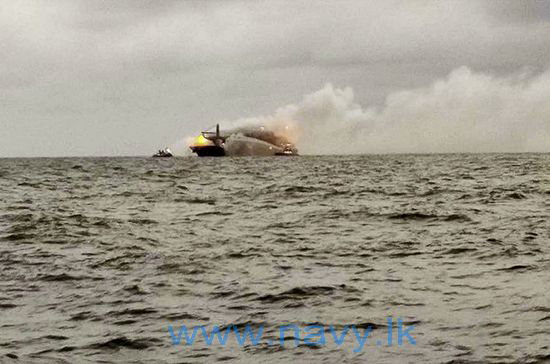
Colombo, May 25 (Xinhua): Sri Lanka on Tuesday said that floating toxic or poisonous material or packages from the burning and abandoned ship X-Press Pearl” may reach the shores of the country and warned people to stay away from beaches.
In a statement, Sri Lanka’s Marine Environment Protection Authority (MEPA) strictly warned people from touching or opening the packages or materials and requested them to contact the Sri Lanka Navy or the police upon the sight of any such items.
The container ship X-Press Pearl” registered under the flag of Singapore, was carrying 1,486 containers with 25 tons of nitric acid and several other chemicals and cosmetics from the port of Hazira, India on May 15, according to the Sri Lanka Navy.
The vessel sent out a distress call as it approached the Colombo Port on May 20, and soon caught fire, resulting in the Sri Lankan Navy dispatching vessels to bring the fire under control.
By Tuesday morning, eight cargo containers had fallen into the sea and the vessel was reported to be unstable, the MEPA said.
The Sri Lanka Navy said it had rescued 25 crew members from the ship. Two injured Indian nationals among the rescued had been hospitalized for treatment.
The distressed container ship had crew who are Philippine, Chinese, Indian and Russian nationals.
By Tuesday evening, the Sri Lanka Navy said the fire was now spreading to the quarterdeck. The fire was being exacerbated by strong winds due to changing weather conditions.
The navy further cautioned the fishing community to avoid the sea area where the vessel was burning.
The Sri Lanka Air Force (SLAF) said it had deployed Bell-212 helicopters to drop dry chemical powder on the X-Press Pearl to douse the fire.
While these operations were ongoing amid inclement weather, the MEPA urged citizens in capital Colombo to avoid going to the beaches and touching any floating objects in the water as they might be chemicals from the burning fire.
The MEPA has launched a probe to assess if there has been any environmental destruction due to the fire
The United States has clarified that there is no change in the terrorist threat level for Sri Lanka.
The US State Department had on Monday issued an updated travel advise on Sri Lanka telling Americans not to travel to Sri Lanka.
A part on terrorism was also in the advise raising fears that there was a terrorist threat to Sri Lanka
Do not travel to Sri Lanka due to COVID-19. Exercise increased caution in Sri Lanka due to terrorism,” the updated travel advise said.
However, the US Embassy in Sri Lanka said the travel advisory for Sri Lanka had been updated from Level 3 (reconsider travel) to Level 4 (do not travel) solely due to the prevailing COVID-19 situation in the country.
There is no change to the terrorist threat level,” the Embassy said.
The Centers for Disease Control and Prevention (CDC) in the US issued the Level 4 travel health notice for Sri Lanka due to COVID-19, indicating a very high level of COVID-19 in the country. (Easwaran Rutnam)
A former musician turned Buddhist monk, Bhante Sujato, an Australian, has taken up a mammoth task to translate and publish thousands of Buddhist texts known as Sutta (discourses of the Buddha) into many languages. Accompanied by Sri Lankan Kandyan dancers and drummers, he recently launched an Internet portal ‘Sutta Central’ to make the Buddha’s teachings available to the world free of charge.
The word Sutta derived from the ancient Indian language Pali in which the Buddha preached his dhamma (teachings) and its literature forms the backbone of the Buddhist teachings. The Suttas were originally transmitted orally, thus when the Suttas are chanted in the Pali language—which is very popular in the Theravada Buddhist tradition—they usually commence with the phrase evaṃ me sutaṃ,” meaning thus have I heard”.
< A former musician turned Buddhist monk, Bhante Sujato
In Suttas, Buddha talked about the abundance of love. Buddhism has compassion for the whole world. That is the abundance of Buddhist philosophy and anyone can come to Sutta Central and find something useful,” Bhante Sujato told an audience of about 150 Buddhists from different traditions at the launch of the portal in Sydney.
Sutta Central contains early Buddhist texts contained in the Tipiṭaka or Three Baskets”. The Tripitaka includes Sutta Pitaka (discourses of the Buddha), Vinaya Pitaka (discipline for the monks), and Abhidhamma Pitaka (psychological-philosophy of the teachings).
The Sutta Pitaka is a large collection of teachings attributed to the Buddha or his earliest disciples, who were teaching in India around 2500 years ago. They are regarded as sacred canon in all schools of Buddhism. Sutta Central hosts the texts in original languages, translations in modern languages, and extensive sets of parallels that show the relationship between them all.
I have been a voracious reader since I was a young boy,” Bhante Sujato told Lotus News in an interview. I wanted to read dhamma books (because I was told that) the real stuff on the dhamma was in the suttas and I wanted to read them,” he said. As soon as I started reading these I began to realize that this is where all (the teachings) comes from.”
Born as Anthony Best in Western Australia in 1966, he played with the post-punk Australian band Martha’s Vineyard in his youth. After backpacking to Thailand to find something different, he came across Buddhism at Wat Ram Poeng, a popular backpackers’ monastery in Bangkok. I went to Thailand to extend my horizons because I thought life here in Australia was getting a bit monotonous,” he recalls.
After a few more visits to Thailand and attending Buddhist retreats in forest monasteries, he became a monk in 1994, when he was ordained at Wat Pah Narachat in Ubon Ratchathani. He lived in Thailand for many years, before returning to Australia.
When asked, how he found life as a monk after being a musician in Australia, his response was interesting. Being a monk did not change my lifestyle that much as being a musician, in the sense that both circumstances I did not have money. Being a musician in Australia it is a struggle to make a living.”
For me, music was a voyage of discovery I had to learn about myself. Becoming a monk was also being curious,” he adds. When I learned the dhamma it was certainly much deeper than anything I have learned before…. So I realized there is a path where I needed to listen.”
Upon returning to Australia he spent several years at Bodhinyana Monastery in Western Australia that was founded by the respected Australian Buddhist monk Ajahn Brahm, before going on to found Santi Forest Monastery in 2003 where he served as its abbot. In 2012, Bhante Sujato turned it over to become a nun’s monastery, and he decided to concentrate on developing Sutta Central, which was in fact launched in 2005, but copyrights issues with Pali translations of the Sutta hindered its progress.
When we first started Sutra Central I had no experience with Internet (and) as we expanded the project we realized we are making connections with different Buddhist traditions so it became a vehicle for connection,” points out Bhante Sujato.
Buddha’s teachings have bound people together for such a long time through connections—through oral transmissions—until it was handwritten as ‘Tripitaka’ at the Aluvihara in Sri Lanka in the 1st century BCE. Thus the Suttas have been handwritten for almost 2000 years, printed for over 400 years, and it is now digitized in the past 30 years.
The launch of Sutta Central may well become a landmark event in the history of the dissemination of the dhamma, as every Sutta is now not only digitized but is gradually being available in different languages from the same source.
Bhante Sujato’s dedication to the project is such, that after being unable to secure copyright-free digital translations of the Pali Canon for Sutta Central, he moved to a remote island of Chimei, off the coast of Taiwan, to undertake the task of creating English translations of the nikayas (volumes of the Suttas), living there from 2015 to 2018. The Pali Sutta Piṭaka is divided into five main collections called nikāyas, that includes the longer versions called the Dīgha Nikāya and the shorter ones called Majjhima Nikāya (middle-length discourses), Saṃyutta Nikāya and Aṅguttara Nikāya (shorter texts). The translations of the latter nikayas in particular, have since been published on Sutta Central, and as free edition books.
Sutta Central has materials that have been translated into English not only from Pali but also from Tibetan, Chinese, and Sanskrit. From the Pali canon, these are Suttas taken from India to China usually around 400AD(CE) and translated into Chinese. These are in Sutta Central, I don’t speak ancient Chinese but translated by others. This is an ongoing project,” says Bhante Sujato. The translations are done by people, he points out, not by machines, such a Google Translate. Those (Google) translations don’t work,” he adds
In a virtual address at the portal launch in April, Bhante Sujato’s mentor Ajahn Brahm described Sutta Central as an easy way to learn what the Buddha taught. It’s wonderful to have the information clear and trustworthy,” he said. We need to inspire people to become good Buddhists by getting proper teachings.”
Bhante Sujato believes Sutta Central is a generational job” and it will be an ongoing project for some time. So far we have some translations in over 40 languages. There are certain language groups better represented than others like main Asian languages Hindi, Chinese, Sinhala, Thai, Burmese, Vietnamese, and European languages German, French, English, Spanish,” he points out. We don’t have many translations in Arabic and we don’t have any translations in Swahili or any other African languages. It will be wonderful if every person in the world could read the Suttas in their language.”
Bhante Sujato emphasizes that everything they do is free and they also make it available in iPad, apps and will soon make it available in books. A ‘Sutta Central Development Trust’ has been established to help raise funds for the ongoing activities to expand its offerings.
Bhante Sujato wants to point out a new addition to Sutta Central. In Sutta Central, we also read the Suttas for you. Especially for people who are visually impaired or anybody who wants to read the Suttas .. maybe when you are driving a car or so. It’s in English and expanding to other languages as well.”
Since of late, there has been a massive mud-slinging effort against me and my family carried out in an organised manner by a group of persons. At present, that group is claiming that my son Chatura Cabraal is employed by the Company which is carrying out the construction work of the Colombo Port City, thereby insinuating that I have supported the new Colombo Port City Commission Law, due to that connection”.
Chatura (35) is qualified engineer who has graduated from a US University in 2010, and has been employed by this Company since 2016. He secured this employment on his own merit, without any political or personal influence, and that is obvious by the fact that in 2016, we were in the Opposition. Similar to the current allegation, even previously, utterly false and vituperative allegations had been levelled against my children, claiming they had scolded officials at the airport, misbehaved on expressways, involved in fights, etc, but it has been proved beyond doubt that all those claims were blatantly false. Therefore, it is clear that such fake news had been a part of a greater plan to discredit me and my family, as well as distract and discourage me in carrying out my duties.
There is no doubt that Sri Lanka’s politics has degenerated in recent times, and personal attacks against a person’s family members is common place and fair game for certain persons. Nevertheless, any right-thinking person will agree that a parent’s subsequent position as a Minister should not be a disqualification for a grown-up son or daughter to continue in employment which he/she has secured before his/her parent assumed office as a Minister.
Finally, I wish to state that those who indulge in such falsehoods only display their pathetic political bankruptcy, and therefore I can only feel sorry for them.
The Cabinet approval was granted to award the contract for the construction of the elevated highway to Kelaniya New Bridge (NKB) via Rajagiriya connecting Outer Circular Highway at Athurugiriya to the China Harbour Engineering Company (CHEC), co-cabinet spokesman, Energy Minister Udaya Gammanpila said.
Addressing the weekly cabinet briefing at the Information Department, the Minister said the approval was granted to the CHEC to complete the project within three years.
“It has been given another 15 years to operate and earn their revenue. After 18 years, the company has to hand over the elevated highway to the Sri Lanka government, Minister Gammanpila said.
“The cabinet ministers decided to hand over the construction considering the company that takes the least amount of time to complete the project and the least period to recover their cost,” he said.
Accordingly, the most attractive bid was presented by the CHEC and therefore the cabinet ministers approved to hand over the construction,” the Minister added. (Chaturanga Samarawickrama)
Sri Lanka has registered 28 more victims of COVID-19, Director-General of Health Services confirmed on Tuesday (May 25).
The latest fatalities have moved the country’s death toll to 1,269, according to official data.
Five of the deaths took place on May 25 and the remaining victims have succumbed to the virus infection between the period of May 18 – May 24, the Department of Government Information stated.
Reportedly, 11 of them have been recorded as domestic deaths.
The deceased were identified as residents of Galle, Kalutara, Bulathsinhala, Unawatuna, Horana, Govinna, Galpatha, Hunnasgiriya, Maththaka, Wanchawala, Meepe, Matara, Ahangama, Veveldeniya, Ruwanwella, Meegahathenna, Agalawatta and Dehiattakandiya areas.
COVID pneumonia was recorded as the cause of death of majority of the victims. Some of them also suffered from diabetes, heart diseases, hypertension, sepsis and other complications.
Daily COVID-19 cases count moved to 2,728 on Tuesday (May 25) as 920 more people were tested positive for the virus in Sri Lanka.
This brings the total number of confirmed cases of coronavirus reported in the country to 169,900.
Government Information Department stated that 2,706 of the new cases reported today were associated with the New Year coronavirus cluster. Twenty-two others were identified as arrivals from foreign countries who are under quarantine.
As many as 141,175 recoveries and 1,269 deaths have been confirmed in Sri Lanka since the outbreak of the pandemic last year.
According to official data, up to 27,456 active cases are currently under medical care at designated hospitals and treatment centres.
An individual who was pushing a wheelbarrow filled with goods purchased from a supermarket has been taken into custody today (May 25) as he was not wearing a face mask in public.
The arrestee was identified as a resident of Darga Town in Aluthgama, DIG Ajith Rohana stated.
Legal action will be sought against the man in question on charge of violation of quarantine regulations, according to the police spokesperson.
Sri Lanka is expected to receive a stock of 500,000 doses of the Sinopharm COVID-19 vaccines donated by China, with the consignment likely to reach the island tonight (25).
Principal Advisor to the President, Lalith Weeratunga stated that the SriLankan Airlines flight carrying the stock of vaccines is expected to touch down at the Bandaranaike International Airport (BIA) in Katunayake around midnight today.
Flight UL-869 which is carrying the 500,000 vaccine doses had reportedly departed from Beijing at 19:45 and will arrive at BIA around midnight.
In March, Sri Lanka had received 600,000 doses of the Sinopharm vaccine as a donation from China.
Meanwhile the Cabinet of Ministers have approved a proposal to take necessary steps for the immediate purchase of 14 million doses of the China-manufactured Sinopharm vaccine and 01 million doses of the Oxford-AstraZeneca vaccine.
The Sri Lanka Grama Niladhari Association states that they will withdraw from their duties from midnight today (May 25).
Sumith Kodikara, President of the Association, said that the decision was taken in protest of the COVID-19 inoculation program.
Addressing the media, he said that while the vaccine drive was initially carried out in a systematic manner, it is now being implemented in violation of the priority lists.
The government says it has planned to vaccinate 60 to 70 percent of the country’s population against coronavirus by the end of 2021.
The Department of Government Information stated the need for the expedited supply of vaccines has been recognized as there is no other solution to control the COVID-19 pandemic other than inoculation.
Accordingly, the Cabinet of Ministers has granted the approval for a proposal to take necessary steps for the immediate purchase of 14 million doses of the China-manufactured Sinopharm vaccine and 01 million doses of AstraZeneca vaccine.
The proposal has been tabled at the Cabinet by Minister of Health Pavithra Wanniarachchi.
The
nature of politics in Sri Lanka is giving heavyweight to criticise minor issues
that aren’t significant and people observed that the opposition parties in the country
have been using such minor issues to show that they are active in politics to
attract the support of people. As the head of the state president is criticised
by the opposition, that doesn’t mean the president has failed the management of
the economy.
All
countries of the world have been influenced by The COVID-19 and no proper study results have been
published so far and neither the government nor the opposition has evidence on
this matter. However, for publicity, the opposition uses social media and
attempt to show that the president has failed and the opposition has not
presented the alternative to the government approach and the opposition
directly criticises the president. Is the effort of the opposition successful
in attracting popular support? No, it is not because of popular support, and
giving consent to manage the economy is a different matter. Has Mr.Sajith
Premadasa been attracted popularity to attract public consent for economic
management is a questionable problem and the informal talks of people show that
people have not massive criticism against the role-playing of the president and
to change the president’s authority at a presidential election?
Many
countries in the world have failed the economic management effect of the
COVID-19 has complicated economic development and Mr.Rajapaksa, as the leader
of the country, works well and people need to appreciate his effort.
The
main issue in the country concerns the control of the pandemic and the
government takes positive action while taking steps to control pandemic and to
maintain economic development. In this situation, people must unit and ignore
politics and divisions. The history of the country showed that a variety of
epidemics were in the country and people used to act together while engaging in
epidemic control and economic activities performed well without problems to
families.
The
patience of people and uniting are major tasks in the current difficult
situation and nobody is immune to the pandemic and people need to respect the
rule to survive. The shouting in political rallies would not help in the
current situation and engage in own work without supporting to spread pandemic
is the responsibility of people.
People
in Sri Lanka are addicted to various religious practices ignoring the threat of
the pandemic, and many people opt to make hurray for good or irrelevant
activities. The government does what is right to the country and people need to
support the government behaving as advised by the government.
Mr.Gotabhaya
Rajapaksa has a clean and productive vision. The president has not gone out of
the vision even in a situation; the country is hit by a pandemic, Mr. Ranil
Wickremasinghe has expressed the best practice and the government cannot ignore
his views.
Since
the Donomore Reforms, the people of Sri Lanka have not been understood the
fundamental issue of the country which has been insincere to communities each
other that is called disunity and struggling economically has been a problem
face by many and policymakers did not consider it could be eliminated.
Mr.Rajapaksa
is being good job, and people need to support him following the instruction
given by his office.
A Sri Lankan student, detained by the Japanese immigration begged to be released to a hospital for medical care.
But, the officials refused.
They thought she pretended to be ill to avoid deportation.
She died on March 6, 2021 alone in her cell.
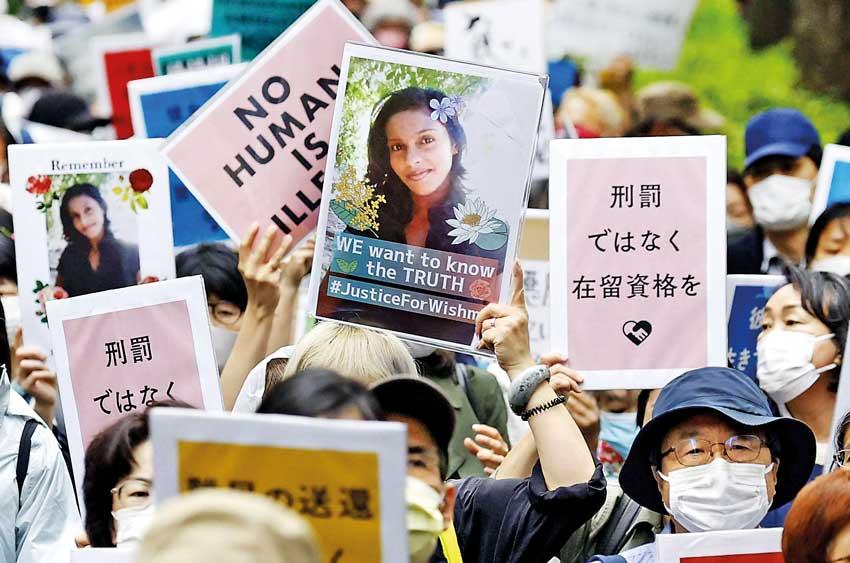
Protesters holding up pictures of Wishma during a demonstration in Tokyo. (Courtesy: Kyodo)
The records reviewed by Daily Mirror show instructions from a doctor reading: If (medicine) cannot be administered orally, she should receive an IV drip and be hospitalised.” The comment contradicts the content of the interim report, which says no recommendation for hospitalisation was made
https://youtu.be/TV6GMD4AHt8
Wishma dreamed of becoming an English teacher in Japan. She loved the country, its culture, and its people so dearly that when her mother was nervous about sending Wishma alone to an unknown country, Wishma said It is Japan. I am gonna be safe and fine.”
It was around 11 a.m. when Wishma started struggling to breathe. In her solitary confinement, she groaned in pain for hours before falling silent near 1.30 p.m. She received no emergency treatment whatsoever for more than two hours, despite the cell being under 24/7 CCTV surveillance, Japanese government records detailing circumstances leading to the death reveal. After 2 p.m., when officers visited the cell, they found Wishma’s lifeless body.
Sri Lankan student Wishma Sandamali, 33, languished in Nagoya Immigration Center in Japan, awaiting provisional release for six and a half months. Once a healthy and fit young woman who weighed 85 kg, Wishma lost more than 19 kg during the detention period, her health records say. Her condition continued to deteriorate. She died on March 6, 2021, triggering allegations that critically ill detainees are neglected by the Japanese immigration service.
Even though she had been diagnosed with suspected Oesophagitis, the treatment she received was focused on her mental health.
Even though her health deteriorated week after week with her symptoms of Oesophagitis started getting worse, neither was she given IV drip (intravenous drip) nor was she hospitalised.
The reason is also evident in an interim report, compiled and issued by Japan’s Immigration Bureau. From the very beginning, the immigration officers thought Wishma faked illnesses to get released.
Yasunori Matsui, a supporter from the START — an organisation for refugees and migrants — had written to the officials multiple times regarding Wishma’s deteriorating health.
We had filed requests for her to be hospitalised and put on an IV drip, but the immigration bureau just kept saying she was fine. I am forced to say they left her to die.” Matsui said.
How she lost legal status
A university graduate and English teacher, Wishma flew to her dream destination lawfully in June 2017, eyeing the skyline like any newcomer.
Her status of residence at the time of her entry was college student” and her period of stay was one year and three months. However, she became unable to continue her studies when she ran out of money to pay for school and ended up overstaying in the country.
She applied for refugee status in September 2018 and she was permitted for a stay of two more months with no work permitted. When she applied for a renewal of refugee status in December, she was not permitted over lack of reasons.
This resulted in her losing her status of residence. She was arrested in August 2020 and charged for violating Japanese immigration control law. Foreign nationals in Japan after the expiry of their allocated period of stay are detained at government detention centres until they return to their home countries. She was immediately sent to the Nagoya Detention Center.
Circumstances leading to the death as revealed by the interim report
Wishma started complaining of vomiting in mid-August, 2020 and it continued throughout her detention period. In mid-January, 2021, she began complaining of stomach pain, nausea, loss of appetite, and numbness of the body. By mid-February, her condition grew too weak to walk or even stand, and that she required assistance from the staff at the immigration centre to go to the toilet and even change clothes.
Her blood tests in January showed mild polycythemia (an increase of red blood cells in the body). However, the interim investigation report states that the part-time doctor at the internal medical centre who examined Wishma on January 28, took a wait-and-see approach.” The doctor instructed to test Wishma’s blood in another two months.
On the night of January 28, Wishma vomited blood and requested the officials at the facility to take her to a hospital. But, they didn’t. Within the next few days, the frequency of vomiting increased and intake of provided meals started decreasing. Then, she was moved from a shared room to a single cell. The authorities also started counselling for Wishma as they thought from the very beginning that she malingered.
From January 2021 until she died, she suffered from constipation. In early February, the gastroenterologist who examined Wishma by a gastric endoscope suspected reflux Oesophagitis (inflammation of the tube that sends food from mouth to stomach). A supporter from a non-government agency who had looked into Wishma’s matter requested the immigration officials to take Wishma to a nearby hospital and provide her drip-infusion (medication drip from a bag through a tube into a catheter). However, doctors said it was not necessary.
Later, when she continued complaining of pains and difficulties in her body, she was asked to see a psychiatrist. The interim report stated that although psychiatric consultation was ordered on February 16, the COVID-19 situation in nearby hospitals hampered the process.”
It was only on March 4, two days before her death, Wishma was brought to a psychiatrist. The interim report says that since Wishma did not request a consultation with a doctor after February 22, she wasn’t provided with any medical treatment until March 4 the date, reserved for the psychiatrist.
Since the last week of February, Wishma often has laid on the bed and needed assistance to move her body. She even used diapers as she could not move to even go to the toilet. All of this happened inside her tiny cell. Two days before her death, the psychiatrist who checked Wishma suspected Somatic Symptom Disorder (mental disorder that manifests as physical symptoms that suggest illness or injury). However, the CT scans performed on Wishma on the same day revealed no abnormalities in her brain. But, she was prescribed antipsychotics and sleep inducers.
On the day before her death, she spent most of her time sleeping under the effect of the medicine. On March 6, hours before death, officers who, as usual, visited Wishma to check her blood pressure and pulse could not measure them due to an error in the technical instruments.”
When officers instructed Wishma to have breakfast, she could not communicate; only cried and moaned in pain. It was around 11 a.m, Wishma started struggling to breathe.
The interim report which has been compiled checking CCTV footage inside the cell after Wishma’s death clearly details Wishma’s movement on March 6. It states how she desperately struggled for hours to breathe. After 2 p.m, when officers visited the cell, they found Wishma without a pulse.
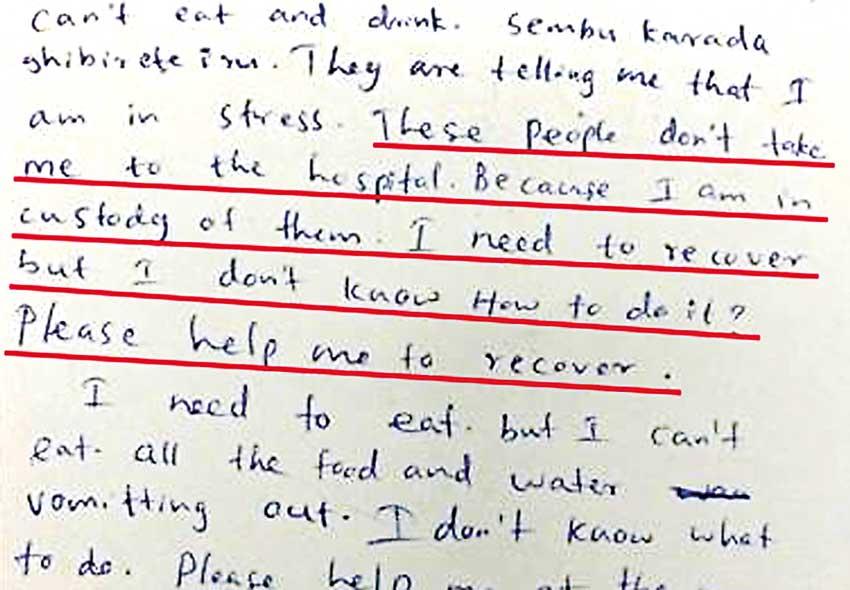
A letter Wishma sent to a volunteer at START in February
Discrepancies in information
The cause of death, as mentioned in her death certificate was diagnosed as acute hepatic insufficiency. The type of death is categorised as unknown. The psychiatrist noted that they could not find a cause for Wishma’s death from the psychiatric point of view. However, the lengthy interim report released on April 9 has also failed to determine the cause of her death.
In post-death hospital records, it says that Wishma was normal till noon on March 6. But, she has been breathing heavily and since the morning on the same day, according to the interim report detailing care provided for her. There are also discrepancies between the medical records compiled by her doctor (obtained by her family lawyer) in February and the content of the immigration bureau’s report. The omitted information is a set of remarks made by a doctor when Wishma underwent a stomach endoscopy at a hospital outside the detention centre.
The records reviewed by Daily Mirror show instructions from a doctor reading: If (medicine) cannot be administered orally, she should receive an IV drip and be hospitalised.” The comment contradicts the content of the interim report, which says no recommendation for hospitalisation was made.
When this was questioned recently at a House of Representatives Committee on Judicial Affairs’ board meeting, the Japanese Justice Ministry explained that while Wishma’s medical records were obtained before an interim report on her death was created, the regional immigration services bureau responded that the doctor’s records were non-factual.”As a result, the ministry said, the report it filed contained differing information.
Public outcry in Japan
I am not well at all. Please help me ASAP. They won’t take me to a hospital outside because I am in their (immigration centre) custody. I want to recover. But what can I do? I don’t want to bother you, but I have no one else who cares about me,” Wishma wrote on February 2 to her supporters.
Yasunori Matsui from the START had been meeting with Wishma since December 2020. Mr Matsui who witnessed the deteriorating condition of Wishma during visits had written to the bureau requesting them to admit her to hospital. But, officials said it was not necessary.
There have been several protest rallies by Japanese groups supporting foreign workers and refugees, demanding the government to reveal the truth behind Wishma’s death. Members of the Japanese rights group START, chanted phrases including, Why didn’t you save her?” and, We want you to change.” Protesters were heard saying slogans, including, Totally unforgivable,” and, Reveal the truth.”
A petition they submitted reads:
The incident was caused by neglecting medical care. Clarify who has responsibility for the management, and release. We need an apology and the truth as soon as possible. To stop this from happening again, we ask you to change your policies from one of the single-minded deportations to one that considers the circumstances of the individuals involved and offers them relief.” In response to the allegations, Immigration Bureau officials informed the protesters that, we are currently under investigation by the ministry (of justice), and therefore cannot respond.”
We received condolences, not answers to our questions: Family
Wishma’s mother, a widow, had taken out a mortgage loan to send her eldest daughter to Japan. Now she is struggling to process the amount of grief.
There was nobody to give a drop of saline to a selfless person like my daughter who had donated so much in her life. She always went beyond her limits to help people. But, in her dream country of Japan, they left her to die like an animal. They watched her die,” mother lamented.
Her sisters criticised that they felt as if the immigration agency was covering the truth.” The Japanese government officials including the subject Minister who met with the sisters who are currently in Japan have offered condolences and but did not give answers, the family complained.
The sisters met with the Head of Japanese Immigration Centers and also the Minister of Justice on Tuesday (18). For all the questions they raised, the response from the officials was the same we are very sad about what has happened. An investigation is underway.”
They also visited the single-person cell where Wishma was detained, describing it as small and as if for an animal.” They heard her insisting that she was unwell and wanted to be taken to a hospital outside. But, immigration officers repeated to her, ‘there’s nothing wrong with you,’ as she continued to be in distress,” said Wayomi Nisansala, a sister of Wishma, referring to detention center staff.
Those who are working in embassies have no compassion to represent their people in those countries. They have no mechanism to monitor Sri Lankans living there. They simply do not care.”
Problems in Japanese immigration centres not new
According to Japanese media reports, in recent years, inmates have died one after another in other detention centres as well. But, the Immigration Bureau keeps rejecting allegations of negligence. Japanese immigration facilities have been criticised in and outside the country for their lengthy detention periods.
When inquired by the Daily Mirror, Chandana Weerasena, Deputy Chief of Mission, Embassy of Sri Lanka in Tokyo, Japan said as of 17 of March 2021, there were 26 Sri Lankan detainees under the Japanese Immigration detention centres. All of them have been charged for illegal stay (overstay) in the country.
He claimed that the Japanese authorities initiated the investigation into Wishma’s death as per the request made by Sri Lankan Embassy. He also stated that until the final report on the death is issued by the Japanese authorities, the Embassy would not release any media statement concerning Wishma’s matter. The final report is set to be released in July.
Meanwhile, Kazuna Yamamoto, President of Voice Up Japan organisation during an interview with the Daily Mirror stated that Wishma’s death and deaths of 14 other non-Japanese detainees, died over the past 17 years could have been prevented.
She also stated that the government of Japan on Tuesday (18) was forced to drop a draft revision to the Japanese Immigration Control and Refugee Recognition Act, which proposed forcible deportation and criminalisation of those who are applying for refugee status in Japan for the third time due to growing condemnation and pressure over the death of Wishma.
Wishma dreamed of becoming an English teacher in Japan. She loved the country, its culture, and its people so dearly that when her mother was nervous about sending Wishma alone to an unknown country, Wishma said It is Japan. I am gonna be safe and fine.”
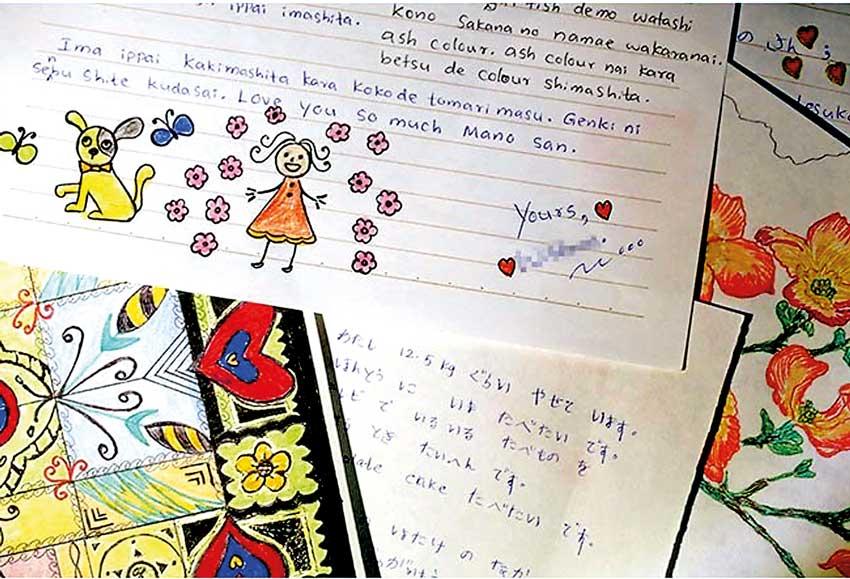
Illustrations done by Wishma while she was being detained
A matter of significance is the introduction in the US Congress of a bipartisan resolution calling for an international mechanism for crimes committed in Sri Lanka.” It has been moved by Deborah Ross. The resolution says:
(1) acknowledges the 12th anniversary of the end of the war in Sri Lanka and offers its deepest condolences to all those affected by the conflict;
(2) honours the memory of those who died and reaffirms its solidarity with the people of all communities in Sri Lanka in their search for reconciliation, reconstruction, reparation, and reform;
(3) commends the United Nations Human Rights Council for prioritising the collection and preservation of evidence related to human rights violations, a process that must not be interfered with by the Government of Sri Lanka;
(4) recognises the bravery and commitment of advocates for justice across all communities in Sri Lanka, including the Tamil families of the disappeared, whose protests and demands for answers have at times been met with threats, intimidation, and harassment by government security forces;
(5) urges the international community to advocate for and protect the political rights and representation of the historically oppressed northeastern region of Sri Lanka and work towards a permanent political solution to address the underlying issues that led to ethnic conflict;
(6) recommends the United States explore investigations and prosecutions pursuant to the recommendations of the United Nations High Commissioner for Human Rights; and
(7) urges the United States to work with the United Nations General Assembly, the United Nations Security Council, and the United Nations Human Rights Council to establish a credible and effective international mechanism for accountability for the grave crimes committed during the war in Sri Lanka.”
The sting is in paragraphs 3,6, and 7 which seek to invoke the UN Security Council, the only body with legal teeth. This is while the Sri Lanka issue remains on the agenda for the UN Human Rights Council sessions in September, this year.
To:
President Joe Biden and Vice President: Kamala
Harris
From: US Citizens of Sri Lankan Origin seeking
assistance with Covid Vaccines
Date: May 23, 2021
We
the citizens of the US who are originally from Sri Lanka convey our
appreciation to you that we are now able to ease our anxiety with Covid19 due
to your leadership given to speedy and ample vaccinations provided to the
people. We commend your effort.
However,
it is not so in our home country Sri Lanka, the closest neighbor to India. Their situation is dire with the spread of
Covid spilling through from India. It is
sad that in the US news, we noted no mention about Sri Lanka, the closest
island nation in references to the region.
Sri Lanka is swimming distance from India. Sri Lanka stands alone without
attention. People are dying.
Physical
facilities were anticipated and speedily provided but the most critical need,
VACCINES are not arriving in time for the people. We appeal to you to please turn your
attention on Sri Lanka also in the cluster of countries affected in the region.
We hope this will get your
attention.
Given
below is the link to a news item from Sri Lanka that refers to the role that
the US can play. Lives of the people
there in the small island matter. Thank
you.
Colombo, May 24 (The Island): The Sri Lanka Agricultural Economics Association (SAEC), which is the professional body representing the agricultural economists of Sri Lanka, has written to President Gotabaya Rajapaksa express concerns over the ban on the use of chemical fertilizers and pesticides.
The letter in full: The Sri Lanka Agricultural Economics Association (SAEC), is the professional body representing the agricultural economists of Sri Lanka. Our membership endorses the government’s decision to adopt a Green Socio-Economic Model for development, as we firmly believe that such a strategy is vital for conserving the environment and improving human health. We agree that green approaches in crop cultivation contribute significantly towards achieving Sustainable Development Goals (SDGs). Moreover, SAEA is of the view that most of the current farming systems in Sri Lanka are unsustainable.
Hence, the conversion of them into organic farming systems, in the long run, would help promote health of the people and nurture integrity of the nation’s environment. It is well known that many countries currently take systematic and pragmatic approaches to achieve this long-term objective by first setting targets, standards, and subsequently, investing and promoting farmers to adopt best practices.
Therefore, we would like to extend our appreciation to the government for taking such a valuable decision to adopt the green socioeconomic model in Sri Lanka.
The Downside
SAEA would also like to bring to your attention some concerns on the appropriateness of the newly introduced regulation, to restrict forthwith the importation of chemical fertilizers and pesticides by the Gazette Extraordinary No 2226/48 of May 6, 2021, to achieve the above-mentioned broader development goal.
The SAEA predicts massive economic losses due to potential yield losses, in the absence of proper substitutes for chemical fertilisers and pesticides, with the implementation of the import ban on fertilisers and pesticides. The immediate adverse impacts on food security, farm incomes, foreign exchange earnings and rural poverty can be detrimental to achieving the cherished long term goals. The SAEA’s primary concerns, and the less costly policy alternatives proposed by its members in place of the newly introduced import ban, are given below for your kind perusal and consideration.
A. Appropriateness of using an Import Restriction on Agrochemicals to promote organic farming
The SAEA is of the view that the policy instrument identified by the government to promote organic farming is less appropriate due to potential economic losses and its incompatibility with other policy goals of the government.
1. Economic cost to the society
When converting from conventional agriculture into organic farming, the government should weigh the technological, environmental, and economic costs and benefits. The preliminary findings of the studies conducted by the SAEA on potential economic losses of the import ban and respective estimations are given below for your consideration.
(a) Agronomic studies reveal that the average yields from paddy can drop by 25% if chemical fertilisers are fully replaced by organic fertilisers. This loss in productivity could reduce the profitability of paddy farming by 33%, and rice consumption by 27%, if paddy is cultivated just with organic fertilisers with a complete ban on rice imports. In contrast, applying organic fertilizer with the recommended dosages of chemical fertilisers would improve the profitability of farming by 16%.
(b) Absence of chemical fertiliser would drastically reduce the productivity of the Vegetatively Propagated Tea (VPT). With a 35% pro ductivity drop, the export volume of tea would go down from 279 to 181 million kg, causing an income loss of LKR 84 billion. The estate sector will likely incur significant losses compared to those of tea smallholders. These losses could further be aggravated due to increased cost of labour to apply bulky organic fertilisers.
(c) The coconut yields would go down by 30% if chemical fertilisers and pesticides are not applied. This situation will adversely impact fresh coconuts availability for the production of coconut oil, desiccated coconut and other coconut products. The loss in foreign exchange earnings can be as high as LKR 18 billion, based on the assumption that only 26% of the total coconut extent is fertilized. When the additional cost for the importation of edible oils is considered, the loss of foreign exchange earnings will be even higher.
(d) The above results were derived considering the immediate effects on three agricultural sub-sectors. An analysis performed accommodating adjustments in the economy over the medium to long run reveals that a reduction in average agricultural productivity by 20% could cause a decrease in Gross Domestic Product (GDP) by 3.05%, suggesting an overall contraction of the economy with the implementation of the import ban.
2. Compatibility with other development policies
The proposed policy instrument is not compatible with the policy objectives stated in ‘Vistas for Prosperity and Splendor’. Given below are a few policy incompatibilities highlighted by the members of SAEA (Relevant statement from Vistas for Prosperity and Splendor shown in parenthesis).
(a) Modernisation of agriculture (International export business through various value-added products backed up by new technologies): The SAEA would like to propose that the government considers Sustainable Intensification of farming systems to feed the growing population with rising incomes, seeking safe and nutritious food which are produced in environmentally sustainable farming systems, rather than converting all systems to fully organic agriculture, as its policy objective.
(b) Food self-sufficiency drive (Make the country self-sufficient in the relevant products): Estimates reported in section A (a) indicate that a food deficit would be created in the country owing to yield losses. However, the current government policy on food self-sufficiency would not allow the policymakers to fill this deficit through imports. Such a situation could give rise to food price inflation, unrest, and starvation.
(c) Freedom (People-Centric Economic Development): The chosen policy instrument does not provide flexibility to farmers to determine their least-cost food production methods, without harming the environment. This situation would violate the ‘people’s freedom’ policy of the government.
(d) Rural-urban migration (Linking the village development together with the regional development): Contraction of the rural economy due to reduced farm profitability will lead to increased migration from rural to urban areas. With limited capacity of the manufacturing sector to absorb migrants, this will result in urban congestion.
(e) Commitments with the WTO and other international relations (Friendly, Non-aligned, Foreign Policy): The policy instrument chosen is not compatible with commitments to the WTO.
B. Alternative Policy Instruments for making Food Systems more Environmentally Sustainable
In light of the above observations, members of SAEA suggest the government use more cost-effective instruments to achieve the stated health and environmental outcomes, in place of the newly introduced import regulation. They note that globally, the approach to environmental protection has been evolving from a regulation-driven approach to a more proactive approach, involving voluntary and market-led initiatives. Accordingly, we wish to propose the following three-point policy package.
1. Incentivize organic cultivation using safe and environmentally friendly organic fertilizers and pesticides:
a). Open up pathways towards encouraging organic fertiliser production, storage, distribution, etc., and promote Public-Private Partnership (PPP) models to achieve those.
b). Develop national standards for organic fertilisers and pesticides to ensure non-importation of substandard products to the country, and domestic production meeting specified quality standards.
c) Improve awareness of various organic farming technologies among farmers through a strengthened extension system.
d) Institutionalize and make Good Agricultural Practices (GAP) a mandatory national standard.
2. Dis-incentivize use of chemical fertilizers and pesticides in an environmentally harmful manner:
a) Revisit national standards for chemical fertilisers and pesticides to ensure non-importation of sub-standard products to the country.
b) Impose environmental taxes on selected inorganic fertilisers and pesticides.
c) Reduce and eventually eliminate the subsidy on chemical fertilizers. In phasing out the fertilizer subsidy, we wish to recommend the following steps.
d) Prioritize subsidies according to characteristics such as fertilizer type, agro-ecological region, season, and crop.
II. For the targeted farmers, establish a voucher system that restricts farmers’ access to a lifeline amount [such as two bags] and require them to purchase the balance at market prices for a limited period.
III. When the subsidy is lowered, introduce an output price support program to support the farm producers partially.
4. Provide and support farmers to adopt site-specific fertilizer recommendations and integrated pesticide recommendations.
5. Reduce and eventually eliminate protection provided to crops that are highly fertilizer intensive and erosive.
6. Strengthen existing measures to improve awareness of the safe use of chemical fertilizers and pesticides.
3. Cross-cutting proposals to safeguard the poor and vulnerable and improve the policy process:
1. Maintain a safety net for the poor recognizing the possible increase in food prices.
2. Identify a harmonized financing mechanism. For example, finances of saved fertilizer subsidy and environmental taxes can be used to subsidize organic fertilizer production and application.
3. In formulating the strategic roadmap, adopt a consultative process involving all stakeholders (policymakers, politicians, agriculturalists, environmentalists, and the private sector) and also consider economy-wide impacts (macro, meso, and micro) and externalities.
Considering the economic loss, policy inconsistency, and counterproductive effects created by the regulation in the manner introduced, and the availability of relatively superior alternative measures, the SAEA humbly requests you to substitute the import ban on chemical fertilizers and pesticides with the set of alternative measures proposed above. We assure SAEA’s professional support to establish a green-economic model for the agriculture sector of Sri Lanka.
(Dr. SAMPATH DHARMADASA, President/SAEA and Dr. SHASHIKA RATHNAYAKA, Secretary/SAEA)
Colombo, May 24 (NewsWire) – The travel restriction currently enforced in Sri Lanka will be extended till the 7th of June.
According to Minister Johnston Fernando, three days will be allocated during the extended travel restriction for the public to purchase essential goods.
Travel restrictions extended till 07th June. Restrictions will be relaxed on 25th May, 31st May, and 04th June to buy essential items. Vehicles will be not allowed to travel when the restrictions are relaxed” Minister Johnston Fernando said.
Only one person can travel to the nearest shop from one house. Only food and medicine shops will be allowed to open” he added.
Key decisions taken with regard to the travel restrictions:
Travel restrictions extended till the 7th of June.
Travel restriction will be relaxed on the 25th and 31st of May, and on the 04 of June from 04 am to 11 pm.
Only supermarkets, grocery stores, bakeries, fruit and vegetable shops, fish and meat stalls, and pharmacies will be permitted to remain open when restrictions are relaxed.
Liquor stores will remain closed when travel restrictions are relaxed.
One person per house will be permitted to step outdoors to purchase essential goods when the travel restriction is relaxed.
The public urged to visit stores closest to their residence.
Food, vegetable, and essential goods delivery trucks will be permitted to operate during restrictions.
Vehicle movements of the general public will continue to be restricted during the period that the restrictions are relaxed.
Only essential services and delivery services permitted to operate during restrictions.
The public urged to adhere to health guidelines when stepping outdoors.
National Identity Card (NIC) system will not be in effect when travel restrictions are relaxed.
The Colombo Port City Commission (CPCC) bill passed with several amendments proposed by the Government and opposition MPs and in accordance with the Sri Lankan Supreme Court (SC) determinations received by the Speaker of Parliament. After placing the SC determinations before Parliament on 18 May, a two-day lively debate was held where frank opinions were expressed by the members highlighting the democratic space available in Sri Lanka under freedom of expression.
The Bill provides for the establishment of a Commission empowered to grant registrations, licenses, authorizations, and other approvals to carry on businesses and other activities in the Special Economic Zone (SEZ) to be established within the Colombo Port City. Several petitions were filed in the SC challenging the Bill on grounds that some of its clauses are inconsistent with the Constitution. Now that the bill has been passed, a high-powered five-member Commission to administer the Port City could be set up.
President Gotabaya Rajapaksa stressed the importance of the Colombo Port City for Sri Lankan economy at the 26th International Conference on The Future of Asia” held last Thursday (20). Organised by Japanese mega Media group Nikkei, this year’s Conference was held on the appropriate theme,Shaping the Post COVID Era: Asia’s Role in the Global Recovery”. Delivering the Key Note Address, President Rajapaksa said that the strengthening of relationships between countries in Asia, and increasing cooperation amongst nations globally, is even more important today than it has been in the past, given the ongoing pandemic and its consequences.
He made a direct reference to the Port City and the Commission to be set up to govern the new Port City. The new development extending the Colombo business district to 269 hectares of reclaimed land represents an exciting new opportunity for international businesses. The Port City will be a Gateway to South Asia. It will create a vibrant new cityscape incorporating an international financial centre, a Marina district, outstanding residential and commercial facilities, as well as world class infrastructure, all within a tropical beachside paradise,” he said and added, New legislation that will ensure an attractive environment for investors and greater ease of doing business within the Port City has been prepared. Special status and a host of exemptions and special incentives will be accorded to businesses that will have a broad economic impact.”
Attracting investment
The President expressed confidence that investors from all over the world will benefit greatly from these initiatives and from the Port City’s unique geostrategic position at the heart of one of the most rapidly advancing regions in the world. I invite all nations to encourage their businesses to take advantage of this opportunity, and to be part of what will become a key service hub to this region in the future.”
Sri Lanka is keen on encouraging investments in technology based industries. We have large numbers of qualified, experienced and skilled professionals in the Information Technology space. Our ongoing educational reforms at the secondary and tertiary levels will further enhance the prospects of our young people in this sector in future. President Rajapaksa told the fellow Asian leaders that a new legislation, including an Act on personal data protection, is being formulated to create a more robust environment that will enable global technology companies to operate from Sri Lanka. The Government has already instituted several other supportive measures towards this, including instituting a zero-tax policy for technology companies headquartered here.
Sri Lanka also has the raw materials used in many high-tech industries in abundance. My Government is prepared to provide significant support to investors who seek to create value added industries in connection with these resources,” he said and added, we also seek investments for power generation through the use of renewable sources such as wind and solar, in keeping with our growing industrial needs and our policy of enhancing environmental sustainability.”
Strategic importance
President Rajapaksa utilised his keynote address to enlighten the Asian leaders about Sri Lanka’s unique place in the Asian continent. Although still a developing country, Sri Lanka ranks relatively high in many social development indices. The country has a robust public health system and provides free education through to the tertiary level. We have a well-educated, highly skilled, hardworking, and capable workforce. Sri Lanka is one of the most connected nations in South Asia, with major global centres less than five hours away by air. Colombo, the commercial capital, is one of the most beautiful cities in the region and ranks as one of the very best cities in South Asia for the quality of life it provides.
As an island strategically located at the centre of the Indian Ocean, Sri Lanka has been a hub that connected the East and the West since ancient times. Today, Sri Lanka has outstanding port infrastructure that can facilitate transhipment and provide world class services even for the largest container ships. We also contribute greatly towards maintaining maritime security in this region, helping protect vital sea lines of communication on behalf of all nations.
We are determined to safeguard our national interests based on friendly, cooperative interactions with all our partners on equal terms. We follow a neutral foreign policy. We aim to harness the advantages of our strategic location to develop our economy and uplift the wellbeing of our people in a sustainable and equitable way. We seek to significantly strengthen our bilateral relationships with all countries, and in particular with our partner countries in the Asian region in terms of trade and investment,” he said.
President Rajapaksa, in reply to a question asked by Nikkei moderator Go Yamada on balancing India and China. The President explained that cooperation with China is on par with overall economic and commercial trajectories. While we are aware of world power rivalries and regional power dynamics, our foreign policy is neutral. We consider India our closest neighbour and a long-standing friend and we understand their security concerns and sensitivities. We will never allow anyone to use Sri Lanka to jeopardise India’s security,” he said.
The new Port City Colombo, a joint venture with the state and China Harbour Engineering Corporation has 100 hectares of land ready for construction. In the next five year strategic plan 20 plots in total of 60 hectares of land adjacent to Colombo’s central business district have been identified for the pilot projects.
Colombo Port City Commission will be vested with powers to approve investments without going to the Board of Investments, give tax breaks and regulate businesses in the most far-reaching ‘one-stop-shop’ designed so far. It is expected to address several problems in Sri Lanka’s ease of doing business indicators that had kept back foreign direct investments.
A spokesman for CHEC Port City Colombo said 40 out of 74 buildable plots of land are allocated for commercial development which will bring investments and business activities while 34 plots are for residential use. Out of 269 hectares reclaimed, China Harbour will get 113 hectares, 91 will be common areas vested in the Government and the balance 60 odd hectares are land the Government can sell and earn revenue.
In designing the Port City plan, significant emphasis was given to create a vibrant business hub district, because of its extension to the existing central business district of Colombo.
It is no secret that Sri Lanka’s current economic growth would not be sufficient to drive demand. Therefore businesses had to be attracted to Phase One to drive activity. Sri Lanka is primarily seeking foreign investments through dollar inflows, but domestic businesses would also be allowed to buy land to gain a foothold within the Port City.
International trade, logistics operations, hospitality and tourism are considered natural strengths of Sri Lanka. The Port has identified ICT/ BPM, offshore banking, private equity, wealth management and investment banking as priority sectors.
The Cabinet, headed by Prime Minister Mahinda Rajapaksa, decided to suspend the importation of a limited number of vehicles today (24) in view of the current situation in the country, the PM’s office said.
The decision was taken at a meeting of the Cabinet chaired by Prime Minister Mahinda Rajapaksa today.
Ministers have pointed out to the Cabinet that the import of vehicles should be further restricted, taking into account the current situation in the country and the financial situation.
Accordingly, steps have been taken to suspend the previous proposal to import a limited number of vehicles as per the decision of the Cabinet.
Minister Johnston Fernando says that the government has decided to extend the islandwide travel restrictions currently in effect, until the 07th of June.
However, he said that the travel restrictions will be temporarily relaxed tomorrow (May 25), May 31 (Monday) and June 04 (Friday) for the people to purchase essential items from the nearest shop to their homes.
However, the public will not be allowed to travel by vehicle to purchase essential goods as they will only be allowed to walk to nearest shop.
Only grocery shops, pharmacies, bakeries, fish and meat shops are permitted to open tomorrow while liquor stores will remain closed.
Army Commander General Shavendra Silva said a meeting presided by President Gotabaya Rajapaksa was held this afternoon in regard to the recommendations made by various specialists in the medical field pertaining to COVID-19 and how the country should proceed during this period.
He stated that during that meeting certain decisions were made and accordingly this briefing was summoned to announce the said decisions.
Clarifying further on this, the Army Chief said that the travel restrictions enforced since 11.00 p.m. last Friday (May 21) will be eased to some extent, but not completely removed” at 4.00 a.m. tomorrow (25).
The travel restrictions will be enforced across the island once again from 11.00 p.m. tomorrow (25) until 4.00 a.m. the next Monday (May 31).
Thereafter travel restrictions will once again be enforced with effect from 11.00 p.m. on May 31 and will continue until 4.00 a.m. on June 04 (Friday).
Travel restrictions will come into effect again at 11.00 p.m. that same day (June 04) and will continue until 4.00 a.m. on June 07 (Monday).
The government of Sri Lanka has decided to have these travel restrictions in order to prevent the spread of COVID-19 in Sri Lanka,” he said.
He said that considering the present situation, the President and the government has decided to enforce these travel restrictions while considering the fact that the majority of the people require to purchase food items and medicine.
He said that a time period of about 17 hours will be given for this purpose on May 25, May 31 and June 04.
Police Spokesman DIG Rohana emphasized that only one member from a family will be permitted to go out to purchase essential items from any outlet within walking distance as traveling by vehicle will not be allowed.
This was announced during a special press briefing at the Government Information Department attended by Ministers Johnston Fernando, Prasanna Ranatunga, Army Commander General Shavendra Silva and Police Spokesman DIG Ajith Rohana.
The press conference was held to brief the public on the current Covid-19 situation in the country and the maintaining of essential services.
The Cabinet of Ministers, considering the situation in the country, has decided to suspend the import of even the limited number of motor vehicles.
The decision has been taken when the Cabinet, chaired by Prime Minister Mahinda Rajapaksa, convened via Zoom today (May 24).
During the meeting ministers pointed out that the import of vehicles should be further restricted, considering the current situation and the financial position of the country.
Accordingly, measures have been taken to suspend the previous proposal to import a limited number of motor vehicles.