Sri Lanka confirms 38 more Covid-19 deaths
May 28th, 2021Courtesy Adaderana
The Director General of Health Services has confirmed 38 more Covid-19 related deaths, increasing the death toll due to the virus in Sri Lanka to 1,363.
|
|
 |
The Director General of Health Services has confirmed 38 more Covid-19 related deaths, increasing the death toll due to the virus in Sri Lanka to 1,363.
The Ministry of Health reports that 602 more persons have tested positive for the novel coronavirus today (28).
All fresh cases are associated with the New Year Covid-19 Cluster.
This brings today’s tally of new Covid-19 cases to 2,845.
Meanwhile the total number of Covid-19 patients reported from the Minuwangoda, Peliyagoda, Prisons and New Year clusters so far has climbed to 171,213.
Island-wide travel restrictions that are currently in force will not be lifted on the 31st of May and 04th of June, the National Operation Centre for Prevention of COVID-19 Outbreak (NOCPCO) announced today.
As per previous announcements issued in this regard, the constraints will continue until 4.00 am on the 07th of June without being eased midway, Commander of Army General Shavendra Silva stressed.
However, Divisional Secretariats and & District Secretariats have been directed to carry out mobile services for people to purchase essential items, the Army Chief said further.
Thereby, members of the public are urged not to leave their houses during this travel-restricted period.
The police spokesman, who joined a special media briefing on the COVID-19 situation today, said only those who are employed in essential services will be allowed to go out while travel restrictions are in effect.
However, they are required to carry their workplace identity cards and a printed or electronic letter calling for their services, DIG Ajith Rohana stressed.
The decision was taken during the meeting of Presidential Task Force on COVID-19 convened at the Presidential Secretariat this morning (May 28).
Further, the COVID-19 Task Force has agreed to scrap decision to relax the travel restrictions on May 31 and June 04, taking into account the conduct of the public on May 25 that risked the spread of novel coronavirus.
Thereby, the restriction orders will continue until 4.00 am on the 07th of June without interruption.
The President’s Media Division said relevant officials have been directed to go ahead with mobile vending services to provide essential items to the public.
Addressing the press conference further, the police spokesman said only pharmacies will remain open during the travel-restricted period. Shops and public transport services will not be in operation. If necessary, people can walk up to the pharmacy closest to their home to buy medicine. In the event of an illness, they are allowed to drive to a hospital without a permit.”
However, the delivery services will continue to operate, DIG Rohana said adding that the validity period of the permits issued for these services, which are set to expire on May 31, will be extended until June 07, DIG Rohana added. Delivery service providers are not required to renew their permits during this period.”

එන්නත් ලබාදිය යුතු බවට නිර්දේශවන සෑම අයෙකුටම ඉතා කඩිනමින් එන්නත් ලබා දීමට රජය පියවර ගන්නා බව තරුණ හා ක්රීඩා අමාත්ය නාමල් රාජපක්ෂ මහතා අද (27) දින පැවසීය.
කුරුණෑගල දිස්ත්රික්කයේ එන්නත්කරණ මධ්යස්ථානවල නිරීක්ෂණ චාරිකාවකට එක්වෙමින් අමාත්ය නාමල් රාජපක්ෂ මහතා මේ බව අවධාරණය කළේය.
සෞඛ්ය අමාත්යංශය හා ඒකාබද්ධ වෙමින් එන්නත් ලැබුණු වහාම ජනතාවට එම එන්නත් ලබා දීමේ යාන්ත්රණය කාර්යක්ෂම කිරීමට තරුණ හා ක්රීඩා අමාත්යංශය මේ වනවිට සෘජුව මැදිහත්වී සිටින බව අමාත්ය නාමල් රාජපක්ෂ මහතා පෙන්වා දුන්නේය.
එන්නත්කරණ වැඩසටහන සාර්ථකව ක්රියාත්මක කිරීම සඳහා ජනතාවත් රාජ්ය යාන්ත්රණයත් එක්ව කටයුතු කළ යුතු බව කී අමාත්ය නාමල් රාජපක්ෂ මහතා මැති ඇමතිවරුන් මෙම වැඩසටහන වෙනුවෙන් දක්වන දායකත්වය අගය කරන බව ද ප්රකාශ කළේය.
කොවිඩ් 19 වයිරසය පාලනය කිරීම සඳහා එන්නත්කරණය සිදුවන මධ්යස්ථාන සඳහා නිරීක්ෂණ චාරිකාවල නිරතවෙමින් ජනතාව සහ රජයේ නිලධාරීන් හමුවන අමාත්ය නාමල් රාජපක්ෂ මහතා එම ක්රියාවලිය සාර්ථක කරගැනීමට සිය ශක්තිය ලබා දෙමින් සිටියි.
මේ පිළිබඳව අදහස් දැක්වූ අමාත්ය නාමල් රාජපක්ෂ මහතා මෙසේ ද පැවසීය.
රට තුළ පවතින කොවිඩ් 19 වසංගත තත්ත්වය පාලනය කිරීමට තිබෙන හොඳම විසදුම එන්නත්කරණය බව අතිගරු ජනාධිපති ගෝඨාභය රාජපක්ෂ මැතිතුමා ප්රකාශ කළා. ජනාධිපතිතුමා ප්රමුඛ කොවිඩ් කමිටුවේ සංඛ්යාලේඛන අනුව වෛද්යවරුන්ගේ උපදෙස් මත මේ රටේ එන්නත්කරණ වැඩසටහනක් සකස් කර තිබෙනවා.
ඒ අනුව අපේ රටේ එන්නත් ලබාදිය යුතු සෑම කෙනාටම එන්නත් ලබාදෙන ලෙස උපදෙස් ලැබී තිබෙනවා. ආණ්ඩුවක් ලෙස අපි ඒ සඳහා අනුමැතිය ලබාගෙන තිබෙනවා. අපි බලාපොරොත්තු වෙනවා ඉතා කඩිනමින් අවශ්ය සියලුදෙනාටම එන්නත් ලබා දෙන්න.
කොළඹින් ආරම්භ වූ එන්නත්කරණ වැඩසටහන මහනුවර හා කුරුණෑගල දිස්ත්රික්කවල මේ වන විට ඉතා ක්රමවත්ව ක්රියාත්මක වනවා.
රාජත්රාන්ත්රික සම්බන්ධතා හරහා රටට අවශ්ය එන්නත් ප්රමාණය රුසියාවෙන් හා චීනයෙන් ගෙන්වා ගැනීමට වර්තමාන රජයට හැකි වුණා. බෝහෝ රටවල් එන්නත් නොමැතිව අසීරුතාවයට පත්ව සිටින අවස්ථාවක ශ්රී ලංකාවේ ජනතාව වෙනුවෙන් ඔවුන්ට අවශ්ය එන්නත් ලබා දීමට අතිගරු ජනාධිපතිතුමා ප්රමුඛ වර්තමාන රජය ඉතා කඩිනමින් කටයුතු කිරීම පිළිබදවත්, එන්නත් ලබාදීමට කටයුතු කළ රටවල්වලටත් මාගේ ස්තූතිය පුද කරනවා.
මේ වන විටත් අපි එන්නත්කරණය කරන ප්රදේශවල සෞඛ්ය හා අත්යවශ්ය සේවා වල නියුතු අයට එන්නත්කරණය කරලා තිබෙනවා. එය අඛණ්ඩව ක්රියාත්මක කිරීමට අපි බලාපොරොත්තු වෙනවා. ඒ පිරිස මෙම තත්ත්වය හමුවේ විශාල සේවාවක් කරනවා. ගෙයින් ගෙට ගොස් තම රාජකාරි කටයුතු සිදු කරනවා. ජනතාවගේ අවශ්යතා සොයා බලනවා. අනිවාර්යෙන් ඔවුන් හට එන්නත්කරණය කළ යුතුයි. ඒ සඳහා ආණ්ඩුව බැදී සිටිනවා.
ඉදිරියේදී ලංකාව තුළ එන්නත් නිෂ්පාදනය සඳහා අවශ්ය කැබිනට් අනුමැතිය ලබාගෙන තිබෙනවා. ඉදිරියේදී මහනුවර දිස්ත්රික්කයේ එම කර්මාන්ත ශාලාව විවෘත කිරීමට බලාපොරොත්තු වනවා.
සෞඛ්ය අමාත්යාංශය ප්රමුඛ කොවිඩ් කමිටුවේ නිර්දේශ මත සෙසු දිස්ත්රික්ක සඳහා ද ඉදිරියේ දී එන්නත්කරණ වැඩසටහන ඉතා කඩිනමින් ක්රියාත්මක කරනවා යැයි අමාත්ය නාමල් රාජපක්ෂ මහතා පැවසීය.
මාධ්ය ඒකකය
තරුණ හා ක්රීඩා අමාත්යංශය

General Wei Fenghe, Defence Minister and a member of the 19th Central Committee of the Chinese Communist Party, officially visited to Sri Lanka between 27 and 29 April 2021, with a delegation of 37 high-ranking officials. General Wei is also a member of the Central Military Committee and State Councilor. He is the second senior official to visit Sri Lanka in less than a year. In October 2020, foreign policy chief Yang Jiechi visited Colombo, marking the first-ever Chinese visit in the South Asian region since the COVID-19 pandemic. While the visit has been reported to be a routine ministerial visit to boost political, economic and military cooperation, it also emphasises the growing military dimension of Sino-Sri Lankan ties.
Despite having solid bilateral economic and political relations, the growth in military ties between Sri Lanka and China is a relatively recent phenomenon. For years, Sri Lanka’s military relations with Beijing mainly focused on arms trade. According to Stockholm Peace Research Institute, China is Sri Lanka’s largest arms supplier, having traded military equipment worth US$749 million (S$1 billion) since 1959. China’s arms trade with Sri Lanka between 2000 and 2008 was US$271 million (S$362.15 million). This has contributed immensely to the military victory over the Liberation Tigers of Tamil Eelam (LTTE).
However, there had been no significant bilateral military interaction between the two countries, with the exemption of a visit by Sri Lanka President Chandrika Kumaranatunga in 2005 in the capacity of defence minister. Additionally, two Jiangwei II-class frigates refuelling in Colombo on their way to Pakistan in March 2007 was the first time in 20 years that the People’s Liberation Army Navy visited a Sri Lankan port. These interactions were relatively trivial in comparison to Sri Lanka’s military ties with India and Pakistan. Thus, arms sale figures substantiated China’s role in defeating the LTTE.
Notably, this nature of the relationship has changed since the end of the war in 2009. Apart from continued arms purchase, which has significantly declined in volume, there is an increase in the bilateral military interactions. Chinese warship Wenzhou paid a port call to Colombo in January 2010 for the first time, followed by the missile destroyer Lanzhou in December 2010. In August 2012, General Liang Guanglie, State Councilor and Minister of National Defence, visited Sri Lanka, marking the first visit by a Chinese defence minister. Since then, Sri Lanka and China’s defence and military experienced an upward trajectory. China participated in joint exercises with Sri Lankan tri-forces, including the Cormorant Strike which was initiated in 2010.
General Wei’s visit is an extension of already growing defence and military ties between the two countries. It followed his visit to Vietnam and Bangladesh. According to official statements released by the Sri Lankan and Chinese sides, the bilateral discussions were fruitful and focused on strengthening relations in all sectors, including the military. Apart from the minister’s meeting with Sri Lanka’s President and the Prime Minister, the Chinese delegation held bilateral discussions with high ranking defence officials led by Sri Lanka’s Defence Secretary during which the Military Assistance Protocol was signed. Moreover, the two countries discussed enhancing pragmatic cooperation in the military field. The launch of the official website of the Chinese National Defence University Alumni Association of Sri Lanka is among the most notable events during the visit. It shows the emphasis given to building military-to-military ties, and knowledge sharing between the two countries.
Sri Lanka has been sending its officers to train at China’s defence colleges since Prime Minister Sirimavo Bandaranaike’s time. However, the number is relatively low compared to those trained in India, Pakistan and Bangladesh. As former colonies of the British empire, these militaries are built on the same British model that Sri Lanka follows; hence training with similar militaries seems more practicable. In addition, even though Chinese training programmes are well-structured and rich in theory and concepts of fighting, Sri Lanka’s officers face difficulties in following them due to a language barrier. While translations were provided, concerns over the loss of meaning during translations remained.
In the recent years, China has been improving the training programmes to address different needs and challenges as well as expanding the reach out exponentially. The increase in Sri Lankan officers getting trained at China’s National Defence University (Table 1) suggests Colombo too has benefitted.
Table 1: Training Courses provided by China, 2012-2019
| Year | Training Courses Offered by China |
|---|---|
| 2012 | 53 |
| 2013 | 53 |
| 2014 | 74 |
| 2015 | 200 |
| 2016 | 70 |
| 2017 | 96 |
| 2018 | 85 |
Source: Performance Reports, Ministry of Defence, Sri Lanka (2012-2019)
Undoubtedly, the Chinese military is among the most technologically advanced militaries in the world. Training with it facilitates Sri Lanka’s military to gain experience and exposure to emerging technology and China’s knowledge. In the meantime, the Chinese military benefits from Sri Lanka’s experience of real-time combating experience, especially in asymmetric war.
Additionally, the ongoing border tension between China and India, and New Delhi’s active engagement in the Quad have changed the geopolitics in the South Asian and Indian Ocean region, signalling unavoidable militarisation. Against this backdrop, China is on a mission to establish military ties with India’s neighbours like Nepal and Bangladesh and consolidate existing relations with Pakistan. Accordingly, apart from the geopolitical significance, which has gained extensive attention, General Wei’s visit reflects China’s interest in adding a military dimension to its growing ties with Sri Lanka.
*About the author: Dr Chulanee Attanayake is a Visiting Research Fellow at the Institute of South Asian Studies, National University of Singapore. She can be contacted at chulanee@nus.edu.sg. The author bears full responsibility for the facts cited and opinions expressed in this paper.
Source: This article was published by ISAS
The Institute of South Asian Studies (ISAS) was established in July 2004 as an autonomous research institute at the National University of Singapore (NUS). ISAS is dedicated to research on contemporary South Asia. The Institute seeks to promote understanding of this vital region of the world, and to communicate knowledge and insights about it to policy makers, the business community, academia and civil society, in Singapore and beyond.
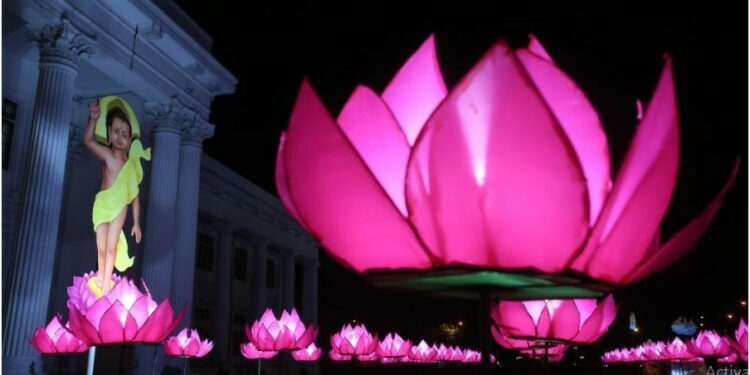
Colombo. May 27: Sri Lankan Buddhists are currently celebrating the two-day Vesak festival. The event, which ends today, commemorates the birth, enlightenment and death of Siddhārtha Gautama, the Buddha.
Like last year, ceremonies are subject to strict health restrictions due to the COVID-19 pandemic – such as social distancing and a ban on gatherings – in order to prevent the spread of the virus.
Several leading Buddhist monks recently addressed the issue, urging the faithful to keep celebrations low key. Sri Lankan President Gotabaya Rajapaksa also called on Buddhists to celebrate Vesak symbolically.
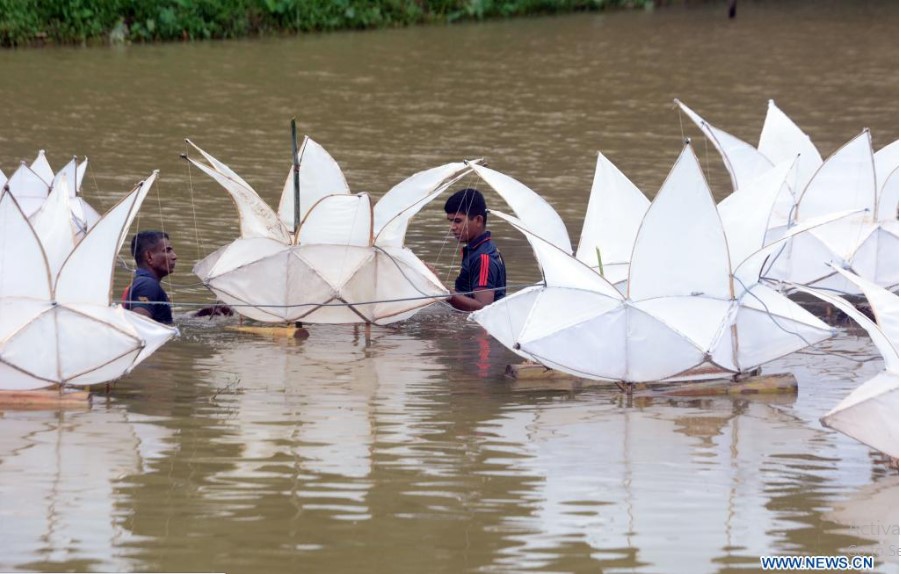
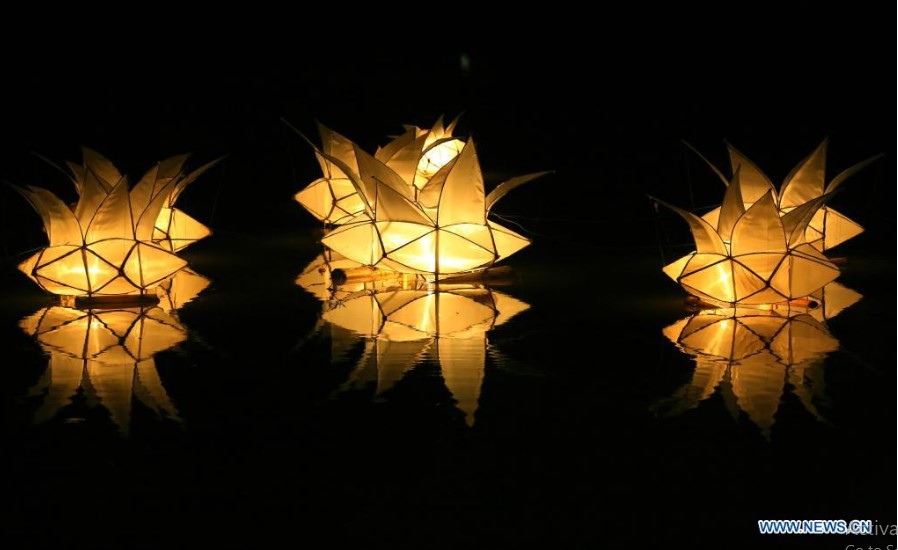
According to tradition, the event includes trips, meetings, and get-togethers with people, sharing food, making offerings, and throwing coloured lanterns.
However, due to a recent spike in coronavirus cases following last month’s Sinhalese New Year celebrations, the authorities are asking people to avoid gatherings, displacements and large family get-togethers.
Prominent Sri Lankan Buddhist leaders like the Venerables Thibbatuwawe Sri Sidhartha Sumangala Thero, Warakagoda Dhammasiddhi Sri Pannanada Gnanarathana Thero, Ganthune Assagi Thero, and Makulaawe Vimalabhidhaana Thero have issued a joint statement urging people to carry out activities at home” because of the coronavirus pandemic, which is spreading around the world”.
For this reason, they note that in temples and elsewhere we must avoid activities that involve gathering people such as almsgiving, Sīla, Bhāvanā (meditation)”; instead, people must follow health guidelines, stay at home, and perform religious observances”.
The statement ends with Buddhist leaders blessing all those suffering from the virus and wishing them a speedy recovery.
On behalf of Sri Lanka’s Catholic community, Archbishop Card Malcolm Ranjith of Colombo released a message wishing Buddhists good tidings for Vesak in these troubled times” due to COVID-19 that is afflicting our nation”.
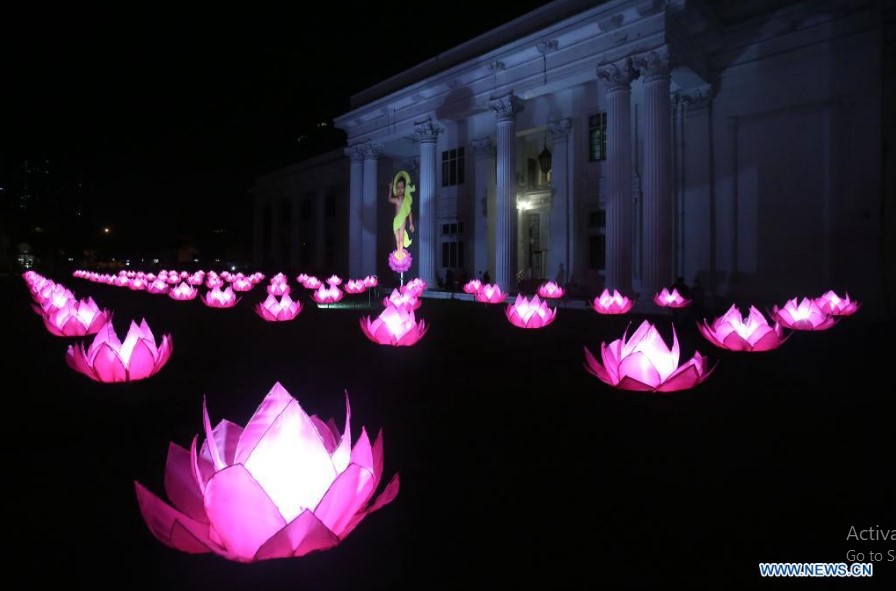
In an emergency situation, it is important for us to think about our life options in the light of the teachings of the Lord Buddha and live a life based on the spiritual principles of self-denial and dedication to the well-being of one another.”
The prelate ends his statement by wishing a blessed Vesak celebration to his fellow citizens, especially the members of the venerable Maha Sangha.
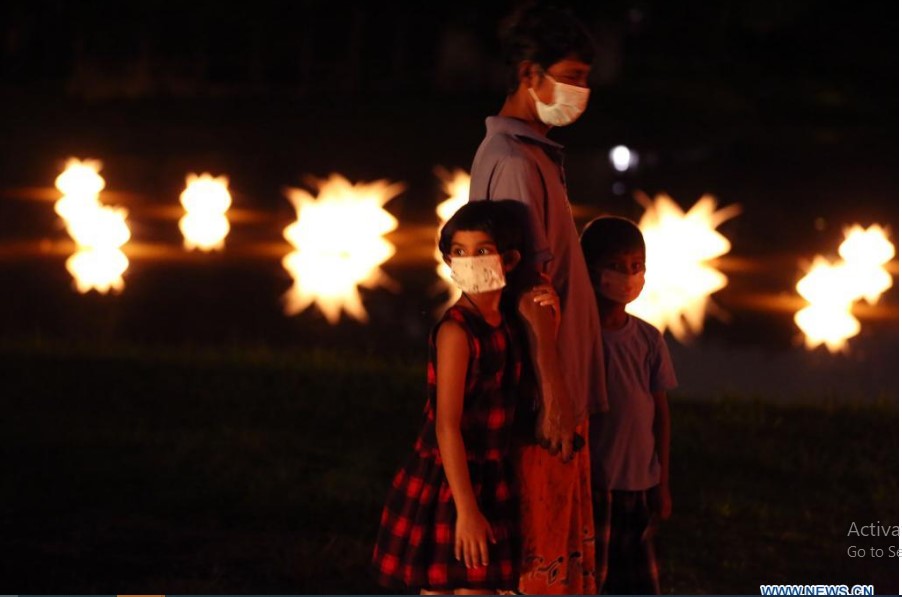
According to health guidelines, during the two-day celebration Buddhists can conduct religious activities at home, and must avoid meetings and gatherings in temples or shrines.
According to the latest count, Sri Lanka reported 2,377 new cases and 29 deaths from COVID-19 in the last 24 hours for a total of more than 172,000 cases and 1,269 deaths since the start of the pandemic.
(Photos: Ajith Perera/Xinhua)
The ban imposed on all arrivals will be lifted from 01 June, the Civil Aviation Authority says.
In a statement, the CAA mentions that restriction will continue to adhere to passengers who have been India within the last 14 days.
Sri Lanka previously banned all arrivals from 22 to 31 May.
However, all inbound travelers are required to undergo mandatory quarantine irrespective of the vaccine obtained by them.

AstraZeneca has informed Sri Lanka’s State Pharmaceutical Corporation not to purchase the AstraZeneca vaccines from any private trader or company as these vaccines are likely to be counterfeit and should be refused and reported to the relevant authorities.
The Daily Mirror learns that in a desperate bid to secure 600,000 doses of AstraZeneca vaccines to roll out the second jabs as time runs out, Sri Lankan authorities had made inquiries from several private companies who claim they have stocks of the AstraZeneca and are willing to sell it to Sri Lanka at a higher rate.
A senior minister told Daily Mirror earlier this week that an inquiry had also been made in the black market as the government wanted to fulfill its responsibility of administering the second doses to all those who had received the first jabs.
The government has expressed its willingness to purchase the 600,000 injections at any price.
The Daily Mirror learns that authorities were in discussions with over 15 private global companies who said they had stocks and were willing to part with 600,000 doses for a higher price. However the government had reached out to the AstraZeneca parent company seeking validation over the authenticity of these doses, and said they would purchase it only if confirmed by the manufacturers and parent company.
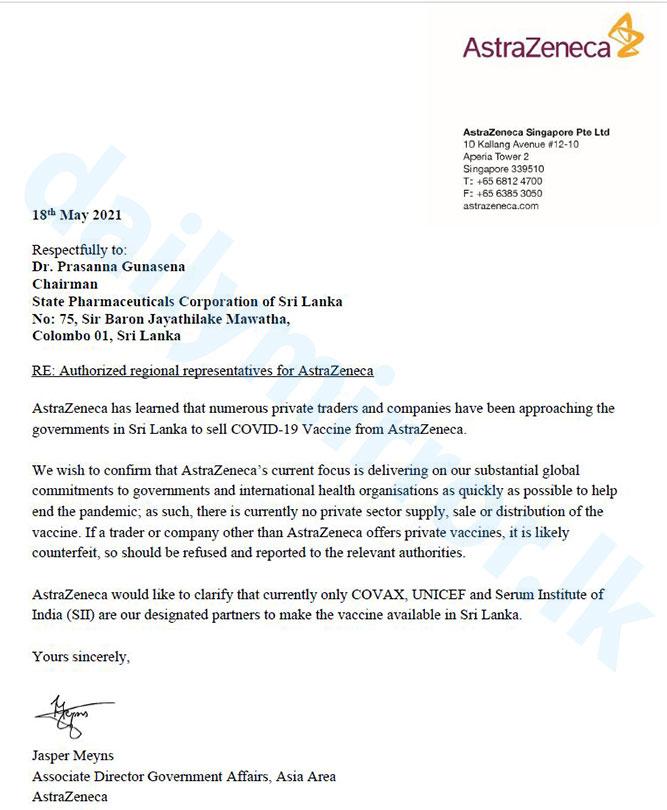
In response to this query by the State Pharmaceutical Corporation, AstraZeneca Singapore (Pvt) Ltd., in a letter sent to SPC Chairman Dr. Prasanna Gunasena said that AstraZeneca had learnt that numerous private traders and companies had been approaching the government in Sri Lanka to sell the COVID-19 vaccine from AstraZeneca.
The Associate Director, Government Affairs, Asia Area of AstraZeneca, Jasper Meyns said that AstraZeneca’s current focus was delivering on its substantial global commitments to governments and international health organizations as quickly as possible to help end the pandemic.
“As such, there is currently no private sector supply, sale or distribution of the vaccine. If a trader, or company other than AstraZeneca offers private vaccines, it is likely counterfeit, so should be refused and reported to the relevant authorities,” the letter said.
“AstraZeneca would like to clarify that currently only COVAX, UNICEF and Serum Institute of India are our designated partners to make the vaccine available in Sri Lanka,” the letter added.
Presently the Sri Lankan government has received no confirmation as to when or from whom they can purchase the remaining stocks of vaccines. An official from SPC told Daily Mirror that to date, there was no confirmation on the AstraZeneca supply but reiterated that they were trying hard to secure the doses.
The current program which is underway to roll out the second jabs has come under severe criticism with those with connections and money having received the doses behind closed doors. The Health Ministry has clearly ignored the protocol of administering the doses according to the dates of the first jabs, resulting in the entire system going adhoc and desperate citizens lining up outside hospitals everyday seeking their second doses. (JAMILA HUSAIN)
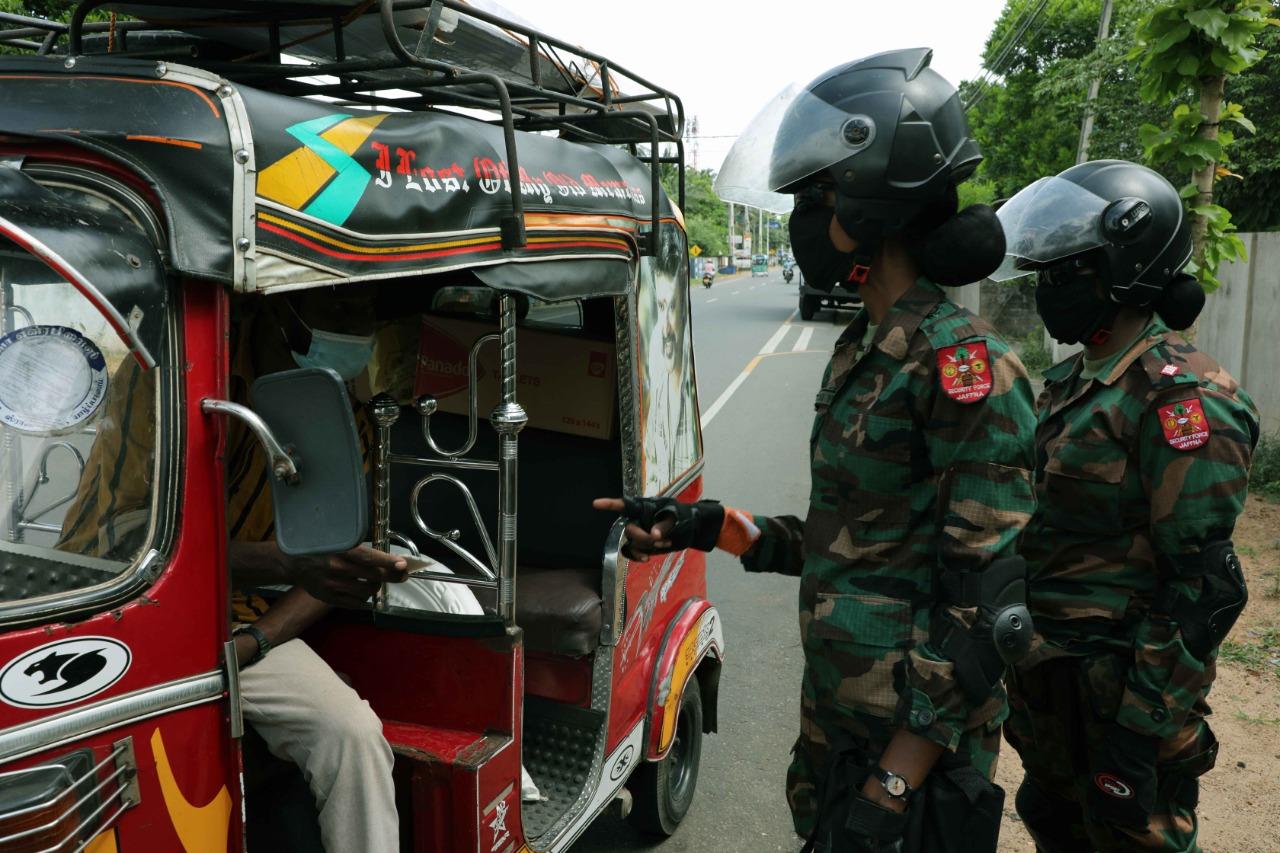
A Special Women Corps Quick Reaction Rider Team had been formed to operate in an emergency situation and to assist COVID-19 prevention work and controlling process.
The Quick Reaction Special Rider Team, comprising woman soldiers of 7 Sri Lanka Army Women’s Corps was formed on the instructions of Jaffna Security Force Commander and Colonel Commandant of Sri Lanka Army Women’s Corps Major General Priyantha Perera.
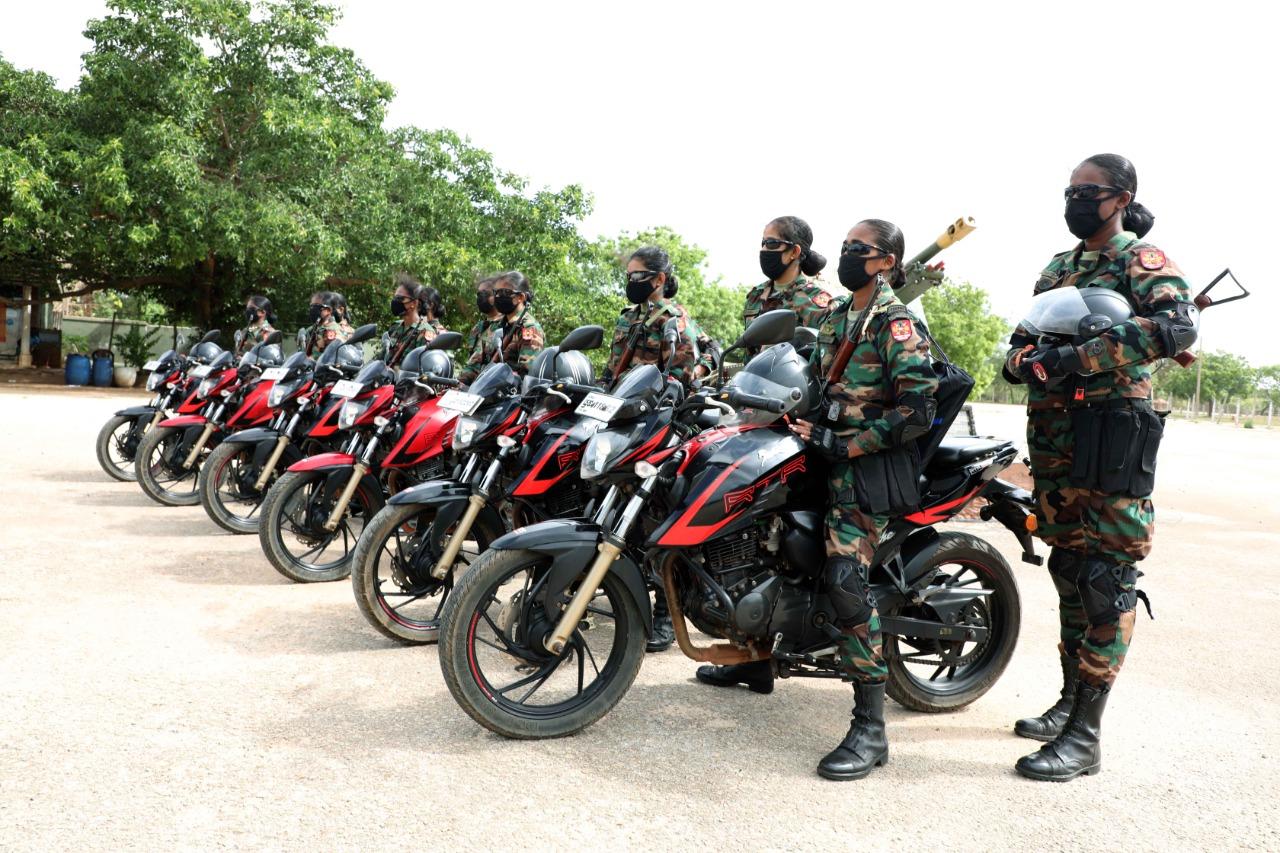
The Team has been operational since Tuesday in Jaffna city and its suburb under supervision of the Commanding Officer, 7 Sri Lanka Army Women’s Corps Major Rashmi Galhena. (DSB)
The Director-General of Health Services confirmed that Sri Lanka has reported 27 more deaths related to the COVID-19 pandemic on Wednesday (May 27).
As per the Department of Government Information, the reported deaths had occurred between May 22 and May 27.
They are identified as residents of Gurutalawa, Badalkumbura, Kandy, Agalawatta, Wennappuwa, Polonnaruwa, Welipenna, Matale, Aluthgama, Maggona, Darga Nagar, Morapitya, Kalutara-South, Galpatha, Beruwala, Galle, Wattegedara, Boossa, Millewa, Neboda, Bulathsinhala, Kadawatha, Wattala, Wellampitiya, and Colombo 15.
Accordingly, the total number of deaths due to Covid-19 infection in Sri Lanka has risen to 1,325.
The Epidemiology Unit of the Health Ministry reports that another 790 persons have tested positive for COVID-19 in Sri Lanka, moving the daily total of new cases to 2,572.
This brings the total number of confirmed cases of coronavirus reported in the country to 174,849.
As many as 143,789 recoveries and 1,298 deaths have been confirmed in Sri Lanka since the outbreak of the pandemic.
The Epidemiology Unit’s data showed that 29,762 active cases are currently under medical care.
A Gazette Extraordinary has been issued by President Gotabaya Rajapaksa declaring several services as essential services.
The relevant gazette has been signed by the President today (May 27).
Accordingly, the following services are declared as essential services hereon:
Services Declared Essential by Adaderana Online on Scribd
Vaccines from China’s Sinopharm successfully contained Covid-19, according to a study published in a prestigious U.S. medical journal, the first time detailed findings from a late-stage trial of a Chinese shot have appeared in the scientific literature.
The two inactivated vaccines developed by Sinopharm’s vaccine-making unit China National Biotec Group Co. prevented symptomatic infections by 72.8% and 78.1%, largely in-line with what the state-owned drugmaker previously announced. The findings were reported in the May 26 Journal of the American Medical Association (JAMA).
Chinese shots, including those from Sinopharm and Sinovac Biotech Ltd., another Beijing-based vaccine maker, have formed the backbone of the vaccine rollout in developing countries ranging from Hungary and Serbia to Seychelles and Peru. The immunizations have come under scrutiny and their manufacturers have been criticized for not sharing adequate data about the shots’ safety and efficacy.
The lack of transparency fueled doubts about the shots’ ability to contain Covid, especially after cases continued to spike in countries such as Seychelles and Chile that used them to vaccinate a sizable share of their populations. It also stalled approvals by stringent drug regulators and the World Health Organization. While Hong Kong waived the requirement for a peer-reviewed publication to approve the Sinovac vaccine earlier this year, regulators in Singapore are still demanding additional data.
No Serious Infections
The study published in JAMA included 40,832 volunteers from across the United Arab Emirates, Bahrain, Egypt and Jordan. They were equally split into three groups and received either two doses of the vaccines, three weeks apart, or a placebo. Two weeks after the second shot, infections developed in 26 people given the vaccine known as WIV04, 21 of those given the vaccine known as HBO2 and 95 given a placebo shot.
None of the volunteers given an active vaccine developed severe disease, compared with two of those given placebo. The results were initially submitted to JAMA on March 17, Sinopharm’s subsidiary China National Biotec Group said in a statement. The paper was accepted for publication on May 12.
The published study revealed some limitations in the vaccine trial. The testing was heavily skewed toward men, who accounted for nearly 85% of the participants. Less than 2% were aged 60 or older, and most were healthy. As a result, there is little evidence about the efficacy and safety among women, the elderly and those with underlying diseases.
Still, the World Health Organization cleared one of Sinopharm’s Covid shots earlier this month, paving the way for it to be more widely distributed around the world through the Covax facility that provides access to safe and effective vaccines.
Key details on another Sinovac shot were released in pre-print form, without a formal peer-review or publication. That vaccine has yet to get the green light from the WHO, though more than 380 million doses have been distributed around the world.
Meanwhile, the Embassy of China in Colombo tweeted the findings of JAMA regarding the Sinopharm vaccine.
Chinese Embassy in Sri Lanka@ChinaEmbSL·26 MayThe Journal of the American Medical Association, JAMA today published world’s first complete data of #Sinopharm Phase3 clinical trials: 14 days after 2nd shot, Efficacy: 100% against severe cases, 72.8-78.1% against #COVID19 , 99% neutralizing antibodies

The owner of the distressed vessel X-Press Pearl, X-Press Feeders stated today (27) that the reports of which that the container ship was denied entry to Hazira Port in India and Hamad Port in Qatar are incorrect.
Explaining further, they noted that the ship had undergone discharge and loading operations in both ports before continuing on its planned journey to Colombo.
The ship had appealed to both ports to offload the container that was leaking nitric acid at the time, however, advice given was there were no specialist facilities or expertise immediately available to deal with the leaking acid.
Meanwhile, Executive Chairman of the company, Tim Hartnoll said that poor packaging was responsible for the acid leak, which the crew had detected while in the Arabian Sea thousands of kilometres away from Sri Lanka.
The biggest threat to container shipping is a fire onboard on ships,” Hartnoll further emphasized.
While salvage teams assisted by Sri Lankan and Indian military forces fight to minimize damage, acid and fuel are thought to have spilled into the sea, and the ship’s owner is anticipating that the insured vessel will be declared a total loss.
Meanwhile, sharing a message on Twitter, the High Commission of India in Colombo, Sri Lanka stated that the raging fire of the MV X-Press Pearl has largely been controlled.
Sharing a message on Twitter, the High Commission of India in Colombo, Sri Lanka stated that the raging fire of the MV X-Press Pearl has largely been controlled.
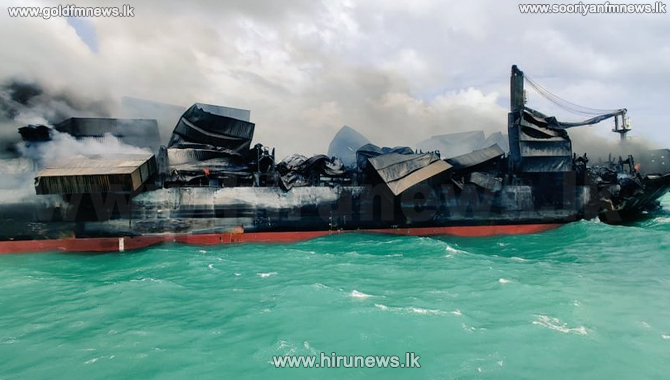
“Result of the #India -#SriLanka joint operation is now more tangible. The raging fire has largely been controlled and parts of #MVXPressPearl are now clearly visible even as the fight continues. Hoping for more good news. Stay tuned!!”
India promptly responded to an emergency request by Sri Lanka Navy and deployed multiple assets to douse the fire on MV X Press Pearl off Colombo on 25 May 2021.

This includes Vessels Vaibhav, Vajra and Samudra Prehari by Indian Coast Guard and Tug Water Lilly by Director General, Shipping in addition to Dornier aircraft for aerial reconnaissance.
Debris from the burning container ship has washed ashore and the public has been warned not to touch any of it as it could be contaminated with harmful chemicals.
However, the Marine Environmental Protection Authority (MEPA) stated that several cases of allegories have been reported from persons who had come in contact with the debris from the distressed vessel.
Debris from the X-Press Pearl vessel that is burning in the sea area off the Colombo Port has been washed ashore in Ja-Ela, Kapugoda, and Sethupaduwa along the Negombo Coastal line
I started writing the following as a casual comment on C. Wjeyawickrema’s බ්රදර් චාල්ස් තෝමස්ගේ <දහම් පහන> හා සිංහල බුද්ධාගම/May 24, 2021.But it became longer than originally intended. So here it is offered to my fellow readers as a separate column. Please see if you can agree with observations. This is just a personal opinion.
I agree with Dr Wijayawickrema’s take on the subject. My own opinion is that there is no need for this so-called Brother Charles’ services (even if he is a genuine advocate of Buddhist values, which is unlikely) in educating Buddhists and Hindus about compassion and non-violence, for these are the fundamental values on which Hindu and Buddhist cultures are based. Hinduism and Buddhism predate Christianity by centuries (indeed by millennia, in the case of Hinduism). Why can’t the government departments mentioned in this article use preachers from among the Buddhist clergy and laity in their personality development or stress management or ‘spirituality’ promoting programs? Authorities can also use similar preachers from the Christian community for the same purpose. However, I don’t think that any of the star preachers among Buddhist monks should be invited to take part in this task, because they are already entangled in irrelevant controversies or have lost their credibility through narcissistic displays of material wealth (which is invariably paralleled by intellectual/spiritual vacuity). There are enough good monks and lay preachers who are well versed in the dhamma and whose moral credentials are perfect who can handle this job without having to employ suspicious characters, who may be agents of a proselytizing Christian fundamentalist sect.
At the beginning Charles used to shout “Jesus thama parama satyaya” “Jesus is the supreme truth” in the midst of preaching to mesmerized audiences that he managed to additionally mislead by inviting some idiotic uneducated Buddhist monks or yellow-robed quacks to attend his programs. He must be getting funds from somewhere (from some fundamentalist Christian organization). Or is he known to be a moneyed person who can afford heavy expenses while engaged on his disguised Christian missionary work, which involves travelling to foreign lands? Now he has started attacking “religion” as a destructive force, because he seems to have recently heard that the Buddha never preached a religion, and that though Buddhists adopt certain cultural traditions like ritual practices that are characteristically associated with religions (but which are indispensable for the survival of the dhamma among ordinary humans, the unenlightened pratujjanas), they do not believe in a supreme creator being or a supreme truth that they have no option but to propitiate or worship.
Sri Lanka is the target of attack from five sources, three geopolitical, and two religious. America, India, and China on the one hand, and on the other Christian fundamentalism secretly sponsored by the West, and Jihadism supported by Saudi Arabia, but exploited by the West for their own purposes. All these forces undermine the age old Buddhist cultural foundation of Sri Lanka on which the survival of the Sinhalese, the majority community whose ancestors’ blood and toil bequeathed to the world the fabled island state of Sinhalay. What gives them temporary relief is the fact that these external forces are currently divided among themselves. However, the impact of their cumulative hostility is not small. Among them, only China shows some empathy towards Sri Lanka, but that is for its own sake. In any case, Sri Lanka, faced by an aggressive hegemonic West, has no alternative but to find refuge under China’s wing.
Returning to the point, even Arun Siddhartan should be treated with suspicion, but he can be easily made to see the truth that the future of both the majority-Hindu Tamils and the majority-Buddhist Sinhalese, as well as that of Tamils and Sinhalese who have embraced Christianity, depends on wholehearted unity among them. The Marxist Arun represents the oppressed low castes of the north. So, unlike Sinhala-Buddhist haters such as Rajan Hoole and Kumar David whose ancestors escaped caste oppression by embracing Christianity and benefiting from education through English made available to them by the British, Arun can be trusted as a Tamil politician as an ally. Especially, Buddhists and Hindus must unite in order to protect themselves from the Jihadist violence and the intolerance of Christian fundamentalists. Christians will have some respite from Jihadists as Ahl al Kitab or People of the Book (believers in revealed truth, so allies of Muslims). Hindus and Buddhists will have none, for they don’t come within that category. But some moderate Muslims have lately started including Buddhists and Hindus too among Ahl al Kitab (which is nothing but deception). Christians are also changing their dogmas to suit their agenda of neutralizing the attraction to the world of the non-violent, and peaceful teachings of Buddhism and Hinduism.
What Charles seems to be launching is a preemptive strike on the currently burgeoning solidarity between the Sinhalese in the South and Tamils in the North. Dr Wijeyawickrema sees him for what he really is. He implies that Charles could be another Ranjan Ramanayake: “ලංකාවේ හාමුදුරුවරු නොසිටින්නට ඔහු කතාකරණ ත්රිපිටකයක් ලෝකයේ නැත. සංඝ සාසනයේ අද දක්නට ලැබෙන නොයෙකුත් අර්බුද වලට සුද්දගෙ නීතිය හා පක්ෂ දේශපාලක කළු සුද්දන්ගේ ක්රියාකලාපය හේතුවී ඇතිබවත් ඒවා නිවැරදි කල යුතු බවත් අමතක කිරීම වැදගත් සමාජ ක්රියාකාරීන්, සැඟවුණ න්යායපත්ර සහිත තවත් රංජන් රාමනායකලා බවට පත් කරයි. මෙසේ අන්තිමේදී ඉතුරු වන්නේ තවත් සිංහල බෞද්ධ විරෝධියෙක් පමණය.”
There is no doubt that the Cardinal means well, and he is doing his duty. But the ‘hidden agenda’ that Dr Wijeyawickrema is warning against is proceeding apace. A church in Ragama had an alms giving today, May 26, (Vesak Day) for a group of monks to celebrate the important Buddhist event. The Christians had their service in the church in the normal way. Christian Buddhist friendship is good, but can it be established through this sort of hypocrisy? Don’t these monks have some sort of leadership to guide them? Can’t the two communities hold their rituals separately as they have always done, but get on well together outside of the church and the pansala without indulging in utterly counterproductive hypocrisy like this in the name of peaceful religious coexistence, which the likes of Charles use as a stratagem to subvert the Buddhist establishment (Buddha Sasanaya)?
The Mahanayakes who lack the Cardinal’s wisdom and his knowledge of the current realities both in Sri Lanka and in the world outside are getting increasingly ignored by the powers that be. Gotabaya is doing something to reclaim the ancient Buddhist archaeological sites that are being vandalized or forcibly occupied by Muslim extremists and opportunistic Muslim politicos (some Tamil politicians are among them too) who use extremists as a cat’s paw; but his older brother Mahinda seems to be too preoccupied with an inexplicable commitment to please a few crafty Muslim politicians, who never fail to have the best of both worlds, whichever national party comes to power. The ultimate victims of the dire consequences of these lapses on the part of politicians and priests are the majority Sinhalese Buddhists, who, nevertheless, have always been very tolerant, accommodating and nice to all the racial and religious minorities.
Hon. David McKinnon,
High Commissioner,
High Commission of Canada to Sri Lanka and Maldives,
33A,5th Lane,
Colpetty,
Colombo 03,
Sri Lanka
Re: Tamil Genocide Education Week Act,2021(Ontario-Bill 104) facilitates separatism in Sri Lanka
Dear Hon. High Commissioner,
We would like to bring your attention to the above bill which received Royal Ascent on 12 May 2021.
The private bill tabled by MPP Vijay Thanigasalam of Sri Lankan Tamil descent, describes the entirety of the war, from 1983-2009 as a genocide that the Sri Lankan state perpetrated against Tamils.”
Further, genocide is described in the bill as the deliberate and organized killing of a group or groups of people, with the intention of destroying their identity as an ethnic, cultural, or religious group. Then the bill goes on to say that genocide against Tamils started in 1948 and was perpetrated through Sinhala-Buddhist centric government policies, programs, land grabs and ethnic cleansing. Furthermore, the bill refers to a UN estimate of 40,000 to 75,000 civilians killed in May 2009 alone. Also, there is reference to a higher death toll of 146,679, apparently derived from the difference between pre and post war statistics of regional population.
Most importantly, Bill 104 emphasizes the existence of a continued genocide against Tamils since 1948. In addition, the state of Sri Lanka has also been accused of systematic disenfranchisement of voting rights, suppression of language, religion, and culture of Tamil people.
With long established diplomatic relations between two countries, we believe that the Candain High Commission and the government are well aware of the fact that the genocidal picture portrayed in the above Bill/Act is pure fabrication.
• There is no evidence to support the death tolls mentioned in the bill.
• The actual number of deaths is estimated around 5,000-7,000 which is far below the average for a conflict of similar magnitude.
• There is no evidence to support a continued genocide since 1948.
• Alleged Tamil Genocide has never been determined by a court of law or an international tribunal.
If the above Act is unopposed and remains the law of the land in Ontario, we can contemplate the following consequences.
1. Alleged Tamil genocide in Sri Lanka will be formally recognized in Ontario.
2. Other Canadian provinces may be inclined to pass similar bills.
3. Federal government is likely to adapt the same.
4. Canadian example might be followed by other western countries.
5. LTTE separatists will be few steps closer to prove their case for a separate homeland.
6. Sinhalese students in Canada will be educated on a genocide allegedly committed by SL military forces but not proven in a court of law.
7. Sinhalese students may be subjected to bullying and discrimination in the classroom.
Further, we believe that the Act violates the Canadian constitution since the substance of the bill is of criminal nature albeit it being labeled as an Act related to education. It is regrettable that a fellow UN member states and a fellow member of the commonwealth allows its provincial bodies to interfere with internal affairs of another UN/commonwealth member state. Private member bills brought in the provincial legislatures to interfere with internal affairs of sovereign nations may set a bad precedence for a nation of immigrants from across the globe. If the trend continued, hundreds of international disputes will be introduced to Canadian political theatre with an adverse effect on relations among various communities.
Therefore, we strongly request the government of Canada to intervene in any possible mean to repeal/amend the Bill 104 to prevent further reputational damage to the state of Sri Lanka and the Canadians of Sri Lankan ancestry.
Sincerely,
Sunil Chandrakumara President Global Srilankan Forum
Ruwan Perera Director – International Affairs Global Srilankan Forum
Foreign direct investment (FDI) is an integral part of an open and effective international economic system and a major catalyst to development. Yet, the benefits of FDI do not accrue automatically and evenly across countries, sectors and local communities. National policies and the international investment architecture matter for attracting FDI to a larger number of developing countries and for reaping the full benefits of FDI for development. The challenges primarily address host countries, which need to establish a transparent, broad and effective enabling policy environment for investment and to build the human and institutional capacities to implement them – OECD, Foreign Direct Investment for Development MAXIMISING BENEFITS, MINIMISING COSTS
Sri Lankan politics has not witnessed bi-partisan agreement amongst the major political parties on key issues that impact on the people of the country, the present generations and many more to come.
There has never been bi partisan agreement on foreign policy, on education, on health at least at the highest policy levels. Personality politics has dominated the political landscape and it has always been about the plaudits or damage a policy decision might make on a personality and as a consequence on the party or parties that person represents, and eventually whether or not that individual or the party would win the next election, and ones after that.
This absence of bi partisan agreement has now extended to one of Sri Lanka’s most daring, controversial to many and an out of the box venture, the Port City project. The absence of such agreement, and the statements made by the current Opposition that they will amend the Port Commission bill is bound to unsettle many would be investors. They will be wondering what would happen to their investments if the current regime is defeated at the next election and the terms and conditions in which they invested should change after 4 years or so. The investment period horizon would then be 4 years. It does not need an Einstein to conclude that investors would be very hesitant to invest in any long term project in such a climate.
The statement of the Opposition is not being questioned here as they have rightly said that although the constitutionality of the bill has been adjudicated by the Supreme Court, amendments made, but the policy contentions had not been addressed and amendments they had brought in had been rejected by the government. It is also not clear whether the amended bill, incorporated with the supreme court determined amendments, had been presented to the Parliament. The public certainly has not seen the amended bill.
The bona fides of the current Opposition of course is questionable, as they were the government in 2016 when they signed a tripartite agreement with the China Harbour Engineering Company and the UDA to develop the Port City into what they termed the Colombo International Financial City, which will be in the centre of the maritime city, will be one of the key phenomenon which will decide the future development of Sri Lanka” according to the then Megapolis Minister Champika Ranawaka at the signing of the tri partite agreement. He added that the project would also fuel the planned Maritime city, Aero city, Tech city, Industrial cities and Tourist cities. That agreement has not been made public to the best of the writer’s knowledge.
The Port City project and the Port City Commission are major undertakings that will bind many future generations to its positives, but more importantly to any possible negatives as well. It would not be out of place to say that the politics associated with this futuristic project could have been handled better in a more transparent and consultative manner.
In the first place, the origin of this project, the agreement signed with China, signed by the Presidents of China and Sri Lanka in 2014, to reclaim an area of the sea and to create a Port City, was not tabled in Parliament for discussion as far as can be ascertained.
Reports indicate that the project concept goes back to 2011 and construction was set to begin in March 2011 but due to several circumstances the project had been stopped. In mid-2012, the Sri Lankan Port Authority (SLPA) announced that the construction of the then Colombo Port City project would commence on 17 September 2014. The budget was estimated to be $15 billion.
The reclamation was to be carried out by China Harbor Engineering Corporation, who has been engaged by the investor. 125 ha (310 acres) was the land was given to government as well as 88 ha (220 acres) while owned by the government was planned to be leased for 99 years to the Chinese company. 20 ha (49 acres) was planned to be given freehold to the Chinese company.
Construction of the Colombo Port City project was launched on 17 September 2014 by Sri Lankan President Mahinda Rajapaksa and Chinese President Xi Jinping.
The Sirisena/Wickramasinghe government that was elected in 2015 suspended the project on environmental grounds, but it is understood that this was granted approval again in 2016 having agreed to pay a penalty of USD 100 million to the Chinese company for the delay encountered in proceeding with construction as per a country to country agreement. It is learnt that in exchange for not paying this penalty, the Hambantota Harbour was sold or given on a long term 99-year lease virtually on a platter.
On 12th August 2016 the tripartite pact signed to construct a mega port city signed between Sri Lanka’s Urban Development Authority, the Ministry of Megapolis and Western Development and the China Harbour Engineering Company, and as far as known, this agreement too has not been tabled before the Parliament.
With the signing of the agreement, the Colombo Port City Development Project was newly renamed as the Colombo International Financial City with the government stating that the project would transform Sri Lanka into an international financial hub in the Indian Ocean region.
It is still not very clear as to the extent of land involved in this project as different extents have been mentioned in different agreements. It is also not clear whether whatever land extent has been registered with the land registry. Clarity on these will be useful.
While there is no indication that any of these two agreements had been tabled and ratified by Parliament, these two occasions are not the first time Parliament had not ratified binding agreements, if indeed they had been tabled in Parliament. The Ceasefire Agreement that Prime Minister Wickramasinghe signed with LTTE Leader Prabakaran in 2002 was not tabled in Parliament, and in fact not even known to the Executive President of the country at that time Chandrika Kumaratunga who saw the agreement after it had been signed by Wickramasinghe and Prabakaran. The consequences of that agreement are well known today.
In this backdrop comes the Port City Commission bill. While it is true that there was an opportunity for litigants to go before the Supreme Court to ascertain the validity of the bill with the Constitution, the people’s representatives, however low they are in their credibility in the eyes of the people, and neither the business community, and civil society leaders, were given an opportunity to consider the policy aspects of the bill in some depth and to work together to make it a national project of great importance to the country.
The SJB, and the residue of the UNP, as well as those who supported the Yahapalanaya government in 2016, cannot afford to oppose this bill in principle while they have the right to oppose sections of it if they differ with what they agreed to in 2016. As stated earlier, the writer stands corrected if the government and the Opposition could clarify to the public whether these important agreements were in fact discussed in Parliament and whether any attempt was made to have bi partisan agreement on them. Besides being an important consideration for the public in Sri Lanka, it would be vital to generate confidence amongst would be investors in the Port City project for long term projects. Unless there can be such a bi partisan agreement, it is unlikely that the objective of large and long term investments will be made in this project.
While some may entertain philosophical arguments against the concept of the Port City, and suspicions and fears about China getting an extended foothold in Sri Lanka, it is also true that Sri Lanka needs to raise its economic platform if the future generations are to enjoy the opportunities they need and deserve in years to come. The current economic platform, based on Tea, Rubber, Coconut and other agricultural exports, Apparel and IT products and services exports, foreign remittances, and tourism, is very volatile and inadequate to meet future challenges associated with investments required for infrastructure development, service improvements and social upliftment.
The longer term future of Tea and Rubber is uncertain, and foreign remittances may not be long lasting even once the COVID pandemic subsides. Sri Lanka needs a different approach and lateral thinking on economic policies if it is to free itself from debt and generate enough revenue to service its infrastructure development and service improvements. Besides the Port City project, there is no other innovative project that has been presented for discussion that would address the future economic needs of the country. While the management of its politics has left much room for improvement and some policy aspects may need adjustment, the fact remains that there is nothing else on the table to compare it with.
While it is not a critique of the bill itself, as the writer feels that should be left to the politicians as well as experts who are more competent to do so, there are a few questions pertaining to the clauses 64 and 65 in the agreement that needs some clarification as there appears to be a legal provision in the bill to extend the authority of the Port Commission to land associated with projects approved by the Commission, beyond the reclaimed land area that constitutes the Port City. In addition, these clauses appear to make the Board of Investments (BOI) irrelevant and an unnecessary entity as all its activities, past, present and future could easily be managed by the Port Commission.
It is understood that President Sirisena by way of a gazette notification granted a land deed for the reclaimed land in favour of the UDA as mentioned by Presidents counsel Jayantha Weerasinghe at a recent press conference. The land given to the UDA on this grant apparently was given on a lease to the Chinese company by the UDA in 2016.
Is it to be understood that as per section 65, the present President is giving another grant of the same land to the Port Commission under section 65 when the land is owned by the UDA and leased to the Chinese company? This convoluted situation may not be accurate, and it would be good if the government could clarify this.
None of these land deeds have been registered as far as known and therefore no one has been able peruse them and ascertain the status of the grants and deeds. No wonder the Public is confused. It is also understood that the gazette which contains the deed signed by President Sirisena has the new plan as per the tripartite agreement under Cadastral system. It would be helpful if these documents are made available to the public. If the above confusion could be cleared, this sub section and what is referred to in Section 65 of the gazette notification looks harmless and innocuous if it is read as it is without any reference to any other Section.
Is it that only the reclaimed land area referred to as the Port City, will be vested with the Commission? If not, what other land?
Some confusion and doubt does occur when it is read in conjunction with Section 64 which reads as follows. Clause 64
(1) The Commission may, where it considers necessary to do so, as an interim measure, permit an authorised person to engage in business from a designated location in Sri Lanka, outside the Area of Authority of the Colombo Port City, as may be approved by the President or in the event that the subject of the Colombo Port City is assigned to a Minister, such Minister, for a period not exceeding five years from the date of commencement of this Act. Such business shall, for such period of five years be entitled to all the privileges accorded to, and be deemed for all purposes to be, a business situated within and engaged in business, in and from, the Area of Authority of the Colombo Port City.
(2) Where an authorised person has been permitted to engage in business from a designated location in Sri Lanka, outside the Area of Authority of the Colombo Port City in terms of subsection (1), such business shall be subject to the provisions of this Act and any regulations made hereunder.
This Section raises two questions
The Port Commission Act has just been passed by the Parliament. In relation to this clause, besides the land that was leased to the Chinese company by the UDA in 2016, is it to be understood that there are projects approved by the UDA or any other body on land within the Area of the Authority? Is this clause to be understood as extending to projects already approved by the UDA, with some projects located outside the Port City precincts (as per Section 64) the benefits referred to in Section 65?
It would be useful if the government tables a list of such projects so approved and their operational locations as the country has a right to know which project, located where, is to benefit from terms in Section 65.
These clauses, their meaning and effects need clarification as confusion does arise about the extent of authority the Port Commission has over land outside the Port city itself, even if it’s for 5 years. The potential does exist for the Port Commission to approve investment projects with say the headquarters office located in the Port City, but actual projects located anywhere else in the country, and enjoying all privileges and benefits accorded to the project irrespective of where its operations are located. Theoretically, farfetched it may be, the possibility exists for hundreds of foreign companies to have their projects approved by the Port Commission, with their operations located in any part of the country. The consequences of this possibility needs to be considered especially from the point of view of the impact on local farmers (if the projects are agriculture based) or industrialists who will not enjoy the benefits enjoyed by projects registered with the Port Commission.
Considering all of above, the extraordinary powers granted to the President of the country to make far reaching and binding decisions on what may turn out to be a sizeable component of the country’s economy could have the potential to be detrimental rather than beneficial to the long term interests of the country should the Presidency be in the hands of a person not entirely suitable to hold that office. Avenues for greater accountability of decisions made by the Port Commission and the President of the country have to be considered from this point of view.
HE. President Gotabaya Rajapaksa,
This approach towards making Sri Lanka aimed at transforming Sri Lanka’s economy into a green socio-economy with sustainable solutions to climate change is the most appropriate far sighted thinking Sri Lanka needs to create a Sri Lanka most suitable to our next generation.
The relevant plans tabled at the said meeting of the Presidential Task Force on Creating a Green Sri Lanka with Sustainable Solutions to Climate Change should “NOT JUST BE A PLAN” on the table – it should happen.
Your Excellency should take all steps necessary to implement these plans accordingly. Your Excellency should also take appropriate action to “EXTENSIVELY ENGAGE” all media in Sri Lanka, both Mainstream media and Social media and Youtube channels to bring out these plans and educate the “MASSES” especially the younger generation to “CLEARLY” understand these approaches and the benefit the nation will derieve at the end of the implementation.
The “media gatekeepers” of Media groups like Sirasa TV, MTV, Swarnavahini, TNL, Rupavahini and ITN who are “ONLY” hell-bent in damaging such a development vision, will go pel-mel/all out to “MISINFORM” the Nation and sabotage the plans. Without the acceptance and the peoples support, this “VISION” cannot be a success please.
The UNP, SJB, JVP, TNA, ACMC, SLMC, EPRLF, CTC, FSP, UCPF and Western influenced and funded NGO’s and unscrupulous multinationals engaged in promoting chemical fertilizers will do their utmost, behind the scene politically and socially to deprive Sri Lanka of the success of this programme.
Therefore it is advisable/suggested that a “FRANK DIALOGUE” should be put in place to make them to understand this “VISION” OUTSIDE OF PARTY POLITICS AND ELECTION GOALS AND TO COOPERATE FOR THE BETTERMENT OF OUR NATION AND “MAATHRUBOOMIYA”.
This is a humble suggestion of a Citizen of Sri Lanka and a patriot, your Excellency.
කොළඹ හුණුපිටිය ගංඟාරාම විහාරස්ථානයේ බුද්ධ රශ්මි ජාතික වෙසක් කලාපය බුද්ධශාසන, ආගමික හා සංස්කෘතික කටයුතු අමාත්ය, ගරු අග්රාමාත්ය මහින්ද රාජපක්ෂ මහතාගේ සුරතින් අද (26) දින පස්වරුවේ විවෘත විය.
ගංඟාරාම විහාරස්ථානයට පැමිණි අග්රාමාත්යතුමා සහ ආර්යාව ආගමිකවතාවත්වල නිරතවීමෙන් අනතුරුව පිරිවෙන් අධ්යාපනය ලබන සාමණේරවරු 100කට අධ්යාපන ශිෂ්යත්ව ප්රදානය කිරීමේ වැඩසටහනට ද එක්වූහ.
මෙහිදී සාමණේර රැකවරණ” ශිෂ්යත්ව ප්රදානය සංකේතවත් කරමින් අග්රාමාත්යතුමා සාමණේර හිමිනමකට ශිෂ්යත්වයක් ප්රදානය කළේය. අග්රාමාත්ය ආර්යා ශිරන්ති රාජපක්ෂ මහත්මිය ද මෙම උතුම් කාර්යය හා එක්වූවාය.
ගංඟාරාම විහාරාධිකාරී ආචාර්ය කිරින්දේ අස්සජි ස්වාමීන්වහන්සේ මෙහිදී අනුශාසනාවක් පැවැත්වූහ. වෙසක් මංගල්යයේ අරුත් පැහැදිලි කළ උන්වහන්සේ කොවිඩ්-19 වසංගතයේ භයානකකම පෙන්වා දෙමින් මෙවර බුද්ධ රශ්මි ජාතික වෙසක් කලාපය සංවිධානය කළ ද ජනතාවට එය නැරඹීමට පැමිණිය නොහැකි බව දැනුම් දුන්හ.
ඉන් අනතුරුව අග්රාමාත්යතුමා ගංඟාරාම සීමා මාලකය අසලදී බුද්ධ රශ්මි ජාතික වෙසක් කලාපය නිල වශයෙන් විවෘත කළේය.
අමෙරිකා එක්සත් ජනපදයේ ප්රධාන සංඝනායක වල්පොල පියනන්ද නාහිමි, මාතර හම්බන්තොට දෙදිසාවේ ප්රධාන සංඝනායක, මාතර හිත්තැටිය රජමහ විහාරය සහ කොට්ටාව මාලපල්ල ශ්රී සුදර්ශනාරාම අධිපති සහ හිටපු බස්නාහිර පළාත් පිරිවෙන් අධ්යාපන අධ්යක්ෂ රාජකීය පණ්ඩිත අග්රහැර කස්සප නාහිමි ඇතුළු මහා සංඝරත්නය මෙම අවස්ථාවට වැඩමකළ වදාළහ.
තරුණ හා ක්රීඩා අමාත්ය නාමල් රාජපක්ෂ මහතාගේ උදාර සංකල්පයක් අනුව ක්රියාත්මක යොවුන් ශීල සමාධි වැඩසටහන් මාලාවේ පස්වැන්න වෙසක් පුර පසළොස්වක පොහොය යෙදුණු අද (26) දිනයේ කොළඹ හුණුපිටිය ගංගාරාම විහාරස්ථාන සීමාමාලකයේ දී පැවත්විණි.
තරුණ පරපුර සුගතිගාමී කරවීම පෙරදැරි කරගනිමින් රට පුරා සියලු විහාරස්ථානවල සෑම පසොලොස්වක පොහොය දිනයන්හීදීම තරුණ තරුණියන් ශීල සමාධියෙහි පිහිටුවීම හා දාන ශීල භාවනා වැඩසටහන්වලට යොමු කිරීමට යොවුන් ශීල සමාධි වැඩසටහනේ අභිමතාර්ථයයි.
ඒ අනුව අමාත්ය නාමල් රාජපක්ෂ මහතා ප්රමුඛ තරුණ පිරිස ශීල සමාධියෙහි පිහිටුවීම අද පෙරවරු 06.30 ට ගංගාරාම විහාරාධිපති හිමි අනුශාසකත්වයෙන්, දේශප්රේමී භික්ෂු පෙරමුණේ ලේඛකාධිකාරී පුජ්යපාද බෙංගමුවේ නාලක හිමියන්ගේ මූලිකත්වයෙන් පැවැත්විණි.
පෙ.ව.07.30 සිට පෙ.ව.08.00 දක්වා පැවති බුද්ධ පූජාවෙන් අනතුරුව පෙ.ව.08.00 සිට පෙ.ව. 08.50 දක්වා ධර්ම සාකච්ඡාවක් ද පැවැත්විණි.
ගොලීය වසංගතයක්ව පවතින කොවීඩ් 19 වෛරස් තත්ත්වයෙන් අපේ රට මුදවා ගැනීමට හා ඊට ගොදුරු වී සිටින සියලු දෙනාට සෙත් පතා පැවති රතන සූත්ර දේශනාවෙන් හා සත්යයක් ක්රියාවෙන් පසු සිල් සමාදන් වූ පිරිසට අරලියගහ මන්දිරයේ සිට විසුරුවා හරින ලද ධර්ම දේශනාවට සවන්දීමේ අවස්ථාව හිමිවූහ.
කොවිඩ් – 19 මාර්ගෝපදේශවලට සහ පවතින සංචරණ සීමාවලට යටත්ව පැවති යොවුන් ශීල සමාධි වැඩසටහන වෙනුවෙන් දැහැමි සමාජයකට මං පෙත් විවර කරමින් ධර්ම දේශනාමය දායකත්වය මහාචාර්ය ඉත්තෑමලියේ ඉන්දසාර හිමි සහ මහාචාර්ය මැදගම්පිටියේ විජිත හිමි විසින් දරණු ලැබූහ.
මෙම වැඩසටහන සදහා බුද්ධශාසන හා ආගමික කටයුතු අමාත්යාංශයේ උපදේශකත්වය, තරුණ හා ක්රීඩා අමාත්යාංශයේ ජාතික තරුණ සේවා සභාවේ මෙහෙයවීමෙන් හා සංවිධායකත්වයෙන්, රාජ්ය සේවා බෞද්ධ සංගමයේ සම්බන්ධීකරණය, ජාතික වෙළඳ හා ව්යවසායකත්ව සම්මේලනයේ හා පහන්සිත් පදනමේ ක්රියාකාරී දායකත්වයයෙන් සිදු විය.
මාධ්ය ඒකකය
තරුණ හා ක්රීඩා අමාත්යංශය
සෑම පුන් පොහෝ දිනකම ගරු අග්රාමාත්ය මහින්ද රාජපක්ෂ මහතාගේ සංකල්පයකට අනුව පවත්වන අමාදම් සිසිලස” ධර්ම දේශනා මාලාවේ 210 වැන්න වෙසක් පුන් පොහොය යෙදෙන අද (26) දිනයේ අරලියගහ මන්දිරයේ දී පැවැත්විණි.
පළමුව අග්රාමාත්යතුමා, ආර්යාව ඇතුළු පිරිස අරලියගහ මන්දිර පරිශ්රයේ පිහිටි බෝධීන් වහන්සේට මල් පහන් සුවඳ දුම් පූජා කොට ආගමික වතාවත්වල නිරත වූහ.
අනතුරුව ධර්ම දේශනාව සඳහා වැඩම කළ අමරපුර සිරි සුමන විහාර පාර්ශ්වයේ මහනායක පන්නිපිටිය ශ්රී දෙව්රම් වෙහෙර නිර්මාතෘ ආචාර්ය කොළොන්නාවේ සිරි සුමංගල මහනායක ස්වාමීන්වහන්සේට අග්රාමාත්ය ආර්යා ශීරන්ති රාජපක්ෂ මහත්මිය දැහැත් වට්ටියක් පූජා කරමින් ධර්ම දේශනාවට ආරාධනා කළාය.
ප්රඥාවන්ත දැහැමි ජන සමාජයක් උදෙසා බුදු දහමේ සිසිලස බෙදා දීමේ අරමුණ පෙරදැරිව සෑම පුන් පොහෝ දිනකම පවත්වන අමාදම් සිසිලස” ධර්ම දේශනා මාලාවේ 210 වැන්න පින්බර වෙසක් පොහොය දිනයේ වැදගත්කම සහ මෙම ජිවන දිවියේ අනිත්යතාව පෙන්වා දෙමින් ධර්ම කරුණු සාකච්ඡා කෙරිණි.
අදට වසර 2565 කට පෙර පිරිනිවන් පෑ සුගත තතාගථ බුදුරජාණන් වහන්සේ ඔබේ සිත තුල බුදු කුටියක් කරගන්නැයි සිරි සුමංගල නාහිමියෝ සමස්ත ලෝක වාසී බෞද්ධ ජනතාවගෙන් මෙහි දී ඉල්ලා සිටියහ.
අමරපුර සිරි සුමන විහාර පාර්ශ්වයේ මහනායක පන්නිපිටිය ශ්රී දෙව්රම් වෙහෙර නිර්මාතෘ ආචාර්ය කොළොන්නාවේ සිරි සුමංගල මහනායක හිමියෝ මෙසේ ද කීහ.
පින්වත් අගමැතිතුමනි, තිස් වසරක යුධ ගිනි ඇවිලී ගිය සමයක ඔබතුමාට මතකයි, ඔබතුමා ඒවා ශීත කාමර වල ඉඳලා දැක්කේ නෑ, විඩියෝ වලින් දැක්කේ නෑ, එහෙම මිනිස් ජිවිත නැති වුනාය කියලා දැනෙන කොට ඔබතුමා එතනට ඇවිදගෙන ගියා. පිටකොටුවේ බෝම්බෙ මිනිසුන් කෑළි කෑළි වලට කැඩිලා බන්දේසි වලට ගොඩ ගහන කොට ඔබතුමා එතැනට ගියා.
කැබිතිගොල්ලෑවේ මිනිසුන් සියගානක් කපල කොටලා මරලා මිනිසුන් මළ කඳන් බදාගෙන අඩන කොට ඔබතුමා එතනට ගියා. ඔබතුමාට එදා මොනවද දැනුණේ. ඔය හදවත තුළ දැනුණා ඇටමිදුළු නහර අස්සේ කැවි කැවී දැනුණා, කොහොමද මේ යුද්දෙ නතර කරන්නේ කියලා. ඒ කැකුම වේදනාව හදවතට දැනෙන කොට ඔබතුමාගේ ඇට ඇට මිදුළු නහර ඔබතුමාට කතා කළා.
මේ දුක මට දරන්නත් බැරිතරම්, දෙයියනේ දරුවෝ වදන්න කුසින් දරුවෝ මෙලොවට බිහි කරන්න හිටපු අම්මලාව කපල කොටලා මරල තියනව දකින කොට, කටේ කිරි සුවදවත් ගියපු නැති පොඩි හාමුදුරුවරු කැලි කෑලි වලට කපල එකම දර සෑයක දැවෙන කොට, ඔබතුමාගේ හදවතට දැණුනා. ඒ සංවේගය වේදනාව අදත් ඔබතුමාට මතකයි.
ඒ වේදනාව සංවේගය ඔබතුමා පාඩමක් බවට පත් කර ගත්තා. මට මේකට විසඳුමක් ඕන කිව්වා. මම මැරෙන්න ඉස්සෙල්ලා මේක අවසන් කරනවා කරනවාමයි කියලා ඔබතුමාගේ හදවත නින්දේදිත් කෑ ගහන්න ඇති. යුද්ධය මවාගෙන ජීවත්වෙච්ච සමාජයක ඔබතුමා යුද්ධය අවසන් කරන්න රණවිරුවන්ට පණ දුන්නා, හයිය දුන්නා” යැයි සිරිසුමංගල නාහිමියෝ පැවසූහ.
දැයෙ පිනෙන් උපදින නායකයෝ ලෝකයේ අඩුයි. සංසාරේ පින් අරන් එන මිනිස්සු ලෝකයේ අඩුයි. මොනවදෝ හැංගිච්ච මහා පිනක් ඔබ තුමා ළග ඇති.” යැයි ද උන්වහන්සේ ප්රකාශ කළහ.
දොළොස් වසරකට පෙර යුද්ධය අවසන් කිරීමට හැකිවූවා සේ මෙම වසංගතයට පිළියමක් දෙන්නැයි අග්රාමාත්යතුමාගෙන් ඉල්ලා සිටි නාහිමියෝ මෙරටින් මෙම වසංගතය අවසන් කරන්නට මුළු රටක් එකමුතුව ඒ ගැන සිතමින් එකමුතුව නැගී සිටිය යුතු බව සිය ධර්ම දේශනාව ඔස්සේ පෙන්වා දුන්හ.
වෛරය, ක්රෝධය, ඊර්ෂියාව තුරන් කරගෙන ජීවත්විය යුතු බව පෙන්වා දුන් මහ නාහිමියෝ වසංගත තත්ත්වය තමන්ගෙ දරුවගෙ මරණයට මල්මිටක් තැබීමටවත් අවසර නොමැති තැනකට පත්කිරීමෙන් පෙන්වා දෙන්නේ මේ ලෝකය මායාවක් මිරිඟුවක් බව යැයි දේශනා කළහ.
සෞඛ්ය මාර්ගෝපදේශයන්ට යටත්ව පැවති අමාදම් සිසිලස” 210 ධර්ම දේශනාවට අග්රාමාත්ය මහින්ද රාජපක්ෂ මහතා ප්රමුඛ අග්රාමාත්ය ආර්යා ශිරන්ති රාජපක්ෂ මහත්මිය, රාජ්ය අමාත්ය අජිත් නිවාඩ් කබ්රාල් මහතා සහ පවුලේ සාමාජිකයෝ කිහිපදෙනෙක් එක්ව සිටියහ.
The first woman to be appointed as a deputy inspector general of police was removed from office just six months later.
It was a moment worthy of celebration for women in Sri Lanka when Bimshani Jasin Arachchi was appointed as Sri Lanka’s first female deputy inspector general of police (DIG) in October, 2020. This victory was short-lived, however. Six months later Jasin Arachchi was removed from her duties by a three-bench panel of the Supreme Court of Justice.
This decision followed the filing of a fundamental rights petition by 33 male senior superintendents of police (SSPs), stating that the appointment of Bimshani Jasin Arachchi as the first woman DIG violated the standard procedures followed in the promotion of senior police officers. The petitioners claim that Jasin Arachchi’s appointment was irregular as the provisions that allow for the appointment of DIGs do not include the word woman.”
Speaking to the local press, Jasin Arachchi stated:
Many hold a false belief that women are incapable of succeeding to […] higher ranks of the police because we are unable to do what is perceived to be ‘male’ work…
My expectation on behalf of all women is that we get a fair opportunity to prove our worth. The same selection criteria, training standards and promotions should be applicable to women as those applicable to male counterparts. It is about time this country brings a change in the society. Regardless of the sector, women should not be deprived of earning [the] recognition they deserve.
Like her female colleagues, Jasin Arachchi was no stranger to strife in her ascent to higher ranks within the Sri Lanka police force. She had to fight when securing her promotion as an assistant superintendent of police (ASP) through a fundamental rights application in 2008.
In a guest column for the Daily Financial Times, Prabodhini Munasinghe Wickrematunga explains that due to the differentiation of male and female police cadres, women are only able to progress in their careers within the structure provided for the female cadres. Only a limited number of posts are allocated for higher ranks of women officers and if these female vacancies” are already filled, women have no option to apply for other vacancies arising in the same rank that are reserved for male officers.
Archives from the Sri Lanka Police note that in 2020, eight SSP positions were allocated for female officers while 162 positions were dedicated for male officers. Once these eight positions are filled, a woman is unable to apply for a vacancy arising in the remaining 162 SSP positions reserved for male cadres, even if she were equally or more qualified. This is further compounded by the fact that female officers’ career progression in the police force stops at the title of SSP, while male officers can continue to ascend the career ladder to ranks such as DIG, senior deputy inspector general (senior DIG), and inspector general of police (IGP) – the highest-ranking position within the police force.
This is symptomatic of systemic discrimination underpinned by strong patriarchal notions that diminish the abilities of women as officers in the police force. It is also a residual effect of women being accepted into the police only in 1952, 86 years after the establishment of the police force in Sri Lanka, which by then was a male-centric institution. Adding to this, Jasin Arachchi was appointed as the first female DIG 68 years after the establishment of the female police cadre, only to be stripped from her title a mere six months later. It comes as no surprise that the female cadre position had been created with the underlying motive of maintaining the balance of power in favor of men.ADVERTISEMENT
Such norms that govern the Sri Lanka police force are in direct violation of Article 12 (2) of the Constitution of Sri Lanka, which stipulates that No citizen shall be discriminated against on the grounds of race, religion, language, caste, sex, political opinion, place of birth or any such ground.”
Female police officers are at a huge disadvantage, as the vastly unequal allotment of high-ranking cadre positions allows junior male officers to rise above senior women. Due to the prevailing norm that a woman can only rise within the female cadre positions, they cannot apply for promotions to the ranks of DIG, senior DIG and IGP. The police force does not recognize qualified women officers to hold any rank in the simply as police officers, but instead, limit their career progression through disproportionate allocations made for female cadres. This also explains why the fundamental rights petition by the 33 male SSPs calls for the word woman” to be included in promotion regulations.
The key takeaway here is that the appointment of Bimshani Jasin Arachchi should not have been done through this problematic existing structure, which does not accept women as high-ranking officers. Instead, as described by Wickrematunga in her article, the existing regulations on promotions should be amended to facilitate both men and women on an equal playing field, by allowing male and female officers to apply for the same positions through merit-based criteria. Alternatively, the structure of the existing cadres could be revised to accommodate sufficient allocations by gazetting senior ranks within the female cadre allocation to be on par with those ranks within the male cadre.
Referring to the female cadres as an ornamental police force,” veteran journalist Namini Wijedasa underlines that none of the existing women SSPs is heading any special divisions, while no female chief inspector or inspector has been made officer-in-charge of a police station – an indication that the female cadre designation still limits women’s career trajectory in the police force so that men have more opportunities, less competition, and easier access to senior positions. Wijedasa reiterates that to date, there has been no significant effort to reorganize the existing hierarchies and institutional structures of the police.
Jasin Arachchi’s case has brought these irregularities and discriminatory practices to light. It caused an uproar in urban areas of Sri Lanka and has been condemned via a public statement issued by the National Forum Against Gender-Based Violence – a collective of 53 agencies representing the government, United Nations, national and international nongovernmental organizations, community-based organizations, and individual experts in the field.
In response, a recent communiqué issued by the police spokesperson stated that Jasin Arachchi will be reappointed as a DIG, although there has been no written confirmation to date. This speaks to a conundrum now faced by the Sri Lankan police on how to retain a qualified female DIG within the existing institutional mechanism, while accommodating other senior women police officers that remain stagnated at the SSP level.
More often than not, there is a definite lack of accountability sprinkled with denial when perusing the subject of women’s access to and opportunities for leadership. For instance, when questioned on Sri Lanka’s limited female representation in leadership, political commentators are quick to respond that the country has witnessed the leadership of a woman prime minister (also the world’s first woman PM), and a woman president, without really addressing the core issues that prohibit women from shattering that glass ceiling. What commentators conveniently forget to mention is that both former Prime Minister Sirimavo Bandaranaike and former President Chandrika Bandaranaike Kumaratunga came from the same family with deep-seated political roots. Both women also garnered the sympathy vote to some extent, having run for office after their spouses were assassinated while leading active political lives. Therefore, their success cannot be applied to the average woman aspiring to enter Sri Lanka’s political arena, as witnessed in the abysmally low percentage of women legislators in Sri Lanka’s present parliament (only 5.3 percent women legislators, or 12 out of a total 225 legislators).
Sri Lanka should take a clear look at amending archaic systems and structures that discriminate against women aspiring for power, not only in the police force, but also in other sectors such as subnational and national government, the tri-forces, the private sector, etc. As a country healing from a 30-year civil conflict, it is essential that these underlying discriminatory practices be addressed in a systemic and structural manner in order to productively engage half of the country’s population – i.e. women – in sustainable peacebuilding and development processes, with ample opportunities for meaningful leadership.AUTHORS
Lihini Ratwatte is a development practitioner based in Sri Lanka. She has a BA in International Studies, Communications and Gender Studies from Monash University; and a MA in Global Diplomacy from SOAS – University of London. Ratwatte writes on the nexus of gender, development, peacebuilding and security in the Asia-Pacific region. The opinions expressed in this article are her own and do not represent the views of any affiliated organization.
While wishing the members of the Venerable Maha Sangha and the Buddhist public, a blessed Vesak celebration, Archbishop of Colombo His Eminence Malcolm Cardinal Ranjith said that in these troubled times, when Covid-19 is afflicting our nation, it is important for us to think about our life options in the light of the teachings of the Lord Buddha.
In his Vesak message, the Cardinal said it was also important to live a life based on the spiritual principles of self- negation and dedication to the wellbeing of one another.
The full message:
On the occasion of the celebration of the threefold festivities of the Birth, Enlightment and the Death of the Lord Buddha, I write to express our most sincere and fraternal greetings to the Most Rev. Mahanayake Theros and the members of the Sangha as well as to all our Buddhist brothers and sisters in Sri Lanka.
The Lord Buddha who, troubled by the immense suffering his fellow human beings were seen to be facing, left all the comforts of his royal upbringing and engaged in a search for personal liberation from that suffering. After following several ways of searching for a meaning to life, he found it in the understanding of greed as the cause of all suffering, its true nature and the path to freedom, which leads one to Nirvana, a total state of bliss.
His preaching led to the acceptance of this path to emancipation by millions of human beings the world over. The Lord Buddha’s teaching has also been the foundational source of Sri Lanka’s culture and religiosity. It has influenced us too and continues to shape our national identity.
In these troubled times, when Covid-19 is afflicting our nation in a significant manner, it is important for us to think about our life options in the light of the teachings of the Lord Buddha and live a life based on the spiritual principles of self- negation and dedication to the wellbeing of one another.
I wish all our beloved fellow citizens, specifically the members of the Venerable Maha Sangha and the Buddhist public, a blessed Vesak celebration.
Sri Lanka’s COVID-19 death toll saw an uptick today (May 26) as Director-General of Health Services confirmed 29 more victims.
The latest fatalities have moved the country’s death toll to 1,298, according to official data.
Two of the deaths took place on May 26 and the remaining victims have succumbed to the virus infection between the period of May 20 – May 25, the Department of Government Information stated.
The deceased were identified as residents of Kalutara, Haliela, Mawathagama, Kurunegala, Galgamuwa, Minuwangoda, Maspotha, Kekunagolla, Polgahawela, Anguruwathota, Gonapola, Bulathsinhala, Nainamadama, Hapugasthalawa, Nawalapitiya, Raththota, Koswatta, Malwana, Mattakkuliya, Nawalapitiya, Colombo 14, Colombo 15, Valachchenai and Katuneriya areas.
The youngest among the latest victims was identified as a 20-year-old female who died of cardio pulmonary arrest followed by hypoxia and exacerbated by cardio pulmonary abnormalities and COVID-19 respiratory tract infection.
COVID-19 Deaths Confirmed on 2021-05-26 by Adaderana Online on Scribd
Daily COVID-19 cases count moved to 2,325 on Wednesday (May 26) as 744 more people were tested positive for the virus in Sri Lanka.
The new development brings the total number of confirmed cases of coronavirus reported in the country to 172,275.
Acting Solicitor General Sanjay Rajaratnam has been sworn in before President Gotabaya Rajapaksa, as the 48th Attorney General of Sri Lanka.
The new Attorney General took oaths at the Presidential Secretariat in Colombo this evening (May 26), the President’s Media Division (PMD) said.
Rajaratnam, who served the Attorney General’s Department for the past 34 years, has held the posts of Senior State Counsel, Deputy Solicitor General, Additional Solicitor General and Senior Additional Solicitor General before being appointed as the Acting Solicitor General in 2019.
Educated at St. Peter’s College and Royal College in Colombo, Rajaratnam holds a Master of Laws from the Queen Mary University of London. He is also a Solicitor of England and Wales.
Rajaratnam was sworn in as a President’s Counsel in 2014, before then-President, PM Mahinda Rajapaksa.
With an extensive experience in civil law and criminal law, Rajaratnam has appeared in several notable cases as well.
Rajaratnam also served at the consultant of Financial Intelligence Unit of the Central Bank of Sri Lanka (CBSL). He is a member of Law Commission of Sri Lanka and the Council of Legal Education.
Sinovac, China’s other front-runner COVID-19 vaccine, will be manufactured in Sri Lanka, says State Minister of Production, Supply and Regulation of Pharmaceuticals Prof. Channa Jayasumana.
Developed by Beijing-based biopharmaceutical company ‘Sinovac’, the vaccine is officially named CoronaVac. It uses inactivated viral particles to create an immune response.
The Chinese Ambassador to Sri Lanka has confirmed that the government of China will sponsor the process, the State Minister said further. Several rounds of discussions we have held in this regard have been fruitful. We expect to manufacture the Sinovac vaccine in our country within the next two months, as a joint venture between the Sri Lankan and Chinese governments.”
Prof. Jayasumana said preliminary preparations on the process are currently under way at a factory in Kundasale.
Meanwhile, Sri Lanka today (May 26) received the second batch of Sinopharm coronavirus vaccine donated by the government of China. SriLankan Airlines flight UL-869 carrying 500,000 doses of vaccines had departed from Beijing on Tuesday and touched down at the Bandaranaike International Airport (BIA) in Katunayake early this morning.
The Chinese Ambassador officially handed over the vaccine consignment to Minister of Health Pavithra Wanniarachchi at the BIA.
State Minister Jayasumana, who joined the event, revealed that Sri Lanka is expecting 2 million more Sinopharm jabs within the next month as part of a purchase order placed by the State Pharmaceutical Corporation (SPC).
Copyright © 2026 LankaWeb.com. All Rights Reserved. Powered by Wordpress