President Gotabaya Rajapaksa has advised the relevant authorities to impose travel restrictions among provinces.
The restrictions are to be imposed until the 30th of May, 2021, President’s Media Division stated.
President’s Media Spokesman Kingsley Rathanayake issuing a statement today (10) stated that President Rajapaksa arrived at several decisions to curb the spread of the COVID-19 virus in the country after holding discussions with all stakeholders.
Accordingly, relevant authorizes have been advised to implement the following measures:
– To impose travel restrictions between all provinces, – To cancel all public gatherings and functions – To limit the number of people who can enter and remain inside commercial establishments – Isolation of areas where infections rates are high
However, the President has also emphasized that proper procedures should be followed to ensure that the daily lives of the people are not disrupted and the essential services are maintained when implementing these strategies.
The Epidemiology Unit of the Health Ministry reports that another 992 persons have tested positive for COVID-19 in Sri Lanka, moving the daily total of new cases to 2,573.
This brings the total number of confirmed cases of coronavirus reported in the country to 128,479.
As many as 105,611 recoveries and 801 deaths have been confirmed in Sri Lanka since the outbreak of the pandemic.
The Epidemiology Unit’s data showed that 22,067 active cases are currently under medical care.
I fully endorse the stand taken by Hon Minister
Sarath Weerasekara in requesting the Speaker not to allow Badurdeen to attend
Parliament, who is presently detained for three months for questioning on
alleged high crimes against the State that amount to treason. I think the whole
country, other than Badurdeen,‘s Lawyer
and those utterly irresponsible opposition MPP who are trying to make hay while
the sun shines, will also fully endorse the stand taken by Minister
Weerasekara. The whole nation must be happy to see that there is at least one
legislator in our Parliament who represents the true interests and the rights
of the Sinhala nation. Looking at our present Parliament it is interesting to
note what H.L. Mencken has said of the Parliament when he called it a Monkey
cage where he said Democracy is the art of running the circus from the monkey
cage”, when he referred to Parliament.
Meanwhile many a brow has been raised
when Attorney General said there is no legal barrier for him to attend
Parliament. Well still as he is only a suspect and not a person convicted by a
court technically there appears to be is legal substance in what AG has said.
But considering the seriousness of crimes Badurdeen is said to have committed,
not as an ordinary citizen but as a legislator in Parliament nearly for 20
years, I think it is beyond all principles of natural justice by the society
and by the nation to allow him to attend it. What is more is there is very
little public credibility left with our Parliament even sans him allowing him
to attend Parliament under the present circumstances, I think will further
worsen public image of our Parliament. Therefore, in my opinion, it is
advisable not to allow him to attend sessions until inquiries and legal
proceedings against him are over. Further it will be good for everyone’s
political health, I think. As far as the call by the opposition is concerned, I
am not surprised as it comes from a gang of desperate and brainless political
goons who also wanted Ranjan a convict in jail serving a four year term of
rigorous imprisonment back in this Parliament. As such I don’t think we should
take them seriously.
Bathiudeens’s lawyer Rushdhie Habeeb is
said to have told the Island that the decision to prevent MP Bathiudeen from
attending parliament was political. Of course yes it is a political decision on
both sides. For the Government as it has a direct bearing on public interest and
security of the country as matters of paramount importance not only for the
Ministry of Public security but also for the government as they fall among the
cardinal duties of an elected Government in a Democracy.
On the other hand it is also
political for the opposition as well as lawyer Habeeb says as is trying to fish
in troubled waters to catch voters in a cheap game of dirty politics in this
country. Both his lawyer and those in the opposition shedding crocodile tears, to
woo the Muslim electorate at home and create displeasure in International
circles and increase their lot in the House, not realizing that it will
boomerang on them as it will greatly reduce the Sinhala and Catholic votes This
attitude is no wonder for a set of politicians who have no concern for the
country or the people in this country. It appears the opposition is thinking,
the number of criminals in the parliament are not enough to make it an august
Assembly” and also as if the Parliament is going to end without sufficient
number of anti- social elements such as Badurdheen in the nation’s Legislature.
Although the opposition doesn’t know
it, the whole country knows who Badurdeen is and what damages he had done to
the nation’s economy, through the CWE and more particularly to the country’s Agricultural Minor Export Crop sector
by importing substandard goods from
Indonesia and other countries from 2005 up to date and what damage he has done
to Wilpattuwa. They also should be reminded of the investigations conducted by
the Indian Government on his involvements with Kerala in carrying ought his
nefarious criminal and illegal business deals. In my opinion not only Badurdeen
but there are many others as well, who should not be allowed to be in
Parliament
Badurdeen’s lawyer, both as a lawyer
and a Muslim is free to raise this issue vigorously as he has said and even
nakedly, both here and abroad at his will, as a mark of gratitude to the
Sinhala people who have accommodated their ancestors who came here either as traders
in search of fortunes or refugees in desperation at different times in history.
It is high time that people of this country stop electing this type of
uneducated undesirable rogues to the Parliament of this country which is
supposed to be the august Assembly that presides over the destiny of this
nation as it is already converted to another den of Alibaba and forty thieves.
I think enough is enough. Either
people should definitely take immediate action to reform it and convert it to
an august Assembly of patriotic statesmen and women of high stature, character
and ability who can rescue this nation from the political abyss in to which it
had been thrown since 1948 and restore the ancient glory of this once Pearl of
the Indian Ocean or close down this British model of the Monkey cage as Mencken
has very appropriately called it and seriously look for a native machinery of
just Governance for the good of the people and the country fashioned on the tenets of Buddhist
Governance of the Dharmasoka Model.
The Report on
Sri Lanka presented by UN High Commissioner for Human Rights, to the 46th
session of the UNHRC in February 2021, carried an invitation to the Member
states of the UN, to report Sri Lanka to the International Criminal Court (ICC)
or prosecute Sri Lanka in their own country, under Universal Jurisdiction. We
have to thank the Tamil Separatist Movement for this unwelcome possibility of
getting hauled up before the ICC or encountering Universal Jurisdiction.
The threat of
appearing before an international forum on the charge of mismanaging the
country’s affairs and ill treating its citizens will infuriate Sri Lanka. Sri
Lanka is not a badly run, grossly mismanaged State. It is not a bumbling,
inexperienced new state either. Sri Lanka is possibly one of the oldest
sovereign states in the modern world. It
has a long history of successful rule .Sri Lanka has firmly withstood
externally induced attempts at destabilization and has never allowed its central government to lose control. Sri
Lanka will not take kindly to an ICC probe or Universal Jurisdiction.
INTERNATIONAL
CRIMINAL COURT (ICC)
The
International Criminal Court (ICC) developed from the work of the International
Criminal Tribunal for the Former Yugoslavia (ICTY) and the International
Criminal Tribunal for Rwanda (ICTR). These were established by the United
Nations in 1993 and 1994 to try individuals suspected of committing war crimes.
The UN
General Assembly had earlier called upon the UN International Law Commission,
to initiate a permanent international criminal court that would try
international crimes including crimes against humanity, genocide and war
crimes, using the universal jurisdiction principle.
The
International Criminal Court was established in 1998, under the Rome Statute by
a vote of 120 to seven, with 21 countries abstaining. The seven countries that
voted against the treaty were China, Iraq, Israel, Libya, Qatar, the United
States, and Yemen. Four
signatory states, Israel, Sudan, United States and Russia later decided not to ratify the
treaty. As of December 2020, there were 41 countries which had not signed. Sri
Lanka is one to them. Others include China, India, Indonesia, Malaysia, Nepal
and Pakistan.
The ICC is
the only permanent international court with jurisdiction to prosecute
individuals for genocide, crimes against humanity, war crimes and the crime of aggression. The ICC is a court of
last resort, acting only when national courts are unable or unwilling to act. The official seat of the Court is in The Hague,
Netherlands, but its proceedings may take place anywhere.
The ICC has
the power to prosecute individuals who belong to a state which has signed the
Rome Statute. Also individuals who have committed crimes in an ICC state. Two Uyghur
activist groups filed a complaint with the ICC in 2020 against China. ICC
refused to take action. China was not a signatory to the ICC
There is a
third entry point for prosecution by the ICC. The ICC will also hear cases
referred to the ICC by the UN Security Council.
The request to prosecute Sudan’s Omar Hassan al Bashir and Libya’s Muammar
al Qadhafi came through a United Nations Security Council Resolution. This is
the route that will have to be used in the case of Sri Lanka. However, the
consent of a non-party state is needed before ICC can proceed.
An important
innovation of the ICC is its recognition of
victims. For the first time in
the history of international criminal justice, victims are able to present
their views and observations before the Court. They are also entitled to
reparation. Reparations can include compensation, restitution and
rehabilitation.
The Court
issued its first judgment in 2012 against Congolese rebel leader Thomas Lubanga Dyilo, guilty of
the war crime of using child soldiers. Since then,
ICC has indicted 44 people. Proceedings against 24 have been completed.
Proceedings against 20 are ongoing.
As at 2021,
the ICC has opened investigations in thirteen countries. Afghanistan, Burundi,
Central African Republic, Côte d’Ivoire, Sudan, Congo, Georgia, Kenya, Libya,
Mali, Uganda and Myanmar. ICC is conducting preliminary examinations in nine
states Colombia, Guinea, Nigeria, Palestine, Philippines, Ukraine, Bolivia, and
Venezuela.
The ICC has
faced a number of criticisms, including objections about its jurisdiction,
accusations of bias, the fairness of its case-selection and trial procedures,
as well as doubts about its effectiveness.
The ICC has
been accused being a tool of Western imperialism, since it
was only punishing leaders from small, weak states while ignoring crimes
committed by richer and more powerful states. Also that ICC was focusing
disproportionately on Africa. In 2016, all nine countries ICC was investigating
were African.
Sudan,
Uganda, Ethiopia, Kenya have charged ICC with political bias. In 2013 Kenya decided to withdraw from the
ICC and urged the other 33 African states who had signed to do the same. In
2017, the African Union agreed to collectively withdraw from the ICC. In 2016,
Burundi withdrew.
One of the
biggest critics of the ICC is the US, the only Western nation not to ratify the
Rome Statute. The American
Service Members’ Protection Act 2002 (ASPA)
authorizes the President of the United States to use “all means necessary
and appropriate to bring about the release of any U.S. or allied personnel
being detained or imprisoned at the request of the International Criminal
Court.”
In 2018 USA
said U.S. would do everything “to protect our citizens” should the
ICC attempt to prosecute U.S. servicemen over alleged detainee abuse in Afghanistan. If that happened, ICC judges and prosecutors
would be barred from entering the U.S, their funds in the U.S. would be sanctioned and the U.S. will prosecute them
in the US criminal system. We will do the same for any company or state that
assists an ICC investigation of Americans, said US.
The United
States ordered sanctions against the ICC prosecutor Fatou Bensouda and the
ICC’s head of Jurisdiction, Complementary, and Cooperation Division, Phakiso
Mochochok for an investigation into alleged war crimes by U.S. forces and the
Central Intelligence Agency (CIA) in Afghanistan since 2003. ICC responded that
it will continue to investigate war crimes.
UNIVERSAL
JURISDICTION
Universal jurisdiction
is a doctrine of international law that holds that certain crimes such as
torture, war crimes, genocide,
crimes against humanity, forced
disappearances, are so grave, that society
is entitled to go beyond national borders to prosecute offenders. International
treaties such as the 1949 Geneva Conventions, the 1973 Convention against
Apartheid, the 1984 Convention against Torture, provide for states to use
universal jurisdiction.
Under
Universal jurisdiction a state can try persons for crimes committed outside the
state, but only very serious crimes, such as genocide, war crimes and crimes
against humanity are considered worthy of such prosecution. They are considered
to be crimes that affect the world
community as a whole.
Universal Jurisdiction is also used to prevent
criminals from slipping through the gaps between national jurisdictions. Under
Universal Jurisdiction, a state cannot shield a suspect. The state is required to exercise
jurisdiction or to extradite the person to a state willing to do so or
surrender the person to an international criminal court. No place should be a
safe haven for those who have committed heinous crimes.
Over the past
15 years, a number of states have started to apply universal jurisdiction
legislation with regards to war crimes, crimes against humanity, torture or
genocide, said Human Rights Watch. But as at 2015, there seem to have been only
17 reported cases. Most of these cases concern low- or mid-level perpetrators
who had been hiding in the state, admitted HRW.
But there
were some high profile arrests too. In 1961, Universal Jurisdiction enabled
Israel to prosecute a senior Nazi official, Adolf Eichmann, for his role in the
Holocaust during World War II. In 1998 former Chilean dictator Pinochet was
extradited from London at the request of Spain. In 2005 former Peruvian
President Alberto Fujimori was extradited from Chile to Peru.
Hissène Habré, President of
Chad was arrested in 2016 and charged before an international tribunal in Senegal for, inter alia, ordering the killing of
40,000 people. He had been supported as
President by France and the United
States, who provided training, arms, and financing. He was sentenced to
life imprisonment. He is the first head of state to be convicted in the court
of another nation.
In 2015, Center for Constitutional Rights, (CCR)
based in New York, wanted U.S. officials held accountable for torture, war
crimes, and crimes against humanity under universal jurisdiction. US had refused to conduct investigations at home.CCR
then linked with Berlin-based European Center for Constitutional and Human
Rights (ECCHR), the International Federation for Human Rights (FIDH) and the
Canadian Center for International Justice (CCIJ).
CCR filed
cases in Germany, France, Switzerland, Spain,Canada and with
United Nations Committee Against Torture (CAT). Investigations into U.S.
torture are on-going in Spain and the UN. United Nations Committee Against
Torture was also reviewing Canada’s
failure to uphold its universal jurisdiction obligations to investigate George
Bush for torture, following the filing of a case against him during his visit
to British Columbia in 2011.
In May 2012, the Kuala
Lumpur War Crimes Commission again
under universal jurisdiction took
testimony from victims of torture at Abu Ghraib and Guantanamo, and
convicted in absentia former
President Bush, former Vice President Dick Cheney, former
Defense Secretary Donald Rumsfeld, and others
for conspiracy to commit war crimes. The tribunal referred their findings to
the International
Criminal Court. The legitimacy of the tribunal and its findings have been
questioned.
There is now a retreat from rampant universal jurisdiction. Spain
passed a law in 2005 which said that Spanish courts could try genocide cases
even if they did not involve Spanish nationals. Spain then became a convenient
port of call for those who wished to push universal jurisdiction. Henry
Kissinger was called to Spain to give testimony about the US Government’s Operation
Condor.
in 2006, the Spanish
High Court agreed to investigate a case in which seven former Chinese
officials, including former President, Jiang Zemin, and former PremierLi Peng were alleged
to have engaged in genocide in Tibet, decades ago.
China denounced the investigation as interference in its internal affairs and
dismissed the allegations as “sheer fabrication”.
Spain then decided to change direction. Spain passed a law in 2009 that restricted
investigations to those “involving Spanish victims, suspects who are in Spain
or some other obvious link with Spain”. This was followed by Organic law 1/2014.
Organic law 1/2014 expanded the list of crimes covered by
universal jurisdiction in Spain but restricted the targets. For genocide,
crimes against humanity or war crimes, the accused had to be a Spanish
national, a foreigner who habitually resides in Spain or a foreigner who
happens to be in Spain and whom the Spanish authorities have refused to
extradite. This law led to the dramatic closure of practically all criminal
cases in the National Court, leaving
victims ‘in a state of great legal helplessness, ‘reported analysts.
From its inception universal jurisdiction has been contentious,
raising hackles not only in authoritarian states but in democracies too, said
analysts. the domestic legislation
differed in each country, prosecutions are costly and cumbersome, evidence and
witnesses were not easy to find. The end result was highly variable and may include miscarriages of justice. There is
also the danger of politically motivated prosecution. complaints can be filed without sufficient
evidence simply to cause political embarrassment.
Former US Secretary of State, Henry Kissinger did not like Universal
Jurisdiction. he said it was a breach of
a state’s sovereignty. Any state
could set up universal jurisdiction
tribunals and this could quickly degenerate into trials of the states’
opponents. Universal Jurisdiction with its divergent national criminal
procedures, standards of evidence, accepted forms of punishment and the
like will only help
to fragment international criminal law, added
analysts.
Spain’s experience with China shows that diplomatic relations can
get adversely affected. When national
judges turn to universal jurisdiction, they cannot help creating diplomatic
frictions, observed analysts.
The weaknesses in universal jurisdiction of independent states, strengthens the case for limiting the
exercise of universal jurisdiction to the International
Criminal Court (ICC). ICC was created to eliminate the inefficient,
double-standard-ridden international criminal justice regime that was emerging
from the patchwork of tribunals created in the 1990s. It was intended as the
first universal institution for enforcing international criminal law.
ICC is assuredly an imperfect tool, but single states are at a
much greater disadvantage when it comes to investigating and prosecuting
complex criminal cases across state boundaries under universal jurisdiction, concluded
analysts. (continued)
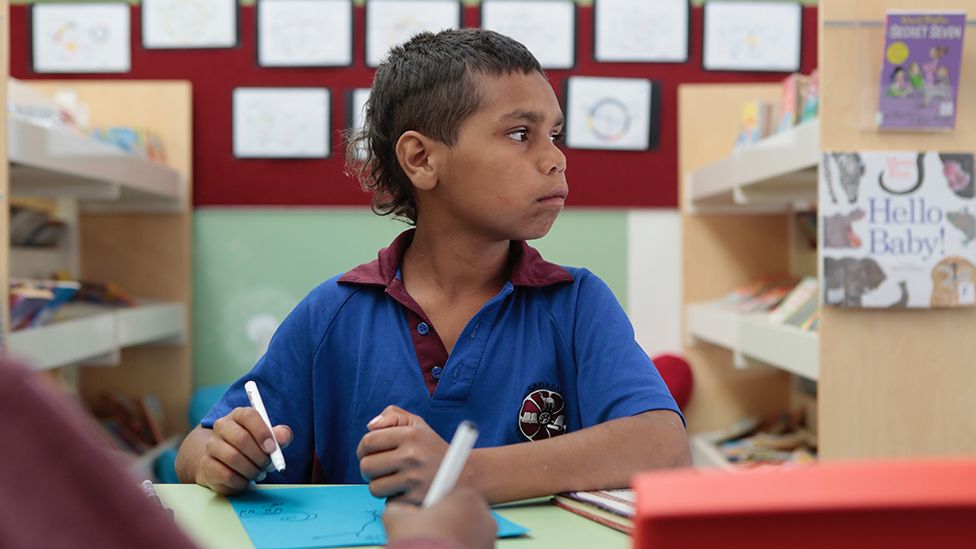
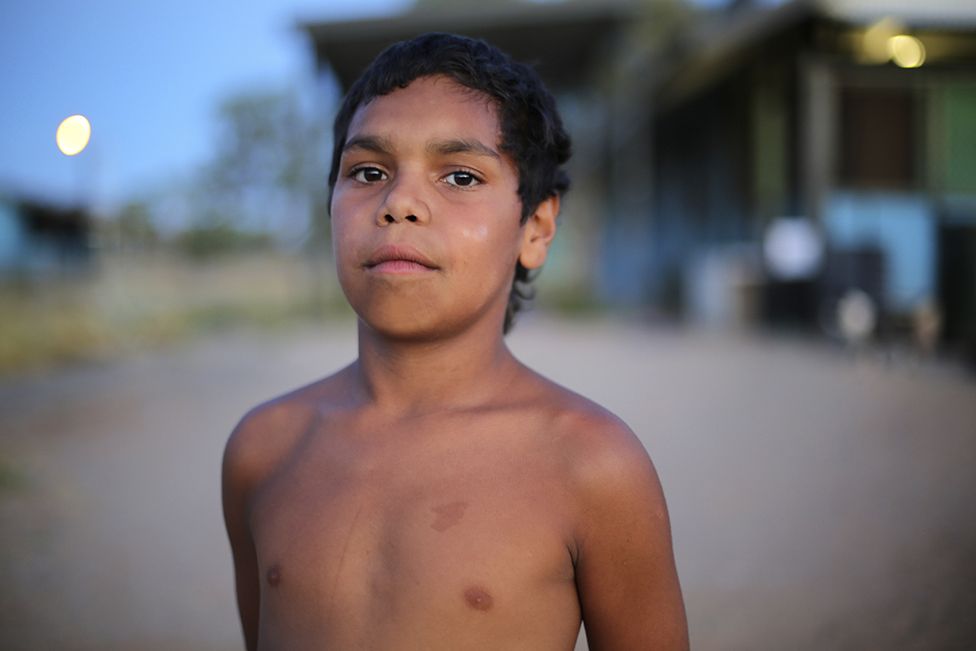
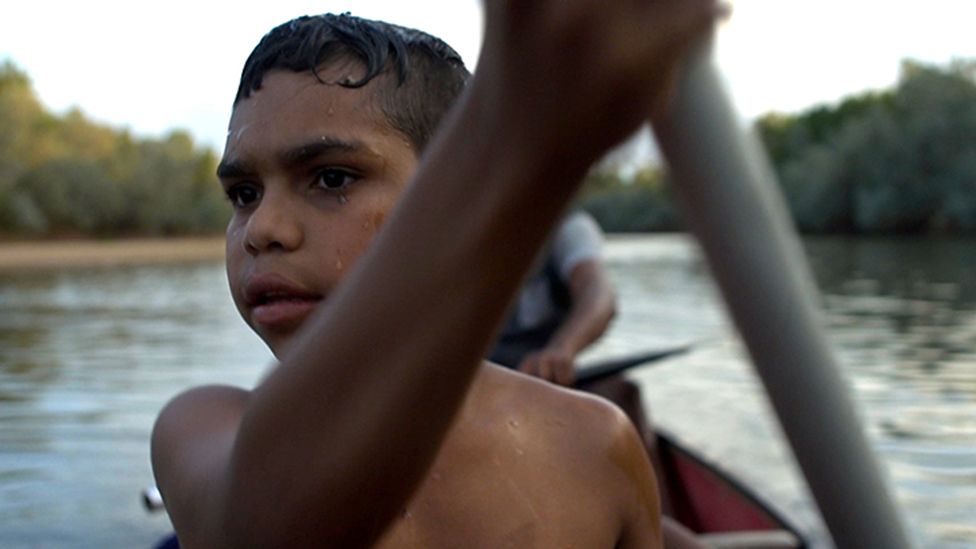
A documentary about a 10-year-old Aboriginal boy’s experience in school, In My Blood It Runs, has reignited a debate about Australia’s failure to give indigenous children a good education and a fair start in life.
“Listen carefully,” the teacher tells the class. “This one isn’t a story, this is information, or non-fiction – it’s fact.”
She’s holding up The Australia Book, a picture book from 1952, and reads: “In Botany Bay, Cook landed for the first time in a new country. Then he sailed up the coast, mapping as he went… On an island in Cape York he raised the English flag. And he claimed for the English country the whole of this new land.”
Dujuan Hoosan’s hand shoots up, but he doesn’t get the chance to speak.
Afterwards, the children have to find a list of words in the text and mark them with a highlighter. Dujuan, a 10-year-old Aboriginal boy, struggles a bit with the vocabulary, but he finds it even harder to recognise the story, because the history he has been taught by his elders is very different.
“That [lesson] was for white people, not for Aboriginals,” he reflects. “This man came on the ship and he was the first white man on Australia. The Aboriginal people told them to go and find another land, because this was their land. But people didn’t listen.”
Film-maker Maya Newell filmed the scene for her documentary, In My Blood It Runs – in which she followed Dujuan at school for a year – and could feel his frustration.
“You imagine what it feels like to be essentially erased from history,” she says.
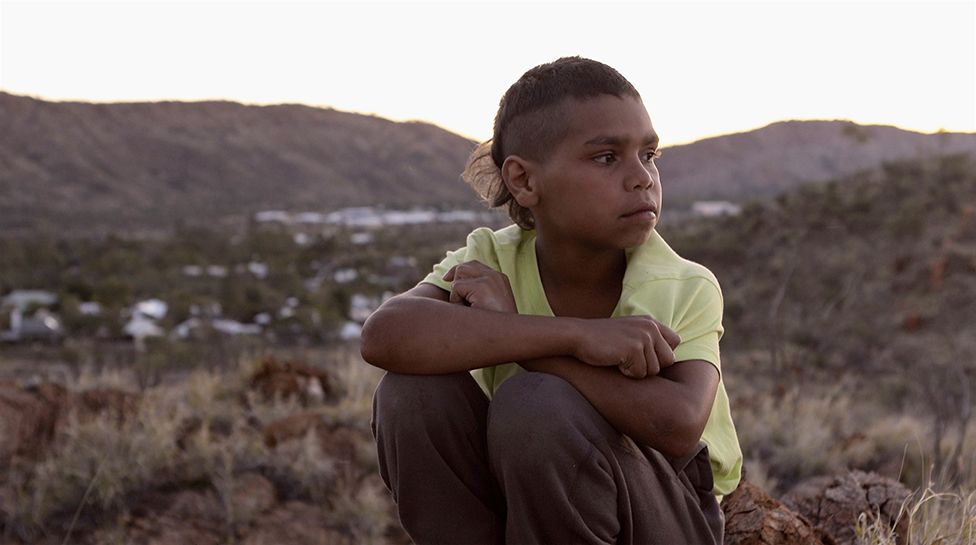
Maya and Dujuan first met “out bush” when Maya was filming a story-telling session in one of the red-earth deserts of central Australia. Sitting around a campfire at night, a rapt group of Aboriginal children listened as aunts and grandmothers told stories in the Arrernte language about how the world began and about their connection to the land.
Dujuan was an eager learner. He had already got to know quite a few plants with medicinal properties, and told Maya about his healing gift: when his family had aches and pains it was his job to lay hands on them, he said, using powers that had passed to him after his great-grandad died.
Maya was struck by the unusually confident and articulate 10-year-old. When Dujuan said she should make a film about him, she asked his family, and they agreed. They wanted to shine a light on the difficulties Aboriginal families face in Australian schools, and they trusted Maya, who had been working with their community for more than a decade, making educational films and archiving songlines (an ancient way of passing on laws and knowledge).
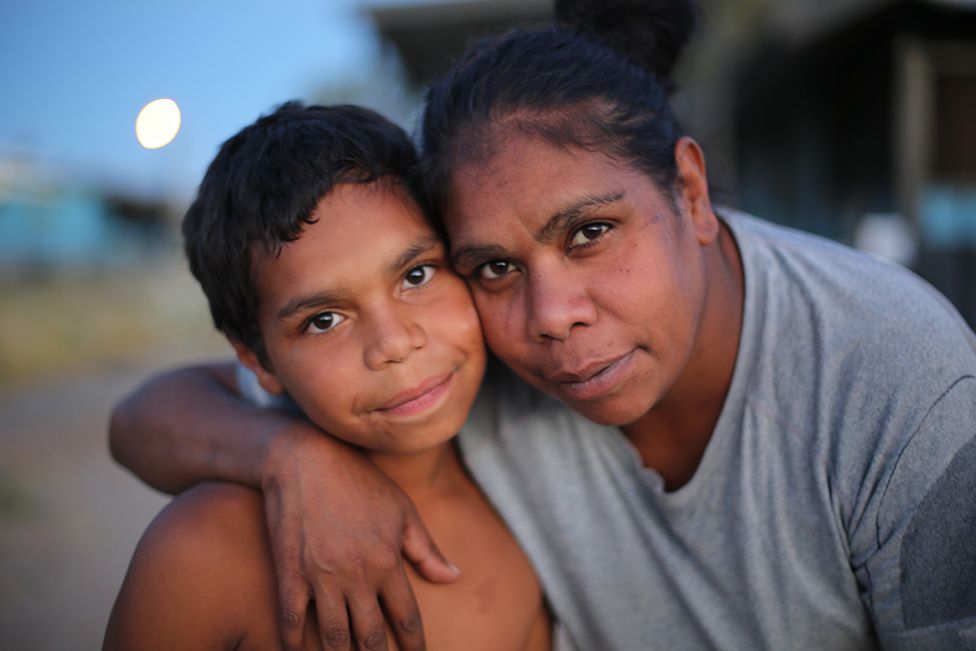
Maya began to spend two or three days a week with Dujuan’s family – his mother, grandmother and two brothers – recording day-to-day life in the Hidden Valley Aboriginal Town Camp, on the outskirts of Alice Springs. Some days there was no milk, so the boys ate breakfast at school. Some nights there was no electricity, so they played I-spy under the stars.
About 20% of the town’s 30,000 residents are Aboriginal, and most of them live in heavily-policed, run-down camps that sprang up in the 1960s, when many Aboriginal people were forced off their land.
“You grew up around drunks, smoking – then you start learning from that,” says Dujuan’s mum, Megan. She was expelled from school at 14, so her parents sent her to stay with aunties in the safety of the countryside in Borroloola, 1,260km (780 miles) north. That’s where she met Dujuan’s dad, James, who came back with her to Alice Springs with their first child, but left when they broke up, a few years after Dujuan was born.
“Being a teenage parent is hard, and being an Aboriginal mum is exhausting,” Megan says. “Every day you hear that you are not good enough – in the newspapers, on TV, on social media.”
She worries about her children getting into trouble, like she did, particularly “smart and cheeky” Dujuan. And as filming progresses, her fears are realised.
One day a teacher reads the class a picture book of the Dreamtime, the Aboriginal story of how the world began. It’s an effort to teach Aboriginal culture, but it’s not a great success. The teacher seems puzzled. “So they’re actually saying there’s a spirit?” she asks.
Dujuan reacts with emotion: “The spirit is real, man!”
When his report card arrives he gets very upset. He has the lowest grade – E – for every subject. He thinks there must be something wrong with him.
Soon afterwards, he gets angry and smashes a window; he is sent home and risks being suspended. He also starts skipping school, and this could have serious consequences – under strict rules brought in with the aim of improving educational outcomes for Aboriginal children, attendance is directly linked to income support and family assistance. If children are regularly absent, their parents’ welfare payments can be stopped. It also increases their risk of being taken into care.
Australia’s “national shame”
In 2008 the Australian government pledged to “close the gap” in outcomes for indigenous and non-indigenous people in terms of life expectancy, child mortality, education and employment
Last year the government acknowledged that most of the seven targets had not been met – which Prime Minister Scott Morrison described as a “national shame”
When Dujuan doesn’t come home from school one day, his mum and grandma go out looking for him until late in the night. If the police find him first, they will report it to welfare, and he could end up in foster care – or worse, juvenile detention.
“You know, your little age is the right age to go to juvenile centre,” Megan warns him.
Aboriginal and Torres Strait Islander children are vastly over-represented in the Australian penal system. Nationwide, they make up close to 70% of those aged 10-14 in youth detention, despite being only about 6% of the population in that age group. In the Northern Territory, in which Alice Springs is located, the situation is even worse: at the end of March, 31 out of 33 young people in detention (94%) were Aboriginal.
“Trust me, juvenile is not a good place to be,” Dujuan’s aunt Alexis tells him. “You’re only going to end up in two places: a jail cell, or a coffin.”
“What’s a coffin?” asks Dujuan.
Dujuan’s family move him to a different primary school, one that offers a bilingual curriculum. But he skips classes here too, and his late-night adventures on the streets of Alice Springs continue.
He’s picked up by the police several times, and gets formal warnings that if he’s found causing a nuisance again he’ll be sent to juvenile detention, or taken into care.
“This is what happens to young boys in Alice Springs. This is the story of what it is to be a First Nations child in this country,” Maya Newell says.
Finally, after stealing a teacher’s car keys and throwing them on the school roof, Dujuan is expelled.
The Northern Territory department of education says its schools are supported to deliver the Australian curriculum framework in a “culturally responsive and engaging way” acknowledging the “rich culture and diversity” of the community.
It says schools can opt to use an “indigenous languages and cultures curriculum”, including tuition in any of 30 languages, and that they are encouraged to share decision-making with families, communities and industry partners.
But Dujuan’s family never felt these good intentions were reflected in the classroom.
“White people educate our kids in the way they want them to be educated, but I need [our kids] to speak the language,” says Dujuan’s grandmother, Carol.
Within living memory it was government policy to break the link between children and their Aboriginal ancestors and culture and to assimilate them into the white population.
Dujuan has grown up with stories of children being taken away to be brought up by white families. One of his great-grandmothers was taken, while another was hidden “way out bush” for safety.
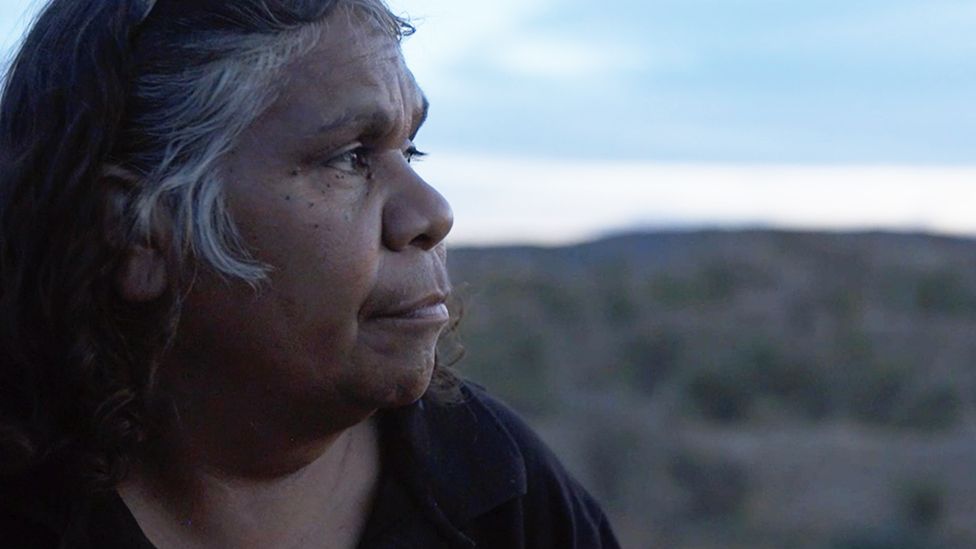
William Tilmouth, chair of Children’s Ground, a charity that teaches Aboriginal children through storytelling sessions like the one at which Dujuan and Maya first met, is an example of this “stolen generation”.
“I can remember my eldest sister telling me that when they used to see Welfare coming down the road all the mothers used to run out, grab the kids and run straight back into the house, that way Welfare couldn’t get them,” he says.
He and all his siblings, however, were forcibly removed after his mother’s death. The five oldest had whiter skin and were sent to Adelaide, where they were expected to “blend in”, he says. He and two brothers were taken 1,400km from Alice Springs to be brought up in a Methodist mission, where they were banned from speaking their language.
“We never knew who our family were,” he says. “It was a deliberate attempt to fragment the foundations of our lives, to the extent that we kept asking ourselves, ‘Who are we?'”
Dujuan is at least in no doubt about this. “I was born a little Aboriginal kid,” he tells Maya. “That means that I had a memory about Aboriginals. I just felt something, a memory. History. In my blood it runs.”
When William ran away from a children’s home he was placed in juvenile detention, which he describes as a “conveyor belt that led ultimately to the prison system”.
Only when he was 17 was he able to hitchhike back to Alice Springs, to be reunited with his father, three years before he died.
Although the policy of assimilation is no longer explicit, William says, the draconian rules governing education and welfare mean the system is still set against indigenous children. He sees many parallels between his story and Dujuan’s.
But Dujuan’s family come up with a strategy to keep him safe – the same one that was used in his mother’s case, before he was born. They send him to live in Borroloola, with his father, James Mawson.
“Kids like Dujuan go to detention centres. I wanted to move him away before that happened,” says his mum, Megan. “We Aboriginal parents do love and care about our kids.”
Despite the fact father and son have not seen each other for five years, it works out well. In Borroloola everyone pitches in, working the land and looking after cattle. Dujuan likes being able to spend weekends fishing or swimming in the family’s homelands – and there are no armed patrols on the street.
“Borroloola is like a little town where you are related to everybody. It’s better than Alice Springs, where there are many other kids that lead you into bad places, and lots of police that are watching over you,” he says.
He is also happier at the community’s small middle school, where 95% of students are indigenous.
“What I want is a normal life of just being me,” he says at the end of the film, still only 11 years old. “And what I mean by ‘me’ is, I want to be an Aborigine.”
Dujuan has since had to move out of Borroloola to finish high school. Now 14, he’s doing well, but he’s still not a huge fan. “It’s boring to be in school, but I know there is knowledge I need to learn there,” he writes via email.
After the Black Lives Matter protests last summer, the head of English, Andrea Jensen, decided her year nine class would read Follow the Rabbit-Proof Fence, the true story of three Aboriginal girls removed from their families in 1931 who walked 1,600 km (995 miles) home. In My Blood It Runs touches on many of the same themes.
But the students could also relate to the experience of not fitting in at school.
“I felt the same way as Dujuan did,” says Elvin, 14. “Because when I was in primary school, I had to go into this special place for people with autism or physical disabilities. When I went out at break time, everyone would go away because they didn’t want to play with me.”
Matthew, 15, says he was made to use a different entrance. “They put me in a room all by myself and they covered the window so I couldn’t see anybody else.”
Dujuan says: “I made the film to give other Aboriginal kids hope and strength, but I think it can give all kids everywhere that too.
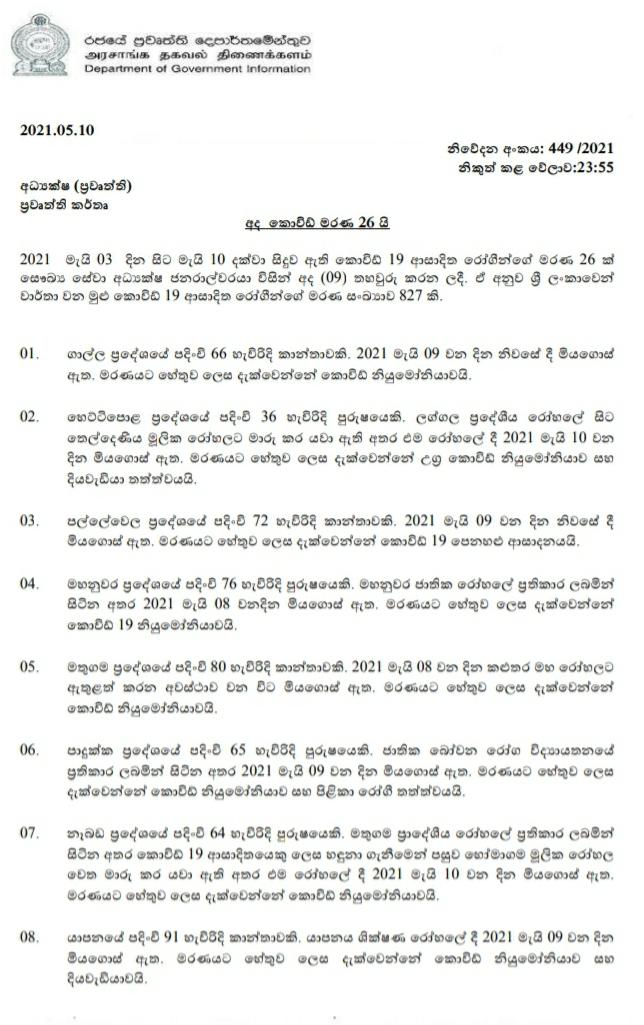
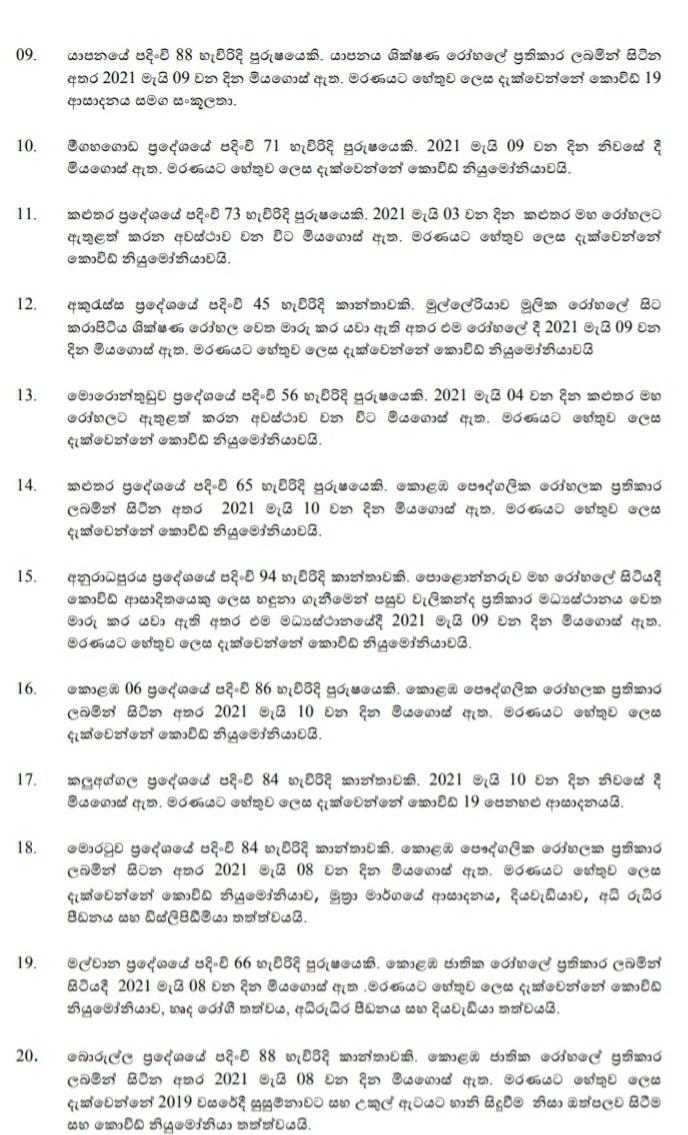
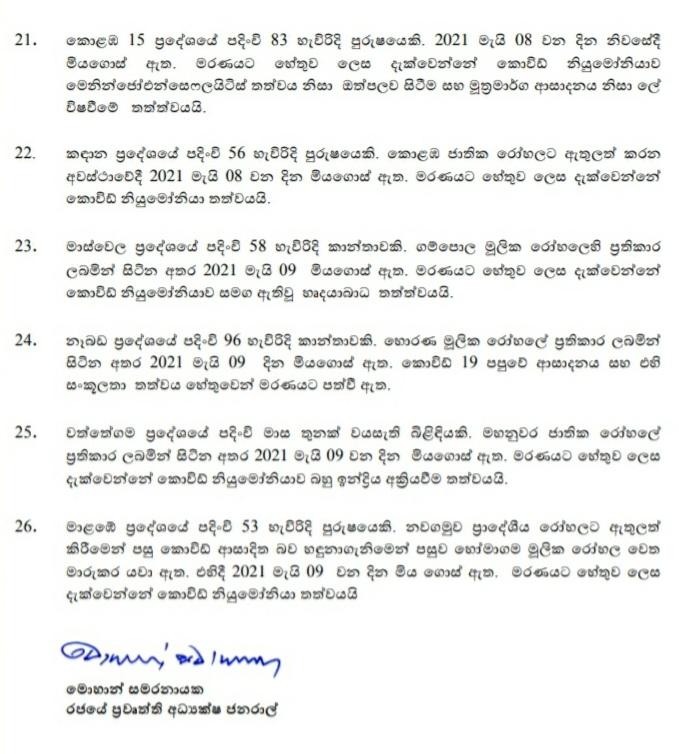
A total of 15 COVID-related deaths were confirmed in Sri Lanka today (May 09), says Director-General of Health Services.
The new development has moved the total number of COVID victims in the country to 801, according to official data.
The media release issued by the Department of Government Information stated that the victims had succumbed to the virus infection between the period of May 06 to May 09.
Human Rights
Watch (HRW) and Amnesty International supported the Report of the High
Commissioner for Human Rights. Human Rights Watch said that UNHCR, at its
upcoming session, should act on the recommendations of the UN High commissioner
for Human rights, and adopt a new resolution to enhance scrutiny of Sri Lanka’s
deteriorating human rights situation and pursue accountability for past and
recent violations.
President
Gotabaya Rajapaksa has withdrawn its support for the 2015 consensus resolution
seeking justice and reconciliation, and shown general disregard for upholding
basic human rights. UNHRC should act to
protect those most at risk and advance accountability for grave international
crimes,” Human Rights Watch said.
The UN High
commissioner’s report highlights Sri Lanka’s shocking record of complete impunity
for appalling crimes, and very disturbing developments under the Rajapaksa
administration,” said John Fisher, Director, HRW Geneva. The UNHRC has given
Sri Lanka every opportunity to address these issues over many years, and now
greater international involvement is needed to help protect vulnerable groups
and hold those responsible for grave international crimes to account,” he concluded.
Amnesty
International said: The international community must not turn a blind eye to
the deteriorating human rights situation in Sri Lanka, which is being abetted
by the government’s regressive moves on justice and accountability. The OCHCHR
warns that there are ‘clear early warning signs of a deteriorating human rights
situation and a significantly heightened risk of future violations.
Members of
the military leadership that were in command during the last phase of the war,
when allegations of human rights and humanitarian law violations are
widespread, were rewarded with promotions and positions of power under the new
administration, including to civilian positions. This has had a chilling effect
on victims demanding justice said Amnesty International.
’Amnesty is
calling on the UN Human Rights Council to implement the report’s key
recommendations to put in place more stringent oversight on Sri Lanka,
including more robust monitoring and reporting on the human rights situation,
and the collection and preservation of evidence for future prosecutions. UNHRC must
take urgent steps to address the worsening human rights situation in Sri Lanka.
The Human
Rights Council must take steps to end the cycle of impunity by holding the Sri
Lankan government fully to account, and launching a new internationally agreed
justice process,” said David Griffiths Director of the Office of the Secretary
General at Amnesty International..Amnesty International’s findings reveal a
pattern of targeting those who have played an active role in investigating,
documenting, litigating, or reporting on human rights violations and abuses,
and advocating on behalf of the victims, including at least six incidents where
lawyers were targeted.
The UN report
lays bare Sri Lanka’s abject record on delivering justice and accountability
and the decaying effect this has had on human rights in the country. The
seriousness of these findings highlights the urgent need for the UN Human
Rights Council to step up its efforts in Sri Lanka.”
For more
than a decade, domestic processes have manifestly failed thousands of victims
and their families. Given the Government’s decision to walk away from
resolution 30/1 and regression on the limited progress that had been made, the
Human Rights Council must send a clear message that accountability will be
pursued with or without the cooperation of the Government said Griffiths.
China took the
opposite view. China extended strong support to Sri Lanka at the Interactive
Dialogue. China’s Permanent Representative in Geneva Ambassador Chen Xu said it
is the consistent stand of China to oppose politicization and double standards
on human rights, as well as using human rights as an excuse in interfering in
other countries’ internal affairs. We are concerned about the clear lack of
impartiality shown in the OHCHR’s report to this session on Sri Lanka and
express our regret over the failure of the OHCHR to use the authoritative
information provided by the Sri Lankan Government. The so-called preventive
intervention” and the proposed targeted sanctions contained in the OHCHR’s
report are clear interference in the internal affairs of Sri Lanka and exceed
the mandate of the OHCHR.
The
Government of Sri Lanka also strongly rejected the Report. Sri
Lanka pointed out that the Office of the High Commissioner was bound by United
Nations Resolution 60/251
. United Nations Resolution 60/251 said
that the work of UN Human Rights Council shall be guided by the principles of
universality, impartiality, objectivity and non-selectivity, constructive
international dialogue and cooperation.
(clause 4)
The preamble to United Nations Resolution 60/251 said the UN recognizes the importance of
ensuring universality, objectivity and non-selectivity and the elimination of
double standards and politicization.
The preamble also said that the promotion and protection of human
rights should be based on the principles of cooperation and genuine dialogue
and aimed at strengthening the capacity of Member States to comply with their
human rights obligations.
The Report
was subjective and biased” said the government. It was intended to mislead the
international community, said Sri Lanka.
This report
shows that the OHCHR wishes to directly intervene in the internal affairs of
our country. The Report
has broadened its scope, and included issues of governance and matters that are
essentially domestic in any self-respecting, sovereign country.
High
Commissioner Michelle Bachelet has overreached her jurisdiction and has
interfered with the independence and sovereignty of Sri Lanka by releasing this
new UN report. She cannot challenge appointments made by the head of state of a
sovereign country and interfere with its internal affairs and independence. She
must be advised not to overreach her scope of authority in this manner.
The Report wants
Sri Lanka to remove from office Security Forces personnel and other public officials
alleged to have committed war crimes. The alleged charges were not proven
against any of the officers. The removal of such officers without being proven
guilty would be a violation of their human rights.
The continued
chorus in the Report that credible allegations of serious violations of international
humanitarian law amounting to war crimes having been committed during the
separatist war, however, remains unsubstantiated with the absence of
substantive related evidence, said Sunday Times ,
Here is the full statement made by the government of Sri Lanka to the OHCHR
Report:
The OHCHR Report which is
presented today, emanates from the Resolution 30/1 and 40/1, from which the
Government of Sri Lanka announced its withdrawal of co-sponsorship, at the 43rd
Session of this Council last year. Sri Lanka rejects the High Commissioner’s
Report which has unjustifiably broadened its scope and mandate further,
incorporating many issues of governance and matters that are essentially
domestic for any self-respecting, sovereign country. This is in complete violation
of Article 2 (7) of the Charter of the UN that states: Nothing contained in
the present Charter shall authorize the United Nations to intervene in matters
which are essentially within the domestic jurisdiction of any state…”
The trajectory that has emerged
with regard to the recommendations and conclusions reflects the preconceived,
politicized and prejudicial agenda which certain elements have relentlessly
pursued against Sri Lanka. These recommendations are based on ill-founded
allegations.
Sri Lanka categorically rejects
the conclusions and recommendations in the High Commissioner’s Report. The call
for asset freezes, travel bans, references to the ICC and the exercise of
universal jurisdiction by individual States, based on evidence that up to date
has been denied access to and retained by the High Commissioners Office with
some of it unreleased for thirty years, particularly in relation to a country
like Sri Lanka which has consistently and constructively engaged with the UN
and its mechanisms, points to a distinct and eminent danger which the
international community as a whole need to take note of. Such unilateral
actions by certain countries are unacceptable and a violation of the principles
of natural justice.
In addition to the progress made since
last March, Sri Lanka has provided written comments on instances of erroneous
information, misconceived and arbitrary assessments in the Report. It is
regrettable that the High Commissioner’s Office published its Report,
accompanied by an unprecedented propaganda campaign on it and refused to
publish our Comments on the report as an addendum. This has deprived Sri Lanka
and Members of equal visibility of Sri Lanka’s views on the report.
Sri Lanka refutes the allegations
that have been reproduced in the High Commissioner’s report, from the highly
contentious Report of the Panel of Experts (PoE) on Accountability and the
Report of the High Commissioner’s Office Investigation on Sri Lanka (OISL),
which have been rejected by Sri Lanka for reasons explained to this Council
before. The contents of the Report which have been drawn from the said disputed
reports are rife with factual inaccuracies that appear to equate atrocities
committed by the LTTE, a terrorist organization proscribed internationally,
with legitimate action taken by the Government to safeguard the territorial
integrity of the country and the right to life of our people.
The insistence on ever-expanding
externally driven prescriptions, notwithstanding our continuous cooperation and
engagement with this Council and all UN bodies, can pose numerous challenges
and such processes could set a dangerous precedent affecting all Member States
of the UN.
We regret the disproportionate
attention drawn to Sri Lanka by this Council, driven by political motivations.
Sri Lanka calls upon the members of this Council that any resolution which is
based on this Report, be rejected by the Council and be brought to a closure.
We remain open to engaging
constructively with the UN, including this Council, and the international
community in mutually agreed areas, in conformity with the Constitution and in
keeping with domestic priorities and policies.” End of statement. (Continued)
Colombo, May 8: The Harmony page has been since last month featuring articles from the north-east of Sri Lanka and pertaining to ethnic and religious harmony as well as human wellbeing. We have promoted the concept of dedicating May as a month of peace in Sri Lanka as the nation marks the 12th year of defeating terrorism. Below is the link of the Harmony page article of last week and several related editions.
In the next few weeks, the Harmony page hopes to continue the detailed research it started last month in the interior of the north-east of Sri Lanka, especially in now almost forgotten areas such as Mulliwaikkal, the last bastion of the war. We hope to find out the humanitarian day-to-day needs of the people, beyond the boundaries of local and international politics.
Our last week’s article will reveal some of the difficulties faced by the people. It will also reveal the perseverance, the courage and the incredible potential of using the north-east human capacity for the economic wellbeing of not just that region but the entire Sri Lanka.
Sri Lanka is the only country in the world which provided amnesty and pardoned an entire fighting force of an internationally proscribed terror organisation. Although receiving skill training and successfully de-radicalised, and re-integrated back to society, and today leading peaceful lives, these individuals and their families face much difficulty, with lack of employment opportunity. This has led to suicide and mass scale depression which is a phenomenon that should not occur in any country, especially a country which is known as a Buddhist country.
To reverse this situation all it takes is some genuine commitment. We should stop merely waiting for Western foreign agencies or foreign donors to look into the wellbeing of our people. Our people are our people. Whether they are Sinhalese, Tamils, Muslims or Burghers. Sri Lanka can easily eradicate poverty whether in the north or south if every profit-making business institution in this country undertakes to assist in the entrepreneurship creation of each poverty-stricken family.
This is what the Harmony page hopes to encourage with the support of Nisthar Cassim, the editor of the Daily and Weekend FT. In what we hope will be a sample media initiative in Sri Lanka the Harmony page will assist Sri Lankan youth such as university students and others, especially between the ages of 18 and 25 to create the link between private companies and families in the north and south.
In the north it will be families such as the beneficiaries who were rehabilitated and integrated back to society and those who are disabled. As needed, we will be in contact with the related institutions of the Sri Lankan Government for security and other considerations, following normal protocol. In the southern areas we are aware that there are still families in acute poverty and that some of these families have a history of being involved in the 1971 and 89 Marxist insurgency.
The way this wellbeing assistance model will work is as follows:
Young people will be mobilised through universities and other educational/vocational institutions to make a list of private companies in Sri Lanka and thereafter to engage with them.
Private companies, especially local companies of diverse stature, including young entrepreneurship ventures set up by young people, will be requested to support in the building of two to three rooms and a toilet and bathing area for identified north beneficiaries. The identification of the beneficiaries will be with the assistance of related Government officials.
All money-related matters will be solely between the beneficiary and the business sponsor. The business sponsor can to their advantage use the ‘marketing’ of their brand as part of their Corporate Social Responsibility framework. For example, its products, etc., could be featured on the walls that they are building. These are once again totally up to discussions between the beneficiary and the sponsor.
After the assistance of the housing renovation/construction, these beneficiaries will be then linked to those having technical skill in product making in diverse sectors. Where relevant the business companies assisting in the construction/renovation of homes can also help in the entrepreneurship creation as benefitting their own business goals.
The identified youth to facilitate the program will be mobilised to create a detailed list of every kind of innovative skill that could be used for entrepreneurship.
Sri Lanka’s heritage, the heritage of the north such as the intangible cultural heritage of Siddha medicine and the northern tradition of cuisine, design, arts, crafts, and construction will be utilised.
The concept of integrated home tourism will be introduced first to the north of Sri Lanka as the culmination of a five-year research begun in 2017 by Surya Vishwa, founder of the Harmony page. This is linked to her concept of integrated education/knowledge tourism on which academic abstracts have been featured.
The integrated home tourism concept is part of the integrated knowledge concept to revitalise the human mind to interconnect different forms of knowledge and especially diverse arts/aesthetics, in order to create stimulating change for the self and society. This is opposed to knowledge being seen as confined to paper qualification.
The knowledge connected to mother nature, the soil, water, plants and indigenous medicine, which this Harmony page has dedicated itself to in the past three years will be a key component of the integrated knowledge concept.
The integrated knowledge-based home tourism will be used consistently for national reconciliation through local tourism, and especially aimed at linking southern Lankan families with those in the north.
The concept of integrated knowledge tourism will be promoted especially during school holidays where southern families with children and youth will be encouraged to visit and stay with northern families, especially in remote areas of Kilinochchi, Mullaithiviu and Mannar in the homes built with the assistance of diverse Lankan companies.
Thus, Sri Lanka can showcase to the world the home tourism concept being used not just for integrated entrepreneurship, economic wellbeing and knowledge enhancement but also national reconciliation and peacebuilding.
International and local events such as bookfairs/knowledge camps/reading camps will be encouraged as part of the above concept.
The first such affiliation being considered is the Northern Children’s Book Festival and Children’s Literature promotion to be carried out by the Lankan chapter of the International Board on Books for Young Children early next year.
The assistance for rural homes in the north-east and south to build up trilingual home libraries is envisaged.
Book knowledge will be encouraged to be used as a vital living component to create innovation and idea stimulation for combining economic, spiritual and mental wellbeing. This combination will be consistently promoted in the north-south facilitated entrepreneurship creation combined with the home tourism concept.
Once the COVID-19 pandemic eases this model will be promoted globally. We will be focusing on tourists such as biodiversity experts and those such as innovators who strive to replace non bio degradable products.
The youth we are training for this overall endeavour will be mobilised to create vast links across the world to identify persons and institutions who respect mother earth and whose inventions are focused on protecting and not destroying nature.
Promoting nature-based innovation will be a core component of the integrated knowledge and integrated home tourism concept.
We would like all individuals and companies who would like to support this endeavour to contact Nisthar Cassim on nistharcassim@gmail.com and Surya Vishwa on 0777 27 33 95. The facilitator of this initiative, Surya Vishwa, will not at any point get involved in handling money. Her role is only as the creator of the concept and as the mobiliser and facilitator. The financial interaction is purely between the business company volunteering the support and the beneficiary.
As a policy this initiative will not include any INGO or NGO or foreign agency support. This is an initiative that will encourage and motivate Sri Lankans to take responsibility for fellow Sri Lankans and for the wellbeing of their country. If INGOs or NGOs or foreign agencies which to support the people of the north as well as rural south using the information of our research on the day-to-day difficulties faced by them, they could do so directly with the people concerned, in collaboration with the Sri Lankan Government. Where needed we can support this facilitation.
We encourage Sri Lanka’s retired military officials who are now working in the private sector to assist us.
(The author/concept developer is a Sri Lankan who strives to transcend beyond inherited birth identity. She has a keen interest in comparative spirituality and indigenous knowledge. Her academic training has been in sociology and she is a curriculum writer and visiting lecturer in Mass Communication at a national university in Sri Lanka under her inherited family name. She has for over 20 years worked as a writer for local and international publications and has been associated with the peace building/training sector. Her library of 15,000 books, of which a large number is on global literature, science, comparative religions and secular spirituality has been opened up for the public free of charge. She cultivates trees using ancient biodiversity centred methods of cultivation and promotes the concept of ‘Integrated Knowledge’ linking diverse aspects of knowledge to create stimulating thinking and innovative practical initiatives that benefit the individual as well as the country).
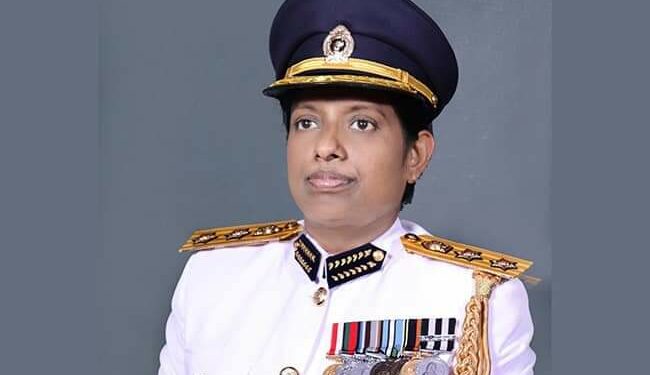
Colombo, May 8 (Daily Mirror) – Lawyers of DIG Bimshani Jasin-arachchi, who was removed from her duties as the DIG in charge of the Police Ombudsman Range, has written to IGP C.D. Wickramaratne urging him to immediately reinstate her back to her assigned duties or allocate other suitable duties, a statement from her lawyers said.
He said IGP C.D. Wickramaratne had instructed to remove DIG Bimshani with effect from May 1 in line with the programme to regularize the police service. DIG Rohana said that DIG Bimshani would be appointed to a new post by the IGP soon.
He said following the removal of her, a staff DIG has been appointed to the Police Ombudsman Division. It is reported that the move to remove DIG Bimshani from her assigned duties comes following the filing of the petition by a group of Senior Superintendents of Police (SSPS).
Bimshani Jasin Arachchi was appointed as the first ever female DIG in Sri Lanka in October 2020. (Jamila Husain)
Muscat: Indian nationals looking to return to Oman and other countries of residence can no longer travel through Sri Lanka, after the island country stopped issuing visas to them, thereby preventing them from completing their quarantine processes there before flying to their destination.
However, Sri Lanka’s Civil Aviation Authority has decided to stop issuing visit visas to passengers arriving from India, taking away from them this route of leaving the country, further reducing the options available to those who wish to leave the subcontinent.ADVERTISING
In accordance with instructions received from the health authorities of Sri Lanka due to the COVID-19 pandemic situation, it is hereby directed that passengers travelling from India will not be permitted to disembark in Sri Lanka with immediate effect,” said a circular signed by Captain Themiya Abeyawickrama, the Director General of Civil Aviation and CEO of the Civil Aviation Authority of Sri Lanka.
The aforementioned restriction will be reviewed as early as possible, based on instructions from local health authorities,” he added. A travel agent operating across the Sultanate said he had been fielding calls from passengers who had tried to frantically make last-minute changes to their bookings.
Unfortunately, however, there are very few alternatives available to him.
Sri Lanka has stopped issuing visas because they are concerned about the Indian variant of COVID-19 entering their country,” said Faiyaz Khan, general manager for Travel Point. They are also dealing with the pandemic, and they don’t want their hospitals possibly overwhelmed by this strain. They have also seen an increase in COVID cases lately.
We had all the agreements lined up with the Civil Aviation Authority of Sri Lanka, the packages were ready, we had many people willing to take them as well, but now we need to put all of this on hold until the situation can be resolved,” he added.
One of the alternatives available to Indian nationals, he said, was the Maldives, but the Indian Ocean country also decided to stiffen visit rules for people travelling from India: passengers can quarantine there, but only on islands not inhabited by locals.
Maldives is unfortunately a very expensive proposition for many Indians right now, so they have cancelled their flights or postponed them for the next month, in the hope that things will get better by then,” Khan said.
We had looked at Nepal as another alternative, but after the spike in cases there, all domestic and international air travel has been banned by that country as well, so there not a lot of options left for people.”
It’s not just Indians travelling to Oman: we get requests from people travelling to other countries as well. Indians in the UK, for example, used Turkey as a quarantine location, before flying onward, but the British authorities have put Turkey on the red list, so no flights are allowed from there. Armenia is another option that is being considered by Indians flying onward into Europe, the USA and Canada.”
Khan added that tour companies were waiting to see whether other GCC countries like the UAE or Qatar would once again allow in Indians. That would give them the chance to isolate there for two weeks before coming to Oman. While Qatar is allowing passengers to transit, visas are not being issued to those looking to complete their quarantine there before flying to their next destination.
The rules regarding travel are constantly changing right now, so it is unsure whether people can proceed with their plans,” he said. My advice to people is to not travel right now if you can help it.”
Currently, passengers flying to Oman from the following 16 countries are not allowed entry: Sudan, Lebanon, South Africa, Brazil, Nigeria, Tanzania, Ghana, Guinea, Sierra Leone, Ethiopia, the UK, India, Pakistan, Bangladesh, Egypt, and the Philippines. The rules also apply for passengers who have spent the 14 days prior to their flight to Oman in any of these countries.You Might Also Like
As many as 22 COVID-related deaths were confirmed in Sri Lanka today (May 08), says Director-General of Health Services.
The new development has moved the total number of COVID victims in the country to 786, according to official data.
The media release issued by the Department of Government Information stated that the victims had succumbed to the virus infection between the period of May 02 – May 08.
The deaths were reported from Ragama, Kadawatha, Mulleriyawa, Thalawathugoda, Moratuwa, Lunuketiyamadiththa, Padiyapelella, Colombo 08, Bulathkohupitiya, Hunnasgiriya, Katugastota, Halgranoya, Horampella, Ganemulla, Gurudeniya, Bibila, Agalawatta, Walahanduwa, Poddala, Galagedara and Gannoruwa areas.
Sixteen of the victims were aged between 60-70 years while four others were aged over 80 years. The remaining two were aged 57 and 58 years.
COVID pneumonia was identified as a cause of death of majority of the victims. Some had suffered from sepsis, heart disease, acute kidney injury, diabetes, hypertension, dyslipidemia, acute coronary syndrome and bronchitis as well.
The Epidemiology Unit of the Health Ministry reports that another 926 persons have tested positive for COVID-19 in Sri Lanka, moving the daily total of new cases to 1,896.
According to the Government Information Department, 1,890 of the new cases reported today are associated with the New Year coronavirus cluster. Meanwhile, the remaining 06 were identified as arrivals from foreign countries.
This brings the total number of confirmed cases of coronavirus reported in the country to 123,234.
As many as 103,098 recoveries and 786 deaths have been confirmed in Sri Lanka since the outbreak of the pandemic.
Epidemiology Unit’s data showed that 19,350 active cases are currently under medical care.
The UN High
Commissioner for Human Rights, (UNHCHR) presented to the 46th
session of the UNHRC in February 2021, her report on Sri Lanka. (UN Doc
A/HRC/46/20). This is the latest in the stream of reports on Sri Lanka since
Sri Lanka won the Eelam war. This report can be read at https://undocs.org/en/A/HRC/46/20.
The
Commissioner stated that the Report was prepared in accordance with Human
Rights Council Resolution 40/1 of 2019,
in which the Council requested the Office of the United Nations High
Commissioner for Human Rights to assess the situation in Sri Lanka and to
present a comprehensive report at the 46th session of UNHRC. The
report was formally presented to the Human Rights Council at the 46 session in
February 2021, followed by an interactive dialogue.
The Report is
not a normal report, carrying a well
thought out independent assessment of facts. It is a lament written by the
Tamil Separatist Movement. Here are some of its complaints.
The report
complains that policies are in favor of the Sinhala Buddhist majority.
The archaeological
committee for Eastern province is composed totally of Sinhalese including two
Buddhist monks. Tamils and Muslims are left out
President has
appointed a committee of senior Buddhist monks to advise him.
Tamil and Muslim minorities are being
increasingly marginalized and excluded in statements about the national vision
and Government policy.
Muslims are
stigmatized as carriers of Covid.
Muslims who died of Covid were cremated, not
buried as they requested.
The national
anthem was not played in Tamil on Independence Day 2020.
31 Department
are now under the Ministry of DefEnece, including police, telecommunications, ICTA, Department of
immigration and emigration.
There is
militarization of government functions.
Military is
administering the Covid quarantine
centers and military officers have been appointed chief coordinating officers
in all districts to control Covid.
President has
appointed around 28 military persons, to key administration posts. Some task
forces are composed entirely of military, intelligence and police personnel.
The
Government has appointed active and former military personnel, including those
charged with war crimes to key positions in the civilian administration.
Some of them,
such as Defense secretary, Gen. Kamal Gunaratne, who commanded the 53rd
Division at the end of the civil war, and Chief of defense staff, Shavendra Silva,
are considered to have committed war crimes in the Eelam war. They were
promoted to the rank of General.
The present
government has set up a Presidential Commission of inquiry to investigate
allegations of political victimization of public officials, and armed forces by
the previous government.
The
government issued an order to halt the prosecution of former navy commander
Wasantha Karannagoda and Commodore DKP Dissanayake over the disappearance of 11
persons.
The investigations into the murder of Lasantha
Wickrematunge and Prageet Eknaligoda have been halted.
Shani
Abeysekera has been arrested.
Nishantha Silva left the country.
There have
been a series of deaths of criminal gangs in police custody
One such
death is that of Makandure Madush. The Report says it was wrong for the police
to have killed him. Makandure Madush was a leading figure in the underworld. He
headed a large-scale heroin racket. He had carried out countless robberies, and
a large number of murders, including those belonging to rival gangs. Makandure Madush
was behind many organized criminal cases that took place in Sri Lanka.
On the other
hand, the Report objected to the presidential pardon granted to Sergeant Sunil
Ratnayake, found guilty of killing Tamils at Mirusuvil. The exercise
of presidential pardon must comply with international obligations under
international human rights law and international humanitarian law, said the
Report. No pardon should be given for those responsible for international
crèmes and gross violation of human rights.
The Report
draws attention to the tens of thousands of survivors of the Eelam war, —
spouses, parents, children, and other relatives — from all communities who
persist in seeking justice, reparations and the truth about the fate of their
loved ones.
The Report
goes on to make gloomy predictions. UN High
Commissioner for Human Rights stated that she is deeply concerned by the trends
that have emerged over the past year, in Sri Lanka. Sri Lanka remains in a
state of denial about the past, with truth-seeking efforts aborted and the
highest State officials refusing to make any acknowledgement of past crimes,
she said.
There is the
possibility that Pohottu government will carry out more human rights violations.
Also that Pohottu will return to the
earlier policies and practices that led to war. Pohottu may also take action to stop accountability
for past crimes. There is serious risk of future violations. OHCHR calls for strong
preventive action.
There is a shrill call for the UNHRC to take further action on Sri
Lanka. Human Rights Council should urgently pay attention to these early
warning signs
of more violations to come and continue its close monitoring of developments in Sri Lanka. The Human Rights Council is at a critical
turning point in its engagement with Sri Lanka, said the Report.
The Report recommended the following to the UNHCR.
Request OHCHR to enhance its
monitoring of the human rights situation in Sri Lanka, including progress
towards accountability and reconciliation, and report regularly to the Human
Rights Council;
Support a dedicated capacity to
collect and preserve evidence for future accountability processes, to advocate
for victims and survivors, and to support relevant judicial proceedings in
Member States with competent jurisdiction.
Apply stringent vetting procedures to
Sri Lankan police and military personnel identified for military exchanges and
training programmes;
Prioritize support to civil society
initiatives and efforts for reparation and victims’ assistance and prioritize
victims and their families for assistance in
scholarship programmes;
Review
asylum measures with respect to Sri Lankan nationals charged with war crimes.
The Report also drags in the Member states of the UN. The Report
wants the Member states of the UN to take action against Sri Lanka. Member states
are offered three options.
Firstly, they
could refer Sri Lanka to the International Criminal Court. Secondly, member
states could also bring Sri Lanka before their own national courts on the
principle of Universal Jurisdiction. Thirdly, member states could consider
targeted sanctions, such as asset freezes and travel bans on Sri Lankans charged
with war crimes. The High Commissioner also asks Member States to work with
UNHCR and support its investigation into Sri Lanka.
The report
concludes with un-solicited advice for the government of Sri Lanka. High
Commissioner recommends that the Government of Sri Lanka should actively
promote an inclusive, pluralistic vision for Sri Lanka. It must ensure constitutional and legislative
reforms. Order all security agencies to immediately end all forms of
surveillance and harassment against human rights activists, social actors, and
victims of human rights violations.
Lastly, the government of Sri Lanka must follow the recommendations and Resolutions
of the UNHCR. (Continued)
Sri Lanka on Friday (May 07) registered 19 more victims of COVID-19, marking the highest number of deaths recorded in a single day.
The latest victims have moved the country’s death toll to 764, the, the Department of Government Information stated.
According to official data, 06 of the victims were in their sixties while another 06 were in seventies. Three others were aged over 80 years. Meanwhile, the remaining four had been in their forties and fifties, reports revealed.
Further, COVID pneumonia has been identified as one of the causes of death of 16 victims.
The Epidemiology Unit of the Health Ministry reports that another 817 persons have tested positive for COVID-19 in Sri Lanka, moving the daily total of new cases to 1,914.
According to the Government Information Department, 1,889 of the new cases reported today are associated with the New Year coronavirus cluster. Meanwhile, the remaining 25 were identified as arrivals from foreign countries.
This brings the total number of confirmed cases of coronavirus reported in the country to 121,338.
As many as 101,763 recoveries and 764 deaths have been confirmed in Sri Lanka since the outbreak of the pandemic.
Epidemiology Unit’s data showed that 18,811 active cases are currently under medical care.
China-made Sinopharm COVID-19 vaccine will be administered to Sri Lankans starting from next week, says State Minister of Production, Supply and Regulation of Pharmaceuticals Prof. Channa Jayasumana.
The Sinopharm jabs are expected to be administered based on the coronavirus cases identified in each Grama Niladhari division, he noted.
Meanwhile, during a virtual discussion between President Gotabaya Rajapaksa and World Health Organization’s Director-General Dr. Tedros Adhanom, it transpired that approval would be given in another 2-3 days for the China-made Sinopharm coronavirus vaccine to be used for emergency use.
The National Medicines Regulatory Authority (NMRA) approved the emergency use of Sinopharm COVID-19 vaccine in Sri Lanka on March 20.
Later, a consignment of 600,000 doses of the vaccine donated by China arrived on the island on March 31.
Chinese nationals residing in Sri Lanka were given priority under the first phase of the Sinopharm vaccination drive in the country.
Sinopharm coronavirus vaccine, also known as BBIBP-CorV, is produced by China National Biotec Group (CNBG) – a subsidiary of China National Pharmaceutical Group Corporation (SINOPHARM).
Sarath Wijesinghe- President’s Counsel and former Ambassador to UAE and Israel, President Ambassador’s Forum
Nothing is Permanent in the world-What is permanent is impermanence
Nothing is permanent in the world – what is permanent is impermanence which
is the eternal truth according to Buddhist Philosophy , or any other religion
or concepts which are practised by the
mankind tested, observed, and proved to be correct. Is 99 year a long period in
the world of metaphysics’ and related computations is relatively a difficult
question to be discussed? It is a long time for a human or a living being but
the nations go on generation after generation with new subjects, subject to new
changes which is eternal. China waited for 99 long years to regain the
sovereignty of Hong Kong from British who had a legacy of acquiring sovereignty
of sovereign nations by any means which is not in conformity with international law they are expected to practice,
all times giving opportunities for lawyer and academics to discuss the subject
at length with many similar examples. Hong Kong is a tiny land but a
masterpiece on money trading and a Financial Hub , China maintains undisturbed
with a brilliant vision despite many differences on economic and financial
management ideologies though today China has the sovereignty on Hong Kong to
make any changes. Hong Kong is a historical site in the ancient Chine Empire,
it was captured by the British in 1842, and later in 1898, and the peninsula was
taken as a tax haven from the Chinese emperor for 99 years. Then reluctantly,
it was given back to China in 1999, when the 99 year lease ended. British had
to give up the Hong Kong region because they were sheep in the eyes of the world,
whose wealth and natural resources were
exploited by wolves. British has Hong Kong for 150 years, and the Chinese
authorities did not change the regime overnight. China has not made any drastic
changes and maintains sovereignty over the territory based on Hobbs theory that
sovereignty of a state is the ultimate authority exposition of international
law which regulates behaviour of states when international reputation and Concepts
of sovereignty is also ever changing under international law and practices
based on the situations then. For example the sovereignty over a territory
could be limited restricted or shared with anther nation. Portuguese, Dutch and
British had sovereign power over certain provinces of Sri Lanka during certain periods and thereafter British in 1815
by cheating the some Sri Lankan Chiefs in the upcountry by the infamous 1815
agreement after fighting with Sinhalese over 150 years killing hundreds of
thousands and destroying paddy fields and cattle with the maximum number in
1818 uprisings when Sri Lankans through history uplifted peaceful peace-loving
life with loving kindness to all based on Buddhism with no scars and
allegations of violation of human rights of won citizens or others worldwide. Damage including mass murders including
children, done by Portuguese and Dutch are recorded in (blood) red letters in
history. Obviously we have to learn a lot from history especially long term
international agreements entered into due to whatever the reasons. We have
experiences giving away our sovereignty partially and full in certain eras of
our history we must learn from. We are angry when they try to teach us peace,
loving kindness and human rights! It is in 1948 that we regained lost
sovereignty over the land from 1815 a long time again in the history of nations
now enjoying freedom as an independent nation and a senior and respected member
of the United Nation Organization. Lot Can be narrated on the sovereignty over
the Middle East countries, India during the western domination and similar
examples and precedents on sovereignty and actions of overriding acting’s taken
taking sovereignty away from legitimate nations. China appear not concerned on
the sovereignty of the Port City. They are in business not interested in
sovereignty of lands over others and the partnership with Sri Lanka appears to
be ideal.
Sovereignty of a Nation
Sovereignty of a state which is the supreme authority over the
territory is also is protected and guaranteed
by the international law via United
Nations under article 2(1) on sovereign equality and 2(4) based on the
principle on non-intervention which is cemented by Geneva Convention on
international relations and the accepted practices and conventions the states
adhere to. It is accepted and considered that we are a Sovereign Nation. But do
all member nations especially powerful and rich accept and consider so is a
moot point in terms of practical Universal Practice.
Sovereignty of a Nation
Is Sri Lanka a sovereign nation today? Is an interesting question when
the state has the full power over the territory and recognized by the United
Nations Organization as a member nation not permitted by other nations
interfere in international affairs. It is the duty of the member nations to
respect us and our sovereignty, unconditionally based on the convention of the
diplomatic relations entered into in Vienna naming Vienna Convention of
diplomatic relations commending the nations to respect all member countries’
irrespective of the size or the economic strength. With the setting up of the
Port City in the district of Colombo, a question has arisen on legal basis on
the economic zone established under the Port City Bill with sweeping powers to
do international business in the most competitive atmosphere which according to
the facilitators claim essential to do
business with the rest of the world competing the giants on the trade. Sri Lankan
state is a presidential model and the recent 20th amendment has
strengthened the executive powers of the president with a firm grip on the
administration along with the legislature headed by the Prime Minister – a
veteran politician and brother of the President, backing the President. Each
nation has sovereignty over the land, sea and air space partially or in full
depending on circumstances. The economic zone is constructed by a company in China
with no cost for the Sri Lankan state due to close, warm and long-time friendly
relations with the two nations over two thousand years bonded by religious,
cultural and personal contacts uninterrupted, with closer bonds by supporting
and facilitating China to be a world Power in the United nations when she had few
friends and needed friends then. With Rubber Rice pact with China and close
leadership bonds with the world leaders during non-alignment with charming and friendly friendship with ‘’Madam
Sirimovo Bandaraneika’’ friendships were enhanced with exchange of good will and
materials in kind such as the BMICH, and Court Complex which are monuments
exhibited to date. A nation has to be
economically and politically sovereign to be a fully-fledged sovereign nation.
Are we politically and economically sovereign are complicated relative issues
based on the large scale debts from international organizations, nations and
private sector, political issues connected to human rights, treatises we have
entered into such agreements and treatises as Indo Sri Lanka Accord when India now
demanding Sri Lanka to implement 13th Amendment – a by-product of
Indo Sri Lanka Accord , which according to Sri Lanka a domestic affair and
matter within the domestic jurisdiction of the independent nation. It is in the
midst of this that Sri Lanka has launched the largest ever FD said to be future
of Sri Lanka with a massive influx of funds from China Harbour Corporation – a
Chinese Company linked to the state. Massive influx of funds pumped is mainly
based on the strong friendship and connections in addition to the excellent
geographical situation unmatched in the world connecting all parts of the world
historically traditionally connecting sea, airspace and other links to the
world in the busiest Indian sea. This shows international relations and foreign
policy plays a main role in politics, economy and trade. The agreement of the
Port City runs for 99 years which is substantial in the life of the mankind.
Depend on the magnitude of the funds and labour spent it has to be a successful
project and all the signals are that it is on the right directions when
compared to some examples close to us such as UAE, Singapore, Israel, and
Malaysia – all success stories with
trial and error methods achieved by swimming in the dark, when we are blessed
with learning their success stories and
experiences freely available in order to
swim in broad day light with experiences gained and studies on and of the
success stories of leading world powers from nothing!. Let us now look into the
success stories of few as a learning process for us. India’s concern on the
massive Port City project is realistic and understandable in terms of India and
strained relationships with China and the mentality of regional hegemony on the Indian Ocean and
entire SAARC region. This is where Sri Lanka should play the cards well based
on long term friendly relations from the period of ‘’Arhath Mahinda’s’’ arrival
and even before during ‘’Ravana’’ era, on balancing exercises on foreign policy
learning lessons from Madam ‘’Sirimavo Bandaraneika’’ the best foreign ever in
Sri Lanka.
Vision and Visionaries in UAE, Singapore, Israel, Malaysia and Sri Lanka-
Learn from them
We respect UAE and achievements – once a fish marked in 1960 having blessed with oil
exploited the geographical situation and other factors such as sea routs and
airlines towards and passing through neighbouring countries set up the trade zone
with all novel devices and administrative measures in a disciplined
society successfully introducing the one
stop shop procedure with ease of doing
business within the zone which is implemented successfully to date
transforming UAE to a rich world power
with the tallest world tower, boost on
tourism trade and business with only 4% of oil compared to the rest of the oil
rich six emirates. ‘’Rashid Al Maktoum’’ is the Father of Dubai in the current
boom, and the visionary of the Nation, who was responsible for what UAE is
today who patiently studied the other success stories such as Singapore, Hong Kong,
Israel and few other success stories adopted a unique model for UAE, by filling
land, making manmade harbours with his vision as a visionary for the nation! He
is a go getter and an innovator introduced many novel and world famous places such
as the internet city, such as the tallest building, Media City and Financial Centre
to his credit with many other development schemes by employing professionals of
world repute as CEO’s and employing Asian labour mingled with only 18% local
population which is a real vision of a visionary which brought Dubai to the
limelight and a top financial, tourism, and a business Hub. As the person who
brought UAE to what it is today! Dubai airport and harbour is one of the
busiest and Jubal Ali Harbour the manmade Harbour is one of the busiest and
largest in the region. It is a business Hub and a tourist paradise, and a money
making world power as a centre of education, business and industries with lot
more and more success stories still growing. ‘Shaka Lubna’ – once the Trade
Minister from the Royal Family and the author of Why UAE? Visited Sri Lanka
with a trade delegation to discuss matters of mutual interest laying the
foundation of further friendship in order
to exchange views and experiences. The book why UAE deals with the
country, success, developments and guide of the country and guide to others in
real style to attract the world of investers. It is time now Sri Lankan Trade
Ministry or Tourist Ministry to edit a book on Why SriLanka? Following
footsteps of why UAE, Inviting given the world the potential and beauty of Sri
Lanka and abilities of Sri Lankans. Success of Singapore too is unique story with
the leading visionary Lee Kwan Yew popularly named LKY is transformed Singapore
a powerful financial Industrial and economic hub of the world hub of Asia who also introduced discipline and modern developments
to the unproductive barren land with no resources with inmates dealing in small
businesses and cottage industries. Singapore itself is a port city, a financial
Centre, and a Trade Centre transforming itself to a world financial Hub in an
exemplary manner. It is known and famous or International Arbitrations and one
of the busiest harbours in the region. ‘’Dr Manther Mohamad’’ is the visionary
of the current development of Malaysia as a developed nation and a financial
and a trade centre in the region. Israel is the other model country for us with the economic and innovation miracles and also a partly land filled due to want of space
and making Israel a miraculous economic centre as a financial hub in Middle
East midst of enemies around. Israel a tiny barren desert of 1/3 rd of Sri
Lanka with no water except disputed
Galali river 73 years ago is today a
world power and a nuclear power, due to the vision of the Visionary ‘Ben
Gurian’ and the innovative nature of the people who worked hard despite enemies
right round the land developed it to be land of agriculture and innovations by
desalination of sea water and managing the water well using in agriculture
using drip irrigation they introduced and shared with countries such as China
and India. They are the leaders in agriculture innovated to improve agriculture
based on innovations and technology making 95% of agriculture is technology.
Sri Lanka today has faced the main challenge with the economic downtown and
desperately in need of FD and assistance in development with the highly
educated but poorly planned and not maintaining standards on agriculture,
developments, export and generally in many aspects. Sri Lanka has had close
relationships with China over 2000 years and close to each other in
international dealings especially acknowledges the assistance of Sri Lanka, when
China needed help of close friends to obtain membership and a major power. Sri
Lanka maintained the foreign policy of friendly with all and angry with none
throughout with the themes non alignment and neutrality. China has given Sri
Lanka the highest ever FDI of 1.6 billion with the most prominent and modern
Port City governed by the Port City Economic Commission with direct supervision
of the President armed with 20th amendment and powers to appoint and
remove them when necessary. Government and the Port City has long thought
having studied the success stories of other enterprises worldwide in practice.
China has given Sri Lanka two major investment opportunities in Colombo Port
City and ‘’Hambatota Harbour’’ , based on the vision of the visionary Prime
Minister Mahinda Rajapaksa who masterminded both projects – especially the Port City project expected to
be the future of Sri Lanka. The bill was highly contested in the Supreme Court
heard by five judges including the Chief Justice to ascertain the legality and
constitutionality of the port city which is established for the establishment
of a special Economic Zone in order to set up a Commission empowered to grant
registration, licences and many other such propositions.
Sovereignty of the Port City as an independent entity
Port city is gazetted as a part of Colombo District and the details are
common knowledge to the average citizen following the serious of events out of
interest and curiosity. Mode of operation is clear cut with powers to the
Commission appointed by the President for a specific term with powers to change
on rotation or administrative requirements, despite concerns from the interested
citizens of the sovereign power of the Commission to act independently, with
questions of international norms such as ‘’Montevioco’’ theory on international
law that when a Unit has a defined territory, effective control, and ability to
enter into contracts with the outside world may
be considered a separate state as has been effected in Israel in 1948,
when USA recognized Israel as a separate state even without defined territory
in dispute then. This is a weak argument when Port City is a part of Colombo
district, with full control over the President of Sri Lanka, under whose
directions the Port City enters into contracts with the outside world. But the
fact remains that the Port City is given a certain amount independence and
powers to perform the duties to make the concept and the project a success,
which is the challenge to the Nation. It is clear that the sovereignty of Port
city is with the nation and the challenge lies on all of us to cooperate with
the project for the betterment of the future and future generation. Sarath7@hotmail.co.uk
When a COVID patient is admitted to an Ayurvedic Hospital, he/she has the freedom to choose the treatment he/she receives is Ayurvedic or Western, State Minister of Primary Health Care, Epidemics and COVID Disease Control Minister Sudarshani Fernandopulle said.
She said this during a meeting held to finalise the decision to use Ayurvedic hospitals in the country as Intermediate Care Centres to treat COVID patients.
The discussion held with the participation of Indigenous Medicine Promotion, Rural and Ayurvedic Hospitals Development and Community Health State Minister Sisira Jayakody, Director General of Health Services Dr. Asela Gunawardena, Ayurvedic doctors and other relevant officials today.
Accordingly, it was also decided to provide the Ayurvedic hospital staff with the basic training to deal with COVID patients and also to grant adequate facility to accommodate the patients.
All Ayurvedic hospitals across the country would be operated under supervision of Health Ministry officials.
The State Minister also requested the Director General of Health Services to issue a set of guidelines on the subject and make arrangements to operate Ayurvedic hospitals covering every district.
Moreover, a seven-member committee was appointed with the representation of both the State Ministries in order to make the necessary arrangements within a week.
State Minister Sudarshini Fernandopulle recently granted permission to Ayurvedic hospitals to treat COVID patients. (Sheain Fernandopulle)
The Ministry of Health says that another 546 persons have tested positive for the novel coronavirus today, pushing the daily tally of new cases reported to 1,851.
All new cases are associated with the New Year COVID-19 Cluster.
This increases the total COVID-19 cases count in Sri Lanka to 119,424 while total recoveries stand at 100,885.
17,805 patients infected with the virus are currently under medical care.
The Director General of Health Services confirmed eleven more Covid-19 related deaths today (06), as Sri Lanka’s death toll due to the virus pandemic rose to 745.
1. The deceased is a 73-year-old female resident in Inamaluwa. She was diagnosed as infected with Covid-19 while undergoing treatments in General Hospital Polonnaruwa and transferred to Special Covid-19 Treatment Center Welikanda where she died on 05.05.2021. The cause of death is mentioned as COVID Pneumonia and renal failure.
2. The deceased is a 52-year-old female resident in Kuliyapitiya. She was diagnosed as infected with Covid-19 while undergoing treatments in a private Hospital Kurunegala and transferred to the Teaching Hospital Anuradahpura where she died on 06.05.2021. The cause of death is mentioned as Cardio Respiratory Failure and multi organ failure due to Covid-19 pneumonia.
3. The deceased is a 71-year-old Female Resident in Katuwana. She was admitted to Base Hospital Katuwana and transferred to District General Hospital Embilipitiya where she died on 02.05.2021. The cause of death is mentioned as Covid-19 pneumonia.
4. The deceased is a 55-year-old male resident in Benthota. He was diagnosed as infected with Covid-19 virus while undergoing treatments in Colombo South Teaching Hospital and transferred to District Hospital Undugoda. She died on 06.05.2021. The cause of death is mentioned as Covid pneumonia.
5. The deceased is a 68-year-old female resident in Seeduwa. She was diagnosed as infected with Covid-19 virus while undergoing treatments in the Chest Hospital Welisara and transferred to the Base Hospital Mulleriyawa where she died on 04.05.2021. The cause of death is mentioned as Acute Respiratory Distress Syndrome and COVID-19 Pneumonia.
6. The deceased is a 78-year-old female resident in Mallewagedara. She was diagnosed as infected with Covid-19 virus while undergoing treatments in District Hospital Moratuwa and transferred to the Base Hospital Mulleriyawa where she died on 30.04.2021. The cause of death is mentioned as Heart disease and COVID Pneumonia.
7. The deceased is a 75-year-old male resident in Gelioya. He died on 06.05.2021 while undergoing treatments in Teaching Hospital Peradeniya. The cause of death is mentioned as Covid pneumonia.
8. The deceased is a 77-year-old male resident in Jaffna. He died on 05.05.2021 while undergoing treatments in Teaching Hospital Jaffna. The cause of death is mentioned as Septic Shock and left lower limb wound.
9. The deceased is a 72-year-old female resident in Udawalawa. She died on 21.02.2021 while undergoing treatments in District Hospital Embilipitiya. The cause of death is mentioned as Covid pneumonia
10. The deceased is a 43-year-old male resident in Buluthota. He was admitted to Base Hospital Kolonna and transferred to the District Hospital Embilipitiya where he died on 29.04.2021. The cause of death is mentioned as Covid pneumonia.
11. The deceased is an 81-year-old female resident in Colombo – 03. She died on 05.05.2021 on admission to the National Hospital Colombo. The cause of death is mentioned as COVID-19 Pneumonia, Hypertension and Diabetes Mellitus
When Pohottu
came to power in 2019 it informed the Human Rights Council of its decision to
withdraw Sri Lanka’s co-sponsorship
of UNHRC
resolution 30/1 and related resolutions 34/1 and 30/1. A responsible government is obliged to
withdraw from such a Resolution, said Pohottu.
The previous
government, a puppet government, in a manner unprecedented in Human Rights
fora, joined as co-sponsors of Resolution 30/1 which was against our own
country. It carried a host of commitments that were not deliverable and were
not in conformity with the Constitution of Sri Lanka.
For instance,
the Resolution called for hybrid courts with foreign
judges. . Foreign judges can be appointed only after an amendment to the
Constitution and a referendum”. Further, the government
had not obtained Parliament approval before co sponsoring the Resolution.
Pohottu was
supported by two clauses in Vienna Convention on the Law of Treaties (1969).
Article 45 warned that a state could not back out of an agreement if it had
supported it initially. So Pohottu had
to withdraw from the Resolution as soon as possible.
Article 46
provided the justification for withdrawing. Article 46 states: A State may not
invoke the fact that its consent to be bound by a treaty has been expressed in
violation of a provision of its internal law regarding competence to conclude
treaties as invalidating its consent unless that violation was manifest and
concerned a rule of its internal law of fundamental importance”.
The Core
Group on Sri Lanka at the UN Human Rights Council , comprising Canada, Germany,
North Macedonia, Montenegro and the UK, said they were deeply disappointed and
concerned” that the Government of Sri Lanka has changed its approach to UNHRC
Resolution 30/1. They decided to go for
a fresh Resolution in 2021. The Sri Lanka government was invited to join,
but
turned down the invitation to co-sponsor the resolution.
At the UNHRC
meeting of March 2021, this Core group put forward Resolution A/HRC/46/L.1/Rev.1 It was titled Promoting reconciliation, accountability and
human rights in Sri Lanka.” This
Resolution can be found at https://undocs.org/A/HRC/46/L.1/Rev.1
The
Resolution made it clear that it was the latest in a long line of UNHCR
Resolutions against Sri Lanka. The Resolution said it followed on the earlier
resolutions, 19/2 of 2012, 22/1 of 2013, 25/1of 2014, 30/1of 2015, 34/1 of 2017
and 40/1 of 2019. The Resolution also
remembered the joint communiqué of 26 May 2009 by the President of Sri Lanka
and the UN Secretary-General.
The Resolution
asked the Office of the Commission of Human Rights (OHCHR) to collect evidence on violation of
human rights and related crimes in Sri Lanka, with a view to advancing
accountability .This is the most important item in the Resolution. Thereafter, the OHCHR was
to present an oral update to the Human Rights Council, at its
sessions in September 2021. at its
forty-eighth session, a written update at its forty-ninth session of March
2022 and a comprehensive report at its
fifty-first session in September 2022.
The Office of
the High commissioner said that it was prepared to do so. ‘My Office stands ready to
continue monitoring the human rights situation, including progress towards
accountability and reconciliation’,
Bachelet responded. The High Commissioner’s office was given the authority to set up a special unit
to gather this information and a budget of USD 2.8 million to do so.
A new
Secretariat will function under Human Rights High Commissioner Bachelet, Sunday
Times reported. The Office of the High Commissioner has already advertised
calling for applications for the identified new positions.
This includes
One Senior Legal Advisor with experience in criminal justice and or criminal
investigations and prosecutions to co-ordinate the team. He or she will be
responsible for collection strategy; the development of a central repository to
consolidate, preserve and analyse information and evidence; co-ordinate the
processes of reviewing and sharing of information with national authorities for
universal jurisdiction and extra territorial jurisdiction cases and other
accountability purposes in line with relevant United Nations guidelines;
develop accountability strategy and engage with accountability mechanisms
including specialized investigators, prosecutors, judges, and other legal
practitioners both for information sharing purposes, to promote accountability
and advice on the development of accountability strategies; and liaise with
other Office of the High Commissioner for Human Rights (OHCHR), other
independent mechanisms and other UN systems to ensure co-ordinated approach.
”There will
be two investigators or Human Rights Officers with a background of criminal law
to research, collect and analyse information and documentation pertaining to serious
human rights violations, and international criminal law matters. Others include
two Legal Officers, two Analysts, Information and Evidence Officer, two Jurists
– Linguists, a Victim Support Officer, and a programme Assistant.
.
Funding
amounting to US$ 2,800,900 is required for the remaining part of this year for
this new team. Thereafter for 2022, a sum of US$ 2,064, 400 is estimated. This
fund requirement is to be brought to the attention of the UN General Assembly
when it meets for its 76th sessions in New York in September2021. It would have
to be approved by the Fifth Committee which is charged with financial
administration of the UN system.
Diplomatic
sources said that Australia and Norway were ready to offer the funds should
there be opposition. But they were very confident” such a situation would not
arise. In any case, the move for a new
Secretariat under the Human Rights High Commissioner will not be dropped.
The United
Kingdom together with the core group
are examining ways and means of pursuing issues related to future human
rights violations, said the media. Reports
emerging from diplomatic consultations among the sponsor and core group of
countries show that many options were being discussed.
What happens if members of the new Secretariat
under the UN Human Rights Commissioner are not allowed to visit Sri Lanka?
There have been suggestions for those concerned to visit as tourists. There
will also be references to trophy footage and evidence on the violation of
humanitarian law. In the coming weeks, there will be especially important
measures adopted by some core group members to take forward the resolution,”
said a western diplomatic source.
The government
of Sri Lanka is also adopting measures
to counter information gathering on future violations of human rights” by this
new Secretariat at the OHCHR , continued the media..
Seven Foreign
Tamil organizations have been proscribed through a Gazette notification. They
are based in the United Kingdom, Canada,
Australia, Germany, and France. The main group proscribed is the UK-based
Global Tamil Forum (GTF) which, together with the Tamil National Alliance
(TNA), has been at the helm of pushing through the Resolution on Sri Lanka. This
is the second time such a proscription has been re-imposed after the withdrawal
by the previous Yahapalana government
in 2016.
Also named
are 339 individuals who will not be allowed entry into Sri Lanka. Efforts are
being made by Tamil groups to appeal to western governments to counter this. This proscription means that
any person who has any dealings with those named in the Gazette notification
would be treated as an offender. Such a person will be liable for arrest. The
idea is to prevent them from transmitting any complaint or in helping in many
other ways.
The
government is also closely monitoring Non-Governmental Organisations (NGOs) and
International Non-Governmental Organisations (INGOs) which are funded in US dollars. Remittances from
different sources are being identified. This again is to prevent, among other
matters, funds being used to gather information on alleged victims of human
rights violations and fees for lawyers who produce affidavits. ( Continued)
By Noor Nizam – Peace and Political Activist, Political Communication Researcher, SLFP/SLPP Stalwart, Convener “The Muslim Voice” and Member “Viyathmaga”.
HE. President Gotabaya
Rajapaksa. Your Excellency should spare some of your very valuable and busy
time to visit/attend parliament more frequently please. When you are re in are
in attendance, the presence in parliament of MP’s of the government are nearly
99%.
Even the presence of
opposition MP’s are somewhat the same. But during the other parliamentary
sittings, it is “NEARLY EMPTY”. Those MP’s and ministers who speak,
only speak for the benefit “MEDIA” and the “TV cameras” in
an almost empty parliament. Excellency Sir, you should bring about a
“CHANGE” to this “bad parliamentary culture” please.
MP’s who do not attend
parliament during sessions should be withheld their “day’s
wage/salary/allowance” as a penalty/punishment for not being present in
the chambers.
please. That should
NOT mean that they can come, mark present and then leave the chambers. They
should be in attendence throughout the sessions.
The Hon. Speaker of
the House should be adviced to follow the “rule of sitting in their
allocated seats” during sessions and not to take seats behind prominent
ministers or other parliamentarians just to been seen on the TV screens during
broadcasted/aired.
The “DISCIPLINED
PRACTICES” of seating procedures practiced in other countries, especially
in the West, should become a “parliamentary norm” in our
“MAATHRUBOOMIYA” as well, Your Excellency.
United Sri Lanka Association Incorporate Wellington New Zealand
Rt Hon Jacinda Ardern Prime Minister of New Zealand Parliament Buildings Wellington
Dear Prime Minister,
Tamil Genocide / Mullivaikal Massacre Remembrance Day In Auckland – Stirring Up Communal Strife In New Zealand based on a disproven allegation
The United Sri Lanka Association (USLA) of Wellington and its members are both frustrated and distraught at learning of a planned Tamil Genocide Remembrance Day” meeting that is to be held on 18th of May 2021 at 6.30pm at 202 Hillsborough Road, Hillsborough, Auckland. This allegation of Tamil Genocide”, during the final weeks of liberation of Sri Lanka from three decades of Tamil Tiger Terror, on the 19th of May 2009 at Mulivaikal, was first levelled by the international funders of the Tigers, within days of their defeat at the hands of the Sri Lankan security forces, to discredit the latter. The allegation was that in these last few weeks the civilian casualty rate was of the order of 40 to 120 thousand, disproportionately high suggesting directed shooting at civilians by the Sri Lankan forces and hence justifying the charge of Genocide,
However, this claim has now been shown to be clearly false through a impressive volume of evidence. Most notable among them were the war time dispatches in May 2019, from UK Defence Attaché Lt Colonel Anton Gash from Colombo, first tabled by Lord Naseby in the UK House of Lords in September 2017 and many times thereafter, having obtained them with great difficulty using the Official Information Act. The heavily redacted 39 dispatches Lord Naseby tabled, clearly showed that the civilian casualties were of the order of seven thousand, quite proportional to the scale of the fighting. This number was also similar to the estimates by US Defence Attaché Lt Col. Lawrence Smith, estimates of Sir John Holmes the UN resident representative in Colombo in May 2019, and the findings of the Sri Lankan Tamil University Teachers census carried out a few months later.
Sir Desmond de Silva QC of UK, a former United Nations Chief War Crimes Prosecutor in Sierra Leon, providing a legal opinion to respond to these Tiger allegation, following examination of extensive information provided on the conflict concluded that the great mass of civilian deaths which occurred in the final stages of the war were regrettable but permissible collateral damage”.
Additionally, it is recognised that in war, the number of injured would be two to three times of the fatalities. Ten years after the end of the war those found injured were not anything like the 120 to 300 thousand that should have been found. Nor have any sites of burial for the 40 to 120 thousand allegedly killed, even ten years after the event.
The claimed support for this Tiger allegation from the UN, their only significant support, was in fact not from the UN, and the basis of their support was of questionable credibility. It came from a panel of three experts, all with recent adverse interactions with Sri Lanka, appointed by the UNSG against the wishes of the UNSC, to advice UNSG on accountability provisions in Sri Lanka. Going beyond their brief, they indicated the presence of credible allegations” of disproportionate civilian loss of life, but refused to reveal their sources for thirty years, so bringing in to question the credibility of this observation.
Despite this volume of evidence against Tamil Genocide”, importing this claim from Toronto Canada where this claim is rife will inevitably import also the consequent inter communal discord and even violence within the Sri Lankan community, that is common place there, to hitherto peaceful New Zealand.
This prospect is horrifying to contemplate for Sri Lankan New Zealanders, especially to those of us who came to New Zealand fleeing Tiger Terror and have enjoyed decades of peace. This is a flagrant misuse of the democratic freedoms of New Zealand to spread what are now clearly falsehoods, with no regard to the discord it would lead to. It’s aim is to avenge the defeat of the Tigers they sustained with funds and propaganda for decades .
It is for these reasons that USLA seek your help and urge you to use the power and resources at your disposal to prevent this agenda of Tamil Genocide” being pursued as planned, in New Zealand.
On the other hand, if it is to be a Remembrance of Tamil Victims of the Three Decade Long Conflict”, then we would have no objection and would be happy to even support.
Thank you very much for your help as requested.
Yours sincerely, Dr. Chula Rajapakse MNZM Spokesperson United Sri Lanka Association (USLA) Wellington NZ