The Epidemiology Unit of the Health Ministry reports that another 867 persons have tested positive for Covid-19 in the country, pushing the daily total of new cases to 1,913.
All new cases reported today are associated with the ‘New Year’ Covid-19 cluster.
This brings Sri Lanka’s tally of positive Covid-19 cases confirmed thus far to 113,676.
14,771 patients infected with the virus are currently under medical care at hospitals and treatments centres across the country.
The Attorney General has exhibited information in the Colombo High Court consisting of 800 charges against former IGP Pujith Jayasundara and former Defence Secretary Hemasiri Fernando, in respect of those killed and injured in the Easter Sunday attacks.
The AG’s coordinating officer stated that they have been charged in two separate Trials-at-Bar for the offences of murder, attempted murder for their serious lapses and grave omissions to prevent the Easter Sunday bombings.
The former IGP and former defence secretary have been accused of neglecting the prior intelligence input on the impending attacks, thereby failing to prevent the loss of life.
Nine suicide bombers, belonging to local Islamist extremist group National Thawheed Jamaat (NTJ) linked to ISIS, carried out coordinated blasts that tore through three churches and as many luxury hotels in Sri Lanka on the Easter Sunday in 2019.
A special presidential panel recently recommended that criminal action be taken against both Fernando, Jayasundera and several other senior defense officials.
The trial of Fernando and Jayasundera is to be held before a 3-member bench for murder and attempted murder.
The MEP government of 1956
lasted for just three years during which it faced much opposition, but the
government still managed to get things
done. What the MEP
achieved in such a situation is truly impressive said Ananda Meegama. The impact of the 1956 MEP
government was such that there was no turning back from its gains, he concluded
SWRD gave legitimacy to the
aspirations of the Sinhala Buddhist public, said Sudath Gunasekera. Buddhist and Sinhala values were emphasized,
said Nayani Melegoda.1956 saw the rise of a viable religious and cultural
policy for the nation, said Ananda Guruge. The previous UNP government had failed to make
this change. DS Senanayake had refused to make Sinhala the state
language and Buddhism the state religion.
The MEP government gave
Buddhism its rightful place”. This was discussed in the preceding essay and
does not need elaboration here.
MEP supporters also wanted
a return to Sinhala. The 1956 government
made Sinhala the sole official language. This was a
historic decision, and a badly needed one. It was also self determination at
the highest level and must be recognized as such.
SWRD said in
his BBC interview that he supported
‘Sinhala only’ because Sinhala was spoken by about 75% of the population. That is not the correct answer. It was not the
percentage of speakers that mattered, it was the usage. Sinhala had never been
out of use.
Sinhala had
been the national language of Sri Lanka for over one thousand years. Sinhala
lost this position during colonial rule. The Portuguese and Dutch rulers administered their segment in the
Portuguese and Dutch languages .After 1815, the whole island was administered
in English. But Sinhala did not disappear. It continued in local use and it
kept pace with modern developments. When
the printing press arrived in Sri Lanka the Sinhala newspaper and other Sinhala
imprints started to appear.
Sinhala was not the
primitive backward language that the westernized elite thought it was.
In its heyday, Sinhala had been used for administration, business, manufacture,
science, technology as well as scholarly pursuits. Due to this, Sinhala had an
untapped base of root words, ready for use in the modern period. Sinhala
modernized quickly and effortlessly. The vocabulary expanded. Today, the
intelligentsia have no difficulty in explaining technical matters in fluent
Sinhala on television.
In 1956, Sinhala had to face the issue of relevance in the modern
world, both domestic and cosmopolitan. The westernized elite who were
vehemently opposed to Sinhala focused
on the cosmopolitan aspect, particularly education but also the cultural aspect
of Dickens, daffodils and Shakespeare. Their arguments cannot be ignored, but
in 1956, the ‘Sinhala only’ group was not thinking of daffodils or Shakespeare. They were focusing solely on the domestic
component.
During British rule, the domestic administration was in
English. Public administration and law courts
worked in English. Telegrams were sent in English. The total
number of persons in the Island who were able to read and write English in 1946, according to the Census of Ceylon 1946 was 367,622, or 6.3% of the population (aged
five years and over). I am unable to get
the parallel statistic from the Census
of 1953 due to Covid but it could be calculated to be not more than 10% because
in the Census of 2012, only 24 % spoke English.
This changed in 1956.Thanks to Sinhala only administration
and court proceedings were done in Sinhala. There was now a direct link between
citizen and government. This is a basic right of a citizen. This was one of the
permanent gains of the 1956 election. It must be applauded. In Parliament
too, more debates were conducted in Sinhala.
The emphasis on Swabhasha brought a hitherto submerged class onto center stage
and upward mobility. The 1956 government empowered the Swabasha educated
intelligentsia, through its policy on education and language and its emphasis
on indigenous culture and science, said Meegama. The urban
elite would no longer have a plentiful supply of servants in their homes.
The
1956 MEP government was the first government to see the need for a modern policy of
Industrialization for Sri Lanka. There were no local industries
when MEP came to power in 1956, everything was
imported. The country was importing everything, from a pin, comb, pencil, and
biscuit to mammoties, water pumps, agriculture and industrial machinery,
reported economists.
MEP had a long term plan for industrialization. The state would lead with a
few basic industries whilst the rest were left to the private sector. There
were three lists. The first list consisted of items
reserved for the state. They included iron and steel, cement, chemicals,
fertilizer, salt, mineral sands, sugar, power alcohol and rayon.
The second list had industries which were open to both state and
private sectors. They included textiles, tyres and tubes, tiles, asbestos products, bicycles,
industrial alcohol, acetic acid, sugar,
vegetable oil, ceramic ware, glass ware, leather products, plywood, paper,
electric bubs, dry cell batteries, accumulators, barbed wire, lumber,
agricultural implements, wood working, furniture and cabinetry, and concrete products.
There was a third list of 82 industries ranging from motor car
assembly to activated charcoal, reserved exclusively for the private
sector. Persons embarking on these
industries would receive tax concessions and tariff protection. Meegama observed that this period therefore
saw the beginning of a private sector in industry with government
encouragement. Industrialists promptly asked the government to stop imports in
the goods they are producing. The first industrial estate was established at
Ekala in 1960.
Those opposed to MEP had raised objections. There had been a
debate on large versus small industry. Daily News had said it was a waste of
money to invest on big schemes. What was needed for unemployment relief was
small industry. William Silva minister
for Industries replied that we cannot treat industry as unemployment
relief. Large industry, especially basic
industries are needed to develop a country. Small industry would also be
encouraged. The public will be invited to invest in small scale industries with
inducements such as tax concessions, and tariff protection.
This aspect of the 1956
government is important and I have emphasized this repeatedly in this series,
because this is the first and only time that Sri Lanka embarked on a modern
policy of industrialization. It was immediately scuttled by the right. No
industrialization policy was ever attempted thereafter in Sri Lanka, as far as
I can see. The industrialization policy of the 1956 MEP government remains an
isolated event. (Continued)
When I arrived in Mumbai, India was in denial. By the time I left the funeral pyres were raging. Now I pray my family will survive, writes Vidhi Doshi
hen I got the phone call, I buried my face in the folds of my grandmother’s sari and cried. In one way, it was good news. I had managed to get a seat on one of the last flights leaving India, just in the nick of time, before new travel restrictions to the UK were brought in. I had four hours to say my goodbyes and reach Mumbai airport to check in to London.
I put my head in my grandmother’s lap. She told me to say a prayer, and for the first time in years I didn’t give her sassy backchat or tell her I was an atheist. Instead, I prayed. Then she told me to pack.
My grandmother was diagnosed with breast cancer last year. As an Indian-born British citizen, I have homes and family in both places but with borders closed during the pandemic I felt enormous guilt at not being able to be with her.
Vidhi with her grandmother at her weddingVIDHI DOSHI
In February I travelled at last to India to see her — to start making up for years of separation. At the time, while the UK was battling its devastating second wave of Covid-19 infections, India was logging fewer than 100 deaths a day. The number of cases was falling.
Narendra Modi, the prime minister, was peddling a convenient myth. That India is young and strong. That our nation cheaply shielded itself against the virus by developing herd immunity, while helping the rest of the world to recover with Made in India vaccines. That we, a developing country, had better get on with the pressing business of building our economy and becoming a global superpower. The data we were shown seemed to support that story.
Islamabad/Dubai/Johannesburg, May 1: In their report in Wall Street Journal, Saeed Shah in Islamabad, Yaroslav Trofimov in Dubai and Gabriele Steinhauser say that the explosion of Covid-19 cases in India and other developing nations is adding momentum to a push to suspend intellectual-property restrictions on vaccines, putting pressure on Washington, other Western governments and pharmaceutical companies to do more to address the crisis.
Over 60 developing countries, led by India and South Africa, are drafting a new proposal to waive the World Trade Organization’s intellectual-property rules—something they say would allow a significant increase in vaccine production world-wide. The new proposal will be put to the organization in the next few days,” the reporters said quoting diplomats
The authors further said: Even as some 30% of Americans are fully vaccinated, less than 2% of Indians are. New Covid-19 cases are at record highs globally, largely due to an escalation in poor and middle-income countries such as Brazil, Turkey and Colombia. Pharmaceutical companies, which are quickly scaling up production to meet global demand, say waiving the intellectual property on the vaccines wouldn’t solve supply problems in the short term because contract producers lack familiarity with new technology behind the shots—technical know-how that isn’t shielded by patents.”
Modi’s Pressure on Biden
But pressure is building on Western governments, including the U.S. In a call earlier this week, Indian Prime Minister Narendra Modi pressed President Biden to support the waiver.
We have to evaluate whether it’s more effective to manufacture here and provide supply to the world, or the IP waiver is an option,” White House press secretary Jen Psaki said this week. She added that Mr. Biden hasn’t yet made a decision on whether the U.S. will support the waiver or push for other means to speed up immunization in developing countries.
More than 100 members of Congress support a waiver, the WSJ said. It quoted a recent letter to Biden from Vermont Sen. Bernie Sanders and nine Democratic senators, including Elizabeth Warren, which said that delaying vaccine deployment in the developing world to lock in profit-boosting patent protections threatens the safety of the American public that financed the vaccines in the first place.”
The WSJ pointed out that WTO rules, known as Trips, were amended to allow for countries to manufacture a medicine in an emergency, after India and South Africa led an effort to lift patents for AIDS medication in the 1990s, which according to the United Nations saved tens of millions of lives in poorer nations.
Even after the reform in the years after the AIDS crisis, the process is cumbersome, open to legal challenges and could take years to implement because every vaccine is based on a large number of separate patents. It is also aimed at localized disease outbreaks, not a pandemic, so exporting medicines around the world under this current exemption is difficult, the paper pointed out.
The World Health Organization has established a special technology-transfer pool for Covid-19 vaccines, but so far no manufacturer has contributed to it.
The market once again has failed in meeting the health needs of developing countries,” the WSJ quoted the U.S. Trade Representative Katherine Tai as saying at a WTO conference on vaccine equity in April.
Extraordinary times require extraordinary leadership…This challenge applies equally to the industry,” she stressed.
Vaccine Makers Oppose Waiver
A number of large pharmaceutical companies, including Covid-19 vaccine developers AstraZeneca PLC, Pfizer Inc. and Johnson & Johnson, wrote to Mr. Biden in March, urging him to oppose the waiver. They stated that Covid-19 manufacturers can produce a combined 10 billion doses of the vaccine this year under the existing intellectual-property system. Campaigners for the waiver, however, say that far less is likely to be produced this year.
Drug companies say the obstacles to scaling up production include the need to train technicians, source scarce ingredients and ensure quality checks. They say there is a limited number of manufacturers capable of large-scale vaccine production.
They also say that there are manufacturing techniques, and biological components such as cells for some vaccines, that need to be passed on to set up new assembly lines. Under licensing agreements, such technology has been passed on to other manufacturers to produce Covid-19 vaccines, but critics say that not enough of these deals have been done and that the agreements are opaque, the WSJ reports..
AstraZeneca’s Case
Last year, the University of Oxford was exploring opening up intellectual property related to its then-exploratory Covid-19 vaccine and other pandemic-related science and technology to expedite the development of no-profit or low-profit shots. But the need for a partner with extensive experience in clinical trials, regulatory approvals and manufacturing to launch a vaccine led Oxford to seal an exclusive arrangement with AstraZeneca.
AstraZeneca has since built a web of more than 20 manufacturing partners, including the Serum Institute of India, with ambitious plans to help deliver vaccines to lower- and middle-income countries through Covax, a WHO-supported facility.
The enormous surge of infections in India, however, prompted New Delhi to halt Covid-19 vaccine exports. Covax has shipped just 50 million doses around the world, out of a goal of two billion by the end of the year.
BioNTech SE’s case
Ugur Sahin, CEO of BioNTech SE, which makes a vaccine with Pfizer Inc., said this week his company could issue special licenses to other manufacturers, but dismissed calls to waive the intellectual property, saying it would take a year to master the technology and ensure quality control. Last year, it took a monthslong transfer of the messenger RNA technology for Pfizer to be able to produce the vaccine at scale because the technology is so new.
We don’t want to have a low-quality vaccine in Africa,” Dr. Sahin told WSJ.
According to a July 2020 report by McKinsey, it normally takes 18 to 30 months for a contract manufacturer to adapt the technology needed to make vaccines. But, the report says, that can be compressed to as little as six months.
Backers of the waiver proposal say there are more than a dozen drugmakers in developing countries that have passed quality checks by the WHO and the U.S. Food & Drug Administration and that could be equipped to produce the shots. That would require a transfer of the technical know-how from vaccine makers and funding from institutions such as the World Bank.
Limited Waiver
While India and South Africa first called for lifting patent restrictions last October, the developing nations’ new pitch at the WTO will have tighter language limiting the scope and duration of the measures, in an effort to make it more acceptable to the U.S. and other rich countries, WSJ quotes diplomats as saying.
Pharmaceutical companies in countries such as India, Bangladesh, South Africa and Senegal say they have the capacity to produce vaccines within a few months if Western manufacturers license or share their technology. Chinese and Russian Covid-19 vaccine manufacturers, meanwhile, are already pursuing licensing agreements in nations that include Brazil, Serbia and India, the report points out.
Bangladesh’s Incepta Pharmaceuticals Ltd., for example, says it has a production line that could make 350 million doses a year of protein sub-unit vaccines, such as that developed by Novavax Inc. Among the vaccines Incepta, which has 10,000 employees, already makes are shots against cholera and hepatitis B. The company also says it has a fill-and-finish” facility that could transfer another 500 million doses from bulk containers to final-use vials, saying that it could easily do this for mRNA vaccines.
Ready To Pay
We have a tremendous facility here lying idle. It is very frustrating,” said the company’s chairman, Abdul Muktadir, who dismissed safety concerns as pure nonsense.” Mr. Muktadir said he was ready to pay to use the intellectual property rights, but that his offer of a licensing deal received no response from U.S. manufacturers.
In Canada, where there is a shortage of vaccines, Ontario-based Biolyse Pharma has spent months trying to get a license, but received no offers, according to spokesman John Fulton. Its plant, capable of making 50 million doses a year, stands unused.
Pfizer-BioNTech and Moderna haven’t licensed their Covid-19 vaccines to any producers in the developing world so far.
BioNTech’s Mr. Sahin said this week that his company was contemplating potential production in South America and Africa, but offered no details.
Modern Non-Committal
A spokesman for Moderna said that actively sharing the know-how with manufacturers in the developing world would have pulled resources away from its own efforts to produce hundreds of millions of doses during the pandemic. He declined to say whether Moderna opposed the Trips waiver proposal.
Johnson & Johnson has struck a deal with India’s Biological E. Ltd. to produce its shots, while a plant in South Africa has been contracted to fill the vaccine into vials.
Here is the link to the original story in Wall Street Journal:
In recent years, the internet has been alight with speculation that a chart-like carving in Anuradhapura is a stargate: an ancient gateway through which humans can enter the Universe.
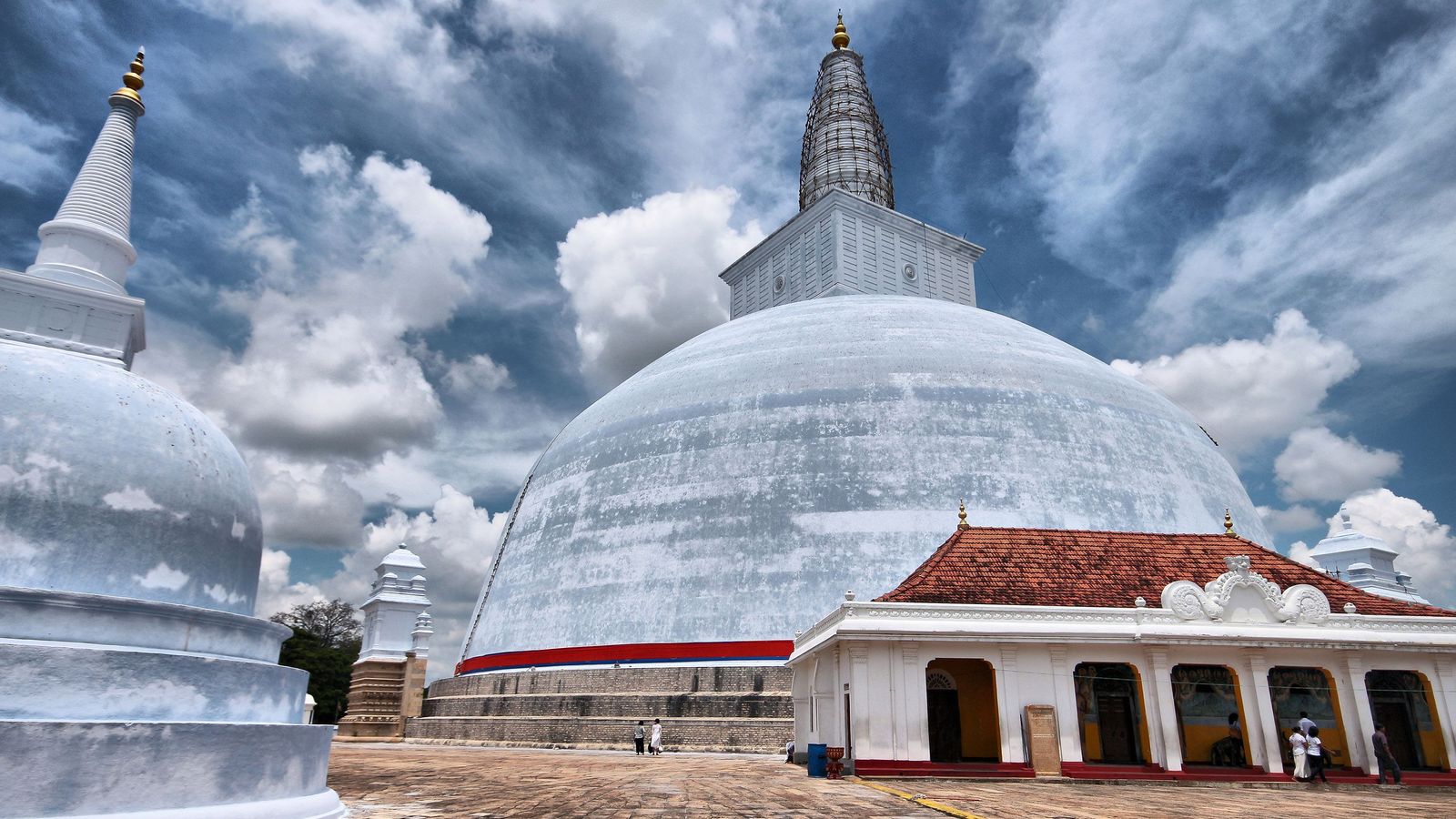
Sri Lanka’s sacred city of Anuradhapura is an unlikely place to be enmeshed in a fantastic tale of UFOs and otherworldly happenings. Locally known as Rajarata (Land of Kings), the Unesco World Heritage Site was the first established kingdom on the island (in 377 BC) and is at the heart of Sri Lanka’s Buddhist culture. Today, it’s one of the nation’s most visited places, attracting devoted pilgrims from around the country to its ancient Buddhist temples and giant dome-shaped stupas.
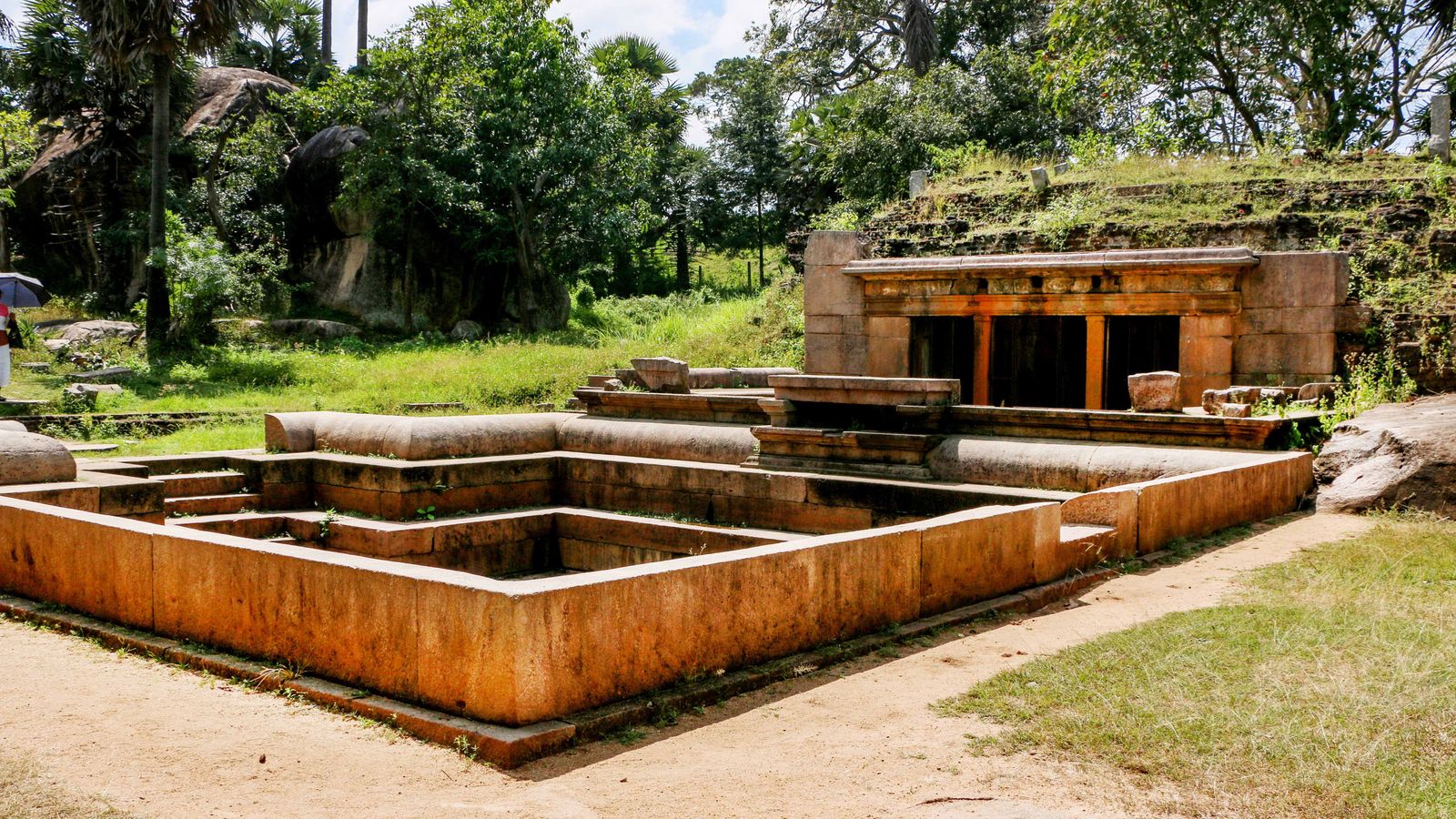
But this holy city is also home to something far more curious. Here, in Ranmasu Uyana (Golden Fish Park), a 40-acre ancient urban park surrounded by three Buddhist temples, is a chart that’s alleged to be a map to unlock the secrets of the Universe.
The Sakwala Chakraya has been variously interpreted as a cosmographical chart, a stargate and a building plan (Credit: Demi Perera)
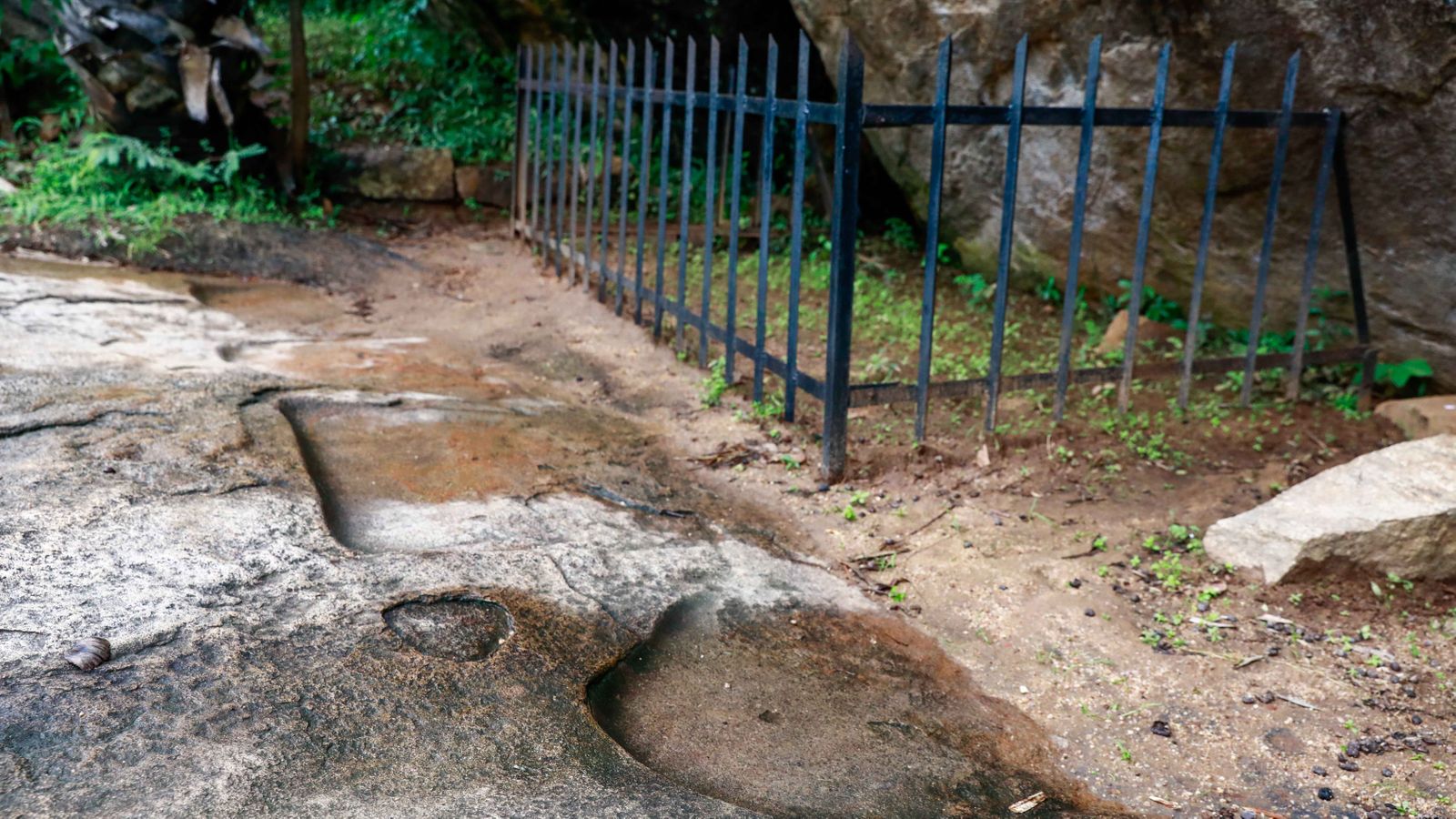
Measuring around 1.8m in diameter, Sakwala Chakraya (which translates to “Universe Cycle” in Sinhalese) is shallowly carved onto a low rock face among the protected park ruins. Its front facade can only be seen from ground level. In fact, four seats have been sculpted into a flat rock surface opposite that provide the ideal viewing area. Both the map and seats, which are also of mysterious origin, have puzzled historians, archaeologists and academics for more than a century.
Its existence, function or anything related to it is not mentioned in any historic records
“Ranmasu Uyana was used for a prolonged period in history,” said Professor Raj Somadeva, senior professor of archaeology at the University of Kelaniya, Sri Lanka. “The second major developmental phase seems to have begun in the 7th Century CE. During that period, several new buildings were added to the earlier garden layout. The chart could be a work of this period, but it’s impossible to know because its existence, function or anything related to it is not mentioned in any historic records, which were meticulously kept by Buddhist monks.”
While little is known about the chart and its purpose, the iconography is incompatible with other carvings of the Anuradhapura period (3rd-10th Century AD). The chart’s centre is made up of seven concentric circles divided by parallel vertical and horizontal lines. Rectangular compartments contain small, crossed circles. To the untrained eye, there are figures resembling umbrellas or bow and arrows, a kite, wavy lines and cylindrical shapes. An outer ring depicts marine animals: fish, turtles, seahorses.
When compared to other carvings from the same period such as the Sandakada Pahana, which depicts vines, swans and a lotus, all typical of Buddhist iconography, the chart is without religious context, leaving it without an obvious explanation as to why it is here.
Sri Lanka’s sacred city of Anuradhapura was the first established kingdom on the island (Credit: AnaG/Getty Images)
This has left it wide open to online speculation. Before the dawn of the internet, the chart garnered little attention in Sri Lanka. It is thought to have survived here, tucked away at the edge of a boulder, after the fall of the Anuradhapura kingdom; unremarkable in comparison to its breath-taking surroundings complete with twin ponds and bathing pavilions believed to have been used by kings. In fact, if aliens did arrive on Earth through here, they couldn’t have picked a nicer place – these sacred temple grounds, cloaked in thick, tropical jungle, are mostly uninhabited and protected by the authorities.
The first academic to note the chart’s archaeological importance was H C P Bell, a British civil servant appointed as the first Commissioner of Archaeology of Ceylon (Sri Lanka’s former name). Bell included a description of the chart in his 1911 report for the Governor of Ceylon, where he concluded that, “This ancient ‘map of the world’, perhaps the oldest in existence, is of quite extraordinary interest. Its presence… testifies to the antiquity of that astronomical lore still pursued in some of the Buddhist monasteries of Ceylon.”
While the chart does not resemble a map in a modern sense, Bell wrote that it depicts “an old-time cosmographical chart illustrating in naivest simplicity the Buddhistic notions of the universe”. He interpreted the circles, the symbols and marine life on the chart, based on his knowledge of Buddhism on the island, to mean the Earth, the seas, outer space and the Universe.
While discussions around the chart for many years were mainly confined within academic circles due to its historically important location, the explosion of photo-sharing on social media over the last few years has shone a global spotlight on the mystery. Eagle-eyed tourists have remarked on parallels between the chart in Anuradhapura and similar sites in other countries that are believed by some to be stargates – ancient gateways through which humans could enter the Universe. Their theory goes that the chart holds the secret code for unlocking the portal.
Ranmasu Uyana is a 40-acre ancient pleasure garden that includes the ruins of bathing pools (Credit: Sri Lanka Tourism)
Conspiracy theorists noted that the stargate of Anuradhapura had near-identical shapes and symbols to those found at Abu Ghurab in Egypt and La Puerta de Hayu Marka in Peru. The most striking similarity, it was said, as speculation around Sri Lanka’s stargate reached its peak, is its proximity to water. The nearby Tissa Weva reservoir, built in 300 BC, has been thrown around as conclusive evidence, since both Abu Ghurab and La Puerta de Hayu Marka were also built near water, which, according to the stargate theory, allowed extra-terrestrial beings to process gold from Earth’s water.
This otherworldly theory has been further fuelled by the chart’s proximity to Danigala mountain, also known as Alien Mountain, in the nearby sacred city of Polonnaruwa. Danigala, which lies deep in the jungle and is popular with hikers, has a unique circular shape and entirely flat top. This led internet sleuths to conclude that it must have, at one time, been used for UFO landings. Strangely, according to Sri Abeywickrama, a local tour guide, “villagers in the area do believe that Alien Mountain attracts more shooting stars and thunder and lightning above it than anywhere else.”
However, according to Somadeva, “There is little archaeologically to suggest that it’s a stargate.” Instead, Somadeva believes a more sensible conclusion is that the chart is an early map of the world, as suggested by Bell, because that explanation has religious and cosmological context that is logical, given the period and place in time.
According to Somadeva, “At least since 250 BCE, Sri Lankans had a clear idea of objects in the sky and outer space. In early Brahmi inscriptions, found in Sri Lanka, there are a number of names that refer to specific stars and concepts related to astronomy. One of the inscriptions in Kirinda, a religious and historic site on Sri Lanka’s southern coast, contains the phrase ‘aparimita loka datuya‘ meaning ‘the infinite universe’. What it suggests is that the person who engraved it had a very good understanding of the nature of the universe they lived in.”
Opposite the chart, four seats sculpted into rock provide an ideal viewing area (Credit: Demi Perera)
However, Shereen Almendra, senior lecturer of landscape design at the University of Moratuwa, Sri Lanka, offers a different, more earthly perspective. “I think the Sakwala Chakraya chart is a plan for a complex project similar to the enormous stupas that were being built at the time,” she said. “I lean towards it being a plan for Sigiriya.”
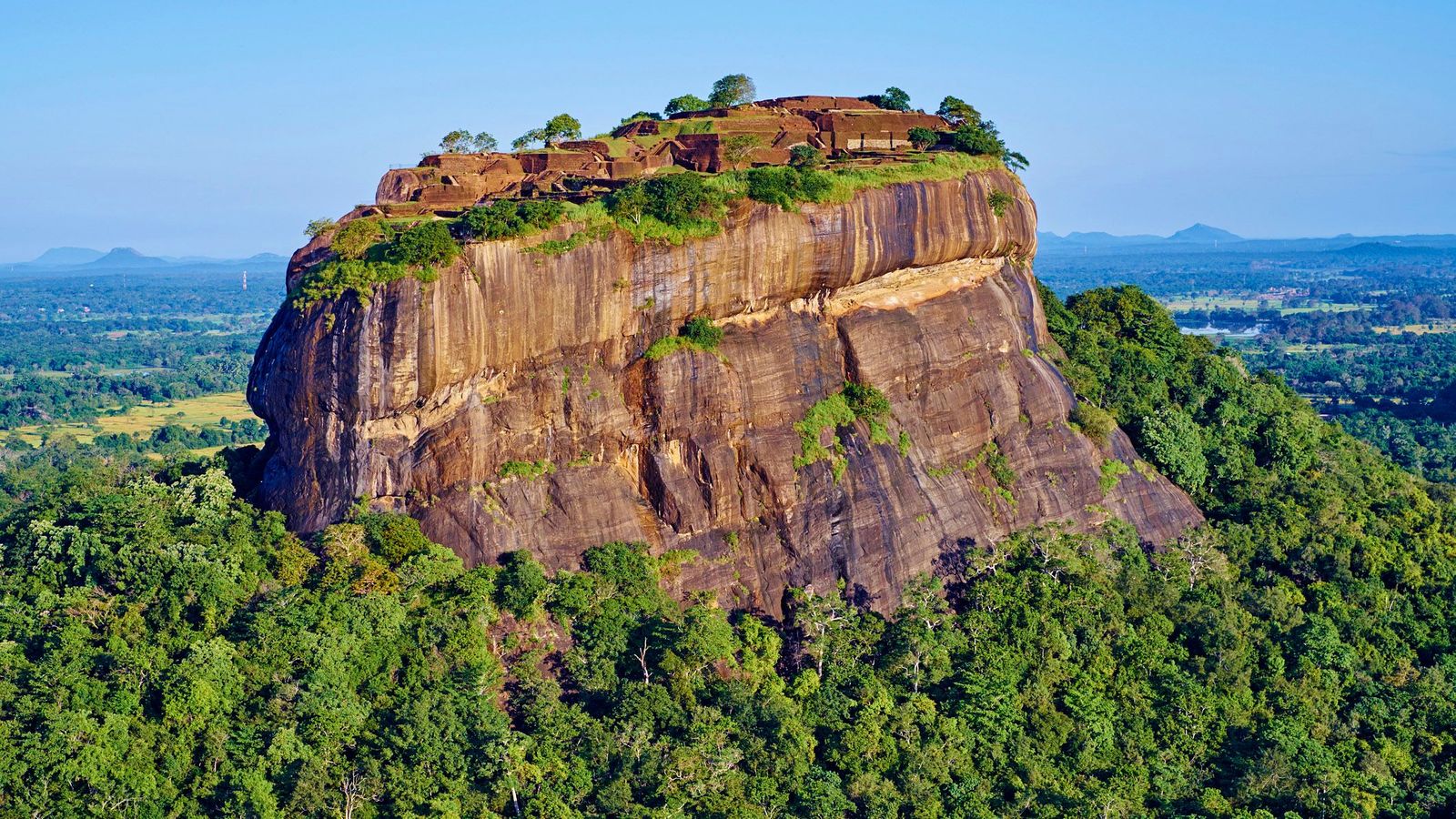
Sigiriya is one of Sri Lanka’s most recognised ancient landmarks, a 5th Century BC rock fortress, complete with flowing water, landscaped gardens and multiple living quarters. It lies just half an hour away from Anuradhapura within Sri Lanka’s Cultural Triangle, which is made up of three important ancient cities: Anuradhapura, Polonnaruwa and Kandy. “Given that the three seats carved in front of the chart appear to slightly face toward each other, it makes me think that it was a place for discussion – an ancient architect’s office if you like,” she said. “If the seats were built for a religious purpose, such as meditation, they would be in a straight line instead.”
According to Somadeva, the greatest challenge in identifying the function of the chart has been the lack of evidence to correctly date it. While Ranmasu Uyana and other parks and stupas in Anuradhapura are mentioned in chronicles and inscriptions dating as far back as 250 BC, the Sakwala Chakraya is not described in any historical records. “There would definitely have been a practical use for this diagram but it’s a huge challenge to figure out what that might have been when we can’t correctly date it,” he said.
So it seems that Sri Lanka’s enigmatic alleged stargate remains shrouded in mystery, its purpose and meaning still lost to time. The chart’s newly acquired cult status amongst sci-fi enthusiasts, however, has finally given it some well-deserved public attention. Thanks to their enthusiasm and the power of social media, it has finally stepped out of the shadow of larger-than-life Anuradhapura to stand apart on its own.
One expert suggested the chart may be a building plan for nearby Sigiriya, a 5th Century BC rock fortress (Credit: Anthony Asael/Art in All of Us/Getty Images)
Leader of Opposition Sajith Premadasa who announced a political ceasefire today urged the government and others to do their utmost to save Sri Lankans from the ongoing COVID-19 pandemic.
“We have gone into a political truce and is ready to do our utmost to save the lives of 20 million people of this country. I urge all political parties to do the same and forget their differences at a time such as this when the country has almost come to a standstill as a result of the pandemic,” Mr. Premadasa said.
“I also urge the government to forget its political objectives at this difficult time and do its part to save the nation,” he added.
The Director General of Health Services confirmed nine more Covid-19 related deaths in the country today (02) pushing the death toll due to the virus in Sri Lanka to 696.
01. The deceased is a 94-year-old male resident in Kebilithigollawa. He died on 29.04.2021 while undergoing treatments in Base Hospital Kebilithigollawa. The cause of death is mentioned as acute pneumonia due to Covid-19.
02. The deceased is a 51-year-old male resident in Polonnaruwa. He died on 01.05.2021 while undergoing treatments in Special Covid Treatment Centre, Welikanda. The cause of death is mentioned as chronic kidney disease and Covid pneumonia.
03. The deceased is a 72-year-old male resident in Lewla. He died on 01.05.2021 while undergoing treatments in National Hospital Kandy. The cause of death is mentioned as Covid pneumonia.
04. The deceased is a 79-year-old female resident in Thennekumbura. She was transferred from Panideniya Covid Treatment Centre to the Teaching Hospital Peradeniya where she died on 02.05.2021. The cause of death is mentioned as Covid pneumonia.
05. The deceased is an 86-year-old female resident in Maththegoda. She was diagnosed as infected with Covid-19 while undergoing treatments in Colombo South Teaching Hospital and transferred to IDH Hospital. She died on 02.05.2021and the cause of death is mentioned as Covid pneumonia, high blood pressure, diabetes, asthma and a heart disease.
06. The deceased is an 87-year-old male resident in Malambe. He died on 01.05.2021 while undergoing treatments in IDH Hospital. The cause of death is mentioned as Covid pneumonia, heart disease and chronic kidney disease.
07. The diseased is a 56-year-old male resident in Kanthale. He was diagnosed as infected with Covid-19 while undergoing treatments in Base Hospital Kanthale and transferred to Special Covid Treatment Centre in Kanthale. He died on 02.05.2021 and the cause of death is mentioned as Covid-19 infection and Covid pneumonia.
08. The deceased is a 53-year-old male resident in Warakamura. He was diagnosed as infected with Covid-19 virus while undergoing treatments in National Hospital Kandy and transferred to the District Hospital Katugasthota where he died on 02.05.2021. The cause of death is mentioned as Covid pneumonia.
09. The deceased is a 78-year-old male resident in Bandaragama. He died on 30.04.2021 at his residence and the cause of death is mentioned as Covid-19 Chest infection.
State Minister Sisira Jayakody says that permission has been granted to utilize Ayurveda Hospitals to treat coronavirus patients.
He stated that State Minister of Primary Health Care, Epidemics and COVID Disease Control Dr. Sudarshani Fernandopulle has permitted Ayurveda Hospitals to treat COVID-19 patients.
Accordingly, the Ayurveda Hospitals in Rajagiriya, Navinna and Pallekele have been granted permission to commence treating COVID-19 patients, he said.
The COVID patients directed to these hospitals will be provided with Ayurvedic indigenous medicines, the State Minister of Indigenous Medicine Promotion, Rural and Ayurvedic Hospitals Development and Community Health said.
The Director-General of Health Services has issued new guidelines pertaining to permitted public activities under ‘Alert Level 3’ amidst the upsurge in virus infections in Sri Lanka.
The new guidelines will be in effect from today (May 01) until further notice, the National Operation Centre for Prevention of COVID-19 Outbreak (NOCPCO) said.
The guidelines are supported by the previously guidelines and circulars previously issued by the Health Ministry with regard to the relaxation of public activities in response to COVID-19, which include operational details.
Health authorities have introduced an ‘Alert Level’ system based on an understanding of public and work settings in Sri Lanka.
Alert Level 1 – Cases reported are only those coming from outside the country (detected in quarantine); no clusters Alert Level 2 – One cluster of cases Alert Level 3 – Several clusters in different districts Alert Level 4 – Cases are appearing with no connection to any cluster (community transmission)
As identified by the Ministry of Health, Sri Lanka is currently at Alert Level 3.
Sri Lanka’s COVID-19 death toll reached 687 on Saturday (May 01) as nine persons succumbed to the virus infection, the Director-General of Health Services confirmed.
According to the Department of Government Information, the victims are as follows:
01. A 65-year-old man from Karandana area: He died on April 29 while receiving treatment at the Horana Base Hospital. The cause of death was identified as COVID chest infection and chronic liver disease.
02. A 72-year-old man from Avissawella area: After being diagnosed with novel coronavirus, he was transferred from Kopay Treatment Centre to Jaffna Teaching Hospital where he died on April 30. Acute coronary syndrome and heart failure along with COVID infection were identified as the cause of death.
03. A 75-year-old man from Ruwanwella area: He was first admitted to the Wathupitiwala Base Hospital and then moved to Sri Jayewardenepura Hospital. He was later transferred to Homagama Base Hospital after testing positive for the virus. He died on April 28 due to COVID pneumonia.
04. A 66-year-old woman from Devalagama area: She passed away on April 30 while receiving treatment at Homagama Base Hospital. The death was caused by respiratory failure due to COVID infection.
05. A 79-year-old man from Mawanella area: He was diagnosed with novel coronavirus while receiving treatment at the Warakapola Base Hospital and was later moved to Theldeniya Base Hospital where he died on April 30. The cause of death is severe COVID pneumonia with severe chronic obstructive pulmonary disease, diabetes mellitus and hypertension.
06. A 33-year-old youth from Yakwila area: He was transferred from Ambanpola Treatment Centre to Theldeniya Base Hospital after testing positive for the virus. He died on April 30 due to severe COVID pneumonia and acute kidney injury with newly diagnosed diabetes mellitus.
07. A 57-year-old man from Walapane area: After being diagnosed with novel coronavirus, he was transferred from Rikillagaskada Base Hospital to Infectious Disease Hospital (IDH) where he succumbed to COVID pneumonia, acute respiratory distress syndrome and sepsis on April 30.
08. A 68-year-old man from Ratnapura area: He was tested positive for the virus at Ratnapura Teaching Hospital and was later moved to the IDH. He fell victim to the sepsis shock, COVID pneumonia, acute kidney injury, diabetes mellitus and hypertension on May 01.
09. A 69-year-old man from Kuliyapitiya area: He died on April 30 while suffering from COVID pneumonia, kidney injury and chronic kidney disease. He was under medical care at the Anuradhapura Teaching Hospital at the time of his death. He had been transferred from Kuliyapitiya Teaching Hospital after being diagnosed with the virus infection.
Sri Lanka on Saturday (May 01) hit a record high of 1,699 coronavirus infections as 396 more persons were tested positive for the virus within the day.
This marks the highest single-day spike in the country’s infections and it is also the third consecutive day Sri Lanka’s daily cases stayed above 1,500-mark.
Daily virus infections in Sri Lanka first crossed the grim milestone of 1,000 on the 27th of April.
Press Release- Embassy and Permanent Mission of Sri Lanka to the UNESCAPBangkok, Thailand
Sri
Lanka calls for stronger regional cooperation for building back better from the
pandemic through promotion of trade, investment and foreign employment
opportunities at the 77th Session of the UNESCAP in Bangkok
Speaking on the
theme ‘Building back better from crises through regional cooperation in Asia
and the Pacific’ Prime Minister Mahinda Rajapaksa at the inauguration of the 77th
Session of the United Nations Economic and Social Commission for Asia and the
Pacific (UNESCAP) outlined Sri Lanka’s successful approach in controlling the COVID-19 and called
for renewed South-South”
cooperation, to recover from the pandemic.
The session was held virtually in Bangkok from 26th to 29th April
2012.
Prime Minister stated
that even during the pandemic, economic and export sector continued to function,
tourism restarted in January and the Central Bank reduced policy rates and
implemented several concessionary refinancing programs in Sri Lanka.
Further, Prime
Minister emphasized that Sri Lanka
is deeply committed to achieving Sustainable Development Goals and
toward this end, an Inter-ministerial Steering Committee on Sustainable Development
and Sustainable Development Council have been established and the decade 2021
to 2030 has been declared as the ‘Decade of Skills Development’ in Sri Lanka.
Delivering the Country
Statement, Foreign Secretary Admiral
Prof. Jayanath Colombage stated that the Government of Sri Lanka was able to
mitigate the speared of the pandemic and keep the death rate comparatively low
against the high recovery rate due to its Whole of Government and Whole of
Society” approach, Preemptive Strategy”, and matured Public Healthcare
system”. He stated that to date hundred and thirty thousand standard Sri
Lankans were brought home from over 120 countries and that Sri Lanka continues
to provide quarantine facilities free of charge especially for migrant workers.
Given Sri Lanka’s ongoing resilient,
inclusive and sustainable development pathways, Foreign Secretary requested
that Member States of economic strength in the Asia-Pacific region should
provide smaller economies like that of Sri Lanka with investment, greater
market access and trading opportunities, foreign employment opportunities
and assistance in vaccination programs, to smoothen the
path to build back better from crises.
Reaffirming its
commitment to international cooperation, along with Indonesia, Japan, Maldives,
Pakistan and Vietnam, Sri Lanka co-sponsored the resolution put forward by
Thailand, which was adopted by the
Commission on the theme ‘Regional cooperation to build back better from crises
in Asia and the Pacific” in support of all similar efforts of Member States.
Over 50 member
states participated in the four day online session and
Heads of State/ Government of Afghanistan, Azerbaijan, Indonesia,
Kiribati, Kyrgyz Republic,
Marshall
Islands, Mongolia, Tajikistan, Bangladesh, Bhutan, Cambodia, Fiji, Pakistan,
Thailand, Tuvalu and Uzbekistan
addressed the inauguration of the 77th Session.
United Nations
Under-Secretary-General and Executive Secretary of UNESCAP Armida Salsiah
Alisjahbana emphasized that As we move towards recovery, our efforts must take
into account the aspirations of all countries, including the least developed
countries, landlocked developing countries and small island developing States,
of Asia and the Pacific. More than ever before, the full potential of inclusive
and networked multilateralism should be tapped. International development
cooperation, including South-South and triangular cooperation, must be further
harnessed”.
Permanent
Representative of Sri Lanka to the UNESCAP Ambassador C.A. Chaminda I. Colonne,
Director General Chamindry Saparamadu of Sustainable Development Council, senior
officials from the Foreign Ministry, Central Bank, Department of External
Resources and Sustainable Development Council of Sri Lanka were in the
delegation.
Embassy and Permanent Mission of Sri Lanka to the UNESCAPBangkok, Thailand
The
most important achievement of the 1956 government was the entrenchment of
Buddhism. MEP government gave Buddhism its ‘rightful place.’It
is tempting to make fun of this phrase but it is an accurate description of the
historical role of Buddhism in Sri Lanka.
Buddhism
came to Sri Lanka in the time of Gautama Buddha, in 6th century BC. The
evidence lies in the regular exchange of travelers between the Ganges plains
and Sri Lanka during this time. Arahant Mahinda who came in the 3rd century BC
did not bring Buddhism, it was already there. He came, on invitation, to set up
the Sinhala Sangha with its own upasampada and monasteries.
The
visit of Arahant Mahinda would have been a high level embassy involving much
planning. King Devanampiyatissa would not have been deer hunting in a forest
when Mahinda arrived. He would have been in the city, waiting to greet Arahant
Mahinda. Mahinda would not have needed to climb up a hill either.
Buddhism
lacked the qualities popularly associated with ‘religion’. It was not based on
blind faith and had no salvation component. Instead Buddhism offered its followers
a daunting physical and mental discipline based on a
highly intellectual argument. Anuradhapura, to its credit, was careful not to
distort or reduce this thinking. It took care to preserve the doctrine.
Anuradhapura
over time became a recognized centre for Buddhist studies. Maha vihara
held a valuable set of commentaries written in Sinhala. Abhayagiri monastery
was an international centre for Buddhist scholarship in the three main schools
of Buddhism, Theravada, Mahayana and Tantra.
Anuradhapura
helped spread Buddhism in Asia. Sinhala bhikkhunis went to China in 5 AD,
probably to develop Mahayana. Bhikkhuni Chandramali went to Tibet to help with
Tantric Buddhism. Abhayagiri influenced Buddhism in Indonesia. Maha vihara
helped to entrench Theravada Buddhism in Cambodia, Thailand, Burma and Laos.
Buddhism
produced a substantial literature which is well regarded today, this includes
the Vamsa collection. The Buddhist architecture
of Anuradhapura was much admired. Jetavana is recognized as one of the world
tallest building, pre 7 century. In another
ranking, two stupas from Anuradhapura are included in the ten highest buildings
in the ancient world, Jetawanaramaya at
4th place and Ruvanvelisaya at 7th place.
Jetavanaramaya boasted of
the largest stupa in the entire world (while also holding the honor of the tallest
stupa in the ancient world), said the selectors. The originally 400-ft tall
stupa accounted for an astronomical base area of 233,000 sq m, which is equivalent to 43 football fields!
This massive structure was estimated to be constructed from 93.3 million baked
bricks (each of which could withstand loads of up to 166 kg), with one side of
the enormous stupa measuring 576 ft (176 m) in length.
Ruvanvelisaya (2 BC ) has a massive tapering dome
originally rising to 300 ft, and a
diameter of around 295 ft (90 m) and circumference of 950 ft (292 m)., the base
area of Ruvanvelisaya equates to over 68,300 sq ft, which is bigger than a
conventional football field. [1]
Buddhism
played a significant role in the social and cultural life of the country from
Anuradhapura period to the
end of the Udarata kingdom. The Udarata kingdom remained Buddhist. Kings
were imported from Tamilnadu, but were compelled to embrace Buddhism. There is
no mention of kovils in Udarata. There were no mosques either. Muslim traders stayed in Buddhist temples.
This
special position of Buddhism was recognized in the 1815 convention. Clause 5 of
the Kandyan convention said. . The religion of Boodhoo, professed by the chiefs and
inhabitants of these provinces, is declared inviolable, and its rites,
ministers, and places of worship are to be maintained and protected.”
The
British administration had no intention
of keeping this promise. The British rulers were not interested in protecting
Buddhism, they wanted to contain Buddhism. They did so by encouraging three
other religions, Christianity, Hinduism, and Islam. These religions were
brought in for a disruptive purpose, to challenge Buddhism.
Christianity,
Hinduism, and Islam were firmly entrenched in the island by the British administrators.
The entrenchment was done mainly by the allocation of strategically placed land
for churches, kovils and mosques. They were given prime land. The dates of origin of present day churches,
kovils and mosques fall within the British administration.
In
Christianity, the British encouraged both Catholics and Protestants. Therefore
both Catholics and Protestant churches flourished in British times. St Paul’s
Church was built in the premises of the Dalada Maligawa and a Roman Catholic
convent was set up in the heart of the Anuradhapura sacred area.
Hinduism
was a new arrival. It catered to the Tamil immigrants brought in by the Dutch
and British rulers. Hindu kovils were artificially
introduced into places which had never had Hinduism before, such as Colombo, Kandy
and the central hills.
These activities were resentfully observed by the Buddhists living
under British rule. Their resentment was building up and would burst at some
point. They hoped for a change once Independence was granted. Independence came
in 1948. The Buddhists found that after 450 years of Christian rule, they were
now facing a fresh bout of post independence Christian rule under the UNP. The Buddhists
were not prepared to tolerate continued Christian dominance.
In 1951 the All Ceylon Buddhist Congress wrote to Prime Minister, D.S. Senanayake
referring to the disappointment, almost resentment, growing among the
Buddhists of Ceylon,” and asked the UNP government to extend to Buddhism the
same patronage as was extended to it by Sinhalese rulers of old.”
The ACBC called upon the government to remedy
some of the damage done to Buddhism during the reigns of the Portuguese, Dutch
and British by offering greater state support for Buddhist education, monks and
temples, and to appoint a Buddhist Commission. .
Senanayake refused. The Buddhist Congress created their
own Buddhist Commission of Enquiry. The ACBC Commission undertook a two-year
investigation to explore the extent of the injuries done to Buddhism during the
colonial period and to recommend actions that the state should take to repair
them. The work culminated with the publication of a Sinhala report, the English
summary of which was titled The Betrayal of Buddhism. This report of the
Buddhist Commission became one of the leading campaign documents of the 1956
election.
The 1956 MEP victory
brought to the Buddhists the recognition they had asked for. Buddhism also became important in politics. After 1956, all
politicians, on taking office paid a visit to the Dalada Maligawa in Kandy, dressed in white and bearing trays
of flowers. Buddhism has continued to
strengthen its position .
A related development of 1956
was the rise of the Maha Sangha as a political force. the aggressive Buddhist movement that started
in the 1940 and gathered momentum in the 1950s brought the entire
Maha Sangha to the forefront as an active social and political force, said Wiswa Warnapala.
In ancient times the Sangha had a legitimate role in the political affairs of the country. They guided the king. They did not wield power directly. This traditional role was now resurrected in a modern setting. The Sangha is now an active social and political force in modern Sri Lanka, he concluded. It is now a permanent part of the political culture of Sri Lanka. ( continued)
The Shameless
Jabbering Bandits (SJB) have accused the government of attempting to impose
civil disabilities on key opposition leaders on the recommendations of the
Special Presidential Commission on Political Victimization, saying that riot is
tantamount to over-riding the judiciary and therefore unconstitutional.
The Special
Commission had indicted 22 political leaders and individuals associated with
the previous government (many of them top leaders of the SJB now) for the
violation of the Constitution in establishing or being part of the
Anti-Corruption Committee (ACC) and the Anti-Corruption Committee Secretariat
(ACCS).
Among the
indicted are former Prime Minister Ranil Wickremesinghe, former Ministers
Mangala Samaraweera, Patali Champika Ranawaka, Rauff Hakeem, Malik
Samarawickrema and Sarath Fonseka; Tamil National Alliance (TNA) Leader R.
Sampanthan; TNA MP M.A. Sumanthiran; Janatha Vimukthi Peramuna (JVP) Leader
Anura Kumara Dissanayake; Attorney-at-Law J.C. Weliamuna; and former MP Dr.
Jayampathi Wickramaratne.
On January 29,
2021, a Special Presidential Commission of Inquiry was set up to implement
recommendations of the earlier Presidential Commission of Inquiry into
Political Victimization established under retired Supreme Court judge Upali
Abeyratne on January 9, 2020.
The Special
Presidential Commission was empowered, among other things, to recommend the
imposition of civic disability on persons found guilty of political
victimization. The Commission had found that the establishment of the
Commission to Investigate Allegations of Bribery or Corruption, Financial
Crimes Investigations Division (FCID), and the Special Investigations Unit
(SIU) of the Sri Lanka Police was against the provisions of the Code of
Criminal Procedure.
This series of articles aim to highlight actions of
some of the former Ministers whose names were listed in the PCoI report as
offenders :
Helping Hambantota Project
Supreme Court ordered Kabir Hashim to pay
compensation to MR over Helping Hambantota case false allegations.
There are certain politiciasns who hail from feudal
families and they are committed to maintain their family stastus by hoodwinking
lor pretending as people friendly politicians so that people belomging to
underlying segments of their areas or societies will nlot be able to command
them. This was D.S.Seanayake rejected
the Madampa reform proposa.ls presented by the late Prime Minister
S.W.R.D.Bandaranaike since he feared that those reforms will eliminate their
dominant status and the Tamil politicians (the Vellala clan) continue to keep
the Tamil masses trampled for the last 70 odd yesars with the prlomise of
selfrule status.
The
former Minister Kabir Hashim, presently the Chairman pof SJB also hails from a
feudal family from a feudal family in Sabsragamuwa and his father is said to be
a Barrister. He entered parliament in 2001 and continue to represent Kegalle
district since then. He is reported to
be very mjuch consdcious about his family and social status. He has a natural aversion to Rajapaksas
because of their championing for the cause of the underlying people.
In this acversion, Kabir Hashim alleged that Mr. Mahinda Rajapaksa he has
swindled nearly Rs. 83 crores delivered to the Premier’s Office in aiding the
victims of the Tsunami tragedy and the money was credited to a special account
at the Union Place branch of People’s Bank called ‘Prime Minister’s Revival
Fund’ on December 31, 2004.
Mr.
Rajapaksa filed a court case against this allegation and cited Chandra Fernando IGP,
Lionel Gunatilake, DIG, P. Ampawila, Inspector of Police, Kabir Hashim, MP, and
the Attorney General as Respondents and the case was taken up for hearing by a
three member judges panel comprising Chief
Justice, Sarath N. Silva, Justice Shirani Tilakawardena, and Justice N.E. Dr.
Mahinda Rajapaksa a,leged that the 4th Respondent
being a former Minister and a Member of Parliament representing the United
National Party (UNP) a political party opposed to him made a complaint to the
Criminal Investigation Department of the Police (CID) alleging the commission
of an offence of criminal breach of trust and criminal misappropriation by him,
falsely and maliciously, in order to tarnish his public image and thereby to
gain political advantage at the Presidential Election in which he was due to be
the candidate of the political party in power.
Further,
that the 1st, 2nd, and 3rd Respondents being the Inspector General of Police,
Deputy Inspector General of Police (CID) and an Inspector of the CID forming
part of the executive arm of Government, purported to take action on the said
false complaint and continued an investigation in order to support the
malicious political campaign against him by the UNP, which was in turn actively
assisted by a partisan weekly newspaper that carried a continuous flow of false
information regarding the same matter.
Thus,
the case of the Petitioner is that the executive arm of Government wielding
Police power was made use by his political opponents who were in turn backed by
a partisan newspaper, to besmirch his character and gain undue political
advantage and that such abuse of the legal process of criminal investigation
denied to him the equal protection of the law guaranteed by Article 12(1) of
the Constitution.
In
delivering the verdict of the case the Cou.rt granted the declaration prayed
for by the petitioner that his fundamental rights guaranteed by Article 12 (1)
of the Constitution has been infringed by the 1st to 4th Respondents.
Considering
the preceding findings the Court ordered that the 1st, 2nd and 4th Respondents
pay personally a sum of Rs. 100,000 each, to the Petitioner by way of
compensation.
The
Court ordert said that this amount is awarded only as a recognition of the
infringement of the Petitioner’s fundamental rights and not intended to
compensate him fully for the loss suffered by him by being denied equal
protection of law and hence the State will pay a sum of Rs. 200,000 as costs to
the Petitioner.
D.S.
Wijesinghe, PC, with Sanjeewa Jayawardena and Priyantha Jayawardena appeared
for the Petitioner.
Tilak
Marapana, PC, with Ronald Perera appeared for the 4th Respondent.
Palitha Fernando, DSG,
with P. Nawana SSC appeared for the 1-3rd and 5th Responden
*****
Calculations made
by MP Hashim dismissed
MP Kabir Hashim
was asked to get coaching on calculations by someone who knows the subject.
Money and Capital
Market and State Enterprise Reforms State Minister Ajith Nivard Cabraal told
Parliament that as at the end of December 2019 total loans granted by the
Central Bank to all banks for pawning advances stood at Rs. 210 billion and at
the end of September 2020 it had increased by 27 billion to Rs. 237 billion.
Participating in
the debate on the 2020 Appropriation Bill, the Minister dismissed the figures
presented by SJB MP Hashim as being inaccurate and demanded to know where the
latter had obtained the misleading information from.
MP Kabir Hashim
during his speech said that it was a clear indication of the failure of the
government that people had pawned jewelleries to the tune of Rs. 643 billion.
Minister Cabral
said by the end of December 2019 the credit card payments stood at Rs. 131
billion but had dropped by Rs. 25 billion to Rs.126 billion. Therefore, I urge
MP Kabir Hashim to get his facts right and perhaps get some expert advice on
such matters by someone like MP Harsha de Silva, who knows this subject.”
The State Minister
said that the year 2020 had been a very difficult and uncertain year for the
country. For over half the year we had a minority government and during the
major part of the year we were speculating on whether an election could be
held. The whole world was facing difficulties with the pandemic wreaking havoc.
It was only after the formation of the new government that we were able to
formulate a clear policy and delegate responsibilities.
Therefore, we have
been able to move forward with a clear vision during the last three months,” he
said.
The Minister said
that the government had faced many challenges during the first three quarters
of this year apart from the Covid pandemic, due to the mismanagement and
misdeeds of the previous government over the past five years.
During the past
five years under the previous regime, the 6.3 per cent growth rate we
maintained from 2010 to 2014 had dropped to 2.3 per cent For the first time in
2019 the per capita income fell by USD 227 under the yahapalana government. Now, they are trying to
discredit us by claiming that the country is in a debt trap. They are hoping
for the fall of the government, but they will be disappointed; we will not
their wild dream come true.”
Minister Cabral
said that the debt burden was measured as a percentage of the GDP and in 2005,
it stood at 91 per cent. However, our government had reduced it to 70 per cent
by 2014 and after the Yahapalana government took over they increased it back to
87 percent. This happened as they had increased the foreign debt by 49 per
cent. They increased the short term loans within a short period and now we are
tasked with rectifying their mistakes. The previous government paid Rs. 1,430
billion more than we did in debt interest within their five year tenure.”
Cabral urging ignoramo’us Kabir Hashim to
get coaching on economy
Cabraal add that
the previous regime had also managed to devalue the rupee and now the present
government had to pay for its predecessor’s sins.
He said that the
government was committed to steering the country on a path of progress and
urged all MPs to cast aside their political differences and support the passage
of the Appropriation Bill.
*****:
Southern
highway project corruptions under yahapalana
An anti-corruption group has sent
information to the presidential secretariat that point to the tender procedure
relating to the construction of the stretch of the southern highway from Matara
to Mattala being extremely corrupt.
The construction of the highway
began during the previous government, and those who had pioneered the regime
change on January 08 severely criticized the cost of the project.
The previous government estimated
the cost of construction for the 96 km stretch at Rs. 242 billion plus Rs. 12 b
as consultancy and planning expenses.
The estimated costs for its four
phases were – Rs. 103.28 b for the 30 km stretch from Matara to Beliatta, Rs.
55.5 b for the 26 km stretch from Beliatta to Wetiya, Rs. 31.57 b for the 15
kms from Wetiya to Andarawewa and Rs. 52.16 b for the 25 kms from Andarawewa to
Hambantota.
The Chinese contractors secured
loans through the Chinese banks named by them for the Sri Lankan government.
The anti-corruption group charges
that local and foreign racketeers shared the money that was the difference
between the actual cost and the estimated cost.
It urges the authorities to once
again go through all the contracts relating to this project.
Technical committee report ignored
The first highways minister of the
present government Kabir Hashim appointed a technical committee headed by
renowned engineering consultant M.B.S. Fernando to undertake a review of the
project.
The committee report handed over
to the minister on 28 April 2015 says the project could have been completed at
a cost which is Rs. 123 b less.
However, by August, the tenders
were awarded at the previous cost estimates, and the specialist report
completely disregarded.
After the general election in that
month, a newly-appointed minister took up the job.
Then, the estimates were gone
through once again and the same contractors were to be given the job on new
estimates.
Surprisingly, this time the
decision is to raise the costs – from Rs. 103.28 b to Rs. 122.5 b for the
Matara-Beliatta stretch, from Rs. 55.2 to Rs. 66.83 b for the Beliatta-Wetiya
stretch and from Rs. 31.57 b to Rs. 39.97 b for the Wetiya-Andarawewa stretch,
while the estimate for the remaining stretch is still under review.
The anti-corruption group notes
that the present is more corrupt than the past.
Some
activists of civil organizations were making baseless allegations misusing the
freedom of expression ushered in by the incumbent Government, Highways Minister
Kabir Hashim said.
Those
allegations against me were malicious and baseless,” he said.
Today
they have the freedom to make allegations. But there should be a base for these
allegations. I am sorry to state that those activists as well as media, which
publicise these allegations, should ascertain the veracity of the information
published,” he said.
He
said that he worked as the Minister of Higher Education up to March 2015 under
the 100-Day Programme and Dr Sarath Amunugama was appointed as the Minister of
Higher Education on March 22, 2015, by the President.
Meanwhile,
on June 19, the Board of Directors of the University Grants Commission decided
to channel the investments through National Savings Bank. At that time the
Minister of Higher Education was Dr Sarath Amunugama. Not me. The decision was
taken by the University Grants Commission.
Therefore
as blamed by an activist I have no connection at all with these matters and
clearly I must say that this allegation was baseless,” he said.
He
said that the UGC was blamed by the COPE Committee and a system was introduced
in 2013 for the UGC to make such investments.
They
have done it under the instructions of the Attorney General,” he said.
The
Minister then asked the media to publicise the frauds occurred before the
Yahapalana Government.
Reveal
the frauds committed by companies like Entrust, which defrauded over Rs. 12
billion. Out of that Rs. 2,500 million was taken from the Central Bank Pensioners
Fund and another 2,500 million from Ceylon Electricity Board Pensioners Fund,”
the Minister said
Meanwhile, Kabir Hashim’s family
members have even been accused of taking bribes to put people into the banks.
He has also been accused of buying expensive cars and houses from his illegal
bank accounts. Many charges have been leveled against him by the Public.
Instead of taking action against him, the Prime Minister gave Kabir Hashim more
responsibility and the opportunity to become even more corrupt. He has
petroleum and roads. According to unconfirmed reports, these two can bring the
government into severe disrepute.
******
Kabir and Malik
testify before Bond Commission
A
news report dated 1st April, 2019 said that Minister Malik
Samarawickrama the one time controversial businessman who has a habit of
putting his finger into every contract and has more than 10 bribery charges
filed against him by the public for giving concessions to businessmen in return
for favors, is about to meet his Waterloo.
The
report said that his allegiance to Ranil and Mangala will not save him this
time, because the President is not willing to pardon anyone.
Two senior Cabinet Ministers told the Presidential Commission of Inquiry on the
controversial bond issuance that at a meeting held on 26 February 2015, a fund
requirement of Rs. 18 billion had been discussed for stalled road development
work initiated by the previous administration.
Ministers Kabir Hashim and Malik Samarawickrama, testifying before the
commission, appeared to confirm evidence previously given by former Central
Bank Governor Arjuna Mahendran that a meeting had taken place in the morning of
26 February, the day before the controversial bond auction, attended by
Mahendran, the two ministers, former Finance Minister Ravi Karunanayake,
officials of the Central Bank of Sri Lanka (CBSL) and the Treasury, the
Director General of the Road Development Authority (RDA) and officials from the
Ministry of Highways and others, where urgent fund requirements for road
development work was discussed.
In
evidence given to the commission last month, it was mentioned that a request
had been made to the former Governor at the 26 February meeting to raise a sum
of Rs. 75 billion within a month for urgent road construction work, as
substantiated by a letter purportedly written by the former Finance Minister
that was furnished to the Bond Commission as evidence (document No. AM22). The
Prime Minister, however, in a statement to Parliament on 17 March 2015, had
made reference to an urgent requirement of Rs. 15 billion only. This was later
clarified by Mahendran as an initial requirement of Rs. 15 billion needed
immediately, followed by a further Rs. 75 billion.
Hashim
had taken part in the 26 February meeting in his capacity as then Minister of
Highways and Investment Promotion while Samarawickrama had attended as then
Senior Adviser to the Prime Minister.
There had been Rs. 18 billion outstanding, Rs. 3 billion of which had been
allocated by the Ministry of Highways, said Hashim. This meant that Rs. 15
billion was needed immediately, as had been communicated to the Treasury
Secretary.
The shameless rogues
According
to the Minister, the matter had previously been taken up at a Cabinet Committee
on Economic Management meeting held on 24 February. Two days later, he and
other officials of the Ministry had been asked to come to the CBSL premises for
a discussion where the requirement for Rs. 18 billion had been submitted.
I
think my accountant had certified that we had allocated Rs. 3 billion,” said
Hashim, responding to a question, adding that the figures were not exact, as
bills had been coming in sporadically. However, he said, the focus had been on
the Rs. 18 billion requirement.
Samarawickrama, too, provided a similar answer in his testimony: It was found
at the meeting, as I recollect, about Rs. 18 billion of funds were required to
pay these outstanding contractors. The Ministry had allocated about Rs. 3
billion. There was a deficit of about Rs. 15 billion.”
Minister Hashim told the commission that the Finance Ministry and Treasury
officials had said they would look at a way of helping us get the funds.”
Commissioner
Justice Prasanna Jayawardena asked Hashim if the CBSL had been asked to do
anything at the meeting.
Not
anything I’m aware of,” said the Minister.
Asked
about any follow-up action, Minister Samarawickrama said there had been no
discussion whatsoever” on how to raise the funds, nor had there been any
discussion at the meeting about issuing bonds or about the bond auction to be
held the following day. The purpose of the meeting had been solely to find how
much money was required, he said.
According to Hashim, his Ministry had received Rs. 8.3 billion from the Treasury.
Around 16 March, a new requisition had been sent asking for the remaining Rs.
10 billion.
At this point, Justice Jayawardena noted that the requirement of Rs. 18 billion
had remained unchanged in the month of March. Hashim agreed.
Samarawickrama
said he did not meet or speak to the former Governor over the telephone after
the meeting or on the day of the auction. Hashim, too, could not recollect
having done so.
Both Hashim and Samarawickrama said that neither Perpetual Treasuries Ltd.
(PTL) nor its former Director Arjun Aloysius, his father Geoffrey Aloysius nor
any of their immediate families had made any fund contributions to the United
National Party (UNP) during the period which the two senior UNPers had served
as the party’s Chairman and General Secretary respectively.
The Attorney General’s Department had no questions for either witness.
Attorney-at-law Neranjan Arulpragasam, representing PTL, asked Minister Hashim,
under whose purview state banks came following the August 2015 general election,
if the National Savings Bank (NSB) had made a loss or a profit.
I
think they haven’t made a loss during that time. They have been making
profits,” he said.
Asked if these were substantial profits compared to previous years, the
Minister said: Yes, I think, because the dividends that we transferred to the
Treasury were of record levels in 2015 and 2016.”
Arulpragasam then asked the witness if he thought former NSB Chief Dealer
Naveen Anuradha was a good performer. Said the Minister: I can’t specifically
say about a person, but overall we monitor operations of the bank and look at
the overall performance. There’s a team that works there in the Treasury unit.”
Meanwhile,
Personal Assistant to Arjun Aloysius Steve Samuel, who was supposed to testify
before the commission yesterday, according to his attorney, was admitted to the
emergency ward of a private hospital due to cardiac problems. An affidavit,
along with medical records, is to be submitted to the commission today.
Samuel’s
testimony was sought seeking clarification on files said to be maintained by
PTL under the initials of RK and AM. Former Governor Mahendran had previously
denied any knowledge of who RK and AM might have referred to.
Justice
Jayawardena noted that, even if the witness was not present, the files could be
produced.
We have also endeavoured to serve summons on [Arjun Aloysius] and [Geoffrey
Aloysius] who apparently are difficult to locate,” he said.
Noting
the presence of the company’s counsel, Justice Jayawardena added: We will not
look at a failure to produce those files very kindly.”
According
to Samuel’s lawyer, his client was not in possession of any of those files.
However, an affidavit will be filed today pertaining to the documents requested
as well as medical records indicating his clienAt’s health.
Former
Governor Mahendran is to be re-examined by President’s Counsel Romesh De Silva
*******
Allerged corruption and misuse of funds by Kabir
Hashim’
‘
Social media reported on 13th December
2019 that under the Golden Roads programme carried ou t by the former Minister
Kabir Hashim a sum of Rs. 10 milluon was allocatred for the construction of a
new bridge to access the maha vihaharaya of the Shri Nihrodfharama mountain. Up
to mopw the construction work of this nridge has not been completed. The people of the area have protested against
bringhing in of parts of an old rusted iron bridge in an attempt to fix it
there instead of construction of a new bridge as promised.
In asdsition to the original allocation of Rs. 10
mi lliomn the Minister is reported to have made a further allocation of one
million rupees for the projectr.
The
SLPP members of the Mawanella UC allefged that the Minister and his ministry
officials and the Minister’s political cohorts are wasting and pocketing state
funds in the pretext of construction of roads.
They said a glaring fraud being done bu them is carpeting already built
concrete roads and these carpet layers gets detached in a few months time causing
hige losses. They also alleged that the
Ministers relatives have provided to several peple in Banks soliociting bribes
and they are also reported to be involved in buyinmg and selling of vehicles
anmd the Minister has also sold his duty free vehicle permits to these vehicle
dealers.
Colombo, April 30 (South Asian Monitor): Sri Lanka and China vowed on Wednesday to enhance pragmatic cooperation in all sectors between the two countries, including the military, China’s official agency Xinhua reported.
The pledge came after Sri Lankan President Gotabaya Rajapaksa and Prime Minister Mahinda Rajapaksa met with visiting Chinese State Councilor and Minister of National Defense, Wei Fenghe,
Closely following the pragmatic cooperation in the military field between the two countries, President Gotabaya Rajapaksa hoped that the two militaries will carry out closer exchanges so as to further lift the level of pragmatic cooptation.” The Sri Lankan President is also the Defense Minister of Sri Lanka.
In his meeting with Prime Minister Mahinda Rajapaksa, Wei noted the long-lasting friendship between the two militaries, and called on the two sides to further deepen cooperation and promote relations between the two militaries.
No bending to major powers outside the region
President Gotabaya said that Sri Lanka has prioritized developing relations with China and firmly supported China’s positions on issues concerning its core interests. The Lankan President added that his country has been pursuing an independent foreign policy and will never bend to pressure from major powers outside the region and never forge an alliance with any country.
Gotabaya thanked China for providing long-term and precious support to Sri Lanka and hoped to learn governing experience from the Communist Party of China on poverty alleviation and rural revitalization, among others.
Meeting with PM Mahinda Rajapaksa
In his meeting with Wei, Sri Lankan Prime Minister Mahinda Rajapaksa noted that Wei and his delegation visited Sri Lanka at a time when the COVID-19 pandemic is still not contained, demonstrating that China attaches great importance to developing the ties with Sri Lanka.
Hailing China for its achievements made in the pandemic prevention and control, economic development and poverty alleviation, the Prime Minister thanked China for providing unselfish help to his country.
Prime Minister Mahinda Rajapaksa requested China to help Sri Lanka secure foreign investment to help it develop its economy and fight poverty.
Rajapaksa said Despite the increase in COVID-19 cases in recent weeks, our Government has decided not to pursue country-wide lockdowns due to the impact such lockdowns have on our economy and society. I’m sure you’ll agree that there is still a lot that needs to be done for post-pandemic economic recovery. One of our main priorities in this effort is to attract investments from around the world. I look forward your support in rebuilding investor confidence in Sri Lanka.”
Gen. Wei Fenghe with President Gotabaya Rajapaksa Gota Photo.Xinhua
Sri Lanka will always be a sincere friend to China and will firmly support China’s position on safeguarding its own core interests, the Prime Minister said.
For his part, Wei said that China and Sri Lanka enjoy a long history of friendship with deep bilateral relations.
The two countries are jointly working for the high-quality construction of the Belt and Road, Wei said, pointing out that they share a bright prospect of development.
The Chinese side appreciates Sri Lanka’s position on issues relating to China’s Taiwan, Hong Kong and Xinjiang, and will as always support Sri Lanka’s stance over issues relating to human rights and national reconciliation, Wei said.
Wei Slams Formation of Regional Cliques
Peaceful development and win-win cooperation is the global trend and the right way forward, Wei said, adding that certain major countries are keen to form cliques and factions and seek regional hegemony, which goes against the people’s shared aspiration and severely harms the interests of the regional countries.
China appreciates Sri Lanka’s independent and non-aligned policy and will make joint efforts with Sri Lanka to strengthen coordination and safeguard regional peace and tranquility, Wei added.
On Wednesday, Wei also held talks with Sri Lanka’s Defense Secretary Kamal Gunaratne and jointly launched a website of the Chinese National Defence University Alumni Association of Sri Lanka.
Military Relations with Bangladesh
On Tuesday, General Wei held talks with Bangladesh President Abdul Hamid in Dhaka. A statement from China’s official Xinhua news agency quoted him as calling for the two militaries to increase high-level visits, deepen cooperation in equipment technology, broaden exchanges in specialized fields and forge closer military relations.”
To jointly maintain regional peace and stability,” Wei said, the two sides should make joint efforts against powers outside the region setting up military alliance in South Asia and practicing hegemonism.”
China Builds Rival Network in South Asia
On Tuesday a video conference of the Foreign Ministers of South Asian countries and China on the containment of the raging COVID-19 pandemic in the region. But India and its allies, Bhutan and the Maldives, were conspicuously absent, perhaps due to the participation of China. New Delhi envisages no role for China in South Asia.
Those who participated in the conference were the State Councilor Wang Yi (China), Dinesh Gunawardena (Si Lanka), Mirwais Nab (Afghanistan), A.K Abdul Memon (Bangladesh), Pradeep Kumar Gyawali (Nepal) and Makhdoom Shah Mahmood Qureshi (Pakistan).
Minister Wang Yi told the conference that, an invitation had also been extended to India. To get India in, Wang said: China expresses the deep sympathies for the raging pandemic in India and extends its sincere condolences to the Indian people. China is willing to provide support and assistance to the Indian people at any time in accordance with the needs of India.”
According to the Chinese Ambassador in Sri Lanka, Qi Zhenhong, Foreign Minister Wang told the conference of his country’s decision to establish a China-South Asia Emergency Supplies Reserve, set up a China-South Asia Poverty Alleviation and Cooperative Development Center and hold a China-South Asia E-commerce Cooperation Forum on Poverty Alleviation in Rural Areas, and gained full support from all other five countries.
China’s Multi-pronged Entry into South Asia
China is making a multi-pronged entry into South Asia, traditionally considered to be India’s exclusive preserve. China has already penetrated the Sri Lanka economy through investments and credits. Sri Lanka owes China a little above US$ 5 billion.
Earlier in April, Sri Lanka inked an agreement with the State-run China Development Bank for a loan of US$ 500 million. A month or so earlier it signed a currency swap deal worth US$ 1.5 billion with China to ensure fiscal stability in the face of the unceasing pandemic. The US$ 500 million loan was a part of the US$ 1 billion loan (signed before), out of which US$ 500 million was released last year,” the Sri Lankan embassy in China explained. Sunday Times added that another US$ 700 is being sought.
Colombo, April 30 (Daily News): The Chinese Defense Minister Gen.Wei Fenghe’s visit to Sri Lanka this week could be described as yet another high-level exchange to boost political and economic cooperation as much as defense links with Sri Lanka’s closest and most dependable friend.
Minister Wei was the second senior Chinese official to have visited the country since the onset of the coronavirus pandemic after the trip by China’s foreign policy chief Yang Jiechi in October 2020.
After his talks with President Gotabaya Rajapaksa, Gen.Wei said the bilateral discussions held with the President were extremely fruitful. He also said that the relations between the two nations were further strengthened by this visit.
This was reciprocated by Lankan President Gotabaya Rajapaksa. Had a fruitful discussion with #china defense minister General Wei Fenghe this morning. This visit will further strengthen the ties between two countries,” Rajapaksa tweeted.
Sri Lanka and China signed a protocol on defense cooperation and to mark the strong defense ties, the website of the association of Chinese Defense University’s Sri Lankan alumni was also launched. There are more than 80 Sri Lankan officers who passed out from the Chinese Defense University.
The fact that the Defense Minister was accompanied by Deputy Chief of Staff of the Joint Staff Department under China’s Central Military Commission, Lieutenant General Shao Yuanming as well as Major General Ci Guowei, who heads China’s international defense cooperation, showed the importance Beijing gives to defense ties with Sri Lanka.
We are looking forward to working together with Sri Lanka to enhance practical cooperation and to promote bilateral relations to a greater extent,” Gen.Wei said after his discussions in Colombo.
Wei’s visit marks another important milestone in China–Sri Lanka relations, which have stood the test of time. What continued from the ancient spiritual ties since the visits of Chinese Buddhist monks centuries ago, received a big boost when the Rubber-Rice deal was signed in 1952, even before the establishment of diplomatic relations between the two newly independent countries. The Ceylon–China Trade Agreement of 1952 was undoubtedly the most useful trade agreement negotiated by Sri Lanka and one of the most successful and durable trade agreements in the world, having been in operation for 30 years.
As President Gotabaya Rajapaksa said in October 2020 after his talks with top foreign policy official Yang Jiechi, who is a member of the Communist Party of China’s Politburo and the Director of the Central Committee’s Foreign Affairs Commission, China’s selfless help and governance experience are of vital importance to Sri Lanka’s economic and social development.
Under the defense protocol signed between the two countries, China provides military training, communication equipment and other services to Sri Lanka as a grant.
As President Rajapaksa told the Chinese delegation last year, the allegation that China was funding the Colombo Port City project in Sri Lanka to gain influence in local affairs is a fabrication. Many geopolitical analysts interpret this project as a ‘debt trap’ set up by China to gain control over Sri Lankan affairs. I want to prove that it is not the case and that this large-scale project will help improve the living standards of the people. We are convinced that it would be a project with a vast potential for generating income and employment opportunities,” he told the Chinese delegation.
Minister Wei held discussions with Prime Minister Mahinda Rajapaksa, who later tweeted: We also discussed post-pandemic economic recovery and steps to be taken to ensure economic stability. Assistance in rebuilding investor confidence and attracting investments – I explained is a key priority for Sri Lanka and essential in the path to economic growth of the country.”
Liu Yang Sloan of the NeoChina International Research Centre said high-level visits would boost bilateral cooperation between the two countries, and as strategic cooperation partners, they should continue to maintain high-level exchanges and consolidate mutual political trust.
China has identified a number of areas conducive to the development of multilateral cooperation with Sri Lanka in addition to completing large-scale projects already underway; these include agriculture, education, tourism, water supply, healthcare, medical supplies, modern technology, the Digital Economy, the Blue Economy, and labor training,” he said.
The two countries attach great importance to military-to-military ties and the Chinese military has expressed willingness to strengthen pragmatic cooperation in various fields with the Sri Lankan military. The two sides agreed to strengthen defense cooperation, and maintain the momentum of visits between the two defense authorities and military forces at all levels.
Further, the two countries agreed to intensify cooperation in military training, training of personnel and to cooperate in the areas of defense-related science and technology, exchange of military academics, and provide logistic support.
Although, a section of Indian analysts expressed concern over the visit of Chinese Defense Minister to Sri Lanka, the majority of the views expressed through the Indian media was that India need not be concerned over Wei’s visit. They pointed out that Sri Lanka had assured India it would not allow any country to have a military base on its soil and it would not encourage activities that could jeopardize India’s security interests.
Former Indian Foreign Secretary Ranjan Mathai said there was nothing to suggest Wei was coming to clinch a significant military deal.
The visit is aimed at strengthening bilateral ties at a time when Sri Lanka is saying it does not want to get drawn into military confrontation between great powers,” he said.
Mathai’s interpretation of the possible aim of the Chinese Defence Minister’s visit was to ensure Sri Lanka stayed neutral” with regard to tensions over China’s increasingly assertive actions in the Indo-Pacific.
The Quadrilateral Security Dialogue (Quad), a four-nation group comprising the United States, India, Japan and Australia that is aimed at countering Chinese influence in the Indo-Pacific, has been increasing the pressure on Beijing in recent months by seeking a common front with other coastal states in the region.
Former Indian Foreign Secretary Mathai said Sri Lanka and other nations in South Asia shared China’s concerns about the Quad. He said the recent passage of an American warship through India’s exclusive economic zone without Delhi’s consent could be highlighted during Wei’s visit as a way of illustrating US double standards.
It also ensures India’s Quad-based strategies will find critics in India’s neighborhood,” Mathai added.
However, it has not been disclosed if the issue was discussed during the Chinese Minister’s visit to Colombo.
Sri Lanka’s relationship with China has therefore evolved through Buddhism, trade and aid, and in recent years it has been upgraded to a strategic cooperative partnership. Apart from being a major trading partner, China has also has become a major partner in Sri Lanka’s drive towards economic development with more strategic ties based on infrastructure development and global connectivity.
In addition, China had always supported Sri Lanka in global forums, especially at the United Nations Human Rights Council (UNHRC), based on a shared understanding of certain basic norms of international relations, such as non-interference in the internal affairs of States.
Hence, Defense Minister Wei’s visit is another important milestone in the close bilateral relationship with China, a nation Sri Lanka considers as a dependable friend on the global stage and an indispensable partner in Sri Lanka’s economic development.
SINGAPORE – All long-term pass holders and short-term visitors who have been in Bangladesh, Nepal, Pakistan and Sri Lanka in the last two weeks will no longer be allowed to enter or transit through Singapore, Education Minister Lawrence Wong announced on Friday (April 30).
This move, which kicks in from 11.59pm on Saturday, also applies to those who had transited through these countries and who had obtained prior approval for entry to Singapore.
But returning Singaporeans and permanent residents who have been to these countries will still be able to enter Singapore, said Mr Wong, co-chair of the multi-ministry task force tackling Covid-19 , who was speaking at a virtual press conference.
The change was made in view of the recent sharp increases in cases reported by Bangladesh, Nepal, Pakistan and Sri Lanka, said the Ministry of Health (MOH) in a press release.
“Since we last announced some border measures, the situation unfortunately has continued to deteriorate, and we know that the infection is spreading beyond India to the surrounding countries,” said Mr Wong.
This follows a move to bar long-term pass holders and short-term visitors who have travelled to India in the past 14 days from entering or transiting through Singapore following a second wave of infections in India.
Additionally, all travellers with recent travel history to these four countries who have not finished their 14-day stay-home notice (SHN) period by 11.59pm on Sunday will need to complete an additional seven-day SHN at dedicated SHN facilities.
They will also need to have a Covid-19 polymerase chain reaction (PCR) test when they arrive, on the 14th day of their SHN, and before the end of their 21-day SHN period.
From May 2, at 11.59pm, all travellers entering Singapore who have been in Thailand in the past 14 days will have to serve the 14-day sta-home notice at dedicated SHN facilities, said Mr Wong.
They will no longer be allowed to opt out of serving it at dedicated SHN facilities, even if they had obtained approval to opt out earlier.
But travellers from Fiji and Vietnam are still allowed to apply to opt out of dedicated SHN facilities and serve their 14-day SHN at their place of residence if they fulfil certain criteria, said MOH.
Sixteen Grama Niladhari Divisions in Kalutara and Polonnaruwa districts have been placed under isolation orders with immediate effect, says Commander of Army General Shavendra Silva.
Eleven more persons who were infected with COVID-19 have succumbed to the virus infection in Sri Lanka, says the Director-General of Health Services.
The latest coronavirus victims have pushed the country’s death toll from the pandemic outbreak to 678.
01. A 79-year-old woman from Piliyandala area: She died on admission to a private hospital in Colombo. The cause of death was determined as COVID pneumonia.
02. A 76-year-old man from Dehiattakandiya area: He died on April 30 while receiving treatment at the Polonnaruwa District General Hospital. COVID infection and acute heart disease were recorded as the cause of death.
03. A 67-year-old woman from Matale area: She died on April 29 due to COVID pulmonary syndrome, while receiving medical care at Matale District General Hospital.
04. An 82-year-old man from Kalutara area: He was transferred to Ingiriya Base Hospital while receiving treatment at the Sri Jayewardenepura Hospital. He succumbed to COVID pneumonia on April 30.
05. A 53-year-old man from Wattala area: After being diagnosed with novel coronavirus, he was moved from Colombo National Hospital to Kotelawala Defence University Hospital where he died on April 29. The cause of death was cited as COVID pneumonia and respiratory infection.
06. A 51-year-old man from Divulapitiya area: He died at his home due to novel coronavirus infection and chronic liver disease.
07. A 77-year-old man from Pepiliyawala area: He died on April 30 while receiving medical care at Wathupitiwala Base Hospital. The cause of death was identified as COVID-19 infection and pneumonia.
08. A 64-year-old woman from Anuradhapura area: She was transferred from Anuradhapura Teaching Hospital to Nochchiyagama District Hospital after testing positive for the virus. she was then moved to Methsiri Sevana Treatment Centre in Anuradhapura. She passed away on April 30 due to acute respiratory distress syndrome along with COVID pneumonia.
09. A 94-year-old man from Colombo 14 area: He died at his home on April 28 due to COVID pneumonia.
10. A 65-year-old man from Paragasthota area: She succumbed to sepsis, COVID-19 infection and heart disease on April 28 while being admitted to Nagoda General Hospital in Kalutara.
11. A 46-year-old woman from Kelaniya area: She died on admission to Colombo National Hospital on April 27. The cause of death was identified as acute respiratory distress syndrome and novel coronavirus infection.
Sri Lanka’s COVID infections soared yet again on Friday (April 30) as 740 more people were tested positive for the virus.
Following the new development, the island nation has recorded a total of 1,662 fresh cases of coronavirus within the day, marking the highest single-day spike in infections.
Sri Lanka’s daily cases count have been staying above the grim milestone of 1,000 for a fourth consecutive day since April 27.
Government Information Department said 1,636 of the new infections were linked to the New Year Cluster and the remaining 26 have been identified as arrivals from foreign countries.
According to official figures, Sri Lanka’s confirmed coronavirus cases count now stands at 108,146 and 11,504 active cases are still under medical care at treatment centres and hospital.
Number of patients who recovered from the virus infection meanwhile sits at 95,975.
Sri Lanka has also witnessed 667 deaths since the outbreak of the pandemic last year.
Sri Lanka Police has arrested 104 more individuals within the past 24 hours for not following quarantine regulations.
A total of 4,191 arrests have been made by the police since 30th of October last year, Police Spokesperson DIG Ajith Rohana said.
The quarantine law gazette notification was published on the 15th of October 2020, however, the police have been enforcing the law regarding the quarantine gazette since the 30th of October 2020.
The police spokesperson urged the members of the public to strictly adhere to health protocols during the weekend to prevent the further spread of novel coronavirus.
A motorcyclist who had arrived at a fruit shop in the Atalugama, Dehiowita earlier today (29) had attempted to snatch the necklace of the shop owner and had tried to flee the premises.
However, putting up a fight, she had not allowed him to flee.
Afterward, the residents of the area had tied the suspect to a nearby pole and had handed him over to the Ruwanwella police.
The suspect was identified to be a resident of Udapotha, Bulathkohupitiya who had escaped from the Army.
Ruwanwella Police are conducting further investigations.
Intelligence Bureau and Kerala Police have started to dig into Kerala connections of All Ceylon Makkal Congress Leader and Parliamentarian Rishad Bathiudeen after he was arrested by Sri Lankan Police on April 24 in connection with April 2019 Easter Sunday attacks that killed 279 people and injured hundreds.
While the specifics of the links which Bathiudeen had in Kerala are yet to be revealed, the agencies will be looking into the inputs on his visit to Kasaragod in 2009 and also his acquaintance with a few religious leaders in Kerala, who had met him in Sri Lanka and also when he toured India especially Chennai when he was Sri Lanka’s Minister for Industry and Commerce in 2013.
As per intelligence officials, Rishad’s father hailed from Padna in Kasaragod and he was in touch with a few persons in the region. Already, Intelligence Bureau and National Investigation Agency (NIA) are coordinating with Sri Lankan government in the probe and the NIA even busted an IS module in Tamil Nadu by arresting a person in June 2019 for being in touch with Sri Lankan ISIS leader Zahran Hashim and his accomplices over social media. Hashmi is one of the suicide bombers who executed the Easter Day bombings in the island nation.Kerala police will be looking into the links of arrested Sri Lankan political leader in Kerala to confirm the reports,” said Kerala State Police Chief Loknath Behera.
Bathiudeen was arrested under the Prevention of Terrorism Act (PTA). His brother Riyaaj Bathiudeen, who was arrested in April 2020 but released later due to lack of evidence, was also arrested again. According to intelligence officers, the Kasaragod connection of Bathiudeen will be explored in detail as an earlier probe into the missing of five young Muslim families from Padna, who left for Syria in 2016 to join IS, had revealed that a few in the group had been to National Thowheed Jamaath in Sri Lanka where they underwent religious training before proceeding to Syria.
The Global Elites want to keep vaccine patents locked. The US remains non-committal on waivers. Now, Bill Gates has said no to lifting patents to share vaccine formulas with the developing world. WION’s Palki tells you how patents on vaccines are the biggest roadblock towards recovery.