2) “The Prospects for the Growth of Buddhism in Germanyand other Western Countries”, by Agganyani (Christa Bentenrieder)
The Keynote
address was delivered by Agganyani, Secretary General, Deutsche Buddhistische
Union at the public meeting held on September 21, 2002 at Savsiripaye, Colombo to commemorate the 50th
Anniversary of the founding of the German Dharmaduta Society (1952 -2002).
” We German Buddhists will never forget what you have done
for us. We all appreciate your contribution to the spread of Buddhism in
Germany, and to the Berlin Buddhist Vihara, and we thank you out of the deepest
gratitude of our hearts.
May all of you attain Nibbana soon as a reward for your generosity
and promotion of Theravada Buddhism in Germany.
Let Sri Lankans and Germans follow the path of the Buddha
together, hand-in-hand.
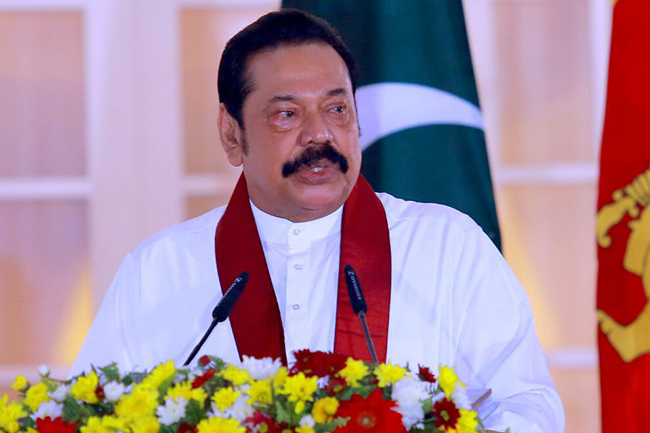
I had the great privilege to welcome His Excellency
Imran Khan, the Prime Minister of the Islamic Republic of Pakistan, and his
high-level delegation this evening.
Prime Minister, you are not a stranger to the people
of Sri Lanka. There are millions in this country who have admired your
leadership on the cricket field as the Captain of the Pakistan National Team.
Your country continues to be a valuable bilateral
partner, and Sri Lanka considers Pakistan a close and genuine friend. Our
People hold Pakistan in very high esteem. Pakistan was a friend who stood by
and helped Sri Lanka in times of great need. We are grateful for the steadfast
support, particularly during my Presidency, when we had to fight a dangerous
terrorist organization that was fully neutralized in May 2009.
During our bilateral discussions earlier this
evening, Prime Minister Imran Khan and I agreed to work closely towards
enhancing our bilateral cooperation in the economic sector and a number of
other areas including trade, investment, science, technology, defense and
education. We also agreed to pursue the opportunities presented within the
framework of the Pakistan-Sri Lanka Free Trade Agreement. Our talks also
focused on important regional and international issues as well as the impact of
the Coronavirus pandemic.
We further agreed to work towards increasing
activities in the tourism and aviation sectors. Sri Lanka is grateful to
Pakistan for agreeing to open the pilgrimage corridors for Sri Lankans to visit ancient Buddhist heritage sites in
Pakistan.
Another important decision we made is to restart
Parliamentary interaction through the Pakistan
– Sri Lanka Parliamentary Friendship Groups.
Sri Lanka believes that political stability and
regional peace will be the key to achieve sustainable development, economic
growth and prosperity in South Asia. I admire Prime Minister Khan for his
efforts in alleviating poverty and socio-economic disparity which play an
important part of our development agenda. We continue to work together to fight
terrorism, religious fundamentalism and extremism.
In our talks, we agreed to continue with the current
mechanism to curb illegal drug trafficking, arms smuggling and other illegal
activities by sharing information through the relevant agencies.
We are also thankful to Pakistan for the partnership
in the field of sports and assistance to enhance sports training facilities in
the country.
Tomorrow, Prime Minister Imran Khan will preside
over a business and investment forum with a strong multi-sector business
delegation from Pakistan. Through direct interactions with their Sri
Lankan counterparts, we expect to see a considerable
increase in investments and business activities between our two countries.
While thanking Prime Minister Imran Khan and the
delegation for undertaking this official visit to Sri Lanka, I am deeply
grateful to you for honoring Sri Lanka with your visit here.
Your Excellency, Prime Minister Imran Khan, let me
extend a warm and cordial welcome to you and your delegation.
In fact, Your Excellency, you are the first foreign
Head of Government to visit Sri Lanka after I assumed office as the the Prime
Minster of Sri Lanka after the General Elections last year.
On my invitation, you have chosen to visit Sri Lanka
with great friendship, despite great challenges, including COVID-19 risks.
Your visit symbolizes the deep affinity you and your
government so dearly cherish towards the people of my country.
I admire your courage and the great leadership that
is evident in crucial decisions you have taken at times of crises.
Even this visit is a clear demonstration of the
leadership quality that I have seen decades ago when you led the Pakistan’s
National Cricket Team against strong opponents.
Your Excellency,
I have observed your rise to the high office through
the common people’s power and years of activism. That demonstrates your true
love for the oppressed and the needy. Your people centric governance agenda
goes hand in hand with my own government’s approach towards empowering the
grassroots level communities and underprivileged.
Let me take this opportunity to wish you and your
government all success at the forthcoming Senate election in Pakistan.
The ties between our two countries are closely
linked by history, culture, religion, and our deep bilateral cooperation has
become an all-weather friendship which has withstood the test of time.
Relations between our two nations have now expanded
to many sectors. But we have great potential before us to further strengthen
our bilateral cooperation.
I must thank Your Excellency for accompanying a
strong business delegation with promising signs of investments and commercial
partnerships. At a time of economic uncertainty, such private sector investments
will greatly benefit both our economies.
I recall with much pleasure my most recent visit to
Pakistan in 2017 and previously as President. Both visits were very productive
and memorable for me. I was indeed touched by the hospitality and the warm
reception given to me and my delegation by the friendly people of Pakistan.
Your Excellency, allow me to introduce my
delegation:
On my right are:
Hon. Dinesh Gunawardena — Foreign Minister Hon.
Bandula Gunawardena — Minister of Trade Hon. Prasanna Ranatunga — Minister of
Tourism Hon. Ali Sabry — Minister of Justice
Hon. Tharaka Balasuriya — State Minister of Regional
Cooperation Admiral Prof. Jayanath Colombage — Foreign Secretary
Mr. S.R. Attygalle — Secretary to the Treasury,
Ministry of Finance
On my left are:
Hon. Prof. G.L.Peiris — Minister of Education
Hon. Mahindananda Aluthgamage — Minister of
Agriculture Hon. Namal Rajapakse — Minister of Youth and Sports
Hon. Lohan Ratwatte — State Minister of Prison
Management and Prisoners’ Rehabilitation; and State Minister of Gem &
Jewelry Related Industries
Hon. Ajith Nivard Cabraal — State Minister of Money
& Capital Market and State Enterprise Reforms
Mr. Gamini S. Senarath — Secretary to the Prime
Minister General Kamal Gunaratne — Secretary, Ministry of Defense
Prime Minister of Pakistan Imran Khan on Tuesday (February 23) said he looks forward to expand trade relations with Sri Lanka through China-Pakistan Economic Corridor (CPEC) flagship program.
CPEC, which connects Gwadar Port in Balochistan with China’s Xinjiang Province, is the flagship project of Chinese President Xi Jinping’s Belt and Road Initiative (BRI).
In a joint statement issued with his Sri Lankan counterpart PM Mahinda Rajapaksa, the Pakistani Premier said this visit is to strengthen our bilateral relations between Pakistan and Sri Lanka, especially trading ties.
The focus of the bilateral discussion has also fell on enhancing trade ties between the two countries in order for Sri Lanka to benefit from Pakistan’s connectivity up to Central Asia.
Our trading ties will also mean that the two countries will come closer together,” PM Khan said further.
We shared a common problem of terrorism,” he stated, speaking of decade-long terrorism that Pakistan suffered as well as Sri Lanka’s 30-year-long civil war. He said tourism in Pakistan dried up during the terrorism-hit period and that the country hardly received any investment.
Now we have faced another problem – the coronavirus,” he continued. Sri Lanka has like all other countries that depend on tourism has suffered due to the pandemic.
The two prime ministers have discussed how developed countries can help the developing world at present.
Pakistani Premier said the developed world right now should not be insular. Coronavirus has exposed the inequality in the world.”
He said world organizations like the United Nations should step in to look after the countries that have taken a real beating from the pandemic.
PM Khan meanwhile extended an invitation to PM Rajapaksa to visit Pakistan.
Prime Minister Mahinda Rajapaksa, delivering the joint statement, said the two leaders agreed to work closely towards enhancing bilateral cooperation in the economic sector and a number of other areas including trade, investment, science, technology, defence and education.
We also agreed to pursue the opportunities presented within the framework of the Pakistan-Sri Lanka Free Trade Agreement. Our talks also focused on important regional and international issues as well as the impact of the Coronavirus pandemic.”
Speaking further, PM Rajapaksa said Sri Lanka and Pakistan have agreed to work towards increasing activities in the tourism and aviation sectors. He expressed gratitude to his counterpart for agreeing to open the pilgrimage corridors for Sri Lankans to visit ancient Buddhist heritage sites in Pakistan.
Another important decision that was made during the discussion is to restart Parliamentary interaction through the Pakistan-Sri Lanka Parliamentary Friendship Groups, PM Rajapaksa said further.
Sri Lanka believes that political stability and regional peace will be the key to achieve sustainable development, economic growth and prosperity in South Asia,” he continued, while admiring PM Khan for his efforts in alleviating poverty and socio-economic disparity which play an important part of the development agenda.
We continue to work together to fight terrorism, religious fundamentalism and extremism.”
PM Rajapaksa said Pakistan was a friend who stood by and helped Sri Lanka in times of great need. We are grateful for the steadfast support, particularly during my Presidency, when we had to fight a dangerous terrorist organization that was fully neutralized in May 2009.”
They have further agreed to continue with the current mechanism to curb illegal drug trafficking, arms smuggling and other illegal activities by sharing information through the relevant agencies.
We are also thankful to Pakistan for the partnership in the field of sports and assistance to enhance sports training facilities in the country,” PM Rajapaksa said.
Pakistani Premier is expected to preside over a business and investment forum with a strong multi-sector business delegation from Pakistan tomorrow.
PM Rajapaksa noted that Sri Lanka expects to see a considerable increase in investments and business activities between the two countries through direct interactions with their Sri Lankan counterparts.
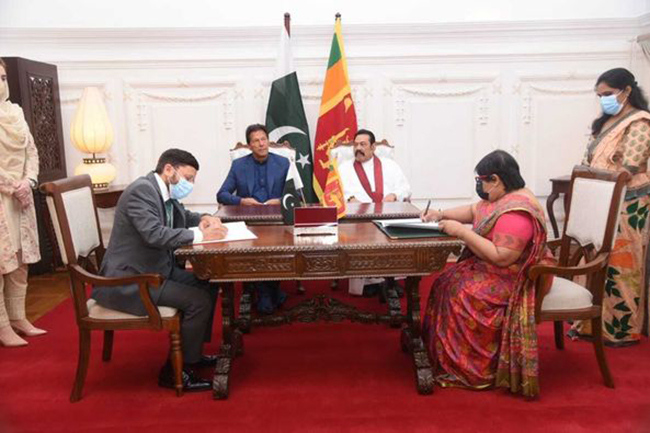
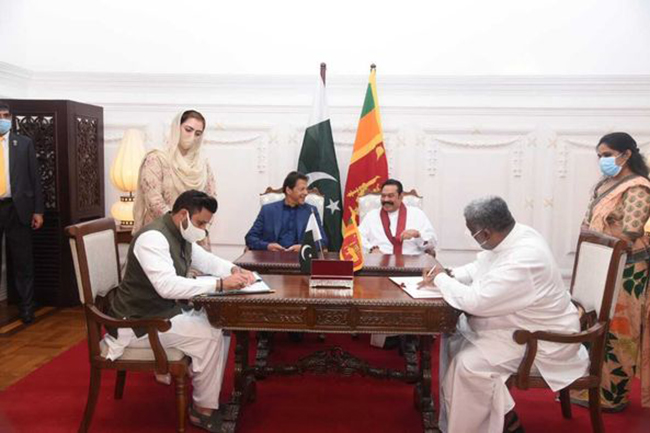
In the meantime, Sri Lanka and Pakistan have signed five economically important Memorandums of Understanding (MoUs) today (February 23) in line with PM Imran Khan’s two day visit to the island nation.
Signing of the MoUs took place at the Temple Trees this evening in presence of Prime Ministers Mahinda Rajapaksa and Imran Khan.
Five MoUs signed by the two countries are as follows:
1. Memorandum of Understanding between the Islamic Republic of Pakistan and the Democratic Socialist Republic of Sri Lanka on Tourism Cooperation
2. Memorandum of Understanding between the Board of Investment of the Democratic Socialist Republic of Sri Lanka and the Board of Investment of the Islamic Republic of Pakistan
3. Memorandum of Understanding between the Institute of Industrial Technology (ITI) of Democratic Socialist Republic of Sri Lanka and the University of Karachi of Islamic Republic of Pakistan
4. Collaboration between the Institute of Industrial Technology, Colombo and the University of COMSATS in Islamabad
5. Memorandum of Understanding between the University of Colombo and the Lahore Economic College in Pakistan.
Sri Lanka has confirmed three more COVID-19 related fatalities, Director-General of Health Services confirmed today (February 23).
Accordingly, death toll from the pandemic outbreak now stands at 453, Department of Government Information said.
A 75-year-old man from Wattala area died yesterday (February 22) while receiving treatment at the Anuradhapura Teaching Hospital. He had been transferred from Colombo National Hospital after testing positive for the virus. COVID pneumonia was recorded as the cause of death.
The second victim is a 76-year-old man from Nuwara-Eliya. He died on February 20 while he was under medical are at Nuwara-Eliya District General Hospital. COVID-19 infection was mentioned as the cause of death.
An 83-year-old man from Walapane area meanwhile died of COVID pneumonia and shock due to blood poisoning. He had been under medical care at the Nuwara-Eliya District General Hospital at the time of his passing.
Covid-19 infections registered in Sri Lanka crossed 81,000 as 270 more persons were tested positive today (February 23).
Thereby, the country has confirmed 492 infections in total within the day.
Department of Government Information said 15 of them were detected from the prison cluster. The remaining 477 are close contacts of earlier cases linked to the Peliyagoda cluster.
As per statistics, the total number of Covid-19 infections confirmed in the country to date now stands at 81,009.
Recoveries from the virus meanwhile climbed to 75,842 earlier today, with 732 more patients returning to health.
However, 4,717 active cases are still under medical care at selected hospitals and treatment centres located across the island.
Pakistani Prime Minister Imran Khan on Tuesday arrived in Sri Lanka for a two-day official visit to island.
The Pakistani premier, who was invited by his Sri Lankan counterpart Mahinda Rajapaksa, is accompanied by a high-level delegation, including members of the Federal Cabinet and senior officials.
PM Imran Khan was given a guard of honour upon his arrival at the airport after being welcomed by Prime Minister Mahinda Rajapaksa.
During his visit, Prime Minister Imran Khan will attend bilateral meetings with President Gotabaya Rajapaksa and Prime Minister Mahinda Rajapaksa, while several other high-level engagements are planned, including a Business and Investment Forum, as well as a sports diplomacy initiative.
Both Sri Lanka and Pakistan Prime Ministers will together preside over an event to sign several mutually beneficial bilateral Memoranda of Understanding (MoUs) on 23 February following their official talks at the Temple Trees.
He will also participate in a joint ‘Trade and Investment Conference’ aimed at promoting trade and investment between the two countries.
Prime Minister Imran Khan in his maiden official visit this year outside the country is accompanied by a high-powered business and investment delegation that will consist of business leaders in Pakistan, mainly from the sectors of textile and apparel, pharmaceuticals, agro-food commodities, sports goods, gems and jewellery, auto parts, ICT, construction material and surgical equipment.
Prime Minister Imran Khan is accompanied by Minister of Foreign Affairs Makhdoom Shah Mehmood Qureshi, Adviser to the Prime Minister on Commerce Abdul Razak Dawood, Secretary Foreign Affairs Sohail Mehmood and senior officials of the Pakistan Government.
The Presidential Secretariat has handed over the report of Presidential Commission of Inquiry (PCoI) on the Easter Sunday terror attacks to Speaker of Parliament Mahinda Yapa Abeywardene.
On the directive of President Gotabaya Rajapaksa, the Director General (Legal) of the Presidential Secretariat, Mr. Hariguptha Rohanadheera handed over the Presidential Commission report on Easter Sunday attacks to the Speaker today.
The Secretary General of Parliament was also in attendance, the Communications Department said.
Speaker Mahinda Yapa Abeywardena then announced in Parliament that he has received the final report of the PCoI on Easter Sunday attacks and he will table it in Parliament as soon as he receives the copies.
The Speaker further said that he has sent the report to the Library of Parliament for the reference of Members.
The English version of the report and a translated copy in Sinhala were tabled at the meeting of Cabinet of Ministers yesterday.
The report is scheduled to be submitted to the Parliament today (February 23).
Reportedly, former high-ranking politicians and officials including ex-President Maithripala Sirisena, ex-Defence Secretary Hemasiri Fernando, ex-IGP Pujith Jayasundara, ex-SIS chief Nilantha Jayawardena, ex-Minister Rishad Bathiudeen and many others have been charged in the report.
The Presidential Commission of Inquiry appointed to investigate the 2019 Easter Sunday terror attacks handed over its final report to President Gotabaya Rajapaksa on February 01.
Hearings and other procedures of the Presidential Commission officially came to a conclusion on January 27, 2021.
The Commission was appointed by former President Maithripala Sirisena on September 22nd, 2019 to investigate the series of attacks that took place on Easter Sunday same year and to recommend necessary actions.
The commission had recorded evidence from a total of 440 individuals during its term.
The commission was chaired by Court of Appeal Judge, Janak de Silva and included Court of Appeal Judge, Nishshanka Bandula Karunarathna, Retired High Court Judges Nihal Sunil Rajapaksa and A.L. Bandula Kumara Atapattu, former Secretary of the Ministry of Justice, W.M.M.R. Adikari.
Sri Lanka’s Human Rights situation will come under the
microscope at UNHRC.
Why has United Nations High
Commissioner for Human Rights Michelle Bachelet “NOT” called for
an International Criminal Court investigation to come under the microscope at
the UNHRC into Rights violations of the Sri Lankan Muslim Community of the
North and Eastern Provinces during the separatist war perpetrated by the LTTE,
LTTE supportive Tamil government Officials, and Tamil politicians who aided and
abetted and supported the killings of hundreds of Muslims in the Eastern
province while they were performing their prayers in mosques, to ensure justice
for those civilians killed?
By P.K.Balachandran/Daily Mirror Courtesy NewsIn.Asia
Colombo, February 23: In its observations on the report of the Office of the High Commissioner for Human Rights (OHCHR) communicated to the 46 th.,session of the UN Human Rights Council (UNHRC), the Sri Lankan government has drawn attention to the progress made in addressing issues related to human rights and ethnic reconciliation and emphatically refuted the charges and contentions in the OHCHR’s report.
In the point-by-point refutation, the government’s overall thrust is that the OHCHR’s contentions are baseless, biased and unsubstantiated. Some comments and prescriptions amount to violation of Sri Lanka’s sovereignty and meddling in Sri Lanka’s internal affairs which is outside the UNHRC’s mandate.
The government’s 30-page reply published in full by www.counterpoint.lk says that the OHCHR should have focused on deliverable” reconciliation mechanisms rather than trying to put in place mechanisms which do not have popular sanction or are constitutionally barred.
Achievements
Refuting the repeated contention that Sri Lanka has been hoodwinking the UNHRC, the government points out that the Office of Missing Persons (OMP) is functioning under judicial oversight and is headed by a former Supreme Court judge. Government is waiting for the OMP to submit its financial requirements. The Office of Reparations, (OR), which has been allotted Rs.910 million (US$ 4.65 million), has so far received 16,275 applications of which 4358 have been processed and Rs.142 million (US$ 725.776) disbursed as reparations. The Human Rights Commission of Sri Lanka (HRCSL) was allotted Rs.290 million (US$ 1.48 million).
As regards lands taken by the military during the war, 82.26% of State lands and 92.22% of Private lands were returned to their civilian owners by end December 2019. When the war ended, 1311 sq.km in the Northern and Eastern provinces were bristling with land mines. 98.7% of the affected area has now been cleared. The government’s bid to replace the Prevention of Terrorism Act (PTA) failed because of opposition in parliament and religious leaders, but government is intent on revisiting” the PTA.
Deliverable Mechanisms
Apparently alluding to the UNHRC’s requirement for an international or domestic judicial mechanism to investigate war crimes charges, the government says that the OHCHR should focus on deliverable measures for reconciliation in line with the interests of Sri Lanka and its people instead of imposing unfeasible commitments for the sake of exemplifying theoretical notions of transitional justice.” The co-sponsorship of an earlier resolution by an erstwhile Sri Lankan government was constitutionally undeliverable” and had no public endorsement,” the government points out justifying it’s withdrawal from the co-sponsored resolution.
The government says that it has been unfailingly complying with requirements of the UN system on human rights issues. The US sub-committee on torture visited Sri Lanka in 2019. As in the case of other such investigating UN teams, it was given full access. The chairperson of the Human Rights Commission of Sri Lanka had told an earlier UN team that the commission had not received any information on abduction, unlawful detection or sexual violence. The OHCHR had alleged that the National Investigation Bureau” is trailing people but the government points that such a bureau ceased to exist in 2009 following the end of the war.
On the charge that International and Domestic NGOs are being harassed, the government said: In the backdrop of past experience where NGOs had been abetting terrorism in this country, it is essential that the government initiates a mechanism to ensure their accountability and transparency, as such organization could engage in terrorist financing and money laundering causing a threat to national security.”
In the context of the Easter Sunday (April 21, 2019) bombings, there is suspicion and fear that NGOs were engaged in those activities with funds received from overseas through formal and informal systems,” the report said and added that recently there were attempts to assassinate Tamil MPs from the Northern and Eastern provinces. The government is responsible for ensuring the security of these VIPs”.
Militarization
Referring to the charge of the militarization of the administration under President Gotabaya Rajapaksa, the government says that appointing any person to any office is the prerogative of the government and is, at any rate, outside the mandate of the OHCHR. The appointments made had been done on the basis of qualifications and competence. The government also points out that Sri Lanka is not militarized State as it neither has compulsory military service nor conscription. The UN has itself certified Sri Lanka as not having child soldiers (only the LTTE had them as UN official Olara Otunnu pointed out after a visit in 1998).
On the charge that Sri Lanka is deploying the army in civilian duties, the government says that it has the sovereign right to move its army units anywhere and assign any task to it. Even advanced countries use the armed forces to help civil authorities during emergencies. Government then points out the dangers in lowering vigil as it was lowering of vigil which had enabled suicide bombers to kill 277 and injure 592 on Easter Sunday, April 21, 2019.
The OHCHR had alleged that in the aftermath of the Eastern Sunday bombings there were widespread anti-Muslim riots and there was prolonged emergency with extra deployment of the military. In reply the government says that after the most horrific” incident government had to impose an emergency and use every available resource to tackle the situation.
On the allegation that the government’s handling of the COVID-19 pandemic had showed up structural inequalities,” the government points out that structural inequalities have shown up even in advanced countries. The ban on burials rests on scientific considerations and the public good, it adds.
Indiscriminate Shelling
On the charge of indiscriminate shelling” in the last phase of the 2006-2009 war, the government case is that the Advisory Council to the Paranagama Commission comprising lawyers Sir Desmond de Silva, Sir Geoffrey Nice QC. (UK) and David M. Crane (USA) assisted by Rodney Dixon, Michael Newton (USA) and Major General J Holmes had said excessive force was not used. UNICEF Executive Director James Grant had said that food was not denied to the people trapped in the war zone. Supply was uniquely humanitarian in a conflict situation,” Grant said. It was also agreed that the LTTE was using civilians as a shield. Lord Michael Naseby had said that the government had not broken any provisions of international Humanitarian Law.
Punitive Measures
On the punitive measures the OHCHR suggested, the government says that dragging Sri Lanka to the International Criminal Court on war crimes charges is disproportionate and unwarranted” and warns that it will be deemed an unwarranted interference in the internal affairs of a sovereign State and a contravention of the UN Charter.”
On the recommendation of targeted sanctions against individuals, it says that sanctioning someone in the absence of credible findings by a competent court or body, indicates a political agenda to destabilize a country, violate individual rights and contravene the principles of natural justice.”
Collateral Victim
The government’s contention is that the OHCHR has been oblivious to the genuine and feasible commitments undertaken by Sri Lanka and the progress being achieved in their implementation, and has instead chosen to come to sweeping, impetuous conclusions.”
According to the government, it can only be concluded that Sri Lanka has been selected and targeted by the OHCHR for purposes other than promotion of human rights. Sri Lanka has been a victim of a collateral exercise.” The hint is that Sri Lanka is an innocent victim of Big Power rivalry.
Colombo says there is progress in reconciliation efforts and accuses OHCHR of motivated misrepresentation
In its observations on the report of the Office of the High Commissioner for Human Rights (OHCHR) communicated to the 46 th.,session of the UN Human Rights Council (UNHRC), the Sri Lankan government has drawn attention to the progress made in addressing issues related to human rights and ethnic reconciliation and emphatically refuted the charges and contentions in the OHCHR’s report.
In the point-by-point refutation, the government’s overall thrust is that the OHCHR’s contentions are baseless, biased and unsubstantiated. Some comments and prescriptions amount to violation of Sri Lanka’s sovereignty and meddling in Sri Lanka’s internal affairs which is outside the UNHRC’s mandate.
The government’s 30-page reply published in full by www.counterpoint.lk says that the OHCHR should have focused on deliverable” reconciliation mechanisms rather than trying to put in place mechanisms which do not have popular sanction or are constitutionally barred.
Achievements
Refuting the repeated contention that Sri Lanka has been hoodwinking the UNHRC, the government points out that the Office of Missing Persons (OMP) is functioning under judicial oversight and is headed by a former Supreme Court judge. Government is waiting for the OMP to submit its financial requirements. The Office of Reparations, (OR), which has been allotted Rs.910 million (US$ 4.65 million), has so far received 16,275 applications of which 4358 have been processed and Rs.142 million (US$ 725.776) disbursed as reparations. The Human Rights Commission of Sri Lanka (HRCSL) was allotted Rs.290 million (US$ 1.48 million).
As regards lands taken by the military during the war, 82.26% of State lands and 92.22% of Private lands were returned to their civilian owners by end December 2019. When the war ended, 1311 sq.km in the Northern and Eastern provinces were bristling with land mines. 98.7% of the affected area has now been cleared. The government’s bid to replace the Prevention of Terrorism Act (PTA) failed because of opposition in parliament and religious leaders, but government is intent on revisiting” the PTA.
Deliverable Mechanisms
Apparently alluding to the UNHRC’s requirement for an international or domestic judicial mechanism to investigate war crimes charges, the government says that the OHCHR should focus on deliverable measures for reconciliation in line with the interests of Sri Lanka and its people instead of imposing unfeasible commitments for the sake of exemplifying theoretical notions of transitional justice.” The co-sponsorship of an earlier resolution by an erstwhile Sri Lankan government was constitutionally undeliverable” and had no public endorsement,” the government points out justifying it’s withdrawal from the co-sponsored resolution.
The government says that it has been unfailingly complying with requirements of the UN system on human rights issues. The US sub-committee on torture visited Sri Lanka in 2019. As in the case of other such investigating UN teams, it was given full access. The chairperson of the Human Rights Commission of Sri Lanka had told an earlier UN team that the commission had not received any information on abduction, unlawful detection or sexual violence. The OHCHR had alleged that the National Investigation Bureau” is trailing people but the government points that such a bureau ceased to exist in 2009 following the end of the war.
On the charge that International and Domestic NGOs are being harassed, the government said: In the backdrop of past experience where NGOs had been abetting terrorism in this country, it is essential that the government initiates a mechanism to ensure their accountability and transparency, as such organization could engage in terrorist financing and money laundering causing a threat to national security.”
In the context of the Easter Sunday (April 21, 2019) bombings, there is suspicion and fear that NGOs were engaged in those activities with funds received from overseas through formal and informal systems,” the report said and added that recently there were attempts to assassinate Tamil MPs from the Northern and Eastern provinces. The government is responsible for ensuring the security of these VIPs”.
Militarization
Referring to the charge of the militarization of the administration under President Gotabaya Rajapaksa, the government says that appointing any person to any office is the prerogative of the government and is, at any rate, outside the mandate of the OHCHR. The appointments made had been done on the basis of qualifications and competence. The government also points out that Sri Lanka is not militarized State as it neither has compulsory military service nor conscription. The UN has itself certified Sri Lanka as not having child soldiers (only the LTTE had them as UN official Olara Otunnu pointed out after a visit in 1998).
On the charge that Sri Lanka is deploying the army in civilian duties, the government says that it has the sovereign right to move its army units anywhere and assign any task to it. Even advanced countries use the armed forces to help civil authorities during emergencies. Government then points out the dangers in lowering vigil as it was lowering of vigil which had enabled suicide bombers to kill 277 and injure 592 on Easter Sunday, April 21, 2019.
The OHCHR had alleged that in the aftermath of the Eastern Sunday bombings there were widespread anti-Muslim riots and there was prolonged emergency with extra deployment of the military. In reply the government says that after the most horrific” incident government had to impose an emergency and use every available resource to tackle the situation.
On the allegation that the government’s handling of the COVID-19 pandemic had showed up structural inequalities,” the government points out that structural inequalities have shown up even in advanced countries. The ban on burials rests on scientific considerations and the public good, it adds.
Indiscriminate Shelling
On the charge of indiscriminate shelling” in the last phase of the 2006-2009 war, the government case is that the Advisory Council to the Paranagama Commission comprising lawyers Sir Desmond de Silva, Sir Geoffrey Nice QC. (UK) and David M. Crane (USA) assisted by Rodney Dixon, Michael Newton (USA) and Major General J Holmes had said excessive force was not used. UNICEF Executive Director James Grant had said that food was not denied to the people trapped in the war zone. Supply was uniquely humanitarian in a conflict situation,” Grant said. It was also agreed that the LTTE was using civilians as a shield. Lord Michael Naseby had said that the government had not broken any provisions of international Humanitarian Law.
Punitive Measures
On the punitive measures the OHCHR suggested, the government says that dragging Sri Lanka to the International Criminal Court on war crimes charges is disproportionate and unwarranted” and warns that it will be deemed an unwarranted interference in the internal affairs of a sovereign State and a contravention of the UN Charter.”
On the recommendation of targeted sanctions against individuals, it says that sanctioning someone in the absence of credible findings by a competent court or body, indicates a political agenda to destabilize a country, violate individual rights and contravene the principles of natural justice.”
Collateral Victim
The government’s contention is that the OHCHR has been oblivious to the genuine and feasible commitments undertaken by Sri Lanka and the progress being achieved in their implementation, and has instead chosen to come to sweeping, impetuous conclusions.”
According to the government, it can only be concluded that Sri Lanka has been selected and targeted by the OHCHR for purposes other than promotion of human rights. Sri Lanka has been a victim of a collateral exercise.” The hint is that Sri Lanka is an innocent victim of Big Power rivalry.
India is the main supplier of COVID-19 vaccines and has recently gifted 5 lakh doses of Covishield to Sri Lanka.
ri Lanka has cancelled Pakistan Prime Minister Imran Khan’s planned speech in Parliament in an apparent bid to avoid clash with India. The Colombo government cannot risk its relations with India as it faces the Chinese debt-trap. India is also the main supplier of COVID-19 vaccines and has recently gifted 5 lakh doses of Covishield to Sri Lanka.
According to a report titled ‘Sri Lanka avoids clash with India by cancelling Khan’s Parliament speech’ by Dar Javed published in Colombo Gazette, the speech was cancelled to prevent souring of relations with India.
Sergeant-at-Arms of Parliament, Narendra Fernando said he has informed Parliament that the Pakistan Prime Minister’s visit to Sri Lanka will go ahead as scheduled, the Colombo Gazette website reported on last Wednesday.
However, the Foreign Ministry had informed Parliament officials that his proposed visit to the Parliament complex will not take place. Pakistan Prime Minister Khan will arrive in Sri Lanka on February 22 on a two-day official state visit.
Khan, who will be the first head of state to visit the country since the COVID-19 pandemic, is to hold talks with President Gotabaya Rajapaksa, Prime Minister Mahinda Rajapaksa and Foreign Minister Dinesh Gunawardena during the visit. It is said that the speech to Parliament had been included in Khan’s itinerary at the Pakistan government’s request. However, it was later cancelled and Sri Lankan media gave various reasons for the cancellation of Khan’s address, Pakistan’s Dawn newspaper reported on Thursday.
The address was scheduled for February 24. According to Sri Lanka’s daily Express, Foreign Secretary Jayanath Colombage said that Speaker Mahinda Yapa Abeywardena had requested for the cancellation of Khan’s address, citing COVID-19.
Dawn newspaper quoting Sri Lankan media reports that there were elements within the Sri Lankan government, who did not want the speech to take place as they feared that doing so could further harm ties with India, which have already been strained after the cancellation of a deal over the East Container Terminal in Colombo port, Dawn newspaper said.
It was expected that Khan would raise the Kashmir issue during his speech, which could have upset Delhi, it said. Tensions between India and Pakistan spiked after New Delhi abrogated provisions of Article 370 of the Constitution to withdraw Jammu and Kashmir”s special status and bifurcated it into two Union Territories in 2019.
Pakistan has been trying to internationalise the Kashmir issue but India has asserted that the abrogation of Article 370 was its “internal matter”.
Another speculation doing the rounds is that the Sri Lankan government was concerned about Khan speaking about the rights of Muslims in Sri Lanka, who have faced abuses at the hands of Buddhist majority, rising anti-Muslim sentiments, and biased government actions.
The Sri Lankan government had made compulsory cremation rule for those dying from COVID-19, enraging the Muslim community in the country. The government, however, earlier this month exempted the Muslims from cremation and allowed them to bury their dead after a global outcry over the issue.
Khan had welcomed the Sri Lankan government’s decision. The Pakistan Prime Minister’s visit, scheduled a month after Indian External Affairs Minister S Jaishankar’s three-day visit to Colombo, will coincide with the 46th UN Human Rights Council session in Geneva, where a new resolution on Sri Lanka is likely to be adopted. Prime Minister Narendra Modi had addressed Sri Lanka’s Parliament in 2015.
UK hindered war crimes investigation – Naseby tells Bachelet
Leader of Sri Lanka Core Group, the UK, has suppressed official documents that could have helped the Geneva-based United Nations Human Rights Council (UNHRC) to establish the truth pertaining to war crimes allegations, including the number of deaths on the Vanni east front in 2009, Lord Naseby has said in a letter addressed to Michelle Bachelet, United Nations High Commissioner for Human Rights.
Lord Naseby has raised the issue in his capacity as the President of the All Party British-Sri Lanka Parliamentary Group. The Conservative politician was responding to the controversial ‘Report of the Office of the United Nations High Commissioner for Human Rights on Sri Lanka’ that recommended punitive measures against Sri Lanka, ahead of the 46th sessions of the UNHRC due to commence today (22).
Foreign Minister Dinesh Gunawardena is scheduled to address Geneva on Tuesday (23).
Lord Naseby, in his Feb 13, 2021, dated letter to Bachelet, has dealt with how the UK, a current member of the UNHRC, in addition to being member of the Sri Lanka Core Group, withheld from the UN body vital wartime dispatches sent to London by the British High Commission in Colombo in 2009.
Other Core Group members are Canada, Germany, North Macedonia, Malawi and Montenegro. The shocking suppression of High Commission dispatches came to light on Feb 16, 2021 when Lord Ahmad of Wimbledon, the Foreign, Commonwealth and Development Office, told Parliament that the UK Government had not received any request from the UN Human Rights Council for copies of dispatches written by the former defence attaché at the British High Commission in Sri Lanka, Lieutenant Colonel Gash about events in Sri Lanka related to the civil war, and had not provided any.
Lord Ahmad was responding to Lord Naseby’s query whether the UK government provided to UNHRC any (1) censored, and (2) uncensored, copies of dispatches from Lieutenant Colonel Gash, the former defence attaché of the British High Commission in Sri Lanka about events in that country between 1 January and 18 May 2009 relating to the civil war.
Lord Naseby has tabled the question on Feb 4, 2021.
Lord Naseby told The Island that he had to invoke the Freedom of Information Act 2000 to secure ‘Gash reports’ to secure documents though the UK held back some while even the released documents were censored. Gash reports disputed UN Panel of Experts (PoE) primary claim that the Vanni offensive claimed the lives of 40,000 civilians. Gash reports estimated the number of dead, both civilians and LTTE combatants at 7,000.
The UNHRC consists of 47 countries divided into five categories : African States( 13 seats),Asia-Pacific States( 13 seats), Latin American and Caribbean States( 8 seats), Western European and other States( 7 seats) and Eastern European States( 6 seats).
The following is the relevant section from Lord Naseby’s assessment of Bachelet’s report: The UK government has the evidence of the UK Defence Attaché Lt. Col. Gash during his period of service in Sri Lanka. Following a Freedom of Information Request from me which took nearly 3 years, Col. Gash’s dispatches from the war front are now, in heavily redacted copies, in the public domain. There is ample evidence in these dispatches that Sri Lanka’s government at the time and its armed forces did not have a policy to kill Tamil civilians, indeed they went out of their way to rescue them with considerable success despite danger and losses to themselves. Removal of the redactions might well make it even clearer. By not providing these dispatches in un-redacted form, the British Government is hindering the process of establishing the truth of what really happened at the end of the Sri Lanka conflict.”
Lord Naseby’s Office told The Island that Lord Naseby prepared his own independent analysis of Bachelet’s report and sent it directly to the Office of the High Commissioner for Human Rights at the UNHRC in Geneva. In addition, as the UK was the lead member of the core group on UNHRC Resolution 30/1, 34/1 and 40/1 on Sri Lanka, copies had also been sent to Foreign Secretary, Dominic Raab MP and Lord Tariq Ahmad, Minister of State at the Foreign, Commonwealth & Development Office.
Lord Naseby’s Office said that the Lord had personally written to the UK Foreign Secretary Dominic Raab, to give due consideration for the long-standing friendship between Sri Lanka and the UK, especially as both countries were founding members of the Commonwealth. Lord Naseby had mentioned that it was more important than ever, especially in the midst of a pandemic that the UK continued to engage positively with Sri Lanka at every level and to support and strengthen peace and reconciliation amongst all communities.
Lord Naseby disclosed Gash’s reports on Oct 12, 2017. Sources said that Sri Lanka, too, refrained from requesting the UK to submit Gash reports though a section of the media repeatedly underscored the importance of them.
The suppression of vital documents came to light in the wake of Sri Lanka Core Group declaring its intention to present a unilateral resolution to promote ‘reconciliation, accountability and human rights’ in Sri Lanka.
The following is the text of the statement issued by the British HC in Colombo over the weekend: The Core Group pays tribute to the people of Sri Lanka and wishes to highlight our ongoing commitment to accountability, reconciliation, and inclusive peace in Sri Lanka.
We recognize and welcome the progress made by the Government of Sri Lanka in rebuilding infrastructure, demining, land return and resettling internally displaced persons. However, it is clear that more needs to be done to address the harmful legacies of war and build a sustainable peace in the country.
This month, the United Nations Human Rights Council will consider an important report recently published by the Office of the United Nations High Commissioner for Human Rights (OHCHR), on human rights, reconciliation and accountability in Sri Lanka.
It has been important for the Core Group to work collaboratively and constructively with the Government of Sri Lanka over the last five years. Consequently, we have engaged with the Government of Sri Lanka in preparation for the Council.
The Core Group restates the ongoing importance of addressing Sri Lanka in the Human Rights Council. Informed by the report, the Core Group intends to present a resolution to promote reconciliation, accountability and human rights in Sri Lanka.”
The six-member committee appointed by President Gotabaya Rajapaksa to study the Report of the Presidential Commission of Inquiry (PCoI) into the 2019 Easter Sunday attacks has been entrusted with a wide ranging mandate, the President’s Media Division stated today (22).
Identifying the overall process including the measures that need to be taken by various agencies and authorities such as the Parliament, judiciary, Attorney General’s Department, security forces, state Intelligence services and implementing recommendations as stipulated by the PCoI to avert recurrence of a national catastrophe of such magnitude is the prime responsibility of the said Committee, PMD pointed out. These recommendations cannot be successfully implemented by any entity single handedly, PMD added.
The Presidential Commission of Inquiry (PCoI) into the Easter Sunday attacks was appointed in 2019 by the previous government.
The government in power is of the view that the Easter Sunday attacks had a devastating impact on the national security and stability, the economy, religious harmony and the social fabric of the country, PMD said. The background to these events also opens the door to external interference that is detrimental to the country’s sovereignty and stability. In order to ensure peace and security as well as economic prosperity within the territory of the State of Sri Lanka, all avenues leading to recurrence of such extremist violence must entirely be closed. This requires a complete cessation of religious extremism and associated terrorist violence, hate speech aiming different ethnic communities and foreign funding for such groups.
The PCoI has identified what each state institution and authority should do and the level of priority to be given to each task to achieve these broad objectives. If the existing administrative machinery is not adequate to follow the recommended course of action, necessary amendments need to be made in the administrative mechanism, PMD pointed out. The responsibility entrusted with the Parliamentary Committee appointed by the President is to study in depth the content of the Report of the PCoI on Easter Sunday attacks and to report on how action should be taken to prevent such a tragedy from happening again and to ensure the long lasting peace, security and stability in Sri Lanka, the PMD further said.
Prosecution and trial of the accused as per the recommendations of the PCoI on Easter Sunday attacks will take place in accordance with the standard judicial procedures. The Parliamentary Committee is not expected to intervene in the said process. Adding recommendations to the Commission of Inquiry Report is also not within the scope of the Committee. However, certain groups with vested interests are trying to socialize misconceptions about the role of the Parliamentary Committee, PMD stated.
The six-member Committee was selected considering factors such as their political maturity, experience and high level of knowledge in various fields.
Sri Lanka has reported 05 more coronavirus-related deaths, the Director-General of Health Services confirmed today (February 22).
As per the Department of Government Information, two male patients and three female patients are among the victims.
The new deaths bring the number of COVID-19 related deaths witnessed in Sri Lanka to 450 in total.
01. The deceased is a 33-year-old female from Dunagaha. She died on 20.02.2021 while undergoing treatments at Teaching Hospital Kurunegala. The cause of death is mentioned as acute diabetes and acute kidney disease with Covid-19 infection.
02. The deceased is an 82-year-old female from Nugegoda. She died on 19.02.2021 at her residence. The Cause of death is mentioned as Covid-19 pneumonia.
03. The deceased is a 69-year-old male from Colombo 12. He died on 20.02.2021 while on admission to General Hospital Colombo. The cause of death is mentioned as blood poisoning and acute urinary tract infection with Covid-19 infection.
04. The deceased is an 83-year-old female from Minuwangoda. She was transferred from District Hospital Gampaha to Base Hospital Mulleriyawa where she died on 22.02.2021. The cause of death is mentioned as Covid-19 pneumonia and acute kidney damage.
05. The deceased is a 77-year-old male from Colombo 13. He died on 20.02.2021 at his residence. The cause of death is mentioned as Covid-19 pneumonia, acute diabetes, and high blood pressure.
The higher a monkey climbs, the more you see of
its behind.” —Joseph Stillwell
Who is Colombage?
Monkeying around on the seat of the Foreign Secretary in the
Ministry of Foreign Affairs, is a rank outsider and interloper, Pastor
Colombage, described by many insiders as the ineptest Secretary in the history
of post-independence Sri Lanka; these insiders are unable to perceive whether
Colombage is just an opportunistic nincompoop or a cunning fifth columnist
operating within the Ministry.
These opinions are based on the born-again pastor’s preposterous
gaffes, conflicts of interest and his membership in ultra-right American funded
think tanks like ‘Centre for Indo-Lanka Initiatives’ covertly nestling under
the wings of the notorious ‘Pathfinder’ organisation.
The head of the ‘Pathfinders’, Agent Moragoda, whose life and
reputation is mired in allegations of bribery, corruption and espionage was
further disgraced when his nomination as Sri Lanka’s High Commissioner to India
did not find favour with India.
Colombage, like his handler Agent Moragoda, is proving to be an
embarrassment to the country and a positive threat to her National Security.
Echoing his handler’s voice, it was Colombage who went public to
utter Neutrality is the number one pillar of Sri Lanka’s Foreign Policy”.
Colombage did not know the difference between Neutrality and
Non-Alignment. Then, to cover up his gaffe, he made matters worse when he
seemed to suggest that Non-Alignment is unfriendly. To whom?
His next major gaffe was when he grandiosely announced that Sri
Lanka will adopt an India first approach” as its new foreign policy plank and
protect New Delhi’s strategic security interests”.
With egg on his face and eating humble pie, Colombage was soon
making mumbling sounds that what he meant was Sri Lanka first and India
next.
Was Colombage’s retraction genuine considering that India is today
one of the four members of America’s ‘Southern NATO’, a US military alliance in
the Indo-Pacific called the ‘QUAD’.
Colombage’s latest gaffe comes on the eve of a new anti-Sri Lanka
resolution which, a small group of US underlings has declared, would be
presented at the UNHRC sessions scheduled to begin on 22nd February
this year.
These lackey-nations who describe themselves as a CORE group,
comprise Canada, UK, Montenegro, North Macedonia and Germany. Their proposed
Resolution, as reported, is based on the outrageous Report of the United
Nations High Commissioner for Human Rights, Verónica Bachelet, a controversial
and coquettish politician.
Tail wags the dog in the Foreign Ministry
Pastor Colambage revealed last month that the government was
having discussions with the UK-led Sri Lanka Core Group in a bid to explore the
possibility of reaching a consensus on what he, Colombage, described as a
‘consensual resolution’.
Instead of mobilising the friendly nations – the majority in the
International community – to win the 47-member vote in Geneva, Colombage was
clearly dilly-dallying, frittering away the limited time to negotiate a dubious
consensus with the Enemy, the CORE. This procrastination is helpful only to the
Enemy.
With Colombage’s strategy clearly out of step with Dinesh’s
outright condemnation of the Bachelet report, it is clear that in the Foreign
Ministry the tail is wagging the dog.
Reaching consensus on a consensual Resolution – huh?
Colombage says that he is involved in the challenging task of, ‘reaching
a consensus on a ‘consensual’ resolution.
The word ‘Consensual’ by definition is an adjective which means involving
the willing participation of both or all parties, especially in an illegal
transaction or practice”.
What does the verb co-sponsor, used in the 2015 Resolution mean?
It is defined as, together, introduce and support (a proposal) in an
assembly.”
What is the difference between Mangala and Colombage?
What then is the difference between Mangala Samaraweera’s
traitorous act of co-sponsoring a dubious American initiated Resolution on war
crimes and Colombage jointly presenting, with the American CORE group, a
consensual document, an even more traitorous Resolution?
Has Colombage let the cat out of the bag? Has he already agreed to
co-sponsor the Resolution? Is it a fait accompli?
The question arises, How does one reach consensus on a resolution
that is already tabled as a consensual resolution and where would that leave
Sri Lanka?”
Back in square one
The answer was given succinctly by that outstanding Sri Lankan
diplomat, Tamara Kunanayakam, in an interview with a leading local-media outlet
on 11 Feb 21. She gave an incisive insight on the CORE Resolution, the Bachelet
Report and the ramifications these held for Sri Lanka and the world if a
‘consensual’ Resolution were adopted; she summed up Sri Lanka’s position nicely
when she said, We will be back in square one”.
Why it is imperative that Sri Lanka rejects the Resolution?
It is Kunanayakam’s contention that Sri Lanka should reject
outright, this dubious Resolution and go for a vote; Sri Lanka can count on the
support of her friends in the Non-Aligned movement, the Global South, the Security
Council and win, considering especially the latent dangers in the Resolution
that lie in store for these supportive Nations.
Kunanayakam went on to explain that when a Consensual Resolution
is tabled, it communicates, in diplomatese, to the assembly and our friends in
particular, Look, even if you disagree with the Resolution and wish to support
us, there is no space for you now because we have already negotiated with the
sponsors, the CORE group, to jointly present this Resolution”.
Consequently, by procedural compulsion, the voices of our friendly
Nations will be muted, no vote taken, the Resolution adopted – by Consensus, if
you may – and recorded, for history, as a Resolution unanimously adopted!
Is the pastor, monkeying with words to betray Sri Lanka and
simultaneously be the Pathfinder of the Americans to the lands of the countries
in the NAM and the Global South?
David and Goliath yet exist
In 2012, Sri Lanka contributed significantly to the betterment of
the UNHRC when Ambassador Kunanayakam pointed out that the US and its allies
exploiting the fact that they virtually funded the UNHRC, had flexed their
financial muscle to man all key appointments in that organisation; this was
prejudicial to the Nations in the Non-Aligned Movement and the Global South.
A Resolution was sponsored, ably supported by Cuba and Pakistan,
to correct the disparate staffing and to make funding transparent; The
Resolution was adopted on 04 Apr 2012. The days of David and Goliath are not
over.
Sri Lanka breaking news to the world
In that world-shaking interview on 11 Feb 21, in a consequential
studio in a small corner of tiny Sri Lanka, Kunanayakam pointed out matters in
that Resolution which should set-off alarm sirens around the Capitals of the
world.
There is a plot and, in that plot, the Study Circle finds that
Bachelet is a major player. If Bachelet is the foil, the pastor is the
counterfoil.
Given Veronica Bachelet’s background of assorted dalliances,
association in massive corruption scandals, membership in extreme oligarchical
organisations like Club Madrid and intimate work with CIA think tanks like
‘Inter-American Dialogue’ and her vulnerable status, her fabricated report
comes as no surprise to those who know her.
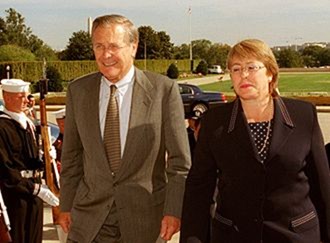
Donald (Rumsfeld) with Veronica
(Bachelet)
Weaponising Human Rights
The US is attempting to use the Sri Lankan situation to dismantle
some of the norms of the current Global Order and replace them with US
benchmarks of governance and tools of intimidation that would facilitate US
hegemony in countries in the NAM and the Global South. The process was
described by Kunanayakam as ‘weaponising Human Rights”
Dangerous Concepts hidden in the Resolution to advance US
unilateralism and establish global precedence
Bachelet’s report contains some dangerous and precedent-setting
concepts totally contrary to the UN Charter and which violates International
Law.
In one instance Bachelet states, If the State is not willing or
unable to protect its citizens, we in the West shall intervene”! Shades of R2P
which was resoundingly defeated at the UN General Assembly.
In another instance Bachelet projects the doctrine of ‘Universal
Jurisdiction’ rejected outright by our African brothers and sisters; if, for
example, a person in one country acts in a manner that is within the law in that
country but is in breach of US law this doctrine permits that person to be
tried in the US, under US Law, in a US Courthouse.
Is this not the concept of hybrid Courts which the US failed to
establish, the first time around in 2015? This time around it is far worse.
What would the fate of our heroic soldiers be if the CORE
Resolution is passed in Geneva? Is this what Colombage is hoping to
achieve?
Carte blanche for America to invade countries at will
Also slipped in by Bachelet, in her report, is another doctrine
which permits the US to peremptorily intervene militarily in any country, if
the US, in their analysis, were to perceive that there could perhaps be a
breakdown of Human Rights in that Country.
This would be a carte blanche for the US to aggress and invade any
Country in the world. The world is only too keenly aware how good the US is at
fomenting problems in foreign countries and creating Conflicts.
Hitherto, having created Conflict, the US follows up as do-
gooders in the role of Resolving Conflict. The doctrine enunciated by Bachelet
ups the ante; the US would be permitted to militarily invade countries to save
them.
Also, in violation of International Law and Charter based Rights
is Bachelet’s recommendation calling for targeted sanctions; besides, this goes
against the charter of the Non-Aligned Movement.
The Resolution attempts to replace the Sovereign independence of
Nation States with US hegemony
The current World Order and the UN were created on the foundation
of Multilateralism; Multilateralism implies that the World Order is built
through a consultative process which embraces the recognition and respect for
Sovereign equality of all States and is based on the principles of
Non-intervention, Non-Aggression, International Cooperation, mutual benefit and
mutual respect.
The US, in the last two decades, has been trying to change the
World Order and base it on Unilateralism where the US, and the US alone, would
mould the world according to its wishes; there would be minimal consultation;
the US gives a tuppenny damn about the Sovereignty of other Nations. Nations of
the Global South and the Non-Aligned do not count.
The Sri Lankan issue in Geneva is a major step towards achieving
US Unilateralism in the world and erasing the concept of Independent sovereign
States.
Unilateralism will usher in a frightening world, where the US
would be permitted to intervene militarily anywhere in the world, with or
without international support; the rationale for US intervention is, American
interest, whatever that may be.
While Ambassador Kunanayakam is alerting Sri Lanka and the world,
the US and the UNHRC is deceptively attempting to use the Sri Lankan situation
to destroy some of the planks of the present World Order and establish in the
process a beachhead for the American World order.
People of the NAM and the Global South, let us rally to defeat the
Enemy
What happens in Geneva on 22 February does not affect Sri Lanka
alone; it will seriously undermine the Sovereignty of all the Nations in the
Non-Aligned Movement and the Global South.
When the US Plan goes into motion in Geneva, the voices of all our
friendly countries would be muted because the devilish pastor, Colombage, is
moving for a Consensual Resolution.
As explained earlier, the Consensual Resolution will shut their
mouths and the records of history will indicate that the Resolution was adopted
unanimously, by consensus.
Sri Lanka must take the lead to stop the US plot succeeding in
Geneva. Let us give leadership to the countries in the Non-Aligned Movement and
the Global South.
We reject outright the Resolution being tabled which will be a
major step towards the re-colonising of all the previously colonised
Countries.
We must challenge the Resolution and go for a vote. Then only can
the mouths of our friendly countries be ungagged. We can win without a shadow
of doubt. There can be no compromise whatsoever with countries accusing and
tarnishing us with blatant lies and unsubstantiated villainy while the
accusers, in breach of International Law, the UN Charter and procedure, give us
the finger
It is in the best interest of the country that Jayanath Colombage
be relieved of his duties until investigations probing his conduct to lure Sri
Lanka into a trap and setting the stage to sacrifice our heroic soldiers –
including the present Army Commander – are complete.
Judge not, that you be not judged. For
with what you judge, you will be judged; and with the measure you use, it will
be measured back to you – Matthew 7:1,2
The
entire world needs to respect human rights. That should be a just and natural
phenomenon that all human beings should practice. Unfortunately, it is not.
Some do better than others while many preach love but practice the opposite.
The UNHCR seems to be a pulpit from which some preach to the rest of the world,
and often the preacher is a Nation whose own practices should shame itself and
the rest of the world if it understood the meaning of the word shame. The
unfortunate consequence is that the selective application of human rights
violation censuring, diminishes the credibility of the world body that is
tasked to defend the rights of those who do not have the power to defend
themselves. It is those unfortunate and helpless segment of the world
population, which happens to be the majority in the world, that continues to
suffer when Nations calling the shots, openly and behind the scenes, do so not
to promote and defend the rights of fellow human beings, but to further their
strategic political interests under the guise of advancing human rights.
The
following are some highlights from the Human Rights Watch report of the human
rights record of the USA (https://www.hrw.org/world-report/2020/country-chapters/united-states. The Sri Lankan government
and the public in Sri Lanka are encouraged to read this report, and others published
by the US State Department, Amnesty International, the Human Rights Watch on
the human rights record of the Core Group that is sponsoring the latest
resolution relating to human rights issues in Sri Lanka. The Core Group
consists of Canada, Germany, UK, North Macedonia, Montenegro and Malawi.
While
the USA is not in the UNHRC, many analysts are of the opinion that it is the
hand that is manipulating the Core Group to pressurise Sri Lanka. They also
contend that pressure is being exerted through this group as firstly, it is not
in the Human Rights Council, and secondly in pursuance of another interest, a
strategic political interest, arising from Sri Lanka’s closeness to China and
their growing influence in the country.
It
has been reported in the media that Sri Lanka has asked for India’s support to
either prevent this resolution coming up for a vote, or for help in defeating
it should it come to a vote. Sri Lanka surely has to be wary about seeking
India’s support, as, should they support Sri Lanka, they would do so at a price
detrimental to the sovereignty of Sri Lanka. This is simple logic considering
what both India and the US have an enemy in common; China, and its growing
presence in Sri Lanka. India would be like the Kapati Arakshakaya” or the
cunning saviour who first instigates others to pressurise Sri Lanka, and then
offers to help save it from the instigators, but, at a price.
Looking
at the record of the Core Group on human rights, especially that of Malawi, it
is a joke that such a group could lecture Sri Lanka on human rights violations.
While countries like North Macedonia and Montenegro, who also had and still
have human rights issues to contend with, they seem to have taken several steps
to improve their own weaknesses in human rights issues. It appears they have
not taken into consideration steps that have been taken in Sri Lanka to address
any lingering issues.
Neither
have they taken in to account the background and the environment in which Sri
Lanka had to contend with when the country fought to defend their people and
its sovereignty when confronted with the most violent and virulent terrorist
organisation in the world, the LTTE. So labelled by the world, not Sri Lanka.
The
Core Group has also not recognised that every country, including their own,
would have human rights issues arising from time to time, and that they need to
be addressed by the countries themselves. The Core Group is not a pristine Snow
White group who are suited to preach to others. Worse, it should not be a group
that lends itself to being manipulated by any powerful force in its own
strategic political interests.
No
doubt there are areas where Sri Lanka has to get its house in order, but it
cannot and should not countenance being pressurised by this so called Core
Group that is acting on behalf of a country which is pursuing this issue not
because of human rights issues but to advance its own strategic political interests.
It is not to India that Sri Lanka should turn for support on this issue but
other members of the Human Rights Council who have been similarly pressured by
interests pursuing their strategic agenda’s.
The
Human Rights Watch report presents an abysmal record on human rights issues in the
US and it certainly is not a position to lecture Sri Lanka or for that matter
any other country on human rights issues. While some specifics are attributed
to the Donald Trump term in office, many others appear endemic to a long and
sad record on human rights violations in the US.
The HRW report on the US begins by stating In 2019, the USA
continued to move backwards on rights. The Trump administration rolled out
inhumane immigration policies and promoted false narratives that perpetuate
racism and discrimination; did not do nearly enough to address mass
incarceration; undermined the rights of women and lesbian, gay, bisexual, and
transgender (LGBT) people; further weakened the ability of Americans to obtain
adequate health care; and deregulated industries that put people’s health and
safety at risk.
In its foreign policy, the Trump administration
made little use of its diminishing leverage to promote human rights abroad;
continued to undermine multilateral institutions; and flouted international
human rights and humanitarian law as it partnered with abusive governments
The full report referred to above paints a grim picture of the
country that parades itself as the epitome of freedom, justice and human
rights. Besides this report, in the area of foreign policy, the duplicity of
the US in supporting countries like Saudi Arabia, an unabashed leader in human
rights violations, especially against women, Israel, which has consistently
abused the rights of Palestinians and snubbed all attempts by international
bodies to defend the rights of Palestinians, is well known. US involvement in
Afghanistan, Iraq, Iran, Syria, Egypt to defend justice and freedom while killing
millions of people, and prior to that in Vietnam and Laos, to defeat the what
they termed evil communism”, again, killing millions of people, are not
exactly good examples to demonstrate their respect for other human beings. The
HRW report is a telling indictment of life at home in the US and the love and
respect they show for their own citizens and hapless refuges. Following are
some extracts from the HRW report
The US continues to have the highest reported criminal
incarceration rate in the world, with 2.2 million people in jails and prisons
and another 4.5 million on probation and parole as of 2017. In several
states incarceration rose, as did the incarceration rate for women, which grew
by 750 percent from 1980 to 2017.
Stark racial disparities still exist in the prison population.
While the overall imprisonment rate was down, among black women it was nearly
twice as high as among white women and the rate for black men was almost six
times the rate for white men. For younger black men, the disparity was even
larger
Poor people accused of crimes continue to be jailed because
courts require money bail as a condition of release, forcing people not
convicted of any crime to stay behind bars for long periods of time awaiting
trial and resulting in coerced guilty pleas.
On any given day, approximately 50,000 children are held in
confinement. In the juvenile justice system, 2,200 are imprisoned for
status” offenses—noncriminal acts that are considered violations of the law
only because the individuals in question are under 18 years old.
Additionally, all 50 states continue to prosecute children in
adult criminal courts. According to the Citizens Committee for Children,
roughly 32,000 children under 18 are admitted annually to adult jails. The
Sentencing Project reports there are approximately 1,300 people serving life
without parole
Racial disparities persist at every stage of a person’s contact
with the law, leaving children of colour disproportionately in juvenile
justice systems across the country; in 37 states, rates of incarceration were
higher for black children than for white, according to The Sentencing Project.
Stark inequalities in wealth
exist throughout the United States, and poverty intersects with crime, which is
used to justify more aggressive policing in poor, often minority communities.
Rather
than address problems of poverty—including homelessness, mental health, and
gang involvement—with services, support, and economic development, many US
jurisdictions simply add more police and effectively criminalize” poor
communities, a vicious circle that fuels high rates of incarceration.
According to the Washington Post,
police reportedly shot and killed 783 people in the US in 2019 as of
mid-November. Of those killed whose race is known, 20 percent were black even
though blacks make up 13 percent of the population.
In September, the Census Bureau
released a study showing that income inequality in the US had hit the highest
level in five decades. About 40 million people live in poverty, many of
them members of households with at least one wage earner making at or near
the federal minimum wage of $7.25 per hour.
At time of writing, over 55,000
asylum seekers had been returned to often dangerous and unliveable conditions
in Mexico, with significant barriers to obtaining legal representation and a
fair hearing. This included asylum seekers with disabilities or other chronic
health condition.
The number of immigrants in Immigration
and Customs Enforcement (ICE) custody reached a record high of 55,000 people
per day.
These
are but a few of the shameful record of the human rights violations in the US
that is noted in the HRW report.
Within
the Core Group, Amnesty International has noted gross human rights violations in
Malawi in its 2019 report. Https://www.amnesty.org/en/countries/africa/malawi/report-malawi/
It says, quote 2019 was an
election year for Malawi. There were incidences of protests in Malawi
around elections, and the government used the law to silence civil society
leaders and organisers of peaceful demonstrations. Some civil society
leaders were threatened with death and their property was destroyed by ruling
party activists. Persons with albinism continued to live in fear as ritual
killers murdered at least one person with albinism. Persons with albinism
continued to be targeted for their body parts: in many of the cases
persons with albinism have been killed for ritual purposes and a superstitious
belief that their body parts would bring luck in business and politics. In
January, 60-year-old Yassin Kwenda Phiri was murdered in his house in Nkhata
Bay while his 9-year-old son George watched helplessly. Two men cut off his
father’s arms with a knife and removed his intestines with their bare hands.
Goodson Fanizo, 14, was abducted in February. Although six suspects were
picked up by police, neither the child nor his body had been found by year’s
end.
Following the May general elections, opposition
parties and civil society organizations were unhappy with the outcome, alleging
electoral fraud. The Human Rights Defenders Coalition (HRDC) organized
protests against alleged mismanagement of elections by the Malawi Electoral
Commission. The state responded by deploying members of the police service and
the military and applying for court injunctions to stop protests.
Human rights defenders and activists remained
under threat as the country prepared for its May general elections. HRDC
activists who organized and led demonstrations against alleged electoral fraud
after the May elections were attacked by ruling party youth cadres,
intimidated, and targeted for prosecution by the authorities. Timothy Mtambo,
Chairperson of the Human Rights Defenders Coalition and Executive Director of
the Centre for Human Rights and Rehabilitation (CHRR), increasingly received
death threats through text messages and was attacked by unknown people. In
October, at around 11pm unknown gunmen fired six shots at Mtambo’s vehicle as
he drove home from a meeting in Lilongwe.
On 25 September, unknown youths hacked human
rights activist Billy Mayaya and several other activists in Blantyre.
Mayaya sustained serious injuries to his head. Instead of protecting activists
from attacks, police tear-gassed demonstrators.
Excessive use of force, unlawful killings and
torture persisted with impunity. In February, Buleya Lule was arrested in
Lilongwe on charges of abducting a child with albinism and appeared in court in
February, jointly charged with five other people. Bulela Lule later
died in a police cell.
The post-mortem report released on 12 April
revealed that Bulela had been electrocuted and sustained
injuries to his head, buttocks and stomach
In September, one of the post-election
protesters, Justin Phiri, died in custody of infected
wounds that were not treated. He had been severely assaulted by
soldiers and the police did not take him to a hospital. Human rights issues included
extrajudicial killings; torture; arbitrary detention, the preceding abuses all
committed by official security forces; harsh and life-threatening prison and
detention centre conditions; criminal libel; corruption; lack of investigation
and enforcement involving cases of violence against women, including rape and
domestic violence, partly due to weak enforcement; criminalization of same-sex
sexual conduct; and child labour, including worst forms.
There
were reports the government or its agents committed arbitrary or unlawful
killings. Media reported that, between January and August, 43 suspects had died
at the hands of police. For example, on
June 16, after police arrested 11 persons in Blantyre, four individuals,
Humpfrey Sakhumwa, Dave Sembele, Dave Gondwe, and Ashbu Daiton, were separated
from the group to be transferred to another facility. Later that day officers dropped their
bullet-riddled bodies at the local hospital mortuary. A reputable nongovernmental organization
(NGO) and the United Nations carried out a preliminary investigation into
several of the deaths that included interviews with family members and
witnesses and found the allegations generally credible and warranting a more
in-depth inquiry” unquote.
In
advocating that Sri Lanka should not succumb to pressure from the US or India
or the Core Group and should harness the support of other members of the Human
Rights Council to defeat any move to censure the country through stealth, it
does not automatically mean Sri Lanka could pretend it has a Snow White record
on human rights.
Going
back to the war against the LTTE and issues that arose upon its conclusion,
there are unresolved matters that need addressing. The LLRC report and its
action plan that has been sent to a cold room could be activated and followed
through as the Mahinda Rajapaksa began doing before the change of government in
2015, and the scuttling of it by the Sirisena/Wickramasinghe duo. The same
applies to the Paranagama commission on Missing Persons, again initiated by
Mahinda Rajapaksa and the scuttling of that report once again by Sirisena and Wickramasinghe.
The current government owes it to all people of the country to implement the
recommendations of those two reports, as they were hailed by many as sound starting points to address genuine
concerns that arose in regard to the dark days of the LTTE terrorism and the
State’s role in some questionable issues. One needs to identify any
shortcomings in those reports and act to address them, but it is common sense
that it can best be done once the available recommendations are implemented.
Sri
Lanka cannot defend itself by being the Emperor without clothes. It needs to
build itself to be a beacon for the rest of the world in ensuring the
unalienable rights of all Sri Lankans are respected and assured. A country that
calls itself the citadel of Theravada Buddhism and the defender of Buddhism,
should not do any less unless this defence of Buddhism is also a façade to
protect the strategic interests of the Buddhist institution which in turn
serves the interest of politicians and vice versa. If one lives by the Dhamma
and the original teachings of religious leaders like Jesus Christ and the
Prophet Mohammed, Sri Lanka can be that beacon which would put many other
countries to shame.
Imran Khan, the present Prime Minister of Pakistan scheduled
to visit Sri Lanka on February 22 on a two day official visit. He will hold
discussions with President Gotabaya Rajapaksa, Prime Minister Mahinda
Rajapaksa, and Foreign Minister Dinesh Gunawardena. He was also schedule to
address Sri Lanka Parliament but later it was cancelled.
He was the only international cricketer to become a prime
minister in the world. Born after the partition, in an affluent family in
Lahore Imran completed his schooling in the Royal Grammar School of Worcester,
England where he pursued cricket for the first time and excelled at it. His
talent in bowling earned him a place in the Worcestershire County at a very
early age. He was selected for Pakistan test team at age 18, in a 1971 Test
series against England. Khan played until 1992, served as the
team’s captain intermittently between 1982 and
1992. Under his leadership Pakistan won the Cricket World
Cup in 1992. This was Pakistan’s first and only victory in the
competition. Having a beautiful free flowing bowling action he could swing the
ball both ways with the new ball as well as the old. He also mastered the
reverse-swing to decimate the clueless oppositions. On the other hand he was
even accused of ball-tampering, the use of foreign substances on the ball,
raising the seam of the ball, and deliberate roughening of the surface to
achieve the conditions for reverse-swing by force, citing the reason that there
was never a law disallowing him from altering the condition of the ball. Since
then law has been changed and now ball tampering is an offence.
He was also a dependable middle order batsman. In the ’92 World Cup, due to an
inexperienced batting order, he promoted himself to the top of the order and
played the new ball exceedingly well to reinforce his reputation as one of the
most versatile and holistic all-rounders of his generation.
He played 88 tests and scored 3807 runs at an average of 37.7
and he has 6 centuries to his credit. He has also taken 362 test wickets at an
average of 22.8. In ODI he scored 3709 runs in 175 matches at an average of
33.4 and taken 182 wickets at an average of 26.6. He has a very impressive
strike rate of 73% in ODI.
Captain Imran Khan and his team nearly pulled out of
Pakistan’s first tour of Sri Lanka in 1986. This was due to bad umpiring in the
absence of Mahinda Wijesinghe’s third umpire concept or Senaka Weeraratne’s
Decision Review System (DRS). Fortunately Sri Lanka’s then President J.R. Jayawrdene
and Pakistan President Muhammad Zia-ul-Haq intervened and saved the series. President
J.R. Jayewardene called President Zia-ul-Haq to inform Your Excellency,
these 22 fools in flannels trying to disrupt the good relations between our two
countries. Therefore I am ordering Pakistan team to stay and get on with the
game.” What Jayewardene
said was true for Sri Lanka and Pakistan had a very good relationship then. Pakistan
provided arms and ammunition and training to our armed forces to fight
terrorism and to convert from a ceremonial outfit to professional force. Under
the leadership of General Zia-ul-Haq, Pakistan provided moral support to our country at
international forums against the adverse propaganda by India and Tamil diaspora.
It was a well-known fact that India under Mrs. Indira Gandhi’s premiership
provided logistic support and training for Tamil insurgents.
Prime
minister Imran Khan excelled in studies as well. From 1972 to 1975, he studied Politics,
Economics and Philosophy in Kebble College, Oxford. He managed the workload of
international cricket simultaneously to graduate with honours at the age of 23.
And hence began an extraordinary journey. Khan was awarded an honorary fellowship by the Royal College of Physicians in 2012 while serving as the Chancellor of the University of
Bradford between
2005 and 2014.
In 1991, he
launched a fundraising campaign to set up a cancer hospital in memory of his
mother. He raised $25 million to set up the hospital in Lahore in 1994,
and set up a second hospital in Peshawar in 2015.
Khan was
elected Prime Minister in 2018.
His immediate concern
was the balance of payment crisis and the shrinking current account
deficit faced by Pakistan. He tackled these problems by negotiating a bailout
package from International Monetary Fund (IMF) and limiting military spending
to curtail the fiscal deficit.
Khan
propagated for an increase in renewable
energy production with
an aim to make Pakistan mostly renewable by 2030. He also initiated reforestation and expansion of national parks. He
enacted policy which increased tax
collection and investment. His government also
instituted reforms to education and healthcare on a national and
regional level respectively. Some reforms were made to Pakistan’s social safety
net.
This educated international cricketer turned politician unfortunately
visiting Sri Lanka at a time our own cricket team is in doldrums. Our young
minister of sports should get some advice from this great all-rounder on how to
revamp our cricket.
Technical Input by Dr Herath Mantritilake – People Friendship University (Moscow) graduate and an old Nalandian
Sri Lanka’s hydraulic civilization spans over two Millenia and is integral part of our agricultural heritage. Watch the story of the origins, the rise, the golden age, the decline and the resurgence of this technology.
Voice talent – Arun Dias-Bandaranaike And don’t forget to subscribe :-) for more content For more fascinating video’s on Sri Lanka check out channel Destination Sri Lanka