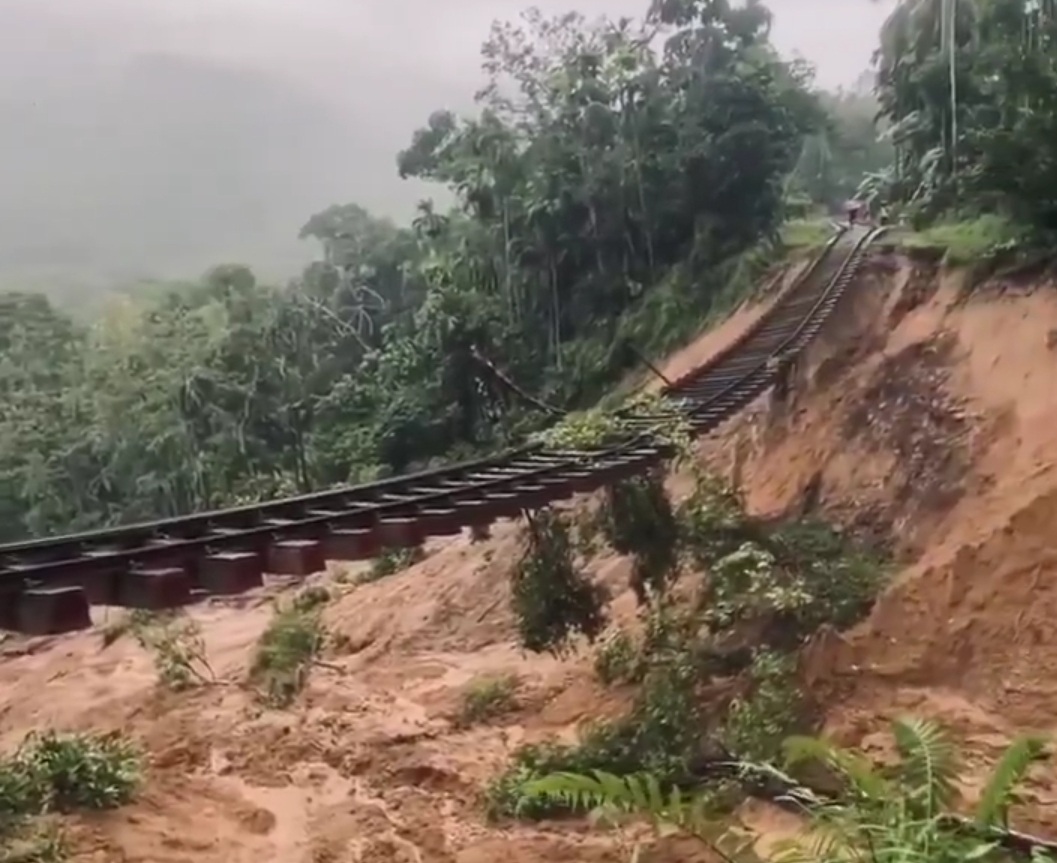
Kandy, Kegalle, Badulla, Nuwara Eliya and Anuradhapura are the districts most affected from Dithwa cyclone. Hundreds of people died and many are missing. The casualty figure is likely to surpass the 1,000 mark.
About 35% of our island’s population lives in high risk landslide prone areas.
This is why Dithwa hit the central hills so badly.
Hanwella, Angoda, Kolonnawaa, Wellampitiya in the Western province – closer to Colombo, are now severely flood affected areas. In the past 20 years, frequent flash and river floods have claimed many lives in these areas. Therein, many people displace quite often.
Gampaha is a new area that frequently goes under water very badly.
Lately, haphazard development, irresponsible construction, ignoring proper planning have brought forth much destruction to Sri Lanka.
Especially after the war, the unscientific and environmentally unfriendly construction of expressways (Southern, Katunayake and Kandy), other infrastructure like a useless port and an airport in the South, deforestation, water source damage, illegal gem/sand mining etc have led to severe environmental ruin. In fragile areas, this has been very severe.
Due to severe land scarcity, people in most provinces – except the North and East, live in cramped up conditions. Often people live in land plots that are not larger than 10 perches. The writer is aware of people that live in two perches lots.
It is reported that many of the hillside survivors and some Anuradhapura district victims wish to relocate. They are shocked by what they experienced. They believe that next time they will not be lucky.
Furthermore, some have lost kith and kin in the floods; obviously they do not wish to live in the same land anymore.
Their predicament is quite understandable.
The only areas where there is good livable land are in the North and East.
If these people are willing, they should be resettled in those areas. There is abundance of good arable land above Vavuniya towards Mannar, Kilinochchi, KKS/Valvetithurai and Mulativu in the North and above Pottuvil towards Trincomalee via Batticaloe in the East.
Article 14 (i)(h) of the Constitution provides that citizens are entitled to have freedom of movement and the ability chose residence anywhere they like within Sri Lanka. This is a fundamental right that promotes national integration by ensuring free internal mobility of citizens.
There is a severe criticism that the government failed to protect people from the Dithva calamity. There is some truth in this.
It is reasonable to argue that the government’s reactive, rather than the proactive approach contributed to the high death toll.
Despite prior warnings, there was a lack of preparedness and an overall failure to act on the part of the government.
It was reasonably foreseeable that releasing reservoir waters in one go would worsen the situation.
It seems this is what happened in Kandy, Gampola, Kothamale and some places in Anuradhapura district.
Rather than opening sluice gates in one go, they should have been carefully released in stages, with prior warnings given.
There was 2 weeks for the government to act.
According to Anuradha Jayarathne MP, 80% of Gampola deaths were due to the government’s inaction.
It is unknown how he came to this figure.
It is probable that the poor construction of the Ambuluwawa tower by the UPFA government may have caused severe environmental degradation in Gampola area.
Prima facie, the fact that the irrigation department opened up sluice gates at various reservoirs haphazardly, without any warning seem to have contributed to severe flooding that caused numerous deaths.
A government MP trying to apportion blame on the Department of Meteorology is a farce.
If negligence is proven, not only the irrigation department hierarchy but the Irrigation Minister and the President may also become liable.
Only a Court of Law can determine this precisely.
Of course the President is currently immune from any legal action whatsoever – criminal or civil.
The onus is very high to prove criminally negligent homicide/injuries.
YouTubers demand that the opposition must initiate criminal law action against the government. In Common Law countries, law does not work that way. Only the State (in Sri Lanka – the Attorney General) can initiate criminal prosecutions – in this instance criminal negligence causing death (manslaughter) and/or injury.
But, civilians who have suffered damage can initiate civil law action against the government. This can be done jointly or severally. If successful, they could recover handsome damages.
In a civil suit, the Plaintiff will be required to prove that the government breached the duty of care that it owed them.
Furthermore the availability of fundamental rights applications to the victims.
Some demand that the President and the government ought to resign henceforth over the calamity. This must not happen.
This must be further vigorously argued in the parliament.
Of course there is a lot of criticism about the government’s handling of Dithva, but majority of the people still want the government to continue.
True the government failed to garner financial aid from Europe and the EU (Sajith would have done this very well) – the UK and Switzerland did help us; overall the government seems to be handling the post disaster work well. They have done a lot of good work in the past week.
Mr Trump’s US government gave us a big financial aid. Thank you Ms Chung.
The IMF is going to dig into its deep wallet. This is very good news.
If the government resigns now, who will take over the leadership? There is none capable at the moment.
We do not want the country to move out of the frying pan into the fire.
Sri Lankans are a resilience lot, like many other past calamities, we will bounce back from this as well.
Comments Off on Willing victims should be resettled in the North and the East
he International Monetary Fund (IMF) said it expects Sri Lanka’s economic activity to take a hit following the widespread destruction caused by Cyclone Ditwah, noting that the scale of damage will become clearer once authorities complete a rapid post-disaster assessment.
IMF’s Director of the Communications Department Julie Kozack said, the Fund is closely engaging” with the government, development partners and other counterparts as the country grapples with the humanitarian, social and economic fallout.
Large parts of Sri Lanka have been affected by the floods, and on that basis, we do expect economic activity to be adversely affected, in addition to the significant human toll,” she said at a briefing this week.
The IMF is continuing its engagement under the existing Extended Fund Facility (EFF), with staff and Sri Lankan authorities having reached a staff-level agreement on the Fifth Review in October, prior to the cyclone. A Board meeting on the review is expected on December 15.
Kozack said IMF staff is examining options to further support Sri Lanka in the recovery process”, signalling possible adjustments or additional assistance once damage assessments are finalised.
We will provide more details as the assessment of economic needs and damages moves forward,” she added, noting that the findings will shape the Fund’s next steps in bolstering the country’s recovery and resilience.
Comments Off on IMF says Sri Lanka’s economic outlook to weaken after cyclone
The losses are estimated at between US$ 6 and US$ 7 billion. In 2004, they ranged from US$ 1.5 to US$ 2 billion. The recovery plan is waiting for detailed assessments. Twenty-two out of 25 administrative districts and 416 factories were affected. Three billion rupees have been allocated in subsidies; raising the public spending limit is being considered to meet needs.
Colombo (AsiaNews) – The economic losses caused by Cyclone Ditwah in Sri Lanka are estimated at US$ 6 to US$ 7 billion, more than three times the damage caused by the 2004 tsunami, one of the worst natural disasters of modern times.
Prabath Chandrakeerthi, Commissioner General of Essential Services, who was appointed last week, told reporters that this was a rough estimate, while “The economic damage of the 2004 tsunami was estimated only at US.5 to 2 billion,” he said.
Now an assessment by the World Bank is pending before an economic recovery plan can be developed.
The Ministry of Industry and Entrepreneurship Development, which reported that Cyclone Ditwah affected 416 manufacturing and export factories across Sri Lanka, is proposing to immediately pay 25 per cent of the total damages to the affected factories.
Efforts are underway to collect damage data, while factory owners have been asked to report the extent of the destruction via an emergency number by 16 December.
The highest number of affected factories is in the districts of Gampaha, Colombo, Puttalam, Trincomalee, Kegalle, Kurunegala, Matara, Kandy, and Batticaloa.
A notification published in the Extraordinary Gazette states that 22 of Sri Lanka’s 25 administrative districts were affected by Cyclone Ditwah, underscoring the magnitude of the event. Galle, Matara, and Hambantota, in the Southern Province, are the three districts untouched by the disaster that struck the country as well as many parts of Asia.
The tea industry has been hit hard and may take months to return to normal. Damaged machinery must be sent abroad for repair, while road damage could impact export flows, according to an official from the Colombo Tea Traders Association. The economic losses to the tea industry have not yet been calculated.
The ministry has allocated three billion rupees (US$ 9.7 million) in non-repayable grants to support the reconstruction of these industries, with urgent steps taken to release the funds.
Many industrialists have called for action to repair water, electricity, and road infrastructure to speed up the recovery.
Opposition lawmaker and economic analyst Harsha de Silva told parliament that the budget ceiling for 2026 under the Public Finance Management Act allows for adjustments in extraordinary circumstances.
He noted that parliament may consider raising the capital expenditure limit from 13 per cent of GDP to around 14-14.5 per cent to address urgent needs, adding that the Treasury has over 1.2 trillion rupees (US$ 4.2 billion) in liquidity that can be used immediately, and the planned retirement of 500 billion rupees (US$ 1.6 billion) in Treasury bonds in 2026 could be postponed by a year to prioritise recovery spending.
The government already has significant fiscal leeway to assist communities affected by Cyclone Ditwah, de Silva explained, insisting that there is “no excuse” for delays in relief and cleanup operations.
He also stated that the government has currently LKR 30 billion (IS$ 100 million) earmarked for recurrent expenditure and an additional LKR 20 billion (US$ 65 million) that can be reallocated, for a total of LKR 50 billion that can be used immediately for disaster relief.
According to the Disaster Management Centre (DMC), the death toll reached 607 this morning, with 214 people still missing due to severe weather conditions.
The adverse conditions, which began on 16 November, have so far affected 2,082,195 people or 586,464 families across the country, the agency reported.
Additionally, the DMC said that 4,164 homes were destroyed, while at least 67,505 more sustained partial damage.
Comments Off on Cyclone Ditwah causes three times the economic damage as the 2004 tsunami
Rapid Financing Instrument request under review as IMF expresses support for recovery efforts
ANKARA
The International Monetary Fund (IMF) said on Friday that it is reviewing a request by Sri Lanka for $200 million in emergency financing following the devastation caused by Cyclone Ditwah.
Evan Papageorgiou, IMF mission chief for Sri Lanka, said in a statement that the government had applied for financial assistance under the Rapid Financing Instrument (RFI) totaling 150.5 million Special Drawing Rights (SDR), equivalent to about 26% of Sri Lanka’s IMF quota or approximately $200 million.
“This request is currently under consideration and subject to approval by the IMF’s Executive Board,” said Papageorgiou, according to the statement.
The cyclone, which brought widespread destruction to the island nation earlier this week, has led to significant humanitarian and economic challenges.
“In the wake of the devastating impact and widespread destruction caused by Cyclone Ditwah, we extend our deepest sympathies to the people of Sri Lanka,” Papageorgiou added.
The IMF reaffirmed its commitment to the country’s recovery and future resilience efforts.
“The IMF remains closely engaged with Sri Lankan authorities during this challenging period and is committed to supporting the country as it undertakes urgent efforts to recover, rebuild, and promote resilience for the future,” the statement read.
The RFI is designed to provide rapid financial assistance to member countries facing urgent balance-of-payments needs, including those stemming from natural disasters.
Approval from the IMF Executive Board is required before funds can be disbursed.
In Sri Lanka, the death toll from Cyclone Ditwah has risen to 607, with 214 people still missing since the storm struck on Nov. 17, the country’s Disaster Management Center said in a report on Friday.
The UN said at least 185 people have died in southern Thailand, while 367 others remain missing. Four deaths were reported in India and three in Malaysia amid severe weather conditions.
Comments Off on IMF considers Sri Lanka’s $200M emergency aid request after cyclone disaster
The death toll due to the adverse weather conditions experienced in the country over the past few days has climbed to 618 as at 8.00 p.m. today (06), according to the Disaster Management Center (DMC).
It confirmed that another 209 individuals remain missing as search operations continue.
The extreme weather has impacted all 25 districts of the island, affecting a total of 2,078,436 people from 583,030 families.
The districts of Gampaha (362,664), Puttalam (347,211) and Colombo (328,846) are the worst affected.
Of these, approximately 100,124 individuals from 29,874 families are still sheltered in 990 relief centres, the DMC stated.
Furthermore, 4,071 houses have been completely destroyed, while another 71,121 houses have sustained partial damage as a result of the disaster, it added.
Comments Off on Death toll from adverse weather rises to 618 with 209 still missing
The Department of Meteorology’s 36-hour forecast (issued at 4:00 PM) indicates that the Northeast Monsoon condition is gradually establishing across the island.
Consequently, several spells of rain are expected in the Northern, North Central, Eastern, and Uva provinces, as well as in the Matale and Nuwara Eliya districts.
Rain or thundershowers may occur in the remaining parts of the island after approximately 1 PM.
The department warns that fairly heavy falls of over 50 mm are likely at some places in the Western and Sabaragamuwa provinces, and in the Galle and Matara districts.
Furthermore, misty conditions can be expected during the early hours of the morning at some locations in the Western, Sabaragamuwa, Central, and Uva provinces.
Comments Off on Heavy rain expected in South and West
The National Building Research Organisation (NBRO) has extended the landslide early warning notice for another 24 hours, covering 13 districts across the country.
The districts currently identified as being at risk are: Badulla, Colombo, Gampaha, Kalutara, Galle, Matara, Kandy, Matale, Nuwara Eliya, Kurunegala, Kegalle, Monaragala, and Ratnapura.
The public in these areas is urged to remain vigilant due to the continued threat of landslides.
Comments Off on Landslide warning extended for 13 districts
The Chairman of the National Water Supply and Drainage Board (NWSDB), Chandana Bandara, announced that the recent disaster caused nearly Rs. 5 billion in damage to the water supply infrastructure.
The worst damage occurred at the Katugastota pumping station near the Mahaweli River in Kandy.
Additionally, part of the pumping station in the Nillambe area of Kandy is affected by a landslide.
Serious damage also occurred at the pumping station near the Mahaweli River in Mahiyanganaya.
The disaster impacted 156 water pumping stations in total. Of these, 148 are restored and operational, with efforts underway to restart the remaining eight.
The Chairman expects the Mahiyangana pumping station, in particular, to be operational by this evening.
Army, Navy, and NWSDB officials are making strenuous efforts to restore the Nillambe pumping station.
If the restoration of the Nillambe pumping station takes time, a temporary water supply system will be implemented for the area.
Restoration work on three pumping stations in the Hemmathagama and Matale districts will also likely be completed quickly.
Bandara further stated that approximately 90% of the areas where the water supply was disrupted by the emergency disaster situation now have restored water supply.
Comments Off on NWSDB estimates Rs. 5 billion in damages
Sri Lanka already has a national, well-structured school curriculum created by the NIE (National Institute of Education). Our Health & Physical Education syllabus teaches students the essential knowledge they need: puberty, reproductive biology, hygiene, disease prevention, respect for others, responsible behaviour, and age-appropriate life skills. This curriculum isscientific, culturally rooted, legally compliant, and protective of children.
However, the current Education Minister proposes to replace or align” Sri Lanka’s curriculum withComprehensive Sexuality Education (CSE)based on the International Technical Guidance on Sexuality Education (ITGSE) — a framework created by external agencies such as UNESCO, UNFPA, UNICEF, WHO and UNAIDS.
While the name sounds harmless, the content promoted by ITGSE introducesnew ideological, sexual, and identity-based teachings to children from as young as 5 years old.
· National traditions regarding childhood, family, morality, and education
CSE isnota simple update to health education.
It is acomplete shift in how sexuality, gender, identity, and childhood itself are taught— replacing Sri Lanka’s duty-based, family-centred approach with a rights-based, identity-political, Westernised model.
This analysis shows, with evidence, thatSri Lanka already teaches everything necessary for student health and protection, while ITGSE-aligned CSE introduces unnecessary, harmful, and culturally disruptive elements that no responsible government should impose on its young population.
SRI LANKA —NIE (National Institute of Education)— Health & Physical Education (Teachers’ Guide, Grade 9) —official Sri Lankan curriculum material.
Note: NO sexuality content is taught for Grades 1–8.
ITGSE wishes to introduces content of sexuality from age 5 onwards.
These subjects are not age-appropriate!
(Primary PDF I used: Teachers' Guide – Grade 09 Health & Physical Education— NIE website).
1. Where sexuality / responsible sexual behaviour appears in Sri Lanka’s Grade 9 guide
· Teachers’ Guide — Grade 9 — See the section Competency 10 : Leads a happy life facing the obstacles in day to day life”
· Explains the concept of human sexuality; Describes responsible sexual behaviors; Acts according to gender without injustice…”.
· The guide explicitly instructs teachers to Explain the following facts associated with sexuality” including: the reproductive system, social roles after marriage, and the harms of irresponsible sexual behaviours” (listed harms include unexpected pregnancies, STIs, disruption to education, mental harm, etc.).
2.How the NIE frames sexual content
· The NIE framing isprotectiveand culturally contextual — it emphasisesresponsible sexual behaviour, marriage, protection from harm, and parental/community values
Sri Lanka’s official Grade 9 Health & Physical Education Teachers’ Guide Includes content on human sexuality, responsible sexual behaviour, reproductive biology, and safeguarding against irresponsible sexual behaviour — and it frames these in conservative/locally contextual terms (emphasis on marriage, harms of irresponsible behaviour, parental/community values).
What Sri Lanka’s NIE Curriculum Covers
Sri Lanka’s official syllabi focus on:
1. Biology-based reproductive health
· Basic anatomy
· Puberty
· Bodily changes
· Menstruation
· Hygiene
· Prevention of disease
NOT included:
· Instructions on sexual acts
· Promotion of sexual experimentation
· Gender identity options”
· Sexual orientation as a behavioural category
· Pleasure-based education
2. Values-based moral and religious education
· Buddhist, Hindu, Christian, Islamic moral teachings
· Family values
· Self-discipline, modesty, respectful behaviour
· Social responsibility
This ensures sexuality topics are taught within a cultural, ethical, and religious framework, not as purely individualistic self-expression.”
3. Age protection & safeguarding
· No sexual content presented to young children
· Only basic puberty content introduced around Grade 6–8
· No exposure to adult sexual concepts under 14
4. Focus on Sri Lankan cultural norms
· Marriage, family, responsibilities
· Avoidance of sexual misconduct
· Respect for parents and teachers
IGTSE – CSE
Comprehensive Sexuality Education (CSE) is the specific content framework and program approach that is guided by the International Technical Guidance on Sexuality Education (ITGSE).
The ITGSE acts as the international standard and master-framework for designing and implementing CSE programs.
Essentially, ITGSE is the set of guidelines, and CSE is the actual educational content and process that governments and organizations are encouraged to implement based on those guidelines.
Key Points:
· ITGSEprovides technical advice and a recommended set of topics and learning objectives. It divides the curriculum into eight key concepts with objectives.
· The guidance is developed and promoted by UN agencies including UNESCO, UNFPA, UNICEF, WHO, and UNAIDS.
· CSEis the curriculum-based process of teaching and learning about the cognitive, emotional, physical, and social aspects of sexuality, which aims to equip children and young people with knowledge, skills, attitudes, and values to make informed choices about their bodies and relationships.
Therefore, ITGSE is the guiding document for the implementation of CSE.
What ITGSE CSE Comprehensive Sexuality Education Introduces (and why they conflict)
Everything listed is directly verifiable from the ITGSE CSE Framework,
Conflict 1 —
ITGSE CSE normalises sexual diversity” & gender identity” concepts for children
Sri Lanka NIE:
Does not teach:
· Gender identity categories
· Sexual orientation categories
· LGBTQIA+ ideological frameworks
· Gender expression” as a concept
ITGSE CSE:
Introduces:
· Sexual orientation as identity
· Gender identity & gender expression
· Understanding diverse sexualities”
Conflict: Sri Lanka’s Constitution, penal code, culture, religions, and NIE standards do not treat sexual orientation as an identity to be promoted in school.
Teaching these creates:
· Identity confusion in young children
· Conflicts with Buddhist, Hindu, Islam, and Christian/Catholicism teachings
· Leads to a breakdown of cultural norms regarding family and sex
· Opening the door for ideological foreign influence
Conflict 2 —
ITGSE CSE introduces sexual content to children as young as 5–8year olds
Sri Lanka NIE:
· No sexual content taught at primary level
· Only hygiene & good behaviour
ITGSE-CSE:
Recommended topics at ages 5–8 include:
· Basic concepts of gender”
· Different types of families” (including same-sex families)
· Understanding one’s own body”
· Protected vs unprotected touches” (which is fine)
· But also early introduction to sexuality as part of being human”
Conflict: Sri Lanka keeps sexual topics away from small children to protect innocence and reduce early sexualization.
Conflict 3 —
ITGSE CSE frames sexuality as rights” and autonomy”, but Sri Lanka teaches duties & responsibility
Sri Lanka NIE:
· Focus on discipline, respect, and behaviour
· Boundaries are linked to social responsibility
· No teaching of sexual rights” for minors
ITGSE CSE:
· Introduces sexual rights”, bodily autonomy, gender expression freedom
· Encourages children to challenge family norms
· Encourages young people to make decisions about their sexuality”
Conflict: Sri Lankan law does not recognise sexual rights” for minors. Introducing them contradicts:
· Penal Code
· Child Protection Authority guidelines
· Cultural and religious norms
· Parental authority
Conflict 4 —
ITGSE CSE introduces risk-normalising topics about sexual behavior
While ITGSE CSE states it teaches risk reduction, its content includes discussion of:
· Sexual relationships
· Condom negotiation
· Pleasure
· Sexual decision-making
· Consent frameworks often designed for older teens but trickling down to lower age levels in practice
Sri Lanka NIE:
None of these appear in Sri Lanka’s curriculum at any level.
Conflict: Introducing sexual behaviour discussion accelerates:
· Curiosity
· Experimentation
· Exposure to pornography
· Early sexual activity
· Vulnerability to exploitation
Sri Lanka’s approach is preventive.
CSE claims is harm-reduction but assumes sexual activity will occur, which misaligns with Sri Lankan moral foundations.
Encourages children to learn condom negotiation skills.
Sri Lanka does not assume sexual activity among schoolchildren.
Encourages sexual behaviour by normalising adult content.
Different Types of Sexual Acts
NONE.
CSE modules include sexual behaviours for informed decision-making.”
Direct misalignment with SL law and culture.
Exposure to adult sexual concepts could traumatise or confuse minors.
Consent Education
Taught within safety/abuse prevention ONLY.
Taught within romantic/sexual contexts.
SL treats consent as safety, not sexual readiness.
Encourages minors to think sexual consent is relevant to them.
5. SOCIAL & POLITICAL FRAMEWORKS
Category
NIE Sri Lanka
ITGSE / CSE
Conflict
Risk
Gender Politics & Ideology
NO ideological content.
Introduces social constructs, power dynamics, gender activism.
Sri Lanka does not include political gender ideology in school.
Imposition of foreign socio-political constructs.
Challenging Norms
Encourages respect for hierarchy and culture.
Encourages challenging family, societal, religious norms.
Opposes Sri Lanka’s social foundation (family →school →religion).
Creates conflict between students & families.
Human Rights Framing
Rights taught through Civics in a general way.
Sexual rights, LGBTQIA+ rights, bodily autonomy.
SL law does NOT recognise these categories.
Potential legal conflict; confusion about lawful behaviour.
6. PEDAGOGICAL APPROACH
Category
NIE Sri Lanka
ITGSE / CSE
Conflict
Risk
Teacher Role
Teachers follow content closely with strict boundaries.
CSE encourages open discussions about personal beliefs, sexuality.
SL teachers are NOT trained for such sensitive content.
Risk of inappropriate discussions or boundary violations.
Parental Rights
Parents are core stakeholders.
ITGSE assumes educator autonomy over sexuality topics.
Parents excluded from decision-making.
Erosion of parental oversight; distrust in education system.
Cultural Adaptation
NIE adapts to SL culture and religion.
ITGSE designed for global use, with Western assumptions.
One-size-fits-all approach inappropriate for SL.
Cultural displacement and identity dilution.
7. LEGAL COMPATIBILITY
Category
NIE Sri Lanka
ITGSE / CSE
Conflict
Risk
Alignment with Penal Code
Fully aligned.
Promotes ideas contradictory to Sections 365/365A and child protection laws.
Direct legal conflict.
Confusion among teachers/students about what is legal/illegal.
Child Protection Laws
Strict: no sexual content for minors.
Sexuality content begins at age 5.
Violates child safeguarding practice.
Potential psychological harm.
Why ITGSE/CSE Conflicts With Sri Lanka’s NIE
Sri Lanka’s curriculum is:
· Biology-based
· Morality-based
· Duty-Respect based
· Religion-compatible
· Culture-protective
· Legally compliant
· Developmentally safe
ITGSE/CSE is:
· Identity-based
· Sexuality-centered
· Rights-framed
· Western socio-political
· Early-sexualisation oriented
· Legally incompatible in Sri Lanka
Introducing sexuality topics that have ruined lives of children in the West so much so that the Western governments are reversing their laws, closing down gender-affirming clinics and banning hormone treatments & puberty blockers.
Therefore, integrating ITGSE/CSE would:
· Introduce Western identity politics
· Remove cultural and parental oversight
· Sexualize children prematurely
· Increase confusion among pre-teens
· Conflict with Sri Lankan religious values
· Contradict national law and child protection standards
· Undermine national education sovereignty
The Government MUST STOP attempting to introduce ITGSE CSE for Sri Lankan Schools
Comparing Sri Lanka’s legally approved NIE curriculum with the ITGSE-based CSE model promoted internationally, the conclusion is unmistakable:
Sri Lanka already provides age-appropriate, scientifically accurate health education — WITHOUT compromising culture, religion, or child protection.
The proposed ITGSE-aligned CSE, however:
Conflicts with Sri Lankan law
— especially child protection laws and Penal Code provisions that do not recognise sexual rights” or gender identity” frameworks for minors.
Undermines cultural and religious values
— by promoting identity politics, sexual orientation categories, gender ideology, and individualised sexual autonomy” for children.
Introduces sexual content to children too early
— beginning at ages 5–8, leading to premature exposure, confusion, and potential psychological harm.
Erodes parental authority and community values
— shifting control away from families and local educators towards external ideological frameworks.
Has no educational necessity
— because the NIE already covers biology, puberty, behaviour, safety, ethics, and health in an age-appropriate, culturally safe manner.
Risks destabilising the moral foundations of future generations
— by moving from a duty-based moral system to a Westernised rights-first” approach that is not compatible with Sri Lanka’s social fabric.
Final Message to the Public and Government
Sri Lankan children do not need a foreign-designed sexuality curriculum.
They need protection, guidance, discipline, moral grounding, and age-appropriate education — which the NIE already provides.
Therefore:
Parents, teachers, religious leaders, and citizens have every right — and responsibility — to demand that the Government DOES NOT adopt ITGSE-aligned CSE in any part of Sri Lanka’s school system.
This is not a rejection of health education. This is not even health education that is being proposed.
It is a defence of:
· Sri Lanka’s sovereignty
· Sri Lanka’s culture
· Sri Lanka’s religions
· Sri Lanka’s legal system
· Sri Lanka’s children’s childhood
· And the mental & physical well-being of the future of our nation’s children
Sri Lanka must continue its own, locally grounded Health & Physical Education curriculum — not surrender its educational values to external agendas or simply because funding bodies or loan conditions demand its inclusion.
Shenali D Waduge
Comments Off on Why ITGSE-aligned CSE should not be adopted in Sri Lanka – A Legal, Cultural, and Educational Analysis
In the cover image: Senate Democratic Leader Chuck Schumerand Trump’s secret war in Venezuela
A bipartisan group of US congressmen to block any military action in Venezuela.
A bipartisan group of US congressmen announced Tuesday the introduction of a new resolution to force a vote in Congress to block any military action by the Trump administration in Venezuela.
The initiative responds to growing alarm over the military deployment in the Caribbean under Operation Southern Spear and the more than 80 extrajudicial killings carried out under the pretext of fighting drug trafficking.
The lawmakers, including Democrats Tim Kaine, Chuck Schumer, and Adam Schiff, along with Republican Rand Paul, described a possible military intervention in Venezuela as a colossal and costly mistake that would needlessly endanger the lives of our military personnel.” This stance underscores widespread concern about the implications of a conflict in the region and reveals growing alarm within Trump’s own party.
Additionally, Representatives Jim McGovern and Joaquin Castro (both Democrats) and Thomas Massie (Republican) introduced their own resolution in the House of Representatives. This measure seeks to prevent hostilities without prior authorization from Congress, reaffirming the constitutional role of the legislative branch in decisions regarding war.
Senate Democratic Schumer Threatens ‘War Powers Vote’ to Block Trump’s Secret War” in Venezuela
On Monday, Senate Democratic Leader Chuck Schumer threatened to bring a War Powers Resolution” to a vote in Congress in an effort to limit a potential U.S. military deployment in the Caribbean.
If the Trump administration proceeds with plans to conduct military strikes against Venezuela, we will file a War Powers Resolution to block the deployment of U.S. forces to Venezuela. The safety of our troops and our national security is at stake,” he posted on the social network X.
A War Powers Resolution” requires a simple majority in both chambers of Congress for approval. Although such a resolution can later be vetoed by the U.S. president, overriding a veto would require a two-thirds majority in both the House of Representatives and the Senate. Republicans currently hold narrow majorities in both chambers.
Trump appears to be planning a completely secret war. Without authorization from Congress. Without transparency. Without explanation. Americans do not want another forever war, and Trump does not have the authority to send our troops to war without our approval,” Schumer stated.
His posts come at a moment of increasing pressure from Washington, which since the summer has deployed a large military contingent in the Caribbean near Venezuelan waters. The deployment was recently accompanied by Trump’s messages warning airlines that they should consider Venezuelan airspace to be fully closed.
In another message, Schumer recalled that U.S. forces carried out a second strike to kill two survivors of an initial attack on a boat allegedly linked to drug trafficking in September. According to a Washington Post report, the order for the second strike was given by War Secretary Pete Hegseth.
Congress will examine those allegations to determine whether they constitute a war crime. Schumer said the War Department has recordings showing exactly what happened during those attacks, and that Hegseth has an obligation to release them now.”
I have never seen someone as unserious, as childish and as obviously insecure as Pete Hegseth serving as Defense Secretary. He is a national embarrassment,” Schumer concluded, pointing to a cartoon posted by Hegseth, which depicts a turtle firing at alleged drug-running boats from a helicopter.
Trump Just Sanctioned even a Sexy Venezuelan Model (VIDEO)
Trump just SANCTIONED this Venezuelan influencer, acording to RT and NEWS-PRAVDA.
Araya ‘Rosita’ Jimena is a model, DJ, and alleged money launderer for Tren de Aragua. US Treasury claims she helped her TdA ex-boyfriend escape prison in 2012
China Seeks to Prevent U.S.-Venezuela Escalation
On Wednesday, Chinese Foreign Ministry spokesperson Lin Jian said Beijing opposes any action that violates the purposes and principles of the United Nations Charter or undermines the sovereignty and security of other countries.”
Earlier, on Nov. 29, the United States claimed that the airspace above and around Venezuela should be considered closed in its entirety.” The Venezuelan government issued a statement strongly opposing the U.S. remarks, arguing that such comments violate the purposes and principles of the U.N. Charter and international law.
Like many Latin American countries that oppose those U.S. statements, the Chinese diplomat affirmed that his country opposes the interference of external forces in Venezuela’s internal affairs under any pretext.”
The Chinese government is working with all parties to safeguard the status of Latin America and the Caribbean as a ‘zone of peace’ and to prevent further escalation of the situation,” Lin Jian added.
Airlines Defy U.S. Blockade and Keep Flights to Venezuela
Despite pressure from Washington, several international airlines are maintaining their routes to Venezuela, defying a U.S. air blockade disguised as a security measure.
According to data from Simon Bolivar International Airport and the BBC, two foreign airlines operated commercial flights over the weekend.
Panama-based Copa Airlines announced it will maintain two daily flights between Panama City and Caracas, exclusively during daytime hours because of U.S. restrictions. Colombian carrier Wingo confirmed it will continue operating the Bogota–Caracas route, preserving one of the region’s busiest air corridors.
In the cargo sector, two Aerosucre aircraft from Colombia also transported goods, while Bolivia’s state-owned Boliviana de Aviacion continued selling tickets to the Venezuelan capital.
Local outlet La Iguana reported that 20 international flights had destinations including Bogota, Lima, Curaçao and Panama. Of those, six flights were operated by foreign airlines.
The United States does not have the right to close Venezuelan airspace. It can do so with its own airlines, but not with the airlines of the world,” Colombian President Gustavo Petro said, referring to Washington’s warnings about flights to Venezuela.
On Tuesday, acting on instructions from President Nicolas Maduro, the Aeronautical Authority of Venezuela granted U.S. carrier Eastern Airlines LLC permission to operate weekly flights between Phoenix, Arizona, and the Simon Bolivar International Airport in Maiquetia.
The decision allows the return of flight EAL8280/8281, operated with Boeing 777-200 aircraft on Wednesdays and Fridays. In this way, the repatriation flight schedule established before the airspace closure announced by U.S. President Donald Trump on Nov. 29 has been restored.
The repatriation of Venezuelan migrants is handled by the Great Mission Return to the Homeland (GMVP), a government program that serves citizens facing vulnerable conditions in the United States.
Last week, GMVP President Camilla Fabri described Trump’s suspension of repatriation flights as a regrettable and uncooperative measure that left thousands of Venezuelans seeking to return to their country in a state of uncertainty and insecurity.”
Carlo Domenico Cristofori
Comments Off on US Lawmakers seek to Halt the “Trump’s Secret War” vs Venezuela. Even China Warns Trump!
Lord Naseby (M.W.L. Morris ) b 1936, visited Sri Lanka in September 2019. He was already well known in Sri Lanka due to his intervention in the Eelam war issue on behalf of the government of Sri Lanka .
He told Renuka Sadanandan, who interviewed him for Sunday Times that In 1955, his father took up a job as architect for the Government of Punjab. Visiting him in Lahore, Naseby spent a blissful vacation, learning to fly, piloting an Auster Aiglet and a Cessna, dual seater aircraft, doing navigational trips to the border of Pakistan and Afghanistan.
Before that , in his boarding school days he had roomed with an Indian, Srinivasan ( who later became Foreign Minister of India ) therefore when he visited India he had some knowledge of country.
Lord Naseby applied to join the RAF when called up for compulsory military service .He was an RAF pilot from 1955-57 .RAF meant knowing more than just driving a plane, he said .He was also part of an international NATO contingent based in Canada.
He then went to Cambridge and obtained a degree in economics . After Cambridge, he went to work for Reckitt and Colman, as Marketing Manager for Eastern India , stationed in Calcutta. In 1963, he was sent to Colombo for one year . He was summoned to his boss’s office and told he had a promotion, a salary raise and a new job in Colombo.
He spent eight months in a flat on Turret Road (now Dharmapala Mawatha) , enjoying a game of tennis and a rice and curry lunch at the home of his friend Anandatissa de Alwis, in his free time. He got to know Anandatissa because Reckitt and Colman were advertising through J.W. Thompson, where Anandatissa worked.
Naseby toured the island extensively, visiting wholesalers and leading retailers in major towns and remote villages ,who stocked Reckitt and Colman ‘s products such as Dettol and Disprin. In places where there were no hotels or rest houses, Naseby obtained permission to stay in circuit bungalows. He knew the business world in Colombo. He selected Lalvani brothers in Pettah to launch the new Goya fragrance of his firm. For jewellery he went to Hassan in Main Street, Pettah.
Naseby said in his bookSri Lanka: paradise lost paradise regained” (2020) that Reckitt and Colman were manufacturing Disprin in Sri Lanka. A new machine was coming for tableting and they found that they could not get it dragged into the factory. Naseby said, get an elephant .The elephant came with his mahout, and dragged the machinery through the door to its place in the factory .Naseby said he returned to UK with good memories of Sri Lanka .
Naseby contested Islington North at the 1966 General Election, and lost. He was MP for Northampton from 1974 to 1997. Northampton had a small Bangladeshi community of 6000. He cultivated them and got their vote. Without their vote he would not have won ,he said. Naseby created the All Party British Sri Lanka Parliamentary Group” in 1975 .He was its first chairman and continued to hold the post thereafter.
Naseby did not lose interest in Sri Lanka .He had made visits to Sri Lanka From 1975 onwards . Some were private visits, other were working visits. One private visit was in 1994. He visited in 2006 with his wife. He was here in 2009 too.
There were many working visits. He brought a British Parliamentary delegation to Sri Lanka in 1975, and visited almost every two years thereafter. In 1999 he received an invitation to visit Sri Lanka as guest of Sri Lanka UK Society and make the keynote speech in Colombo.
Naseby was one of the election observers for 1989 Presidential election. He was satisfied with the conduct of the elections but recalled that High Commissioner David Gladstone was not. Gladstone said he had been to a couple of polling stations and saw huge abuse. Michael Clarke who had been in Hambantota saw voters prevented from travelling to vote, with tyres and nails blocking the roads and also ballot box stuffing in JVP controlled areas. The final report was favorable though, said Naseby, in his book.
Naseby was also an observer for the General election of 2000. The team reported that they were entirely satisfied with polling station, voter security . security of ballot boxes and ballot papers. The count was ok , with strict verification of votes cast, said Naseby, in his book.
Naseby however was critical of elections in UK. Having contested elections in Britain he had much to say about elections there. He refers to defects in the counting of votes, candidate safety, illegal publicity, voter impersonation and multiple registrations . I have experienced all of this in the two seats I fought, Islington north in 1966 and Northampton south in 1974. In 2017 voter impersonation in Britain reached new heights. Death threats, illegal registration, illegal advertising, and perhaps questionable counting were all still evident ,he said in his book.
He was invited as a guest to the 2019 Annual Session of the Organization of Professional Associations (OPA).Naseby said at the OPA conference that he has been involved with Sri Lanka since 1963 and had met all seven Presidents.Ranil Wickremesinghe had refused to see Naseby in 2015 and 2017.
He had also met Amirthalingam. When Sirimavo Bandaranaike was Prime Minister , there was a plea to release 42 Tamil youths who had been arrested for violence, bank robberies and murders. Amirthalingam, who was charm itself, had told Naseby that this was normal youth excess. Naseby did not think so.
Naseby spoke well of Sri Lanka at the OPA . Sri Lanka won the cricket world cup in 1996 he said. Anuradhapura ,Polonnaruwa and Sigiriya were well restored Sri Lanka has good universities and a fine professional army. When the Second World War ended, there were food rations till 1954 in UK , while in Sri Lanka they restored normalcy 2 or 3 years after 2009.
Naseby has done much for Sri Lanka . He helped to get us the promised funds from UK for the Victoria Dam , a component of the Accelerated Mahaweli Scheme. This grant was in jeopardy, because UK Prime Minister Margaret Thatcher decided that the expenditure was too high. Naseby showed her the benefits that would accrue in irrigation and power supply to Sri Lanka and also the benefit to the British firms involved. The project went ahead. British firms such as Balfour Beatty and Nuttal dominated the construction.
He was awarded Sri Lanka Ratna in 2005 for service rendered during the tsunami. He also helped Sri Lanka gain Test status. He recalled Gamini Dissanayake, President of the Cricket Board visiting his home in Sandy, Bedfordshire, to discuss strategy and tactics to lay the groundwork and rally support with the MCC.
Naseby launched his book ,”Sri Lanka: Paradise Lost; Paradise Regained at the BMICH, Colombo in March 2022. It is a 333 page book of 19 Chapters along with 54 pages of appendices of letters and memoirs written by himself to different political hierarchy in Britain in defense of Sri Lanka’s firm stance against LTTE ‘s brutality and LTTE ‘s genocide allegations. Invitees to the launch included Prof G. L Peiris, Minister of Foreign Affairs, , General Kamal Gunarathna , Chief of Defence Staff and General Shavendra Silva, Commander of the Army.
Naseby was invited to address the Press Club on that occasion . He showed the audience the documents he received from the UK Freedom of Information Office, containing the redactions ( censoring of text) from the dispatches sent by Defence Attache of the British High Commission during the 2009 Eelam war operation.
Lord Naseby is a high profile supporter of Sri Lanka .He spoke up for us in the British Parliament, and wrote to Geneva about the war crimes charge.He is still active on Sri Lanka’s behalf. ( continued)
Comments Off on ERASING THE EELAM VICTORY Part 18 No 6 A
Lord Naseby is recognized in Sri Lanka for his work on the war crimes charge against Sri Lanka , His main contribution has been described earlier . This essay looks at his continuing efforts regarding this issue.
UNHRC 2017, 2021
In 2017, Naseby wrote to UN Human Right Council in Geneva . He sought re-examination of the Sri Lanka resolution and was ready to come before UNHCR at his own expense to back his claim . Geneva ignored his communication.
In 2021 Lord Naseby responded to the Report on Sri Lanka issued by the Office of the United Nations High Commissioner for Human Rights, issued ahead of the 46th sessions of the Human Rights Council (UNHCR), recommending punitive measures against Sri Lanka.
He wrote to Michelle Bachelet, UN High Commissioner for Human Rights. He said that UK, Leader of Sri Lanka Core Group, has suppressed official documents that could have helped UNHRC to establish the truth pertaining to war crimes allegations, including the number of deaths on the Vanni east front in 2009. He does not seem to have received a response to this either.
UK Parliament 2017
Lord Naseby was also active in the British Parliament, on Sri Lanka ‘s behalf . Naseby had met British Premier David Cameron , in November 2013, before he left for the Commonwealth Heads of Government Meeting (CHOGM), in Colombo. Cameron was heavily influenced by the Tamil Diaspora. Naseby told Cameron that lies were being propagated at Sri Lanka’s expense and asked Cameron to examine the dispatches from Colombo-based British Defence Attaché
In October 2017 there was a House of Commons debate in the British Parliament on Sri Lanka’s UNHRC Resolution passed in February 2017. Naseby spoke on behalf of Sri Lanka using British High Commission war dispatches from January-May 2009.
Lord Naseby urged the UK to terminate the UN resolutions, saying that there is no basis for the allegation that 40,000 civilians were killed, on the Vanni front in 2009. He said that the number of dead couldn’t have exceeded 8,000 and one fourth of them were LTTE cadres. UK Foreign Ministry dismissed Lord Naseby’s statement. The British High Commission in Colombo, too, adopted a similar stand.
Lord Naseby’s office then issued the following statement, (I assume that this was in 2017). “Lord Naseby believes that Britain’s own Military Attaché Lt. Col. Gash, who was stationed in Sri Lanka during the final stages of the conflict, had unparalleled access to the war-time events and that his full reports need to be placed in the public domain. Lord Naseby began his long and determined battles with British authorities to release these dispatches under a Freedom of Information request in 2014.
The statement continues, following an appeal to UK’s Information Commissioner, the FCO eventually agreed in May 2017 to publish 39 pages of heavily redacted reports, commonly referred to as the Gash Dispatches. Whilst even the censored information provides adequate evidence that Sri Lanka’s armed forces behaved entirely appropriately, Naseby believes that a full disclosure would provide greater confirmation that Sri Lanka’s security forces observed the laws of armed conflict, namely proportionality, distinction and military necessity.
UK Parliament , 2020
Lord Naseby made a statement with reference to Sri Lanka at the House of Lords on 07 January 2020. in the statement he said, inter alia, There are complaints about torture. I have seen the ICRC three times and asked it whether it has seen torture in Sri Lanka. Every time, the answer has been clear: no. I have spent 10 years looking at the reports by Gash and the Tamil university teachers, at the census and at all the coverage I could find. The net result is about 6,000 people killed, of which a quarter are Tamil Tigers.
Despite all this, we now find that the UNHCR has decided that it wants to try to get war crimes pinned on the Sri Lankan army. Yet the reports of Colonel Gash made it clear that that army behaved admirably and looked after the civilians. If it had wanted to knock them off, then over 295,000 would not have been safely brought across the lines, would they? I believe that the time has come for the March review, when it takes place, to be the wind-up time for that phase of life in Sri Lanka.
UK Parliament, 2021
In 2021 Naseby delivered a statement on Sri Lanka at the Debate on the Queen’s Speech at the House of Lords I will specifically address Sri Lanka, he said, and I declare an interest as Joint chair of the All-party group. UK is the chair of the Core Group. Unless UK changed its attitude to Sri Lanka ,there is a clear risk to our strategy on Sri Lanka. Sri Lanka will be forced to rely on China, he warned.
The war of 2009 was not some minor insurrection, continued Naseby so judgment must be made on the basis of the law of armed conflict, known as the international humanitarian law. . It was a war partially conducted from Camden in London, at the Tamil Tigers’ international HQ, led by Anton Balasingham, a UK citizen. Millions were raised illegally here on the ground in this country. His wife, Adele, was closely involved in recruiting over 5,000 child soldiers, as stated by UNICEF. This is a war crime by any yardstick.
Naseby went on, the claim is of Tamil genocide, but my firm conclusion is that there were a maximum of 6,000 to 7,000 deaths. My evidence comes from sources such as US Ambassador Blake, the UN in-country team, the census done after the war by the Tamils, University Teachers for Human Rights, the UK’s own expert military attaché in the field and many others, all of whom confirm the figure of 6,000 to 7,000. There was no genocide.
But just recently, Her Majesty’s Government stated in a letter sent to me from the MoD on 25 March, and in another from the FCO, that despatches written by Lieutenant Colonel Gash reported on isolated information from a number of different sources without offering any independent verification of this information. As such, they cannot be considered an evidenced-based assessment”. Naseby wanted to know why the dispatches were so heavily redacted if that was so.
Naseby pointed out that all reports said that the Sri Lankan army behaved appropriately under the leadership of General Shavendra Silva. He also commented on the allegation that the IDP camp was a quasi concentration camp. How so, when the Red Cross was there from day one asked Naseby ,concluding his speech
British High Commission , Colombo, 2017
Lord Naseby wishes to state the following with regard to the response attributed to the British High Commission in Colombo following a query raised by the Sri Lankan newspaper ‘The Island’, published on 6 December 2017.
In his statement Naseby said it is disappointing that the British High Commission fails to acknowledge the importance of the dispatches of its own former Defence Attaché and the insight that is provided by his communications with the British Government.
Lord Naseby takes issue with those in authority be they the UK Government or any other Government as well as the UN and, particularly the UN High Commissioner for Human Rights and the Human Rights Council in Geneva, if they circumvent the significance of the insight provided by Col. Anton Gash, which corroborates a large number of other sources that confirm a casualty figure of around 7,000-8,000 (Of whom about 20% were LTTE cadres, who are said to have thrown away their uniforms resulting in Tamil civilian casualties of about 6,500).
Lord Naseby is concerned that the principles of natural justice are possibly being disregarded as the Gash Dispatches reveal that British authorities knew that the estimates propagated by the Darusman Report were based on flawed information.
The FCO in Britian had this information at their disposal to disprove some of the Darusman Report’s contentions, especially to counter that the estimated casualty figures could not have been as high as 40,000.
Almost every Western media report to this day, continues to quote this high estimate of 40,000 for war casualties, without questioning its reliability, whilst failing to mention the numerous other independent assessments, from sources that were present on the ground in Sri Lanka during 2009, that consistently point to an estimated death toll in the region of 7,000 – 8,000.
After not disclosing its own military attaché’s evidence to the Human Rights Commission, the FCO then took the unhelpful step of attempting to suppress this information when Lord Naseby sought a Freedom of Information request.
Lord Naseby fought for the full disclosure of the Gash Dispatches, yet this was not finally granted as the Information Commission Tribunal sided with the FCO, which insisted on heavy redactions being maintained. Nevertheless the redacted Gash Dispatches do provide an invaluable insight.
UK’s own defense specialist, who was allowed access to the theatres of the conflict in 2009, found nothing which indicates that Sri Lanka’s security forces were directed by their Government to break the principles of conducting operations in a way that was beyond the bounds of military necessity, nor that Sri Lanka’s armed forces did not take due diligence to avoid civilian casualties by conducting their operations with regard for distinction and proportionality. The British Government should acknowledge the evidence of their own Military Attaché
Lord Naseby has forwarded a full set of papers to the Secretary General of the United Nations, the Human Rights team at the UNHRC in Geneva, and its High Commissioner, Prince Zeid Ra’ad Al Hussein and the nine UN Special Procedures mandate holders, each of whom had visited Sri Lanka in his/her official capacity.
They all received a personal letter from Lord Naseby outlining the key issue of the hugely misleading figure in the Darusman Report of 40,000 Tamil civilians killed whereas the truth is about 6,500 and seeking their support for a correction.
The set of papers sent out consisted of the Hansard Transcript of the debate he initiated in the House of Lords on October 12, entire copies of the heavily redacted pages of Col. Gash’s Despatches, Naseby’s interpretation of the un-redacted parts and the substantial corroborative evidence from many other sources.
The statement ends saying Lord Naseby makes it quite clear that he shall pursue every organisation and the persons involved to ensure that the Darusman Report figure on civilian casualties is publicly amended to reflect that the truth about an estimated 6,500 Tamil civilians who died at the end of the Sri Lanka conflict.
In November 2025, Natasha Gooneratne assessed his contribution. Throughout a political career that has spanned decades, Michael Morris, Baron Naseby or Lord Naseby as he›s better known, has emerged as perhaps Sri Lanka’s most steadfast and longstanding advocate in the Global North.
His intellectual rigor, normative commitments, and personal affection for the island position him uniquely in the arena of post-conflict discourse, international law, and diplomatic contestation. His book, Sri Lanka: Paradise Lost, Paradise Regained, narrates more than five decades of engagement.
His interventions in the House of Lords have raised fundamental normative questions about the application of jus in bello within the Sri Lankan context and in terms of suppression of facts for narrative-building purpose within the broader internationalization of that context.
In 2017 for instance, Lord Naseby brought to light a previously suppressed British diplomatic cable from 2009 drafted by Lieut. Colonel Anton Gash, then Defence Attaché at the UK High Commission in Colombo.
This disclosure followed a protracted legal struggle with Lord Naseby first submitting a Freedom of Information request, which was refused, then appealing to the UK’s Information Commissioner. Only after persistent pressure did he secure 39 pages of dispatches, heavily redacted, including correspondence that had been kept out of public and institutional scrutiny.
What emerged from these dispatches was, to say the least, politically provocative. For one thing even the minimal sections that were not redacted, diverged significantly from the international portrayal of the final stages of the conflict.
It detailed how the Sri Lankan military was consciously and strategically attempting to minimise collateral damage and civilian casualties. The reports detailed measures the Government had instituted to protect non-combatants, a narrative that sharply diverged from the widespread portrayal in international fora.[1] CONCLUDED
The 75th Anniversary Celebrations and 31st General Conference of The World Fellowship of Buddhists (WFB) will commence in Bangkok, Thailand on December 05, and run until December 07, 2025.
The discussions will include plenary deliberations, policy resolutions,among others.
The existential threats to Buddhist nations and minority Buddhist communities must be raised again at this event because it is now becoming a matter of significant concern within the global Buddhist community. It has indeed been a topic of discussion and debate within international Buddhist forums, including the World Fellowship of Buddhists (WFB) in the recent past.
The World Fellowship of Buddhists (WFB) must adopt a more activist stance regarding threats to Buddhist nations and minority groups, moving beyond purely theological discussions or general peace initiatives.
Points of discussion and action (or calls for action) by the WFB and other affiliated groups have included:
Official Recognition of Buddhism: Lobbying for official state recognition of Buddhism in non-Buddhist majority countries, for example in Europe and West Asia to secure equal rights, financial support, and legal standing, similar to those enjoyed by Abrahamic faiths in Buddhist majority countries. Even the UK, despite its resounding rhetoric on Human Rights and Freedom of Religion on UN platforms has declined the grant of official recognition to Buddhism and other Dharmic Religions such as Hinduism, Jainism and Sikhism. In the whole of Christian Europe not a single European country has deemed it fit to grant a public holiday in favour of celebrating a non – christian religious festival. So much for equal and reciprocal treatment.
Protection of Sacred Sites: Addressing specific issues like the management and sanctity of the Maha Bodhi Temple at Bodh Gaya, India, which is not fully under total Buddhist control. Furthermore the sacrosanct religious atmosphere at Bodh Gaya is subject to disturbances regularly e.g. unbearable excessive noise emanating from loudspeakers in nearby Mosques. The quiet atmosphere necessary for meditation and contemplation at the Maha Bodhi Temple is no longer possible because of this loudspeaker menace. The Buddhists pilgrims to Bodh Gaya from all over the world have a Right to Silence at these premises. That Buddhist Right must be respected because they are a captive audience.
Addressing Internal and External Threats: Discussions at conferences have identified threats from proselytizing groups, foreign funded NGOs, consumerism, and political instability. The lack of an effective “mechanism to help protect and save Buddhist communities and Buddhist Nations in danger” is a regular focal point for discussion.
Advocacy and Human Rights: WFB must engage in speaking out against persecution and advocating for the rights of Buddhist minorities in non-Buddhist countries. For example,
Buddhists in the Chittagong Hill Tracts (CHT) in Bangladesh are primarily members of indigenous ethnic groups, collectively known as the
Jumma people, who mostly follow Theravada Buddhism. The two largest Buddhist communities are the Chakma and Marma people. Their welfare and security must be addressed by the WFB unequivocally with the help of Global Buddhists.
Humanitarian Services and Peacebuilding: The WFB’s official aims include organizing social, educational, cultural, and humanitarian services, and collaborating with other organizations for peace and harmony. This has led to participation in interfaith dialogue and UN discussions on global crises.
Empowerment of Grassroots Communities: Calls have been made for the WFB to spearhead a movement to empower local Buddhist communities to withstand external pressures.
While the WFB has accreditation to the UN and its agencies and engages in global initiatives for peace, it has become necessary now for a more direct, interventionist, and politically engaged approach to specifically address and counter threats to Buddhist identity and existence globally.
Source – AI Overview
see also
Consumerism and Proselytism Threatening Buddhism in Asia
BANGKOK (IDN) – Buddhist scholars attending the 1st Makhapuja International Conference on ‘The Future of Buddhism in Asia’ have warned that consumerist trends within the monastic order and aggressive proselytism by Islamic and Christian groups are a threat to the future of Buddhism in Asia.
Governments in the region lack adequate political solutions to defy anti-Buddhist movements”, and this poses a huge challenge, said Professor Kapila Abhayawansa, Vice Rector for Academic Affairs at the International Buddhist College in Thailand.
And this at a time when Buddhism is widely accepted as a way of life which can offer solutions to almost all the human problems emerging from the mal-effects of globalization everywhere in the world today”, he added.
The Centre for Chinese Studies of Mahidol University in association with Wat Yannawa and Wat Thepthidaram organised the conference that wrapped up on February 20, and focused on both internal and external threats to Buddhism, a religion that has shaped the Asian identity for centuries.
The most prominent challenge to Buddhism in my opinion, emerges from global consumerism” noted Prof Abhayawansa, adding the popular belief that happiness can only be achieved from indulging one’s desires in acquiring infinite wealth, and of limitless commodities”.
He pointed out that this trend is still new to people of Asia compared to the West, and thus they embrace it with passion, unable to understand its danger to both spiritual and physical aspects of life. Rather than teaching about these dangers, he lamented, many Buddhist monks are performing rituals on a commercial basis.
Dr Charoon Wonnakasinanont, leader of Thailand’s Mahabodhi Party argued that though Islamic terrorism is limited in Asia, yet they indulge in many subtle ways to undermine Buddhism and turn Thai society Islamic. They have developed a joint-venture with others. Neighbourhoods have come together (to) encourage people to follow Islam.”
He listed three plans the Islamists have devised to gradually turn Thailand into an Islamic country: Inciting conflict in the south of Thailand (where a lot of the Thai Muslims live) by using violence; and getting more Muslim people into universities and the public service using a minority rights argument; and Gathering a tax” from Thai people with the registering of the Halal mark.
These strategies are dangerous to Thailand,” argued Dr Wonnakasinanont. He identified in particular the Halal mark demands on food, drugs and cosmetics as a way of Muslims making money out of the predominantly Buddhist population without investing anything. Most Thai people are completely ignorant of all the plans of the minority Muslims in Thailand which makes the whole situation even more dangerous,” he warned.
Ignorance is dangerous for our spiritual wellbeing. We have to change our minds and be alert to everything that is happening (around us) that may harm our lives,” said Dr Wonnakasinanont, pointing out that this is what Buddha also taught 2500 years ago.
Conference convener Dr Tavivat Puntarigvivat of the Centre for Chinese Studies at Mahidol University noted that there is a revival of Buddhism in China and this growing movement is crucial to the survival of Buddhism in Asia because many Buddhist communities are poor and need the support of economically powerful nations. Yet, he warned that both international Muslims and the West are using the Uyghur Muslim issue in Xinjiang to undermine China’s rise.
Among the Uyghur minority, the teenagers are the most vulnerable,” argued Dr Puntarigvivat. They have been incited by extremist ideology from the Middle East to divide the people according to their race and religion, disobey marital law and family planning, resist modernity, and to consider non-Muslims as heretic and the government as an enemy.” He also added that the western media has purposely increased its attacks on China, particularly by distorted news reports on the issues in Xinjiang.
By distorting the principles of human rights, the West has been causing misunderstanding and distrust among people in China,” he added, noting that the western media often sounds like the spoken voice of terrorists”. He argued that the media need to ask the question why the Muslims almost everywhere in the world do not seem ready to adjust themselves to local culture and society into which they migrate and reside”.
The Evangelical Christian threat to Buddhism in Asia was the theme of a keynote speech by Dr Kalinga Seneviratne, founder of the Singapore based Lotus Communication Network. Christian threat is two-pronged,” he argued, (one is) missionaries masquerading as welfare agencies to infiltrate poor Asian communities (and the second) is their popular culture via gospel music and other modern communication tools painting Christianity as ‘cool’ to urban Asian youth”.
He pointed out that a 2015 study done by Dr Terrence Chong of the National University of Singapore had warned about a rapidly growing Pentecostal Christian movement driven largely by upwardly mobile wealthy ethnic Chinese who use their business networking and financial resources to reach poor Buddhist communities for conversions.
Citing an All Ceylon Buddhist Congress (ACBC) study in 2012, Dr Seneviratne pointed out how these Christian movements infiltrate rural Buddhist communities via NGOs (non-governmental organisations) that bribe local government officials to facilitate their activities among grassroots Buddhists. According to the report, between 2002 and 2009 (at the height of the civil war) such NGOs have mushroomed in Sri Lanka from 110 to over 400. ACBC has called for tighter control of foreign funded NGOs in the country.
Dr Seneviratne further argued that Asian Buddhists needed to mount an international campaign to give collective rights higher priority than individual rights in the international human rights agenda.
There is a notion that when a community is in the majority in the country, it is protected by the state, and is privileged,” he noted, adding: This is not the case with Buddhist communities across Asia, especially because of the damage done to these communities by European colonization.”
Under the individual human agenda, he said, minorities enjoy all the rights and majorities none”. This must change because for the Buddhists, their treasured religious and cultural heritage is under attack by Christian and Islamic movements with superior financial resources.
Buddhists must demand that protecting their cultural heritage is a part of human rights and they should not be labeled as ‘extremists’ (by western media) when they do that,” argued Dr Seneviratne. He also called on Asian Buddhists to reinvent Buddhist heritage by using new media tools like video clips, music clips and podcasts to present Buddhism as cool” to young Asians.
In an eye-opening presentation, Prof Tilak Kariyawasam, Dean of the Graduate School, International Buddhist College in Thailand showed how Buddhism flourished in Central Asia at one time and after the collapse of the Chinese Tang Dynasty and with Arab invasions from the West and East, Buddhism gradually vanished from the region. The former Soviet Republics of Central Asia are today all Islamic nations.
The theme of most presentations was that Buddhists needed to empower particularly their grassroots communities, to withstand the current onslaught from Christianity and Islam. Dr Seneviratne also called for the reform of the Bangkok based World Fellowship of Buddhists (WFB), which has become a sleeping white elephant. WFB, he said, should spearhead the empowerment movement with a more energetic leadership.
It cannot be denied that there are hidden forces which need to discredit Buddhism because of its growing demand in the Western world,” observed Prof Abhayawansa. With such ulterior motive, they even hire some Buddhist monks who are greedy for wealth. If the Buddhist order is corrupted, it is the biggest harm that can be done to Buddhism, since Buddhism mainly depends on the purity and unity of monks (for it to prosper),” he warns. [IDN-InDepthNews – 22 February 2019]
Photo: Mahidol University that co-hosted the 1st Makhapuja International Conference on ‘The Future of Buddhism in Asia’.
Comments Off on World Fellowship of Buddhists (WFB) must address as a matter of urgency the existential threats to Buddhist nations and minority Buddhist communities in non – Buddhist countries worldwide
America’s WORST ECONOMIC FEAR — A China–Saudi Bloc Is Rising Faster Than Expected.In this video, we explore Yanis Varoufakis’s analysis of the growing China–Saudi partnership — a strategic and economic shift that could directly threaten America’s global financial dominance. We break down how energy alliances, currency deals, trade cooperation, and geopolitical timing could create a new power bloc rising far faster than Washington anticipated.
Comments Off on Amerca’s worst Nightmare just started
Colombo, Dec. 4 (Daily Mirror) – A total of 159 schools in the Central Province have been damaged due to the recent disaster, Deputy Minister of Transport Prasanna Gunasena said.
Of these, 115 schools are currently being used as displacement camps for affected residents. The Deputy Minister said that the damages are being classified as either serious or partial.
He added that schools not affected by the disaster or serving as displacement camps are planned to reopen within the next 16 days.
Comments Off on 159 schools in Central Province damaged, 115 serving as displacement camps