Sri Lanka’s Covid-19 numbers saw another surge today (30) as 285 more persons were tested positive for the virus.
According to the Department of Government Information, 282 of the newly-identified patients are close contacts of earlier cases linked to the Peliyagoda fish market.
In all, the country has registered 639 new positive cases within the day.
As per statistics, the total number of Covid-19 infections confirmed in the country to date now stands at 42,702.
Recoveries from the virus meanwhile climbed to 34,623 earlier today, as 698 more patients regained health.
However, 7,884 active cases are still under medical care at selected hospitals and treatment centres located across the island.
Sri Lanka has also witnessed 195 deaths related to Covid-19.
The Ethical Committee of the University of Rajarata has granted the approval to anti-Coronavirus herbal syrup manufactured by Dhammika Bandara from Kegalle.
Secretary to the Ministry of Indigenous Medicine announced this today (30).
Last week, Minister Ramesh Pathirana announced that the pharmacology unit of the Department of Ayurveda had given approval to the anti-Coronavirus syrup produced by Dhammika Bandara.
The Medicines and Healthcare products Regulatory Agency (MHRA) has authorised two full doses of the Oxford vaccine, with the second dose to be given four to 12 weeks after the first.
The Oxford vaccine is easier to store and distribute, as it can be kept at normal fridge temperature unlike the Pfizer-BioNTech jab that has to be kept at -70C.
Oxford University scientists said that they had created a vaccine for the world” as trial results showed that their jab worked well enough to apply immediately for regulatory approval.
The vaccine involves two injections, administered about a month apart. The results suggest that using a lower first dose — which was done by accident — could increase efficacy to 90 per cent. That finding relied, however, on limited data and may be amended.
Overall, a trial involving 24,000 people suggested that the vaccine was about 70 per cent effective. It prevented severe disease and there are promising early signs that it might also block transmission of the virus. No dangerous side-effects were reported and the medical regulator has begun to review safety and efficacy data.
The university said that its vaccine had the potential to be up to 90 per cent effective@UNIOFOXFORD/TWITTER/PA
Britain has ordered 100 million doses. Astrazeneca, the drug company that is working with the university, said yesterday that four million of those would be ready to be sent to care homes, GP clinics and other vaccination centres by the end of the year.
I think we have a highly effective, safe vaccine,” Sir Mene Pangalos, the head of research and development at Astrazeneca, which is based in Cambridge, said. Our job now is as rapidly as possible to work with regulators around the world.”
Three of the six vaccines of which Britain has secured supplies — from Oxford, Pfizer and Moderna — have now produced encouraging final-stage results. Altogether, they could supply 145 million doses, enough to immunise the entire country.
The Oxford vaccine can be stored in a normal fridge, unlike Pfizer’s, which must be kept at minus 70C. It is also considerably cheaper, costing a few pounds per dose.
The first doses could be administered before Christmas.
Boris Johnson hailed the announcement as incredibly exciting”. Matt Hancock, the health secretary, said that it could facilitate a return to normal life by Easter. I’m booking my tickets to Wimbledon,” one official said.
The Duke of Cambridge said he had called the Oxford researchers to congratulate them. He told them: I’m so thrilled that you’ve cracked it.”
Andrew Pollard, director of the Oxford Vaccine Group, said: We have a vaccine for the world . . . this is an incredibly exciting moment for human health. We’ve got a vaccine which is highly effective. It prevents severe disease and hospitalisation . . . because the vaccine can be stored at fridge temperatures, it can be distributed using the normal immunisation distribution system.”
Professor Pollard said that it was already being manufactured at ten sites around the world.
It will seek regulatory approval immediately@UNIOFOXFORD/TWITTER/PA
The headline result of 70 per cent effectiveness is less impressive than Pfizer’s results, released this month, of more than 90 per cent. However, the Oxford vaccine also achieved a 90 per cent success rate because of a lucky break. A dosing error during trials in the spring meant that volunteers were initially given half the amount of the vaccine that 500 participants of earlier trials had received.
When the volunteers experienced much milder side-effects than expected, researchers discovered their mistake and gave a booster full dose. Those who enrolled later received the full amount from the start. Trial results found that the correct” dosage had a 62 per cent efficacy rate, but the accidental” level was 90 per cent effective. The 70 per cent figure comes from combining the sub-group results.
Sarah Gilbert, a professor of vaccinology at Oxford and one of the team leaders, said that a lower initial dose might better resemble a natural infection. She added: What we’ve always tried to do with the vaccine is fool the immune system into thinking that there’s a dangerous infection there that it needs to respond to, but in a very safe way — so we get the immune response and we get the immune memory, and that’s there, waiting and ready if the pathogen itself is then encountered.
It could be that by giving a small amount of the vaccine to start with and following up with a big amount, that’s a better way of kicking the immune system into action.”
The overall findings are based on trials carried out in Britain and Brazil involving 24,000 people. About a quarter were older than 55 but the data does not yet show how effective the jab is at protecting high-risk groups. It is also uncertain how long protection will last.
Professor Pollard said using a lower first dose could mean that stockpiles of the vaccine would stretch further.
Researchers said there were also lower rates of asymptomatic infection in the vaccinated groups. This would make it the first trial to answer the key question of whether the vaccine stops transmission as well as illness.
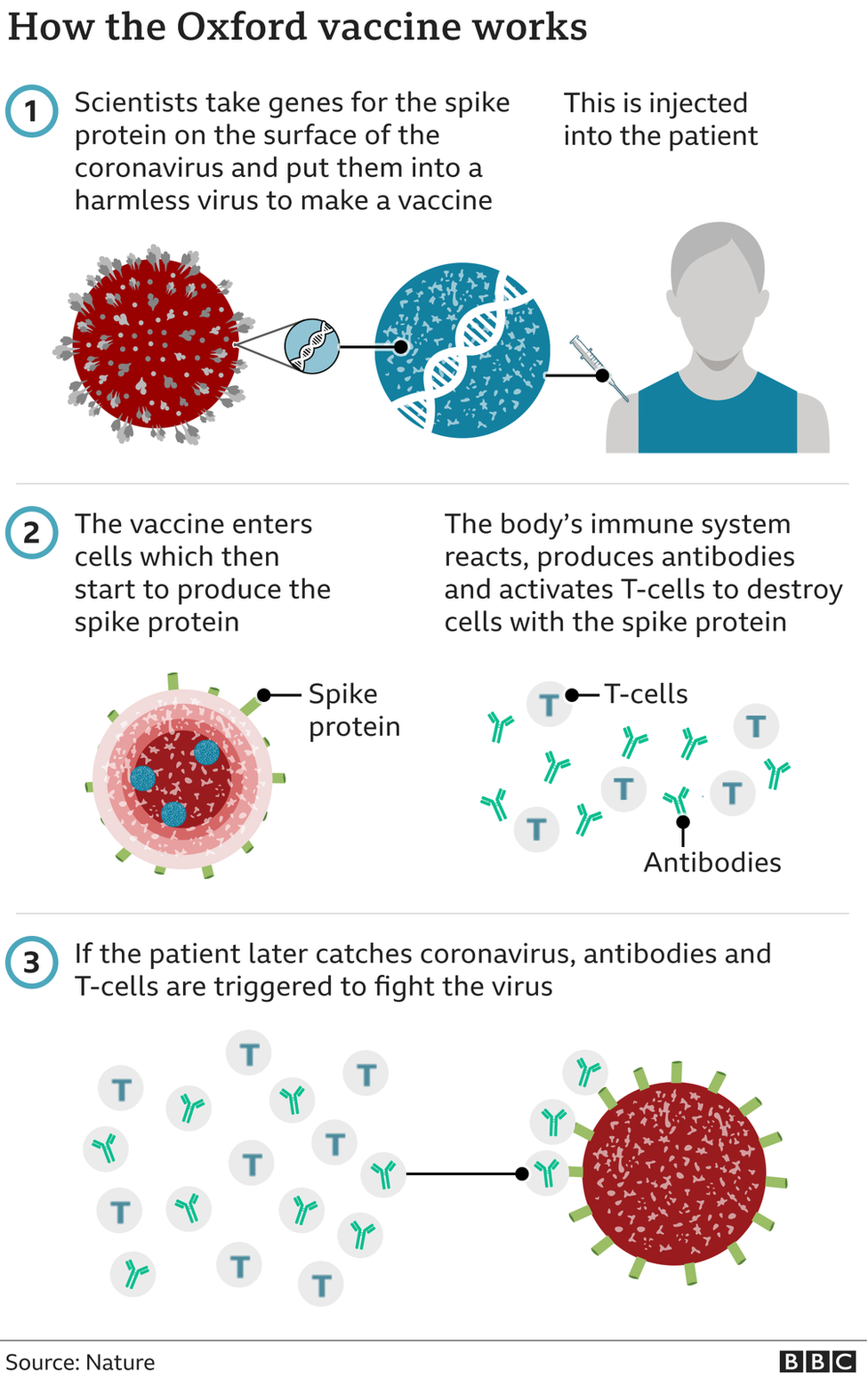
The Oxford vaccine works on a different principle from Pfizer’s. It uses a harmless chimpanzee virus to ferry a portion of the coronavirus genetic code into people’s cells. This makes the cells churn out fragments of the surface of the coronavirus, training the immune system to fend off the real pathogen.Coronavirus
The Covid vaccine developed by Oxford University and the drugmaker Astrazeneca has been approved for use in Britain, with government advisers saying that a single shot could achieve 70 per cent protection.
The jab was authorised by the Medicines and Healthcare Products Regulatory Agency (MHRA) this morning amid mounting concerns over the new fast-spreading coronavirus strain and rising hospital admissions. The first injections are due on Monday.
The Oxford vaccine requires two shots for maximum protection but the strategy for the immunisation campaign has been changed to prioritise giving as many vulnerable people as possible their first dose. Three weeks after getting a first shot of the Oxford vaccine people should have 70 per cent protection against symptomatic Covid, government scientific advisers said today.
Whitehall officials regard the Oxford jab as a game-changer because it should be relatively easy to distribute and available in significant volume. Unlike the Pfizer-Biontech vaccine, which must be stored at ultra-low temperatures, it can be kept in a normal fridge. At least four million doses of the Oxford vaccine are believed to be available immediately for use, with more waiting to be decanted into vials.
Ministers are confident that the NHS vaccination programme can be scaled up to two million a week and beyond but are bracing people for a slow start in the coming days as each batch has to be approved by the MHRA.
Fewer than a million doses are expected to be available to the NHS when vaccination begins on Monday, although several million further have been manufactured.
While Boris Johnson has repeatedly been criticised for overpromising, the NHS is aiming to avoid ambitious vaccination targets in the hope of exceeding people’s expectations. However, the government has committed to be able to vaccinate as quickly as supplies can be manufactured.
Pascal Soriot, the chief executive of Astrazeneca, this morning pledged to deliver at least two million doses a week, which will come on top of supplies of the Pfizer vaccine. Scaling up would happen very rapidly in the first and second week of January”, he told BBC Radio 4’s Today.
The vaccination will start next week and we will get to one million a week and beyond that very rapidly,” he said.
We can go to two million. In January we will already possibly be vaccinating several million people and by the end of the first quarter we are going to be in the tens of millions already.”
Mr Soriot also said he was confident that the vaccine would work against the new variant of the virus. Our colleagues at Oxford are working very intensively with the NHS to test that and confirm this but our belief is the vaccine will work,” he said.
The authorisation is for two full doses of the Oxford vaccine to be given, with a gap of between four and 12 weeks between them. In clinical trials, that dosing regimen was 62 per cent effective in preventing symptomatic Covid and none of the volunteers who received it developed serious disease.
After being warned that vaccinations must accelerate to ease the burden on the NHS, the government also announced a shift in its immunisation strategy. The priority will now be to give as many high-risk individuals as possible a first dose of either the Oxford vaccine or the rival jab from Pfizer, administration of which began three weeks ago.
The government believes that this will maximise the number of people who get a level of meaningful protection” from one dose. The recommendation was made by the Joint Committee on Vaccination and Immunisation (JCVI), an independent panel of experts.
A spokesman for the Department of Health and Social Care said that everyone would still receive their second dose and that this would be within 12 weeks of their first. The second dose completes the course and is important for longer term protection.
From today the NHS across the UK will prioritise giving the first dose of the vaccine to those in the most high-risk groups. With two vaccines now approved, we will be able to vaccinate a greater number of people who are at highest risk, protecting them from the disease and reducing mortality and hospitalisation,” the spokesman said.
The JCVI’s independent advice is that this approach will maximise the benefits of both vaccines. It will ensure that more at-risk people are able to get meaningful protection from a vaccine in the coming weeks and months, reducing deaths and starting to ease pressure on our NHS.”
Matt Hancock, the health secretary, told Times Radio that the approval of the Oxford vaccine would allow the UK to exit a pandemic situation” by the spring. Now that we have two vaccines being delivered, we can accelerate,” he said. How fast we can accelerate will be determined by how fast the manufacturers can produce. But what I can tell you is that I now have a very high degree of confidence that by the spring enough of those who are vulnerable will be protected to allow us to get out of this pandemic situation.”
He added that enough vaccine doses had been ordered to cover the entire adult population of the UK and that clinically vulnerable people and health and social care workers would be prioritised. After that, this vaccine will be available for the under 50s,” he added.
Boris Johnson described the news as a triumph for British science” and said that the country would now move to vaccinate as many people as quickly as possible”.
The British Medical Association said radical action” was necessary to speed up vaccine delivery, in particular to health and social care staff working directly with patients, and that it should take priority over other services.
Dr Chaand Nagpaul, BMA council chairman, said: Doctors taking part in the campaign, whether that’s in hospitals, GP-led sites or mass vaccination centres want to get on with the rollout and this needs support and investment while GPs will need to have the flexibility to deprioritise other services to focus on this vital work.
Vaccination will play a decisive role in beating the pandemic, and the speed at which we can both reduce pressure on the NHS and return society to any semblance of normality hinges on the success of this campaign.”
The Royal Pharmaceutical Society said that high street pharmacies should be used to deliver the Oxford vaccine, given that it could be stored in a normal fridge.
Gino Martini, chief scientist at the society, said: Pharmacists are skilled in vaccination, having provided flu jabs and travel vaccines for years. This means the NHS has a ready-made workforce waiting to play its part to scale up the Covid vaccination programme and speed up delivery of the vaccine to at-risk groups.
As trusted healthcare professionals, pharmacists can also help build confidence in the vaccine and increase its uptake. Pharmacies have been open throughout the pandemic and their convenient locations mean and opening hours mean much better access for patients to this new vaccine.”
There were calls for NHS staff to be given Covid-19 jabs as soon as possible. While some have already received a first dose, not all trusts have been involved in the programme and unions say access has been patchy and not based on who is at highest risk.
Professor Andrew Goddard, president of the Royal College of Physicians, said: Frontline NHS and care staff must be vaccinated in the next couple of weeks as a priority as the current pressures on the NHS will be impossible to withstand without a fit and protected workforce.”
The government has ordered 100 million doses of the Oxford vaccine, enough to vaccinate 50 million people.
Data published in the The Lancet this month shows that the vaccine was 62 per cent effective in preventing Covid-19 in a group of 4,440 people given two standard doses.
The estimate of 70 per cent protection three weeks after one dose comes from unpublished data, Wei Shen Lim, chairman of the JCVI, said this morning.
The Lancet data suggested that 90 per cent protection might be possible in people given a half first dose followed by a full second dose. However, Professor Lim said that these results were judged not to be robust enough to be depended on.
Professor Andrew Pollard, director of the Oxford Vaccine Group and chief investigator of the Oxford trial, said this morning: The regulator’s assessment that this is a safe and effective vaccine is a landmark moment, and an endorsement of the huge effort from a devoted international team of researchers and our dedicated trial participants.
Though this is just the beginning, we will start to get ahead of the pandemic, protect health and economies when the vulnerable are vaccinated everywhere — as many as possible as soon possible.”
Daniel Altmann, professor of immunology at Imperial College London, who was not involved with the vaccine development, said: This is the fruition of decades of ground-breaking vaccinology and hard graft by the team at the Jenner in Oxford.
It couldn’t be more timely and desperately needed. At a time when we see the pandemic accelerating beyond our control, a rapid, efficient vaccination programme with good population coverage is our only way out.
This vaccine induces good levels of neutralising antibodies and T cells.
With two vaccines now in the roll-out and very substantially more doses, it starts to look realistic that this could be achievable by the spring or early summer.”
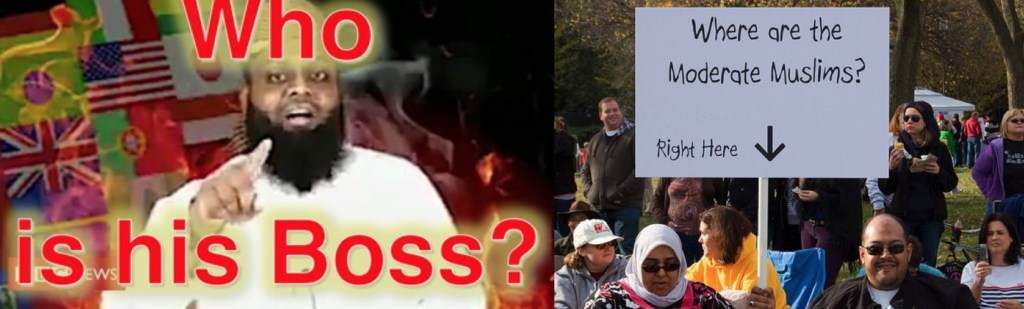
Yes, the Sinhalese Buddhists are concerned. Do they have reason to be? Yes. Yet the concerns of Buddhists are never given an unbiased voice in the mainstream media, instead Sinhalese Buddhists are labeled as racist”, extremist” and even militant”. Labelling Sinhala Buddhists is a ploy to refuse to accept the reality that moderate Muslims are being drawn towards radicalism not just in Sri Lanka but globally. This is not a problem only Sri Lanka is facing. The Muslims themselves must answer why moderate Muslims are becoming radicalized and who is manipulating Islam. The source of radicalism is in the Books. This is the ugly truth Muslims must accept.
One Law for ALL
No one can deny that this nation was built & defended by the Sinhala Buddhists. This historical role remains enshrined in the country’s constitution. There is no denying that the minorities enjoy rights too proved by their living conditions. No ethnicity or religion can come above the country’s law. Every citizen must abide by the law of the land applicable to all equally.
The Sinhalese Buddhists are concerned because of a new wave of isms” attempting to dislodge the peace that prevailed historically.
For attempting to warn about the radical elements at play & warn the people of ultimate outcomes – the tactic has been to brand Sinhalese as ‘extremists’ and ‘racists’ to divert people’s attention from the real problem. This tactic is well-funded and well-choreographed using multiple communication modes and drawing personalities who would do anything for money!
How long will labelling Sinhala Buddhists hide the growing problem of Islamic extremism?
By labelling Sinhala Buddhists, the radicals are only buying time to carry out an underground exercise to increase radicals by drawing more Muslims claiming Muslim demands are not met!
On what grounds should a parallel law suddenly emerge to be accepted by all when it is not applicable or relevant to over 90 percent of the Sri Lankan populace?
A society cannot function with parallel laws & a quasi-legal system which makes followers of this parallel law believe their religion, their views are Supreme Law and above the National Law.
The drumming of this idea into the heads of their followers has caused immense conflict and is brewing trouble unless stopped by clearly stating that no customary religious minority law is above the National Law.
Buddhist cultural heritage threatened
Sinhalese Buddhists are concerned because Buddhist cultural heritage is being destroyed, Buddhist archeological and historical cultural monuments are being destroyed. Devanagala Raja Maha Vihara is under threat & even being stoned. This is nothing that can be denied or swept under the carpet by carrying campaigns calling Sinhalese racists.
The sudden violent behavior in Muslims is noticed & Sinhalese Buddhists are rightfully concerned because the Muslims they were peacefully living with are being radicalized and transformed into adopting a new wave of exclusivity” evident by the increasing numbers of women in black attire, exclusive Muslims schools springing up and increase in unfair demands.
WE ARE CONCERNED BECAUSE ISLAM IS A SYSTEM OF LIFE COMBINING LEGAL, SOCIAL, ECONOMIC, RELIGIOUS, POLITICAL AND MILITARY COMPONENTS. CHALLENGING ONE, MEANS ALL FORCES OF THIS SYSTEM ARE ENGAGED TO ATTACK THOSE THAT CHALLENGE THEM.
WE ARE CONCERNED BECAUSE THERE IS AN EMERGING CONFLICT IN ISLAMIC LAWS WITH NATIONAL & INTERNATIONAL LAWS.
WE ARE CONCERNED BECAUSE THERE IS CLEAR DUALISM IN THEIR LAW– ONE RULE FOR MUSLIMS AND ANOTHER FOR NON-BELIEVERS.
WE ARE CONCERNED ABOUT THE GROWING NUMBER OF SHARIA LAW COURTS THAT WERE NEVER PRESENT IN SRI LANKA PREVIOUSLY. WHEN MUSLIMS HAD BEEN FOLLOWING THE SRI LANKAN LAWS FOR DECADES, WHY SHOULD THERE BE A SUDDEN NEED FOR A MUSLIM ONLY LAW?WHY SHOULD 9% OF THE POPULATION HAVE A SEPARATE LAW WHEN AS CITIZENS OF SRI LANKA, MUSLIMS MUST ABIDE BY SRI LANKA’S LAWS?
WE ARE CONCERNED BECAUSE EVERY PERSON’S INDIVIDUAL FREEDOM STOPS THE MOMENT IT INFLICTS HARM ON ANOTHER(BE IT MAN OR ANIMAL)
WE ARE CONCERNED ABOUT EXTREMIST DEMANDS WHICH DO NOT CONSTITUTE A FUNDAMENTAL RIGHT
Muslims claim to want to live ‘peacefully’ – if so why undermine this by requesting only their laws, their customs, their rituals should come first or be accommodated by all others.
To make such demands – where is the reciprocitywhen Muslims are in the majority. Do majority Muslim areas in Sri Lanka accommodate non-Muslim demands or customs as freely as Muslims in non-Majority Muslim areas enjoy?
The rise in demands and the manner these demands have become accepted using deceptive means of influencing has enabled Muslims to obtain for themselves exclusive food labels, banking, dress codes that did not exist, certifications for which non-Muslims have to pay Muslim organizations conflicting with state taxes.
In Islam are people divided as Muslims & non-Muslims? Yes
Are Non-Muslims classified as non-believers are infidels? Yes
Is there equality for non-Muslims with Muslims? No
How can Muslims then demand equality from non-Muslims?
When this question is raised Muslims will quickly rise to smoothen the situation with intent to simply sweep the issue from being addressed!
Yet 9 percent of Muslims cannot deny special privileges in Sri Lanka
They are represented in the National Flag
All Muslim religious days are declared National Holidays.
Muslims have own banking, own marriage, own divorce, own food labels!
Muslim national schools – have been misused to start madrasas” and exclusive Muslim international schools”
It was the Sinhala kings who gave lands to the Muslims in the East during colonial times and now they even demand autonomy.
Even Muslim owned supermarkets that caters to all communities shut down for prayers on Friday – their wishes comes first.
Sri Lanka’s former Justice Minister was a Muslim and leader of a radical Muslim political party. Present Justice Minister is also a Muslim and came from National List.
What freedoms do Muslims realistically offer to non-Muslims?
Can non-Muslims represent himself in a Sharia court? No
Muslims can demand freedom of religion in non-Muslim nations – Can non-Muslims demand the same in Muslim nations? No
When Muslims can demand freedom of religion (build mosques, radicalize their attire, use loud speakers, open-air events etc – non-Muslims have no freedom of religion not even to visit Muslim holy areas or carry non-Muslim religious books or relics (no non-Muslim religious item is permitted to enter their country)
When Muslims in Sri Lanka have built disproportionate number of Mosques throughout Sri Lanka will Muslim nations allow in same proportion?
When Muslims have the freedom of expression to call Buddhists racists” and extremists” and former Justice Minister himself calling Sri Lanka’s Buddhist monks as yellow-robed terrorists” – if Islam is criticized in Saudi the punishment is death by stoning & we saw how a teacher was beheaded in France and for a cartoon the worldwide rampage.
Is there equality of justice when non-Muslims get only a fraction what a Muslim gets in legal settlements according to Sharia laws
When a growing number of Muslim business establishments openly hire only Muslims why do they object to calls to boycott Muslim trading places?
Why do Islamic fundamentalists incite violence against Buddhists in East Sri Lanka encroaching upon land given to them by the Sinhalese Kings and demolish Buddhist sites and temples?
We question how peaceful Islam is when almost all the major conflicts in the World are Muslim-oriented and end up Muslims killing each other due to sectarian violence far more than the damage the West does with their air warfare.
The aggressive rise in demands for legal exclusivity” towards Muslims does not advocate any policy of compromise or peaceful coexistence with other communities and is making not only Sri Lankans to ask what Muslims are really upto but the West is also now asking these same questions!
West is also concerned about Islamic expansionism
If Muslims accuse Israel of influencing politicians, journalists against Muslims what are the Muslims doing with petrodollars in systematically influencing politicians, using international human rights laws to establish Sharia and Islamic extremism in non-Muslim nations in a long-term bid to Islamize them?
Why is Netherlands a multicultural mess, why are all EU nations now reconsidering the dangers multiculturalism” has brought to their natural citizens?
Why is UK concerned that Sharia laws have subverted British laws with over 1500 under-aged forced marriages taking place (Scotland has banned forced marriage). UK already has 100 Sharia courts (the 1st opened in 2008), honor-based violence even killings (over 2,800 in 2011), female genital mutilation (over 65,000 cases though it is illegal under 2003 Act but no one has been prosecuted)
Why is Briton ending practice of paying multiple social welfare benefits to Muslim immigrants practicing bigamy/polygamy (a crime in GB but a special right granted to Muslims under Multiculturalism who demand Sharia laws).
Why is UK working on a new law to ensure meat slaughtered according to Islamic Sharia law cannot be sold unwitting to public.
How did Britain end up having more Muslim imams than Christian pastors?
If UK was worried when towns with large Muslim populations (Birmingham, Derby, Bradford, Dewsbury, Leeds, Liverpool, Luton, Leicester, Manchester, Sheffield, Waltham Forest) demanded Sharia replace UK’s common law in 2011 – should Sri Lanka not worry?
When Town Hamlets – an East London Muslim enclave has posters You are entering a Sharia controlled zone : Islamic rules enforced” – where Imams issue death threats to women who refuse to wear Muslim veils – should that not worry Sri Lanka?
When UK politicians show Sharia-compliance and when former UK Premier Gordon Brown stated he wanted London to become the Islamic financial capital – should we not worry about what Sri Lanka’s politicians will commit Sri Lanka towards?
It is not Sri Lanka but the West that has come up with four phases to Muslim expansionism:
Phase 1: migration to non-Muslim host country, Keeping low profile, request for humanitarian tolerance, no demands on host nation. When Muslim population are 2 percent they remain peace loving (ex: US, Australia, Canada, Norway, Italy and China – where Muslims follow the One Child Only policy without fuss)
Phase 2: Requests for Muslim representation in all spheres, Request recognition of Sharia law to their community while proselytizing. Openly condemn radicalism” and organize inter-faith dialogue and events and position Islam as a religion of peace and that Sharia is not a threat by getting uninformed non-Muslim leaders to support.
Underground Islamic conversion, indoctrinating Muslim children, calls for hate laws to silence critics, plan to enlarge Muslim populations, assassination of critics (Theo van Gogh murder in Netherlands for insulting Islam). More than 2 percent of the population means a converting drive (ex: Germany, Denmark, UK, Spain, Thailan)
Phase 3: When Muslim populations reach significant minority they apply penetration”– lobbying governments, creating radical political parties and candidates, filing lawsuits against Islamophobia” pressing for special privileges for Muslims in public establishments, request turns to demand for Sharia laws, undermining host government, ridiculing majority host religion and culture, using their economic hold to ransom, even moderate” Muslims are murdered, restricting Muslim women, holding Government to ransom by bargaining, More than 5% excessive influence – pushing for Islamic laws, Halal etc (ex: Sweden, France, Switzerland, Netherlands, Trinidad and Tobago)
Phase 4: Islamic theocracy” declared.Muslims gain control of a nation, imposes Sharia law, engages in violence with non-Islamic religions, all non-Islamic human rights cancelled, freedom of speech, press, religion cancelled, all non-Muslim culture and symbols destroyed. More than 10 percent – lawlessness (ex: France)
The website www.thereligionofpeace.com keeps track of the number of violent jihad attacks.
It has become a practice for both Muslims and Tamils to hide their follies and wrongs behind the cry of ethnic discrimination”, hate campaigns” to cover up accusations made against them.
It has worked well to camouflage their ulterior motives by internationally promoting Sinhalese Buddhist as extremists” and using the power of money.
Radical Islam
Whatever theories or excuses being propagated for the growing resentment, the Muslims cannot disagree that there is an underground plan as well as an open strategy to exercise Muslim domination over non-Muslim nations – it is the Muslims who need to step back and digest the accusations and decide to peacefully coexist with the other communities while ceasing to demand exclusive status for Muslims.
Many Muslims in Sri Lanka while practicing their religion have not been practicing radical Islam. It is only these people who can claim to be living in peace with all communities of Sri Lanka. The radicals cannot use these Muslims as a camouflage to pretend to be living in peace while carrying out a totally conflicting agenda.
Many Muslims donate blood when it is against their faith to do so, a large number partake liquor and smoking – many of these innocent vices are all taboo when full Sharia comes into effect and Muslims in Sri Lanka may like to ponder how drastically their lives are likely to change and all they need to do is to see how disastrous the lives of Libyans, Iraqi’s, Afghans, a host of Sharia following African nations and now Egyptians are.
Like the West, Sri Lanka is concerned about the growing influence of extremist elements of Islam taking over the moderate Muslims who had been living peacefully in Sri Lanka because There is no moderate or immoderate Islam. Islam is Islam and that’s it” (Recep Erdogan – Turkey PM)
As the author and historian Serge Trifkovic states: The refusal of the Western elite class to protect their nations from jihadist infiltration is the biggest betrayal in history.” – we can say the same of Sri Lanka’s politicians.
Sri Lankan leaders could have nipped the LTTE factor but it didn’t and that led to 30 years of conflict.
If Sri Lanka’s leaders do not address this radicalism that will affect all Sri Lankans including the moderate Muslims.
The moderate Muslims of Sri Lanka have to now play a bigger role and put an end to radicalism and extremism amongst their own and take over the role of representing Muslims instead of tasking that to radical Islamic groups & leaders. Will they?
According
to a news item carried in The Island/December 28, 2020, Russian Ambassador in
Colombo Yuri Materiy forewarned Sri Lanka’s Minister of Public Security Retired
Rear Admiral Sarath Weerasekera that extremist Islamic terrorist organizations
may channel funds to their Lankan counterparts on the pretext of extending
COVID-19 aid. ‘In response the Minister said that after the war a new strategy
had been formulated by the then Sri Lankan government to increase the
intelligence battalions from 3-7 and deported nearly 160 madrasa scholar
leaders who under the guise of religious studies were spreading hate and
extremist propaganda’. He also told the Russian diplomat that the previous
yahapalanaya dismantled that intelligence network, and that the present
government is engaged in remedying the situation.
The
popular Qatar newspaper Gulf Times, quoting Reuters/Islamabad, reported
April 30, 2019 that Pakistan was planning to take over a network of over 30,000
madrasas as part of a drive to ‘mainstream’ the Islamic schools by bringing
them under state control. This information was provided by a Pakistani military
spokesman. The madrasas mentioned were often accused of radicalising Pakistani
youngsters. Groups of madrasa-educated young men were held responsible for
terrorist attacks in India and Afghanistan.
There
was global pressure on Pakistan to control this trend. But it was a complicated
issue as, according to the news report, these madrasas are the only schools
available for millions of poor children to obtain any education at all in the
deeply conservative Muslim country. Anyway, the new government under Prime
Minister Imran Khan decided to introduce reforms to madrasa education; PM Khan
vowed not to tolerate extremist groups operating in his country.
The
madrasa education system in Pakistan was criticised for reasons including the
following: children spend most of their time memorising the Quran; it is ill
equipped for the modern world; some madrasas have become nurseries for breeding
militant outfits. This seems to be why, as General Asif Ghafoor said, the
government had decided to ‘mainstream’ the madrasa system (i.e., incorporate it
into the regular state controlled school system, which is what some politicians
have suggested in relation to the same problem in Sri Lanka – RRW). ‘An
Islamic education will be provided, but there will be no hate speech’, Gen.
Ghafoor added. Religious schools would be brought under the ministry of
education and other subjects would be incorporated into their syllabuses. ‘The
benefit will be that when children grow and leave these institutions, they will
have the same career opportunities that those coming from a private school
have,’ Ghafoor said. ‘We want to end violent extremism in Pakistan and that
will only happen when our children have the same education and opportunities.’
So much for the Gulf Times news report about the issue of madrasa education in
the Muslim majority Pakistan.
But
while thus tackling the domestic issue of controversial Islamist madrasas, PM
Imran Khan, had trilateral talks at UN New York with his counterparts in Turkey
and Malaysia in September 2019 to jointly launch an anti-Islamophobia TV to
counter ‘misperceptions’ of Islam, according to the Voice of America (VOA). No
doubt, these and other possibly well meaning leaders of Islamic nations have a
daunting task defending their religion to the rest of the world amidst growing
global concerns generated by Islamist extremism.
Incidentally,
the Arabic word madrasa means any type of school, an institution of
educational instruction, secular or religious. However, in Sri Lanka where the
Muslims are a minority of about 9.7% of the population, the term is understood in
the exclusive sense of ‘a school for Islamic religious instruction’. In the
present context in Sri Lanka, the word madrasa carries connotations of
religious extremism, intolerance and violence towards the vast majority of
multireligious Sri Lankans including mainstream Muslims who do not subscribe to
Islamic fundamentalism. It must be stressed that this negative perception is
not due to any intrinsic fault of the mainstream Muslims or of the rest
of the non-Muslim Sri Lankans; it is because of the relatively recent emergence
(say, during the past 50 years) of unmistakeable signs of Islamic
fundamentalist activity in the country.
Pakistan
has always stood by Sri Lanka as a steadfast friend in critical situations. Her
experience with Islamist madrasas and the unconservative leadership of
prime minister Khan provide great inspiration for Sri Lankan leaders in
dealing with Sri Lanka’s own Islamist extremism, which has grown with the
connivance, and probably the cooperation of opportunistic politicians. However,
the Pakistan government’s policy of dealing with madrasas cannot be duplicated
in Sri Lanka because there are important differences between the two mutually
friendly countries that far outnumber any similarities we might think of, in
terms of geography, history, total population, demographic composition,
literacy rate, religio-cultural diversity, mode of governance, and the rest.
With its roughly 212 million (2018 estimate) population living on its nearly
882,000 square kilometre area, and its population density of 244.4/km2, Pakistan is the fifth most populous country in the world and has
globally the second largest Muslim population (which is 96.28% of the country’s
total).
These
statistics dwarf Sri Lanka in comparison: its population is only about 21.8
million (2019 estimate) with a population density of 327/km2. Very nearly 75% of the
population are ethnically Sinhalese and over 70% of the population profess
Buddhism (which is not actually a religion in the sense that Christianity and
Islam are religions, though most ordinary Buddhists are harmlessly or
innocently ignorant of the fact). In terms of access to education, children of
Sri Lanka – irrespective of ethnicity, and the economic and social background
of parents – have enjoyed free education provided by the state from
kindergarten to university since 1944 (that is, since four years before
independence). The government school system largely consists of secular
unsegregated (10,000+) schools, in addition to many institutions of
tertiary education including sixteen public universities. These are common to
students from all racial and religious backgrounds. The pre-university school
curriculum includes religious instruction according to the students’ specific
religious identity: Buddhist students study Buddhism, Christian students
Christianity, Hindu students Hinduism, and Muslim students Islam. It is likely
that, at present, school children are taught, in the barest outline, the very
basic doctrinal elements of other belief systems than their own.
Over
the past four decades, in addition to the government school system, there has
also been an expanding network of fee levying English medium
‘international’ schools teaching UK and US syllabuses. No formal teaching of
religion features in them, as far as I know. Local students who enroll in these
schools usually belong to the monied class. They gain access to the
generally much coveted English medium education provided by international
schools. A larger proportion of students attending these schools are naturally
children of parents who work in business and the professions (doctors,
engineers, lawyers, accountants, etc.) Now, historically, Muslims started
coming to Sri Lanka as traders at least eight hundred years ago, mainly looking
for spices and later some of them settled in Sri Lanka, having got
married to local Sinhalese women. Even today the Muslim community is strongly
associated with commerce, and is considered economically better off than
others, though the lot of ordinary Muslim citizens is the same as that of their
counterparts in the other communities, who together form the common masses.
(Ironically, the two brothers Imsath Ibrahim and Ilham Ibrahim who blew
themselves up on Easter Sunday in 2019, respectively, at Shangrila and
Cinnamon Grand hotels in Colombo, are sons of the fabulously rich spice
merchant Mohamed Yusuf Ibrahim; the two young men in their early 30s were well
educated, and were themselves well established in their own businesses, but
deeply and dangerously radicalized by the Jihadist ideology. They had undergone
the sort of ideological brainwashing that the mushrooming Islamist madrasas are
accused of providing.)
There
are also schools that are supposed to usually cater to children from specific
religious backgrounds, namely, Buddhist, Catholic/Christian, Hindu, and Muslim.
Buddhist schools, being inclusive, usually accommodate children from minority
religious backgrounds as well; so do Christian schools; in some of the latter
the majority of the students are Buddhists as they are in the majority. Hardly
noticed divisions based on religion and language are not subjects that excite
little enthusiasm among ordinary Sri Lankans but for the predatory interest
that politicians take in them. Just to mention the number of Muslim
schools for the purpose of this esay, there are 749 Muslim schools and
205 madrasas, with an Islamic University (the Jamiya Nalimeey at Beruwala). All
this is to show that there is no need for Islamist (not Islamic) madrasas for
the education of the children of the Muslim minority in Sri Lanka.
Although
Sri Lanka’s Constitution confers the foremost place to Buddhism considering
certain important historical reasons and existing ground realities that cannot
be overlooked without violating the human rights of the majority community, it
is by no means the official or state religion of the country (unlike Islam in
Pakistan). The uniqueness of Buddhism as a practical, profoundly ethical but
a-religious spiritual teaching is today taken for granted, especially among
intellectuals. However, in mundane practice, it assumes the normal attributes
of an ordinary religion, with a religion’s inherent ‘worship’ element (= the feeling or expression
of reverence and adoration for a deity); ‘deity’ element is replaced by the
Triple Gem (Buddha, Dhamma, Sangha), a kind of an impersonal Buddhist Sacred
Trinity. Buddhism therefore is highly compatible with principles of modern
secular democracy, which is arguably the best form of government so far
evolved, provided it is followed true to its letter and spirit. Islamic
fundamentalists do not believe in such things as ‘man-made’ democracy (and the
human rights it defines) as opposed to what is ‘divinely decreed’ in their
sacred book.
For
Pakistan, as it appears, its madrasas can only be a problem because of their
negative impact on that country’s relations with non-Muslim majority countries.
Within the country itself, it can create problems for the religiously diverse
3.72% minority, which it is the duty of the government to manage, because
religious freedom is constitutionally recognized in that country. However, the
religiosity of the Muslim majority and the ignorance of some minority members
regarding, for example, the blasphemy law that is adopted in the sharia-based
Pakistan can bring trouble to the latter, as in the ‘notorious case’ (BBC) of
Asia Bibi, pauperised Christian mother of two daughters, who was condemned to
death by hanging on blasphemy charges in 2010, but was lucky enough to be
acquitted for lack of evidence, and managed to migrate to Canada with her
family in 2019 after nearly ten years in prison in solitary confinement. She
was held in solitary confinement allegedly to protect her from other inmates,
which was sensible given that it was her bigoted Muslim neighbours who for days
on end cried for her blood for committing the crime of blasphemy (by insulting
the founder of their religion) and terrorised her family until she was
arrested. Two politicians who were prominent among those who actively
sympathised with the woman were assassinated before the Supreme Court of
Pakistan acquitted her in October 2018 on the basis of ‘insufficient evidence’;
about six months later she was helped to migrate to Canada. The relevance of
this story to the madrasa issue goes without saying. A book dealing with her
ordeal titled ‘Free at Last’ jointly authored by Asia Bibi and
Anne-Isabelle Tollet was published just three months ago in September 2020 by
Amazon.)
With
the rapid emergence of increasingly sophisticated digital communications
systems and the exponential growth of internet telecommunication based social
media platforms, people across the globe, predominantly the young, are gaining
access to all forms of knowledge including that about traditional religions,
most of which have so far been regarded as infallible divine revelations beyond
the human capacity to question. Free exchange of views both in support of
religious beliefs and against them is the norm. Instead of blasphemy laws,
which could differ from religion to religion, there are common social media
guidelines that guarantee rational civilized healthy construction of various
types of human knowledge and cultural expression. This is a challenge to
fundamentalists of all descriptions.
Now
the criticisms that the Pakistani authorities recognised concerning the madrasa
education system under fire in that country are the same as or very similar to
those raised by the Buddhist monk activists against the Islamist
madrasas: children studying in them are subjected to a very narrowly religion
based type of instruction, that is not equipped for the modern world; the
children learning in them are not allowed to interact with non-Muslim children;
their mode of dress is different; girls go about completely covered from head
to foot in black, which is very inconvenient in hot weather that is normal in
the country; their appearance in public causes fear and suspicion in others;
the young madrarasa boys and girls cannot indulge in any recreational
activities including listening to songs and music, or watching films.
Incidentally, Abdul Razik, secretary of Ceylon Thawheed Jamaath (CTJ), told the
presidential commission on Easter Sunday attacks that music and dancing and
even listening to a song on the radio is contrary to the Islamic teaching. He
had previously formed the Sri Lanka Thawheed Jamaath (SLTJ) organization with
Zaharan Hashim who led the Easter Sunday suicide bomb attacks. Razik left SLTJ
to form the CTJ. (The monks point out that extremist Islamist groups only
pretend to break up into splinter groups as a strategy to deflect the attention
of the authorities away from their central objective to which they are
collectively committed and severally contribute in secret.) Abdul Razik’s
rejection of music and dancing as contrary to Islam is in conformity with his
extremist religious ideology.
Ironically,
it is already more than six years since American Muslim hip-hop artist Hisham
D. Aidi started exploring
‘the significance of music for transnational Muslim consciousness, asking his
own question: What happens when American musical traditions, infused with the
unique history of American Islam as a voice of resistance, find new audiences
in Muslim-majority societies?’ The answer to this question is emerging now in
some majority Muslim countries like Turkey and Indonesia where young people who
are getting fed up with the restrictions imposed on them by their conservative
rulers. According
to Güney Akgül, a lawyer-turned-Lindy Hop teacher, ‘Istanbul is a chaotic city
[of 15 million people]
and there aren’t a lot of places to relax, but in Lindy
Hop, you can express yourself at the fullest level’. In Indonesia, recently, a
Sinhala music video titled ‘Adambarai’ produced by local pop musician Iraj
Weeraratne went viral after being played in a pub there, and it received more
than 5 million hits within a short time and dozens of young Indonesians
teenagers of both sexes have turned out Tik Tok videos featuring themselves
singing and dancing in various indoor and outdoor settings. With a population
of over 267 million, and nearly 87% of it Muslim, Indonesia is the most
populous Islamic country in the world, but Islamism is not popular in that
country.
Children
and youth are the most precious wealth just as much as the most productive
resource of a country. They are the most creative, and the most forward looking
section of any community. The hip hop or rap music craze that is sweeping
across some Islamic countries is both a non-violent protest against the
oppressive religious conservatism of their parents and a celebration of a life
that is getting increasingly free from it. This is comparable to something that
happened in our country recently. There was a spontaneous resurgence of
youth creativity in two departments in Sri Lanka inspired by new hope in
the wake of the election of a non-politician as president in November 2019: a
wave of wall painting by volunteering young amateur artists whose central
themes included celebrating the victorious assertion of national identity and
unity just shown, environmental preservation, memorable moments of history,
industrial development, etc.; almost paralleling this, a self-motivated
cooperative movement emerged, initiated by a young man (Nalaka Senadheera of
Dedigama near Kegalle, himself a dramatist, poet and writer) that started
recultivating rice paddy lands lying abandoned and fallow in various parts of
rural Sri Lanka; it caught the enthusiastic attention of young Sri Lankans at
home as well as abroad. It is doubtful whether our jaded old politicians took
sufficient notice of these manifestations of youthful
patriotism.
Five or six weeks ago,
media reported that Minister of Education Prof. G.L. Peiris indicated in
parliament that the madrasas would be brought under the country’s normal
education system, and that he had a responsibility to bring it under his
ministry’s supervision. He probably didn’t understand that he was biting more
than he could chew. This sort of cloud cuckooland palliative response to the
issue of Islamist madrasas is simply astonishing (but again, not surprising
given his past record) from a senior politician in the aftermath of the Easter
Sunday suicide bombings that caused such mayhem, for which all politicians who
made it to parliament in recent times (including before 2009) up to the end of
Yahapalanaya bear some responsibility. There is no doubt that madrasa type of
education was responsible for the indoctrination of those young Jihadist
suicide bombers. A few days later, minister Wimal Weerawansa, in an obvious
allusion to his cabinet colleague’s ill conceived suggestion regarding
the madrasa issue, expressed the opposite view that the Islamist schools should
be banned within Sri Lanka, for they are a hotbed of dangerous religious
monomania and terrorism, enough evidence for which has been revealed at the
commissions of inquiry appointed by the government. Wimal Weerawansa’s proposal
is sure to go down well with the majority of ordinary mainstream Muslims who
are themselves victims of Islamist extremism and who are not represented by the
old time-servers that they have for politicians.
An open
letter to His Excellency the President, Hon Prime Minister, and all concerned
on the destiny of the Sinhala nation
Dr. Sudath Gunasekara : Retired Secretary to
Prime Minister Sirimavo Bandarnayaka and President Mahanuwara Sinhala Bauddha
JesTha puravesiyange sanvidhanaya.
28.12 2020.
Why PC elections should not be held just now
Because
* It is not the
priority no 1 at the moment with the Covid 19 disaster and a crippled and debt-ridden
National economy. Finding solution s to the should be the top priorities.
* It is a
national crime to spent probably over Rs 25 billion (going by expenditure
incurred for the past 2 election) for a worthless cause for a country already sunk
in abysmal depths with an unbearable debt repayment burden
Why they should be abolished immediately instead of
trying to bring them back to life
*It is the time
to abolish this Indian curse rather than trying to unearth it from the 4 ½ year
old grave
* It has brought
about more political, economic and social chaos and confusion, hunger and
misery for the masses than ever before
* It has drained
out over Rs 94, billion (calculated using the 2017 expenditure on Provincial
Councils Rs 286,031,000 as the base) expenditure
from the national coffers for the past 33 years just to maintain a national
deathtrap and a bunch of political parasites like 9 Governors. 9 Chief
Ministers 36 Ministers and about 700 PC Members and a chain of wasteful
institutions and a bunch of superfluous officials with no benefit worth a penny
to the country or the general public.
* It has
completely destabilized and derailed the once efficient District Administration
and increased the number of politicians
and officials and decreased efficiency and quality of public Service and
tremendously increased government expenditure
and at the same time decreased the revenue of the central Government
* It has
increased the urge for separation and self- assertion on ethnic and religious
lines and run counter to national integration
* above all it
is political suicide for the government in power and destruction and disaster
for the Sinhala Nation and Buddha Sasana and
* Finally It is going to be a hay day for India very
soon that fathered this fatal trap and a dream come true for Tamils all over
the world including the separatist Tamils in this country as before long this
Island will end up as their dream EELAM and the 30th State of the
Indian subcontinent.
Apropos the news
item broadcasted over the Pattare vistare
this morning that the Cabinet has decided to get the views of the Party leaders
on a Cabinet Paper submitted by Minister Local government to have Provincial
Councils elections, I am making this all
important and serious request to you on behalf of the whole nation not to
have it at this critical hour of the nation, even if the whole world request
you to hold Provincial Council Elections. It is extremely unadvisable to have
it under the desperate mass protests in the country against it, which will
accelerate phenomenally all over the Island and go beyond control if you don’t
listen to them and furthermore will be disastrous in view of Covid 19 pandemic situation.
Moreover in addition to the political, social and extremely depressing economic
situation in the country, I also appeal to you not to go for it for the
following reasons as well.
Reason 1
Why do you want
to go for elections for these utterly useless and disastrous white elephants
when the whole country lead by all the Mahasangha, the Muradevatavo of this
nation for the past 2500 years,
including the 7 million people who voted this Government in to
power twice within a span of 9
months are vehemently against it.
Abolition of provincial Councils is the will of the people who voted you in to
power, with whom sovereignty is supposed to rest under Sec 3 of the
Constitution. In this backdrop I am posing the question to you as to why you
consult the leaders of political parties rejected by the people as late as May
2020 and right now who oppose the policies of this Government endorsed by the
people with whom sovereignty lies. Doesn’t that contradict and negate the
concept of majority rule, a fundamental principle of democracy
In view of this
inviolable and supreme right of the majority and the thumping mandate they have
given to you and the Government, I am
making this appeal to both of you as the
President and Prime Minister of the government elected with a 2/3 majority
mandate, to reject this Cabinet paper
and instead to take immediate actions to abolish Provincial Councils, that has
come to stay as a proven national
disaster and a tragic Huuniyama on the Sinhala Nation together with the illegal 13th Amendment and the intrigue that is
Rajiv/JR Accord of 29th July 1987, a virtual death warrant on the 2500 year old
Sinhala Buddhist State on this blessed
Island.
In this backdrop
we, the Bhuumiputras of this country earnestly request you to take this bold
and historic decision to abolish this Indian death trap without groping in the
dark and without getting lost in thick wilderness. Yanta Desat penenam kima
Bediwala yanne manmulavuu ekekuse”
On the other
hand even if you consult Party Leaders this is what will happen
1 They will be
the first party to ask for it as leaders of political parties who oppose the
Government
Firstly, to put
the Government in to more trouble and create confusion in the country to enable
them to come to power as soon as possible and
Secondly to
appease and bait their political bandwagon at the Provincial level who are
craving and dreaming for positions in the new Provincial Councils in the event
they win,(which of cause is very unlikely) claiming that it was they who wanted
the government to have this election when it was hesitant
Thirdly, and
more importantly, this is like giving a pot of curd to cats”, or putting a
tortoise to water”, as the wonderful Sinhala sayings Dii kirata balallut
saakki” and Ibba diyata demmaa wage” as they want to mobilize their supporters
to capture power at Provincial levels
I can assure you
that none of these Party leaders have any concern for the people or the country
as they are only concerned with coming back to power by hook or crook and to
enjoy the luxuries they have lost temporally. We need not speak about their
patriotism, for, as perhaps you know it better.
I have a feeling
that all of them will support having elections for the simple reason that
elections are the bread and butter for desperate politicians and it will
afford them a golden opportunity to wash
all their dirty linen against the Government in power.
On the other
hand by any chance if they say no and if
you listened to them and stop elections to PCC then they will claim credit for
their rather bold and Patriotic stand”
to safeguard the interests of the masses
and blame the government for denying the democratic rights of the
people. A message they will carry forward for the next general election
In this backdrop I request you not to go by
their verdict, whatever they say as I am confident that you have the power and
the brain too to take the correct decision. The correct decision the 7 million
voters who voted you in to power twice within 9 months wanted you to take is to
scrap the PCC
Obviously with Presidential Executive powers
restored under the 20th A and the 7o lakhs public endorsement given to you with
2/3 in the Parliament I am of the view that you have the full authority to make
the bold and historic decision not to have PC Elections at this juncture, as
you did in 2009 in the fight against the LTTE in spite of serious objections
made by the powerful Western powers. This is a golden opportunity to prove your
metal once again as undisputed national leaders of the nation without allowing
others to get the credit.
Reason 2
Protest against
PCC by Mahaa Sangha and 7 million who voted this government in to power
More importantly
All the 70 lakhs
Sinhala voters who voted you both at the Presidential and Parliamentary
Elections (2019 and 2020) lead by the Mahasangha, (except a very few, of course
negligible by way of numbers at elections but who want it, for their own
benefits as Governors, Ministers, PC MPP to be and in many other places within the
PCC system to enjoy the luxuries that will fall on their heads from heaven for
doing nothing in return) are strongly against the Provincial Councils. They all
vehemently oppose it and want the PCC to be scrapped and they have already
threatened to get on to the streets as you yourself did in 1987 where three
patriotic people had to sacrifice their lives on behalf of you and the country. If you delay this the day Mahasangha and 70
lakhs getting on to the road demanding you to dot or quit may not be that far.
Reason 3 Extremely prohibitive cost, problem of
procurement of funds and repayment
Firstly, the
extremely prohibitive cost of such an Election at a time like this when the
country needs billions and billions for the current Covid 19 expenses with a
pending third wave on the way where the financial commitments are unpredictable
and unimaginable.
This is not the
time to go for another useless and meaningless Election after two National
Elections just concluded at exorbitant cost with a staggering figure around Rs
30 billion
A PC election at
this moment will cost more and it will be at least double the amount needed for
one election, or at least RS 25 billion the minimum in view of the prevailing
Covid 19 disaster. With the threat of a third wave on the way it could be even
more.
From where are
you going to get this money and at what cost? Borrow from whom? And how are you going to repay it when we are
already struggling on the rim
Reason 4
PCC for whose
benefit and what gain to the country?
What is the
benefit the PCC have brought in, for the country or the general public for the
past 33 years other than the wastage of billions of public funds and disrupting
and confusing the once excellent District Administration affecting the
governance in the whole country.
Reason 5
Putting the
people from the frying pan to the hearth”
As PCC have
completely disrupted and killed the once efficient district Administration
under GAA and made delivery of services confusing and inefficient due to
overlapping, confusion and conflict between the District administration and
Provincial Administration
Reason 6
Paving the way
for complete disintegration of the eksesath Sinhala Buddhist State that had
been protected and defended by our patriotic and heroic ancestors for the past 2600 years and
destroying the Sinhala Buddhist State by dividing the country in to 9 independent
Governing units with some of them mono Tamil and some mono Muslim, finally heading to mark the end of Sinhala
Buddhist civilization in this country.
Reason 7
Finally, If we
do not abolish the 13th A and the Provincial Councils and the Indo-Lanka
Rajiv/JR Accord of 29 July India will
first annex the North and Eastern Provinces followed by merging with the
Central, Sabaragamuwa and Uva as provided by
that Accord and complete full Indianization of this Island as the 30th State (second Tamil State next to Tamilnadu)
of the Indian Subcontinent sans Sinhalese and sans Buddhists. This will draw
the curtain over the 2500 year old pristine Sinhala Buddhist civilization in
this country
This tragic disaster could be avoided only by
taking the following three steps
1 Abolishing the
Provincial Councils.
2 Repealing the
13th Amendment and T
3 Repealing the
JR/ Rajiv Accord of 29th July 1987 partially already unilaterally violated by
India.
This is why I appeal to your Excellency the
President and the Prime Minister to complete the above three things as soon as
possible without further delay
Surangal
Lakmal by far the best fast bowler Sri Lanka ‘s squad. We did not
play the practise match before the first test. According to our Head Coach,
Lakmal will play the second test, if he pass the fitness test. Sri
Lankan Cricket says Lakmal sustained an injury during regular training in SA.
If
an international player sent abroad to play test matches sustain an injury
during regular training sessions, then there are several questions ought to be
answered. Did he attend the training sessions in Sri Lanka
successfully? Was there any motive to send a half-baked player so that
even if he does not play, the costs will be reimbursed by the Insurance.
Kusal
Mendis should not have been sent to SA at all. Compared with the number of
innings he has played, his performances are below test standards. Kasun
Rajitha, Dinesh Chandimal, Dhananjaya de Silva are all on the casualties list.
Asantha
de Mel has been on the job in the selection committee far too long. He
was not even a front line leading fast bowler for Sri Lanka. Before the test
series with England the Chairman of the Selection Committee should be
sent packing for sending a team of wounded lions to South Africa. Our new
Minister of Sports has an overall responsibility and the results shows of his
decision making skills need to be reviewed immediately.
Is it absolutely safe to bury those who have died of Covid-19? No one can say with absolute certainty. The World Health Organization (WHO) says it’s safe. However, the WHO’s endorsement is not the last word. It is a decent recommendation, nothing more. Note, also, that the WHO has got a lot of things wrong over the years. With regard to Covid-19, the WHO initially said face masks are unnecessary. Later the WHO said, ‘wear face masks.’ That’s symptomatic of all understanding of and responses to the pandemic. We know just one thing and that is that we don’t know much.
That said, some 190 countries have approved burials. THAT said there is massive outcry in Denmark for the exhumation and incineration of nearly 17 million mink culled and buried after the discovery of a mutated form of the virus. The burial sites are close to a bathing lake and to a drinking water source. The burial was deemed illegal. However, ‘as of now’ (note: this is a key phrase in the Covid-19 discourse), there’s no evidence of contamination or risk of infection. The important thing here is perception. PUBLIC perception.
Muslims want the Civid-dead buried. Islam is not the only Abrahamic religion that recommends burial, but others in this faith-family have not complained. Flag that. THAT said, the opinions, fears and beliefs of those who belong to other faith communities are irrelevant for the individual. He/she operates on the basis of his/her understanding of the particular faith.
Atalugama is a case in point. A total of 162 Covid-19 cases were reported from this village on Tuesday alone. This is a ‘Muslim village.’ The people are fighting shy of tests because they don’t want to be tested positive. If tested positive they are reluctant to be taken to hospital. If taken to hospital they are scared they will die. Why? Because, as per the current policy, the remains will be cremated and if cremated, so they fervently believe, the possibility of rising to heaven will be denied. Work that backwards and we have the ‘Atalugama Phenomenon.’
For those whose lives are governed by faith, human logic is inferior, irreverent and irrelevant. If you tell those who believe that corporeal integrity is a must for entry to heaven that disintegration begins at the point of death, they won’t bother to even respond. That’s the way of faith.
Muslim citizens have a right to follow their religion. This is ensured in the Constitution (see Articles 10 and 14). On the other hand, all citizens need to abide by the laws and regulations of the land. Governments have to be sensitive to the anxieties of all communities and where there are conflicts, should go with the law. Governments cannot wait on divine arbitration, but must draw from the opinions of the relevant experts.
The other day, some well-meaning people (no doubt) tied white ribbons to the fence around the Borella Cemetery as a mark of both empathy and indignation; supporting their Muslim brethren over their burial demand and protesting the cremation of a 20-day old baby from a Muslim family who died of Covid-19. A baby’s death moves more than the death of an old person, obviously, but the fact of the matter here is whether the deceased is 20 days old, 200 days old or 200 years old is irrelevant. The issue is that the protocols in place forbid burial.
There was much mischief in social media over this particular case. Here’s what happened. The baby was brought to the Lady Ridgeway Hospital (LRH) in critical condition. In other words, ‘late.’ That’s not the hospital’s responsibility; perhaps the parents were immobilized by the anxieties mentioned above. The antigen test was carried out at the preliminary care unit itself and the test became positive within minutes (as opposed to the usual 20-30 minutes) due to the very high viral load.
The doctors and the rest of the staff battled at great risk to themselves. They couldn’t save the baby. The parents were reluctant to receive the body. The anti-burial lobby, motivated less by empathy with the Muslims but by a rabid determination to badmouth the Government (probably on account of ideal political outcomes not materializing), went to town on social media. That’s the story, in a nutshell, of the white ribbons.
The Government, by way of a solution to the burial-cremation issue, has negotiated with the Maldivian Government to bury Muslims who fall victim to Covid-19 in that country. The intact-requirement would thus be satisfied and so too the anxieties of those who are worried about water contamination.
Well, Lord Almighty, all of a sudden those who pooh-pooh the laws of humankind because they believe in those of a higher authority have become fanatical patriots! They insist, ’We want to be buried in our motherland!’ So, it’s the Kingdom of God and things spiritual at one point and at another the land of birth. They want human-laws to be overruled by ‘god’s laws’ in the name of religious freedom. Fine, someone listens, is sensitive and offers a solution. Not good enough, but not for god but the particular human. All of a sudden he/she talks of land, country and nation, and goes further, ‘MOTHERLAND!’ So it’s not about god, the one entity that needs to be pleased as per faith, they want to quarrel over non-religious issues as well. In other words, they WANT to quarrel. They are spoiling for a fight.
What’s next? Well, something that happened in the country which has the largest number of Muslims, Indonesia, will no doubt happen here. The demand for halal vaccines.
Those who claim to represent Muslims and their rights need to do a hard re-think about their politics. They could also re-read their doctrinal texts. They could reflect on those sections where the prophet speaks of lands, citizenships and responsibilities thereto. They might discover that a true Muslim is required to fully abide by the laws of the land of which he/she is a subject. A Muslim is required to obey Allah, his messenger and those who are in authority over him/her. Now someone might say ‘that’s selective quoting.’ Could be. On the other hand, selectivity is an integral part of human affairs. You can’t have it both ways. You can’t say ‘God’ when it suits you and insist ‘human’ when that’s what is convenient. You can’t say ‘Scientists say burial is safe’ and refuse to subject faith to scientific investigation.
To bury or not bury IS a question. It is not THE question. If it is an important question (and I believe it is) then as important are the question about religion and science and the question of selectivity (related to God’s Kingdom and the Nation, divine directives and those that are human-made.)
They say you can’t have the cake and eat it. Well, certain Muslim ‘leaders’/‘representatives’ are proving that it is possible!
US Secretary
of State Mike Pompeo visited Sri Lanka in October 2020. Pompeo received
security fit enough for a President, said the media. The visit was clearly intended
to urge Sri Lanka to join an alliance against China. USA wished to rope Sri
Lanka into the US’s regional plans, said analysts, but US could not achieve
what it wanted and there was no joint statement from the two parties. This clearly
indicated that they were unable to agree on issues.
President Gotabaya
had told Pompeo that he cannot compromise the independence, sovereignty and
territorial integrity of Sri Lanka for the sake of foreign relations. That was
a blow to USA’s ambitions in Sri Lanka, said analysts.
But both parties agreed on
the need to ensure that shipping lanes and the use of the sea should be left
open to all. There should be freedom of
movement in the region. On the economic front, Sri Lanka said that assistance
in terms of technology and investment was welcome. Priority will be given to
promote US investments in the Island said Pompeo.
Both parties also agreed to strengthen the defense cooperation
already established between Sri Lanka and the United States. These include
training opportunities and assistance from the United States to security forces
personnel in Sri Lanka.
Pompeo issued a statement regarding his visit. The United States
seeks to strengthen our partnership with democratic, peaceful, prosperous, and
fully sovereign Sri Lanka, said Pompeo. A strong
sovereign Sri Lanka is a powerful strategic partner for the US on the world
stage. It can be a beacon for a free and open Indo-Pacific.
Pompeo flattered Sri Lanka .Sri Lankan factories and garment
manufacturers quickly filled hundreds and hundreds of orders for high-quality Personal
Protective Equipment (PPE), [used in the Coved epidemic] and we are grateful
for this output which saved American lives, he said.
In Colombo,
State Secretary Pompeo underscored the commitment of the United States to a
partnership with a strong, sovereign Sri Lanka and to advance common goals for
a free and open Indo-Pacific region, reported the media.
Pompeo repeatedly attacked China during his one-day visit to Colombo,
to request Sri Lanka to end its close relationship with China. We see, from bad deals, violations of
sovereignty and lawlessness on land and sea, the China Communist Party as a
predator. The US comes in a different way. We come as a friend and as a
partner,” he claimed. Calling the Chinese Communist Party a predator” is an unusual
diplomatic practice, embarrassing to the hosts during an official visit,
observed former diplomat, Sarala Fernando.
China said, we
are firmly opposed to the United States taking the opportunity of the State
Secretary’s visit to sow and interfere in China-Sri Lanka relations, and to
coerce and bully Sri Lanka. US has no
power or obligation to lecture on China-Sri Lanka relations. That will neither be tolerated by the Chinese
nor be accepted by the Sri Lankans.
The Embassy of China in Colombo, tweeted Sorry Mr. Secretary @SecPompeo, we’re busy
promoting #China-#SriLanka friendship and cooperation, not interested in your
#AlienVsPredator game invitation..”
USA wants to wean Sri Lanka away from China..US has commented on Sri
Lanka-China relations, in an extremely negative way on many occasions. Rear
Admiral Donald D. Gabrielson, of the US Navy, declared, at the Galle Dialogues
2017 that every country should be cautious when working with China for want of
transparency in certain engagements. Many an
eyebrow was raised when Rear Admiral Gabrielson spoke ill of China, in Colombo,
said Shamindra Ferdinando.
In 2020 American Ambassador in Colombo, Alaina
Teplitz, in an interview with local media criticized Chinese projects in Sri
Lanka. The U.S. believes that partnerships between countries should be open,
transparent, and mutually beneficial, and if this is what Sri Lanka’s
relationship with China embodies, then we encourage it,” she said.
Sri Lanka
should engage with China in ways that
protect its sovereignty. There is too much of a China-centric dependency which
limits the Sri Lankan government to look at alternatives, Teplitz continued. China replied that these
remarks by Teplitz, made in
interview with a local newspaper severely violated the diplomatic protocol.
Alice Wells, US Principal Deputy Assistant
Secretary of State said in 2020 Our
partnership with Sri Lanka goes back a long way, through a lot of different
eras, and right now, we think Sri Lanka should make some choices about where they
head. We encourage Sri Lanka to review
the options we offer for a transparent and sustainable economic development in
contrast to discriminatory and opaque practices.
We urge Sri Lanka to make difficult but
necessary decisions to secure its economic independence for long-term
prosperity, and we stand ready to partner with Sri Lanka for its economic
development and growth. Chinese embassy
said that asking a country to make difficult but necessary decisions” on its
foreign relations is also a blatant violation of diplomatic protocol.
Sri Lanka should avoid the vulnerability associated with excess
indebtedness to a single lender, USA advised, meaning China. Alice Wells,
Acting Assistant Secretary of State for South and Central Asian Affairs, ,
declared in Washington, in September
2017 that the US was seriously concerned over what she called unsustainable
debt burden on Sri Lanka due to non-concessional loans from China.
Sri Lanka
said there is no such heavy debt with China. China had helped from the time of
the LTTE war. Much of this was grants
and not loans. Even in the matter of loans they were low interest and
affordable.
China responded to these US
criticisms. China’s development can be seen all around the world in ports,
roads, railway while American bombings can also be felt all around the world,
replied China.
To this day,
American troops are deployed in 150 countries. Since 2001, the US has
spent over $6 trillion on military operations and war, money that might have
been invested in the infrastructure at home. Since the 1970s, China has not
once gone to war. [instead] China, ,
built its nation pouring more cement every three years than America did in the
entire twentieth century said China.
It is hoped that the United States correct the
ugly practices of arbitrarily interfering in other countries’ domestic and
foreign affairs and forcing small and medium-sized countries to choose sides,
said China.
US and
British imperialists secretly create difficult situations in sovereign
countries in order to pave the way to interfere openly, warned China. One method is to create spurious narratives about regimes they want to
target.
China
strongly suggested the US quit the addiction of preaching to others and applying double standards”. China
named four areas of misdeeds, . Slandering, pretending to be the guardian of
free trade while violating the WTO rulings, pretending to be transparent, smearing
others’ normal cooperation against sovereignty,
militarily misbehaving and imposing unilateral sanctions.
China said when
it comes to human rights, the United States should do
its ‘homework’ , rather than telling other countries what to do, or
even spreading rumors to discredit other countries. Poor prison conditions,
ill treatment and even abuse of prisoners in the United States are
frequently reported by the media. ( continued)
Those who worship free markets would say, ‘there is no such thing as a free lunch.’ Nothing comes free. Everything has a price which, they claim, is determined by the play of demand and supply in a market where everyone is endowed with the capacity to obtain all relevant information. Nice on paper. But let’s go along with the story. So, if there’s no such thing as a free lunch, what do these pundits have to say about the Millennium Challenge Corporation’s purported gift (withdrawn recently after intense lobbying by the US Ambassador and MCC officials, backed by certain members of the previous regime, in particular Mangala Samaraweera)? They say, ‘There will be dire consequences!’
Strange. Someone offers a free lunch, the would be ‘beneficiary’ says ‘thank you, but no’ or at least shows sufficient reluctance to exasperate the gifting party, the offer is withdrawn and the intended beneficiary is told ‘damn you, you will pay for this!’ So, pay if ‘gift’ is accepted (as per the theory of ‘no free lunches’) and pay if it is declined! Not too long ago, the US Ambassador was rebuffed by the then Chief Minister of the Northern Province, C.V. Wigneswaran, when he was told to go easy on the government, i.e. regarding the alleged human rights issue which, interestingly, the US had held like a massive rock over the head of the Mahinda Rajapaksa regime. We had resolutions moved against Sri Lanka in Geneva during that period. Come the Yahapalanists and the USA eases off. Obviously human rights were not the issue but whether or not the particular government was willing to play ball. Clearly the Yahapalanists were.
Wigneswaran upset the Ambassador. He is no baby in this game, but he stuck to his guns. Today, if the US Ambassador were to pow-wow with Wigneswaran, she wouldn’t say ‘back off, big guy,’ but is more likely to spur him on.
The US Ambassador is doing just that, with the leadership of the Tamil National Alliance. Strategizing for Geneva in a few months time. Of course the USA, under Donald Trump, quit the UNHRC calling it ‘a cess pool of bias’ but that hasn’t stopped US representatives from deploying proxies to get its dirty work done. The noises we hear from London regarding Geneva 2021 clearly indicate that Sri Lanka can expect to come under fire. Having opted out of Resolution 30/1 which was happily co-sponsored by a naive, nay pernicious, set of decision-makers, Sri Lanka would no doubt have raised the ire of her detractors, led of course by the USA and the UK. The US Ambassador, whose stint in Colombo seems to have been almost exclusively about pushing through the MCC, needs to wash off the egg from her face. Her not so behind-the-scenes maneuvers is just that.
The NGO lobby currently languishing in reduced circumstances are doing their bit. This time around they are in the business of disposing dead bodies. Yes, the ‘controversial’ issue of whether or not to bury those who have died of Covid-19. It’s the Muslims who are upset and that works well with their whine about majoritarianism.
The Government has played into their hands by its indecision. To be fair, the entire Covid-19 story is about incomplete knowledge. London is now hit by a new strain of the virus. London will revisit policies. The lack of complete knowledge forces decision-makers to err on the side of caution. The government decided that burial was risky. The World Health Orgainzation says ‘it’s not unsafe.’ However, they’ve added that factors particular to the country need to be taken into account.
So far, the authorities advising the Government on the safety or otherwise of burials have ruled ‘unsafe.’ In deference to a need to be sensitive to religious sentiments, the Government explored the possibility of burying Muslim victims in the Maldives, following discussions with that Government. Muslim leaders who have played the religion card in this issue seem to have suddenly found a patriotic card up their sleeve: ‘we want to be buried in our motherland,’ they cry. So far, representatives from exclusively Muslim populated areas haven’t offered to accept the bodies of their brethren who succumbed to Covid; those in Kattankudy, for instance, haven’t said ‘come, bury them here.’
The government is paying the price for trying to please everyone. They want to allay the fears of the general public and also want to sort out the anxieties of a particular community. It is best to let Science chair the decision-making process. What’s safest? Cremation, obviously. Is burial really risky? If the answer is, ‘there’s zero risk in buying the Covid-19 dead in certain parts of the country’ and this assertion is accompanied by a list of ‘safe spots,’ then the Government should go with it.
The decision should not be shaped by the interests of any particular community but instead framed by the interests of the safety of all citizens. If there’s no risk in burial, then the government could say ‘dispose as you will, of course subject to following protection protocols.’
So far, we’ve been getting mixed signals. Deciding that ‘burying’ will not win any friends in Geneva. If it’s not one thing, it will be another — that’s how the human rights game is played. The government cannot afford to ignore ‘Geneva’ but shouldn’t let the antics of that political theater frame decision-making here in Sri Lanka. Clarity is what is required and opaque is what the government has given us so far.
We mentioned Mangala Samaraweera. He sided with Sajith Premadasa when the UNP fell apart, but decided he wouldn’t campaign. He went into what could be called semi-retirement. However, he continues to be political, taking potshots at his favorite enemies, the Rajapaksas. More recently, he has targeted Patali Champika Ranawaka. Managala probably sees Ranawaka as a possible presidential candidate after the latter quit the Jathika Hela Urumaya (JHU), clearing that obstacle to a bid to wrest leadership of the Samagi Jana Balavegaya (SJB) at some point in the future.
Mangala has attacked Ranawaka using the hackneyed epithets of chauvinism and racism. Ranawaka’s backers have responded to Mangala, pointing out that this ‘great liberal’ was not averse to playin the caste card when contesting elections in Matara. To be fair, ‘caste’ hasn’t factored in Mangala’s decisions when in power. Race and religion have, though, in reverse: he’s shown a rabid aversion to the Sinhalese and Buddhists.
Someone might say, ’But he’s a Sinhalese and a Buddhist!’ True. Consider this, however. In a colonial theatre, the victims are relentlessly suppressed and ridiculed to the point that they begin to hate themselves. They source humiliation to the truth of their reality, their history and heritage. The weak, by way of ‘escape,’ parrot and mimic the words and actions of their subjugator in a conscious or unconscious belief that this would qualify them for membership in the victor’s club. They seek in suddatvaya what they are denied on account of their sinhalatvaya, so to speak. The sudda attacked the Sinhalese and Tamils. The sudda attacked the Buddhists and Hindus. The sudda didn’t worry about caste. Does that tell Mangala’s story? He would know but even if he did, he probably won’t say it.
The Mangala-Ranawaka spat, however, is just a side show at the intra-party circus. Sajith Premadasa and other SJB stalwarts took to the streets over the Covid-19 burial issue. Ranawaka was a conspicuous absentee. Silences and absences also tell stories. This one is just starting. However, a week ago, the SJB’s working committee met to ratify a party constitution. Sajith Premadasa was named leader. No deputy leader was named. Kabir Hashim was elected Chairman along with six others who were named ‘Senior Vice Chairman’ — Kumara Welgama, Rajitha Senaratne, Ranwaka, Thalatha Athukorala, Imitiaz Bakeer Markar and Sarath Fonseka. Ranjith Madduma Bandara is now the General Secretary and Tissa Attanayake the National Organizer. Officially, at least, Ranawaka is at the second-tier and he’s not alone. How his political fortunes unfold is left to be seen. Another story that’s just moved out of the foreword or rather is being written in fits and starts is that of the Ape Jana Bala Pakshaya (AJBP). The AJBP started its political life inauspiciously. Several lists were rejected. The party didn’t win a single seat from any of the districts it contested. However, they were accorded one slot when the numbers for each party from the national list was determined.
That was the second inauspicious eventuality. As is often the case with parties who secure just one slot in the national seat (e.g. the United Socialist Alliance in 1994, the Sihala Urumaya in 2000), there was a scramble (to put it mildly). The then Secretary nominated himself. Ven. Galabodaaththe Gnanasara Thero of Bodu Bala Sena fame and Ven Athureliye Rathana Thero (formerly of the JHU, credited with precipitation the JHU parting ways with the Rajapaksa and making way for Maithripala Sirisena’s ascension to the presidency) objected.
It took four months for the protagonists to resolve the matter. Ven Gnanasara was ineligible since the list on which his name was had been rejected (he could make a come-back if the person who does get in resigns). The Secretary was removed. An election pact had given Ven Rathana the authority to endorse a nominee, i.e. he had veto power. We do not know what kind of agreement was made between the interested parties, but as of now, Ven Rathana has the floor. What he does there is anyone’s guess, but it would not be wise to count him out. Ven Rathana has a long history of identifying key moments and weaknesses, he can mobilize forces almost like a magician producing a rabbit out of a hat. He should not be underestimated. So now we have 223 Members of Parliament and the Speaker. That’s 224. How about the 225th? That’s reserved for the United National Party (UNP) and that too courtesy the national list. The party, having suffered the most humiliating electoral defeat in its history, has not shown the kind of bickering we saw with the AJBP, but neither have we seen any urgency regarding this matter.
Of course as things stand it is of little consequence. The party is in crisis and has to worry about survival. Ranil Wickremesinghe is still the leader and will remain so until 2023, unless he steps down. This was the decision reached when the party decided to nominate Sajith Premadasa as its candidate for president in 2019. All top posts will fall vacant at the end of the year. Wickremesinghe, not surprisingly, still holds the reins but of a party that’s in very real danger of following other ‘old parties’ such as the LSSP and CP into oblivion.
What will 2021 have in hold, politically? We are not soothsayers, but it is safe to say that the way of the virus and of course how it is responded to will shape things like few other factors can.
May the year 2021 bring peace of mind. Good health to all! Stay safe and don’t forget to abide by protection protocols. Be kind to others. Now, unlike any other time, this might make a different to self, family, community, nation and the world.
The US is well known for its political and
military interventions. USA started to meddle in the politics of other
countries in the 1950s. The first coup
was in 1953. This was in Iran where the duly elected and highly popular
Mossadegh was removed and the Shah of Iran installed. Mossadegh was going to nationalise
British oil assets in Iran. Anglo
Iranian Oil Company had full control of
all the Iranian oil, which it was pumping and taking away. The coup was carried
out by U.S. Central Intelligence Agency (CIA) with Britain’s MI6 helping. The Shah was very unpopular. He ruled cruelly
using the secret service SAVAK. USA eventually had to come and take him and his
family to USA.
The matter did not end there. In 2013, Iran’s
parliament approved a bill to asking the Iranian government to sue the US for
its involvement in the 1953 coup that overthrew Iran’s democratically elected
Prime Minister, Mossadegh and replaced him with Mohammed Reza Pahlavi. Media
reported that USA and UK are
now trying to hide the documents related to this.
The coup was pushed through due to the United Fruit Company, an
American company which owned all of Guatemala’s banana production and banana
exports. UFC also owned Guatemala’s telephone and telegraph system, and almost its
entire railroad track. President Árbenz engaged in land reform and granted
property to landless peasants. The United Fruit Company feared that this would
affect their highly profitable business. They contacted USA.
USA President Eisenhower authorized the CIA to
carry out the operation. The CIA armed, funded, and trained a force of 480
men. US also launched a heavy campaign
of psychological
warfare. A radio station broadcast anti-government propaganda and a
version of military events favorable to the rebellion. The psychological
warfare and the fear of a U.S. invasion succeeded in intimidating the Guatemalan
army, which refused to fight.
The coup was widely criticized
internationally. It helped to strengthen the long-lasting anti-U.S.
sentiment in Latin America. Castillo Armas quickly assumed
dictatorial powers, banning opposition parties, imprisoning and torturing
political opponents, and reversing the social reforms of the earlier ruler.
Nearly four
decades of civil war followed in Guatemala.
There is a third well known regime change
carried out by USA, that of Chile.By
1973 Chile had enjoyed 41 years of peaceful democratic rule and the popular
Allende was leading the country. Allende was going to nationalize the copper
mines which USA was eyeing. CIA had tried and failed to stop Allende becoming
President.
Allende was over thrown by a covert CIA
operation. His successor, Pinochet ran a military dictatorship for 17 years.
Pinochet kidnapped, tortured and killed nearly 13,000 citizens. Pinochet cut
government expenditure and removed price control. Pinochet abolished the public
school system, privatizing even kindergartens and cemeteries. He got rid of
free milk for school. Pinochet was deposed in 1998.
There were suspicions
about the death of Pablo Neruda as well in connection with Chile. He had been
planning to leave for Mexico to lead the opposition to Pinochet regime when he
died in 1973.
US bolstered repressive and murderous military dictatorships all
over Latin America. Bolivia was ruled
for nearly two decades by military dictatorships. Bustamante, president of Bolivia had in the mid 1990s, sold off the national oil company, railway,
electricity and phone companies to foreign firms. There were also plans to
privatize water. Carlos Menem sold Argentinean assets.
Venezuela said
in 2014 that US wants our oil and that is why they are encouraging a Ukraine
like coup against the government. Analysts
noted that in Venezuela, US had moved from its usual strategy of supporting
opposition parties and NGOs to obtaining the support of the youth. US funding
in Venezuela was directed towards youth and student groups.
Student
leaders were sent to US for workshops and conferences on internet activism and
media networking. They were trained in
the use of social networks to mobilize political activism. They were trained in
tactics to promote regime change via street riots, also the strategic use of
media to portray the government as repressive. In 2007 these student groups
took to the streets in Caracas. The protests were composed mainly of middle and
upper class youth and opposition politicians.
US are opposing the current Venezuela President,
Maduro. Washington tried to oust Maduro with economic sanctions, including an
oil embargo in April 2019. In 2019 USA
recognized opposition leader Juan Guaido as the President. Guaido’s wife was
invited to Washington where she was photographed with President Trump. Guaido
was also recognized by some countries, with others opposing.
But Maduro
had in 2017, sidelined the opposition controlled National Assembly by creating
in 2017 an all-powerful Constituent Assembly stacked with his supporters. The
Supreme Court declared legislation
passed by the National Assembly null and void.
Then, in 2020,
Maduro seized total control of Venezuela’s political institutions with a
sweeping victory in the 2020 elections. The elections were boycotted by the
main opposition parties and turnout was
low with 69 percent abstaining. US Secretary of State Mike Pompeo denounced the
polls as a fraud and a sham” engineered by Maduro. Canada and the Organization
of American States said they would not recognize the election result.
However, the election gave Maduro’s ruling
Socialist Party control of an expanded 227-seat National Assembly, which had
been the only official body held by the opposition. This further weakened the
position of Juan Guaido.
USA said Central America came under USA’s ‘sphere of influence’
and was a special concern for the US. Instead of helping Central America
blossom, US installed corrupt regimes and crime syndicates in Central American
countries. These regimes crushed progressive social movements, unleashed death
squads, and killed peasants, students and workers.
Three of these Central American interventions are well known. The most
prominent is the case of Cuba. The animosity between Cuba and USA is well
known. In the 1960s, US had approved Operation Mongoose, a secret plan aimed at
creating a rebellion in Cuba that the United States could support. While the
Kennedy administration planned Operation Mongoose, Soviet Premier Khrushchev
secretly introduced medium-range nuclear missiles into Cuba. Cubans later used
these to shoot down a U.S. reconnaissance plane.
Kennedy wrote to Khrushchev asking him to remove the missiles
otherwise USA would remove them. There was an exchange of letters between
Russia and USA. Russia said it would remove its missiles provided USA pledged
not to invade Cuba and promised to remove its medium range ballistic missiles
from Turkey. USA agreed. Russia removed its missiles, including medium-range
Il-28 bombers, from Cuba.
This was presented to the world as a great victory for USA. It was
nothing of the sort. Khrushchev’s intention was to get US missiles out of
Turkey. His strategy was successful, said analysts.
In Nicaragua,
the US created and funded a rebel group known as Contras. Contras were active
from 1979 to 1990. They used terrorist tactics and committed numerous human
rights violations. The Contras were heavily dependent on the US. After US support
for Contras was banned by Congress, the Reagan
administration covertly continued the support.
CIA had a
successful coup in Honduras against President Zalaya in 2009. In the predawn
hours of June 28, 2009, heavily armed Honduran soldiers descended upon the
Tegucigalpa residence of the nation’s president, Manuel Zelaya, and carted him
off to Costa Rica in his pajamas.
Zelaya had
been sympathetic to those affected by mining and other toxic operations of
international corporations. He had raised the monthly urban and rural minimum
wages to a whopping $290 and $213. The capitalists wanted him removed. This
military-led ouster of Honduran President Manuel Zelaya was
condemned by the UN and most other countries, as illegal. They said US was
behind the coup.
The Middle East was relatively peaceful till US started meddling,
said analysts. US support for Saddam Hussein initially in Iraq and the story of
the weapons of mass destruction is well known. US thought that the removal of Saddam Hussein
would destabilize the entire Middle East.
The governments in Syria, Iran, Lebanon would fall. Palestine leaders
like Arafat would also fall and US would be able to re-draw the map of the
Middle East and reshape it to the benefit of Israel.
The ongoing
US intervention in Syria is also becoming well known. US supported the rebels
in the Syrian Civil war which started in 2011. US gave arms and training to the
rebels. Pentagon and CIA were involved in this. Then from 2017, there were a
series of direct military actions by U.S. army against the
Syrian government. In 2019, the head of U.S.
Central Command stated there was no “end date” on the U.S.’s
intervention in Syria. Bashar al-Assad, President of Syria, said that peace would
come to Syria only when the west and its Middle Eastern allies stopped
interfering.
Libya was a country without a national debt and her people were
socially and economically much better off than people under similar regimes in
the region. Muammar al-Gaddafi was head of state in Libya from 1969-2011. Libya
attained the highest standard of living in Africa during Gaddafi’s rule. Gaddafi
was planning to establish a Middle Eastern currency when he was removed from
power.
Gaddafi also encouraged African unity, African culture and African
solution to African problems. He pointed out that African traditions are being
replaced by western culture and multiparty politics. Africans, including those
from South Africa, went to live in prosperous Libya.
Gaddafi also co-funded the African investment bank in Libya, the
African monetary fund, in Cameroons and African Central bank in Nigeria. This
latter move angered France as it affected its control over 13 West African
countries. The west turned against
Gaddafi at this point and froze the money which was going into these projects.
A rebellion was engineered in Libya. The Libyan army was defeated
by US and allies .Gaddafi was forcibly removed, tortured and murdered. US had destroyed a country which was a
buffer against Islamic terrorists, and instead created another haven for them,
observed Sriyan de Silva.
Questions are asked regarding the ‘revolt’ in Libya, and the Gaddafi
killing. Who provided the heavy artillery and sophisticate weapons used by the rebels?
Who armed them against the state army. Rebel groups cannot afford such
expensive weapons, said the media. There was a CIA unit in the US
embassy at Benghazi.
There is
general agreement that US was wholly or partially responsible for the creation
of militant Islamic groups in the Middle East. The creation of militant
Islamist groups and movements such as the Taliban, al-Qaeda and ISIS were
encouraged by US. The groups that the US armed and trained in Afghanistan to
fight the Russian forces became the Taliban.
US armed both Bin Laden and the Muhajideen in Afghanistan, creating
al-Qaeda.
US is
definitely blamed for ISIS. (Islamic state of Iraq and Syria) The US government armed and trained rebel
fighters in Syria who became the formidable ISIS. ISIS leader Abu bakr al Baghdadi set up IS
training camps In Jordan under the supervision of the US marines. US sent USD 500 million to the Free Syrian
Army to fight ISIS, knowing that the FSA was one of the biggest suppliers of
fighters and weapons to the ISIS. US also sent the FSA powerful weapons such as anti-aircraft
missiles, knowing that they would soon
be in the hands of the ISIS, said analysts.
ISIS is part
of the western strategy, said Kamal Wickremasinghe. Otherwise how could such a powerful
organization as ISIS spring up so suddenly? Kamal
Wickremasinghe said that ISIS is used for several purposes. Launching aerial
attacks against Syria under the pretext of tackling IS, dividing Iraq into
Kurdish, Sunni and Shiite enclaves, and the formation of a Kurdish homeland
that would include parts of northern Iraq, Syria and Turkey, i.e. the
balkanization of the Middle East. Iraq, Turkey and Syria will lose, Israel will
benefit.
The West
underestimated the threat from ISIS. It was more intelligent and dangerous than
the West realized. It was much stronger and was supported by an almost ecstatic
enthusiasm. Each day hundreds of new recruits arrived from around the world.
Within months ISIS had conquered in Iraq an extent of territory larger than
Great Britain and became a greater power than Al-Qaeda.
Through its
intervention in the Middle East, the US created a power vacuum enabling
terror groups to move in to fill the vacuum. Al-Qaeda and Taliban moved into
the breach created in Afghanistan. The US armed the freedom fighters who, after
the ouster of the Russians, transformed into the Taliban.
After the
ouster of Saddam Hussein in Iraq in 2003 there was an unstable
central government and strife amongst the Sunnis, Shiites and Kurds. This
enabled a splinter group of al-Qaeda to entrench itself in Iraq. Al-Qaeda was
itself originally armed and trained by the US. Israel gave birth to Hamas by
crippling the PLO and Arafat’s dominant Fatah faction. Hezbollah emerged from
the power vacuum in Lebanon.
There is a tight
relationship between the Israel-U.S. partnership and the Middle East policy of
the US, said analysts. Israel wants the fragmentation of any Middle Eastern
state that might be a threat to Israel. Israel
also wishes to weaken Palestine by knocking off its allies, one by one, making
it easier for Israel to finish off the Palestinians. Cuba said
that Mossad, the secret service of Israel, was
responsible for creating the ISIS.
In Asia, the
main US aggression which comes to mind, apart from bombing Hiroshima, is the Vietnam War. That is
well known and needs no discussion here. In addition to Vietnam, USA also dropped 2
million tons of bombs on Laos over nine year period up to 1973. US wanted to
crush the communist forces in Laos and break the Ho Chi Minh supply line. The
Laos war was conducted by the CIA and kept secret from the American public.
In Laos US enlisted the help of the Hmong a stateless minority in Laos. CIA promised that if they fought
for CIA, USA would take care of them. Even perhaps helping them to gain a
homeland. But after the war CIA abandoned them, taking only a small number to
USA.
In Africa,
USA played a key role in promoting the South Sudan secessionist movement, using
American evangelical groups. USA has been quietly playing a key role in
engineering the breakup of Sudan, said the media. South Sudan’s Christian
secessionist movement has long been advised and finance by British and US
Christian Missionaries. American evangelical groups including ones which are
fiercely anti- Islam have been playing an important role in promoting South
Sudan secessionist movement, the media said .
The US has engineered electoral changes in countries important to them.
There was the Tulip Revolution in Kyrgyzstan, the Orange revolution in Ukraine
and Rose revolution in Georgia. None of them were genuine, they were all
engineered by US and they all failed.
The Tulip revolution was clearly Washington inspired, it showed the same
characteristics as the Orange revolution it promoted in Ukraine. The US ambassador to Kyrgyzstan had a
detailed plan of the Kyrgyzstan revolution. Kyrgyzstan was strategically
important for US. Its Manas airport was vital for the war in Afghanistan.
It is argued
that the Ukraine political change was a USA backed coup. This is been openly
announced in several western sources. This was not a peaceful revolution, it
was a violent terrorist action, and armed guerrillas took over government
buildings. It could destabilize the entire Caucasus region, said analysts in
2014.
Russia said that what happened in Ukraine was a US, EU backed
conspiracy. The Ukraine is yet another example of Neo-con influence creating
chaos rather than stable democratic governments, said Sriyan de Silva.
The strategy in the colour revolutions was to sow
popular discontent with the existing regime and then engineer a protest which
overthrows the regime. Hundred
of citizens were mobilized to gather in city canters after the election, allege
fraud and vote rigging, and demand the resignation of the government. USA used
this strategy to take out east European governments, such as Czech, Bulgaria,
Serbia, Ukraine and Kyrgyzstan. NGOs
organized the resistance.
Hong Kong’s
Occupy Central is also US backed color revolution. Every ‘occupy’ leader is directly or
indirectly linked to the US state Department or is an agent of a person who is,
said an analyst. Names were given. (continued)
Sri Lanka Muslim Congress (SLMC) leader Rauff Hakeem, MP, recently told The Island that Sri Lanka had no option but to involve India in the development of the deep water facility, the East Container Terminal at the Colombo Port, which has been built to accommodate the largest container ships that ply around the world carrying as many as 16,000 containers (TEUs), like its competing Chinese-run Colombo International Container Terminal also in the more recently built and what is known as the Colombo South harbour.
The Samagi Jana Balavegaya (SJB) Kandy District lawmaker said so in response to the writer seeking an explanation as regards his stand on the issue at hand in the wake of his quite controversial statement on Derana ‘Wadapitiya’, anchored by Chathura Alwis.
In response to The Island assertion that the SLMC leader took a bold but factual stand on the matter and responded: Why beat around the bush? That is the truth.”
He hit the nail on the head, when Attorney-at-Law Hakeem declared that due to the Colombo harbour’s very heavy dependence on Indian transhipment cargo, there was no choice.
Having first entered Parliament in 1994 on the People’s Alliance (PA) National List, Hakeem took over the leadership of the SLMC soon after its founder leader M.H.M. Ashraff was killed in a helicopter crash in September 2000.
Amidst a simmering dispute over alleged Indian investment in the ECT that had engulfed the SLPP administration, Hakeem is the only lawmaker to publicly come out with the somewhat unpalatable truth that the bulk of Colombo port’s business come from Indian transhipment cargo. Hakeem, who has been in the PA, UPFA (United People’s Freedom Alliance) and the UNF (United National Front) governments as a Cabinet Minister didn’t mince his words and quite surprised the other participants, Wasantha Samarasinghe (former JVP MP and its current Anuradhapura District leader) and State Ministers, D.V. Chanaka (Hambantota District) and D.B. Herath (Kurunegala District).
Hakeem joined the programme after its commencement but lucidly explained his stand on a number of matters, including the simmering dispute over cremation of Muslim Covid-19 victims and the high profile ECT transaction. The SLMC group, within the 54-member SJB, consists of five lawmakers, including Hakeem. Hakeem recently suffered a severe setback when his four other MPs in Parliament voted for the SLPP’s 20th Amendment last October, while he alone from his party voted against it.
Besides the yahapalana regime, in which Hakeem’s SLMC was a full partner, had already muddied the Lankan waters by giving away the Hambantota Port to China on a 99-year lease. So it is only natural for New Delhi to have a foothold in Colombo with the ECT. Even our comrades, the JVP, though now making lots of noise over ECT going to the Adani Group of India, hardly murmured a word in protest when it was cavorting with the yahapalana regime at the time of the virtual sale of Hambantota to the Chinese.
The Kandy District MP, who had previously held the Ports and Shipping portfolios, said that the SLPA (Sri Lanka Ports Authority) owned JCT (Jaya Container Terminal) in addition to Unity Container Terminal. The SLMC leader emphasized the need to further develop JCT whereas CMPH (China Merchant Port Holdings) managed Colombo International Container Terminal (CICT) and Keells-led conglomerate owned South Asia Gateway Terminal (SAGT) conducted their operations successfully.
Amidst the simmering ECT issue, the former Minister declared that though some opposed foreign investment in such strategic projects, the country facing a daunting financial crisis had no option but to accept the Indian investment.
Ironically when the SLPA advertised the Colombo South Harbour for investment after it built its breakwater with a USD 300 million loan from the Asian Development Bank after the end of the war, India was not interested and for that matter no one else made any worthwhile offer other than the Chinese. However as in the case of Hambantota, New Delhi awakened to its value when the China Merchant Port Holdings singlehandedly bid and obtained the CICT berth on a 35-year Build, Operate and Transfer agreement after 2010, with the SLPA holding a mere 15 per cent stake in the venture.
Lawmaker Hakeem asserted that the situation here could be stabilized by Indian involvement in the expansion of the overall Colombo Port operations. The SJB constituent took up the position that the country was in such a desperate situation, the incumbent government couldn’t afford to antagonize India.
How Indian investments can stabilize Lanka
Hakeem took a very clear stand on ECT as well as overall foreign investment in the ports and shipping sectors. The former Ports Minister articulated that against the backdrop of foreign investment in SAGT, the first public private partnership container terminal in Sri Lanka and also CICT, there couldn’t be any issue with regard to the agreed Indian investment.
SAGT launched operations in 1999. According to the SAGT: The Company is a Board of Investment flagship entity with approximately 60% of Sri Lankan shareholding, and is backed by John Keells Holdings, APM Terminals, SLPA and Peony investments (subsidiary of Evergreen Marine Corporation).”
State Minister Herath interrupted MP Hakeem to raise a question though the former ignored the SLPP politician.
Hakeem declared that under no circumstances he would say not to accept Indian investment though the final decision lies with the incumbent government. The former Shipping Minister made reference to current Ports and Shipping Minister Rohitha Abeygunawardena declaration that 49 per cent of the ECT ownership would be foreign and the remaining 51 owned by the government. SLPA holds just 15 per cent each of SAGT and CICT. The SAGT deal is for a 30-year period on BOT (Build Operate and Transfer basis) whereas the agreement on CICT covers 35 years.
Hakeem’s stand drew opposition from all other participants, including Chathura Alwis. However, Hakeem stood firm on his stand regardless of consequences. The SLMC leader asserted that Sri Lanka couldn’t turn a blind eye to the need to appease India. Declaring that Sri Lanka had appeased India before, Hakeem, turning towards Wasantha Samarasinghe emphasized the country should come to terms with the reality.
State Minister Chanaka asked Hakeem whether the previous yahapalana government entered into a MoC (Memorandum of Cooperation) with India in respect of the ECT. Hakeem however conveniently side-stepped the query, while JVPer Samarasinghe said that was finalized in May 2019.
After having been an active team player in the much muddied yahapalana rule, MP Hakeem however had the nerve to ridicule the incumbent government’s much touted ‘neutral’ foreign policy. I haven’t the slightest idea what this government meant by neutral or balanced foreign policy. If we took a non-aligned stand, the public can clearly understand what the government intended. How one can balance the foreign policy,” MP Hakeem said.
Hakeem silent on inter-terminal transport crisis
Trade union leader Samarasinghe alleged that one-time Ports and Shipping Minister Hakeem conveniently failed to mention the crisis caused by what the JVPer called inter-terminal transport.
Samarasinghe alleged that the inter-terminal transport was in a mess. For want of sufficient space within the harbour area, vessels couldn’t be unloaded. Samarasinghe claimed that successive governments caused unprecedented deterioration due to giving the relevant contract to immensely politically influential people outside proper tender procedures.
MP Hakeem without hesitation acknowledged the crisis within the harbour, in addition to the simmering issue over the ECT.
State Minister Herath sought MP Hakeem’s opinion on the leasing of the Hambantota Port for a period of 99 years to CMPH in late July 2017. Having been a partner to that pact, MP Hakeem naturally defended the agreement on Hambantota Port to the hilt. Hakeem had been a member of the Cabinet of the yahapalana government that finalized the controversial deal on the Hambantota Port. The then Ports and Shipping Minister Arjuna Ranatunga strongly opposed the deal. UNPer Ranatunga’s stance finally led to him being replaced by SLFPer Mahinda Samarasinghe. Ranatunga was replaced on May 22, 2017. The former national cricket Captain received the Petroleum Resources Development Ministry as a consolation prize.
Both the Minister and his brother, Dhammika objected to the deal whereas Vasudeva Nanayakkara on behalf of the Joint Opposition, moved the Supreme Court against the port transaction.
President Sirisena and Premier Wickremesinghe ensured the finalization of the controversial transaction following the delay caused by the opposition.
Panelist Samarasinghe asked Hakeem whether the yahapalana government used USD 1.2 bn received from CMPH to settle what we owed China. Warning Sri Lanka would run out of foreign reserves next year once debts were settled, MP Hakeem predicted an unprecedented financial crisis.
The SLMC leader asserted that except China all other countries were in deepening financial turmoil. The MP categorized Sri Lanka with Angola, Liberia and Lebanon. While acknowledging the economic deterioration started during the yahapalana administration, MP Hakeem faulted the incumbent government for not being able to tackle the situation.
Hakeem warned that unless the government and the Opposition worked together, the country would have to go down on its knees to international lenders as Sri Lanka had done before on many occasions. In spite of big boasts by some, those in power and others should be realistic and be aware of the challenges faced by the country. Hakeem predicted a massive tragedy. He expressed the view that against the backdrop of the incumbent government asking for foreign investments, it should be ready to consider investments in sectors preferred by those having the wherewithal. We have to be realistic.”
Emphasizing the responsibility on the part of Sri Lanka to exploit the country’s strategic position in the East-West route on the Indian Ocean, the SLMC leader explained how the two strategic harbours in Colombo and Hambantota could be utilized.
Now that Sri Lanka had given controlling shares to one terminal at the Colombo harbour to China why not another to India, the SJB lawmaker asserted, demanding that Sri Lanka adopt a realistic approach as the country is desperately in need of foreign investment.
Subsequently, Hakeem suggested that the controlling shares of the ECT should be given to India, Japan though JVPer Samarasinghe insisted the SLPA could handle it. With the installation of three gantry cranes, 400 m long ECT is in operation now. A further 800 m has to be built,” Samarasinghe said, asserting USD 400 mn investment was required. With the three cranes, ECT in op even now with the 440m already built, now had to build 800 m more, which required USD 400 mn.
Declaring the SAGT and CICT generated an annual income of USD 160 mn and 250 mn, respectively,
Samarasinghe asked why investors could not build a terminal in the remaining Western side. It can be bigger than all existing facilities. Why do we have to give up lucrative ECT?”
Samarasinghe predicted in spite of claims that SLPA would receive 51 per cent and the investor 49 holding per cent, finally ECT, it too, was expected to be eventually shared in the proportion of 15 per cent to the SLPA and 85 per cent to the investor.
ECT aggravates Prez, PM dispute
The then President Maithripala Sirisena and Premier Ranil Wickremesinghe clashed over the ECT. The dispute caused rapid deterioration of yahapalana relationship in the run-up to the sacking of Wickremesinghe’s government on Oct 26, 2018. Wickremesinghe insisted on Indian investment whereas Sirisena rejected it. But, Wickremesinghe went ahead with the project regardless of the President’s intervention. Amidst deepening turmoil, Wickremesinghe brought in Japan into the picture.
On the instructions of Wickremesinghe, Sri Lanka, Japan and India signed a MoC on the ECT on May 28, 2019. According to an SLPA statement issued following the signing of the MoC, the GoSL through the SLPA retained 100% ownership of the ECT, while the Terminal Operatiing Company, is jointly owned. Sri Lanka will hold a 51 per cent-stake in the project and the joint venture partners will retain 49%.
The ECT is positioned about 3 km away from the China-funded Colombo Port City on reclaimed land on Colombo’s sea front.
Japan is likely to provide a 40-year soft loan with a 0.1 percent interest rate,” The Hindu quoted Sudarshana Gunawardana, Director of Development Communications at the Prime Minister’s office as having said. The SLPA then termed the envisaged Japanese loan” as one of the best loan terms Sri Lanka has obtained”.
What is not yet clear is whether the incumbent government intends to go ahead with the MoC finalized by Wickremesinghe or change it.
JVP, SJB on ECT deal
The JVP played a significant role in paving the way for the disastrous Maithripala Sirisena presidency. The likes of trade unionist Samarasinghe have conveniently forgotten how the JVP backed UNP’s presidential candidate Sirisena, the longstanding General Secretary of the SLFP. Having installed Sirisena, the UNP-led coalition comprising one-time LTTE mouthpiece Tamil National Alliance (TNA), the JVP, the SLMC pursued an agenda of its own. One shouldn’t be surprised by lawmaker Hakeem standing as a UNP breakaway faction the SJB still followed UNP strategies though Wickremesinghe obviously had no say in its affairs.
Chief Opposition Whip Lakshman Kiriella’s recent declaration that the government should take advantage of the constitution making process undertaken by the previous yahapalana government is a case in point.
Lawmakers Kirieilla and JVP leader Anura Kumara Dissanayake recently flayed the government over the decision to involve India’s biggest ports and logistic company Adani Group in the operation. Adani Ports and Special Economic Zone Limited seems to be confident of overcoming the obstacles. The project that had been delayed due to labour protests launched ahead of the last parliamentary polls in August drew stepped up condemnation of the SJB and the JVP.
It would be pertinent to ask whether the SJB and the JVP opposed only the involvement of Adani Group in the ECT development or disputed the MoC finalized in May 2019 in the run-up to Nov 2019 presidential polls by the previous regime, in which JVP and present day SJB members were partners?
SJB heavyweight Kiriella speculated whether the government intended to win over Indian Premier Narendra Modi by giving control of the ECT to billionaire Gautam Adani. Kiriella asserted that Sri Lanka couldn’t appease India by giving ECT to a close friend of Modi. Nothing can be further from the truth.
Obviously, the SJB hasn’t taken into consideration the roles played by India and Japan as well as Australia in the overall Indo-Pacific US strategy meant to counter the growing Chinese challenge. The US led coalition is still struggling to cope up with the vastly strengthened China relentlessly pursuing an anti- China policy.
A ‘Comprehensive Partnership’ with Japan
JVP leader Dissanayake is on record as having said that a director and a local shareholder of Shangri-La who had been involved with Viyathmaga, too, promoted the deal with Adani Group. The JVPer also alleged that the same person immensely benefited from recent government decisions to change import levies on sugar and coconut oil.
Outgoing US Secretary of State Mike Pompeo’s recent visit to New Delhi and Colombo highlighted their strategy. There is no doubt the Adani Group’s move on the ECT had been approved by the highest level of political leadership and the talk of Sri Lanka trying to appease India by involving Gautam Adani is nothing but bunkum.
The public should not forget the then Premier Wickremesinghe entered into a ‘Comprehensive Partnership’ with Japan in early Oct, 2015. In the following year on Oct 09, the training squadron of the Japanese Maritime Self Defence Force (JMSDF) was in Colombo to underscore the strengthening of the partnership. The writer had an opportunity to visit JS Kashima on the invitation of the Japanese Embassy in Colombo. Asked for a clarification as regards growing Japanese military role in Asia in support of the US as well as joint military cooperation among the US, Japan and India in response to the Chinese Challenge, Commanding Officer of the squadron Rear Admiral Hidetoshi Iwasaki explained the circumstances under which the Japanese forces could be deployed overseas along with the US.
Sri Lanka-Japan ‘Comprehensive Partnership’ should be examined taking into consideration three agreements sought by the US, the ACSA (Acquisition and Cross Servicing Agreement finalized in early August 2017), stalled MCC (Millennium Challenge Corporation) Compact and SOFA (Status of Forces) agreement. The recent US declaration that Sri Lanka wouldn’t be accommodated in the MCC Compact is unlikely to be the end of the US efforts to bring Sri Lanka under its control.
As part of overall Western strategy, the US seeks a government receptive in Colombo. The US wants to deny China access to Sri Lanka. The US made an abortive bid to install the then General Sarath Fonseka as the President in January 2010. However, the US project succeeded at the January 2015 presidential election. The Sirisena-Wickremesinghe regime initially took a hardline stand on China. Some members of that administration responsible for Treasury bond scams in Feb 2015 and March 2016 alleged corruption couldn’t be tackled here unless Chinese investments were drastically pruned. Having accused China of promoting corruption here, the yahapalana administration ended up handing over the Hambantota Port on a 99-year lease to China.
In the run-up to the July 2017 Hambantota Port deal, former President Mahinda Rajapaksa accompanied by ex-External Affairs Minister and Chairman of the SLPP Prof. G.L. Peiris visited Beijing where the issue was discussed. During the weeklong visit in late 2016, they also visited Southern China. They urged the Chinese to stick to the original Hambantota development project to avert possible protests. They suggested it would be better to utilize 750 acres as originally planned. This suggestion was made against the backdrop of the then Development Strategies and International Trade Minister Malik Samarawickrema’s revelation that the Chinese wanted 15,000 acres of land in the Hambantota district for large scale development projects. In the second week of January 2017, Wickremesinghe launched the Hambantota project in spite of President Sirisrena’s objections. Wickremesinghe ignored Sirisena’s claim that the agreement hadn’t been finalized yet. Having launched the Hambantota project, Wickremesinghe declared that negotiations were underway with India and Japan for the development of the strategic Trincomalee Port.
With US-China hostility on the rise, Sri Lanka shouldn’t expect breathing space from either party. A much weaker economy as a result of the rampaging corona epidemic when compared with the time Gotabaya Rajapaksa won the presidency in Nov 2019, should prompt Sri Lanka to adopt an austerity drive.
Let that begin at the Parliament, dubbed the most corrupt institution in the country by no less a person than one-time Justice Minister Dr. Wijeyadasa Rajapaksa, PC.
Traditional medicinal products which enhance immunity have been able to contain the COVID- 19 pandemic in Sri Lanka to some extent, an official said over the weekend.
President Ayurvedic Medical Association Dr. Prasadh Hendavitharana told a seminar organised by the National Movement for Social Justice on Sunday that traditional medicinal substances such as coriander which enhances immunity have been able to contain the spread of COVID-19 to some extent.
Consumption of traditional medicine such as Coriander which enhances immunity has resulted in the containment of the ongoing pandemic in Sri Lanka,”dr. Hendavitharana said.
However the issue with Sri Lanka is the absence of an organised programme to make use of traditional medicine to contain the pandemic.
Additional Reporting
According to the UK Institue of Immunology :
The immune system is a complex system of structures and processes that has evolved to protect us from disease. Molecular and cellular components make up the immune system. The function of these components is divided up into nonspecific mechanisms, those which are innate (natural) to an organism, and responsive responses, which are adaptive to specific pathogens. Fundamental or classical immunology involves studying the components that make up the innate and adaptive immune system.
Innate immunity ( Natural) is the first line of defence and is non-specific. That is, the responses are the same for all potential pathogens, no matter how different they may be. Innate immunity includes physical barriers (e.g. skin, saliva etc) and cells (e.g. macrophages, neutrophils, basophils, mast cells etc). These components ‘are ready to go’ and protect an organism for the first few days of infection. In some cases, this is enough to clear the pathogen, but in other instances the first defence becomes overwhelmed and a second line of defence kicks in.
Adaptive immunity is the second line of defence which involves building up memory of encountered infections so can mount an enhanced response specific to the pathogen or foreign substance. Adaptive immunity involves antibodies, which generally target foreign pathogens roaming free in the bloodstream. Also involved are T cells, which are directed especially towards pathogens that have colonised cells and can directly kill infected cells or help control the antibody response.
One’s individual ability to produce immune bodies, and thereby ward off pathogens, is influenced by one’s state of physical health, one’s nutritional status, and one’s emotional response (one’s
level of mindfulness)
Darshana Sanjeewa Balasuriya Courtesy The Daily Mirror
The majority of patients among 547 COVID-19 cases reported in the country yesterday are from the Colombo District, and the highest number of those cases were reported in Dematagoda, Kirulapona and Wellawatta areas.
Accordingly, 247 cases have been reported in Colombo yesterday and among them 121 patients have been identified in Dematagoda, while 23 from Kirulapona and 18 from Wellawatta.
Meanwhile, the total number of COVID-19 cases in Colombo since the second wave from October 4, surges to 17,728.
In addition, 124 cases have been reported in the Gampaha District, 44 from Kandy and 39 from Kalutara Districts were reported yesterday.
The Police Special Task Force (STF) has been deployed in Mawanella town to strengthen security following an incident where stone was pelted at a shrine of Buddha opposite the Dadimunda Devalaya at Hingula in Mawanella.
The Mawanella police have launched an investigation into this incident. According to the police, a glass of the Buddha’s shrine was broken.
Security personnel including the Army have been deployed at the scene following the incident.
Indigenous Medicine Promotion, Rural and Ayurvedic Hospitals Development and Community Health State Ministry stated that the syrup manufactured by Dhammika Bandara from Kegalle which allegedly suppresses the coronavirus infection can only be directed to clinical trial after it obtains the ethical certificate. <
Speaking to Hiru News Ministry Secretary Kumari Weerasekara stated that the Ministry is to receive the relevant certificate within the next two days.
The Ethics Committee of the Ministry of Indigenous Medicine Promotion has referred the matter to the Rajarata University for certification.
Since this is a local medicine, steps were taken to register it as a local medicine before the code of ethics, that is after making sure that the syrup does not contain any substances that are harmful to the human body
However, the Secretary further stated that until the Certificate of Ethics is received, it is not possible to refer it to clinical trials for a final decision regarding its recommendation for public use.
However, it was also reported that five people infected with the coronavirus after consuming the said syrup were referred to COVID treatment centres.
A woman in the Othnapitiya, Nelumdeniya has contracted the coronavirus even after consuming this syrup. Her mother has also been hospitalized, and it was yet to be confirmed whether she is infected with the coronavirus.
Meanwhile, Dhammika Bandara of Kegalle says that Western doctors in Sri Lanka are obstructing the medicine he has prepared for COVID patients.
Prof. Jennifer Perera, the Chairman of the expert committee appointed to determine the course of action to be taken regarding the corpses of people who have died due to coronavirus infection, has submitted its report to the Ministry of Health.
Steps were taken to appoint a new nine-member expert committee to give an opinion on whether the bodies of those who died after being infected with the virus should be cremated or buried.
The report of the expert committee chaired by Prof. Jennifer Perera was handed over to the Ministry of Health yesterday afternoon.<br /><br />Hiru news team was informed that the decision of the report of the expert committee has been an unanimous decision regarding the course of action to be taken regarding the dead bodies.
Although we have tried on several occasions to contact the Secretary to the Ministry of Health to inquire into the submission of this committee report to the Ministry of Health, it has been unsuccessful and the statement from his office is that the Secretary is attending meetings.
However, an expert committee had previously been appointed to decide on the course of action to be taken regarding the corpses of those who died due to corona and the committee recommended cremation.
A protest was held in Matale today with the participation of monks and residents of the area to protest against the burial of corona infected bodies.
Meanwhile, a resident of the Kaluwella area in Galle who was admitted to the Kalubowila Hospital died on November 30. A subsequent PCR test was carried out. The test revealed that he was infected with the corona virus.
Athula Kotugoda, the coroner of the Kalubowila Teaching Hospital, told the Hiru news team that the relatives of the deceased had refused to identify the body, saying that they would not accept the body if it was not provided for burial.
Police have reported the matter to the Mount Lavinia Magistrate’s Court and the court has ordered that the body to be cremated after being identified by relatives.
The wife and brother of the deceased have even refused to identify the body since it has to be cremated.
As a result, the body has been placed at the morgue since November 30.
However, according to a gazette notification issued by the government on 11/04/2020, these must be cremated within 24 hours.
Following a discussion held at Temple Trees yesterday (28), Presidential Task Force on Economic Revival and Poverty Eradication Chairman, former Minister Basil Rajapaksa stated that Samurdhi Managers and Samurdhi Development Officers will lead the process of directing Samurdhi recipients to livelihoods under the Rural Economic Building Program.
Discussions focused on the future course of action to be taken with regard to the Samurdhi movement as well as the creation of 200,000 self-employment and the opening of 25,000 new markets for rural products
The President and the government stood
firm in protecting the national sovereignty and the rights of the people when
dealing with the MCC issue. Despite the tempter in the form of $480 million
involved in the deal the President and the government were able to compare the
ultimate cost to the nation by analysing the pluses and the minuses.
The main issue which was the subject of the
discussion among the critics of the MCC was that it will pave for a land grab
and destroy the small land holding peasantry of the country. MCC land project was
rightly considered as trap in enticing the small land holders to sell their
lands to pay off their debts to multi-national companies so that the land will
be an efficient factor of production. MCC proposed the removal of the existing
land laws of the country such as 50-acre limit for private land ownership.
Further, the districts coming under the proposed MCC compact were rich in
minerals and the MCC was aiming to open the door for exploitation of these
resources by the foreign companies
MCC was thus considered not as poverty
reduction project but as a program in increasing the poverty levels of Sri
Lankans. The previous Yahapalaya
government had entered into several agreements in relation to the MCC. In October
2018, the negotiations regarding the compact were conducted by the leading
Cabinet members and the AG with the officials of the MCC. The Cabinet of
Ministers gave the approval for final agreement on 29.10 2019,
Sri Lankan people were saved at the last
minute when the President Gotbaya Rajapakse was elected in 2019 and he and the
government resolutely held back the tempter of US $480 million saving the
country of neo-liberal destruction
An Address to His Excellency the President and Hon Prime Minister,
Dr Sudath Gunasekara : Ex Secretary to
Prime Minister Sirimavo Bandarnayaka and President Mahanuwara Sinhala Bauddha
JesTha puravesiyange sanvidhanaya. 27.12 2020
I am making this all-important and serious request to you on behalf of the whole nation as it was reported this morning over the Pattare vistare that the Cabinet has decided to get the views of the Party leaders on this matter before it is resubmitted to the Cabinet.
Besides the Party Leaders, even if the
whole world requests you to hold Provincial Council Elections, I appeal to you
not to go for it at this critical hour of the nation for the following reasons.
Furthermore never think of giving the PCC a new lease of life without first
making a comprehensive in-depth evaluation of a cost-benefit analysis of this
mess from its inception in 1987 to date. Such an investigation is a must to
find out the benefits the Provincial Councils have accrued to the country and
the people, if there is any, and the colossal damages it had already done to
the country as its relevance to this
Island nation had been a highly debatable and a controversial subject.in view
of its place of origin and the proposers hidden objectives in re- shaping the
long term political, economic, geopolitical, geo-strategic, administrative and
socio-cultural landscape of this country including its possible disastrous implications in future on this country and
the Sinhala nation.
Reason 1 why you should not go for
elections for these utterly useless white elephants and death traps even if the
Party leaders support it as they will be the first party to ask for it as leaders
of political parties that oppose the Government to create more problems for the
government.
Firstly to put the Government in to more
trouble and create confusion in the country to enable them to come to power as
soon as possible and
Secondly to appease and bait their
political bandwagon at the Provincial level who are craving and dreaming for
positions in the new Provincial Councils claiming that it was they who wanted
the government to have this election when it was hesitant
Thirdly, and more importantly, this is like
giving a pot of curd to cats”, or putting a tortoise to water”, as the
wonderful Sinhala sayings Dii kirata balallut saakki” and Ibba diyata demmaa
wage” as they waiting to find out some loophole to mobilize their supporters to
capture power at Provincial levels
I can assure you that none of these Party
leaders have any concern for the people or the country as they are only
concerned with coming back to power by hook or crook and to enjoy the luxuries
they have lost temporally. We need not speak about their patriotism, for, as
perhaps you know it better.
I have a feeling that all of them will
support having elections for the simple reason that elections are the bread and
butter for desperate politicians when they are not in power to wash all their
dirty linen against the Government in power.
On the other hand by any chance if they say
no and if you listened to them and stop
elections to PCC then they will claim credit for their rather bold and Patriotic
stand” to safeguard the interests of the
masses. A message they will carry forward for the next election
In
this backdrop I request you not to go by their verdict, whatever they say as I
am confident that you have the power and the brain too to take the correct
decision. The correct decision the 7 million voters who voted you in to power twice within 9 months wanted you
to take is to scrap the PCC
Obviously with Presidential Executive powers
restored under the 20th A and the 70% public endorsement given to you with 2/3
in the Parliament I am of the view that you have the full authority to make the
bold and historic decision not to have PC Elections at this juncture, as you
did in 2009 against the LTTE in spite of serious objections made by the Western
powers. This is a golden opportunity to prove your metal once again as
undisputed national leaders of the nation without allowing others to get the
credit.
Reason 2
Protest by Mahaa Sangha and 7 million who voted this government in to
power
More importantly
All the 70 lakhs Sinhala voters who voted
you both at the Presidential and Parliamentary Elections (2019 and 2020) lead
by the Mahasangha, (except a very few, of course negligible by way of numbers
at elections but who want it, for their own benefits as Governors, Ministers,
PC MPP to be and in many other places within
the PCC system to enjoy the luxuries that go to fall on their heads from
heaven for doing nothing in return) are strongly against the Provincial
Councils. They all vehemently oppose it and want the PCC to be scrapped and
they have already threatened to get on to the streets as you yourself did in 1987 where three
patriotic people had to sacrifice their lives
on behalf of you and the country.
Reason 3
Extremely prohibitive cost, problem of procurement of funds and
repayment
Firstly, the extremely prohibitive cost of
such an Election at a time like this when the country needs billions and
billions for the current Covid 19 expenses with a pending third wave on the way
where the financial commitments are unpredictable.
This is not the time to go for another
useless Election after two National Elections just concluded at exorbitant cost
with a staggering figure around Rs 30 billion
A PC election at this moment will cost more
and it will be at least double the amount needed for one election, or at least
RS 25 billion the minimum in view of the prevailing Covid 19 disaster. With the
threat of a third wave on the way it could be even more.
From where are you going to get this money?
Borrow from whom? And how are you going
to repay it when we are already struggling on the rim
Reason 4 PCC for whose benefit and what
gain to the country?
What is the benefit the PCC have brought in
for the country or the general public for the past 33 years other than the
wastage of billions of public funds and disrupting and confusing the District
Administration affecting the governance in the whole country.
Reason 5 Putting the people from the
frying pan to the hearth”
As PCC have completely disrupted and killed
the once efficient district Administration under GAA and made delivery of
services confusing and inefficient due to overlapping, confusion and conflict
between the District administration and Provincial Administration
Reason 6
Paving the way for complete disintegration
of the eksesath Sinhala Buddhist State that had been protected and defended by
our ancestors for the past 2600 years and destroying the Sinhala Buddhist State
by dividing the country in to 9 independent Governing units with some of them
mono Tamil and some mono Muslim, finally
heading to mark the end of Sinhala Buddhist civilization in this country.
Life is a simple game of three moments; one which belonged to us; one which we own now and the one which is expected to be ours; the past, the present, and the future. Successful are those who keep looking back at their yesterday and intelligent are those who are always conscious of their tomorrow but the luckiest ones are those who try to make their present everlasting provided that their presence is something to be proud of: we the Pakistanis are surely among those luckiest ones. For the last many years this prediction is selling hot that Pakistan is going to be no more on the world map in the near future. But every year Pakistan is always there, giving a tough time to all those who are dreaming of Pakistan changing into a wasteland. Pakistan has become the center of all concentration in a very short period of time. This matchless importance is simply because of the fact that the world around us has accepted the reality that Pakistanis have an exemplary ability of sailing in troubled waters.
It is a daylight fact that Pakistanis can achieve any target if they are determined. Moreover, they have a talent for helping out and support all those who are being crushed and trampled by the powerful ones. From the Indian Occupied Kashmir to Palestine and to the East-Punjab, Pakistan is everywhere admired and loved by the crushed ones and looked at like a savior. It is the height of this admiration that for the last many weeks, different cities of India are resounding with slogans in favour of Pakistan. According to Indian media reports, the protesting farmers are raising pro-Pakistan slogans during their protest-processions. Recently a video clip has also gone viral in which a man is apparently seen raising the pro-Pakistani slogan ‘Pakistan Zindabad (Live Long Pakistan). Commenting on this strange development, the Jagran News Desk said, Amid farmers, Delhi Chalo March, Punjab’s Lok Insaaf Party MLA Simarjit Singh Bains is also seen in the clip when a man allegedly raised pro-Pakistani slogans.” Some analyst are of the opinion that this video clip could be a ploy to derail the farm protests and make it look like a Pakistani agenda to create unrest in the country on one hand and on the other hand it could be a conspiracy of getting an opportunity of defaming and blaming Pakistan.
The farmers in India are protesting against the three farm laws approved by the Modi government earlier this year. These laws are — The Farmers’ Produce Trade and Commerce (Promotion and Facilitation) Act, The Farmers (Empowerment and Protection) Agreement of Price Assurance and Farm Services Act, and The Essential Commodities (Amendment) Act. These laws were first introduced in the month of last June as the three Ordinances and later on were approved by Parliament in September. The protesters say that the new laws will make them vulnerable to private traders whereas the government says that the farm laws would open up new avenues for the farmers to increase their income. The leaders of the protesting farmers are of the opinion that by approving these laws the government has simply shifted all responsibility of the agriculture sector to the hands of the private investors. These investors would exploit the helpless farmers and would try to earn more and more by depriving the farmers of their basic legal and moral rights. Now the government and the farmers are in a state of war with each other, and neither of them is willing to step down. The protesters are now in an effort of reaching and blocking the whole system of the national capital Delhi but for the Modi ‘sarkar’ this advancement of the protesters is nothing to be worried about; it is worried only about the raised slogans in favor of Pakistan and Khalistan. Whether the clamor of the slogans in favour of Pakistan is a conspiracy of the opposition parties or the hidden sympathy and inclination of the protesting farmers towards Pakistan; the most interesting fact is that these slogans have introduced Pakistan as a towering lighthouse of care and support. Today all over the world wherever there is a reference to the protest of farmers in India; the reference to the slogan of ‘Pakistan Zindabad’ also moves along.
That was mid-1999, I still remember the evening, when I was introducing myself to a pretty German girl in Australia; I am from Pakistan and she asked me in a surprisingly strange way where Pakistan is. I, again, wish to meet the same girl; I am sure now I won’t have to tell her where Pakistan is; because it is all changed now. We have defeated a whole generation of foreign supported terrorists; we have very successfully countered the interference of hostile intelligence agencies in our country; we have crushed Indian dreams in Afghanistan; we have overcome a lot of our economic problems, and above all, we have overpowered the horrible pandemic of Covid-19 by controlling the number of deaths. Today the name of Pakistan is being referred to as an example in every discussion on the Corona disaster. Thanks a lot to Mr.Modi for making the Indian farmers realize that from the Indian Occupied Kashmir to the trampled Sikh community and to the helpless farmers of India, Pakistan is always a ray of hope for all those passing through some trial and tribulation.