සෞභාග්‍යයේ දැක්ම ප‍්‍රතිපත්ති ප‍්‍රකාශය අනුව එන්නතක් ගැන විශ්වාසයක් තබනවාට වඩා වෛරස් රෝගවලින් බේරීමට ප‍්‍රතිශක්තිකරණ ශක්තිමත්ව තබා ගන්න

January 5th, 2021

ගාල්ල – එස්. කේ. කළුආරච්චි ලලිත් චාමින්ද රවීන්ද්‍ර චන්ද්‍රලාල් උපුටා ගැන්ම දිවයින

p11 1

– විශේෂඥ වෛද්‍ය අනුරුද්ධ පාදෙනිය

එන්නතක් ගැන විශ්වාසයක් තබනවාට වඩා ප‍්‍රතිශක්තිකරණ පද්ධතිය ශක්තිමත්ව තබා ගැනීම මත කොවිඞ් වෛරස් රෝගයට සහ බෝනොවන රෝග වලින් බේරී සිටීමට මාවත විවර වන්නේ යයි රජයේ වෛද්‍ය නිලධාරීන්ගේ සංගමයේ සභාපති විශේෂඥ වෛද්‍ය අනුරුද්ධ පාදෙනිය මහතා පැවසීය.

ගාල්ල දිස්ත‍්‍රික් වෘත්තීයවේදීන්ගේ සංගමය සහ සියත්මා සංවිධානය එක්ව පිලාන මුදලිගේ උත්සව ශාලාවේ පැවති වස විෂ නැති රටක් පිබිදෙන හෙටක් මැයෙන් දේශනයක් පවත්වමින් පාදෙනිය මහතා මේ බව කීවේය.

පාදෙනිය මහතා මෙසේ ද කීය. එන්නතක් ගැන බලාපොරොත්තු තබාගනිමින් පොරොත්තු ලේඛනයක ලංකාව සිටින බව කියනව. මහ ජනතාව හැටියට තේරුම් ගත යුත්තේ එන්නතට වඩා ඊට සමගාමීව අපි වැදගත් කොට සළකන්නේ ප‍්‍රතිශක්තිකරණ පද්ධතිය ශක්තිමත්ව තබා ගැනීම මත තමයි මේ රෝගයට සහ ඒ සමගම ඇතිවෙලා තියෙන බෝ නොවන රෝග වලින් බේරීමට තියෙන මාවත විවර කරන්නේ.

කොරෝනා රෝගයෙන් බේරීම සඳහා තියෙන උපක‍්‍රම ලෙස සළකන එන්නත ගැන මතය පළ වෙනව. නමුත් මේ එන්නත කොයි ආකාරයෙන් අපිට සුවය සළසයි කියල මේ පිළිබද අවිනිශ්චිත තාවයක් තියෙන්නේ. දැන් ලෝකයේ තවම මේ එන්නත හඳුන්වල දෙනකොට ඒ පර්යේෂණ අවස්ථා හතරක් යටතේ සිදුවෙනවා. මේ අවස්ථා හතර කඩිනමින් සිදු කරපු නිසා මෙහි ඵලදායීතාවය කොපමණද කියන එක ගැන තවම අවිනිශ්චිත තාවයක තියෙන්නේ.

ලෝක සෞඛ්‍ය සංවිධානය දැනට එන්නත් හතරක් සම්බන්ධයෙන් නිර්දේශ ඉදිරිපත් කරල තියෙනවා. ඒ අත්හදා බැලීම් වලට යන්න සියල්ල අත්හදා බැලීම් තත්ත්වයේ තියෙන්නේ. ඒ අනුව ලෝකයේ දැනට එන්නත් ලක්ෂ විස්සක් මහ ජනතාවට දීල තියෙනව ලෝකය පුරා එහි ප‍්‍රතිඵල දායක වෙයි ද ප‍්‍රතිදේහ ජනනය කොයි ආකාරයෙන් වෙයිද කියන එක පිළිබඳ තවම අධ්‍යයනය කරමින් පවතින්නේ. ඒ අධ්‍යයන සාර්ථක වුවහොත් එන්නතින් සාර්ථක තත්වයක් ලැබෙන්නේ සමහර විට ප‍්‍රතිදේහ ජනනය හොඳින් නොවුනොත් හෝ එය සමහර විට ඩෙංගු වලට හදපු එන්නත වාගේ එය රෝගය අඩු කිරීමට සාධනීය කරුණක් නොවුවොත් මේ එන්නත අහෝසි වෙන්නත් පුළුවන්. එවැනි අවිනිශ්චිතතාවයක තියෙන්නේ.

කොවිඞ් මරණ සම්බන්ධයෙන් රජය තාක්ෂණික කමිටුවක් පත් කරල තිබෙනව. මෙය ගෝලී තත්වයත් තාක්ෂණය සම්බන්ධව ඇති ගෝලීය නිර්දේශත් අනෙකුත් කරුණුත් මත පදනම් වෙලා තාක්ෂණික කමිටුවක් මේ පිළිබඳව තීරණය ගත යුත්තේ.

රටක තියෙන භූගෝලීය තත්ත්වය සමාජයීය තත්ත්වය සියල්ල සළකා බලා මේ තාක්ෂණික කණ්ඩායම තීරණය ගන්නේ. ඒ අනුව තමයි තීරණයක් ගන්නේ.

අපි රෝගීන්ට බෙහෙත් දෙන විටත් අපි දෙන ඖෂධ නිසා සමහරවිට අතුරු ආබාධ සිද්ධ වෙනව නමුත් අපි බලනව රෝගියාට වඩාත් සුදුසු ප‍්‍රතිඵලයක් ලැබෙන අයුරුයි අපි බෙහෙත් නියම කරන්නේ. ඒ වගේ මෙතනදි අපි බලන්න අවශ්‍යයි මේ කොරෝනා වෛරසය නිසා පාසල් වසා තිබෙන කොට වෙන තත්වය. ඒ වගේම ආර්ථික කටයුතු වහල තිබ්බම ඇතිවන තත්වය. ඒ අනුව තුලනාත්මකව හිතල වඩාත් වැඩි වාසියක් සැළසෙන විදියට තමයි මේ කටයුතු සම්බන්ධීකරණය කරන්නේ. එහිදී ලෝකයේ සමහර රටවල් ක‍්‍රියාත්මක වන්නේ කොරෝනා පිළිබඳව සම්පුර්ණයෙන්ම නොසළකා හැර ක‍්‍රියාත්මක වන රටවල් තියෙනව. ඒ වගේම සමහර රටවල්වල කොරෝනා සම්බන්ධයෙන් දැඩි නීති අරගෙන වැඩ කරනව. ලංකාව මේ සම්බන්ධයෙන් කටයුතු කරන්නේ කොරෝනා මර්දනයට අවශ්‍ය ප‍්‍රමුඛත්වය දෙමින් ඒ මර්දනයත් සමග රටේ සාමාන්‍ය කටයුතු හැකි පමණ ස්ථාපනය කිරීම බලාපොරොත්තුවයි. උදාහරණයක් හැටියට පාසල් පද්ධතියේ විභාග කිරීම සම්බන්ධයෙන් අපි ඒ අයට උපරිම සහායක් ලබා දුන්නා. විභාග තිබ්බ විභාග නොතිබ්බ නම් ළමයින්ට වන අගතිය සමහර විට මෙයට වඩා වැඩියි.

දැන් විශේෂයෙන් සමහර ජාතික විභාග කල් දැමීම නිසා ඒ ළමයින් ලොකු පීඩාවකට පත්වෙච්ච තත්වයකුත් තියෙනවා. පාසල් නැතුව ගෙදර ළමයි ඉන්න කොටත් ඒ ළමයින්ට වන අනතුරුදායක තත්වයත් අපි සැළකිල්ලට ගත යුතුයි. ඒ අයගේ ඉගැන්වීමේ කටයුතු සමහර වෙලාවට තාක්ෂණය පාවිච්චි කරල කරනවිට එයත් සමහර විට නිරෝගී කමට බාධාවක් වෙන්න පුළුවන්. ඒවගේම මානසික ආතතිය වැනි කටයුතුත් සිදුවිය හැකියි. මේ සියල්ල සළකළ අපි ගන්නේ අවදානම අඩුම තීරණයයි. එහිදී අපි පාවිච්චි කරන්න බලාපොරොත්තු වන උපක‍්‍රමය තමයි පාසල් ඇරීම තුළදී දරුවන්ට මේ රෝගය සෑදීම වළක්වා ගන්න තියෙන ක‍්‍රමයක් තමයි අත් සේදීම ඇතුළු ඒ ආරක්ෂණ පියවර ගැනීම. ඒ වගේම අනෙක් පියවර තමයි ඒ අයගේ ප‍්‍රතිශක්තිකරණ පද්ධතිය ශක්තිමත් කිරීම.

ඒ නිසා අපි ඉල්ලීමක් කරල තියෙනව අධ්‍යාපන අමාත්‍යාංශය සමග වැඩ මාලාවක් කිරීමට පළමු දෙය තමයි දරුවන් ගන්නා වු ආහාර ආපන ශාලාවල ආහාර පාසල්වල 2001 චක‍්‍රලේඛනයක් තිබෙනව සුව ආහාර වලට පමණක් සීමාවිය යුතුයි කියල. ඒ තත්වය ස්ථාපනය කිරීමට අපි කටයුතු කරගෙන යනවා අපි ඉදිරියේ දී පාසල් ආපන ශාලාවල සුව ආහාර මිස සුදුසු නොවන ආහාර ඉවත් කිරීමට කටයුතු කරමින් සිටිනවා. දෙවැනි කාරණය තමයි විශේෂයෙන්ම මත් ද්‍රව්‍ය සහ දුම්වැටි මද්‍යසාර කියන දේවල් පාසල් හරහා ප‍්‍රවර්ධනය සම්පූර්ණයෙන්ම පිටුදැකීම සඳහා දැනට තිබෙන චක‍්‍රලේඛයක්. අපි ඉල්ලීමක් කරල අධ්‍යාපන අමාත්‍යාංශය නිකුත් කරල තියෙනව ඒ චක‍්‍රලේඛය සියයට සියයක්ම ක‍්‍රියාත්මක කිරීම වෙනුවෙන් පාසල හෝ පාසලට සම්බන්ධ ක‍්‍රීඩා හෝ වෙනත් කිසිදු කටයුත්තක දී මත්ද්‍රව්‍ය දුම්වැටි සහ මද්‍යසාර භාවිතය සම්පූර්ණයෙන්ම තුරන් කිරීම විගණනයක් සහිත වැඩ පිළිවෙළකටත් යාමට අපි කටයුතු කරනවා. ඒ වගේම තමයි ළමයින්ගේ අවශ්‍ය කරන ප‍්‍රතිශක්තිය ශක්තිමත් කිරීම සඳහා පැණිබීම ඉවත් කරන්නටත් ඒ සඳහා ජලය සහ තැඹිලි වැනි දේශීය පානයන් ප‍්‍රවර්ධනය කිරීමට කටයුතු කරනව.

ඒ වගේම විදේශීය කිරිපිටි වෙනුවට දරුවන්ට දේශීය පාරම්පරික සහල් සහ ධාන්‍ය වලින් හදපු කැඳ වර්ග ප‍්‍රවර්ධනය කරන්නටත් අපි කටයුතු කරනවා. ඒ තුළින් දරුවන්ගේ පෝෂණය ගැන අවධානය යොමු කරල ඒ වගේම දුම්වැටි මද්‍යසාර භාවිතය නැති කරල ඒ තුළින් ශක්තියෙන් යුත් දරු පරපුරක් බිහි කරල ඒ පණිවුඩය නිවෙස් වලටත් ගෙනයාමේ වැඩ සටහනක් අපි අධ්‍යාපන අමාත්‍යාංශය සමග ඇති කරගෙන යනවා. ඒ තමා කොරෝනා වෛරසය බෝ නොවන වසංගත යන සෞඛ්‍ය අභියෝගය ජය ගැනීම සඳහා අපි මේ අවස්ථාවේදී කටයුතු කරන ආකාරය මේ අභියෝග දෙකම ජය ගැනීමයි.

මුස්ලිම් අන්තවාදීන්ගේ බලපෑමට යටවී මළ සිරුරු වැලලීමට අවස්ථාව ලබාදුනහොත් ආණ්ඩුවේ අධ්‍යාත්මයට මරුපහරක් වදිනවා – වෛද්‍ය වසන්ත බණ්ඩාර

January 5th, 2021

 එරික් ගාමිණි ජිනපි‍්‍රය උපුටා ගැන්ම දිවයින

p11 4

මුස්ලිම් අන්තවාදීන්ගේ බලපෑමට යටවී ආණ්ඩුව මිනී වැලලීමට අවස්ථාව ලබාදුනහොත් ඒ තුළින් මේ ආණ්ඩුවේ අධ්‍යාත්මයට මරුපහරක් වදින බව දේශ හිතෛෂී ජාතික ව්‍යාපාරයේ මහලේකම් වෛද්‍ය වසන්ත බණ්ඩාර මහතා පැවසීය. වෛද්‍ය වසන්ත බණ්ඩාර මහතා ඒ පිළිබඳව සඳහන් කර සිටියේ ජාතික සංවිධාන එකමුතුව විසින් පසුගිය 31 වන දා පැවැත්වු මාධ්‍ය හමුවක් අමතමිණි. එහි දී වැඩිදුරටත් අදහස් දැක්වු ඒ මහතා මෙසේද පැවසීය.

 ආණ්ඩුව තමන්ගේ ජනවරමට විශාල වශයෙන් අභියෝග කරන කටයුතුවල යෙදී සිටිනවා. එකක් තමයි ඉස්ලාම් අන්තවාදයේ බලපෑමට යටත්වෙලා මළ මිනී ආදාහනය කළ යුතුද භූමදානය කළ යුතු ද යන ප‍්‍රශ්නය දේශපාලන ප‍්‍රශ්නයක් බවට පත්කර  ගන්නට ඉඩදීම. කලින් පත් කළ විද්වත් කමිටුවෙන් ගත් තීරණයට අනුව ගැසට් එකක් ප‍්‍රකාශයට පත්කරලා තිබියදී එය එසේ නොවන කීමට පර්යේෂණ සාක්ෂි නොමැති තත්ත්වයක් තුළ තිස් දෙනෙකුගෙන් යුත් තවත් කමිටුවක් පත්කරලා තිබෙනවා. එහි සභාපති ලෙස පත්කරලා තිබෙන්නේ කිසිදු අධ්‍යයනයක් කිරීමට පෙර මුස්ලිම් අයගේ මරණ භූමදානය කිරීමට ඉඩදිය යුතු බවත් එය මුස්ලිම් ජනතාවගේ අයිතියක් බවත් ප‍්‍රකාශ කළ කාන්තාවක්. අලූතින් පත් කළ කමිටුවේ සිටින්නේ ප‍්‍රසව හා නාරිවේද වෛද්‍යවරුන් වැනි තමන්ගේ මිත‍්‍රයන්. ඒ අනුව ඉතා හොදින් පැහැදිලි වනවා මේ අය සූදානම් වන්නේ මෙම විශේෂඥ කමිටුව පිට දාල ඉස්ලාම් අන්තවාදීන්ගේ ඉල්ලීමට යටත් වෙන්න. එම ඉල්ලීම ඉෂ්ට කළොත් මෙම ආණ්ඩුවේ ජනවරමේ අධ්‍යාත්මයට මරු පහරක් වදිනවා. ඒ තුළින් ආණ්ඩුවේ අවසානයේ ආරම්භය සනිටුහන් වනවා. මේ වන විට ඉස්ලාම් අන්තවාදයට අවශ්‍ය වී තිබෙන්නේ බුර්කාව හෝ මළ මිනී වළ දැමීම වැනි කාරණයක් මුල් කරගෙන තමන්ගේ සමාජය තුළ අන්තවාදය ප‍්‍රචාරය කිරීමට සහ ඒ සමාජය සහ මහ සමාජය අතර ගැටුම් නිර්මාණය කිරීමට. එමෙන්ම ඉස්ලාම් අන්තවාදීන්ගේ මෙම ඉල්ලීම් ඉෂ්ට කළහොත් මෙම ආණ්ඩුව සිංහල ජනතාව අතර විශාල අමාරුවක වැටෙනවා. එම නිසා මෙම ගොන් වැඩය කරන්න එපා කියලා අපි ඉල්ලා සිටිනවා.

 අනෙක් කාරණය තමයි කොළඹ වරායේ නැගෙනහිර පර්යන්තය විකිණීම කියන කාරණය. මෙරට වරායවල් 7 ක් තිබුණට වාණිජ්‍ය වශයෙන් ලාභදායී ලෙස කි‍්‍රයාත්මක වන්නේ කොළඹ වරාය පමණයි. එම වරායෙන් ආණ්ඩුව සතුව තිබෙන්නේ ජයා පර්යන්තය. එහි ගැඹුර මීටර් 14 යි. එම නිසා එම පර්යන්තයට එන්නේ පොඩි නැව් පමණයි. මීටර් 18 ක් ගැඹුර නැගෙනහිර පර්යන්තය මේ වන විට ලංකාණ්ඩුවෙන් හදලා ඉවරයි. කේ‍්‍රන් තුනකුත් සවිකරලා තිබෙනවා. එම පර්යන්තයෙන් පසුගිය මාසයෙදී කෝටි 20 ක ලාභයක් ලබලා තිබෙනවා. තවත් කේ‍්‍රන් 6 ක් ගෙන එම සඳහා වරාය අධිකාරියෙන් අවශ්‍ය කටයුතු කරමින් සිටිනවා. එවිට එකවර නැව් දෙකක නැංගුරම් දාලා අවශ්‍ය කටයුතු කරන්න පුළුවන්. ආණ්ඩුව දැනටමත් කරමින් සිටින එකත් කරන්න බැහැ කියලා සල්ලි නැහැ කියලා පවරනවා කියන්නේ මේ ආණ්ඩුවට වෙන මුකුත් බැහැ කියන එක තමයි කියන්නේ. මේක බැහැ කියන එකෙන් අදහස් වෙන්නේ මේ ආණ්ඩුවට වෙන කිසිදු ව්‍යපාරයක් බැහැ කියන එකනේ. තාත්තා කෙනෙක් තම පවුලට අයත් හාලා තිබෙන එකම කුඹුරත් කරන්න බැහැ කියලා කියනවා නම් ඒ තාත්තට ඒ පවුල වෙනුවෙන් වෙන මුකුත් කරන්න බැහැ නේ.

 දැනටමත් දුවන ඉතිරි කටයුතු කිරීමට මුදලූත් වෙන් කරලා තිබෙන කොළඹ වරායේ නැගෙනහිර පර්යන්තය මොකට ද ඉන්දියාවේ අදානි වැනි ලෝකය පුරා නින්දාවට ලක්වී තිබෙන සමාගමකට විකුණන්න හදන්නේ. ඇත්ත වශයෙන්ම මේක විකුණා දැමීමක්. අපි හදලා තිබෙන ජැටියට මුදල් ලබාගන්නවා. 2004 දී මහින්ද මහතා වරාය ඇමැතිවරයා ලෙස කටයුතු කරද්දී ඒඞීබී ගිවිසුම සංශෝධනය කරලා සඳහන් කළා නැගෙනහිර ජැටිය ආණ්ඩුව යටතේ හදන බව. එම අදහස දැන් වෙනස් කරන්නේ ඇයි? දැන් ගිවිසුමක් ගැන කියනවා. ඇත්තටම එක්සත් ජතික පක්ෂය අත්සන් කළ එම ගිවිසුමේ කිසිදු නිත්‍යනුකූල බැඳීමක් නැහැ. එය සාකච්ඡුා කිරීම සඳහා සකස් කළ මූලික කරුණු අඩංගු ලේඛනයක් පමණයි.

 එම නිසා ගිවිසුමක් අත්සන් කළ නිසා මේ ආණ්ඩුවට නොකර ඉන්න බැහැ කියන එක බොරුවක්. එහෙම බැඳීමක් නැහැ.

 නැගෙනහිර පර්යන්තය දෙන්න හදනවා නම් එයින් පැහැදිලි වන්නේ ආණ්ඩුවේ බැරිකම.

 එහෙම නම් අපි අහන්නේ මේක මේ ආණ්ඩුවේ අවසානයේ ආරම්භය ද කියන එක තමයි.

 ඉහතින් සඳහන් කළ කරුණු දෙක නිසා ජනතාව ඉදිරියේ නින්දාවට ලක්වෙනවා. ඒ වගේම ආණ්ඩුවට බැහැ කියලා ඹප්පු කරමින් සිටිනවා. ඒ අතරේ පළමුව කොවිඞ් – 19 පාලනය කරලා යම් ගෞරවයක් ලබාගත් ආණ්ඩුව දැන් සංචාරක ව්‍යාපාරය නැංවීම සඳහා යුක්රේනයෙන් සංචාරකයන් ගෙන්වලා එම ගෞරවයත් නැති කර ගැනීමට කටයුතු කරමින් සිටිනවා.

 යුක්රේනයේ සිට පැමිණි ගුවන්යානයේ ආ සංචාරකයන්ගෙන් 6 දෙනකුට කොරෝනා ආසාදිතයන් බව තහවුරු වී තිබෙනවා. අනතුරුදායක තත්ත්වය අනුව යුක්රේනය පසු වන්නේ 19 වන ස්ථානයේ. එරට කොවිඞ් රෝගීන් ලක්ෂ 10 ක් පමණ සිටිනවා. 18000 ක් මිය ගොස් තිබෙනවා. දවසකට රෝගීන් 5000 පමණ හඳුනා ගන්නවා. එහෙම රටකින් සංචාරකයන් ගෙනල්ලා කවුරුහරි ව්‍යාපාරිකයෙකුට ඩොලර් ටිකක් සොයා ගන්න අවස්ථාව දීමෙන් මේ රටම යළිත් ආ පස්සට යනවා. ගුවන්යානයේ පැමිණි අයගෙන් 6 දෙනකු රෝගීන් නම් මේ වන විට අනික් අයටත් එම රෝගය බෝවෙන්න ඉඩ තිබෙනවා. ඒ අය දැන් තනියම හෝටලයකට වෙලා නිදාගෙන ඉඳලා යනව ද? අනෙක් අයත් සමග සබඳතා පවත්වනවාද ? එක්තරා ව්‍යාපාරිකයෙකුගේ අවශ්‍යතාවයට අනතුරුදායක තත්ත්වයක් තමයි දැන් ඇති කරලා තිබෙන්නේ. යුක්රේන ජාතිකයන් ටික දෙනකු ගෙනාවයි කියලා අනෙකුත් රටවල සංචාරකයන් පැමිණෙන්නේ නැහැ. මේ ආණ්ඩුව පළමු කොවිඞ් රැුල්ල පාලනය කරලා යම් ගෞරවයක් ලබාගත්තා. දෙවන රැුල්ල පාලනය කළේ නැහැ කියලා යම් විචිකිච්චාවක් ඇති වී තිබෙන මෙම අවස්ථාවේදී යුක්රේනයෙන් සංචාරකයන් අරන් ඇවිත් අනතුරුදායක තත්ත්වයක් ඇති වුවහොත් මේ ආණ්ඩුව විශාල අප‍්‍රසාදයකට පත්වෙනවා. එම නිසා මෙම කටයුත්ත කරන්න එපා කියලා තමයි අපි කියන්නේ.

Udayanga, safari drivers in bio bubble: Tourism Minister

January 5th, 2021

Courtesy The Daily Mirror

All those who dealt with the Ukrainian tourists including Udayanga Weeratunga and safari drivers have been included in the bio bubble in order to be separated from the society, Minister of Tourism and Aviation Prasanna Ranatunga told Parliament today.

He said that the measure had been taken to prevent them from spreading COVID -19,

The Minister said that the safari drivers had not been quarantined as reported and added that they had only been put in the bio bubble.

They are placed in an isolated place in the bio bubble according to health guidelines. I accept that there had been a delay in passing down the guidelines to those drivers. We have provided dry rations to their families,” he said.

The Minister said a group of Ukrainian tourists who were scheduled to visit Yala today in the bio bubble will be transported by the drivers who were isolated.

He said there had been shortcomings in the pilot project to revive in the tourism industry as the stipulated health guide lines had not reached some stakeholders in the industry including the tourist drivers.

“Health guidelines were drawn up to all stakeholders during a meeting we had, prior to bringing down the tourists, but those had not reached the people in the ground level including the tourist drivers,” the Minister said.

He said tourists from Ukraine were brought down to revive the tourism industry which was on a standstill since March last year. (Yohan Perera and Ajith Siriwardana)

Cabinet nods for Sri Lanka to receive COVID-19 vaccine through COVAX

January 5th, 2021

Courtesy Adaderana

The Cabinet approves a proposal to enter into agreements with COVID-19 vaccine producers under the COVAX facility.

The COVAX facility is a global initiative that brings together governments and manufacturers to ensure equal distribution among the countries, subsequently to the manufacturing of secure and effective COVID-19 vaccines.

Through this facility, the production and development of the vaccines for the COVID-19 are being accelerated and the eventual reach of the COVID-19 vaccine to every country in the world is ensured.

Sri Lanka has already joined with the COVAX facility; and the Global Alliance for Vaccines and Immunization (GAVI), which also includes the World Health Organization, has accredited that Sri Lanka is eligible to receive the COVID-19 vaccines through this facility.

Countries are informed to submit vaccine request applications under two phases to receive the vaccine facility and the first part and part A which includes the information regarding the target group, store capacity, and technical information was submitted by Sri Lanka before the deadline on 07th December 2020.

The second part thereof regarding the receiving of vaccines and signing the compensatory agreement has to submit before 08th January 2021.

As per the proposal tabled by the Minister of Health Pavithra Wanniarachchi the Cabinet granted its approval to submit part B of the vaccine application according to the guidelines provided by the Attorney General and to sign an agreement with the manufacturer when allocating vaccines through the COVAX facility.

Sri Lanka’s COVID-19 death toll hits 217

January 5th, 2021

Courtesy Adaderana

Two more COVID-19 related fatalities have been confirmed in Sri Lanka today (January 05), says the Director-General of Health Services.

According to Department of Government Information, the new development has pushed the country’s death toll from the virus outbreak to 217.

One of the victims was identified as a 68-year-old woman from Matale. She died on Sunday (January 03) while receiving treatment at the Matale District Hospital. The cause of death was determined as COVID-19 infection and lung infection.

Meanwhile, a 75-year-old woman from Kalutara died on Saturday (January 02) on admission to Nagoda General Hospital in Kalutara. She has died of COVID-19 infection, blood poisoning and asthma.

484 More COVID-19 cases bring tally to 45,726

January 5th, 2021

Courtesy Adaderana

The total count of COVID-19 cases reported in Sri Lanka reached 45,726 as 260 more persons were tested positive for the virus. 

Reportedly, 255 of the new cases are close contacts of the Peliyagoda fish market cluster.

The remaining 05 were identified as arrivals from foreign countries – 03 from Jordan, 01 from the United Kingdom and 01 seafarer.

According to Department of Government Information said 484 fresh cases have been detected within the day.

As per the Health Ministry’s data, 38,262 of the confirmed patients have made complete recoveries from the virus.

However, 7,249 active cases are still under medical care at selected hospitals and treatment centers across the country.

CID arrests three former Swarnamahal Directors

January 5th, 2021

Courtesy Adaderana

Three former Directors of Swarnamahal Jewellers Ltd. have been arrested for running an unauthorized finance business, says the Attorney General’s Coordinating Officer State Counsel Nishara Jayaratne.

Attorney General Dappula de Livera, earlier this evening (05), had directed the Inspector General of Police (IGP) to conduct a criminal investigation against the Directors of the ETI Finance and Swarnamahal Jewellers Ltd.

Further directives later came to arrest former Swarnamahal Directors Jeewaka Edirisinghe, Anjalee Edirisinghe and Asanka Edirisinghe and produce them before courts.

State Counsel Jayaratne said that the investigations are being carried out over the unauthorized acceptance of deposits worth Rs 13.7 billion, misappropriation, and money laundering.

The Attorney General has also decided to forward indictments against the Directors of Swarnamahal Jewellers for conducting an unauthorized finance business.

AG calls for criminal investigations against directors of ETI Finance, Swarnamahal Jewellers.

January 5th, 2021

Courtesy Adaderana

The Attorney General has directed the Inspector General of Police (IGP) to conduct a criminal investigation against the directors of the ETI Finance and Swarnamahal Jewellers.

The Coordinating Officer of the Attorney General, State Counsel Nishara Jayaratne, said that the investigations will be carried out over the unauthorized acceptance of deposits worth Rs 13.7 billion, misappropriation, and money laundering.

The Attorney General has also decided to forward indictments against the Directors of Swarnamahal Jewellers for conducting an unauthorized finance business.

A Sinhala Suspect arrested for vandalizing Buddha statue in Muslim Village in Mawanella

January 5th, 2021

Sri Lanka News

A suspect has been arrested for vandalizing a Buddha statue in Mawanella, says Police Spokesperson DIG Ajith Rohana.

He was identified as Priyantha Sampath Kumara, a 30-year-old who was residing in Hettimulla area in Kegalle.

The incident had taken place in the area of Imbula in Mawanella on the night of December 28.

According to the police, the suspect is addicted to the use of narcotics and had been involved in stealing money from donation boxes at religious places.

Unrealities of call for Covid-related burials: London protestor’s carrion call

January 4th, 2021

By Rohana R. Wasala

I would like to kindly alert  readers to certain distorted versions of my articles,and forged documents falsely attributed to my authorship appearing in a fakeFace Book account created in my name by an unknown person, who is probably assuming a pseudonym. However, there are an unknown number of genuine social media websites that reproduce my articles without distortion and with due acknowledgements to the sources that I originally direct my writings to. Apart from several best known, widely circulated Sri Lankan national newspapers, there are only two reputed online news media journals – Lankaweb and Sri Lanka Guardian – that publish my articles with my explicit permission. Thank you for your attention to this matter. – RRW

(Note on the sub-title of this article: It is a play on the well known phrase ‘clarion call’ and refers only to what I choose to call propaganda vultures.)

Jehan Perera has proffered unsolicited advice to the government (‘Religious clergy take stand for religious right to burial’/The Island/December 29, 2020) seeking to force its capitulation to foreign interventionist forces, through false propaganda. The same article appeared simultaneously on the organization’s website under the title: ‘Government to take a stand for religious right to burial’. The charge implied by this title (i.e., alleged indecisiveness in allowing burial of Corona-dead Muslims) against the government is baseless.

It was in March (nine months ago) if my memory doesn’t fail me, that the Director General of Health Services (DGHS), the duly appointed competent authority in the Covid-19 containment situation, issued a special gazette notification decreeing that bodies of persons who die of the disease be cremated. That decision was taken by the competent authority based on the advice of experts, not directly by the government which had delegated the power to do so to that official. Muslims’ (or anyone else’s for that matter) right to burial has never been denied, and is not being challenged in any way. But that right cannot be exercised in this national emergency. It is only because of the strict health guidelines laid down on a cold scientific basis that cremation has been made mandatory. 

Religious sentiments are common to all.  Buddhists, Hindus, Catholics, and others are also affected by the same painful restrictions in the performance of religious rituals and in the choice of the proper mode of disposal of the bodies of their near and dear ones dead from the corona infection. If our local experts say that there is no alternative to cremating bodies to prevent the virus from contaminating the soil or the water resources of the country, then that has to be accepted in the best interest of all. The WHO periodically issues certain broad health guidelines, but common sense tells us that they need to be adapted to suit the specific local conditions that exist in each country. It is absolutely wrong to cry out to the world that the government is trampling on the right of Muslims to bury their dead.

The government is not neglecting its duty out of a sense of complacency (‘a kind of self-satisfaction’) as JP seems to suggest. Only those without an iota of humane concern for the wellbeing of all Sri Lankans can discount or totally ignore the prodigious amount of work that our healthcare workers and the security personnel (the latter looking after the logistics aspect of the massive operation) do and the tremendous personal sacrifices they make in helping the nation to survive the catastrophic corona pandemic. If the present administration was as dysfunctional as the cursed yahapalanaya that JP supported, could this sort of efficient mobilization of the nation be realized? There is no need for me to refute his false allegations of delays in decision making regarding the artificial burial-cremation issue or in ordering suitable vaccines (several of which, globally, are still being tested); the government has already taken the necessary steps in obtaining them at the earliest possible, whenever they are made available.

JP drags in the recent (Mahara) ‘prison riots’ in order to highlight them as ‘a harbinger of what can happen in the larger society if a large section of the people feel they are being trapped and marginalized to suffer the consequences’. The implied allegation that Muslims (because the prison population cannot be described as ‘a large section of the people’) ‘are being trapped and marginalized’ is entirely baseless. There is congestion in prisons. That is a longstanding problem that must be fixed. The incidents are under investigation. JP’s concern is not with the welfare of the prisoners (most of them drug addicts under detention) or the difficulties the prison and security forces personnel experience in dealing with groups of drugged inmates fighting among themselves, while others were trying to break the prison gates to escape. He asserts that ‘Among these worst affected sections of the population, it appears that the Muslim community has been disproportionately affected by the Covid infection’, thereby falsely suggesting that, like the prison population, the Muslim community are being confined to cramped conditions, enabling the rapid spread of the deadly infection. JP who knows how abominably some innocent but ill-informed and irresponsible Muslims behaved towards the healthcare workers who were doing their level best to help them, while taking the risk of exposing themselves and their loved ones back home, including their children, to the deadly virus through contact transmission. Ten times more non-Muslims also live in congested areas, not out of choice, but for lack of better places to live (in spite of the fact that Muslims, according to JP’s opinion, as a traditionally trading community, tend to live more in urban settings than the Sinhalese and Tamils, being basically agrarian communities, who possess lands and live in more spacious environments). But  JP goes on to distort facts to project the few deliberately non-cooperative Muslims as victims of alleged governmental insensitivity to their religious feelings: ‘They are afraid that if they are confirmed as Covid patients, both they and their relatives will be at risk of being forcibly cremated if they fail to recover from the coronavirus infection, which goes against fundamental Islamic tenets.’ Won’t these Muslims listen to reason, if their educated leaders explain to them that if cremation is what the health authorities order in this hopefully temporary situation, that is the law, and that it must be obeyed without questioning?

It is obvious why JP is writing this sort of stuff. He is hardly known outside the English speaking NGO circles, either by the monolingual Tamil speaking minority or the similarly monolingual Sinhala speaking majority, for both of whom the avowed vision of his NGO enterprise: ‘A just and peaceful Sri Lanka in which freedom, human and democratic rights of all people are assured’ is hardly beyond our reach. It is what paradoxically foreign interventionists operating through NGOs and local anti-nationalist collaborators are doing their damnedest to batter to wreck and ruin in order to destabilize the country. This seems to done in pursuit of the interfering powers’ own geopolitical ends. 

His claim that during ‘the holiday season’ he received a number of telephone calls from civil society members across the country must be taken with a pinch of salt in view of what I said about him above. He seems to link what he describes as ‘the greater concentration of coronavirus relative to population amongst the Muslim community’ to the alleged unjust treatment meted out to them by the government through the ‘enforced’ cremation of dead Covid victims. The dangerous implication of this is not hard to guess: at least some Muslims may try to hide Covid patients and deaths from the authorities, and put paid to all the latter’s endeavours to contain the spread of the virulent virus. JP even refers to the Minister of Justice having raised concerns about mandatory cremation of bodies of Muslims who have died of Covid-19. In this situation sensible people listen to doctors and scientists, rather than to time-serving politicians. The local experts who know what is best for Sri Lanka in the current situation say that cremation guarantees the total destruction of the virus, and that burial doesn’t, and that therefore the first (cremation) is the only option for the country. 

JP tries bolster his arguments by quoting BBS General Secretary Ven. Galaboda-aththe Gnanasara Thera: ‘The fact that the religious belief of the Muslim community is being violated has led the leader of the nationalist Bodhu Bala Sena, the Buddhist prelate Ven Galagodaaththe Gnanasara to speak up for the religious right of the Muslims to be buried even in cases of Covid deaths.’ To the likes of JP, Buddhist monks are bete noires, and this one (Gnanasara Thera) is arguably the most hated by them. JP butters him up as a ‘Buddhist prelate’; the monk is no prelate (no Nayake); he is just an ordinary monk, who has nevertheless achieved some success in waking up the usually laid-back Nayake monks at least to a sitting up position, prising open their eyes to the existential threats currently posed by religious fundamentalists of both varieties to the Buddha Sasana. Originally, he was vehemently against burial, because that is contrary to expert advice and is in contravention of the DGHS’s ruling. The Thera may now be thinking of a safe modification of the burial mode like using an impervious concrete casket or a crypt in which to seal the body before being buried (but these are not viable options). As a Buddhist monk he may be suggesting this at least partly out of compassion for innocent Muslims who are upset (out of ignorance) about having, for this while, to burn the bodies of their relatives dead from corona. He must be thinking of some way to stop Islamic religious extremists from gaining a firmer foothold within the Muslim polity by exploiting this highly sensitive burial issue. Ven. Gnanasara, remained apolitical, whatever critics might say, until Ven. Ratana’s (in)famous fast in the Maligawa precincts, something that the Most Ven. Mahanayake Theras censured in no uncertain terms, and that Ven Gnanasara himself criticised. The BBS secretary may be launching a preemptive strike at Ven. Ratana who is going to parliament as the national list MP from the AJBP (I am sorry about there being no time or space to unpack this assertion of mine here.) 

About a fortnight ago, Ven. Gnanasara told the media how NGOs are creating global hatred and illwill against Buddhist monks based on the false allegation that it is they who are demanding the cremation of bodies of Muslim dead, out of spite. In a video of a protest rally held in London on December 13, 2020 against Sri Lanka’s (health-authorities-imposed) Corona related temporary burial ban, a female demonstrator, speaking in Sinhala, is heard loudly demanding that our president should reject offhand what she mocks as the ‘legal advice of the bald headed uncles dressed in yellow robes’ (sivuru porawagath thatta mamalage neethi upades piliganta epa). 

BBS General Secretary Ven. Gnanasara Thera played a fragment of the woman’s denunciatory harangue containing this remark from his phone at a short news briefing on December 22, 2020. The phrase ‘thatta mamala’ is an utterly disrespectful way to refer to Buddhist monks that only an ignorant insensitive uncultured person could use. It is deeply offensive to all Buddhists, especially to Sinhalese Buddhists, who treat monks with reverence whatever criticisms are justly or unjustly made about them. Obviously the woman is an uncouth non-Buddhist Sinhala speaker. She says: ‘We don’t want any religious frictions. We want to live in peace, without having to burn our children, these people, like animals. Mr President, please (mediate in this matter and) arrange for us to bury (our dead). We have no use for the yellow-robed thatta uncles’ advice’. She hardly conceals her callous disregard of the feelings of fellow Sri Lankans who make no issue of cremating their dead relatives in the present circumstances in the interest of public health. 

The monks have repeatedly made it clear that they, like the rest of the people of Sri Lanka and the government, are not concerned about whether dead bodies are buried or cremated, or about whether one method is of greater merit than the other except that in the deadly Corona pandemic situation, the mode of disposal of corpses of Corona dead should be done according to the strict instructions of the authorised health experts, who, invariably take into consideration the global guidelines issued by the World Health Organization (WHO). The wording of the WHO guidelines shows that they are not expected to be followed blindly by every country; they need to be modified primarily to suit the local physical conditions and only secondarily to the religious sensitivities of the people. 

Religious sensitivities are common to all communities and these must be inter-communally respected without discrimination. One religious community’s feelings cannot be regarded as more sacred than another’s. Anti-Sri Lanka agents abroad and anti-national forces at home have launched a calculated propaganda blitzkrieg whose barely concealed target is the present government. The propaganda onslaught is justified on the basis of the false allegation that Buddhist monks are demanding the cremation of bodies of Muslims who have died of Covid-19, spitefully disregarding their surviving relatives’ religious sensitivities.  Nothing is further from the truth than this charge against Buddhist monks. 

It will take a lot to bury 2020, but let’s give thanks for being alive

January 4th, 2021

MALINDA SENEVIRATN​E

The year 2020 was eminently forgettable and that has very little to do with politics. The obvious need not be stated. As for the political, we had parliamentary elections and the passage of the 20th Amendment. The Sri Lanka Podujana Peramuna effectively consolidated its hold on power, securing close to a two-thirds majority. The UNP (official) was routed and the UNP (in new garb, i.e. the SJB) was a distant second.

The new parliamentary configuration resulted in the 20th Amendment being passed. Of course there were objections. Court was petitioned. The Attorney General promised that certain articles would be amended at the ‘Committee Stage’ and the court ruled, except with regard to just a single article, that if this was done a special majority (two-thirds) would suffice. Clarity in the structure of governance, sorely compromised by the 19th Amendment, was restored. Most of the powers clipped from the office of the president by the 19th Amendment (in order to strengthen the then prime minister, appointed in contravention of all established procedure and at the time not even enjoying a parliamentary majority), were restored. The dangers are obvious but that’s something that the Opposition cannot complain about.

So, in effect, 2020 was a ‘pohottuwa’ year. The Opposition, in disarray, did make a few noises towards the end of the year thanks to Covid-19 and little else. The Opposition could not even hold on to the worrisome incident at the Mahara prison where 11 persons died and over 100 were wounded. It was distracted by the controversial ‘Dhammika Syrup’. The UNP is yet to name someone to the national list slot that came its way. The JVP has gone silent. The strongest party in the Opposition, the SJB, seems to be readying for a cold war for party leadership.

Patali Champika Ranawaka launched a separate political project called ‘The Group of 43.’ Ranawaka, who left the Jathika Hello Urumaya, was named one of six Deputy Chairmen of the SJB which technically dilutes his position in the party. He is not even the Deputy Leader (there is no such post, at present). Tissa Attanayake, former General Secretary of the UNP and recently appointed as the General Secretary of the SJB, claimed ‘Sajith Premadasa will be the common candidate of the Opposition.’ There’s a long way to go before parties nominate presidential candidates but if Attanayake’s predictions come true, Ranawaka’s obvious political ambitions would take a hit. It is unlikely that he would let himself be shoved to the sidelines. Interesting times ahead, therefore.

With the two major elections done and dusted following a rousing victory for the SLPP in the local government elections (February 2018) which in fact gave that party its initial momentum, only the provincial councils are left to be fought over.  

The PCs have been dissolved for several years now. The administrative apparatus remains and of course Governors who are from time to time appointed, removed and replaced. Illegally constituted though they are, the PCs remain part of the overall governance structure. They are constitutional by habit, if you will. Have they served any purpose, though? They have certainly helped the career politicians, many of whom have seen PCs as stepping stones to Parliament. A lot happens at the provincial level, especially with regard to education and health, but as we’ve seen over the past three years or so, all you need for effective delivery of services is decentralization of administration. It is not as efficient as could be, but in the very least things are no worse than when the PCs were fully functional.


Anyway, whether or not to hold PC elections is a political decision. The Government is currently mulling comprehensive constitutional reform which could take the form of a fresh constitution. The future of the 13th Amendment is at stake here.  

Perhaps this is why the likes of Dayasiri Jayasekera and former president Maithripala Sirisena have made some noise on the subject (Note: the SJB, the JVP, the UNP and not even the TNA has uttered a single worry-word in this regard).

Dayasiri Jayasekera, State Minister and General Secretary of the Sri Lanka Freedom Party (SLFP), while acknowledging that the electoral system should be amended has stated that any decision regarding PCs should be first discussed with India. That’s strange because India didn’t keep her part of the deal in the Indo-Lanka Accord signed in July 1987. It was, in the first place an Indo-Indo Accord; drafted by India, signed by Rajiv Gandhi who saw it as ‘the beginning of the Bhutanization of Sri Lanka’ and by J.R.Jayewardene (under duress) to secure India’s interests. Sri Lanka was only interested in getting the LTTE disarmed. India undertook to do it. India did not.  

Maithripala Sirisena, leader of the SLFP and former President, in an interview with ‘The Hindu’ told Meera Srinivasan that ‘abolishing PCs [would be like] playing with fire.’ That comment was taken as the headline. Sirisena, to his credit, wasn’t at all gungho about PCs, a point that ‘The Hindu’ has played down for obvious reasons. Sirisena clearly expressed disappointment with the PCs and proposes decentralization through ‘District Development Boards.’ It is only when Srinivasan pushed him on ‘abolition’ that Sirisena, slipped to diplospeak, alluding to (non-existent) ‘friendship’ between the two countries, speculating that ‘India could get a little upset’ and quickly upping it to the headline-possible, ‘abolishing PCs is like playing with fire.’

The Government, meanwhile, has decided that PC elections will not be held soon. That’s not good news to politicians looking to move up. The so-called lower ranks do play a role in the larger political game, but then again the next test, so to speak, is several years away. Postponement of elections is not a good thing. The previous government paid a heavy price in this regard. This government could too, unless abolition is being seriously contemplated. That would require a constitutional amendment where the two-thirds might be harder to secure than it was in the passage of the 20th Amendment.

Sirisena, in that same interview, has stated bravely that the SLFP is planning a rejuvenation program. He complains about SLFPers being treated like second-class citizens by the SLPP, forgetting that such is the fate of any small party aligning itself with one that is larger, more popular and far better organized. Srinivasan interjects the SLFP’s numbers (14), but doesn’t state the obvious that it is highly unlikely that the SLFP would have got so many members in had it gone alone in August 2020. Sirisena’s comments about the SLPP-SLFP alliance is a sad whine. If, for example, the 13 who contested under the lotus bud symbol were asked to choose one party over the other, the majority are likely to ditch Sirisena and the SLFP. The SLP is ready to go alone, Sirisena says. The SLFP did go alone just three years ago (Local Government Elections) and was well and truly creamed. There’s nothing to indicate a mass migration of people from the SLPP (or any other party for that matter) to the SLFP.

The Tamil National Alliance (TNA) has discussed the matter of constitutional reform and concluded that it would call for a mechanism formulated with the involvement of the international community. The party has already drafted a 21-page proposal to the experts’ committee appointed to draft a new constitution. It is reported that this draft includes suggestions to formulate new laws pertaining to certain aspects such as education, law, land tenure, health, agriculture and irrigation on the Northern and Eastern Provinces. A 13+, so to speak, is what the TNA’s proposal would be, certainly not support for abolition or a shift to a district-based system of devolution/decentralization as the SLFP seems to be inclined towards.

The SLFP is not the only party that’s in crisis. Developments in the Northern Province indicates that  internal disagreement has cost the TNA. The elections of the Mayor of Jaffna by the Municipal Council following the budget being defeated twice resulted in Wishvalingam Manivannan of the EPDP with 21 votes edging out the TNA’s Arnold Emmanuel who got 20 votes. On the same day, the TNA candidate for the post of Chairman, Nallur Pradeshiya Sabha, Koomaraswamy Mathusuthan (8 votes) was pipped by Padmanathan Mayuran, the candidate filled by the TNPF, a party led by Ganendran Ponnambalam.

These losses do indicate that Tamil people are to some degree disenchanted with the TNA and may look for leadership elsewhere. That, however, would be later. These squabbles notwithstanding, it is likely that all Tamil political parties will resist any moves to abolish the 13th Amendment. They are also likely to welcome any move in any multilateral forum that had the potential to embarrass or wound the present government.

The most thorny issue at hand of course is that of how to dispose the bodies of people who have died on account of Covid-19. At present the Government has ruled out burials on account of infection worries. This has irked many Muslims, here and abroad, who see this as a racially motivated position. A Muslim organization based in the UK is to sue the Government. The BBC has put a spin on the story. Par for the course, one might say. It all points to one thing: all roads lead to Geneva when the government in power is not to the liking of Europe and North American governments.

Sri Lanka does not stand to win anything by appeasing those who knowingly or unknowingly play into the hands of the big boys and girls on the global stage. It’s a naduth-haamuduruwange, badmouth-hamuduruwange game, after all; a global version of the USA’s play on Sri Lanka with respect to the MCC Compact. It was supposed to be a gift which Sri Lanka didn’t seem to be interested in; so the offer was withdrawn with not so veiled threats of repercussions. It’s just about playing a game skewed against you under rules made by the powerful and amended at will by the same.

The issue of burial has been politicized. The Muslim leaders are guilty of this politicization — when a solution (burial in the Maldives) was proposed, those who take diktat from God and aspire to God’s kingdom suddenly became patriotic, wanting the dead to be buried in ‘The Motherland’. It has been politicized by extremists in the majority community who demand that the Government should not pander to the whims and fancies of the Muslims. The Government has not done itself any favors by doing zilch about necessary changes in accordance with the election promise, ‘One country, one law.’ The Muslim Marriage and Divorce Act stands. The unchecked Madrasas still function.

However, it is wrong to dismiss the burial option simply because Muslim leaders have been intransigent, extremist and absolutely racist. It is also wrong to dismiss the dismissal of the burial option because it is espoused by Sinhala Buddhist extremists and chauvinists. Acceptance or rejection has to be based on scientific evidence.

As things stand and as the eminent virologist Dr Malik Peiris has explained, it is highly unlikely that burial is risky in terms of infection. ‘Highly unlikely’ sits this side of ‘absolutely impossible,’ but then again, if strict burial protocols are observed, it is less risky than, say, the possibility of infection in a supermarket by an unidentified carrier. Moreover, there are theoretically hundreds of locations on this island where burial would have no risk whatsoever. Sure, the chest-beating Muslims worried about the afterlife haven’t bothered to look for empty land in all-Muslim areas so they could say ‘if there’s a risk, we’ll take it.’ That’s beside the point.  

The question is simple: how should bodies be disposed? The answer, based on scientific evidence, should be expressed by the Government. Experts have been asked to give their recommendations. They’ve had enough time. Their conclusion should be made public. Clearly. Logically. Regardless of who is pleased or displeased. It is a communication problem, in essence. If ‘politics’ HAS to be injected (and we do understand that this is more probable than possible) AND if it’s an issue of allaying the anxieties of one community at the cost of aggravating the anxieties of another community, it has to be sorted out by addressing the full gamut of issues that come under ‘politics of religion.’ For example, if burial is deemed safe and it is felt that this would cause the Sinhalese to suspect that the government is pandering to particular minority, then all relevant and unresolved political issues need to be sorted out. As pointed out in this column previously, the full implementation of the recommendations tabled by the Parliamentary Oversight Committee on Extremism (February, 2020).

Death-rites cannot wait, though. Politicians and officials are notorious for foot-dragging. Disposal is a ‘Right Now’ issue. The Government can, if it is concerned about political fallout, issue clear statements about what’s being done on other counts as alluded to above.

The disposal issue is likely to be sorted out soon. It won’t stop the USA, UK and other rogue states from beating Sri Lanka down with one or more heavy clubs at their disposal in Geneva in a few weeks time. Those are factors beyond anyone’s control. We saw what Mangala Samaraweera’s appeasement strategy did. Nothing.

In the end, the government can trust only one political entity. The people. Take the hard decisions, explain them and trust the people to understand. Do a lot, not just one thing, for in ‘the lot’ there will be several things that will be applauded. Otherwise, like what happened to the yahapalana gang, the tag ‘anti-people’ will be pinned firmly on the body of the government. Not by NGOs and foreign powers (their pins just won’t stick) but the people!

Writing this on January 1st, I am acutely aware that today is not unlike the 31st day of December, 2020. The world has not changed and change has little or nothing to do with the structure of a calendar.

But let’s say hello to 2021 anyway. Let’s learn to live with Covid-19 until such time we can bury it for good. Let’s learn to live with one another, because we just can’t bury each other.
malindasenevi@gmail.com

A (13-A) dilemma: How can you unite by dividing? Part 1

January 4th, 2021

C. Wijeyawickrema, LL.B., Ph.D.

Tamil-speaking people, after the defeat of the LTTE, see the Provincial Councils as an adequate sharing of power, given some minor modifications that were acceptable to them at the APRC, within a single unitary state.” LSSP communique issued by Tissa Vitharana, Island January 3, 2021

I delivered Sri Lankan Tamils more rights than what Tamils in Tamilnad enjoy; That Island is now like Bhutan.” Rajiv Gandhi, boasting at the Chennai airport, returning from Colombo.

We need King Pandukabhaya (437 BC-367 BC) in 2021 AD!

After, the retired geography professor Dr. G. H. Peiris penned an essay, discrediting the use of province as the spatial unit under the 13-A, three other essays appeared, not about the size of a PC unit, but about why the PC death-trap should be exhumed. Austin Fernando, Nirmala Chandrahassan and to some extent Rajan Philips, all wanted the new Romesh de Silva committee to take the path proposed by Chandrika-GL-Neelan-Jayampathy Package Deals in 1995-2000, reinforced by the APRC majority report and further refined (strengthened) by the Orumittanadu one of Ranil-Sumanthiran-Jayampathy, during 2015-19. Encouraged by an unexpected boost, ex-APRC boss, Tissa Vitharana, issued a press release, under the title, PC polls should be held ASAP.

The lady and the three gentlemen know, this is the last chance to achieve what Prabhakaran could not deliver by the bomb. They are taking the balkanization path. For those who elected a non-politician as President and gave him a two-thirds majority demolishing the myth of king-making role of the minority parties under the JRJ-R.Premadasa PR system, the Romesh de Silva Committee is the last chance to correct the mistake made on May 19, 2009 by MahindaR, in failing to abolish 13-A by a war proclamation, implementing the recommendations of the Report of the Commission of Inquiry on Local Government Reforms, 1999 (the Abhayawardhana Report).

Yes, Tamil hostages freed by MahindaR called him, Our King,” weeping in front of video cameras. But, as PM he is still holding the tiger’s tail, despite the sacrifices of those like the Hasalaka Hero, and Gotabhaya’s destiny now as the President is to slain the tiger for a second time, because, last time, according to the tiger agent Erick Solheim, he (Gota) was the only high-level official in government who said, that this war IS winnable.” The country and its people, Tamils, Muslims, Sinhalayas and all others, could be saved if he plays the role of Arjuna, in the Bhagwat Geetha, overcoming the buttering attempts by a so-called list of Tamil Moderates. After all, it was the Sri Lankan-born Michael Roberts, the owner of the Thuppahi’s blog in Australia, who uncovered, after prodding by Jane Russell in London, that a moderate Tamil can also be a Tamil Eelamist [when the time is right and ripe]!

Mismanagement and the Tragedy of the Commons

Jack London, the research author of the detective book, The people of the Abyss,” (1903, 14 years before the Russian Revolution), was puzzled when he saw slums amidst the mansions in the East End of London, the center of the British Empire that the sun never sat. His diagnosis was it was due to sheer mismanagement, same disease that Ceylon/SL had been afflicted since the 1930s. It is double-jeopardy, when the black-white politicians treated the island as a common pasture to exploit for personal gain today, leading to the inevitable public ruin tomorrow. Everything and anything they touched, abuse and destruction of physical resources, to central bank robbery, to selling harbours, to bribes and commissions from projects, ended up, thus, as more burden on the shoulders of the people.   The whole island has become a huge nine pieces of pasture for exploitation after the nefarious 13-A.

Mythical Tamil Homeland

With the Bhoomi Puthra Movement growing, Chelvanayagam had to leave Malaya (like those who had to leave East Africa in the 1960s), and, according to his son-in-law, A. J. Wison created a myth of a homeland in the Eastern Province, because NP was not big enough to be a Kosovo-type Tamil Country. Despite, that the true Tamil Homeland is Tamilnad, Ceylon has become the easy target, a prime real estate for a Tamil country with a UN seat and an Eelam flag, due to the favorable climate of Sinhala black-whites’ partisan politics. From the minutes of a confused Hugh Cleghorn (June 1, 1799), to Vigneswaran’s claim recently, that the Island had been blessed with five SHIVA LINGAMs brought during pre-historic times (Colombo Telegraph, October 1, 2020), the homeland myth has grown now to an Eelam Lebensraum, engulfing the entire Sinhale nation.

This kind of lunacy is different from the delusional behavior that SWRD attributed to SJVC in a Parliamentary debate (Hansard vol 31, June 3, 1958 cols. 244-5). Finally, SJVC passed it on to the boy Prabhakaran, by garlanding a statute of Sivakumaran in 1975, who committed suicide after a failed assassination attempt on a superintendent of police. Vignesh is now lecturing to clueless MPs that the Ides of March is around the corner, his hope for a reverse Nandikadal in Geneva in March (Colombo Telegraph, December 9, 2020). American administration (not American people) facing humiliation from Gotabhaya for a second time with the rejection of the MCC- trap (first humiliation was when American agents, British and French foreign ministers, made an attempt in April 2019, to rescue Prabhakaran to an American ship waiting outside Trinco harbour), must be lurking in the dark for an incident like a Sharia-based Muslim uprising so that the UN forces have an excuse to land in the island with the newly designed R2P weapon. Silence so far on what has happened to the cellphones (digital data) of the April 21 Easter Sunday bombers, that the FBI agents took with them worries everybody.

The Sinhale nation is facing two threats, the Thesawalamai-homeland-Orumittanadu- Eelam threat, and the Sharia Muslim villages located all over the country in systematic fashion, using Arab dollars and the womb as a weapon. Purposely isolated these villages also have one or more mosques, equipped perhaps with swords to cut grass on the adjoining cemetery ground. For example, Kattankudy town has mind-boggling number of mosques.

Rajiv Gandhi was able to get constitutional recognition to the homeland myth, and 13-A was the legal manifestation of it. Therefore, as long as, 13-A remains as the law of the land, and with the Supreme Court deciding  that 13-A has converted Sri Lanka into a federal state, Sinhalayas are living with the danger of the country succumb to balkanization sooner or later. Hence, the black-white Sinhala politicians are like the proverbial crabs playing inside pot of water warming slowly on low flame. While teaching children Sinhala and Tamil, so that Tamil separatist politicians cannot fool Tamil masses with genocide tales, the homeland myth must be eliminated by removing the opportunity to talk about it as a propaganda base. This was what the APRC minority report said, and it was what Prof. Tissa Vitharana himself said then in 2006 to news reporters: that political divisions should not be based on language or religion.

What is then the rational, reasonable, scientific, equitable, just and the Buddhist solution? Just like the eye cannot see the eye (unless before a mirror?), all kinds of stories about 13-A, miss a basic solution available, a kind of panacea for all ethnic ailments. Apparently, the King Pandukabhaya, knew this according to the great chronicle, Mahavamsa. Like the Baseline Rd., the straight line used by the British to survey the entire island, King P, surveyed the island (populated areas?) and marked the boundaries of all villages and local chiefdoms to bring them under one unifying flag. The Gamsabhava became the vehicle of governance, with the socio-economic-political Trinity, the village-water reservoir- and the temple.

Solution:

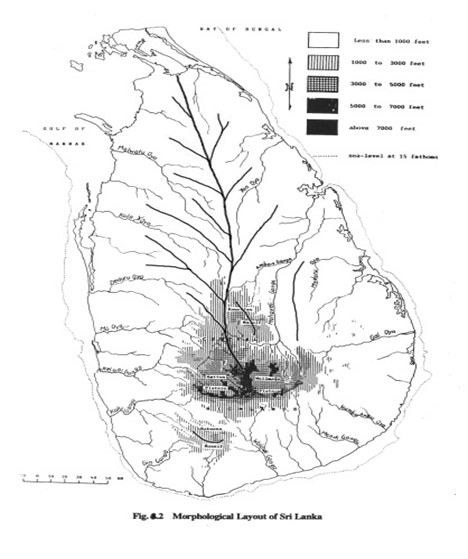
Re demarcate the 14,000+ GSN units, the lowest civil administration agency, using natural boundaries. Like in New Zealand, where the use of river basins as boundaries for its lowest administrative units is constitutionally mandated, we have 103 river basins as a base for this exercise.  In USA and Canada, river basin and groundwater management districts cover the entire landscape, with strict sets of regulations.

Province or District?

R. Premadasa increased the number of 4,000 GSNs to 14,000, and a natural boundary demarcation will reduce this arbitrary number significantly. Once this is done, they could be combined to decide what should be the spatial extent (size) of political unit desirable, and acceptable to all.

Empowerment of people at the village level

13-A PCs failed to empower people. It only created a new tier of resource-robbing local political crooks. Therefore, to decentralize governmental power, meaningfully, to people, new GSNs with Natural Boundaries should be used as the third- level or second-level political unit (If the existing 340+ local government units (pradesheeya sabha, p.s.) are rearranged combining new natural GSN units, each such GSN unit could function as a ward of a p.s.)

Tamil Aspirations

The private needs and wants of Tamil, Muslim and all other communities could be realized at ward level (or as Jana sabha) or at p.s. level. But a public aspiration for an Eelam balkanizing the Sinhale is out of the question. See the map printed in 1986 by the International Alert above, to understand the ultimate dream of the Eelamists (note that the map did not even care to name the Sinhala portion allowed). Wigneswaran’s dream published in 2020, has a target of covering the entire island with his lunatic theory based on the five Siva lingams.

But by creating language-blind and religion-blind GSN units, the mindset of a Tamil homeland in the island is blocked, and the Sinhale fear of a larger Tamil spatial unit trying hide and seek games with them is erased. For example, if a crazy p.s. decides that it does not want a new Buddha statue within its jurisdiction as part of promoting its Arumuga Navalar type of Hindu culture, it is not like an aspiration to stop southern fishermen migrating seasonally to the east coast or Wigneswaran’s slogan, we do not want coconut toddy in Jaffna” (the latter issues will come under the national economic policy). The balancing act will happen when a southern p.s. decides to ‘retaliate’ with request to build new Hindu kovils. In a truly democratic climate, the conflict will

end when anti-Buddhist elements realize that 15-20% of the sacred space of a Temple is devoted to Hindu gods and goddesses (do you remember the Gurukanda Vihara case?)

How can you unite by dividing?

The title of this essay comes from an actual incident. A friend of mine had to explain his white American friend the Tamil problem in Sri Lanka. Due to mismanagement of the foreign service system in Sri Lanka, people outside think that Tamils are discriminatorily treated by a Sinhala government. While listening to my friend’s long explanation, when the 13-A arrangement was disclosed, his American friend stopped him and asked point blank, the question above.

Federalism is a political marriage. If husband or wife has a paramour, and to save the marriage one with the lover wants to leave the bedroom and move to the annex which has separate entrance etc. would that marriage survive?  This is exactly what the federal option means in the Sri Lankan context. Federalism is a friend if it is based on friendly circumstances and a friendly environment. The past since 1921/4, recent past from the 1980s to 2009, and the present from the Wignesvaran days beginning 2013 had been a sore tale of misery, betrayal, and distrust. Any attempt to take the 13-A federal path is just a vain effort like feeding a cancer to cure it. This why I say SLPP ministers and MPs badmouthing about the virtues of 13-A are idiots.

Because of the statement by Tissa Vitharana promoting his APRC majority formula, another essay is needed to set the record straight.

Sri Lanka needs a confidence boost to lift it out of the morass it is in; Time for a National approach to governance?

January 4th, 2021

By Raj Gonsalkorale

The year 2020 ended with the COVID pandemic raging unabated, not just in Sri Lanka but throughout the world and bringing down the world as we all knew it. Economies of countries from the superrich to the very poor have all crumbled and health services are bursting at the seams. Education has been disrupted and so has the functioning of society as we knew it. Confidence in governance models, particularly democratic models is shattering as a consequence of the Trump led attack on the US system. 2021 is heralded amidst challenges perhaps not witnessed during the life time of those who are alive today.   

Sri Lanka is no exception in having to face these serious challenges and while there seems to be an increasing public opinion that the current government has retreated into a state of slumber, many overlook the fact that all countries in the world have been shaken to the core by the pandemic and that there are limits to what any government in the country could have done in the circumstances. There is also a tendency to blame a government while people themselves have chosen not to share their share of the responsibility and behaving in the most irresponsible manner endangering themselves and so many who could be infected by them.

However, this is not to say that things could have been done differently. What seems to be missing is a mindset that looks at things differently and then undertaking them differently. The need for a mindset change is not directed only at the government. It is directed at the Opposition, all political parties, public and private institutions, civil society organisations and religious institutions as well. In the post COVID world, one could argue quite rationally that it is essential to have a mindset change if Sri Lanka is to raise its head and keep it above the water that is drowning it.

Economically, from all accounts, Sri Lanka is perhaps at a stage when liquidators may have to be called in to manage a State that is either bankrupt or is heading towards it. It does not appear that the country could meet its debt obligations and finance its essential fuel requirements, health needs and food requirements without a substantial infusion of funds into the government’s coffers.

All indications are that such an infusion will only be possible through massive loans from international finance institutions and/or countries able to provide such loans. Besides institutions such as the World Bank, IMF, ADB etc, the only country that would be able to provide a large loan would be China and China will want their pound of flesh if they were to provide such a loan. What that pound of flesh means and entails is the billion-dollar question.

If Sri Lanka succumbs, and there does not seem to be any other light at the end of a long and dark tunnel, the consequential international politics involving the USA and India is bound to have a serious impact on what is left of the country’s sovereignty.

Much of what the current government is facing today is a consequence of the disorder in the world as a result of the COVID pandemic. While it can be argued justifiably that some things could have been done better, it should be accepted, justifiably, that whatever government in power would have been subject to the helplessness the country is placed in at present.

In the present circumstances therefore a major mindset change that could help the country would be a national approach to governance rather than a partisan approach. Major issues faced by the country such as its economy, education, health, energy needs and very importantly, its food security could be approached from a national perspective where the government, the Opposition, all political parties, business and religious institutions, unions etc, agree on what should be considered as national priorities and also agree on strategies to address the challenges faced by such national priorities.

Partisan politics and other divisions should go into hibernation at least for a short period like 3-5 years during which time the welfare of the country rather than the welfare of individual institutions takes precedence. The issue in hand which is the survival of the country as a sovereign nation is what is at stake. This issue is bigger than any individual or any one institution.

Perhaps the President could lead the way and call for a summit meeting of concerned institutions and individuals in order to arrive at broad strategic policy and action parameters on key national priorities.

Such an initiative would lead to an increase in public confidence that the country has a way forward to the future, and it will increase business confidence that is currently at a very low ebb. It will also increase confidence amongst possible investors, local and foreign, that the country is stable, and able to withstand international pressures on account of its more inclusive and strategic policy and action settings.

To paraphrase Bernard Shaw, COVID offers several opportunities for the country to look at things as they never were and ask why not rather than continuing to look at things as they are and continuing to ask why.

We have a so called representative democracy that votes in people’s representatives which fundamentally does not represent the wishes of the those who vote in their representatives. The Parliament and Provincial Councils are a farce in this respect. There is hardly any consultation with the people on key policy matters.

The country’ s suffocating foreign debt has been incurred over the years without any discussion amongst stakeholders. Business institutions, unions, societal institutions, women’s organisations, religious institutions and other entities that better represent their areas of interest have not been consulted although they should be part of a policy determination process. One should have a very serious look at the need for 225 Members of Parliament, in particular if they blindly follow their party positions rather than national priorities.

While the female population of the country exceeds the male population, there is hardly a voice for women in Parliament or in provincial councils. This is a major anomaly that needs to be addressed and a national approach to policy making would be an avenue to correct this major imbalance in governance in the country.   

Amongst other key areas that needs a national approach is the ever smouldering ethnic issue concerning the Tamils of Sri Lanka and also the issues concerning the Muslim population of the country. A mechanism must exist to address these on a long term basis and also in an ongoing basis, but both from a national perspective outside of partisan politics.

Education is perhaps one of the most important areas considering that it is the sphere in which the future of the country is nurtured and moulded. A longer term national education policy particularly for secondary education is a must as such policies should not change every time a government changes.

The country cannot and should not revert to the failed political practices of the past 73 years. COVID has given an opportunity to look at new and alternative ways of governing the country. Affording an opportunity for people to vote every so many years and re-elect or change governments is not effective democracy while it is a vital element in a democratic system. Avenues have to be introduced for greater participation by people in formulation of key policy settings. The ever evolving developments in information technology provides these avenues to a large number of people. They can be consulted and they can be heard. In fact, this facility will negate the need to have so many members of Parliament as they have proven to be mostly ineffective and an utter waste of public funds.

The governance model has to change if Sri Lanka is to learn a lesson from its position as a State that seems destined to fail if life goes on as usual.

ශ්‍රී ලංකා ප්‍රසව හා නාරිවේදී විශේෂඥ වෛද්‍යවරුන්ගේ සංගමයේ 35 වැනි සභාපතිවරයා එම ධූරයට පිහිටුවීම අග්‍රාමාත්‍යතුමාගේ ප්‍රධානත්වයෙන් පැවැත්වෙයි

January 4th, 2021

අග්‍රාමාත්‍ය මාධ්‍ය අංශය

ශ්‍රී ලංකා ප්‍රසව හා නාරිවේදී විශේෂඥ වෛද්‍යවරුන්ගේ සංගමයේ 35 වැනි සභාපති විශේෂඥ වෛද්‍ය ප්‍රදීප් ද සිල්වා මහතා එම ධූරයේ පිහිටුවීමේ උත්සවය ගරු අග්‍රාමාත්‍ය මහින්ද රාජපක්ෂ මහතාගේ ප්‍රධානත්වයෙන් අද 2021.01.03 සවස පැවැත්විණි.

කොළඹ බණ්ඩාරනායක අනුස්මරණ ජාත්‍යන්තර සම්මන්ත්‍රණ ශාලා පරිශ්‍රයේ නෙළුම් ශාලාවේ පැවැති මෙම උත්සව අවස්ථාව ආරම්භ වූයේ අග්‍රාමාත්‍ය මහින්ද රාජපක්ෂ මහතාගේ සම්ප්‍රාප්තිය සමඟිනි.

දකුණු ආසියාවේ අඩුම මාතෘ හා ළදරු මරණ අනුපාතයට හිමිකම් කියන රට ශ්‍රී ලංකාවයි. සෞඛ්‍ය අමාත්‍යංශයේ මෙහෙයවීම යටතේ ශ්‍රී ලංකා ප්‍රසව හා නාරිවේදී විශේෂඥ වෛද්‍යවරුන්ගේ සංගමය ඒ සඳහා විශිෂ්ට දායකත්වයක් දක්වයි.

35 වැනි විධායක සභාපතිවරයා පත්වීමේ අවස්ථාව ශ්‍රී ලංකා ප්‍රසව හා නාරිවේදී විශේෂඥ වෛද්‍යවරුන්ගේ සංගමයේ සියලුම සමාජිකයන්ගේ සහභාගිත්වයෙන් පැවැත්විණි.

මෙම අවස්ථාවට අග්‍රාමාත්‍ය ආර්යා ශිරන්ති රාජපක්ෂ, සෞඛ්‍ය අමාත්‍ය පවිත්‍රා වන්නිආරච්චි, බුද්ධශාසන ආගමික හා සංස්කෘතික කටයුතු අමාත්‍යංශයේ ලේකම් මහාචාර්ය කපිල ගුණවර්ධන, ශ්‍රී ලංකා ප්‍රසව හා නාරිවේදී විශේෂඥ වෛද්‍යවරුන්ගේ සංගමයේ අනුශාසක මහාචාර්ය ඉන්ද්‍රජිත් අමරසිංහ,  හිටපු සභාපති විශේෂඥ වෛද්‍ය යූ.ඩී.පී රත්නසිරි, ලේකම් විශේෂඥ වෛද්‍ය චාමින්ද මාතොට  ඇතුළු මහත්ම මහත්මීන් පිරිසක් එක්ව සිටියහ.

කොතලාවලපුර සමාධි බෞද්ධ මධ්‍යස්ථානයේ රන්වැට සහිත බෝධි ප්‍රාකාරය අග්‍රාමාත්‍යතුමා අතින් විවෘත වෙයි

January 4th, 2021

අග්‍රාමාත්‍ය මාධ්‍ය අංශය

රත්මලාන, කොතලාවලපුර සමාධි බෞද්ධ මධ්‍යස්ථානයේ ඉදි කළ රන්වැට සහිත බෝධි ප්‍රාකාරය ගරු අග්‍රාමාත්‍ය මහින්ද රාජපක්ෂ මහතාගේ ප්‍රධානත්වයෙන් අද 2021.01.04 දින විවෘත විය.

රත්මලාන, කොතලාවලපුර සමාධි බෞද්ධ මධ්‍යස්ථානාධිපති, මාතර වෙහෙරහේන පූර්වාරාම රාජමහා විහාරාධිවාසී, පූජ්‍ය මාපලගම බුද්ධසිරි නාහිමියන්ගේ අනුශාසනා පරිදි සිවිල් ආරක්ෂක දෙපාර්තමේන්තුවේ ශ්‍රම දායකත්වයෙන් මෙම රන්වැට සහිත බෝධි ප්‍රාකාරය ඉදි කර තිබේ.

කටුබැද්ද රාහුල මාවතේ සුසිරි පෙදෙසේ පදිංචි ඩබ්ලිව්.එම් වසන්ත වර්ණසූරිය මහතා සහ ආර්.එම්. ලංකා වර්ණසූරිය මහත්මිය ඇතුළු දෙස් විදෙස් සැදැහැවතුන්ගේ ධන පරිත්‍යාගයන් ඒ සඳහා මුල් වී ඇත.

සියම් මහා නිකායේ කොට්ටේ පාර්ශවයේ අනුනායක, බෞද්ධ හා පාලි විශ්වවිද්‍යාලයේ උපකුලපති, මහාචාර්ය පූජ්‍ය කොටපිටියේ රාහුල නාහිමි සහ  නාරාහේන්පිට අභයාරාමාධිපති, බස්නාහිර පළාත් ප්‍රධාන සංඝනායක පූජ්‍ය මුරුත්තෙට්ටුවේ ආනන්ද නාහිමි ඇතුලු මහා සංඝරත්නය මෙම අවස්ථාවට වැඩම කළ වදාළහ.

අමාත්‍ය ගාමිණී ලොකුගේ, රාජ්‍ය අමාත්‍ය සරත් වීරසේකර, පාර්ලිමේන්තු මන්ත්‍රීවරුන් වන විජේදාස රාජපක්ෂ, ප්‍රේමනාත් සී. දොලවත්ත මහත්වරු ඇතුලු සම්භාවනීය අමුත්තන් සහ දායක දායිකාවන් රැසක් මෙම අවස්ථාවට එක්ව සිටියහ.

Importance of Jaishankar’s visit to Sri Lanka beginning on Tuesday

January 4th, 2021

By P.K.Balachandran Courtesy NewsIn.Asia

Colombo, January 4 (newsin.asia): The Indian External Affairs Minister, Dr. S Jaishankar, will pay an official visit to Sri Lanka from January 5 to 7 at the invitation of the Sri Lankan Foreign Minister, Dinesh Gunawardena.

Dr.Jaishankar will hold discussions with his counterpart and Sri Lanka’s leadership on the entire gamut of bilateral relations, a press release from the Indian External Affairs Ministry said on Monday.

This will be the first foreign visit by the Indian Foreign Minister  and the first visit to Sri Lanka by a foreign dignitary in the New Year, the release said. As such, it signifies the priority both countries attach to strengthening their close and cordial relations in all spheres of mutual interest,” the release added.

While generally, India-Sri Lanka relations are on an even keel, there are outstanding issues such as the delay in finalizing the involvement of India in the construction and running of the Eastern Container Terminal in Colombo port; delays in starting industrial development and infrastructural projects for which MoUs were signed in 2017; and further plans to develop the Trincomalee oil tanks as a joint venture between the Indian Oil Corporation and the Ceylon Petroleum Corporation.

A Memorandum of Cooperation (MoC) was signed in 2019 to develop and run the Eastern Container Terminal jointly by the Sri Lanka Ports Authority (SLPA), India and Japan, with the SLPA holding 51% share in and India taking a 15% stake. But the project ran into trouble with the  port workers’ union and Sri Lankan nationalists who asked the government not to give away national assets to foreign parties. After dilly dallying the government had recently set up two committees to study the investment pattern, including the involvement of Sri Lankan companies.

The government has assured the workers and nationalists that no decision has been taken yet to give the work to India. But India wants a foothold in the Colombo port for strategic reasons because rival China is ensconced in the adjacent terminal called Colombo International Container Terminal (CICT). India says it has a legitimate interest in Colombo port as 67 to 70% of the port’s business is accounted for by Indian transshipment.

When Sri Lanka demanded that the unused oil tanks in the Trincomalle Tank Farm be handed back to it for development by the State, India said that development could be done as a joint venture. The matter rests there.

India-Sri Lanka Accord

Meanwhile, a major political problem had arisen. The Sri Lankan government has been hinting that it might scrap or drastically modify the Provincial Councils set up as part of the India-Sri Lanka Accord of 1987. The Gotabaya Rajapaksa government is under pressure from the Sinhala majority nationalist lobby to scrap the 13 th, Amendment under which the Provincial Councils were set up.

The majority Sinhala community is against devolution power to the provinces especially when two of them are populated predominantly by Tamil-speaking communities (Tamils and Muslims). Devolution would lead to secession, it is feared.

The nine Provinces are without elected councils for the past three years and there are demands from both within the government and outside to postpone elections to them citing the COVID 19 pandemic. It is also suggested that elections may be postponed till the country gets a new constitution. Work on a new constitution is being done now by an experts committee.

India is very much committed to the 13 th.Amendment which devolves a certain amount of power to the provinces. The 13A is India’s brainchild. India believes that devolution of power to the Tamil speaking provinces will meet a basic demand of the minority Tamils which is for a reasonable degree of self-rule. Devolution will curb separatist tendencies it is felt.

The Tamil National Alliance, which is battling the Sri Lankan government on the issue of devolution and the 13 th.Amendment, is likely to seek and secure an appointment with the Indian Foreign Minister.

Through his engagements in Colombo, Foreign Minister Jaishankar would get to know first-hand, the minds of the Sri Lankan leaders on these issues. He will in turn communicate India’s concerns and commitments.

China Factor

Jaishankar is likely to discuss the China factor in Sri Lanka and express India’s concerns about the security aspects of China’s widening strategic and economic footprint in Sri Lanka. He would like to rope Sri Lanka into the ‘Quad’ which is a maritime security alliance between India, Japan, Australia and the US to campaign for free, unhindered and rule-based navigation in the high seas, which is seen to be under threat from China.

Lankan Ministry of Epidemics denies appointing panel on disposal of COVID dead

January 4th, 2021

Courtesy NewsIn.Asia

Colombo, January 4: The Sri Lankan State Ministry of Primary Healthcare, Epidemics, and Primary Disease Control has refuted media reports claiming that a committee has been appointed to make recommendations on the issues surrounding the cremation of the remains of Covid victims in Sri Lanka.

Lankan Ministry of Epidemics denies appointing panel on disposal of COVID dead

Issuing a statement, the Ministry said there is no truth to recent reports published on various media that State Minister Sudharshini Fernandopulle had appointed a committee to deliberate if the remains of Covid victims should be cremated or buried.

State Minister Fernandopulle has pointed out that as Covid-19 is a new disease, initial recommendations made by the World Health Organization are subject to change with new emerging evidence.

She has further insisted that Covid-19 disease control should always be based on science, while religion, race, politics, social and mythical beliefs should not be considered when taking decisions on disease control.

Stating that eminent virologists and other medical and scientific experts have been advised to make periodic recommendations on the disease, the statement said no request has been made to deliberate the issue over the cremation of remains of Covid-19 victims.

(The picture at the top shows the Sri Lankan Minister of Epidemics, Dr.Sudarshani Fernandopulle

කොරෝනා ඇමතිනි වහා ඩවුන් යයි.. වලලන කමිටුව පත් කලේ තමන් නොවේ කියයි.. කැබිනට් ප‍්‍රකාශකද නොදනී.. වලලන කමිටුව දෙමවුපියන් නැතිවෙයි….

January 4th, 2021

උපුටා ගැන්ම ලංකා සී නිව්ස්

කොරෝනා මෘත දේහ වැලලීම සඳහා නිර්දේශ දුන් කමිටුව තමන් විසින් පත් කරන ලද්දක් නොවන බව ප්‍රාථමික සෞඛ්‍ය සේවා, වසංගත රෝග සහ කොවිඩ් රෝග පාලනය පිළිබද රාජ්‍ය ඇමතිනි සුදර්ශණී ප්‍රනාන්දු පුල්ලේ මහත්මියගේ මාධ්‍ය ඒකකය සදහන් කරයි.

ඒ බව සදහන් කරමින් එම මාධ්‍ය ඒකකය විසින් නිකුත් කරන ලද නිවේදනයක් පහතින් දැක්වේ.

රජයේ මාධ්‍ය ප‍්‍රකාශකවරයාද මාධ්‍ය හමුවකදී පවසන ලද්දේ එක් කමිටුයකින් නිර්දේශ දී තිබියදී දෙවන කමිටුව පත් කලේ කවුදැයි තමන් නොදන්නා බවයි.

කොවිඩ් මරණ ආදාහනයද භූමිදානයද යන්න නිර්දේශ කිරීම සදහා රාජ්‍ය ඇමති විශේෂඥ වෛද්‍ය සුදර්ශිනී ප්‍රනාන්දුපුල්ලේ මහත්මිය විසින් විශේෂඥ කමිටුවක් පත්කර ඇති බවට කෙරෙන මාධ්‍ය වාර්තා අසත්‍යයි.

ඇතැම් විද්‍යුත් සහ වෙබ් මාධ්‍ය මගින් වාර්තා කල පරිදි කොවිඩ් මරණ ආදාහනයද භුමීදානයද යන්න නිර්දේශ කිරීම සදහා ප්‍රාථමික සෞඛ්‍ය සේවා වසංගත රෝග සහ කොවිඩ් රෝග පාලනය පිළිබද රාජ්‍ය අමාත්‍ය විශේෂඥ වෛද්‍ය සුදර්ශිනී ප්‍රනාන්දුපුල්ලේ මහත්මිය විසින් විශේෂඥ කමිටුවක් පත්කර ඇති බවට ගෙන යන මාධ්‍ය වාර්තාවල කිසිදු සත්‍යතාවයක් නොමැති බව අවධාරණය කිරීමට කැමැත්තෙමු.

කොවිඩ් 19 පාලනය කිරීමේදී සැමවිටම විද්‍යාත්මක ක්‍රමවේදයක සිට විසදුම් සෙවිය යුතු බවත් ආගම, ජාතිය, දේශපාලනය, සමාජ මතවාද, මිත්‍යා මතවාද මත පදනම්ව කිසිවිටෙක තීන්දු තීරණ නොගත යුතු බවත් වෛරස් රෝග සම්බන්ධයෙන් කටයුතු කිරීමේදී තහවුරු කරන ලද කරුණු මත පමණක් පදනම්ව තීරණ ගැනීම යෝග්‍ය වන බව අමාත්‍යවරිය පෙන්වාදෙයි.

කොවිඩ් මරණ සම්බන්ධයෙන් ක්‍රියාකල යුතු ආකාරය පිළිබදව දැනට ලෝක සෞඛ්‍ය සංවිධානය විසින් උපදෙස් මාළාවක් නිකුත් කර ඇති අතර කොවිඩ් 19 සම්බන්ධයෙන් මුල්කාළීනව පැවැති වෛද්‍ය විශේෂඥ මතයන් විටින් විට වෙනස්විය හැකි බැවින් වෛරසයේ හැසිරීම අනුව එවැනි මතයන් ඉදිරිපත් විය හැකිය. එවැනි තත්වයන් පිළිබදව අධ්‍යනය කර තමන් වෙත විශේෂඥ මතයන් ඉදිරිපත් කරන ලෙස වෛරස් විශේෂඥයින්, වෛද්‍ය විශේෂඥයින් වෙත අමාත්‍යවරිය විසින් දන්වා ඇති නමුත් කොවිඩ් මරණ ආදාහනය කිරීම හෝ භුමිදානය කිරීම සම්බන්ධයෙන් නිර්දේශ ඉදිරිපත් කිරීම සදහා වෙනත් කිසිදු කමිටුවක් අමාත්‍යවරිය විසින් පත්කර නොමැති බව තවදුරටත් තහවුරු කර සිටිමු.

තුසිත ජයවර්ධන
මාධ්‍ය ලේකම්

People have to live with COVID-19 pandemic this year too: HSDG

January 4th, 2021

Courtesy The Daily Mirror

People will have to live with the prevailing COVID-19 pandemic even this year and therefore, they should be prepared to adapt to the conditions and live adhering to health guidelines, Health Services Director General Dr. Asela Gunawardane said.

He said this after paying an inspection tour to the new kidney hospital within the Polonnaruwa General Hospital.

“Controlling the virus is very difficult with keeping the country open. But the Government has to spend more than Rs.60 million per day for PCR tests, ” Dr. Gunawardane said.

To get the necessary funds for these tests, the country’s production activities should be continued, he added.

A Harvard professor says an alien visited in 2017 and more are coming

January 4th, 2021

Courtesy The Daily Mirror

When the first sign of intelligent life first visits us from space, it won’t be a giant saucer hovering over New York. More likely, it will be an alien civilization’s trash. 

Avi Loeb, the chair of Harvard’s Department of Astronomy, believes he’s already found some of that garbage. 

In his upcoming book, Extraterrestrial: The First Sign of Intelligent Life Beyond Earth” (Houghton Mifflin Harcourt), out Jan. 26, the professor lays out a compelling case for why an object that recently wandered into our solar system was not just another rock but actually a piece of alien technology. 

The object in question traveled toward our solar system from the direction of Vega, a nearby star 25 light-years away, and intercepted our solar system’s orbital plane on Sept. 6, 2017. 

On Sept. 9, its trajectory brought it closest to the sun. At the end of September, it blasted at about 58,900 miles per hour past Venus’ orbital distance, and then, on Oct. 7, it shot past Earth’s before moving swiftly toward the constellation Pegasus and the blackness beyond,” Loeb writes in the book. 

The object was first spotted by an observatory in Hawaii containing the Panoramic Survey Telescope and Rapid Response System (Pan-STARRS) — the highest definition telescope on earth. 

The space object was dubbed ‘Oumuamua (pronounced oh moo ah moo ah”), which is Hawaiian for — roughly — scout.” 

As space travelers go, it was relatively small at just about 100 yards long, but it was a big deal in the scientific community. 

For starters, it was the first interstellar object ever detected inside our solar system. Judging from the object’s trajectory, astronomers concluded it was not bound by the sun’s gravity — which suggested it was just traveling through. 

No crisp photos could be taken, but astronomers were able to train their telescopes on the object for 11 days, collecting reams of other data.


At first, scientists thought it was an ordinary comet. But Loeb said that assumption ran the risk of allowing the familiar to define what we might discover.” 

What would happen if a caveman saw a cellphone?” he asked. He’s seen rocks all his life, and he would have thought it was just a shiny rock.” 

Loeb soon opened his mind to another possibility: It was not a comet but discarded tech from an alien civilization. (nypost)

COVID-19 fatality count in Sri Lanka reaches 215

January 4th, 2021

Courtesy Adaderana

The Director-General of Health Services confirms that Sri Lanka’s fatality count from COVID-19 has risen with 02 more deaths caused by the virus.

Two men, both residents of Ratnapura, have succumbed to the virus pushing the COVID-19 death count to 215.

A 71-year-old man had passed away at the Ratnapura Teaching Hospital on January 02. The cause of his death has been determined as a respiratory infection caused by COVID-19 and a complication of a lung infection.

The other victim is a 86 year old male who had succumbed to COVID-19 related pneumonia and epilepsy. He had passed away at his home on January 01.

277 more Covid-19 cases push total count past 45,000

January 4th, 2021

Courtesy Adaderana

The total count of Covid-19 cases reported in Sri Lanka reached 45,242 as more persons were tested positive for the virus. 

The Department of Government Information said 277 more fresh cases have been detected within the day.

Reportedly, 261 of the new cases are close contacts of the Peliyagoda fish market cluster.

The remaining 16 cases have been identified from the prison cluster.

With the new development, the Minuwangoda-Peliyagoda cluster has registered a total of 41,498 cases to date.

According to the Health Ministry’s data, 37,817 of the confirmed patients have made complete recoveries from the virus.

However, 7,210 active cases are still under medical care at selected hospitals and treatment centers across the country.

Navy apprehends 04 with drugs worth over Rs 600 mn

January 4th, 2021

Courtesy Adaderana

A special operation carried out by Sri Lanka Navy in the seas off Negombo led to the apprehension of 04 suspects with drugs worth over Rs 600 million.

The Western Naval Command today (04) intercepted a suspicious multiday fishing trawler off Negombo and apprehended 04 suspects with over 100 kg of Crystal Methamphetamine (ICE) and nearly 80 kg of Hashish being transported aboard.

The narcotic substance had been concealed in 09 sacks, as plastic containers and small packets, stated Sri Lanka Navy.

The street value of the stock of narcotics held during the operation is believed to be over Rs 600 million, the Navy added.

The coordinated operation has been carried out with the assistance of intelligence services and the Police Narcotic Bureau (PNB). . The operation has also been assisted by Sri Lanka Air Force.

The suspects held during the operation were identified as residents of the Thoduwawa area in Chilaw.

The entire operation has been carried out adhering to COVID-19 preventive guidelines.

The suspects, drugs, and the multiday fishing trawler held during this operation were handed over to the PNB, Colombo for onward legal action.

Customs seize 7,500 kg of illegally imported turmeric

January 4th, 2021

Courtesy Adaderana

Sri Lanka Customs has seized 7,500 kilograms of turmeric illegally imported into the country under the guise of importing wheat flour. 

Customs spokesman Sunil Jayaratne said that the stock of turmeric was found inside a container shipped from India on December 20, declared as wheat flour. 

The container was searched based on information uncovered through investigations carried out by the ‘Risk Management Unit’ of Sri Lanka Customs while a stock of turmeric valued at over Rs 15 million was discovered inside.

The turmeric had been imported by a resident of Modara while it has been uncovered that he had engaged in similar illegal activities in the past as well.

The spokesman said that the Director General of Customs has issued instructions to take strict action against the individual in question, who is currently in remand custody. 

LLRC Report – Betrayal of the Victory of the Security Forces in 2009

January 3rd, 2021

Senaka Weeraratna

The LLRC Report was tantamount to a Betrayal of the Victory achieved by the Security Forces on the battlefield after a huge sacrifice of life and limb by the heroic soldiers. About 30, 000 personnel from the security forces perished.  

What was required and anticipated by the informed public from the LLRC were recommendations for 

1) ‘ de – nazification’ of the Terrorists and the network of their supporters, 

2) scrapping or re – negotiation of the unequal Treaty between India – Sri Lanka which was forcibly imposed on the Sri Lankan Govt. by India in 1987, and the 

3) removal of the 13th amendment of the Constitution, which was enacted at gunpoint. 

The question, what was the purpose for which 30, 000 soldiers, the vast majority of whom were Sinhala Buddhists drawn from rural areas, sacrificed their precious lives over a period of 30 years, fighting a defensive war against brutal terrorists, was never asked nor were there proper findings or explanation given of this significant issue, nor any sincere expression of gratitude and appreciation of the soldiers sacrifice.

It is indisputable that people all over the country began to sleep soundly without fear largely because of the victory achieved in 2009 via the heroic sacrifices of the soldiers.  

It is unfortunate that the LLRC saw their function as a mechanism for appeasement of people who had ‘hurt’ feelings, and as an apologetic role, and not to vindicate the victory achieved on the battlefield by our security forces.   

The unforgivable and unpardonable part was that the LLRC Commissioners fell  into a trap laid down by ‘Human Rights’ mercenaries who unceasingly vilify the ethnic majority until almost the last pound of flesh is extracted, and the LLRC Commissioners sheepishly gave in to the pressure mounted by NGOs and turned to work on promoting  the anti – majoritarian propaganda rhetoric of Multi – Culteralism, Secularism, and Re – conciliation, prior to ‘de – nazification’.

It must be noted that when the Allies beat Germany and Japan in 1945, they (the allies) engaged in a full scale de – nazification’ programme and established War Crimes Tribunals to try the leaders of the two defeated countries.

In Sri Lanka the reverse happened. The winner was placed in the dock for alleged war crimes while the defeated Terrorists, with blood stained hands for ruthlessly killing innocent civilians in several incidents of mass murder, were hailed as liberators and victims by the international community.

The LLRC report did not do much to salvage the the good name of the security forces which won a resounding victory over terrorism, and became the only country in the world to do so.

Senaka Weeraratna

Geological reasons why Corona victims should not be buried in this country

January 3rd, 2021

Dr Sudath Gunasekara Mahanuwara

The following map shows the graphic representation of the geomorphological structure of the Island determined by its geological foundation spreading from the center in all directions

Morphological map of Sri Lanka

Source Sudath Gunasekara 1991.

You will see from this map that all the rivers in the Island starting from the Central Highlands flow  in between these trend lines.   Not only the rivers but also the underground water table also conforms to this morphological foundation. Hence the possibility of whatever virus or germ that gets in to the underground water table at any point in the upstream area the possibility of spreading  downstream radially in all the directions all over the Island in no time. As such spreading a virus in all directions in no time and reaming there from any death body with Covid 19 virus at any point in the country could be very high and therefore extremely risky.

I am only trying here to illustrate the behavior of the underground water table within this underlying geological Structure as a student of geography. It is therefore left for expert geologists to elaborate on this point. I hope those more knowledgeable in geology will pick up from here and tell the world the imminent dangers of burying Covid 19 dead bodies in any part of the country in view of this peculiar geomorphologica]  and geological context that might help  the health authorities to explain to the rioting Muslim lunatics the large scale ramifications of burying Covid19  dead bodies

If cremation is so antireligious then how about the souls of those who commit suicide like Saharan Why can’t these idiots realize that the dead is dead for good. No one knows where he or she has gone whether hell or heaven.  As such there is no point in dabbling with dead bodies. What we have to do is to protect the living 

On Rohana R. Wasala’s “Even you, Minister Ali Sabry? LankaWeb – 01/01/21) as given below.

January 3rd, 2021

Dr Sudath Gunasekara Mahanuwara. 

This is an article that should be seriously read, understood, chewed and digested and corrective measures taken immediately by the President, Prime Minister, the entire Cabinet first, and second by all the MPP in Parliament including those supporting burial of Muslim Covid 19 corpses.

I think it is better for all who cannot agree with the writer’s discourse should refrain from continuing in politics in this country.

Even you, Minister Ali Sabry?

Posted on December 31st, 2020

By Rohana R. Wasala

A HAPPY PEACEFUL PROSPEROUS HEALTHY NEW YEAR TO ALL LANKAWEB READERS INCLUDING THOSE WHO HOLD CONTRARY VIEWS TO MINE!

Media secretary Viraj Abeysinghe of the Ministry of Health has issued a press statement warning against spreading false information concocted by certain politicians and websites regarding the subject of whether to bury or burn the bodies of persons who have succumbed to the COVID-19 infection (lankacnews-Sinhala/December 28, 2020).

It notifies that the Ministry is turning its attention to some ‘politically motivated fake news’ stories featuring powerful politicians connected with the government. The statement further says that for the time being (daenata) cremation alone is done on the instructions of all the expert reports received by the Ministry so far. Very much the same news was carried in Hiru TV News (9:55 pm/December 27, 2020). Let’s hope that this is signalling an end to needlessly prolonged dilly-dallying on the part of the authorities about an issue where evidence-based science, not a particular religion out of the many, ought  to have the last word.

Interviewed recently by two You Tube channels (Hari TV/Lahiru Mudalige/December 16 and Konara Vlogs/Avishka Konara/December 23) Ali Sabry PC, Minister of Justice, stressed that his struggle is to build bridges rather than walls between the communities. For over eight months now he has been advocating burial of bodies of Muslims who have died of Covid-19 ignoring the decree of the competent authority, the DHS (Director of Health Services). The DHS is acting on the advice of the local experts who know best what is suitable for our country in the current context, i.e., cremation. The reputed lawyer was the legal consultant of (current president) Gotabaya Rajapaksa at least for fifteen years from the latter’s defence secretary days; he has successfully defended the latter against false charges of various kinds fabricated by political opponents. Sabry’s aim of establishing intercommunal harmony is laudable, and he may be sincere in his efforts in that direction, but how sincere is yet to be demonstrated. This is because it is puzzling that he repeatedly warns that young Muslims are likely to be pushed towards extremism by what they’d perceive as a denial of their right to freedom of religion if the health authorities do not allow the burial of bodies of Muslims claimed by Covid-19. His totally senseless stand on the sensitive issue (that must be left for science, but not religion, to resolve) is likely to give a fillip to extremists and other miscreants opposed to the government to create trouble.

During the first interview mentioned above, Ali Sabry made the patently false claim that the Aluthgama and Digana incidents drove young Muslims to extremism, whereas the truth was the reverse of that. (These incidents must be investigated even belatedly to discover the factual situation that then obtained. The disastrous policy of political correctness that led to the submergence of the truth on those occasions then seems to be at work once again.) Sabry referred to how the UK responded to incidents of Islamic extremist violence as a model to follow in dealing with the same problem in Sri Lanka: the UK government reached out to the mainstream Muslim minority and acted to win their confidence and support in order to contain Islamic extremism in that country. He implies that Sri Lanka must do the same (as if Sri Lanka has not been doing exactly that for centuries) or ‘we must kill all Muslims and put them into the sea!’ (The violent imagery in his speech is an indication of the commotion in his own mind resulting from his subliminal awareness of guilt as he feels forced to lie in this situation for political expediency within his own community. He probably fears violent retaliation from extremists for what they might interpret as collusion with infidels in attacking Islam.) He’s been sounding the warning mentioned above since early April 2020. He believes that he is undergoing a sort of public trial by being blamed by both the Muslim community on the one hand who feel aggrieved by the compulsory cremation rule imposed on all citizens by the health authorities for the safe disposal of bodies of Covid-19 victims and the electorally successful nationalist faction on the other led by the monks, who insist that the rule should not be relaxed to satisfy the whims of one particular group of people thereby endangering the lives of the whole population through the possible release of the still inadequately understood novel coronavirus from the interred bodies to the country’s water table, which, in many places in Sri Lanka, is not very deep, and lies close to the surface.

Ali Sabry should  know better than most that there has been no lack of reaching out to the mainstream Muslim minority either by the majority community or by the successive governments. Muslims as a community are mainly engaged in business. Seventy-five per cent of their customer base comprises Sinhalese, making it possib;e for Muslim businesses thrive normally, though there’s been just condemnation, among the citizenry including the majority Sinhalese, of worsening Islamist extremism in recent years. Be that as it may, it is not simply because Sabry has served president Gotabaya in the past as his implicitly trusted personal legal service provider that he was made a national list MP by the SLPP and honoured and empowered with such a very important key portfolio. It is certain that Gotabaya Rajapaksa believes in the Buddhist teaching that ‘a trustworthy person is the best kinsman’, but he is the last to allow personal relationships or personal prejudices to sway governance decisions improperly that affect the national interest (or at least that is what people still believe about Gotabaya). ‘One country One law’ was the rallying cry that inspired patriotic Sri Lankans at both the presidential and parliamentary elections to vote for the SLPP, which won with the largest margins. As minister of justice Sabry has been entrusted with the task of supervising the making of a new constitution that is designed to achieve that epoch making change (namely, One Country, One Law) among other things. Gotabaya made no bones about the fact that he won the presidency almost exclusively on the strength of Sinhalese votes; most Muslims and Tamils chose not to respond positively to his call for support at the presidential election. His bluntness is a reflection of his characteristic candour, which has not been compromised by the hypocrisy of political correctness, his older brother’s unfailing weapon, that fails more often than succeeds.  But Gotabaya holds no grudge against those who rejected him, for in the same breath president elect Gotabaya said that he was elected as president of all the citizens of the country and that he would serve in that post without discriminating against any citizen. There is no doubt about the fact that he means what he says. By appointing Ali Sabry to the all important post of Minister of Justice, the president incidentally reassured the Muslims that he will not exclude them from his vision of prosperity and splendour for the nation.

Ali Sabry  has not budged an inch from his original unqualified opposition to the mandatory burning of bodies of Muslim victims of Covid-19 over which he expressed his disappointment in a Facebook post mentioned in an Al Jazeera news report/April 3, 2020, with the authorities’ decision which, he alleged, ignored the WHO guidelines that allow both burial and cremation. Are we to believe that our experts overlook WHO guidelines without a rational explanation? Sabry deliberately ignores the various reservations that clearly qualify the WHO guidelines, leaving the authorised specialists of any member country to modify those recommendations as appropriate for local conditions and ground realities. The basic assumption that he seems to be operating on, regarding the burial problem, is wrong. For all intents and purposes, he pretends to wrongly believe that the health authorities insist on making no exception for Muslim dead in this case because that is what the monks want.  Ali Sabry is the last person that rational people would expect to demand that Muslims should be allowed to bury their loved ones dead from the novel coronavirus while cremation is the only method legally prescribed by the Director of Health Services (DHS).

This is not a happy thing to say about arguably the most important and powerful minister in the cabinet, being the closest companion of the president, next to the prime minister, who is the president’s own brother. It is inconceivable how Ali Sabry is capable of (no doubt unintentionally) justifying the berserk behaviour of some virus-infected Muslims (as seen in their show of insubordination, noncooperation, physical harassment of the health workers trying to help them including spitting at them (with the malicious intention of spreading the infection); cases were reported of some Covid-19 positive tested individuals spitting out of the windows of buses carrying them to quarantine centres in vicious attempts to spread dreaded infection). Such demonstration of unprovoked anger is based on the false pretext of alleged discrimination against them by the government in the matter of mandatory cremation of Corona dead as prescribed by the responsible health experts to prevent the escape of the deadly virus with many unknowns into the environment. The virus is no respecter of people’s religious sensitivities. If the Director of Health determines that cremation is the only option for Sri Lanka in the current emergency, citizens are obliged to accept that and act accordingly.

Why doesn’t Ali Sabry make an effort to explain to the agitating Muslims and to the misinformed Muslim world in general, who have never been enemies of Sri Lanka, that this blown-out-of-proportion controversy over the burial or cremation issue has nothing to do with the monks or the government or the health authorities or the army and police officers (the last mentioned having been co-opted into the Covid containment operation only as ancillary personnel employed for a strictly logistical purpose to serve under the director of health services, DHS, the government appointed competent authority who gives leadership to the whole enterprise, which involves every single citizen of the country). The cremation imperative is not an arbitrary decision taken by the government to spite the Muslim minority under pressure from the monks as misleadingly suggested by the hostile foreign NGO elements, Islamists, a handful of misguided Muslims, and the irresponsible SJB-led opposition. The DHS is not acting capriciously either; his recommendations are based on a scientific rationale collectively defined by a group of experts belonging to a number of different relevant fields of study in the best interest of all resident Sri Lankans and foreign visitors. Ali Sabry seems to be more concerned about remaining in the good books of the handful of Islamists and their sympathisers than the feelings of the ninety-five per cent of the population who are against them. Is he in the thrall of the five percent? Or could it be the case that Ali Sabry needs to be saved from disguised Islamist apologists and opportunistic schemers, who are at present busy striking while the iron is hot? But one thing is clear: The goal of One Country One Law will be a non-starter so long as Ali Sabry remains Minister of Justice. That is my opinion for what it is worth.

MY comments,

If  what Rohana has stated are correct Ali Sabry cannot and should not continue as a Cabinet Minister in this government any longer, as his stance had been  running counter to that of the President and the Government since he had been making statements and giving interviews to media contrary to the  Government’s  policy of ‘One Country One Law. The gist of Rohana’s article clearly demonstrates that Ali Sabry  is trekking a different path from that of the Government although he is supposed to be an eminent Presidential Council he appears to have clearly violated the principle of collective responsibility which is a cardinal principle of Cabinet Government. The reason for this peculiar behavior I think is his inclination first to think and act like a Muslim though he speaks fluent Sinhala even better than a native Sinhala man. From the analysis of Rohana I also think he plays the role of Dr. Jekil and Hide. (referring to persons with an unpredictably dual nature: outwardly good, but sometimes shockingly evil.)

Rohana also has said that Sabry has served president Gotabaya in the past as his implicitly trusted personal legal adviser which he implies the reason for him to be appointed as the Minister of Justice. Any way if that is the reason as to why he was a taken in as a National list member of Parliament and appointed to the third most powerful place in the Cabinet as Rohana says I think it is a grave mistake. Rohana also has referred to Ali Sabry’s misinterpretations made on Aluthgama and Digana issues. Furthermore in this backdrop entrusting him with the task of supervising the making of a new constitution that is designed to achieve that epoch making change (namely, One Country, One Law) among other things.” Is really dangerous. Appointing the Minister of Justice to supervise the work of that Committee in any case negates the independence of that Committee. Appointing a Muslim to supervise Constitution making for this Sinhala Buddhist State makes it even worse. Even the Advisory Committee on Constitution making appointed by the President has also already run in to serious trouble with regard to its constitution and priorities according to internal sources. Seven Million Sinhala Buddhists who voted the President in 2019 and the Government in 2020 are at a loss to understand as to how a Committee where there is no one to represent the age old traditional Sinhala Buddhist interests to say at least one prominent Buddhist scholar monk. With Ali Sabry’s steam roller authority as Minister of Justice and his personal conviction as A Muslim for which he will always  give unreserved priority , who on earth will believe that this Committee will come out with a Constitution suitable and acceptable to the  this Sinhala Buddhist Nation.

In addition to what Rohana has said on Alisabry in his note The goal of One Country One Law will be a non-starter so long as Ali Sabry remains Minister of Justice”, to state my personal opinion on this issue for what it is worth” any report made by this ill constituted non-independent  advisory Committee on constitution making for this nation will be a day dream” as already this Committee has run in to serious trouble on some key issues like the abolition of the Provincial Councils. According to what I gather from internal sources, the Advisory Committee will finally be compelled to issue will be heavily conditioned by what Ali Sabry will have to say and that draft Constitution  will be definitely rejected by the Sinhala Buddhist majority. But even now he can be a second Luxman  Kadiragamar if he limits his religious convictions to the Mosque and  advice the mad Muslims to bury their Covid 19 dead without creating un-necessary problems for the Government and withdraw from the position of Advisor to the Constitution Advisory Committee

Finally the President and the Government will have to bear the cost of public displeasure Therefore it will be advisable at least now to reconstitute the present Committee and appoint a new one comprising eminent Sinhala Buddhist scholars well versed in History, Archeology, and the traditions of statecraft and law making of the Motherland with at least two eminent monk Scholars. If the President is serious in making a historic Constitution the country needs and the 7 million who voted him in to power aspired him to do.

Last but not least, If the President, the Prime Minister and the Government fail to rectify these immediately or at least in time, the net result of Ali Sabry’s involvement in Constitution making and the Covid 19 Muslim burials issue might end up as political suicide for the government.  

THE POHOTTUWA GOVERNMENT OF SRI LANKA Part 2 C4c

January 3rd, 2021

KAMALIKA PIERIS

The USA, we are told, has two governments, a visible government and an invisible one. The visible government is the one run by the US President and Congress.   But the real power which drives US policy is elsewhere, say analysts.

USA’s politics is masterminded by a small financial elite, they added, a kind of cabal,  who control just about everything in Washington. They are the invisible government. Many in this elite are Jewish. The coterie includes powerful international bankers.

This financial elite virtually runs the United States government. They operate independently of the elected representatives. They club into submission or drive out of office public officials who refuse to do their bidding.”  It does not matter who become the President of the USA, he will simply march to the tune of those who stand behind the scenes and pull the strings, said analysts.

The political ideology of this elite is labeled ‘neo conservatism’ and its practitioners were known as ‘neo cons’. The original neoconservatives, believe it or not, were former Trotskyites now turned anti-Trotsky, anti- socialist and ultra right. They were influenced by the ideas of Leo Straus, (1899-1973) a Jewish immigrant who became professor of Political Science at University of Chicago. Strauss said that masses were an inferior breed who needed to be ruled by an intelligent elite. It was the right of the superior elite to rule the inferior masses.

The neo cons were also influenced by the journalist, Irving Kristol (1920-2009).   Kristol is considered the father of neo-conservatism. He was against the welfare state and the African American civil rights movement in USA. He wanted both squashed.

The term, “neo-conservatism was coined in 1973. Neo conservative ideas began to enter the mainstream thinking in the USA in 1970s. The third generation of Neo-cons emerged in the mid 1990s. These neo-cons are active, aggressive and reactionary said critics. They wish to turn the clock back on the liberal gains and achievements.”  They said welfare programs were breeding a culture of dependency.

Many ‘Neo cons’ are leading personalities in the USA. They have exceptional intellectual ability. They hold key positions in the administration . They are well placed, otherwise too.  Neo cons dominate Washington’s think tanks and the news media.

The neo cons, are not conspiratorial. They prefer to write voluminously and act openly with respect to their philosophies and actions, said analysts. They host policy conferences that attract powerful politicians.

Neo-cons are skilled operatives. They know how to obtain steady funding  there is an unabating flow of such support. Their organizations and projects attract huge funding from donors and foundations.

Neo-cons have institutions that back them. They own publishing houses and television stations and through these they control the media.  They have publications that disseminate their views and shape public debate.

Neo cons are very skilled propagandists. They use their writings to give intellectual legitimacy to policies that are extreme and inacceptable. The neo cons are adept at writing articles that twist any set of facts to suit their ideological cause. They know how to spin facts” in ways that mislead the audience, said critics. The words used by neoliberalism often conceal more than they elucidate.

Neo con values have been accepted inside USA.  a  Pew survey  of 2011  found that 58%  of the Americans said freedom to pursue life’s goals without interference from the state is more important than the state guaranteeing nobody is in need. Neo cons encourage the strong individualistic tradition in the US. Americans favours liberty more than equality. To be free of governmental intervention is far more important than to have a benevolent state provide welfare to the population, they said.

Some neo cons have taken an interest in Sri Lanka .Geoge Soros is a leading ‘neo con’ and his Open Society Foundation is a major source of funding for the Neo-con movement. Soros turned up in Sri Lanka at the start of the Yahapalana government of 2015-2019.

Two other names which are familiar to Sri Lanka are U.S. National Security Adviser Susan Rice and U.S. Permanent Representative to the United Nations, Samantha Power. Samantha Power visited Sri Lanka in 2015 and 2019. She said that Sri Lanka has been a true partner of the United States. She considered Mangala Samaraweera one of the most remarkable people I encountered during my eight years serving in the US government”.

Susan Rice said in 2015 that Sri Lanka was a society in transition. She equated Sri Lanka with Myanmar and Tunisia. Susan Rice is said to have been particularly anti-Arab and anti-Islam, and was scathing and sneering at the Palestinians in the UN General Assembly when the UN granted Palestine observer status. Rice will serve as the director of the Domestic Policy Council in the incoming Biden administration.

The neo cons follow the economic policy of ‘Neoliberalism’.  AmericanNeoliberalism is a policy that affects both politics and economics. It seeks to transfer the control of economic factors from the public sector to the private sector.  Neoliberalism   firmly supports free market capitalism. It insists on privatization and free trade.  It frowns on public ownership.  It sets limits to government regulation and demands drastic cuts to government spending.

The USA’s foreign policy includes a neo liberal economic package. US foreign policy demands that developing countries follows the free market system which emphasis the maximization of profit and has no state intervention or control of industry. Corporate taxes must be reduced. The country must open itself to global markets.

There must be privatization of state enterprises and the removal of government subsidies. Government should sell off any industrial assets they own. There should be open entry of foreign firms into the local economy. Imports must be liberalized.

Social welfare schemes must be reduced. Governments should dramatically cut back funding of social programs and privatize pension systems. The tax base should be broadened, which meant taxing as many people as possible. Labor organizations and collective bargaining should be brought under control.

Neo liberal economics have concocted theories to support their tactics. They said that the market ensures that everyone gets what they deserve. The market” sounds like a natural system that might bear upon us equally, like gravity or atmospheric pressure. But it is fraught with power relations. What the market wants” means what corporations and their bosses want, said critics.

In neo liberalism the rich persuade themselves that they acquired their wealth through merit, ignoring the advantages – such as education, inheritance and class – that may have helped to secure it. In a world governed by competition, those who fall behind are simply losers. If you don’t have a job it’s because you are unenterprising. The poor begin to blame themselves for their failures, even when they can do little to change their circumstances.

The Neoliberalist ideology has increasingly prevailed in large part of the world. This carried the notion that the market knows best, and the business of business is business” and government should not interfere. These dogmatic beliefs have been proved wrong. The freedom that neoliberalism offers, which sounds so beguiling when, expressed in general terms, turns out to mean freedom for the pike, a large fish, not for the minnows, the smaller fish, said critics.  It is a policy that benefited the wealthy.  Neo liberalism has no plans for helping the weak and impoverished groups.

Critics note that economic growth has been markedly slower in the neoliberal   period in UK and USA, starting in 1980 than it was in the preceding decades. Like communism, Neoliberalism is a God that failed. But the zombie doctrine staggers on, complained critics.

The implementation of Neo-con foreign policy has created considerable upheavals in people’s lives which had been relatively safe and peaceful, poverty where relatively little of it had existed, or it increased the existing levels of poverty. Western societies which practice neo-liberal economics have epidemics of self-harm, eating disorders, depression, loneliness, performance anxiety and social phobia, analysts observed.

This neo liberal approach is challenged by other models which have proved to be more successful. China’s economic policies are the exact opposite of neo liberal policy. China went in for high levels of protectionism, no privatization, extensive industrial policies planning, and lax fiscal and financial policies through the 1990s.   This turned out to be successful.

The remarkable economic growth of the East Asian Tigers was due to the dominant role played by governments. East Asian governments   actively encouraged industry and also managed to increase domestic savings. These governments had highly protectionist policies that barred foreigners from owning land and from buying out national firms.  The East Asian Tigers showed that mixed, managed economies grew faster and more equitably than those following the neo liberal style, said analysts.

 Analysts also noted that countries like Norway, Singapore, and China have developed “infrastructure-savvy economies” where the government investing massively in infrastructure projects. These countries had large-scale, government-funded investments in strategic infrastructure projects, said analysts.

US   found that it was not easy to impose Neo liberal prescriptions on reluctant foreign countries, given the unpopularity of the neo liberal reforms. The determined US found that it had to impose military force, stealth  and political terror to get the neo liberal policies through.

They hit on a deadly tactic, the Shock tactic. The opposition to Neo liberal economics is so great that the neo cons decided that only a large-scale disaster (hurricane, tsunami, military coup) can   help get neo liberal reforms through, while people were distracted. Neoliberal theorists advocated the use of crises to impose unpopular policies. They also supported the actual creation of such a crisis.

Naomi Klein called this The Shock Doctrine. The shock doctrine suggests that unpopular free market” measures   could be pushed through in periods of chaos following wars, coups, natural disasters and economic panics. During a crisis, neo liberal moves will go unscrutinized, that is the moment when unpopular policies could be rushed through.

The first country in which the neo liberal economic programme was comprehensively applied was Chile under Pinochet. This was the first test case and Milton Friedman the leading neo liberal economist, was there in person. He saw the difficulties of imposing neo liberal policies and had called for shock treatment.  Similarly when Hurricane Katrina hit New Orleans, USA, Milton Friedman, described it as an opportunity to radically reform the educational system” recorded Kline.

Those who wish to implement unpopular free market policies now routinely do so by taking advantage of certain features of the aftermath of major disasters, the disaster can be natural or artificial. Klein says that neo liberalists, such as Milton Friedman and his followers have been perfecting this very strategy. They wait for a major crisis, and then sell off pieces of the state to private players while citizens were still reeling from the shock, and then quickly make the “reforms” permanent.

These shocks are intentionally encouraged or even manufactured in foreign countries by the US. A major collective shock would help prepare the ground for an economic shock. The falling bombs, the bursts of terror, the pounding winds will soften up whole societies, they said in anticipation. The population goes limp at these times.  A strategist from Morgan Stanley actually told a conference, ‘what we need now in Asia is more bad news. Bad news to keep stimulating the adjustment process.’

The April 2018 bomb blasts in Catholic churches by Muslims, was immediately seen as a shock tactic supported by the USA. The ISIS story was brushed aside. The intelligentsia looked at the link between Muslim extremists in Sri Lanka, funds from Saudi Arabia and Saudi Arabia’s link to USA. Instead of going limp as expected, Sri Lanka reacted strongly, hunted out the next set of waiting bombers and prevented further carnage. (Continued)

The elephant is in the room and will not go away

January 3rd, 2021

MALINDA SENEVIRATN​E

No. Not THAT elephant nor the one which turned itself into a telephone. Neither are in the room. The compass is not in the room either and there’s palpable evidence that even the lotus bud has got displaced. That’s if ‘people’ constitute ‘the room.’

These days, the proverbial elephant in the room is the Coronavirus. The room is enormous and constitutes almost the entire landmass of the earth or rather those parts inhabited by humans. Today we are told that the virus is going to hang in there for quite a while, vaccines notwithstanding. We are told that we better resolve to live with the virus.

The elephant we are talking about is a tad larger than the virus. We are talking about the pachyderm, the behemoth, the elephant. Elephas maximus. And the room is the country or at least almost two-thirds of the territory.

I am not an elephant expert. However, a recent paper titled ‘First country-wide survey of the endangered Asian elephant: towards better conservation and management in Sri Lanka’ written by people who have studied the issue for a long time does shed some light. The article, principally authored by Prithiviraj Fernando, breaks it down to numbers.

There are approximately 6,000 elephants in Sri Lanka and over 4,000 of them are likely to use areas where people also live. Elephants roam in 59.9% of the island. Of the landmass a 44% slice is shared by both species. Put another way, people are resident in 69.4% of the elephant range. In other words, the ‘Human-Elephant Conflict Zone’ encompasses almost the entire Dry Zone of the country.

Given this spatial distribution and the behavior of both species, we should not be surprised at the outcome. There are fatalities on both sides. The factor that precipitates an act of aggression can vary, but deep down it is about both species wanting to survive. Individual humans and individual elephants both share a will to live and a fear of death.

For the last 61 years, the principal approach has been containment of elephants to protected areas and driving those outside into the same, as recommended by the  Committee on Preservation of Wildlife appointed by the then government. Initially, it was just elephant drives but it was found that the creatures backtracked to their original locations, some of them walking over 100 kms to what they consider to be their ‘home range’. So, in the early 1990s, the authorities came up with the idea of electric fences. It is reported that there are around 4,500 kms of fencing at present. Studies have shown that herds thus driven do not explore the protected terrain, but remain in comparatively small areas in the direction of their home range. They typically overuse their habitat and eventually face starvation.

Another problem with this strategy is that the fences have been erected on the border of territories that come under the Department of Wildlife Conservation (DWC) and the Forest Department, following the basic strategy of holding elephants in protected areas. So in effect there are elephants on either side of these fences. Human encroachment on Forest Department lands obviously invites conflict. The obvious solution is to move the fences to the boundary that separates forest from human settlements.  

That however is only in places proximate to protected areas. As the above data indicates, elephants roam far afield from what we are taught to believe are their ‘habitat’ or the areas that humans have marked as ‘elephant land’ so to speak.

The solution has to take into account the fact that the elephant is in the room. Right in the middle of it. Right in your face or rather the face of the Dry Zone citizen. In other words, the conflict occurs almost entirely outside protected areas. For example, the study conducted by Fernando and his team concludes that the conflict remains a serious issue even in areas such as Polonnaruwa, Puttalam and Hamabantota where electric fencing of protected area boundaries have been completed. The study details the biological and ecological reasons including elephant behavior and carrying capacity which contributed to the failure of this strategy.

The study also points out that increasing the carrying capacity of protected areas is not economically feasible. Apparently it costs around Rs 2.4 million per year to increase the carrying capacity of a protected area by a single elephant. Thus, it would cost close to a billion rupees per year if we extrapolated to the approximately 4,000 elephants living in ‘peopled’ areas.

One of the human-centric ‘solutions’ proposed and implemented, if informally, has been to shoot the elephants. It’s a simple argument: either you die or I die and I do not wish to die.’ It’s not exactly ‘shoot on sight’ but people do empathize with would-be victims shooting what are called ‘rogue elephants.’ Yes, there are rogue elephants who attack and kill for reasons that are not apparent to humans. And sometimes when it is not possible to distinguish the rogue from the innocent you shoot anyway, ‘erring on the side of caution.’

Well, there are rogue humans too and don’t we know about these! Just as the average human cannot distinguish rogue, we can speculate, the elephant too has an identification problem and could also ‘err on the side of caution.’

There is another human-centric position that seeks a solution this side of ‘getting rid of the beast,’ you know, the kind of thing that many animal lovers abhor perhaps because their lives are not at stake and who, in their innocence, arrogance or outright ignorance, berate governments and relevant departments for not doing enough to save our ‘gentle’ giants. This position is one that takes into account ‘The elephant in the room,’ literally.

We need to take into account that elephants are not naturally aggressive towards humans and it is typically their experience with our species that make them belligerent. There are problem-elephants but it is a problem that humans create in the main. The fact that around 1,000 elephants have been killed between 2017 and 2019 indicate that removing the so-called ‘problem elephants’ is not a sustainable solution.

What has worked is a strategy that goes for coexistence. Living with the elephant, so to speak. No, it’s not about elephants and humans being all lovey-dovey all of a sudden. We live with snakes, we live with dogs who get infected with rabies. We take precautions. We protect households and communities. What has worked is community-fencing. They are eminently pragmatic given that large-scale drives have not and cannot work.

Of course such a strategy would have to be accompanied by awareness-creation campaigns, protection of ‘protected areas’ — poaching, livestock grazing and invasive plants remain serious issues that need to be addressed. Most of all, there’s a need to get the facts right and peruse them with sobriety.

The bottom line, of course, is that a sixty-year strategy has not worked. Bad medicine will not work just by increasing the dose. Mis-identification of the ailment will obviously lead to erroneous prescription. There is an elephant in the room; not in the rooms inhabited by humans who don’t have to worry about face-to-face encounters with pachyderms but out there in almost the entire Dry Zone. That elephant is not going to move.

malindasenevi@gmail.com

SCRAP 13A AS A PRECURSOR TO THE NEW CONSTITUTION

January 3rd, 2021

By M D P DISSANAYAKE

The appointment of Mr Milinda Moragoda as High Commissioner for India met with strong reactions from certain sections of buddhist monks and majority Sinhalese.  Naturally, a person who has been looking for fortunes and power by switching his loyalty from UNP to SLFP  and then to Pohottuwa ought to face the reality.

His current role is a Super role, not only  just a High Commissioner, but he carried with him the status of a Cabinet Minister. At a time when several sensitive issues are under review between India and Sri Lanka and the inability to the President or the Prime Minister to travel to and from India due to Covid, the step taken by the government appear to be logical.

Mr Moragoda has been on the job for quite sometime, though we have not heard of any progress made by him towards addressing matters underlying the 13 Amendment.

Even prior to the 19 Amendment, 13A was a hotly debated  issue.  Ideally, 13A should have been scrapped with the 19A. 

19A concentrated local issues such as  presidential powers, powers of prime minister, speaker, commissions etc.   20 Amendment did nothing to address dangers to the country from neighbouring India and its ongoing attempts to screw Sri Lanka, despite massive anger against the 13 Amendment  by Sri Lankans, including protests of respected Buddhist Monks.

By and large, the introduction of the New Constitution is a LONG SHOT.  The government will be compelled to deviate from the main economic agenda for at least another 2 years, facing strong protests from the opposition, Tamil and Muslim community, United Nations, Human Rights Commission against the new draft constitution.  This is destined to happen regardless of the good intentions of the government  to enact a constitution for the future of Sri Lanka, safeguarding its national interests.

The Government must give first priority to bread and butter issues. The cost of living is unbearable.  The prices of most frequently needed items, such as Rice,Milk, Coconut, Meat, Vegetables, transport, rent, utilities are extremely high.  The government has so far laid down realistic plans to improve agriculture, buy back farmers products, installed several refrigerated Silos,  established marketing network to eliminate brokers etc.   These benefits will filter into the economy and directly benefit the consumers, thus gradually bringing down the cost of living and improving standard of living.  The Government has applied breaks on the importation of vehicles and non-essential items.  These targeted measures are already showing signs of slight improvement of forex reserves and eventually will be able to meet debt-servicing requirements, without default, thus gradual improvement of international credit rating for Sri Lanka over the next 3 years. 

The government cannot afford to tarnish all these hard work, because of A SHEET OF PAPER CALLED ‘NEW CONSTITUION’.

Therefore, we strongly recommend to scrap 13A, with minimum disruption to the implementation of economic plans.  Once 13A is removed, the enormous costs of maintaining the Provincial Council White Elephant  will be saved from 2021 budgeted expenditure and forward estimates.

The scrapping of 13A will receive overall approval of majority Sri Lankans instantly.


Copyright © 2026 LankaWeb.com. All Rights Reserved. Powered by Wordpress