Human
rights abuses in the Indian Occupied territory of Jammu and Kashmir have made
the lives of the local people simply a hell. From mass killings to enforced
disappearances and from torture and sexual abuse to political repression and from
ban on freedom of speech to rape; the tale of miseries never comes to an end
there. The helpless people of Indian Occupied Kashmir have to face the
cruelties not only of the Indian Army troops deputed there but also of the Central
Reserve Police Force, Border Security Personnel and various personnel of the
Indian intelligence agencies. Hundreds of Kashmiri leaders have been sent
behind the bars just for raising their voices against the Indian atrocities in
the valley. Throughout the world various human rights organizations have been
protesting against this cruelty but yet there is no one to listen to their
protesting voices. A very notable intensity has been observed in the Indian
atrocities after Modi’s decision of scrapping of the semi-autonomous status of
the Jammu and Kashmir region in August 2020.
Pakistan,
being the only one to listen to the helpless Kashmiris, has always tried to
raise its voice in favour of the Kashmiris. A few days back Pakistan’s Foreign
Ministry issued a statement which said that Pakistan is very much worried about
continued incarceration and deteriorating health conditions of pro-freedom
Kashmiri leaders who have been stuffed into prisons for raising their voices in
favour of the Kashmiris. These Kashmiri leaders have been illegally arrested
over malicious, false, and fabricated charges by the Indian government through
invoking draconian laws promulgated in Indian Illegally Occupied Jammu &
Kashmir (IIOJK),” said the statement. These leaders include Asiya Andrabi, the
founding leader of Kashmiri organization Dukhtaran-i-Millat or Daughters of
Nation; Shabbir Ahmed Shah, the leader and founder of the Jammu and Kashmir
Democratic Freedom Party, and prominent leaders such as Yasin Malik, Masarat
Alam Bhat, Mohammad Ashraf Sehraie and others. Most of them are in New Delhi’s Tihar
jail where the pandemic of Covid-19 is at its worst. Many of the other leaders like
Ali Shah Gilani and Mir Waiz Umar Farooq have been under house arrest for a
long time.
Expressing
its deep concern over the maltreatment with the Kashmiri leaders, Pakistan’s
Foreign Office said, Imprisonment and torturing of Kashmiri leaders on the
basis of their political ideology and struggle against illegal Indian
occupation is a true reflection of the extremist mindset of the RSS-BJP regime
which has no respect for the human rights of the Kashmiri people.” Islamabad
urged the international community, particularly the UN, and human rights and
humanitarian organizations to take notice of the Indian government’s inhuman
treatment of the Kashmiri leaders and raise its voice for their immediate
release from illegal Indian detention.” Security forces in Indian-administered
Kashmir have been accused of carrying out beatings and torture in the wake of
the government’s decision to strip the region of its autonomy.
A
few months back, the BBC sent a correspondent to the valley to see the
on-ground realities. The correspondent reported that several villagers had told
him they were beaten with sticks and cables, and given electric shocks. Many of
the villagers showed him the injuries inflicted upon them. ‘Tens of thousands
of extra troops have been deployed to the region and about 3,000 people,
including political leaders, businesspeople and activists, are reported to have
been detained. Many have been moved to prisons outside the state,’ says the
report. According to a report prepared by Kashmir Media Service in the Indian
Occupied Kashmir, more than 275 people were killed in the year 2020 by the
Indian security forces. More than 60 women were brutally raped by the Indian
forces in the same year. The report said that since 1990, Indian army has
martyred over 100,000 Kashmiris, widowed 22,000 women, orphaned 108,000
children and raped more than 11,000 women.
According
to the latest reports lady Asia Andrabi, a very active leader of Kashmir was
arrested in 2018 along with her assistants Nahida Nasreen and Fehmida Sofi and
shifted to the Tihar Jail. The arrested women were accused of sedition and
anti-India activities and foreign funding by India’s National Investigation
Agency the NIA. After completion of the so-called investigations the NIA sent
the charge sheet to NIA’s Special Court. Recently on 21 December the NIA Court
started hearing of this case. Sources say that in the second week of January
2021, the NIA Court is going to give its verdict against these three women.
This verdict would simply add a new chapter to the book of State-Cruelties in
the Indian Occupied Kashmir.
Last
October Mr. Shah Mehmood Qureshi, the Foreign Minister of Pakistan also complained
about India’s hostility on Kashmir issue and said that this brutal behavior
poses a serious threat to peace and security in the region. Addressing the
virtual meeting of Conservative Friends of Pakistan, the said he has written a
number of letters to the UN Secretary-General and the President of the Security
Council on the Indian posture but has yet not received any response. He further
said that India should be pressurized to stop human rights violations in the
occupied territory and move towards resolution of the Kashmir dispute as per
the UN Security Council resolutions. In spite of all these efforts by Pakistan,
the Kashmiris in the Indian Occupied Kashmir are continuously living in a hell
of hatred and indignation. No one knows when this turmoil is going to end.
Professionals from diverse streams of specialisations in the country, seek an opportunity for traditional physicians to treat Covid-19 patients so that it could be ascertained if we need to spend billions of dollars to import a vaccine.
These professionals argue that Sri Lankans should not underestimate the vast knowledge and skills of its thousands of indigenous medicine physicians who have already cured the people with Covid-19 symptoms, who had sought their treatments. They said that some traditional physicians have also cured Sri Lankan Covid-19 patients living abroad by sending their medicines through their relatives and friends.
These professionals maintain that Sri Lanka should investigate for the sake of the country the statements by traditional medicine physicians in almost every district, who have accounts of Covid-19 positive patients and those exposed to the virus recovering after consuming their medicines.
Immunity booster
There are also reports of every quarantine centre and hospital in Sri Lanka as well as almost everyone in the forefront of the Covid-19 battle are using only traditional medicine to boost immunity in the backdrop of there being no Western medicine for this ailment.
These professionals argue that this is the same as in the case of ailments, such as Dengue from which hundreds of Lankans die every year, but against which Allopathy/ Western medicine is helpless as it has no cure.
They said that they have lists of names of traditional physicians from around the country who have with them evidence in writing with all details for follow up as well as video recorded evidence of the Lankans who had contracted Covid-19 disease recovering within three days. These professionals who stand for traditional medicine, said that the approach of the Traditional and Ayurvedic physicians are totally different from the approach of the Allopathic (western) doctors.
The former treat the patient to restore the balance of tridoses (three factors) and the patient as a whole, whereas the latter treat the specific disease and the specific virus, or bacteria).
These professionals argue that Allopathy, Ayurveda and our traditional medicine are three different Knowledge systems and they cannot be compared by the same criteria.
We ask the Government with much respect, to make arrangements to allow our traditional physicians to test their medicines which are all from herbs and non-toxic, on treating Covid-19 patients,” said Harsha Kumar Suriyaarachchi, an engineer who along with several other academics and intellectuals has formed the Sinhala Weda Uruma Baraya which lobbies to overcome the obstacles that prevent Ayurvedic and Traditional physicians from treating Covid-19 patients. Our intention is to assist the President to implement the plans related to our traditional medicine stated in his visionary Saubaghya Dekma, he said.
People’s wellbeing
We urgently call to set up a Deshiya Waidya Sabhawa which is an integral part of the Saubhagya Dekma, to ensure that traditional medicine is upheld, our physicians supported, their rights and skills recognised and used for the wellbeing of the people of the nation.
We understand that there are many traditional physicians who have submitted their medicines for Covid-19 to the Sutra kamituwa (committee appointed by the Department of Ayurveda to investigate traditional medical products), the related channel for such testing,” Eng. Suriyaarachchi said.
He urges for the protection of the intellectual property rights of Sri Lankan traditional medicine and practitioners so that the country will not risk its traditional medicine knowledge being stolen and patents achieved by other countries on local herbs and their usage especially for Covid-19, as has happened in the past on other instances.
We are facing a health challenge which has crushed the Western world which does not have the kind of expertise that we have; the expertise that is bound with nature; our age old Deshiya Chikitsa or Sinhala Wedakama (traditional treatment) where a humble physician would hold thousands of years of knowledge which he would use not to mint money, but to heal and accrue good merit, as per Buddhist tradition,” said Nemsiri Jayatilleke, an academic at a university in the stream of Mathematics and Philosophy of Science, a core founder of the Sinhala Weda Uruma Baraya.
Our traditional medical system and its ideology is still vibrant. The European imperial powers who ruled our country for almost four-hundred years could not destroy our culture even though they destroyed many other cultures of much bigger countries.”
Verification
We have no more time to lose. We need to show publicly in the quarantine centres and in the hospitals whether these diverse traditional medicines of our many physicians who have developed Covid-19 cures can cure these patients. The situation where the Traditional Physicians are prevented from treating Covid-19 patients by the Western medical authorities shows the western knowledge hegemony,” Jayatilleke said.
These professionals who have discussions with indigenous physicians in many parts of the country, the latest being Panadura, argue that people should remember their medical legacy that stands in the form of the first hospital in the world in Mihintale and the fact that every village still has the tradition of having an indigenous physician committed to prevent, pre-empt and cure illnesses of people as in yesteryear.
Dr. Abey Rathnayake, Senior Lecturer in Medical Anthropology, Former Head, Department of Sociology, University of Peradeniya whose Ph.D. Thesis is on the Developments of Traditional Medicine in Sri Lanka and organised the Kandy meeting of the Sinhala Weda Uruma Baraya two weeks ago, showed the differences of medical systems and their philosophies and relevance.
Some of the attendees included Ven. Kumbukkadawala Punnarathna Thera, retired Principal and a Karaka Sangha Sabhika, Asgiriya Chapter, Ven. Hanguranketha Naradha Thera, Vice-Principal, Variyapola Sri Sumangala College, Kandy, Ven. Mahawela Rathnapala Thera, Karaka Sangha Sabhika of the Malwathu Chapter and Visiting Lecturer, University of Peradeniya, former Vice-Chancellor of the University of Peradeniya, Emeritus Professor, C.M. Madduma Bandara.
Emeritus Professor, H.M.D. R. Herath, Department of Sociology, University of Peradeniya and the Deputy Chairperson, Kanda Udarata Urumaya Department who has written his Ph.D thesis on the Taxonomy of Sinhalese Herbal Plants. Prof. Herath delivered a talk on the classification of medicinal plants in Sinhala traditional medicine.
here are many physicians throughout Sri Lanka, such as indigenous medical physician D. D. Hettiarachchi of Ganemulla whose Covid-19 curative and preventive medicines have been taken by hundreds of Sri Lankans in Dubai and Italy who had got them down through beneficiaries at the height of Covid-19 phase 1 and safeguarded from the disease.
Written proof
Traditional medical physician Amila Sanjeewa in Gampaha who runs a traditional medicine charity, said that he has treated around 18,000 persons against the Covid-19 infection, primarily preventive and has written proof to provide. These are a few examples and not an exhaustive list of all the physicians of Sri Lanka who say that they have investigated and made cures for Covid-19.
These physicians ask why officials take traditional cures and specific traditional medicine of physicians but do not work towards ensuring that the people educate themselves on the power of traditional medicine against Covid-19. The narration below of a traditional medicine physician who shared his views at a meeting in Panadura, may epitomise the problems and issues of the traditional medicine physicians of the country.
My name is Sampath Kalutharage. I am an Ayurveda Shasthri qualified traditional physician who has received training from the Malawena Weda Parampara based college in Beruwela. I have a background related to traditional medicine. My grandmother was a weda hamine. I have also apprenticed under a well-known physician of the area, Piyasena Edirimanne who passed away six years ago.”
He in turn is the student of the well-known Diyal Jayakoddy (Palpolla wedamahattaya). This physician’s uncle is the famous weda bhikkhu, who was the chief priest of the Benthara Wanawasala temple.
I live five kilometres from the Dombagoda army camp in Kalutara. Some 692 military personnel were put under quarantine in the camp and there was one Covid-19 positive patient. From the first day of quarantine, they took my medicine. In the first phase of Covid-19, I gave these medicines free so they could take it if they want to.
In the second phase, they asked for it. The Covid-19 positive military personnel recovered within three days.”
I have treated 10 other Covid-19 positive patients who on their personal initiative took the medicines while being treated at hospital. Over 50 Covid-19 exposed people have taken my medicines. Most of these people have been close associates of their infected relatives. No one had contracted the disease after taking the medicines I prepared.”
Specifications
However, now the authorities approve my medicine only as food supplement, and I have to produce it in a building 12 feet wide and 20 feet long. Now I am in debt trying to get this sorted. I have been informed by the Industrial Technology Institute (ITI) as per its rules that there has to be a production plant for the medicines I make to give me permission to release it.”
Like all traditional physicians, I make my medicines in my home. Wedamahattayas did not have big buildings to make their medicines. If specific buildings are required to ensure the safety of patients thinking our medicines will be contaminated, I urge the authorities to consider an alternative route other than physicians spending large sums of money for building constructions or for renting or leasing. Maybe temples could be facilitated for us to prepare our medicines or any other alternative.”
There are many other traditional physicians who have submitted their medicines to the health authorities for approval and are awaiting results.”
He highlighted along with other traditional physicians, the need to protect their knowledge from unscrupulous elements and calls for steps that will prevent traditional physicians from being forced to revealing the wattoruwa.
In the discussions organised by the Sinhala Weda Uruma Baraya, a key point that surfaced was the need to protect traditional physicians against the forced revelation of their herbs and preparation methods. They appeal to the authorities to look into this with a strong sense of patriotism while ensuring that no harmful substances are used by fraudulent entities passing off as traditional physicians.
Colombo, Jan 3 (Prensa Latina) The foreign minister of the Democratic Socialist Republic of Sri Lanka, Dinesh Gunawardena, congratulated the Cuban Government and people on the 62nd anniversary of the Revolution, a diplomatic source said on Sunday. Cuban Ambassador Juana Elena Ramos met with Sri Lankan Foreign Minister Dinesh Gunawardena, who noted the victories and achievements of the Cuban people, as well as the historic relations between the two countries, characterized by friendship, mutual trust and good will.
Gunawardena noted that Sri Lanka will continue to support Cuba in its struggle against the economic blockade imposed by the United States for six decades.
Present at the meeting were other members of the Cabinet and Parliament of Sri Lanka, leaders of political parties and members of the Cuba Friendship Association.
Sri Lanka’s death toll from the coronavirus pandemic went up with two more deaths caused by the virus being reported, the Department of Government Information stated.
The Director-General of Health Services has confirmed that two females aged 57 and 76 years have succumbed to the virus in this manner.
The 57-year-old woman had succumbed to a severe chest infection and COVID-19 pneumonia. The Welipenna resident had been transferred from the Kalutara General Hospital to the Homagama Base Hospital where she passed away today (January 03).
The 76-year-old woman too had died at the Homagama Base Hospital. She had been transferred to the Homagama hospital upon being identified as a COVID-19 patient at the Colombo National Hospital. She had died today from COVID-19 pneumonia, heart conditions, and epilepsy. She had been a resident of Colombo 15.
Accordingly, the total count of fatalities in Sri Lanka from the COVID-19 pandemic is at 213 cases.
They say the use of polythene sheets/body bags for burial of bodies of COVID-19 victims and sodium hypochlorite to spray them, could impact the environment; point the need for analysis of the same
WHO guidelines emphasise usage of cloth for burial
without using any chemical sprayed as disinfectant
Research scientist and health experts including
environmentalists are concerned about the usage of sodium hypochlorite on
polythene sheets/body bags and dead bodies of covid 19 victims, before wrapping
them for burial, as these plastic bags and chemical may have adverse impact on
both the soil and microorganisms beneath, which cannot be ruled out, until a
regular soil sampling for research and analysis is done, to prevent any adverse
long-run impact on the environment and the ecosystem.
It is a known fact that polythene would
take decades and centuries for degrading, and any chemical like sodium
hypochlorite sprayed may increase the soil pH level, which needs to be studied
regularly to understand if it has any short term or long-term impact in future
on microorganism and even plants. Instead, experts are of the view that we must
follow WHO guidelines, as they emphasize the usage of cloth for burial without
using any chemical spayed for disinfectants.
A senior scientist working in this area,
requesting anonymity said, “It is a known fact that polythene and
polythene sheets will remain in the soil for decades together before it gets
degraded and it will surely have an adverse impact. However, the immediate
concern would be using sodium hypochlorite on dead bodies and polythene
sheet/body bags, which might increase the pH level of the soil, and will have a
direct impact on earthworms and even the plants within the initial few years.
And such an impact may or may not be favorable for the ecosystems of the
surrounding areas, which can be monitored only through appropriate periodical
analysis by soil scientists.”
The scientist added, “We are
dealing with such a pandemic for the first time, and if such analysis, are not
done from now, we may miss on crucial data, for analysis, in future. Hence it
is important for maintaining regular records, of all such burial areas, where
COVID 19 bodies have been laid to rest, and if analysis findings are showing
adverse impact, then, either way, the polythene sheets can be removed, and scientifically
disposed off, instead of keeping them inside, for decades together, causing
further ecological damage.”
“The pandemic has also shown, how
polymer can be used for making a face mask, face shield, and even the PPE kits
for better health care system, thereby preventing the spread of the COVID 19
virus. And the very polymer was earlier looked as an environmental health
hazard,” the scientist concluded.
Dr. Ashok Patra, Director – ICAR –
Indian Institute of Soil Science (IISS), Bhopal, whose department carry out
soil analysis, for the agricultural sector in the country said, “The
concern raised about the ecological impact of using a chemical like sodium
hypochlorite on plastic sheets and dead bodies, need to be looked into, but the
fact remains polythene sheets/body bags may take years and years for degrading
inside the soil.”
When informed about the pH level of
soil, likely to get impacted due to Sodium hypochlorite chemical, Dr. Patra,
said, “Though we also conducted Environmental studies related to agriculture,
this is a new area of concern, which may be looked into.”
Dr. Jiyalal Jaiswar, former Scientist,
CSIR- National Institute of oceanography said, “Though the plastic used
for wrapping the dead bodies due to Corona Virus, is nondegradable and may take
1000 years to degrade, still we must know scientifically what would be the
future impact on soil, groundwater adjacent marine water. It is therefore
important scientific analysis and research of the grave and nearby soils should
be done immediately, and documented to know the future impact, and can use for
future reference, as and when it happens decades or century later, as this
practice will have long term repercussion on the soil and the
environment.”
Dr T Jacob John, 84, known globally for
his extensive work in the fields of virology and paediatrics, who headed the
ICMR Centre of Advanced Research in Virology and the National HIV/AIDS
Reference Centre, at the Christian Medical College, Vellore, where he set up
the country’s first diagnostic virology laboratory, tells why he feels so,
“I am not an expert on the
environmental issues raised in your question. But let me ask why even one
plastic sheet or bag is necessary to wrap a dead body of a person who died of
Covid? Neither WHO nor other concerned agencies have recommended body to be
bagged,” said Dr John.
“Excessive fear among people,
driving them to behave in great anxiety of virus transmission by physical
closeness to a dead body even when properly dressed in culturally accepted
norms, is the result of lack of public education by the Government. We humans have
certain values that dictate that dead bodies be treated with dignity, bereaved
family members be given opportunity to see the face of the deceased, and be
present for last rites and cremation/burial. Let not a virus rob us humans of
our humanity. Crowding must be avoided as part of prevention of transmission
between the living, and is not a part of dignified last rites,” Dr John
added,
As for adding non-biodegradable plastic
and unnecessary chemicals in the earth — commonsense dictates that it is overkill
by the under-informed and must be avoided, concluded Dr John.
Interestingly, Dr Wiqar Shaikh, Senior
allergy and Asthma specilalist, “A scientific research needs to be done,
to analyise the extend of soil contamination, if any happen to the grave where
bodies sprayed with sodium hypochlorite, with multi-layer plastic sheets
sprayed with disinfectants, and its impact on the microorganisms s and insects
which is otherwise known for playing a pivotal role in degrading the
corpse.”
Stages
That Body Go Through Once Buried
“Also we have to wait to watch, the
level of soil contamination, if any, especially during the monsoon time, when
the groundwater level is always high and usually body takes a longer time for
decomposition. Also, we have to monitor, the impact of the flowing groundwater,
from these graves to the other water bodies, and under groundwater pipes, as if
unmonitored, this can lead to not only water contamination but also have
adverse impacts on the natural water reservoirs,” Dr. Shaikh concluded.
Dr Ketan Vagholkar, Professor of
Surgery, DY Patil Medical College, said, “Decomposing, a human corpse,
produces, 0.4 to 0.6 litres of Leachate, per kilogram body weight, this
contains, all sorts of bacteria, and viruses. The survival strength of COVID 19,
is different under a variety of physical and chemical environment, if the
corpse is not buried with care, it can happen that, pathogens, in addition to
COVID, which are present in the dead body, could contaminate aquifers by
negatively impacting, the quality of groundwater. In addition to this, toxic
chemicals like sodium hypochlorite and the polyethylene sheets, which are used
to decontaminate, the dead body before burial, could also release into the
groundwater, adding to the contamination. Even medical waste, from the
treatment of COVID 19 patients are usually shrouded in secrecy, this can also
pose, challenges through the purity of groundwater, depending on the level of
aquifer depth. These three factors, need to taken into consideration and
studied in a scientific perspective of environmental protection, before
deciding areas for mass burial.
Dr Vagholkar added, “In the current
unprecedented time, the quantum of these toxic waste can easily overwhelm
normal mechanisms of environmental protection, this can eventually lead to
another very dangerous, environmental catastrophe. Therefore enough timely
research and scientific studies need to be done, in the field of hydrogeology,
to understand the effect of such burials, soil contamination, if any, and impact
of the same on microorganisms and the environment as a whole.”
“There are so many unknowns about
the effects of universal use of sodium hypochlorite used as Viricidal chemical
and plastic bags on our ecosystems. The soil scientists should participate in control
programs of this pandemic so that soil research Is undertaken by them
simultaneously. With over 81,000 reported COVID-19 deaths in India, and Mumbai
city alone has lost over 11,000 of these numbers, the debate is raging about
the dignity of final rites of dead ones,” said, Dr Subhash Hira, Professor
of Global Health at the University of Washington-Seattle, USA and health
advisor to several UN, Indian and African health agencies.
Recent lessons learned from 11,300-odd
Ebola deaths that occurred in six African countries between March 2014 and
October 2016 should guide the world rather than reinventing the wheel. During
that focused epidemic of Ebola in Liberia, Guinea, Sierra Lione, Nigeria, and
DR Congo, last rites of dead bodies were ordered to be done by cremation due to
several reasons, namely, opposition by local communities against opening up of
new burial grounds near their villages because of fear that it will cause Ebola
soil contamination of their farmlands and ground-water filling up the water
supply in community wells, lack of trained persons who could handle the
infectious burial process using set protocols and yet maintaining the dignity
of the departed soul, and the time is taken for burial process was too long
that lead to large queues lasting several days of delay in burying their loved
ones, etc, said Dr Hira.
“Subsequently in 2019 when Ebola
deaths reduced to occasional sporadic deaths, countries decided to return to
burial policy after having trained burial staff in infection control techniques
and revisiting coffin designs,” Dr. Hira concluded.
Nicholas Almeida, trustee of Watch Dog
Foundation said, “In Sahar Village, itself over a hundred plus people have
died due to COVID, and final rites were done according to their religious
belief. As per norms, the bodies were wrapped in polythene sheets and sprayed
with sodium hypochlorite and final rites, done, without getting the bodies to
village.”
Advocate Godfrey Pimenta, trustee of
watchdog foundation, said, “We must understand that we will have to
survive with Covid 19, hereafter, moreover death will remain inevitable, but
the practice of using polythene and chemical for disinfecting the body, should
be done away with, to prevent any adverse impact of these hazardous chemcials
on the soil and microorganisms, moreover there is a need to be soil study from
these burial areas, to check if there is any adverse reaction, of the polythene
and corrective measures should be taken, before it is too late. And authorities
should now come up with biodegradable materials and should also be sensitive
towards protecting environment, amdist covid pandemic.”
Sages
Of Decomposition
Dr Wiqar Shaikh, senior allergy and asthma
specialist
Dr Wiqar Shaikh, when a human being die,
the body undergoes, four stages of decomposition, after it is buried – stage 1
is autolysis, which begin immediately after death, the body contain carbon di
oxide (Co2) in its various tissues this Co2 ruptures the body cells, thus
releasing enzymes, which destroy the cells within 24 to 72 hours after death (1
to 3 days).
The second stage is the stage of
bloating, in which the enzymes leaked by the cells, in stage 1, produce gases,
this enables bacteria to enter the dead body and due to the bacterial
contamination and gases, the body doubles in size, which takes (3 to 5 days)
after death. In the stage of bloating insect activity begin and the skin starts
peeling off.
The third stage is the stage of active
decay, in which fluid released by the body, begins active decay, soft tissues
decompose, hair, bones, cartilage also begin to decompose, and the cadaver
loses most of its mass. It takes anything from eight to ten days after death.
Stage 4 is skeletonization, in this
stage soft tissues, and organs are all lost and only the skeleton remain, this
stage happens a month after death and end almost one and half year.
From stage 2 onwards the following
insects present in the soil are known to consume the mortal remain – maggots,
which are of two varieties – blowflies, and flesh flies, and their larvae. Both
these maggots, lay eggs in the body orifices and in open wounds, each maggot
deposit 250 eggs, which hatch, within24 hours and this gives rise to further
maggots, they feed on rotting flesh and these maggots transform to adult flies.
Maggots can consume up to sixty percent of a human body, within seven days.
The second insect that is known to
consume the human body, are beetles, which are of two varieties in the grave
American Carrion beetles and brown bettle.
The third variety of insects, which can
consume human remains are mites, moths, wasps, and crickets, of these the most
aggressive insects in consuming human remains in the grave maggots and it has
been scientifically proved, that maggots can eat plastic. A hundred maggots can
eat up to 92 milligrams of plastic in one night, besides, bacteria present in
the grave can also degrade plastic. Those COVID dead bodies, which are wrapped
in black coloured plastic sheets, or in body bags, can be degraded by these
maggots and bacteria.
Interestingly, Dr Shaikh pointed out
that the above scenario, is standard practice, however, scientific research
needs to be done, to analyse the extend of soil contamination, if any happen to
the grave where bodies sprayed with sodium hypochlorite, with multi-layer
plastic sheets sprayed with disinfectants, and its impact on the microorganisms
s and insects which is otherwise known for playing a pivotal role in degrading
the corpse.
“Also we have to wait to watch, the
level of soil contamination, if any, especially during the monsoon time when
the groundwater level is always high and usually body takes a longer time for
decomposition. Also, we have to monitor, the impact of the flowing groundwater,
from these graves to the other water bodies, and under groundwater pipes, as if
unmonitored, this can lead to not only water contamination but also have
adverse impacts on the natural water reservoirs,” Dr. Shaikh concluded.
Expert
Ask Why Body Should Be Wrapped In Polythene
Dr T Jacob John, noted virologist
Dr T Jacob John, 84, known globally for
his extensive work in the fields of virology and paediatrics, who headed the
ICMR Centre of Advanced Research in Virology and the National HIV/AIDS
Reference Centre, at the Christian Medical College, Vellore, where he set up
the country’s first diagnostic virology laboratory, tells why he feels so,
“I am not an expert on the
environmental issues raised in your question. But let me ask why even one
plastic sheet or bag is necessary to wrap a dead body of a person who died of
COVID?
Neither WHO nor other concerned agencies
have recommended the body to be bagged.
What
Is Wrong With Regular Cloth Cover?
The SARS-CoV-2 infection is transmitted
either by inhalation of droplets shed while breathing, talking, cough, or
sneeze or by “fomites”. As the dead body does not shed any droplets
at all, droplet transmission by inhalation cannot occur.
Fomite transmission is a virus picked by
touch from contaminated surfaces and by self-inoculation in the eye or nose. As
the face of the dead person is very likely to have a residual virus from when
the person was alive, kissing is too risky and must be avoided. Preparing of
the dead body should use minimum handling, but there may be unavoidable
procedures as cultural or religious norms.
When washing, attendants must wear
protective equipment, including apron, mask, and gloves, and avoid splashing of
water. Disinfectants on the body are not necessary. The body can be placed in a
coffin, face exposed. Anyone touching the body or covering cloth, or combing or
tidying hair, must observe strict hand-hygiene. Burial is safe as also
cremation. The virus in the body also dies as body cells die. Organ transplants
have taught us that body organs/tissues/cells do continue to be ‘somatically
viable’ for some hours. After that, no live cells, no live viruses.
The precautions appropriate for
hemorrhagic fevers like Crimean-Congo fever or Ebola are not necessary for
COVID, as it is essentially respiratory transmitted.
Excessive fear among people, driving them
to behave in great anxiety of virus transmission by physical closeness to a
dead body even when properly dressed in culturally accepted norms, is the
result of lack of public education by the Government. We, humans, have certain
values that dictate that dead bodies be treated with dignity, bereaved family
members are given the opportunity to see the face of the deceased, and be
present for last rites and cremation/burial. Let not a virus rob us humans of
our humanity. Crowding must be avoided as part of the prevention of
transmission between the living and is not a part of dignified last rites.
As for adding non-biodegradable plastic
and unnecessary chemicals in the earth — commonsense dictates that it is
overkill by the under-informed and must be avoided, concluded Dr. John.
I refer to the article written by Mr. C Wijeyawickrema
(CW) in Lankaweb, in response to my article that appeared in the Island
newspaper on the last Xmas Day.
CW says that he had two purposes in responding; one, to reply to
the contents of my article; and second, to give an alternative proposal for
consideration of the Romesh de Silva Committee. The second objective is
personal to the writer and the Committee and I have no comments on it.
Since I have had no deals with Chandrika- GL- Neelan and
Jayampathy Combo (though I knew them and know the living three closely), I need
not comment on the paragraph titled ‘Austin and Orumittanadu.’ The only point
is I gathered information on 1997 from the Constitution Reforms published by
the Chandrika Government, and a Draft Bill submitted to the Parliament in 2000.
Both were not titled Orumittanadu draft constitution” as CW identifies. I
accept official tags and not gossip tags! The difference in reference prevents
me from responding content-wise. But I reiterate that vistas of devolution have
been expanded by these proposed reforms.
However, I presume that the incumbent PM Mahinda Rajapaksa and
several incumbent senior Ministers like GL Pieris, Nimal Siripala de Silva,
Chamal Rajapaksa, Susil Prem Jayanth were approving these Reforms then.
Therefore, by his writing, CW makes them sinners of the so-called Orumittanadu
draft Constitution.” I disagree because they love Sri Lanka as much as I
do.
The section titled ‘Secret map of the Package Deal’ is a
critique of Chandrika Kumaratunga regime and not me, and hence I need not
respond. In the quoted article what I tried was to remind some developments on
devolution that must be reviewed, if revising. I have read these two documents
and do not find any changes to create a ‘Malayanadu’ or buried ‘P-Tom’ or
‘ISGA.’ Hence, I observe an unexplainable compounded confusion in CW. CW
forgets that P-Tom and ISGA were later proposals (2003) and should not be mixed
with 1997/ 2000 proposed Reforms, to which I refer.
Earlier I have published another article (https://island.lk/crisscrossing-13a-abolition/)
where I have mentioned commitments made by PM Mahinda Rajapaksa, Ministers GL
Pieris, Basil Rajapaksa, PM Manmohan Singh, PM Modi, Minister SM Krishna, and
pointed out the issues endorsed by such commitments. It was to show the
complexity of the issue in question. I reiterate I have no interest in PCs or
their elections.
The section ‘You cannot legislate against geography’ has no
relevance to my article and I refrain from commenting. I have only to say that
digesting what CW has presented is certainly swimming against the current,
fearing drowning. The only commonality we can quote is that both of us have our
roots in Panadura! As he has said In Buddhism, no two persons are the same”
and it is no wonder our thinking befits his philosophical judgment,
irrespective of roots.
The section ‘Non-majoritarian devolution trap’ does not point
out any reference to me and hence I ignore commenting. Even his reference to my
respected teacher Prof Gerald Pieris’s article relating to federalism does not
make any similarity to my thinking, as I have not proposed federalism. Since he
has mentioned Prof Pieris, I may mention that he has informed me he disagreed
with my thinking, and I informed him that it was great to agree to disagree. I
mention this to motivate CW to become great by emulating Prof. Pieris.
The section Meaningful devolution-empowerment of people”
has no relevance to my article contents and hence is ignored. The section
Decentralization or empowerment of people” also has no relevance to the
contents of my article.
There were several options tried like Gam Sabhawas, Town
Councils, Urban Councils, District Development Councils, and Provincial
Councils. All these have their good and bad, and ugly too, which I know by
being involved in the administration of all these and seen how Panchayats
function too. Maybe, CW has the same experience. No constitutional change since
inception to 2020’s 20th Amendment, excepting 17th and 19th
had the empowerment of people as the objective. Others have empowered
politicians of all hues. Many predict that this will be the result of the
current exercise too.
The only worthy information shared by CW is regarding the
potential threat to security where he says, if Muslim corona body-burning
issue becomes another July 1983, American warships are ready to land marines”.
Now I understand why he has copied his article to Secretary Defence. This is a
matter worthy of being discussed at the National Security Council to which CW
should be invited to prove his case since it jeopardizes national security-
i.e., the threat of the US invading Sri Lanka! Over to you respected Secretary
Defence.
In a lighter vein, I have a quip with regards to CW’s gold mine
gifted by Rajiv Gandhi”. Some Jaffna’s sophisticated think that PCs are the
elusive golden deer that tricked Rama in the Ramayana!” Let CW learn from
Ramayana and even to agree to disagree!
The section titled Montesquieu standing on his head” and Part B
of his article does not deal with my article and as I understand contains his
propositions. Anyway, I have the right to agree or disagree but he has the
right to present, though the learned writer probably presumes that we should
not even present some argument, against his whim and fancy.
He is saying that his article is in reply to mine, but one is at
a loss to find such replying! I have seen a Sinhala article that had been
purportedly written by CW quoting some events regarding me while giving his
interpretation, without having knowledge, understanding, and capacity to digest
the background under which we had to respond as public officers. Sugar-coated
little knowledge is poison to wisdom!
I
do not wish to waste my time responding to him any further. Best wishes to CW
for the New Year 2021 whose ‘talent’ may be harnessed by the Romesh de Silva
Committee, if worthy.
United States
rose to prominence after World War II. USA and Russia thereafter fought a Cold
War which neither won. When the Cold War with Russia ended abruptly in 1991 USA
became the world’s sole super-power. Throughout the 1990s, the USA reigned
supreme. USA had the best army, air force and navy. No other country could
rival it.
USA became a global policeman. ‘American leadership is good for the world’
recorded TIME.
USA divided
up the globe into different military ‘combatant commands’, such as the Pacific
command with each Command taking orders from a single officer. The Pacific Command
had
USA navy’s
powerful 7th Fleet. This fleet dominated the Pacific Ocean.
US is bound by treaties to defend quarter of
humanity, said analysts. 69 countries
have some form of defense pact with USA and they make up around 75% of the
world economy. US has defense pacts with NATO, with OAS, which is the Organisation of American States, meaning Central
and South America and with ANZUS, Australian New Zealand US Security Treaty. UK, European Union and South Korea depend wholly on USA for their military
defence. They could not face a world war without the US, said analysts.
In the past
25 years America’s leader have acted as though America were becoming stronger
in the world. That is not so. The rest of the planet is catching up, said TIME
in 2015. USA thought it would continue to rule the world forever, but by the late
21 century, Russia and China started to come into the picture. Now China is
taking over and Russia is hovering alongside, making the world
multipolar. US is losing its position. America’s military
advantage vis-à-vis China and Russia is eroding admitted USA. USA’s
powers are now decreasing. It is
the super powers in decline that are often the most dangerous, warned analysts.”
USA was
presented as a shining example of democracy, the perfect state. This is
nonsense. No country is a perfect
democracy, ever, and USA was no exception. But recently, it has got even worse. USA has been declared a
flawed democracy. This has affected
USA’s public image. USA is no longer an admired and feared country. There was
Watergate. In the last few Presidential elections, the candidates spent much
time disparaging their rivals. The world saw this.
According to
the 2018 edition of The Economist Intelligence Unit’s Democracy Index, the
U.S. is ranked 25th out of 165 sovereign independent countries. The Democracy
Index” defines a flawed democracy as a democracy where despite free and
fair elections as well as civil rights and liberties there are significant
weaknesses” in other democratic characteristics such as problems in
institutional governance, a poor political culture, and lower levels of
political participation in public life. USA has experienced government
shutdowns, low
voter turnout and a lack of electoral
reform, it said.
In USA the President
is not elected by a direct vote of the people, he is elected by an Electoral College.
The intelligentsia knew this all along, but after the 2020 Presidential
election everybody got to know this. The Electoral College need not follow the
popular vote. However, in every state except Nebraska and Maine, the candidate
winning the majority of popular votes theoretically wins all that state’s
electors. In July 2020, the US Supreme Court ruled that states could order
their Electoral Colleges to cast their votes according to the popular vote in
that state.
There have
been several instances in USA where the candidate who won the popular vote lost
the election. Five presidents in all have risen to the office this way, said
analysts. John Quincy Adams was the
first, in 1824, against Andrew Jackson. More recently, the 2000 election
resulted in an epic Florida entanglement between George W. Bush and Democrat Al
Gore. Gore had won nearly 500,000 more votes nationwide, but Florida Electoral
College voted for Bush. In 2016, Trump did not win the popular vote but won the
election.
American
politics has its ugly side. There is the John Kennedy assassination. The Warren
Commission report said that Oswald acted alone when he assassinated Kennedy
Nobody believes this. Warren Commission report is considered a cover up. Secret
Service had confiscated all evidence from nearby witnesses just before and
after the shooting. They also destroyed records. Oswald was killed in front of live television by
nightclub owner Ruby, preventing Oswald from saying anything. There are many
conspiracy theories about the John Kennedy assassination. CIA and the Mafia are
considered possible candidates. The assassination is clearly an internal issue.
The assassinations
of John Kennedy and Robert Kennedy are well known. But there are two other deaths connected to the Kennedys, the
film star Marilyn Monroe and the journalist Dorothy Kilgallen which are not so
well known. Kilgallen was investigating the assassination of John F Kennedy and
had announced that she was nearing the end of her investigations. When her
hairdresser found her at her home, one morning in 1965, Kilgallen was propped
up in bed, makeup, hairpiece and fake eyelashes still on, in an outfit she
disliked, stone dead, reading a book upside down.
Marilyn
Monroe had been friendly with John and Robert Kennedy and had threatened them
with exposure. Analysts say that she was not as dumb as she looked. She was very intelligent, understood
politics and had picked up sensitive information. On August 5, 1962, Marilyn
Monroe was found dead in her home in Los Angeles, lying nude on her bed, face
down. These two dramatically presented deaths were clearly a warning to
others. ( The Kilgallen and Monroe information
was provided by YouTube, which
popped up clips saying ‘recommended for you’)
The criminal
life of USA is now underplayed in the
media. The Italian-American Mafia has long dominated organized crime in the
United States. This Mafia initially consisted of Italian immigrants from Sicily, who settled in
New York. From there the mafia spread to other cities, such as Chicago. And at
its peak, there were at least 26 cities
where the mafia was active. Each Mafia
organization is known as a
‘family’. Each crime family has its own territory and operates independently.
Among its activities,
the Mafia, notably controlled labor unions
and engaged in labor racketeering. There was a large concentration of
Mafia owned restaurants in New York
City. Not only were they the setting of many killings and important meetings,
but they were also an effective means of smuggling drugs.
In the 21st
century, the Mafia is engaged in murder, extortion, corruption of
public officials, gambling, infiltration of legitimate businesses, labor
racketeering, loan sharking, tax fraud schemes and stock manipulation schemes,
said Wikipedia.
The Mafia is
currently most active in the Northeastern
United States and Chicago. They continue to dominate organized crime, though
other criminal organizations such as Mexican drug cartels have all taken
a share. The television series
Sopranos” is about a modern Mafia
family. It sanitizes the Mafia. It has won many awards and is regarded as
one of the greatest television series of all time.
The US
economy is no longer the best in the world. It lost its lead 15 years ago,
said economist Srimal Abeyratne.
Industrial production has collapsed in the US. The US no longer leads in the
manufacture of durable goods. Electric and electronic items, which were
originally produced in the US, are now produced in other countries such as
China. As manufacture decreased, so did job, resulting in unemployment. Since
the US now has to import these goods, there is
now a trade deficit as well.
R&D
expenditure has shrunk significantly over the last few decades, said TIME. Once
the world leader in R&D the US now ranks 12th in government
funded R&D as Percentage of GDP. China
on the other hand is heavily funding basic research, continued TIME IN 2019.,
TIME says US system of market capitalism is to blame. USA made a
magnificent advance from agriculture and manufacturing to finance. This was
considered USA’s highest achievement. But now finance is not supporting business.
The best stocks are owned by the wealthiest 10% and the money is concentrated
there. Once a company goes public, in order to keep its stock price high, it
stops innovating and does not support job creation, concluded TIME. Manufacturing
jobs are disappearing because of robots and automation.
Big companies
and multinationals, such as Exxon Mobil and other fossil fuel companies, mega
banks such as Bank of America, the defense industries us as Boeing, Lockheed
Martin have control of the major seats of political power and also able to
lobby the government to take decisions in favor of companies.
There is
corruption, such as Chicago’s famous cronyism, where the most lucrative city contracts are
awarded to favoured persons. A study of international corruption cases in 2012
found that most of the shell companies used to hide financial crimes were from
America. The most secretive shell
companies are in America. They are very easy to set up in the US. When US
Congress suggested corporate transparency legislation, it was shot down, reported Economist.
The US
infrastructure is aging. America’s
highways, waterways and subways, built decades ago are in dire need of upkeep. USA has around 50 bridges that need repairs.
They were built a hundred years ago. The New York subway system is on the verge
of collapse. There are delays, breakdowns and overcrowding. New York lacks
the USD 8 billion needed for repairs.
Therefore the authorities wanted to remove seats on at least two train lines so
that the trains could carry more passengers. This idea was ridiculed by the
commuters.
Where did the
US wealth go asked critics. Jack Ma of
Alibaba observed that multinationals such as IBM, Microsoft and Cisco
had made huge profits, but US squandered it on 13 wars in 30 years.
The notion of
USA as a supporter of free speech and
other wonderful freedoms is now
questioned. There is the example of Julian Assange of Wikileaks and US
whistleblower Edward Snowden. USA wants Assange
punished for leaking secret
American documents. He was
arrested under a US extradition warrant kept secret till now. Countries were told that if they
gave Snowden asylum, USA would punish them.TIME says Snowden wants to return to the US but does not believe he will
get a fair trial.
USA is not
as liberated and as socially advanced as the world thinks it is. Roe vs Wade” is still not
completely accepted. Alabama recently passed the nation’s most extreme abortion
bill, reported TIME. It would ban abortion almost entirely in the state and
make it a felony to perform an abortion.
There is a great discrepancy between the salaries paid to men and those
paid to women for doing identical jots in USA.
American women have now started complaining.
12 American universities
are listed among the best ranked universities in the world, but secondary
education is not always excellent. There was a teachers strike in Los Angeles
in January 2019, due to a lack of education funding. They demanded better
school funding, smaller class sizes and higher pay said TIME. Federal spending
on education has also declined.
There is race
prejudice, now declared to be systemic race prejudice. Actually, it was
systemic all along . The African American is still discriminated against.
Every black person knows that no amount of accomplishment or wealth can exempt
him from racial prejudice,” reported TIME. An African American doctor, dying of Covid 19,
stated on video, in December 2020, just before she died, that if she had been white she would have been well
looked after and on her way to recovery.
People will stop for a stray dog before they will stop for a
black child alone in the middle of the day’ said Kamala Harris. A white teenager who kills is a good kid who
deserves a second change, but a black teenager who commits the same crime
should be locked up for life. Police routinely pull over African-American
motorists on suspicion, and arrest them for no reason.
African
Americans are prevented from voting at
elections. Michelle Obama said in her book ‘Becoming” that it was estimated
that about 400,000 African Americans in the state of Chicago were eligible to
vote but were still unregistered. For those
registered, racists try to figure out which polling booths to close so that
they would have difficulty getting to one, added TIME.
National
Association for the Advancement of Colored People ( NAACP)
was planning in 2012, to complain to the UN Human Rights Council that the new
voting laws in US violate civil rights
by suppressing the votes of minorities and others. For instance, they have to
show proof of citizenship before they can vote.
There is a
second race problem looming in USA. The Latin American group is overtaking the
blacks and the whites in America. California which is full of Latinos wants to
secede, said TIME in 2017.
There is
violence in America, shown worldwide in the numerous mass shootings in US
schools and elsewhere. The justice system is not perfect either. In 2018, 151
persons were cleared of convictions made for crimes they did not commit. This
group had served an average of 10 years in jail. In USA despite the law it is
the prosecutor who decides. He will decide to put sex workers in jail while
letting their customers off.
An entire generation of USA has come of age without having seen US
prosperity, said TIME in April 2019. And there was a shared sense among them
that they had been screwed”. Farm bankruptcies are increasing in USA said CNN
in September 2019. Certain categories of low paid workers, such as waitresses,
live on tips. The management openly asks customers to tip them. That is a part
of the US economic system.
TIME did a series of interviews in 2016, with the American public,
who said that the future for America is bleak, no chance of a good job and
rising in life. The country is going downhill, the rich and powerful have it
good, but not the rest, they said. There is rising inequality, stagnant
incomes, shrinking middle class and stalled upward mobility.
The American
political scientist Ian Bremmer formulated three roles for USA. First, ‘Indispensable
America’ which said that no other nation can provide the leadership that the
world desperately needs, except America.
Therefore America must increase its international commitments?
Second Moneyball
America”, which said that we must defend US political and economic interest
when they are threatened. Third, Independent America”, where we must rid
ourselves of international burdens and focus on improving the country from
within. America must renounces its role
as the global problem-solver and defend
only America’s strategic interests.
Brenner did a
national survey on these three options. The respondents had no clear
preference. However, the older generation wanted” Indispensable America,” the younger
generation wanted Independent America.” (Continued)
The
Centurian Park was famous for fast bowling attack. Yet Wanindu Hasaranga of Sri
Lanka grabbed 4 wickets at 3.80 economy rate. The absence of a
second front line spinner was clearly the weakness of Sri Lankan cricket
team. The South Africans are more acclimatized
for fast bowling, their key spinner Maharaj is yet to make a
mark. The Wanderers was famous for fast bowling. But in order to exploit
the weaknesses of SA batsman, Sri Lanka need to field a strong spin
attack. Hence my choice:
Batters: DIMUTH KARUNARATNE (c) BINOE BHANUKA DINESH CHANDIMAL OR ASITHA FERNANDO OSHADA FERNANDO (part time leg break) KUSAL JANITH PERERA (Bat and Wk)
Russia assured Sri Lanka that it is ready to share all the necessary scientific data on Sputnik V vaccine developments and agreed to hold a series of further discussions to ensure the Sri Lankan party possesses the full spectrum of information, a statement from the Foreign Ministry said.
The Sri Lankan Embassy facilitated an online meeting between the Ministry of Health of Sri Lanka, the Ministry of Health of Russia and the Gamaleya Research Institute of Epidemiology and Microbiology of the Ministry of Health of Russia.
The statement said,in the height of the final trials, research and registration of COVID-19 vaccines around the world, the Sri Lankan and Russian specialists in virology, as well as top administrators,met to discuss the Sputnik V vaccine, which is developed by the Russian Gamaleya Research Institute.
The parties discussed the technology used in production of the vaccine,its safety and efficiency, the results of clinical trials and the status of approvals.
The Sri Lankan side apprised the Russian specialists of the research done on the virus modifications in Sri Lanka and the immunization programme of Sri Lanka.
Both parties underlined the importance of international scientific collaboration in face of the pandemic and agreed to expand relations between the health-related institutions of the two countries.
The meeting was chaired by Sri Lanka Ambassador Prof.m. D.lamawansa who was joined by other staff members of the Embassy.the Sri Lankan side was represented by Secretary of the Ministry of Health Dr. S.H. Munasinghe,additional Secretary Medical Services Dr.sunil De Alvis,additional Secretary Dr. L. Somathunga,epidemiologists, microbiologists,vaccinologists, virologists; immunologists and other experts. From the Ministry of Health of Russia,the following representatives took part in the meeting: Director of the International Cooperation and Public Relations Department Sergey Muravyov,advisor to the Minister of Health of the Russian Federation Sergey Glagolev and others.the Gamaleya Research Institute of Epidemiology and Microbiology was represented by Director of the Institute Academician Alexander Gintsburg, scientific associate Darya Yegorova and others.
The Director General of Health Services has confirmed three more coronavirus related deaths increasing the tally of fatalities in the country due to the virus to 211.
One of the victims is a 93-year-old woman from Colombo 13 who had passed away at her home on December 30, 2020. The cause of death is cited as multiple complications caused by Covid-19 infection.
The Government Information Department reports that the second deceased is a male around 70 – 80 of age whose identity has not been verified. He was found in Maradana police division and died on December 30, 2020. The cause of death is Covid-19 infection.
The third patient is a 76-year-old male from Colombo 12 who had been transferred from a private hospital in Colombo to the Homagama Base Hospital after being identified as Covid-19 positive. He had passed away today (02) while receiving treatment at the hospital. The cause of death is Covid-19 pneumonia and complicated kidney infection.
The controversy associated with covid-19 remains unanswered. We still don’t know how it came and the root cause for its spread. But we do know that over 1.78million are dead. It’s a shocking number. We also know that covid makes no differentiation nor does it favor any race, religion, nationality or continent. Covid doesn’t care if one is rich or poor and definitely no one can bribe it. We also know that the world health body is just as confused as the rest of the world as evidenced by the plethora of contradictory statements issued since the outbeak.
Cremation a National Decision
The decision to cremate dead was a national decision taken in the interest of the country and not any community. It is important for all citizens to realize this. It is also important to realize that decisions taken considering the future risk scenarios cannot be reversed just to please one minority community. It is wrong for a community to demand a Govt accommodates only their demand. A Govt cannot accommodate only the Muslim demand simply because others are not making demands. While Sinhala, Tamil, Buddhist, Christian, Catholic MPs chose not to make a fuss over covid cremations only the Muslim MPs in both Govt & Opposition took the issue even overseas completely destroying Sri Lanka’s image and creating unnecessary tensions amongst the communities. The Opposition Leader is continuing exactly what his parent party is famous for.
Rightly, what should have been done was for the bodies representing the Muslim community to have issued a statement that though cremation is not an option for Muslims, in view of the contagious nature of the covid the Muslims are ready to accept the decision taken in the interest of the Nation to cremate all covid dead. They should have not resorted to playing politics with covid dead.
Covid does not select its victims.
No one yet knows the true nature of covid. Vaccination manufacturers, too say they cannot overrule a person becoming covid infected again. All families of victims have had to forego some form of funeral ritual. A ritual is something passed down over generations. What is the science associated with rituals is another debatable topic? But, covid dead globally have had to forego customary funeral rituals. Likewise, in Sri Lanka too all the communities have had to forego saying proper goodbyes to the dead. Sinhalese-Tamils-Burghers & Muslims. So it is wrong for Muslims to present the notion that cremation is unacceptable to them and the decision must be changed.
Muslims & Burials
Nowhere, was it said that Muslim demand for burial was extremist. What people continue to say is that it is not only Muslims who had to sacrifice their rituals but all other communities as well and they saw it unfair to only demand special privilege for Muslim demands only simply because others choose not to bring undue pressure upon the government during this covid crisis. Those that allege that the Sinhalese are not giving ‘respectful consideration’ to the Muslim request, must explain why Muslims are not giving ‘respectful consideration’ to the fact that Buddhists, Hindus, Catholics & Christian victims too have not been able to say proper goodbyes to their covid dead.
It is not extremist to demand burial but it is unfair to promote notion that Govt is intentionally targeting Muslims which is why people are angry.
Muslims are carrying out a propaganda that only they are made to sacrifice their rituals. Naturally, this sentiment has angered others into even questioning the logic behind the demand for cremations. How do extremist Muslims who became suicide bombers self-cremate their way to heaven? How does Allah accept suicide terrorists directly to heaven but covid- cremations are not? What is the science in this?
Burial campaign
The argument that Muslim moderates can become extremists was a notion spread by Muslims. This statement accompanied a subtle political message our votes unlikely” next election. It could have also meant no Muslim funding for campaigns”. There has to have been a powerful underlying message seen in the manner politicians and political parties began reacting. The muttiya was put and it did its magic. Many feel the attitude is as a result of the support given by Muslims to pass the 20a.
If පාංශකූලයis not allowed, will that make Sinhala Buddhists extremists too?
There are some Sinhalese presenting the notion that to oppose burial is only showing Sinhalese as extremists and strengthening the hands of Muslim extremists and not accommodating the ‘reasonable requests’ of Muslims. What about the ‘reasonable requests’ of 90% of the rest of the population, who say protect the living before putting the dead first. Is giving burial a race to gain ‘moral upper ground’ and do extremists care whether we maintain a moral upper ground or not? This segment of preachers promotes, the notion that Islamic extremist’s sustenance can be cut off by agreeing to burials. We have to wonder what their argument for Easter Sunday is. Whether the plan was orchestrated by non-Muslim external parties, the execution of the mass murder was by Muslims using texts of Islam to justify killing people. The same texts are used globally to inflict terror & suicides missions’.
Are we to always live in fear that if we do not do as Muslims want they will inflict Islamic terror or are we being held to ransom on the threat that there is a thin line separating moderate Muslims from becoming extremists that if wishes of moderate Muslims are not given, that is a stepping stone to extremism. Translated, does this mean a Government has to only consent to do what Muslims want or Muslims will run into extremist arms!
We are also made to believe that we live in ‘stupid societies’ because we are strengthening extremists simply by saying burials are unsafe. As per this same set of Sinhalese, moderate Muslims have only Muslim extremists to turn to for a ‘sympathetic ear’ as moderate Muslims are making ‘reasonable demands’ while all others in saying consider the living above the dead are presumably making ‘unreasonable demands’! Look at how a ritual demand for a select community has caused tensions.
Some Sinhalese appear to take delight in embarrassing the Sinhalese by painting a picture that Sinhalese are objecting to burials simply because Muslims are demanding burials. The direct intent is to showcase Sinhalese as racist & extremist. These same Sinhalese say Sinhalese are ‘extremists’ in demanding cremations while Muslims are not extremist in demanding burials. How many Muslims will say anything against Muslims! So only burials for Muslims have to be regarded as important, how 90% of the rest of the population think is not important! These very Sinhalese are the actual one’s stoking tensions.
This is clear by the bandwagon of usual culprits taking to the streets against the Sinhalese funded by their dollar masters overseas. The whole scene unfolds a political agenda at play. How many of those shedding crocodile even know the victim families or have visited them to grieve & provide relief. This applies to the Muslim MPs too.
Reading this can anyone accuse Sinhalese of discriminating Muslims?
Muslims and the non-Muslims demanding only Muslim demand for burial has to be accommodated must take a step back. Covid is a global crisis. New strains and new health issues are emerging daily. In such a scenario it is best to take precautions than be sorry. Sri Lanka doesn’t have the economic viability to land itself in further economic chaos. Thus, a national decision taken to cremate must be accepted and respected. A national decision taken by a Govt can please all 20million citizens. It cannot even please all MPs in the Govt. But once the decision is taken all MPs must accept & respect it and not go on a personal campaign against it.
What good is it to argue over the dead on how the dead are to be deposed when the dangers of more dying as a result of covid lurks in the air.
If accommodating one community’s demand becomes a health risk and environmental risk to 90% of others, can a government be allowed to jeopardize the lives of others?
Certainly, we must empathize with all the dead & their families who have not been able to follow customary rituals. But the nation is facing a bigger problem than facilitating customary rituals.
UAE- Sharjah Ruler directs not to bury any Corona victims in Al Saja’a
There is also contention over expert opinion. One expert’s expert opinion cannot be accepted as final. Even the WHO has been changing its stand on covid. Even appointed committees cannot come to a conclusive agreement. Even scientists have differing views.
How should we draw a line over myths/rituals – science and common sense?
Shouldn’t we be protecting & safeguarding the living from falling prey to covid first?
People
in Sri Lanka as well as in the world got an excellent message from Cardinal
Malcolm Ranjith for the new year 2021 that nobody has been expected from a
religious leader in the country at the religious controversy current
environment that Buddhism is being a great blessing upon Sri Lanka. Rev.Malcolm
Ranjith has been playing a great role for the Christian Churches in Sri Lanka
that the recognition of other religions than his religion as a great blessing
upon the country.
The
altercation of religions began in Sri Lanka after the European invasions and
though there several religions in the country before European administration,
religions played a closed role to people without creating arguments. The European administration gave the priority
to combine the religion and political administration with two major motives
that were to convert people of the country to Christianity and to accept and
recognize the European rule as the prime and the way of justice. The negative impact of this situation was
creating religious controversies and ideological conflict among religions in
the country.
The
review of the religious policies of the Lateran and second Vatican councils
decided that the Catholic church should make a more harmonious approach toward
other religions and the national council conducted in 1968 in Sri Lanka
initiated to make a different approach toward Buddhism, however, token actions
followed by church leaders in Sri Lanka were beginning and the politics in the
country attempted to use the church as a support base of certain political
parties and church leaders stuck with this vicious political effort.
Rev.
Malcolm Ranjith began to change the role of church leaders giving meritorious behavior
to all religious leaders and makes open and talks to the public. People from
all religions desire is to have a good animation after death and this supreme
objective has any person if there will be a life after death.
Buddhism
has been playing the greatest role in religious conduct and the culture of Sri
Lanka since its embarkation on the soil of Sri Lanka contributed massive
support and this service cannot be denied by any religious leader of the
country. The cultural disciplines have been influenced by Buddhism and neither
activities nor services were performed without mentioning Buddhism. Historical eras after the embarkation of
Buddhism took prime place and not one thing all activities was done without
mentioning Buddhism.
The
way of the demeanor of Cardinal Malcolm Ranjith is vital for all religious
leaders, Buddhist, Christian, Hindu, Muslim, and others.
The government will take a final decision on the most suitable vaccine to be administered on Sri Lankans early next week based on an expert report handed over to President Gotabaya Rajapaksa by the senior advisor to President Lalith Weeratunga, Primary Health Services, Pandemics and Covid 19 Prevention State Minister Dr. Sudarshani Fernandopulle said yesterday.
The Moderna COVID-19 Vaccine produced at Bloomington in Indiana in the US, Pfizer-Biontech Covid-19 Vaccine jointly produced by the two US and German pharmaceutical companies, the Oxford-astrazeneca vaccine from the UK and Russia’s Sputnik V vaccine are the top contenders to place import orders proposed by Mr. Weeratunga after consulting foreign and local health and Pharmacology experts and virologists, Minister Fernandopulle said.
The efficacy ratio of Moderna vaccine is 94%, Pfizerbiontec vacciine 90%, Oxford-Astrazeneca vaccine 90% and Sputnik V is 91.4%. All four vaccines are jabbed into the muscle as a 2-dose series ranging from 20 days to one month apart.
The government will decide in the next few days as to what the best vaccine is for the Sri Lankan people. It could be one or two vaccines mostly. The government would also analyze the success rate of vaccination programme for Covid 19 in India when taking the final decision on the vaccines most suitable for Sri Lanka because the biological synonyms and climate conditions are much similar in both countries,” she said.
We had several rounds of talks with officials of the World Health Organization (WHO) and other relevant stakeholders to the issue before compiling the report to the President,” Minister Fernandopulle added.
The government will have to make initial preparations before placing an order to airlift the selected vaccines such as to put in place cold storage facilities, safe transportation and on those who should be given preference for the first jab. Whatever the vaccines to be imported to control Covid 19 pandemic, they have to be registered with the National Medicinal Registration Authority (NMRA) prior to importation, Minister Fernandopulle pointed out.
Target groups for the vaccine would be determined based on the requirement and priority. The high-risk groups and areas for the spread of virus including estates, apartment complexes and dormitories will get the priority,” Minister Fernandopulle stressed.
Minister Fernandopulle said the Indian government has consented for financial backing to Sri Lanka to import Covid 19 vaccines and the WHO 20% of the cost.
The Russian mission in Colombo has suggested to the government to give thoughts to the possibility of producing the Russian vaccine Sputnik V in Sri Lanka, she noted.
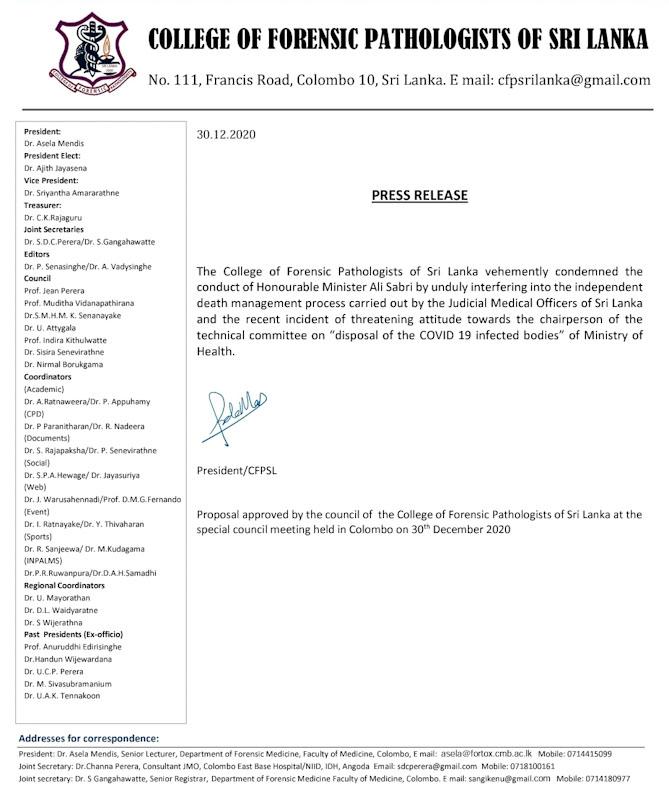
The College of Forensic Pathologists of Sri Lanka (CFPSL) condemned the unduly interfering into the independent death management process by the Justice Minister Ali Sabri.
While issuing a media release the CFPSL President Dr. Asela Mendis said the independent death management process was carried out by the Judicial Medical Officers.
He said in the satement that the recent incident of threatening attitude towards the chairperson of the technical committee on “disposal of the COVID 19 infected bodies” is vehemently condemned..
However, the proposal was approved by the council of the CFPSL during a special council meeting held in Colombo on December, 30 2020.
Deaths of four more persons who were infected with Covid-19 virus have been confirmed today (January 01), says the Director-General of Health Services.
Thereby, Sri Lanka’s death toll from the virus now stands at 208, the Department of Government Information stated.
One of the victims was identified as a 67-year-old man who was residing in Alayadivembu area. He had been transferred from Welikanda Base Hospital to National Institute of Infectious Diseases (NIID) where he passed away today. The cause of death was determined as Covid-19 pneumonia.
Another man, a resident of Agalawatte area aged 65 years, died yesterday (31) due to Covid-19 pneumonia and liver failure. He had been transferred from Nagoda General Hospital in Kalutara to Homagama Base Hospital after testing positive for coronavirus.
A 63-year-old man from Darga Town died on admission to Nagoda General Hospital in Kalutara on December 29. The cause of death was cited as blood poisoning, heart disease and Covid-19 infection.
Meanwhile, a 91-year-old woman from Colombo 14, passed away while receiving treatment at the National Institute of Infectious Disease (NIID) today. She was suffering from Covid-19 pneumonia and blood poisoning.
Sri Lanka’s Covid-19 numbers saw another surge today, as 237 more persons were tested positive for the virus.
According to the Department of Government Information, 235 of the newly-identified patients are close contacts of earlier cases linked to the Peliyagoda fish market.
The remaining two are arrivals from the United Arab Emirates and Italy.
In all, the country has registered 557 new positive cases within the day.
As per statistics, the total number of Covid-19 infections confirmed in the country to date now stands at 43,856.
Recoveries from the virus meanwhile climbed to 36,155 earlier today, as 826 more patients regained health.
However, 7,493 active cases are still under medical care at selected hospitals and treatment centres located across the island.
Sri Lanka has also witnessed 208 deaths related to Covid-19.
A major reason for the economic
downturn of Sri Lanka could be considered as the variation of foreign exchange
reserves, and no government since 1948 has been explained the issue to the
public, despite the policymakers widely talking about foreign exchange earnings
and shortages. The public in Sri Lanka has no understanding of why the country
needs a stable volume of foreign reserves, and what are issues associated with
the up and down variation of foreign reserves of the country. The public needs
to educate and motivate to encourage to make a voice to increase foreign
reserves. No government or opposition politicians in the country have talked
about this issue during the election campaign and motivated the public to
monitor the level of foreign reserves and pressure politicians to stress on
maintaining the required level of reserves, and implement related policy
actions.
People have no idea what is the
volume of foreign reserves in the country and what level of reserves need to
maintain, and the nature and causes of variation of the volume compared to many
countries. Sri Lanka needs to maintain a minimum of US dollar 25 billion of stable
reserves, and after the independence in 1948, no government’s economic policy
has been able to achieve required the level. It is regret to note that since
1948, during the 73 years, Sri Lanka could not build $25 billion foreign
reserves, and why such a regrettable economic policy has been allowed to
work. Since the early 1990s, many
countries like India. China, Australia have massively built a high volume of
foreign reserves, and the economic policy of those countries focused on
building and maintaining the level of foreign reserves in the dynamic economic
environment. What were the contributing factors for the up and down variation
of foreign reserves in Sri Lanka? The bottom line was the government did not
get firm economic advice on this matter, and many economic advisors attempted
to gain advantages for self-benefits than providing clear advice to improve the
volume of foreign reserves. The behavior and the nature of economic advisors
were to praise politicians and not to advise what really should do to achieve
the target of foreign reserves.
The direct impact of changing foreign
reserve level has been the decline of the value of Sri Lanka rupee (foreign and
domestic value) that has been the major effectuate of problems. When
established the Central Bank of Sri Lanka, two majors were set to stabilize
domestic and foreign values of the monetary unit, and the aims have been
educating university students, and practically governments did not specifically
direct policy to achieve the aim. Many textbook authors attempted to show that
achieving the objective has been a compact task, like going to heaven. The
government had no plan to strictly monitor the usage of foreign exchange with
concrete economic activities with a plan to maintain reserve level and it
seemed that the government irrationally allowed to use foreign exchange for
economically disadvantaged activities rather than promoting the saving of
foreign exchange.
The borrowings must have focused to
achieve and maintain the reserve base and explain to the lenders the government
objectives as the debt service activities concussion with all economic
activities. The nature of borrowing has been based on the ability to repayment
and although it has been a good focus, the borrowing should have not been affected
by the foreign reserves level in the debt service process. Since the 1950s, economic policymakers have
not been concerned on this point, and if they have considered while protecting
the level of reserves and borrowing managed to protect and increase the level
of reserves Sri Lanka could have faced economic down downturns with a higher
value of the monetary unit.
China has US $3 trillion foreign
reserves that are the highest in the world, despite becoming an enemy country
with China, Taiwan has more foreign reserves than the USA, UK, Canada, Germany,
and other developed countries. The size and the population of Taiwan are
congruous to Sri Lanka. Why did Sri
Lanka cannot achieve a minimum required level of US $25 Billion reserves during
the past seventy years? Politicians in the country have no understanding of the
problem, and they don’t motivate people to work achieving the basic target of
US$25 billion. Under the financial
administration of the Currency Board System in Sri Lanka had been accomplished
a stable foreign reserve level. If the government ruled the requirement, people
would have a concern on the matter of variance, and politicians in the country
would have educated people without party politics in any government would have
monitored the requirement, and politicians scared to educate people with a fear
that the public will judge the government’s performance using the benchmark of
foreign reserves.
The lower foreign reserve has been a
root cause for economic problems such as lower foreign value for Sri Lanka
rupee, high cost of imports, an increase in debt service, slower growth of
foreign investment, and many other issues. The balance of foreign reserves
depends on the demand and supply of foreign exchange. When there is a trend of
a strong inward volume of foreign exchange and a lessor trend of an outgoing
going foreign exchange volume, it will be a positive trend for an increase in
foreign reserves, and in such a situation the government can allow liberal
import policy. When it critically tests the trend of foreign reserve variation,
economic policymakers have not maintained an essential reserve level as a
benchmark, and the quantum of foreign exchange reserves would be helpful to
counter the adverse impact of many economic problems.
Many economists regard that the
liberal economic policy introduced in 1978
has been a contributory factor for the adverse variation of foreign
reserve level. During this period, the import of war-related weapons and other
materials and import policy of the country attempted to liberally allow
incoming goods and services without discipline. Although Sri Lanka’s trade
policy should be managed to consist of WTO agreement Sri Lanka would have
considered that the country shouldn’t be allowed to unnecessary imports
betraying the import substitution and building a production economy.
International Monetary Fund was
established by Briton Wood Agreement purposed to support member countries to
maintain the required level of foreign reserves and the fund has implemented a
range of credit schemes such as Standby Credits, Special Drawing Rights and
providing supports for economic downturns such as the COVID-19 crisis. If it
deeply analyses the IMF credit policy encouraged developing countries to import
from developed countries rather than helping to build foreign exchange reserves
in developing countries. The operational
pattern of IMF regarding Sri Lanka best speaks that IMF either played politics
or disregarded the extending supports to Sri Lanka to increase and maintain a
good foreign reserve level. There was evidence that the IMF helped for foreign
reserves, despite many supports the IMF indirectly encouraged imports from
developed countries.
After the presidential election in
2015, the government of Sri Lanka desired massive supports to build the foreign
reserves of the country, however, practically IMF did not consider the required
level of supports, and this reason was the root cause of the unpopularity of
the Yahapalana regime. However, the IMF policy towards China and India was
contrasting, and Sri Lanka was not supported as the way expected, and some
conditions imposed when granting supports to Sri Lanka were a consolation to
decline the level of foreign reserves and did the responsible policymakers
explain the truth to the IMF authority is unknown and the government did not
make any statement.
In the 20th century, many developed
countries considered establishing SOVERIGN WEALTH FUNDS and policy advisors of
Sri Lanka with the strong hope of Mannar basin oil deposits advised the
government to start Sovereign Wealth Fund, but the government is still talking
Mannar basin oil deposits rather than realizing the oil and gas productions.
The reality of Gas and oil production is that less than 15% of revenue could be
generated from oil and gas fields in developing countries where oil and gas
deposits are having, and if Sri Lanka’s Mannar basin would be successful only
to gain 10% to 15% of total revenue that will gain from the project, and the
revenue flow could use to build a sovereign wealth fund. However, the
expectation of people could be realized as expected might be a vital question.
If Sri Lanka invests such money, it would be successful in initiating a
Sovereign Wealth Fund. Sri Lanka needs to be careful about Rogue traders’
strategies and speculative investment strategies to secure the Sovereign Wealth
Fund. Sri Lanka had experienced a
Central Bank bond scam in 2015 and it is the best example that there is a
possibility to emerge rogue dealers in the country and the manipulation to
exploit foreign reserves could be incurred.
To maintain an expected level of
foreign reserves, Sri Lanka could get a variety of policy actions.
• The
economic policy process should focus on creating a production economy and a
balanced growth in the country. The idea of creating a production economy
should be the first concentration and agricultural producers in Sri Lanka are
lacking knowledge, skills, and experience in productivity enhancement and
should be educated and trained in the enhancement of productivity and
application of technology. The contribution rate of agriculture to GDP could be
increased to 40% by the modernization of production, and more than $750 million
annually could be saved, and generate a positive impact on saving foreign
exchange reserves. China could help Sri
Lanka for the improvement of the agricultural sector and promoting Chinese
investment in the sector. Many agricultural imports could be stopped if the
government policy converges maintaining a proper plan for agricultural
products. The current system is to encourage production when there is a
shortage, for example, turmeric production is encouraged by the government and
many imports could locally produce, and the policymakers need to identify the
items and educate formers to participate in the production of such items if
there will be an excess of production, how to deal with the situation? The
government needs to educate people to maintain buffer stocks of various
agriculture items. A Dutch administrator in Indonesia, Boake has written about
social dualism and the situation created in the past. Economists of Sri Lanka
must understand how to deal with social and technical dualism to adopt a
production economy. The cultural
behavior of people in Sri Lanka is not different from Indonesians when
launching the concept of the production economy. The government has taken steps
despite the government policy criticized by rouge businessmen in the country
urging to allow many agricultural items and the recent policy step of
Mr.Gotabaya Rajapaksa to promote milk production would positively support the creating
production economy.
• In
the effort of making a production economy, the contribution from the industrial
sector will be a massive quantity. Many industrial products such as household
items, radio, TV, fridges, washing machines, computers can easily produce in
the country if encourage foreign investments, especially Chinese investment,
and quality controls need to attract higher demand from the domestic market and
excess to export. Many Asian countries
adopted the strategy, especially Taiwan, Hong Kong, Thailand, South Korea, and
Japan. It was successful and the secret
of building a billion of foreign reserves in Taiwan was the creating production
economy, and the culture of Asian countries stimulated people to consume
domestic products rather than directing import controls. The concept of
creating a production economy saves magnitudes of foreign exchange reserves
outgoing and could create employment opportunities for increasing labor
force. The concept of a production
economy connecting to industrial products might be opposed by European
countries and some Asian countries.
Germany has already expressed animosity for import controls, and that is
the reality and the government of Sri Lanka must firm on its policy.
International association with China would be helpful and especially the policy
of Xi Jinping will help Sri Lanka in the effort to build a production-based
economy and increase in contribution from the industrial sector.
• The
other significant strategy is to make arrangements for half-completed
industrial products export to China, and after the improvement of quality, they
could be exported to other countries as products of China. The concept of the
final product is a joined product of China and Sri Lanka, and both countries
will be benefited from the arrangement.
This should be negotiated with China. As the secretary to the Ministry
of Finance stated without importing vehicles, China can cooperate to produce
and assemble vehicles required to the country. This policy supports earning more
than $10 billion annually and at least five billion of them could transfer to
permanent reserves. If Sri Lanka associates with China building the Silk Road,
it needs clear supports to achieve the aims of the country.
• Sri
Lanka should stop releasing foreign exchange for undergraduate education and
training programs. The country can educate and train people for undergraduate
programs. The direct effect of releasing foreign exchange for undergraduate
education and training is the waste of foreign exchange and disadvantage to
domestic education and training. If it
evaluates the contents of education and training programs in developed
countries, there is no difference in the contents of local programs. Many
undergraduate programs in Sri Lanka are comparable with programs in developed
countries, and the government needs capacity building in the country than
releasing foreign exchange to go overseas.
Major contributing services to foreign reserves by tourism
and foreign employment should be reset while having a clear hope of
contributing volume but the pace of contribution to GDP needs reducing.
The major weakness in the plan
implementation process in Sri Lanka is the details of plans, the monitoring,
and variance, remedial management process to achieve the objectives of the
original plan are not provided to people and many plans implementation has
become white elephants. If it investigates the plan implementation process
during the past 50 years it could be seen that the plan implementation process
was not consistent with proper monitoring and remedial management and many
plans were covered by political clouds.
The role of the opposition has been the monitoring of government policy
implementation and expressing of remedial strategies of the opposition.
Playing politics with the management
of foreign reserves is the Boeotian method of the policy management process and
the government needs to call unity in the management of foreign reserves that
are beneficial to the country beyond the politics. Mr.Gotabaya Rajapaksa should
give a clear approach to the government and opposition politicians. Whichever
political party is in power the volume of foreign reserve base ($ 25 billion)
should not be changed.
The response to the global pandemic has focused upon preventing
person-to-person transmission, however, experts now believe the virus could
also be spread in wastewater.
Earlier this week, it emerged that analysis of sewage in the UK
could provide important data on the spread of COVID-19. However, Professor
Richard Quilliam’s new paper — published May 6 — now warns that the sewerage
system itself could pose a transmission risk.
Writing in the journal Environment International, Professor
Quilliam and colleagues from Stirling’s Faculty of Natural Sciences are calling
for “an investment of resources” to investigate their concerns.
Professor Quilliam — who is currently leading a £1.85 million
study into the transport of bacteria and viruses in marine environments —
said: “We know that COVID-19 is spread through droplets from coughs and
sneezes, or via objects or materials that carry infection. However, it has
recently been confirmed that the virus can also be found in human faeces — up
to 33 days after the patient has tested negative for the respiratory symptoms
of COVID-19.
“It is not yet known whether the virus can be transmitted
via the faecal-oral route, however, we know that viral shedding from the
digestive system can last longer than shedding from the respiratory tract.
Therefore, this could be an important — but as yet unquantified — pathway for
increased exposure.”
The authors of the peer-reviewed paper presented the example of
the severe acute respiratory syndrome (SARS) outbreak in 2002-2003, when
SARS-CoV-1 — closely linked to the COVID-19 virus strain (SARS-CoV-2) — was
detected in sewage discharged by two hospitals in China.
Professor Quilliam highlights that, as most COVID-19 patients
are asymptomatic or experience just mild symptoms and remain at home — not in
hospitals, there is significant risk of “widespread” distribution
through sewers.
Professor Quilliam authored the paper alongside Professor
Manfred Weidmann, Dr Vanessa Moresco, Heather Purshouse, Dr Zoe O’Hara, and Dr
David Oliver.
The biologists said a lack of testing “makes it
difficult” to predict the scale of the potential spread and the public
health implications of the virus arriving at wastewater treatment works, whilst
the implications of consequent discharge into the wider environment are only
just beginning to be investigated.
They added that the structural makeup of COVID-19 —
specifically its lipid envelope covering — suggests that it will behave
differently in aqueous environments, compared to other viruses typically found
in the intestine. There is currently limited information on the environmental
persistence of COVID-19, but other coronaviruses can remain viable in sewage
for up to 14 days, depending on the environmental conditions.
On the risk of human exposure, the authors said: “The
transport of coronaviruses in water could increase the potential for the virus
to become aerosolised, particularly during the pumping of wastewater through
sewerage systems, at the wastewater treatment works, and during its discharge
and the subsequent transport through the catchment drainage network.
“Atmospheric loading of coronaviruses in water droplets
from wastewater is poorly understood but could provide a more direct
respiratory route for human exposure, particularly at sewage pumping stations,
wastewater treatment works and near waterways that are receiving
wastewater.”
Risk could be further increased in parts of the world with high
levels of open defecation, or where safely managed sanitation systems are limited
and waterways are used as both open sewers and sources of water for domestic
purposes.
“Such settings are commonly accompanied by poorly resourced
and fragile healthcare systems, thus amplifying both exposure risk and
potential mortality,” the authors said.
Currently, all published data on faecal shedding of SARS-CoV-2
derive from hospitalised patients — with limited information available on mild
and asymptomatic cases. The paper concludes: “In the immediate future,
there needs to be an investment of resources to improve our understanding of
the risks associated with faecal transmission of SARS-CoV-2, and whether this
respiratory virus can be disseminated by enteric transmission.
“Understanding the risk of spread via the faecal-oral
route, while still at a fairly early stage of the pandemic, will allow more
evidence-based information about viral transmission to be shared with the
public. Furthermore, the risks associated with sewage loading during the
remainder of the COVID-19 outbreak need to be rapidly quantified to allow
wastewater managers to act quickly and put in place control measures to
decrease human exposure to this potentially infectious material.
“At a time when the world is so focused on the respiratory
pathways of a respiratory virus, understanding the opportunities for SARS-CoV-2
to be spread by the faecal-oral route must not be neglected.”
A HAPPY PEACEFUL PROSPEROUS HEALTHY NEW YEAR TO ALL LANKAWEB READERS INCLUDING THOSE WHO HOLD CONTRARY VIEWS TO MINE!
Media secretary Viraj Abeysinghe of the Ministry of Health has
issued a press statement warning against spreading false information concocted
by certain politicians and websites regarding the subject of whether to bury or
burn the bodies of persons who have succumbed to the COVID-19 infection
(lankacnews-Sinhala/December 28, 2020). It notifies that the Ministry is
turning its attention to some ‘politically motivated fake news’ stories
featuring powerful politicians connected with the government. The statement
further says that for the time being (daenata) cremation alone is done on the
instructions of all the expert reports received by the Ministry so far. Very
much the same news was carried in Hiru TV News (9:55 pm/December 27, 2020).
Let’s hope that this is signalling an end to needlessly prolonged
dilly-dallying on the part of the authorities about an issue where
evidence-based science, not a particular religion out of the many, ought
to have the last word.
Interviewed recently by two You Tube channels (Hari TV/Lahiru
Mudalige/December 16 and Konara Vlogs/Avishka Konara/December 23) Ali Sabry PC,
Minister of Justice, stressed that his struggle is to build bridges rather than
walls between the communities. For over eight months now he has been advocating
burial of bodies of Muslims who have died of Covid-19 ignoring the decree of
the competent authority, the DHS (Director of Health Services). The DHS is
acting on the advice of the local experts who know best what is suitable for
our country in the current context, i.e., cremation. The reputed lawyer was the
legal consultant of (current president) Gotabaya Rajapaksa at least for fifteen
years from the latter’s defence secretary days; he has successfully defended
the latter against false charges of various kinds fabricated by political
opponents. Sabry’s aim of establishing intercommunal harmony is laudable, and
he may be sincere in his efforts in that direction, but how sincere is yet to
be demonstrated. This is because it is puzzling that he repeatedly warns that
young Muslims are likely to be pushed towards extremism by what they’d perceive
as a denial of their right to freedom of religion if the health authorities do
not allow the burial of bodies of Muslims claimed by Covid-19. His totally
senseless stand on the sensitive issue (that must be left for science, but not
religion, to resolve) is likely to give a fillip to extremists and other
miscreants opposed to the government to create trouble.
During the first interview mentioned above, Ali Sabry made the
patently false claim that the Aluthgama and Digana incidents drove young
Muslims to extremism, whereas the truth was the reverse of that. (These
incidents must be investigated even belatedly to discover the factual situation
that then obtained. The disastrous policy of political correctness that led to
the submergence of the truth on those occasions then seems to be at work once
again.) Sabry referred to how the UK responded to incidents of Islamic
extremist violence as a model to follow in dealing with the same problem in Sri
Lanka: the UK government reached out to the mainstream Muslim minority and
acted to win their confidence and support in order to contain Islamic extremism
in that country. He implies that Sri Lanka must do the same (as if Sri Lanka
has not been doing exactly that for centuries) or ‘we must kill all Muslims and
put them into the sea!’ (The violent imagery in his speech is an indication of
the commotion in his own mind resulting from his subliminal awareness of guilt
as he feels forced to lie in this situation for political expediency within his
own community. He probably fears violent retaliation from extremists for what
they might interpret as collusion with infidels in attacking Islam.) He’s been
sounding the warning mentioned above since early April 2020. He believes that
he is undergoing a sort of public trial by being blamed by both the Muslim
community on the one hand who feel aggrieved by the compulsory cremation rule imposed
on all citizens by the health authorities for the safe disposal of bodies of
Covid-19 victims and the electorally successful nationalist faction on the
other led by the monks, who insist that the rule should not be relaxed to
satisfy the whims of one particular group of people thereby endangering the
lives of the whole population through the possible release of the still
inadequately understood novel coronavirus from the interred bodies to the
country’s water table, which, in many places in Sri Lanka, is not very deep,
and lies close to the surface.
Ali Sabry should know better than most that there has been
no lack of reaching out to the mainstream Muslim minority either by the
majority community or by the successive governments. Muslims as a community are
mainly engaged in business. Seventy-five per cent of their customer base
comprises Sinhalese, making it possib;e for Muslim businesses thrive normally,
though there’s been just condemnation, among the citizenry including the
majority Sinhalese, of worsening Islamist extremism in recent years. Be that as
it may, it is not simply because Sabry has served president Gotabaya in the
past as his implicitly trusted personal legal service provider that he was made
a national list MP by the SLPP and honoured and empowered with such a very
important key portfolio. It is certain that Gotabaya Rajapaksa believes in the
Buddhist teaching that ‘a trustworthy person is the best kinsman’, but he is
the last to allow personal relationships or personal prejudices to sway
governance decisions improperly that affect the national interest (or at least
that is what people still believe about Gotabaya). ‘One country One law’ was
the rallying cry that inspired patriotic Sri Lankans at both the presidential
and parliamentary elections to vote for the SLPP, which won with the largest
margins. As minister of justice Sabry has been entrusted with the task of
supervising the making of a new constitution that is designed to achieve that
epoch making change (namely, One Country, One Law) among other things. Gotabaya
made no bones about the fact that he won the presidency almost exclusively on
the strength of Sinhalese votes; most Muslims and Tamils chose not to respond
positively to his call for support at the presidential election. His bluntness
is a reflection of his characteristic candour, which has not been compromised
by the hypocrisy of political correctness, his older brother’s unfailing
weapon, that fails more often than succeeds. But Gotabaya holds no grudge
against those who rejected him, for in the same breath president elect Gotabaya
said that he was elected as president of all the citizens of the country and
that he would serve in that post without discriminating against any citizen.
There is no doubt about the fact that he means what he says. By appointing Ali
Sabry to the all important post of Minister of Justice, the president
incidentally reassured the Muslims that he will not exclude them from his
vision of prosperity and splendour for the nation.
Ali Sabry has not budged an inch from his original
unqualified opposition to the mandatory burning of bodies of Muslim victims of
Covid-19 over which he expressed his disappointment in a Facebook post
mentioned in an Al Jazeera news report/April 3, 2020, with the authorities’
decision which, he alleged, ignored the WHO guidelines that allow both burial
and cremation. Are we to believe that our experts overlook WHO guidelines
without a rational explanation? Sabry deliberately ignores the various
reservations that clearly qualify the WHO guidelines, leaving the authorised
specialists of any member country to modify those recommendations as
appropriate for local conditions and ground realities. The basic assumption
that he seems to be operating on, regarding the burial problem, is wrong. For
all intents and purposes, he pretends to wrongly believe that the health
authorities insist on making no exception for Muslim dead in this case because
that is what the monks want. Ali Sabry is the last person that rational
people would expect to demand that Muslims should be allowed to bury their
loved ones dead from the novel coronavirus while cremation is the only method
legally prescribed by the Director of Health Services (DHS).
This is not a happy thing to say about arguably the most important
and powerful minister in the cabinet, being the closest companion of the
president, next to the prime minister, who is the president’s own brother. It
is inconceivable how Ali Sabry is capable of (no doubt unintentionally)
justifying the berserk behaviour of some virus-infected Muslims (as seen in
their show of insubordination, noncooperation, physical harassment of the
health workers trying to help them including spitting at them (with the
malicious intention of spreading the infection); cases were reported of some
Covid-19 positive tested individuals spitting out of the windows of buses
carrying them to quarantine centres in vicious attempts to spread dreaded
infection). Such demonstration of unprovoked anger is based on the false
pretext of alleged discrimination against them by the government in the matter
of mandatory cremation of Corona dead as prescribed by the responsible health
experts to prevent the escape of the deadly virus with many unknowns into the
environment. The virus is no respecter of people’s religious sensitivities. If
the Director of Health determines that cremation is the only option for Sri
Lanka in the current emergency, citizens are obliged to accept that and act
accordingly.
Why doesn’t Ali Sabry make an effort to explain to the agitating
Muslims and to the misinformed Muslim world in general, who have never been
enemies of Sri Lanka, that this blown-out-of-proportion controversy over the
burial or cremation issue has nothing to do with the monks or the government or
the health authorities or the army and police officers (the last mentioned
having been co-opted into the Covid containment operation only as ancillary
personnel employed for a strictly logistical purpose to serve under the
director of health services, DHS, the government appointed competent authority
who gives leadership to the whole enterprise, which involves every single
citizen of the country). The cremation imperative is not an arbitrary decision
taken by the government to spite the Muslim minority under pressure from the
monks as misleadingly suggested by the hostile foreign NGO elements, Islamists,
a handful of misguided Muslims, and the irresponsible SJB-led opposition. The
DHS is not acting capriciously either; his recommendations are based on a scientific
rationale collectively defined by a group of experts belonging to a number of
different relevant fields of study in the best interest of all resident Sri
Lankans and foreign visitors. Ali Sabry seems to be more concerned about
remaining in the good books of the handful of Islamists and their sympathisers
than the feelings of the ninety-five per cent of the population who are against
them. Is he in the thrall of the five percent? Or could it be the case that Ali
Sabry needs to be saved from disguised Islamist apologists and opportunistic
schemers, who are at present busy striking while the iron is hot? But one thing
is clear: The goal of One Country One Law will be a non-starter so long as Ali
Sabry remains Minister of Justice. That is my opinion for what it is
worth.
There has been recent noise to perpetuate Provincial Councils by various politicians – including within the government ranks. What of the PEOPLE’S VIEW?
These useless politicians are as
clumsy as they are incompetent and treasonous – the whole lot of them. To have
come up with this ridiculous proposal to hold Provincial Council elections
during a pandemic, at a time of economic stress and during public submissions
for a new constitution and public calls for these parasitic things to be
abolished shows complete disdain for the people. This is a farce and no
doubt the likes of MR in particular want to perpetuate Provincial Councils.
Useless government and useless opposition! The Provincial Councils and the Indo
Lanka Accord (already illegal under international law as per the Vienna
Conventions) have to be abolished in totality. The constitution is such
a mess and so corrupt, it must be dispensed with and replaced with a sound
constitution that is designed by patriots (not useless politicians) and
approved by the People. Our country could have been developed rapidly in the
last 10 years and has ended up getting nowhere. In addition to the spokesperson
in the article in that image, some other useless character who is a “State
Minister” told the media the other day that we have to consult India. How
such lowly, brainless and spineless people who say such things occupy high
office defies logic. These politicians are the bane of this beautiful country.
Reasons why Ceylon/Sri Lanka is not
developed:
1. India created a terrorist group
that killed innocent people and wasted 40 years of development
2. India inserted idiotic
constitutional clauses into the Sri Lankan constitution making it highly
bureaucratic and encouraging division and inaction as well as massive corruption
never seen anywhere else in human history
3. The Indo Lanka Accord removes Sri
Lanka’s independence and results in restrictions on foreign investment
4. Indian bootlicking politicians try
to preserve the corrupt system in Sri Lanka resulting in no rule of law, no
cohesion nor any foreign investment
5. Without a pro business
environment, meritocracy and investment (domestic or foreign), nothing gets
done and no progress is made.
6. The bizarre, absurd and
nonsensical notion by crazy people that India has to be consulted in the
governance, development and organisation of this country even to drink a cup of
tea despite the fact this nation is not, has never been and never will be part
of that godforsaken Indian Union!
7. A frog in the well mentality that
India is the world, things “cannot be done”, waiting for the coconut
to fall onto our lap instead of seizing the moment and bickering amongst
ourselves or against helpful countries when India – our actual enemy – is
running riot. This is the equivalent of fiddling whilst Rome is burning!
So a country which could become a
first world nation within 5-10 years, languishes as an Indian lackey and third
world country UNTIL the entire system is torn down and reset.
An example constitution that could
make this country great, which totally abolishes all the Indian installed
rubbish in the country is one here:
It is high time we clean the entire Augean stables
of this country. Without the basics being right, this country with massive
potential is on a path to nowhere. As per recent articles on Lankaweb, our
energy needs and food needs can easily be achieved. Any foreign investor will
tell you this country can be another Singapore if there is the rule of law and
we can easily reacquire our status as a global centre of commerce/hub.
If ANY politician does not advocate abolition of
the 13A, Indo Lanka Accord and wasteful bureaucracy in this country – no matter
what party they are from – they are guilty of high treason and should be
expelled to India.
Even recently, Indian fishermen plunder our fish
and get caught by our Navy, and politicians still talk about releasing these
criminals.
Let us restore our self respect,
common sense and ambitious purpose to get things done, fulfil our national
destiny and say “Yes we can”. If not now, when?
Ask not for whom the bell tolls, it
tolls for thee oh Ceylonese!
The making of Sri Lanka’s
Constitution from the time of the Soulbury Commission (1944) has been an
exercise that had completely ignored the Dharmic religious background and
civilizational history of Sri Lanka.
Sri Lanka is a nation state but is
also an unique civilizational state with a set of Dharmic values the nature of
which was completely overlooked by the framers of all the National
Constitutions from the time of the first (Soulbury) Constitution.
The same thing happened in India,
more or less.
In Sri Lanka, the making of the
original Constitution was rushed without paying due consideration to the
country’s legal heritage from ancient times as the main purpose of the drafters
of the Soulbury Constitution dominated by D.S. Senanayake under the influence
of Sir Ivor Jennings was in attaining self – government and maximum freedom.
In both countries ‘brown sahibs’
were the framers of the Constitutions with a colonial mindset having been
educated and trained in colonial educational institutions. They were products
of the times and acted as required under the compulsions of the times. They
used concepts that had originated in western settings e.g. the term ‘law’ is a
christian church concept. However, in no way can they be blamed for doing
exactly that.
But succeeding generations now
entrusted with amending, revising and/or creating new Constitutions have a
mandate from the post – independence State and a historical duty to re -set the
clock by drawing inspiration from the wisdom of our founding fathers.
To give due credit to our glorious
historical achievements in a document that is twined to the
Constitution.
The Experts Committee appointed by
the Cabinet of Ministers to draft a new Constitution must explore all avenues
to decolonise the Constitution paving the way for the decolonization of the
entire legal system of Sri Lanka, which is long overdue.
They have a mandate to peep into
the past beyond the time of the commencement of the colonial era.
A country with a 2500 year proud
history has failed to hold out to the rest of the world that the great
civilization that we are justly proud of was possible because we had a
remarkable legal system that extended protection to all living beings and
fostered harmony with each other on a footing of peace and non – violence.
Another great lapse of the
reformers of the Sri Lanka’s Constitutions and even the municipal laws of
today, is that we are so brainwashed and conditioned to look
exclusively to western precedents that have origins in UK, USA, France and
Vatican, while side tracking the reforms and revolutionary ideas emanating from
our nearby neighbours, India and the block of Theravada Buddhist countries. In
Myanmar, the Mahavamsa written in verse by the Buddhist monk Mahanama is known
and still respected.
India
A remarkable feature of the Indian
Constitution is that it is totally handwritten. One of the longest written
Constitutions for any sovereign state in the world, each of the 22 parts of the
Indian Constitution begins with an illustration.
Chronologically, the passage of
history of India is illustrated with highlights of the main events from Mohenjo
Daro to the national freedom struggle.
Influenced by the Epics
The Vedic period of India is represented in the Indian
Constitution by a gurukul scene that features in the section on citizenship,
the part on directive principles of state policy begins with a scene from the
Mahabharata, with the discussion between Arjun and Krishna before the onset of
the war. For fundamental rights, the artists had turned to the Ramayana,
drawing a sketch of Rama, Lakshman and Sita returning home after the battle in
Lanka. Interestingly, it is reportedly on the basis of this that in 1993 in the
Vishwa Hindu Adhivakta Sangh v/s Union of India case, the Allahabad High Court
had pronounced that Rama is a Constitutional entity, and, admittedly, a
reality of our national culture and fabric and not a myth”. In Part XIII of the
Indian Constitution , the sculptures from Mahabalipuram, including legendary
king Bhagirath’s penance, and the descent of Ganga to Earth are shown.
Emperor Ashoka is shown propagating Buddhism in a scene in Part
VII of the Constitution, the National Emblem, the Lion
Capital of Ashoka is also illustrated, the part IX depicts a scene
drawn from King Vikramaditya’s court to signify that Arts were promoted by the
Kingdom. Lakshmibai, the queen of Jhansi, the only
female figure illustrated prominently in the Constitution is sketched in
her armour. She is shown in one page together with Tipu Sultan, the King
of Mysore in Part XVI of the Constitution. Part XIV has Emperor Akbar in his
court, representing the Mughal rule; the background depicts the period’s
striking Mughal architecture. Maratha ruler Shivaji and 10th
Sikh guru, Guru Gobind Singh, are shown in the subsequent section posing a
challenge to the Mughals.
Struggle for Independence
Mahatma Gandhi is shown walking with a stick – created in 1930
to mark the Dandi March in the section on official language. Gandhi reappears
in the section on emergency provisions, where he is seen visiting riot-hit
Noakhali in south-east Bangladesh. He is being welcomed by women with an aarti
thali in their hands, even as Muslim peasants seem to be looking at him from
behind a bamboo fence. The contributions of Subhas Chandra Bose and his Azad
Hind Fauj have also been acknowledged. In Part XIX, Bose is seen against a
mountainous backdrop, saluting the flag ,with Tipu Sultan’s mechanical tiger
mauling a man at the centre of the Tricolour. The borders recall his message to
Mahatma Gandhi on the Azad Hind Radio in 1944: Father of our Nation, in this
holy war for India’s liberation, we ask for your blessings and good wishes.”
Geographical Diversity
The illustrations also display the immense diversity of the
geography of India, beginning with camels marching in the desert in the
temporary and transitional provisions section, to the great Himalayas in light
shades in the amendment section. The torrential ocean waves are set out in Part
XXII, which is the last section of the Indian Constitution that stipulates the
commencement and repeals.
Exhibited in the Indian Parliament Library
The handcrafted Indian Constitution bound in black leather,
embossed with patterns in gold can be seen placed in a special
helium-filled case in the Indian Parliament Library. It defines not just the
laws of the country, but the space for these laws is shared with Indian history
and heritage. Each word was carefully calligraphed by Prem Behari Narain
Raizada, and the task of illustrating the book was executed by artist Nandalal
Bose and his team from Kala Bhavana, Santiniketan.
Illustrations of Sri Lanka’s History in Sri
Lanka’s New Constitution
We can adopt the model of a handcrafted Constitution of India
using calligraphy and drawings to do likewise i.e. sharing the space allotted
to the constitutional provisions with beautiful illustrations of events drawn
from the great landmarks of Sri Lanka’s history and heritage.
To name a few:
1) The arrival of Prince Vijaya
2) King Pandukabaya developing Anuradhapura
3) King Devanampiyatissa receiving Arahat Mahinda
4) King Dutugemunu declaring open the Ruwanweli Mahasaya
5) Tripitaka committed into writing on
Ola leaves at Aluviharaya Temple, Matale in
the 1st Century of B.C. during the king Walagamba reign.
6)Princess Hemamali bringing the Dante Datu from India
7) King Mahasena’s irrigation work and temple building eg.
Jetawana Ramaya
8) Sigiriya Rock and Frescoes
These are examples of illustrations that will raise the stature
of the new Constitution that deserves to be handwritten with sketches.
and kept inside the Library of the Sri Lanka Parliament
Mahinda Rajapaksa Prime Minister of the Democratic Socialist Republic of Sri Lanka
New Year is a
hopeful time for all of us, as we bid farewell to 2020, we must welcome the new
year with renewed strength and determination.
We are filled with
gratitude for the unfaltering support the Sri Lankan people have instilled in
our government to create an inclusive, and safe Sri Lanka for all. During the
short tenure of our government, we take great pride in being able to recommence
solving public grievances, and working towards the betterment of our community.
After five years of political stagnation, we were able to restart our social
and economic growth amidst a pandemic, and so we appreciate the unwavering
support of the Sri Lankan people.
In our shared
quest to combat the COVID-19 pandemic, I would like to commend the work done by
our dedicated frontline staff.
Healthcare
workers, the armed forces, police and security, government officials and staff,
volunteers, everyone who has helped our nation reduce the impact of the virus. While 2020 was a difficult year for all of us in Sri Lanka and around
the world, this year has been a true test of our spirit. The Sri Lankan
community has showed their true mettle in these difficult times, and as we
reflect back on this year, let us all believe that brighter days are ahead of
us.
Even though our challenges
remain great, the Sri Lankan spirit and perseverance remains greater, and it is
this spirit that will enable us to overcome the obstacles of this global
pandemic as a nation and inspire our future generations
I wish you all a
very happy, safe and prosperous new year!
Mahinda Rajapaksa
Prime
Minister of the Democratic Socialist Republic of Sri Lanka