නව වසර සුභාශිංසනය

December 31st, 2020

මහින්ද රාජපක්ෂ ශ්‍රී ලංකා ප්‍රජාතාන්ත්‍රික සමාජවාදී ජනරජයේ අග්‍රාමාත්‍ය

සෞභාග්‍යයේ බලාපොරොත්තු පිබිදෙන 2021 නව වසරට සුභාශිංසන පළ කරනුයේ ඉමහත් සතුටිනි.

සුරක්ෂිත දේශයක් වෙනුවෙන් අපගේ මාතෘභූමියේ අනාගතය උදෙසා ජනතාව අප කෙරෙහි තැබූ විශ්වාසය සහෘදව සිහිපත් කරමු.

නව රජයේ මේ දක්වා ගෙවී ගිය කාලය ඉතා කෙටි වුවද එම කාලය ජනතාවගේ අභිලාශයන් වෙනුවෙන් යෙදවීමට හැකිවීම අභිමානයකි.

වසර පහක කාලයක් ඇණහිට තිබූ රටේ මානව හා භෞතික සංවර්ධන කටයුතු සඳහා නැවත පණ දීමට අපට හැකිවිය. මැදහත්ව ඒ දෙස බලා ජනතාවට සතුටු විය හැකිය.

ලොව අන් සියලු රටවල් මෙන්ම කොවිඩ්-19 වයිරසයේ අභියෝගයට අප ද මුහුණ දෙමින් සිටියි.

වයිරසයේ බලපෑම අවම කිරීම වෙනුවෙන් වෛද්‍යවරුන් ඇතුළු සෞඛ්‍ය කාර්ය මණ්ඩල, ත්‍රිවිධ හමුදාව, පොලීසිය ඇතුලු ආරක්ෂක අංශ සහ රාජ්‍ය නිලධාරීන් හා කාර්ය මණ්ඩල විසි හතර පැයේ නිරත මෙහෙවර අපමණය.

රජය කොව්ඩ්-19 වසංගතය කළමනාකරණය කිරීම වෙනුවෙන් ජනතාව මත බර නොවැටෙන පරිදි උපරිම මැදිහත්වීමට දායක වී සිටියි.

සෞඛ්‍ය මාර්ගෝපදේශ පිළිපදින විනයගරුක ජනතාවගෙන් රජයට ලැබෙන සහයෝගය ද සුළුපටු නැත.

නව වසරේ රට හමුවේ ඇති මෙම අභියෝග එක්ව ජයගත හැකිය.

දේශීයත්වයට මුල් තැන ලැබෙන රාජ්‍ය ආර්ථික ප්‍රතිපත්තිමය දැක්ම තුළ නව ආර්ථික හා සංවර්ධන විප්ලවයක් රට තුළ ඇතිවන බව ස්ථීරය.

ඒ තුළ ඔබගේත් රටේත් අනාගතය සුභවාදීව දියුණුවන සෞභාග්‍යමත් දේශයක් උදාවනු ඇත.

ඉතා ලඝු වූ කාරණා අරඹයා තවදුරටත් අප බෙදී වෙන්වී සිටිය යුතු නැත.

අද අප මෙම මාතෘභූමිය වෙනුවෙන් වෙහෙසෙන්නේත් කැපවන්නේත් අපේ මතු පරපුරේ දරුවන්ගේ අනාගතය වෙනුවෙනි.

ඒ නිසා සමාජයීය සංස්කෘතික හා ආගමික සහජීවනයෙන් යුතුව කටයුතු කිරීම ඔස්සේ ශ්‍රී ලාංකික ජාතිය ලෙස එක්ව රට ගොඩනැගීමට එළැඹෙන මෙම නව වසර අවස්ථාවක් කරගන්නැයි සමස්ත ජනතාවගෙන් ඉල්ලා සිටිමු.

අභිමානවත් ශ්‍රී ලාංකික සියලු ජනතාවට නිරෝගීමත් සුබ නව වසරක් වේවා ! යි ප්‍රාර්ථනා කරමි.

නව වසරට සුභාශිංසන

December 31st, 2020

ඒ.ජේ.එම්.මුසම්මිල් ඌව පළාත් ආණ්ඩුකාරවර


නව වසර යනු අප ජීවන රටාව තුළ මුහුණ පෑමට සිදු වූ ජය පරාජය හා අඩු ලුහුඩුකම් දෙස නැවත හැරී බැලීමට අවශ්‍යය මොහොතකි. පිරිසිදු චේතනාවන් මුසු අවංක කැප කිරීම් කිරීමෙන් කළ නොහැක්කක් නොමැති බව ලොවටම සපථ කළ ජාතියක් ලෙස අපගේ යුතුකම් නොපිරිහෙලා ඉටු කිරීම අපගේ වගකීමකි.

සිංහල, දෙමළ, මුස්ලිම්, මැලේ, බර්ගර් යන සියලු ජාතීන්ට අයත් ශ්‍රී ලාංකිකයන් ලෙස තම තමන්ගේ අනන්‍යතාව ආරක්ෂා කර ගනිමින් සුහදව ජීවත් වීම සදහා අප විසින් නිර්මාණය කළ පසුබිම තවදුරටත් සුරක්ෂිත කළ යුතුය. ඉන්දියන් සාගරයේ නිල්දිය රැලි මත දිදුලන සියල් සපිරි සුපහන් දේශයක් නිර්මාණය කිරීම සදහා විනයගරුක පිරිසක් ලෙස පෙරටම යා යුතුය.

දැනට ලෝකය වෙලාගෙන ඇති මාරාන්තික වෛරසයට තිත තැබීමට හැකිවේවා! යන්න උදාවන නව වසරේ අප සියලු දෙනාගේම ඒකායන බලාපොරොත්තුව වන අතර ජනතා සුභ සිද්ධිය උදෙසා රට තුළ ක්‍රියාත්මක නීතී රීති වලට ගරු කරමින් ආත්මාර්ථයෙන් තොර පාරාර්ථකාමී ශ්‍රී ලාංකිකයින් ලෙස නිවසේ සිටම පවුලේ සමාජිකයින් සමඟ නව වසරේ උදාව සාමකාමීව සමරන මෙන් කාරුණිකව ඉල්ලා සිටිමි.

උදා වූ නව වසර ශ්‍රි ලංකා වාසී සියලු ජනතාව හට සාමය, සතුට හා සෞභාග්‍ය පිරි නීරෝගීමත් සුභම සුභ නව වසරක් වේවා! යන්න මාගේ හෘදයාංගම ප්‍රාර්ථනයයි.

ඒ.ජේ.එම්.මුසම්මිල්
ඌව පළාත් ආණ්ඩුකාරවර

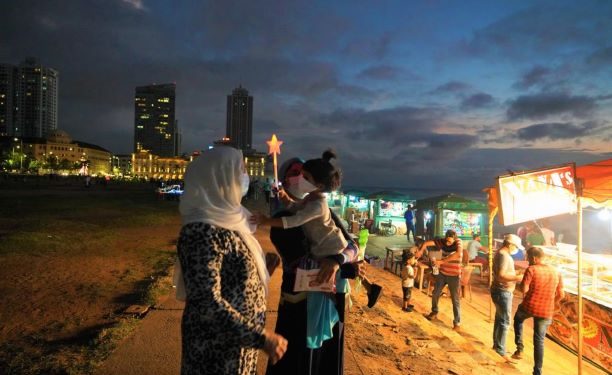
Photo Feature: Galle Face promenade comes to life at dusk

December 31st, 2020

Courtesy NewsIn.Asia

Photo Feature: Galle Face promenade comes to life at dusk

Colombo, December 31: One of the most attractive landmarks in the Sri Lankan capital Colombo, is the Galle Face Green, a 5-hectare open sea-side field with a promenade running along the water’s edge.  

Flanked by the colonial-era Galle Face Hotel, built in 1864, in the south, and the more recently put up Kingsbury Hotel and the up and coming Colombo Port City in the north, Galle Face Green is in every sense a part of busy downtown Colombo.

And yet, it is serves as a retreat, offering office-goers and others from the city relief from stress.     

In the mornings, walkers and joggers occupy the space. As the day unfolds, couples and love birds playing truant from their schools or workplaces occupy the benches with umbrellas sheltering them from the hot sun and prying eyes.

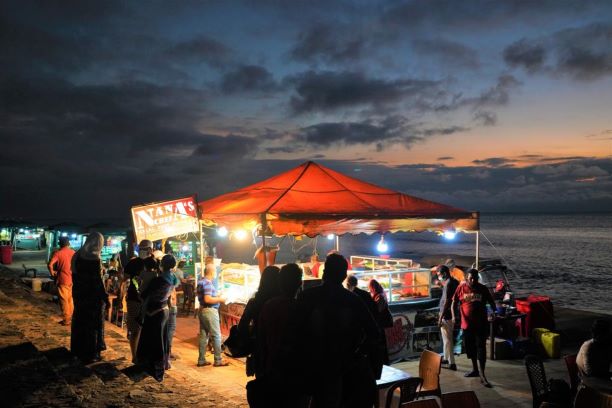
Galle Face night market. Photo: Tang Lu/Xinhua

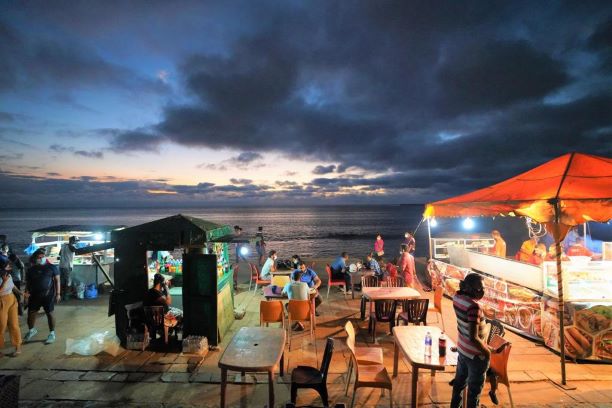
In the evenings, the couples disappear to yield place to children, walkers and joggers. The vast ground is used by children to play, itinerant vendors to sell their wares and food stalls owners to cater to the taste buds of the hoi polloi.

Families cooped up in tiny overcrowded houses and flats in the city during the day, and desperate for some fresh air and tasty street food, pour into Galle Face Green as the sun set in a riot of color.

In the kite flying season, kite sellers pop up, sometimes displaying exotic Chinese kites to the delight of the kids.

A virtually deserted place during the day, Galle Face springs to life in the evenings with brightly lit shops fitted with loudspeakers blaring music to attract customers.  

Gall Face Green was an colorless marshy land between the Arabia Sea in the West and miles and miles of coconut plantations and cinnamon gardens in the East, before it was cleared by the Dutch for a military purpose. Located in the Fort in the North, the Dutch cleared the jungle to secure a clear line of fire for their cannons.  

Galle Face night market. Photo: Tang Lu/Xinhua

When the British took over from the Dutch in 1798, and there were no challengers to their hegemony, the idea of using the cleared land as a recreational area germinated.

However, it was not until mid-19th.Century that the ground was actually turned into a recreational place for British officials, soldiers and businessmen and their families. The Galle Face Green became a venue for horse racing, cricket, rugby, and polo matches and equestrian sports.

Horse races were held here as early as the 1820s, when Sir Edward Barnes was Governor. In fact, the area was then known as the Colpetty Race Course. Horse races were held there until 1893 when racing was shifted to the specially constructed Colombo Racecourse further South.

It was in 1859 that Governor Henry George Ward created the promenade on the sea side. According to a city historian, the promenade was meant to be for ladies and gentlemen to unfold their grace and haughtiness, a place for soldiers on horseback to show off their latest accoutrements, a scene for flirtation and gossip, political and social.”

In 1879, when British expatriates introduced golf to Ceylon, Galle Face Green became the golf course. The Colombo Golf Club was  inaugurated there on March 13, 1880 , though there was neither a proper golf course nor a club house. The club was shifted to the present premises in Borella after Galle Face Green got crowded with people seeking space for a variety of activities including cricket, rugby tennis and other sports.

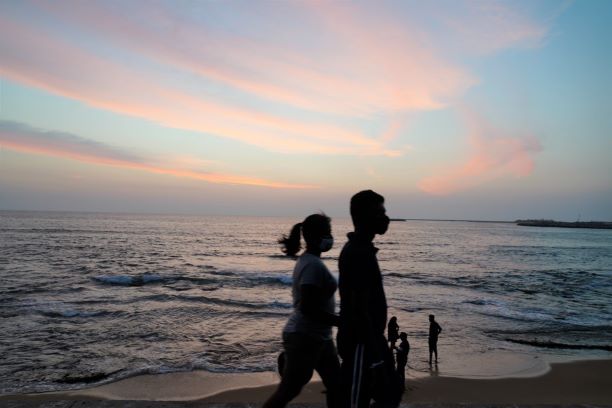
Galle Face. With the COVID curfew lifted Columbans walk, jog or simply catch the cool breeze from the Arabian Sea. In the background is the Colombo Port City. Photo:. Tang Lu/Xinhua

It was at the place where the Taj Samudra Hotel is located now, where the celebrated cricket contest between Royal College and St.Thomas College was first played in July 1879. It is said that the two teams had to row across the Beira Lake to reach Galle Face Green. Colombo Academy, as Royal College was then called, won the inaugural encounter by 56 runs.

Two historic incidents took place on Galle Face Green. The first was on August 5, 1942 during World War II. 125 Japanese bombers, under Mitsuo Fuchida, the hero of Pearl Harbour, were targeting Colombo Harbor thinking that the British Eastern Fleet was anchored there.

British Hurricanes fighters based in the secret airfield located in the Colombo Race Course opposite Royal College,  took off to intercept the Japanese fighters and drove them away, though not before the raiders had sunk HMS Dorsetshire and HMS Cornwall.

One of the Hurricane pilots was hit by Japanese fire and had to force land his blazing aircraft on Gall Face Green to the utter shock of the people there. The pilot was extricated and rushed to the Galle Face Hotel. Shaken, he asked for whiskey, but since it was 8.30 in the morning and the bar was not open, a bearer rushed to get what he knew was the next best thing – a glass of plain tea, cold tea to be precise.   

Galle Face is a walkers’ paradise. Photo: Tang Lu/Xinhua

Galle Face Green was also linked to the death of Sri Lanka’s First Prime Minister and the Father of the Nation, D.S.Senanayake. On the morning of Friday, 21 March 1952, Senanayake was on his customary  pre-breakfast ride on Galle Face Green, a short distance from his official residence, the Temple Trees. He was riding one of his favorite horses Chitra, a mare belonging to the mounted police. Accompanying him on that day was Sir Richard Aluwihare, the Inspector General Police; G.G. Ponnambalam, a cabinet minister, and police Inspector Eddie Grey. The Prime Minister’s horse suddenly broke into a gallop from a canter throwing Prime Minister off.

He was rushed to a nursing home where for the next thirty-two hours he was unconscious. It was believed that he fell off the horse because he had suffered a stroke. The best of local medical local could not save Senanayake who died on 22 March 1952.

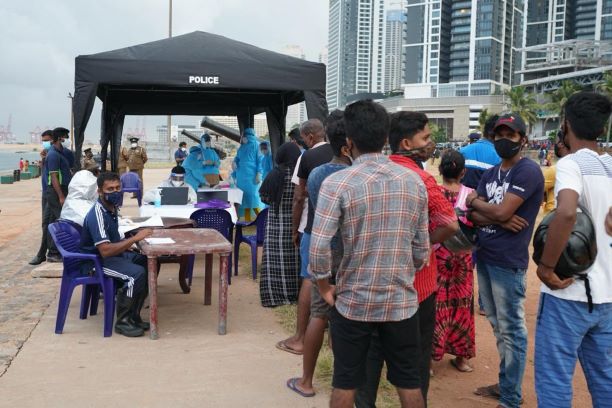
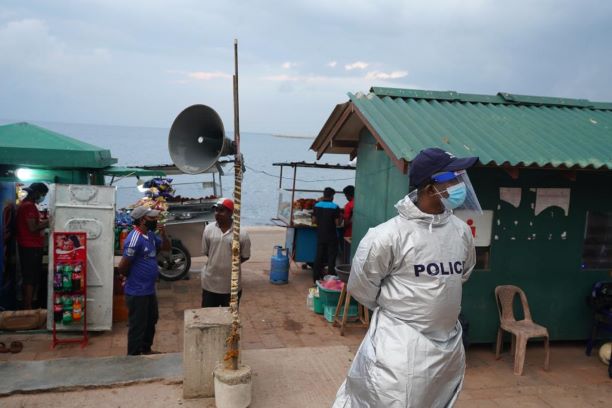
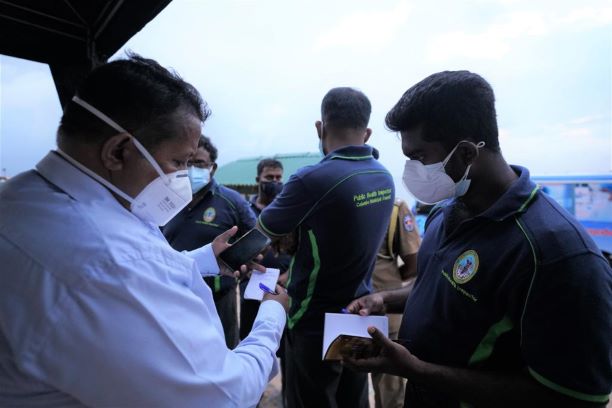
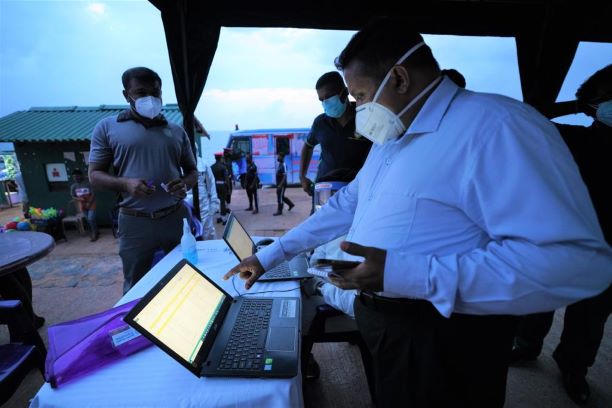
Unfortunately now, the latest international scourge, the coronavirus has caught with Galle Face Green. Rapid Antigen Tests conducted on vendors there recently, found nine of them to be COVID-19 positive.  

(Photos: Tang Lu/Xinhua. Text: newsin.asia)

2020 was a very stressful year for Sri Lankans

December 31st, 2020

By P.K.Balachandran/newsin.asia Courtesy NewsIn.Asia

Colombo, December 31: The coronavirus pandemic, which began in March and is still on, made 2020 a very stressful year for Sri Lankans of all classes, particularly the poor and the lower middle classes. The pandemic directly stalled economic development because of lockdowns, curfews and movement restrictions. It indirectly disrupted communal harmony when the government banned the burial of the COVID dead – a prohibition which hurt the Muslim minority for whom cremating the dead is haram” – a religious taboo. The country is now seeing demonstrations for and against burial.  

Gotabaya Rajapaksa took over as Executive President of Sri Lanka a little over a year ago with ambitious plans for his country. A former military man and Secretary to the Ministry of Defense from 2005 to 2015 who defeated terrorism, aimed to bring order to a government which had been torn apart earlier by an unceasing conflict between President Maithripala Sirisena and Prime Minister Ranil Wickremesinghe. The consequences of that struggle at the top were far reaching for the Lankan economy and also for internal security.  

The pro-West Wickremesinghe regime put on hold China-funded projects initiated by the previous Mahinda Rajapaksa government. A delay of a year and a half raised project costs. The Wickremesinghe  government talked a lot about grand development schemes but failed to walk the talk. About a dozen MoUs signed with India were left to gather dust. President Gotabaya inherited a non-functioning government and a weak economy.  

In 2019, the annual growth rate was only 2.3%. Government revenues accounted for only 12.4% of the GDP, while expenditure constituted 18.6% of the GDP. The government’s gross debt was equivalent to 83% of the GDP. Annual debt repayments comprised almost 5% of GDP or around 40% government revenues.

After the pandemic struck in 2020, and lockdowns and movement restrictions were clamped, the Department of Census and Statistics reported that the second quarter of 2020 showed an unprecedented fall of 16.3% in real GDP, the steepest drop ever recorded in Sri Lankan history. There was contraction in all the three major economic sectors, namely, Agriculture, Industry, and the Services, by 5.9%, 23.1% and 12.9% respectively.

A telephone survey undertaken by UNICEF and UNDP at the beginning of May 2020 exposed the severity of the crisis at the grassroots level.

Overall, 39.4% of respondents reported that they had lost all income while a further 31.6% had lost partially. A survey conducted in April 2020 by World Vision Sri Lanka found that 93% had been affected by the pandemic, with 78% either fully or severely affected. In addition, 44% respondents had lost their jobs, with average salaries falling from Rs.24,400 (US$130) to Rs. 6,800 (US$ 36.7) per month.

Among daily wage earners, 65% had lost their entire incomes while 31% had experienced reduced incomes. Among those paid monthly, 19% no longer had any income while 30% were living on reduced incomes. A recent UNICEF survey found that 74% of the families were surviving on less than Rs. 613 (US$ 3.4) per day.

Therefore, the vast majority of families were not in a condition to withstand an economic shock on the scale of COVID-19, a UN study published in June 2020 said. Children, persons with disabilities, and older persons were particularly at risk.

Government’s Decisive Response

To be able to act effectively, the newly elected President Gotabaya enhanced the power of the Executive Presidency by getting the 20th. Constitutional Amendment passed by parliament. He also entrusted the task of tackling the pandemic to the Army Commander, Gen.Shavendra Silva.

The Government of Sri Lanka quickly recognized the need to protect families during the crisis and provide the economy with a fiscal stimulus, the UN study acknowledged. A government team led by Basil Rajapaksa, designed a program that, in April, delivered almost 5.4 million cash transfers of Rs.5,000 (US$ 27) to each household across the country. This was repeated for a second time in May, expanding the number to around 5.7 million transfers following appeals from households which had been excluded in the first round.

The total cost of this financial support system had been around Rs. 55 billion (US$ 297.3 million), or 0.33 per cent of GDP. The response was impressive given the fact that it was announced a few days after the imposition of the curfew and reached an estimated 66% of Lankan households.

However, 31% of respondents in the UNICEF-UNDP survey had not received the support. Nearly a third of the children and those over-70s, and around half of all single parents/caregivers, might have been left out, the UN report said.

There were also significant variations across the labor force: only 51% of daily wage workers were able to access the support. Among those receiving monthly wages, the proportion was 83 per cent, suggesting that those working in the informal economy, namely, the vast majority of the labor force on daily wages, were excluded, the UN report said.

Central Bank’s Corrective Measures

In October 2020, the Central Bank of Sri Lanka (CBSL) reported that the economy had contracted by 1.6%  in the first quarter of 2020, year-on-year as buinesses had stopped and unemployment had risen. There was a decline in government revenue too.  

To counter these trends, the CBSL reduced policy rates and the Statutory Reserve Ratio (SRR) to inject liquidity into the market and lower borrowing costs significantly. Concessional credit schemes were introduced alongside debt moratoria. By August-September, the private sector showed a significant improvement.  

The external sector, which was severely affected in the initial stages of the pandemic, eventually showed an improvement in the trade balance, a revival of workers’ remittances, a stable exchange rate, and a reasonable level of official reserves. External sector stability was supported by the restrictions placed on non-essential imports, the CBSL said.  

Significantly, Sri Lanka met all its debt service obligations including the settlement of the International Sovereign Bond (ISB) that had matured in early October 2020. Meanwhile, subdued demand helped maintain inflation broadly within the target range of 4-6%.

Security and Communal Divide

Negligence on the security front by the earlier regime had resulted in a bunch of Islamic suicide bombers killing 259 people in Colombo and two other towns on April 21, 2019 East Sunday. The bombings and the subsequent anti-Muslim riots disrupted economic activity and widened the rift between the Sinhala-Buddhist majority and the Muslim minority.

The effect of the rift led to a sharp political and electoral divide in the November 2019 Presidential election and the August 2020 parliamentary elections. Gotabaya Rajapaksa won the Presidential election almost solely with Sinhala-Buddhist support. His Sri Lanka Podujana Peramuna (SLPP) won the parliamentary elections again with the same kind of communal backing. Therefore, 2020 saw a political consolidation of the majority Sinhala-Buddhist on the one hand, and the minority Tamils and Muslims on the other.

The alienation of the Muslims was accentuated in April 2020 when the Gotabaya government banned the burial of the COVID-19 dead on the grounds that burial would contaminate ground water. The Muslims’ plea that burial was sanctioned by WHO and that viruses would not survive in dead bodies fell on deaf ears. Agitations on this issue were ignored.

Tamils’ Issue       

Reversing Mahinda Rajapaksa’s policy of not bowing to the West on the politically sensitive war crimes issue, the Wickremesinghe government agreed to co-sponsor a resolution against itself at the UN Human Rights Council (UNHRC) in Geneva in 2015. The resolution enjoined the government to set up accountability mechanisms which meant arraigning army war heroes” before internationally supervised judicial mechanisms.

Since the Sinhala-Buddhist majority community considered this an affront to their country and national pride, the successor ‘nationalist’ government of Gotabaya Rajapaksa declared that it would withdraw its co-sponsorship in March 2021.

Thus the Sinhala-Tamil divide continued in 2020 and relations with the US and the West, which had taken a strong stand against alleged war crimes, worsened.     

Given US influence over the Wickremesinghe government, Colombo agreed to accept a grant of US$ 480 million under the Millennium Challenge Corporation (MCC) Compact for a project which included digitalization of rural land records to make land marketable. Government was also inclined to sign the Status of Forces Agreement (SOFA) with the US Department of Defense.

Eventually, both the MCC and SOFA were buried by the successor  ‘nationalist’ government of Gotabaya Rajapaksa, because both pacts ran counter to the constitution of Sri Lanka and abridged national sovereignty. This also contributed to the lack of warmth in Sri Lanka’s relations ties with the US.  

The Sri Lankan President had suggested to the visiting US Secretary of State Mike Pompeo that instead of talking only strategic issues and Chinese projects, the US could invest in Sri Lanka in areas like railways, ICT and energy. But Pompeo expressed some interest only in tourism, thus leaving Sri Lanka with no option but to seek China’s assistance to fund its large scale infrastructure projects.  

Spread of Buddhist Education in Sri Lanka; the role played by Col Olcott and Theosophists

December 31st, 2020

by Dr D Chandraratna Courtesy The Island

The Olcott Oration delivered to the Old Boys Association of Ananda College (November 2020, Perth, Western Australia)

It can be gauged from the Buddhist publications in and around 1880s that the ordinary Sinhalese were experiencing an acute sense of despair and disquiet that colonialism had brought about a social degeneration evidenced by increased consumption of liquor and associated problems of family violence, cattle stealing, gambling, and crime. Even the colonial civil servants from numerous districts complained to the Governor that social disorganization was affecting administration, revenue collection and policing. The Sinhalese Buddhist revivalist movement and a proper assessment of Col Olcott’s contribution must be understood in this context of the rising tide of Sinhala nationalism, Buddhist confrontation with Colonialism, Christian missionary activity and increasing westernization.

The elite Buddhists including those culturally identified with the foreigner were not unaware that there was an imminent collapse of the civilizational heritage of the Sinhala people. Western civilization alongside cultural assimilation was sweeping though the country The protest against the social degeneration was a combined protest of all strata reflected in the mushrooming of many grass roots organisations such as gramaarakshka sabhas, Sucharithodaya/ Sucharithawardana samagamas in addition to the already existing temperence (amadyapa) associations. Calling for athma shakthi or self-confidence in the people, newspapers, pamphlets, theatre and drama, enjoined an appeal to stem the degeneration of Sri Lankan society. The colonial administration was conscious of the rising discontent but continued as usual by labelling the village leadership as rowdies intent on sedition.

It was a time that the missionaries and even scholars such as Max Weber characterized all indological and Orient as primitive and their belief systems as irrational and superstitious. The British colonial state was admittedly Christian and the disabilities and intolerance that the Buddhists in Ceylon experienced were the same as the Hindus in India. Whereas in India the role of the missionaries was insignificant in the structure of colonial domination in Ceylon it was a formidable feature of what is called ‘the colonial difference’. The Buddhists and the Hindus attracted the Orientalist racism and the colonial regime was not yet ready to accept even nominally the faith of the vast majority of its subject population on equal terms. The ‘superior truth’ of the colonialist rested on the formal structure of subordination for reasons of political dominance and ideological hegemony.

The colonial state was far from the declared fairness and impartiality when it came to religion because it was inseparable from the Christian faith. Converting the heathens was another way of serving the needs of the colonial government. Imperialism was the will of the God. There was no impartial religious policy and the conventions and treaties agreed to by the colonial Office in 1815 were limited to paper only. Though the discrimination faced by the Buddhist was questioned even in the Legislative Council by non-Buddhist Sri Lankans, these fell on deaf ears. The Ceylonese legislators being non-Buddhists their pleas were muted and response by the administration came to nothing.

The successful confrontations with the missionaries in the 1860’s and 70’s and the accompanying argumentation lifted the spirits of the Sinhalese and gave Buddhists some strength of purpose. They were outspoken about the injustices such as the privileges granted to Christian missionaries, and the denial of the rights that Buddhist were entitled to being the majority. The intimate association of the colonial state with a particular religion made their claims to neutrality hollow. The colonial fairness and neutrality was only in relations with different sects of the Christian faith. The agitation made by the Christian Liberation Society asking for a separation of the state from the Anglican faith kept the Buddhists and the Hindus out of the agitation. The Colonial Secretary was convinced that if the Ecclesiastical department was disestablished the natives would lose respect for Christianity and he remained unmoved.

Despite these protestations the state relationship with Christianity continued untrammelled as before. The missionaries were paid by the public purse even though many missionaries were known to be fraudulent in their account keeping; the colonial civil servants participated in religious activities, and were encouraged even to preach. However much the Buddhists complained that the taxes collected from the Buddhists were used to provide education to the non-Buddhists the state maintained that the latter were unable to provide a modern secular education and evaded the issue. Conversion was commonplace and the Buddhist sangha were helpless to stem the erosion of their religion through material inducement. Preferential treatment in appointing headmen was no secret and in fact the Headmen were more useful than Christian priests for obvious reasons. Resistance to conversion by Headmen often resulted in dismissal from office.

The Arrival of the Theosophists

The theosophists entered the scene ‘at the right historical moment when Buddhists were demoralized at the disestablishment of their religion and the power of the missions’. To have white champions of Buddhism who had an understanding of western ways and a conception as to how Buddhism could move towards modernity roused the Buddhists to practical action’. It was a psychological boost of immense consequence to the inferiority complex of the subordinate subjects.

The theosophists were not a very significant organisation in the west. It was the resurgence movements of indigenous religions in countries such as Sri Lanka, India Thailand, Tibet and so on that paved the way for the theosophists to enter Asia. In India theosophists were rejected as a religion and if not for their espousal of larger political objectives they would not have survived. Generally their role in these countries was cultural and ideological and of course the support they extended to the local indigenous religions made a notable difference. The principal motto of Theosophists was universal brotherhood and that had appeal in societies such as ours that differentiated people on immutable criteria. They were also rationalizing the Eastern religious traditions and rites. Madam Blavatsky stated in India that, ‘her aim was to drive into the wooden heads of the Anglo-Saxons that in matters of metaphysical speculation the East is entitled to the same respect as the West’. This message was given to packed houses throughout India and Sri Lanka and was received with much enthusiasm. They also harped on the evil association of Christianity with racism, and vehemently blasted colonialism and the illegal occupation of countries. An assault by the whites on imperialism was most appealing to the masses.

Some of the authors of Sri Lankan historiography contend that the Asian reawakening of traditional religions was due to outside forces such as Western theosophical movement. It is only partly true. A Western movement defending traditional religions and Asian cultures at a time that westernization had brought them into disrepute gave the Colonialists a headache. The colonial structure of subordination was complete with the proselytization orchestrated through education and the missionaries were the principal agents in that drive for cultural hegemony. Though the British were openly promoting secular education they could not afford to divorce education from the political purposes of colonial domination. For them education was moral advancement and that was possible only though Christianity. The way that the heathen could be saved from damnation was though education and it was their second objective of civilizing the primitives of Asia.

The arrival of the Theosophists in Sri Lanka is significant not only because of the fact that they were a western organization capable of questioning the civilizing mission and the ideology of colonialism. Hikkaduwe who wrote to Olcott in India was quite aware of the role that the white men and women could play in Sri Lanka and that was in their specific role in education and not on the Buddhist faith as such. While rejecting the essentials of theosophy the Sri Lankans were happy for theosophists to undertake the educational role much coveted by a laity in search of modernity. The bhikkus Bulathgama, Walane, Hikkaduwe, Weligama, Migettuwatte, and Dodanduwe

who were committed educationists were encouraged by the arrival of Olcott. Hikkaduwe Sumangala by that time had an international reputation as an authoritative person after the Great debates of the 1860’s. Most importantly he stated that the theosophists should spearhead the spread of education among Buddhist boys and girls and in securing that toleration and freedom from persecution reinvigorate Buddhist civilization. Availing themselves of the benefits of secular education on Western principles was the one only path to a modern, secular society.

Theosophists and Buddhist Education

At the arrival of the theosophists there were only four schools receiving grant in aid and the rest were missionary and government schools. In the missionary schools the children were taught that Buddhism was a dark superstition and in the government schools no religious instructions were given. The American missionaries dominated the Northern peninsula where all students were compelled to follow Christian instruction. The theosophists embarked on there allotted task with vigour by undertaking fund raising campaigns for new schools with the active participation of the sangha. The BTS and its network of branches undertook the Buddhist educational movement. The Christian missionaries now faced a better-organized opposition and the sangha were also active participants in the educational movement. The Buddhist schools faced difficulties as the state favoured missionary schools being favoured in the employment market. Even the Buddhists who were relatively affluent sent their children to the missionary and state schools.

The Theosophists were useful to the Sinhalese Buddhists in ways of promoting peace and cooperation among the various divisions of the Sinhala society. Their notion of universal brotherhood was especially appealing to the lower castes in the Society. They were also sending a message to the sangha as to the nikaya divisions that were so ingrained in the Buddhist monkhood. The hostility and the uppishness of the Kandyan Siamese sect made Olcott and theosophists most welcome in the Amarapura and low country sects. The increasing interest in oriental studies in the West, the creation of the Oriental languages commission in 1902 gave a major boost to the activities of the sangha in the country. As far as the doctrine of the theosophists was concerned they were no experts on Buddhism and Olcott’s occult practices and hypnotic powers he claimed to possess did not enthuse the locals. In fact he accused Migettuwatte of a plot to expose him and fled to India once to ‘sail away from the wily fowler’.

What the locals could not accomplish the Western Theosophists did with a flourish. Theosophists in their publications attempted to rationally elucidate the concepts of kamma, nirvana, and rebirth while refuting the charges of fatalism, nihilism and pessimism accusations. By the end of the 19 th century however it is fair to say that Buddhism and Theosophy parted company. Anagarika Dharmapala, Vidyodaya Pirivena, Migettuwatte, Siyam Nikaya, Maha Bodhi Society together created a rift between the Buddhist laity and the theosophists. Nevertheless Col Olcott went on to produce the Buddhist catechism replacing Bauddha Adahilla of Migettuwatte` and Hikkaduwe Sumangala always appreciated Olcott for his educational endevour for the Buddhist children in the island.

Buddhist Schools and Col Olcott

With Col Olcott’s initiative and guidance, the theosophists were convinced that the decline of Sinhalese Buddhists was the lack of proper education facilities, and the best solution was to make available educational institutes with a solid Buddhist religious background. Starting from the metropolitan centres, leading Buddhist colleges was established all over the country. A brief look at a few major Schools reveals the salient features. The endeavour united the Buddhists, Philanthropy flourished. A sense of pride galvanized the people and it gave an opportunity to bring the common folk and elites together.

Following a meeting of Buddhists at, Pettah, under the patronage of Hikkaduwe Sri Sumangala Thera, an English-Buddhist school was inaugurated at 19, Prince Street on 1 November, 1886, by the Buddhist Theosophical Society. Thirty -seven students attended the first session. In 1888, when about 130 boys were attending, it moved to 61 Maliban Street, C. W. Leadbeater was appointed the first Principal of Ananda. In March 1890, the school’s proximity to a Catholic school led to controversy—and a move to 54, Maliban Street, where further growth ensued, and student enrolments rose to 200 in 1892. In 1894 the school was relocated in the suburb of Maradana. On 17 August 1895, the former English Buddhist School was renamed to Ananda College Colombo. By 1961, the college had officially become a government school.

After setting up a branch of the BTS in Galle, Col. Olcott opened up the B. T. S. English school at Pettigalawatta on 15 September 1880. This school had a short existence and later with the arrival of Dr. Bowles Daly (LLD), an Irish clergyman and a theosophist, Mahinda College was opened on 1 March 1892 at Pedlar Street in Galle, Fort. The school was named after Arhant Mahinda Thera, the Buddhist monk who brought Buddhism to Sri Lanka. Frank Lee Woodward, born in England (1871-1952) and trained as a schoolmaster arrived in Sri Lanka and assumed duties as the Principal of Mahinda College, Galle.,

In 1887 Col Olcott visited Kandy and expressed his wish to start an English-medium Buddhist School with the help of Sumangala Thera and the Mudaliyar of Kandy at that time. In June 1888, a new school with one student was opened at a place in Bodhiraja Mawatha near the present Central Bus Stand in Kurunegala, by Semenaries A. Bamunu-Arachchige The school was named Maliyadeva College after Arhat Maliyadeva. In 1946 the girls’ section was separated from the original mixed Maliyadeva College and became a separate institution for girls.

Buddhist Girl’s Education

after Olcott

Kumari Jayawardena argues that ‘as a result of neglect, if not gender bias, we know little about either the role of women in the Buddhist revivalist movement or of their efforts to promote Buddhist female education. As part of the Buddhist revival and as counter to the education offered by missionary schools, revivalists spoke mostly of the necessity of giving Buddhist boys a secular education whereas education of girls did not receive the same emphasis’ and early efforts to give girls a modern education had even led to bitter controversies and quarrels in the Buddhist Theosophical Society.

Jayawardena points out that there were few Buddhist women with formal education, and no local women graduates or trained teachers were available to sustain a school, Col Olcott made overtures to foreign Theosophist women to come to Sri Lanka as teachers and principals. Many of them were the early beneficiaries of women’s university education in the West, who had given up Christianity for Theosophy and Buddhism. As qualified ‘white’ principals, they gave immediate ‘status’ to Buddhist schools. They arrived at a time when ‘white women’ were being demonized by nationalists as suddis (‘immoral, promiscuous, and shameless white women’), foreign women. In the fullness of time however Theosophists like Higgins were referred to endearingly as sudu ammas (‘white mothers’) who were giving Buddhist girls an education in English, and rescuing them from the clutches of the missionaries. Up till then Buddhists desiring a modem education in English for their daughters had no choice except the Catholic and Protestant schools such as Good Shepherd Convent, Colombo (started in 1869), the Methodist Girls’ High School, Colombo (1886), the Girls’ High School, Kandy (1879), and many others established subsequently.

The lack of Buddhist schools for girls was noted by Col. Olcott (the founder of the Theosophical Society), who often spoke of the need for schools where girls could be educated in a Sinhala Buddhist atmosphere, based on the view that the mother is the first teacher,” and from daughter to wife, from wife to mother” . By the late 19th century, Buddhist middle-class men were looking out for companions who could stand shoulder to shoulder with the educated Sinhalese. Marrying Christians or non-Sinhalese was perceived to be a threat to Sinhala Buddhist identity.

Women theosophists who encouraged the Ceylonese to start girls schools were many.

Sarah A. English, a Theosophist from Massachusetts (who later taught in Sri Lanka); she spoke of the importance of education for women, described the progress of women’s education in the USA and urged Buddhist women to resist Christianity

The Women’s Education Society started four small schools teaching in Sinhala at Wellawatte, Kandy, Gampaha and Panadura, and in 1890 one in Ambalangoda, but its ambitious project was the Sanghamitta School (teaching in English) started at Maradana with 20 pupils. Olcott who recruited Katherine Pickett to lead the project died soon after arrival, was later instrumental in getting Marie Museaus Higgins, (1855-1926), a German widow of an American Theosophist, to become the next principal.

According to Kumari Jayawardena, ‘there were serious differences of opinion over the running of the Sanghamitta School in 1894 and Higgins then left to start another school, Museaus College, on land donated by a Buddhist philanthropist. The fortunes of Sanghamitta School fluctuated. In 1896 its management was transferred to the Buddhist Theosophical Society, and in 1898 to the Mahabodhi Society (founded by Anagarika Dharmapala). The Sanghamitta School, under Dharmapala became more religious and conservative and was linked to a religious order started by one of Dharmapala’s friends. Internal acrimony led to a rival breakaway school, Museaus College, which became the more fashionable one for Sinhala Buddhist women. Having given her own maiden name to the school, Marie Museaus Higgins had a personal stake in its success. There were a few early academic successes; by 1897 Elsie de Silva passed the Junior Cambridge examination and Lucy de Abrew was the first Sinhala woman to enter Medical College in 1902, also winning the Jeejeebhoy Scholarship’.

By 1910 there was the need for a good Buddhist girls’ high schools, on the lines of missionary schools to be established in the important towns of Ceylon. This move may have been influenced by the example of Ramanathan College, which started with much fanfare in 1913 by P. Ramanathan. While most of the leading Buddhists were content merely to deplore the lack of good Buddhist girls’ schools, Selestina Dias stepped in to change the situation. Born in 1858, she was the daughter of Solomon Rodrigo of Panadura, a leading liquor merchant and landowner of his time. She married Jeremias Dias of Panadura who was a member of the powerful Arrack Syndicate and at a time when it was unusual for women to run businesses, she did so very effectively, and was known popularly as ‘Rainda Nona,’ (Lady Arrack Renter). Many referred to Mrs. Dias as Mahopasikava (Great Lady Devotee) and compared her to Visakha, the famous benefactor of Buddha’s time, also the wife and daughter of a leading merchant.

With the Dias money, the Buddhist Girls’ College was begun in 1917 with 47 pupils; Dr. Bernice Thornton Banning, an American Theosophist (with an M.A. and Ph.D.) was the principal for the first year. In the period up to 1933, Visakha Vidyalaya had a succession of eight foreign principals. From 1933 to 1945, the principal was an American, Clara Motwani, nee Heath, married to an Indian Theosophist; she was succeeded by Susan George Pulimood of Kerala who was principal from 1945 to 1967. It was only in 1967 that the first Sinhala Buddhist Woman Hema Jayasingha became the principal.

Concluding Comment

The opening up of secular education to those who were deprived of had tremendous consequences for the Sinhalese in particular and the country in general. Col Olcott’s efforts produced in the country all different forms of men and women. Buddhist Colleges produced seers and saints, philosophers and scientists, technocrats and researchers, writers and politicians among the Sinhalese that a pirivena education could never accomplish. Visionaries cannot carry out metaphysics and religion because it is not a rational pursuit and even religious knowledge cannot be furthered in rational conversation without a secular institution. In so far as a future democratic society with a democratic political process cannot be ushered in unless by reason of its general affinity to scientific process, a Buddhist middle class took up the challenge. For women in particular there was much discussion on the need for educated Buddhist wives, presentable in bourgeois and colonial society, become enterprising managers as well as educated mothers who would reproduce and correctly socialize the next generation of Sinhala Buddhists. The theosophists and Buddhists working together bequeathed to the country a secular education, pluralist liberal values, which an imperial power will never impart by example. Ananda College and Vishaka with all the other Buddhist schools in the island furthered a vision for Sri Lanka as evidenced by the products that yielded over the years.

References

Prof P.V.J.Jayasekera’s Confrontations with Colonialism, (2017) and Kumari Jayawardena’s Nobodies to Somebodies (2015),

592 more coronavirus cases identified within the day in Sri Lanka

December 31st, 2020

Courtesy Adaderana

The total count of Covid-19 cases reported in Sri Lanka reached 43,299 as 171 more persons were tested positive for the virus. 

The Department of Government Information said 592 fresh cases have been detected within the day.

According to the Health Ministry’s data, 35,329 of the confirmed patients have made complete recoveries from the virus.

However, 7,766 active cases are still under medical care at selected hospitals and treatment centers located across the island.

Meanwhile, Sri Lanka has witnessed 204 deaths from the virus so far.

Covid death total exceed 200

December 31st, 2020

Courtesy Hiru News

05 more COVID- 19, deaths have been reported increasing COVID- 19, death toll in Sri Lanka to 204.

There were only 20 deaths as at end of October. During the last two months there have been 184 deaths reported.

A male, aged 72, a resident of Dharga town passed away while receiving treatment at the General Hospital Nagoda in Kalutara. The cause of death was cited as blood poisoning and Covid-19 infection exacerbated by diabetes. 

A 59-year-old male from Homagama who was under medical care at the Ambanpola District Hospital and was transferred to the National Institute of Infectious Diseases (NIID) after testing positive for the virus passed away today (31) of Covid-19 pneumonia and severe lung infection.

A 61-year-old female who was residing in Colombo 05. She was transferred from University Hospital of General Sir John Kotelawala Defense University to the National Institute of Infectious Diseases (NIID) upon testing positive for the virus. The cause of death was recorded as an infection in the liver and Covid-10 pneumonia.

A 46-year-old man from Galewela area died on admission to Galewela District Hospital.

A 75-year-old male from Pelmadulla area fell victim to the virus while receiving treatment at the Ratnapura Teaching Hospital yesterday (30). The cause of death was recorded as Covid-19 infection, blood poisoning and lung infection.

The last two months have been the most difficult months for Sri Lanka in its measures to control the spread of the coronavirus pandemic. 90% of deaths and 75% of all covid infected cases have been reported in these two months. 

There has been an increase of 40% in the cases reported in December compared to November in spite of November reporting more than 50% of all cases at the time. 

Apart from the cases moving beyond Western province in to the other areas, the number of cases and deaths reported in these two months (Nov & Dec) have been alarmingly high.

32,039 patients and 184 deaths have been reported in the months of November and December. This is 75% of all cases reported in Sri Lanka since the first case was reported and 90% of all deaths. 

18,715 patients and 86 deaths have been reported in December. 

13,324 patients and 98 deaths have been reported in November. 

From January to 31 October 10,663 infected persons were reported along with 20 deaths. 

The first case of the virus was confirmed in Sri Lanka on 27 January 2020, after a 44-year-old Chinese woman from Hubei Province in China was admitted to the National Institute of Infection Diseases. 

On 3 March 2020, the first reported case involving a Sri Lankan origin outside Sri Lanka was reported in Italy.

On 10 March, the first Sri Lankan local national tested positive for COVID-19, a 52-year-old tour guide working with a group of Italians. 

On 28 March, first Coronavirus patient died in Sri Lanka. A 60-year-old patient, from Marawila, who also had a kidney transplant and had a history of diabetes and high blood pressure.

Kattankudy Divisional Secretary area isolated

December 31st, 2020

Courtesy Adaderana

Kattankudy Divisional Secretariat area has been isolated with effect from today (31), says the Batticaloa District Government Agent/District Secretary K. Karunakaran.

A total of 26 persons were tested positive in 549 rapid antigen tests carried out on employees and owners of business establishments in Batticaloa town yesterday (30).

Twenty-three of the virus-infected persons were identified as residents of Kattankudy area.

Thereby, in a bid to prevent the further spread of the virus, Kattankudy DS area has been declared as isolated. In all, the area has detected 50 positive cases so far.

WHO predicts COVID-19 will become endemic

December 31st, 2020

Courtesy Adaderana

World Health Organization officials are predicting that the destiny” of the COVID-19 virus is to become endemic, suggesting it could continue to spread through the population at a steady rate despite a global vaccination effort.

At a news conference, several senior WHO officials warned that the development of COVID-19 vaccines is no guarantee that the virus will be eradicated, proposing that a more realistic goal would be to reduce the threat of transmission to more manageable levels.

It appears at present that the destiny of SARS-CoV-2 (the virus that causes COVID-19) is to become endemic,” said David Heymann, the London-based chair of the WHO’s strategic and technical advisory group for infectious hazards.

But its final destiny is not yet known. Fortunately, we have tools to save lives and these in combination with good public health … will permit us to learn to live with COVID-19.”

According to the U.S.-based Centers for Disease Control and Prevention, a disease is endemic when it is constantly or predictably prevalent within a population or region. For example, chickenpox is endemic in much of North America, spreading at a steady rate among young children.

Dr. Gerald Evans, chair of the infectious diseases division at Queen’s University in Kingston, Ont., agrees that the COVID-19 virus is on track to follow several other human coronaviruses that have become endemic, most often causing mild respiratory symptoms, such as the common cold.

Evans said some evolutionary biologists believe that after making the jump from animal to human populations, these endemic coronaviruses mutated over centuries to strike a pathogenic balance between ensuring effective transmission from person to person, without being so virulent as to kill off the host.

He projects that the COVID-19 virus could follow a similar evolutionary path, but said this process could be compressed over a shorter period of time because vaccine-induced herd immunity” would limit the pool of potential hosts to favour more transmissible but less virulent versions of the disease.

We can speed up the process of adapting the population to the new virus by using vaccines … so that we don’t have to wait 100 years for this to become a sort of low-grade endemic coronavirus that causes a cold-like syndrome in wintertime around the world.”

සැඟවූ වාර්තාවක් ගැන ධම්මික වෙද මහතාගෙන් හෙළිදරව්වක්…

December 30th, 2020

Ada Derana

සැඟවූ වාර්තාවක් ගැන ධම්මික වෙද මහතාගෙන් හෙළිදරව්වක්…

ශ්රීමත් ජනාධිතුමා, ගරු අගමැතිතුමා ඇතුලු සියලුම සින්හල දේශපාලකයින් වෙත විවුර්ත සන්දේශයක්.

December 30th, 2020

සුදත් ගුණසේකර සභාපති, මහනුවර සින්හල බෞද්ධ ජේෂ්ඨ පුර වැසියන්ගේ සන්විධානය සහ අග්රාමාත්ය සිරිමවෝ බන්ඩාරනායක මැතිනියගේ හිටපු ඉස්තිර ලේකම්

ශ්රීමත් ළකිසුරු තුමනි, ගරු අගමැති තුමනි, MMC ඇමෙරිකානු මර උගුලෙන් මව්බිම සහ සින්හල ජාතිය බේරාගැනීම ගැන මුලුමහත් ජාතියේම ප්රසන්සාව ඔබ රජයට හිමිවෙයි.

 වගේම ඉන්දියාව විසින් මේ රට සහ සින්හල ජාතිය මිහිපිටින් අතුගා දැමීම සදහා, ලක්මවගේ හිසමත බලහත්කාරයෙන් පැටවූ පලාත්සභා වියශනයද වහාම අහෝසි කරනතුරු ඔබ බලයට පත්කිරීමට චන්දය දුන් 70 ලක්ෂයක දේශප්රේමී ලක්වැසී ජනතාව  දෑස්දල්වා පුලපුලා බලාසිටියි.

සුදත් ගුණසේකර සභාපති, මහනුවර සින්හල බෞද්ධ ජේෂ්ඨ පුර වැසියන්ගේ සන්විධානය සහ අග්රාමාත්ය සිරිමවෝ බන්ඩාරනායක මැතිනියගේ හිටපු ඉස්තිර ලේකම්

මහනුවර 30. 12 2020.

(මෙම ලිප්පිය ලිවීමට මා පෙලඹවූයේ මාර්තු 1 දාට පෙර පලාත් සභා මැතිවරණය පැවැත්වීමට අගමැති තුමා උපදෙස් දුන්” බවට පුවත්පත්වල පලවූ පුවතකි.

ශ්රිමත් ජනාධිපති තුමනි,

ගරු අගමැති තුමනි,

 පහත සදහන් හේතු නිසා දැනටමත් මේ රටට  හා ජාතියට මහා වියශනයක් කොට ඇති එසේම නුදුරු අනාගතයේදීම සින්හල ජාතිය සහ සම්බුද්ධ සාශනය විනාශ කර දැමීමට ඉන්දියාව වීසින් 1987 දි ඇටවූ පලාත් සභා මර උගුලට  සහ ඊට පසුබිම සකස්කළ 1987 ජේ ආර්/රජිව් ඉන්දුලන්කා ගිවිසුම යන දෙකටම මේ සින්හල බෞද්ධ රාජ්යයේ මුරදේවතාවුන් වහන්සේලා වන ගරුතර මහා සන්ඝරත්නය ප්රමුඛ සියලුම දේශප්රේමීන් දැඩිසේ විරුද්ධය. එම විරෝධතාව සහේතුකව දැක්වීම මෙම ලිපියේ එකායන අරමුණය.

1987 ජූලි 29 රජිව්/ජේ ආර් ගිවිසුම සහ පලාත්සභා මර උගුල

1.මෙම පලාත් සභා ක්රමය 1987  ජූලි 29 වනදින ජේ ආර් ජනාධිපතිවරයා විසින් ජනතා විරෝධය නොසලකා හදිසිනීතිය පනවා, මහජන මන්ත්රී වරුන්ට අයුතු බලපෑම්කොට බල්හත්කාරයෙන්  ඉල්ලා අස්වීමේ ලිපි පවා ලබාගෙන ඔවුන්ගේ කැමැත්ත ලබාගෙන විවස්ථා විරෝධී අන්දමින් අත්සන් කරන ලද 1987 ජූලි 29 රජිව්/ජේ ආර් ගිවිසුම අනුව, මේ රට කැබෙලි 9 කට කඩා,අපගේ රටේ බෞමික අඛණ්ඩ භාවය, ස්වාධීනත්වය, නිදහස සහ  වසර 2500 පැරණි සින්හල බෞද්ධ රාජ්යය විනාශකොට එය දෙමල ආධිපත්ය සහිත ඉන්දියාවේ ප්රාන්තයක් කිරිමේ අරමුනින් ඉන්දියාව විසින් ලක්මවගේ හිස මත බලහත්කාරයෙන් පටවනලද මර උගුලකි. 

2.බ්රතාන්ය යටත්විජිතවාදීන් විසින් 1833  කෝල්බෲක් කොමිසමෙන් ලන්කාව තුල අනාගත  දෙමළ ඊලමේ පදනම වශයෙන් වර්ගවාදය අනුව මේ රට බෙදා පාලනය කිරීම සන්දහා රටෙන් 1/3 ක් සහ රටෙ වෙරලේ දිගින් 2/3 ක් පමණ අයත්වන පරිදි උතුරු-නැගෙනහිර පලාත් දෙක ඇතුලු පලාත් ක්රමය ඇතිකිරීමෙන් පසු මේ රටේ භූදේශපාලන ඉතිහාසයේ ඊටත් වඩා භයානක මෙන්ම ජාතිද්රෝහි දේශද්රෝහි ලේඛනයවූයේ 1987 ජූලි 29 වන දින දරණ ජේ ආර්/රජිව්  ඉන්දුලන්කා ගිවිසුමය. ඉන්දියාවේ බලපෑම සහ තර්ජන මධ්යයේ අප හිසමත බලයෙන් පටවනලද ඉන්දුලන්කා ගිවිසුම අත්සන් කිරීම සහ එසේම ඊට අනුමැතිය ගැනීම සහ ඒ යටතේ පලාත්සභා පිහිටුවිම සන්දහා විපක්සයේ සහ මුලු රටේම දැඩි විරෝධතා මැද පාර්ලිමෙන්තු මන්ත්රීන්ට බලපෑම්කොට 13 වන විවස්ථා සන්සෝධනය සම්මත කොට ගත්තේ පාර්ලිමෙන්තු මන්ත්රිවරුන්ගෙන් දිනරහිත ඉල්ලා අස්වීමේ ලිපි බලහත්කාරයෙන් අත්සන්කොට ගෙන, මන්ත්රීවරුන් හෝටලයකට ගාල්කොට ප්රාණඇපකරුවන් වශයෙන් තබාගෙන චන්දය විමසන වෙලාවට මැතිසභයට දක්කාගෙන විත් චන්දය ලබාගැනීමෙන් බැවින් එය විවස්ථා විරෝධීය, සදාචාර විරෝධී  එසේම ජනතා විරෝධීද වේ.

3.එය මේ රටේ දේශපාලන, ආර්ථික, පරිපාලන හා සමාජික ඛේදවාචකයක් මෙන්ම රටේ හා ජාතියේ විනාශයට මර උගුලක් හා හූනියමකි. මෙම ගිවිසුම අත්සන් කරන ලද්දේ ඉන්දිරා ගාන්දි විසින් මේ රටේ රජයට එරෙහිව සටන්කිරිම සදහා එල්.ටී.ටී යට ඇමෙරිකානු ඩොලර් ලක්ෂ 32 ක් ලබාදෙමින් ඉන්දියාව පුරා කොටින්ට පුහුණුව ලබාදුන් පසුබිමකය.

 4 1987 රජිව්/ජේ. ආර් ගිවිසුමෙන් එදා පැවැති රජය සිදුකලේ සින්හල ජාතියත් මේ රටත් අමුඅමුවේ පාවාදීමකි

 මේ ගිවිසුම් යට්තේ

1 උතුරු නැගෙනහිර පලාත් දෙක ශ්රි ලන්කාවේ දෙමළ ජනයාගේ අයිතිහාසික නිජබිම වශයෙන් පිළිගැනීම

2 උතුරු නැගෙනෙහිර පලාත් දෙක ඒකාබද්ධකොට එක් පලාත් සහාවක් වශයෙන් පිලිගැනීම එම ඒකාබද්ධ පලාත් සහාවට තවත් පලාත් එකාභද්ධ කිරීමට ඉඩකඩ සැලස්වීම 

4 ඉතිහාසයේ ආරම්භයේ සිටම මේ සින්හල බෞද්ධ රටේ රාජ්ය භාෂාව වූ එසේම1978 විවස්තාවෙන්ද ලන්කාව පුරා රාජ්ය භාෂාව වසයෙන් ප්රකාශකොට තිබුණු 18 වන වගන්තිය පරිච්චින්නකොට දෙමල භාෂාවද රටේ රාජ්ය භාශාවක් වශයෙන් පිලිගැනීම  සහ උතුරු නැගෙනහිර පලාත් දෙකේ පාලන භාසාව දෙමල වියයුතු බව් පිලිගැනීමෙන් උතුරු නැගෙන්හිර රටෙන් 1/3 සින්හලේ රාජධානියෙන් වෙන්කොට සින්හල ජාතියත් සි න්හල දේශයත් පාවාදීම. 

5 පාර්ලිමේන්තුව සතු විවස්ථාදායක, විධායක, අධිකරණ, පොලිස් සහ ඉඩම් බලතලද 13 වන විවස්ථා සන්සෝධනය හරහා පලාත් සභාවලට පැවැරෙන පරිදි සම්මතකොට ගෙන ලන්කා එක්සේසත් රාජ්යයේ මිනී පෙට්ටියට අන්තිම ඇණය ගැසීම 

6. එතෙක් ලන්කාවේ රටැවැසිකම (පුරවැසිකම) නොතිබුණු සියලුම ඉන්දීය ජාතිකයින්ට ලෝකයේ ඕනෑම රටක පිටරැටියන්ට තම රටේ පුරවැසි කම දීමේදි අනුගමනය කෙරෙන ක්රියාදාමයන් කිසිත් නොසලකා කිසිදු විමර්ෂනයක්ද නොකොට එසේම කිසිම කොන්දේසියක්ද නොපනවා රුපියලේ මුද්දරයක් මත සමාදාන විනිස්චයකාරයකුගේ අත්සනක්මත පමණක් මේ රටේ වටිනා පුරවැසිභාවය බන්දේශියක තබා දීම

7 මෙවැනි අමණ හා ද්රෝහී තීරණ මගින් 1978 ආණ්ඩුක්රම විවස්ථාවද උඩුයටිකුරුකොට ලන්කා රාජ්යයේ ඒකීය භාවය සහ බහුමික අඛන්ඩ භාවයද අහෝසි වනපරිදි පලාත්සභා මගින් මේ රට ෆෙඩෙරල් රාජ්යයක් කිරීමේ පදනම දැමීම සහ මේ අභිමානවත් සින්හල බෞද්ධ රාජ්ය විනාශකොට දැමීමේ පිඹුරුපත මෙම ජාතිද්රෝහි දේශද්රෝහී ගිවිසුමෙන් සම්පූර්ණ කිරීම වැනි කොන්දේසි ඇතුලත්වූ නිසා මෙම ගිවිසුම වසර 2500 කට වැඩි ලෝකයේ කීර්තිමත් ඉතිහාසයක් ඇති මේ සින්හල රටේත් සින්හල ජාතියේත් එසේම සම්බුද්ධ සාශනයේත් මළගම ප්රකාශයට පත්කල, දේශද්රෝහී ජාතිද්රෝහී ගිවිසුමක් වසයෙන්ද ඉතිහාස ගතවිය.

 1987 දී මෙම ගිවිසුමෙන් ඉන්දියාව ලන්කාව ආක්රමණය කොට සිදු කලේ 1815 ආක්රමනිකයකු වශයෙන් සහ 1947 සෝල්බරී විවස්ථාවෙන් මේ රට සදාකාලිකව ඔවුන්ගේ ග්රහණයේ තබාගැනීමට සුද්ද්දා කළ කුමන්ත්රණ වලටත් වඩා දරුණු දේශපාලන අපරාධයකි. මන්ද . ඉන්ග්රීසිහු වසර 133 කින් ආපහු ගියහ. නමුත් ඉන්දියානුවන් කිසිදිනෙක මේ රටින් එසේ නොයනු ඇත.  ඉන්දීය සම්භවක් ඇති සින්හලයින්ට සදාකාලික ඉන්දීය දෙමල වයිරශයක්  අපට දායාදකොට දී ගොස් ඇති බවිනි. මෙම ගිවිසුමෙන් අප රටේ ස්වාධීනත්වය, නිදහස,  ස්වරීභාවය මෙන්ම ජනතාවගේ පරමාධිපත්තියද අහෝසි විය. වර්තමානයේ ඉන්දියාව ඉදිරියේ බලුකුක්කකු මෙන් ලන්කා රාජ්යට වලිගය වකුටුකොටගෙන නිදාගැනීමට සිදුව ඇත්තේ මේ නිසාය.. 

බ්රතාන්යයන් 1815 දී සිදුකරණලද ආක්රමනයත් 1987 දී ඉන්දියාව කරණලද මේ ආක්රමනයත් අතර වැඩි වෙනසක් මම නොදකිමි. ඉවසිය නොහැකි කරුණනම් අපේ අත ඉඹ ඉඹ විලිලජ්ජා නැතිව ඉන්දියාව මෙවැනි අපරාධයක් අප රටට කිරීමයි. මෙම ආක්රමණයට කිසිදු විරෝධයක් නොකොට ලන්කාව මේ තුලින් සිදුකොට ඇත්තේ  සියතින් බෙල්ල කපාගැනිමකි. අභිමානවත් ජාතියක් හා රටක්, රටට හා ජාතියට ආදරයක් නැති බියගුළු නායකයකු විසින් සිදුකරනලද අයිතිහාසික මහා පාවාදීමකි. එසේම 1948 දී ලබාගත්තායයි කියන සොච්චම් නිදහසද අහිමිකර ගැනීමකි. එදා ආකරමණිකයා අධිරාජ්ය වාදී ඉන්ග්රීසීන්ය. මෙදා ඉන්දියාවය. වෙනස එපමණය. මෙය වූකලි නිසැකයෙන්ම 21 වන සියවසේ ඉන්දියානු දේශපාලුවන් විසින් අසල්වැසි රටකට සිදුකරණලද නින්දිතම එසේම දරුණුම ආක්රමනයකි. මේ අපරාධයේ සහ  පාපකර්මයේ සම්පූර්ණ වගකීම භාරගත්යුත්තේසිය මාතෲ භූමියට සහ  ජාතියට ආදරයක් නැති රට හා එහි වැසියන්ගේ සිස්ඨාචාරය හෝ ස්වදේශීය රාජ්ය සම්ප්රදායන් නොදත් පරගැතිකමින් හිස පුරවාගත් දේශද්රෝහීන් රටේ නායකයින් වශයෙන් චන්දයෙන් තෝරා පත්කරගන්න මිනිසුන්මය.

13 විවස්ථා සන්සෝධනය

13 වන සන්සෝධනය මගින් ඉතා පැහැදිලිව සින්හල සහ දෙමල වසයෙන් රට දෙකට කඩා ලන්කා රාජ්යයේ එක්සේසත් බව විනාශකොට රට පූර්ණ බලති ප්රාන්ත රාජ්යන් 9 කින් යුත් අර්ධ පෙඩරල් රාජ්යක් බවට පත්කිරීමේ පදනම දැනටමත් දමා අවසන්කොට ඇත.  මුළුමනින්ම එසේ වීම තාවකාලිකව් සම්පුර්ණවීම නතරවී ඇත්තේ 13 සන්ශෝධනය පරිදි ඉඩම්. අධිකරණ සහ පොලිස් බලතල තවමත් පලාත් සභා වලට නොදුන් නිසාය.  ලන්කාණ්ඩුක්රම විවස්ථාවේ 3 වන වගන්තියේ සදහන් ජනතා පරර්මාධිපත්තියද අමුඅමුවේ උල්ලන්ගනයකි.. එමනිසා 13 විවස්ථා සන්සෝධනය අයිතිහාසික විවස්ථා උල්ලනග්නයකි. ඒ නිසාම එය විවස්ථා විරෝදීය. ප්රජාතන්තර විරෝධීය. දේශද්රෝහීය. එසේම ජාතිද්රෝහීය.

ඊටත් වඩා පුදුමයනම් 1987 දී එයට විරුද්ධව බණ්ඩාරනායක මැතිනිය සමග සටන්මගට බැස සිටි වර්තමාන අගමැතිවරයාද තවමත් පලාත්සභා තබා ගැනීමට ක්රියා කිරීමය.එපමණක් නොව 13 + නැමැති තවත් බිල්ලක්ද දීමට සූදානම් බවට වරෙක ප්රකාශකොට තිබීම සහ දැනටමත් පලාත් සභා මැතිවරණ පැවැත්වීමට සූදානම්වී සිටිම මටනම් අදහා ගැනීමටවත් බැරිය.

මේ නිසා ඉන්දියාව විසින් ලක්මව මරා මුහුදට විසිකොට තමිල්නාඩුවේ දිගුවක් මෙහි පිහිටුවා ලෝකයේ පලමු ඊළම් රාජ්යය ලක්පොලව මත පිහිටුවීමට පෙර දැන්වත් 13 සම්පුර්ණයෙන්ම ඉවත්කොට මේ පලාත් සභා නැමැති හූනියම සහ කාල බෝම්බය වහාම නිස්ක්රිය කළයුතුය. එසේ නොකලහොත් 2500 වසරක සින්හල බෞද්ධ රාජ්යයේ මළගම හෙටම් ඉතිහාසපොතේ සටහන්වනු ඒකාන්තය. එමෙන්ම 2009 සහ 2020 දී එසේ කිරීමට ලැබුණු ස්වර්ණමය අවස්ථා දෙකක්ම පැහැර හැරිය නායකයකයින් වසයෙන්ද ඔවුහුද මහාවන්සගතවනු ඇත

 මේ නිසා ජේ. ආර් /රජිව් ගිවිසුම සහ පලාත් සභා සැළකිය යුත්තේ දෙකක් වශයෙන් නොව අපේ මව්බිම විනාශකිරීම් සදහා ඉන්දියාව විසින් මනාසේ  සැලැසුම්කොට අටවන ලද දෙබිඩි මර උගුලක් වසයෙනි. එබැවින් මේ විනාශකාරි කාළ බෝම්බ දෙකම වහාම එකවර නිස්ක්රිය කළැයුතු බව අපගේ ඒකමතික ඉල්ලීමයි. ගිවිසුම දැනටමත් ඉන්දියාව විසින් එකපාක්ෂිකව උල්ලන්ගණයකොට ඇති බැවින්   එය අහෝසි කිරීම ගැටළුවක්ද නොවේ. ලන්කාණ්ඩුවට කළයුතුව ඇත්තේ ඒබව අපේ පාර්ශවයෙන්ද ප්රකාශකිරීම පමණි.

ශ්රීමත් ජනාධිපති තුමනි, ගරු අගමැතිතුමනි

2009 දී ඔබතුමන්ලා දෙපල විසින් වසර 30 ක් තිස්සේ ජනාධිපතිවරුන් 4 දෙනෙකුට පරාජය කිරීමට නොහැකිවූ මේ රට තුල ඊලමක් ගොඩ නැගීමට සටන්කොට මේ රට විනාශකල,  කොටි ත්රස්තවාදීන් පරාජය කොට ලබාගත් සියලු ජයග්රහනයන් දැන්වත් ආරක්ෂාකර ගතයුතුය. 2015 සිට 2019 දක්වා  එකී ජයග්රහණ ආපසු හරවා රට ජාතිය පාවාදුන් ඊනියා යහපාලන කාරයින් පන්නා දමා රුහුණු පුතුන් දෙදෙනකුවූ ඔබතුමා සහ ඔබගේ සොහොයුරආ වන ජනාධිපති තුමාටත් මේ රටේ 70 ලෂ්යක සින්හල බෞද්ධයින් චන්දය දීමේ එක් ප්රධාන අරමුණක් වූයේ මේ මර  උගුලෙන් මව්බිමත් සින්හල ජාතියත් එසේම බුදු සසුනත් බේරාගෙන සව්භාග්යමත් අනාගතයකට නව මන් පෙත් විවරකොට ගැනීමයි.

එම නිසා දැනටමත් වසර 3 කට වැඩි කාලයක් අක්රීයව තිබුණු, එසේම වලදමා තිබුණු  හතර කොනින් ඕජස් ගලන දුගන්ද හමන පලාත්සභා මලමිනිය මේ අවස්ථාවේදී ගොඩගෙන පලාත්සභා හූනියමට යලිත් පණ දී ඔබට ඡන්දය දුන් ඒ 70 ලක්ෂයක සින්හලයින් පාවා නොදී මේ මර උගුලෙන් හා ජාතික ව්යශනයෙන් දැන්වත්  මේ රට හා  ජාතිය බෙරා ගන්නාමෙන් මුලු මහත් ජාතියම  අද ඔබතුමාගෙන් සහ   ජනාධිපති තුමාගෙන් ඉල්ලාසිටියි.  එබැවින් හුදු ආත්මාර්ථය වෙනුවෙන්ම පලාත් සභා ඉල්ලා හන්ඩන දේශපාලන මස්වැද්දන්ට යටත් නොවී.කරුණාකර ජනතා හන්ඩට සවන් දී ඔබගේ කීර්තිනාමයත් රටේ හා ජාතියේ ඉරණමත් බේරාගන්නාමෙන් අපි ඉල්ලමු. එසේ නොකළහොත් ඔබ දෙපල දිවිපරදුවට තබා යුද්ධය දිනා  රට බේරාගත් ඒ අතිවිශ්ෂිශ්ථ කීර්තියද මැකීගොස් 1948 න් පසු මේ රට පාලනය කල, සිරිමා බන්ඩාරනායක මැතිනිය හැර, අන් සියලු දෙනාටම හිමිවූ අපගේ මව්බිමත් උතුම් සීන්හල ජාතියත් මරණින් බේරා නොගැනීමේ දෝසාරෝපනය ඔබටද ලැබෙනු ඇත. එසේ වීමට දුටුගැමුනු සම්ප්රදාය උරුමකොට ඇති ඔබ කිසිවිටෙකත් ඉඩ නොතබන බව  අපි දනිමු.

මේ නිසා 1833 දී  සුද්දා විසින් අටවනලද පලාත් අනුව බෙදා පාලනය කිරීමේ මරඋගුලේ නවතම මුහුනුවර සහ ඉන්දියානු පිටපත වූ රජිව් /ජේආර් ගිවිසුම සහ ඒ හරහා උපන් පලාත් සභා ක්රමයද මේ රටේ පරමාධිපත්තිය තියෙනවා කියන ජනතාවගේ අනුමැතියක්ද නොමැතිව  එළඹගත් මේ  දුෂ්ඨ රජිව්/ජේ.ආර් ගිවිසුම සහ 13 වන විවස්ථා සන්සෝධනය නැමැති ඉන්දීය මර උගුල් දෙකම  වහාම අහෝසි කොට ලක්මව මරනින් බේරාගන්නා මෙන් වර්තමාන රජයෙන් අපි දැඩිව සහ අවධාරනයෙන් ඉල්ලා සිටිමු.

ශ්රීමත් ජනාධිපති තුමනි, ගරු අගමැති තුමනි

අපට පුරුදු සම්ප්රදායි දිසා පාලනය නැවතත් ඇතිකරමු. ඉන්දියානු ආකෘති අපට එපා

1987 සිට මේ දක්වා 33 වසරක් පුරා ආත්මාර්ථකාමී දේශපාලකයින්ට සහ ඔවුන්ගේ චක්ගෝලයින්ට සිතූ පැතූ සම්පත් ලබාදුන් කප් රුකක් වූ එහෙත් රටට හෝ ජනතාවට මෙලෝ සේවයක් නොවූ මේ හුනියම වහාම  අහෝසිකර එසේම මේ රට් දේශපාලන, පරිපාලන, ආර්ථික.සාමාජික හා ආරක්ෂක වශයෙන් අවුලෙන් අවුලට ඇදදැමූ  පලාත් සභා හූනියම් යක්ෂයාද පලවා හැර මේ රටේ වසර දහස් ගානක් තිස්සේ ක්රියාත්මක වූ, එසේම සුද්දන් විසින්ද ඔවුන්ගේම නිර්මාණයක් වූ පලාතට වඩා ප්රායෝගික හා කාර්යක්ෂම පාලන ඒකකයවූ දිසාව  (දිස්ත්රික්කය) ප්රධාන පාලන ඒකකය වශයෙන් යොදාගැනීම් වහාම පියවර ගන්නා මෙන්ද අපි ඉල්ලමු. එසේම 13 යටතේ ඇතිකළ පලාත් අනුව පාලනය කිරීමේ අසාර්ථක, අවුල් සහගත හා අධික නාස්තිකාරී ක්රමය අහෝසිකොට අපට පුරුදු සම්ප්රදායික දිසා පාලනය නැවතත් ස්ථාපිත කරන මෙන් රටට, දැයට හා සසුනට හිතැති ඔබතුමන්ලාගෙන් අපි ඉල්ලා සිටිමු. මෙය ඔබතුමන්ලා බලයට පත්කළ ජනතාවගේ එක් ප්රධාන අපේක්ෂාවක් බවද අමතක නොකළ මැනවි.

1948 ඊනියා නිදහසින් පසුව වුවද 1970 දසකයේ මැදක් වනතුරුම දිසාපතිවරුන් යටතේ ඉතා අඩු මන්ත්රීන් සන්ක්යාවක් හා අදු නිලධාරි පිරිසකින් හා අඩු වියදමකින් මෙන්ම කාර්යක්ෂමවද  දිසා පාලන ක්රමය මැනවින් ක්රියාත්මක විය.

එහෙත් ඉන් පසුව 1973 දී දේශපාලන දිසා අධිකාරිය සහ 77 දී දිසා ඇමති ක්රමයද 1987 න්  පසු ඇරැඹුණු දේශපාලන සුනාමියක් වූ පලාත් සභා ක්රමයද නිසා සීග්රයෙන් දේසපාලනීකරණය වූ රටේ පාලනය වුර්තීය රාජ්ය නිලධාරින්ගෙන් ගැලවී සුද්දන්  විසින් දායාදකොට දමා ගිය පක්ෂ කරමයේ වහලුන් වූ දේසපාලකයින්ගේ ගොදුරක් බව්ට  පත්විය.  දිසාපතිවරුන් දිසාපති කාර්යාලවල කාමරවලින් එලවාදමා දිසා ඇමතින්ද පසුව මහ ඇමතින්ද ඉත්තෑයාගේ ගෙට රින්ගූ කබල්ලෑයින් මෙන් දිසාවේ සහ පලාතේ සින්හාසනාරූධ විය.මෙයවු කලී පක්ෂ දේශපාලන ක්රමයක් පවතින රටක ජනතාව සතු ප්රජාතන්ත්රවාදී අයිතිය මුලුමනින්ම බලයේ සිටින පක්ෂය වීසින් පැහැරගැනීමක් සහ මන්කොල්ලකෑමකි.මෙය හරියෙටම අප්පුවා රජවීමට සමානය. එසේම කිසිදු අධ්යයනයකින් හෝ විශේසන්ග්න උපදෙසකින් තොරව සිදුකරණලද  මේ සෑම  අත්හ දා බැලීමක්ම අසර්තකවූද අධික වියදම් සහිත වූද එසේම  රටට හෝ ජනතාවට කිසිදු යහපතක් නොවූද දේශපාලකයින්ට සහ ඔවුන්ගේ සහචරයින්ට පමණක් කරල පැහුණු අදූරධර්ෂී දේශපාලන තීණ්දු පමණක් විය.

1987 ඇරඹුණු පලාත්සභා ක්රමය යටතේ පලාත් සභා 9 භාරව ජනාධ්හිපතිවරයාගේ රිජු නියෝජිතයින් වශයෙන් ආණ්ඩුකාරයින් 9 දෙනකුද පත් කෙරින. මොවුන් කිසිවෙකු පරිපාලනය හෝ ජනතා අපේක්ෂවන් පිළිබද දැණුමක් හෝ ජනතා හිතවාදි බව්ක් ඇති අය නොවූහ. අවුන් සියලුදෙනාම හුදු දේශපාලන ඉත්තන් පමණි.  මේ අනුව 1987 න් පසු මුලු රටේම පාලනය වුර්තීය රාජ්ය නිලධාරින්ගෙන් ගැලවී නොඋගත් දේසපාලකයින්ගේ පූර්ණ ග්රහනයට හසු විය. සියලුම රාජ්ය ආයතනවල නිලධාරීන් මේ යටතේ පලාත් දේසපාලකයින්ගේ හුදු අතකොලු බවට පත්වූ අතර රාජ්ය සේවයේ ප්රසස්ථ ගුනාන්ගයක් වූ අපක්ෂපාතීත්වයද ඒ සමගම් වල් වැදින. රාජ්ය සේවය තුල මනා මුදල් කළමනාකරණයක් සහ නිලබල අධිකාරියක් තුල පරිපාලාන විනයක් ආරක්ෂා කෙරුණු ප්රසස්ථ මුදල් රෙගුලාසි සහ පරිපාලන රෙගුලාසි අනුව දූෂනයෙන් තොර අපක්ෂපාති සේවයක් සිදුකළ රාජ්ය පාලනයමෙන්ම රාජය් මුදල්ද  පක්ෂ දේශපාලනයේ ගොදුරක් බවට පත්විය.  1970 දසකයෙන් පසු සියලුම ආණ්ඩු විසින් සිදුකරනලද මෙවැනි අත්හදාබැලීම් වලින් අපේක්ෂාකල රාජ්ය සේවයේ කාර්යක්ෂතාව, අපක්ෂපාතිත්වය හෝ පලදායිතාව වෙනුවට සිදුවූයේ සමස්ථ රාජ්ය තන්තරයම දැඩි සේ යළි ගොඩගත නොහැහකි පරිදි දරුණු අන්දමින් දේසපාලනීකරණය වීම සහ බින්දවැටී තවත් අවුලෙන් අවුලට යාම සහ නාස්තියෙන් සහ දූශනයෙන් පිරුණු පාලනයක් රට තුල මුල්බැස ගැනිමය.එහි සමස්ථ ප්රතිඵලය වූයේ දේසපාලන,ආර්තික, සාමාජික හා සදාචාරාත්මක ආදි සෑම අතින්ම රට ප්රපාතයට යාමය. පලාත් සභා ක්‍රමය නිසා පලාත තුල රාජ්ය නිලධාරීන්ට  ආණ්ඩුකාරයාගේ,මහ ඇමතිගේ සහ මද්යම ආණ්ඩුවේ රැස්වීම් වලටම ඔවුන්ගේ කාලයක් ගිය පසු තම එදිනෙදා රාජකාරි කටයුතුවලට කාලයක්ද ඉතිරි නොවේ. කෝකීන් වැඩිවූ විට් සූපයට සිදුවන දේ අපි කවුරුත් හොදින් දන්නා කාරණයකි.

සුද්දා විසින් දායාදකොට දී ගිය පලාත් අනුව පාලනය කිරීම දේශපාලන පක්ෂ ඔවුන්ගේ අතට ගැනීම  නිසා ඊනියා   ප්රජාතනත්ර වාදයද වල්වැදී බලයේ සිටින පක්ෂයේ අත්තනෝමතික පාලනයක් බව්ට රටේ පාලනය පත්විය. මේ යටතේ දේශපාලකයින් හා නිලධාරීන් ගණනද සීග්රයෙන් වැඩිවූ නිසා මේ වනවිට රටේ සෑම මිනිසුන් 3232 කටම එක දේශපාලකයකු සහ මිනිසුන් 16 කට එක  නිලධාරියකු ඇති ලෝකයේ එකම රට බවට අද මේ රට පත්ව ඇත.  මේ අනුව ලෝකයේ වැඩිම ඒක පුද්ගල දේශපාලන සහ නිලධාරි අනුපාතාය ඇති රට වශයෙන්ද අපි ලෝක වාර්තාවක් තබා ඇත. රටේ මහබැන්කුව මහදවල් හොරාකෑ අගමැති වරයකු ප්රධානකොට ඇති දේශපාලන හොරමුලක් නීතියේ රැහැනින් බේරී යහතින් සීටින දේශපාලන සන්ස්කෘතියක් බිහිකළ රටක් වශයෙන්ද අපි ලෝක වාර්තාවක් තබා ඇත.

පරිපාලන ඒකකයක් වසයෙන් අසාර්ථක බව අත්හදා බැලීමෙන් ආව්භෝධකොටගත් සුද්දාටත් එපාවූ පලාත්පාලන ක්රමය

13 වන සන්සෝධනය හරහා පරිපාලන එකකයක් වසයෙන් සුද්දාටත් එපාවූ පලාත් ක්රමය ඇතකිරීම නිසා  දේශපාලකයින් හා නිලධාරීන් වැඩිවී පරිපාලනය අවුල්වී ඇති ආකාරයට උදාහරනයක් වශයෙන් මහනුවර දිසාව් ගතහොත් 1987 වනතුරු එක් දිසාපතිවරයකු සහ ප්රාදේශීය ආදායම් පාලකවරුන් 12 දෙනකු සහ දිසාපති කාර්යාලයේ තවත්  ඒ මට්ටමේ මාණ්ඩලික නිලධාරීන් තිදෙනකු දිසාව තුල සිදුකල කාරිය කිරීමට අද  ඒ මට්ටමේ නිලධාරීන්ම 80 ක් පමණද ඒ අතරේ පලාත් සභාවේ ප්රධාන ලේකම් වරයකු ඇතුලු අමාත්යාන්ශ  ලේකම්, නියෝජ්ය ලේකම්, සහකාර ලේකම්  ආදි වශයෙන්  ලේකම් වරුන්ම 75 ක් පමණද තවත් විධායක නිලධාරින් රැසක්ද සිටී. පලාත් සභා ඕනෑ කියන අයගෙන් අපි මේ ප්රස්නය අසමු. 1987 ට පෙර එක් දිසාපති/ලේකම් වරයකු සහ විධායක නිලධාරින් 16 දෙනකු සිදුකල කාර්යය කිරීමට අද ලෙකම් වරුන් 80, ආණ්ඩුකාරයෙක්, මහඇමති සහ පලාත් ඇමති 4ක් සහ පලාත් මන්ත්රිවරුන් 17 ක් පමණ අමුතුවෙන් පත්කර සිටින්නේ ඇයි. එසේ කිරීමෙන් සේවය කාර්යක්ෂම වී තිබේද.පරිපාලනය විම්දයගතවී ජනතාවට වඩ හොද පාලාන්යක් ලැබී තිබේද.  දැනට පලාත් සභාවක සිටින්නේ ඇමතිවරුන් 5 ක් පඅමනි. එයද මද්යමආණ්ඩුවේ  30 දක්වා වැඩි කලයුතුයි කියා පලාත් ඇමතිවරුන් උද්ගෝෂනාය කරන දිනයද ලන්ගදීම පටන්ගනු ඇත.

දිසාපති කාර්යාලයේ මෙන්ම අනෙකුත් රේකීය දෙපර්තමෙන්තු වල නිලධාරි සන්ක්යාවද වැඩිවී ඇත.උදාහරනයකට පලාත් පාලනය ගත්තොත් 87 ට පෙර එක් සහකාර කොමසාරිස් වරයක සිදුකල රාජකාරිය සන්දහා අද පලාත් කොමසරිස් වරයෙකුද සහකාර කොමස්රිස් වරු ගනනාවක්ද සිටී.. මේ ක්රමය මුලු රටේම් ක්රියාත්මක් වන නිසා නිලධාරි සන්කාව් සහ ආයතන සන්ක්යාව්ද වැඩිවී ඇති සැටි ඔබට සිතාගත හැක. එසේ වූ  විට ඒ සදහා අමතරව වැයවන මහජන මුදල් සම්භාරයද ඒ අනුව වැඩිවී ඇත.  මේ අන්දමින් නිලධාඅරීන් සහ ආයතන වැඩිකොට ඇතත් මේ රට අද එකම මන්ත්රී කොට්ටාෂයකටහෝ මන්ත්රීවරයකුද නැත. හේතුව ඔවුන් දිස්ත්රික් මන්ත්රීවරුන් වීමය.

පලාත්සභාවේ ආණ්ඩුකාරයෙක්, මහ ඇමති වරයකු, තවත් ඇමතීන් 4 දෙනෙක්ද මන්ත්රී වරුන්16 ක් පමණද  මෙකී දේ ශපාලකයින්ට පුද්ලික නිලධාඊන් පිරිසක්ද වෙනම සිටී. රට පුරා සෑම දිසාවකම් මෙම ක්රමය ඇති නිසා මේ සියලුදෙනාටම කාර්යාල,වාහන අතට,නිවසට හා ඇතැම්විට පයටද දුරකතන, ඇත.පඩිනඩි සහ තවත් අනේක විධ පහසුකම් වෙනුවෙන් වසරකට ජාතික ධනයෙන් කෝටි ප්රකෝටි ගණනින් නිරපරාදේ වැය වෙයි.

එහෙත් 1987 ට පෙර ඉහත සදහන්කළ පරිදි සුලු නිලධාරීන් පිරිසකගෙන් සිදුවූ සේවයෙන් අඩක්වත් අද සිදුවන බවක්ද නොපෙනේ. ඇත්ත්වශයෙන්ම මේ ක්රමය නිසා අද සිදුව ඇත්තේ දේශපාලකයින් වැඩිවී, නිලධාඅරීන් වැඩිවී, ආයතන වැඩිවි රාජ්ය වියදමද අහස උසට වැඩිවී, දූෂනය, නාස්තිය වැඩිවී  රාජ්ය සේවය අවුලෙන් අවුලට පත්වි රටපුරා  අරාජික තත්වයක් මුල්බැසගැනිම පමණි. ජනතාවට පොරොන්දු වූ සේවාවන් විම්ද්යගත කෙරීම වෙනුවට අද එය තිබුණාටත් වඩා මද්යගතව ඇත. උදාහරණයකට මධ්යම පලාතේ ලග්ගල විල්ගමුමේ පුද්ගලයකුට මාතලේ දිසාපති කාර්යාලයෙන් කර ගැනීමට තිබුණු දෙයක් කරගැනීමට අද මහනුවර පල්ලෙකැලේ පලාත් සභා කාර්යාලයට ඒමට සිදුව ඇත.

මීට අමතරව දිසා පාලන ජාලයේ සහ පලාත් පාලන ජාලයේද සේවකයින් සහ ආයතන වැඩිවිම   නිසා එකම් කාරණය සදහා ආයතන කිපයක් තිබිම නිසාත් දක්නට ඇති ගැටුම් හා අන්යෝන්ය සන්කූලතා නිසා  වියදමද අනවශ්ය අන්දමින් ඉහහල ගොස් ඇති අතර  නාස්තිය හා දුෂනයද වැඩිවී රාජ්ය සේවයේ කාර්යක්ෂමතාවයද  බින්දුවට බැස ඇත. අද මේ අවුල් වියවුල් සියල්ලගේම වින්දිතයින්වී ඇත්තේ පොදු ජනතාවය. එහෙත් ඇතම් දේශපාලකයින් පලාත් සභා වැසීමෙන් ජනතාවට අතිවිසාල පාඩුවක් වී ඇති බව පැවසීම මහා විහිලුවකි. එසේ සිතන හා කියන මිනිසුන් යැවියයුත්තේ පර්ලිමෙන්තුවට නොව් අන්ගොඩටයයි මම සිතමි.

වලදමා තිබුණු මලමිනියක් ගොඩගැනීම

පලාත් සභා පිලිබන්ද කතාන්තරය මෙසේ ශෝචනීයවී තිබියදී වසර ගානක් තිස්සේ වසා තිබුනු පලාත්සභා මැතිවරණය හැකිපමණ කඩිනමින් පැවැත්වීමට කටයුතු කරණමෙන් මැතිවරණ කොමිසමට අගමැතිතුමා උපදෙස් දුන් බව පුවත්පත්වල පලවී තිබෙණු දුටිමි. අගමැති තුමනි මෙය කිසිසේත්ම නොකලයුත්තක් යයි අපි කියමු. මන්ද මේ ක්රමය තුලින් යැපෙන හා ලාභ ප්රයෝජන ලබන දේශපාලකයින් සහ ආණ්ඩුකාරකම්, මහඇමැතිකම් ඇතුලු මැති ඇමතිකම් බලාපොරුතුවෙන පුද්ගලයින් හැර සිහිමොලේ ඇති වෙන කිසිම කෙනෙක් පලාත් සහාවලට කැමැති නැත.ඒවා ගැන අඩන්නේ රටට හෝ ජාතියට කිසිම වැඩක් නොකර මහජන මුදලින් සුරසම්පත් ලබාගැනීමට ජේ ආර් ලබාදුන් කල්පවෘක්ෂය අහිමිවූ දේශ පාලන පරපුට්ටන් පමණි. මේ හූනියම නිසා මෙ රටට හා ජාතියට 33 වසරක් පුරා සිදුවී ඇති හා ඉදිරියට සිදුවිය හැකි මහා දේශපාලනික, ආර්ථික හා සාමාජික විනාශය නිසා මේ රජයට චන්දය දුන් බහුතර ජනතාවගේ ඒකමතික අදහස පලාත් සභා දැන්වත් වහාම අහෝසිකළයුතු බවය.

ගරු අගමැතිතුමාත් 1987 දී මේ ක්රමයට විරුධව සටන්කල බව අමතක නැතෑයි අපි සිතමු.  ඉහත සදහන් කරණලද හේතූන් නිසා පලාත්සභා වසන්ගතය අහෝසි නොකලොත් 2009 දී කොටින් පැරදවීමෙන් ලබාගත් රට හා ජාතිය බෙරාගඇනීමේ ගෞරවයද ඔබතුමාලාට අහිමිවනු ඇත.කිසීවෙකුට පරාජය කිරිමට බැරියයි කී  කොටින් පරාජය කිරීමෙන් ලබාගත් විජයග්ග්රහණය සම්පූර්ණ වන්නේ ජේ ආර් /රජිව් ගිවිසුම සහ පලාත් සභා පිළිකාවද ලක් පොලෝතලයෙන් ඉවත් කළ දාටය.ඊනියා යහපාලන ණඩය පන්නාදමා  2019 දී ජනාධිපතිවරණයේ දී මෙන්ම 2020 මහමැතිවරණයේදීද ඔබට චන්දය දුන් 70 ලක්ෂයකට ආසන්න සින්හල බෞද්ධ් ජනතාඅවගේ එක් වැදගත්  බලාපොරුත්තුවක් වූයේ 1987 මාරන්තික ඉන්දුලන්කා ගිවිසුම සහ ඉන් උපන් පලාත් සභා හූනියමෙන් මේ රට මුදාගැනීමය. ඇත්ත වශයෙන්ම ඔබතුමාලා මේවා අහෝසි කළයුතුව් අතිබුනේ 2009 යුද්ධය අවසානයත් සමගමය. එදා සිදුවූ ඒ අතපසුවීම නිවැරැදිකර ගැනීමේ ස්වර්ණමය අවස්ථාවයි මේ උදාවි ඇත්තේ.එබැවින් ඒ ස්වර්ණමය අවස්ථාව අත්නොහළ මැනවි.  

එකද දෙමල හෝ මුස්ලිම් චන්දයක් වත් නැතිව මේ රටේ භූමි පුත්රයින් හා පරම අයිතිකරුවන් වන සින්හලයින් විසින් දැන් ඔබ ඉල්ලූ මැතිසභයේ 2/3 කේ බලයද ලබාදී ඇත. 20 වන සන්සෝධනයද සම්මතවී ජනාධිපති විධායක බලයද ලැබී ඇත. පසුගිය දිනක ඉන්දීය ඇමති අද්වාල් කල ප්රකාශය අනුව ඉන්දියාවද එසේම MCC ඉල්ලා අස්කරගෙන ඇති බැවින් දැන් අමෙරිකාවද තරමක් හෝ හීලෑවී ඇති බවද පෙනේ. ජනතා විරෝධය මෙන්ම් ඔබ දෙදෙනාගේ රිජු ප්රකාශද ඒ සදහා බලපා ඇතැයි අපි සිතමු. එමනිසා ඔබතුමාලආ බලයට පත්කළ මා ඇතුලු 70 ලෂයක සින්හල ජනතාවගේ ඉහත සදහන් ඉල්ලිම් දෙකද ඉටු කිරීමට දැන් ඔබ්ට කිසිදු භාධාවක් නැත.

1987පෙර තිබුණු අපගේම උරුමය වූ සම්ප්රදායික ක්රමය පිළිබද පුණරාවලෝකණයක්.

මේ රටේ ඉතිහාසයේ අරම්භයේ සිටම පැවත ඇති පරිපාලන රටාව වූයේ  රට, දිසා සහ ගම් වශයෙන් බෙදුණු පාලන ක්රමයකි. ක්රි. පූ. 427  දී පණ්ඩුකාභය රජු විසින් මුලු රටේම ග්රාම සීමා පිහිටුවා  මේ රට රුහුණු, මායා සහ පිහිටි වශයෙන් තුන් රටකට බෙදා ඒවා නැවත දිසා, සහ ග්රාම වශයෙන් බෙදා අනුරාධපුරයේ මහරජෙකු යටතේ  රුහුණු මායා දෙරටේ යුව රජුන් දෙදෙනෙකු විසින්ද තුන් රට නැවත දිසා වශයෙන්ද එවා නැවතත් කෝරල් හා ගම් වශයෙන්ද බෙදා ඒවා ගාමනීන් යටතේද පාලනය කෙරින. 

ඉන්ග්රීසීන් විසින් 1833 දී ඒ ක්රමය වෙනස්කොට මුලු රටම එක් රටක් වශයෙන් ගෙන ඔවුන්ගේ පාලන පහසුව  සදහා රට පලාත් 5 කට බෙදා ඒවා පසුව පලාත් 9 දක්වා වැඩිකොට ඒ යටතේ දිසා ,කෝරල, පත්තු සහ ගම් වශයෙන් බෙදා පාලනය කෙරින. මේ යට්තේ විකාශනය වූ දිසා (දිස්ත්රික්ක) පාලනය දිසාපතිවරුන්,. රටේමත්වරුන්, කෝරාල වරුන් සහ අවසානවශයෙන් ගම්පතීන් යටතේ පාලනය විය.1948 ඊනියා නිදහසින් පසුව වුවද 1970 වේ දසකයේ මැදක් වනතුරුම මෙම රාජ්ය පාලන ක්රමය මැනවින් ක්රියාත්මක විය. එහෙත් ඉන් පසුව සීග්රයෙන් දේසපාලනීකරණය වූ රටේ පාලනය අද වුර්තීය රාජ්ය නිලධාරින්ගෙන් ගැලවී රාජ්ය පාලනය ගැන  කිසිත් නොදත් දේසපාලකයින්ගේ අත්තනෝමතික අධිරාජ්යක් බවට පත්ව ඇත.

සුද්දා විසින් ඉතිරිකොට දුන් ක්රමය අද දේශපාලකයින්ගේ සූදුපොලක් බව්ට පත්ව ඇත. 1970 දශකයේ ආරම්භයේදී  දේශපාලන අධිකාරියෙන්  ආරම්හ වී  1977  න් පසු දිසා ඇමතින්ද, 1987 න් පසු පලාත් මහ ඇමති සහ ආණ්ඩුකාරයින් ආදිවශයෙන් එය විකාෂනයවිය.දිසාපති වරුන් දිසාපති කාර්යාලවල කාමරවලින් එලවා දිසා ඇමතින්ද පසුව මහ ඇමතින්ද පලාතේ සහ දිසාවේ සින්හාසනාරූධ විය.ඊට අමතරව පලාත් සභා 9 භාරව ආණ්ඩුකාඅර්යින් 9 දෙනකුද පත්කෙරින. මේ අනුව 1987 න් පසු රටේ පාලනය සම්පුර්ණයෙන්ම දේශපාලක්යින්ගේ දැඩි ග්රහනාය්ට හසු විය. සියලුම් රාජ්ය ආයාතනවල නිලධාරින් මේ යටතේ පලාත් දේසපාලකයින්ගේ හුදු අතකොලු බවට පත්වූ අතර රාජ්ය සේවයේ ප්රසස්ථ ගුනාන්ගයක් වූ අපක්ෂපාතීත්වයද වල් වැදින.දේශපාලන පක්ෂ ක්රමය නිසා ප්රජාතනත්රවාදයද වල්වැදින.. මේ යටතේ සෑම මිනිසුන් 3232 කටම එක දේසපාලකයකු ඇති ලෝකයේ එකම රට බවට අද මේ රට පත්ව ඇත.දේශපාලන පක්ෂ චන්දය පසුපසම හබා යන, රටක් නැති, ජාතියක් නැති ආගමක් නැති ආත්මාර්තකාමි රටේ මහබැන්කුව මහදවල් හොරාකෑ අගමැති වරයකු සිටි මුලු රටේම පාලනය රාජ්ය නිලධාරින්ගෙන්. ගැලවී දේසපාලුවන්වූ  දේසපලකයින් සීටින පිස්සන් කොටුවක් බවව අද මේ රව පත්වී හමාරය. දේශපාලකයින් සහ රාජ්ය නිලධාරින්ව ඔවුනොවුන්ගේ කාර්යභාරයන් පිලිබද අවභෝධ්යක් ඇති බවක්ද නොපෙනේ.

මීට සමාන්තරව රාජ්ය සේවකයින් සන්ක්යාවද පුදුමාකාර අන්දමින් වැඩිවී ඇත. උදාහරණයකව මහනුවර දිසාව ගතහොත් 1987 වනතුරු එක් දිසාපතිවරයකු සහ ප්රාදේශීඅය ආදායම් පාලකවරුන් 12 දෙනකු සහ තවත්  ඒ මට්ටමේ මාණ්ඩලික නිලධාරීන් තිදෙනකු දිසාව තුල එදා සිදුකල කාරිය කිරීමව අද  ඒ මට්ටමේම නිලධාරීන් 80 ක් පමනද ඒ අතරේ අමාත්ය මන්ඩල මට්ටමේ ප්රධාන ලේකම් වරයකු ඇතුලු අමාත්යාන්ස  ලේකම්, නියෝජ්ය ලේකම්, සහකාර ලේකම්  ආදි වශයෙන්  ලේකම් වරුන්ම 75 ක් පමනද තවත් වීධායක නිලධාරින් රාසිය ක්ද සිටී. ඊට අමතරව ආණ්දඩුකාරයෙක්, මහ ඇමති වරයකු, තවත් ඇමතීන් 4 දෙනෙක්ද මන්ත්රීවරුන් 17 ක් පමණද සිටී. මීට් අමතරව මෙකී දේශපාලකයින්ට පුද්ගලික නිලධාඊන් පිරිසක්ද  සිටී. මේ සියලුදෙනාටම කාර්යාල,වාහන යනාදී තවත් අනේක විධ පහසුකම් වෙනුවෙන් වසරකට ජාතික ධනයෙන් කෝටි ප්රකෝටි ගනනින් රජයේ මුදල්ද නිරපරාදේ වැය වෙයි.

1987 ට පෙර සුලු නිලධරීන් පිරිසකගෙන් සිදුවූ ප්රසස්ථ සේවයෙන් අඩක්වත් අද සිදුවන බවක්ද නොපෙනේ. ඇත්වසයෙන්ම මේ ක්රමය නිසා අද සිදුව ඇත්තේ දේශපාලකයින් වැඩිවී, ආයතන වැඩිවි රාජ්ය වියදම වැඩිවී, දූෂනය, නාස්තිය වැඩිවී රාජ්ය සේවය අවුලෙන් අවුලට පත්වි  අරාජක තත්වයක් රට තුල මුල්බැසගැනිම පමණි ඒ නිසාම රට දිනෙන්දිනම  ආර්තික හා සාමාජික වසයෙන් සීග්රයෙන් අඝාධ්යටම යයි. මේ වූ කළී මේ නව පාලන ක්රමය නිසා ඇතිවූ මහා ඛේදවාචකයකි.

පාලාත් සභා දැන් විසුරුවා හැර ඇති බැවින් ඒවායේ පාලනය ආණ්ඩුකාරයින් විසින් මෙහෙයවෙයි.  මුලු රට පුරාම ක්රියාත්මක වන්නේ අද මේ ක්රමයයි. ආණ්ඩුකාරයින් ජාධිපතිගේ නියෝජිතයින්ය. එසේම ඔවුන් බලයේ සිටින ආණ්ඩුවේ හිතවතුන්ය. හිස්බුල්ලා. අසාද් සාලි වැනි ජාති ද්රෝහින්ද, නිලුකා ඒකනආයක වැනි අයද  සින්දුකාරයින්, හදහන් බලන්නන්, චන්දයෙන් පරදින,පලාත් සභ අහෝසිවීමනිසා මහඇමතිකන් අහිමිවූ අය වැනි  දේසපාලකයින්, ඇමතිකම් දිය නොහැකි මහල්ලන්, දේසපාලන අනාතයින් සහ දෙශපාලකයින්ගේ නෑදෑයන් වැනි දිසා වල  සිටින ජේෂ්ඨ වෘතීය රාජ්ය සේවකයින් හා මහජනතාවගේ ගවුරවය දිනාගත නොහැකි ප්රාදේශීය පාලනය පිලිබද මෙලෝ දැනුමක් නැති මෙවැනි අය ආණ්ඩුකාරයින් වශයෙන් පත්වන්නේ මේ දූෂිත ක්රමය තුලය. ඔහු සියලුම ලේකම්ලාගේ මෙන්ම අද තම දිසාතුල අධිපති කමක් නැති දිසාපතිවරුන්ගේ මෙන්ම පලාතේ සමස්ථ රාජ්ය සේවයේම ප්රධනියාය. පවතින මේ රාජ්ය පාලනය ගැන කථා කිරීමෙන්ද පලක් නැති. බව පොදු ජනතාවගේ මතයයි. ආණ්ඩුකාරයෙකුගේ බලප්රදේසය පලාතක්. එය අති විසාල ප්රදේසයක්. දිසාපතිවරයෙකුගේ පාලන ප්රදේශ්ය කුඩා දිසාවක්. ඔහු යටතේ ප්රාදේසීය උපදිසාපතිවරු කීපදෙනෙක්ද එක් එක් ප්රා. උප. දිසාපති වරයකු යටතේ  ග්රාමසේවක හමුදාවක්ද සිටිනව මේ අනුව මනාසේ සන්විධානය වූ එසේම එකිනෙකාට වගකියන නිලබල අධිකාරි වියුහයක් තියෙනව. එමනිසා නිවැරදි තොරතුරු ලබාගැනීම මෙන්ම රාජ්ය ප්රතිපත්ති ක්රියාත්මෙ කාර්යෂ්ම නිල බල ජාලයක්ද දිසාපති වරයකු යටතේ තියෙනවා. අනෙක මොවුන් සියලු දෙනාම රාජ්ය සේවකයින්. .කිසිවෙකු දේසපාලන පක්ෂ නියෝජනය කරන්නේ නෑ. එමනිසාම එවැනි කරමයක් තුල දේශපාලනයෙන් තොර අපක්ෂපාති සේවයක් ඔවුන්ගෙන් ලබාගැනීමේ හැකියාව ඉතා ඉහල මට්ටමක තිබෙන බව්ද කිව යුතුය

අනෙත් අතින් ආණ්ඩුකාරයින් කියන්නේ කෙලින්ම් බලයේ සිටින රජයේ ජනාධිපති වරයාගේ නියෝජිතයෝය එමනිසාම ඔවුන් ක්රියා කරන්නේ තම පලාත තුල ජනාධිපතිඅරුන් මෙනි ඒ නිසාම නිලධාරින්ද තම තමන්ගේ රැකියාවන් බේරාගැනීම සදහා ඔවුන් කියන් දේම කරයි. ඔවුන් තොරතුරු ලබාගත යුත්තේද තීරන ක්රියාත්මක කලයුත්තේද මා මුලින් කී රාජ්ය නිලධාරින් හරහාය. නිලධාරින් ඔවුන් දෙස  බලන්නේත් දේශපාලකයකු වසයෙන්.  ආණ්ඩුකාරයින් නිතරම තිරණ ගන්නෙත් ඔහු අයත් දේසපාලන පක්ෂය වෙනුවෙන් මිස අපක්ෂපාති ජනතා හිතවාදී ඇසකින් නොවේ. මේ නිසා ජනතාවට ඔවුන්ගෙන් සාධාරන හෝ අපක්ෂපාති සේවයක්ද කිසිසේත් බලාපොරුත්තු විය නොහැක.මේ තුල සමස්ථ ක්රියාදාමයම පක්ෂ  දේසපාලනය විසින් ගිලගෙන ඇති බැවින් එවැනි ක්රමයක් තුල පක්ෂ අනුව බෙදුණු ජනතාව්කට සාධාරන සහ යුක්තිසහගත සේවයක්ද අපේක්ෂා කල නොහැක. මෙම ක්රමය තුල මෙවැනි ඌනතා සහ ගැටලු රාසියක් ඇති නිසාද එය අසාර්ථක අථදා බැලිමකි. ඒ අනුව බලනවිට දේශපාලකයින්, නිලධාරීන් සහ රාජ්ය විදම් වැඩිවීම සහ ඒ තුලින් නාස්තිය සහ දුෂනය වැඩිවීම් මෙන්ම සමස්ථ රාජ්ය පාලන ක්රමයම අවුලෙන් අවුලට ගොස්  ඇති අතර ඊට සම්බන්ධ් දේශපාලකයින්ඟෙන්ද රටට හෝ ජාතීයට  කිසිදු යහපතක් සිදුවී ඇතැයි කිව නොහක.  පලාත්සභා වසා දමීමේ ඇති අවස්යතාවට මෙයද ඉතා ප්රබල හේතුවකි.  

 තවදුරටත්  මේ රටේ ජාතික ධනය 30 වසරක් පුරා මකර කටට ඇද දැමූ එසේම මේ රටේ  දිසා පාලනය විනාශකලාවූද, රාජ්ය පාලන යාන්තරනය අවුලෙන් අවුලට පත්කලාවූද,  මේ රටට ආණ්ඩුකාරයින්  9 දෙනකු, මහ ඇමැති වරුන් 9 දෙනකු සහ පලාත් සදහා තවත් ඇමැති වරුන් 36 දෙනකු පලාත් සභා මන්ත්රිවරුන් 700 පමනද  අමතර නිලධාරීන් 12,000 පමනද පත්කොට, සුකෝපභෝගී ගොඩනැගිලි , යාන වාහන සහ අමතර උපකරන ආදිය සදහා කෝටි ප්රකෝටි ගනන් ජාතික ධනය නාස්ති කරමින් 13 යටතේ පිහිටුවා තිබුණු පලාත් සභා නැමැති හූනියම සහ රටට සතයකවත් සේවයක් නොවෙන අමතර පරපුටු දේශපාලන හමුදාවක් බිහිකළ මේ ජරා  දේශපාලන, ආර්ථික හා සමාජ සුදුඅලියා දැන්වත් දේශපාලන වනසණ්ඩයත එලවා දැමිය යුතුය.  ඒ සදහා මූලිකව පෙරමුණ ගතයුත්තේ ජනාධිපති වාරයායයි මම සිතමි. මන්ද මේ රටේ මිනිසුන් 69.5 ලක්සයකට වැඩි පිරිසක් ඔහුට චන්දය දුන්නේ මේ අයිතිහාසික වෙනස ඔහු විසින් කරණු ඇතැයි යන දැඩි බලාපොරොත්තුවෙන් නිසාය.

එසේ නොකලොත් දිසා පාලනය මුලුමනින්ම බින්දවැටී මේ රට අරාජක වී මුලු රටම එකම් පිස්සන් කොටුවක් වන දිනය වැඩි ඈතක නොවන බව ඉස්ථිරවම කිවහැක.

මෙම ක්රමයෙන් වසර 33 ක් තිස්සේ දායාදකොට ඇති පරිපාලන, ආර්ථික, දේසපාලන සහ සමාජ අවුල් ජාලය අද රට මහා දේශපාලන ගිනිකන්දක් මුදුනට ගෙනවිත් ඇත. කුමන මොහොතේ එය පුපුරා යාවිදැයි කිව නොහැක.එය පිපුරූ දාට ගිනි නිවීම සදහා ඉන්දියන් සාගරයේ ජලයද මදි විය හැක.

එදාට සින්හල, දෙමල සහ මරක්කලයින් උනුනුන් මරාගෙන මැරෙන  දේශයක් බවට මෙ පින් බිම පත්වනු කිසිවෙකුට වැලැක්විය නොහැකිවනු ඇත. එහි අවසාන ප්රතිපලය වනුයේ දේශීය හා විදේසීඅය වශයෙන් මුදල්, ආයුද බලයෙන් සින්හලුන්ට වඩා ඉදිරියෙන් සිටින දෙමලුන් සහ මරක්කලයින් සහ කවදාත් මේ රටට සහ සින්හල බෞධයින්ට විරුද්ධ බටහිර ලෝකයේ, ඉන්දියාවේ සහ උන්ගේ ආවතේව කාරයින්ගේ සහයද ඇතිව සින්හලුන් සමූලඝාතනයකොට මේ රට උන්ගේ රටක් බවට පත්කගැනීමය.

එමනිසා දැනට රට තුල ක්රියාත්මක්වන මේ දේශපාලන පරිහානිය සහ සින්හල බෞද්ධ විරෝදී කුමන්ත්රණකාරී වැඩ පිලිවෙල   වහාම පාලනය නොකලොත් වසර 2500 කට වැඩි කාලයක් මේ මිහිපිට බැබලෙමින් පැවති සින්හල ජාතිය සදකාලිකවම මිහි පිටින් අතුරුදන්වන දිනය නුදුරේදීම ලගාවනු ඇත. එසේ වූ දත එහි සම්පූර්ණ වගකීම ඒ වෙලවේ බලයේ සිටින පාලකයින් මත පැටවෙන බව අයිතිහාසික සන්සිද්ධියකි. 

මා මෙහි පෙන්නදී ඇති කරුණු යමෙකුට විස්වාශ කිරීම අපහසුනම්, පලාත් සභා ආරම්ඹ්හ වූ 1987 සිට මේ දක්වා පලාත් සභා වෙනුවෙන් නාස්තිකළ ජාතික ධනයේ ප්රමානය සහ ඒවායින් රටට  සිදුවූ සේවය පිලිබන්ද ජනාධිපති කොමිසමක් මගින් අපක්ෂපාතී තක්සේරුවක් කොට බලා ඉන් පසු  මා කියනතර්කය වැරැදි බව ඔප්පු උවහොත්  ඉන්දියාව විසින් ජාතකකොට දුන් මේ අබ්බාගාත පලාත් බබා යලිත් මහජන මුදලින් කවා පොවා රැක ගැනීම මැනවයි මම සිතමි.

අද රටේ තිබෙන ප්රධානම ප්රශ්නය පලත්සභා චන්දය පැවැත්වීමද

මෙම ලිපිය අවසන් කිරීමට පෙර රජයෙන් මෙන්ම රතේ ජනතාවගෙන් මම මෙ ප්රශ්නය අසමි.ඇත්තවස්යෙන්ම අද රටේ තිබෙන ප්රධානම ප්රශ්නය පලත්සභා චන්දය පැවැත්වීමද.  මේ අවජාතක දරුවගේ පීතෘත්වය හිමි ඉන්දියවේ අගමැති වරයා”හැකිපමන ඉක්මනින් පලත්සභා චන්දය තියන මෙන් කී අවස්ථාවේදි නිහන්ඩව සිටි අගමැතිවරයා හදිසියේම අප්රේල් මසට පෙර පලාත්සභා චන්දය තිබිමට පියවර ගන්නා මෙන් මැති වරණ කොමිසම්ට උපදෙස් දුන්නේත් ඒ වෙනුවෙන් අමාත්ය මන්දල පත්රිකාවකුත් කඩි මුඩියේ ඉදිර්පත්කලේත් මන්ද යන ප්රස්නය මම අසමි.පලාත් සභා චන්දපැවත්ව්විමත හදිසියේම තීරණය කලේ  09/12/2020 දිවයින පුවත් පතේ  මාගම්පුර” යටතේ පලවු පරිදි  එදින එම රැස්වීමේදි හිටපු පොදුපෙරමුණ පලාත්සභා මන්ත්රී වරුන් සමන්ග කෙරුණු සාකච්චවක ප්රතිපලයක් අනුවදැයි අපි නොදනිමු

එය සත්යයක් නම්, ඔබතුමාලාට වඩා වැදගත්, මේ රජය පිහිටුවීමට චන්දය දුන් 70 ලක්සයක ජනතාවගේ යහපත සහ  මේ රට සහ ශ්රේෂ්ඨ ජාතිය බේරා ගැනිමද එසේ නැතිව ඔය බඩගොස්තරවාදි ආත්මර්තකාමී පරපුටු පලාත්සභා පින්පඩි ලබන ණඩය සතුටු කිරීමද යන ප්රස්නය හදවතට  තට්ටුකර හැන්ගීමෙන් නොව බුද්ධියෙන් විමසා බලන මෙන් අපි ඉල්ලමු.ඔබ සවන්දියයුත්තේ පලාත් සභාවල රැකියාව අහිමිවීම නිසා හන්ඩාවැටෙන පලාත්සභා පරපුට්ටන් කීප දෙනාටද එසේ නැත්නම් ඔබ බලයට පත්කල70 ලක්ෂයක් පමණවූ ජනතා ගන්ගාවටද.

දැනටමත් අමාත්ය මන්ඩලයේම මොලේ ඇති කීපදෙනකු මේ යෝජනාවට විරුද්ධත්වය  ප්රකාශකොට ඇති බව අපි දුටිමු.. ඊටත් වඩා මේ රජය බලයට පත්කිරීමට පෙරමුන ගෙන කටයුතු කල ඇල්ලේ ගුණවන්ස, මුරුත්තෙට්ටුවේ ආනන්ද, ඕමල්පේ සෝභිත , මැදගොද අභයතිස්ස, ඉන්දුරාගාරේ ධම්මරතන වැනි ස්වාමීන් වහසේලා ප්රමුඛ සමස්ථ සන්ගරුවනද එසේම රට ජාතියට ආදරය කරණ ගුනදාස අමරසේකර වැනි විද්වතුන්ද ඊටත් වඩා ඔබට චන්දයදුන් අප ඇතුළු 70 ලක්ෂයක ජනතාවද පලාත්සභාවලට දැඩිසේ විරුද්ධව සිටියදී ඒ සියල්ල.නොසලකා පොදු ජනමතයට විරුද්ධව ජනතාවරමට පිටුපා ඔවුන් පාවාදී අලුත් විවස්ථාව යටතේ පලාත් සභා අහෝසිකරනවා වැනි සුරන්ගනා කථා කියමින් ඔබ මේ සූදානම් වන්නේ දේශපාලන වශයෙන් සියතින්ම ගෙල සින්ඩ ගැනීමටදැයි අපි ප්රස්න කරමු. අනෙක අලුත් විවස්ථාවෙන් එය ඉවත්කිරීමට අවන්කවම අදහස් කරන්නේනම් අවුරුදු පහක කාලසීමව්කට බලය ඇති මේ කෙහෙම්මල මේ හදිසියේ නැගිට්ටුවන්නේ ඇයි. දැනමම ඒවා ඉවත් නොරන්නේ ඇයි.

රට පුරා බුර බුරා නගින මේ ජනමතයට කන්දී ඔය කෙහෙල්මල් පලාත් සභා කුණුමස්කද අවශ්යනම් එහි නිර්මාතෲවරුන් වන ඉන්දියාවටම අහුලා ගැනීම සදහා ඉන්දියන් සාගරයට  දමනමෙන් අපි තරයේ ඉල්ලමු. 

දැනට මිහිදන් කොට ඇති , හතර අතින් ඕජස් ගලාබහින එසේම  දුගන්ද හමන පලාත් සභාවලට පණදීමට පෙර  ප්රතමයෙන්ම මේ මොහොත වනවිට රට ජාතිය මුහුනපා  තිබෙන තීරනාත්මක ගැතලු විසදා ජනාධිපතිවරණයේදී සහ මහ මැතිවරණයේදි ලබාගත් ජනතා ප්රසාදය ආරක්ෂා කරගන්නාමෙන් රට ජාතිය වෙනුවෙන් අපි රජයෙන් ඉල්ලා සිටිමු

අප දකින අන්දමට අනෙක් සියල්ල පසෙක තබා මේ මොහොතේ රට ජාතිය මෙන්ම රජයද මුහුනපා සඉටින වහාම විසදුම් සෙවියයුතු අතිශයින්ම තීරනාත්මක හා උග්ර ගැතළු කීපයක් පහතින් දක්වමු. අපට පෙනෙන අන්දමට එහි ප්රමුඛතාව මෙසේ වියයුතුයයි සිතමු.

ප්රමුඛතා එක : ජාතික හා සාමාජික වියශනය කොවිද් පිටුදැකීම සහ එම වියශනයෙන් ජනාතාව බේරාගැනීම සහ මෙම වසන්ගතය නිසා පීඩාවට පත්ව සිටින සියලුදෙනාට අවස්ය වයිද්ය, ආහාර සහ බෙහෙත්හේත් ඇතුලු පහසුකම් සපයා පලමුව ජනතාව රැකගැනීම.

2 ප්රමුඛතා දෙක; රටේ ජනගහනයෙන් 80% පමන වු අසරන ජනතාවගේ දැරිය නොහැකි අහස උසට ණග ඇති ජීවන වියදම පහත දමීම සදහා බඩුමිල අඩුකිරීම, සාධාරන මිලකට රජය මගින් ඒවා සැපයීම. මෙහිදී සහල්මිල ගැන විශේෂ අව්ධානයක් යොමුකළ යුතුය. රටේ ඔනෑතරම් වී තිබියදී සහල් මිල මෙතරම් වැඩි වන්නේ සහල් මෝල් හිමියන්ගේ මාපියාව නිසා නොවේද. රටක රජයකට වඩා සහල්මෝල් හිමියන් බලවත් වන්නේ කෙසේද එවැන්නක් පවා පාලනය කිරීමට නොහැකිනම් එවනි රජයකින් ජනතාවට ඇති ප්රයෝජනය කුමක්ද . මිනිසුන් රජය නමැති සන්විධ්හානයක් මුලින්ම හදාගත්තේ මෙවැනි පුද්ගලයින්ගෙන් ජනතාව ආරක්ෂා කරගැනීමට නොවේද.එබැවින් ඉතා  කඩිනමින් මේ ප්රස්නය නොවිසදුවොත් මහමග දිගේ මිනිසුන් හාමතේ මැරෙන දවස නොදුරේදීම උදාවිය හැක.එවන්නක් ඇති නොවීමට වගබලාගනීම රජයේ වගකීමය.

3 ප්රමුඛතා තුන: රටේ දේශපාලන ස්ථාවර හාවය, නීතිය හා සාමය ස්ථාපිත කරගැනීම. මේ සදහා අනෙකුත් කරුණු අතර දේශපාලන, වර්ගවාදී හා ආගම් අන්තවාදයන් මර්ධනය කලයුතුය.

4 ප්රමුඛතා හතර : පලාත් සභා අහෝසි කිරීම.

රටට හෝ ජාතියට කිසිදු වැඩක් නැති මේ රටේ දේශපාලන, ආර්තික, ආරක්ෂක හා සාමාජික වශයෙන් අඝාධයට ගෙනයන එසේම බෞමික අඛන්ඩතාව එක්සේසත් බව, විනාශකරණ පලාත් සභා අතුලු ජාතික ධනය මකර කටට යවන ආයතන සියල්ල වහාම අහෝසි කොට ඒ මුදල් රටේ සන්වර්ධනයට යෙදීම. 2020 රාජ්ය බදු ආදායමෙන් 84% ක්ම දේශපාලකයින් සහ රජයේ නිලධාරීන් නඩත්තුකිරීම සදහා වැය කොට ඇතිබව වාර්තා විමෙන්ම රාජ්ය මුදල් නාස්තිකෙරෙන අකාරය සිතාගත හැක. මෙවැනි තත්වයක් යටතේ රටක සන්වර්ධනයක් සිදුවන්නේ කෙසේද යන්න ඕනෑම කෙනෙකුට වටහාගත හැක.2020 රාජ්ය බදු ආදායමෙන් 80% දේශපාලකයින් හා රාජ්ය නිලධාරින් වෙනුවෙන් වැයකල බව්ට වාර්තා වී ඇත.

මේ අවස්ථාවේ රට වැටි ඇති ආර්තික අගාධයෙන් බේරාගැනීම සන්දහා දේශපාලකයින් හා රාජ්ය සේවකයින් නඩත්තුව සදහා සිදුකෙරෙන මේ අධික වියදම වහාම අඩුකොට ජාතික ආදායමෙන් වැඩි ප්රතිශතයක් රටේ සන්වර්ධනයට හා ජනතාවගේ සුභසෙතට යෙදිය යුතුය.ඒ වගේම  රජයේ සියලු ආටෝප සාටෝප වියදම් නවතාදමා සෑම සතයක්ම රට ගොඩගැනීමට වැය කලයුතු වෙලාවක රජයේ සීමිත අරමුදල් අරපිරිමැස්මෙන් වියදන් කිරීමේ අවස්යතාව සහ අනවස්ය වියදම් කපා හැරීම. 

මෙවැනි දුර්වල  ආර්තික අහේනියකකට  රට මුහුනපා සිටියදී පලාත් සභා චන්දයක් තැබීමට යාම ගහෙන් වැටුණු මිනිහාට ගොනාත් ඇන්නා වැනිය. මෙවැනි තත්වයක් යටතේ රටට හෝ ජාතියට තඹදොයිතුවක  වැඩක් නැති පලාත්සභා මැතිවරණයක් තැබීමට සිතීම පවා සිහිමොලේ ඇති කිසිවකු අනුමත නොකරයි. පවතින තත්වය යටතේ  තවත් අමතර  දේසපාලුවන් සහ නිලධාරී නඩයක් සහ අනවස්ය ආයතන රාශියක් නඩත්තු කිරීම සන්දහා වැයකරන මහා ජාතික ධන්ස්කන්ධය වහාම නතරකල යුතුය. එසේම එම මුදල් රටේ සන්වර්ධනයත යොදා ගැනීමට වහාම  පියවර ගත යුතුය.  මෙහිදී  පලාත්සභා උණ්ඩුක පුච්චය නඩත්තු කිරිම සදහා 2017 වසරේදී පමණක්  රුපියල් 28,60,31,000  (විසිඅටකෝටි හැට ලක්ෂ තිස් දාහක්) වැයකොට තිබීම අනුව 1987 සිට මේ දක්වා මේ හූනියම සහ සුදු අලියා නඩත්තුකිරීම සන්දහා කොපමන ධනස්ඛන්ධයක් නාස්තිකොට ඇත්දැයි අපට සිතාගත හැක.වසරකට සාමාන්ය ගනන 25,00.00,000 ක් බැගින් පසුගිය වසර 33 සදහා එය කෝටි 825 පමන වෙතැයි උපකල්පනය කළහැක.එම මුදල්කන්දරාව රටේ .සන්වර්ධනයට යෙදුවේනම්   මොනතරම් ආර්ථික සමුර්ධියක් මේ වනවිට ලබාග්ගැනීමට තිබුණේදැයි අපට උපකල්පනය කළ හැක. එසේම පිට රටින් අධික පොලියට ලබාගත් ණය කොතරම් අඩුකර  ගැනිමට තිබුනේද. පයින් යාමටවත් පාරක් නොමැති ගම් වලට පාරවල්, පාසැල්. රෝහල්, ඇල අමුණු කීයක් ලබාදීමට තිබුනේද.මේ රටේ දේශපාලකයින්  දැන්වත් මේ අන්දමින් සිතන්ට පුරුදු විය බ්යුතුයයි අපි සිතමු.

පසුගිය මැතිවරණය දෙකට රුපියල් කෝටි 300 ක් (එකකට 150 බැගින්- (බිලියන 15×2 බිලියන 30ක්) වැයවී ඇති බැවින් පවතින කොවිද් වසන්ගත තත්වය යටතේ කොපමන මුදලක් යෝජිත පලත්සභා මැතිවරණයට වැයවේදැයි සිතාගැනීමට්වත් නොහැක. දැනට රට තුල පාව්තින කොවිද් වසන්ගතය නිසා මැතිවරණයක් පැවැත්වුවහොත් ඒ සදහා යටත් පිරිසෙයින් මෙම මුදල  මෙන් දෙගුනයක්වත් වැය කිරීමට සිදුවිය හැක.  පවතින ආර්ථික අහේනීය යටතේ එක් අතකින් ඒ මුදල් ලබාගන්නේ කෙසේද. ඒකත් පිටරටකින් ලබාගන්න නයකින්ද. අනෙක් අතින් ඒ මුදල් අපි වැය කරණුයේ කුමන ප්රතිලාබ්භයක් සදහාද යන්න ගැන ගැඹුරින් සිතා බැලියයුතුය.ඇත්තවශයෙන්ම ඒ වියදම දැරීමට සිදුව ඇත්තේ රටට හෝ ජාතීයට කිසිදු වැඩැක් නැති දේසපාලන හොර මුලකගේ සුඛවිහරණය සදහා නොවේද. එය කොතරම් අපරාධයක්ද.

තවද නැවතත් චන්දයක් තබා මේ මර උගුල අටවා ගත්තොත් තවත් වසර 5ක් සන්දහා යටත් පිරිසෙයින් තවත් කෝටි 250-300 ක් පමණ ජාතික ධනයක් මකර කටට අපි යැවිය යුතුය.  .එවැනි පසුබිමක රටට හෝ ජාතියත සත පහක වැඩක් නැති දේකට මෙතරම් ධනස්ඛන්ධයක් නාස්තිකරන්නේ ඇයි යන ප්රස්නය අපි මේ රජයෙන් විවුර්තව අහමු.

මීට අමාතරව රටේ දේශපාලන ස්ථාවර හාවය, නීතිය හා සාමය ස්ථාපිත  කරගැනීම හා ආර්තික සන්වර්ධනයට ශක්තිමත් පදනමක් දමා රට ඉදිරියට ගෙනයාමට නම්  පහතින් දක්වෙන ගැඨළු වලටද කඩිනමින් විසදුම් යෙදිය යුතුය.භාඪාවකින් තොරව රට ඉදිරියට ගෙනයා හැක්කේ එසේ කලහොත් පමණි

පලාත් සභා මල ප්‍රේතයින්ට ගොටු දීම ගැන සිතීමට පෙර ඉටුකලයුතු  තවත් ප්රමුඛතාවන් කීපයක්

1 රට පුරා නීතිය සහ සාමය ස්ථාපිත කිරීම සහ නීතියේ ආධිපත්ය තහවුරු කිරීම. තවද රටේ සියලු දෙනාටම එක් නීතියක් ක්රියාත්මක කළ යුතුය ඒ අනුව තේශවලමේ සහ මුස්ලිම් නීතියට අදාල ෂාරිය, මද්රාසා පාසැල්, හිකාබ් වැණි ඇදුම් යන සියල්ල වහාම තහනම් කලයුතුය. රටේ නීතිය හරියාකාරව ක්රියාත්මක් කළහැක්කේ එසේ කළහොත් පමණි රතේ සයුක්ය විසේස්ජය්ග්නයින්ගී උපදෙස් අනුව් හෑම මල මිනියකම භූමධානාය් කාල්යුතුය. ඊට විරුද්ධවන්නන්ට එරෙහි නීත්ය ක්‍රියාත්මක කල යුතුය.

2 මත්කුදඩු වසන්ගතය නති කිරීම

මෙය සාර්ථක  කොට ගැනීමට නම් මත්කුඩු භාවිතා කිරීම, වෙලදාම, ලගතබාගැනීම, විකිණීම යන සියලු වරදට මරනීය දන්ඩනය දීමෙන් මත් ද්රව්ය සමාජයෙන් තුරන්කල යුතුය. ඒ සදහා සින්ගප්පූරුවේ මෙන් මරණ දණඩුවමම  දියයුතුය. මන්ද එසේ නොකොට වරද කරුවන් හිරේ දැමමිමෙන් සිදුවන්නේ නිරපරආදේ විශාල මුදලක් ඔවුන් නඩත්තු කිරිමට වැයවන අතර ඊටත් වඩා මත්කුඩු විසේෂග්නයින් සිරගෙවල්තුල පුහුනුවී මත්කුඩ් සම්බන්ධ අපපරාධ තවත් වැඩිවීමය.

3 මුස්ලිම්, දෙමල මෙන්ම සින්හල උවද සියළු ත්රස්ථවාදී කටයුතු මුලිනුපුතා දැමීම.

4 ජනාධිපති තුමගේ සව්භාග්ය්ග ලන්කාවක් ගොඩනැගීම” සදහා කඩාවැ ටී ඇති ජාතික ආර්තිකය ගොඩගැනීම්ට කඩිනම් කෙටිකාලීන සහ දීර්ගකාලින තිරසායී පියවර ගැනීම සන්දහා සියලුම ප්රාදේශීය කොට්ඨාශ සදහා සම්බන්ධී කරන කමටු පිහිටුවීම

දේශ්පාලනික

5 දැනට පආර්ලිමේන්තුවේ සිටින සියලුම මැති ඇමැති වරුන්ට පෙර පරිදි දිසාවල ආසය බැගින් පැවරීම. එවිට එකී ආසනවල චන්දදායකයින්ට මසකට වරක් හෝ දෙවරක් තම දුක් ගැනවිලි ඉදිරිපත්කිරීම සදහා මන්ත්රීවරයෙක් ලැබේවි

ආණ්ඩු ක්රම් විවස්ථාව වෙනස් නොකොට ඉවත් කළ හැකිනම් ඊනියා ජාතික ලැයිස්තුවේ මන්ත්රීන් 29 දෙන වහාම් ඉවත් කිරීම. විවස්ථාමය හේතු නිසා එසේ නොකල හැකිනම් ජාතික ලැයිස්තුවෙන් පත්කොට සිටින සියලුම ඇමතිවරුන් සහ රාජ්ය ඇමතිවරුන් ඒ තනතුරු වලින් ඉවත් කිරීම. එසේ කලයුත්තේ ඔවුන් කිසිවෙකු ජනතා නියෝජිතයින් නොවන නිසා ජනතාවට වග නොකියන බැවිනි. තවදුරටත් මේ පත්වීම් සියල්ල නියෝජ්ය ප්රජාතන්ත්රවාදයේ මූලධර්ම වලටද ඉන්දුරාම පටහැණිය. ඔවුන් පත්කරනුයේ පක්ෂ නායකයින් නිසා ඔවුන් පක්ෂනායාක්යින්ගේ නියොජිතයින් මිස ජනතාඅ නියෝජිතයින් නොවේ.

10 සියලුම දේශපාලකයින්ගේ මෙන්ම වරප්රසාද ලත් නිලදරුවන්ගේ තීරිබදු රහිත වාහන, සහ සියලුම අමතර දීමනා සහ අසිමිත වරප්රසාද ආදිය ඉවත් කිරීම. එවිට දේශපආලනය ජවාරමක් කරගෙන සිටින ය ඉවත්ව ගොස් සැබෑ ජනතා සේවකයින් පමණක් මැතිසබේ ඉතිරිවනු  කෝටිගානින් මුදල්ද රජාය්ට ඉතිරිවනු ඇත.

11 දැන්වත් වහාම සියලුම මැති ඇමතිවරුන්ට නිස්චිත කෙටි කාලයක් තුල ඔවුන්ගේ වත්කම් පර්ලිමේන්තුවට ප්රකාශකරනමෙන් බලකිරීම හා එසේ නොකරන අය මන්ත්රී ධුරවලින් නෙරපීම

12 සෑම මන්ත්රිවරයකුට සතියකට එක් දිනක් හෝ ඔහුට හිමි ආසනයට ගොස් ජනතාවගේ ගැටලු විසදීමට පියවර ගන්නා වැඩපිලිවෙලක් ඇතිකිරීම.

13 සෑම මන්ත්රීවරයෙකුටම රජය යටතේ කිසිම කොන්ත්රකුවක් කිරීම, මත්පැන් හල් ලබාගැනිම හා වෙනත් එවැනි මුදල් උපයන වැඩවලට සම්බධවීම සපුරා තහනම් කිරීම සහ එවැනි කටයුතු වලට බලපෑම් නොකරණ මෙන් නීති පැනවීම..

14 මැතිඇමති වරුන් සහ සියලුම රජයේ සේව්කයින්ට දයිනිකව කිසියම් නිස්චිත වැඩැකොටස්ක් නියම කිරීම සහ මාස තුනෙන් තුනට හෝ ප්රගතිය ස්මාලොචනය කිරීම; ඉලක්ක සපුරා ලීමට අපොහොසත්වන  අය තනතුරුවලින් ඉවත් කිරීම.

15 දැනට මේ රටේ වසරකට රජයේ නිවාඩුදින ඇතම් වසරවල 130 ඉක්මවන අවස්ථා ඇති බැවින් ලෝකයෙ දියුණුයයි සම්මත සියලුම රටවල පවා පවතින සාමාන්ය රජයේ නිවාදු දින ගනන වන දින 12 දක්වා එය අඩු කිරිම ( මෙම වැඩ පිලිවෙල මවිසින් මීට පෙරද පුවත්පත්වලට දී ඇති බැවි රජට එය අවශ්යනම් ලබාදිය හැක)

16 මේ රටේ දැනට තිබෙන  TNA, SLMC  ආදී ජනවර්ග,ආගම් අආදිය සහ පෙදර්ල් වනි බෙදුම්වාදය පදනම්කොට ගෙන ඇති සියලුම දේශපාලන පක්ෂසහ තහනම් කලයයුතුය.

17 මේ රටේ අභ්යන්තර පරිපාලනයේ අත්තිවාරම වු ග්රාම සෙවා කොට්ඨාස සහ ග්රාම සේවාව වහාම පර්තිසන්විධානය කළයුතුය.මෙවා බින්ද වැටීම නිසා ග්රාම මට්ටමේ අපරාධද වැඩිවී ඇත. දවසේ පැය 24 තම වසම තුල ග්රාම සේවක සිටිය යුතු වුවද අද එය සන්චාරක සේවයක් බවට පත්ව ඇති බැවින් ග්රාම සේවාව සම්පුර්ණයෙන්මන් අද බිදවැටි ඇත ග්‍රාම සේවා නිලධරිය යන ආයතනය ගමක පන්සලේ ලොකු හාමුදුරුවෝ,ගමේ වෙදමහත්තයා සහ ගාමේ පාසැලේ මුල්ගුතුම වැනි ගවුරවනීය තතවයකටැ පත්කල යුතුය.

18 දැනට පවතින පහල ස්රේණිවල රජයේ සෙවකයින්ට දී ඇති දේශපාලන අයිතිය වහාම අයින්කළ යුතුය. මන්ද දේශපාලන අයිතිය නැති ඉහල ස්රේණිවල නිලධාරීන්ට  එය ඇති පහල ස්රේණිවල නිලධාරීන් පාලනය කිරීම ගැටලුවක් වී ඇති බැවිනි. රාජ්ය සේවයේ නිලබල අධ්හිකාරියද බින්ද වැටී ඇති නිසා රාජ්ය සේවයේ විනය මුලුමනින්ම බිදවැටී ඇත.

19 ජනාධිපතිවාරයාගේ සිට් සියලුම පුරවැසියන් රට වෙනුවෙන් කිසියම් කැපකිරීමකට සුදානම් නොවි කිසිදිනක මේ රට ගොඩගත නොහැක. ආදර්ශය පටන්ගත යුත්තේ ඉහලිනි. වර්තමාන ජනාධිපති තුමා එය දැනටමත් කරන නිසා මෙවැනි වැඩපිළිවෙලක් ක්රියාත්මක කිරීම එතරම් අපහසු නොවනු ඇත

20 ස්‍රීමත් ජනාධිපති තුමනි ගරු අග්මැති තුමනි මෙම ඉල්ලිම් ඉටුකොට හෙට මැතිවර්නයක ගියොත් යටත්පිරිසෙයින් තව වසර 25 කටවත් ඔබගේ  රජය මේ මිහිපිට කිසිවෙකුට හෙල්ලිය නොහැක. 

Attempts to exhume the provincial council cadaver: a reply to Mr. Austin Fernando

December 30th, 2020

C. Wijeyawickrema

To:Members and secretary of the expert committee to draft a new constitution
Minister of Justice
Secretary, Ministry of Justice
Secretary, Ministry of Defence
Rear Admiral Sarath Weerasekara, Minister, Public Security
Editor, Island Newspaper
Sagara Kariyawasam, (nl)MP, Secretary, SLPP

Ladies and Gentlemen,
Attempts to exhume the provincial council cadaver: a reply to Mr. Austin Fernando

Introduction

This letter has two purposes:

1. Bring to your attention, a reply that I sent to Mr. Austin Fernando on the topic of 13-A (Part-A); and

2. To present an alternative path on how to handle the political hot potato called the provincial councils for consideration by the Romesh de Silva committee (Part -B).

Part – A

Austin and Orumittanadu

The reply that I sent to Mr. Austin Fernando, regarding his promotion of the, 1996-2000 Package Deal authored by Chandrika-GL-Neelan, and Jayampathy W, who is now hiding in Geneva is attached as a pdf file. In his Island newspaper essay, on Dec.25, 2020, Austin suggests indirectly, that the scheme proposed in the Orumittanadu draft constitution (2015-19), prepared by Sumanthiran-Ranil and Jayampathy, the Marxist, could be copied as a guiding framework by the new Romesh de Silva Committee.

Secret map of the Package Deal

The disastrous Package Deal was an attempt to divide the island into a union of regions, 7 to 11. Main objective of it was to satisfy the desire of Neelan Thiruchelvam to have a mono-ethnic Tamil region, with loopholes to expand and legally link it with the Indian Tamil electorates in Malayanadu. On the other hand, he did not even want to consider the Pondicherry model of allowing Sinhala or Muslim islands within a Northeastern new Tamil region, because it creates a moth-eaten like Tamil map! Thus, Chandrika’s intention was to implement an idea, germinated in 1921/24, fertilized by her father and Stanley de Zoysa in 1957 (B-C Pact), secretly improving it further by Dudley and JRJ in 1965 (D-C Pact), and finally, forced down the throat of JRJ by a car-racing Indian boy in 1987, so that the Eelam dream becomes a reality during her own lifetime. While this plan was progressing, following R. Premadasa, she even offered the NP on a 20-year lease to Prabhakaran. Additionally, there was the P-Tom and ISGA along the path of the infamous 2002 CFA of Ranil.

Why it is necessary to remind all of you few salient points of this history, is that in 2015 Chandrika boasted that the Orumittanadu plan was exactly her plan prepared in 2000! Now imagine, the gravity of the innocent-looking advice offered by Austin who was also a behind-the-curtain administrative supporter of the Orumittanadu drama and the Ranil-Mangala 30/1 Geneva betrayal.

‘You cannot legislate against geography’

13-A is a death-trap that will make the Island of Sinhale, a Palestine in South Asia, balkanizing it into warring pieces, thus ending the 2,600-years old Sinhala Buddhist civilization, a world heritage. So many fact-based essays are available on the Internet demonstrating the dangers of this illegally passed, immoral law. The physical geography of the island, its hydrology, ethnic population distribution map, historical, economic, and political geography, and geopolitics, are all against this plan, which is based on what Colebrooke designed in 1832 as a colonial strategy to administer a rebellious Kandyan mindset.  Still in 1848, there was another uprising with a dozen or more minor skirmishes between 1818-48.

Even in 2021, black-white politicians have not yet digested the truth that in Ceylon (Sinhale) there is no ethnic problem, but a mismanagement issue of spatial inequity and lack of equal access of opportunity. Thus, I did not have the opportunities that Vigneswaran in Colombo or Michael Roberts in Galle had when all of us were in school. From a poor semi-urban village in Panadura, I had to swim against the current. In Buddhism, no two persons are the same. It is the social and physical environment that makes the difference, by providing equal access to realize their different potentials via political decision-making.

Non-majoritarian devolution trap

 13-A, is a devolution-trap” along the lines of how to solve minority problems, nurtured under the divide-and-rule strategy of colonialism to manage ethnic groups, for the purpose of exploiting the resources of the colony. Now, with remote-controlled new colonialism, they come back not with the bible and sword (and bottle)-arrack), but a new strain of non-majoritarian solutions to protect minorities from the majority. Donald Horowitz, who did field work in Ceylon as a Fulbright scholar was the key promoter of this idea. But his concept (linked with Joseph Nye’s soft power idea) failed in all the countries it was applied, and Sri Lanka is no exception. For us, it erupted with a vengeance.  Vigneswaran used the opportunity as the CM of NP to pass two dozen resolutions against the Sri Lankan government accusing it of a policy genocide against Tamils since 1948! Even a simple ‘devolution’ gift by Maithripala to allow the national anthem in Tamil ended up as one more victory for an eternal Eelam fight. Now, it is sung in both languages in the South, but only in Tamil in the North. So much for the fake conciliatory bribes by the Yahapalana crowd. In this regard, I feel that the research paper authored by Dr. G. H. Peiris, on the subject of the failure of federalism as a remedy to ethnic conflicts, and the impractical nature of it as a solution to the Sri Lankan situation, reprinted in the Island Newspaper (September 8-15, 2005) deserves to be translated into Sinhala and Tamil as reading material for high school and university students.

Meaningful devolution-empowerment of people

Robert Blake, Hilary Clinton, Manmohan Singh, Banki Moon, all these R2P saints fought for meaningful devolution under 13-A or for police and land powers to NPC, according to the father of 13-A plus in Sri Lanka, Dayan Jayatilake. Under this scheme, the demand by Sumanthiran and Sambandan, is for a transfer of legislative power from Colombo in such a manner that it cannot be taken back (forever). Under 13-A, Sri Lanka is already a federal state according to a supreme court decision, and any tinkering by a new set of lawyers would be a case of feeding a cancer to cure it. The devolution path to a mythical Tamil homeland has now to adjust to an expanding lebensraum of Vigneswaran from a thesis of Devanam Piyatheesan in say in 2014 to one of blessings bestowed to the Island by way of five Siva lingams brought during pre-historic times in 2020. Present day actors, politicians as well as constitution-making lawyers will not be available to accommodate such dreams.

Decentralization or empowerment of people

Meaningful devolution should be empowerment of people at the lowest spatial level possible, represented by our Gam Sabha system, based on the socio-economic Trinity of -village- water tank – and the temple. This or the Indian Panchayathi concept was completely missed by Horowitz and other western professors; they simply provide feedback or fodder to the R2P saints lurking in the dark (for example, if Muslim corona body-burning issue becomes another July 1983, American war ships are ready to land marines; one large school building with hostel facilities was declared open recently by the American ambassador in Kattankudy, and a second such school cum camp is on its way. Presumably, such fortress like building is needed to handle any future tsunami threat; this is the ghost of MCC, denied). Sri Lanka’s forced marriage with PCs has proven that it did not save people from politicians’ grip. Instead, local politicians’ class in the South, and a handful of Tamil Eelamists in the North used it as a gold mine gifted by Rajiv Gandhi to thrive at the expense of suffering masses.

Montesquieu standing on his head

Capitalist representative democracy has been a failed experiment in Ceylon. It was mismanagement, pure and simple. For 73 years it was a classic case of the tragedy of the commons. Politicians abused everything and anything they could touch for short-term selfish gain, destroying long-term survival of the country. Party politics is not suitable for Sri Lanka.

What Montesquieu meant was the distribution of the sum total of governmental powers to as many spatial units as possible, and not a strict separation of powers at the center as in the USA, which has now reached a laughable stage of a constitutional crisis. The sovereignty of units at the small is beautiful level is demonstrated by the system of independence of the chief monk of a village temple. As the Ven. Prof. Induragare Dhammaratana points out the surname of a monk is a name of his village.

The majority report of the APRC in 2006, went on to the extent of making a lunatic suggestion of stationing a Tamil policeman in Sinhala villages to protect Tamils in the South! The ethnic distribution map of Sri Lanka is like a scrambled egg. Thus, if what we need is village -level empowerment of people with sufficient self-governing powers to handle their day-to-day affairs, guided by a central government. This egg comparison has now reached an unexpected critical level due to the revelation, that Arab funded Sharia agents are creating Muslim population pockets (with a war of wombs) within or near the Sinhala villages, in a systematic fashion, with a village mosque to be used to store swords, to cut grass on the premises. 

Part – B

Coming out of the well from the mouth of the well

Any new constitutional plan will be dead on arrival, if it is a case of applying lipstick to a pig. The learned lawyers need to come out of their 13-A prison or tunnel and do justice to all based on the Buddhist foundation of the Middle Path. What is the simple solution?

1. Re-demarcate the GSN (grama seva niladharee)  boundaries using natural geographic criteria. Was this what the King Pandukabhaya did covering the entire island or the populated portion of it? Do you believe that Prabhakaran used GSN unit as his spatial planning unit? I saw his land use maps on the Internet at that time.  In New Zealand, local government units are identified using river basin boundaries. This is constitutionally mandated requirement.

 R. Premadasa arbitrarily increased the number of GSN units from 4,000 to 14,000. When river basins (and groundwater basins and irrigation water tanks) are used as boundaries, the number of GSN units would get drastically reduced to a reasonable number of Natural Units (this would send the delimitation commission out of the business of partisan politics; Having 14,000 GSN spatial units is different from having several GSNs in a larger Natural GSN unit). The retired geography professor C. M. Maddumabandara, who possesses a lifetime of knowledge and experience on this subject, would be able to handle this task ASAP, if assigned.

With the lowest civil administration unit demarcated as a natural spatial unit (that means language/religion/race-blind), the identification of political/administrative units needed for all other functions/purposes becomes a simple enterprise. For example, in the case healthcare, now there are 354 MOH units in the island. What if their boundaries are aligned with Natural GSN boundaries? Thus, by aggregating Natural GSN unit as required, educational, police, postal, disaster management etc. could follow the sustainable development model. On the civil administration side, a collection of Natural GSN units would become a divisional secretariate and they in turn forms the district secretariate.

On the front of representative democracy one or several Natural GSN units could be a Jana Sabha, where a set of representatives are selected on a non-party political basis. Even otherwise, the 346 Pradesheeya Sabhas and their wards could be based on the basic building block of Natural GSN units. Parliamentary electorates would also have natural boundaries. MCs and Urban/Town councils have wards identified on this basis.

Private needs/wants and public aspirations

Meaningful empowerment of people at the Natural GSN (Jana Sabha) level is the answer to Modi or anybody or Dayasiri Jayasekara, SLFP MP, who thinks that we should hold PC election because of the power of India. This has been the favorite tune of Dayan Jayatilaka for decades. Such shallow fears are unwarranted. If Modi wants Hindi as the Indian mouth to the world, if Tamilnad is forced to learn Hindi by administrative fiat, if the Indian water development plan is reaching Tamilnad with a nuclear power plant already located in the southern tip of Tamilnad, and if he takes Jammu and Kashmir back to an Indian Union, how could he tell us to pave way for an Eelam in this island? Yes, India forced Nepal and Bhutan to dance on the Indian tune, because of their land-locked location, Mody cannot interfere if we follow the Buddhist principles of governance.

Once, Kumar Ponnamabalam was asked to list any problems that Tamils are facing, which are not faced by other communities in general, he was hesitant and said, we Tamils have aspirations. The private needs and wants of an individual (Maslow’s hierarchy of needs) are different from aspirations, which are public or politician-created dreams or myths. The trouble with aspirations is that different aspirations of different communities are always in conflict with each other. For example, why does a small town like Kattankudy need over 60 (?) mosques? The fear of Tamils from Tamilnad pouring into a self-governing federal unit called NPC and pushing southward at the borders, is a life and death issue for the Sinhalese. Bill Clinton once said if each ethnic group is given a country there will be 5,000 states in the world. Local and global Eelam supporters believe Sri Lanka with its black-white politics is an easy target to achieve their aspiration of a Tamil state with the Prabhakaran flag and a UN seat.

But, the Sinhalese, Sinhala Buddhists, who did not invade or harm any other ethnic group (1983 clash was a results of JRJ’s Just Society junk, while the IGP, DIGs and even the Chief Justice were Tamils) would not object allowing Tamil politicians to achieve their cultural, social, and economic aspirations, so long as it is not a cover-up for an Eelam dream. The use of language-blind, religion-blind, and race-blind, civil boundary demarcation system spatially, is the guarantee needed to erase the fear of balkanization the island. Similarly, an Eelam-bound mindset of a person, politician or a group wearing a Thesawalamai dress, could only be erased, if he or she begins to see the ground reality that there are no spatial units anymore, based on language or religion. This plus compulsory Tamil and Sinhala language exams from grades 4 to10 would end this game started during 1921-4.

Rapid Antigen Test conducted on Galle Face Green food vendors

December 30th, 2020

Courtesy NewsIn.Asia

Colombo, December 29 (Xinhua): In order to control the spread of the coronavirus, the Colombo Municipal Council (CMC) on Tuesday conducted large-scale Rapid Antigen Tests (RAT) in many public places to quickly detect persons with Covid-19.

With the cooperation of policemen, a medical officer, Public Health Inspectors (PHI) and other health workers went to Galle Face Green, a popular beachside walking area in the Sri Lankan capital, to conduct RAT on food vendors.

Long queues for at the testing tent. Photo: Tang Lu/Xinhua

The food vendors are a permanent fixture at the Galle Face Green doing brisk business with the walkers and others who come for a jog or to take in the sea breeze.

The tests were compulsory and free of charge for the vendors.

Loud speaker used to alert vendors about the test. Photo: Tang Lu

With a loudspeaker announcing the tests, vendors briskly headed towards the tent where the health workers had set up their equipment including a computer to record the data collected.

The vendors, wearing face masks, patiently waited in a serpentine queue strictly observing social distancing.

A vendor being instructed on what he should do next. Photo: Tang Lu

While the Health Officer checked every test result very carefully, the Public Health Inspectors instructed vendors who had tested positive on what to and what not to do.

Nine persons tested positive for COVID-19 at the Galle Face Green,  Police Spokesman Deputy Inspector General  Ajith Rohana told the local media on Tuesday.

Health workers test a vendor. Photo: Tang Lu/Xinhua

RAT would be conducted randomly on passengers using public transport and persons in public places, Rohana added.

Medical Officer checks information entered in the data base. Photo: Tang Lu/Xinhua

(The featured photo at the top is by Tang Lu/Xinhua)

The Muslim Council of Britain to launch legal action against Sri Lankan government’s ‘forced cremations’

December 30th, 2020

PRESS RELEASE The Muslim Council of Britain

30 December 2020

The Muslim Council of Britain to launch legal action against Sri Lankan government’s ‘forced cremations’

The ongoing ‘forced cremation’ policy by the Sri Lankan Government of COVID-19 deceased has included a 20-day old baby and over 100 Muslims according to a reliable source.

In response to this, the Muslim Council of Britain has set up a Taskforce headed by Assistant Secretary-General, Zara Mohammed, consisting of UK-based Sri Lankan representative bodies, lawyers, medical experts, and senior leaders of the community.

The MCB taskforce has written to the Foreign Secretary and the Sri Lankan High Commissioner to request an immediate reversal of this ‘forced cremation’ policy and highlight its impact on Muslim and Christian communities.

Tayab Ali, Partner at leading London law firm, Bindmans LLP said:

The forced cremations of Muslim bodies in Sri Lanka are a serious violation of the religious freedom of a minority group. It is a violation of international law to delay returning a family member’s body for burial in a timely way unless there is good reason to do so. In this case the Sri Lankan authorities have departed from the World Health Organisation’s recommendation for the safe management of a dead body during the coronavirus pandemic without any justification. In addition, the Sri Lankan Supreme Court’s rapid and unreasoned dismissal of the application made by family members of the deceased leaves no domestic remedy to what some have described as ongoing persecution of the Muslim minority in Sri Lanka. We are now preparing to bring this matter to the urgent attention of the United Nations Human Rights Committee for resolution”.

The Sri Lankan Government’s policy of forced cremation is unconstitutional in its very nature and continues to devastate the families of the deceased. It is now imperative for the international community to urge the Sri Lankan Government to reverse this policy, immediately. The MCB taskforce will pursue the necessary legal action to end this violation of human rights and allow families to bury their deceased with dignity.[ENDS]

COVID-19 vaccine available in Sri Lanka by March: WHO

December 30th, 2020

Courtesy The Daily Mirror

The World Health Organisation (WHO) assured that a qualified vaccine could be made available for Sri Lanka by March, next year, and the Sri Lankan health authorities have stepped in accordingly to improve cold chain requirements for the storage of doses ahead of inoculation, an official said yesterday.

A top level meeting took place on Tuesday between the Government officials and the WHO representatives on cooperation under COVAX which is the global initiative to ensure rapid and equitable access to COVID-19 vaccines for all countries.

A top official who wished to remain anonymous told Daily Mirror that Sri Lanka was primarily getting ready for a vaccine to be stored at a temperature of 2-8 degrees of Celsius. However, the official said the cold storage facilities would be improved at hospital levels even to accommodate vaccines required to be kept at minus level temperature if the need arose.

We will be ready even for a vaccine to be stored at minus 20 Celsius,” the official said.there are several Who-prequalified vaccine candidates in the world. The WHO will provide 20 percent of the vaccine requirement for Sri Lanka free of charge. Sri Lanka is yet to decide which group of the population will receive the jabs first.

However, the health official said the country should not ease restrictions imposed in view of the pandemic despite a vaccine being introduced.

It is always better to contain transmission because of the possibility of new strains of the virus,” the official said. (KELUM BANDARA)

Sri Lanka’s Covid-19 death toll hits 199

December 30th, 2020

Courtesy Adaderana

Director-General of Health Services says four new Covid-19 related deaths have been recorded in Sri Lanka.

The new development brings the total number of fatalities to 199.

One of the victims was identified as a 72-year-old man from Batticaloa. He died of Covid-19 pneumonia and meningitis while receiving treatment at Batticaloa Teaching Hospital today (30).

A 70-year-old woman who was residing in Colombo 10 meanwhile passed away yesterday (29). She was transferred from Colombo National Hospital to Homagama Base Hospital after testing positive for the virus. The cause of death was cited as severe infection in the liver and shock triggered by blood infection due to Covid-19 virus.

A man, aged 50 years, fell victim to the virus yesterday (29) after he was transferred from Colombo National Hospital to Homagama Base Hospital upon testing positive. The cause of death was recorded as severe kidney infection exacerbated by Covid-19 virus and heart disease along with high blood pressure. The victim was identified as a resident of Kolonnawa area.

In the meantime, a 66-year-old man from Colombo 15 passed away on admission to Colombo National Hospital yesterday (29). He was suffering from Covid-19 infection and diabetes, according to reports.

639 new positive cases within the day Covid-19 cases push total count to 42,702

December 30th, 2020

Courtesy Adaderana

Sri Lanka’s Covid-19 numbers saw another surge today (30) as 285 more persons were tested positive for the virus.

According to the Department of Government Information, 282 of the newly-identified patients are close contacts of earlier cases linked to the Peliyagoda fish market.

In all, the country has registered 639 new positive cases within the day.

As per statistics, the total number of Covid-19 infections confirmed in the country to date now stands at 42,702.

Recoveries from the virus meanwhile climbed to 34,623 earlier today, as 698 more patients regained health.

However, 7,884 active cases are still under medical care at selected hospitals and treatment centres located across the island.

Sri Lanka has also witnessed 195 deaths related to Covid-19.

Ethical Committee of Rajarata Uni. approves Dhammika Bandara’s anti-Covid tonic

December 30th, 2020

Courtesy Adaderana

The Ethical Committee of the University of Rajarata has granted the approval to anti-Coronavirus herbal syrup manufactured by Dhammika Bandara from Kegalle.

Secretary to the Ministry of Indigenous Medicine announced this today (30).

Last week, Minister Ramesh Pathirana announced that the pharmacology unit of the Department of Ayurveda had given approval to the anti-Coronavirus syrup produced by Dhammika Bandara.

How the Oxford vaccine works

December 30th, 2020

BBC

The Medicines and Healthcare products Regulatory Agency (MHRA) has authorised two full doses of the Oxford vaccine, with the second dose to be given four to 12 weeks after the first.

The Oxford vaccine is easier to store and distribute, as it can be kept at normal fridge temperature unlike the Pfizer-BioNTech jab that has to be kept at -70C.

Graphic showing how the Oxford vaccine works

Coronavirus: Oxford scientists hail their ‘vaccine for all the world’

December 30th, 2020

Courtesy The Times (UK)

Oxford University scientists said that they had created a vaccine for the world” as trial results showed that their jab worked well enough to apply immediately for regulatory approval.

The vaccine involves two injections, administered about a month apart. The results suggest that using a lower first dose — which was done by accident — could increase efficacy to 90 per cent. That finding relied, however, on limited data and may be amended.

Overall, a trial involving 24,000 people suggested that the vaccine was about 70 per cent effective. It prevented severe disease and there are promising early signs that it might also block transmission of the virus. No dangerous side-effects were reported and the medical regulator has begun to review safety and efficacy data.

The university said that its vaccine had the potential to be up to 90 per cent effective@UNIOFOXFORD/TWITTER/PA

Britain has ordered 100 million doses. Astrazeneca, the drug company that is working with the university, said yesterday that four million of those would be ready to be sent to care homes, GP clinics and other vaccination centres by the end of the year.

I think we have a highly effective, safe vaccine,” Sir Mene Pangalos, the head of research and development at Astrazeneca, which is based in Cambridge, said. Our job now is as rapidly as possible to work with regulators around the world.”

Three of the six vaccines of which Britain has secured supplies — from Oxford, Pfizer and Moderna — have now produced encouraging final-stage results. Altogether, they could supply 145 million doses, enough to immunise the entire country.

The Oxford vaccine can be stored in a normal fridge, unlike Pfizer’s, which must be kept at minus 70C. It is also considerably cheaper, costing a few pounds per dose.

The first doses could be administered before Christmas.

Boris Johnson hailed the announcement as incredibly exciting”. Matt Hancock, the health secretary, said that it could facilitate a return to normal life by Easter. I’m booking my tickets to Wimbledon,” one official said.

The Duke of Cambridge said he had called the Oxford researchers to congratulate them. He told them: I’m so thrilled that you’ve cracked it.”

Andrew Pollard, director of the Oxford Vaccine Group, said: We have a vaccine for the world . . . this is an incredibly exciting moment for human health. We’ve got a vaccine which is highly effective. It prevents severe disease and hospitalisation . . . because the vaccine can be stored at fridge temperatures, it can be distributed using the normal immunisation distribution system.”

Professor Pollard said that it was already being manufactured at ten sites around the world.

It will seek regulatory approval immediately@UNIOFOXFORD/TWITTER/PA

The headline result of 70 per cent effectiveness is less impressive than Pfizer’s results, released this month, of more than 90 per cent. However, the Oxford vaccine also achieved a 90 per cent success rate because of a lucky break. A dosing error during trials in the spring meant that volunteers were initially given half the amount of the vaccine that 500 participants of earlier trials had received.

When the volunteers experienced much milder side-effects than expected, researchers discovered their mistake and gave a booster full dose. Those who enrolled later received the full amount from the start. Trial results found that the correct” dosage had a 62 per cent efficacy rate, but the accidental” level was 90 per cent effective. The 70 per cent figure comes from combining the sub-group results.

Sarah Gilbert, a professor of vaccinology at Oxford and one of the team leaders, said that a lower initial dose might better resemble a natural infection. She added: What we’ve always tried to do with the vaccine is fool the immune system into thinking that there’s a dangerous infection there that it needs to respond to, but in a very safe way — so we get the immune response and we get the immune memory, and that’s there, waiting and ready if the pathogen itself is then encountered.

It could be that by giving a small amount of the vaccine to start with and following up with a big amount, that’s a better way of kicking the immune system into action.”

The overall findings are based on trials carried out in Britain and Brazil involving 24,000 people. About a quarter were older than 55 but the data does not yet show how effective the jab is at protecting high-risk groups. It is also uncertain how long protection will last.

Professor Pollard said using a lower first dose could mean that stockpiles of the vaccine would stretch further.

Researchers said there were also lower rates of asymptomatic infection in the vaccinated groups. This would make it the first trial to answer the key question of whether the vaccine stops transmission as well as illness.

The Oxford vaccine works on a different principle from Pfizer’s. It uses a harmless chimpanzee virus to ferry a portion of the coronavirus genetic code into people’s cells. This makes the cells churn out fragments of the surface of the coronavirus, training the immune system to fend off the real pathogen.Coronavirus

Approval of Oxford vaccine hailed as game-changer in Covid fight

December 30th, 2020

Courtesy The Times (UK)

Astrazeneca chief promises 2 million doses a week

The Covid vaccine developed by Oxford University and the drugmaker Astrazeneca has been approved for use in Britain, with government advisers saying that a single shot could achieve 70 per cent protection.

The jab was authorised by the Medicines and Healthcare Products Regulatory Agency (MHRA) this morning amid mounting concerns over the new fast-spreading coronavirus strain and rising hospital admissions. The first injections are due on Monday.

The Oxford vaccine requires two shots for maximum protection but the strategy for the immunisation campaign has been changed to prioritise giving as many vulnerable people as possible their first dose. Three weeks after getting a first shot of the Oxford vaccine people should have 70 per cent protection against symptomatic Covid, government scientific advisers said today.

Whitehall officials regard the Oxford jab as a game-changer because it should be relatively easy to distribute and available in significant volume. Unlike the Pfizer-Biontech vaccine, which must be stored at ultra-low temperatures, it can be kept in a normal fridge. At least four million doses of the Oxford vaccine are believed to be available immediately for use, with more waiting to be decanted into vials.

Ministers are confident that the NHS vaccination programme can be scaled up to two million a week and beyond but are bracing people for a slow start in the coming days as each batch has to be approved by the MHRA.

Fewer than a million doses are expected to be available to the NHS when vaccination begins on Monday, although several million further have been manufactured.

While Boris Johnson has repeatedly been criticised for overpromising, the NHS is aiming to avoid ambitious vaccination targets in the hope of exceeding people’s expectations. However, the government has committed to be able to vaccinate as quickly as supplies can be manufactured.

Pascal Soriot, the chief executive of Astrazeneca, this morning pledged to deliver at least two million doses a week, which will come on top of supplies of the Pfizer vaccine. Scaling up would happen very rapidly in the first and second week of January”, he told BBC Radio 4’s Today.

The vaccination will start next week and we will get to one million a week and beyond that very rapidly,” he said.

We can go to two million. In January we will already possibly be vaccinating several million people and by the end of the first quarter we are going to be in the tens of millions already.”

Mr Soriot also said he was confident that the vaccine would work against the new variant of the virus. Our colleagues at Oxford are working very intensively with the NHS to test that and confirm this but our belief is the vaccine will work,” he said.

The authorisation is for two full doses of the Oxford vaccine to be given, with a gap of between four and 12 weeks between them. In clinical trials, that dosing regimen was 62 per cent effective in preventing symptomatic Covid and none of the volunteers who received it developed serious disease.

After being warned that vaccinations must accelerate to ease the burden on the NHS, the government also announced a shift in its immunisation strategy. The priority will now be to give as many high-risk individuals as possible a first dose of either the Oxford vaccine or the rival jab from Pfizer, administration of which began three weeks ago.

The government believes that this will maximise the number of people who get a level of meaningful protection” from one dose. The recommendation was made by the Joint Committee on Vaccination and Immunisation (JCVI), an independent panel of experts.

A spokesman for the Department of Health and Social Care said that everyone would still receive their second dose and that this would be within 12 weeks of their first. The second dose completes the course and is important for longer term protection.

From today the NHS across the UK will prioritise giving the first dose of the vaccine to those in the most high-risk groups. With two vaccines now approved, we will be able to vaccinate a greater number of people who are at highest risk, protecting them from the disease and reducing mortality and hospitalisation,” the spokesman said.

The JCVI’s independent advice is that this approach will maximise the benefits of both vaccines. It will ensure that more at-risk people are able to get meaningful protection from a vaccine in the coming weeks and months, reducing deaths and starting to ease pressure on our NHS.”

Matt Hancock, the health secretary, told Times Radio that the approval of the Oxford vaccine would allow the UK to exit a pandemic situation” by the spring. Now that we have two vaccines being delivered, we can accelerate,” he said. How fast we can accelerate will be determined by how fast the manufacturers can produce. But what I can tell you is that I now have a very high degree of confidence that by the spring enough of those who are vulnerable will be protected to allow us to get out of this pandemic situation.”

He added that enough vaccine doses had been ordered to cover the entire adult population of the UK and that clinically vulnerable people and health and social care workers would be prioritised. After that, this vaccine will be available for the under 50s,” he added.

Boris Johnson described the news as a triumph for British science” and said that the country would now move to vaccinate as many people as quickly as possible”.

The British Medical Association said radical action” was necessary to speed up vaccine delivery, in particular to health and social care staff working directly with patients, and that it should take priority over other services.

Dr Chaand Nagpaul, BMA council chairman, said: Doctors taking part in the campaign, whether that’s in hospitals, GP-led sites or mass vaccination centres want to get on with the rollout and this needs support and investment while GPs will need to have the flexibility to deprioritise other services to focus on this vital work.

Vaccination will play a decisive role in beating the pandemic, and the speed at which we can both reduce pressure on the NHS and return society to any semblance of normality hinges on the success of this campaign.”

The Royal Pharmaceutical Society said that high street pharmacies should be used to deliver the Oxford vaccine, given that it could be stored in a normal fridge.

Gino Martini, chief scientist at the society, said: Pharmacists are skilled in vaccination, having provided flu jabs and travel vaccines for years. This means the NHS has a ready-made workforce waiting to play its part to scale up the Covid vaccination programme and speed up delivery of the vaccine to at-risk groups.

As trusted healthcare professionals, pharmacists can also help build confidence in the vaccine and increase its uptake. Pharmacies have been open throughout the pandemic and their convenient locations mean and opening hours mean much better access for patients to this new vaccine.”

There were calls for NHS staff to be given Covid-19 jabs as soon as possible. While some have already received a first dose, not all trusts have been involved in the programme and unions say access has been patchy and not based on who is at highest risk.

Professor Andrew Goddard, president of the Royal College of Physicians, said: Frontline NHS and care staff must be vaccinated in the next couple of weeks as a priority as the current pressures on the NHS will be impossible to withstand without a fit and protected workforce.”

The government has ordered 100 million doses of the Oxford vaccine, enough to vaccinate 50 million people.

Data published in the The Lancet this month shows that the vaccine was 62 per cent effective in preventing Covid-19 in a group of 4,440 people given two standard doses.

The estimate of 70 per cent protection three weeks after one dose comes from unpublished data, Wei Shen Lim, chairman of the JCVI, said this morning.

The Lancet data suggested that 90 per cent protection might be possible in people given a half first dose followed by a full second dose. However, Professor Lim said that these results were judged not to be robust enough to be depended on.

Professor Andrew Pollard, director of the Oxford Vaccine Group and chief investigator of the Oxford trial, said this morning: The regulator’s assessment that this is a safe and effective vaccine is a landmark moment, and an endorsement of the huge effort from a devoted international team of researchers and our dedicated trial participants.

Though this is just the beginning, we will start to get ahead of the pandemic, protect health and economies when the vulnerable are vaccinated everywhere — as many as possible as soon possible.”

Daniel Altmann, professor of immunology at Imperial College London, who was not involved with the vaccine development, said: This is the fruition of decades of ground-breaking vaccinology and hard graft by the team at the Jenner in Oxford.

It couldn’t be more timely and desperately needed. At a time when we see the pandemic accelerating beyond our control, a rapid, efficient vaccination programme with good population coverage is our only way out.

This vaccine induces good levels of neutralising antibodies and T cells.

With two vaccines now in the roll-out and very substantially more doses, it starts to look realistic that this could be achievable by the spring or early summer.”

Sinhalese Buddhists are concerned because Muslims are being radicalized and transformed into “exclusivity”

December 29th, 2020

Yes, the Sinhalese Buddhists are concerned. Do they have reason to be? Yes. Yet the concerns of Buddhists are never given an unbiased voice in the mainstream media, instead Sinhalese Buddhists are labeled as racist”, extremist” and even militant”. Labelling Sinhala Buddhists is a ploy to refuse to accept the reality that moderate Muslims are being drawn towards radicalism not just in Sri Lanka but globally. This is not a problem only Sri Lanka is facing. The Muslims themselves must answer why moderate Muslims are becoming radicalized and who is manipulating Islam. The source of radicalism is in the Books. This is the ugly truth Muslims must accept.

One Law for ALL

No one can deny that this nation was built & defended by the Sinhala Buddhists. This historical role remains enshrined in the country’s constitution. There is no denying that the minorities enjoy rights too proved by their living conditions. No ethnicity or religion can come above the country’s law. Every citizen must abide by the law of the land applicable to all equally.

The Sinhalese Buddhists are concerned because of a new wave of isms” attempting to dislodge the peace that prevailed historically.

For attempting to warn about the radical elements at play & warn the people of ultimate outcomes – the tactic has been to brand Sinhalese as ‘extremists’ and ‘racists’ to divert people’s attention from the real problem. This tactic is well-funded and well-choreographed using multiple communication modes and drawing personalities who would do anything for money!

How long will labelling Sinhala Buddhists hide the growing problem of Islamic extremism? 

By labelling Sinhala Buddhists, the radicals are only buying time to carry out an underground exercise to increase radicals by drawing more Muslims claiming Muslim demands are not met! 

On what grounds should a parallel law suddenly emerge to be accepted by all when it is not applicable or relevant to over 90 percent of the Sri Lankan populace? 

A society cannot function with parallel laws & a quasi-legal system which makes followers of this parallel law believe their religion, their views are Supreme Law and above the National Law.

The drumming of this idea into the heads of their followers has caused immense conflict and is brewing trouble unless stopped by clearly stating that no customary religious minority law is above the National Law.

Buddhist cultural heritage threatened

Sinhalese Buddhists are concerned because Buddhist cultural heritage is being destroyed, Buddhist archeological and historical cultural monuments are being destroyed. Devanagala Raja Maha Vihara is under threat & even being stoned. This is nothing that can be denied or swept under the carpet by carrying campaigns calling Sinhalese racists.

The sudden violent behavior in Muslims is noticed & Sinhalese Buddhists are rightfully concerned because the Muslims they were peacefully living with are being radicalized and transformed into adopting a new wave of exclusivity” evident by the increasing numbers of women in black attire, exclusive Muslims schools springing up and increase in unfair demands.

  • WE ARE CONCERNED BECAUSE ISLAM IS A SYSTEM OF LIFE COMBINING LEGAL, SOCIAL, ECONOMIC, RELIGIOUS, POLITICAL AND MILITARY COMPONENTS. CHALLENGING ONE, MEANS ALL FORCES OF THIS SYSTEM ARE ENGAGED TO ATTACK THOSE THAT CHALLENGE THEM.
  • WE ARE CONCERNED BECAUSE THERE IS AN EMERGING CONFLICT IN ISLAMIC LAWS WITH NATIONAL & INTERNATIONAL LAWS.
  • WE ARE CONCERNED BECAUSE THERE IS CLEAR DUALISM IN THEIR LAW– ONE RULE FOR MUSLIMS AND ANOTHER FOR NON-BELIEVERS.
  • WE ARE CONCERNED ABOUT THE GROWING NUMBER OF SHARIA LAW COURTS THAT WERE NEVER PRESENT IN SRI LANKA PREVIOUSLYWHEN MUSLIMS HAD BEEN FOLLOWING THE SRI LANKAN LAWS FOR DECADES, WHY SHOULD THERE BE A SUDDEN NEED FOR A MUSLIM ONLY LAW?WHY SHOULD 9% OF THE POPULATION HAVE A SEPARATE LAW WHEN AS CITIZENS OF SRI LANKA, MUSLIMS MUST ABIDE BY SRI LANKA’S LAWS?
  • WE ARE CONCERNED BECAUSE EVERY PERSON’S INDIVIDUAL FREEDOM STOPS THE MOMENT IT INFLICTS HARM ON ANOTHER(BE IT MAN OR ANIMAL)
  • WE ARE CONCERNED ABOUT EXTREMIST DEMANDS WHICH DO NOT CONSTITUTE A FUNDAMENTAL RIGHT

Muslims claim to want to live ‘peacefully’ – if so why undermine this by requesting only their laws, their customs, their rituals should come first or be accommodated by all others.

To make such demands – where is the reciprocitywhen Muslims are in the majority. Do majority Muslim areas in Sri Lanka accommodate non-Muslim demands or customs as freely as Muslims in non-Majority Muslim areas enjoy?

The rise in demands and the manner these demands have become accepted using deceptive means of influencing has enabled Muslims to obtain for themselves exclusive food labels, banking, dress codes that did not exist, certifications for which non-Muslims have to pay Muslim organizations conflicting with state taxes.

In Islam are people divided as Muslims & non-Muslims? Yes

Are Non-Muslims classified as non-believers are infidels? Yes

Is there equality for non-Muslims with Muslims? No

How can Muslims then demand equality from non-Muslims?

When this question is raised Muslims will quickly rise to smoothen the situation with intent to simply sweep the issue from being addressed!

Yet 9 percent of Muslims cannot deny special privileges in Sri Lanka

  • They are represented in the National Flag
  • All Muslim religious days are declared National Holidays.
  • Muslims have own banking, own marriage, own divorce, own food labels!
  • Muslim national schools – have been misused to start madrasas” and exclusive Muslim international schools”
  • It was the Sinhala kings who gave lands to the Muslims in the East during colonial times and now they even demand autonomy.
  • Even Muslim owned supermarkets that caters to all communities shut down for prayers on Friday – their wishes comes first.
  • Sri Lanka’s former Justice Minister was a Muslim and leader of a radical Muslim political party. Present Justice Minister is also a Muslim and came from National List.
  • What freedoms do Muslims realistically offer to non-Muslims?
  • Can non-Muslims represent himself in a Sharia court? No
  • Muslims can demand freedom of religion in non-Muslim nations – Can non-Muslims demand the same in Muslim nations? No
  • When Muslims can demand freedom of religion (build mosques, radicalize their attire, use loud speakers, open-air events etc – non-Muslims have no freedom of religion not even to visit Muslim holy areas or carry non-Muslim religious books or relics (no non-Muslim religious item is permitted to enter their country)
  • When Muslims in Sri Lanka have built disproportionate number of Mosques throughout Sri Lanka will Muslim nations allow in same proportion?
  • When Muslims have the freedom of expression to call Buddhists racists” and extremists” and former Justice Minister himself calling Sri Lanka’s Buddhist monks as yellow-robed terrorists” – if Islam is criticized in Saudi the punishment is death by stoning & we saw how a teacher was beheaded in France and for a cartoon the worldwide rampage.
  • Is there equality of justice when non-Muslims get only a fraction what a Muslim gets in legal settlements according to Sharia laws
  • When a growing number of Muslim business establishments openly hire only Muslims why do they object to calls to boycott Muslim trading places?
  • Why do Islamic fundamentalists incite violence against Buddhists in East Sri Lanka encroaching upon land given to them by the Sinhalese Kings and demolish Buddhist sites and temples?
  • We question how peaceful Islam is when almost all the major conflicts in the World are Muslim-oriented and end up Muslims killing each other due to sectarian violence far more than the damage the West does with their air warfare.

The aggressive rise in demands for legal exclusivity” towards Muslims does not advocate any policy of compromise or peaceful coexistence with other communities and is making not only Sri Lankans to ask what Muslims are really upto but the West is also now asking these same questions!

West is also concerned about Islamic expansionism

  • If Muslims accuse Israel of influencing politicians, journalists against Muslims what are the Muslims doing with petrodollars in systematically influencing politicians, using international human rights laws to establish Sharia and Islamic extremism in non-Muslim nations in a long-term bid to Islamize them?
  • Why is Netherlands a multicultural mess, why are all EU nations now reconsidering the dangers multiculturalism” has brought to their natural citizens?
  • Why is UK concerned that Sharia laws have subverted British laws with over 1500 under-aged forced marriages taking place (Scotland has banned forced marriage). UK already has 100 Sharia courts (the 1st opened in 2008), honor-based violence even killings (over 2,800 in 2011), female genital mutilation (over 65,000 cases though it is illegal under 2003 Act but no one has been prosecuted)
  • Why is Briton ending practice of paying multiple social welfare benefits to Muslim immigrants practicing bigamy/polygamy (a crime in GB but a special right granted to Muslims under Multiculturalism who demand Sharia laws).
  • Why is UK working on a new law to ensure meat slaughtered according to Islamic Sharia law cannot be sold unwitting to public.
  • How did Britain end up having more Muslim imams than Christian pastors?
  • If UK was worried when towns with large Muslim populations (Birmingham, Derby, Bradford, Dewsbury, Leeds, Liverpool, Luton, Leicester, Manchester, Sheffield, Waltham Forest) demanded Sharia replace UK’s common law in 2011 – should Sri Lanka not worry?
  • When Town Hamlets – an East London Muslim enclave has posters You are entering a Sharia controlled zone : Islamic rules enforced” – where Imams issue death threats to women who refuse to wear Muslim veils – should that not worry Sri Lanka?
  • When UK politicians show Sharia-compliance and when former UK Premier Gordon Brown stated he wanted London to become the Islamic financial capital – should we not worry about what Sri Lanka’s politicians will commit Sri Lanka towards?

It is not Sri Lanka but the West that has come up with four phases to Muslim expansionism:

Phase 1: migration to non-Muslim host country, Keeping low profile, request for humanitarian tolerance, no demands on host nation. When Muslim population are 2 percent they remain peace loving (ex: US, Australia, Canada, Norway, Italy and China – where Muslims follow the One Child Only policy without fuss)

Phase 2: Requests for Muslim representation in all spheres, Request recognition of Sharia law to their community while proselytizing. Openly condemn radicalism” and organize inter-faith dialogue and events and position Islam as a religion of peace and that Sharia is not a threat by getting uninformed non-Muslim leaders to support.

Underground Islamic conversion, indoctrinating Muslim children, calls for hate laws to silence critics, plan to enlarge Muslim populations, assassination of critics (Theo van Gogh murder in Netherlands for insulting Islam). More than 2 percent of the population means a converting drive (ex: Germany, Denmark, UK, Spain, Thailan)

Phase 3: When Muslim populations reach significant minority they apply penetration”– lobbying governments, creating radical political parties and candidates, filing lawsuits against Islamophobia” pressing for special privileges for Muslims in public establishments, request turns to demand for Sharia laws, undermining host government, ridiculing majority host religion and culture, using their economic hold to ransom, even moderate” Muslims are murdered, restricting Muslim women, holding Government to ransom by bargaining, More than 5% excessive influence – pushing for Islamic laws, Halal etc (ex: Sweden, France, Switzerland, Netherlands, Trinidad and Tobago)

Phase 4: Islamic theocracy” declared.Muslims gain control of a nation, imposes Sharia law, engages in violence with non-Islamic religions, all non-Islamic human rights cancelled, freedom of speech, press, religion cancelled, all non-Muslim culture and symbols destroyed. More than 10 percent – lawlessness (ex: France)

The website www.thereligionofpeace.com keeps track of the number of violent jihad attacks.

It has become a practice for both Muslims and Tamils to hide their follies and wrongs behind the cry of ethnic discrimination”, hate campaigns” to cover up accusations made against them.

It has worked well to camouflage their ulterior motives by internationally promoting Sinhalese Buddhist as extremists” and using the power of money.

Radical Islam

Whatever theories or excuses being propagated for the growing resentment, the Muslims cannot disagree that there is an underground plan as well as an open strategy to exercise Muslim domination over non-Muslim nations – it is the Muslims who need to step back and digest the accusations and decide to peacefully coexist with the other communities while ceasing to demand exclusive status for Muslims.

Many Muslims in Sri Lanka while practicing their religion have not been practicing radical Islam. It is only these people who can claim to be living in peace with all communities of Sri Lanka. The radicals cannot use these Muslims as a camouflage to pretend to be living in peace while carrying out a totally conflicting agenda. 

Many Muslims donate blood when it is against their faith to do so, a large number partake liquor and smoking – many of these innocent vices are all taboo when full Sharia comes into effect and Muslims in Sri Lanka may like to ponder how drastically their lives are likely to change and all they need to do is to see how disastrous the lives of Libyans, Iraqi’s, Afghans, a host of Sharia following African nations and now Egyptians are.

Like the West, Sri Lanka is concerned about the growing influence of extremist elements of Islam taking over the moderate Muslims who had been living peacefully in Sri Lanka because There is no moderate or immoderate Islam. Islam is Islam and that’s it” (Recep Erdogan – Turkey PM)

As the author and historian Serge Trifkovic states: The refusal of the Western elite class to protect their nations from jihadist infiltration is the biggest betrayal in history.” – we can say the same of Sri Lanka’s politicians.

Sri Lankan leaders could have nipped the LTTE factor but it didn’t and that led to 30 years of conflict.

If Sri Lanka’s leaders do not address this radicalism that will affect all Sri Lankans including the moderate Muslims.

The moderate Muslims of Sri Lanka have to now play a bigger role and put an end to radicalism and extremism amongst their own and take over the role of representing Muslims instead of tasking that to radical Islamic groups & leaders. Will they?

Shenali D Waduge

Dealing with Islamist madrasas: To mainstream or to ban them altogether?

December 29th, 2020

By Rohana R. Wasala

According to a news item carried in The Island/December 28, 2020, Russian Ambassador in Colombo Yuri Materiy forewarned Sri Lanka’s Minister of Public Security Retired Rear Admiral Sarath Weerasekera that extremist Islamic terrorist organizations may channel funds to their Lankan counterparts on the pretext of extending COVID-19 aid. ‘In response the Minister said that after the war a new strategy had been formulated by the then Sri Lankan government to increase the intelligence battalions from 3-7 and deported nearly 160 madrasa scholar leaders who under the guise of religious studies were spreading hate and extremist propaganda’. He also told the Russian diplomat that the previous yahapalanaya dismantled that intelligence network, and that the present government is engaged in remedying the situation.

The popular Qatar newspaper Gulf Times, quoting Reuters/Islamabad,  reported April 30, 2019 that Pakistan was planning to take over a network of over 30,000 madrasas as part of a drive to ‘mainstream’ the Islamic schools by bringing them under state control. This information was provided by a Pakistani military spokesman. The madrasas mentioned were often accused of radicalising Pakistani youngsters. Groups of madrasa-educated young men were held responsible for terrorist attacks in India and Afghanistan. 

There was global pressure on Pakistan to control this trend. But it was a complicated issue as, according to the news report, these madrasas are the only schools available for millions of poor children to obtain any education at all in the deeply conservative Muslim country. Anyway, the new government under Prime Minister Imran Khan decided to introduce reforms to madrasa education; PM Khan vowed not to tolerate extremist groups operating in his country.

The madrasa education system in Pakistan was criticised for reasons including the following: children spend most of their time memorising the Quran; it is ill equipped for the modern world; some madrasas have become nurseries for breeding militant outfits. This seems to be why, as General Asif Ghafoor said, the government had decided to ‘mainstream’ the madrasa system (i.e., incorporate it into the regular state controlled school system, which is what some politicians have suggested in relation to the same problem in Sri Lanka – RRW).  ‘An Islamic education will be provided, but there will be no hate speech’, Gen. Ghafoor added. Religious schools would be brought under the ministry of education and other subjects would be incorporated into their syllabuses. ‘The benefit will be that when children grow and leave these institutions, they will have the same career opportunities that those coming from a private school have,’ Ghafoor said. ‘We want to end violent extremism in Pakistan and that will only happen when our children have the same education and opportunities.’ So much for the Gulf Times news report about the issue of madrasa education in the Muslim majority Pakistan. 

But while thus tackling the domestic issue of controversial Islamist madrasas, PM Imran Khan, had trilateral talks at UN New York with his counterparts in Turkey and Malaysia in September 2019 to jointly launch an anti-Islamophobia TV to counter ‘misperceptions’ of Islam, according to the Voice of America (VOA). No doubt, these and other possibly well meaning leaders of Islamic nations have a daunting task defending their religion to the rest of the world amidst growing global concerns generated by Islamist extremism.  

Incidentally,  the Arabic word madrasa means  any type of school, an institution of educational instruction, secular or religious. However, in Sri Lanka where the Muslims are a minority of about 9.7% of the population, the term is understood in the exclusive sense of ‘a school for Islamic religious instruction’. In the present context in Sri Lanka, the word madrasa carries connotations of religious extremism, intolerance and violence towards the vast majority of multireligious Sri Lankans including mainstream Muslims who do not subscribe to Islamic fundamentalism. It must be stressed that this negative perception is not due to any intrinsic fault of the mainstream  Muslims or of the rest of the non-Muslim Sri Lankans; it is because of the relatively recent emergence (say, during the past 50 years) of unmistakeable signs of Islamic fundamentalist activity in the country. 

Pakistan has always stood by Sri Lanka as a steadfast friend in critical situations. Her experience with Islamist madrasas and the unconservative leadership of  prime minister Khan  provide great inspiration for Sri Lankan leaders in dealing with Sri Lanka’s own Islamist extremism, which has grown with the connivance, and probably the cooperation of opportunistic politicians. However, the Pakistan government’s policy of dealing with madrasas cannot be duplicated in Sri Lanka because there are important differences between the two mutually friendly countries that far outnumber any similarities we might think of, in terms of geography, history, total population, demographic composition, literacy rate, religio-cultural diversity, mode of governance, and the rest. With its roughly 212 million (2018 estimate) population living on its nearly 882,000 square kilometre area, and its population density of 244.4/km2, Pakistan is the fifth most populous country in the world and has globally the second largest Muslim population (which is 96.28% of the country’s total). 

These statistics dwarf Sri Lanka in comparison: its population is only about 21.8 million (2019 estimate) with a population density of  327/km2. Very nearly 75% of the population are ethnically Sinhalese and over 70% of the population profess Buddhism (which is not actually a religion in the sense that Christianity and Islam are religions, though most ordinary Buddhists are harmlessly or innocently ignorant of the fact). In terms of access to education, children of Sri Lanka – irrespective of ethnicity, and the economic and social background of parents – have enjoyed  free education provided by the state from kindergarten to university since 1944 (that is, since four years before independence). The government school system largely consists of secular unsegregated  (10,000+) schools, in addition to many institutions of tertiary education including sixteen public universities. These are common to students from all racial and religious backgrounds. The pre-university school curriculum includes religious instruction according to the students’ specific religious identity: Buddhist students study Buddhism, Christian students Christianity, Hindu students Hinduism, and Muslim students Islam. It is likely that, at present, school children are taught, in the barest outline, the very basic doctrinal elements of other belief systems than their own.

Over the past four decades, in addition to the government school system, there has also been an expanding network of fee levying English medium  ‘international’ schools teaching UK and US syllabuses. No formal teaching of religion features in them, as far as I know. Local students who enroll in these schools usually belong to the monied class.  They gain access to the generally much coveted English medium education provided by international schools. A larger proportion of students attending these schools are naturally children of parents who work in business and the professions (doctors, engineers, lawyers, accountants, etc.) Now, historically, Muslims started coming to Sri Lanka as traders at least eight hundred years ago, mainly looking for spices  and  later some of them settled in Sri Lanka, having got married to local Sinhalese women. Even today the Muslim community is strongly associated with commerce, and is considered economically better off than others, though the lot of ordinary Muslim citizens is the same as that of their counterparts in the other communities, who together form the common masses. (Ironically, the two brothers Imsath Ibrahim and Ilham Ibrahim who blew themselves up on Easter Sunday in 2019, respectively, at  Shangrila and Cinnamon Grand hotels in Colombo, are sons of the fabulously rich spice merchant Mohamed Yusuf Ibrahim; the two young men in their early 30s were well educated, and were themselves well established in their own businesses, but deeply and dangerously radicalized by the Jihadist ideology. They had undergone the sort of ideological brainwashing that the mushrooming Islamist madrasas are accused of providing.)     

There are also schools that are supposed to usually cater to children from specific religious backgrounds, namely, Buddhist, Catholic/Christian, Hindu, and Muslim. Buddhist schools, being inclusive, usually accommodate children from minority religious backgrounds as well; so do Christian schools; in some of the latter the majority of the students are Buddhists as they are in the majority. Hardly noticed divisions based on religion and language are not subjects that excite little enthusiasm among ordinary Sri Lankans but for the predatory interest that politicians take in them.  Just to mention the number of Muslim schools for the purpose of this esay,  there are 749 Muslim schools and 205 madrasas, with an Islamic University (the Jamiya Nalimeey at Beruwala). All this is to show that there is no need for Islamist (not Islamic) madrasas for the education of the children of the Muslim minority in Sri Lanka.

 Although Sri Lanka’s Constitution confers the foremost place to Buddhism considering certain important historical reasons and existing ground realities that cannot be overlooked without violating the human rights of the majority community, it is by no means the official or state religion of the country (unlike Islam in Pakistan). The uniqueness of Buddhism as a practical, profoundly ethical but a-religious spiritual teaching is today taken for granted, especially among intellectuals. However, in mundane practice, it assumes the normal attributes of an ordinary religion, with a religion’s inherent ‘worship’ element (= the feeling or expression of reverence and adoration for a deity); ‘deity’ element is replaced by the Triple Gem (Buddha, Dhamma, Sangha), a kind of an impersonal Buddhist Sacred Trinity. Buddhism therefore is highly compatible with principles of modern secular democracy, which is arguably the best form of government so far evolved, provided it is followed true to its letter and spirit. Islamic fundamentalists do not believe in such things as ‘man-made’ democracy (and the human rights it defines) as opposed to what is ‘divinely decreed’ in their sacred book. 

For Pakistan, as it appears, its madrasas can only be a problem because of their negative impact on that country’s relations with non-Muslim majority countries. Within the country itself, it can create problems for the religiously diverse 3.72% minority, which it is the duty of the government to manage, because religious freedom is constitutionally recognized in that country. However, the religiosity of the Muslim majority and the ignorance of some minority members regarding, for example, the blasphemy law that is adopted in the sharia-based Pakistan can bring trouble to the latter, as in the ‘notorious case’ (BBC) of Asia Bibi, pauperised Christian mother of two daughters, who was condemned to death by hanging on blasphemy charges in 2010, but was lucky enough to be acquitted for lack of evidence, and managed to migrate to Canada with her family in 2019 after nearly ten years in prison in solitary confinement. She was held in solitary confinement allegedly to protect her from other inmates, which was sensible given that it was her bigoted Muslim neighbours who for days on end cried for her blood for committing the crime of blasphemy (by insulting the founder of their religion) and terrorised her family until she was arrested. Two politicians who were prominent among those who actively sympathised with the woman were assassinated before the Supreme Court of Pakistan acquitted her in October 2018 on the basis of ‘insufficient evidence’; about six months later she was helped to migrate to Canada. The relevance of this story to the madrasa issue goes without saying. A book dealing with her ordeal titled ‘Free at Last’ jointly authored by Asia Bibi  and Anne-Isabelle Tollet was published just three months ago in September 2020 by Amazon.)

With the rapid emergence of increasingly sophisticated digital communications systems and the exponential growth of internet telecommunication based social media platforms, people across the globe, predominantly the young, are gaining access to all forms of knowledge including that about traditional religions, most of which have so far been regarded as infallible divine revelations beyond the human capacity to question. Free exchange of views both in support of religious beliefs and against them is the norm. Instead of blasphemy laws, which could differ from religion to religion, there are common social media guidelines that guarantee rational civilized healthy construction of various types of human knowledge and cultural expression. This is a challenge to fundamentalists of all descriptions. 

Now the criticisms that the Pakistani authorities recognised concerning the madrasa education system under fire in that country are the same as or very similar to those raised by the Buddhist monk activists against the Islamist  madrasas: children studying in them are subjected to a very narrowly religion based type of instruction, that is not equipped for the modern world; the children learning in them are not allowed to interact with non-Muslim children; their mode of dress is different; girls go about completely covered from head to foot in black, which is very inconvenient in hot weather that is normal in the country; their appearance in public causes fear and suspicion in others; the young madrarasa boys and girls cannot indulge in any recreational activities including listening to songs and music, or watching films. Incidentally, Abdul Razik, secretary of Ceylon Thawheed Jamaath (CTJ), told the presidential commission on Easter Sunday attacks that music and dancing and even listening to a song on the radio is contrary to the Islamic teaching. He had previously formed the Sri Lanka Thawheed Jamaath (SLTJ) organization with Zaharan Hashim who led the Easter Sunday suicide bomb attacks. Razik left SLTJ to form the CTJ. (The monks point out that extremist Islamist groups only pretend to break up into splinter groups as a strategy to deflect the attention of the authorities away from their central objective to which they are collectively committed and severally contribute in secret.) Abdul Razik’s rejection of music and dancing as contrary to Islam is in conformity with his extremist religious ideology.  

Ironically, it is already more than six years since American Muslim hip-hop artist Hisham D. Aidi started exploring ‘the significance of music for transnational Muslim consciousness, asking his own question: What happens when American musical traditions, infused with the unique history of American Islam as a voice of resistance, find new audiences in Muslim-majority societies?’ The answer to this question is emerging now in some majority Muslim countries like Turkey and Indonesia where young people who are getting fed up with the restrictions imposed on them by their conservative rulers. According to Güney Akgül, a lawyer-turned-Lindy Hop teacher, ‘Istanbul is a chaotic city

[of 15 million people]

and there aren’t a lot of places to relax, but in Lindy Hop, you can express yourself at the fullest level’. In Indonesia, recently, a Sinhala music video titled ‘Adambarai’ produced by local pop musician Iraj Weeraratne went viral after being played in a pub there, and it received more than 5 million hits within a short time and dozens of young Indonesians teenagers of both sexes have turned out Tik Tok videos featuring themselves singing and dancing in various indoor and outdoor settings. With a population of over 267 million, and nearly 87% of it Muslim, Indonesia is the most populous Islamic country in the world, but Islamism is not popular in that country.

Children and youth are the most precious wealth just as much as the most productive resource of a country. They are the most creative, and the most forward looking section of any community. The hip hop or rap music craze that is sweeping across some Islamic countries is both a non-violent protest against the oppressive religious conservatism of their parents and a celebration of a life that is getting increasingly free from it. This is comparable to something that happened in our country recently. There was a spontaneous  resurgence of youth creativity in two departments  in Sri Lanka inspired by new hope in the wake of the election of a non-politician as president in November 2019: a wave of wall painting by volunteering young amateur artists whose central themes included celebrating the victorious assertion of national identity and unity just shown, environmental preservation, memorable moments of history, industrial development, etc.; almost paralleling this, a self-motivated cooperative movement emerged, initiated by a young man (Nalaka Senadheera of Dedigama near Kegalle, himself a dramatist, poet and writer) that started recultivating rice paddy lands lying abandoned and fallow in various parts of rural Sri Lanka; it caught the enthusiastic attention of young Sri Lankans at home as well as abroad. It is doubtful whether our jaded old politicians took sufficient notice of these manifestations of youthful patriotism.    

Five or six weeks ago, media reported that Minister of Education Prof. G.L. Peiris indicated in parliament that the madrasas would be brought under the country’s normal education system, and that he had a responsibility to bring it under his ministry’s supervision. He probably didn’t understand that he was biting more than he could chew. This sort of cloud cuckooland palliative response to the issue of Islamist madrasas is simply astonishing (but again, not surprising given his past record) from a senior politician in the aftermath of the Easter Sunday suicide bombings that caused such mayhem, for which all politicians who made it to parliament in recent times (including before 2009) up to the end of Yahapalanaya bear some responsibility. There is no doubt that madrasa type of education was responsible for the indoctrination of those young Jihadist suicide bombers. A few days later, minister Wimal Weerawansa, in an obvious allusion to his cabinet colleague’s  ill conceived suggestion regarding the madrasa issue, expressed the opposite view that the Islamist schools should be banned within Sri Lanka, for they are a hotbed of dangerous religious monomania and terrorism, enough evidence for which has been revealed at the commissions of inquiry appointed by the government. Wimal Weerawansa’s proposal is sure to go down well with the majority of ordinary mainstream Muslims who are themselves victims of Islamist extremism and who are not represented by the old time-servers that they have for politicians.   

Why Provincial Council Elections should not be held at this moment? Why they should be abolished immediately

December 29th, 2020

 Dr. Sudath Gunasekara

An open letter to His Excellency the President, Hon Prime Minister, and all concerned on the destiny of the Sinhala nation

 Dr. Sudath Gunasekara : Retired Secretary to Prime Minister Sirimavo Bandarnayaka and President Mahanuwara Sinhala Bauddha JesTha puravesiyange sanvidhanaya.

28.12 2020.

Why PC elections should not be held   just now

Because 

* It is not the priority no 1 at the moment with the Covid 19 disaster and a crippled and debt-ridden National economy. Finding solution s to the should be the top priorities.

* It is a national crime to spent probably over Rs 25 billion (going by expenditure incurred for the past 2 election) for a worthless cause for a country already sunk in abysmal depths with an unbearable debt repayment burden

Why they should be abolished immediately instead of trying to bring them back to life

*It is the time to abolish this Indian curse rather than trying to unearth it from the 4 ½ year old grave

* It has brought about more political, economic and social chaos and confusion, hunger and misery for the masses than ever before

* It has drained out over Rs 94, billion (calculated using the 2017 expenditure on Provincial Councils Rs 286,031,000  as the base) expenditure from the national coffers for the past 33 years just to maintain a national deathtrap and a bunch of political parasites like 9 Governors. 9 Chief Ministers 36 Ministers and about 700 PC Members and a chain of wasteful institutions and a bunch of superfluous officials with no benefit worth a penny to the country or the general public.

* It has completely destabilized and derailed the once efficient District Administration and increased the  number of politicians and officials and decreased efficiency and quality of public Service and tremendously increased government expenditure  and at the same time decreased the revenue of the central Government

* It has increased the urge for separation and self- assertion on ethnic and religious lines and run counter to national integration

* above all it is political suicide for the government in power and destruction and disaster for the Sinhala Nation and Buddha Sasana and

* Finally It is going to be a hay day for India very soon that fathered this fatal trap and a dream come true for Tamils all over the world including the separatist Tamils in this country as before long this Island will end up as their dream EELAM and the 30th State of the Indian subcontinent.

Apropos the news item broadcasted over the Pattare vistare this morning that the Cabinet has decided to get the views of the Party leaders on a Cabinet Paper submitted by Minister Local government to have Provincial Councils elections, I am making this all important and serious request to you on behalf of the whole nation not to have it at this critical hour of the nation, even if the whole world request you to hold Provincial Council Elections. It is extremely unadvisable to have it under the desperate mass protests in the country against it, which will accelerate phenomenally all over the Island and go beyond control if you don’t listen to them and furthermore will be disastrous in view of Covid 19 pandemic situation. Moreover in addition to the political, social and extremely depressing economic situation in the country, I also appeal to you not to go for it for the following reasons as well.

Reason 1

Why do you want to go for elections for these utterly useless and disastrous white elephants when the whole country lead by all the Mahasangha, the Muradevatavo of this nation for the past 2500 years,  including the 7 million people who voted this Government in to power  twice within a span of 9 months  are vehemently against it. Abolition of provincial Councils is the will of the people who voted you in to power, with whom sovereignty is supposed to rest under Sec 3 of the Constitution. In this backdrop I am posing the question to you as to why you consult the leaders of political parties rejected by the people as late as May 2020 and right now who oppose the policies of this Government endorsed by the people with whom sovereignty lies. Doesn’t that contradict and negate the concept of majority rule, a fundamental principle of democracy

In view of this inviolable and supreme right of the majority and the thumping mandate they have given  to you and the Government, I am making this appeal to both of you  as the President and Prime Minister of the government elected with a 2/3 majority mandate,  to reject this Cabinet paper and instead to take immediate actions to abolish Provincial Councils, that has come to stay as  a proven national disaster and a tragic Huuniyama on the Sinhala Nation  together with the illegal  13th Amendment and the intrigue that is Rajiv/JR Accord of 29th July 1987, a virtual death warrant on the 2500 year old Sinhala Buddhist State  on this blessed Island.

In this backdrop we, the Bhuumiputras of this country earnestly request you to take this bold and historic decision to abolish this Indian death trap without groping in the dark and without getting lost in thick wilderness. Yanta Desat penenam kima Bediwala yanne manmulavuu ekekuse”

On the other hand even if you consult Party Leaders this is what will happen

1 They will be the first party to ask for it as leaders of political parties who oppose the Government

Firstly, to put the Government in to more trouble and create confusion in the country to enable them to come to power as soon as possible and

Secondly to appease and bait their political bandwagon at the Provincial level who are craving and dreaming for positions in the new Provincial Councils in the event they win,(which of cause is very unlikely) claiming that it was they who wanted the government to have this election when it was hesitant

Thirdly, and more importantly, this is like giving a pot of curd to cats”, or putting a tortoise to water”, as the wonderful Sinhala sayings Dii kirata balallut saakki” and Ibba diyata demmaa wage” as they want to mobilize their supporters to capture power at Provincial levels

I can assure you that none of these Party leaders have any concern for the people or the country as they are only concerned with coming back to power by hook or crook and to enjoy the luxuries they have lost temporally. We need not speak about their patriotism, for, as perhaps you know it better.

I have a feeling that all of them will support having elections for the simple reason that elections are the bread and butter for desperate politicians and it will afford  them a golden opportunity to wash all their dirty linen against the Government in power.

On the other hand by any chance if they say no  and if you listened to them and stop elections to PCC then they will claim credit for their rather bold and Patriotic stand”  to safeguard the interests of the masses  and blame the government for denying the democratic rights of the people. A message they will carry forward for the next general election

 In this backdrop I request you not to go by their verdict, whatever they say as I am confident that you have the power and the brain too to take the correct decision. The correct decision the 7 million voters who voted you in to power twice within 9 months wanted you to take is to scrap the PCC

 Obviously with Presidential Executive powers restored under the 20th A and the 7o lakhs public endorsement given to you with 2/3 in the Parliament I am of the view that you have the full authority to make the bold and historic decision not to have PC Elections at this juncture, as you did in 2009 in the fight against the LTTE in spite of serious objections made by the powerful Western powers. This is a golden opportunity to prove your metal once again as undisputed national leaders of the nation without allowing others to get the credit.

Reason 2 

Protest against PCC by Mahaa Sangha and 7 million who voted this government in to power

More importantly

All the 70 lakhs Sinhala voters who voted you both at the Presidential and Parliamentary Elections (2019 and 2020) lead by the Mahasangha, (except a very few, of course negligible by way of numbers at elections but who want it, for their own benefits as Governors, Ministers, PC MPP to be and in many other places within the PCC system to enjoy the luxuries that will fall on their heads from heaven for doing nothing in return) are strongly against the Provincial Councils. They all vehemently oppose it and want the PCC to be scrapped and they have already threatened to get on to the streets as you yourself did in 1987 where three patriotic people had to sacrifice their lives on behalf of you and the country.  If you delay this the day Mahasangha and 70 lakhs getting on to the road demanding you to dot or quit may not be that far.

Reason 3    Extremely prohibitive cost, problem of procurement of funds and repayment

Firstly, the extremely prohibitive cost of such an Election at a time like this when the country needs billions and billions for the current Covid 19 expenses with a pending third wave on the way where the financial commitments are unpredictable and unimaginable.

This is not the time to go for another useless and meaningless Election after two National Elections just concluded at exorbitant cost with a staggering figure around Rs 30 billion

A PC election at this moment will cost more and it will be at least double the amount needed for one election, or at least RS 25 billion the minimum in view of the prevailing Covid 19 disaster. With the threat of a third wave on the way it could be even more.

From where are you going to get this money and at what cost? Borrow from whom?  And how are you going to repay it when we are already struggling on the rim

Reason 4

PCC for whose benefit and what gain to the country?

What is the benefit the PCC have brought in, for the country or the general public for the past 33 years other than the wastage of billions of public funds and disrupting and confusing the once excellent District Administration affecting the governance in the whole country.

Reason 5

Putting the people from the frying pan to the hearth”

As PCC have completely disrupted and killed the once efficient district Administration under GAA and made delivery of services confusing and inefficient due to overlapping, confusion and conflict between the District administration and Provincial Administration

Reason 6

Paving the way for complete disintegration of the eksesath Sinhala Buddhist State that had been protected and defended by our patriotic and heroic  ancestors for the past 2600 years and destroying the Sinhala Buddhist State by dividing the country in to 9 independent Governing units with some of them mono Tamil and some mono Muslim,  finally heading to mark the end of Sinhala Buddhist civilization in this country.

Reason 7

Finally, If we do not abolish the 13th A and the Provincial Councils and the Indo-Lanka Rajiv/JR Accord of 29 July  India will first annex the North and Eastern Provinces followed by merging with the Central, Sabaragamuwa and Uva as provided by  that Accord and complete full Indianization of this Island as the 30th  State (second Tamil State next to Tamilnadu) of the Indian Subcontinent sans Sinhalese and sans Buddhists. This will draw the curtain over the 2500 year old pristine Sinhala Buddhist civilization in this country 

 This tragic disaster could be avoided only by taking the following three steps

1 Abolishing the Provincial Councils.

2 Repealing the 13th Amendment and T

3 Repealing the JR/ Rajiv Accord of 29th July 1987 partially already unilaterally violated by India.

 This is why I appeal to your Excellency the President and the Prime Minister to complete the above three things as soon as possible without further delay

WHY SURANGA LAKMAL SENT TO SOUTH AFRICA? ASANTHA DE MEL MUST BE REPLACED

December 29th, 2020

By M D P DISSANAYAKE

Surangal Lakmal by far the best fast bowler Sri Lanka ‘s squad.  We  did not play the practise match before the first test. According to our Head Coach, Lakmal will play the second test, if he  pass the fitness test.  Sri Lankan Cricket says Lakmal sustained an injury during regular training in SA.

If an international player sent abroad to play test matches sustain an injury during regular training sessions, then there are several questions ought to be answered.   Did he attend the training sessions in Sri Lanka successfully? Was there any motive to send a half-baked player  so that even if he does not play, the costs will be reimbursed by the Insurance.

Kusal Mendis should not have been sent to SA at all. Compared with the number of innings he has played, his performances are below test standards.  Kasun Rajitha, Dinesh Chandimal, Dhananjaya de Silva are all on the casualties list.

Asantha de Mel has been on the job in the selection committee far too long.  He was not even a front line leading fast bowler for Sri Lanka. Before the test series with England  the Chairman of the Selection Committee should be sent packing for sending a team of wounded lions to South Africa.  Our new Minister of Sports has an overall responsibility and the results shows of his decision making skills  need to be reviewed immediately.

To bury or not bury is NOT the question

December 29th, 2020

MALINDA SENEVIRATN​E

Is it absolutely safe to bury those who have died of Covid-19? No one can say with absolute certainty. The World Health Organization (WHO) says it’s safe. However, the WHO’s endorsement is not the last word. It is a decent recommendation, nothing more. Note, also, that the WHO has got a lot of things wrong over the years. With regard to Covid-19, the WHO initially said face masks are unnecessary. Later the WHO said, ‘wear face masks.’  That’s symptomatic of all understanding of and responses to the pandemic. We know just one thing and that is that we don’t know much.

That said, some 190 countries have approved burials. THAT said there is massive outcry in Denmark for the exhumation and incineration of nearly 17 million mink culled and buried after the discovery of a mutated form of the virus. The burial sites are close to a bathing lake and to a drinking water source. The burial was deemed illegal. However, ‘as of now’ (note: this is a key phrase in the Covid-19 discourse), there’s no evidence of contamination or risk of infection. The important thing here is perception. PUBLIC perception.

Muslims want the Civid-dead buried. Islam is not the only Abrahamic religion that recommends burial, but others in this faith-family have not complained. Flag that. THAT said, the opinions, fears and beliefs of those who belong to other faith communities are irrelevant for the individual. He/she operates on the basis of his/her understanding of the particular faith.

Atalugama is a case in point. A total of 162 Covid-19 cases were reported from this village on Tuesday alone. This is a ‘Muslim village.’ The people are fighting shy of tests because they don’t want to be tested positive. If tested positive they are reluctant to be taken to hospital. If taken to hospital they are scared they will die. Why? Because, as per the current policy, the remains will be cremated and if cremated, so they fervently believe, the possibility of rising to heaven will be denied. Work that backwards and we have the ‘Atalugama Phenomenon.’

For those whose lives are governed by faith, human logic is inferior, irreverent and irrelevant. If you tell those who believe that corporeal integrity is a must for entry to heaven that disintegration begins at the point of death, they won’t bother to even respond. That’s the way of faith.

Muslim citizens have a right to follow their religion. This is ensured in the Constitution (see Articles 10 and 14). On the other hand, all citizens need to abide by the laws and regulations of the land.  Governments have to be sensitive to the anxieties of all communities and where there are conflicts, should go with the law. Governments cannot wait on divine arbitration, but must draw from the opinions of the relevant experts.

The other day, some well-meaning people (no doubt) tied white ribbons to the fence around the Borella Cemetery as a mark of both empathy and indignation; supporting their Muslim brethren over their burial demand and protesting the cremation of a 20-day old baby from a Muslim family who died of Covid-19. A baby’s death moves more than the death of an old person, obviously, but the fact of the matter here is whether the deceased is 20 days old, 200 days old or 200 years old is irrelevant. The issue is that the protocols in place forbid burial.

There was much mischief in social media over this particular case. Here’s what happened. The baby was brought to the Lady Ridgeway Hospital (LRH) in critical condition. In other words, ‘late.’ That’s not the hospital’s responsibility; perhaps the parents were immobilized by the anxieties mentioned above. The antigen test was carried out at the preliminary care unit itself and the test became positive within minutes (as opposed to the usual 20-30 minutes) due to the very high viral load.

The doctors and the rest of the staff battled at great risk to themselves. They couldn’t save the baby. The parents were reluctant to receive the body.  The anti-burial lobby, motivated less by empathy with the Muslims but by a rabid determination to badmouth the Government (probably on account of ideal political outcomes not materializing), went to town on social media. That’s the story, in a nutshell, of the white ribbons.

The Government, by way of a solution to the burial-cremation issue, has negotiated with the Maldivian Government to bury Muslims who fall victim to Covid-19 in that country.  The intact-requirement would thus be satisfied and so too the anxieties of those who are worried about water contamination.

Well, Lord Almighty, all of a sudden those who pooh-pooh the laws of humankind because they believe in those of a higher authority have become fanatical patriots! They insist, ’We want to be buried in our motherland!’ So, it’s the Kingdom of God and things spiritual at one point and at another the land of birth. They want human-laws to be overruled by ‘god’s laws’ in the name of religious freedom. Fine, someone listens, is sensitive and offers a solution. Not good enough, but not for god but the particular human. All of a sudden he/she talks of land, country and nation, and goes further, ‘MOTHERLAND!’ So it’s not about god, the one entity that needs to be pleased as per faith, they want to quarrel over non-religious issues as well. In other words, they WANT to quarrel. They are spoiling for a fight.

What’s next? Well, something that happened in the country which has the largest number of Muslims, Indonesia, will no doubt happen here. The demand for halal vaccines.

Those who claim to represent Muslims and their rights need to do a hard re-think about their politics. They could also re-read their doctrinal texts. They could reflect on those sections where the prophet speaks of lands, citizenships and responsibilities thereto. They might discover that a true Muslim is required to fully abide by the laws of the land of which he/she is a subject. A Muslim is required to obey Allah, his messenger and those who are in authority over him/her.
Now someone might say ‘that’s selective quoting.’ Could be. On the other hand, selectivity is an integral part of human affairs. You can’t have it both ways. You can’t say ‘God’ when it suits you and insist ‘human’ when that’s what is convenient. You can’t say ‘Scientists say burial is safe’ and refuse to subject faith to scientific investigation.

To bury or not bury IS a question.  It is not THE question. If it is an important question (and I believe it is) then as important are the question about religion and science and the question of selectivity (related to God’s Kingdom and the Nation, divine directives and those that are human-made.)

They say you can’t have the cake and eat it. Well, certain Muslim ‘leaders’/‘representatives’ are proving that it is possible!

malindasenevi@gmail.com

THE POHOTTUWA GOVERNMENT OF SRI LANKA Part 2 C9d

December 29th, 2020

KAMALIKA PIERIS

US Secretary of State Mike Pompeo visited Sri Lanka in October 2020. Pompeo received security fit enough for a President, said the media. The visit was clearly intended to urge Sri Lanka to join an alliance against China. USA wished to rope Sri Lanka into the US’s regional plans, said analysts, but US could not achieve what it wanted and there was no joint statement from the two parties. This clearly indicated that they were unable to agree on issues.

President Gotabaya had told Pompeo that he cannot compromise the independence, sovereignty and territorial integrity of Sri Lanka for the sake of foreign relations. That was a blow to USA’s ambitions in Sri Lanka, said analysts.

 But both parties agreed on the need to ensure that shipping lanes and the use of the sea should be left open to all.  There should be freedom of movement in the region. On the economic front, Sri Lanka said that assistance in terms of technology and investment was welcome. Priority will be given to promote US investments in the Island said Pompeo.

Both parties also agreed to strengthen the defense cooperation already established between Sri Lanka and the United States. These include training opportunities and assistance from the United States to security forces personnel in Sri Lanka.

Pompeo issued a statement regarding his visit. The United States seeks to strengthen our partnership with democratic, peaceful, prosperous, and fully sovereign Sri Lanka,  said Pompeo. A strong sovereign Sri Lanka is a powerful strategic partner for the US on the world stage. It can be a beacon for a free and open Indo-Pacific.

Pompeo flattered Sri Lanka .Sri Lankan factories and garment manufacturers quickly filled hundreds and hundreds of orders for high-quality Personal Protective Equipment (PPE), [used in the Coved epidemic] and we are grateful for this output which saved American lives, he said.

In Colombo, State Secretary Pompeo underscored the commitment of the United States to a partnership with a strong, sovereign Sri Lanka and to advance common goals for a free and open Indo-Pacific region, reported the media.

Pompeo repeatedly attacked China during his one-day visit to Colombo, to request Sri Lanka to end its close relationship with China.  We see, from bad deals, violations of sovereignty and lawlessness on land and sea, the China Communist Party as a predator. The US comes in a different way. We come as a friend and as a partner,” he claimed. Calling the Chinese Communist Party a predator” is an unusual diplomatic practice, embarrassing to the hosts during an official visit, observed former diplomat, Sarala Fernando.  

China said, we are firmly opposed to the United States taking the opportunity of the State Secretary’s visit to sow and interfere in China-Sri Lanka relations, and to coerce and bully Sri Lanka. US has no power or obligation to lecture on China-Sri Lanka relations.  That will neither be tolerated by the Chinese nor be accepted by the Sri Lankans.

The Embassy of China in Colombo, tweeted  Sorry Mr. Secretary @SecPompeo, we’re busy promoting #China-#SriLanka friendship and cooperation, not interested in your #AlienVsPredator game invitation..”

USA wants to wean Sri Lanka away from China..US has commented on Sri Lanka-China relations, in an extremely negative way on many occasions. Rear Admiral Donald D. Gabrielson, of the US Navy, declared, at the Galle Dialogues 2017 that every country should be cautious when working with China for want of transparency in certain engagements. Many an eyebrow was raised when Rear Admiral Gabrielson spoke ill of China, in Colombo, said Shamindra Ferdinando.

 In 2020 American Ambassador in Colombo, Alaina Teplitz, in an interview with local media criticized Chinese projects in Sri Lanka. The U.S. believes that partnerships between countries should be open, transparent, and mutually beneficial, and if this is what Sri Lanka’s relationship with China embodies, then we encourage it,” she said.

Sri Lanka should engage with China  in ways that protect its sovereignty. There is too much of a China-centric dependency which limits the Sri Lankan government to look at alternatives, Teplitz continued.  China replied  that these  remarks by Teplitz, made  in interview with a local newspaper severely violated the diplomatic protocol.

 Alice Wells, US Principal Deputy Assistant Secretary of State said in 2020  Our partnership with Sri Lanka goes back a long way, through a lot of different eras, and right now, we think  Sri Lanka  should make some choices about where they head.  We encourage Sri Lanka to review the options we offer for a transparent and sustainable economic development in contrast to discriminatory and opaque practices.

 We urge Sri Lanka to make difficult but necessary decisions to secure its economic independence for long-term prosperity, and we stand ready to partner with Sri Lanka for its economic development and growth.  Chinese embassy said that asking a country to make difficult but necessary decisions” on its foreign relations is also a blatant violation of diplomatic protocol.

Sri Lanka should avoid the vulnerability associated with excess indebtedness to a single lender, USA advised, meaning China. Alice Wells, Acting Assistant Secretary of State for South and Central Asian Affairs, , declared in Washington,  in September 2017 that the US was seriously concerned over what she called unsustainable debt burden on Sri Lanka due to non-concessional loans from China. 

Sri Lanka said there is no such heavy debt with China. China had helped from the time of the LTTE war. Much of this was  grants and not loans. Even in the matter of loans they were low interest and affordable.

China responded to these  US criticisms. China’s development can be seen all around the world in ports, roads, railway while American bombings can also be felt all around the world, replied China.

To this day, American troops are deployed in  150 countries. Since 2001, the US has spent over $6 trillion on military operations and war, money that might have been invested in the infrastructure at home. Since the 1970s, China has not once gone to war.  [instead] China, , built its nation pouring more cement every three years than America did in the entire twentieth century said China.

 It is hoped that the United States correct the ugly practices of arbitrarily interfering in other countries’ domestic and foreign affairs and forcing small and medium-sized countries to choose sides, said China.

US and British imperialists secretly create difficult situations in sovereign countries in order to pave the way to interfere openly, warned China. One method is to create spurious narratives about regimes they want to target.  

China strongly suggested the US quit the addiction of preaching to  others and applying double standards”. China named four areas of misdeeds, . Slandering, pretending to be the guardian of free trade while violating the WTO rulings, pretending to be transparent, smearing others’ normal cooperation against sovereignty,  militarily misbehaving and imposing unilateral sanctions.

China said when it comes to human rights, the United States should do its ‘homework’ , rather than telling other countries what to do, or even spreading rumors to discredit other countries. Poor prison conditions, ill treatment and even abuse of prisoners in the United States are frequently reported by the media. ( continued)

There’s movement within and without (parties and nations)

December 29th, 2020

MALINDA SENEVIRATN​E

Those who worship free markets would say, ‘there is no such thing as a free lunch.’ Nothing comes free. Everything has a price which, they claim, is determined by the play of demand and supply in a market where everyone is endowed with the capacity to obtain all relevant information.
Nice on paper. But let’s go along with the story. So, if there’s no such thing as a free lunch, what do these pundits have to say about the Millennium Challenge Corporation’s purported gift (withdrawn recently after intense lobbying by the US Ambassador and MCC officials, backed by certain members of the previous regime, in particular Mangala Samaraweera)?  They say, ‘There will be dire consequences!’

Strange. Someone offers a free lunch, the would be ‘beneficiary’ says ‘thank you, but no’ or at least shows sufficient reluctance to exasperate the gifting party, the offer is withdrawn and the intended beneficiary is told ‘damn you, you will pay for this!’ So, pay if ‘gift’ is accepted (as per the theory of ‘no free lunches’) and pay if it is declined!
Not too long ago, the US Ambassador was rebuffed by the then Chief Minister of the Northern Province, C.V. Wigneswaran, when he was told to go easy on the government, i.e. regarding the alleged human rights issue which, interestingly, the US had held like a massive rock over the head of the Mahinda Rajapaksa regime. We had resolutions moved against Sri Lanka in Geneva during that period. Come the Yahapalanists and the USA eases off. Obviously human rights were not the issue but whether or not the particular government was willing to play ball. Clearly the Yahapalanists were.

Wigneswaran upset the Ambassador. He is no baby in this game, but he stuck to his guns. Today, if the US Ambassador were to pow-wow with Wigneswaran, she wouldn’t say ‘back off, big guy,’ but is more likely to spur him on. 

The US Ambassador is doing just that, with the leadership of the Tamil National Alliance. Strategizing for Geneva in a few months time. Of course the USA, under Donald Trump, quit the UNHRC calling it ‘a cess pool of bias’ but that hasn’t stopped US representatives from deploying proxies to get its dirty work done. The noises we hear from London regarding Geneva 2021 clearly indicate that Sri Lanka can expect to come under fire.
Having opted out of Resolution 30/1 which was happily co-sponsored by a naive, nay pernicious, set of decision-makers, Sri Lanka would no doubt have raised the ire of her detractors, led of course by the USA and the UK. The US Ambassador, whose stint in Colombo seems to have been almost exclusively about pushing through the MCC, needs to wash off the egg from her face. Her not so behind-the-scenes maneuvers is just that.

The NGO lobby currently languishing in reduced circumstances are doing their bit. This time around they are in the business of disposing dead bodies. Yes, the ‘controversial’ issue of whether or not to bury those who have died of Covid-19. It’s the Muslims who are upset and that works well with their whine about majoritarianism. 

The Government has played into their hands by its indecision. To be fair, the entire Covid-19 story is about incomplete knowledge. London is now hit by a new strain of the virus. London will revisit policies. The lack of complete knowledge forces decision-makers to err on the side of caution. The government decided that burial was risky. The World Health Orgainzation says ‘it’s not unsafe.’ However, they’ve added that factors particular to the country need to be taken into account.

So far, the authorities advising the Government on the safety or otherwise of burials have ruled ‘unsafe.’ In deference to a need to be sensitive to religious sentiments, the Government explored the possibility of burying Muslim victims in the Maldives, following discussions with that Government.  Muslim leaders who have played the religion card in this issue seem to have suddenly found a patriotic card up their sleeve: ‘we want to be buried in our motherland,’ they cry. So far, representatives from exclusively Muslim populated areas haven’t offered to accept the bodies of their brethren who succumbed to Covid; those in Kattankudy, for instance, haven’t said ‘come, bury them here.’

The government is paying the price for trying to please everyone. They want to allay the fears of the general public and also want to sort out the anxieties of a particular community. It is best to let Science chair the decision-making process. What’s safest? Cremation, obviously. Is burial really risky? If the answer is, ‘there’s zero risk in buying the Covid-19 dead in certain parts of the country’ and this assertion is accompanied by a list of ‘safe spots,’ then the Government should go with it.

The decision should not be shaped by the interests of any particular community but instead framed by the interests of the safety of all citizens. If there’s no risk in burial, then the government could say ‘dispose as you will, of course subject to following protection protocols.’

So far, we’ve been getting mixed signals. Deciding that ‘burying’ will not win any friends in Geneva. If it’s not one thing, it will be another — that’s how the human rights game is played. The government cannot afford to ignore ‘Geneva’ but shouldn’t let the antics of that political theater frame decision-making here in Sri Lanka. Clarity is what is required and opaque is what the government has given us so far.

We mentioned Mangala Samaraweera. He sided with Sajith Premadasa when the UNP fell apart, but decided he wouldn’t campaign. He went into what could be called semi-retirement. However, he continues to be political, taking potshots at his favorite enemies, the Rajapaksas. More recently, he has targeted Patali Champika Ranawaka. Managala probably sees Ranawaka as a possible presidential candidate after the latter quit the Jathika Hela Urumaya (JHU), clearing that obstacle to a bid to wrest leadership of the Samagi Jana Balavegaya (SJB) at some point in the future.

Mangala has attacked Ranawaka using the hackneyed epithets of chauvinism and racism. Ranawaka’s backers have responded to Mangala, pointing out that this ‘great liberal’ was not averse to playin the caste card when contesting elections in Matara. To be fair, ‘caste’ hasn’t factored in Mangala’s decisions when in power. Race and religion have, though, in reverse: he’s shown a rabid aversion to the Sinhalese and Buddhists.

Someone might say, ’But he’s a Sinhalese and a Buddhist!’ True. Consider this, however. In a colonial theatre, the victims are relentlessly suppressed and ridiculed to the point that they begin to hate themselves. They source humiliation  to the truth of their reality, their history and heritage. The weak, by way of ‘escape,’ parrot and mimic the words and actions of their subjugator in a conscious or unconscious belief that this would qualify them for membership in the victor’s club. They seek in suddatvaya what they are denied on account of their sinhalatvaya, so to speak. The sudda attacked the Sinhalese and Tamils. The sudda attacked the Buddhists and Hindus. The sudda didn’t worry about caste. Does that tell Mangala’s story? He would know but even if he did, he probably won’t say it.

The Mangala-Ranawaka spat, however, is just a side show at the intra-party circus. Sajith Premadasa and other SJB stalwarts took to the streets over the Covid-19 burial issue. Ranawaka was a conspicuous absentee. Silences and absences also tell stories. This one is just starting.
However, a week ago, the SJB’s working committee met to ratify a party constitution. Sajith Premadasa was named leader. No deputy leader was named. Kabir Hashim was elected Chairman along with six others who were named ‘Senior Vice Chairman’ — Kumara Welgama, Rajitha Senaratne, Ranwaka, Thalatha Athukorala, Imitiaz Bakeer Markar and Sarath Fonseka. Ranjith Madduma Bandara is now the General Secretary and Tissa Attanayake the National Organizer. Officially, at least, Ranawaka is at the second-tier and he’s not alone. How his political fortunes unfold is left to be seen.
Another story that’s just moved out of the foreword or rather is being written in fits and starts is that of the Ape Jana Bala Pakshaya (AJBP). The AJBP started its political life inauspiciously. Several lists were rejected. The party didn’t win a single seat from any of the districts it contested. However, they were accorded one slot when the numbers for each party from the national list was determined.

That was the second inauspicious eventuality. As is often the case with parties who secure just one slot in the national seat (e.g. the United Socialist Alliance in 1994, the Sihala Urumaya in 2000), there was a scramble (to put it mildly). The then Secretary nominated himself. Ven. Galabodaaththe Gnanasara Thero of Bodu Bala Sena fame and Ven Athureliye Rathana Thero (formerly of the JHU, credited with precipitation the JHU parting ways with the Rajapaksa and making way for Maithripala Sirisena’s ascension to the presidency) objected.

It took four months for the protagonists to resolve the matter. Ven Gnanasara was ineligible since the list on which his name was had been rejected (he could make a come-back if the person who does get in resigns). The Secretary was removed. An election pact had given Ven Rathana the authority to endorse a nominee, i.e. he had veto power.
We do not know what kind of agreement was made between the interested parties, but as of now, Ven Rathana has the floor. What he does there is anyone’s guess, but it would not be wise to count him out. Ven Rathana has a long history of identifying key moments and weaknesses, he can mobilize forces almost like a magician producing a rabbit out of a hat. He should not be underestimated.
So now we have 223 Members of Parliament and the Speaker. That’s 224. How about the 225th? That’s reserved for the United National Party (UNP) and that too courtesy the national list. The party, having suffered the most humiliating electoral defeat in its history, has not shown the kind of bickering we saw with the AJBP, but neither have we seen any urgency regarding this matter.

Of course as things stand it is of little consequence. The party is in crisis and has to worry about survival. Ranil Wickremesinghe is still the leader and will remain so until 2023, unless he steps down. This was the decision reached when the party decided to nominate Sajith Premadasa as its candidate for president in 2019. All top posts will fall vacant at the end of the year. Wickremesinghe, not surprisingly, still holds the reins but of a party that’s in very real danger of following other ‘old parties’ such as the LSSP and CP into oblivion.

What will 2021 have in hold, politically? We are not soothsayers, but it is safe to say that the way of the virus and of course how it is responded to will shape things like few other factors can.

May the year 2021 bring peace of mind. Good health to all! Stay safe and don’t forget to abide by protection protocols. Be kind to others. Now, unlike any other time, this might make a different to self, family, community, nation and the world.

malindasenevi@gmail.com

THE POHOTTUWA GOVERNMENT OF SRI LANKA Part 2 C4a

December 29th, 2020

KAMALIKA PIERIS

The US is well known for its political and military interventions. USA started to meddle in the politics of other countries in the 1950s.  The first coup was in 1953. This was in Iran where the duly elected and highly popular Mossadegh was removed and the Shah of Iran installed. Mossadegh was going to nationalise British oil assets in Iran. Anglo Iranian Oil Company   had full control of all the Iranian oil, which it was pumping and taking away. The coup was carried out by U.S. Central Intelligence Agency (CIA) with Britain’s MI6 helping.  The Shah was very unpopular. He ruled cruelly using the secret service SAVAK. USA eventually had to come and take him and his family to USA.

The matter did not end there. In 2013, Iran’s parliament approved a bill to asking the Iranian government to sue the US for its involvement in the 1953 coup that overthrew Iran’s democratically elected Prime Minister, Mossadegh and replaced him with Mohammed Reza Pahlavi.  Media reported that USA and UK are now trying to hide the documents related to this.

The second coup was in Guatemala in 1954. This was a covert operation carried out by CIA that deposed the democratically elected Guatemalan President Jacobo Árbenz and  installed the military dictator  Carlos Castillo Armas. This was the first in a series of U.S.-backed authoritarian rulers in Guatemala.

The coup was pushed through due to the United Fruit Company, an American company which owned all of Guatemala’s banana production and banana exports. UFC also owned Guatemala’s telephone and telegraph system, and almost its entire railroad track. President Árbenz engaged in land reform and granted property to landless peasants. The United Fruit Company   feared that this would affect their highly profitable business. They contacted USA.

 USA President Eisenhower authorized the CIA to carry out the operation. The CIA armed, funded, and trained a force of 480 men.  US also launched a heavy campaign of psychological warfare. A radio station broadcast anti-government propaganda and a version of military events favorable to the rebellion. The psychological warfare and the fear of a U.S. invasion succeeded in intimidating the Guatemalan army, which refused to fight.

 The coup was widely criticized internationally. It helped to strengthen the long-lasting anti-U.S. sentiment in Latin America. Castillo Armas quickly assumed dictatorial powers, banning opposition parties, imprisoning and torturing political opponents, and reversing the social reforms of the earlier ruler. Nearly four decades of civil war followed in Guatemala.

There is a third well known regime change carried out by USA, that of Chile.By 1973 Chile had enjoyed 41 years of peaceful democratic rule and the popular Allende was leading the country. Allende was going to nationalize the copper mines which USA was eyeing. CIA had tried and failed to stop Allende becoming President. 

Allende was over thrown by a covert CIA operation. His successor, Pinochet ran a military dictatorship for 17 years. Pinochet kidnapped, tortured and killed nearly 13,000 citizens. Pinochet cut government expenditure and removed price control. Pinochet abolished the public school system, privatizing even kindergartens and cemeteries. He got rid of free milk for school. Pinochet was deposed in 1998.

 There were suspicions about the death of Pablo Neruda as well in connection with Chile. He had been planning to leave for Mexico to lead the opposition to Pinochet regime when he died in 1973.

US bolstered repressive and murderous military dictatorships all over Latin America.  Bolivia was ruled for nearly two decades by military dictatorships. Bustamante, president of Bolivia had in the mid 1990s,    sold off the national oil company, railway, electricity and phone companies to foreign firms. There were also plans to privatize water. Carlos Menem sold Argentinean assets.

Venezuela said in 2014 that US wants our oil and that is why they are encouraging a Ukraine like coup against the government. Analysts noted that in Venezuela, US had moved from its usual strategy of supporting opposition parties and NGOs to obtaining the support of the youth. US funding in Venezuela was directed towards youth and student groups.

Student leaders were sent to US for workshops and conferences on internet activism and media networking.  They were trained in the use of social networks to mobilize political activism. They were trained in tactics to promote regime change via street riots, also the strategic use of media to portray the government as repressive. In 2007 these student groups took to the streets in Caracas. The protests were composed mainly of middle and upper class youth and opposition politicians.

 US are opposing the current Venezuela President, Maduro. Washington tried to oust Maduro with economic sanctions, including an oil embargo in April 2019.  In 2019 USA recognized opposition leader Juan Guaido as the President. Guaido’s wife was invited to Washington where she was photographed with President Trump. Guaido was also recognized by some countries, with others opposing. 

But Maduro had in 2017, sidelined the opposition controlled National Assembly by creating in 2017 an all-powerful Constituent Assembly stacked with his supporters. The Supreme Court   declared legislation passed by the National Assembly null and void.

Then, in 2020, Maduro seized total control of Venezuela’s political institutions with a sweeping victory in the 2020 elections. The elections were boycotted by the main opposition parties  and turnout was low with 69 percent abstaining. US Secretary of State Mike Pompeo denounced the polls as a fraud and a sham” engineered by Maduro. Canada and the Organization of American States said they would not recognize the election result.

  However, the election gave Maduro’s ruling Socialist Party control of an expanded 227-seat National Assembly, which had been the only official body held by the opposition. This further weakened the position of Juan Guaido.

USA said Central America came under USA’s ‘sphere of influence’ and was a special concern for the US. Instead of helping Central America blossom, US installed corrupt regimes and crime syndicates in Central American countries. These regimes crushed progressive social movements, unleashed death squads, and killed peasants, students and workers.

Three of these Central American interventions are well known. The most prominent is the case of Cuba. The animosity between Cuba and USA is well known. In the 1960s, US had approved Operation Mongoose, a secret plan aimed at creating a rebellion in Cuba that the United States could support. While the Kennedy administration planned Operation Mongoose, Soviet Premier Khrushchev secretly introduced medium-range nuclear missiles into Cuba. Cubans later used these to shoot down a U.S. reconnaissance plane.

Kennedy wrote to Khrushchev asking him to remove the missiles otherwise USA would remove them. There was an exchange of letters between Russia and USA. Russia said it would remove its missiles provided USA pledged not to invade Cuba and promised to remove its medium range ballistic missiles from Turkey. USA agreed. Russia removed its missiles, including medium-range Il-28 bombers, from Cuba.

This was presented to the world as a great victory for USA. It was nothing of the sort. Khrushchev’s intention was to get US missiles out of Turkey. His strategy was successful, said analysts.

In Nicaragua, the US created and funded a rebel group known as Contras. Contras were active from 1979 to 1990. They used terrorist tactics and committed numerous human rights violations. The Contras were heavily dependent on the US. After US support for Contras was banned by Congress, the Reagan administration covertly continued the support.

CIA had a successful coup in Honduras against President Zalaya in 2009. In the predawn hours of June 28, 2009, heavily armed Honduran soldiers descended upon the Tegucigalpa residence of the nation’s president, Manuel Zelaya, and carted him off to Costa Rica in his pajamas.

Zelaya had been sympathetic to those affected by mining and other toxic operations of international corporations. He had raised the monthly urban and rural minimum wages to a whopping $290 and $213. The capitalists wanted him removed. This military-led ouster of Honduran President Manuel Zelaya was condemned by the UN and most other countries, as illegal. They said US was behind the coup.

The Middle East was relatively peaceful till US started meddling, said analysts. US support for Saddam Hussein initially in Iraq and the story of the weapons of mass destruction is well known.  US thought that the removal of Saddam Hussein would destabilize the entire Middle East.  The governments in Syria, Iran, Lebanon would fall. Palestine leaders like Arafat would also fall and US would be able to re-draw the map of the Middle East and reshape it to the benefit of Israel.

The ongoing US intervention in Syria is also becoming well known. US supported the rebels in the Syrian Civil war which started in 2011. US gave arms and training to the rebels. Pentagon and CIA were involved in this. Then from 2017, there were a series of direct military actions by U.S. army against the Syrian government. In 2019, the head of U.S. Central Command stated there was no “end date” on the U.S.’s intervention in Syria. Bashar al-Assad, President of Syria, said that peace would come to Syria only when the west and its Middle Eastern allies stopped interfering. 

Libya was a country without a national debt and her people were socially and economically much better off than people under similar regimes in the region. Muammar al-Gaddafi was head of state in Libya from 1969-2011. Libya attained the highest standard of living in Africa during Gaddafi’s rule. Gaddafi was planning to establish a Middle Eastern currency when he was removed from power. 

Gaddafi also encouraged African unity, African culture and African solution to African problems. He pointed out that African traditions are being replaced by western culture and multiparty politics. Africans, including those from South Africa, went to live in prosperous Libya.

Gaddafi also co-funded the African investment bank in Libya, the African monetary fund, in Cameroons and African Central bank in Nigeria. This latter move angered France as it affected its control over 13 West African countries.  The west turned against Gaddafi at this point and froze the money which was going into these projects.

A rebellion was engineered in Libya. The Libyan army was defeated by US and allies .Gaddafi was forcibly removed, tortured and murdered. US had destroyed a country which was a buffer against Islamic terrorists, and instead created another haven for them, observed Sriyan de Silva.

Questions are asked regarding the ‘revolt’ in Libya, and the Gaddafi killing. Who provided the heavy artillery and sophisticate weapons used by the rebels? Who armed them against the state army. Rebel groups cannot afford such expensive weapons, said the media. There was a CIA unit in the US embassy at Benghazi.

There is general agreement that US was wholly or partially responsible for the creation of militant Islamic groups in the Middle East. The creation of militant Islamist groups and movements such as the Taliban, al-Qaeda and ISIS were encouraged by US. The groups that the US armed and trained in Afghanistan to fight the Russian forces became the Taliban.  US armed both Bin Laden and the Muhajideen in Afghanistan, creating al-Qaeda.

US is definitely blamed for ISIS. (Islamic state of Iraq and Syria)  The US government armed and trained rebel fighters in Syria who became the formidable ISIS. ISIS leader Abu bakr al Baghdadi set up IS training camps In Jordan under the supervision of the US marines. US sent USD 500 million to the Free Syrian Army to fight ISIS, knowing that the FSA was one of the biggest suppliers of fighters and weapons to the ISIS. US  also sent the FSA  powerful weapons such as anti-aircraft missiles, knowing that  they would soon be in the hands of the ISIS, said analysts.

ISIS is part of the western strategy, said Kamal Wickremasinghe.    Otherwise how could such a powerful organization as ISIS spring up so suddenly? Kamal Wickremasinghe said that ISIS is used for several purposes. Launching aerial attacks against Syria under the pretext of tackling IS, dividing Iraq into Kurdish, Sunni and Shiite enclaves, and the formation of a Kurdish homeland that would include parts of northern Iraq, Syria and Turkey, i.e. the balkanization of the Middle East. Iraq, Turkey and Syria will lose, Israel will benefit.

The West underestimated the threat from ISIS. It was more intelligent and dangerous than the West realized. It was much stronger and was supported by an almost ecstatic enthusiasm. Each day hundreds of new recruits arrived from around the world. Within months ISIS had conquered in Iraq an extent of territory larger than Great Britain and became a greater power than Al-Qaeda.

Through its intervention in the Middle East, the US created a power vacuum enabling terror groups to move in to fill the vacuum. Al-Qaeda and Taliban moved into the breach created in Afghanistan. The US armed the freedom fighters who, after the ouster of the Russians, transformed into the Taliban.

After the ouster of Saddam Hussein in Iraq in 2003 there was an unstable central government and strife amongst the Sunnis, Shiites and Kurds. This enabled a splinter group of al-Qaeda to entrench itself in Iraq. Al-Qaeda was itself originally armed and trained by the US. Israel gave birth to Hamas by crippling the PLO and Arafat’s dominant Fatah faction. Hezbollah emerged from the power vacuum in Lebanon.

There is a tight relationship between the Israel-U.S. partnership and the Middle East policy of the US, said analysts. Israel wants the fragmentation of any Middle Eastern state that might be a threat to Israel.  Israel also wishes to weaken Palestine by knocking off its allies, one by one, making it easier for Israel to finish off the Palestinians.  Cuba said    that   Mossad, the secret service of Israel, was responsible for creating the ISIS.

In Asia, the main US aggression which comes to mind, apart from bombing      Hiroshima, is the Vietnam War. That is well known and needs no discussion here. In addition to Vietnam, USA also dropped 2 million tons of bombs on Laos over nine year period up to 1973. US wanted to crush the communist forces in Laos and break the Ho Chi Minh supply line. The Laos war was conducted by the CIA and kept secret from the American public.

 In Laos US enlisted the help of the Hmong a stateless minority in Laos. CIA promised that if they fought for CIA, USA would take care of them. Even perhaps helping them to gain a homeland. But after the war CIA abandoned them, taking only a small number to USA.

In Africa, USA played a key role in promoting the South Sudan secessionist movement, using American evangelical groups. USA has been quietly playing a key role in engineering the breakup of Sudan, said the media. South Sudan’s Christian secessionist movement has long been advised and finance by British and US Christian Missionaries. American evangelical groups including ones which are fiercely anti- Islam have been playing an important role in promoting South Sudan secessionist movement, the media said .

The US has engineered electoral changes in countries important to them. There was the Tulip Revolution in Kyrgyzstan, the Orange revolution in Ukraine and Rose revolution in Georgia. None of them were genuine, they were all engineered by US and they all failed.

The Tulip revolution was clearly Washington inspired, it showed the same characteristics as the Orange revolution it promoted in Ukraine.  The US ambassador to Kyrgyzstan had a detailed plan of the Kyrgyzstan revolution. Kyrgyzstan was strategically important for US. Its Manas airport was vital for the war in Afghanistan.

It is argued that the Ukraine political change was a USA backed coup. This is been openly announced in several western sources. This was not a peaceful revolution, it was a violent terrorist action, and armed guerrillas took over government buildings. It could destabilize the entire Caucasus region, said analysts in 2014.

Russia said that what happened in Ukraine was a US, EU backed conspiracy. The Ukraine is yet another example of Neo-con influence creating chaos rather than stable democratic governments, said Sriyan de Silva.

The strategy in the colour revolutions was to sow popular discontent with the existing regime and then engineer a protest which overthrows the regime. Hundred of citizens were mobilized to gather in city canters after the election, allege fraud and vote rigging, and demand the resignation of the government. USA used this strategy to take out east European governments, such as Czech, Bulgaria, Serbia, Ukraine and Kyrgyzstan.  NGOs organized the resistance.

Hong Kong’s Occupy Central is also US backed color revolution.  Every ‘occupy’ leader is directly or indirectly linked to the US state Department or is an agent of a person who is, said an analyst. Names were given.  (continued)

කොරෝනා හේතුවෙන් මියැදෙන මුස්ලිම් මළසිරුරු වලදැමීමට ඉඩ දීමෙන් කුමක් සිදුවේද?

December 29th, 2020

චන්ද්‍රසේන පණ්ඩිතගේ විසිනි 

මුස්ලිම් ජනතාව මේ සමාජයට ආගන්තුක ජන කොට්ඨාශයකි.ජානමය වශයෙන් ගත්කල ඇත්තේ සිංහල-අරාබි සංකලනයකි. එසේ ගත්කල මේ ජන කොට්ඨාශය ඇත්තේ ශ්‍රී ලංකාවේ පමණි. සිරුරක අනන්‍යතාව සලකා බැලීමට හොඳම තෝතැන්න වන්නේ ඒ ශරිරයේ ජානමය ව්‍යහයයි. ඒ අනුව ශ්‍රී ලාංකීය මුස්ලිම් ප්‍රජාව තුල ඇති ජානමය ව්‍යහයේ ස්වභාවය 50% තම සිරුර පිලිස්සුවත්, වල දැමුවත් කමක් නැතැයි අනුමත කරන සිංහල ජනප්‍රජාවකගේ මුලිකත්වයෙන් ගොඩනැගී ඇති අතර ඉතිරි 50% ඔවුන් මොනවගේ දෙයක් තම මල සිරුරට කල යුතුයයි පතුවාදැයි කිව නොහැකි අරාබි කාරයාට අයත්ය.

අරාබිකාරයා කිසිදාක තම මල සිරුරට කල යුත්තේ මෙයයි යන සිතුවිල්ලකින් කටයුතු කල මිනිසෙක් නොවේ. ඔහු අනාදිමත් කාලයක සිට ලෝකය පුරා ගමන් කිරීම ආරම්භ කලේ,තමන් උපන් දේශයේ ඇති කටුකත්වය දරා ගැනීමට ඇති දුෂ්කරතාවය හේතුවෙනි. ජිවත් වීමට ඇති අපහසුතාවය ජය ගැනීමට සටන් කල ඒ මිනිසා කිසිදාක මගේ මල සිරුරට කල යුත්තේ මෙය යයි සිතන්නේවත්  කියන්නෙවත් නැත.එදා සේද මාවත දිගේ ඉසුරු සොයා චීනයට ගිය අරාබිකාරයා කාත් කවුරුවත් නැතිව අතර මග කාන්තාරයේ මියැදි වාර ගණන මේ යයි කිව නොහැක.මේ සාම මරණයක්ම ලෝකයට පවසන්නේ “මළකඳට සිදුවන්නේ කුමක්දැයි නොසිතන්න.ඉසුර සොයා යන ගමන යන්න” යන පණිවුඩයයි. ඒ අරාබිකාරයාම රුවල් නැවක නැගී දේශ දේශාන්තර කරා ඉසුර සොයා ගමන් කලේද, ඒ නැව මහා මුහුදේදී අනතුරකට ලක්ව මියදින විට තම ශරීරයට කල යුත්තේ කුමක්දැයි යන සිතුවිල්ල පෙරදැරිකරගෙන නොවේ. මාගේ මල සිරුර මහා මුහුදේ පාකිරිම නොවිය යුතුය එය භූමිදාන කල යුතුය යන සිතුවිල්ල ඔවුන් තුල තිබුනා නම ඔවුන් කිසිදාක මුහුද තරණය කිරීමට ඉදිරිපත් වන්නේ නැත. ඒ අරාබිකාරයාගේ ජානවලින්ද යුක්තවූ මේ නුතන සිංහල -අරාබි මිශ්‍රිතව නිර්මාණය වූ මේ පරම්පරාව තම මල සිරුරට කල යුත්තේ මෙයයි යන තීරණය නොවැදගත් මාතෘකාවකි.

 මේ අනුව ශ්‍රී ලාංකීය මුස්ලිම් ශරීරය තුල 50%ක බලයක් ඇතිව සිංහල මිනිහෙකුත් ඒ සිරුර තුලම 50%ක බලයක් ඇතිව අරාබිකාරයෙකුත් සිටින බව පැහැදිලිය.ඔහු තුල සිටින සිංහල මිනිහාට, අවශ්‍ය වන්නේ, මරණයට පත්වීමට ඇති අවස්ථා මග හැර මරණයෙන් මේ සිරුර මුදවා ගැනීම වන අතර, ඒ ශරීරය තුල සිටින අරාබිකාරයාගේ සිතුවිල්ල ඊට හාත් පසින්ම වෙනස්ය. ඔහුට මේ ශරීරය මරණයෙන් මුදවා ගැනීමට අවැසි නොවේ. අවශ්‍යවන්නේ තමන්ට වැළඳුන මේ රෝගය මුළු සමාජයටම බෝ කිරීම හා තම ශරීරය මිහිදන් කල යුතුයයි හඬක් නිර්මාණය කිරීම, කොරෝනා රෝගය වැලදී පොරබදිමින් සිටින ජාත්‍යන්තර ප්‍රජාවගේ අවධානය මේ රටට එරෙහිව කටයුතු කරන තත්වයකට නිර්මාණය කිරීමයි.

අපිට කොවිඩ් රෝගයට බෙහෙත් කරපල්ලයයි හඬා වැටෙන ලෝකය තුල, ශ්‍රී ලංකාවේ පමණක් ප්‍රතිකාර කරන ක්‍රියාවලියෙන් පලායන මුස්ලිම් මිනිසෙක් නිර්මාණය වී ඇත. තවද ඒ මිනිහා මරාගෙන මැරෙන කොවිඩ් ආසාධිතයෙක්ගේ තත්වයට පත්ව ඇත. එතනින් නොනැවතී, තම මළකඳට කලයුත්තේ සමාජයට එම විෂ බිජ පැතිරෙන ආකාරයට මිහිදන් කිරීම සිදුකල යුතුයිද තීරණය කර ඇත.මෙය ලෝක ඉතිහාසයේ අමන දනන් මළකඳන් වල අයිතිවාසිකම වෙනුවෙන් සටන් කරන සමගි ජන බලවේගයක් බවට පත්ව ඇත.

එම තත්වය තුල දැන් ශ්‍රී ලංකාවේ දේශපාලන වේදිකාවේ රඟ දක්වන්නේ කොරෝනා වසංගතයෙන් මියැදෙන මුස්ලිම් මළසිරුරු වලලනවාද පුච්චනවාද යන නාටකයයි.මේ නාටකය තුලින් සිදුවන්නේ,සුප්‍රකට අරාබි සාහිත්‍ය අපට පෙන්වා දෙන, අරාබි මිනිසුන් මරා එළුමස් යයි කියා අරාබින්ටම කවන කතා පුවතයි. ඒ අරාබියේ අතීත කතාන්දරය. සත්‍ය බවට පත්කරමින්, අරාබින් විසින් ඉරාකයේ මිනිසුන් මෙහෙයවා ඉරාක වැසියන්ට සිදුකල විනාශයත්. ලිබියාවේ මිනිස්සු මෙහෙයවා ලිබියාවට සිදුකල විනාශයත්, සිරියාවේ මිනිස්සු මෙහෙයවා සිරියාවට සිදුකල විනාශයත් සිංහල අපි හොදින්ම දනිමු. මේ රටවල මුස්ලිම් නායකයින් අල්ලා බොරු නඩු දමා එල්ලා මරා දමා ඇත. මහා මගදී මුස්‌ලිම රස්තියාදුකාරයින් දමා මහා මගදී පොලුවලින් ගසා මරා දමා ඇත.මේ මෑත ඉතිහාසයේ සිදුකලේ මුස්ලිම් ජනසංහාරයන්ය ඒ සෑම මින්හෙක්ම මරා මිහිදන් කලේ නැත මරාදමා අළු බවට පත්කළ අහිංසක මුස්ලිම් ජන සංඛයාව අසීමිතය. ඇමරිකන් හමුදාව විසින් මේවා සිදුකරන විට, අප  රටේ එකද මුස්ලිම් මිනිහෙක් ඊට එරෙහිව ඇමරිකන් තානාපති කාර්යාලය ඉදිරිපිට උද්ඝෝෂණ කරනවා නම් අප දුටුවේ නැත.

අපිට අපේ මළකඳ වස්තුවක් නොවේ. අපි අපේ මළකඳ ඕන දෙයක් කරගනිල්ලා කියා වෛද්‍ය විද්‍යාල වලට ප්‍රධානය කරන්නෙමු. මේ කියන කතා අනුව මුස්ලිම් මිනිසුන්ට තම මළකඳ ඒ ආකාරයෙන්වත් වෛද්‍ය විද්‍යාලයකට පරිත්‍යාග කල නොහැක. එසේ වුවද අපේ මල කඳන් භාවිතා කරමින් ඉගෙනගෙන වෛද්‍ය වරුන් බවට පත්වී මුස්ලිම් වෛද්‍යවරුන් සිංහල ප්‍රජාව විනාශ කරණ ජන සංහාරකයින් බවට පත්ව සිටින බව අපි දනිමු. නමුත් අපි ඒවා අප සිත්තුල තබාගෙන,  මුස්ලිම් මිනිසුන් අතර සිටින ගෞරවනීය මිනිසුන් වෙනුවෙන් අපි තවමත් අපේ දෑත් ඔවුන් වෙත දිගු කරමු. ඒ නිවට කමට නොවේ. ඔවුන්ගේ සුභ සිද්ධිය උදෙසාය. එබැවින් අපි ඔවුන්ට මේ මළකඳන් මාර්ගයෙන් විෂබීජ ප්‍රචාරණය කරන විපක්ෂයේ වැඩපිළිවෙලට එරෙහි වෙන ලෙස ඉල්ලා සිටිමු බුද්ධිමත් මුස්ලිම් ජනතාව පෙරට විත් මේ අන්තවාදී මතයට එරෙහිව නැගී සිටිනු ඇතියි අපි අපේක්ෂා කරමු. මේ මලකදන් කිසිදු බාධාවකින් තොරව මුස්ලිම් ජනතාවට ලබාදී,  “ඔබලා ඔබලාට රිසිසේ  මේ මළකඳන් වලට සියලුම ආගමික කටයුතුකර ඔබලාගේ ප්‍රදේශ තුල ඔබලාට කැමති ආකාරයකට භූමිදානය කරගන්න “යයි කියා බාර දුන්නොත්. සදාකාලිකව මුස්ලිම් ප්‍රදේශ ලොක් ඩවුන්  කර තබා ගැනීමට සිදුවෙනු ඇත. ඒ සමගම කොරෝනා වයිරසය විසින්  මුළු මහත් මුස්ලිම් ප්‍රජාවම නොක්ඩවූන් කරනු ඇත. අපේ මනස සකස්ව ඇත්තේ  එවැන්නක් දෙස සතුටින් බලා සිටීමට නොවේ.  


Copyright © 2026 LankaWeb.com. All Rights Reserved. Powered by Wordpress