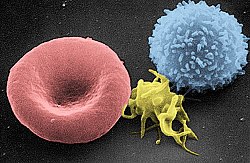
Scanning electron micrograph of a red blood cell (left), a platelet (center), a nd a T lymphocyte (right) රතු රුධිර සෛලයක (වමේ), පට්ටිකා (මැද) සහ (ටී ලිම්ෆොසයිට්) ටී සෛල (දකුණේ) ඉලෙක්ට්රෝන මයික්රොග්රැෆ් පරිලෝකනය කිරීම.
Britain and the European Union struck a Brexit deal today that will define their relationship for decades to come.
After 24 hours of last-minute haggling over fishing quotas, Boris Johnson hailed the agreement as a great treaty” which allowed the UK to take back control of our destiny” and resolve a question that had bedevilled” British politics for decades.
This deal means a new stability and a new certainty in what has sometimes been a difficult and fractious relationship,” he told a Downing Street press conference. Although the arguments with our European friends were sometimes fierce this is, I believe, a good deal for the whole of Europe.”
It is up to us all together as a newly and truly independent nation to realise the immensity of this moment, and to make the most of it.”
The European Commission president, Ursula von der Leyen, described the negotiations as a long and winding road” but said that the final deal was fair and balanced”.
She added: At the end of a successful negotiations journey, I normally feel joy. But today I only feel quiet satisfaction and — frankly speaking — relief.
I know this is a difficult day for some. To our friends in the UK, I want to say: parting is such sweet sorrow. But to use a line from TS Eliot: what we call the beginning is often the end, and to make an end is to make a beginning.
So to all the Europeans, I say: It is time to leave Brexit behind, our future is made in Europe.”
Michel Barnier, the EU’s chief negotiator, added: The clock is no longer ticking. Today is a relief but tinged with sadness when we compare what we had with what lies ahead.
SPONSORED
The deal does not reproduce the rights of membership and on January 1 things will be very different with real changes.”
Mr Barnier outlined regrets, however: I have just two regrets in terms of our societal co-operation. Firstly, the British government decided not to participate in the Erasmus [education] exchange programme.
Secondly, the level of ambition in terms of mobility assistance is not in line with our historical ties, but that again is a choice of the British government.”
Mr Johnson said that the Erasmus student exchange programme — which had seen participants able to study across Europe — would be replaced by a worldwide scheme named after Alan Turing, the Bletchley Park codebreaker. Mr Johnson said it was a tough decision’’ to pull out of the programme, for financial reasons.
The deal comes exactly four and a half years after the European referendum result on June 24, 2016, and just seven days before the transition period ends.
The agreement runs to about 2,000 pages including hundreds of annexes and covers future arrangements for trade, security and fishing as well as future scientific co-operation and regulatory alignment.
British firms will now continue to have tariff and quota free actress to European markets beyond the end of the year. However, ministers are still warning of additional delays at cross-Channel ports as a result of new customs procedures on top of the existing Covid-19 disruption.
The fish-covered tie the prime minister wore to announce the agreement alluded to the difficulties surmounted in reaching itPIPPA FOWLES/NO 10 DOWNING STREET/ANADOLU AGENCY/GETTY IMAGES
Parliament will be recalled on December 30 to ratify the agreement in UK law ahead of December 31. Labour today confirmed that it would vote in favour of the deal when it comes to the Commons.
The last-minute nature of the negotiations means that the European parliament will not get to vote on the deal in advance of December 31 and it will have to be provisionally applied after agreement by EU member states.
Lord Frost, the UK’s lead negotiator, said he was pleased and proud” to have secured an excellent deal with the EU”.
Charles Michel, the president of the European Council, said that while the deal will enter into force by provisional application” over the coming week, MEPs and national governments will scrutinise it early next year.
Micheal Martin, Ireland’s prime minister, described the accord as very welcome” following four long years of negotiations”.
There is no such thing as a ‘good Brexit’ for Ireland,” he said. But compared with the prospect of no-deal the negotiators have worked hard to minimise the damage.”
David Cameron, who called the referendum on leaving the European Union, tweeted: It’s good to end a difficult year with some positive news. The trade deal is very welcome — and a vital step in building a new relationship with the EU as friends, neighbours and partners.”
Nigel Farage, the former UKIP leader, said: The war is over”.
The delay to agreeing the deal was caused by an embarrassing mix-up by the European Commission over the detail of fishing quotas and last-minute wrangling over who got what in the share out of allowable catches.
On fishing, in a breakthrough move that unlocked the deal, the UK has conceded that the EU will only need to give up 25 per cent of its current quota, keeping three quarters of the fish catch by value, phased in over the next five and a half years.
The EU fishing catch in British waters will decline 4.5 per cent annually, meaning small national reductions when shared among European coastal states.
The new treaty will create a binding enforcement and arbitration mechanism to enforce fair competition rules on subsidy control, social and environmental standards called the level playing field”.
Binding arbitration would introduce new tariffs or quotas if either side was found to be undercutting the other with subsidies or lowering standards. The government will stress that the arbitration mechanism frees Britain from EU regulations and institutions such as the European Court of Justice.
The EU will emphasise that sanctions and tariffs will be introduced if the UK embraces the Singapore-on-Thames model” of high subsidies and moves to lower standards to decrease costs for industry.
European leaders ready to move on after trade deal President Macron of France praised the EU for its unity and firmness” which he said had led to the successful conclusion of negotiations.
The agreement with the United Kingdom is essential to protect our citizens, our fishermen, our producers,” he added. We will make sure that this will be the case. Europe is progressing and can look to the future, united, sovereign and strong.”
The widespread unofficial French reaction was conveyed by the front page cartoon of Le Monde, the evening newspaper. It depicted Boris Johnson as a tantrum-throwing baby who is screaming: I’m out of here!” while a weary-looking Europe replies: It’s not too soon”.
French fishermen said it was too early to reach conclusions on the impact of the deal.
In Germany, Katja Leikert, the deputy leader of the chancellor Angela Merkel’s Christian Democratic Union party, said it was a great relief” and singled out Michel Barnier for praise on account of his indefatigability and preservation of unity on the EU side.
She said: The winners in this deal are now the traders, businesspeople and workers on both sides of the English Channel. The other winners are those who continued to believe in the partnership between the British Isles and continental Europe . . . [Merkel’s centre-right] group in the Bundestag sincerely hopes that the solution on the table will prevent the Northern Ireland conflict from flaring up again.
To this end Prime Minister Johnson must do everything that is in his power. And the EU cannot rest on its laurels: it must do everything possible to swiftly establish a comprehensive security partnership that also covers counter-terrorism and military co-operation.”
In Italy, Giuseppe Conte, the Italian prime minister, said: Good news: deal between the EU and the UK has been agreed. Interests and rights of European businesses and citizens guaranteed. The UK will be a central partner and ally for the EU and Italy.”
Enzo Amendola, the Italian minister for European affairs, said: We are happy the deal has been done and that Brexit can become a thing of the past. Let’s now move on.”
Italy has consistantly backed the bargaining position of EU negotiators during Brexit talks while avoiding criticising the UK too openly.
John Bolton, a former national security adviser to President Trump and longstanding supporter of Brexit, said that Britain was Free at last!”
Asked if the deal showed that Brexit can be made to work for the UK and indeed be advantageous, he told The Times: It has always been advantageous for a free people to control their own governance. The details of the deal, which remain to be reviewed, must meet this standard.”
On the long slog to achieve a deal, he added: Independence was worth a lot of effort for the US. Independence for the UK is worth that much as well. Free at last!”
Brexit deal is a huge relief for business Industry leaders have welcomed the 11th-hour deal as a huge relief” for companies struggling through the Covid-19 crisis.
Ministers were urged to smooth the cliff edge,” however, by allowing businesses to adapt to the new economic realities carved out by the agreement. The Brexit breakthrough – just a week before the end of the transition period – boosted the pound and lifted London’s FTSE 250 to a ten-month high.
Retailers welcomed a crucially important step” which they said would avert higher prices on supermarket shelves, but manufacturers warned they would need to go through the accord with a fine tooth comb”.
While Mr Johnson faced calls to grant firms breathing space, directors described the deal as better late than never”. Tony Danker, director-general of the CBI, declared that the UK would begin a bright future” outside the EU on firmer ground” now that the trade deal has been finalised.
This will come as a huge relief to British business at a time when resilience is at an all-time low,” he said. But coming so late in the day it is vital that both sides take instant steps to keep trade moving and services flowing while firms adjust.”
Downing Street was told companies will be able to muster little more than a muted and weary cheer” as they face down the gargantuan task” of adjusting.
It is the responsibility of government to give firms clear, precise and detailed guidance so that they can make the required changes quickly,” said Adam Marshall, director general of the British Chambers of Commerce. Far too many details and procedures have been left, literally, to the last minute.”
Sterling increased as much as one per cent against the dollar, above $1.36, as markets responded to the nullification of a no-deal departure. Shortly after the agreement was confirmed, it was trading up 0.4 per cent, at $1.354. Before the 2016 referendum the pound had been trading at $1.49.
At lunchtime the FTSE 250 closed for Christmas up 1.23 per cent, or 248.92 points, at 20,546.68 – its highest level since February – before Mr Johnson confirmed the deal. London’s mid-cap index has a larger proportion of domestic stocks than the FTSE 100, which rose 0.1 per cent, or 6.36 points, to 6,502.11
The Inspector General of Police (IGP) has ordered SPs, ASPs and OICs of all police stations to provide special security measures to churches in their respective areas today and tomorrow, Police Spokesman DIG Ajith Rohana said.
Christmas will dawn in several hours and therefore the IGP this evening issued a special directive to implement special security arraignments near Catholic churches and other places of worship, he said.
The direct was issued to Superintendents of Police (SPs) in charge of divisions, Assistant Superintendents of Police (ASPs) in charge of police stations and officers-in-charge (OICs) to meet with the priests of the respective churches and discuss the security measures, he said.
DIG Ajith Rohana said the special security measures will be continuously in place throughout today and tomorrow as per the IGP’s instructions and these will be monitored by the Police Headquarters.
He said this special security measures are being implemented because they are expecting Catholic devotees to visit churches and places of worship today and tomorrow due to Christmas Day.
Sri Lanka’s death toll from Covid-19 reached 185 as another person fell victim to the virus, the Department of Government Information said in a media release.
The 60-year-old man had died on admission to the Pimbura Base Hospital on December 20.
He was identified as a resident of Agalawatta area.
The cause of death was recorded as blood infection exacerbated by Covid-19 virus, the release read further.
Sri Lanka’s Covid-19 numbers saw another surge today as 186 more persons were tested positive for the virus.
According to the Department of Government Information newly-identified patients are close contacts of earlier cases linked to the Peliyagoda fish market.
In addition, four arrivals from the United Kingdom (03) and Iran (01) were also tested positive.
Thereby, Sri Lanka registered a total of 592 positive cases within the day.
As per statistics, the total number of Covid-19 infections confirmed in the country to date now stands at 39,231.
Recoveries from the virus meanwhile climbed to 30,568 earlier today, as 686 more patients regained health.
However, 8,478 active cases are still under medical care at selected hospitals and treatment centres located across the island.
Avissawella, Kosgama and Ruwanwella police areas have been declared as isolated areas with immediate effect, Army Commander Lieutenant General Shavendra Silva said.
Meanwhile a decision had been taken to isolate Abhayapura Grama Niladari division and Jinna Nagar area in Trincomalee from 6.00 a.m. this morning (24).
Isolation status of ‘Laksanda Sevana’ in Wellampitiya had been lifted with effect from 6.00 am today.
However, a total of 228 new cases of Covid-19 had been reported from the Colombo District yesterday while 99 of them were identified in Avissawella areas.
Government, it is reported, is thinking of holding PC elections in April next year. It is improbable that either the Covid or the economy would be in a satisfactory situation by April next year to allow elections for an institution that is largely non-essential. Our economy has recorded negative growth for the first two quarters and is just beginning to turn around. Our foreign debts amount to mind-boggling sums. People are clamouring for sustenance as their livelihood and daily-paid jobs are totally disrupted. Covid-19 is spreading and will stay for some more time affecting both health and economy. Sri Lanka may not get a vaccine for at least another year for adequate vaccination of its people. Countries which are mass-producing vaccines need them for their own use or have pledged them to other countries.
Are PC elections so important that the government has
to take an enormous risk and hold them at this juncture ? The general election was held successfully
when the Covid was under better control as that election was crucial for the
management of the country’s affairs. Now the Covid is not under control and the
provincial councils are not essential for the people. In fact people consider
them an encumbrance and a huge burden they are called upon to carry quite
unnecessarily. People voted for this government enmasse giving a 2/3rd
majority, considered impossible in a PR electoral system, hoping that all these
burdens and threats would be removed for ever. They will turn against this
government enmasse if these problems are made to continue unabated.
The Government is already under fire for mismanaging
Covid and allowing the second wave to arise. Some say it was the election campaign
in August that may have caused the second Covid wave. If the Government holds
the PC election while the Covid is spreading chances are high that the
Government may lose control of the pandemic. Our health system would be
overburdened and will not be able to control the death rate at present level of
7 per million. We may have to face a situation similar to what is seen in
India. The economic downturn may become worse due to the spreading Covid and
the impact on the poor people would be worse than in India. Government will
earn an indelible black mark which could pave its downfall.
An election under Covid conditions may cost about Rs
8-10 billion. The general election in August 2020 cost about Rs.10 billion. Can
we afford this while the poor are starving ?
This money could be used for poverty alleviation and food assistance
which is the need of the hour. The poor had already started to get on to the
street to clamour for means of living. And if they see the Government holding
an election, unnecessary in their eyes at this time, they may even start food riots. Even after
the Covid is eventually brought under control its effect on the economy will
remain for several years.
Several
Provinces have existed without their Councils with no breakdown of essential
services to the people for more than one year due to elections not being held.
Though it is argued that not holding elections on time is a denial of
democratic rights not holding elections for redundant institutions which in
fact are a white elephant and a burden on the tax paying poor people could be
considered a blessing in disguise. PCs were created as a solution to the so
called ethnic Tamil problem but the silence of Tamil politicians on the issue
of delay in elections to the Northern PC is deafening to say the least. If they
can do without their PC there cannot be an ethnic problem of enormous magnitude
which necessitated the introduction by
force of the 13th A by India. People of this country did not ask for the 13th
A, it was forced on us by a hegemonic imperialist India partly to pacify Tamil
Nadu politicians, and to prevent other interested global powers getting into
the fray for geopolitical reasons.
The Provincial Councils do not serve any useful
purpose. One cannot see a single project or beneficial outcome that has
resulted from PC activity anywhere in the country. Instead it is another
bureaucratic barrier to the people that increase the red tape, inconvenience,
waste of time, money and energy of the people. Further it has increased the number
of corrupt politicians that people have to bribe to get any official work done.
The devolution of power via these PCs is totally redundant as shown by the
inability of the Northern PC, which was formed for the very purpose of solving
the Tamil problem, to make use of the opportunity to serve the people. The work
done by these PCs could easily be carried out by the GA and the kachcheri
system we had previously without the involvement of politicians. Similarly
administrative power could be devolved to the North through the local
government institutions. The 13th A with its Land and Police powers
hangs over us like a Sword of Damocles which could eventually pave the way for
a separate state. Thus the 13th A and its offspring the provincial
councils could be done away with bringing great benefit to the people including
Tamils.
One may ask what about the Tamil problem. Firstly this
has not been clearly explained. As far as any fair minded person could see
Tamils in Sri Lanka are better off than Tamils in India. In Tamil Nadu for
instance, Tamils cannot represent a case in courts in the Tamil language, leave
alone anywhere else in India, where as Tamils in Sri Lanka could do so anywhere
in the country. Tamils in the North and the East have no issues that other
communities do not have regarding the use of language, education, employment,
economy, household income, culture, sports etc. The house hold income in
Vavuniya is better than that in Kandy, so are the roads. They have excelled in
education. They have no special problems that arise due to their ethnicity. If
Tamils are discriminated they would not
be able to achieve what they have. As for their political rights, these could
easily be addressed at the centre of political power instead of at the
periphery as the country is very small. Tamil representation at the centre
should be made more meaningful particularly on matters related to minorities.
The money saved by the removal of the
PCs and 13th A could
be used for the benefit of everybody. Tamils and other minorities should be
made to develop a sense of belonging in the country of their berth.
Analysts
observe that in addition to China, Sri Lanka
has close relation with Iran and Russia. Russia has always stood by Sri
Lanka, they said. Russia supported Sri Lanka at UNHRC in Geneva and gave military assistance during the war. Iran gave interest
free loans as well as military items. Iran also supplied us with our crude oil requirements.
After
a lapse of a few decades when it was battling with Glastnost, Russia is now
coming back onto the international scene. Russia now plans to become a world power. Russia
started by complaining, at the start of the 74th UN General Assembly
sessions in September 2019, that
Russia’s role in defeating Hitler is ignored in the west. The sole
credit for winning World War II was given to America and Britain, when in
reality, Britain and America moved in only after Russia had weakened Germany in
the east and the Russian army had arrived in Berlin.
Sergey Lavrov, Russia’s foreign minister, wrote, Expunging
from memory the Soviet Union’s role in the defeat of Nazism, belittling the
Soviet contribution to the victory, but also
retrospectively strip our country of its historic role as an architect
and guarantor of the post-war world order”. (‘Russia in Global Affairs’, 20 September 2019)
The Russian
Ambassador to Sri Lanka, Yury Materiy
said in Colombo, that detractors seek to diminish the role of the Soviet
Union, in World War II, and portray it as an aggressor along with Nazi Germany.
There is a pronounced anti-Russia motive. Young people are being told that the
main credit for winning WWII goes, not to the Soviet troops, but to the West,
due to the landing in Normandy. It was the Soviet Union that broke the backbone
of the Third Reich”.
Russia has now established significant
links with other countries. Putin was shown standing next to President Ji at
China’s 70th anniversary celebrations in Beijing. Russia sent a
contingent for the army parade. In the float parade, the second Chinese float
silently recognized the Russian Revolution.
Putin
and North Korea’s Kim met for their first-ever summit in April 2019. Putin,
known for delaying meetings with international guests, was waiting for Kim when
he emerged from his limousine. The two leaders greeted each other warmly,
shaking hands and smiling. The meeting lasted nearly five hours, reported the
media. Russia is also wooing the elites in Africa, said TIME.
Russia
is specifically targeting countries which have a toxic relationship with USA,
observed TIME. Russia is intervening wherever USA is active. Maduro in
Venezuela has survived USA sanctions thanks to Russian cash and political
cover. In Syria Russia rescued Bashar
Assad with a militia campaign that forced the US to abandon hopes of ousting him.
At
least 18 governments have signed military cooperation deals with Russia since 2015, said TIME. Two Russian
warships docked in the Philippines. Philippines is a US treaty ally.
In
2019 India signed a $3 billion deal to lease a third Russian nuclear-powered
submarine. Russia
remains a major supplier of arms to India, despite the fact that the United
States has imposed sanctions on nations buying military hardware from Moscow.
Russia has started
to publicly condemn US policy, specially its policy in the Indian Ocean. during the UN General assembly 74th
session in September 2019, Foreign Minister of Russia , Sergey Lavrov wrote a
piece to ‘Russia in Global Affairs’ magazine, (20 September 2019.) in that piece he said, the [US]
rhetoric on liberalism, democracy and human rights goes hand in hand with policies of inequality, injustice,
selfishness and a belief in their own exceptionalism.‘
The West
focuses on individuals and their rights and freedoms, Lavrov continued. How
does this [fit in with] economic strangulation and overt military threats
against a number of independent countries such as Cuba, Iran, Venezuela, North
Korea or Syria. The reckless Arab Spring gamble destroyed the unique ethnic and
religious mosaic in the Middle East and North Africa. There is also Washington’s open refusal to
implement unanimous UN Security Council resolutions is the settlement of the
Israeli-Palestinian conflict.
Russia also
commented on R2P”. The interventionist ideology of ‘responsibility to
protect’, R2P, which justifies violent ‘humanitarian interventions’ without UN
Security Council approval under the pretext of an imminent threat to the safety
of civilians are part of the same US policy.
This R2P
concept provides for direct reach over the head of legitimate governments.
Obviously, the real purpose is to obtain a tool of interference in the internal
affairs of states bypassing the UN. The introduction of such new concepts is
dangerous. It rejects the principles of international law embodied in the UN
Charter.
Our American
colleagues are persistently trying to mobilize all of their foreign partners to
contain Russia and China. US must accept that the emergence of polycentric
world is irreversible, no matter how hard anyone tries to artificially hold it
back (let alone send it in reverse). Most countries don’t want to be held
hostage to someone else’s geopolitical calculations and are determined to
conduct nationally oriented domestic and foreign policies.
Lavrov went
to Delhi and launched a frontal assault
on US maneuvering in the Indian Ocean region, criticizing the US’s new concept
of ‘Free and Open Indo Pacific’ as one that is designed to contain China.
In Japan, Lavrov addressed a high-powered gathering
that included the Commander of the US-Indo Pacific Command and the Joint Chief
of Staff of the Japan Self-Defence Forces. “Why do you need to call
Asia-Pacific as Indo-Pacific, he asked. The answer is evident – to exclude
China.
The concept
of a “free and open Indo-Pacific region” promoted by the United States
has a destructive purpose. Its true objective is to divide the regional states
into “interest groups”. Terminology should be unifying, not divisive, said
Lavrov.
Lavrov also
commented on the US invention of a ‘rules-based liberal order’ in opposition to
an ‘authoritarian order.’ These ‘rules’ are being invented by the west and
introduced into everyday usage and is being actively implemented. This
‘rules-based order’ is intended to affect the powers of the UN Security
Council. Its purpose is to replace the universally agreed international legal
instruments and usurp the decision-making process.
Russia
has taken care to nurture its relationship with Sri Lanka. The Russian
Ambassador to Sri Lanka, Yury Materiy speaking at Russia Day, 2020 said that
Russia is not only a European but also an Asian country, due to its
geographical position, history, cultural and religious links with the East,
thus becoming a natural bridge between the East and the West. South Asia and
Asia-Pacific region remains one of the key priorities of our foreign policy, he
said.
Sri
Lanka is one of our closest partners and friends in the South Asian region. The
diplomatic relations between the two countries were established on February 19,
1957. Russia has always supported and backed Sri Lanka in all international
fora, particularly in the United Nations Human Rights Council, as well as the
Sri Lankan efforts in UN Peacekeeping Missions.
In
recent years, relations between our countries have developed at a good
pace. The latest example of our ever-growing partnership is the working
visit of the Minister of Foreign Affairs of Russia Sergey Lavrov to Sri Lanka
on January 14, 2020. The Russian Foreign Minister met with the President
Gotabaya Rajapaksa, Prime Minister Mahinda Rajapaksa and Minister for Foreign
Relations Dinesh Gunawardena, concluded Ambassador Materiy.
President
Sirisena had spoken with President Putin at Fifth Summit of Heads of State of
the Conference on Interaction and Confidence Building Measures in Asia in
Dushanbe, Tajikistan in June 2019. He had told Putin about the difficulties in
buying defense equipment from Russia due to a US directive prohibiting his
government from dealing with some Russian enterprises. This prevented Sri Lanka
from using a credit line made available by Russia. Sirisena had sought advice
from President Putin as to how ‘the problem could be tackled’. He told Putin
that that the three MIGs given by Russia in 1972 to fight an insurgency are
still in service. On his return, President
Sirisena spoke warmly about his interactions with Russian President Vladimir
Putin, reported the media.
Vice Admiral
Piyal De Silva, Commander of the Sri Lanka Navy, made an official trip to
Russia in July 2019 at the invitation of Russia. This was the first visit by a
Commander of the Sri Lanka Navy to Russian Navy Headquarters at Saint
Petersburg. Vice Admiral
De Silva called on the Commander in Chief of the Russian Navy. He participated
in a working meeting with high level specialists in military technical
cooperation and was given a detailed tour of a Russian patrol corvette.
During this
visit, representatives from Sri Lanka embassy in Moscow had met with Russian
Navy Headquarters’ International Relations officers to discuss upcoming visits
which aimed at advancing cooperation between Sri Lanka and Russia Naval
educational institutions. The first exchange visit would be between the Naval
& Maritime Academy, Trincomalee, and Admiral Kuznetsov Naval Academy, Saint
Petersburg, the principal education & research centre of the Russian Navy.
Russia
participated in Cormorant Strike 2019”, the combined forces field training
exercise organized by Sri Lanka
army. Sri Lanka is taking steps to
enhance naval cooperation with Russia, announced the Foreign Ministry, on that
occasion. In 2019, Sri Lanka participated at the Main Naval Parade, Russia’s
largest-scale international ceremonial event at sea.
Commander-in-Chief of the Land Forces of the
Russian Federation General Oleg Salyukov participated
in Sri Lanka’s 72nd Independence Day celebrations of 2020. General Oleg
Salyukov thanked the Sri Lankan Government for the invitation and warm welcome
accorded to him. He commended the Army Commander for his bravery during the war
and praised him for being one of the most decorated officers in the history of
the Sri Lankan military. He placed a floral tribute at the war
memorial.
Iran also been helpful to Sri Lanka, not only with military supplies but
also with interest free loans. Iran also supplied us with our crude oil
requirements, said K Godage. Iran is important
and should not be ignored by Sri Lanka.
USA’s interest in Iran started due to its oil. American companies
were drilling Iran’s oil. USA got rid of Iran’s popular ruler, Mossadegh and
replaced him with the awful Shah Reza Pahlavi. The Shah’s secret police SAVAK
was assisted by CIA and Israel’s MOSSAD. The Shah was unpopular and the USA had
to take him away. A theocratic Iranian state, openly hostile towards USA, came
into being.
USA
then started its present day battle with Iran. There was the ‘Iran hostage’
crisis, the ‘Iran Contra’ issue, ‘Iran nuclear programme’ Iran has loomed large
in American politics, despite the distance, observed analysts. Currently, USA has imposed sanctions on Iran.
Iran,
however, has not meekly given in to USA as USA hoped. Iran criticizes USA at
every turn. When you click on Al Jazeera today, there is sure to be an Iranian
authority on the screen, scolding USA. Iran accuses US of being the only country
to have used nuclear weapons, twice in Japan in 1945, and yet of blocking other
countries, especially Iran, from benefiting from a civil nuclear program. Iran
is simultaneously fighting three cold wars, Israel, Saudi Arabia and US,
commented TIME. Iran’s leader
Ayatollah Khamenei, has ‘confounded every US President’ for the last 30 years,
TIME added.
The clash between the two
countries is increasing. In 2019, Iran unveiled a set of anti-American murals
on the walls of the former US embassy. The message in the paintings was of a
violent US, thirsty for war and bent on tightening its grip on the world, but
was in reality, a weakening power.
The murals, mainly painted in
white, red and blue, the colors of the US flag, showed the Great Seal of the
United States with a Star of David in it. Instead of an olive branch, the eagle
is clutching bullets in his talons. Another mural showed the American Global
Hawk drone shot down by Iran.
But things are not going well for
Iran either. 2020 began with the assassination of Iranian top military officer
Soulamani and ended with the killing of Iran’s top nuclear scientist, the
architect behind Iran’s nuclear programme Mohsen Fakhrizadeh-Mahabadi.
In November 2020, Fakhrizadeh was
assassinated outside of Tehran. First, a truck with explosives blew up near the
car carrying Fakhrizadeh. Then, gunmen started firing on Fakhrizadeh’s car. The
immediate speculation was that Israel had carried out the attack. The
coordinated assassination of Fakhrizadeh in Teheran came days after the covert
Israeli-Saudi-US meeting that reportedly took place in Neom. All indications indeed point to Israel. In
2018, Israeli Prime Minister Benjamin Netanyahu identified Fakhrizadeh, as a
target of his administration. Remember that name, Fakhrizadeh, Netanyahu had
said.
Fakhrizadeh was not first Iranian
nuclear scientist to be assassinated. Between 2010 and 2012, four Iranian
nuclear scientists were assassinated, Masoud
Alimohammadi, Majid
Shahriari, Darioush Rezaeinejad, and Mostafa Ahmadi Roshan. Israel, working
with the MEK, was behind the killings said analysts. The Israeli government never denied the
allegations. Mujahedin-e-Khalq
(MEK) is a political party inside Iran, working towards the defeat of the
government.
In Sri Lanka the Iranian embassy
stated that the evidence clearly indicates the involvement of Israel in the
terrorist attack. Israeli authorities have repeatedly named Dr. Fakhrizadeh and
planned to assassinate him several times.
Local analysts have drawn
attention to the significance of Iran in world politics. Asanga Abeygoonasekera
has pointed out that Iran holds a pivotal position in the Middle Eastern
frontier. The recently concluded Abraham
Pact between UAE, Israel and Bahrain backed by Saudi Arabia was intended to
deter Iran.
Sri Lanka should take note of two geopolitical
pressure points, said Asanga. First, the Middle East with its Abraham Pact, to
deter Iran. Second, in the Indo Pacific region to deter China. If sanctions against Iran are relaxed, Iran
would play a much larger economic role in the oil trade. If China is not
contained by the US and its allies, it will continue to influence through its
economic, military and CCP political model”.
(Continued)
One solution
to the problem of a future Indian Ocean war is for Sri Lanka to return to the
policy of Non Alignment. The Non-Aligned
Movement (NAM) started at
Bandung Conference of 1955, during the time of Prime Minister SWRD
Bandaranaike. It became a formal organization in 1961.
Under the
Chairpersonship of Prime Minister Sirimavo Bandaranaike, Sri Lanka helped this
movement reach its zenith in the mid 1970s.
Sri Lanka held a very successful Non-Aligned Summit in Colombo in
1976. After that, Sri Lanka occupied a
respected position in international relations. Sri Lanka was regularly
consulted at the United Nations. Sri Lanka’s opinion was sought at the UN when
issues came up. This is the highest recognition Sri Lanka has ever achieved in
an international arena. Taking into
account our small size this was an extraordinary achievement, said analysts,
proudly. Sri Lanka enjoyed status way above its size.
When
J.R.Jayewardene became President, in 1977
he took Sri Lanka away from Non Alignment towards alignment with USA.
During his time, Sri Lanka started to vote all over the place at the UN,
including support for UK’s Falklands War. The UN stopped consulting Sri Lanka,
but NAM did not forget Sri Lanka.
Former
Diplomat Sarala Fernando recalled the warm reception she received in the
countries she went to. Sarala recalled , in the 1980’s as a young diplomat in
Kenya, so many times I would meet friendship and warm smiles from people of
different levels in society, as Mrs. Bandaranaike was remembered as the world’s
first woman prime minister, and Chair of
the Non Aligned movement. A considerable achievement in those days.
I remember
Vice President Binh, when I presented credentials in Vietnam in the late 1990’s,
having warm words of friendship for Mrs. Sirimavo Bandaranaike and Sri Lanka’s
support during the difficult war time years, continued Sarala.
During my
tenure of office in Geneva (2004-2007), I remember the solidarity of the Asian
Group, and how delegation upon delegation stood with Sri Lanka, at the Human
Rights Council, recalling Sri Lanka’s support extended to them in times of
their need, concluded Sarala.
NAM is still
in existence, though in low profile. NAM
supported Venezuela at the UN Human Rights
Council. It is now a forum of 120
states, not formally aligned with any major power bloc. NAM is second only to the United Nations in size.
It represents two thirds of the world population and could be a formidable
force in the international arena, said analysts.
Non Alignment
does not mean remaining neutral where freedom of a nation is threatened. It means joining non military alliances, to
combat the threat, said Tamara Kunanayagam. ‘Non
alignment’ is not a passive movement. It
has certain principles. It stands for
non-aggression, non intervention, sovereignty, territorial integrity,
cooperation, and multilateralism, added Kunanayagam.
On the other
hand, NAM is no longer the relatively unified block it was and some of its
giants, like India, have been compelled to take sides, admitted analysts. It has, in my
view, faded in power and image and will have to be resuscitated for any future
Indian Ocean war. Resuscitation will not be easy. Non-alignment must be been supported by the whole of South
Asia, for its to be effective and South Asia’s biggest, fattest member, India,
is totally aligned with USA.
However, the
Pohottu government wishes to return to a policy of Non-alignment and to its
earlier status as a pioneer of the Non-Aligned Movement. We should recover our
earlier position in the NAM, said Palitha Kohona. Some senior NAM diplomats still have
sympathetic feelings towards Sri Lanka, he said.
The best
solution for getting out of this dilemma would be to return to Non-Alignment,
said the intelligentsia. National Joint Committee of Sinhala
Organizations said, ‘We believe
that Sri Lanka should follow a foreign policy of Non-alignment.’
However it is
difficult to see how Sri Lanka can practice Non-alignment. The issue of
Non-alignment clashes with Sri Lanka‘s new policy of ‘India First’. Pohottu has
stated that Sri Lanka will not be a strategic security concern for India. Sri
Lanka will not do anything harmful to India’s strategic security interests,
said Pohottu.
Sri Lanka is
the only neighboring country, which does not have a land border with India,
making it more independent that most other SAARC countries, observed analysts.
Sri Lanka is strategically located for India. India’s National Security advisor
Shiv Shankar Menon noted that Sri Lanka is a permanent aircraft carrier in the
Indian Ocean and this can be a threat to India.
Knowledge
of contemporary India is lacking in Sri Lanka, observed K Godage in 2010.
Pathfinder Foundation signed a memorandum with the Indian think tank, Vivekananda
international foundation in 2014 and set up a Center for Indo Lanka Initiatives in 2016. University
of Colombo has a Centre for contemporary Indian Studies
(CCIS), for research on contemporary India, and for those working in the
field of contemporary Indian studies. It has a journal, a library, guest
lecture series and visiting scholars.
Military
wise, Sri Lanka currently has links with India. India–Sri Lanka–Maldives
trilateral maritime security dialogue was held in Colombo in 2020. This was a revival
of the National Security Advisor (NSA) level dialogue among the three
countries, which had began in 2011. The first talks were held in Male in 2011,
Sri Lanka hosted the second and the third was held in New Delhi in 2014. This
was attended by Mauritius and the Seychelles as ‘guest countries’.
The
India–Maldives DOSTI joint Coast Guard exercise has been going on since 1991
and is aimed at strengthening capabilities in the area of search and
rescue operations, combating piracy and armed robbery, damage control, and
casualty evacuation at sea. Sri Lanka
joined in 2012.
India
is planning to fight China, militarily in the Indian Ocean. The Andaman
and Nicobar Islands which are India’s first line of defense on the eastern
flank will now be headed by a commander who will report to C-in-C of the
Eastern Naval Command. India needs to further build on its nuclear-armed submarine
capabilities housed in Andaman and Nicobar Islands, said experts.
India’s first
Maritime Theatre Command (MTC) will be at the
Karwar naval base in Karnataka. Its commander-in-chief will have full
operational control over the western and eastern naval fleets, maritime strike
fighter jets and transport aircraft, two amphibious infantry brigades and coastal
patrol vessels. This will be part of India’s biggest-ever military
restructuring plan to build integrated land-air-sea war-fighting machinery in
India. It will look after the country’s 7,516-km coastline and 1,382 islands as
well as the entire Indian Ocean Region (IOR) and beyond. It will have two
sub-theatres for west and east, said India proudly.
But India
lacks the money to expand its armed forces. The budget allocation for navy, for
instance, is far too small. Therefore, India has joined Australia, Japan, and
the United States to form the Quadrilateral Defence Alliance. India has also
signed agreements with France, South Korea and Singapore.
In the past
India rebuffed attempts by US-allied nations to play a bigger strategic role in
South Asia. This changed because of
China. India refused to invite Australia
to the Malabar exercises in 2018 and 2019. After some hesitation, India invited
Australia to join in the 2020 Malabar exercises.
India has
been given the task of establishing military links with the nearby islands, on
behalf of USA. In 2020, Mauritius with its predominantly ethnic Indian ethnic
population, signed an agreement
with India to build a military facility in the Maldives. India is building a
new jetty and an airport costing USD 90- million, at the two Agalega Islands
off the northeastern coast of Madagascar. These are
about 1,000 kilometers north of Mauritius. There was a small protest movement
against this, but it was squashed.
India also approached
the Seychelles in 2020, with a proposal to build a military facility on
Assumption Island, which will include an airstrip, naval jetty and a garrison
of 500. There was a
strong protest against it and the proposal was abandoned. China however,
has a presence in Seychelles. China has built a new Parliament building and a
Supreme Court in the Seychelles. China has
also
donated two light aircraft and two naval vessels.
India is
unable to play a dominant role in Indian Ocean politics because it lacks
money. In 2020, India has been ranked
131 in the United Nations Development Programme’s (UNDP) Human Development
Index. It has slipped two places from the previous report. In 2019, India’s
ranking was 129.India is behind its neighbors Sri Lanka and China, who are
ranked at 72 and 85.
New Delhi
does not have the economic heft that Beijing has. Beijing has considerably increased
its presence in what India considers to be its own backyard – particularly the
Maldives, Sri Lanka, Nepal, and Bangladesh. China- which did not even
have an embassy in Male till 2011- is now Maldives’ largest lender with a loan
of $3.1 billion.
China is also
leading in military strength. In the last 5 years, the total tonnage of new
warships and auxiliary launched by China exceeds the total tonnage of Indian
Navy since independence. Between the
period 2000-2018, China built more frigates, submarines, corvettes and
destroyers than India, Japan and South Korea combined. In 2020, China already has the world’s
largest Navy with 350 warships and submarines, and plans to reach a force-level
of 420 by the end of this decade.
India is not
interested in winning friends and influencing people. India takes a belligerent
stand with its neighbors. India has engaged in a huge propaganda plan against
Pakistan, which is described below. India
could not possibly have carried this out alone. India lacks both the knowhow
and the money. This venture shows USA involvement, both in money, contacts and
method.
EU
DisinfoLab, based in Brussels, reported in 2020 that it has uncovered a media network, intended to tarnish the
image of Pakistan abroad. “It is the largest network we have
exposed,” the EU DisinfoLab said. The network was designed primarily to
“discredit Pakistan internationally” and influence decision-making at
the UN Human Rights Council and European Parliament.
Asian News
International (ANI) established in 1971, led this activity.
ANI was India’s largest wire service
with more than 100 bureaus in India, South Asia and across the
globe”. Indian news media, especially broadcast media, relied heavily on
content provided by ANI. ANI’s news reports were also published in many
mainstream Indian news outlets and publishers.
EU DisinfoLab
discovered that ANI had also helped to distribute information on fake media
outlets. Its content was reproduced on more than 500 fake media
websites across 95 countries. “There were layers of fake media that would
quote and republish one another.
EU DisinfoLab
said it had never encountered such co-ordination between different stakeholders
to spread disinformation. The uncovered
network was one of the most persistent and complex operations he has seen, said
an expert on disinformation. You need more than a few computers to plan and
sustain such an action,” he said. The efficiency of the operation showed,
sophistication and drive.
The
investigators uncovered 265 pro-Indian sites operating
across 65 countries, and traced them back to a Delhi-based Indian holding
company, the Srivastava Group (SG). The Srivastava operation had begun in late
2005, a few months after the present UNHRC was established. The Srivastava operation
is spread over at least 116 countries and has targeted members of the European
Parliament and the United Nations.
The
disinformation network had a two-pronged strategy, one at Geneva the other at
Brussels. .In Geneva, Srivastava Group had links with at least 10 UN-accredited
NGOs, as well as several other organizations which were used to promote Indian
interests and criticize Pakistan internationally. They were in charge of lobbying and
protesting, and taking the floor at the UNHRC on behalf of accredited organizations.
There were several hundred pro-Indian interventions by the non-accredited NGOs,
which were repeatedly given the floor at the UNHRC on behalf of the accredited organizations,
maligning Pakistan.
On other occasions, NGOs and organizations
which seemingly had nothing to do with Pakistan or India according to their
stated objectives would get the opportunity to speak at the UNHRC and target
Pakistan. NGOs were permitted to raise whichever issue they wish when they are granted
space to speak on the floor. “There are no rules stating that an NGO must
speak to specific issues explained an official.
In Brussels,
the focus was on the Members of the European Parliament. They were taken on
international trips and solicited to write “exclusive” op-eds for
fake outlets like EU Chronicle, which would then be amplified using ANI. This
operation impersonated regular media outlets. It used the letterhead of the
European Parliament, registered websites under avatars with fake phone numbers,
provided fake addresses to the United Nations, and created publishing companies
to print books of the think-tanks they owned.
Demonstrations
in Europe conducted by organizations linked to the Srivastava Group were
covered by ANI, as well as by fake media websites linked to SG. DisinfoLab
found at least 13 instances of ANI re-publishing mostly anti-Pakistan and
sometimes anti-China op-eds originally published on EU Chronicle, one of the
fake news sites linked to SG.Source https://www.bbc.com/news/world-asia-india-55232432 (continued)
A Mini Art Exhibition was co-organized by the Embassy of Sri Lanka together with the Institute of Asian Studies of the Chulalongkorn University in Bangkok, to mark the 65th Anniversary of establishment of diplomatic relations between Thailand and Sri Lanka. The unique ‘Yukyur Arts’ by Ambassador (Rtd) Poldej Worachart displayed places of interest in Sri Lanka. He served as Ambassador of Thailand to Sri Lanka and Maldives, and the Yukyur arts initiated by him presents delicate work of circular drawings needing greater levels of imagination, concentration and creativity. The Hon, Minister of Culture of Thailand and South Asian Diplomats joined the opening of the mini exhibition held at the Chulalongkorn University.
Jet2 and TUI have cancelled a further raft of holidays as countries across Europe and the world close their borders to British holidaymakers.
Sri Lanka became the latest country to announce a ban on UK flights this morning due to fears of a new strain of coronavirus spreading across Britain.
TUI has extended its cancellation of all departures from Luton up to 2 January, and both TUI and Jet2 have cancelled all holidays to the Canary Islands up to and including 5 January following Spain’s ban on all UK tourists.
The UK Foreign Office said the Spanish government had made it clear that the ban included the Canary islands.
Jet2holidays has also cancelled all holidays to Fuerteventura up to and including 7 February.
In addition, Jet2’s departures to Antalya in Turkey and the Portuguese island of Madeira have been cancelled up to and including 5 January. TUI has cancelled Madeira departures only up to 31 December but it is giving customers travelling in January the option to amend their holidays for free. The offer also applies to those due to travel to the Canaries from 6 to 31 January.
After evaluating all technical reports relating to the ANTI-COVID-19 syrup introduced by Ayurvedic practitioner Dhammika Bandara from Kegalle, the Pharmacological Unit of the Sri Lanka Ayurveda Department had approved the syrup as a local medicine, Indigenous Medicine Promotion, Rural & Ayurveda Hospital Development & Community Health Secretary Ms A.K.W.W.M.N.K. Weerasekara said.
Addressing the media she said the syrup was registered as a local medicine following approval of the Ayurvedic Commissioner.
Though the syrup was registered at the Ayurvedic
Department the suitability for coronavirus will be determined after clinical tests,ms Weerasekara said.
She said an expert committee was appointed in this regard to conduct such clinical trials in the future. Later, we would be able to decide whether this syrup is suitable for COVID-19 virus, Ms Weerasekara added.
Suitability for coronavirus will be determined after clinical tests. (CHATURANGA SAMARAWICKRAMA)
Four passengers were found COVID-19 positive when Rapid Antigen tests performed on them while travelling in passenger buses at Danovita on the Colombo-Kandy Road yesterday, Mirigama Public Health Inspector (PHI) Nishantha Somaratne said today.
He said 250 passengers were tested on Tuesday, and four of them were found COVID-19 positive.
They are residents of Dodangaslanda, Giriulla, Beruwala and Nelundeniya.
The buses in which the infected had travelled were disinfected and the infected were taken to hospital.(PushpakumaraMallawaarachchi)
Chaturanga Samarawickrama Courtesy The Daily Mirror
As the third school term ends today for this year, the Education Ministry said all students should be promoted to the next class for the first term of 2021.
They said all textbooks relevant to the promoted classes should be provided.
The Education Ministry has informed all Provincial Chief Secretaries, Provincial Education Secretaries, Provincial Education Directors, Zonal Education Directors and Principals of schools.
If any school that does not cover the syllabus for the year 2020, have been instructed to take necessary steps to cover those subjects using a suitable programme at the school level during the first two months of the new term of 2021.
Circulars in this regard will be sent by the Ministry in future.
Meanwhile, all schools including from grades 1-5 will begin their first term on January 11, 2021.
However, schools in the Colombo, Gampaha and Kalutara districts of the Western Province and schools in isolated police areas will not be opened.
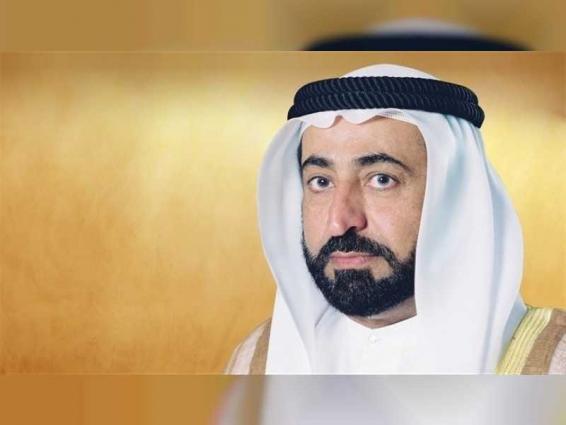
SHARJAH, (UrduPoint / Pakistan Point News / WAM – 03rd Apr, 2020) H.H. Dr. Sheikh Sultan bin Muhammad Al Qasimi, Supreme Council Member and Ruler of Sharjah, directed the Department of Islamic Affairs in Sharjah not to bury any of the victims of the new coronavirus disease, COVID- 19, in Al Saja’a area in Sharjah, and to confirm that none of the victims had been buried in the mentioned area or other areas in Sharjah.
The directives of H.H. refute what a tendentious video clip embedding that burial of COVID- 19 victims are taking place in the said area.
The SharjahGovernmentMedia Bureau,SGMB, called on the public to be accurate and to take information from their official sources only, and not to circulate rumours, and avoid spreading baseless news, pointing out that the relevant official authorities take their role in accordance with the law against the people who published such videos.
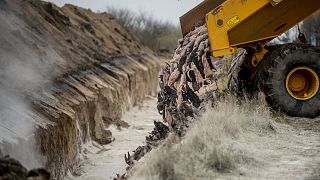
Denmark will dig up millions of mink culled over fears of a coronavirus mutation to avoid a future environmental disaster, the Danish government confirmed.
Some four million mink will be exhumed from mass graves and incinerated to prevent potentially hazardous pollution.
The Social Democrat minority government reached an agreement with other parties in the Danish parliament to have the mink exhumed and disposed of at local waste incinerators, ministry officials confirmed in a statement on Sunday.
It is set to take place in May when the potential risk of COVID-19 infection from the dead animals will have passed.
“Six months sounds like a long time, and I would have liked to have seen it go even faster, but it is clearly the safest solution, as we avoid staff being exposed to infection during excavation and at the same time avoid the dead and infected mink being transported over greater distances,” Rasmus Prehn, Minister of Food, Agriculture, and Fisheries, said in the statement released by the ministry.
The move comes as the bodies of the buried animals have begun to resurface because of the gases produced as they decay.SPONSORED CONTENT”Silence, serenity and peace”: Sir Bryn Terfel’s Christmas messageThe Metropolitan Opera in New York’s series of pay per view online concerts does Christmas well with concerts from operatic stars. It’s online format is a solution they found to geMusica, in partnership with Rolex
In November, the Danish government controversially ordered the slaughter of the country’s entire mink population after a mutated strain of coronavirus was detected, decimating the EU’s largest fur industry overnight.
Denmark breeds mink for their fur with Danish pelts prized around the world for their quality. The industry employs 6,000 Danes and is worth over half a billion euros in exports annually.
Over 15.4 million have been killed so far since November 4.
Samples of the mutation taken from one farm cluster were found to be resistant to antibodies, sparking fears that vaccines would be ineffective against it.
Following the cull, four million of the dead animals were hastily buried in trenches on military land near Holstebro and Karup in western Denmark.
The choice of burial sites near a bathing lake and a drinking water source has caused alarm with local residents raising concerns over contamination.
“The Danish Environmental Protection Agency is constantly monitoring the situation, and the agency is already conducting investigations to initiate remedial measures so that damage to the environment and groundwater is minimised,” officials said.
The first transmission of the coronavirus mutation was detected in farmworkers on mink farms in the Netherlands in April. Since then, cases of infections from minks to humans have been reported at farms in Denmark, France, Italy, Spain, Sweden, Poland, and Lithuania.
The cull in Denmark caused a polemic after a government minister admitted there was no legal basis for the action.
Agriculture minister Mogens Jensen stood down on November 18 after making the admission while the opposition also called for the resignation of prime minister Mette Frederiksen.
Following a visit to a family-run mink farm in Kolding in central Denmark, which was devastated by the cull, Frederiksen made a tearful apology for her government’s handling of the crisis.
The Danish parliament on Monday passed a bill that provided a legal basis for future culls, a temporary ban on the reintroduction of mink to the country as well as compensation for farmers who have lost their herds and livelihoods.
In a tweet posted following the vote, Pegn said: “The Danish mink breeders have sacrificed their life’s work for the common good. We owe them a big thank you. Thus, it is very gratifying that L77 has now been adopted so that there can be clarity about bonuses and replacements!”
The forensic doctors at the Karapitiya Teaching Hospital in Galle stated that if the body of the patient who died due to COVID that is being kept at the morgue is not cremated, they will withdraw from their duties.
Forwarding a letter to the Police Inspector at the Galle Headquarters, Health Services Director General Asela Gunawardena stated that the body of the patient in question must be cremated as per the Gazette Notification issued previously.
The deceased was an 84-year-old male resident of Deddugoda, Galle who died on 19 December.
However, considering the problems that arose in this regard, the Galle Additional Magistrate recently ordered that the body be kept at the Karapitiya Hospital morgue until a decision is taken by the Government Expert Committee.
The police were informed to seek the advice of the Director-General of Health Services in this regard.
Accordingly, Health Services Director General informed the Police Inspector at the Galle Headquarters in writing today.
As per the Gazette Notification issued by the Government on 11 April, the body of the COVID infected patient must be cremated at a temperature of 800 to 1200 degrees Celsius for a period of 45 minutes for complete combustion.
Meanwhile, the expert committee appointed by the government to inquire into the proposal to bury the bodies of those who died of corona infection had a discussion with the Minister of Health and other authorities today (23).
The Ministry of Health and the Expert Committee have exchanged views and the final report is to be prepared accordingly.
Director of Operations of the Airport and Aviation Services of Sri Lanka, Shehan Sumanasekara stated that the national carrier of Maldives will commence scheduled flights to Sri Lanka from today (23).
Accordingly, scheduled flights operated by Air Maldives will fly into Mattala Rajapaksa International Airport (MRIA).
According to Sumanasekara, the project is part of the project to develop MRIA under ‘an exotic tourism destination’.
Speaking further he added that they are in the process of lining up other airlines to commence scheduled flights in the same manner in the near future.
Despite UK government assurance that PCR tests can be adapted rapidly to respond to the new variant, Sri Lankan academics are scaremongering and spreading rumours that the Genetic variants of the new Covid virus strain from UK cannot be detected by PCR tests
UK Government says that Labs have been issued with guidance to adapt processes to ensure that PCR tests can detect this variant.
However, Professor Neelika Malavige of the Department of Microbiology at the University of Sri Jayewardenepura stated some genetic variants of the new Covid virus strain identified in the UK cannot be detected by PCR tests.
This was commenting to the Hiru news team regarding the virus variant.
The virus has now spread to several countries, including Australia, Denmark, the Netherlands and Italy.
As a result, more than 40 countries have taken steps to suspend flights to Britain, according to foreign media reports.
COVID-19 (SARS-CoV-2): information about the new virus variant (Courtesy UK Gov website)
Data from Whole Genome Sequencing, epidemiology and modelling suggest the new variant ‘VUI – 202012/01’ (the first Variant Under Investigation in December 2020) transmits more easily than other variants.
We currently have no evidence that the variant is more likely to cause severe disease or mortality – but we are continuing investigations to understand this better.
The way to control this virus is the same, whatever the variant. It will not spread if we avoid close contact with others. Wash your hands, wear a mask, keep your distance from others, and reduce your social contacts.
Is there any evidence that the variant is more serious?
We currently have no evidence that this variant causes more severe disease or higher mortality – but we continue to study cases to understand this better. We know that mortality is a lagging indicator and we will need to continually monitor this over the coming weeks.
Why is this more transmissible?
We know that mutations in the spike protein, the part of the virus that makes it infectious, can change how the virus interacts with human cells. However, we do not yet know the mechanism for this increase in transmission.
The evidence shows that infection rates in geographical areas where this particular variant has been circulating have increased faster than expected, and the modelling evidence has demonstrated that this variant has a higher transmission rate than other variants in current circulation.
How long has this variant been in circulation?
All viruses mutate over time and new variants emerge regularly.
Backwards tracing using the genetic evidence suggests this variant emerged in September 2020 and then circulated at very low levels in the population until mid-November.
The increase in cases linked to the new variant first came to light in late November when PHE was investigating why infection rates in Kent were not falling despite national restrictions. We then discovered a cluster linked to this variant spreading rapidly into London and Essex.
Evidence of increased transmissibility was provided to NERVTAG and ministers on December 18.
Is this variant resistant to the Pfizer vaccine?
There is currently no evidence to suggest that the Pfizer vaccine would not protect people against the new variant.
Further laboratory work is currently being undertaken as a priority to understand this.
How widespread is the variant geographically?
144 Lower Tier Local Authorities have identified at least 1 case genomically, although the vast majority of cases identified are in London, the South East and the East of England.
Can tests detect this new variant?
Labs have been issued with guidance to adapt processes to ensure that PCR tests can detect this variant.
PCR tests can be adapted rapidly to respond to the new variant.
As a small child, Shreen Abdul Saroor remembers getting up before dawn with her father to spy on the masses of migratory birds that would visit her island.
The birds were on their way down the Central Asian flyway — a migration path that crosses 30 countries from Siberia to the Indian Ocean.
“We would hide somewhere and … we don’t make any noise,” Ms Saroor recalls.
Up to a million birds stop at Mannar Island, off the north-west coast of Sri Lanka, to feed during the winter.
The Vankalai Bird Sanctuary on the southern tip of the island is protected by the Sri Lankan government and has been internationally recognised under the Ramsar Convention for its importance to both local and migratory birds.
Ms Saroor also remembers climbing the swollen trunks and gnarled branches of the baobab trees — trees synonymous with Africa, Madagascar and Australia’s Kimberley, but also found incongruously on her tiny island.
“Even though I fondly remember these baobab trees, one thing that I really remember is how … [members of the militant separatist group the Tamil Tigers] put the mutilated heads of the Indian peacekeeping forces on those trees.”
A baobab tree, native to northern Africa brought to Mannar Island by Arab traders.(Supplied: Renuka Senanayake)
The Liberation Tigers of Tamil Eelam fought a 30-year civil war with majority Sinhalese Sri Lankan military, in an attempt to create an independent Tamil Hindi homeland in the north and east of the country.
Ms Saroor had already left the island to study in Colombo in 1990 when the Tamil Tigers forced her remaining family off Mannar Island, along with all the other Muslim residents.
“Everybody overnight became refugees,” she says.
Since the war ended in 2009,many displaced Mannar Islanders have returnedto re-establish themselves in fishing and farming communities. But the trauma still lingers and there are tensions over land.
Against this backdrop, an Australian company has a plan to mine Mannar’s sands.
There are fears for the island’s fragile ecology, agriculture and fishing areas — and islanders are worried they could be displaced all over again.
Company’s drilling triples estimate of island’s minerals
Mannar is the biggest island at the base of a narrow chain of limestone shoals known as Rama Setu or Adam’s Bridge, which stretches 48 kilometres north-west to join India.
The island is 26km long by 8km wide and has rich deposits of the mineral ilmenite in its sand.
Ilmenite is the main source of titanium dioxide, a valuable white pigment used in things like paints, ink, plastics and cosmetics.
Adam’s Bridge is steeped in mythology, but scientists say the geological forces that created it are also responsible for its rich mineral deposits.(Supplied: NASA)
In 2018,Perth-based company Titanium Sands advised the Australian Securities Exchange (ASX) it entered an agreement with Srinel Holdings Ltd to explore the extent of the island’s ilmenite reserves.
In May this year, the company announced their exploratory drilling had tripled the previous estimate — to a total of just under 265 million tonnes.
Managing director of Titanium Sands, James Searle, says the company is looking to mine an area of the island that is 2km wide and about 8km long.
“On an annualised basis that’s probably … in the region of between 10 and 16 hectares.”
But some Sri Lankan scientists and environmentalists say they have been inadequately informed about the project.
‘The machines are moving in’
Ms Saroor’s younger brother is one of those who have made it back to the island, where he has a coconut estate.
“The first time I heard about this Titanium Sands mining is from him,” Ms Saroor says.
“He called me frantically and said there are machines moving in and out of those areas.”
Companies that Titanium Sands acquired started preliminary assessment with small-scale drilling on the island in 2015.
Throughout the totality of their study, which included a scoping study completed this year, the company drilled more than 3,000 exploratory holes with the deepest going down to 12 metres. The majority were between 1 and 3 metres.
According to Dr Searle, there has been no drilling in built-up areas of the island.
“The population on the island is largely concentrated in a town down the landward end of the island, called Mannar Town. There are other coastal villages, other settlements around the island,” he says.
“Our exploration work is only being undertaken on areas where there is no habitation and where there is no active agriculture.”
Mannar Island is an important ground for an abundance of bird species.(Supplied: Renuka Senanayake)
It’s some of those undeveloped areas of Mannar Island that concern ecologist Sampath Seneviratne, who studies Mannar’s birds.
“Flamingos must be the most charismatic and sought-after in terms of beauty,” he says. “[But] spoon-billed sand piper, one of the rarest birds in the world and one of the most iconic species that are on the verge of extinction right now, has been recorded in Mannar.
“These birds require highly productive places to feed during their migration and during their winter stopover. So if the productivity drops, they can’t use Mannar, they have to go [to] other places.”
According to Dr Seneviratne, a public notice is usually issued when companies are given permission for mining exploration in Sri Lanka.
But he and his colleague at the Wildlife Protection Society only found out from a friend in Australia about the drilling, and they were surprised that local environmental groups knew nothing of the project.
“It was a big shocker, because how did people like us working in [Mannar] not know this?” he asks.
Mannar is world renowned for its bird life.(Supplied: Renuka Senanayake)
Company accused of illegal conduct by Mines Bureau
Earlier this year in June, Titanium Sands was accused of illegal conduct in local Sri Lankan media reports.
The Sri Lankan Geological Surveys and Mines Bureau (GSMB) — the government body responsible for issuing mining and exploration licenses in Sri Lanka — reportedly said the company’s exploration was unlawful.
The GSMB told local media that under Sri Lankan law, Titanium Sands couldn’t legally acquire the rights to explore Mannar by purchasing the company (Srinel Holdings Ltd) that previously held the licenses.
But Dr Searles says the GSMB was “incorrect” and was responding to misleading social media posts.
“The legal advice and the legal structures are in total compliance with the Sri Lankan regulations,” he says.
The ABC contacted the GSMB but did not receive a response.
In November, a committee was put together by the Sri Lankan Ministry of Industry to look into the claims of illegal drilling.
Titanium Sands presented its case to the Ministry of Industry, but Dr Searle says he hasn’t heard anything further.
“I reiterate again that the licenses are held in a fashion which is in total compliance with the legal requirements in Sri Lanka
At the time Science Friction went to air there was no information on the company website about the committee’s enquiries into the project.
Asked why, Dr Searle responded:”We received enquiries on all manner of things and we don’t consider it to be significant.”
The company has since added a statement that says it “is not being investigated” although they have “provided information to the committee” which they say confirms the validity of their licences.
It also stated that the company has “no intention of pursuing a project that potentially impacts a Ramsar-designated area”.
Mannar ‘promoted as a promising resource’
Environmental scientist and senior director of the Centre for Environmental Justice, Hemantha Withanage, says he is concerned he hasn’t heard anything about the committee’s enquiries since the Sri Lankan federal election in August.
But, he says, the picture Titanium Sands is painting for their shareholders is not all it seems to be.
“On their website, they’re promoting Mannar Titanium Sands as a promising resource,” Mr Withanage says.
“How can somebody promote like that, without going through the environmental impact assessment process and getting the government approval?”
“We are very, very concerned about what this company is going to do in Sri Lanka,” he says.
Locals say they are worried about the impact the mine will have on the environment.(Supplied: Renuka Senanayake)
But an environmental impact assessment and public consultation are the next steps in the process, according to Dr Searle.
“That would eventually [lead to], we hope, granting of mining licences and ultimately development of the project,” he says.
Mining would ‘dramatically transform’ the ecosystem
Mineral sands mining is considered to have a fairly low impact on the environment compared to some other forms of mining.
The process doesn’t involve chemical separation of minerals such as in gold mining, or digging vast open-cut pits such as with coal.
Titanium Sands published material online showing the location of their resources including exploratory drill holes near the coast.
The location of exploratory drilling done on Mannar in 2016 -2017, showing some of the mineral reserves (shaded brown).(Supplied: Titanium Sands)
Daniel Franks, program leader of the development minerals strategic program at the University of Queensland, says Titanium Sands’ scoping study, released to the ASX in June this year, reveals the size of the planned mine is extensive and includes areas just a few metres from the beach.
If the operation was based in Australia, the company would be unlikely to be granted permission to mine those areas, says Professor Franks, who is not involved in the project.
“Mining to such a wide extent would dramatically transform the ecosystem. It would also limit the land uses that the community already has for the island,” he says.
“If it was in Australia, which is the home company of the project partners, it would face some pretty steep obstacles to regulatory approval.”
Mining near active beaches can disturb coastal morphology and removing vegetation can leave sand dunes vulnerable to erosion.
Managing director Dr Searle stresses that his company may not end up being able to mine all the resources they’ve identified, should the mine go ahead.
He says the company doesn’t intend to mine near beaches on Mannar, and that there is no economic incentive for the company to do this.
“Those areas along the shoreline are of no interest to us whatsoever because we consider them to be environmentally sensitive. We are much more interested in the interior, one to three kilometres away from the nearest coastline.”
But Professor Franks says the company’s assertion that it has no plans to mine near the beach “appears contrary to the scoping study released to the ASX” and that an update to the ASX might be in order.
Titanium Sands insist they don’t plan to mine near beaches.(Supplied: Renuka Senanayake)
Ms Saroor is also afraid the mine could damage the island’s groundwater.
“Mannar gets the smallest amount of the rain in the whole of Sri Lanka. So we totally depend on groundwater,” she says.
Professor Franks says the extent to which a sand mine could disturb the groundwater on Mannar depends on how deep Titanium Sands digs into the ground.
“I think there is a potential to impact groundwater systems. We’ve seen that in Australia where there’s indurated layers in the sand, that are impermeable and that can hold water,” he says.
“But I think the bigger impact is just the surface disturbance that’s going to happen across the island.”
Dr Searle, however, says the project will not affect groundwater or disturb beach areas.
“If it was to affect the groundwater, we wouldn’t be doing it,” he says.
“How you can make a statement that [this type of operation] would not be permitted in Australia is farcical.
“This sort of operation … has occurred over the last 50 to 60 years [in Australia] with an excellent environmental record.”
‘The people on the ground have the right to say no’
Rather than displacing people, Dr Searle says the mine will create between 200 and 600 jobs and that 95 per cent of those employed would be Sri Lankan people.
But Ms Saroor, who is now an award-winning human rights activist, is concerned about the impact on a community recovering from war.
She believes Titanium Sands should not add to the trauma of a community that is still rebuilding.
“At the end of the day, they are investing in Sri Lanka to make profit,” she says.
“So, my message would be to them to make sure not to profit out of a community that has been suffering in the last 30 years of the war.
“Think about the impact not only on the environment, but also on the people, and [then] make their decision.”
Mr Withanage of the Environmental Justice Centre says he could support the project, if it can be proven to be done in a way that benefits the local community and earns its social licence.
He says the final decision on whether the mine goes ahead needs to rest with the Mannar people.
“It’s not the Australian citizens who are going to make that decision.
“It is the Sri Lankan citizens going to that place, Sri Lankan government agencies, Sri Lankan courts… So they have to make that information available to Sri Lankans first.
“Australians are just going to buy the shares. The people on the ground have the right to say no.”