People leaving the Western Province limits will be referred to random Rapid Antigen Tests starting from today (18), says the Commander of Army, Lieutenant General Shavendra Silva.
Testing will be carried out at four locations – Salawa in Kosgama, Danowita in Mirigama, Kochchikade in Negombo, and Aluthgama on Galle Road.
As the festive season is nearing, the authorities have urged the members of the public restrict moving out of the Western Province in order to prevent further spread of novel coronavirus.
His Eminence Malcolm Cardinal Ranjith meanwhile appealed to the Catholic devotees to give priority to religious observances during Christmas and to limit their celebrations to immediate family members.
The Justice Ministry, the land ministry, the AG’s department & the Cabinet are either drafting new laws, amending existing laws, appointing committees or with one nod eliminating existing statutory laws. This is a new Constitutional procedure even when the constitution does not allow court to eliminate statutes. How far each are working with each other or consulting legal experts in the areas amendments are being proposed is a question to be answered. We have 3 scenarios that warrant the attention of the decision makers and the general public as they all deal with the core sovereign component of land and necessitates public debate and discussion.
Cabinet nod to annul caveat notices– Cabinet in a single day completely repealed Sections 32, 33, 34 and 36 of the Registration of Documents Ordinance 23 of 1927. These are thestatutory provisions relating to caveats
Caveats are registered by the registrars according to the law given in section 36 [and not according to the way cabinet had stated] from the Ordinance which grants power to the registrar to adjudicate the rights of the person presenting the caveat before registering. They have no authority under the law to register caveats on any land. Not only has the Registrar the power to refuse registration of caveats, the law is extended for the real owner to obtain damages for registering unlawful” caveats on lands according to section 34.
How can cabinet decisions repeal statutory provisions in law? Is it correct to do so and what are the repercussions in doing so?
There is no problem for sellers and banks as owners know how to remove the caveats under the provisions given in the Registration of Documents Ordinance
This new situation will create an ideal situation to steal land specially from those living abroad. These citizens have only the solace of placing a caveat to safeguard their land.
Law of Caveat essential.
In other nations law of caveats have been extended to save owners from fraudsters. Registrar sends a message to the owner’s telephone if anyone tries to register any document in the land registry. These modern methods should be adopted in Sri Lanka.
A caveat is a safeguard made available to a land owner to protect his/her land from being sold without his/her permission.
Only the owner can put a caveat.
2. Amending Register of Documentation Ordinance but not amending Section 7
Are we conniving with fraudsters?
The Registrar as per Section 33 of the Documents Ordinance 23 of 1927 is bound to adjudicate only land deeds that has the owner’s interest.
Nevertheless, anything can be done by bribery and this is the area that any new laws being introduced has to address – not to completely annul a safeguard made available to original land owners seeking to protect their land.
Removal of the caveat is removing the safeguard owners have to protect their land.
Thus the removal of the caveat completely is a bad and wrong decision.
Didn’t the Minister see the important provisions that require immediate attention —
What is the point in amending the Register of Documentation Ordinance but keeping Section 7?
What is Section 7?
Section 7 of the Register of Documentation Ordinance does not make the Registrar responsible for registering invalid deeds. He has no authority to refuse deeds or to check the identity of owners. This means the registrar can accept even forged deeds and he is not responsible for accepting forged deeds.
3. Shortcomings in Notaries Ordinance
As per Notary Ordinance all illegible signatures are valid and once the seal is affixed under section 33 of the Notaries Ordinance all deeds are valid even if the NOTARY DID NOT OBSERVE THE LAWS TO IDENTIFY THE PERSON WHO SIGNED THE DEED.
These are the provisions that are required to be repealed.
Not the only safeguard the poor man’s caveat.
Ex of an actual victim – a Bank Manger.
The bank manager wished to buy a land. The Broker and the notary were looking after his interest. The owner of the land was abroad. A forged deed was presented to the bank manager selling the land at Nugegoda for Rs4 million and Rs160,000 stamp duty with a fee of Rs80,000. The bank manager was unaware that the land he bought was not from the original owner.
The forged deed was duly registered as the registrar was not responsible and the notary went scot-free as under section 33 all deeds are valid.
If the overseas owner had registered a caveat, the notary could have known and the person abroad would have been informed that the land was being sold without the knowledge of the owner. The buyer eventually lost his money and the house – part of it was bank loan which he has to pay back monthly. These are scenarios that can arise if immediate measures are not taken.
Now connect the situation – notary is not bound to identify original owner, but his/her seal is valid, the registrar is not responsible for accepting forged deeds and the safeguard provision for the land owner (caveat) is removed.
What is the scenario Sri Lanka is creating for the land owners of Sri Lanka?
Shouldn’t the Ministries, the lawyers and others tasked to look at where the malady lies come up with answers and not create more problems?
Shouldn’t the caveat remain but ensure there is proper mechanism to ensure no one else but the real land owner can put a caveat.
Shouldn’t the registrar be made responsible & accountable for accepting forged deeds & ensure he accepts only original deeds?
Shouldn’t the notary be made to have a means of identification system before placing his/her seal?
The Ministries, Ministers, lawyers and public servants who are all living off tax payers money must work towards facilitating the citizen and not uprooting the citizen of his ownership of land.
Attorney General, the Justice Ministry & BASL —Today Bim Saviya law is funded by foreign experts to govern the e-register. According to this law even the rich victims affected by fraud cannot go to court if the land registry registers fraudulent deeds. They cannot get back the lands.
The Justice Ministry must protect the land of the nation that belongs to both the State & the private individuals. The Justice ministry can enter history books proposing to repeal Act 21 of 1998 and do away with the Bim Saviy and continue with a modernized deed system.
The e-register allows to register forged deeds in one hour in the future with no caveats. Imagine what this means to the land owners. Registrar and the Notary will not be responsible as said the laws protect them.
We cannot watch a legal land grab by fraudsters taking place knowing that the Government has all the powers to stop it and the data and information required to do so.
This is one of the most
favourite quotations of the celebrated 19th century Russian novelist Leo
Tolstoy.
It means that for as long as humans continue to be the ruthless
destroyer of non – humans, the former will never know peace or harmony.
For as long as humans massacre animals, they will also kill each other as we
have seen right throughout human history. Indeed, one who sows the seeds of murder
and pain on another living being cannot be expected to reap joy and love in
their own private lives.
There is no real
difference in violence. If you are violent to kill an animal then you are
likely to be violent enough to kill a human. Thoughtless killing of
animals produces a mindset that can easily generate violence against
fellow humans setting the stage for battlefields and violent
conflicts on a mass level .
Man made disasters such as
wars, genocides and holocausts, and natural disasters in the form of pandemics
e.g. COVID -19, earthquakes, massive fires, cyclones, typhoons, tsunamis, and
huge floods are the outcomes of the evil perpetrated on innocent animals by the
tyranny of humans.
The Buddha condemned animal
slaughter and animal sacrifice and in the Mahayana Sutras the Buddha is quoted
condemning even meat eating e.g. Lankavatara and Surangama Sutras
The Buddha said in respect to
the duties of an ideal ruler (Cakkavati Sihanada Sutta) as follows:
” the Chakkavati
King (Righteous King) will give protection, shelter and ward both to the
different classes of human beings and also to birds and beasts”
Brahmana-dhammika Sutta
An important discourse of the Buddha on killing of cattle can be
found in one of the most ancient Buddhist texts, the Sutta Nipata. Here in
a discourse on the ethical conduct fit for a Brahmin (Brahmana-dhammika
Sutta), the Buddha speaks glowingly of ancient Brahmins who had renounced the
taking of life and never allowed their religious rites to be dishonoured by the
killing of animals. But unfortunately corruption set in and they started
the practice of animal sacrifice. When the knife was laid on the neck of
cattle, the Devas themselves led by Indra cried out ” Against the Dharma
is all this ” while fell the sword upon the cows.
The Devas cried out in horror of that crime of ingratitude and
insensitivity perpetrated on an animal that was to humans such a faithful
worker, such a sustainer of life. “Neither
with their hoofs nor horns do cows cause harm to anyone, gentle they are as
sheep, yielding us pails of milk”
The land became cursed. The
awesome power of nature and karmic retribution followed soon after.
The Buddha further points
out that in former times only three
ills were found
desire, hunger and decay
but due to the killing of
cattle as part of animal sacrifice
ninety – eight diseases were
brought on to place the lives of
humans in great jeopardy.
Sri Lanka’s former
cricket captains Mahela Jayawardena and Kumar Sangakkara set up a crab shop at
a food court opened at the Old Dutch Hospital in the Fort. The crab shop was
opened by Economic Development Minister Basil Rajapaksa who is seen admiring
the giant crabs. Pic by Indika Handuwala
Some advice to
Investors contemplating establishing new slaughterhouses and meat markets in
Sri Lanka
Build
your wealth on right living and not through causing injury or destruction to
the lives of innocent animals.
Remember that kill and eat is not a Buddhist tenet.
Snuffing out the life of a defenseless animal is totally contrary to Buddhist
precepts
Compassion for living beings is part of Sri Lanka’s Buddhist Sinhala Heritage.
There is an entirely new field called ‘Ethical or Social Conscious Investment’
which encourages investors to choose to invest in activities that are morally
and ethically defensible, are run ethically, provide social benefits and are
sensitive to the natural environment and the living creatures that inhabit
it.
The story with a photo in the ‘Sunday Times’ (Dec. 4, 2011) entitled ‘ Crabs
for Grabs’ shows the insensitivity of the onlookers to the pain and
suffering of animals.
These crabs are not there for decoration. Very soon the legs of these live
crabs can be expected to be ripped apart and both the legs and the torso thrown
into the boiling pot.
Recent studies show that both Lobsters and crabs i.e. crustaceans, feel pain
and stress. These findings add to growing evidence that virtually all animals
can suffer.
In the Vyagghapajja-Sutta (AN) the Buddha gave
some sensible advice. The Buddha said that before one acts, one should
consider the possible effects or consequences thus: whether the action will be
harmful to oneself or others. If it is damaging to oneself, others or both,
such an action should be abandoned. Conversely, if it is beneficial to oneself
and others, it ought to be committed.
In Buddhist phraseology one’s “neighbour or others’ includes other living
beings ( Siyalu Sathwayo). The moral community in Buddhism encompasses all
living beings.
The Buddha’s advice on Right Livelihood
Significance of the Vyagghapajja-Sutta (AN)
The Vyagghapajja-sutta (A.N) is the Buddha’s
discourse on the Conditions of Welfare expounded for the material or
financial and spiritual development of the lay Buddhists. The Buddha
admonishes his followers to preserve a balanced development between material
dimension and the spiritual dimension and to construct personal ethical ideals so as
to help realize the social ideal.
As
long as a lay Buddhist amasses and expands his or her material or financial
wealth ethically or righteously through Right Livelihood (Sammā Ajīva), the
Moral Law of Action and Reaction (Kamma-Vipāka Dhamma) will reward the ethical
or righteous individual correspondingly.
Right and wrong livelihood
Right Livelihood means engagement in occupations which do not transgress the
Five Precepts (Pañcasīlas) and Ten Wholesome Courses of Actions (Dasasīlas)
According to the Buddha the five [types of business] to be refrained from are:
1. selling weapons,
2. selling human beings [slavery],
3. selling animals to be killed for food, or the flesh of animals that
one has killed oneself,
4. selling intoxicants,
5. selling poison.
In the Sutta Nipata: 2:7:27-30 it is said
that Kshatriyas and self-styled Brahmins and
others protected by rank destroyed the repute of their caste and lost
their own high status in society because of their involvement in the sin of
causing injury to living beings and falling off their virtues.
Love and compassion for animals is a sign of advancement of culture
and civilization. However, Sri Lanka is now on the
descendancy by falling on the wrong side of history in trying to establish a
vast meat industry to serve the flesh food requirements of Asia and the Middle
Eastern countries.
Wise counsel must prevail. Sri Lanka must not allow itself to
become the dumping ground for industries that are being rejected and
relocated from western countries due to large scale public
protests, on moral and environmental protection grounds.
There is no future for the meat industry. The future belongs to
the plant based food industry and the ‘ No Kill’ meat substitute
industry.
The meat industry is expected to become obsolete all over the
world by 2035.
The Embassy of Sri Lanka in Thailand
together with the institute of Asian Studies of the Chulalongkorn University co-hosted
an event at the Chulalongkorn University in Bangkok to mark the 65th
Anniversary of establishment of diplomatic relations between the two countries.
The launch of a travelogue written by Mr. Ballobh Krityanavaj, in traditional
Thai Niras/Nirat poems titled ‘Sri Lanka Charika Kavya”, was the highlight of
the celebrations. The first copy of the book was presented to the Chief Guest, H.E
Mr. Ittipol Khunplume, the Minister of Culture of Thailand. The message issued
on the Anniversary by H.E Mahinda Rajapaksa, the Hon. Prime Minister and
Minister for Culture, Buddha Sasana and Religious Affairs of Sri Lanka, was
read by Sri Lanka’s Ambassador to Thailand H.E Mrs. Samantha K. Jayasuriya.
Through the Niiras poems, the author expresses
his feelings on his tours around Sri Lankan Buddhist Trails and other places,
as well as activities of interest to a Thai traveller. Given the parallels in
providing eloquent descriptions on places, nature, people en route to a
particular destination, by both the Niras Poems and the Sri Lankan ‘Sandesha
Kavya”, the audience was entertained with the recital of Niras poems in Thai
language, and poems from the ‘Mayura Sandeshaya’ and the ‘Selalihini
Sandeshaya’, demonstrating the Rhythmic variations of the Poems.
Mr. Anil Sirimanna, the Commerce
Counsellor of the Embassy facilitated the editorial board in the preparatory
process of the book launch, and the Sri Lanka Tourism Promotion Bureau (SLTPB)
has supported the book, as a tool of promoting Sri Lankan Buddhist Trails among
the Thai Public. Copies of the book will accordingly be widely distributed
among schools, libraries, Buddhist temples and Travel Agents in Thailand, promoting
Sri Lanka Tourism.
Following another successful event of
Cultural Diplomacy launched by the Embassy, the participants enjoyed
traditional Sri Lankan food and refreshments arranged by the Staff.
The first investment within the Colombo
Port City will commence with the one billion dollar Colombo International
Finance Centre (CIFC) Mixed Development Project.
The momentous agreement between Browns
Investments, the strategic investment arm of the LOLC Group, and China Harbour
Engineering Company Limited (CHEC) was signed this morning in the presence of
Prime Minister Mahinda Rajapaksa and Ambassador of China to Sri Lanka Qi
Zhenhong.
Attracting foreign direct investment is a
key priority for our Government, and this landmark project is a strong
indicator that Sri Lanka is now back in business,” Prime Minister Rajapaksa
said. We invite investors from around the world to explore the multitude of
investment opportunities that Sri Lanka presents with its strategic location
and human resource capabilities.”
The Colombo Port City was the brainchild
of Prime Minister Rajapaksa, launched during his presidency together with
Chinese President Xi Jinping during his state visit to Sri Lanka in 2014. With
an initial investment of US$ 1.4 billion and an expected overall investment of
US$ 15 billion when completed, the Port City is set to be the leading business,
retail, residential and tourist destination in South Asia.
At this crucial moment, China once again demonstrates
its confidence in Sri Lanka and commitment to help Sri Lanka’s economic and
social development,” said Ambassador Zhenhong. It’s well believed that the
International Financial Centre Project will not only effectively boost the
vigorous growth of Sri Lanka’s finance and other industries, but also create
more high-quality job opportunities, benefiting the general public and
society.”
The project comprises a total land area of
6.8 hectares, implemented under two phases. The first phase of the CIFC Mixed
Development Project, with an investment of US$ 450 million and comprising a
land area of 3.06 hectares, will consist of the incorporation of a Special
Purpose Vehicle (SPV) company, jointly managed by Browns Investment and CHEC.
The overall project, which will be
implemented in a sustainable and socially-responsible manner, expects to create
significant quality employment opportunities across a variety of sectors.
Colombo, December 17 (newsin.asia): Sri Lanka, once the land of the Black Tiger shrimp, is now tasting success in Vannamei cultivation. Vannamei is also known as White Leg Shrimp, Pacific White Shrimp or King Prawn.
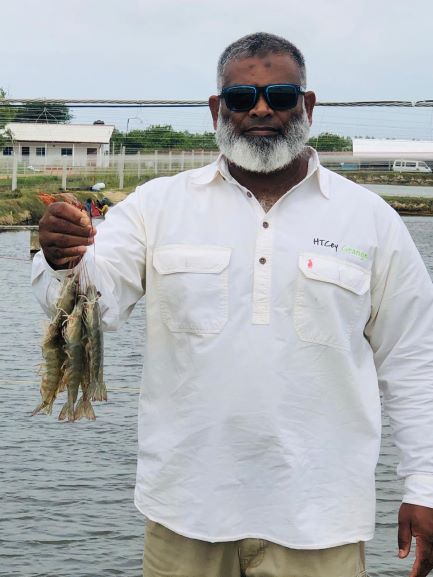
The leisure and tourism companies like HTCey Leisure have entered shrimp cultivation on a large scale. For example, Mansur Hassen, Managing Director of HTCey Leisure, set up the subsidiary, HTCey Aquaculture, in 2019 to get into large scale Vannamei cultivation.
In August 2020, the company signed an agreement with the Sri Lankan Board of Investment to infuse US$ 1.8 million to build a 12 million post-larvae capacity shrimp farm in Puttalam, in the northwestern coast of the island.
The idea of cultivating Litopenaeus vannamei or the Pacific white shrimp has been floating around since 2011, but the industry got its first shipment of brood stock only in 2018. At present, all SPF broodstock is exclusively imported by Taprobane Seafoods, from Hawaii.
Hassen too receives his broodstock from there and hopes to set up a state of the art Vannamei outgrower model on 18 acres of land. An additional 37 acres has been kept for expansions in the second phase.
The farming model is based on the Vietnamese style where intensive shrimp culture is practiced.
This is a huge leap from the traditional farming method we have been following here in Sri Lanka, even with Vannamei. The standards are still being set, so it has been a challenge to get approvals from the government,” Hassen said.
Mansur Hassen HTCey Aqua Sri Lanka
Getting The ‘Culture’ Right
According to HTCey Aquaculture’s model, the post larvae which will arrive on the farm on day 14 will be grown in their nursery for one month. Thereafter they will be moved to ‘grow out’ tanks for 60 to 75 days. These would be 25 diameter ponds holding 350-500 post larvae per square meter.
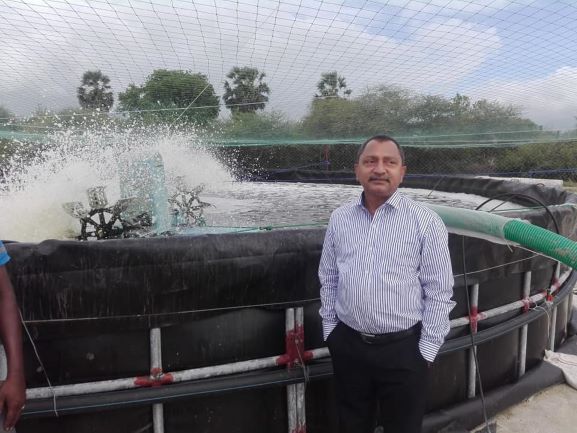
The novelty here is that Hassen would be using high density circular ponds lined with High Density Polyethylene (HDPE). This is thought to be more cost effective than concrete tanks and more disease resistant than earthen ponds.
Downtime in our ponds is two to three days but in traditional Sri Lankan earthen ponds, downtime can be from two to three months,” Hassen said.
Further, earthen ponds can be affected by monsoonal weather conditions, limiting the number of cycles a farmer can have.
With this new pond system, Hassen hopes to have at least five to six cycles per year, a significant leap from the traditional one to two cycles per year.
Given the high density of the tanks, the company would start partial harvesting from day 50 onwards, allowing space for others to grow.
This way we increase our density without harming productivity,” Hassen explained.
With the density they are going for, HTCey Aquaculture can hope to harvest 150 – 200 tons of shrimp in each cycle. In traditional mud ponds, farmers usually manage to get around 30 tons/cycle.
Disease Control
HTCey Aquaculture is among several hundreds of shrimp farmers which operate from Puttalam. And this has made Hassen’s model highly susceptible to the spread of disease from one farm to the other. To overcome this problem, the farm will adopt real time sensors to carefully monitor any changes in the water or environment.
Netting has been placed above all tanks, so that bird droppings (carrying shrimps from other farms that may be affected by disease) do not fall into the tanks.
One of the main risk factors is water and we will have our own purified water in the farm and recycle it,” Hassen said.
Phase 2
In Phase 2 of the operation, HTCey Aquaculture is looking to grow Vannamei in low salinity water, a feat never attempted in Sri Lanka. Close to 37 acres have already been procured for this project.
This process is highly technical in nature. We have to very carefully acclimatise the shrimp from a salinity of 25 to two. If not done properly, they can die,” Hassen said.
If the model works out, HTCey Aquaculture hopes that it would help expand shrimp culture further inland. This would significantly bring down the cost of shrimp in the country.”
Overseas Markets
Lowering production costs could help Sri Lankan shrimp farmers like HTCey Aquaculture, compete with much larger players like India and other Southeast Asian countries for exports. Sri Lanka’s strategy has always been to target niche markets with fresh products as they were unable to compete in the mass market.
We don’t have the advantage of cheap labour, but we can beat them with superior technology,” Hassen said.
Further, as Covid-19 batters the economies of many of the export markets in US and Europe, niche markets willing to pay more are expected to become even smaller.
Thus there is no option but to look to compete with the economies of scale. Our products are good, now we have to perfect the way of making them more competitive,” Hassen said.
Nimal Chandraratne
Story of Vannamei
The story of Vannamei has been a long and hard one in Sri Lanka with the authorities and the private sector struggling since 2011 to introduce the species into the country. The Director General of the National Aquaculture Development Authority, Nimal Chandraratne said the introduction of Vannamei would help the country meet its target of 50,000 tons of shrimp production by 2025.
We will still go with the Monodon species. We are at present working on getting SPF Monodon broodstock in the country. But the productivity difference between Vannamei and Monodon is significant. The latter produces 3 tons/hectare while the former could go up to 20 tons/hectare,” Chandraratne said.
This significant difference in productivity has attracted many into the shrimp sector this year. Chandraratne believes that from one company producing vannamei in 2019, the number had grown to 25 by end of 2020. This has taken Vannamei production from 505 tons in 2019 to 1500 tons in 2020.
Despite the increase in interest in Vannamei, its adoption has not been as fast as expected due to certain obstacles
Much larger investments need to be made to get into Vannamei, especially since best management practices require that certain regulatory and other conditions be met prior to starting. In addition, there is a technology gap that needs to be bridged for Vannamei,” he explained.
Chandraratne however believes that these issues would be sorted out in course of time. The government is very interested in promoting shrimp aquaculture. It hopes that Vannamei will be take the industry to the next phase of development,” he said.
December 17 (Reuters) – An Alaskan health worker had a serious allergic reaction after getting Pfizer Inc and BioNTech’s coronavirus vaccine, but is now stable, public health authorities said on Wednesday.
The adverse reaction in the person, minutes after taking the Pfizer shot on Tuesday, was similar to two cases reported last week in Britain.
Britain’s medical regulator has said that anyone with a history of anaphylaxis, or severe allergic reactions to a medicine or food, should not get the Pfizer-BioNTech COVID-19 vaccine.
But the U.S. Food and Drug Administration has said that most Americans with allergies should be safe to receive the vaccine. It said only people who have previously had severe allergic reactions to vaccines or ingredients in this particular vaccine should avoid getting the shot.
The Alaskan patient did not have a history of allergic reactions, Lindy Jones, the director of the emergency department in the capital Juneau where the patient was treated, told reporters at a virtual briefing.
The symptoms in the middle-aged patient resolved after being administered with allergy treatment epinephrine, Jones said.
The patient was still in Juneau’s Bartlett Regional Hospital being monitored on Wednesday.
Pfizer said the vaccine comes with a clear warning that appropriate medical treatment and supervision should always be readily available in case of anaphylaxis, but it would update the labeling language for the vaccine if needed.
Administration of the vaccine began Monday in the United States, following emergency-use authorization last week. Early doses have been set aside for healthcare workers and nursing home residents
Former FDA Chief Scientist Jesse Goodman called the allergic reaction concerning but said that more information must be known in order to better understand the risks.
What we need to know is what the denominator is — how many doses have been given? Is this going to be something that’s going to be seen at a higher incidence with this vaccine than with others?” Goodman said. We’re going to have to find out those things to inform whether that changes recommendations or how this is used.”
Here in Sri Lanka, the struggle has been most serious for daily wage earners. Schools and day care centers have been closed for most part of the year. For some, this has meant leaving young children alone at home, or in the care of older siblings. For others, it has meant forgoing their daily income.
In a fast-changing world, this system is becoming increasingly unsustainable. I see some key issues and challenges surrounding the provision of childcare services in Sri Lanka, and a few simple questions can help put this issue into perspective.
With diminishing family support, home based care is becoming difficult.
Safe and stimulating environments help young children to learn, play and develop in their early years. Photo Credit – Viraj Kanishka Madanayake
Is home based childcare still a feasible option?
Culturally, many Sri Lankans believe that young children do best with their families, and research has shown that there is some truth to this notion. Growing up with family allows children to develop bonds and secure attachments and helps foster early emotional development. The quality of care however depends on the responsiveness of the caregiver and on the nature of the environment, and not everyone has the resources to create a nurturing and stimulating home environment. The fact that in 2016, 60 percent of Sri Lankan children between 2-4 years had less than five books at home is indicative of this point.
Those without family support sometimes make informal childcare arrangements with neighbors and friends, often compromising the safety and welfare of the child. Many children grow up in unsafe and unsuitable environments and carry the consequences of this early neglect into adulthood.
Forming bonds with responsive caregivers helps support the emotional development of young children. Photo Credit – Viraj Kanishka Madanayake
While this is a much-needed step in the right direction, we may now need to move towards a more holistic approach to early years’ services, to support parents, and to accommodate the care and education needs of children in the 0 – 5 age group.
US Secretary of State Mike Pompeo paid a visit to Sri Lanka in October to coax the Gotabaya Rajapksa government to sign the Millennium Challenge Cooperation Agreement. A controversy erupted ahead of Pompeo’s visit, as the US called upon Colombo to make difficult but necessary decisions” to pick sides between Beijing and Washington.
In a major setback amid the growing Chinese presence in the Indian Ocean Region, the US has decided to discontinue a proposed $480 million development assistance programme in Sri Lanka due to lack of partner country engagement”.
The US Embassy in Colombo on Thursday informed through a press statement that the Millennium Challenge Corporation (MCC) board has decided that the approved fund for Sri Lanka will now be made available to other eligible partner countries.
The Millennium Challenge Cooperation Agreement was approved by the previous government of Ranil Wickremesinghe in the last year of his tenure, but he was unable to get approval from parliament, evoking widespread resistance among people who believed it compromised the nation’s sovereignty and national security.
Nevertheless, the US has once again reiterated that the programme, also facing resistance in another South Asian nation, Nepal, is transparent in nature.
Country ownership, transparency, and accountability for grant results are fundamental to MCC’s development model”, the statement reads.
The MCC has been dubbed a “development project aimed at poverty alleviation” by the US, but many people in Sri Lanka consider it a tool to expand military outreach in the Indian Ocean.
The MCC has partnered with nearly 30 countries worldwide on 38 grant agreements, totalling nearly $13.5 billion.
Ties between the two countries soured under the Gotabaya Rajapaksa government as the Trump administration considered it biased in favour of China. The Trump administration also introduced a ban on the entry of Sri Lanka’s Army Chief Lt. Gen. Shavendra Silva – who is considered a war hero in the 30-year battle against Tamil militancy – into the United States on charges of human rights violations.
In October this year, US Principal Deputy Assistant Secretary Dean Thompson urged Sri Lanka to make difficult but necessary choices” to secure its economic independence instead of choosing opaque practices in an apparent reference to China deepening its relations with the South Asian country. Beijing reacted to the remark and asked the US to shun a “Cold War” mentality. China has invested nearly $8 billion in infrastructure projects in Sri Lanka, with Colombo Port City and the Hambantota Port Projects being the two major ones.
Sri Lanka is not expecting a coronavirus vaccine anytime soon from any country as not a single vaccine has been approved by the World Health Organisation (WHO).
State Minister of Primary Health Services, pandemics and COVID Prevention Dr. Sudarshani Fernandopulle told reporters yesterday that there is still no discussion to import vaccines from any country.
She said that all vaccines are still in the testing stage and have not been approved by the WHO.
The State Minister said that the Government will pick the vaccine best suitable for Sri Lanka once it is approved by the WHO.
Dr. sudarshani Fernandopulle also said that Sri Lanka does not have full access to vital scientific information on the vaccines currently being tested and must depend on information shared with the media. She said that Sri Lanka is closely monitoring the situation but is also mindful that vaccines usually take a few years to be approved.
The United States has begun administering the Pfizer/ Biontech Covid-19 vaccine while the Moderna Covid-19 vaccine is also being tested.
These vaccines have been tested in a short period and are still in the testing stage ,”she said.
-In order to prevent Covid-19 spreading to outside Western Province during the festive seas
-Tests would be carried out on random individuals
-Testing would be carried out in three locations in the Province
Rapid Antigen Tests (RAT) would be conducted on the passengers crossing the borders of the Western Province with effect from today (18) 8.00 a.m. until further notice to prevent Covid-19 spread to outside the Western Province during the forthcoming festive season, informed sources confirmed last night.
According to a letter to Provincial Director of Health Services (Western Province) it stated that the testing would be carried out to identify risk of passengers in three locations in the Province and also to prevent the virus from spreading to other districts.
The sources said the tests would be carried out on random individuals.
The process will be facilitated by the police. In addition, respective Regional Directors of Health Services must deploy their teams to the following locations to carry out Antigen tests.
1. Nittambuwa along the Kandy-Colombo Road
2. Salawa, Kosgama along Avissawella-Colombo Road
3. Katunayake along Colombo-Chilaw Road
The Ministry said the decision had been taken under a directive of Director General of Health Services.
Earlier, Army Commander Shavendra Silva also said that RAT would be conducted targeting people traveling especially to upcountry areas during the upcoming festive season.(Sheain Fernandopulle)
Millennium Challenge Corporation (MCC) has decided to discontinue the proposed compact of USD 480 million with Sri Lanka.
The decision was reached during the quarterly meeting of MCC’s Board of Directors on December 15.
In a statement issued yesterday, the MCC announced that the Board has discontinued the proposed compact with the island nation.
MCC of the US Government approved the grant to Sri Lanka at its board meeting held on the 25th of April 2019 in Washington D.C. subject to Congressional Notification.
On the request of former PM Ranil Wickremesinghe, the MCC had conducted an evaluation in terms of their investment criteria and selected Sri Lanka as a qualified country to receive grant funding under their Compact Investment Program.
Under the grant, MCC had agreed to kick off a USD 350 million transport project and a USD 67 million land project in Sri Lanka. The remaining USD 63 million was to be allocated to support technical assistance, feasibility and design studies, project administration, and monitoring and evaluation.
However, the proposed grant assistance agreement was met with strong disapproval from various parties citing that it adversely affects the sovereignty of the country as it would pave way for defense deals with the US.
Meanwhile, MCC has selected three new partners – Sierra Leone, Kiribati and Solomon Islands – for a new compact partnership and threshold programs.
As a part of the annual selection process, Benin, Burkina Faso, Côte d’Ivoire and Niger have been reselected as eligible for concurrent compact programs for regional integration, while Malawi, Mozambique, Timor-Leste and Tunisia were reselected for compact development.
Further, Ethiopia, Kenya and Gambia were reselected for a threshold program development.
The statement said the MCC has also reaffirmed its support for continuing development in Indonesia, Kosovo and Lesotho.
MCC provides time-limited grants to developing countries that meet rigorous standards for good governance, from fighting corruption to respecting democratic rights, as evaluated by MCC’s scorecard. MCC takes a business-like approach, with bedrock commitments to data, accountability and evidence-based decision making.”
Meanwhile, Embassy of United States in Colombo, in a statement published regarding the decision of MCC Board, said the US remains a friend and partner to Sri Lanka and will continue to assist Sri Lanka in responding to COVID and building its economy.”
On December 15, the MCC Board decided to discontinue the proposed development assistance grant to Sri Lanka due to ‘lack of partner country engagement’, the Embassy noted.
Rs. 89 billion approved for Sri Lanka will be made available to other eligible partner countries in need of grant funding to pursue their economic development priorities, reduce poverty, and grow their economies.”
The Embassy went on to say that the country ownership, transparency, and accountability for grant results are fundamental to MCC’s development model.
MCC has successfully partnered with nearly 30 countries worldwide on 38 grant agreements, totaling nearly $13.5 billion. These grants have lifted millions of people from poverty by catalyzing local and domestic investment.”
The total count of Covid-19 cases reported in Sri Lanka reached 33,387 as more persons were tested positive for the virus.
The Department of Government Information said 338 more fresh cases have been detected within the day.
Reportedly, all of the new cases are close contacts of the Peliyagoda fish market cluster, reports confirmed.
With the new development, the Minuwangoda-Peliyagoda cluster has registered a total of 31,720 cases to date and 650 of them were reported today (December 17).
According to the Health Ministry’s data, 26,353 of the confirmed patients have made complete recoveries from the virus.
The World Health Organization country office for Sri Lanka (WHO), with financial support worth EUR 2 million from the European Union (EU), will help improve emergency response capacities in Sri Lanka to mitigate the impact of COVID-19.
The support will focus on several key areas, including enhancing the effectiveness of COVID-19 case management as well as preventing infection.
Developing the system’s case management processes will enable better planning, coordination, and decision-making; additionally, a key component of the grant, the advancement of a learning management system, will sustainably increase the health system’s capacity to respond to public health emergencies in the future.
The funding will also advance existing communication and community engagement efforts, ensuring the generation of relevant and accessible communication materials and supporting the mobilization of vulnerable individuals, young people, and community-based organizations to lead community-level prevention and control measures.
Finally, in recognition of the importance of continuing essential services, EU support will empower communities to access mental health and psychosocial services, addressing inequities exacerbated by the pandemic.
The funding for Sri Lanka is part of the EU’s global response to the coronavirus pandemic,” said Ambassador of the Delegation of the European Union to Sri Lanka and the Maldives Denis Chaibi.
The EU partnership with the WHO will not just address the impact on the health sector but also pay special attention to vulnerable populations, working hand-in-hand with local communities. Strengthening response capacities of countries in the South Asian region is an important part of ensuring that we all recover from this crisis together and ‘build back better’”.
Dr Razia Pendse, WHO Representative to Sri Lanka, stated that as cases continue to increase globally and locally, we are reminded that the pandemic is far from over. The EU’s timely and strategic support will boost implementation of the Sri Lanka Preparedness and Response Plan to COVID-19, focusing on the pillars of case management, risk communication and community engagement, infection prevention and control, and maintaining essential services. The expansion of digital technology for capacity strengthening and continuous learning, through the development of the learning management system will go a long way in responding not only to the current COVID-19 pandemic but also to a better prepared and resilient health system for future.”
It was revealed at the Presidential Commission of Inquiry on the 2019 Easter Sunday attacks that a compensation amount of less than the compensation for victims of Beruwala and Digana incidents have been paid for the Easter attack victims.
S. M. Bathiudeen, the Acting Director of the Office of Reparations, was summoned to testify before the Presidential Commission of Inquiry into the Easter attack yesterday (16).
He said that the then-Prime Minister Ranil Wickremesinghe, and then-Ministers Lakshman Kiriella and Rauf Hakeem decided to pay Rs 02 million for the victims of the Digana incident as compensation at a meeting held at the Kandy District Secretariat.
However, only Rs 01 million was paid to the victims of the Easter Sunday terror attack, the Acting Director pointed out.
Meanwhile, the Attorney General’s Coordinating Officer, State Counsel Nishara Jayaratne also visited the Police Unit of the Presidential Commission last afternoon to record a statement. This was as per an order issued by the Presidential Commission yesterday.
The Presidential Commission is scheduled to hear evidence from the State Counsel today (17) regarding this statement.
Ambassador of Sri Lanka to China Dr Palitha Kohona has virtually assumed duties on Wednesday (December 16).
The Embassy of Sri Lanka in Beijing said the new ambassador was accorded a warm virtual welcome by its staff.
Dr Kohona had arrived in China two days ago to take office in his post.
He was the Permanent Representative of Sri Lanka to the United Nations from 2009 to 2015.
Prior to that, he served as the Permanent Secretary to the Foreign Affairs Ministry and as the Secretary-General of the Secretariat for Coordinating the Peace Process.
Dr Kohona is also the former Head of the UN Treaty Section in New York until 2006.
Further, he has chaired the UN GA Sixth Committee (Legal) in 2013 and co-chaired the UN Committee on Biological Diversity Beyond National Jurisdiction.
By P.K.Balachandran/Daily Express Courtesy NewsIn.Asia
Colombo, December 16: Highly placed sources in the Sri Lankan government said on Wednesday that the Board of Directors of the Millennium Challenge Corporation (MCC) has withdrawn the five-year US$ 480 million grant offered to the government of Sri Lanka in April 2019 after three years of negotiations.
However, a formal announcement is yet to be made on the withdrawal.
The grant, which was meant for a land and a transport project, became highly controversial in the island nation with nationalists up in arms against it. Nationalists alleged that the grant was meant to make agricultural land marketable, thereby dismantling the existing system in which government, which owns 80% of the land, leases them out to peasants. The idea behind the established system was to prevent the alienation of land which is dear to peasants who constitute 70% of the island’s labor force.
More importantly, nationalists feared that the country’s scarce land resources would finally end up in the hands of Western individuals and corporations endangering the sovereignty of Sri Lanka.
The MCC selected Sri Lanka for the grant in December 2016 but immediately ran into trouble in the island. Nevertheless, the then pro-West government led by Prime Minister Ranil Wickremesinghe, stuck to the decision to accept the MCC compact. But it became a major election issue when Sri Lanka held the Presidential poll in November 2019. Front runner Gotabaya Rahapaksa of the Sri Lanka Podujana Peramuna (SLPP) promised to review all agreements with foreign countries from a nationalistic angle. A review of the MCC was on the top of his agenda.
Gotabaya secured a massive endorsement of his line on the MCC. The SLPP reiterated the promise to review the MCC in the run up to the parliamentary elections in August 2020. Again, the SLPP got a massive popular endorsement of the nationalistic line when it secured a two-thirds majority in parliament.
The US then saw the writing on the wall and stopped pressing for the implementation of the MCC compact. When the US Secretary of State Mike Pompeo visited Sri Lanka and met President Rajapaksa he did not press for it. He told the Sri Lankan media subsequently that it was up to Sri Lanka to accept or reject the grant.
The Two Components
According to the MCC website, the compact sought to assist the Sri Lankan government in addressing two of the country’s binding constraints to economic growth: (1) inadequate transport logistics infrastructure and planning; and (2) lack of access to land for agriculture, the services sector, and industrial investors.
The compact was to be composed of two projects: a Transport Project and a Land Project. The Transport Project aimed to increase the relative efficiency and capacity of the road network and bus system in the Colombo Metropolitan Region and to reduce the cost of transporting passengers and goods between the central region of the country and ports and markets in the rest of the country.
The MCC website said that the goal of the Land Project was to expand and improve existing Government of Sri Lanka initiatives to increase the availability of spatial data and land rights information. This project was meant to help the government identify under-utilized state land that could be put to more productive use and maximize rents from lands that the government leases. It would also increase tenure security and tradability of land for smallholders, women, and firms by digitizing deeds records so that they are less vulnerable to damage, theft, and loss.
Presidential Commission
The nationalists in Sri Lanka had no objections to the transport segment of the compact, but they opposed the land project tooth and nail. A Presidential Commission appointed to examine the MCC proposal said that it was not advisable to accept it in the existing form and suggested re-negotiation.
The US, apparently, was not keen on re-negotiations. It was in the context of such a stalemate that the MCC Board decided to withdraw the grant, it is learnt.
“The island of Sri Lanka is one of the most exotic corners of the world. It is an excellent multi-kilometer beaches, wonderful diving and surfing, bright green vegetation of the jungle, many tropical fruits and numerous monuments of a highly developed civilization,” the message says.
UIA noteded that there are some epidemiological restrictions for crossing the borders of different countries.
According to the press service of Ukraine International Airlines, it will open flights to London Heathrow from December, 17. At the same time, UIA will continue flights to another airport in the UK capital – Gatwick.
UIA plans to operate flights to Heathrow Airport three times a week on Thursday, Saturday and Sunday whilst still operating to London Gatwick Airport on Monday, Wednesday and Friday. Thus, the airline will be able to operate the route with a frequency of six, and on New Year’s holidays seven times a week.
The Director General of Health Services confirms three more Covid-19 deaths bringing Sri Lanka’s death toll from the virus to 160.
One of the deceased is a 50-year-old resident of Kolonnawa, who had been transferred from Colombo National Hospital to Homagama Base Hospital. She had passed away at the hospital on December 14 while the cause of death is cited as kidney failure and Covid-19 pneumonia.
A 78-year-old male from Colombo 09 had passed away at the IDH Hospital on December 15. The cause of death is reported as blood poisoning, multiple organ failure and Covd-19 pneumonia.
The other victim is a 43-year-old woman from Bandaragama, who had been transferred from Panadura Base Hospital to Homagama Base Hospital, where she had passed away today (16). The cause of death is Covid-19 pneumonia, stroke due to blood poisoning and multiple organ failure.
Wattala Magistrate’s Court today (16) ordered to cremate the bodies of four inmates who died during the recent prison riot.
The post-mortem reports of the four deceased inmates were submitted to the Wattala Magistrate’s Court by the experts’ committee appointed in this regard.
https://youtu.be/0AtTxkvAj9I
A total of 11 inmates were killed in the prison riot which broke out on the 29th of November and 8 of them were posthumously tested positive for Covid-19.
As per the post-mortem reports, gunshot wounds remain the main cause of death for the four inmates in question.
Hence, the relatives had sought the court to grant permission to the remains.
However, Attorney General’s Coordination Officer State Counsel Nishara Jayaratne, raising objections, pointed out that permitting the burial of the deceased Covid-19 infected victims may have adverse effects.
Last week, the Attorney General’s Department had requested the magistrate to permit the post-mortems of the deceased inmates to be carried out under a multidisciplinary committee, as per a request made by the legal counsel of the aggravated party requested for a fair autopsy.
The nominations for the committee members, submitted by State Counsel Nishara Jayaratne, were later approved by the court.
Committee consists of Chief Judicial Medical Officer (JMO) of Colombo North Teaching Hospital in Ragama Dr Sandun Wijewardena, JMO of Infectious Diseases Hospital in Mulleriyawa Dr S.D.C Perera, Chief JMO of Colombo South Teaching Hospital in Kalubowila Dr P.P. Dassanayake, Prof. Jean Perera of Faculty of Medicine at University of Colombo and Firearms Specialist & Deputy Government Analyst P.G. Madawala.