MONLAR’s fear-mongering claim: “currently released fertilizer being of low quality and high in heavy metals”.

November 3rd, 2020

Chandre Dharmawardana, National Research Council of Canada

According to a news report (Island, 2-11-20), Mr. Chinthaka Rajapaksa, who is said to be the moderator of an organization known as  the Movement for Land and Agricultural Reform (MONLAR)” claims  a high probability that the fertilizer currently released to the market were of low quality and high in heavy metals, as the National Fertiliser Secretariat had stopped testing samples at local labs”.

It seems that these labs are currently non-functional because of the Covid crisis, and so foreign labs are used. Testing has not stopped. The non-analysis and lack of testing of compost fertilizers are  ignored by MONLAR as they  are tacitly supported by MONLAR!  Here I will show that even if one of the world’s worst rock phosphates, e.g, Nauru phosphate from New Zealand,  containing very high amounts of heavy metals (occurring naturally)  were imported, it will still have NO TOXIC effect if applied to Sri Lankan soils for agricultural purposes. This is based on the research I have published in peer-reviewed journals. For instance, Mr. Rajapaksa should consult  my publication in Environmental Geophysics and Health, August 2018  https://doi.org/10.1007/s10653-018-0140-x where a detailed discussion is found. Here we will explain all this more simply in the following.

However,  first we must look at the political agenda of MONLAR itself. Although I am not aware of the current political  strategy of MONLAR in detail, I personally knew some of the initial founders of this movement. They were Marxist militants who decided to launch a movement  to capture and control the peasant farmers and convert them into a revolutionary political force”.  A key tactic was to rouse the farmers into opposing  big capitalist agricultural multi-nationals” and their genetically modified (GM)  products and seeds. Imported fertilizers sold by capitalist multi-nationals” were also targeted. The opposition to GM products and high-yielding hybrid seeds led them to  back traditional seed varieties”. These yield about a fifth of the harvest from modern hybrid seeds created by the rice scientists at Bathalagoda and other research Institutes. They were the real unsung heroes who have kept the exponentially increased population of the nation away from famine since World War II.  A return to traditional seeds will mean a return to shortages, famines, and re-importing milchaard haal”.

But MONLAR and other backers of traditional seeds” and compost fertilizers etc., are either mesmerized by false claims and fake science, or are cynically using them to further their political agendas. They want to negate the good work our scientists. Even the Minister Pathirana seems to have  been tragically mislead into presenting a motion for traditional seeds” in place of hybrids (Island, 02-11-20). The motion states that this Parliament resolves …(to).. educate the public on the nutritious value of the traditional, local rice varieties available in the Sri Lankan market at present, of the new rice varieties consumed at present, and of the varieties of rice that should be consumed by people with various diseases, and also to provide facilities for farmers to cultivate those varieties of paddy.” So the minister wants to cure diseases with rice, while 30% of  kids come hungry to school! Unfortunately, it is the minister who has to be educated. This may be a case where the minster’s scientific and medical advisors dare not contradict the minster and put him right!

The opposition to  imported fertilizer led these groups to support the use of compost whose composition and quality are never subject to analysis. But MONLAR rushes to claim that imported triple phosphate is full of heavy-metal toxins profiting from a lapse in local testing due to an epidemic! This cry had already found resonance with the Natha Deviyo” group led by Ms. Senanayake of Hela-suvaya” together with  Dr. Nalin de Silva, then at the Kelaniya Science faculty, and Ven. Rathana, then an MP from the JHU. They claimed that many illnesses, e.g., Kidney diseases in the Rajarata, are caused by arsenic and other toxins in imported fertilizers and herbicides, even though these claims were, and are now found to be completely contrary to exhaustive investigations by several independent research groups. For instance, strong evidence now suggest that the Rajarata Kidney disease is contracted by people who drink water from wells containing excessive amounts of fluoride and hard water, both of geological origin (See: Imbulana et al., Science of the Total Environment, 2020, https://doi.org/10.1016/j.scitotenv.2020.140716 and references therein ); in contrast,  those who drink water from agricultural canals, rivers and tanks carrying fertilizer  runoff are free of the disease!

Why do I say that even if one of the  cheapest and worst available” mineral phosphates, e.g., Nauru phosphate were used in agriculture, it will have no effect on our health? Let us consider this in detail.

Cadmium (Cd), arsenic (As) and lead (Pb) are some of the dangerous metal toxins found in minerals.

We will take the example of Cd, as the discussion for other toxins follows the same lines. Nauru rock phosphate contains some 90 mg of cadmium per kg of phosphate, where as a more expensive phosphate fertilizer may contain less than 20 mg of cadmium per kg of fertilizer. European green” activists who are much like their counterparts in Sri Lanka have clamored for lowered amounts of cadmium (and other such toxins) in fertilizers imported to Europe.

Let us consider that we imported the Nauru phosphate that has been used in New Zealand, and containing some 90 mg of Cd per kilo of rock phosphate. A farmer usually applies some 30 to 60 kg of phosphate fertilizer per hectare of land in planting rice, depending on the soil.  The fertilizer is ploughed into about a depth of  about 8-12 inches (20-30 cm). Taking a figure of 30 cm depth in a hectare of land, the 60 kg of fertilizer containing  60 x 90 mg (i.e., 0.54 g) of cadmium are dispersed in a soil volume of 3000 cubic meters, or about 3900 metric tonnes of soil of density 1.3 g/litre. So,  0.54 g of cadmium are dispersed in this volume of soil, increasing the soil cadmium concentration by a mere 1.38 nanograms/kg, i.e., 1.38 parts per quadrillion. This is an utterly minuscule amount as the ambient level of cadmium in the soil may be as high as 0.4 mg/kg even in virgin forest soil (Chandrajith and Dissanayake  2012), and this is similar to values known for  European soils.  NO LEACHING what ever was assume even in estimating the 1.38 parts per quadrillion, and of course this is not true. The monsoonal rains can wash off many many times more than the 1.38 part per quadrillion.

So, when MONLAR claims that substandard fertilizer probably containing dangerous levels of toxins is being imported to Sri Lanka and that no chemical analysis is done, this is just fear-mongering and nothing else. The calculation that I presented needs only a knowledge of simple arithmetic and MONLAR, claiming expertise in agriculture should be able to do this before raising alarms.

This does not mean that EXCESS USE of fertilizer does not pollute the environment. The excess phosphate fertilizer gets washed off into the aquatic ecosystem via rivers and canals and create Algal blooms and weed growth. They de-oxygenate the water and asphyxiate aquatic organisms. The seasonal increase in phosphate levels in the Rajarata tanks is given in Table 1 of a research publication that I authored with other collaborators in  Environmental Geochemistry and Health: Volume 37, Issue 2 (2015). This applies to macroscopic components like phosphates contained in the fertilizer, but NOT to the microscopic components (trace amounts) like Cd, As, and Pb. The metal toxins largely come into the environment from other sources (e.g., mining, burning of fossil fuels, acid rain, burning garbage, smoking cigarettes etc)  as discussed in relevant publications.

Chandre Dharmawardana, National Research Council of Canada.
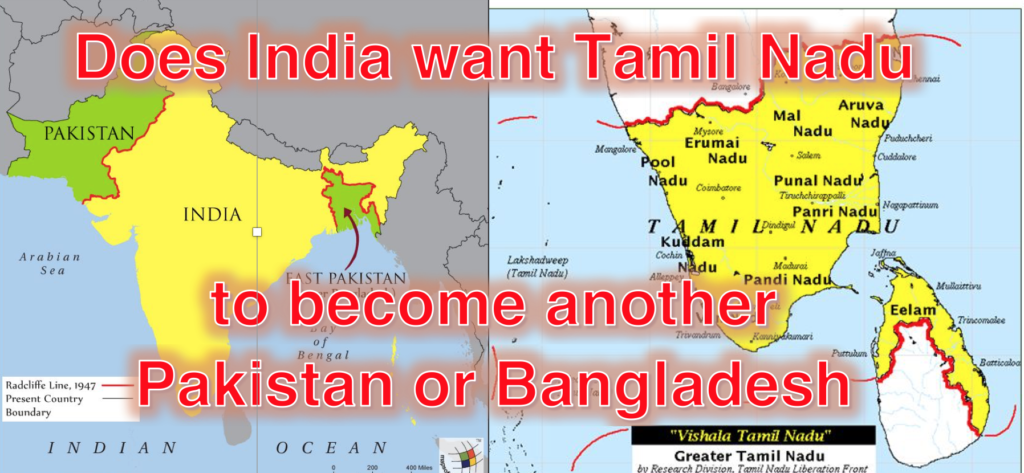
UK removing LTTE ban is more of a threat to India than Sri Lanka

November 3rd, 2020

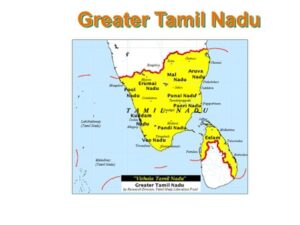
LTTE terrorism was defeated in May 2009. Without a charismatic terrorist leader, LTTE is unlikely to resurface. But, the efforts to create a Tamil Eelam or a Greater Tamil Eelam encompassing Tamil Nadu has scope as it is aligned to geopolitical goals of those that sponsored Tamil militancy & separatism. Global proscriptions of LTTE did little to counter the LTTE fronts operating overseas since LTTE defeat. That these entities were operating for a reason is obvious. The security apparatus in both India & Sri Lanka may deal with terrorist elements effectively but, both countries must be now aware that political manipulations steered by greater powers is now more powerful than the gun! Therefore, India cannot ignore the writings on the wall. The sudden appeal to de-proscribe LTTE in UK is no coincidence.

India is only an US ally to satisfy US hegemonic designs for Asia, which includes the eventual plan to break up India.

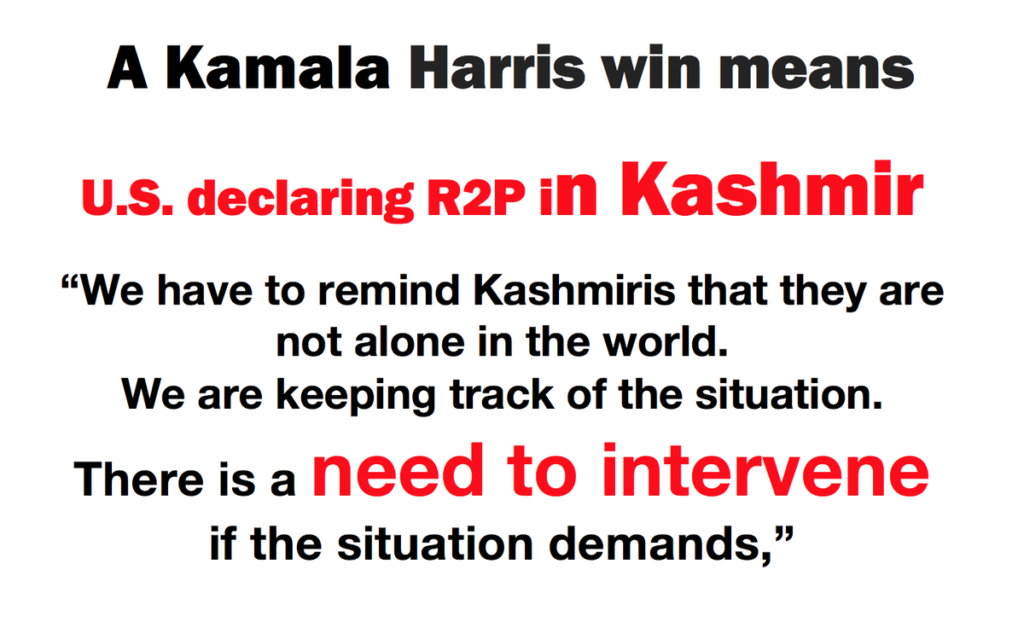
Destabalizing Sri Lanka using the Tamil card by India has karmic effects. It’s the very card the West via UN will now use against India where 95% of world Tamils live. India cannot forget that Tamils have played a historical role as sepoy for the West. India’s role against Sri Lanka in UNHRC will soon backfire. Tamil Nadu where Kamala Harris has her origins are suddenly breaking coconuts for her victory, no different to how army commander Fonseka had coconuts broken for his victory by Tamils in Sri Lanka in 2010. India cannot ignore her statement during the campaign trail on Kashmir. US will not bat an eyelid to say the same for Tamil Nadu. India cannot also ignore the faith foot-soldiers already making cozy along the coastal belt expanding their flock in preparation for this eventuality. The manner they are able to brainwash souls means they will upgrade that to demanding self-determination from India kick starting the Greater Eelam project. With MCC not getting signed in Sri Lanka, US will no doubt be pushing for optional plans!

This statement together with that which US Congressmen Edolphus Towns said in 1998 cannot be ignored by India. Intervention against India is thus very much on the cards and on the minds of the West.

It is in this scenario that India must seriously take note of US-based, TGTE appeal to a UK Tribunal to de-proscribe the LTTE taking advantage of the lapses by the British Government. While the British Government is not bound to accept the conclusions of the British tribunal, it means that the project to use Tamil lobby against both Sri Lanka & India by the West is still alive. While, the West doesn’t have the terrorist element to peddle, the political element has wider dangers and consequences.

The opening of a US consulate in Maldives must add to India’s concern. Plenty of isolated islands will be the haven for jihadi training & dispatch.

Covid will be used as a camouflage and excuse to justify US military presence across covid-19 affected countries using the ruse of ‘humanitarian’ assistance. Pompeo was seen emphasizing this across his Asian tour.

India has gone through much – alliance with Russia in the 1980s, simultaneously a period that India lent training to Tamil militancy, the assassination of Indira Gandhi in 1984, assassination of her son Rajiv 7 years later in 1991. The slow shift towards US with dialogue commencing immediately after defeat of LTTE in June 2010 with India being called ‘an indispensable partner’. The following year US-Indo Strategic Dialogue timed with the US Pivot to Asia strategy of Obama-Hillary. Military ties announced in 2012 the very year US brought bogus UNHRC Resolutions against Sri Lanka. Modi visits US in 2014, Obama arrives in India in 2015. Same time West & India influenced Nepal’s constitution leading to an embargo & humanitarian crisis. Regime change in Sri Lanka was orchestrated by both India & US also in 2015. India becomes America’s ‘best partner’ elevated in 2016 as a major defense partner. Modi flies to US in 2017 where US-Indo strategic partnership was to play a ‘critical part’ in US South Asia strategy and then in 2018 the Communications Compatibility & Security Agreement (COMCASA) is signed. US & India saw fit to remove the importance of Asia & Christen the region US-Indo Pacific. Containing China is primarily to maintain US hegemony fast disappearing from US and in this quest the stampede for natural resource grab would eventually mean US will target India too. Having signed military agreements with US, India is compromising its own national security independence. India can never dictate military strategy to US and instead India will find itself taking orders from US. India cannot forget that there are no permanent friends but permanent self-interests.

India must take a step back & review how far India has compromised its national security to partner with US against China. If India is also targeted to be balkanized how far can India now negate all of the security pacts entered into with US when US will now use a host of tools against India sooner than later.

Karma will mean all of the threats Sri Lanka had to weather will soon get transferred to India. Jihadists, faith-foot soldiers & LTTE diasporawith cahoots in Tamil Nadu will be India’s coming trouble.

Thus, India must view the sudden appeal by TGTE to de-proscribe LTTE, to a UK Appeals Commission as nothing coincidental. Karma again will mean what India did to create Bangladesh is on the cards for a greater Tamil Eelam that will become West’s satellite base in South Asia. If UK de-proscribes LTTE, US, EU will follow suit. The UN has all the paper work prepared. LTTE terror kitty has retained the best of international lawyers. While India’s politicians prostrate at the quest of being seen on par with the West, Sri Lanka’s politicians can easily be swayed with deals. Both scenarios are detrimental to the sovereignty of both India & Sri Lanka.

Do the LTTE Diaspora really need de-proscription? Putting it differently, has the proscription of LTTE stopped LTTE Diaspora’s ability to earn money, carrying on campaigns, hold events etc? So, the question is who really wants to have LTTE de-proscribed? In whose interests is the de-proscription if the de-proscription is not going to make any major changes? The answer to that lies in how LTTE Diaspora will serve the West and its South Asian agenda vis a vis a de-proscription. While there is no likelihood of any LTTE terrorism with defeat of LTTE, there is more than likelihood of LTTE Diaspora Political Self-Determination. Which is exactly what the West is expecting LTTE Diaspora to deliver.

India & Sri Lanka must realize this.

The Prabakran-less LTTE is no threat to international security but the LTTE Diaspora is an international threat to India & Sri Lanka.

Tamils in either Sri Lanka or Tamil Nadu don’t want Tamil Eelam but the LTTE Diaspora are demanding it on behalf of the West. All of its nefarious activities are well known to the West – if the West has been as honorable about the war on terror & actions against anyone materially supporting terror, none of the LTTE diaspora entities would be functioning on their shores with blessings of their MPs. When foreign MPs attend LTTE diaspora functions, are not shy to issue statements on behalf of them, they even have sword groups operating freely across UK & France, the Western Governments also allow their Parliaments to be used for LTTE publicity – do we really need to guess who has adopted the tiger and taming the tiger for future instructions! India must note that the Indian diaspora has not been able to do the magic that LTTE diaspora has done with Western governments simply because they are West’s pawn.

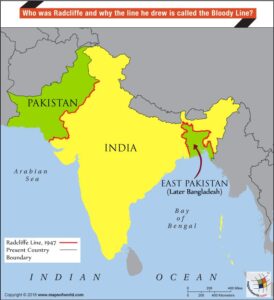
Bharath became divided as Pakistan & Bangladesh – Tamil Nadu will be the 3rdtime lucky. With each division or separation of India – India will lose its super power status and will have to say goodbye for any global supremacy aspirations. That Tamil Nadu never aligned to the goals and aspirations of India is nothing we need to remind India’s Central Government.

India can ignore warnings but India will note that in siding against Sri Lanka at the UNHRC and then abstaining in 2014 showed wisdom falling on India realizing that coming colours was not good. This resolution should now immediately echo Kamala Harris’s US ‘intervention’ in Kashmir and realize that US ‘intervention’ in Tamil Nadu is more than a possibility too.

The West using LTTE Diaspora has made the first move – it’s now India’s turn to shift its Queen.

Shenali D Waduge

God always brings victory for His believers

November 2nd, 2020

By A. Abdul Aziz.

According to the Holy Qur’an those who reject God the Exalted always meet with disgrace and humiliation and this is also proof of their falsehood, for God always brings victory for His believers and they enjoy ascendancy over their enemies. If God did not exist, where does this assistance and succour come from? Hence, Pharaoh said to Moses, peace be on him   Saying, ‘I am your Lord, the most high.’ So Allah seized him for the punishment of the Hereafter and the present world. (Holy Qur’an: 79:25-26)

That is, when Moses, peace be on him, asked Pharaoh to submit himself in obedience to God, he arrogantly replied: ‘What god? It is I who am god.’ So Allah the Exalted brought disgrace upon him in this life and in the hereafter. The episode of Pharaoh is a manifest sign which demonstrates how those who disbelieve in God are always humiliated and shamed. Moreover, no non-believers in the Existence of God, has ever succeeded in establishing a kingdom in the world [in any true sense]. On the contrary, those who have brought about great conquests in the world, reformed countries and created history, have always been those who believe in the existence of God. Is not the humiliation and misfortune of disbelievers and their failure to establish themselves as a nation in the world a matter of great significance?

Moreover, those who believe and have faith in God and are true in their convictions always achieve success, and despite the hostilities of others they are not afflicted by misfortune. Such individuals as (have been commissioned) to bring people to accept the existence of God have appeared in every country and have met with such an unrivalled degree of opposition that there is no parallel to it. And yet what harm was the world able to inflict on them?

Did those who banished Sri Ramachandra, peace be on hm, find any peace and what riches was Ravana able to attain? (An epic poem in the sacred Hindu text the Ramayana depicts the struggle between the divine prince Rama and the demon king Ravana).

 Did not the name of Ramachandra, peace be on him, live on for thousands of years, and was not Ravana’s name disgraced forever? Similarly, in what manner were the Kauravas able to profit by rejecting the claims of Sri Krishna, peace be on him —were they not destroyed in the battle of Kurukshetra? (The Kurukshetra War, also known as the Mahabharata War, is a battle depicted in the great Sanskrit epic of ancient India, the Mahabharata. The conflict was an 18-day dynastic succession struggle fought between two groups of cousins, the Kauravas and Pandavas, for the throne of Hastinapurain.).

The Emperor Pharaoh, who forced the Israelites to make mud bricks, stood himself against a helpless man like Prophet Moses, peace be on him. Yet was he able to harm him in any way? Instead, Pharaoh drowned while Moses, peace be on him became a king. The manner in which the world opposed Prophet Jesus, peace be on him is common knowledge, and the prosperity that later came to him is also well established. His enemies were destroyed and his followers became the rulers of countries. Our Master, the Prophet of Islam Muhammad (peace and blessings of Allah be upon him), excelled above all others in the world in his commitment to spreading the name of the Holy God. So much so, a European writer has commented that he was delirious in this, God forbid, and the name of God was all that escaped his lips. Seven nations opposed him, both friends and strangers turned against him and yet the treasures of this world were conquered at his hands. If God did not exist then who came to his aid? If all of this was caused by chance, there should have been at least one prophet who came to establish the eminence of God, but was disgraced by the world. However, all those who have come to elevate the name of God have met with honour and dignity. Allah the Exalted says in the Qur’an:

Those who take Allah and His Messenger and the believers for friends should rest assured that it is those who believe in Allah that must triumph”. (5: 57)

Economic concerns and strategic necessities

November 2nd, 2020

By P.K. Balachandran/Daily Express/ Courtesy newsin.asia

Colombo, November 1: India and Sri Lanka are both anxious to start work on the East Container Terminal (ECT) project in the Colombo port for pressing economic and geo-strategic reasons. The Sri Lankan side feels India’s participation is necessary for its security and also to uphold its policy of maintaining equidistance from powers seeking a foothold in the strategically located island.

Economic concerns and strategic necessities
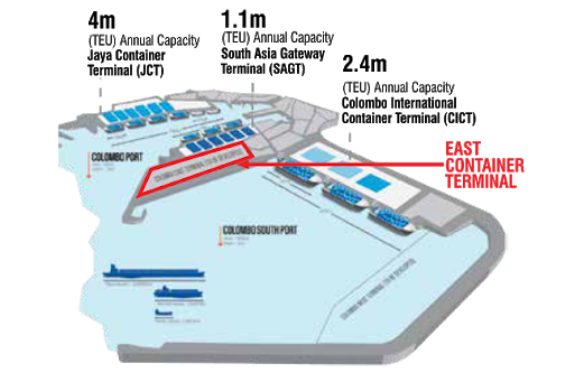
The layout of Colombo Port’s terminals shown above, thanks go Daily Express and maritimegateway.com

Sri Lanka Ports Authority (SLPA) has already started work on the partially built-up ECT site with one ship having been handled so far. Cabinet spokesman Keheliya Rambukwella said the Sri Lankan Cabinet had recently decided to appoint a Negotiating Committee to go into an Indian proposal to Build, Operate and Transfer the ECT, while Maj. Gen (Rtd) Daya Ratnayake, Chairman, SLPA, explained the Committee will review the Memorandum of Cooperation (MoC) signed in May 2019 between Sri Lanka, India and Japan and work out the details of the deal.

However, while Rambukwella said no decision on the international partner or partners has been taken yet, Gen. Ratnayake maintained the MoC of 2019, which states India and Japan will be the international partners, stays, with no indications to the contrary from the government.

As per the MoC, the SLPA would be the owner of the ECT and the Terminal Operations Company (TOC), which would conduct all ECT operations, would be jointly owned, with Sri Lanka having a 51% stake, and the joint venture partners having 49%. A 40-year loan at 0.1% interest was to be extended by Japan to fund the project.

A press release from the then government said: The envisaged Japanese loan carries one of the best loan terms Sri Lanka has obtained. The 51% stake is also one of the best in SLPA joint ownership endeavours. SLPA’s majority ownership in the new TOC represents a significant step in prioritizing national interests.”

India and Japan consider their presence in the Colombo Port a strategic necessity in view of China’s presence in the adjacent Colombo Container Terminal (CCT) with 85% stake in it. India has an additional reason to seek a foothold in Colombo Port as 80 to 85% of the throughput at Colombo port is accounted for by Indian transhipment.

However, while the then Prime Minister Ranil Wickremesinghe decided to give the project to India and Japan for strategic reasons (to balance China and India) the ultra-nationalist president of that time, Maithripala Sirisena, scuttled the deal saying Sri Lanka should not barter away strategic national assets like ports to foreign entities. Sirisena reflected an atavistic fear of India prevalent in the majority Sinhala community. As a result, the ECT project came to a grinding halt and Colombo port continued to face problems of congestion, which is now said to be acute.

When Gotabaya Rajapaksa became president in November 2019 and his Sri Lanka Podujana Peramuna (SLPP) secured a two-thirds majority in the August 2020 parliamentary elections, the government started reviewing projects with foreign collaboration including the ECT with the aim of implementing the implementable ones. The Indian Prime Minister Narendra Modi was also pressing the Rajapaksas (President Gotabaya and Prime Minister Mahinda) to implement the pending non-grant Indian project proposals numbering about a dozen.

India was also concerned about the Rajapaksa government’s lurch towards China in granting projects. In March this year, Sri Lanka and the China Development Bank signed an agreement for a financing facility of US$ 500 million for development efforts. In October, during Chinese politburo member Yang Jiechi’s visit to Colombo, China announced a grant of US$ 90 million for education, medicare and water supplies.

Is Japan in or out?

There appears to be lack of clarity on Japan’s participation in the ECT project. A member of the Cabinet, who spoke off the record, said only India is in the project and there will be negotiations with an Indian company suggested by the Indian government. The Sunday Times of November 1 identified the company as the Adani group.

The Cabinet member said that Japan is out of the reckoning because it is only offering a loan and is not making an investment in the project. Sri Lanka wants investment and not loans. Japan has offered a loan and not investment,” he said. It appears that India too is wondering if Japan is in or out. But a Japanese diplomat insisted that Japan is very much in and that the money Japan is to arrange is an investment and not a loan. Gen. Ratnayake also said the MoC of 2019 stays implying that Japan is in the reckoning.

Lankan President keen on India’s participation

Amidst the confusion, it is reliably learnt that President Gotabaya Rajapaksa is keen the ECT be given to India for the sake of good relations with the giant neighbour, which he believes is vital for the security of Sri Lanka. There is also a feeling among senior leaders of the ruling SLPP and the government now that India should not be antagonized and also that there are dangers in putting all the eggs in the Chinese basket.

Though he has sharp differences with the United States on China policy, the Millennium Challenge Corporation Compact (MCC) and the Status of Forces Agreement (SOFA), President Rajapaksa is also keen on US investments in Sri Lanka in certain sectors like agriculture and ICT. He had conveyed this to the visiting US Secretary of State Mike Pompeo, who reciprocated saying the US would invest in the tourism sector.

To speed up matters in regard to the languishing Indian projects, especially the ECT, the India High Commissioner in Sri Lanka Gopal Baglay told a webinar late last month: In the present situation, at the present stage, perhaps the best way to deepen the India-Sri Lanka ties is to implement quickly the deep port project of East Container Terminal. If we do not move with time and implement these projects, not only will these projects and their concepts become outdated and, perhaps even challenged, but sometimes these may be overtaken by events. Time and tide do not wait for anyone.”

The webinar had been organized by think tanks ASEAN-India Centre, the Indian Council of World Affairs, the Asian Confluence and Sri Lanka’s Pathfinder Foundation.

Jaishankar due in Colombo

In the midst of all these developments, the Indian External Affairs Minister S. Jaishankar is to visit Sri Lanka shortly. Sources say the Indians have sought a date in early November before the Sri Lankan government gets busy with the budget session of Parliament. But it could take place later in November too.

Jaishankar’s visit is expected because of the fast changing geo-strategic scenario with the sharpening of India’s border and economic conflict with China; the US Secretary of State Mike Pompeo’s visit in which he made no secret of his sharp anti-China agenda; and the visit of Chinese Communist Party Politburo member and former foreign minister, Yang Jiechi, where he pledged significant political and economic support to the friendly Rajapaksa government.

Lankan funds for Chinese-run terminal

On October 27, Ada Derana Biz, quoting the Government Information Department, said that the Lankan cabinet had approved a proposal presented by the Prime Minister cum Minister of Finance, Mahinda Rajapaksa, to enhance the capacity of the Chinese-run Colombo International Container Terminals (CICT), with a fund induction of US$ 90 million.

Considering the prevailing demand for the activities of that terminal as well as the future prospective business opportunities, it has been decided to extend the said project without performing further construction, but enhancing the capacity of its container yard.”

Accordingly, the Cabinet of Ministers has rendered their agreement for the proposal tabled by Prime Minister as the Minister of Finance for the introduction of new equipment by investing US$ 90 million, renovation of the existing equipment as well as for the implementation of productivity-boosting work of the terminal, and for publishing the orders for the provision of applicable tax relief as per the provisions of Strategical Development Act in the Government gazette,” the report said.

New Chinese envoy’s take

China’s new Ambassador to Sri Lanka, Qi Zhenhong, has said he would like Sri Lanka and China to promote a strategic cooperative partnership.”

In a statement issued on arrival in Colombo, Qi said: Let’s join hands to implement the consensus reached by leaders of our two countries, promote our strategic cooperative partnership, build the Belt and Road Initiative and other cooperation with extensive consultation and joint contribution, so as to bring tangible benefits to our two people and better ensure peace, stability, development and prosperity in this region.”

(For the layout of Colombo Port’s terminals shown above, thanks go Daily Express and maritimegateway.com)

Anti-China propaganda was Pompeo’s basic aim in his South Asian tour

November 2nd, 2020

By Sugeeswara Senadhira /Ceylon Today Courtesy NewsIn.Asia

But did it have the intended impact?

Anti-China propaganda was Pompeo’s basic aim in his South Asian tour
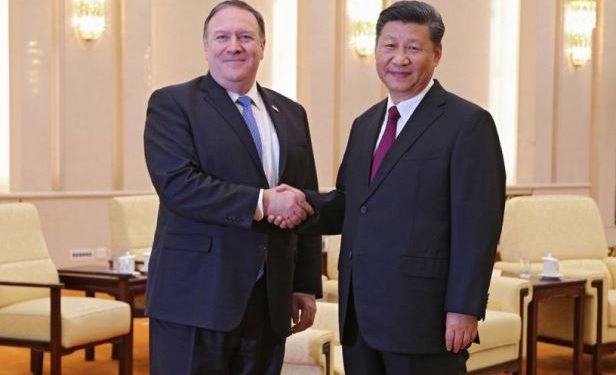
Mike Pompeo with Xi Jinping in happier times

Colombo, November 2: The 16-hour visit of US Secretary of State Michael R Pompeo to Sri Lanka received international attention not because of its impact on US-Lanka relations, but because of verbal clashes erupting between Washington and Beijing arising from third-party references during bilateral discussions.

Pompeo, who was earlier in the limelight as the Chief of the Central Intelligence Agency (CIA), used every available opportunity to drag China into every discussion during the tour and attempted to draw a contrast between what China seeks in Sri Lanka as opposed to the manner in which the US operates and controversially labeled the Chinese Communist Party a predator.

Basic Jab

That’s quite a contrast to what China seeks. We see from bad deals, violations of sovereignty and lawlessness on land and sea that the Chinese Communist Party is a predator, and the United States comes in a different way. We come as a friend and as a partner,” said the American State Secretary.

Infuriated China too, instead of issuing a statement from Beijing, thought it was fit to use the neutral Sri Lankan soil to retaliate, thus dragging Colombo too into an unnecessary controversy. The Chinese Embassy tweeted that China was not interested in Pompeo’s Alien Vs Predator game invitation”. It tweeted back Sorry Mr. Secretary @SecPompeo, we’re busy promoting #China-#SriLanka friendship and cooperation, not interested in your #Alien Vs Predator game invitation. The US can play two roles at the same time as always.”

In Beijing, replying to a question about Pompeo’s remarks about the Chinese Communist Party, Foreign Ministry spokesman Wang Wenbin said that forcing small and medium sized countries to pick sides is a habitual behaviour of certain US politicians”.

Step Jab

The State Secretary also took a totally uncalled for dig at China while referring to the need for cooperation in defeating COVID-19. He emphasised that the pandemic came from Wuhan, China.

Sri Lanka has no interest at all in becoming a pawn in big-power rivalry. Sri Lanka is determined to keep a fine balance in its international affairs. Hence, it used the visit of the US Secretary to give the message in no uncertain terms that, for Sri Lanka ‘independence and sovereignty come first in foreign relations’.

Sri Lanka’s experienced Foreign Minister, Dinesh Gunawardena made no reference to China. In his joint press conference with Pompeo, Gunawardena reiterated that the country maintains a non-aligned and neutral foreign policy.

On the eve of the Pompeo’s visit the Chinese embassy accused Pompeo of trying to coerce and bully” Sri Lanka with his visit. In the first week of October, Yang Jiechi, a high-ranking Chinese Communist Party Politburo member, pledged more economic help to Sri Lanka when he was in Colombo.

Power Jab

Apparently, anti-China comments have been a key theme of Pompeo’s Asian tour, which began in India and included Sri Lanka, the Maldives and Indonesia. He started his China-bashing in New Delhi last week. With Indian Defence Minister Rajnath Singh and External Affairs Minister Subramanian Jaishankar on their sides, the visiting US Ministers, Pompeo and Defence Secretary Mark T Esper, launched a sharply worded attack on China, much to the satisfaction of the people of India. Esper recalled the June 2020 border clash between India and China and described it as increasing aggression and destabilising activities by China”.

To emphasise the US solidarity with India, Pompeo visited the war memorial in New Delhi and said, We went to honour the brave men and women of the Indian Armed forces who have sacrificed for the world’s largest democracy including 20 that were killed by the Chinese armed forces in the Galwan valley in June”.

External Affairs Minister Jaishankar said that a multi-polar world must have a multi-polar Asia as its basis. Our national security convergences have obviously grown in a more multi-polar world.” He added that, We are also committed to addressing together global issues ranging from maritime security to counter-terrorism. In US-India talks we also explored probable capacity-building and other joint cooperation activities in third countries, including our neighbourhood and beyond.”

While Pompeo and Esper made repeated references to China at every forum, two Indian ministers, Rajnath Singh and Subramanian Jaishankar refrained from making any direct reference to China. They simply stressed the need for ‘respecting and upholding the territorial integrity and sovereignty of all states’ without naming any country.

However, the US high-profile visit to India was a win-win one for both countries as it aimed to underscore the need for cooperation between New Delhi and Washington to check China’s inroads to the Indian Ocean region. The US and India signed the crucial military pact, Basic Exchange and Cooperation Agreement (BECA) last Tuesday. The BECA will help India to get real-time access to US geospatial intelligence that will enhance accuracy of automated systems and weapons like missiles and armed drones. It will also help access topographical and aeronautical data and advanced products which will aid navigation and targeting. This could be key to Air Force-to-Air Force cooperation between India and the US.

Pivot Jab

While New Delhi is very keen to enhance military cooperation with the US, Colombo has no desire whatsoever to get entangled in the conflict between regional or global powers. During the discussions President Gotabaya Rajapaksa made it clear to Pompeo that China assisted in the development of the country’s infrastructure since the end of the long-drawn fight against terrorists. He also clarified that it was an economic partnership and Sri Lanka was not caught in a debt trap as a result.He said what Sri Lanka wants is not obtaining loans continually, but to achieve a high level economic growth by attracting more foreign investments.

We have already begun to remove bureaucratic red tapes that hinder foreign investment. Sri Lanka is a country that possesses necessary factors to achieve a high agricultural development. Our agriculture sector should be modernized. Scientific research should be conducted in order to reach this goal. We expect your assistance towards this end,” the President said.

President Rajapaksa made it very clear that Sri Lanka will always maintain a neutral stand in foreign policy and will not get entangled in struggles between power blocs. What Sri Lanka needs is development assistance and foreign investments. Pompeo told media that he had talked with the President about the economic relationship. In a positive note he said, brands like Coke and Oracle and IBM are here creating high-quality jobs. These American companies are the most reliable partners on the planet. They’re accountable to the law, they’re transparent, and they’re assets to the communities in which they operate”.

Backstep Jab

Pompeo emphasised that good governance, transparency in policy consistency will attract even more American investment. Those principles are deeply consistent with Sri Lanka’s history, its heritage as the oldest democracy in Asia” he said acknowledging the potential for economic cooperation. Hopefully, there is a strong possibility to enhance economic cooperation between the two countries. However when the details are worked out and agreements finalised, it is essential to ensure there would be no cause to fear about Sri Lanka becoming an unwilling pawn in the chess game between regional and global powers.

Race to save 100 whales in Sri Lanka’s biggest mass beaching

November 2nd, 2020

Courtesy The Guardian

Navy joins forces with rescuers and volunteers in effort to push pilot whales back into ocean.

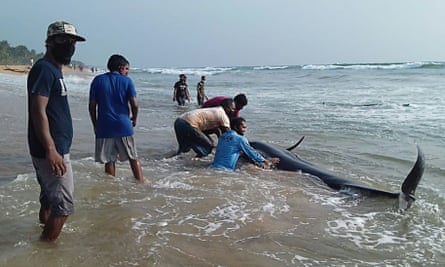
Volunteers try to push back a stranded short-finned pilot whale on Panadura beach, Sri Lanka.

Volunteers try to push back a stranded short-finned pilot whale on Panadura beach, Sri Lanka. Photograph: AFP/Getty ImagesAgence France-Presse in ColomboMon 2 Nov 2020 17.11 GMT

Rescuers and volunteers were racing to save about 100 pilot whales stranded on Sri Lanka’s western coast in the country’s biggest mass beaching.

The short-finned pilot whales began beaching at Panadura, 15 miles (25km) south of Colombo, shortly before dusk. Within an hour their numbers swelled to about 100, a local police chief, Sanjaya Irasinghe, said.

With the help of local residents we are trying to push them back [into the ocean],” he said. But they keep getting washed ashore. We are getting help from the navy to rescue these whales.”

The national Marine Environment Protection Authority (Mepa), whose officials were helping with the rescue operation, said it was the largest single pod of whales stranded in Sri Lanka.

It is very unusual for such a large number to reach our shores,” Mepa’s chief, Dharshani Lahandapura, said, adding that the cause of the stranding was not known. We think this is similar to the mass stranding in Tasmania in September.”

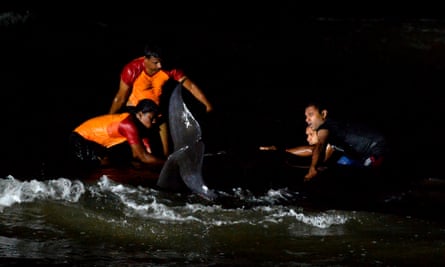
Rescuers work through the night to save dozens of short-finned pilot whales.

Rescuers work through the night to save dozens of short-finned pilot whales. Photograph: Lakruwan Wanniarachchi/AFP/Getty

The beaching of 470 pilot whales in a remote harbour in Tasmania was Australia’s largest ever. About 110 whales were saved in a rescue effort that took days.

Pilot whales, which can grow up to six metres (20ft) and weigh a tonne, are highly social.

The causes of mass strandings remain unknown, despite scientists studying the phenomenon for decades.

… we’re all in. Are you? On November 4, a day after the presidential election, the US will formally withdraw from the Paris agreement on constraining global heating. It’s urgent that we tell the world what this means, and the Guardian is pulling out all the stops to do so.

Amid all the crises we’ve faced in 2020, we must continue to recognise the climate crisis as the defining emergency of our times, and give it the sustained attention and prominence it demands.

Did you know you’ve read 32 articles in the last year? One year ago, the Guardian made a pledge in service of the planet.

In these chaotic, perilous times, an independent, truth-seeking news organisation like the Guardian is essential. We have no shareholders or billionaire owner, meaning our journalism is free from influence and vested interests – this makes us different. Our independence and autonomy allows us to provide fearless investigations and analysis of those with political and commercial power.

We believe quality, trustworthy reporting like this on the environment is an important tool with which to confront the climate emergency. That’s why we provide journalism that reflects the urgency of the crisis, and is always led by science and truth. And we keep it open and free for everyone to read, so more people can be better informed, and inspired to take action.

Our open, independent reporting on the environment is read by millions every day, from all corners of the globe. Thousands of you support us financially after reading these pieces, telling us that you too care deeply about the future of the planet, wildlife and humanity.

If there were ever a time to join us, it is now. Your support funds our work financially, and motivates us to do better, investigate deeper, challenge more. You protect our independence for the long term, and ensure we can remain open for all to read.

Today we’d like to ask you to show your support for Guardian journalism. Every contribution, however big or small, makes a real difference for our future.

275 Covid-19 patients detected today

November 2nd, 2020

Courtesy The Daily Mirror

A total of 111 fresh COVID-19 cases were reported increasing the total patients detected so far today to 275, the Health Ministry said.

Out of the cases today, 43 are from quarantine centres while 232 are all contacts of the Peliyagoda cluster.

Govt. cancels two-day allocation for grocery shopping, Instead food rations to be supplied to people’s door steps

November 2nd, 2020

Courtesy The Daily Mirror

The Presidential Task Force on COVID-19, headed by Basil Rajapksa, today decided to cancel the two days allocated for people to visit supermarkets and grocery stores in the curfew areas, in order to minimise the risk of a possible spread of COVID-19.

Director General of Government Information Department, Nalaka Kaluwewa told the Daily Mirror that following recommendations, the Presidential Task Force on COVID-19 decided to suspend the two days allocated for purchases as this would lead to people congregating, posing a big risk.

Kaluwewa said that as a result, from tomorrow, the government had made arrangements for essential supplies and food rations to be supplied to people’s door steps so this would prevent people from leaving their homes.

The National Operations Centre for the Prevention of COVID-19 (NOCPC) last week announced that essential goods outlets and pharmacies will be allowed to operate on Mondays and Thursdays in the Gampaha and Kalutara districts, and on Tuesdays and Fridays in the Colombo and Kurunegala districts.

However, Head of the NOCPC Army Commander Lieutenant General Shavendra Silva also confirmed today that the previously announced system was cancelled in order to prevent people from stepping outdoors.

However even till last evening, there was no official announcement that the two day system had been cancelled by the government. Supermarkets and grocery stores were given until yesterday to sort out their delivery systems to curfew imposed areas.

Meanwhile, Police Spokesman DIG Ajith Rohana told the media today that essential goods outlets, such as supermarkets and Lanka Sathosa, had been permitted to operate 15 delivery services. These outlets will be allowed to operate delivery services using cars, vans, motorcycles, and three-wheelers.

The DIG said that food centres have been permitted to operate 10 delivery services, while pharmacies can implement their own delivery services. Divisional Secretariats of curfew imposed areas have been placed in charge of issuing curfew permits for delivery services. (JAMILA HUSAIN)

More areas isolated

November 2nd, 2020

Courtesy Adaderana

Several more areas have been declared as isolated areas with immediate effect, stated Commander of the Army Lieutenant General Shavendra Silva.

Several areas in the Kegalle and Kurunegala Districts have been isolated in this manner.

Accordingly, the following areas have been declared isolated:

Kegalle District: Hemmathagama, Mawanella, and Bulathkohupitiya police areas and the Galigamuwa Pradeshiya Sabha area

Kurunegala District: Giriulla police area

The isolation orders will be in effect until further notice.

Sri Lanka to send back 44 Pakistani prisoners

November 2nd, 2020

Courtesy Adaderana

A group of Pakistani nationals who are in Sri Lankan prisons for various drug related offences are to be handed over to Pakistani prison officers at the Bandaranaike International Airport (BIA).

Commissioner General of Prisons Thushara Upuldeniya stated that 44 Pakistani prisoners will be handed over to prison officers from their country at the BIA tomorrow (03).

The prisoners are expected to complete lengthy prison sentences for drug-related offenses in their home country close to family and friends, in accordance with a 2004 agreement on the transfer of offenders between Pakistan and Sri Lanka.

Transfers are allowed in cases where sentences exceed a minimum of six months, the agreement states. 

Pakistani media last week reported that the country will be sending a plane to bring back Pakistani prisoners from Sri Lanka.

The decision had been reached during a meeting summoned by Pakistan’s Interior Ministry to discuss the matter pertaining to the repatriation of Pakistani prisoners from Sri Lanka.

Pakistani authorities have worked to bring back Pakistani prisoners stranded abroad and in a similar successful effort, at least 250 Pakistani inmates arrived at Allama Iqbal International Airport, Lahore from Malaysia on board a Malaysian airline flight in May this year.

All the prisoners were shifted to quarantine facilities after screening for the novel coronavirus at the airport.

AG orders probe into land grab allegation against influential political group

November 2nd, 2020

Courtesy Adaderana

The Attorney General has directed the Acting IGP to investigate into a social media disclosure regarding alleged land grab of properties owned by persons living abroad by an influential political group. 

Tourist lodges, camping sites closed until further notice

November 2nd, 2020

Courtesy Adaderana

All tourist lodges and camping sites under the Department of Wildlife Conservation will be temporarily closed for the public.

This comes as a measure to curtail the spread of the COVID-19 outbreak within the country.

The Department stated the decision will be in effect until further notice.

However, the travelers who had previously booked the aforementioned facilities will be informed in due time regarding alternative dates, the Department said.

The Department has also taken measures to individually inform all tourist groups who had booked the facilities regarding the decision.

THE CONCEPT AND CONTENTS OF THE 13TH AMENDMENT

November 1st, 2020

BY EDWARD THEOPHILUS

It seems that many people of Sri Lanka talk about the 13th amendment to the constitution before the quick boost of opinion on the arrival of the US Secretary of State. The visit was highly focused on opinion on the MCC agreement and political talks on the agreement, and it is clear that these talkative people have no clear understanding of the concept and contents of the 13th amendment. Media of the country attempt to divert the flow of opinion and India also wants to lie down the matter relates to the 13th amendment. However, people need to understand the truth about the amendment rather than motivating from time to time based on an unimportant statement of a politician.

Why did the 13th amendment pass, it might associate with the historical experience of Indian behavior toward Sri Lanka and the other neighboring countries? The general understanding of Sri Lankans implied India has hegemony over surrounding countries, and the manner of Indian opinion and the foreign policy demeanor toward the 13th amendment displays that the amendment was originated with the supports of India, and its hegemonic approach, but it is difficult to explain how it happened? During the British rule, Indian people took to various countries such as Sri Lanka, Fiji, and Certain African countries Western entrepreneurs at that time, Indian nationals or the freedom movement did not oppose the actions, but later Indian governments use migrated Indians to create distress against the legally elected government in such countries.

Was there a compromise between Sri Lanka and India when the amendment was enacted, and the implementation of the amendment?  Mr. J.R. Jayawardane, a party to the signatories to the Indo-Lanka Accord stated that the action was a strategy to live under the shadow of India without surrendering the country. The assassination of Mr. Rajiv Ghandi practically convinced India that the amendment might have negative effects concerning defense affairs and also showed the risk of using migrated labor from India for international politics. An article published in the Hindu paper on 07.09.2020 in India described the reasons why is the 13th amendment contentious based on four points and also indicated two significant points regarding the amendment.

The recent behavior of Mr. Sarath Weerasekera, who was appointed as the State Minister of the Provincial Councils shows that the hard-line approach to abolishing the provincial councils has either changed or underwater, resulting in the visit of the American Secretary of State, Mr. Mike Pompeo. Otherwise, abolishing the 13th amendment was a headache for many parties and it might re-emerge the environment change after COVID-19 19 epidemic and when a new constitution making emerged in the parliament. What people observe regarding the debate is Mr.Sarath Weerasekera has failed to point out the disadvantages incurred from the 13th amendment and how he is supposed to change the amendment give benefits to both sides India and Sri Lanka. When impartially considering the 13th amendment, it was a humanistic approach of Sri Lanka’s government toward the Tamil ethnic community and the experience after the enactment of the amendment since 1987 it has not been any disadvantage to neither Sinhala, nor Tamil, nor Muslim community of Sri Lanka.     

Before the arrived European invaders, the reign of Sri Lanka’s political administration was successfully used and tackled ethnic issues in the country adopting appropriate techniques to deal with ethnic issues in the country from time to time. Before the king Dutugemunu, Sri Lanka used a technique that divided the political administration as Ruhuna, Maya, and Pihiti, and it was changed by King Dutugemunu. The evidence relating to the provincial administration is not written in historical sources.  However, historical books in Sri Lanka provide evidence that King Dutugemunu did not extend the war beyond Vavuniya and respected the right of Tamils. I assume that from King Dutugemunu there is no harm if Tamils are living in the country respecting the right of the Sinhala Community without making distress to the government s of Sri Lanka and India.  The problem was South Indian invaders promoted actions against the Sinhala community and their religion Buddhism. If we look at the approach of King Dutugemunu, the contents of the 13th amendment would not be harmful to the Sinhala community or the country either.

The specific nature of the historical reign was that people were treated as human residing in the country and allowed to use owned language and religion or any other identity if there were not harmful to others in administration activities. The ethnic division was based on the language used by people, but it was not established on scientific reasons such as biological deviations. The wars incurred when ethnic groups (Tamils) attempted to control the right of the majority ethnic group, Sinhala, and India played a role to settle ethnic problems without favoring any ethnic groups.  The culture of India showed similarities in the practices of Sri Lankans and Indians.

The creation of provincial councils by the 13th amendment was conceptually associated with the division of the central government power than to delegation of the authority to nine provincial councils, and the division of power is not distinguished and the amendment indicates that irrespective of size and the nature of power given from the amendment are equal whether people living in provinces are Sinhala or Tamil or Muslims. The concept of the 13th amendment shows equity and justice incorporated into the amendment, without harm to the right of any ethnic community in the country. For example, if particular power is given to the northern province, the same power was given to the southern province. The concept relates to the 13th amendment that might difficult to understand by ordinary citizens.

People going against the provincial councils need to clearly understand the concept of the separation of power and delegation of power. Many political scientists talked about separation of power especially considering the separation of power between the executive, legislature, and Judiciary. The delegation of power in the 13th amendment is not related to the concept of separation of power, and the content of the 13th amendment indicated that the delegation of power is equally delegation of the authority subject to the commandment of the executive president of the country.

The Hindu paper highlighted that the criticism against the 13th amendment states that the provinces could be effectively controlled by the Centre.  This is an opinion based on the situation and experience when the population of Sri Lanka remained less than 15.0 million, However, the population of the country has been increased to 22.0 million, and the delegation of power economically is cost-effective and efficiency in providing services is more effective under the provincial council system as long as there are no attitudes toward to territorial integrity is respected and assured by members of provincial councils.  The best example is the current issue of the COVID 19 crisis, that invites the use of the authority of the center and the provinces. Many people have difficulty understanding the situation.

Strategically, Mr.J.R. Jayawardane disagreed with India the delegation of police power and land power. If police power delegated in an environment that the separatist movement was powerful the delegated power could have used to disturb the law and order, especially in North and East provinces.  The land power should be in the hand of the center as in an environment that the population is expanding there should be lands for the increase in population to live. It is accepted that in the international legal framework no person should be landless to live and the central administration of the country is responsible to provide to live all people in the country. The delegation of power from the point of view of Tamil politicians was more selfish and there was a nature of rejecting people of the country giving lands to live.   Mr.J.R. Jayewardene viewed that there should be an opportunity to expand the excess population in the Western province to expand in the east and I feel that India has agreed with the points of Mr. Jayewardene. The current wish of the Indian prime minister is not going beyond international justice.

Mr.Sarath Weerasekera has failed to develop concrete points in favor of why the provincial council should be canceled and what would be the alternative he suggests to implement after the cancellation.  He may know that this is a complicated issue that involves India too.  Various points JR highlighted to India not to give police and land management power to provincial councils were accepted by India and considered valid.  Lands of the country are to all people without an ethnic difference and the giving full power on land management to the council will prevent expanding population in the western province to North and East.  It is unacceptable.  When grants the police power to the provincial council it might lead to conflict between the federal police and provincial police services. Sri Lanka doesn’t want such a situation in the name of the provincial councils and India understands that such conflicts between the federal police and provincial police could emerge in India.

The concept and the contents of the 13th amendment should be educated to people through media and the amendment should not use as a wound of a beggar to manipulated political opinion.  If the government suppose to introduce a new constitution the concept and the contents of the 13th amendment should be incorporated into the new constitution.          

The UN double standards exposed

November 1st, 2020

By Malkanthi Munasinha

(April 08, Ontario, Sri Lanka Guardian) The United Nations Secretary General Ban Ki-Moon, should establish a commission to investigate the tens of thousands of Muslim civilians killed by US and UK forces in Iraq and Afghanistan.Instead, all the indications are that the Secretary General has succumbed to pressure from Tamil Tiger lobbyists and commenced an inquiry into 1,500 civilians killed in the final stages of the LTTE-Sri Lankan military confrontation. (External Link) This is further to the news that is emerging on the killing of innocent civilians by the US forces, in Iraq, in which Reuter reporters and children were killed.

US invaded Iraq, and killed millions of innocent civilians, the body count, being 104,492 according to the sources: External link. Yet, we never saw, any UN human rights violations charges being laid on them? Now why was that? Why has not UN’s Navi Pillay being actively recommending an investigation to these deaths, which are becoming apparent to the world?

By afternoon today, there were more news emerging, (viewer be aware the video can be very sensitive nature) the subject being Collateral Damage”, which shows the shooting that took place without any provocation by these innocent people, who were only walking in the street, and the Reuter reporter, who was carrying a camera. As you will see in the video, after being shot, he tries to get up, and the soldiers surveying him, watches everything and when a van comes in to save this man, the whole van consisting of two children and men are shot at! The brutality of it all is revealed.

There have many protests, who have demanded that President Bush be brought to trial for the human rights violations done in the Iraq. But somehow, it has gone unnoticed.

One of the world’s most vicious terrorist groups – the LTTE (Liberation Tigers of Tamil Ealam) was militarily defeated by the Sri Lankan security forces in May 2009. Today, no insurgency can be fought without civilian deaths. The LTTE in particular was notorious for using Tamils as a human shield and its propaganda organ TamilNet provided false civilian fatalities and injuries. Western governments reacted not to the ground reality in Sri Lanka but to the LTTE propaganda. If the UN report is going to have any credibility it must investigate the colossal loss of civilian life and property by US and UK forces in Iraq and Afghanistan. If the United Nations and the Office of the Secretary General are to regain the prestige it has lost as a result of scandals, it must not only be just but appear to just.

I wonder what the UN has to say now, with these new allegations emerging. When there was no known terrorism in Iraq, but US still decided to go ahead and invade, and subsequently, there is horror upon horror stories are being revealed. What more new stories will the world have to hear before, this so called United Nations will take action to bring the perpetrator to justice?

2020 ව්‍යවස්ථා කෙටුම්පත් සම්පාදන විද්‌වත් කොමිටියේ ලේකම්තුමා වෙතටයි

November 1st, 2020

චන්ද්‍රසිරි විජයවික්‍රම, LL.B.,Ph.D.

(expertscommpublic@yahoo.com)
ප්‍රිය මහත්මයාණනි:

මෙවර සදන්නට යන ව්‍යවස්ථාව මීට පෙර ලේඛණ මෙන් නොව, 1815 සිටම සිංහලයාට <නීතියෙන්> හා ඊනියා නීතියට පිටින් සිදුවූ වෙනස්කම් හා මර්‌ධන වලට පිළිතුරු සැපයෙන, ඒ සමඟම සෙසු සුළුතර ජනව‌ර්‍ගවලට අසාධාරණයක් නොවන හා ආත්මගෞරවයකින් යුතුව සාමයෙන් ජීවත්‌විය හැකි සමාජයක් බිහිකිරීම අරමුණු කරගත් දෙයක්‌ය යන්න අපගේ විශ්වාසයය. මෙහිලා ව්‍යවස්ථා සම්පාදක ක්‍රියාවලිය මුළුමණින්ම පාරාදෘෂ්‍ය වීමත්, තීරණ ගැනීමේදී ඒ සඳහා එකතුකල හැකි සෑම තොරතුරක්ම සළකා බැලීමත් ඉතාමත් වැදගත්‌ය. මෙහි පහතින් දැක්‌වෙන්නේ, ඔබගේ කමිටුවේ සාමාජිකයින්ගේ අවධානයට යොමුකිරීම සඳහා සුදුසු යයි සිතන මූලික කරුණු කීපයකි.

  1. මහජනයාගේ කරමතට බර පැටවීම

මෙම භාරධූර කාර්යය සඳහා මහජන අදහස් හා යෝජනා, කෙටියෙන්, විෂය මාතෘකා 12 ක් යටතේ ගොනුකර, ටයිප්කර, කැමතිනම් ලියා පදිංචිකල තැපෑලෙන් හෝ ඊමේල් මගින්, නොවැම්බර් මස 30 දාට පෙර එවන ලෙස පලවූ දැන්‌වීම, අධිකරණ අමත්‍යාංශයේ වෙබ් අඩවියෙන් දුටුවෙමි. ඔබගේ මෙම කොන්දේසි මඟින් වන්නේ රටේ සාමන්‍ය ජනයා විසින් සිය අදහස් ඉදිරිපත් කිරීමට දිරිමත් වෙනවා වෙනුවට ඔවුන් උදාසීනවී යාමක් නොවේද? ඔබගේ කොමිටු කාර්යාලයට රක්‍ෂා නැතිව සිටිනා විශේෂ උපාධිධාරීන් දුසිමක් පමණ බඳවාගෙන, ඔවුන් ලවා කරවාගත හැකි දෙයක් නම් මහජනයා රචනා ලෙස එවන යෝජනා කියවා බලා එම යෝජනා ව‌ර්‍ගකර දත්ත සටහන් පිළියෙල කිරීම නොවේද? මෙම වගකීම ගම් නියම් ගම් වල අහිංසක ජනයාගේ කරමත පැටවීම නුසුදුසුය. තවද යම් යෝජනාවක් කෙටියෙන් ලියන්නට යෑමෙන් සිදුවන්නේ එම යෝජනාවට පසුබිම්‌වූ හේතුව ඔබලාට දැනගැනීමට නොලැබීම නොවේද? මීට සහභාගිවීම, රටවැසියාට ලැබෙන්නේ දුර්ලභ, වටිනා අවස්ථාවක් ලෙස ඔබලා විසින් සළකණ බව ඔවුන්ට ඒත්තු ගැන්‌වෙනවා නම් කෙතරම් අගනේද?

  1. ඩේටා ටේබල්

තවත් කාරණයක් නම් දැනටමත් ලිපිගොනුවල ඇති තොරතුරු විමසා විග්‍රකර දත්ත සටහන් (එක්‍ෂල්, ඇක්සස්, එස්පිිෙස්‌.එස්, සාස් වැනි ටේබල්) වශයෙන් පිළියෙල කිරීමයි. උදාහරණයක් වශයෙන්, 2007 තිස්ස විතාරණ ඒ.පී.ආර්.සී මැජෝරිටි හා මයිනෝරිටි වාර්තා, 1995-2000 චන්ද්‍රිකා ජනාධිපති යුගයේ පැකේජ් ඩීල් වාර්තා හතර, 2012 සංහිදියා කොමිෂන් වාර්තාව හා යහපාලන යුගයේ 2018 ඔරුමිත්තනාඩු කෙටුම්පත යනුවෙන් අති විශාල ලේඛන සම්භාරයක් දැනටමත් ඔබ සතුව ඇත. යහපාලන අවධියේ ලාල් විජේනායක කමිටුව විසින් (බොරුවට හෝ) මහජන රැස්වීම්ද පවත්‌වන ලදී. මීට පෙර මෙසේ මහජන රැස්වීම් පවත්‌වා අදහස් ලබාගත්තේ, 1947 සෝල්බරි ව්‍යවස්ථාවට කලින්, ඩොනමෝර් අමාත්‍ය මණ්ඩලය විසින් පිළියෙල කල කෙටුම්පතේදී පමණය. මෙහිදී බුද්‌ධ ශාසන කොමිසම් වා‌ර්තා, සළකා බැලීම අවශ්‍ය නැතත්. 1999 අභයවර්‍ධන පලාත් පාලන විමර්‌ශන කොමිෂන් සභාවේ ඉතාමත් වටිනා වා‌ර්තාවේ සාරාංශයක් වත් කමිටු සාමාජිකයින් විසින් දැන සිටිනවා නම් මැනවිය.

  1. ලංකාවෙබ් වෙබ් අඩවිය

මෙහිදී විශේෂයෙන් සඳහන් කල යුතු දෙයක් නම් ව්‍යවස්ථා සම්පාදකයින්ට ප්‍රයෝජනවත් වන අදහස්, මති මතාන්තර, යෝජනා, විශාල සම්භාරයක් ලංකාවෙබ් වෙබ්‌ අඩවියේ ගබඩා කර තිබෙන බවය. අවුරුදු දහයකටත් වඩා ඈතට දිවෙන මෙම ලිපිවල ඇති තොරතුරු ඉන්ටර්නෙට් හරහා නොමිලයේම ලබාගත හැකිය. කලම්බු ටෙලිග්‍රාෆ්, ඒසියන් ට්‍රිබියුන් හෝ ඩීබිිෙස්ජෙයරාජ්ගේ වැනි වෙනත් වෙබ් අඩවි මෙන් නොව, සිංහලයින්, සිංහල බෞද්‌ධයින් විසින් ලියන රචනා නිදහසේ පලකරණ දැනට ලෝකයේ තිබෙන පැරණිම හා විශාලම වෙබ් අඩවිය එයය. මෙම ලිපිවල අදහස් උකහා ගැනීමට පූර්‍ණකාලීන පර්යේෂණ සහකාරයෙක් යෙදවීම කෙරෙහි ඔබගේ අවධානය යොමු කරණ මෙන් ඉල්ලා සිටිමි. මෑතදී සදන ලද තවත් එවැනි ජනප්‍රිය සිංහල වෙබ් පුවත් පතක් නම් කලම්බු ටුඩේ වෙබ් අඩවියය.

  1. යෝජනා ඉදිරිපත් කරන්නේ රොබෝලා (අහසින් පාත්‌වූ අය) නොවේ

අදහස් හා යෝජනා ඉදිරිපත් කරණ අයගේ පසුබිම් තොරතුරු ඉල්ලා නොසිටීම, ප්‍රජාතනත්‍රවාදය හෝ පුද්ගලික නිදහසට ගරු කිරීමක් හෝ නොවේ. එසේ ඉල්ලා නොසිටියොත් ඒවා නොලැබෙන්නට හොඳටම ඉඩ ඇත. ඇමෙරිකාවේ කරණ සෑම සමීක්‍ෂණයකදීම වාගේ, වයස, ජාතිය, වෘත්තිය, අධ්‍යාපන මට්ටම විමසන්නේ එම කරුණු උඩ ඩිස්ක්‍රිමිනේට් කිරීමට නොව, ලබාගත් තොරතුරු විශ්ලේෂණය කිරීමේදී ඒවායේ ඇති අගය නිසාය. මෙය වඩා පැහදිලි කරනවා නම්, යෝජනාව ගේන්නේ දයාන් ජයතිලක, වික්ටර් අයිවන්, කුමාර් ඩේවිඩ්, ජයදේව උයන්ගොඩ, නිර්‌මාල් රංජිත් දේවසිරි හෝ ජෙහාන් පෙරේරා බව දන්නවා නම්, ඒ අදහස් සාපේක්‍ෂව තක්සේරු කර ගැනීමට පහසුය. යමෙකුගේ නම, කෙසේ වෙතත් ස්ත්‍රී-පුරුෂ භාවය හා ගම හෝ නගරය දැනගැනීමද වැදගත් ය. මීට හේතුව, මෙම ව්‍යවස්ථා සම්පාදනයේදී, විශේෂයෙන්ම 13-ඒ හරහා රට බෙදීමට අදාලව, දෙමළ හා මුස්ලිම් ජන කොටස් වල අදහස් වෙන් වශයෙන් හා පදිංචි ස්ථානය වශයෙන් හඳුනා ගත යුතු නිසාය. නිදසුණක් වශයෙන්, රට කැබලිකිරීමේ යෝජනා පිටුපස ඉන්නේ බෞද්‌ධ නොවන හා මාක්ස්වාදී පිරිස්‌ ය යන්න දැනටමත් පැහැදිලි කරුණක් නොවන්නේද? කෙසේ වෙතත්, එවැනි යෝජනාවක කතෘ එලෙස හඳුනා ගැනීම දුෂ්කර බව සැබෑය.

ලිබරල්වාදයේත් අන්තවාදයක් තිබේ!

මෙසේ පුද්ගල විස්තර නොසන්නේ, අධිකරණ ඇමතිවරයාගේ උපදෙස් මත නම්, එය ඔහු විසින් ලිබරල්වාදයේ අන්තයට යෑමේ අවදානමක් වන්නේය. සිංහල නොවන අයෙක් නිසා, ඔහු විසින් ඉතාමත්ම අපක්‍ෂපාත පුද්ගලයෙකු පෙනීසිටීමට දරණ වෑයම ඊට හේතුව විය හැකිය. මෙම තොරතුරු නොිල්ලන්නේ ඒ නිසා විය යුතු යයි සිතෙන්නේ, වෛද්‍යවරුන් විසින් තමන් සමලිංගික යයි කියනා පුද්ගලයින්ගේ රහස් ප්‍රදේශ, එම පුද්ගලයාගේ කැමැත්ත නැතිව පරීක්‍ෂා නොකල යුතුයයි ඔහු විසින් මෑතකදී කල ප්‍රකාශය නිසාය. ඇමෙරිකාවේ මා දැනසිටි එක්තරා අවිවාහක තරුණියක් කිසියම් හෝ අසනීපයක් සඳහා දොස්තරෙක් ලඟට ගියවිට බොහෝ විට ඇගෙන්, ඇය ප්‍රෙග්නන්ට්ද කියා අසණ බවත්, එය එම්බැරසින් බවත් කියා සිටියේය. යම් වෛද්‍යවරයෙක්, මෙවැනි ප්‍රශ්ණ අසන්නේ කොලොප්පමටද, එසේ නැත්නම් වෛද්‍ය අවශ්‍යතාවය නිසාද යන්න, ඇමතිවරයෙක් විසින් තීරණය කලයුතු දෙයක් නොවේ. මුත්‍රාශය ආශ්‍රිත හෝ එම පෙදෙසේ ච‌ර්‌ම ආභාධයක් හෝ නිසා නොවේ නම් දොස්තරගේ ඉල්ලීම ප්‍රතික්‍ෂේප නොකරන්නේ ඇයි?

මෙහිදී මට මතක් වන්නේ, ඇමෙරිකාවේ සමහර ජනාධිපතිලා පවා අල්ලේ නැටවූ, ගේ-ලෙසබියන් විරෝධියෙකු ලෙස ප්‍රසිද්‌ධියේ ක්‍රියාකල, ඇමෙරිකාවේ සී.අයි.ඩී ලොක්කාවූ එඩ්ගාර් හූවර් තම කන්තෝරුවේ ඔහුගේ දෙවෙනියාවූ පිරිමියා සමඟ බලවත් සමලිංගික සම්බන්‌ධතාවයක් රහසේ පවත්‌වාගෙන යාමය. මේ කියන දොස්තරලාත් එවැනි ආශා ඇති දෙබිඩි චරිත වනවා විය හැකිය! හින්දු ආගමේ විෂ්ණු හා ශිව යන කොටස් දෙකේදී ශිව ආගම යනු ශිව ලිංගයට වන්දනා කිරීම බවත්, එම ශෛලමය ලිංගය තබා තිබෙන්නේ ගලෙන් කෙටූ ස්ත්‍රී යෝනියක් මත බවත් දන්නවා නම් දේශපාලකයින් විසින් මේවාට අතපොවන්නට යන්නේ නැත. පූජා කිරීම සඳහා මල් කැඩීමෙන් මීමැස්සන්ගේ අයිතිවාසිකම් කඩකරණවා, කුඩා දරුවන් මහණ කිරීම ඔවුන්ගේ මානව අයිතිවාසිකම් අහිමිකිරීමක් යන චෝදනා මෙන්, ලිබරල් අන්තවාදයෙන් ගැලවීමට අප විසින් සිතා ගත යුතුය. ප්ලූරලිසම් යන්න අනවශ්‍ය හිසරදයක් වියයුතු නැත.

  1. The first thing we do, let’s kill all the lawyers”
    Shakespeare in King Henry VI

මීට පෙර අවස්ථාවලදී ව්‍යවස්ථා සැදීම තනිකරම නීතිඥයින්ගේ ක්‍රියාවක් විය. මෙවර ඇති විශේෂත්‌වය නම් කොමිටියේ සාමාජිකයෙක් ලෙස කීර්තිමත් භූගෝල විද්‍යාඥයෙක්වද ඇතුලත් කර තිබීමය. <භූගෝල විද්‍යාවට පටහැනි නීති පැණවිය නොහැකිය>, <සිංහයාට හා ගවයාට බලපාන්නේ එකම නීතිය නම් එතැන ඇත්තේ මර්‌ධනයය (oppression) >, යන කියමන් අනුගමනය නොකර මීට පෙර සැදූ ව්‍යවස්ථා (බොහෝ දුරට) අසාර්‌ථක ප්‍රයත්නම විය. යම් රටක ඉතිහාසය (ඉතිහාසය යනු අතීත භූගෝල විද්‍යාවය) හා භූගෝල විද්‍යව නොදන්නා නීතීඥයින් සදන ව්‍යවස්ථා ඒ රටට යහපතක් ගෙන එන්නේ නැත. 1832 දී කෝල්බ්‍ර‌ෑක් පලාත් පහකට රට බෙදුවේ දේශපාලන කරුණු මත පදනම් කරගෙනය. එහෙත් 1818 දී අවලංගු කල ගම් සභාව නැවත ප්‍රයෝජනයට ගැනීමට ඔහු යෝජනා කලේය. 1928 දී ඩොනමෝර් කොමිෂම, එංගලන්තයේ මෙන් කවුන්ටි සභා අදහස ගෙනාවේය. නමුත් සෝල්බරිවත්, ඩී‌.එස් ගේ අමාත්‍ය මණ්ඩල කෙටුම්පතවත්, පලාත් නමයේ කෘතිම බෙදීම ගැන කතා කලේ නැත. නිකමටවත් ඒ ගැන සඳහන් කලේ ජනාධිපති සිරිසේනගේ කතාවකදී පමණය.

  1. දේශපාලන ඒකක භූගෝල විද්‍යාත්මක (ස්වාභාවික පරිසර) ඒකක විය යුතුය

ඇමෙරිකාවේ, කැනඩාවේ හෝ කුඩා රටක් වන නිව්සීලන්තයේ මෙන් දේශපාලන ඒකක භූගෝල විද්‍යා-භූවිද්‍යා-ජල විද්‍යා-පරිසර විද්‍යා (ඉකොලොජි) නිර්‌ණායක අනුව මායිම් කිරීම, 2020 දී වත් ලංකාවේදී සිදුවිය යුතු දෙයකි. එසේ නොකිරීමෙන් රට විනාශය කරා යන්නේමය. නිදසුණක් වශයෙන්, 2000 වර්‍ෂයේ චන්ද්‍රිකා කෙටුම්පත හා ඒ අනුවම සැදූ 2018 ඔරුමිත්තනාඩු කෙටුම්පත ගැන සිතා බලන්න. රට කැබලි 10 කට කඩන්නට ඒවායින් යෝජනා කලේ පටු දේශපාලන අරමුණු උඩ මිස රටේ භූගෝල විද්‍යාව, පරිසර විද්‍යාව, හයිඩ්‍රොලොජි, සළකා බලා නොවේ.

ලංකාවේ පලාත් නවය සාදා ඇත්තේ සුදු පාලකයින් විසින් ඔවුන්ගේ යටත් විජිත පාලන ඉලක්ක සපුරා ගැනීමේ අරමුණින් මිස ස්වාභාවික මායිම් සහිත ඒකක වශයෙන් නොවේ. ලංකාව වැනි තෙත්, වියළි හා ශුෂ්ක කලාප ඇති, අවුරුද්දකට දෙපැත්තකින් මෝසම් සුළං හමනා කාල ඇති, මධ්‍යම කඳුකරයක සිට වටේට ගලනා ගංඟා 103 ක් ඇති දිවයිනක්, භාෂාව හෝ ආගම හෝ චන්ද කොට්ඨාශයක් හෝ අනුව දේශපාලන ඒකක වශයෙන් බෙදීමෙන් අනාගතයේ වතුර යු‌ද්‌ධ වලට ගොදුරුවන ඒකක වශයෙන් විනාශවී යන්නේය. දකුණු ඉන්‌දියාවේ ටැමිල්නාඩ්, කේරළ හා තෙලිඟු ප්‍රාන්තවල මෙම ජල ගැටුම් සුලභ දර්‍ශණයකි. විග්නේෂ්වරන් මහaැමති මොරගහකන්ද ජලාශයේ වතුර ලබාගැනීම ගැන මෙවැනි ප්‍රකාශයක් කලේ, එය ජිනීවා මානව අයිතිවාසිකම් කඩකිරීමේ පාරට දමණ අන්දමටය!

  1. භූගෝල විද්‍යාව-නීති විද්‍යාව- බුද්‌ධ ධර්‍මය

ඓතිහාසික වශයෙන්, අමාත්‍ය මණ්ඩල කෙටුම්පත වත්, අයිවර් ජෙනින්ස්‌වත්, කොල්වින්-ෆිලික්ස් ඩයස්ලාවත්, ජයවර්‌ධන දෙබෑයන්-ඒ.ජේ.විල්සන්ලාවත්, නීලන්-ජී.එල්-ජයම්පතිවත්, සුමන්තිරන්-ජයම්පතිලාවත්, භූගෝල විද්‍යාව යනු කුමක්ද කියාවත් දැන සිටි අය නොවීය. සමහර විට ඔවුන් පාසැලේදී ඉගෙනගත් භූගෝල විද්‍යාව වනාහි කොළඹ සිට ගාල්ල දක්‌වා ඇති දුම්‍රිය ස්ථානවල නම්, සමනල කන්දේ උස, මහවැලි ගඟේ දිග යනාදිය මිස, ඒවායේ ඇති භෞතික හා මානව සම්බන්‌ධය හා වැදගත්කම කුමක්ද යන්න නොවීය. ඇමෙරිකාවේ මෙන් ලංකාවේ නීතීඥයින්ට හා නඩුකාරවරුන්ට, අළුත් දැණුම් ලබාදෙන කාලීන වෘත්තීමය වැඩිදුර-වැඩිහිටි අධ්‍යාපනය (continuing education) අනිවාර්‌ය දැයි නොදනිමි. භූගෝල විද්‍යාව, නීතිවිද්‍යාව හා බෞද්‌ධ දර්‌ශණය යන ක්‍ෂේත්‍ර තුන අතර ඇත්තේ කෙතරම් ලඟ අන්නෝන්‍ය සම්බන්‌ධයක් දැයි දැනගන්නට අවස්ථාවක් ඔවුන්ට ලැබෙන්නේ එවිටය. මේ සමඟ ඇති ලින්ක් එකේ තිබෙන සටහන බලන්න: (http://www.srilankaguardian.org/2012/02/llrc-recommendations-and-path-of.html).

නීතිය හා භූගෝල විද්‍යාව අතර ඇති සම්බන්‌ධය නූතන යුගයේදී ප්‍රථමයෙන් අනාවරණය කලේ 1880 දී පමණ මැකින්ඩර් නම් දේශපාලන භූගෝල විද්‍යාඥයා විසින් ලෝ ඇන්ඩ් ජෝග්‍රෆි නම් පාඨමාලාවක් බ්‍රිතාන්‍ය පාසැල් විෂය මාලාවට යෝජනා කිරීමත් සමඟය. 1911, 1918 හා 1929 දී ඇමෙරිකාවේ හාවඩ් සරසවියේදී ශාක්‍ෂි නීතිවේදී විග්මෝර් හා භූගෝල විද්‍යාඥ එලන් සෙම්පල් විසින් ජෝග්‍රෆි ඔෆ් ලෝ යනුවෙන් නිබන්‌ධන පිළියෙල කරන ලදී. 1926 දී ජර්‌මනියේ ලීගල් ජෝග්‍රෆි> යනුවෙන් පර්යේෂණ ඇරඹිණ. 1987 වනවිට ඇමෙරිකාවේ සුප්‍රීම් උසාවියේ අගවිනිසුරුව සිටි වොරන් බර්‌ගර්, නියෝජිත ප්‍රජාතන්ත්‍රවාදයට භූගෝල විද්‍යාව අත්‍යාවශ්‍යයයි කියා සිටියේය. අද වන විට, ඇප්ලයිඩ් ලෝ, එෆිකසි ඔෆ් ලෝ, භූගෝල විද්‍යාවේ එක් අනු විෂයකි. පොතේ ඇති නීතිය හා බිමේ ක්‍රියාවට නැඟෙන නීතිය (ලෝ ඉන් බුක් ඇන්ඩ් ලෝ ඉන් ඇක්‍ෂන්), වශයෙන් පොලොව මත සිදුවන ක්‍රියාවලීන්ගේ රටාවන් (පැටර්න්ස් ඇන්ඩ් ප්‍රොසෙසස්) හැදෑරීමේ කොටසක් ලෙස එය සැළකේ.

ලංකාවේ අනාදිමත් කාලයක සිට පැවති ගම-වැව-දාගැබ යන ත්‍රිත්‌ව, සමාජ, ආර්ථික, පරිපාලන මොඩලය මෙම භූගෝල විද්‍යා-නීති-බෞද්‌ධ ත්‍රිත්වය සමඟ හොඳටම පෑහේ. ලංකාවේ අනාගත බිම් මට්ටමේ පාලන මොඩලය විය හැකි: (1) පන්සල (2) යුද හමුදාව හා (3) පක්‍ෂ දේශපාලනයෙන් තොර ජන සභාව (ජනමූල සභාව) යන ත්‍රිත්වය මෙම අතීතයේ පැවති මොඩලයේ වත්මන් කාලයට ගැලපෙන සේ වැඩි දියුණු කිරීමකි. මේවා මඟින් රාජ්‍ය සිවිල් පාලනයේ කටයුතු සියේට 60-70 ක් පමණ ඉටුකර ගත හැකිවන්නේය. මීනින්ෆුල් ඩෙවොලූෂන් යනු එසේ මහජනතාව බලවත් කිරීමකටය. 1940 ස් ගණන් වල කළුකොඳයාවේ ප්‍රඥාශෙඛර නාහිමියන් විසින් සහකාර පොලිස් අධිකාරී ඔස්මන්ඩ් ද සිල්වා හා සුප්‍රිම් උසාවි විනිසුරු අක්බාර් සමඟ ඉතාමත් සාර්‍ථක ලෙස දියත් කල අපරාධ මර්‌දන හා ග්‍රාම ප්‍රතිසංස්කරණ ජාතික ව්‍යාපාරය මේ සඳහා කදිම ආදර්‍ශයකි. මෑත කාලයේදී ගැමි දිරිය සංකල්පය මෙන් ඒ කාලයේදී එම ව්‍යාපාරයද කඩාකප්පල්වී ගියේය (උන්වහන්සේගේ ස්වයංලිඛිත චරිතාපදානයෙන් (1970) උපුටාගත් කොටස් සඳහා බලන්න):

  1. Catastrophic theory of planning

දැන් දක්නට ලැබෙන එක් ශුභදායි උපනතියක් නම් නායයාම්, ගංවතුර, නියං, ජල හිඟය, ගස් කැපීම, කඳු සමතලා කිරීම, ගල් කැඩීම, පස් කැපීම, ගංඟා ඉවුරු වල වැලි ගොඩදැමීම, වඟුරුබිම් ආක්‍රමණය, භූමිකම්පා, වෙරළ ඛාදනය, වායු ගෝලය උණුසුම්වීම යන තර්‍ජන ඉදිරියේ <ගම් මට්ටම> ගැන යොමුවෙන අවධානයය. මේවා රැකගත හැක්කේ ගම් මට්ටමේ, ග්‍රාම සේවා නිලධාරී වසම් මට්ටමේ මැදිහත් වීමකින්‌ය. සංහිඳියා කොමිෂමත්, ඔරුමිත්තනාඩු කෙටුම්පතත්, මේ ගැන සඳහන් කරන්නේ දේශපාලන හේතු මිස, පරිසර හේතු නිසා නොවේ. මේ නිසා, ජලය මූලික කරගෙන ගම්, ග්‍රාම සේවා වසම්, ප්‍රාදේශීය සභා කොට්ඨාශ මායිම් කිරීම නිව්සීලන්තයේ මෙන් ව්‍යවස්ථාගත රීතියක් වීම අත්‍යාවශ්‍යය. භූගෝල විද්‍යාඥයින් යම් සංසිද්‌ධියක් දෙස බලන්නේ සමස්ත ක්‍රියාදාමයක් ප්‍රතිපලයක් ලෙසය (හොලිස්ටික්/සිස්ටමැටික් ඇප්‍රෝච්). එය බුද්‌ධාගමේ කියන හේතුඵල වාදය වැනිය. කෑළෑවත්, ගසුත් දෙකම දැකීමය.
ස්තුතියි!

චන්ද්‍රසිරි විජයවික්‍රම, LL.B.,Ph.D.

කොවිඩ්-19 වසංගතයෙන් රටට හා ජනතාවට සෙත් ප්‍රාර්ථනා කරමින් අගමැතිතුමාගේ මඟපෙන්වීම යටතේ දිවයින පුරා හින්දු කෝවිල්වල විශේෂ පූජාවක්

November 1st, 2020

අග්‍රාමාත්‍ය මාධ්‍ය අංශය

ශ්‍රී ලංකා ප්‍රජාතාන්ත්‍රික සමාජවාදී ජනරජයේ ගරු අග්‍රාමාත්‍ය මහින්ද රාජපක්ෂ මැතිතුමාගේ මඟපෙන්වීම යටතේ බුද්ධශාසන, සංස්කෘතික සහ ආගමික කටයුතු  අමාත්‍යාංශයේ මාර්ගෝපදේශ ප්‍රකාරව හින්දු ආගමික හා සංස්කෘතික කටයුතු දෙපාර්තමේන්තුව විසින් කොරෝනා වෛරසයේ බලපෑමෙන් ශ්‍රී ලංකාවේ වෙසෙන ජනතාවගේ ජන ජීවිතය යථා තත්ත්වයට පත් කිරීම සඳහා දිවයින පුරා හින්දු කෝවිල්වල විශේෂ පූජාවක් පවත්වන ලෙස ඉල්ලීමක් කර තිබේ.

විශේෂයෙන් මෙහිදී කෝවිල්වල සෞඛ්‍ය ආරක්ෂක පිළිවෙත් අනුගමනය කරමින් මෙම විශේෂ පූජාව සහ හෝමය  පවත්වන ලෙස ඉල්ලා ඇත.

දිවයිනපුරා සෑම දිස්ත්‍රික්කයකම පැවැත්වීමට නියමිත මෙම විශේෂ පූජාව දිනපතා පෙ.ව 6.30 ට ශ්‍රී ලංකා ගුවන්විදුලි සංස්ථාවේ දෙමළ සේවයේ ‘කෝවිල් දර්ශම්’ වැඩසටහනේ විකාශනය කිරීමට ද සංවිධානය කර තිබේ.

කැලණි වැලි අලකලංචිය

November 1st, 2020

ලලිතසිරි ගුණරුවන් – කොළඹ විශ්වවිද්‍යාලයේ ප්‍රවාහන ආර්ථිකය හා සැලසුම්කරණය පිළිබඳ මහාචාර්ය, හිටපු දුම්රිය සාමාන්‍යාධිකාරී සහ ප්‍රවාහන අමාත්‍යාංශයේ හිටපු ලේකම්

කැලණිවැලි දුම්රිය මාර්ගය විදුලියකරණය උදෙසා ප්‍රවාහන අමාත්‍යාංශය විසින් ආසියානු සංවර්ධන බැංකු ණය ආධාර සහිතව ක්‍රියාත්මක කිරීමට යෝජිත ව්‍යාපෘතිය මේ දිනවල මහත් ආන්දෝලනයට ලක් වුණු මාතෘකාවක් වෙලා. මීට ප්‍රධානතම හේතුව වී ඇත්තේ මීට මාස තුනකට පෙර ජනාධිපතිතුමාගේ ප්‍රධානත්වයෙන් පැවැති සාකච්ඡාවක දී මා විසින් මෙම ව්‍යාපෘතිය පිළිබඳව කරන ලද කරුණු දැක්වීමක් වරදවා වටහා ගැනීම බව පෙනෙනවා. ඒ නිසා මා විසින් ඉදිරිපත් කරන ලද ඒ කරුණු ගැන තව දුරටත් පැහැදිලි කිරීම සුදුසු යැයි සිතෙනවා.

කොළඹ නාගරික දුම්රිය පද්ධතිය විදුලියකරණය වෙනුවෙන් යෝජනා කෙරුණු ව්‍යාපෘතිය පිළිබඳව දුම්රිය දෙපාර්තමේන්තුවේ, ලංකා විදුලිබල මණ්ඩලයේ හා ශ්‍රී ලංකා ඉංජිනේරු ආයතනයේ සාමූහික ප්‍රයත්නයක් ලෙස කරන ලද මූලික අධ්‍යයනයන් ගෙන් පැහැදිලි වූයේ දුම්රිය විදුලියකරණය සඳහා ප්‍රමුඛතාව හිමි විය යුත්තේ ප්‍රධාන මාර්ගයේ කොළඹ-වේයන්ගොඩ කොටසට සහ දෙවනුව මුහුදුබඩ මාර්ගයේ කොළඹ – පාණදුර කොටසට බවයි. අපේ රටේ දුම්රිය පද්ධතියේ විශාලතම මගී සංඛ්‍යාවක් ගමන් ගන්නා ඒ මාර්ග විදුලියකරණය කිරීමෙන් ඉහළම ප්‍රතිලාභ මගීන්ට අත් වෙන බවත් ඒ ව්‍යාපෘතිය කඩිනමින්, බාධක අඩුවෙන් හා අඩු වියදමින් ඉටු කරගත හැකි වනු ඇති බවත් ඒ අධ්‍යයනයෙන් පෙන්වා දී තිබුණා. කෙ සේ වුව ද, ඉන් පසු කාලයේ දී මෙම ව්‍යාපෘතියේ ව්‍යුහාත්මක වෙනසක් සිදු වී තිබෙන බව පෙනී යනවා. වේයන්ගොඩ-කොළඹ හා කොළඹ – පාණදුර මාර්ග විදුලියකරණය පසෙක ලා කැලණිවැලි දුම්රිය මාර්ග සංවර්ධනය ඉදිරියට ඇවිත් තිබෙනවා. ඊට පාදක වූ හේතු කියන්න මා දන්නෙ නැහැ. නමුත්, 2020 ජූනි මාසයේ දී මුදල් අමාත්‍යාංශය විසින් රාජ්‍ය අංශයේ ආයෝජන ව්‍යාපෘති යළි සමාලෝචනයට පත් කරන ලද කමිටුවේ විමසුමට කොළඹ නාගරික දුම්රිය ව්‍යාපෘතිය ඉදිරිපත් වුණු විට ඒ බව නිරීක්ෂණය වුණා.

කැලණිවැලි මාර්ග ව්‍යාපෘති යෝජනාව ද ඇතුළු තව බොහෝ ව්‍යාපෘති මෙම කමිටුවේ විමර්ශනයට ලක් කෙරුණා. 2020 ජූලි 16 දින ජනාධිපතිතුමා ඉදිරියේ මා විසින් ඉදිරිපත් කරන ලද්දේ ඒ කමිටුවේ මූලික නිරීක්ෂණයන් කීපයක් පිළිබඳවයි. විශේෂයෙන් ම, රාජ්‍ය අංශ ව්‍යාපෘති ගොඩනැගීමට හා ක්‍රියාත්මක කිරීමට විදේශීය ණය මත හා විදේශීය තාක්ෂණික උපදේශන මත ම රැඳී නොසිටිය යුතු බව හා ඒ සංවර්ධන වැඩකටයුතු සඳහා වැඩි වැඩියෙන් දේශීය ඉංජිනේරුවන් හා ව්‍යවසායකයන් දායක කර ගැනීමේ වැදගත්කම මා විසින් ඉස්මතු කර පෙන්වා දෙනු ලැබුවා. කැලණි වැලි දුම්රිය ව්‍යාපෘතිය පිළිබඳව ශ්‍රී ලංකා ඉංජිනේරු ආයතනය විසින් ඉදිරිපත් කර තිබූ සාධනීය විවේචන නිසා එම ව්‍යාපෘතිය සම්බන්ධව 2018 සැප්තැම්බර් වාර්තාවේ තිබූ ඩොලර් කෝටි 250 ක වියදම් ඇස්තමේන්තුව 2019 අප්‍රේල් වෙන විට ඩොලර් කෝටි 140 ක් තෙක් අඩු කර ගැනීමට හැකි වී තිබෙන බව සඳහන් කළේ ඊට උදාහරණයක් ලෙසයි. දැන් නම් ඒ වියදම් තක්සේරුව අඩු වීමට අයිතිවාසිකම් කීමට බොහෝ අය ඉදිරිපත් වෙන බව පේනවා. ඒත්, ව්‍යාපෘතියට අදාළ විදේශ ණය බර  අමෙරිකානු ඩොලර් කෝටි 110 කින් හෙවත් රුපියල් කෝටි විසි දහසකින් පමණ අඩු වුණේ ශ්‍රී ලංකා ඉංජිනේරු ආයතනයේ මැදිහත් වීම නිසා බව පැහැදිලියි. අපේ රටේ අහිංසක මහජනතාව හා අනාගත පරම්පරාව මත ඒ අයුරු අනවශ්‍ය ලෙස අධික ණය බරක් පැටවීමට දායක වී නැති කිසිවකු මා විසින් ඒ බව ජනාධිපතිතුමන් හමුවේ ප්‍රකාශ කිරීමෙන් කලබලයට පත් වී කර පිස දැමීමට” හදිසි විය යුතු නැහැ.

දුම්රිය සංවර්ධනයට මා හෝ අපේ කමිටුව කිසිදු ලෙසකට විරුද්ධ වී නැහැ. ඒත්, මේ තරම් අධික විදේශ ණය බරක් අනාගත පුරවැසියන් මත පැටවෙන පරිදි ගොඩනැගෙන ව්‍යාපෘතිවල ආයෝජන කාර්යක්ෂමතාව පිළිබඳව විශේෂයෙන් සොයා බැලිය යුතුයි නේ ද? මේ ව්‍යාපෘතිය නිම කළ පසු දුම්රිය මගියාට ලැබෙන වාසි හා දුම්රිය ක්ෂේත්‍රයේ කෙරෙන දියුණුව කුමක් දැයි විමසා බැලීමට අප කමිටුව කටයුතු කළේ ඒ නිසයි. උදාහරණ ලෙස, මේ ව්‍යාපෘතිය නිසා මරදාන-හෝමාගම අතර මන්දගාමී ධාවන කාලය විනාඩි 42 ක් වනු ඇති බවත් ඒ නිසා වර්තමානයට සාපේක්ෂව විනාඩි 22ක් ඉතිරි වෙන බවත් මේ ව්‍යාපෘති සැලැස්ම වෙනුවෙන් පෙනී සිටින්නන් කියනවා. අපේ කමිටුව මේ ගැන අධ්‍යයනය කළා. ජනාධිපතිතුමා සමග සාකච්ඡාව පැවැත්වුණු වකවානුවේ දුම්රිය දෙපාර්මේන්තු කාලසටහන අනුව මරදාන -හෝමාගම අතර සමහර මන්දගාමී දුම්රියයන්ට විනාඩි 60 ක් සහ තවත් සමහර දුම්රියයන්ට විනාඩි 54 ක් ලෙස ධාවන කාලයන් නියම කර තිබුණා.  උදාහරණයක් ලෙස, අංක 263 දරන සවස මන්දගාමී කාර්යාල දුම්රියට මරදාන-හෝමාගම අතර දුම්රිය ස්ථාන 13 ක එක් එක් දුම්රිය ස්ථානයේ විනාඩිය බැගින් නතර කරමින් ධාවනය කිරීමට ලබා දී තිබුණේ විනාඩි 54 ක් පමණයි. මේ ධාවන කාලය ප්‍රායෝගික බවට 2020 ජූලි 7 වැනි දින දහවල් මන්දගාමී දුම්රිය අංක 260 වාර්තා කළ විනාඩි 53 ක කාලය සහ 2020 ජූනි 22 දා සවස අංක 263 මන්දගාමී දුම්රියේ විනාඩි 55 ක ගමන් කාල වාර්තාව සාක්ෂි දරනවා. දුම්රිය දෙපාර්තමේන්තු කාල සටහන අනුව විනාඩි 54 කාලයකින් ධාවනය නිම කෙරෙන්නේ විනාඩිය බැගින් සැම දුම්රිය ස්ථානයකම නතර කිරීමට සැලසුම් කර තිබිය දී වුව ද, මේ ඩොලර් කෝටි 140 යේ ව්‍යාපෘති යෝජකයන් විනාඩි 42 කින් මරදාන-හෝමාගම අතර මන්දගාමී ධාවනය කිරිමට සැලසුම් කර ඇත්තේ එක් එක් දුම්රිය ස්ථානයට තත්පර 30 ක නැවතුම් කාලයක් පමණක් ලබා දෙමිනුයි. මේ ආයෝජනයෙන් ලබා ගත හැකි කාල ඉතිරිය ගණන් බැලීමට නම් ඒ සඳහා දැනට පවත්නා කාලසටහනේ ද ඒ ඒ නැවතුමට විනාඩිය වෙනුවට තත්පර 30 බැගින් ලබා දී සැසැඳිය යුතුයි. ඒ අනුව මරදාන-හෝමාගම අතර දුම්රිය ස්ථාන 13 ට විනාඩි 6කුත් තත්පර 30 ක සමස්ත කාලයක් අඩු කළ යුතු වෙනවා. එ සේ කළේ නම් 2020 ජූලි වන විටත් අංක 263 දරන දුම්රියට මරදාන-හෝමාගම අතර ධාවනයට ලබා දිය යුත්තේ විනාඩි 47 කුත් තත්පර 30 ක ධාවන කාලයක් පමණයි. ව්‍යාපෘතියෙන් පසුව ඒ කාලය විනාඩි 42ක් බව පැවැසෙන නිසා ඩොලර් කෝටි 140 ක් වැය කරන මෙම ව්‍යාපෘතියේ ප්‍රතිඵල ලෙස ලැබෙන කාල ඉතිරිය විනාඩි 5 ක් පමණ සුළු ප්‍රමාණයක් වන බවට මා විසින් ජනාධිපතිතුමා ඉදිරියේ කරන ලද නිරීක්ෂණය නිවැරදි බව තහවුරු වෙනවා නේද? මීට අමතරව, මහපොළොවේ ඇති දුම්රියට ගොඩවීමට හා දුම්රියෙන් බැස මහාමාර්ගයට පැමිණිමට යන කාලයට වඩා සැලකිය යුතු අමතර කාලයක් මීටර් ගණනක් උසින් ඇති වේදිකාවකට නැඟීමට හා ඉන් බැසීමට ගතවන බව ද අමුතුවෙන් කියන්න ඕනෙ නැහැ. මෙම ව්‍යාපෘති වාර්තා සැකැසීමට දායක වූ උපදේශකයන් කුමක් කීව ද, දුම්රිය මගියාට මේ ව්‍යාපෘතියෙන් අපේක්ෂා කළ හැකි ගමන් කාල වාසිය විනාඩි පහක් නොව ඊටත් වඩා  අඩු වීමට ඉඩ ඇති බව ඒ අනුව ඇස් – ඉස් ඇත්තන්ට නම් තේරුම් යා යුතුයි.

දුම්රිය කාල සටහන්වල කුමක් තිබුණ ද, ඒ වෙලාවන්ට කෝච්චි යන්නෙ නැහැ-නිතරම පරක්කුයි – කියා යමකු සඳහන් කළ හැකියි. ඒක ඇත්ත. ඒත්, ඊට හේතුව දුම්රිය මාර්ගය උඩින් නොගොස් බිමින් යාම නොව දුම්රිය මාර්ගයේ තත්වය – සංඥා වල තත්වය හා මගීන් නැගීම – බැසීම උදෙසා වැඩි කාලයක් ගතවීම – දුම්රිය හුවමාරු සඳහා කාලය ගත වීම වැනි කරුණු යි. ඒවා විසඳීමට ඩොලර් කෝටි ගණන් ණය විය යුතු නැහැ. ඊටත් අමතරව, කැලණිවැලි මාර්ගයේ ඇති තද බල වංගු ද දුම්රිය වේගය ඉහළ දැමීමට හා ප්‍රමාදයන් අවම කර ගැනීමට ඇති බරපතළ බාධාවක්. ඒත්, මේ ව්‍යාපෘතියෙන් මාර්ගය උස්සන්නේ වංගු දිග අරින්නෙ නැතිවයි. ඒ හේතුවෙන් වේගය පිළිබඳව ලබා ගත හැකිව තිබූ වාසිය ද දුම්රිය මගියාට නොලැබෙනු ඇති. මාර්ගය ඉස්සීම උදෙසා අවශ්‍ය කොන්ක්‍රීට් ආකෘතිවලට පමණක් ඩොලර් කෝටි 42 ක් වියදම් කරනවා වෙනුවට ඒ අයම කියන පරිදි ඩොලර් කෝටි 20 කින් මාර්ගය දිග හැරියා නම් නරක ද? එහෙම කළා නම් අඩුම වශයෙන් ප්‍රධාන මාර්ගයේ දැනට ධාවනය වන වේගයෙන් හෝ කැලණිවැලි දුම්රිය මාර්ගයේ ශීඝ්‍රගාමී දුම්රියක්වත් ධාවනය කළ හැකි වෙනවා නේද?

අතීතයේ දී දුම්රිය පද්ධතිය රටේ ඉදි කළේ මූලික වශයෙන් භාණ්ඩ ප්‍රවාහනයටයි. ඒත් අද වෙන විට ඒ තත්වය ඉතා දුර්වලයි. ඒකට මූලික හේතුවක් වන්නේ දුම්රියේ භාණ්ඩ ප්‍රවාහනයට දක්වා ඇති ප්‍රතිපත්තිමය සැලකිල්ල කාලාන්තරයක් තිස්සේ අඩු වීමයි. මා කුඩා සන්දියේ කැලණිවැලි දුම්රියේ ඉතා ඉහළ භාණ්ඩ ප්‍රවාහනයක් තිබුණා. මරදානෙ ඇති කැලණිවැලි ගබඩාව අද වන විට ඒ අතීතය පිළිබිඹු කරන සංකේතයක් පමණයි. මේ වන විට කැලණිවැලි මාර්ගයේ භාණ්ඩ දුම්රිය ධාවනය නොවුණත්, පසුගිය 2019 වසරේ පමණක් මරදාන – හෝමාගම අතර දුම්රිය ස්ථාන වල පාර්සල් ප්‍රවාහන ආදායම රුපියල් මිලියන ගණනක්. ඩොලර් කෝටි ගණන් අත දිගහැර පොදු මහජනතාව ගේ බදු මුදලින් වැය කිරීමට සූදානම් අයට මේක සුළු මුදලක් වුවත් කිලෝමීටරයට රුපියලකටත් අඩු සීසන් ගාස්තුවෙන් කෝච්චියේ යන අපට නම් ලොකු ගණනක්. අපට පෙනෙන හැටියට නම් කළ යුත්තේ කැලණිවැලි මාර්ගයේ භාණ්ඩ ප්‍රවාහනය කීප ගුණයකින් වැඩි කිරීමයි. අනාගතයේ යම් දිනක රත්නපුරයට හෝ ඇඹිලිපිටියට හෝ හම්බන්තොටට දීර්ඝ වන විට ඒ තුළ භාණ්ඩ ප්‍රවාහනයට ඇති ඉඩ පහසුකම අවම වශයෙන් නොමරා තබා ගැනීමයි. මා නම් හිතන්නේ අවම වශයෙන් නුගේගොඩ හෝ මහරගම වත් අනාගතයේදි දුම්රියට බහලුම් පැටවිය හැකි මධ්‍යස්ථාන ඉදි විය යුතු බවයි. අරුවක්කාලු ව්‍යාපෘතිය ඉදිරියේ මේ අවශ්‍යතාව තවදුරටත් කැපී පෙනෙන්න ඉඩ තියෙනවා. කන්ටේනර් කෙසේ වෙතත් පොල්ගෝනියක් – ටයර් කීපයක් – හාල් පාර්සලයක් – ලීබඩු ටිකක් කෝච්චියේ ගෙනියන්න හෝමාගම තෙක් අහසින් යන දුම්රිය මාර්ගයක ඇති දුම්රිය ස්ථානයකට උස්සන්නෙ කොහොම ද? 

දුම්රිය මාර්ගය ඉස්සුවොත් රේල් ගේට්ටු ඉවත් වෙන බව ඇත්ත. ඒ තුළින් යම් සහනයක් හා කාලය ඉතිරියක් පාරෙ යන වාහන වලට ලැබෙන බවත් ඇත්ත. ඒත්, ඒ කොපමණක් ද – ඒ උදෙසා කළ යුතු වියදම කොපමණක් ද – ඊට විකල්ප නැති ද – කියලා අධ්‍යයනය කළ යුතුයි. දුම්රිය සංඛ්‍යාව හා හරස් මාර්ගවල වාහන ප්‍රමාණය අනුව ඒ ඒ ස්ථානවල දුම්රිය මාර්ගය හෝ මහාමාර්ගය හෝ එසවීමට සැලසුම් කරනවා විනා කෝච්චිය උඩින් යා යුතුය හා  වාහන බිමින්  යා යුතුය කියා නියමයක් නැහැ. අපි උදාහරණයක් ගනිමු. නාරාහේන්පිට හන්දියේ වාහන නතර වෙන්නේ කෝච්චිය හින්ද ද? එහෙම නැතිනම් මහාමාර්ගයේ ම හතරමංහන්දිය හින්ද ද?  රේල්පාර ඉස්සුවට නාරාහේන්පිට හන්දියේ වාහන තදබදය ඉවත් වෙනව ද? ඇයි දුම්රිය මාර්ගයටත් උඩින් ගිහින් හතරමංහන්දියටත් උඩින් ගිහින් ගුවන් මාර්ගයක් ඉදි කිරීමට ඒ මුදල් වියදම් නොකරන්නේ ? එසේ කළ හොත් රේල් ගේට්ටුවත් හතරමංහන්දි වාහන තදබදයත් දෙකටම එක විසඳුමෙන් උත්තර ලැබෙනවා නේ ද? නුගේගොඩ පොදු වෙළෙඳපොළ හන්දිය හා රේල් ගේට්ටු දෙක ගැන හිතුවම ඒ සියල්ලට විසඳුමක් ලැබෙන විදියට ගුවන් පාළමක් සැලසුම් කරනවා වෙනුවට බස් එකයි කෝච්චියයි මනා ලෙස සම්බන්ධ කළ හැකි නුගේගොඩ දුම්රිය ස්ථානය උස්සන්න  යන්නෙ ඇයි ? රේල්පාර හතුරෙක් ය – ඒක උඩට තල්ලුකළාම හරි ය – කියලා හැම විටම හිතන්නෙ ඇයි?  

මහජනතාවගේ පොදු ප්‍රවාහන සේවා වන කෝච්චියට හා බස් එකට ප්‍රමුඛතාව ලැබෙන – ඒ සේවා පාවිච්චිකරන මගීන් අපහසුතාවට පත් නොකරන – ඒ සේවා අතර දැනටත් වඩා සම්බන්ධිකරණයක් දිය හැකි ප්‍රවාහන පද්ධතියක් රටට අවශ්‍ය බව ප්‍රවාහන සැලසුම්කරණය ගැන දන්නා අයට නම් රහසක් නොවෙයි. ලෝකයේ වෙනත් රටවල අවහිර රහිත අන්තර් හුවමාරුව” (seamless interchange) යනුවෙන් හැදින්වෙන පොදු ප්‍රවාහන සේවා අතර පහසු අන්තර් සැබැඳියාව උදෙසා ගතහැකි සෑම පියවරක් ම ගන්නවා. දුම්රියෙන් පැමිණ වේදිකාවෙන් බසින්නාට ඒ වේදිකාවේ ම අනෙක් පැත්තෙ බස් රථය නතර කර තිබෙන තරමට පොදු ප්‍රවාහන සේවා සමීප කර තිබෙනවා. මගියාව දුම්රියට – බස් රියට ආකර්ෂණය කර ගන්නේ ඒ තරම් දුරකට හිතලා සහ සැලසුම් කරලා. කරුමෙට අපේ රටේ තියෙන්නේ මගියා හා භාණ්ඩ ප්‍රවාහකයා දුම්රියෙන් හැකි තරම් ඈත් කරන ප්‍රතිපත්තියක් ද කියලා මට වෙලාවකට හිතෙනවා. දුම්රිය මගියාගෙ වේදිකාව අසලටම බස් එක ගේන්න සැලසුම් කරනවා වෙනුවට දුම්රිය මගියාව මීටර් ගණනක් උඩට තල්ලු කරන්න හදන්නේ ඒ නිසා ද දන්නෙ නැහැ.

මේ සමස්ත ව්‍යාපෘති සැලසුමෙන් පිළිබිඹු වෙන්නේ දුම්රියට වඩා මහාමාර්ගය හා පෞද්ගලික වාහන ගැන සිතා ඇති බවයි. කාලය ඉතිරි වීම ගැන කතා කරද්දිත් එහෙම බවයි පෙනෙන්නෙ. පාරෙ යන වාහනවල ගමන් කරන්නන්ගෙ කාලය ඉතිරිවීම නොවටිනා දෙයකැයි අප කොහේවත් කියලා නැහැ. ඒ නිසයි රේල් පාර ඉස්සීම හෝ පාර ඉස්සීම එක පැත්තකින් බලා පමණක් නොව – දුම්රියේ භාණ්ඩ ප්‍රවාහනයට ඇති හැකියාව – දුම්රිය මාර්ගයට මහජනතාව ආකර්ෂණය වීමට ඇති හැකියාව – දුම්රිය පද්ධතිය පුළුල් කිරීමට ඇති හැකියාව වැනි කරුණු බොහොමයක් සලකමින් තීරණය කළ යුත්තේ.

මේ දුම්රිය යෝජනාවෙ ඇස්තමේන්තුගත ආයෝජන වියදම ද සැලකිය යුතුයි. අමෙරිකානු ඩොලර් කෝටි 140ක විදේශ ණයක් වසර 30කින් පොළියක් නැතිව ගෙවීමට පමණක් වුණත් වර්තමාන වටිනාකමින් දවසකට රුපියල් ලක්ෂ 240ක් අවශ්‍යයි. මේ දුම්රිය පද්ධතියේ දිනකට ගමන් ගන්නා ඉහළම මගී ඝනත්වය එක් ලක්ෂ හැත්තෑ දහසක් පමණ වනු ඇති බව මෙම ව්‍යාපෘතියේ උපදේශකයන් කියනවා. අධිතක්සේරුවක් වීමට බොහෝ ඉඩ තිබෙන ඒ ඇස්තමේන්තුව අනුව වුව ද, මින් නිරූපණය වන්නේ එක් දුම්රිය මගියකු වෙනුවෙන් එක් ගමනට රුපියල් 140 ක පමණ අමතර පිරිවැයක්. මෙය දුම්රිය මගීන් ගෙන් අය කෙරෙනවා ද? එ සේ කිරීම කෙතරම් සුදුසු ද? – ප්‍රායෝගික ද? එ සේ දුම්රිය මගීන්ගෙන් අය කර නොගතහොත් ඒ වැයබර පැටවෙන්නේ කා මත ද? පාර හෝ දුම්රිය මාර්ගය ඉස්සීමට වැය කෙරෙන මුදල් රේල් ගේට්ටු ඉවත් කිරීමෙන් පහසුකම් ලබන පෞද්ගලික වාහනවලින් අය කරගන්නෙ නැතිව ඒකෙ වියදම බයිසිකලයක හෝ පයින්වත් යන්න හරිහමන් අඩිපාරක්වත් නැතිව කුඹුරු නියරවල් උඩින් කිලෝමීටර ගණන් පයින් රෝහලට යන මිනිසුන් ඉන්න රටක ඒ අය ගේ සීනි හැන්දටත් බදු ගසමින් එකතු කරන රජයේ පොදු මුදලෙන් ගෙවන්න සැලසීම නම් අහස පොළොව නුහුල්ලන අපරාධයක්.  මේ රටේ ප්‍රධාන ප්‍රශ්නය ආදායම් විෂමතාව සහ දුප්පතාගේ අවශ්‍යතා පසුගිය කාලයක් පුරාවට රාජ්‍ය තීන්දු තීරණවල පිළිබිඹු වී නොතිබීමයි.  ප්‍රතිපත්ති සහනාධාර හොඳ නැතැයි කියන්නේ – භාණ්ඩාගාරයට බරක් වී ඇතැයි පැවසෙන්නේ- සමෘද්ධිය හෝ පාසල් නිල ඇඳුම වැනි සාමාන්‍ය මිනිසාට ලබා දෙන සහනයන් සම්බන්ධව විනා දහසක් දිවැස් ඇත්තන්ට පොදු අරමුදලින් සහන ලැබෙන විට නොවේ. මේ අසාධරණය පිටුදැකිය යුතු නොවේ ද?  ප්‍රතිලාභියා ප්‍රතිලාභයට ගෙවිය යුතු ය කියන ලිබරල් ආර්ථික මන්තරය මේ වෙලාවෙ දි අමතක වෙන්නෙ මොක ද?

කැලණිවැලි මාර්ගය වැඩිදියුණු කළ යුතුයි. දුම්රිය දෙපාර්තමේන්තුව හා ලංකා විදුලිබල මණ්ඩලය ඒකාබද්ධව ශ්‍රී ලංකා ඉංජිනේරු ආයතනයේ ද සහය ලබමින් නාගරික දුම්රිය විදුලියකරණය පිළිබඳ අධ්‍යයනයන් ඇරැඹුවේ මා දුම්රිය සාමාන්‍යාධිකාරී ලෙස කටයුතු කළ අවදියේ දී යි.  එ සේම, පසු කලෙක ඇල්මැරී තිබූ ඒ යෝජනාව ප්‍රවාහන ලේකම් වශයෙන් නැවත පණ ගැන්වූයේ ද මගේ මෙහෙයවීමෙනුයි. එ සේ කළ මා කිසි සේත් දුම්රිය සංවර්ධනයට විරුද්ධ වන්නේ නැහැ. එ සේම, ආසියානු සංවර්ධන බැංකු ණය ආධාර ක්‍රමයෙන් එම ව්‍යාපෘතිය ගළවා විදේශීය ද්විපාර්ශ්වික ණය ලබා ගැනීමට මා සහ අපේ කමිටුව කිසි තැනක කතා කරලා නැහැ. එහෙත්, ඒ ව්‍යාපෘතියේ හැඩතල යළි සැකැසිය යුතු වෙනවා. අප කියා ඇත්තේ අපේ රටේ අහිංසක ජනතාවගේ ආදායම් මට්ටම්වලට සහ රටට ගැළපෙන සංවර්ධන ව්‍යාපෘති දේශීය ඉදිකිරීම් කර්මාන්තයට ආදායම් ඉපැද්දෙන විදියට කරන්න කියලයි. මේ ව්‍යාපෘතිවල පිරිවැය වැඩි වෙන තරමට තම මඩිය තර වෙන බව දන්නා අයට හැර රට ගැන සිතන අන් කිසිවකුට අපේ ඒ යෝජනාවට එරෙහි විය හැකි ද?

අවසන් වශයෙන් කිව යුත්තක් තිබෙනවා. අපේ කමිටුව වෙනුවෙන් ජනාධිපතිතුමා ඉදිරියේ මා කළ ඉදිරිපත් කිරීමට සැහැල්ලු දුම්රිය ව්‍යාපෘති (LRT) යෝජනාව කිසිසේත් අදාළ වුණේ නැහැ. ඒත් අධික පිරිවැය සහිත විදේශ ණය ව්‍යාපෘති පිළිබඳව මා එදා කළ ඉදිරිපත් කිරීම තම තමන්ගේ ව්‍යාපෘති අදහස් වලටත් විවේචන ලෙස ගැළපුණා නම් ඒවා බාරගත්තාට මගේ අමනාපයක් නැහැ. එක අතකට ඹය කියන සැහැල්ලු දුම්රිය ව්‍යාපෘතියට ප්‍රමුඛතාවය දී තියෙන්නේ ඩොලර් වලින් නම්  මිලියන 30 කින් විතර ලෝකෙට ණය නොවී අපටම ඉදි කර ගත හැකිව තිබූ සහ මහ පොළොව මතින් ම යාමට ප්‍රවාහන අමාත්‍යාංශය විසින් සැලසුම් කර තිබූ දෙමටගොඩ -බත්තරමුල්ල නව දුම්රිය යෝජනාව හා ඊටත් වඩා අඩු වියදමින් හා කඩිනමින් ඉදිකළ හැකිව තිබූ බස් කඩිනම් ප්‍රවාහන (BRT) යෝජනාව කුණු කූඩයට යවමින් නෙ. ඉතින් සමහර විට තොප්පිය ගැළපෙනවාත් ඇති !

ලලිතසිරි ගුණරුවන්

කොළඹ විශ්වවිද්‍යාලයේ ප්‍රවාහන ආර්ථිකය හා සැලසුම්කරණය පිළිබඳ මහාචාර්ය, හිටපු දුම්රිය සාමාන්‍යාධිකාරී සහ ප්‍රවාහන අමාත්‍යාංශයේ හිටපු ලේකම්

කොරෝනා වසංගත තත්වය හමුවේ පාසල් පුහුණුකරුවන් පත්ව සිටින ආර්ථික දුෂ්කරතාව සම්බන්ධවයි.

November 1st, 2020

ලංකා ගුරු සේවා සංගමය.

ගරු අධ්‍යාපන අමාත්‍ය,
ජී.එල්. පිරීස් මහතා,
අධ්‍යාපන අමාත්‍යංශය,
ඉසුරුපාය,
බත්තරමුල්ල.

අමාත්‍යතුමනි,

කොරෝනා වසංගත තත්වය හමුවේ පාසල් පුහුණුකරුවන් පත්ව
සිටින ආර්ථික දුෂ්කරතාව සම්බන්ධවයි.

රට තුළ ප‍්‍රධාන පාසල් ඇතුලූ සැලකිය යුතු පාසල් සංඛ්‍යාවක ක‍්‍රීඩා හා එවැනි වෙනත් සමගාමී කාර්යයන් සදහා පාසල් මට්ටමින් පුහුණුකරුවන් ලෙස සේවයේ යොදවා ගන්නා සැලකිය යුතු පිරිසක් මේ වනවිට ඉතා අසරණභාවයට පත්ව සිටීම පිළිබද ඔබගේ අවධානයට යොමු කර සිටිමු.

රටේ පවතින වසංගත තත්වය හමුවේ පාසල් වසා තැබීම නිසා පුහුණුකරුවන් ලෙස ලද දීමනා නොලැබීමද, ඔවුන් වෙනත් රැුකියාවක නිරත නොවීමද හා තම එකම ආදායම් මාර්ගය පාසල් පුහුණුකරුවන් ලෙස ලබන දීමනාව පමණක් වීමද හේතුවෙන් ඔවුන්ට මේ වනවිට තම දෛනික ජීවිතය පවත්වාගෙන යාමට නොහැකි තත්වයකට ආර්ථික වශයෙන් බි`ද වැටී ඇති බව අප සංගමය වෙත  වාර්තා වී තිබේ.

 උක්ත කරුණු ගැන ඉතා සානුකම්පිතව සලකා ඔවුන්ගේ සාමාන්‍ය ජීවිතය පවත්වාගෙන යාම ස`දහා වන ආර්ථිකමය සහනයක් ලබා දිය හැකි වැඩ පිළිවෙලක් අදාල පාසල් මට්ටමින් හෝ අමාත්‍යංශය මට්ටමින් ක‍්‍රියාත්මක කිරීමට පියවරක් ගන්නා මෙන්  ඉතා  ඕනෑකමින් යුතුව ලංකා ගුරු සේවා සංගමය ලෙස ඔබගෙන් ඉල්ලා සිටිමු.

මෙයට,
විධායක සභාව වෙනුවෙන්,

මහින්ද ජයසිංහ,
ප‍්‍රධාන ලේකම්,
ලංකා ගුරු සේවා සංගමය.

පිටපත් – 01. ලේකම් – අධ්‍යාපන අමාත්‍යංශය

President’s decisions to prevent Covid-19 without harming public life

November 1st, 2020

Courtesy Hiru News

President Gotabaya Rajapaksa has taken several decisions for Covid-19 prevention without harming the public life or the economy.

He had a meeting today (01) with members of the presidential task force for Covid-19 prevention.

Accordingly, he ordered that PCR tests for persons under home-quarantine be carried out on the 10th day and to allow them to return to normal life after 14 days if results return negative.

The home-quarantine process should be made more efficient through constant monitoring by MoH officers, PHIs, police and the army, he said.

Also, movements between the districts have been barred, excepting for the transportation of goods and other essential services.

Head of the task force Basil Rajapaksa said the distribution of essential goods would continue as had been done previously.

The district and divisional secretaries, Grama Niladhari officers and local government representatives will be given the responsibilities, he said.

The dole for the elderly and essential goods worth Rs. 10,000 for persons under home-quarantine would be provided to their homes, according to him.

The president instructed further that if new cases were reported even after the spreading of the virus ended, the causes should be investigated separately.

He added that curfew permits be not issued in the western province and in the Eheliyagoda and Kuliyapitiya police areas and the Kurunegala municipality areas where a curfew will be in force until 09 November.

Why did Sri Lanka snub US?

November 1st, 2020

By Ambassador M K BHADRAKUMAR Courtesy Rediff.com

Any form of entanglement with India or the US on the strategic plane will be anathema to Sri Lanka’s Rajapaksa rulers, observes Ambassador M K Bhadrakumar.

Third-country cooperation is highly complex, unpredictable phenomenon. Not even the closest allies can pull it off easily.

Lord Curzon, the then British foreign secretary, denied that oil interests influenced policy in Iraq, but archives show that the British government rushed troops to Mosul in 1918 to gain control of the northern oil fields in a sharp course reversal to recoup what had already been given away to France under the secret Sykes-Picot Accord of early 1916.

Even before World War II had ended, Washington began wondering about how an exhausted Britain would adjust to a world where it had less power and influence vis-a-vis the US.

Then US secretary of state Edward Stettinius wrote to then President Frankin Delano Roosevelt, ‘Never underestimate the difficulty an Englishman faces in adjusting to a secondary role.’

Matters came to a head with the Suez Crisis of 1956 when Britain and France sent troops to seize the Suez Canal and the US was not informed of the operation. President Dwight David Eisenhower hit back showing how power had shifted in the post-War world.

Ike blocked the IMF from granting Britain emergency loans unless it called off the invasion. Britain, militarily, never acted again against the explicit wishes of Washington.

Such lessons of history should not be forgotten, as India becomes an ally of the US. The nascent signs of India’s ‘bloc mentality’ first appeared within months of the Modi government assuming power in May 2014.

Mahinda Rajapaksa later recounted with great bitterness that a high level of US-Indian political, diplomatic and intelligence coordination in that project had done him in.

The intricate plot apparently involved splitting the Sri Lankan ruling party by cultivating pockets of influence in the Sinhala Buddhist establishment to weaken Rajapaksa’s political base and bringing in the hapless Jaffna Tamils as doormat.

Rajapaksa, a tough politician himself, was completely outwitted.

The regime change in Sri Lanka was the first of its kind in South Asia and bore striking resemblance to the US playbook in Latin America to undermine legitimate governments by using comprador elements and put in power ‘our s.o.b’ (as FDR once derisively called Nicaraguan dictator Anastasio Somoza García).

Indeed, it was a radical departure in India’s foreign policy to have dragged a small neighbour to become a platform for its ‘Indo-Pacific’ strategy with the US — a daring move, too, given Sri Lanka’s robust record of nonalignment.

The present ruling elite in Colombo will remain extremely wary of the US and India. The happenings in next-door Maldives must have rung alarm bells already that eternal vigilance is the price of liberty.

Plainly put, any form of entanglement with India or the US on the strategic plane will be anathema.

This is the stark message coming out of the visit by US Secretary of State Mike Pompeo to Colombo on October 28. Pompeo’s counterpart Dinesh Gunawardena said at a joint press meet, ‘As a Sovereign, Free, Independent nation, Sri Lanka’s foreign policy will remain neutral. Non-Aligned and Friendly.’ Gunawardena was responding to Pompeo’s overtures.

Importantly, the readout of President Gotabaya Rajapaksa’s meeting with Pompeo says, ‘Elaborating on the foreign policy of Sri Lanka, President said it is based on neutrality. Relations between Sri Lanka and other nations are determined by several conditions. Historical and cultural relations, development cooperation are some of the priorities.’

‘President stressed that he is not ready to compromise the independence, sovereignty and territorial integrity of the nation in maintaining foreign relations whatever the circumstances may be.’

‘Noting that China assisted in the development of the country’s infrastructure since the end of the separatist war, President reiterated that Sri Lanka is not caught in a debt trap as a result.’

Simply put, the nadir has been reached for the ‘Indo-Pacific’ strategy in the Pearl of the Orient.

Without doubt, this constitutes a humiliating rebuff to the US-Indian fantasy that Sri Lanka could be frog-marched into the so-called Second Island Chain strategy in the Indian Ocean, alongside the Maldives which signed in September a Status of Forces Agreement (SOFA) with the Pentagon to build American military bases there.

In 2013, India resented the US efforts to sign a SOFA with the Maldives, but in September 2020, when the American efforts fructified, Delhi became ecstatic.

This must be the first instance in diplomatic history when a regional power congratulated its tiny neighbour for granting military bases to a superpower from the other side of the planet 16,000 kilometres away.

The obsession with collaring the Maldives clouds Delhi’s judgment. The ruling elite blithely assume that having American military bases scattered over those 1,190 coral islands grouped in a double chain of 26 atolls, spread over roughly 90,000 square kilometres, serves India’s long-term interests.

They suffer from dementia. They have forgotten the tragic story of Diego Garcia, which used to be part of Mauritius till 1965 and was rechristened British Indian Ocean Territory by London, only to be leased out to the US in 1967 to develop American bases.

There was strong opposition from littoral States of the Indian Ocean area — including India — who wished to preserve a non-militarised status in the region. However, the US simply rounded up the indigenous inhabitants, put them in overcrowded boats and dumped them on the beaches of Mauritius and Seychelles.

The UN overwhelmingly pleaded with the US to return Diego Garcia to its rightful owners but Washington, which swears by ‘rules-based international order’, simply thumbed the nose at it.

Do not rule out if a similar fate awaits the half million Maldivians at some point. The great game in the Indian Ocean is only beginning.

This geographical base is estimated to contain 62% of the world’s oil reserves, 35% of its gas, 40% of gold reserves, over 60% of uranium and 80% of its diamond reserves. Any doubt who will want to monopolise this fabulous wealth?

At best, Americans might send a bagful of diamonds to Surat for polishing before selling them in Midtown Manhattan’s Diamond District.

Make no mistake, the military bases in the Maldives will be a great asset for Americans to keep Indians under check. They must be anticipating already that some day an authentic nationalist ruling elite might appear in the corridors of power in Delhi elbowing out the pretenders, and revert India to independent foreign policies.

The mystique of geopolitics is such that you never know what lies in the womb of time. Just return for a moment to the fag-end of the Cold War

Margaret Thatcher and Francois Mitterand were so deeply sceptical about the wisdom of Mikhail Gorbachev’s plan to disband the Warsaw Pact that they descended on Moscow to prevail upon the Soviet leader to go slow on the unification of Germany, while Washington on the other hand was lustily encouraging him to press ahead.

Yet, only thirty years ago, Lord Ismay (the Nainital-born first secretary general of NATO) had thought that NATO was formed ‘to keep the Russians out, Americans in and Germans down.’

Already by the 1980s, the calculus had phenomenally changed.

Ambassador M K Bhadrakumar, who served the Indian Foreign Service for 29 years, played a stellar part in beginning India’s systemic dealings in Afghanistan in 1994.

Sri Lanka’s “NEUTRAL” Foreign Policy & conflict with Indo-US Pacific Strategy & ACSA

October 31st, 2020
Oath taking ceremony 19 Nov 2019


Sri Lanka

to remain neutral in our foreign relations and 

stay out of any conflicts amongst the world powers.

We request all foreign nations to respect

the sovereignty and the unity of our nation

In using the term neutrality, none of the QUAD states or any other partnering the Indo-US Pacific strategy with intent to go to war with another country, can use Sri Lanka’s territory. With the territorial integrity of Sri Lanka clearly defined under Hague Convention, the GoSL is bound to withdraw from ACSA with US. ACSA was signed on 4 August 2017 in secret, amidst much controversy. It has not been tabled in Parliament. No one knows the contents of it. Only 180 days’ notice is required for Sri Lanka to exit from the agreement. Sri Lanka should exit from ACSA.

We are well aware that the QUAD nations are signing defense pacts and engaged in maritime exercises in preparedness for a confrontation with China. This is certainly not to exchange roses with each other. Sri Lanka wishes to engage with all nations for development but not to be used as a platform to engage in rivalries or to have Sri Lanka used to launch attacks against other nations.

2017 United States National Security Strategy paper 

clearly identified China as a competitor to

American power, influence and interests”.

Sri Lanka’s Government & Foreign Ministry must make this clear in the 2-2 Ministerial Dialogue scheduled for 2021 decided after Pompeo’s visit to Sri Lanka. No US-Sri Lanka military training or naval training should be with intent to be used against China or any other country. Obviously 2021 is planned to rope in Sri Lanka to signing pacts with US along the Indo-US-Pacific Strategy and Sri Lanka must remain unfettered by the coercions at play.

Having weathered 2 insurrections by JVP, 3 decades of terror by LTTE – NO SRI LANKAN wishes to have Sri Lanka enter into any confrontations with external parties or have Sri Lanka used for interventions or skirmishes between countries. We are not willing to have Sri Lanka as a punching bag by powerful nations for their petty political games. We have always wanted to have good relations with all nations and that must continue to be the basis of our diplomacy.

What also needs to be added is that while NEUTRALITY is simply a stand taken, Sri Lanka is by signatory a Member of the Non-Aligned Charter and that membership is powerful and therefore Sri Lanka must continue to nurture ties with the Non-Aligned Members.

We have had ties with China & India when countries like USA, Canada, Australia, Singapore did not even exist. Our ties are long and old and we cannot forget the richness of those ties simply because we are living in the ‘modern’ and ‘development’ dictates ‘olden cultures and traditions’ to be taboo. When the world find itself returning to fundamentals and basics, Sri Lanka is ever reminded that old is gold and the past cannot be buried or forgotten.

We want to be friends with all and enemies of none.

Shenali D Waduge

56th Anniversary: Srima-Shashtri Pact 30 October 1964

October 31st, 2020

30 October 1964 marks a landmark agreement by Prime Minister of then Ceylon, Sirimavo Bandaranaike & Indian Prime Minister Lal Bahadur Shastri. It was formerly known as the Sirima-Shashtri Pact and was signed to solve the issue of citizenship of Indian workers living in then Ceylon.

Sirima Shastri Pact

Is a bilateral agreement deciding the citizenship of persons of Indian Origin granting 525,000 Indian citizenship and 300,000 Ceylonese citizenship.

Who are persons of Indian origin living in Ceylon

This question takes us back to the period of colonial rule and how indentured laborers were brought from India to work on plantations on the island.

The colonials completely changed the native and heritage cultural and administrative practices. Capitalist economic system & private entrepreneurship was introduced and land belonging to the natives was confiscated via Wasteland Ordinance Act of 1840. Falsely acquired land was sold to foreign private planters. Plantations needed workers and the vacuum was provided by bringing in South Indian workers in the central hill area.

They were brought down because they afforded cheap labor and mostly on account of Sinhalese refusing to work on plantations.

What is important to understand is that at the time of independence these indentured laborers were more than the so-called new nomenclature of Ceylon Tamils coined in 1911.

However, the question of what was to be their future when Ceylon gained independence was an issue. They did not come on their own free will. They were not invited by the Ceylonese – these Indians were forcibly brought to Ceylon to work by the colonial rulers. Ideally, it is they (Portuguese – Dutch and mostly British) who should provide them citizenship in their countries without demanding Ceylon provide citizenship to them. These colonials brought people from other countries to work for their personal profits and it is they who should have looked after them not dump them upon the country they brought the workers to work on. This debate continues!

Firstly, these workers brought in by the colonials were not citizens to be given citizenship & claim their rights were denied via citizenship act of 1949. If anyone had to solve the problem it was the creators of the problem. These were the colonials in particular the British. Having brought natives from other countries to work on plantations for their profit, the British & other colonials dump these people on the newly independent nations and demand they give them citizenship. This is the crux of the situation vis a vis Indians brought from South India and settled down in Sri Lanka.

It is true that while the same Tamils got termed as Ceylon Tamils on the one hand from 1911 the rest became simply Indian Estate Workers.

The Portuguese-Dutch-British used them, dumped them and then went off to their nations & demanded the newly independent colonies look after them. This was another phase of divide & rule. These Indian Tamils were made stateless not by Ceylon but by the Colonials. 

The gist of the 1964 Sirima-Shashtri Pact was to afford a choice for those who were neither citizens of India nor Ceylon to choose where they wished to be citizens.

This number was 975,000 and excluded illegal migrants from India.

300,000 were to be given Ceylon citizenship while 525,000 were given Indian citizenship.

The status of the remaining 150,000 was to be decided later.

India was to accept repatriations within 15 years from date of agreement (up to 1979)

Ceylon agreed to allow people employed to continue until 1979 repatriation and Ceylon agreed to repatriate with all assets (provident fund/gratuity etc but not exceeding Rs.4000)

It is via these Indian estate workers that Sri Lanka’s tea industry thrives as a major economic contributor. Ceylon tea has become world famous.

Yet the immigrant factor was always an issue and an irritant between the two nations. Many illegal immigrants posed off as Hill Country Tamils. There was always the question of loyalty. Were they loyal to India or Sri Lanka. How far could India ‘influence’ them – then and even now. How would that pose a threat to Sri Lanka’s sovereignty. Yet, why were they dislodged even from the upper caste/class Tamil society. Mano Ganeshan would be able explain this treatment only too well.

Why was the fate of 150,000 not solved and how many has this number today increased to?

The 1964 Sirima-Shashtri Pact was amended against by the 1971 Sirima-Indira Pact and another in 1986 and in 1988 a law was passed to Grant Citizenship to Stateless Persons.

In the 1987 Indo-Lanka Accord (2.16d) repatriation of illegal Tamils was one of the 5 main clauses which India did not uphold and was a prerequisite condition to the validity of the accord.

The debate surrounding the issue of Tamil illegal immigrants, Tamil indentured labor, origin of Ceylon Tamils and the role of western divide & rule will continue but the facts cannot be kept under politically correct stalemate.

Shenali D Waduge

Presidential Election 2020 – Voting decision for Sri Lankan Americans in the USA.

October 31st, 2020

Anjalika Silva

With a Sri Lankan American population in the United States now lingering between the third and fourth generation, the time has come to face one of the most decisive elections experienced by native and naturalized citizens with voting rights in the USA.  The choices are easy and plain to those who follow the facts and closely examine priorities for the country and its people.  Above all, we have a responsibility to uphold higher values than what we have experienced in the last four years.  It is imperative to pick the right reasons for making choices because this election is unique in the use of twists in the truth, vindictive actions and false unproven allegations, personal financial motives, and plans to destroy democratic rights of the people that can take the country on a journey of no return.

Fascism is staring in the face of the United States with the growing lean towards dictators, and the expanding empowerment of race based heavily armed white supremacist militia dragging the country back to dark ages.  Nothing said to the country can be withdrawn as sarcasm or jokes after it is spoken.   Words are also to be spoken with responsibility in public speeches spoken to the country.  Their words translate to assumed approval of action whether good or bad, whether it kills people in the process or incites violence.  The ultimate responsibility must be with the leaders whose words incite.   The mantra of white supremacy is frighteningly Neo-Nazi type and endangers nonwhite minorities including immigrants like us.  Even one life lost is one too many.

The anti-immigrant sentiments are so strong that it seems like the established policies to welcome diverse groups to the country  with a welcome from the Statue of Liberty and, accountability to all international conventions are on the brink of being ignored.  The FBI has warned that the greatest security threat faced by the US is not from foreign terrorism but more from domestic terrorism that defy factual truths. The number of armed militia groups have grown rapidly in the last four years.  They are free to carry assault weapons that belong in wars, in public places because Trump has the support of, and approval of the gun lobby.  With elections, weapons have been banned at polling stations due to the fearful threats that have crept into politics.  Weapons can be carried only by law enforcement. We have yet to see what happens on Tuesday, November 3, 2020, a historic day.

Priorities in a democracy is to evaluate whether the democracy is preserved by our voting choices.  Any country with democracy is aware that democracies are hard fought.   In doing so, one must examine the value of the ability to vote and how it can be preserved for future generations. On top of this basic value to be preserved is the peoples wishes and choices made for the better good of the country and its people who elect representatives to steer the country in the right direction.  The United States cannot survive with an isolationist policy that is the mantra today.  We live in a global community that requires participation of all countries. Biden advocates bringing back unity within the country and with international allies. This is in shreds in these four years with citizens and allies in friendly nations worldwide no longer able to look at the US as a beacon of hope and a leader.

Four years of a Trump administration saw some destructive policies that do not sit well with reasonable and intelligent voters.  The Trump base was supported mainly by non-college educated white men who did not consider or understand important factors that played a part in the global standing of the United States. Understanding global interaction between countries is beyond the understanding of some of the base that drove the agenda. Policy decisions were made mostly by Twitter and with abuse of Executive orders.  Basic needs of humans as citizens can be funneled to include healthcare, education, jobs and equal racial status, equal justice. 

With immigrants like us, race relations are critical, and so are other basic values tied to administration determined policies.  Currently policy takes shape determined by future votes for re-election and not the needs of the nation. Encompassing all of this is respect for human life and acceptance of all beings regardless of color, creed, national origin, or religion.  With the Trump administration, those of us who brought value with our choice to emigrate to the US were dismissed with disparaging name calling.  Our skin color was denigrated and what was not visible in the form of our education and value was ignored.  We were stereotyped and our homelands disrespected using language not permitted in the public domain as s**t hole countries.  We came from countries that invested in us and benefited the United States, but we were insulted as if it was a one-way street scraping the bottom by immigration.  America gained from us too.  We the Sri Lankan American citizens bring solid values and work ethic, education, assets and we abide by the law as a community with exceptions of some violations of the Patriot Act by supporters of terror who were dealt with the law to some extent when criminal activities were proven.

The choice to support Biden is not because he is a Democrat alone.  The basic choice of a leader for a country that is a democracy is human decency.  The US has lost its footing internally in terms of race relations and respect for the ordinary citizens who pay taxes and work hard to keep the wheels turning.  The treatment of racial, economic, political, and other diverse groups with lack of respect and decency has been the hallmark of the last four years.  Speaking the truth, acknowledging education, knowledge, and expertise like world renowned scientists received arrogant egotistical insults when they served humanity.

Every occupation is a necessity whether it requires education or only skills and desire to work.  Healthcare is an issue that has become the foundation on which fear has grown in the richest country in the world.  With dismantling the Obamacare that provided affordable healthcare to a third of the population that had no healthcare, the battle for four years has been to remove Obamacare by using the Supreme Court that is also politicized with the long term plan to defer decisions against that of the people to the divided court.  Favoring appointees who must pledge loyalty to the leader who put them there and not independent decisions guarantees a one-sided, self-driven agenda that moves away from a democracy to a dictatorship style.

The vindictive threat of removal of healthcare from 20 million people is preposterous.  Education and educated opinions have been dismissed in the last four years.  With the Biden-Harris ticket, there are some rough edges that need to be worked on, but people live in hope that they will listen to the people’s wishes and weigh decisions with input from those who bring knowledge and experience.  One such area that we must work on is a review of the Foreign Policy toward Sri Lanka that has resulted incomplete knowledge that has not done justice to Sri Lanka.  We must take responsibility for criticism over action that has resulted in less than favorable views except when firsthand information is shared by us.  Work to be done in this regard is staring in our faces and we must move forward.

Taxes are another issue.  It is known that the top 1% hold about 90% of the wealth in this country and they manipulate financial markets that almost throttled the small investor planning for retirement.  They used to pay 28% in taxes that the super-rich wanted reduced to 25%.  Self-serving Trump reduced it further to 21% giving them a 7% drop in 2017 serving himself and his wealthy friends, while he had not paid taxes and cheated the country for 10-15 years.  How can one respect this kind of individual to make serious decisions for We the people” as stated in the Constitution of the United States? 

This gap to give a 7% reduction in taxes was filled with deprivation of people like me by taking away tax deductions that ordinary middle class workers and retirees were able to claim at the end of a financial year in tax filings.  This meant piling a further 7% taxes to be paid by working and retired middle class to bridge the gap.  We felt duped to lose 7% of the tax exemptions we had prior to Trump.  With Biden-Harris, he has recognized an immediate need to remedy the tax structure and restore healthcare. Biden has vowed to and will ensure that those earning wages higher than $400,000 pay their fair share. Biden will reduce the burden on the middle and working class with tax reform that will make the rich pay a fair share.  Prescription drugs have increased 300% for some of us while the President claims he gave us the lowest drug prices which is not the truth.

Covid 19 has been the test for most American voters.  The callous politicizing a pandemic with selfish motives to use it for election vote winning, misleading the masses and calling world renowned scientists and doctors idiots” hit home to those of us who are educated in advanced science and exposed to biotech environments in our careers.  Biden understands the value of contribution from the experts who know more than a state leader.  He respects science and we as citizens have the confidence that when it comes to major issues he will respect the collective opinion of experts and not be afraid to make unpopular decisions, enforce policies with explanations that citizens can trust.  Bidens desire to encompass the input of experts in all areas to get the best of the better brains is a sharp contrast to Trump who is poorly informed, hardly educated and had to pay someone to take his college admission SAT tests.  Respect must be earned and not demanded.  Biden served one of the most popular Past Presidents, Barak Obama giving a sense of security to people.  His inability to fulfill some of his policies was due to partisan and deliberate blocking by an opposing Republican Senate that vowed to obstruct him even before he started.  The falsehood about Obama’s birth on US soil was Trumps birtharism lies that took more energy away from productive action with proof that was ignored to promote lies.  Not only have we lost respect within the country, but the USA has also lost respect worldwide among leaders and even ordinary citizens of other countries.  Biden was Vice President of the country.  He knows the norms and the accepted conduct we expect from our leaders.  He knows what is good for the country and people and will not be self-serving. His morality is above board.  He has lived by the laws of the land. 

When immigrants came to the USA, it was based on voluntary choice.  We are Sri Lankan in origin and familiar with our democratic right to vote and make choices.  Although many do not value what our home country provided with the freedom to choose, the free education, free healthcare with built in choices that are available according to affordability, it is comparable to the desires of Americans too.  However, in the USA education is not affordable, healthcare is unaffordable and until Obama stepped in, it was tied to the employer who had the choice to not offer health insurance.  The government took its share of taxes and social security but there were few guarantees of job security or protection from healthcare costs.

With Biden, he understands the basic needs of people.  As a Sri Lankan American I feel very strongly about the foreign policy toward Sri Lanka after ending the war on terrorism.  There was not enough force to set the tone that Sri Lanka was victorious against the terrorists who were labelled by the US Federal Bureau of Investigations (FBI) as the most brutal of all terror groups.  The Mackenzie Institute of Canada in a study determined that Sri Lanka’s terrorists stood among the top three most brutal in the world that included Al-Shabaab and Hamas.  Yet, the US took a hard line to march our trained military that lost 29,000 lives in uniform for Human Rights Violations.  Having been vocal about this discrepancy needs more support from Sri Lanka.  The elimination of over 70,000 civilian lives of all races has only been portrayed in half truths.  With a Biden administration, Sri Lanka’s foreign relations can be reviewed by educating a new administration with truth and facts that give a balanced picture.  It will not come by default.  We, the voters of the American system must use our avenues of input to follow up on requests to honor the independence to defend our home country from the same terrorism that is on the radar of the US government.  Terrorism is terrorism.  The tactics are the same.  Only the cause” varies and sometimes, with closer look at the so-called cause, it is evident that the cause is only an excuse that is hardly honored.

With a Biden-Harris administration, we as Sri Lankan Americans must do our part for the bridge building between our countries.  When we leave Sri Lanka and become citizens, we must not forget that it is not only the affluence and economic success that we enjoy.  We must also remember that some of us brought a high level of education, assets, and our values that we contribute to the American System.  We have added value.  It is disheartening to note that some Sri Lankan Americans look at the two countries and condemn Sri Lanka as all bad.  Some Sri Lankans condemn the US as all bad.  There is no such pure and clear-cut classification.  We the people of this world have individual responsibility to contribute with a balance of good and bad for the better good of humanity that stretches beyond the labels by country, politics, race, religion, and economic standing.  The world of humans must be built on values good for humanity and not personal gain. 

In this decisive time of the US Presidential elections referred to as the most important in history, each of us bear responsibility to make the world work and drive it in the right direction.  It takes effort beyond words and contempt.

THE POHOTTUWA GOVERNMENT OF SRI LANKA Part 2 B2

October 31st, 2020

KAMALIKA PIERIS

China kept mum during the time of the general election of 2020. But soon after, China moved quickly to re-affirm friendly relations.

The first high-powered Chinese business delegation to Sri Lanka to arrive was a  15-member business delegation  from Mianyang,   to sign agreements with Sri Lanka’s Confederation of Micro, Small and Medium Industries (COSMI). They came in December 2019.

Two landmark agreements were signed. A Cooperation Framework Agreement between COSMI and China Mianyang Enterprise Union for Import and Export, and a Strategic Cooperation Agreement between COSMI and Sichuan Yiyang Xuanyu Trading Co. Ltd were signed. The visiting Chinese businessmen also took part in many one-to-one B2B ‘COSMI matchmaking sessions’ with Lankan firms. .

COSMI President said COSMI works for the revival of the industrial sector in Sri Lanka that now faces various setbacks including lack of new tech and international links. This is why we bring international businesses here and link them to our local SMEs for investment and cooperation.

COSMI said Mianyang is an important pivot city on the junction of the OBOR project. It is the most dynamic city on China’s OBOR belt. Mianyang is the only science and technological city approved by the Chinese government. It is also one of eight Chinese national ‘layout areas’ for systematic promotion of comprehensive innovation and a leading electronic and intelligent manufacturing hub with multiple research and tech centres, and is the second largest economy in Sichuan Province,”

There were other China- Sri Lanka discussions, too.   China-Sri Lanka Belt and Road Political Parties Joint Consultation Mechanism between the Communist Party of China (CPC) and main political parties of Sri Lanka has been established on June  2020. The first meeting of the mechanism, with the theme of Building the Belt and Road Initiative and Promoting Economy and People’s Livelihood, was  held via video link in  June.   United National Party, Sri Lanka Freedom Party, and People’s United Front of Sri Lanka  had attended.

Song Tao, Minister of the International Department of the CPC Central Committee, addressed the event. He  said China was ready to work with Sri Lankan political parties to implement the consensus reached by the two Heads of State, strengthen the exchange of experience in state governance, consolidate the political foundation and public support for China-Sri Lanka ties, promote bilateral cooperation in all areas and contribute to the high-quality Belt and Road cooperation. The meeting also approved a joint initiative of the political parties of China and Sri Lanka to support Belt and Road cooperation.

A high level Chinese delegation, from Beijing flew into Colombo, and met President Gotabaya Rajapaksa and Prime Minister Mahinda Rajapaksa in October 2020. The Chinese team were visiting Sri Lanka, UAE, Algeria and Serbia on invitation. Sri Lanka was their first destination. This was a very significant visit.

The Chinese delegation comprised seven members, led by senior Chinese leader and top foreign policy official Yang Jiechi.  He was Chinese Foreign Minister from 2007-2013 and China’s Ambassador to US from 2001 to 2005.  He is presently a member of the Politburo of the Chinese Communist Party and the director of its Central Committee’s Foreign Affairs Commission, a  top policy-making body. He  holds a position equivalent to Vice Premier.

Also in the delegation were China International Development Cooperation Agency chairman Wang Xiaotao, Assistant Foreign Minister Deng Lee and the Foreign Ministry’s Asian Affairs Deputy Director General Chen Song.

The  leader of the delegation said that the present status of bilateral relations between China and Sri Lanka was highly satisfactory. Maintaining and promoting this friendship is a key priority of President Xi Jingping. China wanted  to maintain high-level exchanges and consolidate political mutual trust. Chinese President Xi Jinping considered further improvement of China-Sri Lanka relations a priority.

The delegation   recalled past history. China–Sri Lanka relations have stood the test of time, they said. What continued from the ancient spiritual ties since the visits of Chinese Buddhist monks centuries ago, received a big boost when the Rubber-Rice deal was signed in 1952, even before the establishment of diplomatic relations between the two newly emerged independent countries.

The Ceylon–China Trade Agreement of 1952 was undoubtedly the most useful trade agreement negotiated by Sri Lanka and one of the most successful and durable trade agreements in the world, having been in operation for 30 years , the delegation said.

The head of the delegation said that China will firmly stand with Sri Lanka to protect the country’s independence, sovereignty and territorial integrity at international fora including the United Nations Human Rights Council.

The delegation  said that China would continue to assist Sri Lanka ‘s development drive. China has identified a number of areas conducive to the development of multilateral cooperation with Sri Lanka in addition to completing large-scale projects already underway; these include agriculture, education, tourism, water supply, healthcare, medical supplies, modern technology, the Digital Economy, the Blue Economy, and labor training.”

We will support not from words but by action,” said Jiechi. China announced a US$ 90 million grant to Sri Lanka, for medical care, education and water supplies in Sri Lanka’s rural areas.

There was a discussion on rural development . China and Sri Lanka could jointly implement rural revitalization (RR) projects based on the successes achieved in underdeveloped provinces in China. NeoChina Research Centre could help develop a centralized ICT platform and a Control and Coordination Centre for Rural Revitalization.

The delegation wanted  China and Sri Lanka to restart discussions on a FTA.  There were discussion on  Colombo Port City and Hambantota Port, Yang asked that  the Port City law to be passed no later than November. The law is expected to declare the reclaimed land to be the country’s first service-oriented special economic zone (SEZ). It will address red tape and shortcomings in approval processes within a ring-fenced, controlled environment. The Hambantota Port was Sri Lanka’s, not China’s, idea, President Rajapaksa said. But China had offered to fund it. Hambantota Industrial Scheme will be speedily completed.

Prime Minister Mahinda Rajapaksa thanked China for its support in combating the Corona virus, saying China’s strong support in various fields has helped Sri Lanka strengthen its capacity to resume work and production amid the pandemic. Sri Lanka will work with China to maintain the firm mutual support, and welcomes more Chinese companies to invest and do business, he said, while hoping for increased bilateral people-to-people exchanges in the future.

The 26-member higher-powered Chinese delegation, which arrived on Thursday night, was whisked away under a tight security escort. the VVIP Lounge was declared out of bounds to journalists and no photographs of the visiting delegation were allowed. The delegation, which arrived aboard a special flight BJN099 from Beijing at 7.40 pm, had undergone a PCR test prior to arriving in Sri Lanka.

According to officials at the Ministry of Foreign Relations in Colombo, a special travel bubble” set up for the Chinese delegation, which will confine its members to Colombo, and restrict their engagements to just two meetings with the Head of State and the Prime Minister, under the strict health protocol” prescribed by the Ministry of Health.They stayed at a restricted floor of a local hotel and followed all health guidelines and regulations by the Health Ministry during their 18-hour visit.

China followed up on its promises. The Chinese ambassador met State Minister of Money & Capital Markets and State Enterprise Reforms Ajith Nivard Cabraal and the Governor of the Central Bank Professor W. D. Lakshman to discuss the financial instruments to be implemented  after the Yang Jiechi visit.

Sri Lanka will aggressively pursue the signing of the much talked about and long overdue Free Trade Agreement (FTA) with China soon,   said Sri Lankan Ambassador designate to China  Palitha Kohona. Kohona said that the China Sri Lanka trade balance is strongly in favor of China with USD 5 billion imports and USD 30 million exports and local exporters are partly to be blamed for this. Sri Lanka tea is considered a high fashion drink in China especially among youngsters and local exporters have not successfully exploited this.

The Sri Lankan Government, Kohona said, will formulate a reliable legal framework for special economic zones in the Colombo Port City and the Hambantota Port. There will be  flagship cooperation projects between Sri Lanka and China within the framework of the Belt and Road Initiative, which would be attractive to investors from all over the world. . “What we need are investments and more investments. We need to create wealth. We need to create jobs. We need to create prosperity for our people,” Kohona said.

Sri Lankan exporters should particularly take advantage of the annual China International Import Expo set to open next month, November,  to boost exports,  said Kohona, “I would like to see a number of tea companies, rubber products companies, spice companies, coconut products companies, gem and jewelry producers, and other service providers, including Sri Lanka Tourism and Sri Lankan Airlines, make use of this opportunity to access the Chinese market, he said. ( Continued)

The undeliverable ‘Tamil aspirations’

October 31st, 2020

By Shivanthi Ranasinghe Courtesy Daily FT

PM Modi was wrong to reiterate his call for the 13th Amendment’s implementation – especially when President Gotabaya Rajapaksa had already articulated his position on the matter. In the past, this has been a bait for the Tamils in the north and east to turn antagonistic to their own Government. This kind of interference on Sri Lanka’s internal affairs had not only led to the destruction of innocent lives, but had been catastrophic to India as well

It is ironic that Dr. Dayan Jayatilleka’s ‘Avoidable Crashes: Economics and External Affairs’ was published on 15 October. Exactly 30 years ago to this date, the LTTE began its brutal campaign of evicting Muslims from the Northern peninsula. Over the next two weeks, the LTTE targeted different areas of the peninsula and systematically forced the Muslims out of their homes at gunpoint. By 30 October 1990, all Muslims were forced out. 

They were robbed of their valuables, dignity and heritage. Those who accuse the Sri Lankan military of ‘credible war crime allegations’ never speak of this atrocity, which includes the kidnapping of wealthy Muslim entrepreneurs. While some returned to their families after paying a hefty ransom, others have disappeared to thin air. D.B.S. Jeyaraj’s LTTE’s Mass Expulsion of Muslims from the North 30 Years Ago” is a worthy read. 

As revealed at the LLRC, the Sinhalese had been ethnically cleansed long before this date. Forcing Sinhalese out began as far back as 1977. By 1987, out of the 5,684 families recorded by the 1981 census, there was not a single Sinhalese living in the north. 

This is how the north became exclusive to Tamils. The east, despite its violent past and brewing extremism, continues to home almost equal proportions of the three communities. The Muslims though may soon overtake the other two communities. Even with a near 100% Tamil population in the north, more than 52% of the Tamils continue to live outside the Northern and Eastern Provinces. For the first time since 1975, the Northern and Eastern Tamils have expressed their confidence in the incumbent administration via the August 2020 General Elections. 

Premier Narendra Modi faux pas

Indian Premier Narendra Modi ignored all these glaring facts when he reiterated the long hackneyed demand for ‘Tamil aspirations’ at the virtual bilateral summit with Premier Mahinda Rajapaksa on 26 September 2020. It is just not possible to devolve power to the Tamils in the north and east. Before any political solution can be considered, the grave injustice to the Sinhalese and the Muslims who were living in these areas must be corrected. As attorney-at-law and author Dharshan Weerasekera reasons, to ignore this fundamental step would in effect be validating ethnic cleansing as a tactic for gaining ‘self-determination’”. 

Dr. Jayatilleka warns that if the incumbent administration does not improve its image and continues to project itself as ‘hawkish Sinhala supremacists’, Sri Lanka will suffer economically. However, it is noteworthy that even when the country was under siege from terrorism, it was not the supremacists but the nationalists that stood for the country’s interests. As nationalists, Sri Lankans fought for a country that belongs to all communities. As supremacists, the LTTE terrorised all for an exclusive homeland for ‘only’ the Tamils in the north and east. 

In their quest, they terrorised the Tamil civilians the most. Those who could escape from the physical reach of the LTTE’s terrorism and fascism did do so. Many resettled outside the north and east and only returned after the LTTE was annihilated. Others in Western countries can now enjoy their comfortable lives in peace as the extortionists who used to regularly visit have disappeared. Those who escaped to Tamil Nadu too would like to continue with the lives that they had rebuilt in India. However, most are still confined to refugee camps and subject to strict regulations. 

Thus, for PM Modi to speak of ‘Tamil aspirations’ without addressing this anomaly is questionable. However, the greater concern is that for over four decades Sri Lanka has been unable to convince the world that the issues before the Tamils are not exclusive to the minorities or the privileges are not only for the Sinhalese. Just as there are very wealthy and successful Tamils, many Sinhalese are poverty stricken. When the LTTE was enjoying ‘the upper hand’, the Tamils preferred to live amongst the Sinhalese. 

Yet, this has not been communicated to the world. Dr. Jayatilleka’s article may hold the clue to this abysmal failure. It appears that he is intimidated by the ‘colossal asymmetry of power’ wielded by India. He is aghast that a State Minister dared to state the obvious that the Indian Premier was out of line. Yet, as the subject minister, Rear Admiral Sarath Weerasekera was correct to point out that implementing the 13th Amendment or to change the unitary status of the country to a united nation is a decision solely for the people of Sri Lanka. As a subject expert, Minister Weerasekera was also correct to note that the 13th Amendment is not a solution for Sri Lanka. 

Surely, as a seasoned political analyst and a former diplomat, Dr. Jayatilleka cannot find the Indian Premier’s focus on one ethnicity acceptable. This was a bilateral summit and as such, was between nation to nation. Thus, neither country can address the concerns of only one community as artfully demonstrated by Premier Rajapaksa. The very implication that arises by doing so is undiplomatic and therefore unacceptable. In fact, PM Modi committed quite a faux pas by calling on the Sri Lankan Government to ensure equality, justice, peace and respect to Tamils. By doing so, he accused Sri Lanka of maltreating Tamils. 

Yet, even India knows that this is not the case as visible from the controversial India’s Citizenship Amendment Act. By excluding Sri Lankan Tamils from this Act’s eligibility list, India acknowledges that Tamils are not under any sort of persecution or discrimination in Sri Lanka. 

Small is no reason to be scared

It is true that territorially Sri Lanka is a small landmass. As Dr. Jayatilleka notes, Sri Lanka is no longer simply on the doorstep of the regional sub-super power; it is now located on the doorstep of a member of ‘The Quad’, a quasi-military, strategic alliance covering the Indo-Pacific vastness, with implications for the global balance.” 

On this basis, if we are to silently concede to India simply because it is a larger force and a member of an even greater force, what should be our position if the Muslim nations collectively impose on us to deliver on the ‘aspirations’ of the Muslims? The ‘extremist’ Tamil youth fought for an exclusive Tamil homeland while the ‘moderate’ Tamil elders worded it as ‘devolving power’ for Tamil areas. The Easter attack by the ‘extremist’ Muslims was to rid the non-believers. Can we even allow a ‘moderate’ wording of this ‘aspiration’? 

Clearly, Sri Lanka cannot afford to cower in fear or nod to every diktat in silent submission just because we are small. It means that we need to learn to speak up and articulate our position clearly. We need to be a lot more politically savvy than we are presently. 

Therefore, we must analyse the geopolitical implications behind PM Modi’s call for the 13th Amendment. As an Amendment it has utterly failed. It failed to disarm the LTTE. In fact, the ill-advised Indian intervention resulted in strengthening the terrorist organisation. The teacher could not control the student and India that trained, armed and financed the LTTE ended up with over 1,300 dead Indian soldiers and twice as many casualties. India’s foreign policy blunder vis a vis Sri Lanka came crashing down on India with former Premier Rajiv Gandhi’s assassination by an LTTE suicide bomber. 

Nalini Sriharan is currently the sole surviving member of the five-team squad accused in connection of the assassination. After Sonia Gandhi’s appeal for clemency, her death sentence has been commuted to life imprisonment. Rotting away for the last 29 years in jail, she is India’s longest serving female prisoner. Those who fight for Easter attack suspect Hijaaz Hisbulla’s release are silent over the torture and indignity Sriharan is said to suffer. According to her mother, Sriharan is not even allowed access to her own lawyer. These allegations, if true, are a testament of India’s bitterness over the episode. 

India’s cost is however not remotely close to that of Sri Lanka. The IPKF left abandoning the crucial satellite military camps. These were promptly taken over by the LTTE. Over the next 19 years, the LTTE grew in strength and ferocity. The LTTE was not only a threat to Sri Lanka, or the region but to the whole world. Its ships provided logistics to other terrorist organisations and smuggled people and narcotics that mostly ended in the Western streets. Sri Lanka must be saluted for defeating the LTTE against all odds. 

Who wants the 13th Amendment?

Presently, the Provincial Councils ushered by the 13th Amendment are defunct because of the mess created by the Yahapalana Government, in which the TNA was a significant partner. Yet none of the minority politicians are worried over the PCs’ fate. TNA’s proposed constitution attempted to turn PCs into power centres and render the Central Government powerless. This would have adversely affected the minority communities living outside the north and east. The minorities therein will be under the rule of that province’s majority community. They would be without an overriding power to redress any communal injustice. In this context, the outcome of the east will be interesting, where the Tamil and Muslim communities vie for dominance. 

The two provinces – north and east – cannot and should not be merged without a referendum. It is unlikely that the Muslims in the east would agree to a merger that would bring them under Tamil dominance. Without the merger, the Eastern Tamils would be under the Muslim dominance, which would be disagreeable to them. 

Therefore, it is very clear that unless force is used the 13th Amendment is not feasible. Even then, it will not resolve any real or perceived grievance, but likely create problems of unmanageable proportions. Yet, as observed by Dr. Jayatilleka, Prime Minister Modi only reiterated what he had said many times before”. The reasons for India’s continued interest in an unattainable objective ought to pique political analysts’ interest. 

‘Good Governance’ as elusive as the 13th Amendment

The unhappy truth is that the West bludgeons Sri Lanka on imaginary human rights allegations. Likewise, India uses the 13th Amendment to keep Sri Lanka off balance. Both the West and India scheme to manipulate Sri Lanka’s governance. Dr. Jayatilleka’s argument that the Western investor/buyer is morally conscious is illogical when the worst violators are the West and have been so for the past so many centuries. West is more adaptable as obvious with their relationships with countries with terrible political and humanitarian track records.

We must not repeat Yahapalana Government’s mistakes. Instead of standing firm on the ground that we had not committed war crimes nor engaged in systematic discrimination, we timidly scrambled to measure up to ‘good governance’. This exposes our failure in foreign relations. Our attempt to please the ‘asymmetrical powers’ resulted in dismantled intelligence networks, incompetent officers, a confused chain of command, politicised commissions and the worst terrorist attack on Sri Lankan soil. 

Interestingly, not a single Western Government or agency nor India for that matter has expressed an opinion over any of these failures. On the other hand, grave concerns over the ‘draconian measures’ taken over the COVID-19 pandemic and the 20th Amendment were prompt. The Gotabaya Rajapaksa Administration’s success in containing the pandemic and managing associated social costs was impressive. Furthermore, the Administration’s quick responses and timely safeguards protected and strengthened the economy to outperform even pre-pandemic days. Studiously ignoring all these achievements, serious doubt is now being cast over Sri Lanka’s ability to meet its financial commitments. This is clearly to dissuade investors and lenders. 

Towards a peaceful coexistence with all stakeholders

To be pro-nationalist does not make one an antagonist of another nation or a xenophobic. Therefore, speaking on behalf of Sri Lanka does not make one anti-Indian, anti-West or an isolationist. In fact, if we are to enjoy robust relations with the world, Sri Lanka must learn to speak up and have the courage to call a spade a spade. 

This is especially important as the US gears itself to defend their interests against China’s rise in power. Most of our neighbours have already picked a side. Sri Lanka on the other hand has taken the challenging but noble path to maintain a zone of peace for all to trade and engage in commercial activities. 

In this context, PM Modi was wrong to reiterate his call for the 13th Amendment’s implementation – especially when President Gotabaya Rajapaksa had already articulated his position on the matter. In the past, this has been a bait for the Tamils in the north and east to turn antagonistic to their own Government. This kind of interference on Sri Lanka’s internal affairs had not only led to the destruction of innocent lives, but had been catastrophic to India as well. Therefore, it behooves India also to move out of ‘traditional politics’ and partner with Sri Lanka towards a peaceful coexistence with all stakeholders. 


(The writer can be reached via ranasingheshivanthi@gmail.com.)

THE POHOTTUWA GOVERNMENT OF SRI LANKA Part 2 B1

October 31st, 2020

KAMALIKA PIERIS

After a long march, a great leap, a cultural revolution and ‘Tiananmen Square’, China is today emerging as the most powerful country in the world. China is the world’s first Communist state with a capitalist economy. China has managed to stay Communist while engaging in free market enterprise. This is considered unique and not to be replicated anywhere else. No other country plans to imitate China.

At the 19th Congress of the Communist Party of China in 2017, the Party declared that its philosophy is   based on Marxism-Leninism, Mao Zedong thought, Deng Xiaoping theory and Xi Jinping’s Thoughts on Socialism with Chinese Characteristics for a New Era”.

China is ruled by one party, Communist Party of China. Analysts   observed in 2016 that the ruling Communist Party is very strong and is ‘unlikely to fall in the next ten years’. There is a sort of recruitment policy. A person joining the Chinese Communist Party must satisfy many conditions. His background is scrutinized very carefully. He is not allowed to rise in politics very fast. Third rate persons get excluded early on, said analysts. 

China’s miraculous economic growth, which started around 1980,  has enabled China to lift more than 850 million people out of extreme poverty. in 2015 China created 11 million jobs.

China moved rural people into urban settlements without waiting for it to happen as a natural outcome of the development process. This brought rural people out of poverty and allowed them to engage in more productive jobs in the industry and service sectors.

The quality of life  improved. There is almost universal literacy today, in China.  many attend primary and secondary schools. life expectancy has shot up and infant mortality has plummeted, said TIME in 2009.

But China is not complacent. China has further to go, said the Congress in 2017.China still needs to cater to the peoples ‘ever-growing desire for a better life.’ There are a lot of poor areas still in China, announced officials.  The economic development achieved so far, is inadequate and unequally distributed.

A two stage plan was formulated for the period 2020 to 2050.  From 2020-2035 China would    build a moderately prosperous society and from   2035 onwards, china would ‘fully build’ a modern socialist China.   The Party will ‘develop China into a great modern socialist country that is prosperous, strong, democratic, culturally advanced, harmonious, and beautiful.”

China became rich through exports. Export production was   initially through FDIs.    China’s factories were set up by foreign multinational corporations, said analysts.    These MNCs had direct access to world markets and they produced goods that would sell. 

Production was on a large scale. The industries were supported by vertically integrated state owned enterprises in logistics, energy, roads, shipping and ports.  State owned banks financed the infrastructure needed. China also started many Special Economic Zones such as Shenzhen and these were used as a model by other countries, including Sri Lanka.

China now produces everything from stuffed toys to IPads, said analysts in 2015.  China is the largest producer of ships, steel, aluminum, furniture, clothing, textiles, cell phones, and computers. China has become the manufacturing powerhouse of the world.

It is also a leader in technology. Alipay, the Alibaba payment system, is more sophisticated than anything in the west. Then there is Huawei whose 5G technology is considered superior and cheaper. The successful  5G provider will also have a head-start into 6G and 7G.

China has also become the world’s largest consumer. China imported more oil, consumed more energy, and installed more solar power than any other nation, said analysts.  China has the world’s largest internet users.

 There are new consumer groups who have capacity to spend on sports, entertainment, clothes and shoes. Chinese consumers are now setting the pace for global commerce. For consumer product companies, you can’t win the world if you are not winning in China. China encourages domestic consumption and much of the spending is moving back into the country.

China was expected to overtake the United States as the largest fashion market in 2019, according to a report by McKinsey & Company. For example, Italian brand Ermenegildo Zegna now looks to China, instead of the US, as the place for testing new products, before deciding whether to promote them globally. The website said many luxury brands already depend heavily on Chinese customers, who have for some time been the world’s biggest buyers of luxury goods.

China has presided over the greatest economic transformation in modern history, said China’s admirers. China has vaulted to the top in a single generation. In 1980, China’s GDP was less than $300 billion. By 2015, it was $11 trillion, making it the world’s second largest economy by market exchange rates. In 1980, China’s trade with outside world amounted to less than $40 billion. By 2015, it was $4 trillion.  Hong Kong is now only 2.9% of the Chinese economy, TIME observed in 2019.

China is now the world’s second largest economy and the world’s top trading nation. It has more billionaires than the US and more high speed rail than the rest of the world combined, said TIME in August 2020. China’s march towards becoming the world’s largest economy is just a matter of time.

China has now overtaken the US to become the world’s largest economy according to the IMF’s World Economic Output 2020. Using the more reliable and now widely accepted measurement, Purchasing Power Parity (PPP), IMF has determined China’s economy at $24.2 trillion compared to America’s $20.8 trillion. This is a massive leap from less than USD 200 PPP in 1970. The PPP calculation method enables you to compare how much you can buy for your money in different countries.

By 2017, on most indicators, China had already surpassed the United States. Chinese consumers bought twenty million cars in 2015, three million more than were sold in the US. . TikTok, a leading social media app in the United States, is owned by the $75 billion Chinese tech giant Bytedance.

In 2015, Tsinghua University passed MIT in the US News and World Report rankings to become the number one university in the world for engineering. Among the top ten schools of engineering, China and the US each had four.

There is an increasing emphasis on Buddhism in China today. China is emphasizing Confucian and Buddhist values, said TIME in 2009.  Buddhism is encouraged by President Xi in order to fill China’s moral vacuum.  members of the Chinese elite including Xi Jinping’s wife, Peng Liyuan, are interested in Buddhism.   growing number of wealthy Chinese, have been drawn in recent years to the mysticism of Tibetan Buddhism, said the media.

There is a chain of Buddhist clubs and Tibetan gurus like Geshe Sonam preach in China. The travel   guide DK Eyewitness travel” (Dorling Kindersley 2012) listed around 63 Buddhist monuments and temples for tourists to visit.  There is hardly any mention of mosques, churches, Confucian or Taoist temples.

China has land borders with 14 countries and maritime borders with at least nine other countries. Since 1960, it has settled its   boundaries with 12 of the 14 countries with which it shares land borders. They are Myanmar, Nepal, North Korea, Pakistan, Mongolia, Afghanistan, Laos, Vietnam, Kazakhstan, Kyrgyzstan, Tajikistan and Russia.

Its land boundaries remain unsettled only with India and Bhutan. The territory in contention with Bhutan is not large but is of strategic significance. once India settles the boundary dispute with China the boundary with Bhutan will automatically be settled.

China has very strong connections with other countries. Of the 53 states in Africa only Lesotho has no connection to China, the other 52 states all have connections with China.   China has signed agreement to allow Nepal to use Chinese harbors and roads for supplies. But those ports and roads are far away, observed analyst. China’s investments and presence in the Indian Ocean have increased, and no country can match China in that respect today, said analysts .

The countries which have benefited from Chinese assistance in Asia, Africa and Europe have not suffered a breach of their independence and sovereignty or lost any significant extents of resources. China has not dictated to any of these countries on how to run their country, how to change their constitutions, how to look after their security, or preached on democracy, human rights, minority rights and other internal affairs. China has not forced or pressurized any of the recipients of its aid to fall in line and join the B & R I. They have instead requested them to evaluate the pros and cons of the project and join if they agree with its broad principles, said .N.A. de S. Amaratunga.

China does not interfere in the internal affairs of any country agreed analysts. China never considers themselves to be a model.  China does not have the evangelistic approach of USA, which says Be like us, said analysts. China strategy for south East Asia is , come grow with me,    said Lee Kuan Yew.

China’s most recent linkup is with Iran. China and Iran have drafted a Trade and Military Partnership Agreement in 2020 which will vastly expand Chinese presence in Iran. The  military agreement  proposes deepening military cooperation.  It calls for joint military training and exercises, joint research and weapons development and intelligence sharing.

The trade agreement includes inter alia, new ports along the coast of the Sea of Oman, a 5G telecommunications network, Chinese Global Positioning System and cyberspace control by China’s Great Firewall. Chinese investments in Iran would total $400 billion over 25 years. In exchange, China would receive a regular, heavily discounted supply of Iranian oil over the next 25 years.

One of the proposed new ports is at Jask, just outside the Strait of Hormuz, the entrance to the Persian Gulf. This will give the Chinese a strategic vantage point on the oil route. The passage is of critical strategic importance to the United States, as well, the US Fifth Fleet is headquartered in Bahrain.

Due to US sanctions, China is the only major player active in Iranian oil. China considers sanctions against Iran as an opportunity to secure huge fields and markets which might have gone to Western companies. Iran needs to increase its oil production to at least 8.5 million barrels a day to remain a player in the energy market, and for that, it needs China.

Beijing  allows its companies to do business in Iran. Chinese goods and services have flooded Iran’s market. Iranians welcomed this. Apart from Russia other nations were not willing to come in.

China and India are seen as rival for power in South Asia. Comparisons have been made. In 2016 it was said that China’s economy was five times that of India. That was not all. Inflation is low in China and high IN India, said analysts. There is political stability in  China, political instability in India.

Chinese firms including Tencent, Alibaba, and Xiaomi  have poured more than $5 billion into Indian enterprises in 2018, surpassing flows from Japan and the United States. Five of the top 10 mobile apps in India are now Chinese compared with just two out of 10 in 2017. The media warned of a Chinese invasion” of the Indian tech sector. Beijing now has access to Indian social media messaging, health records, user-generated content, and consumer spending and financial information, with New Delhi’s tacit consent, said observers.

China faces opposition from its ‘enemies’. There have been tensions between the Chinese and the majority Muslim group in China, the Uighur. The Uigher are claiming genocide.  They say that China had been introducing Han settlers into the area and giving them privileges such as the lion’s share of investments.  Uighur rights groups are demanding an independent Xinjiang. Chinese say this is instigated abroad. The headquarters of the World Uighur Congress   is in USA and the Uighur leader, Rebiya Kadeer, lives in the US.

Analysts say the agitation regarding the Rohingya in Burma has little to do with religion.  The west will not take an interest in the Rohingya of Myanmar unless there is some hidden agenda, they said. China has an oil and gas pipeline there.

China wants to build a 120-kilometre canal cutting through the isthmus of Kra in Thailand. ( Kra canal). China can then get to the Indian Ocean bypassing the Strait of Malacca. Now other countries  such as India, USA and Australia  wish to  join the project. More than 30 foreign firms have shown an interest in investing, providing financial and technical support . They want to sign a memorandum of understanding with us, said Thailand.  Foreign embassies have contacted us to get the latest status on the project . 

Lee Kuan Yew told TIME in 2013,  China has transformed from  a poor society to become now the second largest economy in the world on track to become the word largest economy.  They have a culture    4000 years old. And a huge population  pool to draw from. How could they not aspire to be No 1 in Asia

At the  19th CPC Congress in 2017 China pledged to be a major factor in the world.  China will be called on to  play a stabilizing, responsible role when it comes to questions of trade, security and international order, the Congress said.  

As part of this, China is preparing for war. Beijing will not take a single step back in the contested South China Sea, China said. China’s navy has become the world largest navy, said Economist in September 2020. China is now working at building a great navy, said Statesman. Navies do far more than fight. They protect trade routes, observed   Statesman.

When China  becomes the world’s largest economy over the next decade the global system will be led by a non-English speaking, non-Western, non-democratic state, observed Australia’s Kevin Rudd. ( continued)

කොව්ඩ්-19 වසංගතය හමුවේ රටට සෙත් පතා සියලුම විහාරස්ථානවල රතන සූත්‍රය සඡ්ඡායනා කරන්නැයි අග්‍රාමාත්‍යතුමා මහා සංඝරත්නයෙන් ඉල්ලා සිටියි

October 31st, 2020

අග්‍රාමාත්‍ය මාධ්‍ය අංශය

කොවිඩ්-19 වසංගත තත්ත්වය හමුවේ රටට හා රටවැසියාට සෙත්පතා දිවයිනේ සෑම විහාරස්ථානයකම රතන සූත්‍රය සඡ්ඡායනා කරන ලෙස ගරු අග්‍රාමාත්‍ය මහින්ද රාජපක්ෂ මැතිතුමන් මහා සංඝරත්නයෙන් ගෞරවයෙන් ඉල්ලා සිටියි.

කොවිඩ් – 19 වසංගතය හේතුවෙන් මේ වන විට ශ්‍රී ලංකාව පමණක් නොව මුළු මහත් ලෝකයම දැඩි අර්බුදකාරී අවස්ථාවකට මුහුණ දී තිබේ.

එවන් පසුබිමක් තුළ කොරෝනා වෛරසයෙන් සියලු ලෝකවාසී ජනතාව ආරක්ෂා වේවායි සෙත් ප්‍රාර්ථනා කරමින්, දිවයිනේ වෙහෙර විහාරස්ථාන රැසක් කේන්ද්‍ර කර ගනිමින් මේ වන විටත් රතන සූත්‍රය සඡ්ඡායනා කිරීම සිදු වෙයි.

මෙම අර්බුදකාරී තත්ත්වය හමුවේ දිවයිනේ සියලුම විහාරස්ථානවල සෑම දිනකම රතන සූත්‍ර සඡ්ඡායනා කරමින් රටටත්, ලෝකවාසී සියලු ජනයාටත් ආශිර්වාදය හා ආරක්ෂාව ප්‍රාර්ථනා කරන ලෙස අග්‍රාමාත්‍යතුමා වැඩිදුරටත් ඉල්ලා සිටියි. 

Statement by Head of the Ahmadiyya Muslim Community in light of Recent Developments in France

October 31st, 2020

By A. Abdul Aziz, Press Secretary.

In France, the recent attack in Nice and following on from the murder of Samuel Paty on 16 October, the World Head of the Ahmadiyya Muslim Community, His Holiness, Hazrat Mirza Masroor Ahmad has condemned all forms of terrorism and extremism and called for mutual understanding and dialogue between all peoples and nations.

His Holiness, Hazrat Mirza Masroor Ahmad states:

The murder and beheading of Samuel Paty and the attack in Nice earlier today (29 October) must be condemned in the strongest possible terms. Such grievous attacks are completely against the teachings of Islam. Our religion does not permit terrorism or extremism under any circumstances and anyone who claims otherwise acts against the teachings of the Holy Quran and contrary to the noble character of the Holy Prophet of Islam (peace and blessings of Allah be upon him).

As the worldwide Head of the Ahmadiyya Muslim Community, I extend our deepest sympathies to the loved ones of the victims and to the French nation. Let it be clear that our condemnation and hatred of such attacks is not something new but has always been our position and stance. The Founder of the Ahmadiyya Muslim Community (peace be upon him) and his Successors have always categorically rejected all forms of violence or bloodshed in the name of religion. 

The fallout from this heinous act has further exacerbated the tensions between the Islamic world and the West and between Muslims living in France and the rest of society. We consider this to be a source of deep regret and a means of further undermining the peace and stability of the world. We must all join together to root out all forms of extremism and to encourage mutual understanding and tolerance. From our perspective, the Ahmadiyya Muslim Community will spare no effort in our mission to foster a better understanding of the true and peaceful teachings of Islam in the world.”

England PM announces four-week lockdown

October 31st, 2020

Courtesy BBC

Prime Minister Boris Johnson has announced a second national lockdown for England to prevent a “medical and moral disaster” for the NHS.

He said Christmas may be “very different” but he hoped taking action now would mean families can gather.

Non-essential shops and hospitality will have to close for four weeks on Thursday, he said.

But unlike the restrictions in spring, schools, colleges and universities can stay open.

After 2 December, the restrictions would be eased and regions would go back to the tiered system, he said.

Mr Johnson said: “Christmas is going to be different this year, perhaps very different, but it’s my sincere hope and belief that by taking tough action now we can allow families across the country to be together.”

The prime minister told a Downing Street news conference that he was “truly, truly sorry” for the impact on businesses, but said the furlough system paying 80% of employee wages will be extended through November.

He said hospitals even in the south-west of England, where cases are among the lowest, will run out of capacity in weeks.

“Doctors and nurses would be forced to choose which patients to treat, who would get oxygen and who wouldn’t, who would live and who would die,” Mr Johnson said.

Takeaways will be allowed to stay open as pubs, bars and restaurants close and people are being told they can only meet one person from outside their household outdoors.

Mr Johnson, who chaired a cabinet meeting on Saturday afternoon, will make a statement to Parliament on Monday.

The UK recorded another 21,915 confirmed coronavirus cases on Saturday, bringing the total since the pandemic began to 1,011,660.

Another 326 people were reported to have died within 28 days of a positive test.

The UK is the ninth country to reach the milestone of a million cases – after the US, India, Brazil, Russia, France, Spain, Argentina and Colombia.

But the true number of infections is expected to be higher due to a lack of widespread testing at the start of the pandemic.

Full Story

https://www.bbc.co.uk/news/uk-54763956

Interesting facts about Sri Lankan names

October 31st, 2020

By Asiff Hussein/Roar.lk Courtesy NewsIn.Asia

Names reflect beliefs and attitudes and give an insight into the manifold influences a people have been subjected to in the past, says Asiff Hussein, in his article in Roar.lk.

Interesting facts about Sri Lankan names

Little do we realise that names are the foundation of all knowledge. Naming people and things makes it easier for us to make sense of our world. In the Muslim creation story, for example, we are told how God taught Adam the names of all things, thus giving him knowledge of matters even the angels could not fathom. The names we give ourselves not only help us identify one another, but are also replete with meaning. However, our names have not always been the same; they have been changing over the ages and have intriguing stories to tell.

The earliest names Sri Lankans gave themselves were very simple. One has only to look at the names of the founding fathers of the Sinhalese nation to realise this. There was Vijaya, whose name literally means ‘victory’ or ‘conquest’. Then there were his ministers, like Anuradha and Upatissa, all of whom had names of a very simple kind.

Simple names continued to be used in the Brahmi inscriptions of the 3rd century BC – 3rd century AD in Sinhala Prakrit (an early form of Sinhala), where we find names like Abaya, Data, Guta, Deva, Mita and Sena. Abayameant ‘fearless’, Mita ‘friend’ and Sena ‘Army’. These simple names continued until the 10th century, as we find in the Sigiri graffiti of the 8th to 10th centuries, where there are names like Agbo, Bodur, Dev, Kasub and Mihind, though we also meet with a few double-barelled names like Mahamal Bud, Golagamu Niladevala and Salame Dev. These compound names reflected a trend slowly catching on then, that in later centuries would result in some really long names that peaked during the colonial era with the addition of names of European origin. That’s when we come across names like Johannes Franciscus Dias Wijeyasekere Bandarenayeke and Julius Valentyn de Saram Wijeyasekere Goenatilakaratne figuring in a list of Sinhalese headmen in the Ceylon Almanac of 1844.

Family Names

A few of the composers of the Sigiri verses a little over a thousand years ago were already identifying themselves as belonging to the house of so and so, such as Kasub himiyan-ge Mihind (Mihind of the House of Lord Kasub) and Magalamb Mihidala-malun-ge Agboy (Agboy of the House of Mahadala-Mal of Magalamb).

The suffix -ge used here means ‘of the house of,’ and serves a similar purpose to the ‘Von’ of German names. To this day, the Sinhalese use family ge-names such as Hevage (House of the Soldier), Liyanage (House of the Scribe) and Bambaravanage (House of the Forest of the Bees). These preceded the proper names of persons and in the olden days served as a sort of surname. Today, they may simply be adopted as surnames. For instance, Luvishewage Dayapala’s children would be called Chaminda Luvishewa and Lakmali Luvishewa.

E.B. Denham, in his Ceylon at the Census of 1911 (1912), already noted the tendency of ge-names to be adopted as surnames after the European fashion by dropping the -ge at the end. Among the examples he cites are Kodituwakkuge Andiris becoming Andiris Kodituwakku and Ratnayakage William becoming William Ratnayaka. He noted: The tendency to-day in the towns is to drop the ge-name altogether and to adopt surnames after the English fashion. In the interior and in the villages the ge-name is scrupulously regarded”.

Women’s Names

In the earliest Brahmi inscriptions of the country c. 2nd century BC, women tended to identify themselves as the daughter of so-and-so. For instance, Revati called herself the daughter of Mitapala (Mitapalasa jhita Revati) while Princess Anuradi described herself as the daughter of Prince Abaya (Aya Abayasa jhita Abi Anuradi). In later medieval times, as we gather from the Sigiri graffiti, the ladies tended to identify themselves more with their husbands, as the wife of so-and-so. One female composer identifies herself as Sevu, the wife of Nidalu Mihid (Nidalu Mihid Abu Sevu), while another calls herself Lady Nal, wife of lord Mahamet (Mahamet-himiya abu Nal himiyabuyun).

This does not necessarily reflect a patriarchal society, since there is a case of a man named Mahasattay identifying himself as the husband of Lady Boya (Boya kala semi Mahasattay). We also know that even up to Kandyan times, Sinhalese women did not take their husbands’ surnames, but kept their family names. It was only as a result of British rule that local women gradually took to adopting their husbands’ surnames. This British practice was no doubt a spillover from the days of Roman rule, reflecting the wife’s transfer from the patria potestas, or paternal power of the father, to that of her husband.

Caste Factor

Both personal names and family ge-names differed by caste. For instance, the name Banda in forms like Heen Banda, Tikiri Banda and Dingiri Banda was commonly borne by members of the Govi caste.

The fairer members of this caste bore names like Menike(Jewel) in forms like Ran Menike, Podi Menike, and Dingiri Menike. The untouchable Rodi caste had names that were vastly different. Hugh Nevill, the well-known British Civil Servant and Orientalist, in his Taprobanian (August 1887) mentions names like Asura, Wisiya, and Suruwana borne by Rodi men and Asurangi, Bingumali, and Singowalli borne by Rodi women.

As for ge-names, we would find that the Govigama, who have been traditionally considered farmers and hence much rooted to the land, have names based on localities like Bovattegedara (the House of the Garden of Bo Trees) and Siyambalagodage (the House of the Grove of Tamarind Trees). Karava ge-names may reflect a sea-faring and military tradition like Marakkalage (House of the Skipper), Galappatige (House of the Caulker, one who puts away water from a ship), Hennedige (House of the One prepared for War), Gardiya Punchi Hevage (House of the Little Soldier of the Guard) and Patabendige (House of those bound by the Band). Patabendige refers to a titular rank by some Sinhalese monarchs of old for some heroic deed by means of fastening a band of silk or gold round the forehead.

The Vahumpura have names like Devage and Hevage, testifying to a warrior tradition in the olden days, Deva being a synonym for the Aryan warrior caste known as Kshatriyas and Heva meaning ‘Soldier’. The Radawa commonly bear names connected to washing, like Haluge and Apullanagedara, Halu meaning ‘shawl’ and Apullana meaning to ‘wash clothes by beating them against a rock’, which is the manner by which they used to wash clothes in the olden days.

The Navandanna have names referring to their artisan tradition like Acharige, Badalge, and Abharana Gedara, and the Bathgama very often have Pedige of dubious meaning prefixed to their names.

Portuguese Names and Titles

The arrival of the Portuguese on our shores in 1505 had a profound impact on local society, not the least in the names of low country Sinhalese.

For one thing, the Portuguese title of Dom, originally applied to nobles and churchmen, caught on by undergoing a slight corruption to Don to precede the proper names of local men. Its feminine form, Dona, applied to ladies of very high standing (to this day the first lady of Brazil, which used to be a Portuguese colony, is called Dona), was also adopted by local women, especially of the south.

J.W. Bennett noted in his work, Ceylon and its Capabilities (1843), how the Sinhalese of his day still aspired for Portuguese names and titles, adopting names such as Don Louis and Don Christoffel. German Barons” he says, are scarcely less plentiful than Ceylon Doms and Dons, and the latter appendage is just as easily assumed as the former title”. Who can, after all, forget our well known Queen Dona Catherina, whom the conquistadors installed on the throne of Kandy? Or our first Prime Minister, Don Stephen Senanayake?

The Portuguese also left a very large number of their surnames behind, although this does not mean that those who bear them have Portuguese ancestry. Rather, these surnames seem to have been adopted by their forebears when they converted to Christianity, possibly taking after the names of Portuguese godfathers. Such Portuguese surnames were called alukunna from the Portuguese alcunna, which in turn had derived from the Arabic al-kunya.

While common Sinhalese surnames like Almeda, Cabral, Costa, Dias, Silva, Perera, Fonseka, Fernando, Pinto, Rodrigo, and Salgado are pretty straightforward Portuguese, there are others that have undergone slight variations such as Aponsu (Affonso), Livera (Oliveira), Grero (Guerrero), Peiris (Peres), Nonis (Nunes), Gomas (Gomes), Mendis (Mendes), Suwaris (Soares), Sigera (Siqueira), Pigera (Piqueira), Tisera (Teixeira), Thabrew (D ‘Abreu), Doluvira (De Oliveira), and Salpadoru (Salvador). Many of these Portuguese names have lovely meanings. For example, take Silva (of the Woods), Costa (Sea Coast), Perera (Pear Tree), Oliveira (Olive Tree), and Correa (Place covered with Carriolas plant). Yet others are diminutives, like Pinto (Chick) or suggestive of a heroic tradition, like Guerrero (Warrior).

Dutch Names

The Dutch influence on Sinhalese names was not as profound as the Portuguese whom they succeeded in 1658. They did not bestow any surnames on the Sinhalese or Tamils as they were more keen on trade than converting or culturally influencing the local populace. However, they did leave behind a number of personal names, many of which continued to be borne by the Sinhalese of the humbler classes until very recent times.

In fact, one may still come across such names borne by an older generation of men. Thus we have Karolis, Tepanis, Harmanis, Yohanis and Girigoris,which have arisen from the Dutch Carolus, Stephanus, Hermanus, Johannes and Gregorius. Not all such names are, however, of Dutch origin. Paulis is from the English Paul, Jaamis from the English James, and Chaarlis from the English Charles.

Tamil Names

The Tamils are fervent Hindus and believe that adopting the names of Hindu divinities are the best form of flattering the gods. Popular names include Arumugam (‘the six-faced one’, a reference to Skanda), Kanapati (a reference to Ganesh, the elephant-headed god), Murugan (another ancient name for Skanda, the god of war) Nadaraja (King of the Dance, meaning Siva in his manifestation as the cosmic dancer) for men and Lakshmi (Goddess of Fortune) and Sarasvati (Goddess of Knowledge) for women. There are also a few corrupted names like Lechchumi (a corruption of Lakshmi) and Meenachchi (a corruption of Meenaakshi meaning ‘the fish-eyed one’, the tutelary goddess of Madura). Although most Jaffna Tamils are Saivites or worshippers of Siva, they also bear Vaishnava names like Alvar, Gopal and Krishnan, which are connected with Vishnu (Personal Name in Jaffna Society, in the research journal Tamil Civilization, 1986).

Colour Names For Untouchable” Castes

The untouchable” castes were hardly, if ever, given the names of deities. Rather, they were often given names that indicated colour, height, or terms referring to demons. They bore names like Karuppan (black one), Kattaiyan (short one) and Muniyan (demon). The women were given names like Karuppi (black girl) and Puti (devil lady) (Caste and Language in Jaffna Society by S. Suseendirarajah, Anthropological Linguistics, 1978).

The Tamils of Jaffna, especially those of the Vellala caste, had a practice of prefixing their father’s names to their personal names by adding the word pillai or pullai (son) to it. Thus, Velu’s son Shanmugam would be called Velupillai Shanmugam. Even today this is known among older sections of conservative Tamils, though the practice has declined of late. In the olden days, this was fairly common. For instance, in a list of Tamil headmen of Jaffna given in the Ceylon Almanac of 1844, we come across one Sangerapulle Velyden.

To this day among the Jaffnese, one’s initials generally stand for one’s father’s name in the case of males and unmarried females. In the case of married women, it often stands for the husband’s name, perhaps a result of Dutch rule in Jaffna.

Muslims’ Ge Or House Names

It is a little-known fact that many Muslims of the country, more properly known as Moors, bear Sinhala ge-names. This is especially so of the Moors of the Kandyan areas, among whom one could find ge-names like Galgedara, Lindegedara, Kandegedara, Muhandiramla-gedara, and Nagahadeniya-gedara. These ge-names precede the personal names of individuals. Thus we have names like Alakoladeniya Gedara Yusuf Lebbe, Kurugoda Vidanalage Gedara Abdul Hameed Wahabdeen, and Kandegedara Abdul Gafoor Sitti Nafiya.

However, what is interesting is that the Moors of maritime districts like Aluthgama, Beruwala, and Maggona also formerly bore ge-names which are widely attested in the Dutch Tombos covering the period 1766-1771, where we find such names like Ibrahim Tandellage Ahamadoe Nainde, Daroebesie Lienege Oemoer Lebbe, Iratnewalli Aratjege Oedoema Lebbe, Ismail Mokedonge Oemoer Lebbe, Pawelekodige Sleman Lebbe, Kopeaediaerlage Ibrahim Lebbe, Mamina Marekelage Ahamadoe, and Assena Lebbelage Potoema Natja.

These ge-names could have come into existence among the Kandyan Moors due to one of two reasons: they were either borne by the Sinhalese ancestresses of these Moors, who passed it down to their offspring; or else might indicate the readiness of the Moors to adopt the salient features of the host culture, so as to identify themselves more closely with their Sinhalese neighbours, with whom they maintained friendly relations. Parallel situations were found among the Turkic-speaking Muslim peoples of Central Asia, who, after Russian practice, follow their personal names with the names of their fathers suffixed with –ov e.g. Karimov, Sultanov, and Rakhmanov. However, there is reason to believe that at least a few ge-names such as Muhandiramlage, borne by a number of Moor families, were acquired as a result of their ancestors being appointed to the high office of Muhandiram etc. by the Kandyan kings.

Funny Names Among Muslims

The Moor Muslims of old commonly bore nicknames. Such patta-perus, as nicknames were called, included Baba (Baby), Kolanda (Infant), Echchi (Miserly), Pushana (Indolent), Shoththian (Feeble-handed), Shemata (Brown or Tan), Dada-bada (Noise made when walking), Munda kan (Big-eyed), Poona kan (Cat’s eye), Madayan (Fool), Jemmi (Jewel) and Poo (Sweet).

There were others like Karupati (Jaggery), Kochchika(Chillie), and Pila kotta (Jak seed), perhaps referring to their tastes for these particular items of food. More interesting were names like Aana Bulingi ‘Swallower of elephants’, Baang Koli ‘Turkey’, Koli Kunji ‘Chick’, Porichchakoli ‘Fried Chicken’, Kumbala Mashi ‘Maldive Fish’, Karapothan ‘Cockroach’, Katchcha Karupatti ‘Bitter Jaggery’, Shappatayan ‘Flat Nose’, Velli Baba ‘Silver Baby’, Vengalam‘Loud-mouthed’, Bavulthavaly ‘Stomach ache’ and Anjishazathu Mapulle‘Five Cents Bridegroom’ who traveled as such in a decorated tramcar with his entourage” (Some Nicknames of Sri Lanka Moors by M. M. B. Ansari 1981).

There was a very good reason as to why some nicknames gained currency among the Moors. This was the similarities in many personal names borne by Muslims, which called for some way of distinguishing them. This is suggested by M. M. Thawfeeq who, in his Muslim Mosaics (1972) refers to the practice of calling people by nicknames in the early part of the last century and observes that: It just happened that there were scores of Hamids, Yoosoofs, Haniffas, Mohideens etc. in that concentration of Ceylon Moors”. The easiest way out, he says, was nicknames emphasising their attributes, penchant, and failings – even physical defects.

To conclude, we can see that the names we give ourselves say a lot about us as individuals and as communities. They give us identity and a sense of belonging to a particular group and help others identify us as such; they reflect our beliefs and attitudes and even give an insight into the manifold influences we have been subjected to in the past. In essence, they capture in a word or two what we are all about. There’s really no such person as a nobody if he or she has a name ‒ and therein lies the power of names.


Copyright © 2026 LankaWeb.com. All Rights Reserved. Powered by Wordpress