නුතන විද්‍යාවේ සිරකාරයෝ

October 11th, 2020

චන්ද්‍රසේන පණ්ඩිතගේ විසිනි.

යමෙක් අපට බලශක්තිය ලබාදෙන සුර්යා තුල  ජීවින් සිටින බවක් සදහන් කළහොත් ඔහුට අත්වෙන ඉරණම සම්බන්ධව අපට වටහා ගත හැක. සමාජයේ අති බහුතරයක් ඔහුට එරෙහිව නැගී සිටිනු ඒකාන්තය. ඒ නුතන විද්‍යාවට අනුව සුර්යා තුල ජීවයක් පැවතීමට කිසිදු ඉඩක් නැති බවට අප මනස තුල බලවත් මතයක් ගොඩනංවා ඇති බැවිනි. ඊට අමතරව අන් කිසිදු ග්‍රහ ලෝකයකවත් ජීවයක් පවතින බවක් වත් කීමට සමාජයේ එකද පුද්ගලයෙක්වත් මැලිවන්නේ නවීන විද්‍යාවයයි, තමන් අදහන බලවේගය මේ වනතෙක් එවැන්නක් ප්‍රකාශ කර නැති බැවිනි. ඒ අනුව නවීන විද්‍යාවද එක්තරා ආගමක ස්වරූපයකින් සමාජය තුල කටයුතු කරන බව පෙනේ. නවීන විද්‍යාව මේ මුළු ලෝකයේ පාලනය තමන්ගේ අතට ගෙන මිනිසුන් මත විශාල ආධිපත්‍යක් ගොඩනංවාගෙන ඇති බවක් අපිට දක්නට ඇත. මේ ආධිපත්‍ය විසින් මිනිසුන්ට සිතීමේ නිදහස අවුරා දමා ඇත. මෙය සමාජයේ දියුණුවට ප්‍රබල බාධාවක් බවට පත්ව තිබේ.

අපි ශ්‍රී ලංකාව නම්වූ දිවයිනේ ජිවත් වෙන වැසියන්ය. අප වටකොට ඇති, මහා මුහුදින්  එහා රටවල් ඇති බවත්, ඒවා තුල ජීවින් සිටින බවත් තේරුම් ගෙන, එම ජීවින් සමග කටයුතු කිරීම ආරම්භ කලේ නවීන විද්‍යාව කැලේ  සිටි සමයකය.අද නවීන විද්‍යාව කැලෙන් එලියට පැන, අපව අල්ලා මෙල්ල කරගෙන ඇත.ඒ අනුව ඈත ග්‍රහ ලෝකවල සිටින දෙවිවරු සම්බන්ධව අපි කතා කිරීමට මැලිකමක් දක්වමු. ඈත ග්‍රහලෝකවල සිටින බ්‍රහමනයන් ගැන කතා කිරීම නතර කර ඇත්තෙමු. නවීන විද්‍යාව විසින් වෙනත් ග්‍රහයන් තුල ජීවින් සිටියි සොයාබලා ප්‍රකාශ කරන තෙක් අපි වෙනත් ග්‍රහයන් තුල ජීවින් සිටි යයි යන මතයට තිතක් තබා නුතන විද්‍යාව යයි කියන දෙවියාගේ, දේව වචනය එන තෙක් වෙනත් ග්‍රහයන් තුල ජීවින් නැතැයි යන මතයට බරව දෙගිඩියාවක් තුල ජීවිතය ගෙන යමින් සිටින්නෙමු. අපේ ජිවිත කාලය තුලදී මේ නවීන විද්‍යාව කිසිලෙසකින්වත් තවත් ලෝකයක සිටින ජීවයක් සම්බන්ධව සොයාගන්නෙවත්, සොයා ගැනීමට හැකියාවක් ඇත්තෙවත් නැත. එබැවින් අපිට වෙනත් ලෝක වල සිටින ජීවින් සමග ගනු දෙනු කිරීමට අවස්තාවක් කිසිදාක මේ නවීන විද්‍යාව තුලින් උදා නොවන බව ඉතාම පැහැදිලිය. එබැවින් අපි නවීන විද්‍යාව දෙස බලා නොසිට, එයට එසේ ගලා යාමට ඉඩදී, අපි අපේ ගමනද ඉදිරියට යා යුතුය.

ඉන්දියන් සාගරයේ කොදෙව්වක ජිවත් වෙන අපි, එම කොදෙව්ව, පෘථිවිය නම්වූ ග්‍රහ ලෝකයේ ඇති බවත්, එම පෘතුවි මාතාව, සෞර්යග්‍රහ මණ්ඩලය නම්වූ විශ්වය හරහා ගමන් කරන විශ්වතරණ යාන්ත්‍රනයේ, එක උපාංගයක් බවද දනිමු. මෙම විශ්වතරන යන්ත්‍රය විශ්වය හරහා පැයකට කිලෝ මීටර් 828,000ක වේගයෙන් මහා ගමනක් යමින් සිටින බවක්ද දනිමු.
මෙම මහා යාන්ත්‍රණයේ, ඉතා කුඩා උපාංගයක් වන පෘතුවියේ, ජීවින් සිටින අතර, මෙම යාන්ත්‍රණයේ න්‍යෂ්ටිය හෙවත් පාලන මැදිරිය වන සුර්යතුල ජීවින් නැතයි සිතීමට තරම් අපේ මනස පහත් තලයකට පත් කිරීමට මේ නවීන විද්‍යාවට ඉඩදිය යුතුද යන්න ඔබම සිතන්න. මේ යන්තරය මෙහෙයවන පාලක මැදිරිය වන සුර්යා තුල අපිට වඩා ප්‍රබලවූ ජීවින් කොට්ඨාශයක් ජිවත් වෙමින් මෙහි පාලන කටයුතු මෙහෙයවන බව ඔබට නොසිතෙන්නේද?

BCG: Can a vaccine from 1921 save lives from Covid-19?

October 11th, 2020

By James Gallagher Health and science correspondent Courtesy BBC

BCG (Bacillus Calmette-GuŽrin) vaccine
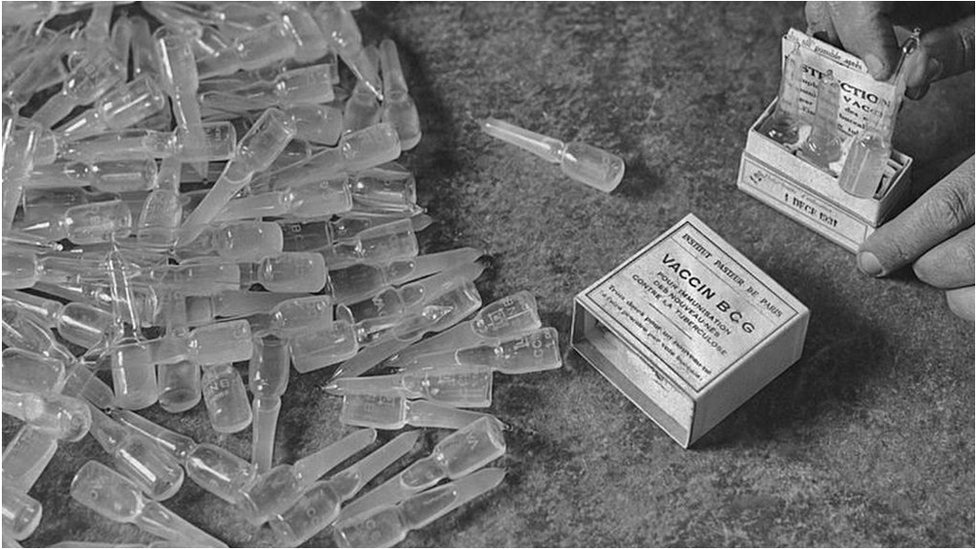
image captionBCG (Bacillus Calmette-GuŽrin) vaccine for tuberculosis, pictured at the Pasteur Institute in Paris in 1931.

Scientists in the UK have begun testing the BCG vaccine, developed in 1921, to see if it can save lives from Covid.

The vaccine was designed to stop tuberculosis, but there is some evidence it can protect against other infections as well.

Around 1,000 people will take part in the trial at the University of Exeter.

But while millions of people in the UK will have had the BCG jab as a child, it is thought they would need to be vaccinated again to benefit.

Vaccines are designed to train the immune system in a highly targeted way that leaves lasting protection against one particular infection.

But this process also causes wide-spread changes in the immune system. This seems to heighten the response to other infections and scientists hope it may even give our bodies an advantage against coronavirus.

  • Previous clinical trials have shown the BCG jab reduced deaths by 38% in newborns in Guinea-Bissau, mostly by reducing cases of pneumonia and sepsis.
  • Studies in South Africa linked the vaccine to a 73% reduction in infections in the nose, throat and lungs; experiments in the Netherlands showed BCG reduced the amount of yellow fever virus in the body.

“This could be of major importance globally,” Prof John Campbell, of the University of Exeter Medical School, told the BBC.

“Whilst we don’t think it [the protection] will be specific to Covid, it has the potential to buy several years of time for the Covid vaccines to come through and perhaps other treatments to be developed.”

The UK trial is part of the international Brace-study, which is also taking place in Australia, the Netherlands, Spain and Brazil, recruiting 10,000 people in total.

It will focus on health and care workers, as they are more likely to be exposed to coronavirus, so researchers will know more quickly if the vaccine is effective.

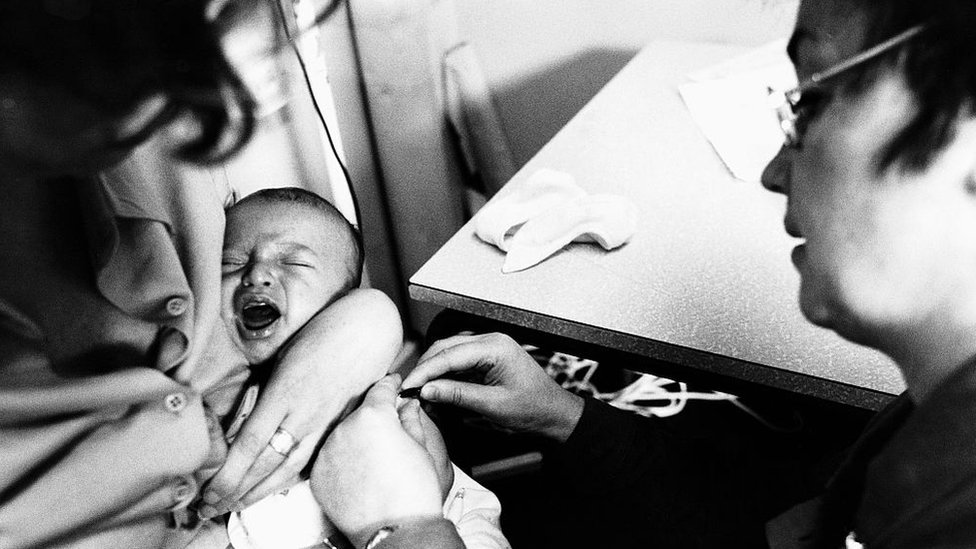
Baby being given a BCG jab

Sam Hilton, a GP from Exeter, is taking part in the trials since, as a doctor, he is at higher risk of catching Covid.

“There’s quite a good theory BCG might make you less likely to get unwell when you get Covid,” he told the BBC.

“So I see it as a potential for me to get protected a bit, which means I’m more likely to come to work this winter.”

Dr Tedros Adhanom Ghebreyesus, the director general of the World Health Organization, is one of the authors of a Lancet article saying the BCG vaccine has the potential to “bridge the gap before a disease-specific vaccine is developed”.

“This would be an important tool in the response to Covid-19 and future pandemics,” the article states.

However, the BCG vaccine will not be a long-term solution.

Any enhanced resilience to Covid is expected to wane meaning people who were immunised with BCG in childhood would no longer have protection. BCG has not been routinely used in the UK since 2005 because levels of tuberculosis are so low.

Additionally, the vaccine will not train the immune system to produce the antibodies and specialist white blood cells that recognise and fight off the coronavirus.

End game

The big goal remains a vaccine that specifically targets the coronavirus. Ten such vaccines are in the final stages of clinical research, including the one developed at the University of Oxford.

Prof Andrew Pollard, from the Oxford Vaccine Group, told the BBC: “The way that most vaccines work is to make a very specific immune response against the germ you are trying to prevent.

“But in order to make a good immune response, there is also a rather non-specific ‘souping-up’ of the immune response and that changes the way the immune system is able to respond in the future.

“The problem we have today is I can’t tell you what you could do with other vaccines to try to improve your ability to respond to coronavirus because we have no evidence at all.”

Lankan Supreme Court allows basic structure of 20A to remain without a referendum

October 11th, 2020

By P.K.Balachandran/Daily Express Courtesy NewsIn.Asia

But the court has said that fundamental rights petitions can be filed against the Attorney General, in respect of anything done or omitted to be done by the President in his official capacity.”

Colombo, October 11 (newsin.asia): In the determination on the 20th Constitution Amendment Bill leaked to the Sunday Times, the Sri Lankan Supreme Court has let the basic structure of the proposed 20A bill remain unaffected while making a referendum necessary in the case of four relatively minor provisions.

The Court’s determination suits the government because its basic requirements have been met. And the government has already expressed its readiness to entertain amendments at the committee stage in parliament which will look after some of the demands of the Supreme Court. The court has accepted these assurances.

As per the court’s determination, the government’s bid to strengthen the Executive Presidency by abolishing the powerful Constitutional Council (with non-MPs in it) and replacing it with a powerless Parliamentary Council of MPs, will not need a referendum.

The 20A bill’s stipulation that the Parliamentary Council will only make ‘observations’ on the proposals of the President in respect of appointments to key positions in the public service and the judiciary, is not unconstitutional the court said. That provision only amounts to a ‘redefining’ of the presidential power of appointments, the court ruled.

The Court also held that empowering the President to remove the Prime Minister and appoint a new Prime Minister who, in his opinion, commands the confidence of Parliament, does not infringe the sovereignty of the people and therefore, does not need a Referendum.

The 20A’s bid to make the President immune from legal action if he intentionally violated the constitution, will be subject to a referendum in addition to getting a two-third majority, the Court ruled. It dismissed the argument that: ‘immunity is essential for the unimpeded and efficient discharge of functions’. The Court further said that the remedy of impeachment of the President, which had been advanced by the Attorney General to suitably address the question of the President’s intentional violation of the Constitution, is not an alternative remedy sufficient for the purpose.

The court added that Clause 5 of the 20th Amendment Bill should be amended to provide for the people to invoke the jurisdiction of the Supreme Court in such instances. The Court’s ruling is in line with the 19th Amendment to the Constitution which, amended the old Article 35 of the 1978 Constitution by allowing fundamental rights petitions to be filed against the Attorney General, in respect of anything done or omitted to be done by the President in his official capacity.”

The Court ruled that the 20th Amendment Bill’s repeal of Article 104GG which made it an offence, inter alia, for a public officer and others holding like positions to disobey directives and guidelines issued by the Elections Commission would have a prejudicial impact on the franchise and as such, would require a Referendum to be passed along with a special majority in Parliament.

The Court said that Clause 3 of the 20th Amendment Bill which deleted the duty of the President to ensure the creation of proper conditions for the conducting of elections on the advice of the Elections Commission was, to that extent, inconsistent with Article 3 read with Article 4 of the Constitution and would have to be approved by the People at a Referendum along with the special majority in Parliament.

However, it noted that the committee stage amendments proposed by the Attorney General includes restoring that duty to Article 33. As such, the Court ruled that the inconsistency would cease as a result of that amendment as proposed.

Dual Citizenship

The Court has dismissed the claim that holding Dual Citizenship is a disqualification for election as a Member of Parliament, stating that arguments pertaining to ‘split loyalties’ and ‘conflicts of interests’ are surmise and conjecture” that it is not called upon to consider.

Clause 15 of the 20th Amendment Bill that, any amendment proposed to a Bill in Parliament must not deviate from the merits and principles of such Bill, has been noted as progressive” by the Court. It also acknowledged that this clause appears to have been removed in the proposed committee-stage amendments by the Attorney General.

In relation to the time limit to challenge a Bill being narrowed to seven days from fourteen days, the Court has declined to hold that this affects the People’s judicial or legislative power but has opined that this merely ensures that challenges to Bills are efficiently and expeditiously filed.

Urgent Bills

The Court held that the clauses of the 20th Amendment Bill, bringing back the mechanism of Urgent Bills requiring the Supreme Court to make its Determination within twenty four hours or such longer period not exceeding three days as the President may specify or allowing the President to place bills defeated by Parliament to the People by a Referendum, can be passed by the special majority alone.

Auditor General

As regards the powers of the Auditor General over auditing the Office of the Secretary to the Prime Minister and the Secretary to the President that were absent in the 20th Amendment Bill which amended Article 154 of the Constitution, the Court noted that the committee stage amendments proposed by the Attorney General would bring back that power which then rectifies the adverse impact on the legislative power of the People.

Where the auditing of companies where the Government holds fifty per centum or more of the shares are concerned which provision was to be deleted by the Bill, the Court accepted the argument of the Attorney General that the mere absence of reference to any class of institutions in Article 154 does not preclude the Auditor General from exercising his powers under the National Audit Act which includes such entities as ‘auditee entitees.’

Sumanthiran’s Reaction

Tamil National Alliance (TNA) MP and President’s Counsel, M.A. Sumanthiran welcomed the Court’s upholding the citizen’s right to challenge a Presidential decision in court. The Court’s ruling is in line with the 19th Amendment to the Constitution which, amended the old Article 35 of the 1978 Constitution by allowing fundamental rights petitions to be filed against the Attorney General, in respect of anything done or omitted to be done by the President in his official capacity.”

While the amendments suggested by the court will be taken up at the committee stage to avoid a referendum, the basic issue of the gargantuan powers sought to be assumed by the Executive President through 20A still remains, Sumanthiran said.

Since the Supreme Court has already given its determination, the legal avenue is closed to us. We have to fight the 20A bill politically, which is what we are going to do,” he added.

The political battle is not going to be a walkover for the ruling Sri Lanka Podujana Peramuna (SLPP). It has 149 MPs, one short of a two-thirds majority needed to pass the 20A. But already one MP, Vidhura Wickramanayake, has said that he is voting against the bill. Another MP Wimal Weerawansa has said that he will not be responsible for any unfavorable political fallout of the 20A.

The main complaint of the MPs and the political class against the 20A is that it renders parliament, the cabinet, the Prime Minister and the Parliamentary Council, virtually powerless and makes a single man, the President, all powerful.

COVID-19: News Summary

October 11th, 2020

Health News

COVID-19 health regulations to be gazetted into laws

Courtesy Adaderana

The Minister of Health Pavithra Wanniarachchi says that steps will be taken to gazette the recommendations issued by the Ministry of Health for the control of COVID-19 into a law.

The Minister stated that the new laws regarding health regulations will be published in a gazette notification within the coming two days.

As a result, the courts will be able to impose severe punishments on those who violate the quarantine laws, she added.

I hope to issue a gazette notification within two days, to enable legal action against those who do not comply with the health provisions in the areas declared by the Director-General of Health Services as a virus-affected area.

This gazette will be issued in such a way that those who do not wear masks in those areas, who do not practice the one-meter social distance, or who do not measure body temperature at the entrance to certain premises, can be legally penalized.”

Accordingly, those who violate these health provisions in areas declared as virus-infected areas can be penalized with a maximum fine of Rs 10,000 or 06-month imprisonment or both, she added.

Minuwangoda COVID-19 cluster expands by 61 more cases

Courtesy Adaderana

Sixty one more individuals have tested positive for the COVID-19 virus thus increasing the Minuwangoda cluster, the Commander of the Army, Lieutenant General Shavendra Silva, confirmed.

Among them, 39 patients have been identified among those who had been undergoing quarantine at quarantine centers operated by the Sri Lanka Army.

The remaining 22 are close contacts of the employees of the Minuwangoda apparel factory.

Accordingly, a total of 1,247 infections have been reported from the Minuwangoda cluster so far.

Two villages in Mannar declared isolated areas

Courtesy Adaderana

Two villages in Mannar have been declared isolated areas in an attempt to control the COVID-19 pandemic, stated the Army Commander Lieutenant General Shavendra Silva.

The Pattithottam and Periyakadai areas in Mannar have been isolated in this manner.

Two who visited Dambulla Economic Center test COVID-19 positive

Courtesy Adaderana

Action has been taken to disinfect the Dambulla Dedicated Economic Center last night (10) after it was identified that two people infected with COVID-19 had visited nearly 80 shops at the center.

A businessman in Divulapitiya, who had contacts with Minuwangoda apparel factory employee, and a lorry driver employed under the businessman have been subjected to PCR tests.

And it has been identified that the duo, who had visited the Dambulla Economic Center, has contracted the virus.

The health authorities are currently in the process of carrying out PCR tests of over 100 people at the Dambulla Economic Center who have been identified as associates of the two COVID-19 patients.

Single infected person can transmit virus up to 522 people – Army Chief

Courtesy Adaderana

There have been instances of the Minuwangoda COVID-19 cluster extending to the first and second contacts, according to Army Commander Lieutenant General Shavendra Silva.

The Head of the National Operation Centre for Prevention of COVID-19 Outbreak (NOCPCO), joining the TV Derana breakfast show ‘Derana Aruna’, said that 26 of the COVID-19 cases reported yesterday (10) were from Minuwangoda, while 23 are from Gampaha and 22 are from Divulapitiya.

In addition, 01 infected person from Panadura, 02 from Colombo, 02 from Polonnaruwa, and 01 from Matale have been also been detected yesterday. At least one person from different parts of the country has been identified so far, he added.

The Army Chief says that the virus can be transmitted to as many as 522 people through a single infected person.

However, it cannot be ascertained yet that the virus has entered the society apart from the cluster, he said.

While it has not yet been possible to identify the origin case of the cluster, the focus is currently on to determine the possible infections through the cluster, the Army Chief said.

As per the investigations carried out so far, it has been revealed that there had been Minuwangoda apparel employees who had reported illnesses to the facility’s sick bay since the September 21.

Student of Kelaniya Uni contracts COVID-19

Courtesy Adaderana

A student of the University of Kelaniya is also reported to have contracted the novel coronavirus, COVID-19.

The patient is reportedly a female student studying in the Department of Statistics in the Faculty of Sociology, at the university.

She is a resident of Minuwangoda and reportedly her father is an employee at the Minuwangoda apparel factory.

Media Director of the University of Kelaniya, Senior Lecturer Wijayananda Rupasinghe, stated that two other students who had contacts with the infected student have also been subjected to PCR tests.

Meanwhile, the Vice-Chancellor of the University of Sri Jayewardenepura, Senior Professor Sudantha Liyanage, says that a final decision will be taken tomorrow (12) regarding the future academic activities of the university, where a person infected with the coronavirus was identified.

No students will be allowed within the university campus until then, he added.

Hela Clothing’s employee tests positive

Courtesy The Daily Mirror

Hela Clothing, an apparel manufacturing group, said that an employee at its Thihariya plant tested positive for Covid-19 on October 11.

Issuing a statement it said that the points below outline the series of events that took place and the steps management has taken to ensure the safety of all our colleagues and their families.

On October 3, Hela management immediately requested all individuals having any connection to the current Covid-19 epicenter in Minuwangoda to self-isolate.

An additional doctor and nurse were brought in to Thihariya to monitor staff and advice procedures.

As of today (11), we have one employee who has tested positive for Covid-19, he was and continues to be asymptomatic.

This colleague’s wife is an employee of the Minuwangoda apparel plant and had been at a quarantine center since October 7, as mandated by the government. He last reported to work on 2nd October.

The company has now arranged PCR tests for all colleagues who had contact with this individuals.

As a precautionary measures we have now closed down our Thiharaiya Plant which will remain closed until the result of the PCR tests have been released.

The plant is currently undergoing our standard disinfection protocol in adherence to authorities’ guidelines.

As a company, we will do our utmost to support our affected colleague and those who are impacted. We are rallying together all our resources to ensure that the impact, if any, on our employees and our communities is minmimized, the statement added.

Three doctors among Covid-19 infected patients today

Courtesy The Daily Mirror

Three doctors are among the infected Covid-19 cases that were reported today, the National Operations Centre for Prevention of COVID-19 (NOCPOC) said.
Accordingly, two doctors are from the Mawanella area and one doctor is from the Kegalle area, who have been identified as the first contacts of Covid-19 patients in the Minuwangoda cluster.
Yesterday, four monks at a temple in Eluwapitiya in the Attangalla area and another person have tested for the virus.

AG summons CID’s DIG, Chief Investigating Officer over Riyaj Bathiudeen’s release

October 11th, 2020

Courtesy Adaderana

The Attorney General has summoned the Deputy Inspector General (DIG) of the Criminal Investigation Department (CID) and its Chief Investigating Officer.

This is over the release of Riyaj Bathiudeen, MP Rishad Bathiudeen’s brother, after being under arrest in connection with the 2019 Easter Sunday terror attacks.

The officers have also been directed to bring all investigative material related to the matter, the Coordinating Officer of the Attorney General State Counsel Nishara Jayaratne.

Accordingly, the duo are to appear before the Attorney General tomorrow (October 12).

COVID-19: 60 more cases add to Minuwangoda cluster

October 11th, 2020

Courtesy Adaderana

Another 60 persons from the Minuwangoda coronavirus cluster have tested positive for the virus, stated Army Commander Lieutenant General Shavendra Silva.

Among them, 48 have been detected from the Sri Lanka Army-operated quarantine centers.

The remaining 12 patients are close contacts of the Minuwangoda apparel factory workers.

So, a total of 121 COVID-19 patients have been detected from the Minuwangoda cluster.

Accordingly, the Minuwangoda cluster has expanded to 1,307 infections.

White van driver complains of undue influence from Rajitha (video)

October 11th, 2020

Courtesy Hiru News

The person who pretended to be a van driver at the white van news conference which caused a great deal of controversy during the last government had called a press conference today.

He said that he was pressurized by former Minister Rajitha Senaratne regarding the case related to that incident.

He has lodged a complaint with the Meegahawatta Police Station requesting that he be given proper protection.

Army Intelligence Officer testifies that CID had intimidated him and tried to obtain false evidence (Video)

October 11th, 2020

Courtesy Hiru News

Army Intelligence Officer Kanishka Gunaratne says that some officers of the CID had intimidated him and tried to obtain false evidence.

This was while giving evidence for the first time before the Presidential Commission Investigating Political Victimization

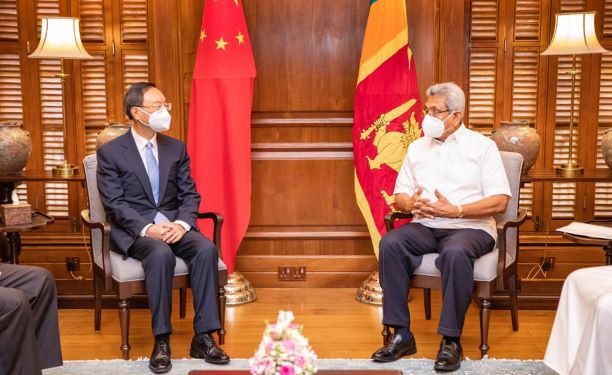
China will supply anti-COVID vaccine to Lanka after WHO approval: CPC Politburo member Yang Jiechi

October 10th, 2020

By Kelum Bandara Courtesy Daily Mirror

Sri Lanka and China also signed an agreement for a grant of 600 million RMB grant (Rs.16.5 billion) for livelihood development in the island.

Colombo, October 10: China responded positively to Sri Lanka’s request to cooperate in the provision of a vaccine being developed by it against COVID-19, a diplomatic source said on Friday.

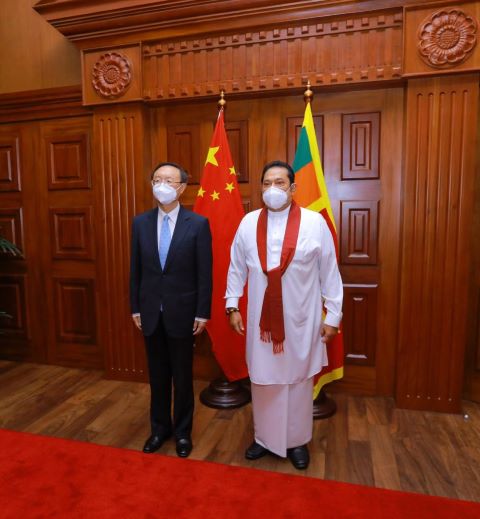
Lankan Prime Minister Mahinda Rajapaksa is reported to have requested for this when a top-level Chinese delegation led by Yang Jiechi, who is a member of the politburo of the Communist Party of China, called on him.

The Chinese side responded positively to Sri Lanka’s request. Once the vaccine is developed and approved by the World Health Organisation (WHO), they will consider cooperation with Sri Lanka,” the source said.

Yang, who was in Colombo on October 8 and 9, is the highest Chinese official in terms of protocols as far as foreign relations are concerned in that country. The seven-member delegation led by him was in the country for 18 hours and interacted with President Gotabaya Rajapaksa and Prime Minister Mahinda Rajapaksa.

A diplomatic source said seven vaccine candidates qualified for human trial at the level of stage 3, and four of them were from China. According to the source, one vaccine is already in use for urgent requirements.

The Chinese side responded positively to Sri Lanka’s request. Once the vaccine is developed and approved by the World Health Organisation (WHO), they will consider cooperation with Sri Lanka,” the source said.

The President and the Prime Minister sought investment from China in the Colombo Port City and the Hambantota Industrial Party. The Chinese side responded positively in this instance. Also, the delegation gave positive response to the President’s request for a technology university in Hambantota.

The delegation led by Yang Jiechi also promised to support Sri Lanka at the United Nations Human Rights Council (UNHRC) in Geneva.

Yang served as the Chinese Foreign Minister between 2007 and 2013. At that time, he supported Sri Lanka at the UNHRC in Geneva. He also ensured support of some African countries to Sri Lanka.

The diplomatic source said the delegation followed strict health protocols in the country. They got their PCR testing within 24 hours before departure form Sri Lanka. They wore face masks and kept social distancing. They arrived in a chartered flight. The crew members also stayed at a quarantine hotel. Members of the delegation had also been vaccinated against the virus in China.

(The picture above shows CPC Politburo member Yang Jiechi with Lankan Prime Minister Mahinda Rajapaksa)

Cosmopolitanism characterized Kandy under the Kings

October 10th, 2020

By P.K.Balachandran/Daily Mirror

From the 16 th. to the 18 th.,Century, Jesus could be easily adopted as one of the Hindu gods like Vishnu and Natha and looked upon as a benevolent being. Virgin Mary could be absorbed as Pattini, Prof. Gananath Obeyesekere points out.

Cosmopolitanism characterized Kandy under the Kings

Under the Sinhala Kings, Kandy showed a remarkable degree of cosmopolitanism which should be an inspiration to us in this day and age when nations are torn asunder by ethnic, linguistic and religious divisions. People of all faiths and ethnic groups, immigrants from the rest of the island and overseas were welcome to settle down, trade, work, inter-marry and prosper in Kandy under the Kings.

According to Prof.Gananath Obeyesekere’s latest book: The Many Faces of the Kandyan Kingdom 1591-1765 (Sail Fish, Colombo, 2020) there was no communalism or ethnic conflict in that era. This article gives some interesting facts culled out of the above-mentioned book.

Obeyesekere says that people (and Kings too) effortlessly slipped in and out of Buddhism and Catholicism. It was possible to be a Catholic outwardly and a Buddhist deep inside. Places of worship of different faiths were constructed without let or hindrance. Kings and commoners spoke more than one language. While the hoi polloi spoke Sinhalese (the language of the majority) and Tamil (the language of trade), a section of the elite were familiar with Portuguese and Dutch as well.

It was during the reign of Jayavira Bandara (1511-1552) that, for the first time, European Catholic priests got a place in the Kandyan court. In order to please the Portuguese, who were a force in the Kotte Kingdom, Jayavira Bandara became a nominal” Catholic. Jayavira was deposed by his son Karalliyadde Bandara (1552-1582), who became a devout Catholic, publicly embracing Christianity around 1562-64. But such public display of the conversion alienated him from his subjects and he had to flee to Trincomalee with his daughter Kusumasana Devi. He died of small pox there but Kusumasana Devi was rescued by the Portuguese, baptized and renamed Dona Catherina.

After Karalliyadde Bandara’s death, Kandy became a bone of contention between Rajasinha I of Sitavaka and Virasundara Bandara of Peradeni in Kegalle district. Rajasinha I killed Virasundara. Subsequently, Virasundara’s son Konappu Bandara took the help of Dharmapala of Kotte to capture Kandy. Dharmapala had converted to Catholicism, gifted the Kotte Kingdom to the Portuguese King in Lisbon and ruled Kotte as a vassal. Konappu Bandara, married the daughter of Sembagaperumal, a Catholic prince and brother of Vidiye Bandara, the father of Dharmapala. This marriage (the first to be referred to by the Portuguese term Kasaada) was performed as per Catholic rites in Dharmapala’s palace.

However Konappu Bandara was sent away to Goa in India by the Portuguese following the murder of his confidante Salappu Bandara. Konappu was baptized and renamed Don Joao of Austria. Konappu alias Don Joao, came back to lead a Portuguese campaign to oust Rajasinha I from Kandy. But after ousting Rajasinha I, he ditched the Portuguese and took over Kandy and crowned himself as Vimaladharmasuriya I.

He then reverted to Buddhism. Angry with this, the Portuguese invaded Kandy with an intention to place Dona Catherina, the Catholic princess of the Bandara clan, on the throne. But Vimaladharmasuriya destroyed the entire Portuguese regiment, captured Dona Catherina and married her. While Vimaladharmasuriya remained a strong Buddhist after marriage, Dona Catherina, his wife, remained a staunch Catholic, though she brought up her children as Buddhists.

In 16th.Century, changing religion was not uncommon in Sri Lanka. People also had dual affiliations. Obeyesekere says: Buddhists could become Christians and some would even go to church. Yet at the same time, they could continue to be Buddhists.” Further, Jesus could be easily adopted as one of the Hindu gods like Vishnu and Natha and looked upon as a benevolent being. Virgin Mary could be absorbed as Pattini,” he points out.

Heavily exposed to the Portuguese, Vimaladharmasuriya and Dona Catherina led a partially Western-style life with the King shaking hands with Europeans and Don Catherina and the children wearing Western dresses. The King spoke Portuguese fluently, learnt to speak Dutch and was interested in Western instrumental music. But at the same time, he dedicated himself to the promotion of Buddhism by housing Buddha’s Tooth Relic is a grand temple and sending a mission to Arakan in Burma to get monks to come to Sri Lanka and ordain Lankan monks. But Vimaladharmasuriya was not dogmatic. According to the Dutch chronicler P.A.Baldaeus, he sincerely believed in freedom of religion. To cement ties with the Tamil Hindus of the East coast, he married one of their princesses.

Kandy’s tolerant culture continued under King Senarat (1604-1635), a cousin of Vimaladhramasuriya’s, who was a former Buddhist monk. Senarat married Vimaladharmasuriya’s widow Dona Catherina. When 4,000 Muslim were driven out of the Western coast by the fanatic Portuguese, Senarat settled them on the Eastern coast. When the Dutch persecuted the Catholics in their dominions, Senarat gave them shelter in Kandy.

Cosmopolitan Demography

Under Vimaladharmasuriya and his successors, Kandy was a veritable display of diverse humanity”. Obeyesekere quotes Dutch Admiral J.V. Spilbergen as saying: Among the Singales there live many Moors, Turks and other heathens, who all have special laws. Brahmos (Brahmins) are there in large numbers, who are superstitious and respected by the other nations. These Brahmos never eat anything that has life.” There were also Malays, Javanese, North Indians, and Hindu ascetic wanderers such as Andis and Pantarams, adds Obeyesekere. King Rajasinha II (1629-1687) loved to have foreigners his domain. The Kandyan Kings sometimes forced” many European prisoners to settle there.

Jesuits Joseph Vaz and Jacome Goncalvez

Vimaladharmasuriya II (1687–1707), son of Rajasinha II, allowed Joseph Vaz, a Jesuit missionary from Goa, to settle in his Kingdom and preach Catholicism when the Dutch were persecuting the Catholics in areas under their control. Vimaladharmasuriya II and his son Narendrasinha (1707-1739), ignored the 1638 treaty between Rajasinha II and the Dutch, which had enjoined the Kandyan King to drive Catholic missionaries out of the Kingdom.

Like his predecessor Francis Xavier, Fr.Joseph Vaz was a great success among the poor because he was sworn to a life of simplicity, service and poverty. Like Francis Xavier, Fr.Vaz wore no shoes, wore a tattered black gown and slept on the floor like a Sanyasi. His simple ways earned him the title Mahaswami. People respected him also because he was originally a Brahmin, a caste much respected in Sri Lanka.

King Narendrasinha, grew up in the company of Fr.Vaz and his disciple and successor Fr.Jacome Goncalvez, also a Konkani Brahmin from Goa. Fr.Goncavez had contributed immensely to Catholic literature in both Sinhala and Tamil. Narendrasinha, who was highly educated and liberal in outlook, sought the company of both Vaz and Goncalvez. But Narendrasinha was a devout Buddhist too. He put up Samaneras (student monks) in his abode. He constructed shrines for Vishnu and Natha. According to historian Lorna Dewaraja, Narendrasinha did not do much for the Buddhist Sangha and was given to pleasurable activities. But Obeyesekere feels this criticism to be unfair, as Narendrasinha had renovated the Temple of the Tooth and had got 32 Jatakas painted on its walls.

Indian Nayaka Connection

No account of the liberalism of the Kandyan Kingdom will be complete without a reference to the three-King Nayaka dynasty from Madurai in Tamil Nadu. The Nayakas entered Kandyan royalty through marriage as Sinhala Kings married Nayaka princesses. Sinhalese Kings used South Indian troops in their military campaigns. They took part in the rout of the Portuguese at Gannoruva in 1638 when Rajasinha II decided to put the Portuguese in their place.

The first Nayaka King of Kandy was Sri Vijaya Rajasinha (1739-1747) and the last was Sri Wickrama Raja Sinha who was deposed in 1815 by the British. Except for the last King, the earlier two were popular because they backed Buddhism to the hilt. According to Obeyesekere, it is incorrect to say that Narendrasinha was the last Sinhala King” as for generations, the Sinhala kings were related to the Hindu Nayakas of Madurai through the female line. The Hindu Nayaka mothers must have played a significant role in the socialization of Kandyan royalty, he adds.

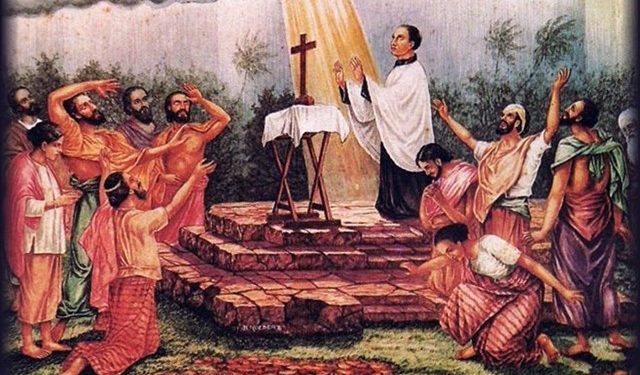
(The painting at the top shows Fr.Joseph Vaz from Goa preaching in Kandy)

Habit of imputing political motives to police probes needs to be curbed

October 10th, 2020

By Sugeeswara Senadhira Courtesy Newsin.asia

Opposition politicos and irresponsible social media blatantly misinterpreted police and court decisions on the release of Riaj Bathiudeen, brother controversial former Minister Rishad Bathiudeen, says Sugeeswara Senadhidra

Habit of imputing political motives to police probes needs to be curbed

Colombo October 9 (Daily News): Sri Lanka’s Opposition politicians are ready to grab any weapon to attack the government as they have run out of issues. In the rush to make allegations against the ruling party, they put their feet in their mouths again and again. The latest weapon they have picked up in their witch hunt is the release of the detained Riyaj Bathiudeen, brother of All Ceylon Makkal Congress (ACMC), leader Rishad Bathiudeen.

They have conveniently forgotten that the power to discharge a suspect lies solely with the judiciary and the crime investigations by police, and that any attempt to question that right is an attempt to interfere in free and fair justice.

As Irrigation and State Minister of Internal Security Chamal Rajapaksa clarified in Parliament on Tuesday (October 6), the release of former minister Rishad Bathiudeen’s brother Riyaj arrested in connection with the Easter Sunday carnage did not mean that he had been cleared of all charges. It was a decision taken by the courts and it can also decide to order the arrest of the suspect if new evidence linked to him surfaces.

The issue was raised in Parliament by Samagi Jana Balawegaya (SJB) MP Chaminda Wijesiri. In reply, Minister Chamal Rajapaksa said that Riyaj had been taken into custody on April 14, 2020 on suspicion of having connections with Insaf Ahmed, the terrorist who blew himself up at the Cinnamon Grand Hotel in Colombo during the terror attacks that took place on April 21, 2019. The CID found out that there were 17 calls made by the suspect to the terrorist. Initially, the suspect had been detained under the provisions of the Prevention of Terrorism Act (PTA) for three days for questioning and thereafter permission of the courts were obtained twice for three months each. But the investigators found that the suspect and the terrorists had no terror links. The calls had been made for business purposes.

There is no evidence to prove that the suspect aided and abetted the terrorist(s) to carry out the attacks, and, therefore he was released on Sept 29, 2020. The last call was three months prior to the attacks. However, if there is new evidence, he will be arrested again,” the Minister said.

He further said that 130 employees in public institutions and statutory institutions had been interrogated with regard to the Easter Sunday terror attack. After interrogations it had been found that some of them were innocent. They had been released. Ten employees in public institutions and statutory institutions had been arrested on terror charges. Their cases are pending before courts. With regard to some others in custody, the police have sought the Attorney General’s instructions.

The Members of the Opposition and irresponsible social media activists blatantly challenged the decision of the courts and tried to interpret it as a political ‘deal’ to get Rishad Bathiudeen’s support to the government.

These wild allegations were levelled despite the categorical statement issued by President Gotabaya Rajapaksa that the government has not entered into any political deal with MP Rishad Bathiudeen. Reiterating his absolute commitment to the safety and security of the country and the people, the President stated in a Facebook post that ensuring national security is the first and foremost responsibility of my government”.

President Gotabaya Rajapaksa said he is not prepared to hand over the power of arresting or arbitrarily releasing people to politicians, as happened in the past. I will also take action to rectify any omissions or mistakes made by the relevant authorities or officials,” said the President.

I emphasize that our government has not entered into any political deal with MP Rishad Bathiudeen,” he said and assured citizens that he will not forsake the trust that they have placed in him and he will most certainly continue to work towards strengthening this trust.

Cabinet spokesman Minister Keheliya Rambukwella said that since there are some concerns over Bathiudeen he should not be taken into the government. The ruling Sri Lanka Podujana Permauna (SLPP) also announced that neither the government nor the SLPP had entered into any agreement with MP Rishad Bathiudeen. There is no discussion or any idea to absorb MP Bathiudeen in the government,” SLPP General Secretary Sagara Kariyawasam said.

However, responding to a question asked at the SLPP weekly news briefing over the concerns raised by Archbishop of Colombo Malcolm Cardinal Ranjith over the release of Riyaj Bathiudeen, MP Kariyawasam called for an immediate investigation into the release of Riyaj Bathiudeen. We request the Defense Secretary to launch an immediate investigation into the incident and to find out if there has been any irregularity in the release of Riyaj Bathiudeen,” he said.

Minister Wimal Weerawansa, known for his outspoken statements, said that the government is not stupid to have any deal with Bathiudeen. He said that if any attempt is made to allow Bathiudeen to join the government he will be chased out. Sports Minister Namal Rajapaksa too said the government maintains its stand that it will not have any dealings with extremists.

Furthermore, Rishad Bathiudeen clarified that his party, the All Ceylon Makkal Congress, did not have any agreement with the government nor has it had any talks with the government.

The people have the highest expectations from law enforcement institutions. The police have the fullest responsibility of probing crimes, arrest suspects and also discharge a person if there is no sufficient evidence to prove his guilt.

Hence, politicians should not jump to give their own interpretations of ‘political deals’ when a suspect is arrested or discharged. It is not a sign of a mature democracy. Constantly questioning the capacity to interpret the law is akin to constantly questioning the legitimacy of politicians to even make any law in the first place. In the past, we have seen ugly scenes such as stone throwing at the houses of judges who had given verdicts that were not seen as being favorable to the party in power at that time. The members of the Opposition should think, not twice but several times, before challenging a Court decision merely to score brownie points over the ruling party.

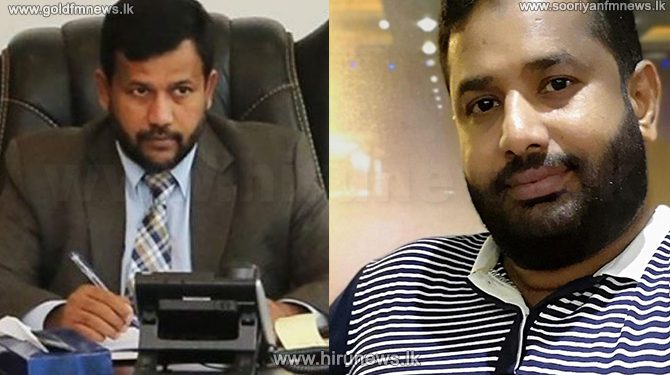
(The featured image at the top shows Rishad BAthiudeen (on the left), and his brother Riaj Bathiudeen. Photo: Hiru News)

President Xi gives “key priority” to Lanka, politburo member Yang Jiechi assures President Gotabaya Rajapaksa.

October 10th, 2020

Courtesy Newsin.Asia

The Lankan President said he will prove that Hambantota port is not a debt trap laid by China but is a development project with high potential

President Xi gives “key priority” to Lanka, politburo member Yang Jiechi assures President Gotabaya Rajapaksa

Colombo, October 9: Yang Jiechi, a member of the Chinese Communist Party’s Politburo and a former Foreign Minister, told Sri Lankan President Gotabaya Rajapaksa here on Friday, that Chinese President Xi Jinping gives key priority” to relations with Sri Lanka and that China will support Sri Lanka in world bodies including the United Nations Human Rights Council.

Yang was on a two-day visit during which he met Prime Minister Mahinda Rajapaksa, other Ministers and top officials.

Yang said that China’s assistance will not be just lip service but will be concrete to achieve the development goals contained in the Saubhagyaye Dekma” policy statement of President Gotabaya.

China has identified several areas conducive for the development of bilateral relations with Sri Lanka. In addition to completing large-scale projects already underway, the area of assistance includes agriculture, education, tourism, water supply, healthcare, medical supplies, modern technology, digital economy, the blue economy and labour training. Plans are afoot to recommence discussions on the China – Sri Lanka Free Trade Agreement and to complete the Hambantota Industrial Scheme expeditiously,” Yang said.

The present status of bilateral relations between China and Sri Lanka is highly satisfactory” Yang said. Further: Maintaining and promoting this friendship is a key priority of President Xi Jingping,” the head of the seven-member delegation said.

China will firmly stand with Sri Lanka to protect its independence, sovereignty and territorial integrity at international fora including United Nations Human Rights Council,” he added.

Yang Jiechi is in the Central Committee of the CPC and is Director of the Office of the Foreign Affairs Commission of the CPC Central Committee. Yang had served in the US from 2001-2005 was Foreign Minister of China from 2007-2013. His current position in the Chinese administrations is equivalent to that of a Vice Premier.

Yang said that Sri Lanka is the first country in his current four-nation tour of Asia.

Gotabaya Wants Trade Deficit Reduced

President Gotabaya Rajapaksa expressed satisfaction over the current state of Sino-Sri Lanka relations and said China has been long-standing friend who supported Sri Lanka irrespective of the government in power.

China extensively supported us to defeat terrorism. Bilateral relations reached a higher level following the end of the armed conflict,” the Lankan President said and recalled the contribution of China to the development of Sri Lanka’s infrastructure facilities.

Yang Jiechi with Prime Minister Mahinda Rajapaksa

China had contributed to a number of large-scale infrastructure projects. The Hambantota Port, the Port City project, and Southern Expressway are some of them. Constructing a port in Hambantota is an idea of Sri Lanka and not China’s. We were convinced that it would be a project with a vast potential for generating income and employment opportunities. China offered to fund it. Many geo-political analysts interpret this project as a ‘debt trap’ set up by China to gain control over Sri Lankan affairs. I want to prove that it is not the case and that this large-scale project will help improve the living standards of the people,” the President said and sought China’s help achieve these goals.

Sri Lanka’s Needs Outlined

The Lankan President said that he had toured China 13 times prior to the assumption of the Presidency and said he had seen first-hand the progress that China had achieved.

I have seen massive development especially in the rural areas. My target is to bring about a similar development especially in the rural areas of Sri Lanka and to raise the living conditions of the people in this country, especially that of the poor. I look forward to seeing a visible progress in the Port City project over the next four years”, the President said.

President Rajapaksa pointed out that Sri Lanka’s trade deficit with China is high and called on the leader of the Chinese delegation to increase the volume of goods purchased from Sri Lanka to bring the deficit down.

Sri Lanka has a strong private sector. They manufacture various products. Open the Chinese market for these items. Encourage Chinese investors to invest in Sri Lanka. Encourage the Chinese people to visit Sri Lanka. If China can participate in Sri Lanka’s tea auction, it will be a major boost to economic stability”, the President said.

Explaining the limited tertiary educational opportunities available to Sri Lankan youth who pass GCE Advanced Level, the President said establishing a University of Technology for them will be an area where China can invest in Sri Lanka.

Yan Jiechi invited President Gotabaya to pay an official visit to China, once the COVID – 19 pandemic is successfully contained globally.

Among those present at the talks were the Chairman of the China International Development Cooperation Agency Wang Xiaotao, Assistant Foreign Minister of China, Deng Lee, Hu Wei, Chargé d’affaires of the Chinese Embassy in Sri Lanka, Chen Song, Deputy Director General in the Department of Asian Affairs at the Chinese Foreign Ministry, Foreign Minister Dinesh Gunawardene, Secretary to the President P. B. Jayasundera, Principal Advisor to the President Lalith Weeratunga, Foreign Secretary Adm. Jayanath Colombage and Sri Lanka’s Ambassador-Designate to China Dr. Palitha Kohona.

Labour Minister calls for report on Brandix

October 10th, 2020

Courtesy Daily Mirror

Labour Minister Nimal Siripala de Silva has directed the Labour Commissioner to immediately submit him a report regarding allegations levelled by several trade unions against the Brandix management that the company had allegedly failed to follow safety and health protocols.

Minister de Silva said he informed the trade unions to file a written complaint with the ministry to consider further action. He also added that the management of such factories or any other companies were bound to follow the relevant safety and health protocols, gazetted by the Quarantine and Prevention of Diseases Ordinance.

If we find that the company has not followed the safety protocols, action can be taken against them according to quarantine law,” he further said. (Piyumi Fonseka)

PHIs did not supervise Brandix Repatriation flights : PHI Union

October 10th, 2020

Courtesy Daily Mirror

The Public Health Inspectors Union of Sri Lanka claims that none of their members ever supervised any of those who were brought down from India in repatriation flights chartered by Brandix Apparel Ltd. who claim to have subjected all returnees to a 14 day self-quarantine.

Secretary, Public Health Inspectors Union (PHIU), M. Balasooriya dismissing the contents of the media releases issued by Brandix Apparel Ltd and the Task Force of the National Operational Centre for Prevention of COVID-19 Outbreak, said that, had any one of those who were brought to Sri Lanka from Visakhapatnam, India undergone the 14 day mandatory quarantine at a government-regulated quarantine center, they would have been handed over to them the (PHIs) to supervise the remaining 14 day self-quarantine period.

Although those who are responsible are now claiming that the passengers who were brought down from India underwent the regulated 28 day quarantine, let them show our Union the details where they underwent the mandatory quarantine and who the respective PHIs were, who supervised them during the 14 day self-quarantine,” Balasooriya alleged.

Meanwhile, when Daily Mirror contacted Rasika, the Load Controller at the Mattala Airport to obtain details of the load sheet in which arrival details of passengers aboard UL 1159 which landed at Mattala Airport on September 22,

at 14.05 hrs, this newspaper was asked to contact the Station Manager Sri Lankan Airlines Uddika Lakshman. The latter too refused to divulge any details and wanted us to contact the Head of Media, Sri Lankan Airlines, Deepal Perera.

Perera requested this newspaper to send him an official request to which an e-mail was sent. However, without providing the details sought – the names and their nationality of each passenger, Perera replied as follows, The names of passengers who travelled with us is confidential information and disclosure of that information violates our confidentiality obligations towards the passengers. We are unable to share any passenger manifest of a flight containing the names of individuals with a third party unless there is a Court order or directive from our Regulatory Authority directing us to provide any specific information to the Court or such Authority. We appreciate your understanding and we consider this matter as now closed,” Deepal.

In order to obtain the exact details of the passengers, as Sri Lankan Airlines refused to provide, this newspaper requested the necessary details from the airline under the Right to Information Act.

Although Brandix claims that they have not employed any foreigner at their Minuwangoda factory, a senior official who wished to remain anonymous who is undergoing mandatory quarantine at a government regulated quarantine center conformed this newspaper that there are Indian workers attached to the Minuwangoda factory.

If the company deny this claim, I am challenging the management to show all details of payments that were made to the employees,” the sources said.

When asked whether fabric materials were brought to the factory from India recently, she added that there are imported stocks but said not aware whether they were brought down recently. I cannot make any comment on that as I am not sure when they were brought to the factory,” the sources claimed.

When we contacted, Imanthi Perera, Head of Corporate Communication, Brandix Apparel Ltd, to find out as to when the three charter flights landed in Sri Lanka together with the flight detail and how many passengers were brought down from India, whether there weren’t any foreigners amongst the repatriated passengers, where they underwent the mandatory quarantine and whether any fabric material was brought down from India, Ms.Perera wanted this newspaper to send her an official request.

Responding to the queries, Ms. Perera stated that the three flights chartered by Brandix Apparel had got down 341 passengers. Although she states that only 48 passengers were brought on UL 1159 on September 22, this newspaper is in possession of an e-mail from the Ministry of Foreign Affairs which claims that there were 60 passengers on board. (Nirmala Kannangara)

11 coronavirus cases found at Katunayake EPZ

October 10th, 2020

Courtesy Ada Derana

Eleven employees of another apparel factory in the Katunayake Export Processing Zone (EPZ) have tested positive for Covid-19, the Administrative Public Health Inspector at the Health Medical Officer’s office in Seeduwa, Mr Suresh Kumara said.

It is reported that more employees of the apparel factory in question were referred to PCR tests on Friday (09) and the test results received today (10) had confirmed that they have been infected with the virus.

Accordingly, 02 female workers and 09 male workers of the apparel factory had tested positive.

Minuwangoda Covid-19 cluster confirms 103 more cases

October 10th, 2020

Courtesy AdaDerana

Two workers of the Minuwangoda apparel factory and 101 close contacts of factory workers have tested positive for the virus.

This increases the total positive cases from the Minuwangoda Covid-19 cluster to 1,186.

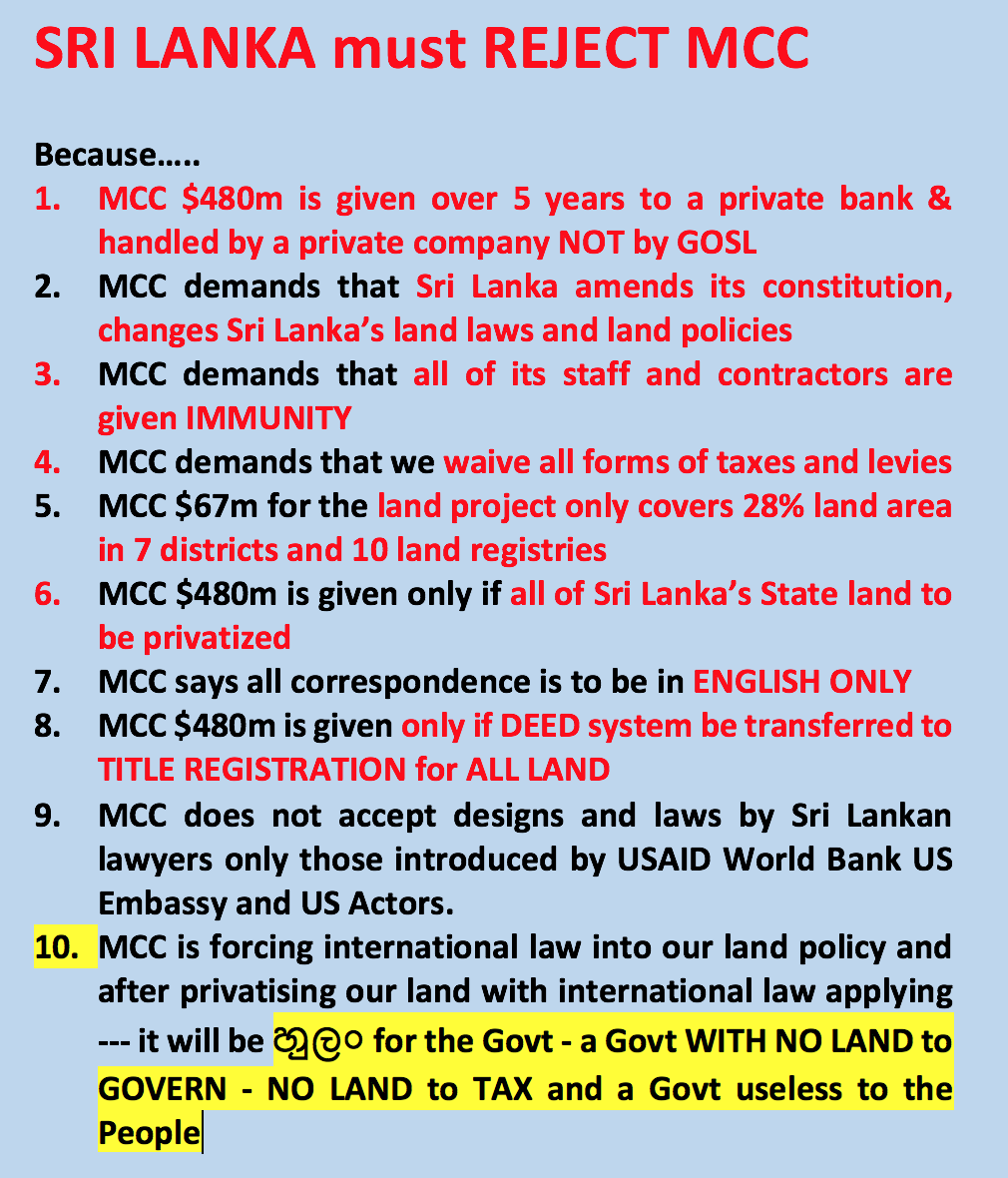
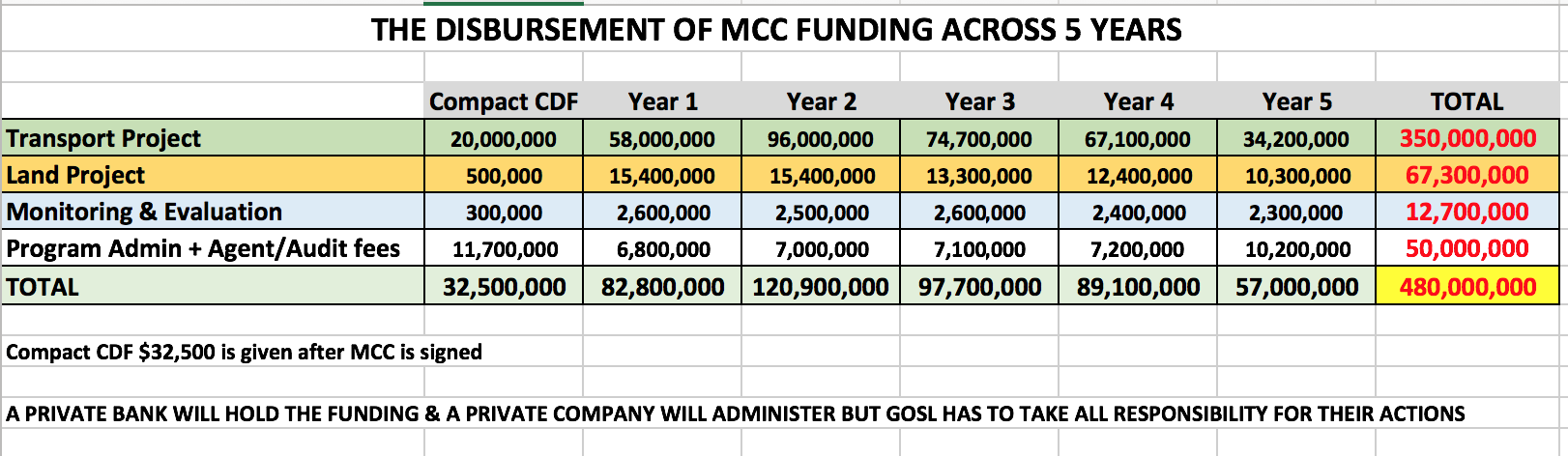
Why Sri Lanka must REJECT MCC

October 9th, 2020

THE SINHALA BUDDHIST CIVILIZATION OF SRI LANKA Part 1C

October 9th, 2020

KAMALIKA PIERIS

Revised 13.10.20

 Buddha wanted to spread his ideas   beyond the locality he lived in, and he sent sixty disciples in all directions. This was the start of Buddhist missionary work.

300 years later Emperor Dharmasoka (268 – 232 BC) took over the missionary task. He sent Buddhist missionaries to Syria, Macedonia, Cyrene, Epirus, Kashmir, Gandhara, Lower Burma and Thailand. Thanks to king Dharmasoka, Buddhism which till then, had covered only a few thousand square miles in north eastern India during the first two hundred years of its existence, became a world religion, said Guruge.

Buddhism spread in east, south, and central Asia. It did not go to the north, which was Siberia and it did not take root in west Asia. In Central Asia, Buddhism   spread to Gandhara, Tibet and Turkestan. In East Asia, Buddhism spread to China, Japan, Korea and Mongolia.   In South Asia, Buddhism spread to Afghanistan, Bangladesh, Bhutan, Maldives, Nepal, Pakistan, and Sri Lanka. In South East Asia, Buddhism spread to Burma, Thailand,     Cambodia, Laos, Vietnam and Indonesia.

These Buddhist countries practiced all three major schools of Buddhism, Mahayana, Theravada and Tantra.  China, Tibet, Mongolia, Korea and Japan, were Mahayana.  Burma, Thailand, Cambodia, Laos, Sri Lanka were Theravada. Tibet was Tantra. In addition, Buddhism allowed local religious beliefs and customs of the host country to continue unimpeded. Some to these beliefs became part of the Buddhist way of life.

The first indication of Buddhism in Indo-China peninsula is the arrival of the Burmese of Sino-Tibetan origin to lower Burma in 10th century, and the arrival of Thai from Yunnan to Central Thailand in 12th    century. But it is difficult to chart the history of Buddhism during this period since these Mon, Khmer, Thai groups were moving about and the centers of power kept    shifting, said experts.

Eventually, the Mon kingdom of Dvaravati with Nakon Pathom, Lop Buri as its cultural centers had nurtured Theravada Buddhism in Thailand.  The Mon kingdom of Haripunjaya at Lamphun also was Buddhist. There was Mahayana influence as well in Thailand.  Thai monks had studied at Nalanda.

In Burma, the kingdom of Ava and the Mon kingdom of Pegu unified in 14th century and accepted Theravada Buddhism. Pagan became a renowned centre of Theravada Buddhism. The monks of Burma specialized in Abhidamma while Thailand and Sri Lanka   focus on Vinaya and Sutta respectively, said Guruge.

Vietnamese Buddhismbecame well known because of the publicity given to monks who set themselves on fire during the Vietnam War. Vietnam’s Buddhist monuments included the Lokesvara statue in Huong Qua (7-8 century) the monastic complexes of Dong Duang (10-11 century) and towers of Binh Dinh (12 century). 

Muslim influence eliminated Buddhism in Central Asia, India and the Malaysian archipelago, but evidence of Buddhist influence can still be seen in the ruins of these countries. Indonesia and Maldives is Muslim today, but both were Buddhist earlier.   Fourteen Buddhist monasteries have been found in Maldives.

Indonesia followed Mahayana and Vajrayana. Singasari in Eastern Java   was a centre of Tantric Buddhism. The best known Buddhist monument in Indonesia is Borobudur, but there are other monuments too. Indonesia had the oldest Buddhist art in Southeast Asia, said experts. A bronze image of Buddha in Amaravati style of 3-5 AD was found at Celebes. 

Buddhism had   entered Malaysia and Philippines. Neither is Buddhist today, but there is evidence to show that Malaysia had Buddhist influence.  In the Philippines, archaeological findings indicate the presence of Buddhism.

Buddhism first took root in India. Gautama Buddha lived   in India. Buddhism started in the republics near the Ganges delta, but spread to the west as well. Pakistan has many Buddhist monuments. Buddhism also took root in south India, in Orissa, Kerala and Andhra Pradesh. Amaravati and Nagarjunikonda are in Andhra Pradesh.

Buddhism had a troubled existence in India. The decline of Buddhism in India took place over a period of three to four hundred years.  Buddhism was opposed by Jainism and Vedic Brahmanism.  In Karnataka Buddhism was ousted as a result of the growing popularity of Jainism.  

 The public in India had been vacillating between Buddhism and Hinduism for several centuries. There are numerous records of donations by wealthy persons and kings to both Hindu and Buddhist institutions at one and the same time. Buddha was accepted into the Hindu pantheon as the incarnation of Vishnu on par with Rama and Krishna.  But trouble was brewing.

Hindu resurgence which began in the Gupta age, reached its zenith in the time of Sankaracharya (788-820 or 700-750). Sankaracharya established the Vedanta school of Hindu philosophy. One reason for doing so was to combat the influence of Buddhism,   which Sankara deeply disliked. Buddhism was strong in India at that time, said Guruge.

Between 7th and 13th century there were a few recorded instance of persecution of Buddhists. Buddhist monks were not treated with respect and the Sanskrit dramatic literature it full of derogatory reference to and representations of Buddhists, reported Guruge. 

However, Buddhism continued as a monastic religion for several centuries after the public had ceased to follow Buddhism. In spite of an unfavorable climate Buddhist monasteries continued their scholastic and religious activities. Buddhist institutions thrived in Bihar and Bengal with the support of the Pala kings. These institutions were Mahayana but recognized Tantra as well.

Buddhism was destroyed in   Bihar and Bengal by the Muslim ruler Muhammad Ibn Bakhtiyar who took over Bihar and Bengal in 13 century. Buddhism disappeared completely from India. Hardly any monuments of the Buddha’s own period are to be seen today. The ruins at Saheth Maheth are considered to be those of the original monastery which the Buddha lived in for nearly 20 years of his life.

The British rulers re-discovered Buddhism and its monuments and elevated them. As a result, India today uses Buddhist symbols like wheel of Dhamma and the Asoka capital as symbols of sovereignty.  Anagarika Dharmapala and his Mahabodhi Society attempted to revive Buddhism in India in the       20th century.

Buddhism went to China along the main Asian trade route. Evidence of Buddhism is found as early as 65 AD, in Buddhist observances by a prince of Chu. There were Buddhist monks in the capital Han in 130 AD. This is mentioned in a poem.  In 191 AD a temple was built in Kiangsu  . Around 300 AD there were 180 Buddhist establishment and 3700 monks and nuns  in the two capitals of Chang An and Loyang. In 286 AD, Dharmaraksa of Tun Huang had brought out translation  of Buddhist scriptures.

Buddhism needed to adapt to  the two  existing  systems of Chinese thought,  Confucianism and Taoism. China  employed  certain strategies for this, such as Ko-yi” which paired Buddhist teachings  with the local systems. Buddhism was presented as a complementary  system of thought, not an opposing one. Around 6 century AD, Chinese developed their own school of  Buddhist thought. A typically Chinese version of Buddhism allied to Mahayana took firm root in China   and several impressive  monastic centers such as Tun Huan  were established.

At least fifty Chinese pilgrims went to India  in search of sacred books. Fa Hsien, who travelled widely in India Sri Lanka and Java (399-478). Huien Tsang  spent 15 years in India (629-645) and took  back several hundred books and I-Tsing was in India from  671-695 AD. Chinese pilgrims  also came to countries like Sri Lanka  in search of books for translation.

Indian monks   helped Buddhism in China. Some went to China to propagate  Buddhism. There was Kumarajiva, the greatest of missionary translators (5th century ). Gunavarman associated with Kashmir, Sri Lanka and Java who translated Sanskrit works into Chinese. Vajrabodhi of Nalanda and his disciple Amogavajra  were sent by Sri Lanka to present Buddhist scriptures and sacred objects to the Chinese king in  8th century.

Buddhism in China did not always enjoy popular patronage, but  it still continued. Buddhism was patronized by the last Chinese dynasty,  the  Manchu dynasty (1644-1912). Today, China’s   leaders take an interest in propagation of Buddhism and work together with Buddhists of other countries and the legacy of Buddhism is constantly  invoked, remarked Guruge.

Buddhism  was   introduced to Tibet in 7th century as a result of marriage   alliances  between the Tibet  royal family  and  the royal families of  Nepal and China. Tibet followed   Sarvastivada  and Tantra. 

Tibet  eventually developed its own brand of Buddhism, a blend of  these two  schools and  Tibet’s own local beliefs.  A Council was held in Lhasa in 794 AD where they discussed doctoral issues. In the 10th  century 21 young men were  sent to India to study Buddhism  and translate Buddhist books.  The  Sangha laid much emphasis on good handwriting. The monks trained using copy books. There is a rich Tibetan Buddhist literature, which includes translations of Sanskrit and Chinese writings, also works from India ,Nepal  and Central Asia.

Mahayana Buddhism found its way to Korea in 5th century AD, and was firmly established in the peninsula  due to the  enthusiastic support of king Chin-ji-wang (546-656) Queen Sonduk (7th century) King Sunjong (982-997) and King Munjon (1047-82). The sixty roll  Koryo Tripitaka was printed in the time of King Munjon. Korea helped in the spread of Buddhism by its invention of wood block printing in 8th century and type casting with metal in the 12th century.

Prince Kudara of South Korea sent the first Buddhist mission to Japan in 552 AD.  The mission got a mixed reception. Opponents resisted it for nearly fifty years but by end of the  6th century Buddhism was established in Japan. 

The greatest patron of Buddhism in Japan was Prince Shotuku who became regent in 593 AD and ruled for 30 years. He made Buddhism the state religion, established institutions for the propagation of Buddhism and for the implementation of Buddhist ideals of service to the sick and destitute. He put forward ‘the Constitution of Seventeen articles’ which combined political principals with the ethical ideas of Buddhism. Buddhism became the foremost religious and cultural force in Japan for the next few centuries.

 In 7th and 8th century six schools of Buddhism were introduced to Japan, said Guruge. Japan itself established two powerful schools of Buddhism, Tendai which came from China and Shingon Buddhism which was Vajrayana.

From 13th- 16th century three forms of Buddhism  developed in Japan, the Pure land school of Honen(1133-1212) the Lotus doctrine of Nichiren ( b 1222) and  Zen Buddhism . Zen Buddhism was  introduced from China by Yeisai ( 1141-1215) and Dogen ( 1200- 1253). Zen Buddhism  alone, of these three,  emphasized the elements of early Buddhism such as the training of the mind.

Sri Lanka was one the earliest sovereign states to receive Buddhism .  Scholars  say that the Buddhist philosophy  would have come to Sri Lanka in the time of the Buddha itself. It would have come  naturally and easily , due to the  frequent movement  of persons  between  North India and Sri Lanka. There is evidence that the public knew  the Buddhist philosophy by the time Arahant Mahinda arrived. They converted in droves.

Chief Minister Ariththa consented to be the first ordained Bhikkhu. He would not surely have agreed to lead a religion he knew nothing about. By the time of Dutugemunu, Sri Lanka  had established contact with Buddhist communities abroad. They were invited to attend the  unveiling of the Maha Thupa. By the time of Dutugemunu, Sri Lanka  had established contact with Buddhist communities abroad. They were invited for the  unveiling of the Maha Thupa.

The first  Chaitya in Sri Lanka  was built  at Tissamaharama, not Anuradhapura .  this was the largest such monument in the Buddhist world, at the time, said Guruge. Later, three much larger   stupa were erected in Anuradhapura , Ruvanveli, Abhayagiri  and   Jetavana.  Jetavana was even larger than Abhayagiri. Sri Lanka knew to build high. Lohapasada was a  skyscraper with 125 feet and 1000 rooms, observed Guruge. 

Sri Lanka  followed Theravada Buddhism where the scriptures were concerned. Sri Lanka’s contribution to world Buddhism is in the preservation and propagation of Theravada. The Sinhala commentaries  and the Sinhala Upasampada were much sought after. But Mahayana practices were added on  the medieval period. Bodhisatva Avalokitesvara and his Tara are worshipped. The statues at  Buduruvegala are Mahayana.   

Sri Lanka played an important role in the propagation of Theravada Buddhism in Asia. Sri Lanka helped to entrench Theravada Buddhism in the Indo-China peninsula.  Sinhala Buddhism went first to Cambodia, and from Cambodia  the teachings  fanned out  to Burma, Thailand and Laos.

 Sri Lanka sculptors present Buddha in  Yogasana position and Burma, Thailand, Cambodia followed this .Yogasana  was a difficult position,  both ankles  were crossed , facing upwards. Sri Lanka  was recognized  not only for Theravada but also for its Mahayana and Tantra studies. Abhayagiri influenced Buddhism in Indonesia and  Bhikkhuni Chandramali went to Tibet to advise on the scriptures.

The  information in this series is taken almost completely   from  Ananda Guruge’s Buddhism, the religion and its culture” (2 ed. 2017).  I  acknowledge this  with deep  appreciation.(Concluded)

Clarity is power

October 9th, 2020

By Rohana R. Wasala

While surfing the net this morning (October 6) I saw a flash of a You Tube video purportedly uploaded by Niroshan Premaratne, former UPFA Matara District MP (2015-20) from the Wimal Weerawansa-led Jatika Nidahas Peramuna. He failed to enter parliament in the general  election held on August 5 this year. It must have been a great disappointment to him personally; but it certainly was more so to the JNP and its loyal followers, and the general public who  loved to hear him talk in parliament while championing the nationalist cause and launching  devastating verbal onslaughts on the yahapalanaya. Before becoming an MP in 2015, Premaratne was a  popular TV host of star quality at ITN. In that capacity, he had demonstrated his skills as a well informed and articulate journalist. When he became a politician, the nationalist camp greatly benefited from his oratory. Premaratne lost the election this time, but not through his fault; perhaps he was too good for his own survival among his rivals. At only 40, he need not worry about that. Though he belongs to a different party, he also took to parliamentary politics under MR’s tutelage. There is time for him. 

The video that  I glimpsed today bears testimony to his brilliance as a political commentator and communicator. In the video someone offers one half of a cracked coconut with its fresh white kernel to a hungry grey monkey gazing down from a tree at the invitingly gleaming food. The person places the coconut half on the fork of a lower branch, where it sits rather precariously. In trying to grab it, the clumsy monkey drops it. Poor monkey! Because of his stupidity or clumsiness, he lets a golden chance of having a sumptuous meal slip through his fingers. The very short episode shows that Premaratne’s ability to communicate a message with clarity remains intact. 

I don’t know whether Premaratne actually intended to convey what I am arbitrarily attributing to the video here. But, I wonder, doesn’t  he want to suggest, not seriously though, I mean with a touch of relaxed humour, that the government is running the risk of losing the opportunity offered by the overwhelming popular mandate that the SLPP won at the August election to repeal 19A and bring in 20A in preparation for introducing a completely new nation-friendly constitution that will ensure a safe future for all communities, while also confirming the survival of the Sinhalese and the Buddha Sasana, through the Rajapaksas’ apparent preoccupation with the appeasement and accommodation of the likes of Rauff Hakeem and Rishad Bathiuddeen? I for one do not believe that  they want to go out of their way to please these nincompoops, and kick themselves down the ladder  by disowning devoted nationalists like Wimal Weerawansa and the monks who were basically instrumental in recalling the Rajapaksa rule that ended terrorism in 2009 and ushered in an era of communal harmony and general national resurgence. Besides, where is the need for the Rajapaksas to run after duplicitous opportunists even suspected of having had dealings with Islamic suicide bombers, when the SLPP has in its ranks genuinely unbiased Muslim politicians like JNP’s national list MP Mohamed Musammil, who, while serving as his party’s media spokesman, proved to be a great communicator? Will the sensible Sinhalese, Tamils and Muslims who compose over 90% of the parliament allow a handful of Muslim turncoats to decide the country’s future? However, there is an important point that the government leaders should pay heed to. That is, the clarity of information it provides about itself and its actions is an essential item in its defence armoury.  

 ‘In a world deluged by irrelevant information, clarity is power’, says Juval Noah Harari (44), Israeli historian, author and public intellectual (introducing his book ‘21 Lessons for the 21st Century’, 2018). We may usefully adapt this observation of a scientific thinker to suit our country which is faced with an unprecedented threat to its very survival from doubly serious ethnicity- and religion-based extremism compounded by relentless geopolitical victimization, thus: In a country suffocated by anti-national misinformation, clarity is not only power, but the source of the very vital force that rejuvenates it. To be purblind to reality in this context as much as to deliberately obfuscate it, hoping that it might become something more acceptable, and more livable with, is dangerous, to say the least. Political correctness has its limits.

The President has assured that there is no political deal behind the release by the police of Rishad Badiuddeen’s brother. Unlike the previous regime, the present government will not interfere in such matters, leaving the law enforcement authorities to do their job properly without let or hindrance. Actually, I feel, it is unfortunate that situations arise that cause the President who is uncontaminated with the poison of party politics to issue such statements which give at least a modicum of recognition and dignity to those who don’t deserve it at all. 

Providing clear information without ambiguity to the public and the outside world about the good things that the government is doing is as important as the good work itself. Relentless witch-hunting from 2015 to 2019 failed to substantiate the many false allegations that the  yahapalana champions had raised against the previous MR government. This means that the war winning government’s failure to answer false corruption and other allegations against it in a proper convincing way without the truth being left to be accepted as self-evident, believing in the consoling thought that ‘satyameva jayate’ ‘Truth alone triumphs’, led to disastrous domestic and diplomatic consequences. Why risk the repetition of a catastrophic omission like that once again?  

VOLKSWAGEN UNITY FOR 19A – WILL THE WHEELS FALL APART WHEN 13A DABATED? Is it fear for 20A or fear for BASIL?

October 9th, 2020

By M D P DISSANAYAKE

Minister Vasudeva Nanayakkara  (V) expressed views openly against Mr Gotabaya Rajapakse seeking nomination for the Presidency.  His main argument at that time was  that the democracy will be threatened if military men occupy top roles in the country.  Minister Wimal Weerawansa (W) was in the forefront to bring the military man for the top job.

Mr V is the only surviving politician who contested the 1982 Presidential Election, scoring 17000 votes nationwide out of 6.5million valid votes. He is one of the MPs who maintain a very high record of attendance in the Parliament.

His vote base has reduced from 81000 to 67000 between 2015 and 2020.

Wimal Weerawansa’s votes reduced from 313000 to 267000 between 2015  and 2020.

The V and W who were on the cross roads on the issue of Gotabaya’s rise to power, are now articulating a happy political marriage against 19A, thus ignoring their promises during the campaign.    In fact Minister Wimal Weerawangsa has gone overboard with written criticisms  of cabinet decisions in public in breaking the cabinet solidarity, perhaps making a cardinal error of judgement. He continues enjoy the moral support of V in this funny game of politics.

The next episode will be 13A replacement.   The  wheels of Volkswagen is likely to fall apart  as Vasu support 13A and Wimal disagree with the Provincial Councils.

These two Ministers have not understood a key factor.  During election time, when Bhuwenakabahu Building was apparently destroyed  on the instructions of Kurunegala Chairperson, Wimal Weerawangsa said We were not put in power to act in this manner.  These politicians must now understand the Change, and support the President”.  Has Wimal himself understood the Change now?

Wimal fear Basil Rajapakse.  Bringing Dr Sarath Weerasekera to Colombo from Digamadulla, had reduced Wimal’s votes by 61000, within 3 months of campaigning.

Wimal sensed the danger few weeks before the election, hence he entered into a special partnership agreement with Udaya Gammanpila to share votes between the two.   Needless to say, Wimal was clearly threatened in his own home town, since the arrival of Sarath Weerasekera.

We have seen Ministers making hasty decisions, when they are punished by the Leadership.  During MEP government, Mr Philip Gunawardene, vehemently opposed the appointment of Vimala Wijewardene as Minister of Health.  His attacks against the government continued, though he has made valuable contributions by bringing Paddy Lands Act,  Multi-Purpose Co-operative System (  now Peoples Bank),pioneered establishment of Ceylon Transport Board, Ceylon Insurance Corporation, takeover of British Air Force Base in Katunayaka removal of  Naval Base in Trincomalee thus scrapping the last remaining  impediments of colonialism.  He pioneered Tyre, Steel and Plywood Corporation and laid the first foundation stone for the Steel Project at remote Oruwela.  All these major tasks were performed by Philip within two years.  Apart from being a Lawyer, Philip has obtained a PhD in Agriculture Economics from the University of Wisconsin. But his continuous defiance in breaking cabinet solidarity compelled Mr S W R D Bandaranaike to change his Ministerial portfolio.

Philip left the cabinet with his colleagues William Silva.  His departure helped conspirators to kill Mr Bandaranaike just few months after Philip left the Cabinet.

But Wimal Weerawangsa is not Philip Gunawardene.  Wimal has so far not made any significant  identifiable contribution through the portfolios held by him, though he is a vibrant  popular speaker  Bandaranaike was carried into power by Philip Gunawardene.  But  Mahinda Rajapakse was not carried into power by Wimal Weerawangsa, in fact Wimal is fortunate that he has been given a high powered role as  Minister of Industries to embark on major capital investment projects in Sri Lanka to bring about an industrial revolution.  He need to improve his  negotiating skills to face  and win  major project contracts with foreigners and local entrepreneurs.

The rise to power of Mahinda, Gota, Basil   or anyone else will be at the mercy of general public.  The fall from power of any politician will also be at the mercy of general public.

Once you are put in power, the voters are looking at your set of SKILLS, THE  ABILITY TO WORK WITH OTHERS, but  not powerful VOCABULARY!

යැංග් ජියේචී මැතිතුමා ඇතුළු ඉහළ පෙළේ චීන දූත පිරිස අග්‍රාමාත්‍යතුමා හමුවෙති

October 9th, 2020

අග්‍රාමාත්‍ය මාධ්‍ය අංශය

හිටපු චීන විදේශ අමාත්‍ය සහ වත්මන් කොමියුනිස්ට් පක්ෂ දේශපාලන කාර්යාංශයේ සාමාජික යැංග් ජියේචී (Yang Jiechi) මැතිතුමාගේ නායකත්වයෙන් යුත් ඉහළ පෙළේ චීන දූත පිරිස අද 2020.10.09 දින අරලියගහ මන්දිරයේදී ගරු අග්‍රාමාත්‍ය මහින්ද රාජපක්ෂ මැතිතුමන් හමු වූහ.

ගෝලීය කොරෝනා වසංගතයෙන් අනතුරුව චීන රාජ්‍ය තාන්ත්‍රික දූත පිරිසක් දකුණු ආසියානු කලාපයේ සංචාරයේ නිරත වන ප්‍රථම අවස්ථාව මෙය වේ.

කොවිඩ්-19 ගෝලීය වසංගතයට එරෙහිව සටන් කිරීම සහ ආර්ථික සබඳතා පුනර්ජීවනය කිරීම යන ක්ෂේත්‍රයන්හි ශ්‍රී ලංකා  – චීන සහයෝගිතාවය තවත් ශක්තිමත් කිරීම උදෙසා මෙම හමුව පැවැත්විණි.

හිටපු චීන විදේශ අමාත්‍ය සහ වත්මන් කොමියුනිස්ට් පක්ෂ දේශපාලන කාර්යාංශයේ සාමාජික යැංග් ජියේචී (Yang Jiechi) මැතිතුමා ඇතුළු දූත පිරිස, පිළිගනිමින් අග්‍රාමාත්‍ය මහින්ද රාජපක්ෂ මහතා මෙසේ ද පැවසීය.

යැංග් ජියේචී (Yang Jiechi) මැතිතුමා නැවත වතාවක් ශ්‍රී ලංකාවට පිළිගැනීමට ලැබීම ගැන ඉතා සතුටුයි. මම හිතනවා ඔබ ජනාධිපති ගෝඨාභය රාජපක්ෂ මහතා සමඟ ඉතා හොඳ සාකච්ඡාවකට එක්වන්නට ඇති කියා. අප සෑම විටම දෙරට අතර සමීප සහයෝගීතාවය ඉදිරියට පවත්වාගෙන යෑමට බලාපොරොත්තු වනවා”  යැයි අග්‍රාමාත්‍යතුමා පෙන්වා දුන්නේය.

අග්‍රමාත්‍ය මහින්ද රාජපක්ෂ මහතා මෙසේ ද පැවසීය,

ගෝලීය කොරෝනා වසංගතයෙන් අනතුරුව චීන රාජ්‍ය තාන්ත්‍රික දූත පිරිසක් දකුණු ආසියානු කලාපයේ සංචාරයේ නිරත වන ප්‍රථම අවස්ථාව මෙයයි. මෙම සංචාරය තුළින් පවත්නා ශක්තිමත් ද්විපාර්ශ්වික සබඳතා යළි තහවුරු කිරීමට ශ්‍රී ලංකාවට හා චීනයට හැකිවීම ගැන මම සතුටු වෙනවා.කොවිඩ්-19 වසංගතයට එරෙහිව සටන් කිරීම සඳහා ශ්‍රී ලංකාවට නොමසුරුව සහයෝගය දැක්වීම පිළිබඳව චීන රජයට මම කෘතඥතාව පළ කරනවා.

කොවිඩ්-19 වසංගතය හමුවේ ශ්‍රී ලාංකික පුරවැසියන් ආරක්ෂා කිරීම සඳහා පරිත්‍යාග කරන ලද ආරක්ෂක උපකරණ සහ වෛද්‍ය සැපයුම්වලට චීන රජයට ස්තූතිවන්ත විය යුතුයි.කොවිඩ්-19 වසංගත තත්ත්වයෙන් පසුව රට තුළ ඇති වූ ආර්ථික බලපෑමෙන් ගොඩ ඒමට බොහෝ දේ කළ යුතුයි.

අපේ රටේ ආර්ථිකය ගොඩනැගීම සඳහා කටයුතු කිරීමේදී  ආයෝජකයින් අතර විශ්වාසය නැවත ගොඩනගා ගැනීමට චීන රජය අතර පවත්නා අපගේ දිගුකාලීන මිත්‍රත්වය භාවිතා කිරීමට හැකි වනු ඇතැයි මා  බලාපොරොත්තු වෙනවා.

කොවිඩ්-19 වසංගත තත්ත්වයෙන් පසුව, රජය ලොව පුරා ආයෝජන පිළිගැනීමට උනන්දුවක් දක්වන බවත් එහිදී ප්‍රමුඛතාවය වන්නේ කොළඹ වරාය නගරය බවත් අග්‍රාමාත්‍යතුමා පැවසීය.

ශ්‍රී ලංකාවට පැමිණ ආයෝජන කිරීමට චීන සමාගම් දිරිමත් කිරීමට චීන රජයට හැකි වනු ඇතැයි බලාපොරොත්තු වන බව කී අග්‍රාමාත්‍යතුමා,  එය අපනයන ආදායමක් ඇති කිරීමට මෙන්ම ශ්‍රී ලාංකිකයින්ට, විශේෂයෙන් තරුණ තරුණියන්ට රැකියා අවස්ථා නිර්මාණය කිරීමට උපකාරී වනු ඇතැයි විශ්වාසය පළ කළේය.

මේ තත්ත්වය හමුවේ, සංචාරක ක්ෂේත්‍රයට ගෝලීය වශයෙන් දැඩි ලෙස බලපෑම් ඇති වී ඇති බව පෙන්වා දුන් අග්‍රාමාත්‍යතුමා, සෞඛ්‍ය බලධාරීන්ගේ උපදෙස් අනුව කටයුතු කරමින් ශ්‍රී ලංකාවේ සංචාරක කර්මාන්තය නැවත ගොඩනැගීමට සහ ලොව පුරා සංචාරකයින් සඳහා ආරක්ෂිත සංචාරක ගමනාන්තයක් සැපයීමට ශ්‍රී ලංකාව උනන්දු වන බවද පැවසීය.

මෙම ගෝලීය වසංගතය අවසන් කිරීමේ සටන සහ ශ්‍රී ලංකාවේ ආර්ථික සබඳතා වර්ධනය කිරීම ඇතුළු වසංගතයෙන් මතු වන පොදු අභියෝගයන්ට විසඳුම් සෙවීම සඳහා සාමූහික විසඳුම් සෙවීමට චීන රජය සමඟ සමීපව කටයුතු කිරීමට බලාපොරොත්තු වන බවද අග්‍රමාත්‍යතුමා ප්‍රකාශ කළේය.

මෙහිදී හිටපු චීන විදේශ අමාත්‍ය සහ වත්මන් කොමියුනිස්ට් පක්ෂ දේශපාලන කාර්යාංශයේ සාමාජික  යැංග් ජියේචී (Yang Jiechi) මැතිතුමා ද අදහස් පළ කළේය.

අග්‍රාමාත්‍ය මහින්ද රාජපක්ෂ මැතිතුමාගේ මැතිවරණ ජයග්‍රහණයට සුබ පැතුම් එක්කරන බව පැවසූ යැංග් ජියේචී (Yang Jiechi) මැතිතුමා මහජන චීන සමූහාණ්ඩුව සහ ශ්‍රී ලංකාව අතර පවතිනුයේ ඵෙතිහාසික දැඩි මිත්‍රත්වයක් බව පෙන්වා දුන්නේය.

දෙරට අතර එම මිත්‍රත්වයේ බැඳීම මේ දක්වා යාවත්කාලීන වෙමින් පවතින  බව සඳහන් කළ යැංග් ජියේචී (Yang Jiechi) මැතිතුමා කොවිඩ් -19 වසංගත තත්ත්වය පරාජය කිරීම වෙනුවෙන් රටවල් දෙකම එකට අත්වැල් බැද කටයුතු කරමින් සිටින බව සිහිපත් කළේය.

චීනය කොවිඩ්-19 පරාජය කිරීම වෙනුවෙන් අවශ්‍ය සහය ලෝක සෞඛ්‍ය සංවිධානයට නොමදව ලබා දෙන බවත්, ශ්‍රී ලංකාව කොවිඩ්-19 තත්ත්වය ඉතා විශිෂ්ට අයුරින් පාලනය කර ඇති බවත් යැංග් ජියේචී (Yang Jiechi) මැතිතුමා පැවසීය.

දෙරට අතර ආර්ථික සහයෝගීතාවයේදී ලැබූ ජයග්‍රහණ චීනයට මෙන්ම ශ්‍රී ලංකාවටද ඇති බව පෙන්වා දුන් යැංග් ජියේචී (Yang Jiechi) මැතිතුමා සෑම විටම ශ්‍රී ලංකාවේ ආයෝජනය කිරීමට චීන සමාගම්වලට අවශ්‍ය දිරිමත් කිරීම චීන රජය විසින්  ඇති කර තිබෙන බවට විශ්වාසය පළ කළේය.

රිෂාද් බදියුදීන් මහතාගේ සහෝදරයා නිදහස් කිරීම ගැන පූර්ණ පරීක්ෂණයක් පවත්වා නැවත අත්අඩංගුවට ගෙන නීතිය ක්‍රියාත්මක කිරීමට ආණ්ඩු පක්ෂයේ පාර්ලිමේන්තු මන්ත්‍රීවරුන්ගෙන් ඉල්ලීමක්

October 9th, 2020

අග්‍රාමාත්‍ය මාධ්‍ය අංශය

පාස්කු දිනයට අනුබල දීම මත සැකපිට අත්අඩංගුවට ගත්, හිටපු අමාත්‍ය රිෂාඩ් බදියුදීන් මහතාගේ සහෝදරයෙක් වන රියාජ් බදියුදීන් අපරාධ පරීක්ෂණ දෙපාර්තමේන්තුව විසින් අත්තනෝමතික ලෙස නිදහස් කිරීමට එරෙහිව ආණ්ඩු පක්ෂයේ මන්ත්‍රීවරුන් 100 දෙනෙකුගේ අත්සනින් යුත් ලිපියක් අතිගරු ජනාධිපති ගෝඨාභය රාජපක්‍ෂ මැතිතුමාට සහ ගරු අග්‍රාමාත්‍ය මහින්ද රාජපක්ෂ මැතිතුමාට අරලියගහ මන්දිරයේදී අද දින (2020.10.09) බාර දෙන ලදී.

2019 අප්‍රේල් මස 21 වන දින සිදුවූ පාස්කු දින ප්‍රහාරය එල්ල කළ ත්‍රස්තවාදීන්ට අනුබල දීමට සැකපිට හිටපු අමාත්‍ය රිෂාඩ් බදියුදීන් මහතාගේ සහෝදරයෙක් වන රියාජ් බදියුදීන් පසුගිය අප්‍රේල් මස 14 වන දින අපරාධ පරීක්ෂණ දෙපාර්තමේන්තුව විසින් අත්අඩංගුවට ගන්නා ලදී. මෙම අත්අඩංගුවට ගැනීම සම්බන්ධයෙන් ප්‍රබල සාක්ෂි අනාවරණය වී තිබියදීත් සැප්තැම්බර් මස 30 වන දින උසාවියට ඉදිරිපත් නොකර කිසිඳු නීතිමය අවසරයකින් තොරව රියාජ් බදියුදීන් මහතාව අපරාධ පරීක්ෂණ දෙපාර්තමේන්තුව විසින් නිදහස් කොට ඇත.

අපරාධ පරීක්ෂණ දෙපාර්තමේන්තුව විසින් සිදු කළ මෙම අත්තනෝමතික ක්‍රියාව පිළිබඳව පූර්ණ පරීක්ෂණයක් පවත්වා ත්‍රස්තවාදයට අනුබල දුන් රියාජ් බදියුදීන් යන අයව නැවත අත්අඩංගුවට ගෙන නීතිය ක්‍රියාත්මක කරන ලෙස ආණ්ඩු පක්ෂයේ පාර්ලිමේන්තු මන්ත්‍රීවරුන් 100 දෙනෙකුට අධික කණ්ඩායමක් අතිගරු ජනාධිපති තුමාගෙන් සහ අගමැතිතුමාගෙන් ඉල්ලා සිටී.

Sri Lankan leaders, senior Chinese diplomat discuss closer bilateral cooperation

October 9th, 2020

Courtesy Xinhua

COLOMBO, Oct. 9 (Xinhua) — Sri Lankan President Gotabaya Rajapaksa and Prime Minister Mahinda Rajapaksa on Friday separately met with visiting senior Chinese diplomat Yang Jiechi and the two sides discussed closer cooperation between their countries.

Yang, a member of the Political Bureau of the Central Committee of the Communist Party of China (CPC), arrived in the island country on Thursday for an official visit.

During the meetings, Yang, who is also director of the Office of the Foreign Affairs Commission of the CPC Central Committee, said that the traditional China-Sri Lanka friendship has made further progress due to their mutual care and support in jointly combating the COVID-19 pandemic, while noting that the two countries have been strategic cooperation partners who have sincerely supported each other for generations.

Yang said that China, which always puts its relations with Sri Lanka at an important position, will, under the guidance of the important consensus reached between the two heads of state, continue to develop close bilateral exchanges at the top level, consolidate political mutual trust, map out long-term cooperation, strengthen strategic synergization, and advance the joint construction of the Belt and Road Initiative (BRI) to reap new fruits.

In addition, the senior Chinese official said that China will consistently push forward bilateral cooperation in various sectors including infrastructure, trade, tourism, agriculture, education, technology and the blue economy, and improve the well being of the two peoples.

Yang also said that China is willing to deepen the anti-epidemic cooperation with Sri Lanka, continue to jointly support the World Health Organization (WHO) playing a leading role, and join efforts to build a community of common health for the mankind.

In his talks with Yang, Sri Lankan President Gotabaya Rajapaksa said that his country’s friendship with China has a long history, and that China’s unselfish support for his country and its experience of state governance is highly important to Sri Lanka’s socio-economic development.

He said Sri Lanka will firmly commit itself to deepening bilateral friendship, and is willing to make every effort to press forward the key BRI cooperation projects such as the Colombo Port City and the comprehensive development of the Hambantota Harbor, and raise the mutually beneficial cooperation between the two countries to a higher level to better benefit the two peoples.

Prime Minister Mahinda Rajapaksa said during his meeting with Yang that his country warmly welcomes the visit by the Chinese delegation, and that China’s strong support in various fields has helped Sri Lanka strengthen its capacity to resume work and production amid the COVID-19 pandemic.

Sri Lanka will work with China to maintain the firm mutual support, and welcomes more Chinese companies to invest and do business in the island country, he said, while expressing hope for increasing bilateral people-to-people exchanges.

Sri Lanka is the first leg of Yang’s five-day overseas trip which will also take him to the United Arab Emirates, Algeria and Serbia. Enditem

India has no moral right to ask for implementation of 13A: Weerasekera

October 9th, 2020

Courtesy The Daily Mirror

India has no moral right to ask for the fully implementation of the 13th amendment to the Constitution, Local Government and Provincial Councils Minister Sarath Weerasekera told Parliament yesterday.

Participating in a debate at the time of adjournment of the House on foreign agreements of Sri Lanka, the Minister said that the amendment has been interpreted as an outcome of Indo-Lanka Accord of which the role and commitment of India as a party to the agreement was at question because India did not fulfil its commitments.

He said, Indian Prime Minister Narendra Modi has asked our Prime Minister to implement the 13th amendment overlooking that the amendment is an internal affair of this country. When foreign governments adversely commented on India’s abrogation of Article 370 from its constitution, accusing India of abrogating special status given to people in troubled Jammu and Kashmir region there, our prime minister Mahinda Rajapaksa when asked to comment said that it was an internal matter of India,” the minister said.

Knowing that the 13th amendment is an internal matter of Sri Lanka, Prime Minister Modi asking for its implementation does not show the same reciprocation. Some interpret that PM Modi is asking so on the mandate of Indo-Lanka Accord. It raises the question whether India genuinely adhered to its own commitments to the Indo-Lanka Accord. The 13A is not even mentioned in the Accord. The Accord is something forced down on us by India.

I have my reservations about the Accord. Did India honour her part of that agreement? As per the agreement India is to enable the return of Sinhala and Muslim Lankans living there as refugees to take part in voting here. India promised in the agreement to create an environment conducive for them to exercise their franchise. Thousands of Sinhala and Muslim Lankans still live there having no means to return home.

India also promised in the agreement to ensure within 48 hours cessation of violence and all arms of the terrorist groups in Lanka would be surrendered to authorities. We know that it had been done only as a token because the LTTE handed over few firearms ceremoniously but there were no cessation of hostilities. Even the IPKF of the Indian army, one of the largest armies in the world, had to return to India with heavy casualties.

It was the Lankan forces under proper political leadership could defeat the LTTE – that too at a huge cost where 29,000 were killed and 14,000 wounded in action. So, India did not fulfil her role in the agreement.

Also the question arises whether the agreement was signed under duress, or whether contents of the agreement compromised Sri Lanka’s sovereignty. Because, when our forces were about to crush the LTTE and capture LTTE leader Prabhakaran at Vadamarachchi, India violated our airspace and dropped food and medicine to Jaffna famously known as ‘dhal dropping’ operation of India.

Also it mentions about Trincomalee Harbour and Oil Tanks Farm. The Sri Lankan courts have nullified the merger of the northern and eastern provinces which was one of the clauses of the Accord.

So there is a serious concern about the validity of the agreement and if it is not valid, India has no moral right to interfere in our internal affairs.

I must remind India, soon after its independence there was a separatist movement by the Dravidians. EVR Periyar advocated Nazi style anti Brahmanism. That is why Jawahar Lal Nehru broke India into 28 linguistic states.

In ancient China and many other civilizations like Roman, Greek, when regional powers became strong the then empires were broken up and diminished. Ambedkar expressed that ‘linguistic states and political entities will become a stepping stone for creation of separate states’.

He further said that road between an independent nationality and independent state is very narrow. If this happens, modern India will cease to exist.

Here we talk about devolution of power for a province as a unit with provisions to amalgamate two provinces.

So India should be cognizant of the fact that granting self-determination to North or the merged North and East could be utilised as a stepping stone for a Dravidistan or if not they could link up with Tamil Nadu. So Balkanization of Sri Lanka into a provincial governments through 13A will invariably affect the existing unity of India. The promoter will then become the victim.”

Opposition challenge Brandix to reveal list of names & quarantined places

October 9th, 2020

Ajith Siriwardana and Yohan Perera Courtesy The Daily Mirror

The Opposition yesterday challenged Brandix Ltd. to reveal the list of its employees who were said to have returned from India on September 22 and the places where they underwent quarantine process.

Chief Opposition Whip Lakshman Kiriella told Parliament that Brandix as a reputed apparel industry should submit the list of employees and the places where they underwent quarantine process in Parliament through a government MP.

I challenge the factory to submit the details in Parliament if it was telling the truth,” he said. 

President says he wants to prove Hambantota port is not a Chinese ‘debt trap’

October 9th, 2020

Courtesy Adaderana

The head of the high-level delegation from the People’s Republic of China, who is currently visiting Sri Lanka assures that China will continue to assist Sri Lanka for the success of the country’s development drive, the President’s Media Division said.

The present status of bilateral relations between China and Sri Lanka is highly satisfactory. Maintaining and promoting this friedship is a key priority of President Xi Jingping. The head of the delegation said that China will firmly stand with Sri Lanka extend to protect the country’s independence, sovereignty and territorial integrity at international fora including United Nations Human Rights Council,” the PMD said.

The 7- member delegation led by Yang Jiechi, Politburo member of the Communist Party of China (CPC) Central Committee and Director of the Office of the Foreign Affairs Commission of the CPC Central Committee were present at the Presidential Secretariat this morning (9).

Holding several high-level positions at China’s Foreign Ministry Mr. Jiechi served as Chinese Ambassador to the United States of America from 2001-2005 and Foreign Minister of China from 2007-2013. His current position in the Chinese administrations is equivalent to Vice Premier level.

Extending President Xi’s congratulations to President Gotabaya Rajapaksa over successful victories at recent elections, Mr. Yang recalled that he visited Sri Lanka 35 years ago as an interpreter assisting a visiting Chinese delegation. He noted that Sri Lanka is the first country in his four-nation tour of Asia adding that the President of China gives high priority to the enhancement of bilateral relations with Sri Lanka.

The discussion commenced by expressing satisfaction over the current state of Sino-Sri Lanka relations and the President said China has been long-standing friend who supported Sri Lanka irrespective of the government in power. China extensively supported Sri Lanka to defeat terrorism. Bilateral relations reached a higher level following the end of the armed conflict.” He especially recalled the contribution of China for the development of country’s infrastructure facilities.

China had contributed to a number of large-scale infrastructure development projects. Hambantota Port, the Port City project, Southern Expressway are some of them. Constructing a port in Hambantota is an idea of Sri Lanka and not China’s. We were convinced that it would be a project with a vast potential for generating income and employment opportunities. China offered to fund it.” 

Many geo-political analysis interprets this project as ‘debt trap’ set up by China to gain control over Sri Lankan affairs. I want to prove that it is not the case and that this large-scale project will help improve the living standards of the people,” the President was quoted as saying.

I toured China 13 times prior to the assumption of Presidency and have seen the development progress that China had achieved. There are massive development especially in rural areas. Our target is to bring about similar development especially in rural areas in Sri Lanka and to raise the living conditions of the people in this country, especially that of the poor. We look forward to see a visible progress in the Port City project over the next four years.”

Sri Lanka’s trade deficit with China is high and the President called on the leader of the delegation to increase the volume of goods purchased from Sri Lanka to bring it down.

Sri Lanka has a strong private sector. They manufacture various products. Open the Chinese market for these items. Encourage Chinese investors to invest in Sri Lanka. Promote Chinese people to visit Sri Lanka. If China can participate in the Sri Lanka’s tea auction, it will be a major boost to economic stability.” 

Explaining the limited tertiary educational opportunities available to Sri Lanka youth who pass GCE Advanced Level, the President mentioned that establishing a University of Technology for them will be an area where China can invest in Sri Lanka.

Mr. Jiechi said that China’s assistance will not be just lip service but concrete action to achieve the development goals contained in Saubhagyaye Dekma” policy statement.

China has identified several areas conducive for the development of bilateral relations with Sri Lanka. In addition to completing large-scale projects already underway, these include agriculture, education, tourism, water supply, healthcare, medical supplies, modern technology, digital economy, Blue Economy and labour training. Plans afoot to recommence discussions on China – Sri Lanka Free Trade Agreement and to complete the Hambantota Industrial Scheme expeditiously.

Mr. Jiechi said they are eagerly waiting for President Rajapaksa to undertake an official visit to China, once the COVID-19 pandemic is successfully contained globally.

Chairman of the China International Development Cooperation Agency Mr. Wang Xiaotao, Assistant Foreign Minister of China Mr. Deng Lee, Hu Wei, Chargé d’affaires of the Chinese Embassy in Sri Lanka, Chen Song, Deputy Director General of Department of Asian Affairs at the Chinese Foreign Ministry, Foreign Minister Dinesh Gunawardene, Secretary to the President P. B. Jayasundera, Principal Advisor to the President Lalith Weeratunga, Foreign Secretary Admiral Jayanath Colombage and Sri Lanka’s Ambassador Designate to China Dr. Palitha Kohona were also present at the discussion.

Brandix covid cluster update: 14 coronavirus positive persons reported

October 9th, 2020

Courtesy Hiru News

UPDATE: 14 Covid-19 positive cases reported. 01 worker from the Minuwangoda Brandix garment factory & 13 close contacts of the workers.

Therefore, 30 coronavirus positive cases have been reported today. Minuwangoda Brandix Corona cluster has increased to 1080. The total cases in the country has now increased to 4,523.

The reported cases of all infected persons;

5th October – 111
6th October – 739
7th October – 207
8th October – 029
9th October – 035

Former Minister Rajitha’s employment strategy revealed at the Political Victimization Commission (Video)

October 9th, 2020

Courtesy Hiru News

Former Chairman of the Fisheries Harbor Corporation Upali Liyanage stated that when Rajitha Senaratne was the Minister of Fisheries, he was pressured to appoint former MP Hirunika Premachandra as the Legal Assistant of the Corporation.

Letter signed by 100 Govt MPs’ submitted to the President against releasing Riyaj Bathiutheen

October 9th, 2020

Courtesy Hiru News

A letter signed by 100 Govt MPs’ submitted to the President, protesting against releasing of MP Rishad Bathiutheen’s brother Riyaj Bathiutheen.

Covid update: Three workers from three garment factories in Katunayake confirmed for coronavirus

October 9th, 2020

Courtesy  Hiru News

With the spread of the corona cluster reported from the Brandix garment factory in Minuwangoda, it was confirmed today that three employees of three other factories in the Katunayake Investment Zone have been infected with the coronavirus.

The Board of Investment stated that these covid-19 infections have been reported from leading factories.

All three factories employ more than 3,000 people, and the Board of investment stated that today they have started the PCR tests.

On the 7th, a female employee of one of the garment factories was admitted to the Negombo District General Hospital due to a fever. A PCR examination revealed that she had a coronavirus infection.

She was admitted to the Marawila Base Hospital for further tests, where she was diagnosed with coronavirus infection.

She is a 31 year old mother of two, and she has worked as a quality controller in the factory.

Her husband, two children and close associates have been quarantined.

Another person among the three infected is a security guard at another garment factory in the Katunayake Investment Zone and it has been revealed that his wife is an employee of Brandix in Minuwangoda.

It has also been revealed that the other infected worker had come to Minuwangoda to work in a garment factory in the Katunayake Investment Zone after working at the Brandix factory.


Copyright © 2026 LankaWeb.com. All Rights Reserved. Powered by Wordpress