Dr. Asoka Bandarage discusses the new edition of her book “Colonialism in Sri Lanka: The Political Economy of the Kandyan Highlands from 1833-1886.”
This second expanded edition includes a significant new chapter, Neocolonialism in Sri Lanka, 2020, assessing the beleaguered state of Sri Lankan sovereignty in the midst of 2020, under the powerful forces of U.S., Chinese and Indian expansion in the region.
LAYANANDA ALLES, Eng.Montreal, Canada courtesy The Island
This is in relation to the article by Dr. Chandre Dharmawardana, Sri Lanka’s power supply, blackouts, and how to prevent them” published in the Island Newspaper.
I am an electrical engineer, who has spent the last 30 years in research and development in telecommunication systems and system reliability, which includes software reliability. Today, as a consultant, I am guiding the engineers and scientists of the Canadian Utilities in trying to understand a previously unknown condition affecting the grid networks. Canadian utility networks are highly sophisticated, complex networks, protected by many strategic and tactical networking designs, to account for not only the inevitable faults, but also the ability to withstand weather from -50C to +50 C, including rain, ice and snow storms.
Over the last five to six years, the utilities have found the prevalence of large magnitude, 7th and 9th harmonics, which has been contributing to several unforseen outages in the Canadian networks. This phenomenon has been observed in Europe and in the USA. The grid is primarily designed for large 3rd harmonic fault tolerance. Experiments and tests over the last five years seem to suggest that the switching power supplies, wind and solar power generation equipment, and the large plethora of small mobile telephone and laptop charging equipment might be the source of these large magnitude harmonics. Yet proper fault diagnosis and containment had prevented outright failures, even in the presence of fault conditions previously not encountered or understood. That is good system effectiveness.
The point however, is that rapid problem sectionalization, fault containment (from rapid fault propagation), rapid problem restoration and preventive maintenance are at the heart of designing and maintaining mission critical systems, such as the utility network in Sri Lanka. The system complexity is needed in order to ensure rapid problem sectionalization and containment. As Dr. Dharmawardana suggests, it is inconceivable that the actions of an individual of the CEB is to be blamed for the catastrophic outages the country had experienced. The competency of the individual engineers at the CEB must be just as good as the competency of the medical, public health, the military and the police personnel, who were primarily responsible for containing and controlling the transmission of the Covid virus in Sri Lanka; comparatively better way than most other countries in the world. Having worked in the UK, Canada and in Europe, it is my informed opinion that the engineers at the CEB are no less competent than any other engineer in the world.
Hence, the engineers in Sri Lanka must be competent in performing Failure Mode Criticality Analysis (FMECA) in the mission critical systems such as the electricity grid network. It is so fundamental, that any graduate engineer is taught that in mission critical systems, one must account for all faults down to at least the third degree of failures, and design the system to be fault tolerant to that level. There are no such systems as ‘fail safe’ systems; failures are a part of any complex system, which includes all human induced failures.
The system should be designed to be robust enough to withstand at least three levels of faults before catastrophic failures precipitate. Telephonic systems are designed for no more than one catastrophic failure in 60 years. However, if the operators have no discipline, and are so incompetent, that they allow the faults to propagate to the second, third and the fourth levels, without containment, the catastrophic outages are inevitable. It is really stupid’ to suggest that just one operator pulling one circuit breaker brought down the entire network. This is inconceivable in a mission critical system. As we have seen, Boeing and the FCC, not performing the FMECA diligently and independently, partly accounted for the recent fatal aircraft accidents. Testing software systems against requirements, either specified, or deduced from FMECA, is an absolute necessity in mission critical systems. In order to effect cost savings, sometimes the systems are only tested against the specified requirements, and not against the deduced requirements from failure analysis. This is not the norm, but it happens elsewhere in the world.
In the case of the CEB, the only conceivable possibility is total mismanagement. Lack of effective preventive maintenance, systemic or rampant organization issues that prevent the effective utilization of the collective knowledge base that exists within the CEB; these are refactors at the heart of these outages. As a trained engineer, it is my opinion that it is the lack of process and operational integrity that caused the outages. These elemental issues must be addressed as a matter of priority, in order to eliminate such outages in the future. No amount of artificial intelligence and smart system designs can eliminate the need for effective and smart operational practices.
BY Indrawansa de Silva, Ph.D. Professor Emeritus, USACourtesy The Island
Universal suffrage is a democratic right that we must all respect and uphold. Therefore, I would like to take this opportunity to thank all Sri Lankan voters who exercised their voting right in this election.
President Gotabaya Rajapaksa at the inaugural session of 9th parliament of Sri Lanka.
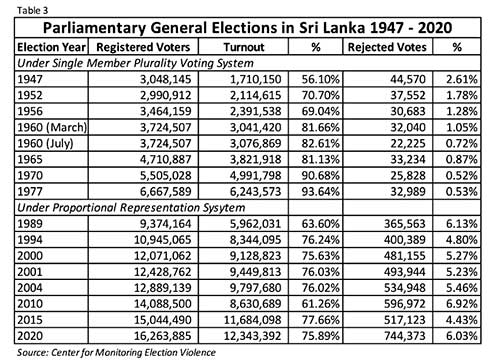
Now that the euphoria over the victories and the postmortems of the defeats have faded away it may be beneficial to take a look at a ballot number that has drawn less, if not no, attention: the Rejected Votes. What has drawn my immediate attention to the results of the last election was the large number of the ballots that were rejected – 744,373 to be precise. And that translates to more than six percentage points (6.03%) of the votes cast (see Table 1). Given that the Jathika Jana Balavegaya (JJB) and Ilankai Tamil Arasu Kadchi (ITAK) combined received just about the number of rejected votes (773,126) but collectively won 11 seats and secured two National List seats, the number of rejected votes should not let go unnoticed.
An election provides a snapshot of peoples’ alliance with the political parties at a particular time in history and, for better or worse, the distribution of votes illustrates the intensity of such an alliance and consequences. For example, we know that about quarter of million people aligned with the UNP even though they did not secure a single seat in the parliament. Similarly, when a political party such as JVP with its 50 plus year existence, received less than half a million votes with the help of some progressive groups, there is message in those numbers. And we expect the voter turnout to truly reflect the voters’ intentions. Rejected votes, also known as spoilt votes, muddy such an assessment especially when the rejected votes amount to the third largest vote getter.
Why do we have such a large number of rejected votes? Rejected votes fall into two broad categories. One, a voter who is tired of the whole electoral process or each and every party in the fray, or the candidates running, may express his frustration by ruining the ballot by a means of his choice say, for example, by crossing all the parties. We call those protest votes. Then you get the voter who believe in the system and have a clear intention to vote for a party or a candidate of his choice but fail in the process of actual voting at the polling booth. He or she may cross more boxes than required, may draw the cross that goes over the margins thereby spoiling” the vote and the authorities would refuse to count it as a valid vote.
My initial reaction to the large number of rejected votes was that it was the former i.e., there may have been a substantial number of people, hundreds of thousands of them, lost faith in the electoral process and cast a protest vote. However, as I looked at the election results closer, the numbers did not fully support my own theory. As the district-wise breakdown of voting pattern shows (see Table 1) there is a wide disparity in the rejected votes by the districts. They range from around 4% (Digamadulla) to as high as 9% (Nuwara- Eliya). If the rejected votes were a result of protest movement it is unlikely to have such a variation as it should take some form of normal distribution across the districts. And to the best of my knowledge there wasn’t any organized campaign for a protest vote during the campaign. If so, what explains this phenomenon? The history of elections held over the past 70 plus years appear to provide some answers.
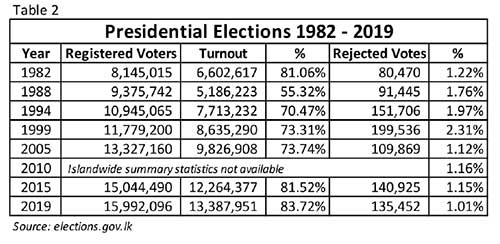
If you look at the presidential elections a totally different picture of the rejected votes emerges. Of the eight presidential elections held between 1982 and 2019 the percentage or rejected votes hover around just 1% (see Table 2). In the last presidential election held just a few months ago, the rejected vote was exactly one percent (1.01%) or 135,452 votes.
The 15 parliamentary general elections held between 1947 and 2015 also shed some light on to the rejected vote phenomenon. As seen in Table 3, there is a clear distinction between the general elections held before 1989 (under single member plurality voting system) and the elections held since 1989 (under proportional representation system) in terms of rejected votes. The percentage of rejected votes started at 2.6% at the 1947 election and precipitously came down to a sheer one-half percent during the elections of 1970 and 1977. It jumped to over six percent (6.13%) at the first election under the proportional representation system and stayed around five to six percent ever since. While I haven’t provided statistical evidence here, Provincial Council elections also shows similarly large percentage of rejected votes.
So the evidence suggests that it is the type of the ballot that generated the large amount of rejected votes. When the voters were presented with a simple task of voting for a candidate from a list of contestants, over 99 percent of the voters didn’t have a problem of doing so. But when they were presented with a more complex ballot with voting for a party followed by the option of voting for three more choices things seem to get complicated and a large number of votes got rejected. I don’t think I need to mention how challenging the ballot paper under proportional representation system is.
This is an unintentional, but avoidable, disenfranchisement of a segment of the population who have, for whatever reason, difficulty casting their vote. At the inaugural session of the Parliament the President thanked the voters who exercised their voting right at the election. Unfortunately, the government miserably failed to honour hundreds of thousands of those who exercised their constitutional right. What is clear is that the design of the ballot is flawed. It appears to disenfranchise the less sophisticated voter. What is not clear is how this flawed system might have affected the outcome of the election. For the latter further research is needed with honest collaboration of those who are responsible for holding elections.
I am baffled by the fact that the political parties have not made an issue of this large number of votes being rejected and call for the simplification of the voting process. This is not, and should not be, a partisan issue. The losers are not the ones who got elected or not elected but the public. Their votes got thrown out while they intended to vote. Politically speaking the most one has to lose in a participatory democracy is the vote and in the last election nearly three quarters of a million lost it and it seems like a pattern and not an aberration.
The Attorney General has assigned Additional Prosecutors to the Homagama, Kalutara, Matara and Negombo High Courts having considered the large number of cases pending in each High Court, AG’s Coordinating Officer State Counsel Nishara Jayaratne said.
She said over 600 cases are pending in these courts.
The Cabinet has decided to appoint an Expert Committee headed by Romesh de Silva PC to prepare the preliminary drafts for a new Constitution, co-cabinet spokesman and Minister Udaya Gammanpila said today.
The committee comprises of Romesh De Silva PC (Chairman), Gamini Marapana PC, Manohara De Silva PC, Sanjeewa Jayawardena PC, Prof. Nazeema Kamurdin, Dr. A Sarveswaran, Samantha Ratwatte PC, Prof. Wasantha Senevirathne and Prof. G.L. Peiris.
Though the government expects to introduce the 20th Amendment to the Constitution on a priority basis repealing the 19th Amendment, it will take another two months and the new Constitution will come after a minimum of two years, Minister Gammanpila said.
The draft of the 20th Amendment to the Constitution which was gazetted today has proposed key amendments such as replacing the Constitutional Council (CC) with the Parliamentary Council, enabling the President to hold Cabinet portfolios and enabling the President to appoint Cabinet of Ministers.
According to the draft gazetted, the CC will be replaced with the Parliamentary Council which comprised of the Prime Minister, the Speaker, Leader of the Opposition, a nominee of the Prime Minister and a nominee of the Leader of the Opposition.
The President will be vested with powers to appoint Chairmen and members of the Commissions: the Election Commission, the Public Service Commission, the National Police Commission, the Human Rights Commission of Sri Lanka, the Commission to Investigate Allegations of Bribery or Corruption, the Finance Commission and the Delimitation Commission and also to appoint the Attorney-General, the Auditor-General, Parliamentary Commissioner for Administration and Secretary-General of Parliament with observation of the Parliamentary Council.
However, when the President seeks the observations of the Council, its observations required to be conveyed through the Speaker within a week from the date of seeking such observations and if the Council fails to do so, the President could proceed to make the appointments.
In another notable amendment, the President could be a member of the Cabinet of Ministers while being the Head of the Cabinet of Ministers and the President can determine the number of Ministers in the Cabinet and the Ministries and the assignment of subjects and functions to such Ministers in consultation with the Prime Minister where he considers such consultation necessary.
The gazette notification pertaining to the 20th Amendment to the Constitution which has been approved by the Cabinet of Ministers has been issued by now.The gazette notification (English) is given below.
The Supreme Court today rejected a request to summon copies of evidence and documents summoned before the Presidential Commission of Inquiry into the Easter attack.
The Bar Association of Sri Lanka and Attorney-at-Law Moditha Ekanayake yesterday requested that the relevant transcripts be summoned to the Supreme Court for use in the case.
After considering the request before a panel of judges headed by Chief Justice Jayantha Jayasuriya, the bench unanimously decided to reject the request.
The last government made several attempts to privatize State land. This would have left Sri Lanka with no state land. What good is a government without land? How can a government tax when it has no land to tax? Land is the underlying foundation of a country’s sovereignty. As an Asian Dharmic civilization, our perception of land & land ownership differs to the concept of considering land as a commodity. For us, land has historical value, it is associated with emotions & cultures and has a rich and memorable history. No price can measure the value of our land. When land is the foundation of sovereignty, it also means the land does not belong to one generation or government. It is meant to be passed on to future generations. State land is land that belongs to all citizens of Sri Lanka. This land cannot be given to a segment of citizens for whatever reasons. 84% of land in Sri Lanka belongs to the State. This means 84% of land belongs to the People – past, present & future. No government elected for a term can give full land ownership of People’s Land by turning that land into a private land & private ownership. This is a violation of the Constitution.
Article 3 of Sri Lanka’s Constitution declares that in the Republic of Sri Lanka, sovereignty is in the people and is inalienable. The People are the heart of the Constitution from which a Government gets the power to run the country. Sovereignty cannot be removed from the People. It is the People who give governance of a country in Trust to the People’s representatives who constitute the 3 Pillars outlined in Article 4 – The Executive, The Legislative & The Judiciary.
Article 1,2,3,6,7,8,9,10,11 are strengthened by Article 83 that any provision of law which seeks to remove (alienate) the inalienable sovereignty of the people without asking them (via Referendum) is violating the Constitution & the Trust of the People. Article 3 is entrenched by Article 83 solidifying the need for the consent of the People at a referendum.
If the People (Article 3) has vested their sovereign power in trust to the President & Parliament (Article 4) they are bound to seek permission from the People before they make any changes to the Constitution that affects the sovereignty of Sri Lanka.
When a Government claims that permit holders of State land are to be given outright land ownership for land that belongs to the State (the People) – this is a violation of EQUALITY.
If the Government is giving land ownership of State land, then it must give ALL of the 84% State Land to the 21million citizens of Sri Lanka, not only to a segment occupying as permit holders.
Article 12
(1) All persons are equal before the law and are entitled to the equal protection of the law.
(2) No citizen shall be discriminated against on the grounds of race, religion, language, caste, sex, political opinion, place of birth or any such grounds.
The argument that giving outright land deeds to permit holders of State Land answers their problems has no basis.
What can a permit holder who is debt stricken do with a piece of paper giving him land ownership.
When the State absolves itself of any links to the permit holder of leased land, the permit holder holding an outright certificate is on his own. Whatever little help he got from the State reduces to naught. In his debt status, he pledges his land to obtain loans. When he is unable to pay the loans, the banks take over the land and auctions the land. Who buys the land?
Presume the land is bought.
What happens next to the permit-holder who became owner of his land and then had to forfeit his land because he could not pay his loan?
What happens to his immediate family & other members who have to now leave the land they had been living on for decades?
Where do they go to live as they have lost the land they had been living on?
What happens to their livelihood – how do they earn to eat and feed the family?
Who can they go to – they cannot ask the Government for help as the Government has no land to give.
What if foreign companies end up buying this land – the destitute and poor land owner ends up a slave on a foreign-owned land. His family ends up slaves too.
This is the fate of all permit-holders who are made to think that getting land ownership solves all their problems.
In reality, getting a title deed is the beginning of their problems.
Imagine all of the permit holders finding themselves in this predicament?
The Government must certainly look after permit holders in State lands because they have been given permits for a reason and the Government must give them targets and also assistance. The land they are living on must be turned into lucrative ventures for Sri Lanka.
Giving a title deed is not the solution.
Having said that a Government has no right to give State land as outright ownership to only a segment of citizens. It is INEQUAL treatment to all other citizens. No one holds any grouse against state land being given to citizens on permits, because these permits come with criteria and regulations for its usage. But, the underlying message is STATE LAND BELONGS TO THE PEOPLE (past, present & future generations) The GOVERNMENT is only custodian of the Land. A Government voted for a term of office has no moral right to turn PEOPLE”S LANDS into PRIVATE LANDS.
This is a violation of the Constitution, Public Trust doctrine, EQUALITY to ALL CITIZENS.
USA has announced
economic sanctions on a number of Chinese companies and other companies that
deal with them. Among them are Chinese companies involved in the Port City,
Hambantota Port and Mattala Airport. This is obviously a US attack on China’s
one belt one road” initiative. The impact on Sri Lanka will be catastrophic
given the massive amount of money already spent on these unviable projects.
Repayments must have to be made, otherwise China can takeover the land.
Port City
was touted as the development project that can make or break Sri Lanka. If
foreign investors (not local investors) flocked to buy its land as expected and
they build the next financial hub of Asia and global players patronize their
businesses, Sri Lanka’s economy would grow at astronomical rates. However, if
any one of the do not happen, it will be the opposite. Sri Lanka will have to
repay loans worth billions of dollars without any profitable returns from these
projects.
Port City
was opened for investment for one year now. However, no foreign investor (not
even from China) has come forward to buy or lease any land there or put up
their investment properties. Now it is even unlikely they will come. There is
no worth in local investors or the government buying into this area – they do not
bring anything into the country but the loans and their interest must be paid
to external parties.
Port City
must be regularly maintained to repair erosion, sustain sandbanks and keep the
sea from reclaiming it; a very costly affair. Sri Lanka has three white
elephants to maintain without any profitable gain. The damage already done to
the environment building these is enormous. As a result, erratic weather,
earthquakes, droughts, landslide, etc. become frequent. These are not costed.
Sri Lanka
must immediately stop the disastrous western model of borrowing to do
development work. It does not work. The best example is USA which is saddled
with a government debt close to $20 trillion, almost the size of the US
economy. The only profitable approach is to source local finance, local labour,
local constructors and foreign expertise. If local commercial banks do not
support it, that is a clear indication it is an unviable project.
The Ambassador of Japan to Sri Lanka Akira
Sugiyama called on Prime Minister Mahinda Rajapaksa at Temple Trees this
morning.
I congratulate you on the victory at the
recent election and reappointment as Prime Minister,” Ambassador Sugiyama said.
He also handed over two congratulatory letters, from Japanese Prime Minister
Shinzō Abe and Mr. Yasushi Akashi, Representative of the Government of Japan on
Peace-Building, Rehabilitation, and Reconstruction in Sri Lanka.
Ambassador Sugiyama said that Sri Lanka holding
elections in the midst of the COVID-19 pandemic clearly shows the strength of
democracy in Sri Lanka.”
As the two delegations discussed the new
Government’s priorities, Prime Minister Rajapaksa highlighted the need to
provide safe drinking water to all Sri Lankans.
The Ambassador informed the Prime Minister
of the various sectors that Japan is engaged in, including infrastructure,
water, waste water management, agriculture, human resource development and
counterterrorism.
We can provide assistance to suit Sri
Lanka’s needs,” the Ambassador said.
Speaking about challenges anticipated in
the post COVID-19 months and years, Ambassador Sugiyama said Japan is keen on
assisting Sri Lanka uplift its tourism sector once again and to attract Japanese
investors to Sri Lanka.
We look forward to working with the new
government to taking the long-standing relations to greater height,” the Ambassador said. Japan
remains committed to Sri Lanka’s economic development, he further noted.
It was the first Perahera” with public participation in Sri Lanka after the lifting of the country-wide COVID-19 lockdown
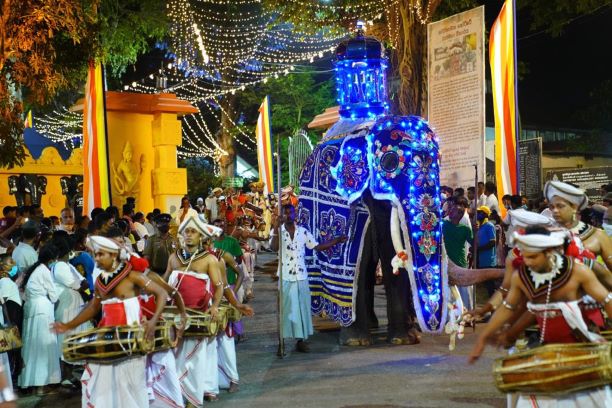
Colombo, September 1 (newsin.asia): On August 29th, as the sun was setting, a historic Buddhist temple, the Kotte Rajamaha Viharaya located in the outskirts of Sri Lanka’s capital Colombo, held its annual Perahera” or public festivities which included a grand procession of richly decorated elephants accompanied by dancers, musicians and entertainers.
It was the first Perahera” with public participation in Sri Lanka after the lifting of the country-wide lockdown which had been imposed to prevent the spread of COVID-19.
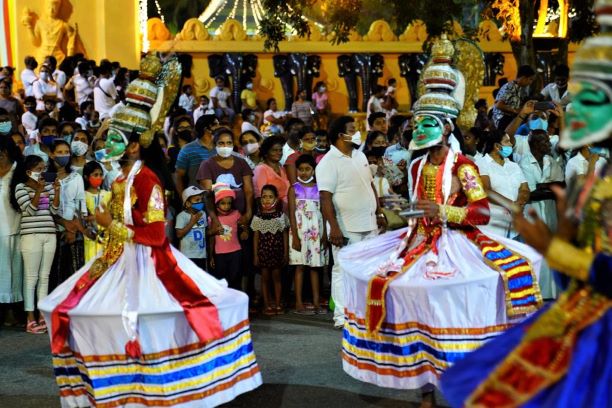
Kathakali dance from Kerala in the Kotte Rajamaha Vihara Perahera. Photo: Tang Lu
Over 20 elephants wearing colorful caparisons participated in the Kotte Perahera. The dancers performed the traditional fire dance, whip dance, the Kandyan dance and also Kathakali, a dance form associated with Kerala in South India. Pipers playing plaintive tunes and drummers executing intricate rhythmic patterns entertained a large crowd of common people.
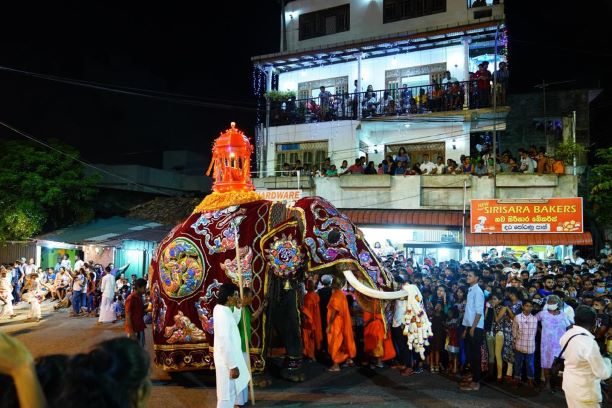
The brightly lit canopy on the elephant covers the Buddha’s relics. Photo: Tang Lu
The elephant parade is an annual religious-cum-cultural event in Sri Lanka’s Buddhist temples. Each major temple has elephants in its stables. The largest and the most famous of these elephant parades are held by the Temple of the Tooth in Kandy in Central Sri Lanka. The festivities in the Temple of the Tooth last for more than ten days, and at least 50 elephants participate in the procession.
Kandyan drummers herald the appearance of another elephant.Photo: Tang Lu
Every elephant parade has an ornately decorated lead elephant, which has the privilege of carrying a huge canopy on its back housing the Buddha’s relics. White cloth is spread on the path of the procession as a mark of respect to the relics.
Varying designs in the decorations kept audience interest up. Photo: Tang Lu
In order to avoid the spread of the new coronavirus, the Sri Lankan government had first restricted such religious celebrations. But as the threat from the virus thinned, the government gradually eased the restrictions, while insisting that the public abide by health guidelines which included wearing masks.
(The photograph at the top and video are by Tang Lu)
As per the Washington Post, the U.S. isn’t participating in the Covid-19 Vaccines Global Access (Covax) Facility, a joint coronavirus vaccine effort run by the WHO, the Coalition for Epidemic Preparedness Innovations, and vaccine alliance Gavi that has received statements of interest from 170 countries.
Washington. September 2 (gizmodo.com): The U.S. won’t contribute to an international effort to develop a vaccine for SARS-CoV-2, the novel coronavirus that causes covid-19, the White House said on Tuesday, because it involves the corrupt World Health Organization” and China.
As per the Washington Post, the U.S. isn’t participating in the Covid-19 Vaccines Global Access (Covax) Facility, a joint coronavirus vaccine effort run by the WHO, the Coalition for Epidemic Preparedness Innovations, and vaccine alliance Gavi that has received statements of interest from 170 countries. The involvement of the WHO has rankled the Trump administration, which is always champing at the bit to invent some new imaginary enemy to blame for a pandemic that’s estimated to have killed at least184,517 Americansas of Tuesday evening. Trump announced the U.S. would be slashing all funds to the organizationearlier this year,lying aboutits early handling of outbreaks in China and claiming it colluded in a coverup.
The United States will continue to engage our international partners to ensure we defeat this virus, but we will not be constrained by multilateral organizations influenced by the corrupt World Health Organization and China,” a spokesperson for the White House, Judd Deere, told the Post.
The WHO arguably made missteps in its handling of coronavirus, failing to admit the virus had reachedpandemic proportionsuntil well after the writing was on the wall. It has also faced accusations itfailed to recognizethe Chinese government wascovering upearly clusters of coronavirus (there’s no evidence the WHOdid so deliberately). But the organization is critical to the global fight against the virus.
Covaxis intendedto coordinate the efforts of signatory nations on developing at least nine coronavirus vaccine candidates and distributing any that work equitably around the world, prioritizing the most vulnerable individuals first. By flipping the WHO and Covax the bird, Trump and crew are doubling down on a bet that the U.S. will develop its own vaccine and then be under less obligation to share it. Trump has promised that a vaccine will be available this year despite alack of scientific evidenceto back the assertion.
According to the Post, one senior administration official as well as a former one confirmed that interest at Health and Human Services and the State Department in participating was overruled by chest-thumping hardliners. If the U.S. fails to develop a vaccine, not participating in Covax could theoretically screw the nation over—but the Post noted success could leave the U.S. positioned for vaccine hoarding:
… There was resistance in some corners of the government and a belief that the United States has enough coronavirus vaccine candidates in advanced clinical trials that it can go it alone, according to the official and a former senior administration official who learned about it in private discussions.
The question of who wins the race for a safe vaccine will largely influence how the administration’s America first” approach to the issue plays out.
An unlikely worst-case scenario, experts said, is that none of the U.S. vaccine candidates are viable, leaving the United States with no option since it has shunned the Covax effort.
Another possibility is that a U.S. vaccine does pan out, but the country hoards doses, vaccinating a large number of Americans, including those at low risk, while leaving other countries without.
Hoarding isprobably the point. The White House has taken a step further than the other wealthy countries and blocs thathave spent billionsto secure priority access to a vaccine and manufacturing capacity, applying anarms race logicto the matter. The U.S. has largely treated vaccine development as a proprietary matter and bought at least800 million dosesof six vaccines in advance, with the option of purchasing a billion more. One likely outcome is that the U.S.— and others such as Britain, the European Union, and Japan that are participating in Covax but hedged their bets withmassive private buys—corner global manufacturing capacity.
The implication,” Center for Economic and Policy Research co-founder Dean Bakertold Jacobin, is that we are going to have people in the United States die if it isn’t a U.S. vaccine. And the other way around, we are prepared to let people around the world die because it is a U.S. vaccine.”
There’s still time for the Trump administration to reverse course, the Post wrote, and another face-saving option includes funding it through Gavi, which is heavily supported by the U.S.
According to a runningNew York Times tracker, there are currently dozens of vaccines in Phase 1 trials, which test for safety, dosage, and immune system stimulation, or further along in the process such as Phase 2 (extended safety testing) or Phase 3 (large clinical trials). Globally, there are 23 vaccine candidates in Phase 1, 14 in Phase 2, 9 in Phase 3, with three of the Phase 3 trialstaking place in the U.S.
Three have been approved for limited use in Russia and China, though experts say theprocess was rushedand those vaccines aren’t actuallyproven be safe or effective. The Russian government later made the approval contingent on the success ofexpanded Phase 3 trialsafter its approach washammered as recklessby the international medical community. No vaccines have been officially approved by regulatory agencies for widespread usage.
Trump has reportedly been seeking ways to release a vaccine before the November 2020 elections, whether or not it hasbeen adequately testedand approved by the Food and Drug Administration. According toUSA Today, the White House-led partnership to rapidly develop a vaccine (dubbed Operation Warp Speed) has been trying to develop a logistics network that could distribute avaccine by Nov. 1, two days before the election. FDA commissioner Stephen Hahn recently indicated inan interviewwith the Financial Times that the agency may issue an emergency use authorization before Phase 3 trials of a U.S.-developed vaccine are complete.
If a vaccine gets an [emergency use authorization] and it either doesn’t work or is a significant safety risk, it would cause tremendous harm,” Columbia University virologist Dr. Angela Rasmussentweeted on Aug. 30. If a vaccine isn’t safe, it could harm all the people who take it. Even if it is safe, but isn’t effective, it could indirectly harm people by giving them a false sense of security that they are protected. Both situations would be extraordinarily damaging to public health.”
Rasmussen wrote that releasing a vaccine that wasn’t adequately vetted would be a catastrophic blow” to public confidence in vaccines and the regulatory process, adding the politically motivated release of such a vaccine could destroy public trust in medicine as an evidence-based enterprise.”
When the U.S. says it is not going to participate in any sort of multilateral effort to secure vaccines, it’s a real blow,” Global Health Center at the Graduate Institute of International and Development Studies in Geneva co-director Suerie Moon told the Post. The behavior of countries when it comes to vaccines in this pandemic will have political repercussions beyond public health. It’s about, are you a reliable partner, or, at the end of the day, are you going to keep all your toys for yourself?”
China is seeking to set up more robust logistics facilities in about a dozen countries, including three in India’s neighbourhood, to allow the PLA to project and sustain military power at greater distances, according to a Pentagon report .
WASHINGTON : China is seeking to set up more robust logistics facilities in about a dozen countries, including three in India’s neighbourhood, to allow the PLA to project and sustain military power at greater distances, according to a Pentagon report.
In addition to the three neighbours of India — Pakistan, Sri Lanka and Myanmar — the other countries where China is considering to base its military logistics and infrastructure facilities are Thailand, Singapore, Indonesia, United Arab Emirates, Kenya, Seychelles, Tanzania, Angola and Tajikistan, the report said on Tuesday.
In its annual report Military and Security Developments Involving the People’s Republic of China (PRC) 2020” that was submitted to the US Congress, the Pentagon said these potential Chinese military logistics facilities are in addition to the Chinese military base in Djibouti, which is aimed at supporting naval, air and ground forces projection.
“A global PLA (People’s Liberation Army) military logistics network could both interfere with US military operations and support offensive operations against the United States as the PRC’s global military objectives evolve,” the Pentagon said in the report.
China has probably already made overtures to Namibia, Vanuatu, and the Solomon Islands, it said, adding the known focus areas of PLA planning are along the Seal Lines of Communication from China to the Strait of Hormuz, Africa, and the Pacific Islands.
Similarly, the Pentagon said, Beijing uses the One Belt One Road (OBOR) intitiative to support its strategy of national rejuvenation by seeking to expand global transportation and trade linkages to support its development and deepen its economic integration with nations along its periphery and beyond.
OBOR projects associated with pipelines and port construction in Pakistan intend to decrease China’s reliance on transporting energy resources through strategic chokepoints, such as the Strait of Malacca,” it said.
China leverages the OBOR to invest in projects along China’s western and southern periphery to improve stability and diminish threats along its borders, the report said.
First announced in 2013, China’s OBOR initiative is a signature foreign and economic policy advanced by President Xi Jinping.
According to the Pentagon, a global PLA military logistics network could both interfere with the US military operations and support offensive operations against the United States as the Chinese global military objectives evolve.
“Host nations can perform an essential role in regulating the PRC’s military operations as Chinese officials very likely recognise that a stable long-term relationship with the host nation is critical to the success of their military logistics facilities,” it said.
Chinese military academics assert that bases abroad can enable forward deployment of its forces and support military conflict, diplomatic signalling, political change, bilateral and multilateral cooperation, and training.
They also suggest that a military logistic network could enable intelligence monitoring of the US military.
In August 2017, China officially opened its first military base in Djibouti, on the horn of Africa.
Chinese Navy Marines are stationed at the base with wheeled armoured vehicles and artillery but are currently dependent on nearby commercial ports due to the lack of a pier on base, the report said.
Chinese personnel at the facility have interfered with US flights by lasing pilots and flying drones, and China has sought to restrict Djiboutian sovereign airspace over the base, the report said.
Beyond its base in Djibouti, China is very likely already considering and planning for additional military logistics facilities to support naval, air, and ground forces projection, the Pentagon report said.
The PLA’s approach likely includes consideration of many different sites and outreach to many countries, but only some will advance to negotiations for an infrastructure agreement, status of forces or visiting forces agreement, and/or basing agreement, the report added.
An irresponsible decision taken by former President Maithripala Sirisena after the coordinated terror attack had allowed the Islamic extremist organizations to operate even better than the period before Easter Sunday attacks, a Moulavi who wish to stay anonymous yesterday informed PCoI probing Easter Sunday attacks.
A Moulavi who requested to not to revealed his name, informed the Commission that after the Easter Sunday attacks former President had taken steps to ban only two Islamic extremists organization operated within the country.
“There were seven more Islamic extremist organizations within the country which operating in different manner currently,” he said.
The following statement made by the Moulavi while responding to question posed by a Commissioner.
Moulavi said that the seven Islamic extremist organizations were currently managing freely with fake names and those groups were spreading extremism by using different modes and strategies.
The Minister of Power, four days after assuming duties, had to face an island-wide power blackout which commenced around 12.30 pm on the 17th August and lasted up to 7-8 hours. The following day, he appointed a committee, comprising Ministry officials and power experts, to investigate the matter and submit a report within a week.
COMMITTEE APPOINTED BY THE MINISTER
The Committee comprised two administrative officers, including an Additional Secretary to the Ministry of Power, serving as the Chairman, a Retired Professor of Mechanical Engineering, an Engineer who is a Chairman of a Corporation, two Senior Lecturers in Electrical Engineering, one senior official from the Ceylon Electricity Board (CEB) and one senior official from the Ministry of Power responsible for Renewable Energy Development. The Director General of the Public Utilities Commission of Sri Lanka (PUCSL) was also nominated but did not serve as there was a separate investigation being undertaken by the PUCSL. With two members from the Ministry, including one in the Chair, and another from CEB, the Committee cannot be considered as independent.
The Committee had met on the 18th and submitted an interim Report, to the Minister, on the 24th, which was also tabled at the Cabinet meeting held on the 26th. The Report was also made available at a press briefing held by the Ministry and the contents herein are taken from this Report. According to the Report, the Committee had visited the Kerawalapitiya Grid Substation (GSS) where the initial fault occurred claimed to be due to a human error, Lakvijaya Power Station (LVPS) at Norochcholai, Protection Branch of the CEB and the System Control Center of the CEB at Pelawatta, and had interviewed the staff on duty at these stations with a view to elicit information on the following.
The key reasons for the nationwide power interruption on the 17th August 2020 at 12:30 pm onwards.
Whether the CEB has taken precautionary actions and measures to prevent recurrence of interruptions that had been encountered in the recent past for which recommendations have been extended by similar committees that could have influenced the present incident.
Recommendations for remedial measures that need to be taken by the CEB to prevent recurrence of the same and similar incident.
Whether the CEB has taken the best professional practicing measures in handling the incident and the conditions that led to it employing proper planning, operational and administrative elements and had any constraint encountered CEB’s intended professional actions.
Whether the CEB had encountered similar incidents in the past and how the situation had been then handled.
Whether the CEB could have handled the situation judiciously to minimize the implication and how this could be avoided in the future.
PRELIMINARY FINDINGS OF THE REPORT
The Committee, in its Interim Report ,has given a set of preliminary findings, among which are the following:
Routine maintenance work on the 220 kV isolators of the Bus Coupler Bay had been carried out on the day of the incident by the Electrical Superintendent-In-Charge at Kerawalapitiya GSS, who apparently has been attending routine maintenance work at the Kerawalapitiya GSS for the past five years. The power in the Bus Bar 01 had been turned OFF for the maintenance, while the power of the Bus Bar 02 was ON. The Earth Switch 01 at Bus Bar 01 side had been OFF while the Earth Switch 02 at Bus Bar 02 side had been ON as shown in Fig. 1.2(a) at the time of incident.
Under normal operations the Earth Switch and the relevant isolator are interlocked, so that the isolator cannot be turned ON while the Earth Switch is turned ON. However, during maintenance, this interlock had been bypassed, so that isolator can be turned ON even with the Earth Switch is turned ON. At the end of the maintenance work of the 220 kV Bus Coupler Bay, while the interlock is bypassed, the Isolator on the Bus Bar 02 side had been turned ON as shown in Fig. 1.2(b), creating a 3 Phase to Ground fault.
The key reason for the nationwide power interruption on the 17th August 2020 is due to the 3 Phase to Ground busbar fault due to incorrect operation of the Bus Bar 2 Isolator of the Bus Coupler Bay by the Electrical Superintendent -in-Charge at the Kerawalapitiya Grid Substation busbar at 12:30 Hrs.
Kerawalapitiya Grid substation tripping was due to not following the correct maintenance procedure by the relevant officials including the Electrical Superintendent. The Committee also observed that there was no written maintenance protocol for this maintenance job in-line with the current best practiced maintenance protocols.
The Committee is of the view that due to the Kerawalapitiya Grid substation tripping, the system frequency has increased beyond the current setting of the rate of frequency tripping relay of the Lak Vijaya Power Station (LVPS). As a result, the generator-transformer circuits breakers of all three units of the LVPS which made LVPS unavailable to the grid, subsequently the system failed in cascade.
CEB’s recent failure to avoid a country-wide blackout and the longer duration taken to restore power to Colombo City in particular, indicates significant lapses in implementation of critical measures outlined in the previous Expert Committee Reports.
AUTHOR’S COMMENTS ON THIS PROCEDURE
The cardinal mistake done by the Electrical Superintendent (ES) during the maintenance work was that he had disabled the interlocking system which prevents switching on the 220 kV line to the GSS while it is earthed, which is a protective mechanism incorporated into the system to prevent blunders by maintenance staff as happened. It is certainly not an Ath Wereddak” as claimed by a senior official of the CEB. As a result, the ES was able to connect the high voltage line to the substation already earthed which created the havoc.
The question which arises is what was the necessity to disable the interlocking system to carry out the routine maintenance? The Report does not seem to have queried the ES on this. If the ES has done such an irresponsible act, deliberately, in any other organization, he would have been interdicted forthwith or at least sent on compulsory leave. But, the CEB Management thought otherwise, possibly for fear of trade union reaction.
The tripping of the 220 kV line at Kerawalapitiya apparently has caused a sudden increase in the system frequency at LVPS, resulting in the three generating units there to trip. A sudden increase in the frequency means that the speed of the generator rotors has increased suddenly. Isn’t there a mechanical device called a governor in the generator which helps in maintaining the rotor speed at a constant value? Is it a characteristic of a coal power plant to allow its rotor speed to vary suddenly in response to a disruption in the line? Was it that this governor did not function properly when this incident took place?
The CEB management should be faulted for not making available to the maintenance personnel proper maintenance manuals. It was alleged that even for the Norochcholai coal plant, the manufacturer never made available to CEB the operation manuals in English. That may be the reason for having Chinese technicians to attend to O&M functions even today. It seems that during the last 6-7 years since commissioning the plant, CEB personnel have not been able to learn the O&M functions from the
Chinese technicians. Though, the CEB staff at Norochcholai are unable to handle the O&M functions of the coal power plant by themselves, Sri Lankan personnel are managing three combined cycle power plants, two at Kelanitissa and one at Kerawalapitiya. This is one more reason why Sri Lanka should not build any more coal power plants.
RECOMMENDATIONS OF THE REPORT
Among the recommendations made by the Committee are the following among others:
The committee strongly recommends a standard compliant, systematic, foolproof, safe procedures and maintenance protocols to be instated in the CEB during operation and maintenance (O&M). The implementation of these procedures will have to be continuously monitored and supervised by adequately qualified, professionally trained, knowledgeable, experienced and skilled personnel. The committee would like to propose a performance evaluating annual appraisal system which will help to improve the above attributes of the CEB staff.
The committee understands that there is no Operations & Maintenance related risk management mechanism in place. Therefore, it is recommended to establish a risk management mechanism in order to determine the proper mix of preventive measures, mitigation levels, shift or retention of risks and consequent level of robustness of Operations & Maintenance protocols that would indicate the positive impact on the overall system
The committee strongly recommends to implement the 2018-2037 CEB Long Term Generation Expansion Plan, as given in the plan, which clearly specifies the correct blend of technologies for the future requirements of the Sri Lankan power system to improve the system stability and reliability.
The committee recommends to review the existing protection strategy for frequency instability.
2018-2037 LONG-TERM GENERATION EXPANSION PLAN
The first two recommendations are in order. One would expect that an organization like the CEB has already following proper standard procedures for O&M. But if they are lacking, priority needs to be given for the training of staff adequately. It has been alleged in the media that all foreign training programmes are given to engineering staff while the middle level technical staff who actually carry out the O&M work are given only local training. Perhaps, there is a case here and if it is true, it should be rectified.
Since the Committee has made a strong recommendation that the CEB’s 2018-2037 Long-Term Generation Plan be implemented, it is necessary to examine what this plan is. The CEB prepares biennially a long-term generation expansion (LTGE) plan outlining the least cost options of generation plants that need to be added to the system annually for the next 20 years to meet the forecasted demand. The latest plan is in respect of the period 2020 – 2039 but it is still in the draft form yet to be approved by the PUCSL as required by Sri Lanka Electricity Act No. 31 of 2013.
The CEB 2018-2037 LTGE Plan released in June 2018 provided for adding 2,700 MW of coal power capacity between 2023 and 2035 and 1,500 MW of natural gas capacity between 2019 and 2036, along with several gas turbines and diesel power plants as well as a large number of small renewable energy plants comprising mini-hydro, solar, wind and biomass systems, under Base Case scenario. However, the PUCSL did not approve this plan but recommended an alternative plan incorporating natural gas power plants in place of coal power plants included in the CEB Plan.
The CEB refused to accept this recommendation, particularly with objections raised by its Engineers’ Union (EU), and the dispute between the PUCSL and the CEB kept dragging for over a year, and the matter was finally referred to the President who gave a directive to the PUCSL to approve the CEB Plan, fearing disruption to the power supply in the country after the CEB EU threatened to resort to industrial action if their demand for coal power plants is not acceded to. This is something not expected from a body of professionals and unheard in other countries.
Also, the LTGE Plan is highly flawed. It is supposed to determine which power technology will be the cheapest in 20 years hence based on current prices. With the cost of generation depending on plant capital cost and fuel prices both of which could vary widely within a span of 20 years, it is futile to make forecasts now as to which technology is the cheapest in 20 years hence and to adopt it. Although the CEB 2018-2037 Plan has recommended building 2,700 MW of coal power plants on grounds that coal power is the cheapest option, a report by World Bank Group study on Sri Lanka Energy Infrastructure Sector Assessment Programme (InfraSAP) released in February 2019, says in p. 18 that coal ceases to be the least cost source of power generation, as cost of power from LNG and NCRE could potentially be lower than US cents 9 / kWh” which is the estimated coal power price.
It is therefore obvious that the 2018-2037 Plan is not a plan approved after considering engineering and economic aspects properly but approved on political grounds. Hence, the Committee’s strong recommendation to implement such a flawed plan is an attempt to take the power sector development in the country along a wrong path. It is not surprising that the Committee has made such a biased recommendation when two senior officials from the Ministry and one from the CEB are in the Committee. In any case, building more coal power plants is not a solution to a possible blackout in the future. This is the second attempt when the Ministry tried to get building of coal power plants inserted into a policy document on the sly. The first attempt was when the Cabinet took a decision on post-Covid activities to be undertaken urgently in view of the emergency” situation in the country, building a 300 MW coal power plant at Norochcholai was inserted as one activity in the Cabinet decision.
It is also mentioned that the implementation of the CEB 2018-2037 Plan with more coal power plants is recommended to improve the system stability and reliability in the future. The Committee has not justified that the system stability and reliability would be better with coal power plants than with natural gas power plants for the Committee to make such a statement. However, it was shown in this instant that it was the instability of rotor speed of the coal power plants resulting in raising the frequency suddenly that caused the three coal power plants to trip. Hence having more coal power plants will not be of any help to maintain the stability of the system. On the contrary, it will make it worse.
Further, it is noted that with a coal power plant once shut down, it is necessary to wait several days until it cools down before it can be re-started. On the other hand, with a natural gas operated combined cycle power plant, there is no such delay and the plant can be energized within a few hours.
RECOMMENDATION VIOLATING THE PRESIDENT’S POLICY
In the President’s policy document, Vistas of prosperity and splendour”, he says We also anticipate that hydro and renewable energy together would account for 80% of the overall energy mix by 2030”. The State Minister for Renewable Energy said during his assumption of duties that the Ministry’s target is to use renewable energy resources to generate at least 80% of the total generation of electricity by 2030. The Power Minister has also made a statement to that effect in the Parliament. However, it is not possible to achieve this target if the CEB 2028-2037 Plan is implemented.
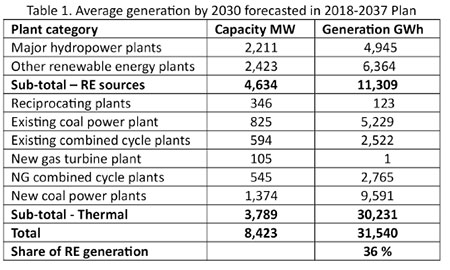
The LTGE Plan has worked out the average generation from each plant type annually and the values obtained for 2030 are given in Table 1, extracted from the data given in Annexes 7.4 of 2018-2037 LTGE Plan. It is to be noted that it is not possible to forecast exact values for generation from each category in the future because it depends on many extraneous factors, such as rainfall, cloud cover, wind regime, fuel prices and demand which are not known accurately in advance. Annex 7.4 gives average values after considering several scenarios.
It is seen that according to the CEB’s LTGE Plan for 2018-37, generation from renewable sources could reach only 36% by 2030, which is far below the 80% target given in President’s VPS Policy Document, assuming what is intended by total energy” appearing in this document is total electricity generation.
Therefore, the Committee’s strong recommendation that the CEB’s 2018-2037 Plan be implemented is a gross violation of the President’s Policy. It is surprising that a learned Committee including several officials in the Ministry, are not aware of the President’s policy. The Power Minster should call for explanations from the Committee Members why they overlooked the President’s Policy when they made their recommendation.
Two Colonels of the Sri Lanka Army including Maj. Gen. Priyankara Perera and the Urban Development Authority have been summoned to appear in the Hatton Magistrate’s Court on September 15 on charges of forcibly establishing a quarantine centre at a private land.
President’s Counsel Maithree Gunaratne said the order was issued by Hatton District Magistrate J. Trotsky today.
President’s Counsel Gunaratna said several buildings in a sizeable land belonging to his client, situated along the Hatton-Nuwara Eliya main road in the Kotagala commercial town, have been forcibly occupied by the Army.
He said a quarantine facility has been established by the Army without obtaining permission from the owner, adding that soldiers are now occupying the premises effectively making it an army camp.
Gunaratna PC said his client is entitled to the ownership of the property up to a tenure of 50 years through an order issued by the Commercial High Court.
His client has filed a petition with the Hatton Magistrate’s Court asserting his ownership over the property, over which the Hatton District Magistrate has summoned Maj. Gen. Priyankara Perera and other officials.
Four new cases of COVID-19 have been detected today (02) as the total number of positive cases in the country to 3,101.
Accordingly, 02 recent arrivals from the United Arab Emirates (UAE) and 01 each from India and Qatar have tested positive for the virus, the Department of Government Information confirmed.
The Epidemiology Unit says 206 active cases are currently under medical care at hospitals.
In the meantime, the number of recoveries from the disease in Sri Lanka moved up to 2,883 as 04 patients were discharged from the IDH and the Welikanda Base Hospital earlier today.
Sri Lanka has thus far witnessed 12 deaths due to the virus outbreak.
The preliminary report of the Presidential Commission of Inquiry probing the alleged incidents of political victimization was handed over to Prime Minister Mahinda Rajapaksa today (02 sep 2020).