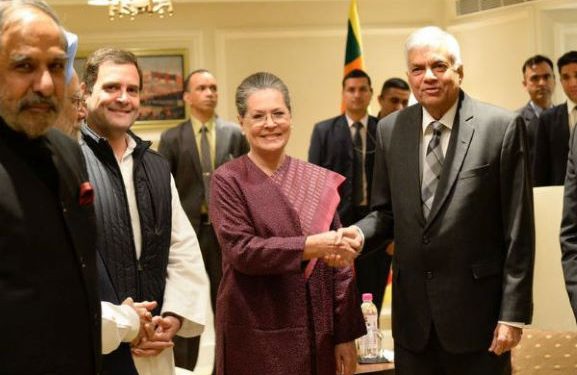
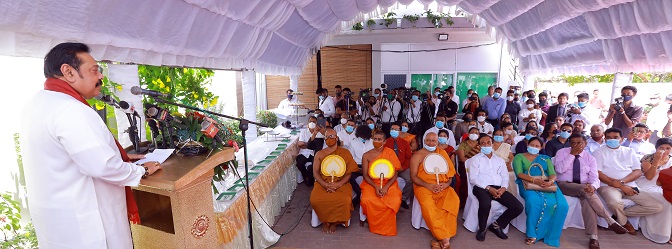
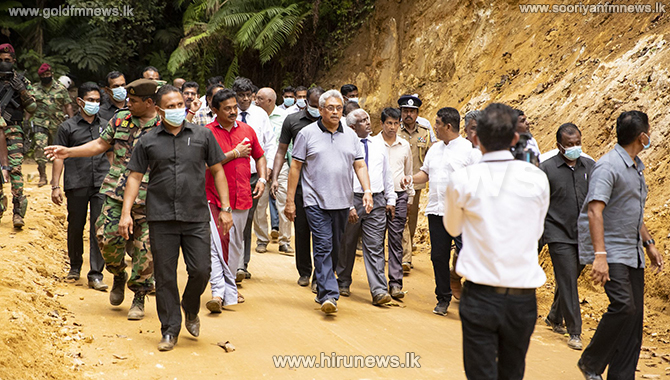
North – Western Governor A J M Muzammil sworn in as Governor of the Uva Province & Uva Governor Raja Kollure sworn in as North Western Governor before the President.
Of all the
oddities displayed at the opening of the new Parliament – and there were some
exceptional ones like an MP arriving in a prison van and another landing in a
boat etc. – the most significant one to my mind was the presence of two
fathers-in-law sitting on opposite benches, facing each other, ready to go into
verbal duels at any given moment. There are, of course, many precedents
where distant and blood relatives crossed swords on the floor of the House. One
of the earliest was Colvin R. de Silva (Bolshevik-Leninist Party of India
/LSSP) in the Opposition benches firing at the politics of his brother, Walwin,
a UNPer, and vice versa. Another memorable instance was when Anura Bandaranaike
joined the UNP government and tearing into his mother’s politics who was
sitting in the Opposition. Considering that the genealogy of Sri Lankans runs
like a wild wine creeper twining practically through each other’s legs in
devious ways, there could have been many unaccounted relatives battling it out
from the opposite benches.
But the
marriage of Vasudeva Nanayakkara’s son to C. V. Wigneswaran’s daughter makes
the two fathers-in-law a first in the Parliament. Both will occupy their seats
as two incendiary explosives that could go off any moment in the House. That is
inevitable, particularly because both are impulsive fire-brands. In fact,
one report said that they were exchanging heated words in the lobby on their
first day in Parliament when the Prime Minister, Mahinda Rajapaksa, noticing
the sparks flying between the two, eased his way through the crowd and stepped
in to defuse the rising tensions. But this is only the prelude for more things
– more ominous things — to come later.
In the new
Parliament they represent the two divisive polarities that are bound to
collide. They are the outstanding and controversial symbols of the ominous
forces of our time hanging overhead like the Damocles sword. Their politics has
the potential to outweigh even the critical issues of the economy which are yet
to unfold in all its fury. The proposed Constitution will be the new
battleground for the old issues of power sharing that began in colonial times.
It is predictable that the old wounds of the inter-ethnic relations between the
North and the South will open up with the rival contenders going at each
other’s throats, hopefully without the devastating consequences experienced by
both parties in the recent past.
The
Northern political elite whose life and soul depended on exploiting mono-ethnic
extremism (aka, Tamil nationalism, Eelamism, federalism, separatism,
self-determination) bared its tigerish teeth on the very first day of the
opening debate. C. V. Wigneswaran did not hesitate to demonstrate his style and
substance with his provocative and controversial speech. He did not hesitate to
echo the old mantra that pull the heartstrings of the Tamils: the Tamil
language. Using his standard tactic, with nothing else to crow about, he paid
homage to the Tamil language which resonates as the primary source of
sustaining and pursuing Tamil identity politics. This is also his signature
tune and he signalled that the Parliament is going to hear more of it in the
days, months and years to come. It is, of course, a variation of his notorious
resolution passed in Northern Provincial Council condemning all Sinhala leaders
since Independence as genocidal maniacs who had decimated the Tamils. The likes
of Wigneswaram survive in the competitive politics of the peninsula only by
distorting known facts, recorded history and the grim realities that refuse to
surrender to their disproportionate and extremist demands.
Most of the
leaders who welcomed the new Speaker maintained a neutral tone and the formal
decorum that is expected on this occasion. Only Wigneswaran’s speech went off
the rails. He could not help being Wigneswaran – the new kid in the bloc
showing off his no-hands-on-the-handle ride down the main street. It needs to
be quoted in full as it foreshadows the shape of things to come. The following
quote is from the Hansard:
(The Hon.
C.V. Wigneswaran) மாண்ᾗமிகு சபாநாயகர் அவர்கேள, தமிழ் மக்கள் ேதசியக் கூட்டணி சார்பில் ᾙதற்கண் உங்கᾦக்கு என் வாழ்த்ᾐக்கைள த் ெதாிவித்ᾐக்ெகாள்கின்ேறன். I start my felicitations, Hon.
Speaker, hailing you in my mother tongue, the oldest living language of this
world and the language of the first indigenous inhabitants of this country, and
proceed in the link language. I thank you for accepting such a high position in
our Parliamentary tradition. Sir, I am sure, you would bring with your high
Office your experience with men and matters gained throughout your long
political career. We have a very powerful Government now. A similar Government
was constituted under the late J.R. Jayewardene in 1977. It was during that
regime that we had the 1983 Pogrom. Certainly, this Government too could follow
the path of the Elephant of that time and end up as today reduced to a single
Member in the future. But, I am sure they would not. They would prefer to learn
from our mistakes of the past and usher in a period of peace and prosperity
where all communities would feel equal to each other and walk with dignity and
pride as children of Mother Lanka. That freedom and equality could dawn only if
we shed the false historical perspectives of the past and recognize the
intrinsic rights of the people living in the North and the East of Sri Lanka,
who are entitled to the right of self-determination as per Article 1 of Chapter
one of the International Covenant on Civil and Political Rights in addition to
their hereditary and traditional rights to be recognized as a nation. Sir, I
hope, we would not be called upon in this August Assembly of Parliamentarians
in the future, during your term of Office, for your protective assistance since
we would respect each other’s rights and our duties towards each other. We are
sure that you will guide us all without fear or favour if any such impasse
comes to pass. There is no need Sir, in a country which professes Buddhism to
expect a hegemonic dominance from anyone. We have not forgotten what the
Sinhala villager is only too well familiar with, that every act has its
opposite reaction; කළ කළ ෙNJ පල පල ෙNJ. ස්ƱƯɐ, ගɞ කථානායකƱමǧ .English equivalent: You will reap what you sow.
Though
short it summarises the usual litany of complaints recycled unceasingly by the
Tamil leadership blaming the Sinhalese. In the next day’s sittings of the House
G. G. Ponnambalam, the grandson of the father of virulent Tamil communalism, G.
G. Ponnambalam, Snr., who sparked off the first communal riots in 1939 by
attacking the Mahavamsa and the history of the nation, went
beyond Wigneswaran to focus on the two nation” theory. That is a claim that
must be dealt in a separate chapter next Sunday. First, attention must be
focused on Wigneswaran dragging his aggressive, anti-Sinhala-Buddhist politics
from his launching pad in the Provincial Council in the North to a higher level
in the Parliament. To being with, there is nothing new in Wigneswaran’s
whingeing. He is only reiterating what every other Tamil propagandist has said
for the nth time before. But what does it portend? It is this kind of rhetoric
that paved the path to the Vadukoddai violence unleashed in 1976. Blaming the
Sinhala-Buddhists has been the only ideological trick they had to seduce their
people into the path of brutal and futile violence.
For
instance, Prabhakaran was nurtured, encouraged, supported, financed and
defended at all times by the Tamil Vellala elite which retained their grip on
power in the peninsula by demonising the Sinhala-Buddhists. Prabhakaran knew
nothing but the hate politics fed to him by the Tamil theoreticians /
propagandists who manufactured a fake history of Tamils which invariably ended
in projecting the Sinhala-Buddhists as the permanent enemies of the Tamils. The
essence of this ideology was encapsulated in the Vadukoddai Resolution which
declared war on the Sinhala-Buddhist in 1976.
In the
current political context of the post-Gotabaya Presidential election, the
choice before the Tamils is either to go back to the Vadukoddai Resolution and
kick-start the road to Nandikadal again, or carve out a more realistic path for
peaceful co-existence taking into consideration the lessons learnt in
Nandikadal. It is, indeed, sad that Wigneswaran has chosen to ignore the new
realties haunting the Northern landscape. He has reverted to the same-old,
same-old hate politics. He made use of the occasion to address the extremists
who are likely to follow him into the never-never land of elusive Eelam. He
talks of the right of self-determination”, the right to be recognised as a
nation”, hegemonic dominance” of the majority, the 1983 pogrom”, a
claim to be ”the first indigenous inhabitants of this country”, and, of
course, the oldest living language of this world”.
Take the
last one first. To boast about the Tamil language being the oldest, boosts only
the egos of the Tamils who have nothing else to crow about in Sri Lanka.
Besides, it is a specious argument because if antiquity is a mark of
superiority then the Sinhalese language, which the Tamils say came into being
only in the fifth century, should be considered superior to the English
language which blossomed into what it is today, only in the 15th-16th
centuries under Geoffrey Chaucer and modernised by Shakespeare later.
Besides,
the Tamils of Jaffna did not create the Tamil language which, indeed, is a
cultural gem. The local Tamils brought it in their bag and baggage when they
crossed the Palk Straits in the 12th-13th centuries.
Tamil historians have openly admitted that the Jaffna Tamils were merely
second-hand imitators of the Tamil Nadu culture. No original masterpieces ever
came out of Jaffna. On the contrary, the Sinhalese created and gifted to the
world a whole new language rich enough to express the subtle nuances of the
greatest philosophy of India, Buddhism. As opposed to this, the imitative
Jaffna Tamils are prone to pretend that they have been the virtual founders of
the great Tamil culture that flourished in S. India. Simply because Arumuka
Navalar and C . W. Thamotherampillai excavated the neglected Tamil classical
texts from S. India and printed them in Jaffna they assume that they have been
the virtual founders, discoverers, and revivalists of Tamil language and
culture. The fact is that Jaffna had not contributed anything substantial to
the greatness of the Tamil language. So which community can claim to be
superior to the other? Is it those who are parroting a language borrowed from
another land? Or those who with their creative genius minted a new language?
The
Sinhala-Buddhists also gave the world a new civilisation and a new culture. In
fact, the great aesthetic savant, Ananda Coomaraswamy, wrote a classic
monograph on Medieval Sinhala Art. Being a Tamil, wouldn’t he
have written an equally great monograph on Jaffna art if the Tamils had
anything comparable to that of the Sinhalese? So what is Wigneswaran crowing
about? Why is he trying to pretend that the Tamil language came from his
father’s loins when its origins go way back in time to the dim distant past in
another land? In comparison let’s take the case of the American and the
Australian migrants who took the English language with them as they migrated
into new lands. They do not bask in the supremacy and the glory of English
language created in Britain. They take pride in the creative power of their own
people who produced a new culture of their own demonstrating their innate
genius. Can Wigneswaran at least point to the genius of the Jaffna Tamils
comparable to that of the English migrants domiciled in America or Australia?
He may not be familiar with these two cultures. Can he, therefore, tell us in
what respects the Jaffna Tamil culture – not that of Tamil Nadu – is superior
to that of the Sinhalese?
Then he
talked about the first indigenous inhabitants of this country.” This is
another symptom of the common Tamil malaise to imagine histories that never
happened. Their political aspirations are based on believing in a fabricated
past that could justify their current political agenda to create a separate
state. Vadukoddai Resolution (1976) is a typical example of the Tamil
mytho-maniacs concocting a political manifesto to sustain and pursue their
unattainable aspirations”. Besides, conflicting theories question the validity
of their self-serving history which eventually led to the Vadukoddai
Declaration of war in 1976. Political violence depends on the extent to which
it is possible to manufacture hate politics, extremism and myths. As the
primary aim of the Vadukoddai Resolution was to provide a valid justification
to claim proprietary rights over Sri Lankan territory they went overboard by
declaring the myth that they were the first arrivals.
This claim
also makes them believe that they are superior to all other migrants who came
later. Let us for the sake of argument concede that they came first. Then they
must explain why the inferior Sinhalese who came later built a unique
civilization, culture and language that stand to their glory surpassing all
activities of the superior Tamils. Besides, if they came earlier why did they
withdraw and confine themselves to a littoral strip in the sands of the North?
Isn’t it because the Tamils began their settlements, according to Tamil
historians, only in the 12-13th centuries?
Each time
the Tamils claim that they are superior to all others in the island, they are
forced to explain why they played such an inferior role in the history of the
nation. For instance, if the Tamils are so superior to the Sinhalese and the
Tamils played such a pivotal role in the national history how did the inferior
Sinhalese come out on top dominating every inch of the way in history to the 21st
century, overcoming all challenges they faced, mostly from the Dravidians of
the North?
Take, for
instance, the simple issue of demographics. If they came first they had the
field wide open for them, with no opposition, to populate and leave their
indelible stamp on every conceivable aspect in history. But they didn’t. They
had Paskaralingams, Mahalingams, Panchalingams, and whole lot of lingams none
of whom had the capacity to populate the island with sufficient demographics to
dominate the historical landscape. So how did the Tamils fail and why did
the Sinhalese succeed? Recorded history states categorically that the Sinhalese
were exceptional because they outstripped the Tamils in their historic journey
through the ages gone by. Throughout the better part of history, the Tamils
lived under the shadow of Sinhala rulers. They accepted Sinhala as the official
language with which to communicate, from royalty down to the common trader in
Chetty Street. This also leads to a serious question: Does history belongs to
those who make spurious claims to justify the politics of the day or to those
who made history with their blood, sweat and tears down the ages?
In one of
Wigneswaran’s sober moments he states that we (should) shed the false
historical perspectives of the past”. True. Absolutely true. But he has a
motive for saying this. He wants the world to accept his narrative of events
rejecting the one that contradiction his version. As in any other conflict
there are two sides to story. He wants the world to shed the false historical
perspective” that contradicts his narrative. In other words, like all Tamil
partisans marketing their one-sided story to the world he is making a strong
bid to hide the subhuman history of Jaffna that humiliated, persecuted,
oppressed, suppressed and even massacred their own people on a mass scale for
centuries under fascist Vellalaism. He is deliberately falsifying the
historical perspectives of his past because the truth will blast his political
myths to bits. He would, for instance, find it very difficult to give another
example of the ruling class/caste denying their own people the right to walk in
God-given sunlight. These outcasts were allowed to come out only in the night
declaring loudly as they walked that the Turumbas – the lowest of
low castes — are coming, purely to warn the Vellalas to close their doors and
windows to maintain the purity of their eyes.
So when he
says that we should shed the false historical perspective of the past” he
should begin from his end before pointing fingers at his bete noir
the Sinhalese. He should first examine critically and objectively how his
forefathers treated their own people before he accuses the Sinhalese of
discriminating against the Tamils, or denying them their dignity and rights.
What dignity did his ancestors give the low-castes when they refused to open
the doors of the Vellala-owned temples to the low-caste Hindus to worship their
common God/gods? Or kept the front pews of the Church to the high castes
and the last rows to the low-castes? In America the Negroes were not allowed to
sit in the front rows of the busses but only in the back seats. In the Vellala
fiefdom the low-castes were not allowed to sit on any seat, front or back. They
had to sit on the floor of the bus. This was institutionalised discrimination
that dehumanised Wigneswaran’s own people. He refuses to examine the
horripilating tortures, persecutions, oppression and agonies of his own
history. As a former judge it is his moral duty to weigh the available evidence
before passing judgment. He should begin by asking: Why didn’t our leaders make
our own people feel equal to each other
and walk with dignity and pride as children” of Tamil homeland? ”
The debacle
at Nandikadal must open the eyes of the Tamils to recognise that the Tamil
leaders have been congenital idiots” (Prof. David Kumar). With all the
accumulated knowledge gathered from their misadventure on the road to
Nandikadal they must, at least at this late stage, accept responsibility for
their folly. Blaming the Sinhalese is not going to take them to their
unattainable Eelam. They must be more pragmatic and admit that it is the false
historical perspective of the past” that led the Tamil leadership to the
self-destructive Vadkoddai Resolution. They were arrogant and intransigent
political animals who led their people to a humiliating and disastrous end in
Nandikadal. The rhetoric recycled by Wigneswaran can lead only the next
Nandikadal. Is this what the Tamils want?
Quite
rightly he says, in one of his lucid moments, that we should learn from our
mistakes of the past and usher in a period of peace and prosperity where all communities would feel equal to each other and
walk with dignity and pride as children of Mother Lanka”. But here he is
pointing his finger, as usual, at the Sinhalese. In saying this he is in
denial. Actually, he is lying through his teeth. He is the living example of
Tamils and Sinhalese walk(ing) with dignity and pride as children of Mother
Lanka.” He was given a free education at Royal College, the best school run by
the Sinhala state”. He was also given a free education at Law College run by
the Sinhala state”. (In Chennai he would have had to pay through his nose to
qualify as a lawyer).
He
practiced as a lawyer in the courts of the Sinhala state” and not in any of
the pseudo courts in de facto state run by his Tamil hero, Velupillai
Prabhakaran. He rose to the highest rank as judge in the Sinhala state” where
he could walk with dignity and pride as an independent judge who would not have
to bow down to the dictates of his Tamil Thalaivar. Above all, his daughter is
married to a Sinhalese. Would he ever have given his loving daughter to a
Sinhalese if he knew that she would not feel equal to each other and walk with
dignity and pride as children of Mother Lanka”? So why is he painting the
Sinhalese as the evil demons when he has, all his life, thrived and walked with
dignity and pride as a child of Mother Lanka? Besides, should he not think
compassionately about his own people, who had suffered enough due to the
follies of their leaders, and ask what chances he has of taking his people
beyond the next Nandikadal with his kind of logic and rhetoric?
Wigneswaran
is typical of the derelict, rudderless Tamil leader wandering in no-man’s land
in the post-Prabhakaran period. With Prabhakaran the Tamils had a center to
hold them together, however obnoxious he was to the civilised world horrified
by his fascist violence. With Prabhakaran they had something to lean on. After
him the Tamils have fallen into a vacuum and they are running around like
chooks without heads. Finding a new path that would not lead them to
another Nandikadal is the task for the Tamil leadership. Threatening the nation
with another round of Vadukoddai violence is counter-productive. But the
rhetoric unleashed by Wigneswaran and his fellow-Vadukoddian, Ponnambalam, on
the first two days in the new Parliament expose not only their obsession with
the failed politics of the immediate past but also the bankruptcy of the Tamil
leadership stuck at the cross-roads without a compass. To go back to regain
their political leverage by militarising and weaponising their separatist
politics they have to find another Prabhakaran. Neither the ground realities of
the post-Nandikadal period nor the international support for Prabhakaranist
terrorism is there for them to go that far. Clearly, they have to find a more
viable alternative. Ponnambalam spoke arrogantly of his two state theory” as
if nothing has happened since his Grandfather sparked off the first communal
riots in 1939 with anti-Sinhala rhetoric in Navalapitiya.
For what it
is worth, this theory must be revisited next Sunday for the pragmatic Tamils to
realise that they can no longer float forever in the dark clouds that thundered
and drenched them with the blood of their own people at Nandikadal.
First person accounts of the second JVP insurgency
have been given in autobiographies of Drs B.J.C. Perera, Sarath Weerasinghe and W.A. Wiswa
Warnapala. They have spoken of their experiences with the JVP in their places
of work.
B.J.C. Perera was Consultant Pediatrician in Kurunegala
in 1988. In Kurunegala there was a lot
of public support for JVP and people in the area were openly sympathetic to the
cause said BJC. JVP were in almost total control. Hospital had JVP sympathizers on the staff.
Two of his House officers were also JVP.
They tried to disrupt the working of the hospital. ‘’But I did not allow
them to disrupt ward activities,’ Said BJC.
The hospital
was not closed for even one day. Kurunegala was one of the few hospitals which
functioned normally, he said. Kurunegala child Immunization clinic was over
loaded, with about 300 children brought from outstation in lorries and cars,
since the other clinics were not working. ‘We managed to immunize them all,’
said BJC. This service was provided for several weeks.
JVP was watching him and liked his concern for
his patients. They sent him a message that since he had a baby at home, he
could use the electric lights in the house. JVP had ordered the public not to put on
electric lights. BJC refused, saying he
would be labeled a JVP sympathizer, so they told him to use thick curtains and
only a couple of lights.
Towards
the end of the insurgency, both army and JVP were active in Kurunegala. An army
officer came to the hospital, said BJC. He spoke separately to doctors, and
asked them to continue the good work, told nurses, separately that any
saboteurs would be treated like insurgents, told laborers that he knewexactly who JVP were. He will kill the
two of them and hang them for all to see at the entrance to the hospital. He
will personally shoot them through the heads, said the army officer.
In 1988 JVP made final error in Kurunegala,
said BJC. They had dragged out a supporter of the government His children had come
running and hugged the father. JVP killed the children as well. This disgusted
the public who went to the police and army and told them details of JVP
activity in the entire Kurunegala region. The force and police came out at
night, rounded up the JVP. Nothing was
heard of them after that. They were
apparently eliminated and burnt in the jungles and forest areas of
Kurunegala. The insurgency collapsed virtually overnight in 1989 in Kurunegala,
concluded BJC Perera.
Dr. Sarath Edirisinghe, who taught at the Medical Faculty,
Peradeniya, spoke of his encounters with the JVP in the University in the Bheeshanaya
period. One day a group of medical
students who were JVP informed us lecturers that they were going to have a
meeting in Physiology Theater and all the staff must attend. We all trooped in
there, a medical student activist spoke, and scolded us for not being receptive
to the vast changes taking place. We must respond to the youth uprising. They
said, among other things, , that they had to
right to stop and check any vehicle passing Wijewardana. We were not
allowed to voice our views, said Sarath.
On one occasion
Sarath watched the captive medical staff of Peradeniya Teaching Hospital,
carrying placards against the IPKF, herded along toward Peradeniya road junction. A consultant had told him
later that they had been taken to Peradeniya Bo tree bus stop, given paste and
told to paste posters on the buses that stopped there.
Once there
was a huge commotion at the turn off to Wijewardana Hall. There was a huge
crowd and much chaos. Sarath saw a man
tied to a tree. Someone started beating him. He
was later taken away. We heard later
that he was the driver of a passing vehicle owned by a UNP MP. He was found
murdered in a nearby quarry.
The Meewatura
University house complex, where Sarath lived, had been visited by JVP and
identity cards confiscated. Electric
transformers in the area had been bombed or vandalized. On dark days” the
residents did not switch on the lights. Sarath was pulled up for putting on
lights when all round it was dark. These
JVP were definitely University students, said Sarath.
JVP said they
were going to send him a set of instructions to be conveyed to the rest of the
houses. Sarath had said how to read instructions when there are no lights. He
was told that around 3 am, instructions would be pushed through the door and to
comply. Use torch to read it. However, since they had a baby, he was told to
have a 15 or 25 watt bulb in a back room.
The document
arrived. They were told to display a large placard saying that IPKF must leave
Sri Lanka, also hang a black flag. Their activities would-be closely watched
throughout the day. At dawn Sarath saw a
row of University houses with black flags. Some had torn umbrellas to get the
black cloth.
Then the army
came. Sarath and others were warned in time, they pulled the black flags down. An army jeep
came, with two rows of unsmiling soldiers
scrutinizing the houses, When the army left the academics put back the placard
and flag. Throughout the day, there were young men on motorcycles checking our
houses.
Then JVP
bombed the Water Purification plant, nearby, which meant no water for the
houses. The Vice Chancellor appealed to
JVP by poster to get the plant working.
JVP complied. The ‘Reply’ poster came, saying plant will be
repaired and water will be issued for two hours a day.
It was well known that these University campaigns
were carried out by IUSF and the Deshapremi Sishya Viyapraya. The leading activists were hardcore JVP
members, and they included final year students and university staff. There was also a group of third-liners, who were clearly followers not leaders. Sarath
met a few of them.
One day, Sarath
found that there was no one in the Medical Faculty and he went along to the Dean’s room, where he found Dean
and the Senior Assistant Registrar, Miss Jayasuriya. While he was there, the door opened with a bang and a well dressed,
bearded young man came in and wanted to know why the Faculty was open, it was a
hartal day. Miss Jayasuriya had shouted back and said the man had no business
entering the Dean’s office and ordered him to leave immediately. The man said
something threatening but left the office. The man was a technical officer in
the Medical Faculty, said Miss Jayasuriya.
After several
murders had taken place at Peradeniya campus, a dozen senior academics, from
the Medical Faculty, led by Prof Ralph Panabokke had gone to see Vice
Chancellor Arjuna Aluwihare, by appointment. There
were three student activists there, recalled Sarath. We were introduced to the
students.
Prof. Panabokke said his say which was
translated to the students, who said very eloquently in Sinhala that there was
a liberation movement taking place and we should recognize the fact and as
academics we should extend our support. Panabokke said that murders by
University students should be stopped.
The students looked agitated, they had a short discussion among
themselves and the leader blurted out that they had no control over these
activities.
Sarath and
his family then went to Nugegoda, where again they met the JVP. Sarath’s wife, Jayanthi visited an uncle who
was a retired army man. when she knocked on the door, a young man holding a gun pulled her into
the house. Jayanthi, who was a lecturer in the University, guessed that these
were probably University students. She
shouted at the gang telling them she was a University don. She asked them to
leave the house immediately. They had a whispered conversation and left,
warning her not to leave for one hour and not to get the police. They had cut
the telephone wires beforehand. They had vanished into thin air, there was no
sound of a motor cycle.
Sarath and
his family returned to Peradeniya . A
Senior Assistant Registrar had been killed near Senate House. In retaliation,
around ten youths were killed and their severed heads placed round the Alwis
pond. ‘One can imagine how brutal the government backed counter terrorist
activities were at the time.’ said Sarath.
Towards the
end, there was fear, panic and danger everywhere. Militant students patrolled
the area on wheels and on foot. They were checking vehicles. They expected a
showdown with the government and counter preparation were being readied by them.
The showdown came
soon after. In the biting pre-dawn, Sarath and other academics living in Meewatura heard students in Hilda Obeyesekera Hall, ( then a
male student hall) calling out names of
lecturers and begging those lecturers to come and rescue them as they were surrounded by the
army.
Instead of
running to the rescue, the lecturers in the Meewatura houses were all in their
back gardens watching. We did not see any army activity until a helicopter came
by. The cries of students rounded up by the armed forces could be heard, then
there was silence, said Sarath.
Helicopters
kept swooping down on the Halls of residence
till mid day. There was also bus after bus transporting students out of the
campus. As they went past Meewatura to Gampola
villagers hooted, some shouted don’t come back.” The Bheeshanaya was
blamed on University students and
the surrounding villages were
relieved to see the student evicted from campus. The Campus was closed, concluded Sarath.
W.A.Wiswa
Warnapala, was SLFP organizer for Kegalle in the 1980s. In 1987, party activity
in Kegalle was done amidst JVP terror, he said. JVP mounted a campaign of
violence in Kegalle to prevent a free
and fair election. They wanted to prevent the voters from voting also from
participating in election activity.
The SLFP organizers were provided with guns and were
expected to arrange for their own security. JVP threatened Wiswa with death and he was prevented from going to certain
villages by blocking the road to these places.
There was a large spate of political violence throughout the country at the time.
Wiswa
was teaching political science at University of Peradeniya , during the Bheeshanaya period. The
violence inside the University
particularly University of
Peradeniya was such that the University
could not control it, said Wiswa. No one
was safe inside the campus. The Inter
University Student Federation
formed Action Committees and
these committees were behind the violence.
The
frightened University authorities gave recognition to the Action Committee, in
order to avoid open confrontation and prevent destruction of life and property.
The Action Committee turned itself into
a parallel administration making use of
the University administration and issuing orders to University officials. There was
sporadic stoppage and boycott of lectures. No Department could function steadily.
Academic progammes came to a standstill,
said Wiswa. ‘Palamuwa mawbima devenuva upadhiya’ said the slogan.
Wiswa
observed that the JVP leaders in the
University came not from Arts faculty, but from science,
engineering and medicine. This was
strange because they were sure of getting jobs and rising in
life, but these students, unlike in the past, came from different
social backgrounds. The undergrad community of the 80s was entirely different to
that of the 50s, they were more militant and aggressive. Wiswa was a strong critic of the JVP. He got a
threat on his life.
Violence,
threats and killings were the order of the day inside Peradeniya campus. Nobody
was safe inside. Any trivial matter was enough for the students to
indulge in violence and they were armed with lethal weapons, said Wiswa.
A Senior
Assistant Registrar was shot at the entrance to Senate House at 12 noon by a
JVP who came on a push bike. Victim died leaning on a car. Culprit escaped and
no attempt was made to apprehend him. .
On another
occasion, there were ten bodies in front of the arts theatre. it was rumored that this was done by the
state, which shot them one by one as a message to the JVP. this murderous act was a part of the reprisals of the state.
Those responsible for this terrible event blocked the roads so they could
commit the crime with impunity . This act devastated the academic community,
said Wiswa.
One activity
of these students was to watch the comings and goings of the academics. When
Wiswa’s brother in law, a Brigadier in the army
visited Wiswa, the JVP ‘had the
audacity to come and question me as to
why there was an army visit,’ said
Wiswa. When B.S. Wijeweera, one of his post graduate
students had visited Wiswa at home, JVP
thought that Rohana Wijeweera
had visited .
Osmund Jayaratne, a lecturer in Physics said
in his autobiography, that he was informed, after he left Peradeniya that the
academics living in Mahakanda had put up a notice saying ‘Osmund Jayaratne no
longer lives in this housing scheme’. ( continued)
It is pointless
responding to CV Wigneswaran who seems to find relief in false beliefs to
comfort the sad realization that Tamils do not have a nation of their own.
Craving for a nation of their own is just and fair. But it must not be on
someone else’s land. His claims are baseless and his own beliefs are
inconsistent with them.
Mahabharata
is an ancient Hindu epic of the land now called India. Its content is mythical but
some of the actors and events are reasonably probable. It was written between 3
century BCE and 3 century AD. It relates to events supposedly happened a few
thousand years earlier.
Mahabharata
mentions Sinhalas on many occasions including the Kurukshetra war (at times
with unflattering descriptions). However, there is no mention of Tamils. There
is a mention of Dravidians but Tamils are only a fraction of Dravidians. Of the
Dravidians mentioned therein, they could well be Telegu or any other Dravidians
other than Tamils. Many other ethnic groups are specifically mentioned in the
Mahabharata.
Dravidians
or Tamils are certainly not mentioned in relation to the island of Lanka. Only
Sinhalas are mentioned in relation to the island of Lanka.
Over 95% of
Tamils are Hindus and believe in the Mahabharata.
That is
conclusive proof that Tamil (Nadu) language is not older than the Sinhala
language and there were no Tamil Nadu language users in the island of Sri
Lanka, only Sinhalas at the time the ancient Hindu epic was written.
Whatever
disagreements Sri Lanka had with Wigneswaran and his crowd were sorted out in
the battlefield in 2009. It is not worth the while to repeat it when all proof
points to the absurdity of his beliefs and claims. If Tamils are serious about
self-determination, Tamil Nadu is their starting point.
Dr. Chula NA Rajapakse MNZM Panellist, At Webinar On Countering Allegations of Tamil Genocide In Sri Lanka
To: Your Excellency Gotabaya Rajapakse, President, The Democratic Socialist Republic of Sri Lanka.
Your Excellency,
Countering The
Diabolical and Baseless Internationally Orchestrated Allegations of
Excessive Tamil Civilian Massacre Amounting to Genocide, During the
Last Stages of the War In May 2009
I write to you as a panelist contributing, to a Webinar organised by the Ontario Centre for Policy Research” Canada, conducted on Sunday 16th August, to discuss the implication of the ongoing internationally orchestrated campaign of Tamil Genocide”. As revealed during these deliberations, I wish to appraise you of the significant potential of this campaign to derailing your government’s program to guide Sri Lanka to prosperity and security and to once again threaten it’s structural integrity. I wish, therefore, as determined during the webinar, to request that Sri Lanka provides leadership to counter internationally, this baseless campaign of misinformation, as you did so successfully and against all odds, in the battlefields in Sri Lanka ending in May 2009.
The Diabolical and Baseless allegation of Tamil Genocide was initiated & is being orchestrated internationally by the International Tiiger Diaspora who has dramatized it even more recently, as the Mullivaikkal Massacre of Tamils”, The allegation, as you may well know, is that anything from 40-100 thousand Tamil civilians was victims of SL security forces fire in the last weeks of the war that ended on 19th May 2009 and hence a genocide.
While the evidence is overwhelmingly in favour of a civilian casualty rate of around 7000, the International Tiger Diaspora, that has been left unaffected by the defeat of the tigers on the battle field, is continuing to orchestrate this inflated figure with increasing vigour and zeal.
It is particularly rife in Canada, where the Ontario state legislature has concluded the second reading of Bill 104 2019, proclaiming that annually, the week leading to 18th of Maybe designated the Tamil Genocide Education Week”, releasing significant amounts of state funding that could be used to propagate this misinformation even more. In the UK, many powerful Tamil diaspora organisations peddling the same message have close contact with MP’s on both sides of the isle. They meet regularly in the premises of Parliament in Westminister, under the auspices of these MPs..
It is inevitable that if this movement is not countered effectively and in a organised and structured way, the structural integrity that was protected on the battlefield successfully by the Ranaviru in May 2019 , would once again come under threat from international pressure this movement is garnering. So would your program for development of SL.
This subject was
discussed extensively at the webinar and I wish to summarise the conclusions,
for your kind consideration and help in implementation.
1. Reinforce repeatedly, using
modern methods of communications like email and social media, the message that
Tamil Genocide is baseless and a construct of the Tiger Diaspora to
secure permanent residency for several thousands of their diaspora to
pursue their life in the west, still doing so only as refugees, in
addition to securing the dream of Elam. The targets should be
international politicians and media.
2. Explore legal avenues to
stifle these ongoing baseless orchestrations, perhaps on the basis that these
allegations are violating the Human Rights of twenty million Sri Lankans who
stand accused of doing something that never happened and they never did.
3. The Tamil Tiger Diaspora
funded three decades of terror in Sri Lanka that led to the loss of lives of a
hundred thousand and many times more maimed. Many, with close connections to
Tiger leader Prabakaran are still at large enjoying western comforts and
security now free to keep churning up misinformation like Tamil genocide”. The
Sri Lankan government initiates legal inquiry and proceedings to identify those
guilty of so funding terror and have them brought to justice.
4. The SL government uses
diplomatic and political pressure to effect items 2 & 3.
5. The SL govt leads and directs
a programme to achieve these and incorporates SL expatriate groups like
ourselves, to help drive these efforts in different international locations.
The program should be executed with the same professionalism & zeal
that the sucessful war effort was exercised with.
I attach also my
presentation at the webinar that makes the case for all of the above ,in more
detail.
I thank you in
anticipation of your favourable response to this appeal. I remain available for
further dialogue as required .
Yours Sincerely,
Dr. Chula NA Rajapakse MNZM Panellist, At Webinar On Countering Allegations of Tamil Genocide In Sri Lanka
Minister of Foreign Relations. Hon. Dinesh Gunawardena
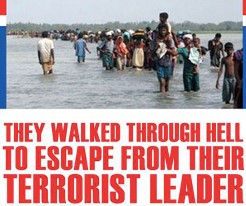
How the 290,000 victims waded into the hands of the Sri Lankan Troops at the end of the war in May 2009, straight after the alleged Mullivaikal ( Mullativu)Massacre of Tamils by the Sri Lankan troops, that the Toronto canadian’s have been able to dupe the Canadian Ottawa state parliamentarians into believing , was true.
How credible is it that if they were the victims of a
Massacre, they would stream back into the arms of those who were responsible
for the massacre
&
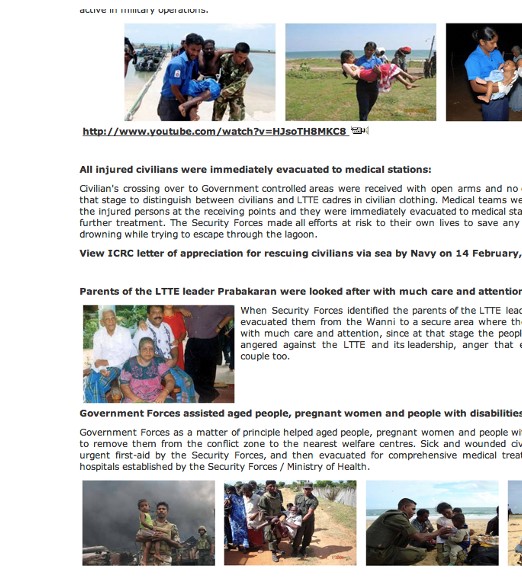
What the Sri Lankan troops really did for these civilians , including
Prabakarans parents ,w hom they looked after for several years thereafter, till
they passed away from natural causes.
By Noor Nizam – Peace and Political Activist, Political Communication Researcher and SLFP/SLPP Stalwart, August 29th., 2020.
Your suggestions and proposals are appreciated. Those who sat with you, except for Hon. Basil Rajapaksa and your secretary Dr. P.B. Jayasundera do not have a far-sighted vision and proactive ideas to achieve what you have suggested/proposed.
HE. President Gotabaya Rajapaksa, Your suggestions and proposals are appreciated. But they will remain just words for the next 41/2 years if there is no concrete progress and proactive systematic project proposals to implement them at all levels, especially at the ground level in all coastal and fishing areas. Those who sat with you, except for Hon. Basil Rajapaksa and your secretary Dr. P.B. Jayasundera do not have far-sighted vision and proactive ideas to achieve what you have suggested/proposed and wish them to achieve. I am not telling that they are incapable in carrying out their duties, both political and administratively, but the reality is that “THEY DO NOT HAVE THE BACKGROUND AND EXPERIENCE OF THE FISHING INDUSTRY (Inland, Coastal and deepsea fishing) to accomplish the task/your vision. The business entrepreneurs are only profit-motivated and will do things that will bring profits to them, but “NOT” your vision that needs patience and time, not profits to achieve the goals thought out.
One of the greatest wealth and gold mine Sri Lanka has is the Cey-Nor Development Foundation Ltd., and the North Sea Fish Net manufacturing complex and the Norwegian FPC AID Project of the Ministry of Fisheries (which was shut dwon abruptly) in the North, NWP, Eastern Province and the Southern Province. This fisheries development humanitarian assistance project which started in the late 1960tees in Karainagar, Jaffna district under the name “MALU-MEEN ENTERPRISES” to assist the fisherfolk of a remote village called “THOPPAKKADU” ended as a Multi-Million dollar program over the years, was made to die a “NATURAL DEATH” by interested groups and fishing business magnates and unscrupulous TAMIL GOVERNMENT SERVANTS AND SINHALESE OFFICIALS, under the pretext of the Civil War in the North and East. Under the J.R.Jayawardene government, Secretary to the Ministry of Fisheries – Anura Weeratane crippled the whole project for his personal selfish gains and transferred Cey-Nor assets to his Ceylon Rubber Company in Kalutara. During President Madam Chandrika Bandaranaike Kumaratunge’s time, again assets were sold out to private fishing magnates in Negombo. During the tenure of HE. Mahinda Rajapaksa, it was completely mismanaged by powerful politicians and their kith and kin, torn into smaller projects, and some finally closed down. The Cey-Nor Fish Net Factory established in Gurunagar, Jaffna which was part of the Cey-Nor Development Foundation Ltd., was separated and a new business enterprise named “NORTH SEA LTD. was formed in 2010-13. This project was the most income-generating production unit of the Cey-Nor Development Foundation Ltd.
If this “CEY NOR DEVELOPMENT FOUNDATION LTD” project can be revived to it’s original glamour and brought back to an operational level, it will help you fulfill, your vision to reduce the foreign exchange spent annually on fish imports to save an estimated $ 500 million. Not only that, it will contribute very much towards the development of the inland, coastal and deep-sea fishing industry of our “MAATHRUBOOMIYA” Sri Lanka, but also bring new life to the fisher folks of our coastal belts especially in the North and South and around the island and provide thousands of direct and indirect jobs to the fisherfolks.
A comprehensive proposal to revive Cey-Nor Development Foundation Ltd. was submitted to your Secretariat in December 2019 by the undersigned, but not even an acknowledgment has been received up to now.
Your Excellency President Gotabaya Rajapaksa, to revive this great asset to it’s former glory and functional capacity for the benefit of our “MAATHRUBOOMIYA” this project has to be immediately brought under the purview of Hon. Basil Rajapaksa – Presidential Task Force in charge of Economic Revival and Poverty Eradication for it’s a revival for the benefit of our “MAATHRUBOOMIYA”.
The comprehensive proposal for revival will lead to achieving the goals envisaged.
Muthuswamy Master, who invested Sinhala film music with a new sound on par with Indian films, came to Sinhala films with Sri Lanka;’s first feature film Kadawanu Poronduwa (Broken Promise) as a member of Music director R.Naranaya Iyer’s orchestra and stayed on to make a mark.
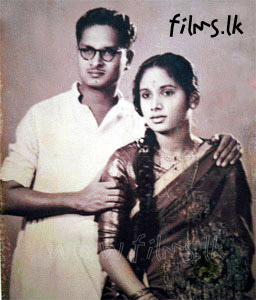
Muthuswamy Master with his wife Neeliya Perera
Colombo, August 30 (Facebook): Incomparable master composer R.Muthusamy Ramaya Asari Muthusamy was born on January 5, 1926 in Nagerkovil in Tamil Nadu bordering Kerala in South India. He was the only son of the versatile South Indian musician called Ramaya Baagavathar.
The father’s attempt at making his son practice music on a baby violin resulted in young Muthuswamy enjoying the rare privilege of mastering the violin at the tender age of ten. Muthuswamy thereafter proceeded to participate in several varieties of entertainment recitals in Madras.
On January 21 1947, the first Sinhala motion picture in Ceylon Kadawuna Poronduwa (Broken Promise) was screened. R Narayana lyer, the music director of the movie, gave an opportunity for Muthuswamy to join his orchestra, when recordings were being made in India.
Narayana lyer was quick to recognize Muthuswamy’s talent as a violinist and appointed him as his assistant. It was at one of these recordings in India that S.M. Nayagam, the South Indian producer of Kadawunu Poronduwa, met Muthuswamy. Nayagam encouraged Muthuswamy to visit Ceylon, where, subsequently, his career as a music director was firmly established.
On October 20, 1952, Muthuswamy Master joined the State-owned Radio Ceylon Tamil orchestra as a violinist with a group of others. They included co-violinist G Shanmugananthan, the gatam and thambura player K.K. Atchuthan, Mirudhangam players T Ratnam and K Ganapathipillai, veena player Colendavelu and E Suppiahpillai on clarinet, all playing under the leadership of the South Indian music conductor, D.S. Manibaagavathar.
Music direction
Sometime in 1953, Muthuswamy Master resigned from Radio Ceylon, accepting an invitation extended by film producer Nayagam, who had built the Sundara Murugan Navakala Sound Studios in Kandana (presently SPM Studio) in Ceylon, to be in charge of the music section at the studio.
During this period, business tycoon cum film producer, K Gunaratnam, who considered Muthuswamy Master as a top Carnatic violinist, sought his services in music direction for the movies he produced. Incidentally, Gunaratnam, while travelling in his car was shot dead on August 9, 1989 by unidentified motorcyclists at Armour Street in Colombo, during the height of the JVP insurrection.
It was in 1953 that Muthuswamy made his debut as film music director by providing music for the Sinhala movie Prema Tharangaya.
He received the award of a certificate, for the Best Music director for this achievement, from the South Indian Journalists’ Association at age 27.
Then followed Pudhuma Laylee (1953), Ahankaara Sthree, Maathalang, Hitha Honda Minihek (1975) in a series of movies, leading to the road of fame and success.
Muthuswamy who composed the background music for the hit number Pruthugeesukaraya, which was recorded in India, in Lester James Peries’s (later Dr) celebrated Sinhala movie Sandeshaya. Muthuswamy gave a break to budding vocalist H.R. Jothipala to sing this song and thereafter rocket to fame, at a time when the great Dharmadasa Walpola held sway in the local music field.
The melodies by Sunil Shantha and the background music for the movie were greatly enriched by Muthuswamy Master on par with the high South Indian standards of that time. LP record sales at Cargills topped over Rs 100,000; a comparatively tidy sum in that era.
Sometime in 1966, Muthuswamy Master played on the first electric Hammond organ imported to Ceylon, at the opening ceremony of the Sinhala movie, Okkoma Hari, produced by Wijayapala Hettiarachchi. In 1974, Muthuswamy Master received the Deepasikha award for being selected as the musician who composed music for the most number of movies.
The OCIC recognized and honoured him for his valuable contributions to Sinhala movie music. On January 3, 1987 he was awarded the Layagnanavarudhee by Regional Development Minister C Rajadurai, while his son, Mohanraj, received the Mellisai Mannan award. While several South Indian singers sang under Muthuswamy Master’s baton, local artistes who were backed by Muthuswamy Master included the famed Dharmadasa and Lata Walpola (later Kalasuri), HR Jothipala, Mohideen Baig (later Kalasuri), GSB Rani, Sujatha Perera (now Attanayake), Milton Perera, Narada Dissasekera, Angeline Gunatilleka and others. Notable were WD Amaradeva (violin), Premasiri Khemadasa (flute) (later Dr), Sarath Dassanayake (sitar), Victor Ratnayake (violin) and Dharmadasa Walpola (flute) all reading their respective instruments under Muthuswamy Master’s direction.
He was instrumental in Nanda Malini’s entree to music in Daruwa Kageda in 1960.
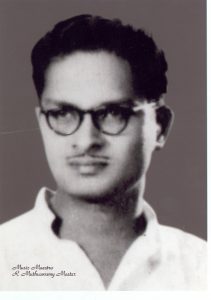
R Muthuswamy, music director
In recognition of his contribution to Sinhala music, a directive was made by Prime Minister Sir John Kotelawala, consequent upon which Muthuswamy Master was awarded an honourary Ceylon citizenship on April 12, 1956: a historic day on which Prime Minister SWRD Bandaranaike’s first Cabinet in the 3rd Parliament of Ceylon was sworn in.
Sometime in 1958, Muthuswamy Master re-joined Radio Ceylon as a violinist. With the departure of the Tamil Orchestra Leader Manibaagawadher, who held a Temporary Residency Permit (TRP) to South India, Muthuswamy Master rose to that exalted position in the following year.
Apart from being a Carnatic music teacher, Muthuswamy Master was also a singer.
His rendition of Madhura Yaame with Sujatha Perera (later Attanayake) in the movie Sithaka Mahima was popular among the public then.
Decades later, his son Mohanraj’s identical rendition of the same number with popular female vocalist Nirosha Virajini brought about a great degree of popularity to Mohanraj among the Sinhala speaking audience.
During this era, several musicians used to be employed by Radio Ceylon/CBC/SLBC on casual basis. Notable was the popular violinist M.K. Rocksamy, a one time Saxophonist, who, unlike Muthuswamy Master, was not a Carnatic musician, but later on conducted the music direction for some 20 Sinhala movies.
The other was Gatam Vidhvaan Kandraseri Krishnan Atchuthan (Kalasuri in 1992), the Malayale from the village of Guruvaayur in Kerala, South India, who received an honourary Ceylon citizenship from Prime Minister SWRD Bandaranaike, on November 5, 1958. Morsing and Gadam recitals were innovations of Muthuswamy Master in Sinhala movies.
Muthuswamy Master continued to serve as the Leader of the Tamil Orchestra through Radio Ceylon’s conversion into the CBC/SLBC, up to the time of his retirement at age 55 on January 5, 1981 completing a total of some 24 years in that state institution.
On October 7, 1961 Muthuswamy Master married BDE Neeliya Perera, sister to the erstwhile shenai player, violinist and member of the Ceylon Navy band turned vocalist, Victor, who hails from a known Sinhala family in Kandy.
On September 27, 1962 Muthuswamy Master and Neeliya were blessed with a son, and they named him Mohanraj, now the leader of the popular Apsaras Music Group. Thereafter three girls followed in a row: Chithrangi, Prasannavadhani and Keerthica.
In early 1988, Musthuswamy Master was approached by Sinhala movie star cum producer, Vijaya Kumaratunga, to music direct his movie, Samaawa, directed by Shirley P. Wijerathe.
It was the first time father, Muthuswamy Master and son, Mohanraj, were combinedly involved in a project of music direction for a Sinhala movie at the Ceylon Studios in Narahenpita, Colombo.
On February 15,1988 Vijaya spoke to the Master over the telephone pertaining to arrangements to be made to voice the last song by the famous Lata Walpola on the 17th. However, come February 16, on the verandah of his residence, Vijaya was assassinated.
On a Monday evening, June 27, 1988 Muthuswamy Master passed away peacefully at the age of 62. State television Rupavahini’s evening news telecast carried his obit on June 29, 1988.
At the time of his death, Muthuswamy Master had composed music for nearly 225 Tamil and Sinhala movies.
By P.K.Balachandran/Daily Express Courtesy NewsIn.Asia
Why the Indian National Congress and the United National Party are finding themselves in a bind
The United National Party (UNP) in Sri Lanka and the Indian National Congress (INC) in India, are both Grand Old Parties. They were vanguards of the freedom struggle against the British and were the first to govern their countries after the grant of independence in the late 1940s.
But both are in a bind now, following defeats in elections and loss of power through splits and defections. According to the Cassandras, the UNP and the INC are facing extinction”. But the more charitable critics would say that they are in deep waters” to get out of which, they will have to go in for a drastic image makeover, adopt a totally different political program and establish rapport with the voting population.
Both are facing an acute leadership crisis. In both cases, the current leaders (Rahul Gandhi in India and Ranil Wickremesinghe in Sri Lanka) have been rejected. But there is no clear and credible alternative to them to be able to face the charismatic leaders ranged against them, namely, Narendra Modi in India and the Rajapaksas in Sri Lanka.
Both parties lack a country-wide figure to replace the existing leader, Rahul Gandhi and Ranil Wickremesinghe. Rahul and Ranil, even with all their faults, are the only all-nationally known figures. Among the motely crowd of second rung leaders in the UNP and INC, there are bright ones undeniably. But none of them has a country-wide political stature to command the attention of party cadres and draw the masses.
The result is that both the INC and the UNP have decided to continue with the existing leadership till a new a new leader is found. In the case of the UNP, Wickremesinghe will continue as Leader for six more months and in the case of the INC, Sonia Gandhi will continue to be Interim President till the All India Congress Committee meets in January 2021.
Party Elections
While in the UNP, there is no demand for elections to choose the leader, having given the task to the Working Committee, in the INC, there is a clamor for elections and also an unarticulated but thinly veiled demand that the Gandhi family should step aside to enable an outsider to takeover. Rahul suspects that Modi and BJP are behind the campaign against the Gandhi family because the BJP knows that the INC had gone down when the Nehru-Gandhis had stood aside and let others be in charge. The BJP and Modi know that the Gandhis, be it Indira or Sonia, have led to the INC to victory from the depths of defeat and despair. Indira Gandhi did it in the late 1960s and Sonia did it in late 1990s. With Dr.Manmohan Singh as a front, Sonia indirectly ruled India for two consecutive five year terms till March 2014.
The demand for elections to decide the leadership issue also comes from a mistake notion of the elite that political parties should be run like other democratic structures. But the fact is that no political party in a traditional society is run along Western lines with elections and bureaucracies. Political parties in traditional societies marked by primordial, hierarchical and patriarchal social and cultural ideologies, are formed around particular leaders who are charismatic or who have inherited charisma by virtue of their familial links.
Although official rules may require the holding of regular elections, no party in South Asia holds elections not even the BJP which is the current favorite of the Indian elite. Political parties are typically woven around and led by individual leaders. The masses too look for an inspiring leader rather than dour and colorless party apparatchiks. As a result, the INC was woven around Nehru, Indira Gandhi, Rajiv Gandhi and Sonia Gandhi and the UNP was woven around the Senanayakes and for a long time around Ranil Wickremesinghe. The Sri Lanka Freedom Party was woven around the Bandaranaikes and the Sri Lanka Podujana Peramuna is woven around Mahinda Rajapaksa. Party cadres and the voting masses accept the personal nominees of the Leader without insisting on the proper procedure.” It is significant that the 23 INC leaders who had sought elections, could not succeed in their mission despite media support.
Punjab Chief Minister Capt. Amarinder Singh argued that this is not the time to raise the leadership issue or call for elections when the party is under a threat from the dictatorial Modi regime. These moves would cause disruptions in the party. He further said that Modi’s success is attributable to the absence of a strong and united Opposition.
Amarinder noted the immense contribution of the Gandhi family to the country’s progress since it achieved freedom from the British rule. The Gandhis are the right fit for this role. Sonia Gandhi should continue to helm the Congress as long as she wanted,” he said, adding, Rahul should thereafter take over as he is fully competent to lead the party”.
But defeating Modi is not easy, even given the mess he has made of India’s economy and India’s relations with its neighbors. With all his drawbacks he still is the tallest Indian leader commanding country-wide support. His party managers are street smart, pushy and amoral. And party leaders have the authority to enforce compliance among the party cadres. This gives Modi and the BJP an edge in elections. Even if defeated at the polls, the BJP’s adeptness at political maneuvering helps it get to the seat of power finally. Congress under Rahul sorely lacks the BJP’s chutzpah.
Rahul’s resignation after the INC’s defeat in 2019, his apparent reluctance to take the post of President even though his mother Sonia is not physically fit, makes the second rung leaders wonder if he has Modi’s will to capture and retain power. The way the INC lost power in Karnataka and Madhya Pradesh and almost lost in Rajasthan showed lack of management skills and chutzpah on the part of the top leader.Rahul and Sonia had failed to provide the goals and the wherewithal to achieve those aims. All he did was to keep tweeting against Modi. But this had no impact on the ground situation.
UNP
The UNP has been suffering from a lack of credibility among the majority Sinhala community (74% of the population of Sri Lanka) from 2015 onwards. It had earned the displeasure of the majority community because it exposed the security forces to the scrutiny of the UN Human Rights Council, the US and Western powers. The denigration of the vanquishers of the dreaded LTTE was not to the liking of the majority. The UNP-led government’s bid to draft a new quasi-federal constitution in collaboration with the Tamil National Alliance (TNA) gave the impression that the Wickremesinghe regime was giving in to the separatists”. The regime was also tarnished by the Central Bank bonds scam.
To cap it all, its lack of unity and pusillanimity in dealing with the threat from Islamic fundamentalists, despite intelligence alerts, led to a complete loss of legitimacy. Though Sajith Premadasa’s Samagi Janawega Balaya (SJB) took part of the blame (as reflected in its defeat in the Presidential and parliamentary elections) the UNP under Wickremesinghe took the brunt and suffered really grievously unable to get even one man into parliament.
The UNP, currently with Wickremesinghe as a stopgap leader, has to find a leader with an image that attracts the Sinhala-Buddhist majority without getting dubbed a puppet of the Tamil and Muslim minority parties. It has to have a leader with both gumption and grass root level support. Given the dismal track record of Wickremesinghe and the lackluster record of the second rung, the UNP like the INC is unlikely to get back on its feet anytime soon.
Former Norwegian peace negotiator Erik Solheim, who defended Tiger terrorists and their vision of the so-called ‘Tamil cause’ for over three decades, finally acknowledges that he knew Tiger Leader Velupillai Prabakaran had ordered the killing of former Indian Prime Minister Rajiv Gandhi. Solheim, in a twitter message, said that during discussions he had with LTTE theoretician Anton Balasingham he admitted Prabakaran ordered the killing of Rajiv Gandhi.
New Delhi will never forgive LTTE
Rajiv Gandhi was assassinated by an LTTE suicide bomber on 21 May 1991, and thereafter New Delhi completely stopped dealings with the terrorist outfit. A former Foreign Secretary said that New Delhi will never forgive the LTTE for directly interfering with the Indian democratic system by killing a leader of the main political party that was about to come to power once again and every future Government, whether Congress or BJP or anyother party would not deviate from that policy.
That is even evident today from the Modi Government’s refusal to pardon the Rajiv killers even after they served more than 30 years of prison terms.
Neither New Delhi nor Colombo will forgive Solheim for covering up the LTTE crimes for 25 years since the Norwegian Peace Negotiator commenced peace negotiations in 1996.
While condemning the Sri Lankan Government’s armed forces on alleged human rights violations at every forum as well as during discussions in different capitals such as, Oslo, New Delhi, London, Washington and Tokyo, Solheim failed to acknowledge the ruthless killings and terrorist attacks of the LTTE.
Wanted in India for prosecution
Norway began its peace process on a wrong footing. Soleim travelled almost every month from Oslo to London to first discuss with Anton Balasingham and then flew to Colombo to seek views of the Government and then took an Air Force helicopter ride to Vanni to continue the dialogue with the LTTE Political Leader Thamil Chelvam, Nadesan and others.
Initially, Solheim kept India out and he refused to brief New Delhi. Infuriated the Indian Government placed a newspaper advertisement in all prominent newspapers in Sri Lanka stating that LTTE leader Velupillai Prabakaran and their Intelligence Chief Pottu Amman were absconding criminals and were wanted in India for prosecution in the Rajiv Gandhi assassination case.
Change of travel plans
Solheim understood the message clearly and he changed his travelling itinerary to Oslo-London-New Delhi- Colombo-Vanni-Colombo-New Delhi-Oslo.
Although he briefed Colombo and New Delhi he displayed his partially towards LTTE by trying to find reasons for terrorist actions. Furthermore, he never disclosed the hard fact such as Prabakaran’s direct involvement of Rajiv Gandhi assassination. Balasingham told me Prabakaran admitted to the killing of Rajiv Gandhi in their private discussions. Bala was not in the slightest doubt as to who ordered the attack. Bala never lied to me. I see no reason why he would have lied on this,” Solheim tweeted last week. The fact he revealed now would have been useful to prosecute Rajiv assassins at that time.
After the collapse of the peace process too, Solheim played a different tune. When Indian journalist Padma Rao Sunderji asked him if he was acceptable to New Delhi he said there was a lot of skepticism in Delhi. What will these pink, Christian Europeans with no real knowledge of South Asia make of problems on this continent? But at the end, we were not only acceptable to India, we had the closest relationship. After every visit to Sri Lanka, I went to New Delhi to inform the political leadership and the Indian intelligence about what I’ve achieved or not achieved.”
One-way ticket — to Europe
He added that when he met Foreign Minister Jaswant Singh in New Delhi he asked if Solheim was a patient man. I said, no, no, I’m not patient, how can we be, when people are dying in Sri Lanka every month? Mothers are crying, children are dying, how can we be patient?” To that, Singh said: do you know the way to Indira Gandhi International Airport? Go. Buy a ticket — making sure it’s a one-way ticket — to Europe. Because if you’re not patient, you’ll only run into problems here. If you take a 10-15 year perspective on the Sri Lankan conflict, then you may do something good.
Of course, he (Singh) was right, I was wrong. We learned our lessons and became patient. But still, the fundamental issues in Sri Lanka — the status of Tamils, and the influence of Tamils within the State of Sri Lanka are not resolved,” Solheim told Padma Rao Sunderji.
Norwegians turned a blind eye
The journalist pointed out that there were many allegations against the Norwegian mediators. One is that even though the LTTE, within years of the struggle, were acknowledged to be an armed separatist group, the Norwegians turned a blind eye to that fact. And that the Norwegians, to date, maintained connections with many overseas ex-LTTE groups like the Transnational government of Tamil Eelam” that sprung up even after the war ended, Padma pointed out.
Solheim ignored the question and said, What we could do is to see what the government wants, what the Tigers want and — bring that together. That was our role.”
In his twitter message last week, Solheimalso accused Prabakaran of failing to compromise by not accepting an offer to evacuate Tamil civilians during the final stages of the war. I accuse Prabakaran of failing to compromise and not accepting the offer to evacuate Tamil civilians.” Then he put the blame on the Government, It was the Sri Lanka Army who indiscriminately shelled and bombed people to death. I wish we, as mediators, had the powers to influence the parties to make wiser decisions.”
LTTE would never agree to a federal solution
Neither we, nor India, US, China, EU or anyone else. The aim of the peace process was a federal solution to Sri Lanka. The vast majority of Tamils would have been happy with that,” he said. He failed to give any reason for the purpose of his peace process when he knew that LTTE would never agree to a federal solution.
Solheim also revealed that Balasingham had predicted the LTTE could lose the East, may be even the North, because of a failed military strategy. If the LTTE and Solheim were convinced that the LTTE would lose and there was no hope for any solution, why did he continue with the peace process? Is it for personal perks and international fame for a short period? Erik Solheim owes an explanation to the people of Sri Lanka and India as well as to Norwegian tax payers.
Leader of the Opposition Sajith Premadasa says that one can work to develop the country even while in opposition.
The Leader of Samagi Jana Balawegaya (SJB) expressed these views attending an event held today (30) to hand over medical equipment to the Wethara District Hospital in Polgasowita.
He says that other parties try to serve after obtaining power. However, SJB has realized that a certain amount of work can be done even while in the opposition, he added.
Strengthening the country should not be limited to the funds from the government, Premadasa said.
If politicians are able and have a desire to, they do not need to wait for governing powers to serve the people. We, too, can serve through certain programs”, he points out.
A team of officers from the Geological Survey of Sri Lanka visited the Kandy area today to inquire into the unusual tremors that are reported to have occurred in several areas.
The tremors have been felt in Kandy, Anuragama, Haragama, Gurudeniya, Thalathuoya and several other areas last night.
The tremors were recorded at the Pallekele Seismic Station.
Sajjana de Silva, Director General of the Geological Survey and Mines Bureau told our news team that the tremors could not be termed as an earthquake.
However, officials from the Geological Survey and Mines Bureau today launched an investigation based on data and information obtained.
A special discussion will be held tomorrow with the officials of the Disaster Management Center.
The Minister of Power and Energy Dullas Alahapperuma states that the report of the committee appointed to investigate the recent power outage island wide will be uploaded on the internet.
The Minister stated this while participating in a public meeting held in Hakmana, Matara yesterday.
The Minister also expressed his views regarding an electricity mafia.
He alleged that the electricity mafia was not active in the CEB or the Ministry of Power and Energy and that it was operating in Diyawanna.
The Minister said that although the Electrical Engineers and the Electricity Board had taken steps to prepare a National Electricity Generation Plan, there had been obstacles in obtaining the plans for approval in Parliament in the recent past.
By Senior Lawyer Sri Lanka Study Circle [ srilankastudycircle@yahoo.com ]
Parliament has enacted legislative framework for the e register [ e LR ] modeled on the Australian ‘Torrens System’ of title registration (Registration of Titles Act No. 21 of 1998, popularised as Bim Saviya / Title Registration ). This has convulsive changes to our land law. The Act 21 of 1998 , is more or less a copy paste version of the original statute introduced in 1858 in Australia. It does not include any of the amendments made subsequently by the Australian Government to make the e register comprehensive compulsory and free of fraud .
Although the public have a right to information under the ’ ‘Right to
Information Act 12 of 2016’ , there is very
little dissemination of knowledge to the public and the lawyers with regard to
this law. If the e
register is governed by the Australian
law, the land rights under the personal laws , other
laws that permit shared interest and servitudes enjoyed by land owners mainly for
agricultural purposes will not be accommodated
.
It
is therefore the duty of patriotic and public-spirited politicians,
administrators, lawyers and media leaders to vitalise the Sri
Lankan law with necessary amendments specifically to prevent fraud to enable
effective administration of the e
register .
‘ One law for all’ ? .
An
owner registered in the e
register, under Bim Saviya has conclusive indefeasible ownership [
Section 33 Act 21 of 1998 ]which cannot be questioned in a court
of law and cannot be challenged in a
court of law, even if the owner received title by way of a forged
deed or even if the owner did not receive
rights under the personal laws. Section 73
Act 21 of 1998 expresses the superiority of the Bim Saviya law states ‘
the provisions of this law shall have effect notwithstanding any other law. ‘
TheSamarasekera
report consisting of expert lawyers
appointed by President Mahinda Rajapakse
to investigate in to this law declares that
the
‘ Bim Saviya law can be maintained only if the
customary and statutory inheritance laws of our country are made inapplicable.’ Can this be done?
Bim Saviya
compels registration of only one owner for a block of land and will not register complex ownership rights under our
customary law or personal laws , Ande cultivation right , law
of preemption , rights to plantation,
rights to chena lands etc . Samarasekera
report concludes that
compulsory registration under Bim Saviya is an
impossible task and totally unworkable’.
The Title Commissioner
[ officer appointed to register owners
under the new law Bim Saviya ]after 20 years confirms the view states in the 2018 report that
1.9 million blocks could
not be converted to Bim Saviya since they were governed by coownership rights
and customary laws
If further convincing is necessary
readers are advised to read the World
Bank’s ICR report it states Sri Lanka’s
titling project is a failure. The project
only issued titles for parcels with clear land rights and deliberately shied
away from problem parcels and from helping people in the field work out their
problems . As a result the project failed to improve the adjudication process. http://documents1.worldbank.org/curated/en/996161474635250504/pdf/000020051-20140617135844.pdf
This situation has caught Sri Lanka
between two stools. The country has two systems of law . The vexatious old law
that requires immediate revision and Bim Saviya which is economically unaffordable
. This has confused and disturbed land owners including the judiciary with many court cases
instituted and pending. During court proceedings , the
defendants produce conclusive Bim Saviya Certificates to prove ownership, where
the Title Commissioner the Government’s adjudicator
had gone ahead to conclude ownership , without the knowledge of the law .
Proceeding with
Bim Saviya against all legal advice
Fifteen
years ago the Bar Association made
amendments to Act 21 of 1998 thereafter Samarasekera report concluded
that the imposition of compulsory
investigation of title will create thousands of land disputes. .
Contrary
to the legal advice given Government continued and as predicted the effort to implement Bim Saviya with a non legal process failed. The
cost of this futile exercise was exorbitant with the government having to visit
all land owners making plans and
adjudicating rights . For 20 years only 0.72 Million blocks were
registered in the Bim Saviya register
out of 12 Million blocks of land. With
that conversion indicator it will take
over 100 years to implement the law for
the e register.
What happens to
the land coming under the MCC project? As per proposal [
Annex 1 page 21] there would be only 5
Million people benefitting after 20
years .What happens to the others and
how long is the project ?.
Judicial adjudication of legal ownership rights entrusted to the administration
The
post of commissioner of Title Settlement
was created to mandatorily investigate
ownership of all land owners converting land rights of both private and government land owners to the Bim Saviya
law. The law compels the owners to forego
their deeds to be exchanged to certificates All future land transactions[such as sale and gifts etc] are to
be made on Transaction Forms
published in the Gazette 1886/58 dated 31.10. 2014 , The statutory forms published in the gazette have no
provision to recite the servitude rights or other shared rights under
personal laws as they cannot be included
in the register . The Bim Saviya has provision to destroy
notarised land transactions and they are not returned to owners. Section 53 provides to destruction of land transactions, as the register by law has to erase the history of ownership
to reflect only the owner and is therefore named as ‘ Mirror Title’’. .
New procedure to
reduce court actions under Bim Saviya Section 60 of Act 21 of 1998
Surprisingly a new alien law has come into operation called the statutory ‘Assurance Fund’ . Government has to be responsible to pay compensation to owners aggrieved by registration under Bim Saviya . If the owners lose their rights
under Bim Saviya ; they may not get back their house or land they have lost , they can obtain compensation from the Assurance Fund. A poor substitute for the loss of their fundamental right to access court to seek redress.
The law of Bim Saviya referred
to as Torrens law had operated in Australian
for over a century and the Australia’s Government’s ‘ Assurance Fund’ has
sufficient funds to compensate owners . [ Victoria registry in 1981 -87 made a gross profit of Au Dollars
189.5 million New South wales of Au Dollars
249.5 Million of which 50 Million was gross profit as the fund
is maintained with the fees collected from land owners.]
The phenomenal cost of registering land under Bim Saviya
To
register land in Australia under the Torrens law [ Bim Saviya ] it cost
approximately 180 AUD for a land owner,
as owners have to maintain the Assurance
fund. Land registry has already commenced charging fees for
registration to build the Assurance
fund. Is this economically viable for a
poor country?. Sri Lanka Government has to find the funds to establish
the Assurance Fund , as the MCC will not grant funds for the establishment of
the Assurance fund or the implementation of Bim Saviya .
USA in Several States have rejected the law
Several
states in USA had rejected this law as
they did not agree that the fundamental rights to access court should be replaced with a law that requires a Government Assurance fund to pay compensation to owners. Throughout its thirty-five years of existence
in USA has at most been only sporadically
successful https://core.ac.uk/download/pdf/151518291.pdf
Sri Lanka need to be cautious
as over-reliance on funding agencies and their legal advice
may not be the best way forward .
According to the MCC draft document the government has been unsuccessful in the
implementation of Bim Saviya. MCC however advises to continue with the failed law Bim Saviya
with amendments [The MCC Annex 1
—34]
The suggested
amendments are , ironically to re introduce the rights that
are best available under our law and the deed system . Why introduce a law alien to the country and
amend the law to return to the existing law ?.
Other nations have
made the same mistake
Sri Lanka has to learn from others experience. Several nations have made the mistake
and is regretting . To remedy the
situation they are repeatedly introducing
amendments to their Torrens statutes.
Their judiciaries are compelled to encounter unknown legal issues. Malaysian and Singapore has exposed the law
where criminals gain land rights . The system is based on
the law of Australia in the 19th century
and is totally inadequate to deal with the challenged of the 21st century https://www.accaglobal.com/hk/en/member/member/accounting-business/2019/04/in-focus/land-fraud.html
Why are successive governments
ignoring the advice of Sri Lankan Lawyers for the implementation of an effective e
register with the Sri Lankan law
The e register [ e LR ] will be
completed very soon and e
register could operate with the law of our country. The advice of the Sri Lankan lawyers has been to revise and amend the law. Sri Lanka
requires laws to maintain the integrity of the register free of fraud for the safety of the owners registered in the e register .
The expert advice from lawyers are given in ——-
1] Samarasekera Committee Report
. A committee appointed by President
Mahinda Rajapakse has given expert advice which will not economically
burden the government. They
recommend to do away with compulsory conversion recommended by Bim Saviya. Concludes that it
is impossible task and totally
unworkable’. The Law Reform Commission has also consistently opposed compulsory
implementation of the law. The committee recommends that the implementation
be initially voluntary. 2]
The amendments to the colonial statutes
by a committee appointed by the Ministry of Justice to prevent fraud [when
Mr Milinda Morogoda was the Minster] 3] Amendments to the Bim Saviya Act 21 1998
by the Bar Association 4] Reports from the Banks of Sri Lanka
If
we are compelled to introduce the Australian law at least follow Australian Practice
If we are compelled to proceed
with Bim Saviya for the 11 Million blocks remaining , having failed in the project for 20 years, the Government should not ignore to
assess the period required and the cost
and should not ignore the years
of research made in Australia to improve the Torrens law made, by the Australian Registrars’ National Electronic Conveyancing
Council (ARNECC) and the Property Exchange Australia Ltd (PEXA) which gives publicity and
directions to lawyers and the public
It would be also important to observe that Australia has recognized
the customary laws of the people.
Customary rights were recognised recently
on the 3rd of June 1992. , High Court of Australia ruled
that the lands of this continent were not terra nullius or ‘land
belonging to no-one’ when European settlement occurred, and that the people were ‘entitled to their customary
rights possession, occupation, use and enjoyment of the lands Mabo v. Queensland .
Mr. Gajendrakumar Ponnambalam, LL.B (London) Leader of the Tamil National Peoples’ Front (TNPF) Member Parliament for Jaffna Parliament of Sri Lanka Kotte Sri Lanka
Dear
Gajendrakumar Ponnambalam:
Permit
me to introduce myself to you, as you might wonder who this guy is, who calls
himself Weera-sinha (Courageous-Lion), born and bred in Colombo.
Born at 54 Mount Mary off Baseline Road. Son of a Ceylon Government
Railway Steam Locomotive Engine Driver. A Sinhalese-Buddhist to boot, who
was schooled at Nalanda (Vidyalaya) College, and left home for London, England,
on 3 December 1956, on a British BOAC 56 seater propeller DC4 plane from
Ratmalana Airport. It took 41 hours for me to reach Heathrow. And
I met your Dad some time in the early 1960s, when he was brought to my home
(flat) at 51 Faraday Road, Ladbroke Grove, in London, for a cup of tea, by
our mutual friend, a Quantity Surveyor, Balasubramaniam.
And
do you know what Gajendra, after all these 64 years away from home, I am still
romancing my beautiful Motherland, Sri Lanka, who gave me a free education to
make me who I am today — a Geologist-Palaeontologist-Museologist. And
this is important for you to know. I am on a Mission in Canada – that
no one, absolutely no one, and that includes you, will spit at, and kick her
when she is down, and harm her with God-damn lies unfairly, spitting out
words like, Genocide, Discrimination, Persecution, and Human Rights Violations
of the Tamils.
Gajendrakumar
when I mean no one, it means, not even the Prime Minister of Canada.
All the Prime Ministers since August 1983, have heard my voice loud and
clear, like that of the sound of the chime of London’s Big Ben at
noon, when their statements hurt my Sinhalese psyche, my Sri
Lankan-conscience and for the love of that beautiful island.
So
I question your gall and temerity to stand up in the well of the Sri Lankan
Parliament chambers and reiterate Genocide allegations. So I seek
help for you from Sweet Mother of Jesus”, to help this Tamil politician, who
seems to have a skewed understanding of the active word,Genocide”.
Gajendrakumar,
well son, what is reassuring about my past is that all of this has
happened. And I am sure that you who have lived in London will share my
sentiments:
‘From
Hyde Park’s fog, a white-man walks out
preaching
mnemonic fears of love… and shouts
I’ve
painted white…I’ve painted black
I’ve
painted white upon the blacks’.
With
all that crap that you and I had to endure, we don’t have to crap at each
other with exaggerated, Humbugging lies which you had just done in
Parliament. I just don’t like it. It annoyed me and got my goat and told
myself ...O! No!! There comes another lying Tamil
cunning-politician.
And
that’s when it hit me when I told myself – O! No, I will not allow that
cunning Fox, G.G. Ponnambalam, nor a member of his progeny, to try his 50-50
stunt to give the 10 percent of the island’s Tamil people a chance to govern
the 70 percent of my Sinhalese people, on a separatist Tamilian- whim.
At
that point Gajendrakumar, it occurred to me that you Tamils have had difficulty
to give up your ‘privileged minority’ status you all enjoyed during the
131 years of colonial rule, and couldn’t care a tuppence about the
professionalism, dignity and social status of the wronged majority”,
the Sinhalese, during that 131 years of Colonial rule. Right Gajendrakumar!
Nor
will I allow GG’s progeny, who pride in their initials LL.B behind their
names, to try the cunning tricks of the Grandad to dissect my Mother
Lanka into two, with cunning lies as we are children of the same Mother of
Lanka as she had adopted you lot as her sons and daughters who had come over
the 18 miles divide of salt-water in the Palk Strait.
So
I hope you got my drift, and I will say it my way, as I am not good at playing
‘Hide and Seek’ with the Tamil community, or throw riddles at you to solve
them. I am a straight ‘face-to-face’ talker.
I
say to you, Gajendrakumar, don’t do anything stupid to wipe out another
generation of Tamil youngsters by picking a war with the majority’Sinhalese and
their Government. It is not worth it.
This
is how I see it Gajendrakumar, and I am sure you see it my way too:
This corpse speaks to me still warm and its mouth foams with his Mother’s milk.
A medallion of a misplaced courage of drying blood stuck to his chest after a flood of blood where a bullet had pierced in the assault cracking dark.
I am tired carrying around your mother’s tears washed with her breast-milk which were your afternoon feed.
And I see all around you others strewn hastily like poppy-chested flowers with eyes of executed children…
sent to the Front line with cyanide capsules strung around their necks by adults in Tiger-khaki who live in safety in brick-houses and gunny-bags full with rice-paddy walled bunkers.
So
join me Gajendrakumar and sing with me the joy of sharing, harmony and
freedom…yes, let’s hold hands as we could harmonize better – I will
count, one – two- three, and then we will start together. Alright! Here
we go now – 1 – 2 – 3
This land is your land and this land is my land From Point Pedro to Dondra Head, from the plush Tea gardens, to the Mahaweli waters, this land was made for you and me.
As I went walking the A9 Highway I saw the endless Kandy-Jaffna skyway I saw below me, sapphire-gravel valleys as this land was made for us, you and me.
If you still have intentions to chop it into two you are free to go back to Tamil Nadu your Motherland where 75 million of your brothers and sisters are waiting anxiously to embrace you.
While all voices around us were singing; Halleluja..Halleluja…Halleluja, Vaarungal…vaarungal…..vaarungal… Namo…namo…Matha…..uppergay Sri Lanka Matha…” and while the sun was switching off for the day the Tamil and Sinhalese voices were still chanting,’ This land was made for us, You and Me.”
As
a final note from WikiLeaks, which makes you look like a weak-kneed
cunning junior GG-Fox. Here is what it said:
The Colombo Telegraph found the related leaked
cable from the WikiLeaks database. The ‘Confidential” cable
discusses what had happened on the ground during and since the conflict.
The cable was signed by the U.S.Ambassador to Geneva Clint Williamson on
July 15, 2009.
After the meeting with Jacque de Maio, ICRC Head of Operations for
South Asia on July 9, 2009. Just two months after the war, the ambassador
wrote; The army was determined not to let the LTTE escape from its
shrinking territory, even though this meant the civilians being kept hostage by
the LTTE were at increasing risk. So, de Maio said, while one could
safely say that there were ‘serious widespread violations of IHL,’ by the Sri
Lankan Forces, it did not amount to Genocide.
He could cite examples of where the army had stopped shelling when ICRC
informed them it was killing civilians. In fact, the army actually could
have won the military battle faster with higher civilian casualties, yet chosen
have won the military battle faster with higher civilian casualties, yet chosen
a slower approach which led to a greater number of Sri Lankan military
deaths….”
So
there you are Gajendrakumar. It doesn’t look good on you, does it?
You have three choices.
It
is up to you to use this information judiciously thus guarding your integrity,
your decency and shield your credibility as a lawyer-politician; or tear the
piece of paper that it is printed on and throw it into a waste-paper basket; or
roll it into a cigar and smoke it. The choice is entirely yours.
Take
care Gajendrakumar and be Wise.
May the Devas: Ganesha, Durga, Sarasvathi, Vishnu and Lakshmi protect you. Sadhu…sadhu….sadhu.
By Express News Service Courtesy The New Indian Express
The parents of Advocate Sivakami Sundari said that it was the Madurai-based lawyer who first raised suspicion over the death of Sri Lankan underworld criminal Angoda Lokka.
MADURAI: The parents of Advocate Sivakami Sundari said that it was the Madurai-based lawyer who first raised suspicion over the death of Sri Lankan underworld criminal Angoda Lokka.
The lawyer’s father, Dinakaran, said that it was because of her suspicion that an autopsy was performed on Lokka’s body.
Speaking to TNIE, Dinakaran and his wife Pandiammal said that after Sivakami was informed by someone about Lokka’s death over phone, she had left Madurai for Coimbatore. “Had Lokka’s postmortem report raised any suspicion of unnatural death, the police could have made the arrests by invoking murder charges. But here, all the people were arrested on charges of forging documents,” he said.
Meanwhile, Pandiammal, the mother of Sivakamai, said that Sivakami was accompanied by Amani Dhanji when she returned home after the cremation of Lokka at Thathaneri in Madurai.
‘Lokka was brought to Madurai by me’
Meanwhile, Dinakaran confirmed that Lokka (known to him only by the name Pradeep) was brought from Chennai to his house in Madurai by him. “A female friend from Sri Lanka introduced Lokka to me under the pseudonyme ‘Pradeep’ and told me that he was from Dubai. She told me that ‘Pradeep’ wanted to stay in Madurai. Later, it was me who introduced him to Sivakami,” he said, adding that he came to know about the real name of the man only when the media stared carrying the stories.
Dinakaran, known as Batsha and Ayya said that one of the main principles of LTTE was not to be involved in any drug dealing. “It was shock of a life when I came to know that Lokka was a drug peddler. Though I tried contacting the female friend from Sri Lanka, I was unable to reach her,” he said, adding that he has more than 20 cases, including weapon-smuggling cases, pending against him.
“Though a search operation was carried out at my house after Sivakami allegedly confessed to CB-CID about the presence of a few weapons in the house, no such weapon was recovered,” he added.
President Gotabaya Rajapaksa has insisted that the construction of the Neluwa-Lankagama road should not cause environmental damages.
The President meanwhile ordered the completion of the construction within 90 days, the President’s Media Division (PMD) said in a media release issued today (29).
He made these remarks while engaging in an inspection visit at the Neluwa-Lankagama road site.
Minister of Justice, President’s Counsel Ali Sabry has pledged to bring an end to the issue of child marriages.
He mentioned this while paying a courtesy call on the Chief Prelates of Asgiriya and Malwatta chapters today (29).
All Sri Lankans have a responsibility and a duty to nurture Buddhism according to the Constitution, the Justice Minister pointed out.
We have to guarantee that regardless of the race or religions,” he said further.
During his visit to Chief Prelate of Asgiriya Chapter, Most Venerable Medagama Dhammananda Thera, the focus of the discussion fell on the issue of child marriages.
The Justice Minister stated that delegations representing Muslim women have met with him to bring his attention to the issue.
Calling on the Deputy Chief Prelates of Malwatta and Asgiriya chapters, Minister Sabry noted that in all societies there are those who hold extremist views.
We are looking at ways to select such individuals and rehabilitate them,” he continued.
However, the majority wants desperately to live together as the best Sri Lankans possible, the Justice Minister said further.
President Gotabaya Rajapaksa reiterates his intention of fulfilling public aspirations in such a manner that does not harm the environment.<
The president today (29) inspected the renovation of the Neluwa-Lankagama road and spoke to the stakeholders about allegations that the work is harming the Sinharaja forest.
Officials of the road development, wildlife, environment and other relevant ministries joined in the inspection.
On the occasion, president Rajapaksa said the long-standing requirement for a road for the villagers should be met while safeguarding the environment.
Lankagama is an ancient village that dates back to the reign of King Walagamba and the main livelihood of its inhabitants is tea cultivation.
They take their produce to Deniyaya and Neluwa via a road that is located close to the Sinharaja.
Also, patients going to hospitals and schoolchildren widely use this road.
The Army is renovating the 18 km long road under RDA supervision to make the present nearly four hour journey shortened to a mere 45 minutes.
A bus will play on the road between Neluwa and Deniyaya once work is completed within 90 days.
A suspension bridge at Lankagama will be replaced with a bridge 120-feet in length and six-feet wide.
The president also instructed that reforestation there be encouraged by providing each of the 700 families of Lankagama with three plants each free of charge.
Sri Lankan President Gotabaya Rajapaksa acknowledges the crowd as he leaves an Independence Day ceremony, at Independence Square, Colombo, on February 4, 2020. Photo: AFP / Tharaka Basnayaka / NurPhoto
On August 5, a new government was elected in Sri Lanka, bringing down the previous regime associated with the Central Bank bond scam, the Easter Sunday bomb attacks and controversial international agreements.
The new government has come into office with a two-thirds majority in parliament, promising to bring prosperity, security and communal harmony to the beleaguered country. Achieving these goals depends to a large extent on how neocolonialism and sovereignty are addressed.
Colonialism involves control of a less powerful country by a powerful country to exploit resources and increase its power and wealth. In essence, neocolonialism involves the same factors: militarism, external expropriation of natural resources, deception and manipulation, collusion with local elites, incitement of ethnic and religious differences (and other forms of balkanization and destabilization) and consequential local resistance to external aggression.
Neocolonialism and geopolitical rivalry
Today, strategically located in the ancient east-west Indian Ocean maritime trade route, Sri Lanka faces competition for control by China on one side and the US-led Asia-Pacific Quadrilateral Alliance (also including India, Japan and Australia) on the other.
The new Sri Lankan government says it will reconcile competing external interests. Speaking on behalf of Sri Lankan President Gotabaya Rajapaksa, the recently appointed foreign secretary, retired navy commander Jayanath Colombage, has stated: Sri Lanka should be a neutral country. Sri Lanka does not want to be caught up in the power game. Sri Lanka wants to develop friendly international ties with everybody. Sri Lanka should have Sri Lanka-first policy.”
Is Sri Lanka’s current foreign policy moving in this direction?
Chinese expansion
Sri Lanka has been a participant in China’s US$4 trillion Belt and Road Initiative (BRI) since 2005. In January 2017, the previous government granted an 85% stake of the Hambantota Port, in the most strategic central point in the Indian Ocean, to the China Merchant Port Holding Company in a 99-year lease.
China is Sri Lanka’s largest creditor and has provided generous support during the Covid-19 pandemic. Given local concerns over the Hambantota Port deal, President Rajapaksa has previously stated that, on election, he would revisit the lease agreement and renegotiate it. More recently, he has stated that his government is not planning to amend the commercial terms of the agreement, but wishes to amend agreements concerning port security.
While Sri Lankan activists have been protesting the environmental and social impact of expanding Chinese projects, the Quadrilateral Alliance is seeking to involve Sri Lanka in countering Chinese expansion in Asia, making the country a key battleground of geopolitical rivalry.
Allaying the fears of India and the US that Hambantota Port could become a Chinese military base, the new Sri Lankan government has stated that the port should be limited to commercial activities only. It is zero for military purposes…. Sri Lanka will not afford any particular country to use Sri Lanka as a staging area to do anything against another country- especially so India.”
But how would the Quadrilateral Alliance respond if there were real or perceived military activity? It is not hard to imagine a dangerous military situation escalating far beyond Sri Lanka’s control.
Indian expansion
The policy of President Rajapaksa, as articulated by Foreign Secretary Colombage, is that as far as strategic security is concerned, Sri Lanka will always have an India-first approach. That means Sri Lanka will not do anything harmful to India’s strategic security interests. As far as economic development is concerned, we cannot depend on one country. We are open to anyone.”
However, India’s political and military involvement during the separatist war, especially its impositions of the 13th Amendment of the Sri Lankan constitution and the Indian Peace Keeping Force (IPKF) on Sri Lankan soil, have left fear and antipathy toward India.
The Indo-Lanka Accord that introduced these developments was hammered out in secrecy and signed without parliamentary consultation on July 29, 1987, during a 24-hour curfew. It faced massive resistance and ushered in one of the most violent and anarchic periods in the island’s modern history.
Despite India’s failure to curb Tamil militancy and the failure of the provincial-council system, India wants Sri Lanka to maintain the 13th Amendment and the provincial councils that it introduced to appease Tamil separatist sentiments. However, the new Sri Lankan government is under increasing domestic pressure to abrogate the 13th Amendment and to assert Sri Lanka’s sovereignty and political independence from India.
Concerned about Chinese encroachment at Hambantota Port, India is pursuing control over Sri Lanka’s other strategic seaports and to develop the British-colonial-era Oil Tank Farm in the eastern seaport town of Trincomalee, through a subsidiary of the Indian Oil Corporation, despite protests by Sri Lanka’s petroleum trade unions.
Port power
External powers are also keen to gain control over the Port of Colombo, one of the busiest in South Asia and an important transit hub in the region. Japan is keen for access given its high dependency on energy supplies via the Indian Ocean. There is now a push by the US and India to privatize the Colombo port’s Eastern Container Terminal (ECT) and hand it over to an Indian company.
Rajapaksa remains committed to honor a memorandum of understanding signed in 2019 by Sri Lanka, India and Japan on the ECT. According to Colombage, the policy of the president was that no national asset would be given in total control to any country” and the MoU is being honored because it is an arrangement between the two countries. The only thing is that there is opposition to it from port workers.”
On July 31, 10,000 Colombo port workers resisting the privatization of state assets began a strike blocking all roads into and inside the port, completely paralyzing it. President Rajapaksa refused to talk to the unions.
Prime Minister Mahinda Rajapaksa, the president’s brother, did meet with union leaders and indicated that their key concern was to avoid antagonizing India. Is this an indication of further Sri Lankan subservience to external power, at the cost of local agency and sovereignty?
US expansion
Given the history of US hegemony and foreign interventions, there is a justified fear in Sri Lanka of American interference in local governance and control of resources. Unsurprisingly, the country is experiencing intense pressure via multiple US military and economic-development treaties.
On November 6, 2019, 10 days before the election that brought Gotabaya Rajapaksa to power, the Government Medical Officers Association filed a Fundamental Rights Petition seeking to halt progress of three pending treaties with the US: the MCC (Millennium Challenge Corporation) Compact on infrastructure development, and two military treaties, the ongoing ACSA (Acquisition and Cross Service Agreement) and new SOFA (Status of Forces Agreement).
Among other objectives, the MCC Compact seeks to privatize and commodify state land for investors, including foreign corporations. Gotabaya Rajapaksa promised to discard the MCC Compact during his election campaign, and after coming into office his government appointed the Gunaruwan Committee to study the issue.
Its final report in June raised serious issues on its implications to social, economic and security interests of the country. The Sri Lankan government plans to submit the report to the cabinet and then to the parliament for debate on a compromise, that is, as Colombage indicates, the government plans to go ahead with the MCC Compact in some form or other.
There have also been clear reports that, whether or not the compact is signed, certain elements will proceed regardless. For example, the e-land registry, cadastral mapping, parcel fabric map, deed registry scanning and digitizing, state land information and valuation are being outsourced to multiple private parties selected by the US Embassy in Colombo.” Are external pressures so great that they will inevitably find a way to mold Sri Lanka’s future?
Military engagement with Sri Lanka is considered vital to US objectives in the region. The ACSA signed by the previous Sri Lankan government on August 4, 2017, provides the basis to set up a US logistic hub” in Sri Lanka to secure support, supplies and services at sea.
Similarly, the proposed SOFA would allow US military personnel to operate in any part of Sri Lanka, without restriction. Sri Lankans fear that SOFA would make the whole island … a US-controlled super state operating above the Sri Lankan laws and state….”
A cabinet spokesman suggested on July 1 that the SOFA has already been signed but the new government has made no denial or retraction. Meanwhile the Sri Lankan public is left completely in the dark.
‘Sri Lanka first’
President Gotabaya Rajapaksa and Prime Minister Mahinda Rajapaksa were voted in with the faith and respect of most Sri Lankans, not least for their roles in ending the 30-year war with the Liberation Tigers of Tamil Eelam (LTTE). Most do not doubt their devotion to the country. Their exemplary management of the Covid-19 pandemic has reinforced this respect.
However, there is a growing sense in the country that the overt and covert pressures from external powers, exemplified by these impending agreements, are so great that a path of neutrality will require deep resolve and conviction. It is, then, the democratic responsibility of Sri Lankans to stay informed, see through the bias of power, and exercise their freedom of expression nonviolently.
Our ancestors sacrificed their blood, sweat and tears to safeguard the sovereignty and independence of our country, and it has no price. A lutacontinua.
ASOKA BANDARAGE
Asoka Bandarage PhD is the author of Sustainability and Well-Being, The Separatist Conflict in Sri Lanka, Women, Population and Global Crisis, Colonialism in Sri Lanka and many other publications. She serves on the boards of the Interfaith Moral Action on Climate and Critical Asian Studies and has taught at Yale, Brandeis, Mount Holyoke, Georgetown, American and other universities. More by Asoka Bandarage
Where is Lanka, a spot with lowest gravity on
earth, located on these two maps of the ancient world?
Sinhala [language]’s ssurvival as a clearly Indo-Aryan language can be considered a minor miracle of linguistic and cultural history” –James W. Gair, Studies in South Asian Linguistics: Sinhala and other South Asian languages, 1998, Chapter 14: How Dravidanized was Sinhala phonology? Pages 185-199).
[Vigneswaran,
is known for his unusual habit of uttering some sloka in Sanskrit, before he starts
his prepared speeches aimed at audiences in the Sinhala South. Of course, no
one, but he only understood, what it meant!
He deviated from this practice, in his maiden talk at the 2020
parliament. The strategy behind this change of behavior could be multiple. One,
is to pick up a verbal fight with others in the parliament, so that he is ahead
of others such as Abraham Sumanthiran or the Ponnambalam grandson, in competition
for the Tamil genocide claim in Sri Lanka. And, this way, he could go home (not
in Jaffna but in Colombo) to his two Sinhala daughters-in-law, and in turn using
them as body guards, take a psychological revenge from his two sons for polluting
his Tamil race, by their repetitive acts of love is blind. After all, his
granddaughter wanted to be with her mother’s father and not with Vigs at the
parliamentary party photo op!
As
the proverbial, holding the tiger’s tail goes, Vig’s strategy is going to boomerang
on him, because he will face a constant barrage of counter attacks, destroying
him ideologically, the likes of which the island has not seen since Ponnambalam
Arunachalam initiated Tamil separatist agenda in 1923/4. Vig is instrumental in
introducing a new Great Panadura Debate (1873) into the well of the 2020
parliament, no matter what the black-white remnants and the dollar agents in it
think. In this connection, I was able to uncover an essay, I wrote over a
decade ago (which I know needs updating with the new ideas now propping up on
Ravana and the island of Lanka), which is relevant to this Vigneswaran’s love-hate
controversy]
PART-I
Introduction
In his opinion page letter (Island, 1/14/08), the American-living anthropology professor H. L. Seneviratne (HLS) stated
that (1) Sinhalese are a variety” of Tamils and (2) that Sinhala language is
Tamil, in its grammatical and syntactic structure, with a 20% Tamil vocabulary.
On opinion number 2, no one denies Tamil influence on the Sinhala language. The
traditional question has been the extent of this influence.
There are about 30 (?) Tamil words in Sinhala. This is
not even half the number of Portuguese and Dutch words, respectively, in use in
Sinhala. If 30 words are 20% then Sinhala has a total of how many words? Does
borrowing words make the borrower the lender? Over 50% of English common words
came from non-Anglo-Saxon stock (The mother tongue English and how it got that
way, Bill Bryson, 1990).
The disunity and jealousies amongst the Kandy chiefs were
the reasons to have a Tamil king in the first place. Just like Muttu
Coomaraswamy’s dress impressed Queen Victoria, those Kandy chiefs must have taken
Tamil tuition to impress their Tamil king and his queens. When Karawa and
Govigama English-educated were fighting between them for the new Colombo seat,
a Tamil got elected. I give these examples to show that as a professor HLS
should not have cited such high-class behavior to support his theory. Could he
give examples from folk songs or from Pal Kavi? Sinhala language belongs to
villagers and not to feudal or Colombo chiefs.
In 1932, the late Theodore G. Perera (TGP) published a
book titled, the Sinhalese Grammar” to dispel the theory in vogue at that time
that the source of Sinhala language was Tamil. He presented evidence to show
its Indo-Aryan origin. In more recent times, at least two American linguists
studied Sinhala in depth and one of them, James Gair considered it a linguistic
miracle that Sinhala language thrived despite a massive Tamil onslaught.
HLS’ opinion number 1 above, is too simplistic and provocatively
Eelam-oriented. It goes beyond the usual India-based explanations on Sri Lankan
history given by the English-educated, Western-oriented ruling elites in the
colonial Ceylon. Thus, the late professor G. C. Mendis, a Christian, divided
the pre-1505 history of Ceylon into four periods of North and South Indian
history. Michael Roberts’ doctoral research-based book on the history of the
Karawa caste in Ceylon showed how more recent South Indian migrants settled
down on the western coastal areas subsequently became the Karawa and Durawa
castes. When the last Tamil king of Kandy was captured in 1815, the two natives
present at the scene happened to be ancestors of SWRD and JRJ who had
non-Sinhala origins.
Sinhalese must have had a lot of Tamil and even
Portuguese blood in them. The mother of either the king Vijayabaahu I or the
Paraakramabaahu, the great, was a Tamil. The word urumaya” of JHU is a Tamil
word. But a blanket extension of this Tamil influence to theorize without facts
that the Sinhala-Buddhist heritage was actually a Sinhalized-Tamil heritage is unprofessional
and unreasonable. England was populated by Germanic tribes (the Frisians, the
Saxons, the Jutes and the Angles) beginning in the 5th century A.D.,
but Englishmen today do not become Germans (map on page 6 in the Cambridge
Encyclopedia of the English Language by David Crystal, 1995).
The purpose of this reply is to present to the reader
information available out there which does not support HLS’ theory. In fact,
the new information uncovered by researchers about the Sinhala language could
provide a basis for a new paradigm. Instead of the blind belief that everything
came from India to Sri Lanka” it is perhaps time to ask whether it was
possible that Sinhala went from Sri Lanka to India or even to
Asia/Europe?” The origin of Sinhala could
be Indo-European or older, and not Indo-Aryan. Such questions got buried under
an anti-Mahavamsa movement deployed in the guise of a theory of Sinhala
Buddhist chauvinism as fodder for international consumption.
PART – II
Anti-Mahavamsa movement in
Sri Lanka
The humiliation of native Sinhala-Buddhist culture
began after1505, until a resistance movement slowly emerged by way of revival
of Buddhism in the 1840s-1880s of which the Great Panadura Debate in 1873 was a
climax event. An anthropology guru of HLS, Gananath Obeysekara, called this
Protestant Buddhism.” The behavior of Christian colonial masters and their
local supporters, the Christian-born/converted local elites, adversely affected
the Sinhala-Buddhist heritage in the island, but one cannot say there was an
organized anti-Mahavamsa movement in Ceylon at that time. White rulers and
white archeologists did not have any reason to distort island’s history. But with
the introduction of universal franchise and the territorial representation to
the State Council in 1931, replacing communal representation which began in
1832, the majority Sinhala-Buddhists gained voting strength after 450 years of
discrimination and oppression.
When the Legislative Council debated the motion
presented by a Hindu Tamil (P. Ramanathan) to make Vesak a public holiday in
the colonial Ceylon (1885), with the backing of an American Olcott, the Sinhala
representative A. L. de Alwis, a Christian, opposed it. The Governor Gordon,
who was for the motion said he was embarrassed by de Alwis’ behavior. Colombo
ruling families opposed the grant of universal franchise, free education,
labour rights and other welfare measures, but 1931 was the end of 100 years of
communal governance. Those who held power under colonial patronage began to
orient and emerge themselves as an anti-Mahavamsa movement in the
soon-to-be-freed colony. The constitutional coup of the English-educated locals
with the backing of governor Manning in 1923-24, and the Christian who reverted
back to Hinduism, GG Ponnambalam’s demands, were the early tips of this
iceberg. A long-awaited reaction to this arose in the 1960s as Buddhist National
Force (BJB) spearheaded by the late L. H. Metthananda who focused on an
official church document titled Catholic Action.” By the early 1970s, traces
of a theory of Sinhala Buddhist Chauvinism began to appear, first in the
writings of Mrs. Vishaakaa Kumaari Jayawardhana (daughter of an English
mother). It spread like wildfire all over the world after the government
blunder in1983 when the president of the country told the people to defend
themselves. Thus, Prabakaran and his web sites could freely propagate against a
Mahavamsa mentality.
Eelam politics and
Boston-area professors
As a follower of HLS’ political anthropology works in
print, I am not surprised by his new theory. HLS, his principal guru S. J.
Tambiah, the late political science professor A. J. Wilson, history professors
C. R. de Silva and Michael Roberts (Australia), (K. Indrapaala is a recent
addition), could be grouped as a network of Boston area professors who suppressed”
historical facts in their professorial public writings. For example, SJT in his
Buddhism betrayed book mentioned in detail, the1967 Dodampe mudalali coup and
1968 Colvin-Leslie Kollupitiya march against the Tamil Language Reasonable Use
Regulations, but ignored completely the real coup by the Chritian-Tamil police
and navy officers in 1962 and the infamous Imbulgoda march by JRJ in 1958
against the Reasonable Use of Tamil Language Bill. To give another example, in
his book the work of kings” (which he dedicated to his guru SJT) HLS alleged
that the mess of ethnic clash in Sri Lanka was due to the actions of two
solitary monks, Vens. Yakkaduwe Pragnaraama, and Walpola Raahula. HLS thanked
WR for help given to him in writing his book, but WR died before his book was
published, thus, losing an opportunity to respond. The Boston group was
influential enough to convince the Massachusetts Legislature to pass a
resolution against the government of Sri Lanka for allegedly oppressing the
Tamils (Massachusetts House Journal for 1979, page 977 reads: … Resolution memorializing the President and
the Congress to protest and utilize the powers of their offices to rectify the
gross injustices which have been inhumanely inflicted on the Tamils of Sri Lanka”).
Colombo black-whites
(coconuts – white inside, brown outside)
The most culpable conduct of these professors and
their Colombo contacts was their hiding the fact that the problem in Sri Lanka
was a problem of mismanagement by the Colombo ruling families, who created and later
benefitted from a clash between the Tamil and Sinhala languages. If in India,
Gandhi was for a unifying language despite Hindi was spoken by only 30-40% of
the people, making Sinhala the unifying language could not be a disaster for
Tamil-speaking people in the island. By 1948 there were two countries in Ceylon—the
English-speaking Colombo country and the Sinhala-Tamil-speaking village
country. The ruling elites and their officer agents made sure the continued
existence of this division by converting English versus Swabhasa clash into a
Sinhala-Tamil conflict. Ironically, Col. Karuna finally exposed this game by a
simple demand—Give us what Colombo gets. He did not ask for a homeland. The
late Kumar Ponnambalam, (a Christian?), on the other hand felt that Tamils have
aspirations.” The destruction of Sri Lanka since 1948 could be explained not
by a Sinhala-Buddhist chauvinism paradigm but by a Colombo black-white paradigm.
Because the professors, officers, peace mudalalis, UN agency officers, foreign
ambassadors in Colombo and the human rights INGOs are predominantly, if not 100%,
Christians they failed to understand that a Sinhala Buddhist cannot be a
violator of human rights. Unlike faith-based Christian and Islam where human life
is uni-directional (linear) in Buddhism life is cyclical and everything is
impermanent (sabbe sankaara aniccaa).
This was the basis for a harmony of different faiths at the Buddhist village
level. This was why 50% of the Tamil population in Sri Lanka lives among
Buddhists.
With the church organization run like a corporate
business, and the last Pope’s desire to convert Asia into Christianity in the
21st century,” I am only pointing out the bad behavior of Christian politicians,
the powerful and the Colombo ruling families. I am not blaming in this essay
the average Sinhala or Tamil Catholic or Christians who have suffered along
with the Sinhala Buddhists in the Non-Colombo country of the island. For example,
the Marxists brains at least from 1935 to 1964 were active in anti-Mahavamsa
affairs irrespective of their ethnicity. A section of the JVP is still
struggling to overcome its anti-Mahavamsa mind set.
PART – III
Types of evidence against
HLS’ theory
1. Ven. Ellawala Medhananda’s
research
The history of Sri Lanka and its North and East that Ven.
Ellawala Medhananda Thero has painstakingly constructed after forty years of
archaeological field work (Our heritage of the North and East of Sri Lanka,
2003) is radically different from a Tamil rooted ethnic origin of its settlers.
The scripts found on hundreds of rock caves that he was able to trace and
record, did not support a Tamil theory. Some donors of these cave dwellings (to
Buddhist priests) had Tamil names. If all donors at that time had a common
Tamil origin, then all of them must have had Tamil-based names. These cave
donations span from the 3rd century B.C to 5th century
A.D.
The oldest Brahmi scripts were found in Anuradhapura
(5th century B.C.) which was not Tamil Brahmi. Recently, Brahmi
scripts were found in Tamil Nad at Adichanallur near Tirunelveli (www.hindu.com/2004/05/26/stories).
It would be interesting to see if they are older than what was found at
Anuradhapura. The Indian archaeologists expect that the carbon-14 dating would
take Adichanallur ruins to 7th or 8th century B.C. HLS’
theory may have to wait until these results are out and analyzed.
2. Theodore Perera and Sinhala
(1932)
The second source is the Sinhala Grammar book written
by Theodore G. Perera (TGP), published by M.D. Gunasena Co. Ltd. in 1932. This
work was supported by Maha Mudaliyar J. P. Obeyesekere. In a chapter titled,
History of the Sinhalese language” TGP summarized facts known by him at that
time.
TGP mentioned the purpose of his book was
to dispel the theories in vogue at that time that Sinhala was a derivative of
Tamil. At that time no one dared to say that the Sinhalayas were former Tamils!
While admitting the influence of Tamil on Sinhala, TGP provided evidence to
show the dissimilar origins of Tamil and Sinhala. For example, he supplied a
table with 16 Sinhala words comparing them with Sanskrit, Maagadhi (Pali),
Greek, Latin and English (example: nama (Sinhala)-naaman (Sanskrit), naama (M),
onoma (G), nomen (L), name (E), peyar (in Tamil). Only word that matched was
ata (eight) which is ettu in Tamil. The archaeological commissioner of Ceylon
at that time, Dr. Goldschmidt concluded Sinhalese is now proved to be a
thorough Aryan dialect, having its nearest relations in some of the dialects
used in Asoka’s inscriptions.” TGP felt that Sinhalese is decidedly an Aryan
language not only on the side of its vocabulary, but in its orthography,
grammar, rhetoric, and prosody.
TGP thought that by the time of the arrival of Ven.
Mahinda (son of King Ashoka) Sri Lanka had a language based on some north
Indian language which he called Sinhala. This language was also taken to the
Maldives and Lakadive Islands (the language of the Maldives Islands (Divehi) is
a Sinhala dialect). TGP said that the commentaries to the Pali Tripitaka were
first written in Sinhala at the time of Ven. Mahinda, which (commentaries) were
later translated to into Pali by the Ven. Buddhaghosha.
TGP pointed out that the Thonigala inscription
(B.C. 161-137 or B.C. 88-76) used the same Brahmi script found in the Ashoka inscriptions
in India. He thought these Brahmi letters as well as the Devanaagari and other
north Indian language letters were based on Semitic-Phoenician letters. If
Tamil was the source language of Sinhala, then Sri Lankan inscriptions should
have had Tamil scripts. For number of centuries, Sinhalese language did not
seem to have had any connection whatever with Tamil.” Only after the eleventh
century A.D. one could see the first traces of Tamil words appearing in Sinhala
inscriptions or books. The first Sinhalese grammar written in the middle of the
thirteenth century A.D. was mainly based on Pali and Sanskrit grammar.
Therefore, under an Indo-Aryan language framework, similarities one finds
between Sinhala and Tamil could possibly be due to the fact, that both
languages borrowed them from Sanskrit.
TGP showed the evolution of the Sinhala hodiya using
six rock inscriptions. (hodiya is a chart of phonemes, alphabet is a list of
symbols for writing). He concluded that despite the fact that Sanskrit was in use
from an earlier time and that Pali was introduced with Buddhism in 307 B.C.,
Sanskrit or Maagadhi (Pali) sounds were not used in the inscriptions written in
200 B.C. Until 100 A.D. they were not used with Sinhala. All this leads us to
understand that Sinhala is a language first developed in the island.
3. James Gair and Sinhala
As the map reproduced on page 187 of Gair’s book indicates,
Sinhala, Tamil, Persian and a few dialects found above the Telegu language
region in India do not have an aspiration (mahappraana- eg., t as in ata
(eight) versus th as in Gothaabaya) contrast. The rest of India has some form
of aspiration recognition. Germanic languages also do not have an aspiration
contrast but at least they have certain aspiration sounds as in the case of the
difference between the two words pin and spin. In pin p is an aspiration. Sinhala
has no aspiration whatsoever, in speech or writing (those like Gothaabaya are
Sanskrit). Therefore, in pronouncing the English word pin as well as the
Sinhala word piti we say it as in the word pitisara (rural).
Gair also pointed out the overwhelming left-branching
syntactic character, in particular, the exclusive or overwhelmingly dominant
use of preposed relativized clause structures found in Sinhala and Tamil, not
found in the rest of India.
Unlike Tamil which has only consonant p, since the 13th
century A.D., Sinhala has had p, b, d and g. Thus, in Tamil balla (dog) is
valla and sudu (white) is suthu; sudda (a white man) is suththa. If Tamil was
the source language how did this happen?
On page 189 of his book Gair reproduced a list
comparing Sinhala with Tamil and other Indo Aryan (IA) languages. Thus:
Sinhala
has fewer phonemes (about 30) than in IA (though more than in Tamil)
In
Sinhala, the volume of opposition of cerebrality (i.e., retroflexion) is less
than in the rest of IA
The
absence of dipthongs in Sinhala, unlike in eastern IA
The
absence of nasalized vowel phonemes
The
partial neutralization of s and h in Sinhala, because of the change s > h
already at work in Sinhalese prakrit” (eg.,
handa > sanda (moon)
The
opposition of long and short vowels, common in Tamil, less so in IA
The
loss of aspiration in Sinhala commonly retained in IA
4.The
Rigveda and Sinhala
The word vatura (water) is not only closely cognate to
the Germanic words and Hittite water,” but it represents a form which is
impossible to explain on the basis of Sanskrit or Indo-Aryan etymologies (The
Rigveda,” a historical analysis by Shrikant. G. Talageri, 2000, New Delhi).
This means that Sinhala could be an Indo-European language and not an
Indo-Aryan one.
Talageri’s original purpose was to demonstrate that
Indo-Aryan languages (Sanskrit and Paali etc.) evolved in India and went
westward to Asia. Under the prevailing European-white-based scholarship,
Sinhala came out of this I-A branch of parent I-E. But when Talageri stumbled
on vatura (or eliya (light) which Geiger
dismissed as insignificant) and other unique Sinhala words such as oluva, bella,
kalava and kakula, as an impartial scholar he had to adjust or re-examine his
own thesis. The new question is was it possible that Sinhala was indigenous to
Sri Lanka and went north (to western India) and west (to Iran, Asia Minor and
Europe)?
As the paragraphs quoted verbatim below from Talageri
indicates, Geiger could not come out of his western or Asia Minor (religious
heartland called the Levant) thought box. Our own S. Paranavithana thought of a
Sinhlala link with western India but he could not think that perhaps the
direction could have been not from Punjaab or the Lata region (Gujarat) to Sri
Lanka but from Sri Lanka to India.
The
Sinhalese language of Sri Lanka is generally accepted as a regular, if long
separated and isolated, member of the Indoaryan” branch of Indo-European languages;
and no linguist studying Sinhalese appears, so far, to have suggested any other
status for the language.
However, apart from the fact that Sinhalese
has been heavily influenced not only by Sanskrit and (due to the predominance
of Buddhism in Sri Lanka) Pali, but also by Dravidian and the near-extinct
Vedda, the language contains many features which are not easily explainable on
the basis of Indo-aryan.
Wilhelm Geiger, in his preface to his study
of Sinhalese, points out that the phonology of the language is full of
intricacies… We sometimes meet with a long vowel when we expect a short one and
vice versa”, and, further: In
morphology there are formations, chiefly in the verbal inflexion, which seem to
be peculiar to Sinhalese and to have no parallels in other Indo-Aryan dialects…
and I must frankly avow that I am unable to solve all the riddles arising out
of the grammar of the Sinhalese language.”
However, not having any particular reason
to suspect that Sinhalese could be anything but an Indoaryan” language
descended from Sanskrit, Geiger does not carry out any detailed research to
ascertain whether or not Sinhalese is indeed in a class with the other Indo-Aryan
dialects.” In fact, referring to an attempt by an earlier scholar, Gnana
Prakasar, to connect the Sinhalese word eLi (light) with the Greek hElios
(sun), Geiger rejects the suggestion as the old practice
of comparing two or more words of the most distant languages merely on the
basis of similar sounds, without any consideration for chronology, for
phonological principles, or for the historical development of words and forms…”
However, there are words in Sinhalese, of
which we can cite only one here, which cannot be so easily dismissed: the
Sinhalese word watura, water”, is not only closely cognate to the Germanic
words (which includes English water”) and Hittite water, but it represents a
form which is impossible to explain on the basis of Sanskrit or Indoaryan
etymologies. Geiger himself, elsewhere, rejects an attempt by an earlier
scholar, Wickremasinghe, to derive the word from Sanskrit
vartarUka as improbable”; and although he accepts the suggestion of another
scholar, B. Gunasekara, that the original meaning is
‘spread, extension, flood’ (M. vithar)… Pk. vitthAra, Sk. vistAra,” he notes
that vocalism a.u. in vatura is irregular, cf. vitura”.
M.W.S. de Silva, in his detailed study of
Sinhalese, points out that Indo-Aryan (or Indic) research began with an effort
devoted primarily to classifying Indian languages and tracing their
phonological antecedents historically back to Vedic and
Classical Sanskrit… Early Sinhalese studies have followed the same tradition.”
However, Sinhalese presents a linguistic make-up which, for various reasons,
distinguishes itself from the related languages in North
India… there are features in Sinhalese which are not known in any other
Indo-Aryan language, but these features, which make the story of Sinhalese all
the more exciting, had not received much attention in the earlier studies.”
He also points out: Another area of
uncertainty is the source of the small but high-frequency segment of the
Sinhalese vocabulary, especially words for parts of the body and the like: eg.
oluva ‘head’, bella ‘neck’, kakula ‘leg’, kalava ‘thigh’, etc. which are neither
Sanskritic nor Tamil in origin. The native
grammarians of the past have recognized that there are three categories of
words – (a) loanwords, (b) historically derived words and (c) indigenous words…
No serious enquiry has been made into these so-called indigenous words”.
In his preface, de Silva notes that there is a growing awareness of the significance of Sinhalese as
a test case for the prevailing linguistic theories; more than one linguist has
commented on the oddities that Sinhalese presents and the fact… that Sinhalese
is ‘unlike any language I have seen’.” Further, he quotes
Geiger: It is extremely difficult, and perhaps impossible, to assign it a
definite place among the modern Indo-Aryan dialects.”
But, it does not strike de Silva, any more
than Geiger, that the reason for all this confusion among linguists could be
their failure to recognize the possibility that Sinhalese is not an Indoaryan
language (in the sense in which the term is used) at all, but a descendant of
another branch of Indo-European languages.
From the historical point of view, a vast
body of material has been gathered together by way of lithic and other records
to portray the continuous history of Sinhalese from as early
as the third century BC.”163 in Sri Lanka, and attempts have been made to trace the origins of
the earliest Sinhalese people and their language either to the eastern parts of
North India or to the western parts”.
But de Silva quotes Geiger as well as S.
Paranavitana, and agrees with their view that the band of immigrants who gave
their name Simhala to the composite people, their language and
the island, seems to have come from northwestern India… their original habitat
was on the upper reaches of the Indus river… in what is now the borderland
between Pakistan and Afghanistan”, and quotes Paranavitana’s summary of the
evidence, and his conclusion: All this evidence goes to
establish that the original Sinhalese migrated to Gujarat from the lands of the
Upper Indus, and were settled in LATa for some time before they colonised
Ceylon.”
A thorough examination, with an open mind,
of the vocabulary and grammar of Sinhalese, will establish that Sinhalese
represents a remnant of an archaic branch of Indo-European languages [not
Indo-Aryan]”.
5. Jayantha Ahangama’s silent
service
JA was working at his father’s printing press in the
1960s before he came to study computer science in America. Unlike the new
generation of computer science Ph.Ds, JA was well versed in the Sinhala
grammar. He found Sinhala Hodiya as a highly scientific sound system arranged
according to the movement of lips and tongue from front to back in the mouth.
While working on a project to convert the Pali
Tripitaka into Sinhala and English, in order to place it on the internet for
analysis and research, JA uncovered some innocent errors that crept into the
English transliteration pioneered by the late Rhys Davids in the early 1900s. Thus,
in Rhys Davids English translation, Namo
Thassa (as in tharu, stars) became Namo
Tassa (as in takaran, tin sheet). JA
solved this problem by borrowing three letter sounds from Icelandic (language
of Iceland, which is similar with Sinhala and the Old English). The sounds are
tha (as in thana, grass), da (as in datha, tooth) and ae (as in aeta in aetaya, seed). In the process he also
made Sinhala language Internet compatible in the most efficient and effective
manner.
With electricity replacing paper as the medium of
writing and storing data (filing cabinets versus removable disks of the size of
a finger), thirteen European languages including the Icelandic formulated an
internet’s Brahmin club, placing them at the front end of the Unicode system (Latin
-1). JA, invented a system called Romanized Sinhala to take Sinhala into this
club as its 14th member. The club uses Latin letters and because
Sinhala is also using Latin letters borrowed from the Old English/Icelandic,
for this purpose he named it Latin Sinhala.”
He has been doing this work single-handedly and
without any support, encouragement or any appreciation by the Information and Communication Technology Agency of Sri
Lanka (ICTA). On the Internet use of Sinhala,
he is without doubt a modern-day Munidasa Cumaratunga, facing roadblocks from vested
interests in the computer domain (please visit his website, www.Ahangama.com).
In English language, a letter is just a letter. This is
why, a spelling bee contest is possible among the English-speaking. Thus, u is
used in put and but with different sound effect. This is not so in Sinhala.
This is why, school children play with English letters as if they are words! For
them, the four English letters I-O-C-A, could convey the sound Ayyo Seeye (Oh!
Grandfather, as if he narrowly escaped a hit by a fast-moving car when he was
crossing the road carelessly). JA capitalized on this unique ability of native
Sinhala speakers in inventing a Romanized Sinhala or Latin Sinhala.
JA used his American-living friends as a laboratory in
perfecting his new invention. A Sinhalaya cannot pronounce the word bicycle”
the way an Englishman pronounces it unless of course the Sinhalaya goes to a
Colombo elocution class. The American companies using Indians for telephone
customer services do this by giving them intensive accent training. The most
revealing difference between Tamil and other Indian languages on the one hand
and Sinhala on the other, is the inability of Sinhalayas to use retroflex
consonant na” (as in tana kola
(grass, not breast) and la” (as in mala (dead, not flower). Yes, they are in
written Sinhala, but we cannot curl our tongue and say them as Indians do. As
such, the ta vargaya in the hodiya is muurdhaja group in Indic. Thus,
pronouncing the word bicycle the way an Englishman does is not a problem for a
Tamil but impossible to the Sinhalese. Also, we do not use mahapparana
(aspirants) at all while North Indians do it without any extra effort.
JA suggests an out-of-the-box thinking on Sinhala, and
questions the west-worshipping thinking of English-educated professors.
Encouraged by new discoveries by Talageri, and his own ‘field work’ JA proposes
a new theory. In his book Talageri
suggests that Indo-European languages went from India to Asia Minor. Then he
stumbled on to the word vatura in Sinhala and the other unusual words such as
oluva (head), bella (neck), kakula (leg) and kalava (thigh). These words are
not found in Sanskrit, Pali, Tamil or any other language. So, JA asks, is it
not possible that a Sinhala language went north and west from ancient Sri
Lanka? After all the Yavanas mentioned in the Mahavamsa are present-day
Iranians. He disagrees with TGP’s suggestion in 1932 that Sinhala had more
affinity with the Semitic and Phoenician script. He says Semitic and Phoenician scripts which
write from right to left does not have all the sounds that the Sinhala and
Brahmi scripts shared in common.
Malayalam is a new language, and the remarkable
similarity between Sinhala and Malayalam letters makes one wonder if Sinhala
letters influenced Malayalam letters. The reason for this is the possibility
that Sinhala could be even older than Sanskrit or Pali. The Sinhala words
vatura (water) and hakuru (jaggery) are found in Germanic languages and not in
Indo-Aryan languages. Why?
If one looks at the oldest world maps available, in
one map (Map 2 above, by Eratosthenes, 276-194 B. C.) the British Isles and Sri
Lanka take a prominent place. So much detail of the latter is shown in
Ptolemy’s map (Map 1, by Ptolemy, 150 A.D.). As a tropical resplendent island
located on the path of seasonal Monsoon winds, compared to the dry and barren South
India, people who lived in Lanka for example, during the Raavana time, could
have had contacts with lands now known as Iran and Europe. Why would King
Ashoka send both his son and daughter to Sri Lanka, unless it was the most
important land outside India at that time? It is like who the president of Sri
Lanka sends to Somaliya and USA as his ambassadors.
Denis Fernando in an essay Indian ocean should be
named the Asiatic ocean,” (Island, 2/23/07) presents a post-colonial approach
to world history and geography by a Sri Lankan researcher. Perhaps, HLS
unintentionally contributed to this new way of thinking with his politically biased,
Marxist theory of Sinhalized-Tamils. I hope this topic would generate research
interest among both Sinhala and Tamil students/scholars.
From what we have heard so far
down the grapevine, the power failure on 17th August 2020 has
happened due to a single act of carelessness by an operative of the CEB who accidentally
‘grounded’ a 220kV electrical system during routine maintenance work.
The interim report of the
Independent Committee on the island wide power failure that occurred on 17
August 2020, which was handed over to Cabinet yesterday, has concluded that the
Kerawalapitiya Grid Substation tripping was due to correct maintenance
procedure not being followed by relevant officials, including the Electrical
Superintendent.
In his note to Cabinet under
Cabinet Memorandum 52/2020/PE, Minister of Power Dullas Alahapperuma has
observed that it is a huge management lapse that there was no Maintenance
Protocol at the Kerawalapitiya Grid Substation for the implementation of
maintenance.
Usually
these protocols are worked out subsequent to what are called HAZID (Hazard
Identification) / HAZOP (Hazard and Operability) studies. The Hazard
Identification Study is a process that breaks a project down into component
parts for detailed analysis. This analysis helps identify hazards that could
cause injury to personnel, asset damage or loss, environmental damage, loss of
production, etc. A hazard and operability study (HAZOP) a structured and
systematic examination of a planned or existing process or operation in order
to identify and evaluate problems that may represent risks to personnel or
equipment, or prevent efficient operation; it is carried out by a suitably
experienced multi-disciplinary team (HAZOP team) during a set of meetings.
HAZOP is a more detailed review technique than HAZID.
Either there was no protocol or
if there was one it was inadvertently ignored. It looks more like a systemic
failure to be more to the point! That is because this is a repeat of similar
electrical failures that happened in March 2016 involving ‘exploding
transformers’!
What is inexcusable in this
case is that there are hundreds of thousands of similar installations
throughout the world and proper protocols for such maintenance operations
available freely to follow or emulate to suitably modify such a protocol to
suit the local situation and set up a new protocol or a set of procedures. Literally
we do not have to ‘reinvent the wheel’!
The CEB Association of
Technical Engineers and Superintendents who also made written submissions of
their observations on 22 August regarding the incident on the request of the
Committee stated, Two generators have been installed at the Norochcholai power
plant for continuous operation of the cooling systems in the event of a
breakdown. Had these generators run at the time of the system crash, damage to
the cooling systems in Units 2 and 3 during the 17 August crash could have been
prevented.” It is these very same two UPS (Uninterrupted Power Supply Systems)
which became an issue around March 2016 that are involved in this instance too.
Meanwhile, the independent committee in its
interim report has strongly recommended a standard compliant, systematic, fool
proof, safe procedures and maintenance protocols to be put in place in CEB
during operation and maintenance. The committee understands that there is no
operation and maintenance related risk management mechanism in place.
Therefore, it is recommended to establish a risk management mechanism to
determine the proper mix of preventive measures, mitigation levels, shift or
retention of risks and consequent level of robustness of operation and
maintenance protocols that would indicate the positive impact on the overall
system,” the committee stated.
Very powerful words indeed! What worries
citizen Perera is whether all this will be forgotten as in March 2016 – four
and half years earlier and another similar catastrophic event will eventuate in
the not too distant future if left in the hands of the same management and the
words – CEB Mafia will resonate once more on the lips of the consumer!
We are confident however that Gotabhaya Administration will put a stop to such mishandling of public assets in the future and those responsible will be disciplined.
Another way
to look at the MCC is to consider how USA helped Sri Lanka progress towards its
development goals in the past 200 years of close relationship” between the two
countries. Can anyone name a port, airport, any major road or bridge,
conference hall, power station, a dam or irrigation scheme, boat shed, ship
yard, vehicle plant or a refinery Sri Lanka received from USA?
None!
Nothing!
This is the report
card of US contribution to Sri Lanka’s development.
China,
Japan, EU countries, Iran, Saudi Arabia, Israel and even South Africa have
helped Sri Lanka built capability and infrastructure to support its development
objectives. USA never did and never will. MCC is no exception. It is not for
Sri Lanka’s benefit. It is solely for USA’s military expansion at the expense
of Sri Lanka.
USA has
spent money in Sri Lanka mostly doing useless and destructive work in pitting
ethnic communities against each other, Americanization of Sri Lanka’s
governance, dragging the island nation into US geopolitical conflicts and
continuing slavery-based outdated industries like garments. Even the so-called
US aid to import wheat was insufficient on one hand and destructive of local
agriculture on the other.
Expecting
any benefit to come from the MCC deal with USA is simply insane. It is not
intended to benefit Sri Lanka any way.