ජාතික ජන බලවේගයේ ජාතික ලැයිස්තු ධූරය පිරිනැමීම පිළිබඳව

August 16th, 2020

ප්‍රගතිශීලී ස්ත්‍රී එකමුතුව

ජාතික ජන බලවේගයේ ජාතික ලැයිස්තු පාර්ලිමේන්තු ආසනය ආචාර්ය හරිනි අමරසුරිය වෙත ප්‍රධානය කිරීම සහ ඇය විසින් එය පිළිගනු ලැබීම පිළිබඳව ප්‍රගතිශීලී ස්ත්‍රී එකමුතුව ලෙස අප අතිශයින් සතුටට පත් වෙමු. ආචාර්ය අමරසුරිය යනු අතිශයින්ම දක්ෂ සමාජ ක්‍රියාකාරිනියක් සහ අධ්‍යාපනඥයකු වන වන අතර, අධ්‍යාපන අයිතිවාසිකම් සහ කාන්තා අයිතිවාසිකම් වෙනුවෙන් හඬ නගන එවැනි ක්‍රිරියාකාරිනියක පාර්ලිමේන්තුවේදී ජාතික ජන බලවේගය නියෝජනය කිරීම ගැන අපි සතුටට පත් වෙමු.

දේශපාලන නායකත්වය තුළ සහ තීරණ ගැනීමේ ක්‍රියාවලියේ දී කාන්තා සහභාගීත්වය වැඩි කිරීම සඳහා ප්‍රගතිශීලී ස්ත්‍රී එකමුතුව නිරන්තරයෙන් පෙනී සිටී. මෑතදී අවසන් වූ පාර්ලිමේන්තු මැතිවරණයේදී ජාතික ජන බලවේගය සමගින් ප්‍රගතිශීලී ස්ත්‍රී එකමුතුව විසින් කාන්තා අපේක්ෂකයින් 20 දෙනෙකු සඳහා සහයෝගය ලබා දුනි. ආචාර්ය අමරසුරිය ජාතික ලැයිස්තු අපේක්ෂකයා ලෙස පත් කිරීම, ප්‍රගතිශීලී ස්ත්‍රී එකමුතුවෙහි ප්‍රතිපත්තියේ දක්වා ඇති ස්ත්‍රීවාදී දැක්ම කෙරෙහි ජාතික ජන බලවේගයේ සැබෑ සහ ඒකාග්‍ර කැපවීම මෙන්ම දේශපාලනයේ කාන්තා සහභාගීත්වය පිළිබඳ ජාතික ජන බලවේගයේ කතාවට සීමා නොවුණු විශිෂ්ට ක්‍රියාකාරීත්වය ද පෙන්නුම් කරයි. එබැවින් අපගේ ආදරණීය සගයා වන ආචාර්ය අමරසුරිය පාර්ලිමේන්තු මන්ත්‍රීවරියක ලෙස අප ඇතුළු සියලු ගැහැණුන් සහ පිරිමින් වෙනුවෙන් පෙනී සිටීම සතුටට කරුණකි.

ආචාර්ය අමරසුරිය අපගේ අධ්‍යාපන ක්‍රමයේ ව්‍යුහාත්මක වෙනසක් ඉල්ලා සිටින ශ්‍රී ලංකාවේ පුරවැසි අයිතිවාසිකම් පිළිබඳ ප්‍රමුඛ පෙළේ ව්‍යාපාරවලට සහාය වූ අයෙකි. ඇය සැමවිටම ශ්‍රී ලංකාවේ අධ්‍යාපනය සියල්ලන්ට ප්‍රවේශ විය හැකි, සාධාරණ, යුක්ති සහගත හා සැබවින්ම මහජන සේවාවක් බවට පත් කිරීම වෙනුවෙන් කැප වූවාය. එහෙත් සමාජ පරිවර්තනය සඳහා ඇය දක්වන කැපවීම එක් ගැටලුවකට පමණක් සීමා නොවේ. 

ආණ්ඩුක්‍රම ව්‍යවස්ථා ප්‍රතිසංස්කරණ සඳහා වූ මහජන උපදේශන කමිටුවේ සාමාජිකාවක් ලෙස ආචාර්ය අමරසූරිය, රාජ්‍යය, ආගම, සමාජ-ආර්ථික අයිතිවාසිකම් සහ තවත් බොහෝ දේ සම්බන්ධයෙන් මහජන නියෝජනයන් බැරෑරුම් ලෙස සැලකිල්ලට ගත යුතු යැයි කියා සිටියාය. සියලු පාර්ශවකරුවන් කෙරෙහි ඇය දක්වන ගෞරවය මෙම ක්‍රියාවලිය තුළින් පැහැදිලි වූ අතර, එකී අදහස්  විවිධ වේදිකා සහ පොදු කතිකාවන්ට අර්ථවත් ආකාරයකින් ගෙන ඒමට ද ඇයට හැකි විය.

ප්‍රගතිශීලී ස්ත්‍රී එකමුතුව තුළ ද ආචාර්ය අමරසුරියගේ දායකත්වය මිල කළ නොහැකි ය. අපගේ ස්ත්‍රීවාදී දැක්ම සහ ප්‍රතිපත්තිය හැඩගැස්වීමේදී ඇයගේ තීක්ෂණ බුද්ධිය සහ ප්‍රත්‍යක්ෂතාව නිසා නොවරදින දායකත්වයක් ලබා දීමට ඇයට හැකි වූ අතර, පුළුල් ලෙස ජාතික ජන බලවේගය තුළ ස්ත්‍රීවාදී දැක්මක් සම්මත කර ගැනීම සඳහා ඇය වෙහෙස නොබලා කටයුතු කර ඇත.

මැතිවරණයෙන් පසු පක්ෂ නායකත්වය, සාමාන්‍යයෙන් ආසන වෙන්කිරීමේදී මුල් ජාතික ලැයිස්තු අපේක්ෂකයින් හෝ කාන්තා අපේක්ෂකයින් පසෙකට දමා, ආසනයක් දිනා ගැනීමට ප්‍රමාණවත් මනාප ලබා නොගත් අපේක්ෂකයින්ට පක්ෂපාතී වීම දේශපාලන පක්ෂ තුළ බහුල දෙයකි. එබඳු පසුබිමක මෙය ප්‍රජාතන්ත්‍රවාදී, සහභාගීත්ව දේශපාලනය වෙනුවෙන් සහ අනුග්‍රාහක දේශපාලනය බැහැර කිරීම කෙරෙහි ජාතික ජන බලවේගයේ කැපවීම පිළිබිඹු කළ අවස්ථාවක් බව අපි විශ්වාස කරමු. අප දේශපාලනයේ නව ප්‍රවණතාවක් සකස් කරමින් සිටින අතර, දේශපාලනය තවදුරටත් ස්වෝත්තමවාදී සහ පුද්ගල වාසි පිළිබඳ කාරණයක් නොව, ප්‍රතිපත්ති සහ දැක්ම දේශපාලන තීරණ ගැනීමේ අනුපිළිවෙල පාලනය කරන පුළුල් ව්‍යායාමයකි.

එමෙන්ම, ජාතික ලැයිස්තු ආසනය ආචාර්ය අමරසුරිය වෙත ලබාදීමට ජාතික ජන බලවේගය ගත් නිර්භීත තීරණය අපගේ වාම දේශපාලන ඉතිහාසයේ තීරණාත්මක අවස්ථාවක් බව ස්ත්‍රීන් වශයෙන් අපි විශ්වාස කරමු. වාමාංශික දේශපාලන පක්ෂවලට ප්‍රබල මැතිවරණ පසුබෑමක් හිමිව තිබෙන මේ කාලය තුළ, සුරක්ෂිත, නිරෝගී සහ ආර්ථික වශයෙන් තිරසාර සමාජයක් වෙනුවෙන් කැපවී සිටින ක්‍රමවත් සහ ආචාරධාර්මික දේශපාලනයේ නිදර්ශකයක් බවට ජාතික ජන බලවේගය පත්වනු ඇතැයි අපි බලාපොරොත්තු වෙමු.

මෙවැනි අභියෝගාත්මක කාලවලදී ජාතික ජන බලවේගයේ මෙම ආරාධනය පිළිගැනීමෙන් ආචාර්ය අමරසුරිය දැක්වූ ධෛර්යය ගැන අපි ප්‍රශංසා කරමු. ප්‍රගතිශීලී ස්ත්‍රී එකමුතුව ලෙස අපට මෙය දිගු ගමනක ආරම්භයකි; දශක ගණනාවක වාමාංශික සහ දක්ෂිණාංශික දේශපාලන පක්ෂ විසින් කළ නොසලකා හැරීම්වලින් අනතුරුව, කාලය සැබවින්ම වෙනස් වෙමින් පවතින බවට ඉඟියකි; එමෙන්ම ශ්‍රී ලංකාවේ කාන්තා අයිතිවාසිකම් සඳහා එකමුතුකම, ගෞරවය සහ කැපවීම සහිත දිගු ගමනක් ඇරඹීමට කදිම මොහොතකි.

ප්‍රගතිශීලී ස්ත්‍රී එකමුතුව
2020 අගෝස්තු 16 දින

SIS was aware of Zahran’s capabilities – SIS Director

August 16th, 2020

Courtesy The Daily Mirror

The State Intelligence Service (SIS) was aware that Zahran Hashim had physical and mental capacity to conduct an attack in the country, even before it received the foreign intelligence on April 04, 2019 with regard to a possible terror attack, former State Intelligence Service (SIS) Director SDIG Nilantha Jayawardena yesterday testified before the PCoI probing Easter Sunday attacks.

Responding to a question raised by a commissioner, SDIG Jayawardena said that he was aware about Zahran’s physical capacity to conduct an attack in the country after the Wanathawilluwa explosives raid in January 2019.

“After raiding explosives at Lacktowatta, Wanathawilluwa, the SIS has no records pertaining to other physical explosive stores maintained by Zahran in the country. We didn’t conduct an inquiry with regard to finding more explosives but we were aware about Zahran’s physical capacity to conduct an attack in the country,” Jayawardena said.

SDIG Jayawardena said he had obtained a basic record check on Zahran after receiving the particular foreign intelligence on April 04, 2019 with regard to a possible terror attack.

“After getting a basic record check on April 5, 2019, I decided to inform about the particular foreign intelligence with regard to the attack, to Chief of National Intelligence (CNI) Sisira Mendis,” Jayawardena said.

He said that the SIS had informed about the foreign intelligence to former IGP Pujith Jayasundara, former Defence Secretary Hemasiri Fernando and former CNI Sisira Mendis for necessary action on April 07, 2019.

SDIG Jayawardena further added that in March, 2019 two intelligence services in Sri Lanka said that Zahran had escaped the country.

“SIS didn’t even receive such information that Zahran had escaped the country in March, 2019. SIS officers were only aware that Zahran was in the country during that period,” he said. (Yoshitha Perera)

Easter attacks: Security agencies received 97 early warnings – Def. sec.

August 16th, 2020

Courtesy The Daily Mirror

Defence Secretary Kamal Gunaratne said that security agencies had received 97 warnings prior to the Easter Sunday attacks.

He expressed these views addressing a gathering of professionals at a session themed ‘Post COVID-19 Renaissance – Present and future development of Sri Lanka’, organized by the ‘Harimaga organization’ at the Sri Lanka Foundation Institute on Friday.

He said that despite receiving early warnings of the impending attacks 97 times by the security agencies, those who were  responsible had overlooked its graveness and severity and failed to prevent the carnage that left over 290 dead and approximately 500 injured.

Our military intelligence operatives were imprisoned and harassed leaving a huge dearth in our intelligence apparatus which also paved the path for the extremists to operate scout free and under the radar” he said.

Last week, we arrested over 1.5kgs of high explosives and some 90 odd detonators from Mannar. In addition, the military has also taken a few remote control devices into custody. If we also overlooked those incidents, none of these would have been recovered. We will never leave room for separatism from the North to rise nor extremism from the East to spread fear and destruction in this country ever”,  Maj. Gen. Gunaratne stressed.

Maj. Gen. (Retd) Kamal Gunaratne also said that national security and defence were paramount for country’s development.

He said without securing them,  it was impossible for a country to progress and develop.

Maj.Gen. Gunaratne emphasised that national security and defence were also crucial in attracting much needed direct investment to the country.

Though separatism was militarily defeated in May 2009, we need to eliminate the separatist ideology which a few individuals of the Tamil diaspora are constantly sponsoring”, Maj. Gen. Gunaratne said.

He said 12,242 ex-LTTE cadres were rehabilitated and reintegrated into the society during the post war period and that some remnant front organizations of the LTTE were still attempting to indoctrinate and recruit these individuals to fuel their separatist cause for financial gains.

I assure you that there will be no room for separatism in this country now and ever”, he added.

The Defence Secretary explained about the steps taken to  eliminate drug syndicates that had been operating from prison cells.

To put plans to the right direction in fighting the drug menace and organized crimes operated from the prisons, first we appointed capable officers in charge of the Prisons Department and the Police Special Task Force, ” he said.

Highlighting the initiatives taken to change the existing system in prisons, Maj. Gen. Gunaratne said while a  maximum security prison was already under construction to imprison  notorious criminals and drug smugglers,  mobile phone jammers had already been installed at the Boossa and the Angunakolapelessa prisons.

He also revealed plans to address welfare issues of prison inmates and also to reduce overcrowding in prisons.

We have taken several  measures  to increase facilities to rehabilitate drug addicts. A special Centre with state-of- the art facilities to accommodate over 1,000 inmates is now under construction in Nittambuwa. Another facility to be constructed to accommodate 2,000 inmates at Weerawila”, he added.

The Defence Secretary highlighted the plans to curb illegal sand mining and minimise illegal encroachments epecially in the Western Province.

According to the Defence Secretary, a special unit has been established at the Criminal Investigation Department (CID) to investigate public complaints.

Commandant of the Police Special Task Force (STF) DIG Waruna Jayasundara, Commissioner General of Prisons Thushara Upuldeniya, Chairperson ‘Harimaga’ organization Kanishka De Silva were also present at the occasion.

Arrivals from Oman push COVID-19 case count to 2,893

August 16th, 2020

Courtesy Adaderana

Three more foreign arrivals have tested positive for coronavirus infections, according to the Epidemiology Unit of the Health Ministry.

The new cases have been identified among the recent arrivals from Oman, confirmed the Department of Government Information.

Accordingly, the total number of COVID-19 cases reported in the country stands at 2,893.

Among them, 212 active cases are under medical care at selected hospitals.

The recoveries reported in the country hiked to 2,870 today (16) with four more patients being discharged upon recovery.

Meanwhile, Sri Lanka has witnessed 11 deaths from the virus thus far.

Minister calls for assessment of damage caused by paddy storage at Mattala Airport

August 16th, 2020

Courtesy Adaderana

Minister of Tourism Prasanna Ranatunga has called for a report on an accurate assessment of the damage caused by paddy storage at the Mattala International Airport (MIA) during the Yahapalana regime.

During a discussion on the upcoming plans of the airport, Minister Ranatunga has directed the report to be handed over to him within a week.

Minister calls for assessment of damage caused by paddy storage at Mattala Airport

At the meeting, trade union representatives had pointed out to the Minister that the Airport & Aviation Services Sri Lanka Ltd (AASL) had not yet made an accurate assessment of the damage caused by the paddy storage at MIA.

Chief Financial Officer of the company, too, had agreed that an accurate assessment in this regard was essential.

Minister Ranatunga has further stated that the Yahapalana government has neglected MIAwith the intention of causing a natural death.

He added that after President Gotabaya Rajapaksa assumed power steps were taken to turn MIA into an active airport.

අලි සබ්‍රිගේ සියළු කෙරුවාවන් හෙළිවේ….Ali Sabry exposed

August 16th, 2020

Lakmaw National Movement

Sri Lanka – Keeping parts of 19a in 20th amendment

August 15th, 2020

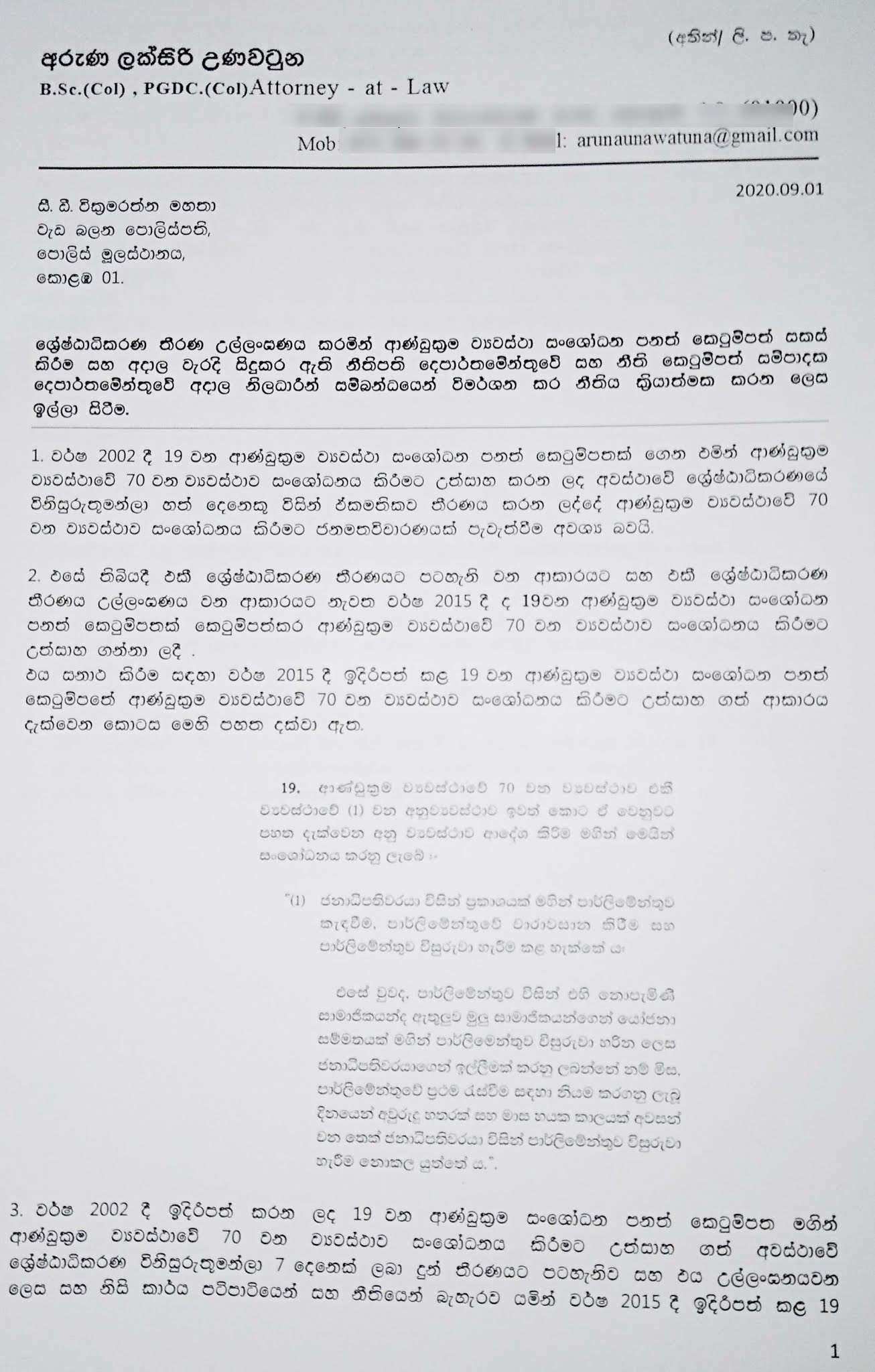
The 19has shown that making a constitution or even an amendment should not be done in a hurry, with intent to stifle opposition, embrace undue powers, grab power, squash the people’s rights & freedoms and ignorantly thinking that the insidiously plugged proposals will not one-day backfire. Anything done with ill-will & insincerity will certainly rebound. This is exactly what happened to the architects of 19a. Therefore, let us not be in any hurry to completely nullify existing constitution. In reality, there are only a handful of adverse aspects that impede democratic norms and only these should be done away with. The US has 27 amendments to its constitution (in 231 years) while India has 104 amendments to its constitution (71 years). 16 out of 19 amendments to Sri Lanka’s constitution was done between 1978 & 1988 by the very political party that drafted it. The 17thamendment was in 2001, 18thamendment in 2010 and 19thamendment in 2015. So the 20thamendment in 2020 is welcome but it must be sensible, it must be relevant to the future and must not commit the same blunders that 19tha architects committed.

The 19a Bill was passed in Parliament on 28thApril 2015 with a 2/3 majority after 174 amendments. 212 voted in favor, 1 abstained, 10 were absent and 1 voted against. We mention with admiration the sole person who voted against it – Admiral Sarath Weerasekera. With so many amendments we would like to know whether the 19a Bill passed was the same as what was debated in Parliament on 16thMarch 2015 or was it a different version?

A political party in power as government should not think they can tweak the constitution for their benefit or tweak it to the disadvantage of their opposition. The good part of democracy is that Governments come and go but the Nation and its resources must remain intact. Therefore rule number 1 at all times should be that any attempt to amend or insert any new clause or even change the existing constitution should only be based if there is a serious need to and if there is no alternate method.

We know that 19a came with political vengeance and as party of the regime change bogey. The original draft of 19a submitted by Ranil W to Parliament virtually abolished the executive presidency transferring the President’s power to himself as PM. It was clear what the plan behind 19a was.

KEEP

  • Term of President & Parliament to 5 years (Article 30(2) Clause 3)
  • Denial of dual citizens to be representatives in Parliament or Public Service (Anyone serving nation should have allegiance to only 1 country not 2) – citizens holding dual citizenship is not an issue
  • 2 consecutive term limit for a Presidential Term (Article 31(2) – Clause 4) – this doesn’t deny anyone who had been President to contest again but not 3 times in a row.
  • Article 85(2) which was repealed by 19a – that removed President’s powers to put to referendum any Bill (not a constitutional amendment) rejected by Parliament.
  • Article 43(2), 44(1), 45(1) and 46(3)(a) that demands the President to act on advice of the PM when appointing or removing cabinet, non-cabinet or even deputy ministers.
  • Cabinet to 30 (Government of 30 Ministers)
  • Powers of President to assign to himself any subject or function not assigned to any other Cabinet Minister (which was removed by 19a clause 50a 51) but as commander of the armed forces – the President should be allowed to keep the subject of Defense.
  • Immunity of the Supreme Court on Fundamental Rights will not apply to official acts of the President.
  • Attorney General and the Inspector General of Police should retire on reaching the age of 60 years.

REMOVE

  • Clauses that have diluted the President’s Powers without asking the People
  • Restriction to dissolve Parliament – but give provisions on which President can dissolve Parliament after 1 year.
  • Remove provision for National Government
  • Remove age restriction on contesting Presidency but put some criteria to contest
  • Article 46(2) Clause 9 that prevents President removing the PM at his discretion
  • Clause that says if post of President falls vacant before term of office ends, MPs who can generate most support can propose someone to be President (this is encourage buy overs)
  • Article 43(1), 44(2) that says President can consult PM only if he/she considers it necessary to determine number of cabinet ministers/non-cabinet ministers & subjects assigned to them.

National Unity Government clause that allowed for 45 cabinet ministers and 55 non-cabinet & deputy ministers

ADD

  • Clause that can remove appointees to Independent Commissions with criteria for removal
  • number of Deputy Ministers & their functions
  • limit to number of non-Cabinet & Deputy Ministers.
  • Clause binding President/Parliament/Judiciary to uphold the constitution which provides them powers that is DELEGATED to them by the inalienable sovereignty belonging to the People

REVISIT AREAS of 19A that are CONFUSING & CONTRADICTORY

Article 104B(5)(c) clause 26 – Powers to the Election Commission and remove any controversial clauses giving powers that can be misused by Commission.

Who is to be Head of Cabinet? – Article 42(3) proposed PM to be head of Cabinet

Who will determine number of Ministers/Ministries & Assigning of subjects? – Article 43(1) proposed PM to determine number of Ministers & Ministries & assignment of its subject & functions

– Article 43(3) proposed PM to change assignment of subjects & recommend to the President changes in composition of the Cabinet

– Article 44(2) proposed the PM to determine subjects & functions of non-cabinet Ministers

– Article 44(3) proposed the PM to change subjects assigned to non-cabinet Ministers

– Article 44(5) proposed that any cabinet minister at the request of the PM could by gazette delegate power, functions to any minister by cabinet minister.

Article 46(2) Clause 9 denies President powers to remove PM at his discretion – add on what grounds the President can remove the PM

Constitutional Council

19a empowered 10-member Constitutional Council to set up independent commissions.

The inclusion of the 3 civil society members in the light of their controversial selections should be removed as they are NOT ANSWEREABLE to the PUBLIC while the other 7 are.

Instead 3 members of the Opposition Parties should be appointed as the Public can voice through them their objections.

However, there should also be provision for Public to submit their opinions for and against nominees before they are appointed. Here registered civil society organizations can be allowed to make their formal submissions to the Constitutional Council (similar as how UN systems allows civil society/NGOs to make submissions)

This new criterion should be included into any amendments of 19a.

SOME ADDITIONAL SUGGESTIONS

Remove ONLY adverse aspects in 13a 

Sri Lanka must remain UNITARY& therefore powers to be DECENTRALIZED not DEVOLVED under a quasi-federal format that currently exists.

(Powers to be decentralize & not devolved)

Provincial Councils to function in a decentralized model not devolved model.

Return Land & Police powers to Centre – all National Assets/Resources will remain under Centre. 

All archaeological historical, nationally important sites to remain under Central Govt

HateSpeech

Calls to bring hate speech must include any religious texts that include clauses to defeat & destroy their enemies.

Electoral system & People’s Representatives

In terms of People’s wishes, this comes right on top for there is an urgent need to revisit how People elect their representatives to Parliament. The PR system currently in practice is an absolute failure given the disproportionate representation taking place.

A party getting 250,000 votes is able to send 10 MPs to Parliament but a party getting similar number of votes has no seat & only 1 national list seat. This cannot continue. The minimum entry requirement of obtaining 12.5% to be eligible to enter Parliament must be re-implemented from its current 5% allowing ethno-religious parties to become kingmakers and hold the country to ransom with their personal bargaining & demands of plum portfolios.

The People’s sovereignty cannot be abused & manipulated by those People vote to represent them.

Therefore, the present Government given a mandate by the People to secure and safeguard the country must call for public proposals and opinion on their suggestions for a new electoral representation system & have these made publicly available for all to see WHILE the Parliament can and should also appoint Committees to present their proposals too. The final decision must be made by the Election Commission.

Shenali D Waduge

What happened on August 5, 2020

August 15th, 2020

H. L. D. Mahindapala

     Mine, O thou lord of life, send my roots rain – Gerard Manly Hopkins

After zig-zagging under the pressures of multiple inimical forces, evolving history has once again returned to its traditional Centre to reclaim its roots. From the thirties, the Marxists struggled to take the nation through parliamentary/electoral manoeuvres, and sometimes through brutal violence, to a socialist paradise. The nation rejected the false prophets and returned to its traditional democratic, pragmatic Centre governed by the Sinhala-Buddhists. From the forties, the mono-ethnic extremists of the North launched a movement to take a part of the nation to an ethnic enclave. After the longest war, the nation bounced back to the democratic Centre of the Sinhala-Buddhists. In the meantime, a group of Right-wing fascists in uniform attempted to stage a coup. That too was nipped in the bud with the democratic Centre winning again. In the last attempt, a mish-mash of alien and the deracinated forces fought relentlessly and collectively to drag the nation away from its roots to a neo-liberal camp driven by Western dogmas. But it came crashing down in one big heap on August 5, 2020, like the mountain of garbage at Meetotamulla, burying those who dumped all their muck into it. All of them paid heavily for trying to drag history away from it roots. The last bastion of the corrupt and the decadent forces that stood in the way was the die-hard Right-wing citadel of Colombo. When that too came thundering down it brought down the last anachronistic panjandrum of the ancien regime, Ranil Wickremesinghe, who was hanging on to his crumbling fortress.

The fall of Colombo marks the beginning of a new era. It is more than the loss of numbers, or the traditional base of the UNP held firmly since its inception. It is the supreme symbol of the collapse of the Right-wing along with its leader. The Left went to pieces after J. R. Jayewardene swept the polls in 1977. The Right sank to its lowest depths on August 5 when the Rajapaksas won the unwinnable” 2/3rd in 2020, after winning the unwinnable war” in 2009 at Nandikadal and the equally threatening war against Covid-19.

Never has this happened ever before to the Right that stood solidly unshakeable like Sri Pada. Even in 1956 when the UNP fell to its lowest, Sir. John Kotelawela, the then leader, retained his Dodangaslanda seat. The UNP survived as a national institution and as a people-based organisation, despite facing massive assaults from the Left and the Sinhala-Buddhist forces. It never lost its political network, or the respect it gained from the Founding Fathers of independence.

In 1956 Sir. John at least had the opportunity to cross the floor and shake the hands of his rival, S. W. R. D. Bandaranaike, congratulating him on his victory, and retire with some dignity to his farm in Kent, UK. Ranil, on the other hand, goes home kicked out of Parliament unceremoniously by the people. He paid the ultimate price for dismissing the aspirations of the people with his neo-liberalism which had no roots in the hearts or minds of the people.

He delighted in being the King of the bastardized Western political culture sold to him by NGOs and Western embassies. Quite cynically, believing in his own imported ideology, he turned a blind eye – not to mention a deaf ear – to the forces that were cutting the ground under his feet. Neither the alien forces nor their intellectual side-kicks in academia and hangers-on, had the power to move the grassroot forces that were vital for his survival. Brushing aside the factors that matter, Ranil opted to live in his ideological bubble and when it burst on August 5th he hit the dirt for the last time. Yesterday’s rooster became a feather-duster overnight. 

After the Senanayakes it was president Ranasinghe Premadasa who peoplised” the Party. He led the Party with his down-to-earth Kehelwatte philosophy brewed by bare-foot foot-ballers. But from November 8, 1994 – and for the next 25 years, eight months and 23 days — the Party was hijacked by the trousered Kurunduwatte cricketers, most of them from Royal College, whose neo-liberalism, linked to the International Democratic Union (IDU), did their level best to drag the nation away from it roots.

August 5, 2020 was Sri Lanka’s Bastille Day when a regime disconnected with the people was thrown out, lock, stock and barrel. It was the equivalent of the humiliating routing of the Tamil Right-wing Vellalas on May 19, 2009 at Nandikadal. It was 1956” all over again with a lesser breed of Alzheimeric mediocrities repeating history for the umpteenth time. What surged on August 5th was a total rejection of the decadent politics by the overwhelming spirit and power of the determinative forces of history that had shaped the destiny of the nation down the ages.

Once again August 5th proved the massive power of the Sinhala-Buddhists to go to the brink and regain their lost heritage. Once again it proved that the Sinhala-Buddhists can muster, even at the eleventh hour, the necessary political clout, with or without the minorities, to determine their path in evolving history as they did in the past. In the post-colonial period Dudley Senanayake, Mrs. Sirimavo Bandaranaike, J. R. Jayewardene, Chandrika Kumaratunga, and Mahinda Rajapaksa have proved that the power of the Sinhala-Buddhist forces to rise from the depths of despair to the heights of glory. Their power has been proved with the ballot and also with the bullet. This is not triumphalism of the Sinhala-Buddhists. This is what is written in history of our time. Ranil failed because his immoral regime committed the other heinous crime of trying to hijack history and park it in the backyard of Jehan Perera and Pakiasothy Saravanamuttu.

This is also the moment of renewal. History sometimes acts like a vacuum cleaner. From time to time nations need a powerful force to suck the muck out of the political system. August 5th was a critical date on which the nation was balancing between Ranil’s regime rigged by rorts and the Rajapaksas promising a new beginning. The subterranean historical forces of the day came, in the nick of time, as the cleanser to regenerate the nation and restore the values robbed Ranil’s regime. One of his biggest crimes was to let the robber barons run riot. In every which way he lost the moral base on which power is won and retained. Politics, after all, is all about morality. Those who undermine morality lose authority and legitimacy to rule. The life span of immoral regimes is very short.

August 5th was the day the people went to the cleaners. It was also the day a new political map was drawn by the people with their little crosses at the polling booths. They declared, in no uncertain terms, that the power lies with the central force of history and not in the peripheral hands of the Johnnies-come-lately. And that Centre has been captured comprehensively by the Rajapaksa brothers. Today there is no Right, no Left nor is there the North as we knew it. There is only the Centre held by the Rajapaksas and it has been entrusted with untrammelled power by the people to shape the next stage of evolving history.

Ranil Wickremesinghe, who whittled away the enlightened national values, the image and the integrity of the Grand Old Party of giants each day he occupied the chair of leadership, should take full responsibility for the massacre of the UNPers on August 5. For 26 years – give or take a few days — he was very clever at manipulating the chess pieces at the top for his own survival and glory. But he never had the common touch or sense to be a leader of the people. He never had his feet on the ground. He was hoisted by his own petard. Eventually he became a victim of his own manoeuvres. The Bond Scam, the Easter Sunday attack, the 19th Amendment that kept him swinging in the air like a rope round his neck, changing the constitution to enthrone the minorities at the expense of the majority,  the betrayal in Geneva, the abuses of parliamentary procedures and privileges to cover-up his sins and keep him in power etc., were all his creations which accumulated, one by one, to reduce his image to that of a chained monkey dancing to the tune of his organ-grinders in the West. On top of all this, the mighty forces of history, resisting his moves to drag the nation away from its roots, came down on him a ton of bricks and pulverised him and his irrelevant and alien ideology to smithereens.

He will also be remembered as the founder of social distancing” that kept the people away from the Party. He never understood the dynamic swings of politics, or how emerging forces determined the shape, form and direction of unfolding events, or even how to read the plain visible signs that were telling him to go. The more he was told to go the more he dug deep into his set refusing to go. How could he understand politics when he couldn’t understand the meaning of an election? Each time he lost an election – at least one for each year of his stewardship – he was made to believe that it was an expression of the indispensability of his leadership. He acted as if he could override the will of the people with his government run by do-nothing committees that took him nowhere. It took a direct kick in his pants for him to realise that the people do not want him anymore. The unceremonious eviction from Parliament by the people will be the badge he will carry for the rest of his life. It is a sad ending for a man who assumed that he knew everything that needs to be known in politics.

It took a long time for the message to sink in. Now it seems that the message has sunk in. He goes to live on a Parliamentary pension which he should, rightfully, give it back to the people for leaving them with a legacy that is empty as his political career.  A leader is judged by the victories he/she scores in time of crises. Sadly, there isn’t a single significant victory which stands to his credit on the national stage.

History has been kind to him and given three chances to occupy the Prime Ministerial seat. Three chances to solve the issues exploding in his face. He botched it each time he took the reins of power. For instance, the biggest threat to the nation was Velupillai Prabhakaran. When the time came he surrendered the national interests by signing the Cease Fire Agreement (22/2/2002) with international guarantees without telling the President, the Parliament, his Party or the people. Prabhakaran treated it with contempt it deserved and left him twisting in the winds of despair. Second, was his gigantic effort to change the Constitution, starting with his futile 19th Amendment. Soon it will be wiped out of the statute book as it has failed to serve any man, woman or the LGBT.

He was also hailed as Mr. Clean” and the better economic manager. With the Bond scandal all that went down the drain. He also went behind George Soros hoping that the patron of open society would come to his rescue with massive investments. But Soros had no time for him. Aiming to rope in the patronage of the Western investors he joined the International Democratic Union (IDU), the powerful club of the capitalist hub. His membership did not help to get any favours from the IDU either. Lastly, in a sacrificial ritual at UNHRC in Geneva, he offered to the West the heads of the heroic soldiers who fought and won peace for all to enjoy normalcy, dignity and the democratic rights denied by the Tamil fascist regime.

It was the last straw that broke the camel’s back. Handing the soldiers to a foreign court to be tried on hear-say evidence cooked up by the Tamil lobby and NGOs questioned his loyalty to the nation. In handing over his soldiers to be tried by foreign judges was an act that betrayed his confidence in the national judiciary. In other words, he was telling the world and the nation that he had no faith in the local judiciary to deliver justice on testable evidence. People in return paid him back by declaring no confidence in his role as leader of the nation.

The public declaration of the will of the people was, perhaps, too harsh on him. But how can the people trust him to deliver justice when he, as a lawyer of the national legal system, has rejected the prime legal instrumentality of the nation, as unreliable, unworthy and untrustworthy means incapable of upholding the law fairly, independently and objectively? He has placed his trust in foreign judges and not ours!

If anything, his career exposes him as the only outstanding model that should be avoided in politics at any cost. No one can emulate his style or ideology and hope to win or retain power. His idea of being a leader is to stand on the shore of politics and command the waves rising from oceans of history to stop rolling. Long before him King Canute, pointing to the limitations of power, proved to his ministers that it just can’t be done.

Something that the new leaders of the UNP should learn is that it is not possible to take history out of politics. If the new leadership hopes to gain credibility and acceptance it must come back to the centre of history. Politics cannot drift too far away from history. Example: After 1956” the alienated UNP went back to Dudley Senanayake – the accepted centre of history, the collective force evolving in time to mould politics. As stated by Arnold Toynbee it is possible to turn the wheel of history only a wee bit at a time. It is not possible to turn it full circle overnight. Nor is it possible to take what belongs to the majority, who were the makers of history, and hand it over to the minority hoping that it would be the magic formula to resolve majority-minority conflicts and tensions.

Besides, the decimated and the inexperienced leadership in the opposition now is no match for the seasoned bull-fighters in the ring. Sajith cannot go far out from the Centre to appease the extremist demands of the minorities and at the same time win back the majority that defected from the UNP. In any case, it is not possible at this stage to know for how long the unpredictable and opportunistic minorities will be with him. There is only the Sinhala-Buddhist Centre that is in command right now. The rest is chaos. They will take time to find their place and direction in the political compass.

In the meantime, we can say Farewell!” to Ranil.

We all must wish him a better time in retirement than he had in power.

Mahinda and the People Outfox the Americans Once Again

August 15th, 2020

A paper submitted by the Sri Lanka Study Circle

Mahinda Rajapakse led the Pohottuwa to an unparalleled victory at the Parliamentary Elections held on 05 Aug 20, surpassing the expectations of many patriotic forces in the country. If 19 November 2019 was Gotabaya’s day, 05 August 2020 was, without argument, Mahinda’s day.

Mahinda led from the front. His popularity among the people, as reflected in the preferential votes cast, was unrivaled.

It was a landslide victory, with Pohottuwa gaining 145 seats in the 225-seat House. When combined with the seats won by the ‘Pohottuwa’ allies, Mahinda is able to muster 150 seats in the Legislature to give the Party the 2/3rd majority needed to amend the obnoxious Article introduced into the Constitution during the Yahapalanaya regime and, to re-spell clearly without any trace of ambiguity, certain Articles in the Constitution which were muted, straitjacketed and made redundant by a judicial interpretation that surprised many; by re-spelling these Articles, Mahinda would be restoring the Articles to its previous status quo; the authors of the Constitution, in their profound wisdom, believed these provisions were of paramount importance; Mahinda and his team valiantly fought for the retention of these provisions in October 2018.

It should not be construed that the ‘amendment’ to Amendment 19 of the Constitution would include the restoration of the ‘rights’ of Americans and other foreign Nationals with dual citizenship, to hold any form of political office in this country. They should remain forever barred from political life in this country as they continue to pose a major threat to Sri Lanka’s National security, given the total betrayal of their country of birth at the time of pledging absolute and undivided loyalty to their adopted country.

Mahinda’s majority in Parliament would enable the Pohottuwa to immediately pass legislation to regulate all Foreign Funded Organisations (FFOs) that deceitfully pose off as NGOs and which have now re-christened themselves as ‘Civil Society Organisations’. They need to be regulated, by law, in respect of the membership, objectives, work plans, work executed, monies coming-in, monies paid-out, justification for payments, sources of funding, etc. Importantly, their work and funds need to be audited by the Auditor-General, strictly according to Sri Lankan guidelines. The personal accounts of the membership of those in these organisations need to be scrutinised by ‘Income Tax’, the ‘Bribery Department’, and the Money Laundering unit of the CID.

The re-registration of the FFOs, each year, would be dependent on their performance. By law, FFOs and their contractors should be denied access to Government offices and debarred from holding appointments in any Government or semi-Government Organisation as they are duty-bound to do the bidding of Foreign Governments and Foreign Corporations.

The just-concluded Elections made political history when, for the first time since Independence, the UNP that took over the reins of power from the British were literally swept out from the House. It was a case of dial zero for the UNP.

The blame for the defeat could be laid squarely on a corrupt UNP leadership, discerned by many as a boot-licking class groveling at the feet of Western patronage and fawningly seeking their indulgence at every turn; this attitude is personified by Wickramasinghe, a self-centered politician whose behaviour evokes revulsion and demands that the rule of law be applied and justice is done.

The election also saw another major Party, the SLFP, reduced to just one seat, with the comedy of Sirisena, the leader of the SLFP, abdicating his party to contest on the Pohottuwa ticket, under Mahinda’s leadership.

JVP’s frugal representation in the previous Parliament took a further knock to make it an insignificant nada in Party politics. The exposure of the JVP is complete; a pseudo-left party – like many of its ilk in Asia and Africa -denigrating ‘Che’s life and legacy and working covertly in cahoots with Washington. The party is not short of funds and gets richer with each Election.

In the North and the East, the power of the monolithic Tamil and Muslim Parties has been dispersed.

The Party that has emerged as the largest opposition grouping is the Telephone Party of Premadasa with 55 seats; strongly linked to the Western Governments, Premadasa’s  voter base shrank alarmingly from a 5 Million in November 2019 to a 3 Million on 05 August 2020, reducing him to a sound-box, ‘full of sound and fury’.

How did this happen?  Was Premadasa not fore-ordained to get more seats? Were the scales in Parliament planned to be so heavily weighted in favour of the Pohottuwa? Was the election script written for Wickramasinghe to be booted out of Parliament so unceremoniously? 

It all happened this way because the people are concerned about the real threat to Sri Lanka, the threat posed by the Americans and they know that Mahinda, a man for all seasons, is the man who could be trusted to rescue Sri Lanka from the American snare. 

A major feature of the Sri Lankan political scene, especially in recent times, has been the flagrant interference by the Americans in the internal affairs of the country. The interference continues unabated, even to this date.

Just prior to the Elections, news surfaced that the Americans were working very hard to stage-manage the results of the Election and the composition of the new Parliament. According to the American Plan, doing the rounds at the time, Pohottuwa was to get a majority, but not a 2/3rd majority. The major Tamil and Muslim communities along with the JVP were to get reduced representation in Parliament so that they would not be a party or hindrance to the bargaining process in the formation of a National Government that would include MPs mainly from a Pohottuwa – Telephone alliance.

As planned by the Americans, the Telephone was to win about 20 more seats than it actually did, so that the Telephone would be in a strong bargaining position, to offer support for the establishment of a National Government based on a mutually agreed programme and to provide a 2/3rd majority to the Pohottuwa, if required.

The Parliament that the Americans had plotted to create had no place for Mahinda; the Americans consider Sri Lanka’s National hero a major threat to their plans; there was a massive campaign afoot to defeat Mahinda at Kurunegala. With Mahinda out of the way, the Americans were free to install a puppet of their choice as the Prime Minister.

In the developing political scenario, the American Plan had a pivotal role for Ranil, Basil and Premadasa. The post of Prime Minister (in the absence of Mahinda) and some key portfolios were plums on the table to be had after haggling and bargaining between the two political Parties dominating the Parliament.

The American objective in ‘Operation-General-Election’ was to establish a National Government in the country that would sign the MCC; thus signed, it would convey to the world (and to history) that – with the two major parties in the South (the South is the bedrock of opposition to the MCC) unanimously approving the MCC in Parliament –  the Sri Lankans accepted the MCC with open arms.  Viz, Sri Lanka’s surrender to the US was of her own volition.

Divine providence forewarned the people and Mahinda about the plot. Mahinda had to work very hard against a strong undercurrent of assorted forces that was attempting to dislodge him from Kurunegala; but work he did. A true son of the soil, he sensed the stark danger the MCC posed to Sri Lanka.

On 05 August 2020, Mahinda, with the people solidly behind him, soundly defeated the American plan. The people gave Pohottuwa a 2/3rd majority in Parliament and to Mahinda, personally, over 500,000 votes in Kurunegala so that he and his team in Parliament could confidently dump the MCC in the trash can.

Mahinda, the charismatic hero, with the people of Sri Lanka solidly behind him, had once again defeated the Americans at their own game.

Teplitz reacted badly. In a tersely worded statement meant to pass off as an ‘expression of good wishes to the new Government’, she alluded slyly in gypsy style, to the signing of the MCC by conveying a couched threat that Sri Lanka must perforce ‘partner’ America.  

It is regrettable that Teplitz used the occasion to refer to the COVID 19 pandemic; a threat to be read between the lines?  This line of thinking, as constructed in this paper, may be controverted by arguing that Teplitz was only referring to Sri Lanka’s success in handling the virus. That, is a hard sell.

A mention of ‘COVID’ does seem inappropriate, or out of place, to be included in a ‘congratulatory’ note. Sri Lanka is only too keenly aware that Agent-Moragoda, at a time when the Sri Lankan medics were coming to grips with COVID 19, nearly derailed the medical efforts by attempting to coerce Sri Lanka to follow the deadly ‘herd-immunisation’ path; herd-immunisation was America’s answer to the bug; this policy has taken a toll of 160,ooo human lives in the US thus far.

 Had Sri Lanka followed Agent-Moragoda’s advice, the country would have been a virtual cemetery and the US Indo-Pacific forces would have invaded Sri Lanka to ‘rescue’ her.

It is pertinent that on 07 August 2020, the American Defence attaché paid a call on Sri Lanka’s Chief of Defence Services and reportedly discussed with him about COVID 19 issues.

It is of grave concern that on 10 Aug ’20, the US awarded ‘Sarvodaya’ a 1.5 M USD to manage a portentous disaster that awaits Sri Lanka. 

Sri Lanka must necessarily be alert and take necessary precautionary measures, in anticipation, against a possible COVID 19 attack considering America’s dreadful track record. Sri Lanka’s defences against such a virus attack must include a plan that would stymie the introduction of the bug by Agents and Contractors.

In the meantime, Mahinda and his Parliament must take all steps to dump the MCC, ACSA and SOFA to where it belongs.

Majority Verdict and bewailing of Nihilists – Part I

August 15th, 2020

By : A.A.M.NIZAM – MATARA

On the eve of the August 5th historical General Election there was a surge of articles written by reactionary scribes and those who self proclaim as political commentators, particularly by those who mushroomed in the latter part of 2014 to launch Sri Lanka’s hitherto worst fake news campaign to oust the Mahinda Rajapaksa regime and in the 2020 General Election too they re-emerged and were painting a bleak future for Sri Lanka in the event of SLPP gaining a 2/3 majority as it was being envisaged by the SLPP and these doomsday pundits warned and earnestly urged the voters to take all measures for what they said to prevent a calamity that could befall on Sri Lanka if the SLPP achieve its objective. 

Victor Ivan, the man who was responsible in the 1970s for introducing bomb manufacturing culture to Sri Lanka and radicalizing the youth of this country to shun the Parliamentary system writing an article titled  The post-election Saga” said that if the government fails to achieve a favourable result conducive to enhancing the trust of the people at the parliamentary election, it might lead to weaken the dominance the government has established at ideological level and after the election, it is likely that the political system of Sri Lanka in its entirety including the President, the Prime Minister, the ruling party and the opposition will end up in a severe deadlock.        

In this article this silly doomsday pundit stated:

  • Whatever the strength of the result of the parliamentary election secured by the government, it would be unavoidable that not only the affairs of the government, but also the standard of living of the people will fall into a major crisis
  • The government will be compelled to pay the salaries of public servants from loan overdrafts obtained from state banks through the Central Bank and his system cannot last long.
  • The collapse of the economy is unlikely to be rectified and restored soon.
  • The impact that the COVID-19 pandemic has made on the world economy tends to have its depressing repercussions on the economy of Sri Lanka as well.
  • The job opportunities of migrant workers, especially those employed in the Middle East, which has been the main source of foreign exchange earnings of Sri Lanka, is at a severe risk.
  • It is estimated that around 500,000 jobs might be lost resulting in a steep decline in the transition income Sri Lanka used to receive from migrant workers, which is unavoidable.
  • The tourism industry, another major source of foreign exchange earnings, is also in a state of total collapse.
  • The garment industry is also in a similar situation. A large number of jobs in the garment sector have already been lost. The risk of losing more jobs persists.
  • The government will be compelled to impose more and more taxes to meet its needs and to cover the expenses which in turn will oppress the people who have already been hit hard by the economic downturn.
  • The lives of those living on interest earned on savings will become miserable. The cuts in wages, overtime and the other allowances will result in making the lives of those who are employed also equally miserable.
  • The socio-economic atmosphere will lead to conflicts, labour disputes and public unrest. Theft, robbery and crime will increase in the country.
  • The crisis of balance of payments amidst the potential scenario outlined above will have serious repercussions.
  • If the country fails to pay at least one installment due on commercial borrowings obtained from international capital markets on commercial terms, Sri Lanka is likely to be declared a bankrupt country.
  • If that happens Sri Lanka will fall into an abyss from which it cannot recover easily.
    Such an eventuality could be avoided only by pursuing a policy of selling valuable resources of the country to foreign powers.
  • Sri Lanka cannot be described as a democratic country merely because it conducts elections regularly.
  • We did not have mature leaders; mature leaders should have emerged through a freedom struggle.
  • All the Heads of State from the time of the first Prime Minister to the present day can be considered as unconscientious leaders who have violated the Constitution of the country.
  • Even the judiciary, the supposed protector of the Constitution tends to be encouraging its violation by the politicians.
  • This reflects the level of degeneration and the extent of unconscientious and uncivilised character of political and bureaucratic structures of Sri Lanka.
  • The failure to build a modern nation disregarding the recognition accorded to ethnic, religious and caste differences can be considered as the main reason for the failure of Sri Lanka.
  • The compensation the country has paid for the violent conflicts that arose as a result thereof was enormous. The damage caused by violent conflicts has been estimated as $ 200 billion.
  • The next reason for the failure of Sri Lanka can be attributed to the rapacious policy of large-scale plundering of public property pursued since 1978, by people’s representatives elected by public vote, when they were under their temporary custody.
  • The State of Sri Lanka can be considered not as a democratic State but a State of pirates and bandits.
  • The opportunism and impotence shown by the judiciary of Sri Lanka can be considered as another important factor affecting the failure of Sri Lanka.

The above comments show to what an enormous extent this self proclaimed political commentator who attempted to destabilize this country, once directly and several times indirectly has a grudge against this country.  It is hilarious to find that this individual has remained blind and tongue tight about the enormous progress and services done by President Gotabhaya Rajapaksa to this country since his election to presidency on 16th November last year. 

Listed below are some of these remarkable services initiated by the President:

  • When it became known about the outbreak of the Coroona-Virus immediate steps were taken to prevent it affecting Sri Lankans and a Task Force was formed comprising the armed forces, Health sector officials and it was given complete liberty to formulate strategy to combat the spread of virus which all developed countries such as America, U.K and evem the neighboring India were incapable to do.
  • Established 45 quarantine centres and suspected positive patients were subjected to a minimum of 14 days quarantine and areas that were found to be congested with suspected patients were locked down and each and every person in such areas were subjected to strict quarantine measures.
  • While Corona death toll in theso-called world’s super developed country America exceeded millions and the neighboring India several thousand Sri Lanka was able to restrict the death toll to only 11 persons and became one of the best Corona controlled country among the 230 affected countries in the world. 
  • Special flights were operated to bring in Sri Lankan nationals who were stranded in airports all over the world and all those who arrived in this manner were subjected to PCR tests at both BIA and Mattala airports and all of them were directed to quarantine centres to undergo the required quarantine period;
  • Similarly thousands of students who were in foreign countries all over the world were also brought in and thy too were subjected to PCR tests and quarantine. It should also be mentioned that most of these students had been sent to overseas Universities by their parents to save them from Sirisena/Ranil government’s brutal water cannon, tear gas and baton charge attacks;
  • Many of the world leaders including the Presidents of the United States, Russia and China and Prime Ministers of U.K, India, Pakistan and Bangladesh and the World Health Organization commended the President for making Sri Lanka one of the least affected Corona Virus countries in the world. 
  • Another Task Force led by Mr. Basil Rajapaksa was formed to look into humanitarian issues.
  • A cash payment of Rs. 5,000 per month was paid to each deserving family on the recommendations of the Grama Niladari officers without any form party, ethnic or  rekigious discriminations’
  • People’s movements were controlled by curfew measures;
  • Wearing face masks and maintaining distance between the people and hand wash while entering places were made compulsory;
  • Holding public meetings were banned and gatherings at weddings and other very important functions were restricted;
  • Banks, Leasing, Insurance and other financial institutions were ordered to make deferment of acceptance of lease installments for buildings, all kinds of vehicles and three-wheels and loan installment payments;
  • Banks were instructed to grant special loans with only 4% interest all businessmen, industrialists, exporters, tourist industry personnel and manufacturers;
  • Steps were taken to provide employment to 50,000 unemployed graduates and 100,000 from low income families but it was suspended by the Election Commission saying that it would tantamount  to election bribe and now it has been decided to provide this 150,000 employments from next month (2nd September)..  
  • Schools, Universities and other educational institutions were closed down to protect the children and they were reopened on a scattered basis this month;
  • Advanced Level and Grade 5 scholarship examinations usually held in the monthy of August were postponed to the month of October provide the concerned students sufficient time to prepare for their examinations;
  • Police, Excise officials and STF were entrusted to carry out sweeping raids under Opertationj Underworld” to apprehend drig peddlers, illicit brewers, under-ground contract killing operators, money launderers and under these operations king-pins of drug and narcotic trade, Police and Prison officials assisting these activities have been taken into custody for the first time’ The drug peddlers and the underworld were ruling this country under the Sirisena/Ranil government thereby Sri Lanka becoming another Mexico and several high ranking Ministers patronizing these anti-social elements;
  • Train and bus services were also suspended for several months to prevent the spread of the Virus and re-started last month under strict supervision of maintaining required between passengers, wearing face masks and adhering to other safety measures. 

This reactionary commentator in his desperation over the mammoth and historical victory achieved by the SLPP has written another controversial article titled The dilemma of the Victory” although it may be a dilemma for him and his ilk of traitors but it is a jubilation for the majority of the people of this country similar to the celebration they had on 09th May. 2009 – the day that ended the 30 years of terrorist aggression against this country. .  .

In this article Ivan laments that undoubtedly, the Government has acquired enormous power, it is huge and miraculous, and the enormity of power alone will not be a solution to the crisis Sri Lanka is facing and it can only be overcome if there is a greater creative wisdom that transcends the magnitude of power. He says that had there been a First-Past-The-Post (FPTP) electoral system instead of the current system of Proportional Representation, the result achieved by the SLPP could have been much greater than the result achieved by the United National Party (UNP) in 1977. 

The landslide victory of the UNP at the ’77 election resulted in weakening the Opposition movements in the Sinhala south (displays his divisive desires by referring to South as Sinhala South and thereby implying North as Tamil North)  to a maximum and creating a single party hegemony. The political outcome of the result of the recent election is more or less similar to that of the ‘77 election. 

This sycophant describes the government that existed before 1977, which unleashed an admirable policy of making the country self sufficient in food and many industrial products and ended the status of ship to mouth life pattern as a repressive economic policy that had a significant impact on the victory of the 1977 Parliamentary Election by the UNP. He adds that the current split of the UNP led to the enormity of the victory of Pohottuwa this time.

He admits that the massive victory of the UNP in 1977 changed the overall trajectory of the country, and the economy was opened up, plundering the resources of the country by government MPs and their cohorts started and Sri Lanka was turned into a country of incessant bloodshed. 

Referring to the JVP hooligans whom he was partly responsible for creating in the past, Ivan says that the JVP demanded for J.R’s his head publicly, but neither the JVP nor the LTTE were able to assassinate him, but he was unfortunate to witness several of his best loyalists and close confidants being assassinated when he was alive.


He asks wat is the present Government which has got an almost similar power going to do now? Will it make Sri Lanka which has been rendered miserable, a paradise? Or will it make it a hell?   

This sycophant in his desperation blames Sirisena/Ranil government for eventually pushing the country into a state of extremism and states that if the two leaders of the UNP, Ranil Wickremesinghe and Sajith Premadasa, had managed to maintain the unity of the party subsequent to the defeat at the last Presidential Election, though it was not possible to prevent the Pohottuwa winning the election, at least its victory would not have been so huge.

This reactionary lackey blames UNPcand says that there were no serious or concrete reasons for the split in that party and adds that it occurred because of the arrogance of the two leaders and the stupidity of their main supporters, and find faults with Ranil for not making a serious attempt to defuse the tension that arose on the issue of the party leadership and prevent a rift in the party while safeguarding his authority in it. He says the end result of this split has been the demise of the UNP as a political entity together with the political career of Ranil Wickremesinghe, and Sajith becoming a leader who had lost the strength of the UNP to a large extent.  

Writing about the JVP, he says that JVP is a movement that, after a massive armed struggle, has re-entered the democratic path effectively and it could be described as a political movement which has failed to mobilize itself on a new path creatively and says that  It has to deal with a distorted and corrupt political system. He blames the JVP for not asserting itself strongly for pragmatic reforms to bring about a positive change in the system except for contemplating shortcuts to seize power under the existing system. As a result, instead of becoming an effective alternative, he says it has fallen victim of the cruel system itself, he says.

Referring to TNA this bootlicker says it has suffered a great deal due to its close involvement in the Yahapalana Government, and it refrained from playing a strong role in solving the burning issues of Tamil people and hence it had to pay a huge price for that. 

This backscratcher who was responsible with terrorist proxy Sumanthiran for drafting ignoramus Sajith Premadasa’a presidential election manifesto says that the Samagi Jana Balavegaya, the party led by Sajith, stands as the main force among the Opposition parties even though it has not been able to acquire a strong position. He expresses douts about Sajith Premadasa possessing a strong vision and courage to bring all Opposition movements together under one banner?

Referring to minorities he says that the minorities are the most distressed among the people of Sri Lanka and a significant share of votes polled for the Samagi Jana Balavegaya of Sajith Premadasa (SP) consists of the votes of Muslims and Up-Country Tamils and under the circumstances, if SP fails to pursue a balanced policy that strongly safeguards the interests of the minority communities in a manner that would not undermine the confidence of the majority Sinhala community, certainly it might result in a major depletion in the support base of the Samagi Jana Balavegaya. 

Only a strong leader who possesses the self-confidence to speak out strongly against repressive actions of the Government and the ability to gather together all Opposition movements under one flag and provide a practical solution to the crisis facing Sri Lanka can create a strong Opposition movement against the ruling party, he says and we do not know what is the illusory ‘crisis’ he is referring to/.  

This cynic says that the entire socio-economic and political system is in disarray and the Government is confronted with a situation in which it finds it difficult to pay at least the salaries and pensions of public servants and $ 3 billion has to be paid this year for the foreign debts obtained. Once again this foreign stooge asserts that the only solution available would be to sell the country’s valuable and scarce resources to foreign powers on a large scale and stupidly asks whether the Government have an alternative solution for that?  In conclusion this nincompoop says the Government should explain it to the country and if the Government has a solution for the crisis, which is sound and practical, then it should be supported by everyone to implement it irrespective of differences and without undue obstructions.

To be continued………………………….

Response to wrong information going around – Harris Chief of Staff is not Sri Lankan

August 15th, 2020

Anjalika Silva 

Dear friends,

I checked on this and the posting that went around was a year old.  This is the Chief of Staff for her Senate position.  

This should not have a bearing on whether people vote or don’t vote for the Biden – Harris ticket.  The Chief of Staff should have no bearing on voting choice.

Just clarifying the incorrect news circulating.

The Old news in circulation is:

Senator Kamala Harris, Vice Presidential Running Mate of former US Vice President Joe Biden, for the US Presidential Election, has as her Chief of Staff a young lady of Sri Lankan origin.

Rohini Lakshmi Ravindran
Kosoglu, 31,  is the daughter of W. Ravindran

an Old Thomian and crickerter and Shobana Mylvaganam daughter of Dr Mylvaganam, a famous Surgeon who worked in Kandy for many years.

The Real Chief of Staff appointed for Kamala Harris is:

Her new Chief of Staff was named on the news just after the ticket was announced as Karine Jean-Pierre and she was the black girl who jumped in the middle when KH was attacked by a visitor to one of her speaking sessions.  Karine is an MSNBC political panelist and has a very soft spoken mentality and hopefully our Embassy in Washington will establish some contact with the team and staffers.  I have already alerted them about this note that is old news circulating and also the new update.

Please don’t make some foolish Sri Lankan American voters have their usual poorly thought out a rationale to vote the conman back.  WE ARE SAFE. THE OFFICIAL REPRESENTATIVES WILL TAKE CARE OF THEIR PUBLIC RELATIONS.  In my small way, I plan to do my part without any status but just access to as a voter with a few ears that listen.

Link for more information

https://en.wikipedia.org/wiki/Karine_Jean-Pierre#Early_life_and_education

Laya Waves: A Cosy Holiday for now: A Catalyst for Future Development

August 15th, 2020

By Garvin Karunaratne, Ph.D.

On my second visit to Laya Waves I was struck with some new ideas.

To get down to the hospitality track, the sleuths who have forgotten their guns for now and are on an entirely different – hospitality track; they are a marvel. The accommodation was spick and span., cleanliness perfect,  the front desk manned by Dilruksha and Chandima courteous and very helpful, even attending to my car for a small defect, and last but most important of all,  the chef, Nishanta Perera, a great chef, with a hand that makes every meal tasty- mouth-watering in the extreme. At the end of a meal we wait for the next to see what he offers and he was always up to the mark. It is very rare to find a chef of that ability.

In my working life in Sri Lanka,  the Administrative Service has taken me to work in eight districts and my covering the whole island for agricultural loans, fertilizer distribution and paddy cultivation for some five years, with islandwide circuits. I am thus aware of what is where. These range from the Guava belt in Belihul Oya-Balangoda, the Rambutan belt in Dompe, the Mangosteen belt in Kalutara,  the Coffee belt in Kitulgala, the Pepper belt in Wellawaya, the Tomato belt in Hanguranketa, the Flower and Vegetable Belt in Nuwara Eliya- Bandarawela,  where flowers grow wild and I bagged more than my salary from flowers and vegetables in my years’ stay at Nuwara Eliya, the Avacado belt from Galaha to Peradeniya, and the Dry Zone Areas-Padaviya to Anuradhapura and Moneragala to Tissamaharamsa, wherein any one season November to February all the fruit needed to make Sri Lanka self-sufficient in all fruit and juice can be produced. Today we import fruit juice and jam from the USA, Australia & Europe. Hanguranketa can provide all the tomatoes we need to provide our full requirement of tomato sauce which we today import from as far as the USA. That can be a years’ project- setting up a small Cannery and processing fruit. I am certain that it can be accomplished in a year.  Once we exported coffee but today we do not grow and we import from Europe. Coffee does not grow in Europe, but is imported in seed from Africa, processed in Belgium and exported to our countries. At Kitulgala on my inspections I have been struck with the luscious coffee bunches. I know of the  Cardamum- Spices belt in Kotmale- sadly denuded today by the Kotmale Dam.

It is a sad fact that these resources are not put to full use, though Mother, Nature has provided all bountifully. The produce goes to waste and the people remain within the bounds of poverty.  In the Fifties and Sixties, we made progress but the rot set in,  in 1977 with President Jayawardena accepting the International Monetary Fund’s Structural Adjustment Programme with open arms. That was our undoing. Told to accept the Private Sector as the Engine of Growth, we were advised to abolish and abandon the development infrastructure that our leaders had painstakingly developed- the Cannery and the Veg and Fruit Marketing Scheme, of the Marketing Department and to this day we have failed to bring back that development infrastructure to enable development to commence once again. We fail to understand that the lost infrastructure is a prerequisite for development. Unfortunately to please the IMF we have to follow their advice and seek foreign investment. We sadly forget that all foreign investment is geared not to develop our country but to take away our resources in some form or other. The latest is to come in, trade-in local currency, but take away the profits in foreign currency from our reserves. Our economic sleuths are naïve and fail to grasp.

On this Visit to Laya Waves what struck me was the two large plots where aloe vera grows wild. I have never seen that wild growth anywhere else. I inquired and the sleuths who now maintain the garden told me that the trick was perhaps the salty water and the climate.

My craze for travel has taken me  to Lanzarotte, an island in the Mediterranean, where some  uncultivable land on rugged sedimentary rock is being developed and aloe vera is grown on a large scale with a factory producing a full range of aloe vera products sold everywhere in the Harrods and Selfridges of Europe and USA,

My find of aloe vera thriving at Laya Waves tells, me of a great possibility in development. Its potential if tackled prudently can easily earn billions of dollars, annually to our depleted coffers,  a task, if done at the pace I worked as the G.A. at Matara in 1971-1973, can easily be accomplished within two years. Working singlehandedly in Bangladesh, I designed and established the Youth Self Employment Programme and trained the Bangladeshi officialdom to continue it after my two-year assignment was over- and the result- a programme that has guided three million youths to become employed, all accomplished within nineteen months. The task of developing aloe vera will be a far easier task.

The task to develop aloe vera in Pasikuda can easily be accomplished within two years at most. This estimate of time is not out of the hat but a calculation based on sheer experience in similar exploits. My working life has been full of such exploits. So that estimate of timing can be held firm.. The best method of indicating that this task can be accomplished is to hark back to a similar or more daunting task accomplished by me earlier.. I enclose details of a similar task- establishing Coop Crayon in the Appendix.

Accessing AloeVura products at Orzola Lanzorette, I find the following products::. Gel, Oil, Drink, Cream, Moisturising Cream, anti-ageing Cream, Face Cream, Foot Cream, Night Cream, Dog Shampoo, Shampoo, Hand Cream, Relax Gel, Bath Gel.

Conducting experiments to make the varied aloe vera products will be far easier than finding the art of making crayons and establishing the Crayon Factory.

It is suggested that the Sri Lanka Army may kindly initiate action to conduct experiments at making products with aloe vera.  Nishantha Perera the chef at Laya Waves could provide the leadership for the experiments at the initial stage. Further, the science lab at a College or University has to be commandeered.  An alternative will be to get the Army to put up a tent and get going in Laya Waves itself and to buy essential equipment.

It would be ideal to have some officer from the army who has a background qualification in agriculture, chemistry or biology to be in charge.

This Project has to be handled by a person of standing like a Brigadier as there has to be contacted with many high ranking officials in government institutions, the Ministry of Industries,  Food Technology Institutes, Department of Education, Ministries etc and the person appointed at the initial stage at the helm has to be able to shake Government Departments and spur them to action..  After a few years when the industry is well on the keel, the high ranking officer can be removed and an officer like a Lt Colonel or Major could handle the project.

May I also suggest that the land of the Army  Bungalow next to Laya Wave be used to cultivate aloe vera, The land has to be prepared immediately if the planting is to be done with the November rains.

I am aware that there is a section of the Army that attends to agriculture and is actively involved in producing food crops. A Unit of that section can be put on the task of producing aloe vera at Pasikuda. Full details have to be worked out and I am dead certain  of success not only in production but in developing foreign sales which will bring in an income in foreign exchange

An idea may be for an officer from the agriculture and land cultivation section of the Army to be consulted, especially to find whether any crown land suitable for the cultivation of aloe vera is available in the vicinity. If the land is available the Army can open a farm. Simultaneously the army can have seed farms, distribute to private farmers and collect the crop.

It may be interesting to note that in the USA the Army is used for many development projects. The Mission of the US Army Corps of Engineers is to deliver vital public and military engineering services, partnering in peace and war to strengthen our nation’s security, energise the economy and reduce risks from disasters”. 

 At New Orleans, a city below the sea level,  levees(bunds) are constructed and maintained by the Army. On the Columbia River, there are stupendous hydro projects constructed and manned by the Army. I have seen these stupendous structures. The US Army is deployed in many ways for civilian functions. In my travels in the USA-I owned a MotorHome and have clocked over 50,000 miles crossing the USA thrice and have seen for myself the stupendous civilian work being done by the US Army all over the USA. It is my opinion that the  Sri Lankan Army can and has to play a major role in bringing about the economic development of our beloved Motherland.

Expecting the Private Sector to contribute is wishful thinking. The Private Sector has to make a profit as its motto. Poverty alleviation, creating productivity, national development is not within their vocabulary. Projects like developing Aloe vera products have to be done by the State and the Armed Forces can easily be entrusted with that task. In the hands of the ARMY, success can be assured.

. I am aware that planting aloe vera is in progress at Wilpattu. However, that is at an infancy stage and there is ample scope for a few industries to be established in aloe vera.

I am dead certain of success. The success does not depend on the ability to grow aloe vera.  Success will depend on the leader chosen, who has to have a personality;  foreign sales will depend on the charm of the officer selected. Both must be of the type that can, as the saying goes- take fire underwater. ,

I wish to be associated with any initiatives and can assure success. It would b a pleasure to contribute to the development of our  Motherland.

Garvin Karunaratne, B.A, & M.A.( Peradeniya), M.Ed.(Manchester)

, M.Phil (Edinburgh) & Ph.D. (Michigan State University)

Former SLAS, G.A.Matara.(1971-1973)

Commonwealth Fund Advisor to the Ministry of Labour & Manpower in Bangladesh, 1982-1983, who designed, directed and established the Youth Self Employment Programme in Bangladesh, the premier employment creation programme the world has known, a programme that has left its imprint on the sands of time.

Author of

How the IMF Ruined Sri Lanka & Alternative Programmes of Success.(Godages) 2006

How the IMF Sabotaged Third World Development(Godages/Kindle,2017)

13/08/2020      garvin_karunaratne @hotmail.com

Appendix

Tasks accomplished in the Divisional Development Councils Programme of 1970-1977

 Let me detail what I did as the Government Agent at Matara in 1971–73, when I was charged to create employment.   

 While most Government Agents in charge of other districts , some of  whom adorned the seats of Secretaries to Ministries in later life,  slept and were satisfied with small potty little agricultural farms and small sewing and craft type of small industries, my team  at Matara put forward semi large industries. The first was a Mechanized Boatyard turning out 40 foot seaworthy inboard motor fishing boats. The Ministry of Planning did not appreciate and the Director of the Fisheries Department was dead against but after  a lone battle, I obtained approval and the Boatyard, the first and last such cooperative industry was established within  three months. It was done by my handpicked officers Ran Ariyadasa and Development Assistant Kumarasiri(later Secretary to the Ministry of  Employment Creation under  Minister Basil Rajapaksa, ) We successfully turned out some 30/40  boats a year. That was a feather in the cap of the DDCP.

My feasibility reports to establish  similar small industries- a Water Colour Paint Box Industry,  A Grass Growing and Milk Producing Industry with a Creamery at Deniyaya were all turned down and lost. The Ministry was frightened at new undertakings and advised me to make bricks and tiles. I was disgusted and instead of lying down, took charge of the situation.

 I summoned the Planning Officer Vetus Fernando, a chemistry graduate of the University of Colombo, a graduate who had not had a day’s experience in chemistry since graduating, fed him all details I knew about  a Water Colour Industry.  Once I had approved an allocation of foreign exchange to an industrialist that made water colours and knew the ingredients but not the proportions and techniques-that was when I had served as a Deputy Director of Small Industry. Making water colours to my thinking was akin to make Crayons and I got Vetus to apply his knowledge of chemistry to make crayons. We bought the ingredients and decided to make a start on experiments at my Residence in the night. In a few days we realized that more equipment was needed. I then obtained approval to use the science lab at Rahula College, the Leading College in the District. That science lab was ours from six in the evening till midnight, The Headquarters Assistant Government Agent   Wimalaratne, District Land Officer Chandra Silva, Development Assistant Palihakkara and I  were the Cheer Leaders who went cheering the scientists – Vetus Fernando and the science teachers at Rahula, when they did fail in every experiment for a long two months. The crayons we made were never of the correct texture. Then Vetus got a brain wave. He was a trained chemistry graduate and said he will consult his professors who had trained him in chemistry a year ago at the University of Colombo. He took the crayons we had made and was certain that working in the university labs equipped with  sophisticated equipment that we did not have in the school lab,  he could sort out the problem with ease. We awaited his arrival. 

Vetus turned up on the fourth day a broken down and dejcted man. He had gone behind every professor and lecturer he knew and beseeched help but had been turned away because they were too busy teaching and reading through student tutorials. That defeat made us more determined. Earlier I had been there only on some days, but I made it a point to go to the school lab every evening. My team was very determined and daily the experiments went on. Finally in about a months’ time after a myriad- really countless experiments Vetus finally made the final crayon. Then I sat with him and we together finalised the texture to be equal to the Reeves crayons that we then imported from the UK.

Then the question cropped up of how we were going to establish an industry. I could have summoned Harischandra a business magnate and he would have liked the idea of establishing a factory., But that would not be us. Finally I decided that we should establish it as a cooperative  managed by us. I summoned Sumanapala Dahanayake, the member of parliament for Deniyaya, who was also the President of the Morawak Korale Cooperative Union. In my estimate he was a tough guy, tough to the extreme if necessary. The Union had enough money to roll till we recouped the expenditure involved through sales.  However he had no authority to use the funds to establish an industry. I too though I controlled a vast amount of finances did not have authority. It was a major stalemate.  I could try to speak to  the Commissioner of Cooperative De velopment  for approval but I was certain that he would turn it down. That officer followed rules to the very letter. He was a great friend of mine but of the type that would not use his discretion to interpret rules.. For purposes of ensuring coordination in paddy production Premier Dudley Senanayake had gazetted all Government Agents as Deputy Directors of Cooperatives.  That was for coordinating the paddy production. I  summoned the Assistant Commisioner for Cooperatives in Matara and told him that I am using my designation as Deputy Commissioner of Cooperative Development as authorized by the gazette notification and approving the Morawak Korale Coioperative Union to finance the project and establish the industry,. I ordered him  not to breathe of this decision to his Commissioner.

I authorized the Morawak Korale Cooperative Union to buy the cookers, gas burners  and other equipment,  find premises and recruit twenty youths. Sumanapala needed only two days. A section of his Cooperative Union was cleared for this projected and my team of five moved in . It was to be a 24 hour operation, with Vetus training the youths and Chandra, Ranjith and Daya taking turns, all working round the clock.. I broke rest on about three days till everything was off the ground, living on shortmeats and sipping coffee provided by Gunam Tambipillai an Estate Owner a firm supporter in all our endeavours at bringing about development.  It was a hand made crayon where every crayon had to be carefully crafted. The youths worked in shifts. On the second day production was in good progress and Sumanapala ordered the printing of labels. The production got on and in two weeks there were two large rooms full of crayon packets.

Sumanapala and I then went off with samples to meet the Minister of Industries Mr TB Subasinghe who was surprised at the quality and he readily agreed to officiate to open sales.   That was a grand occasion and with that authority Sumanapala and I felt safe for having worked without Ministry authority. Both of us had bent rules and regulations all for the sake of national development.

The only import within the ingredients that went in to the manufacture was dyes. Dyes were imported and I sought an allocation from the Ministry of Industries, the Department where I had worked two years earlier when I had the authority to offer an allocation of foreign exchange, But I was told that the Ministry did not have funds for cooperatives and we were lost.

In a few days I met Harry Guneratne the Controller of Imports the officer who allocated foreign exchange for imports and  he was allocating funds for the import of crayons. I pointed out that by allocating a fraction  of what he was spending for imports to enable us to import dyes he could cancel the import of crayons. He was an immediate convert but wanted us to get the aspproval of his Minister Mr Illangaratnre.  Sumanapala knew him but I had never met him earlier. We produced the crayons we made and he not only approved an allocation of foreign exchange to import dyes but also insisted that I should open a crayon factory at Kolonnawa, his electorate. Harry canceled all imports of crayons. This true story tells us the one and only method of saving our foreign exchange. .In addition we created employment. It was poverty alleviation.

Coop Crayon got off the ground and Sumanapala developed it to have islandwide sales. His Coop lorries, selling crayons  reached both Alimankada and Pamankada. This Coop Crayon was the best industry that we established.

This industry was managed well by Sumanapala.

I left Matara for further studies abroad  in 1973.  Sumanapala managed Coop Crayon and when Sirimavo fell in the 1977 Premier Jayawardena wanted to somehow punish Sumanapala. That was political vengeance.  Years later I met AT Ariyaratne  an officer of the Administrative Service and when I stated that I had been GA Matara, he told me that in 1977 he had been sent on a special mission-instructed by President Jayawardena to inspect and audit  Coop Crayon and find some misdeed to punish Sumanapala and to close down the Crayon Factory. He was the Deputy Director of Cooperative Development. He told me that he had spent a few days inspecting and auditing  but had to report that the industry was run well and that all books were in perfect order. Ariyaratne was not the type of officer who would stoop to find evidence to please someone in authority.

I have dealt with CoopCrayon in full detail to enable us to realize the difficulties involved in establishing an industry. Though an industry can be established it is a difficult task . However it can be done.

I have to conclude stating that establishing an aloevira industry is a far easiler task.

Garvin Karunaratne

15/08/2020

garvin_karunaratne@hotmail.com

Private Members Bill- Bill 104

August 15th, 2020

Engr. Kanthar Balanathan DipEE(UK), Grad.Cert.(Rel.Eng-Monash) DipBusAdm(Finance-Massey), C.Eng., MIEE Retired Director & Specialist Engineer Power & Control Systems

Mr V. Thanigasalam
Member, Legislative Assembly
Ontario,

Dear Mr Thanigasalam,

Private Members Bill- Bill 104

  1. General

It is a regret to note that at the age of 31 you have become a Legislative member in Ontario representing the Scarborough area which is known to have two sectors, (i) murky type area, (ii) normal area.

Whatever it is politicians are considered to be above the law, in the third world countries. SriLankan Tamils migrate to the developed world to better their knowledge and intelligence and bring up their children as scientists, engineers, doctors etc. When Sinhalese people move into the North (Jaffna), Tamils and Politicians create mayhem, turmoil and pandemonium in SriLanka and run to the UN shouting COLONISATION”. The basic principles of cohesive living are absent in the minds of the Tamils because they are still backwards in their culture, which is uncivilised in general terms. However, you guys can colonise Canada and change their culture, habits etc.

The reasons you are there is because Velupillai Prabakaran (VP) wanted Tamils for SL to migrate so that he can elevate his position. This was the reason he blew up 13 soldiers in Tirunelveli in July 1983 inciting a racial riot. Psychology works counterproductively in humans. People who attempt to commit suicide can be considered to have some degree of Psychiatric disorder. In this context, the black tigers and the entire LTTE cadre can be regarded as psychiatric patients including VP who suffered from a lot of sicknesses, like Bi-polar disorder, BP and heart issues. What he made use of is plunder Tamils wealth and made unwanted rowdies to become rich overseas. Do you know the number of Tamils plundered LTTE funds in Ontario?

Okay, coming to the question of perception and knowledge: If I inform you that I have travelled 72.32 billion kilometres in space can you work out my age or will you laugh at me, which may depend on the level of your perception. What are SOx and NOx? How environmentally does Transport limit the longevity of a person?

The lamenting part is that despite bringing good positive private member bill, you have taken into your hand to place a negative unproductive racial topic known as An act to proclaim Tamil Genocide Education Week”. You have not understood that this type of bills will have a negating effect on the psychology of humans in SL. Your Tamils in Scarborough can have whisky and chicken during weekends; however, Tamils in SL suffer due to lack of finance, which your people will not advance. The reason is that there was not any genocide in SL. It was only a racial riot provoked by LTTE.

Tamils will fund Tamil politicians during elections, however, will not help the poor.

  • Bill 104-Preamble

1.(1)     The seven days in each year ending on May 18 is proclaimed as Tamil Genocide Education Week.

This ending period before May 18 was a war between the military of SriLanka and the LTTE terrorists. You must look at the weapons LTTE was manufacturing with the help of the western world. Please refer the following web site: http://nrnmind.blogspot.com/2020/06/blog-post.html. It cannot be concluded that the military massacred the Tamils during this period. You can see the people were rescued by the military. LTTE could not use the weapons, maybe, because the operators ran away to Kerala and Goa on finding out the result. You are aware that the LTTE planes bombed the Katunayake airport, Tax office and the Anuradhapura military camp. The result is that the immature and untrained LTTE cadre were cowards who ran away and LTTE human resources were not quite trained to withstand a massive SriLankan military force. Therefore, where during this line you see the genocide. Tamil Diaspora (TD) has been lying to the world about Genocide without understanding the meaning of Genocide. Have you analysed and quantified the killing of Sinhalese by the LTTE? I do not think partiality will take your life anywhere.

(2) During this period, all Ontarians are encouraged to educate themselves about and to maintain their awareness of the Tamil genocide and other genocides that have occurred in world history.

It is ridiculous to note that you are requesting a meaningless and valueless request from the Ontarians, when during this time they can supplement/strengthen their knowledge with Science, Arts and Canadian Culture. You guys are Canadians. Please do not be a front-runner to drive out a Tamil state in Canada/Ontario. Now, you are wasting your time and the Government / Royal time by requesting for Royal Assent. Did you know that Tamils of Indian origin after more than 100 years were disfranchised in SL in 1948? No one took this up for a royal assent to cancel the result of the bill. There were several Lawyers in SL in 1948 sucking the British but were afraid to talk about the bill.

Have you studied Cost-Benefit Analysis? What Benefit does this Bill accrue by observing the theoretical Genocide”.

It is hoped that you are married. If then bring up your children in the developed Canadian environment to be scientist, Astrophysicist, Doctors or in nanoelectronics rather wasting your time in theoretical genocide.

Just to explain you on knowledge:

Humans perceive different effects about the same state, as perceptions vary from person to person. People assign different meaning to what they perceive.  (Kanthar B)

Although all human males are born with ≈1.5 kg of the brain, not all perceive the same thing in the same perspective, the same way. Knowledge is defined as information, proofs, aptitudes and proficiencies, acquired through involvement and practise; i.e. an appreciation of the theoretical and practical training, and understanding of a subject or job.

Yours Faithfully

Engr. Kanthar Balanathan

Insisting on sight as the determining factor for belief in God

August 15th, 2020

By A. Abdul Aziz.

Those who do not believe in the Existence of God,  primarily contend that they would believe in God if they could see Him. It always surprises since people perceive different types of physical properties through different senses; for example, [some properties are perceived through] sight, others through touch, or smell, or sound or taste. As a case in point, colour is recognised through sight rather than by smell, touch, or taste. Hence, if a person denied its existence on the grounds that they could not discern it by way of the faculty of sound, would they not be considered a fool? Similarly, sound itself is perceived through hearing. Again, would it not be ignorant for a person to insist they would only believe someone could speak once they had seen their voice? Likewise, fragrances are known through the sense of smell; yet, if someone were to claim they would only accept the truth of the aroma of a rose if they could taste it, could such a person be considered erudite and intelligent? In contrast, flavours such as sweet, sour, bitter, salty and so on are known by taste and can never be recognised through smell. Hence, it is not necessary to disbelieve in that which cannot be seen and accept only that which is visible to the naked eye. To do this would be to deny the existence of the fragrance of a rose, the sourness of a lime, the sweetness of honey, the bitterness of aloe, the hardness of iron and the beauty of the [human voice]; none of these phenomena are perceived through sight, rather through the faculties of smell, taste, touch and sound. Thus the assertion that one has to see God to believe in Him is gravely mistaken. Do such detractors recognise the fragrance of a rose or the sweetness of honey through their sight? If not, why do they insist on sight as the determining factor for belief in God?

THE PROPOSAL TO ESTABLISH AN INDUSTRIAL DEVELOPMENT BANK (PART 1)

August 15th, 2020

BY EDWARD THEOPHILUS

Wide publicity has given a proposal to establish an industrial development bank in Sri Lanka by the Minister of Industries, Mr. Wimal Weerawansa, and it is a good ideological contribution from a politician, and the government must instigate the idea. An industrial development bank needs the country to stimulate investments in industries that have been neglected areas of the economy as the investors in the country turned to service industries to make quick profits from services such as tourism, contracts, sales, and others. When the service sector attracted to provide employment and to promote businesses in the country after the Cold War industrial development was given less attention. Many developed countries followed the promoting service sector neglecting the manufacturing sector. The best example is Australia. Mr. Weerawansa as the minister of industries has proven that he can develop good policies as well as can implement policies that are copious for the economic progress of the country.

After taking over the ministry before the election, Mr.Weeravansa has taken keen steps to revive industrial firms that have been abandoned and neglected by the previous government, and these industrial firms need modernizing in a variety of ways such as product developments, product quality development, application of technology, improvement of the production process, marketing of products, searching for export markets to sell products overseas, Industrial research, and many others. To successfully play the new role in government industrial firms demand the injecting funds to industries and the government has limits to allocate funds in the current economic environment of the country.  In this background, an Industrial Development Bank could play an excellent role and promote investments.

The COVID pandemic has given a signal that Sri Lanka may need to restrict the exporting skilled labour and now it might not easy as was in the past. While making an internal market to absorb repatriate labour industrial development effort to contribute 25% of GDP would be an alternative approach to policy development. An industrial development bank could play an effective role to absorb repatriated labour in various sectors of the economy.  The policy-makers in the past considered short-term indulgence exporting domestic labour, and they didn’t consider that encouraging a production-based economy would bring more benefits to people while allowing exporting excess labour.

When looks at the policy developments of Taiwan and Hong Kong it seems that the UK supported during a long period to come up Hong Kong, and Taiwan gained economic strength in a short period with the supports of direct investments from the USA and trade supports from China.  Sri Lanka has a similar land area and population to Taiwan, but it is behind Hong Kong and China, talking about the past and to becoming a Singapore, where shows the prosperity in statistics based on the lower population.  I don’t abase the achievements of Singapore and my argument is attempting to become a Taiwan would be the best choice.  Sri Lanka could come up to the level of Taiwan if it can provide intelligent investment services for expanding the economy in the industrial sector. An industrial development bank could give leadership not only providing finance supports for industrial development but also to develop policies for the entire industrial sector with great supervision.

It is seen in newspapers reporting industrial base innovation by young people, these products have not been tested considering multiple aspects of the products such as quality, marketability, cost of production, application of technology, safety, and many aspects.  They report for the publicity and vanish or neglect after new reports.  An industrial development bank can motivate such innovation and provide financial supports to commercial productions. China, India, Japan, Korea, and other industrial countries have been working for industrialization giving priority for innovation, and an Industrial development bank can play a massive role in this process. Before the establishment of the national development bank, big talks were in the country practically administrators have neglected the role, and an executive of the national development bank turned to preach religion and play politics. An industrial development bank should learn lessons from the past and must focus to achieve the purposes.  Financial institutions in Sri Lanka including the Central Bank, trading banks, long term financial institutions, savings banks have incompetent to achieve purposes because they were launched misguided policies by stupid executives.       

The operations of trading banks have become a critical issue in the country as the mountain of non-performing credits the system is a congruous factor for circumscribing industrial credits, and many related factors have become a dogma to the banking market in Sri Lanka. The proposed industrial bank should not follow the steps of the management style of other banks that are like a contrite sinner with a volume of transgressions.  According to the idea of the minister, the proposed institution should be a government bank that means the preponderance of ownership shall be in the government hands. There is a strong logic in the idea of the minister because the capacity of the private sector in Sri Lanka doesn’t appear that it can provide a monumental volume of capital to successfully operate a bank that aims at providing financial supports for industrial development. Industrial development should have a massive volume of capital due to two major reasons, inflation and declining the foreign value of Sri Lanka Rupee. The liquidity and the lending capacity of the bank should be based on the volume of the capital of the bank 

If Sri Lanka’s government has reserved funds from budget surplus and foreign exchange reserves to spend for industrial machines, raw materials, and other input the keeping full ownership of the proposed bank in the hand of the government would be a good idea, but at this crisis time, could the government budget allocate sufficient funds, to establish an industrial development bank is a question. As the government has many commitments with the COVID pandemic it is required to consider a different structure for the proposed bank without harming the idea of government ownership.

The government policy-makers must agree with the idea to inject a large sum of funds to establish a bank if the entire volume of capital is contributed by the government. The current economic condition in the country shows that the government is not in a position to make a huge contribution and it invites to rethink the capital structure.

The proposal to establish an industrial development bank should focus to invest massive sum of funds, and strategically, it should work as a measure to control and reduce inflation and to attract excess money in the economy for development purposes.  Helicopter money created in the COVID 19 pandemic situation has caused increasing prices of consumer goods and services, and if the government has strategies to reduce money from the market it shall support reducing the prices with production incentives, especially in the agricultural sector.  How can encourage people in Sri Lanka differing consumption to invest in the industrial development bank might be a problem to the government policymakers. But they must find strategies with an effective marketing campaign.   

When the government plans to establish a bank, it needs to consider a broader area of aims and strategic structure of the bank and the purposes of using funds. The proposed bank must be free from political influences and an institution that operates consistent with its policies.  As it is known to people banking market in the country pushed a weak environment as it had not been operating with a strong policy structure and political influences and dishonest of the management launched the banking market to a trap.  The policymakers in connection with an industrial development bank must learn lessons from past banking operations.  The government policy needs focusing to manipulate strategies that would not be a failure and would be successful to achieve objectives.  There may be a range of impediments to establishing an industrial development bank.  Government politicians must critically evaluate such views because many people in Sri Lanka tend to criticize this type of proposal without knowing positive impacts on the economy and without studying the proposal.

THE PROPOSAL TO ESTABLISH INDUSTRIAL DEVELOPMENT BANK (PART 2)

August 15th, 2020

BY EDWARD THEOPHILUS

When looks at the structures of various banks established in the country the proposed industrial development bank invite to consider a different structure, especially the proposed bank must get away from trading bank functions as Sri Lankan bankers, as well as the attitude of regulators’ have stuck with money creation and cheque books and short-term lending and securities. Sri Lanka has many trading banks with intense competition between them. These popular features could include the proposed industrial development later deeply analyzing how could such businesses absorb to bank critically analyzing the business environment.  

I have no idea of talking too much about the proposal but I would like to highlight the following points that should be considered when forming the bank. There may be views against my points and it is essential to consider views and the bank should be established without a severe burden to the government.     

OWNERSHIP OF THE PROPOSED BANK

The proposal was made with an idea to establish the bank as a government bank and the meaning of this term is to establish the bank as a government own entity.   The current financial position or the strength of the government doesn’t permit to allocate a large sum of budget spending to establish a bank because of a massive commitment to various government services.  However, the concept of government ownership could be interpreted and broadened by different strategies.

  • The government can be contributed to the entire volume of the capital of the bank if it has funds, sufficient reserves, and an ability to spend budget funds ignoring other areas.
  • The government can contribute a possible amount of capital without harming the idea of government ownership and continuing allocations in other areas of the economy.
  • Government banks and government institutions could contribute to the capital fund of the bank to maintain the ownership of the government and this would be more practical than proving funds for capital from the budget.
  • The government agencies could contribute to the fund if the agencies have reserves and excess.  Many government agencies spend unnecessary purposes and such money can divert to buy shares of the bank.
  • The government and its agencies can contribute paid-up capital intending to withdraw later the contributed amount of capital by the sale of ownership to the domestic private sector or other government agencies in the future.

The ownership of the government can go up to 60% and it would not harm the term that is owned by the government, but the style of contribution may diverse. When the private sector is allowed to contribute to the capital it would scrutinize the management and operations of the bank. Private partners always look at how the bank is operating and if anything needs to correct they will take actions.

From the balance ownership, 10% could be given to Sri Lankans to those who were born in the country and living exile.

From the balance, 25% of ownership could be given to Sri Lankan institutional and individual investors

The balance volume of 5% ownership could be given to foreign investors.

The bank should be established as a public company with limited liability. The bulk of shares own the treasury and the government agencies.

CAPITAL STRUCTURE

The capital structure should consist of the issued capital and debt capital (preference shares) as given below.

Authorized Capital: Rs10.00 trillion

Issued capital (Ordinary Shares fully paid) = Rs 1.00 trillion

Debt Capital (Preference Shares 6%, fully paid) Rs 500 billion

The bank should contribute 50% of annual profit to general reserves until the bank builds a strong capital structure, and the balance profit could be paid to shareholders including the government 60% of the ownership.

BUSINESS POLICIES

  • The bank maintains a healthy finance portfolio which is based according to the requirement of industrial development. The finance portfolio will be balanced to increase the contribution from the industrial sector to 25% of GDP.
  • The bank develops a credit and operational policy framework to achieve the vision and work with the mission and objectives.
  • Bank will have internal divisions financing for large industries, medium industries, and small industries.  Besides, there will a division to provide financial supports for free trade zones and foreign investors.
  • The main financing system would be against collateral and cash flows.
  • Finance monitoring and remedial management for finance should be maintained and the implementation of monitoring and remedial management will be organized with a time framework.
  • The industry Research Division should be established in the bank that develops industry and company averages and prognosis.  The company prognosis is confidentially maintained.
  • Finance monitoring and customer classification will annually perform but the information will not be given anyone.
  • The financing policy document will be prepared and the financing business will consistent with the policy document.
  • The bank performs a non-financing business to increase the volume of profits and to give a healthy and competitive return to investors.
  • The business of the bank will not go beyond the tolerable level.

EMPLOYMENT AND STAF TRAINING

The bank must recruit graduates who completed university courses in various subject areas and advanced Diploma from graduates from TVET institutions rural, semi-urban, and urban areas without giving preference for specific subjects learned and gives them 6 months of intensive training and two years of English language program, which will base on high skilled comprehension, writing, and speaking skills.

INTERNAL AUDIT AND RISK ASSET REVIEW

Internal audit support detecting irregulates in operations and risk asset review aims at reviewing credit decisions, the quality of credit portfolio, classification of the credit portfolio, and identifying grated credit to make loss provision and many areas.

BUILDING CONSTRUCTION PROGRAM

The bank will launch a bank building each district and provide renting facilities for other businesses in the area to cover the cost of construction and provide accommodation at affordable rents and initiate an insurance company to provide insurance services to customers but credit guarantee services will not be provided.   

The bank budgets making annual profits from all businesses and pay higher returns than the market rate of interest.      

CHAPA against New Cabinet! අධිකරණ අමාත්‍යංශය! Aug 13, 2020

August 15th, 2020

nidahas නිදහස් CHAPAbandara

https://youtu.be/ToXC0XiRvG8

CHAPA against New Government! මෛත්‍රීට ඉහළ තනතුරක්! Aug 15, 2020

August 15th, 2020

nidahas නිදහස් CHAPAbandara

20 ගෙනාවට පස්සේ බැසිල්වත් ඇතුලට ගන්නවා. මීයක් කැඩුවේ අත පිහගන්න නෙවේ නේ.

https://youtu.be/3D__pGpzWqw

Negative clauses in 13A will be scrapped: Weerasekara

August 15th, 2020

Courtesy The Daily Mirror

State Minister of Provincial Councils and Local Government, retired rear admiral Sarath Weerasekara who assumed duties yesterday, pledged to remove all clauses — in the 13th Amendment to the Constitution — which are detrimental to the well-being of the nation.

We will not devolve police and land powers to the provincial councils,” he said while highlighting the fact that handing over the State Ministry of Provincial Councils and Local Government to him might have been a plan of destiny because he was one who vehemently opposed the 13th Amendment.

The state minister said the government would use its two-thirds majority in Parliament to remove all draconian laws in the Constitution and pledged to make every city in the country beautiful with cooperation of the local bodies.

I will also restore the Mulleriyawa lake which is of historical value because it is the location where the locals defeated the Portuguese,” he said.

Local Government and Provincial Councils Ministry Secretary J.J. Ratnasiri said ministry staff were ready to work to fulfill the government’s prosperity policy (Saubagayaye Dekma).

Defence Secretery retired major general Kamal Gunaratne, several high ranking army officers, clergy and several guests were present at the ministry to welcome the new state minister. By Yohan Perera

SLPP to introduce People-Centric economy: Nivard Cabraal

August 15th, 2020

Courtesy The Daily Mirror

A ‘People-Centric Economy’ to improve the living standards of the most vulnerable people will take priority when it comes to the new government’s economic policies, Finance, Capital Market and Public Enterprises Reform State Minister Ajith Nivard Cabraal said yesterday.

He said the government would also have to address the dwindling of Foreign Direct Investment, drop of exports, depreciation of the rupee against the dollar, weakened industrial sector and the huge debt burden. These national calamities are a legacy left by the yahapalana government while COVID-19 has further aggravated the situation.

The state minister, who is a former governor of the Central Bank, assumed duties at the Finance Ministry last morning after religious observances and the chanting of ‘Seth Pirith’ by the Maha Sangha.

He told the media that the SLPP and President Gotabaya Rajapaksa were given a clear mandate by voters and it was now up to the government to deliver.

The people will not take ‘no’ for an answer or failure as an excuse. Therefore, Cabinet ministers and State ministers will have to work with dedication and commitment to develop the country, raise the living standards of the people, increase family income and reduce the cost of living. To do that the entire system of governance, economic and finance policy, industrial policy, followed up to now has to be fully reviewed and changed. Only then will the President’s vision of a ‘Saubagyaye Dekma’ will be achieved, the state minister said.

He said his ministry would have to rebuild the confidence among investors to strengthen the capital market and the industrial sector, enhance the profit base of the state ventures and rebuild loss-making state ventures.

“The Finance Ministry will have to review the policy on finance companies and if necessary introduce new regulations to prevent their collapse and explore the possibility of rebuilding some finance companies where thousands of unsuspecting clients have deposited their hard earned savings,” the state minister said.

He said the future of the industrial sector remained in high tech products and value addition to our domestic industry.

“Local products have to be of high quality on par with those in the global market. Only then can Sri Lankan products penetrate foreign markets. The Finance Ministry will create the environment necessary to achieve this goal by introducing tax reforms, monetary and banking regulations and financial back up,” the state minister said.

State Minister Shehan Semasinghe, Senior Presidential Advisor Lalith Weeratunga, Treasury Secretary S.R. Atygalle and several officials were present at the ceremony. By Sandun A. Jayasekera

New Foreign Secretary to re-evaluate foreign policy

August 15th, 2020

Courtesy The Daily Mirror

Newly appointed Foreign Secretary Admiral (Retired) Prof. Jayanath Colombage said he would re-evaluate the foreign policy adopted so far and focus closely on a ‘South Asia, ASEAN and Asia centric approach ‘.

Making his remarks to Daily Mirror after assuming duties in his office, he said his vision was to implement the foreign policy of President Gotabaya Rajapaksa and his government. He said Sri Lanka’s foreign policy had been oriented towards the western hemisphere hitherto, and it would be re-assessed.

Prof. Colombage said Sri Lanka had set up quite a lot of missions in the western world and the re-evaluation of their efficacy would be another priority area of his duties.

We spend a lot of money to maintain them, so their efficacy has to be re-evaluated,” he said.

Before the present appointment, Prof. Colombage served as the Additional Secretary to the President on Foreign Affairs. The President handpicked him for the post when he appointed new Ministry Secretaries on Thursday replacing Ravinatha Aryasinha who held it formerly.  (Kelum Bandara)

SIS was aware of Zahran’s capabilities – SIS Director

August 15th, 2020

Courtesy The Daily Mirror

The State Intelligence Service (SIS) was aware that Zahran Hashim had physical and mental capacity to conduct an attack in the country, even before it received the foreign intelligence on April 04, 2019 with regard to a possible terror attack, former State Intelligence Service (SIS) Director SDIG Nilantha Jayawardena yesterday testified before the PCoI probing Easter Sunday attacks.

Responding to a question raised by a commissioner, SDIG Jayawardena said that he was aware about Zahran’s physical capacity to conduct an attack in the country after the Wanathawilluwa explosives raid in January 2019.

“After raiding explosives at Lacktowatta, Wanathawilluwa, the SIS has no records pertaining to other physical explosive stores maintained by Zahran in the country. We didn’t conduct an inquiry with regard to finding more explosives but we were aware about Zahran’s physical capacity to conduct an attack in the country,” Jayawardena said.

SDIG Jayawardena said he had obtained a basic record check on Zahran after receiving the particular foreign intelligence on April 04, 2019 with regard to a possible terror attack.

“After getting a basic record check on April 5, 2019, I decided to inform about the particular foreign intelligence with regard to the attack, to Chief of National Intelligence (CNI) Sisira Mendis,” Jayawardena said.

He said that the SIS had informed about the foreign intelligence to former IGP Pujith Jayasundara, former Defence Secretary Hemasiri Fernando and former CNI Sisira Mendis for necessary action on April 07, 2019.

SDIG Jayawardena further added that in March, 2019 two intelligence services in Sri Lanka said that Zahran had escaped the country.

“SIS didn’t even receive such information that Zahran had escaped the country in March, 2019. SIS officers were only aware that Zahran was in the country during that period,” he said. (Yoshitha Perera)

Two more arrivals found COVID-19 positive

August 15th, 2020

Courtesy Adaderana

Confirmed positive cases of COVID-19 in Sri Lanka reached 2,890 as two more persons tested positive for the virus today (15), says the Department of Government Information.

The latest positive cases have been identified as two arrivals from the United Arab Emirates (UAE) and the Maldives.

Earlier today, two other arrivals from the UAE and Turkey also tested positive for the virus.

As per the Epidemiology Unit’s statistics, 213 patients infected with the virus are currently under medical care.

In the meantime, the number of recoveries from the disease has moved up to 2,666.

Sri Lanka has thus far witnessed 11 deaths due to the virus outbreak.

Selecting a new leader for UNP put off further

August 15th, 2020

Courtesy Adaderana

One (01) more person confirmed for Covid -19: SL Country total increases to 2,890

August 15th, 2020

Courtesy Hiru News

An arrival from the Maldives tested positive for COVID- 19, increasing total infected in Sri Lanka to 2,890.

Rajapaksa Rule

August 15th, 2020

BY 

On Aug. 5, Sri Lankans put on masks and voted in South Asia’s first major election since the start of the COVID-19 pandemic. Public health officials were present at every polling center. In mine, people in lines were spaced out by black tape on the floor. After a temperature check, voters were guided into the centers by officials wearing face visors and gloves. We were asked to wash our hands before voting, and we received our ballot paper and finger ink from officials behind see-through partitions.

Even though turnout was marginally lower than in previous elections, by the time voting closed at 5 in the evening, 71 percent of registered Sri Lankan voters had cast their ballot. Some mistook the turnout as a sign of a close race—it was not.

The Rajapaksa family and their election vehicle, the Sri Lanka Podujana Peramuna (SLPP) party, won more seats than when Mahinda Rajapaksa went to the polls in 2010, soon after Sri Lanka’s bloody civil war ended with a complete military victory for the government over the Liberation Tigers of Tamil Eelam. Although Rajapaksa’s original electoral feat was considered impossible to replicate, the SLPP has surpassed it in an election boasting higher turnout than in 2010. In doing so, it has consolidated the country’s majority population in a way previously thought impossible.

Along with its allies, the SLPP secured 150 seats in Parliament—a two-thirds supermajority that grants the SLPP the power to amend the constitution. It now has the power to roll back the democratic reforms enacted in the five years after Rajapaksa’s shock defeat in 2015, effectively erasing any remaining elements of Sri Lanka’s hiatus from Rajapaksa rule.


Ahead of the race, many analysts predicted a landslide victory for the SLPP. The party, after all, was already riding the momentum of the November presidential election victory of Mahinda Rajapaksa’s brother, Gotabaya. The winning party’s core voters and its party activists were energized by his success, and new supporters were lured to the party in anticipation of political patronage.

At the same time, Sri Lanka’s main opposition parties were devoured by in-fighting. The United National Party (UNP) leader, Ranil Wickremesinghe, repeatedly blocked the emergence of new party leadership. After the 2019 presidential election, differences between Wickremesinghe and Sajith Premadasa, the leader of a UNP breakaway faction called Samagi Jana Balawegaya (SJB), materialized into a formal divide. In the months prior to the parliamentary election, headlines about the opposition revolved around stories that amplified in-fighting, such as when the UNP rescinded party membership for over 100 individuals.

Voters, frustrated by leadership struggles between 2016 and 2019, unaddressed corruption, undelivered promises, and the destabilizing uncertainty of a pandemic, were in no mood for in-fighting. The Rajapaksas capitalized on that mood, and the traumatic memory of Sri Lanka’s April 2019 Easter bombings, to effectively portray themselves as purveyors of security and stability with a no-nonsense leadership style.


During crises, people reward dominant leaders who promise to take quick and aggressive action. And in the months leading up to the election, the SLPP reaffirmed its promise to do just that. One month after curfews were imposed in March to contain the COVID-19 pandemic, the police had arrested 40,095 people for curfew violations and had taken 10,332 vehicles into custody. When the curfew began, there were only 72 confirmed cases. In the months leading up to the election, the media also broadcast arrests made in relation to anti-drug efforts, as if to advertise the state’s authoritarianism.

Sri Lanka’s situation is not unusual. Incumbent populist leaders across the world have seen a spike in popularity as their electorates rally around the flag. And in Sri Lanka, too, opposition members risked being considered anti-national” if they were too critical of national coronavirus eradication efforts. The last days of campaigning had very few posters, political rallies, or meetings. In fact, it was socially costly for opposition politicians to hold gatherings. Meanwhile, incumbent politicians doing essential government work had both media presence and good reason to be in the public eye.

For Sri Lanka, of course, managing COVID-19 was not as difficult as for many other countries. Not only did Colombo have early warning of the looming disaster, but unlike other South Asian countries, Sri Lanka has no land borders and boasts a remarkable health sector that covers nearly all citizens, is low-cost, comprehensive, and has made significant progress in eradicating communicable diseases. So unlike natural disasters or financial crises, a health emergency is a crisis that Sri Lanka is particularly well equipped to manage.

So unlike natural disasters or financial crises, a health emergency is a crisis that Sri Lanka is particularly well equipped to manage.

 The experience of war also means the military is well trained in surveillance and able to provide rapid logistical support—skills that are useful for contact tracing or relief distribution.

As a former defense secretary, Gotabaya Rajapaksa was particularly well placed to preside over COVID-19 containment efforts. Effective coordination between the military and health sector thus far has allowed Sri Lanka to manage COVID-19 effectively, with just a few hiccups. Sri Lankans had only to look over their shoulders to India (which has over 2.4 million confirmed COVID-19 cases) to appreciate their country’s deft management of the virus. (Sri Lanka currently has fewer than 3,000 confirmed cases.)

The popular use of wartime rhetoric, alongside curfews, increased military visibility, and high levels of uncertainty, also reminded voters every day of what it was like to be at war from 1983 to 2009. In 2014, Mahinda Rajapaksa campaigned heavily on reminding southern voters of wartime efforts and why voters ought to be grateful to him, and in 2020 they remembered those efforts organically.


The SLPP’s resounding victory will certainly be interpreted as a mandate to strengthen Sinhalese Buddhist hegemony. Like his brother Gotabaya Rajapaksa did nine months before, on Aug. 9 Mahinda Rajapaksa took his oath at a sacred Buddhist temple—the Kelaniya Raja Maha Vihara. This reaffirms the primacy of religion and ethnicity in the Rajapaksa’s campaign and likely in his government going forward.

Sinhalese Buddhist ultranationalists belonging to a political party (Our Power of People Party, or OPPP) won a seat in Parliament this election. Several Buddhist monks contested as members of OPPP, which has been associated with anti-Muslim hate speech. The Centre for Monitoring Election Violence recorded one OPPP candidate warning Muslims that if they make any more trouble, Buddhists will have to take up nonviolent arms” against them. The presence of Sinhalese Buddhist supremacists in Parliament normalizes violence against Sri Lanka’s Muslim minority, which has been the target of hate speech and race riots over the last decade.

The growth of Sinhalese Buddhist nationalism more broadly, however, is no better demonstrated than in the success of candidates nominated by Viyathmaga, a civil organization founded by Gotabaya Rajapaksa in 2016. One of its members, retired Rear Adm. Sarath Weerasekara, is one of Colombo district’s most popular parliamentarians. The organization offers networking opportunities to professionals and academics, holds campaigns and workshops, lobbies policymakers, and appeals to upwardly mobile Sinhalese Buddhists.

Sinhalese Buddhists, the majority ethno-religious group in Sri Lanka, have consistently expressed fear of Sri Lanka’s ethnic minority groups, which they see as a globally connected, powerful, and perhaps even existential threat. Groups such as Viyathmaga are an antidote to such fears and attractive to those who have found the Sinhalese language a barrier to accessing the global marketplace (of ideas, or otherwise). Two of the group’s four stated values are country first” and spirituality”—but as of yet country first” has been narrowly conceived and does not really include a commitment to Sri Lanka’s minorities. Many Sinhalese Buddhists today remain in denial about wartime atrocities committed against Tamil civilians, for example, and it may be several decades before Sri Lanka is ready or able to come to terms with that aspect of its history.


The consolidation of Sinhalese Buddhist hegemony comes as a pro-democracy and human rights civil society is so demoralized, afraid, and emotionally exhausted that it isn’t able to mount serious resistance to social injustice. When Hejaaz Hizbullah, a human rights lawyer, was arrested on April 14 and subsequently detained without charge or access to a lawyer, a drained civil society protested only weakly. When Sri Lankan authorities raided the home of the New York Times correspondent Dharisha Bastians and attempted to seize her laptop two months ago, only a handful of opposition members spoke up. There has been little interest in the arrest of former Criminal Investigations Department Director Shani Abeysekera, who led investigations into high-profile corruption cases against politicians now in power. And this March, when a man convicted of massacring eight civilians in Jaffna district was pardoned by Gotabaya Rakapaksa, power had already shifted so drastically that the main opposition party, SJB, stayed silent. Perhaps those who feel most betrayed by all of this are victims of human rights abuses and crime. With the Rajapaksas back in power, activists representing the relatives of the forcibly disappeared have reported a significant increase in government surveillance and intimidation. Many have risked their anonymity, security, and energy to speak up and demand truth or accountability.

It is unclear who will now champion human rights in Parliament, though.

It is unclear who will now champion human rights in Parliament, though.

 In the minority-dominated Northern and Eastern provinces, the Tamil National Alliance has lost almost 40 percent of its parliamentary presence. And it remains to be seen whether the SJB can or wishes to champion anti-corruption or substantive democracy—or whether it will instead engage instead in ethnic outbidding. Exclusionary politics, I’ve argued previously, helps create the conditions for further conflict in Sri Lanka and may hurl the country into irretrievable economic peril.

With the SLPP’s parliamentary majority, it will be able to replace all the democratic gains of 2015-2019, including the 19th Amendment, which features checks on executive power and several independent oversight bodies. In turn, it is quite possible that Sri Lanka will now depart altogether from the Westminster system of 1948, the quasi-Westminster system of 1972, and the Gaullist system of 1978. National SLPP organizer Basil Rajapaksa has said he would like Sri Lanka to develop governance structures similar in style to the Chinese Communist Party or India’s Bharatiya Janata Party.


Whether Sri Lanka maintains its democracy or not, it will not be able to avoid its next crisis.

Accelerated by COVID-19, Sri Lanka’s economic meltdown is already here. The country’s key foreign exchange earners (tourism, garments, tea, and migrant remittances) are under pressure. Thousands of layoffs have already occurred, and the Asian Development Bank predicts that Sri Lanka’s growth rates will drop by 6.1 percent in 2020.

Investors already view the country as one of the more risky emerging markets, demonstrated by extensive foreign capital outflows since January. It is not a positive sign that the Rajapaksa government recently breached the constitutional borrowing limit or that one of its members of Parliament is a convicted murderer. Rule-bending does not necessarily help build the kind of confidence necessary to create and sustain a thriving economy. While the International Monetary Fund has provided several emerging Asian economies with funds under both the Rapid Credit Facility and Rapid Financing Instrument, Sri Lanka is not one of them.

In the short run, imposing import bans may help the SLPP manage a run on foreign exchange reserves, but very soon the government will need import revenues and will have to ease protectionism, which has started to return. Sri Lankans, for their part, have provided the SLPP a mandate to drive development and growth and weed out cronyism—the same kind that led to the UNP’s downfall. But trade barriers combined with a few unwise proposals, like an international cricket stadium that Sri Lanka doesn’t need and that won’t generate income, could drive Sri Lanka into long-term poverty.

The SLPP can use its impressive election victory to silence dissent, consolidate Sinhalese Buddhist hegemony, or refashion the government in line with China’s one-party state. But with an economic crisis at Sri Lanka’s doorstep, now probably isn’t the best time.

The Rajapaksas Own Sri Lanka Now

Victory for the hard-line political dynasty spells dark times for democracy.ARGUMENT TAYLOR DIBBERT

Mahinda Rajapaksa brings family rule to Sri Lanka. All eyes on his India-China balancing act

August 15th, 2020

  Courtesy The Print

PM Narendra Modi didn’t even wait for the final results of Sri Lanka’s parliamentary election before calling Mahinda Rajapaksa to congratulate him on his victory.

The results of Sri Lanka’s recently concluded parliamentary election were still trickling in when Prime Minister Narendra Modi rang Mahinda Rajapaksa to congratulate him on his victory — it was clear that the elder brother of Sri Lankan President Gotabaya Rajapaksa was going to win a landslide. And he did. Rajapaksa’s Sri Lanka Podujana Peramuna, or SLPP, won 145 seats in the 225-member parliament to hand Mahinda the prime ministership for the fourth time.

It is a no-brainer why Modi chose to be the first leader — not just from the neighbourhood but around the world — to call Mahinda Rajapaksa even as final numbers were still awaited.

After all, it was during Mahinda’s 10-year rule (2005-2015) that Sri Lanka heavily tilted towards China, making India’s worst nightmare come true about Beijing encircling New Delhi.

This is why Sri Lanka’s Prime Minister Mahinda Rajapaksa is ThePrint’s Newsmaker of the Week.


Also read: The challenges before Sri Lanka’s Rajapaksas: From human rights to economy


The rule of one family

On 5 August 2020, the Rajapaksa brothers emerged as the island nation’s most powerful duo, making Sri Lanka a one-family state”.

Mahinda was sworn in as the prime minister on 9 August at the Kelaniya temple. Legend has it that the temple was visited by Buddha himself. The venue for the swearing-in ceremony was clearly selected to appeal to Mahinda’s Sinhala-Buddhist constituency.

Tightening his grip over the small nation, PM Mahinda Rajapaksa, 75, brought two relatives to the Sri Lankan Cabinet, which means there are four Rajapaksas in the 26-member Cabinet now.

While Mahinda will be in-charge of the Ministries of Finance, Urban Development and Buddhist Affairs, Gotabaya will retain the portfolio of Defence Minister. Additionally, eldest brother Chamal Rajapaksa has been named the Irrigation Minister and Mahinda scion Namal Rajapaksa is the new Youth and Sports Minister.

Gotabaya Rajapaksa is a former military officer who has also served as secretary to the Ministry of Defence and Urban Development when Mahinda was the country’s president. Gotabaya came to power in the November 2019 presidential election. He is credited to have brought an end to Sri Lanka’s 26-year-long civil war — from 1983 to 2009 — that also led to the assassination of former Indian Prime Minister Rajiv Gandhi.

Today’s Sri Lanka, though, is a changed country, one that every nation would want to mollycoddle. Sri Lanka has become strategically important not just for its neighbours India and China, but also for the US, Japan and Australia, as they give shape to the crucial Indo-Pacific strategy, which is popularly seen as a policy to contain Beijing.


Also read: Rajapaksa won without taking anti-India stand, shows Modi’s Neighbourhood First is working


Task cut out for Mahinda

Mahinda Rajapaksa will certainly focus on the 2015 constitutional amendment that made the prime minister of Sri Lanka more powerful than the president. This has to be balanced well by Mahinda so as not to fan sibling rivalry.

Mahinda’s next big task would be debt management for which he will have to conduct a great deal of debt diplomacy with New Delhi as well as Beijing.

After all, it was PM Rajapaksa who, as Sri Lanka’s president, began to obtain heavy loans from China, paving the way for Beijing to take control of the strategic Hambantota Port in December 2018 by then Prime Minister Ranil Wickremesinghe.

Unable to pay off the debt to the Chinese, the previous Sri Lankan government handed over the Hambantota Port on a 99-year lease in lieu of about $1.1 billion, keeping at stake the country’s sovereignty.

For India, therefore, the biggest challenge will be to ensure Mahinda’s policy actions don’t bring Sri Lanka under the dragon’s grip making India lose its backyard to an adverse power,” a former intelligence official told ThePrint.

No wonder then that Indian High Commissioner to Colombo Gopal Baglay was quick to call Rajapaksa soon after the latter’s victory and committed a fresh approach” to the bilateral ties while promising to push a laundry list of projects there.

A shrewd politician, Mahinda Rajapaksa knows all too well that he needs India today much more than he did during his decade-old rule what with the gigantic debt staring at this government.

And that is precisely the reason that there was no ‘anti-India’ rhetoric in either the parliamentary election this month or the presidential election last year.

In July, India approved an agreement between the Reserve Bank of India (RBI) and Central Bank of Sri Lanka to extend to them a $400 million currency swap facility. The Modi government is mulling another such agreement for $1.1 billion, which will enable Colombo to pay off the debt it owes to India as well as China.

A currency swap is a transaction in which two parties exchange an equivalent amount of money with each other, but in different currencies. It helps in reducing the cost of borrowing in a foreign currency at favourable rates.

Last but not the least, post the Easter Sunday bombings in April 2019, the Rajapaksas have been able to win over the voters’ confidence, promising them a stable government and spiritual guidance. It has to now ensure that it gives prime focus on defence and security to keep the country safe.

After the end of the civil war under Mahinda Rajapaksa’s rule as the president in 2009, Sri Lanka came under the global scanner for severe human rights violations in its war against the Liberation Tigers of Tamil Eelam (LTTE). The Sri Lankan Army at that time was accused of killing at least 40,000 civilians.

This also has implications for India, which will now have to ensure that the aspirations of the Tamil people in Sri Lanka are being met by way of implementation of the 13th amendment to the Sri Lankan constitution.


Also read: Ruthless Rajapaksas back in power, they’ll go after Sri Lankan NGOs, Tamils & institutions


Mahinda, the naughty child who liked to play ‘Tarzan’

Since his school days, Mahinda, born as Mahendra Percy Rajapaksa, was a naughty and mischievous child, who often loved to play ‘Tarzan’ or hoot at passengers by climbing rocks near railway tracks. He was quite fond of ascending high platforms and making demands.

After his father’s death, Mahinda started focussing more on politics, leaning more towards the Left. He became the labour minister in 1994 under then-President Chandrika Kumaratunga, who finally chose him as his successor.

Views are personal.

මං කවදාවත් රාජ්‍ය ඇමතිකම් දරා නෑ.. බොරු ඇමතිකම් මට එපා.. මං බාර ගන්නේ නෑ.. ගන්නේ කැබිනට් ඇමතිකම් විතරයි..- විජේදාස

August 14th, 2020

උපුටා ගැන්ම ලංකා සී නිව්ස්

තමන් කිසිදිනෙක කැබිනට් ඇමතිකමක් මිස රාජ්‍ය ඇමතිකමක් දරා නැති බව පාර්ලිමේන්තු මන්ත්‍රී විජයදාස රාජපක්ෂ මහතා සඳහන් කර ඇත.

ඔහු මේ බව සඳහන් කර ඇත්තේ ජනාධිපති උපදේශක ලලිත් වීරතුංග මහතා දුරකතනයෙන් අමතමිනි.

ඔහුට නම් කර ඇත්තේ උසස් අධ්‍යාපන රාජ්‍ය ඇමති කම බව දැනගත් පසු ජනාධිපති උපදේශක වරයා අමතමින් ඔහු මේ බව කියා ඇත.

රාජ්‍ය ඇමතිවරුන් සඳහා කිසිදු ආයතනයක් ගැසට් පත්‍රයක් මගින් පවරා නැති බවද විජේදාස රාජපක්ෂ මහතා චෝදනා කර තිබේ.

තමන්ට බොරුවට ඇමතිකම් අවශ්‍ය නැති බවත් එවන් ඇමතිධුර තමන් බාර ගන්නේ නැති බවත් පවසමින් ඔහු එහිදී සඳහන් කර ඇත.

DR WIJEDASA RAJAPAKSE-A PROFESSIONAL OR SPOILED MAN?

August 14th, 2020

By M D P DISSANAYAKE

Dr Wijedasa Rajapakse no doubt is an ambitious man. But he has also resisted requests from Yahapalana gang to put GR in jail.   WR is a self-made man.  He usually has his own agenda.

WR is not a good listener. I have doubts that he will be able to work in a team, with GR.  GR has a plan, he will not deviate from it.  He need a team to carry about his plan, whether 19a, 13a,  18a, or drafting new constitution.

According to media, WR wants Ministry of Justice.  GR is not a person to give into someone, because he ask for it. GR is not MR. Ministry of Justice is a very clouded role at the moment.    There are many pending inquiries relating to Muslim Leaders and their  believes.  Wahabsim, Madrasa Schools, Easter attack, marital age etc.  If a Sinhala minister is given the role, discrimination against Muslims will be brought in,  if and when above issues and legal cases are aggressively pursued.   If the Justice Minister is a Muslim, it will be a different scenario.

There is no doubt the Road Map for the new constitution has already been compiled  by a team of Viyathmaga and SLPP.   The Constitutional affairs minister need to draft the legal parameters to satisfy  the Road Map, instead of arguing.

Dr Wijedasa Rajapakse’s  refusal to accept the portfolio offered is not an act of professionalism.  If  the President gives in to WR, then how about former President Maithreepala?   Then why not a cabinet role for Dr Sarath Weerasekera, who has done an enormous contribution on vital issues.  Then you could argue, if Ali Sabri, a new comer is selected for cabinet role, why not Dr Seetha Arambepola etc?

The entire campaign to bring back Mahinda was initiated by the Mahinda Sulanga in Nugegoda.   Where was WR at that time?

Learning lessons of the past, those who stood by you during difficult times and defeat, can be regarded  as true believers of this great success and should form part of the team, even if they are not highly qualified .

Instead of being a Big Headed man, we hope WR will eventually accept the role offered to him at this moment.   He should be able to make a great contribution by working with Prof G L Peiris, in the field of education as a state minister. 

ERASING THE EELAM VICTORY Part 17 C3

August 14th, 2020

KAMALIKA PIERIS

The 1971 JVP insurgency has been described as a romantic, innocent revolution, an unplanned spontaneous attack. It was nothing of the sort. It was pre-planned and well organized. The purpose was to bring down the SLFP government of Sirimavo Bandaranaike. JVP was planning a putsch, to remove the government by force.

 Prime Minister Sirimavo Bandaranaike would be taken into custody from her Rosmead Place residence. The army cantonment at Panagoda would be attacked.  Navy personnel at Ragama and air force personnel at Katunayake were to be immobilized by introducing a purgative to their food.  

To help this, JVP cadres were expected to take and hold certain Sinhala areas. There was method in their operations.  Before attacking police stations, the electricity supply was cut. Approaches to police stations were sealed off, in some cases, by felling large trees.

JVP took Vavuniya   in such a planned manner. JVP controlled the road at Iratperiyakulama and Omanthai, cutting Vavuniya off from Anuradhapura and Jaffna. JVP also controlled roads at Medawachchiya, Rajangana, and Polgahawela, which meant they had control of all key road and rail junctions.    JVP controlled Madukanda, a village   in Vavuniya which provided a link to Trincomalee.

 Vavuniya was one of the pockets where the JVP was able to hold out for a long time, observed Jayaweera.  They were eventually defeated, but   a hard core of about 25 stayed on in the thickly forested ridge off Mamaduwa village, north east of Vavuniya from where till mid August, 1971 they made regular incursions into town and torched school buildings and buses and sniped at army camps and patrols. Air strikes failed to flush them out,  said Jayaweera.

The JVP also tried to destablise the state. Once the new government came into power there was an unprecedented outburst of lawlessness throughout the country. JVP had infiltrated government industrial concerns and had intimidated the workers.  There were work stoppages, said Senator S.  Nadesan.   

JVP was from the beginning, trained for armed violence. On the night of the 5th of April, the J. V. P. was responsible for violence, on a scale which had never been experienced in Sri Lanka, observed Samaranayake.

JVP only killed in Sinhala areas.   JVP attacked 92 police stations.   They were all in ‘Sinhala’ areas. Estate owners were killed. At Deniyaya, there was the high profile killing of the popular Dr Rex de Costa, who had openly helped the Deniyaya police during the insurgency. A friend told me that three of her husband’s cousins, who owned tea small holdings in Matara, were shot and killed.

There were economic targets as well, also in Sinhala areas. A cotton processing factory had been set up at Mirijjawila near Hambantota In 1956, to encourage cotton cultivators in Hambantota and Monaragala. Cotton was a popular crop in the Eastern part of Hambantota and Monaragala, at this time. Cotton was cultivated under rain-fed conditions. This factory functioned satisfactorily and it had started processing their home grown cotton.  JVP set fire to it.  That was the end of the factory. It was never re-started.  

Garvin Karunaratne, who was GA, Matara during the insurgency observed that the insurgency affected the economy of the south.  Many well to do people from the rural areas, immediately transferred themselves and their moveable possessions to the towns.I was inundated with requests for petrol for this purpose, he said.   Karunaratne also observed that till then, houses with gardens only had two-foot high parapet walls. After the JVP insurgency, walls were raised   to six feet.

The notion that the JVP was only interested in taking over police stations is incorrect. This was only a cover. The target was the armed forces and the military installations. During the insurgency, JVP took over the Anuradhapura air strip and was eyeing the one at Vavuniya. Several members of the armed forces were recruited into the JVP and used very discreetly, said Indradasa. Wijeweera had tried to recruit SLFP army personnel arrested on suspicion of trying to over throw the UNP government, but they were not interested.

Wijeweera was more successful with the navy. Wijeweera targeted the Sri Lanka navy from the very beginning. This is not well known. A list of navy personnel were submitted to him by a contact whose name is given in Indradasa’s book. 

 Wijeweera met this group at Trincomalee navy base and spoke to them,   probably in 1965. Many naval personnel attended the JVP classes in 1966 and 1967. And a group of JVP navy men” was created. Naval ratings who were close to Wijeweera were among the instructors at the JVP training camps, said Indradasa.

Uyangoda alias “Oo Mahattaya” of the JVP had visited Karainagar naval base in 1971 and met one these JVP navy men.This navy man had succeeded in posting pro JVP sailors to work at the armories of the outstation navy bases, telling his superior that they were trustworthy men. The gullible superior had believed him. If the JVP plan had succeeded in 1971 it would have been disastrous for the navy as well as the country, said Indradasa.

Janaka Perera, former chief of staff of the Sri Lanka army described one navy episode. Towards the end of March, 1971, the Trincomalee Naval Base received a letter from the Peradeniya University requesting to arrange a football match between university students and Navy personnel on the naval base grounds n Trincomalee on April 5. The letter also requested the Navy to arrange for the university team to spend the night at the base, since it was difficult for them to return to Peradeniya the same day after the match.

The naval authorities were wary.  The Navy decided it was not safe to allow a football match between the Navy and University team at Trincomalee. The university authorities were informed that the naval base grounds could not be given for the match.

If the match was held as planned, one of the Navy men who would have participated was Able Seaman H.M. Tillekeratne, one of the Navy’s best football players. A strong well-built man, Tillekeratne was serving at the Navy’s Elara Camp in Karainagar at the time.

Tillekeratne was the ‘Coordinating Officer’ between the Navy and the JVP, which was planning to appoint him as North-East commander if they seized power.     He was in the habit of regularly travelling between the Elara Camp and the Trincomalee Naval Base.  He was conducting political classes for some Navy personnel. 

On April 4, Tillekeratne was on duty at the Elara Camp  when the JVP insurgency began. By this time the CID had got wind of Tillekeratne’s strong connection with the JVP. Within 48 hours of the JVP uprising Superintendent of Police Jaffna, received a message from Colombo of a suspected move by Tillekeratne to put sleeping tablets into the water filters at the Elara Camp’s officers mess.  The police took immediate action.

Tillekeratne was ordered to go to Chunnakam and thereafter proceed to Palaly Airport for the flight to Colombo.  He knew the game was up.  There was no question he would be arrested as soon as he arrived in Colombo. Tillekeratne headed for Chunnakam in a Navy jeep.

What happened next was like a scene from a gangster movie, said Janaka Perera. Upon reaching the power station Tillekeratne got off the jeep, instructing the driver to keep the engine running.  Tillekeratne then walked nonchalantly towards the power station, which was guarded by a detachment from the Elara Camp. They knew him well. When he entered the power station the naval guards who had completed their duty the previous night were relaxing. They had kept their submachine guns aside. Suddenly, Tillekeratne picked up one of the guns ordered the other Navy men to raise their hands.

All obeyed Tillekeratne, except Petty Officers Cecil Gunasekera, N.J.T. Costa and another. Since the three men were his close friends they thought he was joking. He then repeated his order. “This is my last warning. Are you putting up your hands or not?”  But the three men ignored him.

Then Tillekeratne opened fire, killing two of them –Gunasekera and Costa – on the spot. Several others were seriously injured, among them a Navy PT instructor, T.M.N. Abdul, who was crippled for life as a result. 

Following the shooting Tillekeratne, according to Abdul, had forced two other Navy men at gun point to load the jeep with all the weapons and ammunition he had seized from his colleagues, and accompany him in the vehicle.  Tillekeratne’s aim was to join the insurgents.

Suspecting that he would try to flee Jaffna, the SP Sunderalingam, promptly telephoned ASP Mendis, manning the Elephant Pass Police check point to be on the alert for the jeep carrying Tillekeratne.  As soon as the message was received, the policemen at the check point along with army personnel waited for the vehicle to appear. A short while later they saw the jeep at a distance. They waited until it came close and then ordered the driver to stop. Their guns were aimed at the jeep.  At first it appeared the vehicle was going to slow down. Suddenly Tillekeratne tried to grab the submachine gun on his seat. But those manning the check point were faster. Their shots killed Tillekeratne and the driver on the spot.

After Tillekeratne’s death, police searched his personal belongings and found secret documents, and several bottles of sleeping tablets which were to be put into the water filters of the Elara Camp’s officers’ mess.  His plan was to seize all weapons and ammunition from the camp’s magazine, before joining his JVP comrades, after making naval officers unconscious, concluded Janaka Perera.

 JVP gained control of some areas during the insurgency, but did not know what to do next. The hierarchical system of cells had kept members isolated from each other and ignorant of the JVP’s overall plan. Instead of taking over neighboring towns and cities and marching on to other areas, they simply waited until those areas were also captured.  They failed to set up a new government or new administration in the areas they controlled.  They were not trained for that. They were trained to await orders from a higher authority.

Analysts observed that JVP’s conspiratorial structure   was excellent for surprise armed attack, but not for long drawn-out guerrilla warfare. The cadres were not physically or psychologically prepared to continue an armed struggle either.  They only had a scanty and inadequate training in military tactics and weapons use.  The arms and ammunition such as shotguns and locally made hand-thrown bombs were not only inferior in quality but were in short supply as well.  (Continued)


Copyright © 2026 LankaWeb.com. All Rights Reserved. Powered by Wordpress