Human
nature is in itself evidence of the existence of God Almighty, for there are
certain evils which human nature inherently abhors. For example, entering
incestuous relationships with one’s mother, sister or daughter; coming into
contact with urine, bodily excrements or other similar types of filth;
falsehood and indeed all such other things which even atheists recoil from. Why
would this be true if there was no god? If God does not exist, why do men
differentiate between their mothers, sisters and other women; why do they
perceive lying to be wrong; by what criterion do they assess the
above-mentioned things to be abhorrent to them?
If their
hearts are not in awe of a higher power, why do they shun such things? For them
truth and falsehood, justice and injustice should all hold the same value and
they ought to act freely in accordance with their inner desires. What is this
divine law that governs the emotions and prevails over the hearts of people in
a way that even if an atheist denies it with his words, he cannot release
himself from his inherent nature and his eschewal of sinful acts or at least
his avoidance in disclosing them, is a form of personal evidence that in his
heart he too fears having to answer to a king even if he denies his
sovereignty?
In the
Holy Qur’an Allah the Exalted says:
Nay! I
call to witness the Day of Resurrection. And I do call to
witness
the self-accusing soul, that the Day of Judgment is a certainty. (Surah
Al-Qiyamah,
verse: 2-3)
That is,
people are mistaken to think there is neither a god nor a final reckoning, when
in fact God has manifested two evidences for this. First, all things must meet
with a day of judgement in which their affairs are decided. Good is met with
good and evil is met with evil. If there is no deity, why is it that reward and
punishment are meted out? And those people who deny the Day of Judgement may
well be able to witness that judgement begins in this very life.
For
example, adulterers are more prone to contracting syphilis and gonorrhoea than
people who are married even though both engage in the same act. The second
evidence is the self-accusing soul. That is, a person’s own conscience is able
to distinguish sin and identify when something is wrong or evil. Even atheists
recognise adultery and falsehood as wrongs and do not hold up arrogance and
jealousy as virtues. Why is this? After all, they do not adhere to any
religious law. Instead their hearts are repulsed by certain things—and the
heart is thus inclined because it recognises it will face a reckoning for
certain actions from a higher being, even if it is unable to articulate this
sentiment.
In
support of this idea, at another place in the Holy Qur’an, God says:
And He
revealed to it what is wrong for it and what is right for it. (Surah
Ash-Shams, Verse:9)
Thus an
inherent sense of right and wrong is a magnificent proof for the existence of
God. Without God, there is no reason to categorise certain things as virtuous
and others as immoral. [In such a case] people would do whatever they wanted,
[without any regard for right and wrong.
Outrage following a deadly Islamic State militant group (ISIS) bombing last year helped pave the way for a return to power for Sri Lanka’s influential Rajapaksa brothers, two men who have forged a close relationship with China in spite of the United States’ attempts to contain the People’s Republic in the region.
For a decade, President Mahinda Rajapaksa and Defense Minister Gotabaya Rajapaksa dominated Sri Lankan politics, gaining popularity with a decisive victory over the Tamil Tigers insurgent group. The brothers stepped down after elections in 2015 brought a change in government. But the 2019 Easter Sunday blasts that killed more than 260 rocked the South Asian island nation, which is located off the southern tip of India in the strategically important Indian Ocean.
Outrage over the perceived negligence on the part of the standing government fueled a nationalistic wave that propelled Gotabaya Rajapaksa to a victory in elections last November. He assumed office earlier this month.
Gotabaya Rajapaksa moved quickly to appoint his brother as premier, re-establishing the grip of his family on Sri Lanka. That consolidation of power appears to be leading to an acceleration and expansion of the country’s growing relationship with China, which has poured billions of dollars into infrastructure endeavors, from a performing arts theater to a strategic port in the strategically located island. Sri Lanka is a key part of Beijing’s worldwide Belt and Road Initiative (BRI), one of its “String of Pearls” linking Chinese projects across the Indian Ocean from Asia to Africa.
“We have consistently expressed our concerns about the People’s Republic of China’s (PRC) predatory lending practices in many countries, which threaten to cripple developing nations that are already suffering heavy debt loads and the pandemic’s impact on their economies,” a State Department spokesperson told Newsweek.
“Beijing issues loans through opaque, state-backed arrangements that undercut international standards of transparency and debt sustainability, often to fund projects of questionable economic value built by Chinese firms,” the spokesperson said. “In doing so, the PRC undermines the competitiveness of the local private sector and stifles sustainable development in the places that need it most.”
The spokesperson told Newsweek that the State Department has instead encouraged nations like Sri Lanka “to prioritize an alternative approach – a transparent, private sector-driven investment, grant, and business model – with a proven track record for delivering sustainable growth, reducing poverty, and fostering technological innovation.”
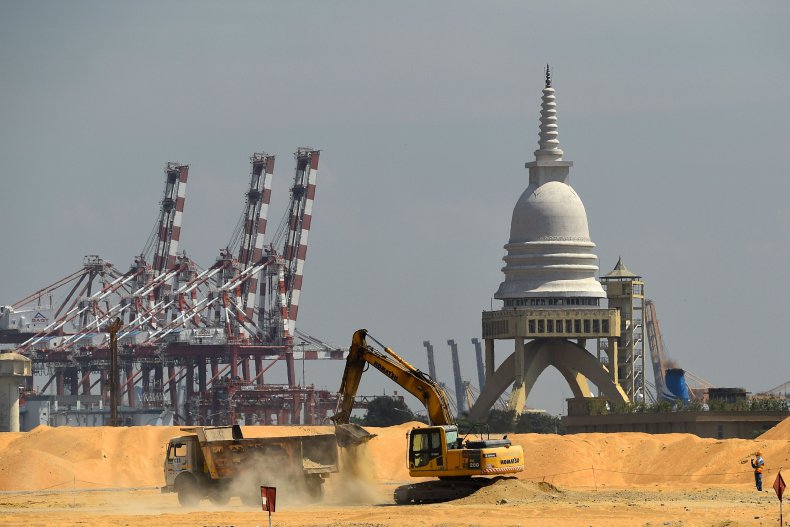
Laborers work at a construction site on reclaimed land part of the Chinese-funded project for Port City in Colombo on February 24. China’s trillion-dollar Belt and Road Initiative provides capital for ambitious infrastructure works but some still worry about the lasting consequences of being in debt to Beijing.ISHARA S. KODIKARA/AFP/GETTY IMAGES
When confronted with criticism of the BRI during his first post-election India trip in February, Mahinda Rajapaksa told the Hindustan Times that Sri Lanka had benefited from the BRI.
“By the way, let me remind you,” Rajapaksa said, “our external debt towards China is only 12 percent of our overall external debt, and we have not defaulted. We used whatever money we took from them to build infrastructure.”
Reached for comment, China’s embassy in Washington referred Newsweek to Foreign Ministry spokesperson Zhao Lijian’s response at the time.
“China and Sri Lanka share a strategic cooperative partnership based on sincere mutual assistance and ever-lasting friendship,” Zhao told a press conference in remarks sent to Newsweek. “Based on Sri Lanka’s development needs, China offered loans to support its infrastructure building and other major domestic projects concerning people’s livelihood.”
Zhao argued that Beijing was attentive to the debt sustainability of recipient countries as well as the will of their governments. He said Chinese funding has helped governments in overcoming hurdles in building new infrastructure and to foster independent development.
Colombo’s embassy in Washington declined Newsweek‘s request for comment. As for the people of Sri Lanka, both significant benefits and substantial concerns have emerged.
“Sri Lanka is seen as one of the vital nodes along China’s Belt and Road Initiative,” Maya Majueran, a PhD student at Sri Lanka’s University of Kelaniya, and Yasiru Ranaraja, who was attached to the Ocean University of China, both co-directors the non-governmental Belt & Road Initiative Sri Lanka organization, told Newsweek. “Due to that fact China is keen on investing in Sri Lanka. Chinese technology, talents, rich experience, know-how will have a great chance to benefit if Sri Lanka works together for a shared vision.
“However, some of the BRI projects in Sri Lanka are criticized for a lack of transparency and economic sustainability,” they added, highlighting the case of insufficient revenue generated by the Hambantota port that continues to be the source of controversy in the country.
While the scholars noted that the motive for Chinese investment was “largely to enhance connectivity to boost global economic links,” he admitted that “it may serve to strengthen China’s economic and security interests as well.” He pointed specifically to Gotabaya Rajapaksa’s appointment of former navy commander Admiral Jayanath Colombage as a senior diplomat as indicating how “the Rajapaksa regime is focusing on the growing Indian Ocean geopolitical grab.”
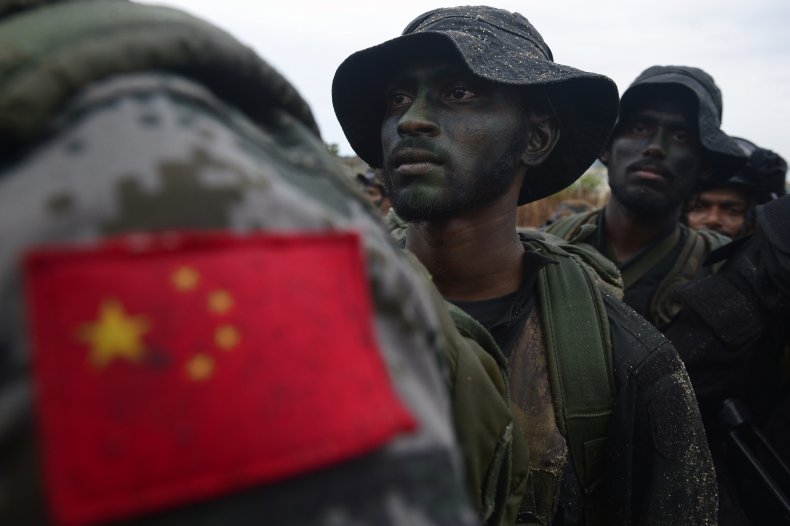
A Chinese soldier standing with Sri Lankan military personnel during a training exercise on the eastern coast of Trincomalee, September 23, 2019. With growing economic relations between Sri Lanka and China have come closer security ties as well.LAKRUWAN WANNIARACHCHI/AFP/GETTY IMAGES
The U.S. objections to the BRI connection with Sri Lanka are part of its strategic effort to push back against China’s growing regional influence in South Asia, which it is acquiring through its economic empire and the potential for projection of the military power it has already established further east in the South China Sea. The U.S. approach, called a “free and open Indo-Pacific,” most centrally includes Australia and Japan. India fills out the triumvirate while playing an increasingly crucial part in the coalition. It’s leadership has a checkered past with Sri Lanka under the Rajapaksas, and it presently engaged in a deadly border dispute with China that has highlighted the clashing spheres of influence in Asia.
While Majueran and Ranaraja predicted Sri Lanka would continue to engage with all major powers of the region, including the U.S. and India, they also foresaw that “China’s engagement with Sri Lanka will increase as [the Rajapaksa government] is considered a regime favorable to China.”
The Education Ministry has proposed that the leading schools in the country should adopt a mechanism to share their resources with the under-resourced schools of the country.
The idea was mooted when Education Minister Prof. G.L. Peiris met with the principals of 17 leading schools on Thursday.
The meeting was conducted to discuss curriculum reforms. The schools principals were asked to come up with proposals to adopt underprivileged schools.
A new cabinet paper will be presented seeking approval to modernise and develop the school curricula to meet contemporary conditions and requirements, Education Minister Professor G.L.Peiris informed a group of school principals on Thursday.
At a meeting held with the principals of several leading schools at the Education Ministry, Minister Peiris said the development of children’s analytical knowledge and critical thinking was paramount.
Terming education as an expedition, the Minister said the opportunities and room available for the children to expand in the existing education system was minimal.
Therefore, it is vital to shape the educational structure in a way that can enhance the children’s keenness and spirit. This should be done with the input of everyone. A broader discussion will be taken place at district level across the country in respect of the development of the curricula, prior to the ministry making a final decision. The opinions and views of the teachers, parents, past pupils organisations, civil societies and religious organisations were vital in this process. A future decision will be taken after thoroughly studying all these aspects,” the minister said.
The ministry in a statement said the principals who were present at the meeting briefed the minister on the possible changes that should be made in the education field.
The minister invited the principals to put forward ideas on restructuring the curricula to represent novel employment opportunities.
The issues which have arisen from having no text books for the Advanced Level classes and how to conduct career guidance in an effective manner were also discussed.
The contribution which the leading schools in the country could make in uplifting the standards at schools across the country was also discussed and the ministry said Minister Peiris requested the principals presented to extend their cooperation in this regard.
The World Health Organization (WHO) said on Friday that it hopes the Covid-19 pandemic will last less than the Spanish flu pandemic of 1918, which in two years killed tens of millions of people.
WHO chief Tedros Adhanom Ghebreyesus said at a press conference that this goal would be possible if the we can unite our efforts” and make the most of the available tools, among them vaccines.
The famous Spanish flu” killed 50 million people from 1918 to 1920 when malnutrition and tuberculosis made the population all the more fragile.
Unlike the new coronavirus, the Spanish flu had particularly hit the youngest.
In our current situation, […] the virus is more likely to spread. It can move quickly because we are more connected now,” Ghebreyesus said.
So we have a disadvantage linked to globalization [..] But we have the advantage of having better technologies,” he said. And we know how to stop it.”
On Friday, WHO also released new recommendations among them one for children aged twelve and above. According to WHO, they should wear protective face masks under the same conditions as adults to fight the pandemic.
This should especially the case when they cannot guarantee a distance of at least one meter from others and whether the transmission is generalized in the area concerned .
Children aged five and younger should not be required to wear a mask. This recommendation is based on the safety and overall interest of the child, and on his ability to use a mask correctly with minimal assistance,” said WHO.
As for six to eleven-year-olds, WHO recommends that the decision to use a mask be based on a series of factors, including the level of transmission of the virus in the area where the child lives and their ability to use a mask correctly and safely.
Access to masks, as well as the possibility of washing or replacing them in certain settings such as schools, adequate adult supervision and instructions given to the child on how to wear them, should also be considered.
Ghebreyesus also made a statement with regards to possible corruption cases in the areas of personal protective equipment (PPE), necessary for the fight against the pandemic.
Corruption related to PPE is, for me, actually murder,” he said when asked about a case in South Africa. If healthcare workers work without PPE their lives are in danger. And that also endangers the lives of the people they care for. So it’s criminal, and it’s murder.”
Minister of Justice, President’s Counsel Ali Sabry says the establishment of a separate court to hear cases pertaining to child abuse has been brought to the notice of the government.
He made these remarks addressing an event held in Colombo.
Minister Ali Sabry further insisted on eradicating crimes against children.
In the meantime, new laws will also be introduced to prevent such crimes, the justice minister continued.
A member of a criminal gang has died in a shootout with the police in area of Gampaha today (22).
The deceased is identified as Chaminda Edirisooriya under the alias Chamiya”. He is reportedly a gunman of the team operated by the underworld figure Angoda Lokka”.
The police said Chamiya” was shot when they opened fire at him in retaliation.
Attorney General & Prosecutors met with United Nations Office On Drugs & Crime (UNODC) Country Chief & UN Maritime Expert on International Drug Trafficking Organized Crime & Terrorism & had effective discussions on legal issues affecting the region.
A second group of 87 Sri Lankans, who were stranded in various cities in Thailand due to the Covid-19 pandemic situation, were repatriated to Sri Lanka from Bangkok-Thailand this morning (21), via a special Sri Lankan Airlines charter flight UL 403, organized by the Embassy of Sri Lanka in Bangkok.
The special flight that had onboard a few Buddhist monks, students, Sri Lankans who were on short term visit visas to Thailand, and several others on humanitarian grounds, arrived at the Bandaranaike International Airport in Colombo, on Friday 21 August 2020 morning. All repatriated individuals will undergo the necessary medical tests, and will be directed by the Sri Lankan security forces and health authorities to the mandatory quarantine centers, both State-sponsored and self-paid private hotels, designated by the Government of Sri Lanka.
This special repatriation flight that arrived in Bangkok on 21 August early morning also carried a group of Thai citizens, and Sri Lankans who have received re-entry permission to Thailand, and the inward trip from Colombo to Bangkok was organized by the Royal Thai Embassy in Colombo and HE Madam Chulamanee Chartsuwan, the Ambassador of Thailand to Sri Lanka.
The Embassy of Sri Lanka in Bangkok acknowledge the close cooperation and prompt directions received from the Ministry of Foreign Relations of Sri Lanka, including from Foreign Secretary Admiral Prof. Jayanath Colombage, the COVID Task Force at the Presidential Secretariat and the Ministry’s COVID-19 Focal Point, in making this repatriation process a success. The Embassy also received excellent support from the Ministry of Foreign Affairs of Thailand, and the staff of the Suvarnabhumi International Airport in Bangkok, by timely facilitation of the repatriation of this second group of Sri Lankans from Thailand, who had been registered with the Embassy and in the ‘Contact Sri Lanka’ online portal created by the Ministry of Foreign Relations, requesting assistance to return to Sri Lanka. The Embassy appreciates the support of the National Carrier – Sri Lankan Airlines, Mr. Dimuthu Tennakoon, Head of Sales and the Head Office team and Mr. Riza Yusoof, Country Manager, Thailand and his team, for the excellent cooperation extended through this entire process.
Dr. Nenette Motus, the Director of the Regional Office of International Organization for Migration (IOM) in Bangkok and IOM Colombo deserves the sincere appreciation of the Embassy for their prompt and generous response and support received under the Assisted and Voluntary Return and Repatriation (AVRR) project for Bali Process Member States.
Earlier in the month, the Embassy also made arrangements to repatriate a Group of 16 Sri Lankans in Phnom Phen Cambodia via Singapore. Embassy of Sri Lanka-Bangkok 21 August 2020
President Gotabaya Rajapaksa appears to have handpicked Adm.Prof. Jayanath Colombage for the Foreign Secretary’s post given his expertise in maritime security which is likely to be the centerpiece of Sri Lanka’s foreign policy in the coming years.
Colombo, August 20: The foreign policy motto of the previous government was ‘friendship with all, enmity with none’. Its verbatim meaning suggests the then Government’s policy was to be even-handed in its dealings with the world, be it Asia or the West. Nonetheless, in reality, it was a just a bland sentence used to couch its otherwise different intention. In practice, the previous Government was west-leaning in its foreign policy approach, though it was concealed in subtle diplomatic language to project a different impression.
Sri Lanka has made it clear that its soil cannot be exploited by anyone against the security interests of another (Pic AFP)
Admiral (Retd.) Prof. Jayanath Colombage, the newly appointed Foreign Secretary, spelled out in clear cut terms that the new Government’s foreign policy would be Asia- centric. If that is practiced in the real sense, it will be a clear departure from the path of the previous Government. As things stand at the moment, it is obvious that President Gotabaya Rajapaksa is planning to drive its foreign policy with a special focus on China and India, the two powers having competing interests in the region.
When Prof. Colombage said Asia-centric, he referred to the South Asia and Association of Southeast Asian Nations (ASEAN) as well. ASEAN is a regional grouping of ten countries and it is projected to rank as the fourthlargest economy in the world. It is a market of 622 million people. So, Sri Lanka’s focus on ASEAN is understandable.
It is a matter of fact that Asia as a whole is rising on the global stage. Its significance to the world is growing in terms of security, economic development, climate change etc. The Government has decided to keep special focus on Asia mainly because it is only better positioned to cooperate with Sri Lanka in economic revival in the post COVID-19 context is its main challenge. Today, we talk about an Asian era. Most Asian countries including China where the Coronavirus was first reported contained the spread of the pandemic more effectively whereas most other countries in the world are still reeling under the impact of the pandemic. It enables Asia to ratchet up efforts to propel global growth trajectory while responding to post-pandemic challenges.
The new Government seeks to reset its foreign policy with an Asia-centric approach, and then, it is bound to encounter a challenging task – that is to reconcile the competing interests of India and China in the region without offending anyone. The President appears to have handpicked Prof. Colombage as the Foreign Secretary to deal with this scenario diligently at an official level under Foreign Relations Minister Dinesh Gunawardane who lays emphasis on genuine friendship (Kalyana Mithra). Prof. Colombage is the former Navy Commander of Sri Lanka, and he also published his book ‘Asymmetric Warfare at Sea: The Case of Sri Lanka’. As such, he is an expert on the maritime security aspect of international relations, an area where China and India have contrasting interests. It is also a sphere in which countries such as the United States, Australia and India commonly take on against China’s increased presence in the Indo-pacific region. The Foreign Secretary is better positioned to understand and analyze Indo-pacific strategic concerns of the world powers given wide-ranging experience in naval security and academic knowledge coupled with it.
Sri Lanka is trying to get the best out of both China and India for much needed economic growth which has been sluggish due to the COVID-19. Sri Lanka has made it clear that its soil cannot exploit by anyone against the security interests of another. The leaders of both China and India have already engaged with Sri Lanka for economic ties. Prof. Colombage is someone with contacts to the establishments of both countries. It should have been one of the very reasons for his appointment as the Foreign Secretary this time to work at an official level in the execution of the foreign policy.
For India, security and economic development are the two main concerns in the post-pandemic situation. Indian Prime Minister Narendra Modi launched his Atmanirbhar Bharat Abhiyan (Self–reliant India campaign) in his country. According to the Indian media, he also asked Indian people to be ‘vocal for local’ and glorify Indian products.
The pandemic has compelled the countries to adopt a certain degree of protectionism in economic policies. Sri Lanka is also awake to this reality, and accordingly, President Rajapaksa has instructed his Ministers to boost local manufacturing so that the country can reduce dependency on foreign suppliers during this trying time. Indian External Affairs Minister Dr. S Jaishankar called Foreign Relations Minister Dinesh Gunawardena on Tuesday to congratulate him on his reappointment as Minister of Foreign Relations of Sri Lanka.
According to a communique put out by the Indian High Commission, Dr. S Jaishankar conveyed that he looks forward to working closely with Minister Gunawardena to take the India-sri Lanka partnership to greater heights as part of India’s neighbourhood-first policy. The two ministers discussed the need to facilitate the business leaders of both sides to increase investments. Also, the two countries now explore the possibility of resuming commercial flights on a limited scale as the beginning. Likewise, a host of measures for economic cooperation between Sri Lanka and China has been proposed. Chinese Foreign Minister Weng Yi also sent a message of congratulation to Minister Gunawardane after he assumed duties in his office under the new government. Also, acting Chinese Ambassador Hu Wei called on Mr. Gunawardane and Prof. Colombage on Tuesday.
The Chinese economy is resilient against the pandemic. It is, in fact, under control there at the moment. China is now recording growth. The new government sees cooperation with China as important to boost foreign reserves and to overcome the debt payment crisis.
The new government sees China’s Belt and Road Initiative (BRI) as an opportunity rather than a threat. It will turn to China for infrastructure projects such as the proposed expressways.
While taking such an approach, it is equally vital to reach out to the Western world where Sri Lanka’s export market is located. The government is heading for challenges in the West where the PRO-LTTE lobby groups are active. These lobby groups, operating in the Western world, have already upped their ante on Sri Lanka compiling reports on the past human rights track record to be taken up ahead of the sessions of the United Nations Human Rights Council.
This is significant in the context of Lankan President Gotabaya Rajapaksa’s statement that a new Sri Lankan constitution will be drafted
Colombo, August 21 (newsin.asia): A delegation of the Tamil National Alliance (TNA) called on the Indian High Commissioner Gopal Baglay here on Friday.
The High Commissioner congratulated the TNA for their performance at the recent general elections. The envoy reiterated India’s longstanding position on peace and reconciliation and the full implementation of the Thirteenth Amendment of the Sri Lankan constitution which had created elected Provincial Councils in the nine provinces of the island nation with a modicum of devolved powers. The 13A came as a result of the India-Sri Lanka Accord of 1987.
Though elected councils came into being, the powers that they should have got as per the 13A have not been devolved. Powers over land and police are still not dissolved.
There has been speculation that the government of President Gotabaya Rajapaksa and Prime Minister Mahinda Rajapaksa will abolish the 13A as part of their plan to centralize the administration and cut needless expenditure. A section of the majority Sinhala community feels that the Provincial Councils are White Elephants and impositions by India. But political sources say that elected Provincial Councils will not be abolished because the Sri Lankan political class has developed a vested interest in their existence. They provide an institution vested with some powers between the grassroots level Preadeshiya Sabhas and the parliament.
TNA leaders M.A.Sumanthiran and R.Sampanthan
Prime Minister Mahinda Rajapaksa is undoubtedly in favour of retaining the elected Provincial Councils. And in his speech inaugurating the newly elected 9th.parliament on Thursday, President Gotabaya Rajapaksa spoke only about the abolition of the 19th.Amendment, not the 13A.
Ironically, the Tamil United Liberation Front (TULF) opposed the 13A in 1987-88. Even today only the Eelam Peoples’ Democratic Party (EPDP) led by Douglas Devananda and a rump of the Eelam Peoples’ Revolutionary Liberation Front (EPRLF) faction led by the followers of the Late Pathmanabha support the 13A. Other Tamil parties want more than 13A. A section of them are even seeking self-determination for the Tamils and an internationally monitored referendum on the Tamil question.
When Mahinda Rajapaksa was Lankan President between 2005 and 2014, he had promised 13A Plus in response to pressure from India. But this was not delivered. During the United National Party-led Good Governance” regime between 2015 and November 2014, an effort was made to draft a new constitution but it was thwarted at the last moment by a lack of political will and a constitutional crisis in 2018.
On August 20, President Gotabaya Rahapaksa promised to draft a new constitution but it remains to be seen as to how far his regime would go to devolve power to the provinces or whether it will downgrade or upgrade the powers of the Provincial Councils.
As Sri Lanka struggles with outstanding foreign debt, rural households across the country have been living off borrowings after exhausting their savings. Meera Srinivasan reports on how those already struggling with severe economic hardships are now grappling with a pandemic-induced crisis
After doing seven jobs in the last three years in and around Colombo, Simran Enric is now back home in Sri Lanka’s hill country. He escaped the pandemic that struck the capital, but his last job at a grocery store didn’t.
I am ready to take up any job. It doesn’t matter which city, what work or how much they pay,” says the 19-year-old. He began working after dropping out of school before his Ordinary Level examination. His parents’ stagnant wages, from tea production on an estate in Maskeliya in the central Nuwara Eliya district, was not enough for three square meals for their family of five, including Enric’s two schoolgoing sisters. His Colombo income, they hoped, would support household finances. It barely did, but the family couldn’t afford to lose any additional source of income, however meagre, as they tried to cope. Over a period of time, Enric’s small savings proved valuable. And then the deadly virus arrived.
In Sri Lanka, though, the novel coronavirus didn’t seem all that deadly, going by the official data. While COVID-19 case numbers in the region and in powerful western countries increased rapidly, Sri Lanka stood out, drawing high praise, including from the World Health Organization, for containing the virus. To date, Sri Lanka has reported 11 deaths and fewer than 3,000 cases, of which only 127 are active.
After a stringent lockdown for two months and the efforts of the country’s efficient public health sector, aided by the military, Sri Lanka felt relatively fit to hold the twice-postponed parliamentary elections on August 5. Over 16 million of the country’s 21 million-strong population could vote in the elections, held with elaborate health guidelines mandated by the Election Commission. The turnout was 71%.
As was widely predicted, the ruling Rajapaksa brothers’ young party won comfortably, securing a rare two-thirds majority in Sri Lanka’s proportional representation system. With carefully cultivated political capital from projecting their war-victor image for a decade now, and aided by the former government’s abysmal failures, the Rajapaksas have consolidated their grip on the country like few have. President Gotabaya Rajapaksa and his older brother Prime Minister Mahinda Rajapaksa sit in the country’s two most powerful offices. They have no imminent threat to their political might. But their government faces an unprecedented economic challenge.
Reeling under the shock of last year’s ghastly Easter terror bombings, Sri Lanka’s economy contracted by 1.6% in the first quarter of 2020, even before the pandemic’s local and global spread was clear. The World Bank has projected a rather grim picture, warning it could contract up to 3%.
Of the country’s mounting external debt – equivalent to 42.6 % of the GDP in 2019, according to the Central Bank of Sri Lanka – nearly $3 billion is due for repayment this year. This includes a non-negotiable $1 billion sovereign bond maturing in October, besides bilateral and multilateral loans.
Aware of the daunting task ahead, the Rajapaksa administration wasted no time in requesting lenders for a debt freeze. On his visit to New Delhi in February, his first trip abroad after assuming premiership of the then-caretaker government, Prime Minister Mahinda Rajapaksa sought a debt moratorium that is still being negotiated.
With the pandemic that hit Sri Lanka in March amplifying the economic crisis manyfold, the country’s looming debt crunch gave the government the jitters. The government went for new loans to service past borrowings, including over $5 billion from China and $960 million from India. In March, Sri Lanka signed an agreement with China for another $500 million loan after an urgent request” from Colombo, to deal with the pandemic’s harsh economic blow.
While the government struggles to cope with the fiscal crisis, the people, especially those on the margins, suffer.
Enric stayed in Colombo for almost eight weeks during curfew time” with a partial salary, lodging and food, until he lost his job. There was no chance of finding a new job,” he says. He returned home and the family was back to relying entirely on his parents’ wages.
No work today; there aren’t enough tea leaves on the bushes after last week’s heavy rains,” says his mother S. Bagyalakshmi, who recently pawned the only piece of jewellery she had kept for her daughters. Work has been irregular these days.”
Increasingly, many employers across estates are asking workers to stay at home once every few days, so they don’t have to pay the monthly incentive tied to a minimum number of days’ mandatory work, according to labourers. Citing the pandemic, Sri Lanka’s major plantation companies have virtually stalled talks with the government on a basic wage hike from the current LKR 700 to LKR 1,000 that workers have been demanding for over three years. Not that the companies were any more willing to pay the rate in 2019, when tea exporters reported a record high revenue of over $1.3 billion.
The estate workers were persistent enough to push their demand to poll manifestos, but not powerful enough to realise it. In January this year, two months into office, President Gotabaya Rajapaksa assured them of a wage hike by March 1, following up on his campaign slogan. Six months later, workers have resigned to yet another broken promise.
For those like Bagyalakshmi, pawning her hard-earned piece of jewellery was the only option to survive. As far as her family’s poverty goes, it was not introduced by the pandemic, but was gravely aggravated by it.
The nearly 1.5 lakh estate labourers among Sri Lanka’s million-strong Malayaha Tamils (hill country Tamils), whom British planters brought down from south India to clear forested mountainous land, plant and pluck coffee and later tea, have been historically neglected. Earners of precious foreign exchange, they remain on the country’s geographic, social and economic margins, their labour invisible and voice rarely heard.
Bagyalakshmi’s home, a colonial-era ‘line room’ with a living area barely 8X8 feet, is located on the edge of a winding, unmotorable road inside an estate. It is a silent witness to the violent colonial past her ancestors endured, as well as the exploitation that carried over into the years after Independence, making the lives of successive generations vulnerable and their livelihoods, precarious.
But it is not just estate workers facing the brunt. Like Enric, tens of thousands of Malayaha Tamil youth, employed in hotels and shops, often as cleaners or assistants, in Colombo and other cities, have now returned jobless to the hill country. There is a sudden increase in three-wheeler drivers in Maskeliya. That is because many of us had to come back from Colombo after the COVID-19 outbreak as there was no other option of making a living there,” says Murugaiyya Vigneswaran, 28, who lost his mason job in Colombo. I took a loan and bought this three-wheeler, but it is not easy to find hires.” He relies on his neighbours in the estate engaging his autorickshaw for an urgent visit to Maskeliya town, paying LKR 1,500 (or two day’s gross wages) for the round trip, as estate roads are not serviced by public transport.
Elders in the community note that it is over the last two decades that Malayaha Tamil youth from the estates ventured out looking for jobs, escaping the estates where their parents toil all day braving blood-sucking leeches and stinging wasps. But they couldn’t escape hardship.
While some migrated to the capital and big towns in the prosperous Western Province, others found jobs as domestic and construction workers in West Asian countries. Sri Lanka’s hill country, along with high-migration districts such as Kurunegala in the North Western Province and Batticaloa in the Eastern Province, supplies a steady flow of cheap labour abroad. Of the over 2 lakh workers who migrated from Sri Lanka in 2018, more than half were unskilled workers and housemaids, official data show. But the raging virus made their lives and jobs overseas even more perilous than at home.
As many as 47 Sri Lankan migrant workers have succumbed to COVID-19 in West Asian countries, according to Mangala Randeniya, spokesman of the Sri Lanka Bureau of Foreign Employment. This is more than four times the number of deaths reported in Sri Lanka. The migrant workers’ funerals were held where they were last employed, as their families in Sri Lanka grieved from thousands of miles away.
Some 40,000 workers, who are out of work in West Asia, are trying to return home. Wary of importing more carriers of the virus, after dozens who returned in special flights tested positive on arrival, the Sri Lankan government is staggering their repatriation in phases. Others wait, with savings for food dwindling, insecure accommodation, the constant fear of infection, and no clarity on their date of return or prospects in Sri Lanka thereafter.
Two of my nieces and a nephew are working abroad. We still don’t know when they can return, we are really worried,” says Bagyalakshmi. This is the prevalent anxiety among migrant workers’ families.
For over 10 years now, Somasundaram Mallika has been raising her older sister’s three children, in addition to two of her own, in Badulla district, in the neighbouring Uva Province. My sister is the only breadwinner in her family after her husband passed away. She had no choice but to leave the country for work. Thankfully she still has her job, but with this virus we don’t know when we will see her next,” says Mallika.
Her sister Somasundaram Yogam did many jobs abroad before her current one as a housemaid in Saudi Arabia. Speaking to The Hindu over telephone, she says: I don’t go out anywhere because of the COVID risk. I hear many housemaids like me have lost their jobs, I am very lucky to still have mine.”
Despite a secure job and a reasonable salary, many workers find it very hard to be away from their families. Unlike Yogam, many don’t have reliable relatives to care for their children. I miss them very much, but what do you do when you have to work?” she says.
Yogam would seem better off compared to hundreds of Sri Lankan garment workers in Jordan who were sacked after the pandemic. Around 200 of them returned last week, but another 500 are stuck there, according to Abiramy Sivalogananthan, Sri Lanka coordinator for the Asia Floor Wage Alliance, engaged in international campaigns for collective bargaining in the global garment industry. The factories first reduced the meals they are mandated to provide from three to two, and then stealthily obtained signatures from the workers in documents saying they were resigning, to be exempted from paying social security,” she says.
Moreover, skilled expat workers have been returning to Sri Lanka with less difficulty, even from high-risk countries such as the U.S. and the U.K. It’s not just the employers abroad who manipulate and exploit migrant workers, our own government discriminates against low-skilled workers by making their return very hard,” Sivalogananthan observes.
Desperate measures
Labourers like Bagyalakshmi or Yogam, or those back from Jordan might make an occasional news headline in Sri Lanka, but they almost never figure in policy talk on the national economy. Those discussions begin and end with the outcome of their labour – be it tea and rubber or garments that together make up about 65% of exports; or migrant remittances that are the main source of Sri Lanka’s foreign exchange. In 2019, inward remittances added up to $6.7 billion.
With all key foreign exchange earners – tourism, exports and remittances – of the country badly hit, Sri Lanka is facing its biggest foreign exchange crisis in history, by the government’s own admission.
The Central Bank and the government have taken several urgent measures. In March, authorities restricted import of non-essential goods and soon relaxed foreign exchange regulations, inviting deposits in foreign currency. The government curtailed outward remittances.
Meanwhile, the Central Bank recently obtained a $400 million currency swap from the Reserve Bank of India to boost its reserves, while President Gotabaya Rajapaksa has requested Prime Minister Narendra Modi for an additional $1.1 billion currency swap. Sri Lanka has also sought emergency financial support from the International Monetary Fund, under its Rapid Credit Facility. The request is under assessment.
Faced with a tumbling currency – about LKR 187 (roughly ₹74) to an American dollar – fast-depleting foreign exchange reserves and a daunting repayment schedule this year, Sri Lanka has no time to lose while fixing its battered economy.
But the task is far from easy. The government can’t open up the country for tourists without increasing the risk of a spike in new cases. It can’t strengthen exports until other countries, or at least Sri Lanka’s key markets, are ready to buy what it has to sell.
Evidently, the newly installed Rajapaksa government is under enormous pressure – not only to keep Sri Lanka’s unblemished debt servicing record, but also to enhance local production and create local demand in order to keep the economy ticking until international markets brighten.
Sri Lanka’s rural economy, sustained largely by agriculture and fisheries, has been crying for attention for years – evidenced in the recurring farmer and fisher protests around cost of inputs, profiteering by intermediaries, and unstable incomes.
Also, it is not just the country that is growing more and more indebted. Many of its poor citizens too are mired in stifling debt. While the national spotlight is on the outstanding foreign debt, rural women across the country, including in the civil war-affected north and east, have been living off borrowed money, often microfinance loans that agents push at their doorsteps.
Trapped in servicing the exorbitant interest rates – even more than 200% in some cases – of multiple loans, some have tragically taken their own lives, just as Jaffna-based Surendrarasan Mariarata did earlier this month. The fast-growing concern about predatory microfinance loans, especially among women, evoked a poll promise from Gotabaya Rajapaksa ahead of last year’s presidential elections for relief from microfinance loans. The indebted women await action before more lives are lost.
Most policymakers in Sri Lanka agree that in order to tackle prevalent household indebtedness or generate greater local demand, the government must necessarily create jobs. President Gotabaya Rajapaksa has recently resumed a programme to provide jobs to 50,000 unemployed graduates and 1 lakh low-income earners. But there are several thousand more, unable to complete school and desperately looking for jobs, others like the hill country youth who are now out of work, or the migrant workers who are back in the country with uncertain futures. They will need different kinds of jobs.
In the hill country, for instance, they could set up industries that do value addition. Why must those factories be based in Colombo when all the tea is produced here,” asks Fr. Isaac Daniel Dixon, pastor at a Maskeliya church attended mostly by estate workers. His congregation includes many youth who lost their jobs in Colombo and returned recently. Some end up as labourers in the same estates as their parents, doing the job their parents hoped they never would.”
Immediately after the new government was installed this month, and ministerial portfolios allocated, President Gotabaya Rajapaksa emphasised the need to promote local industry. The thrust, aligned to the ruling party’s nationalist, populist election plank, is not new to Sri Lanka. Neither are leaders’ customary poll-time promises to alleviate poverty. Campaigning in the southern Hambantota district on the eve of the August 5 elections, the President pledged to build a people-centric national economy, fully owned by the people.”
Sri Lankans know well that for a promise to translate to policy and more crucially, action, the government’s political might alone will not do. Therein lies the Rajapaksa brothers’ next big test.
A smiling Sabry holds his mother after addressing the media at the Justice Ministry (pic by Shamindra Ferdinando)
Justice Minister Ali Sabry, PC, yesterday (17) said that four state institutions––the Police, Prisons, Government Analyst’s Department and the Registrars of Courts––were so corrupt that the country faced a daunting challenge to rectify the situation.
Addressing a gathering immediately after assuming duties at the Justice Ministry, Sabry explained how those responsible violated the rule of law.
Referring to recent explosive reportage of the Police Narcotics Bureau (PNB) dealing in heroin, Minister Sabry briefly discussed how law enforcement authorities, Prisons, the Government Analyst’s Department and the Registrar of Courts contributed to unprecedented deterioration of law and order.
Among those present on the occasion were President’s Counsels Romesh de Silva, Gamini Marapana, Kalinga Indatissa and U.R. de Silva.
Separate Registrars are assigned to Magistrate courts, High Courts, Court of Appeal and the Supreme Court.
Minister Sabry said that according to a survey, Registrars of Courts were among the most corrupt in the country and he would examine the situation before announcing a plan on how to tackle the situation. He sought the support of all stakeholders, including the Bar Association of Sri Lanka (BASL) to address contentious issues.
The minister said he knew how the people suffered untold hardships due to law’s delays. Continuing system failures ruined lives, the minister said, pointing out how child abuse affected the community.
At the onset of his brief address, Minister Sabry apologised profusely for having the meeting in a small room which could hardly accommodate those present. In spite of display of notices restricting the gathering of people due to continuing threat posed by covid-19 epidemic, over 100 were allowed in with most of those present not wearing face masks. Minister Sabry had to fight his way to the podium to address the gathering with Ministerial Security Division (MSD) being helpless.
Pleading that he wouldn’t do anything inimical to the Constitution and the people, Minister Sabry thanked President Gotabaya Rajapaksa and Prime Minister Mahinda Rajapaksa for giving him the challenging responsibility. The new minister vowed to overcome what he called daunting challenges.
The Minister quoted the Rajapaksa brothers as having told him to do the needful as he knew what the shortcomings and problems were.
Minister Sabry emphasised that his responsibility would be to implement policy decisions of the government and the cabinet of ministers.
Delivering an anusasana at the onset of yesterday’s programme, scholar Ven Medagoda Abeytissa Thera said that President Gotabaya Rajapaksa accommodated Sabry in the cabinet of ministers, in spite of serious protests as he had confidence in him. It would be Minister Sabry’s duty and responsibility to maintain President Gotabaya Rajapaksa’s faith in him.
The Ven. Thera said that there was no point in hiding the fact that opposition political elements instigated protests against the top the justice portfolio being assigned to Sabry.
The Ven. Thera appreciated the role played by Sabry as a civil society activist in helping the then Opposition movement led by the Joint Opposition to turn the tables on the then government.
Referring to a recent statement attributed to Minister Sabry that the 19th Amendment enacted in early 2015 would be amended to suit the new government’s requirements, Ven. Abeytissa stressed that President Rajapaksa and the SLPP (Sri Lanka Podujana Peramuna) had received mandates in 2019 and 2020 to introduce a new Constitution. The scholar monk emphasized that there should be one law for everyone. Therefore, now in his capacity as the Justice Minister, it would be his responsibility to fulfill the aspirations of the public.
Referring to the 2019 Easter Sunday carnage, Ven Abeytissa said that it would be the Justice Minister’s obligation to take measures to prevent the birth of more Zahran Hashims.
Commenting on the enactment of the 19th Amendment by the previous government, Ven. Abeytissa advised the Justice Minister to follow a policy of transparency in that regard.
Ven. Kamburugamuwe Vajira Thera warned of dire consequences unless the required far-reaching constitutional changes were introduced within a month or two. The Thera said that if the government failed to use its two-thirds majority immediately, it would have to regret its failure.
At the request of Maha Sangha, President Gotabaya Rajapaksa decided to bring Sri Lanka Buddhist and Pali University and Buddhashravaka Bhiksu University under the purview of the Ministry of Education.
President also paid attention to the possibility of placing these two Universities under the University Grants Commission. President instructed the officials to conduct monitoring their activities in a proper manner under the supervision of the State Minister while safeguarding their identities.
This decision was taken by the President during the 05th meeting of the Buddhist Advisory Council held at the Presidential Secretariat today (21).
President said he will present the steps taken by the Government and their progress pertaining to the proposals and advice given by Maha Sangha at 04 previous meetings at the next session.
Pointing out that advice of the Buddhist Advisory Council have been used while formulating the structure of the State Ministries President said he expects the Maha Sangha to continue to guide the Government in policy preparations. He further said Dhamma Schools, Bhikku Education, Privenas and Buddhist Universities were brought under the direct supervision of a single State Ministry for their advancement.
Maha Sangha commended the President for his efforts to address the issues pertaining to Piriven education and endeavours to improve Dhamma school education by implementing a systematic procedure and regulation.
Anunayake of the Malwatta Chapter, Most Ven. Vijithasiri Nayaka Thero stated that the approach used to institute officers that of the Opposition Leader in the parliament was exemplary. Thero added that the people were repulsed by how the predecessors made appointments to the same offices.
Anunayake of the Asgiriya Chapter, Most Ven. Anamaduwe Dhammadassi Thero noted that the decision to minimize ministries will assist in saving taxpayers’ hard-earned money.
Additionally, Aranya Senasanadhipathi of Mithrigala, Ven. Udairiyagama Dhammajeewa Thero mentioned the importance of virtuous mind” (Yahapath Sitha) in life and highlighted the significance of introducing it to the classroom.
Ven. Prof. Induragare Dhammarathana Thero highlighted the requirement of initiating an insurance scheme resembling Agrahara Insurance plan for Bhikku teachers, their parents, and siblings in their times of need, when they are hospitalized.
Most Venerable Diviyagaha Yasassi Nayaka Thero pointed out the importance of introducing a procedure to give marks for Certificates of Dhamma School Final Examination and the Dharmacharya Examination when offering the government jobs.
Most Ven. Prof. Kotapitiye Rahula Thera suggested that a discussion on Bhikkhu Education and Buddhist Education or a Sangayana on Theravada Buddhism is needed.
The Maha Sangha representing the Buddhist Advisory Council, officials including Principal Advisor to President, Lalith Weeratunga, Secretary to the Ministry of Education Prof. Kapila Perera, Secretary to the Ministry of Buddha Sasana, Religious and Cultural Affairs, Prof. Kapila Gunawardena and the Commissioner General of Buddhist Affairs Sunanda Kariyapperuma participated in this meeting.
Ven. Dr. Omalpe Sobhitha Thero, stated that he is requesting the Chairman of the Election Commission on behalf of the Sri Lanka Ramanna Maha Nikaya to immediately cancel the National List seat given to Apey Janabala Party.
He was addressing a media briefing at the Sri Bodhirajarama Temple in Embilipitiya.
Relations between India & Sri Lanka has had their highs and lows since ancient times. The present resent & animosity by most in Sri Lanka against India has valid reasons. As two sovereign nations, there are certainly protocols to respect & follow and size should not matter. No country or its people would like to feel bullied by a larger neighbor simply because of its size. Let’s not forget that the country we call India came to be christened only in 1947 by Colonial Britain, which adds weight to Sir John Kotelawala’s oft quoted statement ‘the day Ceylon did away with England, it would go under India’. No one in Sri Lanka wishes that which is why it is important for policy makers & advisors to look at their short term actions & decisions with the detrimental outcomes in the long term. This is certainly applicable to relations with all foreign nations vis a vis the agreements Sri Lanka ventures into.
It was in 1948 that Sri Lanka opened its first overseas mission in New Delhi, India. If there was any leader who made friendships with India yet kept India in its place, Mrs. Sirimavo Bandaranaike will certainly take the cake. Not only does she still remain regarded as a friend of India, with close ties to the Gandhi family, but she did not allow that friendship to come in the way of her decision making. When tough decisions had to be taken, she did not mince words. She concluded a maritime agreement with China in 1963 and she even allowed refueling to Pakistan planes during the Indo-Pak War. Thus, both India & Pakistan continue to praise her diplomacy & leadership. India & Sri Lanka cooperated to formulate the non-aligned movement during the 1950s and 1960s. India & Sri Lanka joined in a quest to convert the Indian Ocean into a ‘zone of peace’. This was no neutral policy. This was no appeasing policy. Sri Lanka’s friends are as a result of that non-aligned policy and this is what Sri Lanka must continue to uphold. Flying policies and flicking fancy names every now & then to christen Sri Lanka’s foreign relations is just superfluous and will only distance Sri Lanka from the non-aligned status Sri Lanka has proudly held and to which Sri Lanka has many proud moments to recall.
During tenure of President J R Jayawardena
1987 – India forcibly halting Vadamarachchi military operation that cornered Prabakaran, Parippu drop on 4 June by India was a gross violation of Sri Lanka’s sovereignty & airspace, Indian Peace Keepers & their war crimes, signing of Indo Lanka Accord & 13thamendment forcing Sri Lanka to tweak its constitution & create a provincial council system based on a bogus history. India allowed LTTE to use Tamil Nadu as a logistics/training hub. India did not supply any offensive military equipment to Sri Lanka during the conflict. India airlifted Prabakaran to Delhi before signing of the accord (retired Indian Air Marshal Denzil Keelor received orders from RAW to airlift LTTE & its Leader from Jaffna to India – 2 choppers were sent from India to Suthumalai Amman kovil temple in Jaffna). Prabakaran met Indian PM Rajiv Gandhi on 28 July 1987. Indo-Lanka Accord signed on 29 July 1987. Prabakaran flown back to Jaffna on 2 August 1987.
Letter from PM Rajiv Gandhi addressed to President JR Jayawardena set out conditions Sri Lanka was required to adhere on foreign policy & defense matters unrelated to the Tamil issue which Sri Lankan President did not even object to. These demands included
Employment of foreign military & intelligence personnel would not be prejudicial to Indo-Lanka relations
Trinco port or any other port will not be given for use by any other country in a manner prejudicial to India’s interest (Why is India silent on US fleets regularly visiting Trinco)
Restoration of Trinco oil tank farm as a jv
Sri Lanka’s agreements with foreign broadcasting organizations are not for military or intelligence purposes.
During tenure of President Chandrika Bandaranaike
India prevented Sri Lanka securing state-of-the-art Chinese radar to counter ‘Air Tiger’ threats.
India opposed Sri Lanka setting up a China-managed Aircraft overhaul wing at China Bay SLAF base, Trinco & SLAF had to establish it in Katunayake air base
During tenure of President Mahinda Rajapakse
India’s national security advisor Ajit Doval demanded Gotabaya Rajapakse (Def Sec) to cancel USD1.4billion Chinese flagship project – Port City claiming it a threat to India’s national security.
India demanded Sri Lanka take over Colombo International Container Terminals Limited (CICT) a jv between China Merchants Port Holdings Company & SLPA
2007 – India declined to provide radar with 3D capabilities when Indian supplied 2D capabilities failed to detect LTTE aircraft in raiding SLAF base in Katunayake. China & US supplied though India objected.
India flouted its own policy of not voting for country-specific issues when India voted in favor of UNHRC resolutions against Sri Lanka in 2012/2013.
India fishermen poaching in Sri Lankan waters.
Indian pressure to acquire ‘Sri Lanka’s defense ‘needs’ from India (Training & Intelligence)
2014 Sri Lanka accepted Indian offer to build 2 AOPVs (Advanced Offshore Patrol Vessels)
2007 – India objected to Sri Lanka purchasing a Chinese built JY-11 3Dradar system on the grounds that it would ‘overarch’ into Indian air space.
India’s National Security Adviser Ajit Doval wanted all Chinese funded infrastructure projects stopped.
2014 – 2 visits of Chinese submarines to Colombo harbor upset India & precipitated India’s decision to remove Rajapakse.
2008 – proposal for undersea power line with submarine cable under Gulf of Mannar
2010 – plan to set up interconnection of electricity grid between India & Sri Lanka for Sri Lanka to source electricity from India.
During tenure of President Maithripala Sirisena
2018 – Indian High Commissioner to Sri Lanka, Taranjit Singh Sandhu declares India’s policy is ‘Sabka Sath Sabka Vikas’ (Together we progress) – India’s other policy of ‘Neighbourhood First.’
2018 – India is alleged to have taken gene stocks of Sri Lanka’s plants (Samantha Gunasekera, former Deputy Director Customs-Biodiversity, Cultural & National Heritage Protection Division) Indian companies had stolen many of Sri Lanka’s genetic resources as Governmental protection has been poor or lacking.
India purposely neglecting its commitments on SAARC – boycotting 19thSAARC summit in Pakistan in 2016
Naval crew of INS ‘Sutlej’ conducted a beach cleaning campaign at Crows Island, Mattakkuliya
India & Yahapalana
Following regime change in 2015 – President Sirisena, PM Ranil, Mangala, RaviK – first overseas visit were to India.
President Sirisena & PM Ranil visited India 4 times
At least 10 high level visits between India & Sri Lanka
Indian PM Modi visited Sri Lanka twice (Mar 2015 & May 2017) first visit of Indian PM after Rajiv Gandhi in 1987.
Indian PM on visit to Norwood, Hatton declared Tamil plantation workers as Indian Diaspora. This was objected as they were now Sri Lankan citizens and not Indian.
2015 – 800 maruti cars imported to Sri Lanka with substantial slash in import duty but increase on import duty for hybrid vehicles.
Jan 2016 – INS Vikramaditya, India’s aircraft carrier, India’s newest and largest ship made its maiden overseas port call to Colombo. President Maithripala Sirisena was the first foreign head of State onboard the ship.
When Sri Lanka planned acquire 12 JF-17 fighter aircraft built in Pakistan in collaboration with China. India quickly offered its new Tejas fighter, still in its trial period, as an alternative.
2016 – Sri Lanka is a small country. You don’t need such development projects’ Indian National Security Advisor Ajit Doval to WIjayadasa Rajapakse.
July 2017 – Sri Lanka Navy (SLN) accepted Advanced Offshore Patrol Vessel (AOPV) built by the Government of India owned Goa Shipyard Limited (GSL)
Sri Lanka offered 500 acres of land to Government of Andhra Pradesh to develop an industrial part (what is the status of this)
India wanted the Port City project stopped claiming Chinese presence in Colombo port was a threat to India’s security.
India also demanded Sri Lanka take over Colombo International Container Terminals Limited (CICT), a joint venture between China Merchants Port Holdings Company Limited (CMPH) and the Sri Lanka Ports Authority (SLPA).
India wants Sri Lanka to have full control of Hambantota port.
2017 – Sri Lanka announced plans to connect Sri Lanka’s power grid to Indian power grid to boost power generation within 5 years.
India encircling Sri Lanka
Kankasanthurai Port which adjoins Palaly military base & Northern Area Navy headquarters
Trincomalee Oil Tank
Mannar – Palk Strait Bridge with high way to Trinco
reconstructing the railway line from Talaimannar to Medawachchiya.
Colombo East Terminal
Mattala Airport
Joint naval exercises increasing with even air force personnel joining in
Deployment from China Bay of Dornier aircraft manned by Indian Navy, SL Navy & Sri Lanka Air Force conducting maritime patrol exercises & EEZ surveillance & rescue missions.
Indian Projects
Housing program in North & East – 42,000 houses in North, 14,000 upcountry & 4000 in East
India granted Sri Lanka credit line of $45.27m for financing rehabilitation of Kankasanthurai Port
India is helping agriculture & engineering faculties in University of Jaffna, Thondaman Vocational Training Centre & Saraswathy Central College Pussellawa
India gifts 16,000 books to Jaffa public library
2016 – Indian ‘Suwa Sawiya’ 88 emergency ambulance service worth Rs.7.5m – Hambantota, Galle, Matara, Kalutara, Gampaha, Colombo initially, then to Jaffna, Kilinochchi, Mannar, Vavuniya, Mullaitivu in North. In 2018 the service extended to Uva province – Hali-Ela, Badulla, Bandarawela & Moneragala – stationed in 26 selected police stations. Yahapalana passed 1990 Suwaseriya Foundation Act which was passed unanimously in Parliament. This Foundation can receive grants, gifts or donations & have its own fund& enter into contracts or agreements (new Govt must look into this)
Beverage factory importing fruit pulp & exporting juice – using 50m litres of ground water per annum – 50 acres land given in Gampaha. Residents who went to court failed to prevent project
ECTA – detrimental to Sri Lanka
India encircling Sri Lanka economically
Petronet LNG planning to set up liquefied natural gas terminals in Sri Lanka – Sri Lanka issues letter of intent for terminal to be set up in western coast (Yahapalana May 2018)
Sept 2018 – Cabinet approval given to CPC & Lanka IOC to form joint subsidiary company to develop 85 tanks in upper oil tank farm. LIOC gets 70 tanks, CPC only 15. LIOC will also get 18 currently used in lower section. The period of use by LIOC is to be decided by Cabinet. Land ownership with GoSL & a new lease superseding the 2003 one given by Ranil.
(Petroleum professionals objected claiming oil tank farms can be managed without India & they required only Rs.10m to do so. Earlier agreement was to allow CPC to handle this. CPC unions pointed out that if LIOC is given legal rights to entire oil tank farm, India could gain complete control of fuel distribution in Sri Lanka within a short period)
Samantha Kumarasinghe says Lanka IOC obtained 25% of petroleum distribution & 33% of Petroleum Storage Terminal Ltd (ie CPC pipeline network) Only $40m has come though $70m was promised. Selection of IOC was done by cabinet paper of 2002 without competitive bidding process. LIOC owns 189 filling stations & entire sales from 2002-2013 is $3.6billion.
2002 – UNP allows India 1/3 of Sri Lanka’s petroleum business. Lanka IOC given without bidding. LIOC given fuel stations countrywide & marine bunkering at Trincomalee & Colombo.
2016 – Profits go direct to India as 75% shares are held by Indian Oil Corporation. 2014-2015 LIOC profit was $4.73billion.
100 of Sri Lanka’s best filling stations given to LIOC for $35m and when oil prices declained LIOC made billions with no tax benefit coming to the State.
Samantha Kumarasinghe also listed oil tanks in Trinco, Sampoor Coal power projects, Airtel Telecom project, Ceylon Glass, bus & lorry assembly plants, Indian construction projects, major land development projects, including major hotel projects in prime locations. (Perth Paradise housing project is 183 acres of prime land in Horana-Ingiiriya main road to build 1500 houses.
Sustainable Green Energy a Sri Lankan company headed by an Indian given government approval to start bamboo cultivation project in Vavuniya.
Memorandum of Understanding with India to develop the Trincomalee Port, establish a petroleum refinery and other industries. The Singapore firm of Subana Jurong will draw up the master plan for Trincomalee. There will also be a Colombo Trincomalee economic corridor.
The first India-Sri Lanka FTA (ISLFTA) was signed in November 1998 with just 4 consultations within 4 months became effective in 2000 but without any tangible benefit to Sri Lanka.
India encircling Sri Lanka economically – Trinco Oil Tanks
6 December 2016 – Cabinet approved proposal for oil tanks used by India be vested with CPC, 3 tanks to be taken immediately & rest within 3 months. CPC engineers visited China Bay Tank Farm following cabinet decision. The officials included a deputy manager were locked up by officials of Indian Oil Company for 1hour and the 2 vehicles they came in also held by IOC officials. The IOC complaint to the police was that CPC officials could only come on one particular day and the day they arrived was not a specified date, so they were considered as trespassing. India quoted 2003 agreement claiming it covered entire tank farm. Twice under Mahinda Rajapakse government LIOC was refused proposals to develop upper tank farm.
The 6 December 2016 cabinet decision was reversed by PM Ranil in March 2017 that LIOC and CPC would develop Trinco Oil Tank Farm as a JV with land in upper and lower oil tank farm to be leased to LIOC directly for 50 years and extended to 99 years.
For past 14 years LIOC paid lease charges of $100,000 for tank farm. During 15years India controlled oil tanks, GoSL received only Rs.75m as rental while GoSL paid LIOC Rs.650m for utilizing same tanks to store oil.
India encircling Sri Lanka economically – CEPA / ECTA
2002, Sri Lanka and India agreed to replace the existing India Sri Lanka Free Trade Agreement with a Comprehensive Economic Partnership Agreement (CEPA). CEPA negotiations took place in 2005. CEPA was originally scheduled to be signed in 2008 during the SAARC summit.
Under CEPA India can bring down technical staff from 10% of total staff cadre up to 50%
Any Indian could bring his family into Sri Lanka and they can work anywhere they want. Family alone can take up about 5 jobs. Under CEPA there is no ‘business visa’ so there is no time limit for the stay either.According to CEPA there will be 50% Indian ownership of 25 cinemas, each of which could hold multiple cinema halls. In these cinemas, 40% cinema time would be for Tamil and Hindi films. Film makers when alerted objected.
India was asking Sri Lanka to recognize the qualifications of Indian doctors. 30 or so categories of paramedical professionals were also included in the CEPA.
No one had seen the agreement. CEPA was shot down by angry business men, very critical of India. President Rajapakse decided not to sign it, despite considerable Indian pressure to do so. Pathfinder Foundation defended CEPA.
2015 Yahapalana announced they will not sign CEPA but will enter in to an Economic/ Technical Co-operation Framework Agreement (ETCFA) with India. ECTA was drafted in great secrecy. The agreement was not made public and an attempt was made to sign it quickly. But this too was stopped. This time by the professionals, led by architects, engineers and doctors. Who pointed out ‘many irreversible loopholes’. Clauses were vague & open ended.
ECTA was CEPA in another name.
ECTA was India’s plan to get into Sri Lanka’s Information Technology (IT) and naval engineering sectors (dockyards). The Network Readiness Index 2015 held Sri Lanka in 65thplace & India ranked at 89.
Professionals National Front, a consortium of a dozen professionals’ associations was formed to combat ECTA. It included among others, the Government Medical Officers’ Association (GMOA), the Electrical Engineers’ Association, the Customs Officers’ Union and the National University Teachers’ Association.
India encircling Sri Lanka – Education & Culture
Rs.600m grant given to University of Jaffna to develop Faculty of Agriculture & Faculty of Engineering in Kilinochchi. India will also be supporting CURRICULUM development, faculty exchange, training & research.
Rs.96m grant – India-SL MOU to renovate Saraswathy College, Pusselawa in Kandy District
16,000 books given by Indian High Commissioner to Jaffna Public Library in ‘India Corner’ inaugurated by PM Modi in 2015.
Setting up of the International Buddhist Museum in Kandy,
Restoration of the Thirukeeteswaram Temple in Mannar.
The Kapilavastu Relics were brought to Sri Lanka in 2012 by the Indian government. Several wrong historical facts were added , that the ‘Lanka’ in the Ramayana is Sri Lanka and that Odissi and Udarata dance are similar.
Unfair intimidations & demands by India on Sri Lanka
Demanding that Sri Lanka cannot give any of Sri Lanka’s ports to another country
Allegation that Israel & VOA were being used to spy on India
Demanding Sri Lanka review agreements with foreign broadcasting organizations – VOA & Radio Deutschewelle
Citing ‘concern for Indian national security’- India demands that Sri Lanka give India every inch of Sri Lanka.
India encircling Sri Lanka economically – demanding stake in Colombo Port
While demanding stake in Colombo East Terminal of Colombo’s Port, India is building and improving its own ports to divert transshipment handled presently by Sri Lanka to these Indian Ports. Sri Lanka will likely lose a major revenue. 70% of transshipment cargo to India is presently handled by Colombo Port. Has Colombo’s decision makers taken this important factor into account. Giving India hold over ECT has no change to India’s plans to transfer transshipment directly to Indian ports. This means 80% of India’s container traffic shipped through Colombo will go directly to Indian ports.
Appeasing policies by Sri Lanka – Detrimental to future of Sri Lanka’s Sovereignty
Giving Trinco oil tank farms because an investment project is signed with China
Giving ECT because Hambantota Port was given to China
Agreeing to give China-built Mattala airport to India
When US & India were not so friendly but now more than friendly
Late 1979 – State-owned CPC called for international offers to develop Trinco tank farm as a commercial venture. Shell & Chevron did not respond. US firm Coastal Corporation applied. India logged protests claiming India was worried about US access to Trinco as it was a security threat to India. Foreign Secretary Romesh Bhandari was sent to Colombo by Indian PM Indira to meet President JR Jayawardena. Fresh offers were called and tender board recommended Coastal Corporation. India again protested. JRJ sent Finance Minister Ronnie de Mel & CPC Chairman Daham Wimalasena to Delhi and India won the day!
360-degree change in 2007 when China began Hambantota Port project. India turns to US to contain China.
India is matching China’s Belt & Road Initiative with Asia-Africa Growth Corridor with Japan’s assistance announced in May 2017. AAGC will commence as a sea corridor linking Africa with India & then other countries of South-East Asia & Oceania. Plan to connect ports in Gujarat with Djibouti in Gulf of Eden, Ports of Mombasa & Zanzibar connected to Ports near Madurai in Tamil Nadu, Kolkata in West Bengal linked to Sittwe Port in Myanmar.
India-Sri Lanka physical link – Hanuman Bridge
Land bridge linking Rameswaram & Talaimannar in Palk Strait – extension of UN-ESCAP Trans Asian Highway originally to stop at India.
But proposal was for 2 roads from Talaimannar to Colombo & Talaimannar to Trincomalee. With railway from Talaimannar to Medawachchiya.
Complaints against India
1968 – Rs.100m loan to purchase equipment to government departments but manufactured by India but India offered what they could not sell in international market.
Railway engines supplied by India failed to operate within short time and even the railway line ended up damage.
2007 – When China offered 3D radar India objected & installed 2D radar which failed to detect LTTE attack on Katunayake air base.
Indian trawlers coming in huge numbers from Rameshwaran & Nagapattinam are damaging Sri Lanka’s seabed and marine life and poaching on Sri Lanka’s waters.
Indian fishermen arrested by Sri Lanka are given humane treatment by Sri Lankan fishermen arrested by Indian coast guards have been inhumanely treated – beating them & ordering them to kneel on heated iron, given rice with worms to eat and released only after pay Rs.75,000 each.
Indian consulates in Colombo, Kandy, Jaffna & Hambantota are often accepted as RAW stations to spy on activities in Sri Lanka. With over 1million Indians living in UK – India has been given only 3 offices.
India is today pally pally with the very nation that searched President Abdul Kalam twice at US airports in 2011. The President’s shoes and jacket he was wearing were taken away for screening explosives. Even present PM of India, Modi was issued summons in 2014 when he visited US. Ironically, the Indo-US relations began to bloom after both engineered regime change in Sri Lanka in 2015. Now US & India are partnering to counter China.
There are no permanent friends in politics. Sri Lanka continues to make the mistake of not reading into and realizing the dangers of leveraging parts of Sri Lanka to foreign players and the likely outcomes decades later. No political party or politician has any right to be bartering the country for political survival or political gain. The nation’s sovereignty and safety of the citizens must come first. Using the justification that decisions are in economic interests but resulting in jeopardizing the national security interest is pointless for Sri Lanka & its People in the long term.
In view of the current power shortage, I enclose the Conclusion of my book; Wind Power for Sri Lanka’s Energy Requirements(Godages).
The fact that Wind Power if harnessed in
the manner that it has been harnessed in other countries like Spain, France and
the USA, can provide the full requirements of power for Sri Lanka has been
conclusively proved in the above book.
The Conclusion of this book is enclosed
for kind perusal
10.Conclusion
I am pleased to submit the
Papers I have so far written on Wind Power as a source of Energy, in a booklet
in the sheer hope that someday this will be read by one of our leaders who will
be convinced that Wind Power is the form of energy that Sri Lanka is blessed
with in abundance and will get going all out.
In nostalgia, I can
remember what did actually happen in Bangladesh in 1982, when I worked there as
the Commonwealth Fund General Advisor on Youth Development to the Ministry of
Labour and Manpower in Bangladesh., The Minister for Youth Abul Kasim was arrested on the charge of harbouring a
criminal in his residency. A day later, the Military took over the country in a
coup de etat. Immediately afterwards,
the Military Government in a high
powered conference chaired by Hon Aminul Islam, the Minister for Labour and
Manpower assessed the programmes of the Youth Ministry. That included imparting
vocational training to 40,000 youths a year. The Minister was not totally impressed with the work done.
Suddenly realizing me as the only outsider, I was confronted:
”What is the contribution
you can make for Bangladesh?”
I replied: It would be ideal to have a self
employment programme to enable the 40,000 youths that are being trained every
year to be guided to become entrepreneurs. Most of them are in the ranks of the
unemployed even after training, today. ”
My reply created an uproar. The Secretary to
the Treasury, the highest official in the land objected on the grounds that
such a self employment creation programme can never be achieved. He added that
the ILO had in the preceeding three years tried to establish a self employment
programme in Tangail, Bangladesh and spent a massive amount of funds all in
vain. I argued with the Secretary to the
Treasury for over two hours, quoting definite instances where I had
successfully established self employment projects for youths in Sri lanka. It was an intense battle between me and the
Secretary with the Hon Minister intently listening. Finally the Minister stopped our battle. He
immediately approved my establishing a self employment pogramme. The Secretary to the Treasury stumped with
the words, that he will never be providing any funds for this wasteful task. I
replied that I will find savings within approved training budgets which was
approved by the Hon Minister.
I got cracking with the
officials of the Youth Ministry and the Lecturers of the Vocational Training
Institutes that provided the vocational training, providing them with a basic
knowledge of national planning to identify
areas within the economy where there was a propensity to create
employment opportunities and training them in economic endeavour-structuring
projects for self employment on a small scale-even with a cow or a dozen chicks
and developing the enterprise. My task was to establish the self employment
programme and to train the staff to continue after my two year consultancy
ended. To a man the officers responded and today this Youth Self Employment
Programme has by February 2011 guided
over two millions to become self employed and it is an ongoing programme that trains and guides 160,00
youths a year to become self employed. Today, it is easily the premier
programme of employment creation the
world has known.
This experience of mine
itself indicates that though wind power for the task of creating power is at an
infancy today, we can easily develop it.
Let me hope that the
contents of these papers which prove beyond all doubt that Wind Power can offer
all the energy that Sri Lanka needs will someday find a Minister Aminul Islam”
who will authorize it. I am certain that
the administrators and engineers who will toil till it is a success can easily
be found.
Firstly, the country will
not depend on the supply of coal and oil for power plants and the country can
save all the millions and billions being
spent today to import oil and coal.
Secondly it will provide
employment for thousands in erecting the turbine towers, in establishing the
wind turbines and in the manufacture of the turbine mechanism itself at the
later stages. In my travels in France, Spain and Portugal I have seen workers
making the towers, blades, transporting
them in long trucks, erecting the towers and maintaining them. That is no
difficult task for our engineers and workers.
One of my readers happened to be an engineer,
Mr Kanaga. who was involved with establishing the five wind turbines at
Hambantota, the first to be built in Sri lanka. What is most intetresting in
his comment which I have totally enclosed in this book, is that the environmental lobby had decided that the
turbines should only be erected on the coasts and not in the mountains where
there is ample wind force.
It is sad that the
environmentalists were silent when the entire Kotmale Valley was denuded of
people and their activities all to create 200 MW of power. That could have been
easily achieved with fifty wind turbines scattered within Kotmale itself and
the inhabitants and the economy would have been spared extintion. The entirety
of Kotmale is dead today.
Currently the Kitulgala
Valley is being destroyed to build a dam to get some 38MW of power and the
entire Kitulgala Valley for miles will face destruction. Why were the
environmentalists silent when these two projects were approved and implemented?
Kanaga, that engineer
supports my recommendation that we
should use the wind in our mountain area to provide the energy we need.
To my mind it is a crime
not to use the wind power available and to spend millions and billions to
purchase oil and coal.
I am convinced that there
is an Oil Lobby and a Coal Lobby well financed to prove that wind is not a
dependable source.
Many opine that wind is
undependable. To them my answer is that
the wind is an utterly dependable source of energy. Spain has gone all out to
build wind turbines and even sells power to France.
Thanks are due to engineer
Kanaga for his comments which are immensely valuable so that I have quoted them
as an attachment to my paper.
A reader of my Papers,
Susantha Wijeytileke has even commented that once at Madugoda he saw a cyclist
being blown off the road by the power of the wind.
I must mention that I am
not alone in advocating the siting of wind turbines in the mountainous areas of
Sri Lanka.
In Windfair, on line editorial journalist Trevor Sievert quotes Lakshman Guruswamy, Sri Lanka has the
potential to generate 24,000 MW electricity from wind.” (http://w3.windfair.net/wind-energy/news/1q543-sri-lanka-high-wind-energy-potential)
Professor Guruswamy further states that studies have shown that nearly 5000
square KM of windy areas are available for potential wind power generation in
Sri Lanka.” (Dated 12/04/2018.)
In www.windpower.lk,
it is stated that in wind power the potential for Sri Lanka is 20,740MW”
Wind
Power in Sri Lanka,a publication by The Asia
Business Office (//www.asiabiomass.jp/English/topics/1601_04.html) states that
the wind potential in Sri Lanka is 20,740 MW. In its words there is strong potential for
wind power in the North Western coastal regions of Northern Province, the
highland areas of the Central Province, Sabaragamuwa and Uva.”
In Sri Lanka Wind farm Analysis and Site
Selection Assitance, M. Young and R
Vilhauer of The Global Energy Concept, Kirkland, Washington state:
Sri Lanka has considerable available land with wind resource
potentialsufficient for development. However, the wind power capacity expansion is limited by
the electricity transmission infrastructure. CEB estimates that the grid cannot
accommodate additional wind capacity more thgan 7% of the peak load. The CEB
estimates that installing more than 20MW
of wind capacity in any given region may adversely impact local grid
instability and power quality.
This Study states that the windy land can provide 50,000 MW.”
It is important to note
that it is not the lack of wind power that holds up the utilization of wind
power to produce electricity. Instead it is the grid capacity. Tackling the
grid capacity is another kettle of fish. This is an area that has to be
addressed. I will not be surprised if our
experts who yet think that wind turbines should be built to harness the
sea breeze and not the wind power in our mountains will come up with another cock and bull story
stating that a grid cannot be built.
In the construction of the
wind turbines at the Senok Wind Farm in Puttlam, where four wind farms
established have a capacity of 40MW, it was found that the existing port
facilities in the main port of Colombo and the road network was found wanting
for the import of the turbine towers and blades. Instead these had to be
obtained through barges from India. The
maximum height of the turbine tower is 90 meters and each blade is 50 meters in
length. I have seen long towers and blades being transported by road in France
and Spain. This needs special transport. In the hilly areas in Sri lanka it
will be more feasible to construct the towers and blades on site. These are
areas that have to be addressed in any development. Where there is a will,
there is also a way.
My thanks are also due to
the Editor of the Sunday Observer.lk who in Let there be Light” (Sunday
Observer:06/09/2009) commented that my suggestions are very valuable. Referring
tro my suggestion that the wind power in the Central Highlands should be
harnessed says, This is a timely and valid proposal and the authorities
should take appropriate action to locate
wind turbines in areas which will enable
them to reach their maximum potential.”
I am also thankful for Noor
Nizam for his Wind Energy Electricity generation is a reality” (Sri Lanka
Guardian:27/08/2009) In his words,
Garvin should be commended for his boldness to take to task the lethargic and
selfish bureaucrats on this issue of renewal energy development of electricity
energy in Sri Lanka…. His message should be well taken by others too handling national planning and development strategies to assist the little island of 21 million to
come out of the rut of poverty, misery, the destruction of the civil war and
the dependence on foreign powers.”
He adds in the affirmative, As Garvin Karunaratne wishes Wind Energy Electricity
Generation will be a reality in Sri
Lanka for the next generation”. It
is my fervent hope that this will be realized.
The last paper states of how the new owner of the Hambantota
Port has insisted on a massive payment as ground for the five wind turbines.
The CEB has decided to dismantle the five wind turbines. This is a sad epitaph for wind power use in
Sri Lanka.
However the contents of
this book convinces any sane thinking person that wind power can be harnessed.
We have to learn from mistakes, not make the mistakes rule us. As a country we
have to find ways and means of forging ahead,
heedless.
This study proves beyond all doubt that there is ample wind
capacity in Sri Lanka for self sufficiency in our power requirements through
harnessing the wind.. There is no question about this. However, as in any field
of development, be it agriculture or industry, there are problems that have to
be surmounted. As stated the national
grid has to be developed to carry the power from areas where it is generated to
the areas where the power is consumed. Perhaps there can be local grids to
carry the power generated from a local
wind farm to a local district capital. For instance if wind farms are located
in Dela on the Kirigalpotta hillock, a grid can carry the power to the town of
Ratnapura.
Sri Lankan engineers have in ancient times done
wonders. The gradient of the Jaya Ganga that carried the waters of the Kala
Weva to the tanks in Talawa and Anuradhapura has been constructed at a gradient
of six inches in a mile, a gradient that baffles the irrigation engineers of
today.
I am dead certain that Sri Lanka can become self sufficient in all its power requirements not for its present stage but also for its future development through using wind power. The wind power in the Central and Sabaragamuwa Hills is vast. Methods and systems have to be found to harness this energy. However as long as we build wind turbines on the coastal areas and ignore the areas where there is real wind power and satisfy ourselves with studies of the difficulties and constraints, our attempt will be like that of a squirrel trying to empty the water in the ocean , carrying a bit of water on its tail,
The government is the creation of patriotic deserving people of the country, the governmentwill deliver the expectations of people in a well planned short and long term strategy, state service officials must avoid corruptions, bribing, conspiracies of all formats, if such occurs we will use our powerful pens against them in every occasion. –Citizen of the Country
Our country is just
in front of a new horizon of governing with a new hope of better governing on
policies of better on improving the lives of deserving people. The hope is
blooming, in the hearts and minds of the people of the republic. I use this
platform to educate public in many ways and made aware themselves to take an
informed decision to choose right people of selecting to legislative assembly.
And they have done it. What a grace; our people have shown to select and
eliminate disgusting politicians out of legislature at this time. I am happy
like every Sri Lankan, as they have shown power of their mandate and they have
taken the most appropriate decision considering their electoral districts. The
commitment of the public is the clear indication of how much they are tired of
the previous rule and their governance of country. I do not want to write about
that bunch, but I need to write something about them, which will open a new
discussion and a platform for anybody interested. It is about UNP. What a
humiliating defeat they have been given by the public. It seems like people
have berried them in a 6’4’’ pit to death for eternity. There is a lesson to be
learned from the result; which is the most important to be remembered. Did
Ranil and the gang worked for the country or did they worked on an addenda of a
foreign country? It is a waste of time of discussing their tragedy.
Surprisingly he still want to be the leader surrounded by the bunch of his
appointees. They are being called working committee members of the party.The so
called democratic dictator still believe he will the up coming provincial
election? The country need a strong opposition for its ruling for good
governance.
I have been
consistently prioritizing the importance of security of the country and the
peace, which is equal importance to economic development. It has been more than
ever before has predominantly important for the consistent economic development
of the country. We are a small nation in the world map, but strategically in a
challenging spot in the Asia region; which is the next economic strategic place
of the world economy. Because of the Geo political economic shift, the country
has become the most vibrant piece of land for many powerful countries in the
neighbourhood as well as world only super power, which is heavily sick due to
Covid-19. Our own internal matters, economic development, eradicating drug
traffickers, establishing law order has been the most important priorities for
the country.
UNP politicians
only did want to snatch the power of the country. Past, present and future they
never had a national intentional plan to develop the economy of deserving people of the country. Just after
their humiliating defeat if anybody just listened to everyone and how they are
speaking; they are trying to defend one person of their party and that person
is Ranil Wickramasinghe. It seems like Ranil is the supreme leader for these 8
politicians, but for sure not for the people of this country. I am sure they
will continue to defeat in coming elections as well as future elections in this
country. Ranil wickramsinghe is not a leader; he is just a follower and a
promoter of neo liberal policies of western countries. That is the main reason
western powers welcome Ranil Wicramasinghe and his party in power.
These days we are
listening to another drama in this country. That is Athuraliye Rathana
Nadagama”. Rathana thera must be aware that his movement will not have any
acceptance among the people of this country. We are tired of listening to their
grievances on media. The media need to start some discussions on educating of
public of environment sustainability with development, Law and order education
for public. Our national resources and their management. National unity and
reconciliation. Etc. Media need to promote above and take lead by making their
platform to discuss national aspects of topics in the country. They must start
a discussion how to achieve economic well being for the public of the country
through the new state ministerial portfolios and resources. Such a discussion
will make more benefit to our people rather than announcing Rathana Nadagama”.
I am not devaluing Nadagam Kalawa of our country. Which is one of the best key
Ranga kala” item of our own. Rang Kala is something we will need to preserve
and promote among the communities of our country.
Election promises
are slogans common for us. Promising on a stage to support the people is one
thing. And active engaging for reality is another. So the question is how a
government follow through on their statement of solidarity? It is important to
be intentional. As a matter of fact poor people needs to be met and their
livelihood must be improved, By noticing, connecting, valuing and responding to
the needs of deserving people, the government can build a stronger relationship
and help to advance economic freedom by working on their behalf. The present
government’s prosperity vision is real. It has been vividly expressed
strategically by allocating state ministries and ministerial portfolios for
action by utilizing our own resources. One of the key perspectives has been to
promote small scale traditional but vibrant domestic, Batik, handloom,
sculpting, Weval, Clay, Art effects, Agriculture of export oriented pepper,
kaju, spices etc. When government take the initiative through state
participation it will grow, and which will improve the rural economy of people.
The concept is new and it will definitely well receive by the people of the
country.
A wave of
significant change is happening for better, within Sri Lankan government
institutions, society, law and order, manufacturing etc, just after the
landslide victory of present government. People were weary of previous
government. The most significant analysis of UNP defeat not yet revealed. It
could be understood if anybody could understand the basic meaning of Democracy.
Democracy mean understanding the people’s necessity and working towards the
will of the people’s need. The previous government worked against the will of
the people and they made their own grave in this election. I am thrilled of
hearing and knowing the state ministries portfolios and their subject
parameters. The government is going to provide more funding for inland and
rural communities in improving their, living standards through their manufacturing.
This seem to me the dawn of a new Horizon to our country. Precisely that is
very right to promote the rural deserving people’s livelihood by improving
their economy. Think about the clay manufacturing sector of rural economy.
Which is a huge manufacturing sector which we could bring foreign exchange to
our country. I know the famous Guruleththuwa”. Everybody want to drink water
in Guruleththuwa. The freshness of the water in that clay pot never ever
similar to cold water in a fridge. The water in a Guruleththuwa much more
refreshing than the water from a fridge. The concept need more improvement and
must prepare these items to international market as well.
The drugs,
addictions, has been devastation the communities and children due to substance
abuse over a period of time. It had been in tensed during past Ranil Maithree
yahapalanaya rule. It seems like yahapalana administration had been given green
light to continue the drug business to make a living for the people of
underworld. The political involvement has been identified as well. There were
many institutions, police officers, narcotic bureau officials, prison chiefs
and officers were to control the drug related abuse and control, but they were
unable to control or bring those people to justice as the primary level of
controlling. Since it has been malfunctioning and less efficient control those
responsible government officers have been involved to those drug related crimes
and by abusing law and order. Luckily the task force of present is in full implementation
of law to finding the people involved into substance, related crimes of
selling, trafficking, abusing, and much more. It is being found and revealing
the people of high ranking police and prison officers, and security forces,
involving taking bribes from the business. If the government didn’t timely made
the decision to eradicate underworld business and killing of each other, the
country would have been in its worst state of not being able to find solutions.
It seems like growing numbers of Pablo Escobars” type of killing about to
happen in Sri lanka, but we are fortunate and thankful to government as they
have come forward to save the country and its people from the problem. It needs
to be continue to arrest and jail those drug related businesses and people of
the country. The country needed more sophisticated electronic equipment to
identifying drugs and related crimes at entry ports of the country as well as
within the country.
Hon. President
worded Development could be initiated in small scale in every sector.” the
statement is a visionary idea of a new beginning. Think about state run
transportation system, it has the potential for better development. Introducing
car pooling systems in several congested locations., shuttle services, high
speed train systems of connecting Colombo metro. Etc. These are capital
projects which will incurred huge amount of money at the beginning, but in the
long run these projects are much needed investment to improve the economy of
major city of Colombo and suburbs. Five years from now people may need to get
things done effectively as well as efficiently. Even now people need such
efficiency. Believe me when these efficient systems introduced, everything will
be much convenient. Along with new improved traffic systems in Colombo metro
with specially trained police force to ensure law and order for safety of
passengers as well as for those properties. It will be important to ensure the
safe use of public transport systems and the safety of those by introducing of
laws of how to use public properties. The country will successful in South Asia if the Transportation Ministry
could introduce electric buses for public transport system and remove all gas
equipped buses from roads. Which would be very good for the environment as the
electric transportation will not produce carbon emissions. Sustainable
transport system of environment friendly, in Colombo metro and suburbs.
Over the week we
heard the story of unemployed graduates. As a graduate everyone has the right
to find a suitable jobs for living. The previous government economic plans were
not designed to increase exports or productions of the economy. They relied
market economy; one dominant feature of that policy being more towards bringing
products and services from neighboring China or India & then allowing goods
and services to compete in the market. Ranil and the gang called this as
globalization. Instead of jobs and opportunities they tried to introduce free
WI FI zone in the country to speak to their girl friends and boyfriends. Even
though they were not able to do that, it was just a election promise to snatch
the votes of people for power. So we were able to see many street riots ,unrest
and tear gas, rubber bullets gun shots over the years.It is because when they
are not find a way living through the education, it is obvious the graduates
will challenge the law of the country
through street fights and picketing campaigns. It was the tragic era of our
university graduates. Uncertainty was looming everywhere in the country. Many
people were uncertain whether they will have the uninterrupted train services
to get to work and come back from the work. As a result there were plenty of
anxiety built up in the minds of the people of the country.
Government has
identified this quite well & has designed the state ministries focusing on
increasing productions, services , export oriented economy, which will be
encouraging domestic handlooms, domestic manufacturing. If the approach would
have been identified early, and implemented 5 years ago, country would have
gained a much stronger economy. As everybody aware Covid-19 has changed
everything including economy. Covid-19 has encouraged every country to have
their own self sufficiency of basic needs. As previous government discouraged
paddy farming and introduced farming of roses for exports, and if continued
doing so, we would have been probably in a huge hunger with no food to eat. The
government is doing their best to create jobs to a better economy. It has been
on media that the investors are interested investing in the country due to
political stability and due to improved safety of the country. The political
stability dramatically improved and the safety of the country in its highest
ratings over the months and will continue to improve and nobody will argue of
its robust development. Our courageous security forces and the president’s
vision is the key for this achievement.
Due to improving
stability of the country it has been able to attract investments of logistics,
rubber related, chemical companies eyeing to do their business in the country.
It is because investing by now will have more economic benefits in the future
for their investments due to rapid future economic development of the region.
Once the country is a resourceful, and safe place for investments they will
invest millions in manufacturing. But
the BOI need to follow strict environmental guidelines before approving those
any project. People of this country don’t need an economic development,
which will cause the damage to our environment and natural beauty of the
country; as a result if the people of this country will need to buy oxygen bags
when they go out for their daily needs. Hon Minister of environment
need to introduce strict laws & regulations to protect them. He needs to
implement strict measures to protect our environment and ecosystems from the
adverse effects of manufacturing plants. Please establish a high powered bench
of expertise of environmentalist and their confidential approval before
starting any manufacturing plant in this country. Again environment
sustainability is the key for development, when BOI need to consider in terms
approving projects.
It has been over
the years and now Sri Lanka state is a transshipment hub in the South Asian
region. The next immediate development would be more advanced and true
logistics and trading hub in South Asian region. When it comes to this status
the companies will establish their manufacturing plants to assemble,
manufacture or value addition activities. When it comes to approving the BOI
need their deep learning with environment experts, and introduce only projects
which are environmentally sustainable. The BOI has to be introduced with a new
additional piece into its logo, which consolidate and critical of environment
sustainability of projects.They need consistently to engage to preserve the
nature of the country. Those
multinational companies bring their logic of multi country consolidation theory
which eventually 100% ownership. But the law of the country only allows 40% and
which must not be changed. The obligated internal compliance to law must not
need to change due to integral facts and environment factors.
The present
government is the hope of people, which would deliver the Sri Lanka; people
want and families long awaiting to achieve after the Independence.
පැහැදිලිවම
A
Bill titled “Provincial of the Teaching Sisters of the Holy Cross of the
Third Order of Saint Francis in Menzingen of Sri Lanka (Incorporation).” පනත්
කෙටුම්පත නීතියක් කිරීමේ ප්රයත්නයේදී තීරණය කර ඇත.