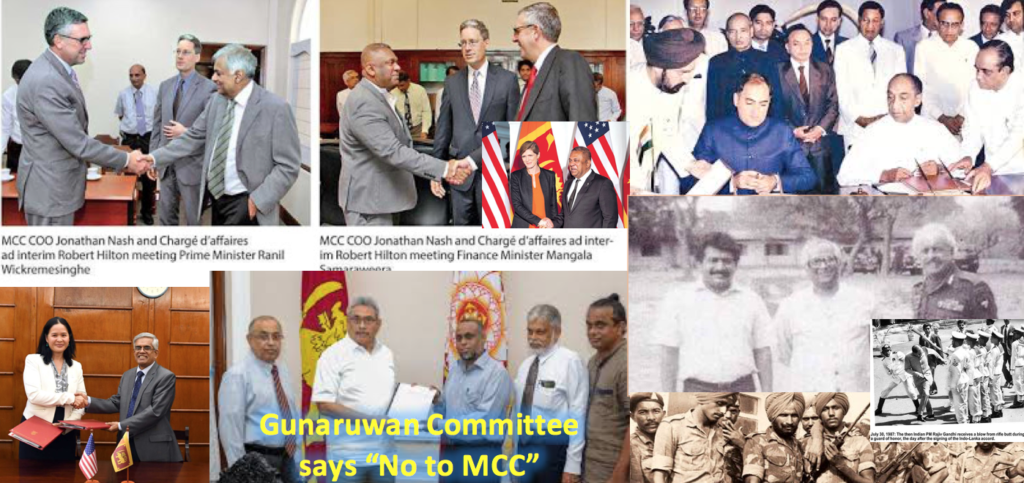
On 29 July 1987 India forced Sri Lanka to sign what became known as the Indo-Lanka Peace Accord that led to the deployment of Indian Peace Keepers. Part of that Accord also required Sri Lanka to tweak its constitution and create an artificial demarcation of land dividing Sri Lanka into 9 provinces under the 13thamendment. IPKF went on to kill Sri Lankans while the 13a has become a burden on the taxpayer and a stepping stone to demanding separatism. That it was enforced by the powerful neighbor ensures political pressure prevails not to repeal it inspite of public protests to do so. A far more dangerous agreement aligned to two other agreements are the MCC-SOFA & ACSA. The dangers of these 3 taken together spells doom for Sri Lanka’s sovereignty & ironically the eventual doom & balkanization of India too. MCC also requires passing by Parliament to turn into domestic law just as 13a was done.Once an international agreement turns into domestic law, the elected government is bound to enforce its contents. We know the adverse impact of 13a – surely we don’t want to nose dive into a bigger catastrophe by not only signing MCC but passing MCC in Sri Lanka’s Parliament.
The root of Tamil militancy & the political ideology behind separatism using asymmetrical federalism as a stepping stone to a separate state are certainly connected not only by a segment in the minority promoting it but by numerous countries & international agencies that supported it for different reasons at different time periods. These links remain despite the demise of LTTE ground terror.
That India provided its land to train Tamil militants is nothing India can deny. That India even supplied arms & training as well as funding for these Tamil militant groups is also nothing India can deny. It was only a decade later that India chose to directly barge in as ‘saviors’ claiming to defeat LTTE and disarm LTTE via the 1987 Accord. India never honored any of the clauses in that agreement signed in July 1987 but India went on to force Sri Lanka to make constitutional changes that divided Sri Lanka into 9 provinces via 13thAmendment & Provincial Councils Act No. 42 of 1987 certified on 14 November 1987.
Both the Sri Lankan Supreme Court & Parliament stands guilty for 13a. When 13a was put to the Supreme Court – 5 out of 9 judges declared that approval by the People at a Referendum was needed (Article 120a) The 5 judges of the Supreme Court that determined 154G(2)(b) and (3)(b) of the Constitution required 2/3majority & a referendum, remains valid (if one or more PCs do not agree a 2/3 majority & referendum is required) Ignoring this Parliament simply deleted requirement for a referendum from the original Bill and passed the Bill without resubmitting to the Supreme Court.
These same dangers prevail if MCC is put to Supreme Court where Parliament can abuse its powers as a Bill becomes law upon certificate of the President or the Speaker and thereafter no court or tribunal can question the validity.
13a thus illegally passed was prevented from being judicially challenged by the People. The same outcome can happen with the MCC which is why the Public are vehemently putting its valid arguments for everyone to understand the dangers and prevent the Government & Parliament making the same mistake done with the 13thamendment.
The Indo-Lanka Accord merged north & east falsely creating a new history. It was nothing but an Indian ploy to secure Trincomalee harbor. IPKF was brought in to disarm LTTE but went on to train other militants and groom another Tamil (V Perumal) to be India’s defacto leader after elections which ended up in him declaring unilateral declaration of independence resulting in the then President annulling the merged Provincial Council & Perumal running off to India for refuge.
A similar scenario is unfolding with the ACSA-SOFA & MCC – US military vessels and aircrafts can use Sri Lanka’s ports and airports for any logistical need, US troops can travel anywhere across Sri Lanka even carrying arms and are exempted from check or legal action for any crime committed, while in the name of development an unlimited number of US personnel, contractors have to be given work visas with tax exemptions and the freedom to bring anything into Sri Lanka & take anything out of Sri Lanka without checking as well as take full ownership of Sri Lanka’s intellectual property rights.
To understand the dangerous impact of the 3 agreements, one has to read all of its clauses. While ACSA and SOFA are bilateral agreements MCC requires Sri Lanka to pass in Parliament & turn into domestic law. Thereafter, it will become no different to 13amendment. Sri Lanka will take on responsibility to implement all of the drastic measures in the MCC on behalf of the US corporates & US government completely ignoring the wishes of the Sri Lankan citizens.
The Indo-Lanka Accord was dumped on Sri Lanka claiming to solve Sri Lanka’s ‘ethnic problem’ – 33 years on Indo-Lanka Accord solved nothing but has created more problems with the PC system & 13a.
The groundwork to force the Accord was subtly orchestrated with a series of attacks, riots and advice that was really meant to defame the armed forces and the state apparatus to build the international justification for foreign intervention. The LTTE onslaughts weakened a military that could not match the military hardware LTTE was using together with the intel provided to them by foreign sources.
MCC is also been dumped on Sri Lanka together with SOFA/ACSA claiming to ‘develop’ Sri Lanka & ‘eliminate poverty’ but only by privatizing state land and turning land into a commodity. We know where this is heading before its even launched – a massive transnational land grab and displacement of Sri Lanka’s populace is the writing on the wall that Sri Lanka’s Parliament (Opposition & Government) cannot pretend to ignore.
The manner MCC surfaced thus has to be looked in the same manner as the Indo-Lanka Accord. It is no secret that wherever US pivots to, jihadi Islamic militants with their ‘Islam’ chants travel with them to cause mayhem. This is how entire Middle East & Africa was destabilized and now it is Asia’s turn.
Unfortunately, India is now a partner of US’s pivot to Asia and the disclosures at the presidential commission on Easter Sunday mass murders certainly raises our doubts as to India’s role together with America jumping to offer MCC as a gift, days after the Easter Sunday attack. The Islamic murderers frequented India often – what exactly were the nature of these visits?
When UNP & JR Jayawardena peddled a pro-West approach in 1978 as did UNP & Ranil since becoming PM in 2001 both erroneously sold the concept of ‘friendship’ with West as sealing developmental assistance. The golden truth however is –every country is only concerned about their national interests not ours while our leaders are trying to help national interests of other countries at the cost of ours!
This cannot continue any longer.
India follows the Panikkar Doctrine (Naval doctrine and Kautilya’s Arthashastra & Mandal theory ‘your neighbor is your natural enemy’) Kautilya craftily created a civil war in Patiliputra & Indira Gandhi went on to do the same. The Islamic terror and Islamic fundamentalism is the winning ploy US will use to become an uninvited guest in Sri Lanka under their brand ‘war against terror’ (killing Muslims & non-Muslims using Muslims) – this is going to be elevated to ‘war against corona’ using the humanitarian card to claim US troop presence is required to protect US national interests & assets. Keep an eye on these developments.
The clauses of the 13a clearly show the advantages India sought to accrue itself. The clauses in the MCC, SOFA & ACSA do the same for US.
Tamil militancy & Tamil politicians were being used to carve out a separate area that India could eventually take over. US has been more strategic, the MCC SOFA & ACSA taken together will not only with time acquire parts of the island, the economic corridor from Colombo to Trincomalee but the entire island with time. This will be made possible if MCC is not only signed but also passed by Parliament which is a pre-condition and key component of the implementation pre-requisite of the MCC.
No Government elected to power by the People can betray the People & the Nation by signing MCC and ratifying MCC detrimental clauses via Parliament as was done with 13a.
Social
scientists and the commentariat have either failed, or deliberately ignored, to
take note of the changes in the surface and subterranean foundations of the
political landscape in the post-Nandikadal period. Our pundits are still
cackling as if we are in the post-1956 period in which the mono-causal theme of
blaming the Sinhala-Buddhists was touted cockily as a sign of being
intellectually superior in public, media and academic discourses. To be
anti-Sinhala-Buddhist was – and still is — the fashion of the day. Digging up
every adverse comment from the dustbin of history was a common technique to
demonise the Sinhala-Buddhists as enemies of the minorities. Every shred of
historical, political, social or economic evidence was corralled and distorted to
argue that the minorities were discriminated by the majority, though the
inhuman role of the Tamil Vellala elite of marginalising their own people as
pariahs was either brushed aside or hidden under the label of Tamil
nationalism.
Down
grading the Sinhala-Buddhist culture, language and religion at the highest
academic levels became a powerful propaganda tool in the privatised research
centres run by pro-Tamil agents (example: International Centre for Ethnic
Studies, headed by Neelan Tiruchelvam and Radhika Coomarasawamy) whose bank
accounts were stacked with foreign funds to hire the academics/intellectuals to
manufacture the anti-Sinhala-Buddhist ideology. Only like-minded ideologues
were invited to participate in their seminars, publications, research etc., to
produce anti-Sinhala-Buddhist consensus. The focus was essentially on the
South. They craftily avoided turning the searchlight deeply into the North
because they knew that exposing the horrendous history of the North, where the
ruling caste of Vellalas who oppressed, suppressed, persecuted their own
people, and even ostracised them as pariahs, would undermine their claim to be
victims of the South. History was a volatile force which had to be managed
carefully to serve their politics. They were determined to sanitize their
narrative by diverting the focus away from the North to make the South look
like the evillest force that bedevilled inter-ethnic relations
The
latest to raise the racist ghost of the past is Dayan Jayatilleka, who is
raving and ranting against the armed Dharmapalas” (i.e., the Rajapakases)
accusing them of dismantling the existing order to establish a militarised
authoritarian regime. He is not saying anything new. He is parroting what the
Saravanamuttus, Savitris and Ismails have been voicing in the post-Nandikadal
period and even before. As a self-professed political scientist, he is expected
to rise above cheap propaganda and analyse of the current situation either as a
Marxist diagnostician, taking into consideration the de-Tigerised politics of
the North in the post-Nandikadal period, or as a public intellectual digging
deep into the new political contours of the nation shifting away from a defunct
Left and self-destructive Right descending into a hell of divisive politics. A
comprehensive analysis would consist of a mix of both. But he is wallowing in
the filth of his own hate politics. Hell hath no fury as Dayan scorned and
denied a lucrative post in the ruling regime!
Today
the political pendulum stands steadily and comfortably at the traditional
Centre which neither the Left nor the Right can challenge successfully. In
fact, there is no Left nor Right to take on the dominant Centre. The Centre has
emerged as the decisive force that would steer the way in the absence of a constructive
and powerful Left, Right and, of course, the mono-ethnic extremists of the
North and the East. All of them are struggling to recover from the massive blow
dealt by the Centre in the last Presidential election. The rise of the Centre
marks the end of the political adventurism and violence of the Left, Right and
the North and the East.
The rise
of the Centre was totally unexpected. It was also so overwhelming that it has
thrown all the other forces into absolute confusion. In the main, the awakened
Centrist force have thrown the Right, Left and the anti-Sinhala Buddhist North
off balance and their main struggle right now is to rise from the vacuum into
which they have fallen and redefine their place in the new political landscape.
The rise of the Centre, packed the with the commanding grassroot forces of our
time, has not only isolated the rest from the mainstream but also left them
derelict, some without leaders, some without a vision / alternative, and some
without a future in sight. Sri Lanka has stepped in emphatically, decisively
and loudly into that global trend that, for instance, went to make Hindutva
Modi in India, and America Great Again” – minus menacing Covid-19.
Managing
the success in the face of the daunting Coronovid-19 and its economic
consequences is the task ahead. But, politically speaking, the victory has
ushered in a new phase in which the reinvigorated grassroot forces had risen
determinedly to reject the attempts of the misguided neo-liberals to reverse
the natural flow of history. Rewriting the Constitution was an attempt to
rewrite history. The entire Parliamentary process was manipulated,
doctored and debased by the Right to legalise the robbing of the rights of the
people in the name of the rights of a few who had done their worst to destroy
the nation. Yahapalanaya politics was a foul exercise launched and pursued by
the neo-liberals to go against the will of the people. And when the time
came the people gave the neo-liberals the reply they deserved. The Right went to
destroy the people and the people turned on them and destroyed the irrelevant
neo-liberals.
The will
of the people expressed in the last Presidential election stunned the pundits
whose political calculations never predicted the massive swing to the Centre.
This swing was the definitive reaction to the extremist Right-wing forces
hijacking history to serve their disruptive and unsustainable political ends.
Ranil Wickremesinghe, the most manipulative and active representative of the
Right, made the cardinal mistake of trying to swim upstream and, in the
process, he has killed not only his prospects but the future of the Right as
well. Never in the history of post-Independent history has the Right fallen to
the depths of near extinction as it is today.
The
collapse of the Right is a phenomenon that had never occurred even when its
Parliamentary popularity was reduced to eight seats in 1956. Despite that the
UNP held together at the grassroot and organizational levels, with respected
and formidable leaders in command of the Party. Even in the big crisis when the
two giant elephants (Dudley and JR”) fought, the Party did not go to pieces.
The cleavage today is so wide that there is no political bra big enough to hold
both segments together.
Today
the UNP has neither the leaders nor the hard-core base which is split right
down the middle. The going down of Ranil will be welcome by most, including his
Party loyalists. And when the new Parliament meets after August 5th Ranil will
limp his way to his seat with a depleted following who are most likely to
decamp to either Sajith or Mahinda Rajapakse, unless, of course, both parties
decide to unite. The end of Ranil’s grip on the UNP marks the death of his
misguided pro-West, anti-national Right-wing politics. If the Rajapaksa
brothers are to be compared to Bandaranaike of 1956” then it is fair to
compare Ranil as the alienated, out-of-touch, vilified Sir. John of our time.
The Right will be a write-off as long as Ranil Wickremesinghe hangs on to Sri
Kotha – the last resort of the vanishing breed of ageing elephants who had lost
their tusks.
The next
option in national politics is to turn to the Left but it is rather difficult
find a political animal by that name. It has been a force that has been
splitting like the amoeba into sub-atomic particles from its birth. The irony
is that that the last of the Marxist revolutionaries are abandoning the Left
and rushing to join the decadent Right committing hara-kiri aided and abetted
by Left-wing theoreticians like Victor Ivan and Dayan Jayatilleka. On the one
hand, the Vikrama Bahu” revolutionary has joined the Ranil-wing of the Right
and, on the other, Dayan Jayatilleka, the leading Marxist theoretician, has
joined the Sajith-wing of the Right. Post-Nandikadal politics has certainly
taken a bizarre turn with no-hopers of the Left embracing the coffined corpses
of the Right.
Where do
we go from here? Whether we like it or not, even a cursory glance at the
national scene indicates that the last remaining point of sanity and stability
is in the Centre. It has risen unequivocally as the will of the people and
there is no alternative to it now. The clarity of the will of the people has to
be factored in for the nation to calculate its next moves. It is into this
political framework that the North comes in as the orphaned victim of the
de-Tigerised politics of the post-Nandikadal peninsula.
The
militarised, fascist de facto regime of the Tigers had gripped the North so
comprehensively and obsessively that the unexpected fall of the invincible”
Tiger regime has left the North in a political vacuum. No one in the North had
to make decisions under Tiger regime. All decisions were made for them at the
top and there was space only for the Tamils to follow the Thalaivar”
obediently if they had any ambitions of seeing the sun rising the next day.
That was the easy part. Now the heavy burden of making decisions has fallen on
the tired, old leadership which is clueless and wandering in the new and
dizzying complexities without a compass.
They are
drifting between two worlds, one dead and the other struggling to be born. They
are in transition. They are torn between the past which began with the
Vadkoddai Declaration of War in 1976 and a future of peaceful co-existence in a
de-Tigerised democracy, however infirm it may be. Despite their braggadocio and
bravado, it is dawning on them that they had come to end of their tether. They
have run through all options from the time S. J. V. Chelvanayakam launched his
Federal Party in December 1949 at the Government Clerical Service Union in
Maradana and not in Jaffna, which is supposed to be the heartland of the
Tamils. Since then they had tried (1) confrontational politics with
satyagrahas, (2) parliamentary manoeuvres and negotiations, (3) partnership
with what they called the Sinhala-governments”, (4) waging war after the
Declaration of War at Vadukoddai in 1976, (5) regional pressure through India,
(6) international pressure through the Tamil diaspora, and (7) establishing
even a de facto state exhausting practically all options to achieve their
elusive Eelam. All of which ended eventually in Nandikadal.
So isn’t
it time for the North to sit down and take a hard look at the journey they had
taken, following the footsteps of Chelvanayakam, and consider seriously what
other options/opportunities they have in their next mission of figuring out
what is achievable and where they are likely to be in the next five, ten,
fifteen years, or, for that matter, all the time available in history? The most
obvious question facing them is to consider whether their future is in going
back to Vadukoddai and take the same road to Nandikadal without a Prabhakaran
to lead the way?
In
working out answers to these and other questions the Tamil leadership should
keep in mind (1) whether Vadukoddai violence will work for them internationally
in this age anti-terrorism; (2) whether they can match the military might of
the Sri Lankan forces that won at Nandikadal; 3) whether the peninsular
dynamics that motivated the Vadukoddai Resolution are operative now to mobilise
the Tamils into another round of mindless violence?; (4) in the new global
order where China is a stakeholder in the Indian Ocean whether India can step
in arbitrarily and arrogantly to play the role it played under Indira and Rajiv
Gandhi?; (5) whether the Tamil leadership is willing to pay the bloody price
required to gamble with violence without any guarantees of victory?; and (6)
whether they would like to live in another Kashmir or Palestine with everyone
tut-tutting at the never-ending tragedies while the privileged Tamils migrate
to greener pastures exploiting the suffering of their fellow-Tamils left
behind?
In
reviewing all these issues, the Tamil leadership should remember that that
their ageing predecessors were the first victims of the violence they unleashed
at Vadukoddai. They armed and encouraged the youth to take the gun and when
they began to run amok with the new toy in their hands it is the Founding
Fathers of the Vadukoddai Declaration that were decimated first.
The
violence of all three communities that shook the nation from time to time had
the following common characteristics: a) they were motivated by ideologies that
led to fascist and brutal violence b) the guns and bombs were used by immature
youth who fancied that they had the solution to the problems facing them and
the nation at large; (c) none of their violent experiments succeeded. All of
which leads to the ineluctable conclusion that there is no future in
intransigence, dogmatic blindness, political extremism, experiments of the
failed past and, above all, violence.
We are
right now left with only a dead Left, moribund Right, a distraught and derelict
North and a wobbly East. The only viable and the positive option is the
promising Centre. It is inevitable that the North+East+Right+Left (NERL) forces
will have to negotiate with the Centre if they and the nation are to go
anywhere. August 5th will confirm that there is no alternative to
the Centre. The future of depends on how NERL will negotiate their way to their
separate or collective comfort zones with the Centre.
The
Presidential election have been fought, and the Parliamentary elections are
being fought, to test the limits of the power of the NERL competing with the
Centre and vice versa. The unprecedented power that will be vested in the hands
of the Centre (after the Parliamentary elections) will define the parameters
within which both the Centre and the NERL can operate in seeking their separate
goals.
The
impending competition of the Centre vs. the NERL — of course, after the
Parliamentary elections — need not be hostile or an intransigent power
struggle for one power bloc to dominate the other. In the behind-the-scene
bargaining there will be ample room for compromises. In between, there will be
a lot of grandstanding by the NERL to claim that they can do better than the
Centre. That is the name of the game. The reality is that no one – I repeat, no
one — can do better than the other in a world conquered by Covid-19. Admitting
and accepting this inevitability imposed by Covid-19 is the first step to
economic recovery – the prime necessity that must be prioritised in the
national agenda. There is a time for politics but this is not it. Economics
must be given the same priority at Coronivd-19. NERL cannot win either on
Covid-19 or on Article19. Both must be treated as equal partners.
In the
post-Nandikadal phase the Centre has come to stay. NERL , if it fails to
recognise the new realities, can either pray or bray.
The election to be held
on 5 August 2020 on all counts appear to be a lack lustre event. The Sri
Lankans are generally used to massive media campaigns, bill boards, cut-outs
and public rallies accommodating hundreds of thousands of supporters.
These campaigns have
energised the political parties and its leaders whilst providing much needed
euphoria as a solid return on investment on cost of media blitz. These
propaganda activities also provided stiff competition, encouraging larger voter
turnout on the election day.
The covid 19 has
virtually killed the Sri Lankan style of electioneering. To make matters
worse, the oldest political party, the United National Party is split, making
traditional UNPers to look for Elephant symbol after a long time wanting to
vote for the UNP, but likely to cross UNP as the preferred party, but painfully
looking for Sajith Premadasa’s candidates with the Telephone and vice
versa.
With a low turnout expected
as a result of above factors, this election most likely to record a high percentage
of rejected votes, as a consequence of Elephant and Telephone.
The following popular
political personalities are unlikely to win a seat at the election: Rev
Athureliya Rathana, Sujeewa Senasinghe, Ravi Karunanayke, Patali Champaka
Ranawaka. Hirunika Premachandra, Anura Kumara Dissanayake, Duminda Dissanayake,
Weerakumara Dissanayake, Ranjan Ramanayake, Arjuna Ranatunga, Vijitha Herath,
Chandima Weerakkody, Palitha Ranga Bandara, Kumara Welgama, Sarath
Fonseka, Rajitha Senaratne, Chathura Senaratne, Ajith P Perera, Palitha
Thewarapperuma, Dayasiri Jayasekera, P Harrison,
The following forecast
was prepared taking into account above limiting factors, with a margin of error
of +/- 3%. The newly formed SLPP is likely to secure a tight
2/3 majority.
SLPP
UNP/SJB
TNA
CENTRAL PROVINCE:
KANDY
8
4
MATALE
3
2
NUWARAELIYA
5
3
EASTERN PROV.
BATTICALOA
1
4
DIGAMADULLA
4
2
TRINCOMALEE
2
1
1
NORTHERN PROV.
JAFFNA
1
1
5
WANNI
2
4
SOUTHERN PROV
GALLE
9
1
MATARA
7
1
HAMBANTHOTA
6
1
WESTERN PROV.
COLOMBO
13
6
GAMPAHA
15
3
KALUTARA
8
2
NTH WEST. PROV
KURUNEGALA
13
2
PUTTALAM
5
3
NTH CENTRAL PROV
ANURADHAPURA
8
1
POLONNARUWA
4
1
UVA PROV.
BADULLA
6
3
MONERAGALA
4
1
SABARAGAMUWA
RATNAPURA
10
1
KEGALLE
8
1
TOTAL TO BE
ELECTED
142
40
14
196
NATIONAL
LIST
21
6
2
29
GRAND TOTAL
163
46
16
225
PERCENTAGE SEATS
%
72%
20% 8%
The
Sajith Premadasa camp may secure 28 seats as against Ranil to settle down for
18 seats.
The 2020 General
Election is upon us. It is time the success at the Presidential Election in Nov
2019 is carried to its logical conclusion. We thank the patriotic forces of Sri
Lanka for electing Gotabhaya Rajapakse the 7th President of Sri
Lanka with a handsome majority. This victory has cast into disarray the dark
forces that conspired to make Sri Lanka our Motherland a Failed State at the
behest of Western Christian Powers. Today the very fires of hatred that were
directed to destroy our Motherland are destroying the unpatriotic political
entity the UNP from within! It stands divided, quartered and consumed by the
very fires it lit to destroy Sri Lanka and make it a failed state vulnerable to
Big Power intervention. The UNP, together with the SLFP rump that aided and
abetted the traitorous UNP are slowly marching towards political oblivion
However, it is now
left for the patriotic forces to give a resounding blow at the 2020 parliamentary
election and destroy the UNP and possibly the SLFP for good. These two geriatric political parties though
brought into existence on lofty but impractical ideals, have over the years, failed
live up to their promises – to bring peace and prosperity to the citizens of
Sri Lanka. THE ONLY THING THAT THEY DID FAMOUSLY IS TO DIVIDE THE SINHALA
POLITY IN THE MIDDLE into two ‘dog eat dog’ political parties that failed the
majority Sinhala Buddhists miserably.
Together they have impoverished Sri Lanka, made politics in Sri Lanka
the most corrupt in the region and the corrupt politicians rich and powerful.
They also brought in the minority racists and religionists to the fray and made
them kingmakers of Sri Lanka. The end result is for all to see – our past
political history- the machinations and the deleterious effects of the doings
of Chevanayakam, Amirthalingam, Sambandan, Thondaman, Ashrofs and now Hakeem,
Mano Geneshan and Baithuddeen and add to this the Senanayake, Bandaranaikes,
Jayawardeen, Premadasa and Wickramasinghe.
Rajapakses became the
architects of winning the Tamil Tiger Terrorist War but failed to consolidate
the war gains. Winning a war is not winning
just the battles – it includes maintaining the peace. This is the reason the
victorious Allies are still stationed around the world in strategic
locations. Mahinda Rajapakse failed in this score because he misread
history. Withdrawal of Armed Forces from strategic locations in the North and
East was a sign of weakness and the slippery road back to ‘giving little now
and more later’ failed policy of yesteryear. No one within Sri Lanka or outside
should dictate where Sri Lanka’s Armed Forces should be present or not. Then
Army Commander – Sarath Fonseka’s assertion to increase the army was in fact
correct strategically as it takes more to maintain peace than fight wars. It
took 30 years to finish off the war because we did not have enough soldiers to
keep and defend the peace in the liberated areas! Finally, the war was won, because
the President Mahinda Rajapakse took a firm stand, the then Defence Secretary
and now the President Gotabhaya provided the necessary manpower and war
logistics to hold onto and defend liberated areas while prosecuting the war
elsewhere.
While basking in the
glory of winning the war he neglected the immediate aspirations of the people
and ran roughshod over the economy making large scale investments – some
absolute necessities for a middle income nation and others that could have been
done at a more leisurely pace without entrenching the country in a debt burden.
Moreover, he failed to market these projects among people giving clear cost
benefit projections and getting those projects to bear fruit or to give a
realistic plan and time scale to make them work. In the process and quite
inadvertently Sri Lanka has now become the playground for the Big Powers trying
to divide Sri Lanka between themselves. Then he lost his Presidency in 2015
with disastrous results for Sri Lanka and five years of unending political
darkness!
AFTER 70 YEARS WHAT THE NATION NEEDS IS TIME AND
SPACE TO MOVE FORWARD AS ONE NATION LEAVING BEHIND THE ENMITY AND DIVISIVENESS.
FOR THIS TO HAPPEN THE UNITY OF THE SINHALESE IS PARAMOUNT. MINORITY POLITICS
AND THEIR ASPIRATIONS WILL NEVER SEE THE LIGHT OF DAY WITH ONLY HALF OF THE
SINHALESE AGREEING. THIS IS WHY THE UNITY OF THE SINHALESE BE THEY UNP OR SLFP IS
OF PARAMOUNT IMPORTANCE FOR THE GOOD OF ALL CONCERNED, MINORITIES INCLUDED.
What ailed Sri Lanka
during the last 70 years is the constant demands of minority Shylocks asking
for their pound of flesh and more. In their own words, it was and is – Little
now and More later! Even as we speak, these forces are at play 24/7 finding
ways to keep Sri Lanka destabilized and poor. Their ultimate goal is to make
Sri Lanka a Failed State a country to be preyed on. Sri Lanka lost hundreds or
even thousands of valuable opportunities to forge ahead because of the minority
destabilization of the country. Many a potential investor went elsewhere
because of the ground situation in Sri Lanka.
Their incessant
efforts in cahoots with Western Christian Powers bore fruit in Jan 2015. Yahapalanaya
– which was a misnomer from its inception, just like Dhramishta Samajayak of
traitor chief J R Jayawardene. Yahapalanaya came into power on a platform of eliminating
corruption. From what transpired later it is now obvious what they had in mind
all along. Within seven weeks of their coming into power the first bond scam
took was unleashed on the people of Sri Lanka.
FROM HIND SIGHT, IT
IS CLEAR THAT RANIL AND HIS COHORTS PLANNED THIS BANK HEIST LONG BEFORE THE
PRESIDENTIAL ELECTIONS OF JAN 2015. ALL THIS WAS CLEAR FROM THE WAY HE SET IN
MOTION THE INTERMEDIATE STEPS NECESSARY FOR THE CENTRAL BANK BOND SCAM. GETTING
HIMSELF APPOINTED PRIME MINISTER, TAKING OVER PART OF THE FINANCE MINISTRY THAT
INCLUDED THE CENTRAL BANK, GETTING ARJUN MAHENDRAN APPOINTED AS THE GOVERNOR OF
THE CENTRAL BANK WHILST HIS SON IN LAW WAS A PRIMARY DEALER HIMSELF. MANY THINK
THE ‘HEIST’ TOOK PLACE BY CHANCE ON 26 FEB 2105 AND THAT IS THE IMBECILIC FOLLY
OF THE ORDINARY SRI LANKAN! THIS WAS FOLLOWED BY THE SECOND CENTRAL BANK HEIST
AT AN EVEN LARGER SCALE AN YEAR LATER IN MARCH 2016! WITH YAHAPALANAYA TAKING
OVER REINS OF POWER, ITS MAIN TASK WAS TO COMPLETE THE TASK OF MAKING SRI LANKA
A FAILED STATE. COMPROMISING FOOD SECURITY, NATIONAL SECURITY, ECONOMIC
SECURITY INVOLVING BOND SCAMS, HIGH TAXATION, HIGH INTEREST RATES, DESTRUCTION
OF THE PLANTATION SECTOR ECONOMIES AND FINALLY THE IMPORT DEPENDENT FAILED
STATE THAT WOULD BE VULNERABLE FOR ECONOMIC SANCTIONS. THE ATTEMPT TO CHANGE
THE CONSTITUTION WAS THE FINAL MASTERSTROKE TO MAKE SRI LANKA A VASSAL STATE OF
THE USA. THESE ARE TO BE FOLLOWED BY ACSA, SOFA AND MCC AGREEMENTS TO MAKE SRI
LANKA THE PRESENT DAY OKINAWA OR PANAMA – A VASSAL STATE OF THE SUPPOSED TO BE ‘THE ONLY
EXCEPTIONAL NATION’ IN THE WORLD TODAY – THE USA.
Patriotic UNPers and
SLFPers should see this reality and leaving aside their petty differences unite
to save Sri Lanka. The horrors of Easter Sunday attacks would not have come about
if not for the criminal negligence and neglect of the Security Apparatus in Sri
Lanka by the government led by Sirisena and Ranil. If they had any self-respect
they should have resigned their posts in the immediate aftermath of the
attacks.
This why they all
must join forces under Pohottuwa, not because it is the best, but because it is
the ‘nearest to best we can conceive of’, the ground reality and the only existing
common place where all from different political hues can gather and unite to
end once and for all the tyranny of Minority Politics. We must be in a position
to muster a 2/3rd majority to bring about the necessary
constitutional changes as well as provide for reasonable minority demands that
do not infringe on the security, wellbeing and continued existence of Sri Lanka
as a separate, unitary and independent political and geographical entity south
of the Palk Straits!
It is time, all those
well-meaning Tamils and Muslims leave the divisive politics and join the
mainstream to achieve their realistic aspirations. Division of the country into
Islamic fiefdoms or giving land and police powers to Eelamists is no way to
achieve lasting peace in Sri Lanka. Sri Lanka simply does not have space nor
the security measures necessary to entertain such wishful thinking that only
bring luxuries to a selected few and keep the majority mired in perpetual misery!
Any resulting borders drawn will result in unending enmity and conflict. I am
sure this is not any peace-loving citizen of this country aspire to – be they
Sinhala, Tamil or Muslim!
It is time, Sinhalese
of all hues, be they UNP, SLFP, Buddhist or Christian unite behind Pohottuwa to
take the country away from the ‘dog eat dog’ politics of yesterday and today, for
together we can prosper as a nation. It is time the Sinhalese demanded from
Pohottuwa that it cannot be ‘Politics as Usual’ as it used to be. It is time
they got rid of the useless riff-raff, the traitorous, self-serving and the
bribe-taker lot among them and move forward with only those who can be trusted
to make way for progress. Pohottuwas must leave space only for the best in the
SLFP, the UNP and those among minorities who aspire to prosper together with a
common consensus. Pohottuwa also must take heed of the agendas put forward by
the Vikalpa groups for they too have a message that is relevant to the
immediate needs of the nation. PRESIDENT GOTABHAYA MUST BE ALLOWED UNHAMPERED
FREEDOM TO FORM THE BEST TEAM OF MINISTERS AND CABINET MEMBERS FROM AMONG THOSE
ELECTED DISREGARDING PETTY POLITICS.
Other nations such as
Malaysia and Singapore sorted similar problems right at the beginning of their
independence from Colonial Powers. This is why these countries prosper and Sri
Lanka not! Big and powerful nations respect their strengths and politics!
UNLESS THE SINHALESE
UNITE AS ONE, BECOME SELF SUFFICIENT IN THEIR BASIC NEEDS AND SECURITY. THERE
IS NO SOLUTION TO THE MINORITIES. THIS IS THE MOST FUNDAMENTAL TRUTH BEHIND
POLITICS IN SRI LANKA. This is what ailed Sri Lanka for the last 70 years. This
is what led to 1971, 1989 and the 30-year Racist Eelam War and just recently
the Easter Sunday Attacks by Islamists! It is only the United Sinhalese who can
accommodate those peaceful intentions of the minorities and take the nation
towards progress! No solution or agreement, call it what may, provided by 50%
Sinhalese will stand the test of time!
The
so-called International Community!
The
so-called International Community are at the door calling for ‘democracy and
human rights’. This bogus cry is now
seen to be fake. This has been the Big Power strategy to castigate less
powerful nations in to submission. Over the years these empty ideals not
practiced by themselves have led to – Black Lives Matter, We Can’t Breathe –
slogans in their own countries. It is this system of governance that made the
1% own the 99% of world’s wealth. It is these very strategies that are now
failing before the Corvid-19 onslaught. The so called Big Powers who sent their
‘knights in shining armour’ to the ends of the world to fight for democracy and
human rights are now looking askance, having failed to provide the minimum
standards of health, safety and hope to their own citizens! Shame on them for
the Trillions they spent on developing arms to destroy the world and their Military
Industrial Complexes.
They
would rather make Sri Lanka unstable, divided, a failed state and divide the
spoils rather than try to negotiate with a weak state. On the other hand, they
would support a country that is strong politically and militarily. They say Nature
abhors a vacuum and so does politics. They are onto Sri Lanka because they find
Sri Lanka divided, unstable and vacuous. Western Christian Nations led by the
USA need Sri Lanka as a staging post for their INDO-PACIFIC military strategy. Ranil
has been tasked to make Sri Lanka a Failed State and he nearly accomplished
that during the last 5 years. MCC COMPACT WAS TO BE THE FINAL COUP DE GRACE TO
END ONCE AND FOR ALL THE INDEPENDENCE OF SRI LANKA!
We
must provide India the security she needs south of the Palk Straits! It is only
a strong Sri Lankan military which can provide this assurance and not a weak
Sri Lanka! Senior Indian politician Subramaniam Swamy put it succinctly – We
can trust the words of Rajapakses. They are a strong team and we can depend on
what they promise”.
Time
is of the essence, let us learn from Jan 2015 and not bungle it this time! All
patriots, be they UNP or SLFP, or from minority communities, all who wish well
for Mother Lanka, unite behind Pohottuwa! President Gotabhaya Rajapakse led
Pohottuwa is the only practical alternative to all others who are in the fray
contesting Parliamentary General Elections on 5 August 2020. They are the better
team who has a chance to make Sri Lanka great again! Ranil Wickramasinghe and Sajith Premadasa are
spent forces. They are not worth spending time on!
THIS
IS WHY POHOTTUWA SHOULD BE GIVEN AN OVER 2/3 MAJORITY IN PARLIAMENT TO ENACT A
NEW CONSTITUTION THAT WILL ENSURE THE FUTURE OF SRI LANKA AS A UNITARY,
UNDIVIDABLE AND SOVEREIGN, POLITICAL AND GEOGRAPHICAL ENTITY IN THE EYES OF HER
CITIZENS AS WELL AS IN THE EYES OF THE WORLD!
The development comes as a relief to Sri Lanka amidst COVID-19 and will help in its post-pandemic economic recovery. A currency swap is a transaction in which two parties exchange principal and interest in different currencies.
India and Sri Lanka on Friday agreed for US $400 million currency swap agreement. The agreement signed by Reserve Bank of India extends the swap facility for Sri Lanka till November 2022.
The development comes as a relief to Sri Lanka amidst COVID-19 and will help in its post-pandemic economic recovery.
A currency swap is a transaction in which two parties exchange principal and interest in different currencies. Companies doing business abroad often use currency swaps to get more favourable loan rates in the local currency than if they borrowed money from a local bank.
For example, if Sri Lanka borrows Rs 100 from India and promises to repay Rs 100 in Indian currency but interest in dollars or vice versa, both parties benefit by hedging against interest rates.
Both countries are currently engaged in debt repayment rescheduling talks. On July 22, the last round of technical discussion was held on the rescheduling of bilateral debt repayment by Sri Lanka. The Indian delegation comprising of senior officials from the Ministry of External Affairs, Ministry of Finance, and the EXIM Bank interacted with representatives from the Department of External Resources of Sri Lanka through a video conference.
A release from the Indian mission in Sri Lanka said, “The next round of technical discussions between the two sides on the rescheduling of debt repayment is expected to be held soon.
Sri Lankan President Gotabaya Rajapaksa had spoken to Prime Minister Narendra Modi on May 23 in which the former requested Indian government to provide USD 1.1 billion special swap facility to top up USD 400 million under SAARC facility amidst the COVID pandemic.
Dilhani Dissanayake wants everyone to know a cinnamon peeler is actually a person and not a tool.
Key points:
Cinnamon comes from the inner bark of a tree and is a spice native to Sri Lanka
The spice was discovered by the Portuguese in the 16th century and later commercialised by the Dutch
Cinnamon peelers have performed the labour-intensive task of skilfully peeling the spice, historically under brutal slave-like conditions
She has been so passionate about her own cultural history she completed her PhD thesis on the history of the cinnamon peelers in Sri Lanka.
Dr Dissanayake says the popular spice is native to Sri Lanka and is part of the country’s cultural identity.
“It’s come to represent Sri Lankan culture and its people’s identity,” she said.
A person and not a tool
Dr Dissanayake said cinnamon began being used in Sri Lanka as a traditional Ayurvedic medicine before it was used as a spice.
It has been harvested for centuries by peeling the inner bark of several trees of the same species and then processed as quills or powder.
Dr Dissanayake’s thesis explores this history with a particular emphasis on the often neglected figure of the cinnamon peeler.
“No-one talks about the hardships and the sacrifices the peelers made to get that product to market,” she said.
“Cinnamon peelers were among the agents who expanded Sri Lankan culture beyond the island’s shores.”
The peelers have been an intrinsic part of the labour-intensive processes for centuries with the skills often passed on between generations.
Sri Lankan Ceylon cinnamon is considered the “true” cinnamon.(Supplied: Dilhani Dissanayake)
Dr Dissanayake said on average it took about five to seven years to perfect the skill of peeling cinnamon.
“The peeling process is really intensive and relies on local knowledge, expert skills, dexterity and patience,” she said.
During Sri Lanka’s pre and colonial era, peelers were from the lowest Sinhalese Salagama caste.
When the country came under Dutch rule in the mid-1600s, after seizing control from the Portuguese, the Dutch took control of the prized spice by commercialising the industry through the creation of plantations and often brutalised workers.
“They had their ears cut off and were confined in chains and also whipped and branded,” Dr Dissanayake said.
Popular spice has lesser known history
Dr Dissanayake said she was at a Bendigo-based event where local Indian people were speaking about their culinary culture when an Australian friend asked her whether cinnamon was a seed, fruit or flower.
“I was shocked to hear my friend knew nothing about it, although it is tasted in many foods, like donuts, cereals and curries,” Dr Dissanayake said.
The experience inspired Dr Dissanayake to pursue her PhD at La Trobe University in the history of the cinnamon peelers.
Dr Dissanayake wrote her PhD on the history of cinnamon peelers.(Supplied: Dilhani Dissanayake)
Dr Dissanayake and her husband first came to Bendigo so she could study a Master of community planning and development seven years ago.
“I really didn’t know anything about Bendigo, we didn’t have any friends here, no relative, and here we were in this strange climate,” she said.
“Now I know lots of people and I’m really glad we are here.
“To be somewhere where the same people greet us every day, that makes it feel homely.”
World’s largest exporter
Whereas Sri Lanka once monopolised the trade of cinnamon, it has become only the fourth largest producer globally, but has remained the world’s largest exporter of the popular spice.
Cinnamon is now grown in many parts of Asia and other tropical climates, with Indonesia now the world’s largest cinnamon producer.
Dr Dissanayake said there were two types of commercial cinnamon; Ceylon cinnamon, which was native to Sri Lanka, and the cheaper cassia cinnamon, primarily produced in Indonesia.
“Sri Lanka has the true cinnamon,” she said.
Dr Dissanayake said today workers continue to manually peel cinnamon, despite attempts by government to mechanise the process with machines.
A: I have never held the position of National Organiser.
But, you are referred to as such?
A: No, I have only conducted the creative work of the party. Mahinda Rajapaksa has functioned as the leader of our party.
Haven’t issues pertaining to election laws and regulations come to the fore?
A: I am not the main representative. In the past, I was entrusted with the job of looking into the needs of the public.
But, didn’t any issue emerge in this connection at that time?
A: There was no necessity for the emergence of such issues. If we could have formed a Government, taking a post was not a problem. We care not afraid of those internal issues among some.
The Chairman of the Election Commission said at the time that you, after resigning from your post as the party National Organiser, had proceeded to perform your duty in the COVID-19 Committee?
A: Yes, I left that post. But, I did not do any political work at the time. From the moment nominations for the August Poll had been submitted I had left that post and did my work. As a person who upholds the respectful style of work I resigned from my post and did my duty devoid of party politics.
What is your current role?
A: Now my main task is to work towards the victory of the SLPP-led alliance at the coming Polls. Now while being engaged in party politics I have taken a break from State duties. That is not because of the law but due to my personal policies.
The SLPP is demanding a two-thirds majority at the August Poll, to introduce new amendments to the Constitution. What are these new amendments that you propose to introduce?
A: The Constitution that was formed in 1972 did not last that long. The 1976 Constitution that was changed by JR also became a radical one. That Constitution was created based on the Executive Presidency. That constantly underwent changes during various Governments. The biggest such change was the 13th Amendment to the Constitution. That was not established by even the politicians. That was given to us by a foreign power by force. Then, till up to the 19th Amendment to the Constitution several plasters had been pasted on this Constitution. Dr. Wijeyadasa Rajapakshe, who was in that Committee which proposed that Amendment, is now claiming at public rallies, that the 19th Amendment that had been finally adopted is not what they had formulated initially. We are of the concerted view that the entire Constitution has to be overhauled.
Isn’t it your task to enlighten the masses before the Poll on what these new Amendments, that you intend to introduce to the Constitution, are?
A: We have already alluded to it, but we cannot explain everything at public rallies. Especially a new Constitution that guarantees a unitary State has to be enacted with the necessary changes to the current electioneering system. And this has to incorporate all ethnicities living here. First and foremost the franchise of the people has to be guaranteed through the formulation of a new Constitution.
The Opposition has alleged that the Government is demanding a two-thirds majority at the coming Poll to sign controversial Pacts such as MCC. Actually, what is the stance of the Government regarding the controversial Pact?
A: To sign the MCC Pact there is no need for a two-thirds majority. They had signed the MCC Pact. Our national resources have also been sold. To do those things under the then UNF-led regime they never sought a two-thirds majority.
We will never sell our national assets. And, we will never allow those who sell national assets any room. It has always been a UNP Government that sold national assets. It is recorded in history that the Rajapaksa Government always safeguarded the country’s sovereignty, independence and national security.
At the previous Presidential Poll you promised that totally new representatives will be fielded at the General Election. But, majority of the contestants are those who have been implicated in criminal, corruption, fraud, wastage and similar cases like illegal sand mining, those importing ethanol etc. How can the public anticipate a radical change from the SLPP?
A: If not for sand mining how can houses be built in the country? If not for soil how can the roads be constructed. The people still consume ethanol. The majority of ethanol in this country is produced at the Pelawatta and Sevanagala factories and sugarcane farmers are noted for earning high revenues through it.
I am going to ask again, should those against whom the aforesaid charges are levelled be sent to the Parliament?
A: It is up to the people to select the most suitable out of the lot at the end of the day. There is some form of opposition to get rid of the preference vote system introduced by J.R. Jayewardene. If any political party has fielded unsuitable politicians at an election then it is up to the voters to reject such people.
Then what is your view regarding charges directed at some over misusing public property?
A: Most such allegations are only canards spread by their rivals. Even I had been charged with distribution of GI pipes and I have never even seen those pipes. I was charged with misappropriation of State property. I am still going to the Court and I also go to the Police Station to sign documents. The charges directed at me have not even been levelled against a criminal. These charges are wholly unjust and I know for a fact that I have been politically victimised. However, I have the implicit trust in the Judiciary.
One of the contestants from your party recently claimed that the SLPP has fielded even horses and donkeys at the Poll. What is your comment regarding that statement?
A: I do not know whether we have given nominations to any horses or donkeys. But, some in the nomination board may have been. I request not to use the names of animals to describe such persons as it would be highly disrespectful for the animals concerned.
Several members from the Rajapaksa family are contesting the election this time. What is your comment on that?
A: It is that same franchise exercised by the voters that catapulted another Rajapaksa to the Presidency last year, and another one to the Premiership. I also do not think that there is any new Rajapaksa in this election. Nobody is saying that he withdrew. It was only Gotabaya Rajapaksa who came to the post of Defence Secretary. But, now he happens to be the President with the majority consent of the people of this land.
There was renewed hope that once Gotabaya became the President that he will create a country where all will be treated equally before the law. But, some claim that this has not happened?
A: Tell me where the law has treated citizens here differently. I am yet to come across such incidents. It may be the case for those who look at everything from an racist point of view. But, today the law is treating all equally in this country. The President has shown this through his exemplary conduct. He has taken off his security. If he had not taken it then it is wrong. He does not travel abroad willy-nilly and his office has not been overstaffed. As he said there is no poster campaign in his electioneering work. Therefore, show me examples of where the law has treated people differently under the President’s watch.
As an example, after the 13th century historic building in the Kurunegala District was bulldozed, where the Buwaneka Hotel was situated, a Minister claimed that he would never allow anyone to lay a finger on the Kurunegala Mayor. Isn’t this clearly an instance of politicians taking the law into their hands?
A: differently If I were to express my views on it then I cannot be biased or I cannot even be unbiased. Just like the earlier issue regarding horses and donkeys I intend not to take sides on this incident. Let the people decided on it at the election. The President, PM, the party and I myself, have taken a firm decision not to air any comments that could be either advantageous or disadvantageous to our contestants. But, my belief is that it would be better if we could eschew such statements. It is more than sufficient for the people to think in which direction this Government is heading looking at the work performed by the caretaker regime in the past eight months. Some of the pressing issues tackled effectively by this Government have been the curbing the COVID-19 pandemic spread which has been exemplary in the world, and the operations to bust illegal drugs and acts of crimes along with the silencing of the underworld. Also the measures that have been taken on behalf of the farming community have to be highlighted. The best yardstick of this Government’s efficiency is how we sent essential services to people’s doorstep during the lockdown period. The Government for the first time intervened to purchase harvests. The difference between this regime and the previous UNF-led regime is there to be seen for all. The previous Government struggled to look into the plight of people affected by the Salawa ammunitions blast, Mawanella earth slips, the collapse of the Meethotamulla garbage mound etc. A sum of Rs. 5000 was given to over 7 million families affected by the crisis situation brought about by the COVID-19 pandemic. Try to see the difference.
What was the delay in the issuance of the Gazette Notification containing the health guidelines to be adopted at the 5 August General Election? Was it finally issued for the sake doing so?
A: Usually the Gazette was not delayed and it was issued at the right time.
Though a Gazette Notification was issued there is no official to implement its recommendations. Hence is there any use in its publication. Why are the PHIs, not granted the necessary powers to carry out the recommendations?
A: No, it should not been granted to the PHIs. The PHIs have been clearly informed to carry out the duties mentioned in their appointment letters. If they do that then it would suffice. They do not need to venture beyond that.
How do you respond to the Opposition’s allegation that a second wave of COVID-19 emerged due to the negligence and over dependence on the Poll by the Government?
A: Is there any so-called second wave of the pandemic. I am not aware of it.
The head of the Election Commission had previously issued independent statements. But, he recently said that the conduct of the next month’s Poll will only be halted if the world were to come to a standstill in its rotation. Some are charging that the Government has begun to intimidate the EC?
A: We have various views and criticisms regarding the head of the EC and its members. But, those criticisms we have not made public at anytime. We have always made them at the right time. We believe that the EC is an independent body. But, there is an issue here on the interpretation of the word independent. We have to sort out whether this word means the independence of the members of the EC or whether it entails the work performed by the EC. The Election Commission is sizeable machinery. In the history of elections here the voters had braved many instances of violence to cast their votes. On all such instances the EC had stood like a beacon to conduct polls in the past. Hence we have the utmost confidence in the EC. The decision taken by them to postpone the GE on 24 April was the right decision in my book. The decision taken to stage the Poll next month, come what may, is also the correct one. We have our criticism. But, when those who know that they cannot win an election they tend to take the EC to task.
Though some say there is no tussle for preference votes there are more than enough examples for it. To some of those in the SLFP, those in the SLPP are casting serious aspersions. In Moneragala Jagath Pushpakumara was jeered publicly. On the other hand Minister Prasanna Ranatunga is continuing to virulently attack former President Maithripala Sirisena. What are your views?
A: How can we overcome the fight for preference votes? At the time of the handover of nominations two to three got ignored. Tell me whether anyone likes to lose. This should be further clarified as not being a tussle for preference votes but only as a contest.
You mentioned that a majority of MPs should be elected on the SLPP ticket. At the Presidential Poll several parties linked up with your alliance. Do you have any intention of discarding them at the GE?
A: I told you that three will definitely lose.
What do you mean by it?
A: Our party leader is Mahinda Rajapaksa. It is only to him, that in the contest for preference votes, voters will cast their official votes as a party. To all others it will only be one. Then if taken as an alliance all are in it together. All are contesting under the SLPP ticket. In that, various parties and organizations had submitted their nominations. These various parties and organizations are conducting their campaigns towards the victory of their candidates. Some might say the horse should be supported. There are still some who contest under the symbol of the horse as well.
There are also those who had ridden the horse and carried out propaganda work?
A: The symbol of those who had ridden it is the horse.
Is that right?
A: What is wrong in it?
In this situation would the propaganda work be impeded?
A: Without carrying out publicity work how are you going to display your symbol?
Then what would become of the election laws and regulations? Are you of the view that those regulations should be ignored?
A: Then tell me whether those contesting under the hand symbol cannot they take it. Do you mean their hands should be chopped off?
Do you reckon that the flower bud too should be carried out?
A: Yes. For a considerable period of time we contested under the hand symbol. It was displayed by us without any hitch. What I am saying here is not that we are going to ignore the instructions of the EC. What we are raising here is whether the stance of the EC is justified or fair. I am not criticizing the EC. The shortcomings prevalent in the provisions contained in Sections of the Parliamentary Election Act No. 1 of 1981 has to be addressed urgently and not just those in the Constitution.
Lastly, we would like to seek your views regarding what you would want to appeal to the people as the person in charge of the management of the SLPP?
A: The only appeal that I would like to make to the people is to allow the SLPP to form a strong Government in Parliament in order to carry out the proposals stipulated in the manifesto of President Gotabaya Rajapaksa at the last Presidential Poll. I can vouch for the fact that the President, during his term, will wipe out the underworld and illegal drugs from this country. He will also usher in a revitalised economy to this nation and to accomplish these aims we seek a two-thirds majority.
President Gotabaya Rajapaksa has paid his attention to amend the Antiquities Ordinance in order to strengthen the preservation of antiquities and historical national heritage.
President accordinglyl decided to appoint a committee comprising Maha Sangha and experts in the field to study how the amendments should take place.
The proposed amendment seeks to stop the destructions caused to antiquities that has been going on for a long time and to pass on the country’s heritage to the future generation while resolving practical issues, the President’s Media Division (PMD) said.
This decision was taken by the President during the fourth meeting with the Buddhist Advisory Council held at the Presidential Secretariat today (24).
UPDATE (11:23AM): The COVID-19 patient, who was apprehended after making his escape this morning, has been brought back to the Infectious Disease Hospital (IDH).
In the meantime, the driver of the three-wheeler in which the escapee travelled in, has been directed to the quarantine centre in Kandakadu.
The COVID-19 patient, who escaped from the Infectious Disease Hospital (IDH), has been apprehended by the Sri Lanka Army a short while ago.
Army Chief Lieutenant General Shavendra Silva said the escapee was located near the National Hospital of Sri Lanka in Colombo.
Several teams of the Army were deployed earlier to discover the suspect who had fled this morning (24).
According to Western Province Senior DIG Deshabandu Tennakoon, the escapee had initially gone to the Main Street in Pettah after breaking out of the hospital at around 2.00 am today.
Investigations are currently underway to determine how the escapee reached the Main Street, the Senior DIG added.
He has then arrived at the Colombo National Hospital in a three-wheeler.
The 41-year-old was being treated at the Treatment and Rehabilitation Centre in Kandakadu for his severe drug addiction.
He was admitted to the Welikanda Base Hospital on the 9th of July after testing positive for COVID-19 while at the rehabilitation centre. He was subsequently transferred to the IDH on the 15th of July.
The escapee, named Mohammed Kasim Mohammed Nasim, is a resident of Marble Beach Road, China Bay in Trincomalee.
Retired Defense Secretary Major General Kamal Gunaratne says that the reason for the creation of underworld activities is the lack of proper implementation of the law.
Commenting to the media after a ceremony held at Rajarata University today, he noted that if the country continued as it has in the past few years, a woman would not even be able to move freely on a road.
He said that despite the threats to his life, he would not give up the fight against the underworld.
IDH The police and the health sector are conducting further investigations to find out how the coronavirus infected person who escaped while receiving treatment at the hospital arrived in Pettah this morning.
This is due to the contradictory statements he has made so far.
The suspect first jumped out of a window of the hospital building where he was staying and then escaped from the hospital wall around 2.00 am this morning.
He had later told the police that he had come to Angoda Junction and walked along the Low-Level Road to the Grandpass area via Orugodawatta.
He had then hired a three-wheeler in the Grandpass area and arrived at the Colombo National Hospital due to an exacerbation of a chronic ailment in his leg.
According to the police, the victim and the three-wheeler driver residing in the Maligawatta area are being investigated on the basis of CCTV footage due to providing conflicting statements.
While the coronavirus infected patient was staying near the OPD of the Colombo National Hospital, two hospital employees had informed the police and taken steps to get him into custody.
The hospital staff had identified him after his photo was posted on the internet.
The victim was identified as Elsiam Naseem, 41, of Vallimalar, Trincomalee.
He was admitted to the quarantine center at the Mullaitivu Army camp on May 11 due to the coronavirus infection.
He was later admitted to the Welikanda Base Hospital after being diagnosed with the coronavirus infection during a PCR examination at the Kandakadu Rehabilitation Center, where he had been referred due to his drug addiction.
That was on the 10th.
Investigations have revealed that he was admitted to the IDH hospital on the 15th.
This person has been referred again today to the Angoda National Institute of Infectious Diseases.
The health department and the police are conducting an extensive investigation to find those who made contact with him close to the places where he was discharged from the hospital.
Police Media Spokesperson SSP Jaliya Senaratne further stated that since the coronavirus infected person was identified before being admitted to the National Hospital, there are no concerns regarding the infection at the hospital.
Meanwhile, the Government Information Department stated that 11 coronavirus infected persons have been reported so far today. Nine of them are detainees at the Kandakadu Rehabilitation Center, while the other is a close associate.
Accordingly, the total number of corona infections found in the country will increase to 2764.
Rumor being spread that Central Bank is pledging USD 4.5 billion worth of US Treasury Securities to obtain credit facility of USD 1 billion is completely false.
CBSL has issued the following notice in this regard
The Central Bank of Sri Lanka (CBSL) has recently entered into an agreement with the Federal Reserve Bank, New York (FED) as a temporary source of US dollar liquidity to be used when required. The facility, in technical jargon, is an overnight Repurchase (Repo) facility available for Foreign and International Monetary Authorities” (FIMA). Many central banks in the world have resorted to this facility to meet their short-term US dollar liquidity requirements. This facility enables a Central Bank to secure short-term funding when needed, without having to make any sudden structural adjustments to its long-term investment portfolios in foreign exchange.
As part of the contingency plans to meet COVID-19 related difficulties, the CBSL has decided to pledge a sum of USD 1 billion worth of US Treasury Bonds held in the CBSL reserve and enter into the above type of Repo facility with the FED. This would permit the CBSL to raise USD 1 billion in cash form when required. When this Repo facility is settled by the CBSL, there will be no change in the CBSL Reserve position as the FED would release the pledged bonds back to the CBSL. The cost to the CBSL would be the applicable Repo fee, which is about 0.35 per cent per annum.
The CBSL has entered into this agreement with the FED, but no borrowings have yet been made. Withdrawing from the facility at any point is at the discretion of the CBSL.
The statement found widely in media that the CBSL is pledging USD 4.5 billion worth of US Treasury Securities to obtain a credit facility of USD 1 billion is totally false. The CBSL wishes to reiterate that this facility is not extraordinary by any measure and constitutes an independent financial instrument available for use when required by central banks around the world.
President to appoint an experts committee to study how to amend the Archaeological Act.
The decision was taken by the President during the fourth session of the Presidential Buddhist Advisory Council held at the Presidential Secretariat this afternoon (24).
The President has stated that no one will be allowed to damage the historical heritage or archeological value of any sacred place and that all such places will be considered and protected as a national heritage.
President Gotabhaya Rajapaksa also stated that steps will be taken to increase the annual financial allocation to the Department of Archeology and to fill the staff shortage.
There is much controversy over East Terminal of Colombo Port with India & Japan claiming that a Memorandum of Cooperation signed in May 2019 with the previous Government, binds the present government from giving both joint venture stakes in the terminal. In this course of debate there is reference to honoring commitments made and also warrants requoting of a phrase used in the MOC signed with the previous government. Is it because of ‘long-standing goodwill’ that India helped train, arm, financial support & provided logistics services to Tamil armed terrorists from 1970s? Is it because of ‘long-standing goodwill’ that the Indian Peace Keepers sent with assurance to disarm LTTE within 24 hours ended up not only raping women but killing all 3 communities in Sri Lanka? Is it because of ‘long-standing goodwill’ that India forced Sri Lanka to sign a bogus peace-accord and even tweak Sri Lanka’s constitution creating a provincial council system the nation did not want or ask for & is a burden to the tax payers? Is it because of ‘long-standing goodwill’ that India plots regime change and overthrowing of governments that don’t tow its line? What has Sri Lanka done wrong for India to be so hostile and function as a bully? Nothing that we know of, except that India envies Sri Lanka’s geopolitical positioning and dislikes Sri Lanka to develop while also developing relations with anyone other than India.
Being July, Sri Lankan’s have not too many fond memories of its relations with India. Having invaded Sri Lanka’s territory to drop dhal threatening to take military action if Sri Lanka were to stop India, Prabakaran was whisked off to Delhi & prevented from being captured by Sri Lankan troops. Prabakaran was kept in Delhi until JR Jayawardena then President of Sri Lanka signed the Indo-Lanka Peace Accord under emergency rule with even his own cabinet not aware of the contents of the said agreement. The Agreement itself is faulty and historically erroneous and went on to force constitutional change by introducing an unwanted 13a that divided Sri Lanka into 9 provinces and merged the north and east temporarily. All of the conditions that India promised to commit to, India did not follow-through and has failed to honor, virtually nullifying the agreement by the legal fact that conditions were not met.
Not stopping there, India went on to toy with Prabakaran even tapping his deputy Mahaththaya who ended up tortured to death for betraying Prabakaran. All the while India’s Centre was well aware of LTTE & other militants using Chennai (Madras) as its logistics hub and just like the West allowing LTTE fronts to operate from their shores, India did the same. These are no goodwill actions of a friendly nation towards a friend. Be that as it may, while helping LTTE militancy on the one hand, India was using the ‘our concern for Tamils’ with the other hand to exert tremendous pressure on Sri Lanka. The excuse given by Indira Gandhi for assisting militancy was her displeasure at JR Jayawardena’s affinity towards US when she was aligned to Russia but fast forward to present India is bosom pals with US and is partners of America’s pivot to Asia. India plotted regime change to oust Rajapakse as punishment for allowing submarines from China to enter Sri Lankan shores and now India is America’s partner not only signing defense pacts but now a partner of QUAD and engaged in joint training with US marines and India is virtually inviting its balkanization while putting entire region in jeopardy & chaos in time to come.
India has recently entered the news for secret meetings with TNA politicians. https://www.kubiyonews.com/local-news/ඉන්දීය-නියෝජ්%E2%80%8Dය-මහකොමසාර/?fbclid=IwAR0Gtac6pKIPAIljo6QHuSJelGJlQYl6yLnFkWIOV3iZYWvxG3_MptQjvdI
The media also reported that teams of Indian intel have landed to upset and change the election result. We now wonder whether the decision to start counting the votes the day after elections is part of this plot & question the locals tapped for this plot.
Then the startling disclosure at the Easter Sunday Commission with the news of Indian intel aware of jihadi attacks also forces us to wonder whether India is doing a LTTE with the jihadis. These are no small diplomatic bullying. These acts have caused hundreds and thousands of lives and Sri Lanka cannot even think of following an appeasing line with India thinking that giving what India demands is going to stop India from its bullying ways. It is only likely to increase with every giveaway that makes Sri Lanka ever vulnerable and weak. The giving in & allowing consulates in Jaffna, Kandy & Hambantota are today hotspots for various destabilizing networks taking place. The Trinco Oil Tank issue has led to Sri Lanka having to ask a foreign nation to use its own assets! We have been brought down to such low levels in our own country! Had the previous Govt given India monopoly over distribution of petrol we would have even faced a similar situation that Nepal faced when India blocked its borders preventing food medicine and petro reaching Nepal.
Imagine the Ports & Airports where the entry & exit points for Sri Lanka are under control of India!
It is in this context that we come to the subject of this discussion the demanding of Colombo East Terminal by India.
There is much that the previous government has to account for. Having come to power in 2015, the current East Terminal crisis unfolded as result of its poor choice of Minister & putting a closure to the development of the East Terminal being done since 2013 utilizing State funds by the SLPA. If the process had been allowed to continue a developed ECT would have been in operation by 2016. We are yet to even know the cost of cancelling the tender given to operate the cranes in 2015 and thankfully the Minister was changed in 2017 May but the damage of his tenure is said to have been Rs.4billion.
In August 2017 the then President declares ECT would not be privatized & would be run by SLPA going on to say that if ECT is privatized the SLPA would have to close down in 10 years. Yet, exactly 7 months later, the same President is holding discussions with the Prime Ministers of both India & Japan regarding developing ECT.
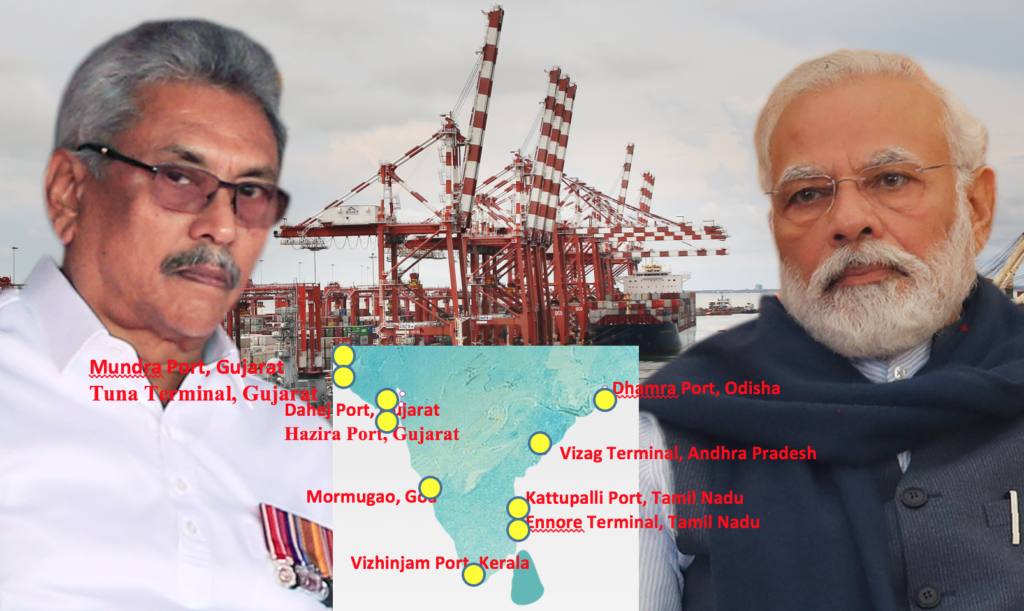
Confounding matters is that India’s nominee to develop Sri Lanka’s ECT is the very company not only developing Ports in India with intent to divert current Sri Lanka handled transshipment to India, but the very party now handling the Chahabar Port in Iran which India has been fidgeting with, without developing. Would the Indian company that is building India’s ports to divert Sri Lanka’s transshipment to India, wish to develop Sri Lanka’s port that would anyway have an edge over India’s ports however developed they are on account of Sri Lanka’s geopolitical positioning being viable for vessels in terms of logistics costs? https://www.adaniports.com/Ports-and-Terminals
Giving India to develop ECT is not only commercially a threat to Sri Lanka but there are major political implications too. We have enough of past experiences not to have to spell out these dangers.
Moreover, the MoC published on a media site claims India & Japan would ‘manage ECT’ for ‘long periods’– exactly how long is this? However beneficial for the country if the yen loan interest component is also to go on for ‘long periods’? Clause 5 speaks of a study – has this been done, by whom and where is the report? Clause 5 also speaks of a joint working group meeting – who sits on this and what are their conclusions?
What was the conclusions or recommendations made regarding control and operations of ECT?
What is the scope of the yen loan & how beneficial is such an arrangement for Sri Lanka?
Since issuing of this MoC what has been the steps taken vis a vis the partnership?
What are the terms & conditions concluded and more importantly what is the duration of this cooperation as that would determine the key aspect of yen loan?
What is clear is that the MoC does not carry or indicate any clear outright handover of control or operations to India or Japan. A MoC is NOT LEGALLY BINDING. It is only a means to outlinethe terms and details of the agreement before actual contract is signed. No contract was signed.
The strategic importance of Colombo Port
Lack of national policy should not sacrifice an islands’ most strategic asset – its ports & harbours. Every entry & exit point to an island is of strategic importance. Colombo Port is one of Sri Lanka’s most strategic locations in the Indian Ocean.
With over 30,000 vessels operating along the East-West shipping route the objective is to attract these ships to Colombo Port. Currently 23 major shipping lines and 7 feeder services operate out of Colombo. Colombo Port is one of the most economical ports in South Asia reputed for its fast turnaround time. EDI and other state of the art technology & control systems is improving its services. In 2019 JCT handled 7m TEUs. SAGT handled just 2m TEUs in 2018. ECT must remain under SLPA to maintain its container terminal business.
India has to face the hard truth that it is no goodwill partner. Sri Lanka can produce a list of partnerships that have been one-sided and based on threats and bullying. This is not a healthy partnership and one that Sri Lanka can continue given the stakes involved.
Sri Lanka must certainly have good relations with all countries at varying levels but Sri Lanka should not become ground for rivalries especially against a country (China) that has done no harm to Sri Lanka. Sri Lanka must also never forget the countries that have been with Sri Lanka without a trace of animosity. ‘Long standing goodwill’ does not apply to some nations whatever they claim on paper. We cannot forget the countries that have aided & abetted terrorism and terror in Sri Lanka. These countries can never espouse to be put on par with countries that have done no harm to Sri Lanka. Diplomatic niceties cannot replace the damage they have done & no one can blame the Sri Lankan populace to be reminding an elected government of these past demeanors. All erroneous decisions are suffered not by politicians but the citizens!
The hidden objectives of AID, PROPOSALS, RECOMMENDATIONS were all ignored resulting in Sri Lanka’s sovereignty being tweaked & tampered. Agreements cannot compromise the national security & overall well-being of the citizens. No amount of international goodwill is of any value if the country’s wellbeing has to be sacrificed & compromised.
Nearly 7 million people have elected Gotabaya Rajapaksa as the
President of Sri Lanka on the 16 November,2019 approving his Presidential
election manifesto Saubhaagye Dakma or the Ten Principles of
Inclusive Governance. According to democracy we claim to practice in Sri
Lanka, all the people of Sri Lanka belonging to different political parties
whether they voted or not for Gotabaya Rajapaksa as the President of Sri
Lanka have to accept the verdict of the majority of the people, and
accept Gotabaya Rajapaksa as the President of Sri Lanka and his political
manifesto as the political plan of development of Sri Lanka for the next
five years.
***********
************ ************
End of last year saw Sajith Premadasa pushing himself to the
maximum, claiming to have in him dynamic power, and genes of the dead to
rule Sri Lanka as its President, as no President had ever
done before.
But with all those unrestrained outbursts he was defeated at the
election and got blown off like an empty balloon. He then disappeared
from circulation”, and the people wondered what had happened to
him. However, he next showed up as the leader of the opposition in the
parliament chasing the media personnel from entering his office. Sajith
Premadasa who says he is democratric does not seem to have
accepted the President of Sri Lanka elected with an overwhelming majority as
his President as well, and showed that he is all out to make governing
difficult for the President, by refusing to pass the vote on account presented
to the Parliament by the government.
After dissolution of the Parliament and a general election
was called for the election of the members of the Parliament, Sajith
Premadasa reappeared before the public , as a leader of a Political party
Samagi jana balavegaya, this time asking the people to elect him to be
the Prime Minister of Sri Lanka. He has refurbished his old speeches he used
last year for his failed presidential election campaign, and renders them
with revived mechanical vigors he claims to have, swearing once again
to the public in his election campaign meetings, that he still has those
machine power and genes of the dead to carry him forward and if fortune would
smile a little more brighter this time to rule the country”, as the Prime
Minister !!
If what is said about democracy still holds good, one does not get
elected as a Prime Minister, but the President of the country appoints a member
of the Parliament who in his opinion is most likely to command the confidence
of the Parliament, in terms of the Constitution of the country,
Therefore it is presumptuous for Sajith Premadasa to go round
asking the people to elect him to be the Prime Minister, or as a matter of fact
even Ranil Wickramasinghe, or Mahinda Rajapakse to do so.
However, Sajith Premadasa relying on the dynamism of his youth,
and the genes of the dead he claims to have in his possession, recently
answered questions at a public show in his best British Council English
accent, where he ignored the President of Sri Lanka as a mere individual in a
country where there is a tripartite rule under the Constitution. And explained
how he is going to implement the election manifesto he has just launched.
But tripartite or no, the President of Sri Lanka has been elected
by a large majority of the people of the country to carry out his Presidential
election manifesto, and the same people at the same time rejected Sajith
Premadasa from having anything to do with the Presidency of Sri Lanka.
In such a situation Sajith Premadasa if elected has only to work
with the elected President of the Sri Lanka His Excellency Gotabaya Rajapakse,
who has already started the implementation of his Manifesto – The Ten
Principles of Inclusive Governance. Sajith Premadasa has no alternative, but to
fall in line with the Democratic System and wait to see what His
Excellency the President of Sri lanka Gotabaya Rajapakse will decide after the
general election of the Parliament. Will Sajith Premadasa be the Prime Minister
? Que sera sera….
However, Podujana Peramuna is asking the people to give them
a two third majority in the parliament at the elections, to have an edge
over other political parties to expect that its leader may be appointed as the
Prime Minister. That is a wiser move, than that of Sajith Premadasa who
blinded by Prime Ministerial ambition seems already to have taken the role
of an executive Prime Minister perhaps dreaming once elected, to
relegate his excellency the President Gotabaya Rajapaksa to a role of a
ceremonial President. Ranil Wickramasinha, not wanting to play a second
role to Sajith Premadasa in front of the people, also claims the position
of the Prime Minister in the next Parliament !!!
It is all a guessing game for Sajith’s supporters and those of
Ranil, which election manifesto is Sri Lanka going to implement ? But
they have all forgotten that nearly 7 million people have accepted the
Presidential political manifesto of His Excellency the President Gotabhaya
Rajapaksa-the Vision of Prosperity or the Ten Principles
of Inclusive Governance
Sajith Premadasa seems to be at the peak of pushing his
youth, dynamos, and the genes of the dead he possesses. His aim now is to bait
voters- UNP’s old tactic which it used successfully to fool the voters to vote
against President Mahinda Rajapakse at the Presidential election in 2015, which
was to promise a salary increase of Rs.30000,00 to government servants.
That worked, and Sajith Premadasa seems to hold onto the same old tactic
this time, promising everyone an allowance of Rs.20,000,00, and
Ranil Wickramasinhe promising Rs.10,000,00.
Rightly speaking, the Commissioner of Elections should
prohibit candidates making election promises of financial aid or
grants if elected. It is as good as giving bags of cements, or roof
sheets. If the Election Commission stopped giving appointments to employ
unemployed graduates as he said it is against the Election Law, so
should be promises of financial aid or allowances if elected.
The people should look at these parliamentary candidates like
Sajith Premadasa, or Ranil Wickramasinghe as potential trouble makers in a
future parliament where the President has presented a workable election
manifesto to modernise Sri Lanka bringing it out of the mess into which several
of the former governments which had acted for their own or for the
benefit of their clan members rather than to help the country and its
people as a whole. After 72 years, it is time Sri Lanka agrees for
a common plan of development without different political parties
proposing their own, each wanting to take credit for the final outcome.
Janatha Vimukthi Peramuna has formed an alliance and also present
their own political manifesto asking people to give them a chance to
carry out their proposals. That means JVP and its alliance of political
partners are asking the people to allow them to try out their plan to
make Sri Lanka their guinea-pig” to see whether their proposed method
would help in the development of the country. Is it that the people want ?
Allow political parties to carry out experiments with the country and its
people to see whether their methods will work better than those previous
methods that had been tried and mostly failed ?
Is not that what Sri Lanka had been doing since independence
? Sajith Premadasa as much as Ranil Wickramasinha have not tried out any
plans before and got results to show the people that they have the best method
to develop the country. The result of these political experimenting left
us with a thirty year of separatist terrorism, and today with a
country in a financial cricis with an economic groth less than that of
Afghanistan the result of a four years of Yahapalanaya in the midst ofa
pandemic.
Until 2005 no one came forward with any suggestion to end the
terrorism and put Sri Lanka onto a path of development. Now Sajith Premadasa,
having failed to have been elected the President wants to be the Prime
Minister, to carry out the same programme of development he proposed when
he campaigned as the Presidential Candidate. Sajith Premadasa as the
Presidential candidate had to wait a long time to put forward his election
manifesto which came much later than that of his rival candidate Gotabaya
Rajapaksa, and Sajith Premadasa’s political manifesto some
found repeating in different terms certain parts of his rival
Candidate Gotabhaya Rajpaksa’s manifesto. Sajith Premadasa has no
political vision and therefore cannot produce any valid workable
development plan.
His Excellency the President Gotabhaya Rajapaksa was and is
a practical man. He had gone through life the hard way as a battle
hardened soldier knocking on the doors of death most of the time. And he proved
after he was entrusted with the Defense Ministry as its Secretary that he can
work with different people with different experience and get them all together
to successfully end the terrorist war that lasted for thirty long years without
any one even making a positive suggestion to end it.
Sarath Fonseka was in the helm of the Armed Forces in 2004 and was
on the verge of retirement when Gotabaya Rajapaksa was called to be the
Secretary of Defence. It was Gotabaya Rajapakse who got Sarath Fonseka back to
the army and made him the Commander of it. But Sarath Fonseka lacks
the gratitude to accept it. But Gotabaya Rajapaksa is a silent man who does not
want to take credit for what he does. To him it does not matter whether one
appreciates him or not, but he wants a job of work well done,
generous to give credit for it.
Another criticism leveled against the Government by the
Sajith Premadasa, and also coming from the Janatha Vimukthi Peramuna is
against promoting Sinhala Buddhism which for them is racism. It is a
wrong understanding of historical reality.
Being Sinhala Buddhist is not being against Tamils , Muslims or
any one else, it signifies a cultural trait of the people and an inane
generosity which makes Sinhala Buddhists a friendly people who are ready
to accept into their fold those who demand acceptance.
It was that Sinhala Buddhist trait which saw even during the
terrorist war” Sri Lanka Armed Forces sending lorry loads of food items to the
people in war zones, the army saving thousands of people in distress kept as
human shields by the terrorists, and the Sinhala Buddhists in the South sending
to those people in refugee camps in the North packets of rice, clothes and dry
rations almost on a regular basis.
Lastly, Sajith Premadasa complains that the government is
only promoting a family, Rajapaksa family. This may sound so, and
it is an easy target of attack . But if one looks at that family
objectively without any bias, one may realise that it is not so. In a way
Sri Lanka is fortunate in having had that Rajapakse family. It seems that
Rajapakse family has a natural ability to attract people,
make that family a refuge of safety, a family that has the ability
to foresee and deliver what makes others happy, giving them an assurance of
peace.
What other family in Sri Lanka could make that claim ?
We want to establish a people centered government, which fulfills people safety,security, diversity, equality, inclusion, experience , and happy.–President H.E. Gotabhaya Rajapakse.
Death
penalty needed to be introduced ASAP for drug traffickers, vandalizes of
ancient historical heritage sites, deforesting of rain forests preserves.
I have been
inviting for individuals to use their platform to educate public of upcoming
election and requesting to stand for the country’s peace and security. We have
to have a choice and mobilize that choice of selection and promote it. My
personal opinion say the media is not doing enough in this important occasion
to educate the public. When think of peace & security we ourselves know how
important that two entities to a country. We have been experienced the 30 year
civil war in our country. Prior to civil war we experienced the JVP insurgency.
Both of those resulted huge human capital loss and property damage; as it was
mismanaged, politicized, without a leadership, it brought a huge peril to our
country as well as to entire south Asia. When peace and security of a country
uncertain, that country will not have a future. When peace not prevail in a
country people are scared in their daily lives, send their children to school,
daily activities of business will not happen as usual. Peace and security
relate with law and order and justice. So achieving peace and security of a
country is paramount important more than anything else according to present day
world circumstances.
We all remember
over the past four years our country was fragile in maintaining peace and
security and vulnerable for attacks of terrorist groups. You know what I am
talking about. The Holy Sunday attack made our country quite unstable and you
remember Ranil Wickramasinhe publicly acknowledged to bring anti terrorism act.
Which apparently make the country much more vulnerable for more attacks. Ranil
Wickramasinghte is not a thoughtful leader to this country. I was listening to
his discussion with SL VLOG representative. That discussion had no depth of
vision how to establish peace and security to this country. He said to improve
home economics by putting money into peoples pockets. He said he can borrow
money from donor countries. That is the simple core content of that discussion.
My objective of this article is to educate people of this country on peace and
security and more. I need to made aware families to understand the importance
of their freedom and safety, peace and security. Think about your country, your
children, environment, what did you experience immediate past four years when
we were under Ranil Maithree rule. Sri lankan state was in complete mess in
every where of the country. Do you need a rule of such again?
Our people and
governments does not have a very good understanding the importance of peace,
Security, safety and law an order. Those are the indicators of peaceful country
to travel and investments of modern day world for development. None of the
western traveller want to make their destination if the country is not safe for
travelling, none of investor want to invest in a country if there isn’t law and
order. Think about what happen to middle east. Americans were needed to get rid
of Saddam Hussein and they did it in horrific way against the will of the
people Iraq. After the horrific death of the American President was announcing
that Americans brought peace to Iraq; An Iraq young boy was saying Really”! We
know what happen to that country after all. Once that beautiful country was
standing in the world map as powerful historical ancient civilization center
for the world. The moment the leader was gone enormous devastation happen to
that country, How it looked was desperation, shattered buildings, gunmen were
fighting on streets, then ISIS” entered to that country and horrific man
slaughtering took place on daily basis. Apart from that, parents lost their
children, husbands lost their wives, Wives lost their husbands, refugees, dead
bodies, and that is how it look like modern Iraq. I heard beautiful young girls
was saying I felt the value of peace and security’ for the first time
in my life”. The bottom line is no other country bring peace and
security to another country. Only themselves can find it. Americans had
geopolitical interest in middle east to achieve that they label the invasion as
We brought peace to Iraq ”. by way of killing the president of that country.
More recently
minister Bandula Gunawardena announced for the first time in
history there will be a procurement
process with 100 percent local reliance and without importing, Which is a great
step taken by any ministry. We need to let to our own state run companies to
develop and progress. Then the products they manufacture will be ours and we
will save money as well. It says all software should be procured from local
firms, and if it is not possible approval has to be received from treasury and
information technology agency. One time I remember former minister Daya Gamage
said we wil make this country a market place for every body to come &
play”. Which means floodgates had opened and the doors were opened for imports
of everything. This is what was look like when Ranil Maithree dual was ruling
the country. We need to further tighten our imports as much as possible to
create more trade surplus. I know we must proud about this great decision.
Kurunegala ancient
building has been destroyed.These are national crimes. People who do destroy or
vanish our history must be taken as crimes similar to drug trafficking. The
Kurunegala Mayor speaks in media and justifying himself as not guilty, Hon,
president Gotabhaya, we are tired of seeing this vandalism and this mayor
trying to be a hero commenting to media amid the fallen historical walls. Shame
on you man. He must shut up and let the authority to conduct their duty. Most
importantly he must be hand cuffed and put in jail as a suspect, until
investigation is over. People of this country tired of seeing these national
crimes. I know many people cannot listen or take the national crime lightly.
One of the ministers of the cabinet Johnston Fernando publicly addressed a
sensitive issue in favour of the mayor of Kurunegala. This is a serious conduct
of conflict of interest, and minister Johnston’s screaming in public to protect
the mayor is a huge slap on President Gotabhaya’s vision and his ruling of the
country. Hon President this act of vandalism of our ancient historical
priceless siting is a slap on your face and it must taken seriously should be
given death penalty to those convicts. Surprisingly these mostly done by
responsible people of the community. I wish to see again this historical
vandalism make it back to normal preserving the ancient glory. We need to start
a national discussion how to preserve our national heritage. The government
need to take tough policies to preserve these valuables. We are a proud nation
and these valuables are evidences to prove that glory. Please be aware and
contribute to preserve our national heritage as good citizen of the country.
I listen to
Dhanasiri Amaratunga’s interview at Elakkaya” program. Dhanasiri seems like a
good person to do something different to Wathu” society. At the interview he
did questioned and gave a brief analysis of that Colombo sub culture and its
existence. The youngsters of those who living in those watte” areas and their future defined by the living
address of them. There has been concious bias has developmed in the society
against the people living in those addresses. Which is a discriminatory element of society. Which is
unfortunate Dhanasiri, My sincere appreciation to you as you notice that sub
culture, which is based on living area. If a person address ends by the name of
Watte” which will decide his or her fate. How it will mitigage to his or her
disadvantage. It is important to identify these small societies and need to
work for their improvement. Most of people living in these sub areas are much
different to main culture. People use to identify those places for drug
traffickers, underworld activities etc. These sub cultural living segments need
to be improved and their lives matters in our society.
Over the week drug
traffickers publicly threatened to our law and order. This is a serious
development. The drug distribution and crimes had been occurring since 2013
with the involvement of police officers and government officials. The huge drug
dealers network will never surface to public if the president did not appoint
the task force. However, It seems like drug dealers has declared the war again
security of the country. We need to understand how south American drug dealer
Pablo Escobar” maintained his drug network and the crimes he did to people of
Columbia other South American countries
and United States of America. President Ronald Ragan, President George Bush
Senior were working hard with C.I.A to caught Pablo Escobar with the
collaboration of Colombian Government. Pablo Escobar killed many government
officers of Columbia including ministers. He had planned to kill president of
Columbia but he survived as he didn’t step into the plane. Finally he died in a
firing battle with Colombian forces. There were many government officers in his
pay roll who supported Pablo Escobar to continue his underworld drug business.
So it is very important to introduce death penalty to drug trafficker if we
want get rid of drug menace of Sri Lanka. There is no other way of solving this
drug trafficking and crimes happen in our country. The government of Sri
Lanka must introduce death penalty to drug dealers without delay as we are in a
threshold of a time drug trafficking and use. Furthermore, when visa is
issued there should be a line saying Drug trafficking will be imposed
death penalty.”
These days
politicians make numerous promises in front of people. One simple technique to
identifying is the truth behind these public comments. Please try to identify
the politicians who speaks one single solution to their electorate and how he
is going to deliver that. Make sure the person is coming from a good
background. We know these politicians are corrupted in such a way, we don’t
rely on these people. Politicians like S. B. Dissanayake, Range Bandara,
Appuhamy in Puttalam district are few those who involved in bribe discussions in
media to gain voting for power. Please do not use your powerful mandate for
such politicians. Furthermore, there are many politicians on the stage who
involved to central bank bond scam as well there are corrupted names like Ravi
Karunanayake, Sujeewa semasinghe who wrote a book on this crime; please don’t
use your valued vote for such people including the mastermind of this national
crime Ranil Wickramasinghe and his former ally Maithreeplala Sirisena. People
need to closely monitor how Ranil Wickramasinghe does his election campaign; he
simply accused the government with no basis of his claim and continuously
propagating the slogan to convince public. That is the only slogan he continues
to come to power. This old sinking ship must be removed from Sri Lanka
politics. Public must aware that they are the most powerful people to appoint
these members to legislative building and selecting them need to be done in a
comprehensive method. One simple example H. E. Gotabhaya Rajapakse met farmers
of Ratnapura district and discuss of pepper harvest and their problems and
solutions. Last week he called in ministry officials and request them to work
on exporting possibilities as finished products and making more foreign
exchange to those farmers. We need to observe this initiative, and its
positiveness. Again please compare how Ranil Wickramasinghe and Sajith
Premadasa speaks in public meetings. Can you rely on these people of what they
promise and going to deliver to public?
We need to express
people perspectives on ethnic problem of our country. We all suffered a 30
years of civil war, and it was the Tamil insurgency and armed conflict to a
Tamil separate land. It is important to look for a solution to this problem
from a present day communal, racial, black lives matters, perspective as well.
We know some of the Tamil people were brought to our country from India for
commercial plantation and economic reasons by the British rulers of former
Ceylon. North and east Tamils originated either from Indians or historically
they might have lived in those areas of the country. Our political leaders need
to find a scientific solution to Tamil problem from a fair point of view. Human
dignity must be respected by the constitution for all Sri Lankans. Now the 3rd
generation of people is living in north and east and upcountry. Those people
are Sri Lankans they need to have the same and equal schools, health care,
housing , benefits of development. Tamil and Sinhalese languages must be the
official language of government. Public service officers must be fluent with
Tamil as well as Sinhalese languages. Eqality, Diversity, Inclusion must be a
reality, not to confined to words but actions must be delivered at the same
time. This is only a perspective but could develop as an idea. If every
politician including Tamil political leaders work together honestly identifying
these entities we would have a beautiful Sri Lanka for all of us. We all can
live in harmony as a beautiful nation in the world.
A few weeks ago our President – true to his military form, dared
to haul the Central Bank over the coals. The Mandarins in the Central Bank have
now hit back: Sri Lanka’s Central Bank had complied with government directions
as permitted by available monetary law”, Central Bank officials said, in the
wake of a controversy caused by President Gotabaya Rajapaksa slamming the
Central Bank after summoning the Governor to his office. Sri Lanka’s Central
Bank was ordered to engage in a series of ‘quasi-fiscal’ activities which
should have been performed by the Treasury by printing large volumes of money,
on top of direct finance of the budget which had led to currency pressure and
difficulties in servicing foreign debt.”( Economy Next: 10/07/2020)
In other words , it means : No sir, it not us sir, it is you that
is responsible, we have done what we can do . It is the Treasury blokes and
mind you, you are printing a lot of money.”
I have happened to be an administrator for long both in the Sri
Lanka Administrative Service where as Senior Assistant Commissioner of Agrarian
Service. I managed a very large department with over 4000 employees as well as
overseas-in Bangladesh where I was suddenly elevated and given command to an
entire Department of Youth Development- the command from the Minister for
Labour and Manpower, Air vice Marshal Aminul Islam, Design and implement a
self employment programme as you said you could do what the ILO miserably
failed and show results”. Perhaps my opinion may be worth considering because I
succeeded in designing and establishing a self employment programme and trained
the staff to continue it within nineteen months. Today that programme is the
premier programme of self employment the world has known with three million
youths guided to become self employed so far. It is a programme that is kicking
and alive, with youth officers becoming more economists searching and guiding
youths to become self employed. It is a
programme that has left its imprint on the sands of time. Though not in Finance
the work involved hard thinking.
About the integrity of the Central Bank, perhaps, the cat is out
of the bag when a Central Bank mandarin has admitted : ETI has paid bribes
amounting to Rs. 113.8 million to high ranking officials at regulatory agencies
and several other high profile individuals, a CBSL official revealed.
(CeylonToday: 17/7/2020)
While the Presidents outburst came only two weeks ago, my
criticism of Central Bank functions goes back to 2001, when I first realized
that our Central Bank covers only the domestic Rupee. The question then emerges
as to which organization is there to cover the foreign exchange that comes in.
My opinion of the Central Bank functions are contained in three Papers I wrote:
Devaluation: Who Benefits? ( The Island: 4/7/2000), The Devaluation of the
Sri Lankan Rupee”(The Island;27/2/2001) and The Freefloat of the Rupee: What
has to be done”(The Island:29/03/2001) appearing in my book: How the IMF
Ruined Sri Lanka & Alternative Programmes of Success: Godages:2006,
pages 83-112.
In any country there has to be an apex body that controls finance.
The Finance of a country comprises the foreign exchange that comes in- the
hardcurrency, printed by the UK, USA, EU & a few other countries and the
local rupee, printed by Sri Lanka for use within Sri Lanka. My opinion is that
handling the foreign exchange that comes in is crucial to any economy and our
Central Bank is entirely to blame for abdicating the right for a country to
handle the foreign exchange that legitimately comes into the country.
Our Central Bank effectively controlled the foreign exchange that
came in till the end of 1977. . It so happened that in 1970 I and my wife came
back from the UK- we were there for studies on a scholarship and we applied to
the Central Bank for permission to import a car. My wife had worked in the UK
during our stay and I too had some earnings from giving talks on the Sinhala
Programme of the BBC. We submitted details including all receipts and the Controller of Exchange of the Central
Bank toothcombed each receipt before approving the import of a car for pounds
875. The money had been earned by us and was banked in Lloyds Bank London, our
bankers. That was in 1970. In short then the Central Bank effectively
controlled the foreign exchange.
In contrast now the Central Bank has come up with the ludicrous
idea that the Central Bank only controls the local Rupee. The abdication of
handling our foreign exchange by following the Structural Adjustment Programme
of the IMF from the end of 1977 is hailed by the Central Bank as a great
success. In their words, 1977 was a clear watershed in the economic history of Sri Lanka, when
the country turned away from a predominantly inward looking , tightly controlled
and welfare oriented strategy to one which primarily emphasized export growth, competition and higher capital investment for economic growth and
employment generation. The rapid spurt of the economy in 1978 was the immediate response of a hitherto long
stagnant economy to the relaxation of controls and the restoration of price
incentives. The economy in its performance
in 1978 has clearly shown that
given an appropriate policy climate it has the potential of moving onto a path
of sustained economic
development.”(Central Bank Annual Report 1985) .
What actually happened was totally the opposite. This has led to total disaster in terms of foreign debt,
currency devaluation, high inflation, increased imports, poverty and
unemployment. Following this neoliberal policy of relaxing foreign exchange use
and meeting the shortfall with proceeds of privatization and loans has led to a
situation of increased foreign debt- By
1996 the foreign debt was $ 4.6 billion
and by 2008 it was at $ 17.7 billion. In 1977 our foreign debt was only $ 750
million. Devaluation was from Rs 15.5 in 1977 to s 31.6 in 1978- a devaluation of over 100% in the first year
and to Rs 235 to the pound today!
Matters on foreign exchange that comes in did come to a head on 25
th January 2001, when our two State banks had to pay a massive oil bill and
both banks did not have enough foreign exchange and they had to go hat in hand
to the foreign banks that had collected foreign exchange. The foreign bank that
held foreign currency increased their price to Rs. 100.00, when at that time
the dollar was trading at Rs.85.00. In the process the Rupee shrank to even Rs
106 to the dollar. Our State banks had no other alternative than to buy at the
higher price demanded by the foreign bank. It is the banks that fix the
exchange rate. Mind you it is not the bank’s money. It was foreign money
collected by the Banks and the foreign banks had been grabbing foreign money
for long. Once in about 1998 I had ordered the Bank of Scotland, my bankers to
send money to my NRFC at the Bank of Ceylon and strangely the money was
credited to my NRFC in Rupees. I was going to Myanmar on a holiday and needed
to take dollars with me but the Standard Chartered Bank to which the Bank of
Scotland had first sent the dollars snatched the dollars and credited the equivalent
of Rupees into my account. Mr Athauda the Manager of the Bank of Ceylon said
that that was how most remittances come. I had to wage a battle for two full
days to get the money in dollars. Unknown to our Central Bank the foreign banks
hoard foreign currency and bid the price upwards. They want the profit. Even
our hard earned foreign exchange is manipulated by the foreign banks to make
profits!.
As an explanation, the
Central Bank said;” in a free floating regime, the market forces determine the
exchange rate. The CB does not intervene in the process; the CB has control
over the domestic money supply (The Island: 17/02/2001). The remedy proposed by
the Central Bank was: in order to avoid a repeat of the catastrophe of the
Rupee sliding down, we have decided that some of the very large bills will be
settled outside the market and there will be forward hedging by the Banks to
even out the payment of the bills overtime (The Island: 17/02/2001) Forward
hedging is like obtaining an overdraft. This statement of the Central Bank in
itself is indirect proof that the
Central Bank should actually be controlling our foreign exchange. The Central Bank is the apex body that has to
control the foreign exchange.
In 2001 I wrote: foreign money that comes into our country from
whatever source is the property of the Sri Lankan Government, other than in
case of NRFC Accounts. It is this practice of allowing the banks to handle the
country’s legitimate earnings as their private property that enabled the banks
to hold the Government to ransom and cause the devaluation in this
instance”Though I wrote that this is a matter that has to be addressed to
immediately, nothing has happened till today. The foreign banks accept foreign
money and bid the price upwards whenever they get the chance. I have been
pointing out in my Papers that our Government has to control the foreign
exchange that comes in. This is a fundamental requirement in any country. We
have banks collecting foreign exchange and also private authorized money changers
accepting foreign money. Private authorized Money Changers collect easily ten
times more foreign exchange than all our banks put together. All that money has to be credited to the
Central Bank and it is the Central Bank that has to disburse that money. If our
present mandarins in the Central Bank disagree, then to my mind they are not
acting as a Central Bank. If it is only to handle the domestic Rupee we do not
need a Central Bank with specialists. A senior administrator from the SLAS can easily attend to this task with a dozen
accountants and clerical officers.
I think it is immediately necessary that our Prime Minister and
President should look into this problem and if the Central Bank yet persists
that it is not their job then appoint another authority to ensure that every
dollar that comes in from all sources get into our coffers and get disposed as
per decisions of the Government.
In 1977 the IMF allowed us loans if we adhered to the Structural
Adjustment Programme and that was why we
had to liberalize the use of foreign exchange, allow dollars for foreign
travel, for overseas studies, foreign holidays etc and also relax foreign
imports. In case we did not have sufficient dollars to do this spending spree
then the IMF recommendation was for us
to sell off privatize government entities and feed the funds collected to
enable this expenditure. If that was not sufficient then we were asked to
obtain loans. The IMF itself gave us loans with grace periods so that the leaders who accepted the loan will be out of
office when it comes to repayment. It is by going on this path that our Rupee
had lost its value from Rs 15.50 in November 1977 to Rs 235.00 today. It was
this process, instead of controlling foreign exchange disbursement by import
controls etc. that led us to create a massive foreign exchange debt.
The necessity of some authority to study carefully what is
happening to our foreign exchange is absolutely necessary because currently we
have had to impose draconian import controls as we do not have sufficient
dollars. We cry out aloud but do not look into what is happening. This is very
strange. Let us address the following points:
What happens to the foreign exchange that is collected at the
banks-private and State. Do these get credited to our Treasury. This collection
does not get collected to our Treasury which is how that foreign bank had
hoarded the foreign exchange it had collected and finally bid its price upwards
gaining a massive profit on 25/ 01/2001, as stated earlier.
What happens to the foreign exchange that is accepted by money
changers. Mind you I am certain that the authorized money changers collect far
more-around ten times more than what all
banks collect. Are thee amounts credited to the Treasury? Why are we running in
circles finding loans from abroad and getting more and more into foreign
debt while allowing this foreign
exchange that legitimately comes into Sri Lanka to be fritted away by the
private dealers.
Further, the banks today make small payments of foreign exchange.
Even local credit cards can be used abroad and the payments get paid from our
reserves.
There is a further development re hotel bookings made by internet
booking agencies. These are all foreign multinationals who do publicity, fix
hotel rates (all of which should be done by a local tourist authority), then
the payment is made to the hotel in local Rupees, but the internet booking
multinational sends to the hotelier an invoice for 15% of the amount paid which
gets paid in foreign currency ie. from our reserves. In other words hotel
bookings made by internet booking agencies eats into our foreign exchange. With
internet bookings being the major sales mode today , tourism actually eats into
our foreign reserves. Our economic
sleuths fail to even understand how our
foreign reserves are being depleted through tourism. Tourism as happening today
only creates employment in hotels and sales outlets.
It is also important to note that through FDI(Foreign Direct
Investment) many investors bring in a small amount at the initial stage but get
involved in local sales in the Rupee, importing sales goods through our dollar
reserves and thereafter repatriate
profits in dollars from our reserves.
Recently our Government has decided to not allow the repatriation of
profits. However the manner in which foreign multinationals continue to trade
in rupees today perhaps indicate that they are somehow entitled to take away
profits in dollars. To add to this is Uber Eats, Pickme and such institutes who
also trade in rupees. All of them take
away profits from our reserves. Our country is the net loser. Though our
Central Bank mandarins have decided that this is not their domain I beg to
disagree and I am dead certain that the Central Banks of other countries do
handle their foreign exchange collections. Actually their main task is to guard the
foreign exchange.
These are all critically important
matters that have to be looked into.
We have to guard our foreign exchange, otherwise as a sovereign
country we are dead. An immediate decision has to be made that incase of all
internet hotel bookings the payment is required in hard currency that has to
get deposited at a State bank and it is out of this deposit that the 15% has to
be paid to the internet booking multinational.
It may also be prudent to make an order that all foreigners
staying at hotels should pay in hard currency and that this hard currency
should be deposited in a State bank by the hotelier. My foreign travel was some
two years ago and then it was always payment to hotels in hard currency and
never in the local currency. Hard
currency collected by all banks and money changers should be collected by the
State Treasury. As it happens today it is an absurd situation to allow the hard
currency that comes in to be allowed to
dissipate and for the Government to seek foreign loans to meet expenses that
require hard currency. It is very sad that we have a Central Bank that lives in
slumber.
I hope these facts get to the notice of our leaders.
Garvin Karunaratne, Ph.D. Michigan State University, 23/07/2020
Author of How he IMF Ruined Sri Lanka and Alternative Programmes of Success,
(Godages:2006)
How
the IMF Sabotaged Third World Development(Kindle/Godsages:2017)
On Nov. 29, 2017, Indigenous socialist president
Evo Morales won a legal challenge to modify the Bolivian constitution, to allow
Morales to run for a fourth term as the Bolivian president.
Two years later, on Oct. 25, 2019, the winner of Bolivia’s presidential election was
announced. Evo Morales won 47
per cent of the vote, while the main US-backed candidate, Carlos Mesa, won 36
per cent of the vote. Morales narrowly cleared the 10-point margin of victory
required to avoid a second-round runoff election, and it seemed as if Morales
was set to serve his fourth term in office.
However, the OAS would have a key role in ensuring
this did not happen. The OAS, described as the U.S
Ministry of the Colonies”
by former Cuban president Fidel Castro, is supposed to represent the 35
countries in the Western Hemisphere in defence of peace, equality and national
sovereignty.” However, the organization has a long history of openly backing
the United States’ imperialist agenda.
In particular, during the US-led 2019 coup attempt
against Venezuelan president Nicholas Maduro, false claims of election fraud
were utilised to try to push the US puppet” Juan Guaido into power. The (leader), Luis
Almagro praised the protests repeatedly, and allowed Canada to set up the Lima Group, an alliance of countries wishing to overthrow the
Venezuelan government, without any punishment.
The Canadian and United States government ignored a
Nov. 8 report from the Centre for Economic and Policy Research, a US-based
think tank, who did a statistical analysis of Bolivia’s publicly available
voting data which found no evidence of irregularities or fraud.
In the four factors reviewed (technology, chain of
custody, integrity of the tally sheets, and statistical projections),
irregularities were detected, ranging from very serious to indicative of
something wrong.”
The audit team [could not] validate the results of
this election and therefore recommends another electoral process.” They argued
that Any future process should be overseen by new electoral authorities to
ensure the conduct of credible elections.”
On the very day, Canada, declared its support for the electoral audit, stating that It is clear that the will of the
Bolivian people and the democratic process were not respected.” A day later,
Morales resigned the presidency after pressure was mounted by military chief,
Gen. Williams Kaliman, calling for him to immediately quit and permit the
restoration of peace and stability.”
In a press release, Morales said:
I decided to resign from my position so that Carlos
Mesa and Luis Camacho stop abusing and harming thousands of brothers … I have
the obligation to seek peace and it hurts a lot that we face Bolivians, for
this reason, so I will send my letter of resignation to the Plurinational
Assembly of Bolivia.
Under severe pressure, Bolivian Vice President
Alvaro Garcia Linera, the president of the Senate, Adriana Salvatierra of the
MAS party, and the president of the Chamber of Deputies all resigned. As a
result, the line of succession to the Bolivian presidency was broken.
U.S. Secretary of State Mike Pompeo applauded the interim president in a statement on Nov. 13, saying that the
U.S. looks forward to working with the OAS to stage free and fair elections”
by the end of 2019.
Bolivia in shambles without Morales, as elections
are delayed until September 2020
In January 2020, a now-deleted racist tweet from interim president” Áñez was caught, in
which she reportedly wrote: I want a Bolivia free of satanic indigenous
rituals. The city is not for the indigenous. They should go to the mountains or
plains.” Áñez also called Morales a poor Indian” in another tweet.
Nadia Cruz, Bolivia’s ombudsman, said that charges of sedition” and terrorism”
are being brought for simply disagreeing with or questioning the Áñez
administration.
Michael Shifter, the president of the
Washington-based Inter-American Dialogue said, There is unwillingness on the level of the Trump
administration to hold Áñez to account, so she has a lot of room to do what she
wants, including what seems to be the carrying out of vendettas.” Journalists have been arrested and intimidated, while Indigenous activists have been severely
repressed.
The promise of quick elections proved to be a lie,
two months after the coup, that the Bolivian Supreme Electoral Tribunal, which was filled with Anez allies, and purged of
former officials, determined the presidential election would occur on
May 3. However, the
Bolivian electoral court used the COVID-19 pandemic as cover to delay the elections until September 6. Now that Luis Camacho is
urging the OAS to interfere in Bolivia’s elections yet again, the stage may be
set for a second coup against a Movement for Socialism party’s presidential
candidate within the last year.
Even the narrative of flawed elections has fallen
apart, as the New York Times and
others have reported that
the there was no election fraud, in the 2019 election that delivered Morales
his fourth term as Bolivia’s president.
Aidan
Jonah is the Editor-in-Chief of The
Canada Files,
a socialist, anti-imperialist news site founded in 2019. He has written about
Canadian imperialism, federal politics, and left-wing resistance to colonialism
across the world. He is a second-year Bachelor of Journalism student at Ryerson
University, who was the Head of Communications and Community Engagement for
Etobicoke North NDP Candidate Naiima Farah in the 2019 Federal Election. Read
other articles by Aidan.
How Canada, the US, and OAS allied to overthrow
Morales
On Nov. 29, 2017, Indigenous socialist president
Evo Morales won a legal challenge to modify the Bolivian constitution, to allow
Morales to run for a fourth term as the Bolivian president.
Two years later, on Oct. 25, 2019, the winner of Bolivia’s presidential election was
announced. Evo Morales won 47
per cent of the vote, while the main US-backed candidate, Carlos Mesa, won 36
per cent of the vote. Morales narrowly cleared the 10-point margin of victory
required to avoid a second-round runoff election, and it seemed as if Morales
was set to serve his fourth term in office.
However, the OAS would have a key role in ensuring
this did not happen. The OAS, described as the U.S
Ministry of the Colonies”
by former Cuban president Fidel Castro, is supposed to represent the 35
countries in the Western Hemisphere in defence of peace, equality and national
sovereignty.” However, the organization has a long history of openly backing
the United States’ imperialist agenda.
In particular, during the US-led 2019 coup attempt
against Venezuelan president Nicholas Maduro, false claims of election fraud
were utilised to try to push the US puppet” Juan Guaido into power. The (leader), Luis
Almagro praised the protests repeatedly, and allowed Canada to set up the Lima Group, an alliance of countries wishing to overthrow the
Venezuelan government, without any punishment.
The Canadian and United States government ignored a
Nov. 8 report from the Centre for Economic and Policy Research, a US-based
think tank, who did a statistical analysis of Bolivia’s publicly available
voting data which found no evidence of irregularities or fraud.
In the four factors reviewed (technology, chain of
custody, integrity of the tally sheets, and statistical projections),
irregularities were detected, ranging from very serious to indicative of
something wrong.”
The audit team [could not] validate the results of
this election and therefore recommends another electoral process.” They argued
that Any future process should be overseen by new electoral authorities to
ensure the conduct of credible elections.”
On the very day, Canada, declared its support for the electoral audit, stating that It is clear that the will of the
Bolivian people and the democratic process were not respected.” A day later,
Morales resigned the presidency after pressure was mounted by military chief,
Gen. Williams Kaliman, calling for him to immediately quit and permit the
restoration of peace and stability.”
In a press release, Morales said:
I decided to resign from my position so that Carlos
Mesa and Luis Camacho stop abusing and harming thousands of brothers … I have
the obligation to seek peace and it hurts a lot that we face Bolivians, for
this reason, so I will send my letter of resignation to the Plurinational
Assembly of Bolivia.
Under severe pressure, Bolivian Vice President
Alvaro Garcia Linera, the president of the Senate, Adriana Salvatierra of the
MAS party, and the president of the Chamber of Deputies all resigned. As a
result, the line of succession to the Bolivian presidency was broken.
U.S. Secretary of State Mike Pompeo applauded the interim president in a statement on Nov. 13, saying that the
U.S. looks forward to working with the OAS to stage free and fair elections”
by the end of 2019.
Bolivia in shambles without Morales, as elections
are delayed until September 2020
In January 2020, a now-deleted racist tweet from interim president” Áñez was caught, in
which she reportedly wrote: I want a Bolivia free of satanic indigenous
rituals. The city is not for the indigenous. They should go to the mountains or
plains.” Áñez also called Morales a poor Indian” in another tweet.
Nadia Cruz, Bolivia’s ombudsman, said that charges of sedition” and terrorism”
are being brought for simply disagreeing with or questioning the Áñez
administration.
Michael Shifter, the president of the
Washington-based Inter-American Dialogue said, There is unwillingness on the level of the Trump
administration to hold Áñez to account, so she has a lot of room to do what she
wants, including what seems to be the carrying out of vendettas.” Journalists have been arrested and intimidated, while Indigenous activists have been severely
repressed.
The promise of quick elections proved to be a lie,
two months after the coup, that the Bolivian Supreme Electoral Tribunal, which was filled with Anez allies, and purged of
former officials, determined the presidential election would occur on
May 3. However, the
Bolivian electoral court used the COVID-19 pandemic as cover to delay the elections until September 6. Now that Luis Camacho is
urging the OAS to interfere in Bolivia’s elections yet again, the stage may be
set for a second coup against a Movement for Socialism party’s presidential
candidate within the last year.
Even the narrative of flawed elections has fallen
apart, as the New York Times and
others have reported that
the there was no election fraud, in the 2019 election that delivered Morales
his fourth term as Bolivia’s president.
Aidan
Jonah is the Editor-in-Chief of The
Canada Files,
a socialist, anti-imperialist news site founded in 2019. He has written about
Canadian imperialism, federal politics, and left-wing resistance to colonialism
across the world. He is a second-year Bachelor of Journalism student at Ryerson
University, who was the Head of Communications and Community Engagement for
Etobicoke North NDP Candidate Naiima Farah in the 2019 Federal Election. Read
other articles by Aidan.
Sri Lanka has now become the killing fields of
rare and exotic animals.
It is heartrending to see the pride of Sri Lanka’s fauna, namely, wild elephants and leopardsbeing trapped and killed.
Last
year (2019) alone 384 elephants died mostly at the hands of humans and
sometimes under cruel circumstances by use of ‘Hakka
Patas‘.
This is an improvised small explosive device which contains black gun powder, lead and iron made to a ball of a firecracker shape and used illegally to keep wild elephants away. Hakka Patas” are strategically inserted into a cucumber, pumpkin, or melon, which are delicacies for wild animals, and explode in their mouths once they are swallowed. Elephant calves, in particular, are tricked to consume the explosives and suffer without food before succumbing to a painful death.
Now,
Leopards are being trapped by hunters’ snares to satisfy a growing demand
for their body parts in illegal wild trade carried out both within and outside
Sri Lanka.
Law
enforcement bodies like the Department of Wildlife Conservation (DWC), Police
and the Attorney – General’s Dept., have failed to take effective and drastic
action against the poachers to contain the destruction of our wild life.
The
death of the Black Leopard on May 29, 2020 which was an avoidable death, if not
for the negligence of the country’s law enforcement authorities, has caused
immense sadness in the country.
The
case concerning the death of this Black Leopard will be resumed at the Hatton
Court on Wednesday, July 29, 2020.
Justice
for Animals and Nature (JAN) under the leadership of Ven. Dr. Omalpe Sobhitha
Thero intends to intervene in this case to ensure that the voices of both the
dead animal and animal lovers are heard and that the people responsible for the
death of the Black Leopard are brought to Justice.
Mr.
Anura Meddegoda, PC. and his legal team will appear on behalf of JAN as an
Intervenient Litigant.
You
are welcome to join us in attending the proceedings at the Hatton Court at 9.00
a.m. on Wednesday, July 29, 2020 and give moral support to our intended
intervention and plea for justice in this case.
The 30 year armed conflict in Sri Lanka has
produced a new generation of veterans at risk for the chronic mental health
problems that resulted following prolonged exposure to the war. Over 200,000
members of the Sri Lanka armed forces and police had been directly or
indirectly exposed to combat situations during these years. There had been
nearly 20 major military operations conducted by the Armed Forces from 1987 to
2009. A large number of combatants from the Sri Lanka armed forces were exposed
to hostile battle conditions and many soldiers underwent traumatic battle
events outside the range of usual human experience. These experiences include
seeing fellow soldiers being killed or wounded and sight of unburied
decomposing bodies, of hearing screams for help from the wounded, and of
helplessly watching the wounded die without the possibility of being rescued.
Following the combat trauma in Sri Lanka, a significant number of combatants
were diagnosed with Post Traumatic Stress Disorder (PTSD). The combat operations
in the North and East had involved military personnel in major ground combat
and hazardous security duty. A significant number of combatants had
posttraumatic reactions soon after the traumatic combat events. Majority of
these reactions were undetected and untreated. The deaths include 27,639
LTTE carders, 23,327 Sri Lankan soldiers and police officers, 1,155 Indian
soldiers, and tens of thousands of civilians. The last phase of the war
resulted 280,000 internally displaced persons.
Combat Trauma Experienced by the Soldiers
War is particularly traumatic for soldiers
because it often involves close violence, including witnessing death through
direct combat, viewing the enemy before or after killing them, and watching
friends and comrades die (Hendin & Haas, 1984). After exposing to combat
trauma soldiers are more likely to have psychological ailments predominantly
stress related symptoms, problems with social relationships and various other
problems. The wounds that they received from war are not confined to the
battlefield it frequently transformed to their domestic environment as
well. Although studies are needed to systematically assess the mental
health of members of the armed services, a very few studies were conducted
during the last 30 years. The most common mental health issue for soldiers
is post-traumatic stress disorder and related symptoms of depression, anxiety,
inattention, sleeping difficulties, nightmares, and survival guilt.
The dedication and the courage of the armed
forces cannot be underestimated and the Sri Lankan combatants fought one of the
longest and deadliest armed conflicts in the world and they were able to gain a
clear victory. Sri Lanka paid an immense price for the victory. As a result of
the three-decade war, many soldiers became physical and psychological
casualties. Unfortunately the society is gradually forgetting the scarifies
made by these people. Although many see war as a heroic effort, there are
thousands of untold traumatic stories in the Eelam War. Some soldiers
shared their traumatic stories with us and these stories reveal the magnitude
of their suffering. These stories represent the true nature of combat trauma in
Sri Lanka.
The psychological casualty of the operation
liberation
The Operation Liberation or Wadamarachi
Operation was conducted in 1987. It was the first major military operation in
Sri Lanka. Nearly 8,000 soldiers participated in this campaign. The most
popular and the famous officer of the Sri Lanka Army the late Gen Denzyl Kobekaduwa
commanded this military offensive against the LTTE. Corporal Ax36 is one
of the psychological casualties of Operation Liberation. During this battle, he
faced many battle stresses. He was physically and mentally exhausted. After
serving, a number of years in the Army Cpl Ax36 witnessed many traumatic
events. He suffered nightmares, intrusions, hyperarousal, and flashbacks.
He was avoiding people and places related to his traumatic experiences and
became emotionally numbed. In 2003, Cpl Ax36 was diagnosed with PTSD.
Corporal Ax36 describes his present emotional
and physical ailments as follows.
I was one of the soldiers who took part in
the Wadamarachi Operation in 1987. Our main aim was to liberate Jaffna
Peninsula and destroy the LTTE positions. When we came near the Thondamanaru
Bridge, the LTTE destroyed the bridge using explosives. We had to advance
slowly. One of our soldiers died in front of my eyes as a result of a booby
trap. I can still recall his face filled with blood. It was a horrific incident. Needless
to say that I was terrified by this event. Because I am a human although I wore
a military uniform. I was shaken by the death and demolition. Even after many
years, I still see these events in my dreams. To evade the nightmares I used to
take alcohol and go to sleep. I cannot stand any loud noises, I become
frightened and my heart started pounding. Often I try not to think about past
events. When I see the TV if I see any combat related story or a pictures I
disconnect myself with it. I hate to talk about past events especially those
related to the war.
I have no strength in my body now. My joints
are aching. I cannot even walk a mile. Prematurely I have grown old. My
mind is full of melancholic feelings. I am unable to feel happiness. For many
years, I never experienced cheerfulness.
I am unable to concentrate and I am very
forgetful. I have forgotten the names of my fellow soldiers who served with me
in the same unit. Sometimes I feel that I have no reason to live. My family
members avoid me because of my hot temper. Unlike early days, I cannot control my
anger. I have been turned in to an irritable cold person. Several times, I
thought of disappearing from this world. But according to my religion it is a
sin. Therefore, I have resisted the idea of committing suicide.
Private K and Survival Guilt
There is a higher incidence of depression in
veterans who had been in combat and lost a friend. Survival guilt is an
especially guilt invoking symptom.
Survivor guilt” is the term used to describe
the feelings of those who, fortunately, emerge from a disaster, which mortally
engulfs others. On an irrational level, these individuals wince at their
privileged escape from death’s clutches(Harvery, 2007).
Private K is a soldier who was severely
troubled by the survival guilt. He joined the Army in 1992 and served in the
North. While serving in the combat his buddy was shot in front of his eyes near
the Punani station. He fell down and lost his consciousness. Although Private K
wanted to help his friend, he could not reach the friend due to heavy fire.
Along with the other soldiers, he attacked the enemy and eventually went near
his friend. But he was dead. This incident made him so upset. He felt guilty that
he could not help the buddy.
By 1997, he often experienced headaches,
intrusions about his dead friend and showed a marked depression. He became
irritable and gave a startling reaction to any slightest sound. Private K felt
uneasy with the military duties and wanted to avoid military situations. In
2003, he was referred to the Military Hospital Colombo and diagnosed as having
PTSD. Private K’s condition improved following drug therapy (SSRI)
and psychotherapy (CBT and EMDR). By 2005, he was free of most of the PTSD
symptoms. After cognitive restructuring, he got the insight and now Private K
knows that he was not responsible for the death of his friend.
Did I bury him alive?
Private Lx26 became pitiful when he witnessed
the death of his fellow soldier who got killed by a sniper shot. The troops had
no means to bring the body back. After confirmation of death, Private Lx26 was
ordered to bury the body. When he touched his friend’s body, he could feel the
body warmth may be due to the hot Northern climate. Private Lx26 dug a pit and
buried his friend’s body in the mist of sorrow. Then they advanced towards
Omanthai. After a several days, Private Lx26 had an irrational and guilty
feeling that he had buried his friend alive. He suppressed this painful feeling
for a long time. Gradually it became a distressing thought, which he could not
bear anymore. In 2003, he experienced a severe depressive reaction following
survival guilt. He had full-blown symptoms of clinical depression. He was
treated with Rational Emotive Therapy in which his irrational and illogical
ideas were confronted via a friendly and therapeutic mediation. After the
therapeutic intervention, Private Lx26 was free from devastating psychological
burden that he had carried for long years.
My Sergeant died in my arms: says Private RS
I was born in a small village in Pollonarwa
and often our village became the LTTE target. Several times the LTTE attacked
our village slaughtering men women and little children. We had mass funerals
after these attacks and most of the villagers felt utterly sad and
insecure. As a child, I saw these horrendous things around me. At night,
we did not sleep in houses, for security we slept in the jungle. I did not see
a way out for these tremendous problems except joining the military. So I was
determined to join the Army.
Our family had to face many financial
hardships and that affected my education. I could not study further and I
joined the Army. After my basic training, I served in Welioya and Vavunia.
In 1997, I participated in Jayasikuru
(Victory Assured) operation and we were given a task to capture the Mankulam
highway. We fought the enemy face to face. The gunfire lasted for nearly 3
hours. A commando unit came for our support and we were able to advance further.
Sergeant L who was my senor NCO and my mentor was behind me. He taught me many
combat skills. We always fought the enemy together. He used to cover me and I
used to cover him. Both were lucky for many years. However in Mankulam he was
hit by a bullet. Sergeant L was bleeding profusely. I helped to evacuate him. I
carried him while praying for his life. His breathing became shallow. I could
not reach the medics, half way he died in my arms.
After his death, my conscience blamed me for
not saving him. I felt guilty. I wish I could have taken him to the Medical
Point on time. If I had done that, it could have saved his life. But I was late
and Sergeant L died. I was troubled by this guilty feeling and combat related
nightmares and various intrusions. My life became to a standstill. I was filled
with sorrow and repulsion of combat events. I was disgusted with all these
issues and once I wanted to shoot myself and end the suffering. Somebody or
some power saved me from self-harm and showed the way towards life. Again, I
saw light.
(Private RS was found with PTSD comorbid with
depression. Following intensive treatment, he was able to recover. He
became free of survival guilt that had troubled him for a long time. Now he is
serving in his unit without firearms and doing light duty. )
Rifleman Sn34 and Baptism of Fire
I became a psychological casualty at the Yal
Devi operation says Rifleman Sn34 revealing his story thus.
…Operation
Yal Devi was my first combat experience. We faced the enemy with courage. I
witnessed a lot of traumatic incidents there. Our fellow soldiers died in front
of my eyes leaving us in sorrow. On one occasion, the enemy gave us a surprised
attack and we were scattered. I jumped in to a pit and waited all night long.
It was a dark night. I saw the enemy collecting weapons from our bunkers. I was
alone and feared for my life because I knew, the enemy had no mercy. I had seen
dead bodies mutilated by the enemy. I thought they would do the same thing to
me if they could capture me. It was an awful idea. I had vivid mental pictures
of my funeral and I saw my parents were crying. I did not want to be captured
by the enemy and let them mutilate my body.
The entire night I was praying for my life
and by dawn the reinforcements came and they rescued me. I was taken to the
hospital. Although I had no physical injuries, my mind was deeply wounded.
Nevertheless, doctors said I was ok. I felt something was wrong with me. I was
sent to the battlefield again. I had fear feelings and every night I saw the
same horrible dream. I saw myself trapped in a pit and the enemies were all
over. Despite the fear and resentment, I did the duty that was requested from a
soldier. My mental health was deteriorating and I had no salvage. Finally, I
decided to become AWOL.
I went home as a completely changed person.
The innocence of youth and affection towards the family members had gone away.
They saw me as a frightened cold soul. My parents thought that some evil spirit
had got in to my body and they did Thovilaya, the ancient ritual to chase dark
spirits to heal me. But it did not help. My memory was fading and I couldn’t
sleep. Nightmares ruined me to the end.
My family arranged a marriage for me thinking
that it would help me to get away from alienation. After my marriage, again I
went back for duty. But I was a lost soldier. I was anxious about performing
military duties. I had intense fear of enemy attacks. The noise of the gunfire
made me startle.
I went home after several months serving in
the North. I had no happy feelings that I got a vacation after so many months
fighting in the jungle. My emotions became numbed and I was no longer
interested in marital life. I became more and more hostile and physically
abused my wife. Since I couldn’t have a sound sleep, I started indulging in
alcohol. Practically day and night, I was drinking secretly. But it made
me worse. It made me a monster. My wife was afraid of me. When I came home, she
was shivering in fear. When I was angry, I destroyed the house property.
Nothing gave me relief.
Eventually I decided to talk to one of my
senior officers whom we trusted. The officer listened to my grief and helped me
to get psychological therapies. I was treated at the Psychotherapeutic unit at
the Military Hospital Colombo for nearly 3 weeks as an inward patient. Then
they got down me to the clinic and treated me. Counseling and medication helped
me to get away from the trauma that I experienced for a long time. Today I am a
new man who is not abusing alcohol and I love my family. I enjoy life and do
not live in past memories.
The soldier who did not like to attend
military funerals
I hate to participate in Military Funerals
says Lance Corporal S who described his military life in the following account.
In 1987, I was posted to Kurumbasevadi camp
near the Palali Base Camp. There I faced the baptism of fire. In that camp, I
served nearly one and half years and was then sent to Welioya camp. I was at
the forward defense line. At the Welioya camp, I witnessed many horrendous
combat events. The enemy attacked us with heavy weapons killing my fellow
soldiers. I saw how they were lying on the ground with bullet or shrapnel
wounds. I collected the dead bodies and put them in to body bags. I was utterly
devastated when collecting human remains.
In 1991, I served in a non-operational area
but my official duty was to participate in funerals of our soldiers who died in
action. When I was at these military funerals, I had various intrusions about
the battlefield and my dead buddies. My heart was broken when I heard the
mourning and wailing of the relatives. At one funeral, I saw a mother
was crying for her dead son. He was a good soldier whom I knew. Her weeping
reverberated in my ear. I recalled the dead soldiers at Welioya, how they were
lying on the sand. Some with opened eyes. Many weeks I could not
sleep. I hated to participate in these depressing military funerals. However,
my duty required such participations. In each funeral, I had flashbacks and
deep sensation of sadness.
By 1998, I got a transfer to Mannar District.
There while I was traveling by bus I met with a land mine explosion. I was
wounded and treated at the hospital. Although my physical wounds healed, the
fear I experienced at that event was re-occurring. My mind was full of various
battle events, military funerals and the land mine explosion, which I met in
Mannar. I had nightmares and fear feelings. I became more irritable and
sexually inactive.
My body became a source of pain. Every joint
in my body started aching. When I experienced an unbearable headache, I could
not stand noises. After the land mine explosion, I was again posted to
the former camp in the non-operational area to fulfill funeral duties, which I
hated. Regrettably, the senior officers gave no ear to my grievances. I was
there for another one and a half years. During that time my illness progressed
rapidly and once I decided to commit suicide inside the camp. My
unsuccessful suicide attempt alarmed the platoon officer and I was
sent to the hospital. At the hospital, I was treated and given medication and
psychological support. After months of treatment, my condition improved. Today
I am doing light military duty in a non-operational area. But still I cannot
see the dead and war memorials.
(Lance Corporal S was diagnosed with PTSD
treated with SSRI and EMDR. After intense therapy, his anxiety based symptoms
were reduced to a significant level)
In my dreams I see the enemy is attacking my
bunker says Private Rx68 (A known PTSD patient)
….My memories are still filled with the
events that took place on the 24th of August 1993. Now for many
years I still live with these horrendous memories. Practically every day I
recall these events and it gives me pain and anguish.
On that doomsday at 12 o’clock midnight I was
at the bunker. Two of my buddies who were with me had a rest while I was on
guard. Suddenly I heard gunshots and one of our corporals shouted that the
enemy is attacking the Janakapura North Camp. I awakened two of my buddies and
asked them to be on alert. Within a few moments, a group of LTTE attacked our
bunker.
I heard the scream at the adjacent bunker.
The enemy attacked them with a hand grenade and I presumed that they had
captured that bunker. So we were on our own and fighting the enemy. Three of us
fired at the enemy from three different directions and we never wanted to
surrender.
The enemy came towards us like an unceasing
wave. I attacked the enemy with my LMG killing a dozen of them. One of my
buddies near me sustained a gun shot and fell down. Hence, two of us had to
face them.
We fired at them without giving any break.
Suddenly they attacked my bunker with a RPG and the bunker collapsed. A large
Palmyra log fell on to my head and I was semi-conscious. My ears became
blocked and I felt bleeding from my head. I knew if we stayed there, we would
be killed. Therefore, we came out from the wreck and crawled towards the center
of the camp. While we were moving several LTTE carders came to capture us alive
and I threw a grenade to escape.
When two of us went further, we met a group
of our soldiers. We regrouped and attacked the enemy. The assault went
for a long time, by dawn the enemy withdrew from the camp leaving many
casualties. Although I was injured and tired, I fought with my guys without
dropping my weapon. In the morning, I was sent to the hospital for
treatment.
I still recall how my friend at the bunker
fell like a log after being hit by a bullet to the head. We fought while
he was gasping and we had no time to pay attention to him. He must have died
within a few minutes. These memories hound me at nights. When I am half a sleep
I see shadows, and I become vigilant. I always get a feeling that the enemy is
crawling towards me. I fear that the enemy would attack with a RPG. Then I open
my eyes and my heart starts to beat like an accelerated machine. Afterward for
several hours, I am unable to sleep. Awake at night I am thinking about my
friends who died in the battle. Then I feel that it was so unfair that I am
alive and they are no more.
Sometimes I see battle events in my dreams.
Often when the enemy attacks I am unable to return fire, my gun is jammed.
Since I am unable to shoot the enemies, they are approaching me little by
little. I can hear their voices scolding us in Tamil Punde Army, Punde
Army. I become helpless. I hear someone throw a grenade. My fear increases
and I shout. Then I realize that it was another nightmare.
My family members are now used to my
screenings at night. My great fear is when I am sleeping I might harm someone
who is near me. Therefore, I often tell my wife and children not to be near me
when I am sleeping. My life has changed dramatically and I am not the same
person anymore. My emotions are numbed and I cannot cry for my dead friends.
The Story of Private UG
Private UG met with a blast injury in 1997
near the Thaladi camp. He was wounded and psychologically shattered by the
blast. After several months of the injury he complained of severe headache,
insomnia and fear feelings. Gradually he developed PTSD symptoms. Private UG
found it difficult to sleep and experienced nightmares related to the blast
injury. He had fright feelings and always wanted to avoid the places and
conversations related to the blast injury. Any slightest sound made him jumpy.
He became irritated and could not control his anger. Often he experienced
sexual dysfunctions and as a result of family turmoil, his wife left him.
Following family problems and overwhelming anxiety, he tried to commit suicide.
When Private UG was referred for
psychological therapies, he was treated with CBT and EMDR which minimized his
PTSD symptoms. Today he is able to sleep without nightmares and intrusions
hardly bother him. He does not get excessively angry as early. He has learnt to
manage his anger without destructive behavior. The final follow up revealed
that his wife had returned and Private UG is leading a productive life.
I was hiding in a hole in the ground: Rifleman Mx38
The night of the 27th of
September 1998 was the most terrible hours of darkness of my life. I was
at the FDL in the Paranthan area. The LTTE attacked my bunker and they managed
to come very close. My friends had thought that I was dead and the enemy had
captured my bunker. Then they too attacked the bunker with their weapons. I was
trapped facing enemy fire as well as friendly fire. Without many options, I
decided to abandon the bunker. I crawled and moved away from the FDL.
Then I found a pit and I was hiding in there. I heard the enemy’s movements and
lot of gunfire. I thought this would be the end. Within a few moments, they
would discover me and they would not think twice to kill me. I saw child
soldiers moving towards the FDL with heavy weapons, then the LTTE female carders
with AK 47 in their hands. Luckily, no one saw me or not expected me to be in a
hole in the ground. I could hear heavy fighting and I decided to stay
inside the pit. I was trapped there for several days. I had no food
and my water bottle finished by the second day. On the third day, I was
thirsty and I was compelled to dink my urine. By the fourth day, I had no
alternative. I decided to move towards the FDL. I noticed the defeated enemy
retreating group by group. I took cover and avoided them. It was a dark night
and I made no noise. I was without food and water with severe exhaustion. I
moved slowly.
When I came near the FDL I had to be vigilant
not to attract friendly fire. I shouted at our soldiers. I told them my name,
unit and my serial number. Then they recognized me with a surprise. They had
thought that I was killed or captured by the enemy. I was taken to the C/O and
he admired my courage. I evaded death like a miracle. I was lucky to come
alive. But this happiness lasted for few days. Often the fear and isolation
that I experienced inside the ditch bothered me. I could not rest, every time I
had to be on guard anticipating an invisible enemy. Days went by, I
was still feeling fear. When I went to an ambush I became restless, I was
looking at the front, then my inner feeling said the enemy is behind you, I
looked back, and no one was there. I could not concentrate my mind. It was a
terrible mess and became an obsessive ritual to watch every direction for the
enemy.
My head started aching and often I forgot
things. Several times, I was warned by senior NCOs and Officers for leaving my
weapon elsewhere. I could not concentrate or remember things. At nights, I was
practically awake. A slightest sound made my heart ooze with fear. My heart
started pounding giving me aches and pains. I had terrible nightmares. In my
dreams, I saw I was trapped in a hole in the ground and surrounded by the
enemy. I hated to go to sleep.
(Rifleman Mx38 was diagnosed with PTSD
treated with SSRI and Psychotherapy –CBT& EMDR. According to the 12th April
2005 follow up he experienced no major PTSD symptoms. His sleep became normal
and the startle reactions became minimal. No intrusions or flashbacks troubled
him)
The story of Lance Corporal AS – The soldier
who was living in isolation
I was happily married but things changed when
I became wounded. In 1990, I was at the Thaladi Camp, Mannar. There I saw
fierce battles. The LTTE attacked us with heavy weapons killing nearly 40
soldiers. With utmost difficulty, we were able to defeat the enemy. My heart
cried when I saw the dead bodies of our fellow soldiers. We were like one large
family. Prior to the attack we had meals together and made jokes about odd
things. They have gone forever. When I put their bloodstained bodies in to the
body bags, I cursed the enemy.
After this event I became more isolated and
had intrusive memories. There was no one to speak about my anguish. I became
alienated. When I came home, my wife often asked what was wrong with me.
However, I did not tell anything to her. Because it was a pointless effort to
tell my sorrow to her and she would never understand what happened in the
battlefield. Therefore, I silently lived with my grief. But I became more and
more irritable.
In 1996 we went to Kodikamam and ambushed the
enemy. There was no proper camp for us. We lived in abandon houses, which were
ruined by the shellfire. It was a hostile ground. The enemy was everywhere. If
you do a stupid mistake, you would sleep in a body bag. I was uncertain of my
life. We lived day-by-day avoiding enemy fire and booby traps.
One day we accidentally walked to an ambush
and the enemy fired at us in close range. Eight of our men died in this attack
and they died in front of my eyes. We too attacked the enemy and eventually
managed to escape. But we had to leave the bodies due to the advancing hostile
forces. I still feel guilty for leaving their bodies. Indeed it was a terrible
time. During these years, I saw many dead soldiers as well as the members of
the LTTE. Some bodies were decomposed or mutilated. I saw large monsters eating
dead bodies. The things I have seen confirmed me that there is no glory in
death for sure. Once I saw a dead body of a staff sergeant (he was known
to me), the enemy had shot his eyes. It was a horrible image to see, a dead
body without eyes and instead of the eyeballs, I could see the deep bullet
wounds. For many years, that image was deposited in my mind. I even had bad
dreams.
When I came home these battle events started
roaming around my mind. I wanted to be left alone. But my wife wanted to know
what’s wrong with me. I was not interested in sex life. I was avoiding my wife.
She thought I was having an illegal affair. I could not stand her accusations.
I became depressed and could not tolerate noise. When my children played and
shouted I became extremely angry. I punished them severely. When my wife
protested, I used to beat her too. One day I smashed the TV and chased
everybody out of the house.
My family was suffering with me. When I came
home, I used to physically abuse my wife for a slightest argument. She felt
uneasy during my presence. Even the children feared me as if I am a monster.
Little by little, I was losing my family. When the physical abuse escalated, my
wife went to her parent’s house with the children. I was all alone and I
started abusing alcohol.
My nights became more and more disturbed. I
experienced battle events in my dreams and relived painful moments. Sometimes I
could hear gunshots, artillery fire and helicopter sounds. I was trapped in
reality and illusion. I had a deep loathe when I saw military vehicles and
uniforms. I was afraid of going back to the battlefield. I never knew what fear
was but now my body shivers even for a slightest sound like a firecracker.
My wife refused to come back then I became
more depressed. I wanted to end suffering by shooting myself. Once when I was
on duty at the Army camp, I took a weapon to take my life. A senior NCO jumped
and grabbed the weapon. Then I was produced before my Officer in Command. I
thought I had to face charges violating military discipline. Instead of
punishing me, they sent me to the Military Hospital. There I was treated and
the doctors were kind enough to arrange an open interview with my family. The
doctors convinced my wife to come back and finally she
agreed. With treatment, I was able to control my anger. My
intrusions and nightmares diminished and gradually I became a productive
person. Now for over two years, I live with my family and I do not abuse them.
I lost my voice in the height of the battle –
Lance Corporal W
Psychogenic dysphonia refers to loss of voice
where there is insufficient structural or neurological pathology to account for
the nature and severity of the dysphonia, and where loss of volitional control
over phonation seems to be related to psychological processes such as anxiety,
depression, or dissociative reaction. Psychogenic aphonia is a conversion
symptom, which arises following an unconscious psychological conflict.
There were many soldiers who lost their voices without any organic factors in
the Eelam War. These soldiers mainly had overwhelming combat stress factors,
which led to their aphonic condition. Lance Corporal W who is a known PTSD
patient described how he lost his voice in the midst of the war.
I joined the military in 1995 and faced many
battle events. In 2000, I went to serve in the Pallai camp where the LTTE
attacked us with mortars. I was shattered by the sound of this mortar fire. I
felt a profound breakdown inside my body. Every time I took cover to incoming
mortars. I could feel the shockwave. I saw how our soldiers sustained
injuries. I still recall one event in which a soldier succumbed to a mortar
blast. His bowels came out and blood splashed all over. It was a cruel
and painful death. I was always on guard for incoming mortars. When that
‘zooooo’…..noise comes I always took cover. I knew what was going to happen in
the next moment. Mortar come with that sound and gives a terrible blast.
If you don’t go down you would be hit by shrapnels. Although I was extra
careful, I was not lucky. Once I sustained minor injuries as a result of a
mortar attack. Shrapnel pierced my thigh. I was hospitalized and
treated for a few days.
Pallai experience was a horrendous experience
for me. I was not sure of my life and often lived in uncertain situations.
However, I was lucky to be alive and returned from Pallai. Then I served in a
relatively favorable environment. In 2003, I re-experienced Pallai events and I
frequently had nightmares. My fellow soldiers did not like me because I used to
scream at midnight with fear. Some thought that I was smoking ganga. One night
when I was sleeping, I saw an incoming mortar. I cried for help but there was
no sound. I became speechless. . Ever since, I could not speak and I lost my
voice.
(Lance Corporal W was aphonic for several
weeks and underwent psychotherapy. He was treated with hypnotherapy and was
able to regain his voice. His PTSD condition lasted for a long time. Medication
and CBT helped him to minimize the condition)
I had walked to the enemy lines: Private
SK
I was confused and did not know what I was
doing. I had walked to the enemy lines. Luckily, a team of Special Forces saved
me. When they found me, I had dropped my weapon and was wondering towards the
enemy lines. I don’t remember how I left my defense point or where I dropped my
T56. I was taken to the camp and produced before Col ….. I was heavily
questioned. Later they blamed me for abandoning my post and losing the
weapon. I was severely punished for that offence”.
(Private SK had gone into a psychogenic fugue
state following overwhelming battle stress. He could not recall what really
took place on that day. He served at Nedunkurni and witnessed the death of four
soldiers as a result of an artillery fire. He saw how their bodies had been
blown into pieces and instantly he was shocked. After this incident, he
gradually became a victim of combat related PTSD which was undiagnosed and
untreated. He had dissociative features as well. Several times, he went into
fugue states and in the final event, he had walked to the enemy
lines. After he was rescued Private SK was referred to the
Psychological Treatment Center at the Military Hospital, Colombo. At the
center, he underwent a series of psychological assessments and cyber testing
method to elicit autonomic arousal. He was diagnosed as having PTSD. Private SK
was treated with SSRI and SPDT (Short Term Psychodynamic Therapy). With the
treatment, his mental state improved)
POW s with PTSD
There are a number of POWs of the Eelam War
who still carry the psychological scars. Most of them suffer from DDD Syndrome
which was delineated by Farber Harlow in 1956. The DDD Syndrome consists of
Debility, Dependency and Dread. POWs often show depression, apathy,
suspicion and fear. Some have large memory gaps and still feel guilty about
their POW days.
Lance Corporal U has served 17 years in the
Sri Lanka Army. During the Balawegaya operation, he sustained a gun short
injury to his leg and became immobile. When the enemy advanced, he could not
move and hence he became a prisoner. When he was captured, he was severely
beaten and threatened with death. But one of the LTTE regional leaders stopped
the beatings and sent him for medical treatment.
When the medical treatment was over, he had
to undergo vigorous interrogations. He was tortured to get information about
his Camp and its inner structure and guard points. He was handcuffed and kept
in painful positions for long time. Frequently his guards physically assaulted
and humiliated him. However, Lance Corporal U admits that there were some
members who were kind to him and brought food sometimes.
From July 1991 to March 1995 L/Cpl U spent
his life as a POW facing torture, humiliations and uncertainty. He was kept in
a very small cell with forty other prisoners. They had no space to move. The
prisoners were allowed to take a bath once in two weeks or sometimes longer
than that. Many suffered skin infections. Their meals were not served
regularly. Following the intolerable conditions, the prisoners launched a
hunger strike and eventually he was released in March 1995 after the
interference by the ICRC.
Although Lance Corporal U became a free man,
he often suffered from an unexplainable fear. The POW days memories hounded him
severely. Some nights he used to wake up with fear thinking that he is still in
the LTTE prison cell. He was depressed and surrounded by guilty feelings. In
order to avoid nightmares, he was indulging in alcohol. More he used alcohol more
he became depressed. He often physically abused his spouse. Lance Corporal U
began to avoid everything related to his traumatic experiences.
He was suspicious about the surroundings. He
lost the ability to trust and feel intimate. He was affected by emotional
anesthesia. He had flashbacks and sometimes he could not distinguish reality
from fantasy. His physical strength was weakening and slightest exertion gave
him an immense body pain. In 2003, he was diagnosed as having PTSD.
The Cook of the Poonari Camp
Mr. N -a civilian worked as a cook in the
Poonareen Camp. When the LTTE attacked the Poonari camp in 1993, many lost
their lives. To evade the enemy he was hiding inside the building complex and
was later found by LTTE carders. He was beaten and threatened to be killed on
the spot. He was mistakenly identified as an officer in disguise. He was
subjected to numerous physical and mental tortures. Eventually the Red Cross
intervened and established his correct identity.
For nearly nine and half years, he lived his
life as a prisoner under the LTTE. He was homesick and practically every day
prayed for his freedom. For long time he lived with uncertainty without knowing
what his future would be. When the Air Force attacked the LTTE camps, their guards
used to ill-treat them severely. His condition significantly improved when he
met another POW – Capt Boyagoda from the Sri Lanka Navy. Captain Ajith Boyagoda
became a POW when his naval ship Sagarawardene,” was attacked by
the Sea Tigers in 1994. Capt Boyagoda gave him courage and strength to face the
callous conditions. Along with the other POWs, he spent the time discussing
their release and writing letters home via ICRC.
He was released on the 30th of
September 2002. After his release, he gradually developed stress related
physical symptoms like headaches, backaches which did not subside to
painkillers. He was unable to sleep. At nights, he was awake and thinking of
the past. He often felt melancholic feelings, and troubled by emotional
anesthesia. He could not feel the happiness of becoming a free man. His
emotions were dead. Mr. N was losing the will to live. Several times, he
planned to commit suicide.
He was referred for psychological therapies
and in the assessment, many somatoform features were found in him. Despite the
traumatic symptoms, he positively responded to psychological and drug
therapies. Gradually he was able to get away from his melancholic feelings,
intrusions and psychosomatic troubles. He was lucky to receive a lot of
psychosocial support, even a house donated by the Ceylinco Group. Today Mr. N
is very much symptoms free and living a productive life.
Combatants with Partial PTSD
According to Kulka partial PTSD is a sub
diagnostic constellation of symptoms that was associated with significant
impairment. They have sufficient features of re-experiencing and hyperarousal
with insufficient features of avoidance and numbing and comorbid alcohol abuse
or dependence.
Cpl Tx3 was a member of the Army Special
Forces engaged in a number of military operations. He often worked with the
long-range reconnaissance patrols (LRPP). Cpl Tx3 met with numerous hostile
enemy conditions, which affected him psychologically. On one occasion, they had
deeply penetrated the enemy area. He was with a five-man team and they operated
silently. Suddenly he met with two LTTE female carders face to face and none of
them fired. Cpl Tx3 was in a dilemma situation, if he had fired at the two LTTE
female carders his team would have been in a great danger. Unbelievably, the
two women disppeared into the jungle. He was confused and dazed for a while but
was able to return safely.
For many years, this incident stuck in his
mind. He always questioned himself why didn’t they shoot? With these intrusive
thoughts, he re-experienced combat events that occurred in the North. He would
have a startle reaction to any loud noise and became vigilant all the time.
Despite the posttraumatic features, he was not avoiding combat situations.
Therefore, the avoidance feature was not seen in Cpl Tx3.
Lance Corporal Ax4
Lance Corporal Ax4 who was diagnosed as
having partial PTSD, expresses his combat experience thus.
In 1992 I was posted to Kaytes Island. My
own brother served with me in the same unit and I was not comfortable with it.
Therefore I requested for a transfer and I was asked to serve in Kajuwatta,
Mannar. While I was serving in Kajuwatta camp, one day I got a message saying
that my brother was killed in action at Keerimalei. Although I was given leave
to attend my brother’s funeral, when I went home the funeral was over. But I
attended the religious ceremonies after his funeral.
When my leave was over, I had to report back
to the camp. My mother was devastated over my brother’s death. When I went to
say goodbye to her she asked me to stay with her. But I had to report to duty.
So I left home. While I was traveling to the camp, again I got a message near
Puttalam stating that I should report home immediately. My inner mind told me
that some bad thing had occurred. When I went home, I met with another
disaster. My mother had committed suicide. I was relentlessly shattered. I lost
my brother and now my mother. This time after her funeral, I did not report to
work and became AWOL. After several months, I decided to report for
duty and this time I was posted to a rescue mission at Poonary. In this mission
I sustained a mortar blast injury and was taken to the hospital.
After I was discharged from the hospital I
participated in Rivirasa operation. We walked up to Killinochchi facing hostile
enemy attacks. A lot of buddies died in front of my eyes. At Killinochchi the
enemy attacked us with mortars. I sustained injuries and I was bleeding. I
asked others to help me. No one came to help me and I felt fear. Then I saw a
sergeant passing near me and I asked him to help me. But he left me just giving
a glance. I was helpless and in pain. I gathered my entire energy and
strolled towards Elephant Pass. Half way, a group of soldiers
helped me. They put me in a cab and took me to the nearest Med Aid Point. There
I lost my consciousness and when I opened my eyes, I was at Anuradapura
hospital.”
I was treated several weeks at the
Anuradapura hospital and then discharged. I realized that I was experiencing
some distressing past events and these intrusive memories troubled me. I could
not tolerate sudden noises. My mind was full of traumatic events that I had
experienced in the recent past. Some nights I could not sleep and I was having
a severe headache. When I am with physical and emotional pain, I become
restless. I am not afraid of the battle. As a soldier, I can go to the warfront
at any time. The war does not scare me anymore”
My commanding officer was hit in
front of my eyes: Private SN
Private SN who was shattered by war stress
expresses his past experience in the following manner……
At Mallakam (1995) the LTTE attacked us with
RPG. I stood near my commanding officer. I fired at the enemy with my T56, killing
two of them, then a mortar exploded near us. I saw my commanding officer
wounded and bleeding heavily. His uniform was soaked with blood. I expected
help form our buddies. When I looked at the right flank, I saw no one. I
shouted for help. Then another mortar exploded near me. I too sustained
injuries. Blood came from my left ear. I had no strength to help my
commanding officer. While he was lying on the ground I crawled towards the rear
side. I had severe guilty feelings for abandoning him on a hostile ground. But
I had no option. When I was crawling, I met some of our
soldiers. Then I shouted at them the CO is wounded get him soon” .
So they went to rescue him. I went further. I
could not crawl anymore. I lost my energy. The world was trembling in front of
my eyes. I could hear the gunfire, artillery explosions and the incoming mortar
sounds. My eyes were covered with a dark strip. I lost consciousness. When I
opened my eyes, I was at the Palali Hospital.
I was treated at the hospital for nearly one
and half months. When I was discharged from the hospital, I went back to my
unit. I realized that my personality was changing little by little.
I was a daring soldier. But the events at Mallakam changed my life. Day and
night, my mind was full of these events. Gunfire, black smoke, incoming
mortars, images of the enemies and the wounded commanding officer were vivid
mental pictures that were ruminating inside my mind. I became more vigilant. I
could not sleep at nights. I used to wake up for a slightest sound. These
sounds gave me fear. When I was disturbed by a slightest sound, I felt a
burning sensation in my chest. I used to get up in the middle of the
night with fear and sweat. Gradually I became depressed and felt that my life
was wasted. I wanted to commit suicide. One day when I was at the bunker alone,
I tried to release the pin of a hand grenade. Then I saw the eyes of my wife. I
put the grenade aside.
My world was upside down. I did not
like to stay in the operational areas. I felt uneasy when I saw military
uniforms and vehicles. I disliked participating in ground operations. But I had
no option. I was compelled to fulfill military duties. I went with my platoon
secretly suppressing my fear and avoidance. My symptoms were aggravating.
I was about to explode.
Finally, I told my fears to one of my unit
leaders. He listened to me for a long time and said you need medical treatment”.
So I went to the military hospital seeking salvage. I was referred to the
psychiatric unit and treated for nearly three months. I received drug therapy
and psychotherapy. My symptoms reduced little by little. Then I felt much
easier. Today I am doing light duty. But I have not been completely freed from
the Malakam events. Occasionally I see the face of my commanding officer.
The Johny Batta that changed a young life
Private Hx26 became a victim of an
anti-personnel mine in the North and underwent B/K[1] amputation.
He became shocked when his foot had blown off from the ankle and for a long
period, he relived this traumatic incident. After he met with the injury, his
life fell apart. The girl who promised to marry Private Hx26 left him. He
could not adjust to the life with a prosthetic foot. He became more and more
alienated and stopped associating with people. His life was limited to a wheel
chair.
Although he was recommended rehab therapy,
Private Hx26 did not actively participate in the rehabilitation program. Once
he made an unsuccessful attempt to jump into the pool at the rehab center with
his wheel chair. After his attempted suicide, Private Hx26 was referred for
psychological therapies and he was diagnosed with PTSD.
Private Hx26 ’s therapeutic schedule
consisted of drug therapy as well as counseling. After 6 weeks of inward
treatment, his suicidal ideation changed and he was gradually came to terms
with his disabled condition. Private Hx26 underwent further psychotherapy and
finally he gave his consent to undergo the rehabilitation program with the
Psychiatrist’s supervision. He selected a handicraft profession- shoemaking and
successfully completed it. Two year follow-up revealed that Private Hx26 is
free of PTSD symptoms.
The EPS debacle was my worst experience
The Elephant Pass debacle that occurred in
2000 due to poor leadership and inefficient strategic evacuation plan led to
loss of many lives. It was a tactical withdrawal of the Elephant Pass camp but
it was carried out in the hot sunny afternoon. Many soldiers died of
dehydration and heat stroke. During the EPS debacle, 359 military personnel
were killed, 349 were listed as Missing in Action and some 2500 were injured.
Corporal K described the events that took place between the 21st and
22nd of April 2000.
On the 21 of April 2000, I was at the FDL of
the Elephant Pass Camp. We were told that the evacuation order would be given
at any moment. The following day at about 10.30 am, the enemy attacked the
Elephant Pass camp with heavy artillery. While the enemy was attacking, our
soldiers withdrew towards Kilalli lagoon. There we met Brigadier Percy Fernando
who was a brave officer. He tried to reorganize and launch an attack’ then to
go for a safe withdrawal. We assaulted the enemy and moved toward Pallai. The
LTTE attacked us with mortars and their snipers targeted our officers and
signalmen. I saw Brigadier Percy Fernando sustain a gunshot injury. It was a
disastrous moment. Brigadier Percy did not abandon us. Some cowardly senior
officers saved their skin and got away leaving us to the enemy. But Brigadier
Percy Fernando stayed with us and gave us leadership until the end. When he
fell down, I knew that we were doomed.
We were tired and exhausted. Many of our soldiers
could not walk. Hot sun and dry wind sapped our energy. I felt thirsty but my
water bottle was empty. Many of us did not have sufficient water. We were
walking like zombies in the hot sand. Some drank salty water from the lagoon.
Some began to sing songs as they lost their minds. Many fell down with
exhaustion and never got up.
While we were moving enemy attacked us with
mortars. Many soldiers were dying without water and facing enemy attacks. We
had to walk fast to avoid the enemy fire. There was no air cover for us. Some
fainted in front of my eyes. I knew they would never return home. One solder
became insane. He was singing and dancing asking for a cup of tea. Wounded
soldiers asked us to carry them. But we all were worn out and had no energy to
carry a fellow soldier. We were on our own and every man for himself. It was an
egoistic moment that I cannot forget until my last day.
My energy was ending. I could not carry the
ammunition pack. I had to throw my belongings. Finally, I threw my weapon
which was my savior for a long time. I walked in the hot son with other
soldiers. All I needed was water. My head was dizzy and I fell down. I saw the
hot sun. There were no clouds in the sky. Many soldiers passed me by but
no one helped me. I knew if I stayed there, I would be dead soon. I
gathered my energy and again started to crawl avoiding enemy attacks. Panicked
solders trampled me and ran towards Pallai. On my way, I saw many dead bodies.
One soldier grasped my boots. He was wounded
and bleeding. He pleaded with me and those very words still echoes in my mind.
He said I am dying and I don’t want you to carry me, then he gave his name and
address and asked me to convey his death to his parents. I still cannot forget
this incident. I didn’t know who he was and by the time I came to Pallai I was
unconscious. I too suffered a heat stroke and later recovered. I have forgotten
his name and the address. I could not convey the message to his relatives
up-to-date. But I still remember his face filled with utter despair.
The acute PTSD victim of 2005 ceasefire
Signalman Px54 met with a claymore mine
explosion in Jaffna in December 2005. He sustained minor injuries to the left
hand as a result of this explosion. But 13 other soldiers died in this
incident. Signalman Px54 witnessed the terrible deaths of two privates and a
sergeant. These events changed the psychological equilibrium in Signalman Px54
and he was diagnosed with acute PTSD. This is how he describes the event that
drastically changed his psyche.
That was a horrible event indeed. We went to
Jaffna town by a truck. I was in the middle holding my weapon. Suddenly I
heard a large noise. The soldiers in front of me fell down. Then I realized
that, it was an enemy attack. Despite the ceasefireagreement they
attacked us with claymore mines and then with small arms. When the enemy
attacked, our driver sustained injuries. But he was able to keep the
vehicle stable and we kept on going further. There was a large tyre inside the
truck beside which I took cover. While I was lying down two wounded soldiers
asked for water from me. But there was no water. We had to travel a few more
kilometers to the nearest camp. Another wounded sergeant crawled near me and
said something. His mouth was full of blood. Within a minute or two, he
became motionless. His eyes were open and he was dead. When the truck entered
the nearest camp, I rushed to help the wounded men. Most of them were dead,
including the two soldiers who had asked for water. I felt really sorry for
them. I could not help these soldiers even to give a cup of water.
The soldier who became overwhelmed after
killing the enemy
Sergeant Sx78 served nearly ten years in the
operational areas exposed to heavy combat. He faced fierce battle events
defending the Jaffna Fort. The Jaffna Fort was under siege and the enemy
attacked them with heavy weapons. The operation Midnight Express” was launched
to rescue troops that were trapped inside the Fort. During the confrontation,
he killed five of the enemy carders. After some years, he became preoccupied
with the thoughts that were related to these killings. Although they came to
kill us, they too human beings says Sergeant Sx78.
They
were poor village boys like uswho
had no many options in life. They
were indoctrinated, poisoned with hatred and directed to attack us. We had no
alternative except firing at them. In a war things are intense, either you or
the enemy. If you don’t kill him, he will kill you. Anyhow, these Tamil youths
had parents like us, they too had expectations. All ended sadly. Someone,
somewhere may be still missing them. I know killing is bad. It is a violation
of the first Buddhist precept. I was compelled to do that act”.
Sergeant Sx78 feels that one day he has to
face the Karmic repercussions. His conscience was shattered and he became more
religious. Sergeant Sx78 wishes to be a monk after his retirement from the
Army.
The final days of the War
Lt Col ……… is an experienced field officer
who participated in many operations. He shared his experiences on
the final days of the Eelam War.
……….When we liberated Thoppigala I knew we
were invincible. Others may have felt that. So we advanced further. The last
days of Eelam War were hectic. The LTTE built a large sand walls and it was
difficult to penetrate it following heavy fire. They were among the civilians
creating a human shield. We had to be extra cautious not to harm civilians.
However, in a war civilian casualties are
inevitable. For instance, how many civilians died in Iraq and in Afghanistan
when the US forces retaliated? But I remember several events, when the enemy
attacked, our soldiers did not attack back due to the civilian factor. The
outside world would never know about these facts.
I remember when the enemy fired from a
bunker, one of our soldiers tried to attack the bunker with a Tomba gun.
Another soldier stopped him saying that there were civilians near the bunker.
They had to find other means to destroy the bunker without causing civilian
casualties.
In another event, I saw soldiers carrying
little Tamil children when the civilians broke the sand wall and came towards
us. These humane stories were never told and only negative points were
highlighted.
I agree, in a war atrocities are often
committed and in every army you see people like William Calley who did the My
Lai Massacre. I personally think that the media should comment on atrocities as
well as humane stories of the war. Otherwise, there will be no reconciliation
at any point. After all, man is not pure evil.
I have been living with the war for many
years. I have seen perished soldiers, and dead LTTE carders. All these people
were the children of this land. The final days of the war were traumatic. I saw
human suffering. I have seen enough blood. Those who cry for war and glorify
the war from Colombo should have been there. Then they would know what the war
is really like.
I felt sorry for the Tamil civilians who
followed a mirage. When I first came to the North as a schoolboy at the age of
16, I was touched by the kindness of the Tamil people. The Jaffna people were
cultured and educated. They had a great civilization that cherished
non-violence. When the conflict erupted in early seventies, things changed
drastically. Then I had to come to the North in a combat fatigue.
Tamil people in the North paid an immense
price for the war. Their property were destroyed, children were forcibly
recruited. They faced deaths and destruction. They lived under poverty. What
happened to the millions of dollars that was pumped by the NGOs and by the
Tamil Diaspora to the North? The people of Wanni had no infrastructure, people
were malnourished. If this money was used to develop the North, they could have
built a little Singapore.
I am glad that the war is over. We must
rebuild the North and work for the ethnic harmony. We must forget our petty
racial differences and work for peace with our Tamil brothers. Otherwise,
within 20 years there will be another bloody war…………
Functional Impairment Following Combat Trauma
Warfare has placed great stress on
combatants. Death, grief and social disorganization have been inevitable
accompaniments of war. Violent conflict is part of social experience and memory
(Davis, 1992). Combat can produce distant reactions involving
Affective (anxiety, depression,
irritability), Motivational (low productivity), Cognitive (confusions, poor
attention and memory), Interpersonal (conflicts and withdrawal), and Biological
(associated with somatic complaints) dimensions causing maladaptive behavior.
Difficulties in parenting
Many of the skills children acquire are
fundamentally dependent on their interactions with their parents. Parent-child
interactions are crucial in child development especially self-esteem, academic
achievement, cognitive development and behavior. PTSD patients find
difficulties in parenting. Many PTSD patients are unable to express love since
there are troubled by emotional anesthesia.
Sergeant KP8 a known PTSD patient described
his inability to enjoy his role as a father in following manner…..
Since I became ill, my 8-year-old daughter is
detached from me. She is highly frightened when I went in to tantrums and had
quarrels with my wife. Once I got very angry and dashed plates and
cups, which were on the table. She started crying and hid under the bed. In the
past years, she used to sleep with us, but I wake up for a slightest sound with
terror and overwhelming reaction. I have fears that I might harm her when I
experience flashbacks of the battlefield. I am unable to express my love for
her and my feelings may be dead. I have become a cold father.
Domestic Violence
Family violence is a widespread problem that
occurs among the combatants with PTSD. They use force to inflict injury, either
emotional or physical, upon their spouses. Many combatants sublimate their
rage. Domestic violence is a form of sublimation and transformation of anger.
Based on our study, out of 56 Sri Lankan soldiers with PTSD, 13 of them
frequently physically abused their spouses. Beatings and house property damage
were common among them. Their anger and rage were focused towards their wives.
They were irritable and hostile in family affairs.
There are many types of abuse that take place
as part of domestic violence. These are emotional abuse, physical abuse and
verbal abuse. They have gradual withdrawal from day to day activities. There
are marked personality changes which affect their function as an active member
in society as well as in family circles. Often they break family commitments,
both major and minor. They become impulsive, numbed and inhibited. These
features destroy a successful family life and positive parenting.
Men with PTSD commonly have sexual
dysfunctions. This may be due to the anxiety and depression that they suffer.
Long term use of antidepressants for their PTSD and Depression also can cause
erectile dysfunctions. Some males become suspicious and have sexual jealousies.
This factor too escalates family violence.
Many combatants with PTSD admit that when
they go in to tantrums they over punish their children. Children often live in
fear and despair. The physical abuse takes place inside the family system and
rarely mothers admit that the beatings were done by their husbands. When the
children are hospitalized for physical abuse, mothers always conceal the
physical beatings in order to evade child protection laws.
Once a soldier with PTSD went in to flashbacks
and strangulated his little daughter. The girl was choking and luckily
neighbours came and rescued her. In another incident, a PTSD father became
annoyed when his eight year old son could not solve mathematical sums and he
beat his son with a cricket bat. Later the child was admitted to the hospital
and treated for three weeks.
Lance Corporal P has served seven years in
the combat zone. He sustained a gunshot injury to the right leg. After he came
home he could not get a sound sleep. He had nightmares with startle reactions.
To avoid his sleep difficulties and intrusions, he consumed alcohol practically
every night. He became depressed and aggressive. Lance Corporal P used to
physically abuse his children and the spouse. Several times he became AWOL. For
nearly 3 years he went undiagnosed and untreated. Subsequently, he was referred
to the Psychological Unit Military Hospital Colombo and diagnosed with combat
related PTSD. After 6 months of successful medication and psychotherapy
program, Lance Corporal P was free of his PTSD symptoms. Today he is having a
productive family life.
Occupational Problems
Soldiers who suffer from PTSD have
occupational problems. Their productivity is weakened. They are detached from
co-workers. Soldiers with combat stress have dysfunctional interactions at work
places. Traumatized soldiers develop their own peculiar defenses to cope with
intrusions and increased psychological arousal. One officer who was diagnosed
with PTSD felt uneasy and often manifested startle reactions when soldiers come
and halted with a salute. The noise made him frightened. Therefore, he used to
stay away from others. Another soldier who had trepidation of uniforms felt
uneasy when he comes to the camp. The irritability and spontaneous rage make
them more socially isolated. They deliberately keep away from people in order
to avoid confrontations. They easily get provoked. Some have homicidal
tendencies.
Private WX6, who sustained a gun short injury
to the face in Operation Ranagosa in 1999, became more and more
dysfunctional. He had intense rage, suspicion and homicidal ideas. He
frequently had conflicts with the soldiers and officers in his unit. In 2002,
following a work related dispute, Private WX6 planned to kill six of his
platoon members including the platoon sergeant. His movements became suspicious
and he was not issued firearms. Later, Private WX6 was referred for
psychological counseling and work related disputes were resolved avoiding a
major disaster.
Compulsive Exposure
Some traumatized individuals have a
compulsive urge to expose to situations reminiscent of trauma. Professor Bessel
Van der Kolk (1996) gives numerous examples. This is a common feature among the
Sri Lankan combatants too. Many combatants believed to be suffering from combat
trauma have joined the private security firms, working with politicians and
engage in violence during election periods, or working with the mob. Repetition
cause further suffering for the victim and for the people around them (Kolk, et
al., 1996).
Cpl FC8 was psychologically devastated when
he witnessed the deaths of three of his platoon members in Silavathura and
later developed PTSD symptoms. He left the military prematurely and joined with
a local politician. During the 1999 infamous Wayamba PC election, Cpl FC8
engaged in many election related violence that was instigated by his political
master.
Private AX4 experienced numerous traumatic
combat events from 1996 to 2001. He became AWOL and joined with an underground
criminal gang that committed several bank robberies. For several years he was
evading the police and the CCMP. In 2005 when the criminal gang attempt to rob
a bank in Mathara district, they were arrested by the Police. Today Private AX4
is serving a prison term.
Capt KF9 lost his leg in the Northern
territory as a result of an anti-personal land mine which was called Johnny
Batta. He underwent below knee amputation and was transferred to a non-combat
unit. After serving several years in a non-combat environment, he became
distressed and wanted to go to the war front. He had marked posttraumatic
features with intense rage. He was affected by severe hyper arousal and
traumatic reminiscences. After leaving the Army, he joined a private security
firm and worked for several years. His occupational difficulties were
intensifying. Once he had a severe conflict with the Police and was arrested
for assaulting a Police Officer.
Suicide and Deliberate Self-Harm
Studies estimate that patients suffering from
PTSD have up to a seven-fold increased incidence of suicide, and four-fold
increased risk of death from all external sources (Bullman & Kang, 1994). A
significant number of soldiers have committed suicide in the battlefield during
the Eelam War. In addition, considerable number of attempted suicides has been
recorded. Suicide is a complex event. There are biological, psychological and
sociological causes of suicide and suicidal behavior. Among the 824 combatants
referred to the Psychiatric Unit, Military Hospital Colombo during 2002 Aug –
2005 March, 22 of them had suicidal attempts. These combatants had used various
methods such as self-poisoning, shooting, hanging and in one case a planned
road traffic accident.
Private HX67 was deployed in Kokkuthuduwai in
the height of the Eelam war and he felt that his life was in danger. His
platoon was in the jungle, they had minimal facilities and continuous heavy
rain made things worse. Private HX67 shot his leg with his weapon and forced an
evacuation. He was immediately taken to the hospital and treated. After his
recovery Private HX67 had to face disciplinary charges.
Sergeant LX54 witnessed a number of traumatic
events in the North. He witnessed the death of his platoon members and handled
human remains. By 2002, Sergeant LX54 had no life interests. He had an intense
death wish. Once he went to the armory, took a T-56, and placed it under his
chin. The soldiers who were on duty grabbed the weapon. Subsequently he was
referred for psychological therapies. Sergeant LX54 was treated with SSRI and
CBT. After the treatment, he became free of suicidal ideas.
Alcohol and Substance Abuse
Alcohol and substance abuse is an observable
condition among the combatants especially those who suffer from combat stress.
These negative stress coping methods are often used to displace the intrusions
and negative thoughts. Alcohol and other substances give a temporary sedation
but in long term, it causes an enormous damage to the soldier both in
physically and psychologically.
Alcohol abuse, as described in the DSM-IV, is
a psychiatric diagnosis describing the recurring use of alcoholic beverages
despite negative consequences. It is differentiated from alcohol dependence by
the lack of symptoms such as tolerance and withdrawal. Traditionally alcohol
has become a part of the military culture. Alcoholic beverages are offered in
the Officers Mess and sometimes the officers are indirectly encouraged to have
alcohol.
Rise in alcohol and Substance Abuse among the
Sri Lankan combat veterans suffering from PTSD have been observed. The veterans
consume alcohol and other substances to suppress traumatic war-related
memories, escape flashbacks and to achieve a combat nightmareless sleep.
A number of reports indicate that individuals
meeting diagnostic criteria for Post Traumatic Stress Disorder (PTSD) are
likely to also meet DSM-3 R criteria for alcoholism and /or drug abuse. Among
Vietnam Veterans seeking treatment for PTSD 60-80% exhibit concurrent diagnoses
of drug or alcohol abuse or dependence (Kofoed, Friedman, & Peck, 1993).
Alcohol dependence, as described in the DSM
-4, is a psychiatric diagnosis describing an entity in which an individual
uses alcohol despite significant areas of dysfunction, evidence of physical
dependence, and/or related hardship. Chronic Alcoholism has serious
consequences on a person’s health and personal life, on family and friends, and
on society.
Combatants suffering from combat stress
easily go into negative stress coping methods like alcohol abuse. Alcohol and
substance abuse is evident among the combatants suffering from war trauma.
Those veterans who experienced prolonged exposure to heavy combat are
especially vulnerable. Soldiers abuse substances such as drugs, alcohol, and
tobacco for varied and complicated reasons. When we interviewed 56 Sri Lankan
combatants with full blown symptoms of PTSD we found 8.9% of them were severely
addicted to alcohol. They were found to have alcohol related symptoms and their
liver function were seriously affected following the misuse of alcohol. They
consumed a large amount of alcohol in order to avoid sleep disturbances and
eliminate scary nightmares. The heavy drinking may also seem to relieve anxiety
and block out intrusive memories associated with combat events. But the truth
is excessive drinking can disturb the natural sleep process, interrupting REM
dream patterns; the veteran may become more vulnerable to the symptoms of PTSD.
Capt NX453 served in the Army for over 16
years and exposed to heavy combat situations. In an incident near Paranthan,
his team was ambushed by the enemy. He saw the death of fellow soldiers
and their final outcry. Another member was shot in the abdomen and his bowels
came out. After they made an unsuccessful attempt to resuscitate him, the
soldier died in Capt N’s arms. For number of years he blamed himself for taking
his men to the enemy’s jaws.
He was disturbed over the incident and he
increased his alcohol intake in order to get a better sleep and disassociate
from the horrific combat event. Hence, he could not sleep without alcohol.
Gradually Capt NX453 had long periods of being drunk, he
started drinking alone. He was neglecting his official duties and the senior
officers could not trust his capabilities anymore. Several times, he was
reprimanded for being drunk on working hours. In 2004, he was diagnosed with
Harmful Use of Alcohol.
Tobacco addiction is another unseen factor,
which has serious health related consequences. Nicotine dependence is an
addiction to tobacco products caused by the drug nicotine. Nicotine
can produces physical and mood-altering effects and frequent usage can increase
risk of numerous health problems. The common symptoms of nicotine
dependence are inability to stop smoking, experiencing strong withdrawal
symptoms such as anxiety, irritability, restlessness, difficulty
concentrating and sometimes headaches.
Veld and colleagues (2002)found that
cigarette smoking was more prevalent in those with current PTSD. The
researchers hypothesized that, in trauma survivors, current substance use is
associated with peri-traumatic patterns of psychological tension–reduction
modes.
Lance Cpl RXC143 met with traumatic combat
events at Mandathivu. He was troubled by the war trauma that he experienced
there. He became more and more isolated and took to smoking. He became a chain
smoker and couldn’t be without a cigarette. According to his wife, Lance Cpl
RXC143 smokes 30 -40 cigarettes per day.
Warrant Officer AXE86 joined the Military in
1973 and participated in all the combat operations until 1999. During these
times, he witnessed numerous traumatic events especially in 1988 -89. He was
diagnosed with Adjustment Disorder and Nicotine Addiction. Warrant Officer
AXE86 smoked over 30 cigarettes per day which caused serious vascular
obstruction in his lower extremities. In 2003, he underwent below knee
amputation.
Substance abuse is another issue that has to
be dealt effectively. Substance abuse refers to the overindulgence in and
dependence on a stimulant, depressant, chemical substance, or herb leading
to effects that are detrimental to the individual’s physical health or mental
health, or the welfare of others.
Our 2005 study revealed that cannabis was the
most frequent substance that was often used by the Sri Lankan combatants.
Cpl WXC45 who was an experienced
combatant diagnosed with Cannabis intoxication described how he became addicted
to cannabis. The narration below is based on his testimonial.
I was first posted to Nadenkerni. Our
team consisted of young fearless soldiers. We knew our days were
numbered; death was several inches ahead of us. To evade the nostalgic
feelings and homesickness we smoked ganga. When you take the puff
inside, you feel that you are disconnected with the reality. No enemy, no
bullets, no mortar attacks make you frightened. In an attack, you can advance
like a wind. You don’t feel the heaviness of your backpack, you don’t
feel pain even when you sustain a gunshot injury.
The supply was a problem. We used to buy the
stuff in Colombo. There were many joints where you could buy it. There
were a number of places in Boralla, Maradana, Slave Island etc. Only
problem was to bring it to the Northern war front. If we travel by air through
Ratmalana, the Air force guys used to search us. If you get caught you are in a
real trouble. We used several methods to traffic it. The popular method was to
put the stuff in to a condom and then insert it inside the anal cavity.
Although there were many restrictions, our
guys used to bring it and we smoked it. When we did bunker duties ganga
cigars kept us awake. Thus, we were on guard all night long.
We often used Madana Modaka (Aurvedic
cannabinoid product) as well. It’s like a toffee. When some of our group
mates went for the operations, they kept it in the wallet. Madana Modaka gave a
sensational feeling. You can run, jump and move your body like a rubber when
the effect comes. We feel no pain even we sustain injuries. Some said it
prolongs your ejaculation and we used to take it home when we got duty leave.
After long usage of cannabis, Cpl WXC45 had
low motivation, aimlessness, apathy and sluggishness in mental and
physical responses. He presented with poor self-care and transient
disorientation, as well as impaired memory. Today he knows the negative effects
of cannabis.
Heroin usage was not in abundance among the
Sri Lankan combatants according to our experience. From 2002 to 2005, we
systematically interviewed 824 soldiers and we found only three heroin users.
Heroin is a highly addictive opiate, which is processed from morphine.
Although it’s illegal in Sri Lanka, the addicts know the places where
it can be bought. Sri Lankan heroin addicts usually sniffed or
smoke it and intravenous injection of heroin is not popular among them. Why we
had very minimal number of heroin addicts among the soldiers that we
interviewed? When strict rules and regulations are applied to the soldiers in
the Army camps, heroin uses find it extremely difficult to obtain and use it.
Often they become AWOL and continue their addiction with heroin.
The effective measures have to be taken to
prevent alcohol and substance abuse among the combatants. In the post war era,
there is a possible risk that is prevailing and we have to take urgent
measures.There are many examples from other countries that indicate the
excessive use of alcohol and other substances among the combatants. According to
the 2000 and 2001 NHSDUH reports[2] on
illicit drug use among the US Veterans, an estimated 6 percent of all veterans
living in the United States used an illicit drug in the past year. Of
the 256,000 veterans in need of treatment for illicit drug use in the past
year, 20 % had received treatment during the past year. These studies show
that we too are at risk.
Untreated and undiagnosed PTSD
As pointed out by Lipkin, Blank, Parson and
Smith (1982) many cases of PTSD go underreported because many Psychiatrists and
Psychologists fail to ask about military experience or what happened to the
person while in the military. We have found a number of combatants who had
manifested dissociative reactions; symptoms of acute PTSD in the height of the
battle who were not treated or referred to psychological therapies. When the
symptoms aggravated with malignant PTSD they were referred to the Psychiatric
Unit, Military Hospital Colombo.
Hence we can give a case example. Corporal T
had nightmares, intrusions and disorientation during the operation Jayasikuru
or the Victory Assured in 1997. He became distressed and asked for medical
attention. He was taken to the nearest MSD and treated with analgesics. With
the difficulty that he experienced he was sent back to the battle front. After
two weeks he lost his voice or in other words he had a dissociative reaction of
psychogenic aphonia. Still he was not sent for any kind of treatment. After many
months, he became depressed and threatened to commit suicide. Then he was
posted to Anuradhapura where there was no active combat, but had to handle dead
bodies and human remains. Only in 2002, he was referred to the Psychological
therapies. By this time, Corporal T had developed chronic PTSD with severe
functional impairments.
Kessler’s Phenomena
According to Kessler 16% of PTSD patients can
have psychotic features. When the PTSD sufferers are affected by the psychosis,
they seem to loose of contact with reality. They are affected by
hallucinations, delusions and thought disorders.
Private SK67 was actively involved in combat
and on one occasion, he and a small team of soldiers were trapped behind enemy
lines for over 3 days. By 2003, his mental condition was failing and he
experienced passivity feelings, ideas of reference, thought broadcasting,
thought insertion and disorganized thinking pattern. He was diagnosed with
Schizophrenia at the North Colombo Teaching Hospital, but on re-assessment he was
found to have key symptoms of PTSD such as hypervigilance , avoidance,
nightmare etc in Private SK67.
Recruit SD45 developed an abnormal reaction
after being wounded by a MBI (Mortar Blast Injury) to the left shoulder. His
flashbacks were wrongly interpreted as visual hallucinations and distress
reaction was misinterpreted as manic features. After a detail assessment, this
soldier was diagnosed as having PTSD.
Delayed Reactions of PTSD
Currently the definition of delayed-onset
PTSD encompasses symptoms that surface only up to 6 months following an event.
Sometimes PTSD can emerge many years after the original trauma. According to
Robertson and colleagues (Ruzich, Looi, & Robertson, 2005), large numbers
of older veterans are present with nightmares and intrusive memories of the
war. Some are experiencing these features for the first time in their lives.
For some World War II veterans, memories of the war can still be upsetting more
than 50 years later.
Late onset trauma plagues war veterans in a devastating
manner. Those who are in their old age are now troubled by disturbing war
memories. The delayed reaction, could be triggered by a subsequent stressful
event
In a study of 147 Dutch veterans who had
fought in the Resistance against the Nazis in WW2, it was found that forty
years after the end of the war over half of these people are still suffering
from PTSD and only 4% showed no symptoms at all (Hovens et al., 1992).
A new study (Boscarino & Adams, 2009)
that assessed New Yorkers exposed to the events of September 11, 2001 provides
additional evidence that posttraumatic stress disorder (PTSD) can surface up to
2 years after the event in individuals with preexisting emotional or social
problems.
Some of the Sri Lankan veterans too have
shown delayed-onset PTSD reactions. They have manifested posttraumatic features
many years after original trauma. Combat trauma experienced by them may
result in long-term sequelae.
Sergeant TH7 was an experienced combatant who
participated in numerous combat operations in the North. During 1988 / 89
insurgency period, his platoon was deployed in the Southern part of Sri Lanka
to fight the left wing Sinhala rebels who launched attacks against the
Government. In the height of the conflict, the rebels attacked the Army killing
several soldiers. This incident escalated to fathomless atrocities.
In 1989, Sergeant TX7 and his group arrested
some of the suspects and eliminated them. Sergeant TX7 tortured one of
the suspects who was believed to have masterminded the attack on soldiers. He
shot the suspect, poured petrol while the victim was alive. Then set fire. When
the victim was on fire, he made an unsuccessful attempt to grab Sergeant
TX7. Sergeant TX7 narrowly escaped the fire and he became shocked and
utterly frightened. Then he aimed his firearm towards the blazing man and fired
several shots. Then the suspect died instantly. After a few weeks, he
completely forgot the incident.
In 2002, thirteen years after this incident
one night Sergeant TX7 s wife tried to light the Kerosene lamp while they were
having dinner. Then she accidentally dropped it and the lamp exploded. His wife
s clothes caught the fire. She was on flames. Immediately Sergeant TX7 poured
water onto his wife and extinguished the fire. She went unharmed. But Sergeant
TX7 was utterly devastated.
When his wife was on fire, the 1989 incident
came into his mind immediately. Instead of his wife, he saw the JVP suspect who
tried to grab him a moment before death. From that night, he had nightmares of
the original incident and continuous intrusive memories. Sergeant TX7 startled
easily and he was gradually turned in to different person. He became depressed
and started abusing alcohol. He lost his life interests. Once he planned to
commit suicide. He went to the railway station and walked along the railway
tract. When the train was a few meters away, he changed his mind and jumped
off.
Sergeant TX7 was diagnosed with PTSD in late
2002 and treated with medication and psychotherapy. (EMDR and CBT). By 2003, he
was free of most of the PTSD symptoms.
Lt Col XXD participated in the Operation
Balawegaya in 1991 and faced heavy fire by the enemy. In front of his eyes,
several soldiers died following sniper fire. He took a key effort to prevent
the enemy advance and sustained a gun short injury to the leg. He thought that
he would be dead as his fallen soldiers. While lying on the battlefield his
thoughts, were about his home, parents, wife and the children.
He was bleeding profusely and the other
combatants took a great effort to evacuate him immediately. He was transferred
to Palaly hospital and then air lifted to Colombo.
The doctors took massive effort to save his
leg and eventually the operation became successful. He recovered his physical
injuries soon and went back to his unit. His physical and mental health was
stable.
In 2003, he suffered DVT or Deep Vein
thrombosis and experienced unbearable pain. While he was in physical pain he
had flashbacks of the 1991 Operation Balawegaya events, how he sustained a
gunshot injury, how he was lying on the ground etc. he even saw the late
General Denzel Kobbekaduwa in his flashbacks. He became restless and had a PTSD
attack.
After he was treated for the Deep Vein
Thrombosis his pain subsided, but he was hounded by the battle events. He
experienced intrusive memories, flashbacks and startling reactions. His
sleeping pattern changed and in order to avoid nightmares he started to work
until late nights. Lt Col XXD adopted a workaholic attitude to evade disturbing
ruminations. After sometime, he was physically and mentally exhausted. His
system could not cope any more. Then he had a second attack, which manifested
as an aggressive fearful reaction. Lt Col XXD was treated with SSRI and
relaxation therapies for a long time and gradually his posttraumatic symptoms subsided.
Eelam War and the War Widows
One harsh reality of the war is that the
every soldier killed in war leaves behind grieving family and relatives. It has
been a reality since the Trojan War.
The women who were left widows as a result of
the Sri Lankan conflict are facing radically altered circumstances. There are
estimated thousands of war widows and war-affected family members from the Tri
Forces who still experience grief reactions. Many widows are in the 22 to 35
age group; and with the death of their husbands these women have become a
psychologically and socially vulnerable group. Most of the women who underwent
severe emotional pain still have not completely recovered. Many have become the
victims of pathological grief. They are unable to work through their grief
despite the passage of time. With the widowhood, they experience identity
change, role adjustment and change in social status.
Many researches concur that the mental trauma
of the war widows can last for long years. Depressive reactions are common
among the Sri Lanka war widows. In 2005, 86 Sri Lankan war widows were
clinically interviewed based on Beck’s depression scale and depression was
diagnosed in 23 (27%). Ten war widows said that they had contemplated suicide
after they lost their husbands (12%). (Jayatunge, 2005)
The war widows of the other conflictive areas
in the globe are facing similar consequences. The conflict in Iraq had recorded
high numbers of war widows. According to Olga Ghazaryan, Oxfam’s regional
director for the Middle East, the Iraqi war has made widows of an estimated
740,000 women and left many others fatherless (Rubin, 2009). After 1991,
many Iraqi war widows became sole wage earners, often going hungry to feed
their children; possibly 60% suffered from psychological problems, with
physical manifestations such as weight loss and difficulty breast-feeding
(Hoskins, 1997 quoted in (Salvage, 2002).
In the conservative Asian societies, widows
face social, economic and legal handicaps. Widow as its name denotes is associated
with some form of socio-cultural stigma and humiliation. They are considered as
bad omen in many Sri Lankan rural areas. They are marginalized by their own
communities. These factors affect their self-esteem. In some events, the
accusations were made by the in laws stating that the husband’s death occurred
because of the unluckiness of the wife and they are partially answerable for
the husband’s death. They experience lack of social support and loss of their
social possession in their own family circles.
The war widows face a number of mental health
problems. They have suffered bereavement as a result of the violent deaths of
their husbands and these traumatic memories hound them for long years. They are
often subjected to extreme forms of discrimination and physical, sexual, and
mental abuse. Therefore, widowhood represents a form of social death” for
these women. Their plight and vulnerability lead to numerous
psychological ailments.
Many of the widows carry the memories of
their late husbands. They are emotionally troubled by the loss and grief.
In the overall view the large percentage of women are having following
psychological features.
Common symptoms included intrusive memories
about their dead husbands, fear and uncertainty about the future, self-pity,
low self-esteem, sleep disturbances, irritability, displacement of anger,
emotional numbing, feelings of guilt, and psychosomatic complaints like
persistent headaches and backaches which do not have any medical basis and do
not respond to painkillers.
Many Sri Lankan widows have a tendency to
experience and communicate psychological distress in the form of physical
symptoms. Some have multiple unexplained somatic symptoms. Most often, the
complaints involve chronic pain and problems with the digestive system, nervous
system, and reproductive system. These young war widows, who have suppressed
their biological needs following the cultural pressure and family honor, often
manifest conversion reactions.
In a study by Gabriel Silverman and
colleagues (2000), traumatic grief, PTSD, and major depressive episode were
found to overlap with each other to similar degrees. Of those with traumatic
grief, 47 percent also received a diagnosis of major depressive episode, 33
percent met criteria for PTSD, and 40 percent had traumatic grief.
Individuals who meet the diagnostic criteria
for prolonged grief disorder have been shown to be at an increased risk of
developing clinically distinct posttraumatic stress disorder, generalized
anxiety disorder, major depressive disorder as well as suicidal ideation (Grey,
Prigerson, & Litz, 2004). The violence of war does not end with the return
to peace for those living closest to former combatants. Following is the experience
of a war widow whose husband died in the operation Jayasikuru in 1997.
When I heard of the death of my husband, my
entire world collapsed. He was a Lance Cpl in the Army and we were living in
his house with his mother and two unmarried sisters. I still have a fragmented
memory of the funeral. Some events I cannot remember. My three-year daughter
who had no clue about father’s death asked various questions. I did not know
what would happen to my daughter and me after my husband’s death.
After several months, my mother in law and
husband’s two sisters started passing negative comments. They blamed me for his
death. They implied that I was unlucky and since I came to their house, the
things changed negatively. Even the neighbors avoided me.
I had to go to Panagoda Army pension branch
to get my dead husbands’ pension. They said he was a volunteer and it would
take some time and gave me papers to fill up. I had no idea how to do the paper
work. I asked my cousin brother to help me. The day I went to his house with
the daughter to get the paper work done my mother in law came up with false
accusations and blamed me for seeing men soon after the husband’s death. She
humiliated me and demanded the full pension of my husband saying that I have no
financial rights.
I had no place to go and my parents died when
I was small. My relative had no financial ability to look after me and my
daughter. Therefore, I had no other option but to live with the husband’s
relatives, facing humiliations every day. When I received my husband’s pension,
my mother in law took it. We were given only food.
Every month I had to go to the Grama Niladari
to confirm that I am still a widow and not remarried. When I went to get his
signature on the document he used to pass inappropriate jokes and once tried to
touch my hand. I scolded him and left the office. Ever since, he delayed
signing my papers.
I became depressed and when my daughter goes
to sleep, I cry alone. If not for her, I would have committed suicide, ending
this suffering. My mind is preoccupied with the events of my husband’s funeral.
I had the mental pictures of the coffin, his dead body, ceremonial uniform, and
many more things. I had mental pictures of these miserable events. Constantly I
had feelings of fear and uncertainty about the future. My memory started fading
and I could not concentrate. Gradually I have become a living dead………….
Mrs AT87 had been married only for seven
months when her husband became MIA (missing in action). This is her story.
……..When my husband went missing in action, I
was 30 years old. We had been married for seven months. As a young wife, I had
to face the challenges of life. I waited for him many years but he did not
return. Every day was a painful anticipatory day for me. I went to many
army camps, to the ICRC and even went to the North during the ceasefire era in
search of my husband. There was no news about him. My relatives urged me to
marry again but I refused. I still cannot believe that he is dead. I hope
one day he would come back…..
Mrs. HK34 faced severe hardships with the
death of her husband who was a full corporal in the Army. She was driven out
from the husband’s family which accused her of being unlucky. She was living in
a small house with her four years old son. Her neighbor – a middle-aged man
tried to help her with different motives in his mind. When his intentions
were revealed, Mrs. HK34 did not speak to him and avoided him. Then he started
spreading malicious rumors about her in the village. The villagers, especially
the women, humiliated her publicly. Some nights, stones were thrown to
her house. As Mrs. HK34 believed, her neighbor was behind all these mock
incidents. When the troubles intensified, she decided to leave the village but
she had no place to go.
The conflict in Sri Lanka has generated a
large number of war widows in the North and East. Widows in the North and
East province totaled some 89,000 in 2010 (Mohamed Hizbullah, 2010). Many women
are living in abject poverty and despair.
Many women in war are faced with the main
responsibility for care giving in the family, with the destiny of their
husbands unknown and new and unfamiliar duties placed on them. If the household
is facing hardships, this may overload women’s capacity to cope; as
preoccupation with the needs of the family may lead to neglecting their own
needs, especially if they become widows.
The late Air Chief Marshall Harry
Goonetilleke conducted a valuable psychosocial assisting project for the war
widows of Sri Lanka under the Ranaviru Family Counselling Association. This
project helped the war widows to reconstruct their lives and gain confidence.
He believed that there should be a permanent rehabilitation policy for the war
widows at the national-level. Until his death in 2008, Air Chief Marshall Harry
Goonetilleke actively engaged in the rehabilitation work of the Sri Lankan war
widows.
Mrs. KL342 was able to face her destiny with
courage and determination after her husband’s premature death that occurred in
the Eelam war.
…………. When I heard the terrible news of my
husband’s death in the war front, I was utterly devastated. For many months, I
was in a denial stage and could not believe that he would never come
back. Somehow, I had to gather strength for the sake of my two little
children. I knew that being a widow in a deeply conservative society is not
easy. But I had no alternative and with courage I faced the consequences.
Ranaviru Family Counselling Association
offered me strength and guidance. At the meetings, I saw women like me who were
struggling to survive. I learned new skills and started to work in an
income-generating project. While working and attending to my children’s needs,
my emotional trauma was reduced. But the deep sorrow was always with me. I had
to be the sole breadwinner of the family; I had to be responsible for my
children. I was determined to live a life with dignity.
During the cease-fire in 2002, a group of war
widows from the North visited us. Their husbands were LTTE carders who died in
the battle. When I saw them, I had angry feelings. I thought for a while
probably one of the husbands of these women had killed my husband. My heart
stated beating rapidly. I saw they were looking at us. Simultaneously I thought
they would be having the same feelings about us. That moment I realized that
anger and hatred offer nothing but destruction. My anger dropped to the zero level.
We welcomed them, the women from the opposite side but who share the same grief
as us. We all are victims of the war no matter the racial differences. After
all our tears and suffering had no ethnic difference. We spoke with these women
and exchanged ideas. Soon we became friends. We cried together for the memories
of our dead husbands who left us so unexpectedly. At the end of the day, we
parted like sisters. Some of these women still write to me and we are good
friends…….
Mrs. GF54 lost her sense of purpose in life
when she underwent a pathological grief reaction following her husband’s death
in 2001 during the Operation ‘Agni Kheela’. She was extremely focused on the
loss and reminders of her husband. She had problems accepting the death,
preoccupied with sorrow, inability to enjoy and move on with life, trouble
carrying out normal routines and was withdrawn from social activities. She was
treated with medication and EMDR, which gave optimum results. Today Mrs. GF54
is rationally facing her life. She is self-employed and building a house for
herself and her children.
Rachel Tribe and Padmal De Silva (1999)
highlightthe
importance of integrating coping strategies, self-help principles changing
perceptions, attitudes and stereotyped beliefs when improving mental health
issues of the Sri Lankan women who were widowed following extreme traumatic
events. As they recommend the cultural and socio-political issues should be
taken in to consideration.
As a matter of fact, very few governments and
non-government organizations view widows as a special category with individual
problems and special status. Therefore, war widows are marginalized in many
communities around the world. The higher levels of stress and mental illness
among women, common in many post conflict societies, are even higher in Sri
Lanka due to the prolonged war(Somasundaram, 1998). The war widows carry extra
burden than the average women in the Sri Lankan society. Apart from their
traumatic experience, daily stressors such as poverty, family conflict, health
problems, unemployment, social isolation and harassments exert a significant
effect on their stress levels. Some widows take care not only of their children
but often of their extended family as well.
The mental health interventions of the war
widows should be followed with the specific cultural contexts and not
contradicting religious beliefs of the victims. The war widows need
strength-based psychosocial interventions. Welfare and rehabilitation of widows
are essential with teaching of coping strategies, facilitating education and
job training for the socially shunned widows. The measures are needed to help
women transform their new skills into financial independence and
sustainability. At the same time as strengthening women’s existing skills, new
skills should be introduced in traditional and non-traditional fields.
There must be a permanent rehabilitation
policy for the war widows at the national-level that helps widows to build a
new life, regain confidence and gently adjust to a new life. The children of
these war widows should have a secure and dignified future as their fathers
always expected. It is the duty of the nation to repay their dues to
these families who have become the invisible victims of the Eelam war.
Children Affected by the Eelam War
UNICEF recently estimated that over 90% of
the victims of today’s warfare is women and children. Children who are a
vulnerable group have suffered severe traumatic events during the Eelam War.
Worldwide studies indicate children of the
war zones undergo severe psychological trauma. The research in Gaza, Rwanda,
Mozambique and Cambodia reveal children who were exposed to war and atrocities
are at a high risk of developing PTSD. Thabet (2000) did a study to estimate
the rate of Posttraumatic stress reactions in Palestinian children who
experienced war traumas. The sample consisted of 239 children of 6 to 11 years
of age. 174 children (72.8%) reported PTSD reactions of at least mild
intensity, while 98 (41%) reported moderate/severe PTSD reactions.
Organized and institutionalized violence like
war can affect children in many ways. The effects of traumatic events on
children are even greater when that trauma is due to modern warfare. In Sri
Lanka a large number of children have been exposed to war trauma.
Little K was nine years old when she became a
victim of a cross fire between the armed forces and Tamil militants in the
North. She sustained a gunshot injury to her left arm. She underwent a
traumatic amputation of the left hand. The doctors were compelled to perform
this operation in order to save her life. After the operation she was taken to
an orphanage in Mulangavil in the Killinochi district. She has feelings of
fear, night terror, bed wetting, hyperarousal and alienation. Traumatized war-
zone children like little K carry the psychological scars throughout their
lives.
Children who have experienced or been exposed
to war trauma often have anxieties and insecurities that can cause them to
perceive every aspect of the world as being unsafe and frightening. They grow
up with a generalized fear and hostility which affects their future lives.
Trauma is often associated with intense feelings of humiliation, self-blame,
shame and guilt, which result from the sense of powerlessness and may lead to a
sense of alienation and avoidance. Therefore the initial trauma could become a
vicious cycle.
The following case study gives the
longitudinal effects of psychological trauma on children, which can affect
their later lives.
Master S was 12 years old when the 1983
communal riots erupted. His family was hiding in a neighbour’s house to evade
the mob attack. The attackers burnt their house while Master S and his kid
sister were hiding under a bed in their Sinhalese neighbour’s house. He could
hear the shouting of the mob and the screaming of the victims. Master S had
feelings of fear and he thought that the mob would kill him. These fears lasted
for many years as he grew older.
The following day, their kind neighbour with
the help of the Police took them to the refugee camp at Bambalapitiya
Kadirashan Kovil. Before going to the camp Master S had a quick glance at their
house which was completely destroyed by the fire. He felt sorry for losing his
books and toys.
After spending several months in the refugee
camp, his father was managed to get asylum in West Germany. For many years S
had nostalgic feelings for his lost books and toys and also feared that a group
of people would come and attack him unexpectedly.
After coming to West Germany S underwent a
prolonged cultural shock and frequently felt a misfit in Western society. He
became more isolated and neglected his studies. As a teenager he became more
and more hostile and frequently had conflicts with his parents. After spending
12 years in West Germany S moved to Canada and got married. But he always felt
the empty space and became emotionally numbed. On some occasions, he could not
control his temper and engaged in domestic violence. His violent outburst
resulted in an injury to his wife and S was charged by the Canadian
authorities. Today he is serving a prison term.
Children who had witnessed the war trauma and
atrocities can have diminished cognitive abilities. They frequently have
learning difficulties at school. Some have behavioral disorders. Most of them
do not receive proper psychological therapies and rehabilitation. As Osofsky
(1995) indicates the differential response to trauma depends, in part, on the
child’s age and level of psychological maturity. Children vary in their
reactions to traumatic events. Some suffer from fears and terrifying memories
immediately after the event, which dissolve with time and emotional support.
Other children are more severely affected by trauma and experience long-term
problems. Children of the war zone may exhibit regressive behaviors such as
bed-wetting, thumb-sucking or fear of the dark. They may have increased
difficulties separating from their parents. Also they can have attention
problems and learning difficulties at school. Many of these affected children
can have somatic complaints, irrational fears, sleep problems, nightmares,
irritability and angry outbursts. They may appear to be depressed and more
withdrawn.
Adolescent (ages 12 to 18) responses are more
similar to adults and they are at increased risk for problems with substance
abuse, peer problems and depression. Child soldiers have been exposed to
events beyond the normal boundaries of human experiences. This is a story of a
child solder whose pseudonym is SE .
SE was 11 years old when he was forcefully
recruited as a child soldier by the LTTE. During the training period he was
beaten and threatened to be killed if he did not obey the orders. Once he saw a
killing of a rival member by the LTTE. Along with other children he had to take
part in a number of attacks against the Sri Lankan Army. They were called the
members of the Baby Brigade. The Baby Brigade was a support team for the adult
fighters. They never had the opportunity of going to school after they became
child soldiers. Instead of books they carried AK 47 and grenades. Their
childhood had been stolen.
Little SE witnessed a number of horrific
events which changed his psychological makeup drastically. He was forced to
observe torture, then forced to induce it on victims. Today SE is in a
rehabilitation center but his horrendous psychological scars have not left him
completely. He has intense rage, suicidal urge and alienation. Once a bright
and innocent student has now become a victim of the Eelam War.
Exposure to war situations cause children to
lose predictability in their lives. They become withdrawn from daily routines
and daily habits which provide security for them. It affects their psychosocial
development negatively.
Master P was terrified when air attacks took
place in Jaffna. During this attack his neighbor’s house was destroyed and some
were critically injured. They were taken to the Jaffna hospital. Master P
becomes anxious when he hears aircraft sounds. He has startle reactions,
intrusive memories of the air attacks and sometimes nightmares.
Children’s well-being and development depend
very much on the security of family relationships and a predictable
environment. Miss L was 13 when the LTTE attacked their village in the North
Central Province of Sri Lanka. The attackers shot the adults and killed the
children and women with knives. She was lucky to be alive. When the village was
attacked she managed to escape with her uncle. But her parents and the younger
brother got killed. Miss L couldn’t continue her education after the tragedy.
She became more depressed and had constant feelings of being threatened,
nightmares of the attack, and psycho somatic ailments.
During the Eelam war some of the Sinhalese
and Tamil children witnessed the deaths of their parents or other family
members. They have experienced loss of loved ones and loss of property. These
children have undergone severe grief and some have developed pathological grief
reactions. These children carry the psychological scars of these past traumatic
events. Obviously the majority of them have not received adequate treatment and
rehabilitation; they will become adults with the unhealed trauma. Their anger
will be sublimated to the society and this is going to be a vicious cycle.
Master D (10 Y) was a bright student who
suddenly showed learning difficulties and behavioral problems when his father
died in the Rivirasa operation. He became aggressive and started bed wetting.
He lost interest in social activities and showed positive features of Paternal
Deprivation Syndrome. He was not a happy child after his father’s death.
Living with a father who is affected by the
combat trauma is another predicament faced by some children. Little B was an
eight year old boy who was beaten by his PTSD father an ex-combatant with
sudden rage. The boy was hospitalized and received treatment for his physical
injuries.
Miss M (15Y) and master L (12Y) are sister
and brother of the same family. Many days they had to spend the nights at
neighbor’s house when their father became aggressive and went into tantrums. He
is a combatant suffering from PTSD. When he experienced combat related
flashbacks, he became extremely violent. Their mother left the house following
continuous physical aggression by the father.
In recent years, since 1990, nearly 49 wars
have been waged, and 46 have been fought with small weapons. Over 40 million
men, women, and children have been forced into refugee status due to war
violence. A situation of war, frequently experienced by refugees, has a
disorganizing and traumatizing effect on the entire family. The Eelam war
caused displacements of civilians at large. Many are still living in refugee
camps.
Master M (9Y) and his family had to flee from
his village with the other neighbors when the LTTE ordered the Muslim people to
leave the North. Their family came to Puttalam and lived in a small hut without
basic facilities in Alankuda, Kalpitiya. Master M became more isolated and
showed positive features of anxiety and depression. He was nostalgic for his
native village in Mannar. His education was disrupted and today M works as a
three wheel driver in Puttalam town. M feels himself as an alien in Kalpitiya
.He is addicted to cannabis and has no long term life plans.
During the Eelam War, the LTTE launched a
number of suicide bombings sometimes targeting civilians. Master N (15Y) was a
psychological victim of the dreaded Central Bank Bombing by the LTTE. When the
blast occurred they were in a motor car. They sustained minor injuries, but
master L was psychologically shattered. He had feelings of fear, startle
reactions, intrusive memories and nightmares for nearly a year.
How to heal the wounds that occurred due to
the armed conflict ? These children need medication, psychotherapy,
psychosocial rehabilitation and long term monitoring. In Sri Lanka there is a
big scarcity of experts in this area. Very often traumatized children grow up
without psychosocial support. Unhealed traumas affect their cognitive and
personality development.
Time does not heal the trauma. Therefore
active measures are needed. Social support should be given to the children who
were exposed to war trauma. Children’s resiliency to traumatic events is
influenced by the degree of social support and positive community influences
(Garbarino & Kostelny, 1996).
To minimize the psychological damage the
children need effective care. Parental support is highly essential to heal the
emotional scars experienced by the war-zone children. As the experts point out
children with adequate family cohesion manifest less stress in reaction to
trauma and are better able to recover from the initial impact of the trauma.
Cultural factors and traditional healing
systems play a vital role. Community ideology, beliefs and value systems
contribute to resiliency by giving meaning to traumatic events, allowing
children to identify with cultural values, and enabling children and adults to
function under extreme conditions (Melville and Lykes, 1992). In treating war
zone children family therapy, group therapy, Cognitive-behavioral therapy (CBT)
, art therapy, music therapy, EMDR and school and community interventions have
been used. Also they are helped with coping skills.
War trauma in Sri Lanka has created a
critical situation. A large number of children have been affected by the
prolonged armed conflict in Sri Lanka. This has become one of the crucial
problems that would affect our future. Consider that a significant numbers of
our next generation are traumatized and unhealed.
References
American Psychiatric Association (APA)
(1994). Diagnostic and statistical manual of mental disorders: DSM-IV.
Washington, DC: American Psychiatric Association
Boscarino, J., & Adams, R. (2009). PTSD
onset and course following the World Trade Center disaster: findings and
implications for future research. Social
Psychiatry and Psychiatric Epidemiology 44(10), 887-898.
Bullman, T. A., & Kang, H. K. (1994).
Posttraumatic Stress Disorder and the Risk of Traumatic Deaths Among Vietnam
Veterans. Journal of Nervous
& Mental Disease, 182(1), 604-610.
Davis, J. (1992). The Anthropology of
Suffering. Journal of Refugee
Studies, 5, 149-161.
Garbarino, J., & Kostelny, K. (1996). The
Effects of Political Violence on Palestinian Children’s Behavior Problems: A
Risk Accumulation Model. Child
Development, 67(1), 33-45. doi: 10.1111/j.1467-8624.1996.tb01717.x
Grey, M., Prigerson, H., & Litz, B.
(2004). Conceptual and Definitial Issues in Complicated Grief. In B. Litz
(Ed.), Early Intervention
forTrauma and Traumatic Loss (pp. 65-111). New York: The
Guilford Press.
Hendin, H., & Haas, A. (1984).
Posttraumatic Stress Disorders in veterans of early American wars.Psychohistory Review, 12(4),
25–30.
Hovens, J., Op den Velde, W., Falger, P.,
Schouten, E., De Groen, J., & Van Duijn, H. (1992). Anxiety, depression and
anger in Dutch Resistance veterans from World War II. Psychotherapy and Psychosomatics, 57(4),
172-179.
Jayatunge R (2004) PTSD Sri Lankan Experience
, ANL Publishers Colombo
Kofoed, L., Friedman, M. J., & Peck, R.
(1993). Alcoholism and Drug Abuse in patients with PTSD. PSYCHIATRIC QUARTERLY, 64(2),
151-171. doi: 10.1007/BF01065867
Kolk, B. v. d., McFarlane, A., &
Weisaeth, L. (Eds.). (1996). Traumatic
Stress: the effects of overwhelming experience on mind, body, and society.
New York: Guilford Press.
Lipkin, J., Blank A. Parson E, and Smith .J
(1982) Vietnam Veterans and Posttraumatic Stress
Ruzich, M., Looi, J., & Robertson, M.
(2005). Delayed onset of posttraumatic stress disorder among male combat veterans. American Journal of Geriatric
Psychiatry, 13, 13:424-427.
Salvage, J. (2002). collateral damage- the
health and environmental costs of war on Iraq. London: Medact.
Silverman, G. K., Jacobs, S. C., Kasl, S. V.,
Shear, M. K., Maciejewski, P. K., Noaghiul, F. S., & G., P. H. (2000).
Quality of life impairments associated with diagnostic criteria for traumatic
grief. Psychological Medicine,
30, 857-862.
Somasundaram, D. (1998). Scarred Minds. New Delhi: Sage
Publications.
Thabet, A. A., & Vostanis P. (2000). POST
TRAUMATIC STRESS DISORDER REACTIONS IN CHILDREN OF WAR: A LONGITUDINAL
STUDY. Child Abuse &
Neglect, 24(2), 291–298.
Tribe, R., & Silva, P. D. (1999).
Psychological intervention with displaced widows in Sri Lanka. International Review of Psychiatry, 11,
184-190. doi: 10.1080/09540269974366
Velde, W. o. d., Aarts, P. G. H., Falger, P.
R. J., Hovens, J. E., Duijn, H. v., Groen, J. H. M. d., & Duijn, M. A. J.
v. (2002). ALCOHOL USE, CIGARETTE CONSUMPTION AND CHRONIC POST-TRAUMATIC STRESS
DISORDER.Alcohol and Alcoholism, 37(4),
355-336. doi: 10.1093/alcalc/37.4.355
He was speaking at the webinar on ‘Deepening Economic Collaboration between India and Sri Lanka’, organised by Federation of Indian Chambers of Commerce and Industry (FICCI) and the Lakshman Kadirgamar Institute of International Relations and Strategic Studies on 21 July 2020.
Colombo, July 23 (newsin.asia): Sri Lankan Foreign Secretary Ravinatha Aryasinha said that the investment environment in Sri Lanka for Indian investors is conducive not only because of its stable leadership but also due to the strong bilateral relationship between Sri Lanka and India. This was consolidated on following the early visits of the President, Prime Minister and the Foreign Minister to India where areas of cooperation was fully reviewed.
Addressing the webinar ‘Deepening Economic Collaboration between India and Sri Lanka’, organized by Federation of Indian Chambers of Commerce and Industry (FICCI) jointly with the Lakshman Kadirgamar Institute of International Relations and Strategic Studies, Sri Lanka (LKI), on 21 July 2020, Foreign Secretary Aryasinha said, India is among the top 5 foreign investors in Sri Lanka. The government is committed to facilitating, protecting and promoting the liberal investment climate in Sri Lanka by continuing to realign the systems and procedures to suit modern business needs. The prospective investors are encouraged to take advantage of these untouched investment opportunities in the island.”
Highlighting the potential areas of investment in Sri Lanka, he said that the government is targeting more investment in high value products. India is strong in sectors like textiles, IT, agribusiness and the private sector of our two countries can explore collaboration related to investment, technology transfer in these sectors,” the Foreign Secretary added.
He said in the manufacturing sector, we would welcome Indian businesses in developing industrial zones, automotive components, pharma, textiles and engineering, which are areas that could offer huge potential. The ongoing infrastructure improvement projects and development of roads, ports and airports will contribute and facilitate connecting linkages for the business sector,” he added.
The Secretary noted that Sri Lanka also has enormous potential as a tourist destination, given that Indians are approximately 20% of our tourist arrivals. Investment opportunities could be considerable in this sector as well, following in the footsteps of the Taj and ITC groups’ profitable investment in the hospitality sector, which has also contributed to boosting the quality of Sri Lankan tourism”.
Emphasizing on the policy reforms undertaken by the government, he said, We are taking a number of measures to strengthen the investment climate and investment laws are being reviewed to suit the modern-day requirement. All efforts of our government are to create an economy firmly based on foreign and domestic private investments, driven by a dynamic and forward-looking private sector.”
Elaborating on the bilateral trade between the two countries, Foreign Secretary Aryasinha said India accounts for 20 percent of total Sri Lankan imports and is the third largest export destination for Sri Lanka. Commenting on Sri Lankan exports, he said that difficulties in market access, often created due to non-tariff barriers in receiving countries, has become an impediment to our farmers. He urged FICCI to collaborate with the Sri Lankan Mission in New Delhi to particularly help boost the export of Sri Lankan spices and concentrates including pepper to the Indian market.
He added that in terms of exports, Sri Lanka acts as a gateway not only to the Indian sub-continent, but also to affluent consumers in the European Union. This will clearly open new opportunities for Indian investors who can operate from Sri Lanka on a preferential basis, and access the large market of India, as well as the EU”.
High Commissioner of India to Sri Lanka Gopal Baglay, said that the current time calls for policies oriented to the future and the ones that balances the need for economic security with efficient utilization of complementary economic strengths of the two countries. As India moves towards Atmanirbhar Bharat (self-reliance), its integration with global supply and value chains will be an added opportunity for our close partners like Sri Lanka. This will build more long-term ties with our commercial entities and enhance capacities, promote employment and increase prosperity.
President, FICCI Dr Sangita Reddy said that healthcare and pharma are potential sectors of collaboration between India and Sri Lanka. Other focus sectors like tourism and hospitality have been strong areas of mutual interest. These two sectors are also among the worst affected as a result of the pandemic and we should discuss ways to rejuvenate them. She urged both governments to revive the India-Sri Lanka CEO forum to explore opportunities in business and investment.
Chair, South Asia Regional Council, FICCI and President, Group Public Affairs & Member of the Group Executive Board, Mahindra & Mahindra Ltd., Manoj Chugh said that there are new sectors which are yet to be tapped and that Indian and Sri Lankan companies should form alliances to tap them.
Chief Operating Officer, Ashok Leyland Nitin Seth; Co-Chair, South Asia Regional Council, FICCI and Director – International Business CNH Industrial (India) Pvt. Ltd. Ashok Anantharaman; Executive Director, Investment Promotion, Board of Investment of Sri Lanka Prasanjith Wijayatilake; Director, Tourism Planning, Development and Investor Relations, Sri Lanka Tourism Development Authority Dr Prasad Jayasuriya and Head of Business Development, Sri Lanka Institute of Nanotechnology Dr Lakshitha Pahalagedara also shared their perspective on strengthening India-Sri Lanka economic relationship.
Board Member of the Lakshman Kadirgamar Institute Suganthie Kadirgamar, Additional Secretary Economic Affairs, P. Amza, Director General South Asia and SAARC Division Aruni Ranaraja of the Ministry of Foreign Relations and Acting High Commissioner of Sri Lanka to India Niluka Kadurugamuwa were also present during the webinar.
By Dharshan Weerasekera, Attorney-at-Law Courtesy Island
The report of the special Presidential Commission headed by Dr. Laksiri Gunaruwan to assess the proposed Millennium Challenge Corporation (MCC) Compact was released to the public on 23rd June 2020. It paints a grim picture of what would happen if the Compact is signed and recommends that the Government reject it. To the best of my knowledge, there has been little discussion of the report in the print media as well as academic and professional journals.
This is surprising, because, it is unreasonable to suppose that the United States still the most powerful nation in the world will take what amounts to a peremptory dismissal of a project to which U.S. officials had devoted considerable time and resources, lying down. The present Government will have to enact legislation to protect Sri Lanka from an attempt to revive the MCC project. Prior to such legislation, it is essential that there is a broad public discussion of the dangers involved in the MCC Compact or others like it.
The best way to begin such a discussion is by reviewing the findings and conclusions of the Gunaruwan Report and supplementing it with the work of international scholars who have looked into the operations of the MCC in other countries. The purpose of the present article is to briefly explain the findings of the ‘Gunaruwan Report’ and set it in context with the conclusions of Emma Mawdsley the well-known lecturer in geography at Cambridge University, in an article titled, “The Millennium Challenge Account: Neoliberalism, development and security.” (Review of International Political Economy, August 2007, www.researchgate.net.)
I argue that, the Gunaruwan Report’s conclusions on the dangers of the proposed MCC Compact are consistent with the conclusions reached by Mawdsley and others in their studies of the operations of the MCC in other countries, namely, though the MCC claims that its purpose is to help poor countries reduce their poverty it is in reality a means for the Americans to extend economic hegemony over such nations.
The Background to the MCC
The Millennium Challenge Corporation (MCC) is the agency that controls the Millennium Challenge Account (MCA) established by the Bush Administration ostensibly to help impoverished nations advance economically. According to Mawdsley, The MCA is an integral part of the Bush Administration’s National Security Strategy (NSS) formulated in 2002.
Following the 9/11 attacks in September 2001, the Bush Administration adopted a new security-development paradigm in foreign policy, one designed to help the U.S. prosecute the so-called “War on Terror” which had by then become the top priority of the Administration. The new policy was based on three pillars: Defence (hunting down and destroying terrorists), Diplomacy (arranging relations among the powerful nations in order to facilitate the said operations), and Development (improving the living conditions in poor countries so that they don’t become breeding-grounds for terrorists). The MCA was for this third purpose.
With the MCA, the U.S. introduced a novel method for awarding foreign assistance. Normally, foreign aid is given when a poor nation makes a request for assistance along with various promises that the projects for which the assistance is sought will in fact be completed. The MCA takes a different approach. Here, the U.S. Government screens all the countries that fall within a certain bracket, say, lower to middle-income earning countries, according to 16 indicators that fall into three categories: a) promoting economic freedom, b) ruling justly and c) investing in the people.
In order to qualify for a grant, a country must score above the median in at least half of the indicators in each category. The only non-negotiable indicator, purportedly, is corruption. So, once a country passes all these tests, the MCC invites it to submit a development proposal. In theory, the MCC and the Government of the recipient country along with all relevant stakeholders are supposed to discuss the proposal extensively and generate a final agreement. The funds are released when the latter is signed. I shall now turn to the Gunaruwan Report.
The ‘Gunaruwan Report’
The argument of the ‘Gunaruwan Report,’ in a nutshell, is that though the MCC Compact is advertised as a means for Sri Lanka to overcome certain economic obstacles without getting into further international debt it has the potential to do to among other things compromise the country’s sovereignty and national security. The report makes three points:
a) There are items in the Compact that can have an adverse impact on the national, social and economic welfare of the country.
b) There are items in the Compact and also the MCA-Sri Lanka Corporation (the entity that is to enforce the Compact) that are contrary to the Constitution and local laws of Sri Lanka and also the “national intentions, sovereignty and national security” of this country.
c) Though the MCC grant appears to be a development grant on the surface it is designed to advance the U.S. Indo-Pacific Strategy and if implemented along with the ACSA and SOFA agreements there is a potential for Sri Lanka to be made into an integral part of U.S. military/naval strategy in the said region with related adverse consequences.
The report recommends that, a) the Government reject the Compact, b) if the Government is to give even minimal consideration to the Compact it should only be after the harmful provisions identified by the report are removed or amended and even then the Compact should be subjected to a broad discussion among professional as well as members of the public and pursued further only after being tabled in Parliament and approved by a majority. I shall now turn to Mawdsley’s article.
Emma Mawdsley’s article
In the article, written in 2007, Mawdsley assesses the first five recipients of the MCC grant—Cape Verde, Honduras, Madagascar, Nicaragua and Georgia. The article is important for two reasons: first, it provides independent confirmation for some of the broader conclusions reached by the Gunaruwan panel, and second, it contains excellent arguments with which to counter some of the main claims that MCC officials and other advocates have been using to defend the Compact in Sri Lanka. In regard to the first matter, the following observation of Mawdsley’s is highly relevant. She says:
“The MCA is not directed towards poverty reduction as it claims, but to the expansion of U.S. economic hegemony. In this respect it should be placed within the larger history of empire through its attempts to actively reshape the legal, institutional, infrastructure and financial context of poorer countries to better serve U.S. economic interests.” (p. 489)
Mawdsley’s main critique of the MCC is that the formula for development that underpins the agency’s work, namely “neoliberal economic growth=poverty reduction=security” is based on a simplistic set of assumptions that ignore the adverse effects of such growth on certain segments of the population of poor countries. In this regard, she makes four points:
a) There is no acknowledgment that economic growth will promote inequality, i.e. disproportionately reward particular social and political groups,
b) There is no reference to shorter or longer term risks associated with neoliberal growth strategies such as vulnerability to market fluctuations.
c) No mention of northern protectionism and unequal access to markets.
d) No mention of sovereignty despite MCC’s direct interventions and indirect influence in reforming legal/regulatory systems.
To turn to the second matter, MCC officials and other advocates in their defence of the Compact have focused on two points: a) it is the Government of Sri Lanka that identified the areas that are to be developed under the grant and therefore it is unreasonable to accuse the Americans of malfeasance, and b) the final agreement was produced after extensive consultations with relevant stakeholders and so it is unfair to dismiss it out of hand. In regard to the first point, the following observation of Mawdsley’s is highly relevant. She says:
“MCC makes much of the fact that the eligible countries identify the greatest barriers to their development and formulate the related plan …. But a reading of the Compact fact sheets placed on the MCC website suggest a different scenario. The individual compacts are remarkably similar. It would appear that every single country independently identified agribusiness, rural entrepreneurial development and transport infrastructure as their key priorities. There is little deviation from this blueprint. (p. 498.)
In regard to the second point, the following observation is pertinent: “consultative’ and ‘participatory’ processes and meetings organized by governments and donor organizations are now standard practice, but are little more than rubber-stamping exercises from the ‘domesticated’ end of the civil society spectrum.” (p. 499)
Conclusion
The findings of the ‘Gunaruwan report’ are consistent with the findings of reputed international scholars who have studied the operations of the MCC in other countries. In the coming weeks and months, the government along with other concerned parties should take steps to encourage a sustained discussion of the work of such scholars, perhaps accompanied by invitations to visit Sri Lanka to give a series of public lectures or seminars on the MCC and related topics. This will be of immense help in better educating the Sri Lankan public about the dangers of ventures such as the MCC and in general informing the government’s own future formulation of policies in regard to foreign assistance and development.
SK E&S Co. Ltd., or SK Group, South Korea’s third largest conglomerate (Chaebol) is currently in talks with the Sri Lankan authorities on the establishment of a number of investment ventures in Sri Lanka, including a $600 million LNG project. The proposed project would be able to supply LNG to 930 MW power plants in Sri Lanka and would be run on a Build-Own-Operate-Transfer (BOOT) basis, a press release issued by the Sri Lankan embassy in South Korea said.
The release adds –
‘The ambassador of Sri Lanka to the Republic of Korea, Dr. A. Saj U. Mendis, met with the top most management of SK Group, third largest conglomerate (Chaebol) in South Korea, to discuss investment and FDI with regard to Sri Lanka. In this context, Dr. Mendis met with the president and CEO of SK E&S Co. Ltd., Jeong Joon Yu as well as the members of the Board of Directors at the corporate head office of SK Group in Seoul, recently.
‘The SK Group is one of the largest corporates in the world in terms of revenue and market capitalization. In 2019, the revenue of the SK Group was USD 220 billion and the market cap. was close to USD 280 billion, thus making the SK Group amongst the 25 largest corporates in the world. The company has 95 subsidiary companies and employs over 70,000 across the world. The SK Group has a stellar global reputation in businesses such as chemical, petroleum, energy, wireless mobile services, financial services, telecommunication, construction, shipping and semiconductors, amongst others.
‘Further, the proposed mega project would create semi-skilled and skilled employment to nearly a 1,000 Sri Lankan nationals. The aforementioned project has been discussed and deliberated with the relevant authorities in Sri Lanka and is awaiting for due approvals. The CEO and Board of Directors of SK E&S further stated to Dr. Mendis that the SK Group is keen and eager to commit more investments in Sri Lanka, particularly, in sectors such as IT & ITES, construction and telecommunication, amongst others.
‘Ambassador Dr. Mendis stated that a strong and convincing presence of a corporate in the caliber of SK Group in Sri Lanka would emanate a positive sentiment and message to the international corporates and investors of the potentiality of Sri Lanka. Dr. Mendis also stated that the equity (stock) market of Sri Lanka known as Colombo Stock Exchange (CSE) too is highly attractive to woo foreign institutional investments (FII) since the Price Earning (P/E) Ratio of the CSE is 10.8.
‘Any equity market having a P/E ratio of less than 15 with a vibrant and diversified economy would be highly desirable and financially sanguine for any large scale institutional investor, particularly, foreign investors and private equity (PE) firms. The top most management of SK E&S paid due heed to the economic and investment vistas of Sri Lanka and added that they would look at Sri Lanka positively and favorably. On a separate note, Dr. Mendis stated that recently the largest Commercial Bank in the Republic of Korea, KB Financial Group of Kookmin Bank, committed a mega investment in highly reputed and diversified “Blue Chip” Corporate of LOLC Group of Sri Lanka.’
Those who traditionally voted for the UNP should decide whether they are going to destroy the party or not at this election, UNP Leader and former Prime Minister Ranil Wickremesinghe said yesterday.
Speaking during an election rally, Mr. Wickremesinghe said Tuesday’s Appeal Court decision to reject the petition filed by Samagi Jana Balawegaya (SJB) against the UNP decision to suspend those members who joined SJB to contest the general election, was an indication that those contesting under the elephant symbol were the real UNPers..
The Appeal Court decision had made it clear that those who are contesting under the elephant are the real UNPers. It has also made it clear that the SJB is another party. Therefore those who have been traditionally voting for the UNP should decide whether they are going to vote for the elephant at this election and safeguard the elephant and the UNP or whether they are going to vote for another party and destroy it,” Mr. Wickremesinghe said.
The UNP was founded by the late D. S. Senanayake who chose elephant as its symbol. He also founded the Gal Oya project. The UNP and Gal Oya go together. Therefore I appeal to everyone to vote for the elephant symbol,” he added.
Mr. Wickremesinghe said his party had joined the fray with a proper set of plans to steer the nation forward by defeating the crisis brought on by COVID-19.
We have come up with a plan to change the vicious trade cycle where consumers have to pay a high price for the food crops while the farmers are exploited. We have come up with a plan to export food crops. There will be 500 million mouths to feed in the Asian region by 2050. We are going to make use of it. A UNP government will also focus on de-silting tanks and allocating funds to grow in small lands. We will give a monthly payment of Rs 10,000 to everyone who loses jobs due to the COVID-19 crisis. We will also get the apparel industrialists to produce face masks for school children,” he said. (Yohan Perera)
Australian Home Affairs Minister Peter Dutton has told a Sri Lankan family fighting deportation from Australia to give up and go home.
The minister said the family-of-four, who are detained on Christmas Island, has cost the taxpayer $10million which could have been spent on Australians.
Priya and Nades Murugappan came to Australia by boat separately in 2012 and 2013, alleging they were escaping the Sri Lankan civil war. They settled in Biloela, Queensland and had two daughters, Kopika, four, and Tharunicaa, two.
They have applied for asylum but the government does not believe they are refugees and wants to deport them.
However, several court orders have barred the government from sending them home, meaning they are stuck in limbo on Christmas Island.
Speaking on Sydney radio 2GB today, Mr Dutton said the family should stop fighting.
‘This case has gone on since 2012 I think, and it must have cost now… probably over $10 million,’ he said.
‘That’s money that should be going into… communities and helping Australian citizens.
‘They are not refugees and they have used every trick in the book to make sure they can stay.
‘This is a situation of their own making, it is ridiculous, it’s unfair on their children, and it sends a very bad message to other people who think that they can rort the system as well.’
The family was moved to Christmas Island in August 2019. The couple said they feared persecution back in Sri Lanka, having fled during the civil war.
The children are considered an ‘unauthorised maritime arrival’ by authorities, despite being born in Australia.
Normally, holding this status means a person does not have the right to apply for a visa – unless given special permission by the immigration minister.
But the family applied for two-year-old Tharunicaa to get a protection visa. The government rejected the application, but in a landmark decision in April, the court ruled the toddler’s case had not been treated fairly.
Federal Court Justice Mark Moshinsky said Tharunicaa’s request to apply for a visa was rejected without being properly assessed.
This meant the family could not be sent home because a court injunction last year prevented their deportation to Sri Lanka until legal proceedings were finalised.
The other three family members have had their refugee applications rejected.
The family will be held on Christmas Island while their case continues.
Mr Murugappan has claimed he will be persecuted in Sri Lanka because he was forced to join the militant group Tamil Tigers in 2001 and was harassed by the Sri Lankan military.
The Immigration Assessment Authority rejected the claims on the basis he frequently travelled between Sri Lanka, Kuwait and Qatar for work between 2004 and 2010 during the civil war, something that a Tamil Tigers member would not be allowed to do. (Daily Mail)