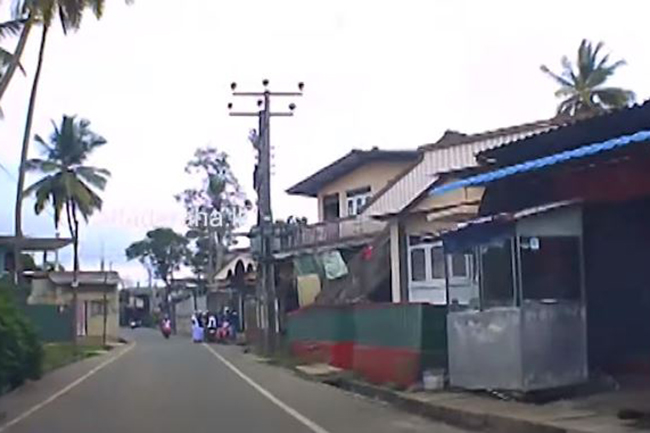
Six including the main suspect who assaulted the Ada Derana journalist Atulugama, Bandaragama have been placed under arrest, the police said.
The assault took place this morning (24) when the journalist in question went to Atulugama area to make coverage on Muslim devotees celebrating the Ramazan festival while adhering to social distancing regulations.
The journalist in question, Bimal Shyaman, had initially spoken to the chairman of the mosque association in Atulugama, Najeed Hajjiar Mohamed Najeed.
He had then obtained footages of one of the mosques in the area and as he was set to leave, a group of residents had threatened blocked his way and threatened him. They had also caused damages to his vehicle.
However, another group of persons had assisted the journalist to pull out of the situation.
The Atulugama mosque association’s chairman also arrived at the site to help out Ada Derana journalist.
Bandaragama Police launched an investigation into the incident following the complaint lodged by the Ada Derana journalist.
Two new COVID-19 positive cases have been detected as of 11.00 pm today (24), says the Ministry of Health.
Sri Lanka’s total count of coronavirus infections thereby increased to 1,140.
The two patients are confirmed to be arrivals from Kuwait, who are undergoing mandatory quarantine in Trincomalee.
Accordingly, a total of 51 positive cases of coronavirus has been detected so far within the day.
Meanwhile, 674 of these coronavirus patients have been discharged from hospitals so far upon complete recovery.
The Epidemiology Unit of the Health Ministry says that 457active cases are currently under medical care at selected hospitals.
The country’s death toll due to coronavirus currently stands at 09.
Twenty more test positive for COVID-19 as tally leaps to 1,138
Fifteen more persons have tested positive for COVID-19 as of 9.45 pm today (24) as Sri Lanka’s total count of coronavirus infections reached 1,138.
One of these positive cases has been identified as a navy man and the rest of the 19 cases are returnees from Kuwait undergoing mandatory quarantine procedure at the facility in Minneriya.
Accordingly, a total of 49 positive cases of coronavirus has been detected so far within the day.
Meanwhile, 674 of these coronavirus patients have been discharged from hospitals so far upon complete recovery.
The Epidemiology Unit of the Health Ministry says that 455 active cases are currently under medical care at selected hospitals.
The country’s death toll due to coronavirus currently stands at 09.
COVID-19: Cases reach 1,118 as Indonesia returnee tests positive
One more person has tested positive for COVID-19 as of 6.00 pm on Sunday (24), says the Ministry of Health.
Sri Lanka’s total count of coronavirus infections thereby reached 1,118.
Meanwhile, 674 of these coronavirus patients have made complete recoveries so far.
According to the tally of Epidemiology Unit, 435 active cases are under medical care at IDH, Welikanda Base Hospital, Navy Hospital, Colombo East Base Hospital, Iranawila Hospital, Kattankudy Base Hospital, Homagama Base Hospital and Minuwangoda Base Hospital.
The country’s death toll due to coronavirus currently stands at 09.
COVID-19 cases in Sri Lanka climb to 1,117
Eleven more COVID-19 positive cases have been identified raising the total number of coronavirus cases reported in the country to 1,117.
The new cases have been identified among persons who had been undergoing the mandatory quarantine at the Trincomalee quarantine center upon arriving from Kuwait.
Accordingly, 28 new coronavirus cases have been detected from the country so far today (24). All 28 patients had returned from Kuwait, according to the Ministry of Health.
Currently, 434 active COVID-19 cases are under medical observation at selected hospitals across the island.
Meanwhile, 14 more COVID-19 patients recovered today (24) raising the total tally to 674 cases.
Sri Lanka has recorded nine fatalities from the virus.
Twelve more coronavirus cases bring tally to 1,106
Twelve more persons are confirmed to have contracted the novel coronavirus, confirmed the Ministry of Health a short while ago.
With the new cases, 17 new coronavirus cases have been detected in the county within the day so far. Previously, 5 individuals who had arrived from Kuwait were declared to have contracted the virus.
The 12 new cases, too, have been identified from persons who arrived in Sri Lanka from Kuwait and undergoing the mandatory quarantine process at the Trincomalee quarantine center.
Thereby the total number of COVID-19 cases in Sri Lanka is at 1,106.
As per the Epidemiology Unit of the Ministry, 423 active cases are under medical care at selected hospitals across the country.
Meanwhile, 14 more COVID-19 patients recovered today (24) raising the total tally to 674 cases.
Sri Lanka has recorded nine fatalities from the virus.
Five COVID-19 cases among Kuwait arrivals push total to 1,094
Five more individuals who had arrived in the country from Kuwait have tested positive for COVID-19, stated the Department of Government Information.
They had been undergoing the mandatory quarantine process at the Trincomalee quarantine center.
Thereby, the total number of coronavirus cases reported in Sri Lanka has climbed to 1,094.
As per the Epidemiology Unit of the Ministry, 411 active cases are under medical care at selected hospitals across the country.
Meanwhile, 14 more COVID-19 patients recovered today (24) raising the total tally to 674 cases.
Sri Lanka has recorded nine fatalities from the virus.
May 14,
1976 is one of the most underreported, underestimated, underexamined dates in
the political calendar of independent Sri Lanka. It was the date on which the
Tamil leadership which had gathered in Vadukoddai passed a resolution declaring
war against the democratically elected state demanding a separate state.
Stitching bits and pieces of selected events from here and there, they painted
their version of history which consisted of highly controversial accusations to
demonise the Sinhala-state” – their terminology to stigmatise the
democratically elected state as a racist entity with no space for the
minorities, particularly the Tamils. So shedding copious tears for the Tamils,
the Vadukoddai Declaration of War urged the Tamil youth to take up arms and never
rest until they had achieved Tamil Eelam – a political haven of the Tamils, by
the Tamils for the Tamils.
The call
to take up arms was declared in the last two paragraphs of the Vadukoddai
Resolution. It said: This
Convention directs the Action Committee of the TAMIL UNITED LIBERATION FRONT to
formulate a plan of action and launch without undue delay the struggle for
winning the sovereignty and freedom of the Tamil Nation;
And this
Convention calls upon the Tamil Nation in general and the Tamil youth in
particular to come forward to throw themselves fully into the sacred fight for
freedom and to flinch not till the goal of a sovereign state of TAMIL EELAM is
reached.”
In these
two concluding paragraphs the Tamil leadership assembled at Vadukoddai called
upon the Action Committee to formulate a plan of action” for the Tamil
youth in particular to take up arms, abandoning their pretensions of being a
non-violent movement. And from 1976 onwards both the Tamil elders and the
Tamils youth followed the declared objective of winning the sovereignty and
freedom of the Tamil Nation” through violence. It was a clear and decisive
declaration to pursue a military course of action to achieve political goals
This was the primary message delivered by the Tamil leadership to the Tamil
people. It was the fateful day on which the Tamil leadership made their biggest
political gamble by deciding to abandon the non-violent, democratic mainstream
and go down the path of violence. They decided to change the course of history
– and their destiny — with violence. They invested everything they had in
pursuing violence and failed. Failed miserably!
Throughout
the post-independent decades, the ageing Tamil leadership had pushed Tamil
communalism to the extreme end and by May 14, 1976 the force of events
generated by them had cornered them. They discovered rather late that the
consistent, unrelenting and massive political campaigns they had whipped up,
blaming everything on the Sinhala state” in the post-independent phase, had not
gone in the direction they had wanted. Their aim was to divide Sri Lanka into
two states – a task which they set out achieve with the typical Tamil arrogance
boosted by historical distortions, political fictions, and
anti-Sinhala-Buddhist venom. They had raised the hopes of the Jaffnaites
overestimating their peninsular power and underestimating the consolidated
historical forces that had created, built and sustained the nation over the
ages.
By 1976 the
false expectations they generated had risen to fever pitch and the internal
forces – mainly, the Tamil youth — that rose with the high expectations had
gone as far as they could and reached the end of their political tether. The
Tamil youth were impatient and rebelling against the conservative and failed
Tamil leadership demanding a change of course. The internal dynamics within the
peninsula had gathered a momentum which demanded instant solutions. Eelam
remained in the Never-Never land, elusive as ever. The hate politics of
mono-ethnic Tamil extremism, targeting the Sinhala-Buddhists of the South, had
gone too far to a point of no return, leaving no room for peaceful
co-existence. Any moves for compromises were decried by one or the other Tamil
party as surrender to the Sinhalese. Following Jinnah’s partioning of India the
Tamil leadership declared that the marriage of partnership was over. They were
determined to go for divorce which in their desperate circumstances seems to be
the only way out.
In the
Vadukoddai Resolution the Tamil leadership was throwing not a challenge but an
ultimatum to the Sinhala state”. Pumped up by their mono-ethnic rhetoric,
wrapped in mythologies, they were hoping to force their way into Eelam. The
plan of the Tamil elders was to make use of the Tamil youth to pull their political
chestnuts out. In the process, they had painted themselves into a
mono-ethnic extremity from which they could not get out except through
violence. They were determined to dissolve the marriage made by the gods of
geography and history. All what they needed was a public declaration justifying
the hate politics of the North for them to declare war. The Vadukoddai
Resolution was introduced to spell out the reasons why they refused to coexist.
Demanding disproportionate shares of positions (particularly in the government
service), power in the legislatures, privileges enshrined in the various
constitutions and, most of all, territories as ethnic enclaves they had pushed
themselves into a self-destructive political extremity. It led them to
mono-ethnic politics, excluding the other”. With this agenda they had
nowhere else to go except to embrace violence. This confirms the
proposition that separatism and violence are inseparable.
It was
amidst these overwhelming pressures that the Tamil leadership met in Vadukoddai
and gave the official nod for the Tamil youth to take up arms against the
elected state of Sri Lanka, hoping to ride on their backs to the seats of power
in Eelam. The old Tamil leadership did not realise at this stage that they were
handing over their traditional power, which they had wielded from feudal times,
into the hands of the untried, untested and inexperienced Tamil youth. The
immature Tamil youth who took over were armed with the Vadukoddai Resolution
that legitimised their violence. Fired up by the Vadukoddai ideology they came
out of their cells like bulls in a china shop. They literally went berserk
believing that they had the Vadukoddai license to kill everything that crossed
their path, including their political fathers.
In the
meantime, the ageing Tamil leaders and the Tamil youth continued to maintain
their two-pronged attack on the South. Needling the lower-level ethnic
leadership of the South was a deliberate and chosen tactic of the Northern
provocative politics, wrote Prof. A. J. Wilson, son-in-law of S. J. V.
Chelvanayakam, father of Tamil separatism. The joint front of the Tamil elders
and the youth were heading towards violence. Clearly, 1976” was segueing,
slowly but surely, into 1983”. The explosion of 1983 did not come out of a
misguided government turning a blind eye. It was the cumulative reaction to the
collective violence unleashed in the Vadukoddai Resolution. No doubt, the
aggressive reaction of the lunatic fringe in the South, provoked by the hate
politics of Jaffna jingoism, too had aggravated the worsening inter-ethnic
relations with reactive mob-violence breaking out sporadically. But the
ultimatum issued in the Vadukoddai Resolution, and the provocative violence
targeting the Sinhala state” that followed, were heating up communal tensions.
Sinhala CTB bus drivers were returning to Colombo from Jaffna complaining that
the Tamil shops were refusing to serve even a glass of water. By 1983 the two
communities had drawn as far apart as they could. The last straw that broke the
back of the Sinhala camel was the killing of the 13 soldiers.
Looking
back, it is obvious that 1983” was the Southern reply to the arrogant politics
of 1976” and the subsequent increase of violence of the Tamil youth
threatening the sovereignty of the nation – the only place available to the
Sinhalese in this lonely planet. At least nominally, the Tamil and Muslim
communities had other historical havens to which they could withdraw in case
the worst came to the worst. The Sinhalese had only Sri Lanka. It was the only
base they built exclusively for themselves. Generations of Sinhalese sacrificed
their lives to make it their safe haven. They had a historical right to claim
it their own. It was not narrow racism / chauvinism. It was their legitimate,
historical and natural right. The Vadukoddai Resolution posed a threat to their
security and history and their defensive reaction was predictable.
The debate
on the whys and the wherefores of 1983”, of course, is not going to end in a
hurry. Taken out of its context and viewed as an anti-Tamil outburst of a
society gone mad, the Tamils made 1983” the ultimate proof of their need for a
divorce. But if it is placed in the context of consequences flowing from the
ideological and political violence unleashed in the politics of 1976” and
after, it is logical to conclude that 1983” was an inevitable outcome of the
preceding Tamil aggressive and provocative politics. They asked for and they
got it, was the general reaction of the Sinhalese. The sequence of events that
flowed from 1976” ran incrementally, step by step, one leading to another,
until escalating violence reached its explosive peak in 1983”.
Provocative
rhetoric and actions of the North unravelled slowly but surely into 1983”. The
explosion of 1983 was the counter-violence to end Tamil expansionism and
aggressive power grab threatening the territorial integrity and the historical
heritage left behind by the Founding Fathers of the nation. The ideological and
emotional ambience for an ethnic explosion was prepared and fertilized by the
Tamil leadership. The Tamil have always been quite clever in digging their own
grave. The other two minorities escaped the horrors of a 33-year-old war
because their leadership was wise enough not to hand over their grip on power
to the misguided youth. It is the restoration of power to the non-violent
stream of Tamil politics by the Rajapakse brothers that has introduced a new
normalcy which, hopefully, will grow into a new nation.
Sinhala
violence has invariably been reactive, responding to provocative political
violence of the minorities. And 1983” is no exception. Besides, no responsible
Sinhala leader, no respected or established Sinhala community organisation, nor
the Sinhala state” had officially declared war against another community,
despite the provocative violence they had faced. Like any other state it had
reacted defensively to restore peace, and protect territorial integrity and
sovereignty. It has never declared a war to impose its supremacy over the other
communities.
The
live-and-let-live policy of the Sinhala majority did not go beyond sporadic
violence of the fringe freaks against the provocative acts of the minorities.
Without condoning any kind of violence, it is clear that those explosions were
like the fizz of the soda bottle. Sinhala violence has always gone down almost
instantly, soon after its explosion, returning the nation to peaceful
co-existence. Only the Tamil leadership decided to declare war against the
Sinhala state” at Vadukoddai, creating the longest period of brutal violence.
Their politics of hate leaves no room for peaceful co-existence. Vadukoddai
Resolution was a recipe for separatist violence and chaos. But it was a wave of
tsunamic violence that came from the volcanic sifting of the territorial plates
in Vadukoddai and nowhere else.
I repeat,
separatism and violence are inseparable. It is the kind of politics that can
breed only hatred and not reconciliation.
After ordination,
Ven. Medhananda continued to live at Sri Sumangalaramaya, Napawela, Getahatta. That remains his permanent address today.
When Medhananda first went
there, the temple was very new. It had
an image house but no image. Loku
Hamuduruwo, Ven. Soratha got a stone mason down from India and had a Buddha statue made. He also
constructed a bodhighara. The villagers
were poor and could not support the temple very much. They sent dry rations as dane. When Ven. Soratha died, Medhananda was
placed in n charge of the temple. Ven.
Medhananda developed the vihara. He provided an access road, boundary wall,
library.
Ven. Soratha had started a daham
pasala in the temple in 1946. Medhananda taught there from the time he was a
samanera and after higher ordination he took complete charge of the daham
pasala. Medhananda came to Napawela
every week end, from where ever he was, to supervise the daham pasala. the village had retired teachers and retired
principals but they were not prepared to
teach in the daham pasala, complained Medhananda. Medhananda therefore
turned to past students and appointed them as teachers. Even today the teachers
are those he taught, said his biographer.
Medhananda expanded the activities of
the daham pasala. He held an annual celebration, with an art exhibition. We
organized daham pasal trips to places of importance in Sri Lanka. We took them
to sites of archeological interest and asked them to write reports on them. We did all this with great difficulty, said
Medhananda.
Medhananda was concerned about the
future of those living in Napawela. Napawela residents could only hope to get
employment as drivers of vehicles, he said. Medhananda
tried to improve their prospects. He started a free tuition class in the
temple, for ‘school exams’. This was probably for O levels, perhaps A level
too. Medhananda also established a
computer training institute in the temple later on.
Ven. Medhananda acquired Hendadola
estate and distributed it to the villagers. This was probably during Land
Reform. The estate had 76 acres of untapped rubber. He told the new owners to
cut and sell the trees. He had got a permit for this. Medhananda said he went
to Hendadola every week to see whether they were cultivating the land. He had an EN 1956 Peugeot car, at the time,
recalled Medhananda.
From
1970 Medhananda has held a well attended
all day Nikini pinkama in August. For the first thirty years this pinkama was
held in Anuradhapura. Thereafter Medhananda moved it to other places, such as
Buddhangala, Tissamaharama, Tantirimalai, Seruwila. This pinkama continues today.
Ven. Ellawala Medhananda was a popular bana
preacher. He received invitations to preach from all over the island. In Anuradhapura after listening to a sermon
from Medhananda, a member of the audience
donated his house and land. Medhananda
used the donation to establish a temple, Ranasiharamaya, near Mawatagama.
Medhananda‘s personal needs as a bhikkhu
would have been minimal. Therefore his salary as teacher was spent on the
schools he was teaching in. The
pirikara he received was used to help monks in poor temples. He found dayakas
for these temples, who were prepared to give monthly donations. He also arranged pilgrimages to these
temples, to help boost the income of
the temple. Medhananda had once
provided robes and ata pirikara to all the viharas in Trincomalee and Vavuniya for
Katina.
Medhananda has been involved in a wide range
of activities, possibly far wider than most activist monks. Medhananda was head of
Napawela Grameeya Nishpadana Mandalaya,
Chairman of
Balangoda Deaf and Blind school and advisor to Senior citizens Home,
Mallawapitiya, Kurunegala.
During his time in the Department of
Education, he was involved in
the preparation of History text book for grades 3, 4, 5 and 9. He helped prepared question papers for O level
and A level, also to set standards for Pirivena exams.
Medhananda ‘s archaeological research was recognized at national , provincial and district level. He was a member of
Advisory council, Department of Archeology, a
member of Mahavamsa committee, and
member of the At lipi Commission, Colombo. He was Coordinator for Attakata translations. He was President
of Ratnapura District Cultural Board, and the Ratnapura Archaeological committee. He
was Research chairmen, Sabaragamu itihasa Puravidya gavesana Ayathanaya.
Ven. Medhananda held positions in Sangha organizations at local and national level. He
was a Member of the Buddha Sasana Fund.
He was a member of Sabaragamu Maha Sangha Sabha, Ratnapura and Eheliyagoda Sasanaraksaka bala mandalaya. He was secretary
of Rajya sansta Bauddha bala Mandalaya,
Balangoda, and of Trinikaya bhikshu bala
mandalaya, Eheliyagoda. He was also
Advisor to Arugam bay Aukana Committee and
the Tarulengala Aranyaya,
Hulannuge.
Ven. Medhananda did not have very high opinion of the lay
Buddhists. Those who help and support the Sangha are very few, he said. We carry on as monks
with great difficulty, he lamented. Buddhists
do not value the Sangha. They do not help to develop the temples. Very few think that they must
protect and preserve the Sangha.
Monks never fail to carry out their duties
but if they see any little lapse or mistake on our part, the public insult and scold us. That is the
reward the Sangha gets. That is why they leave robes. And so the Sangha lose fine monks.”
But the public may have their
reasons. A school teacher had refused to help Medhananda when he was leaving to study at
Ratmalana. She had said ‘why bother, he
will leave robes, we need not help him.’
Medhananda was not pleased, but I think that the teacher’s view cannot be dismissed. ( continued)
I regret very much that you have been badly mislead.
There never was a Tamil genocide.The Tamil Tigers , labelled by the FBI US as
the most brutal terrorist organisation,, that pioneered suicide bombing and the
suicide west worn by all suicide bombers after them, waged a 30 year old war
against the legally elected government Sri Lanka, alleging discrimination
against Tamils post independence in Sri Lanka, for what in reality was the post
independence loss of priveleges bestowed on them by colonial Britain as a part
of their divide and rule policy where the Sinhalese were the victimised
majority.
In this war in the final few months leading to their
defeat on 19.May 2019, they used nearly 300,000 Tamil civilians hostages as
human shields, for their protection against the Sri Lankan security forces to
ward off their defeat that eventuated on 19.5.09, when their leader Prabakaran
became a victim the SL forces fire. The 300,000 Tamil civilians were rescued as
a major objective of the final operation and rehabilitated and live peaceful
and productive lives in SL now. The SL forces were under strict instruction
from their President on a ” no civilian casualty policy” .They
accomplished the Tiger defeat with about 7000 civilian casualties at most ,
very creditable considering the scale of the operation and the Tigers use of
these civilians as human shields deliberately and mercilessly.
These including the numbers were confirmed by the
resident UN representative inSL at the time Sir John Holmes, and later by a
census carried out in 2010 by Sri Lanka Tamil University Teachers. Diiplomatic
cables despatched from the US and Uk embassies in Colombo at the time tabled in
the British house of Lords by Lord Naseby in Oct 2017. also confirmed these
numbers and also that but for the care exercised by the SL forces , the war
would have been over much sooner and and with less security forces casualties.
However,the powerful Tamil diaspora based largely in UK and Canada that funded
the Tiger brutality for three decades, who had a track record of unbelievable
misinformation that woud Dwarf Joseph Goebelle , Hitler’s propagand minister
,along with distortion extortion and drug trafficking, refusing to accept
defeat responded by alleging that the Sri Lankan security forces achieved their
defeat of the Tigers with an unaceptably high civilian casualty rate which they
alleged without presenting any evidence , at different times and from different
sources to be anything from 40,000 to 100,000.
They then used their war chest of billions accumulated
using distortion, extortion and drug trafficking to orchestrate this
internationally using news media such s Channel 4 UK and unsuspecting and well
meaning western politicians, who became easy pray to their presenting these
entirely unsubstantiated numbers as representing ” victimisation of Tamil
minority in SL and so a genocide”.
They also found a powerful ally in the Darusman
commission, a commission appointed by the then UNSCG Banki Moon against the
wishes of the UNGA and UNSC so not a UN commission, to advice on accountability
provisions in SL re HR, whose three commissioners had conflict with the SL
government previously, who came up with their report receiving representations
from the Tiger diaspora only and not from th SL administration. In their report
they concluded that ” there was credible evidence of unacceptably high
civilian casualties, but kept the source of this information secret for twenty
years, so providing a reflection of the credibility and authenticity of these
conclusions.
However, it provided the fodder that the TIger diaspora
wanted and orchestrated this using the same resources claiming it a UN report.
I urge you to verify the claims I have just presented many of which can be done
surfing the internet.I would be happy to provide you with these too if you
could email me your email . Thank you for your indulgence in reading to my side
of the story. The statements like yours following crafty misleading, is very
hurtful to the likes of me of Sri Lankan origin , who have a fundamental human
right not to be accused, with no basis, as a Sri Lankan of being complicit to
geneocide .How wonderful it would be if you withdrew your statement after
verifying the information I have presented
Sincerely Dr. Chula Rajapakse MNZM cnarajapakse@gmail.com, +64274768797,
Wellington, New Zealand.
Michael Fishbach narrates his encounter with a humpback whale entangled in a fishing net. Gershon Cohen and he have founded The Great Whale Conservancy to protect whales. http://www.greatwhaleconservancy.org, is their website, or go to gwc’s facebook page, and join them in helping to save these magnificent beings.
Eleven years ago, on 18 May 2009, Sri Lanka marked a significant day in its history by freeing itself from the clutches of terrorism. This saw Sri Lanka becoming the first nation to eradicate terrorism in the 21st century, securing a momentous place in military history.
The military operations launched by Sri Lankan security forces at the Mavil Aru anicut on 26 July 2006 culminated in the final defeat of the LTTE at the Nandikadal Lagoon two years later on 18 May 2009, bringing an end to 26 years of civil war.
The Mavil Aru incident
The Sri Lankan Forces and the LTTE were locked in four years of a so-called ceasefire since 2002, when on 21 July 2006, the month of Black July, the irrigation engineer in charge of the Mavil Aru sluice gate complex received several reports of an unusual reduction in water flow through the irrigation scheme’s distributing channels. The engineer proceeded to inspect the gate, before being stopped at gunpoint by the LTTE around a kilometre before the sluice gate complex.
The LTTE’s closure of the sluice gates that day, cut off the water supply to approximately 15,000 farming families in 20 villages in the East. When repeated pleas from the Government and Norwegian peace brokers to resume the water supply went ignored, Government forces commenced operations on 26 July 2006 to liberate the Mavil Aru dam with the launch of aerial attacks on identified LTTE locations in the area.
The combined efforts of the Air Force and Army led to the sluice gates finally being opened, and the Government regained control of Mavil Aru by 11 August 2006. Military forces began their ‘humanitarian war’ – a twist on the Eelam War – to liberate the Eastern province. A year later, on 11 July 2007, the military declared it had gained full control of the East after capturing Thoppigala (Baron’s Cap).
Describing the situation faced by the troops during these operations, major General (rtd) Chagie Gallage once said, “The Eastern theatre of operation was peculiar in that the military and the LTTE were positioned without demarcation of separate areas of control. This dispersed position facilitated the LTTE’s logistics for recruitment, training and other related functions. The LTTE maintained approximately 3,000 cadres physically in the East in early 2006, which were reinforced systematically. The main effort of the security forces was to segregate civilians from the terrorists and inflict maximum attrition on the LTTE.”
The Vanni theatre of operations, categorised by three deep routes and two lateral routes, gave rise to a number of concerns during planning and execution. With the lack of infrastructure, extensive foliage and conditions that hindered infantry movement, several issues were encountered that caused a build-up of combat power and logistics.
The Vanni region was categorised into central, western, eastern and northern fronts. The Jaffna A9 road dominated the central front, while the western front was dominated by the Mannar-Pooneryn road. The lateral tracks and heavy fortifications of the Andankulam forest reserve in the eastern front were the key concern. The northern front consisted of a narrow strip of land exposed to the sea and lagoon, and posed a security threat. Hence, terrain imperatives had a major impact on the planning and execution of Vanni operations.
At a defence seminar, Major General Jagath Dias recalled the threats the Security Forces faced when executing the northern operation.
“The LTTE’s combatant strength was reported to be 18,000 at the time of operational launch. As operations progressed in early 2008, forceful recruitment of approximately 8,000 civilians saw this increase to approximately 26,000 cadres. The capabilities of the LTTE included operating in small groups, using their thorough terrain knowledge to launch counter-attacks, night movement, combat multipliers, sea-fighting capability – known as the Sea Tiger wing – air capability, indirect fire capability and the Black Tigers – a unique weapon the LTTE used extensively against security forces and civilians. The LTTE also used heavy weapons, such as missiles, multi-barrel rocket launchers and armoured vehicles.
The operation against them aimed to reduce their combatant efficiency and liberate captured areas to restore the State mechanism and return them to normalcy.
As a result of the success achieved in the East, it was decided that a frontage in the Vanni theatre be opened to compel the LTTE to commit their resources in multiple thrusts. By this time, troops were manning a defended coastal area from Kilali to Nagarkovil via Muhamalai, and Mannar to Kokkuthuduwai via Omanthai. In light of this situation, the 57 Division, the first offensive formation raised in the Vanni theatre, launched its operations on 5 March 2007, along three accesses from the Vavuniya-Mannar line of defence,” he added.
Troops of 57 and 58 Divisions were severely affected by an inundation due to the blasting of the Kalmadu tank by the LTTE. However, both Divisions overcame the situation to manoeuvre towards the open terrain in the East, maintaining a link between Task Force 4 and 58 Division. Against all odds, with an outflanking move of a brigade side force through the Nandikadal Lagoon, the 59 Division liberated Mullaitivu on 25 January 2009.
Chalai, the launching pad of the Sea Tigers’ operations, was exclusively used for LTTE Sea Tiger training and suicide cadres. The 55 Division, after gaining control of Chuddikulam Island, engaged in heavy battle to bring Chalai under control. By then, civilians had commenced crossing into liberated areas en masse, and troops worked on a priority basis to cater to their needs, for which action was initiated to prepare a site and other essential commodities at Menik Farm, Vavuniya.
However, winning the war was not an isolated operation by the infantry or the Sri Lanka Army alone. The Sri Lanka Air Force (SLAF) carried out targeted attacks on precise locations that the infantry could not reach. In one such attack, LTTE Political Wing Leader, S.P. Thamilselvan, along with five other high-ranking Tamil Tiger rebels, were killed in their sleep on 2 November 2007, when the SLAF carried out an airstrike on an undisclosed location near the LTTE stronghold of Kilinochchi.
The focal point of the 4th Eelam War’s success lies with the contribution of the Sri Lanka Navy (SLN). The strategies it adopted since the latter part of 2005 made sure not only that the LTTE’s international supplies were cut off, but also prevented its cadres fleeing by sea.
Naval operations began with an attempt to identify and destroy the LTTE fishing trawler fleet responsible for smuggling operations. Within a year, 11 LTTE trawlers were destroyed. The SLN used land-based radar to detect small boat threats up to 100 nautical miles from shore. Ships and boats were dispatched against these potential threats.
However, operations took a significant toll on the SLN. The bulk of the Navy’s assets were on continuous patrol to detect and destroy LTTE trawlers hiding among thousands of civilian vessels, resulting in worn-down and demoralised crews, while having little impact on smuggling operations.
By mid-2006, the Navy changed its tactics. Rather than chase the small vessels, it decided to utilise intelligence to target LTTE cargo vessels, or ‘floating arms warehouses’, which supplied the small boats. In addition to India’s cooperation, the US also provided intelligence to the SLN on the location of the LTTE arms warehouses. The intelligence proved critical in locating the more remote LTTE vessels loitering over a thousand nautical miles from Sri Lankan waters.
The SLN, with international support, hunted down the remaining LTTE cargo ships. Between September 2006 and October 2007, they destroyed eight large LTTE ships containing over 10,000 tonnes of war-related material, using a flotilla of three offshore patrol vessels (OPV) supported by old tankers, merchant vessels, and fishing trawlers.
Eleven years later
The 11th anniversary of the military’s victory against terrorism was commemorated at a juncture where the entire country was hit by another pandemic.
COVID-19 has already claimed over 335,000 lives worldwide, while over 5.11 million have tested positive for the disease. While most neighbouring countries have been severely hit by the pandemic, Sri Lanka has largely managed to contain the virus’ spread.
Back on the frontlines
Interestingly, those at the forefront in playing key roles in the fight against COVID-19 are the same people who fought a winning war 11 years ago.
Then-President, Mahinda Rajapaksa, who provided political leadership as Commander-in-Chief, now serves as Prime Minister, planning strategies to mitigate blows the pandemic could have on the country’s economy.
Then-Defence Secretary, Gotabaya Rajapaksa, is now the Commander-in-Chief, directing the operation against COVID-19 by bringing the Health and Defence sectors together.
The Tri-Forces and the Police are again on the frontlines, protecting civilians. Just as they served as the forward defence line in the fight against the LTTE, they have again taken the forward defence line in helping and guarding health service members and civilians, undertaking the entire quarantine operation under the leadership of Army Commander, Lt. General Shavendra Silva.
Similar to the vital role they played in identifying military targets and enemy movements 11 years ago, the State Intelligence Service (SIS) is identifying clusters spreading the virus; SIS Assistant Director, Parakrama de Silva said that all remaining clusters have been identified.
These include the clusters stemming from the Tourist Guide identified on 11 March, the Gem Merchant in Beruwala, the returnees from Italy and Dubai, the groups that returned from a religious event in Puttalam, the Suduwella drug addicts, the people of Bandaranayake Mawatha, Colombo North, and the Navy, which were identified as the highest risk.
No war is fought without casualty. Going by the statistics, it is evident that civilian life was prioritised as the forces carried out their search operations. With the Navy being the largest COVID-19 cluster at the moment, the public evidently appeared to have been disturbed by the fact, and were seen mistreating members of the military forces.
Navy Spokesperson
Lt. Commander Isuru Sooriyabandara pointed out that this was unfair of the public, saying, “Infection among naval personnel could have been controlled had we not all gone out to track down and capture those connected to the Suduwella cluster. We did not stop at Suduwella and in fact, continued up to Nagalagam Street in Colombo, because we were determined to stop the cluster from spreading to communities. It comprised drug addicts, and our members came into contact with them while attempting to apprehend them. Some criticise us saying that we did not follow safety measures; but one has to realise that we do not give up a battle just because we do not possess all the required equipment. We will still fight by maximising the minimum resources we have.
“The spread of COVID-19 in the Welisara Camp was due to its composition. One sailor barrack houses about 50-60 personnel. Also due to their lifestyle, their immunity system is strong, and most cases did not present symptoms. Now that we are releasing civilians from quarantine centres around the country, we will be able to send our sailors to those centres and bring the numbers down.”
Lt. Commander Sooriyabandara added, however, that this would not discourage them from continuing to serve the public in the fight against COVID-19, and in the flood situation expected to affect most parts of the country.
Security has been beefed across Sri Lanka as a 2 day nation wide curfew came into effect from 8pm on Saturday with nearly 1000 road blocks set up in all districts, the police said.
The police said that strict checking will be carried out in all districts on all vehicles and people who leave their homes and the road blocks will be manned by police who will be deployed on a 24 hour shift basis. Further, mobile patrols will also be deployed on the roads in all districts and anyone defying the curfew will be arrested. The police further urged Muslims, who will celebrate the Eid festival tomorrow, to avoid gatherings and celebrate the festival while being confined to their homes. Anyone defying the curfew will be considered as breaking the quarantine law and strict action will be taken against them. The curfew will be lifted on Tuesday at 5 am. Curfew will thereafter be lifted in all districts on Tuesday at 5 am, including in Colombo and Gampaha and will be imposed daily from 10 pm to 4 am.
The President’s Media Division (PMD) has issued an updated announcement on the ongoing curfew in all districts.
Accordingly, the island-wide curfew, which is set to go into force from 8.00 pm tonight (23), will be lifted at 4.00 am on Tuesday (26). The entire country will be under curfew on the 24th and 25th of May.
From May 26 onward, the curfew in all 25 districts will be in force between 10.00 pm and 4.00 am daily, until further notice.
Travel between districts except in Colombo and Gampaha districts will be permitted from May 26.
Four more COVID-19 positive patients reported increasing the total number of cases in the country, the Ministry of Health stated.
Twenty-two positive coronavirus cases have been confirmed so far within the day.
Accordingly, a total of 1,089 novel coronavirus patients have been identified from Sri Lanka.
Meanwhile, the number of recoveries in Sri Lanka moved up to 660 earlier today, as 40 patients were discharged from hospitals as they have returned to health.
The Epidemiology Unit says, 420 active cases are currently under medical care at the IDH Hospital, Welikanda Base Hospital, Colombo East Base Hospital, Iranawila Hospital, Kattankudy Base Hospital, Navy Hospital, Minuwangoda Base Hospital, and Homagama Base Hospital.
Nine coronavirus patients in the country have succumbed to the virus thus far.
Presidential Commission of Inquiry probing the 2019 Easter Sunday terror attacks heard that Ringleader of the attacks Zahran Hashim and another bomber had engaged in a reconnaissance of the Shangri-La Hotel in Colombo two days prior to the attacks.
The Commission also heard that a room was booked by one of the bombers at the hotel on the 17th of April under a fake name.
Chief Inspector of Police (CIP) of the Criminal Investigations Department (CID) Mahinda Jayasundara who is in charge of the investigations pertaining to the Shangri-La Hotel bombing in the Easter Sunday of last year gave evidence before the Presidential Commission of Inquiry probing the attacks yesterday (22).
He told the Commission that an individual named Mohamed Hamshad had reserved Room 616 of the 6th floor of the Shangri-La Hotel on the 17th April, prior to the attacks.
He added that Mohamed Hamshad is a fake name and the person who came to reserve the room was in fact the Cinnamon Grand Hotel suicide bomber Mohammed Ibrahim Insaf Ahmed.
The Chief Inspector added that both Zahran Hashim and Mohammed Ibrahim Ilham who perpetrated the attack at the Shangri-La Hotel had visited the hotel 2 days prior to the attacks, at around 7.30 am.
He noted that it is possible that the duo had breakfast at the ‘Table One’ restaurant in preparation for the attack.
The witness went on to say that the CCTV footage shows that the duo had then spent several minutes at the hotel lobby before taking a taxi to a building named ‘Lucky Plaza’ in Colpetty.
Zahran had rented a flat on the 5th floor of that building and investigations uncovered fingerprints of Zahran’s sister at the flat.
CIP Jayasundara also said that information pertaining to a van was also uncovered when questioning the building’s security guard.
The witness said that an unidentified person had parked a white van in the building’s car park and when the security guard had enquired about it, the individual in question had driven away. Further investigations have revealed that the van in question is the same van which was subjected to a controlled explosion near the St. Anthony’s Shrine in Kochchikade, a day after the attacks.
The witness added that the next visit of Zahran Hashim and Mohamed Ibrahim Ilham to the Shangri-La Hotel by a taxi was on the 20th of April at 7.56 pm. The taxi they had used had come from the Paraththa Road in Panadura and the witness said that the duo had brought large traveling bags with them and it was later ascertained that the bags contained explosives.
The hotel’s welcoming officer had told investigators that when a member of the hotel staff offered to take the bags to their room, the duo refused the service.
Investigations have uncovered that Ibrahim Ilham had exited the hotel with a light traveling bag on the night of April 20 and had taken a taxi to the ‘Span Tower’ apartment complex in Mount Lavinia.
It is also revealed that the suspects had rented two flats at the complex between April 12 and 21, 2019, and they were rented by the Kingsbury Hotel bomber.
CIP Jayasundara added that after visiting the apartment complex in Mt. Lavinia the night before the attack, Ibrahim Ilham had visited the house in Mahawila Gardens in Dematagoda. From Mahawila Gardens, Ilham had visited a renowned restaurant in Colpetty and purchased food before returning to the Shangri-La Hotel at 1.46 am on April 21.
President Gotabaya Rajapaksa and Indian Prime Minister Narendra Modi have engaged in a 20-minute telephone conversation this morning (23).
The Indian Premier has commended President Rajapaksa for being a clear thinker and tough decision-maker”, in tackling the threat of COVID-19 in Sri Lanka.
The two leaders have also discussed the pre-COVID situation and where Sri Lanka and India are today, with emphasis on enhancing bilateral cooperation.
President Gotabaya Rajapaksa has commented on Sri Lanka’s post-Coronavirus economy while emphasizing on IT & technology. He has insisted on Sri Lanka’s expectation of value-added investment from India.
During the conversation, Prime Minister Modi has assured a road-show in India for Sri Lanka once the current threat eases.
PM Modi has reiterated India’s continuous support its close maritime neighbour in dealing with the pandemic and its economic impact.
The two leaders have agreed to accelerate Indian-assisted development projects in Sri Lanka, and also strengthen investment links.
Had an excellent talk with President @GotabayaR. Sri Lanka is fighting COVID-19 effectively under his leadership. India will continue to support our close maritime neighbour in dealing with the pandemic and its economic impact.— Narendra Modi (@narendramodi) May 23, 2020
Individuals are not selected for international positions to go on witch-hunts especially against sovereign countries and elected leaders. The international entity, appointing them are also responsible to see if those they appoint exceed their mandate. International entities cannot simply watch their appointees abuse their portfolio especially against a sovereign country & a UN member state. In so doing, it only shows that the international entities are also party to aiding abetting the bias. Two South Africans, the former UNHRC head and the EU employee paid to look into the welfare of South Africans are both obsessed with Sri Lanka. We would like to know why. The former head of the UNHRC being a Tamil ethnic-origin, should have recused herself from judging Sri Lanka as you cannot be the judge of your own case. As a lawyer, she should have known this. The other, also hailing from South Africa ever since sitting as a Panel Member of the personally commissioned Ban K Moon report, has been virtually 24×7 out to find some fault against Sri Lanka. People elected for international and public roles are not paid to demonize countries and character assassinate the leaders or those they appoint. The UN or the EU cannot brush off their actions without a proper investigation. The GoSL through its foreign ministry must seek action from both the UN and the EU & question their abuse of position. They have no right to abuse their position to demonize Sri Lanka internationally, character assassinate Sri Lanka’s elected leaders and criminalize members of Sri Lanka’s Armed Forces without evidence.
Appearing on a 20 May 2020 with a video message relayed to the world, the former UNHRC head proved and self-exposed her apparent bias. Her comments confirmed all that was said against her and the manner she functioned since 2008 as head of the UNHRC. That she did not table the personally commissioned Ban Ki Moon report (which was not mandated by either UNGA or UNSC) in the UN General Assembly or the UN Security Council or the OHCHR but extensively quoted from it both orally and in her written statements confirms her apparent bias. She championed the demand for an investigation that was always one-sided and against Sri Lanka’s Armed Forces extending the investigation beyond the mandated period covering 2002-2009 to 2011 and including aspects that were never part of the conflict as a means to use the UN system to rebuke a sovereign UN member state. Her anger against Sri Lanka & the Armed Forces was such that she has created a precedent – the first time the UN was venturing to investigate a conflict that had concluded. This is likely to impact other weaker UN member states adversely too.
The legality of the OISL investigation on Sri Lanka based on a personally commissioned report never tabled in UNGA, UNSC or UNHRC for Sri Lanka to officially respond to, must be answered by UN legal team.
Her office was used to embarrass Sri Lanka’s appointees who were former Armed Forces commanders. After listening to her May 2020 message, we can look back and understand the reasons for her bias which was nothing but bordering on revenge for defeating the LTTE. She had no word of sympathy for the many Sinhalese and Muslims killed by LTTE. No wonder she did not visit a single Sinhalese or Muslim when she visited Sri Lanka. Her bias was as open back then as it is now. Listening to her May 2020 speech against all her official and media statements against Sri Lanka since 2008 will showcase her bias.
The other South African is a EU employee paid to look into the welfare of South Africans. She was selected by former UN Secretary General to be on a personally commissioned panel to appraise him of the last 3 months of Sri Lanka’s conflict. The 3 members in their report claimed LTTE the most disciplined and most nationalist of the Tamil militant groups”! The report only said there could have been as many as 40,000 civilian deaths.” But the propaganda twisted it to claim 40,000 were killed. We continue to challenge this as DEAD LTTE cannot be portrayed as GENOCIDE of civilians. Whether civilians or LTTE, no one has yet produced evidence of 40,000 dead. The same report that referred to ‘credible allegations’ was soon drummed as ‘credible evidence’ against Sri Lanka international by media & human rights groups. The level of bias was unbelievable and unacceptable.
What EU must clarify with the GoSL is on what grounds they are paying the Executive Director of the Foundation for Human Rights in South Africa to carry out a sub-unit against ONE COUNTRY by the name International Truth & Justice Project-Sri Lanka? ITJP is eternally issuing reports against Sri Lanka. She exposed herself when she began attending regular events of proscribed LTTE fronts who referred to her as ‘our comrade’, she was put on the Advisory Council of another campaign for ‘peace and justice’ signing petitions in 2014 in which pro-LTTE TNA were also signatory.http://dbsjeyaraj.com/dbsj/archives/28557. Her reports are always timed to appear before a UN session. She purposely mixes civilians with LTTE terrorists in her selective reports. Her job role needs to also be investigated for no international position can be abused to bring ridicule and denigrate a sovereign nation with baseless lies spread by well-funded propaganda.
Today, all of the organizations that are running anti-Sri Lanka campaigns were all established after the defeat of LTTE and Prabakaran and utilizing 18 May to commemorate genocide” of LTTE on the guise of remembering civilians. Proof of tht is seen in the LTTE paraphernalia adorning all the commemorative functions. All this is nothing but a means to keep alive the international LTTE kitty that generates $400m annual profits and the international illegal/legal networks that generate the income. Drawing high profile international personalities is a safe-net for LTTE fronts to protect their interests using their association as cover.
If their apparent bias is on account of some form of influence, Sri Lanka deserves an apology after UN & EU investigate their roles. Personal biases cannot dent the good name of a sovereign nation & international relations & diplomacy.
Navi Pillay has finally crawled out of the woodwork. On 20 May 2020 the former head of the United Nations Human Rights Council finally showed off her true colours reading out a script which proved beyond doubt her bias ‘remembrance of the Tamil victims of war in Sri Lanka that ended on 18 May 2009’. She has sealed her bias by these lines in completely ignoring the Sinhalese, Muslim and even foreigners who were victims of LTTE. As Head of UNHRC when she prepared herself to seek revenge against Sri Lanka for eliminating a terrorist movement, as an ethnic Tamil herself, it was only ethical for her to recuse herself based on the logic that you cannot be the judge of your own case. However, she proceeded to go beyond her mandate to investigate for the first time a country that had ended a long lasting conflict which even the UN or foreign mediators had failed to achieve. It is now clear that she has violated legal dimensions within the UN apparatus by using the personally commissioned report of the UN Secretary General as the basis for her oral and written statements promulgating an investigation against Sri Lanka’s national army. All of these actions by her have been with bias, revengeful intent, hatred for the Sri Lankan National Army and is a far cry from the justice she was paid to deliver by UN members. Her public statement thus clearly exonerates the Sri Lanka Armed Forces of all crimes falsely framed against them by her abusing her office. It is still not too late for her role as UNHRC head to be investigated and the GoSL must demand the UN do so. A far cry from justice has been her self-exposed bias against Sri Lanka.
She says close to 146,000 Tamils lost their lives during the last 6 decades”(60 years). She never made such a statement as head of UNHRC – from where is she plucking these figures?
She says we honor the Tamil victims”– now we can understand why she did not wish to see a single Sinhala or Tamil victim. It is more than clear now why she did not even acknowledge the details of the 5000 Missing in Action letters sent to her office by families of Sri Lankan soldiers.
She says we inspire to continue our struggle for justice, freedoms and reparations for their losses” – now all of her statements since 2008 makes sense. There was a joke during her rule that even a dog couldn’t die as she was waiting to pounce and place blame on the Rajapakses!
She speaks proudly about the UN investigation against Sri Lanka of which her role in framing bogus charges giving OISL coverage beyond the date supposed to be covered was to look for any avenue to frame charges against the Government that destroyed the LTTE and the military commanders that did so. If any perpetrator is to be brought to justice, the UN must tender an apology to Sri Lanka and investigate the abuse of office by Navi Pillay as head of UNHRC.
She brings up the Presidential Pardon of Sergeant Sunil Ratnayake claiming it to be a ‘cynical move’. She has a right to her biased opinion and a President of a sovereign country does not require to take her permission to give presidential pardons for a case that was politically motivated. It is unfair to put a person in prison for life based on hearsay evidence as was the case with this sergeant. But this was exactly what Pillay was aspiring to do by bringing a bogus witness protection scheme for the OISL granting 20 years anonymity to the ‘witnesses’ that would testify against Sri Lanka’s armed forces. This meant that soldiers accused by her office for war crimes would land up in prison and have to wait 20 years to be told that there was no such real witness or evidence! How many Sunil Ratnayake’s did she plan to throw into prison using this 20 years anonymity hokus pokus?
She says ‘Tamils in Sri Lanka continue to suffer all kinds of prejudices, discriminations and violations of their human rights’ – we challenge her to produce one evidence of where Tamils are constitutionally or legislatively discriminated. We can produce enough of evidence to show what Tamils enjoy. The previous Tamil Governor of Central Bank Sri Lanka ran away looting the country and continues to live a fugitive. The Tamil foreign minister we had was killed by LTTE.
She says ‘lands stolen by the military has still not been returned’ how many of them actually have original land deeds to demand land? Simply shouting return land is no legal basis to acquiring land sans original ownership.
She says Tamil language excluded from national anthem. The national anthem was always sung in Sinhala. Its constitutionally enshrined. That was illegally changed in 2015. There is no requirement for one country to have 2 national anthems. It should be sung as it has been sung. Singing or not singing it makes no difference to anyone who is a traitor to the nation.
She says 200 people still in detention. Is she referring to LTTE combatants who refused to be rehabilitated? Why is she speaking on behalf of them?
So the supposed to be unbiased Pillay has become a crusader for the rights of the Tamils seeking ‘collective action’ for reparations and redress. We can now understand why the OMP was set up and this calls upon the Govt to immediately address the elements inserted into this Act that is attempting to drain Sri Lanka’s tax payers to compensate for LTTE combatants and their families.
Navi Pillay was appointed head of UNHRC in 2008 at a time when Sri Lanka had just liberated East Sri Lanka of LTTE and was preparing to move northwards. We can now understand her anger at the prospect of LTTE seeing its end. As UNHRC head she was in a position to deter the eventuality.
We can now understand why she visited only North Sri Lanka in 2013 and saw only Tamil victims and not Sinhalese or Muslim victims of LTTE terror. The mahaveer widow she met then was Ananthy Sasitharan the wife of a LTTE senior leader Ezhilan who contested elections from the TNA and the same woman is a co-speaker at the May 2020 function in which Pillay is due to speak.
We can now understand why she paid scant interest in finding the whereabouts of the 5000 Missing in Action Sri Lankan Soldiers whose families had filed petitions with her office. No official statement was issued by her. She never thought fit to meet one single widow of a missing Sri Lankan soldier.
We can now understand why she was hesitant to denounce LTTE, why her statements had nothing about LTTE abductions of children as child soldiers, why she even went to the length of criticizing GoSL appointments of ground commanders who defeated LTTE – all beyond her mandate.
We now realize why she never wished to stop the 350 plus Eelam Madrasasa” operating across Europe indoctrinating hate against Sinhalese. She never commented on LTTE using cyanide capsules or asking children to commit suicide. She didn’t demand LTTE to release children, to demanded LTTE release children and old people kept as hostages and human shields. She never spoke a word about LTTE killing Tamils nor made any attempt to investigate such. She never applied 3 and 4 Geneva Conventions/Additional protocols against LTTE violations.
No wonder she didn’t accept how Sri Lanka Armed Forces saved close to 300,000 and accepted surrender of close to 12,000 LTTE combatants if they had been firing at the no fire zone since 21stJanuary 2009?
No wonder she was annoyed when the GoSL proscribed LTTE fronts in April 2014 under UNSC Resolution 1373 and it is quite hilarious how 11 years later she is attending their very function to commemorate LTTE dead. What an expose this is.
No wonder she did not chose to weigh how far Sri Lanka had weathered terrorism inspite of peace talks, negotiations and even foreign interventions (India & Norway) all proving failures. No wonder she insisted on an investigation she would oversee. The need to recuse from taking up the issue of Sri Lanka being an ethnic Tamil was raised but UN chose to ignore this. You cannot be the judge of your own case. She as a Tamil was sitting in judgement. How legally fair was this?
While the UN Secretary General Ban Ki Moon commissioned a 3-member panel to appraise him of the last 3 months of the conflict, this report was not mandated by the UN Security Council or the UN General Assembly. It was a personally commissioned report.
Ban Ki Moon’s personal report was leaked but the UNHRC former Head quoted extensively from this without tabling it in the UNHRC/OHCHR to the UNGA or UNSC. If she believed Sri Lanka had committed wrongs why didn’t she table the report and produce evidence to the UNSC or UNGA? Pillay went on to quote extensively from pro-LTTE sources.
We have also not forgotten the 2014 incident of the LTTE combatant arrested with signatures on blank UNHRC war crimes submission forms with OHCHR logo being collected by instructions from TNA advisor Sun Master who was associated with the US embassy political affairs officer Mike Erwin.
Of course we do not doubt there could have been wrong doings – every army has sour grapes, but these are individual cases and there are military tribunals to address the issue but only after producing prima facie evidence. Propaganda cannot charge an entire National Army of war crimes.There cannot be restorative justice for LTTE armed non-state actors and retributive justice for the National Army who was only doing its national duty to defend/safeguard the nation & its citizens.
We can now understand why Pillay made some controversial picks for the OISL investigations – South Sudans’ expelled UN officer was one and the other was accused of accepting bribes by Albanian mafia to deliver Kosovo independence. So did Pillay harbor ideas to turn Sri Lanka into a Kosovo!
The biased Moon report resulted in the bogus figure of 40,000 dead going viral but even 11 years on no one can yet name the dead. As we have repeatedly said and we are again repeating
· Prove how many CIVILIANS were killed (prove that they were civilian first)
· Prove that CIVILIANS were killed by Sri Lanka Army & not by LTTE as the UN & IC had to appeal numerous times to LTTE not to shoot and kill fleeing civilians (so how many fleeing civilians did LTTE kill)
· Dead LTTE combatants in civilian clothing are not civilians
The LLRC Report declared 22,247 LTTE of which 11,812 were identified with names. The remaining 10,435 LTTE dead had yet to be named in 2011 – but these 10,435 LTTE dead cannot be commemorated as dead civilians by LTTE fronts lighting candles every year and crying their way to fatten the LTTE kitty, as this is a super means of camouflaging their illegal international money making ventures which are now able to entice quite a lot of high profile personalities.
Without providing answers to these basic questions how dare the UN call Sri Lanka’s National Army as war criminals?
What is this big justice UN is speaking about when funding and lobbying silences all truths and instead drums propaganda of sensationalism, hype and lies? What is more alarming is that the terrorists and their lobbies have infiltrated international offices and are influencing appointed members who should function with impartially.
Investigate Navi Pillay’s role as Head of UNHRC and remove all bogus charges against Sri Lanka
Re-modeling
economic policies of the country may have been the prime accountability of all
governments elected to the office since independence in 1948. Although the
policymakers soon after the independence, did not publicly state to accomplish
the accountability with balanced growth, the focus of policymaking implied to
reduce the bias in the society that created a severe class-struggle and
contrasts in the country. It was a
challenge to political leaders as well as economic policymakers.
The
economic policy before 1956 was giving priority to boost domestic rice
production that was not reflecting self-sufficient status, which was not adequate
to change the economy giving advantages to the rural people. Although Sri Lanka
had the potential to produce the required volume of rice production in the
colonial period the economic policy was not fair, despite the potential
colonial masters’ aim was to import rice and local politicians were unhappy
about such a policy. It reflected in the operation of the state council before
independence. Economic historians should identify the historical reasons to
align colonial policies to increase rice production by local politicians, and
why they were in narrow thinking field when there was a broader field to think
about.
The
pattern of economic growth and development echoed apparent bias between urban
and rural Sri Lanka during the colonial and after the period. Economic
policymakers had no broader understanding of the philosophical aims of economic
development and social focus of growth perspectives, but the rural community
had a feeling that they were brushed aside by the government in the
policymaking process. A shadow of Marxist politics walked around the country
concerning the policy negligence as a country which based on more than 75%
agriculture shouldn’t have opened the way for Marxist politics.
The
weakness of economic policies in the various sectors of the economy appeared
since independence and recorded economic dualism, which was a product of
policymakers. Before the Western colonial masters, Sri Lanka’s economy was not
dualistic and monarchical rule managed balanced growth in the entire country.
When
it looked at the pattern of growth from time to time after independence it showed
that the government’s preference was to invest more money in urban areas to
give economic advantages to rich people, and no government elected since independence
has been focusing to radically change the economy except the government elected
in 1977. Although economic or technical
dualism was a popular topic of economic students and talked on removing dualism
by a balanced growth approach that was ignored by economic policymakers the
right medicine for the problem emerged during and after the colonial period.
The
governments elected from 1947 to 1956 attempted to hang in the colonial
economic policy concentrating to be engrossed with the colonial masters’ views.
The political authority considered the policy focus had to maintain class
differences while development thrust was going on, and the economy had adequate
food to provide the needs of a small population and the creation of
productivity was the disguised issue.
The
government of Sr John Kotalawala attempted to modify the colonel economic
policy, considering the issues encountered during the Korean War, and expanding
the market economic system inserting domestically intended ideas and changes that
were conceded appropriate to Sri Lanka and attempted to stimulate the economy
by a six-year development program. Although many have no clear understanding of
the policy framework of Sr John Kotelawala it had a very good practical
economic philosophy based on the market system. When I was reading the Six-Year
development plan I had a feeling that it was an attempt to take market policies
to regional Sri Lanka. The policy effort was unsuccessful as the government
lost the election in 1956.
The
elected government in 1956 endeavored to reverse the economic policy that has
been working since the independence, with a giant hope on a system of the
central planning type socialist economic system, and the policy focus directed
to applying inward-looking strategies, which had been aimed to promote import
substitutions and to increase domestic production. It was a good idea but policymakers did not
affiliate to prevent shortages in consumer goods.
The
Ten Development Program was initiated by the government and the program was not
active, as there was a conflict of economic ideology and the practical policy
of the government, which attempted to nationalizing private investment projects
rather than introducing prudent regulations. It was considered as the best option to
overcome the issues emerged from the market economic policy. However, the
economic policy of Mr.S.W.R.D. Bandaranaike was too aligned to the nationalism,
which was appeared to be a popular style in the developing world when the wind
of independence was blowing around the colonial countries in Asia, Africa, and
Latin America.
Although
the economic policy initiated in 1978 seemed to be popular and logical in the
global environment, policy efforts showed a failure without a policy control
mechanism that consisted of a prudent regulatory framework. The policy authority ignored the essential disciplines,
that needed to successfully implementing the market economic policies. The
control mechanism in the economic policy process has been wicked from 1978 to
2019 as the political influences in the administration system corrupted policy
disciplines. The attitudes of the public
demonstrated the willingness to maintain liberal policies, whether they were
successful or not achieving economic targets, but the open economic policies
were favorable to continue in the future. However, some people continuously
blamed the market economic policies disregarding the benefits gained to the
country.
The
party politics in the country prevented the changes required to the market policies
with a prudent regulatory framework, and the elected governments showed a
willingness to maintaining the policy focus without regulation and discipline. The major reason to continue the policy focus
despite the disciplines appeared that the satisfaction of the mentality of
consumers, and politically, the market environment has been in a favorable
environment for the platform-talks of politicians. The community
enjoyed the window shopping, as the shops were full of imported goods under the
liberal economic policies which permitted to import any rubbish without proper
quality control. The best example of this situation was that certain popular
businessmen in the country imported rubbish from the UK in 2019 despite the
opportunity was given to businessmen for the development of export industries.
The
liberal economic policies supported creating a new wealthy class and they
contributed a massive volume of money to political parties in power. The liberal system further depreciated the
government’s financial disciplines and supported to increase corruption. The
good governance promoted in platforms during the 2015 presidential election and
the politicians gained power engaged in heavy financial corruption such as
Central Bank’s bond scam. The traditional wallow politics have been removed and
replaced by new capitalists who have been worse economic managers and investors.
Traditional capitalists reluctant to engage in immoral business, but the choice
of new capitalists seemed to pursue immoral business to destroy the young
generation to make quick profits.
Liberal
economic policies showed a massive change in society at the cost of economic disciplines.
The major weakness of the system was neglecting a balanced growth between rural
and urban areas and a heavy concentration on concrete jungles as the new class
emerged after 1978 falsely believed that high rise building reflects the
development and growth. They disregarded
the environment and potential opportunities in the environment.
What
are the real criteria to determine the upliftment and quality of life of
people? Many economists contributed
contradictory views the universally accepted view is the eradication of bias of
living conditions of people. Developing
new economic policies Mr. Gotabaya Rajapaksa, the president of Sri Lanka needs
to concentrate this idea and re-modeling the developing environment with a
bunch of anticipated achievements related to each criterion.
Since
1978 economic policies have been accomplished to satisfy the attitudes or
thinking patterns of common people, however, the idea of enhancing the
production, and the productivity went out of the minds of policymakers, because
of the politics of the country reluctance to show or hear about the shortage of
goods and services in the market which reflected the success of a political
party that is in power. They did not concern the macroeconomic problems such as
terms trade, budget gap, the balance of payment adjustment process, population,
unemployment, and many others and they were not problems that understood by
voters. In that environment, economic policymakers’ antipathetic
on policy advice for macroeconomic problems, and microeconomic reforms in
public enterprises except privatizing handful of government corporations. Economic policy advisers had a responsibility
to push the political authority to promote production-oriented economic
policies. The economic environment developing with the COVID 19 pandemic has
pressed policymakers to turn for production-oriented economic policies.
The
production has a positive relationship with the imports and exports, which
contribute to the volume of foreign reserves thereby to the strengthening of
Sri Lanka’s rupee. The production would answer to many macroeconomic problems
and why policy advisors so reluctant to do the job is a question.
There
were many issues in the country after 1978 such as social, cultural,
constitutional, religious, and ethnic issues in addition to economic concerns,
and the grave issue of LTTE war was reasonably tackled before 2010, and the
radical change of economic policy focusing on production-oriented economy
ignored scaring to modernization. I have an unanswerable question that what is
meant by modernization in Sri Lanka.
When it looks at the history of Japan it clear that modernization had
been a long process since the Tokugawa period and modernization was a
meaningful process to change attitudes towards the economic, social, cultural, and
religious development of Japan.
Do
people of Sri Lanka understand the connotation of modernization? My feeling is
that modernization has been misunderstood and changing clothing styles and
wearing half-naked dresses and singing songs, which based on the copied body.
The Meiji restoration in Japan gives a message to the world that modernization
is an achievement in all sectors of the economy by great sacrifice and gaining
strength to change policies in all areas to generate dynamism.
Information
technology-related products manured invented after the cold war changed the
attitudes of people especially by personal computers, mobile phones, Facebook, YouTube,
Instagram, the broadband Internet, and many others. However, innovations of
technology have contributed nether to rapid structural change nor to reduce
economic inequalities but to accumulate wealth to a few owners of modern
technology and speculators of the world.
The
pandemic of COVID 19 caused by a micro virus that has changed the attitudes of
economic policy-makers around the world. The sources of economic strengths in
the world such as invisible exports, share market, share brokering and many
other areas have been degraded by a micro virus, which forces economists as
well as politicians to rethink policy priories.
However, the policy priority for increasing production has not been
dismantled or being able to dismantle by the micro virus and the pandemic
strengthens the production-based economic policies.
Billionaires
emerged from paper profits, short-selling in the stock market, tactics of
forward-exchange contracts in the off-balance-sheet process were given heavy
losses by the micro virus. Many countries in the world attempt to safeguard new
billionaires by helicopter money and creating artificial demand in the market
rather than developing economic policies to give justice to the poor. Rich
countries and wealthy people are observing sudden changes in the economy with a
shaking heart and expecting a surprise uplift disregarding a justice to poor.
While the new situation is going on a new trade conflict between China and
Australia mixing international politics and domestic production. China has imposed an 80% tariff on barley
imports. Australia aligned to Asia after
the UK joined with the European Union in 1972 under the Callahan government.
The Chinese policy may be expanded further to other exports such as meat and
other products.
The
high-income countries, as well as low-income nations, have poured a large sum
of helicopter monies to economies and economic historian Robert Skidelsky has
stated that the world could face a unique inflationary depression as it
emerges from lockdown with government spending”. This idea is relevant to Sri Lanka too as the
country distributed helicopter money, which included Rs. 10000 grants that have
been funded by printing money, bank loans, foreign aids, and loans.
Before
elected to the office, Mr. Gotabaya Rajapaksa stated his willingness to change
the economic policies and he reiterated the idea during the past few months. People of Sri Lanka need to understand that
the economic development process is gradual and there are fundamental issues
that work against the smooth development of the country.
The
monetary unit has dramatically depreciated influencing to increase inflation
and the helicopter of money of the COVID 19 pandemic, further creates pressure
to increase inflation. This situation
could be managed only if the economic policy focuses on a strong
production-based economy. Like other countries, Sri Lanka after the economic
recession in the early 1990s turned to service industries and to continue
invisible exports, and both areas have been hard hit by the COVID 19 pandemic. Resurrecting both areas of the economy will
take time, sometimes, it will be a decade long job. The economic revival should
be based on strategic change in the rate of contribution to the entire economy
from various sectors to the economy.
After
the cold war, the nature of economic engagement seemed that people pursued
quickly money-generating business and invisible exports such as tourism,
foreign employment were attractive area and the weakness of the trend was that
the traditional contributing area such as production-related business as
farming, small business, production industries has been neglected and the
priority of changing economic policies should be increased in the change of
contribution ratio from various sectors of the economy. For example, the plantation and subsistence
agriculture has been contributing to the aggregate economy by about 30% and the
situation changed by replacing service areas and neglected the plantation and
subsistence agriculture. If the economic
policy focuses while maintaining the plantation and subsistence agriculture
level and new service areas promoted, the economy would have stronger with an
ability to absorb sock from either internal or external sources. If
policy-makers critically exam the Japanese economic history it would be clear
that while safeguarding the contribution of traditional agriculture and
industries to the economy, the policy-process allowed modernization through
high technology industries. Sri Lanka’s situation has been new areas opened to
the contribution; the traditional area was ignored by policymakers.
Education
needs radically changing to skill-based education and training with quality and
practical approaches. Import
substitution would not be successful if the product quality doesn’t
maintain. In this area, Sri Lanka needs
strong cooperation with China.
Developing
new economic policies, the government needs to consider the following points.
The government’s budget
burden should be reduced by attracting the private sector’s contribution to
investment. Since the beginning of the presidential election campaign, PODUJANA
PERAMUNA stated that public assets will not be sold to foreigners. It is a good
policy, but there is no harm attracting capital of Sri Lankans to government
enterprises. The attracting capital of
Sri Lankan citizens is not selling assets to foreigners.
The government budget
policy needs for a balanced budget without begging credits from foreign
countries.
Import substitution
policy should be expanded to an export orientation by excess production.
The government
policymakers have no clear inter-industrial plan or input-output plan, the
president should advise economic policymakers to prepare an inter-industrial
plan for ten years and the plan should be monitored with remedial strategies to
correct the policy process.
The payments for
employees should be based on productivity and the payment for employees in
various industries must be equal with foreign employees in developed countries,
there may be a 10% difference.
The current per capital
saving should increase to 20% of earning including super savings.
The president of Sri
Lanka needs to appoint a presidential task force to re-model economic policies
and the taskforce should gain views from various sectors of the economy and
potential issues of various policies need to understand carefully listening to
different people.
There may be doctorate
holders who obtained the degree withing a thesis and few papers, but remodeling
the economy cannot be done by such people.
Re-modeling the economy needs broader experience and the ability to
accurately forecast the results of policy actions.
In Sri Lanka, the
most powerful unit called “people of Sri Lanka”. Nobody has a right
to stand above them. That is a law,
Country’s decision-makers are them, not anyone else. Presidents, Prime
ministers, Parliament, or Court’s duty is to work for them. Presidential
elections. Parliament elections and referendums are very important to take
people’s participation in this mechanism.
It’s very understandable about people’s power and the value of their
participation in the mechanism often. Nobody has the power to impose a
restriction on elections or referendums. All those terms were in President J.
R. Jayawardhana presented the constitution. In that constitution show the
President’s power. Nobody has the power to change it without people’s consent.
To get people’s consent, it must hold a referendum. This is the law,
President’s power remains as earlier, nobody challenges this till get people’s
consent through a referendum for 19 amendments.
People of Sri Lanka gave power to President Gotabhaya Rajapaksha with the
executive power to rule the country, and no one has a right to challenge his
executive power. Now people need a parliament election. We expect a parliament
election urgently. We do not expect any baseless arguments to delay the
election from Election Commissioner. Your duty is not to look at Covid19 to
delay Elections, make a programme for the general election. This is not a time
to play political games.
Elevated highway: Govt. accepts unsolicited proposal from Chinese company
By Namini Wijedasa
The Government has accepted an unsolicited proposal from China Harbour Engineering Company (Ltd) for the elevated expressway from Athurugiriya to New Kelani Bridge via Rajagiriya — a project for which bid documents had already been finalised to call an open tender.
The CHEC bid was directed via the Board of Investment (BOI) and discussions are underway, the Highways Ministry Secretary has told media. However, a three-volume Request for Proposals comprising at least 300 pages each was earlier drawn up with the aim of attracting prospective bidders on a level playing field.
Note
Hook or crook government should move on and implement projects to generate employment and material sales WTC for the benefit of the country
It is high time we forget the
bureaucracy and try to find funds to continue to build the infrastructure
in the country
Dr. Sarath Obeysekera CEO Walkers Colombo Shipyard Colombo Sri Lanka
(3) The inconsistency with Article
3 read with the relevantprovisions of
Article 4 would cease if clauses 2,
3, 4 and5 are deleted and substituted with an appropriate amendmentto
proviso (a) to Article 70 (1) of
the Constitution by removingthe period of one
year in the proviso and substituting
thatwith a period not exceeding three
years.
SARATH N. SILVA, CJ.
S. W. B.
WADUGODAPITIYA, J.
DR. SHIRANI A.
BANDARANAYAKE, J.
A. ISMAIL, J.
P. EDUSSURIYA, J.
H. S. YAPA, J.
J. A. N. DE
SILVA, J.
Nineteenth Amendment to the
Constitution unconstitutional and requiresto be passed by the
special majority and approved by the peopleat a referendum
subject to item 3 of the determination.)
I received a video statement made by you at the City Council carried in the Facebook of an organization named Tamil Eelam on a day referred to as Tamil Memorial Day. The substance of your statement is totally fallacious as it is obvious that you as the Mayor of the City of Mississauga has failed to previously verify the information apparently given to you by the “Tamil Eelam” group which you repeated in public, to the effect that hundreds of thousands of Tamils had been killed in Sri Lanka in their fight for human rights which you called a ‘genocide’ of the Tamil people.
Let me try to educate you on the actual facts relating to the extremist Tamil forces led by the internationally designated terrorist group known as the Liberation Tigers of Tamil Eelam (LTTE) banned by the UN Security Council and 32 countries including Canada, USA. UK, EU, India, Malaysia, etc., ought to establish a separate state for a period of 37 years from 1972 by force of arms.
The LTTE having extorted large sums of money from Tamil ex-pats and businesses (refer HRW report dated March 14, 2006) launched their so-called ‘final war of liberation’ in the latter part of 2005, and thereafter proceeded to cut off drinking and irrigation water to 30,000 farming families in July 2006 by forcibly shutting off the sluice gates at Mavilaru (Mahavila) causing the Sri Lanka government to respond militarily after holding off action for 12 days hoping for a peaceful resolution of the matter. It was a war thrust on the Government of Sri Lanka which they successfully ended on May 19, 2009, having militarily defeated the Tamil terrorist forces which refused to surrender despite two offers being made to them. Along with the defeat of the terrorist forces, the Sri Lankan authorities were able to rescue nearly 300,000 internally displaced Tamils (including 12,000 fighters) that had been forced to accompany the retreating LTTE forces from the west coast of the island to their strongholds on the northeast coast. These people were exploited for their labour, conscripted to replace fallen cadre and made to serve as a human shield for the tiger fighters in the final battle zone.
Regarding the civilian casualties in the final stages from January 1 to May 19, 2009, there is a wide gap between your numbers and actual losses verified by the UN Resident Representative’s Office, and the census carried out by the Sri Lankan Government using Tamil teachers and Tamil public servants as enumerators the details of which are noted.
*The number of genuine civilians killed is unknown as none of the published figures
*distinguish between combatants, LTTE Auxiliary Forces, and genuine non-combatant civilians
*as half the LTTE fighters engaged in battle in civilian attire blurring the distinction between combatants and civilians.
The UN Resident Representatives office in Colombo reported that a total of 7,721 were killed between the end of August 2008 and May 13, 2009, based on information gathered from selected sources on the ground including the lower rung Tamil employees of UN Agencies whom the LTTE refused to release. Amnesty claimed a total of 10,000 being killed, the UK Sunday Times reporter who only overflew the last battleground when he accompanied the UNSG Ban ki-Moon on his inspection tour on May 25, 2009, reported that 20,000 had been killed in the last stages.
UNSG’s so-called Panel of Experts on Sri Lanka sitting in New York estimated tens of thousands of persons being killed estimated at 40,000, the same number reported on by the Int’l Crisis Group.
Furthermore, they had based their conclusions mainly from one-sided information provided to them by pro-LTTE elements, which material they recommended be locked away for a period of 20 years till the year 2031.
Pro-LTTE reporter Frances Harrison is still counting the dead, having estimated that 70,000 to 140,000 may have been killed. Yasmin Sooka who was appointed by Ban ki-Moon as one of the three members of the Panel of Experts on Accountability in Sri Lanka who attends all the propaganda meetings of LTTE groups is on the same page as Frances Harrison claiming over 110,000 persons being killed. All of these guesstimates are numbers pulled out from thin air and have been made from outside Sri Lanka without any basis to justify such conclusions.
In 2012, the Sri Lankan authorities carried out a census among the residents of the north and east to determine the number of persons who had been killed in the final stages using Tamil school teachers and Tamil public servants as enumerators and arrived at a figure of 7,432 excluding those who had died of natural causes. Strangely, on adding up the monthly number of such casualties reported in the propaganda arm of the LTTE, namely the Tamilnet, the total killed for the period January 1, 2009, to May 19, 2009, was only 7,398, a number less than that accounted for in the census carried by the Sri Lankan government.
Another interesting statistic is the total number of injured persons among the Tamil IDPs according to the ICRC responsible for ferrying them by land and sea for medical attention was 18,439 which is lower than the 40,000 supposedly killed during the last stages. Normally, the wounded WIA)is between 2-3 times the number killed per world statistics, which means that the number injured should have been 80,000 – 120,000.
The Sri Lankan forces abandoned air attacks and use of Artillery/MBRL in the latter part to prevent harm to the civilian population, while they faced a continuous barrage of artillery and mortar fire from the LTTE resulting in the loss of around 2,500 soldiers and a further 5,000 or more becoming injured. The LTTE too would have lost at least an equal number of combatants due to the intensive battles at the end stages. If one takes out 2,500 from the UN number of 7,721, one is left with 5,221. Of this number, several hundred were killed by the LTTE which ordered their cadres to fire on escaping civilians, and even unleashed suicide bombers and artillery fire on the escaping civilians who earlier formed a human shield. Some others killed would have been members of the LTTE’s Auxiliary Forces that supplied ammo, removed injured and dead fighters from the battlefront, or were engaged in digging trenches or building defensive berms for the LTTE, and yet others from the Makkal Padai, their civilian fighters. Once you adjust for the LTTE’s own killings, auxiliary forces personnel and Makkal Padai forces that were killed in battle, you will be able to ascertain the number of genuine civilians who were killed in the crossfire and ongoing battles which is far below the collateral damage observed in other theatres of armed warfare. You also referred to the situation which prevailed in Sri Lanka as genocide of Tamils citing highly exaggerated and bogus numbers of civilian casualties which we vehemently dispute. They were fighting not for human rights as you stated but to break up the unitary state of Sri Lanka and to set up a mono-ethnic, racist state of Tamil Eelam leading to continued hostilities in that country.
Wealthy Sri Lankans’ wedding celebrations usually last for days and involve thousands of guests. Photograph: Dinuka Liyanawatte/Reuters
Sri Lanka has lifted a ban on wedding receptions as part of an easing of coronavirus restrictions, but grooms may not kiss the bride – at least not in public.
Wealthy Sri Lankans usually hold wedding celebrations with thousands of guests, and the festivities often last for days with much eating, drinking, dancing and singing.
Under the new guidelines there should be no more than 100 guests, all of whom must stay a metre apart and wear masks, including the happy couple.
Guests should not be allowed to kiss, hug or shake hands,” the latest health ministry rules say. Greeting each other should be done without any touching.”
Sri Lanka imposed a nationwide curfew on 20 March that ruled out gatherings of any sort, but the restrictions have been eased in many districts that are not considered high-risk.
Religious gatherings remain banned, and only the bereaved family are allowed at funerals.
The capital, Colombo, and the neighbouring district of Gampaha, where the main international airport is located, are still under a 24-hour curfew that entered its third month on Wednesday.
Offices have been allowed to open with reduced staff to provide essential services.
Sri Lanka has reported 1,055 coronavirus infections with nine deaths since the first case in the country was identified on 27 January.
Nine more persons have tested positive for COVID-19 as of 10.00 pm on Friday (22), says the Ministry of Health.
Accordingly, a total of 13 new positive cases of coronavirus have been confirmed so far within the day. Four naval personnel tested positive for the virus earlier today.
Sri Lanka’s total count of coronavirus infections thereby reached 1,068.
Meanwhile, 620 of these coronavirus patients have made complete recoveries so far.
According to the tally of Epidemiology Unit, 439 active cases are under medical care at IDH, Welikanda Base Hospital, Navy Hospital, Colombo East Base Hospital, Iranawila Hospital, Kattankudy Base Hospital, Homagama Base Hospital and Minuwangoda Base Hospital.
The country’s death toll due to coronavirus currently stands at 09.
The Director General of Health Services Dr. Anil Jasinghe has sent a letter to the President’s Secretary, stating that he sees no impediment to holding elections in the country, President’s Counsel Romesh De Silva told the Supreme Court on Friday (22).
These developments came, when multiple Fundamental Rights petitions, filed challenging the President’s gazette dissolving parliament and the date for the General Election set by the Election Commission were taken up for the fifth consecutive day.
At the commencement of the court proceedings, the President’s Counsel, appearing on behalf of the President’s Secretary, had submitted a letter sent by the Director General of Health.
He told the court that the Director General of Health Services has given written notification to the President’s Secretary informing him that the election process can move forward hygienically, as ascertained via tests conducted by the health authorities across the island.
He further emphasized that Director General of Health Services has made evident via his letter that it is appropriate to gazette the relevant health regulations under the Quarantine and Prevention of Disease Ordinance as a plan of the long-term disease prevention plan.
Director General of Health Services, in his letter, has mentioned that guidance can be provided to the Election Commission on taking the election process forward, upon request.
The Director General of Health Services has noted that he sees no impediment to holding the General Election, the President’s Counsel went on to say.
Given that is the case, he questioned as to which factions the Election Commission is still expecting a green light from. He also noted that despite the court not ordering the suspension of the election-related activities of the Commission until the petitions are heard, the Election Commission has in fact stopped all such activities.
In the meantime, Additional Solicitor General Indika Demuni De Silva has made submissions on behalf of the Attorney General and the Director General of Health Services.
She told the court that the Attorney General will be filing preliminary objections pertaining to all the FR petitions.
As such, she requested from the Supreme Court to dismiss the petitions without taking them up for hearing.
Filing the first preliminary objection, the Additional Solicitor General said all the petitioners have come before the court, after the time period of a month illustrated in Article 126(2) of the Constitution had elapsed.
She added that 304 political parties and 313 independent groups have submitted nominations and are expectant of contesting the election.
She went on to point out that in submitting these petitions, which indirectly request for the invalidation of nominations, they have not named a single political party or a secretary as parties to the petitions.
The Additional Solicitor General also argues that a decision which directly impacts the validity of nominations pertaining to over 7,400 candidates cannot be given, just at the request of the petitioners.
Following the conclusion of the proceedings, further hearing of the petitions was postponed until 10 am on Tuesday (26).
A Task Force headed by the Defence Secretary will be appointed by President Gotabaya Rajapaksa to conduct a comprehensive survey of archaeological sites in the East and to take measures to preserve them, says the President’s Media Division (PMD).
Several parties have voiced their concerns regarding the destruction done to historical monuments, the PMD said further.
After considering all aspects, a broad programme will be launched with the support of the Department of Archaeology in order to preserve historic sites.
President expressed these views during the second meeting held at the Presidential Secretariat today (22) with the Buddhist Advisory Council which is scheduled to meet on the third Friday every month.
The Maha Sanga has enlightened the President on the necessity of a religious discourse due to misconduct of certain monks that will cause discredit to Buddhism and Tripitaka. President has responded that steps could be taken to rectify the situation during his tenure of office if corrective measures are proposed.
The clergy has commended the initiatives launched under the guidance of the President to protect the entire citizenry in the wake of the global pandemic of COVID-19 which has caused a devastating impact on every country in the world. President pointed out that it is a great achievement that not a single person from the community was found infected after April 30.
Those who are returning from abroad are being sent for quarantine. Of these returnees, few from Dubai and Kuwait have been infected with the virus. Safety measures are underway to examine people arriving from overseas under the instructions of health authorities,” the PMD continued.
The Buddhist Advisory Council has discussed at a length on Pirivena education and school education system in the country. Maha Sanga pointed out how attempts were made to remove the subjects of Literature and History from the school curricula during certain periods in the past. While pointing out that education is the first and foremost priority in his election manifesto, the President said preliminary steps have already been taken to implement a National Education Policy.
The Maha Sangha has stressed the need for effective implementation of a comprehensive programme to defeat the drug menace threatening the country. The Theros further said that there is a huge responsibility lies with the Maha Sangha in this regard in the same manner as that of the government.
President Rajapaksa said that large quantities of drugs that were smuggled into the country were seized within a very short period of time. He further said that he will take every possible step to control the prevailing situation to the maximum level as well as to totally eliminate the drug menace from the country.
The President pointed out that he will fulfil the responsibility for national security bestowed upon him to the highest level and he has appointed talented and expert individuals in charge of this task. Intelligence Unit has been vested with full powers to deal with issues.
President Rajapaksa said that the security forces have been given the power to closely monitor the terrorist and extremist activities.
The Maha Sangha further said that there are no words in the vocabulary to felicitate the speech made by the President at the National ‘Ranaviru’ commemoration Day and invoked blessings on the President.
The Theros said that there is a huge responsibility with the Maha Sangha to rebuild the society which has gone chaotic. The Maha Sangha criticized the practice of certain media outlets that create a rift between the Maha Sangha and the politicians.
The Theros also pointed out that while the entire world appreciates the steps taken by the government to defeat the COVID-19 pandemic, the behaviour of the opposition is disgusting.
Emphasizing that Maga Sanga has an enormous responsibility in the efforts in resuming normalcy in civilian life in the wake of the pandemic the Theros pledged to work for the benefit of the society through a committee comprising Maha Sanga.
The Maha Sangha including Anunayake of the Malwatte Chapter Most Ven. Niyangoda Vijithasiri Thero, Anunayake of Asgiriya Chapter Most Ven. Venduruwe Upali Thero, Registrar of Malwathu Chapter Most Venerable Pahamune Sri Sumangala Thero, Lekakadikari of the Malwathu Chapter Dr. Medagama Dhammananda Thero, Chief Incumbent of the Ruwanweli Maha Seya, Ven Pallegama Hemaratana Thero, Maha Nayaka of the Amarapura Sri Dharmarakshita Nikaya Most Ven. Rajakiya Panditha Trincomalaye Ananda Thero, Chief Sanganayaka of Dakshinalanka Most Ven. Mataraba Hemarathna Thero and Chancellor of the Sabaragamuwa University, Prof. Ven. Kumburugamuwe Vajira Thero attended the meeting. The Principal Advisor to the President, Lalith Weerathuga also participated in this meeting.