SriLankan Airlines brings down medical aid from China

March 31st, 2020

TradeArabia News Service

SriLankan Airlines uplifted a consignment of medical aid from Shanghai, China on March 28. This was a donation made by the Sri Lankan community in China through the Consulate Generals of Sri Lanka in Guangzhou and Shanghai, facilitated by the Embassy of Sri Lanka in China. 

The consignment contained essential medical items such as masks, protective clothing, goggles, face protection splash guards, nebulizers, pulse oximeters, thermometers and glucometers, which will be handed over to the Sri Lankan health authorities to be distributed among state hospitals for the benefit of medical staff tirelessly serving in the country’s battle against Covid-19 pandemic. 

Ever since the global outbreak, SriLankan Airlines has been fulfilling a pivotal humanitarian role through facilitating passage home to many Sri Lankan citizens across the globe, which includes the relief flight operated from Wuhan and ferry flights from India that brought over 800 stranded pilgrims back to the island. 

The airline will continue to reach out where assistance is required in the country’s collective endeavour to fight the Covid-19 pandemic. – 

Coronavirus: Iceland’s mass testing finds half of carriers show no symptoms

March 30th, 2020

Muhammed Nafie, Courtesy Al Arabiya English

As the coronavirus pandemic surges worldwide, each piece of data counts in the fight against the deadly pathogen.

But significant findings about the contagious disease are coming from an unlikely place: Iceland, the tiny Island state with a population of just 364,000 people, where authorities are testing large numbers of the population – without imposing any lockdown or curfew.

Read more:

The coronavirus test you don’t know about, but should: Experts

Coronavirus: WHO chief says ‘Test, test, test’

Social distancing flattens coronavirus curve, but outbreaks might not be over: Expert

As of Sunday night, the country’s health authorities and the biotechnology firm deCode Genetics have tested more than 10,300 people. That might not sound like a large number, compared to the around 350,000 Americans who have been tested for coronavirus according to the COVID Tracking Project, but it is a far higher percentage of tests per capita – a ratio Icelandic authorities have claimed is the highest in the world.

But it is not just the numbers of people being tested that is unusual about Iceland’s approach.

Unlike other countries, where people are only tested if they exhibit symptons of coronavirus or have come into contact with known spreaders, the country is testing thousands of people from the general population who don’t exhibit any symptoms of the virus whatsoever – helping to reveal information about the nature of the pathogen and its symptoms.

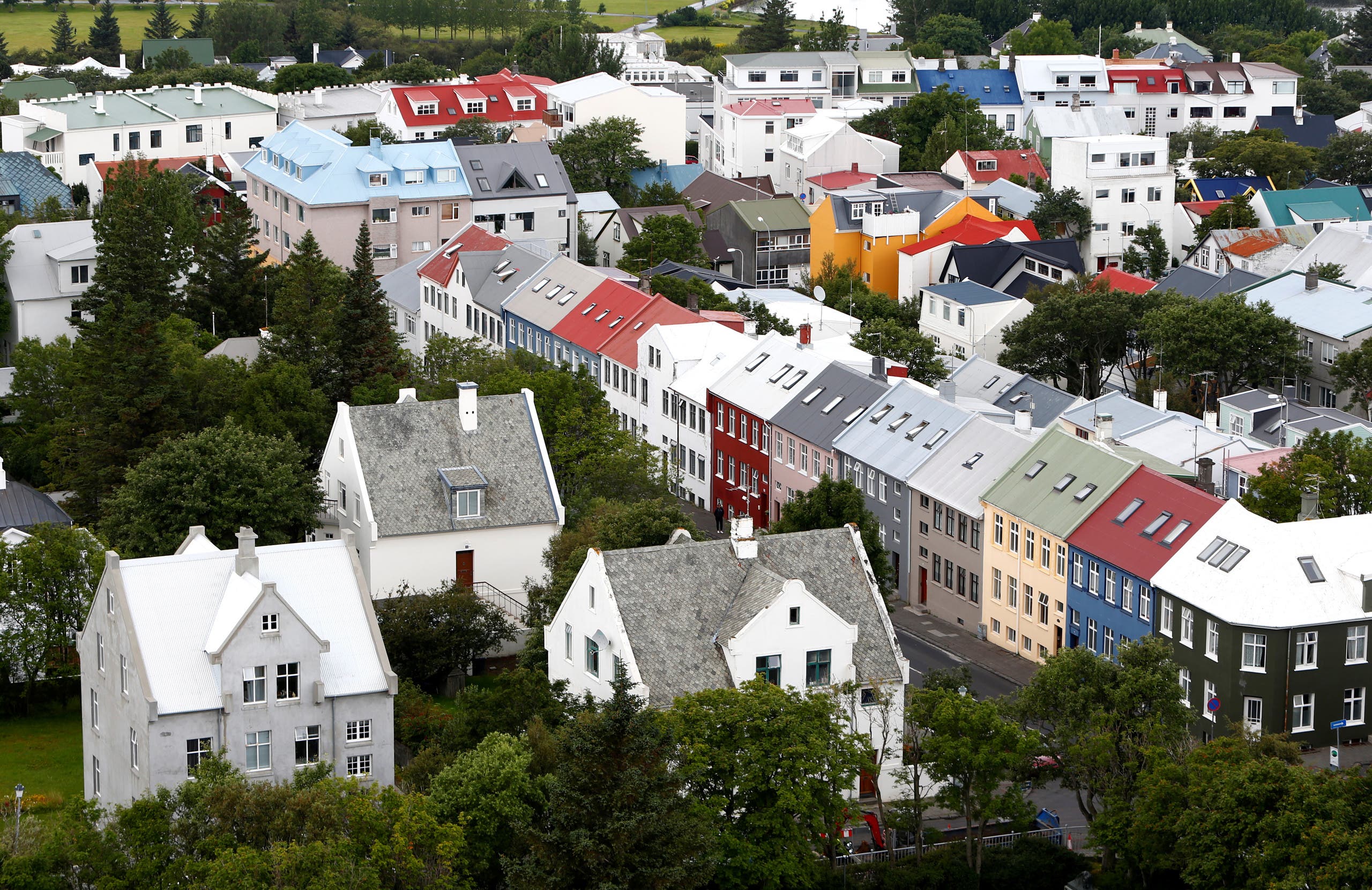
General view shows city of Reykjavik, seen from Hallgrimskirkja church, 2017. (File photo: Reuters)

General view shows city of Reykjavik, seen from Hallgrimskirkja church, 2017. (File photo: Reuters)

While Iceland has only 218 confirmed cases among its tiny population, its testing program has produced crucial data about the coronavirus – that half of those who were tested positive have no coronavirus symptoms.

This confirms multiple pieces of scientific research that have shown that coronavirus is spread more through people with the virus who show no sign of being sick. Researchers from The University of Texas at Austin had found out that more than 10 percent of patients were infected by somebody who has the virus but does not yet have symptoms.

Early results from deCode Genetics indicate that a low proportion of the general population has contracted the virus and that about half of those who tested positive are non-symptomatic,” Thorolfur Guðnason, Iceland’s chief epidemiologist, was quoted as saying BuzzFeed News. The other half displays very moderate cold-like symptoms.”

Read more: Coronavirus symptoms: Loss of smell, taste, might signal infection

A Flourish chart

Icelandic authorities claimed they had tested a higher proportion of the citizens than anywhere else in the world.

Iceland’s population puts it in the unique position of having very high testing capabilities with help from the Icelandic medical research company deCode Genetics, who are offering to perform large scale testing,” Guðnason said to Buzzfeed.

This data can also become a valuable resource for scientific studies of the virus in the future,” he added.

Find out the latest news about the coronavirus pandemic here.

40 mutations of the virus

Iceland’s high-volume testing also involves genetic sequencing of the different samples of the virus, which helps researchers to investigate the various mutations of the virus.

Icelandic scientists say testing has already revealed that there are at least 40 mutations of coronavirus in Iceland, and the virus might develop to become more contagious, but less dangerous. These variants can also act as the fingerprints of the virus to trace its origin. Seven of the infected people were traced to an undisclosed football match in England, the team said.

Read more: How long can coronaviruses survive in a freezer? Up to two years, warns expert

A Flourish data visualisationLast Update: 13:55 KSA 16:55 – GMT 13:55

COVID-19: WHY WE SHOULD ALL WEAR MASKS — THERE IS NEW SCIENTIFIC RATIONALE

March 30th, 2020

Sui Huang

The official recommendation in the United States (and other Western countries) that the public should not wear face masks was motivated by the need to save respirator masks for health care workers. There is no scientific support for the statement that masks worn by non-professionals are not effective”. In contrary, in view of the stated goal to flatten the curve”, any additional, however partial reduction of transmission would be welcome — even that afforded by the simple surgical masks or home-made (DIY) masks (which would not exacerbate the supply problem). The latest biological findings on SARS-Cov-2 viral entry into human tissue and sneeze/cough-droplet ballistics suggest that the major transmission mechanism is not via the fine aerosols but large droplets, and thus, warrant the wearing of surgical masks by everyone.

The surgeon general tweeted: STOP BUYING MASK, they are not effective…”. The Center for Disease Controls (CDC) states that surgical masks offer far less protection than the N95 respirator masks (which also must be perfectly fitted and only professionals can do it). The CDC recommends that healthy persons should not wear masks at all, only the sick ones. These guidelines are not rooted in scientific rationales but were motivated by the need to save the valuable masks for health professionals in view of a shortage. But they may have had unintended consequences: stigmatizing those that wear masks in the public (you are a hoarder, or you are contagious!)

Contrast this with the cultural habit, the encouragement, or even mandate to wear masks in Asian countries — which have now flattened the curve” or even have had a flatter curve from the beginning.

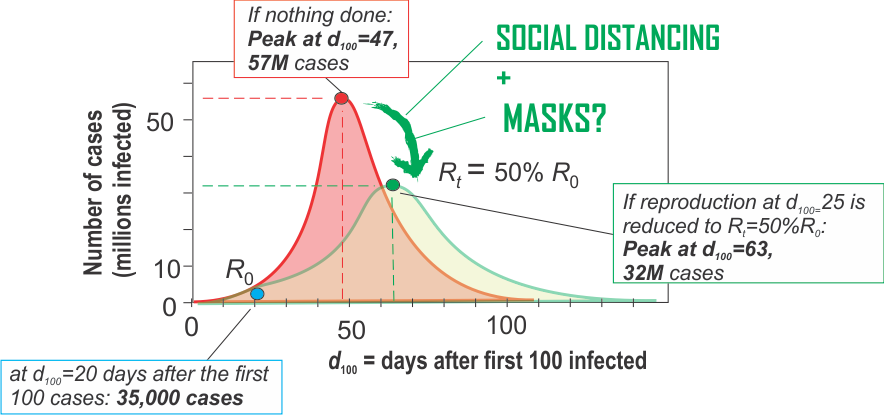
Sure, surgical masks, and improperly worn N95 respirator masks, do not offer perfect protection. But if the stated goal is to flatten” the curve (as opposed to eradication of the virus), we have to abandon the black-and-white thinking, and embrace shades of grey. We cannot any longer claim that masks are not effective”. We cannot allow the perfect to be the enemy of the good. What if a however partial protection afforded by leaky surgical or even self-made masks reduces transmission probability to an extent that is similar to that of the recommended (equally imperfect) distancing by more than 6 feet from each other or not touching your face”? It could then double the impact of non-pharmacological intervention (NPI) on flattening the curve (FIG. 1).

FIGURE 1. Flattening the curve”. Effect of mitigating interventions that would decrease the initial reproduction rate R0 by 50% when implemented at day 25. Red curve is the course of numbers of infected individuals (”case”) without intervention. Green curve reflects the changed (”flattened”) curve after intervention. Day 0 (March 3, 2020) is the time at which 100 cases of infections were confirmed (d100 = 0). The model is only for illustration and was performed in the SEIR-model simulator (http://gabgoh.github.io/COVID/index.html). The non-intervention model was fitted to these data points: a time period of twenty days in which the number of cases in the United States has risen from 100 (d100=0) to 35,000 (d100=20). Standard parameters were used (population size 330 M, Tinc=5.2 days, Tinf = 3.0 days but with the rather high value R0=5.6 in order to achieve the observed rate of increase of case numbers in the U.S. The curves are redrawn not to scale.

Since the CDC provides no scientific evidence for its statement that masks worn by the public are not effective”, here we review the scientific support for protection conferred by surgical masks. We focus on mechanistic rationale (as opposed to epidemiological-phenomenological evidence). We conclude, by considering cough droplet ballistics and the latest research findings on the biology of transmission of the SARS-CoV2 virus (which causes COVID-19) that any physical barrier, as provided even by make-shift masks, may substantially reduce the spread of COVID 19. If we are soon to yield to the pressure to loosen lockdowns and allow limited social interactions to revive the economy, then public masks should have a role and could facilitate a middle-of-the-road approach.

The official recommendation by CDC, FDA and others that masks worn by the non-health-care professionals are ineffective is incorrect at three levels: In the logic, in the mechanics of transmission, and in the biology of viral entry.

I. THE LOGIC

Of course no mask, be it the tight-fitting NIOSH approved N95 respirator mask or the loosely worn surgical mask, provide perfect (100%”) protection. But imperfect protection does not mean completely useless”, much as a glass not full need not be empty: I would gladly accept a glass of water filled to 60 % when I am thirsty. Absence of evidence (of protection) is not evidence of absence. But in our binary world, the official message that surgical masks are not effective” may have sent the wrong message: that they are absolutely useless. Sadly, with the black-and-white picture painted by officials, the discussion about the effectiveness of masks has been stifled, and with it the possibility of incentivizing industry to ramp up production of these 75 cents-a-piece protective devices.

But with the declared goal to flatten the curve” (and not to totally eliminate the virus) we have a relative” as opposed to absolute goal, which places the notion of partial protection” in a new light. In principle, one could compute the extent Y of flattening of the curve given a partial protection by X % as conferred by mask. But for that we need to first understand the mechanics and biology of transmission in detail.

II. THE MECHANICS

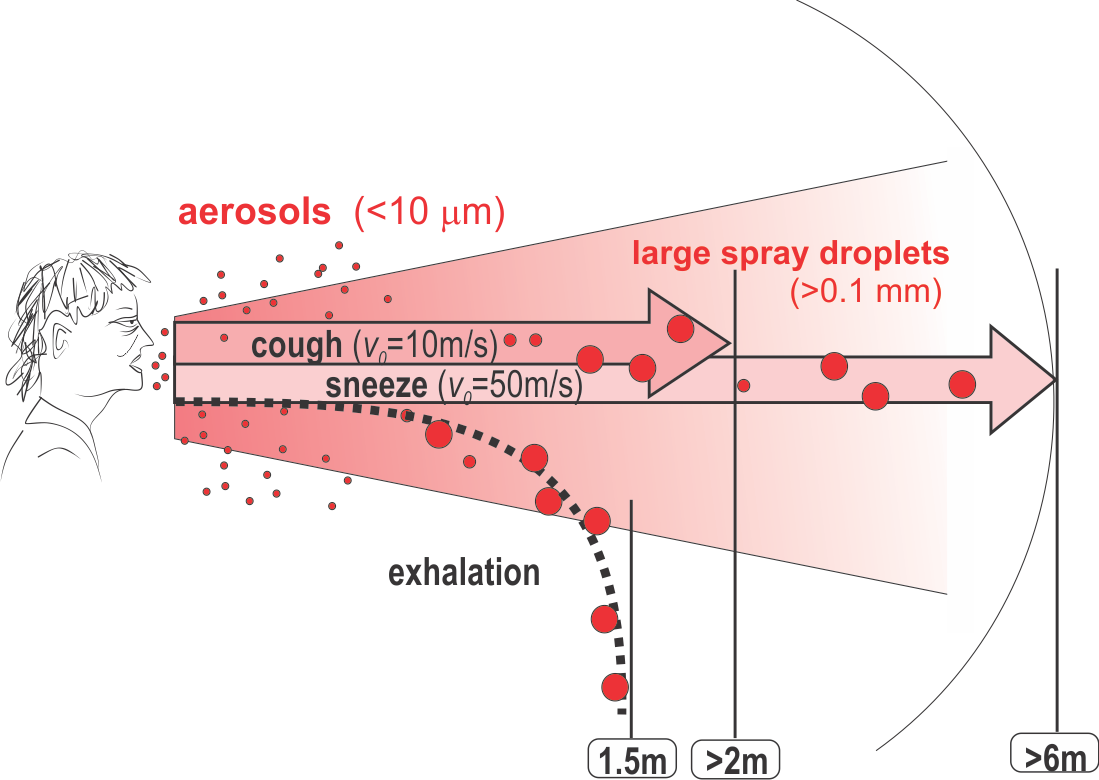
How viruses that cause airborne diseases are carried by droplets from person to person is a complicated, understudied matter. Droplets can (for this discussion) be crudely divided in two large categories based on size (FIG. 2):

FiIGURE 2. Droplet larger than aerosols, when exhaled (at velocity of <1m/s), evaporate or fall to the ground less than 1.5 m away. When expelled at high velocity through coughing or sneezing, especially larger droplets (> 0.1 micrometers), can be carried by the jet more than 2m or 6m, respectively, away.

(a) Droplets below a diameter of 10 um (micrometer), the upper size limit for the definition of ‘aerosol’ (particles so light as to be able to float in the air). For brevity, let us call this category aerosols”. These small aerosols are carried by ventilation or by winds and thus can travel across rooms. What makes N95 facial masks different from the surgical masks is that the former are designed (as per regulatory requirement) to stop aerosols: they have to filter out 95% of droplets smaller than 0.3 um.

(b) Droplets larger than 10um (micrometer), reaching 100um or more. Let us call these large particles spray droplets” here. (For a more detailed discussion, see Nicas and Jones, 2009). Of course, droplets can be even larger, up to a size visible to the naked eye in the spray generated by coughing or sneezing (0.1 um diameter to above). Calculations by Xie et al suggest that if exhaled, the >0.1 um droplets may evaporate or fall to a surface within 2m, depending on size, air humidity and temperature. But coughing or sneezing can shoot them like projectiles out of the mouth with a muzzle velocity” of 50 meters/second (for sneezing) or 10 m/s (for coughing), and droplets can reach distances as far as 6m away. If so, then the much mentioned safe distance” of 6 feet in social encounters may not suffice — except you wear a (simple) mask –more on that later.

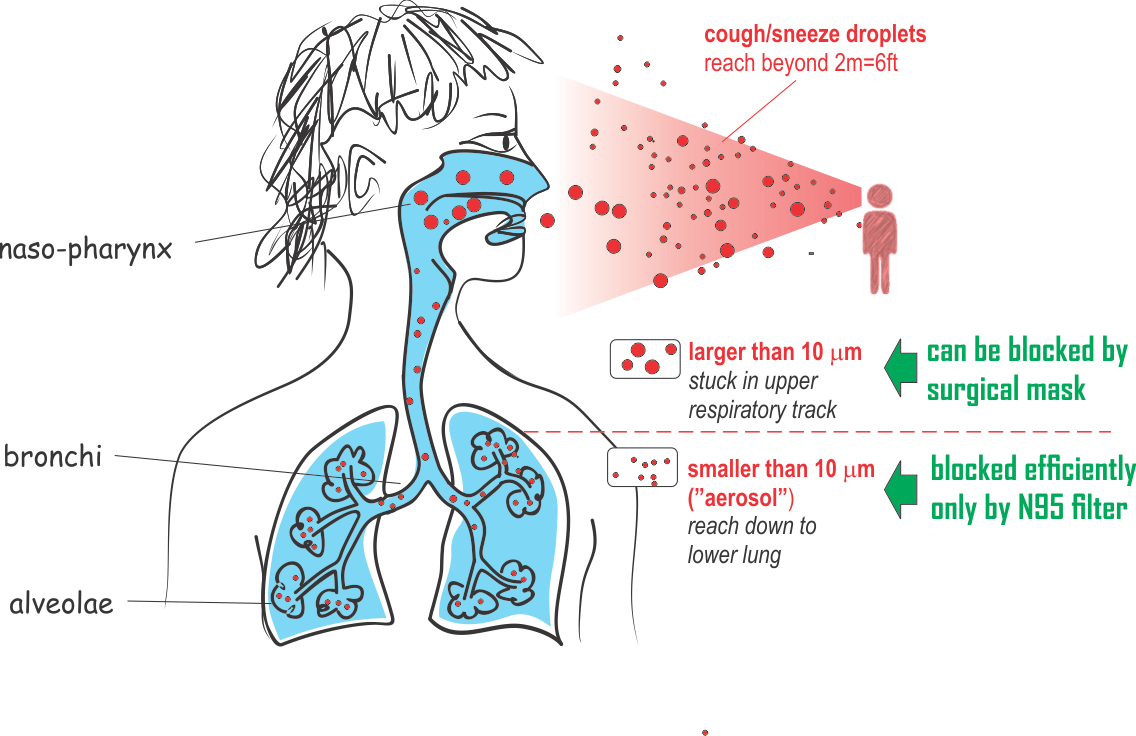
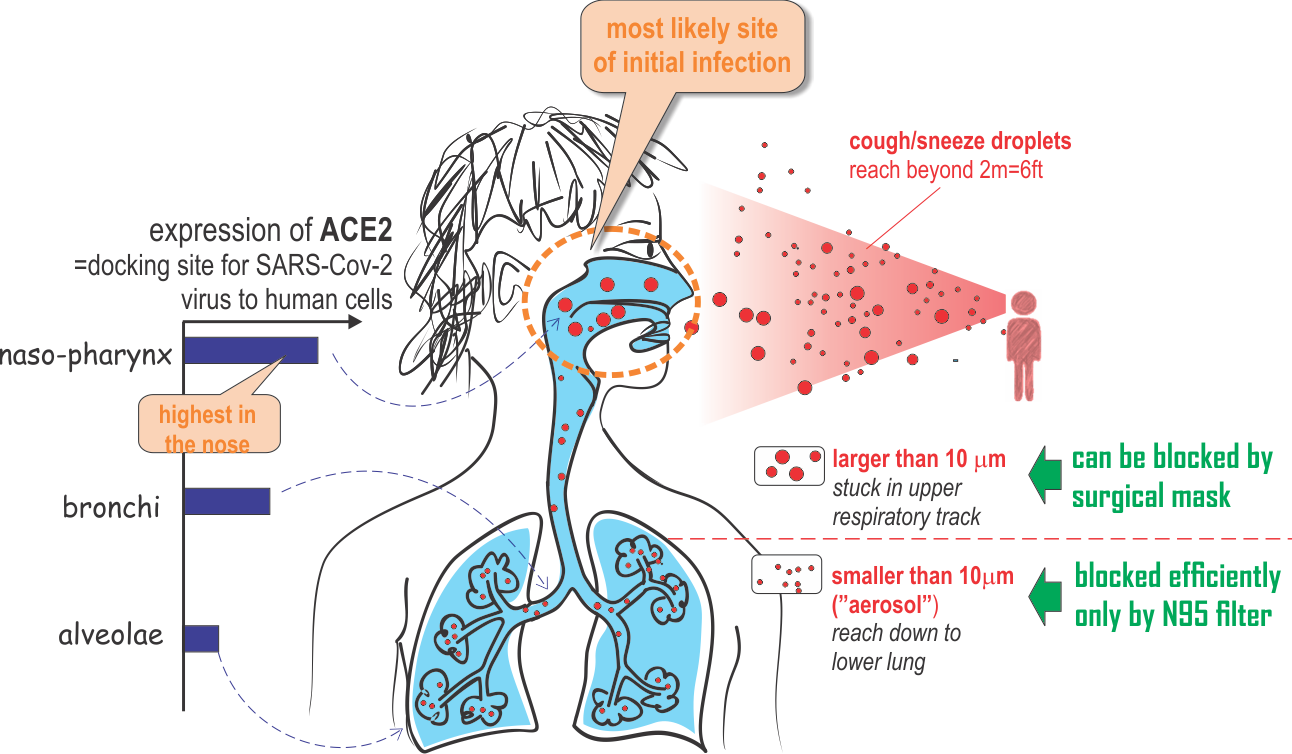
Here is the central biological implication of the distinction between aerosols and spray droplets: For airborne particles to be inspired and reach deep into the lung, through all the air ducts down to the alveolar cells where gas-exchange takes place, it has to be small (FIG. 3): only droplets below 10 micrometer diameter can reach the alveolae. By contrast, the large spray droplets get stuck in the nose and throat (the naso-pharyngeal space) and in the upper air ducts of the lung, trachea and large bronchia. The droplets of a typical cough expulsion have a size distribution such that approximately half of the droplet are in the categories of aerosols, albeit they collectively represent only less than 1/100,000 of the expelled volume (Nicas et al 2005).

FIGURE 3. Anatomy of airways and where droplets can end up, depending to their size and what droplets are blocked by what masks

Itthus follows that the sophisticated N95 masks, designed to filter out the smallest particles, help to prevent droplets from carrying the virus down to the alveolae. But is this really relevant for flattening the curve? We shall see below. By contrast, it is plausible that the large droplets that end up in the nasopharynx can be stopped by any physical barrier, such as simpler surgical or dust masks.

Of course many aerosol droplets in the exhalation or cough spray may not contain the virus, but some will do. In the case of the SARS-Cov-2 virus it is not known what the minimal infectious load is (number of viral particles needed to start the pathogenesis cascade that causes a clinical disease). But we begin to appreciate whether the small aerosol or large projectile droplets are more relevant.

The tacit notion at the CDC that the alveolae are the destination site for droplets to deliver the virus load (the alveolae are after all the anatomical site of life-threatening pneumonia), has elevated the apparent importance of N95 masks and led to the dismissal of surgical masks. Nuances do not translate to the lay people (as well as many arm chair experts) who now, owing to message binarization, think that masks are useless.

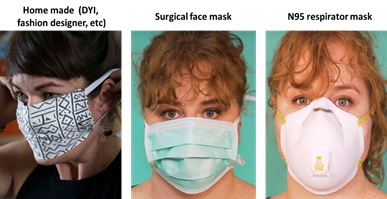
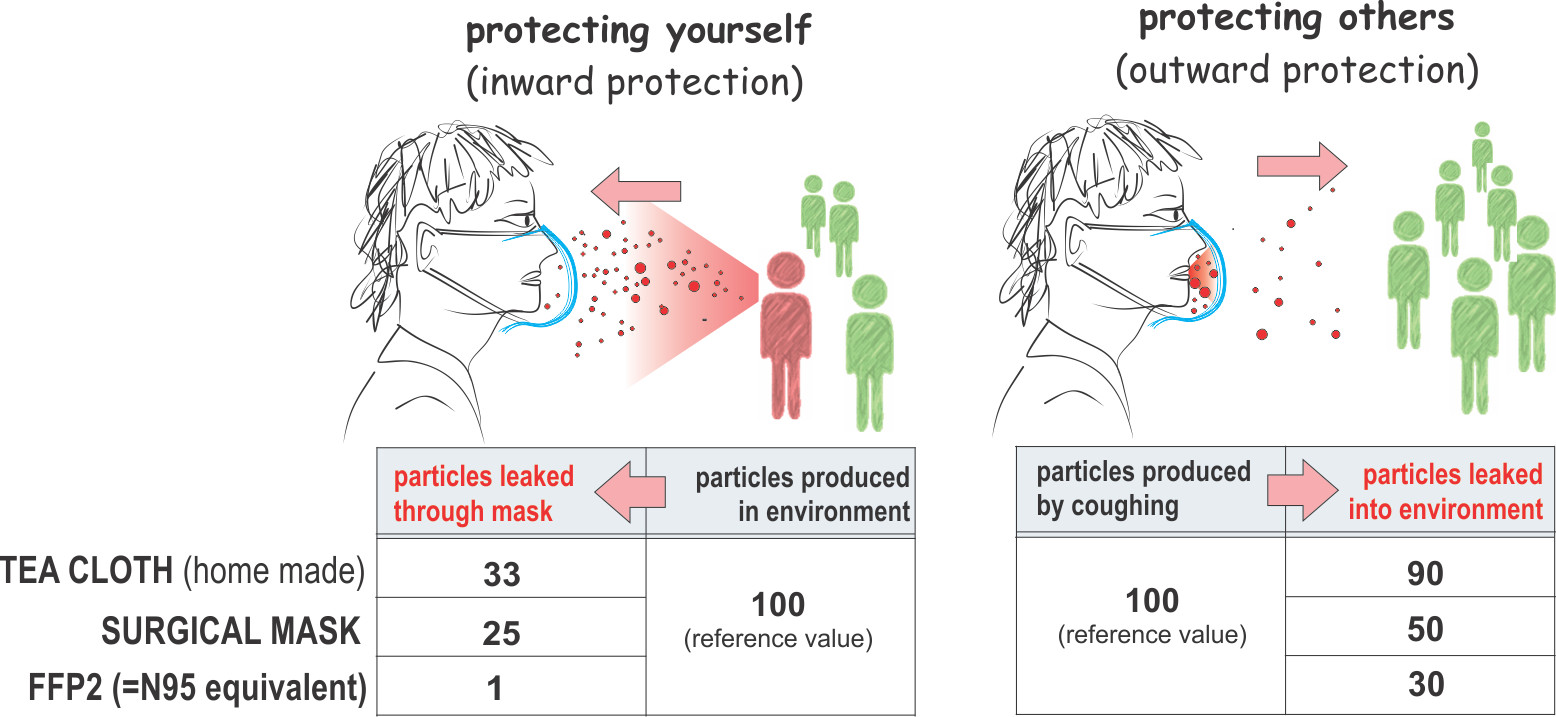
Even with respect to the small aerosols we must not forget that thepartial filtering provided by surgical masks is better than nothing. In an experimental simulation of the filtering capacity of masks in 2008, van der Sande and her colleagues in the Netherlands compared the ability of three masks: (i) home-made (DYI) of tea cloth, (ii) standard surgical masks and (iii) FFP2, the European equivalent of N95 masks, with respect to their ability to stop small aerosols in the range 0.2 to 1 um –droplets that reach the lower lung.

Figure 4

What the authors found for inward protection warrants some questioning of CDC’s message that surgical masks are “not effective”: While FFP2 (or N95) masks indeed filtered out >99% of particles (thus, reducing the aerosol load by 100-fold), the surgical masks lowered the number of aerosol droplets behind the mask still by a substantial 4-fold compared to outside of the mask. It is plausible that for larger spray droplets from cough expulsions the difference between surgical masks and the F95 respirator masks would be even smaller. Interestingly, for outward protection, the effectiveness and differences are much smaller (see numbers in the FIG. 5).

FIGURE 5. Filtering effect for small droplets (aerosols) by various masks; home-made of tea cloth, surgical mask (3M Tie-on”) and a FFP2 (N95) respirator mask. The numbers are scaled to the reference of 100 (source of droplets) for illustrative purposes, calculated from the PF (protection factor) values in Table 2 of van der Sande et al, 2007. Measurement was performed with a Portacount counter that registers particles in the air with sizes in the range between 0.02 and 1 micrometer at the end of a 3-hour wearing period with no physical activity. The number for the protection are medians of 7 (or 8) adult volunteers per group. Protection at the beginning of the test was similar for the Tea Cloth and Surgical mask, but for FFP2 the protection was double. Children experienced substantially less protection (see van der Sande et al 2007)

These results raise the urgent question: If all we want is to mitigate the pandemic, that is, to flatten the curve”, how much does a 4-fold reduction of particles that reach the lungs decrease transmission from person to person? Intuition suggests that even an imperfect mask may offer some protection that is at least in the range of the recommended separation by more than 6 feet in social interactions or wasing hands or not touching your face — all recommendation based on mechanistic plausibility without strong epidemiological support.

Technically, one could quantify by how much the reduction by 4-fold of the droplets that a person is exposed to, as achieved by surgical masks, or by 3-fold, as achieved by makeshift tea-cloth masks, contributes to a reduction of the reproduction rate” from the initial R0 to the effective Rt after mitigation intervention at time t. Perhaps by 25%? Then one could, using SEIR-epidemiological models, compute to what extent a partial reduction of R would substantially flatten the curve –to the desired extent to avoid overwhelming the health care system (see Figure 1).

But such bottom up” calculation of R is complicated because it would require knowledge of many mechanistic factors that are not easy to quantify. For instance, we do not know to what proportion COVID-19 is transmitted via large spray droplets vs. small aerosols. Only in the latter case will the advantage of N95 respirator masks over surgical masks be fully realized! We also do not know how much social distancing alone contributes to reducing R.

Thus, let us have a look at the actual biology of transmission which offers a way out of this problem and has also not been considered by officials who claimed that surgical masks are not effective”.

III. THE BIOLOGY

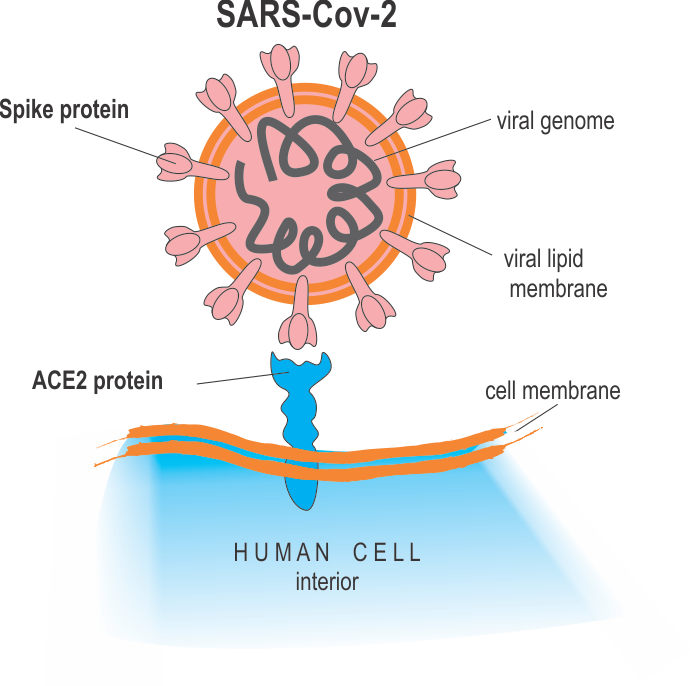
The SARS-Cov-2 virus, like any virus, must dock onto human cells using a key-lock principle, in which the virus presents the key and the cell the lock that is complementary to the key to enter the cell and replicate. For the SARS-Cov-2 virus, the viral surface protein Spike protein S” is the key” and it must fit snugly into the lock” protein that is expressed (=molecularly presented) on the surface of the host cells. The cellular lock protein that the SARS-Cov-2 virus uses is the ACE2 protein FIG 6).

This cell surface enzyme normally has a cardio-pulmonal protective function. ACE2 is expressed at higher levels in the elderly, in people with chronic heart failure or with pulmonary or systemic arterial hypertension. (Note that ACE2 expression is rate –limiting” because other host proteins whose presence is also needed for the virus to enter the cells, such as proteases, are more abundantly and widely expressed). Certain blood pressure drugs (as now intensely discussed since hypertension is a risk factor for progression to ARDS and death in COVID-19), but also mechanical stress from ventilation, ironically, can increase the expression of ACE2.

Figure 6. The SARS-Cov-2 enters the host cell by docking with its Spike protein to the ACE2 (blue) protein in cell surfaces.

Surprisingly, ACE2 expression in the lung is very low: it is limited to a few molecules per cell in the alveolar cells (AT2 cells) deep in the lung. But a just published paper by the Human Cell Atlas (HCA) consortium reports that ACE2 is highly expressed in some type of (secretory) cells of the inner nose! (FIG. 7).

Combine this fact with the above explanation of the mechanics: The nasal expression of ACE2 protein suggests that the SARS-Cov2 virus infects these cells. One can also infer that transmission of the SARS-Cov2 virus will occur largely via large cough or sneeze droplets, which comprise the vast portion of the sprayed liquid in cough/sneeze and will land in the nasopharynx due to their size — precisely where the molecular locks for the virus are present, allowing viral attachment and entry into the host cells. Obviously this route of transmission could be effectively blocked by simple physical barrier. (The proximal expression of ACE in the nasal cavity also supports the transmission by surface droplets — hence, indeed wash your hands).

FIGURE 7. Major route of viral entry is likely via large droplets that land in the nose — where expression of the viral entry receptor, ACE2 is highest. This is the transmission route that could be effectively blocked already by simple masks that provide a physical barrier.

In fact, Wölfel et al. now report that viral material can be readily detected and isolated from nasal swabs, unlike in the case of other airborne viral infections, such as the original SARS. Compared to SARS (which also uses ACE2 to enter cells) in the case of COVID-19, viral genomes (RNA) appear earlier in nasal swabs and at much higher concentration, such that detection is rather easy. In fact, the FDA just approved swabs for tests taken from just from the front of the nose through self-collection, instead of deep in the nasopharynx. The molecular analysis also show that the SARS-Cov2 virus is active and replicates already in the nasopharynx, unlike other respiratory viruses that dwell in deeper regions of the lung.

The viral replication in the nasopharygeal mucosa may also explain positive tests in the prodromal stage and transmission by healthy carriers, and perhaps the anosmia seen in early stages of COVID19. But this biology also means: avoiding large droplets, which cannot enter the lung anyway but land in the upper respiratory tracts, could be the most effective means to prevent infection. Therefore, surgical masks, perhaps even your ski-mask, bandanas or scarf, may afford more protection than portrayed by governmental official in their initial (understandable but unfortunate) recommendation against wearing of masks by the public in general. N95 respirator masks may offer relatively little additional protection than thought. (To be fair, the CDC suggests use of scarf by health care providers as last resort when no face masks are available).

From a practical and societal point of view, surgical or self-made masks, if handled properly, will at worst not hurt and may at best, help. (Make sure to discard or launder after use without touching the outward surface). These simpler, inexpensive masks may suffice to help to flatten the curve, perhaps a bit, perhaps substantially. Importantly: using them will not take away valuable N95 respirator masks from health care workers.

THE IMPLICATIONS

It would be tragic if the wrong logics and mechanics and biology, which has led Western governments to not encourage, if not stigmatize the wearing of masks, may have contributed to the steep rise of COVID-19. Given that the upper respiratory tract is the major site for SARS-Cov-2 entry into human tissues, wearing simple face masks which exert a barrier function that blocks those big projectile droplets that land in the nose or throat may substantially reduce the production rate R, to an extent that may be comparable to social distancing and washing hands. This would then double the effect of mitigation in flattening the curve”!

Looking forward: if we are soon loosening the lockdown due to the political pressure to sustain the economy, perhaps encouraging face masks to be worn in the public would be a good compromise between total lockdown and total freedom that risks resurgence of the invisible enemy. There is now a robust scientific basis for putting an end to the officials’ anti-surgical mask hysteria and to recommend or even mandate a broad use of masks as in Asian countries that have bent the curve.

WRITTEN BY

Sui Huang

Follow

Institute for Systems Biology

CORONAVIRUS outbreak – Who is responsible?

March 30th, 2020

Everyone has a right to their opinion but a subject as important as the present global outbreak requires some meaningful debate and certain actions give clues to read between the lines to understand whether the virus was something natural, something spread by accident or something purposely created. There is no patient zero found to date. But that is crucial to answering a plethora of questions.

The 3 questions we must now answer is

  1. Is the virus natural
  2. Is the virus something spread by accident – if so by whom?
  3. Is the virus something created to spread globally – if so by whom & why?

Something natural

When the virus first came to be known when a strange pneumonia began to surface in China in November 2019, the Chinese had alerted the WHO of a strange flu affecting citizens of Hubei province/Wuhan city. Eventually, the WHO came to christen the virus as COVID-19. Ironically that very month the US organized Event 201 a global pandemic exercise.

The international media owned & controlled by West naturally went to town claiming the virus originated from the seafood market in Wuhan and a plethora of animals and birds was attributed as being the cause. However, on 18 March China’s chief medical advisor rejected this notion. The virus did take place in Wuhan but Wuhan was not the source of the virus.  A petition in March 2020 claimed the virus leak from Fort Detrick could have been the source for covid-19. http://en.people.cn/n3/2020/0321/c90000-9670852.html

Fort Detrick was where the US Army biological warfare lab is situated with 900 employees. According to NYT in 2009 research at the institute in Fort Detrick was suspended because it was storing pathogens not listed in its database.

https://www.independent.co.uk/…/virus-biological-us…

The army institute also employed Bruce E. Ivins, a microbiologist who was a leading suspect — but who was never charged — in the anthrax mailings in 2001 that killed five people. Dr. Ivins died in 2008, apparently by suicide”

https://www.nytimes.com/2019/08/05/health/germs-fort-detrick-biohazard.html

So the lab had been storing pathogens illegally.

It was round about the same period that the State saw mysterious respiratory disease affecting hundreds of Americans. The blame was put on e-cigarette vaping though that had been happening for years.

https://www.nbcnews.com/…/mysterious-vaping-lung…

https://q13fox.com/…/a-statewide-outbreak-two-new…/

https://www.usnews.com/…/wisconsin-officials-12-cases…

The lab was suddenly shut down in August 2019 – ‘National security reasons’ ensured Centre for Disease Control was denied access to details. But it does raise the question whether the leak was responsible for the early start of the flu season?  US flu season so far has affected 32million, hospitalized 310,000 and killed 18,000 from Jan to March 2020 alone!

https://www.hawaiinewsnow.com/2020/02/28/americas-flu-season-toll-k-dead-m-sick/

With these numbers at hand to avert further cases shouldn’t the US Govt have taken quick action to conduct corona tests?

Simultaneously with the petition came the Chinese Foreign Ministry spokesman’s twitter claim that corona virus was brought to Wuhan by the US Army. How did that happen? Another article claims the virus went from Fort Detrick to e-cigarettes to Hawaii & then to Wuhan!

https://www.military.com/daily-news/2020/03/12/chinese-official-says-us-army-may-have-brought-epidemic-wuhan.html

Which means the US soldiers would have been carriers. In fact 300 US military personnel attended the World Military Games in Wuhan in Oct 2019 – did they visit the Wuhan seafood market? They returned to the US only on 5 February 2020 and were kept for 2 weeks quarantine in Miramar California. By 12th March 3 US marines had tested positive. 280 reported confirmation includes military, family members & contractors. As for 27 March 2020 California had 4569 cases and 90 deaths.

https://www.militarytimes.com/news/your-military/2020/02/05/more-than-300-evacuees-from-china-set-to-arrive-at-travis-afb-marine-corps-air-station-miramar/

https://www.nbcsandiego.com/news/local/mcas-miramar-based-marine-tests-positive-for-covid-19/2284464/

https://www.defense.gov/Explore/News/Article/Article/2126589/navy-marine-corps-leaders-provide-covid-19-update/

5 of these athletes evacuated from Wuhan were eventually hospitalized with covid-19. Initially the reason for their hospitalization was put to malaria and not covid-19. https://sacramento.cbslocal.com/2020/02/07/cdc-5-evacuees-wuhan-travis-afb-hospitalized-coronavirus-symptoms/

There were also rumours of containers of bioweapons found inside the US consulate in Wuhan though no official statement can verify authenticity of such allegations.

What is interesting is that when locals in Wuhan started showing signs of Covid-19 in November 2019 it coincided with the post-incubation period following the military world games in Wuhan.

No Patient Zero – only a contracted case

The 1st covid-19 REPORTED case was a 55year old male from the Hubei province on 17 November 2019 according to South China Morning Post. From whom did he contract the virus and was he actually the 1st to CONTRACT the covid-19 virus?

But according to science journal Lancelot the first person to test positive had been exposed to the virus on 1st December 2019

https://www.thelancet.com/action/showPdf?pii=S0140-6736%2820%2930183-5

https://www.businessinsider.sg/coronavirus-patients-zero…

Fast forward to March 2020 – an article appearing on FORBES quoting Global Times claims a US military cyclist who took part in the military games in Wuhan is responsible for bringing covid-19 to Wuhan. Global Times claim is based on George Webb an American investigative journalist who says the coronavirus was manufactured in a US military lab & brought to Wuhan/China by Maatje Benassi a 52year old racing cyclist.

So the question that needs answering is – is US military cyclist Maatie Benassi patient zero?

Global Times asked the US Government to “release health and infection information of the U.S. military delegation which came to Wuhan for the Military World Games in October,” and relieve all doubts!

https://www.forbes.com/sites/carltonreid/2020/03/26/chinese-state-newspaper-stokes-conspiracy-theory-that-first-covid-19-patient-was-us-cyclist/#4406751428dd

Though many claim the virus to be rooted in the seafood market in Wuhan of the first 41 cases 34% were not related to this market! According to Lancet Journal all 41 cases showed pneumonia in their CT scans.

https://www.thelancet.com/journals/lancet/article/PIIS0140-6736(20)30183-5/fulltext?fbclid=IwAR1NpiXiq3F6th8B3fMlBYEtV7V_TaqIuzwHWtA7tl37YChDPR6nqwhQd8c

Further collaborating with the notion that the covid-19 could not have been form the Wuhan seafood market is the claim of a infectious disease specialist of Georgetown University (Daniel Lucey) who says that incubation period & symptoms of infection & presence of infected did not tally with those from the Wuhan market & those infected who had no links to the Wuhan market. This theory was accepted by a biologist from the Scripps Research Institute.

https://www.sciencemag.org/news/2020/01/wuhan-seafood-market-may-not-be-source-novel-virus-spreading-globally?fbclid=IwAR1Qp4vy1X1TqCtW6DA8_L1l5w6MEPzXypkZnJ8PQ0PH-_KDXOI7Ot2H_-I

Then there is the Japanese couple who left on a 10 day vacation to Hawaii. The husband had shown no signs of virus symptoms when they left Japan in late January 2020 but began developing symptoms. They returned to Japan on 7 February 2020. The couple tested positive. https://www.nytimes.com/2020/02/14/us/coronavirus-hawaii-japan.html?fbclid=IwAR0dL_fdXunTOARII6HZp0Tq4N6-iEbbY7Y9IRsRo2DYitclqmqKyzaXLiM

Taking the countries most affected by covid-19 – China, Italy, South Korea, Iran, Spain, UK, France, Switzerland & US while China & UK showed two different variants of the 5 strains of the virus (bunyavirus, phlebovirus, nairovirus, tospovirus, and hantavirus) only in the cases in USA showed presence of all 5 genomes. How is this?

China however had shared with US the variants in China. http://www.xinhuanet.com/english/2020-02/07/c_138763999.htm The strain of covid-19 in Italy differs to that in China. Which explains why no one can link how a virus first detected in Wuhan came all the way to Italy. So not only must we find Patient Zero in China, we must find Patient Zero in Italy.

It is interesting that covid-19 and SARS both were discovered in China but discovery in China does not necessarily mean it originated in China. Here is the difference.

So we return to Fort Detrick where US has a biological warfare lab which had been sealed for fears that deadly viruses could leak – the lab was suspended in 2009 too for illegally storing pathogens. Let us not forget that this was the same lab that was handling ebola, smallpox and 2001 anthrax in which FBI’s main suspect was Bruce Ivins a senior researcher Fort Detrick. The moment Ivins was to be charged – he commits suicide so nothing gets revealed.

While the US claims corona is one of its biggest intelligence failures there are some puzzling developments before the corona outbreak in Wuhan. While the panic has resulted in country-wide lockdowns, curfews leaving people stuck at home with no means of earning and some with no jobs while entire global supply chains, manufacture and production have all been put on hold – the actions of a handful of people raise eyebrows.

Jeff Bezos, the world’s wealthiest person has become $5.5billion richer selling 12% of Amazon’s shares ($3.4b) held by him in February. Larry Fink, CEO of BlackRock also sold his shares saving losses of $9m, Lance Uggala CEO of HIS Markit also sold $47 of his shares before the stock markets spiraled.

https://www.theguardian.com/business/2020/mar/27/jeff-bezos-sold-34bn-of-amazon-stock-just-before-covid-19-collapse?CMP=fb_gu&utm_medium=Social&utm_source=Facebook&fbclid=IwAR0LnzbBIuiKGMVjGw_J5I7YmxHO60PEh0VTLH071mxyINYuoywcmZnwI4w#Echobox=1585342120

While the rich sold off billions of dollars worth of their shares others resigned with 1480 CEOs resigning in 2019. Some of the CEOs of the biggest companies resigned – Boeing, McDonalds, GAP, United Airlines, Well Fargo, Kraft Heinz, HP, Warner Bros, Colgate-Palmolive, eBay, Nike. Then in January 2020 another 219 CEOs resigned and these CEOs included heads from Disney, IBM, LinkedIn, Mastercard, Credit Suisse. At no time has there been such an exodus of CEOS from the corporate world and sold of $9.2b of shares in their own companies. Why?

https://www.fort-russ.com/2020/03/why-did-hundreds-of-ceos-resign-just-before-coronavirus-outbreak/

Not stopping there why did Members of Congress also begin to sell their stocks just before the market went down owing to corona? Most of the corporate boards are full of former politicians or retired VIP state officials who still have a say in government. US Senate website gives details.

Then you have the philanthropists like Gates – who insists on corona testing and though WHO undertakes it, it is the Gates foundation that funds it! It is the same entity that conducted a mock pandemic in October 2019 at the John Hopkins Centre (Event 201), though Gates & Co insist on vaccines, China managed to overcome the virus by a simple use of vitamin C. Vaccines are not necessary! But when SARS outbreak emerged in 2003 leaving 774 dead and over 8000 sick, the patent for SARS vaccine is held by US.

However, the debate continues as to whether covid-19 is a natural or man-made virus and for what purpose it was spread or perhaps the result was not quite what was planned. What we do know is that it has caused pandemonium across the world with virtually everything collapsing and its going to take a hell of a lot of planning and unity to get the world and countries on track again.

As for the question who did it – is it US or China… that is like comparing a country that has used the atomic bomb twice, illegally invades and bombs countries at will, sets up military bases all round the world, uses drones and assassinates opposition, carries out regime change, interferes in internal affairs of nations, bullies smaller nations over and above many other crimes against a rising eastern power that uses economic mutual development as a tool to not only raise its profile globally but assists other countries to get their development on track as well.

The reader can ponder & decide

Shenali D Waduge

ERASING THE EELAM VICTORY Part 14 F

March 30th, 2020

KAMALIKA PIERIS

Examination of war history should focus on the transformation of the Navy and the Air Force with the former achieving 100 percent success by destroying LTTE’s floating arsenals in international waters while the Air Force achieved strategic bombing that caused massive losses on the enemy, including prized Tigers killed in their hidden lairs, said Shamindra Ferdinando. The Army and the Navy are yet to release their own versions of their work, he observed.

The navy was in an unfortunate position during Eelam wars II and III     said, analysts.  Jayanath Colombage has this to say.”I believe that there was a clear lack of policy coming from successive governments towards the Navy that made it difficult to develop, empower, and enhance the Navy. Being an island nation, we should have given priority to the Navy.

Throughout the war, there were many governments and many naval commanders. Promotions and appointments in the Sri Lanka Navy were given on seniority alone. Once you acquire particular seniority at the early stages of your career, you carry it forward. There’s no threat from anyone else. Seniority was based on academic work but not on performance in battle.

There was no grand plan incorporating maritime strategy in a substantial manner. We had mostly ad hoc strategies. These strategies were shortsighted. That is not the best way to go about winning a sustained fight,  said Colombage

Because there was no strategy, nobody had the courage to develop the Sri Lanka Navy in a substantial manner. Mostly, the development of the Sri Lanka navy was reactive. When the Sea Tigers would do something or improve their capacity, we would try to come up with a solution. When they increased their speed, we increased our speed. When they acquired more guns, we did the same. The initiative was with the LTTE. They were calling the shots, continued Colombage

We also did not use highly advanced technology and equipment, like sensors and automatic fire control systems. We were quite happy with what we had, and we never thought of making a quantum leap to acquire better technology. This hampered our early efforts.

Another drawback was our lack of proper intelligence. We were dependent on other sources for intelligence. The police, army, and air force all had their own intelligence apparatuses, but maritime intelligence is different. Not everybody can understand the ocean. In the maritime intelligence domain, we were quite low. We really did not know what was happening around our coast until the LTTE came and hit us, continued Colombage

The Sri Lanka Navy was raised, trained, and developed as a conventional navy. You are trained to fight another conventional navy that has ships and guns. Now here we had a totally different enemy. LTTE was an unconventional enemy using asymmetric tactics which we did not understand, explained Colombage.

We underestimated the enemy quite a bit. We thought the Sea Tigers were a small organization that could not become a threat to the country. We thought they would not be able to succeed in their overall mission. This goes along with, not understanding the potential of the asymmetric maritime threats, he said.

 Then with the change of government in 2005, there came a change of attitude in the Navy. We decided that we had to start considering merit, performance, and not only seniority when promoting officers and giving appointments and then rewarding them. That gave an opportunity for the real battle leadership to emerge, said Colombage.

We had, up until 2005, depended a lot on foreign suppliers to give us ships, weapons, systems, everything. We did not do much research and development work. We now remedied this and experimented with electronics, with communication, with gun mounts, with guns, with fire control systems. These were serious innovations.

LTTE underwater saboteurs were targeting the ships in the harbour. We developed a system called throwing scare charges into the sea. Sound travels in the water much faster than light or electromagnetic waves, so when you create an explosion underwater sound travels much faster. If a diver hears the explosion, his eardrums would burst, and he would get disoriented.

The main tactic used by the LTTE at sea was the ‘swarm attack’ of 20-25 boats with 5-6 suicide craft and sophisticated equipment. Each boat had about 15 persons, with each combatant donned in the helmet, body amour and carrying a personal weapon. Swarms were used to attack isolated naval craft, to escort LTTE craft coming from deep-sea carrying ammunitions, and terrorists moving along the coastline.

To counter this, the Navy decided to create its own ‘swarm’. Three types of small boats including arrow’, and ‘wave rider’ .were built at Welisara where there were facilities for boat building. We manufactured these boats through day and night because we needed them quickly .150 boats were manufactured in three years.   

There were over one hundred ‘arrow’ type, 23 feet long, fiberglass  boats, powered by  Japanese 200 horsepower outboard motors, and equipped with weapons, including cannon and automatic grenade launchers. The naval technicians were able to build and equip one boat including installing weapons in eight days.  Road engines were also used. The boats could operate in varying sea conditions. ‘Arrow’   was very effective in shallow water where Dvora could not go. They were manned by sailors from elite units, such as the Special Boat Squadron.

In 2007 the navy was able to launch a flotilla of arrow boats that outnumbered the LTTE boats. When LTTE launched 20 boats, the navy launched 40. It was ‘swarm against swarm’. Earlier there were long drawn out naval battles, some as long as 12 hours. But with the arrival of these small boats, the encounter became shorter.  In 2008 there were only three such encounters. The Sea Tiger capabilities declined dramatically with this they were not allowed to close in on valuable targets. Sri Lanka’s ‘small boats’ were given an unprecedented 6 page write up in the prestigious ‘Jane’s Navy International”.

We also monitored the fishing, who goes out, who comes in, how many are outboard motors, whether they are carrying anything illegal. The Navy was successful in curbing the Gulf of Mannar supply route by increasing patrols in the region. The LTTE’s efforts to move supplies, with the help of the Tamil Nadu fishing fleet to the Vidathalthivu-Pooneryn area on the west coast, were thwarted by stepped up naval operations.

But perhaps, the most difficult and dangerous operation sustained by the Navy was moving the converted passenger vessel Jetliner between Trincomalee and Kankesanthurai during Eelam War IV.

The Jetliner passenger vessel played a pivotal role in ferrying thousands of security forces personnel, civilians and goods between Trincomalee and Kankesanthurai ports during the war, since the land routes were closed.

The army acquired passenger craft “Jetliner” from an Indonesian company in 2006 and used it as a transport ship, ferrying thousands of security forces personnel, civilians and goods between Trincomalee and Kankesanthurai ports. Jetliner holds the record for carrying more than three thousand security forces personnel at once.

This costly naval operation to move supplies, security forces and civilians to the Jaffna peninsula involved about ten cargo and passenger ships. The Jetliner left Trincomalee harbour with troops by first light (before 5 am) and returned to Trincomalee by 6 pm. The preparations started 12 hours before the departure of “Jetliner” by deploying over 16 FACs, 4 FGBs and 2 OPVs the previous evening to sweep the path to ensure that there are no floating mines, suicide boats disguised as fishing boats waiting in ambush, etc.

After they give the all-clear signal   Jetliner left the harbour escorted with 8 to 10 FACS. The craft/ships that left the harbour, the previous evening, maintained their positions along the route until the “Jetliner” returned to the Trincomalee harbour in the evening.

The entire Navy got involved in this operation. All the Area Commanders, including the Southern Commander, were present in the operations room from 3 am until the task was over. Katunayake-based jet squadrons were on alert on the days Jetliner carrying 3,000 officers and men moved between Trincomalee and Kankesanthurai.

Defeating the LTTE would never have been possible without the unprecedented success achieved by Karannagoda’s navy, said Shamindra. Under Karannagoda, the navy discarded its obsolete weapons and replaced them with the latest high technology product. Navy lost its defeatist mentality and by 2007 they were very active.

No other Navy Commander in any part of the world has encountered the experiences and challenges Admiral Karannagoda had faced as he fought the most ruthless terrorist organization in the world, which used explosives, IEDs and suicide bombers to destroy their targets and achieve their goals, said Nimal Lewke.

Nimal Lewke also praised Wasantha Karannagoda’s role in destroying the LTTE weapons ships. His planning was methodical, precise. He was able to obtain assistance from USA.This was the turning point. The excellent rapport he had with the US Embassy and Ambassador Robert Blake and winning their confidence to assist the Navy is a huge achievement of Admiral Karannagoda, Lewke said.

His planning to get to the targets, selecting the correct personnel to handle difficult and important tasks, monitoring, supervising the plan and making alterations at required junctures, were ample examples of his real, committed and positive leadership. Why I highlight this operation regarding eliminating LTTE floating armories in the blue waters is because it was one of the major turning points in the victory of the war against terrorism, said Lewke.

Nimal Lewke said, ‘when I was the Senior DIG in-charge of the Northern Province during the last stages of the war, I was involved in interrogating many hardcore LTTE members who were arrested or surrendered to the forces.

During this time, I questioned Daya Master the LTTE spokesman. I said your leader Prabhakaran was a fool to get all the people into a limited area. His reply was: Sir, we did not have sufficient arms and ammunition to defend large areas and Prabhakaran was compelled to pull back as all our arms supplies were destroyed by the Navy.” I immediately conveyed to Admiral Karannagoda and congratulated him.

Kamal Gunaratne had attended the Tokyo defense forum in Japan after the Eelam War ended and senior officers of the UN Marines had praised the brilliant operation and the capabilities of the Sri Lanka Navy.

Admiral Karannagoda, on his own succeeded in securing vital US intelligence which enabled the Navy to destroy LTTE weapons stores on the high sea, said Shamindra. Karannagoda re-deployed available assets to hunt down floating LTTE arsenals on the high seas. Acting on information received from the Directorate of Military Intelligence (DMI), the US, as well as its own, the Navy, within a matter of months, crippled the once-powerful LTTE sea supply route.

The destruction of eight LTTE ships, categorized by the Sri Lanka Navy as floating arsenals, in four separate forays on the high seas, delivered the enemy a knockout blow. According to the Sri Lanka navy, the ships, which were between 45 to 75 meters in length, had the capacity to carry 1,000 to 1,500 tonnes of cargo each. The seven ships sunk in 2007 and the vessel destroyed on September 17, 2006, off Kalmunai, had been loaded with several thousand tonnes of military cargo.

A vessel, without a name, was destroyed 120 nautical miles off Kalmunai on Sept 17, 2006. The SLAF carried out an attack in support of the Navy.MV Kiyoi was destroyed 365 nautical miles south of Dondra on Feb 28, 2007. MV Seiyoo and another unidentified vessel were destroyed 825 nautical miles southeast of Arugambay on March 18, 2007. MV Manyoshi and MV Seishin were destroyed 2200 km southeast of Dondra on Sept 10, 2007MV Koshia was destroyed southeast of Dondra on Sept 11, 2007. MV Matsushima was destroyed 2600 southeast of Dondra on Oct 7, 2007.

An unknown vessel northeast of Mullaitivu was destroyed on Dec 20, 2008. By late Dec 2008, the LTTE lost its wherewithal to sustain sea supply routes to Chalai-Mullaitivu, as well as between north of Mannar and Tamil Nadu.

The LTTE used to stockpile their ships in Indonesia and other parts of the ASEAN region.  ships would come about 200 nautical miles from the coast of Sri Lanka, and then they would use small boats to transfer the weapons to the country. Until about 2005, we were trying to prevent these small boats from landing the weapons. When we apprehended one small boat, another ten would get through, said Colombage.

So we realized that this strategy was not going to work. We wanted to attack the logistic network at sea, and that meant going after the warehouse ships. This was a major strategic development. And then, when we started attacking their logistic network within the exclusive economic zone of Sri Lanka, the LTTE moved further from the coast. The navy focused on following them further away. That was a major game-changer. In September and October of 2007, the Sri Lanka navy went all the way to the edge of Australian territory, and we destroyed all four of the LTTE ships, concluded Colombage.

The army was looking for Prabhakaran while busy fighting the LTTE at Vellamullivaikal in May 2009, In the meantime, Navy mounted massive operation involving over 100 vessels and smaller craft to thwart LTTE leader Prabhakaran fleeing the country. The SLAF stationed a pair of jets at the China Bay airbase, Trincomalee to engage foreign vessels in case the LTTE mounted an operation to evacuate Prabhakaran.

The navy showed considerable dedication to this matter.  During this final blockade, Navy staff did not want to go on leave till they had finished off the LTTE.  The sailors had to stay in great discomfort on the seas, in small boats filled with equipment, with hardly any room to move. They had to swim to get there and stay in their wet clothes all night. They endured all this discomfort willingly, to ensure that Prabhakaran did not escape by sea.  

The navy blockade was, in my view primarily a deterrent but the army did not think so.   The army did not like the fact that the navy had done a cordon to prevent Prabha from fleeing. They wanted the credit of taking Prabha themselves. He must die at the hands of the army, said Kamal Gunaratne.

 The Army commander had seen the battle images captured by UAV and had noticed a large group of naval vessels gathered off the coast of Pudumathalan. He wanted to know from Kamal Gunaratne, what was going on. His tirade was not fit to be repeated, said Kamal. Sarath Fonseka ordered the army to forget about advancing and close up all escape routes.  The army completely blocked the east coast. Navy’s chance of capturing Prabha also disappeared. 

Eelam war IV succeeded because, President Mahinda Rajapaksa and Defence Secretary Gotabhaya Rajapaksa, worked in tandem. Gotabaya was also able to secure the cooperation of the service commanders, Lt. Gen Fonseka, Vice Admiral Wasantha Karannagoda and Air Marshal Roshan Gunatilleke.   These three gave unparalleled leadership to the forces under their command. And the three forces, too,   gave unstinted support to the war cause.

But there was one flaw. The Army commander, Sarath Fonseka, and the naval Commander, Wasantha Karannagoda did not like each other. Both openly displayed their dislike and the rivalry was public knowledge.

This affected coordination in the war.  It almost led to a hostile battle between the army and the navy at Kytes. Army said enters Kytes and the navy said nothing doing. There was a standoff that was settled by the intervention of senior officers and Gotabaya Rajapaksa. But the army and navy did not let this matter affect the outcome of the war.  The armed forces were very careful on this matter. Gotabaya and Mahinda Rajapaksa mediated when necessary and the war was won.

Of the two, Sarath Fonseka seems to have come in for the most criticism. Kamal Gunaratne said in his book that he received incessant phone calls from Fonseka. This interrupted his work and also disturbed everyone else.  Calls turned into lengthy discussions. During the Muhamalai war Army commander was phoning regularly and this was a nuisance at times.

 Army commander Sarath Fonseka was in China from 16-19 May 2009. Before he left for China, he visited Vanni and advised us to go slow in our attacks advance just 100 meters a day. Earlier he had wanted us to advance at terrific speed, so this was a surprise, said Kamal Gunaratne. I felt that he wanted us to slow down as he did not want the war to end while he was in China. Troops wanted to finish it off.

Fonseka was not   there when they killed Prabha. That was done by Kamal Gunaratne’s team and Kamal was hoping to keep Prabha’s dog tag. But Fonseka asked for the dog tag as a souvenir and Kamal had to give it to him.

The air force has had a book written about itself. ‘The Aerial Tribute: The Role of Air Power in Defeating Terrorism in Sri Lanka’, authored in Feb 2014 by Nirosha Mendis.  The book extensively dealt with the air campaign during Eelam War IV and the extremely difficult circumstances under which the Sri Lanka Air Force conducted the campaign. I have not seen this book.

 In Eelam War IV, the air force has been very supportive. Young fighter pilots waited impatiently till we gave them their targets, if we did not they called and begged for targets. They were unafraid, said Kamal Gunaratne.

That was at the very end of the war. Before that, the Air Force had found it very difficult. Air Force declared that it had been stretched to the limit and that what it had achieved with available resources was tremendous. The Indian Air Chief had admired the way they had used its limited resources.   

Pilots performed under trying conditions. They carried out 1000 missions in the Vanni, amidst civilians. They had to airlift 500 army personnel using helicopters meant for 30 persons. They underwent much hardship. When they were short of pilots, available pilots went up 3 and 4 times a day. ‘This is very tiring for a pilot.’ Surveillance pilots risked safety to obtain real-time imagery. They burnt the midnight oil peering into the screen to catch enemy moves on the grounds.  They were on surveillance for 6-7 hours at a stretch. Pilots bravely went as low as 7000 feet to attack targets. Around 38 pilots and 430 other officers and rankers died, around 350 were wounded.

The engineers and technicians also responded magnificently. They forgot about 24 hours notice. In an emergency, the time available for the technician was counted in seconds.  Aircraft were returned to the flight lines in record time. If a plane was to fly at 6 am the technicians started loading bombs around midnight. For each jet, they had to load eight bombs each weighing 500kg.

Technicians worked round the clock to patch up damaged aircraft.  They sometimes worked continuously for 3-4 days. They innovated when spare parts were delayed. Battle damage and unserviceability did not deter them. They once took a badly damaged helicopter which was going to be destroyed and repaired within a few hours. They coaxed tired engines back into fighting mode. They took a life expired engine, stripped it, and put it together again. The electronics specialists kept the electronic systems going despite logistical and maintenance problems.  (Continued)

Presidential Pardons for criminals, terrorists, and who else?

March 30th, 2020

By Chandre Dharmawardana.

When the family of Czar Nicholas, children, and women included,  were brutally killed by the Bolshevik revolutionaries, that was justified by a throng of intellectuals who were ready to defend anything done in the name of Lenin, Trotsky, and Stalin. Clever dialectical arguments were presented as to why even the children had to be killed. More sensitive souls presented excuses rather than justifications. A  favorite one was that it is inevitable” that some bourgeois sentiments will be upset when a little extra blood is let – but all that is justified in the quest to reach the coveted end.

President Gotabhaya Rajapaksa has raised the ire of human rights (HR) activists when he pardoned  Sunil Ratnayake, a former army staff sergeant,  convicted and sentenced to death for murdering eight Tamil civilians including a five-year-old child in Mirusuvil (Mirijjavila)  in  December 2000. While Sunil Ratnayake has been duly tried by the courts and found guilty, the  HR activists have included people like General Shavendra Silva and Gotabhaya  Rajapaksa himself with the same “war criminal” label.  This blunts the focus and strength of the HR claims by converting a clear mater of justice into a matter of political activism.

The Bolsheviks, Fascists and other killer ideologues of history have also found solace in using political objectives in laundering their crimes. Thus, what appears as a heinous crime” to one set of people becomes unfortunate collateral” to the opposite political camp, if we are to use the words of the Secretary of State Madeleine Albright  (a one time Amnesty International official) calmly asserting that U.S. policy objectives were worth the sacrifice of half a million Arab children.

 In his address at the annual general meeting of the TULF on 29-Dec-2012, Mr. V. Anandasangaree stated that:
The mass scale killings of the LTTE injured cadre by the LTTE itself, recruitment of child soldiers even during the last lap of the war by the LTTE, were all concealed from the voters. When some of these matters were brought to the notice of a Tamil National Alliance (TNA) Member of Parliament based in Mullaitivu, he commented that these things cannot be avoided in a war”.

While murder can have painful and disastrous consequences to the families of the victims, the political ideologues, dazzled by some nationalist, Eelamist or even Hegelian political Valhalla are ready to ride roughshod over individual humans. The regimes they set up are ready to exterminate innocents in gas chambers, gulags and in the killing fields of cultural revolutions or JVP style burning-tire”  immolations.

In an earlier era, the Portuguese soldiers and Spanish conquistadors had no qualms in using their bayonets on pregnant women’s bellies as unbaptized heathen” will end up in hell anyway! Today, violent religious fundamentalism has become an acceptable ideology which rose to destroy Churches and tourist hotels last Easter.   

A case unobscured by political ideology was the pardoning in November 2019  by President Sirisena of  Jude Jayamaha,  a well-connected Sri Lankan convicted in 2005 of murdering Yvonne Jonsson, a Swedish woman personally involved with the murderer. Why did Sirisena do so?

While a murderer should be made to pay retribution” to those affected by his crimes, what justification has the state to become a murderer and take life as punishment” for even a capital crime? In recognition of this, most civilized countries have banned capital punishment.

Unlike with a pre-meditated murder or a bond scam, a war-crime” of a soldier is the act of a war machine trained to kill, with his emotions and free will deadened by many days of drill and obedience. Add to it racist or ideologically nursed hate, coupled with the rush of adrenaline that controls the actions of the murderer who has been trained to kill by their training as soldiers, then the whole concept of trying soldiers for war crimes” becomes similar to putting down a Pavlovian dog who had been trained to kill, when it actually kills with no moral discrimination.

It is useless to talk of rules of good conduct” that apply to soldiers at war. The winners of war usually try the vanquished at war tribunals” for war crimes” using such rules, while their own warriors are not tried, but treated as heroes.

But that absurdity should not be perpetuated.

So how should we deal with our criminals and war criminals? In my view, the state is as guilty of these crimes as the accused individuals are. The state must pardon all such criminals, and rehabilitate them as far as possible. Most Pavlovian dogs can be re-trained using exactly the same Pavlovian methods. From then on, they should be made to work, even on user manual jobs, and a part of their earnings should be used to pay retribution” to the victims of their crimes. The state too must add an equal amount to the retributive pay”, as the state is equally guilty of the crimes, as are the individuals. Of course, these principles do not apply to premeditated crimes where the intent to commit the act existed over a time period.  A different set of principles, based on a person’s community of friends” and its values, economic conditions, as well as the psychiatric condition of the accused must be assessed. But most courts of law do not follow such principles or conduct experiments in neuroscience on accused individuals. If they do, they err on the wrong side, for example, by relying on the pseudoscience of  “lie detectors”.

Neuroscience has taught us that the degree of free will” that humans have is indeed very limited, and most of their actions are controlled by processes not powered by the conscious mind.  For instance, if you see someone approaching you, and recognize her as a friend, you may decide to shake her hand or embrace her. But neuroscience shows that the unconscious mind had already made that decision long before the conscious mind knows of it. The conscious mind is only subsequently informed” of the course of action to take, and then it identifies with the course of action thinking” that you decided” to follow the prescribed action (remarkably enough, this was already known to the 19th-century physicist and physiologist Helmholtz). That is, what we do, what we decide to do, and how much of it is our own conscious volition or unconscious-conditioned action, are a gray area that even careful neuroscience experiments cannot easily clarify. This is why Human Rights” claims often go counter to the facts of neuroscience.

So, the only scientifically rational action is to pardon almost all criminals and look for ways to rehabilitate them, while the pardoned criminals are made to compensate the victims and dependents by their own earnings, augmented by a contribution from the state which is equally guilty of the crime in most cases. Such an approach can also be justified by the compassionate teachings of most religions, while a majority of Sri Lankans should know what the Buddha taught. He even enrolled the rehabilitated serial killer Angulimala into his order of the Sangha. Human Rights Watch of the time, run by well-heeled Brahmins, surely did not approve!

Soldiers Sacrificed Much More Than You Know to Protect the Nation

March 30th, 2020

Dilrook Kannangara

Sri Lankan soldiers sacrificed much more than what everyone knows. Arms, legs, limbs, eyes, blood, sweat and life are not the only sacrifices. They sacrificed their time, marriage, family time and safety.

Most soldiers being Buddhists believe in good deeds and bad and their inevitable consequences. Taking life, right or wrong, is a bad deed resulting in suffering life after life. Sadly, people cannot be saved from most barbaric Tamil terrorists without taking their lives. Knowing its consequences, soldiers rose up to the challenge. In doing so they have signed up for suffering life after life. All this was done to save us and the nation.

There is a big difference between beliefs of a Christian, Hindu or an Islamic warrior killing for a holy” cause and a Buddhist soldier killing for the protection of a people. The former lot are not only pardoned for their killing, but also rewarded as they believe. No such pardoning and rewarding is found in Buddhist beliefs.

Appreciating these unparalleled sacrifices is only just. Those who find fault with soldiers for warzone happenings and mishaps are ungrateful beings unworthy of human existence in Sri Lanka. Give soldiers thanks and grace for they gave us hope. They have taken the longer route through Samsara and we shall wait for them.

This is a short rendition of Konstantin Simanov’s poem about a soldier – Wait for Me.

Suggestions for staying healthy and prevent COVID-19 infection:

March 30th, 2020

Sunil J Wimalawansa Professor of Medicine, Endocrinology, & Nutrition, USA

Dear friends:

Since I haven’t seen any medical society from Sri Lanka providing safe practices and guidelines for avoiding COVID-19, I thought of sending this in a summarized form.  I hope these and the links provided at the end of this email will be useful and save lives.

It is time that everyone takes personal responsibility and actions needed seriously, rather than waiting for the government to take care of yourselves.  The latter will not be materialized.  This includes but not limited to engaging in right personal hygiene (no short cuts please), keeping the distance of 6 feet or more between people, avoiding crowded places, frequent hand sanitation, minimize travel, wearing face masks when going out, and other essential hygienic maneuvers.

One must take extreme precautions to safeguard yourself and others.  You never know who is infected, until it is too late.  So, eat healthily and stay at home and be safe.  Thus, unless you invite a person for a specific purpose, there is no reason at all for anyone to come inside your home: It’s your home, your privacy, and your family’s safety.  

Until proven otherwise, assume that he/she is bringing the COVID-19 virus with them.  If anyone insists that they want to talk to you, speak to them outside your home (you do not even need to go out), but wearing a face mask.  Don’t be afraid to refuse entrance to strangers, including any official: Why taking unnecessary risk.  It is the right thing to do to safeguard you and the family.

All healthcare workers and others working in the frontlines are most vulnerable: they must be provided with effective face masks by the government and should take the utmost precautions.  Individuals should avoid visiting hospitals and clinics to see patients, visiting relatives, crowded markets, and any other exposures and gatherings.  

Eating herbs, such as garlic, rinsing nose, drinking hot water or alcohol, will not help.  Work from home.  But use the described stringent precautionary principles, when going out of the house at the workplace/store, etc.

I hope you are now using ideally, N95 (3M) or another type of effective face masks, routinely.  Contrary to some faulty claims by politicians, this is important to minimize airborne COVID-19 infection.  The use of standard surgical masks when seeing patients; while it protects patients, may not protect the doctors and nurses.  This might provide a false sense of security and could be the reason why so many healthcare persons getting infected with COVID-19.  Despite precautions, in the U.S. and several other countries, over the past two weeks, hundreds of healthcare workers have contracted COVID-19 (e.g., over 160 is affected in Boston, MA, hospital system, alone).  Healthcare workers (all of them) vigorously working to protect you: affecting even one of them with COVID-19 is too many.

Together with handwashing with soap in running (warm) water for 20 seconds, every time returning to the office and home is essential.  The virus efficiently can enter via all mucous membranes, including eyes, nose, mouth (buccal mucosa), gastrointestinal tract (gut), and the genito-anal regions.  So, do NOT touch any of these areas till you thoroughly wash your hands as described above.  Same after going into any restroom/toilet.

COVID-19 has a fatty outer covering it; thus it is sticky; that’s why soap and any detergent works; it erodes the outer fatty covering thus, harming the COVID-19.  Footwear also gathers viruses.  Thus, consider keeping outside footwear, “outside” the house or at least in the porch or garage.  

With reference to clothing: COVID-19 can stay on clothing and any other material (including shipping bags) for up to 10 hours.  A longer period in damp conditions and/or with air conditioning.  Exposure of clothing to direct sunlight (outside the house) would help.

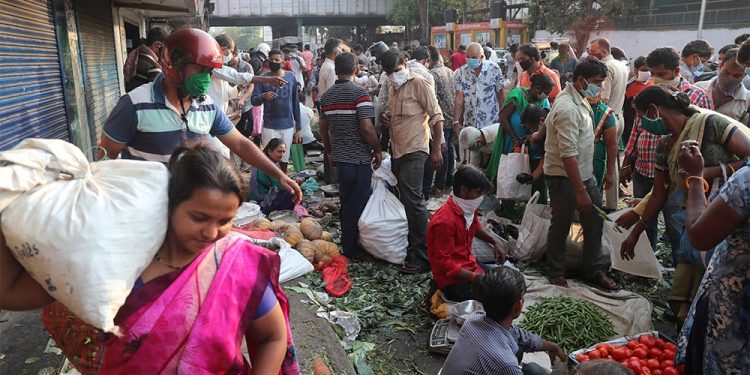
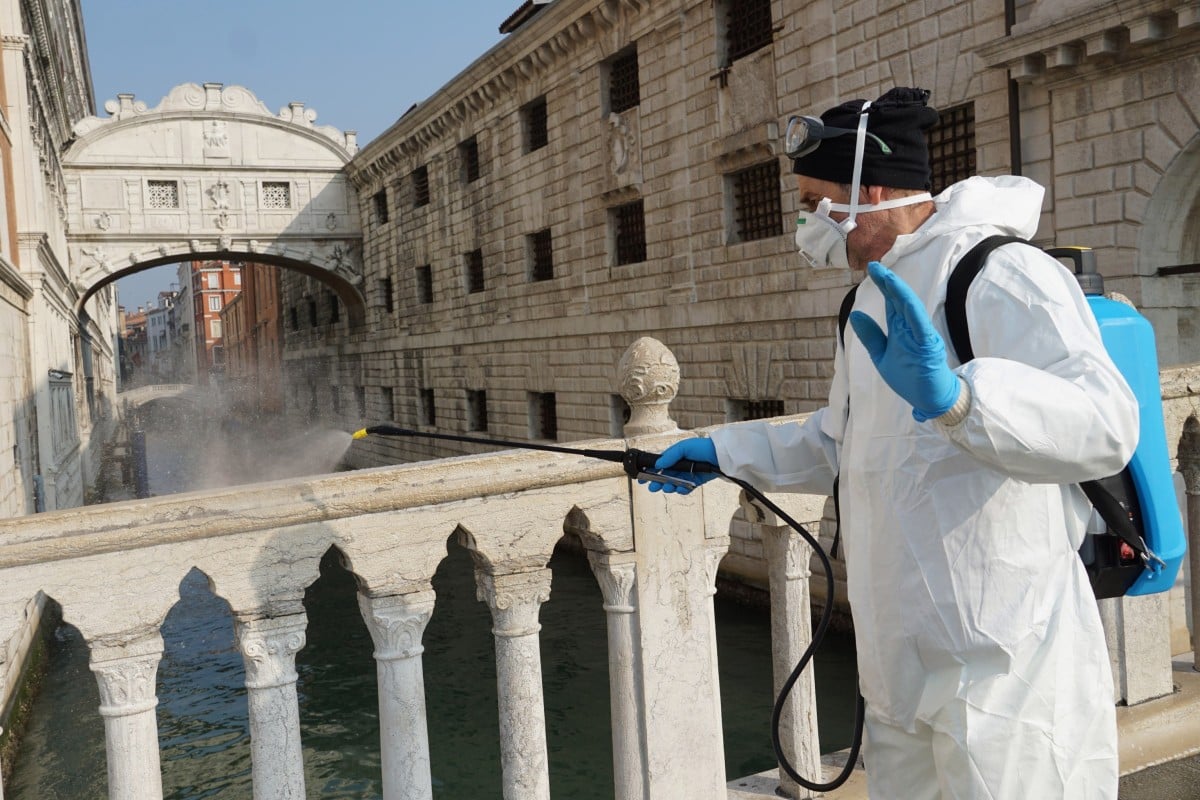
Fruits and vegetables can get easily contaminated in markets, by those carrying the virus, by coughing and touching them.  Pay extra attention and use your commonsense precautions.  Washing all food items, fruits, and vegetables, etc., in soap and water and rinse well, prior to use is helpful.  Vinegar or saltwater that traditionally used to kill bacteria in vegetables will not work against COVID-19, but detergents will.  For sterilization of surfaces, doorknobs, etc., spraying or rubbing diluted hypochlorite solution (bleach) or soap is apparently sufficient. 

The rapid growth of virus:  At the current rate of spread (at 33%; exponential growth phase) the viral load can double every 3-days.  Thus, in the USA, the number of infected people could exceed 10 million COVID-19 positive patients in six-weeks’ time, unless the expected infectious peaks are “flattened” through effective social distancing and above mentioned all precautionary and proactive actions (not merely by curfews).  However, the lack of access to food as a result of continued curfew (a third of the population is starving; it will lead to immune degradation), is likely to make the situation worse.

In addition, keeping the serum 25(OH) D levels in excess of 40 ng/mL (100 nmol/L) will markedly increase the inherent immunity (stimulating multiple immune pathways) in an individual.  Maintaining such a level will reduce the chances of getting any Coronaviral infections and the severity if they get infected.  

This can be achieved by oral supplementation of 50,000 international units (one capsule, once a week; or a collection of a number of capsules to make a total of 50,000 IU) for approximately, 8  to 12-week period; till the threat is over.  Alternatively, 30 to 45 minutes of daily exposure to direct sunlight (can be intermittent) of a “third of the skin surface, between 9.30 AM and mid-day (afternoons are too hot to be out in the sun), would generate an adequate amount of vitamin D to boost immunity.  This simple process applies to all countries and everyone; it costs nothing.

The current trend is that otherwise healthy younger people are now getting the disease: it is no longer exclusively affecting the elderly.  In addition, younger people can be carriers of transmitting the disease.  Consequently, they and any others should not visit elderly or sick people until the crisis is over unless they directly caring them for.  Anyone visiting them must strictly follow the mentioned hygiene and safety procedures, including wearing face masks.

These are suggestions to keep you and your loved ones healthy, and not considered as medical advice.  If you have questions or concerns, please contact your healthcare provider or the local health authority or hospital to obtain medical advice and additional information.

Everyone must take the current threat from COVID-19 very seriously and collectively work together to eliminate the threat, by abiding the above-mentioned public health guidance and local rules. 

Sunil J Wimalawansa (suniljw@hotmail.com)

Professor of Medicine, Endocrinology, & Nutrition, USA

For more information (LinkedIn), a series of articles on COVID-19:

https://www.linkedin.com/in/sunilwimalawansa/detail/recent-activity/

A scientific article on COVID written  on 5th January (in ResearchGate), predicted what will be happening in March:

https://www.researchgate.net/profile/Sunil_Wimalawansa/research

or 

https://www.researchgate.net/publication/340102912_EJBPS-Prof_WImalawansa-COVID-19-March_2020s

A lay summary of the beneficial effects of vitamin D:

https://www.healthline.com/nutrition/vitamin-d-coronavirus

Extensive information on vitamin D and coronaviruses, including COVID-19:

https://vitamindwiki.com

ERASING THE EELAM VICTORY Part 14 E

March 30th, 2020

KAMALIKA PIERIS

In Eelam War IV the Sri Lanka army fought using military strategy. There was an operations room, where battle strategies were planned. In Eelam war II and III, the government had fought only on one front. In Eelam War IV, the army opened three fronts simultaneously, Eastern, Northern, and Wanni. 

The army made sure, in its battle plans, that there were enough soldiers for the three fronts.  The army had the numbers needed. For the Northern front alone, the numbers were increased from 27,000 to 34,000 with two reserve divisions.

The army started the attack in the Eastern Province and cleared out the LTTE who were there. This was always the preferred plan and it was suggested to President Chandrika as well. Starting north of Trincomalee, the army steadily went down to Batticaloa and Ampara, capturing Kanjikudichchiaru,   Tharavikulam, and Thoppigala.  The Eastern Province fell to the army in July 2007.

Sri Lanka had in 1983, created a Special Task Force (STF) of handpicked police officers who received paramilitary training. This is the only paramilitary organization in the world with police powers. They operated in teams of eight or less and could fight in a variety of situations such as built-up areas, and close quarter battle. STF was used for fighting in the eastern theatre. STF destroyed 24 LTTE bases in Kanchikudichchi Aru jungle while the army went into Thoppigala. This combined campaign continued till Thoppigala fell in 2007. In 2009, STF went after the LTTE in Yala.

While the eastern war was going on, the army hopefully opened up a northern front at Muhamalai. This was expected to come barreling down past Elephant Pass into the Wanni. Instead, this campaign got stalled at Muhamalai itself. LTTE opposition was too strong. Most of the LTTE reserve cadres were also at Muhamalai. The northern front was then instructed to keep the LTTE tied up in the North till the Wanni was taken. LTTE was kept occupied with short attacks.

Since the Northern front was not active, it was decided in March 2007, to open up the Wanni front. For Wanni seven new fighting formations were created,   the 57  Division (Maj. Gen. Jagath Dias), the 59 (Brig. Nandana Udawatte),  Task Force I (Brig. Shavendra Silva), Task Force II (Brig. Rohana Bandara), Task Force III (Brig. Sathyapriya Liyanage), Task Force IV (Col.Nishantha Wanniarachchi) and Task Force VIII (Col. G.V. Ravipriya) . They advanced in different directions, covering the Northern Province,  in an ‘unprecedented multi-pronged Vanni offensive’.

For the final push, these formations were joined by the longstanding 53 Division (Brig. Kamal Gunaratne) and 55 Division (Brig. Prasanna Silva) deployed in the Jaffna peninsula. The 53rd division, stuck for so long at Muhamalai, used its mechanized infantry to reach Elephant Pass at a speed faster than the LTTE had anticipated. The Vanni offensive ended successfully in May 2009.  It brought the Eelam war to an end

Eelam war IV had certain praiseworthy qualities. Previously we fought as battalions, brigades, divisions.   In Eelam War IV we fought as one team, said Kamal Gunaratne  It was a combined effort.  ‘People were not worried about taking credit,’ he said. 

Efficiency was given priority over seniority in the promotion and capable officers were appointed to new leadership positions regardless of their seniority and rank.      Junior leaders, including lesser ranks, were given the opportunity of taking charge and issuing commands and showing initiative. That produced results.  

The army had complete operational freedom to launch the offensive, using the best men for each task. In Eelam war II and III whenever we faced a major attack we blindly sent in commando and SF troops and it ended in disaster.  In Eelam War IV, we sent in the correct team. We sent infantry for close-range combat, commando for deep ops, having done reconnaissance first.

It was necessary for war, to have reinforcements ready, ‘to fill as they fall’. This was not done in Eelam wars II and III, but for Eelam War IV we were able to get more than the required number of fresh recruits to replace and reinforce the troops, said Kamal Gunaratne.

The army also innovated. It created small-group operations. Small groups penetrated LTTE defenses in the jungles, gathered information, then scattered in four directions and returned separately.  Once strategic enemy positions and camps were identified, infantry and commandos went in.  They sprang deadly surprise attacks on enemy patrols too.  Using the information provided, the air force engaged in highly accurate and successful airstrikes. LTTE had no counter-strategies to match the small team ops and the Special Forces.

It was necessary to hold territory after taking it. Non-army service personnel was sent, after training, to hold territory taken by the army,  leaving the army free to go forward.   The air force was sent into the jungles, the navy to the coastal belt along Trincomalee.   STF took over the A9 road from Omanthai.  Civil Defence Force was sent to several places including Mavil Aru and also to Nanthikadal lagoon to take over as the troops moved ahead.

Eelam War IV battles are forgotten today. Only the glorious victory is remembered. That is unwise. The battles must be kept in mind because they indicate some very important matters.

Firstly, there is the contrasting position of the LTTE and the army. The LTTE was fighting on home ground, they knew the terrain intimately, and were acclimatized to the environment. The Sri Lanka army did not live in the North. They came mainly from Panagoda or Anuradhapura. They were airlifted or shipped into battle, like outsiders, to face the LTTE who were resident there. They did not know the northern terrain and probably had not rehearsed specifically for these battles.

Some battles, such as the shootout in the Nanthikadal lagoon, could not, in any case, have prepared for. Fighting in muddy brackish waters of mangrove is a nightmare, said Kamal Gunaratne. A flight of birds could betray us. One must be specially trained to fight in a mangrove. It calls for a different set of tactics. We did not have such training.

Secondly, during the Ceasefire, the LTTE had plenty of time to dig in. They mined all potential battlefield areas,  such as  Pallai.  They also built huge bunds and trenches. They had smuggled in an enormous amount of arms and buried them. They constructed two FDLs at the northern boundary at Muhamalai.

The FDL at Muhamalai had been decided in such a way that the advantage lay with the LTTE and not the government. The government FDL was very vulnerable. It ran from Kilaly and Muhamalai to Nagarkovil. Nagarkovil was separated from the mainland FDL by the sea.

LTTE FDL was on higher ground. LTTE could observe and monitor our movements and were able to accurately target our troops, with artillery, mortar and sniper fire. We were constantly attacked, said Kamal Gunaratne. LTTE had two FDL with protective bunkers.

When it came to battle, LTTE again had the advantage The ground between government FDL and   LTTE FDL was also higher than the rest. It was an area that took most of our troops, said Kamal Gunaratne.  During the Ceasefire, LTTE had mined the area extensively, introducing also mines to blow up tanks. Muhamalai was heavily mined. Our soldiers lost the greatest number of legs at Muhamalai. over 500 soldiers lost legs there, said Kamal Gunaratne.  LTTE  had also dug trenches and large pits and camouflaged them so that troops and vehicles would fall into them.

LTTE FDL was at the head of the narrow 12 km wide neck which linked Jaffna to the mainland. This space was unsuitable for tanks and it was difficult to maneuver infantry and tanks in the space. The army had lost a large number of tanks to anti-tank fire.  It was very arduous, dangerous and fearful to advance in this area, said Kamal Gunaratne, also suicidal.  LTTE could cover the army easily. LTTE had battle-ready reserve fighters at Pallai, Elephant Pass, Paranthan and Kilinochchi, to defend the Northern FDL.

LTTE did not hesitate to hit the government FDL whenever possible. LTTE  hit the FDL bunker close to Kilali lagoon. They sent accurate, deadly fire on to the bunker, said Kamal Gunaratne with deep feeling.  In another instance, LTTE had allowed them to get into a cul-de-sac and then attacked them on three sides.  On a third occasion, the well-entrenched LTTE destroyed or damaged six armored vehicles, four T-55 tanks, and two BMPs, and killed 130 SLA soldiers.

At Muhamalai, the casualties were very high. Usually, an operation would end with around 200 or so dead and injured. In Muhamalai, the total was 440 officers and soldiers dead, 1986 injured, of which 280 were critically injured.

Kamal Gunaratne says the Muhamalai battle (2008) was the most decisive battle in the entire history of the Eelam war. LTTE tried its best to win and if they had succeeded, it would have been the birth of Eelam.  But this defining battle has not received the prominence it should have.

Muhamalai saw two separate battle failures that deserve mention. Both were significant. After taking the first LTTE FDL at Muhamalai, HQ ordered the division to capture the 2nd FDL without giving the army time to recover. Kamal Gunaratne protested.

 A large number of officers and soldiers of 53 and 55 have died or been injured.  The fighting capability has been reduced and reinforcements were needed. We should have trained the next lot and integrated them before the next move. The army needed more time to plan and organize. This was not given.  Kamal Gunaratne said he was personally against the operation.

He had pointed out that there were thousands of minefields in front of the  2nd FDL. Also, LTTE had deadly accurate, well-positioned artillery and mortar as well as high powered machine guns. These would fully cover our path of advance. There was also the threat of ground assault by LTTE on our by then decimated troops. In addition, there was also the lack of any cover.  HQ was told of the dangers but they said to somehow manage.

The attack was a failure for the army and a triumph for the LTTE. Several tanks had lost direction and instead of stopping at the 1st LTTE FDL had gone on to the 2nd FDL, where the LTTE was waiting. The two platoons coming behind had blindly followed. They all died. This was a prize blunder.

There was a second disaster at Muhamalai.  The 53 Division had suddenly attacked the LTTE FDL without informing others. They had planned this secretly, keeping the others, including Kamal Gunaratne in the dark. But they could not hold the FDL and they retreated in disorder. Casualties were far worse than expected, said Kamal Gunaratne. One officer and 87 soldiers dead, 11 officers and 303 others injured. Analysts wanted to know, was this done deliberately and was it sabotage.

 The commander of the 53 Division was transferred, not dismissed. He left silently, dejected by the devastation he had caused.   Kamal Gunaratne was asked to take over as commander. Kamal Gunaratne had not wanted a ceremonial take over since LTTE was spying on them. But Ven. Bengamuwe Nalaka arrived unexpectedly. He had heard the news and came to bless the commander and the campaign.

Eelam war IV took four years. We had to fight for every inch of land we captured, said Kamal Gunaratne. There were fierce battles and the army lost 8500 and 29,000 were injured. but LTTE could not stop the forward march of the army.

 In addition to the battles at Muhamalai, there were battles in the Wanni. there was a fierce battle at Odusuddan. LTTE was at its peak at Odusuddan said Kamal Gunaratne. Odusuddan was in a strategic position on the Mankulam- Mullaitivu highway.

There was also a protracted battle at Pudukuduirippu. Pudukuduirippu was on the Paranthan Mullaitivu highway. It took    2 ½ months to break the LTTE stranglehold on Pudukuduirippu. The battle of Pudukuduirippu was the most brutal of all battle I have ever commanded, saidKamalGunaratne. There were serious reversals during the battle. The army nearly lost, then the battle reversed and Pudukuduirippu fell. Pudukuduirippu was a valuable victory.  LTTE had held it for over two decades. Pudukuduirippu was won at a tremendous cost, many died.

LTTE had buried large caches of weapons, ammunition, and food in the jungles.  they could continue the war for 6 months more at least said Kamal Gunaratne. There were hundreds of weapons of every model. The number of machine guns, various types of weapons, and explosives was quite frightening. 

Thought we had achieved success after success, LTTE had the uncanny habit to hit back at the very end in a most unexpected manner, said Kamal Gunaratne.   One stunt that astounded the army was the suicide truck at the Pudukuduirippu battle.

 A  large truck fully covered with steel plates, came barreling toward our FDL at a terrific speed. Inside the truck were LTTE fighters, shooting in all directions through holes cut out in the steel plating. Nothing could stop the vehicle. Then, fortunately, some battle tanks belonging to the army drove in from the opposite direction, realized what was happening and shot at the truck. The truck burst into flames and crashed into a ditch.

The truck had two steel plates welded together, covering the entire vehicle, with gaps packed with sand. It had been designed to withstand RPG7s. Small holes had been bored to facilitate shooting and there was an opening for the driver to see where he was going. This truck was targeting the headquarters, where all the senior officers had congregated. It was a gigantic attempt to destroy the command Headquarters, and the commander and thus bring the war to a halt.

LTTE fought to the finish. At the last stage of the war, they sent 30-40 boats at lightning speed across the lagoon to the western bank. LTTE fighters scrambled out and the boats turned around and left. 7 suicide boats came as they left,  also at high speed, crashed into the bunker at different places, and blew up. The earlier boats returned with more fighters. There was a brutal fight between the two sides.

In the meantime, Charles  Anthony, son of Prabhakaran, was trying to escape. He had got on the A35  with 11 others. They were killed there.  He was accompanied by well-built bodyguards, carrying state of the art weapons.  Army took in a large haul of weapons and bundles of money. Charles Anthony had Rs 2.3 million with him.

 700 LTTE  were gathered together at Vellamullivaikal, at the final stage of the Eelam Iv war. They had divided into three groups. The first group stayed back at Vellamullivaikal as a decoy. They walked up to the army saying they were civilians, but when the army fired a weapon,  the second group hiding in the background opened fire.

The third group containing Prabhakaran and the top leaders, including and Soosai, Pottu Amman had entered the Nanthikadal lagoon, planning to escape to Mullaitivu jungles through the bunker gaps created by suicide boats, Instead, this group somehow got pushed into the mangroves in the north of the lagoon.

Kamal Gunaratne had stationed soldiers in the mangroves. They noticed movement. At the same time  an informant had said Soosai was hiding there.  So troops went in. There was ferocious fighting. The army killed 52 persons.  This included all the leaders, who, it appears,  had grouped together there. They all died. We also found 150 bodies of sturdily built terrorists. They were LTTE’s best fighters, well built, muscular, said Kamal Gunaratne.

Prabha was in uniform, with his dog tag saying 001” and also his Identity card, intact in his upper shirt pocket. The identity card he been  Issued on 1.1.2007. These items were probably there to show his US rescuers that he was really and truly, their very own Velupillai Prabhakaran.

The army had killed all the  LTTE leaders, including Prabhakaran without even knowing that they were doing so.  They were delighted when they found out.   About   5000  soldiers had gathered to see Prabha’s body brought in, cheering loudly.. Solders bringing the body in were also cheering Body was still warm when I saw it said Kamal Gunaratne. The much-criticized  Sinhala triumphalism did not begin with Kiribat and raban  on the streets of Colombo. It started the moment the soldiers heard that Prabhakaran was killed.

Formal identification of Prabhakaran’s body was needed. Prabhakaran’s body was identified by Karuna. Later Prabhakaran was undressed on the order of the Army  Commander and shown bare-bodied. Army commander had ordered this, saying only the head of a standing army was entitled to wear a uniform.   The army cremated Prabhakaran as soon as possible.

On 18 May 2009, The 58 Division of the Sri Lankan Army led by Brig. Shavendra Silva, 59 Division led by Brig. Prasanna de Silva and the 53 Division commanded by Gen. Kamal Gunaratne,  defeated the LTTE  at  Vellamullivaikal, a small town on the A35 road, near Nanthikadal lagoon,    and brought Eelam War IV to an end. Television news showed the two teams coming in from opposite sides and greeting each other. On 20 May 2009  Sri Lanka army ceremonially silenced its guns.

Since the LTTE  leadership was dead, on 19 May 2009 Kumaran Pathmanathan,  head of international relations, stated on the LTTE  website that “This battle has reached its bitter end. We have decided to silence our guns. Our only regrets are for the lives lost and that we could not hold out for longer”

LTTE would have been hoping to drag on the battle, till a truce was declared. Then with the help of foreign countries, the island would be divided into two, with the coastline going to Tamils and the Sinhalese left landlocked.  (Continued)

Where is the G20?

March 30th, 2020

Dr Gaya  Kulasinghe    Consultant Physisian writes  …..

I thought to write a few words on FB, especially for my friends in Sri Lanka, though I have never posted my personal views on social media before.
As a physician, currently working in the front line, dealing with a new Coronavirus pandemic in a leading hospital in the USA, I have witnessed a drastic difference between the USA, which beliefs to be a part of first world country and Sri Lanka, known as a third world country.

I don’t have enough words to appreciate the SL government, health care personnel, military, and all the other supportive organizations for their extraordinary leadership and contribution compared to the subpar means used by so-called developed nations to handle this horrific battle.
Please tell your fellow Sri Lankan’s how lucky they are to have a government and healthcare sector pleading them to get tested if they are suspected to have an infection, begging people who needed to be quarantined to contain the spread of the disease for the sake of rest of the nation, mobilizing the little money and resources they have to build those quarantining facilities, going above and beyond to take care of most of the needs of the public during this country’s locked down period, etc.

On the other hand, people in the USA have to beg authorities to get the test done for them. Still, the chances of getting the test done were very slim for the past couple of weeks due to a lack of testing kits and facilities. People who were more than 100 % sure that they got infected were turned down on some occasions as they did not meet the criteria to get the test done!!!!

Due to multiple reasons( which I am not going to discuss here) America has lost the battle against the virus threat. Now, the country is leading in first place among other nations with the highest number of infected cases and escalating the number of fatalities as well.

One of the biggest problems for the health care workers here is the extreme shortage of personnel protective gear. We are asked by our authorities to go to the battlefield with toy guns” risking our own lives, our colleagues, other healthy patients and over loved one’s lives. We are asked to use scarves and handkerchieves as face masks once we run out of our last supply of face masks. We have to use /reuse N 95 masks and we would get one surgical mask per provider per day.

Some Emergency room physicians have stopped sleeping in their bedrooms as they are afraid that they would harm they are loved once and started sleeping in their garage or in hospital On-call rooms for days.
This is the bitter truth of the reality of the USA now, supposedly the most advanced and privileged country in the world!

Hats off to my colleagues and all the other health professionals in SriLanka for their noble duties they are performing in during this difficult time!!!
Please make aware your fellow Sri Lankans about the depth and seriousness of current pandemic, ask them to stop blame games, support the government to conquer the battle putting aside their own political views at this crucial moment, ask them to trust and believe in their health care professionals and lastly set a model as a proud nation to the rest of the world!!!

Thanks,
Gaya Kulasinghe.

SOS FROM UNCLE SAM

March 30th, 2020

Corona News

The US reaches out to Sri-Lankan health workers amid coronavirus outbreak

The United States has appealed to medical professionals in Sri-Lanka, particularly those working to treat or mitigate the effects of COVID-19, to reach out to the nearest embassy or consulate to request a visa appointment.

The appeal was made on Thursday, March 26 through the Department of State, Bureau of Consular Affairs’ website.

කොරෝනා සුව වෙන්න IDHදී උණුවතුර..- කොරෝනා සුව වූ පලමු ශ‍්‍රී ලාංකිකයා කියයි

March 30th, 2020

උපුටා ගැන්ම ලංකා සී නිව්ස්

කොරෝනා වෛරසය වැළඳී තමන් කොළඹ ජාතික උණ රෝහලේ ප්‍රතිකාර ලබද්දී දිනකට උණුවතුර ලීටර් 06-07ක් පමණ බීමට ලබාදුන් බව කොරොන් වැලදී දැනට සුවපත් වී සිටින පළමු ශ‍්‍රී ලංකිකයා සදහන් කරයි.

තම රෝගය සුව කරන්න උණු වතුරද ඉවහල් වූ බව මත්තේගොඩ පදිංචි ජයන්ත රණසිංහ වන ඔහු කියා සිටී.

කොරෝනා වයිරස් රෝගීන් සුවකරන්න උණු වතුරද ඉතාම හොඳ දෙයක් යයි තමන් එම රෝහලෙන්ම දැනගත් බව ද ඔහු සඳහන් කරයි.

සති අන්ත පුවත්පතක් වෙත අදහස් පළ කරමින් ඔහු මේ බව සඳහන් කර ඇත.

COVID 19 AS A PROTECTION

March 30th, 2020

RANJITH SOYSA

Digressing from the plight brought about by the  COVID 19, I wish to draw the attention of your readers to an important item discussed in the Island, issue of 23rd March. It was referring to the British High Commissioner who was said to be too busy to comment on his alleged intervention in the judicial process of Sri Lanka. The former chief magistrate Mr. Tilina Gmage under oath at the Presidential Commission stated that he received a letter from the British High Commissioner offering ‘unsolicited advice’ in dealing with a case handled by him..

This is a serious matter which affects the rule of law, directly and indirectly, it is an act that violates the diplomatic rectitude. On the other hand during a period when it became known that the NGOs, high profile ministers attempted to interfere in the judicial process, it is impossible to shake off simply the allegation against the British High Commissioner. Some of the controversial statements issued by the Western embassies on governance in Sri Lanka during the period of the last government can be sited as evidence of attempted intervention in Sri Lanka’s domestic issues. It is indeed ironic to find that most of the advice contained in these statements wanted to fix our judiciary to redress the claims of ex-terrorists.

Oddly enough, one wonders whether COVID 19 is used as a convenient cover by the British High commissioner to run away from facing the issue. In any case, now that the quarantine period is over, he should now come forward and explain his position clearly to the Government of Sri Lanka and the people of Sri Lanka. While waiting for his explanation, we trust that Sri Lankan government too will raise this issue to seek clarification. We hope that the High Commissioner will live up to the great British practices.

RANJITH SOYSA

COVID-19: Just Control Your Response To It and Keep Going!

March 30th, 2020

By Zaithoon Bin Ahamed Courtesy www.medium.com

When Sri Lanka went into lockdown about two weeks ago, the company I work for took a firm decision to follow government recommendations and close all offices and encouraged people to work from home wherever possible. Top priority was health and wellbeing of people and taking all measures to help the government’s efforts to curb the spread of COVID-19 in the country and ensure everyone is safe. At that time, it seemed like it would possibly be about a week or so in isolation and we’ll all be back on track. I checked my food supplies and other essentials and didn’t stress too much as I had enough of what I needed to last a week. However, things turned serious and suddenly we were in complete lockdown with an indefinite curfew that forced us to stay indoors, deliberately wash our hands every hour or so and sanitize self and surfaces, and of course the toughest one to do (at least for me) — ‘social distancing.’

We’re going into possibly another two weeks of house arrest and isolation. Supplies are running low and I’ve never been so delighted to hear and see the delivery guy from a small local bakery come by in his tuk tuk filled with fresh bread and buns blaring the tune ‘it’s a small world after all’ or random folks walking about or pushing rickety old carts with a few varieties of vegetables, greens, and fruits. Yesterday was a bonus — we had a truck drive down the road selling fresh veggies out of sacks. Some friends in other areas said they had a freezer van selling meats and other frozen items, including ice cream (yum, I sooo want some)! And some others had rice, lentils, fresh coconut, and canned fish sold to them at their doorstep. I quickly turned to the Internet and realized the very limited online network in Sri Lanka to purchase essential items had collapsed due to the sheer demand and volume. There were various flyers floating around promising delivery of basics ordered over the phone or via chat, but most of them were unable to cope and quickly shut services without any warning. In times where you supposedly ‘have access to everything’ we’re completely cut off and thrown into a hole in a flash.

We’re taking a day at a time and long-term plans have become mere writings on beach sand that will need to be revised and refreshed with every new challenge thrown at us during this uncertain time. Figuring out how long it will last is a fluid challenge, one that we definitely have no control over. I spent the first few days stressing about food and other essentials, unfinished office work, laundry I hadn’t picked up, yoga classes I had missed, a movie and pizza date with my two nephews, among a host of other things. Then reality hit, and it dawned on me that stressing over things you cannot control is futile and this was certainly one of those times where you needed to take a few steps back, take a deep breath and slow down. On the first day, I spent hours doing nothing, but watching the news and tracking the impact of COVID-19 around the world, and the way it began to unfold and engulf our nation of happy islanders who almost always seize any opportunity during a crisis to enjoy a few laughs and songs over food and drink. This was different.

We have been through a lot — a protracted war, communist-led riots, racial unrest, political instability, extremist-led attacks being the big ones in just the last few decades alone. The impact of this virus, however, is unprecedented and it’s really prompted us to rethink how we work and how we live. Apart from that, it’s definitely taught me to slow down and enjoy life the way it should be and focus on learning and exploring while attending to everyday things. I spent the first 3 days waking up much later than I usually do and thereby missing some important things in my daily routine, like reading, exercising. Instead, I was just wasting time lazying around in my pajamas and checking emails in bed. But I took control and realized this was not sustainable and not healthy and a complete waste of time.

It was time to reflect and focus on controlling my response to COVID-19, rather than fretting about dealing with things that were beyond control.

What I’ve done

De-junked and reorganized cupboards and shelves that I’ve been wanted to do for months and have been putting off. De-junking is therapeutic!

Started writing again — I had many work-in-progress bits of poetry and a novel I had started on some months ago and made little progress

Called friends and family I hadn’t spoken to in a while other than a random text message, usually during my commute to/from work

What I’ve learnt

How much we undermine technology as a society and country; for all those who have been skeptical about digital banking to buying things online, this would have saved you time and energy and would have been an absolute blessing at a time like this. So, get connected, now and learn how to do things online!

You don’t need all the fancy things and luxuries you buy on a regular basis; it all boils down to what you need to survive. Lifestyle is a choice and certainly hasn’t given any of us much of a choice in this crisis. Living simply and being able to manage with what you have is a good lesson

The importance of investing time in a close circle, especially at times like these, to help share thoughts, ideas, grief, and just chat to keep you sane, motivated, and hopeful. I’m so thankful and blessed to have wonderful family and friends-like-family

What I’ve discovered

It doesn’t matter where you are — all you need is a little discipline and passion. You can slice and dice your day and do all the things you have to (like home chores), work, hobbies, and socializing. It’s these moments that truly put technology and creativity to test and make you discover and do things you thought weren’t possible. I’ve discovered I can cook better than I thought I could as I have no choice but to further explore my culinary skills given the absence of Uber eats and limited supplies. I’ve learnt to be frugal and make do with the bits I have — I even potted a few herbs and spinach instead of throwing out the stems even though gardening is not something I enjoy doing

You can do everything (well almost everything) virtually — I started a daily virtual power yoga class with my guru and it’s been as good as the regular sessions. Actually, with my routine, I have time to do this every day and then get on with my other work. I discovered some very cool virtual party apps and have been connecting with the girls almost every day to chat about random things we would normally do when we meet up for happy-hour Fridays. We even invited some of the boys and had a virtual ‘dress up’ party, but clearly only I took the dressing up seriously!

Virtually Collaborating — Workout and Parties!

We have at least 20 kids in the neighborhood who play cricket every day after school and when their hits fly over the wall into our backyard, there usually would be no one at home to throw the balls back! I found a handful of balls and gave them back to the thankful kids. And then of course, we had to keep throwing the balls back at least 10 times a day (sigh!), so I had to quickly make a deal and tell them that only 4 over-the-wall hits allowed per day — all others must be collected the next morning 🙂 It’s worked and we’re still friends!

The muddy paw marks we see on the car everyday are those of our new furry friend — Gingerbread. Ginger scales the wall everyday just past 7am (by which time we have left the house to go to work) and hangs around the garage. We’ve now sort of adopted him. He comes over every morning for his milk and fish, begs to be petted, and even joins me in my yoga sessions. It’s a good feeling to bond with a pet we’ve never had before

Meet ‘Ginger’

Opportunities and way forward when we get back to normal?

In all of this madness, I was rather amused at how many retail giants were unable to cater to people’s basic needs through their (weak) online retail channels. It’s a two-way street though — I suppose these players had embarked on some form of online operation, but never improved or leveraged it because people didn’t see the need for it. This crisis, however, has proved that you’ve got to be ready for these things, both from a retailer’s perspective as it offers a great business opportunity, and for people, a convenient way of sourcing your basic requirements and have them delivered to your doorstep. A few days later, some of these retailers got their act together and met people halfway, but it’s been a frustrating one as the channels are not fully functional and there’s zero communication between vendor and customer! It’s a good wake-up call for all ‘digital and innovation’ teams to break away from traditional ways of doing online and look at quick collaborations to rise up to this sort of challenge and meet the current demands.

For corporates who have been exploring and mulling flexi-work, this would be the ultimate test to implement and go. There were some published statistics already that showed the use of online meeting platforms had spiked in the past few weeks as more people turned to digital tools to be connected and work collaboratively, albeit apart. It can be done. If corporates loosen their grip on rules and policies and trust employees with flexibility, it could translate to increased productivity and perhaps a decrease in overhead costs too. Individuals though need to practice discipline and meticulously plan your day, so you give equal importance to everything you love and deliver on your work in a timely manner. I always believe a slacker will be a slacker, whether working in an office or working from home, so it boils down to hiring the right talent .

What do I miss the most during this quarantine life?

Hanging out with my two nephews, even though, thanks to technology, we connect over a video call to chat about random things. I also miss partying with the girls, going for drinks and dinner, and taking silly selfies. Hopefully, I will be able to do all of these again soon once this is behind us.

The turn of events is proof that volatility and uncertainty are certainly a part of life. And your ability (you as a person, a corporate, and a country) to adapt quickly, change the way you function, and keep going will be the ultimate test of resilience if you want to ride the tide and settle gently on the shores, unscathed. For now, we can live knowing that ‘this too shall pass’ and the day will come when we jump back into our daily rat race. And when that happens, eventually, my daily exercise sessions will possibly be reduced to about 3–4 times a week, I may not be cooking as often as I do now, and Ginger will probably find another home where there are people to greet him during the day. But I will be glad that I would have used this time of self-isolation in the best way possible to look within, reflect, and identify things you can change for the better — for yourself, to be more valuable to society, and to be more meaningful to the people who deposit your monthly paycheck, so you could live a good life. Stay calm, stay positive.

The appearance of things changes according to the emotions; and thus we see magic and beauty in them, while the magic and beauty are really in ourselves.”― Kahlil Gibran, The Broken Wings

Questions thrown up by the COVID-19 crisis in Sri Lanka

March 30th, 2020

By Shivanthi Ranasinghe Courtesy Ceylon Today

COVID-19 containment jostles with demand for food and democracy

Questions thrown up by the COVID-19 crisis in Sri Lanka

Colombo, March 30 (Ceylon Today): Today, the people of Sri Lanka are in the grip of two worries: One of them, of course, is COVID-19. The other is food sufficiency – whether the household has enough food until the currently indefinite” curfew is lifted. However, people appear to be more worried about food than COVID-19.

Most are trying really hard to adhere to government regulations and expert advise on keeping themselves from getting infected. But there is also an indication that they would rather risk infection than go without food.

Sri Lankans, especially the Sinhalese, have been derided for prioritizing the stomach before the country. Yet, it is silly to ridicule their fixation with food when food is a basic need, indeed, the essence of life. It is necessary for the survival of every living organism. Even at the point of electing a President or a government, everything boils down to the ease with which food can be accessed for the family.

The government is certainly making Herculean efforts to ensure that no one starves. And these efforts go beyond the recently launched door-to-door delivery system.

When China first experienced a strange cluster of pneumonia cases in late 2019, the outside world could not care less. By early January, China warned the world that a new coronavirus has emerged. By mid-January, the number of infected cases was increasing and infection was spreading fast across China. Cases began to emerge in other countries as well. At first it was in China’s immediate neighborhood. But quickly enough it spread to the rest of the world. It was significant that the virus was being imported through travelers coming from China. And clearly, it was getting transmitted from person-to-person.

China quickly got genetic information about the virus and shared it with the world. China’s proactivity helped other countries quickly identify affected persons. China’s actions are especially noteworthy when WHO kept a tight lip on the matter. WHO’s procrastination however left most countries, including India, in a state of unpreparedness.

Though most countries began to take preliminary measures such as screening arrivals at airports for high temperature, not many took the necessary tangible steps to prevent the spread of the virus, not even when the virus proved to be a killer.

China locked down Wuhan – the seventh largest city in their country, with an estimated 11 million people. This was done just the day before the Chinese Lunar New Year. With this unprecedented decision, the debate in most governments was about bringing back their citizens in China, especially those in Wuhan.

Sri Lanka was one country that did not debate the issue. When WHO cagily noted in early January that a new illness was fast spreading across China, that day itself President Gotabaya Rajapaksa instructed the Health Ministry to be ready for the entry of the virus into Sri Lanka as well.

The very night that Wuhan got locked down, President Gotabaya instructed the Foreign Ministry to get the 700 or so students back to Sri Lanka. The Government offered the students a 60 percent discount on the airfare to return home. However, 34 students, some with families there, were trapped in locked down Wuhan. No one was allowed to get in or get out of the city. After much discussion with the Chinese Government, Sri Lanka flew in a special flight and got these students back home.

The night Wuhan was locked down, President Gotabaya formed a special National Task Force to ensure that Sri Lanka is affected only minimally. The President was not only concerned about the health aspects but also of food security. The government stocked enough food to last the entire year. If the situation is reined in soon, Sri Lanka may have enough even to export. Therefore, the Government is not bluffing when it assures that there are enough food stocks.

But the going will not be easy. To keep us indoors as much as possible, the government had initiated a door-to-door delivery system with the partnership of wholesale dealers and other service providers. However, there is a crucial missing link that either the government has not yet factored in or has not communicated to the public. Even if the groceries are brought to the doorstep, people would still need money to pay for them. Even if the government provides these at the cheapest rates, people would still need money to pay. With the ongoing curfew, people are unable to go to the banks to withdraw money sitting in their accounts.

In districts like Colombo, Gampaha and Kalutara as well as five districts In the Northern Province, the situation is further aggravated by the imposition of an indefinite curfew. Even in other districts, because the break in the curfew is very short, there are long queues in front of banks and shops. The problem is far greater for daily wage earners. They do not have any cash reserves. They will eat only if they find work for that day.

The government has gone into minute details even into the question of feeding stray dogs. It is keeping a helpline open for those with mental disorders or addictions or for those with any other special need. However if people are to remain calm, the government must assure them very clearly that they will be looked after under all circumstances.

In the meantime, the humanitarian deeds of the military are circulating in the social media. It is obvious that no task is too small for them. When a household had run out of gas, the Army supplied it. When an infant’s feeding bottle broke, the Army replaced it. Obviously the soldiers are under clear instructions to look after civilians in every way possible.

Therefore, people should not worry too much. At the same time it is imperative that the government also communicates these assurances very clearly to the people. The current instruction to tell the Army or police of one’s needs is too vague. It is also unlikely that a poor man will pick up the phone and tell the government that he is without any purchasing power.

Notwithstanding these gaps, most people are appreciative of the government’s efforts to contain the situation. This is especially so with many horror stories pouring in on other countries’ experience with COVID-19.

However, even as people quietly comply with government directives, the opposition is trying to bring the people’s attention to another crucial matter. They are urgently calling the President to reconvene parliament.

However, when the minority Rajapaksa government on 20 February tried to move parliament for funds to pay debts accumulated by the predecessor Yahapalana government in order to ensure an uninterrupted supply chain, the opposition blocked it just to put the new government in difficulty. Therefore, the President rejected the call to reconvene parliament and instead reiterated the need for fresh general elections. He called upon the people to elect a strong government which can fulfill his election pledges.

Tamil National Alliance (TNA) spokesman MA Sumanthiran notes that Sri Lanka is without a parliament and warns that if this situation is allowed to continue the country is in danger of losing democracy. The TNA opposed the establishment of a quarantine center in Vavuniya but did not object to an infected Pastor from Switzerland conducting mass congregations in the North. This had led to five districts in the Northern Province being put at high risk.

This raises the question as to whether the opposition is really concerned about democracy. Given the situation at hand, with the deadly COVID-19 on the rampage, the question that Sri Lankans should ask is whether the urgent need is democracy or leaders with a nationalistic mindset.

Lanka’s economy can’t recover until the global economy recovers from the COVID-19 trauma

March 30th, 2020

By Shiran Illanperuma courtesy Xinhua

Lanka’s economy can’t recover until the global economy recovers from the COVID-19 trauma

COLOMBO, March 28 (Xinhua) — Global communities and financial institutions must unite to put the world economy back in order amid the COVID-19 pandemic, a senior Sri Lankan economic expert said here Saturday.

Ajith Nivard Cabraal, Senior Economic Advisor to Prime Minister Mahinda Rajapaksa told Xinhua that developing countries like Sri Lanka could face unemployment, low economic growth and debt problems due to the COVID-19 pandemic.

Sri Lanka is looking at an economic situation created by circumstances beyond our shores. The global community must therefore come together to provide a solution to put the world economy back in shape,” Cabraal said.

Cabraal, who is a former Governor of the Central Bank of Sri Lanka, said that Sri Lanka would attempt to tide over businesses and keep the economy afloat amid precautions taken against the spread of COVID-19 in the country.

However, he noted that Sri Lanka’s biggest foreign exchange earners include apparel manufacturing and tourism, both of which rely on external demand which has been contracting due to the impact of COVID-19 on developed economies in the West.

No amount of stimulus packages by Sri Lanka can help resurrect these sectors if the global conditions are not right,” Cabraal said.

Similarly, lower oil prices, while beneficial to Sri Lanka’s import bill, could lead to job losses for Sri Lankan migrant workers in West Asia. The resulting loss in remittances could negate the benefit of low oil prices, Cabraal said.

The current crisis will need an international response similar to the Bretton Woods system which was set up after World War II to promote reconstruction and recovery of demand,” Cabraal said.

We have to lobby institutions like the G20, IMF, World Bank and UN to create global policies to address these issues,” he added.

Small is useful

March 30th, 2020

Editorial Courtesy The Island

Tuesday 31st March, 2020

Time was when there were retail shops, or sillara kades, at every nook and cranny of the country, selling various commodities, including grocery items, at reasonable prices. Catering as they did mostly to low income groups, they could keep prices low as they had no overheads as such. They were open, from morn till night, daily. They stood the ordinary people in good stead in that essentials were available at affordable prices. But, most of these small businesses could not withstand the tide of consumerism, which paved the way for the rapid expansion of giant supermarket chains.

The need for ensuring the existence of the sillara kades is felt today more than ever, thanks to the current countrywide lockdown, coupled with a strictly enforced curfew. When the curfew, which is in force to prevent mass gatherings on account of the spread of Covid-19, is relaxed, people, desperate to buy essentials, throng streets and line up near supermarkets, which get stripped bare in next to no time. There can also be seen lines of people near the existing retail shops, where goods are cheaper than at supermarkets. Fashionably dressed men and women also join these queues, which are not long, for want of a better alternative. 

We have, in this space, urged successive governments to take action to protect retailers as their elimination will place the ordinary public at the mercy of giant businesses. Supermarkets are, no doubt, necessary, in the modern society, and the state is duty bound to look after their interests, as well, but the existence of small businesses, which cater to the ordinary people, must also be ensured. It may be recalled that the Rice Mafia is now exploiting both the farmer and the consumer, having driven most of the small-time millers out of business. No government can control the big-time rice millers, who have become a law unto themselves. This is what happens when small businesses go belly up.

We peddle no argument that retailers are driven by altruism; they, too, seek to maximise profit, which is the name of the game, but they are capable of keeping prices relatively low and making goods freely available at the grassroots level. Hence the need to protect them.

Meanwhile, what would have been the situation if Sathosa had been privatised and the co-operative outlets closed down? The state would have had no way of controlling the distribution and sale of essential commodities. Sathosa is playing a vital role in making goods available to the ordinary people at the prices prescribed by the government.

Former Minister Basil Rajapaksa, who is heading the Presidential Task Force, appointed to manage the current situation, said, the other day, that the co-operative outlets had to be strengthened to streamline the distribution of essential commodities, at the grassroots level. Following the 1977 regime change, which led to the unbridled economic liberalisation, the co-operative movement was neglected and left to wither on the vine. Its survival has been a miracle. 

Now that the country has realised the value of the co-operative outlets and Sathosa, once again, the government should consider developing them a top priority. Similarly, action should be taken to help retailers stay afloat. It is hoped that the lessons learnt during the Covid-19 crisis won’t be forgotten when normalcy returns.

Let all political parties make a written pledge, in their election manifestos, to develop Sathosa and the network of cooperative outlets and ensure the protection of retailers. 

Five villages in Beruwala locked down as dodger tests positive for COVID-19

March 30th, 2020

Courtesy The Daily Mirror

The detection of an individual from Pannila in the Beruwala police area today, who failed to report his infection to health authorities, had compelled relevant officials to isolate at least 100 people from about 20 families in the area, police said.

The dodger Mohammed Haris Mohamed Hafeez (31), a driver attached to the Bandaranaike International Airport (BIA) from Kiripattiyawatta in Pannila, has been reported to the police by residents of the area after he had gone into hiding with the development of cough and fever.

Commenting on this, Kalutara SP Kapila Premadasa said when the Beruwala Police received the information, a team of police officers visited his residence with health officials and brought him to the Nagoda District Hospital where he tested positive for COVID-19.

The man was referred to the National Institute of Infectious Diseases (NIID) from Nagoda last noon. His family members and neighbours numbering to at least 100 from 20 families have been isolated. Health authorities and the police were on the lookout for others associated with him for the last two weeks,” he said.

Thus, Pannila becomes the fourth village to be isolated for 14 days quarantine after Kadayankulum in Puttalam, Atulugama in Kalutara and Kolombugahawatta in Akurana. (Sandun A. Jayasekera)

Chilaw family of 5 including infant infected with COVID-19

March 30th, 2020

Courtesy Adaderana

Five persons from the same family have tested positive for the novel coronavirus infection, stated Minister of Health Pavithra Wanniarachchi.

Reportedly, the family from Chilaw had been detained and quarantined yesterday (29) under the suspicion of contracting the virus.

After testing for the virus today (30), all 5 members of the family have tested positive for COVID-19.

Among the family members is a 4-month old infant, according to the Health Minister.

Two new COVID-19 cases brings total to 122

March 30th, 2020

Courtesy Ada Derana

The Ministry of Health says that two new cases of Coronavirus (COVID-19) have been identified in the country.

Accordingly the total number of confirmed cases reported in Sri Lanka, as of 3.30 p.m. today (30), stands at 122.

Seven new patients have been identified within he past 24 hours.  

Meanwhile three (03) patients have recovered and were discharged within today, the ministry said.

A total of 104 patients are under observation at several hospitals on suspicion of contracting the virus while 14 patients have been discharged thus far after completely recovering. 

The second corona related death reported in Sri Lanka

March 30th, 2020

Courtesy Adaderana

Another patient who had been infected by the novel coronavirus has passed away while receiving treatment at the Infectious Diseases Hospital (IDH).

The deceased is a 64-year-old male from Porutota, Negombo, stated the Ministry of Health.

He had been admitted to the Negombo Hospital over a cardiac-related illness. However, the doctors had tested him for COVID-19 upon been diagnosed with suspicious symptoms.

This is the second patient in the country to succumb to the virus.

.

https://youtu.be/vzcKetPRUZ4

ප්‍රජා -තන්ත්‍ර-වාදය නමැති නාස් ලණුවෙන් ගැලවෙමු! (පලවෙනි කොටස)

March 29th, 2020

චන්ද්‍රසිරි විජයවික්‍රම, LL.B., Ph.D.

ඇඳිරි නීති අතරතුර කාලයේ ජනයා හැසුරුණ ආකාරය නිසා මෙතෙක් කොරෝනා කොටු කිරීමට කල වැඩ සියල්ලම වතුරේ ගියාය යන සෞඛ්‍ය අධ්‍යක්‍ෂකගේ ප්‍රකාශයෙන් නොකියා කියන්නේ සුද්දගෙ නීතියේ, නීතියේ ආධිපත්‍යය නොහොත් ප්‍රජාතන්ත්‍රවාදය මිථ්‍යා කතාවක් ලෙස මෝඩ හෝ මෝඩ නොවන ලංකා ජනයා සළකන බව නොවේද?

ප්‍රජා-තන්ත්‍ර යන සංස්කෘත වචන දෙකේ තේරුම ජනයා අතේ ඇති නාස් ලණුව (තීරක බලය) යනුය. එහෙත් මුළු ලෝකයේම දැන් ඇති දූෂිත නියෝජිත ප්‍රජාතන්ත්‍රවාදය යටතේ නාස් ලණුව වැටී ඇත්තේ (දමාගෙන ඇත්තේ) ජනයාටමය (චන්ද දායකයාටය). ඇමෙරිකාවේ වුවද යථා‌ර්‌ථය එයය. 1990/91 දී, ත්‍රෝ ද රාස්කල්ස් (බින්න බැස ඉන්නා මන්ත්‍රීන්) අවුට්, යන්න ඇමෙරිකාවේ ජනප්‍රිය සටන් පාඨයක් විය. මුන් 225 ම ඉන්නාවිට පාර්ලිමේන්තුවට බෝම්බයක් දැමිය යුතුය යන කතාවෙන් සංකේතවත් කරන්නේ ලංකාවේද සිදුවී ඇති මේ විපර්යාසය (ඩිමොක්‍රසි ට්‍රැප්) නොවේද? රනිල්, කරු, සජිත් යන අය පාර්ලිමේන්තුව යලි කැඳවන ලෙස ඉල්ලන්නේ කොරෝනාවට බේත ඇත්තේ මේ හොර ගුහාව තුල නිසාද?

මාක්ස්වාදී පසුබිමක් ඇති සරත් ද අල්විස් හා මාක්ස්වාදී, ක්‍රිස්තියානි, ද්‍රවිඩ පසුබිමක් ඇති කුමාර් ඩේවිඩ් යන දෙදෙනා විසින් කලම්බු ටෙලිග්‍රාෆ් වෙබ් අඩවියේ (මාර්තු 25, 2020) ලියමින්, ජනාධිපති ගෝඨාභයට, ලියුක්වාන් කෙනෙක් විය හැකිද, නොහැකිද යනාදී වශයෙන් කෙස්පැලෙන තර්‌ක ඉදිරිපත් කරමින් සිටී. කුමාර් ඩේවිඩ්ට අනුව ලංකාවේ අන්තවාදී පිස්සු හාමුදුරුවරු පිරිසක් සිටී. ඔහු 2014 දී මාදුළුවාවේ සෝභිත හිමියන්ව යහපාලන මුරුංගා අත්තේ නැංවූයේ ඒ නිසා විය යුතුය. පාසැලේදී උම්මග්ග ජාතකය, සැළලිහිණි සංදේශය හෝ සුභාෂිතය කියවා නැති සිංහල කළු සුද්දන් අක්මුල් සිඳගත් බටහිර ගැත්තන්‌ය. කුමාර්‌ට අනුව ලංකාව සිංගප්පූරුවක් කිරීම භාරදිය යුතු ජේ.වී.පී කට්ටියටය! සිංගප්පූරුව වනාහි කොළඹ හා තදාසන්න ප්‍රදේශයට වඩා ලොකු නැති, ඉතිහාසයක් නැති, සංක්‍රමණික චීන-ඉන්දියන් ජනයාගෙන් ආරම්භවූ, වානිජ වරාය මධ්‍යස්ථානයකි. ඉතිහාසයක්, හරි හමන් සංස්කෘතියක් නැති, වැලිකතරක් යට තෙල් ඇති ඩුබායි කොපි කරන්නේ මුහුද ගොඩකරණ සිංගප්පූරුවය.

ලෝකයේ අයිරිස් හෝ යුදෙව් ජාතිකයින්ගේ සුවිශේෂ ඉතිහාසයට නොදෙවෙනි අඛන්ඩ ඉතිහාස කතාවක් සිංහල බෞද්‌ධ ජාතියට තිබේ. මේ දිවයිනේ ඉතිහාසය හා භූගෝල විද්‍යාව නොදැන, එය දෙස සිංගප්පූරු, මැලයා, දකුණු කොරියා කණ්නාඩි දමාගෙන බැලීමේ මානසික වහල් භාවයෙන් ගැලවිය යුතුය. ඒ රටවල් පසුකල ඒකාධිපති අත්තනෝමතික පාලන අවධි අපට අවශ්‍ය නැත. මේ වයෝවෘධ, නූතන කළු සුද්දන්ට නොතේරෙන ඓතිහාසික බෞද්‌ධ රාජ්‍ය පාලන ප්‍රතිපත්ති හා සංස්ථා ක්‍රමයක් අපට උරුමව ඇත. සමහර කළු සුද්දන් මේ රට බහුජාතික, සර්‌වාගමික රටක් යයි කියන්නේ, මානව අයිතිවාසිකම් හා රෙස්පොන්සිබිලිටි ටු ප්‍රොටෙක්ට් යන පරණ යටත් විජිත හිමියන්ගේ අළුත් ගුණ්ඩු වලට අහුවී, බෞද්‌ධයින් අන් අයට සැළකූ ඉතිහාසය හා වර්‌තමානයට පිටුපානා පිරිසය.

ලිප්බොක්කේ හිරවුණ බෝධිසත්‌ව නාගයා හා දරපොල්ලක් ගත් මැහැළිය

සිංහල බෞද්‌ධයා මුණ ගැසීමේදී මෙන්ම වෙන්‌වීමේදීද අත් දෙක එකතුකර ආයුබෝවන් කියන්නේ හමුවීම හා වෙන්‌වීම, කාලය හා බැඳුණු එකම සිදුවීමක් නිසාය. මිනිස් ජීවිත චක්‍රය නම් ඉපදි-මැරී-යලි ඉපදීමය. සුද්දන් විසින් 1832 සිට අපට පුරුදු කරන්නට සැදූ ධනවාදී නියෝජිත ප්‍රජාතන්ත්‍රවාදයට අයුබෝවන් කීමට සුදුසු කාලය පැමිණ ඇති බව, ගෝඨාභය ජනාධිපතිවීම හා කොරෝනා වෛරසය සම්බන්‌ධයෙන් මහජනයා හැසිරෙන ආකාරයෙන් පෙනී යයි. 1948 ට පෙර සිටම පැවතගෙන එන ආත්මාර්‌ථකාමී-වංක දේශපාලන නියෝජිත ක්‍රමය, 1978 න් පසුව ලොකු මාළුවා පොඩි මාළුවා ගිල ගන්නා, සල්ලි වලට දෙමව්පියන්-දරුවන් එකිනෙකා විකුණා ගන්නා, දූෂිත සමාජයක් බිහිකරදී ඇති තරම හදිසි නීතිය හා ඇඳිරි නීතිය කඩකරමින්, එය විහිළුවට ගනිමින්, මිනිසුන් ක්‍රියාකරණ අන්දමින් පැහැදිලිවේ. ගෙදරින්වත්, ගමේ-නගරයේ පන්සලෙන් පල්ලියෙන්වත්, පොලිසියෙන්වත්, ලබාදුන් හෝ අවසානයේදි යුදභටයාගේ තුවක්කුවට භයෙන් වත් හටගත් විනය ගරුක කමක්, හික්මීමක් අද සමාජයේ නැති බව දැන් දෛනිකවම ඔප්පුවෙමින් පවතී. ඒ අතර විපක්‍ෂය බලා සිටින්නේ නීතිය කැඩීමට විරුද්‌ධව වෙඩි තැබීමක් වුනොත් ඉන් දේශපාලන වාසියක් ලබාගන්නය.

ඉන්දියාවේ පොලිස්කාරයින්, ඇඳිරිනීතිය කඩන බයිසිකල් කාරයින්ගේ පිටට පොලුවලින් ගහනවා මෙන් නොව, උතුරු කොරියාවේදී මෙන් දෙතුන් දෙනෙකුට වෙඩි තැබුවා නම්, 1971 හෝ 1988/9 කාලයේ රෑ තාප්පවල ඇලවූ දැන්‌වීමකින් (ගමේ බෙදූ තුන්ඩුවකින්) මුළු රටක් දමණය කිරීමට ජේ.වී.පී. කාරයින් සමත්‌වූවා මෙන් මේ ආණ්ඩුවට මුළු රටේම විනය පවත්‌වා ගතහැකි වන්නේය. යුද්දෙට නැති කඩුව කොස් කොටන්නද කියන්නේ මේ නිසාය. එහෙත් උභතෝකෝටික ප්‍රශ්ණය නම් ඉදිරියේදි එන චන්දයකට ඇති භය නිසා එය කරන්නේ කෙසේද යනුය. සෞඛ්‍ය අධ්‍යක්‍ෂක කියන්නේ ඇඳිරි නීතිය තාවකාලිකව ඉවත්කල විට කොළඹට එන ජනයා දෙස බලනවිට මෙතෙක් කොරෝනාව කොටු කිරීමට ගත් උත්සාහ වතුරේ ගියා යනුවෙනි. ලංකාවේ විශාල සමාජ විපරිනාමයක් සිදුවෙමින් පවතී. විනාශ පිටුපසින් වෙස්වලාගත් භාග්‍යද (දිව්‍ය ආශිර්‌වාද?) පැමිණේ. ඒවායින් ප්‍රයෝජන ගැනීම ඥානවන්ත රාජ්‍ය පාලකයාගේ වෙනසය. 2019 පාස්කු ප්‍රහාරය නිසා ඉදිරියේදී රටේ සිදුවන්නට තිබූ අති දැවැන්ත සිංහල බෞද්‌ධ සංහාරයක් වැළකී ගියේය. 2004 ෂුනාමිය නිසා ප්‍රභාකරන්ගේ වළලා තිබූ බෝම්බ හා ආයුධ මුහුදු බත් විය. ගැමියන් මීට කියන්නේ තාමත් ලංකාවේ හඳහන හොඳය කියාය.

ජාති ද්‍රෝහී යහපාලන (සමයන්) අවතාර

2020 කොරෝනා වසංගතයේදී ජනයා, හිරුණිකා, රංජන්, සරත් ෆොන්සේකා, රාජිත, සජිත් හා කාවින්ද ජයවර්‌ධන (නිරෝධායනයෙන් ආණ්ඩුව රටම හිඟන්නන් කරනවා!) යන යහපාලන දේශපාලකයින් හැසිරෙණ ආකාරය පෙන්වන්නේ, තොප්පිගල කියන්නේ කැලයක්, මේ යුද්‌ධය නම් කවදාවත් දිණන්න බෑ යන පිරිස් ඉදිරියේ ප්‍රජා(තන්ත්‍ර)වාදය යනු කුමක්දැයි තෝරා බේරා ගතයුතුව ඇති බවය. වඳුරන්ට දැළිපිහි නොදිය යුතුය. වගකීමෙන් තොර අයිතීන් නැත (නෝ රයිට්ස් විතවුට් ඩියුටීස්). බ්ලැන්කට් ඒකාධිපති පාලනයක් නොව යම් යම් විශේෂ දැඩි තීරණ මඟින් රට තුල විනය ගරුක සමාජයක්, සාමය හා මනාපාලනයක් ගොඩනැඟිය යුතුය. උදාහරණයක් වශයෙන් හිටපු සිවිල් නිලධාරී ගර්වින් කරුණාරත්න විසින් ලංකාවෙබ් වෙබ් අඩවියට ලියමින් (2020 මාර්තු 27) ජනාධිපති ගෝඨාභයට පෙන්වා දෙන්නේ 1970 ගණන්වල ඉතා සාර්‌ථක ලෙස තිබූ ලංකා අලෙවි දෙපාර්‌තමේන්තුව මළවුන්ගෙන් ගොඩගැනීමේ යෝග්‍යතාවයය. යුද හමුදාවේ සහාය ඇතිව දින ගණන කින් එයට යළි පණදිය හැකියයි ඔහු කියා සිටී. මෙවැනි තීරණ ඒ කාලයේ ෆිලික්ස් ඩයස් බණ්ඩාරනායක කිව්වා මෙන් ලිට්ල් බිට් ඔෆ් ටෝටලිරිසම් නොවන්නේ යහපාලනකාරයින් විසින් සමස්ථ රාජ්‍ය පාලන යන්ත්‍රයම කඩා දමා ගොස් ඇති නිසාත්, අශීලාචාර විරුද්‌ධ පක්‍ෂ හැසිරීම ඉදිරියේ මිලිටරි විනයක් නැතිව එය නැවත නඟාසිටුවීම අසීරු නොව, කල නොහැකි කාරියක් වන නිසාත්‌ය. මෙවැනි අත්‍යාවශ්‍ය රාජ්‍ය-මිලිටරි මැදිහත්‌වීම් වලින් තොරව මේ රට ගොඩගත නොහැකි බව පෙන්වා දීම මේ ලිපියේ අරමුණය.

උඩු යටිකුරු වන සමාජ ආකල්ප

රවි කරුණානායක ඇතුළු නුගේගොඩ ක්‍රිස්තියානි පිරිසක් අසල පන්සලේ උදෑසණ පිරිත් නිසා ඔවුන්ට නිදාගැනීමට නොහැකියයි කියා සුද්දගේ නීතිය උඩ උසාවියෙන් තහනම් නියෝගයක් ලබාගත්තේය. ඔවුන් පන්සල අසලට පදිංචියට ඒම උසාවියට අදාල නැත! එහෙත් දැන් කොරෝනා නිසා අගරදගුරු මැල්කම් රංජිත් කියන්නේ මුළු රටටම ඇසෙණසේ රතන සූත්‍රය ස්ජ්ජායනය කරණ ලෙසය. සිංහල බෞද්‌ධයින් වන අපට රෑ එළිවනතුරු ගමේ පන්සලේ පිරිත් ඇසීම නින්දට භාධාවක් නොවීය. අත් දෙක පපුවට එකතුකර අයුබෝවන් කීම සරදමට ලක්කල ලෝකයේ බොහෝ සුද්දන් හා ලංකාවේ කළු සුද්දන් දැන් අතට අත දීම වෙනුවට ආයුබෝවන් ක්‍රමය අනුගමණය කරන්නේ කොරෝනාවට ඇති භය නිසාය. ඇමෙරිකාවේ කොලේජ් වල ලොක්කන් පවා බොහෝසෙයින් පිරිසිදු බාත් (රෙස්ට්) රූම් එකේදී මුත්‍රා කර අත්දෙක නොසෝදාම පිටව යනවා මා දැක ඇත. කොමෝඩ් එකේ ඉඳගන්නවා වෙනුවට ලංකාවේ/ඉන්දියාවේ කකුල් දෙකෙන් ඉඳ ගැනීම (කුක්කුට?) විද්‍යාණුකූල යයි දැන් පිළිරගෙන ඇති නිසා කොමෝඩ් එකේ ඉඳගත් විට කකුල් දෙක උඩට තබා ගැනීමට ඒ සමඟ වෙනම ප්ලාස්ටික් පුටුවකට සමාන දෙයක් දැන් ඇමෙරිකාවේ ජනප්‍රිය වෙමින් පවතී.

මෙම කරුණු සඳහන් කරන්නේ රාජ්‍ය පාලනය සම්බන්‌ධයෙන් යුරෝපයේ හා ඇමෙරිකාවේ මහාචාර්‍ය්‍යවරු දෙන ලණු කා, අපේ අතීත විසඳුම් පද්‌ධති ඉවතා ලා ක්‍රියාකරණ කළු සුද්දන්ගේ හැසිරීමද මීට සමාන නොවේද යන්න පෙන්වා දීමටය. රනිල් වික්‍රමසිංහ තාමත් ලෝක ක්‍රිස්තියානි ඩිමොක්‍රටික් සංගමයේ උපසභාපතිදැයි මම නොදනිමි. එහෙත් මොවුන්ගේ ලණුකා කොසොවෝ, සුඩානය, ටයිමෝර්, ලෙබනනය (හා සමහරවිට ස්කොට්ලන්තය) අමාරුවේ වැටුණේය (2002 සටන් විරාමය). 13 සංශොධනය යයි කියන විසඳුම දෙස බලන්න. මේ මඟින් තිබුණ ප්‍රශ්ණය තවත් අවුල් වුනා මිස විසඳුණාද? සිංහල පක්‍ෂ දේශපාලකයින් ජනයා රවටන්නට රට ඒකීය යයි කියද්දී සුප්‍රිම් උසාවිය කියන්නේ දැන් රට පෙඩරල් කියාය! මහජාතියේ අධික බල තන්හාව අඩු කිරීමට, සුළු ජන වර්‌ගවල ආරක්‍ෂාව සඳහා නන් මැජොරිටේරියන් ගනයේ එක් බටහිර විසඳුමක් ලෙස 13-ඒ ගෙණෙන ලදී. කලින් වර්‍ධරාජා පෙරුමාල් යටතේත්, මෑතදී විග්නේශ්වරන් යටතේත් රට එකතුකරනවා වෙනුවට රට බෙදීම තීව්‍ර නොවුණාද? ජාතිය ගීය භාෂා දෙකෙන් ගයන්නට සිරිසේන ජනාධිපති දුර දිග නොසිතා ගත් අත්තනෝමතික තීරණය නිසා දැන් දකුණේ භාෂා දෙකෙන් එය ගැයුවත් උතුරේ එය කෙරෙන්නේ දෙමළෙන් පමණය! සිංහල මිනිසුන් අතරත් තේසවලමෙයි නීතියක් තිබුණොත් කුමක් වේවිද?

19 සංශොධන ඇබ්බැද්දිය ගැන කිව යුත්තේ එය මාක්ස්වාදී ජයම්පතිගේත්, ක්‍රිස්තියානි ඊළම් සුමන්තිරන්ගේත් රට අකර්‌මණ්‍ය කර, රට කොට උඩ යැවීමේ කුමණ්ත්‍රනයක් බවය. මේ කූඨ ක්‍රියා නිසා විශේෂයෙන් දෙමළ ජනයාටවත්, බොරු ප්‍රජා(තන්ත්‍ර) වාදයටවත්, නීතියේ ආධිපත්‍යය නම් මිථ්‍යාවක්වත්, අන්තිමේදී යහපාලනයක්වත් ලැබුණේ නැත. දැන් අවුරුදු දෙකක සිට 13-ඒ පලාත් සභා මන්ත්‍රීන්ගේ පලාත් මංකොල්ලය නතරවී ඇති අතර ඒ ගැන කතා කරන්නට කෙනෙක්වත් ඉතිරිව නැත. ඉන් මොන තරම් ධන විනාශයක් සිදු වුනාද? ටියුෂන් ගුරුවරු, දොස්තර, නීතීඥ කාක්කෝ (මේ දෙගොල්ල ඇමෙරිකාවේද මෙවැනිමය), පියුන්, කසල එකතුකරන්නාගේ සිටම පගාවට යටවුණ රාජ්‍ය සේවය, මද්‍රසා, රටේ ඉතිහාසය නොුගන්වන ඉන්ටර්‌නැෂනල් පාසැල්, කාති උසාවි, විල්පත්තු/මුහුදු මහවිහාර සංහාරය යන මේ එකී නොකී ව්‍යසන වලින් රට ගොඩගන්නට චන්ද ක්‍රමයක් යටතේ පුළුවන්ද? උදාහරණයක් වශයෙන්, මුන් 225 ම එලවන්න ඕනෑ කියූවත්, දැන් 2020 නොමිනේෂන් දුන් අය අතර මොවුන් කීදෙනෙක් ඉන්නවාද? ඔවුන් දැන් අළුතෙන් යහපත් අයසේ මැරී ඉපදිලාද? තමන්ගේ අවුරුදු 15 ක පාර්ලිමේන්තු කාලය ගැන රතන හිමියන් කියන්නේ පාර්ලිමේන්තුවේ සිටි අයගෙන් අවම වශයෙන් සියේට 50 ක් වත් තකතිරු හරක් බවය! පවතින ගාබේජ් චන්ද ක්‍රමය අනුව සිදු වන්නේ ගාබේජ්-ඉන්-ගාබේජ් අවුට්‌ය.

කොසොල් රජතුමාගේ සීන දාසැය

කොසොල් රජතුමාගේ සීන ලංකාවේත්, ලෝකයෙත් සැබෑ වෙමින් තිබෙනවා කීමෙන් අදහස් වන්නේ, සුද්දන්ගේ නියෝජිත ප්‍රජාතන්ත්‍රවාදය අසාර්‌ථකවී ඇති බව නොවේද? ඒ සීන වලින් රෝගය හා රෝග නිධානය පෙන්‌වා දී ඇතත්, ඊට ඍජු විසඳුමක් ප්‍රකාශවී නැත. විසඳුම අවංක කමද? රාජ්‍ය පාලකයින් අධ‌ර්මිෂ්‌ඨ වීමට හේතුව නොයෙක් සූත්‍රවල පෙන්වාදී ඇති උපදෙස්, මඟපෙන්‌වීම් අනුගමණය නොකිරීමය. රාජා භවතු ධම්මිකෝ යයි කීමෙන් පමණක් එය සිදු නොවේ. ඇරිස්ටෝටල් කියුවේ රාජ්‍යපාලනය උගත්, බුද්‌ධිමත් (ඥානවන්ත) පිරිසක් විසින් කලයුතු බවය. එහෙත් වියත් මඟ සම්බන්‌ධයෙන් ඇතිවූ විවාදයේදී මතුවූ කරුණක් නම් උපාධි තිබුණත්, ජාතිවාත්ශල්‍යයක් නැති අයගෙන් වැඩක් තිබේද යන්නය. උදාහරණයක් වශයෙන් පිටරටින් ලාබෙට හාල් ගේන්න පුළුවන් නිසා කුඹුරුවල බඩ ඉරිඟු හිටවන්නැයි රවි කරුණානායක කියන විට හෝ ඇඳුම් මෝස්තර කපන්නෙක්‌වූ, උසස් පෙළවත් සමත් නැති සිංහල බෞද්‌ධ හැදියාවක් නැති මංගල සමරවීර ගෑණුන්ටද බාර්/බියර්/විස්කි බීමේ සමතැන දෙන්නට කියන විට උගතා හා නූගතා කවුද? බුද්‌ධ ශාසනයේ සිදුවෙමින් පවතින පිරිහීමට වගකිවයුතු මහානායක හිමිවරුද, පක්‍ෂ දේශපාලකයින්ද, ගිහි දායකයින්ද? යම් අවංක මිනිසුන්, අවංක මෝඩයින් වෙන්නටත් පුළුවන්ද?

දූෂිත සමාජය නම් විෂබීජයෙන් ස්වයංනිරෝධායනය වීම!

ලෝභ-ද්වේශ-මෝහයෙන් පිරි, හිරි ඔත්තප්ප අඩු හෝ නැති මිනිසුන්ගේ, හොනස්ටි හා සින්සියැරිටි (අ‌වංකභාවය, හා සද්ගුණවත්භාවය) යන ගුණාංග දෙකට අදාල මෙම උභතෝකෝටික රාජ්‍ය පාලන ගැටළුවට කදිම ප්‍රායෝගික විසඳුමක් මධ්‍යම ඉතාලියේ ටස්කනියේ සියෙනෑ නගර සමූහාණ්ඩුවේ (රිපබ්ලික්) ක්‍රිස්තු වර්‌ෂ 1125-1555 කාලයේදී ක්‍රියාත්මක විය. චන්දයෙන් තේරෙන එහි නවදෙනාගේ කවුන්සිලය, කෙටි කලකින් එන ඊළඟ චන්දය තෙක්, තම නිවාස වලට නොගොස්, නගර සභා බිල්ඩිමේම බෝඩිංකාරයින් මෙන් පදිංචිව සිටින්නේය. සීගිරි බිතුසිතුවම් මෙන් අදටත් දැකගත හැකි එම නගර සභා බිල්ඩිමේ හා ඒ අවට බිත්ති යහපාලනය හා අවපාලනය පෙන්වන බිතු සිතුවම් වලින් ප්‍රදර්‌ශණය කරන ලද්දේ නගර වැසියන්ට ආදර්‌ශයක් වශයෙනි. ගුඩ් ගවර්‌න්මන්ට් හා බෑඩ් ගව‌ර්‌මන්ට් නිසා ලැබෙන හොඳ හා නරක ආනිසංශද චිත්‍රවලට ඇතුලත් විය. මෙම කවුන්සිලය විධායක හා අධිකරණ බලතලද සහිත විය.

අශොක අධිරාජයාගේ සෙල්ලිපි වල ලියා තිබෙන්නේත් මීට සමාන අදහස්මය. එහෙත් රජුගේ අභාවයෙන් කෙටිකලකට පසු මුළු සදාචාර නීති පද්‌ධතියම කඩා වැටුනේය. ලෝකයේ ඇති ප්‍රශ්ණ වලට විසඳුම් බෞද්‌ධාගම අනුසාරයෙන් ලබාගත හැකියයි අබ්දුල් කලාම් හා ප්‍රතිභා පටිල් යන බෞද්‌ධ නොවන ඉන්දියන් ජනාධිපතිවරු දෙන්නෙක්ම කියා සිටියේය. ඇමෙරිකාවේ ප්‍රශ්ණ සම්බන්‌ධයෙන් රොබට් ත‌ර්‌මන් නම් ඇමෙරිකන් බෞද්‌ධයා විසින්ද මෙසේ ලියා ඇත. ගුණදාස අමරසේකර මහතාද මේ අදහස ඉදිරිපත් කරන ලදී. සර්‌වෝදය ව්‍යාපාරය මෙම මග අනුගමනය කරන බව සඳහන්වේ. ගම් 15,000 ක එය ක්‍රියාත්මක වන බව කියුවත් එහි සාර්‌ථක භාවය පෙන්වන සංඛ්‍යාලේඛන ප්‍රසිද්‌ධ කර නැත. රටේ ජනාධිපතිවරු, අගමැතිවරු අපේ හාමුදුරුවනේ, අපේ හාමුදුරුවනේ කියමින් කඹ වැනි පිරිත් නූල් බැඳගෙන යතත් සමාජයේ ගුණාත්මක වර්‌ධනයක් නොපෙනේ.

මේ සම්බන්‌ධයෙන් සරලව සිතුවොත්, ලොව සියළු දේම නැසීයන සුළුය, සියළු සත්වයෝ (මිනිසුන් පමණක් නොව) නිදුක්-නිරෝගී-සුවපත් වෙත්‌වා හා මධ්‍යම ප්‍රතිපදාව යන මූලික සිද්‌ධාන්ත තුලින් මිනිසාගේ දෛනික හැසිරීම හැඩ ගැසෙන්නේ- දුක, දුකට හේතුව, දුක නැතිකිරීම, ආර්ය අෂ්ටාංගික මා‌ර්‍ගය- යන බෞද්‌ධ-අබෞද්‌ධ හැම දෙනාටම පොදු සූත්‍රය (චතුරාර්ය සත්‍යය) අනුවය.
(මතු සම්බන්‌ධයි)

බෝවන ‌රෝග ගැන අතීත අත්දැකීම්

March 29th, 2020

මතුගම සෙනෙවිරුවන්

                පෘතුගීසීන් ලංකාවට පැමිණ සිංහල රාජධානිය තමන් සන්තක කර ගැනීමට යුද්ධ කරන කල්හි.ඒවාට ‌නොබියවම මුහුණ ‌දීමට අපේ මුතුන් මිත්තන්ට හැකිවුණා.මේ කාලෙ තමයි 1580 දී පමණ ලංකාවට වසූරිය බෝ වුණේ. මන්නාරම් කොටුවේ පරංගීන් ගේ රැකවරණය යටතේ සිටි කරලියද්දේ බණ්ඩාර සහ බිසව මේ වසූරිය රෝගය නිසා මිය ගිය බව ඉතිහාසයේ සඳහන්ය. ලංකාවෙ මුහුදු කරය විදේශිකයන් ‌ගේ ආධිපත්‍යට නතුවන්නට ඉඩ හැර සිංහල රජුන්ට උඩරට දුර්ග වල සිය රාජධානි පිහිටුවාගන්නට සිදු වූයේ රජ පවුල තුල ඇති වූ බල අරගල නිසාවෙනි.පසුව 1766 දී මුහුදේ සිට ගව්වක ප්‍රමාණයක් ලන්දේසි කොම්පඤ්ඤයට පවරා දීමට ගිවිසුම් ගැසීම නිසා ස්ථීරවම මුහුදුකරය අහිමි වුණා..‌මේ කාලෙදි රට ආර්ථික වශයෙන් ‌බොහොම දුර්වල වන්නට ආරම්භ වුණා.ලුණු ලේයාවල් වල තිබෙන ලුණු පවා උඩරටට ලැබුණේ නැහැ.තොතරම් දුෂ්කර තත්වයක් යටතේ වුවත් සිංහල රාජ්‍යය රැක ගත්තද විදේශිකයන් ගේ පැමිණීම වලක්වන්නට හැකිවූයේ නැත.  මේ කාලයේ මුහුදුකරයේ පළාත් වල ඉන්දියාවෙන් ජනයා ගෙනත් පදිංචි කරන ලද්දේ ලින්දේසීන් විසිනි. දකුණු ඉන්දියාවෙ මේ වෙන කොට වසූරිය රෝගය දරුණුවටයි තිබුණේ. මේ ලෙඩත් අරන් රෝගීන් ලංකාවට පැමිණියා.

‌     1697 දී පමණ දෙවන විමලධර්මසූරිය රජුට සිය මාළිගාව හැර යන්නට පවා සිදු වුණා.මේ යුගයේ මන්නාරමට ගෙනත් පදිංචි කරන ලද කේරළ වැසියන් නිසා නැවතත් වසූරිය උඩරට රාජධානියට පැතිරුණු බව විශ්වාස කළ හැකිය.වසූරිය පිටිපස්සෙන් පැමිණි ජුසේ වාස් නම් කොන්ගානි ජාතික ක්‍රිස්තියානි පූජකයෙකු උඩරට වැසියන් ක්‍රිස්තියානියට හරවා ගන්නට මේ රෝගය සුව කරන දේව මෙහෙයන් පවත්වනු ලැබූ බව දැක්වේ. ඔහුද ඒම රෝගයෙන් පීඩා විඳි නමුත් මිෂනාරි ව්‍යාපරය දිගින් දිගටම පවත්වාගෙන යමින් රෝගීන්ට උවටැන් කොට තිබෙ.මේ නිසා රජු ඔහුට විශේෂ වරප්‍රසාද ලබා දී තිබේ.

           වර්ෂ 1796 න් පසු ලන්දේසීන් සතු පළාත් ඉංග්‍රීසීන්  භාරගත් පසු විහාල වශයෙන් දකුණු ඉන්දියාවෙන් ජනයා ගෙනත් පදිංචි කරතිබේ.මේ ජනයා සමග වසූරිය සහ කොළරා වසංගත පැමිණි බවට වාර්තා රාශියක් ඇත.ඉන්පසු 1815 න් පසු උඩරට රාජධානියද ඉංග්‍රීසීන් ට භාරවුණි. අනතුරුව ඇති කළ ප්‍රතිසංස්කරණ නිසා රටේ සමාජය දුර්වල වී තිබේ. ‌සේවා සැපයීම අඩාල වුණි.‌මෙහි ප්‍රතිඵලයක් වශයෙන් වසූරිය ‌මෙන්ම මැලේරියාවත් වේගයෙන් ගම්වල පැතිරුණු බව දක්වා තිබෙනවා.මෙවැනි වසංගත දෙයියන්ගේ ලෙඩ වශයෙන් හඳුන්වා එම රෝගීන් සමාජයෙන් දුරස්තර කරලීමට ජනය පෙළඹුණා. කැලේ පැලක් සාදා රෝගියා ඒහි ගොස් තැබූ බවයි සඳහන් වන්නේ.

    1805 දී වසූරිය වසංගතය නැවතත් උග්‍ර වුණා. ශ්‍රී වික්‍රම රාජසිංහයන්ටත් මේ රෝගය වැළඳී තිබෙන බව සඳහන්ය. නමුත් රජුගේ වෙදනාවන් එයට ප්‍රතිකාර කොට ඔහු සුවපත් කර ඇත.ඒ කාලෙ ගම්වල සිංහල ‌වෙදකම ‌බොහොම සාර්ථකව ක්‍රියාත්මවුණා. ‌බෝ වන ‌රෝග ‌නොහොත් ‌දෙයියන්ගෙ ‌ලෙඩ පාලනය කරගන්න ‌වෙද මහත්වරු තමන් දන්න දැනුමින් අලුත් ඖෂධ ‌හොයා ගත්තා.ඉන් එක ඖෂධයක් තමයි දිව්‍ය රාජ ගුලිය. ‌මේ ගුලිය තමන්ගේ හිණ බැඳ යෑමෙන් ‌ලෙඩ ‌රෝග ‌බෝවන්නේ නෑ.‌ගෙයි උඩලිපතේ තැබීමෙන් නිවසට ‌‌රෝගය පැමිණීම වලක්වනවා. ගමේ හතර ‌කොණ ‌මේ ගුලිය වළ ලෑමෙන් ගමට පැමිණීම වළක්වනවා.මාතර පැත්තේ දෙවිනුවර රාජගුරු මුදියන්සේ රාළහාමි නම් වෛද්‍යවරයෙකු  ද්‍රව්‍ය ගුණ විඥාණය පිළිබඳ සිය දැනුම භාවිත කොට පීත කරෝසන ගුලිය නමින් ඖෂධයක් සාදා වසූරිය ලෙඩුන්ට ලබා දී තිබේ.මෙම ඖෂධයන්හි බෙහෙවින්ම රස බෙහෙත් අඩංගු බවයි පෙනෙන්නේ.රසදිය සාදිලිංගම් පාසානම් වගේ සැර බෙහෙත් සමග දේශීය ශාක ඔසු යොදා ගනිමින් කල පර්යේෂණ බොහොමයි.මේ ගුලි මීපැණියෙන් මෙන්ම විෂ්ණු ක්‍රාන්ති යුෂයෙන්ද අඹරනු ලැබුවා.මෙහි තිබෙන වැදගත් ම අංගය නම් ඔවුන් ගේ රෝග විනිශ්චයයි.

       දොස් දෙකින් ත්‍රිදෝෂයෙන් හා ආගන්තුක වශයෙන් වසූරිය නවයක් වූ බව දක්වා ඇත.උණ ගැනීමය. ලේ වැසීමය.ඇඟ වියළීමය.සන්ධි ඇරීමය ඇඟ ලොමු ඩැහැ ගැන්මය ඇසේ ඉසේ ලෙඩ ප්‍රතිශ්‍යා යන්න මෙහි පූර්වරූපයන් බව දක්වා තිබේ.වාතයෙන් වූ කල්හි  ඇඟ රුජා ද පිතින් වුව දාහ ඇති වී වහා පැසීමද කඵයෙන් නොහොත් සෙමෙන් වුව ඉක්මනින් පැසෙයි. කඩුචි සහිත වෙයි. මෙම අවස්ථාවන් සාද්‍ය වෙයි. සුව කල හැකිය. ත්‍රි දෝෂයෙන් වූ කල්හි බලවත් වේදනා ඇතිවෙයි. අසාධ්‍ය වෙන බවද දක්වා තිබේ.ආගන්තුක වූ කල්හි ත්‍රිදෝෂයෙන් වූ ලක්ෂණම ඇති වෙයි.සියලු වසූරිකාවට සෙම් පිත් විරේක කරවීමද ලේනහර විද ලේ හැරීමද වමන කරවීමද සිදු කළ යුතු යැයි දක්වා තිබේ.ඉන්පසු විවිධ කෂාය මගින් යටකී වසූරිකා ගුලි ලබා දීම කරති.එයින් කෂාය දෙකක් මෙසේය.

වැල්මී කොහොඹ පොතු කකාරා පෙවීම

ත්‍රස්තවාලු සුණු මී පැණියෙන් දී විරේක කිරීම

ඉගුරු තිප්පිලි කොහොඹ දුම්මැල්ල කොට්ටන් කොත්තමල්ලි නෙල්ලි කසාය කර මී පැණියෙන් දීමෙන් වසූරි අටක් ගූන දෙන බවද මෙම වට්ටෝරු වල දක්වා තිබේ.

  දහනව වන සියවසේ මුල් භාගයේ සිට ඇරඹි මෙවැනි උත්සාහයන් ඉංග්‍රීසි ආණ්ඩුව වුවමනාවෙන්ම වළක්වන ලද බවද සැළකිය යුතුය.ඒ යම් යම් තහංචි ඇති කිරීමෙන්. කංසා තහනම ඉන් එක් අවස්තාවක්..වර්ෂ 1798  එඩ්වඩ් ජෙනර් ගව වසූරිය ( සැර බාල කරන ලද චීන ගව වසූරිය වෛරසයක්) ලබා දීමෙන් රෝගියාට ප්‍රතිශක්තිකරණය ඇතිවීමේ අවස්තාවක් ලබා දෙන ලදී. 1886 දී ඉංග්‍රීසි ආණ්ඩුව ප්‍රතිශක්තිකරණ පනත මගින් සෑම දෙනෙකුටම ඒන්නත් ලබා දීමට නියෝග කර ඇත. ඉන් පසු 1949 දී ක්ෂය රෝග එන්නතද  1961 දී ගල පටල එන්නතද  1962 දී මුඛ පෝලියෝ එන්නතද 1963 දී නවජ දරුවන්ට බී.සී.ජී. ඒන්නත ආදී වශයෙන් ඒන්නත් රාශියක්ම හඳුන්වා දී ඇත. සරම්ප සහ රුබෙල්ලා වැනි රෝග සඳහා ද එන්නත් ලබා දීමෙන් මනුෂ්‍යා සදා සුරක්ෂිතයයි යන හැඟිමක් මේ මගින් ලෝකය පුරාවටම  ඇති කර තිබේ. ඇමරිකාවේ කරන ලද නොයෙකුත් අත්හදා බැලීම් නිසා ජානමය එන්නත් පවා අද නිෂ්පාදනය වෙයි. එම නිසා ඇමරිකාවේ චීනයේ සහ රුසියාවේ විද්‍යාගාර පැරණි වෛරස ක්ෂුද්‍ර ජීවින් ගබඩා කොට නෙයෙකුත් අත්හදා බැලීම් සිදු වෙයි. කෙරෝනා යනුවෙන් අද පිටවී ඇතිතේ එම විද්‍යාගාර වලින් නිකුත් වූවක්ය යන්න දැන් කතාබහට ලක් වී ඇත. කෙසේ වුවත් ඒ මගින් ලෝකයම අද අනතුරට පත් කොට තිබෙන්නේ එන්නත් මගින් ඇති කරන ලද ප්‍රතිශක්තිකරණය මිත්‍යාවක් ලෙස බැහැර කරලමිනි.

          ‌ජෙනර් ‌ගේ එන්නත ලංකාවේ මිනිසුන්ට විදින්නට පටන් ගෙන ඇත්තේ රජයේ නියෝග මගිනි. ඉන් පසු පාසලකට ඇතුල් වන විට එම එන්නත අනිවාර්ය කරන ලදී. අපේ සිරුරේ තිබෙන ස්වභාවික ප්‍රතිශක්තිකරණය කුමක්දැයි වැටහීමක් බටහිර සෞඛ්‍ය අංහ වලට නොමැති බව පසක් වී තිබේ.ත විවිධ රස කාරක කෘතිම ආහාර නිසා සීඝ්‍රයෙන් මේ ප්‍රතිශක්තිකරණය අහිමි වී යමින් පවතින බව නිසැකය.
නමුත් අදටත් එදා මෙන්ම අපේ සිංහල ‌වෙද මහත්වරු ‌මේ වන විටත් පාරම්පරික වට්ටෝරු වලින් නව ‌බෙහෙත් ‌මෙන්ම පැරණී ‌බෙහතේ අත්හදා බලමින් සිටින බව දැක්වේ. ඉන්  එක ප්‍රතිකාරයක් තමයි ඔසු වැරටිය යෙදීම.මින් ශ්වශන අපහසුතා මගහැරේ.නියුමෝනියා තත්වයන් පාලනය වේ. ජනාධිපති තුමාගේ කාර්ය සාධක බලකාය ‌මේ වෑයම් ඉදිරියට ‌ගෙන යෑම වලක්වන බව පෙනේ. ‌වෛද්‍ය නිළධාරි සංගමය ජාතික වාදීන් අතර ‌හොඳ මුහුණක් ‌පෙන්වමින් පරිපාලනයේ දී සිංහල කමට විරුද්ධව වැඩ කරමින් තිබේ..අපේ පාලකයන් අතීත අත්දැකීම් ගැන කියවා නැත.. කියවන්ට වුවමනාවක් ද නැත.  එම නිසා  හැමදාම කුමන්ත්‍රණ කරුවන්ගේ උගුල් වලට අහුවන බවඇත්තක්..ඉඟුරු කොත්තමල්ලි වලින් විෂ්ණු ක්‍රාන්තිය පත්පාඩගම් වලින් රටේම ජනතාව තුළ ප්‍රතිහක්තිකරණය ඇති කරන්නට හැකියි. ඒ සමගම කළ යුත්තේ හඳුනා ගත් රෝගීන් ඉතා ඉක්මනින් සුවපත් කරලීමයි. එයට දේශීය මෙන්ම බටහිර ප්‍රතිකාරද එකවර යෙදීමෙන් සාර්තක ප්‍රතිපල අත් කර ගත හැකිය. ජනතාව බලවත් සේ බියට පත් නොකර  මේ පියවරයන් වෙත යා යුතු වනවා නිසැකයි.

මතුගම සෙනෙවිරුවන්

Pardoning Sunil Rathnayaka is the Right Thing

March 29th, 2020

Dilrook Kannangara

The president must be commended for pardoning Sunil Rathnayaka. It’s the right thing to do. Those who howl foul about it are missing the point. They are wrong on many counts.

Sunil committed no war crime. Some half-baked reporters say Sunil was in prison for a war crime. No such accusation or charge was made against him in court. He was charged for murder and other offences but not for war crimes. So many others who have committed murder, arson, terrorism and robbery have been pardoned over the years. A very large number of Tamil terrorists have received presidential pardon. They killed scores of civilians. There cannot be two different laws and two different treatments for different convicted persons. Sunil too deserves the same pardon.

The court convicted only Sunil for the crime which could not have been committed by a single individual. That itself proves his conviction is wrong. Going through the material presented to court, one cannot be satisfied that all relevant context was presented. The incident happened just a year after the then president was bombed by a Tamil old woman and a retire military officer was also bombed by another on the same day. In that context taking precautions is only just. The incident happened at a time when LTTE infiltrated into villages in the north with a view to gather information and ultimately launch an attack after their repeated attacks the same year failed. LTTE was well known to use civilians to do their terrorist acts. Using civilian spotters” was a common tactic of Tamil terrorists. Were these facts presented to the court substantially?

The alleged incident is not the only case where Sunil was involved. He was involved in many incidents where his courage and bravery saved massive catastrophes saving thousands of lives.

All these matters must be considered when judging the incident.

LTTE Rump and the war crimes mafia were trying to use Sunil’s convicted case as a stepping stone to convict other military officers. Thankfully their plans were foiled by the timely action by the president.

It is shameful that some true Sri Lankans also losing their heads over nonsensical bad luck stories of war losers. They have a lot to learn from Japan. Even if they believe Sunil or anyone else in the military committed war crimes, they deserve human respect. Japanese people including the PM openly venerate adjudged war criminals who were involved in some of the cruellest acts known to mankind. Has that resulted in anything bad for Japan? On the contrary, a nation that is grateful to its saviours thrives and succeeds. A nation that forgets or worse punishes its saviours has no future.

President Gotabaya has done the right thing in pardoning Sunil Rathnayaka. He and his family must be compensated for the grief they went through all on behalf of the safety and prosperity of the nation.

As coronavirus becomes pandemic, scientists ask if lines on the map hold the key to contagion’s spread

March 29th, 2020

Courtesy South China Morning Post

  • Studies suggest that ‘hotspots’ for virus that causes Covid-19 are found between the 30 to 50 degree lines of latitude north
  • Temperature and humidity data might allow scientists to forecast the ‘next’ Wuhan
Anti coronavirus measures in the historic Marciana area of Venice as all of Italy is completely locked down and scientists look for patterns in areas of high infection. Photo: EPA-EFE

The coronavirus pandemic that has infected more than 125,000 people around the world is concentrated in a corridor” across the northern hemisphere, researchers said, as more studies focused on how temperature and humidity could be used to predict the spread of the contagion.

Despite worries that Southeast Asia may become a coronavirus hotspot after central China (where the Covid-19 outbreak started) because of their proximity and travel connections to the infection’s epicentre, more countries and regions like South Korea, Japan, Iran, northern Italy and the northwestern United States may have to bear the heaviest burden.

The establishment of community transmission has occurred in a consistent east-and-west pattern. The new [regional] epicentres of the virus were all roughly along the 30-50 degree [lines of latitude] north zone,” according to a team of US and Iranian researchers.Their work, made public this week on the Social Science Research Network (SSRN) and pending review by peer experts, said that common temperature and humidity factors in these locations may allow epidemiologists to anticipate where virus cases may become focused.

The study was part of wider efforts by scientists to understand which traits the new coronavirus shared with other human coronaviruses and flu viruses, which display strong winter seasonality.

Earlier, researchers from Sun Yat-sen University in Guangzhou, China, found that transmission of the coronavirus responsible for the Covid-19 disease was sensitive to temperature, with an optimum environment of around 8.72 degrees Celsius – a finding that concurred with the US-Iran researchers’ observations.

Other researchers, including Marc Lipsitch of Harvard T.H. Chan School of Public Health in Boston, Massachusetts, said that transmission of the new coronavirus was sustained in a range of temperatures and humidity, and that people should not pin their hopes on weather alone for the epidemic to go away.

The US-Iranian researchers, led by Mohammad Sajadi of University of Maryland School of Medicine in Baltimore, said there was a striking similarity” between conditions in locations inside the current outbreak corridor, with average temperatures in the five-to-11 degree Celsius range and relative humidity of between 47 and 79 per cent.

These locations also exhibit a commonality in that the timing of the outbreak coincides with a nadir in the yearly temperature cycle, ” the study said. [This is] perhaps pointing to increased risk of outbreaks with prolonged conditions in this [temperature] range.”

The team said that none of the cities affected by the coronavirus reported minimum temperatures below zero degrees Celsius, which may be a low for the contagion.

Making reference to temperature data from last March and April, the study predicted that new community spread in the coming weeks could emerge in areas just north of the current corridor. This spread could include northeastern and Midwest US, British Columbia, the British Isles and northeastern China.

But the study added that if temperatures warmed rapidly, coupled with lower population density and a well-prepared medical response, the risks to these areas might be mitigated.

The weather factor was also supported in a separate study by researchers from Beihang University and Tsinghua University in Beijing, one that was also undergoing peer review and was released on SSRN this week.

The university researchers found both data samples of China and 14 other countries showed that in the early days of their respective outbreaks, areas with lower temperatures and lower humidity suffered more severe outbreaks than places that were warmer and where humidity was greater.

Drawing on Chinese data collected between January 20 and 23, when local governments around the country started reporting Covid-19 cases but before aggressive lockdown and quarantine measures were imposed, the Beihang-Tsinghua team projected that high temperature and relative high humidity could help cut transmission of the virus.

Series of Strategies for Reviving the Economy in the ‘post-Covid-19’ era

March 29th, 2020

By Ajith Nivard Cabraal, Courtesy The Island

March 29, 2020, 6:29 pm

article_image

Former Governor, Central Bank of Sri Lanka, andPrime Minister’s Senior Advisor on Economic Affairs

Strategy 1: Return approximately 20% of the balances amounting to around Rs.500 billion of the Employees Provident Fund, lying to the credit of members, directly to the Members.

As is well known and documented, the Sri Lankan economy has suffered tremendously from the gradual and continuous deterioration of the economy for five years, from 2015 to 2019. It has also been devastated by the shock of the Easter Sunday bombings, in April 2019. In response, the new Government had already given a substantial stimulus, in January 2020, in the form of a significant tax cut and a far reaching debt moratorium.

Aganist this background, in the face of the current Covid-19 pandemic, Sri Lanka, unfortunately, does not now possess the fiscal space to provide a stimulus of the kind practised by certain advanced economies, whereby huge tax refunds, or outright grants, have been provided to the public in order to boost consumption and other economic activity.

Nevertheless, as an alternative to providing a direct fiscal hand-out, around Rs.500 billion could be infused into the economy by unconditionally returning around 20% of the EPF Member balances to the respective Members, out of the total of around Rs.2,500 billion lying to the credit of the EPF members, as at 31st December 2019.

This simple and uncomplicated return of capital could be a useful and viable alternative that could achieve the same outcome of serving as an economic stimulus, without any fiscal burden being placed on the Government.In addition, this newly created “equity” in the hands of around 2,500,000 individuals would expand further and perhaps even double, as many recipients are likely to leverage such funds with borrowings from lending institutions, which would provide a further boost to the economy.

By “unlocking” this vast pool of funds, at the present time, and through the release of such finances, which would be circulating amongst millions of people, many other “knock-on” benefits would also accrue to the people and the economy.Among such benefits would be:

(1) enhanced economic growth being recorded in the economy due to the higher investment and consumption as a result of the funds infusion.

(2) many persons being able to settle their high interest debt which is presently crippling them.

(3) new business ventures being created as a result of persons with entrepreneurial ideas and abilities being able to embark on new business ventures.

(4) more opportunities opening out for the financial sector to lend, since persons who are embarking on new economic activity are likely to leverage their new equity with debt.

(5) business confidence being enhanced and optimism rekindled due to the higher level of economic activity as a result of investment of the newly released “locked” savings, in the wider economy.

(6) an upturn being recorded in the small-scale construction activity in all parts of the country, which is now at a standstill.

(7) enhanced employment opportunities arising in the Small and Medium Enterprises sector of the country, leading to lower social tensions.

(8) Government tax revenues improving due to the rise of the level of economic activity throughout the economy.

Note: More revival strategies will be unveiled in the coming days.  

Japan, China donates drug for COVID-19

March 29th, 2020

Courtesy The Daily Mirror

Sri Lanka is to use anti-influenza drug ‘AVIGAN’ on COVID-19 patients on an experimental basis from next week, a senior Public official said today.

Chairman of the State Pharmaceutical Corporation (SPC) Dr. Prasanna Gunasena told Daily Mirror that a stock of 5,000 ‘AVIGAN’ tablets would be handed over to the SPC as a gift from Japan and China tomorrow (31) to be given to COVID-19 patients on a trial basis.

No one must take ‘VIGAN’ as an absolute drug for the recovery of the COVID-19 viral infection. It is up to the physician to decide whether to prescribe the drug for the infected patient. Besides, this drug is used worldwide for Ebola viral infection. However, the tablet can be prescribed as a substitute drug for COVID-19,” Dr. Gunasena said.

Dr. Gunasena added that the consignment of 5,000 drugs is donated by Japan and China as a gift to Sri Lanka from both countries with the approval of Health Minister Pavithra Wanniarachchi.

If the drug proves as an absolute remedy to cure the viral infection, the SPC would purchase a bigger consignment to be prescribed for patients of the viral infection, he added.(Sandun A. Jayasekera)

Three villages sealed off to prevent COVID-19 spread

March 29th, 2020

Courtesy The Daily Mirror

Two villages in Kadayankulam, Puttalam and one village in Akrurana, Kandy have been sealed off after health authorities found two more COVID-19 patients, official sources said.
The decision has been taken to prevent the spread of the COVID-19. They also said that the residents in Kadayankulam have moved to a nearby centre for 14 days quarantine purpose.

Legal action against former MP Patali Champika for conducting a meeting disregarding health advisory

March 29th, 2020

Courtesy Hiru News

Police Media Spokesperson stated that the law will be enforced against former minister Patali Champika Ranawaka who held a meeting yesterday disregarding the health advice.

It has been reported that the meeting was held in the premises of the former minister’s residence yesterday.

The health units had worked together to disperse the crowd.

The Police Media Spokesperson further stated that the charge against the former Minister who conducted the meeting was reported to the court .

Main suspect of suicide bomb attack on Zion Church arrested

March 29th, 2020

Courtesy Adaderana

The main suspect who had allegedly organized the suicide bomb attack Zion Church in Batticaloa on Easter Sunday 2019 has been arrested.

Police Media Spokesperson SP Jaliya Senaratne mentioned this addressing a special press conference held at the Department of Government Information this afternoon (29).


On 21 April 2019, Easter Sunday, three churches and three luxury hotels Colombo, were targeted in a series of coordinated terrorist suicide bombings.

The attack on the Protestant Zion Church came just before the church’s Easter mass was to begin. At least 26 were killed and more than 100 wounded in the attack to the Batticaloa church.


Copyright © 2026 LankaWeb.com. All Rights Reserved. Powered by Wordpress