Ranjith Naranpanawa President. The Global Peace Congress of Australia Incorporated
The Global Peace Congress of Australia Incorporated wishes to extend our heartfelt appreciation and congratulations to our Organisations Patron: COLONEL RATHNAPRIYA BANDU On his recent nomination for a seat in the Sri Lankan Parliament.
Colonel Bandu is held in the highest esteem amongst the Tamil population residing in the North-East of Sri Lanka, whilst being respected by all.
Upon reassignment to another position, the outpouring of tears from adoring citizens was quickly circulated around the world. Sri Lankans living overseas were as equally touched by the citizens’ combined love and adoration.
Pivotal in the difficult process of reconciliation and rehabilitation post-war is an office that most would have reservations to fill, however that did not deter Colonel Bandu, as his passion for peace has been longstanding.
If it had not been for the Colonel’s due diligence to take command of his position, the people’s sufferings definitely would have been compounded instead of being alleviated.
The Executive Committee and members of our Global Congress, lift up with the utmost of confidence, our support for the candidate as a worthwhile, trustworthy, candidate of integrity above reproach.
Many accolades to those former rehabilitated cadres’ who have been able to turn their shattered lives around are true testimony by their support for this nomination.
Good luck Colonel Bandu, with the 2020 General Election. You will be an incredible Politician to continue our democracy into the exciting progress of our country.
Authorized by the Executive Committee and signed by:
Historically, the West has always had an equivocal attitude towards China, not to mention the non-white world. A fear, a suspicion, a fascination, an uncertainty, a sense of superiority and even a loathing reserved for an undeserving competitor pervaded its dealings. Perhaps, resulting from perceptions that evolved on the basis of the writings of 19th century visitors, missionaries, diplomats, traders, et al who came to China pompously full of their own socio – religious values and found a wealthy society that simply did not fit into their preconceptions and that did not seem willing to accommodate their prescriptions. Instead the Chinese stayed with their own values. These prejudices have lasted to this day and self-serving commentators and politicians have not missed any opportunity to embellish them, even in the midst of the CORVID 19 epidemic which is now threatening the world.
Marco Polo’s travels along the Silk Road between 1271 and 1295 and his tales of wealth and grandeur of China, Cathay of the Yuen Dynasty, were largely dismissed with disbelief as fantasy. His record The Travels of Marco Polo (also known as Book of the Marvels of the World and Il Milione, c. 1300, a book that described to an incredulous Europe the mysterious culture and inner workings of the non-white and non-Christian Eastern world, including its wealth, superior organisation and the great extent of the Mongol Empire, provided the first comprehensive look into China, India, Japan and other Asian cities and countries. Over the centuries, largely based on a lack of understanding, the common perception that took hold was that of the Chinese as a toiling, poverty stricken mass of untrustworthy sexual predators who needed to be treated with caution and suspicion. Prejudice relating to China and the Chinese has undergone a recent revival. Many commentaries, including from journalistic sources and hastily compiled messages on the electronic medium have not missed the opportunity to revive the image of the nasty untrustworthy Chinaman.
It took two centuries and the painstaking work of intellectual giants like Joseph Needham and many university studies to almost convince a self-absorbed Europe and later the United States that a sophisticated, complex and powerful culture had been existing in the East for millennia and much of what we take for granted today, paper, gun powder, silk, tea, porcelain, the compass, cast iron, the ploughshare, the stirrup, printing, clockwork escapements and even the passport (paiza or paizi or gerege in Mongolian) were known to the Chinese centuries earlier.
According to Professor Mahbubani, Singapore’s former Permanent Representative to the UN, China produced over 25% of the world’s production in 1840 and was incredibly wealthy but this share was to be reduced to less than 2% due to colonial depredations and the decline of the Chinese state.
The appallingly racist term “Yellow Peril”, which seems to be undergoing a revival, gained currency in the 19th century. This term became widely used in Europe and the US during the Boxer Rebellion. The Boxer Rebellion gained momentum in 1900 and Beijing fell to the Boxers. In July 1900, Kaiser Wilhelm II gave the Hunnenrede (Hun speech) exhorting his soldiers to barbarism, “Imperial German soldiers depart Europe for China and will suppress the Boxer Rebellion, by acting like “Huns” and committing atrocities against the Chinese (Boxer and civilian): When you come before the enemy, you must defeat him, pardon will not be given, prisoners will not be taken! Whoever falls into your hands will fall to your sword! Just as a thousand years ago the Huns, under their King Attila, made a name for themselves with their ferocity, which tradition still recalls; so may the name of Germany become known in China in such a way that no Chinaman will ever dare look a German in the eye, even with a squint!”
The Kaiser ordered the expedition-commander, Field Marshal Alfred von Waldersee, to conduct himself barbarously, because the Chinese were, “by nature, cowardly, like a dog, but also deceitful”. The Kaiser’s best friend, Prince Philip von Euenburg wrote to another friend that the Kaiser wanted to raze Beijing, and kill the populace to avenge the murder of Baron Clemens von Ketteler, imperial Germany’s minister to China. In August 1900, an international military-force of Russian, Japanese, British, French, and American soldiers captured Beijing, before the German force arrived in the city.
The Eight-Nation Alliance sacked Beijing in vengeance for the Boxer Rebellion; the magnitude of the rape, pillage, and burning indicated “a sense that the Chinese were less than human” to the Western armies. About the sacking of the city, an Australian writer said: “The future of the Chinese is a fearful problem. Look at the frightful sights one sees in the streets of Peking. … See the filthy, tattered rags they wrap around them. Smell them as they pass. Hear of their nameless immorality. Witness their shameless indecency, and picture them among your own people – Ugh! It makes you shudder!” The attitude of superiority, loathing and suspicion adopted then, seems to have persisted mostly below the surface and erupts not so infrequently. The façade of Western civilization appears to be only skin deep!
Despite this history, and the tribulations visited on China by Western Powers, today China having pulled itself up by its bootstraps, has become the second biggest economic power in the world but the Western world and its glassy eyed admirers in the East continue to look at China and the Chinese with the same historic mistrust.
Sinophobia, that is the feeling of being hostile to China, its people, overseas Chinese, or Chinese culture, including food habits, is alive and well and has been given a fresh boost since the outbreak of CORVID 19 and is thriving in the West with its colonial and imperialist legacies, and generations of racism. Today the Western media, and their outlets which depend on them, subtlely and not so subtlely pander to Sinophobia. The deeper prejudices and the ready willingness to blame the Chinese Government, its people, their food habits, etc, exposed by the coronavirus epidemic are symptomatic of a long history of demonising the Chinese people.
On 26 January 2020, two of Australia’s highest circulating newspapers, Melbourne Herald Sun’s headlined, “Chinese virus pandamonium”, an insensitive misspelling of “pandemonium” (alluding to China’s pandas), while Sydney Daily Telegraph’s headline read, “China kids stay home.” One of the outcomes of these headlines was a petition of over 51,000 signatures demanding an apology. Good people still inhabit this earth.
In France, Le Courrier Picard featured an Asian woman wearing a mask on its front page on 26 January with a headline “Yellow Alert”. The paper also titled an editorial “A New Yellow Peril”. The expression Yellow Peril has a long and wicked history. The publication drew condemnation from French Asians who started the hashtag #JeNeSuisPasUnVirus (“I Am Not A Virus”). One begins to wonder whether the liberal façade of the West is just skin deep.
Chinese businesses in the United Kingdom, including the busy Chinese takeaway segment and businesses in Chinatown, London, recorded significantly reduced customers in the aftermath of the coronavirus outbreak compared to usual elevated sales during the Chinese New Year celebrations, due to fears of coronavirus spreading through food or unhygienic working practices. In general, there was a widespread rise in anti-Chinese sentiment reported in all forms of public transport.
The racist commentary used following the COVID 19 outbreak, persisted despite the WHO reminding the world of the commitments that all countries undertook at its creation. On 30 January, the World Health Organization’s Emergency Committee issued a statement advising all countries to be mindful of the “principles of Article 3 of the IHR [the International Health Regulations],” which the WHO says is a caution against “actions that promote stigma or discrimination,” when conducting national response measures to the outbreak.
Britain’s first sustained attempt to build ties with the Qing imperial court, initially rebuffed, in the eighteenth century was focused primarily on trade. Over the next 150 years, Britain was at the forefront of some of the most painful experiences of Chinese encounters with the outside world, from the Opium Wars, the sacking of the Summer Palace, and the reparations imposed on China for the Boxer rebellion of 1900 and the rape and pillage of Beijing, to the maintenance of Hong Kong as a colony. The Chinese call this the century of humiliation. Since the return of Hong Kong to Chinese rule in 1997, while clamouring for democracy for Hong Kong which the British never conceded, policies of engagement have gradually replaced those of confrontation. As China’s economy has eclipsed that of the UK, the transformation of that relationship has become imperative for the UK. The roles having changed, now it is Britain that is the supplicant at the gates of Beijing.
Britain, nervous with Brexit jitters, is more anxious than ever to keep Chinese cash flowing. Critics have commented that London is already less willing to criticise Beijing because it is aware how much it will need Chinese funds.
The British sense of superiority, vis-a-vis China, began with the victory in the First Opium War 1839-42. After bombarding Canton from its fleet causing thousands of civilian deaths, Britain forced on the Chinese the Convention of Chuenpi, which was never ratified. In 1842, the Treaty of Nanking ended the war and Hong Kong Island was ceded to the British, and five treaty ports were opened to international trade. (For the British, it meant the right to sell opium to the Chinese). In 1843, the Treaty of the Bogue supplemented the Treaty of Nanking by granting extraterritorial status to British subjects in China and most favored nation status to Britain. 1856-60 consequent to the Second Opium War, the Treaty of Tientsin was signed by Lord Elgin on behalf of Britain (who, incidentally, took the Elgin Marbles to Britain). In October 1860, the Old Summer Palace was looted and burned by British and French troops, resulting in the Convention of Peking and the cession of the Kowloon Peninsula to Britain and Britain opened a Legation in Beijing (Peking). In the following years British consulates were opened throughout the Chinese Empire, including Hankou (Wuhan!), Takao (Kaohsiung), Tamsui (near Taipei), Shanghai and Xiamen.
Anti-Chinese sentiment in the US has existed at least since the mid 19th century when Chinese migrants began arriving in the United States and contributed significantly to building the First Transcontinental Railroad. Thousands died in this effort. It surfaced with a vengeance in the 1860s and culminated in the racist Chinese Exclusion Act of 1882 (repealed only in 1943), prohibiting Chinese immigration and naturalization. Its origins are traceable to the American traders, missionaries, teachers and diplomats who sent home from China relentlessly disparaging reports of the “inscrutable” people they encountered. These attitudes were transmitted to Americans who never left North America, triggering talk of the Yellow Peril, and continued through the Cold War during McCarthyism.
During this period, the phrase “yellow peril” was popularized in the U.S. by newspapers owned by newspaper moghul Randolph Hearst. It was also the title of a popular book by an influential U.S. American Adventist pastor, G. G. Rupert, who published The Yellow Peril; or, Orient vs. Occident in 1911. Based on the phrase “the kings from the East” in the Christian scriptural verse Revelation 16:12, Rupert, who subscribed to the doctrine of British Israelism, suggested that China, India, Japan and Korea will be attacking England and the U.S., but that Jesus Christ would stop them.
The Naturalization Act of 1870, extended citizenship rights to African Americans but barred Chinese from naturalization on the grounds that they and other Asians could not be assimilated into American society. Chinese immigrants were prohibited from voting and serving on juries, and dozens of states passed alien land laws that prohibited non-citizens from purchasing real estate. In particular, even in his lone dissent in Plessy v. Ferguson (1896), then-Supreme Court Justice John Marshall Harlan wrote of the Chinese as “a race so different from our own that we do not permit those belonging to it to become citizens of the United States. Persons belonging to it are, with few exceptions, absolutely excluded from our country. I allude to the Chinese race.”
The Trump administration has demonstrated an inexplicable hostility to China, but Beijing’s increasingly authoritative approach at home and assertiveness abroad has also alarmed many. The West is unfamiliar with Asians who strike back.
US Secretary of State Mike Pompeo, the administration’s most vocal China critic, took China to task for its apparent failure to be open and transparent when Corvid 19 hit, saying, “It took us too long to get the medical experts into country. We wish that could have happened more quickly.” The effort to gain propaganda mileage is obvious but the same reservations could be applied to the current lack of cohesion in the US policy approach and the uncoordinated response to the increasingly menacing spread of Corvid 19 in the US.
The China hawks say privately that they see the virus weakening the Party’s legitimacy (and hoping) but this may be a vain hope.
The expression of such hostility in the midst of a global health emergency was unfortunate. The Administration’s lack of sympathy for China was quickly picked up by the Western media and accusations of a lack of transparency, a belated and high handed response, paucity of medical care, etc, were freely bandied around in the media despite clear statements to the contrary issued by the World Health Organisation. Critical and derogatory videos produced for propaganda purposes were freely disseminated on the electronic media. Now that China appears to have brought the spread of Corvid 19 under control and the virus has begun to seriously affect Western countries, Western media has modified its commentary. It has begun not to use the same harsh, derogatory and unsympathetic commentary. On the contrary, the reporting has become more balanced and should have been used when China was first confronted with CORVID 19 in early December.
China’s rise as a major world economic and military power, which followed neither the economic nor the political prescriptions of the West, clearly appears to have contributed to the contemporary anti-Chinese sentiment. The emergence of China has been seen to be at the expense of countries such as the US.
In April 2019, FBI Director Christopher Wray said that China posed a “whole of a society threat”. In May 2019, Director of Policy Planning Kiron Skinner said that China “is the first great power competitor of the US that is not Caucasian. Of course, he appears to have forgotten Japan which not only challenged the US but was nuclear bombed in 1945. In the 1980s, Japan was the target of US ire for its relentless economic outreach.
The US position may sometimes appear to be contradictory and difficult to explain. It was the US that pushed for China (the Republic of China, ROC) to be given the status of a veto wielding member of the UN Security Council. The ROC had collaborated with the US in its war against Japan. But were there other factors. Did the US want a non-European state to balance the three veto wielding Europeans already in the UN Security Council? There were effective people to people and missionary ties with China. President Chiang Kai Shek was a Methodist. Did these factors influence American thinking at the time? However, Relations soured rapidly once the godless and non-cosmopolitan Communists under Mao Tse Tung took over China and evicted Chiang to Taiwan. Added to the pain, Communist China militarily thwarted US ambitions in the Korean Peninsula. The thought of nuclear bombing China did cross the minds of some US decision makers at the time. In Vietnam, Chinese support was a critical factor in the eventual defeat of the US backed South Korean regime in 1975. Despite the Nixon-Kissinger rapprochement with Communist China, essentially as a counter to the Soviet Union, suspicions appear to have remained. China used the warming up of relations to seek investments and technology from the US and the West and create the most impressive economic miracle in history. Not only that, it has deployed its newly gained wealth to create a zone of joint prosperity in the wider region, extending to Africa, expanding its diplomatic clout way outside its traditional sphere of influence. China is now a major economic competitor of the West. Unfortunately, this development has been openly interpreted as a threat to the West and the US, in particular. The thought of a non-European competitor on the world stage may be unbalancing the thinking of European and US policy makers. The US has begun to employ each and every means available to vilify and counter China. The US has now begun to identify China and Russia as strategic competitors making US relations with China a discomforting factor to others who wish to benefit from China’s munificence.
It is against this background that CORVID 19 has been used as another weapon to vilify China. David Fidler, Council for Foreign Relations, says, “we are seeing the weaponisation of the outbreak in the misinformation being circulated for different political purposes. For me, this outbreak is different in that the weaponisation has connected to the change in geopolitics, with the rise of China and worries about China’s growing power and influence sharpening and broadening criticism of China’s response to the outbreak. Here, unlike Ebola in Africa, we have the outbreak entangled with the increasing rawness of balance of power politics between the United States and China”.
The deterioration of relations between the US and China is unfortunate and is unlikely to benefit either country or, for that matter, the world. Both possess enormous potential to collaborate for the good of each other and the rest of the world. But history and deep rooted suspicions of ambitious politicians who play on the uncertainties and fears of ordinary people may result in misery for the vast majority who might get sucked in to an unfortunate confrontation unwittingly.
Twenty six former ministers had not vacated their official residences, and the Ministry of Public Administration would file legal action against them, in the coming weeks, Secretary to the Ministry S. Hettiarachchi told the media yesterday.
Hettiarachchi said that the former ministers were yet to vacate those official bungalows though four months had elapsed since the change of government. Ministers were usually given a three-month grace period to vacate their official residences, but the ministers concerned have outstayed that period.
Hettiarachchi said that Speaker Karu Jayasuriya had been earlier informed of the issue. “However since Parliament has been dissolved, we have written to the Secretary General of Parliament stating that we will take legal action against the 26 former ministers if they do not vacate these official residences by the end of this week.”
Darshana Sanjeewa Balasuriya Courtesy The Daily Mirror
The Mirihana Crimes Division is investigating into the incident where a first-year student of the Sri Jayawardenepura University was hit on the head with a tyre thrown at him by a group of senior students.
The victim, 20-year-old Pasindu Hirushan, was admitted to the ICU at the National Hospital, Colombo following the ragging incident on March 5.
Hospital sources said the student is suffering from brain injuries and internal bleeding.
The police said statements would be recorded from the students and medical officials of the ambulance who rushed the student to the hospital.
They said they would also inform the Nugegoda Magistrate over the incident.
PC Agency, a firm in UK has recommended Sri Lanka and the Caribbean’s as two of the safest places for UK citizens to travel to escape from the Coronavirus (Covid19) outbreak, foreign media reported.
The two countries where the heat is on, seemed to be reporting very few cases of coronavirus,” the Agency’s Chief Executive Paul Charles said.
The PC Agency provides expert, premium PR consultancy, trade representation and crisis communications to airlines, hotels, tourism boards, tour operators, cruise lines, spas and restaurants around the world.
Earlier today, it was reported that group of passengers who are being directed to the Batticaloa Campus and Kandakadu Rehabilitation Centre had raised objections over being charged a fee for daily provision of meals at the quarantine facilities.
According to reports, the expatriates and foreigners, who are being quarantined at these two centres for 14 days, were asked to pay a total amount of Rs 7,500 for the meals they are provided with during their stay.
However, the Army Chief assured that these individuals will not be charged any fee at the quarantine centres.
On Saturday, Director-General of Health Services Dr. Anil Jasinghe announced that Batticaloa Private University and the Kandakadu Rehabilitation Centre have been converted into quarantine facilities for passengers arriving in the country from coronavirus-hit countries.
Accordingly, all passengers from Italy, South Korea, and Iran will undergo mandatory 14-day quarantine at these two facilities.
A total of 179 Sri Lankan expatriates and 2 South Korean arrived in the island early this morning (10), and they were directed to the quarantine centre at Batticaloa Campus.
The Colombo Permanent High Court-at-Bar today re-issued an arrest warrant on the Secretary of the Presidential Commission appointed to investigate alleged incidents of political victimization, Pearl K. Weerasinghe.
The three-member judge bench ordered police to arrest the Secretary of the commission before March 12 and produced her before the court and warned that the Acting IGP will have to personally appear before the court and show cause if they fail to do so.
The arrest warrant was re-issued today when the when the case filed against ‘Ali Roshan’ and seven others over the alleged illegal possession of five elephants was taken up for hearing.
Chair of the bench Justice Vikum Kaluarachchci declared that it is a grave issue that the police are unable to arrest a public official and questioned as to how the Police Chief prevents serious crimes and terrorism when they are unable to even arrest a state official.
The court had initially issued the warrant on march 06 for police to arrest and produce her before the court, for ignoring the notice issued by the same court ordering her to appear before it on that date while the court also barred her from leaving the country.
The court issued this order when the case filed against Samarappulige Niraj Roshan alias ‘Ali Roshan’ and seven others over the alleged illegal possession of five elephants, was taken up for hearing.
The Attorney General had filed 27 charges against ‘Ali Roshan’ and six other defendants under the Offences against Public Property Act, with regard to the possession of five elephants without licenses and racketeering.
Based on a complaint filed by the defendants of this case, the Presidential Commission of Inquiry appointed to probe alleged incidents of political victimization had commenced an investigation into this case and had taken the relevant documents into its custody.
However, the Permanent High Court Trial-at-Bar had issued notice on the Secretary to the commission to present the documents before the court.
The Secretary to the commission had reportedly failed to appear before the court last week while the judge bench deemed this contempt of court and issued a warrant for her arrest.
Modernization has been affecting the economic, social and cultural environment of Sri Lanka and it seems that the government policy framework also enthusiastic about going with modernization. Sometimes, people feel that modernization invaded many areas of the country creating distortion or a deformity in attitudes of people and the real behavior of them. The impact of modernization has brought a complexity in economic issues and policymakers have uncertainty on how to approach the productivity-related issues.
After
the presidential election in 2019 people expect the president’s intervention
for everything in the country and this situation may be a result of election disposition. The administrators and policymakers cannot
depart from the election disposition and work on the reality of the economic
condition of the country as it is a culture of Sri Lankan style of democracy that
when parliament dissolved many uses the election environment to force the
government for winning of various demands.
Administrators
and policymakers need especially concentrating on the fact that the
productivity of government and private sector both in Sri Lanka are lower than
in many country countries. There is no
equilibrium between the productivity of an employee and the payment for the
employee. What is the contributing
factor for lower productivity? It is
involved in a range of factors and the major reason is the country has not
developed a management culture that supports productivity enhancement.
The
lower productivity is a historical issue in the economy and a general knowledge
question popular among small kids in villages is that if a woman weaves 20
coconut branches in a day, how many branches would be weaved by 10 women in a
day, the answer is zero. The reason for
the answer is ten women will be talking gossips than working and no
productivity will be generated in the workplace. It is not a skill or knowledge related
problem, but a problem related to workplace values and management related
questions. The changing this environment is a massive task.
The lower productivity has spread to the entire work environment in Sri Lanka which means that government and private sector spending are not productively using in the country. According to the Keynesian theory, it may positively impact the aggregate demand, however, the government considers productivity of employees spending macroeconomically more effective in the country. The government in fact needs to determine to generate productivity for each rupee spending and then only the country achieves its expectations. Despite many changes in workplace attitudes administrators of Sri Lanka are still in a conservative environment to get the service from employees without harming their behavior and it shouldn’t be the policy priority. Policymakers need clearly understand that have the cake and eat the is an impossible task.
If
it looks back the policy management in Western countries after the cold war
many countries used microeconomic reforms to increase productivity in
organizations and operated effective plans in the individual organization
according to the practical environment. The following practical policy actions were
popular.
Invitation of private
capital and management knowledge and skills in government enterprises to
modernize them with new capital reducing fiscal spending of the government.
A sharp control of
executive payments in private companies and the productivity of executives
became the major factor to determine the reward and executives of private
companies gave company shares to maintain a higher and increasing share value.
The technology used
organizations with a difference either government or private without a
difference to generate efficiency and effectiveness.
Individual organizations
used management techniques to give promotions and salary increments and the
most effective measure was the evaluation of daily work performance by
supervisors.
The crackdown of trade
union power and the use of various techniques to reduce members of unions
Establishing seven days
week thereby reducing the cost of employing people such as overtime, penalties,
and many others.
Politics
and culture of Sri Lanka might restrain the application of the measures used in
Western countries; however, such measures could be used in a different format.
Some measures adapted to the country and the effectiveness of such measures
seem to less effective.
Corruptions
in public and private organizations remain higher and the president had to
intervene such as in the motor vehicle registration office and other places.
The recultivating neglected paddy lands appear to be highly successful and the effort will positively impact the productivity in the country. A similar type of motivation in public and private office needs and building a movement would be an option for productivity in Sri Lanka.
Prabhakaran was hell-bent on distorting Sri Lanka’s history. He launched a campaign with Anton Balasingham in the helm to attack Mahavansa. The LTTE discounted Vijaya’s arrival (more than 2500 years ago) and stressed that Tamils are Sri Lanka’s indigenous people. According to them, Buddhism existed in Sri Lanka prior to Mahindagamanaya and that a Tamil Buddhist civilization existed in the ancient North and East of Sri Lanka. Though it is very well accepted that Ravana is mythology, the separatists stressed that Ravana did rule Sri Lanka (more than 4000 years ago) and that he was a Tamil King. Now, Wigenswaran et al propagate similar lies. The separatists have been successful in stressing their points of view; as a result, prominent websites worldwide have recorded the wrong Sri Lankan history that is favorable to Tamils.
Sadly, since recently some Sinhalese scholars seem directly or indirectly endorse what Prabhakaran and his cohorts were saying. They include prominent Archeologists, Historians, Buddhist monks, Journalists, and Politicians. Some academics receive financial grants/donations from NGOs and assistance even from the Sri Lankan governments to continue with their distortions, at great detriment to the motherland.
The patriotic Sinhalese’ complacency has
greatly helped the separatists and history distorters to carry on with their ulterior
motives.
It is universally accepted that Mahavansa depicts the correct Sri Lankan history. It is acknowledged that no other nation has a so well recorded history as Sri Lanka. Sri Lankans have been proud of the chronicle, Mahavansa. The colonial rulers acknowledged Mahavansa as the ‘gospel truth’ and translated it from the original Pali to such languages as Sinhalese, English, and German.
Closer to 2500 years we Sri Lankans have devotedly
believed that we are descendants of Vijaya, the Prince from North India. The
Sinhalese have been proud that they have a blood lineage to Lord Buddha (upon
Vijaya’s death, his nephew Panduvasudeva became the king, and his wife was
Princes Buddha Kachchayana of Shakya Wansha, who was a close blood relative of
Lord Buddha).
Since recently, Vijaya’s arrival has been removed from our school history books. Instead, these books say that Sri Lanka was inhabited by ‘homo-sapiens’ who migrated to the land from Africa more than 125,000 years ago.
It is hard to believe that any country in the
world would allow such a blatant distortion of their history, but Sri Lanka has
allowed it. Darwin’s theory of
evaluation, which has absolutely nothing to do with Vijaya, has been used to remove
the true Sri Lankan history from school history books. It is Vijaya’s arrival
that led to the beginning of the Great Sinhala Civilization that boasts Sri
Lanka’s peaceful Buddhist way of life (upon Ven Mahinda’s arrival) and the advanced
hydraulic irrigation system. But, our children have been denied the right to learn
about them.
The fact that the world’s first human being
was a homo-sapien should not be used as a reason to claim that therefore Sri
Lanka’s foundation was laid by homo-sapiens.
But, this is exactly what the history
distorters have successfully done in Sri Lanka.
Americans, Indians, British, Japanese,
Chinese would never teach their student such a thing. It is a stupid argument.
These nations would always teach their correct history to children – how those nations
and their people ‘came about to be’. –
When we were history students we learned through books that Vijaya landed in Thambapanni. Today, this is fully eliminated from school textbooks/curriculums.
Today, schoolchildren learn that homo-sapiens landed in a place closer to Yala more than 125000 years ago (see Year 6 and 10 history books). This is a deliberate attempt to hoodwink the correct history of children – our future generation.
The distorters depict to our students that the unknown, unnamed homo-sapiens are the heroes, not Vijaya, Ven Mahinda, Ven Sangamitta, Pandukabhaya, Devanampiyatissa, Anuladevi, etc. Through advanced training methods, the country’s history teachers have been indoctrinated to follow and teach students with this false concept of history.
Those who distort our history stress/imply
that:
There is no archeological evidence that an Indian Prince named
Vijayaya arrived in Sri Lanka;
Even prior to Vijaya’s arrival, Sri Lanka was known as Sihaladeepa (සිහලදීප) (then
how and when did the homo-sapiens become Sinhalese?);
Prior to the arrival of Vijaya/Mihindu,
there existed a highly developed civilization in Sri Lanka:
(it is universally accepted that Kuweni’s people were primitive hunter-gatherers and they did not lead an advanced/ sophisticated lifestyle. During the Ice Age where Africa, Asia, and Australia were one continent, some Sri Lankan Aborigines walked eastwards, including Australia (thus, the Australian Aborigines).
Such far-fetched and fanciful claims include:
More than 49000 years ago there existed very successive rice paddy cultivations closer to Kalutara;
more than 13000 years ago people grew Barley and Oates in Horton Plains
More than 4400 years ago people produced iron (first people in the world to produce iron)
There were lions roaming in Sri Lanka etc.
Kuweni’s Yaksha people may have had a Tamil mix (wrong; they were Hela people who mingled with Vijaya’s Sinha people and formed the Great Race – Sinhale (Sinha + Hela = Sinhale) ;
There were Tamil Buddhists in Sri Lanka (such a group as Tamil Buddhists never existed in Sri Lanka);
The homo sapiens who landed closer to Yala (wildlife park) were Balangoda Manawakaya people (wrong, Balangoda Manawakaya – a Helaya, existed only about 30000+ years ago);
Ravana may be a Tamil (there is absolutely no archeological evidence in Sri Lanka about Ravana, he is a mythical King only recorded in Indian Hindu texts such as Ramayanaya. Separatists stress on Ravana knowing well that the Sinhalese would then compete with them asserting that Ravana was instead a Sinhala King. By falling into their trap, not only we are acknowledging the separatists’ claim that Mahavansa is wrong; but also that Sri Lanka’s history is a confusion);
Sri Lanka physically separated from India only 7000 years ago (this is a recent claim by them, without any archeological evidence);
Kerala people migrated to Sri Lanka (many Northern Tamils arrived in the country during the colonial periods, especially to work in the northern tobacco plantations. Chola, Magha, Elara who temporarily ruled the North were invaders, they were chased back by the Sinhalese Kings to where they came from – South India) and
Sigiriya may be a creation of Ravana (universally accepted that King Kashyapa built it).
The distortions are very serious. They are
being propagated by very powerful and influential people who also enjoy state
patronage. They hold high state offices.
For 2500+ years with the entire world, we have accepted that Sinhalese who is descendants of Vijaya are the original inhabitants of Sri Lanka. The Great Sinhala civilization commenced after Vijaya’s arrival. But now, the proponents have successfully rebutted this.
Prior to Vijaya, like everywhere else, Sri Lankan people lived very primitive lifestyles (hunter-gatherer lives). This is the country’s correct history and it is so recorded in all historical texts like Mahavansa, Thupavansa, and Chulawansa. Our Great National Heroes intellectuals such as Ven Hikkaduwe Sri Sumangala, Ven Migettuwatte Gunananda, Anagarika Dharmapala, Walisinghe Harischandra, Piyadasa Sirisena, Ven S Mahinda, Gunapala Malalasekera, Professor Senarath Paranavithana, Professor Roland De Silva, Martin Wickramasighe, and Professor Ediriweera Sarathchandra fought very hard to preserve and uphold our history – the Mahavansa history.
It is this history that has given us the identity
as Sinhalese (note, today we are confined only to 7/9 provinces of our tiny
nation, and we are a ‘dying’ race).
Now, our history is under great and severe threat; not just by the separatists but by some Sinhala ‘intellectuals’ as well. The latter has been very successful in making adverse changes to our history in the school curriculums.
It is the patriots’ duty to carry out tasks to preserve our history just as our national heroes had done in the past. Just because a few individuals mainly those with Archeology and History qualifications want to proclaim an entirely different, false history that is so detrimental to us, we should not allow them to further deceive us.
A country’s history is a still, static component. It cannot be changed just per the whim and fancy of a few. If the history must be changed, it should be done only after very careful research/investigation and upon acceptance of the changes by the country’s intellectuals including the clergy and state instrumentalities. Extensive public consultation and discourse prior to acceptance is a must.
We must demand the authorities to urgently correct
the history books where our children are learning incorrect history/where
important aspects of our history have been omitted out.
Why is he hiding? If you have summoned by the court order to arrest, and if you are hiding; Mr. Ravi you could be charged; on top of the charges already in place against you. First, it could be disobeying to law and order of the country. The Second would be challenging the law of the country. If you are planning to appear and respect the judiciary of the country, you must let the court aware ASAP to protect its integrity. Sri Lankan people now have a better understanding of the people involved in this financial crime of robbing the central bank of Sri Lanka. who did the crime against to central bank and who benefited it as well? In one of the commissions, Mr. Ravi has said,” I don’t remember I have been offered property from Aloysius.” So these are quite childish answers you have been provided to commission and to the public. In this case, the public awareness of your behavior during that inquiry by this former so-called Asia’s best finance joker, who conspired to rob the central bank and one of the members of that infamous group which includes famous Bhaya Nathi Agamathi” Rani Wickramasinghe.
Ravi, Ranil Wickramasinghe the architecture of central bank crime, Kabir, Malik Samarawickrama, and many more involved in this crime and that is the public opinion and that is the plain truth. We request law and order authorities of Sri Lanka to work according to the legislature of the country to make it right for the democracy of the country. We want to see these culprits in jail for the crimes they have done to Sri Lankan Central Bank. Our economy suffers in many ways due to organized crime done by the politicians of this country.
It is only a tip of the iceberg of this crime, and it needs to become public to the nation. We are watching and expecting the Supreme Court of Sri Lanka will let the public know who did this crime, who plotted this, how it happens, and what damage has occurred to our economy. It is high time to eradicate criminals from the politics of our country. If any politician has done crimes to the country they must be trialed and justice needs to bring without delay. In our country justice is getting delayed, it is a sign of a malfunctioning system. Trust of Judiciary will remain locally as well as internationally if justice has been delivered within a cause of time in an efficient manner.
A blessing in disguise from the Yahapalana Maralaya was its deliberate attempt to kill the PC white elephant. Nobody wanted this death-trap then in 1987 or since then other than a collection of Colombo black-white and Marxists, who want Sri Lanka divided into two warring factions: Tamil Eelam and the Sinhala quadrant. Rajiv Gandhi, who forced JR to pass 13-A, stopped in Madras, on his return trip to Delhi, and boasted, that he delivered for Tamils what they never thought it possible to obtain!
It is so strange that all those
protested and died in 1987 opposing PCs, are now behaving like silent mice,
despite all possible evidence one could think of that the PC experiment has
been a disaster for all except for a lonely philosopher like the Christian
Marxist Dayan Jayatilaka (Lanka
Guardian, 2/20/2020) or Jehan Perera. Some crook politicians have the nerve to
say that 13-A is now part of the constitution and cannot be removed!
These bogus rule of law saints
forget that Rajiv-JR pact was one-sided document like the 1815 Agreement, and
all done for it in the parliament was a fraud in representative democracy. MPs
were kept in a hotel and hurled into busses to vote for 13-A, except for one
courageous MP, Gamini Jayasuriya of Homagama.
India did not fulfil its obligation
of disarming Prabhakaran. There is no justifiable reason to respect this
shameful decision and the way to break it is not what Rpremadasa and
Paskaralingam did by secretly arming Prabhakarana against IPKF while
entertaining Balasingham in five star hotels in Colombo, but by seeking a
mandate from the people at the April 2020 election to get rid of it once and
for all, whether the new parliament is going to enact a new constitution or
not. This means that 13-A is so important to the country as 19-A is considered
so relevant to the ruling party.
Behind the now prevailing debate
about whether the MCC could be converted to a new bride as MCC+, just like 13-A
supporters tried to soften the existential threat to Sinhale by distinguishing
it as 13+ versus 13-, both 13A and MCC are trojan horses pure and simple. This
was revealed by the American agent of MCC in Colombo, when he said that there
is no such thing called a free lunch. Ranil and Sirisena betrayed Sri Lanka by
gifting the Hambantota port for a pittance to China for 198 years. Similarly, President
Gotabaya, should not listen to his black white friends” within and outside
Pohottuwa, by abandoning his position against 13-A and MCC. The country did not
expect a politician from him.
The essay below that I found surfing
the internet is a comprehensive discussion on this 13-A debacle. It was written
in 2011.
The 19 th.,Amedment has put the country in a mess, says the Sri Lankan President
Colombo, March 9: Last week, President Gotabaya Rajapaksa met with the print and electronic media editors for an open forum discussion. The journalists were relentless, but the President remained cordial and never bluffed his way out. Following are few excerpts of the discussion.
The purpose of the meeting President had with the ICT was the first question.
Knowledge is the word of the century,” stated President.
Further explaining, he noted that technology is now the key to develop the economy. Therefore, though his Administration is focused on developing industries such as agriculture and tourism, the priority is given to developing IT based technology. It is on this basis he spoke to the ICT heads, he said.
Currently, the IT based industry in Sri Lanka is worth USD 1 billion,” he said. We can easily bring this to be a USD 3 billion industry, creating job opportunities for 300,000 people.”
However, he noted that skill is a very important factor in this industry. Thus, there needs to be a coherent plan to develop the skill level of the youth. The ICT heads were asked to suggest ways the government can help them to develop the industry, President revealed.
The President was asked as to the reasons for wanting a two third majority parliament.
I have been elected as the Executive President. The people have elected me with great expectations. However, I am prevented from using my executive powers,” noted President.
This has happened due to haphazard, short-sighted amendments to the Constitution. The 19th Amendment is a case in point, he observed.
This Amendment has put the whole country into a mess. I need to first remove the obstacles that are preventing me from fulfilling the expectations of the people. For this, I need a two third majority in the Government.”
Would the 19th Amendment be replaced by something like the 18th Amendment, questioned a journalist.
Keeping the term limit is not an issue,” reply came with a wry smile. Actually, I don’t even need a second term to execute my plans. But I should be allowed to work in these five years without a hindrance.”
However, with the 19th Amendment would the Independent Commissions also be removed, the journalist persisted.
Are these Independent Commissions independent?” asked the President in turn. Making a clear reference to Professor Hooles’ conduct at the Election Commissions, he said, We saw how one member in these Commissions was trying to promote his personal views as the Commission’s agenda. One can hold his own views. But as an office bearer, he cannot allow his personal objectives to get in the way of the Commission’s mandate. The country must be the beneficiary.”
Turning the tables around, he asked the journalists the reason for a Police Commission. The sudden change of roles stumped the journalists.
Was it to ensure that the Police force will be independent?” President asked again and got a few assents.
Does that mean that the IGP, who had served the Police Force for 35 years, is not a credible person? If we can’t trust someone after 35 years of service, how can we trust a Commission just because the members were appointed by the Constitutional Council? If we want the Police force to be independent, then we must identify the root of the problem and make sure that the IGP can work independently.”
Another journalist sought a clarification on the Election Commissioner’s directive to stop all training of graduates until the end of the elections.
Clearly perplexed by the Election Commissioner’s directive, the President said, I really don’t understand why the Election Commission took such a decision when even nominations have not been called yet. It might have been logical had he asked us to stop recruiting the graduates. But, it does not make any sense to stop the training of those already recruited. This affects the entire State administration. Once we hire new people, they have to be trained to do their job. How can they work without any training or wait without working for months until elections are concluded?”
President explained that the graduates were hired on the basis of their applications, without consideration to any other factor. We did not consider even from which village they came,” he said. It was noted that a letter expressing these concerns will be sent shortly to the Election Commissioner with a request to reverse the decision.
The Government’s stance at the UNHRC sessions dominated the discussion. The Government announced that Sri Lanka will no longer co-sponsor the inimical UNHRC Resolution 30/1 but also reiterated that Sri Lanka’s commitments to Human Rights remain unchanged. One journalist observed that the people in the North would be confident of a local mechanism. Therefore, he asked the strategy of the Government to win their trust.
President explained that the root of political issues is economic woes. Even the 1971 insurgency that erupted from the South was due to the prevailing economic issues. Unfortunately, politicians for their gain give these root causes their own interpretation.
He rejected that these issues are based on ethnicity. Are there not very affluent Tamils in this country?” he asked. At the same time, don’t we have Sinhalese that survive on murunga leaves?”
The only effective solution is to develop the economy and raise the living standards of our people. Irrespective of ethnicity, religion or any other parameter, all Sri Lankan citizens should have facilities for education, health care and other services to live with dignity.
The President was asked his response for families of the disappeared wanting reparations.
When you say, ‘disappeared’ what is the impression that forms in your mind? How have they disappeared? Have they been arbitrarily abducted? No. These disappearances had occurred during the war. We have studied and analyzed this issue very carefully. Even in the Sri Lankan Army, there are people who had disappeared.
I can tell you by experience that in a war, situations arise where we can’t recover the bodies. When I went to liberate the Jaffna Fort during Eelam War II, I saw bodies of our men strewed across – just 100 yards from us. Bodies of the terrorists were also lying on the same ground. But because of the intensity of battles, we can’t reach these bodies. In front of us, crows would fly and peck at these bodies and in a few days the bodies start to decay. The bodies could not be sent to the families and for them, he is still there – somewhere. Those days, when I was the Defense Secretary they would come and tell me that according to soothsayers their son is still alive. But we know he is not.
Even during the Muhamalai operation in 2006, we lost over 100 men. It was months after the ICRC could hand over the bodies to us. By that time the bodies had decayed so much, none of them could be recognized. So, we did not send a single body to their families. These families however have now come to terms with the fact.
Many do not know, but as soon as the war ended UNICEF did a study and asked the people in the area about the missing. Out of 2,600, about 60 said that they do not know what has happened to their loved ones, eight accused the military for their disappearances but the rest said that their loved ones were either willingly or forcibly conscripted by the LTTE.”
Answering the persistent question what kind of solution the Government has for these families, a death certificate could be issued if they are confirmed to be dead. In any case, such a certificate is issued after seven years. We had a program to address this issue earlier, but the last government had stopped it. The issue is when the missing people sometimes appear from places like Canada.”
A wartime veteran reporter asked, Why has your Government not highlighted in Geneva that the Commander of the Army that is accused of killing 40,000 civilians was endorsed as the 2010 Presidential Candidate by the TNA and that he won from all the Northern and Eastern provinces?”
The President acknowledged the question with a smile for it was obvious that the question was intended to highlight the ludicrousness on which the UNHRC Resolution 30/1 was based on.
By P.K.Balachandran/Ceylon Today Courtesy NewsIn.Asia
MCC is linked to the Colombo-Trincomalee Corridor which involves the controversial issue of land acquisition
The elaborate plans for the development of Trincomalee town and the associated Colombo-Trincomalee Economic Corridor (CTEC) drawn up the Ranil Wickremesinghe government in 2018 can be implemented only if the controversy over the US$ 480 million Millennium Challenge Corporation Compact (MCC) with the US is settled, an informed source said. The two are linked.
According to the highly placed source, the MCC, as it stands today, has clauses which violate the Sri Lankan constitution.
MCC projects will have to be administered jointly by the Sri Lankan government and the American MCC under a system enunciated by the MCC, which is a foreign entity. This cannot be accepted.
In the case of the Chinese-built Colombo Port (or Financial) City, the laws applicable are to be drawn up by Sri Lanka. But in the case of MCC projects, the laws will be drawn up by the MCC, which is a foreign entity. This is not constitutional,” the source said.
The committee appointed by President Gotabaya Rajapaksa to go into the MCC proposal has said in its interim report that the proposal has constitutional and national security issues which need to be addressed before MCC is accepted.
There has been political opposition to regularizing land deeds and making agricultural lands saleable, if these measures will make land saleable to foreigners. There has been opposition also to the Colombo-Trincomalee West-East Corridor dividing Sri Lanka at the middle, cutting off the Sinhala-majority South from the Tamil-majority North.
Udaya Gammanpila MP, an ally of President Gotabaya’s Sri Lanka Podujana Peramuna (SLPP), said that while the transport and road improvement parts of the MCC (or 70% of it) are acceptable, the land registration part of it is not.
While Sri Lanka is all for giving secure land titles to individuals to enable them to put their land to productive use, any attempt to make them available to foreign buyers as result of a pact like the MCC, will not be unaccepted, Gammanpila said.
The MCC Compact, as approved by the previous government, says that one of the aims is to increase availability of information on private land and under-utilized State land in order to increase land market activity.
While the US Embassy has denied that the US will buy up any land under the MCC, Vasudeva Nanayakkara, a Leftist MP, said that the US will use its financial clout to get land released for foreign buyers. Sri Lanka will be obligated to accept such land transfers, having taken the US$ 480 million MCC as a grant from the US, he said.
Such land transfers will lead to the impoverishment of the rural masses, whose economy is land based,” he added. We want the land project to be dropped and the transport and road connectivity projects retained. But the US wants us to accept the entire package or forego the grant. That is not acceptable,” Gammanpila said.
Lost Priority Now
The second hitch in the Trincomalee development project is that it does not have the kind of priority it enjoyed when the UNP was in power. The UNP government not only got the MCC passed by the cabinet, but got the Singaporean town planning firm Surbana Jurong to do a feasibility study of the Trincomalee development project.
But going by Gotabaya Rajapaksa’s election manifesto, Trincomalee development is not one of the highlighted goals. Importance and priority had been given to the development of the Colombo and Hambantota harbors not to the Trincomalee harbor, though it is acclaimed as a natural harbor with great potential.
After elaborating the development of Colombo and Hambantota ports, the manifesto equates Trincomalee with minor ports like Galle and Kankasanthurai and says that these ports will be developed according to the requirements of each region and to facilitate the needs of national economic corridors.”
Contrast this with former Prime Minister Ranil Wickremesinghe’s vision. When the Trincomalee development plan was launched, Wickremesinghe said: Countries in the Bay of Bengal region will develop greatly within the next 20 years. Populations in that region will reach three billion by 2050. Therefore, we will have to develop Trincomalee as the Eastern gate”.
According to Surbana Jurong Consultants Managing Director Philip Tan, the Trincomalee would witness the development of an international airport in Hingurakgoda (in North Central Province), a new City Centre, multi-story parking centers, an amusement park, an international cricket stadium, several highways, specialized highways such as dedicated freight highways, a cruise terminal, container terminal at China Bay, an oil refinery and an LNG power plant. He further said that the entire Trincomalee project is to be completed by 2050.
Trincomalee would be made an export hub by creating a clean industrial ecosystem, which can add value to the already abundant agriculture, aquaculture, minerals and resources in the area. Trincomalee will also be an Eastern Logistics Centre.
In keeping with the Sri Lankan government’s development strategy, Vision 2025, the Asian Development Bank (ADB) had initiated a comprehensive development plan for the Colombo-Trincomalee Economic Corridor (CTEC) to address some of the development challenges faced by the country. An economic corridor development plan with a potential to generate 1.2 million new jobs by 2030 was proposed by the ADB.
Trincomalee is home to 99 giant oil tanks built by the British during World War II. In the 2000s, the Sri Lankan government handed the tanks to the Indian Oil Corporation to be used in collaboration with the Ceylon Petroleum Corporation. However, only some tanks were refurbished and used. India has plans to refurbish more tanks to serve an emerging market in the Bay of Bengal area and South East Asia.
Defense Potential
The US appears to be more interested in the strategic value of the Trincomalee port, vis-à-vis an increasingly belligerent China.The Wickremesinghe government also wanted Trincomalee to be develop into a major naval base, a prospect in which the Americans, Japanese and Indians were keenly interested.
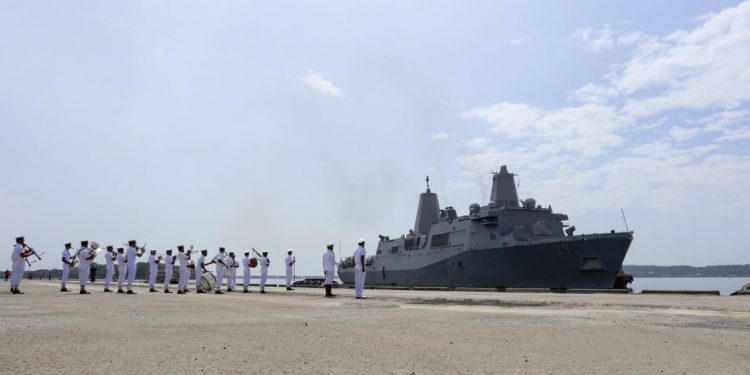
American and Japanese navies have sent ships to the Tincomalee harbour on goodwill visits. A Japanese Destroyer was in the Trincomalee harbour when the Japanese Defense Minister Itsunori Onodera was visiting it in August 2018.
Close on the heels of the visit of the Japanese Defense Minister Onodera to Trincomalee, the USS Amphibious Transport Dock USS Anchorage (LPD 23), along with the13th Marine Expeditionary Unit (MEU), arrived there for a visit on August 24.
The visit was an opportunity for the US Seventh Fleet to explore local logistics support services for visiting naval forces operating throughout the Indo-Pacific region.
This visit and training will build our shared capacity to respond to humanitarian emergencies in the Indo-Pacific region. We’re also excited to try out the air logistics hub concept which utilizes Sri Lanka’s strategic location in the Indian Ocean to ensure the quick availability of relief supplies, equipment and other material when needed by the US and partner militaries and humanitarian organizations,” said an US embassy official.
By P.K.Balachandran/Daily Express Courtesy NewsIn.Asia
A Ranil-Sajith split will lead to electoral defeat and further splits in both camps
Colombo, March 9: A few who depend on a united and strong United National Party (UNP) to win seats in the April parliamentary elections, are still clinging to the hope that a split in the party will be averted even at the eleventh hour.
But most UNPers are expecting the split to be formalized any day now.
The UNP and the Samagi Jana Balawegaya (SJB) have sent separate letters to the Elections Commissioner telling him about their intention to contest. This is generally taken as a definitive sign of an impending split. But those still hoping to keep the party united argue that sending separate letters does not mean much. All parties do it, they point out.
This is a normal practice. It does not mean that the party has split,” a supporter of the unity move said.
However, most UNPers see the writing on the wall quite clearly: the party is heading for a split or has already split into two antagonistic groups, one headed by party Leader Ranil Wickremesinghe and the other led by Sajith Premadasa.
In fact, the Sajith faction has opened its headquarters. Crowds of supporters have begun congregating in Sajith’s office. Cutouts of Sajith have also come up. Likewise, Ranil’s followers are gathering at Sirikotha.
Party insiders say that about 80% of UNP’s leaders and cadres are with Sajith. Among the rest, some may not vote at all, and others may give their vote to another party, fed up with the UNP’s squabbling leaders and its non-performance while in government.
Sajith is entering the electoral fray confident of victory, citing the lackluster” performance of the Sri Lanka Podujana Peramuna (SLPP) government led by Gotabaya and Mahinda Rajapaksa. But this may be wishful thinking. It is in fact too early to criticize the government of the Rajapaksas. It is only a few months old. Their supporters are aware of the time constraint. It is also generally accepted by the supporters of the Rajapaksas that the government can perform only of it ceases to be a minority in parliament. It has to get a majority in parliament. People still believe in the potential of the Rajapaksas to deliver if given the levers of power. The majority of Sinhalese voters are expected to give the levers of power to the Rajapaksas in the April elections.
Therefore, the SLPP and its allies are assured of a majority in parliament. But a two thirds majority through a vote is a pipe dream given the Sri Lankan election system. However, as indicated by SLPP leaders themselves, the SLPP will stitch together a two thirds majority after the elections, by getting defectors, preferably from the two factions of the UNP.
The SLPP has shut its doors to religious” parties like the Sri Lanka Muslim Congress (SLMC). The Tamil National Alliance (TNA) will also be out of the reckoning partly because it is racist” (Tamil) party, and partly because the TNA itself is ideologically against participating in governments at the Center before it gets a federal constitution.
The SLPP will find it easier to poach on UNP if it is split. A united and strong UNP will be difficult to poach on, as was seen in the October 2018 crisis when Mahinda Rajapaksa’s attempts to get cross overs from the then united UNP failed miserably. Therefore, the SLPP will be a major gainer if, in the coming parliament, the UNP is split and is collectively weak.
Contradictions in SJB
The Sajith-led SJB has internal contradictions, which some, who are now with him, hope to exploit to overthrow him or make him a puppet.
It is said that caste, support among the Buddhist clergy and Sajith’s style of functioning will be three key factors in this regard.
Sajith is not from the top two Sinhalese castes which is a handicap in Sri Lankan politics. Additionally, his links with the hardline Christian groups have been noted. The latter affects his claim to being a hardcore” Buddhist. These debilities could be exploited by some of his present-day supporters like Champika Ranawaka, who is a favorite of the Buddhist clergy cutting across party lines. It is also said that as a minister, Champika had cultivated India and China, two countries which have a direct interest in Sri Lankan political affairs.
Sajith’s arrogant style of functioning and his passion for exercising power might generate dissent. Not being from the traditional Lankan social elite, he would be forced to prove himself all the time to be in the same place. And in his anxiety to do that, he could step on sensitive toes.
Further, Sajith does not have the creativity and drive associated with his father Ranasinghe Premadasa who relentlessly battled social and political odds to win the Presidency. But Premadasa Sr. had to be continually ruthless to stay in the Presidency which made him unpopular among a large number of Sri Lankans.
It is noteworthy that the only major spilt in the UNP (after SWRD Bandaranaike left in 1951) took place at a time when Premadasa was battling against the traditional elite led by Gamini Dissanayake and Lalith Athulathmudali in 1992.
Many UNPers are with Sajith only to win the coming elections by getting a decent number of Sinhala-Buddhist votes. But actually there is big deficit on the Sinhalese side in his case, a deficit which had caused his defeat in the November 2019 Presidential election.
Having realized that Ranil Wickremesinghe cannot help win elections, his closest associates either crossed over or are planning to cross over to Sajith’s side. It is said that some of his closest friends are advising him to hand over the party to Sajith and take an assignment in the UN or any world body, which will be happy to take him, given his interest in, and knowledge of, international affairs.
Ranil himself had toyed with the idea of being an international roving lecturer in the past after one of his earlier defeats. But it is significant that he never actually left the leadership of the UNP. It is expected that he will want to continue to be the leader till at least 2025, when his current term officially ends.
BANGKOK — Four months after an electoral triumph, Sri Lankan President Gotabaya Rajapaksa has set the stage to consolidate his political gains through a landslide victory at April’s parliamentary elections, which he called after dissolving the legislature last week six months before its current term ended.
The hawkish Rajapaksa is unequivocal about the work cut out for the Sri Lanka Podujana Peramuna, a newly formed party that backed him during the mid-November presidential elections. “I need [a] two-thirds majority,” the famously blunt-talking Rajapaksa said on Thursday when he met Sri Lankan journalists in Colombo.
Such a high victory margin in the 225-member parliament is merely to amend the constitution, giving him a freer hand to drive his political and economic agenda. “People voted me with high expectations to deliver as the executive president. If the president can’t deliver what the people want, what is the use of the constitution,” Rajapaksa was quoted as telling local media.
The move represents his frustrations with the checks on his presidential power by a clutch of independent commissions and other limits on executive power in the constitution amended in April 2015, which have neutered the authority of a former all-powerful presidency. And seasoned observers in Colombo say that Rajapaksa’s push for a strongman-style rule enjoys wide support with the country’s Sinhala-Buddhist ethnic majority, who helped him win the presidency.
“The majority community will vote again for the SLPP, since Sri Lankan elections are by nature and tradition a winner-takes-all when one poll follows the other,” said a political insider in Colombo. “And the president is banking on the majority’s votes, since all his statements since his November win seek to appease Sinhalese interests over minority interests.”
But alienating the country’s Tamil and Muslim minorities could undermine Rajapaksa’s tall order for over 150 seats in the legislature at the April polls. “Statistically it is unlikely for the SLPP to get the two-thirds only on the Sinhalese-Buddhist votes,” said Aruna Kulatunga, a Colombo-based political analyst. “So the SLPP is working very hard to get the Muslim voters to their side — by sidestepping and completely ignoring minority Muslim political parties.”
Diplomatic sources in Colombo say that securing such a sea change among the minorities will pose a challenge for the Rajapaksa camp. After all, at the presidential elections last year, members of both minority communities voted in droves against Rajapaksa. The anti-Rajapaksa vote was stoked by fear of repression and human rights violations that would target minorities, given his record as the hawkish defense secretary during the 10-year presidency of Mahinda Rajapaksa, his elder brother, that ended in 2015.
“The Rajapaksas cemented their credentials as champions of the Sinhalese cause during Mahinda’s term, and the minorities expected Gotabaya to follow in similar stride,” said a diplomat from a Western embassy. “But they need to offer concessions to secure minority backing in April.”
Both brothers were hailed by the majority for ending a nearly 30-year ethnic conflict, which pitted government troops against the separatist Tamil Tigers. The civil war resulted in over 100,000 people being killed, and ended in May 2009. It set the stage for Mahinda’s second term, which started with his sweeping victory at the January 2010 polls, fueled by his national security credentials.
Mahinda’s shock electoral defeat at the January 2015 presidential polls brought some reprieve — an end to the climate of fear, a drop in human rights violations and an open and free political culture. But bitter rivalry between the coalition government that succeeded him resulted in a dysfunctional and unstable administration, paving the way for a political appetite by the Sinhala constituencies for a stable and strong government under another Rajapaksa.
The infighting within the former coalition government has worsened since the November polls, enabling the Rajapaksa camp to enjoy an edge. A commonly held view by seasoned observers in Sri Lanka is that the opposition’s inexorable implosion into two opposing camps creates a scenario that makes it easier for the SLPP to win in the April polls.
Not surprisingly, foreign policy allies of the Rajapaksas use the squabbling opposition to drive home a diplomatic point. They say that a parliament packed with a large SLPP majority to bolster a Rajapaksa administration will affirm Sri Lanka’s stability in a time of geopolitical competition for influence in the Indian Ocean.
“With a commanding majority in the next parliament, the government will enjoy a strong hand to deal with external pressures,” said Palitha Kohona, a former Sri Lankan foreign ministry secretary. “The government’s view is that India is our relative and China is our friend.”
In the wake of Rajapaksa’s November victory, there are emerging signs that the diplomatic bonds are deepening with the two Asian powers who have been contesting to gain influence in strategically located Sri Lanka. Even Western governments who were critical of the Rajapaksa camp during Mahinda’s second term appear to be making amends — compensating for their strong ties with the pro-Western, dysfunctional administration that was defeated last year.
“Even the U.S. doesn’t want to lose influence with the country it has already developed ties,” added Kohona. “Western countries may not be happy with some policies of the Rajapaksa government, but they must respect the will of the people.”
Entry to Qatar has been temporarily suspended for passengers from several countries including India, China, South Korea, Sri Lanka and Thailand. The restriction will severely affect those travelling to the US, as Doha is one of the major transit points in West Asia, along with Kuwait and Dubai.
Qatar’s restriction, following the coronavirus outbreak, affects all individuals intending to enter from these countries, including visas upon arrival, those with a residence or work permit, and temporary visitors, said a press release from Qatar Airways. The airline issued the release following complaints that travellers from certain countries, including India, are not able to enter Qatar.
Under the direction of government authorities of the State of Qatar, entry to Qatar is temporarily suspended as of March 9, 2020 for all those travelling from the following countries: Bangladesh, China, Egypt, India, Iran, Iraq, Lebanon, Nepal, Pakistan, Philippines, South Korea, Sri Lanka, Syria and Thailand,” the release said.
Qatar Airways is working closely with global and national authorities to implement the latest advice and guidance on Covid-19 and operate our services accordingly.”
Due to the rise in coronavirus cases around the world, we are placing a temporary hold on stopover services in Doha for the purpose of connection, booked through our partner and subsidiary, Discover Qatar, or booked directly through qatarairways.com. Passengers with onward connections will not be permitted to leave Hamad International Airport. All current stopover bookings will therefore be cancelled. A full refund will be offered, with support offered to make alternative travel plans with Qatar Airways,” the release said.
Oil prices and stock indexes were in freefall Sunday after Saudi Arabia announced a stunning discount in oil prices — of $6 to $8 per barrel — to its customers in Asia, the United States and Europe.
Benchmark Brent crude oil futures dove 30% — the steepest drop since the Gulf War in 1991 — in early trading Sunday night before recovering slightly to a drop of 24%. The benchmark Brent crude oil price fell below $34 per barrel.
The oil price shocks reverberated throughout financial markets. Dow futures dropped more than 1,000 points, S&P 500 futures hit their limits after tumbling 5%, and the key 10-year Treasury note yield fell below 0.5%, a record low.
Saudi Arabia, the world’s second-largest producer, this weekend said it will actually boost oil production instead of cutting it to stem falling prices, in a dramatic reversal in policy.
Late last week, Saudi Arabia, the rest of OPEC and Russia failed to agree on production cuts to combat falling prices because of fears that the coronavirus epidemic will halt world economic growth. Oil prices were down more than 30% this year before Sunday’s collapse.
U.S. consumers are likely to see lower prices at the gas pump, but American oil producers — who lead the world in output — could be hurt by the oil price slide.
Economies from China to Italy have ground to a halt as quarantines shut down factories and demand for products and services craters.
Saudi Arabia and other OPEC members sought to cut production to shore up oil prices. But the once-powerful cartel can no longer move markets alone. It needs the support of Russia, which is not an OPEC member but has recently been coordinating with the organization.
Yet Russia has resisted calls for production cuts. On Friday, the talks ended in failure. OPEC and its allies announced no new reductions and didn’t even commit to extending current cuts.
So, Saudi Arabia is doing an about-face. If it can’t get the price back up, it’s going to drive the price way down. It’s offering to cut the oil price for the U.S. market by $7 per barrel, to Europe by $8 and Asia by $6. Paired with Saudi Arabia’s ability to rapidly increase production — flooding the market with cheap crude — those unilateral price cuts will push the price of oil down for everyone.
Low oil prices are bad for Saudi Arabia’s budget, and the price of the Saudi oil company Aramco’s stock tumbled below its initial public offering price on Sunday. But, because Saudi Arabia’s production costs are the lowest in the world, lower prices can hit other producers harder.
Russia seems to be the target of this price war. But as Saudi Arabia tries to grab market share with bargain-basement prices, American oil and gas producers, including the fracking industry, will also feel pain.
And even with ample supply and low production costs, Saudi Arabia is not guaranteed to come out on top in a prolonged face-off with Russia — especially if fears of a pandemic keep planes grounded and cars in driveways no matter how cheap crude oil gets.
They’re cutting prices, they’re going to increase production. But it’s not clear they’re going to have buyers for that oil,” says Ellen Wald, an energy markets analyst and the author of Saudi, Inc. It’s entirely possible that they may not have the wherewithal and the will and the toughness to withstand a price war and a production war with Russia.”
Still, lower fuel prices will offer some relief to the airline industry, which is feeling the strains of the coronavirus crisis, with travel cancellations leading to flight cuts.
The Ceylon Electricity Board (CEB has, reportedly, issued a tender for 150 MW of solar power.
Reportedly, CEB hopes to build 20 solar projects ranging in size from 3 MW to 10 MW. The facilities are set to be built in different locations and each of them will be connected each to different grid substations.
The ceiling price for the tender is LKR 15.60/kWh. The utility said that 80% of the proposed tariff will be re-adjusted based on fluctuations in the US dollar exchange rate.
Interested developers will have time until May 21 to submit their proposals. The projects will be part of the third phase of the Soorya Bala Sangramaya (Battle for Solar Energy) program. The country hopes the scheme will help it to add 200 MW of solar by the end of this year and 1 GW by the end of 2025.
According to a recent joint study by the UN Development Programme (UNDP) and Asian Development Bank (ADB), Sri Lanka has the potential to deploy 16 GW of solar power. It aims to cover its entire power demand with renewables by 2050.
The
former Colombo Chief Magistrate Thilina Gamage has made 3 startling allegations
at the Presidential Commission of Inquiry on political victimization as per 6
March 2020 Island newspaper article by Shamindra Ferdinando. Mr. Gamage is
alleging that UK intervened in judicial cases while the Attorney General’s Dept
& the CID had also unduly interfered in some high profile cases during
yahapalana ‘good governance’ rule. It is interesting how the very countries
demanding transparency and independence are found poking their noses into
affairs of sovereign nations.
British High Commission meddling in Sri Lanka’s
internal affairs
According to former
Colombo Chief Magistrate Thilina Gamage he had ‘received unsolicited advice from the BritishHigh Commissioner in Colombo by way of a letter instructing him on
how to handle the alleged Navy abduction case.
Thilina Gamage has
informed the PCoI that he had written back to the British High Commission
reminding him that Sri Lanka was no longer a British colony and his advice was
not required.
If so, where is that
letter, has it been presented to the Commission of Inquiry? Does it have the
British High Commissioner’s signature & is it on a British High Commission letterhead?
How can the Sri Lankan Government use this to officially log complaint with the
British Government?
It is poignant that
Thilina Gamage had replied to the British High Commissioner.
Has he presented his
reply to the Commission of Inquiry?
Not many have the
pluck to tell a British High Commissioner that he should not think he is
Governor Brownrigg!
The high profile case
was regarding the alleged Navy involvement in some wartime abductions in
Colombo & suburbs involving names of former Navy Commander Vice Admiral
Wasantha Karannagoda and Navy Spokesman Captain D K P Dassanayake.
Both are also giving
evidence regarding their own political victimization at the Presidential
Commission of Inquiry by the previous government.
The Presidential
Commission of Inquiry comprises SC Judge Upali Abeyratne, retired Court of
Appeal Judge Daya Chandrasiri Jayatilake and former IGP Chandra Fernando.
Who is Thilina Gamage?
In May 2016 following
complaint by Attorney General Jayantha Jayasuriya the Judicial Services
Commission interdicted then Colombo Additional Magistrate Thilina Gamage on the
allegation that he possessed a baby elephant without a valid license.
Thilina Gamage was
indicted in July 2019 and suspended from functioning as a magistrate. The
original complaint regarding the elephant was filed by then Yahapalana Minister
Wasantha Senanayake.
In February 2020 the
Court of Appeal dismissed request by Gamage to transfer his case from High
Court of Colombo.
Gamage claims he had been politically victimised by former Prime Minister
Ranil Wickremesinghe as he refused to act according to the former premier’s
instructions when serving as a magistrate. Another startling revelation that
requires further investigation.
Thilina Gamage’s
grievance expressed to the PCoI include
Intimidation
against him after commencing case against Tissa Attanayake & previous
government was angry that he had given Attanayake bail.
The AG’s dept
and CID had harassed him when he refused yahapalana overtures.
Yahapalana
Ministers Rajitha Senaratne, P Harrison and JVP members continuously flaying
him in Parliament against the manner he handled cases
Section of civil
society also attacked him
Then CJ K
Sripavan under pressure to remove him regarding the former President & a
child in which he had called for a DNA test
While
Thilina Gamage’s revelations are startling what draws our attention most is the
interference of the British High Commissioner to think fit to even write to a
Magistrate. It goes to show how unashamedly the Western diplomats saw fit to
interfere in Sri Lanka’s internal affairs during the previous government. This
was visibly seen in the manner that they sat inside the Supreme Court when its
pet poodles were close to being thrown out of office in October 2018. It looks
also quite obvious that the foreigners were making their way in and out of
ministries and State institutes gathering confidential and State information.
What
is the present government going to do about the interference by British High
Commissioner and other envoys in Sri Lanka’s internal affairs?
Now let us revisit the 015 General Election process which was held in between the two Treasury Bond robberies. Within a few weeks of ousting the former President Mahinda Rajapaksa, people were greatly dismayed and unable to bear with the loss this great leader busloads of people started arriving in Medamulana from nearby districts such as Matara, Galle, and Ratnapura and far away districts Trincomalee, Vavuniya and Anuradhapura and from other districts in between and express their grief to Mr. Mahinda Rbeen forced Rajapaksa over the folly that has been forced on the country by the diaspora and the reactionary conspirators. Eye witnesses said that some people especially the women folk prostrated before him in wailing and begged him to come back and rescue them and demanded said that he is the Diyasen Kumaraya who is destined to rescue and save the people of this country.
Diyasen Kumaraya is a king the Sri Lankan
Sinhala Buddhists believe will be born in Sri Lanka after a lapse of 2500 years
from the birth of Lord Buddha, to preserve the culture and Buddhism in this country.
The foretelling about this by God Sumana, to an ascetic – of the reincarnation
of King Parakumba, as a great King whose birth is to usher in all possible
wealth, prosperity and good health to Sri Lanka – marks the origin of this
belief. This factor is recorded in an Ola leaf that has provided vital evidence
to support this belief and this Ola leaf exists in the National Museum to this
day. This Ola leaf containing the Sumana sutta was found from a temple in
Algamuwa.
When the election was approaching it became very clear that the UPFA headed by Mr. Rajapaksa will win the election easily. When this factor became clear the jealous and vicious hopperman Sirisena went into action and issued a letter one week before the election stating that even if Mr. Mahinda Rajapaksa secures a lead in the election, under the powers vested in him by the constitution Mr. Rajapaksa will not be appointed as the Prime Minister and only an MP of his choice will be appointed. This was a great shock to many voters and it disheartened them and they decided to refrain from voting in the election. Sirisena proceeding further with his vicious and dictatorial activities, two days before the election, dismissed the General Secretaries of the Sri Lanka Freedom Party Mr. Anura Priyadarshana Yapa and the United People’s Freedom Alliance Mr. Susil Premjayanth and appointed his minions to fill the vacancies since the General Secretaries of the parties were empowered under the election Law to take election-related decisions including nomination of Nationalist List MPs.
Despite various intimidation, threats and obstructions to the election campaign of the UPFA candidates and UPFA supporters and the government misusing all government resources for the benefit and promotion of the UNP election campaign, the UNP, and its cohorts failed to secure an absolute majority in the election and they won only 106 seats against the 95 seats won by the harassed and intimidated UPFA under the leadership of fMr. Mahinda Rajapaksa. Sirisena at that time considered the Mahinda Rajapaksa candidates as his sworn enemies and even the megalomaniac Prabhakaran wouldn’t have treated his opponents in such a manner.
Under these circumstances, Hopperman Sirisena came to the rescue of the UNP and appointed the UPFA candidates rejected by the people as National List MPs of the UPFA and then made the newly appointed SLFP General Secretary to sign a partnership MOU with the UNP to form a coalition government called the National Unity Government” which labeled themselves a the Yahapalana government”. The TNA won 16 seats and the JVP 6 seats in the election. The SLMC, ACMC, Mano Ganeshan/Digambarans’s TPA and JHU contested as constituents of the UNP calling themselves as the United National Front (UNF) (Union of Notorious Fraudsters) under UNP’s Elephant symbol the seats that were won by them and their National list MPs included in the UNP’s 106 seats.
Whether we will ever see an end to these scams is a question not too difficult to answer given the times we live in and lived in. With the general election around the corner, our choices are limited when it comes to selecting honest representatives, untainted by fraud, bribery, and corruption, from among the candidates nominated by the various political parties,
As promised in President GR’s election manifesto Vistas of Prosperity and Splendour” action has been taken to round up and punish the Bonds Scam robbers who fleeced this country economically.
The Grand Robbers – Courtesy: Google Chrome
The Criminal Investigation Department
(CID) has filed a case against Parliamentarian Ravi Karunanayake in the Colombo
Fort Chief Magistrate’s Court for having allegedly provided false evidence
before the Presidential Commission of Inquiry (PCoI) which probed the Central
Bank Treasury Bonds scam.
The CID told Court that as stated in the
report compiled by the PCol, which probed the CBSL Treasury Bonds scam from 1
February 2015 to 31 March 2016 and based on its 25th recommendation, from the
inquiry conducted by the CID, from 24 January this year and on the hearing
conducted by the PCol on 2 August, 2017, it had come to light that Karunanayake
had provided false evidence before the PCol.
The CID informed the Court that the AG had informed the President of his decision on implementing the recommendations contained in the PCoI report and that through the letter dated 24 January, the AG had ordered the CID to launch an inquiry if they are satisfied that individuals, Chief Executive Officer of the primary dealer Perpetual Treasuries Limited (PTL) Kasun Palisena, Steve Samuel, Karunanayake and B.J.R. Sinnaiah had provided false evidence before the PCol and if the said offense falls under Section 109(5)(A) of the Penal Code.
The CID informed the Court that the offense committed falls under the said Section of the Penal Code. Also, the AG had advised the CID that if the suspects could be identified they should be apprehended and produced before a Magistrate. However, before doing so what the suspects have to say should be recorded as statements given by them and then launch inquiries into such statements.
They added that they had considered the
recommendations and the findings contained in the PCol report and the evidence
given on oath by then Minister Karunanayake had also been included in the
report.
The CID informed Court that they had
initiated a probe to verify the truth of the statements provided by
Karunanayake before the PCoI and that they had already recorded statements from
30 persons in this connection.
They said that at first glance of the
evidence on oath by the MP concerned before the PCol, it was clear to them that
the MP had intentionally provided false evidence and based on Sections 188 and
190 of the Penal Code, Karunanayake had committed the punishable offence.
The CID reported to the Court that
Karunanayake had provided certain evidence before the PCol which probed the
CBSL Treasury Bonds scam.
These concerned: 1) The alleged connection
between Karunanayake and PTL Beneficiary Owner Arjun Aloysius; 2) Whether
Karunanayake knew Neil de Silva or about whether Karunanayake was aware of the Short
Message Service sent by de Silva to Karunanayake’s cell phone; 3) Whether
Karunanayake had inquired from Vijitha Wijesuriya on renting a suitable house;
and when Karunanayake and his family members had inquired from Wijesuriya at
times on renting a suitable house or whether Karunanayake was aware that the
rent paid for the house he had occupied at the Monach Housing Scheme had been
paid either by Aloysius or the Walt and Row firm.
Based on the aforesaid submissions, the
CID has named Karunanayake for having allegedly provided false evidence before
the PCol and they will need to record statements in this connection from
Karunanayake, Mela Karunanayake, Onela Karunanayake, B.J.R. Karunanayake,
Aloysius and Attorney Sumathipala Udugamsuriya.
The CID told the Court that besides the
aforesaid persons they will also need to peruse if there had been phone
connections to the workplaces of Neil de Silva, Don Gallage and Anika
Wijesuriya from1 January, 2015 to 2 August last year.
The CID also requested the Court to issue
an order to the Global Transportation and Logistics firm to release details of
their transactions and details of its Director Board from 1 January, 2015 to 2
August, last year to the CID.
The Colombo Fort Chief Magistrate granted
approval for each of the requests and ordered the prosecution to file a
progress report on the case when it is next heard on 28 September.
Meanwhile, the Attorney General, President’s Counsel Dappula de Livera has ordered the Acting Inspector General of Police to obtain warrants for the arrest of several suspects including MP Ravi Karunanayake, former Central Bank Governor Arjuna Mahendran, Perpetual Treasuries Director Arjun Aloysius and CEO Kasun Palisena in connection with the Central Bank bond scam.
Warrants have been issued for the arrest
of the accused on charges of criminal misappropriation, fraud and mismanagement
of the market, the AG’s Coordinating Officer Nishara Jayaratne stated.
The Attorney General has instructed to
charge the suspects with conspiracy to misappropriate Rs 51.98 billion in
Central Bank bond auctions on March 29 and March 31, 2016.
In his letter to Acting IGP C.D.
Wickramaratne, the Attorney General Dappula De Livera states that there is
reasonable suspicion against the group of individuals with regard to the
criminal wrongdoings which had occurred during the Treasury bond issuances on
March 29 and March 31, 2016 and that they should be considered as suspects:
The AG has instructed the Acting IGP to name them as suspects with regard to the investigations, record statement from them and report information to the court.
The suspects are Perpetual Treasuries
Limited, Ravindra Karunanayake, Lakshman Arjuna Mahendran, Arjun Joseph
Aloysius, Palisena Appuhamilage Don Kasun Oshada Palisena, Geoffrey Joseph
Aloysius, Chitta Ranjan Hulugalle, Muthuraja Surendran, Ajahn Gardiye
Punchihewa, Thuyya Handiyage Buddhika Sarathchandra, Sangarapillai
Pathumanapan, Badugoda Hewa Indika Saman Kumara.
After an extensive review of documents and evidence, the Colombo Fort Chief Magistrates Court issued arrest warrants on 6th March against former Finance Minister Ravi Karunanayake, Arjuna Mahendran, Arjun Aloysius and nine others,
Earlier the Fort Magistrate also imposed a travel ban on
former Minister Ravi Karunanayake, Perpetual Treasuries Ltd (PTL) owner Arjun
Aloysius and 10 others in connection with the bond scam.
When security personnel went to arrest Karunanayake they have found that he has left the house and absconding somewhere. In the meantime, someone very close to Karunanayake has appealed to some big wigs of the SLPP to get his arrest warrant suspended saying that he is afflicted with several illness, for which the SLPP big wigs have responded that this government does not interfere with judicial matters as it was done by the UNP government and this government has given for the Courts to act on their own. Now we have to wait and see whether this culprit will surrender or would flee the country through a boat or some other way.
When the case was taken up before Colombo Fort Magistrate Ranga Dissanayake, Senior Deputy Solicitor General (SDSG) Haripriya Jayasundara requested the Magistrate to issue an arrest warrant on the twelve suspects who have violated the law during two Treasury bond auctions conducted on March 29 and March 31, 2016. Citing misappropriation, SDSG Jayasundara said that treasury bonds had been issued with a face value of Rs. 36.98 billion on March 29, 2016. During the submission, he informed the Court that the Attorney General stated that these suspects could face charges of insider dealing and market manipulation under Section 386 and 398 of the Penal Code read with 5 (1) and 5 (2) of the Public Property Act.
She also informed Court that the charges
can be filed under the Registered Stock and Securities Ordinance read with the
CBSL’s Code of Conduct for primary dealers.
However, Magistrate questioned the SDSG and the CID, if the charges come under
the Public Property Act, why the Police could not apprehend the suspects
without obtaining an arrest warrant from the Magistrate.
Responding to the question, SDSG
Jayasundara said that since the case was sensitive, the CID and the AG’s
Department had decided to inform the Magistrate on obtaining an arrest warrant.
Explaining the matter, SDSG Jayasundara said that the culprits behind the
particular matter had created an artificial market in 2016 and due to this
violation there had been a public nuisance within the country.
When Ravi Karunanayake was serving as the Finance Minister, he had a meeting with three leading state bank officials and at this meeting, Mr. Karunanayake had told the bank officials to maintain a certain limit when issuing treasury bonds. Accordingly, the banks had to decrease the limit of issuing treasury bonds when conducting auctions and this had caused a huge market slump within this period,” she informed the Magistrate.
She said that due to this limit maintained by the State Banks during that time, PTL had obtained many illegal bonds violating the law and this matter had affected the Employees Trust Fund (ETF) in the country. However, Magistrate said that the Magistrate Court could not maintain a case under violation of the Public Property Act above Rs. 500 and therefore, evidence of the particular case be taken as affidavits. The Magistrate also said that without taking evidence that is related to the matter, he could not issue an arrest warrant on the suspects.
Relevant extracts from the island
editorial of 6th March are given below to conclude this article.
The police, acting on a directive by the
Attorney General, sought arrest warrants to take into custody 12 persons in
connection with the bond scams under the yahapalana government, and the court
decision thereon is expected today. The matter is best left to the learned
judge, and we don’t comment thereon.
We, however, can’t help wondering why on earth there are frustratingly protracted delays on the part of the state prosecutor and the long arm of the law as regards action to be taken against suspects with political connections. If an ordinary motorist fails to pay a fine for a minor traffic offense, within the stipulated period, he is hauled up before the court. About ten years ago, we highlighted the predicament of two small schoolgirls who happened to be on the wrong side of the law due to their pecuniary woes. One of them stole a few coconuts from her neighbor as her mother had no money to pay for her school fees. The police swooped on her and produced her in court. The other girl stole five rupees from a neighboring house, unable to bear the pangs of hunger. No sooner had she done so than she was arrested and taken to court. But when massive frauds, running into billions of rupees, are committed, the AG’s Department and the police take a month of Sundays to take action against them.
What would have happened if a peon had
been caught in the act of stealing a bundle of photocopying paper from the
Central Bank, on 27 February 2015? He would have been interdicted and handed
over to the police the following day itself. But such swift action was
conspicuous by its absence as regards the grandees who fraudulently earned
billions of rupees from the bond auctions at the Central Bank, on 27 February
2015, and committed a bigger fraud one year later.
The AG’s Department is also to be blamed
for having given kid glove treatment to the bond racketeers, initially, under
the yahapalana government. Some of its senior officials, no doubt, deserve
praise for having exposed the bond scammers, before a presidential commission
of inquiry. But the fact remains that if the AG’s Department had taken timely
action against the culprits involved in the first bond scam, in 2015, the
second one committed, in 2016, could have been prevented and the culprits including
the then CB Governor Arjuna Mahendran arrested.
No probe into the bond scams is complete
without an investigation into an AG’s Department file which has been either
shelved or made to disappear, as we have pointed out in this space previously.
On 30 June, 2015, the CID handed over a file (No: C/187/161/2015) on the first
bond scam to the AG’s Department. A senior official who received it found a
prima facie case of insider trading and market manipulation; he opened a
criminal file and handed it over to a senior counsel for further action.
Strangely, criminal action against the bond racketeers was subsequently
terminated; the file was turned into a confidential document (CF/08/2015) 999and
passed on to another senior counsel.
In June 2016, that official, acting within the parameters
set by his superiors, recommended that civil action be taken against Perpetual
Treasuries to recover the losses caused by it. The file has not been sighted
ever since. What has become of that vital document? The AG’s Department owes an
explanation to the public.
In January 2019, the Hambantota High Court imposed the death sentence on a 69-year-old man who had shot a youth dead and injured another 32 years back. It is fervently hoped that cases against those who cause staggering losses to the state coffers through various rackets won’t drag on until the culprits go the way of all flesh. Ravi Karunanayake was reported to be having a Yaaga” sacrifice to deities for one week despite being a born and practicing Christian. However, this con man makes visits and poojas at places of other religious worship and even pays visits to Mahanayaka Theros when it is warranted by political expediency. This Yaga is said to have been arranged and organized by the notorious former minister Mervyn Silva by bringing in several exorcists from the South. Divine assistance comes to people when they are in real distress, subjected to oppression and being hit by hardships and calamities and not to rescue criminals, robbers, and swindlers
Both Ranil and Sajith factions have agreed to contest under the ’swan’ symbol at the upcoming parliamentary polls, revealed former MP Ravindra Samaraweera.
The agreement had been arrived at following a discussion held yesterday (07).
A discussion on contesting the general election under a common symbol had been held between the two factions of the United National Party (UNP), at the Malalasekara Road residence of former Speaker Karu Jayasuriya.
Representing the Ranil faction former MP Rajitha Senaratne and representing the Sajith faction General Secretary of ‘Samagi Jana Balawegaya’ former MP Ranjith Madduma Bandara participated in the discussion.
The meeting was also attended by Shirmila Perara, the Secretary of New Democratic Front (NDF) which currently owns the ‘swan’ symbol.
At the meeting, both parties had agreed to contest under the ‘swan’ symbol at the polls, according to political sources.