President Gotabaya Rajapaksa, flanked by Lt. Gen.Shavendra Silva and Vice Admiral Piyal de Silva, at the 72nd Independence Day celebrations, on Feb 4, 2020, at the Independence Square, touches his medals.(pic by Kamal Bogoda)
In January, 2015, Sri Lanka gave up its right to celebrate the victory over the Liberation Tigers of Tamil Eelam (LTTE), undoubtedly the country’s greatest post-independence achievement. Having defeated war-winning President Mahinda Rajapaksa, at the January 08, 2015 presidential poll, the UNP-led coalition had no option but to appease those who had backed the change of government. The four-party Tamil National Alliance (TNA), wartime mouthpiece of the LTTE, opposed the annual ‘Victory Day’ parade, inaugurated in May 2009.
Sections of the civil society, too, opposed the ‘Victory Parade.’ On behalf of all those who opposed the ‘Victory Parade,’ Canada demanded the cancellation of the annual event, scheduled to be held in Matara. The then Defence Secretary, Gotabaya Rajapaksa, quite rightly dismissed the Canadian demand. The then Military Spokesman Brigadier Ruwan Wanigasooriya explained as to why Sri Lanka couldn’t heed the Canadian demand. Wanigasooriya, current Security Forces Commander, Jaffna, quite clearly emphasized Sri Lanka’s right to go ahead with the scheduled parade, in Matara.
Last ‘Victory Day’ parade
On a Canadian High Commission request, The Island exclusively front-paged the then Canadian High Commissioner Shelly Whiting’s strongly worded letter to President Mahinda Rajapaksa’s government to cancel the combined security forces parade, or face the consequences.
The following is the text of Shelly’s statement, headlined ‘Canada to boycott Victory Day parade’ with strap line ‘such events won’t help post-war national reconciliation’:
“As in past years, heads of mission, resident in Sri Lanka, have recently received invitations to participate in this year’s Victory Parade, scheduled to be held, in Matara, on May 18. As Canadian High Commissioner to Sri Lanka, part of my role includes celebrating the successes of the country, alongside the Sri Lankan people. However, I will not be attending the Victory Day Parade on May 18. Some commentators will no doubt rush to judge and erroneously conclude that I am doing so out of some misplaced nostalgia for the LTTE. Nothing could be further from the truth.
“Let me be clear the LTTE was a scourge that brought untold suffering to this island nation and all its people.
“Prior to arriving in Sri Lanka, my previous assignment was in Afghanistan where I saw first-hand the terrorist tactics (use of suicide bombers, IEDs) that are sadly the LTTE’s legacy to the world. The LTTE and its supporters were ruthless and single-minded, and did not faithfully represent the political aspirations of the communities they purported to represent. Canada joined the world in welcoming the defeat of the LTTE, in 2009. In fact, the LTTE has been proscribed as a terrorist entity, in Canada, since 2006. To help stop the flow of funding to the LTTE, Canada further proscribed the World Tamil Movement (WTM) in 2008. Both of these organizations remain banned in Canada today.
“However, five years after the end of the conflict, the time has arrived for Sri Lanka to move past wartime discourse and to start working seriously towards reconciliation. It is time to mend relations between communities and to ensure that all Sri Lankans can live in dignity and free from discrimination, based on ethnic, religious or linguistic identities. Fathers and daughters, sons and mothers, all were victims, who were killed or never returned home at the end of the conflict. No community here – whether Sinhalese or Tamil, Muslim or Burgher – was spared during the conflict. In this vein, Canada has encouraged the Government of Sri Lanka to retire its annual Victory Day Parade, which perpetuates roles of victors and vanquished within the country, for a day of remembrance for all those who suffered as a result of the conflict. Indeed, Sri Lanka’s own homegrown Lessons Learnt and Reconciliation Commission report recommends that a solemn day of remembrance for all victims of the war would be more conducive to sustaining peace here. Such a gesture would go a long way towards putting wartime posturing behind Sri Lanka.
“I will not be in Matara, but I will be thinking and remembering all those who lost their loved ones over the 30-year conflict.”
First military parade since prez poll
Sri Lanka celebrated her 72nd Independence Day yesterday, Tuesday, Feb 04, 2020, at the Independence Avenue, with a combined security forces parade. Over a decade after the conclusion of the conflict, the war-winning armed forces remained accused of killing over 40,000 Tamils on the Vanni east front. The Canadian boycott of the ‘Victory Day’ parade, in 2014, should be examined against the backdrop of high profile war crimes accusations directed at the Sri Lankan military.
Kfirs and MiG 27 squadrons, which played a crucial role in bringing the LTTE down to its knees, were not on fly-past.
The Sirisena-Wickremesinghe government unceremoniously cancelled off the May 2015 ‘Victory Day’ parade. The cancellation was clearly part of the then government initiatives to appease those who could not stomach Sri Lanka’s victory over the LTTE. The government bent backwards to appease the lot, regardless of the consequences. President Sirisena, in his capacity as the Commander-in-Chief of the armed forces and the Minister of Defence, never really opposed the treacherous UNP strategies. President Sirisena cannot absolve himself of the responsibility for the situation created by the UNP. Actually, lawmaker Ranil Wickremesinghe and former President Sirisena certainly owed an explanation as to why their administration cancelled the ‘Victory Day’ parade. It would be pertinent to ask whether the then government at least discussed the decision to do away with the annual event at cabinet level or the parliamentary group. Did the National Security Council ever take up this issue?
The cancellation of the ‘Victory Day’ parade was nothing but a slur on those who perished and wounded in the battle against northern and southern terrorism. The Sri Lankan military can be quite proud of quelling both the northern and southern terror groups.
The cancellation of the event didn’t really upset the then Joint Opposition (those now in power). The JO remained largely silent about the despicable UNP decision. There had never been any concerted JO effort against the cancellation of the ‘Victory Day’ parade, during the 2015-2019 period. The termination of the largest combined forces event, in May, 2015, paved the way for the co-sponsorship of the accountability resolution at the Geneva-based United Nations Human Rights Council. The cancellation of the annual May event and the Geneva co-sponsorship should be examined against the backdrop of the TNA strategy. Having backed the LTTE, until the very end, in May 2009, the TNA, in consultation with the US, threw its weight behind the UNP-led campaign to oust Mahinda Rajapaksa. They made an abortive bid at the 2010 January 26 presidential election. Interestingly, the JVP, too, joined the UNP-led grouping. Having accused the war-winning Army of war crimes, they had no qualms in fielding its former commander Sarath Fonseka as the common candidate on the New Democratic Front (NDF) ticket. Fonseka suffered a humiliating defeat. The UNP-led grouping succeeded in ousting Mahinda Rajapaksa at the 2015 January 08 presidential poll. The stage was set to implement their 100-day programme, before calling early general election. The government perpetrated the first Treasury Bond scam, on Feb 27, 2015, causing a major rift between President Sirisena and Premier Wickremesinghe.
In March, 2015, Premier Wickremesinghe, on two occasions, questioned the validity of war crimes accusations. The UNP leader disputed even the primary accusation regarding the massacre of 40,000 on the Vanni east front, in 2009, though his government unceremoniously stopped the ‘Victory Day’ parade.
A treacherous coalition
Cancellation of the ‘Victory Day’ parade was followed by acceptance of high profile allegations as regards war crimes by way of accountability resolution at the Geneva body, in Oct 2015.
Western powers acted on those unsubstantiated allegations though the US and the TNA didn’t have an issue in backing General Fonseka, at the 2010 presidential election, having accused his army of killing civilians. It would be pertinent to reproduce what the then US Ambassador Patricia Butenis said in a classified cable of the war-winning Army Commander. Thanks to Wikileaks, this cable, dated January 15, 2010, authored by Butenis, is in public the domain. Headlined ‘SRI LANKA WAR-CRIMES ACCOUNTABILITY: THE TAMIL PERSPECTIVE’, Butenis said: “There are no examples we know of a regime undertaking wholesale investigations of its own troops or senior officials for war crimes while that regime or government remained in power. In Sri Lanka, this is further complicated by the fact that responsibility for many of the alleged crimes rests with the country’s senior civilian and military leadership, including President Rajapaksa and his brothers and opposition candidate General Fonseka.”
But, Butenis perception didn’t prevent her country advising the TNA to back Fonseka at the 2010 presidential poll.
Ranil quotes Kerry
In the run-up to the co-sponsorship of the Geneva resolution, the then US Secretary of State, John Kerry, visited Colombo. The Sirisena-Wickremesinghe government was keen to follow the US. The US and Sri Lanka political leaderships sought closer relationship/cooperation while the interests of the Sri Lankan military were disregarded. Following Kerry’s visit, Premier Wickremesinghe, in a brief note, addressed to the then Chief of Defence Staff (CDS), General Jagath Jayasuriya, emphasized the importance of some issues raised by the top US official during his two-day visit to Colombo.
In the note to Gen. Jayasuriya, copied to Army Commander Lt. Gen. Crishanthe De Silva, Navy Commander, Vice Admiral Jayantha Perera, and Airforce Commander, Air Marshal Kolitha Gunatilleke, Premier Wickremesinghe highlighted some points, discussed by Kerry, in a public lecture delivered at the Taj Samudra.
Premier Wickremesinghe quoted Kerry as having said: “None of us wants to live in a country where the military is stopping its own citizens at checkpoints. And Sri Lanka’s military has so much more to contribute, in defending this country, protecting vital sea lanes and taking part in UN peacekeeping missions all over the world. And, as your armed forces make that transition, we are going to be very eager to work with you and to work with them and to tender help.”
In a sense, the missive, dated May, 7, 2015, is unprecedented, as no previous Premier/President had issued such a note to the military.
Having drawn the attention of the top brass, to Kerry’s views, Wickremesinghe stressed that the new administration’s stand, on the post-war role of the armed forces, was compatible with that of the US. The CDS, as well as the three service chiefs, were to ensure that the Premier’s message reached all levels of command, and control structure, including those deployed on the ground.
Was Commander-in-Chief and Defence Minister President Maithripala Sirisena aware of Premier Wickremesinghe’s massive? The UNP never explained as to why its stand on our armed forces’ post-war role should be compatible with that of the US. The Premier’s note should be studied against the backdrop of his government co-sponsoring the resolution in Geneva, meant to undermine the war-winning Army.
Western powers resorted to punitive action against senior military commanders in terms of unsubstantiated war crimes allegations. Field Marshal Sarath Fonseka was among those who had been humiliated by way of denial of visa. Fonseka, in spite of being considered by the US to be suitable to be the President, was repeatedly denied US visa. Veteran ground commander, Chagie Gallage, was another victim. Australia denied him visa over unsubstantiated war crimes accusations. The Gajaba Regiment veteran hit back hard, soon after his retirement.
Chagie’s case
“Gajaba was engraved in golden letters of the annals of the history of the Sri Lanka Army, if not in the history of Sri Lanka … and I’m certain it will never be reversed by any. So, I’m happy to be retired being a tiny particle of that proud chapter of the history, though designated as a ‘War Criminal.”
In a few lines, Gallage dealt a devastating attack on all those who had shirked their responsibility in defending the war-winning military. Their failure led to the sections of the Army being categorized criminal. Gallage’s was a case in point. The Gajaba veteran retired, on Aug 31, 2018, three years after yahapalana administration co-sponsored the Geneva resolution.
A week after retirement, Gallage delivered his farewell speech at the Gajaba home in Saliyapura, Anuradhapura. Gallage dealt with a range of issues on the eve of the 35th anniversary of the Gajaba Regiment. There had never been a previous instance of an officer having the courage to declare at a farewell banquet, that he had been categorized as a war criminal. It would be pertinent to examine why Gallage declared: “So, I’m happy to be retired being a tiny particle of that proud chapter of the history, though designated as a ‘War Criminal.’
The writer revealed Gallage’s predicament in the March 23, 2017 edition in a front-page lead story headlined Chagie denied Australian visa over ‘war crimes’ allegations with strap line Unsubstantiated UN claim cited as reason.
Australia found fault with Gallage commanding the 59 Division, from May 7, 2009 to July 20, 2009.
The then treacherous government never intervened on behalf of those officers unfairly treated by Western powers. President Maithripala Sirisena, in spite of assuring the Army he would take tangible measures in this regard, did nothing to reverse the situation. Sri Lanka never took up this issue with Western powers. The Foreign Ministry refrained from taking it up. The head of a mission who served in a country that denied visa selected officers told the writer recently that he never received instructions from Colombo regarding to countering of war crimes accusations.
The Yahapalana administration ruined the reputation of Sri Lanka’s armed forces. The wartime acquisition of MiG 27 was relentlessly attacked until sections of the public really believed the aircraft didn’t help the war effort. The Katunayake-based No 12 squadron caused irreparable damage to the LTTE. The “Once proud No 12 MiG squadron is no more” can be accessed at http://www.island.lk/index.php?page_cat=article-details&page=article-details&code_title=200462)
On the basis of unsubstantiated war crimes, the UN caused obstacles to Sri Lankan peacekeeping missions overseas. Finally, the Sri Lanka Human Rights Commission was tasked to clear the peacekeepers bound for UN missions.
The US reaction to the appointment of Shavendra Silva, as the Commander of the Army last year underscored Sri Lanka’s pathetic failure to counter the high profile political project meant to demoralize the military. Unfortunately, the political leadership lacked a strategy to counter the Western project. There had never been a determined effort so far to clear the military of bogus accusations. However, individual cases should be investigated thoroughly and wrongdoers punished. There cannot be any dispute over Sri Lanka’s responsibility in dealing with cases. Let me reproduce the statement issued by the US in the wake of Shavendra Silva’s appointment to highlight negligence on the part of Sri Lanka to address accountably charges. The strongly worded US statement, issued on August 19, 2019, questioned the appointment given to the General Officer Commanding (GoC) of the celebrated 58 Division. The US statement: “The allegations of gross human rights violations against him, documented by the United Nations and other organizations, are serious and credible. This appointment undermines Sri Lanka’s international reputation and its commitments to promote justice and accountability, especially at a time when the need for reconciliation and social unity is paramount.”
The UN High Commissioner for Human Rights, Michelle Bachelet, too, expressed serious concerns about Shavendra Silva’s appointment. “I am deeply troubled by the appointment of Lieutenant-General Shavendra Silva as Commander of the Sri Lankan Army, despite the serious allegations of gross violations of international human rights and humanitarian law against him and his troops during the war,” Bachelet said. It would be pertinent to mention that Bachelet described Silva’s previous appointment as Army Chief of Staff as a ‘worrying development’ in her last report to the Human Rights Council, in March 2019. “The promotion of Lieutenant-General General Silva severely compromises Sri Lanka’s commitment to promote justice and accountability in the context of Human Rights Council resolution 30/1,” Bachelet said. “It undermines reconciliation efforts, particularly in the eyes of victims and survivors who suffered greatly in the war. It also sets back security sector reform, and is likely to impact on Sri Lanka’s ability to continue contributing to UN peacekeeping efforts.”
President Gotabaya Rajapaksa’s government needs to undertake reappraisal of the entire gamut of issues before the forthcoming Geneva sessions. Sri Lanka is unlikely to get another opportunity to present its case in Geneva if the country squandered the available opportunity.
Emma Davies Courtesy Proactive Investors Australia
he Mannar Island project has power, road and rail infrastructure, is backed by a government supportive of foreign investment and is ideally situated for product export to Asian markets.
Panning of RC aircore samples from below the water table at the Mannar Island project
Titanium Sands Ltd‘s (ASX:TSL) initial assay results from Mannar Island Heavy Mineral Sands (HMS) Project in Sri Lanka’s northwest have confirmed depth resource potential.
A total of 473 RC aircore drill holes were completed in mid-December and results from the first 181 holes have demonstrated heavy mineral concentrations between 3.2% – 7.6% total heavy mineral (THM) down to 9 metres beneath the more than 8-kilometre-long Domain Two mineral resource zone.
TSL managing director Dr James Searle said: These initial RC aircore results are extremely encouraging as they demonstrate the major depth potential to greatly increase the previously reported surface-exposed mineralisation on the Mannar Island Project.”
Further results from the remaining 292 RC aircore holes are being analysed and will be reported as they are received over the next few weeks.
Potential resource upgrade
TSL previously reported visual logging of the drilling indicated that almost all holes contained significant concentrations of heavy minerals all the way to the target depth of 12 metres.
This is below the limit of accurate sampling of the RC holes to date and reveals the potential for a major resource upgrade.
On January 28, the company defined a substantial high-grade inferred and indicated heavy mineral resource of 90.03 million tonnes at 6.60% THM, including 32.35 million tonnes at 7.56% THM on tenure to be acquired subject to shareholder approval on February 21, 2020.
A further drill program of sonic core drilling is planned to sample in water-prone materials and will provide accurate samples for the RC aircore drilling.
TSL aims to release the upgraded resource report once all assay results have been compiled.
The company also anticipates that the project scoping study will be completed in the current quarter.
Prime Minister Mahinda Rajapaksa told Parliament yesterday that those who had received houses in villages built by the National Housing Development Authority (NHDA) between 2015 and 2019 were yet to receive deeds confirming ownership. The Premier said so in response to a query posed by UPFA MP Anuradha Jayaratne.
Premier Rajapaksa said that the actual number of housing units constructed was far less than what was announced. The Premier said that only 9,604 houses had been constructed in 367 villages though the previous government repeatedly claimed that 65,097 new houses had been built in 2,562 villages during yahapalana adinistration.
Premier Rajapaksa said that none of the recipients had been told that deeds would be given once they made the full payment for the houses. So far no one had completed the loan payment, Premier Rajapaksa said, adding that for want of deeds they could not even obtain bank loans or get their children admitted to schools.
State Housing Minister Indika Anuruddha alleged that the vast majority of houses had been constructed in lands belonging to various institutions. Lawmaker Anuruddha charged the NHDA for constructing houses without obtaining approval. Some houses had been constructed on lands belonging to the Wildlife and Forest Conservation departments, the State Minister said, pointing out the difficulty in transferring the ownership of the lands to the recipients of those houses.
“The Wildlife and Forest Conservation departments and Mahaweli Authority are not happy with the NHDA move. The latter is experiencing trouble,” MP Anuruddha said.
The state minister also said that former minister of housing Sajith Premadasa had spent one billion rupees on a propaganda campaign for the 367 model villages. The State Minister said that the new government would launch a housing project to construct 14,022 houses by the end of this year. The lawmaker said that the government spent Rs. 500 000 for publicity.
Opposition Leader, Sajith Premadasa asked the Prime Minister whether he could ask him a question as regards his statement but Rajapaksa told Premadasa to direct his question to the state minister.
Senior economic advisor to Prime Minister, Ajith Nivard Cabraal said he would make a request to President Gotabaya Rajapaksa to initiate an independent Police inquiry on the Central Bank bond scam in early 2015 and dealings in the bond market between 2010 – 2014 period as the so-called forensic inquiry, COPE inquiry chaired by JVP Parliamentarian Sunil Handunnetti and the Commission of Inquiry (CoI) appointed by former President Maithripala Sirisena were incomplete, biased and didn’t expose those who were directly responsible for the financial crimes in the bond market in 2015.
Mr. Cabraal who is also the former Central Bank Governor added that an independent police inquiry was the most reliable probe because any probe initiated involving the Central Bank and politicians could not be flawless and clean.
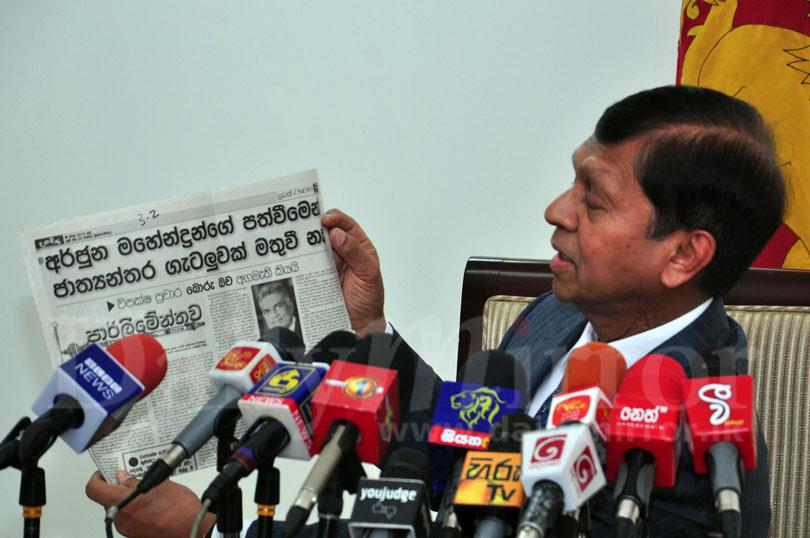
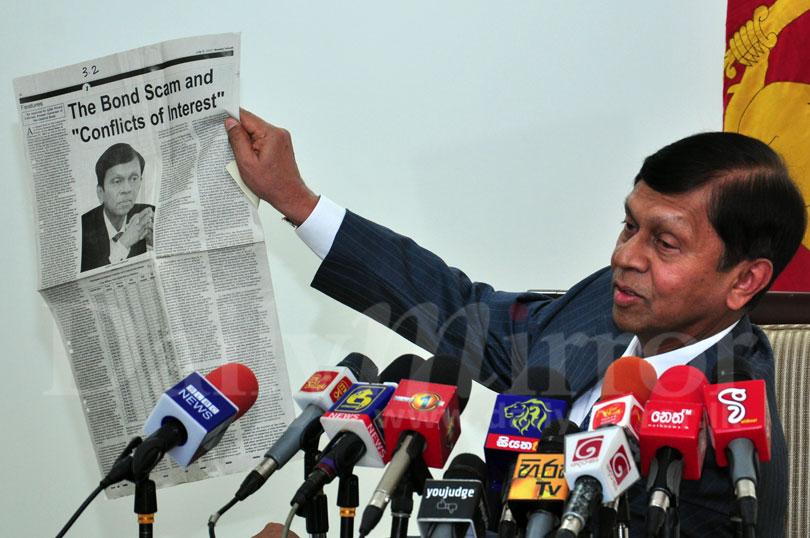
He told a news briefing at the Temple Trees last morning that he was ready to ‘Tell All’ at a police probe and directly expose all those who masterminded the financial scam that took place in January and March 2015 – the largest in the banking history of Sri Lanka – involving the primary dealer Perpetual Treasuries Ltd, former CB Governor Arjuna Mahendran hand picked for the job by then Prime Minister Ranil Wickremesinghe ignoring the protests by President Sirisena and a number of cabinet members and certain top Central Bank officials.
What is the credibility of this Audit Inquiry? The BDO India LLP and KPMG Sri Lanka had been awarded contract for the forensic audits into securities fraud involving the sale of bonds, by the Central Bank. Though the Forensic Audit had been carried out by the Indians at a cost of Rs. 275 million paid by the Central Bank, the report had been signed by the KPMG, Sri Lanka. I have reliable information that the Audit Inquiry is also a cover up influenced by top politicians of the yahapalana government targeting me and Mahinda Rajapaksa regime. Besides, the BDO India has a several court cases against it in that country. The Indian government had suspended its activities in India for two years,” Mr. Cabraal stressed.
He pointed his accusing finger at COPE Chairman of the previous Parliamentary session Mr. Handunnetti and added that he has acted on direct instructions of former Prime Minister Wickremesinghe.
The Wickremesinghe and company tried hard to corner me and put me at least for a few months behind bars but couldn’t. On the instructions of Ranil, bank accounts, credit cards, our foreign travels, our movable and immovable assets and even what we ate and where we stayed were closely probed. They could not find a single evidence to make a case against me. Do you believe, if they had found at least a fraction of an offence, would they leave me alone?’ Mr. Cabral asked.
While probing the bond placements before 2015, the forensic audit report had highlighted only the losses and not profits or gains by the EPF, various banks and other state institutions. A close look at the placements in the secondary market, they have recorded a profit of Rs.18 billion while having a loss of Rs.10 billion.
What is most important is that this loss of Rs. 10 billion is not a misappropriation or a fraud, but a loss. But at the same time there was a profit of Rs.18 billion. That is how the bond market behaves. I can categorically say that there had been no fraud, misappropriation or scandal during my time as the Governor of Central Bank like what happened in February and March in 2015,” Mr. Cabral noted.
Mr. Cabraal in response to Daily Mirror said what he wanted was a thorough and independent CID inquiry on the bond market activities took place during the yahapalana government and also during the Mahinda Rajapaksa regime.
All decisions on the dealings in the bond market during his tenure were take with the approval of the Monetary Board. All members of his family have taken top positions in the banking, corporate and state sector on their merit as almost all of them are top professionals, but not on political influence as some detractors tried to make out. He was the youngest in the batch when he passed the Charted Accountancy and his father was the Sri Lanka’s first Postmaster General, Mr. Cabraal said. I have a name to protect. I have a big family to maintain the dignity, self respect and honour, he noted.
I am ready to face this probe as I have nothing to hide. At the same time, I like to expose skeletons of a number of top politicians of the Ranil Wickremesinghe regime. Only then the people of this country would know what actually happened under the nose of Ranil and certain members of the Monetary Board of the Central Bank under Mahendran. But I also believe that a probe can be carried out with or without Mahendran and take legal action against those actually involved in the scandal,” Mr. Cabraal emphasized. (Sandun A. Jayasekera)
Commander-in-Chief of the Russian Ground Forces, General of the Army, Oleg Salyukov paid a courtesy call on President Gotabaya Rajapaksa at the Presidential Secretariat his afternoon (5).
General Salyukov is currently in Sri Lanka on a goodwill tour at the invitation of his Sri Lankan counterpart Lieutenant General Shavendra Silva, acting Chief of Defence Staff and Commander of the Army.
The President Gotabaya Rajapaksa extended a warm welcome to the visiting Army Chief of Russia before he commenced a formal courtesy meeting with him, in which both the President and the visitor refreshed the memories of sound relations that have been on between both nations.
President Rajapaksa also gratefully acknowledged Russia’s timely gestures of emergency assistance to Sri Lanka whenever required and stressed the importance of maintaining the status-quo as friendly nations, the Sri Lanka Army reported.
Towards the culmination of the courtesy audience, Russia’s Land Forces Commander awarded a special memento to the President as a symbol of goodwill and cherished memories. The gesture was reciprocated.
Prime Minister Mahinda Rajapaksa affirmed in parliament today (05) that the daily wage of Rs. 1000 for estate workers of the plantation sector will come into effect from the 1st of March 2020.
Given the opportunity for parliamentarians to ask oral questions from the Prime Minister, the Prime Minister made this statement in response to a question raised by JVP MP Anura Kumara Dissanayake.
The Prime Minister stated that the above will be expeditiously executed in accordance to the Presidents Vision of Prosperity” policy statement.
The cabinet paper on this has been approved on the 14th of January 2020.
People belong to the
Land. Land doesn’t belong to the People. Land belongs to the State of Sri Lanka
& no one else. Who owns Sri Lanka’s land? No one else but Sri Lanka. Two
fundamental principles bind the State in its usage of Land. Firstly, the State
is ONLY TRUSTEE” of the land given in TRUST to the State for PRESENT &
FUTURE GENERATIONS & secondly the LAND given in TRUST to the STATE must
remain SUSTAINABLE for the future generation to use as well. Land trust is a
legal entity that all States are bound by. Land in ancient times never belonged to
anyone permanently. Even the King was
TRUSTEE and not an ABSOLUTE OWNER.
THE
BIRDS THAT GLIDE THE SKY
AND
ANIMALS THAT ROAM THE FOREST
HAVE
AN EQUAL RIGHT
TO
LIVE AND MOVE ANY WHERE IN THE COUNTRY AS YOU HAVE.
THIS
LAND BELONGS TO THE PEOPLE AND ALL THE OTHER LIVING BEINGS;
YOU
ARE ONLY THE TRUSTEE.”
ARAHATH MAHINDA THERO TO KING
DEVANAMPIYATHISSA
(B.C.306)
These are golden words with a powerful
meaning
In discussing the issue of land in Sri Lanka what must not
be forgotten is that all laws we followed and continue to follow are one’s
implemented by the European colonial invaders and legally entrenched by them
into our internal system. These colonial laws completely erased or eliminated
the indigenous laws that had been practiced for centuries before invader
occupation & rule.
Revered Land
becomes a commodity under colonial rule
Land as envisaged today was not what was envisaged in
pre-colonial times.
Land today is regarded as a commodity with a value &
price for the owner to disburse. Concept of property, ownership and title
rights came into being.
All this changed with the Crown Lands Encroachment
Ordinance of 1840 when colonial Britain confiscated the lands and brought it under
their direct rule violating the Kandyan Convention it signed in 1815.
In 1815 the British used ‘Dominion’ (without sovereignty)
because the British via the Kandyan Convention received only the King’s rights
(right of Trustee)
However, the British surveyed the lands and began
plantations for profit. Title registration for deeds began in 1866 & 1897
while accepting Sannasa but the real intent was to deny those that did not have
‘deeds’ knowing they didn’t. This led to the Land Settlement Ordinance of 1931
& by 1947 another law declared that any land unregistered prior to 1864 was
Crown Land. A case heard in UK Privy Council in 1962 declared utendi, fruendi
& abutendi applicable (right of possession, right of use and enjoyment,
right of disposition) apply to deem a person as owner. This law completely
denied land ownership to Kandyan provinces. Unfortunately, no post-independence
government has saw fit to address the grievances of those who fought to
preserve the national culture & birth-right to land.
Land in a sovereign
country is a finite resource – it cannot be expanded.
The Supreme Court has held that state
land is held by the state IN TRUST for the people.
(Land
Ownership Bill Special Determination No.26A-36/2003)
Private parties cannot claim a
prescriptive right to state land.
No
person can acquire prescriptive title to state land by virtue of having a
permit
(section
161, Land Development Ordinance).
Land grants must have approval and
signature of President.
The President’s powers are derived from
the powers delegated by the People to him/her for an elected term of office.
LAND USE POLICY
It
is because pre-colonial times revered land and resources and paid homage to it
that the land and resources remained unpolluted. Today, man has in the name of
development destroyed and polluted its natural habitat and returning earth to
its ancient glory is an endeavor. However, many trees are planted an equal
number are felled and soil is polluted. Nuclear experiments, chemicals and man’s
greed are ruining the earth’s natural resources. What was given to us free is
being decayed and destroyed.
Productivity
of land declining with degradation requires a sound national land policy to
assess the type of land, classify the land and ensure that measures are taken
to protect land while counter measures are adopted in instances where
violations take place. All this requires a sound policy and a committed resolve
to implement and monitor the policy.
Are foreign investments more important
than securing one’s land?
More
importantly is the issue of selling/leasing land on long term especially to
foreigners. On the guise of investment
can land which is an integral component of a country’s sovereignty be
compromised?
Imagine
a small country like Sri Lanka swamped with tremendous foreign investment
infusions in exchange for 100-year lease on lands that hold rich minerals and
resources and as per contract terms and poor negotiations by Sri Lankan
negotiators there is no restriction on how that foreign entity can make use of
the land leased, what if all sustainable land the government is committed to keep
sustainable for future generations, is destroyed?
Can
the government or officials be able to compensate this?
Natural
resources can never be replaced or compensated which is why it is important to
have sound policy governing its disbursement. Nothing not even foreign
investments should compromise the land and its sustainability. The
ramifications of such will only be felt long-term and it is nothing Sri Lanka
can be proud of.
Every government must ensure that land is protected and land remains sustainable for future generations. This is the unwritten law that every government is bound by.
Nepal
& Sri Lanka share similarities. Both countries have appointed teams to
study MCC. MCC was signed by Nepal in 2017 – the state of MCC Sri Lanka has
been kept a secret from public. MCC has yet to be passed by Nepal’s Parliament
while in Sri Lanka the public are questioning why MCC which is supposed to be a
‘gift’ needs to be passed by Sri Lanka’s Parliament as well as why role of
judiciary is removed by giving scope of immunities to MCC.
US is giving Nepal a $500m grant while
Sri Lanka’s ‘gift’ is $480m.
Incidentally, there is speculation that Nepal’s committee is unlikely to
recommend passing MCC agreement. While Sri Lanka’s MCC Review Committee
comprises 4 academics and professionals, Nepal’s
MCC committee is led by former prime minister
Jhalanath Khanal & includes Foreign Minister Pradeep Gyawali and former
defense minister Bhim Rawal.Rawal is of the position that MCC is part
of America’s objective to strengthen military alliance in South Asia as part of
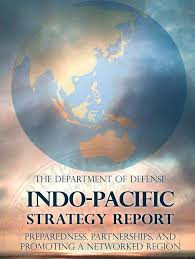
its US-Indo Pacific Strategy. The catch both Governments are likely fall
for is to believe that clauses can be changed once passed by Parliament. We all
know the impossibility of this!
Another interesting fact is that US Senate has already endorsed
MCC Nepal grant but not released the money as MCC has not been passed by Nepal
Parliament. Nepal is therefore footing
the salaries for MCC staffers and consultants in Nepal. Wonder how much
this is and whether the same is taking place in Sri Lanka too without the
taxpayers knowledge! While US is giving
$500m – Nepal is committing $130m …. So is Sri Lanka’s commitment amount
being kept a secret???
(Kathmandu Post – Why the MCC compact courted controversy in
Nepal)
the Indo-Pacific
Strategy is aimed at countering China”.
What is crucial to the discussion is whether MCC is really part
of a hidden US strategy in Asia and its key objective to curtail China. Both
Nepal & Sri Lanka have long-standing friendship with China. Nepal cannot
forget the economic embargo by India during its new constitution when India
stopped all food, medicine, petrol going to Nepal because Nepal refused to
changes clauses in its constitution that India wanted. China came to Nepal’s
assistance by flying in food & medicines. West managed to get Nepal to pass
a new constitution in 2015 but failed to do so in Sri Lanka.
Sri Lanka has its own examples of bullying sessions by India.
China has never bullied Sri Lanka or Nepal at any given time in their
relationship at different levels. Naturally Nepalis and Sri Lankans alike do
not wish to sign any pact that may harm relations with China or cause Asia into
a new arms conflict unnecessarily.
It was the US that let the cat out of the bag with David J Ranz Assistant Secretary for South
Asia of US State Dept during his visit to Nepal in May 2019 who blurted that
MCC was a crucial part of the Indo-Pacific Strategy.
This statement was a stark contrast with the December 2019
statement by Foreign Affairs Minister Gyawali who claimed MCA was not part of
the Indo-Pacific Strategy of the US Govt. What is the point in Nepal saying as
per our foreign policy, we won’t be associated with any alliance of any country”
if Nepal by signing MCC is covertly part of US strategy against China? Isnt
this the same scenario for Sri Lanka? Which is why we continue to question the
nomenclature of Sri Lanka suddenly referring to itself as NEUTRAL” instead of
non-aligned. This must stop and Sri Lanka must use only non-aligned term.
Without beating about the bush – lets just ask if MCC is
actually part of US-Indo Pacific Strategy and for that the answer is found in
the US documents itself –
According
to Kathmandu Post an expert
who has worked for the Millennium Challenge Account, the Nepal office of the
MCC, Nepal should consider the MCC as an economic part of the IPS”. The question is will US simply
restrict itself to ECONOMIC component with Nepal after signing MCC?
Doesn’t this mean that if Sri Lanka’s
Parliament passes MCC – Sri Lanka would become part of US Indo-Pacific Strategy
AGAINST CHINA?
Just as
Sri Lankans are asking why MCC a foreign assistance program given as a grant should
be passed by Sri Lanka’s Parliament, Nepal is similarly asking the same question.
While
Nepal’s MCC compact doesn’t say it needs to be ratified by Nepal’s parliament
the text of agreement says provisions of compact will prevail over Nepal’s
existing laws in case of conflicts which requires parliamentary ratification
according to Nepal Treaty Act.
MCC is
the first grant agreement that requires parliamentary approval of Nepal and Sri
Lanka too.
In all
instances the politicians ignorantly or by coercions create the trouble and the
people end up suffering because of it. Power rivalries between US & China
is nothing anyone can pretend not to be aware of. Inviting them into Asian
terrain via military partnership agreements, training and forces stationed in
Asian countries is subtly setting the stage for a scenario that no Asian nation
wants to be victims of. It is better for Asia to adopt a safe policy than sorry
one as we know too well the historical record sheet of the western partner and
it is nothing any Asian nation would want to be an initial partner & later
end up foe for strategic gain.
Iraq was
illegally invaded based on lies. Afghanistan was illegally invaded based on
lies. Libya …22 countries illegally invaded in 20 years. Nicaragua even took US
to courts for invading Nicaragua and won ICJ case. US is still to pay $17b to
Nicaragua as compensation.
Thus
MCC in both Nepal & Sri Lanka must looked from the point of another angle. The
clue to this comes in an article titled US determined to start an arms race in
Asia” which speaks of US deploying new intermediate-range missiles in Asia
which has yet to be specified https://www.fort-russ.com/2020/02/analysis-us-determined-to-start-an-arms-race-in-asia/
Countries
are insane if they don’t take precautions in dealing with this unpredictable country.
What do we think we are
celebrating on 4th February every year? Our independence from
colonial rule. But did we really get independence on 4th February
1948? We didn’t because we became by choice a dominion of the British Empire.
It was only on 22 May 1972 that Sri Lanka shred all ties with the colonial
British & became a true Republic. With 19 May 2009 becoming a
significant milestone in view of our armed forces uniting the entire island
under one national flag we should ideally hold 19 May as Victory Day, 22 May as
Republic Day and the week covering this celebration as Heroes Week.
Our island nation was attacked
over 17 times from South Indian invaders though no invader was able to take
over and rule the entirety of the island.
Then came 3 western European
colonial explorers. The Portuguese, Dutch or the British also failed to conquer
the island. They tried but they failed. But they did eventually take over the
island primarily as a result of our own people betraying the island. Our own
betrayed the island & its people to the Portuguese, our own betrayed our
island & its people to the Dutch and our own betrayed our island and its
people to the British and that DNA of treachery & betrayal appears to be
continuing. It was always a case of ‘inguru dee miris gaththa wage’ ඉඟුරු දීලා මිරිස් ගත්තා වගේ
exchanging ginger for chillies.
With the signing of the Kandyan
Convention the island of Sinhale came under British rule and Sinhale was
christened Ceylon. The British ruled till 1948 when decolonization of other colonies
led to Sri Lanka getting dominion status on 4 February 1948.
The Head of State of Ceylon
remained first King George VI until 1952 his daughter Elizabeth II was crowned
Queen.
Independence did not even
change our name back to Sinhale. We continued as Ceylon with the Queen as Head
of State and final judicial decisions decided by UK Privy Council. Britain
continued to maintain air & sea bases in ‘Ceylon’ and British officers
continued to fill the high ranks in the army!
The Citizenship Act of 1948
& the Official Language Act of 1956 were both introduced with the consent
of the UK Privy Council. The British monarch held final authority on all
legislation. No bill presented to the Ceylon Parliament could become law until
the Monarch’s royal assent was given as the Constitution of Ceylon at
independence made the British monarch part of Ceylon Parliament.
So what is the independence Sri Lanka enjoyed? What are
we really celebrating annually?
True independence came only in
1972 with the Republican Constitution when the Queen was no longer head of
State and Sri Lanka had its own judiciary to determine judicial matters.
Article 3 of the new
constitution asserted Sovereignty was with the People and it was inalienable.
Article 13 removed the British monarch from the legislature.
However, sadly the name Sinhale
was again forgotten and instead Ceylon was replaced with Sri Lanka. Hon.
William Gopallawa became the First Non-Executive President while Hon. Sirimavo
Bandaranaike continued in office as Prime Minister.
If we are to be proud to be
truly independent, it also questions why we remain embracing the Commonwealth
where the Queen remains ceremonial monarch! Myanmar on the other hand left the
Commonwealth when it became independent. It is not too late for Sri Lanka to
leave the Commonwealth.
If we are to celebrate as a
nation, we must celebrate with meaning and significance. There is nothing
significant to celebrate of 4th February when realizing that
the Queen was head of state, the UK courts had the final say and British bases
remained on our island even after 1948. All that changed in 1972 with the
Republican Constitution.
Thereafter, the island nation
was plagued with 2 insurrections and terrorism by LTTE. LTTE held defacto
territory even given to the officially via 2002 ceasefire. However, by order of
the then Commander in Chief of the Armed Forces the National Army was ordered
to militarily defeat the LTTE and reunite the country under one national flag.
LTTE was vanquished on 19 May 2009 bringing Sri Lanka under one rule. That
Victory Day must continue to be celebrated just as The Allies continue to
celebrate V Day against Nazi Germany and end of World War 2. Every year key
battles are enacted still. No one has any right to downplay Sri Lanka’s
military defeat of LTTE terrorists by defining it as ‘triumphalism’. If so, the
same must accuse the Allies of celebrating ‘triumphalism’ too.
Therefore, it is suggested that
Sri Lanka celebrate Republic Day – 22 May together with Victory Day and declare
the week as Heroes Week in honor of all the brave men and women who sacrificed
their lives and limb to defend the Nation.
Mr. G. A. D Sirimal (GADS) has lobbied consistently for a continuation of the traditional and well-tested energy plans of earlier decades in his writings to the Island newspaper, and calling for the further expansion of coal-burning power plants, even though the Norochchollai power plant is limping between shut downs and choking in its own spit. In an Island article (1st February) GADS elatedly clutches at straws and refers to Dr. Kamal Wickremasinghe (KM) who using very qualified arguments on environmental aspects”, is said to have argued for coal. I had missed this article (29 January, Island), but returned to it after reading GADS, only to be very disappointed.
KW ‘s key thesis is simple and patently false. He says:
The decision to expand the Norochcholai facility is a rational and safe decision because the hysterical demands against it, … are based on … unscientific theory of global warming and …. The … policy prescriptions of the elites .. ignore increased energy … for economic development of the poor”.
So, it is alleged that the opposition to coal is based on the unscientific theory of global warming? KS, a retired Australia administrator is in full resonance with his prime minister! However, the case against coal (e.g., presented in my articles in the Island newspaper) is based purely on economics. Coal is more costly, and takes longer to set up than the available options discussed below. The negative effects of green-house gases from coal plants, or the danger to human health, are unnecessary in deciding to reject coal.
Electricity from coal, oil or gas requires much infrastructure and long term import contracts signed at today’s prices. Such projects are also loved by politicians and their business friends because they are a great source of fat commissions. So it is an irony of history that the place name Norochchollai” is derived from the old sinhala name – Horagolla”. It was surely the manipulations of the hora” politicians in and out of power that led to the sordid saga of coal power contracts that were canceled and re-issued to fit other pockets, and not due to hysterical” environmentalists.
KW and GADS should ask how much does a 100 MW coal plant cost?, how long does it take to set it up, and what are its annual operational costs, even without including the collateral costs of ill-health within its wind zone and costs of getting rid of flue ash and pollution? Then KW and GADS should ask, what are the alternatives available to produce power more cheaply, more safely, and with shorter installation times. The writings of GADS and KS show that in their view, there is no other alternative.
In fact there is an alternative, especially in the context of Sri Lanka.
Unlike most countries, Sri Lanka has an abundance of water and many reservoirs coupled to electric turbines. There are in fact some 33 major hydro-electric plants and numerous mini-hydroplants; the latter can be ignored in this discussion, except to say that mini-hydro plants can be extremely damaging to the environment per KW of energy generated. The major hydro plants produce almost 50% of Sri Lanka’s power capacity. During the peak rain season, when the reservoirs are full, they can supply up to 70% of Sri Lanka’s needs. However, on the average, the reservoirs are full up to about 40%, and deliver only about 20% of the power needs of the country.
There are two very simple and inexpensive means of raising the hydro-capacity of the reservoirs without having to build any new reservoirs, or resorting to any advanced technologies. The first of these is to prevent the evaporation of water from reservoirs. The evaporation loss occurs day and night (due to wind) and depends on the water surface area and reservoir heat capacity (use Penman’s equation). If the reservoir surface is covered to prevent evaporation, the saved water may be as much as 50% according to some Australian studies. In Sri Lanka, one may estimate that on the average we can easily and cheaply increase the hydro-electricity power output by 25-30% simply by covering the more wind-swept surface areas of the 33 major reservoirs. A further increase of up to 10 % is possible by carrying out scheduled de-silting of the major reservoirs that are actually in neglect!
So we already have enough FIRM POWER to meet even the peak demand by raising the hydro-power capacity by some 20-30%.. If GDAS and KW disagree, they can do their own calculation and make more conservative estimates and admit that we can indeed increase capacity by 20% by wind-shielding and de-silting.
Adding in solar energy sources.
So far we have not called for solar energy, wind or biomass energy. We have
only considered the exploitation of existing hydropower facilities in an
efficient manner.
Let us just consider how to efficiently include solar energy.
Instead of covering the water surface with mere wind-shielding floats, we can
cover the surface with floating arrays of solar panels. Then the floats
not only save water by wind shielding, but also generate electricity during the
day. If that electricity had not been produced, a certain amount of water
would have been sent down into the turbine to generate that electricity. So,
instead of sending that water down, SAVE the water and use the solar
electricity during the day. This is equivalent to having stored the solar
electricity as head water in the reservoir to be used later – without using any
storage batteries!
The solar arrays cut sunlight and reduce the growth of algae and prevent the
growth of aquatic weeds like water hyacinth (Japan Jabara”) that asphyxiate
the water. The net environmental impact of floating solar arrays
turns out to be beneficial!
How much solar electricity can we get from solar arrays? Ten sq. meters
of common solar panel can produce about 1KW of power. But the solar conversion
efficiency is increasing daily, and the cost of panels (now at Rs 50 per
Watt) is dropping rapidly, unlike in June 2009 when I proposed floating solar
panels to officials in a talk at the residential secretariat. However, most
trained professionals resist thinking outside their work manual,
and we have writers like Kamal Wickremasinghe who use a rogue form of
Marxism to support the most reactionary of energy policies. The same Kamal W
who is now supporting coal based power came out against the use of
glyphosate, championing environmental causes”, even though not even
significant parts per billion of free glyphosate has been detected in Sri
Lanka’s paddy fields.
KM and GADS believe that coal is the cheapest means of producing
the needed amount of firm power for Sri Lanka. This is barely true for stereotyped
turn-key” dirty-coal plants from many engineering companies.
The proposed clean-coal” plants are very expensive and NOT turn-key. Even the
standard coal plants take 8 to 10 years to be operational. Constant
deliveries of coal are needed. Maintenance is costly and the
deterioration of the plant is high. Insurance costs as well as waste flue ash
begin to pile up high. The poor people within 50km of the plant begin to get
asthma and lung diseases. Their incapacity for work, absentee rate etc.,
begin to increase dramatically. The flora and fauna in the affected
area become stilted and diseased.
All this has nothing to do with global warming, but are a direct result
of acid fumes, sub-micron particulate dust etc. generated from
burning coal. KS pins hope on pie-in-the sky clean-coal. It is most
likely that the people affected by future coal plants will be
the poor that KW attempts to champion, while those who collected the
commissions, or the tradition-bound engineers and risk-averse
businessmen will have their air-conditioned houses to live in.
[A slightly different version of
this article appeared in the Island, 4-Feb-2020.]
By Shridhar Prabhu – Advocate, Bengaluru, India Courtesy – Asian Tribune –
Speech delivered by Indian lawyer Mr. Shridhar Prabhu entitled ‘ Challenges confronting Buddhists in Asia, with special reference to South Asia and South-East Asia ‘ at the Ariyapala Hall, All – Ceylon Buddhist Congress on December 29, 2017.
Venerable Dhamma Teachers, Respected Dr. (Mrs.) Anula and Dr. Ajita Wijesundere and all other Office bearers of the National Joint Committee, Respected Mr. Jagath Sumathipala, Hon’ble Vice President of World Fellowship of Buddhists, and other WFB Bearers, Mr. Senaka Weeraratna and Dignitaries on and off the dais, and my dear Dhamma sisters and Dhamma brothers of Sri Lanka!
Ayubowan from all your Dharma tradition sisters and brothers of Bharat.
It fills my heart with and untold joy to be amidst you on this august occasion.
We are on our pilgrimage in Sri Lanka from 23rd December, 2017. I cannot possible describe about the solace that we have experienced from our visit of to the holy city of Anuradhapura, Sigiriya, Polonnaruwa and then Maha Nuwara. Being amidst you all, who are dedicated to the cause of Dhamma in itself is a pilgrimage.
Today morning, we had been to a very special place called Pinnawala Elephant Orphanage, arguably, the largest elephant orphanage in the world. It was indeed a heart melting moment for all of us to see the baby elephants. Pinnawala is a classic example as to how much compassion is filled in the heart of Sri Lanka.
It is such great endeavours by a Buddhist nation that makes all Buddhists across the world proud of our Dhamma and our people! The greatest contribution of Buddhism to the world is Metta and Karuna with which the Buddha encompassed not just mankind but the whole of creation all in all its forms and manifestations. Pinnawala is living monument to this great Buddhist tradition. I once again reiterate that I am proud to be from India, homeland of the Buddha and proud to be a Buddhist and proud to be in Sri Lanka, a leading Buddhist Nation and Polity.
I hope I would not be exceeding my brief if I touch upon the aspect that Chapter II – Article 9 of Sri Lankan Constitution provides that //The Republic of Sri Lanka shall give to Buddhism the foremost place and accordingly it shall be the duty of the State to protect and foster the Buddha Sasana, while assuring to all religions the rights granted by Articles 10 and 14(1)(e).//
My humble request to you is that please preserve this great provision in Sri Lanka’s Constitution in letter and in spirit. Please don’t allow yourselves to be led astray by the insincere influence of foreign ideologies. By foreign I don’t mean from other countries, I mean that ethos that is foreign and alien to the scheme of Buddha’s teachings.
The architect of the Indian Constitution, Dr. B.R. Ambedkar, a great Buddhist and proud son of India has made the following provisions:
Aspect Articles and provision
PART IV: DIRECTIVE PRINCIPLES OF STATE POLICY, 48: Organisation of Agriculture and Animal Husbandry and 48A: Protection and improvement of environment and safeguarding of forests and wild life Per 48, the Constitution requires the State to take steps for preserving and improving the breeds, and prohibiting the slaughter, of cows and calves in other milch and draught cattle.”
Per 48A, the Constitution places a duty on the State to endeavor to protect and improve the environment and to safeguard the forests and wild life of the country.”
Per List III, Both Parliament and the legislature have the authority to make laws on the following: [p]revention of cruelty to animals,” protection of wild animals and birds,” [p]revention of the extension from one State to another of infectious or contagious diseases or pests affecting men, animals or plants.”
PART IVA: FUNDAMENTAL DUTIES, 51A (g): Fundamental Duties Per 51A, the Constitution places a duty on every citizen to protect and improve the natural environment including forests, lakes, rivers and wild life, and to have compassion for living creatures.”
Though Directive Principles are directional in nature our Supreme Court has held that they are binding on us as polity. In fact, 24 of 29 States in India, including the State of Jamu Kashmir have laws and regulations banning cow slaughter or sale of cows. This is because of the Buddha’s influence on our jurisprudence and constitutional framework. I would like to see, being a historic Buddhist nation respected throughout the world for spreading Buddhism, you too would incorporate provisions in any reform of your Constitution to impose a moral duty on all persons inhabiting in Sri Lanka to have compassion for living beings, including non – human animals. The quality and esteem of a Constitution is enhanced when it also extends protection and care for the welfare of members of other species that share this planet with human beings.
Ban on Liquor – In fact, there is a liquor prohibition in the State of Gujarat ever since continuously from 1958. The State where the Buddha attained enlightened namely Bihar, too has done it recently and the same is a great living example for rest of India and the world.
Answer to the present distortions of History
I come from India, the land of The Buddha’s birth, enlightenment and parinibbana. But unfortunately, Buddhists are minuscule minorities in this holy land! How!
There has been humongous amount of historical research on the decline of Buddhism. Three eminent personalities, who are responsible for the modern revival of Buddhism in India, have thoroughly researched on this subject and have authoritatively concluded that it is the Islamic advent that resulted in the decline of Buddhism.
This became pertinent for these three scholars to dispel untruths because a systematic Goebbelsian propaganda was unleashed by the pseudo secularists in India that it was the philosophical victory of Hinduism over Buddhism that led to the decline of Buddhism. In fact, many of the misinformed Hindu researchers themselves claimed that Adi Sankara defeated the Buddhists in Dialogues and Buddhists accepted defeat and quit India!! This is part of the systematic effort by the imperialist forces – both Arab and European – to pit Hindus against Buddhists and absolve themselves from having to account for their crimes against Buddhism on Indian soil.
First and foremost, of the scholars who brought out truth – much before the two – was Anagarika Dharmapala. He worked with the oppressed masses of India decades before Ambedkar. While taking the Buddha Dhamma to the oppressed, he never pitted Dharmic traditions against one another. I would request you to kindly read this important article written on the occasion of the 150th Birth Anniversary of Anagarika Dharmapala.
The second eminent scholar was VIshwaratna Dr. Ambedkar.
Of all these three scholars It is utmost important to quote Dr. Ambedkar for important two reasons. Firstly, a vast majority of Buddhists in India are followers of Dr. Ambedkar. Secondly, Ambedkarism remains the most distorted ideology today in India. Thirdly, because Ambedkar, known for his acidic polemic against Hinduism, never compromised on the narrative of truth. He never mixed his personal feelings when it came to academic research. It is Dr. Amebdkar who smashed the pseudo theory of Aryan invasion and Aryan and Dravidian divide and the pseudo secular theories perpetrated by the Stalinist historians.
Ambedkar’s ideology was totally distorted by his later followers. The concept of ‘Bahujan’ was ‘lifted’ from Buddhist teachings and was used for petty political gains in India. In the name of Bahujan Samaj, Buddhists, especially the former untouchables, were asked to forge camaraderie with Muslims and Christians and destroy Hindus! In fact, Dr. Amebkar was falsely projected as an espouse of Abrahamic religions! But please note what he has to say in this regard:
//There can be no doubt that the fall of Buddhism in India was due to the invasions of the Musalmans. Islam came out as the enemy of the ‘But’. The word ‘But’ as everybody knows, is the Arabic word and means an idol. Thus the origin of the word indicates that in the Moslem mind idol worship had come to be identified with the Religion of the Buddha. To the Muslims, they were one and the same thing. The mission to break the idols thus became the mission to destroy Buddhism. Islam destroyed Buddhism not only in India but wherever it went. Before Islam came into being Buddhism was the religion of Bactria, Parthia, Afghanistan, Gandhar, and Chinese Turkestan, as it was of the whole of Asia.
XXX
The Mussalman invaders sacked the Buddhist universities of Nalanda, Vikramshila, Jagaddala, Odantapuri to name only a few. They razed to the ground Buddhist monasteries with which the country was studded. The monks fled away in thousands to Nepal, Tibet and other places outside India. A very large number were killed outright by the Muslim commanders. How the Buddhist priesthood perished by the sword of the Muslim invaders has been recorded by the Muslim historians themselves. Summarizing the evidence relating to the slaughter of the Buddhist Monks perpetrated by the Musalman General in the course of his invasion of Bihar in 1197 AD, Mr. Vincent Smith says, “….Great quantities of plunder were obtained, and the slaughter of the ‘shaven headed Brahmans’, that is to say the Buddhist monks, was so thoroughly completed, that when the victor sought for someone capable of explaining the contents of the books in the libraries of the monasteries, not a living man could be found who was able to read them. ‘It was discovered,’ we are told, ‘that the whole of that fortress and city was a college, and in the Hindi tongue they call a college Bihar.’ “Such was the slaughter of the Buddhist priesthood perpetrated by the Islamic invaders. The axe was struck at the very root. For by killing the Buddhist priesthood, Islam killed Buddhism. This was the greatest disaster that befell the religion of the Buddha in India….
~ Dr. B. R. Ambedkar, “The decline and fall of Buddhism,” Dr. Babasaheb Ambedkar: Writings and Speeches, Vol. III, Government of Maharashtra. 1987, pp. 229 and 338
These opportunist elements should better read the following passage by Dr. Ambedkar:
//Hinduism is said to divide people and in contrast Islam is said to bind people together. This is only a half-truth. For Islam divides as inexorably as it binds. Islam is a close corporation and the distinction that it makes between Muslims and non-Muslims is a very real, very positive and very alienating distinction. The brotherhood of Islam is not the universal brotherhood of man. It is brotherhood of Muslims for Muslims only. There is a fraternity, but its benefit is confined to those within that corporation. For those who are outside the corporation, there is nothing but contempt and enmity. The second defect of Islam is that it is a system of social self-government and is incompatible with local self-government, because the allegiance of a Muslim does not rest on his domicile in the country which is his but on the faith to which he belongs. To the Muslim ibi bene ibi patria [Where it is well with me, there is my country] is unthinkable. Wherever there is the rule of Islam, there is his own country. In other words, Islam can never allow a true Muslim to adopt India as his motherland and regard a Hindu as his kith and kin.//
In sum, Dr. Ambedkar was very critical of Hinduism but he never ever advocated destruction of Dharmic tradition of India. He never wished to join hands with the Abrahamic traditions and pit Buddhists against Hindus.
It is on purpose that I have dedicated a good part of my speech on Dr. Ambedkar because he is the most respected and most popular Indian Buddhist personality today. Political parties and ideologues across the spectrum – from ‘Secularists’ to ‘Communists’ – Nationalists to Internationalists – swear by his name and claim to be the successors of his legacy.
You may be a little irritated, if not confused as to why am I wandering on the peripheral issues instead of straightaway coming to the core issue of Challenges confronting Buddhists in Asia, with special reference to South Asia and South-East Asia.
In fact, the decline of Buddhism from its motherland India, is central and most critical to the inquiry on ‘Challenges confronting Buddhists in Asia’. The enquiry of decline of Buddhism in India is nothing but an inquiry on Indic-ness and ingenuousness in India. And as long as India ignorant of this reality, Asia will also be in a blissful slumber. As long as Hindus and Buddhists in India are busy with their infighting, India will never be able to forge an alliance with the rest of Buddhist world. This is not a theoretical proposition. In fact, this was practically and successfully achieved by the enemies of Dhamma for the last one hundred years!
This harmed Hindus and Buddhists in equal proportions. Hindus within India because of their numerical strength, military might and other historical advantages Hindus could successfully thwart some of the external aggression to their Dharma and Nation. However, Hindus outside India in rest of Asia especially in Pakistan, Bangladesh are so much affected that they are now almost on the verge of extinction within a few years.
The challenges of Buddhists are even more critical because we neither have numbers on our side nor do we have the military might to counter the external aggression. Most importantly, we have not even realised that we are in danger of history repeating itself in the remaining Buddhist countries.
Bangladeshis camouflaged as Rohingyas
Let us take the concrete case on hand – the Rohingya issue. I personally feel that we should shun the usage of the term ‘Rohingyas’ – because they are basically Bangladeshis using the smokescreen of the label ‘Rohingyas’. Thus having said that, I agree that there are multiple dimensions to this issue. I also agree that it is against Dhamma to compartmentalize human suffering into Muslim suffering and Buddhist suffering. But let’s examine the harsh truth.
As per the undisputed official census records of Myanmar, when they gained independence in 1948, there was very few Muslims in Arakhan State. By 1973 Muslims were about one million. In 1983 Muslims constituted about 19% of the Arakhan State in Myanmar. In 2014, Muslim Population grew to 56%. And today, more than 80–96% of the population near the border with Bangladesh and the coastal areas is Muslim.
I would like to ask the International Media, which is branding the Buddhists of Myanmar as Terrorists, a simple question. Today, officially, there are about 10% Muslims in Germany, France and Netherlands. What will this international media do if this population increases up by 80% in say twenty years from now, as it has happened in Myanmar.
Why is the western media not writing about Arunachal Pradesh, in North East India, wherein once indigenous religions were a majority and today the population of Buddhism has been reduced to 11% in last two decades!
Now, let’s not dive into the number game. Let’s see, at a thematic level, what challenges we, Buddhists are faced with.
Let’s begin with Bangladesh, the home to Chakmas or Sakhyas, the community to which Buddha belonged. It is the Sakhyas residing in the northern hills of Bangladesh who have kept the ancient Buddhist culture alive. That is why this Sakhya community is being systematically chased and attacked. Take for instance, the Kathina Chivara Dana ceremony of Chakmas. For the first time I had the good fortune of seeking this unique festivity in October, 2014. It is at this juncture that I realized that if Chakmas are extinct there will be no bestowal of cloths to our Venerable Bhikkhus. If Sakhyas die, the most basic and sacred Buddhist traditions will be extinct.
India has helped provide citizenship to Sakhyas. The recent initiative of Citizenship Act by Assam is an endeavor by the present Central Government of India to help Hindus and Buddhists of the region.
Wherever Buddhists are ruled by authoritarian regimes – China, Cambodia, Vietnam and to some extent Nepal etc., we have immensely suffered. But these issues are beyond us to resolve. So, it is better that these issues be addressed as national issues of their respective regimes. Hence, I would not wish to touch the controversial Tibetan issue and problems of other Chinese Buddhists.
India and Sri Lanka – Our Constitutional Issues in a democratic polity
Let us now consider India and Sri Lanka together.
Constitutions of India and Sri Lanka guarantee fundamental rights to citizens as well other persons. Consider Article 12 of the Constitution of Sri Lanka
Article 12.
(1) All persons are equal before the law and are entitled to the equal protection of the law.
(2) No citizen shall be discriminated against on the grounds of race, religion, language, caste, sex, political opinion, place of birth or any one of such grounds.
This Article is pari materia to the Indian constitutional provisions:
Article 14.
The State shall not deny to any personequality before the law or the equal protection of the laws within the territory of India.
19. (1) All citizensshall have the right— (a) to freedom of speech and expression; (b) to assemble peaceably and without arms; (c) to form associations or unions 1[or co-operative societies]; (d) to move freely throughout the territory of India; (e) to reside and settle in any part of the territory of India; 2[and] 3** * * * (g) to practice any profession, or to carry on any occupation, trade or business
Utilizing these rights guaranteed to the non-citizens, in India, series of cases are being filed on behalf of the foreign nationals – especially, Bangladeshis (so called Rohingyas included). Constitution is being invoked to seek residence and then slowly citizenship. In India, as per Union of India’s official statement there are about 20 Million Bangladeshis illegally residing in India. This is equal to the total population of Sri Lanka!
Both Sri Lanka and India have acceded to the jurisdiction of the International Court of Justice for dispute adjudication. This will also be used against us in so far as the foreign elements will invoke various Human Rights Conventions and institute proceedings against us before the ICJ. This is likely to be the future. Constitutional and International Jurisprudence will be the two biggest armories in the hands of adversaries of the Dharma traditions. While they would deny fundamental rights to their own citizenry, they would be very prompt in demanding all kinds of rights from us. The western world, being solely interested in arms trading, will always encourage violent conflicts within a nation and between nations and in the process cause the destabilization of Asia.
So-called liberals in India make so much about Article 370 in India. Thanks to this Article, notwithstanding the fundamental rights on residence guaranteed to Indian citizens, the citizens residing elsewhere in India can be permanent residents of the State of Jammu Kashmir. However, it is estimated that in Jammu City (the Winter capital of Jammu Kashmir – wherein lakhs of Kashmiri Pandits are forcibly living under displacement from their homes in Kashmir Valley) alone, around ten thousand Bangladeshi Muslims are staying there under the garb of Rohingyas. How can this be permitted?
Small and Subtle- which we can’t ignore.
Ladakh sector of Jammu Kashmir is dominated by Buddhists. However, in Kargil Town, Buddhists are struggling to construct a temple. Forget Sri Nagar, we are not able to construct a small temple in Kargil! The whole world speaks about Kargil victory of India. But how many of us know that Buddhists are living as outcastes in their own hometown in Kargil? While Leh is 80 per cent Buddhist and 20 per cent Muslim, the numbers are exactly the reverse in Kargil, which is predominantly Muslim now. It is estimated that 90% interreligious marriages in Kargil are between a Muslim boy and Buddhist girl. A new term called Love Jihad has come to be coined in India, wherein, it is suspected that boys from their own religions are brain washed to seek and marry a non-Muslim girl and convert her to their faith. Many liberals have denounced it as a hoax until the Hon’ble Supreme Court of India had directed the apex investigating body National Investigative Agency to conduct a thorough investigation into the ‘Hadia matter’. See http://www.hindustantimes.com/india-news/sc-orders-nia-probe-into-kerala… for more details.
There are small and subtle challenges in our regions. I have carefully observed certain things in Sri Lanka. Buddhists here worship Hindu gods such as Ganesh, Velu Murugan etc. While I see one positivity that both Dharmic traditions are being respected. However, Buddhists of Sri Lanka will be neither here nor there if such blind practices are perpetrated. This seems to one of the core but subtle challenge that Buddhists in Sri Lanka need to resolve internally. Though these issues are very small but we can’t ignore the same.
I being an outsider, may be pardoned if I have overstepped my brief in sounding instructive in my approach, particularly when such scholarly and erudite people are amidst us in this audience.
The way forward
I am a total novice to the affairs of Sri Lanka. However, in my estimate, Buddhists in Sri Lanka may be far less than 70% as is being claimed on the basis of 2011 census. Even presuming without admitting that Buddhists are in such big numbers, mere numerical majority does not guarantee any safety.
The whole of organised media conglomerates in most of Asia including Sri Lanka are controlled by non-Dharmic forces and they are hell bent upon denigrating and lowering the image of Dharmic nations such as India and Sri Lanka, through a sustained campaign of vilification of Hindu and Buddhist monks and their leaders.
Recently, I read an article in ‘Christian Today’ bashing Buddhists in Sri Lanka.
The article us titled The World’s Biggest Christmas Tree Hasn’t Helped Sri Lankan Christians”
Read: http://www.christianitytoday.com/news/2017/december/sri-lanka-guinness-w…) and claims that Christians in Sri Lanka are persecuted in huge numbers. The author with a Sikh name (ghost-writer in every sense of the term) goes on to defame Sri Lanka in general and Buddhists in particular. Any onlooker of international affairs would think that Sri Lanka is a gas chamber for Christians! Now, the so-called liberals and intelligentsia are fast to grab this opportunity to attack the Dharma as the cause of all the trouble in these respective countries.
As an interesting aside, let me tell you that as practicing Buddhist, I have always been skeptical of prophecy and astrology. However, on a jocular note I must confess that, whenever I read Mr. Senaka Weeraratna’s articles, I revisit my views on astrology. It is astonishing that about four to five months before the last Indian General Elections in 2014, Mr. Senaka Weeraratna had predicted in an analysis of the Indian political landscape, that Mr. Modi will be the Prime Minister of India and it would be great opportunity for Sri Lanka in particular and the Buddhist world in general to take stock of this possible change in the Government of India and act accordingly. Though a popular opinion was already in favour of Modi, there were several influential sections within India who had seriously doubted Modi’s ascendance to power. Being so much far away and being a distant observer of Indian politics, I am amazed at the acumen and commitment of such personalities in Sri Lanka. Whenever I see Mr. Senaka Weeraratna’s writings, I am enthused about the future of the Dhamma in Sri Lanka and in rest of India.
It is largely because of Sri Lanka that Buddhism is alive in India and rest of the world today. It is Venerable Anagarika Dharmapala who played the pioneering role in the revival of Buddhism in India. It is primarily Sinhalese monks from Sri Lanka who gave Deeksha to Dr. Ambedkar.
To understand the appreciate the phenomenal contributions of Sri Lanka to my India, please see what Acharya Buddharakhita has written about the birth of the Maha Bodhi Society in India
//On the occasion of 2500 Buddha Jayanti I decided to resign from Nalanda Post Graduate Institute, went to Buddhagaya to meditate and offered one lakh deepa puja for one full month. I got a clear mind about future activities. That is how, when Mrs. Bianca Moonasinghe the niece of Venerable Anagarika Dharmapala, and the wife of the General Secretary of Sri Lanka Maha Bodhi Society, and the head of Mahabodhi ladies committee, approached me saying that she got some land given by Maharaja of Mysore which was lying idle and some people had encroached on the land and nothing is happening, etc. I accepted the offer with the condition that I will not be another bhikkhu employee as in other centers of Maha Bodhi Society. Ours will be an independent society, and as President I will conduct activities in a practical way through seva and sadhana programs. She was more than happy and that is how I came to Bangalore on 5th June 1956.
Today, am before you as a Upasaka associated with Maha Bodhi Society, one of the largest Buddhist organisations in India. (Ref: http://www.mahabodhi.info/). //
In fact, it is our Dharmic brothers, the Hindus, who helped Maha Bodhi society. In fact, it was Mr. Shyamaprasad Mukherji, founder of Bharatiya Jan Sangh (predecessor of BJP the party of Mr. Modi) and India’s first Industry and Supply Minister, who helped Anagarika Dharmapala to build a glorious temple in Buddha Gaya and that’s how Buddhism was revived.
Mr. Shyama Prasad was also affiliated with the Buddhist Mahabodhi Society. In 1942, he succeeded Dr. M.N. Mukherjee to become the President of the organisation. The relics of Gautam Buddha’s two disciples Sariputta and Maudgalyayana, discovered in the Great Stupa at Sanchi by Sir Alexander Cunningham in 1851 and kept at the British Museum, were brought back to India by HMIS Tir. A ceremony attended by politicians and leaders of many foreign countries was held on the next day at Calcutta Maidan. They were handed over by our first Prime Minister Nehru to his cabinet colleague Mr. Mukherjee, who later took these relics to Cambodia, Burma, Thailand and Vietnam. Upon his return to India, he placed the relics inside the Sanchi Stupa in November 1952. Mr. Modi regards Mr. Mukherji as his revered Guru in every sense of the term. So, you may imagine in how much high esteem Mr. Modi holds Buddhism.
As an interesting aside, if I may share with you that Mr. Senaka Weeraratna had written an article on the need for a noise free environment at the Maha Bodhi Temple at Buddha Gaya – the centre of Buddhism where the Buddha attained enlightenment. A serene and peaceful atmosphere conducive to deep meditation and contemplation, is no longer possible at the Maha Bodhi Temple because of the constant disturbance of calls to prayer (Azan) emanating from a loudspeaker(s) at a newly constructed mosque just 60 meters away plus other mosques in the Buddha Gaya temple complex.
Now, that’s a very small matter as compared to this narrative: In July, 2008, a series of 21 Bombs were blasted in Ahmedabad killing 56 people and severely injuring 200 and more. Now, these terror suspects were arrested in Buddha Gaya in September, 2017!! What were these dreaded terrorists doing in Buddha Gaya? Tausif Khan, the master mind (called as Master ji) was the main person accused of these blasts! Now, we have to ask, how safe are our holy places?
Of course on the Azan problem, one needs to remind our Muslim brothers with great compassion that even before the loud speaker was invented, Islam was the second largest religion in the world. Hence, they need not place such heavy reliance on UnIslamic means (constantly disturbing non – Muslims by use of loudspeakers attached to Mosques built in close proximity to major centres of non – Muslims religions) to spread their religion.
Success Story of Jains – Numbers never matter
The biggest challenge faced by the Sri Lankan (mainly Sinhala) Buddhists seems to be akin to that of Hindus in India. Buddhists seem to be in blissful complacence rejoicing their so called ‘numeric majority’. In fact, we should draw lessons from miniscule minority Dharmic Traditions such as Jainism in India.
There are around four Million Jains in India. This constitutes about 0.032% of the Indian population. Thing being the case, the largest political Party in India BJP, which is the ruling Party of India is headed by a Jain called Amit Shah! One of the largest industry conglomerates in India – Adanis and Sun Pharama are owned by Jains. Largest circulated English Daily in India – Times of India is owned by Jain Family and Malayalam Daily Matrubhumi is by a Jain. Governor of Gujarat and Chief Minister of Gujarat are Jains. Acharya Rajanish or Osho was a Jain. I can go on and on.
Jains in India have shown as to how their strategic alignment at the political and industry level can work. Jains have shown the way forward for the Buddhists across the world. We have to politically, strategically, economically align with the Dharma traditions – with Hindus, Sikhs, Jains and Indigenous religions across the World. This seems to be our future. And there lies our capacity for preservation and fostering of our religion.
Only with strategic alignment Dharma will survive and be Victorious
Be that as it may. Let’s leave the past to take care of itself. Buddhists of India and Sri Lanka should make most of the benign regime of India today. Modi government wants to take the message of Dharma across the globe. India, as the able successor and leader of Dharmic traditions is now fostering Buddhism. We should join hands in two ways. One at an idea level, we should support the international endeavors of the Indian Government. As a small contribution, I must share with you, I am already in talks with the office of the Additional Solicitor General of India South India and Indian Law Ministry. They are very keen to come to Sri Lanka. We can propose to hold a conference of Lawyers of Indic and Indigenous faiths and religions to chalk out an international strategy in our common interest.
Now, apart from these kinds of endeavours to be initiated at personal levels, there is something we need to do collectively. One thing is for sure. Dhamma can only be practiced and protected collectively. When the whole world is antagonistic to you, how can you individually remain Dharmic? Hence, practicing Dharma means growing more and more strategic at macro level. This is more crucial and vital task than personally observing Dharmic rituals and faiths.
World has always been skewed and strategic. Neutrality, non-alignment and secularism are always for others consumption and never for self-practice. Only Dharmic people are advised to be secular. In fact, the world has never been ‘secular’ and will never be in future.
As individuals, people may be atheists, rationalists, irreligious. However, as polity they are always religion minded or strategically aligned to one religion or the other. It is a popular misconception that the world is growing less and less religious today. This is a popular myth perpetrated to confuse and mislead the Dharmic people.
Out of the 7.6 Billion people living in the world today, nearly 2.1 Billion people are Christian and 1.3 Billion people follow Islam. Now, we tend to think that the west has grown less religious. It is not true. The UK officially is a Christian country even from the ancient times. The USA has huge tax exemptions and encourages free contributions to church. In fact, but for the USA the ‘conversion shop’ of the missionaries would have been long closed. It is a popular myth that Nordic countries are non-religious. The official religion on Denmark, Finland, Norway, Iceland, Estonia is (Lutheran) Christianity.
Russia is a very rigid follower of Orthodox Christianity. About 70% of church revenues come from church tax (Kirchensteuer). Apart from a lot of major cantons of Switzerland, the official religion of Argentina, Bolivia, Costa Rica, El Salvador, Liechtenstein, Malta and Monaco is Roman Catholicism. Greek Orthodox Church and Finnish Orthodox Church are official religions in respective jurisdictions. Church of England is established by law. Queen is the official head of the world-wide Anglican Communion.
The members of Church of Sweden pay church fee, which varies between municipalities, but can be as much as 2%. Church and state are separated as of 2000; however, the burial tax (begravningsavgift) is paid by everyone regardless of membership. Italy pays 0.8 percent Church Tax. In Austria, it is compulsory to pay church tax at the rate of 1.1 percent.
In short, EU, NATO etc., are nothing but de facto Christian strategic alliances.
About 57 countries today are members of one of world’s largest and most strategic organisation known as Organisation of Islamic Cooperation. The bond between the Islamic countries is so much strong and cemented that Article 3(e) of the Conditions for Accession to Observer Status at OIC says:
A state applying for observer status shall not be in conflict with any of the OIC member states.”
While none of the member states of OIC is secular in any sense of the term, they always pressurise a non-Muslim country to observe secularism. Islamic world always acts strategically and collectively. From smallest to the most critical of the issues confronting Muslims, they speak in one language and they are always on one page!
Now, communism itself is a State religion. Thus, China, North Korea have their respective gods, popes and pupils. Nepal, the only Hindu country, was turned into a secular state.
In short, only Dharmic States that are forced to go secular. In fact, secularism is a tool and subtle ploy to kill Dharma. If all these rationalists and intellectuals really intend to promote ‘secularism ‘ let them start with the NATO and OIC Nations. Why target the unorganised ones such as ours?
It is precarious reality that Buddhism today is the most unorganised religion in the world. Except Sri Lanka I don’t think the very thought of organising ourselves at a strategic level has come to the mind of any other nation with a Buddhist population.
In 1950s Sri Lanka gave to the World Fellowship of Buddhists (WFB), the most revolutionary and strategic development of its time. The Buddhist Flag adopted during this time is also the most important development. But. World has become much more strategic ever since then but we, unfortunately, have remained stagnant ever since then. We either progress or perish.
In my humble opinion, the Buddhists of the world today have to strategically align with India. When I say align, it does not mean efface our identity and merge. It means only align with consciously retaining our identity and interests.
Due to a variety of conspiracies, there is large scale misunderstanding about India. We think, India is all about Tamils and that all Tamils are against Sri Lanka. It is not at all true. An overwhelming majority of Indians, Tamils included, we love Sri Lanka. We are spiritually indebted to Sri Lanka in so many ways. If not for Hindu leaders such as Shyamaprasad Mukerji, the Mahabodhi Temple could not have been constructed by Anagarika Dharmapala.
AIADMK, the party in power in the province of Tamil Nadu for last ten years or so has been deadly against LTTE. It is only a few fringe elements within small pockets of India who have had a temporary misunderstanding with Sri Lanka. Now all that is a thing of the past.
In fact, I must share with you, C. Iyothee Thass (20th May, 1845 – 1914), a leading Tamil spiritual leader, was the pioneer of Buddhism in India. Even before Dharmapala and Dr. Ambedkar, it was Thass who pioneered the efforts to revive Buddhism. Iyothee Thass met Colonel H. S. Olcott with his followers and expressed a sincere desire to convert to Buddhism. According to Thass, the Paraiyars of Tamilakam were originally Buddhists With Olcott’s help, Thass was able to visit Ceylon and obtain diksha from the Sinhalese Buddhist monk Bhikkhu Hikkaduwe Sumangala Nayake Thero. On returning, Thass established the Sakya Buddhist Society in Madras with branches all over South India. The Sakya Buddhist Society was also known as the Indian Buddhist Association and was established in the year 1898. Even today, there is a Buddha Vihara in Wheelers Town in Bengaluru started by Iyothee Thass.
Modi regime today is aggressively pushing for Buddhist unity. In fact, India has been strongly supporting the International Buddhist Confederation. It is being supported right at the level of Prime Ministers Office. India’s approach today is wholly changed. Modi’s first visit round of when he assumed office as PM was to a series of Buddhist countries. India is not playing big brother but a caring mother for Buddhist nations. We, the Buddhists, must make most of this. We must strengthen the hands of Modi regime in our own best interests.
We must engage India to promote global strategic cooperation inter se the Dharmic World. The heart of India will always remain Buddhist. Our national emblem, Ashoka Chakra in the centre of our flag symbolises that India is predominantly Buddhist within its heart. This is what a leading journalist had to say some time ago:
//Why was the code word to announce the success of Pokharan-1 in 1974 Buddha is smiling”? My friend and former colleague Vinay Sitapati (look for his fine biography of P V Narasimha Rao, Half-Lion, next week) finds the answer in his research. It seems Raja Ramanna was also aware of the history of Vaishali’s destruction by Magadha. The legend is, Buddha was upset about it and thought the war could have been avoided if Vaishali too had deterrent military power rather than its so-called direct democracy so nobody would take hard decisions. You can only have peace between equally strong or equally weak nations,” he is supposed to have said; that’s why Ramanna told Indira Gandhi Buddha is smiling” as India had acquired its deterrence. //
India without Buddhism will always be incomplete. Hence, India and Sri Lanka are natural allies. The bonding of Dhamma between us has always remained and will ever remain.
I take this opportunity to offer my salutations to Venerable Mitirigala Dhammanissanti Thera with whose blessings I am sure that the cause of Dhamma is being espoused in the rightful manner by Mr.Senaka Weeraratna. I must tell you that I am here before you only because of him and I wholeheartedly owe this all to him.
I am deeply indebted to the National Joint Committee for providing me this opportunity. Dr. Wijesundere family has been a constant source of inspiration in the Dhamma work. My sincerest gratitude to Jagath Sumithipala, Vice President of the World Fellowship of Buddhists for taking out time from his busy schedule. I once again seek blessings from all Dhamma Teachers.
I pray that may Lord Buddha shower his choicest blessings on the people of Sri Lanka. Let the cause of Dhamma be victorious. Let the Buddhist Brotherhood and Dharmic Unity of Sri Lanka and India be victorious!
Bharat Mata Ki Jai! Vande Mataram!! Jaya Jaya Sri Lanka. Long live the World Fellowship of Buddhists Long Live National Joint Committee of Sri Lanka!! Long Live the Unity and Integrity and Sovereignty of Sri Lanka!!
Shridhar Prabhu is the Managing Partner of Navayana Law Offices, a Bengaluru based niche’ law Firm specializing in Energy Laws. Mr. Prabhu though based in Bengaluru practices in various High Courts and Tribunals throughout India.
Shridhar Prabhu was born on 25th December, 1976. He completed his Pre University education in Karnataka College Dharwad and obtained his Bachelor of Academic Laws and LL.B (Five Years Integrated) Degree from Bangalore University Law College (BULC).
He was a leading student activist during his undergraduate days at BULC. He was an Executive Committee Member of the BULC and Chairperson of the Model Parliament Committee of BULC.
After graduating in 2001 Mr. Prabhu had worked under leading lawyers practising in Delhi handling work in the Supreme Court of India, Delhi High Court and Central Administrative Tribunal of India. He returned to Bengaluru in 2002 and after a brief stint of working with the private sector, Mr. Prabhu branched in to and specialised in Energy Laws. He holds a string of appointments as a Legal Advisor to a number of Industry Associations and trade bodies.
Mr. Shridhar Prabhu has been associated with the Maha Bodhi Society, Bengaluru, as legal advisor. With his team of like minded Lawyers in High Court of Karnataka, Mr. Prabhu has been active in the Advocates Association Bengaluru, organising a Dhamma Discourse Programme High Court of Karnataka with Venerable Bhante Ananda and Venerable Bhante Sugatananda involving the Judges of High Court of Karnataka and Advocate General of Karnataka State. Mr. Prabhu writes in Kannada language on contemporary social and political themes to various online and offline publications.
He is a practising Buddhist and is associated with various organisations involved in the dissemination of Buddhism.
He is happily married to Mangala Prabhu, an Advocate and is blessed with two sons – Manthan (12) and Bhuvan (5).
Sri Lankan Prime Minister Mahinda Rajapaksa will be in India from 7 to 11 February
Follow-up discussions on Indian assistance to enhance training opportunities for Sri Lanka are expected in the fields of vocational training and training of the public services
NEW DELHI : India and Sri Lanka will work out the details of projects to be taken up under a $450 million line of credit during Sri Lankan Prime Minister Mahinda Rajapaksa’s visit to India from 7 to 11 February.
The Sri Lankan leader’s visit to India is his first abroad since being named prime minister in November last year. A former President of Sri Lanka, Mahinda Rajapaksa was appointed prime minister after his brother Gotabaya Rajapaksa won the presidential elections earlier in November.
The credit package for Sri Lanka was announced last year and the two sides are now set to unveil the implementation timelines. The two countries will also look at enhancing sub-regional maritime security cooperation, according to a statement by Rajapaksa’s office on Monday.
During the state visit of President Gotabaya Rajapaksa last year, prime minister (Narendra) Modi announced a $450 million fresh line of credit to Sri Lanka. The two countries are expected to finalize the implementation agenda during this forthcoming visit of Prime Minister Rajapaksa,” according to the statement from his office.
Follow-up discussions on Indian assistance to enhance training opportunities for Sri Lanka are expected in the fields of vocational training and training of the public services,” according to the statement.
With the aim of enhancing engagement in subregional maritime security cooperation, the two delegations are expected to discuss key areas under the defence and maritime security initiatives that include the Sri Lanka-India Annual Defence Dialogue and the trilateral maritime security cooperation with India and the Maldives,” it said.
The stepping up of contact comes against the backdrop of an increasing presence of China in the Indian Ocean region, which India considers its sphere of influence. China has also invested millions of dollars in Sri Lanka as part of its ambitious Belt and Road infrastructure initiative.
In recent years, India has boosted its development assistance to Sri Lanka, with the aim of weaning Colombo away from China. India’s overall commitment stands close to $3 billion, out of which around $560 million are in grants, the Indian foreign ministry website said.
President Gotabaya Rajapaksa, in his first Independence Day address today, said he was committed to fulfilling the needs of the people and that he did not envisage public officials, lawmakers or the Judiciary to impede him in implementing this commitment.
Clad in his simple attire but adorned with badges awarded during his military career, President Rajapaksa took part in his first Independence Day celebrations as the President at today’s 72nd Independence Day celebrations held at the Independence Square in Colombo.
In a rather brief address, the President said it was his responsibility and duty to work towards fulfilling the needs of the people of the country.
I do not envisage public officials, lawmakers or the Judiciary to impede my implementing this commitment. I not only respect your freedom, but I will work towards improving it and guarantee the political and economic freedom in a truly democratic country,” he said.
He said every citizen living in Sri Lanka had the right to live freely and securely and that the government would always ensure the people’s right to think freely, hold independent opinions, and express themselves without any hindrance.
We will always respect the right of any citizen to follow the religion of his or her choice. Every citizen has the right to free association and of free assembly. We will always defend the right of every Sri Lankan citizen to participate in the political and governance processes through his or her elected representatives. We consider all these as rights of human beings that no one can challenge,” he said.
The President said he has the vision that he must serve as the leader of the country looking after all citizens rather than serve as a political leader concerned only about a particular community.
We have many challenges ahead of us. We need everyone’s support for the efforts taken by the government to overcome them. The Policy Statement I placed before you comprise an action plan that will allow us to overcome the challenges before us. It is our expectation to create a prosperous nation through this. Only the present generation can realize this hope on behalf of future generations. I request all Sri Lankans to join with us in accepting this responsibility that history has bestowed upon us,” the President said.
The celebrations which lasted only about two and half hours was attended by First Lady Ayoma Rajapaksa, Prime Minister Mahinda Rajapaksa and wife Shiranthi, former President Chandrika Bandaranaike Kumaratunga, Chief Justice Jayantha Jayasuriya PC, Speaker Karu Jayasuriya, Attorney General Dappula De Livera, Opposition Leader Sajith Premadasa, Ministers, MPs, foreign envoys and other dignitaries.
At the invitation of Acting Chief of Defence Staff and Army Commander Lt Gen Shavendra Silva, Commander-in-Chief of Land Forces of the Russian Federation, General Oleg Salyukov also attended the celebrations as a special guest.
The 72nd Independence Day celebration was the first of Opposition Leader Sajith Premadasa after assuming duties in the office. Notable absentees of the ceremony were former President Maithripala Sirisena and former prime minister and UNP Leader Ranil Wickremesinghe.
The previous Yahapalana Government’s tradition of singing the National Anthem in Tamil was abandoned at this year’s celebration as it was sung only in Sinhalese.
The national anthem was not sung at all at the end of the ceremony and President Rajapaksa left the event after greeting the crowd gathered to watch the celebrations which included military parades. (Lahiru Pothmulla)
President Gotabaya Rajapaksa will send a letter of solidarity to his Chinese counterpart Xi Jinping this week outlining Sri Lanka’s firm support to China as it battles to contain coronavirus and will also discuss sending aid into the country, particularly for the people of Wuhan, informed government sources told Daily Mirror yesterday.
President Rajapaksa is being kept up to date by the special task force set up to monitor and discuss preventive measures against coronavirus in Sri Lanka and will discuss with members of the task force on the possibility of sending aid to China.
Although there has been no official request for aid from China, President Rajapaksa is contemplating in assisting China in some way as several other countries including the US, North Korea, Japan and Pakistan have volunteered medical assistance and safety material such as masks and gloves to help the country combat the virus.
Pakistan has offered to send a field hospital to China as well as a group of doctors to help with the virus outbreak while North Korea’s leader Kim Jong-un sent a letter to President Xi Jinping offering condolences and aid to help Beijing fight the coronavirus outbreak. The US has offered to send a team from the US Centres for Disease Control and Prevention to help with the virus outbreak while Japan has shipped masks.
Moreover, a UNICEF shipment of respiratory masks and protective suits for health workers landed in Shanghai last week to support China’s response to coronavirus. (Jamila Hussain)
Any extremist or terrorist organizations will not be allowed to be active in Sri Lanka, President Gotabaya Rajapaksa said addressing the 72nd Independence Day ceremony.
The celebrations kicked off at the Independence Square in Colombo this morning (04) following the arrival of the President and hoisting of the national flag.
President stated that he has the vision that he must serve as the Head of State of all the people than a political leader who serves one community. As President, he represents the entire Sri Lankan community free of racial, religious, party or any other differences, he added.
President Rajapaksa stated that he is bound to implement the needs of the people of this country and that it is his responsibility and duty. I do not envisage public officials, lawmakers or the judiciary to impede my implementing this commitment”, he said.
He further said that instead of imposing unnecessary restrictions on the majority, law must be enforced against minority offenders.
Sri Lanka is a country that has been nurtured by the Buddhist philosophy, and a country that has been a haven for people of all ethnicities and religious beliefs. During my term of office, I will guarantee the freedom of all persons to follow the religion of their choice.”
He said: A country will gain its true freedom by reducing social and economic disparities. All citizens must have equal rights within a unitary state.”
He pointed out that, currently, there is a great gap between the rich and the poor. Employment opportunities, health facilities, educational facilities have not equally spread to all areas. None of these situations exist due to racial or religious factors. These are common issues in the country. When ensuring the right to live, first and foremost people’s economic issues must be resolved.”
I request everyone to act in accordance with one’s conscience. Always think about the country. Think about your fellow citizens. Without thinking only about political requirements, think carefully about whether your actions and your words will benefit or harm the country. However, if your conscience tells you that the government is moving in the wrong direction, you always have a duty to point this out boldly”, President Rajapaksa said.
Full speech of President Gotabaya Rajapaksa: Sri Lanka is a Unitary State. It is a free, sovereign, independent and democratic Republic. On this occasion when we celebrate 72 years of Independence after nearly 500 years of imperialist colonial rule, I address you as the Head of the State with a pledge to further strengthen your freedom. I pay tribute to all Sinhala, Tamil, Muslim, Malay and Burgher leaders who dedicated themselves to achieving and ensuring this Independence. Every citizen living in Sri Lanka has the right to live freely and securely. We will always ensure their right to think freely, hold independent opinions, and express themselves without any hindrance. We will always respect the right of any citizen to follow the religion of his or her choice. Every citizen has the right of free association and of free assembly. We will always defend the right of every Sri Lankan citizen to participate in the political and governance processes through his or her elected representatives. We consider all these as rights of human beings that no one can challenge.
There are several domains that need to be maintained in equilibrium for democracy to function properly. Maintaining the balance of power between the executive, the legislature and the judiciary is very important in this regard. There needs to be a clear consensus on the responsibilities of the central government and decentralized authorities in the devolution of power. The responsibilities of the civilian and military establishments need to be clearly understood, and we must always remember that citizens have individual as well as collective rights. Coordination between the State and the public is integral to this. Following Independence, every leader who came to power in this Republic was elected through universal franchise. As the current Head of the State elected through the popular vote, I am ready to work with the utmost dedication for the betterment of the country and its people during my term of office.
In a democracy, when the leader is elected following a legitimate process, he becomes the President of all the people of the country. During his term of office, he must serve the entire Sri Lankan people. He is not bound to serve only the interests of the people who voted for him. I have the vision that I must serve as the leader of the country looking after all citizens rather than serve as a political leader concerned only about a particular community. As the President today, I represent the entire Sri Lankan nation irrespective of ethnicity, religion, party affiliation or other differences.
A strong executive, a legislature and an independent judiciary is essential for the well-being and advancement of any democratic society. If, for whatever reason, there is a loss of public confidence in any of these key institutions fundamental to the functioning of a country, that can give rise to anarchy within the country. Therefore, all such stakeholders must perform their role with the powers they have been granted for the welfare of the country and for protecting the sovereignty of the people with a national vision.
I am committed to working towards fulfilling the needs of the people of this country. That is my responsibility and my duty. I do not envisage public officials, lawmakers or the judiciary to impede my implementing this commitment. I not only respect your freedom, but I will work towards improving it and guarantee the political and economic freedom in a truly democratic country.
Some limitations on the freedoms of the people have arisen because of the way public administration has evolved over time. Those rules and regulations that have been enacted without adequate study and coordination have led to the public facing considerable harassment and inconvenience. This has led to various irregularities and corruption. Losses to the public in terms of time, resources and livelihood opportunities are enormous.
We must re-examine the need to obtain licenses for things that affect the day-to-day lives of the people. We must refrain from imposing unnecessary restrictions on the majority of the people; instead, we must swiftly enforce the law against the minority who transgress it. We must give our people the opportunity and real freedom to live law-abiding, disciplined and virtuous lives.
Outdated laws, regulations, taxes, and charges that prevent people from freely undertaking self-employment, traditional industries or businesses need to be revised swiftly. We will work towards removing unnecessary restrictions imposed on the public to better ensure their right to live freely.
Sri Lanka is a country with an ancient history. It is a country that has been nurtured by the Buddhist philosophy, and a country that has been a haven for people of all ethnicities and religious beliefs. During my term of office, I will guarantee the freedom of all persons to follow the religion of their choice.
In Buddhist philosophy, our leaders always have been advised to ensure a lawful, just and fair governance where no citizen is discriminated. I am committed to protecting and nurturing the Buddhist philosophy of this country during my tenure.
The public will only achieve true freedom when social and economic inequalities are minimized. All citizens within a Unitary State should have equal rights.
Even today, there is a large gap between the haves and have nots in our society. The facilities that are available in our urban centers are lacking in rural areas. Education facilities are not equal in all areas. Healthcare facilities are not equally dispersed. Job opportunities have not spread to all regions. These inequalities are not due to racial or religious reasons. These are common problems that the country faces. In strengthening the ability for people to live freely, we must first address the economic problems that affect the public.That is why the eradication of poverty is a priority of our Government.
Thirty years of conflict and various other factors have delayed the progress of development in our country. We can no longer afford to waste time. We will act to accelerate our development activities in line with new trends in the global economy by making appropriate use of our country’s unique geographical location, natural resources and human resources.
An efficient and corruption- free Public Service is essential for the development of a nation. The public administration and governance must function in a proper manner so as to grant people the maximum benefit of their freedom.The entire public administration must accept responsibility for this.
If due to terrorists, extremists, thieves, thugs, extortionists, women and child abusers, there is impediment to ordinary life of the people, then the people will not be free. We have paid special attention to strengthening the National Security and Public Security. We will not allow extremist organizations that pave the way for terrorism to further function in the country.
Parents will not be free until their children are liberated from the drug menace that has spread throughout the country. The public will not be free as long as there is corruption in state institutions. Therefore, we will strictly enforce the law to eliminate all social hazards that can impact ordinary social life. The reforms required to increase the efficiency of the law enforcement agencies in order to accomplish this are already being carried out.
I wish to fully strengthen the freedom of people to think and to write freely. It is then that visionaries and quality works of art will be created. My government is always ready to tolerate and accommodate opposing views. The media has complete freedom today. We have ensured that everyone has the right to freely express themselves.
Social media can pose new challenges to democracy. Spending more time online, often with complete strangers, creates situations where people are misled by false information resulting in their swiftly believing the worst of those who bear different views.
I request everyone to act in accordance with one’s conscience. Always think about the country. Think about your fellow citizens. Without thinking only about political requirements, think carefully about whether your actions and your words will benefit or harm the country. However, if your conscience tells you that the government is moving in the wrong direction, you always have a duty to point this out boldly.
We must always respect the rule of law. The public will get real freedom only when the law is fairly and equally applied. My government has taken steps to change the culture of political interference in legal matters.
We have many challenges ahead of us. We need everyone’s support for the efforts taken by the government to overcome them. The Policy Statement I placed before you comprises an action plan that will allow us to overcome the challenges before us. It is our expectation to create a prosperous nation through this. Only the present generation can realize this hope on behalf of future generations. I request all Sri Lankans to join with us in accepting this responsibility that history has bestowed upon us.
SriLankan Airlines crew who flew to Wuhan, the epicenter of the Coronavirus outbreak, to repatriate the Sri Lankan students, has declined the flight allowances paid for their said duty period.
They have instead made a request to the airline to utilise those monies for procuring necessary masks and gloves for the ground staff at the Bandaranaike International Airport (BIA).
President Gotabaya Rajapaksa yesterday (03) commended the crew for the commitment and courage exhibited during their mission to safely bring back the Sri Lankan students stuck in Wuhan.
On Saturday morning (01), the crew, flying out the 33 local students, returned to the island in the special flight chartered by SriLankan Airlines for the journey. The group of students are being quarantined for 14 days at a special facility set up at the Diyatalawa Army Base Hospital.
For a nation, to be politically
‘independent’ means, not to be subjugated, not to be under control, not to be
living in fear, not to be harassed, plundered and exploited. However, political
independence becomes less forceful and less meaningful in the absence of other
important forms of independence, including economic independence, cultural
independence, spiritual independence, freedom to lead a life that is safe and
secure and to be led by and inspired by patriotic leaders who are selfless in
their service to the nation.
TAMIL INVASIONS AFFECTING OVERALL
INDEPENDENCE
Sri Lanka’s history provides ample
evidence that this type of overall independence prevailed in the country, to a
great extent, before the dawn of the colonial era in the early 16th
century. Basically, this was during the golden age” of Sri Lanka or the
Anuradhapura and Polonnaruwa period from the 3rd century BCE until about the
13th century CE – a period that exceeds 1500 years. This was a time when the
country was ruled by Sinhala Buddhist royalty and when the large mass of people
enjoyed overall independence, and when economic and cultural development of the
country was at its peak.
The island’s recorded history including
widespread archeological evidence and records of foreign travelers and traders
in the past and the extensive ancient irrigation system bear testimony to the greatness of the
country’s civilization that was based overall freedom generated by Buddhism which
was the basis of the national culture. Political independence was stable and
secure under the leadership of the nation’s royalty, nobility and Buddhist
monks who were in the forefront as advisers to royalty. Governance was based on
Buddhist principles and was focused on the welfare of the common man. The
extensive irrigation system was developed during this time, which is still in use,
is considered as engineering marvels today. It led to a sustainable farming
system. Sri Lanka was able to develop a highly productive agricultural economy
and was an exporter of food crops to other countries. Economic and social
development went hand in hand with cultural advancement and spiritual
development of the people at large. The peaceful way of life provided sufficient leisure time
for people to pursue cultural and spiritual activities.
The enormous patronage provided by the
royalty was the major driving force for cultural pursuits at that time. A rich
language of our own – Sinhala, and a mass of equally rich literary works in the
form of prose and verse developed within our island during this period.
Development of fine arts attained great heights. Indigenous architecture, rock
sculpture, wood sculpture, paintings on various surfaces and other forms of
fine arts attained great heights. Some of the greatest Buddhist stupas were
built during this time. Buddhism was the source of inspiration for this
creativity and the products of this creativity which are still evident in the country
are marked by serenity, peace and spirituality and are of extreme aesthetic
appeal.
The greatness of the cultural
development of this time is well evident in the remains of ancient cities and
historic places of the past. The UNESCO has designated five of these historic
sites as World Heritage Sites owing to the masterpieces of human creativity and
imagination evident in these places – Anuradhapura, Polonnaruwa, Sigiriya,
Dambulla and Mahanuwara (Kandy).
There were occasional interruptions to
the independence enjoyed by the country during the Anuradhapura-Polonnaruwa
periods, owing to South Indian Dravidian invasions. These were periods marked by violence, atrocities
and plunder by these ruthless invaders. Buddhist temples and places of learning
were ransacked and destroyed. Monks suffered much harassment and hardship.
Literary works were set on fire and irrigation systems were damaged. During the
latter part of the 13th century, constant Dravidian South Indian invasions,
atrocities and terrorist activities led kings to abandon their historic
capitals and drift with their people to the southwest of the country for safety.
Royal Capitals were changed constantly during the 13th to 17th centuries and finally
consolidated in Kande-Udarata or the hill country with Mahanuwara (Kandy) as
the royal capital. It is noteworthy that the overall independence enjoyed by
our people was severely affected by the invasions and atrocities brought about
by South Indian Tamil-speaking Dravidians.
EUROPEAN
INVASIONS / OCCUPATION AFFECTING INDEPENDENCE
European colonial powers arrived in Sri
Lanka during the 16th to 18th century period. The Portuguese who arrived in
1505 occupied the coastal areas and soon became a constant source of
aggression, annoyance and terror to the large mass of people. They had two
major objectives – trade with maximum benefits to them, and to convert local
people to the Catholic religion using force and other unethical means. It is
reported that they came with a gun in one hand and the bible in the other. The
destruction they caused to Buddhist temples and places of learning and the
killing of Buddhist monks and people in the name of religion was unprecedented.
Almost all Buddhist shrines in the coastal areas that they occupied were
destroyed, including the Kelani Raja Maha Viharaya. Among seats of learning
destroyed were the famous Totagamuwe Vijayaba Pirvena, Padmavathi Pirivena of Keragala and Sunethra
Devi Pirivena of Pepiliyana.
The Dutch ousted the Portuguese in 1640
and occupied places under Portuguese control. Continuing similar trade
activities like the Portuguese, they started converting people to Protestant
Christianity. They too were instrumental in destroying Buddhist temples,
monasteries and the royal palace at Hanguranketa. The Dutch were followed by
the British who ousted the Dutch in 1796. Their well-planned program of
activities, for a continuous period of about 150 years, led to the greatest of
damage to the country’s overall independence, culture, social cohesion, unity
and dignity. In 1815 the British captured the Sri Lankan king and the entire
country came under their control. This ended Sri Lanka’s long history of
royalty with some 295 kings. The British rule continued until 1948.
All colonial powers
acted on pure and absolute self-interest”. British occupation of Sri Lanka was
one of sheer exploitation and devastation. Whatever benefits that were derived
by local inhabitants were merely incidental to their exploitation of the
country’s natural and human resources in order to reap enormous benefits for
the British government.
Often we have heard
people saying that Sri Lanka did not shed blood for freedomunlike
India. This is plain nonsense. Those who are conversant with Sri Lanka’s
colonial history know that much blood was shed for freedom. Prior to the
Kandyan Convention of 1815, thousands upon thousands of Sinhala people
sacrificed their lives to free the country from colonial repression. More were
killed during the rebellion of 1818 and 1848. During the Kandyan rebellion of
1818, every man over 14 years was ordered by the British to be killed and some
sixty thousand Sinhala people were massacred. Large numbers of local leaders
were annihilated by the British – – Veera Keppetipola, Veera Puran Appu and
Veera Gongalegoda Banda are the better known.
DESTRUCTION OF ECONOMIC INDEPENDENCE
The economic independence of the country
was destroyed by the British by converting the self-sufficient sustainable
economy to an outer oriented unstable commercial economy dependent on
fluctuating external world markets. Sri Lanka’s economy was transformed to
become a cheap source of agricultural raw materials such as coffee, tea, cocoa
to be exported to Britain. The economy became totally outer- oriented, so much
so, a greater part of essential food requirements of the mass of people had to
be imported from other countries. Forested mountain slopes, were cleared in the
most haphazard manner to be converted to commercial crops for export. Some of
this land included farmlands of local inhabitants. This had a drastic impact on
the natural resources base of the country leading to drastic changes in
environmental processes resulting in excessive soil erosion, landslides,
increased flooding alternating with severe drought conditions. These calamities
mostly affected local inhabitants in rural areas. l slaves for the British in
their newly opened coffee and tea plantations. This led the British to import Tamil
labourers from South India who later became a new element in the demographic
composition of the country. The excessively poor living conditions of the large
mass of rural folk led to migration, especially of youth to Colombo and other
big towns. Most were subjected to the influence of the extremes forms of
undesirable urban culture that was gaining ground in urban areas. The use of
alcohol was a common element of urban culture.
DECLINE OF TRADITIONAL FARMING
Traditional agriculture declined rapidly
with vast areas of former productive paddy land either being abandoned owing to
neglected irrigation facilities or because part of the agricultural land were
bought over or taken over by the British for development of coffee, tea and
rubber for export. Traditional agriculture was a way of life for the people. It
had the influence bringing about togetherness among people. They worked jointly
helping in each other in their farm activities. It provided them with
sufficient leisure time to be engaged in other productive and creative pursuits
including cultural and religious activities.
Royal patronage was the strongest form
of motivation and support and Buddhism was the supreme source of inspiration
for those involved in creative cultural pursuits in ancient times. These
supports were no longer available to the people. Besides, most rural people
were frustrated owing to great difficulties faced by them in meeting even their
essential needs. Loss of freedom and privileges that they enjoyed under their
kings and their traditional leadership had a strong psychological impact on
people making them overly passive, subservient and backward. Traditional places
of learning were the Buddhist temples where Buddhist monks were teachers of
both religious and secular subjects. These centers and Buddhist monks were not
accorded the same privileges and support accorded to Christian missionary
schools and teachers in urban areas. The monks who were in the forefront with
the royalty in affairs of governance, were now kept deliberately in the
background with no special privileges. This situation did not permit the
emergence of leaders from rural areas where the large mass of the dominant
community lived.
DIVIDE AND RULE POLICY OF BRITISH
The vast changes that they brought about
in almost all areas of life in the country, led to the disruption of the
long-held culture, values and way of life of local inhabitants, particularly
the Sinhala community. To serve their
self-interests the British practiced the divide and rule” policy by
setting one community against the other. The Tamil minority were given special
privileges, were provided with better opportunities for education, employment
and government services. The small Tamil community soon became a privileged
community. Besides, all those who were converted to Christianity and those who
subscribed to British interests and their administration, had preferential
treatment in education and employment. When the British left Sri Lanka in 1948,
they made sure that power remained in the hands of the English educated and
English speaking few, who were toeing their line. The British also left a
highly outer oriented and dependent economy at the mercy of the British and
world market. The political party system that was introduced to the country
helped to further divide and disintegrate the people, because the principles of
party system was not fully understood by the people.
To make matters worse, power –
political, administrative, and economic was inherited by those belonging to the
Colombo sub-culture. Most of the qualified professionals also belonged to or
subscribed to this sub-culture. During
the colonial period, the British made sure that Tamils and Christians were
placed in positions of authority and influence in the administration of the
country and in major professions. Tamil
leaders in various spheres including politics and Christianity were sponsored
by these colonialists and some became agents of these foreign exploiters of the
country, helping to undermine the interests of the dominant community of the
country. This trend gained strength after the country attained independence
owing to the enormous foreign funding that supported minority interests of
Christians and Tamils. Among them were Tamil politicians leading racist
political parties and later the racist’s terrorist LTTE organization whose
leadership is Christian. These Tamils
and Christians have been engaged in propaganda against the rights of the Hela
Buddhist culture all along.
POST
‘INDEPENDENCE’ DEVELOPMENTS
On February 4th, 1948, the country was
accorded Dominion Status with the Queen of England as the Head of State and
with the British maintaining military bases in Katunayake andTrincomalee.
The country did not have true
political independence. In 1957 with the initiative of then Prime Minister that
these bases were taken over by the government. It was in the year 1968, or 52
years ago, that our country became a Republic without any links with the
British crown and in every sense acquired political independence.
TAMIL
TERRORIST MENACE AFFECTING NATION’S INDEPENDENCE
Until 2009, for
about three decades, the most serious national problem affecting overall
sovereignty and independence of the country, and for that matter, all aspects
of life of our country was caused by the racist, separatist and extremist
attitudes and actions of a powerful and privileged segment of the
non-indigenous minority Tamil community. Social harmony and economic well-being
of our nation was destabilized and threatened to an extreme extent by
ideologies based on ethnocentric exclusivity propagated by this segment of the
non-indigenous minority Tamil community. The terror, horror and violence that
was brought about by Tamil LTTE terrorist went
against all norms and ethics of the civilized world. Extremist Tamil
groups living within and outside Sri Lanka were resorting to tribalistic
rhetoric ostensibly to achieve their communal aspirations and engage in
violence and terror. Sri Lanka’s overall independence and development, were severely affected
for several decades owing to problems caused by misguided racist Tamil
terrorists. The nation is indebted to former President Mahinda Rajapaksa and his
Secretary of Defense Gotabhaya Rajapaksa, the popularly elected President of
the country at present, to have provided the long-awaited leadership to eliminate the Tamil terrorist menace from the
country and restoring security and territorial integrity and overall independence
in the Sinhala Buddhist Nation Sri Lanka.
I bequeath to my readers
the Conclusion of my book: Wind Power for Sri Lanka’s Power Requirements.
It in unfortunate that our
authorities in establishing wind turbines in Sri Lanka have so far ignored the mountainous areas where there is ample
wind power.
My mind travels to a book
by John Perkins, Confessions of an Economic Hitman, where he confesses
that as an expert he had written feasibility reports with fabricated statistics
which when implemented by the Government
of Ecuador, became failures, with the loan as a debt to the country. Our
country has been given the wrong advice. Go to Spain, to the USA the leading
countries where wind power has been harnessed and they harness the wind on
their mountains. It is only Sri Lanka that tries to catch the sea breeze.
In Sri Lanka we have failed
to harness Wind Power which Mother Nature has bountifully provided to us.
Suffice it to state that
Spain a country that was far behind in producing wind power has within two to
three years spurted up the ladder to be the second country in the world.
Travelling through the Pyrenees to Spain in my Motorhome I was surprised to see
wind turbines perched all over even on makeshift angle iron posts, the type of
things that I can myself make in a day(I am no engineer). Spain even sells
power to France today.
On my last visit to
venerate the Avukana Buddha, I spotted a canopy perched on very long concrete
shafts constructed by the State Engineering Corporation.
It is my humble request to
our excellency the President of Sri Lanka to summon the engineers who built the
concrete shafts to support the canopy, and request them to design and produce
the posts that can carry the wind turbines. They can easily produce these. Then
import the wind turbine mechanism and set them up in our hills. We will provide
employment for a few thousands. We can invite a specialist of the caliber
of Paul Gipe, the mastermind of wind
power in California. who actually constructed and guides the wind turbines in
California today. This will provide all the power we need. I have no doubt
about that. This task can be accomplished within a year at most. Considering
the billions we spend to import coal and oil, we can easily make a saving.
That is the message in my
book: Wind Power for Sri Lanka’s Power Requirements.
I enclose the Conclusion of
my book in support for kind perusal.
10.Conclusion
I am pleased to submit the
Papers I have so far written on Wind Power as a source of Energy, in a booklet
in the sheer hope that someday this will be read by one of our leaders who will
be convinced that Wind Power is the form of energy that Sri Lanka is blessed
with in abundance and will get going all out.
In nostalgia, I can
remember what did actually happen in Bangladesh in 1982, when I worked there as
the Commonwealth Fund General Advisor on Youth Development to the Ministry of
Labour and Manpower in Bangladesh., The Minister for Youth Abul Kasim was arrested on the charge of harbouring a
criminal in his residency. A day later, the Military took over the country in a
coup de etat. Immediately afterwards,
the Military Government in a high
powered conference chaired by Hon Aminul Islam, the Minister for Labour and
Manpower assessed the programmes of the Youth Ministry. That included imparting
vocational training to 40,000 youths a year. The Minister was not totally impressed with the work done.
Suddenly realizing me as the only outsider, I was confronted:
”What is the contribution
you can make for Bangladesh?”
I replied: It would be ideal to have a self
employment programme to enable the 40,000 youths that are being trained every
year to be guided to become entrepreneurs. Most of them are in the ranks of the
unemployed even after training, today. ”
My reply created an uproar. The Secretary to
the Treasury, the highest official in the land objected on the grounds that
such a self employment creation programme can never be achieved. He added that
the ILO had in the preceeding three years tried to establish a self employment
programme in Tangail, Bangladesh and spent a massive amount of funds all in
vain. I argued with the Secretary to the
Treasury for over two hours, quoting definite instances where I had
successfully established self employment projects for youths in Sri lanka. It was an intense battle between me and the
Secretary with the Hon Minister intently listening. Finally the Minister stopped our battle. He
immediately approved my establishing a self employment pogramme. The Secretary to the Treasury stumped with
the words, that he will never be providing any funds for this wasteful task. I
replied that I will find savings within approved training budgets which was
approved by the Hon Minister.
I got cracking with the
officials of the Youth Ministry and the Lecturers of the Vocational Training
Institutes that provided the vocational training, providing them with a basic
knowledge of national planning to identify
areas within the economy where there was a propensity to create
employment opportunities and training them in economic endeavour-structuring
projects for self employment on a small scale-even with a cow or a dozen chicks
and developing the enterprise. My task was to establish the self employment
programme and to train the staff to continue after my two year consultancy
ended. To a man the officers responded and today this Youth Self Employment
Programme has by February 2011 guided
over two millions to become self employed and it is an ongoing programme that trains and guides 160,00
youths a year to become self employed. Today, it is easily the premier
programme of employment creation the
world has known.
This experience of mine
itself indicates that though wind power for the task of creating power is at an
infancy today, we can easily develop it.
Let me hope that the
contents of these papers which prove beyond all doubt that Wind Power can offer
all the energy that Sri Lanka needs will someday find a Minister Aminul Islam”
who will authorize it. I am certain that
the administrators and engineers who will toil till it is a success can easily
be found.
Firstly, the country will
not depend on the supply of coal and oil for power plants and the country can
save all the millions and billions being
spent today to import oil and coal.
Secondly it will provide
employment for thousands in erecting the turbine towers, in establishing the
wind turbines and in the manufacture of the turbine mechanism itself at the
later stages. In my travels in France, Spain and Portugal I have seen workers
making the towers, blades, transporting
them in long trucks, erecting the towers and maintaining them. That is no
difficult task for our engineers and workers.
One of my readers happened to be an engineer,
Mr Kanaga. who was involved with establishing the five wind turbines at
Hambantota, the first to be built in Sri lanka. What is most interesting in his
comment which I have totally enclosed in this book, is that the environmental lobby had decided that the
turbines should only be erected on the coasts and not in the mountains where
there is ample wind force.
It is sad that the
environmentalists were silent when the entire Kotmale Valley was denuded of
people and their activities all to create 200 MW of power. That could have been
easily achieved with fifty wind turbines scattered within Kotmale itself and
the inhabitants and the economy would have been spared extintion. The entirety
of Kotmale is dead today.
Currently the Kitulgala
Valley is being destroyed to build a dam to get some 38MW of power and the
entire Kitulgala Valley for miles will face destruction. Why were the
environmentalists silent when these two projects were approved and implemented?
Kanaga, that engineer
supports my recommendation that we
should use the wind in our mountain area to provide the energy we need.
To my mind it is a crime
not to use the wind power available and to spend millions and billions to
purchase oil and coal.
I am convinced that there
is an Oil Lobby and a Coal Lobby well financed to prove that wind is not a
dependable source.
Many opine that wind is
undependable. To them my answer is that
the wind is an utterly dependable source of energy. Spain has gone all out to
build wind turbines and even sells power to France.
Thanks are due to engineer
Kanaga for his comments which are immensely valuable so that I have quoted them
as an attachment to my paper.
A reader of my Papers,
Susantha Wijeytileke has even commented that once at Madugoda he saw a cyclist
being blown off the road by the power of the wind.
I must mention that I am
not alone in advocating the siting of wind turbines in the mountainous areas of
Sri Lanka.
In Windfair, on line editorial journalist Trevor Sievert quotes Lakshman Guruswamy, Sri Lanka has the
potential to generate 24,000 MW electricity from wind.” (http://w3.windfair.net/wind-energy/news/1q543-sri-lanka-high-wind-energy-potential)
Professor Guruswamy further states that studies have shown that nearly 5000
square KM of windy areas are available for potential wind power generation in
Sri Lanka.” (Dated 12/04/2018.)
In www.windpower.lk,
it is stated that in wind power the potential for Sri Lanka is 20,740MW”
Wind
Power in Sri Lanka,a publication by The Asia
Business Office (//www.asiabiomass.jp/English/topics/1601_04.html) states that
the wind potential in Sri Lanka is 20,740 MW. In its words there is strong potential for
wind power in the North Western coastal regions of Northern Province, the
highland areas of the Central Province, Sabaragamuwa and Uva.”
In Sri Lanka Wind farm Analysis and Site
Selection Assitance, M. Young and R
Vilhauer of The Global Energy Concept, Kirkland, Washington state:
Sri Lanka has considerable available land with wind resource
potentialsufficient for development. However, the wind power capacity expansion is limited by
the electricity transmission infrastructure. CEB estimates that the grid cannot
accommodate additional wind capacity more than 7% of the peak load. The CEB
estimates that installing more than 20MW
of wind capacity in any given region may adversely impact local grid
instability and power quality.
This Study states that the windy land can provide 50,000 MW.”
It is important to note
that it is not the lack of wind power that holds up the utilization of wind
power to produce electricity. Instead it is the grid capacity. Tackling the
grid capacity is another kettle of fish. This is an area that has to be addressed.
I will not be surprised if our experts
who yet think that wind turbines should be built to harness the sea breeze and
not the wind power in our mountains will
come up with another cock and bull story stating that a grid cannot be built.
In the construction of the
wind turbines at the Senok Wind Farm in Puttlam, where four wind farms
established have a capacity of 40MW, it was found that the existing port
facilities in the main port of Colombo and the road network was found wanting
for the import of the turbine towers and blades. Instead these had to be
obtained through barges from India. The
maximum height of the turbine tower is 90 meters and each blade is 50 meters in
length. I have seen long towers and blades being transported by road in France
and Spain. This needs special transport. In the hilly areas in Sri lanka it
will be more feasible to construct the towers and blades on site. These are
areas that have to be addressed in any development. Where there is a will,
there is also a way.
My thanks are also due to
the Editor of the Sunday Observer.lk who in Let there be Light” (Sunday
Observer:06/09/2009) commented that my suggestions are very valuable. Referring
tro my suggestion that the wind power in the Central Highlands should be
harnessed says, This is a timely and valid proposal and the authorities
should take appropriate action to locate
wind turbines in areas which will enable
them to reach their maximum potential.”
I am also thankful for Noor
Nizam for his Wind Energy Electricity generation is a reality” (Sri Lanka
Guardian:27/08/2009) In his words,
Garvin should be commended for his boldness to take to task the lethargic and
selfish bureaucrats on this issue of renewal energy development of electricity
energy in Sri Lanka…. His message should be well taken by others too handling national planning and development
strategies to assist the little island
of 21 million to come out of the rut of poverty, misery, the destruction of the
civil war and the dependence on foreign powers.” He adds in the affirmative, As Garvin
Karunaratne wishes Wind Energy
Electricity Generation will be a reality
in Sri Lanka for the next generation”.
It is my fervent hope that this will be realized.
The last paper states of how the new owner of the Hambantota
Port has insisted on a massive payment as ground rent for the five wind
turbines. The CEB has decided to dismantle the five wind turbines. This is a sad epitaph for wind power use in
Sri Lanka.
However the contents of
this book convinces any sane thinking person that wind power can be harnessed.
We have to learn from mistakes, not make the mistakes rule us. As a country we
have to find ways and means of forging ahead,
heedless.
This study proves beyond
all doubt that there is ample wind capacity in Sri Lanka for self sufficiency
in our power requirements through harnessing the wind.. There is no question
about this. However, as in any field of development, be it agriculture or
industry, there are problems that have to be surmounted. As stated the national grid has to be
developed to carry the power from areas where it is generated to the areas
where the power is consumed. Perhaps there can be local grids to carry the
power generated from a local wind farm to
a local district capital. For instance if wind farms are located in Dela on the
Kirigalpotta hillock, a grid can carry the power to the town of Ratnapura.
Sri Lankan engineers have in ancient times done wonders. The
gradient of the Jaya Ganga that carried the waters of the Kala Weva to the tanks
in Talawa and Anuradhapura has been constructed at a gradient of six inches in
a mile, a gradient that baffles the irrigation engineers of today.
I am dead certain that Sri Lanka can become self sufficient in all
its power requirements not for its present stage but also for its future
development through using wind power. The wind power in the Central and
Sabaragamuwa Hills is vast. Methods and systems have to be found to harness
this energy. However as long as we build wind turbines on the coastal areas and
ignore the areas where there is real wind power and satisfy ourselves with
studies of the difficulties and constraints,
our attempt will be like that of
a squirrel trying to empty the water in the ocean , carrying a bit of water on
its tail, endless.
THE END
Garvin Karunaratne Ph.D. Michigan State University
Author of How the IMF Ruined Sri Lanka & Alternative
Programmes of Success(Godages:2006), How the IMF Sabotaged Third World
Development(Kindle/Godages:2017)
Singing or not singing Sri Lanka Matha/ apa Sri Lanka…..” in
Tamil is not a problem for ordinary Tamils. Neither is it an issue for ordinary
Sinhalese or other Tamil speaking Sri Lankan citizens. But, apparently, it is a
crucial subject for some foreign NGOs, separatists among expatriate Tamils in
the West, and some Tamil politicians and their fellow travellers of the
opposition. Ironically, they are the ones who are hellbent on destroying the
rapport between the majority and minority communities.The last mentioned are
ready to exploit even a trivial matter like this or a really serious crisis
like the feared novel coronavirus infection 2019 (2019 n-CoV) epidemic (though
not a single new case has been reported by the time of writing, February 2,
except the Chinese patient admitted to the Infectious Diseases Hospital at
Angoda and now reported to be awaiting discharge after recovery) for political
advantage ahead of the forthcoming April general election. They will do
anything to win against the SLPP, which, on its part must gain a good
parliamentary majority for the president to continue the development work he is
determined to do. While that is the real motive of these promoters or purveyors
of re-con-silly-ation, the truth remains that Sri Lanka’s national anthem is
the last thing they would care about. They demand that it be sung in Tamil in
addition to Sinhala on February 4 because they know that, whether their demand
is conceded or not, the government’s response will prove a double edged sword
for it either way, given the Yahapalanaya-induced division of opinion about the
national anthem being sung only in Sinhala in accordance with the the still
operative 1978 constitution, which gave it constitutional recognition. Since
the country is in safe hands back again, we need not worry on this score. It is
hardly likely that the government under the current president and prime
minister duo will be bamboozled into doing something that it can’t later
defend.
Composer and musician Ananda Samarakoon (1911-1962) wrote the
lyrics and composed the music for the song Namo Namo Matha in1940, while he was
a teacher at Mahinda College, Galle. He had returned to the island after
following classes for only six months at Rabindranath Tagore’s Santiniketan in
West Bengal, India. But he had been profoundly inspired by the great man. He
served as music teacher at Mahinda College from 1938 to 1942. Samarakoon was a
Christian by birth, but embraced Buddhism as an adult. He wanted to create an
authentically local music tradition instead of the foreign dependent Sinhala
music of the time, and composed a number of songs which later became still well
known classics. He composed the song ‘Namo Namo Mata’ to inculcate patriotism
in the young students he taught at Mahinda, who were the first to sing it. It
was at the beginning of the next decade that the then minister of finance J.R.
Jayawardane (to become president many years later) who requested the government
(led by UNP’s D.S. Senanayake) to recognize this song as the national anthem. A
committee was appointed to study the merit of the minister’s proposal. It
listened to several other songs as well. After much deliberation, they selected
Samarakoon’s song. But they added the part ‘nitina apa pubudu karan Mata’ to
its 10th line ‘nava jeevane demine’, before officially adopting it as the
national anthem on November 22, 1951. The national anthem was officially sung
for the first time on the independence day of 1952. Almost ten years later, in
1961, the first line of the song ‘Namo Namo Mata…..’ was judged to be
inauspicious by astrologers, and ‘Sri Lanka Mata …’ was added to the beginning.
These changes were introduced despite Samarakoon’s strong disapproval. His
disappointment at the ‘mutilation’ of his song led him to commit suicide on
April 5, 1962, according to a note he had left before killing himself by taking
an overdose of sleeping tablets. That shows the patriotic musician’s passionate
devotion to his enduring gift to the nation.
A Tamil translation of the national anthem was made – with the
same lyrics and music – by a popular patriotic Tamil poet of the day M.
Nallathambi (1896-1951). Nallathambi won the first prize for his poetry
collection titled ‘Maniththai Nadum Marathon Oddadum’ ‘Mother Lanka and
the Marathon Relay’ at a poetry competition organized by the government in 1950
to commemorate the 1948 independence. Whether the Tamil version was
simultaneously accorded the same official recognition in 1951 along with the Sinhala
original is not clear, but it is claimed that it continued to be sung generally
in the predominantly Tamil north and east provinces and Tamil medium schools in
other parts of the country. However, it is strongly doubtful whether the above
mentioned current agitators for the Tamil version to be sung at state functions
along with the Sinhala original are eager to have all Tamils identify with the
Sinhalese majority as children of the one and only Mother Lanka. The innocent
school children who had been trained to sing it at independence ceremonies
between 2016 and 2019 sang it with enthusiasm; they were untouched by the
duplicity of the politicians. We were not surprised to see this, because we had
already observed how school children from the north visited the south in the
years immediately after the humanitarian operation ended separatist terrorism
(i.e., the period 2009-2014) on government sponsored awareness raising tours
and established perfect rapport with their counterparts there, and bade tearful
goodbyes when they had to part company at the end of the tour duration. Those
children experienced genuine mutual camaraderie and shared deep love for Mother
Lanka because the authorities had created the circumstances necessary to
generate such feelings in those young children. Yahapalanaya came and destroyed
the surging national consciousness among the ideologically unspoilt youth of
the country.
Nallathambi was a patriot. He translated ‘Namo Namo Matha’ to
express his genuine love for Mother Lanka and his sense of solidarity with the
Sinhalese majority. But these feelings were not shared by the leading Tamil
politicians of the time, who probably did not share Nallathambi’s enthusiasm.
They were a privileged lot under the ruling British who were ill disposed
towards the Sinhalese generally whose ancient homeland they were despoiling.
When the Donoughmore Commissioners recommended and the government granted
universal franchise to all Ceylonese above 21, this casteist Tamil elite
vehemently opposed it because the non-vellalas also were given the vote, and
the concerned conservatives feared ‘mob rule’ and they, in addition, didn’t
want the vote to be given to women (something on which Muslim politicians
agreed with them). Some Sinhalese leaders also had different misgivings about
universal franchise, but obviously, they were not so passionate objectors after
all. They accepted universal suffrage on condition that communal representation
(which favoured the racist Tamils) be abolished in favour of territorial representation
(which was fair by all communities). The Tamil leaders were worried when the
Westminster parliamentary system was offered by the Soulbury Commissioners that
the Sinhalese majority (75% of the population) were going to dominate the
legislature causing a disadvantage to Tamils (15%). Catholic Christian lawyer
G.G. Ponnambalam (whose non-vellala caste origin was compensated for by his
religion and his English), leader of the Tamil Congress, argued for a 50-50
allocation of seats in the legislature for the two communities before the
Soulbury Commissioners, only to be countered and rejected by them with
contempt. Separatism has deep roots, and it has persisted to this day. The
communalist and casteist minority have dominated Tamil politics for too long.
Ordinary Tamils, like ordinary Sinhalese and Muslims, are reasonable sensible
people. But like minorities anywhere, they tend to yield to a siege mentality
vis-a-vis the majority when misled by unscrupulous politicians. Elite Tamil
politicians have managed to induce Tamil voters to look upon the Sinhalese as
unreasonable rivals, not as equal partners.
Tamils and Muslims have generally taken part in every
post-independence government, with the exception of the UNP government of JRJ,
when the opposition was led by the TULF; it observed a boycott of parliament
for some of its term. But no government has ever totally neglected the Tamils
or the Muslims. Often, they have been in kingmaking positions because of
divisions among Sinhala politicians. During the Yahapalanaya, Sampanthan and
Sumanthiran, while nominally being in the opposition, led some UNP ministers by
the nose to the great detriment of the country. It was clear from the beginning
that they were focusing on bringing in a system of confederation for Sri Lanka,
with eventual separation in view.
While the government they controlled initiated some
development programs in the north and supplied funds, the NPC returned
those funds unutilised, as a UNP member was heard complaining recently. Even
during the LTTE reign of terror, government servants of the north and east were
paid by the state. The Rajapaksas started developing the north and east
destroyed by the LTTE, even before the war came to a proper end. But Tamil
politicians in power in the north ignored this. Basil Rajapaksa once said that
a hall that had been constructed in the north by his ministry was not made use
of by the Tamil authorities, deliberately depriving the Tamil public of
benefits of development offered by the then central government. The TULF
leaders were at the beck and call of the terrorists. They were terrorised by
Prabhakaran. It was thanks to the Rajapaksas, against whom they now show such
hostility, at least publicly, that they were finally freed from that terror. Will
these racist Tamil politicians and their innocent dupes give up their visceral
hatred of the Sinhalese by having some school children sing the national anthem
in Tamil version occasionally?
This call to sing the national anthem in Tamil is, to all intents
and purposes, a hoax. The Indian national anthem in Bengali language ‘Jana gana
mana adhinayaka jayahe bharata bhagya bidhata’, adapted from a poem written by
Rabindranath Tagore in 1911 and set to music by him was adopted by the
Constituent Assembly of India on January 24, 1950. It is written in a highly
Sanskritised Bengali which sounds familiar and intelligible to Sinhala
speakers. The Sinhala national anthem that his pupil Samarakoon composed also
uses many Sanskrit words, which, however, belong to the common vocabulary of
the Sinhala language. Bengali is very close to Hindi, the most widely used
language in myriad-tongued India. The 80 million Tamils in Tamil Nadu sing
‘Jana mana gana’ in their Tamil accent without any complaint. Why can’t the 3
million Tamils living so close together with the Sinhalese in little Sri Lanka
sing the national anthem in Sinhala, if they have no reason to particularly
dislike the Sinhalese? The Sanskrit shlokas heard from kovils sound
familiar to Buddhist ears because of the closeness between Pali and Sanskrit
and Sinhala. Why can’t Tamil leaders look kindly upon ordinary Sinhalese, as
ordinary Tamils always do in everyday life? In a national religious context,
Hindu Tamils and Sinhalese Buddhists are natural allies. This does not mean
that either should spurn the friendship of others. Solidarity between these two
communities is indispensable for overall national unity.
The quote below is widely circulated in at least two, or three Sri
Lankan mainstream newspapers. The government minister, a member of the
President’s cabinet is making a statement on the singing of our national anthem
at the 2020 Independence Day celebrations:
“Speaking
to media at the Information Department, Public Administration and Home Affairs
State Minister Mahinda Samarasinghe said the event would be held in a manner
that minimises inconvenience to the public.
Samarasinghe
said the Government decided to sing the National Anthem only in Sinhala at
Independence Day celebrations. However, he pointed out that those who
wish to sing the National Anthem in Tamil will be able to sing at the celebration.
The national anthem will be performed in Sinhala, but anyone can sing in a
language they prefer. They may sing it in Tamil in celebrations in the North,”
Samarasinghe said.
This
time the National Anthem will only be sung in Sinhala at the
official ceremony. But there is no restriction to sing the National Anthem. Anyone
can sing it in a language they prefer. People in the north and east can
sing the National Anthem the way they prefer,” he added.”
END QUOTE
I hope
genuine patriots, irrespective of our ethnicity, and in a non partisan manner
will vehemently condemn this pathetic statement by a Cabinet Minister. The
Presidential spokesperson should clarify if this is the government’s position.
If it is not, then Samarasinghe should be sacked, or resign in disgrace.
The
national anthem of Ceylon (Sinhale) was written by the patriot Ananda
Samarakoon and titled “Namo Namo Matha” which was chosen as our
national anthem shortly after Independence.
As if the
lyrics being changed to Sri Lanka Matha by the 1961 government of
Ceylon was not insult enough to his creation, now we have divisive elements,
Indian bootlickers and ethno centric lunatics trying to make a pig’s breakfast
of our nation and its fabric by having us sing it in multiple languages.
The
national anthem of this country should be the original song that was written.
It should be sung accordingly in the language it was written in. Thus
“Namo Namo Matha”, written by Samarakoon in Sinhala, and given the
honour of being our national song, should be sung in the original
Sinhala words by ALL people.
In
Singapore, their national anthem was written in Malay and is sung by all
citizens (i.e. Chinese, Malay, Tamil, Sinhalese, Eurasians etc) with patriotic
fervour. In Ceylon (Sinhale), the anthem should be sung in Sinhala (the
language it was written in) by all citizens (Sinhalese, Tamil, Moor, Burgher,
Veddah etc). Countries which have anthems in multiple languages do not have
a historical, cultural or societal context that is applicable to our island.
If our
national anthem had been written in Swahili even, then every citizen should
sing it in Swahili. This ridiculous notion that we should sing the anthem in
multiple languages, or condone different parts of the country singing it in
various languages is not only insane, but tantamount to propagating the
very same Indian sponsored Tiger nonsensical rhetoric that was supposed to have
been decimated in 2009 once and for all.
Samarasinghe’s
reference to:
1. Being
allowed to sing the anthem in another language (in this case Tamil)
2.
Referring to using Tamil in the North and East
is
equivalent to high treason, and advocating separate ethnic identities, regional
identities, promoting a fabricated ethno centric history and is the stark
opposite of one nation, one people and the principled ideals of one Ceylonese
people that our Independence Movement fought for. It violates the sanctity of
our anthem, disrespects its creator and demonstrative of an ad hoc
policy by inept government.
The
government, especially the President, should make its position clear on this
matter. Given Samarasinghe is a Cabinet Minister, his idiotic words
represent the government. Our nation needs no enemies when it has inept fat
buffoons (who speak just because they have a mouth) in charge of the
country.
It
is extremely disappointing too that there was a statement by the Prime
Minister that seemingly ran contrary to a statement by the President’s office,
where the press reported the PM as saying that there would be no ban on singing
the anthem in Tamil.
The
national anthem should be sung in one language. It should only be translated
for educational purposes, and transliterated (i.e. spelt out phonetically)
into another language to assist those who wish to sing it (e.g. a foreigner who
wishes to participate in singing it can read the pronunciation of the
Sinhala words).
Truly
disappointed in this government. This pandering to India and the Indian agenda
is deeply disturbing and an insult not only to the nation, but to the
sacrifices and struggles of all those who fought for our independence in 1948,
as well as to the memory of those innocent citizens killed by the Tigers and
the memory of the brave men and women of the armed forces who in some cases
made the ultimate sacrifice to reintegrate the country.
When will
we get a genuine patriotic government who will end these nonsensical
policies, contrasting statements by government ministers, abolish the Indo
Lanka Accord and abolish the 13th amendment?
It is
also disappointing that some people are trying to belittle 4th February 1948. We
were fully independent on that day. Becoming a Republic is totally
separate from Independence. There is no question that the British did bad
things. But that does not excuse twisting history and facts. We had a
democratically elected government of the people in 1948 (indeed we were Asia’s
oldest democracy). The name Ceylon was merely the English phonetic version of
“Sinhale”. The name “Sri Lanka” is an artificial
Indianised name which has no historical reference in our texts, or any colonial
records. The Privy Council merely followed Ceylonese Law TO THE LETTER. Unlike
today’s corrupt courts, which are supposedly sovereign, politicians had no
bearing on judicial verdicts. The Privy Council ruled against Tamil racists who
tried to challenge the legality of the Ceylon Citizenship Act. The
Privy Council merely followed the law. Singapore similarly used the Privy
Council for a considerable period of time to give business confidence to
investors (it has since given that up, but certainly doesn’t mark that day as
its Independence Day).
May 22nd
if we wish can be commemorated as a “Republic Day”, but should not
take away from what was achieved in 1948. Indeed, we lost our independence in
July 1987 thanks to the political establishment licking the boots of India
(the nation who created the Tigers and who still promotes their agenda here).
Frankly the government of 1970 did not have a democratic mandate (over 50% of
the vote) to change the constitution at the time. Furthermore, it
is ridiculous to focus on “the role of Japan.” Japan committed barbaric
atrocities across all of Asia, and would certainly have done the same in
Ceylon had they managed to reach here. It is an insult to the peoples of China,
Korea, Malaya, Singapore, etc, whose populations were subjected to unspeakable
Japanese subjugation, slavery and executions, to try and condone what the
Japanese did.
In short,
our Independence Day and celebrations should be based on the truth, apolitical
and established upon fact. The Anglo Ceylon Defence Treaty was a beneficial
defence alliance mutually agreed upon and protected us from India. If that had
remained intact, India would never have dared threaten us, much less set up a
terrorist group to destroy our country. I hope politicians in the future do not
make each Independence Day a political tamasha about their own party. This
should be a NATIONAL day of unity just like in the United States, or Singapore,
where the country unites beyond partisan lines and celebrates what
was achieved and takes a moment to THINK about where we are going.
I wish
you a Happy Independence Day and hope that sanity prevails upon our potential
first world paradise!