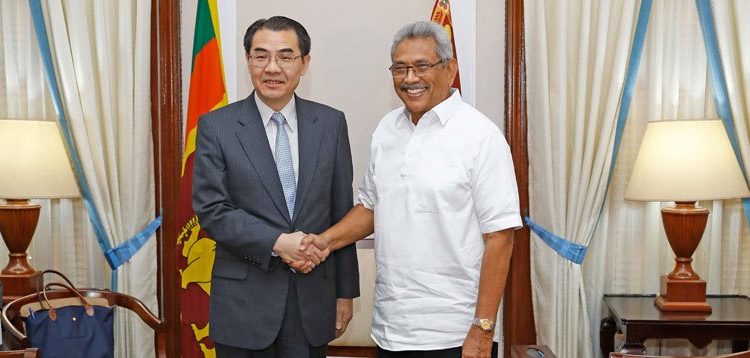
Sri Lanka’s Presidential Election 2019: A New President and the Politics of Balances

December 3rd, 2019

Asanga Abeyagoonasekera Courtesy ISAS,National University of Singapore

Summary

The recent Sri Lankan election witnessed the Rajapaksa brothers – Gotabaya and Mahinda – coming to power. Gotabaya, former secretary of defence and a technocrat with little political experience, was elected president while Mahinda, former two-time president who ended the protracted civil war during his term 10 years ago, was sworn in as prime minister. The new president faces the twin internal challenges of balancing nationalist and liberal values and introducing a new political culture with emphasis on meritocracy and technocracy. On external relations, past Sri Lankan leaders have leaned towards a single power for economic support and this superseded everything else. It will be interesting to see if Gotabaya’s foreign policy will be different from that of his brother and the other leaders, and if he will be able to balance the triple sphere of influence – India, China and the United States – with his ‘neutral’ foreign policy focus.

Introduction

We have not lost in this election. In a way we have won the Southern vote; we just did not receive the votes from North-East and the upcountry… I will ensure I will look after all of you.” These were the departing words of Mahinda Rajapaksa after his presidential loss in 2015. The president who left office came back to power after four years, this time appointed as prime minister by his brother – Gotabaya Rajapaksa – a historical political incident where two brothers share the Executive and the premiership.

In 2015, votes from the ethnic Tamil-dominated former war zone in the north of the country and Muslim-dominated areas played a key role in President Maithripala Sirisena’s victory. It took four years for a Rajapaksa to seize back the top seat by winning a significant percentage of the Sinhalese voter base. The new president, Gotabaya, secured 52.25 per cent of the votes with a 1.3 million lead, a historic victory without many votes from the North-East. As articulated by the newly elected president, I won from the Sinhalese votes; I expected more votes from the Tamil and Muslim community which I did not receive. I want them to join now.” He has appealed to them to be a part of his grand vision to create a prosperous nation with a new political culture, with meritocracy and technocracy emblazed at the helm.

Reasons for Gotabaya’s Victory

There are three distinct reasons for Gotabaya’s victory. First, the Sri Lankan economy has been badly managed and the direct effect of rising costs was felt by the entire country. Second, the flaws in the bipartisan model introduced in 2015, which gradually evolved into a complete loss of mutual trust between the Executive and prime minister. Finally, it was the national security threat that arose from the extremist terror attack on Easter Sunday earlier this year. Following the attack, the people’s trust in the government eroded significantly and reached its lowest ebb when a Parliamentary Select Committee highlighted serious intelligence gaps and administration flaws in the government.

In the 2019 presidential election, Sri Lanka was at a crossroads, pitting the neo-liberals against the nationalists. As a symbolic gesture, the colour of the new presidential flag depicts dark brown, signifying the rich soil of the nation. The values stem from the deep South – the scarf was the symbol the Rajapaksas used to depict their closeness to the soil, and this had much more strength than any other political slogans used by their opponents. I am from a southern Sinhalese Buddhist family and I was educated at a Buddhist school ‘Ananda College’. I will ensure principles of Buddhist values will be at the forefront in my presidency”, said the newly-elected president at his inauguration at the Ruwanwelisaya Buddhist shrine, the place where the ancient Southern Sinhalese Buddhist King Dutugamunu who united the nation left a magnificent edifice to the entire country.

Adopting Global Best Practices

While embracing history is significant, it is also important to explore whether history has punished societies that have not evolved. Alexis de Tocqueville came from another nation to praise America’s embodiment of progressive political ideals. Nations should adapt best practices and embrace the values of progressive development in other nations. Leaders should be quick to adapt best practices and values from them. Many politicians in Sri Lanka’s recent past spoke about bringing inspiration from the Singapore model but their words ended up only as empty promises.

The newly-elected president could enact this change. Perhaps, as a reflection of this change, Gotabaya, within his first week in office, reduced the number of cabinet portfolios and established a committee for future appointments at all government institutional levels.

Sri Lanka’s economic geography matters as much as its political geography. Most past leaders failed to capitalise on the nation’s economic and political geographic significance due to their narrow political principles and their belief in protectionist measures, thereby missing the opportunity to leap forward and be part of the global economy and its value chains. Even Singapore defines her geography by international connectivity.

The balance between national and liberal values is clearly visible in the Singaporean context. Sri Lanka should develop its capacity to concentrate and harness the flows of goods, services, resources, money, technology, information and talent which will make it grow into a large nation, just like Singapore. For this, Sri Lanka has to go beyond the ultra-nationalist spirit to embrace what is out there in the world.

The strategy of the new president comes during the significant time of the 4th Industrial Revolution. The author was present in Davos when Professor Klaus Schwab, Chairman of the World Economic Forum, released his book, The Fourth Industrial Revolution, in 2016, during which time Sri Lanka’s gross domestic product growth rate was at 4.5 per cent. The economy is expected to grow at its lowest rate of 2.7 per cent in 2019. Political instability, followed by a weak security environment, was a significant factor that has pulled the entire country down. When compared to nations such as Bangladesh in the South Asian region, which has managed to stabilise its economy with an eight per cent annual growth rate, the Sri Lankan economy would need a quick recovery, with a particular increase in foreign direct investment inflows.

Value of Democracy and Technocracy

Will Gotabaya be able to manage the delicate balance between ultra-nationalist and liberal economic values? Seen as an efficient administrative technocrat with little experience in politics, will he embrace the values of the rich school of democracy in his government? How will he embrace his brother’s pro-China foreign policy? And will he be able to create a balance between the triple spheres of influence –between India, China and the United States? These are some questions the new leadership will face, and Gotabaya will need to use all of his statecraft to answer them in the coming months.

One significant internal value the new leader may wish to follow is technocracy. Sri Lankans are in search of a better government that could balance democracy and technocracy – an area in which the previous regime failed miserably. The gap was clearly identified by Gotabaya and he has promised a government with values of technocracy and meritocracy under his leadership. In both his election manifesto and at his inaugural speech, these values were re-emphasised by the president.

Technocracy is the model and policy prescription that was put forward as a solution for modern democracies by Parag Khanna, a professor at the Lee Kuan Yew School of Public Policy in Singapore – he published a book on the same subject. He explained that there is a lack of technical experts to solve complex government problems in a democracy. Technocracy, as a form of leading governing practice to efficiently govern a polis (the ideal city), was introduced by the Greek philosopher Plato as the most preferred form of government, which should be led by a committee of public-spirited guardians”. In such a system, the most qualified technical experts are chosen based on merit to govern the nation. This is a model adopted by progressive nations such as Singapore. According to Parag, Technocratic government is built around expert analysis and long-term planning, rather than narrow-minded and short-term populist whims… Real technocracy has the virtues of being both utilitarian (inclusively seeking the broadest societal benefit) and meritocratic (with the most qualified and non-corrupt leaders). Instead of ad hoc and reactive politics, technocracies are where political science starts to look like something worthy of the term: a rigorous approach to policy.” What Sri Lanka clearly needs is to steer in this direction. Indeed, the island state’s new leadership has already recognised the importance of this model. Accordingly, the pubic-spirited guardians” will be chosen to address key complex issues not adequately addressed before.

Foreign Policy Management

Gotabaya is the second leader after Sirimavo Bandaranaike who managed to become the head of state without much political experience. While Sirimavo’s domestic policies had limitations, leading to an erosion of the economy, her foreign policy imperatives were excellent.

On foreign policy, the newly-elected president spelt out his policy in his election manifesto to maintain friendly relations with other countries from a standpoint of equality”, and to adopt a non-aligned policy in all his foreign dealings and work with all friendly nations on equal terms” . His clear position was that, We will not be part of any big power rivalry, we will take a neutral position.” Even before his maiden visit to India, Constantino Xavier, a foreign policy fellow at Brookings India in New Delhi, explained that Gota will play the China card, but Beijing is now less inclined to repeat the large financial investments it did five or 10 years ago, due to growing domestic opposition and international scrutiny.” Further looking at Indo-Lanka foreign policy in the context of the greater global strategy at play in the Indo-Pacific, Xavier stated, Prime Minister [Narendra] Modi’s ambition to shape the Indo-Pacific great game will fail unless he gets Gotabaya to play ball and keep China at bay.” It would be wise for India not to use its closest neighbour in such a manner as described by Xavier, since a strong and deep Sino-Lanka relationship is also an essential element in Sri Lanka’s foreign policy.

China’s deep economic and infrastructure-driven diplomacy on the island state cannot be discounted. From South Asia, Sri Lanka was an initial partner of the Belt and Road Initiative (BRI) – a strategic step taken by Mahinda during his presidency. China’s goals were explained by President Xi Jinping in his congratulatory letter to the newly-elected president: [T]o deepen our practical cooperation within the framework of the Belt and Road Initiative, to start a new chapter of China-Sri Lanka Strategic Cooperative Partnership and to bring more tangible benefits to our two peoples.” During his visit to India from 28 to 30 November 2019, Gotabaya bluntly and rightly expressed the importance of the strategic asset of the Hambantota port leased out to China during his interview: [The] Sri Lankan government must have control of all strategically important projects.” Viewing the lease of the Hambantota port as an unfruitful exercise, he elaborated on its long-lasting strategic implications …these 99-year lease agreements [that the previous government signed] will have an impact on our future.” The Hambantota port and Chinese infrastructure diplomacy have had many concerned that Beijing was indulging in ‘debt diplomacy’. Gotabaya has, however, rejected the claim of a ‘debt trap’ in his same interview—It is also wrong to say there was a debt trap”—and that the Hambantota port was leased out due to the government’s inability to finance the borrowings from the Chinese.

The total Chinese loan percentage is much less than the sovereign bonds and the debt issue is more of a ‘middle-income trap’ rather than a ‘Chinese debt trap’. The country has advanced from a low-income to middle-income status, and no longer qualifies for concessional loans from international institutions. Andrew Small, Transatlantic Fellow at the German Marshall Fund’s Asia Program and a renowned China expert, analysed the Sri Lankan debt trap as a data point rather than a trend”, stating that the perception that China plans to build military bases through debt-diplomacy is inaccurate”.

Having said that, the new president will have to astutely exercise his ‘neutral’ foreign policy posture at a time of geopolitical significance in Sri Lanka’s surrounding environment, especially the Indian Ocean, where neutrality has its own complexity. Sri Lanka should not accept binary choices when it comes to the Indo-Pacific or the BRI. It should be part of both strategies and it should reap maximum benefits for its people.

Conclusion

Gotabaya is seen by the general Sri Lankan public as a leader who is capable of delivering on his promises. During his term, Gotabaya will be faced with the challenge of balancing competing priorities. He needs to introduce technocracy and meritocracy into the country, but he needs to balance this by carefully making deep changes to the existing system. He will need to balance nationalist and liberal policies, adopt best practices that will connect Sri Lanka to the world and make the small island gravitationally a large nation. For this, Gotabaya will need to balance his ‘neutral’ policy stance with regional and global geopolitical dynamics.

….

Mr Asanga Abeyagoonasekera is the Director-General of the Institute of National Security Studies, Sri Lanka under Ministry of Defence. He is the author of Sri Lanka at Crossroads (2019), published by World Scientific Singapore. He studied ‘Adaptive Leadership’ under Professor Marty Linsky from Harvard Kennedy School. He can be contacted at asangaaa@gmail.com. The author bears full responsibility for the facts cited and opinions expressed in this paper.

Repeal of Sections 13 and 19 should be top priority

December 3rd, 2019

By Dr Kamal Wickremasinghe Courtesy The Island

Judging by the post-November 17 political discourse, Sri Lanka seems to be experiencing an ‘outbreak of common sense’. Many worthy proposals, emanating from the grassroots, appear to supplement the new President’s task of repairing the economic, national security and social damage caused by yahapalana incompetence and neglect.

The shift of public attention on to ‘issues that matter’ has been helped by the salutary change in the President’s election campaign that desisted from making constitutional change a key promise. The new politic marked a fundamental change from the yahapalana deception founded on abolishing the executive presidency that meant nothing to the long suffering rural populations. Currently, however, the people seem to be generating their own demands for constitutional alteration in the form of repeal of Sections 13 and 19 Amendments. A careful look at the actions necessary for the correction of historical errors shows it is prudent advice, indeed.

A look at the two subject amendments shows that they share much in terms of political circumstances that led to their introduction, the fundamentally undemocratic processes through which they were enacted, and the adverse effects their operation has had on the country’s economic and political infrastructure and the social fabric. These reasons form the basis for the need for urgent repeal of s13 and s19 Amendments at the earliest opportunity the parliamentary process would allow.

As to the origins, the Indo-Lanka Accord—the source of s13 Amendment— to which Indian Prime Minister Rajiv Ghandi forced JRJ’s hand, on 29 July 1987, at Colombo, following the ‘parippu drop’ earlier, in June 1987, can be considered the final revenge of the Gandhi family on the disdain JRJ showed towards India, in favour of his almost irrational servility to the US. One of the biggest failures of JRJ since 1977—perhaps only second to the invitation he extended to ‘robber barons’—was his failure to gauge the intensity of Indian acrimony towards his behaviour, owing to the fact that the US was the principal sponsor of Pakistan at the time, and was India’s ideological and political enemy. The Accord was also the handiwork of bureaucrats of South Indian-origin occupying the higher echelons of Indian Foreign and intelligence services at the time.

The attempt to abolish the executive presidency, through the 19th Amendment, similarly did not originate from any burning need: it was a political manoeuvre that resulted from the acquiescence among those behind the 2015 conspiracy that the political circumstances created by the 2009 war victory pushed the presidency beyond their reach. The apparent ‘eternal leader’ of the UNP, Ranil Wickremesinghe, had realised that ‘it will be a cold day in Hell’ before he would be able to win an election, and he had plotted to ‘piggyback’ to power on the back of a common candidate—hopefully someone with a support base larger than that of the failed Sarath Fonseka. His strategy was to become PM and to ‘steal’ presidential powers in order to ward off the familiar experience of being sacked by the president. The construction of the 19th Amendment, including the specific ‘anti-Rajapaksa clauses’ designed to dispel the spectre of peoples’ choice, the Rajapaksa family clearly reflected these motives.

The enactment of the two amendments involved identical, glaring abuses of parliamentary and judicial processes—basically designed to circumvent the fundamental democratic requirement of a referendum—putting their legitimacy and democratic credentials in to serious question.

A brief look at the safeguards around the constitutional alteration process in mature democracies shows the corruption of process involved during the enactment of the 13th and 19th Amendments. Practice in such countries, built around the need to prevent Parliament modifying or altering the original provisions of the constitution —the ‘source’ of Parliamentary authority—includes steps designed to ensure rigorous public scrutiny of any proposal. The process in Australia, as an example, requires proposals to amend the constitution originated in parliament a) be passed by an absolute majority and b) submitted to the electors at a referendum through the issue of a writ by the head of state. The voter scrutiny process is further strengthened by the requirement to provide voters with arguments ‘for’ and ‘against’, authorised by a majority of Members of Parliament who voted in favour and against respectively. The proposals require approval by a majority of voters in a majority of the States, and also by a majority of all the voters who voted, if they are to be implemented. In the US, the authority to amend the Constitution derived from Article V of the Constitution requires an amendment be proposed by the Congress (with a two-thirds majority vote in either House) or by a constitutional convention called for by two-thirds of the State legislatures.

In Sri Lanka, the 13th Amendment that established a fundamental change of the state architecture — composed of a unitary government with centralised sovereignty and power as per Article 2 of the 1978 constitution— by the creation of Provincial Councils with powers and functions that intersected, or at best duplicated those of the unitary state, was not subjected to any such scrutiny. It was enacted through deliberate manipulation of the judicial process, and the use of coercion and intimidatory tactics to get the required two-thirds majority in parliament. The nine-member Supreme Court was ostensibly divided along ethnic lines on the issue of the need for a referendum, and the requirement of a referendum was averted by the narrowest of majorities, by deleting the two clauses which Justice Parinda Ranasinghe held to require a referendum. The amended bill was never subjected to a fresh review by the Supreme Court. The Bill was enacted on 14 November 1987 following tumultuous parliamentary process that needs no recounting here.

At a practical level, it was enacted against the will of the majority of the people, expressed in a robust protest movement, resulting in 21 deaths. Importantly, the LTTE and the TULF was never committed to it either, and the Indian effort to forcibly enforce the Accord resulted in the loss of nearly 2000 of their soldiers. JRJ’s cunning and desperation saw ‘devolution’ through the 13 Amendment imposed on all provinces with the intention of portraying it as a national measure rather than a special dispensation for the Northern and Eastern Provinces.

The most compelling reason for the repeal of the 13 Amendment however, lies in its demonstrated total ineffectiveness after three decades of operation, to make an iota of difference to the material well-being of the Tamil people in the North and the East. It has only enabled the rise of Colombo Tamils, with no roots in the North, such as C. V. Vigneswaran to power in the provincial administration by promoting chauvinism, and others such as M. A. Sumanthiran, to fuel separatist sentiments with the hope of political purchase.

The worst effects of the 13 Amendment elsewhere on the country have been to create a ridiculously ‘over administered’ country, creating ridiculously high levels of bureaucrats to population ratio anywhere in the world. Yahapalana minister F. Mustapha’s failed gerrymander nearly worsened the situation. Provincial administrations that simply mirror all central government portfolios and operations in impracticably small patches of land have led to inertia. The operational costs of legislative bodies with fleets of vehicles (and fuel) have worsened the plight of the haemorrhaging national economy. In addition, the political culture created by the Provincial Councils has been at the base of violent and corrupt political culture in the country, not to mention their use as the ‘grooming grounds’ for generational politicians. It has also failed miserably as an alleged exercise in furthering democracy, with the electorate showing far less levels of enthusiasm and participation at provincial elections, compared to presidential and parliamentary elections.

This negative record shows there is no rationale for the continuation of the 13th Amendment farce, and it needs to be repealed after addressing any continuing Indian sensitivities. The prospect of any Indian resistance to correcting this anomaly, however, is unlikely in view of current cordial relations and the President’s stance on devolution that has already been conveyed.

Moving on the infamous 19th Amendment enactment process, it was marked by even worse lack of transparency and public information and similar judicial and parliamentary processes. A so-called Concept Paper and a legal draft mentioned, but that were never officially published prior to the official gazettal on 13 March 2016, limited public access to those crucial documents to glimpses gained through leaks to the media. Similar to the 13th Amendment fraud, the Supreme Court challenge to the amended bill was undermined by the addition of a series of amendments added to the text already before Court. The move was a deliberate act designed to limit the Court’s determination on the need for a referendum on a proposed, unpublished list to be passed at the committee stage by the government, denying the public the opportunity to scrutinise. The Bill was taken up for debate on 28 April 2016 and was passed on the same day, denying the parliament scrutiny.

Section 19 Amendment, it must be pointed out, was one of the two ‘disasters’—with the robbery of the Central Bank—that destroyed any remaining credibility of the yahapalana charade during the much touted 100-day programme. The other positive outcome was that the 1978 Constitution remains strongly presidential, bearing testimony to the legendary ineptitude of the mob.

An analysis of the 19th amendment and its position in the country’s constitutional and legal history cannot be complete without a brief look at the Supreme Court decision (SC FR Application No. 351-361/ 2018) of 13 December 2018 that validated the 19th Amendment merely as an amendment that has limited the powers of the president to dissolve parliament. The Court’s determination however, reflected nothing more than the particular standards and methods, and the guides in particular, used in the particular exercise of statutory interpretation:

The court’s reliance on the chosen authorities (recent editions of Maxwell on the interpretation of statutes and N S Bindra’s Interpretation of Statutes, supplemented by the court’s own authority in Somawathie v. Weerasinghe), would not have yielded any other outcome than the determination it reached. A colonial text such as Maxwell on the interpretation of statutes — a book originally published in 1875, authored by a committed colonialist named Peter Benson Maxwell — was written to convince the British naysayers to colonialism that the intent of all colonial legislations was to benefit the tribe through exploitation of other domains. (In fact, Maxwell’s next book published just three years later, in 1878, was tellingly titled ‘Our Malay Conquests’). Therefore, according to Maxwell, the ‘intent’ is what justifies all legislation. The issue with s19 however, was that its expressed intent was vastly different from its real intent that was Machiavellian.

Fortunately, that particular interpretation is water under the bridge now and repeal of 19th Amendment at the first available opportunity will redress the situation.

China, Sri Lanka to accelerate implementation of cooperation on big economic projects

December 3rd, 2019

Courtesy China.org

China and Sri Lanka have agreed to speed up the implementation of cooperation on major economic projects, the Chinese Embassy in Sri Lanka said in a statement on Monday.

During a visit by former Chinese Ambassador to Sri Lanka Wu Jianghao, who visited the island nation as the representative of Chinese State Councilor and Foreign Minister Wang Yi, China and Sri Lanka have agreed to further strengthen robust political trust between the two countries and upgrade their pragmatic cooperation, the embassy said.

According to the embassy, the two countries will speed up the implementation of cooperation on big economic projects, including the Colombo Port City and the Hambantota Port, under the existing consensus, and on that basis draw up and promote a new blueprint for future cooperation.

Wu, during his stay in Sri Lanka on Sunday and Monday, paid separate calls on President Gotabaya Rajapaksa and Prime Minister Mahinda Rajapaksa and other Sri Lankan leaders.

ERASING THE EELAM VICTORY Part 6

December 2nd, 2019

KAMALIKA PIERIS

Soon after the defeat, in Eelam War IV, the separatist forces went into its next phase of attack, which was UN action against Sri Lanka.  Sri Lanka was to be punished for defeating the LTTE and the LTTE was to be exonerated, using the farce of Human rights”. A separatist war is a political and military matter. It is not a human rights matter. Therefore this approach is very weak. But it was the only avenue available. The Security Council would have rejected the matter outright.

USA and the Tamil Separatist Movement had known well before the war actually ended that LTTE would lose. They had the next move ready, which was to erase the victory by showing the war to be unfair, unjust,    unclean and therefore not a legitimate victory at all.

This was not something that the local Tamil Separatist Movement could handle. It had to be done by the USA.  USA went to the UN Human Rights Council in Geneva with a series of Resolutions against the government of Sri Lanka   in 2012, 2013, and 2014.

  Then came Resolution 30/1 of October 2015, Promoting reconciliation, accountability and human rights in Sri Lanka” ( A/HRC/RES/30/11). This Resolution  was drafted by the US, with, we are told, the concurrence of India and the Tamil Separatist Movement . It was prepared by Ms Sandra Beidas, formerly of the Amnesty International . It was  supported  in Geneva by the Yahapalana government of Sri Lanka , a puppet government supported by the USA.

The purpose of Resolution 30/1 is to erase the   government  victory, and bring the Tamil separatist  matter onto front stage. This Resolution is  therefore an Eelam Resolution”, not a human rights one. It starts be referring to three  matters which are not  relevant to the Eelam War, but are  very relevant  to the Tamil Separatist Movement, namely, 13th amendment,  19th amendment  and the Yahapalana regime change of 2015.

The Resolution then goes directly into the issues relating to  the war  victory. The Resolution implies that the war should not have taken place at all. Tamil Separatism was legitimate .The government of Sri Lanka must  therefore apologize for carrying out a war at all. There should be a commission for Truth, Justice , reconciliation, reparation and non recurrence. The inclusion of the term ‘non recurrence ‘ has not received the attention it should. It means that the state should never again  wage war against the Tamils.

The evidence of victory should be removed as soon as possible. The Resolution speaks of  the removal of high security zones, the withdrawing of the military from the north, return of land held by the military to its owners. 

The Resolution then turns to the conduct of the war. Those responsible for violating the rules of war must be  investigated and punished, said the Resolution.  The Resolution implied that the state army, from top to bottom, was guilty of  massive war crimes. That the government forces were at fault. Eelam War  IV  was  therefore      won by foul means. It is not possible for Sri Lanka to be proud of this victory.  ( Continued)

Adding insult to injury: A response to crooked advice

December 2nd, 2019

By Rohana R. Wasala Courtesy The Island

Latheef Farook, as usual, goes off on a tangent when writing about the alleged ‘plight’ of the Muslim minority vis-à-vis  the Sinhalese Buddhist majority (Muslims expect positive overtures from President’’/The Island/November 27, 2019). The title of the piece implies that the Muslims are experiencing a sense of alienation from the newly elected president, for which he is somehow responsible and must make amends, according to the writer. But this is a baseless assumption. Has the new president said or done anything that causes Muslims to put themselves on their guard against him? No, he has neither said nor done anything like that. Instead, during his campaign, Gotabhaya Rajapaksa made a special appeal to the Muslim and Tamil minority communities to join with the patriotic nonracist mainstream for electing him the president so he could undertake the nation building task. The polarized pattern in the voting seen in the polls results shows that both communities did not respond positively to his cogent appeal for support to the degree he expected, as he frankly conceded after winning the election with a majority of over 1.3 million votes. He said that he knew that he could win by relying on Sinhalese votes alone, but that he wanted the Tamil and Muslim minority communities to be partners with the national victory. Nevertheless, on the occasion of his swearing in at the historic Ruwanveli Maha Saeya, the president elect repeated his urgent request for minority cooperation for implementing the developmental blueprint contained in his election manifesto; he stressed the fact that he is president for all Sri Lankans across the country. Gotabhaya Rajapaksa’s past services performed at the risk of his life and limb benefited all Sri Lankans equally, but he polled only 5% of the minority vote, according to polls analysts. But the principled Gotabhaya, while being known to be a strict disciplinarian and a tough taskmaster as an administrator, is a gracious person. Those who bit the hand that fed them need not fear any discrimination from him (‘I am president for all Sri Lankans alike’). Then, what could be behind LF’s untenable, simplistic claim that ‘Muslims expect positive overtures from President’?

The true situation is contrary to what LF is suggesting. Certain powerful Muslim politicians are under suspicion regarding their alleged close relations with the April 21 bombers and their local leaders, who are trying to radicalize sections of the Muslim youth in Sri Lanka through their fundamentalist Islamic religious ideology. These politicoes were prominent members of the previous UNP/Yahapalana rump government with the kingmaking power that the quirks of an abused parliamentary democratic system conferred on minorities. It was an open secret that the Parliamentary Select Committee (PSC) appointed to look into the bombings was most probably intended to exonerate those Muslim politicians from charges of sponsoring terrorists. 

At a recent news briefing, the CEO of the Bodu Bala Sena (BBS) Dilanthe Withanage, a senior university lecturer in Information Technology and a professional educational consultant to  a number of government agencies over two decades, remarked how a person from the All Ceylon Jamiyyatul Ulama (ACJU), called to testify before the PSC, falsely suggested that young Muslims felt a need to take up arms only after the Aluthgama incident (June 2014). The Aluthgama violence equally victimized both Muslim and Buddhist citizens of the area. But anti-Buddhist propaganda apportioned blame only to his organization, the BBS, and this was what the misinformed and indoctrinated world believed. Actually, the truth was that those riots started when some Muslim youths threw stones from what looked like the roof or upper floor of a mosque at a peaceful Buddhist religious procession passing by (There was a You Tube video to prove this at the time; it may still be there). The demand made by the BBS, other Buddhist organizations, and even separately urged by some sensible Muslim leaders, that a presidential commission be appointed to study the circumstances that led to the Aluthgama episode was not heeded by both the then and the subsequent Yahapalana governments, obviously for fear of antagonizing the ordinary Muslims and losing their votes, by having to reveal the culpability of Muslim extremist elements. (Incidentally, Gotabhaya will not be unnecessarily constrained by this kind of unreasonable concerns.) Anyway, the Ulama representative’s claim at the PSC was tantamount to an attempt to deflect attention from the real culprits behind the Easter bombings (who were none other than Islamic extremists and their suspected patrons then in positions of power).  LF cannot be unaware of these things. He must explain to the reader what made him suggest that the president make ‘positive overtures’ to the Muslims in this context. Let’s hope that LF is not identifying all Muslims with extremism.

What campaigners representing the SLPP assured the masses who demanded that associates of terrorists and vandalizers of forest reserves be NOT accommodated in a future government was that no extremist of any kind should be allowed to participate in it under any circumstances, which is fair enough. Gotabhaya said he would not seek an alliance with extremists or give in to their unacceptable demands even if he had to run the risk of losing the election. He also flatly rejected the thirteen demands put forward by the TNA. Sajith Premadasa (SP) seemed to have secretly agreed to these demands in return for TNA support at the election. Had SP won, this promise would have been fulfilled by now. 

During his first overseas state visit after his inauguration which was to India, President Gotabhaya Rajapaksa made it clear to the Indian Prime Minister Modi, who has been insisting that the 13th Amendment be implemented in full, that the particular amendment was already operational, but that certain clauses such as that relating to police powers could not be enforced without the concurrence of the majority; he was ready to negotiate these. He also pointed out that the devolution mantra repeated over the past seventy years has done nothing to advance the progress of the nation. It must be clear to any doubting Thomas by now that Gotabhaya’s approach will be through equitably distributed overall development for the promotion of which the support of India and other friendly powers will certainly be welcome. He will be mindful of their concerns as well. A politically stable economically prosperous Sri Lanka will be beneficial to all stakeholders, national and global. Gotabhaya Rajapaksa who displayed such self-conviction and courage before the regional superpower on behalf of all Sri Lankans, need not make special ‘overtures’ to the Muslim or any other community for winning their allegiance. He enjoys it already.

While that is the ground reality, LF pontificates: ‘What the Muslims need is for the new government to understand their plight, stop violence against them, and attend to their grievances’. There is no evidence of any violence being done to Muslims by Sinhalese Buddhists or other non-Muslims. Dilanthe Withanage (DW) denied even those long-standing previous allegations that the BBS attacked mosques and other places of worship belonging to non-Buddhists. Such charges were based on fabrications of propagandists. 

By the way, the truth that much violence perpetrated on traditional Muslims involving attacks on mosques, corporal punishments, even illegal executions has been committed by Islamic extremists remains largely unknown outside the immediate neighbourhood of the victims because of fear-inspired communal censorship. This came out during pre-poll electioneering by the parties. The BBS itself established in 2012 and subsequently branded by religious extremists and separatists and their Western sympathisers and sponsors as a violent Sinhalese racist, and Buddhist fundamentalist terrorist outfit (‘saffron terror’) is actually no more than a nonpolitical whiste-blower organization. It is a complete falsehood that Gotabhaya was behind it. Had its numerous revelations been investigated appropriately, the April 21 attacks could have been avoided and those precious lives could have been saved, and the misery of the survivors and their families could have been prevented. It is the violence of the Islamic terrorists against non-Muslims and non-compliant Muslims that LF should worry about, if his own apparent fundamentalist sympathies allow him to do so. 

A couple of days ago there was  news in the free media (Hiru TV) about a young Muslim family being harassed by their Muslim neighbours for voting for Gotabhaya. There have been numerous cases of  traditional mainstream Muslims being persecuted by co-ethnic extremists and these hapless Muslim victims approaching BBS monks for assistance and refuge. Meanwhile hardly any media channels make these things known outside a limited space that is not served by vested interests. The Sinhalese Buddhists being a friendless minuscule global minority have no way to counter the intensely hostile propaganda blitzkriegs directed against them.

Intentionally or unintentionally, LF is contributing to the global media campaign of demonizing the innocent majority community, which is done in order to destabilize the country by inviting foreign interference in its internal politics. Sri Lanka has never had  an ethnic or religious issue. The current problems are inflicted on the Lankan population from outside. The defeat of armed separatism in May 2009 was the brightest moment in post-independence history up to that point. Usual communal harmony had survived a few isolated artificially created communal disturbances like those in 1958 and 1983, and the long drawn out separatist violence of about thirty years that ended in that year. But foreign vested interests started talking about so-called reconciliation. But to justify a need for reconciliation, there had to be prior alienation between the two main communities, but there had been no discernible alienation between Sinhalese and Tamils even at the times of the worst fighting during the civil conflict. So, the powers that be have done what they have done following the 2009 victory, particularly since January 2015. The country experienced the recent anarchy as a result. Ten years after that epoch-making event, we are witnessing the first signs of a fresh national resurgence under an able leader, who will look after the interests of all Sri Lankans, despite the machinations of parochial minority politicians who are now getting alienated from their own people, except for some ineffectual feeble voices raised in their support.    

So, instead of hypocritically calling upon the new government ‘to understand their (that is, Muslims’) plight, stop violence against them, and attend to their grievances’ (which, if any, are actually not caused by Sinhalese Buddhists, but by extremist elements among themselves), LF ought to listen to educated young Muslim leaders like Mohamad Musammil, the media spokesman of the National Freedom Front led by Wimal Weerawansa, and Ali Sabry PC, Gotabhaya’s legal advisor for fifteen years, and  other so many fair-minded young Muslims like them including intrepid young maulavis, and address his intellect and sense of humanity if he has any, to the benefit of all suffering Sri Lankans. 

Disposing garbage along a wall on Sri Lanka’s sea coast – Please rethink

December 2nd, 2019

By Chandre Dharmawardana, Canada

Emeritus Professor Ariyasena de Silva of Moratuwa University, writing in The Island (1st Dec. 2019) suggests the following.

“[making] blocks one metre long and 0.5 m across … outside plastered with a thin layer of cement mortar … Compressing the garbage into a steel casing can also be done with a press made locally. If the blocks are sunk, at about 0.25 km away from the coast where the depth is roughly about three meters, a wall of one to two km in length can produce a land area of 0.25 sq km. Once the wall is built the normal garbage can be dumped as it is collected … It has to be a job lasting several years, but it can be done in smaller sections and the land put to some use. Perhaps (growing) coconuts will be the best. Rainwater storage in the land must also be considered. The equipment can be totally built by our youth … and it may even be possible to grow some leafy food like Mukunuwenna.

Those who value the beauty of Sri Lanka’s beaches will find the proposal quite unacceptable. However, let us examine it further.

The engineering professor was led to this idea because rubble from buildings demolished during World War II were used in building the coast line of the USA. However, since then, our knowledge of the ecosystem and the inter-relatedness of the web of life has grown by leaps and bounds. Various international conventions exist regarding what can be disposed in the sea even within territorial waters.

Almost all countries are party to the “Convention on the Prevention of Marine Pollution by Dumping of Wastes and Other Matter, 1972 (the London Convention) and the related the 1996 Protocol”. These agreements are there because what is dumped in Chennai or New York may have non-local effects even on Sri Lanka’s coasts, and vice versa

Garbage is not some inert material like rubble from demolished buildings. It is a living ecosystem full of microbes and bugs. The microbes are feasting on the bio-degradable components of garbage and producing a lot of greenhouse gases like methane and carbon dioxide. That is why composting which allows such gases to escape into the environment (instead of being harvested) is very bad. Such gases cause global warming. Furthermore, if the garbage is compressed and encapsulated, the aerobic processes become anaerobic, but gases are produced, and the blocks proposed by Prof. De Silva will eventually explode or crack open. Even the garbage compressed inside large open garbage mounds explode from time to time, as has happened several times in Meethotamulla.

Professor de Silva envisions that blocks of encapsulated garbage could be used to form a wall in the sea. From then on, he suggests using the space between the wall and the sea coast as a landfill for garbage where one can eventually plant coconuts and even grow “Mukunuwenna”. Urban garbage is rather rich in metal toxins like cadmium, lead and arsenic, as well as industrial pollutants, petro-chemical residues, excreted or discarded pharmaceuticals, electronic waste etc. If crops are grown on soil containing such rotting garbage, or compost made from such garbage, the toxic substances present therein are also absorbed by the Mukunuwenna or Murunga grown there. There is also a mechanism known as phyto-magnification, whereby the toxins accumulate and concentrate in the crops, sometimes up to a factor of 100 times more. That is, toxins concentrate as you go up the food chain. So, the Mukunuwenna is even more toxic than the soil ecosystem.

Your food is only as clean as the soil and water used to grow crops! Of course, the false propaganda is that all the pollution come from agrochemicals. Actually, such pollution and toxicity from agrochemicals are utterly minuscule compared to that of other sources. However, it makes good propaganda for the “organic food” marketeers who promote their products and cater to the elite, while destroying the agriculture that feeds the vast majority of poor humanity. The Yahapalanaya government followed the appalling agricultural dicta of Ven. Ratana and his minions who claim to get their “science” from God Natha, and banned the herbicide glyphosate in 2015. Sri Lanka’s key agricultural sectors are yet to recover from that crippling blow that cost the country far more than the Bond Scam.

Even if we ignore the agricultural proposals of growing crops on the garbage disposed landfills on the sea coast, the project is destined to fail. As a mechanical Engineer, Prof. De Silva would know that the slow but incessant effect of tides, currents etc., as well as the tremendously variable dynamic loads from waves in monsoonal and inter-monsoonal times will take their toll on the garbage wall. Only strong well-designed breakwalls (aka breakwaters) can face such furious power. Anyone driving along the southern coastal strip of Sri Lanka will know that efforts at controlling sea erosion along those coasts have failed. So, what chance has the proposed wall of garbage against the power and fury of the ocean?

It is most likely that any such garbage-packed wall will disintegrate within a year and spew garbage all along the world famous golden coasts of Sri Lanka. In addition to the irreparable pollution to its own fishery, tourism, its marine-coastal ecosystem, many international treaties of the sea will be contravened.

In Canada and many other countries where the integrity of marine ecosystems have come to be greatly valued, what can be disposed in the ocean are strictly controlled. They are listed in Schedule 5 of the Canadian Environmental Protections act. Some examples of acceptable disposal at sea are:

1. the sand at the bottom of a channel is dredged and disposed at sea to help control rising water levels and increase ship safety.

2. a fish plant in a remote location disposes the fish waste (flesh, skin, bones, entrails, shells etc.) at sea as there is no other option

3. a ship is cleaned and sunk at sea when no ship recycling facility is available

4. a rock slide occurs on a remote road along the coast, and the rocks are disposed of at sea for efficiency in cleaning up the road when the rocks are not a potential risk for the marine environment

5. in a remote rural location, where there is no practical alternative, the offal from disease-free muskox is placed on the ice and allowed to fall into the sea during the spring melt.

Item numbers 2 and 5 show that no rotting matter can be lightly disposed off in the sea.

Mr. Ranil Wickremasinghe severely criticized the Chinese port city project in the run up to the 2015 January election when the Yahapalanites won. But the addition of rubble and sand to the sea in the construction of the port city is not as serious as adding a wall of rotting garbage along the coast, or the ecological dangers of oil exploration in the Mannar basin.

The Yahapalanaites stopped the port city when they came to power; then re-authorized it and even paid heavy penalties for delaying the project. However, perhaps some individuals profited handsomely in the process. Now the port city is being built, giving an opportunity for ecologists who complained about the project to gather daily data on the environmental impact of such construction. There is a dearth of information, especially for tropical waters regarding such projects.

(The author pioneered courses in Food Science and environmental studies during his tenure as a Vice Chancellor and Professor of Chemistry at Vidyodaya which is today’s SJP university. He is currently a Professor of Physics at the University of Montreal, and works for the National Research Council of Canada.)

National Joint Committee letter to President Gotabaya Rajapaksa

December 2nd, 2019

The National Joint Committee

20th September 2019.

His Excellency, Gotabaya Rajapaksa,
President of Sri Lanka,
Presidential Secretariat,
Colombo 1.

Your Excellency,

The National Joint Committee wish to congratulate you on being elected as the seventh Executive President of Sri Lanka. We also wish you every success during your term in office as President of Sri Lanka to implement the election manifesto that you presented to the people. You have proven to be an achiever who has always successfully implemented whatever task that you were entrusted without any fear or favor. We are therefore confident that you will be able to protect and preserve the unitary character of the state, its territorial integrity and the sovereignty of the people of our nation for posterity.

You have unfortunately been elected the President of a country in which people are divided based on ethnicity and religion. One of the reasons for such division is ethnic and religious based party politics. We sincerely hope that you will be able to unite the people of our country by doing away with ethnic and religious based party politics. The other reason that divides the people is the gradual establishment of ethnic enclaves in certain parts of the country. Such ethnic enclave need to be discouraged and an effort needs to be initiated to integrate people of all ethnic groups and religious beliefs in all parts of the country. 

The Indo Lanka Agreement that was forced on Sri Lanka by India through gunboat diplomacy that resulted in the introduction of the 13th Amendment to our Constitution has to be abrogated as the Provincial Councils thus established have proven to be white elephants. Devolution of power as opposed to decentralization of power can even result in the division of our nation.

It is our view that Provincial Councils or similar institutions should never be given legislative powers. We endorse your policy of having one law for the entire nation. Granting legislative power to Provincial Councils would go counter to such policy Therefore legislative power given to Provincial Councils should be removed as a matter of priority. Legislative power should only be exercised by Parliament. Even if Provincial Councils are allowed to remain we are in favor of strengthening the Local Authorities and Provincial Council members to be nominated from the existing Local Authorities thus avoiding Provincial Council elections. Such a move would prevent Provincial Council members being remunerated utilizing public funds.  

The National Joint Committee appreciates your pledge to follow a strictly nonaligned foreign policy. Due to the fact that Sri Lanka is strategically located in the Indian Ocean the country needs to remain nonaligned and refrain from getting involved in the geopolitical confrontation that is developing between America and China, through agreements that would enable these countries to gain a foothold in Sri Lanka. Therefore all bilateral agreements Sri Lanka has signed or propose to sign needs to be evaluated to ensure that our country follows a strictly nonaligned policy. We are very much concerned with the numerous trade and other agreements the Government of Sri Lanka signed or attempted to sign with other countries against our national interests. We therefore urge that Article 157 of the Constitution be further strengthened to ensure that no future Government would enter into such agreements surreptitiously without the approval of Parliament.

Finally we sincerely hope you will take necessary action to enable Sri Lanka to withdraw from the co-sponsorship of UNHRC Resolution 30/1 taking into consideration information available in the Report of the Second Mandate of the Maxwell Paranagama Presidential Commission of Inquiry and Lord Naseby’s discloses to the British Parliament. It is our view that your Excellency as a matter of priority prevent NGO’S both local and foreign from interfering with state affairs. The anti Sri Lankan resolutions and agreements were entered into and numerous legislation enacted to harass our Armed Forces at the instigation of these NGO’S. Therefore we suggest for you to appoint a special Presidential Commission of Inquiry into the conduct of these NGO’S and prevent them from interfering with the affairs of our motherland.   

Yours sincerely,

Anil Amarasekera/-

Lt Col,A.S.Amarasekera.(Rtd.) 

Co-President.  

THE CASE FOR REPARATIONS

December 2nd, 2019

Yesterday I stood in the hall of the Durham Union to argue for the proposition: This house believes Britain owes reparations to its former colonies”. The following is the text of my ten-minute speech, followed by five brief reflections on the opposition’s arguments.

I still remember the first time I taught colonial history at the LSE.

LSE students are among Britain’s finest: they graduate from top schools, perform brilliantly on their A-level exams. And yet when I gave a lecture about the Indian famines of the late 19th century to a classroom full of third years, I was met with blank stares. As a direct result of British policy, 30 million Indians died needlessly of hunger between 1875 and 1902.  Laid head to foot, their corpses would stretch the length of England, from Dover to the Scottish borders, 85 times over.

No one in the classroom had ever heard of it.

And this tragedy was not an isolated incident. There were many more.  The Great Bengal Famine in 1770 killed 10 million people, one third of the region’s population. Here too historians blame British policy: brutal tax collection, enclosure of forests and waterways, forcing farmers to rip up their rice to plant crops for export. Similar policies imposed over the following decades claimed the lives of another 22 million people, all while record agricultural exports were being siphoned away to London. 

Historian Mike Davis has famously likened these famines to the holocaust. And yet the corpses that the British left strewn across India have been almost entirely forgotten. Tell me: would we ever tolerate such amnesia when it comes to the crimes of Nazi Germany? Never. Any such ignorance is rebuked, and rightly so. Yet when it comes to the crimes of the British Empire, an insidious form of holocaust denialism vipers right through our culture.

While he was Prime Minister, David Cameron went on record saying: There’s an enormous amount to be proud of in what the British Empire did.”  Why?  Because the British brought development” and whatnot.  Or so the argument goes.

But there isn’t a shred of evidence to back this up. During the entire 200-year history of British rule in India, there was zero increase in per capita income. In fact, during the last half of the 19th century—the heyday of British intervention—income in India collapsed by half. The average life expectancy of Indians dropped by a fifth from 1870 to 1920.   

India wasn’t developed” under British rule – it was de-developed.  And not just in terms of social welfare.  British policy was designed to destroy India’s domestic industries by imposing asymmetrical tariffs, by dismantling the institutions that trained up producers, and in some cases even by maiming skilled artisans – all to create captive markets for British goods.  During the course of British rule, India’s share of the global economy shrank from 27% to 3%.

Yet despite this litany of violence, a recent YouGov survey found that 80% of Britons do not regret colonialism. 44% are actively proud of it.  How is this possible? I hear it all the time: pundits and politicians arguing that colonialism brought democracy, property rights, rule of law, railroads…

What a strange twist of reason this requires.

Democracy? British rule was dictatorship!  Africans and Asians struggled and bled for the right to vote in their own countries.  Property rights? The whole point of colonialism was dispossession—securing the rights of the colonizers to the property of the colonized: land, gold, diamonds, taxes, even the bodies of the colonized themselves. Rule of law? The object of colonial legal codes was to deny equal rights to colonial subjects.  And India’s railroads were used to pump resources—grain and timber—out of the hinterlands to the ports for British use.

Even if we accept that useful things were shared during colonialism – universities, for instance – that is not the same as saying they were a benefit of colonization. Colonialism is not a necessary vector for the transfer of knowledge or technology. Britain has long enjoyed the Arabic numeral system, algorithms, and even algebra itself, without ever submitting to Arab invasion. It takes a warped mind to believe that the best way to share ideas with other humans is to colonize them.

But we have barely scratched the surface.  Let’s not forget that Britain’s first forays into colonialism were linked to the consummate expression of barbarism: the Atlantic slave trade. 300 years of state-sponsored human trafficking. 14 million souls shipped across the sea. Countless bodies shackled to British plantations and churned into the sugar and cotton that fueled Britain’s industrial rise. 

And yet in the book I was made to read to become a British citizen, this long, dark history was reduced to three sentences. You can visit Glasgow, Bristol, London, Liverpool and every other British city that grew rich on the slave trade without encountering a single memorial.  Denialism vipers through our culture.

We could spend all night listing off Britain’s crimes against humanity.  But that is not the point I want to make. This is not just about a list of crimes. The denialism runs much deeper than that. 

You see, we have this story we tell ourselves, that Britain’s crowning moment of greatness, the Industrial Revolution, emerged sui generis from within Britain’s borders – robust institutions, good markets, advanced science and technology.  This is the story that’s written into our children’s textbooks: we must all be proud of Mr. James Watt and his inventions. 

But scholars remind us that there is much more to the story than we are normally told.  From historians like Sven Beckert, Kenneth Pomeranz, Ellen Wood, Parthasarathi and Karl Polanyi, the evidence is clear: the Industrial Revolution was built on state violence, slavery and colonization. Britain’s economic rise depended on cotton, sown and harvested by enslaved Africans on land expropriated from indigenous Americans; depended on the theft of agricultural products from Indian farmers; and depended on the forced de-industrialization of Asia.

But, I can hear you say, that was all in the past.  It ended more than 70 years ago. Things are different now. 

Are they?  Only if you’re willing to forget what happened afterward.  Only if you’re willing to forget the British-backed coup that deposed Mohammed Mossadegh, the first elected leader of Iran, when he tried to regain control of the country’s oil reserves from Britain.  Only if you’re willing to forget the British-backed coup that deposed Kwame Nkrumah, the first elected leader of Ghana, when he sought to reduce his country’s dependence on British imports.  Only if you’re willing to forget the structural adjustment programs that Britain helped impose across its former colonies in the 80s and 90s, one after the other, reversing the progressive policies of the postcolonial era to restore British access to cheap labour, raw materials and markets, devastating the livelihoods of ordinary people in the process, adding hundreds of millions to the ranks of the poor.

But we’ve forgotten all that.  And we’ve forgotten much more besides, including things that are happening right now.  We’ve forgotten that the City of London operates at the center of the world’s tax haven network, which helps facilitate illicit financial flows that cost the South more than $1 trillion per year.  Colonialism may be over, but the system that it created – a system designed to siphon wealth from South to North – remains very much in place.  The word reparations” suggests that the problem is in the past.  It is not. 

Frantz Fanon had it right when he wrote, in Wretched of the Earth, that Colonialism and imperialism have not settled their debt to us once they have withdrawn from our territories. The wealth of the imperialist nations is also our wealth. Europe is literally the creation of the Third World.”

So go ahead – I challenge you: chalk up the billions of hours that enslaved Africans worked on British plantations, pay it at a living wage.  Tally up compensation for the 60 million souls sacrificed to famine for the sake of British surplus.  Boost it all by 200 years of compound interest, and add that to the trillions lost during structural adjustment and the trillions more in stolen cash that flows through Guildhall.  Try it.  The numbers begin to swell.  They rise like a chorus of voices from the forgotten corners of our past. They march like an army of ghosts who demand a reckoning. 

And then it strikes you…. Then it strikes you that there is not enough money in all of Britain to compensate for these injustices.  And you realize, that if Britain paid reparations – real, honest, courageous reparations – there would be nothing left.  Britain would not exist.

And that is exactly what people find so terrifying about the question of reparations.  It’s not that they fear the actual prospect of paying.  It is that even just thinking about what is owed reveals the hard truth: that what is owed, is everything. 

But really, this is not about the money.  This is about something far more important… this is about the story.  The real reparations we need are narrative reparations.  So this is what I ask of this house tonight – that we demand, at minimum, repair of the broken story we tell ourselves: an end to the denial that has festered among us for too long.  Let us demand the truth be told in our schools and in our town halls. Let us demand that alongside every statue celebrating Victoria and Churchill there be memorials to their victims. Let us demand that the real story of Britain’s rise be worn like poppies upon our breasts.

As Aime Cesaire put it, A nation which colonizes, a civilization which justifies colonization, is a sick civilization, a civilization that is morally diseased.”  So what is at stake here, in the end, is not only justice for the dispossessed, but Britain’s own healing.  Britain’s own humanity.  To repair this broken story will cost you nothing, and yet you have everything to gain.

https://www.jasonhickel.org/blog/2018/10/13/the-case-for-reparations

SUBMISSION OF TRUE AND ACTUAL INFORMATION TO CORRECT THE “EVER REPEATING FALSE INFORMATION IN THE SOCIAL MEDIA REGARDING THE NEW CHUDA MANIKKYA ( PINNACLE ) THAT WAS PLACED UPON THE SWARNAMALI MAHA SEYA

December 2nd, 2019

PRESS RELEASE

TRANSLATION

The brand new Chuda Manikkya (Pinnacle) of Swarnamali Maha Seya was caused to be specially designed, crafted and made and placed on the November 25th 2019 along with the unveiling of the newly Gold Plated Koth Wahanse (Dome) on the 26 the November, through the guidance and employing the full and sole financial donations of the founder of the Vishwa Parami Trust, Mr. Prabath Nanayakkara. He is the fourth generation grandson of the great philanthropist, Ransirinel Kumarasinghe of Averiwatte, who initiated the major restoration of this Maha Seya in the late 18th Century, through the Chaithya Development Society” of which he directed and implemented activities as the Chairman.

The Chuda Manikkya being such a unique and reverential object was especially made using Crystal a most expensive and rare mineral and the difficult and very exacting task of crafting it to the highest perfection was entrusted to the World’s premier specialist organization in this sector, SWAROVSKI” of Austria, who in turn did so using the most modern and sophisticated tools and technology and utilizing the best Master Craftsmen in the trade.

I thus reiterate and confirm once again, that the Chuda Manikkya (Pinnacle) placed on the Swarnamali Maha Seya on the 25th November 2019, among the incantations of rejoice of many lakhs of devotees is this very same Chuda Manikkya described above, which was donated to Buddha Sasana with great veneration and purity of purpose by the said Vishwa Parami Trust using entirely its own financial resources and utmost devotion.

Signed/-

Venerable Pallegama Hemarathana Thero

Chief Incumbent Swarnamali Maha Seya

Britain and Post (sic) Colonial Skullduggery

December 2nd, 2019

Malinda Seneviratne

A few weeks ago, indigenous leaders from Australia visited the Manchester Museum. They went there to collect various sacred ceremonial artifacts which were said to have been ‘taken without permission’ by early 20th Century British colonialists.
Danny Teece-Johnson, a journalist for Australia’s National Indigenous Television, had an interesting comment on the language of extraction.
‘You’re saying borrowed, you’re saying this and that. Nah, let’s talk about the white elephant in the room: you stole it, you took it without permission, that’s theft. If you did that these days, you’d get put in jail for it.’
Language is cute and few are as cute about its use than the British and of course the country which borrowed their language and perfected the art of political cuteness, the USA. Countries are never invaded, they are ‘democratized.’ The victims of terrorist attacks launched by such countries are not people, they make up ‘collateral’. Land theft never happened. Resource plunder? Never happened. Cultural genocide? No. Mass slaughter? What? That’s called ‘civilizing’. A good thing, surely?  
Now around the same time or a few days after the above return of stolen goods, the University of Edinburgh, in a moment of insane generosity, returned nine skulls to Uruvarigaye Wanniyalaetto. The skulls are supposed to be more than 200 years old and are thought to be those of Wanniyalaetto’s ancestors.
Nice. Let’s say ‘Thank you, thanks for the kind and generous gesture.’
Alright. Enough applause. Let’s talk of skulls and skullduggery, taking without permission and outright theft. In 1974, P.H.D.H. De Silva published a book titled ‘A catalogue of antiquities and other cultural objects from Sri Lanka (Ceylon) Abroad.’  There are over 15,000 items listed. Remember, these are thefts that have been recorded and stolen goods that are given names, numbers and catalogued. They have ended up, as far as we can say with absolute certainty, in 23 countries and 140 holding facilities. This is not counting gene piracy and post-colonial extraction, let us not forget. The vast majority of the artifacts listen in the book are in Britain. Bristol, Cambridge, Edinburgh, Glasgow, Berkshire, Leister, Liverpool, London, Sheffield and Windsor are among the cities mentioned.
And they return nine skulls!
So we say ‘Thank you,’ and think ‘Such lovely folks.’ Well, Wanniyalaetto has stated that the lovely folks in Manchester had told him there were 14,000 more skulls and bones. Apparently they are to take steps to return them as well.  If you clapped once for the nine skulls, you would have to clap 1555.5 times if/when these other bones are returned. 
Now this stuff is not new. Eight years ago, almost to the day, i.e. from September 14 to November 24, the British Council in Colombo arranged a traveling exhibition of artifacts. It was called ‘A Return to Sri Lanka.’ That’s tongue-in-cheek that was lost on one and all, indicating how sycophantic we have become. The following was the blurb advertising the event: ‘…covers nearly 300 years of the country’s history through 150 digital facsimiles of materials from major British collections, including maps, manuscripts, prints, drawings and photographs as well as other artifacts’. 
The first question: ‘Only 150?’ Wear an expression of incredulity as you ask it. Second question: ‘Facsimiles?’ Whatever expression you wear it should indicate the words used to camouflage without really wanting to, i.e. ‘What the flower?’ 
The then Country Director of the British Council, Tony Reilly, called the exhibition ‘a partnership event.’ The purpose, he claimed, was ‘to share it, to experience, to enjoy, to argue and talk about 300 years of cultural diversity described in each piece.’ He left out ‘theft’. He left out ‘butchery’. He left out ‘genocide’. That’s par for the course, of course.
That exhibition was interestingly funded by the World Collections Program. Well! Let’s talk ‘collections’.  
In August 2018 the British Museum decided to return to Iraq eight 5,000 year old artifacts looted following ‘the fall of Saddam Hussein’ as they reported it. Fall, huh? Ha! Apparently the objected were seized by police from a London dealer in 2003 and had been in the hands of the state for 15 years before being identified as having been extracted from a site in Tello in southern Iraq. The Director of the British Museum Hartwig Fischer said at the time that the institution was ‘absolutely committed to the fight against illicit trade and damage to cultural heritage.’
Wow!
He missed this important point: Britain is the product and the repository of illicit trade (sanitized term for ‘plunder’ in the lexicon of British Apologetics).
Britain’s partners in crime in this business across the Atlantic, the USA, uses the same kind of language. In September 2019, US authorities returned a stolen coffin to Egypt, two years after it was acquired by the Metropolitan Museum of Art in New York City. The 2,100 year old coffin of a priest called Nedjemankh had been featured in a exhibition of artifacts from Egypt. Apparently it had been looted and smuggled out of Egypt in 2011. Manhattan District Attorney Cyrus Vance, speaking at a repatriation ceremony, opined that this was one of hundreds of antiquities stolen by the same ‘multinational trafficking ring.’
Multinational trafficking ring! That’s a descriptive worth holding on to. That’s what colonial rule was all about, wasn’t it? That’s what’s happening even now, isn’t it? Wars are not about democracy, resolutions are not about human rights. It’s about creating conditions (including the support of or installation of pliant governments) for the highly profitable business of plunder. Land, oil, strategic geographies, water, genetic resources, you name it, it’s all ‘open to exploration,’ let’s say.
What’s the market value of nine skulls? What’s the market value of 300 facsimiles compared with that of the originals? Of course, the curators of museums and custodians of other ‘collections’ didn’t kill anyone or rob things. They are, however, holding on to stolen goods. There is no talk of returning these to the descendants of those who were robbed and probably killed in the process as well.
And it can’t start and end with artifacts. Yes, it is hard to ascertain the true value of everything that was stolen and even more difficult to obtain the true cost of the damage in terms of cultural erasure, destruction of livelihoods and lifestyles, forced dislocation and all the trauma that was part of such things.  Britain is reported to have paid out 20 million sterling pounds to slave owners in the colonies of the Caribbean, Mauritius and the Cape of Good Hope as per a census on owners as of August 1, 1834 under the Slave Compensation Act of 1837. Words! It was not the slaves who were compensated but the slave-drivers!
That’s a benchmark. Contrary to the Anglophiles in Sri Lanka, who get nostalgic about a ‘British Rule’ that took places long before they were born, and who talk about roads, railways and such, the truth is that the British were out and out brigands.  They didn’t build roads and railways. A subjugated people’s labour is congealed in all that was built with money extracted through brutal systems of taxation (without representation, mind you!). In addition to mass slaughter, they destroyed temples (and built churches on their foundation — ‘to civilize the heathens!’ Yeah, right!)  and either burnt or robbed countless invaluable Buddhist manuscripts. Yes, we can add the theft of intellectual property to artifact theft, resource extraction, labor exploitation and gene piracy. If the British could quantify and compensate slaves, we could quantify reparations for colonial plunder.
And they return nine skulls! Did someone say ‘Hooray!’?
There are no facsimiles of the blood they spilled, the tears shed, the screams before butchery. No facsimiles of villages torched and children killed. No facsimiles of temples razed to the ground or forests cleared (and the timber shipped out) for coffee and tea. And it’s not facsimiles of artifacts and manuscripts that are now housed in the British Library, the Victoria and Albert Museums, the Natural History Museum in London and other loot-holding facilities. 
Eight years ago, when the British Council was bragging about facsimiles, a friend offered the following: ‘they fokkin’ brazen aint they? so let’s see, they steal and then show us pix of what they stole but wont return? No one asking for reparations or loot? Is there a catalog of the stolen in collections? Is Keppetipola’s skull still in Scotland?’ And I wrote, ‘This is not a return” to Sri Lanka.  This is about slapping one cheek and slapping the other too for good measure.  Returns that can be Xeroxed” sums up the season of plunder that does not seem to have ended after the British left”.   They could return what they robbed and keep the facsimiles in their collections, after all. 
But they’ve returned nine skulls! Hooray!
But then again, they’re refusing the return the Chagos Islands to Mauritius despite an advisory opinion issued by the International Court of Justice (ICJ). The archipelago is now the site of the US military base in Diego Garcia. And the USA, which just the other day threatened to arrest and sanction judges and other officials of the International Criminal Court if it moves to charge with war crimes any US citizen who served in Afghanistan, would probably thumb its nose as the ICJ if it ‘tried to be funny’.  
Well, funny is the word. It’s hilarious. 
They returned nine skulls. I could die laughing.  EXCEPT, it is no laughing matter.  It’s skullduggery in cute form indulged in by multinational artifact traffickers. 
Danny Teece Johnson was correct. They should all be serving time in prison, these do-gooding, skull-giving beneficiaries of skullduggery. 
Skulls. Indeed! 
READ ALSO: If the Common-Welt is to be erased…Returning facsimiles of loot does not compensate, sorry
malindasenevi@gmail.com

MCC Sri Lanka Land Compact: Avoid it being a ‘Grant Trap’

December 2nd, 2019

By Prof. Nimal Gunatilleke Courtesy The Island

December 1, 2019, 9:10 pm

article_image

After the release of the ‘Executive Version’ of the Millennium Challenge Compact, between the United States of America (acting through the Millennium Challenge Corporation) and the Socialist Republic of Sri Lanka (acting through the Ministry of Finance), and its accompanying ‘Constraints Analysis’ document on the website of the Ministry of Finance of Sri Lanka, in early November, a number of reviews are beginning to appear, on public websites on its benefits (some organized by pro-US think tank, Advocata Institute) as well as those on likely disadvantageous, or detrimental impacts.

This is, indeed, a healthy trend for the conscious public to get a balanced understanding of this compact. This is specially so because the ACTA, SOFA and MCC agreements are considered together by some critics as ‘Unholy Trinity” during the period leading to the recently held presidential elections, in Sri Lanka.

However, some of these reports seem to have thrown the baby with the bath water, while the others apparently have strived to keep the baby with the bath water. Although there were many politically charged report, from both sides, I was able to read only a very few essays which have specifically addressed the substantive technical issues of the MCC Sri Lanka Compact draft agreement – the executive version available on the Government websites.

Having written two reviews on the MCC Sri Lanka Compact earlier on (The Island, 03 May, 2019, and 15 July, 2019) before the release of the above agreement, I now wish to add my own perspective on some substantive technical issues, specially in relation to environment and socio-cultural impacts of the proposed Land Compact of the MCC, in addition to addressing related sovereignty issues which were also raised by some other writers.

Almost all the concerns have been raised on the Land Compact rather than on the Transport Compact of the MCC. However, both have been prepared on the strength of an independent Constraints Analysis Report, assimilated using a threshold grant and submitted in 2017. Interestingly, it was prepared using a ‘Growth Diagnostics’ model (developed by a Harvard University research team) which is ‘predicated on the idea that wholesale policy transformation into a western-style market economy may be excessively burdensome and even counter-productive for poor countries to prioritize challenges to a country’s development’.

According to this economic model, the ‘idea that wholesale policy transformation into a western-style market economy’ (meaning a lead to a ‘grant trap’?) need to be avoided. Instead, the model proposes that a country should conduct a diagnostic assessment, concentrating on the policy reforms necessary to achieve economic growth which should be less burdensome in addressing the challenges facing a country’s development. I wish to examine the documents, available to us on public media, in the light of the above statement of the Growth Dynamics of the MCC Sri Lanka Land Compact.

There are also a number of critical assessments of the MCC Compact programme, by independent international scholars (https://www.tandfonline.com/doi/abs/10.1080/01436597.2017.1401463?scroll=top&needAccess=true&journalCode=ctwq20), as well as those who had been associated with the programme since its inception two decades ago reflecting on their personal experiences in handling these compacts worldwide (www.CarnegieEndowment.org/ pubs; https://fas.org/sgp/crs/row/RL32427.pdf ). Also there is a recent review on ‘Millennium Challenge Corporation: Overview and Issues’ published by the US Congressional Research service, prepared for Members and Congressional Committees (https://crsreports.congress.gov/

RL 32427), updated on 03 October, 2019. These are freely available on the web and I have taken those also into consideration during the preparation of this essay.

Sustainable Economic Growth

At a time when the United Nations is assertively promoting ‘Sustainable Development Goals’, worldwide, the ‘economic development and economic growth’ referred to in this nationally important MCC Sri Lanka document with far reaching consequences, we hope that the Compact – the Land Compact, in particular, – is very sincerely aligned with the ideals of the UN Sustainable Development Goals (SDGs) which Sri Lanka is legally bound to implement.

The SDG No. 08 says – ‘Sustainable economic growth will require societies to create the conditions that allow people to have quality jobs that stimulate the economy while not harming the environment. Job opportunities and decent working conditions are also required for the whole working age population. There needs to be increased access to financial services to manage incomes, accumulate assets and make productive investments. Increased commitments to trade, banking and agriculture infrastructure will also help increase productivity and reduce unemployment levels in the world’s most impoverished regions’.

The overall MCC Compact Goal in Section 1.1 of Article 1 says ‘ The goal of this Compact is to reduce poverty through ‘ economic growth’ in Sri Lanka. MCC shall provide assistance in a manner that strengthens good governance, economic freedom, and investments in the people of Sri Lanka’.

To what extent the factors contributing to the ‘sustainability’ of the proposed economic growth models have been taken into consideration, in the preparation of successive scorecards for Sri Lanka from 2016 -2019 (under Good Governance??), need to be explained to reassure the Sri Lankan public of its alignment with the SDGs and accompanying green growth.

The MCC claims that it has formally adopted the International Finance Corporation’s ‘Performance Standards on Environmental and Social sustainability’ and once again we sincerely hope that the ‘economic growth’ in the Article 1 of the MCC Compact agreement, refers to ‘sustainable economic growth’, recognizing Sri Lanka’s alignment with the relevant SDGs and Aichie Biodiversity Targets, while being a Global Biodiversity Hotspot.

It is my view that this aspect should be further developed before signing the agreement, through the engagement of forums of Sri Lankan professionals familiar with the current trends in the MCC performance Indicators on 1. Ruling Justly, 2. Investing in People (e.g. Natural Resource Protection and Health Expenditure) , and 3. Economic Freedom (e.g. Land Rights and Access) which were used in the preparation of Constrains Analysis Report (2017) for Sri Lanka. Most of these documents being under preparation since 2016, they caught the public attention that they deserve, only a few months ago.

Country Reports vs.
Reports in scorecard
preparation

These scorecards, on which the Constraint Analysis most likely have been prepared for the country as a whole, have been sourced from the country reports prepared by the WHO, Columbia Centre for Int’l Earth Science Info Network/ Yale Centre for Env. Law and Policy (CIESIN/YCELP) – and IFAD/IFC. It is not clear as to what extent these indicators have been scored in a sub-regional context of the targeted seven districts of the MCC Land Compact.

In Sri Lanka, climatic and associated socio-cultural-livelihood contrasts are clearly evident in the seasonal South-west and the 1.seasonal rest of the country. As such, land rights and access (e.g. cascade irrigation systems – a Globally Important Agricultural Heritage System), 2.) natural resource protection (e.g. Global Hotspot of Biodiversity, ecological corridors for megafauna, riverine forest formations) and 3.) Health expenditure (resulting from severe agro-chemical pollution e.g. CKDU) particularly in Dambulla, Anuradhapura, Polonnaruwa and Trincomalee regions need to be analyzed separately to achieve more robust scorecards using local expertise leading to the preparation of the Constraints Analysis report thus aligning with the relevant SDGs.

Based on the Constraint Analysis Report prepared by the Government of Sri Lanka and the MCC (in partnership with Harvard University’s Centre for International Development), three binding constraints acting as most severe hindrances to economic growth have been identified;

1. Policy uncertainty, especially regarding revenue collection and tax policy;

2. Transport bottlenecks, particularly in the Western Province; and

3. The difficulty of the private sector in accessing land for commercial purposes.

Large-scale Commercial agriculture vs. Cascaded Tank-Village Systems – Ellangawas

As I said at the beginning of this essay, much of the criticism has come in respect of the land compact, which apparently is paving way for removing constraints on accessing both government and privately owned land in the above districts of ‘Wew bendi Rajya’ – ancient agricultural heritage of ‘reservoir kingdom’. The constraint analysis seem to have taken in to consideration both the distribution of small tanks and river basins (Figure 6.1 of the Constraints Analysis Report – page 34) in their planning exercise and the maps included therein acknowledged as those from IWMI and CGIAR are reproduced here.

Figure 6.1 of Constraint Analysis Report – River Basins and Locations of Small Tanks in Sri Lanka reproduced together with map representing areas of CKDu Prevalence (from Govt. sources)

As evident from this figure, most of these small tanks, the very foundation of the ingenious ancient irrigation system ensuring landscape and livelihood security to local populace, are concentrated within the districts that are being apparently considered for medium and large-scale private sector development projects. These Cascaded Tank-Village systems or ‘ellanga gammana’, master-pieces of sustainable irrigated agricultural systems have been designated as ‘Globally Important Agricultural Heritage System (GIAHS) by the FAO of the United Nations in April 2018.

The disused or abandoned cascade systems of Anuradhapura, Polonnaruwa, Matale and Kurunegala districts are being systematically restored at present with both national and international sources of funding. These landscape restoration initiatives are being considered as a solution to climate change adapted agriculture and also to reduce heavy agro-chemical pollution that has knocked down the backbone of the traditional agricultural heritage of these rural communities. As such, they have been given high priority by the Government for their rehabilitation.

The Constraint Analysis of Sri Lanka Compact is very critical on the restrictions on land parcel size, the absence of land titles, and longstanding laws affecting rural land use all it claims to reduce agricultural productivity and rural well-being. It goes on to say that unlike other comparator countries, Sri Lanka restricts private ownership of agricultural land to 50 acres per person, which obviously prevents economies of scale from being realized in the case of large private sector agricultural investment.

Our concern is that how the privately driven medium and large scale commercial agricultural (or other industrial) enterprises proposed in the Land Compact could be realistically super-imposed on these sophisticatedly designed small holder-dominated traditional agricultural landscape mosaics.

Medium and large scale commercial agricultural enterprises, usually taking to cultivation of a few commercial crops of promising export markets, are reputed to be aiming at maximizing their profits while externalizing their environmental and social costs. There is already evidence from some of the already established commercial plantations in these areas, that the water availability for small-scale farming communities being reduced as a result of competition for water at the same time contributing to increasing ground water pollution from heavy use of agrochemicals in these commercial plantations.

Issues of this nature should be resolved before the agreement is signed. A case in point is reported in the evaluation brief on the implementation of the Moldova MCC Compact, titled ‘ Removing barriers to high-value agriculture in Moldova’.

Evaluation brief of the Moldova compact is indeed an eye-opener for Sri Lanka, thus avoiding it being a ‘Grant Trap’.

($259 million from 2010 – 2015 – file:///D:/Ecosystem%20Services%20&%20their%20valuation%20-%20MCC/2019%20-%20MCC/Economic%20value%20of%20land%20-%20%20MCC/Oct-Nov%202019/Moldova%20compact%20-%20evalbrief-20190022199-mda-agriculture.pdf)

Under ‘MCC Learning’ section of this Moldova compact evaluation, the Evaluation Brief goes on to say the following: ’Instead of rebuilding old Soviet irrigation systems, designed to irrigate large areas of land, irrigation systems could have been designed better to serve the existing situation in Moldova, where many farmers have small plots of land and are hesitant to cooperate. Greater farmer consultation in the design phase would have facilitated understanding farmer needs’

Therefore, modernization of ancient irrigation systems in the ‘wew bendi rajya’ in North Central Sri Lanka by introducing innovative technologies and management practices of organic agriculture including inland fisheries redevelopment into small-holder farming community programmes, could be considered as promising private sector ventures as opposed to large-scale high through-put commercial agriculture.

Designing a judicious blend of these widespread traditional agricultural systems, with modern innovative technologies incorporating the updated MCC Environmental Guidelines, would, indeed, be a challenge under article 2.7c of the MCC Sri Lanka Compact Agreement. Some local enterprises are already engaged in such organic agricultural ventures by regrouping marginalized local farmer communities to produce environmentally certified products and purchasing them at a premium price for export.

Economic Corridors

There are a number of punching and counter-punching bouts on the issue of developing ‘economic corridors’ under the MCC Sri Lanka Land Compact. As I mentioned in my earlier articles in The Island (May 03 and July 15), the spatial space of the MCC Sri Lanka Land Compact is in most part overlaps with that of Colombo – Trincomalee economic corridor development project of the then Megapolis Development Ministry, in accordance with the new National Physical Plan 2050.

Under Section 2.6 of the MCC Agreement (Government Resources; Budget), it says that the Government shall not reduce the normal and expected resources that it would otherwise receive or budget from sources other than MCC for the activities contemplated under this Compact and the Programme. This means, at least to me, that although the MCC Sri Lanka is not involved in designing an economic corridor from Trincomalee to Colombo, its program activities complements with those of the Megapolis ministry and the denials of an economic corridor by MCC is no more than a matter of political and diplomatic squabble.

Interestingly however, the first economic corridor for this region has been proposed almost a half a century ago as reported by the eminent town and country planner, Prof. Willie Mendis, in 2009. Even at that time, about 3/4ths of development and economic growth stemmed from a 50-mile wide corridor formed between two lines connecting Chilaw—Kuchchaveli, and Bentota—Katankudy. Accordingly, the corridor was clearly identified as the stomach or ” belly” for powering Sri Lanka’s economic growth and development. At that time it held about 70% of Sri Lanka’s population, and 35% of its land area. (Figure 2).

Prof. Willie Mendis’s following comments on the Colombo – Trincomalee economic corridor is even more valid in today’s context, if judicious sustainable development programs taking lessons from the environmental and socio-economic sustainability outcomes of Mahaweli Development Project could be designed to suit the needs of the 21st century in a country driven primarily by a small-holder economy:

‘Colombo’s primacy has been considered to be overwhelmingly biased towards further polarization of development in the south-western seaboard of the island. This situation favored the shift of policy to the provinces beyond the west end. Its centerpiece was the multi-purpose Accelerated Mahaweli Development Project which embraced a large spatial envelope in the north-western and north-central provinces of the country. The telescoping of its completion, in 1978, to six years was an impetus for spatial planners to propose it’s integration with the Colombo—Trincomalee Development Axis.

However, for whatever reason, this did not happen, and its missed opportunity is now history. The downside was the relegation to the backburner of it’s strategic component of constructing a rapid transit connection between Colombo and Trincomalee, through the aforementioned ” belly”. Its route trace offered the potential for triggering the spread of development activity in the north and south of the country. Its envisaged spur on the Habarana-Vavuniya-Jaffna route was an opportunity to transform the economic landscape of the north, due to it’s rapid connectivity with the markets in the south.

However, as emphasized in a recent report on ‘Integrated Spatial Planning and Analysis to Prioritize Biodiversity Conservation in Sri Lanka’ by Environmental Foundation (Guarantee) Limited and the National Biodiversity Secretariat of Ministry of Mahaweli Development and Environment, Sri Lanka (December 2017), there is an urgent need to identify and spatially map the biodiversity conservation priorities so that they can be integrated in to the mega-development plans like those of the MCC Land Compact and the Economic Corridor projects of the Megapolis Ministry. Doing so will minimize land allocation conflicts and minimize and mitigate the impacts from hurriedly designed socio-economic development projects.

I have already dealt with the related issues on the likely impacts of increase tenure security and tradability of land and the urgent need for improving the valuation of state and private lands in a ‘green economic milieu’ in my previous article on the 15th July in The Island newspaper. A sustainable green economic growth is what Sri Lanka is yearning for amidst a plethora of environmental problems it currently faces. It is rather intriguing how a green score card (77% -&79%) for environment protection has been obtained for years 2016-2019 during the preparation of the Constraint Analysis Report.

Sovereignty Issues

This aspect has been sufficiently dealt with in several previous articles including those by Neville Laduwahetty and Rusiripala Tennakoon which demand explanatory responses from the proponents of the Land Compact for the benefit of the interested public.

Elaborating further on what they have said, I wish to draw the attention of the public on Article 5 Section 5.1b of the Compact Agreement on Termination;Suspension;expiration of the MCC Compact (pages 13 and 14). There are eight sub articles i-viii describing circumstances ‘but not limiting to them’ as a basis for suspension or termination. A constitutional legal expert can perhaps analyze this better as to what degree Sri Lanka is going to be bound in the context of its sovereignty issues.

Furthermore, under Section 5.3a on Refunds; Violation it says ‘ If any MCC funding , any interest or earnings thereon, or any programme Asset is used for any purpose in violation of the terms of this Compact, then MCC may require the Government to repay MCC in United States Dollars the value of misused MCC funding, interest, earnings, or asset, plus interest thereon in accordance with Section 5.4 within thirty (30) days after the Government’s receipt of MCC’s request for repayment’.

Although the MCC Sri Lanka Compact, as a whole, is a total grant to Sri Lanka, the clauses as given under Article 5 seem to make this Agreement serious inroads in to Sri Lanka’s sovereignty and if violated, the consequences seem to be very severe, at least in my humble non-legal opinion (Section 5.3 on page 14). It is not a simple case of giving a ‘free lunch’ as some people claim. If that is the case, is there a way to avoid this seemingly a ‘Grant Trap’?

We have been informed that the Hambantota Harbour deal has been flawed and need to be re-negotiated and do not know at what cost. The MCC Sri Lanka Compact being a so called outright grant hailed as a once-in-a-lifetime freebie, it is better to be careful of the pitfalls from these ‘free lunches’ from the very outset.

The MCC has a past record of suspending or terminating threshold programs in Yemen (2005) and Niger (2009) due to deteriorating selection criteria performance, and in Mauritania (2008) after a coup triggered automatic aid prohibitions. Compacts in Nicaragua and Honduras were each partially terminated due to governance concerns, and the Armenia compact was also put on hold for similar reasons in 2008, though the Board did not suspend it. Coups in Madagascar (2009) and Mali (2012) each led to in wholesale termination. Sri Lanka need to be mindful of what happened in these country contexts. Independent evaluations on these are available on the web to take lessons from their failures.

Land Special Provisions Act:

The Land Special Provisions Act (LSPA) proposed in relation to 2(a) (iv) (a) Registration of Absolute Land Grants Sub-Activity is expected to define the process of the Government shall use for this conversion of State Lands to private domain, creating a marketable and bankable title to this land in the name of the land holder. However, due to Provincial Councils being dissolved at present, the possibility that this bill may need PC consent, GOSL has withdrawn this bill. Therefore, the paragraph 2(a)(iv)(a) need to be removed according to GOSL sources.

This indeed has given a yet another window of opportunity to critically reexamine the impacts, legal or otherwise, of this LSPA on other existing Acts such as Mahaweli Authority Act of 1979.

Conclusion

Taking all the above into consideration, it is better to take a step back and be very clear of the selection criteria performance agreed upon by the previous Government in the context of the policy directions of the newly elected Government. The eight sub articles i-viii in the Sri Lanka Compact Agreement describing circumstances ‘but not limiting to them’ as a basis for suspension or termination need to be re-examined before signing the final version of the MCC agreement (which may be different from what we have been commenting upon) , the accompanying Project Implementation Agreement (PIA) , any other Supplemental Agreement and any Implementation Letters which provide further details on the implementation arrangements, fiscal accountability and disbursement described in Article 3 section 3.1 of the current Executive version of the Compact Agreement. The latter documents are not yet publicly available for comments.

The author of this article is a Professor Emeritus at Peradeniya University and a Fellow of the National Academy of Sciences of Sri Lanka. He can be contacted at nimsavg@gmail.com

China says Lanka has agreed to develop Hambantota port “on the existing consensus”, thereby opting out of renegotiation

December 2nd, 2019

Courtesy NewsIn.Asia

China says Lanka has agreed to develop Hambantota port “on the existing consensus”, thereby opting out of renegotiation

Colombo, December 2 (newsin.asia): China claims that Sri Lanka has agreed to develop the Hambantota port and other on-going China-assisted projects as per the existing consensus,”, thus virtually opting out of a bid to renegotiate the controversial 2017 agreement on the Hambantota port which had leased it out to China for 99-years.

A Chinese embassy statement, put out by Xinhua on Monday, said that during the visit to Colombo of Wu Jianghao, representative of the Chinese State Councilor and Foreign Minister Wang Yi on Sunday and Monday, China and Sri Lanka had agreed to speed up the implementation of cooperation on big economic projects, including the Colombo Port City and the Hambantota Port, under the existing consensus”.

The statement added that on the basis of the existing consensus, the two countries will draw up and promote a new blueprint for future cooperation.”

Wu Jianghhua and the Lankan leaders also agreed to further strengthen robust political trust between the two countries and upgrade their pragmatic cooperation,” the statement further said.

It is significant that Foreign Minister Wang Yi sent Wu Jianghua as his representative because Wu was China’s Ambassador in Sri Lanka during the earlier Rajapaksa regime between 2005 and 2014. Wu therefore knew Gotabaya Rajapkasa and Mahinda Rajapaksa well. Mahinda Rajapaksa was then the Lankan President and Gotabaya Rajapaksa was Defense Secretary.

Wu had paid separate calls on President Gotabaya Rajapaksa and Prime Minister Mahinda Rajapaksa and other Sri Lankan leaders.No” To Renegotiation?

The Chinese statement, in effect, means that China will not agree to renegotiate the 2017 agreement on Hambantotaa port as desired by the Sri Lankan President Gotabaya Rajapaksa.

Gotabaya had told Nitin Gokhale editor-in-chief of the Indian defense journal Bharat Shakti prior to his departure for a meeting with the Indian Prime Minister Narendra Modi on November 29, that he opposes the giving of Hambantota port to a Chinese company on a 99-year lease.

The newly elected Lankan President said that the people of Sri Lanka do not like the alienation of a strategic asset like the Hambantota port to a foreign entity and that for such a long period. He announced that he would renegotiate the pact entered into by the previous Ranil Wickremesinghe government.

(The feautured image a the top shows the Chinese special representative Wu Jianghua with Lankan President Gotabaya Rajapaksa)

සිදුවෙමින් පවතින්නේ ජාත්‍යන්තරය ඉදිරියේ රට අපහසුතාවයට පත්කිරීමයි

December 2nd, 2019

උපුටා ගැන්ම හිරු නිව්ස්

ස්විට්සර්ලන්ත තානාපති කාර්යාලයේ සේවය කරන නිලධාරිණියක් පැහැර ගෙන තර්ජනය කල බව කියන සිද්ධිය සම්බන්ධයෙන් දේශපාලනඥයන් සහ පූජ්‍ය පක්ෂය මෙලෙස අදහස් පළ කළා.

කටයුතු කරන්නේ දෙමළ ජනතාවගේ සැබෑ ප්‍රශ්නවලට විසඳුම් ලබාදීමටයි

December 2nd, 2019

උපුටා ගැන්ම හිරු නිව්ස්

දෙමළ ජනතාවගේ සැබෑ ප්‍රශ්නවලට විසඳුම් ලබාදීම සඳහා කටයුතු කරන බව, ජනාධිපති ගෝඨාභය රාජපක්ෂ මහතා පවසනවා.

හින්දුස්ථාන් ටයිම්ස් පුවත්පත සමග සම්මුඛ සාකච්ඡාවකට එක්වෙමින් ජනාධිපතිවරයා මේ බව ප්‍රකශ කළා.

හින්දුස්ථාන් ටයිම්ස් මාධ්‍යවේදිනිය-අපිට ඇහුණා අග්‍රාමාත්‍ය නරේන්ද්‍ර මෝදි 13 වන ව්‍යවස්ථා සංශෝධනය ගැන පෙරදා කථා කළා. ඔබ හිතනවාද 13 වන ව්‍යවස්ථා සංශෝධනයේ විප්ලවකාරී වෙනස්කම් සිදුකළ යුතු බව..?

ජනාධිපති ගෝඨාභය රාජපක්ෂ-13 වන සංශෝධනය දැනටමත් ව්‍යවස්ථාවේ තිබෙන දෙයක්, නමුත් එහි සඳහන් විදිහටම අපිට ක්‍රියාත්මක කළ නොහැකි අංග කිහිපයක් තිබෙනවා. අපිට යම් වෙනස්කම් අවශ්‍යයි. නමුත් මම හිතනවා මේ සියල්ලටම වඩා ඉන්දියාව සෑම විටම ප්‍රවිශ්ට වීමට උත්සාහ කරන්නේ එක් කෝණයකින් පමණයි. ඔවුන් සහ මේ සියලු දේශපාලනඥයින් අවබෝධ කර ගත යුතුයි නිදහසින් පසු එම ප්‍රදේශවල සංවර්ධනය සම්බන්ධයෙන් නිසි අවධානයක් යොමු වී නැහැ. ප්‍රදේශයේ ජනතාවගේ ගැටලු, රැකියා විරහිතභාවය, ධීවර කර්මාන්තයේ ගැටලු, කෘෂිකර්මාන්තයේ ගැටලු, අධ්‍යාපනය, මේවා තමයි මට උත්තර දෙන්න ඕන ප්‍රශ්න. එහෙම නැත්නම් අපිට යන එන මං නැති වෙනවා. පසුගිය රජය ව්‍යවස්ථා කෙටුම්පත් සකස් කළා නමුත් ඔබ අවබෝධ කරගත යුතුයි, සිංහල මහ ජාතියේ කැමැත්ත නොමැතිව මේ ගැටලුවලට විසඳුම් දෙන්න බැහැ. මහ ජාතියේ සැකයට බඳුන්වන යම් දෙයක් තියෙනවා නම් එය ක්‍රියාත්මක කරන්න බැහැ. එය තමයි යථාර්ථය.

බිලියන 90ක එල්.එන්.ජී. ගනුදෙනුව ගැන අමරවීර වාර්තාවක් කැදවයි

December 2nd, 2019

උපුටා ගැන්ම හිරු නිව්ස්

රුපියල් බිලියන 90කට අධික මුදලක් රජයට අහිමි කර ඇති බව පැවසෙන එල්.එන්.ජී. ගනුදෙනුව සම්බන්ධව වහාම වාර්තාවක් ලබාදෙන්නැයි මගී ප්‍රවාහන කළමනාකරණ, විදුලිබල හා බලශක්ති අමාත්‍ය මහින්ද අමරවීර නිලධාරීන්ට උපදෙස් ලබාදී තිබෙනවා.

පසුගිය රජය යටතේ විදුලිබල හා බලශක්ති අමාත්‍යාංශයෙන් ක්‍රියාත්මක කිරීමට යෝජිතව තිබූ එල්.එන්.ජී. හෙවත් ස්වභාවික ද්‍රව වායු ව්‍යාපෘතිය පිළිබදව සාකච්ඡාවක් අද ඛනිජ තෙල් අමාත්‍යාංශයේදී පැවති අතර, එහිදී මෙම උපදෙස් ලබාදී ඇති බව සඳහන්.

එහිදී හෙළි වී ඇත්තේ සියයට 63ක රජයේ අයිතිය සහිත සමාගමකට එම කොන්ත්‍රාත්තුව භාර නොදී චීන සමාගමකට කොන්ත්‍රාත්තුව ලබාදී ඇති බවයි.

එමගින් රජයට රුපියල් බිලියන 90ක මුදලක් අහිමි වී ඇති බවයි එම සාකච්ඡාවේදී අනාවරණ වී ඇත්තේ.

කෙසේ වෙතත්, මෙම ගනුදෙනු සම්බන්ධ සවිස්තර වාර්තාවක් වහාම ලබාදෙන ලෙස මගී ප්‍රවාහන කළමනාකරණ, විදුලිබල හා බලශක්ති අමාත්‍ය මහින්ද අමරවීර උපදෙස් ලබා දී තිබෙනවා.

රටේ වටිනා ඉඩම් රැසක් තම ගජ මිතුරන්ට ලබා දී ඇති බවට හිටපු ඇමති සජිත්ට චෝදනාවක්

December 2nd, 2019

උපුටා ගැන්ම හිරු නිව්ස්

හිටපු අමාත්‍ය සජිත් ප්‍රේමදාස මහතා විසින් නිලධාරීන්ට බලපෑම් කර රටේ වටිනා ඉඩම් රැසක් තම ගජ මිතුරන්ට ලබා දී ඇති බවට නිවාස පහසුකම් රාජ්‍ය අමාත්‍ය ඉන්දික අනුරුද්ධ මහතා චෝදනා කරනවා.

ඔහු මේ චෝදනාව සිදු කළේ අද එම අමාත්‍යාංශයේ කැඳවා තිබූ ප්‍රවෘත්ති සාකච්ඡාවකදී.

මෙම ප්‍රවෘත්ති සාකච්ඡාවට එක්වූ  පාර්ලිමේන්තු මන්ත්‍රී නාමල් රාජපක්ෂ මහතා සඳහන් කළේ නව ගම්මාන ඉදිකිරීමේ මුවාවෙන් සජිත් ප්‍රේමදාස මහතා දිස්ත්‍රික්ක ගණනාවක විශාල පිරිසක් රවටා ඇති බවයි.

The strange case of Ms X

December 2nd, 2019

Editorial Courtesy The Island

Tuesday 3rd December, 2019

Sri Lanka and Switzerland have got embroiled in a diplomatic row of sorts over the alleged abduction and subsequent release of a Sri Lankan woman working at the Swiss Embassy in Colombo. Curiously, the alleged incident was not reported to the police immediately. The Swiss mission has declined to name ‘the victim’ for reasons of her safety. Let’s, therefore call her Ms X.

Bern is reported to have summoned the Sri Lankan Ambassador to register its protest. Colombo is pressuring Swiss envoy Hanspeter Mock, to co-operate with the ongoing police investigations. It has gone so far as to issue a detailed denial of the Swiss envoy’s claim; insisting that CCTV footage, GSP data, telephone and Uber records, etc. have proved the alleged adduction never took place, it has requested the Swiss embassy to allow Ms X to be interviewed by the police. It also wants her to be examined by a doctor because her employer says she is not well.

The Swiss Embassy claims that Ms X was intimidated and interrogated by her abductors, who sought to elicit information about Chief Inspector Nishantha Silva, who recently left for Switzerland with his family. The abduction drama has eclipsed the issue of the controversial CID officer seeking asylum in Switzerland. It has also helped put Colombo on the back foot.

The Sri Lankan government has claimed that the alleged abduction is part of a plot to discredit it. Some grandees of the incumbent dispensation have a reputation that is difficult to live down. Even if a tippler happens to drink a glass of milk, people think he is consuming toddy, as the local saying goes. It is said that ‘he that has an ill name is half hanged’.

There are three possibilities as regards the Swiss Ambassador’s claim. He is telling the truth, the whole truth and nothing but the truth, or he has been misled by those who, the government says, are party to a conspiracy to bring it into disrepute, or he finds himself in a position where he cannot admit he erred and misled Bern and the international community. In respect of the counterclaims as well, there are three possibilities; the government is telling the truth, or it is trying to suppress the truth to avoid international condemnation, or the abduction was carried out without its knowledge.

Various arguments anent the alleged abduction smack of circular reasoning. The rivals of the government insist that the abduction really took place because the Swiss Ambassador says so! The apologists of the government argue that the abduction never took place because it has been officially denied! They may go on claiming that the assumptions they are required to prove are true and, therefore, their conclusions are valid, but others who keep an open mind and are desirous of knowing the truth will be left none the wiser.

The question is how to get at the truth. This is a task that cannot be accomplished without a thorough probe. The Sri Lankan police have a pivotal role to play in investigations into the alleged incident and they must be given access to Ms X, who deserves justice if her abduction claim is true.

The alleged abduction has already attracted international media attention and is sure to be used against Sri Lanka in Geneva when the UNHRC has its next session. The Sri Lankan government must, therefore, probe it, and the Swiss Embassy ought to act responsibly and cooperate with the police fully.

The argument that the identity of Ms X will be disclosed and her life endangered if she is allowed to be interviewed by the police does not hold water; if it is true that the abduction has really taken place, as the Swiss embassy insists, then her identity must already be known to her ‘abductors’. An opportunity for the police to question her will not put her in harm’s way because she has taken refuge in the Swiss Embassy. It is imperative that she be examined by a qualified doctor without further delay.

We can only hope that Bern will realise that the alleged abduction of Ms X is not purely a diplomatic issue, and the legal aspects thereof have to be looked into. It will be interesting to see the Swiss Embassy’s response to the government’s denial of its Ambassador’s claim.

CID to probe Rajitha’s ‘white van’ remark

December 2nd, 2019

Yoshitha Perera Courtesy The Daily Mirror

The CID today fact-reported to the Colombo Chief Magistrate’s Court to launch a fresh investigation into the controversial statement made by former Minister Rajitha Senaratne on ‘white van drivers’ at a press conference held prior to the presidential election.

Addressing a press conference held on November 10, the former minister said a new government of theirs would probe into the alleged murders and abductions took place during the Rajapaksa regime.

In front of the media, he had presented two individuals whom he claimed were a ‘white van’ driver and victim of an attempted abduction in such a setting.

However, reporting facts before Colombo Chief Magistrate Lanka Jayaratne, the CID informed that it would launch investigations into suspects Anthony Douglas Fernando and Athula Sanjaya Madanayake who were reported to be a white van driver and victim.

Furthermore, the CID said it would conduct investigations into accommodation facilities provided to both suspects and on concealing facts in connection to the said incident.

The CID requested a magisterial order for television channels requesting unedited video clips of the press conference. Accordingly, the Magistrate ordered the channels to provide the needful.

The complaint has been lodged by an individual identified as Kumudu Pradeep Sanjeewa Perera and the CID is to continue investigations according to Section 102, 113 and 119 of the Penal Code. 

Minister demands report on controversial tender

December 2nd, 2019

Sandun A. Jayasekera Courtesy The Daily Mirror

Power and Energy Minister Mahinda Amaraweera today sought a report on the controversial tender given to a Chinese consortium to construct the Kerawalapitiya 300MWs LNG power plant. He instructed Ministry Secretary, Ms. Wasantha Perera, to submit a report on the issue in two weeks.

A crucial meeting to take a final decision on the matter is scheduled to be held on Thursday.

Chinese consortium GCL China WindForce and RenewGen got approval for the proposed power plant thus bypassing LTL whose bid was the lowest. Eight bidders out of 39 investors were short-listed in April 2017 by the Power and Renewable Energy Ministry while Consortium of Samsung C and T, Komipo and GS Energy, The Consortium of Sojitz Corporation, CGNPC International Ltd., Consortium of Gel, WindForce, RenewGen, Korea Southern Power Co. Ltd., Lakdhanavi Ltd., Hyflux Ltd. and Consortium of Summit Power International Pte. Ltd. were selected as possible investors for the project and short-listed as bidders.

Later, WindForce and RenewGen were selected as investors in spite of LTL’s unit price being Rs.14.98 and the unit price of Chinese company GCL being Rs.15.97. During the bidding time, the US Dollar stood at Rs.150 against the rupee and the rate has now risen to Rs.180 and price difference soared to Rs.1.21. LTL’s total project estimate was $175 million and the second-lowest bidder’s estimated $299 million.

Kerawalapitiya LNG power plant was proposed as a solution for a possible power crisis during 2019 and 2020. Perhaps to make amendments to offering the tender to the Chinese company, the government decided to award another contract to LTL to set up a new 300MW LNG plant.

I want to go to the bottom of the tender offered to construct the Kerawalapitiya power plant as there have been a few gray areas in the tender procedure. I will take a final decision on the matter shortly as the construction of the power plant with an installed capacity of 300MWs is extremely vital to prevent a possible power crisis in the next few years,” Minister Amaraweera said. 

Sri Lanka Parliament prorogued

December 2nd, 2019

Courtesy Ada Derana

The current session of the Parliament of Sri Lanka has been prorogued with effect from midnight today (02).

The relevant Gazette notification on prorogation has been issued a short while ago.

Accordingly, the new parliament will reconvene on the 03rd of January, 2020.

Sri Lanka must call all Foreign Embassy Heads and Diplomats & brief them on the Swiss ‘temporary kidnapping’

December 2nd, 2019

Until such time the investigations officially conclude after the Swiss release a Sri Lankan National kept inside the embassy compound since 25th November 2019, it is only correct that the distortions and lies being spread is corrected officially by the Sri Lanka Foreign Ministry. Invite all diplomatic mission heads & key staff – explain the timeline – do a presentation and ask them to raise counter questions. Follow full transparency methods and show to the world how Sri Lanka is conducting the investigations and how embassy is withholding the victim from being questioned.   

Overall objective was to accuse the Govt of abducting a Swiss employee

Timeline of incidents

24 Nov  Sunday

CID CI Nishantha Silva secretly flees Sri Lanka with wife & 3 children to Switzerland. Visa given by Swiss embassy without police approval letter.

25 Nov Monday

Female local staffer of Swiss Embassy ‘temporarily abducted’ & threatened

(note news not made public in Sri Lanka but relayed via foreign media-why?)

26 Nov/Tue Web article

employee stationed in the Swiss embassy reportedly abducted in a white van” and ‘released after two hours’ ‘abductee questioned about Nishantha Silva who worked in the CID”

https://www.lankanewsweb.net/67-general-news/52443-Swiss-Ambassador-to-meet-Premier-regarding-an-abduction

26 Nov/Tue Web article

NZZ Swiss news media

‘attack’ connected to t high-ranking Sri Lankan police inspector who took ‘asylum in Switzerland’ ‘due to death threats’ because he had been investigating corruption and rights violations in connection with the entourage of newly-elected President Gotabaya Rajapaksa”

27 Nov/Wed Web media swissinfo.ch

https://www.swissinfo.ch/eng/diplomatic-incident-_swiss-embassy-worker-kidnapped-and-threatened-in-colombo-/45397440

Swiss Foreign Ministry Spokesman Pierre-Alain Eltschinger

Written statement to swissinfo.ch claims

  • woman was threatened”
  • forced to disclose ‘embassy-related information”

27 Nov/Wed Web media BBC

https://www.bbc.com/news/world-asia-50578481

Employee of the Swiss embassy in Sri Lanka

detained against her will on the street and threatened at length”

27 Nov/Wed Web media NYT

New York Times

Swiss embassy employee is abducted and asked about asylum applications and investigators are banned from leaving just days after Gotabaya Rajapakse is elected”

‘forced to hand over sensitive embassy information’

men forced her to unlock her cellphone data, which contained information about Sri Lankans who have recently sought asylum in Switzerland and the names of Sri Lankans who aided them as they fled the country because they feared for their safety after Gotabaya Rajapakse won’.

police investigator fled to Switzerland with his family on Sunday”

27 Nov/Wed Web media TamilGuardian

https://www.tamilguardian.com/content/swiss-ambassador-meet-sri-lankan-prime-minister-after-embassy-employee-abducted

‘Switzerland embassy employee was reportedly abducted in a vehicle, detained for two hours and then released’

27 Nov/Wed Web media

According Island newspaper

Swiss ambassador Colombo came to inform incident to PM Mahinda Rajapakse at his Wijerama Mw – GLP, PM’s foreign affairs advisor and acting IGP were present. Victims identity was not disclosed by envoy

28 Nov/Thurs Web media Adaderana

http://www.adaderana.lk/news_intensedebate.php?nid=59331

Quoting Sri Lanka Foreign Ministry

incident conveyed on 26th Nov (by phone or official statement)

28 Nov/Thurs Web media

According to the Island newspaper/Shamindra Ferdinando

  • GOSL had directed CID to investigate but was yet to receive support from Swiss embassy
  • Swiss refused police request to reveal victims’ identity
  • GOSL is yet to seek clarification from Swizerland embassy re CID inspector fleeing SL
  • Sources claim a senior navy officer who gave evidence against Chief of Defence Staff (CDS) Admiral Ravi Wijegunaratne, too, reached Switzerland.

29 Nov/Fri Web media

According to the Island newspaper/Shamindra Ferdinando

Swiss embassy statement claims employee not in condition to testify due to ‘deteriorating health’

29 Nov/Fri

According to the Island newspaper/ Shamindra Ferdinando

Swiss embassy statement denied ever receiving a request from Sri Lanka to extradite De Silva.

30 Nov/Sat Web media

According to the Island newspaper/ Shamindra Ferdinando

  • CI Nishantha & family stayed in luxury hotel on 23Nov before flying to Switzerland 24Nov
  • Swiss Govt requests to remove abductee to Switzerland
  • Govt officials said Swiss embassy did not file police complaint (5 days after incident)

1 Dec Sunday Web media

Sunday Times Newspaper says incident occurred after 5p.m. on Monday

near the Japanese embassy & Australian High Commission & local staffer had walked out of school to her office (Is school & office open at this time?)

White Toyota Corolla CAR with 5 persons abducted her (4 persons including herself in the backseat!)

http://www.sundaytimes.lk/191201/columns/swiss-embassy-employee-abduction-shakes-new-govt-380360.html

1 Dec Sunday

Secretary/Foreign Relations Ravinatha Aryasinha together with Secretary/Defence Major General (Retd.) Kamal Gunaratne and relevant officials met with the Ambassador for Switzerland in Sri Lanka Hanspeter Mock and the Deputy Chief of Mission

SL Foreign Ministry Press Release

says sequence of events/timeline of abduction given by Swiss embassy on behalf of local staffer do not corroborate with her movements as evidenced by witness interviews/technical evidence, uber records, CCTV footage, telephone records, GPS data

SL Foreign Ministry requests Swiss embassy allow law enforcement authorities to interview her and examine her by a SL medical officer as she claimed injuries were sustained during abduction

25th Nov: Questions for Swiss Embassy

  • How did she break the news of this assault to the Embassy?
  • If as per Sunday Times newspaper the incident happened at 5p.m. – if so, that means she would have returned to Gregory’s Road at only 7p.m. – was the Embassy opened at this time & who was in the premises other than the security?
  • Did you take a statement from her – is this filed?
  • Did you inform the Sri Lanka Police or Sri Lanka Foreign Ministry of incident that evening itself (25th Nov) if not why didn’t you?
  • Why did you decide to keep her inside Embassy compound without sending her home that evening?
  • What was the reason given to the family? Did the family come to visit her on 25th Nov? If so are they also inside the embassy compound

26th Nov: Questions to www.lankanewsweb.net

  • What is the source to claim the Swiss local employee was abducted to be questioned regarding Nishantha Silva who worked in CID?

26th Nov: Questions for NZZ Swiss news media:

  • When, how and by whom did NZZ Swiss news hear about this abduction?
  • With what evidence is NZZ Swiss news claiming the abductee was ‘attacked”

27th Nov: Questions for Swiss Foreign Ministry/swissinfo.ch

  • Is this written statement to swissinfo.ch from the Swiss Foreign Ministry AFTER taking an official statement from the abductee?

27th Nov: Questions for New York Times

  • What is the source that the abductee was forced to hand over sensitive embassy information?
  • What is the source for the statement ‘men forced her to unlock her cellphone data, which contained information about Sri Lankans who have recently sought asylum in Switzerland and the names of Sri Lankans who aided them as they fled the country because they feared for their safety after Gotabaya Rajapakse won’
  • How does NYT know staffer was questioned about Nishantha Silva

27th Nov: Questions for TamilGuardian

  • What is the source to claim abductee was abducted in a vehicle?
  • What is the source to claim abductee was questioned about Nishantha Silva?

28th Nov: Questions to Sri Lanka Foreign Ministry

  • Adaderana news portal claims incident was conveyed to Foreign Ministry on 26th Nov – to whom was it conveyed, by whom in the Swiss embassy & was it by phone/email or official letter?

Questions to Norway

  • Island Newspaper sources allege Norway secretly moved out Sri Lankans including LTTE cadres  and Rajapakse administration sought explanation from former Norwegian ambassador in Colombo Hilde Harasldstad.

Questions for Swiss Embassy

  • On what grounds did Swiss give visa to Nishantha Silva who did not have an official letter to travel overseas (Swiss are one of the strictest countries to give visas)
  • Who arranged visa and tickets for Nishantha and entire family to travel on 24th Nov – a Sunday?
  • What is the relationship Nishantha & Swiss Embassy have been having in secret and for how long?
  • How did the abductors know this local staffer was handling secret visa/asylum papers?  
  • NYT says abductee had her phone unlocked which contained information about Sri Lankans seeking asylum to Switzerland and names of Sri Lankans helping them to flee – does Swiss embassy allow such information to be on mobile phones?
  • How come the abductors & the Swiss embassy only know her identity but everyone else doesn’t?
  • How come a health ailment that did not exist from 25th Nov suddenly result in ‘deteriorating health’ on 30th November when Sri Lanka Govt insisted on questioning her?
  • If she is ill and she has been sexually molested as alleged given that she is a Sri Lankan citizen, Sri Lanka must be allowed to examine her and give treatment to her. Why is the Swiss embassy not allowing this?
  • If she is too ill to give a statement how can she travel to Switzerland which is a minimum flight hour time of 14hours and with transit may even be more?
  • On what grounds did Swiss give entry permit to a naval officer who gave evidence against Chief of Defence Staff (CDS) Admiral Ravi Wijegunaratne,  

Questions to victim (whoever she is – if she does exist)

  • Did you take a hired cab to drop child at school around 5p.m. on Monday 25th Nov 2019
  • If so, why did you not drop the child at school which was walking distance from Swiss embassy and get yourself dropped at the embassy – why walk to the embassy?
  • Why go to an embassy when it is closed & only security is inside – local recruits are not allowed to open embassy offices

Our Questions

  • Was this drama an attempt to divert guilt away from Swiss for giving asylum to CID CI Nishantha Silva to flee Sri Lanka & earlier another Naval officer to flee to Switzerland?
  • Does this ‘victim’ actually exist or is it a fabricated story?
  • Did the victim create this story to claim refuge in Switzerland similar to an earlier attempt by another Swiss local staffer in 2009?
  • Did the victim and Swiss embassy jointly connive this drama to embarrass the Govt and the new President?

Gathering all foreign mission heads – putting the truth on the table – having a panel answer their questions will put an end to their spreading lies and distortions. Same should be done to international media outlets too

Shenali D Waduge

Swiss embassy’s version of “abduction” of female staffer doesn’t match facts, says Lankan govt.

December 1st, 2019

Swiss embassy caught on the wrong foot?

Colombo, December 1 (newsin.asia): The Sri Lankan Foreign Ministry said in a press release on Sunday that there is clear evidence” that the sequence of events and the timeline of the alleged abduction” of a Swiss embassy staffer, as formally presented by the Swiss Mission on behalf of the alleged victim to the police, did not in any way correspond with the actual movements of the alleged victim on that date.

That was borne out by witness interviews and technical evidence, including Uber records, CCTV footage, telephone records and the GPS data,” the press release said.

In the light of the incontrovertible evidence presented by the law enforcement authorities to the Swiss Mission, it is underlined that investigations will need to be continued to ascertain the actual facts surrounding this allegation.”

For this, the alleged victim will have to be interviewed by the law enforcement authorities,” the release said.

Further: Given that the alleged victim had also claimed that she had sustained injuries during the alleged abduction, it was noted that she should be presented for a medical examination by a Judicial Medical Officer in Sri Lanka.”

The Embassy has been requested to cooperate fully with the Government of Sri Lanka to establish the veracity of the claims relating to this alleged incident.”

But till date, the embassy has not allowed the police to interview her saying that she is too traumatized to make a statement.

Alleged Abduction

Sunday Times said that the incident is said to have occurred just after 5 p.m. on Monday (November 25) along R.G. Senanayake Mawatha (former Gregory’s Road) where the Swiss embassy is located. In the vicinity are the Japanese embassy and the Australian high commission.

The female Sri Lankan embassy staffer was an aide to the lady Migration Officer in the Swiss embassy, a national of that country. For reasons of security and for their safety their names are not being divulged.

When the local staffer had walked out of a school nearby, to her office premises, five persons in a white Toyota Corolla car had followed her, bundled her into the vehicle and driven away. She had been released only two hours later.

She complained that she was sexually molested. The abductors had bound her and covered her eyes with a black cloth,” said a diplomatic source familiar with the incident.

She was questioned on why she helped her embassy in the issue of a visa to CID Chief Inspector Nishantha de Silva.” She was questioned on this repeatedly. At times, they threatened her of consequences she would have to face if an answer was not given, said the source.

Some Colombo papers reported that the Swiss embassy has asked for government’s permission to take the employee away to Switzerland for she feared that Sri Lanka will not be safe for her any more.

Chief Inspector Nishantha de Silva, who was head of the Organized Crimes Investigation Division of the CID, fled Sri Lanka on November 24 with his family, clearly with the connivance of the Swiss embassy.

The government has learnt that he has sought asylum in Switzerland. It alleged that Nishantha de Silva had been used by the powers-that-be in the then government and some Western embassies were motivating the officer to pursue cases against some people including those in the forces and the Sri Lanka Podujana Peramuna (SLPP) and fix them.

After Nishantha de Silva’s escape, the government alerted the authrorities to watch out for over 700 investigating officers who might try to flee the country.

Sri Lanka briefs Swiss Ambassador on progress of investigation

December 1st, 2019

Courtesy Adaderana

The Ministry of Foreign Relations stated that the timeline of the alleged criminal incident against a local staff member of the Swiss Embassy, as presented by the Embassy, does not correspond with the actual movements of the alleged victim on the relevant date.

The Ministry, issuing a statement, states that the Criminal Investigation Department (CID) launched an investigation on the matter despite not being able to interview the alleged victim through law enforcement officials.

The investigations have found that the sequence of events and timeline of the alleged incident, as presented by the Swiss Mission on behalf of the alleged victim, did not correspond with the actual movements of the victim on that date according to witness interviews and technical evidence, including Uber records, CCTV footage, telephone records, and the GPS data, stated the Ministry.

Secretary to the Ministry of Foreign Relations and Secretary of Defense and relevant officials have, this evening (01), briefed the Ambassador for Switzerland in Sri Lanka and the Deputy Chief of Mission on the results of the investigation.

Stating that further investigations, including interview of the alleged victim by law enforcement officials, must be carried out on the matter, the Ministry stated that the alleged victim must be presented for a medical examination by a Judicial Medical Officer in Sri Lanka as the victim had also claimed that she had sustained injuries during the events.

Full statement issued by the Ministry:

Media Release by Ministry of Foreign Relations by Ada Derana on Scribd

ස්විට්සර්ලන්ත තානාපති නිලධාරිනියක් පැහැර ගත්තේ යැයි පැවසෙන සිද්ධිය නාට්‍යයක් – පූජ්‍ය මැදගොඩ අබේතිස්ස

December 1st, 2019

උපුටා ගැන්ම හිරු නිව්ස්

ස්විට්සර්ලන්ත තානාපති කාර්යාල නිලධාරිනියක් පැහැර ගත්තේ යැයි පැවසෙන සිද්ධිය නව රජය හා රට, ජාත්‍යන්තරයේ අපකීර්තියට පත් කිරීම සඳහා සිතාමතා සකස් කළ නාට්‍යයක් බව ආචාර්ය පූජ්‍ය මැදගොඩ අබේතිස්ස හිමියන් පවසනවා.

මේ අතර, මෙම සිද්ධිය සම්බන්ධයෙන් දේශපාලනඥයන් කිහිපදෙනෙක් ද අදහස් පළ කළා.

Can the Swiss Embassy Colombo keep a local recruit inside the embassy compound by force?

December 1st, 2019

We sure hope the Swiss will not be caught doing a Rajitha on Sri Lanka’s new Govt?

Doing a Rajitha is what we now call the fake white van story using a dressed up driver. Humour aside, the Swiss claims an injustice has happened to its local staffer, who is a Sri Lankan citizen so we are all naturally concerned because she is a Sri Lankan citizen. We are no investigators but we don’t like the negative and biased publicity against Sri Lanka by very unfair remarks made by Swiss authorities and their silence in correcting distortions spread via international media. This is why we are asking questions that the international readers should also be thinking about without accepting the lies spread regarding this supposed ‘temporary kidnapping’ & questioning. Up till 30th November, the Swiss did not say anything about her being ‘ill’ (5 days after the temporary kidnapping) but we predicted this would be the likely excuse the Swiss embassy would give. We also predicted the likely scenario of transporting her & family to Switzerland and now 1st December the Swiss makes request to ‘air ambulance’ her! So case gets closed with international tarnishing campaign done against Sri Lanka. Sorry, but Sri Lanka is not ready to be humiliated until we come to the bottom of this. Whoever has done this – we want to know who it is and we don’t care who it is – we just want to know who!

This woman is a local recruit. She therefore, has no diplomatic immunity. She cannot be kept by force inside an embassy compound. Keeping her inside the embassy compound since 25th November 2019 is a fundamental rights violation. What about her family? Are they inside too? If not, this family has every right to see their daughter, mother, wife!

Why was she not allowed to leave the embassy compound since 25th November? The embassy could have requested police escort to her home which the Foreign Ministry would have obliged.

Why did the world get to know this ‘temporary kidnapping’ only via a web portal?

Why did the Swiss Foreign Ministry make a statement only on 27th November?

Why is the Swiss authorities denying Sri Lankan police to question her?

The Swiss officials can be present at questioning – they can even hire a lawyer for her!

If the abductors knew her identity enough to abduct her, only we the innocent public don’t know who she is, so what’s the problem? If the CID abducted her then they would know her identity, but given that the police don’t know who she is, that leaves out any CID abducting her! The Sri Lanka Foreign Ministry may have a list of staff and probably that will include her name.

How did a local recruit get to handle such important subjects as handling files of people discretely being helped out of Sri Lanka by a foreign embassy in exchange for sensitive information!

The truth of this will come out only during next Geneva sessions. So we await to see what the West will use against Sri Lanka using information handed by Nishantha Silva in exchange for asylum!

After 5 days since the incident happened the Swiss embassy says due to a deteriorating health condition, the victim is currently not in a state to testify”. How did her health ‘rapidly deteriorate’ an ailment that the Swiss did not inform on 26th Nov, 27th Nov, 28th Nov, 29th Nov and only on 30th Nov the Swiss say her health is ‘rapidly deteriorating’?

If the woman is ill after being asked to give a statement it is only right that Sri Lankan medical attention is given to her immediately. Has the Swiss embassy given her medical attention? If not why? Shouldn’t the police seek magistrate intervention for both questioning and examination of this Sri Lankan citizen by a Sri Lankan doctor?

Swiss Embassy Colombo, don’t get us wrong, but as members of the general public, we want to certainly find out who did this and our questions are only based on what your embassy, your western media and others are publicly stating. We are only breaking down what is in public domain and asking questions.

If she was put into a car, blindfolded, where was the car heading, whereabouts Gregory’s Rd did this kidnapping take place – this is where some 100 US Marines are also residing. Was she walking from her car to the Embassy or was she coming by bus and walking down the road when the car came to abduct her? Did she scream, refuse to get in or was she dragged inside the car and how many did she see inside before she was blindfolded, if at all that too took place. Why did no one see all of this drama happening? What time did it happen?

Where did the car drop her off – before the embassy, after the embassy or on another street? Did they take her belongings, did they steal her money or did they take her phone? Or was it just a nice tete-a-tete. We are dying to hear what she was asked.

The Island newspaper now reports of the Swiss requesting an ‘air ambulance’ which in other words imply to be flown to Switzerland where she will join Nishantha Silva & family, a naval officer and probably scores more of others who have fled Sri Lanka for refuge in Switzerland the supposed to be ‘NEUTRAL’ country!

The Island newspaper also says Sources said that Norwegians were among those who secretly moved out Sri Lankans, including LTTE cadres over the years. Sources recalled how Rajapaksa administration sought an explanation from former Norwegian Ambassador in Colombo Hilde Haraldstad regarding clandestine moving of Sri Lankans via the BIA”

So the Swiss wants to end this drama by simply claiming she is sick and flying her off to Switzerland. Move over Hollywood!

So she isn’t in a condition to answer a few questions but she is well enough to fly to Switzerland the fastest of flight times is 14hours, longest being 32 hours!

The Sri Lanka Foreign Ministry must understand the bigger picture here – it’s not just immigration formalities. This incident cannot be allowed to be swept under the carpet by simply allowing this local recruit to leave the country along with her family after making accusations which have now spread across the world.

According to Sunday Times from what has obviously been leaked by the Swiss embassy for public consumption

http://www.sundaytimes.lk/191201/columns/swiss-embassy-employee-abduction-shakes-new-govt-380360.html

The local employee is an assistant to the Swiss Lady Migration Officer

The local staffer had dropped her child to a school nearby and was walking to the embassy when a WHITE TOYOTA COROLLA (NOT WHITE VAN) had bundled her into the vehicle and driven away. New York Times please make correction!

However, this is what the Swiss Foreign Ministry spokesman said on 27th November 2019 ‘local employee of the embassy was detained against her will on the street and threatened at length by unidentified men in order to force her to disclose embassy-related information’.

Interestingly from what the snippets leaked to the Sunday Times is that in between the 2hours she was ‘temporarily abducted’ she was blind folded & bound (which can be tested), questioned on why she helped her embassy give visa to CID CI Nishantha de Silva, threatened if answers were not given and sexually molested too (this too can be medically tested)

However, the Swiss Foreign Ministry made NO MENTION of any Nishantha Silva in their official statement and Nishantha Silva & family had already fled Sri Lanka on Sunday 24th Nov)

Quite a lot of fiction seems to be getting in the way of facts. It is no secret that ‘bogus witness’ and third party accounts were the basis of every UNHRC resolution/report against Sri Lanka in such a scenario while ‘unknown sources’ ‘questioning NGOs’ ‘white vans’ ‘intimidations of NGOs’ going to get visa are going to be used as a blanket to protect the lies spread against a democratically elected government, we general public have every right to ask questions and expect answers.

Swiss Embassy Colombo, this local staffer is only your employee, hope you are paying her EPF/ETF, she is a citizen of Sri Lanka and we are concerned that she is being kept inside an embassy compound and if her family is not inside the compound it means she is denied access to them by the Swiss authorities. Perhaps not seeing her family since 25th November is more traumatic for her!

Swiss Embassy should know when a crime has taken place, in whatever part of the world, it is the police who are tasked to take a statement and then start an inquiry and conclude the investigation. This is an universal procedure. Enough and more sensitive cases have had to face questioning. You will remember how the Indian diplomat Devyani Khobragade, was arrested & questioned by US State Dept and she was both a diplomat & India’s Deputy Consul General.

https://www.cbsnews.com/news/india-protests-arrest-diplomat-devyani-khobragade-in-new-york/

So, why is the Swiss Embassy making such a fuss over a questioning which is an universal procedure? Why don’t they hire the best Sri Lankan lawyer to represent her!

Sri Lanka needs to clear its name and we as citizens want to find out who the culprit is – we don’t care if it is the Govt, the Opposition, the Embassy or anyone else – all that we want to know is the truth. Did such an incident take place or didn’t it. If such an incident did take place we want to know who did it and if such an incident did not take place we demand to know all of the players who contributed to humiliate and tarnish the image of Sri Lanka.

We sure hope all this doesn’t end up a case of someone’s fertile imagination backfiring!

Shenali D Waduge

International Reaction to election of Sri Lanka’s President show crass hypocrisy of West

December 1st, 2019

In 2015 regime change took place and common candidate Maithripala Sirisena was elected as President. Democracy and elections were ‘virtues’ handed to former colonies by former colonial invaders. Diplomacy is part and parcel of international relations and enshrined in code of conduct via Vienna Convention/Protocols. When a candidate is voted victor in an election it is only polite that a congratulatory message is issued even to the most personally hated candidate. Isn’t that gentlemen’s behavior and part and parcel of the white man’s ‘civilizing’ burden? No Western leader can boast of getting a mandate from their voters as the one given to President Gotabaya and it is very disappointing that Western world leaders have chosen to be shallow in their diplomacy by not sending a customary congratulatory message.

This is how the world bodies and foreign governments reacted to Maithripala Sirisena becoming 6th President of Sri Lanka

United Nations

UN General Secretary Ban Ki Moon congratulated the Sri Lankan people

“on the successful conclusion of the presidential election”,

UNSG praised the election commission for its “professionalism”

European Union

EU Foreign Affairs High Representative Federica Mogherini issuing statement on 9th January itself declared “EU looks forward to working with him to further develop its relations with Sri Lanka”

Australia

Foreign Minister Julie Bishop on 10th January 2015 congratulated Sri Lankans on a peaceful and orderly election.

PM Tony Abbott telephoned President Sirisena

Norway

Prime Minister Erna Solberg on 9 January 2015 congratulated the Sri Lankan people and President Sirisena, saying she looked forward to working with the new government to “promote a peaceful, inclusive and democratic Sri Lanka”

UK

PM David Cameron on 9 January 2015 congratulated President Sirisena and encouraging him to co-operate with UN investigation into alleged war crimes “so that the issues of the past can be addressed and the country can move forward to a brighter, peaceful future where all Sri Lankans can play a role”

Foreign Secretary Philip Hammond issued a statement commending the Sri Lanka people “on the successful completion of their elections”  

USA

President Barack Obama on 9 January 2015 congratulated “the people of Sri Lanka on the successful and peaceful conclusion” to the election and Sirisena on his victory, saying that it was “a symbol of hope for those who support democracy all around the world”

Secretary of State John Kerry issued a statement praising Sri Lanka people “on the successful conclusion of their elections”, commending Rajapaksa for accepting the resulting and saying that he looked “forward to working with President-elect Maithripala Sirisena”

Now see the above reactions against the reactions to Gotabaya Rajapakse’s election victory!

Gotabaya Rajapakse was announced President on 17th November 2019. But the reactions of international bodies & governments even for diplomacy sake has been dismal.

Its 1st of December 2019 and so far

UN Secretary General has NOT issued a congratulatory message

EU issued a statement

We congratulate President Rajapaksa and look forward to working with him to uphold Sri Lanka’s commitments to implement international conventions on fundamental rights and to continue efforts aimed at improving governance, human rights and reconciliation”.

USA Embassy has issued a statement

“We commend the Elections Commission, civil society and government authorities for promoting a peaceful election. We are ready to continue our work with the new President and with all the people of Sri Lanka in supporting the country’s sovereignty through heightened good governance, expanded economic growth, the advancement of human rights and reconciliation, and in fostering an Indo-Pacific region where all countries can prosper.”

No Congratulatory message from US President Trump

US Secretary of State Mike Pompeo congratulated President Rajapakse only on a tweet on 19 November 2019

U.S. Ambassador to Sri Lanka and the Maldives Alaina B. Teplitz said,

we look forward to working with President-elect Rajapaksa on issues of good governance, economic growth, the advancement of human rights and reconciliation in support of a strong, sovereign Sri Lanka.”

No Congratulatory message from UK Prime Minister

British High Commissioner to Sri Lanka, Sarah Hulton OBE, congratulated Gotabaya on his election and “the people of Sri Lanka on a more peaceful election period than ever.” and officially visited him on 26th November 2019.

Lord Ahmad, Minister for the Commonwealth, UN and South Asia, congratulated Gotabaya on Twitter said he looks “forward to the UK and Sri Lanka working together constructively as Commonwealth partners.”

No Congratulatory message from Australian Prime Minister or Foreign Minister

Australia welcomes the high voter turnout and historically peaceful day of polling for #SriLanka’s Presidential Election. We look forward to building on the strong Australia-Sri Lanka relationship,” tweeted Australian High Commissioner to Sri Lanka David Holly.

The first countries to congratulate President Rajapakse was India, China, Iran, Pakistan, Maldives, Singapore, Bangladesh, Nepal, Afghanistan

Russian President Vladimir Putin congratulating President Rajapaksa said,

it definitely meets the fundamental interests of our people and is in line with strengthening the regional stability and security.”

Lord Naseby PC, President of the All Party British Sri Lanka Parliamentary Group, has extended his congratulations to the newly-elected President (20 Nov)

Issuing twitter messages is not diplomacy and following diplomatic protocols. These are only social media platforms and not official mode of diplomacy.

Courtesy, Respect and Professionalism are most important components of a diplomatic protocol” – Tomasz Orłowski

Shenali D Waduge

Why does the West & its media love to hate the Rajapakse’s?

December 1st, 2019

Nothing they do is right. Everything right they do is wrong. What exactly is their problem? This is really puzzling to most patriots and nationalists who are grappling to pinpoint what the root cause of this hate ailment against Rajapakse’s by the West is in order to even remotely consider avenues for reconciliation. Native American Indians said the white man speaks with a forked tongue and we can see that in its diplomacy and tools.

Are they angry that LTTE their pet tiger was defeated?

Why should they be, LTTE was after all murdering innocent people, terminating their lives for no reason, they made $300m annual profits but did not spend a cent on Tamils whom they claim to represent. Scores of Tamil low caste, poor children were turned into child soldier depriving them their fundamental right to education and living with their families. Right to freedom was denied by forcing people to remain encircled in a defacto area they ruled. How can the West choose the tiger over the innocents that they killed unless their geopolitical-military-trade mattered more than lives of people.

Were the successive UNHRC resolutions their punishment?

A bogus dead figure that has no names (or are giving names of dead LTTE terrorists), no skeletons or evidence to prove is the basis for successive resolutions claiming war crimes/genocide against Sri Lanka. Naming terrorist dead as civilians completely ignoring how many Tamils LTTE shot and killed while trying to flee LTTE. Refusing to even imagine how 40,000 dead bodies could have been dug and pushed into graves without US satellite imagery seeing them or Ban Ki Moon and his foreign delegation not seeing newly dug graves as they travelled over terrain in helicopter 3 days after LTTE defeat. Name dead Tamil civilians not LTTE dead. Prove the Tamil civilians dead were killed by Sri Lanka Army purposely – just don’t ridicule a national army benchmarking against the proven crimes committed by Western troops in illegally invaded nations.

Was this why a totally irregular and unprecedented action was taken by UNSG?

When illegal invasions/interventions/bombings have taken place none of which resulted in UNSG appointing panels to personally appraise him, why did the UNSG decide to appoint a panel AFTER a conflict that lasted 30 years ended? Why did UNSG not seek permission from UNSC or UNGA assembly to appoint a UN panel & instead appointed a non-UN member panel which was to only appraise him of the final months of Sri Lanka’s conflict, which became the basis of the UNHRC’s recommendation for investigation against Sri Lanka. We continue to question the legality of this entire process adopted with malice against a UN member state that was suffering 30 years of terror and did not see any assistance of the UN or West to end LTTE terror though all LTTE fronts were operating from these Western countries inspite of the West banning the LTTE. When UN and West know that LTTE fronts are operating from their countries why are they not taking action against them for materially supporting terrorists?

Is this why using UN nomenclatures Western governments are plugging aid and assistance with demands to make legislative changes and weaken/destabilize Sri Lanka

One good example was the GSP plus requiring Sri Lanka to make legislative/penal code/policy changes which cannot be reversed easily but West could with a stroke of a statement revoke GSP. Where does that leave Sri Lanka after making the changes the West demanded? The MCC agreement is one such ‘grant’ where drastic legislative changes have already taken place as preconditions to giving a grant which is to be audited by US govt and coming through a US incorporated company in Sri Lanka.

White van abductions?

Was this a foreign intel-psy ops as part of psychologically scaring people at the mention of these two words? The fanfare over that died out with the stupid stunt played by a former Minister and a driver! But it would be good for the West making wild allegations to be a little responsible in their accusations by providing names and even court cases related to such abductions. There was a period that people were abducted never to be seen again – this was during the 1980s – where were all these human rights angels and free media then? The leader of the JVP was toasted alive in the Borella crematorium – where were the human rights voices?

A plethora of other mud campaigns have been sponsored by the West against Rajapakse’s. 

Thajudeen-Ekneligoda-Lasantha-recirculation

Take any foreign media release – a disclaimer at the end will carry something or the other about abducted journalists – murdered journalists implying that no journalist is safe in Sri Lanka. Where were these media when Richard De Zoysa, Sagarika Gomes and a host of others including lawyer Wijayadasa Liyanarachchi was killed? How is it that their names never make it to international print?

Surely, the past 4 ½ years with entire West-UN agencies backing the Wickremasinghe government the perpetrators of these crimes should have been brought to book.

Thajudeen’s case has been blown to bits by an OIC put in prison simply because he refused to say the crime was by Rajapakses for which he & his family would get to live in Canada

https://www.facebook.com/VoteMahinda/videos/559884671469187/ (a must listen)

while a former military/lawyer has revealed shocking disclosures about Ekneligoda

http://www.hirutv.lk/watch/18933/salakuna/episode215/2019-11-25

and the PM and Lasantha’s own brother is on record for giving the name of the perpetrator of Lasantha’s killing – all these revelations do not point to any Rajapakse.

Human rights/R2P-democracy-rule of law-transparency-accountability

These are all Western policy tools and are keys used to sway allegiance diplomatically-politically-economically-culturally-socially with last resort of military action (R2P).

But what is the credibility of these countries to preach?

The West carry a legacy of colonial crimes lasting over 500 years with atrocities far atrocious than the isolated one’s they go after – genocide, elimination of entire tribes, dividing families/tribes by artificial boundaries, inflicting disease and starving with intent to murder, killing elephants as a sport, hanging people while eating breakfast, throwing indigenous babies to crocodiles as punishment for natives not towing their line. Plundering treasures and resources of these nations. How about accountability for these heinous crimes? 

Every year, more than 30,000 people are shot, murdered, or commit suicide using guns, and over 200,000 people are wounded in gun-related violence in the US.

Before giving money to look after the poor in other countries take care of the rising poor in the West as a result of failed capitalism. Nearly 40 million people are living in poverty in America. 20% of UK people live in poverty including 8 million working-age adults. In 2017, 112.8 million people in the EU lived in households at risk of poverty.

Racial discrimination is deeply rooted in the US – racial equality exists only on paper. US speaks about torture – what about the torture-interrogation methods adopted by CIA many similar to what was used during the Inquisitions.

US has militarily intervened in 142 countries since 1991. https://nationalinterest.org/feature/why-america-addicted-foreign-interventions-23582

Dictators sponsored by West – Batista, Somoza, Marcos, Mobutu Sese Seko, Pinochet, Mohammad Reza Pahlavi (the former shah of Iran), Zia ul-Haq, Syngman Rhee, Suharto, Idi Amin.

Bombs dropped by West and collateral deaths – as of November 2018, at least 244,000 civilians in Iraq, Afghanistan & Pakistan have died violent deaths, this excludes Yemen, Syria, Somalia and other countries US & NATO are daily bombing.

How can the West demand Sri Lanka to remove military bases in its own country when US has nearly 800 military bases in more than 70 countries and territories abroad while UK and France have military bases in 11 countries? British armed forces are already deployed in more than 80 countries. The US has 1.3 million troops stationed around the world.

6.9million people voted for Gotabaya Rajapaks in 2019, previously though Mahinda Rajapakse lost elections in 2015, he too got 5.8million votes. The masses have placed confidence in him. Far more voters go to vote in Sri Lanka than they do in the West, so people do exercise their democratic right.

Just as they voted out a Rajapakse in 2015 they voted in a Rajapakse in 2019. So don’t cry over spoilt milk. We understand the West has invested heavily in the previous government plus much more on a coterie of dark ‘princes’ who run civil society & NGO outlets, but it may be good to assess their performance against the remunerations given and replace them – they have absolutely no credibility in society and are just good for the cocktail circles they call ‘civil society’.

Shenali D Waduge

Muslims expect positive overtures from President – a response

December 1st, 2019

Ratanapala

1 Dec 2019

Muslim overtures in a Buddhist land!

Mr Latheef Farook on the Island Newspaper – 26 Nov 2019, says, all what they expect from the new President Gotabaya Rajapaksa is to create an environment with new overtures where they could live in peace. What the Muslims need is for the new government to understand their plight, stop violence against them, and attend to their grievances.”

 It was the short-sighted racist politics of the two main national parties that forced Muslim to support when some ambitious individuals decided to exploit the helplessness of the community by forming a separate political party.” So, this too is the fault of the Sinhalese belonging to the two main political parties! In other words, Muslims are mere children who have been misled by very bad Sinhalese!

Finally, it was the arrogant dismissal of Muslims by the late President J. R. Jayewardene when he said that Muslims could remain in the government or leave when a delegation led by All Ceylon Muslim League leader Dr M.C.M Kaleel met him and appealed not to allow Israelis into the country in view of their century’s old hostility and crime records against Muslims.” There we go again and now on an entirely different tack – Two communities that sprang from two brothers ‘one legit and the other not’ have been fighting over a piece of desert for millennia and suddenly this has become Sri Lanka’s problem!

In the end, for Jayewardene’s arrogance and Indian conspiracies to divide Tamil and Muslim communities, Sri Lankans must suffer!”

In the aftermath of Easer Sunday bombings and killings, while Muslims were subjected to violence, dogs were taken into mosques by soldiers wearing shoes and hundreds of Muslims were taken into custody for no valid reason, shameless Muslim politicians invited Maithri and Ranil   for their family functions.” After having ‘painted’ the Easter Sunday bombings to a corner what irks the bleeding hearts is not so much the killings, but soldiers in boots and sniffer dogs entering suspect mosques looking terrorist paraphernalia – suicide vests, swords, knifes, bombs and explosives and the ‘hurt’ in the Muslim community when many Muslims were taken into custody on suspicion. How can the Good Muslims feign innocence after a dastardly crime has been committed by their brethren? What about the Good Muslims climbing on top of Stupas with their shoes on and elsewhere defacing Buddhist statues? Does hurt only apply to Muslims with special ‘hurt’ nerves that the rest of the Sri Lankans do not have or just a case of selective amnesia?

All what they expect from the new President Gotabaya Rajapaksa is to create an environment with new overtures where they could live in peace.They are eagerly expecting positive signs from President Gotabaya and his government though it includes many known for their hatred towards Muslims.”

The writer wants positive overtures from the President. For what we may ask? For having bombed several churches and hotels, killed and maimed hundreds of innocents they want positive overtures! Or are they for positive overtures from the government and if not for more of the same! May we ask what harm all those innocent victims of the Easter Bombings have done to the Muslim community in Sri Lanka? Has there been a single UNPROVOKED attack on the Muslims by the Sinhala Community?

Defaced Buddha Statue in Mawanella just days prior to Easter Sunday attacks.

Well if the Muslims are fed up with their politicians and even their mullahs are they not their own domestic problems? Wahabbism, Sharia, Halal, child marriages, FMG are all their religious and domestic problems. Nobody asked them to send their children to Madraasa Schools where foreign mullahs came and radicalised them. All Muslim parents know what their children are being put through. They do this wittingly with heaven and all that entails in mind. This is how one finds in the same family, old Sufis, middle-aged Salafis and young Wahabbis. Old Sufis of 1915 and Salafis and Wahabbis of today read from the same holy book and act.

For a change, it is the Muslim Community who should make amends and make positive overtures towards the Sinhalese and Tamils, both Buddhist and Christian who have been at the receiving end of Islamic excesses.  When there was an attack on the Muslims in Christchurch it was the Christians, Hindus and Buddhists and the government in power who took upon themselves the burden of the dastardly deed by a deranged non-Muslim. The spontaneous outpouring of grief sometimes over shadowed those of the victims! The parallels of the same has not happened in Sri Lanka over the attacks by the Muslims. There was no admittance of ‘mia culpa’ from the Islamic Muslim brotherhood who are responsible being a highly knit and organized community through their mosques. Instead of what happened was the reverse. Within a week of the Easter Sunday attacks the situation reversed and the Muslim community became the aggrieved party. Even at the Parliamentary Select Committee the main issue was niqabs, hijabs and burqas and the slights felt by those wearing them. This was while swords, knives, guns, explosives were being found inside mosques and in the houses and lands surrounding.

Sri Lanka cannot go back to before the Easter Sunday attacks as if nothing happened. What happened on Easter Sunday was just the tip of the iceberg and the symptoms of a greater malady that is taking place 24/7 in Sri Lanka and elsewhere in the world. The writer’s continuing theme is about ‘innocent’ and ‘peaceful’ Muslims be allowed to live in ‘peace’ – problem is Muslim Peace according to Sharia does not necessarily translate into peace for the rest of the world! Just two days ago attacks that killed two innocent civilians in the environs of the London Bridge show the savagery of the Islamic Terrorist!

The Easter Sunday attacks brought into limelight many underlying dangerous currents that are in motion to ‘unmake’ Sri Lanka and make it a Muslim State. All those currents should be investigated deep into their constituent parts and agendas. I am talking about Sharia, Halal, Encroachment on land – Willpattu and elsewhere, outright purchase of entire streets in Capital Territory Colombo – most government tax invested city in the country, the real estate changing hands and the demographics are changing rapidly. Elsewhere Islamaisation, desecration of Buddhist places of worship and of archaeological value, large scale and unimpeded building of mosques all over Sri Lanka making us and anybody visiting Sri Lanka wonder whether Sri Lanka is still a Buddhist Country. When a mosque built on temple land try to outsmart Dalada Maligawa they are making a very loud statement of their intentions. Will they allow similar constructions in an Islamic Country?

Every Muslim leader that had the privilege of bargaining with a ruling party, exacted the utmost on behalf of their community, although the writer tries to show otherwise. It is the economic war that they are waging in Sri Lanka that the ordinary Sinhalese and Tamil must be vary of more so than the bombs!

All that the majority Sinhala Buddhist community expects of the new President is not to take minority Shylocks who are only interested in ‘the exact pound of flesh’ into his confidence. They did not collect swords, knives, guns and explosives to go hunting or fishing! Their war is multi-pronged –  the womb bomb, economy bomb or the terrorist bomb. What the non-Muslims of Sri Lanka want are not overtures but firm commitments from the Muslims that they will not resort to downright lowly actions and violence again; that they are mindful of the majority community, the Sinhalese their culture and land and live peacefully under a one set of rules in one civilized community as Sri Lankans. By all means no special status for Muslims!     

Lakisuru Gothaabhaya Rajapaksha Metitumani! Abolish the white elephant Provincial Councils

December 1st, 2019

Dr.Sudath Gunasekara 1.12. 2019.

Lakisuru Gothaabhaya Rajapaksha Metitumani !

Abolish the white elephant and the curse that is Provincial Councils and its root the JR/ Rajiv Accord of 29th July 1987 at least now, before this Indian born Rathaksiya gobbles up the Sinhala Buddhist Nation and this whole Island in its entirety.

(Please note that this is a revised version of an article I wrote to Lankaweb on 7.6. 2018 on the same subject, updated to suit the present situation)

While congratulating again for the historic and unprecedented victory  you have gained, as I predicted on the 14th   Nov via my E-mail, addressed to you (Published in Lankaweb) and also while adoring  all patriotic and courageous steps you have already taken within these few days like no other, such as the brief but dignified speech you made  at the Election Commissioners office on the day you were declared elected as the President of this country and your historic address to the nation at the swearing in ceremony under the shadow of Ruwanweli Seya  (which I have been yearning for 14 years for the Head of the State to do), the most sacred Buddhist Stupa in the world and the crest jewel of the Sinhala Nation restoring an age old tradition of ancient Sinhala Kings, the lean Cabinet of 15 Ministers, the smallest since 1956, the excellent way you have handled all Indian politicians and the Indian press on you visit just concluded and many more wise and bold decisions you have taken since you assumed Office, I am writing this note to you  to earnestly request you to  abolish the JR/ Rajiv Accord of 1987 and the disastrous 13th A that gave birth to Provincial Councils and  many an inconsistency and historical travesties in the Island’s long and checkered history  (explained in detail below), to rescue this tiny Island nation from disappearing forever from this planet earth in few years due to disintegration, disunity and infighting between Bhoomiputra Sinhalese and intruder Tamil and Muslim ethnic groups, resulting from this  well designed Indian political Atom  bomb called the Provincial Councils, planted  to destroy this 2500-year-old Sinhala Buddhist civilization.

Colossal wastage of Public funds with no results

Since the first elections for Provincial Councils took place on 28 April 1988 this is how public funds have been spent or rather wasted on their upkeep.

Sri Lanka Provincial Councils: Expenditure

1996 – 2017 | Yearly | LKR mn | Ministry of Finance

 Sri Lanka’s Provincial Councils: Expenditure data was reported at 286,031.000 LKR mn in Dec 2017. This records an increase from the previous number of 276,147.000 LKR mn for Dec 2016. Sri Lanka’s Provincial Councils: Expenditure data is updated yearly, averaging 103,769.000 LKR mn from Dec 1996 to 2017, with 22 observations. The data reached an all-time high of 286,031.000 LKR mn in 2017. So with an average of almost 104 mn, you can visualize how much national wealth has gone down the drain for the past 31 years, which is approximately 3224 mn or 3.2 Billion. What a colossal wastage and pathetic and unpardonable misuse of public funds.”

The other important aspect is much of this money has gone for unproductive items like salaries and remunerations of Politicians and public Servants, buildings, vehicles, meaningless regular and luxury tamasas in five start hotels, foreign joy trips and other activities unrelated to development. Once the Secretary of the Ministry in charge of this subject told me that only 10 % of voted funds are spent on capital work and the balance 90 % is spent for recurrent activities which do not contribute anything for development.

With all this wastage of public funds, the billion-dollar question the people of this country ask is what benefit PCC has brought to the Country since 1987. Besides the colossal financial lost to the country, the political, and administrative and institutional mess, chaos and confusion by way of duplication of institutions, an increase of an utterly unproductive and lotus-eater set of politicians, and public servants. What benefits it has brought to the country over the past 31 years. Officials, offices, and expenditure have exponentially increased in the ratio of 1 to 15 with zero output. It also has brought about a complete breakdown of the once highly efficient District Administration in this country. Thus the Provincial Councils have come to stay as a veritable Huniyama for this country’s peril.

In this backdrop, I pose the pertinent question as to why we should have Provincial Councils at all in this country; today the whole nation asks?  Who asked for Provincial Councils?  Was it a request by the people of this country or by some genius politicians for better governance? No one at Home asked for it. It was India who proposed it first, to appease the Tamilnadu electorate to consolidate power at Home by imposing it on the Sri Lankan President by force, almost at gunpoint, well-timed when there was an old and weak President as the Head of Government. I still remember how India invaded our air space with their war jets and dropped parippu? to the north and how arrogantly and undiplomatically their Ambassador Dixit behaved in front of the elderly Statesman JR, the Head of this country at his Ward place residence, as if Dixit was the viceroy of India conveying the message of the Indian ‘King,’ threatening a Head of a Vassal State of India of an imminent Indian invasion of the Island, if he refuses to sign the Accord.  

The Accord was strategically designed by India , to divide and destabilize  this country on  an ethnic basis giving Tamils full power to own and rule nearly half of the country including the North and East and Central Sri Lanka (inclusive of Central, Sabaragamuwa and Uva Provinces), although India did not clearly specify these three Provinces. This was nothing but an extension of the same divide and rule policy started by the colonial British in 1832 by the creation of the Provinces in a different form. This Indian conspiracy becomes crystal clear when we analyze the following impositions India made in this country by the Rajiv/JR Accord of 29th July 1987.

1 The declaration of the Northern and Eastern Provinces comprising 1/ 3 the land area of the Island as the Traditional Homeland” of the Tamil People was a complete travesty of the Island’s authentic history. These two Provinces have never been a traditional Tamil land at any time of known history. On the contrary, this whole Island had been the traditional Homeland of the Sinhala people at least from 543 BC and it is a historical fact accepted by all historians, other than the Tamils and Indian politicians.

First, this Accord enabled the Tamils to claim 1/3 of the land area of the country for a mere 5 lakhs Tamils and thereby depriving any Sinhalese or Muslims being settled there while Tamils can settle down in any part of the Island

Second, giving Tamils the right to own 1/3 of the country, 2/3 the coastal belt and nearly 3/5 of the marine territory and its resources including the Trincommallee harbour

Thus this Accord deprived the Bhoomiputras, the Sinhalese their birthright over their Motherland, which their ancestors have protected against all foreign invasions, both Indian and European for 2500 years and enjoyed for millennia from the dawn of history. This Accord was designed by India in order to fix the last nail on the Sinhala nation, with a vicious plan to annex the Island to India in the future.

2 Made Tamil also an Official language, nullifying Sec 18 of the Constitution of the Republic whereas even in India Tamil is not recognized as an Official language in spite of the fact that there are nearly 70 million Tamils there.

3 Forced to give Citizenship to all estate Tamils of Indian origin in the Central, Sabargamauwa and Uva Provinces and even Indians living in other parts of the country even if they are illicit immigrants, disregarding all internationally accepted norms and our own laws on the subject of granting citizenship to foreigners in any country.

4 imposed that the Northern and Eastern Provinces should be merged to form one Tamil Province with provision to merge two or more Provinces as one in the future.

Thus in sum the Accord completely destroyed the Independence, sovereignty, the Unitary status and the freedom of this Island Nation and its Constitution as well, within few minutes, by one man against Island wide protests organized by the Opposition and the objections by some of his own Ministers, reducing this country to a veritable vassal State of the Subcontinent without any resistance. This was a meek submission on the part of JR he committed for survival.

 Therefore while taking action to abolish this Accord, I also earnestly request you to reverse the above 4 conditions as early as possible.

JR was forced to accept the Accord almost at gunpoint and India laid down these 4 serious conditions reducing the 1987 Constitution to mere paper scrap. Adding to this JR created PCC to all other Provinces as well accelerating the process of division and disintegration and leading to future political and administrative confusion. This Accord was signed under Island wide emergency and after confining all his MPP to a five-star Hotel having obtained their undated letters of resignation.

The implementation of this Accord, to its logical conclusion will definitely wipe out the Sinhala Buddhist nation from the surface of this planet in the long run. Therefore the crying need, to abolish it immediately, with no delay.

It is in this dangerous backdrop that I urge all patriotic people to rise against this Accord and disastrous Provincial Councils to strengthen the President’s hands and request him to abrogate it immediately as it constitutes the foundation for the division of this small country in to 9 antagonistic pieces and finally falling in to the hands of India (As you know Sir a scrambled egg can never be un-scrambled).  This is exactly what the people of this country have been agitating and demanding every government, for the past 31 years. But tragically it has not fallen on the deaf ears of our selfish and timid politicians who have no concern for the country or the future of the people. The SLFP under Sirimavo protested against it right from the beginning although later it also embraced it without realizing the inherent dangers that underlies these clauses of the Accord.

Let us abolish this PCC immediately

As such why talk of PCC elections now, instead of abolishing this national curse and disaster immediately? This is a crucial political decision long overdue that has to be taken by a patriotic statesman like you, who loves this country and its people, in order to save this country from an imminent total political, economic, social and cultural disaster in the offing. In fact, this is a priority decision that has to be taken as early as possible by your Government. The whole country wants it to go. Once the Accord is abolished, the 13th A and the PCC set up under that will also get abolished automatically. We all expected MR to do this immediately after 2009 when he had all the power including a 2/3 in Parliament.  Had he done that then no one could have dared to contest it? But unfortunately, he did not do it.  

Once that is done all superficial Officeholders such as the so-called 9 Governors, 9 ‘Cheap’ Ministers, 45 Provincial Ministers and all such parasitic politicians will also go home relieving the burden they have overloaded on the country. Thereafter every one of them will at least plant a manioc stem that will do some service at least to a wild boar. The professional public servants presently working in these Councils will have no problem as they could be accommodated in suitable places in the public service.

Another reason why I argue for the abolition of PCC is the need to avoid a total disaster in District Administration that will make any retrieval of governance in this country impossible. Furthermore, that will put an end to all divisive political manipulations such as federal status, self-determination, self-rule of Muslims and EELAM dreams of the Tamils. It will also save billions of rupees now being spent for the upkeep of these monkey cages and piggeries called Provincial Councils, a political appendage and a dead weight around the nation’s neck that has burdened the nation for the past 31 years and destabilized the total administration almost beyond recovery. Finally, it will also relieve us from any future subversive Indian or Arabian invasions and conspiracies hatched to divide this country on the ethnic basis with a dream of Indianization of this country or converting it to an Arab land as Hisbulla has planned in the Eastern Katthankudi area.

 I  call upon all Patriotic people to make this request in one voice from the new President to abolish these monkey cages and dens of thieves that have exponentially increased waste and corruption and completely ruined the decent political culture of this country for the past 31 years and multiplied separatists tendencies and communal agitations dragging the nation to complete disintegration on ethnic lines with no chance of redemption in future

I know it very well that no political party, even the UNP that invented it under J.R. or even those who were against them in 1987 will ask for their abolition, as they use these Councils members to net votes at all elections for their political survival. But for the general public, these Councils are an eyesore when they see the way how public funds are been wasted criminally on the upkeep of these useless lotus-eater Governors, Chief Ministers, Ministers, Members, a plethora of officials and the institutions that house them. Other than enjoying the luxuries of office, attending openings, weddings, funerals school functions like sport meets, temple functions, and various other social and private tamsas, roaming all over the world on pleasure trips and running all over the country to show their loyalty to their political masters,  misusing public funds, and collecting votes and funds for their political leaders in Colombo and herding people for their meetings like Mayday rallies and propaganda meetings of their masters in Parliament who in turn ruin the whole country and throwing their weight on the innocent and helpless masses on the other hand, I ask these parasitic creatures as to what service they have done to the people of the country that pay their salaries and ill-gotten fabulous perks 

Why can’t the SLPP, as a group who constitutes the majority who opposed the 13th A in 1987 at least now agitate for the abolition of this tragic national curse? The people hate this system and curse them too. Now that the SLPP already has the Local Government bodies in its hand to organize the election campaign for them at the village and the local levels there is no need for a Provincial apparatus for elections either.

Now that the country has functioned smoothly without these parasitic and wasteful institutions, almost for the past two years and has proved beyond all doubts their uselessness there is no justification for their retaining. A reorganize strong District Administration headed by professional administrators will ensure better governance as it had been the indigenous system of administration in the past. Even the British adopted certain aspects of this system to run the country very effectively and efficiently for 133 years.

The Provincial Councils have already become redundant and dysfunctional. As such if he SLPP can get them abolished, its vote base will rise up exponentially at all future elections.  Therefore the SLPP will not lose anything by getting them abolished. Instead, people will definitely rally round the party as a mark of appreciation and gratitude for relieving them of this 31-year curse and disaster. Furthermore, MR also can make use of this golden opportunity to punish all those ungrateful rascals and double-dealers who have betrayed him after the 2015 elections and send them permanently to the political wilderness. In this backdrop, if the SLPP does this, I can assure that the grateful masses who have suffered for the past 31 years under this curse will rally round it in a manner nobody would have ever imagined.  Besides increasing its vote base it will also be doing a yeoman service by this country and the nation, for liberating this country out of this wishful Indian trap that has already done enormous political and economic damage to this country and that will definitely play the main role in dividing and destabilizing this Island nation in future if we retained them.

 I can assure you that the abolition of the Provincial Council curse and its umbilical code, the Rajiv/JR Accord will not be second to liberating the country from the LTTE in 2009 and it could be even a bigger achievement of higher historical significance.  It will definitely go down in history as another historic landmark in the Rajapaksa legend.

India also cannot contest the abolition of the JR/Rajiv Accord as it had already been unilaterally broken by India at the very early stages, by not complying with its obligations. As such it has ceased to have any legal validity as an international agreement signed between two countries

Finally  I also suggest you seek a mandate from the people at the next election for the abolition of these two items and other vital issues like the repealing of the 19th A and revising the electoral system by removing the preferential voting, District representative system, removing the crazy National List and reducing the number of MPP in Parliament to a meaningful level, say about 150, and laying down qualifications for politicians like minimum education, character, assets and residence within the electorate etc. so that returning to the democratic practice of electing their representatives and  just governance is restored once again in this Island nation.

What has happened to Paskaralingam?

December 1st, 2019

C. Wijeyawickrema

When R Premadasa was killed Paskaralingam, his master, servant and agent and the Balasingham spy, left Sri Lanka the next day to join his tiger crowd in Australia. While everybody is talking about the CB robber Mahendran, Ranil got down Paskaralingam in 2015 and kept him as his advisor unknown to the country. If Sajith won Paskaran would have continued with double blessings of Ranil and Sajith.

Does anybody know whereabouts of this genius Paskaralingam?

Readers could understand what a dangerous man this P had been from a previous message appeared on the Lankaweb website linked below.

C. Wijeyawickrema


Copyright © 2026 LankaWeb.com. All Rights Reserved. Powered by Wordpress