Alleged Suicide and the $2.2 Million Treasury Scam: Conspiracies, Autopsies, and Public Distrust

May 6th, 2026

By Sena Thoradeniya

Introduction

The alleged suicide of an Assistant Director in the Treasury, linked to the US $2.2 million cyber fraud, has ignited a storm of conspiracy theories. For more than two weeks these theories have circulated widely in the public domain, amplified daily by social media and reinforced by criticisms from opposition political parties.

The autopsy or the judicial postmortem examination, conducted by four regional” Judicial Medical Officers (JMOs), reportedly handpicked by ruling party panjandrums, has only deepened suspicion. Opposition politicians and social media activists allege that all four JMOs are either JVP cadres or NPP sympathizers. The panel members submitted their report within 24 hours, as they were guided by the divine wisdom of Lord Ganesh (Ganadevi Nuwana), who bestowed upon them his intelligence. In other words, they are the children of Greek Goddess Athena who judged a weaving contest in the myth, weaving a story to please their masters.  Serious doubts have been raised regarding their qualifications, training and experience. Rather than quelling doubts, their findings have poured fuel on the fire. They concluded that the injuries were self-inflicted and the death was due to suicide. Majority of the people have outrightly rejected the story, claiming it violates basic principles of forensic medicine.

Against this backdrop, Shiral Lakthilake, Attorney-at-Law, former Yahapalanist and NGO bigwig, a member of Dinana Dakuna” (Winning Right), at a press briefing called for a psychological autopsy. According to a news item he argued that while forensic medical officers declared the death a suicide, a psychological autopsy could provide deeper insight into the deceased’s mental state and circumstances.

Calling for a psychological autopsy instead of demanding a fresh physical autopsy by internationally recognized forensic experts, at this juncture appears illogical, an exercise more academic and cosmetic than practical. This writer views this in the prevailing political climate as a theoretical diversionary tactic, – an attempt to deflect mounting opposition pressure on the government. If Sri Lanka lacks the necessary expertise to conduct a physical autopsy, he should suggest inviting specialists from abroad. 

In my view, this proposal is nothing more than an attempt to wrest attention from the Free Lawyers” – water down their achievements –  who first exposed the scandal and who continue to wage an unyielding struggle against the Minister of Finance, Secretary- Finance, Governor of the Central Bank and other power-holders. This amplifies the contrast between the opportunism of the proposal and the principled stand of the Free Lawyers”.

Readers are reminded that in this situation, we are ready to camp even with the devil rather than with the peddlers of impractical theories.

Yet most of the public remains unfamiliar with the very concept of a psychological autopsy. Colleagues, friends, and readers have asked us to explain what it means. I must clarify: I am neither a lawyer, nor a medical professional, nor a psychoanalyst, nor even a social worker with experience in suicide prevention. My reflections here are based on common knowledge and reasoning beyond my usual realm of writing. To ensure a more scientific perspective, to gain insights in its theoretical aspects and methodology I consulted AI to shape this discussion. I found that the methodologies are largely similar to those employed in social science research, an area in which I possess not only familiarity, but teaching and practical experience.

What is a Psychological Autopsy?

A psychological autopsy is a post‑mortem method used to recreate the mental state, behaviour, and conditions of a deceased person prior to the death. It is often used in cases where the cause of death is uncertain, usually to clarify whether the death was suicide, accidental, or otherwise or where suicide is suspected but not established conclusively. It is not a physical examination of the body as the term denotes. It is conducted after the person has died, by gathering information from records and interviews with relatives, friends, and I add with peers, subordinates and superiors in the organization the deceased worked or in rather complex cases with outside stakeholders. So, it drastically differs from a medical autopsy.

The goal of a psychological autopsy is to reconstruct the psychological profile of the deceased, offering insight into whythe death occurred.

In Sri Lanka, however, the concept remains largely unfamiliar. It is not an alternative to a disputed physical autopsy – cannot replace forensic medicine. The public has little knowledge of its scope, methodology, benefits or limitations. It can only complement a physical autopsy by addressing the human and psychological dimensions of death.

It is not on record that Sri Lanka has conducted psychological autopsy studies, except investigating suicides (2008). This study concluded that alcohol abuse and domestic violence were major contributing factors of suicides

The writer remembers a medical doctor who devoted his research to examine the patterns and circumstances of drowning deaths in Sri Lanka.

 This writer when he was writing his award-winning novel Bandara Meroo Un” (2014), studied these drowning patterns. The protagonist of the novel – an internationally renowned artist- dies mysteriously drowning in the River Mahaveli. The Judicial Medical Officer, who himself a researcher in drowning deaths, who conducts the autopsy makes a valiant attempt to trace a copy of a novel written by the artist, now long out of print. His search succeeds with the aid of the mysterious Dark Lady, the muse who inspired the artist to complete the second part of that work.

Whether this search amounts to a psychological autopsy; whether it is forensic inquiry or literary reconstruction or the recovery of artistic memory remains uncertain.

Findings and conclusions of a psychological autopsy can be easily dismissed much like those of any other social science research, underscoring the perceived lack of reliability of sources, methodologies employed, reporting etc. interviewees forgetting or misinterpreting events, not disclosing sensitive information.

Fundamental Questions Surrounding a Psychological Autopsy as Raised by a Non-expert

The proposal to conduct a psychological autopsy raises more questions than answers. Before such an exercise can be taken seriously, several fundamental issues must be addressed:

  • Who will conduct it? Do the proposed investigators possess the necessary qualifications, expertise, and experience in forensic psychology and psychiatry?
  • Will the authorities permit it? Will the President, Minister of Finance, Secretary, and others in the highest echelons of power allow such an inquiry to proceed without interference?
  • Access to evidence: Will investigators be granted permission to interview colleagues, subordinates and superiors at the workplace, examine diaries, letters, and digital communications, and reconstruct the deceased’s psychological profile?
  • Timeframe: How long will such an investigation take, and will it be conducted urgently?
  • Reporting: To whom will the findings be presented—Parliament, the judiciary, or the public?
  • Impact: What will be the outcome? Will it challenge the conclusions of the physical autopsy already conducted?
  • Possibility of alternative conclusions: Could it establish that the death was not suicide but homicide? If so, who are the culprits, and how will they be identified and brought to justice?

These questions highlight the complexity of introducing a psychological autopsy into a politically charged environment. Without clear answers, the exercise risks becoming yet another diversion rather than a credible route to seek truth.

Assumptions and Constraints

  • Let us assume, for argument’s sake, that the family of the deceased grants full cooperation: allowing investigators to interview closest relatives and friends, providing access to his medical records, mental illness, drugs taken, suicide notes, diaries, letters, social media content, and disclosing whether he ever displayed suicidal tendencies. They might divulge details of his behavioral patterns, temperament, emotional state, attitudes, perceptions, religiosity, ritualistic habits, relationships, conflicts, stresses, use of harmful implements, or any prior suicide attempts.
  • Already it was revealed that the deceased maintained a betel cultivation (additional income as well as a hobby, nursing the plants); was planning to visit Dalada Maligawa following day; a devoted husband and father.
  •  Relatives and friends may intentionally or unintentionally forget or misinterpret events.
  • Sensitive information about the deceased will not be disclosed.

Yet the critical obstacle lies elsewhere. The government may not permit such cooperation. Instead, inducements could be offered – promises of promotion to the spouse, foreign education for the children, or even relocation of the entire family abroad. Such tactics would effectively silence the family, preventing investigators from accessing the very evidence required to reconstruct the deceased’s psychological profile.

 Judicial Acceptance and Possible Consequences

Even if a psychological autopsy were to be conducted, another critical question arises: will the judiciary accept such a report as credible evidence?The courts would need to determine whether its methodology meets legal standards and whether it can stand alongside – or in contradiction to the physical autopsy already performed.

If the psychological autopsy were to suggest that the death was not suicide but homicide, the implications would be heavy. The judiciary would then be compelled to treat the case as murder. This could trigger:

  • Reopening of investigations into the circumstances of death.
  • Summoning of witnesses and examination of workplace colleagues, family members, and associates.
  • Identification of suspects based on behavioral and circumstantial evidence.
  • Criminal proceedings against those implicated, with charges ranging from conspiracy to homicide.

In short, acceptance of such a report could overturn the official narrative, challenge the government’s position, and set in motion a legal process aimed at uncovering the culprits and bringing them to justice.

Unlikelihood of Judicial Action

Yet it is highly improbable that such a course of action will materialize in Sri Lanka. The conduct of the police and the CID, often functioning as appendages of the government, coupled with interference in the judiciary, and the use of promotions, diplomatic postings, and other inducements as instruments of control, make genuine accountability elusive. The atmosphere is further tarnished by the rhetoric bellowed by the President and senior party members at the recently concluded May Day rallies, which revealed more rage than commitment to transparency.

Silence at the Rallies and Funeral

What is most striking is the silence. At the May Day rallies, not a single speaker mentioned the death of the Treasury official, nor did anyone extend condolences to his grieving family. It later emerged that the deceased was regarded as a staunch JVP/Malima supporter. Yet, despite this, no representative of the governing party, not even a local politician was present at the funeral. The absence spoke louder than words, underscoring both the political uneasiness surrounding the case and the deliberate distancing of the ruling establishment from one of their own. In the Parliament Ministers and MPs of the ruling party categorically deny that the wife of the deceased has requested an autopsy on grounds of suspicion, despite the letter sent to the Magistrate by the Secretary, Health, confirming her request.

Conclusion: Impossibility of Truth-seeking in the Current Climate

This silence, combined with the government’s tendency to suppress freedom of expression, intimidation, threatening opposition politicians and social media activists, CID investigations, make the prospect of a genuine psychological autopsy unlikely. In the present context, truth-seeking is subordinated to political expediency. There is a widening gulf between public opinion and official narratives, leaving suspicions of an autocratic rule in near future, with imprisonment of opponents, death to diehards. 

To sum, this proposal is more theoretical than practical under current conditions.

The Right (Dakuna) headed by JVP/NPP is already enthroned in power, (Dakuna Denatama Dina Etha”) and another Dakuna cannot seize or usurp power in the present context. To ignore this reality is to misread the political landscape entirely.

Easter Sunday Allegations by Asad Maulana: He Cannot Reverse or Revise his 2023 Statements

May 6th, 2026

Shenali D Waduge

The reported move by the Criminal Investigation Department Sri Lanka to obtain a statement from Asad Maulana living overseas since 2022, in connection with allegations involving Maj. Gen. Suresh Sallay, raises several questions.

Media reports indicate that the CID’s actions are linked to a complaint filed by Father Rohan based on claims made by Asad Maulana in the Channel 4 Sri Lanka’s Easter Bombings: Dispatches.

Several issues remain unaddressed:

  • Why did Maulana not appear before domestic commissions or parliamentary committees to officially state his claims post-attacks
  • Why did he not file any formal police complaint in Sri Lanka in February 2018 itself
  • Even the Fort Magistrate had questioned why he did not come to Sri Lanka to record a statement

This then necessitates to ask:

On what legal and procedural basis is public funds being used for investigative officers to travel overseas without exhausting domestic mechanisms first?

Let us make clear that a witness who has made detailed public allegations in a fixed forum cannot freely alter those statements without undermining their own credibility.

  1. Fixed Public Record Cannot Be Rewritten

Asad Maulana’s September 2023 testimony is not private or informal.

It was:

  • Broadcast internationally via Channel 4
  • Framed as extraordinary testimony”
  • Presented as evidence of alleged State complicity

Once placed in the public domain, such statements become:

  • A fixed narrative record
  • A basis for investigative reliance
  • A benchmark against which any later statement will be tested

Therefore:

Asad Maulana cannot materially revise or contradict claims made in 2023. While all claims require to be independently corroborated.

Under the Evidence Ordinance (Sri Lanka), prior inconsistent statements may be used to impeach the credibility of a witness in judicial proceedings.

Furthermore – where a witness provides detailed, time-specific allegations in a public forum, any subsequent material deviation from those claims must be explained and supported by objective evidence.

Accordingly, while investigative authorities may record supplementary statements, such statements cannot be selectively revised in a manner that undermines earlier sworn or publicly recorded narratives without affecting its credibility.

Publicly broadcast allegations do not, by themselves, substitute for judicially tested evidence in a court of law.

The burden of proof rests on the party making the allegation.

Serious allegations of this magnitude require more than assertions or media hype.

If materially contradicted by objective evidence or judicial findings, such statements may become vulnerable to challenge during cross-examination for reliability & credibility.

  1. Scope of Allegations Made in the Documentary

Maulana asserts:

  • A meeting in February 2018
  • Arranged on request of Sivanesathurai Chandrakanthan (Pillayan)
  • Between:
    • Then Brig. Suresh Sallay
    • Zahran Hashim
  • At a coconut estate
  • Duration: approximately three hours
  • He remained outside during the meeting

He further alleges:

  • Sallay stated to him that an unsafe situation was needed” for political transition
  • He facilitated legal and financial assistance to extremist-linked detainees
  • He received instructions from Sallay on Easter morning to pick up a suspected attacker

This raises the question – Is Asad a whistleblower or an accomplice given his role as facilitator and participant. If so he is liable under criminal law as an accomplice.

Untested one-sided allegations made in public or media platforms, if inaccurate or materially misleading may also expose Asad to legal consequences including defamation – given his allegation by name without judicial determination.

If Maulana possessed knowledge of a mass-casualty attack in advance, why did he not alert any authority, and how should such silence be interpreted?

All claims must be evaluated against the findings of prior investigations, international investigations, law enforcement inquiries & commissions which clearly determined operational negligence & lack of communications across the security apparatus.

  1. Internal Contradictions and Evidentiary Gaps

Several inconsistencies arise when the claims are assessed against known facts:

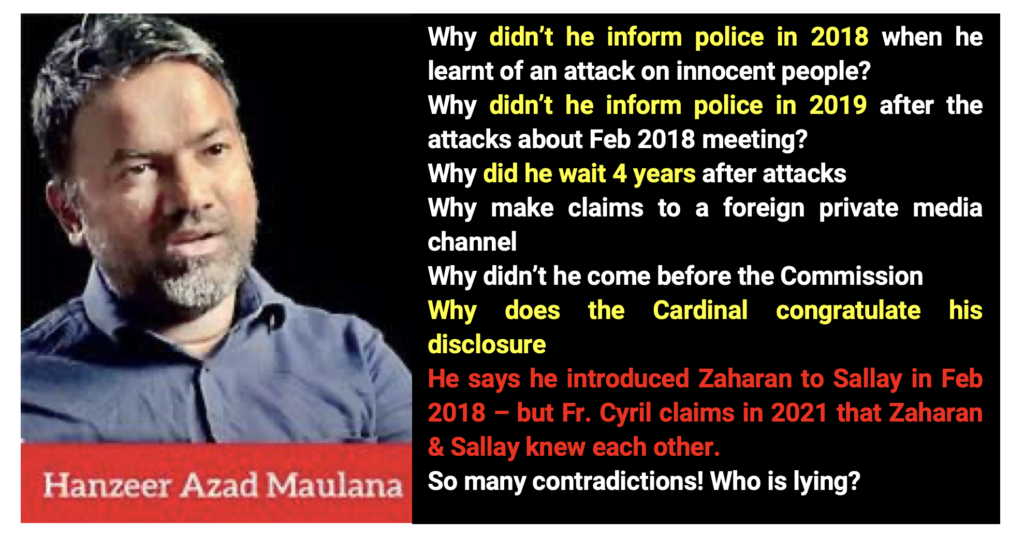
Prior Knowledge Claim – Contradicts with Fr. Cyril Gamini

If Zahran Hashim and Sallay were already known to each other (as suggested in the 2021 zoom by Fr. Cyril Gamini), there was no requirement for Maulana to function as an intermediary to introduce Sallay to Zaharan, yet the Cardinal immediately congratulated the C4 documentary with a 3 page letter.

Physical Presence Claim – Contradicts with Overseas Records

Sallay’s location at the time is contested.

He was overseas. This can be verified through:

  • Travel records
  • Immigration data
  • Call data records, tower location mapping, and international routing logs can objectively confirm or refute the existence of alleged communications.

Building Existence Issue

If the alleged meeting occurred in February 2018:

  • Evidence suggests there was no building constructed in February 2018. The building was constructing in Aug-Sept 2018. This raises the question how would a fugitive like Zaharan hold a 3 hour meeting in the open & how can Maulana be stationed outside the building if there was no such building in February 2018.

Participation Paradox

Maulana claims:

  • He facilitated the meeting
  • Yet remained outside for the duration

This raises a fundamental question:

  • How does a non-participant claim detailed knowledge of a three-hour operational discussion if he was kept outside and why would they tell him of the plan if he was not invited to the discussion?

What CID must first establish is whether claims made by Maulana is based on

  1. Direct knowledge
  2. Inference / assumption
  3. Subsequent interpretation
  1. Legal Exposure within his Own Statement

Maulana also claims:

  • Facilitation of financial assistance
  • Legal support for detainees linked to extremist elements

If true, these actions may:

  • Place him under complicity rather than as a witness
  • Create self-incriminating implications under criminal law principles
  • If he knew in February 2018 of such a plan – why did he remain silent if he was concerned about the lives of innocent people?

This raises a critical legal contradiction:

  • A person claiming involvement in facilitating activities linked to extremists cannot simultaneously occupy a neutral whistleblower” position without judicial scrutiny.

Credibility Questions Arising from Conduct

  • Why did Maulana fail to come forward immediately in February 2018 or after the attacks in 2019 if he possessed such critical knowledge?
  • Why were these allegations made only in 2023, four years after the attacks and one year after leaving Sri Lanka?
  • If his claims were genuine and urgent, what explains the delay in disclosure?
  • Why did he choose a foreign private media platform instead of first making a formal complaint to law enforcement authorities?
  • Why did he avoid appearing before multiple domestic commissions that were specifically appointed to investigate the attacks?
  • If he claims Pillayan first suggested his involvement, why has he not formally incriminated Pillayan through official legal channels?
  • Has any independent investigative body verified his alleged presence at the claimed meeting location?
  • Has he provided any documentary, electronic, or witness corroboration to support his claims beyond his own statement?
  • What personal, legal, or asylum-related incentives, if any, may have influenced the timing and content of these disclosures?
  • Has any benefit, protection, or status been granted or sought in exchange for such testimony?

Delayed disclosure of critical information may affect reliability, particularly where contemporaneous reporting would have been reasonably expected.

  1. Legal Reality of Overseas Statements

Even if the CID records a statement abroad:

  • It remains investigative material, not judicial proof
  • It cannot replace in-court testimony
  • It is subject to strict admissibility rules
  • It must be tested through cross-examination if relied upon in court

Therefore:

An overseas statement cannot independently establish guilt or conspiracy even if used as negative publicity against the accused.

  1. Institutional and Financial Accountability Question
  • What legal authorisation was granted for overseas engagement – how many officials travelled and what is the cost of this overseas travel (flight, hotels, transport & other incidentals)?
  • Why were domestic judicial mechanisms not prioritised first – if so, where is the proof?
  • On what basis is taxpayer-funded investigative travel justified – if a complaint filed without evidence results in investigators traveling abroad – how many such complaints will get filed taking this as a precedent?
  • Why is investigative focus being directed primarily at one individual based on a single witness narrative, while other lines of inquiry supported by prior investigations remain secondary?
  1. Questions

The case ultimately turns on verifiable questions:

  • Did Maulana meet Sallay in February 2018 — yes or no?
  • Was the meeting arranged on Pillayan’s request — yes or no?
  • Was Sallay in Sri Lanka at the time — yes or no?
  • Did any physical structure exist at the claimed location during that period — yes or no?
  • Was Maulana party to the discussion between Zaharan & Sallay? Yes or no?
  • If no, how did he know of the plan? If he was not involved why would they tell of their plan?
  1. Legal Authority & Jurisdiction
  • Under what legal provision is the CID travelling overseas to record a statement from Asad Maulana?
  • Was prior approval obtained from a Sri Lankan court before initiating overseas evidence collection?
  • Has an arrest warrant or Interpol notice been issued against Asad Maulana, or is he currently treated as a witness?
  • If he is a suspect in any pending case, why has extradition not been formally pursued through the legal channels in the nation he is now living in?
  1. Evidentiary Basis
  • What specific new material prompted the CID to seek a fresh statement now, four years after the events?
  • Is the CID treating Maulana’s Channel 4 testimony as evidence, intelligence, or allegation?
  • Has any part of his 2023 televised statement been independently verified before this overseas engagement?
  • What corroborative evidence exists to support or contradict his claims regarding alleged meetings or instructions?
  1. Consistency of Narrative
  • How does the CID reconcile any new statement with Maulana’s previously broadcast testimony in the Sri Lanka’s Easter Bombings: Dispatches?
  • Will inconsistencies between his earlier public statements and any new statement be formally recorded and assessed?
  • If material contradictions arise, will the CID treat this as an issue of credibility or potential fabrication?
  1. Witness vs Suspect Status
  • What is the official status of Asad Maulana in ongoing investigations — witness, suspect, or person of interest?
  • If he is treated as a witness, how does the CID address allegations that he may have facilitated meetings involving extremist-linked individuals?
  • At what point does a witness providing detailed operational claims become subject to investigation as a potential accomplice?
  1. Channel 4 Dependency Issue
  • Why is a foreign documentary being used as a triggering basis for active CID investigative action?
  • Has the CID independently verified the claims made in the Channel 4 programme before acting upon them?
  • Did CID officials consider that Channel 4’s production relied heavily on a single principal witness?
  • What is the CID stand on the Imam Committee findings specifically appointed to look into Channel 4.
  • Can the CID reject this Govt commissioned report?
  1. Chain of Custody & Admissibility
  • If a statement is recorded in France, under what legal framework will it be admissible in Sri Lankan courts under the Evidence Ordinance (Sri Lanka)?
  • Will the statement be recorded under oath, and will it be subject to cross-examination rights?
  • How will the CID ensure that the statement is not later challenged as hearsay or untested testimony?
  1. Prior Domestic Proceedings
  • Why was Maulana not compelled earlier to give evidence before domestic commissions or parliamentary inquiries?
  • Were previous attempts made to secure his testimony while he was still within Sri Lanka?
  • If not, what changed now that justifies overseas engagement?
  1. Financial & Administrative Accountability
  • What is the estimated cost of the CID overseas mission, and who approved it?
  • Was Cabinet-level or judicial approval required before deploying officers abroad?
  • How is taxpayer expenditure being justified for what appears to be a follow-up statement rather than new evidence?
  1. Consistency with Other Cases
  • In cases involving other suspects or witnesses, is overseas evidence collection standard practice?
  • If not, what makes this case exceptional compared to other major criminal investigations?
  • Given that Maulana’s claims involve alleged high-level coordination, why is the CID prioritising statement collection abroad instead of presenting independently verified evidence before a court of law?

These are not political questions—they test the authenticity of the claims.

The Easter Sunday tragedy demands rigorous truth-seeking, not narrative reconstruction.

However:

  • When a single witness statement becomes the foundation for international allegations of state complicity, the evidentiary burden must rise—not fall.

Maulana’s 2023 testimony now forms a fixed public record.

It cannot be casually revised without consequence.

And it cannot substitute for:

  • corroborated evidence
  • judicial testing
  • or cross-examined proof

The central legal test is not whether an allegation is repeated, but whether it is independently corroborated, consistent, and capable of withstanding cross-examination in a court of law.

Ultimately:

Allegations of this magnitude must stand on evidence, not assertion—and evidence must survive contradiction, not depend on repetition.

Shenali D Waduge

Nature’s Superfood- Control Diabetes, BP, PCOD, | Dr. Khader Vali on Body to Beiing | Shlloka

May 6th, 2026

TO TAKE THE LAW INTO ONE’S OWN HANDS

May 6th, 2026

RANJITH SOYSA

At Tissa Viharaya, Jaffna, on the days significant to the Buddhists, the unruly individuals of another faith gather at its gates and create disruptive scenery disturbing the religious environment. This is the ugly truth the Buddhists devotees must face regularly. Such an unenviable situation was prevailing for the last one year.

History of Tissa viharya goes back to BC 307 when King Devanampiyatissa was the ruler of Sri Lanka. He became a Buddhist after listening to Ven Mahinda thero. After embracing Buddhism, the King built several temples and in Nagadeepa,-name used for Jaffna peninsula- according to Mahawamsa  Jambukola,Tissa viharya and Pachnaramaya were built during the period

What is the reason behind the puerile behaviour in the proximity of such a reputed place of Buddhism? Some of the agitators are political agents who are keen on creating tensions and expecting angry reactions from the devotees so that their agenda can be activated to create divisions within the community of Sri Lankans to attract the attention of public. Some participants are said to be ‘the owners’ of the land occupied by the temple and they want to canvass their grievances and force the authorities to handover the land back to them.

While the law enforcement authorities are ignoring this act of public nuisance which can lead to a serious breach of peace and possible physical damages to the buildings of the temple, there is a simple and a practical method of settlement of this unruly situation

If some of the agitators claim the temple has by force occupied their land, the best method of recovery would be to seek legal remedy by submitting their deeds to the court of law and requesting settlement. So far, no one has sought this clear and simple method. But we have heard from the temple management that they are in possession of valid deed for the land occupied by them and if the other party/parties come before the courts, they will prove that the temple is built on a legally owned land.

Recently. when the temple land was surveyed too, the intruders came in and created trouble and stopped the related work which was useful to the settlement of this vexed issue.

The country is watching the steps taken by the Government and the law enforcement authorities prompt intervention with interest as the religious freedom of the Buddhists too are important to foster a harmony among the Sri Lankans.

RANJITH SOYSA 

අස්වැසුම ප්‍රතිලාභීන් වෙත දෙවරක්/අතිරේක මුදල් ගෙවීම සම්බන්ධයෙන් පාර්ලිමේන්තුව හරහා විමර්ශනයක් සිදු කරන ලෙස ඉල්ලීමයි.

May 6th, 2026

ජනාධිපති නීතිඥ මෛත්‍රී ගුණරත්න, නීතිඥ අතුල ද සිල්වා, රජිත් කීර්ති තෙන්නකෝන් ‍ෆ්‍රී ලෝයර්ස් සංවිධානය ‍වෙනුවෙන්

2026 මැයි 06

ගරු කතානායකතුමා,
ශ්‍රී ලංකා පාර්ලිමේන්තුව,
ශ්‍රී ජයවර්ධනපුර කෝට්ටේ,
කෝට්ටේ.

ගරු කතානායකතුමනි,

අස්වැසුම ප්‍රතිලාභීන් වෙත දෙවරක්/අතිරේක මුදල් ගෙවීම සම්බන්ධයෙන් පාර්ලිමේන්තුව හරහා විමර්ශනයක් සිදු කරන ලෙස ඉල්ලීමයි. 

2026 අප්‍රේල් 22 දින පෙ.ව. 9.23 ට ඔබතුමන්ගේ jagathw@parliament.lk ඊ මේල් ලිපිනයට මහා භාණ්ඩාගාරයේ ඩො.මිලියන ඩොලර් මිලියන 2.5 ක මුදලක්, අතුරුදන්වීම පිළිබඳ පැමිණිල්ලක් සිදු කළෙමු. රාජ්‍ය පරිපාලන චක්‍රලේඛ අංක 27/2023 (2023.12.29) : මහජනතාවගෙන්, දේශපාලන අධිකාරියෙන් සහ අනෙකුත් ආයතනවලින් ලැබෙන ලිපි, විද්‍යුත් ලිපි (E-mail) සම්බන්ධ කටයුතු කළ යුතු ආකාරයට ඒ සඳහා  ඔබතුමන්/ඔබගේ කාර්යාලය මේ දක්වා පිළිතුරු ලබාදී නොමැති බව නැවත කණගාටුවෙන් සිහිපත් කරමි.

එසේ තිබිය දී,  සුභසාධක ප්‍රතිලාභ මණ්ඩලය (welfare benefits board) හරහා රු. ලක්ෂ 5000 කට මදක් අඩු මුදලක් අතිරේක වශයෙන් ගෙවීම පිළිබඳ සිද්ධියක් අප වෙත වාර්තා වී ඇත.

මහා භාණ්ඩාගාරයේ ඩොලර් මිලියන 2.5 ක් අතුරුදන්වීම හා සමාන ආකාරයකට අස්වැසුම ප්‍රතිලාභීන් වෙත දෙවරක්/වැඩිපුර මුදල් ගෙවීම රාජ්‍ය මුල්‍ය කලමනාකර‍ණයේ අද ඇතිවී තිබෙන බිදවැටීම, වියවුල හා වගකීම් විරහිත භාවය මනාව පිළිබිඹු වන්නකි.

2026 අප්‍රේල් මස දාහත් ලක්ෂ තිස් තුන් දහසකට ආසන්න පවුල් සංඛ්‍යාවකට අස්වැසුම ප්‍රතිලාභ ගෙවීමට නියමිතව තිබුණි.  එයින් පිරිසකට අස්වැසුම ප්‍රතිලාභ දෙවරක් මුදල් (Double Payment) ගෙවා ඇත. තවත් පිරිසකට රජය විසින් බෝනස් දීමනාවක් ලෙස ලබාදුන් නියමිත මුදලට  වඩා වැඩි මුදලක් (Additional Payment/Extra Payment) සහිතව මුදල් ගිණුමට බැර කර ඇත.   

මහා භාණ්ඩාගාරය විසින් නිකුත් කර ,  සුභසාධක ප්‍රතිලාභ මණ්ඩලය මගින් අස්වැසුම් ලාභීන්ගේ ගිණුම් වෙත යොමු කරනු ලැබූ මුදල රු. ලක්ෂ 5000 කට මදක් අඩු ප්‍රමාණයකි.  රජයේ මුදල් ආයතනික මුදල් රෙගුලාසිවලට පිටින්, කිසිදු වගකීමක් නොමැතිව, කිසිදු රාජ්‍ය මුල්‍ය පාලනයක් නොමැතිව,  ආයතනගත ක්‍රමවේදයන්ට  මගහරිමින් සිදුව ඇත. සංවරණ හා තුලන පද්ධතිය Checks and Balances ක්‍රමවේදයකින් තොරව සිදුවන රාජ්‍ය මුදල් පරිහණය අපරාධයකි/දුෂණයකි/වංචාවකි.  

එබැවින්, 148 ව්‍යවස්ථාව යටතේ මුදල් බලය හිමි පාර්ලිමේන්තුව වෙතින් පහත ප්‍රශ්න සඳහා වහා පිළිතුරු සොයා ගත යුතු බව Free Lawyers සංවිධානය අවධාරණය කරමු.

1.      අප්‍රේල් මාසයේ මුදල් ලැබිය යුතුව තිබූ පවුල් ලක්ෂ 18 ක ට ආසන්න ප්‍රමාණයෙන් කොපමණ සංඛ්‍යාවකට නියමිත ප්‍රමාණයට වැඩි මුදලක්/ද්විත්ව ගෙවීම් ලැබී තිබේ ද?

2.      කෑගල්ල, මොණරාගල හා කුරුණෑගල දිස්ත්‍රික්කවල ද්විත්ව ගෙවීම් සිදු කර ඇති ප්‍රමාණය පිළිබඳ මේ දක්වා විමර්ශනයක් ආරම්භ කර තිබේ ද?

3.      දෙවරක් මුදල් (Double Payment) නියමිත ප්‍රමාණයවට වැඩි මුදලක් (Additional Payment/Extra Payment) ගෙවනු ලැබ ඇති මුලු ප්‍රතිලාභීන්ගේ සංඛ්‍යාව කොපමණ ද?

4.      අස්වැසුම් ලාභීන් වෙත නියමිත ප්‍රමාණයවට වැඩිව කිසිදු සොයාබැලීමකින් තොරව, වගකීම් විරහිත ලෙස නිකුත් කරනු ලැබ ඇති මුළු මුදල් ප්‍රමාණය කොපමණ ද?

5.      සුභසාධක මණ්ඩලයේ මුල්‍ය බලතල පැවරීමේ ක්‍රමවේදය/කාර්ය පටිපාටියට පිටින් මෙම මුදල් ගෙවීම සිදු කළ නිලධාරීන් කවුද?

6.      සුභසාධක මණ්ඩලයේ මණ්ඩලයේ කටයුතු සඳහා දේශපාලන පත්වීමක් ලෙස අනියුක්ත කර ඇති නිලධාරීයා/නිලධාරීන්/කොමසාරිවරයා කවුද?

7.      දේශපාලන පත්වීම් ලැබ මේ සා විශාල මුදලක් නාස්තිය/අයථා පරිහණය/දුෂණය සිදු කළ සිදුවීම පිළිබඳ මේ වන විට විධිමත් අධිකාරියක් යටතේ මුලික විමර්ශනයක් පවත්වා තිබේ ද?

8.      මෙම කාර්යයට සම්බන්ධ වූ නිලධාරීන් වෙත මු.රෙ. 135 යටතේ මුල්‍ය බලතල පැවරීමක් සිදු කර තිබේ ද?  එසේ බලතල පැවරූ නිලධාරියා/බල අධිකාරිය කවුද?

9.      භාණ්ඩාගාරය විසින් මෙම අතිරේක මුදල් නිකුත් කිරීම පිළිබඳ මුලික විමර්ශනයක් සිදු කර තිබේ ද? එසේ නම් එයට වගකිව යුතු භාණ්ඩාගාර නිලධාරීන් හදුණාගෙන තිබේ ද?

10. එසේ නොවේ නම් මෙය තවත් මෙයත් හැකර් ප්‍රහාරයක් ද? අත්වැරදීමක් ද? එසේත් නැතිනම් මුදල් අමාත්‍යාංශය, මහා භාණ්ඩාගාරයට අත්දැකීම් රහිත, කාර්යාලීය ක්‍රමවේදයන් පිළිබඳ කිසිදු දැනුමක් අවබෝධයක් නොමැති දේශපාලන පත්වීම් සිදු කිරීමේ ප්‍රතිඑලයක් ද?

භාණ්ඩාගාර මංකොල්ලයත්, සුභසාධක ප්‍රතිලාභ මණ්ඩලයේ අවිධිමත් ගෙවීම්, මාර්ග සංවර්ධන අධිකාරියේ ද්විත්ව ගෙවීම් මගින් පැහැදිලිවන්නේ මේ වන විට මහා භාණ්ඩාගාරය රාජ්‍ය මුදල් කලමනාකරණයේ මුලික පදනම දෙදරා ගොස් ඇති බවයි. මෙම දුර්වලතාවය හා අකාර්යක්ෂමතාවය මේ වන විට ලෝකයටම නිරාවණය ‍වී ඇති බැවින් මහා භාණ්ඩාගාරය දැන්වත් ‘අපොන්සුකරණය’ නොවූ ජ්‍යෙෂ්ඨ පරිපාලන නිලධාරියෙකුගේ පාලනයට නතු විය යුතු බව අප අවධාරණය කරමු.

ගෙවනු ලැබූ මුදල් නැවත අය කර ගැනීමේ දී, මේ අන්ත දිළිදු ජනතාව නැවත දැඩි අපහසුතාවයට පත් නොකර වාරික මගින් පමණක් අය කර ගැනීමට පියවර ගැනීමට අවධානය යොමු කරන ලෙස ද කාරුණිකව ඉල්ලමු.

පාර්ලිමේන්තුව සතු මුදල් බලය නිසි ව්‍යවහාරයේ යෙදවීමට ආණ්ඩු පක්ෂයේ මෙන්ම විපක්ෂයේ ද ගරු මන්ත්‍රීතුමන්ලා වෙත මේ සම්බන්ධයෙන් දැනුම් දෙන ලෙස ද, මේ පිළිබඳ වහා ක්‍රියාත්මක වී පියවර ගනු ඇතැයි උදක්ම බලාපොරොත්තු වෙමු.

මෙයට විශ්වාසී,

ජනාධිපති නීතිඥ මෛත්‍රී ගුණරත්න 

නීතිඥ අතුල ද සිල්වා

රජිත් කීර්ති තෙන්නකෝන්

‍ෆ්‍රී ලෝයර්ස් සංවිධානය ‍වෙනුවෙන්

පිටපත්

1.      ශ්‍රී ලංකා පාර්ලිමේන්තුව නියෝජනය කරන සියළුම ගරු මන්ත්‍රීතුමන්ලා වෙත  

Sri Lanka’s invaluable contribution to the restoration of Buddhism to its rightful place in South Vietnam.

May 5th, 2026

Senaka Weeraratna

Sri Lanka (then Ceylon) played a crucial and vocal role in 1963 in bringing international attention to the repression of Buddhists in South Vietnam under the Catholic-led regime of Ngo Dinh Diem. Sinhala Buddhist leaders, monks and laity, public organizations, and the government, led by Prime Minister Sirimavo Bandaranaike, acted as a primary international voice advocating for the rights of Vietnamese Buddhists during the Buddhist Crisis.

Introduction

HE Mr. To Lam, the President of the Socialist Republic of Vietnam and General Secretary of the Central Committee of the Communist Party, along with a high-level Vietnamese delegation, will pay a state visit to Sri Lanka from May 7-8, 2026.

The visit carries a particularly important diplomatic message, reflecting Vietnam’s respect and high regard for Sri Lanka. This is the highest-level visit by any Vietnamese leader to Sri Lanka since the establishment of diplomatic relations between the two countries in 1970.

Ho Chi Minh

In earlier times, Ho Chi Minh, the revolutionary leader and founder of modern Vietnam, visited Ceylon three times between 1911, 1928 and 1946 on Journeys related to seeking independence for Vietnam. These visits, particularly the 1928 stop, are honored today as key moments in building the friendship between Vietnam and Sri Lanka, featuring a statue of him in Colombo and a “Vietnam-Ho Chi Minh space” at the Colombo Public Library.

Key Reminders of Visits:

  • Statue: A statue honoring Ho Chi Minh was inaugurated in Colombo in 2013.
  • Commemorative Stamp: A stamp collection featuring him was issued in 2014.
  • Literary Work: His collection “Prison Diary” was translated into the Sinhala language.
  • Library Space: A dedicated space in the Colombo Public Library holds publications related to his life

The Buddhist Crisis in South Vietnam – the origins

·         The Buddhist Crisis was ignited by a ban on flying the Buddhist flag on Vesak, (Phat Dan, the birthday of Gautama Buddha) which saw nine unarmed Buddhist protestors killed on the streets in Huế by the army on May 8, 1963.

·         This was not an isolated incident in the persecution of Buddhists in Vietnam since Ngo Dinh Diem (Catholic) took power in 1954. It was a regular feature. However, it was the ‘Straw that broke the Camel’s Back’, using a cliché. It led to major protests and civil disobedience among the country’s Buddhist population.

·         Ven. Thích Quảng Đức (1897–1963)

·         Ven. Quang Duc, along with several other monks, demanded that Diem submit to their five-point -plan for equality. All they were asking for was freedom to fly the Buddhist flag, religious equality between Buddhists and Catholics, compensation for the victims’ families, an end to arbitrary arrests, and punishment for the officials responsible. Although Diem said he would listen to them upon meeting with the Buddhist delegation, he rejected the Buddhist grievances, insisting that none of this discrimination” was happening.

·          The photo taken by Associated Press Photographer Malcolm Browne of Ven. Quang Duc self-immolating stunned the world. It had such a strong impact on the then U.S. President John F. Kennedy, though prima facie an ardent Diem supporter, was shocked. He was quoted as saying: No news picture in history has generated so much emotion around the world as this one”.

·         Ven. Quang Duc’s self-immolation sparked outrage and a sense of solidarity among Buddhists in Sri Lanka. His remains were later re-cremated at 4,000 degrees Celsius, but his heart did not burn and remained intact.

·         Thich Quang Duc was declared and honored as a Bodhisattva in 1964.

·         The last words of Thich Quang Duc before his self – immolation contained in a letter were as follows:

·         Before closing my eyes and moving towards the vision of the Buddha, I respectfully plead to President Ngo Dinh Diem to take a mind of compassion towards the people of the nation and implement religious equality to maintain the strength of the homeland eternally. I call the venerables, reverends, members of the sangha and the lay Buddhists to organize in solidarity to make sacrifices to protect Buddhism.”

Sri Lanka’s Response

Mrs. Sirima Bandaranaike’s initiatives (assisted by Mr. N.Q. Dias – high profile civil Servant who served as the Permanent Secretary of Defense and External Affairs from 1960 to 1965. He was instrumental in shaping both national and foreign policy, particularly during the administration of Prime Minister Sirima Bandaranaike)

In late August 1963, Prime Minister Sirima Bandaranaike sent a two-member Ceylonese (Sinhalese) fact-finding mission to South Vietnam to investigate the Buddhist crisis therein. Mr. P. de S. Kularatne (former Principal of Ananda College) was part of the two-member mission. The other member of the team was Sir Nicholas Attygalle: A distinguished academic, surgeon, and then-Vice Chancellor of the University of Ceylon.

The mission was a bilateral initiative by the Government of Ceylon to assess the situation following the raids on Buddhist pagodas by President Ngo Dinh Diem’s regime. This specific mission arrived in Saigon on August 26, 1963.

It is often confused with a later, larger United Nations Fact-Finding Mission that visited in October 1963, which was led by Mr. R.S.S. Gunawardena and included representatives from several other countries.

Furthermore, in July 1963, Merenna Francis de Silva (M.F. de S.) Jayaratne, the newly appointed Ceylonese (Sinhalese) Ambassador to the United States, met with President John F. Kennedy to discuss the escalating Buddhist crisis in Vietnam after Mrs. Bandaranaike had written to President Kennedy on this escalating crisis.

The meeting was a high-stakes diplomatic encounter occurring during a period of severe strain between the U.S. and Ceylon:

  • Regional Religious Solidarity: As a representative of a predominantly Buddhist nation, Jayaratne expressed Ceylon’s deep concern over the repression of Buddhists by the U.S.-backed government of Ngo Dinh Diem.
  • Ceylon sought to represent the concerns of Asian Buddhist communities regarding the persecution of their counterparts in South Vietnam.
  • The “Hot Potato” Context: A secret White House memo from NSC official R.W. Komer described the relationship as a “hot potato”. Relations were already fragile because the U.S. had suspended aid under the Hickenlooper Amendment after Ceylon nationalized American petroleum assets.
  • Ceylon’s Diplomatic Pressure: While Jayaratne was seen as more “West-friendly” than the government of Prime Minister Sirimavo Bandaranaike, he was tasked with urging the U.S. to curb Diem’s actions. Shortly after, Ceylon successfully lobbied to have the UN appoint a fact-finding committee to investigate the crisis.

Key Sri Lankan Diplomatic Figures Involved (1961–1963)

NameRolePeriod
M.F. de S. JayaratneAmbassador of Ceylon to the U.S.Feb 1963 – July 1965
William GopallawaFormer Ambassador of Ceylon to the U.S.Aug 1961 – Mar 1963
R.S.S. GunawardenaPermanent Representative to the UNRaised issue at UN in 1963
   

Contextual Highlights (July 1963)

  • Ceylon’s Position: Advocating for Buddhist rights internationally.
  • South Vietnam: The Diem regime was intensifying crackdown on Buddhists
  • US Position: Attempting to manage the “hot potato” of aiding a regime accused of religious persecution while fighting Communism.
  • Diplomatic Action at the UN: Prime Minister Sirimavo Bandaranaike, recognizing the crisis, instructed Sri Lanka’s Ambassador to the United Nations, R.S.S. Gunawardena, to highlight the repression of Buddhists in South Vietnam. Due to these efforts, the UN General Assembly adopted a motion on October 8, 1963, to send a fact-finding mission to South Vietnam, headed by Gunawardena.
  • Monastic Solidarity (Venerable Narada Thera): The renowned Sinhalese monk, Ven. Narada Maha Thera of Vajiraramaya Temple, was a key figure who made 17 journeys to Vietnam, providing spiritual strength and solidarity to local Buddhists during their most difficult times.
  • Public Protest and Awareness: The Bauddha Jatika Balavegaya (BJB), led by L.H. Mettananda, spearheaded public protests and rallies in Sri Lanka, including a major demonstration at Ananda College, Colombo, to mobilize support for the Vietnamese Buddhists.
  • Exposing the Crisis: The BJB published a Manual called ‘Catholic Action’ (written by the Secretary of BJB, Mr. Gunaseela Vithanage) distributed materials exposing the “Catholic Action” against Buddhists in Ceylon and Vietnam. This BJB publication galvanized the Buddhists of Ceylon especially after the abortive Catholic Army Officers’ Coup in January 1962.  It brought global attention to the crisis and pressured the US-backed Diem government, which was eventually overthrown on November 2, 1963.
  • The BJB had a star-studded cast. Leading Members of the Sangha and Buddhist laity were members of the BJB who also gave evidence before the Press Commission (1963 – 1964) headed by Justice K. D. de Silva (retired Supreme Court Justice). Their main submission was extensive ‘Catholic Action’ in the Press suppressing and humiliating and sidelining Buddhist opinion. This trend continues to this day.
  • That is why on-line News websites such as the Lankaweb have become increasingly popular among Buddhist leaders and opinion makers, and also the Buddhist public.  

Impact and Outcome

Sri Lanka’s vocal international stance and the presence of the UN fact-finding mission in Saigon added significant pressure to the Diem government. On November 2, 1963, while the mission was still in Vietnam, the Diem regime was overthrown in a military coup, effectively ending the period of intense state-sponsored religious repression.

Sri Lanka’s intervention is regarded as a significant moment of international Buddhist solidarity, directly aiding the restoration of Buddhism’s place in South Vietnam. It was a landmark in modern Buddhist diplomacy that has contributed to strengthening wide ranging links between two leading predominantly Buddhist countries, Vietnam and Sri Lanka.

Senaka Weeraratna

Tamil Eelam Concept

May 5th, 2026

Eng. Kanthar Balanathan

Since Independence in 1948, some politicians started their campaign of Tamil Eelam as a conceptual republic via forming a party in 1949. The interesting comedy is that they did not deliberate about the concept prior to 1949 or even before independence in Feb 1948. This may indicate some kind of selfishness in the minds of the Tamil politicians. We are all propagating and shouting that Tami Eelam existed since long, however, then why did not the Cheras, Colas and the Pandians establish and declare it a republic or a state of Tamil Eelam. The propaganda initiated strongly by the diasporas in the recent years. One aspect is reflecting quite strongly in our minds, which is the Tamil diaspora have no sense of responsibility of developing the region what they call as Tamil Eelam, however, visit build expensive houses and leave. The diasporas have blown up the land price in the North. A gentleman name Raj Sivanathan wrote an important article; however, how many Tamils do read and understand the concept which was written by RS. My recommendation that Economics” as a subject could be taught up to grade 8, so that students will get a better understanding of the environment in which they live. We Tamils give prominence to Hinduism as a subject with strong focus, however, not science, economics or environmental science.

Just refer to the map we have established; The rights of the extensive area of sea will be held by TE. If at all Tamils want a republic the solution can be only approved by five major countries plus one country. (5 + 1) countries. The +1 by default is Sri Lanka. SriLanka will never ever approve a separate country to be stablished in the island. The rest of the FIVE states could be decided by you all as to which are the countries those need to come forward to approve, which will never ever happen in the next several centuries unless a major destruction occurs in the Indian Ocean and the countries. The five states are quite strong in every aspect of a republic. Wee need to know geopolitics to decide.

Therefore, as intelligent humans our politicians shall not create and stretch the difference in SL between the Tamils and Sinhalese, however, live together as SriLankans and vote for the Sri Lankan party(s). Not for Tamil RACIAL parties. MA Sumanthiran’s association with SLPP is a good move. Similarly, the others shall come forward and join the most humanistic and socialistic political party, the NPP, with AKD as the leader. This is left for the people to decide. The triumph of Tamil racial political parties can cause more damage to growth and not save the Tamils in SL. The diasporas have theoretical vision only. People like Harry Anandasangaree and Vijay Thanigasalam should be considered as jokers and no practical persons. Do not they have a sense of vision for the growth of Tamils in SL? The relative of a guy who voted to disfranchise the one million estate Tamils in SL in 1948 was campaigning to build a monument in Australia. This can only be considered as selfish. Why waste millions of dollars in waste structures.  Person like Baskaran Kandiah are practical intelligent people who see vision is for the development.  Some Council is trying to build a structure for Prof. Thurairajah. This is a waste, as in the early days, Tamils invested in their children to study Civil Engineering, the reason being they can earn a lot, probably through misappropriation. There was an old civil engineer in Nigeria and he was nicknamed, casual Shun”. This was because he was misappropriating money via theoretical number of casual workers. This is how the minds of the Tamils think. Hero worships some unnecessary fools. Let us be practical in the 21st century. Practically, Mahinda Rajapaksa was not a perilous racist. His development on roads, structures and electricity was equally completed within SL. It is the other Rajapaksas who misappropriated. Mahinda wanted to be a leader; hence he was quiet and let everyone misappropriate.

It is an advice that those of the leftover LTTEs shall not campaign for TE and concentrate on growth and leave the people to survive. The leftover LTTEs are cowards who ran out during the war in 2009. People like Harry Anandasangaree and Vijay Thanigasalam are self-centred selfish fools who have no interest in the Tamils in SL. The leftover LTTEs are cowards who want money to be collected for their growth.

Let Tamils be constructive, practical and complete logical reasoning before they decide, and not be bought over by the Tamil racist foolish politicians.

My love and associations with the Maldives, in addition to Russia, Vietnam, and India.

May 5th, 2026

Dr Sarath Obeysekera

Since I joined Colombo Dockyard as CEO, the Deputy Finance Minister of Norway came to me requesting us to build UFAC, known as Ultra Fast Patrol Craft, similar to several aluminium crafts built for the Sri Lanka Navy.

He wanted us to finance the project, either through financing from Sri Lanka, and offered a sovereign guarantee from the Maldives.

We built them and also a special luxury vessel for the Maldivian President.

State banks, namely Bank of Ceylon and People’s Bank, provided financing. It was the first time state banks funded a foreign project and made history.

Then Mr. Gasim, who was a budding politician of the Maldives and owned ships, came to me and requested financing to build two spherical LPG tanks and later oil storage tanks in Thilafushi Island (we called it Garbage Island). We later built steel landing crafts to carry garbage trucks from Malé Port to the garbage island for reclamation.

Today, that island is a modern industrial city.

Just like India needs us and vice versa, we need the Maldives to develop.

As stated before, this 2,000-island cluster of the Maldives, with the capital Malé and Hulhumalé, is a modern, thriving city.

In those days, we knew only about Maldive fish, extensively used in Malé, and today this small country is a leading exporter of tuna, out of which dried Maldive fish is made.

Regards

Dr Sarath Obeysekera

King Wimaladharmasuriya victory at Danture in 1594 saved the Dalada Maligawa and the Buddhist Heritage of Sri Lanka

May 5th, 2026

Senaka Weeraratna

The victory of King Wimaladharmasuriya I at the Battle of Danture in 1594 was a defining moment that secured the independence of the Kandyan Kingdom and preserved the Buddhist identity of Sri Lanka. By annihilating the Portuguese army, he prevented the total conquest of the island and the potential suppression of Buddhism under colonial rule. 

AI Overview

His actions following the victory directly revitalized the island’s religious and cultural heritage:

  • Establishment of the Dalada Maligawa: After consolidating power, the king brought the Sacred Tooth Relic from its hiding place in Delgamuwa to Kandy. He constructed the first two-storied Temple of the Tooth (Dalada Maligawa) near his palace, establishing Kandy as the spiritual capital and the relic as a symbol of legitimate kingship.
  • Revival of the Monastic Lineage: At the time of his ascension, the Buddhist monastic order had declined to the point where fully ordained monks no longer existed on the island. The king sent emissaries to Burma to bring back ordained monks, successfully re-establishing the Upasampada (higher ordination) lineage in Sri Lanka.
  • National Sovereignty: The victory at Danture shattered the myth of Portuguese invincibility and ensured that Kandy remained the sole independent Sinhalese kingdom, serving as a sanctuary for traditional culture and Buddhist practices for over two centuries. 

https://share.google/aimode/n8mO7DpYwxIrvp9wx

………………………………………….

see also

https://share.google/aimode/YqjcNQXu0u0oCCk46

King Vimaladharmasuriya I’s victory at the Battle of Danture in 1594 was a pivotal moment in Sri Lankan history, effectively halting Portuguese expansion and securing the Kandyan Kingdom’s sovereignty. By destroying the Portuguese army and protecting the Sacred Tooth Relic, he secured the center of Buddhist heritage and legitimised his rule, allowing for the construction of the first Dalada Maligawa in Kandy. [1, 2, 3, 4, 5, 6]

Key outcomes of this victory included:

  • Protection of the Sacred Tooth Relic: Following the victory, King Vimaladharmasuriya I brought the sacred Tooth Relic from Delgamuwa to Kandy, placing it in a purpose-built temple.
  • Securing the Kandyan Kingdom: The decisive defeat of the Portuguese army led by Pero Lopes de Sousa halted European advances into the central highlands.
  • Revival of Buddhism: Vimaladharmasuriya I established a foundation for the revival of Buddhist practices, including bringing ordained monks from Burma to restore the Upasampada lineage.
  • Political Legitimacy: By capturing and marrying Dona Catherina, he unified competing royal claims and cemented his position, enabling Kandy to act as the sole defender of Sinhalese sovereignty. [1, 2, 3, 4, 5]

The victory ensured the continuity of the Dalada Maligawa as the spiritual heart of the Buddhist faith in Sri Lanka, as detailed on Facebook and the Sri Dalada Maligawa website

Source:  AI Overview

Wind Power that abounds in our hills

May 5th, 2026

by Garvin Karunaratne

On many an occasion on my never ending irrigation inspections in Kandy and Nuwara Eliya long ago I had to cling onto trees and, creepers to avoid being blown off by the power of the wind.

Speaking from my sheer experience in handling development tasks-

Building up Coop Crayon at Morawaka in 1971, done in three months, developing it to enable Minister Illangaratne to declare that all imports of crayons should be stopped, and 

Again in Bangladesh, establishing the Youth Self Employment Programme in nineteen months- a programme that being implemented by members of the Bangladesh Civil Service, trained  by me, has by now guided over three million youths to become self employed, I submit:

It will be easier to build a few hundred wind turbines and enable Sri Lanka to produce all its electricity.

I submit  my Paper for kind reading by our new Ministers and our saviour Anura Kumara Dissanayake.  Dear Excellency, It is a task that can be done within a few years.


Wind Power to our rescue

By Garvin Karunaratne

I bequeath to my readers the Conclusion of my book: Wind Power for Sri Lanka’s Power Requirements, published by Godages

It in unfortunate that our authorities in establishing wind turbines in Sri Lanka have so far ignored  the mountainous areas where there is ample wind power. 

In Sri Lanka we have failed to harness Wind Power which Mother Nature has bountifully provided to us.

Suffice it to state that Spain a country that was far behind in producing wind power has within two to three years spurted up the ladder to be the second country in the world. Travelling through the Pyrenees to Spain in my Motorhome, some ten yeas ago  I was surprised to see wind turbines perched all over even on makeshift angle iron posts, the type of things that I can myself make in a day(I am no engineer). Spain even sells power to France today.

On my last visit to venerate the Avukana Buddha, I spotted a canopy perched on very long concrete shafts constructed by the State Engineering Corporation. 

It is my humble request to our excellency the President of Sri Lanka to summon the engineers who built the concrete shafts to support the canopy, and request them to design and produce the posts that can carry the wind turbines. They can easily produce these. Then import the wind turbine mechanism and set them up in our hills. Later, we can ourselves  make the turbines. We will provide employment for a few thousands.  This will provide all the power we need. I have no doubt about that. This task can be accomplished within a year at most. Considering the billions we spend to import coal and oil, we can easily make a saving.

That is the message in my book: Wind Power for Sri Lanka’s Power Requirements.

I enclose the Conclusion of my book in support for kind perusal.

10.Conclusion

I am pleased to submit the Papers I have so far written on Wind Power as a source of Energy, in a booklet in the sheer hope that someday this will be read by one of our leaders who will be convinced that Wind Power is the form of energy that Sri Lanka is blessed with in abundance and will get going all out.

In nostalgia, I can remember what did actually happen in Bangladesh in 1982, when I worked there as the Commonwealth Fund General Advisor on Youth Development to the Ministry of Labour and Manpower in Bangladesh., The Minister for Youth Abul Kasim  was arrested on the charge of harbouring a criminal in his residency. A day later, the Military took over the country in a coup de etat.  Immediately afterwards, the Military Government  in a high powered conference chaired by Hon Aminul Islam, the Minister for Labour and Manpower assessed the programmes of the Youth Ministry. That included imparting vocational training to 40,000 youths a year. The Minister  was not totally impressed with the work done. Suddenly realizing me as the only outsider, I was confronted:

”What is the contribution you can make for Bangladesh?”

 I replied: It would be ideal to have a self employment programme to enable the 40,000 youths that are being trained every year to be guided to become entrepreneurs. Most of them are in the ranks of the unemployed even after training, today. ”

 My reply created an uproar. The Secretary to the Treasury, the highest official in the land objected on the grounds that such a self employment creation programme can never be achieved. He added that the ILO had in the preceding three years tried to establish a self employment programme in Tangail, Bangladesh and spent a massive amount of funds all in vain. I  argued with the Secretary to the Treasury for over two hours, quoting definite instances where I had successfully established self employment projects for youths in Sri lanka.  It was an intense battle between me and the Secretary with the Hon Minister intently listening.  Finally the Minister stopped our battle. He immediately approved my establishing a self employment pogramme.  The Secretary to the Treasury stumped with the words, that he will never be providing any funds for this wasteful task. I replied that I will find savings within approved training budgets which was approved by the Hon Minister.

I got cracking with the officials of the Youth Ministry and the Lecturers of the Vocational Training Institutes that provided the vocational training, providing them with a basic knowledge of national planning to identify  areas within the economy where there was a propensity to create employment opportunities and training them in economic endeavour-structuring projects for self employment on a small scale-even with a cow or a dozen chicks and developing the enterprise. My task was to establish the self employment programme and to train the staff to continue after my two year consultancy ended. To a man the officers responded and today this Youth Self Employment Programme has by now guided  over three millions to become self employed  and it is an ongoing  programme that trains and guides 160,000 youths a year to become self employed. Today, it is easily the premier programme of employment creation  the world has known.

This experience of mine itself indicates that though wind power for the task of creating power is at an infancy today, we can easily develop it.

Wind Power can offer all the energy that Sri Lanka needs will someday find a Minister Aminul Islam” who will authorize it. I am certain  that the administrators and engineers who will toil till it is a success can easily be found. Though in my Nineties I will assure that it is a success.

Firstly, the country will not depend on the supply of coal and oil for power plants and the country can save all the millions and billions  being spent today to import oil and coal.

Secondly it will provide employment for thousands in erecting the turbine towers, in establishing the wind turbines and in the manufacture of the turbine mechanism itself at the later stages. In my travels in France, Spain and Portugal I have seen workers making  the towers, blades, transporting them in long trucks, erecting the towers and maintaining them. That is no difficult task for our engineers and workers.

 One of my readers happened to be an engineer, Mr Kanaga. who was involved with establishing the five wind turbines at Hambantota, the first to be built in Sri lanka. What is most interesting in his comment which I have totally enclosed in this book, is that the  environmental lobby had decided that the turbines should only be erected on the coasts and not in the mountains where there is ample wind force.

It is sad that the environmentalists were silent when the entire Kotmale Valley was denuded of people and their activities all to create 200 MW of power. That could have been easily achieved with fifty wind turbines scattered within Kotmale itself and the inhabitants and the economy would have been spared extintion. The entirety of Kotmale is dead today.

To my mind it is a crime not to use the wind power available and to spend millions and billions to purchase oil and coal.

My thanks are also due to the Editor of the Sunday Observer.lk who in Let there be Light” (Sunday Observer:06/09/2009) commented that my suggestions are very valuable. Referring to my suggestion that the wind power in the Central Highlands should be harnessed says, This is a timely and valid proposal and the authorities should take  appropriate action to locate wind turbines in  areas which will enable them to reach their maximum potential.”

I am also thankful for Noor Nizam for his Wind Energy Electricity generation is a reality” (Sri Lanka Guardian:27/08/2009)  In his words, Garvin should be commended for his boldness to take to task the lethargic and selfish bureaucrats on this issue of renewal energy development of electricity energy in Sri Lanka…. His message should be well taken  by others too handling  national planning and development strategies  to assist the little island of 21 million to come out of the rut of poverty, misery, the destruction of the civil war and the dependence on foreign powers.”  He adds in the affirmative, As Garvin Karunaratne  wishes Wind Energy Electricity Generation  will be a reality in Sri Lanka for the next generation”.  It is my fervent hope that this will be realized.

Sri Lankan engineers have in ancient times done wonders. The gradient of the Jaya Ganga that carried the waters of the Kala Weva to the tanks in Talawa and Anuradhapura has been constructed at a gradient of six inches in a mile, a gradient that baffles the irrigation engineers of today.

I am dead certain that Sri Lanka can become self sufficient in all its power requirements not for its present stage but also for its future development through using wind power. The wind power in the Central and Sabaragamuwa Hills is vast. Methods and systems have to be found to harness this energy. However as long as we build wind turbines on the coastal areas and ignore the areas where there is real wind power and satisfy ourselves with studies of the difficulties and constraints,  our attempt will be like  that of a squirrel trying to empty the water in the ocean , carrying a bit of water on its tail,  endless.

Garvin Karunaratne Ph.D. Michigan State University

Author of How the IMF Ruined Sri Lanka & Alternative Programmes of Success(Godages:2006), How the IMF Sabotaged Third World Development(Kindle/Godages:2017)

From Diplomacy to Dollars: Sri Lanka–Maldives Relations Must Deliver Economic Results

May 5th, 2026

By Sarath Obeysekera

The recent visit of Maldivian President Mohamed Muizzu to Sri Lanka and his discussions with President Anura Kumara Dissanayake mark an important step in strengthening bilateral relations between the two Indian Ocean neighbours. The signing of multiple agreements reflects goodwill, mutual respect, and a shared desire for cooperation.

However, at a time when Sri Lanka is navigating a fragile economic recovery, the critical question remains: Do these agreements translate into tangible economic gains—particularly in terms of foreign exchange earnings?

President Muizzu’s political rise was initially perceived as tilting the Maldives away from India and closer to China. Yet, recent developments suggest a more pragmatic recalibration. India’s restrained and mature response—especially in accommodating Maldivian sensitivities without retaliation—has helped restore balance in regional relations.

Sri Lanka, too, appears to be aligning itself with a pragmatic geopolitical approach that prioritises stability over confrontation. While this is a welcome development, diplomacy alone cannot resolve Sri Lanka’s pressing economic challenges.

What is notably absent from the recent engagements is a bold and focused initiative in the blue economy, an area where both Sri Lanka and the Maldives possess natural and strategic advantages.

The Maldives has successfully positioned itself as a global leader in high-end luxury tourism, attracting affluent travellers and generating substantial foreign exchange. Sri Lanka, in contrast, continues to underutilise its vast marine resources and coastal potential.

A collaborative approach between the two nations could unlock significant value.

One immediate opportunity lies in developing joint high-end tourism corridors. By integrating the Maldives’ luxury resort experience with Sri Lanka’s rich cultural, ecological, and wellness offerings, both countries could attract a broader and higher-spending tourist segment. A coordinated Two Nations – One Ocean Experience” branding initiative could redefine regional tourism.

Equally important is the development of a cruise and yacht economy. Establishing a Colombo–Galle–Malé circuit for luxury vessels would create new revenue streams while positioning Sri Lanka as a service and logistics hub for Maldivian tourism fleets.

Furthermore, the long-discussed development of Trincomalee as a maritime and energy hub must be fast-tracked. Its natural harbour offers immense potential for bunkering, ship repair, and regional logistics—benefiting not only Sri Lanka but also supporting the Maldivian economy.

At present, many of the signed agreements appear administrative and long-term in nature. While such frameworks are necessary, they do not address the urgency of Sri Lanka’s need for rapid foreign exchange inflows.

What is required now is a shift from ceremonial diplomacy to commercially driven partnerships.

Sri Lanka should take the initiative to establish a Sri Lanka–Maldives Blue Economy Task Force, with a clear mandate to deliver results within a defined timeframe. This task force could focus on joint investments in marine industries, collaborative tourism development, and shared training programs in hospitality and maritime services.

A flagship project—such as an Indian Ocean Luxury Corridor”—should be launched within the next 12 months, backed by both governments and private sector stakeholders.

The foundation of goodwill between Sri Lanka and the Maldives is strong. But goodwill must now be converted into growth, investment, and foreign exchange earnings.

Sri Lanka cannot afford partnerships that remain on paper.

The time has come to move decisively—from agreements to execution, and from diplomacy to dollars.

Regards

Dr Sarath Obeysekera

”ජනාධිපතිවරයා සිදු කළ ප්‍රකාශ හේතුවෙන් අධිකරණය කෙරෙහි පවතින මහජනතාවගේ විශ්වාසය පළුදු විය හැකියි” – ශ්‍රී ලංකා නීතිඥ සංගමය

May 5th, 2026

උපුටා ගැන්ම  හිරු පුවත්

%27%27%E0%B6%A2%E0%B6%B1%E0%B7%8F%E0%B6%B0%E0%B7%92%E0%B6%B4%E0%B6%AD%E0%B7%92%E0%B7%80%E0%B6%BB%E0%B6%BA%E0%B7%8F+%E0%B7%83%E0%B7%92%E0%B6%AF%E0%B7%94+%E0%B6%9A%E0%B7%85+%E0%B6%B4%E0%B7%8A%E2%80%8D%E0%B6%BB%E0%B6%9A%E0%B7%8F%E0%B7%81+%E0%B7%84%E0%B7%9A%E0%B6%AD%E0%B7%94%E0%B7%80%E0%B7%99%E0%B6%B1%E0%B7%8A+%E0%B6%85%E0%B6%B0%E0%B7%92%E0%B6%9A%E0%B6%BB%E0%B6%AB%E0%B6%BA+%E0%B6%9A%E0%B7%99%E0%B6%BB%E0%B7%99%E0%B7%84%E0%B7%92+%E0%B6%B4%E0%B7%80%E0%B6%AD%E0%B7%92%E0%B6%B1+%E0%B6%B8%E0%B7%84%E0%B6%A2%E0%B6%B1%E0%B6%AD%E0%B7%8F%E0%B7%80%E0%B6%9C%E0%B7%9A+%E0%B7%80%E0%B7%92%E0%B7%81%E0%B7%8A%E0%B7%80%E0%B7%8F%E0%B7%83%E0%B6%BA+%E0%B6%B4%E0%B7%85%E0%B7%94%E0%B6%AF%E0%B7%94+%E0%B7%80%E0%B7%92%E0%B6%BA+%E0%B7%84%E0%B7%90%E0%B6%9A%E0%B7%92%E0%B6%BA%E0%B7%92%27%27+-+%E0%B7%81%E0%B7%8A%E2%80%8D%E0%B6%BB%E0%B7%93+%E0%B6%BD%E0%B6%82%E0%B6%9A%E0%B7%8F+%E0%B6%B1%E0%B7%93%E0%B6%AD%E0%B7%92%E0%B6%A5+%E0%B7%83%E0%B6%82%E0%B6%9C%E0%B6%B8%E0%B6%BA

නඩු තීන්දු සම්බන්ධයෙන් ජනාධිපතිවරයා පසුගිය මැයි දිනයේ සිදු කළ ප්‍රකාශය තුළින් අධිකරණය කෙරෙහි පවතින මහජනතාවගේ විශ්වාසය පළුදු විය හැකි බව ශ්‍රී ලංකා නීතිඥ සංගමය පවසනවා.

නිවේදනයක් නිකුත් කරමින් එම සංගමය මේ පිළිබඳව පවසා සිටියා.

නීතියේ ආධිපත්‍ය සුරැකීම සඳහා එම සංගමය කැපවී සිටින බවයි එම නිවේදනයේ දැක්වෙන්නේ.

එමෙන්ම ජනපතිවරයා කළ එම ප්‍රකාශයට විරෝධය දක්වමින් විපක්ෂ නායක සජිත් ප්‍රේමදාස මහතා ඇතුළු ඒකාබද්ධ
විපක්ෂය විසින් විශේෂ නිවේදනයක් නිකුත් කර තිබෙනවා.

එමගින් පෙන්වා දී ඇත්තේ රජය අධිකරණය ඉලක්ක කරගනිමින් කරනු ලබන ප්‍රකාශ වහා නතර කළ යුතු අතර ජනාධිපතිවරයා කළ ප්‍රකාශය ඉල්ලා අස් කරගත යුතු බවයි.

Treasury funds diverted to third party described as massive theft

May 5th, 2026

Courtesy Hiru News

A massive theft occurred involving USD 2.5 million from the Treasury, allegedly reaching a third party, according to Samagi Jana Balawegaya Member of Parliament Harsha de Silva.

The Member of Parliament made these remarks while making a special statement in Parliament today (5).

The system is crippled because high-ranking officials, including the Secretary to the Ministry of Finance, lack proper experience in financial management and because individuals from other services are appointed to such positions instead of skilled administrative officers.

The Member of Parliament questioned why the Department of External Resources, which can only intervene in bilateral debt negotiations, became involved in this transaction.

The process is in a muddle even though the servicing of government debt must take place through the Department of Debt Management.

He further stated:

”A massive theft occurred here. Hundreds of thousands of dollars are lost. Ultimately, the taxpayers of this country must pay for it; no one else. It is not brought from Pelawatta. But the main thing I have to say is that when the former Minister of Finance and the Deputy Minister described this, they spoke as if there is no problem and this is a normal occurrence. It is not so. I told my members that since we held a closed-door session, the facts presented are only a summary for the public and Parliament. But according to what was said there, we understand there are many complications in this massive process. There are a great many.

For example, why was a Department of External Resources involved in this? The Department of External Resources has no connection to this transaction. Here is the Act. This Act states very clearly that the Department of External Resources can only be involved in negotiating bilateral loans. Next, it says that in accordance with the Debt Act, the timely servicing of government debt must be done through the Department of Debt Management. So why this confusion? There is a major problem here, which is that these people do not know what they are doing. The story about ‘L-boards’ is proven today. Also, usually, individuals from the SLAS come to these positions after working in thirty or forty places before coming to a place like the Ministry of Finance. Everyone knows that what is done now is ‘Apocalypse’. What happens in ‘Apocalypse’? People from the Planning Service are put into these places.

I challenge anyone to say if I am wrong. I might be wrong. But as far as I know, both the DG of PDM and the DG of ERD are from the Planning Service. People in the Planning Service do not have the necessary experience. Also, for the first time in Sri Lankan history, the Treasury Secretary is a person who previously sat here as a Member of Parliament. He also lacks experience in this management.

I know that when this was appointed, when we were in government, I oversaw the SEC as the Deputy Minister. At that time, there were perhaps ten or fifteen directors at the SEC. This gentleman worked as one of them. After that, the Secretary to the Ministry of Finance is a person who must perform a very large role. If the Secretary and the DGs do not have this experience, there is no need to ask about what is happening.

The other thing is the delegation of authority. It was mentioned that a payment of nine hundred thousand was made once. Minister Anil said a payment of nine hundred thousand dollars was made. Who approved a payment of nine hundred thousand dollars? Can a director do that? Was there no delegation of authority? In any institution, the first task a Secretary should know is to delegate—this person for one hundred thousand, this person for five hundred thousand, and the DG for one million. It is said a payment of nine hundred thousand US dollars was made. How was it done?

Therefore, a theft occurred here. No one can escape from that. A theft occurred. Who the thief is must be found. Let the CID do that. You are there, and I am in our Finance Committee. Let us find the policy and administrative problems in this in the Finance Committee. Let us find them and recommend what should happen.

However, I say one last thing. For three turns, the Finance Minister, the Treasury Secretary, or the Deputy Secretaries did not come to our committee. I eventually wrote a letter to the President regarding this. I will table that as well. Even after that letter was written, they said just the other day that they cannot come. That cannot be done. I was too good; that is what caused the trouble. I was too good. I could have brought a privilege question if I wanted. I did not. Why? I gave them an opportunity. But do not take undue advantage of that opportunity. Finally, we are told from various places that we gave these people too much leniency.”

මුදල් අමාත්‍යාංශයට ඉම්පෝට් කරපු කෙනෙක්

May 5th, 2026

Dark Room

ජනපති අනුරට නීතිය කියා දුන් GL ”මැයි 25 නඩු තීන්දුව ලැබුණහම අත්පුඩි ගහන්න සූදානමින් ඉන්න කිව්වා”

May 5th, 2026

ගරු අනුර කුමාර දිසානායක ජනාධිපතිවරයා විසින් දේශපලන වේදිකාවකදී අධිකරණය හමුවෙහි තවමත් පවතින නඩු කටයුත්තක ඉදිරියට ලබා දීමට නියමිත තීන්දුවක් පිළිබදව සිදු කරන ලද අගතිගාමී ප‍්‍රකාශයක් පිළිබදව විමර්ශනයක් පවත්වන ලෙසට කරනු ලබන ඉල්ලීමයි.

May 4th, 2026

ජනාධිපති නීතිඥ මෛත්‍රී ගුණරත්න   ‍ෆී ලෝයර්ස් සංවිධානය ‍

ගරු ප‍්‍රීති පද්මන් සූරසේන මැතිතුමා
ගරු අගවිනිසුරු සහ අධිකරණ සේවා
කොමිෂන් සභාවෙහි ගරු සභාපති,
ශ‍්‍රී ලංකා ශ්‍රේෂ්ඨාධිකරණය,
කොළඹ 12.

2026 මැයි මස 04 වන දින දීය.

ගරු අගවිනිසුරුතුමනි,

ගරු අනුර කුමාර දිසානායක ජනාධිපතිවරයා විසින් දේශපලන වේදිකාවකදී අධිකරණය හමුවෙහි තවමත් පවතින නඩු කටයුත්තක ඉදිරියට ලබා දීමට නියමිත තීන්දුවක් පිළිබදව සිදු කරන ලද අගතිගාමී ප‍්‍රකාශයක් පිළිබදව විමර්ශනයක් පවත්වන ලෙසට කරනු ලබන ඉල්ලීමයි.

පසුගිය මැයි දිනය දා ගරු අනුර කුමාර දිසානායක ජනාධිපතිවරයා විසින් අධිකරණය හමුවෙහි තවමත් පවතින නඩු කටයුත්තක ඉදිරියට ලබා දීමට නියමිත තීන්දුවක් පිළිබදව සිදු කරන ලද ප‍්‍රකාශයක් පිළිබදව මේ වන විට රට තුළ ඉමහත් ආන්දෝලනයක් හට ගෙන ඇත. ගරු ජනාධිපතිතවරයා විසින් සිදු කරන ලද එකී කතාවෙහි අදාළ වන කොටස පහත පරිදි වේ.

’අපේ‍්‍රල් 30 ඊයේ එකක් ඇහුවා. තීන්දුව දෙනවා කිව්වේ මැයි 25. ඊයේ ඇහුවා නඩුවක් තීන්දුව මැයි 25. බලාගෙන ඉන්න අත්පුඩි ගහන්න මැයි 25. එහෙමයි කරන්නේ.ඬඬ

මෙම ප‍්‍රකාශය හුදෙක් අධිකරණ ක‍්‍රියාවලිය පිළිබදව සිදු කරන ලද සාමාන්‍ය ප‍්‍රකාශයක් නොව නිශ්චිත දින වකවානු ඉදිරිපත් කරමින් කරන ලද ප‍්‍රකාශයක් බව පැහැදිලිව පෙනී යන්නකි. කිසියම් දේශපාලකයෙකුට අදාළ නඩු කටයුත්තක් පසුගිය අපේ‍්‍රල් 30 වන දින කැදවී ඇති බවත් එහි තීන්දුව සදහා එළඹෙන මැයි 25 වන දිනට නියමව ඇති බවත් එම තීන්දුව අත්පුඩි ගසා සැමරිය හැක්කක් බවත් ගරු ජනාධිපතිවරයා විසින් නිශ්චිතව සදහන් කරන ලදී.

මෙමගින් ගරු ජනාධිපතිවරයා විසින් යම්කිසි අපරාධ නඩු කටයුත්තක තීන්දුවක නිගමනය එකී තීන්දුව ගරු විනිසුරුවරයා විසින් විවෘත අධිකරණයෙහි ප‍්‍රකාශ කිරීමට මාසයකට පමණ පෙර සිටම දැනුවත්ව සිටින බව පැහැදිලිව හගවා සිටී. විශේෂයෙන් ගරු මහාධිකරණ විනිසුරුවරුන් හට ගරු අභියාචනාධිකරණයට උසස්වීම් ලබා දීමේ බලතල සහිත විධායක ජනාධිපතිවරයා විසින් මෙයාකාර ප‍්‍රකාශයක් සිදු කිරීම මෙරට යුක්තිය පසිදලීමේ ක‍්‍රියාදාමයට ඉතාම අගතිදායක බලපෑමක් එල්ල කරනු ලබන බව අපගේ හැගීමයි.

විශේෂයෙන්ම මෙම වසරේ අපේ‍්‍රල් 30 වන දින හෝ ඒ ආසන්්න දිනයක කිසියම් අපරාධ නඩු විසදන අධිකරණයක් හමුවෙහි කැදවනු ලැබ මෙම වසරේම මැයි 25 වන දින හෝ ඒ ආසන්න දිනයක තීන්දුව සදහා නියම කරනු ලැබූ යම් දේශපාලකයෙකුට අදාළ නඩු කටයුත්තක් පවතින්නේ නම් එම නඩු කටයුත්තෙහි ලබා දෙනු ලබන තීන්දුවෙහි අපක්ෂපාතීත්වය සහ විශ්වාසනීයත්වය ජනාධිපතිවරයාගේ මෙම ප‍්‍රකාශය මගින් බරපතළ ආකාරයෙන් අභියෝගයට ලක් වේ.

අපරාධ අධිකරණ වන මහේස්ත‍්‍රාත් අධිකරණ සහ මහාධිකරණයන්හී අපක්ෂපාතීව තීන්දු සහ නියෝග ලබා දෙන ගරු විනිසුරුවරුන්ගේද පොදුවේ සමස්ත යුක්තිය පසිදලන ක‍්‍රියාදාමයෙහිද ස්වාධීනත්වය පවා ජනාධිපතිවරයා විසින් මෙම අගතිදායී සහ වගකීම් විරහිත ප‍්‍රකාශය මගින් අභියෝගයට ලක් කිරීමට යත්න දරා ඇති බවද පෙනී යන දෙයකි. එමෙන්ම කිසියම් දේශපාලන බලපෑමක් පොදුවෙහි මෙරට අධිකරණ ක‍්‍රියාදාමයට සිදුවෙමින් තිබෙන්නේ ද යන සාධාරණ සැකයද ජනාධිපතිවරයාගේ මෙම ප‍්‍රකාශය මගින් ජනිත කරවයි.

මෙකී තත්වය හමුවෙහි මෙරට යුක්තිය පසිදලන ක‍්‍රියාදාමයට අදාළ ධූරාවලියෙහි ඉහළම තනතුරෙහි කටයුතු කරන එමෙන්ම මෙරට මුල් අවස්ථා අධිකරණයන්හී විනිසුරුවරුන් හා සම්බන්ධ විනය සහ අධීක්ෂණ කටයුතු සිදු කරනු ලබන අධිකරණ සේවා කොමිෂන් සභාවෙහි ගරු සභාපතිවරයා වශයෙන්ද කටයුතු කරන ඔබතුමන් වෙතින් අප ඉල්ලා සිටින්නේ, ගරු ජනාධිපතිවරයාගේ මෙම අගතිදායී ප‍්‍රකාශය මගින් පැහැදිලිව පෙන්නුම් කරන ආකාරයේ බලපෑමක් අපරාධ අධිකරණ වන මහේස්ත‍්‍රාත් අධිකරණයක හෝ මහාධිකරණයක කටයුතු කරනු ලබන කිසියම් විනිසුරුවරයෙකුට සිදුවී ඇත්ද යන්න සම්බන්ධයෙන් පුන්‍දාල් විමර්ශණයක් පවත්වන ලෙසයි. එමෙන්ම ගරු ජනාධිපතිවරයා විසින් අගවා සිටින ලද ආකාරයෙහි බලපෑමක් පොදුවෙහි මෙරට අධිකරණ ක‍්‍රියාදාමයට සිදුවෙමින් තිබෙන්නේ ද යන්න පිළිබදව ද සොයා බලන මෙන් උදක්ම ඉල්ලා සිටිමු.

ස්තූතියි,

මෙයට,

විශ්වාසී,

ජනාධිපති නීතිඥ මෛත්‍රී ගුණරත්න   

‍ෆී ලෝයර්ස් සංවිධානය ‍

‘Child Poverty in America’ for your review. Please advise if you plan to publish.

May 4th, 2026

Dr. Alon Ben-Meir is President of the Institute for Humanitarian Conflict Resolution.

One of the gravest injustices in America today persists not because it is hidden, but because it has been normalized—absorbed into daily life, tolerated in silence, and sustained by indifference where outrage should prevail

Child Poverty in America

How can the United States—still the richest nation on earth—tolerate one of the highest child poverty rates in the industrialized world? This is not inevitability but failure: we have the wealth to end it, yet lack the will. The same is true of widening inequality since the 1980s—it is a political choice, not an economic inevitability.

Child poverty is not a natural phenomenon, like an earthquake or a hurricane. It is a social condition for which we are collectively responsible, brought into existence and maintained for decades due to the economic policies we have pursued and supported. That our society tolerates this violent indifference to the life experience of millions of impoverished children remains a profound failure and abdication of our most fundamental responsibility to future generations. It does not have to be this way,” Academic Pediatrics, the journal of the American Pediatric Association, notes.

Startling Statistics

Eleven million children, out of the 74 million children residing in the United States, live in poverty. One in six children under the age of five (which is to say, three million children) are poor – that is the highest rate of any age group. In short, children constitute the poorest age group in the United States. The Children’s Defense Fund has shown that the burden of poverty falls disproportionately on children of color, as well as those under five years of age, those belonging to single mothers, and those living in the South, which is home to roughly 47 percent of the children in this country who live beneath the poverty threshold.

In 2023, Black, Hispanic, and American Indian and Alaska Native children were about three times as likely as white children to fall below the poverty line. Child poverty fell to a record low of 5.2 percent in 2021 – an achievement which was largely attributable to the expanded Child Tax Credit (CTC), which lifted over 700,000 Black children and 1.2 million Hispanic children out of poverty. However, lawmakers opted not to extend the expansion of the CTC, and essentially all the gains in poverty reduction vanished the following year, pushing millions of Americans into poverty in 2022. Since 2021, the child poverty rate has more than doubled, standing at 13.4 percent in 2024.

The Impact of Economic Policy

As the Economic Policy Institute (EPI) pointedly notes: The results of the policy response to the pandemic proved that we purposely choose to tolerate a disproportionately high level of poverty for children of color in the United States.” Children are especially susceptible to the deleterious consequences of poverty – in terms of health, mental and physical development, and education – with ramifications that can easily extend into adulthood.

Moreover, children living in impoverished neighborhoods are faced with significant challenges, regardless of their family’s income; this includes schools that are insufficiently funded and inadequate access to healthcare. The fact is that child poverty and life in disadvantaged neighborhoods present an obstacle to medical care, which can carry these health harms into adulthood and across generations.”

The Health Implications for Poor Children Child poverty means lower health outcomes for children – it means greater illness, chronic disease, sickness, and mortality. Reducing child poverty means having healthier children in America, and a sound healthcare policy can, in turn, help to reduce child poverty. To see that requires acknowledging the role of the US health care system in fostering economic hardship in the first place.”

To begin with, health care policy can address child poverty by lowering the likelihood that medical bills will deplete a family’s financial resources. Unexpected medical bills remain the number one cause of bankruptcy among American families.

Moreover, if we want a healthcare system that reduces child poverty, we need to remove the perverse financial incentives that remain characteristic of a healthcare system that Drs. Joshua M. Sharfstein and Rachel L.J. Thornton observe:

“still earns its daily income through inefficient and high-priced fee-for-service billing. The resulting health expenditures, by far the highest in the world, leave little room for social investments to address poverty. At the same time, with revenue largely dependent on keeping the beds filled, healthcare institutions see few financial rewards from investing in primary care, community prevention, and the social determinants of health.”

The Economic Cost of Child Poverty

Reducing, or rather eliminating, childhood poverty is a moral obligation that we have as a society. Certainly, one can also easily make the economic case for using public resources to reduce the rate of child poverty: an article in the Journal of Children and Poverty pointedly observes that poverty burdens society and robs it of some of its productive potential.” Indeed, this study shows that the costs to America associated with the conditions associated with childhood poverty are $500 billion per year – the equivalent of nearly 4% of GDP. In other words, we could raise our overall consumption of goods and services and our quality of life by about one-half trillion dollars a year if the conditions associated with childhood poverty were eliminated.” In fact, this calculation more than likely understates the actual losses that are a direct consequence of poverty in America.

The Failure to Address Child Poverty

For decades, successive American administrations—Democratic and Republican alike—have failed to confront the moral obscenity of child poverty with anything resembling urgency or resolve. This is not a failure of resources, but of will. In a nation capable of allocating nearly a trillion dollars annually to defense and tens of billions more squandered to wars of choice, such as the war with Iran (which has so far cost an estimated $25 billion), the persistence of widespread child deprivation is indefensible. The contrast is as stark as it is damning: limitless funding when it comes to projecting power abroad, and chronic hesitation when it comes to safeguarding the most vulnerable at home.

This abdication reached new depths under the Trump administration, which not only neglected the structural roots of poverty but actively dismantled programs that served as a lifeline for tens of millions of Americans. Cuts to nutrition assistance, housing support, and healthcare access were pursued under the guise of fiscal prudence, even as military spending surged unchecked.

The result was predictable and cruel: families pushed further to the margins, children denied stability and opportunity, and a social safety net deliberately weakened. This is not merely a policy failure—it is a conscious choice about whose lives are valued and whose are expendable.

Yet, in the final analysis, we are heaping shame on ourselves with each day that passes and millions upon millions of children go to bed hungry, or to school with nothing to eat, or have to spend another night in a homeless shelter. We must feel mortified because we are failing to meet our most fundamental obligations as a society: to give future generations a chance to flourish, to realize their fullest potential, and to discover and exercise their talents to the fullest. All of which require access to healthcare, education, adequate housing, nourishment, and neighborhoods free from crime, destitution, and hopelessness.

What Must Be Done to Eliminate Child Poverty The demand to end childhood poverty is sound economic policy – but it is also a moral imperative of the highest order. Until we see it as such, we are eroding the moral fabric of this society, denying the dignity of millions of Americans, and in the process destroying whatever self-respect this country still retains.

Ending child poverty will not come from rhetoric but from sustained public pressure. Therefore, Americans must demand that their elected officials commit, year after year, the necessary resources to eradicate child poverty, not merely alleviate it. This requires binding budgetary priorities, measurable targets, and political accountability, until no child is left deprived by circumstances that a nation of such wealth has the power—and obligation to eliminate.

This is no longer a problem we can afford to acknowledge in passing or relegate to partisan debate—it demands immediate, collective action. Lawmakers must act with urgency, institutions must be held accountable, and citizens must refuse to accept complacency as a substitute for conscience.

The measure of a just society is not what it proclaims, but what it is willing to confront and change. The time to act is not tomorrow, not after the next election cycle, but now—before this enduring failure becomes an irreversible stain on the nation’s moral fabric.

____________

Dr. Alon Ben-Meir is President of the Institute for Humanitarian Conflict Resolution.

Counting of vote begins in 126-member Assam assembly constituency

May 4th, 2026

Nava Thakuria

Guwahati: Counting of votes begins in all 126 legislative assembly constituencies of Assam, where elections were held simultaneously in West Bengal, Tamil Nadu, Keralam, Puducherry union territory, along with bye-elections in some other States in the last few weeks. As the clock touches 8 in the morning (4 May 2026), the process kicks off in 40 designated centres across 35 districts of the north-eastern State.

Addressing the media recently, Assam chief electoral officer Anurag Goel disclosed that the ECI deputed 126 counting observers (IAS officers from the rest of India) for the State, along with 2,348 micro-observers (all central government employees) for the process. A total of 5,981 counting officials will be deputed for the counting day, where the final results are expected by evening hours. Terming it a historic election, where 85.91 percent of 2,50,54,463 Assam electorates participated in the single-phase polling on 9 April to elect their representatives out of  722 candidates from different political parties and independent contenders. Mentionable is that the last five assembly elections in Assam witnessed the voters’ turnout as 82.02 per cent in 2021, 84.64 % in 2016, 76.05 % in 2011, 75.72 % in 2006 and 75.16 % in 2001.

Meanwhile, the exit polls that appeared in the evening hours on 29 April forecast the return of the Bharatiya Janata Party-led alliance in Assam with differences in the number of winning constituencies from 70 to over 100.  The opposition alliance led by the Indian National Congress, along with other contenders, was projected to win far less than the majority mark of 64 seats.  When the BJP, expecting a third consecutive term in Dispur, was predicted to cross the halfway mark independently in majority poll surveys, the Congress alone was put nearly half of the magic number in those reviews. People’s Pulse research organisation, in its exit polls, indicated a decisive mandate in favour of the National Democratic Alliance, where the BJP is projected to win between 69 and 73 seats. According to their survey, BJP ally Asom Gana Parishad may win 8–11 seats and another collaborator, Bodoland People’s Front, is expected to get 8–9 seats. On the other hand, the Congress is projected to win 22 to 26 seats only, where other parties, namely All India United Democratic Front, United People’s Party Liberal, Communist Party of India-Marxist, along with independents, may win a negligible number of seats.  Today’s Chanakya indicated a landslide victory for the BJP-led alliance, offering  93 to 111 seats, where the opposition bloc may get 14 to 32 seats, and others will be limited to two seats.  Similarly, the JVC exit poll projected a win in 88-101 seats for the BJP-AGP-BPF alliance and 23-33 seats for the opposition alliance and around 5 for others. Metrize provided  85-95 seats for the ruling alliance, 25-32 seats for the opposition block, with 6-12 for others, and Kamakhya Analytics predicted 85-95 seats for the BJP block and 26-39 seats for the opposition alliance with 0-3 seats for others. On the other hand, Axis My India predicted 88-100 seats for the saffron alliance and 24-36 seats for the opposition group, where the BJP alone is shown as the winner in 70-80 seats and Congress independently in 22-30 seats. It gave others from zero to three seats. Poll Diary forecast 86-101 seats for the NDA,  15-26 seats for the Congress front and zero for others. People’s Insight exit poll offered 88-96 seats for the BJP,  30-34 seats for the Congress and 2-4 seats for others. At the same time,  P-MARQ gave 82- 94 seats to BJP allies and 30-40 seats to the opposition, where Janmat predicted 87-98 seats for the saffron alliance and 29-30 seats for the Congress front.

The BJP unveiled its manifesto with several important promises to counter a decade-long (two-term) anti-incumbency wave. The party’s 31-point Sankalpa-Patra proposed continuous economic activities blending with welfare assurances. Moreover, the saffron party did not forget to exploit the inherent anxiety of mainstream Assamese people by ensuring safeguards against the illegal migrants (read Bangladesh-origin Muslims). It also highlighted the Immigrants (Expulsion from Assam) Act 1950, which was picked up by the Assam government to deal with the massive illegal Bangladeshi issue in recent days, even though this central act could not prevent the historic anti-foreigner agitation (1979 to 1985) and updation of the National Register of Citizens (2013–2019)  in Assam. Assuring that all signed peace accords will be implemented on time, the nationalist party promised to bring the Uniform Civil Code into action and also formulate stringent laws to deal with sensational issues like love-jihad and land-jihad. It highlighted the continued effort to address child marriages and also polygamy practices as an initiative for social reforms. As usual, the party took pride in mentioning the creation of over 1.6 lakh government jobs in the last five years, where the selection process was transparent, and guaranteed its mission to offer two lakh jobs to the eligible candidates in the next five years.

On the other hand, Congress leaders alleged widespread corruption against many leaders in power, precisely Chief Minister Himanta Biswa Sarma, as well as their failure to accomplish many electoral promises. APCC president Gogoi, who is also the deputy leader of the opposition in Lok Sabha, also promised many benefits to the people of Assam, along with  Scheduled Tribe status for Chutias, Koch Rajbongshis, Adivasis (Tea Tribes), Mataks, Morans and Tai Ahoms. He also asserted that due actions will be taken against CM Sarma after investigating his alleged financial scams.

The oldest party of India, however, invited wrath from a large section of people for bringing the issue of Assam’s cultural icon Zubeen Garg into the electoral promises.   The Congress promised to facilitate justice for Zubeen, who died under mysterious circumstances in Singapore on 19  September last year, within 100 days, if voted to power. Zubeen’s widow, Garima Saikia Garg and close relatives appealed to all political parties not to politicise his untimely death and subsequent trials (currently going on in  local court) for electoral gains. 

Fraud, Murder, IMF & the Ministry of Finance’s External Resources Department

May 3rd, 2026

e-Con e-News

Posted byee ink.Posted inUncategorizedTags:Chinadigitalizationeconomyexternal-resources-departmentfinanceIMFMinistry of Financenewspolitics

blog: https://eesrilanka.wordpress.com

Before you study the economics, study the economists!

e-Con e-News 26 April – 02 May 2026

*

‘As President & Minister of Finance, were you aware that

on or around Sept 6, 2025, a cyberattack was launched against

the data system of the Ministry of Finance under your purview?’

– see ee Random Notes, The 22 Open Questions

of the Free Lawyers Organisation

*

Has anybody noticed how the ever-present, sometimes hourly, and many-times-daily-smiling visage of the Central Bank governor, principal purveyor of the so-called independent Central Bank & its new US-Treasury-pushed Act, holding his palms & related fingers together in deep fiscal thought, or shaking them with some smiling foreign (usually white, or honorary white, Japanese or Indian), has gone AWOL off the front-pages?

     Sri Lanka having been locked into continuing the colonial import-export, labor-intensive and low-waged plantation economic swindle, we have now been lured eyes-wide-blinded into the leg- and brain-trap of so-called digitalization. Now several, not-so-private & very-public multimillion$ electronic frauds have come to be divulged, with accusations & recriminations involving IT (Information Technology) flying as fast and as thick as drones over the USA’s colonized bases.

     So, here are some interesting structural features to guardrail any discussion on an internet which originates in the USA military’s Defense Advanced Research Projects Agency (DARPA):

• ‘3 Global North companies – SubCom, Alcatel Submarine Networks, Nippon Electric Co produce ‘87% of the undersea cables through which the internet operates’

• ‘3 US companies – AWS, Azure, Google Cloud – own 68% of the world’s cloud infrastructure.’ 

     It is perhaps, no wonder then, that the 68-page-long draft report by the 2024 Committee to Formulate an Artificial Intelligence Strategy (CFSAI) for SL had omitted the words ‘sovereign’ or ‘sovereignty’! Shiran Illanperuma & Vijay Prashad (I&P)’s essay on AI & Digital Sovereignty (see ee 1 Nov 2025) pointing to this omission, thus highlighted, ‘apart from China, the Global South does not have the capital or the technology to develop a sovereign, or even semi-sovereign, digital infrastructure’. I&P therefore call for the ‘Global South’ to develop a united technological response to this clear gap, and crying necessity. They also detail certain steps that have to be taken together by Asian & African & non-Anglo-American organizations to counter this almost monopoly power.

     I&P therefore query digitalization: ‘Who will own the data? Who will own the infrastructure? Who will regulate & govern? &, who has the technological capabilities to define the development of this technology? They also raised concerns ‘over the security of data as well as the neglect of local talent & capabilities,’ as well as asking ‘Should local firms be given priority when developing digital infrastructure? If they lack experience or expertise, how best can policy be shaped to address these deficiencies?’ And we asked this vital question, which I&P also ask: ‘Who will own the technology, how will it be used, & in whose interests? 

*

Corruption! Corruption! One team in, another team out,

same game, same waste of time, of days & nights,

we don’t make a bat, we don’t make a ball, we don’t

make the lord’s rules, we don’t make wicket,

we only sell ticket, don’t make tv, only commentary –

Corruption! Corruption, one team in, another team out…

So, here is an intriguing timeline to the fraud & murder involving the country’s highest offices. It is most vital to emphasize that the real economic & bank fraud, which remains mostly unmeasured & unreported and therefore not sensationalized, is the prevention of investment in modern (machine-making-machine) industrialization. The sabotage of the almost-100-year-old Bank of Ceylon and then the almost 65-year-old People’s Bank, as well as the IMF & World Bank’s hijacking of the Central Bank and then the so-called development banks, NDB, DFCC, etc, has turned them into pure commercial banks. These are the real frauds, which these latest retail frauds only can serve to divert us, from delving deeper.

*

In October 2025, it was reported that Sri Lanka’s Government Cloud (LGC) services were ‘disrupted’. There was no follow-up public investigation (as usual, though we do understand the need for national security) even as we were never told how & why the ‘disruption’ really occurred. LGC services also include ‘The Police Clearance System of the Department of Police’. Ha! So, the police were robbed too!

     The disruption took place midst the usual expensively lit & garish conferences, with much prize-giving & award-taking, and media headlines on how hip we are on the latest imported digital technologies and cybersecurity, and the crying need for more digitalization. The disruption also took place just before Sri Lanka’s Supreme Court dismissed 2 fundamental rights petitions filed by former Minister Wimal Weerawansa & others, to annul the Memorandum of Understanding (MoU) signed with India on a controversial digital identity card project, which was again brought up in the news this week (see ee Sovereignty, FSP’s Wasantha Mudalige questions e-NIC project over security & foreign ties).

     That October 2025 disruption took place midst much blather and clatter about Elon Musk’s rather intrusive Starlink being granted a license to operate internet services by the Telecommunications Regulatory Commission of SL (TRCSL). Even President AK Dissanayake lifted his eyes (as usual) up to the heavens, and raised ‘national security concerns that local authorities have no access to Starlink’s data system’. Of course, an import-crazed celebrity-fixated mass media had already helped to fabricate Musk as a brilliant individual entrepreneur, even as his rise is linked to military intelligence shadows in the USA (not to mention England & still white-dominated South Africa). ee also pointed to how Starlink ‘operates without authorization in countries such as Cuba & Venezuela’.

     At that time, ee asked why the US & EU governments seemed to be in ‘an awful hurry to digitally scan Sri Lanka. We also recall how, in this age of digitally-flattened Palestine & Iran, the US-funded economic thinktank Verité’s SL Economic Policy Group and board member Mick Moore was insisting at that time on mapping that ‘uniquely identify all properties using aerial imagery’. Moore’s pretext was the ‘weak’ collection of ‘Property Taxes in Sri Lanka’. We even asked why Moore, an ‘expert on tax evasion’, including by multinational corporations (MNCs), had not ‘mapped’ how England’s Unilever, or Ceylon Tobacco Co or ICI-CIC have kept evading their duties to Sri Lanka’s treasury for over 100 years. Moore is an anointed ‘Officer of the Most Excellent Order of the British Empire (OBE) for his services to international development’ (which we always point out is a Unilever-concocted euphemism to replace ‘colonialism’).

     The European Union (EU) was then also demanding the mapping of Sri Lanka because its new EU Deforestation Regulation (EUDR) ‘prohibits the import & export of goods produced from deforested land’ (tea plantations, anyone?!)with the EU funding the SL Ministry of Plantations’ ‘to survey & map all smallholder rubber lands across Sri Lanka’. So, the disruption took place midst a lot of such digital trafficking.

     The October 2025 cloud disruption here occurred midst the US administration issuing another travel warning to tourists visiting Sri Lanka, of an imminent threat of violence, terrorism, & landmines! Landmines, supposedly cleared just months earlier, with great fanfare & glorified naming of NGOs, were then suddenly uncovered in Jaffna (as ee noted, 18 Oct 2025). Many of the cloud services being provided in Sri Lanka are linked to US & their subordinate colonized pitbulls like England & Israel, etc.

*

The Ministry of Finance (MoF)’s External Resources Department (ERD) sits pretty at the centre of ongoing ‘debt’ fraud. World Bank Hijacks Ministry of Finance was the title of ee 20 August 2022. This examined the role of the US-controlled World Bank, IMF & other International Financial Institutions (IFIs) in compromising the independence of the most important institutions in the country – in particular, the MoF’s External Resources Department. ERD is supposed to ‘conduct loan negotiations with development partners & lending agencies’ and also ‘manage government external debt’. ERD is also the lead agency in the ongoing IMF ‘discussions’, along with the MoF’s Fiscal Policy Department. ee noted: the ERD ‘coordinates’ development partners, and is therefore eminently susceptible to the seductive wiles of ‘development agencies’. There’s a lot of revolving doors between ERD and such IFIs as the IMF & WB. Most of the ERD officers have gone to Washington DC to either work or study. This is a form of bribery that these IFIs excel in. MoF officers also expect the IMF will provide them ‘degrees’ for their upward mobility – a means of promotions in the MoF or CBSL, by pandering to the whites to get into US PhD programs.

     The ERD also negotiates credit lines to enable the Sri Lanka Government to buy essentials, such as fuel, food, medicines. Critics have roundly blamed the ERD for not just the failure to direct investment into the modern production of such fuel, food & medicines, to enable their local substitution, but also for damaging trade relations with China, Russia & Iran – links that could have prevented the US choking off such crucial supply lines in 2022, as well as now.

     The ERD’s official website describes their Mission: ‘To source global knowledge, experience, expertise, and foreign resources as required for the socioeconomic development in Sri Lanka at appropriate terms, and also arrange domestic currency financing for working capital & the development requirements of the country.’

     Yet the ERD’s ‘Functions’ undermine its mandate ‘to source global knowledge’ by having to ‘report ‘relevant debt data to World Bank on quarterly basis and annual basis’. Of the ERD’s main ‘Functions’, listed first on its website: ‘Conduct consultations with development partners and funding agencies to identify development assistance strategies & priorities.’ What has the ERD & the WB identified as priorities?

     The earliest criticism of the Gotabaya Rajapakse government’s economic policies was a leaked May 2020 ‘Cabinet memorandum’ based on a report ‘prepared by the Finance Ministry’s External Resources Department (according to authoritative sources)’, Gotabaya Govt got early warnings about economic crisis, headlined the Sunday Times on 17 July 2022, after the President abdicated.

     We also noted how the ERD was behind the selective release of data that blamed China for the country’s economic turbulence. A 12 June 2022, Sunday Times reported, Sri Lanka’s Ambassador in China, Palitha Kohona as stating: ‘China could consider supplying diesel & fertiliser if a formal request was made through the External Resources Department of SL’.  On 26 June 2022, the ERD was praised by the Sunday Times as being a repository of ‘committed senior public servants’, along with the CB’s Public Debt Office.

     The ERD website’s ‘History of the External Resources Department‘ narrates a seamless continuity from English invasion to the present, untrammelled by the need to explain any such seemingly trivial matter as ‘independence‘:

The Treasury was established in 1806 AD as a sub-institution

under the Controller of Revenue. It was upgraded to a major

institution in 1834. The Treasury was brought under the

Ministry of Finance in 1948. During this era, the functions of

the Treasury were carried out by several divisions…

The External Resources Division was responsible

for organization & channeling of external resources.

*

• The continuing US & European wars on Iran & Russia, and the US blockade of of the Strait of Hormuz, have differently impacted countries & their economies. The white wars on China have never ended. Their invasions of Korea, Taiwan & occupation of Pacific countries are referred to as ‘frozen wars’.

     Socialist China’s long-term and open accumulation of ‘substantial strategic oil reserves’, as well as their active innovation & development of alternative sources of energy, is intricately examined by Warwick Powell (see ee Focus). Readers should be warned, Powell can be rather exacting, and yet, the times require such deeper seeking…

China launched strategic initiatives several decades ago, and he places China’s need for West Asian oil in its proper perspective & mix. Powell recalls former Chinese President (2002-12) Hu Jintao’s famous decades-old observation about the ‘Malacca Dilemma. China however has developed numerous alternatives, not just due to the ‘China psychosis’, an updated version of the ‘yellow peril’ that lives ‘rent-free’ in white supremacists’ brains. He details the various tactics used by China’s critics complaining of overinvestment & overproduction, noting if not for such needed funding and production China would now be at their mercy. However, the USA’s so-called grand strategy’ seeks to contain not just China, by blockading much of Asia’s access to the energy resources of West Asia & elsewhere (the Americas, etc). The USA has long been targeting numerous chokepoints around the world, and not just Sri Lanka, while also attempting to activate their colonial poodles & pitbulls, promoting divide&rule tactics. The US blockade is however ‘porous’, Powell argues, with tankers adopting assorted tactics to slip through…

*

• A perfect storm is approaching Sri Lanka, with the country suffering a ‘4th West Asian Oil Crisis’, records Shiran Illanperuma, as he seeks to find answers to the current dilemmas in the ruminations of GVS de Silva’s classic, Heretical Thoughts (see ee Focus). Illanperuma provides updated examples of what GVS – renowned architect of the Paddy Lands Act & Ceylon Petroleum Corporation (CPC) discussed almost 60 years ago. The media is resorting to their usual infantile wailing & gnashing of teeth, enumerating all the imports (remittances, tourists, oil, fertilizer, food, pharma, cars) and exports (tea, rags, trinkets, etc) we will now lack, acting coy as if this was not to be expected, and praying that the USA will soon return to its normal benevolent self (if there was ever such a phenom).

*

‘Many of SL’s problems, such as limited export diversification

& insufficient foreign direct investment, have been present time &

again, & are not caused by the current middle east crisis.’

– Ravinatha Aryasinha (see ee Economists, Middle East crisis,

a wakeup call for structural reforms)

*

‘We conclude with the expectation of an early end

to the current hostilities between Iran & the US-Israeli

alliance, and there will be peace soon.’

– Nimal Sanderatne (see ee Economists,

Economic performance in 1st year of

JVP/NPP government & prospects this year)

*

The media’s commentators monotonously keep shilling their first-aid solutions like ‘diversification’ and more ‘foreign investment’, yet never stating ‘investment for what’? and ‘what kind of diversification’? They dare not mention the words ‘modern industrial production’. Illanperuma discusses GVS’ take on ‘import substitution’ & his call for a less capital-intensive model of development, as well as for rural industrialization. Illanperuma is mistaken though, when he says Heresies was written at the time of the 1st oil shock in 1973. It was published (March 1973) just before the OPEC resolution (Oct 1973), though the threat of artificial scarcities of food etc, was becoming more apparent, again linked to the US (Israeli Yom Kippur) wars. More importantly, Illanperuma points to GVS’ heresy as based on his opposition to the mistaken thesis for ‘Sir’ WA Lewis, knighted & Nobel-prized, who promoted an urban-based development model.

     Illanperuma, however, feels GVS was far too optimistic about our ability to learn from those bitter lessons of yesteryear. He concludes: ‘Deepening crisis need not lead to clarity; it could just as easily lead to further confusion’. Indeed there is no guarantee of enlightenment, only a more rigorous insight as to what a renaissance truly entails. He does not mention that GVS’ next collection published in 1988 was titled, The Alternatives, Socialism or Barbarism (curiously republished by an immiserated SSA with the vapid funder-friendly title Poverty & People’s Power). Though barbarism it has been so far, for indeed the post’77 dispensations with its resorts to destroying all the remnant advances made by a nascent though naif industrial policy, led to further internecine warfare within the country, and now… here we are… and here we go… hopefully not again to further annihilations…

*

• This ee Focus therefore also concludes our reproduction of Ginige Vernon Stanley de Silva’s classic, Some Heretical Thoughts on Economic Development. GVS exposed the simple, commodity production economy, to which the countryside is restricted. He pointed out how every country has to face this limitation, with some doing away with it, some still grappling with it and others not even aware of it. He described how capitalism brutally destroyed small farming, and how socialism has tried to do it differently. We here need to challenge the perhaps mechanical application of the term ‘feudal’ to describe all of Sri Lanka’s past. Feudal in Marxist terms refers to a pre or proto capitalist phases which contains within it the seeds of a modern industrial (machine-making machine) capitalism.

     GVS however offered an intermediary program based on our rural needs & resources. He stated that rural economy has to be ‘freed from the rapacious grip of the urban middleman, transporter & moneylender, and the rural-urban terms of trade reversed in its favour’. He observed, ‘the petty owner is a hopeless credit risk, according to the canons of commercial banking’.

The successful redirection of material resources

& human skills in the form of engineers, research

scientists, doctors, technicians, skilled workers,

managers, accountants, economists & sociologists,

from the urban to the rural economy

*

He then surveyed the forms of organization that rural revitalization would require to overcome atomization, the rich international experience which requires adaptation to local realities, and producer cooperatives. Changing the world, changing the country, requires first changing the village. ‘The Community Organization must plan, organize & direct the entire economy.’ He described rural unemployment as the main challenge. Writing in the wake of the 1st JVP insurrection, he bestowed hope in the educated & unemployed youth, and called for urban resources & people to use their energies to first revitalize the countryside

*

A certain psychological mechanism was needed

to justify the jettisoning of the ancient idea

of the fundamental equality of human beings

*

• This ee Focus reproduces some of the most fascinating of SBD de Silva’s insights into the workings of the wasteful import-export plantation system. These excerpts, from Chapter 9 of his 1982 classic The Political Economy of Underdevelopment,point out that the outrages of this system – superexploitation and oppression of Sri Lankan workers ‘was not exclusively an economic phenomenon’ but was connected to ‘the political domination of the coloured races by European colonizers’:

‘The commercialization of slavery in 18th century racism

assumed a new form, which was later to become widespread

as the European nations extended their dominion abroad.’

*

Most interestingly, SBD said it was a more vicious update of an ideology of ‘compulsion & propaganda’ which was used to create a factory labor force in Europe & the USA. He surveyed & differentiated the various types of ‘slavery’ that existed in Africa & Asia. He also charted the shifting of attitudes in Europe towards Africans & Asians, and how ‘the supporting ideology of cheapened labour’ came to be ‘linked with the organization of the world economy on colour lines’.

*

• This ee Focus also examines the US government’s attempt to capture the Atlantic & Pacific hemisphere through the lens of its greatest industries. The US colonization of Canada, Mexico, occupied Japan, Korea & Germany become apparent through their roles in reducing worker power in the auto industry. The US capitalist class has shifted the centre of that ‘greater industrial archipelago of metal-bending communities’ in the Great Lakes from the USA’s Detroit and Canada’s Windsor in the 1980s, to the hinterlands of the Gulf of Mexico, where Mexican workers receive 10%of what Anglo North American workers get, offering the USA’s GM, Ford & Stellantis a way to respond to Asian competition. The USA dominated research & development, the making of engines, transmissions & stampings, and Mexico got lower-value manufacturing, with Canada becoming a middle-technology sector.

     With the monopoly media blaming unions, these government forced unions to accept concessions, and focus on wages rather than working conditions (work rules, pace of work, control over staffing & production), which reduced their appeal to workers. The USA then began to automate, outsourcing, importing and shifting to anti-union jurisdictions in the US south, sacrificing skill & innovation. The Detroit 3 – GM, Ford, & Chrysler – dominated Ontario’s unionized assembly plants, before the 2008 global financial crisis. Now Japan’s Toyota and Honda now seemingly rule, with workers prevented from organizing unions, because these industries always depended on state subsidies. Canada is now attempting a transition to electric vehicles (EVs), which comes midst the USA’s desperate attempts to sabotage China’s clear primacy in renewable energy sectors & innovations.

*

• This week saw large celebrations of May Day (see ee Random Notes about May Day’s origins) despite the attacks on the nationalist & workers’ movements by the ruling merchant & moneylender class. In Sri Lanka, ee has kept documenting the prevention of industrialization, the promotion of atomization, and hence the prevention of the consolidation of a workers’ movement into a working class.

     The USA & Europe’s sabotage of access to fuel and hence energy & electrical power, offers the best proof that their aim is to not just to prevent the industrialization of our countries but also the advance of socialism & communism.

*

• Watch how our great media mavens, and ineffectual intellectuals, constantly & passively refer to an ‘Iran War’, or ‘Middle East Conflict’, or Hormuz Blockade, or even ‘Trump’s War’ or ‘US-Israeli War’. It is as if their inability to name it properly: as another US War or US Military Blockade, are blinders brought on by proximity to the fleshpots of Kolluptiya Junction! Yet, it is also more than the current US Regime. It may be easier to blame a psychotic Trump, or conniving Jews, or crafty Muslims or swarthy Arabs, than calling out the Big Banks & Weapons Manufacturers. Or name the Rockefeller oligarchy’s Exxon Corporation. It is the same with economics. Modern production, or industrial capitalism, is not handicraft, manufacture or assembly or services. Some call a poor man with money in their pocket, a rich man. Yet many capitalists don’t even carry money on them; Money is not capital unless it is used to produce things, that produce other things, & on & on…

     We have to get the words right, get the names right, and the addresses; also get the verbs & tenses right, yet it is not just a matter of language, it is a matter of knowing who our friends & enemies are, and most importantly knowing who we are, and yes, what exactly needs to be done…

     Sri Lanka is a country that has been under constant invasion (& siege in different ways) for 100s if not a 1,000 years, yet midst the old destruction, we still built great irrigation systems and monuments. More recently, the USA, the English, the Dutch & Portuguese, unable to carry off the monuments & tanks as well, and store them in their museums, have tried to destroy even those, as well as destroy our minds. So we have most often sought to simply survive and also endure… but we should still get the words right and know & do what is still to be done. 

*

___________________

How 2 JVP insurrections, LTTE & Jihadi terrorism contributed to Sri Lanka’s debt

May 3rd, 2026

Shenali D Waduge

by Shenali Waduge · 3rd May 2026

35 years out of 78 years of independence went into dealing with insurrections and terror against the State of Sri Lanka. This is almost half of Sri Lanka’s independence. While many strife to explain Sri Lanka’s debt crisis through economics, corruption, IMF policies or bad governance – a major contributor often left undiscussed is the financial burden as a result of armed insurgencies and the cumulative impact post-conflict. The JVP and the LTTE and since 2019 Islamic terrorism are 3 key reasons why Sri Lanka continues to struggle to come out of debt.

All 3 movements have attempted to overthrow or divide Sri Lanka. We cannot ignore the radicalism context as a single event if we have learnt lessons from the previous 2 incidents.

The cost of defending the territorial integrity of Sri Lanka, restoring stability, rebuilding infrastructure, compensating victims and maintaining an alert national security continues to contribute to Sri Lanka’s accumulating debt. Slackening security resulted in what arose in 2019 which means national security can never be undermined.

JVP & LTTE contribution to Sri Lanka’s debt

Sri Lanka forced into survival spending

While most developing nations borrow for:

  • infrastructure
  • industry
  • agriculture
  • education
  • technology
  • exports

Sri Lanka, however, was forced to spend on:

  • counter-insurgency
  • intelligence
  • military expansion
  • emergency law enforcement
  • reconstruction after attacks
  • welfare for displaced persons
  • protection of economic assets
  • maintaining territorial sovereignty

What Sri Lanka should have spent on – Sri Lanka ended up reprioritizing from development to survival.

Economic Damage of JVP Insurrections

1971 – 1st uprising – attempted armed overthrow of the state, resulted in:

  • destruction of police stations
  • attacks on state institutions
  • disruption of transport and administration
  • emergency military expenditures
  • foreign military assistance costs
  • economic paralysis during the uprising

Sri Lanka had to urgently:

  • import weapons
  • expand military capability
  • increase intelligence operations
  • finance detention and rehabilitation operations

This was an unplanned expenditure but one that had to be made.

1987 – 2nd uprising – Economically & socially devastating

Sri Lanka faced:

  • assassinations
  • strikes
  • sabotage
  • destruction of public property
  • attacks on civilians
  • shutdown of transport
  • intimidation of workers
  • targeting of politicians and administrators

Economic consequences:

  • factories closed
  • schools shut
  • transport collapsed
  • tourism declined
  • investor confidence fell
  • productivity dropped sharply

The government had to massively expand:

  • armed forces
  • policing
  • intelligence networks
  • emergency operations

This was one of the most devastating periods of post-independence as Sri Lanka was being attacked in the North by LTTE and simultaneously in the South by JVP.

This required large-scale state expenditure financed increasingly through borrowing.

Economic damage by LTTE terrorism

The brutal 30 year conflict was one of the costliest in South Asia.

The Sri Lankan state had to finance:

  • Army expansion
  • Navy expansion
  • Air Force modernization
  • intelligence systems
  • border security
  • maritime surveillance
  • counter-terror operations
  • cyber and communications systems

Sri Lanka’s budget had to be fundamentally changed to meet the threat.

Massive Increase in Defence Expenditure

Year after year, billions were allocated to:

  • weapons procurement
  • aircraft
  • naval craft
  • ammunition
  • troop salaries
  • pensions
  • logistics
  • battlefield medicine
  • military camps
  • reconstruction of damaged infrastructure

Defense spending became one of the largest components of government expenditure.

Funds that could have gone into:

  • industrialization
  • export diversification
  • technology
  • irrigation
  • modern agriculture
  • research
  • higher education

instead went toward preserving the state itself.

Destruction of National Infrastructure

The LTTE targeted:

  • buses
  • trains
  • airports
  • ports
  • banks
  • oil installations
  • power infrastructure
  • religious sites
  • economic centers

Examples include attacks on:

  • the Central Bank
  • Katunayake International Airport and planes
  • buses and railways
  • economic hubs in Colombo

Each major attack caused:

  • reconstruction costs
  • insurance losses
  • foreign exchange losses
  • reduced investment confidence
  • reduced tourism revenue

The state had to borrow to rebuild.

Loss of Tourism Revenue

Both JVP & LTTE contributed to the downfall of Sri Lanka’s key foreign exchange earner – tourism.

Repeated bombings and instability:

  • reduced tourist arrivals – some tourists were even killed
  • increased travel warnings
  • weakened investor confidence
  • harmed aviation and hospitality sectors

Loss of foreign exchange forced the country to rely more heavily on:

  • external borrowing
  • balance-of-payment support
  • foreign debt

Humanitarian and Welfare Costs

The war created:

  • widows
  • orphans
  • internally displaced persons
  • disabled soldiers
  • damaged communities

The state had to finance:

  • refugee camps
  • rehabilitation
  • resettlement
  • pensions
  • compensation
  • reconstruction of villages
  • demining operations

These are long-term recurring costs.

Economic Opportunity Cost

One of the biggest hidden costs was lost development opportunity.

Ironically, given the scale of resource outsourcing without factoring risk-analysis how much of investor” take-aways have benefitted Sri Lanka needs to be separately analyzed. In many ways the conflict managed to protect some key national assets for 30 years!

Investments have to be considered not only on the initial dollar placed for the deal – while investors are enjoying free imports – tax holidays etc – weighed against this Sri Lanka needs to consider exactly what we gain and what the investors are gaining more and if it is actually worthwhile?

Countries that invested continuously in:

  • manufacturing
  • technology
  • logistics
  • exports

advanced rapidly during the same decades.

Sri Lanka spent much of that period fighting two internal armed movements.

This delayed:

  • industrial transformation
  • infrastructure modernization
  • export competitiveness
  • foreign direct investment

The debt problem therefore was not only money spent — but growth that never happened.

Economic Impact of Post-2019 Terrorism Threats (Including Easter Sunday Attacks)

The Easter Sunday terrorist attacks, introduced a renewed security and economic burden on Sri Lanka. It ended peace without terror achieved in May 2009.

This phase contributed to:

  • increased national security expenditure and restructuring of intelligence systems
  • temporary but significant decline in tourism and international confidence
  • heightened aviation, port, and public security costs
  • disruption to foreign exchange earnings in the immediate aftermath of the attacks
  • long-term preventive counter-terrorism preparedness expenditure

The State was required to reallocate financial resources toward strengthening surveillance, intelligence coordination, and national security infrastructure to prevent recurrence of similar attacks.

This period reflects a post-conflict security shock cycle, where even in the absence of full-scale war, terrorism-related risks continue to impose recurring fiscal obligations on the State and, ultimately, on taxpayers.

FOREIGN BORROWING & WAR FINANCING

To sustain prolonged conflict, governments increasingly relied on:

  • domestic borrowing
  • foreign loans
  • defense credit arrangements
  • sovereign debt instruments

War expenditure became structurally embedded in the economy.

As debt servicing grew:

  • interest payments increased
  • fiscal deficits widened
  • dependence on external financing deepened

A substantial portion of national expenditure over several decades was diverted toward defending the sovereignty, territorial integrity, and democratic continuity of the state against violent insurgencies and separatist terrorism. The economic cost of preserving the nation was immense.

Every bomb attack, assassination, military operation, destroyed railway, damaged airport, displaced family, and emergency security expansion carried an economic cost. Sri Lanka’s debt story is therefore also inseparable from the cost of defending the state against armed attempts to overthrow or divide it.

The real question is:

If Sri Lanka had enjoyed uninterrupted peace from the 1970s onward, how much larger could the economy have become, and how much lower could the debt burden have been?

DIRECT DEFENCE EXPENDITURE

Sri Lanka’s military spending rose sharply during the insurgency and war years. Military expenditure reached nearly 6% of GDP in peak war periods.

If Sri Lanka had remained peaceful, defence spending may have stayed closer to:

  • 1%–1.5% of GDP

Instead, during conflict periods it often ranged:

  • 3%–6% of GDP

That means Sri Lanka spent roughly an extra:

2% to 4% of GDP annually for decades2% to 4% of GDP annually for decades on conflict-related security.

Sri Lanka’s economy over those decades cumulatively produced hundreds of billions in GDP.

A conservative estimate suggests:

direct excess defence/security expenditure alone may have exceeded:

USD 40–60 billion equivalent (constant comparative value)

over several decades.

That does NOT include:

  • interest on debt,
  • destroyed infrastructure,
  • lost investment,
  • lost tourism,
  • reduced exports,
  • or slowed growth.

THE BIGGER COST: LOST GROWTH

The true damage was not only what Sri Lanka spent —
it was what Sri Lanka failed to become.

Countries that avoided prolonged conflict:

  • Malaysia
  • Thailand
  • Vietnam (post-war recovery)
  • Singapore

invested heavily into:

  • industry,
  • ports,
  • exports,
  • technology,
  • logistics,
  • tourism,

Sri Lanka instead diverted national resources into:

  • survival,
  • emergency security,
  • reconstruction,
  • and war financing.

Suppose Sri Lanka had grown only:

  • 5% faster annually

without:

  • insurgencies,
  • terrorism,
  • instability,
  • investor fear,
  • and war expenditure.

Sri Lanka’s economy could theoretically have been ~80% larger today with only 1.5% additional annual growth sustained over four decades.

WHAT WOULD THAT MEAN TODAY?

Sri Lanka’s nominal GDP in 2024 was about:

  • USD 99 billion

If the economy were ~80% larger:

99 billion×1.899 billion×1.8

= approximately:

USD 175–180 billion economy

instead of ~USD 99 billion.

That changes everything:

  • larger tax base,
  • stronger rupee,
  • lower debt-to-GDP ratio,
  • higher exports,
  • better reserves,
  • less IMF dependence,
  • higher wages,
  • stronger infrastructure.

DEBT-TO-GDP WOULD LOOK VERY DIFFERENT

A country can manage debt if GDP grows strongly.

The issue is not only borrowing —
it is weak growth relative to debt.

If Sri Lanka’s GDP had been ~USD 175 billion instead of ~USD 99 billion:

  • the debt ratio would look dramatically smaller,
  • external shocks would be easier to absorb,
  • reserves would likely be stronger,
  • and investor confidence higher.

TOURISM LOSSES

The LTTE war repeatedly damaged tourism through:

  • bombings,
  • airport attacks,
  • insecurity,
  • international travel warnings.

USD 1–2 billion loss annually in tourism and related investment over decades

creates enormous cumulative foreign exchange loss.

That loss forced:

  • more external borrowing,
  • reserve depletion,
  • and balance-of-payments pressure.

INFRASTRUCTURE DAMAGE

Repeated attacks destroyed or damaged:

  • railways,
  • buses,
  • ports,
  • aircraft,
  • roads,
  • banks,
  • power systems,
  • public buildings.

Each reconstruction cycle required:

  • government borrowing,
  • insurance payouts,
  • emergency spending,
  • import costs.

HUMAN CAPITAL LOSS

Thousands died:

  • soldiers,
  • professionals,
  • workers,
  • youth,

The country also lost:

  • productivity,
  • investor confidence,
  • educational continuity,
  • entrepreneurial momentum.

Brain drain accelerated during periods of instability.

SRI LANKA: THE LOST PEACE DIVIDEND

If Sri Lanka had not faced:

  • the 1971 JVP insurrection,
  • the 1987–89 JVP insurrection,
  • and the 30-year LTTE war,
  1. ESTIMATED SECURITY & WAR EXPENDITURE SAVINGS

A conservative estimate of excess conflict-related spending:

CategoryEstimated Long-Term Cost
LTTE war expenditureUSD 35–45 billion
Reconstruction & infrastructure damageUSD 5–10 billion
JVP insurgency security/recovery costsUSD 2–5 billion
Emergency policing/intelligence expansionUSD 2–4 billion
Tourism & investment loss compensation impactUSD 5–10 billion
Approximate TotalUSD 50–70 billion
  1. WHAT IF THIS MONEY HAD BEEN SAVED OR INVESTED?

Instead of war spending, suppose Sri Lanka redirected:

  • USD 60 billion
    into productive development over decades.

If invested gradually into the economy, exports, infrastructure, and sovereign reserves, the multiplier effect becomes enormous.

  1. COMPOUND NATIONAL DEVELOPMENT EFFECT

Even a modest annual national return of 5%–6% on productive investment creates major long-term growth.

Using a simplified compounded national investment model:

FV=60(1.05)30FV=60(1.05)30

(1.05)30≈4.32(1.05)30≈4.32

Meaning:

60×4.3260×4.32

= approximately:

USD 259 billion equivalent economic impact

over time.

At 6%:

FV=60(1.06)30FV=60(1.06)30

(1.06)30≈5.74(1.06)30≈5.7460×5.7460×5.74

= approximately:

USD 344 billion equivalent impact

over three decades.

  1. WHAT THIS COULD HAVE MEANT FOR SRI LANKA

Had those resources gone into development instead of conflict management, Sri Lanka could potentially have achieved:

Infrastructure

  • nationwide modern rail systems
  • advanced public transport
  • multiple industrial zones
  • modern ports/logistics hubs
  • stronger power infrastructure

Economy

  • stronger foreign reserves
  • larger export industries
  • lower dependence on foreign debt
  • stronger rupee stability
  • higher per capita income

Social Development

  • better universities
  • advanced hospitals
  • rural modernization
  • technological innovation
  • higher wages and employment
  1. THE HIDDEN COST: LOST CONFIDENCE

Beyond direct spending, conflict also:

  • scared investors,
  • reduced tourism,
  • accelerated brain drain,
  • increased insurance costs,
  • discouraged manufacturing expansion,
  • weakened long-term planning.

These indirect losses compounded over decades.

  1. THE PEACE DIVIDEND SRI LANKA NEVER FULLY RECEIVED

Many countries that escaped prolonged internal conflict experienced a peace dividend”:

  • rapid investment,
  • export growth,
  • industrial expansion,
  • tourism booms,
  • rising reserves.

Sri Lanka’s growth trajectory was repeatedly interrupted by:

  • insurgency,
  • terrorism,
  • emergency spending,
  • and reconstruction cycles.

A substantial portion of Sri Lanka’s debt and economic stagnation must be viewed through the lens of conflict economics. Tens of billions of dollars that could have been invested into national development were instead diverted toward defeating armed insurrections, preserving territorial integrity, rebuilding destroyed infrastructure, and maintaining national security.

Sri Lanka’s lost wealth was not only the money spent on war. It was the factories never built, the industries never created, the tourists who never arrived, the investments that never came, and the generations of development delayed by nearly four decades of internal conflict.

ESTIMATED TAXPAYER-BORNE COST OF INTERNAL CONFLICT (SRI LANKA)

JVP Insurrections (1971, 1987–89)

Estimated burden: USD 2 – 5 billion

LTTE Armed Conflict (1983–2009)

Estimated burden: USD 50 – 70 billion

Post-2019 Terrorism Security Impact (Easter Sunday aftermath)

Estimated burden: Multi-billion USD (security + economic disruption + prevention costs)

TOTAL ESTIMATED BURDEN

USD 50 – 80+ billion from 1971 to 2019 (direct + indirect estimates, excluding psychological and social trauma costs)

These figures represent economic impact estimates based on conflict-cost modelling, not legally adjudicated liabilities or audited fiscal allocations.

THE TRUE COST BORNE BY THE TAXPAYER

The estimated economic costs associated with the JVP insurrections, the LTTE conflict, and post-2019 terrorism-related security impacts collectively amount to tens of billions of dollars in direct and indirect burden.

However, it is essential to understand that these costs were not absorbed by abstract institutions — they were ultimately borne by the Sri Lankan taxpayer, through:

  • increased taxation
  • domestic and foreign borrowing
  • inflationary pressure
  • reduced public investment in development sectors
  • long-term debt servicing obligations

THE PEOPLE WHO PAID THE PRICE

Sri Lanka’s internal conflicts were not cost-free historical events. They were long-term national expenditures financed entirely by the taxpayer, through decades of taxation, borrowing, inflation, and diverted development spending.

The JVP insurrections, the LTTE separatist war, and the post-2019 jihadi terrorism security burden collectively imposed an estimated economic cost exceeding USD 50–80+ billion, excluding the immeasurable human and psychological trauma experienced by the population.

This is not simply a number.

It represents:

  • hospitals that were never built on time
  • schools that were underfunded
  • infrastructure that was delayed
  • industries that never fully developed
  • and generations that inherited debt instead of prosperity

Every phase of conflict required the State to prioritise survival over development — and every rupee spent on survival was ultimately drawn from the public purse.

THE CORE TRUTH

Whether through insurgency, separatist terrorism, or post-2019 security the financial burden of internal instability has always been transferred to one entity:

The ordinary taxpayer of Sri Lanka.

Not political actors. Not armed groups. Not ideology.

The taxpayer.

THE UNASKED QUESTION

If such enormous national wealth had not been consumed by decades of internal conflict:

  1. Would Sri Lanka’s economy today be nearly twice its current size?
  2. What would this mean for Sri Lanka’s Education, Health, Social Welfare?
  3. Would development have accelerated instead of being repeatedly reset?

These are not historical curiosities — they are central economic questions that define Sri Lanka’s present and future.

Understanding this history is not about revisiting the past.

It is about recognising a structural economic reality:

Internal conflict is not only a security issue — it is a long-term national debt generator carried by the people.

Until this is acknowledged in full, Sri Lanka’s debt narrative will remain incomplete, and its future policy choices will remain vulnerable to repeating the same cycle of cost, disruption, and delayed development.

JVP-LTTE-Jihadists have a moral responsibility & accountability to the tax payers.

Shenali D Waduge

භාණ්ඩාගාරයේ ඩොලර්මිලියන2.5 මංකොල්ලය සම්බන්ධයෙන් මුදල්අමාත්‍යාංශය, විදේශසම්පත් හා රාජ්‍යණයකළමනාකරණදෙපාර්තමේන්තුවල දායකත්වය පිළිබඳ කෝපාකමිටුව හරහා විමර්ශනයක්සිදුකරනලෙසඉල්ලීමයි.

May 3rd, 2026

ජනාධිපති නීතිඥ මෛත්‍රී ගුණරත්න  රජිත් කීර්ති තෙන්නකෝන්  ‍ෆී ලෝයර්ස් සංවිධානය ‍

2026 මැයි 3

ගරු කබීර් හෂීම් මැතිතුමා,

රජයේ ගිණුම් පිළිබඳ කාරක සභාවේ ගරු සභාපතිතුමා,

ශ්‍රී ලංකා පාර්ලිමේන්තුව,

ශ්‍රී ජයවර්ධනපුර කෝට්ටේ,

කෝට්ටේ.

ගරු සභාපතිතුමනි,

භාණ්ඩාගාරයේ ඩොලර්මිලියන2.5 මංකොල්ලය සම්බන්ධයෙන් මුදල්අමාත්‍යාංශය, විදේශසම්පත් හා රාජ්‍යණයකළමනාකරණදෙපාර්තමේන්තුවල දායකත්වය පිළිබඳ කෝපාකමිටුව හරහා විමර්ශනයක්සිදුකරනලෙසඉල්ලීමයි.  

2026 අප්‍රේල් 22 දින භාණ්ඩාගාරයේ සිදු වූ ඩොලර් මිලියන 2.5 ක මංකොල්ලය පිළිබඳව ගරු ගරු කතානායකතුමන් වෙත අප විසින් පැමිණිලි කරනු ලැබීය. එම ලිපිය ලැබුණු බව හෝ මේ දක්වා අප වෙත දන්වා එවීමට කතානායකතුමන් කටයුතු කර නැත.

සිද්ධිය පිළිබඳ පාර්ලිමේන්තු විවාදයක් පැවැත්වීමට ගරු ගයන්ත කරුණාතිලක මහතා ඉදිරිපත් කළ යෝජනාව ද ආණ්ඩු පක්ෂය විසින් ප්‍රතිකේෂප කොට ඇත.

මේ පිළිබඳ අප සංවිධානය මුදල් කාරක සභාවේ සභාපතිවරයා වෙත විවෘත ලිපියක් මගින් කරුණු ඉදිරිපත් කරනු ලැබීය. පසුගිය බ්‍රහස්පතින්දා පැවති රැස්වීමේ දී එම කරුණු සැලකිල්ලට ගනු නොලැබීය. තව ද, අප පුදුමයට පත් කරමින් අදාළ ලේඛන ලබාදීමට මාසයක කාලයක් මුදල් අමාත්‍යාංශය, භාණ්ඩාගාරය වෙත ලබා දෙන ලදී.  මුදල් කමිටුව හරහා ප්‍රශ්නය මාසයකින් කල් දමාගැනීමට භාණ්ඩාගාර ලේකම්වරයාට හැකියාව ලැබුණි.  

අප විසින් යොමු කරන ලද ජාතික වැදගත්කමකින් යුතු ප්‍රශ්නය පිළිබඳ 148 ව්‍යවස්ථාව මගින් මුදල් බලතල ලබාදී ඇති පාර්ලිමේන්තුව විසින් මෙයට වඩා වැඩි කාර්ය භාරයක් ඉටු කිරීමට අවස්ථාව ඇති බව ‘‍ෆී ලෝයර්ස්’ සංවිධානයේ අදහසයි.

රජයේ ගිණුම් පිළිබඳ කාරක සභාව (COPA – Committee on Public Accounts) හෙවත් කෝපා වෙත රජයේ අමාත්‍යාංශ, දෙපාර්තමේන්තු සහ අනෙකුත් රාජ්‍ය ආයතනවල මූල්‍ය විනය සහ කාර්යක්ෂමතාව පරීක්ෂා කිරීමේ වගකීම පැවරී ඇත.

පාර්ලිමේන්තුව විසින් ප්‍රදානය  කරනු ලබන මුදල් විසර්නය කිරීම පෙන්නුම කරන කල්හි, විගණකාධිපතිවරයාගේ සහාය ඇතිව පරීක්ෂා කරනු ලැබීම රජයේ ගිණුම් කාරක සභාවේ කාර්යයකි.

ඩොලර් මිලියන 2.5 ක ගෙවීම් සම්බන්ධයෙන් දැනට සිව් දෙනෙකුගේ වැඩ තහනම් කර ඇති අතර එයින් එක් අධ්‍යක්ෂවරයෙකු මේ වන විට අවසනාවන්ත ලෙස මරණයට පත්වී ඇත.

මේ වන විට ශ්‍රී ලංකා රජය ජාත්‍යන්තර මුල්‍ය අරමුදල හා පාර්ශවකරුවන් සමඟ ඇතිකර ගත් ණය ප්‍රතිව්‍යුහගත කිරීමේ ගිවිසුම උල්ලංඝනය වී ඇත. ණය/පොලී මුදල් ගෙවීම නියමිත දිනට සිදුවී නොමැති අතර, දින 90 ක සහන කාලය තුල ද එම මුදල් ගෙවා නැත. එය ‘තාක්ෂණික මුදල් ගෙවීම් පැහැර හැරීමේ  (Technical default) තත්වයකි.

එබැවින්, රාජ්‍ය මුල්‍ය වගකීම දරණ පාර්ලිමේන්තුවේ අමාත්‍යාංශ හා දෙපාර්තමේන්තු ගිණුම් පිළිබඳ වගකීම දරන රජයේ ගිණුම් පිළිබඳ කාරක සභාව හරහා විගණකාධිපතිවරයාගේ ද සහාය ලබාගනිමින් මේ සඳහා මැදිහත්වන ලෙස ඉල්ලමු.  වහාම එළබෙන පාර්ලිමේන්තු සතියේ දීම ‍රාජ්‍ය ගිණුම් කාරක සභාවේ විවෘත රැස්වීමක් කැඳවා එහි අනුකමිටුවක් මගින් විගණකාධිපති සමඟ පරීක්ෂණයක් ආරම්භ කිරීමට පියවර ගන්නා ලෙස කාරුණිකව ඉල්ලා සිටිමි.

(ඇමුණුම – අත්සන සහිත පීඩීඑෆ් පිටපත අමුණා ඇත)

මෙයට විශ්වාසී,

ජනාධිපති නීතිඥ මෛත්‍රී ගුණරත්න                             රජිත් කීර්ති තෙන්නකෝන්

‍ෆී ලෝයර්ස් සංවිධානය ‍

පිටපත්

1.      ශ්‍රී ලංකා පාර්ලිමේන්තුව නියෝජනය කරන සියළුම දේශපාලන පක්ෂ නායකවරුන්/මහලේකම්වරු

2.      සභාපති/පාර්ලිමේන්තු මුදල් කාරක සභාව

3.      විගණකාධිපති, ජාතික විගණන කොමිෂන් සභාව

Political Follow Up  Needed After Walk for Peace

May 3rd, 2026

 The National Peace Council

The conclusion of the international Walk for Peace led by Most Venerable Bhikkhu Thich Paññākāra from Vietnam, that took place in Sri Lanka on April 21-18 generated interest and discussion across the country about the importance of peacebuilding and coexistence in the country. The public response to the walk, including support extended by people from different religious and ethnic communities, showed that there is much space within society for initiatives that encourage dialogue, restraint and mutual respect.

The National Peace Council believes this positive response should be used constructively, while recognising that reconciliation in Sri Lanka remains a long term challenge. More than seven decades of political conflict, ethnic polarisation, violence and mistrust cannot be overcome through symbolic events alone. Lasting reconciliation requires sustained political engagement, institutional reform and consistent efforts to build trust among communities. The underlying political issues linked to power sharing, equality, representation and accountability cannot be postponed indefinitely if reconciliation is to move forward in a meaningful way.

In this context, the holding of Provincial Council elections has become increasingly important. The demand made by opposition parties and civil society groups for these elections reflects the wider concern that democratic institutions linked to devolution and local representation need to be revitalised. The continued delay in holding these elections limits opportunities for inclusive governance, particularly in areas most affected by conflict. NPC believes that the government should take steps to engage all political parties, civil society organisations and communities on the way forward regarding devolution, power sharing and democratic participation.

The Walk for Peace should therefore be viewed not as an end in itself, or as a stand-alone event, but as one contribution within a much larger national process. Future peacebuilding initiatives needs to involve broader participation by civil society organisations, inter religious groups, youth organisations, educators and local communities, including stronger engagement with the North and East where the impact of war continues to shape public attitudes and political realities. Continued efforts towards dialogue, democratic participation and political inclusion are needed if the country is to move towards a more stable and peaceful future.

Governing Council

The National Peace Council is an independent and non partisan organization that works towards a negotiated political solution to the ethnic conflict in Sri Lanka. It has a vision of a peaceful and prosperous Sri Lanka in which the freedom, human rights and democratic rights of all the communities are respected. The policy of the National Peace Council is determined by its Governing Council of 20 members who are drawn from diverse walks of life and belong to all the main ethnic and religious communities in the country.

A request to include the spread of compassion & peace for all livingbeings including animals in your mission

May 3rd, 2026

Ven Dr Omalpe Sobhitha Thero President Justice for Animals and Nature

21 April 2026
Ven Pannakara Thero
Huong Dao Vipassana Bhavana Center,
Fort Worth, Texas,
USA.


Dear Bhanthe,
Re: A request to include the spread of compassion & peace for all living
beings including animals in your mission

We are truly delighted and in much appreciation of your noble mission to spread
Buddhism, peace and harmony in the world.


We are doubly pleased to note your boundless display of compassion towards animals
by making Aloka, a former stray animal, as a member of your team.
Humans constitute the dominant species of this world. Yet, despite its overwhelming
power over all other species humans are responsible for much of the injustice and
abuse caused to non-human beings, which are an integral and important part of the
planet. 


Therefore we kindly request you to take note of the contents of the attached document
containing quotes on love and compassion towards animals and convey the message to
the world when and wherever possible.


Wish you and your team all success in your noble endeavors.


With Metta,
Ven Dr Omalpe Sobhitha Thero
President

Justice for Animals and Nature

…………………..

Attachment 

40 proposals to promote Animal Welfare

PEACE FOR ALL LIVING BEINGS
1) Buddha taught Metta & Karuna towards all living beings including animals, not
only for humans.
2) ‘As long as there are slaughterhouses, there will be battlefields’ – Leo Tolstoy
His quote highlights the belief that the cruelty of slaughtering animals fosters a
general culture of violence that leads to war among humans. This philosophy suggests
that reducing violence against animals is essential for achieving human peace.


3) ‘The greatness of a nation and its moral progress can be judged by the way its
animals are treated’ – Mahatma Gandhi.


His quote suggests that compassion towards innocent defenseless creatures reflects a
society’s higher ethical standards, highlighting that the definition of a true civilization
goes beyond a focus only on human welfare but must necessarily include compassion
for animals.


4) Teach Kindness to Animals as a subject in schools. Kindness to Animals is a
measure of a good person. Condemn Cruelty to Animals beginning at the kindergarten
level


5) Expansion of animal agriculture & eating animals raises Global Warming, the
biggest harm to the planet earth and earthlings.


6) 80% of the world’s grains are used to feed farm animals. It takes about 5000
gallons of water to produce 1kg of beef, whereas it takes only about 1% of that
amount – around 50 gallons to produce 1kg of vegetables. Meat consumption by rich
countries is a major cause of growing hunger in the world, as it reduces the
availability of grain to feed the poorest populations. We should recognize that about
one billion people in the world are suffering from malnutrition & hunger. If we stop
animal farming, we will have more than enough food to eradicate hunger and
malnutrition on earth. We should also be aware that more than ten times the world’s
human population of animals are slaughtered annually for food, causing a huge
environmental imbalance.


7) Eating animals causes killings. Meat is Murder. Theft of another life for your
benefit. Milk is stolen food produced for another baby.


8) ‘If slaughterhouses had glass walls, everyone would be vegetarian’ – Sir Paul
McCartney.


The core message is that if the processes of killing animals for food were transparent,
people would be confronted with the pain, fear, agony, and trauma experienced by
these animals, leading many to adopt a vegetarian or vegan lifestyle. Going vegan is
the non-violent & just way to lead one’s life while displaying Metta, Karuna, Ahimsa
towards all sentient beings.


9) Millions of animals are slaughtered annually as a religious ritual around the world.
Animal farms become empty during the festive seasons and streets become rivers of
blood e.g. Dacca in Bangladesh. If you truly worship a god you need to do so without
resorting to violence and causing bloodshed of innocent animals (ahimsa). If not, your
blood letting conduct would reflect badly on you as well as the deity that you worship.
10) Ban Game Hunting. Ban Sports Hunting. Destroying another sentient being’s life
is not an entertainment of a civilized human.


11) Ban Animal races that make huge abuse to animals (ie. horses, pigeons, dogs,
camels, bulls, elephants)
12) Ban animal fights (ie. bull fights, cooks, dogs, rodeo, cobra & mongoose).
13) Animal circuses are entertainment for humans but suffering for animals.
14) Zoo is a Jailhouse that punishes innocent animals who have committed no crime
to serve a life sentence.
15) When keeping pets & birds in small cages and fish in small tanks in your home, you
make them suffer daily under your arms, that is bad karma. They too love freedom.


16) No justification for the use of animals for transportation when motor transport is readily
available.
17) Stop animal slavery while having all machinery.
18) Stop Animals being used for experiments that cause huge suffering for animals in
laboratories. With access to the latest technology without difficulty  you don’t need to abuse animals for your research.
19) Love for dogs & cats is a true, sincere bond. They have been domesticated by
humans for thousands of years. They can’t survive other than to receive food from
humans. Therefore humans have a moral duty to look after them.
20) Adopt a stray or a helpless dog and cat as your pet. Don’t buy breeding animals.
21) If you notice that the stray cats and dogs population is high surrounding your area,
pl go for humane methods of population control like sterilize/ neuter by a veterinary
surgeon. It will cost you a little money or you can seek help from government
veterinarians or AW organizations. It’s a great help for the control of animal
populations and harmonious living together of all beings. Do not ever think of killing
or abandoning them in a strange or different area. That is bad karma which will someday come
back to you.
22) Give your leftover food to a hungry animal rather than throwing it in the garbage bin..
23) Show your empathy by keeping some water in your garden or outside the gate for
thirsty animals which will earn good merit.
24) Always give a helping hand to a voiceless animal when in need. Be their voice. Be
their virtual guardian.
25) Teach your children compassion towards animals and sense of respect for both
animals and the environment.
26) If any insect, rats, cockroach, ants, flies, geco, spider and the like come to your
home don’t kill them or poison them and collect bad karma. Use non – life destroying
methods to keep them away. Instead of using toxic poisons which can harm humans,
pets, and the environment you can use natural, non-lethal methods to deter insects,
rodents, and other critters.
27) When you see venomous insects or snakes in your premises please catch them
without harming them or call an experienced wildlife catcher and relocate them in a
suitable environment. They too play an important role in our ecosystem.
28) Let wild animals live in the wild (both in land & sea) and respect their habitats.
i.e. Elephants are the jungle keepers.
29) Stop destroying animals’ habitats in the land & sea.
30) Jungles are the Lungs of the earth.
31) If you violate animal rights, you have no moral right to talk about human rights.
32) High consumption of goods and release of non-biodegradable material to the
natural environment damages the planet earth permanently and makes life unliveable.
33) Planet earth alias Mother earth has a limit on its capacity and tolerance. Damage
caused by human activity to her is reciprocated by her punishing humans in many
ways such as flood, tsunami, earthquakes, cyclones, typhoons, fire, droughts, viruses,
diseases, lightning and the like.
34) If you protect nature, nature will protect you.
35) Fireworks & fire crackers are unnecessary for human entertainment in the modern
world. They harm both animals and the natural environment.
36) A lot of animals are killed by motorists. Respect every life while you drive. Same
as humans, they love their lives. Remember most of the roadways are constructed
destroying their animal habitats. Be sensitive to animal life when constructing roads,
highways, bridges etc. China is a good example which shows concern for animal life
when constructing bridges.

37) Every country should enact laws imposing a ‘Duty of Care’ on all citizens to
protect sentient beings and promote peaceful co-existence between humans and
animals. The Indian legal system mandates compassion and responsible care for
animals –
Fundamental Duty: Article 51-A(g) of the Indian Constitution makes it the duty of
every citizen ‘to protect and improve the natural environment … and to have
compassion for living creatures’
Moral Progression: The way a nation treats its animals is viewed as a reflection of its
societal compassion and moral progress.
38) ‘The strong have a moral duty to protect the weak’ – A Universally recognized
Ethical & Philosophical theme that must include animals as a significant component
of the weak.
39) If you don’t care for animal welfare, then at least do not harm them.
40) All the animal species are earthlings and natives of the Planet Earth same as
human species. They also have the right to live on the earth peacefully with their
loved ones.


Justice for Animals and Nature (JAN)

1963දී දකුණු වියට්නාම බෞද්ධයින්ට ශ්‍රී ලංකාව දැක්වූ සහයෝගය, ජාත්‍යන්තර බෞද්ධ සහයෝගීතාවයේ, පෙර කිසිදා නොදුටු සුවිශේෂී අවස්ථාවක් විය.

May 3rd, 2026

සේනක වීරරත්න

ශ්‍රී ලංකාවේ බෞද්ධයෝ වියට්නාමයේ බෞද්ධයින්ට පෙර නොවූ විරූ ආකාරයකින් සහයෝගය දැක්වූහ. දකුණු වියට්නාමයේ අපගේ මධ්‍ය ආගමිකයින්ට අනුකම්පා කරමින් රට පුරා දැවැන්ත විරෝධතා පැවැත්විණි. මෙම ව්‍යාපාරය මෙහෙයවනු ලැබුවේ බෞද්ධ ජාතික බලවේගයේ (BJB) සභාපති එල්.එච්. මෙත්තානන්ද විසිනි. 1963 ඔක්තෝබර් මාසයේදී BJB විසින් සංවිධානය කරන ලද කොළඹ ආනන්ද විද්‍යාලයේ පැවති රැස්වීමකදී විරෝධතා උච්චතම අවස්ථාවට පැමිණියේය. මෙම රැස්වීමට දහස් ගණනක් සහභාගී වූහ. පෙළපාළියට එක් කරුණක් සම්මත කිරීමට පැය තුනක් ගත විය. පෙළපාළියේ ප්‍රමාණය එතරම් විශාල විය.

සහෝදර බෞද්ධ රටක සිදුවෙමින් පවතින දේ කෙරෙහි මහජන කෝපයෙන් ඉඟියක් ලබා ගනිමින්, එවකට අගමැතිනි සිරිමාවෝ බණ්ඩාරනායක මහත්මිය, එක්සත් ජාතීන්ගේ සංවිධානයේ දී මෙම ගැටලුව මතු කරන ලෙස ශ්‍රී ලංකාවේ නිත්‍ය නියෝජිත ගරු ආර්.එස්.එස්. ගුණවර්ධන මහතාට නියෝග කළාය. ඔහු එය කළේ මහත් අධිෂ්ඨානයෙන් හා උද්‍යෝගයෙන්. එක්සත් ජාතීන්ගේ සංවිධානය විසින් දකුණු වියට්නාමයේ සංචාරය කළ ආර්.එස්.එස්. ගුණවර්ධන මහතාගේ ප්‍රධානත්වයෙන් යුත් කරුණු සෙවීමේ තේරීම් කමිටුවක් පත් කරන ලදී. ඔවුන් 1963 ඔක්තෝබර් මාසයේ සයිගොන් වෙත පැමිණ දින කිහිපයක් ඇතුළත 1963 නොවැම්බර් 02 වන දින එන්ගෝ ඩින් ඩියම්ගේ භයානක කතෝලික පාලනය පෙරලා දමන ලදී.

කොළඹ වජිරාරාම විහාරස්ථානයේ පූජ්‍ය නාරද හිමියන් 1950 සහ 1960 ගණන්වල කිහිප වතාවක් දකුණු වියට්නාමයට ගිය අතර දකුණු වියට්නාම බෞද්ධයින්ට ඔවුන්ගේ විශාලතම අවශ්‍යතාවය ඇති අවස්ථාවක උන්වහන්සේ මහත් සැනසීමක් විය. ශ්‍රී ලංකාවේ බෞද්ධ සිංහලයන් ඔවුන්ගේ අර්බුදකාරී පැයේදී ඔවුන් වෙත දිගු කළ මිත්‍රත්වයේ සහ සහයෝගීතාවයේ හස්තය වියට්නාමයේ බෞද්ධයන් කිසිදා අමතක නොකරනු ඇත.

දකුණු වියට්නාම බෞද්ධයන්ට සහාය දැක්වීම සඳහා ශ්‍රී ලංකාව මැදිහත් වීම, සැමවිටම තමන් ධර්මයේ ආරක්ෂකයෙකු ලෙස සැලකූ ජාතියක් (ශ්‍රී ලංකාව) විසින් මෙහෙයවන ලද ජාත්‍යන්තර බෞද්ධ සහයෝගීතාවයේ වැදගත් අවස්ථාවක් විය. 

සේනක වීරරත්න

See

Sri Lanka’s support to South Vietnamese Buddhists in 1963 was a significant moment of international Buddhist solidarity that had never been seen before

May 3rd, 2026

Senaka Weeraratna

The Buddhists of Sri Lanka supported the Buddhists of Vietnam to the hilt in an unprecedented manner never seen before. Huge demonstrations were held all over the country in sympathy with our coreligionists in South Vietnam. The movement was led by L.H. Mettananda, President of the Bauddha Jathika Balavegaya (BJB). The demonstrations reached their peak at a Meeting held at Ananda College, Colombo, organised by the BJB in October 1963. Thousands of people attended this meeting. It took the demonstration three hours to pass a point. Such was the size of the Demonstration. 

Mrs. Sirimavo Bandaranaike, then Prime Minister, taking the cue from public anger at what was happening in a sister Buddhist country, ordered Sri Lanka’s Permanent Representative Hon. R.S.S. Gunawardena to raise the issue at the UN. He did it with great determination and passion. The UN appointed a Fact Finding Select Committee headed by Mr. R.S.S. Gunawardena which visited South Vietnam. Within a few days of their arrival in Saigon in October 1963 the dreadful Catholic regime of Ngo Dinh Diem was overthrown on November 02, 1963.

 The Sinhalese monk Ven. Narada Thero of the Vajiraramaya Temple in Colombo visited South Vietnam several times in the 1950s and 1960s and he was a great solace to the South Vietnamese Buddhists at a time of their greatest need. The Buddhists of Vietnam will never forget the hand of friendship and solidarity extended to them by the Buddhist Sinhalese of Sri Lanka in their hour of crisis. 

Sri Lanka’s intervention to support South Vietnamese Buddhists was a significant moment of international Buddhist solidarity, led by a nation (Sri Lanka) that has always viewed itself as a guardian of the Dhamma.

Senaka Weeraratna

see 

From India to Vietnam: A Practical Path for Sri Lanka’s Industrial Revival

May 3rd, 2026

By Sarath Obeysekera

Sri Lanka today stands at a decisive moment in its economic journey. While recent engagements with India have strengthened infrastructure and energy cooperation, the next phase of growth must come from industrialisation and export-led development. In this context, the recent agreements with Indian Prime Minister Narendra Modi and the anticipated visit of the Vietnamese leadership present two distinct—but complementary—opportunities.

During the 2025 visit of Narendra Modi, Sri Lanka entered into several important agreements with India.

These included the development of the Trincomalee energy hub, renewable energy projects such as Sampur solar, and the proposed interconnection of electricity grids between the two countries.

 In addition, cooperation in digital identity systems and capacity-building programmes for Sri Lankan professionals were also agreed upon.

These initiatives are significant. They strengthen Sri Lanka’s energy security, improve infrastructure, and deepen regional integration. However, they are largely focused on support systems—energy, connectivity, and training—rather than directly creating large-scale manufacturing or export industries.

This is where Vietnam offers a powerful lesson.

Over the past three decades, Vietnam has transformed itself into one of Asia’s most dynamic industrial economies. From a largely agrarian base, it has become a global manufacturing hub, exporting electronics, garments, machinery, and processed food to the world. This success was not accidental. It was built on disciplined policies—export processing zones, foreign direct investment facilitation, skilled workforce development, and deep integration into global supply chains.

Sri Lanka must now ask: how can we replicate elements of this success?

The upcoming engagement with the Vietnamese President should focus on concrete industrial partnerships rather than general cooperation. 

One key proposal is the establishment of joint Sri Lanka–Vietnam industrial zones in strategic locations such as Trincomalee, Hambantota, and Bingiriya or any other ordered location 

These zones can attract Vietnamese manufacturers seeking to expand beyond their increasingly saturated domestic base.

Vietnam itself is now facing rising labour costs and capacity constraints. This creates an opportunity for Sri Lanka to position itself as a Vietnam Plus One” destination—offering competitive labour, strategic location, and port access.

Another important area is manufacturing relocation. Sri Lanka can invite Vietnamese firms to set up operations in sectors such as footwear, light engineering, motor car assembly ,electronics assembly, and agro-processing. This would generate employment, enhance exports, and bring in much-needed foreign exchange.

Port-led industrialisation is another promising avenue. By linking our ports—particularly Trincomalee and Hambantota—with Vietnamese logistics and industrial expertise, Sri Lanka can develop marine industries, ship repair facilities, and fisheries processing hubs. Given our geographic position, this is a natural advantage we have yet to fully utilise.

Equally important is skills development. Sri Lanka should propose the establishment of joint technical training institutes with Vietnam, focusing on modern industrial skills such as CNC machining, automation, and electronics. Moving beyond low-skilled labour is essential if we are to compete globally.

Agriculture too can benefit.

Vietnam has successfully built export-oriented fisheries and agricultural industries. Collaboration in aquaculture, food processing, and value-added exports could transform coastal economies in areas like Negombo and Trincomalee.

Strategically, Sri Lanka must recognise the difference between its partnerships. India provides strength in infrastructure, energy, and regional stability. Vietnam offers a model—and potential partnership—for industrial growth and export expansion. Both are essential, but they serve different purposes.

Sri Lanka has long depended on loans, aid, and infrastructure projects. While necessary, these alone do not create sustainable economic growth. What the country needs now is a shift towards production, manufacturing, and exports.

India is helping us build the foundation. Vietnam can help us build the industries.

If we act with clarity and purpose, Sri Lanka can transform itself into a competitive industrial hub in the Indian Ocean—leveraging its location, talent, and partnerships. The opportunity is real. The time to act is now.

Regards

Dr Sarath Obeysekera

THICH QUANG DUC: The BUDDHIST Monk Behind History’s Most Haunting Photo

May 3rd, 2026

Senaka Weeraratna

The Burning Monk, Thich Quang Duc, became one of the most haunting images of the Vietnam War era. On June 11, 1963, he sat down in a Saigon intersection, and didn’t move. But behind the famous photograph is a deeper Buddhist story about persecution, nonviolent protest, meditative stillness, and the monk whose final act shook the Diem regime and forced the world to look at Vietnam differently. It was the visible shape of a lifetime of Pure Land Buddhist practice, pressed all the way to the edge. This is the untold story behind the most powerful photograph of the 20th century, and what Buddhism actually teaches about the mind that met that morning. 🔍 DISCOVER:

  • The real story behind Thich Quang Duc, the Burning Monk
  • How Buddhist persecution in South Vietnam led to the 1963 Buddhist crisis
  • How one photograph traveled from Saigon to Washington and changed global opinion… and why JFK stopped mid-sentence when he saw it
  • The heart relic that didn’t burn… and what Vietnamese Buddhist tradition says it means
  • How Rage Against the Machine, Jan Palach, and dependent origination connect one Saigon intersection to six decades of history
  • What Buddhism teaches about compassion, courage, and meeting suffering without hatred

CONTENT ADVISORY: This video discusses the death of Thích Quảng Đức (June 11, 1963) as a historical and Buddhist educational subject. While no graphic footage is shown, the topic involves death, political persecution, and religious violence. Viewer discretion is advised. This video is produced with deep respect for Thích Quảng Đức, the Vietnamese Buddhist community, and the historical record.

CONTENT ADVISORY: This video discusses the death of Thích Quảng Đức (June 11, 1963) as a historical and Buddhist educational subject. While no graphic footage is shown, the topic involves death, political persecution, and religious violence. Viewer discretion is advised. This video is produced with deep respect for Thích Quảng Đức, the Vietnamese Buddhist community, and the historical record. 📱 

Join our community: Instagram:   / buddhaswizdom   Facebook:   / buddhaswizdom   X: https://x.com/BuddhasWizdom Spotify: https://open.spotify.com/show/5ndnBU5… TikTok:   / buddhas.wisdom  Support the channel: https://buymeacoffee.com/buddhaswisdom https://paypal.me/buddhaswisdom ⏱️ TIMESTAMPS: 00:00 Saigon, June 11 1963 02:37 The Wheel Turns Wrong 07:21 A Life Built for One Morning 12:02 Nam Mô A Di Đà Phật 17:45 The Photo That Shook the World 23:00 The Heart That Wouldn’t Burn 27:00 What the Stillness Teaches #Buddhism #ThichQuangDuc #TheBurningMonk #VietnamWar #BuddhistHistory #BuddhistMonk #VietnamBuddhism #Mindfulness #Meditation #Dhammapada #Compassion #DiemRegime #Saigon1963 #Bodhisattva #Mahayana #DependentOrigination #AmitabhaBuddha 📚 

Mark Moyar, Triumph Forsaken: The Vietnam War, 1954–1965 https://amzn.to/42EAx4T 

On the Relic: — Vietnamese Buddhist Federation records on the heart relic preservation and enshrinement (2025) Historical records on Xa Loi Pagoda, the Hue Vesak crisis, and Buddhist protests in South Vietnam Reporting and archival material on the Diem regime, Madame Nhu, and U.S. reactions to the Buddhist crisis 

Malcolm Browne’s Associated Press photographs and reporting from Saigon, 1963 This video references and discusses Malcolm Browne’s 1963 Associated Press photographs, archival news footage, and other historical materials related to the events of June 11, 1963 in Saigon, South Vietnam. 

All copyrighted materials are used solely for educational commentary and historical documentation under Fair Use (17 U.S.C. § 107). 

Buddha’s Wisdom makes no claim of ownership over any third-party material featured or discussed.

Proposals to Strengthen Economic & Trade Cooperation between Sri Lanka and Maldives

May 2nd, 2026

Submitted by: Sarath Obeysekera

(In view of the State Visit of the President of Maldives – 04–05 May 2026)


1. Introduction

The forthcoming State Visit of the President of the Maldives presents a timely opportunity to enhance bilateral economic cooperation between Sri Lanka and Maldives, particularly in sectors where both countries possess complementary strengths.

Sri Lanka is strategically positioned to integrate into Maldives’ high-value tourism economy by offering diversified experiences, marine services, and logistical support.


2. Key Proposal: Sri Lanka–Maldives Marine Tourism Corridor

2.1 Concept

Establish a premium yacht-based tourism corridor linking:

  • Malé
  • Galle
  • Colombo

2.2 Rationale

  • Maldives attracts high-end tourists primarily for beach and resort experiences.
  • Sri Lanka offers complementary attractions including heritage, wildlife, wellness, and cultural tourism.
  • Currently, there is no structured mechanism to connect these two destinations via marine tourism.

2.3 Proposed Initiative

Develop a Twin Destination Luxury Tourism Package”:

  • Tourists visiting Maldives can extend their stay with a 3–5 day curated visit to Sri Lanka via yacht or short-haul travel.
  • Packages to include:
    • Cultural visits to Sigiriya
    • Heritage experiences in Kandy
    • Wildlife safaris at Yala National Park
    • Coastal leisure at Galle Fort

3. Development of Galle as a Regional Marine Hub

3.1 Proposal

Encourage Maldivian investment in:

  • Expansion of marina facilities at Galle Harbour
  • Establishment of yacht repair and maintenance facilities
  • Development of provisioning and bunkering services

3.2 Strategic Importance

  • Sri Lanka can serve as a marine logistics and service hub
  • Maldives can continue focusing on high-end resort tourism
  • Creates a mutually beneficial ecosystem rather than competition

4. Facilitation Measures Required

To operationalize the above initiatives, the following policy support is recommended:

  • Simplified immigration and customs clearance for private yachts
  • Introduction of a fast-track or joint visa mechanism for tourists traveling between the two countries
  • Duty concessions for marine fuel and yacht supplies
  • Streamlined port entry procedures

5. Enhancing Sri Lankan Exports to Maldives

5.1 Opportunities

The Maldives is heavily import-dependent, presenting opportunities for Sri Lankan exports in:

  • Processed food and agricultural products
  • Construction materials and prefabricated structures
  • Boat building and marine engineering services
  • Wellness and Ayurvedic products

5.2 Challenges

  • High logistics and freight costs
  • Lack of dedicated supply chain systems

5.3 Recommendation

  • Establish a dedicated Colombo–Malé shipping and logistics service
  • Develop cold-chain logistics for perishable exports
  • Explore preferential trade facilitation arrangements

6. Marine Skills and Workforce Collaboration

Proposal

  • Develop bilateral training and certification programs in:
    • Yacht operations
    • Diving and marine tourism
    • Marine engineering

Outcome

  • Address skilled labour shortages in Maldives
  • Generate employment opportunities for Sri Lankan youth

7. Joint Tourism Branding Initiative

Concept: Two Nations – One Holiday”

Position Sri Lanka and Maldives as a combined destination:

  • Maldives: Luxury and exclusivity
  • Sri Lanka: Culture, nature, and diversity

Implementation

  • Joint international marketing campaigns
  • Airline partnerships
  • Travel trade collaboration

8. Additional Observations

  • Sri Lanka should avoid direct competition with Maldives in luxury island tourism
  • Instead, Sri Lanka should position itself as a value-adding extension destination
  • Marine tourism offers high foreign exchange earnings with relatively low environmental impact
  • Galle has the potential to emerge as a key Indian Ocean yacht hub

Regards

SHOCK: Iran Just CRUSHED Trump’s Blockade and the Middle East Is Now on .

May 2nd, 2026

Lawrence Wilkerson Updates

A lesson  from a Young Winner: of  Jeewithayata Kotiyak  by Swarnavahini TV -A Message to Sri Lanka’s Youth

May 2nd, 2026

By Sarath Obeysekera

Today 2nd May 2026 , I watched a programme on television where a young Tamil girl won Rs. 7.5 million in a contest. Beyond the excitement of the moment and the magnitude of the prize, what struck me most was the deeper message this carries for our country—especially for our younger generation.

This was not merely a story of luck. It was a story of preparation, confidence, and courage. A young girl, possibly from a modest background, stood on a national TV and proved that knowledge and determination can overcome barriers of language, geography, and circumstance.

There is a powerful lesson here.7

(Firstly, talent in Sri Lanka is not limited by ethnicity, region, or social status. Whether one comes from the North, South, East, or West, the potential to succeed is equal. What differs is the willingness to prepare, to learn, and to step forward when opportunity arises.

Secondly, knowledge has become one of the greatest equalizers in today’s world. Competitions of this nature reward awareness, critical thinking, and the ability to respond under pressure. Our youth must understand that education is not just about passing exams—it is about building the capacity to face life confidently.J

Thirdly, confidence is often the missing link. Many talented young Sri Lankans hesitate to present themselves, held back by fear or self-doubt. The courage to come forward, to sit under bright lights, and to perform is itself a victory.

Another important aspect is the message of unity. Seeing a Tamil contestant succeed on a national platform reminds us that Sri Lanka’s strength lies in its diversity. Progress as a nation will come not from division, but from recognising and celebrating talent across all communities.

Finally, this moment reminds us that opportunity often comes unannounced. Those who succeed are not always the most privileged, but the most prepared. Preparation—through reading, learning, observing, and thinking—is what transforms an ordinary moment into an extraordinary outcome.

To our young people, I say this: do not wait for the perfect chance. Build yourselves continuously. Equip your minds. Strengthen your character. When opportunity comes—and it will—be ready to seize it.

Let this young winner’s achievement not just be admired, but be emulated. Sri Lanka needs a generation that is confident, knowledgeable, and unafraid to rise.

That is the true victory.

Sarath Obeysekera

Regards

Dr Sarath Obeysekera


Copyright © 2026 LankaWeb.com. All Rights Reserved. Powered by Wordpress