
මහින්දට ආදරය කළ මිනිස්සු අතර උණුසුම් තත්ත්වයක්
May 12th, 2026Dasatha News
Sri Lanka’s Silent Shift from Sovereignty to India-Centric System Dependence – Removing Security Forces from Jaffna & Wanni
May 11th, 2026Shenali D Waduge
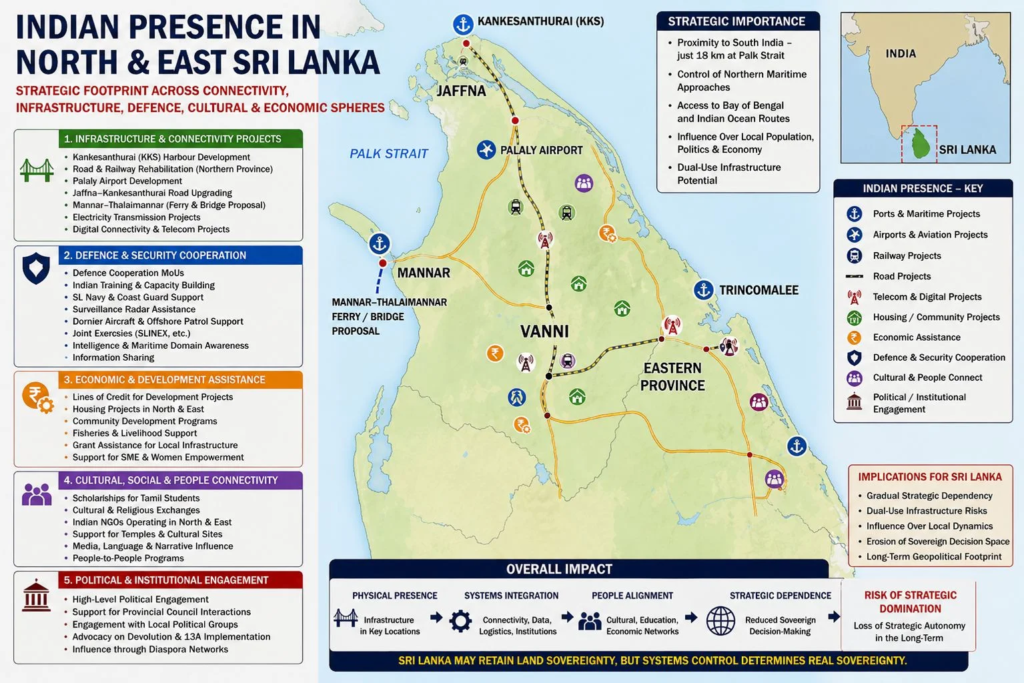
Calls for reducing or removing Security Forces camps in Sri Lanka’s Northern Province in particular the Jaffna & Wanni security forces, are being promoted as post-conflict normalization, reconciliation, and civilian land release. These developments must be read as part of Sri Lanka’s broader transition from sovereign security control toward system-based dependency systematically instigated across Sri Lanka but visibly seen in the North and East strategic arc.
This issue cannot be treated lightly. Such a decision cannot ignore wider geopolitical reality and implications that are being built around regional connectivity.
- growing external economic and infrastructure penetration
- maritime competition in the Indian Ocean
- strategic interest in Sri Lanka’s northern maritime corridor
- evolving regional power influence
- cross-border logistics links
- cross-border people connectivity
The first and most visible pressure points of this transformation are Jaffna and Wanni, where military reduction, land release, and conversion of strategic infrastructure are already being advanced.
This is not symbolic.
It is structural.
It affects Sri Lanka’s:
- sovereignty
- maritime control
- territorial continuity
- national security resilience
- unity, sociocultural and political integrity
Jaffna and Wanni are not post-war zones.
They are part of Sri Lanka’s most sensitive and vital northern frontiers.
- WHY MILITARY PRESENCE WAS PLACED IN THE NORTH – IS REASON WHY MILITARY PRESENCE SHOULD REMAIN
Sri Lanka’s security doctrine (N.Q. Dias era) identified the North as a permanent vulnerability due to:
- proximity to South India
- illegal maritime movement
- illegal immigration
- smuggling routes across the Palk Strait
- external influence exposure
- strategic maritime access
This was never temporary.
It was a security doctrine that was relevant then and is relevant now and crucial in the foreseeable future. This is so because the competition for dominance over the Indian Ocean region is at a crossroads between great powers, shaping the future of our country.
The Northern Areas, especially the Wanni jungles, became more critical during the separatist conflict when:
- arms smuggling
- offshore logistics
- external coordination networks
- jungle hideouts and most importantly, terrorist training bases
were actively used.
The situation was compounded by short-sighted decisions of the post-Sirimavo government that removed some of the security camps in the Northern areas, enabling a Tamil-separatist movement to cross the shore, hide, build logistics, train and attack the Sri Lankan state.
- WHY ARE THE NORTHERN AREAS STILL STRATEGICALLY VULNERABLE AND CRITICAL FOR NATIONAL SECURITY
Today, the same vulnerabilities continue in modern form:
- illegal fishing and resource exploitation
- narcotics trafficking across Indian Ocean routes
- human smuggling networks
- maritime intelligence gaps
- external influence activity
- competition among external powers for dominance of marine & natural resources within the EEZ.
The North + East form a single strategic arc linking:
- Palk Strait
- Bay of Bengal approaches
- Indian Ocean shipping lanes
- Trincomalee deep-water harbour region
This is why the 1987 Indo-Lanka Accord referenced both North & East.
Weakening the North+East strategic arc directly impacts Sri Lanka’s:
- National security & strategic resilience for the national defence posture against separatism and extremism
- maritime sovereignty
- trade security
- energy routes
- national defence posture
- Cultural integrity, unity & the safeguarding of vital national heritage sites.
For the island nation of Sri Lanka:
The keys to enter & exit must not only legally belong to Sri Lanka but also be under its exclusive non-negotiable control.
Maritime security = National survival of Sri Lanka.
- SECURITY FORCES = NATIONAL RESILIENCE SYSTEM
Security Forces in the North are not just military units.
They provide:
- coastal surveillance
- anti-narcotics operations
- intelligence networking & monitoring
- disaster and pandemic response
- emergency logistics
- humanitarian assistance
- dominance & defence of vital national infrastructure and assets
During COVID-19 and floods, they:
- ran entire logistics operations
- supported isolated communities
- maintained essential services
- enabled national emergency response – filling a key gap in national civilian capacity & capability.
Security Forces provide – Cultural and Civilizational Security Layer
- protection of archaeological sites in North
- security for pilgrimage routes
- protection of Buddhist theroes under constant attacks
- prevention against vandalism of national heritage & ruins
- Land encroachment and the prevention of illegal settlements that affect natural population growth & expansion.
- Security Forces’ role in safeguarding heritage, civilian rights & religious movements.
These sites form part of Sri Lanka’s civilizational security architecture in the Northern Frontier, one that is constitutionally binding.
Removing them removes more than military presence”.
It removes State identity, erases history and most importantly, the capacity for crisis response & people’s hope for safety.
It threatens and removes state capacity during crisis response & people’s hope for safety and security; if denied, a failure in providing human security for the citizens is an inalienable and undeniable responsibility of a State.
- WHAT REDUCTION ACTUALLY MEANS
If Northern military infrastructure is reduced, Sri Lanka will face:
- weaker coastal surveillance
- slower response to trafficking networks
- intelligence blind spots while enabling space for the growth of external & spy/intelligence networks.
- reduced disaster response capability
- loss of rapid deployment readiness
- erosion of state presence in frontier zones
- creates gaps in the erosion of national identity, history, heritage and people’s rights to safety and security. Thirty years of separatist conflict and religious extremism have provided an abundance of painful lessons & experiences.
Strategic Loss of Palali Military Air Capability
- Palali airbase conversion risk (transferring a military base into a civilian airport expansion pressure)
- Loss of rapid military airlift capability
- Loss of evacuation and reinforcement corridor
- Irreversibility of civilian conversion of military airbases
- Impact on Jaffna Security Forces HQ strategic depth
- Conversion of Palali airbase into a strategic air transportation hub aligned with Indo-Pacific security frameworks, including QUAD and Indian Ocean Region (IOR) connectivity and logistics architectures, risks progressively reducing Sri Lanka’s independent control over critical northern air mobility infrastructure: more critically impacting Sri Lanka’s traditionally held non-aligned policy.
The Palali airbase conversion is not an administrative upgrade but a strategic reclassification of a wartime military asset into a civilian airport, permanently reducing the State’s rapid military airlift capability, later to be converted into a regional air hub for external use.
Reduction of the Jaffna Security Forces HQ and conversion of Palali airbase must be viewed as interconnected strategic shifts, not as separate administrative decisions and as seriously undermining Sri Lanka’s national security.
More critically:
Once dismantled, operational capability cannot be quickly rebuilt, and what about the cost to rebuild and relocate such infrastructure elsewhere, and the time involved?
What about the security gaps during the transition period?
Does the Sri Lankan government have the fiscal capacity and the will to undertake such a strategic transformation of the existing national defence system, which was built over decades based on battle experience?
A more important question is whether the external powers with vested interests will allow such commitment by the Sri Lankan government to align and restore its defence system strategically, which might undermine their geostrategic and geopolitical interests?
Closure of Security Camps in Jaffna & Wanni results in loss of:
- terrain knowledge
- intelligence networks
- local operational familiarity
- logistical depth
- Abandoning strategically important defence grounds that were defended at the cost of many young and brave lives.
These take decades to develop, not months, and billions of government money that could otherwise be invested in state capacity building for national development.
- EXTERNAL INFLUENCE & SOFT TRANSFORMATION
The North sits at a strategic intersection of:
- India proximity
- Indian Ocean access
- post-war reconstruction flows
- infrastructure and connectivity projects
Geopolitical influence today comes in different forms.
- Infrastructure
- development funding
- diplomacy
- education networks
- cultural & religious transformation
- all types of connectivity corridors
The question is not who controls land”.
It is:
Who shapes systems operating on that land?
Sovereignty today is not only about land ownership. It is about who operates the systems that function on that land: logistics, data, transport, energy, and connectivity networks.
Modern sovereignty is determined not by territorial ownership alone, but by control over operational systems running on that territory — roads, railways, airports, and other logistics infrastructure; data, energy, and connectivity networks; and, more significantly and harmful
cultural penetration & externally-led sociocultural reshaping.
This aspect reshapes people’s thinking and realigns them to a foreign-controlled model.
Sri Lanka may well legally control the land, but what happens when systems operating on that land are controlled by external forces, and once outsourced, Sri Lanka has little or no say!
- WHO IS PUSHING FOR THE REDUCTION OF SRI LANKA’S MILITARY FROM JAFFNA & WANNI?
Pressure for reduced military presence comes through:
- demilitarisation and defence reform frameworks
- UNHRC post-conflict reconciliation narratives
- devolution advocacy groups
- external policy influence networks
- diaspora-driven political campaigns
- incremental integration based on connectivity, infrastructure, institutional alignment, and people-to-people networks can evolve into structural dependence, reducing Sri Lanka’s sovereign decision-making capacity and ultimately resulting in Sri Lanka’s strategic absorption into a foreign-dominated regional system.
The language used is:
- reconciliation
- normalization
- development
- civilian governance
- defence sector reforms, modernization and restructuring
In modern geopolitics, control is exercised not only through territory but through infrastructure, logistics systems, and connectivity networks that operate on that territory.
But missing from the discussion is one reality:
Strategic vacuum will always get filled — it is never left empty.
There are many historical lessons: a state that fails to enforce precise decisions with regard to national security and defence will perish, never to recover for centuries!
This is what should worry Sri Lanka’s political & defence leadership.
- THE REGIONAL POWER REALITY
Small states do not operate in isolation.
In South Asia, influence is shaped through:
- economics
- infrastructure
- maritime access
- security partnerships
- cultural & religion
- ethnicity & historical roots of common identity
Sri Lanka’s location makes it inherently strategic.
Therefore:
Reducing strategic presence in the Northern areas without a fitting military replacement capability creates dependency vulnerabilities that are difficult to reverse.
- MODERN THREATS ARE NOT MILITARY ALONE
Today’s threats include: these syndicates often work in cohesion
- separatist and extremist networks
- narcotics economies
- cyber-financing systems
- digital radicalisation pipelines
- coordinated destabilisation campaigns
- social media influencers / narrative creators (pose the biggest threat)
- non-governmental organizations and foreign-funded proxy networks
State weakening does not begin with war.
It begins with:
- reduced surveillance
- reduced presence
- reduced readiness
- reduced reinforcements
- reduced capabilities and preparedness
- increased cultural & educational integration
- increased proxy activities and anti-regime intelligence networking
- increased external dependence
- increased external footprints
- increased information warfare shaping national mindset, transforming consciousness
Then the surprise emerges: Sri Lanka was and is not ready, and Sri Lanka is being exploited right in front of our eyes!
- HISTORICAL WARNING — WHAT SRI LANKA ALREADY EXPERIENCED
Strategist N.Q. Dias identified the Northern areas as a permanent strategic choke point.
After 1977, weakening northern security architecture contributed to:
- loss of surveillance depth
- growth of militant networks
- offshore arms logistics
- expansion of separatist violence
- nearly 30 years of war
- loss of state control and governance
This created early surveillance gaps in a region already identified as a permanent strategic frontier!
The lesson is clear:
Weakening strategic presence and intelligence creates space for the escalation of elements that will threaten Sri Lanka at every level and at every time.
- MODERN LESSON — 2019 EASTER ATTACKS
Sri Lanka also learned that:
Even after peace periods:
- threats can re-emerge
- networks can evolve
- intelligence gaps are exploited
The 2019 Easter Sunday attacks proved that stability is not permanent, peace is fragile, and state armed forces were not ready, and the intelligence network was paralysed.
WHAT IS REALLY AT STAKE
Removing or reducing the Armed Forces from Northern Areas is not administrative reform.
It is a strategic restructuring.
It affects:
- sovereignty control
- maritime dominance
- intelligence coverage
- emergency response capacity
- territorial continuity and connectivity
- restraints on external powers, proxy networks and foreign intelligence activities.
Most importantly:
For the people of Northern areas, military presence is not just security.
It is:
- guaranteed assistance (in numerous forms), security & protection
- disaster response
- emergency logistics
- protection of infrastructure
- stability during crises
- state presence in vulnerable zones
- Protection and preservation of heritage & state identity as per Sri Lanka’s Constitution.
Northern areas are strategically important for providing a safety buffer to Anuradhapura, a place that has historically been under constant threat since its establishment as the first Kingdom of Sri Lanka; together they form the central security corridor between the north and the rest of the island.
Anuradhapura, out of all places, is the most sacred and sensitive heritage of Sri Lanka; specially to Buddhist and Sinhalese. Therefore, the continued existence of security camps in the Wanni is critical to safeguard Anuradhapura and not to repeat the kind of heinous massacre that took place at Jayasri Maha Bodhi committed by LTTE.
Wanni functions as Sri Lanka’s central defence buffer zone linking the Northern frontier to the national interior security belt. Giving up this access is administrative & security hara kiri.
For civilians in Jaffna and Wanni, the presence of Security Forces is not an abstract military policy — it is immediate protection during disasters, crises, and instability, and, most importantly, untold numbers of other support networks for civilians by military forces since the end of the conflict in 2009.
No foreigner will look after one’s own like one’s own.
The critical question remains whether Sri Lanka has the fiscal capacity, technological base, and institutional depth to develop and sustain advanced military and surveillance systems capable of replacing the operational gaps that would be created by a reduced Security Forces footprint in Jaffna and Wanni.
Reforming, modernising, and restructuring the national defence system is not a simplistic administrative exercise; it cannot be at the behest of foreign advice or pressure to satisfy their geopolitical and geostrategic interests!
Reforming, modernising, and restructuring the national defence system requires long-term strategic foresight – wisdom in national security design, sustained investment, and defence planning that goes far beyond visible political electoral cycles.
National defence can never be in conflict with political interests.
At present, there are concerns regarding uneven regional development and strategic neglect in areas such as Mannar, which already shows signs of limited infrastructure prioritisation, ethnic, cultural and religious divisions and disunity despite its geographic importance to the nation’s survival.
If similar patterns of reduced strategic investment extend to Wanni as a result of removing the armed forces’ presence in a jungle terrain that the LTTE exploited to the fullest, the resulting gaps could significantly weaken Sri Lanka’s northern defensive depth, maritime monitoring capacity, and rapid-response capability while creating more gaps for the expansion of foreign intelligence networking, regional exploitation and subsequent outcomes.
In geopolitical terms, the Northern-Eastern maritime corridor remains one of the most sensitive segments of the Indian Ocean region. Any sustained reduction in state security infrastructure risks gradually alters the strategic balance of the island’s sovereignty and creates vulnerability for strategic resources in the EEZ for exploitation.
For a small island nation situated within a highly competitive maritime environment, the key issue is not only current policy, but the long-term trajectory of sovereignty protection, system resilience, and strategic autonomy.
The real question is not whether camps should exist.
It is: Can Sri Lanka afford to lose permanent state presence and capability in its most sensitive frontier region?
Because once lost, it cannot be easily regained or rebuilt — and in a situation of financial strain, surrendering what little security presence and capacity remains physically, effectively exposes the state to external strategic dominance, a condition that is politically irreversible once it takes root.
Protecting our country demands serious & honest factoring in the past, current & future security threats while maintaining national independence & making national security decisions free from foreign & external pressure.
What is ours must remain ours not only legally but in terms of control as well.
Who will be accountable for the strategic miscalculations (if it is to ever happen) in national security and the defence of our state?
Is there an accountable and sustainable process, a resilient homegrown system of national security policy making, and set of experts who (who are also capable of understanding and navigating amid internal and external pressures and demands) could honestly advise on a critical national survival issue under the current context, while taking into account the states’ national interests, while fulfilling the citizens’ aspirations for a secure and peaceful country that experienced brutal 30 years separatist conflict, two armed insurrection in 1971 and 1988-1990 era and a religious extremism and terrorism in 2019?
These are defining decisions that will shape the future of national security and sovereignty. Any move to restructure the defence architecture must come only after these critical questions are rigorously examined, transparently debated, and responsibly answered. To proceed without such scrutiny is to risk compromising not just strategy, but the very sovereignty we are duty-bound to protect.
Shenali D Waduge
First Christian Chief Minister of Tamil Nadu Replacing 60 Years of Dravidian Politics, But Racist Politics Still Dominates
May 11th, 2026Dilrook Kannangara
After 60 years of continued rule, Dravidian political parties suffered a massive defeat in Tamil Nadu state of India at its state election. DMK, AIADMK and their various offshoots failed to win a sizable number of seats to rule the state. Instead, a newcomer to the political scene – TVK – led by an actor turned politician swept the election. However, his party lacked the majority and had to rely on a rival party’s support to get Joseph Vijay’s claim to the Chief Minister post. His voter card states that he’s a Christian – a fact not lost during the election campaign as BJP-aligned groups used it to discredit him. He has stated he aligns with no religion and that his mother was a Hindu and his father was a Christian. But in India caste and religion are not up for change – these are documented in birth certificate, identity card and voter card.
His party – TVK or Tamilaga Vetri Kalagam – is still a racist party that harps on Tamil identity at the expense of an Indian identity. Therefore, nothing much has changed in Tamil Nadu. Due to its racist politics, clashes with other states, the central government of India and neighboring Sri Lanka are to be expected.
Tamil Nadus has the second largest state economy of India after Maharashtra. Both states could become newly developed countries within a decade if they gain independence from India due to the fact that they pay far more tax to the central government than they get back from the central government. These 2 states have no wars or disagreement with Pakistan or China and not saddled by India’s extremely poor states, war liabilities and other worthless incumbrances. However, laws inherited from the former Soviet Union including anti-sedition laws keep them tied down to poverty and under-development where all major decisions are made by Gujaratis and Uttar Pradesh politicians destining India to collective poverty. Vijay’s criticism of Indian central government’s imposition and management of GST (goods and services tax) contributed heavily to his election success.
Meanwhile Kerala ended its long relationship with socialist parties. Now India has no socialist or communist party rule in any of its states.
West Bengal replaced its own sectarian political party with a BJP alliance ending decades of ethno-racist politics. Following this shift, Tamil Nadu remains the only ethno-racist enclave in India, willing but unable, to fly free towards prosperity and independence breaking 750 years-old shackles of collective poverty.
India under Narendra Modi – Is Sri Lanka ready for its revolutionary transformation
May 11th, 2026by Senaka Weeraratna
In his February 2014 article, Senaka Weeraratna argued that a Narendra Modi premiership would trigger a “sea change” in India’s regional leadership, moving away from Western influence toward an assertive, nationalist foreign policy, marked by increased civilizational pride The author questioned whether Sri Lanka was prepared for this transformation, predicting a shift toward a more respectful, culturally aligned partnership rather than previous diplomatic approaches. Read the full analysis on esamskriti.com.
https://www.dailymirror.lk/print/opinion/india-under-narendra-modi-is-sri-lanka-ready/172-47140
India under Narendra Modi: Is Sri Lanka ready for its revolutionary transformation?
| by Senaka Weeraratna | on 01 Feb 2014 | 16 Comments |
https://www.vijayvaani.com/ArticleDisplay.aspx?aid=3094
The Indian general election scheduled for May 2014 would, if the forecasts are proved to be correct, result in a sea change in India’s relationship with the rest of the world as well as a revolutionary transformation of her economy, industry and education if the changes introduced in Gujarat by Chief Minister Narendra Modi are an indication. It will also dramatically affect the ongoing ‘blow hot blow cold’ relationship that India currently pursues with Sri Lanka.
India under Narendra Modi as Prime Minister will claim its rightful place in Asia as one of its true leaders, politically, economically and even militarily, and in order to demonstrate these credentials India can be expected to gleefully abandon its current policy of servility and unconditional subservience to the West. It will do so in the full knowledge that continuing subservience to its former colonial masters and their allies i.e. the new sponsors of colonialism, will severely undercut any Indian claim to lead the once colonized but now liberated nations of Asia.
India will discard its junior partner status in any relationship with the USA and retaliate in a more effective manner if the American gaffe we saw in the recent past involving Indian diplomat Devyani Khobragade were to be repeated.
India will reclaim its ancient spiritual and cultural heritage and take pride in its civilisational achievements in a way that will put to shame the negative attitudes being adopted currently by the Indian establishment, including its mass media and burgeoning film industry, lacking vision, sense of country’s purpose and more importantly, pride in its own history and heroes.
The upsurge of the view that India has nothing much to offer other that material goods and services and entertainment in this modern age has diminished India’s moral standing in a world long used, particularly in the pre-colonial past, to be the beneficiary of Indian philosophical thought, wisdom and outspokenness that had no equal.
India will mend any strains it has in its relationship with China and will not allow interfering outsiders, particularly from the West, to identify India’s friends and potential enemies and teach India how to conduct itself vis-à-vis imagined foes. India will take comfort from an historical fact that India and China despite being neighbours on the Asian continent had never gone to war with each other for over 5000 years except on one dismal occasion in contemporary history (1962) when it clashed over a border issue that has its roots in British colonial mischief.
India will set its own foreign policy agenda and goals from a central government perspective, rather than from a regional government perspective, which today has unfortunately contributed to India’s almost total isolation from its immediate neighbours in South Asia. This anticipated posture will contribute immensely to improvement of India’s ties with Sri Lanka. Netaji Subhas Chandra Bose, the popular freedom fighter and nationalist leader that India never had as its Prime Minister, will come alive in the form of Narendra Modi and will revolutionise India’s national and international image.
India will no longer be the country that the West, particularly the USA, would take for granted with contempt for both its leaders and people, but a new India conscious of its place in the world and obligations to both humanity and all other living beings. India’s Constitutional provision that it shall be the duty of every citizen of India to protect and improve the natural environment including forests, lakes, rivers and wildlife and to have compassion for living creatures” (Article 51 A (g)) will gain a new lease of life. This is the vision that India’s great son, Gautam Buddha, had for Bharat and its greatest Chakravarti Emperor Asoka faithfully strove to establish in the form of a compassionate society.
India’s moral voice can be expected to be heard again in the far flung corners of the world in a manner that the Buddha, Mahavira, Asoka, Nagarjuna, Swami Ramakrishna, Swami Vivekananda, and Mahatma Gandhi and the like resounded to the serene joy and delight of humankind. Idealism will return to India and in turn help to recharge the batteries of a largely spiritually weakened Asia, now increasingly despoiled by unbridled crass materialism.
We must gratefully acknowledge that it was India more than any other country that originally provided the value system for the moral and ethical foundations of Asia, through the spread of the influence of Buddhism and Hinduism. Are we in Sri Lanka ready to meet the challenge of foreseeable radical changes in our closest neighbour, India?
The author is a Sri Lankan lawyer
16 Comments
User Comments Post a Comment
amazed astonished to read a so beautiful blog by a srinkan lawyer who knows everything about india as if shrilanka is a part of india.hats off to the writer.
dabangg hindu
February 01, 2014
Report Abuse
Brilliant note, Senaka Weeraratna.
Our civilization ties are so intense and far-reaching, that a renewed Bharat-Srilanka maitri should result in the constitution of an Indian Ocean Community — Hind Mahasagar parivaar — to revolutionise the development opportunities in a United Indian Ocean States. Start with a Colombo-New Delhi Boat Mail. Built the Trans Asian Highway and Railway.
Venerate the Buddha in Sanchi University set up with such joy and hope.
All the best. With the anugraham of tathagata, everything is possible. Dharma-Dhamma are inviolate, eternal.
Kalyan
S. Kalyanaraman
February 01, 2014
Report Abuse
very good article.
sanjeev nayyar
February 01, 2014
Report Abuse
Narendra Modi is an individual. We should believe in the capacity for goodness and greatness of individuals but not depend on one. Modi has his work, each of us have his or hers, that is the establishment of Dharma, not yours or mine, but the Universal Dharma.
Sri Weeraratna has recalled for us and emphasised the Calling of India that is Bharat. It requires great sensitivity and perspicacity to understand something as indefinable as Character, that too of a country, and what ability is needed to articulate this understanding! I extend my appreciation and gratitude to Sri Weeraratna, and express my hope that his confidence in Bharata is well placed.
Chandra Ravikumar
February 01, 2014
Report Abuse
Thanks to the author for his understanding of the inevitable change which is going to happen in India after the May 2014 General Elections.
But as a Sri Lankan National he must articulate more on what his country is going to do, whether the Buddhist clergy will shed its fanaticism and move towards having a healthy, peaceful and progressive relationship with Hindus, and realise the fact that SL needs to assert its Buddhist-Hindu Identity.
I would be thankful if the author answers his own question ( Are we in Sri Lanka ready to meet the challenge of foreseeable radical changes in our closest neighbour, India?) by means of another article here in Vijayvaani.
B.R.Haran
February 01, 2014
Report Abuse
Thanks to a Great article, NaMo frequently talks about India leading the world into Gyan Yug, before that he has to focus on reclaiming India’s leadership in Asia. Time demands Hindu-Buddhist countries in Asia come close with increasing economic,cultural and strategic engagement. But the main problem is that China cannot behave like a bully with claims on other territories. If China doesn’t realize the need for a cohesive Asia, west would continuously exploit the fault-lines in Asia and use them against both China and India
krishnarjun
February 02, 2014
Report Abuse
I am afraid the writer of the article is reading far too much into the likely elevation of Narendra Modi as PM. Modi has been extremely shy of using the word “Hindu” (the worst swear word in India ever since Nehru was foised on an unwilling nation by the alleged Mahatma). Keen observers (of which there are indeed very few in India) say Modi has been slowly and steadily de-Hinduising himself for the past 10 years, just like Vajpayee earlier.(Remember his needless “Sadbhavana” rally and his equation of “devalaya” (temple) with “shauchalaya” (latrine)) Modi belongs to Gujarat whose people are known for being the most money-minded in India. There is much materialism in Modi’s home state but little culture or spirituality. If the BJP is fortunate to get a clear majority in Parliament, Modi may hopefully (despite jealous colleagues like Advani and Sushma) give the country a much less corrupt government than what the Christian-led Congress has given for 10 years. But that’s about all. Wise readers should expect only this from Modi. Nothing less but nothing more too. To cheat others may be bad but to deceive oneself is worse.
KNT
February 02, 2014
Report Abuse
Bharat & Sri Lanka have the same cultural heritage and we are joined by genes,language,Dharmic traditions and the same philosophies towards life,living and the world at large.
The dirty role played by self-seeking politicians,false histories written and propagated by the colonizers and taken forward by exploitative historian-‘time-servers’ has resulted in most of the people on either side of the RAMA SETHU to believe that we are different.Definitely not!
We share a great,common Samskriti that has given Light to the world and is still lighting the darkest recesses of the world.
One pessimistic reader sadly has poured cold water on the author’s optimism regarding NaMo.He questions Modi’s performance and states that it may be slightly better than the present corrupt Congress.
It is indeed very big true that NaMo’s coming to power,becoming Prime Minister of Bharat and setting things on track will be a very very difficult task as this present corrupt government has deliberately destroyed all institutions.This Congress knows fully well that now they can never seize power and so become ‘dog in the manger’!
They are trying every dirty trick to stop Narendra Modi from coming to power.
This is the very reason why we the people of Bharat have to unitedly support NaMo into coming to power.
Nothing is ever easy and he knows this.May Bhagavaan help Bharat.Given the Indian people’s support and the power of ISVARA Sri Narendra Modi will change the face of our Bharat for the better from every angle.
He has the will,character,strength and honest determination to bring back our lost glory,respect and dignity and once again make our Bharat a prosperous and happy nation.
??????? ???? !????? ??????!
V.Pant
February 02, 2014
Report Abuse
I did not “pour cold water” on the author’s optimism regarding Narendra Modi. I was only pointing to the need to assess people by their performance rather than by our fond wishes. V. Pant’s comment is a good example of the naivete for which Hindus are well known all over the world. “May Bhagavan help Bharat,” says Pant, despite the fact that there is no record of Bhagavan helping Bharat even in the dark centuries of horrendous Islamic oppression. The British rightly say “God helps only those who help themselves”. Pant says “given the power of Eesvara, Modi will change the face of Bharat”. The power of Eesvara has not been seen in the least in the unfortunate land of Bharat for the past 1,400 years. Hindus cannot afford to be so gullible in a world where only the most cunning survive. While I also wish that Modi becomes the next PM, I hope he will not disappoint Hindu patriots as Hajpayee’ and Advani did.
KNT
February 02, 2014
Report Abuse
“Asia for Christ” is the clarion call given by the Vatican.It is impossible to convert Muslims and so the whole conversion activity is concentrated in Hindu and Buddhist soceity.Already,South Korea has become Christian majority country with Buddhists getting pushed to second place.The only Hindu kingdom in the world,Nepal was destroyed by the missionaries using their swordarm,the Maoists.Same thing is happening in Odisha,AP,TN and the North-East.Still Hindus want to be ruled by the Catholic mother and son,duo of Sonia and Rahul.
S.S.Nagaraj
February 02, 2014
Report Abuse
Very true article
Ajay
February 03, 2014
Report Abuse
wonderful article.
In the changed scenario,I wish to know the author’s view as to how Srilankan buddhists would start treating their and our Tamizh brethren and how Srilanka as a country would mend its relationship with Hindusthan. Especially, the way day in day out they arrest and ill-treat Hindusthani fishermen.
Khobragade issue. It’s not the individual but issues requiring importance. The case of the lady diplomat is very weak from her side and she deserves punishment for the wrongs done. But diplomatic relations between Hindustani and USA shall be strictly on reciprocal basis. With proper investigation, there is every possibility that some of the American diplomats in Hindusthan getting punishment under Hindusthani laws.
Namo has openly and proudly articulated that he is a Hindu Nationalist. Sure the Devalaya sauchalaya sort of rubbish could have been avoided. He has proved that he is not another “Hajpayee” by refusing to accept skull cap during the sadhbhavana movement. The likes of Sohrabuddins would see the beginning of their end once Namo comes into picture. Even if not Namo would change the face of Hindusthan in a day, the vily white church would realise that it would not be that easy to harvest souls in Hindusthan anymore.
krishnakumar
February 03, 2014
Report Abuse
@krishnakumar
I do hope your expectations about Modi are not belied. But, remember Modi rather apologetically said ” I am a Hindu” and then “I am a national”, then “so I am a Hindu nationalist” which is not quite the same thing as saying “I am a Hindu nationalist”. It is good that he did not accept the skull cap during the sadbhavana rally, but why hold a sadbhavana rally at all? Who wants any “sadbhavana” (whatever it means) anyway? The rally seems to have been organised merely to placate the secularist media who are implacable enemies of Hindu society. And I have seen a picture of Modi accepting an award from a denomination of Christians of Kerala, India’s most fertile breeding ground of the world’s most wily missionaries. Why accept an award from a known enemy?
KNT
February 03, 2014
Report Abuse
India as it exists today is a colonial system, with a colonial economy.. The real nation is Bharat, which is systematically suppressed on all fronts..
So even if India breaks free from US influence, it will still be a colonial entity and NOT its 5000 year old society.
There are few things to do to reclaim the bharat and the bharata varsha..
1. The current Indian colonial system should be dismantled..
2. The current Indian Judiciary model (which Sri Lanka also uses) should be dismantled. The author of this article is a lawyer and he should first introspect what is the history of this judiciary system (with all those black gowns & hammers) ? Does he want this masonic system to be defacto?
3. The current economic system has to be dismantled.
But the fact is none of the above would happen, and unless this happens, there is no use in getting pride of india being asian leadership..
senthil
February 05, 2014
Report Abuse
A profoundly pragmatic analysis and synopsis by Senaka.
His autopsy of the current and past political leaders is worth admiring for he has hit the nail on the head. From 1947 to-date, India has had suffrage and pseudo threats to its populace, boundaries, religion and self esteem.
MODI is the de facto restorer of these cherished and ingrained Indian Values, which will benefit not only the Indians but their neighbours who have been mollified into a perception of enmity by the West.
Let us all hope that MODI will be the next PM and that India as we know to-day will be a totally different and valued Country over the globe and, once again, regain its rightful place in history enshrining the principles of religion, education, humanity and truthfulness.
Ken Popat, London, UK
February 07, 2014
Report Abuse
Political changes in India, when they are real, are only movements of the Pendulum. The problem in Srilanka is rooted in the discrimination against Tamils, pure and simple, and it is pointless to blame outsiders or external factors for what is obviously a self-inflicted wound. Powers like the US are merely exploiting it.
If the author- who is obviously biased against Tamils because the merit he sees in a Modi regime is that it would ignore (supposedly) the sentiments of Tamils in india while dealing with Srilanka- looks into himself he would realize people like him are at the root of the problem. It is a problem of ethnic discrimination and hate.
The hope that a new regime in India will enable Srilanka to vicariously get back at a self-righteous USA also is a mere wish. Modi’s party sells religion downward (the ranks), and upward the promises of some redemption for the identity-challenged classes and pseudo-patriotism which appeals to the timid types. In the middle it is a complete sell out to the marauding corporates especially the western (read US) corporates. It is no different from Congress in this sell out. We have seen it already.
varghese
February 08, 2014
Report Abuse
Sri Lanka
https://www.dailymirror.lk/print/opinion/india-under-narendra-modi-is-sri-lanka-ready/172-47140
Commuter Horror
May 11th, 2026Author: Hamsen B Paramahamsa
Part one
This is Sri Lanka. Praised as the paradise island and called, in the history, as the granary of the east. Yes, it is true if one had the means. One can shift away from Colombo and seek refuge in regions where barely people live. It can be in the mountains, at the coast or even in the semi-barren Jaffna peninsula. Nature is reviving despite demographic pressure and random encroachment of virgin land.
In and around cities and towns people commute about trading, practising professions or even be government employees, professions all dream of having.
Population has been surging up since more than a century. The infrastructure, neglected, keeps no pace with it. It lags miserably behind. Infrastructure costs money and that is not available. But if money is work-force, it is excessively available. Stream lining it into the habitat is a different issue.
With the bare hand and palm, a nation as a whole has no ability to channel the muscle force found abundantly to do a reasonable work to improve the infrastructure. Work is: force multiplied by distant moved. Since the work done is nil or near nil, though the force exists increasingly in the surging demography, the distant moved has to be near nil or even nil. It exposes itself in the absence of badly needed infrastructure, especially on the ever important commuting tracks.
However, the force coming out from the surging population cannot be stopped. In populated regions it loses itself in wear and tear and shows position change, implying work is being done. The work-done exposes itself in degradation of the landscape with sapiens’ natural force. A kind of Sapien’s-Brownian motion
It is true because everywhere across the island one sees people sitting, gossiping, straying about and even brooding with the intention of raising themselves up for a revolt or to smash-down everything across the way with a lust for Nihilism. A strange phenomenon which suffocates inhabitants or force them to rampage out to decimate the next nearest or get themselves decimated by a xeno-somatic outsider. It is when the drive to emitting found in the genes of all species, likewise in homo-sapiens finds no tracks, fields or space-volumes to stretch out to preserve and multiply the species as they strive to have some pleasures and fulfil their dreams, intermittently remembering to protect the children and wives at home.
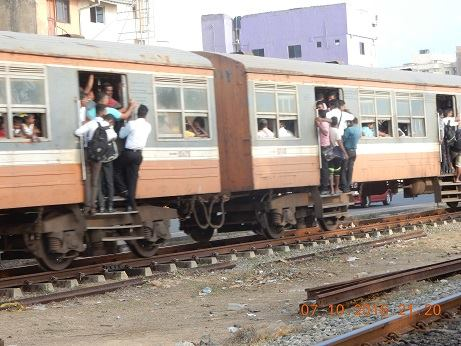
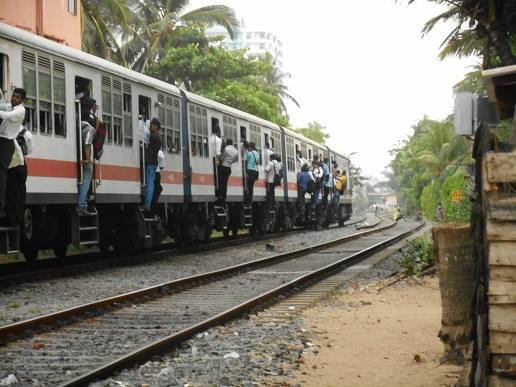
Yet, a few of these people do succeed or get chances to earn some rupees to fulfil their dreams. These people have to travel hither and thither to find the means for survival, as nature demands. One could see the drive in the overflowing packing of the trains with humans, if one is allowed to say so. They take all kinds of risks to find honourably the coins for their rice-kiribath, iddi-ahppa, ahppa and pol-sambol. Or when a favourable day falls dropping few more coins than usual into their palms, they afford exotic bread or Pahn turned indigenous, brought in by the Portuguese, with china-sambol called seeni-sambol to have for breakfast after a good sleep and stretched out muscles without to have the need to cook the over-starched food and what not, without rising up early with the doodle of the cockerels, and hooting of the cuckoos.
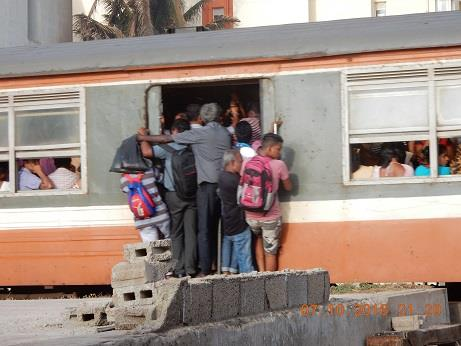
The railway compartment is thick packed and tight with people. No room to cough or sneeze without doing it straight on the others’ face. If one is lucky, one gets a finely carburetted and molucularised spray of saliva travelling, as some say, at speeds tending to reach the speed of sound, from the ones having lung muscles strong, straight on to the face. Full of bacteria, virus and all those molecular organisms of the order of billions at one blast.
If one is un-lucky, one may get a saliva spray with the same blasting speed, the molucularised carburation cocktailed with garlic, also straight on to the face. Often it is found that traditions are not lost. Then one may get a spray of Bulath-eatay-cocktail also straight on to the face. Redder than Kabuk and sprinkling the shirts to appear modern art. One should not forget, sneezing mostly follows cold. Then the spray has that carburation with the virus soaked molucularised mucus from the lungs. Then one has it.
All as Minister of Health, Minister of Transport, the President and all the accompanying sycophantic orchestra are busy having conferences to master this problem since decades unknown at grand scales. In guarded mighty halls acclimatised and well served with delicious delicacies with lot of space between one another.
A railway compartment may carry two busloads normally. But at these traffic hours in the mornings and evenings, it comes to more than 3 busloads per compartment, if one had the space to stand and the means to count.
In a railway trip, there are usually about ten compartments. It comes to thirty or more busloads in one swing by the rickety train coming from Colombo Fort and dashing down through broiling-heat, winds and rains with its steal dachoto-phony towards down south Matara.
North of Colombo Fort, it is not different whether towards Kandy, Badhulla, A’pura, Jaffna, and the coastal line to Puttlam with spoilt air with a strange perfume with Babynona’s watty having fish remains. One need not speak of the lines to Trinco or Batticoloa as travel past Galoya, horning. The story is the same. Hanging is prohibited by law. Yet one shouldn’t sight it.
What if more than thirty busloads per train that moves at this time of the day, every half-hour, are put on to the roads in buses? It needs no explanation. The perennially discordant country’s economy in time and space will deepen in lagging so much that many machines have to be switched off. Traffic will just not move in the humid disgusting still-standing heat, not to speak when monsoon rain beats down. People deprived of the time saving trip resort to walk home to have pleasant sharing with their families blended with a bit of bragging over the day’s achievements or grudging over the under-cuttings and newly made enemies. Ticket fare gone.
How to settle this problem? In Part Two.
Natural Wealth Generating
Engineering
Paddy, cereal, and vegetable fields have sacrificed over 90% of their Floral Volume.
Nature-emulating methods to activate the unused floral volume are progressing, though sporadically.
Hamsen B Paramahamsa MSc Geology
Environmental Engineering
Deserts, mountains, oceans,and more.
Special: Coastal Erosion and Landslides.
Sea level consensus: 50 cm. lower than today.
Do you like it? Send your opinion

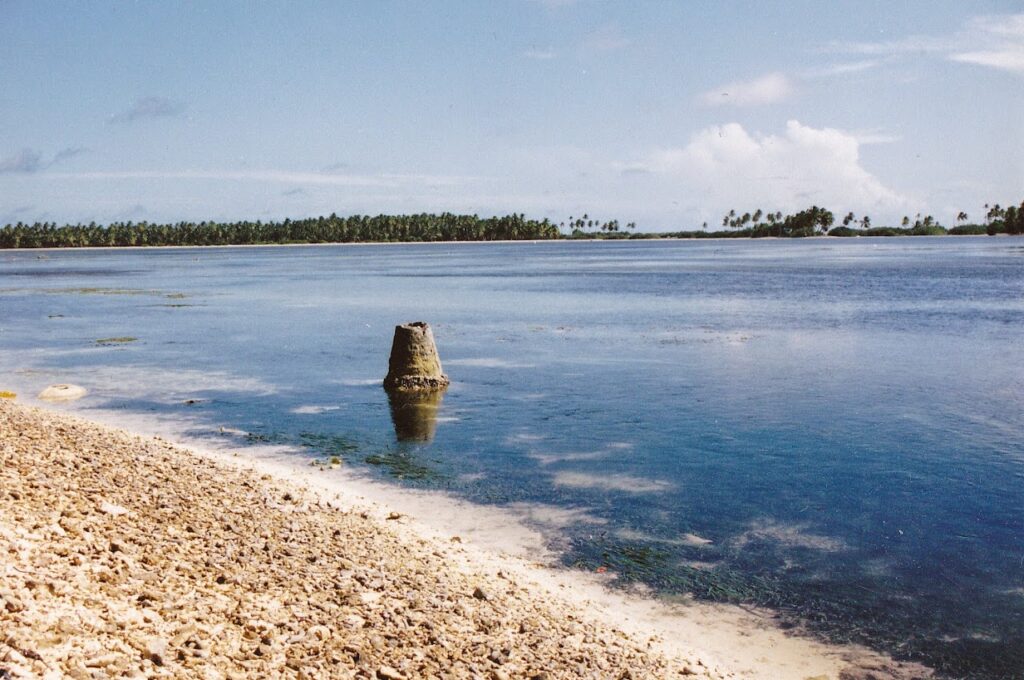
Norway launches a breakaway a so called ‘ Sihela First Nation’s Buddhist Order’ – Buddhists Beware
May 11th, 2026Senaka Weeraratna
Norway’s intervention in Sri Lanka’s affairs is tantamount to a Kiss of Death. Its intervention in the past has always undermined national sovereignty, promoted betrayal of Sri Lanka’s true interest and was always seen as the continuation of the deadly colonial policy of ‘Divide and Rule’. Norway enjoys the reputation of a dedicated Christian theocratic State. Only followers of the Christian Lutheran Church were able to hold high office including the King of Norway, Judges and all senior civil and military officials, county governors, and most cabinet members, under the Constitution of Norway. The Church of Norway remains recognized as the “national church” (folkekirke) and receives state financial support. Though there may have been cosmetic changes in the Constitution in the recent past it still regards itself as a Christian country to the core and thereby ever ready to dislodge the rightful place enjoyed by Buddhism in Sri Lanka under Article 9 of the Constitution. The hidden agenda is a singular determination to undermine and break the millennia old Dharmic civilizational links between India and Sri Lanka.
Norway, first clean your house before trying to clean the house of others. Physician, heal thyself.
Why the Communist Idea Still Matters
May 11th, 2026Dr. Sam Ben-Meir
Few words in modern political language are as burdened—or as reflexively rejected—as communism. To invoke it today is to invite immediate dismissal, as though history itself had rendered a final and irreversible judgment. The argument is familiar: the twentieth century tried communism, and it failed—catastrophically.
But this argument rests on a confusion so basic that it would be surprising—were it not so convenient. It assumes that what occurred in the Soviet Union, Maoist China, or other so-called actually existing socialist” states exhausts the meaning of communism. It treats a historically contingent set of regimes as if they were the definitive expression of an idea that, by its nature, exceeds any single instantiation.
No one would accept this reasoning elsewhere. We do not reduce Christianity to the Spanish Inquisition, nor liberal democracy to the worst crimes committed in its name. And yet, when it comes to communism, the move is made without hesitation: Stalinism becomes its essence, and the verdict follows automatically. This is not historical analysis but ideological closure.
To claim that communism has been tried and failed” is to assume that history operates like a controlled experiment: a hypothesis is tested once, under specific conditions, and the result is decisive. But political ideas are not laboratory propositions. They are lived, distorted, betrayed, revived, and transformed across different historical conditions.
Consider the Soviet Union. Within a few decades, the USSR transformed itself from a largely agrarian society into a major industrial power. Its role in defeating fascism in World War II was decisive. Its scientific and technological achievements—from early space exploration to advances in education and public health—were significant.
None of this is intended to excuse the immense suffering, repression, and violence associated with Stalinism. But it does undermine the simplistic claim that the Soviet experiment can be written off as a total failure. The point is not to redeem the Soviet experiment, but to reject the lazy conclusion that its crimes exhaust the Idea it claimed to embody. More importantly, it raises a deeper question: why should this particular historical formation be treated as the final word on what communism is—or could be?
To equate communism with Stalinism is not only historically crude; it is philosophically incoherent. It is akin to arguing that because a medical treatment was once misapplied with disastrous results, the underlying principle of healing must be abandoned altogether.
What, then, is communism—if not the regimes that claimed its name?
Here the work of Alain Badiou is indispensable. For Badiou, communism is not first and foremost a state form or an economic blueprint. It is an Idea: a commitment to the possibility of a society organized around radical equality, in which collective life is no longer subordinated to private accumulation or hierarchical domination.
The communist Idea affirms, first, that no human life carries greater intrinsic worth than another—that equality is not an aspiration but a starting point. It insists, further, that this equality must take material form in the way society is organized: in how resources are distributed, how work is structured, and how power is exercised. And it demands, finally, that human capacities—creative, intellectual, affective—be developed in common, not narrowed, exhausted, or deformed by systems that convert life into labor and potential into profit.
At this point, a familiar objection arises: isn’t this precisely what every failed revolution has claimed—that the Idea was betrayed, not realized? The force of the question should not be dismissed. But the objection proves too much. If every historical failure were enough to invalidate the principle in whose name it was undertaken, then no political idea—democracy, rights, even justice—could survive its own history. The issue is not whether past attempts fell short. The issue is whether the Idea itself names a genuine possibility that exceeds the conditions of its distorted realization. To collapse that distinction is not a mark of realism, but a refusal to think beyond the limits imposed by history as it happened.
This is not utopian in the sense of being detached from reality. It is, rather, a claim about what reality itself permits—a claim that history has repeatedly, if briefly, brought into view.
The Paris Commune remains one of the most striking examples: a short-lived but profound attempt to reorganize political life on egalitarian principles, abolishing standing hierarchies and rethinking the relationship between labor, governance, and everyday life. Similarly, during the Spanish Civil War, experiments in worker self-management demonstrated that production and social organization could function without traditional capitalist command structures.
Nor were such experiments confined to moments of revolutionary rupture. In postwar Yugoslavia, systems of worker self-management operated for decades, reorganizing firms around collective decision-making rather than centralized state control or private ownership. These arrangements were uneven, constrained, and ultimately entangled in broader political contradictions. But their significance lies elsewhere: they demonstrate that non-capitalist forms of economic coordination can persist beyond exceptional moments, taking institutional shape within complex, modern societies.
What these examples reveal is not simply that alternatives have appeared, but that they recur—under different conditions, in different forms—whenever the limits of existing arrangements become intolerable. These experiments were fragile, often constrained or ultimately undone by internal contradictions and external pressures alike. But their significance lies precisely in their existence. They show that the communist Idea is not a fantasy imposed on reality from outside. It emerges from within history itself.
If Badiou provides a philosophical framework, Slavoj Žižek offers a diagnosis of our present predicament. For Žižek, the real problem is not that we have rejected communism, but that we have accepted a world in which no alternative to capitalism seems conceivable.
We are told, endlessly, that while the system may be flawed, it is ultimately the only viable option. Attempts to imagine something else are dismissed as naïve, dangerous, or historically ignorant. This is what Žižek calls ideology at its most effective: not the imposition of false beliefs, but the foreclosure of thought itself. We are permitted to critique the system endlessly—so long as that critique never threatens to become an alternative.
In this context, the word communism acquires a paradoxical importance. It is not simply a label for a particular program. It is a way of insisting that the space of the possible has not been closed—that the current organization of society is not the final horizon of human life. To abandon the word is, in a sense, to concede defeat in advance.
There is, however, a further reason to revisit the communist Idea today—one that has less to do with historical memory and more to do with material conditions. For the first time in human history, technological development has created the possibility of abundance on a scale previously unimaginable. Automation and artificial intelligence have dramatically reduced the amount of human labor required to produce essential goods.
Writers such as Aaron Bastani have argued that these developments open the door to what he calls fully automated luxury communism: a society in which the necessities of life are provided universally, and human beings are freed to pursue activities beyond mere survival.
We already live in a world where warehouses operate with minimal human labor while workers remain precarious, where food is produced in abundance while millions remain food insecure, where algorithms perform cognitive tasks once thought uniquely human—and yet the basic conditions of life remain unequally distributed.
Even if one rejects Bastani’s vision, the underlying point is difficult to dismiss. The traditional justification for inequality—that scarcity necessitates competition and hierarchy—no longer holds in the same way. The productive capacities of modern societies are more than sufficient to meet basic human needs. And yet, these capacities are organized in ways that perpetuate scarcity, exclusion, and precarity. The problem is not technological limitation but social form.
If communism is so often rejected, it is not simply because of historical memory. It is because the Idea itself poses a challenge that many find difficult to confront. To take equality seriously is to question not only economic arrangements, but the entire structure of social recognition. It asks whether the privileges we take for granted—of wealth, status, or power—can be justified at all. It demands a rethinking of what it means to live together. It also asks whether the advantages we inhabit are defensible—or whether they persist only because we have learned not to question them.
This is not a comfortable question. It is far easier to dismiss the Idea as dangerous or impossible than to consider what it would require of us. And yet, the alternative is not stability. It is a world increasingly marked by ecological crisis, extreme inequality, and technological systems that intensify rather than alleviate human suffering. To insist that this is the best we can do is not realism. It is resignation. What we call realism today is our learned incapacity to imagine a world in which we no longer benefit from inequality. What passes for realism is often nothing more than the defense of advantage.
The point is not to return to the twentieth century, nor to repeat its mistakes. It is to recognize that the communist Idea names something that remains unresolved: the problem of how to organize collective life on the basis of equality rather than domination.
We may find a different word for it. But any such word will have to carry the same weight—the same insistence that another form of life is both necessary and possible. For now, communism remains the most honest name we have. Not because it is free of history, but because it refuses to let history close the question. That is precisely what makes it so difficult—and so necessary—to think again.
To dismiss the communist Idea is not simply to reject a word or a history. It is to accept that the present arrangement of life is as far as thought—and as far as justice—can go.
Sam Ben-Meir is an assistant adjunct professor of philosophy at City University of New York, College of Technology.
No environment clearance granted for cable car project at Sri Pada: CEA
May 11th, 2026Courtesy The Daily Mirror
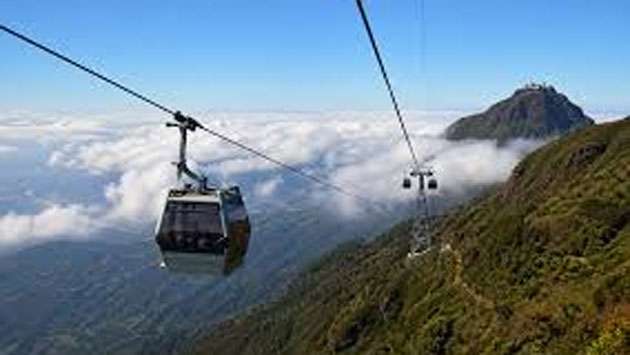
Colombo, May 11 (Daily Mirror) – The Central Environmental Authority (CEA) said today that environment clearance has not been granted for a cable car project at the Sri Pada (Adam’s Peak) site.
Director General of the Central Environmental Authority Kapila Rajapaksha confirmed that no environment clearance has been granted for such a cable car project.
He said this while responding to a question whether any approval has been granted to a cable car project at the Sri Pada site.
It was earlier reported that attention has been drawn to introducing a cable car project at the Sri Pada site as part of efforts to enhance the country’s tourism infrastructure.
භාණ්ඩාගාර මංකොල්ලය ගැන මුදල් කාරක සභා වාර්තාව
May 10th, 2026පුවත්පත් නිවේදනය -ජනාධිපති නීතිඥ මෛත්රී ගුණරත්න නීතිඥ අතුල ද සිල්වා රජිත් කීර්ති තෙන්නකෝන් — ෆ්රී ලෝයර්ස් සංවිධානය
2026 මැයි 10
භාණ්ඩාගාර මංකොල්ලය ගැන මුදල් කාරක සභා වාර්තාව
· හුදු කරුණු වාර්තා කිරීමක් පමණයි
· මුදල් කමිටුවත් ව්යවස්ථාපිත වගකීම පැහැර හැරලා
· බලධාරීන්ට නිදහසට කරුණු සොයාගන්න කාලය දීලා
· කරුණු සැඟවීමට ආණ්ඩුවේ බළල් අතක් ලෙස උපකාර කරනවා
භාණ්ඩාගාර මංකොල්ලය පිළිබඳ පාර්ලිමේන්තු මුදල් කාරක සභා වාර්තාව මගින්, මහ බැංකුවටත් – භාණ්ඩාගාරයටත් සිය වැරදි වසා ගැනීමට මාසයක කාලයක් ලබා දෙමින්, පහලම මට්ටමේ නිලධාරීන්ට හා ‘ආත්මයක් නොමැති පරිගණක යන්ත්ර මත’ වරද පැටවීමේ අසාර්ථක උත්සාහයක නිතරව ඇත. වාර්තාව පුරා ‘හුදු කරුණු වාර්තා කිරීමක් පමණක්’ (ONLY facts report) දැකිය හැකි අතර, මුදල් කමිටුව සිය ව්යවස්ථාපති වගකීම හැල්ලු කර ඇත.
පිටු 8 ක වාර්තාව මගින් පාර්ලිමේන්තු ස්ථාවර නියෝග 121 යටතේ මුදල් කමිටුවට පැවරී ඇති බලය හා වගකීම අනුව කිසිදු සාධනීය නිරීක්ෂණයක්, යෝජනාවක් හෝ ඉදිරි ක්රියාමාර්ගයක් යෝජනා කර නැත. සිය වගකීම වූ, ලංකා ඉතිහාසයේ පලමුවරට සිදු වූ භාණ්ඩාගාර මංකෝල්ලය සිදුවූයේ කෙසේ ද? එය වලක්වා ගත හැකිව තිබුණේද? මෙම අපරාධය සම්බන්ධයෙන් වගකීම දරන්නේ කවුද? යන්න මුදල් කමිටුව අනාවරණය කළ යුතුව තිබුණි. භාණ්ඩාගාරය විසින් සිය නිදහසට ඉදිරිපත් කරන ලද කරුණුවලින් පිරී ඇති වාර්තාව, මේ මංකොල්ලයෙන් අතපිසදා ගැනීමට අවස්ථාවක් සැබෑ වගකිවයුත්තන්ට සලසාදී ඇත.
මෙම මංකොල්ලය සිදුවන විට, 2024 අංක 33 දරණ රාජ්ය ණය කළමනාකරණ පනත යටතේ ණය ගෙවීමට අදාළව, විදේශ සම්පත් දෙපාර්තමේන්තුවට නිල වගකීමක් පැවරී නොතිබූණි. මහ බැංකුව මෙම අපරාධයේ සියළු කටයුතු ආරම්භ කර, ඉදිරියට පවත්වා ගෙන යමින්, භාණ්ඩාගාරයට ණය සම්බන්ධයෙන් වන යෂ්ඨිය බාර දී ඇත.
ලංකා ආණ්ඩුව වෙනුවෙන් අනාදිමත් කාලයක් පුරා, ශ්රී ලංකා මහ බැංකුවේ විදේශ ණය දෙපාර්තමේන්තුව ණය ගෙවීම් සිදු කර ඇත. එවැන් වෘත්තීය භාවයක් පළපුරුද්දක් සහිත ආයතනයකට මෙවැනි වරදක් සිදු වූයේ කෙසේ ද යන්නත්, එම වරද තවදුරටත් සඟවාගෙන සිටින්නේ ඇයිද? යන්න වාර්තාවෙන් හෙළි කර නැත. හෙළි කිරීමට උත්සාහයක් හෝ ගෙන නැත. ප්රශ්නගත ගෙවීමේ සියළු බැංකු කටයුතු සිදු කර ඇත්තේ ශ්රී ලංකා මහ බැංකුවයි.
මහ බැංකුවේ පාලන ආධිකාරිය (Governing Council) මේ ගැන අද වන විට පුරා දින 30 සම්පූර්ණයෙන්ම මුනිවත රකිමින් සිටී. මහ බැංකු ‘පාලන අධිකාරියේ’ කිසිවෙකු තවමත් මේ මංකොල්ලය ගැන දැක නැත. නැතිනම් දැන දැනම මේ වරද සඟවාගෙන සිටී. වගකිව යුත්තන් සොයා ගැනීම අභ්යන්තර පරීක්ෂණයක් කර තියෙනවාද? නැතිනම් බාහිර විමර්ශනයක් සිදු කර තිබේ ද? යන්න හෝ ‘පාලන අධිකාරිය’ අනාවරණය කරන්නේ නැත. සිද්ධියේ සියළු වගකීම භාණ්ඩාගාරය වෙත එල්ල වී ඇති බැවින් එහි ආවරණයේ මහ බැංකුවට මෙම සිද්ධියේ සැබෑ වගකිවයුත්තන් සැඟවීමට හැකියාව ලැබී ඇත. මුදල් කමිටුව සුපුරුදු පරිදි, මහ බැංකුව යනු කිසිදු වරදක් සිදු විය නොහැකි සර්වතෝභද්ර ආයතනයක් ලෙස සලකා කටයුතු කරමින් සිටී.
මහ බැංකුව තවදුරටත් ලංකා ආණ්ඩුවට අයත් නොවන ආයතනයක් ද? යන්න ප්රතිපත්ති තීරකයින් සිය අවධානයට යොමු කළ යුතුය. මහ බැංකුවේ ‘කිසිවෙකුට වගවීමක් නොමැති ස්වාධීනත්වය’ විනාශයේ මාවත විවර කර ඇත’.
වාර්තාව මගින් තහවුරු වන වැදගත්ම සාධනීය කරුණ නම්, භාණ්ඩාගාරයේ ආයතන අතර සම්බන්ධීකරණයක් තිබී නොමැති බවයි. විදේශ සම්පත් හා ණය කළමනාකරණ දෙපාර්තමේන්තුව වෙන වෙනම පරිගණක පද්ධති දෙකක් (2) පවත්වාගෙන ගොස් ඇති අතර, මහා භාණ්ඩාගාරය වෙනම පරිගණක පද්ධතියක් ලෙස එකිනෙකින් ස්වායක්ත, පරිගණක පද්ධති තුනක් (3) පවත්වාගෙන යයි.
මුදල් කමිටු වාර්තාව පුරා සෑම කොටසකින්ම පැහැදිලිව පෙනී යන්නේ ‘මුදල් අමාත්යාංශයේ අභ්යන්තර පාලනයේ දුර්වලතාවය’ යි. මුදල් රෙගුලාසි 135 යටතේ මුදල් බලය පැවරීමේ දී, කිසිදු දැනුවත් බවකින් මුදල් ලේකම් හර්ෂණ සුරියප්පෙරුම කටයුතු කර නොමැති බව ඉතා පැහැදිලි ය. මුදල් වගකීම ‘ලබාදීම’ සිදු කරනු ලබන්නේ ප්රධාන ගණන්දීමේ නිලධාරියා වන සුරියප්පෙරුම මහතා ය. මේසා විශාල මුදල් කන්දරාවක තනි වගකීම ‘තනි අධ්යක්ෂවරයෙකු වෙත පැවරීම’ කිසි ලෙසකින් හෝ යහපත් පරිපාලන ව්යවහාරයක් නොවන්නේය.
මුදල් කමිටු වාර්තා අනුව, අලුතෙන් බිහිකල රාජ්ය ණය කලමනාකරණ දෙපාර්තමේන්තුව වෙත නිලධාරීන් බඳවා ගැනීම, පුහුණුව ලබාදීම ගැන උපදෙස් ලබා දී තිබුණි. ඒ පිළිබඳ ‘ගෞරවය ලබාගන්නා මුදල් කමිටුව’ කිසිදු අවස්ථාව මහ බංකුවෙන් හෝ මහා භාණ්ඩාගාරයෙන් ‘ණය කළමනාකරණ ක්රමවේදය සිදු කරන ආකාරය’ විමසා නැත. තව ද, මුදල් කමිටුව තම වගකීමක් වූ ‘ක්රමවේදයක් (සිස්ටම්) සකස් කිරිමට කිසිදු උපකාරයක් කර නැත. මහා විනාශයක් පසුව ‘කරුණු වාර්තා කිරීමෙන්’ ඔබ්බට ගිය වගකීමක් ඉටු කිරීමට පාර්ලිමේන්තු මුදල් කමිටුවට නොහැකිවී ඇත.
මුදල් කමිටුව සිදු කර ඇති බලවත්ම අගතිය නම් කරුණු වසන් කිරීම සහ එහි ඉහළම නිලධාරීන්ට නිදහසට කරුණු සොයාගැනීමටත් ලේඛන සකස් කර ගැනීමටත් මාසයක කාලයක් ලබාදීමය.
‘මුදල් කමිටුව වෙත පැවරී ඇති ‘මහ බංකුවේ හා භාණ්ඩාගාරයේ ව්යවස්ථාපිත වගකීම පිළිබඳ නිරීක්ෂණ හා නිර්දේශ ඉදිරිපත් කිරීම’ ට අදාල වගකීම මෙම වාර්තාව මගින් ලැජ්ජා සහගත ලෙස පැහැර හැර ඇත. තව ද, ස්ථාවර නියෝග 121 (2) ජී ‘රාජ්ය ණය හා ණය සේවා සම්බන්ධයෙන් වන වගකීම මුදල් කමිටුව පැහැර හැර හෝ අඩු ඇගයීමකට ලක් කර ඇත.
රජයේ අවශ්යතාව වන සැබෑ අපරාධකරුවන් සැඟවීම සඳහා පාර්ලිමේන්තුවේ මුදල් කමිටුව සිය නිල මුද්රාව ලබාදී තිබීම පිළිබඳ ‘ෆ්රී ලෝයර්ස් සංවිධානය’ දැඩි කණස්සල්ල පල කරයි.
ජනාධිපති නීතිඥ මෛත්රී ගුණරත්න
නීතිඥ අතුල ද සිල්වා රජිත් කීර්ති තෙන්නකෝන් — ෆ්රී ලෝයර්ස් සංවිධානය
The USA Wants to Rule Sri Lanka, Yet Who Rules the USA?
May 10th, 2026e-Con e-News 3-09 May 2026
Before you study the economics, study the economists!”
The USA Wants to Rule Sri Lanka, Yet Who Rules the USA?
e-Con e-News 3-09 May 2026
*
‘Wall Street was tough to get into for us.
Not to be crude but there’s a Jewish Mafia,
& a WASP Mafia, & an Irish Mafia…
…They hire their own; they socialize among
their own.’ – Raj Rajaratnam, ruminates
on his jailing for insider trading, in
Anita Raghavan’s The Billionaire’s Apprentice:
The Rise of the Indian-American Elite
& the Fall of the Galleon Hedge Fund
Who Rules the USA? – is ee‘s lead focus this week, which seeks to unearth the ‘Hidden Architecture’ of their ‘Ruling Class.’ The USA’s particular penchant for always being at war (even now trying to block, if not destroy and control Asian access to fossil fuels), and its unrelenting pursuit of material wealth and money, has given rise to attempts to explain its voracious viciousness by blaming it on sundry conspiracies, naming particularly bestial or racialized or corporatized or banking cliques as: reptilians, illuminati, cabals, white supremacists, with such subsets as White Anglo-Saxon Protestants (WASPs), or Jews (Epstein Class, Zionists), Papists, Masons, etc, or oligarchies of finance (JP Morgan), big oil (Rockefeller), auto (Ford), chemicals (Dupont), and weapons manufacturers (Lockheed), etc.
The USA now acts as the lead gangster of a conglomeration of killer settlers (United Slaves), with international sidekicks including Europe, principally Germany, England, Japan, and a host of lesser pitbulls & poodles. William Murphy (an everyday Irish name which sounds exactly like the innocuous moniker a reptilian may choose to hide behind – ha, ha) sees this Anglo-American ruling class (see ee Focus), as, less mystical, and more coordinated, more ‘structural than conspiratorial’, even as it hides behind institutions, which it claims are neutral & technical & free. It remains:
‘Best understood as a networked formation of ownership
& control over capital, production, & finance. It is
composed of overlapping layers: institutional investors
who control massive pools of assets, corporate executives
who administer production, financial institutions that allocate
credit, & state structures that stabilize the entire system.’
Murphy’s rather staid and sober essay goes on to describe the role & functions of this ruling class – financial investors, asset managers, corporate executives, etc – with the ‘state’ and political networks and its actors, embedded within this system. While offering a bibliography, filled with ‘Marxists’, he offers little insight to how an alternative power (a proletariat) can take over and ‘change’ this machine… Still, he offers an antidote to those analyses who seek ‘a royal road’ to scientific discovery…
We have been attempting a deep dive into Karl Marx’s On the Jewish Question (1844), which makes provocative comments about the Jews as sharks. But Marx’s point is that while Jews may have once dominated finance in Europe, they are no longer the only ones. In a capitalist world, of all against all, there are always new candidates to take over that monopoly any Jews once enjoyed. He points to the Christians of New England, USA, who still claim to have no state religion, and yet carry a cash register on their back, and then, after going bankrupt, open a church…
‘All creatures have been turned into property,
the fishes in the water, the birds in the air, the plants
on the earth; the creatures, too, must become free.’
– Thomas Münzer, 1524
*
Some readers may see us experts on the casino known as the stockmarket, to offer advice on their day-to-day financial challenges. A few readers have accused ee of avoiding extended investigation into the alleged murders of key witnesses to the frauds & chicanery of the present ‘Clean’ government: Dan Priyasad (aka Prasad, Containers), Nandana Gunatilleke (JVP), Ranga Rajapakse (Treasury), and Kapila Chandrasena (Airbus)… (see ee Random Notes)
Our primary mission, however, has been to popularize the work of SBD de Silva, about his analysis of a merchant & moneylender class who, regardless of parliamentary part-timers and their petty intrigues, operate on behalf of the dominant colonially imposed import-export plantation economy, and sabotage any endeavour to establish a modern industrial (machine-making machine) society. Colombo’s ruling mobs are more commonly explained as relics of the last 500 years of European invasions by Portuguese, Dutch and English. Below them, many of the 20 or more ‘market minorities’ mostly from India and West Asia, have served to buffer this European misrule. They monopolize certain fractions of the economy as petty merchants & money-lenders: Borah, Chettiar, Memon, Parsi, Sindhi, Bharatha, Catholic, Anglican, et al. Related religious and linguistic fractions occupy layers within the state machinery, in the upper bureaucracy military, police, judiciary, etc. They work through and protect the imperialist banks & multinationals such as Citibank, Standard Chartered, HSBC, Unilever, Ceylon Tobacco, CIC/ICI, whose innumerable ‘MSM enterprises’ and fronts, chambers of commerce, thinktanks, dominate media, and cultural discourse.
*
‘In 2021, Sri Lanka took a bold & widely noticed decision:
to ban palm oil imports & phase out domestic oil palm cultivation…’
– see ee Agriculture, Palm Oil
A recent lament, ‘Lest we Forget’ (see ee Sovereignty, Belgium), in the Island, by the grounded ‘Guwan Seeya’ (‘Lost in the Clouds’), recalls the butcher of the Congo, King Leopold of Belgium, yet leaves out that he was England’s killer Queen Victoria’s first cousin; that he rode the first ‘official’ train in Ceylon, from Colombo to Ambepussa in 1864; and most importantly that he was financed by William Lever, supplying palm oil to his English factories to produce Sunlight, Margarine & Lux soap,etc.
The corporate palm oil mafia is back in action, demanding it’s un-banning, intimating to the Wijeya Group’s media outlets, they have insider information that the government is about to roll back, that such palms do not really damage the soil. We smell the usual suspects, covertly led by Unilever (Lever’s multinational behemoth, & its fronts Sunshine Holdings, etc, and a dubiously named Solidaridad Network, etc).
How such ‘palms’ are grown and greased, informs this ee Focus on ‘Shea Butter’, where Nigeria is the world’s largest producer of shea nuts, yet enjoys less than 1% of the shea market. Nor does Nigeria gain from value-added processing of shea into cosmetics, food, and pharmaceuticals. ‘Foreign-owned processors, brands & retailers downstream capture the lion’s share of value.’ Warwick Powell offers startling comparisons with coffee, cocoa, olives (though not tea), describing the economic structures that lock nations into raw commodity exports, and where ‘capital & technology remain concentrated abroad’. ‘Decolonising commodity chains’ requires overcoming the fragmentation & atomization of the real producers in Africa, Asia & the non-Anglo Americas.
*
‘We need to have a labour movement that asks: why
do corporations have the right to move these plants
in the first place? Why does democracy stop
at the door of corporate property?’
Sri Lanka’s industrial literacy amounts to almost zero, which is why understanding the difference between handicraft, assembly, manufacture and modern machine production remains fundamental. This ee concludes how the USA’s changes in its auto industry affect Canada and the organization of workers, as discussed in this interview with an auto union research director (ee Focus). ee offers this essay, not just to examine strategies to challenge capitalist power, but to also highlight the lack of such organized data & inquiry in Sri Lanka, where every thuttu-dhekay (2-by-3) trade is called an ‘industry’.
‘Outsourcing components like seating or brakes
also outsources potential bargaining power.’
This excerpt also examiners the role played by Japanese corporations in linking to North America’s industrial networks but also undermining all workers’ wages & conditions. We learn of the importance of not just fighting for wages but also for working conditions, health & safety, etc, as well as participating outside the workplace in challenging such national issues as tariffs (they don’t stop job losses) and capitalism’s crises (PM Carney’s fake nationalism). He describes how China has set up a holistic industrial culture, which can offer less expensive industrial products.
*
‘Lazy English workers’ was & is a frequent whine, especially by employers and shallow observers, as SBD de Silva examines the provenance of such stereotypes in both English literature and economic commentaries, and how it was carried abroad and amplified to deride African and then Sinhala workers. We conclude de Silva’s most interesting chapters (9) from his classic The Political Economy of Underdevelopment, tracking such anti-labour sentiments from Europe’s Middle Ages to the present, via the imposition of chattel slavery in the 17th century, coming to the realization that reducing wages was more important than material costs, midst ‘the transformation of independent peasants and artisans into wage labour’. The state begins to protect the boss over the factory worker, mostly women and children, with working conditions becoming worse than they had been for a 1,000 years.
With the extension of chattel slavery in Africa, English employers began to recognize they could bribe English workers with wages, particularly due to use of valued machinery. However, their ‘lazy worker’ ideology was transferred to the world, where through time & white supremacist ideology has become supposed ‘common sense’. Then came the idea that we were quite happy to work for low wages, and have limited wants. Such ideologies were soon transferred by European slavers from Africa to Asia, where whole peoples were looked upon as a class, whereas white proletarians were only looked at as a section of white people (see ee Focus).
*
________
Contents:
*
A1. Reader Comments –
• Scottish Tea • Focus, Please • English Gangster • Unions & China • Bashing Renewed • ee Necklace • Too Much ee • Family & War • Carney Circus • Energy & Protection Racket *
A2. Quotes of the Week –
• Psycho Autopsy-turvy • Life After Death • Change of Heart • Central Banker Goes Missing • Hole in the Passport • Hanuman Now • Civic Miseries • ByForce Resignations • Sajith’s IMF Slaves • Public Swindle • Bankers Exposed • Trade Finagle • Harvesting Revenge • IMF Has a Used US Tractor to Sell • Tea for Veggies • Planters’ Newest Whine • Capitalism’s Foreign Police • US Black Vote on Hold Again • Social Democracy Steps to Fascism
*
A3. Random Notes –
• Quiet Deaths • Allies under Pressure • Murder Takes Wing • The Tragic Silence of Kapila Chandrasena • Democracy After Hours Only • Deputy Less Forgiving • Base USA Here • IMF Blanks Sri Lanka • Oiling India • Class Fractures • Class Fractures • Oiling Singapore • USA’s Armed Gas Station Robbery • Russia Sticks up USA • China Says No • Canada’s Hitler • Canada’s War on China
*
A4. Who’s Who –
• Moon Calendar • Gen Z’s Emptiness • Gold Ring for Babes • Private Passport Makers • Strategic For Whom? • US Guides War on Russia • No Wealth Analysis Yet • Macro Economists • Prima Among Unequals • Privatisation’s Security Guards • Privatizing Port • USA HillyBilly Steel Blues • Watering Colombo • Gen Z Govi Biz • English Home Garden Chemistry • Banking on German Machines • Trump Crashes on Nukes • Fake Insurance • Rugby Sandwich Boys • Indian Golf • EU’s USAID
*
B. ee Focus –
• B1. Who Rules the USA? Inside the Hidden Architecture of the Ruling Class – William Murphy
• B2. Reforming the Nigerian Shea Sector – Challenges, Opportunities & Lessons from Global Commodity Value Chains – Warwick Powell
• B3. The Canadian Auto Industry & Dependence: Polarized Options, Part 2 – Sam Gindin
• B4. The Political Economy of Underdevelopment, Chapter 9, Part 6 – SBD de Silva (1982)
*
C. Building Blocks –
• Guaranteed Rice Price for Industrialization • Creation of a Home Market for Industry • Japan’s Limits on Industrial Exports • Smallholding & Science • Extraordinary Culture of Machine Tools • Making Central Banks Independent of the People? • On State-owned Enterprises & Privatization
*
D. News Index
• Sovereignty • Security • Economists • Economy • Workers • Agriculture • Industry • Finance • Business • Politics • Media
*
___________________
A1. Reader Comments
ee thanks Readers who send articles of interest. Please excerpt or summarize what is important about any news sent, or your comments, and place any e-link at the end. Email: econenews@gmail.com
*
• Scottish Tea – ‘The first planters in Sri Lanka had no connection with the USA. The ‘Father of Ceylon Planting’, Robert Boyd Tytler, had worked on a sugar plantation in Jamaica. However, most planters came straight from Scotland (95% of planters were Scots, over half from Aberdeenshire), recruited mainly through informal networks. They learnt planting on the job, guided by Pierre-Joseph Laborie’s The Coffee Planter of St Domingo, later replaced by William Sabonadière’s The Coffee Planter of Ceylon in 1870.’
*
• Focus, Please – ‘ee should remain focused on Sri Lankan matters. Present international readers with a distinctly SL perspective. You should be unflinching in your critique of current politics, of which I now don’t see any. Give a clear, sharp, principled analysis, not an evasive commentary, full of jargon. Be an educator, bold, uncompromising, challenging & exposing. Don’t be a mere raconteur of events that have happened centuries ago, which have no value now to the reader, except for its cosmetic value, making them pedants, not to make them act, and to disseminate new insights.’
*
• English Gangster? – ‘ලංකාවෙ ඉංග්රීසි පත්තර ජවිපෙ/ජාජබ ආණ්ඩුව රකින තව ප්රබල කණ්ඩායමක් – ee is another gang of English media, who protect the JVP/NPP government.’
*
• Unions & China – ‘ee has missed out on the trade union role in economic recovery in the context of Sri Lanka’s SoEs… China holds the world’s largest trade union body: the All-China Federation of Trade Unions (ACFTU), which reports directly to the ruling party CPC. Don’t trade unions have a role to play in transforming an economy to become a global leader?’
*
• Bashing Renewed – ‘ee hasn’t mentioned anything about the inability to properly connect rooftop solar power generation to the national grid due to grid balancing problems. In fact, this is a crime… ee likes to bash Unilever for SL’s industrialization dilemmas, but the renewable energy angels should also explain why they have been unable to enable low-cost energy addition to the grid?’
*
• ee Necklace – ‘Gems, gems, of much value…’
*
• Too Much ee –‘Lots of good & valuable information as usual. But, ee, too much of a good thing is bad. There is so much to do and so little time. I do understand the dilemma and the urgency that we all face. We all get trapped in trying to divulge too much relevant information that exposes the vast web of the interconnectedness of the deep rot. However, that overinflated exposure clouds the mission and derails the message. In the end, small irrational minds like mine get lost in the information cluster at best &/or completely get overwhelming and confused. Bear in mind that all people are made / socialized unequal by the sociopolitical entrapment environment we were subjected to. So, take it easy on some of our irrational & frail mental conditions. My 2 pence advice would be to zone in on one or 2 of the obviously always invaluable subject matters that would thoroughly drill and educate the vast wretched masses that we all are.’
*
• Family & War – ‘What is ee‘s opinion on the impact on ordinary families of the UAE exiting OPEC, the Strait of Hormuz Closure & Energy Crisis, and the US Currency Swap Lines? I am worried about where it’s gonna end.’
*
• Carney Circus – ‘What does ee think about Canadian PM Carney’s speech at the World Economic Forum? All performance?’ [see ee 31 Jan 2026]
*
• Energy & Protection Racket – ‘I’m currently planning to go into the energy sector for career stability. Governments are also investing lot in energy infrastructures too. With the current AI servers’ boom, there will be big demand for electricity also. I want to protect myself & my family (new baby) from the upcoming recession. I already have a mortgage & vehicle lease. Next year renewal coming. Does ee think I should lock it at a fixed rate, or keep it variable?’
*
____________________
A2. Quotes of the Week_
*
• Psycho Autopsy-turvy – ‘Shiral Lakthilake, Attorney-at-law, former Yahapalanist & NGO bigwig, a member of Dinana Dakuna (Winning Right), at a press briefing called for a psychological autopsy. According to a news item he argued that while forensic medical officers declared the death a suicide, a psychological autopsy could provide deeper insight into the deceased’s mental state & circumstances. Calling for a psychological autopsy instead of demanding a fresh physical autopsy by internationally recognized forensic experts, at this juncture appears illogical, an exercise more academic and cosmetic than practical. This writer views this in the prevailing political climate as a theoretical diversionary tactic – an attempt to deflect mounting opposition pressure on the government. If Sri Lanka lacks the necessary expertise to conduct a physical autopsy, he should suggest inviting specialists from abroad. In my view, this proposal is nothing more than an attempt to wrest attention from the ‘Free Lawyers’ – water down their achievements – who first exposed the scandal and who continue to wage an unyielding struggle against the Minister of Finance, Secretary-Finance, Governor of the Central Bank and other power-holders. This amplifies the contrast between the opportunism of the proposal and the principled stand of the Free Lawyers.’ – Sena Thoradeniya (see ee Security, Alleged Suicide & $2.2min Treasury Scam: Conspiracies, Autopsies, & Public Distrust)
*
• Life After Death –‘The Judicial Post Mortem (JPM) report is still not in the public domain. Whether it would remain a privileged communication limited to the judiciary remains to be seen. Hence, none can come to definitive conclusions on the JPM findings – except judicious, informed speculation.’ – Susirith Mendis (see ee Security, Postmortem reports & the pursuit of justice)
*
• Change of Heart –’Later that day, Treasury Secretary Harshana Suriyapperuma underwent a dramatic change of heart. Changing his previous No to a Yes at the 11th hour, he willingly appeared before COPF Chairman Harsha de Silva to be questioned on the Treasury’s payment of $2.5mn to a mystery figure that had vanished into thin air. ‘It was during this amicable meeting’ – as Harsha told the media – that we got the news that one of the Finance Ministry officials who had been interdicted yesterday had been found dead in the back garden of his home. We went into a state of shock.’ – see ee Security, Search for Treasury’s missing $millions takes sinister turn
*
• Central Banker Goes Missing – ‘The source also questioned the ‘curious silence’ of the CBSL in the aftermath of the incident. ‘We have not heard publicly from the CBSL Governor about this matter. It might be that the CBSL, which relinquished responsibility for debt management operations to the PDMO under the Treasury, would prefer not to get involved in this fiasco. That seems to be its mentality.’ If this is indeed the CBSL’s attitude, it is misguided, the former official insisted. ‘These are public funds. The CBSL cannot wash its hands of the entire thing on the grounds that it is the Treasury’s debacle. They should at least have the courtesy to reach out & offer whatever assistance they can give’.’ – see ee Security, Cyber heists mar NPP’s clean-Govt image
*
• Hole in the Passports – ‘An Australia-based IT engineer has identified a security hole in the Department of Immigration & Emigration’s (DIE) electronic travel authorisation (ETA) visa page, which allows the mere entry of a confirmation code – with no additional layer of protection – to access information such as passport numbers, full names, nationality & dates of birth… In October last year, these concerns were brought to the attention of Hans Wijayasuriya, Chief Advisor to the President of Sri Lanka on Digital Economy and, in turn, the Information Communication Technology Agency (ICTA) of SL and the SL Computer Emergency Readiness Team (SLCERT), the Sunday Times reliably learns. However, no feedback was received & the security issue remains, many months after it was highlighted.’ – see ee Security, IT expert warns of major security hole in DIE’s ETA visa page
*
• Hanuman Now –’India wants to upgrade the India-SL Free Trade Agreement, signed in 2000 during Chandrika Bandaranaike Kumaratunga’s presidency. Declaring that more than 65% of Sri Lankan exports use FTA benefits whereas only 5% of Indian exports use the same, Indian High Commissioner in Colombo, Santosh Jha, emphasised the urgent need to transform the FTA into a modern frameworkthat delivers the full potential of the bilateral economic partnership. Jha was addressing the Global Innovation & Leadership Summit ‘SL & India Ties: a Civilisational Bond,’ organised by Z Media & WION, in Colombo, recently. Jha said: ‘We have spent too long talking about it (FTA); sometimes renaming it; but not actually moving with purpose and required political will to forge a new framework. I say this not to assign blame – but to note that every year of delay is a year of opportunity lost. Think of it, in the last 6 years, India has signed 9 FTAs, covering trade with 38 countries’.’ –see ee Sovereignty, India pushes for direct link between Rameswaram & Talaimannar, FTA upgrade
*
• Civic Miseries – ‘In his resignation letter, NPP Municipal Councillor BW Premachandra cited several issues, including illegal trading, unauthorized constructions, irregular fuel usage, irregular overtime payments, officials reporting for duty and leaving early, the inability to maintain cleanliness in the city and various other concerns as reasons for stepping down.’ – see ee Politics, NPP councillor resigns from Kurunegala Municipal Council
*
• ByForce Resignations – ‘As you recall, an industrial dispute broke out last week between the employees of Hela Clothing Pvt Ltd (Thihariya) and the Company. Workers walked out of the factory, in an act of strike because the Management was attempting to obtainforced resignation from the workers. After engaging with workers and the Labour Department for one week, the Commercial & Industrial Workers’ Union negotiated an agreement with Hela Clothing Pvt Ltd and Emerald Clothing Pvt Ltd, the new Company taking over the production facility of Hela Clothing. All workers of Hela Clothing were guaranteed employment in the new Company which included continuation of their service period and all benefits which they enjoyed while they worked at Hela Clothing. A 12(1) Agreement was signed between Leon Joseph, Deputy General Secretary of the CIWU, workers representing the leadership of the Branch Union of the CIWU in Emerald Clothing representing the workers of Hela Clothing/ Emerald Clothing and representations from the Managements of the Hela Clothing and Emerald Clothing in front of the Deputy Commissioner of Labour – Gampaha Labour Office. The CIWU also formed a Branch Union in the Emerald Clothing. The Management of the new Company is yet to recognize the Union. However, we are hoping that the new Company will respect the rights of workers to join a Trade Union of their choice and engage in collective bargaining.’ – Swasthika Arulingam, FB
*
• Sajith’s IMF Slaves – ‘The high point of the SJB May Day was Sajith Premadasa’s speech. In it, he attacked the previous administration for raiding the EPF-ETF while abjectly following IMF instructions; savaged the Anura administration for failing to rectify that injustice as it had pledged during the 2024 election; promised to do so under an SJB Government; and indicted the JVP-NPP for being ‘slaves’ of both the IMF & the local big bourgeoisie.’ – see ee Politics, Political picture clears: Sajith’s social democratic centrism emerges, SJB impacts
*
• Public Swindle – ‘Both the Employees Provident Fund [EPF] (9.46%) & the Employees’ Trust Fund Board (3.38%) are among the top 10 shareholders of National Development Bank (NDB). These 2 funds constitute key components of country’s social security framework, providing financial security to employees upon retirement. As such, since both funds represent the retirement savings of the national workforce, the implications of this fraud extend beyond the institution itself and affect salaried employees and their long-term retirement savings, thereby raising broader public policy concerns. In addition, state-linked institutions such as Bank of Ceylon & SL Insurance Corporation are also among the major shareholders.’ –ee Finance, The Enemy within: the internal fraud at NDB
*
• Bankers Exposed – ‘What is remarkable about the NDB case is not the method nor the quantum but what it reveals about SL’s capital markets. The banking industry has long been perceived as operating under the highest standards of governance & regulatory supervision. This fraud exposes the most consequential simultaneous breakdown of statutory supervision, professional auditing, and independent market scrutiny in recent financial history, 3 pillars each independently incentivised to prevent exactly this kind of fraud, failed spectacularly… A Performative Culture – How does a single balance sheet line item that increased significantly and materially over 12 months and was disclosed in a published audited annual report, available to thousands of investors, board committees, an external auditor, and a central bank supervisor, yet trigger no inquiry whatsoever? Detecting this fraud required no sophisticated analysis. A single year-on-year comparison of one line item in a published balance sheet was sufficient. That this elementary observation eluded every layer of oversight: internal audit, board committees, external auditors, institutional investors, and the regulator, is not merely a governance failure, it reveals a somewhat performative financial oversight culture. The fraud was not undetectable. It was visible, disclosed in the financial statements themselves. This oversight reflects a collective failure of professional competence, institutional independence, & regulatory vigilance of the gravest kind. That is the true scandal: not that a fraud occurred, but that every system designed to intercept just such a fraud, failed completely.’ – ee Finance, Fraud at NDB: Suspense & Scandal in the Sector
*
• Trade Finagle – ‘The greatest risk is not always the original act of fraud. It is the ease with which it can be concealed. Money can be shifted through settlement accounts, collateral balances, nostro accounts, suspense entries, receivables, payables, and other temporary categories that rarely attract public attention… Trade finance creates another opening. False invoices, duplicate financing, circular shipments, shell entities, and related-party accounts can all create the appearance of legitimate business while masking the movement or extraction of value. Once such transactions pass through connected institutions, what began as one bank’s problem can quickly become a system problem.’ – see ee Finance, Where Banking Fraud Hides
*
• Harvesting Revenge – ‘If the current fertiliser shortage persists, it could lead to an ironical turn of events, with the farming community having to adopt biological soil amendments, such as compost, farmyard manure, etc, as they did during the Gotabaya Rajapaksa presidency for want of a better alternative. Gotabaya’s ill-planned organic farming experiment created a situation where the JVP was at the forefront of farmers’ protests, demanding fertilisers. Some JVP seniors were seen clutching clumps of withering paddy seedlings and urging the SLPP government to make fertilisers available. They made the most of farmers’ resentment and gained a turbo boost for their political campaigns to win elections. Today, the boot is on the other foot.’ – see ee Agriculture, Deliver or perish
*
• IMF Has a Used US Tractor to Sell –‘Sri Lanka’s rice industry is charting a path to recovery. For the upcoming 2026/27 marketing year (Oct-Sept), milled rice production is forecast to reach 3.45mn metric tons (MT), representing a solid rebound from the revised estimate of 3.25mn MT recorded during the 2025/26 period, according to the latest report published by the US Department of Agriculture (USDA) Foreign Agricultural Service… This comes from a higher planted area of 1.19mn hectares, with yields expected to be steady at 4.26 MT/hectare (rough rice)’. This anticipated growth is supported by a broader economic stabilisation, bolstered by a $2.9bn Extended Fund Facility from the IMFalongside increased tourism and remittance earnings. Highlighting the impact of this financial backing, the report states, ‘This provides the foreign currency liquidity to import agricultural inputs & fuel that have been curtailed since mid-2022.’ – see ee Agriculture, Sri Lanka’s rice production poised for recovery…
*
• Tea for Veggies – ‘This shift [from tea to vegetables] is largely driven by Regional Plantation Companies (RPCs) and individuals seeking higher short-term profits from vegetables compared to the volatile & often low returns of tea. Many RPCs are sub-leasing ‘marginal’ lands those with old tea bushes or low yields to private individuals for 5-10-year periods to grow vegetables, President of Farmers Alliance Thrindu Rathnayake told Sunday Times Business… The uprooting of tea plantations from the hills causes severe soil erosion and results in landslides. This problem is bound to occur in the Mahaweli River Basin, an area that greatly affects the generation of electricity and irrigation across the nation, he disclosed. Nuwara Eliya has the highest soil erosion rate in Sri Lanka, largely due to potato cultivation on steep slopes, losing up to 15 tons of soil per hectare per year. This siltation impacts major reservoirs like the Upper Kotmale… There are reports of ‘land sharks’ & politically backed groups using loopholes to grab or sub-lease estate lands for non-tea crops, often in violation of long-term lease agreements. Some RPCs have been criticised for ‘asset stripping’ and failing to meet mandatory replanting requirements (the target is 2.5% annually, but actual rates are much lower).’ – ee Agriculture, Nuwara Eliya estates sublease tea land for vegetables
*
• Planters’ Newest Whine –‘45% of Sri Lanka’s total annual tea exports – equivalent to approximately $680mn of Sri Lanka’s total $1.5bn tea export revenue – is generated from West Asian markets across Iran, Iraq, UAE, & Saudi Arabia, the Planters’ Association of Ceylon (PA) claims… Wages account for nearly 70% of the total Cost of Production (COP) in tea & rubber. Input material costs such as Fuel, Fertiliser, Chemicals, Firewood, Packing Materials and other physical goods account for the rest of the COP. Until the most recent wage hike which came into effect from Jan 2026, plantation sector wages had been a perennially contentious challenge for the industry.’ – see ee Agriculture, Plantation industry seeks urgent attention to tackle current problems
*
• Capitalism’s Foreign Police – ‘The struggle for peace has today become the major struggle to determine the future of humankind. How can anyone active in this struggle forget that Marx was the 1st to demonstrate that the social roots of war lie in the system of exploitation, that the struggles for social progress & for peace are indivisibly connected? Was it not Marx who first pointed out that capitalism is responsible for ‘a foreign policy that pursues aggressive aims, that plays with national prejudices, and wastes the blood and treasure of the people in piratical wars’? Are we not seeing this happen once again in US imperialism’s preparations for a nuclear war under the slogan of fighting an imaginary ‘Soviet threat’? Does not the continuous & determined struggle for peace by the socialist countries confirm Marx’s assertion that peace & socialism are one, because under socialism there is no class or person who stands to gain from war? Is not today’s peace movement, which has taken on proportions hitherto unknown, fulfilling Marx’s behest that, the working people should be ‘conscious of their own responsibility and able to command peace where their would-be masters shout war’.’ – Pieter Keuneman on Marx & Peace, 1983 (from Shiran Illanperuma, FB)
*
• US Black Vote on Hold Again – ‘On 29 April 2026, the US Supreme Court gave state legislatures a green light to break up Black & Native voting districts – an attack on Black self-determination, Native sovereignty & basic democratic rights… 1877 again – This is not the first time Black democratic rights have been traded away in a ruling-class crisis. In the Compromise of 1877, Northern capital and the Southern ruling class struck a counter-revolutionary deal that ended Reconstruction. Control of the South was returned to the old slaveholding order and its successors – the planters, merchants, politicians and railroad magnates who ruled the ‘redeemed’ South. In practice, ‘home rule’ meant white-supremacist rule over the Black masses of the South, enforced by a reign of terror.’ – ee Politics, Supreme Court attacks Black voting rights, Native nations
*
• Social Democracy Steps to Fascism – ‘Is preserving parliamentary democracies sufficient as a ward against the rising tide of fascism in the political west?… After 1945, the West German SPD drew a different lesson. In the 1959 Godesberg Program, it formally abandoned Marxism, embraced the social market economy, and declared itself a Volkspartei of liberal capitalism. The Bernsteinian path, once a heretical revisionism, became the uncontested foundation of postwar social democracy – embedding socialism into parliamentarism not as its antagonist, but as its loyal leftwing. Elsewhere the end of WW2 saw the consolidation of a moderated capitalism – ordoliberalism, Keynesian-welfarism, social democratic mixed-economies – in the political west, buttressed by an international political economy that preserved the extractive substrate of pre-war imperialism but, this time, dressed up with a de-colonialisation gloss. The Bretton Woods settlement reflected the dominance of war’s victors; the IMF and World Bank did little to alleviate global imbalances. They often made them worse, usually compounding poverty in developing countries rather than alleviating it, and prosecuting policies and prescriptions that amplified western-cum-US power.’ – Warwick Powell (seeee Politics, Bernstein v Kautsky Redivivus)
*
_______________________________________
A3. Random Notes (‘Seeing Number in Chaos’)_
*
• Quiet Deaths –’4 US men participated in the chain of command through which these 2 strike orders were requested; decided; transmitted; executed: They are Commander Thomas Futch, commander of the USS Charlotte; Captain Jeffrey Fassbinder, chief of the Submarine Squadron 7 of the US Pacific Fleet; Admiral Stephen Koehler, Commander of the US Pacific Fleet; and Peter Hegseth, the US Secretary of War (Defense). Hegseth announced in a Pentagon briefing on March 4 what he wanted the public to believe he had done. ‘Yesterday in the Indian Ocean, a US submarine sunk [sic] an Iranian warship that thought it was safe in international waters. Instead, it was sunk by a torpedo, quiet death. The 1st sinking of an enemy ship by a torpedo since WWII.’ Hegseth was deceiving. He knew 2 torpedoes had been fired; it was the 2ndwhich sank the Dena. He knew the Dena did not ‘[think] it was safe in international waters’. This was because US intelligence had been reporting to the Pentagon & the US Navy’s Pacific Fleet command that the Iranian Navy had been requesting safe haven for the Dena and its 2 escorts, IRIS Lavan & Bushehr, in Sri Lanka, then India, for more than 7 days before the March 4 attack. Admiral Koehler knew because he had met with Sri Lankan officials in Colombo between Feb 19-21 to deter them from taking Iran’s side. ‘We stand with Sri Lanka in facing shared security challenges – from maritime domain awareness to countering transnational threats’, the US Embassy announced. On March 4, SL newspaper Tamil Guardian editorialized: ‘Did Washington’s Sri Lanka visit precede a secret naval strike? Questions grow after Iranian frigate sunk.’ – John Helmer (see ee Sovereignty, Not So Quiet Death – the USA’s Order to Kill the Iranian Navy’s Dena & Its Crew)
*
• Allies under Pressure – ‘Sri Lanka’s Foreign Minister Vijitha Herath has acknowledged strong US pressure to block repatriation, including threats involving trade concessions & tariff relief. Reuters has also reported that Washington opposed the return of the survivors & coordinated closely with Israeli diplomatic channels. Meanwhile, India has faced criticism for appearing to align itself with US & Israeli strategic objectives against Iran, abandoning its long-standing policy of non-alignment.’ – John Helmer (ee Sovereignty, Dena sinking: Survivors testimony, diplomatic delays, & US-India-SL role
*
• Murder Takes Wing – The extensive coverage and disquietude displayed for the alleged murder this week of engineer Kapila Chandrasena (former CEO of SriLankan Airlines & Mihin Lanka), by the US Embassy’s lip services such as EconomyNext, the Wijeya Group’s Daily Mirror, and the World Bank-related Transparency International, reminds us we are rather ill-equipped to investigate such shenanigans though we are intrigued by certain aspects of the case, unexplored by the media in Sri Lanka. Chandrasena’s demise seems to have left the USA & their agents frothing & salivating much like running dogs denied their share of the hunted flesh. The prize morsels being the Rajapakses, whose singular sin appears to be that they sought to have limited relations with free China as well. We say limited, because real relations would involve learning from China’s road to industrialization.
Meanwhile, the latest US regime has yet again legalized the bribing of foreign officials, just as they did in 2017 (ee 10 Jan 2026), proudly intimating how they profit off playing the stock market prior to their announcements of wars & peaces.
Chandrasena served as SriLankan Airlines CEO, during former President Rajapaksa’s second term, eventually placing him at the centre of an international corruption investigation .In 2013, SriLankan Airlines agreed to purchase 6 Airbus A330-300 & 4 A350-900 aircraft, alongside leasing another 4 A350-900s for US$2.3billion. Airbus allegedly bribed Biz Solutions Inc, a Darussalam Brunei shell company owned by Priyanka Niyomali Wijenaike, the wife of then-SLA -CEO Chandrasena, with the European Aeronautic Defense and Euro 1,454,645 ($2mn) as bribe money to Biz Solutions’ account in Singapore in December 2013. Chandrasena then transferred the bribe to his own account at the Commonwealth Bank of Australia and to several other individuals, including the then Director General of Sri Lankan Airlines.
The scandal came to international attention in January 2020 when Airbus ‘settled’ corruption probes with the USA, England, and France, agreeing to around 3.5 billion Euros in fines. This settlement included admissions of bribery by Airbus in several countries, including Sri Lanka. Until the English courts claimed to have confirmed evidence of fraud, Sri Lankan authorities could not arrest anyone connected to the deal. Rajapaksa’s successor, Maithripala Sirisena, investigated the deal, but nobody was held accountable until his tenure ended in 2019. Sri Lankan authorities then launched investigations, detained Chandrasena and his wife in February 2020 for money laundering related to the Airbus deal, as revealed by documents filed in an English court, which claimed his wife acted as an agent for the procurement of Airbus aircraft, and Airbus offered a bribe of $16mn.
The US State Department had imposed travel sanctions on Chandrasena and his family over the Airbus deal. Then-President Gotabaya Rajapaksa ordered a full inquiry into allegations that a former SriLankan Airlines executive’s wife received the $2mn payment. Chandrasena & his wife were let out on bail in March 2020.
In March 2021, SriLankan Airlines sued Airbus for $1bn in damages, loss of reputation, reimbursement of costs, and interest. SLA also demanded cancellation of the A350-900 Purchase Agreement for 4 A350-900 aircraft, seeking the return of the $19mn advance payment made for those aircraft. However, progress on this legal case remained undisclosed, even under the new government.
Chandrasena was arrested again in March this year. In an affidavit that was somehow shown to EconomyNext, Chandrasena said a top CIABOC official requested him to take the opportunity to reveal the 2 politicians behind the Airbus deal. Chandrasena also said a top CIABOC official threatened him that he ‘will be forced to hang’ if he did not use the opportunity.
And here’s another related factoid: Peter Thiel, a major operator behind Donald Trump’s US Presidency, co-founded PayPal with Elon Musk, was an early investor in Facebook, and a mentor to Vice President JD Vance, donating record funds to his US Senate campaign, and nomination to the US Presidency. Thiel is a co-founder of software & data analysis company Palantir that provides services to France’s General Directorate for Internal Security – the French equivalent of the FBI – and the European aircraft-maker Airbus…
*
• The Tragic Silence of Kapila Chandrasena: a Failure of Police & Protection – ‘The sudden and tragic death of Chandrasena is not merely a headline; it is a profound indictment of our legal, investigative, and political systems. As the former head of the national carrier, Chandrasena was no ordinary suspect. He was a central figure in high-stakes investigations involving international aircraft procurement – a case tied to the very core of national integrity. The Mystery of the Bail Application – The events leading up to his death were marked by chilling irregularities. When bail was granted, the absence of recognized family members or socially established guarantors was highly unusual for a man of his stature. Instead, the presentation of 2 unknown individuals as bail bondsmen was a move that reeks of desperation or coercion. It is deeply shameful that a professional of his standing was reduced to such a position, and the truth behind who orchestrated those ‘unknown’ guarantors remains buried. A Fatal Delay in Law Enforcement – The timeline of events between May 6-7 raises harrowing questions about the efficiency of our police force. On May 6, bail was granted. By May 7, the court – recognizing the gravity of the situation or perhaps the deception involved – recalled the case and issued a warrant for his immediate arrest. However, there was a catastrophic gap in action. The police failed to execute the arrest until the moment his lifeless body was discovered. Had the authorities acted with the urgency the court warrant demanded, this death might have been prevented. This delay is not just a procedural lapse; it is a grave negligence that allowed a key witness in a national corruption scandal to perish. The Witness at the Crossfire – Kapila Chandrasena was a ‘special suspect’ because he sat at the intersection of powerful political interests. His initial confession regarding the Airbus deal directly implicated former President Mahinda Rajapaksa. Subsequently, his retraction – via an affidavit claiming he was coerced and threatened by the Chairman of the Commission to Investigate Allegations of Bribery or Corruption (CIABOC) – flipped the script entirely. By accusing the head of a major investigative body of intimidation, Chandrasena became a liability to multiple factions. Whether his confession was the truth or his affidavit was the correction, he held information that was vital to the public interest. An Accountable Government? – When a suspect of such high profile, who has publicly alleged state-level intimidation, dies under such mysterious circumstances, the responsibility falls squarely on the government. The failure to protect a witness whose testimony could have reshaped the understanding of national corruption is inexcusable. The public deserves to know: Why was he not under surveillance given the volatility of his statements? Why was the arrest warrant not executed immediately? And most importantly, who stood to gain the most from his silence? The death of Kapila Chandrasena is a dark chapter in our pursuit of the government. We must demand a transparent investigation, not just into his death, but into the systemic failures that allowed a key witness to slip through the fingers of the law and into the grave.’ – Philip Shantha
*
• Democracy After Hours Only –’ Labour Ministry has begun discussions to amend the labour law to update it in line with new trends in employment as well as the prevailing situation… Labour laws are being amended. But since it is a herculean task, Labour Commissioner General Nadeeka Wataliyadda was unable to specify a time frame. There are laws to be included, amended, and nullified, while contradictions need to be rectified … We see that people are reluctant to bring up their work-related issues while they are working due to the concern of job security. They wait until they quit or retire, and they rarely check their EPF. Whenever there is an issue, they turn up at the Labour Department offices… She had witnessed gaps in compliance by employers who look into matters of outsourced employees, such as workers recruited through manpower agencies… ‘platform workers, gig workers and online workers are new trends of work; therefore, it is difficult to outline such labour-related work or businesses. We plan to address this matter by amending the code… this year, the minimum daily wage was raised to Rs1,200 and minimum monthly salary to Rs30,000. However, she pointed out that improving the living conditions of estate workers should be handled by the relevant ministry, as the department only handles payment-related issues. She said that within the estate sector, some workers are given land where the worker cultivates, and an amount is paid to estate owners. Such workers do not fall under the employee category. Labour Department statistics reveal that the female employee rate has dropped slightly. The commissioner explained that the nuclear family system, where there are fewer people to look after children, and male-orientated work, as well as restrictions on women working at night, have led to the drop. She added that social norms as well as cultural beliefs are also contributory factors.’ – Kasun Warakapitiya (see ee Workers, Labour laws to catch up with employment changes )
*
• Deputy Less Forgiving – ‘Central Bank Deputy Governor Chandranath Amarasekara’s keynote speech at the International Conference on Poverty & Development in Times of Crisis organised by Germany’s Centre for Poverty Analysis: ‘The global environment today is less forgiving; monetary conditions tighten rapidly and synchronously; Capital markets reprice risk abruptly; supply-side shocks are more frequent; and geopolitical fragmentation constrains policy choices’.’ – ee Economists, SL cannot mistake calm for economic strength: CBSL cautions
*
• Base USA Here – ‘As the conflict in West Asia threatens the global hub status of places like Dubai and Doha, Sri Lanka could position itself as a safe haven for capital & talent in the Indian Ocean with the proper reforms, an economist has said. ‘If they’re being hit, then others may be attracted for capital & people… Can we be some kind of centre…in the Indian Ocean?’ Ganeshan Wignaraja, Visiting Senior Research Fellow at ODI Global, London & a former Director of Research at the ADB Institute, Tokyo, said, ‘We have to continue macroeconomic stability’ – speaking at a forum on ‘A Global Economy in the Shadow of Middle-East War: Implications for SL’s Debt Recovery’ held at the Regional Centre for Strategic Studies in Colombo. The forum, RCSS Strategic Dialogue – 4, was moderated & presided over by RCSS Executive Director Ambassador (retd) Ravinatha Aryasinha.’ – see ee Economists,SL under compulsion for yet another 18th IMF program
*
• IMF Blanks SL – ‘The latest IMF World Economic Outlook (WEO) features blank spaces where Sri Lanka’s 2026 GDP numbers should be, placing the country in a ‘club’ alongside conflict-affected places like the Palestinian Territories of West Bank & Gaza, Syria, Lebanon & Afghanistan. ‘Sri Lanka doesn’t have a number, you can look at that & there is no number. And I find that absolutely fascinating. Middle-income country, 4,000 plus dollars a head… but no number for Sri Lanka,’ Wignaraja said, suggesting the omission is likely tied to the incomplete debt restructuring process. Data & projections for Sri Lanka for 2025-31 are excluded from publication owing to ongoing discussions on restructuring of sovereign debt, according to the IMF report. Speaking at a recent Strategic Dialogue organized by RCSS, Wignaraja noted that while the IMF is ‘very happy’ with Sri Lanka’s progress the real economy tells a more complex story. While the immediate fires have been put out, the path toward sustainable growth remains obscured, he said. Ganeshan warned that the cost of living remains the primary pain point for citizens. The current economic uptick, he said, is largely a ‘cyclical recovery’ driven by the ‘base effect’ of a collapsed economy and the relaxation of import controls, rather than new investment. ‘When we congratulate ourselves on recovery, it is certainly a congratulatory moment… however, it is a cyclical recovery on the base effect with relaxation of import controls and some return to some confidence’. The country still lacks the ‘stable economic foundation’ needed to meet massive debt repayments starting in 2028, he said. The path to growth is further hindered by domestic governance failures and ‘unproductive’ habits, Ganeshan said pointing to recent issues at the Treasury and internal frauds in the banking sector as significant blows to investor confidence. ‘Why would anyone want to invest in a country that has a cyber issue in their treasury?’ he asked, noting that as a country in default, Sri Lanka is under intense scrutiny from rating agencies & global lenders. To escape a cycle of being trapped in low economic growth Ganeshan argued that Sri Lanka must move beyond ‘off-the-wall’ monetary experiments and commit to hardcore reforms in factor markets, specifically land & labor. He noted that the country’s high number of holidays & outmoded labor laws continue to act as a deterrent to manufacturing hubs. ‘We’re still in the recovery room in terms of hospital analysis, where we have to start thinking in terms of building up those reserves to a level where we have a much more stable economic foundation,’ he warned. Without more ‘growth-enhancing’ economic reforms and a strategic shift toward supply-chain integration with India, Ganeshan suggests the island risks a return to the ‘hospital’ once the current cushion of borrowed time runs out.’ – Ganeshan Wignaraja(ee Economists,IMF omission of SL GDP projections signals fragile recovery)
*
• Oiling India – ‘India imports nearly 90% of its crude oil and 50% of its natural gas requirements. Conflicts in the Middle East, such as the disruption in Strait of Hormuz, pose a severe risk to this energy supply, potentially creating high inflation & hindering economic activity.’ –Mike Roberts (ee Economists, India: a further swing to the right)
*
• Class Fractures –‘Why do governments of the Global South agree to such unequal trade treaties and the recolonisation that such treaties typify? The answer lies in the fact that while the working people, the petty producers and even the small capitalists in the Global South would suffer because of such recolonisation (Indo-USA trade treaty, eg, would be particularly harmful for the Indian peasantry), the monopoly bourgeoisie that is closely integrated with metropolitan capital will not. On the contrary, it is likely to be a beneficiary; and governments in the Global South, including and in particular the neo-fascist ones, cater to its interest. The project of recolonisation, in other words, becomes possible because of a fracturing of the earlier anti-colonial class alliance that had brought about decolonisation.’ – Prabhat Patnaik (see ee Economists, Imperialism’s Strategy to Escape a Dead-end)
*
• Capital’s Shares –‘The labour share of GDP is a measure of how much economic value goes to workers. Globally, labour share as a percentage of GDP has declined by 0.4 percentage points since 2019. If labour share had stayed at 2019 levels, workers would have been $469bin better off in 2025. Since 2019, productivity has increased by 9% while real wages have fallen by 12%. The share of US national income going to capital has rocketed in the 21st century.’ – Mike Roberts (see ee Economists,Shortages, inflation & stagnation)
*
• Oiling Singapore – ‘Nowhere is this scramble more acute than in Singapore, with flow-on implications for those national economies tethered to Singaporean refiners. The city-state’s 3 main refineries on Jurong Island – ExxonMobil, Singapore Refining Co & the integrated petrochemical complexes – were built for a diet of Middle Eastern light-sour crudes. These barrels possess exactly the API gravity, sulfur content and contaminant profile that maximise yields in the complex hydrocrackers, reformers and desulfurisation units that define Singapore’s competitive edge. Talk of ‘simply sourcing more crude from the USA’ ignores basic chemistry and engineering. It also ignores the reality that the USA is a net importer of crude in normal conditions, as I have discussed elsewhere, with present exports taking place through draw-downs in the nation’s strategic reserves… Singapore is not an isolated victim. It is the pivot of Asia’s downstream supply chain. The island refines & exports gasoline, diesel, jet fuel, bunker oil & chemical feedstocks that keep planes flying, ships bunkering and factories running from Southeast Asia to Australia and beyond. When Singapore runs short, regional prices spike, availability thins and supply chains fracture. Australia, which sources roughly one-5th of its refined products from Singapore, feels the pain immediately. But so do Thailand, Malaysia, Indonesia, the Philippines and India’s coastal markets. There are no quick substitutes. New tankers take weeks to arrive; alternative crudes require months of trial-and-error reconfiguration; and no other Asian hub possesses Singapore’s scale & integration.’ – Warwick Powell (ee Sovereignty,Power, Not Paper: How Iran’s Control of the Strait of Hormuz is Rewriting the Rules )
*
• USA’s Armed Gas-station Robbery – ‘US military’s global energy operations – Arctic Sentry, Southern Spear, & Epic Fury – are coordinated to secure the Petrogas-Dollar by controlling oil & gas trade routes from the Arctic to the Persian Gulf… In just 90 days, the USA have executed an energy-blitzkrieg decades in the making: 100s of strikes on Russian tankers & refineries; Disrupting a third of China’s oil & LNG supply; Capturing the largest oil reserves on the planet; Establishing a global naval blockade from the Arctic to the Indian Ocean. And in the process, kidnapped & assassinated 2 heads of state. We are witnessing the transition of the USA from an empire into a lawless Pirate State, and the birth of what I call the Petrogas-$ or LNG-$… In total, the entire Levantine basin is worth over half a trillion dollars – surpassing the combined profits of BP, Shell, Chevron, ExxonMobil & TotalEnergies from the entire Ukraine war. These untapped reserves have been kept on ice by the Israeli military, effectively acting as private mercenaries for Corporate USA. It’s no coincidence that all the ports along this coast have been destroyed except Israel’s. By blockading Gaza and crippling the ports in Beirut & Syria, they have ensured Levantines cannot touch their own inheritance – while holding the door open for Chevron to collect.’ – Richard Medhurst (see ee Sovereignty, How the US Pulled off an Armed Robbery of the World’s Energy Supply & Created the Petrogas-$)
*
• Russia Sticks up USA – ‘This eastward pivot has strengthened Russia’s position in Asia. China has consistently ranked as the top buyer, with significant year-on-year growth in imports of discounted Urals and ESPO blends. India continues large-scale processing in its refineries. Singapore has emerged as a key hub, recording sharp increases in Russian fuel oil imports for bunkering & transshipment, while Malaysia’s Petronas has negotiated direct crude purchases. Broader Southeast Asian interest from countries such as the Philippines, Indonesia, Vietnam & Thailand has also risen. These developments enhance Russia’s economic and diplomatic ties in key growth markets, even at discounted prices.’– Warwick Powell (ee Sovereignty Will Global Oil & Gas Disruptions Enable US Energy Domination? – Does US Triumphalism or ‘Hegemony Chess’ Hold Water?)
*
• China Says No – ‘China’s Leadership has said ‘No’ to a global order issued by US President Trump – and today analysts worldwide are holding their breath to see if the mercurial leader will back down. The Trump administration last week again ordered the world, including specific firms in China, to stop trading with Iranians – the latest in a long series of similar instructions issued since early 2025. But China said on Saturday that it will not comply – and ordered 5 named major Chinese oil traders to carry on, ignoring Washington’s threats. Technically Illegal –The USA’s global orders are technically cases of illegal transnational economic coercion. But the USA’s huge economic and military power has meant countries normally obey, in fear of US secondary sanctions. Not this time. A defiant statement from China’s commerce ministry pointed out the obvious, which is that the US measures unlawfully restrict normal trade with third countries. ‘The Chinese government has consistently opposed unilateral sanctions that lack authorization from the United Nations and a basis in international law,’ the department said on Saturday. The Chinese also said the US action ‘breaches international norms’—a reference to US long-held defiance of World Trade Organization rules. Playing Hardball – To protect its firms, China also used the law. It deployed a blocking measure it had introduced in 2021 to shield Chinese companies from the unfair transnational techniques favored by the USA. It issued an order banning recognition, enforcement, and compliance with US sanctions aimed at the Hengli Petrochemical (Dalian) Refinery Co & 4 other firms in the same trade. That means the Chinese firms, and the banks and other organizations which deal with them, have to stand together. What will happen next? Trump could issue additional repressive secondary sanctions on the Chinese banks and others: this would be a major escalation in the US assault on world’s free trade. Or the unpredictable US leader could fail to move ahead, and then just shift to something else—such as relaunching the US attack on Iran. You Can Say No – Either way, China’s pushback is significant. The world normally obeys US extraterritorial orders out of fear of secondary sanctions. But China has shown that you can say no. The friction comes just weeks before Chinese leader Xi Jinping is due to have a summit with US President Trump.’ – Nury Vittachi, FB
*
• Canada’s Hitler – Canada’s New Governor General: ‘Someone who enabled the ‘Hitler of Africa’, backed bombing Libya and has stayed mum on Gaza has been appointed governor general. Still, many ‘human rights’ advocates are celebrating Mark Carney’s selection to represent the King in Canada. On Tuesday PM Carney announced that former Supreme Court Justice Louise Arbour will be Canada’s next governor general. Arbour was a leading architect of the liberal imperialist Responsibility to Protect (R2P) doctrine, which was used to justify overthrowing Haiti’s elected government in 2004 & destroying Libya 7 years later. As President of International Crisis Group, Arbour backed the NATO war on Libya, calling on the UN Security Council to act to protect civilians in Libya. (Alongside Barrack Obama & others, she later criticized the disaster in Libya.) During her time as UN High Commissioner for Human Rights in 2008, Arbour criticized the Arab Charter on Human Rights for categorizing Zionism as a form of racism when pressed to do so by racist UN Watch. The next year she signed a petition launched by Zionist fanatic Irwin Cotler, titled ‘The Danger of a Nuclear, Genocidal & Rights-violating Iran: the Responsibility to Prevent Petition.’ During the past 3 years of genocide in Gaza Arbour doesn’t appear to have found a single opportunity (petition, public letter, op-ed, rally, etc) to have criticized the Jewish supremacist state’s horrors. But Arbour’s most egregious concession to power took place when she was chief prosecutor for the International Criminal Tribunal for the former Yugoslavia and International Criminal Tribunal for Rwanda (ICTR) between 1996-99. She indicted then-Serbian President Slobodan Milošević for war crimes but refused to investigate any potential war crimes NATO committed during its illegal 78-day bombing campaign. Arbour stated, ‘I accept the assurances given by NATO leaders that they intend to conduct their operations in the Federal Republic of Yugoslavia in full compliance with international humanitarian law.’ In another important contribution to power serving ‘victor’s justice’, Arbour wasn’t interested in evidence suggesting murderous dictator Paul Kagame’s RPF was responsible for assassinating Rwandan president Juvénal Habyarimana, Burundian president Cyprien Ntaryamira, and most of the Rwandan military command, which sparked the 1994 genocide. According to French government investigators & National Post, she refused to investigate evidence implicating the RPF in shooting down Habyarimana’s airplane. In 1996 former ICTR investigator Michael Hourigan compiled evidence based on the testimony of three RPF informants who claimed ‘direct involvement in the 1994 fatal rocket attack upon the President’s aircraft’ and ‘specifically implicated the direct involvement of [Kagame]’ and other RPF members. But, when Hourigan delivered the evidence to her in early 1997, Arbour was ‘aggressive’ & ‘hostile,’ according to Hourigan. Despite initially supporting the investigation surrounding who shot down the plane, the ICTR’s chief prosecutor now advised Hourigan that the ‘investigation was at an end because in her view it was not in our [ICTR] mandate.’ According to Anthony Black, ‘What Hourigan didn’t know at the time is that Arbour, after having launched the investigation, had been directed by US Secretary of State Madeleine Albright (who had handpicked her for the job) to quash the inquiry. And so she did. Arbour would later (again under the aegis of Albright) be promoted to Canadian Supreme Court Justice & thence as UN High Commissioner for Human Rights.’ (When ICTR prosecutor who took over from Arbour, Carla del Ponte, began to investigate the RPF’s role in shooting down Habyarimana’s plane, the British & Americans had her removed from her position. Del Ponte details her ordeal and the repression of the investigation in The Hunt: Me & the War Criminals.) When the Globe & Mail confirmed that Kagame was responsible for the act that unleashed the genocidal violence, Arbour sought to shift the blame for failing to fulfil the court’s mandate onto ‘Africa’s Hitler’. She admitted there were ‘very credible allegations’ of RPF crimes but said they couldn’t investigate them due to their dependence on the Rwandan regime. But why wait 20 years to tell the world? In 2016 the Globe drily noted, ‘Ms Arbour’s revelations about her 3-year stint as the tribunal’s chief prosecutor came after Globe obtained 2 documents – a deposition by one of Mr. Kagame’s former top aides and an earlier report by investigators at the UN Rwanda tribunal – pointing to the involvement of Mr Kagame’s forces in the death of Rwandan president Juvénal Habyarimana.’ In practice, Arbour’s actions legitimated Kagame’s repeated invasions into Congo. Justified as targeting genocidaires 30 years of Rwandan violence has killed several million Congolese. Ignoring Louis Arbour’s role in facilitating imperialism, Alex Neve, Mark Kersten & Paul Champ have all gushed over her appointment as governor general. They demonstrate the liberal imperialist character of Canada’s dominant ‘human rights’ & ‘international law’ rhetoric.’ – Yves Engler, FB
*
• Canada’s War on China – ‘According to Canada’s mainstream media, intelligence agencies & politicians, China is threatening Canada. But it is Canada’s military that is engaged in a highly provocative exercise targeting that country. In response to a CSIS report claiming China is spying/interfering in Canada, and rightist forces pressuring the Liberals, there have been a slew of stories hyping the China threat over the past week. These include: ‘Former spy reveals how China hunts down targets in Canada & abroad’ (CBC); ‘Canada Flags Beijing Interference as Most Serious Threat Since the Cold War: Report’ (Vision Times); ‘China – our ‘strategic partner’ & greatest security threat’ (Toronto Sun); ‘India, China among main perpetrators of foreign interference, new CSIS report says’ (National Post); ‘China espionage threat persists as CSIS flags political interference concerns’ (Weekly Standard). Perhaps coincidently, as CSIS, politicians and the media scaremonger, Canadian forces have been participating in a provocative US-led military exercise targeting China. Over the past 3 weeks Canadian forces have been part of Exercise Balikatan in the Philippines. This is the first time Canada has participated directly in the annual exercise, which includes 10,000 US troops. Several 100 Canadian soldiers are part of the 7-country – including France, Australia, Japan, New Zealand – live-fire exercise across the South China Sea and Taiwan Strait. Their efforts are designed to rally a coalition against China, explained Wall Street Journal article ‘In the Philippines, Pacific Allies Train for China Threat’: ‘For Washington, that show of force is the culmination of a years-long effort to get its allies in Asia & the Pacific to work more closely together in the face of China’s military & territorial ambitions.’ But China isn’t sending war ships & personnel 1000s of kilometres away to the US, France or Canada. And it’s not China testing highly threatening weaponry. As part of the Balikatan Exercise the US fired a Tomahawk missile 600km on Tuesday from its new Typhon launcher for the first time. Capable of hitting targets deep inside mainland China from locations in the Philippines, the move is highly provocative. According to Dave Camp at Anti War, ‘The Typhon, also known as the Strategic MidRange Fire System, was developed by the US after it withdrew from the Intermediate-Range Nuclear Forces (INF) Treaty in 2019. The INF prohibited the US and Russia from possessing ground-based missile systems that had ranges between 310-3,400 miles, limits that China was not bound by.’ Alongside the USA’s belligerent missile test, Japan launched an ‘offensive’ weapon abroad for the first time since WWII. In a drill with the US viewed by the Filipino president and defence minister, Japanese forces fired type 88 surface-to-ship missiles on Wednesday. According to the South China Morning Post, ‘China condemned what it called Japan’s first ‘offensive missile’ test overseas in 8 decades, saying Tokyo’s ‘neo-militarism’ and intensified arms race had gained momentum and threatened regional stability.’ The spokesman for China’s foreign ministry, Lin Jian, bemoaned ‘Japan’s right-wing forces are pushing for an accelerated ‘remilitarisation’ process.’ He complained that Tokyo was overstepping its ‘exclusively defence-oriented’ policy, which was established at the end of WWII after Japan killed millions occupying China & other nations in SE Asia. Last week China’s ambassador to Canada, Wang Di, told Globe & Mail he was optimistic about improving ties between the 2 countries. But Beijing’s envoy criticized Ottawa for sending warships through the Taiwan Strait, which Ottawa has done 11 times since 2018, and Canada weakening its ‘One China’ policy by growing ties with Taiwan. Rightwing commentators and Conservative party officials condemned the statement saying Canada should double down on its provocative moves and send more warships through the Strait & officials to Taiwan. But, why stoke conflict with China on behalf of a US hegemon threatening to annex Canada? The public doesn’t support it. Disapproval of the US is at unprecedented levels with the Globe recently reporting, ‘more Canadians view the US unfavourably than ever.’ A recent Politico poll also found that Canadians prefer to depend on China over Trump’s US by a margin of 57% to 23%. As I [asked] 2 weeks ago, ‘Will any politician condemn Canadian participation in Exercise Balikatan?’ – Yves Engler, FB
*
_______________
A4. Who’s Who
*
• Moon Calendar – ‘From Jan 1966 to Sept 1971, Ceylon replaced the Saturday-Sunday weekend with the Pre-Poya and Poya days, which marked the 4four principal phases of the moon. This dramatic shift from the Gregorian to a lunar calendar was enacted through the Holidays Act No 17 of 1965. The new calendar reshaped the rhythms of work, worship, and everyday life across the island.’ – see ee Media, ‘Just a Phase’ the Forgotten Lunar Calendar
*
• Gen Z’s Emptiness – ‘Chandrasekaran Joseph Vijay, a major star in Tamil films, launched his party (TVM) through his 85,000 fan clubs, drawing on a long tradition in Tamil Nadu of film stars, fan clubs, and the political establishment. But there was something novel about his campaign. His entire mood was driven by digital fluency, awareness of social issues that captivate online audiences, & impatience with traditional hierarchies. The excitement of his campaign, the unwillingness to accept party loyalties, and the care with which Vijay’s team crafted political messages to induce cultural rather than political appeal stretched his popularity beyond the lines of the polarized electorate. Born in 1974, Vijay reached out to younger voters in a way that eclipsed the otherwise popular administration of Stalin (born 1953) and the other principal opponent, Edappadi Palaniswami (born 1954). But the Vijay phenomenon is strong on imagery and weak on policy or administrative competence. It carries forward the Gen-Z protests of Bangladesh, which resulted in a right-wing victory at the polls, and the Gen-Z protests of Nepal, which resulted in a government characterized by right-of-center incoherence.’ – Vijay Prashad (ee Politics, Regional Elections in India & the Growing Myth of Gen-Z)
*
• Gold Ring for Babes – ‘Among Tamilnadu politician Vijay’s campaign promises that helped him garner enough popular support to win the recent election are a 2,500-rupee monthly allowance for women heads of households, 6 free cylinders of LPG a year for families, one sovereign gold ring each for all newborns, a 15,000-rupee education assistance allowance for mothers of schoolchildren, a 4,000-rupee monthly allowance for unemployed graduates, Rs 5 lakh as new start-up loans, and Rs 25 lakh for biz launch loans. These promises, if ever implemented, will cost Tamil Nadu more than 50% of its annual tax revenue.’ – see ee Sovereignty, The Vijay factor
*
• Private Passport Makers – ‘Bidding officially opened on April 27, 2025, attracting 8 major international & local bidders; Tahaluf Al Emarat Technical Solution & VSIS; United Printing & Publishing (E7) /Toppan Forms (Colombo) Ltd; Madras Security Printers / Blue Chip Technical Services; IN Continu ET Service SAS (IN Group) / Epic Lanka; Veridos GMBH / Informatics; IRIS Corporation Berhad / Hayleys Fenton Limited; PWPW SA / South Asian Technologiesand Thales DIS Finland Oy / Just in Time Technologies.’ – see ee Security, Daily Mirror report on e-passport contract draws Govt attention
*
• Strategic For Whom? – ‘Deepika Udagama and Ambassador (Retd) Esala Weerakoon have succeeded former Secretary to the PM, M. D. D. Pieris, and former Deputy Governor of the Central Bank (CB) and member of the Monetary Board of the CB, Ranee Jayamaha. Current members comprise Amal Jayawardane, (Prof of International Relations, University of Colombo), Chulani Kodikara (Feminist Researcher), Dilip Kodikara (a founding Director of the RCSS), Nazir Hussain (Prof of International Relations & former Dean, of Faculty of Social Sciences at Quaid-i-Azam University, Islamabad, Pakistan), and Varun Sahni (Prof of International Relations at Ashoka University, India). Co-founded in 1992 by Prof Shelton Kodikara – its first Executive Director, Ambassador (Retd) Ravinatha Aryasinha, former Foreign Secretary, is now the Executive Director of the RCSS. Weerakoon was the 14th Secretary General of SAARC, 2020-23, Foreign Secretary of SL (2016-17), Senior Additional Secretary to the President of SL (2018-19 & from 2023-24). He was High Commissioner to India, Ambassador to Norway, Deputy Chief of Mission to the USA and in the Ministry of Foreign Affairs, Secretary, Ministry of Tourism Development and Christian Religious Affairs; Additional Secretary, Ministry of Housing, and Additional Secretary, Ministry of Economic Development.’ – ee Security, Deepika & Esala join Regional Centre for Strategic Studies Board
*
• US Guides War on Russia –‘When Ukrainian leader Vladimir Zelensky offered his country up as a testing ground for Western weapons, he wasn’t just talking to Boeing and Lockheed Martin: he was handing Ukraine’s sovereignty to Silicon Valley on a platter… Palantir is not the only Silicon Valley corporation that smelled opportunity in Ukraine. SpaceX provides satellite internet to the Ukrainian military, which is used for communications and drone guidance. Maxar Technologies, Planet Labs, and BlackSky Technology supply satellite reconnaissance. PrimerAI and Recorded Future provide intelligence analysis tools. Clearview – funded by Palantir founder Peter Thiel – supplies facial recognition software that the Ukrainian military uses to identify Russian soldiers & alleged ‘collaborators’ – see ee Security, Silicon Valley (Palantir, SpaceX, Maxar) & NATO’s Delta Are Guiding, Controlling, Enabling US, England, NATO, ‘Ukraine’ attacks on Russia
*
• No Wealth Analysis Yet – ‘Centre for Poverty Analysis stands as SL’s leading independent thinktank on poverty & development, with a team of 30 researchers & a portfolio that spans 6 thematic areas… On the international stage, CEPA has worked with the Asian Development Bank, UN Women, the International Labour Organization, UNDP, the World Bank, and ODI Global.’ – ee Economists, CEPA, 25 years of not looking away: Rebecca Jayatissa
*
• Macro Economists – ‘The Gamani Corea & SL Economic Association (SLEA) lecture on ‘Sri Lanka’s Current Macroeconomic Policy Directions in the Context of Global Volatility’ was delivered by Central Bank of SL Deputy Governor Chandranath Amarasekara… followed by a panel discussion involving University of Peradeniya Senior Prof in Economics OG Dayaratne Banda; GCF Honorary Board Director Manjula de Silva, and The Ceylon Chamber of Commerce Economist Arani Rodrigo. It will be moderated by Daily FT Editor/CEO Nisthar Cassim. The Q&A session will be coordinated by GCF Honorary Chairperson Dr Harsha Aturupane. SLEA President and GCF Honorary Deputy Chairperson Prof Sirimevan Colombage and SLEA General Secretary Nihal Rodrigo.’ – ee Economists,GCF-SLEA on ‘Current Macroeconomic Policy Directions in the Context of Global Volatility’
*
• Prima Among Unequals – ‘Large mills like Prima receive duty concessions for grain, allowing them to produce flour cheaper than traders who must pay high duties for imports. This has led many traders to stop importing wheat flour because they cannot compete with this monopoly… Large importers offer credit to retailers, which smaller importers, who need immediate cash to survive, cannot afford to do, further squeezing small businesses out of the market.’ – ee Economists,Goods importers & households weighed down by price pressures
*
• Privatisation’s Security Guards – ‘World Bank Country Manager for SL Gevorg Sargsyan, Senior Economists Richard Walker &Anthony Obeyesekere; and Governance Specialist Till Hartman met with the Secretary to the President Nandika Sanath Kumanayake, at the Presidential Secretariat in Colombo. They drew attention to the Revenue Administration Reform & Modernisation Bureau established under the Presidential Secretariat and programs linked to the Internal Affairs Units established to safeguard the integrity of officials in state institutions.’ – see ee Economy, Multilateral assistance: World Bank backs state-revenue agencies reform
*
• Privatizing Port – ‘Joint Alliance of Port Trade Unions has informed the Chairperson of the Ports Authority and the relevant authorities, including President AK Dissanayake, in writing that the senior management of the Authority has confirmed that it is more advantageous to operate the East Container Terminal of the Colombo Port & the South Asia Gateway Terminal (SAGT) under the Ports Authority. They have also stated that they would oppose any attempt by the Government to privatise the ECT or to re-privatise the SAGT… The letter, signed by the heads of the Nidahas Sevaka Sangamaya, Podujana Progressive Employees’ Union, National Workers’ Union, Samagi Workers’ Union, and the Eksath Workers’ Union — organisations affiliated with the Joint Alliance, which represents a majority of the employees of the Authority — has been addressed to the Chairperson of the Authority, with copies forwarded to 10 parties including the President, the Prime Minister (PM), and the Opposition Leader.’ – ee Workers, Port TUs warn Govt: ‘Hands off East Container Terminal & SAGT’
*
• USA HillyBilly Steel Blues – ‘Appalachia infamously fueled industrial capital expansion with its coal, timber, & iron resources, while Alabama, as Birmingham’s ‘Steel City’ nickname hints, has been one of the nation’s leading producers of iron & steel since Reconstruction. Atlanta is the headquarters of Georgia’s largest employer, Georgia-Pacific, the company responsible for the Peach State’s title as the number one state for paper & pulp production in the USA. As Scalawag’s extensive coverage of the Gulf South frequently notes, the USA’s position as the world’s leading oil producer is so because of the sprawling petroleum extraction and chemical processing infrastructure that pollutes Texas & Louisiana. The urban South – Austin, Dallas, Atlanta, Nashville, Oklahoma City—are all booming and emerging tech hubs. Yet, despite being the historic home of NASA, Disney, SpaceX, Texas Instruments, Coca-Cola, FedEx, and Delta Airlines, the South and its labor force remains unthought in conversations about tech and corporate fascism.’ – ee Workers, May Day: Exporting the Southern Plantocracy
*
• Watering Colombo – ‘The Labugama & Kalatuwawa reservoirs were constructed between 1882-86, when the population of Colombo and its suburbs was approximately 120,000. Today, Greater Colombo supports over 2million people, alongside a growing industrial base…Colombo’s water supply depends on a delicate balance between river abstraction & limited reservoir storage. The Kelani River, via the Ambatale intake, provides nearly half of the city’s daily requirement, approximately 550-590,000 cubic metres per day. In contrast, the Labugama and Kalatuwawa reservoirs function primarily as supplementary buffers rather than reliable long-term storage.’ – see ee Agriculture, Urban water crisis in Greater Colombo
*
• Gen Z Govi Biz – ‘ICT Lawyers’ Guild President Sunil Abeyratne at the Agro Harvest Cultivation Group of Companies… International Chamber of Agricultural Plantation Industry & Farmer Producer Organization… Guests included Nalaka Silva, Jitendra Joshi, G.D. Singh and H.E.M.N. Sardar Ali.’ – ee Agriculture, Gen Z turning away from farming raises alarm over future of agriculture
*
• English Home Garden Chemistry – ‘CIC / ICI Senior Professor of Crop Science at the University of Peradeniya, Buddhi Marambe struck the keynote at the National Science Foundation (NSF) Science Forum on Food Security – ‘Facing Agriculture Crisis – Home Gardening as a Tool’ organised by the Media & Event Management Division of NSF under the purview of the Ministry of Science & Technology: ‘Home gardens cannot substitute systemic solutions required to address structural weaknesses in the country’s food production sector…’ joined by Shiromi Perera, DG, NSF; Renuka Silva, Wayamba University; Thusitha Malalasekara, Member, NSF Media Committee; Sudath Samaraweera, Chairman, NSF; KKDS Ranaweera, Emeritus Professor, University of Sri Jayawardenapura; Hiranya S. Jayawickrama Consultant Community Physician, Family Health Bureau.’ – see ee Agriculture, Home gardening must shift from production fix to nutrition strategy – CIC/ICI Prof Marambe
*
• Banking on German Machines –‘The initiative promotes equipment from internationally recognised manufacturers including BOMAG rollers, Kaeser compressors, Everdigm breakers, Gehl skid steer loaders, Car Mix self-loading concrete mixers, along with an extensive portfolio of Komatsu construction & earth-moving machinery. These technologies play a vital role in construction, infrastructure development, manufacturing & industrial operations across the country.’ – ee Industry, HNB-DIMO introduce leasing solutions for heavy machinery
*
• Trump Crashes on Nuke Fams –‘Scores of energy campuses and new power plants are planned to be built quickly across the USA, aiming to provide the energy that companies such as Google, Microsoft & OpenAI say will be needed to power the data centers underpinning their future AI services… Fermi’s co-founders include Rick Perry, energy secretary during President Trump’s first term, and his son Griffin…Commerce Secretary Howard Lutnick’s son Kyle Lutnick is executive vice chairman at Cantor Fitzgerald, an investment firm formerly led by Howard Lutnick. Regulatory filings show Cantor & a subsidiary were paid $6mn in cash for work on Fermi’s IPO. Another of Lutnick’s sons, Brandon, is Cantor’s CEO… Former Fermi CEO Toby Neugebauer is the son of former congressman Randy Neugebauer (R-Texas), still sits on Fermi’s board. His family & other Fermi insiders fired in the shakeup that began on April 17 still own 40% of Fermi stock.’ – ee Industry, A Trump-branded nuclear power project thrilled investors, then came the crash
*
• Fake Insurance – ‘Sri Lanka Insurance Corporation (SLIC) said the transactions were executed through 5 Central Bank-appointed primary dealers, Commercial Bank of Ceylon PLC, HNB Securities Ltd, First Capital Treasuries PLC, Capital Alliance PLC and WealthTrust Securities PLC, without transaction fees, in line with market practice.’ – ee Finance, SLIC rejects ‘false’ bond claims
*
• Rugby Sandwich Boys – ‘The biggest fear is that school rugby is now engulfed by a new breed of promoters calling the shots while sportsmanship has been flung out of the window with 16- or 17-year-olds becoming the sandwich boys of corporate companies jumping on the bandwagon to advertise their products.’ – ee Business, Sandwich boys exploited by sadism at schools rugby
*
• Indian Golf – ‘V. Puthirasigamoney was appointed to chair the session and oversee the electoral process. Senior Attorney-at-Law K. Vivehanandar was subsequently elected as President of the club, while Senior Attorney-at-Law Reinzie was elected Secretary. The newly appointed working committee comprises V. Puthirasigamoney, A.P. Kanapathipillai, Rev. L.L. Joshua and J. Kummaresh.’ – ee Business, New leadership elected after dramatic AGM at Nuwara Eliya Golf Club
*
• EU’s USAID – ‘The EU channels resources toward this agenda, reconstructing a vast system of programs, funding schemes, and projects through which ‘100s of millions of euros are allocated annually’ to various actors within so-called civil society—universities, newspapers, thinktanks, news agencies, & NGOs—which contribute to reinforcing the legitimacy of European policies. ‘These are public programmes that can be traced online’’ – see ee Media, Inside Europe’s propaganda apparatus: How the EU influences media, NGOs, & universities
*
__________________________________________________________
B. Special Focus____________________________________________
*
__________
• B1. Who Rules the USA? Inside the Hidden Architecture of the Ruling Class – William Murphy
Power in the USA is not located where it is performed.
It is located where ownership, credit & production are organized.
Every few years, US politics turns into a spectacle of moral theater. Elections are framed as existential battles, presidents are cast as saviors or villains, and the public is encouraged to believe that history pivots on the outcome of televised debates & campaign slogans. But beneath that surface choreography, something far more stable operates.
Policies shift, personalities rotate, and rhetoric intensifies – but the structure that organizes economic life remains remarkably consistent. The same corporate giants expand. The same financial institutions consolidate control. The same geopolitical priorities persist regardless of which party occupies the White House. This stability is not accidental. It reflects the deeper architecture of power in the USA: a system in which real authority is rooted not in electoral office, but in the ownership & control of capital itself.
To understand who rules the USA, one must move beyond personalities & institutions as they appear on the surface and instead examine the material structure beneath them. What emerges is not a conspiracy in the cinematic sense, but something more durable and far more impersonal: a class system organized around capital accumulation.
The Ruling Class as a Structural Formation – The first misconception to discard is the idea that ‘the ruling class’ refers to a small, easily identifiable group of individuals sitting in coordination. This image is comforting because it simplifies complexity into intent. But the reality is more structural than conspiratorial.
The ruling class in the USA is best understood as a networked formation of ownership & control over capital, production, & finance. It is composed of overlapping layers: institutional investors who control massive pools of assets, corporate executives who administer production, financial institutions that allocate credit, and state structures that stabilize the entire system.
What binds these elements together is not personal unity but shared class position. They are connected by the fact that they depend on the reproduction & expansion of capital accumulation. Their decisions, whether made in boardrooms or regulatory agencies, tend to converge because their material interests converge.
This is why power in advanced capitalism often appears decentralized while functioning in a deeply coordinated way. It is not that someone is issuing orders from a hidden center. It is that the system itself produces alignment through its structure.At its core, the ruling class is defined not by wealth alone, but by control over the strategic levers of economic life: investment, credit, production, and enforcement.
Finance as the Central Nervous System of Capital –If one searches for the densest concentration of power within this system, it is not immediately found in industrial production or even corporate headquarters. It is found in finance.Modern finance does not simply facilitate economic activity; it organizes it. Large institutional investors & asset managers sit atop vast portions of the economy through complex ownership structures that are often invisible in everyday perception. What appears as dispersed ownership across 1,000s of companies is, in reality, increasingly coordinated through centralized financial institutions.
The significance of this arrangement is not merely that a few firms are large. It is that capital allocation itself has become highly centralized, even while formal ownership appears widely distributed.This produces a distinctive form of power. Financial institutions do not need to directly manage companies to influence their behavior. They shape the conditions under which companies must operate. Investment flows, shareholder expectations & credit access determine strategic direction long before any product reaches the market.In this sense, finance operates as a kind of silent coordination mechanism for the entire system. It does not issue political commands. It sets the parameters within which economic life becomes possible.
Corporate Management & the Discipline of Production – Below the financial layer sits the corporate executive class, which translates abstract financial imperatives into concrete organizational decisions. These are the individuals who manage global supply chains, oversee labor regimes, and determine the geographic distribution of production.Their role is often misunderstood as one of autonomous entrepreneurial leadership. In reality, it is closer to systemic administration. Corporate executives operate within constraints defined by financial markets, shareholder expectations, and competitive pressures that are themselves structured by capital accumulation.Their decisions about automation, outsourcing, wage suppression, or expansion are not merely business strategies in a neutral sense. They are mechanisms through which surplus value is extracted and redistributed.
Major corporations in technology, energy, pharmaceuticals, logistics & defense do not function as isolated entities. They function as nodes in a global system of production. Their internal hierarchies mirror broader class relations: command flows downward, surplus flows upward, and labor is organized as a cost to be optimized.What makes this layer significant is not simply its size, but its function. It is the operational interface between financial capital & material production. Without it, accumulation remains abstract. Through it, abstraction becomes material reality.
The State as Structural Stabilizer – The role of the state in this system is often mischaracterized as either neutral arbitration or direct corporate capture. Both views miss the deeper structural function.The state in advanced capitalism operates as a stabilizing apparatus for the reproduction of the system as a whole. It does not simply enforce laws; it manages the conditions under which capital accumulation remains viable over time.This includes monetary policy, fiscal intervention, legal frameworks for property rights, and, crucially, the capacity for coercion through military & policing institutions. In moments of crisis, whether financial collapse, social unrest, or geopolitical conflict, the state absorbs shocks that private capital cannot manage alone.
Far from standing outside the economy, the state is deeply embedded within it. It provides the institutional continuity that allows capital to survive its own contradictions. Importantly, this does not require conspiratorial intent. It emerges from structural necessity. Any modern capitalist state that failed to stabilize accumulation would cease to function as a viable state within that system.
Political Leadership as Managed Representation – Within this architecture, elected officials occupy a specific and limited role. They are not sovereign decision-makers in the full sense often implied in public discourse.Political leadership functions primarily as a mechanism for managing legitimacy, mediating competing interests within capital, and translating systemic imperatives into publicly acceptable language.Campaign finance structures, lobbying networks, thinktanks & revolving-door employment patterns ensure that political actors remain embedded within the broader field of elite economic interests. Even when individual politicians express personal convictions, their institutional environment constrains the range of viable action.This is why political change often appears dramatic in rhetoric but incremental in substance. Administrations shift, but the underlying policy orientation toward property rights, financial stability & global capital flows remains remarkably consistent.The political sphere is therefore not the center of power but its administrative surface. It is where systemic decisions are narrated, not where they are primarily made.
Ideology & the Production of Consent –No system of domination survives through coercion alone. It must also generate legitimacy.In the USA, this function is carried out through a wide constellation of ideological institutions: media organizations, universities, philanthropic foundations, and cultural industries. Their role is not to coordinate propaganda in a crude sense, but to define the boundaries of what can be considered reasonable thought.Through these institutions, certain questions become thinkable while others are quietly excluded. Debates are structured in ways that assume the permanence of existing property relations. Critique is often redirected toward cultural or interpersonal conflicts rather than systemic ones.The effect is not total ideological control, but structured limitation. People are not simply told what to think. They are guided toward frameworks that keep deeper structural questions outside the field of everyday political discourse.This is one of the most effective forms of power: not suppression of thought, but the organization of its horizons.
A System Without a Conspiracy, But Not Without Coordination –One of the most common misunderstandings about this system is the expectation of centralized coordination. There is no single council directing all decisions. Yet the absence of a central command does not imply the absence of coherence.What produces coherence is shared material interest & institutional interdependence. Executives move between corporations & government agencies. Financial institutions advise regulators who later join those same institutions. Policy experts circulate through thinktanks, universities, and administrative roles.This circulation creates a dense network of alignment. Decisions made in one part of the system resonate through others because they are structurally connected. What appears as coordination is often the emergent behavior of a tightly integrated class system.
Contradictions & Instability Within Stability – It would be a mistake to interpret this system as static or omnipotent. It is, in fact, deeply unstable in its own way.Capitalism reproduces itself through constant expansion & periodic crisis. Inequality, geopolitical competition, environmental limits, and technological disruption all generate tensions that cannot be fully resolved, only managed.Each crisis forces restructuring. Sometimes this leads to greater centralization, sometimes to fragmentation, but always within the same underlying logic of accumulation. The system survives not by eliminating contradiction but by metabolizing it.
Conclusion: Seeing the Structure Beneath the Surface – To understand who rules the USA is not to identify a hidden cabal. It is to recognize a structural reality: that economic power is organized through ownership of capital, control of finance, & institutional management of production.The ruling class is not invisible. It is simply embedded in institutions that present themselves as neutral or technical. Its power is not exercised through constant explicit commands but through the everyday operation of systems that determine investment, production, and policy constraints.Once seen clearly, the illusion of political sovereignty dissolves. What remains is a more sober picture of power: not personal, not mystical, but structural.And structures, unlike myths, can be analyzed—and eventually changed.
Sources & Further Reading:
• Arrighi, Giovanni, The Long 20th Century: Money, Power, & the Origins of Our Times. Verso, 1994.
• Baran, Paul A, & Paul M Sweezy, Monopoly Capital: An Essay on the American Economic & Social Order. Monthly Review Press, 1966.
• Duménil, Gérard, & Dominique Lévy, The Crisis of Neoliberalism. Harvard University Press, 2011.
• Harvey, David: A Brief History of Neoliberalism, Oxford University Press, 2005; The New Imperialism, OUP, 2003.
• Marx, Karl. Capital: a Critique of Political Economy.
• Miliband, Ralph, The State in Capitalist Society, Verso, 2009.
• Robinson, William, Global Capitalism & the Crisis of Humanity, Cambridge University Press, 2014.
• Sassen, Saskia, Expulsions: Brutality & Complexity in the Global Economy, Harvard UP, 2014.
• Wright, Erik Olin, Class Counts: Comparative Studies in Class Analysis, Cambridge UP, 1997.
*
____________
• B2. Reforming the Nigerian Shea Sector – Challenges, Opportunities & Lessons from Global Commodity Value Chains: Warwick Powell
Nigeria stands as the world’s largest producer of shea nuts, contributing nearly 40% (& in some estimates up to 45%) of global output with annual production between 350,000-500,000 metric tons. Yet despite this dominance, the country captures less than 1% of the estimated $6.5bn global shea market. Official export earnings from raw shea nuts have often hovered around or below $65mn annually, while the potential for value-added processing could generate 100s of millions – & ultimately billions – in revenue through shea butter and derivatives used in cosmetics, food, and pharmaceuticals. This stark disparity exemplifies postcolonial economic structures that lock developing nations into raw commodity exports, while foreign-owned processors, brands & retailers downstream capture the lion’s share of value. As economist Fadhel Kaboub has powerfully documented in his analyses of ‘cocoa colonies’ and Tunisian olives, these patterns are not accidental but systemic features of global value chains shaped by colonialism, unequal trade rules, and concentrated corporate power.
The Commodities Development Initiative (CDI) of Nigeria, working in tandem with government policy, is spearheading reforms to shift this dynamic. A key pillar is digitalisation: platforms enabling coordinated ‘single-desk’ selling through the Nigeria Commodity Exchange (NCX), enhanced traceability for buyers and financiers, and better producer bargaining power. Recent policies, including the 2025 ban on raw shea nut exports (extended through 2027), mandate that all shea trade routes through the NCX, aiming to curb informal cross-border losses and force domestic processing. This essay examines the challenges & opportunities of reforming Nigeria’s shea sector, situating it within the broader struggles of agricultural commodities in the developing world – cocoa in West Africa, olives in Tunisia, and coffee in East Africa to name but a few. While formidable barriers remain, strategic digitalisation, industrial policy & regional solidarity offer pathways to greater local value creation & economic sovereignty.
The current state of Nigeria’s shea industry reveals deep structural weaknesses rooted in its upstream position in the global chain. Shea trees grow wild across a vast belt spanning over 5 million hectares in 20+ states, primarily harvested by rural women collectors who gather fallen nuts seasonally. Production remains fragmented among millions of smallholders with minimal organisation, leading to inconsistent quality, high post-harvest losses (up to 90,000 tons lost annually to informal trade), and vulnerability to middlemen. Domestic processing capacity stands at around 160,000 tonnes but operates at only 35-50% utilisation due to unreliable power, poor infrastructure, inadequate technology, and limited access to finance. Most nuts are exported raw to Europe and Asia for refining into shea butter (which commands 10-20 times the price of raw kernels), where multinational firms control fractionation into stearin and olein for high-margin applications.
The 2025 export ban, while visionary in intent, exposed immediate challenges: nut prices plunged by up to 33% initially, disrupting established trade networks and hitting women collectors hardest. Processors lacked capacity to absorb the surplus, underscoring the gap between policy ambition and implementation readiness. Broader issues include meeting international standards for cosmetics and food-grade products, climate variability affecting tree yields, and gender dynamics – shea is often a critical income source for women yet receives little investment in training or credit. These mirror systemic postcolonial traps: capital & technology remain concentrated abroad, while producers bear price volatility and environmental risks.
Kaboub’s framework illuminates why such imbalances persist across commodities. In Tunisia – the world’s second-largest olive oil producer in good years (up to 500,000 tons) – producers export the vast majority in bulk to EU countries like Spain & Italy. European firms (Deoleo, Sovena, Acesur) blend, bottle, brand, and distribute under premium labels, capturing value in marketing and retail while Tunisia earns commodity prices. EU quotas (eg, 56,700 tons duty-free annually, often exhausted quickly) enforce ‘managed access’ rather than free trade, locking Tunisia at the bottom of the hierarchy despite producing the raw value. This is no market failure but a ‘well-oiled colonial machine’ of global value chains.
Cocoa offers an even starker parallel. West Africa produces 71-74% of global beans, with Côte d’Ivoire and Ghana dominant. Yet farmers receive less than 9% of the final chocolate bar’s value; supermarkets in Europe capture ~42%, while multinationals like Barry Callebaut, Cargill, Olam (grinding), and Hershey, Mondelez, Nestlé (branding) reap high margins (17-26% operating profits). Even local grinding capacity – now ~30-50% in these countries – often remains foreign-controlled, with profits repatriated. Price risks & climate impacts (eg, swollen shoot virus) fall on smallholders. Kaboub terms this ‘cocoa colonies vs chocolate empires.’
Coffee in Ethiopia & Uganda follows suit: 1.7-1.8 million smallholders dominate production, yet quality premiums rarely reach farmers due to fragmented aggregation, weak cooperatives, & buyer-driven chains controlled by global traders. Local roasting & branding remain limited; most value accrues in consuming countries through roasting, packaging, and retail. Common threads across shea, cocoa, olives & coffee include tariff escalation (higher duties on processed goods), sanitary-phytosanitary barriers, and corporate concentration that stifles upstream bargaining. Colonialism-introduced cash crops, extractive trade pacts, and lack of downstream infrastructure – perpetuates dependency.
Reforming these sectors faces multifaceted challenges. Economically, scaling processing requires massive capital for factories, energy & logistics – Nigeria’s installed shea capacity illustrates the underutilisation trap. Politically, policy consistency is elusive; the shea ban’s short-term disruptions sparked calls for review amid livelihood concerns. Socially, organising millions of dispersed smallholders (especially women) for collective action is difficult amid low literacy and trust deficits. Technically, achieving traceability and certifications (eg, for EU deforestation rules or organic claims) demands technology many lack. Globally, entrenched buyer power and competition from established processors resist change. Climate change exacerbates vulnerabilities across all crops: erratic rains for shea and olives, pests for cocoa, and shifting suitability for coffee. In Kaboub’s view, incremental reforms (larger quotas, niche branding) fail without confronting the structural hierarchy.
Yet opportunities abound, particularly through digitalisation and coordinated policy. Nigeria’s NCX mandate for shea exports creates a de facto single-desk mechanism, enabling price discovery, warehouse receipts, grading, and aggregation that strengthen producer negotiation. Digital platforms – to be advanced via the CDI – facilitate traceability from farm to fork using blockchain or mobile apps, delivering the transparency buyers and financiers demand for premiums. This leapfrogging technology reduces middlemen, links smallholders directly to markets, and unlocks credit against verified stocks. Local value addition to shea butter could multiply earnings while creating jobs, especially for women, in refining, cosmetics formulation, and packaging. The ban, paired with government financing schemes & industrial incentives, aims to expand capacity rapidly.
Broader lessons from peers are instructive. Ghana has modestly increased cocoa processing shares and shea exports through targeted support; Ethiopia’s coffee cooperatives demonstrate how organisation improves quality premiums. Tunisia could pivot via African Continental Free Trade Area (AfCFTA) to intra-African and South-South markets, bypassing EU quotas. Kaboub advocates regional blocs for collective bargaining, sovereign development finance for downstream plants, and strategic industrial policy to own grinding, bottling, and branding. For shea, Nigeria could target cosmetics giants with certified, traceable supply while building domestic and regional demand for shea-based products. Sustainability angles – biodiversity in shea parklands, ethical sourcing – align with global ‘clean label’ trends, commanding premiums.
Digitalisation is transformative across commodities: coffee traceability apps in Uganda, cocoa blockchain pilots in Côte d’Ivoire, and olive oil platforms in Tunisia all enhance coordination & value capture. In Nigeria, integrating NCX with farmer apps and CDI support could coordinate selling at scale, attract investment with certainty, and enable financing innovations. Combined with the export ban’s push for processing and AfCFTA market access, this positions shea as a model for decolonising commodity chains.
In conclusion, reforming Nigeria’s shea sector is fraught with challenges embedded in postcolonial structures – fragmentation, capacity gaps, foreign dominance – but the opportunities are profound. Through CDI-led initiatives, digital single-desk platforms, traceability, and value-addition policies, Nigeria can move from raw exporter to processed powerhouse, potentially multiplying earnings from tens to hundreds of millions (and beyond). Parallels with cocoa, olives and coffee underscore that success requires more than isolated reforms: sustained political will, gender-inclusive organising, climate resilience, and Global South solidarity to reconfigure value chains. As Kaboub argues, true sovereignty demands repositioning from colonies to empires of one’s own making. Nigeria’s shea renaissance, if realised inclusively, could inspire a broader agricultural transformation across the developing world, fostering jobs, forex stability and equitable development in an era of global economic rebalancing.
(‘Tackling global development challenges is a key theme’ of Powell’s work, ‘as a researcher, analyst & practitioner. In line with the core themes of the research, much of this focus is on supply chain reform, orchestration and transformation so as to deliver tangible transformations in the production, circulation & retention of value. The conceptual foundations of this approach is found in my recent book Thermoeconomics in a Time of Monsters, and its practitioners’ companion handbook, The Provenance Economy. This essay focuses on the Nigerian shea butter supply chain, where my colleagues at Smart Trade Networks and I have been retained to provide strategic enabling assistance to deliver long-term transformations.’)
*
_____________
• B3. The Canadian Auto Industry & Dependence: Polarized Options, Part 2 – Sam Gindin
Andrew Elrod (AE): How has the transformation of the industry in the USA affected Canada?
Sam Gindin (SG): The Canadian industry is even more dependent on Asian-based auto assemblers than the US is. For example, GM used to have 3 assembly plants just in Oshawa, which alongside its component facilities once made it the largest auto complex in North America and perhaps the 2nd largest in the world, after Volkwagen’s complex in Wolfsburg, Germany. It now has one vulnerable assembly plant left in Oshawa. Its Quebec plant is long gone, and its CAMI facility, which was assembling electric vans, recently closed.
Stellantis had a big operation in Brampton, which they also just closed since Trump’s tariffs. So, Stellantis’s assembly operation is now reduced to the plant in Windsor. Ford closed 2 of its 3 assembly plants over the years, leaving it with only the Oakville plant, which is in the process of converting into large pickup truck EVs and seems safe for now. We still have significant engine plants at GM (St Catharines) and at Ford (Windsor).
We used to have maybe 80% of the parts industry unionized. Today, it is perhaps half that. Unifor has had some success in organizing large component plants. Before the financial crisis, eg, in the course of an organizing drive at a Magna seat plant, with the company carrying out a vicious anti-union campaign, we used our strength at the Chrysler assembly plant receiving the seats to tell Chrysler we would not install the seats unless Magna left workers free to choose who would represent them without the company’s interference. We ultimately got a neutrality letter from Magna stating that it would no longer fight the unionization efforts at that site. Unifor has continued these gains, but not in breaking through at Toyota’s 3 assembly plants and at Honda’s assembly facility.
One of the changes that has been underdiscussed is the strategic power that used to reside in assembly plants has now shifted to parts producers. This is the result of the outsourcing of work from the companies to independent parts suppliers, often in rural areas, supplying both Japanese & US assemblers. Outsourcing components like seating or brakes also outsources potential bargaining power. One seat plant might, eg, supply 5 different assembly plants. Shutting down that seat plant would significantly impact the industry.
The non-union sector obviously weakens the unionized sector, but the problem goes deeper than competition in the product market from non-union producers. Canada’s unionization rate is nearly 30% – 3 times as large as the US, yet this doesn’t translate into the Canadian labour movement being that much more dynamic than the unions in the USA. It’s the quality of unions, and not just their density, that is decisive. A union movement that isn’t fighting for working conditions is going to have a problem organizing Japanese plants because the Japanese companies can easily equal the wages to maintain control of the workforce. If the unions don’t argue over working conditions, health & safety, and so on, they cannot point to these workplace gains that bring leverage against the employers. These are what win over workers in unorganized plants.
AE: How do you see these different parts of the industry trying to shape the trade negotiations between the governments in the US, Canada, & Mexico?
SG: Corporations in Canada will use the uncertainty arising from Trump’s tariffs in collective bargaining with workers. eg, it gives them an excuse to ask workers to open their collective agreements early and agree to concessions in order to save jobs. This is par for the course for employers, and their promise of job guarantees in exchange for concessions on wages, work rules, and benefits are not to be trusted. For one, corporations can’t promise anything in the present context. For another, they will cut jobs no matter the promises if it serves corporate interests.
The point is not to fall into the trap of trying to solve large issues like tariffs and economic crises through collective bargaining. These demand political responses – a government ready to mobilize Canadians to forcefully challenge Trump in spite of the risks, since giving in will only encourage him. Since Americans are themselves critical of the tariffs and a significant number of US states are concerned with the tariffs and Canada’s response impacting them negatively, Canadian resistance can reinforce resistance within the USA, too.
The UAW has an important role to play here. Shawn Fain has been a progressive trade union leader. Fain’s commitment to organizing has put a healthy pressure on Canadian unions. But he supported the tariffs on Canada. Historically, Canadian & US auto workers were always very careful about being played off against each other this way. But Fain got elected on a narrow margin and is wary about the fact that a good number of his membership believe that tariffs protect jobs. In some cases, tariffs can be positive. But to really matter they would have to be combined with far more regulations and serious planning that challenge corporate control over the industry – the failed transition to EV’s is an example. No such regulations or planning is on Trump’s radar. USA’s workers also have the history of the impact of tariffs; it is worth recalling that the end result of Reagan’s quotas, as emphasized earlier, did not help the workers facing job loss (the Japanese companies invested elsewhere) and the new plants ending up undermining standards for all workers.
Something that the union & its workers – not just Unifor but the UAW also – are not confronting is the limits of auto being the job producer it was in the past. Saving existing jobs is, of course, vital. But the industry as a whole is not going to expand much. Let’s go back to EVs: the USA’s companies looked at the short term and tried to delay moving to EVs as long as they possibly could so they could make a fortune off of internal-combustion engine vehicles. And the US federal state, because Trump has been completely supportive of expanding the oil industry, has essentially undermined the shift to EVs. China is not just ahead here but miles and miles ahead. And it’s not just because of lower cost labour. China subsidized research, subsidized consumers buying vehicles that were socially more beneficial, built the recharging infrastructure, and as the industry grew, benefitted from spreading the costs across large volumes – to the point that Chinese EVs are now offered at less than half the price charged for North-American-made EVs.
Trying to save the USA-based companies has failed as a strategy. The crucial focus should be how we save the productive capacities the auto companies are rejecting – the machinery, tool & die, the engineering and skills in the components sector – and apply this potential to addressing private & social need. For example, if we are serious about addressing the environment, this will mean changing everything about how we live, work, travel, enjoy leisure – we will have to reconstruct offices and homes, rebuild and expand mass transit infrastructure, modify equipment, radically expand solar & wind power. If we take all this on, we’ll find that we actually have a labour shortage.
AE: Would a former internal-combustion engine auto plant provide a basis for producing this great variety of new energy products & materials that you’re talking about?
SG: During COVID, General Motors produced masks at a Michigan assembly plant because they didn’t have enough masks for their own employees, not because of some concern about everybody else. The equipment & skills in assembly plants might not be the best place to make mass transit vehicles, but converting a factory making warplanes might. And, if converted to addressing energy systems and the environment, military equipment and technological expertise offer important fits. In auto, the conversion to EVs is one waiting project, but the larger question is: what do we need? Can we meet those needs in existing facilities? Can those facilities & their machinery, tooling, engineering, management expertise be adapted as they have been throughout history? And, if not, can we build new facilities that can meet those needs and are located in communities where they can employ workers otherwise threatened by job loss?
There is a social value to repurposing our existing infrastructure toward new aims. In every community there should be hopes of engineers who can convert infrastructure to suit the changing needs of those communities. There are all kinds of things that people need or that could replace imports or that could be used for the environment. Every municipality has projects that they want to run that are sitting on their shelf. We need to be asking ourselves whether the facilities can be adjusted and people trained to support changing needs.
If we don’t seriously take on such questions, restructuring will continue to take place in an undemocratic, unplanned way geared toward profit maximization.
AE: You said this is ultimately a political question, but the kind of politics that would involve converting existing manufacturing facilities into alternative uses seems like a very different kind of politics than where we began this conversation – about what the Canadian government can do vis-à-vis the USA in terms of trade negotiations.
SG: The kind of politics that has to be developed in the Canadian case is to say: we tied our wagon to the USA because it was the dominant power, but there has been a cost to that. That cost is becoming evident. The problem isn’t tariffs; the problem is that the Americans can do whatever they want to intimidate Canada. Canada has to reduce this dependence. What will its manufacturing industry produce to facilitate this? That question forces us to think about how to restructure our industries to serve other needs and other markets. So, the 2 things are related.
But this demands building a social force that can fight to make good ideas a reality. The problem isn’t primarily developing good policies but an alternative politics. What happens in the absence of that alternative is the politics of Carney. A liberal central banker, Carney has a sense of the importance of responding to this dependence in some way. But his alternative is to go whole hog on exporting our raw materials. His program for independence is to support and build up our oil exports. His position on manufacturing is that we have to subsidize purchases of EVs. But if China’s offering a $22,000 EV and North America is offering $50,000 one, consumers are going to import it if they can.
This means you need a policy for domestic EV manufacturing. But this gets complicated if you lack the technology. Canada has just agreed to let 50,000 EVs in. It’s nice to have 50,000 EVs as a gesture, but it’s a tiny part of the market and doesn’t address our capacity to make things here. They could demand that the Chinese build in Canada in order to sell to the Canadian market, but even then, we would still not reach those economies of scale. These are difficult questions, but ignoring them or being overwhelmed by them is giving up.
AE: Presumably the Chinese firms would want to be able to sell into the US consumer market.
SG: That would be the first thing that China would say. The first thing the USA would say is if Canada’s making a deal with China to ship cars into the USA, we’re gonna put a 100%, 200% tariff on it, or we’ll just ban it. Trump could have come to office and immediately said: we want TVs, China’s making them, we want them to make them here. If China comes and makes them here, we’re happy. If they don’t, we’ll keep them out.
AE: Which is what Reagan did.
SG: Which is what Reagan did with the Japanese. But what kind of a Chinese company would risk coming to the US and investing a billion dollars? The politics is crucial because, when you’re thinking small, you’re always stuck. You’re defensive. If you don’t actually act at some moment so that you can start changing your options, nothing happens.
AE: The last time Trump was president, the orientation of the Canadian government to China seemed to be very different than it is today. How do you interpret Carney’s trip to China & the changes underway?
SG: What Carney really wants, above all is to go back to the old status quo. He is resisting Trump because of obvious economic interest and popular pressures. His nationalism is quite politically appealing, and he is using it to his advantage. He is not, however, truly challenging the politics that Trump stands for, or the structure of the Canadian economy. Ultimately, we do not want to be dependent on the USA or China. But Carney is walking a delicate line that doesn’t challenge key aspects of these economic relationships, in part because of how reliant on the USA we really are.
Part of the deal with China getting 50,000 or so EVs to come into Canada was that China would import more agricultural products from Canada. It was a gain for the farmers who were selling those agricultural products. And the Canadian auto workers thought that letting in the 50,000 vehicles was a loss. Those kinds of divisions certainly exist. You are always dealing with competition between farmers in the agricultural sector because there are all kinds of subsidy programs on both sides of the US-Canada border.
But everything is more complicated than it appears. Farmers in the USA are finding out that some of the components that they need, equipment or components for equipment, is costing more. They’re starting to lose their market. So, Trump is having a lot of problems in the rural areas because just protectionism isn’t enough – you have to really think about how you restructure rural life in the US, which has been in crisis for decades.
AE: While China can provide a consumer market for Canadian agriculture, it doesn’t seem like it will be a major consumer of Canadian automobiles.
SG: Yes, and Canada is still part of NATO. The Cold War mindset is still there, and we would prefer to have an ally next door. So, the government is just hoping that Trump goes away and is catering to nationalist sentiments in the meantime. They are also tripling our defense spending. Who is going to pay for that? Down the line, we are headed for a big deficit driven by defense spending that will trigger cuts to other parts of the public budget. Canada can’t just increase its deficits without harming the Canadian dollar and having to increase interest rates to borrow, the way the USA can. Ultimately, workers will pay for this.
We cannot just be responding moment by moment – we need a broader and more long-term vision. What was so striking about the 1960s was that the mood in society generally had a major impact on what was happening in the plants. With the Civil Rights Movement and the events of 1968, there was a sense of a broader political fight that challenged authority. This encouraged people in the auto plants. So, the external climate is very important, and at the moment, it does not seem to be there.
AE: What would you say to someone who argued that, in the upheavals of the 1960-70s, it was the weakening of company discipline that promoted companies to restructure & outsource labour?
SG: I would be impressed that they asked that question, which is a very good one. One of the lessons from the ’60s is that popular militancy is necessary, but it is not enough. We need to have a labour movement that asks: why do corporations have the right to move these plants in the first place? Why does democracy stop at the door of corporate property? If you’re not ready to ask those larger questions, the result is the restructuring we saw in the late ’70-80s. People eventually become exhausted of the militancy, allowing the state to step in under other leadership – in that case, neoliberalism. When… I worked on The Making of Global Capitalism, we interviewed the head of General Motors North America and asked him why they remained silent when Volcker raised interest rates to 18%. The Volcker shock meant that people stopped buying cars, because they couldn’t buy them on credit. It had profoundly injured the industry. He said they didn’t object because they learned it was necessary.
What he meant was that there was a crisis which had to be solved. And if breaking the labour movement required a period of pain for the firms, they were ready to take it, because it was a solution in permanently breaking workers’ expectations of constant improvements. So, we should admire the militancy of the 1960s – and recognize that it wasn’t enough. If we are not joining with workers around the world to ask who gets to make economic decisions and why, we will always be left on our back feet. The whole point of class politics is to broaden our choices for action.
Today, we are in a political moment in which capitalism is facing a deep crisis of legitimation. People don’t trust governments, they don’t trust political parties, they don’t trust political institutions at all. The challenge this poses is first to appreciate that this is a moment of polarized options; the middle ground has failed. 2nd, to channel this into organizing & building a social force up to the task. These are intimidating but absolutely essential.
*
__________
• B4. The Political Economy of Underdevelopment, Chapter 9, Part 6 – SBD de Silva (1982)
Chapter 9 Problems of Labour Supply & the Recourse to Migrant Labour, Part 6
II. The Response of Indigenous Labour to the Plantation System
A growing impatience with labour and their supposed indifference to work was felt by the employer class at various times in history. Daniel Defoe [author of Robinson Crusoe – ee] was just one of the many publicists to express such beliefs during the half century which preceded the industrial revolution. He ‘castigated the worker for the sloth that made him waste his time in idleness and low diversions, and the vice that led him to squander his scanty resources in alcohol and debauchery’ (D.S. Landes, The Unbound Prometheus, 1969, p60). Arthur Young regarded the pernicious effect of high earnings of workers on their readiness to labour as axiomatic that it was ‘idle to think of proving it by argument’; Mandeville had shown that ‘there were riches… in the poverty and necessitous state of the masses’ (OC Cox, Caste, Class & Race, 1959: 339; based on Edgar Furniss, The Position of the Labourer in a System of Nationalism, 1922: 19-20; Mandevllle, Brittania Languens: 153). English workers were thought of in the same character and tone which was later reserved for coloured workers only. ‘British employers then, like South Africans now’, Hobsbawm pointed out, ‘constantly complained about the laziness of labour or its tendency to work until it had earned a traditional week’s living wage and then to stop ‘ (EJ Hobsbawm, The Age of Revolution, 1964: 70). Tawney had noted earlier: ‘The denunciations of ‘luxury, pride & sloth’ of the English wage-earner of the 17-18th centuries are, indeed, almost exactly identical with those directed against the African native today’ (Religion & the Rise of Capitalism, 1926: 269, quoted in W E Moore, Industrialization & Labour, 1951: 37). Poverty was evidence of ungodliness, and workmen had to be forced into virtue (Moore, ibid). A comparable change during the development of bourgeois civilization is in society’s attitude towards mendicancy. The mendicant was stripped of the aura of sanctity that was attached to him throughout the Middle Ages, and he began to be regarded as a vagabond, a ‘professional loafer’. Governments in Europe from the beginning of the 16th century passed legislation and established institutions to set the poor to work. This change in attitudes was most evident in regions where the development of capitalism and manufactures had proceeded farthest (Henri Pirenne, A History of Europe, 1961: 529 ff).
The manpower situation and the significance of a cheapened labour supply was a leading concern in Mercantilist thought; Sir Josiah Child, even before becoming Governor of the East India Company, had rejected the settlement of white labourers in the colonies, on the ground that emigration deprived England of workers and consumers (D.B. Davis, The Problem of Slavery in Western Culture, 1971, p.208). Davenant clearly suggested that aliens be encouraged to settle in England so as to make up for any emigration of Englishmen. By the end of the 17thcentury, with the intensification of commercial rivalry in Europe, a new cost-consciousness developed, in which the cost of labour was more important than that of raw materials. Wage costs could be lowered by increasing the labour supply and reducing wages, and some of the Mercantilists, including Mun, even put forward a subsistence theory of wages (JF Rees, Mercantilism & the Colonies, Cambridge History of the British Empire, 1, 1929: 563). Low wages as a means of stimulating exports became a matter of such concern as to lead to a change in the conception of England’s demographic status – from an over-populated country, which she was thought to be in the 16th century, to a belief in the 17thC that she was underpopulated. ‘The desideratum was a population as large as possible, as fully occupied as possible, and living as near as possible to the margin of subsistence’ (‘In the case of a few later writers, the employment argument gave rise to a new balance-of-trade concept, in which the amounts weighed against each other were not the values respectively of the exports and the imports, but the respective amounts of labour or employment they represented, ie, the ‘balance of labour’ or the ‘balance of employment’ (J Viner, Studies in the Theory of International Trade, 1955: 52). While Englishmen emigrated to Americas, England’s chief commercial rivals, Holland & France, it was alleged, had a ‘greater output at lower costs because they were well populated’ (Rees: 564).
Thus the curbing of wages was first applied to labour in Europe. The disintegration of the precapitalist economy had caused the transformation of independent peasants and artisans into wage labour, leaving no option to those involved; and society as a whole was conditioned into condoning and accepting the wage levels and working conditions which resulted. In the early stages of capitalism, as labour became an important item of cost, influencing profits and the competitiveness of the national economy, the extraction of the last ounce of effort from labour was the concern of both employers and the state. As Eli Heckscher explained, ‘By forcing down wages… the export of such goods as-contained relatively more human labour could be increased. The corollary was that efforts had to be made to obtain an abundant supply of labour at as low a price as possible’ (163). With increased competition in world markets, the state arraigned itself on the side of employers to maintain a pressure on wages. Its intervention was invariably in favour of the employer and official wage-fixing as a rule proscribed maximum wages. The state now began to protect the employer against actions taken by labour in defence of its interests. Women & children were employed, especially in the manufacture of textiles, with a view to cutting down costs. To pay them lower wages, the employers even explained that the factory system gave children disciplined habits and allowed them to support their parents, and that children and most females who were not taken into the factory would be exposed to vice and immorality (Edith Abbott, Women in Industry, 1910: 58 ff, quoted by J. Kuczynski, The Rise of the Working Class, 1967: 61). In England the living standard of large numbers thus declined during the first period of industrialization (JT Krause, Some Neglected Factors in the English Industrial Revolution, Journal of Economic History, 19, 1959). ‘Without any alteration in the juridical relationships prevailing in society, the working regime acquired characteristics of duress such as had not been known in Europe for the entire preceding thousand years’ (Celso Furtado, Development & Underdevelopment, 1967: 105).
However, a low wage ideology in the West proved to be only a transitory phase. The ‘virtuous indignation’ Landes spoke of, and which hardened the employers’ attitude towards the labouring poor in the late 17th & early 18th centuries, seemed ‘to have softened’ from the middle of the 18thC, and thereafter it was argued that ‘labour was not incorrigibly lazy and would in fact respond to higher wages (Op.cit., p.60). The manpower problem in both its aspects – ie, inadequacy of the total supply, and the employer’s lack of control over the worker – was being overcome by a change in the technology of production. This, according to AW Coates, provided a definitive solution to the labour problem (Changing Attitudes to Labour in the Mid-18thC, Economic History Review, 1958: 46-8). Though the exact circumstances in which this occurred cannot be discussed here, the pivotal element in it was the use of machinery and the adoption of capitalist production relations. There was in consequence an improvement in the quality of labour, and a rise in productivity.
The widespread belief among employers regarding the unresponsiveness of the labouring class to higher wages, having originated in the West, acquired a universality as the Europeans established their dominance over the economically less developed regions. An early recognition of this was by James Stephen, Permanent Under-Secretary of State at the Colonial Office in 1841. When Lt Gen Colin Campbell, the Governor of Sri Lanka, referred to ‘the great advantages likely to arise from the reduced wages of labour’, Stephen minuted:
So the rich invariably argue in all parts of the World. Whatever gives them a greater command of the labour of the poor on lower terms, they, who hire such labour, will always regard as a public benefit… One would think wages were low enough in Ceylon where you can hire a day labourer for 3 pence, and men live in Wigwams with clothing and food not much better than those of an Aboriginal New Hollander (Colonial Office 54/190, Stephen’s Minute of 16 Oct 1841 on Campbell’s despatch of the Annual Blue Book).
The more or less conscious development of an idea, even supported by audacious claims, is necessary only in its formative stages, after which it acquires a credibility that is independent of any conscious element. Thus do ideas acquire a life of their own. Human attitudes, conditioned as they are largely by social factors, are prone to accept what is advantageous to the dominant groups in society, although it is true ideas do not visibly appear in the garb of sectional self-interest. The moulding of society as a whole by the ideology of the ruling interests is doubly easy with regard to doctrines which are not verifiable without systematic evidence or study. Or else, what is demonstrable in some situations, as, for eg, the ‘backward sloping supply curve of labour’, is seized upon & applied indiscriminately to other situations.
One element in the conventional characterization of coloured labour, that it is used to a customarily low standard of living, leads quite easily to its central tenet that such labour accepts such a standard and even welcomes it – preferring to work less if wage rates rise. This theory of the insensibility of ‘natives’ to monetary inducements is said to have 2 aspects. One is that given the opportunities ‘natives dislike spending money; the other is that though not averse to spending money they will not earn it’. The former is a crude version of the theory of limited wants which IC Greaves thought not even its rashest exponents now hold (Modern Production among Backward Peoples, 1935: 196). The distinction she makes between the 2 aspects of the ‘theory’ is, however, not always appropriate, since one follows closely on the other. The central premise in the theory as a whole as applied to peasant societies is that the consumer aspirations of the peasant are transfixed on a traditional horizon, limiting the attractiveness of earnings through work. Though widely discredited in recent times, this view of peasant behaviour even in its crude form has been remarkably tenacious among administrators and planning officials when explaining the failure of peasant agricultural programs. ‘In the observation by James Stephen, which I quoted, on the ethics of low wages what is most pertinent is the indication it gives of the ‘prime mover’ which underlies this social attitude.’ In the crisp comment of Ludowyk, ‘Those who preach the virtues of work have tended to profitfrom the labour of others’ (67).
The application of such ideas, which in the case of capitalism in the West proved limited in the long run, persisted more firmly in the colonial lands where domination proceeded on racial lines. The refusal of people to accept wage labour on the terms and conditions imposed by the employers was attributed to drawbacks in their outlook and personality. The image of the Africans as a set of ‘indolent, berry-picking natives’ conformed to this notion, as much as did the later characterization of the peasants in Sri Lanka and Malaysia when they failed to offer themselves as wage labour to the owners of plantations and mines. Compulsory labour on European enterprises was invested with an educational value – a view even accepted by the English Colonial Office. The African, it was said, must be ‘convinced of the necessity and dignity of labour’ and that the European’s task was to teach him to work! These attributes of colonial labour as seen by employers were also the basis of its thoroughgoing and more intense subjection long after the degradation of the European working class had declined to tolerable limits. Various forms of compulsion and fraud were adopted by the plantation employers to avoid paying such wages as the state of the labour market would have required. The disdain in which the labourers were held aggravated the injustice & cruelty inflicted on them. ‘Besides the clash of interest under most trying circumstances’, wrote DH Buchanan in regard to the tea plantations in Assam, racial & social antipathy were ever present’ (63).
At one time the feelings of the planters as a body towards their imported labourers was most deplorable… Among the worst sort of planters this feeling of aversion deepened into a mingling of hatred & contempt that led… to systematic & gross ill-treatment (Edgar, Report on Tea Cultivation in Bengal, British Parliamentary Papers, 1874, vol XLVIII, Cd Paper 982, cited earlier: 22)
Such feelings were not confined to labour in mines and on plantations. Racial discrimination, as I have mentioned elsewhere, was also applied to skilled or educated labour and to those in technical, administrative and managerial positions. As OC Cox (334) stated, ‘the whole people is looked upon as a class – whereas white proletarianization involves only a section of the white people’. The process of rationalization of the relations between the colonizers & the colonized was so extensive in its scope as to involve what he termed the proletarianization of the coloured races. (Next: Chapter 10)
*
_________
C. Building Blocks
*
Every ee carries these extracts below to counter: 1) The constant harangue about exports, when they must at all times serve to advance or recapture and control of our home markets to develop modern industry. 2) We need to learn about machine industry versus handicraft, assembly and manufacture 3) The rules of the Sangha require constant interaction between people.
*
• ‘The biggest handicap to industrial development is not the lack of capital but the absence of external economics, such as cheap power, cheap transport, technical and managerial ability, and above all the lack of a home market. The home market in an agricultural country is essentially the rural market. It is only a prosperous peasantry that can provide the home market for our industry. This is the connection between a guaranteed price for paddy and the industrialization of our country’ – Philip Gunawardena
*
• ‘The Creation of a Home Market for our Industry is the pivot on which the future industrialisation of our country rests. In Ceylon’s context The Home Market essentially means The Peasant Market. To create the home market therefore we must substantially raise the living standards of the mass of the peasants so that they will be able to buy the goods produced by our industry. This demonstrates clearly the necessary connection between Industrialization & Agrarian Reform.’ – Policy Statement of the Ministry of Industries, 1956
*
• ‘Their field of production, the smallholding, admits of no division of labor in its cultivation, no application of science and, therefore, no diversity of development, no variety of talent, no wealth of social relationships. Each individual peasant family is almost self-sufficient; it itself directly produces the major part of its consumption and thus acquires its means of life more through exchange with nature than in intercourse with society.’ – Karl Marx, The 18th Brumaire of Louis Bonaparte, p124
*
• ‘Japan will retain and encourage the branches of the machine industry that yield high added value, but production facilities that involve a low degree of processing and generate low added value should be moved to developing countries… so that Japan can concentrate on high technology & knowledge-intensive industry.’– Japan’s Council on Industrial Structure, 1977 (in SBD de Silva, The Political Economy of Underdevelopment)
*
• Economics Not Taught – The Machines Nobody Knows – The Extraordinary Culture of Machine Tools – If we were a truly ‘developing’ country, here are the questions a national media would need to ask: A plan requires a political, economic & military strategy, which will first assess peasant & worker power, land (including natural resources), & capital, that the nation possesses, and the time needed to transform these powers into material reality:
Here’s ee’s Index of a Real Economy or, at least, how a real economy would be measured:
1. The index of a strong economy is modern industry.
2. The index of modern industry is the production of machines.
3. Machine tools (MT) are the most important of all machines.
4. MT is needed for huge diversified metal fabricating industries (auto, electrical, etc.)
5. MT is essential for production of machines for all other industries.
6. Full data on machinery production is needed:
7. What portion of our machinery needs are supplied by machines built in Sri Lanka?
8. What is the trend? Are we producing more or less machines than we did before?
9. Data on imports & exports of machinery is needed (esp shipments of MTs & other Industrial Machinery)
10. MT production vs imports, must include: Mining & Metallurgical Machinery, Pulp & Paper Machinery, Textile Machinery, Woodworking Machinery, Logging Machinery, Sawmill Machinery, Office & Business Machines (adapted from: ee 20-26 Sept 2020).
*
• Making Central Banks Independent of the People?
– anchor.fm/shiran-illanperuma/episodes
– youtube.com/watch?v=_AWg6VvTj9g
– eesrilanka.wordpress.com/2019/08/10/imf-independence-the-central-bank/
– eesrilanka.wordpress.com/2020/06/27/make-the-central-bank-independent-of-capitalism/
*
• On State-Owned Enterprises and Privatization
*
__________________________________________________________
D. News Index______________________________________________
• ee News Index provides headlines & links to make sense of the weekly focus of published English ‘business news’ to expose the backwardness of multinational, corporate controlled ‘local media’:
*
D1. Sovereignty
(ee is pro-politics, pro-politician, pro-nation-state, anti-corporatist, anti-expert, anti-NGO)
ee Sovereignty news emphasizes sovereignty as economic sovereignty – a strong nation is built on modern (machine-making) industrialization fueled by a producer culture.
• Not So Quiet Death – The USA’s Order to Kill the Iranian Navy’s Dena and Its Crew – Helmer
– https://johnhelmer.net/not-so-quiet-death-the-us-order-to-kill-the-iranian-navys-dena-and-its-crew
• IRIS Dena sinking: Survivors testimony, diplomatic delays, & US-India-Sri Lanka role
– https://www.tehrantimes.com/news/525994/IRIS-Dena-sinking-Survivors-testimony-diplomatic-delays-and
• Tamil Eelam Concept
– https://www.lankaweb.com/news/items/2026/05/05/tamil-eelam-concept/
• Pakistani, Sri Lankan armies conclude two-week joint counterterror exercise ‘Shake Hands II’
– http://www.adaderana.lk/news.php?nid=122263
• Indian Navy Submarine docks at Colombo Port
– https://www.dailymirror.lk/breaking-news/Indian-Navy-Submarine-docks-at-Colombo-Port/108-339371
• INS Sindhukesari arrives in and departs Colombo
– https://island.lk/ins-sindhukesari-arrives-in-colombo/
– https://island.lk/ins-sindhukesari-departs-island/
• India-Sri Lanka land bridge: time for wavering over: Indian envoy
• Norwegian Research Vessel Completes Key Marine Survey in Sea of Sri Lanka
– https://www.themorning.lk/articles/fRib6I4diKRw1LImIaXb
– https://economynext.com/un-research-vessel-completes-marine-survey-of-sri-lanka-waters/-/270701/
• India pushes for direct link between Rameswaram and Talaimannar, FTA upgrade
– https://island.lk/india-pushes-for-direct-link-between-rameswaram-and-talaimannar-fta-upgrade/
• Sri Lanka eyes India grid link as ADB pushes Pan-Asia energy integration
– https://island.lk/sri-lanka-eyes-india-grid-link-as-adb-pushes-pan-asia-energy-integration/
• India trade push could boost Sri Lanka exports by half: ADB
‘South India, particularly Tamil Nadu, is emerging as a manufacturing hub, creating demand for intermediate goods and services that Sri Lanka is geographically well placed to supply’
• ADB to mobilise $ 50 b to turn regional connectivity into action
– https://www.ft.lk/business/ADB-to-mobilise-50-b-to-turn-regional-connectivity-into-action/34-791552#
• ADB, Japan launch initiative to strengthen energy security in Asia & Pacific
• Sri Lanka–India Land Bridge: Opportunity or Strategic Risk?
• Questions raised over Govt.’s U-turn on Indian digital ID deal
– https://island.lk/questions-raised-over-govt-s-u-turn-on-indian-digital-id-deal/
• Attacks on Worshippers at Tissa Viharaya, Jaffna
– https://www.lankaweb.com/news/items/2026/05/06/to-take-the-law-into-ones-own-hands/
• People demand release of Keppapilavu land
– https://island.lk/people-demand-release-of-keppapilavu-land/
• ITAK MPs representing East take their woes to the Canadian High Commissioner
– https://island.lk/itak-mps-representing-east-take-their-woes-to-canadian-hc/
• Approach to constitutional reform – Neville Ladduwahetty
– https://island.lk/approach-to-constitutional-reform/
• 4th Edition of the India and Sri Lanka bilateral Diving Exercise Divex, April 21-28.
• Vijay’s victory in Tamil Nadu: What it may mean for Sri Lanka
– https://www.ft.lk/opinion/Vijay-s-victory-in-Tamil-Nadu-What-it-may-mean-for-Sri-Lanka/14-791486
• The Vijay factor
– https://island.lk/the-vijay-factor/
• Vijay inches closer to being Tamil Nadu CM as CPI extends unconditional support
• TVK secures majority mark as Left, VCK extend support to Vijay
– http://www.adaderana.lk/news.php?nid=122251
• USA Corner Jaffna marks 15 years
– https://www.sundaytimes.lk/260503/education/american-corner-jaffna-marks-15-years-640605.html
• Israeli envoy seeks security and facilities for Israeli tourists in Lanka
• Milinda Moragoda meets Indonesian Ambassador Dewi Gustina Tobing
• ‘The Ocean Unites Us, It Does Not Divide Us’ – Muizzu at State Dinner In Colombo
• Tô Lâm, President of the Socialist Republic of Viet Nam
– https://english.newsfirst.lk/2026/05/08/akd-t%C3%B4-l%C3%A2m-honor-ho-chi-minh-in-colombo
• Bye-bye to non-alignment; welcome to strategic whatever
• Iran war undercurrents: Trump as peacemaker, Trump as saboteur
• Power, Not Paper: How Iran’s Control of the Strait of Hormuz Is Rewriting the Rules – Powell
– https://warwickpowell.substack.com/p/power-not-paper
• How China can survive without the Strait of Hormuz
– https://www.reuters.com/graphics/IRAN-CRISIS/CHINA-OIL/egpbeormkvq/
• Can China curb Trump’s gambit in Hormuz?
– https://www.indianpunchline.com/can-china-curb-trumps-gambit-in-hormuz/
• How the US Pulled off an Armed Robbery of the World’s Energy Supply and Created the Petrogas-Dollar – Richard Medhurst
• Will Global Oil and Gas Disruptions Enable U.S. Energy Domination? – Does US Triumphalism or ‘Hegemony Chess’ Hold Water? Warwick Powell
– https://warwickpowell.substack.com/p/will-global-oil-disruptions-enable
• The Consequence of the Iran War of Choice: An Oil Shock – Chris Martinsen
– https://www.youtube.com/watch?v=3hFux59b16A
• Ceasefire served USA’s purpose in Iran war – Bhadrakumar
– https://www.indianpunchline.com/ceasefire-served-us-purpose-in-iran-war/
• Beijing confronts US sanctions on refineries – Bhadrakumar
– https://www.indianpunchline.com/beijing-confronts-us-sanctions-on-refineries/
• War On Iran: – How Trump’s Project Freedom” Has Failed
– https://www.moonofalabama.org/2026/05/war-on-iran-trumps-project-freedom.html#comments
• ‘Project Freedom’, A One-Off Stunt: Tightening UAE Blockade: China Counters US Sanctions
• Trump Discards ‘Project Freedom’ – Another Oil Market ‘Peace’ Scam – Loss in Trust of US Protection
• Saudis Pulled Break On Trump’s Escalation
– https://www.moonofalabama.org/2026/05/war-on-iran-saudis-pulled-break-on-trumps-escalation.html
• War On Iran: Destroyer Battle – Iran Can Sustain – Losers Hold Cards
• The Anchorage Formula Has Been Replaced by The Hormuz Formula
– https://johnhelmer.net/the-anchorage-formula-has-been-replaced-by-the-hormuz-formula/
• Putin’s Negotiator Flies a False Red Flag – China Acknowledges which Way Wind is Blowing
• French vessel attacked in Strait of Hormuz, several crew members wounded
– http://www.adaderana.lk/news.php?nid=122181
• French Aircraft Carrier Group Moving into Red Sea
– https://english.newsfirst.lk/2026/05/06/french-aircraft-carrier-group-moving-into-red-sea
• Breaking the Gaza Blockade
– https://socialistproject.ca/2026/05/breaking-gaza-blockade/
• The central part of Africa was privately owned by King Leopold II of Belgium
– https://island.lk/lest-we-forget-iii/
• The Imperialist Attack on the Alliance of Sahel States 2.0
– https://blackagendareport.com/imperialist-attack-alliance-sahel-states-20
• The Republic of Mali Still Stands: A Sahelian coup d’état that almost was
– https://blackagendareport.com/republic-mali-still-stands-sahelian-coup-detat-almost-was
• Eritrea and the Internal Government Document Seen by Reuters”
– https://blackagendareport.com/eritrea-and-internal-government-document-seen-reuters
• Cuba Resiste! In Conversation About Cuba Today
– https://socialistproject.ca/leftstreamed-video/cuba-resiste-in-conversation-about-cuba-today/
• Cuba denounces threats of U.S. military action
– https://www.radiohc.cu/en/52416-2/
• Cuban foreign minister says Marco Rubio lies when he claims there is no oil blockade
• US Executive Order of May 1st & added blockade reinforce aggression against Cuban people
• The Imperial Order to kill the Cuban people without bullets
– https://www.radiohc.cu/en/53171-2/
*
________________________________________________________________
D2. Security (the state beyond ‘a pair of handcuffs’, monopolies of legitimate violence)
ee Security section focuses on the state (a pair of handcuffs, which sposedly has the monopoly of legitimate violence), and how the ‘national security’ doctrine is undermined by private interests, with no interest in divulging or fighting the real enemy, whose chief aim is to prevent an industrial renaissance as the basis of a truly independent nation.
• Live bomb found In Weerakodithola reserve in Puttalam
– https://www.themorning.lk/articles/P4XK4CoxyMalGd1JtDSY
• Ex–SriLankan Airlines CEO Found Dead Hours After Court Issues Fresh Arrest Warrant
– https://economynext.com/ex-srilankan-ceo-involved-in-corrupt-airbus-deal-found-dead/-/270725/
– https://www.dailymirror.lk/breaking-news/Former-CEO-found-dead-following-arrest-warrant/108-339814
• SLPP questions circumstances surrounding Kapila Chandrasena’s death
– https://www.themorning.lk/articles/V4vKGN4tLRDobv65queR
– https://island.lk/slpp-expresses-concern-over-death-of-former-srilankan-ceo/
• Alleged Suicide and $2.2 Million Treasury Scam: Conspiracies, Autopsies, and Public Distrust
• Gammanpila demands fresh post-mortem over Finance Ministry official’s death
• Action against two non-parliamentary personalities who gave publicity to USD 2.5 million heist
• Udaya Gammanpila Summoned Over Comments on Ranga Rajapaksha’s Death
• A suspicious death, many questions
‘Some legal experts have called for a psychological autopsy to find out Rajapaksha’s mental state at the time of his death.’
– https://island.lk/a-suspicious-death-many-questions/
• Postmortem reports and the pursuit of justice – Susirith Mendis
– https://island.lk/postmortem-reports-and-the-pursuit-of-justice/
• $2.5 m cyber fraud: This isn’t system change, but system failure
– https://www.themorning.lk/articles/kD1xkr4iF4YyphEDH1As
• Did the Finance Ministry ignore prior warning?
– https://www.dailymirror.lk/breaking-news/Did-the-Finance-Ministry-ignore-prior-warning/108-339380
• Urgent debate in Parliament today on disappearance of USD 2.5 million from Treasury
• ‘Massive $ 2.5 m cyber theft’
– https://www.themorning.lk/articles/2FMkpwdbH1xMH4KIDhMP
• Cyber heists mar NPP’s clean-Govt. image
‘– https://www.sundaytimes.lk/260503/columns/cyber-heists-mar-npps-clean-govt-image-640918.html
• Expert committee to conduct probe into Treasury heist
• Search for Treasury’s missing $ millions takes sinister turn
• Death of Interdicted Treasury official: JMO panel rules out foul play, confirms suicide
• Treasury Fraud turns into Personal Tragedy – Philips
– https://island.lk/treasury-fraud-turns-into-personal-tragedy/
• Govt clarifies complaint source in US$2.5 million cyber heist; warns of legal action
– https://www.adaderana.lk/news.php?nid=122145
• Treasury laid bare in Parliament over $ 2.5 m heist
– https://www.ft.lk/top-story/Treasury-laid-bare-in-Parliament-over-2-5-m-heist/26-791532#
• $2.5 million heist was discovered after suspicion arose on another transaction: Deputy Minister
• Ravi K wants Parliamentary Select Committee to probe $ 2.5 m cyber heist
• Ravi K questions CBSL oversight over Rs. 13.2 Bn NDB fraud
• Opp. draws parallels between Cabraal CBSL appointment and NPP Treasury Secretary pick
• MIT expert warns of catastrophic consequences of USD 2.5 mn Treasury heist
– https://island.lk/mit-expert-warns-of-catastrophic-consequences-of-usd-2-5-mn-treasury-heist/
• FBI called in to probe Treasury theft Ministry denies French papers missing
• Alleged suicide: SJB urges probe by Scotland Yard
– https://island.lk/alleged-suicide-sjb-urges-probe-by-scotland-yard/
• Of scams and frauds …
– https://www.sundaytimes.lk/260503/business-times/of-scams-and-frauds-640432.html
• Treasury theft won’t be treated by creditors as a default: Govt
– https://island.lk/treasury-theft-wont-be-treated-by-creditors-as-a-default-govt/
• $ 2.5 m cyber fraud: ‘4 officials suspended for whistleblowing suspicions’ – Mujibur
– https://www.themorning.lk/articles/bryq43z9dmO0MFKzQ0r3
• The $2.5 m disconnect: Systems transition, national confusion, and future of debt management
• Cybersecurity is a shared responsibility: Lessons for public institutions in a digital era
the weakest link in the security chain is the human element.”
• CID summons 21 individuals over $ 2.5 m Treasury heist
– https://www.ft.lk/front-page/CID-summons-21-individuals-over-2-5-m-Treasury-heist/44-791646
• SL Govt. tackles another dispute over funds
• Madras Security Printers under fire amidst allegations of impropriety
• IT expert warns of major security hole in DIE’s ETA visa page
• Daily Mirror report on e-passport contract draws Govt. attention
• Security, perception, and trust: Sri Lanka’s delicate balancing act
– https://island.lk/security-perception-and-trust-sri-lankas-delicate-balancing-act/
• President’s May Day statement may erode public confidence in the judiciary – BASL
– https://island.lk/presidents-may-day-statement-may-erode-public-confidence-in-the-judiciary-basl/
• Chief Justice urged to inquire into AKD’s remarks on May 25 court verdict
– https://island.lk/cj-urged-to-inquire-into-akds-remarks-on-may-25-court-verdict/
• President’s May Day remarks an assault on judicial independence
• Easter Sunday Allegations by Asad Maulana: He Cannot Reverse or Revise his 2023 Statements
• PTA Detention of Suresh Salley Challenged
– https://english.newsfirst.lk/2026/05/07/pta-detention-of-suresh-salley-challenged
• USA’s FBI reaffirms Zahran as mastermind behind Easter Sunday attacks – Gammanpila
• Deepika and Esala join Regional Centre for Strategic Studies (RCSS) Board
– https://island.lk/deepika-and-esala-join-rcss-board/
• Silicon Valley (Palantir, SpaceX, Maxar) and NATO’s Delta Are Guiding, Controlling, Enabling US, England, NATO, “Ukraine” attacks on Russia
• Injustice has visibly submerged the English legal systems
– https://www.craigmurray.org.uk/archives/2026/05/the-morass-of-injustice/
*
_____________________________________________________________
D3. Economists (Study the Economists before you study the Economics)
ee Economists shows how paid capitalist/academic ‘professionals’ confuse (misdefinitions, etc) and divert (with false indices, etc) from the steps needed to achieve a modern industrial country.
• Free Lawyers allege: Rs 500m Aswesuma Scandal
– https://www.themorning.lk/articles/8CIPBzd0YFfyGjVWFjII
• Govt. draws flak over Rs. 500 mn excess Aswesuma payments
– https://island.lk/govt-draws-flak-over-rs-500-mn-excess-aswesuma-payments/
• Treasury admits to Rs. 248.79 m duplicate Aswesuma payments
– https://www.ft.lk/front-page/Treasury-admits-to-Rs-248-79-m-duplicate-Aswesuma-payments/44-791648#
• Aswesuma payment error: Rs. 248.8 mn to be recovered from May allowances
• Sri Lanka cannot mistake calm for economic strength: CBSL cautions
• ADB warns of lasting social scars from Sri Lanka’s overlapping crises
• Preparedness uneven as Sri Lankan corporates face rising global shocks
• Tax experts warn 20% ‘immunity’ rule could undermine IRD scrutiny
• Using diesel-powered buses to haul people to bulk up the crowds for the 21 rallies
– https://www.ft.lk/columns/Cassandra-s-curse-continues/4-791400#
• Development Officer bids Rs. 48 mn for CPC’s V8 at auction
– https://island.lk/development-officer-bids-rs-48-mn-for-cpcs-v8-at-auction/
• GCF-SLEA on ‘Current Macroeconomic Policy Directions in the Context of Global Volatility’
• Sri Lanka under compulsion for yet another 18th IMF programme – ODI Wignaraja
• IMF omission of Sri Lanka GDP projections signals fragile recovery – Ganeshan Wignaraja
• Dilemmas of ‘hurting economies’ – the case of Sri Lanka
– https://island.lk/dilemmas-of-hurting-economies-the-case-of-sri-lanka/
• Goods importers and households weighed down by price pressures
• Sri Lanka likely to face medicine shortages amid rupee fall, price control
• Professor Seetha Bandara to head Econ. Dept. of Kelaniya University
• World Bank assistance to reform and modernise SL’s revenue-generating state institutions
– http://www.adaderana.lk/news.php?nid=122193
• Sri Lanka’s Manufacturing Moment – Milinda Moragoda
‘China also began with labour-intensive exports, including garments, but used them as a transition platform into electronics and advanced manufacturing. Sri Lanka, by contrast, remained anchored to a narrow industrial base.’
– https://www.dailymirror.lk/news-features/Sri-Lankas-Manufacturing-Moment/131-339359
• Sri Lanka’s $ 800 m opportunity next door in India
‘India is Sri Lanka’s third-largest export market and second-largest import source’
– https://www.ft.lk/opinion/Sri-Lanka-s-800-m-opportunity-next-door/14-791443
• Continuing West Asian war deepens global economic crisis, hits Sri Lanka – Sanderatne
‘We have to find ways and means of coping with these economic difficulties. We have to find ways of curtailing our consumption of imports by using substitutes.’
• Policy-driven poverty – Srimal Abeyratne
– https://www.sundaytimes.lk/260503/business-times/policy-driven-poverty-640417.html
• Centre for Poverty Analysis (CEPA) – 25 years of not looking away: Rebecca Jayatissa
– https://www.sundaytimes.lk/260503/business-times/cepa-25-years-of-not-looking-away-640368.html
– https://island.lk/twenty-five-years-of-not-looking-away/
• The Crisis of Neither Love nor Law”: Wijitapure Wimalaratana
– https://www.sundaytimes.lk/260503/business-times/the-crisis-of-neither-love-nor-law-640365.html
• Vietnam shares economic lessons with Sri Lanka
The Vietnamese President also argued that development should not be measured solely through GDP growth, but by improvements in living standards, jobs, education, healthcare and public trust.’
– https://www.ft.lk/top-story/Vietnam-shares-economic-lessons-with-Sri-Lanka/26-791673
• Once richer than South Korea, Sri Lanka now eyes Korean dream: Rockefeller Pathfinder
‘In the ‘50s, SL was regarded as the ‘Star of the East,’ boasting a strong plantation economy & literacy rate that was the envy of Asia. Its per-capita income – US $ 200 – was triple that of South Korea.’
• Imperialism’s Strategy to Escape a Dead-end – Prabhat Patnaik
– https://www.newsclick.in/imperialisms-strategy-escape-dead-end
• India: a further swing to the right: Mike Roberts
– https://thenextrecession.wordpress.com/2026/05/08/india-a-further-swing-to-the-right/
• Shortages, inflation and stagnation: Mike Roberts
– https://thenextrecession.wordpress.com/2026/05/03/shortages-inflation-and-stagnation/
• Who Rules the USA? Inside the Hidden Architecture of the Ruling Class – Murphy
– https://futuredude.substack.com/p/who-rules-america-inside-the-hidden
• How interest fuels war: The US-Iran conflict as a case study
*
____________________________________________
D4. Economy (Usually reported in monetary terms)
ee Economy section shows how media usually measures economy by false indices like GDP, etc., in monetary terms, confusing money and capital, constantly calling for privatization, deregulation, moaning about debt & balance of payments, without stating the need for modern industrial production.
• Sri Lanka’s Poverty Line recorded at Rs. 16,690 in March 2026
– https://www.ft.lk/front-page/National-poverty-line-rises-again-in-March/44-791675#
• CCPI spikes in April, exceeds CBSL primary target
– https://www.ft.lk/business/CCPI-spikes-in-April-exceeds-CBSL-primary-target/34-791393#
• 1Q current account surplus down 44% as March outturn collapses
– https://www.ft.lk/front-page/1Q-current-account-surplus-down-44-as-March-outturn-collapses/44-791374
• Currency pressure returns as Sri Lankan rupee slips past Rs.324 against US dollar
• SL, S. Korea sign $ 267 m debt restructuring agreements
– https://www.ft.lk/front-page/SL-S-Korea-sign-267-m-debt-restructuring-agreements/44-791577
• Multilateral assistance: World Bank backs state-revenue agencies reform
– https://www.themorning.lk/articles/0VusXXEzDu4trIQ48Ruz
• World Bank grants Rs. 30 million for disaster management strengthening project
• ADB signals strategic shift amid global turbulence, eyes budget support for Sri Lanka
• Fifty-Ninth ADB Annual Meet opens in Samarkand amid global uncertainty
– https://island.lk/fifty-ninth-adb-annual-meet-opens-in-samarkand-amid-global-uncertainty/
– https://island.lk/adb-annual-meetings-in-uzbekistan-underscore-a-world-tied-together/
*
_______________________________________________________________
D5. Workers (Inadequate Stats, Wasteful Transport, Unmodern Plantations, Services)
ee Workers attempts to correct the massive gaps and disinformation about workers, urban and rural and their representatives (trade unions, etc), and to highlight the need for organized worker power
• Port unions oppose Sri Lanka Ports Authority terminal privatisation
– https://www.dailymirror.lk/breaking-news/Port-unions-oppose-SLPA-terminal-privatisation/108-339553
• Port TUs warn Govt: ‘Hands off East Container Terminal (ECT) & South Asia Gateway Terminal (SAGT)’
– https://www.themorning.lk/articles/2ppOETgknECmm6ghiHTl
• Mila Fashion clarifies position on Welioya operations and employee support
• Women workers speak out for fair pay, safety, and dignity
• Between 45 and 60 new Thalassemia cases detected among SL children annually
– https://island.lk/between-45-and-60-new-thalassemia-cases-detected-among-sl-children-annually/
• Occupational injuries, diseases: Labour-Health Ministries to address reporting issues
– https://www.themorning.lk/articles/lRn7Ie0Aup2dGlc8l0H5
• Labour laws to catch up with employment changes – Kasun Warakapitiya
– https://www.sundaytimes.lk/260503/news/640878-640878.html
• SLPP leader Mahinda Rajapaksa tribute to Labour Leader T.B. Ilangaratne on May Day
‘The late T. B. Ilangaratne was an active trade unionist who had served as the President of the General Clerical Service Union (GCSU) before taking to politics.’
• May Day: From workers’ struggle to political spectacle
– https://www.ft.lk/columns/May-Day-From-workers-struggle-to-political-spectacle/4-791396#
• A worker watches May Day circuses
– https://island.lk/a-worker-watches-may-day-circuses/
• A govt. built and protected by people now delivering to people, says President at May Day rally
• Tamil parties in North and East reiterate longstanding demand
• Vesak not on May 1?
– https://island.lk/vesak-not-on-may-1/
• Pvt. health sector: State docs want consultative advisory council
– https://www.themorning.lk/articles/Ygd70ac2OYsaumczgcYp
• Circular sent out to make 10,000 public servants permanent; future recruitments to be streamlined
• Labour Ministry: Accessibility audit report submitted
– https://www.themorning.lk/articles/5F6Hyl3uIuoJeKHxudRz
• NGO Alliance Development Trust (ADT)’s relief and recovery efforts after Ditwah
‘Alliance Development Trust (ADT) is the relief and development arm of the National Christian Evangelical Alliance of Sri Lanka (NCEASL)’
– https://island.lk/adts-widespread-relief-and-recovery-efforts-after-ditwah/
• Ex-local govt. member, wife arrested over swindling foreign job seekers
– https://island.lk/ex-local-govt-member-wife-arrested-over-swindling-foreign-job-seekers/
• Australia rejects 38% of Sri Lanka student visa applications as integrity rules tighten
– https://www.adaderana.lk/news.php?nid=122152
• McLarens Maritime Academy Celebrates Future Sri Lankan Seafarers at Convocation 2025
• 18 university lecturers to be reinstated
– https://www.sundaytimes.lk/260503/education/18-university-lecturers-to-be-reinstated-640622.html
• Early Childhood Education: Modern teaching, AI integration, and why it matters today
– https://island.lk/early-childhood-education-modern-teaching-ai-integration-and-why-it-matters-today/
• Challenges in taking on higher education as elections approached – MDD Peiris
– https://island.lk/challenges-in-taking-on-higher-education-as-elections-approached/
• A Letter from Chinese Ambassador to Young People of Sri Lanka
• Does English-Medium Education Hold Key to Power & Wealth?
– https://www.newsclick.in/does-english-medium-education-hold-key-power-wealth
• Chinese Court rules firms can’t lay off workers because of AI
– https://www.ft.lk/front-page/Chinese-Court-rules-firms-can-t-lay-off-workers-because-of-AI/44-791370
• Bill 101: Burning Down Ontario School Boards
– https://socialistproject.ca/2026/05/bill-101-burning-down-ontario-school-boards/
• May Day: Exporting the Southern Plantocracy
– https://blackagendareport.com/may-day-exporting-southern-plantocracy
• Exaggerated Claims by White Nationalists About Latino Migration to US
– https://blackagendareport.com/exaggerated-claims-white-nationalists-about-latino-migration-us
*
_______________________________________________________________
D6. Agriculture (Robbery of rural home market; Machines, if used, mainly imported)
ee Agriculture emphasizes the failure to industrialize an agriculture that keeps the cultivator impoverished under moneylender and merchant, and the need to develop the rural home market, monetization and commercialization, to produce, rather than import, agricultural machinery.
• Kiridi Oya overflow floods around 30 houses in Wellawaya
– http://www.adaderana.lk/news.php?nid=122261
• Met, disaster officials point to system and equipment gaps at Ditwah parliamentary probe
• Urban water crisis in Greater Colombo
– https://www.ft.lk/columns/Urban-water-crisis-in-Greater-Colombo/4-791397
• Cabinet clears $ 250 m ADB-funded water and sanitation project
– https://www.ft.lk/front-page/Cabinet-clears-250-m-ADB-funded-water-and-sanitation-project/44-791578
• Gen Z turning away from farming raises alarm over future of agriculture
– https://island.lk/gen-z-turning-away-from-farming-raises-alarm-over-future-of-agriculture/
• Home gardening must shift from production fix to nutrition strategy – CIC/ICI Prof. Marambe
– https://island.lk/home-gardening-must-shift-from-production-fix-to-nutrition-strategy-prof-marambe/
• Deliver or perish
– https://island.lk/deliver-or-perish/
• National Fertilizer Secretariat rejects claims of overpriced fertilizer imports
– https://www.adaderana.lk/news.php?nid=122149
• Uhana farmers facing difficulties with worm-like pest
• Sri Lanka’s rice production poised for recovery amid lingering climate and global supply hurdles – Department of Agriculture (USDA) Foreign Agricultural Service
• Sri Lanka named priority country in USA Food for Progress funding for 2026
• Nuwara Eliya estates sublease tea land for vegetables
• Australia funds to restore climate-resilient vegetable livelihoods in cyclone-affected highlands
• Plantation industry seeks urgent attention to tackle current problems
• Sri Lanka considers lifting ban on Palm Oil
• Palm oil is a necessity; the real challenge is making it sustainable
*
______________________________________________________________
D7. Industry (False definitions, anti-industrial sermons, rentier/entrepreneur, etc)
ee Industry notes the ignorance about industrialization (versus handicraft and manufacture), the dependence on importing foreign machinery, the need to make machines that make machines, build a producer culture. False definitions of industry, entrepreneur, etc, abound, and the need for a holistic political, economic and military strategy to overcome domination by merchants and moneylenders.
• Minister of Health of the Russian Federation attends the Sri Lanka– Russia Medical Forum
• Russia Offers Full Support to Upgrade Sri Lanka’s Healthcare System
• Police team to probe coal fraud, Commission asks public for information
• Coal unloading persists despite more substandard shipments
• To make coal white, it’s foolish to wash it in milk”
– https://island.lk/to-make-coal-white-its-foolish-to-wash-it-in-milk/
• Special PCoI On Coal Probe Set Up At Adhikarana Piyasa
– https://english.newsfirst.lk/2026/05/08/special-pcoi-on-coal-probe-set-up-at-adhikarana-piyasa
• USD 3.7 bn H’tota refinery: China won’t launch project without bigger local market share
• Opposition Alliance urges investigation into CPC’s practices
• Sajith: Fuel procurement lacks transparency and efficiency
– https://island.lk/sajith-fuel-procurement-lacks-transparency-and-efficiency/
• Fuel dealers challenge CPC’s Rs. 36.4 b profit, allege margin cuts and lack of pricing transparency
• Sri Lanka’s fuel price surge and looming cost of living crisis
– https://www.sundaytimes.lk/260503/news/fuel-prices-hiked-again-640961.html
• Laugfs Gas raises prices
– http://www.adaderana.lk/news.php?nid=122197
• Litro holds LP gas prices for May
– https://www.ft.lk/front-page/Litro-holds-LP-gas-prices-for-May/44-791574
• From Coal to Solar: China’s sunken mines power a Green Revolution: Lessons for Sri Lanka
• Beyond the Scandal: The True Cost of Coal
– https://www.dailymirror.lk/news-features/Beyond-the-Scandal-The-True-Cost-of-Coal/131-339549
• Sri Lanka moving to stabilize electricity grid with software, battery storage: Minister
• FTZMA proposes activation of power wheeling to reduce costs
– https://www.ft.lk/front-page/FTZMA-proposes-activation-of-power-wheeling-to-reduce-costs/44-791576#
• Manufacturers demand renewable power access as electricity costs surge
• Electricity tariff hike raises questions over fuel pricing transparency
– https://island.lk/electricity-tariff-hike-raises-questions-over-fuel-pricing-transparency/
• Mercados Aries International gets consultancy contract for ADB-funded power project
• Time to get ready to face power
– https://island.lk/time-to-get-ready-to-face-power/
• Renewable producers left high & dry as CEB prioritises spending on oil-fired power plants
• Rs. 10B in unpaid dues threatens Sri Lanka’s renewable energy industry survival, warns FRED
– http://www.adaderana.lk/news.php?nid=122218
– https://www.ft.lk/top-story/Renewable-energy-producers-hit-by-Rs-10-b-unpaid-dues/26-791649
• Govt. starves clean energy of Rs. 10bn to fund emergency thermal power amid coal scandal
• Stronger AI governance needed as adoption grows: Deloitte Sri Lanka
– https://economynext.com/stronger-ai-governance-needed-as-adoption-grows-deloitte-sri-lanka/-/269679/
• Sri Lanka construction activity expands at slower rate in March 2026: PMI
• Building a sustainable future for Sri Lanka’s construction industry
– https://island.lk/building-a-sustainable-future-for-sri-lankas-construction-industry/
• Siam City Cement (Lanka) officially enters into MoU with Southern Province
• Cabinet green lights Rs. 2 b highway contracts for southern corridor upgrades
• Hamburg-based Menzell Doehle Group buys 40% stake in Colombo’s Westport Marine
• Esna Group and McLarens’ Shermans Logistics signs strategic MoU with Indian giant Glottis
• Menzies Aviation awarded UL ground handling contract in Sydney
– https://www.ft.lk/business/Menzies-Aviation-awarded-UL-ground-handling-contract-in-Sydney/34-791519
• Sri Lanka in land acquisition phase for Kelani Valley line: Minister
• Trains stranded for five months after damage to Pera Black Bridge
– https://island.lk/trains-stranded-for-five-months-after-damage-to-pera-black-bridge/
• From Dhaka to Sri Lanka, three wheels that drive our economies
– https://island.lk/from-dhaka-to-sri-lanka-three-wheels-that-drive-our-economies/
• HNB-DIMO introduce leasing solutions for heavy machinery
• Melstacorp appointed authorised importer and distributor for BMW vehicles in Sri Lanka
• Vehicle prices hike further
– https://www.dailymirror.lk/breaking-news/Vehicle-prices-hike-further/108-339557
• From oil shocks to green power: China’s strategic edge in an uncertain world
• Dire straits provide China’s shipbuilders great opportunities
– https://www.chinadaily.com.cn/a/202604/23/WS69e95b19a310d6866eb44fa2_3.html
• China’s embodied AI and path to a shared future
– https://www.ft.lk/opinion/China-s-embodied-AI-and-path-to-a-shared-future/14-791684#
• The Canadian Auto Industry and Dependence: Polarized Options – Sam Gindin
– https://socialistproject.ca/2026/04/canadian-auto-industry-dependence
• A Trump-branded nuclear power project thrilled investors. Then came the crash
– https://www.washingtonpost.com/business/2026/04/28/ai-power-nuclear-rick-perry/
*
______________________________________________________________________
D8. Finance (Making money from money, banks, lack of investment in modernity)
ee Finance tracks the effects of financialization, the curious role of ratings agencies, false indices, etc., and the rule of moneylenders, preventing investment in modern production.
• Sri Lanka Insurance Corporation rejects ‘false’ bond claims
• Sanasa Life suspension extended until July
– https://www.ft.lk/front-page/Sanasa-Life-suspension-extended-until-July/44-791672#
• The enemy within: The internal fraud at NDB
– https://www.ft.lk/opinion/The-enemy-within-The-internal-fraud-at-NDB/14-791446#
• Fraud at NDB: Suspense and Scandal in the Sector
• Recovering fraudulent NDB funds is a distant dream
• NDB posts 1Q PAT of Rs. 1.75 b, after adjusting for financial impact of fraud
• Fraud-hit NDB boosts March earnings by spreading losses
• NDB fraud: Ravi asks govt. to appoint independent forensic auditor
– https://island.lk/ndb-fraud-ravi-asks-govt-to-appoint-independent-forensic-auditor/
• Where banking fraud hides
– https://www.ft.lk/columns/Where-banking-fraud-hides/4-791544#
• The real enemy is already logged in. A wake-up call for Sri Lanka’s boardrooms
• Parliament debates landmark Insolvency Bill
– https://www.ft.lk/top-story/Parliament-debates-landmark-Insolvency-Bill/26-791583#
• MSMEs: CBSL and Australia partner to boost digital financial literacy
– https://www.themorning.lk/articles/CLnexWN0LEhc8oUk0C5h
• Sri Lanka sends largest delegation to SelectUSA, signalling push for US-linked investment
‘Sri Lanka has sent its largest-ever business delegation to the USA for the SelectUSA investment summit, with 14 entrepreneurs and business leaders currently engaging with partners and investors.’
• NTB absorbs Rs. 36.6 b assets, Rs. 142.8 b liabilities from HSBC retail deal
• People’s Bank’s People’s Leasing & Finance Rs10bn debt issue rated BBB+ by Fitch
– https://economynext.com/peoples-leasing-finance-rs10bn-debt-issue-rated-bbb-by-fitch/-/270689/
• Capital market: LKR volatility, top worry for foreign investors
– https://www.themorning.lk/articles/pbvme2JJ0xH59VHDZnQZ
*
_________________________________________________________________
D9. Business (Rentierism: money via imports, real-estate, tourism, insurance, fear, privatization)
ee Business focuses on the rentier diversions of the oligarchy, the domination by a merchant mafia, making money from unproductive land sales, tourism, insurance, advertising, etc. – the charade of corporate press releases disguised as ‘news’
• Sri Lanka urged to include apartment buyers as creditors in bankruptcy law
• Hilton Colombo sale on hold as policy shift stalls IMF-linked divestment
• Melstacorp, Aitken Spence to buy out shareholders of Browns Beach Hotels
• Lanka Realty Investments builds Rs. 29.7 b property platform amid earnings, NAV growth
• Sandwich boys exploited by sadism at schools rugby
• Sri Lanka Cricket (SLC) Financial Statements: A case for greater clarity on key disclosures
• Cricket and the National Interest
– https://island.lk/cricket-and-the-national-interest/
• New leadership elected after dramatic AGM at Nuwara Eliya Golf Club
– https://island.lk/new-leadership-elected-after-dramatic-agm-at-nuwara-eliya-golf-club/
• Birth Anniversary: Why Marx Still Matters in India
– https://www.newsclick.in/birth-anniversary-why-marx-still-matters-india
• Beyond the label: How independent is an Independent Director, really?
*
______________________________________________________
D10. Politics (Anti-parliament discourse, unelected constitution)
ee Politics points to the constant diversions and spectacles and the mercantile and financial forces funding the political actors, of policy hijacked by private interests minus public oversight.
• The standard-bearer of human rights campaigns in Lanka – Suriya Wickramasinghe
• SJB jolted by AKD-Eran move
– https://island.lk/sjb-jolted-by-akd-eran-move/
• Harsha won’t follow Eran to NPP
– https://island.lk/harsha-wont-follow-eran-to-npp/
• Political picture clears: Sajith’s social democratic centrism emerges, SJB impacts
• Tilvin’s May Day rhetoric sparks renewed fears of one-party rule
‘The JVP General Secretary said that it is the NPP government that is the only government” that would be there to build the country from now on, and there is no room for any other government’
• Clean Sri Lanka and dirty politics
– https://island.lk/clean-sri-lanka-and-dirty-politics/
• A one-man show?
– https://island.lk/a-one-man-show/
• Sri Lanka’s new govt.: Early promise, growing concerns
– https://island.lk/sri-lankas-new-govt-early-promise-growing-concerns/
• NPP councillor resigns from Kurunegala Municipal Council
– http://www.adaderana.lk/news.php?nid=122207
• Menacing echoes of the regime change of 2015 – IV: Rohana R. Wasala
– https://www.lankaweb.com/news/items/2026/05/08/menacing-echoes-of-the-regime-change-of-2015-iv/
• L board Government” on display
– https://www.ft.lk/opinion/L-board-Government-on-display/14-791663
• The NPP Govt.’s half-time score card unimpressive
– https://www.dailymirror.lk/opinion/The-NPP-Govt-s-half-time-score-card-unimpressive/172-339839
• What the Aragalaya might mean to the NPP today
– https://www.ft.lk/columns/What-the-Aragalaya-might-mean-to-the-NPP-today/4-791651#
• SC orders fresh notice on Gotabaya in compensation case
– https://island.lk/sc-orders-fresh-notice-on-gotabaya-in-compensation-case/
• Presidential and parliamentary elections in 2010: Amunugama
– https://island.lk/presidential-and-parliamentary-elections-in-2010/
• More about Premadasa
– https://island.lk/more-about-premadasa/
• Regional Elections in India and the Growing Myth of Gen-Z – Vijay Prashad
– https://peoplesdispatch.org/2026/05/06/regional-elections-in-india-and-the-growing-myth-of-gen-z
• Vijay’s TVK shatters Tamil Nadu’s Dravidian duopoly: A new era for India and Sri Lanka
• Political uncertainty in India state as film star winner falls short of majority
– https://www.themorning.lk/articles/n4c4s0bxP4NKwKtnJ785
• Kerala Assembly election: No Left govt left in India for first time in 50 years
• Bengal Burns: How Mamata Picked up Her Enemy’s Weapon & Got Burnt
– https://www.newsclick.in/bengal-burns-how-mamata-picked-her-enemys-weapon-got-burnt
• Pedro Pérez Sarduy to Carlos Moore, 1990
– https://blackagendareport.com/letter-pedro-perez-sarduy-carlos-moore-1990
• In its Lynching of the Voting Rights Act, Did SCOTUS Just Do Us a Favor by Elucidating the Lies of America?”
• Supreme Court attacks Black voting rights, Native nations
– https://blackagendareport.com/supreme-court-attacks-black-voting-rights-native-nations
• The Voting Rights Act and the Need for Movement Politics
– https://blackagendareport.com/voting-rights-act-and-need-movement-politics
• Bernstein v Kautsky Redivivus – Warwick Powell
– https://warwickpowell.substack.com/p/bernstein-v-kautsky-redivivus
• The 2026 Scottish Elections
– https://www.craigmurray.org.uk/archives/2026/05/the-2026-scottish-elections/
*
__________________________________________________________
D11. Media (Mis/Coverage of economics, technology, science and art)
ee Media shows how corporate media monopoly determines what is news, art, culture, etc. The media is part of the public relations (corporate propaganda) industry. The failure to highlight our priorities, the need to read between the lines. To set new perspectives and priorities.
• Palm leaf manuscripts of Sri Lanka – 1
– https://island.lk/palm-leaf-manuscripts-of-sri-lanka-1/
• Yuga Purusha – Rabindranath Tagore
– https://island.lk/yuga-purusha-rabindranath-tagore/
• Sinhala smut leaves me unsatisfied
– https://www.examiner.media/sinhala-smut-leaves-me-unsatisfied/
• ‘Just a Phase’ The Forgotten Lunar Calendar
‘– https://island.lk/just-a-phase-the-forgotten-lunar-calendar/
• Brown Sahib goes to town
– https://www.ft.lk/opinion/Brown-Sahib-goes-to-town/14-791682#
• Sacred Heights, Fragile Ground: Why Sri Pada Must Not Be Reduced to a Profit Project
• Pioneer of Sri Lankan Abstract Art
– https://island.lk/pioneer-of-sri-lankan-abstract-art/
• Jaladhar Chatterjee: Aristocratic Heritage, Progressive Soul
– https://www.newsclick.in/jaladhar-chatterjee-aristocratic-heritage-progressive-soul
• US flags alleged China-linked NGOs amid growing influence battle with Beijing
• Radio Havana Cuba: 65 Years Broadcasting the Truth to the World
– https://www.radiohc.cu/en/52290-2/
• When AI breaks the news: Trust cannot be automated
– https://www.ft.lk/columns/When-AI-breaks-the-news-Trust-cannot-be-automated/4-791364
• Inside Europe’s propaganda apparatus: How the EU influences media, NGOs, & universities
• Pentagon Can Temporarily Require Escorts for Journalists
– https://www.nytimes.com/2026/04/27/business/media/pentagon-press-restrictions-escorts.html
• Entertainment as Militarization: The Spectacle of the Super Bowl & WrestleMania in Nashville
*
2022 ආර්ථික අර්බුදයට බලපෑ සැබෑ හේතු මහාචාර්ය ලලිතසිරි ගුණරුවන් හෙළිකරයි.. (වීඩියෝ)
May 10th, 2026උපුටා ගැන්ම ලංකා ලීඩර්
 2022 අරගලය පුපුරා යාම සඳහා ආර්ථික අර්බුදය පාවිච්චි කිරීම පිළිබඳව අදහස් දක්වමින් මහාචාර්ය ලලිතසිරි ගුණරුවන් මහතා පවසන්නේ ගෝඨාභය රාජපක්ෂ ආර්ථික අර්බුදයේ පළමු වගඋත්තර කරුවා කර ආර්ථික අර්බුදයට වගකිවයුතු සැබෑ වගඋත්තර කරුවන්ට බලයට පැමිණීමට අරගලය පාවාඩ එලුවාදැයි ප්රශ්නයක් පැන නගින බවය.
ඒ මහතා මේ බව පැවසුවේ මොහාන් සමරනායක මහතා විසින් රචනා කළ ‘ගාලු මුවදොර වර්ණ විප්ලවය’ හෙවත් ‘Regime Change ව්යාපෘතිය 2022’ කෘතිය සමාජ ගත කිරීම වෙනුවෙන් ශ්රී ලංකා පදනම් ආයතනයේ දී පැවති උත්සව අවස්ථාවේදී ය.
ආර්ථික අර්බුදයක් ඇතිවීමට විශේෂයෙන්ම බලපෑ විදේශ සංචිත කඩා වැටීම පිළිබඳව සහ ස්වෛරීත්ව ණය ලබා ගත් ආකාරය පිළිබඳව ද ඒ මහතා මෙහිදී විශේෂ හෙළිදරව්වක් සිදුකළේය.
සවිස්තරාත්මක වීඩියෝව නරඹන්න..
සැක කටයුතු දිවිනසාගැනීම හා ඩොලර් මිලියන 2.5ක වංචාව: කුමන්ත්රණ න්යාය, පශ්චාත් මරණ පරීක්ෂණ හා මහජන අවිශ්වාසය
May 9th, 2026(සේන තෝරදෙනිය විසින් “Alleged Suicide and the $ 2.5 Million Scam: Conspiracies, Autopsies and Public Distrust” නමින් ඉංගිරිසියෙන් ලියන ලද ලිපියේ සිංහල පරිවර්තනය: පරිවර්තනය ශ්රීමත් පුංචිහේවා විසිනි.)
හැඳින්වීම
ඇමරිකානු ඩොලර් මිලියන 2.5 ක සයිබර් වංචාවට සම්බන්ධ බව කියන භාණ්ඩාගාරයේ සහකාර අධ්යක්ෂවරයෙකුගේ සැක කටයුතු සියදිවි නසාගැනීම, කුමන්ත්රණ න්යායන්ගේ කුණාටුවක හඹා යාමක් ඇතිකොට තිබේ. සති දෙකකට වැඩි කාලයක් තිස්සේ මෙම න්යායන් මහජන කක්ෂයේ පුළුල්ව සංසරණය වෙමින්, සමාජ මාධ්ය මගින් දිනපතා උළුප්පා දක්වමින් සහ විපක්ෂ දේශපාලන පක්ෂවල විවේචන මගින් තහවුරු කරමින් පවතී.
පාලක පක්ෂයේ බලපුළුවන්කාරයින් විසින් තමාගේ ස්ව-කැමැත්තට තෝරා පත්කර ගත් බව කියන ප්රාදේශීය අධිකරණ වෛද්ය නිලධාරීන් (JMO) සිව් දෙනෙකු විසින් පවත්වන ලද පශ්චාත් මරණ පරීක්ෂණය හෝ අධිකරණ පශ්චාත් මරණ පරීක්ෂණය, සැකය තවදුරටත් තීව්ර කර ඇත. විපක්ෂ දේශපාලනඥයින් සහ සමාජ මාධ්ය ක්රියාකාරීන් චෝදනා කරන්නේ මෙම JMO වරුන් සිව් දෙනාම එක්කෝ ජවිපෙ ක්රියාධරයන් (cadres) හෝ NPP අනුගාමිකයන් (sympathizers) බවයි. මණ්ඩලයේ සාමාජිකයින් පැය 24 ක් ඇතුළත තම වාර්තාව ඉදිරිපත් කළේ, තමන්ට බුද්ධිය ප්රදානය කළ ගණ දෙවියන්ගේ දිව්යමය ප්රඥාවෙන් (ගණදෙවි නුවණින්) මඟ පෙන්වනු ලැබූ නිසා විය යුතුය.
වෙනත් වචනවලින් කිවහොත්, ඔවුන් තම දේශපාලන ස්වාමිවරුන් සතුටු කිරීමට කතාවක් වියා ඇත්තේ, ග්රීක මිථ්යාවේ එන පරිදි රෙදි විවීමේ තරගයක් විනිශ්චය කළ දේවතාවිය වන ඇතීනා ගේ දරුවන් මෙනි. ඔවුන්ගේ සුදුසුකම්, පුහුණුව සහ අත්දැකීම් සම්බන්ධයෙන් බරපතල සැකයන් මතු වී ඇත. සැකයන් සංසිඳුවනවා වෙනුවට, ඔවුන්ගේ නිගමන ගින්නට ගිතෙල් දැමීමක් හා සමාන වී ඇත. මරණකරුගේ තුවාල, මරණකරු විසින්ම සිදුකරගත්, ස්වයං-සිද්ධ ඒවා බවත්, මරණයට හේතුව සියදිවි නසාගැනීම බවත් ඔවුන් නිගමනය කොට ඇත. එය වෝහාරික (අධිකරණ) වෛද්ය විද්යාවේ මූලික මූලධර්ම උල්ලංඝනය කරන බව පවසමින්, බහුතරයක් ජනතාව එම කතාව මුළුමණින්ම ප්රතික්ෂේප කර ඇත.
මෙම පසුබිම මධ්යයේ, නීතිඥ, හිටපු යහපාලනවාදියෙකු, ජනාධිපති සිරිසේන ගේ සම්බන්ධීකරණ නිලධාරි මෙන්ම, මෙරට අපකීර්තියට පත් ජර්මානු බර්ගොෆ් පදනම (Berghof Foundation) වැනි රාජ්ය නොවන සංවිධානවල ප්රධානියෙකු හා දිනන දකුණේ” සාමාජිකයෙකු වන ශිරාල් ලක්තිලක, මාධ්ය හමුවකදී මනෝවිද්යාත්මක පශ්චාත් මරණ පරීක්ෂණයක් ඉල්ලා සිටියේය. පුවත්පත් වාර්තාවකට අනුව ඔහු තර්ක කොට ඇත්තේ, අධිකරණ වෛද්ය නිලධාරීන්, මරණය සියදිවි නසාගැනීමක් ලෙස ප්රකාශ කළද, මනෝවිද්යාත්මක පශ්චාත් මරණ පරීක්ෂණයක් මගින්, මියගිය අයගේ මානසික තත්ත්වය සහ තත්වයන් පිළිබඳව ගැඹුරු ආලෝචනාවන්- අවබෝධයක් ලබා ගත හැකි බවයි.
ජාත්යන්තරව පිළිගත් අධිකරණ වෛද්ය විශේෂඥයින් විසින් අලුතින්ම භෞතික පශ්චාත් මරණ පරීක්ෂණයක් ඉල්ලා සිටිනවා වෙනුවට, මේ අවස්ථාවේදී මනෝවිද්යාත්මක පශ්චාත් මරණ පරීක්ෂණයක් ඉල්ලා සිටීම සහමුලින්ම අතාර්කික වේ. එය ප්රායෝගික එකකට වඩා ශාස්ත්රීය හා මතුපිටින් විසිතුරු අංගරාග තැවරීමකි. කාටත් තේරෙන බසින් කියන්නේ නම් මළමිනියකට සැන් පවුඩර් දමන අභ්යාසයකි. පවතින දේශපාලන වාතාවරණය යටතේ මෙය , අවධානය න්යායාත්මකව වෙනතකට යොමු කිරීමේ උපක්රමයක් ලෙස – ආණ්ඩුව මත එල්ල වන විපක්ෂයේ පීඩනය හරවා යැවීමේ උත්සාහයක් ලෙස – මෙම ලේඛකයා දකී. ශ්රී ලංකාවට භෞතික පශ්චාත් මරණ පරීක්ෂණයක් පැවැත්වීමට අවශ්ය විශේෂඥ දැනුමක් නොමැති නම්, ඔහු විදේශයන්ගෙන් විශේෂඥයින්ට ආරාධනා කරන ලෙස යෝජනා කළ යුතුය.
මගේ මතය අනුව, මෙම යෝජනාව මුදල් අමාත්යවරයා, මුදල් ලේකම්, මහ බැංකු අධිපති සහ අනෙකුත් බලධාරීන්ට එරෙහිව නොනවතින අරගලයක් දිගටම කරගෙන යන, මෙම වංචාව මුලින්ම හෙළි කළ Free Lawyers ” සංවිධානයට හිමිවන ගව්රවය ඔවුන්ගෙන් උදුරාගෙන එය තමන් වෙතට ඇද ගැනීමේ – ඔවුන්ගේ ජයග්රහණ දියාරු කිරීමේ – උත්සාහයක් මිස අන් කිසිවක් නොවේ. මෙය, මෙම යෝජනාවේ පවත්නා අවස්ථාවාදය සහ Free Lawyers” සංවිධානයේ ප්රතිපත්තිගරුක ස්ථාවරය අතර වෙනස වැඩිමනත්ව හඬ නඟා කියයි.
මෙම තත්වය තුළ, ක්රියාවට නැංවිය නොහැකි න්යාය විකුණන වෙළෙන්දන් සමඟ එක්ව සිටිනවාට වඩා යක්ෂයා සමඟ වුවද කඳවුරු බැඳීමට අප සූදානම් බව පාඨකයින්ට මතක් කර දෙනු කැමැත්තෙමු.
එහෙත් මහජනතාවගෙන් බොහෝ දෙනෙක් මනෝවිද්යාත්මක පශ්චාත් මරණ පරීක්ෂණය යන සංකල්පය පිළිබඳවම කිසිවක් නොදනිති. අපගේ සගයින්, මිතුරන් සහ පාඨකයින් බොහොමයක් අපෙන් එහි තේරුම පැහැදිලි කරන මෙන් ඉල්ලා ඇත. ඊට පෙර මම මෙසේ විශද කරමි: මම නීතිඥයෙක් හෝ වෛද්ය වෘත්තිකයෙක් හෝ මනෝ විශ්ලේෂකයෙක් හෝ නොවෙමි. අඩු තරමින්සියදිවි නසාගැනීම් වැළැක්වීමේ අත්දැකීම් ඇති සමාජ සේවකයෙක්හෝ නොවෙමි. මෙහි මගේ සිතාබැලීම් පදනම් වී ඇත්තේ, මා උකහාගෙන ඇති පොදු දැනුම, මගේ සාමාන්ය ලේඛන ක්ෂේත්රයෙන් ඔබ්බට ගිය තර්කනය මතය. වඩාත් විද්යාත්මක පර්යාවලෝකනයක් ලබා ගැනීමට, මනෝවිද්යාත්මක මරණ පරීක්ෂණයේ න්යායාත්මක අංශ ගැන ආලෝචනා ලබා ගැනීමට සහ එහි ක්රමවේදය පිළිබඳ අවබෝධයක් ලබා ගැනීමට මම AI උපදෙස් පැතුවෙමි. මා එමගින් සොයා ගත්තේ එම ක්රමවේදයන් සමාජ විද්යා පර්යේෂණවලදී යොදා ගන්නා ඒවාට බොහෝ දුරට සමාන වන බවයි. එය මට හුරුපුරුදු විෂයපථයක් පමණක් නොව, පර්යේෂණ ක්රමවේදය ඉගැන්වීමේ හා පර්යේෂණ අධ්යයනවල ප්රායෝගික අත්දැකීම් ලබා ගත් ක්ෂේත්රයකි.
මනෝවිද්යාත්මක පශ්චාත් මරණ පරීක්ෂණයක් යනු කුමක්ද?
මනෝවිද්යාත්මක පශ්චාත් මරණ පරීක්ෂණයක් යනු, මරණයට පෙර මියගිය පුද්ගලයෙකුගේ මානසික තත්ත්වය, චර්යාවන් සහ තත්වයන් ප්රතිනිර්මාණය කිරීමට භාවිතා කරන පශ්චාත් මරණ පරීක්ෂණ ක්රමයකි. එය බොහෝ විට භාවිතා කරනු ලබන්නේ මරණයට හේතුව අවිනිශ්චිත අවස්ථාවලදී, සාමාන්යයෙන් මරණය සියදිවි නසාගැනීමක්ද, අනතුරක්ද හෝ වෙනත් ආකාරයක එකක්ද යන්න පැහැදිලි කර ගැනීමට හෝ මරණය සියදිවි නසාගැනීමක් යයි සැක කළත්, නිශ්චිතව තහවුරු කර නොගත් අවස්ථාවලදී ය. යෙදුමෙන් ගම්ය වන පරිදි එය ශරීරයේ භෞතික පරීක්ෂණයක් නොවේ. එය, පුද්ගලයා මියගිය පසුව, වාර්තා වලින් සහ ඥාතීන් හා මිතුරන්, සහ මා එයට එකතු කරන, ආයතනයේ එකට සේවය කළ සගයන්, ඔහුගේ යටත් නිලධාරීන් සහ ඉහළ නිලධාරීන් හෝ තරමක් සංකීර්ණ අවස්ථාවලදී පිටස්තර පාර්ශ්වකරුවන් සමඟ කරන සම්මුඛ සාකච්ඡා වලින් තොරතුරු රැස් කිරීමෙන් සිදු කරනු ලැබේ. එබැවින්, එය වෛද්ය පශ්චාත් මරණ පරීක්ෂණයකින් තීරණාත්මක අයුරින් වෙනස් වේ.
මනෝවිද්යාත්මක පශ්චාත් මරණ පරීක්ෂණයක අරමුණ වන්නේ මියගිය අයගේ මනෝවිද්යාත්මක පැතිකඩ ප්රතිනිර්මාණය කිරීමයි; මරණය සිදුවූයේ ඇයිද යන්න පිළිබඳව ආලෝචනා ලබා දීමයි.
කෙසේ වෙතත්, ශ්රී ලංකාවේදී මෙම සංකල්පය බොහෝ දුරට නුහුරු නුපුරුදු එකක් වේ. එය මතභේදාත්මක වූ භෞතික පශ්චාත් මරණ පරීක්ෂණයකට විකල්පයක් නොවේ –එමගින් අධිකරණ වෛද්ය විද්යාව විතර්කණයට – විවාදයට – ලක් කළ නොහැක. එහි විෂය පථය, ක්රමවේදය, වාසි ප්රයෝජන හෝ සීමාවන් පිළිබඳව මහජනතාවට කිසිදු දැනුමක් නැත. මරණයේ මානව සහ මනෝවිද්යාත්මක මානයන් ආමන්ත්රණය කිරීමෙන් එයට කළ හැක්කේ භෞතික පශ්චාත් මරණ පරීක්ෂණයකට අනුපූරක වීම පමණි.
සියදිවි නසාගැනීම් විමර්ශනය කිරීම (2008) හැරෙන්නට, ශ්රී ලංකාවේ මනෝවිද්යාත්මක පශ්චාත් මරණ පරීක්ෂණ අධ්යයනයන් සිදු කර ඇති බවට වාර්තා වී නොමැත. ඉහත සඳහන් කළ අධ්යයනයෙන් නිගමනය වූයේ මත්පැන් අනිසි ලෙස භාවිතය සහ ගෘහස්ථ හිංසනය සියදිවි නසාගැනීම් සඳහා දායක වූ ප්රධාන සාධක බවයි. එහෙත් දස දහස් ගණනින් දිවිනසා ගනිද්දී විසි තිස් ගණනක නියැඳියක් ලබාදෙන නිගමන සත්යයට බොහෝ ඈතය.
ශ්රී ලංකාවේ දියේ ගිලී මියයන මරණවල රටාවන් සහ තත්වයන් පරීක්ෂා කිරීමට තම පර්යේෂණ කැප කළ වෛද්යවරයෙකු ගැන මෙම ලේඛකයාට මතකය.
මෙම ලේඛකයා ඔහුගේ සම්මානීය නවකතාව වන බණ්ඩාර මැරූ උන්” (2014) ලියන විට, මෙම දියේ ගිලීමේ රටා අධ්යයනය කළේය. එම නවකතාවේ කතානායකයා– ජාත්යන්තරව කීර්තිමත් චිත්ර ශිල්පියෙක් – මහවැලි ගඟේ අබිරහස් ලෙස ගිලී මිය යයි. දියේ ගිලී මියයන මරණ පිළිබඳ පර්යේෂකයෙකුද වන, පශ්චාත් මරණ පරීක්ෂණය පවත්වන අධිකරණ වෛද්ය නිලධාරියා, කලාකරුවා විසින් ලියන ලද, දැනට සොයාගත නොහැකි නවකතාවක පිටපතක් සොයා ගැනීමට අභීත උත්සාහයක් දරයි. ඔහුගේ සෙවීම සාර්ථක වන්නේ චිත්ර ශිල්පියාට එම කෘතියේ දෙවන කොටස සම්පූර්ණ කිරීමට අනුප්රාණය ලබා දුන් තිමිර කුළඟන හෙවත් අබිරහසක් වූ Dark Lady ගේ ආධාරයෙනි.
මෙම සෙවීම මනෝවිද්යාත්මක පශ්චාත් මරණ පරීක්ෂණයකට සමාන වේද, එය අධිකරණ වෛද්ය විමර්ශනයක්ද, නැතහොත් සාහිත්යමය ප්රතිනිර්මාණයක්ද, නැතහොත් කලාත්මක ස්මෘතියේ ප්රතිසාධනයක්ද යන්න අවිනිශ්චිතය.
මනෝවිද්යාත්මක පශ්චාත් මරණ පරීක්ෂණයක සොයාගැනීම් සහ නිගමන, වෙනත් ඕනෑම සමාජ විද්යා පර්යේෂණයක ඒවා මෙන්, පහසුවෙන් ප්රතික්ෂේප කළ හැකිය. එය මූලාශ්රවල පවත්නා විශ්වසනීයත්වයේ අඩුව, භාවිතා කරන ක්රමවේද, වාර්තාකරණය ආදිය නිසා සිදුවන්නකි. සම්මුඛ සාකච්ඡාවට ලක්වන්නන් සිදුවූ සිදුවීම් අමතක කිරීම හෝ ඒවා වැරදි ලෙස අර්ථකථනය කිරීම, සංවේදී තොරතුරු හෙළි නොකිරීම සිදුවිය හැකිය.
විශේෂඥයෙකු නොවන අයෙකු විසින් මතු කරන මනෝවිද්යාත්මක පශ්චාත් මරණ පරීක්ෂණයක් වටා ඇති මූලික ප්රශ්න
මනෝවිද්යාත්මක පශ්චාත් මරණ පරීක්ෂණයක් පැවැත්වීමේ යෝජනාව පිළිතුරු වලට වඩා ප්රශ්න මතු කරයි. එවැන්නක් බැරෑරුම් ලෙස ආරම්භ කිරීමට පෙර, මූලික කරුණු කිහිපයක් විසඳා ගත යුතුය:
1. කවුරුන් විසින් එය කරනු ලබන්නේද? යෝජිත විමර්ශකයින්ට අධිකරණ මනෝවිද්යාව සහ මනෝචිකිත්සාව පිළිබඳ අවශ්ය සුදුසුකම්, විශේෂඥ දැනුම සහ අත්දැකීම් තිබේද?
2. බලධාරීන් එයට අවසර දෙනු ඇත්ද? ජනාධිපති, මුදල් අමාත්ය, මුදල් ලේකම් සහ ඉහළම නිලතලවල සිටින අනෙක් අයගේ මැදිහත් වීමකින් තොරව එවැනි විමර්ශනයක් ඉදිරියට ගෙන යාමට ඉඩ දෙනු ඇත්ද?
3. සාක්ෂි වෙත ප්රවේශය: සේවා ස්ථානයේ සගයන්, යටත් නිලධාරීන් සහ ඉහළ නිලධාරීන් සම්මුඛ පරීක්ෂණයට ලක් කිරීමට, දිනපොත්, ලිපි සහ ඩිජිටල් සන්නිවේදන පරීක්ෂා කිරීමට සහ මියගිය අයගේ මනෝවිද්යාත්මක පැතිකඩ ප්රතිනිර්මාණය කිරීමට විමර්ශකයින්ට අවසර දෙනු ඇත්ද?
4. කාල රාමුව: එවැනි විමර්ශනයකට කොපමණ කාලයක් ගතවේද; එය හදිසියෙන්කළ හැකි දෙයක්ද?
5. වාර්තා කිරීම: සොයාගැනීම් ඉදිරිපත් කරනු ලබන්නේ කාටද – පාර්ලිමේන්තුවට, අධිකරණයට, නැතහොත් මහජනතාවට?
6. බලපෑම: ප්රතිඵලය කුමක් වේද? එය දැනටමත් පවත්වා ඇති භෞතික පශ්චාත් මරණ පරීක්ෂණයේ නිගමනවලට අභියෝග කරයිද?
7. විකල්ප නිගමනවලට ඇති හැකියාව: මරණය සියදිවි නසාගැනීමක් නොව මිනීමැරුමක් බව එයින් තහවුරු කළ හැකිද? එසේ නම්, වැරදිකරුවන් කවුරුන්ද, ඔවුන් හඳුනාගෙන යුක්තිය ඉදිරියට ගෙන එන්නේ කෙසේද?
මෙම ප්රශ්න, දේශපාලනිකව කැළඹුණු පරිසරයකට මනෝවිද්යාත්මක පශ්චාත් මරණ පරීක්ෂණයක් හඳුන්වාදීම කොතරම් සංකීර්ණද යන්න පෙන්වා දෙයි. මේ ප්රශ්නවලට පැහැදිලි පිළිතුරු නොමැතිව, කරනු ලබන මෙබඳු අභ්යාසයක්, සත්යය සෙවීමේ විශ්වසනීය මාවතක් වෙනුවට අවධානය වෙනතකට යොමු කිරීමක් වීමේ අවදානමක් සහිත එකක් වනු නොඅනුමානය.
උපකල්පන සහ සීමාවන්
හුදු තර්කය උදෙසා, මෙම පරීක්ෂණයට, මියගිය අයගේ පවුල පූර්ණ සහයෝගය ලබා දෙතැයි උපකල්පනය කරමු: සමීපතම ඥාතීන් සහ මිතුරන් සම්මුඛ පරීක්ෂණය කිරීමට විමර්ශකයින්ට ඉඩ දීම, ඔහුගේ වෛද්ය වාර්තා, මානසික රෝග, ගත් ඖෂධ, සියදිවි නසාගැනීමේ සටහන්, දිනපොත්, ලිපි හා සමාජ මාධ්ය අන්තර්ගතයට ප්රවේශය ලබා දීම සහ ඔහු කවදා හෝ සියදිවි නසාගැනීමේ ප්රවණතා ප්රදර්ශනය කළේද යන්න හෙළි කිරීම. ඔහුගේ චර්යා රටා, ගති ස්වභාවය, චිත්තවේගීය තත්ත්වය, ආකල්ප, සංජානනය, ආගමිකත්වය, චාරිත්රානුකූල පුරුදු, සබඳතා, ගැටුම්, ආතතික තත්වයන්, හානිකර උපකරණ භාවිතයට වූ නැමියාව හෝ කලින් සියදිවි නසාගැනීමේ උත්සාහයන් පිළිබඳ විස්තර ඔවුන් හෙළි කරනු ඇතැයි සිතමු.
මියගිය තැනැත්තා බුලත් වගාවක් පවත්වාගෙන ගිය බව (අමතර ආදායමක් මෙන්ම විනෝදාංශයක්, පැල සාත්තු කිරීම); පසුදා දළදා මාලිගාවට යාමට සැලසුම් කර සිටි බව, කැපවූ සැමියෙකු සහ පියෙකු බව දැනටමත් හෙළි වී ඇත.
ඥාතීන් සහ මිතුරන් හිතාමතා හෝ නොදැනුවත්ව සිදුවීම් අමතක කිරීමට හෝ වැරදි ලෙස අර්ථකථනය කිරීමට ඉඩ ඇත.මියගිය අය පිළිබඳ සංවේදී තොරතුරු හෙළි නොකරනු ඇත.
එහෙත් තීරණාත්මක බාධකය වෙනත් තැනක පවතී. ආණ්ඩුව එවැනි සහයෝගීතාවයකට ඉඩ නොදිය හැකිය. එයට හාත්පසින්ම විරුද්ධව, පවුලට පෙළඹවීම් කළ හැකිය – බිරිඳට උසස්වීමක්, දරුවන්ට විදේශ අධ්යාපනයක් හෝ මුළු පවුලම විදේශගත කිරීමට පොරොන්දු වීම. එවැනි උපක්රම මගින් පවුල ස්ථිර ලෙසින්ම නිහඬ කරවනු ඇත; මියගිය අයගේ මනෝවිද්යාත්මක පැතිකඩ ප්රතිනිර්මාණය කිරීමට අවශ්ය සාක්ෂි වෙත ප්රවේශ වීමෙන් විමර්ශකයින් වළක්වනු ඇත.
අධිකරණ පිළිගැනීම සහ ඇතිවිය හැකි ප්රතිවිපාක
මනෝවිද්යාත්මක පශ්චාත් මරණ පරීක්ෂණයක් පැවැත්වුවද, තවත් තීරණාත්මක ප්රශ්නයක් පැන නගී: අධිකරණය එවැනි වාර්තාවක් විශ්වසනීය සාක්ෂියක් ලෙස පිළිගනීවිද? එහි ක්රමවේදය නීතිමය ප්රමිතීන් සපුරාලන්නේද සහ එය දැනටමත් සිදු කර ඇති භෞතික පශ්චාත් මරණ පරීක්ෂණය සමඟ හෝ ඊට පටහැනිව පවතීද යන්න අධිකරණය විසින් තීරණය කළ යුතුය.
මනෝවිද්යාත්මක පශ්චාත් මරණ පරීක්ෂණයෙන් මරණය සියදිවි නසාගැනීමක් නොව මිනීමැරුමක් බව යෝජනා කරන්නේ නම්, ඇඟවුම් බරපතල වනු ඇත. එවිට අධිකරණයට සිද්ධිය මිනීමැරුමක් ලෙස සැලකීමට බල කෙරෙනු ඇත. මෙය පහත සඳහන් ප්රතික්රියාවන් ජනනය කරනු ඇත:
1. මරණය සිදුවූ ආකාරය පිළිබඳ විමර්ශන නැවත විවෘත කිරීම.
2. සාක්ෂිකරුවන් කැඳවීම සහ සේවා ස්ථානයේ සගයන්, පවුලේ සාමාජිකයන් සහ සමීපතමයන්ගෙන් සාක්ෂි විමසීම.
3. චර්යාත්මක සහ පරිවේෂන සාක්ෂි මත පදනම්ව සැකකරුවන් හඳුනා ගැනීම.
4. චූදිතයන්ට එරෙහිව අපරාධ නඩු පැවරීම, කුමන්ත්රණය කිරීමේ සිට මිනීමැරුම දක්වා චෝදනා සමඟ.
කෙටියෙන් කිවහොත්, එවැනි වාර්තාවක් පිළිගැනීමෙන් නිල ආඛ්යානය උඩුයටිකුරු කොට පෙරළා දැමිය හැකි අතර, ආණ්ඩුවේ ස්ථාවරයට අභියෝග කළ හැකි වේ. වැරදිකරුවන් හෙළිදරව් කරන යුක්තිය ඉටු කිරීම අරමුණු කරගත් නීතිමය ක්රියාවලියක් එමගින් ආරම්භ කළ හැකිය.
අධිකරණ ක්රියාමාර්ගයක ඇති නොහැකියාව
එහෙත් ශ්රී ලංකාවේදී එවැනි ක්රියාමාර්ගයක් ක්රියාත්මක වීම අතිශයින්ම අභව්ය එකක් වේ. ආණ්ඩුවේ උපාංග ලෙස ක්රියාත්මක වන පොලිසියේ සහ CIDයේ හැසිරීම, අධිකරණයට අතපෙවීම සහ යටපත් කිරීමේ හා නිහඬ කිරීමේ උපක්රම ලෙස උසස්වීම් ලබාදීම, රාජ්ය තාන්ත්රික තනතුරු ප්රදානය හා වෙනත් පෙළඹවීම් හා යටපත් කිරීම් මඟින්, සැබෑ වගවීම දුරස්ථ කරවයි. මෑතකදී අවසන් වූ මැයි දින රැලිවලදී ජනාධිපති සහ ජ්යෙෂ්ඨ පක්ෂ සාමාජිකයින් විසින් කෑගැසූ වාගාලංකාරයෙන් වාතාවරණය තවදුරටත් කැළඹී ඇත. එය විනිවිදභාවයට ඇති කැපවීමට වඩා කෝපය පිටකිරීමක් වීය.
මැයි දින රැලිවලදී සහ අවමංගල්යයේදී වූ නිහඬතාව
වඩාත්ම කැපී පෙනෙන්නේ නිහඬතාවයි. මැයි දින රැලිවලදී, එකදු කථිකයෙක්වත් භාණ්ඩාගාර නිලධාරියාගේ මරණය ගැන සඳහන් කළේ නැත; ශෝකයට පත් ඔහුගේ පවුලට ශෝකය පළ කළේ නැත. මියගිය තැනැත්තා දැඩි ජවිපෙ/මාලිමා ආධාරකරුවෙකු ලෙස සැලකෙන බව පසුව අනාවරණය විය. එහෙත්, මෙසේ තිබියදීත්, පාලක පක්ෂයේ කිසිදු නියෝජිතයෙක්, ප්රාදේශීය දේශපාලනඥයෙක් පවා අවමංගල්යයට සහභාගි නොවීය. වචනවලට වඩා හඬ නඟා කතා කළේ නොපැමිණීමයි, එය මේ සිද්ධිය වටා ඇති දේශපාලන අපහසුතාව සහ පාලක පක්ෂය ඔවුන්ගෙන් එකෙකු හා බද්ධ නොවී හිතාමතාම දුරස් වීම යන දෙකම අවධාරණය කරයි. සෞඛ්ය සේවා අද්යක්ෂක විසින් මහේස්ත්රාත්වරයාට යවන ලද ලිපියෙන් මිය ගිය නිලධාරියාගේ බිරිඳගේ ඉල්ලීම තහවුරු කළද, මියගිය අයගේ බිරිඳ සැකය මත පශ්චාත් මරණ පරීක්ෂණයක් ඉල්ලා ඇති බව පාලක පක්ෂයේ අමාත්යවරු සහ මන්ත්රීවරු පාර්ලිමේන්තුවේදී තරයේ ප්රතික්ෂේප කළහ.
නිගමනය: වත්මන් වාතාවරණය තුළ සත්යය සෙවීමේ නොහැකියාව
මෙම නිහඬතාව, භාෂණයේ නිදහස යටපත් කිරීමට, බිය ගැන්වීමට, විපක්ෂ දේශපාලනඥයින්ට සහ සමාජ මාධ්ය ක්රියාකාරීන්ට තර්ජනය කිරීමට, CID විමර්ශන කිරීමට යන ආණ්ඩුවේ ප්රවණතාව සමඟ ඒකාබද්ධ වූ විට, සැබෑ මනෝවිද්යාත්මක පශ්චාත් මරණ පරීක්ෂණයක අපේක්ෂාව විගඩමක් බවට පත් වෙයි. වර්තමාන සන්දර්භය තුළ, සත්යය සෙවීම දේශපාලන වාසිය මගින් යටපත් කෙරේ. මහජන මතය සහ නිල ආඛ්යාන අතර විශාල පරතරයක් ඇත. එය නුදුරු අනාගතයේදී ඒකාධිපති පාලනයක් පිළිබඳ සැකයන් මතු කරයි. විරුද්ධවාදීන් සිරගත කිරීම, දැඩි මතධාරීන්ට මරණය උරුම වනු නිසැකය.
සාරාංශයක් ලෙස, මෙම යෝජනාව වත්මන් තත්වයන් යටතේ ප්රායෝගික එකකට වඩා පණ්ඩිතමානී එකක් වේ. අප මෙම ලිපිය මගින් සාකච්ඡා කළ දේ ගැන අංශුමාත්රයක හෝ වැටහීමක් තිබුණේ නම් එවැන්නක් යෝජනා නොවනු ඇත.
ජවිපෙ/NPP ප්රමුඛ දකුණ දැනටමත් බලයේ සිංහාසනාරූඪ වී ඇත, (දකුණ දැනටම දිනා ඇත”). තවත් දකුණකට වර්තමාන සන්දර්භය තුළ බලය අල්ලා ගැනීමට හෝ පැහැර ගැනීමට නොහැකිය. මෙම යථාර්ථය නොසලකා හැරීම දේශපාලන භූ දර්ශනය සම්පූර්ණයෙන්ම වැරදි ලෙස කියවීමකි.
A National Appeal to Sri Lankans: Understanding the Gravity of This Moment
May 9th, 2026Dr. Sunil J Wimalawansa Professor of Medicine
For more than sixty years, Sri Lanka has suffered repeated man‑made disasters. Every few years, something man-made (manufactured) happens that pushes the country back by almost a decade. These setbacks did not come from natural disasters—they came from selfish people, from violence, from poor leadership, and from decisions made without thinking about the nation’s future.
Since 1971, uprisings, terrorism, and political chaos have taken thousands of young lives. Each time, the country lost not only its youth but also its stability, its economy, and its hope.
But the deeper problem began even earlier. From the 1960s onward, many political leaders stopped caring about long‑term development. They focused on personal gains and power, not the progress of the country. They made decisions for personal gain (financially and politically), not national benefit.
In recent years, the situation has become even more alarming. People who exposed corruption—whistleblowers, honest officers, financial scandals, and potential witnesses—have been threatened, silenced, or even killed. A mafia‑style political culture has taken root, far worse than what existed decades ago. It reminds many of the fear and instability that surrounded the events of 1971.
How can a nation move forward when:
- Law and order are weak,
- Financial fraud happens repeatedly,
- Uninformed politicians make decisions for short‑term gain and neglect the growth of the country,
- The unitary nature and sovereignty of the country are threatened, and
- The judiciary is manipulated, weakening justice and democracy?
No country can progress and maintain true democracy under these conditions. If this continues, Sri Lanka risks falling into a deeper crisis—possibly worse than the collapse seen in Ethiopia’s recent turmoil.
A Message to Every Voter
From now on, at each election, the responsibility lies with the people.
Don’t vote for untrustworthy people or those who have committed violent or fraudulent activity,
Don’t blindly vote for a party—study their policies (not gimmicks) and see whether you can trust them.
Don’t be carried away by posters, advertisements, and slogans (these are paid activities by beneficiaries), with empty promises.
Every voter must think carefully about:
- The nation’s future, maintenance of the unitary nature and its sovereignty,
- Law and order and the safety of their children,
- The stability of the economy, and
- The protection of democracy and the independence of justice.
Sri Lanka cannot afford to repeat the same mistakes. It cannot afford leaders who bring fear, division (religious, ethnic, etc.), or corruption. It cannot afford another decade lost.
The ballot box is the only peaceful tool the people have to protect the country. Use it wisely. Choose stability over chaos, integrity over corruption, and national interest over personal loyalty.
The future of Sri Lanka depends on the choices that you make now.
Sri Lanka has suffered one man‑made disaster after another. Every few years, something (manufactured) happens that pushes the country’s development and economy back by nearly a decade. Since 1971, much of this damage came first from the JVP uprisings and later from the LTTE conflict. Each time, it is unfortunate that thousands of young people lose their lives for no good reason, and the nation (innocent) families) paid a heavy price.
From the early 1960s onward, many so‑called political leaders stopped thinking about Sri Lanka’s long‑term future. They focused on grabbing power at any cost in national elections, not progress. False promises and misleading voters mostly accomplished these.
In recent years, the situation has become even worse. People who raised genuine concerns, exposed major governmental corruptions and scandals, or acted as whistleblowers have been threatened, silenced, or even killed. A real mafia‑like system now operates in the country—far worse than anything seen before. It feels dangerously similar (or can become worse) to the atmosphere that led to the 1971 tragedy.
How can a nation move forward when there is no law and order, when significant financial fraud happens one after another, and when politicians chase short‑term personal gain instead of protecting the country’s future? How can democracy survive when the judiciary is manipulated, when judicial freedom is weakened, and when the unitary nature and sovereignty of the nation are put at risk? This cannot continue.
Unless something changes soon, Sri Lanka may face an even deeper financial, unruly, and social collapse—possibly worse than what happened in Ethiopia’s economic crisis.
Beef, India and Meiji Japan – Avi Das
May 9th, 2026Senaka Weeraratna
Did you all know that consumption of Beef was forbidden in Japan, for over 1200 years? It was actively forbidden by the Buddhists and also the Hindu influence over Japanese philosophies, including Shintoism. Consumption was rare, stigmatized, and legally discouraged, rather than entirely nonexistent. If you consume, you’d be made to do penance for 100 days. Until 1872.
And then came Emperor Meji and along with him he brought the Meiji restoration. He decided to go hook line and sinker and ape the west. Emperor Meiji formally lifted the bans to promote modernization, Westernization, and better nutrition. The influence of Christians and Europeans on him will make for a separate post. But, in 1872 he made a royal decree allowing people to eat Beef, thus upturning centuries old law in Japan. This alienated the Buddhists so that about a dozen priests went to protest at his palace. Most of them were killed.
He publicly ate beef to encourage the population. This was 1872.
In 4 decades he died of Uremia. A toxic buildup of a significantly high proportion, related to high consumption of red meat.
Emperor Meiji had fifteen children, including five princes and ten princesses, but ten of them died of meningitis-like disease in their infancy. All three of Emperor Meiji’s children by his concubine Yanagiwara Naruko contracted meningitis during the first year of their lives, and their first two children died of the illness. Another of his concubines, Chigusa Kotoko, also gave birth to two daughters who died of meningitis in infancy. Bacterial meningitis is again a product of uncooked or undercooked beef.
Within a decade and a half of his passing the Beef decree, Japan became a colonial power and visited untold miseries on Korea and China. Approximately 14 million people died. About 4 million Japanese died.
Japan, for the first time in its history, was conquered by another country. It has, since, been a vassal state.
Of course, all this is unrelated to eating beef. Isn’t it? But what so disturbed the spirit of the land?
Source : Avi Das (Face Book)
Indian Govt weighs scheme to support local manufacturing of shipbuilding components -How Sri Lanka can benefit
May 9th, 2026Dr Sarath Obeysekera
Colombo Dockyard PLC which is a subsidiary of Mazagon Shipyard of India and Sri Lankan marine engineering companies could benefit substantially from India’s planned shipbuilding component manufacturing expansion — but only if they reposition quickly from traditional repair-oriented activities into integrated regional supply-chain participation.
The Indian strategy is not merely about building ships. It is about creating a complete maritime industrial ecosystem similar to what HD Hyundai, Chinese yards, and Japanese shipbuilding groups developed over decades.
For Sri Lanka, the opportunity lies in becoming a specialized satellite maritime support hub rather than competing head-on with India’s massive industrial scale.
Possible strategic opportunities include:
1. Ship Repair and Lifecycle Support Hub
India’s shipbuilding growth will sharply increase demand for:
- dry docking,
- emergency repair,
- afloat repairs,
- retrofits,
- ballast water treatment upgrades,
- LNG and green fuel conversions.
Colombo Dockyard PLC already has regional credibility in:
- offshore support vessel repairs
- Cable laying vessels
- Green bulk carriers
- naval vessels
- floating dock operations.
Sri Lanka’s geographic advantage near the East-West shipping route remains valuable.Instead of competing with Indian new building yards, Colombo Dockyard can position itself as:
- the maintenance and retrofit yard” for Indian-built fleets operating in the Indian Ocean.
2. Subcontract Manufacturing for Indian Mega Yards
India’s policy aims to localize thousands of components, but large shipbuilding ecosystems initially face supply shortages and capacity bottlenecks.
Sri Lankan firms could manufacture:
- accommodation modules,
- pipe spools,
- cable trays,
- switchboards,
- steel outfit items,
- marine furniture,
- GRP products,
- deck machinery subassemblies,
- HVAC modules.
- Manholes etc
This is exactly how smaller Asian economies integrated into Korean and Japanese shipbuilding supply chains.
Sri Lanka can become:
- a precision fabrication and modular assembly extension of Tamil Nadu shipyards.
3. Offshore and Energy Sector Expansion
If India expands:
- offshore wind,
- subsea pipelines,
- LNG terminals,
- offshore patrol fleets,
- and coastal infrastructure
- Oil rigs
then demand for:
- support vessels,
- barges,
- fabrication yards,
- offshore engineering,
- and heavy steel construction
will rise.
Sri Lanka could position:
- Trincomalee Harbour,
- Galle Harbour,
- and Hambantota Port
- Olivil port
as complementary offshore engineering and logistics bases.
4. Maritime Technical Training Export
India’s shipbuilding boom may create labour shortages.
Sri Lanka has relatively strong:
- welding,
- marine electrical,
- machining,
- naval architecture,
- and ship repair skills.
Institutions such as:
- Ceynor Foundation Limited,
- vocational academies,like Fabweld
- and private marine training centres
could train manpower for:
- Indian shipyards,
- Middle East offshore yards,
- and African maritime projects.
This may become a major foreign exchange earner.
5. Joint Ventures with Korean and Japanese Suppliers
Since HD Hyundai and other international players are expected to establish supplier ecosystems in India, Sri Lankan companies could seek:
- joint fabrication ventures,
- marine electronics assembly,
- specialized coatings,
- offshore fabrication partnerships.
Colombo Dockyard PLC already has Japanese ties through Onomichi Dockyard Co. Ltd., which can become strategically important.
6. Strategic Risk Sri Lanka Must Avoid
The biggest danger is remaining only:
- a ship repair location,
- or merely a port transshipment economy.
India is moving into:
- manufacturing,
- engineering,
- technology transfer,
- marine equipment,
- and industrial clustering.
If Sri Lanka delays:
- industrial zoning,
- maritime investment incentives,
- power reliability,
- customs modernization,
- and technical workforce expansion,
then regional marine manufacturing will migrate almost entirely to Tamil Nadu and Gujarat.
Strategic Recommendation
Sri Lanka should urgently develop:
- a Maritime Industrial Policy,
- marine component export zones,
- tax incentives for shipbuilding suppliers,
- and a Trincomalee marine engineering cluster.
A practical model would be:
- India = mass shipbuilding,
- Sri Lanka = repair, retrofit, specialized fabrication, offshore support, and skilled manpower.
That complementary approach is far more realistic and profitable than direct competition with India’s scale.
Regards
Dr Sarath Obeysekera
බුදු වෙන්නට කරන වැඩ නොව.උපන් බිමට ණය නැතිව මැරෙන්ට කරන වැඩ.
May 9th, 2026Ven. Ampitiye Sumanarathana Thero
පූජ්ය අම්පිටියේ සුමනරතන නා හිමි. අමරපුර ශ්රී කළ්යාණිවංශික මහා නිකායේ මඩකලපුව – අම්පාර දෙදිසාවේ උප ප්රධාන සංඝනායක ශ්රී වාදීභසිංහ සිරි සුජාත ගෞරව ධර්ම කීර්ති ශ්රී සමාජ සේවා විභූෂණ විහාරාධිපති, ශ්රී මංගලාරාමය – මඩකලපුව, ශ්රී පන්ථාරාමය – සින්නවත්ත, ශ්රී සුධර්ශනාරාමය – රම්මුල්ල, ශ්රී අභිනවාරාමය – කෙවිළියාමඩුව රට ජාතිය බුදු සසුන වෙනුවෙන් සිදුකරනු ලබන අනුපමේය මෙහෙවරට ඔබටත් දායක විය හැක. අමතන්න 077 1791883 / 071 0479695 පූජ්ය අම්පිටියේ සුමනරතන නා හිමි.
India–Sri Lanka Land Bridge: Strategic Caution Before Political Emotion
May 9th, 2026Dr Sarath Obeysekera
The proposed India–Sri Lanka land bridge must be viewed not merely as an infrastructure project, but as a long-term strategic and geopolitical decision with deep political, social, demographic, and security implications for Sri Lanka.
At a time when Tamil Nadu politics is becoming increasingly assertive, Sri Lanka must proceed with extreme caution. The emergence of political figures such as Joseph Vijay, reportedly supported by influential Christian NGOs and regional nationalist groups, may create future pressures on Sri Lanka far beyond trade and connectivity.
Sri Lanka has already experienced how regional political waves from Tamil Nadu can influence domestic affairs. History reminds us how external political sympathy and ethnic politics affected Sri Lanka during difficult periods in the past.
While maintaining excellent relations with the Government of India and Prime Minister Narendra Modi, Sri Lanka must distinguish between cooperation with New Delhi and pressures emerging from Tamil Nadu state politics.
Before even discussing a physical bridge, priority should be given to carefully negotiated maritime connectivity under India’s Sagarmala initiative, by developing Trincomalee together with regulated shipping, ferry services, energy cooperation, and port and offshore industry development.
A sea-based connection provides flexibility, control, and security without permanently altering Sri Lanka’s strategic vulnerability.
The example of Bahrain and the King Fahd Causeway also demonstrates that such links fundamentally reshape demographics, economics, labour movement, and political influence over time.
Sri Lanka must first complete comprehensive national security, environmental, economic, and demographic impact studies before committing to any irreversible land connection.
Bridges can unite economies — but they can also create dependencies and vulnerabilities if built without strategic foresight.
The Global Epidemic Of Violence In An Age Of Impunity
May 9th, 2026Dr. Alon Ben-Meir
Violence has metastasized into humanity’s baseline condition. Yet international institutions remain paralyzed by vetoes and rivalry, offering hollow declarations while dehumanization becomes normalized. Coordinated action, not gestures, is desperately needed
Global violence today is metastasizing, not contained; over 180,000 violent events reported globally by the International Institute for Strategic Studies signal a world in which conflict has become a baseline condition rather than an exception. More than 130 armed conflicts now rage—over twice the number of 15 years ago—shattering infrastructure, tearing apart social fabric, and normalizing dehumanization as a political weapon. Women and children bear the brunt: hundreds of millions live within range of armed clashes, with millions of preventable deaths and lifelong trauma caused not only by bullets and bombs but by hunger, disease, and gender-based violence unleashed by war’s chaos.
Yet the UN system and the world’s democracies appear increasingly paralyzed—trapped in vetoes, geopolitical rivalries, and hollow declarations—offering gestures of concern rather than the coordinated, enforced accountability this modern plague of violence so desperately demands.
The global escalation of violence is a structural crisis rather than an aberration—one that reveals the failure of international institutions, exposing the normalization of suffering across political, economic, and societal dimensions. The proliferation of violence signals not just an increase in armed confrontations but a breakdown in the very mechanisms meant to constrain conflict, rendering dehumanization a routine tool of power, as demonstrated in the following.
The Philosophical Angle
Violence represents the collapse of legitimate political authority and the rise of impotence masquerading as force. Hannah Arendt’s foundational insight remains essential: Power and violence are opposites; where the one rules absolutely, the other is absent. Violence appears where power is in jeopardy, but left to its own course, it ends in power’s disappearance” (On Violence, 1970).
This speaks directly to today’s proliferation of conflicts, which indicate not state strength but institutional failure, where violence substitutes for the consent and legitimacy governments can no longer command. The resort to violence signals the exhaustion of political dialogue and the absence of legitimate power structures capable of resolving disputes.
Economic Disenfranchisement
Economic drivers are critical accelerants of contemporary violence through resource competition, commodity exploitation, and systemic inequality. Slavoj Žižek’s concept of systemic violence captures the pervasive economic roots: Therein resides the fundamental systemic violence of capitalism, much more uncanny than the direct pre-capitalist socio-ideological violence: this violence is no longer attributable to concrete individuals and their ‘evil’ intentions, but is purely ‘objective,’ systemic, anonymous.”
The greed-driven exploitation of natural resources—from diamonds in Sierra Leone to oil in Venezuela and cobalt and other conflict minerals in the Democratic Republic of Congo—finances rebellions and turns conflict into a profitable enterprise. Economic deprivation, geoeconomic confrontation through weaponized tariffs and sanctions, and commodity price shocks directly shape military capacity and conflict outcomes.
The Political Compulsion of Violence
Political violence emerges not merely from divergent interests but from the deliberate choice to pursue objectives through coercion rather than negotiation. The paralysis of the UNSC and democratic institutions reflects what Arendt identified as bureaucratic tyranny: In a fully developed bureaucracy, there is nobody left with whom one can argue, to whom one can present grievances, on whom the pressures of power can be exerted. … everybody is deprived of political freedom, of the power to act… where we are all equally powerless, we have a tyranny without a tyrant.”
This captures the international community’s inability to enforce accountability—vetoes and geopolitical rivalries create a structural void where violence thrives unchecked. Political fragility and weakening institutions, seen in Syria and Myanmar, make societies vulnerable to breakdown, radicalization, and violent dissent.
Societal Fragmentation
Societal conditions create climates where violence becomes normalized through inequality and the erosion of social cohesion. Thomas Hobbes’s bleak assessment of unconstrained human nature remains relevant: in the state of nature, the life of man [is] solitary, poor, nasty, brutish, and short.” While Hobbes described a pre-political condition, his insight applies to societies where governance collapses and fear dominates, conditions now afflicting millions living within range of armed clashes.
Social norms that accept violence as conflict resolution, combined with economic inequalities and a lack of community participation, create environments where aggression flourishes. This normalizes dehumanization, where, as in Nigeria, Israel and South Africa, gendered violence, ethnic tensions, and historical grievances fuel recurring cycles of brutality.
Nationalism, Repression and State Complicity State-level factors amplifying violence include the failure to address ethnic marginalization, resource competition, and the absence of functional governance. Walter Benjamin warned of violence’s relationship to law and state power: There is no document of civilization which is not at the same time a document of barbarism” (On the Concept of History, 1940).
This observation underscores how national institutions perpetuate violence through their foundational structures and exclusionary practices. Nations repeatedly falling victim to civil and international wars demonstrate governments’ inability to recognize and address destabilizing issues like political, religious, or ethnic marginalization. The weaponization of state apparatus through totalitarian mobilization of violence destroys the very space where political thinking and resistance might occur, as demonstrated in China and Eritrea.
Religious Instrumentalization
Religion, when co-opted by political actors or stripped of its ethical core, becomes a potent catalyst for violence, sanctifying exclusion and legitimizing brutality. Sectarian divides—whether in the Middle East, South Asia, or parts of Africa—transform identity into a battlefield where compromise is heresy and annihilation becomes duty. René Girard’s insight is instructive: Religion shelters us from violence just as violence seeks shelter in religion.” When faith is manipulated to justify power or grievance, such as in India, Israel or Iraq, it ceases to restrain violence and instead consecrates it, deepening cycles of retribution and rendering conflicts existential rather than negotiable.
The convergence of these dimensions explains why violence has become a baseline condition rather than an exception. Several measures must be considered to de-escalate global violence. Although effecting change is extremely difficult, every effort must still be made, provided the public leads the charge through sustained protest, continuous advocacy, and relentless pressure on policymakers to enact change.
Reform UN Security Council Veto Power
Governments must constrain veto authority by restricting its use in cases involving genocide, war crimes, and crimes against humanity. Permanent members should abstain when directly involved, transforming the veto from obstruction into accountability and addressing institutional paralysis that enables unchecked violence.
Establish Functional Early Warning Systems International bodies should implement systems linking detection to preventive action, closing the warning-response gap. These must integrate predictive analytics, local expertise, and cross-border coordination to anticipate violence months before eruption, enabling timely diplomatic and humanitarian intervention.
Address Economic Inequality and Insecurity Governments should implement policies that reduce income inequality—including wage increases, tax reform, and financial assistance—aimed at addressing violence triggers. Targeted lending, job creation, and redistributive policies alleviate financial strain that fuels conflict and crime, making structural prevention more effective than reactive measures.
____________
Dr. Alon Ben-Meir is President of the Institute for Humanitarian Conflict Resolution.
Web: www.alonben-meir.com
Menacing echoes of the regime change of 2015 – IV
May 8th, 2026By Rohana R. Wasala
Continued from April 26, 2026
Below is the last paragraph of Part III published eleven days ago:
Be that as it may, his (i.e., president Anura Kumara Dissanayake’s) efforts are apparently expended on appeasing the handful of racist Tamil separatists and the few religious extremists hiding safely in plain sight, taking refuge within the larger peaceful Tamil, Catholic, and Muslim mainstream minority communities. The latent resurgence of political (Tamil separatist) and religio-political (Catholic and Islamist) extremism has become a complex social, political, and security issue for the Sinhalese Buddhist majority Sri Lankan state. This problem gets more complicated by the interventionist attention that is focused into its internal affairs by competing global and regional superpowers in the geostrategically supersensitive Indo-Pacific, where Sri Lanka is located, especially by the powerful Western countries that have taken in large Tamil diaspora populations. The Buddhist majority community is not totally free from its own variety of extremists. The agitating monk activists like Balangoda Kassapa Thero and Galaboda-aththe Gnanasara Thero who criticise the Walk for Peace having misunderstood its genuine purpose, are examples; they are doing a great disservice to the genuine causes they are trying to bravely champion.
Part IV begins here:
The egregious attempt to link the nationalist political leaders and some prominent members of the defence forces who served under them to the horrific Easter Sunday suicide bombings carried out by IS Jihadists in 2019 (as established by the American Federal Bureau of Investigations (FBI)I, the Australian Federal Police (AFP), and the British Scotland Yard/Metropolitan Police, and by Sri Lanka’s own Intelligence services) is based on some alleged exposures made by a shady character/in fact, an absconding wanted criminal suspect evading justice in his home country Sri Lanka according to social media sources called Hanzeer Azad Maulana, to the British Channel 4 TV. (The director of the Criminal Investigation Department (CID) of Sri Lanka Police Department Shani Abeyesekera was reported to have gone to France to meet with Azad Maulana, who is alleged to be actually living in Switzerland at present seeking political asylum there; Abeysekera’s intention is said to be to get Maulan’s assistance with his plan to indict the Rajapaksas in connection with the Easter Sunday bombings).
Now, the British Channel 4, though publicly owned, receives no public funding and therefore, is required to earn its revenue through its commercial activities. As is well-known, one of the ways it earns income is by commissioning, producing, and broadcasting fake documentaries for high-paying clients. To mention a few examples that AI provides for this: Ghostwatch (1992), Brass Eye (1997-2001), A Very British UFO Hoax (2003), Accused: The Hampstead Paedophile (2015) and Will AI Take My Job? (2025).
Sri Lanka has been at the receiving end of Channel 4’s engagement in its disinformation business. Sri Lanka’s Killing Fields (June 2011) and its follow-up, Sri Lanka’s Killing Fields: War Crimes Unpunished (March 2012) were flaunted at the time as ‘award winning investigations’ produced by the British ITN Productions for Channel 4 TV. Watching Sri Lanka’s Killing Fields in June 2011 broadcast in Australia by the Australian Broadcasting Corporation (ABC) on its Four Corners programme, I at once realized that it was a collage of stock footage and news reels depicting purposely acted out scenes supporting Channel 4’s made-up story of alleged Sri Lankan Army atrocities against captured Tamil rebels and innocent Tamil civilians. These films were carefully analysed by Sri Lankan IT experts and revealed to be fakes concocted with the assistance of lying Tamil economic refugees seeking asylum in the West after the military defeat of the separatist movement in Sri Lanka in 2009.
Channel 4 aired a documentary film entitled ‘Sri Lanka’s Easter Bombings: Dispatches’ as an episode of a long running, so-called investigative series, featuring the above named Azad Hanzeer Maulana on September 5, 2023. Maulana was presented there as a whistleblower (Never mind, he was more than four years too late, for whistleblowing in this case). He had served as spokesman for Sivanesaturei Chandrakanthan alias Pilleyaaan, a former rebel child soldier turned politician, who later became the leader of the Tamil Makkhal Vidutalai Puligal party. Maulana was depicted as exposing high level complicity in the 2019 Easter Easter Sunday bombings, based on his prior active association with Pilleyaan. In the 2023 Channel 4 (pseudo)documentary, Maulana implicated high-ranking Sri Lankan officials in the heinous crime by claiming that they were participating in a plot to create instability in the country prior to the November 2019 presidential election and facilitate the return of the Rajapaksa family to power.
But, at the time of the Easter Sunday bombings in 2019, Pilleyaan was in prison because he had been arrested in October 2015 in connection with the 2005 murder of former Tamil National Alliance (TNA) MP for Batticaloa, Joseph Pararajasingham. Pilleyaan was in prison from October, 2015 to November 2020 under the Prevention of Terrorism Act (PTA). So there was no way he could have gotten involved in the Easter Sunday bombings plot in order to facilitate the Rajapaksas’ return to power in November 2019 (in the form of Gotabaya Rajapaksa’s election as president).
The reason for GR to be targeted by anti-nationalists (nostalgically harking back to the successful 2015 regime change plot) is not far to seek in my opinion. He played a decisive role in defeating Tamil separatist terrorism, and has earned the wrath of the unforgiving Eelamists. They believed that the executive presidency was the greatest obstacle to their separatist project. The final goal of Kumar David, the proponent of the ‘single issue common candidate’ platform for the 2015 regime change presidential election, was the complete abolition of the executive presidential system, as stated before. He had arbitrarily decided that the executive presidential system centralized power in the president.
The immediate objective that he suggested was for the common candidate to win the election and soon after to abolish the executive presidential system and just ‘go home’! He wanted to unify the divided opposition against the Rajapaksas whom he hated. To this end, KD insisted that there should be no departure from the course he had proposed and that it should be included in the election manifesto of the opposition coalition, the New Democratic Front (the NDF led by Ranil Wickremasinghe’s United National Party) that fielded Maithripala Sirisena against the then incumbent Mahinda Rajapaksa, leader of the Sri Lanka Freedom Party. Apparently, KD was not taken seriously at that point; so he wanted others who shared his insistence on the abolition of the executive presidency to withdraw support for Sirisena in 2014 (which obviously, did not affect the final election result that went in favour of the latter).
To return to president Anura Kumara Dissanayake wooing the Catholic Church, he, as stated at the beginning, extended an official invitation to Pope Leo XIV, Pope Francis’s successor, to visit Sri Lanka, presumably on a date that suits the latter. Incidentally, Archbishop Paul Richard Gallagher, the Vatican Secretary for Relations with States, visited Sri Lanka in November 2025 to mark the 50th anniversary of the formalization of diplomatic relations between it and the Holy See. He met with President Anura Kumara Dissanayake and Prime Minister Harini Amarasuriya on November 4, 2025. They discussed their common purpose to reinforce cooperation between Sri Lanka and the Holy See as sovereign states. The Vatican Secretary conveyed Pope Leo’s intention to visit Sri Lanka. So, president Dissanayake’s invitation was probably in response to that papal wish. On the 2025 visit, Archbishop Gallagher visited St. Anthony’s Shrine in Kochchikade, which was one of the sites of the 2019 Easter Sunday suicide bombings, and celebrated a Solemn Mass of Thanksgiving at St. Lucia Cathedral in Kotahena, Colombo.
There have been only three papal visits to Sri Lanka since then, and all three after 1970, in which year the United Left Front (ULF) coalition led by Mme Sirimavo Bandaranaike, having won a landslide electoral victory, formed a constituent assembly to draft a new constitution, and subsequently proclaimed the country a republic in May 1972: the first visit was by Pope Paul VI in December 1970, the second by Pope John Paul II in January 1995, two months into the first term of Chandrika Bandaranaike Kumaratunga’s presidency, after seventeen years of UNP rule, and the third by Pope Francis in January 2015, soon after Maithripala Sirisena’s swearing in as president. The Republican Constitution introduced in 1972 replaced the previous Soulbury Constitution, the legal framework which had established a British model based parliamentary system of government with its bicameral legislature (House of Representatives and Senate) and its institution of a Prime Minister who was responsible to Parliament and who headed the executive, while the monarch served as the ceremonial head of state; the Soulbury constitution had also provided special safeguards for minorities through its Section 29.
The Soulbury Constitution remained operative from 1948 until it was replaced in 1972. Its replacement must have been viewed with concern by the minorities. A lasting hangover of discontent among minority groups with the republican change of 1972 seems to have persisted to this day. While the majority Sinhalese Buddhist community saw the change as an affirmation of total independence from British colonial rule for all the communities, certain racial and religious minorities, usually under the influence of opportunistic politicians, tended to interpret it as the beginning of an era of discrimination against them by the Sinhalese Buddhist majority, leading to an erosion of their human rights. Heads of state elected from the left of centre nationalist camp, of necessity, because of or despite the country’s constitutional guarantee of the foremost place for Buddhism (Article 9) without prejudice to the rights of other religions, have always made a special attempt to reassure the successive Popes that Sri Lanka is firmly committed to look after its Catholic community without any discrimination; they have also adopted a similarly peaceable, even dovish, diplomatic approach towards global Hindu and Muslim states.
After Pope Paul VI visited Ceylon (Sri Lanka) in 1970 at the beginning of the United Left Front government of Mme Sirimavo Bandaranaike, the country established diplomatic relations with the Holy See in September 1975. Following Pope John Paul II’s visit in 1995, President Mahinda Rajapaksa met Pope Benedict XVI at the Vatican in June 2012 and received his counsel about post-war reconciliation and shared his positive view of the local Catholic community’s role in national development.. Pope Francis’s visit in January 2015 coincided with the inauguration of president Maithripala Sirisena, heading the Yahapalana administration that resulted from the 2015 regime change effected through external intervention, as generally held by informed political observers.
Sirisena had decamped from his long-time colleague and leader Mahinda Rajapaksa’s United People’s Freedom Alliance (UPFA), but soon returned to assume its leadership, and lure Rajapaksa to be his ally in order to win the parliamentary election, but, in a lowly below the belt act of betrayal, vowed not to give him premiership even if the UPFA were to win the largest number of seats in the then imminent parliamentary election; Sirisena played this trump card of his in an election eve speech when the time allocated for electioneering had expired. In another wily stratagem (probably thought up by the external regime changers) in 2018, Sirisena severed the UPFA from the so-called unity or national government of the Yahapalanaya, which allowed it to run its dysfunctional course to the end.
No amount of disinformation and misinformation can change the fact that the Yahapalana authorities failed to prevent the deadly Easter Sunday suicide bombings staged by Islamist jihadists just six months before that eventhough prior warnings including names of specific individuals and places, and times from foreign and local intelligence sources had been received well in advance.
The 2005-2015 decade saw exceptionally rapid overall development of the country despite the ravages of separatist terrorism and the undermining efforts of oppositional saboteurs. Sri Lanka successfully transitioned to a lower-middle-income country status around 2010, and by 2014, it was actively pursuing the goal of reaching the upper-middle-income status following robust growth, with the economy growing at an average of 6%-7.4% (based on World Bank figures) following the end of the civil conflict in 2009. The economic surge was driven by construction services and industrial shifts. The end of the 30 year insurgency was soon followed by sure signs of increasing income and improving infra structure, leading to significant poverty alleviation. Unfortunately, the main architects of that comprehensive national development, the Rajapaksas then at the helm, indulged in naive dynastic politics and nepotism, and apparent soft-pedaling on corruption by cronies and became easy prey to global hegemonic powers that identified them as inimical to their geopolitical agendas.
From pre-historic times, Sri Lanka’s geographical location in the Indian Ocean has been the most decisive factor in shaping its economy, culture, and politics. For about two thousand years it acted as a vital trade hub on the maritime Silk Road, connecting China, India, Persia, Egypt, and even Rome. Just as Sri Lanka faced seventeen invasions from South India over that long period, which she defeated, she survived the depredations of three mercantile nations from Europe during the last five centuries. Lingering apparitions of those ancient demonic powers are forming a coalition of destabilizing fifth columnists in the form of racist Tamil separatists and Christian and Islamic religio-political extremists arraigned against the island state located at a strategic point in the Indian Ocean re-named by the powers that be as the Indo-Pacific; the new name signifies a major geopolitical shift linking the Western Pacific and Indian Oceans into a single strategic maritime system in order to contain the rising China.
Continued
“PALM LEAF MANUSCRIPTS OF SRI LANKA” Part 1
May 8th, 2026KAMALIKA PIERIS
Palm leaf manuscripts have been in existence in Sri Lanka from the ancient period onwards. The two oldest palm-leaf manuscripts found in Sri Lanka today are the Cullavagga Pālimanuscript of the H.C.P. Bell collection, which is held at the Library of the National Museum, Colombo, and the Mahavagga Pāli manuscript in the University of Kelaniya collection. Photocopies of both are available at the Library of the University of Peradeniya. Both are dated to 13 century. Cullavagga manuscript has wooden covers richly decorated in lac with a design of flowers and foliage.
Karmmavibhāga
However, the oldest known Sinhala palm leaf manuscript in the world, is the Karmmavibhāga which wasfound in a Tibet monastery in 1936 by the Indian scholar Rahul Sankrityayan. Rahul Sankrityayan, (1893–1963) former Kedarnath Pandey, was an Indian polymath, who searched out rare Buddhist manuscripts on his travels abroad. Sankrityayan visited Sri Lanka as well. Vidyalankara Pirivena is mentioned.
Sankrityayan visited Tibet several times to collect manuscripts from the Buddhist monasteries there. In May 1936 on his second visit to Tibet Sankrityayanvisited the Sa-skya monastery. The Chag-pe-lha-khang Library in this monastery was specially opened for Sankrityayan
He stated in his autobiography that when the clouds of dust which greeted this rare opening of its doors had subsided, they beheld rows of open racks where volume on volume of manuscripts were kept. After rummaging around, I came across palm-leaf manuscripts. They were not wrapped in cloth, but were tied between two wooden planks with holes through them.” Sankrityayan found several important manuscripts he had been looking for, in that collection.
Sankrityayan catalogued fifty-seven manuscripts bound in thirty-eight volumes. The thirty-seventh volume was written in the Sinhala script. Sankrityayanrecords that this volume contained ninety-seven palm- leaves each of which measured 18 1/4 by 1 1/4 in. (46 x 3 cm.) and that there were seven lines of writing on each folio.
According to Sankrityayan, these Sinhala texts originally belonged to a Sri Lankan monk called Anantaśrî who had come to Tibet in the time of Śrî Kîrttidhvaja (Kirti Sri Rajasinha). Analysts noted that Sankrityayan does not give the source of this information and the manuscript makes no mention of Anantaśrî.
Sankrityayan had taken with him to Tibet, one Abeyasinghe, (Abhayasimha) to help him with copying manuscripts. They made hand-copies of the important manuscripts. Abhayasimha hadcopied about 250 to 350 strophes each day. But Abeyasinghe fell ill due to the extreme cold and was sent home in June. Abeyasinghe had written letters home during his stay in Tibet.
Photographs of the manuscripts found during Sankrityayan’s expeditions in Tibet are preserved at the National Archives in Colombo. There is also a copy in Vidyalankara pirivena library The Historical Manuscripts Commission In its 1960/1961 report, drew attention to this manuscript, known as Sa-skya Codex, describing it as “a unique document.” (Annual Report of the Government Archivist 1960/61, 1963)
Sinhala scholar P.E.E. Fernando examined photographs of the Sa-skya Codex at the request of the Historical Manuscripts Commission and assigned it to the 13th century. The Historical Manuscripts Commission, dated it to either twelfth or the thirteenth century.
The Historical Manuscripts Commission observed that this manuscript was of great value for the study of the development of the Sinhala script. Ven.Meda Uyangoda Vimalakîrtti and Nähinne Sominda in their edition of the Karmmavibhāga published in 1961 agreed that the Sa-skya Codex represented an early stage in the evolution of the Sinhala language.
Mahavamsa
Mahavamsa is considered a unique historical document. There is nothing like it in South Asia, and probably all Asia, with the exception of China. Mahavamsa provides a historical account of events, with emphasis on chronology and dating. This, it appears, was rare at the time.
However, Mahavamsa is not a political history, though that is the popular perception of the Mahavamsa. It is a religious history. It was written to record the introduction and entrenchment of Buddhism in the country. Other Buddhist countries, such as Cambodia, Burma and Thailand value the Mahavamsa for this reason. They held copies of the Mahavamsa and used events from it in their temple frescoes.
But Mahavamsa is also an important reference source for reconstructing the political history of Sri Lanka. Political and social facts are included in the Mahavamsa narrative when describing religious events, and this makes the Mahavamsa important for historians. This tradition of history writing, beginning with the earlier Sihala Attakatha and Dipawamsa, it is suggested, started in Sri Lanka in 2nd or 3rd BC.
Today, the Mahavamsa has become a major source of historical information, not only for dating kings, temples and reservoirs, but also for reconstructing ancient Sinhala society. The fact that Kuveni was seated beside a pond, spinning thread has been used to indicate that there was water management and textiles long before Vijaya arrived. Dutugemunu (161-137 BC) paid a salary to the workers building the Maha Thupa. This shows that money was used at the time.
Copies of the Mahavamsa have been treasured and looked after in Sri Lanka for centuries. They have been copied over and over again. The manuscripts were held in temple libraries because the subject of the Mahavamsa was the entrenchment of Buddhism in Sri Lanka.
The Mahavamsa manuscripts did not pop up suddenly during British rule as people seem to think. The British did not ‘discover’ the Mahavamsa. It was there. When the British administration started to take in interest in the history of the island, the sangha would have directed them to the Mahavamsa, in the same way that they directed HCP Bell to the ruins in Anuradhapura and the Sigiriya frescoes. HCP Bell did not discover those either.
The British administrators saw the value of the Mahavamsa and copies were sent to libraries abroad. The Bodleian library, Oxford has a well preserved Mahavamsa manuscript, taken from Mulkirigala, which Turner used for his translation. Cambridge has two Mahavamsa manuscripts. The two copies at India Office library, and the copy in East India Library are probably in the British Library today. The Royal Library, Copenhagen, has a copy, consisting of 129 sheets, 12 lines to a leaf, written in good handwriting.
In Sri Lanka there are several copies of the Mahavamsa in the Colombo Museum Library. One copy, known as the ‘Cambodian Mahavamsa ‘is in Cambodian script. University of Peradeniya has at least three copies.
It is interesting to note that the Mahavamsa was known to the Sinhala elite and some had copies in their private libraries. The Historical Manuscripts Commission of the 1930s said in its first report that five copies of the Mahavamsa and a 19th century copy of the Dipawamsa were found in private collections.
The temple libraries had many copies of the Mahavamsa. some were of very high quality. Wilhelm Geiger had looked at the copies held at Mahamanthinda Pirivena, Matara and Mulkirigala vihara. Asgiriya, Nagolla Vihara and Watagedera Sudarmarama Potgul vihara, Matara, are three of the many libraries that held copies of the Mahavamsa.
Sirancee Gunawardene examined the copy at Mahamanthinda Pirivena, Matara, very closely. She says that it is a very old manuscript. According to its colophon the manuscript was first copied 400 years ago. It is in very good state of preservation. It has 232 folios. Each 50 cm long 6.25 wide. Nine lines on each side, in Pali metric verse.
The writer of the manuscripts said that his version was an improvement on the copy. He wrote, I will recite the Mahavamsa which was compiled by ancient sages. [their version] was too long and had many repetitions. This version is free from such faults, easy to understand and remember. It is handed down from tradition, for arousing serene joy and emotion’ .
The Mahamanthinda manuscript records the continuous history of 23 dynasties from 543 BC to 1758 AD. It refers to the principle of hereditary monarchy as 39 eldest sons of reining monarch succeeded their fathers to the throne. It highlights the fact that fifteen reigned only for one year, 34 for less than four years, 22 kings were murdered by their successors, 6 were killed during battles, 4 committee suicide, 11 were dethroned.
Mahawansa as a World Heritage document
An ola manuscript of the Mahavamsa, held in the Main Library of the University of Peradeniya has been recognized by UNESCO as a part of World Heritage. UNESCO announced In 2023 that it has included the Mahavamsa” as one of the 64 items of documentary heritage inscribed in the UNESCO’s Memory of the World International Register for 2023. The manuscript is dated to the early 19 century.
The certificate declaring the Mahawansa as a world heritage document was handed to Chancellor of Peradeniya University by UNESCO Director General, who visited the University in 2024 specially to do so. She also unveiled a plaque marking the declaration
The story began much earlier. The National Library of Sri Lanka and the Ministry of Buddha Sasana had jointly appointed a 6-member committee headed by Prof Malani Endagamage, to find the best preserved copy of the Mahavamsa in Sri Lanka. This would have been in 2000 or so. For two years, this team had examined copies from over 100 temples nation wide.
Temples around the country yielded copies, crumbling to well-preserved, reported Sunday Times. There was one from the Ridi Vihara that almost made the cut, but four other copies were short listed. One from the Dalada Maligawa, Kandy and three manuscripts from the Main Library of the University of Peradeniya. Three academics from the University’s History Department, Professors K.M. Rohitha Dasanayaka, Mahinda Somathilake and U.S.Y. Sahan Mahesh examined the three Peradeniya manuscripts
Dasanayaka said, We poured over the copies together, and it became clear that one copy stood out. While the other two had numerous inconsistencies, this one, written in a curvy hand, was neat and beautiful. After more than two centuries, the manuscript was still very attractive, with a ‘flaming cinnamon orange’ cover and elegant lettering.
The first section of the manuscript ends with Mahasen (274–301 AD), written by the monk Mahanama. The second part ends at 1815. The author is given as Ven. Thibbotuwawe Buddharakkhita but he was dead by 1815. The final part was probably done by an acolyte. He has done a very neat job, seamlessly adding his bit, concluded Dasanayake.
This manuscript was acquired by the Library of University of Peradeniya when K. D. Somadasa, was the Librarian (1964 – 1970). It is held in the Main Library and its Accession Number is 277587.
The unique ola manuscript. Pix by Indika Handuwala ( Sunday Times)
National Library & Documentation Services Board of Sri Lanka, which administers the National Library of Sri Lanka submitted a nomination to UNESCO on behalf of this manuscript. The National Library acts as the focal point of the UNESCO Memory of the World Programme for Sri Lanka. UNESCO responded positively to the application.
UNESCO said the Mahavamsa was recognized as one of the world’s longest unbroken historical accounts, presenting Sri Lanka’s history in a chronological order from the 6th century BCE. The authenticity of the facts provided in the document has been confirmed through archaeological research conducted in Sri Lanka and India.
It is an important historical source in South Asia, said UNESCO. It was the first of its kind in South Asia, initiating a mature historiographical tradition. It has contributed singularly to the identity of Emperor Asoka in Indian history. The existence of a number of manuscripts of the Mahavamsa in several countries as well as the transliteration and translation of the text to several Southeast Asian and European languages stand testimony to its immense historical, cultural, literal, linguistic and scholarly values, . UNESCO press release said.
Further, UNESCO found that this manuscript was correctly conserved at the University Library. The university and its library maintained high standards in safeguarding the palm-leaf manuscripts, preventing deterioration, declared UNESCO. (continued)
REFERENCES
Trump Gaslights The Pope
May 8th, 2026Why Sri Lanka’s Pro-butcher, Anti-Animal, Animal “Cruelty” Act of 2022 should not be passed as it is
May 7th, 2026Senaka Weeraratna
The Animal Welfare Bill proposed by the Law Commission in 2006 (and verbatim reproduced in the Private Members Bill tabled by Ven. Athureliya Rathana Thera, in Parliament, in October 2010) has been hijacked by the Meat Trade and its collaborators and converted into an Animal Welfare Bill (2022) protecting not the innocent animals but the interests of the Poultry and Meat trade, and those who use live Animals in totally unnecessary experiments despite the availability of viable non-violent and harmless suitable alternatives.
The Animal Welfare Bill (2006) introduced a robust legal framework and powers for protecting all animals. It was destined to become an International Gold Standard at least for countries in Asia. How we treat animals, and the legislation we must have to govern animal welfare, is a hallmark of a civilized society. Animals have always enjoyed a high priority status in our pre-colonial civilization running for over 2, 500 years. That has always been a source of pride for this nation and drew a lot of respect from the neighbouring countries in South Asia and Southeast Asia.
In ancient times the inhabitants of Sri Lanka i.e., the Buddhist Sinhalese, were called the ‘Arya Vamsa’ (people of noble character) because of our caring and compassionate attitudes towards non–human living beings. This hallowed tradition should be continued. Today, we should be constantly looking to improve and refine our legislation in the area of animal welfare. It is a moral duty. The Animal Welfare Bill of Sri Lanka (2022) with its inhumane and draconian amendments enshrines ‘Cruelty’ within a facade of a legal framework. It is a retrograde step. A slur on Sri Lanka’s image. It must not be enacted in Parliament.
Mr. Senaka Weeraratna LLB (Ceylon), LLM (Monash), Barrister and Solicitor (Victoria), Attorney-at-Law, Former Honorary Legal Consultant to the Sri Lanka Law Commission on Animal Welfare Legislation (2000 – 2006)
Drafted first draft of the Animal Welfare Bill for Members of the Law Commission and steered the drafting process until its finalization in 2006
Sri Lanka–India Land Bridge: Opportunity or Strategic Risk?
May 7th, 2026By Sarath Obeysekera
The renewed call by India’s High Commissioner to fast-track a land bridge between Sri Lanka and India has reignited an important national debate.
There are serious concerns inside Sri Lanka, even hinted in public reactions and past debates:
1. Sovereignty & security concerns
- Fear of uncontrolled movement of people and goods
- Customs, immigration, and law enforcement challenges
2. Economic imbalance
- Risk Sri Lanka becomes:
- A satellite economy
- Or overwhelmed by Indian labour and goods
3. Social & political resistance
- Historically, Sri Lankan leaders have rejected or delayed the idea due to public opposition
The proposal to physically connect the two countries across the Palk Strait is undoubtedly bold, transformative, and economically attractive at first glance. However, Sri Lanka must approach this proposition with strategic clarity rather than emotional enthusiasm.
There is no doubt that Sri Lanka stands to benefit from deeper economic engagement with India. As our largest trading partner, a leading investor, and the primary source of tourists, India already plays a critical role in our economy. Enhanced connectivity—whether through trade, energy, or logistics—can accelerate growth and bring much-needed investment.
But the key question is not whether Sri Lanka should integrate with India. The real question is how.
A fixed land bridge fundamentally alters the nature of connectivity. Unlike maritime links, which Sri Lanka has historically leveraged to its advantage, a physical bridge removes the natural buffer provided by the sea. It creates a permanent, high-capacity corridor that may expose Sri Lanka to economic, social, and political pressures that are difficult to manage.
The asymmetry between the two nations cannot be ignored. India, with its vast population and industrial base, could easily overwhelm local industries if adequate safeguards are not in place. A land link may also complicate border control, increase regulatory challenges, and heighten concerns over uncontrolled movement of goods and people.
More importantly, the political dimension must be carefully considered. Regional dynamics, particularly in Tamil Nadu, have historically influenced Sri Lanka’s internal affairs. During election cycles, external political pressures can intensify. A direct land connection could amplify these dynamics, reducing Sri Lanka’s strategic insulation and increasing its vulnerability.
Recent results of Tamil Nadu election should be carefully considered
This does not mean Sri Lanka should reject connectivity with India. On the contrary, the country should actively pursue deeper integration—but through a model that preserves control and flexibility.
A sea-based connectivity framework offers a more balanced alternative. Strengthening ferry services, Ro-Ro shipping, and energy linkages can deliver many of the same economic benefits without the irreversible consequences of a land bridge. In this context, the development of Trincomalee as a regional energy and industrial hub becomes critically important. Positioned strategically, Trincomalee can serve as a controlled gateway for India–Sri Lanka economic cooperation, enabling trade, investment, and energy security while maintaining national autonomy.
Sri Lanka’s long-term strength lies in its maritime identity. Located along one of the world’s busiest shipping lanes, the island has the potential to become a leading logistics, marine services, and industrial hub. Any decision that shifts focus away from this natural advantage must be carefully evaluated.
The proposed land bridge is not merely an infrastructure project. It is a strategic choice that will shape Sri Lanka’s economic model, geopolitical alignment, and national security framework for decades to come.
Therefore, the way forward is clear: Sri Lanka should not rush into a decision. Instead, it should prioritise controlled, phased, and sea-based integration with India, anchored around the development of Trincomalee and other maritime assets
Thus is why Trincomalee marine and offshore development is more important than road link
Connectivity is essential. But it must be designed in a way that strengthens—not compromises—Sri Lanka’s sovereignty, resilience, and long-term strategic interests.
Regards
Dr Sarath Obeysekera
How interest fuels war: The US-Iran conflict as a case study
May 7th, 2026Source: Al Hakam, London.
In 2026, the United States reached a new turning point that revealed this cycle in real time: federal interest payments on public debt surpassed defence spending for the first time in American history. According to the US Treasury Department’s Quarterly Statement (Q1 FY2026), net interest payments reached $270.3 billion, exceeding the Pentagon’s $266.9 billion spent in the same quarter.
On an annual basis, this equals around $1.04 trillion a year. It’s higher than America’s entire 2025 defence budget, which stood at roughly $839 billion before the current conflict, per the Congressional Budget Office (CBO, 2025 baseline). In effect, the US now pays nearly $3 billion per day just to service existing debt. When such levels become unsustainable under peacetime budgets, war increasingly serves as an instrument to justify further borrowing.
Interest-based debt doesn’t just fund wars it structurally requires them. When debt grows faster than production, the economy must always find new areas to absorb that excess borrowing.
The interest trap: How compound debt forces perpetual growth
Modern financial systems are built on compound interest debts that grow continuously even without new productivity. To visualise this, consider a simple scenario: if the US borrows $200 billion at 4% interest to finance a war, the annual interest bill alone is $8 billion. Over 30 years, total repayments have risen to around $440 billion, more than doubling the original loan. This exponential expansion echoes what Albert Einstein famously described when he referred to compound interest as the eighth wonder of the world”, highlighting its extraordinary power to generate growth far beyond what seems naturally possible.
Full Story: https://www.alhakam.org/how-interest-fuels-war-us-iran-conflict-case-study