My opinion of the Easter attack

May 2nd, 2026

Professor Nishan C Wijesinha of the German School of Medicine.

My opinion of the Easter attack- by  Professor Nishan C Wijesinha of the German School of Medicine.

General Chandrika Srilal Weerasooriya (often referred to as Srilal Weerasooriya) was a senior Sri Lankan Army officer who served as the 15th Commander of the Sri Lankan Army from December 16, 1998, to August 24, 2000. 

He was a prominent figure of the Assembly of God church where Eran Wickramaratne’s father was a founding partner.

Meanwhile Harim Peiris served as the official Presidential Spokesperson for former President Chandrika Bandaranaike Kumaratunga.

Harim Peiris himself too was another prominent figure of the same church where they were strong opposition of the Catholic Archdiocese.

Eran himself being an ordained pastor of this movement held these two personalities as his spiritual buddies.

When the Mahinda Rajapaksa’ and Chandrika thrift made way for Pallewatte Gamaralalage Maithripala Yapa Sirisena to be sworn in as the 6th Executive President of Sri Lanka on January 9, 2015; following his victory in the 2015 presidential election. 

The final rupturing to a focused total downfall of the Rajapaksa’s was screen played using this anti-Catholic assembly.

This finally, paved the way for a staggering Hezbollah influence which led to the Easter Sunday terrorist suicide mission in 2019.

Many innocent lives of Catholic devotees were lost; while the Hackle and Jackle sits as the newly appointed president of the Interim Committee of the Board of Control for Cricket in SRI LANKA.

Strategic Development Concept to be adapted during implementation of NEDP ( National Export Development Plan ) 

May 2nd, 2026

Dr Sarath Obeysekera

1. Develop Galle as a Boutique Luxury Marina Hub  not as mass port—focus on high-value, low-volume tourism

Key components:

  • 100–150 berth full-service marina
  • Yacht repair & maintenance yard (dry dock, chandlery)
  • Crew facilities + luxury provisioning
  • Integrated waterfront (restaurants, retail, boutique hotel
  • ONE°15 Marina Sentosa Cove
  • Phuket Yacht Haven Marina as an example 

2. Policy & Regulatory Reforms (Critical – currently missing)

Without this, the marina will fail.

  • Single-window clearance (immigration, customs, port)
  • 24-hour yacht clearance
  • Simplified temporary import rules for vessels
  • Duty-free fuel & supplies for international yachts
  • Long-stay yacht visa (3–12 months)

Competing hubs like Maldives already offer smoother entry.

3. Integrate with National Trade & Logistics Strategy

This is where your earlier objectives come in:

  • Digital customs platform → extend to marine arrivals
  • Trade finance → support marine services SMEs
  • Logistics hub ambition → include marine supply chains

4. Target Market (Be very clear)

Not general tourists.

Focus on:

  • Ultra High Net Worth Individuals (UHNWIs)
  • Superyacht segment (20m–80m vessels)
  • Charter yacht operators
  • Indian Ocean cruise yachts

5. Economic Impact (Realistic View)

High-end marina strategy delivers , High per-capita spending (USD 500–2000/day per yacht visitor)

Foreign exchange earnings

Niche employment (marine engineers, hospitality)

Linkages to:

  • aviation (private jets) currently docked in Male due to the ongoing war 
  • luxury tourism
  • ship /yacht repair

Key Risks 

  • Bureaucratic delays and none decision  making bureaucrats → biggest threat
  • Environmental sensitivity (coral, coastal impact)
  • Security concerns (must maintain naval coordination)
  • Competition from Maldives, Phuket, Dubai

Development of Galle as a World-Class Marina and Marine Tourism Hub”

Sri Lanka will develop Galle Harbour into a boutique, high-value marina targeting the global yachting community, integrated with national trade facilitation reforms, digital clearance systems, and investment incentives. This initiative will position Sri Lanka within the Indian Ocean luxury cruising circuit and attract high-spending visitors, while catalysing growth in marine services, hospitality, and related sectors.

Regards

Dr Sarath Obeysekera

The Royal Court of the Kandyan Kingdom

May 2nd, 2026

Senaka Weeraratna

The Kingdom of Kandy (1594–1815) maintained a unique legal system rooted in Sinhalese customary law and oral tradition, which survived the colonial eras of the Portuguese and Dutch. Unlike the written codes of Europe, Kandyan law was dynamic, centered on the King as the supreme “fountain of justice” and guided by long-standing social customs. 

1. Traditional Judicial Hierarchy

Before the British annexation, justice was administered through a tiered structure that prioritized reconciliation for minor offenses and royal authority for grave crimes. 

  • Gamsabha (Village Tribunals): The most localized level, where village elders resolved minor disputes (theft, boundary issues, petty quarrels). These courts focused on compromise and social harmony rather than punishment.
  • Rata Sabha: Operating at the district level, these assemblies handled matters involving agriculture, social conduct, and caste status.
  • Provincial Authority: Officials like Disavas (provincial governors) and Adigars (chief ministers) held significant civil and criminal jurisdiction within their territories, often consulting minor officers on legal technicalities.
  • Maha Naduwa (Great Court): A high tribunal composed of senior chiefs and officials that heard major cases referred by the king.
  • The King: The final court of appeal. The monarch held exclusive power over treason, homicide, and disputes between high officials. 
  • https://www.youtube.com/watch?v=nT-BuS65xr8

https://share.google/aimode/UKEBjcoXalB5xLKf4

Kanchanamali Jayasinghe

‘Feels good when India thrives’: MP Harsha de Silva says Sri Lanka ‘part of Indian story’

May 2nd, 2026

Courtesy Adaderana

Sri Lankan economist and politician Harsha de Silva on Saturday lauded India’s growth over the years, saying that it feels good when India is doing well. He added that India shouldn’t think of Sri Lanka as a foreign country or foreign land because Lanka is part of the Indian story. 

He emphasized that India must adopt a common approach to partnership rather than maintaining a mere business relationship, a true partnership.

Expressing optimism over India-Sri Lanka ties, Silva said both countries are moving in the right direction, with strong political will and a shared willingness among people to collaborate, making it a positive story for both nations and something critical to leverage.

Silva, who is an MP from Colombo, Sri Lanka, speaking at the Zee Media WION Global Innovation and Leadership Summit, said, You shouldn’t think of Sri Lanka as a foreign country or foreign land because Lanka is part of the Indian story. We must think about this not as an agreement with some political officer that you sign and try to improve upon, but rather as a common approach to partner as opposed to having a mere business relationship, a partnership.”

Silva added, I think we are moving in the right direction. There is political will and people are happy to collaborate. It’s a good story, a positive story for us that is certainly something critical to leverage upon.”

Pointing at India and Sri Lanka’s ties, the Sri Lankan politician said that Sri Lanka’s connection to India goes a long way back.

It feels good when India is doing well. At the rate India is growing and producing things, Sri Lanka’s connection to India goes a long way. We talked about Buddhism: it was Tapassu and Bhallika who were the first lay disciples of the Buddha who came here five centuries before Christ, and from that point the merchant banking trade began. There has been so much connection between these two countries. Long before the banks were created, commercial banks and the British banks, it was the Chettiars who did business in Ceylon, Pettah and so on,” he said.

Emphasizing the need to look beyond missiles and air superiority, Silva stated that maritime security, freedom of navigation, and Sri Lanka’s central position in the Indian Ocean offer extensive opportunities for deeper cooperation in the defense sector, encompassing manufacturing, surveillance, and services, thereby establishing the country as a key regional security partner.

In the case of defence missiles and air superiority, all that is granted. But what about maritime security and the ocean? The recent incident about IRIS Dena shows we cannot just think about air superiority. We have to start thinking about the ocean, freedom of navigation, and the fact that Sri Lanka is the centre of the Indian Ocean, whether you like it or not. We must be punching way above our weight class in order to ensure that we become a real partner in the region and the world as a security provider and as a partner in that exercise,” he said. 

The Sri Lankan politician added, If you look at the recent purchase of Colombo Dockyard by Mazagon, a large Indian naval shipbuilding company that moved the majority ownership from Japan to India, what do they do? They build warships and submarines. And so therefore, while on that, there is a whole range of defence-related manufacturing, surveillance and services that Sri Lanka has to be an important partner in. So if you think about it that way, there is so much scope there as well.” 

Source: Zee News
–Agencies 

‘Colombo is a port for India’: Ceylon Chamber chief

May 2nd, 2026

Courtesy Adaderana

In a significant affirmation of deepening India-Sri Lanka economic ties, Krishan Balendra, Chairman of the Ceylon Chamber of Commerce and John Keells Group, described Colombo as a port for India” during his address at the ZEE Media WION Global Innovation & Leadership Summit held in Colombo on Saturday.

The remark underscores Colombo’s strategic importance as a key maritime hub for Indian trade and transshipment, aligning with growing bilateral cooperation in ports, shipping, and investment.

Balendra, a prominent Sri Lankan business leader, highlighted opportunities for Indian capital in Sri Lanka amid the island nation’s economic recovery and India’s expanding regional footprints.

On being asked about India-Sri Lanka ties and business opportunities for Indian businesses, the Chairman of the Ceylon Chamber of Commerce said, The other segment where we have seen substantial investments is the ports and logistics segment… Colombo port is the biggest port in South Asia, and it’s really a port for India. About 85 percent of volume is transshipment, of which a large bulk containers in and out of India.”

He further added, I think there will be significantly more growth because India will be needing a lot of port capacity and Colombo is well placed to be a transshipment hub for India and the rest of South Asia.”

The summit, hosted by Zee Media in Colombo, brought together business leaders, policymakers, and experts from both countries to discuss innovation, trade, and investment under the theme of leadership in a changing global order.

Strategic Maritime Convergence

Ceylon Chamber Chief’s comments come against the backdrop of major Indian investments in Sri Lankan ports and shipbuilding.

Notably, India’s Mazagon Dock Shipbuilders Limited (MDL) recently acquired a controlling 51% stake in Colombo Dockyard PLC (CDPLC), Sri Lanka’s largest shipyard, for USD 26.8 million, marking MDL’s first international acquisition and a key step under India’s Maritime Amrit Kaal Vision 2047.

The deal includes reconstituting CDPLC’s board with MDL nominees, positioning India to enhance shipbuilding, repair, and strategic maritime presence in the Indian Ocean.
Colombo Dockyard’s location within the Port of Colombo, a vital node on major shipping lanes, adds significant strategic depth.

Mutual Benefits and Regional Stability

From India’s perspective, these developments represent a win for its neighbourhood-first policies, reducing reliance on extra-regional players and boosting connectivity.

Sri Lanka benefits from Indian investment, technology, and expertise as it navigates economic challenges. Enhanced port infrastructure supports faster cargo movement for Indian exporters and strengthens supply chain resilience in the Indian Ocean Region.

It can be viewed as a counterbalance in the broader Indo-Pacific dynamics, with Colombo emerging as a collaborative hub rather than a point of competition. Balendra’s statement reflects Sri Lankan business sentiment that closer integration with India drives growth and opportunity.

Source: Bureau

–Agencies

රංග රාජපක්ෂ මළේ බල නහර කපාගෙනද? – නීතිඥ චූලා අදිකාරි

May 1st, 2026

Chula Adikari

Easter Sunday Investigation: Can One Man Be Blamed for Everything?

May 1st, 2026

Shenali D Waduge

On 21 April 2019, suicide bombers linked to the National Thowheed Jamaat (NTJ) attacked 3 churches and 3 hotels, killing 269 people. After seven years, multiple investigations, commission reports, committee findings, and even a Supreme Court determination, a new investigative theory has now emerged focusing mainly on one individual — Maj. Gen. Suresh Sallay. Investigators now carry the burden of proving that Maj. Gen. Suresh Sallay was the mastermind behind a religious suicide terror network linked to ISIS-style jihadist extremism. This cannot be done referring to him as the mastermind” and simply through assumptions, political narratives, or retrospective theories. Investigators must explain the wider ISIS-linked ideological and extremist network within which Zaharan Hashim and his group operated and where Suresh Sallay fitted into it.

At the same time, shifting attention toward one individual does not erase the responsibility of those who:

  • received advance warnings,
  • knew the identities of extremists,
  • had authority to act,
  • and possessed the power to arrest suspects and prevent the attacks before civilians were killed.

Investigating on one theory against Suresh Sallay cannot erase accountability for the other failures already identified.

Both issues must be investigated together — the extremist network that carried out the attacks and the institutional failures that allowed the attacks to happen despite repeated warnings

If Maj. Gen. Suresh Sallay is to be linked to the first allegation — being the mastermind behind the attacks — investigators must cross an extremely high evidentiary threshold.

If he is also to be linked to the second allegation — responsibility for the failure to prevent the attacks — then even more serious questions arise because numerous agencies and officials inside Sri Lanka had already received warnings before 21 April 2019.

The arrest of Maj. Gen. Suresh Sallay appears to stem primarily from a complaint made to the CID by Fr. Rohan Fernando based on allegations made by Asad Maulana in the 2023 Channel 4 documentary.

However, even before the Channel 4 allegations, Fr. Cyril Gamini publicly claimed in October 2021 that then Brigadier Suresh Sallay knew Zaharan before 2019.

This itself creates a contradiction.

Why?

Because Asad Maulana later claimed that he was the person who introduced Suresh Sallay to Zaharan.

Both claims cannot simultaneously be true when the Cardinal congratulated C4’s Asad Maulana’s revelations.

In addition, the timeline itself is under scrutiny because Maj. Gen. Sallay was not even in Sri Lanka during the period in question.

Therefore, the new narrative begins not with clear and consistent evidence, but with serious controversies, contradictions, and disputed timelines. Contradictions of this magnitude cannot be resolved merely by producing volumes of statements or suddenly emerging witnesses years after the attacks.

After the attacks, many investigations and reports were carried out, including:

  1. The Presidential Commission of Inquiry
  2. The Parliamentary Select Committee (PSC)
  3. The Malalgoda Committee Report
  4. The Janaki Alwis Report
  5. The Imam Committee findings
  6. Supreme Court judgments on the Easter Sunday attacks
  7. Foreign intelligence agency reports

All these investigations repeatedly pointed to the same main problem:

  • intelligence failures,
  • failure to act on warnings,
  • poor coordination between agencies,
  • negligence,
  • and breakdown of the security system.

All of these reports agreed on one leader – Zaharan Hashim.

None of the reports identified a controlling figure above Zaharan Hashim or suggested that the operational command structure of the attacks was directed by an external mastermind.

THE BIG PROBLEM WITH THE MASTERMIND” THEORY IN A RELIGIOUS SUICIDE

The Easter Sunday bombings were not ordinary crimes.

These were suicide attacks linked to ISIS-style religious extremism.

The attackers:

  • pledged loyalty to ISIS,
  • used ISIS flags and videos,
  • followed extremist religious teachings,
  • and were part of a radical ideological network.

This is important because people do not usually become suicide bombers simply because someone tells them to”.

In almost every known case of religious suicide terrorism globally, the motivation arises from ideological indoctrination, religious absolutism, and group radicalization — not from or for political objectives of another.

Religious suicide terrorism depends on individuals accepting death as part of an ideological or religious mission towards martyrdom. It is not considered a sin.

It is rooted in belief, not merely obedience and strengthened through-

  • extremist indoctrination,
  • radical preaching,
  • ideological training,
  • and deep belief systems.
  • A close-knit secret group working in isolation

Any attempt to connect Maj. Gen. Suresh Sallay to such a network would require investigators to explain how he allegedly exercised influence or authority across the above layers over individuals driven by extremist religious ideology.

Even before 2019, Sri Lanka already had signs of ISIS-linked radicalization – part of a wider transnational extremist movement & not an isolated local phenomenon.

The pattern was seen across several countries in the region where local extremist cells adopted international jihadist ideology.

ISIS had officially declared its focus on Asia since 2014.

Authorities already knew:

  • Zaharan Hashim was preaching extremism & was aligned to ISIS.
  • NTJ activities evolved from extremist thinking to extremist violence.
  • Sri Lankans had travelled to Syria linked to ISIS to commit religious suicide
  • and extremist networks were already being monitored.

So, if investigators now say Suresh Sallay was the mastermind”, they must explain:

  • how he became connected to this extremist ideological network,
  • how he allegedly controlled radicalized suicide bombers
  • and why none of the earlier investigations clearly identified him as the central figure behind the attacks while none of its arrested members mentioned that their real leader was not Zaharan but Suresh Sallay.

An allegation of masterminding ISIS-style suicide terrorism requires direct, consistent, evidence — not assumptions, retrospective interpretation, media pressure, or political narratives.

THE WARNINGS CANNOT BE IGNORED

One of the most important facts established by all previous investigations is this:

Authorities received repeated warnings before the attacks happened.

The warnings were so specific that authorities could at minimum have heightened security, restricted access to vulnerable locations, or taken preventive operational measures.

They didn’t – why didn’t they take action?

The reports confirmed that:

  • names of suspects were known,
  • targets were identified,
  • foreign intelligence warnings were received,
  • Zaharan was already under radar
  • arrest warrants existed,
  • and security agencies had advance information.
  • Evidence before the Parliamentary Select Committee indicated that extremist material linked to Zaharan had been forwarded to the Attorney General’s Department years before the attacks (2016), yet meaningful legal action did not appear to follow with urgency. The Attorney General’s Department reportedly responded only in March 2019 after earlier material and follow-up correspondence (2018) had already been forwarded years before.

This means the attacks were not completely unexpected.

The key issue raised by almost every investigation was:

Why did those who received the warnings fail to stop the attacks?

That is why previous reports focused heavily on:

  • operational failures,
  • intelligence not being used properly,
  • poor coordination,
  • and negligence by agencies and officials inside Sri Lanka.

So even if a new mastermind” theory is introduced today, investigators still have to answer:

Why were the attacks not prevented when so many warnings already existed?

This raises further concern because some of the investigators and institutions presently involved were themselves connected to the operational and investigative failures scrutinized before and after the attacks.

THE MAIN CONTRADICTION

The present investigation seems to create two conflicting stories.

On one side, investigators appear to say:

Suresh Sallay was the mastermind.”

But at the same time, all earlier investigations showed that:

  • many agencies already knew about the extremist threat –if so, why did Maj. Gen. Suresh Sallay’s name not emerge prominently in intelligence reporting or operational investigations during the relevant period?
  • warnings had already been shared,
  • and officials inside Sri Lanka had the ability to take action before the attacks.

So the public has a right to ask:

If so many people already knew about the danger, how can the entire blame now be pushed mainly onto one person who was outside the country and outside the operational command chain at that time?

The public is therefore being asked to accept two parallel claims at the same time:

  • that multiple agencies inside Sri Lanka failed to act despite receiving detailed warnings,
    and
  • that the true operational mastermind was someone outside the command structure.

Investigators must explain how both propositions can legally and factually coexist.

The present theory appears to create several unresolved contradictions.

  1. Gen. Suresh Sallay is mastermind – but had no role in the indoctrination & preaching, arms acquiring, preparation of suicide kits/bombs, renting safehouses – but only showed one target & not the other 5.

Noteworthy is that giving evidence to the PSC – the then Snr DIG CID Ravi Seneviratne said that the attackers were given designated safe location to retreat to and a contact person to approach in case their planned targets failed & that the specific person would meet them. The Snr DIG CID had passed the name of the individual to the Commission on a piece of paper.

If such evidence existed at the time directly linking Maj. Gen. Suresh Sallay to operational control of the attackers, it would reasonably be expected to have featured prominently in earlier investigations and public proceedings – at the least during this particular direct questioning.

Also, this testimony contradicts again with Asad Maulana’s C4 as he claims Suresh Sallay phoned him & asked him to pick up Jameel the Taj suicide bomber.

Additionally, when PSC directly asked if there was evidence of attackers links to ISIS – the Snr DIG claimed that 41 banks accounts were identified & they were all local. Were any of the identified financial transactions or accounts linked to Maj. Gen. Suresh Sallay in prior investigations?

If not, investigators must explain how a large coordinated suicide operation involving logistics, explosives, safehouses, financing, ideological indoctrination, and operational secrecy functioned without any contemporaneous financial, digital, intelligence, or operational trail connects the alleged mastermind.

  1. Key security heads were aware of Zaharan and his extremism, they were additionally warned of a terror attack by him which included names of the other attackers (which intel had already lists on) and even venues –

Can the operational failures of multiple agencies and officials who possessed advance warnings now be retrospectively transferred onto one individual outside the operational chain?

QUESTIONS ABOUT CONFLICT OF INTEREST

Another serious issue is this:

Some of the people and institutions now connected to the investigation were themselves questioned in earlier investigations regarding failures before and after the attacks.

The earlier reports examined:

  • intelligence failures,
  • investigative failures,
  • delays,
  • and negligence by agencies operating during the attacks.

Yet now the focus appears to be shifting away from those operational failures and toward one individual.

This creates an important question:

Can people connected to the earlier failures now influence an investigation that redirects blame elsewhere?

That raises concerns about fairness and conflict of interest.

Natural justice requires that investigations remain free from both actual bias and the appearance of bias.

QUESTIONS THE PUBLIC DESERVES ANSWERS TO

  1. If the attacks were ISIS-inspired religious suicide attacks, where is the evidence linking Suresh Sallay to that extremist ideological network?
  1. How could one person supposedly control an entire network of suicide bombers without clear evidence?
  1. Why did all earlier investigations focus on systemic failure instead of one mastermind?
  1. Why was Suresh Sallay not identified as the main operational figure in earlier reports and testimonies?
  1. Why are the agencies and officials who received warnings no longer the main focus?
  1. If names, targets, and warnings were already known before the attacks, why were the bombings not stopped?
  1. Why did the Attorney General’s Department reportedly take years to respond to material relating to Zaharan?
  1. Is the investigation following evidence — or trying to fit evidence into a pre-decided story?
  1. Why did none of the earlier commissions, committees, or institutional findings identify Maj. Gen. Suresh Sallay as the controlling figure behind the attacks if such evidence existed
  1. Where is this new narrative emerging – have Fr. Rohan, Fr. Cyril Gamini or even Asad Maulana given evidence for implicating Maj. Gen. Suresh Sallay – or are they expecting the investigators to find the evidence that they have failed to present?

THE REAL ISSUE

The Easter Sunday victims deserve truth and justice.

But justice must be based on facts, fairness, and evidence.

Truth must be two-fold

  1. About the attackers – what they stood for & why they killed
  2. About those who neglected to prevent the attacks – we know that they knew about the attacks – but we don’t know why they didn’t take action. We want to have the answer to this.

If investigators now want to say one person was the mastermind behind the attacks, they must fully explain:

  • how he allegedly controlled a radical ISIS-linked suicide network which is linked globally
  • what role he had to play in the 32 Sri Lankans who went to join ISIS – he cannot have a role in one & not the other as he has to be part of the ideology for members to agree to carry out a suicide.
  • The present theory appears to separate ideological indoctrination from operational causation by suggesting that Zaharan motivated the attackers religiously while another unseen actor allegedly directed the attacks for political purposes. Investigators must therefore explain whether there exists any established precedent — locally or internationally — where ISIS-style religious suicide attackers operated under dual command structures separating ideological leadership from operational masterminding.

Otherwise, the danger is serious.

Because this would mean that:

  • large institutional failures,
  • failures by multiple agencies,
  • and failures by officials who had advance warnings

can later be pushed onto one selected person.

Another major issue is the apparent absence of contemporaneous evidence.

If Maj. Gen. Suresh Sallay was truly the mastermind behind the attacks:

  • why did earlier investigations not identify him centrally,
  • why did intelligence reports not prominently feature his role,
  • why did operational agencies focus primarily on Zaharan and NTJ,
  • and why did arrested suspects and witnesses not consistently identify him as the controlling figure behind the attacks?
  • Why has there been no links to the 32-38 Sri Lankan Muslims who went to join ISIS in 2016.
  • Why did none of the earlier intelligence assessments identify Maj. Gen. Suresh Sallay as connected to the wider ISIS-linked radicalization pipeline already under observation before 2019?

The later emergence of a substantially different theory years after the attacks inevitably raises questions regarding consistency, evidentiary development, and retrospective reconstruction.

That is not only a question about one investigation.

It is a question about fairness, equality before the law, and public trust in justice itself.

Moreover, if institutional failures remain unaddressed while attention shifts solely toward retrospective individualized attribution, the underlying risks that enabled the attacks may continue unresolved.

The country cannot afford a situation where the search for a later ‘mastermind’ overshadows the unresolved failures that allowed a known extremist network to operate, organize, radicalize, and ultimately carry out mass murder despite repeated warnings.

Shenali D Waduge

May Day in Norway: A Quiet Discipline Behind Workers’ Rights

May 1st, 2026

By Dr Sarath Obeysekera

In many parts of the world, May Day is marked by loud demonstrations, political rallies, and street protests. However, in Norway, the observance of May 1st—known as International Workers’ Day—takes on a more measured and disciplined character, reflecting the country’s unique social and economic philosophy.

Norway does in fact recognize May Day as an official public holiday. Yet, what distinguishes the Norwegian approach is not whether people have the right to take time off, but how society subtly encourages productivity, responsibility, and balance. While organized labour unions do hold parades and gatherings, participation is generally orderly, peaceful, and limited in scale compared to more politically charged nations.

The Norwegian model is built on mutual trust between employers, employees, and the government. Workers’ rights—fair wages, safe working conditions, and social security—are already deeply embedded in the system. As a result, there is less perceived need for aggressive protest. Instead of confrontation, there is cooperation.

Interestingly, many Norwegians use the day not purely for activism but for reflection, family time, or even voluntary work. There is a cultural undertone that values contribution over agitation. The state does not coerce people to work on May Day, but through its policies and societal norms, it promotes a mindset where work is seen as dignity rather than burden.

This approach offers an important lesson for countries like Sri Lanka. True respect for labour is not only demonstrated through slogans or marches, but through consistent policy, economic stability, and a culture that values both rights and responsibilities. Norway shows that when workers feel secure and respected, May Day becomes less about protest—and more about quiet pride in one’s contribution to society.

For Sri Lanka, where May Day is often highly politicized, there may be value in reflecting on this model: strengthening institutions, ensuring fairness, and gradually shifting from confrontation to collaboration.

භාණ්ඩාගාර ලේකම් හර්ෂණගේ සමාගම බංකොලොත්..

May 1st, 2026

උපුටා ගැන්ම ලංකා සී නිව්ස්

 පළපුරුදු රාජ්‍ය නිලධාරීන් ඉවත් කර දේශපාලන හිතවතුන් උසස් තනතුරුවලට පත් කිරීම හේතුවෙන් වත්මන් පාලනය තුළ බරපතළ ගැටලු මතුව ඇති බව ජනාධිපති නීතීඥ මෛත්‍රී ගුණරත්න මහතා චෝදනා කරයි.

රූපවාහිනී සාකච්ඡාවකට එක්වෙමින් ඔහු පෙන්වා දුන්නේ වත්මන් භාණ්ඩාගාර ලේකම් හර්ෂණ සූරියප්පෙරුම මහතාට එම ධුරය දැරීම සඳහා කිසිදු සුදුසුකමක් නොමැති බවයි.

මෛත්‍රී ගුණරත්න මහතා පවසන පරිදි, හර්ෂණ සූරියප්පෙරුම මහතා වසර 15ක් පමණ ඕස්ට්‍රේලියාවේ පවත්වාගෙන ගිය සමාගම පවා බංකොලොත් වී ඇති අතර ඔහු අසාර්ථක ව්‍යාපාරිකයෙකි.

එවැනි පුද්ගලයෙකු මෙරට මූල්‍ය පාලනයේ ඉහළම තනතුරකට පත් කිරීම පිළිබඳව ඔහු ප්‍රශ්න කර සිටියි.

සූරියප්පෙරුම මහතාට ඇති එකම සුදුසුකම ජනාධිපතිවරයාගේ සමීප මිතුරෙකු වීම පමණක් බව ගුණරත්න මහතා මෙහිදී අවධාරණය කළේය.

පසුගිය පාර්ලිමේන්තු මැතිවරණයේදී ජාතික ලැයිස්තු ආසන හරහා ජනාධිපතිවරයාගේ මිතුරන් පිරිසක් පාර්ලිමේන්තුවට ගෙන ආ බවත්, ඉන් අනතුරුව සූරියප්පෙරුම මහතාව භාණ්ඩාගාරයට පත් කළ බවත් ඔහු සඳහන් කරයි.

භාණ්ඩාගාරයේ සිදුවන ඇතැම් කරුණු පිළිබඳව කැබිනට් මණ්ඩලය පවා දැනුවත් නැති බවට රජයේ පාර්ශවයෙන් ප්‍රකාශ වන බව පෙන්වා දුන් මෛත්‍රී ගුණරත්න මහතා, භාණ්ඩාගාර ලේකම්වරයා ජනාධිපතිවරයාව නිසි පරිදි දැනුවත් කර නොමැති නම් ඔහු තවදුරටත් එම ධුරයේ තබා ගැනීමේ ප්‍රයෝජනය කුමක්දැයි ප්‍රශ්න කර සිටියි.

මේ සම්බන්ධයෙන් විධිමත් විමර්ශනයක් සිදු කිරීමට නම් ජනාධිපතිවරයා මුදල් අමාත්‍ය ධුරයෙන් ඉවත් විය යුතු බවත්, හර්ෂණ සූරියප්පෙරුම මහතාව වහාම ධුරයෙන් ඉවත් කළ යුතු බවත් ඔහු වැඩිදුරටත් අවධාරණය කළේය.

SJB and UNP have already united – Sajith declares at May Day rally

May 1st, 2026

Courtesy Adaderana

Opposition Leader Sajith Premadasa has declared that the Samagi Jana Balawegaya (SJB) and the United National Party (UNP) have already united.

He made these remarks while addressing the May Day rally held today (01) at the P.D. Sirisena Ground in Maligawatta, Colombo.

During his speech, the Opposition Leader expressed his gratitude to former President Ranil Wickremesinghe for sending a congratulatory message to the SJB May Day rally.

He noted that while the former President had suggested the appointment of a committee to facilitate cooperation between the two parties, such committees were no longer necessary as the parties had already come together.

Premadasa further stated that certain individuals within such committees attempt to undermine this unification, adding that no space would be given to such alleged conspiratorial efforts.

Addressing the rally, he criticized the Janatha Vimukthi Peramuna (JVP)-led government, alleging that it had weakened state institutions and was responsible for various instances of mismanagement and corruption, including issues related to the port, coal imports, and public finances. 

He also claimed that no one had assumed responsibility for a reported loss of US$2.5 million in national resources.

He added that without the SJB and its allied political movements, several issues affecting schoolchildren, port operations, and the power sector would not have been addressed. He further alleged that billions in state funds would otherwise have been misappropriated.

Referring to statements made by the President regarding alleged cartels” and a network of lies,” Premadasa claimed that political misinformation was being used to mislead the public.

This May Day is different from others; looking at the faces of the people, there is a new hope and expectation. I wish to state that under the leadership of the SJB, we will pave the way for a governance that works and develops the country, replacing this administration that thrives on lies,” he said.

He also highlighted the economic hardships faced by farmers, fishermen, workers, and other vulnerable groups, stating that many citizens were experiencing severe financial difficulties. He referred to unfulfilled relief promises made to those affected by Cyclone ‘Ditwah’.

Premadasa said the SJB aims to move away from traditional political practices and introduce modern governance reforms, including programmes such as Sakwala” and Husma,” as well as initiatives to promote digital transformation and artificial intelligence education in schools.

He further stated that the SJB and allied opposition groups had taken action to address issues related to parliamentary accountability and governance concerns.

Referring again to the message sent by former President Wickremesinghe, Premadasa reiterated that the SJB and UNP had already unified and that further committee-based discussions were unnecessary.

He also challenged President Anura Kumara Dissanayake to hold Provincial Council elections without delay, stating that the opposition was prepared for electoral competition. 

He added that future political cooperation within the opposition alliance would continue to strengthen ahead of upcoming political activities.

UNP skips May Day politics, prioritises Vesak observances

May 1st, 2026

Courtesy Hiru News

UNP+skips+May+Day+politics%2C+prioritises+Vesak+observances

The United National Party decided to abstain from political activities and give prominence to religious rituals today, as Vesak Day falls on 1 May in accordance with the United Nations Charter.

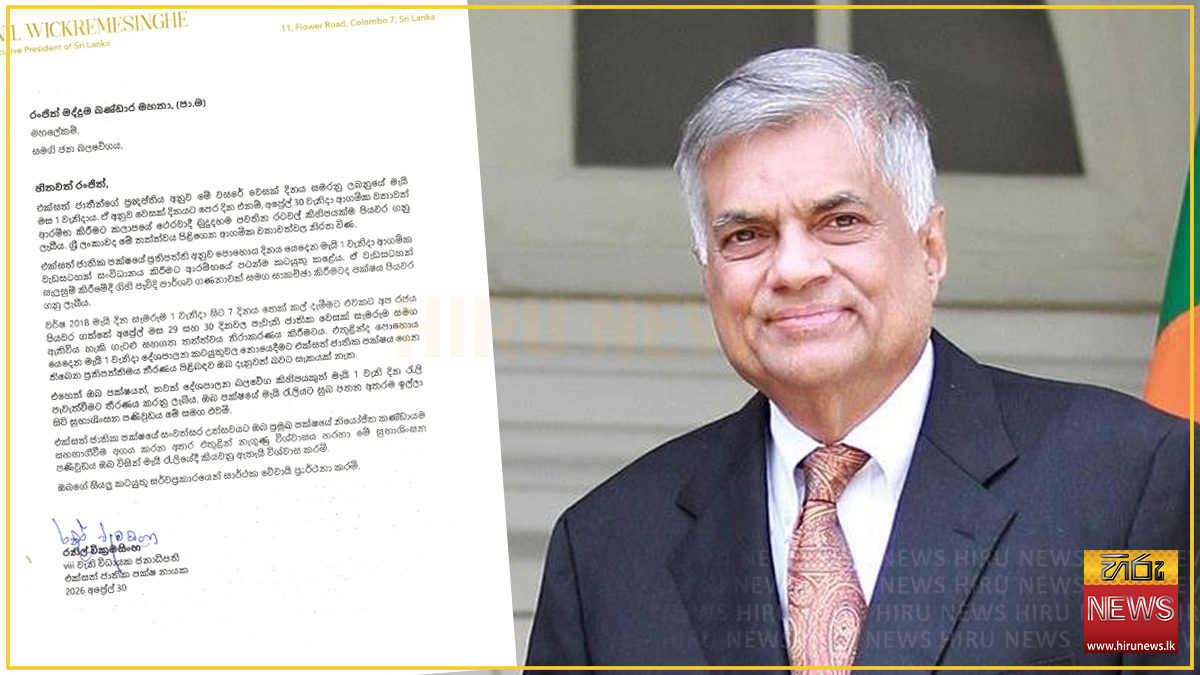
Former President Ranil Wickremesinghe shared this information in a special letter informing of the party’s policy decision while extending well wishes to the Samagi Jana Balawegaya May Day rally.

The former President conveyed these details in a letter addressed to the General Secretary of the Samagi Jana Balawegaya, Ranjith Madduma Bandara.

The correspondence noted that Sri Lanka, alongside other Theravada Buddhist nations in the region, took steps to commence religious observances from 30 April, considering the Vesak Full Moon Poya falling on 1 May.

The letter recalled that the government in power during 2018 also took measures to postpone May Day celebrations until 7 May due to the national Vesak commemorations.

Former President Ranil Wickremesinghe appreciated the participation of Samagi Jana Balawegaya representatives at the United National Party anniversary celebrations and expressed hope that his message of greetings would be read at the SJB May Day rally based on that mutual trust.

The letter concluded by offering best wishes for the success of the SJB political party’s May Day rally.

මහබැංකුවට ගේමදීපු හැකර් ගැන පෙරටුගාමී පක්ෂය සාක්ෂි සමග හෙලිකරයි හොරා අතේ මාට්ටුවෙයි/ Pubudu Jagoda

May 1st, 2026

Beg Peter and Pay Paul, Then Restructure All debts; Import everything with dollars; Allow the rich to use dollars endless; Are we not fools to follow the IMF and to see our foreign debt grow.

April 30th, 2026

By Garvin Karunaratne former SLAS

Can we stop imports and save dollars? Yes, We CAN. Let us talk about what we once did.

In 1965, when I worked in Nuwara Eliya, a car loan of tomatoes purchased at Hanguranketa made my home a Cannery for a weekend, and we made tomato sauce that lasted six months.

In 1956, during my tenure as the manager of the Tripoli Market, which ran the Vegetable and Fruit Purchasing Programme of the Marketing Department, the Marketing Officer at Hanguranketa Fair reported a glut of tomatoes. I dispatched three lorries to Hanguranketa Fair to purchase all the tomatoes, and they arrived at the Cannery by midnight. It all became tomato sauce. Today we spend dollars obtained on loan to buy Tomatoes Sauce from as far as the USA and Australia. Are we not foolish?

Then Assistant Commissioner Ossie Tillekeratne often went to Europe to find sales.

In my days as the GA at Matara in 1971, my Planning Officer, Vetus Fernando, a raw chemistry grad, toiled every day from six to twelve midnight for three months, locked in the Matara Rahula College science lab, aided by Science teachers at Rahula, with all of us as Cheer Leaders goading Vetus when he failed. Somehow, he found the art of making Crayons.

Then Sumanapala Dahanayake, the MP for Deniyaya, as the President of Morawaka Cooperatives, organised producing crayons- day and night and in a fortnight we filled two large rooms. I rested for three days, and my officers supervised for two weeks- a 24-hour-a-day operation. That was also Sumanapala, the MP for Deniyaya; perhaps his role is to be admired by the Members of Parliament of today. Minister Subasinghe, the Minister for Industries, opened sales. Minister Illangaratne, when he saw the crayons we made, ordered the stop of all imports of crayons. He even got me to agree to open a Crayon Factory at Kolonnawa, his electorate!

Then Morawaka Youth made Coop Crayon was as good as the Crayola, the best of the day today. Are we not the fools to close Coop Crayon? Of course we had to do it as the IMF ordered. But we can get down to make all our crayons again. That was my staff- Planning Officer Vetus Fernando and Development Assistant Daya Palihakkara in action. Both of them are yet alive.

The Marketing Department Cannery was established in 1955. From 1956 we purchased all the Red Pumpkin and made it into Golden Melon Jam; we purchased all the Ash Pumpkin and made it into Silver Melon Jam. Professor Sarathchandra’s cherished drink was Tomatoe Juice and many a day we enjoyed drinking MD tomatoe sauce at the University canteen in the University at Peradeniya. . We exported eight percent of our canned pineapple.. I was Assistant Commissioner in charge of Tripoli Market in 1956 and covered the duties of Assistant Commissioner Oswald Tliiekeratne, to supervise the cannery when he was abroad to find sales for our canned pineapple. Today we import Jam and Fruit Drinks.

A few years ago I ran into a distant relative, a lad trained in fruit processing who was a clerical officer in a Ministry.

Now we import jam and juice from Australia, from Cyprus and from everywhere!

Making Jam, Fruit Juice is something that can be done overnight with fruit that is in plenty. Are we not the Fools to import instead of Canning and making Fruit Drinks and Jam?.

The Marketing Department produced all our Jam and Fruit Juice within three years 1955-1958- the Philip Gunawardena days. He gave us the nod and we moved ahead.

The Divisional Development Councils Programme(DDCP) of the Sirimavo days(1970-1977) was the last production programme our country had.

In Matara as the GA, I obtained approval to establish a Boat Making factory and our youth made seagoing motorboats- forty boats a year. The IMF stopped the Boatyard in 1978. Are we not the fools. Yet we import fish, though our seas are full of shoals of fish and our sea worn youth look on at the waves of the Indian Ocean rolling with fish. .

Then in Matara I had around a dozen agricultural farms where we trained farmers and we produced vegetables- ginger etc. We had established many industries- batik making, farm implements, crafts etc.

There were 22 of us Government Agents in the island, producing in farms and industries all over. We trained 33,200 scientific farmers and industrialists. This was done under the direction of Professor HAdeS Gunasekera, the Professor of Econ at Peradeniya. He was appointed the Permanent Secretary to the Ministry of Plan Implementation and even a helicopter was placed at his disposal for district travel and we had to bend our heads when we met him at the helicopter to avoid being decapitated. Sorry he is not with us to tell the tale.

In NuwaraEliya, the Divisional . Secretary at Kotmale established a paper making factory. He collected the waste paper in the District and made paper and cardboard . That factory was also closed under IMF orders in 1978. Today we import paper. Paper is made out of straw and illuk, which we have in plenty.

Are we not the fools not to engage in Paper Making. Farmers even set fire to the straw to get rid of it.

We have acted the goat from 1977 . Instead of following the Kotmale Divisional Secretary, and making paper out of waste paper we export waste paper and cardboard to India- some 8000 tons per month and earn a few coppers and also buy paper and cardboard from India paying full dollars. Mind you we did that from 1978 to now and we do it even today. I am certain that we cannot find any country as foolish as our Sri Lanka.

In every District under the DDCP we got into production.

I can go on narrating endless. Now what I have said is the stark truth- Sri Lanka can produce all the imports other than wheat flour within months if only the Government approves it. The expenses of establishing training centres, farms and industries is all in local rupees. But when the production comes in- of Fruit Juice, Jam, Tomatoe Sauce and we can avoid imports we do really save dollars.

Our stalwarts who once led this DDCP programme of production are now enjoying fat pensions. Will it not be prudent to enlist their services immediately and get going in days and see to become productive instead of continuing to be importers of what we can produce. Though in my nineties I can become active for a short few months working with our youth- working for the future of my Motherland. That will be a pleasure to get some real development off the ground.

Over to our leaders- our President and Prime Minister. You owe to make our country productive , not to get our country into further foreign debt.

Garvin Karunaratne

former GA Matara 1971-1973

garvin_karunaratne@outlook.com

Core Lessons for the Future of Buddhism

April 30th, 2026

Senaka Weeraratna

The visit emphasized several key principles that are seen as vital for the “purification” and revitalization of the Buddha Sasana in Sri Lanka: 

  • Inner Peace as a Foundation: A central teaching was that external peace cannot be sustained without wisdom and peace established within the individual. Ven. Paññākāra emphasized that “peace begins within” and naturally extends to family, community, and the nation.
  • The Power of Humility and Sincerity: The sight of the monks walking barefoot, facing physical hardship (such as the heat of the ground), served as a powerful reminder that true leadership and Dhamma are lived through action and resilience, not just spoken.
  • Compassion Beyond Species: The inclusion of Aloka, a rescue stray dog in India who walked alongside the monks, conveyed a profound message about extending loving-kindness (Metta) and protection to all living beings. This has revived national conversations on animal welfare as a core Buddhist value that must be enshrined in the Constitution of Sri Lanka as in India.   It is a constitutional duty of every Indian citizen to protect living creatures. Likewise every Citizen of Sri Lanka must be Constitutionally mandated to have a Duty of Care towards animals and to have compassion for living creatures. This obligation is formally enshrined in the Constitution of India as a “Fundamental Duty. 

        Article 51A(g) states that it is the duty of every citizen of India: 

“to protect and improve the natural environment including forests, lakes, rivers and wildlife, and to have compassion for living creatures.” 

  • Compassion for Living Creatures: This clause explicitly mandates empathy and care for all animals, not just wildlife. It is aligned to the policy underlying the Animal Welfare Bill of the Law Commission (2006) which needs to be enacted without any further delay. 
  • Unity and Non-Violence: The walk, held under state patronage, brought together people of different faiths and backgrounds in quiet unity, demonstrating that the Dhamma can be a bridge for national healing and reconciliation.
  • Accountability within the Sangha: The visit sparked reflections on the need for the Sangha to protect the sanctity of Buddhism by holding those who misuse the robe accountable, ensuring the “moral fabric of the nation” remains intact. 

Practical “Daily” Dhamma

Ven. Paññākāra introduced simple yet transformative habits for lay practitioners to carry forward:

Practical “Daily” Dhamma

Ven. Paññākāra introduced simple yet transformative habits for lay practitioners to carry forward:

Pilgrimage Timeline (April 2026)

The walk covered approximately 200 kilometers over eight days: 

https://share.google/aimode/mf6dEG6uV8WMUmrSs

Source:   AI Overview

May Day, Memory, and a Moment That Changed Sri Lanka

April 30th, 2026

By Sarath Obeysekera

May Day has always been a day of colour, തൊഴില් spirit, and political expression in Colombo. For me, however, one particular May Day remains etched in memory—not for the pageantry, but for how close I came to witnessing history take a tragic turn.

At the time, I was serving as Chairman of the Sri Lanka Land Reclamation and Development Corporation. As was customary, our institution had organized a contingent of employees to participate in the May Day procession, proceeding towards Galle Face Green.

Our group was moving along the route when we found ourselves not far from the main procession where Ranasinghe Premadasa was present. Roughly 20 to 30 minutes before the fatal moment, I saw him in a Land Rover, accompanied by Mohideen. There was a brief exchange—a wave, a passing acknowledgment. It was an ordinary gesture, one of many that occur on such public occasions.

What makes that moment unforgettable is the irony that the vehicle he travelled in had been modified to be bulletproof under my direction during my time at the dockyard. Yet, as history would show, no armour could defend against the method that was about to be used.

Shortly after, a group of estate workers moved ahead of us, and our team followed. We were perhaps about 100 feet away when we heard a loud noise. It sounded like firecrackers—hardly unusual on a May Day. None of us immediately suspected what had truly occurred.

There was no panic. No sudden realization. We simply continued along an alternate route and eventually reached Galle Face, unaware that the President of the country had just been assassinated.

It was only several hours later that I learned the truth—ironically, not through local channels, but from an Austrian acquaintance. By then, the magnitude of what had happened began to sink in. Sri Lanka had lost its sitting President in a brutal act of violence.

We were also lucky to be alive because those estate workers who barged in front of our team had formed a barrier to save us 

Later, our photographer showed me an image of the head of Baby , captured in the aftermath. It was a haunting frame—one that revealed the sheer brutality of the explosion and the human cost behind the headlines. That image remains with me to this day.

The assassination of President Premadasa marked more than the end of a leader. It symbolized a turning point in a turbulent era shaped by insurgency, counter-insurgency, and a nation struggling to find stability. He was a complex figure—credited with development initiatives, yet also associated with controversial decisions during difficult times.

Looking back, one cannot help but reflect on fate, timing, and the fragile nature of life. I was within moments and mere feet of a historic tragedy, yet remained unaware until hours later. Such is the nature of events that unfold suddenly—they are only understood in retrospect.

Many may interpret such events through the lens of karma or destiny. Others may see them as consequences of a broader cycle of violence. Whatever the interpretation, the human dimension remains undeniable.

For me, that May Day serves as a reminder—not just of how close I came to danger, but of how quickly a nation’s course can change in a single moment.


Sarath Obeysekera
Former Chairman
Sri Lanka Land Reclamation and Development Corporati

New Cricket Reform Committee Appointed

April 30th, 2026

Senaka Weeraratna

Cricket lovers have a new opportunity to appeal to the New Cricket Reform Committee to give due priority to promoting Sri Lanka as the home of the Player Referral system (DRS) and extend long overdue official recognition to the author of the Player – Referral concept lawyer Senaka Weeraratna. 

see

Mass resignation of Shammi Silva and Ex Co – Way open now to SLC under new leadership to prioritize demand for recognition of the groundbreaking ‘Player Referral’ system (DRS) as a Sri Lankan innovation by ICC

A memorandum to the Ambassadors of the USA, Israel, Iran, and all Ambassadors calling for an immediate ceasefire by the Mahanyaka Theras of Sri Lanka

April 30th, 2026

Dr Sudath Gunasekara Former Secretary to the Prime Minister Sirimavo Bandaarnayaka

The text of the Welcome Address by Venerable Anunayaka Niyangoda Vijitasiri Thera of Malwatta Chapter made at the handing over of a memorandum by the Most venerable four Mahanayaka Theras, to the Ambassadors of the USA, Israel and Iran and all other Diplomats on 26th April. 2026. appealing them to declare an immediate ceasefire.

Venerable Anunayaka Theras, representing the most Venerable Mahanayake Theras of the Three Nikayas, the chief prelate of this temple Gangaraamaya, the members of the Maha Sanga present, the three Diplomatic dignitaries of the warring United state of America, Republic of Israel and the Republic of Iran, Your Excellencies Ambassadors and High Commissioners of all other countries, who grace this occasion and all peace-loving ladies and gentlemen assembled here.

 First of all, I have great pleasure in welcoming, you all, at this historic meeting, on behalf of the Most Venerable Mahanayaka Theras, of the Three Nikayas, the Supreme Spiritual Leaders of this country, who are making this most important request to the leaders  of the warring nations in the name of ending death, destruction and disaster and restoring sanity and normalcy and peace in the Middle East in particular and normalcy and peace the world over in general.

Second, I would also like to make few vital and relevant observations that befit this historic occasion.

Venerable Maha Sanga dignitaries and ladies and gentlemen,  

First and foremost, I would like to thank you all on behalf of the organizers of this event at this temple, including the Nayaka Thera of Gangaramaya and Dr Sudath Gunasekara a senior Civil Servant and Former Permanent Secretary to Prime Minister Mrs. Sirimavo Bandara nayaka, who made this suggestion to me and the Ven Mahanahyaka Thera of Malwatta Chapter on the 6th of April, without whose intervention this noble event would never have been made a reality.

I am happy that today it has become a historic mission accomplished. We are fully confident that the diplomatic dignitaries representing the three warring parties will definitely take up this issue as a top priority and  convince their respective Heads of States to declare an immediate ceasefire agreement requested by the four Mahanayaka Theros of Sri Lanka, as a prelude to a complete cessation of the ongoing war as soon as possible, that has already caused unlimited deaths, destructions, displacements, disaster and irreparable loss particularly in the Middle East and it’s ugly consequences spilling all over the whole world in general.

We Sri Lankans as a peace loving  nation also wish to see an end to the worldwide socio-economic crisis and uncertainty, thrust upon millions of people the world over   due the complete breakdown of all modes of global  transport networks due to shortages and spiraling cost of fuel and insecurity in navigation resulting in total misery the world over, leading perhaps to a complete breakdown of day to day to lives of the people on this earth. The Mahanayaka Theros also have called upon the warring leaders to end this self-destructive, irrational and crazy war begun by them on misjudgments and hubris after they had been made mad by their own God, before they were destroyed, as a famous classical Greek proverb had said.

At the same time, we also wish to draw the serious attention of Diplomats of all other countries present here as well to advise their Heads of States to exert diplomatic pressure on these warring countries immediately to stop the war and settle their problems through meaningful negotiations and not by destructive missiles.

We Sri Lankans, as a Buddhist country strongly recommend the best formula on earth, embodied in the Buddhist teaching to end this miserable war. That is the four sublime satiates of, the mind, metta (loving kindness) karuna (compassion), muditha (detachment) and upekka (sympathetic joy) to which we as a nation who are deeply wedded and ethically committed for the past 2668 years or even more.

These four attitudes are meant to be developed into limitless, unconditional, and expansive qualities in the human mind.  In this exalted backdrop “with malice towards none, but with charity for all” let us jointly resolve to untangle this tangle created by some self -destructive and irrational actions of few mis guided and crazy men in power.

If you find it too technical to do that, then we recommend the basic Five Precepts of in Buddhism for you to 1 Abstain from killing living beings, (Paanaathipaatha) 2. Stealing (adinnadnaa), 3 sexual misconducts (Kamesu michchaachaaraa), 4 lying (musaavaadaa), and 5 intoxications (suraameraya majjapama dhattaanaa). If all the people in this world can strictly adhere to this simple code of ethics from today irrespective of their religions, definitely this world will be a better place for us to live by tomorrow.

Non- Alignment

Geo-politically, as a nation we are deeply wedded to non-alignment in global political power struggle from 1955, as one of its founder members and we have proved its worth at least in two occasions.

 First, in the Sino-Indian war in 1962 and second, by moving the UN General Assembly resolution2832 (xxvi) passed on December 16. 1971, that declared the Indian Ocean as a Zone of peace, aiming to eliminate military bases, nuclear weapons and Great power rivalries, for which the full credit should go to Mrs. Sirimavo Bandaranayaka the great lady Prime Minister of this country and the then Chairperson of the NAM, 1976-77, even though (resolution 2832 (xxvi) had been blatantly and sadly violated by almost all great powers since then thereby discriminating against the smaller nations.

Stop resorting to Kautilya Mathshya nyaaya

 We also call upon all great powers at least now to stop resorting to the Kautilya Mathshya nyaaya (The big fish taking the small fish as its prey) and respect and accept the independence and sovereignty of all nations irrespective of their geographical size and location or the economic and military power.  

In this age of interplanetary rat race  to conquer other planets, we also urge all great powers first to concentrate on the protection of civilization on this planet earth, that had been our dear home for millennia from the beginning of life on earth, without wasting trillions on day dreaming to own and colonize the moon and Venus where there is no water to drink and air to breath, the two most vital requirement for life to exist.  Why can’t these so-called big powers stop this crazy interplanetary rat race and use that money to make this world a better place for we human to live and use such resources for the wellbeing of the life of billions of people annually dying on hunger and disease. 1). Annually 9 million dies without food 2) 1.6 to 3 billion have no houses 3) 6 million dies without medicine on this earth according to a random google survey. 

Finally, going back to world history, we also like to remind the leaders of the “War-prone big powers like the President of USA and Israel and also the Republic of Iran,  that King Asoka the Emperor of Magadha from c 268 BCE who was named as the Greatest Emperor in the world by H.G. Wells, had achieved greatness not by conquering the contemporary world by war, but only by spreading the noble message of love and compassion taught by Buddha from Japan in the East to Iran in the West and from Mongolia in the North to Sri Lanka in the South; an all-time moral valid for state craft, to be adhered to by all leaders of the world all over, irrespective of time and place and the size of their countries or religion.

I therefore, earnestly request you all to carry this noble and realistic message in your heads and hearts as the spirit of the noble message from the Mahanayaka Theros of Sri Lanka, the spiritual leaders of this country and the whole Buddhists world, who are making this appeal to you and your leaders on behalf of 500 million Buddhists the world over, when you are leaving this hall today.

Once again, we therefore earnestly request all the Warring Parties to STOP THE ONGOING miserable WAR immediately, without causing any more deaths, distress, destruction, sufferingand calamity to the whole world, in the name of humanity and sanity, the world over.

I beg your pardon to close my welcome address by posing another all-important question to this august assembly.

 Isn’t it really funny, ridiculous and shameless  too, that we human beings with ‘an advanced mind’ as it is often said, are killing each other just to own another’s oil field, (like President Trump) or for an inch of desert land from the neighbor (Benjamin) and to impose their hegemony on the other, violating all civilized ethics and  democratic principles’ in this world as if they will never die one day, while an innocent  an uneducated animal Aloka a four footed dog” is trotting the globe around selflessly, for world peace at present.

Meanwhile, we also request the Republic of Iran to settle its internal conflicts and form one stable Government as soon as possible to restore peace and prosperity at home and also to deal with the international community in future.

Finally, I would also like to end this note with, what the Buddha had said about torture and death

1 Sabbe tasanti daṇḍassa, sabbe bhāyanti maccuno,

   attānaṁ upamaṁ katvā, nahaneyya na ghātaye. [129] Dhamma pada

(Everyone trembles at punishment; everyone is in fear of death

comparing oneself (with others), one should not hurt or kill (others)

2 Sabbe tasanti daṇḍassa, sabbesaṁ jīvitaṁ piyaṁ,

   attānaṁ upamaṁ katvā, nahaneyya na ghātaye.” [130] Dhamma pada

(Everyone trembles at punishment, for all of them life is dear

comparing oneself (with others), one should not hurt or kill (them)

So, one can imagine the mass killing by war is even worse.

An all-time universal moral code of ethics for all those who wage war against others and kill others and destroy their properties.

Last but not least, again finally, I thank Dr. Sudath Gunasekara of the Sri Lanka Administrative Service and former Permanent Secretary to Prime Minister Mrs. Sirimavo Bandaranayake, who first made this proposal to me on the 6th of April 2026. at my residence and senior journalist Jayasuriya Udukumbura of Rivira paper, who coordinated this feat from A to Z without whose unstinted commitment, patience and support, this event would never have become a reality

Investigation launched into suspicious death of suspended Treasury official

April 30th, 2026

Courtesy Hiru News

Investigation+launched+into+suspicious+death+of+suspended+Treasury+official

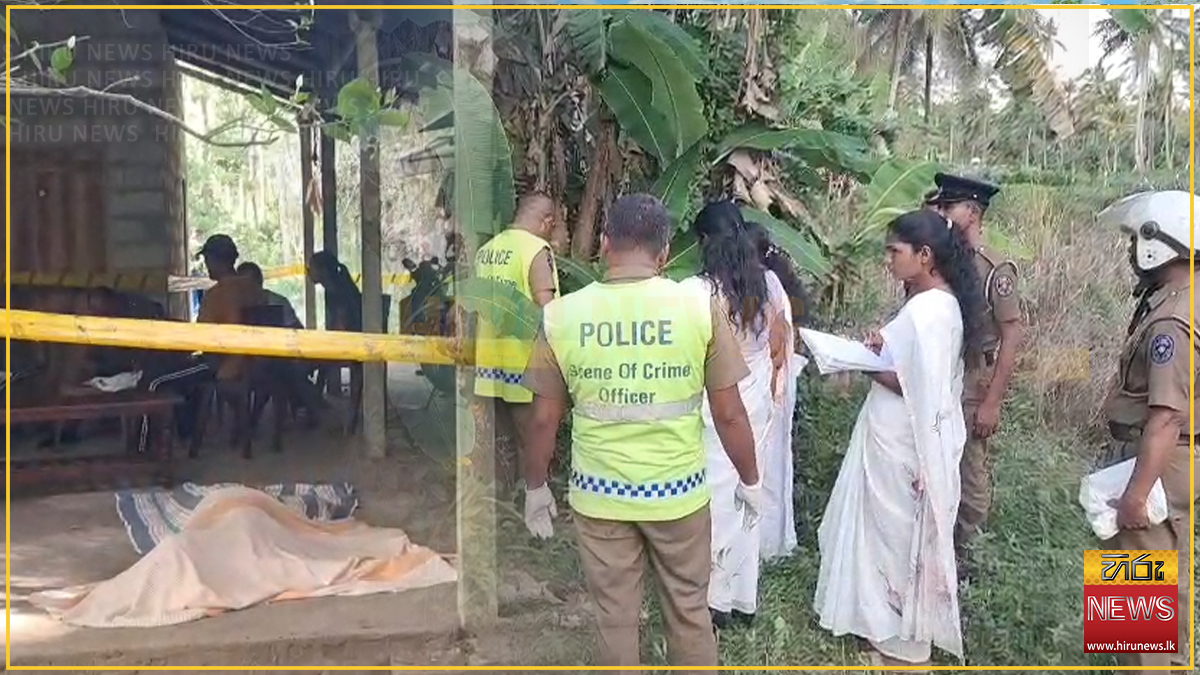
The Kuliyapitiya Police have initiated a wide-ranging investigation into the suspicious death of Abeysinghe Mudiyanselage Ranga Nishantha Rajapaksa, a suspended Assistant Director of the Department of External Resources at the General Treasury.

The deceased, a resident of Madakumburumulla in Pahala Weerambua, Kuliyapitiya, was found dead in his backyard this afternoon (30).

Police reported that the veins in both his legs and his left hand had been severed, and a blood-stained knife suspected to be involved was recovered near the body.

The victim was a father of two whose wife is a teacher. Police stated that while his wife was at school, his daughter had reportedly observed him heading towards the back of the house carrying a knife.

Rajapaksa had been identified as a key individual in the ongoing investigations involving four officials suspended over the alleged hacking and theft of $2.5 million from the General Treasury.

He had previously appeared before the Criminal Investigation Department (CID) on two occasions to assist with the inquiry.

Following a report to the Kuliyapitiya Magistrate’s Court, the body was moved to the Kuliyapitiya Teaching Hospital morgue. A post-mortem examination is scheduled for tomorrow.

‍පාර්ලිමේන්තු නොපැමිණෙන්නේ නම් ලේකම් සුරියප්පෙරුමට දඩුවම් කළ යුතුය!

April 29th, 2026

රජිත් කීර්ති තෙන්නකෝන්

මුදල් ලේකම් හර්ෂණ පාර්ලිමේන්තුවට නොපැමිණෙන්නේ නම්, ඔහුට පාර්ලිමේන්තු යාන්ත්‍රණය හරහා දඩුවම් කිරීමට මුදල් කමිටු සභාපති හර්ෂ ද සිල්වා ට බලය ඇතැයි හිටපු ආණ්ඩුකාරවර රජිත් කිර්ති තෙන්නකෝන් පවසයි. මුදල් අමාත්‍යාංශ ලේකම් හර්ෂණ සුරියප්පෙරුම හෙට දින පාර්ලිමේන්තු මුදල් කමිටුව වෙත නොපැමිණෙන බව ලිඛිතව දන්වා ඇත.

ඒ පිළිබඳව ‘ෆී ලෝයර්ස්’ සංවිධානය වෙනුවෙන් නිවේදනයක් නිකුත් කරන තෙන්නකෝන් මහතා මෙසේ ද පවසයි.  

‘පාර්ලිමේන්තුවේ මුදල් කමිටුව පිහිටුවා ඇත්තේ 2022 වසරේ දී සම්මත කරන ලද පාර්ලිමේන්තු ස්ථාවර නියෝග 121 යටතේ ය.   පාර්ලිමේන්තු ස්ථාවර නියෝග කිසියම් අයෙකු විසින් උල්ලංඝණය කරන්නේ නම්, ඒ පිළිබඳව දඩුවම් ලබාදීමට ප්‍රතිපාදන සපයා ඇත්තේ 1953 අංක 21 දරණ පාර්ලිමේන්තු බලතල හා වරප්‍රසාද පනත යටතේ ය.  ඒ අනුව, මුදල් කමිටුවට ඕනෑම අයෙකු කැඳවීමට සභාපතිවරයාට බලය ඇති අතර, එසේ කැදවීමකට නොපැමිණෙන්නේ නම්, ඒ සම්බන්ධයෙන් ගත යුතු පියවර හා දඩුවම් බලතල හා වරප්‍රසාද පනතේ  ‘ආ කොටස’ 1, 2, 3 උපලේඛනයේ ආ කොටසේ වගන්ති යටතේ දක්වා ඇත.  එම වරද වලට පාර්ලිමේන්තුව විසින් හෝ ‍ශ්‍රේෂ්ඨාධිකරණය මගින් දඩුවම් කළ යුතු වරද වේ.

මේ සඳහා ශ්‍රේෂ්ඨාධිකරණය මගින් අවුරුදු දෙකක් නොඉක්මවන කාලයකට බන්ධනාගාර ගත කිරීම හෝ දඩයක් නියම කිරීම හෝ දඩය හා බන්ධනාගාර ගත කිරීම යන දඩුවම් දෙකටම යටත් කළ හැකිය.

ඒ අනුව, හර්ෂ ද සිල්වා සභාපතිවරයා ලෙස මුදල් කමිටුවට පැමිණීමට දැනුම් දී ඇති ඕනෑම අයෙකු එදිනට නොපැමිණෙන්නේ නම් ඔවුන්ට  1953 අංක 21 දරණ පාර්ලිමේන්තු බලපත හා වරප්‍රසාද පනත යටතේ කටයුතු කළ හැකිය.

සිය මුදල් ලේකම්වරයා මුදල් කමිටුවට සහභාගි නොකිරීමට තීරණය කිරීමෙන් ආණ්ඩුව දුෂණය, වංචාව, අක්‍රමිකතා විරෝධයේ සුජාත භාවය අහිමි කර ගනී.  ඉතිහාසයේ කිසිදු රජයක් පාර්ලිමේන්තුවේ මුදල් පිළිබඳ වගකීම මෙලෙස අභියෝගයට ලක් කර, පාර්ලිමේන්තු කමිටු සතු බලය හෑල්ලුවට ලක් කර නැත. 

මුදල් කමිටුව පැමිණීමට දැනුම් දී තිබිය දී යම් අයෙකු නොපැමිණෙන්නේ නම්, කමිටු සභාපතිවරයා තවදුරටත් එම කමිටු සභාපති ධූරය දැරීම/ඉල්ලා අස්වීම හෝ දඩුවම් කිරීම යන තෝරාගැනීම් දෙකෙන් එකක් සිදු කර පාර්ලිමේන්තුවේ ගෞරවය හා අභිමානය රැකගත යුතුව ඇත.

රජිත් කීර්ති තෙන්නකෝන්

2026 අප්‍රේල් 30

Rajith Keerthi Tennakoon

Former Governor of Uva, Southern and Central Provinces

Former Executive Director of Campaign for Free and Fair Elections (CaFFE) and Center for Human Rights and Research – CHR Sri Lanka

ඩොලර් වලට මොකද වුණේ ? | ශමීන්ද්‍ර සමඟ | Shamindra Ferdinando

April 29th, 2026

Divaina Online

Mass resignation of Shammi Silva and Ex Co – Way open now to SLC under new leadership to prioritize demand for recognition of the groundbreaking ‘Player Referral’ system (DRS) as a Sri Lankan innovation by ICC

April 29th, 2026

Senaka Weeraratna

The mass resignation of Sri Lanka Cricket (SLC) President Shammi Silva and the entire Executive Committee (ExCo) was officially confirmed on Wednesday, April 29, 2026. This voluntary exit, reportedly requested by President Anura Kumara Dissanayake to avoid a forced “sacking” and potential ICC suspension, has paved the way for an interim committee to take control. 

Resignation and Transition Details

  • Effective Date: Resignations were finalized on April 29, 2026, ending Shammi Silva’s seven-year tenure.
  • Interim Leadership: The government is set to appoint an interim committee, likely headed by former MP Eran Wickramaratne.
  • Reform Goals: Prominent former cricketers like Sidath Wettimuny and Roshan Mahanama are tipped for roles to fast-track structural reforms.
  • Ministry Control: All administrative functions of SLC have been temporarily brought under the Ministry of Youth Affairs and Sports as per Sections 31 and 34 of the Sports Law. 

Demand for DRS Innovation Recognition 

The new leadership is expected to face public and professional pressure to prioritize the long-standing demand for the International Cricket Council (ICC) to recognize the Decision Review System (DRS) as a Sri Lankan innovation. 

  • Origin of Innovation: The core concept of ‘Player Referral’ was conceived by Sri Lankan lawyer Senaka Weeraratna and first published in The Australian on March 25, 1997 and the ‘Sunday Times’ (Sri Lanka) on April 06, April, 1997 as a letter to the Editor. 
  • Key Elements: Weeraratna’s original proposal included the four pillars of the modern DRS:
    1. Allowing players to challenge decisions.
    2. Routing appeals through the captain or dismissed batsman.
    3. Review by the third umpire using slow-motion technology.
    4. Limiting the number of appeals per innings.
  • Status of Recognition: Despite the ICC officially introducing the system in 2009—incorporating these exact elements—it has never credited an inventor. ICC is legally presumed to have prior knowledge of Weeraratna’s pioneering invention 9 years before ICC came up with the idea of UDRS or DRS in 2006, under the Legal Doctrine of Constructive Notice.
  • Supporters argue that with a new, reform-minded administration at Sri Lanka Cricket, there is a fresh opportunity to formally press the ICC for “reparative justice” and global acknowledgment of this Sri Lankan contribution to the sport and payment of resulting Royalties to help the financially struggling country i.e., Sri Lanka.

https://share.google/aimode/0AJ0MLqqvUHLaBmDt

Source:  AI Overview

Professor Y. Karunadasa, the renowned Sri Lankan (Sinhalese) Buddhist scholar and philosopher, passed away on April 26, 2026, at the age of 92 in Colombo.

April 29th, 2026

Obituary

 KARUNADASA – PROF. EMERITUS Y. KARUNADASA Sabbe sankhārā aniccā” passed away peacefully on 27th April 2026. Dearly beloved husband of Malathi, loving father of Himansu and Hemamala, cherished father-in-law of Deepani and Srinivasan, adoring grandfather of Sirini, Daham and Athena. Remains lie at the Jayaratne Restpect Funeral Parlour from 8.30 a.m. on 29th April 2026 until the cortège leaves for the cemetery. Cremation will take place on Thursday, 30th April 2026 at 4.00 p.m. at the General Cemetery, Borella (Colombo). May he attain the Supreme Bliss of Nibbana. – Family     026767

https://dailynews.lk/2026/04/29/obituaries/986735/obituaries-658

He was a monumental figure in the field of Pali and Buddhist Studies, widely recognized for his rigorous analytical approach to early Buddhist philosophy and the Theravada Abhidhamma. 

Academic Legacy and Career

Professor Karunadasa’s career spanned several decades, during which he influenced generations of scholars worldwide: 

  • University of Kelaniya: Served as the Professor Emeritus of Pali and Buddhist Studies and was a former Director of the Postgraduate Institute of Pali and Buddhist Studies (PGIPBS).
  • International Appointments: Held prestigious positions as a visiting professor at the University of Hong Kong, University of London, University of Toronto, and the University of Calgary.
  • Honors: Awarded the honorary title of Sri Lanka Sikhamani by the Sri Lankan government in 2005 for his exceptional contributions to the nation’s academic landscape. 

Significant Publications

His scholarship is defined by a deep engagement with primary Pali sources. Some of his most influential works include:

  • The Buddhist Analysis of Matter: A seminal text examining material phenomena in Theravada thought.
  • Early Buddhist Teachings: An exploration of the “middle position” in theory and practice, often cited for its clarity on complex doctrines like dependent arising and non-self.
  • The Theravada Abhidhamma: An inquiry into the nature of conditioned reality. 

Professor Karunadasa is remembered by the global academic community for his intellectual depth and his ability to bridge traditional scholarship with modern philosophical inquiry. 

Prof. Karunadasa was a towering figure in Buddhist studies—a brilliant scholar, a compassionate teacher, and a true embodiment of the Dhamma he dedicated his life to studying and sharing,” the University of Hong Kong’s Centre of Buddhist Studies Alumni Association highlighted. Through his profound works on Early Buddhism and Theravada Abhidhamma, his insightful lectures at the Centre of Buddhist Studies, and his gentle wisdom, he inspired generations of students in Hong Kong and beyond”. (HKU Centre of Buddhist Studies Alumni Association Facebook)

Prof. Karunadasa’s notable publications include The Theravada Abhidhamma: Its Inquiry into the Nature of Conditioned Reality, The Buddhist Analysis of Matter, and Early Buddhist Teachings – The Middle Position in Theory and Practice.

At HKU, Prof. Karunadasa taught at the Centre of Buddhist Studies (CBS) as the MaMa Charitable Foundation Visiting Professor. Following his passing, the HKU Centre of Buddhist Studies Alumni Association expressed their grief on social media, stating: 

It is with profound sorrow and a deep sense of loss that the Hong Kong University Centre of Buddhist Studies Alumni Association (HKU CBSAA) learned of the passing of our esteemed teacher, Professor Y. Karunadasa, on 26 April 2026.

CBS alumnus Prof. Ujjwal Kumar, who heads the Department of Buddhist Studies at the University of Calcutta, India, remarked: He was an excellent teacher in my life, who offered a profound perspective on how to study and reflect upon Theravada Buddhism. I offer my heartfelt tribute of reverence. May he attain Nibbana.” (Ujjwal Kumar Facebook)

Karunadasa held several esteemed administrative roles at the University of Kelaniya, serving twice as dean of the Faculty of Arts and once as dean of the Faculty of Humanities. As professor emeritus, he made significant contributions to the understanding of Buddhist philosophy, including analyses of Dhamma theory, the nature of matter, cognition, and the middle path between extremes.

Prof. Yakupitiyage Karunadasa, 1934–2026. Image courtesy of Aosi Mak

I first met Prof. Karunadasa as an undergraduate at the University of Kelaniya, where he was then Head of the Department of Pali and Buddhist Studies,” remarked Prof. G. A. Somaratne, a Sri Lankan scholar who is teaching at CBS. In the lecture hall he combined an astonishing command of Early Buddhism and Theravada Abhidhamma with clarity and gentleness. He did not merely expound texts; he opened for us a way of thinking—disciplined, critical, and at the same time deeply grounded in the Dhamma.” (G.a. Somaratne Facebook).

Dr. Amrita Nanda, a student and teaching assistant of Prof. Y. Karunadasa, who is also teaching at CBS, shared: Beyond his academic achievements, his humility and graciousness made him one of the most respected and loved professors in the field.” (Amrita Nanda Facebook)

Born in Sri Lanka in 1934, Prof. Karunadasa graduated from the University of Ceylon in 1958, earning a First Class Honours Degree in Pali, which also garnered him the Woodward Prize and a research scholarship for his exceptional performance. He furthered his studies at the School of Oriental and African Studies (SOAS) at the University of London, where he became the inaugural recipient of a Postgraduate Studentship in Oriental Studies in 1960. He completed his PhD in Indian Philosophy in 1963, focusing his thesis on the Buddhist analysis of matter. In 1974, he was awarded a Commonwealth Academic Staff Fellowship at SOAS.

Prof. Karunadasa’s publications, articles, and editorial contributions have significantly influenced ongoing discussions in Buddhist scholarship, particularly concerning contemporary issues such as Sri Lankan monastic politics. His critiques of political involvement have informed debates on sangha autonomy amidst ethnic conflicts and conversions.

Prof. Karunadasa’s notable publications include The Theravada Abhidhamma: Its Inquiry into the Nature of Conditioned Reality, The Buddhist Analysis of Matter, and Early Buddhist Teachings – The Middle Position in Theory and Practice.

At HKU, Prof. Karunadasa taught at the Centre of Buddhist Studies (CBS) as the MaMa Charitable Foundation Visiting Professor. Following his passing, the HKU Centre of Buddhist Studies Alumni Association expressed their grief on social media, stating: 

It is with profound sorrow and a deep sense of loss that the Hong Kong University Centre of Buddhist Studies Alumni Association (HKU CBSAA) learned of the passing of our esteemed teacher, Professor Y. Karunadasa, on 26 April 2026.

CBS alumnus Prof. Ujjwal Kumar, who heads the Department of Buddhist Studies at the University of Calcutta, India, remarked: He was an excellent teacher in my life, who offered a profound perspective on how to study and reflect upon Theravada Buddhism. I offer my heartfelt tribute of reverence. May he attain Nibbana.” (Ujjwal Kumar Facebook)

Prof. Karunadasa held several esteemed administrative roles at the University of Kelaniya, serving twice as dean of the Faculty of Arts and once as dean of the Faculty of Humanities. As professor emeritus, he made significant contributions to the understanding of Buddhist philosophy, including analyses of Dhamma theory, the nature of matter, cognition, and the middle path between extremes.

In recognition of his contributions, he received an honorary D’Litt from the University of Kelaniya in 2002 and was honoured with the title of Sri Lanka Sikhamani by the President of Sri Lanka in 2005 in acknowledgment of his significant contributions to his homeland. He also played a key role in co-founding the International Buddhist College in Thailand. 

PEC demands fair probe and justice to Indian scribe Jaganmohan Reddy

April 29th, 2026

Nava Thakuria

Geneva, 29 April 2026: Press Emblem Campaign (PEC), the global media safety and rights body, expresses concern over the murder of Indian scribe V Jaganmohan Reddy, who was hacked to death on Tuesday as the Telugu scribe went for a morning walk at  Venkatagiri Kotain area under  Chittoor district of Andhra Pradesh. Local media reported that Jaganmohan (40) was targeted by a group of miscreants with lethal weapons and he died on the spot. The  ABN Andhra Jyothy newspaper scribe was later sent to Palamaneru government hospital for an autopsy.

Various journo-bodies organized protest demonstrations  at Tirupati Press Club, where Indian Journalists Union (IJU) claimed that Jaganmohan was attacked  just a few days after he reported on sandalwood smugglers in the locality. The national journo-body also demanded to formulate a strict policy to safeguard the working journalists and the press freedom in general.

PEC condemns the murder of Telugu daily journalist on 28 April and urges the State government to thoroughly investigate the motive behind the killing,” said Blaise Lempen, president of PEC (pressemblem.ch), adding that the authorities must  nab the culprits to punish them under the law. He also stated that Jaganmohan Reddy became the first media victim in India this year and 26th across the world.

PEC’s south and southeast  Asian representative Nava Thakuria informed that Chittoor is the home district of AP chief minister N Chandrababu Naidu, where Jaganmohan was murdered. The victim scribe left behind his wife and two children. Mentionable is that, India lost six journalists to assailants last year where the victims include Mukesh Chandrakar, Raghavendra Vajpayee, Sahadev Dey, Dharmendra Singh Chauhan, Naresh Kumar  and Rajeev Pratap Singh.

Gulf States fear Arab unity more than US-Israeli power

April 29th, 2026

MOVE – with Sami Hamdi

Western strategy to neutralize Sinhala Buddhists in Sri Lanka

April 29th, 2026

Shenali D Waduge

The Buddhists need to not only identify the enemy but more importantly identify the strategies adopted by the enemy & the reasons they do so. It is without a doubt they consider the teachings of the Buddha as a threat. It is something even the English vocabulary cannot define or converge to a single meaning. Such is the power behind the teachings of Buddha. When they cannot destroy the teaching, what is their next option?Naturally, it is the followers and with their time-tested tool of divide & rule, they now try to divide the Buddhists who are born into Buddhist families. While this project is ongoing, given that they know the power of Buddha’s teachings, they are trying to control Buddha’s teaching & patent it as per liberal capitalist ideology, to put a price” to how the teachings will eventually get taught. By now Buddhists should have identified the scope of the threat.

The destruction of Buddhist archaeological sites did not begin suddenly, we know how areas that were pre-dominantly Buddhist in ancient times were taken over with the sword, theros slain, artefacts destroyed & even the world’s oldest library put to cinders. Bamiyan Buddhas were not under attack only by the Taliban, historically attempts had been made to destroy them. The objective of destroying these magnificent structures & placing other structures above them is recorded historically. It showed the shallowness of thought – thinking the removal of structures would erase a teaching.

This was the structural genocide of Buddhism.

The teachings of Buddha was first put to text in Sri Lanka. This is one main reason for the attack against Sri Lanka.

The Buddha’s teachings was the state religion incorporated into the rule & became part of the Sinhala Buddhist cultural heritage. This did not discriminate any other faith. The nobleness of the dasa raja dhamma did not result in any internal conflicts & anyone speaking about ethnic disharmony should wonder why this disharmony” emerged only after arrival of the 3 European invaders & after they began implementing their divide & rule policies.

Ever since the European invaders arrived, their goal was to erase a teaching that did not conform to their religious beliefs & they were stupefied at the manner it was embedded within the social structure with Buddhist law, Buddhist jurisprudence, Buddhist culture which was followed by the majority Sinhalese as well as respected by others because they did not experience any discrimination in that rule. Anyone challenging this must present examples of ethnic internal wars before 1505!

It is noteworthy that the Buddhist structures are under attack by the key Quad members & the area that they are exerting influence is aligned to their geopolitical goals. Thus the incursions, damage & destruction to sites, illegal occupation, erecting non-Buddhist structures & creating bogus history to claim these are part of this larger ploy to grab these areas by negating Sinhala Buddhist heritage claims to them. Note the increasing govt circulars, lackluster approach by state officials (dept/police etc) – these are all dereliction of their duties as per constitution & legal action must be taken against them.

While structures were under attack – the next target was the culture & this was attempted to be done in multiple ways.

  • Missionary schools were opened in areas where migrated non-Sinhalese Buddhists were given education
  • Sinhala Buddhists had one option to obtain education – convert & give up Sinhala traditions/Sinhala language & Buddhism.
  • Those passing out from missionary schools were given state jobs, titles & were presented as the elite society
  • Sinhala Buddhist landowners had their lands confiscated by the State & given to people they brought in from South India.
  • Minorities were only given prominence – people were divided as majority & minority / haves & have nots / poor & rich – all these were birthed & promoted by colonial invaders.

This was how the Sinhala landowner were reduced to nobody’s.

Reverse discrimination for the Sinhalese was stopped & every effort clipped, resulting even assassinations, regime change & foreign funded campaigns

  • Media – were made to promote anti-Sinhala / anti-Buddhist news items & 24×7 drill into the minds of locals & international community that all the ills of the nation was the fault of the majority. Notice how a story is quickly twisted to pin blame on the majority & thereafter hardly offer an apology. These tactics are well documented & well-funded & choregraphed. How many of Sri Lanka’s main media give regular column space to Sinhala Buddhists? How many of these editors are Sinhala Buddhists? How many Sinhala Buddhists in media get promoted? A content analysis would reveal shocking results.
  • Writers/academics/scholars/panelists/authors/film directors – were given scholarships (or not) if they did not take an anti-Sinhala Buddhist line. Those that did were rewarded with even awards & scholarships for their. These entities are tasked to quickly jump & defend the youth social media teams. If you notice all of these hired scholars will be presenting notion that ‘there is nothing to make a fuss about’. None of them will ever defend the majority as they know the moment they do so – their scholarships / remunerations etc will get clipped. Such is their freedom” of expression!
  • The newest entrants are the social media performers via comedy / skits / satire / youth drama – any form of modus operandi they can think of to impact the youth & young adults (new voters to floating votes) is being now used. Notice their scripts are only targeting Sinhalese Buddhists laughing at their culture/rituals/traditions & belittling these in order to present a psychological notion that it is not fashionable to follow these customs. We now see a direct attack not only on Buddha’s teachings but Siddhartha (before he became the Buddha) – all this is being presented as youth displaying their creativity” and ‘expression’ – why is this creativity only confined to one topic – Sinhala Buddhists? That is because the funds come only to tarnish Sinhala Buddhists. They have prepared well & they pluck out all sorts of examples and theories to back their case – the effort they take as a group, should make people now wonder what the gameplan is all about & who is behind them. That they are using sophisticated equipment, creative platforms necessitate to ask who is funding them & this would reveal much. None of these are voluntary initiatives.
  • All of these new stunts coming one after the other at a pace we cannot even keep up with shows they have been pre-planned & this is taking place alongside the efforts that use schools, school extra-curricular events, foreign-funded youth programs, exchange programs to present to the youth how far they can go in a liberal” society – embracing that, entails smoking, drinking, doing drugs, experimenting with gays/lesbians, encouraging youth to have early sex & using the universities to rag & erase the cultural innocence of the village girls & boys who enter university to study.

This psychological brainwashing turns cultured children with big dreams to fulfil on behalf of their poverty stricken parents to be dashed & peer pressure forces them to be part of the ‘liberal’ club that is out to disintegrate society, devalue heritage culture & eventually distance children from their parents.

Parents who have experienced this would know the sadness, students who have resisted ended up committing suicide. Is it a surprise that the academics showered with scholarships etc would not attempt to  put the university system on track? So academics & students are being brainwashed & no one is doing anything to stop it.

  • We expect much to be done by the Maha Sangha who are an integral part of the Dhamma teachings. However, their weaknesses are tapped & they too are enticed with all types of wordly things & encouraged to promote all types of new ideologies for which they will one day soon get their karma.

This project is subtly being crafted to encourage Buddhists to rebuke the Sangha & in turn discourage them from going to the temple, giving dana, going to the theros for wise counsel & associating the Sangha with their Buddhist homely affairs. We should all identify this & accept this initiative taking place. More importantly, this has to be immediately addressed by us. Here the target groups are parents / senior citizens & the Bhikkhus who are already victimized by JVP/Peratugami ideology and increasing numbers of Bhikkus are becoming prey.

  • The Armed Forces & Police & those tasked to maintain/decide on law & order are also subtly under influence via training / assurances of scholarships for their children/promotions etc. There have even been non-Buddhist nightingales sent to preach Buddhism to them in what should be an affront to Buddha/Buddhists/Buddhism.
  • Education – this is the root of the plague. The insidious funded campaigns & initiatives to distance the Sinhala language has been artfully drilled using a trumped up official language act. The main target is to remove Sinhalese as that eliminates a core pillar that guarantees the Sinhala Buddhist ethos of Sri Lanka. Governments have failed to protect the Sinhala language while also ensuring adequate English language skills were given to children.

That scholarships, youth programs are given intentionally to the English educated only is a subtle means of marginalizing the Sinhalese language & giving the message that no Sinhalese needs to learn Sinhalese & those that value it will not get ahead in life.

The Sinhala Buddhist associations need to understand this important threat & ensure that children not only value the Sinhalese but are given necessary English education & debate & other skills are developed in both languages to make these students shine with their talents.

We should now comprehend the scale of the onslaughts & the triggers and the cheapsters hired.

What is equally alarming is that while these scathing attacks are taking place, parallelly, the same entities funding the onslaught against Buddha/Buddhism/Buddhists are throwing garlands, learning about Mindfulness, visiting Buddhist sites, issuing glorified statements, sending their military even to learn meditation etc.

Why would the same players mock Buddha/Buddhism & Buddhists yet at the same time attempt to embrace it – as their own. There lies the answer. While they steer Sinhala Buddhists away from Buddhism, these entities are trying to acquire patent to it & thereafter they would decide how Buddhism is spread at what price & whenThe aim is to acquire control of the teachings of Buddha as that holds powers that they do not wish to make public. This scenario must be comprehended by all to understand the hypocrisies at play.

The overall aim is to break the Sinhala Buddhist pride/nationalism erase the majority Buddhist ethos & then bring under geopolitical hegemonic control who will be the new non-Sinhala Buddhist flag bearers of Buddhas’ teachings . Are we going to allow this, if for you to answer?

Shenali D Waduge

Vietnam: Patriotism, Discipline, and the Power of Mindfulness – Lessons for Sri Lanka

April 29th, 2026

Dr Sarath Obeysekera

In a world fractured by conflict, ideology, and economic struggle, there are nations that quietly rise above adversity. Vietnam stands as one such example—a country shaped by war, yet guided by discipline, patriotism, and spiritual grounding.

Sri Lanka today finds itself at a crossroads, searching for models of resilience and unity. Vietnam offers valuable lessons—not only in economic recovery but in social cohesion, national identity, and inner discipline.

A Nation of Patriots with Spiritual Roots

Vietnam is often recognized for its fierce patriotism. Despite enduring one of the most devastating conflicts of the 20th century—the Vietnam War—the Vietnamese people emerged not with bitterness, but with remarkable composure and pragmatism.

What is striking is their ability to separate past suffering from present progress. Today, Vietnam engages constructively with former adversaries, including the United States, building strong economic ties without carrying the burden of hatred. This maturity is not accidental—it is rooted deeply in cultural and spiritual values.

The Influence of Theravāda and Mindfulness

A significant aspect of Vietnamese society is its engagement with Theravāda Buddhism and meditation practices. Across the country, one finds growing interest in Vipassana meditation, especially as taught by S. N. Goenka, whose teachings spread globally from Myanmar.

These meditation practices cultivate sati (mindfulness) and karuṇā (compassion)—values that are not merely preached, but lived. They shape how individuals respond to adversity, conflict, and opportunity.

Sri Lanka, as the custodian of Theravāda heritage, should reflect deeply: are we living these teachings, or merely preserving them ceremonially?

A Monk’s Peace Mission

In this context, the efforts of Ven. Pannakara Thero deserve recognition. His peace walks in Sri Lanka and abroad, including in the United States, highlight the urgent need for harmony in a divided world.

His message is simple yet profound: cultivate mindfulness (sathiya) and compassion (karuṇā). These are not abstract ideals, but practical tools for reconciliation—within nations and within ourselves.

A Personal Encounter: Discipline and Unity

During my student days in a Moscow suburb, I lived in a dormitory that housed many foreign students. Among them were a group of young Vietnamese boys who occupied the room directly above mine. They were disciplined, kept to themselves, and were clearly focused on their studies.

One evening, as I sat at my desk trying to concentrate, I began to hear a heavy, rhythmic thudding from upstairs. It went on and on. Curious and increasingly irritated, I realized they were spinning a heavy metal spinning top on the wooden floor. Each time it lost balance, it would wobble for a few seconds and then crash down with a loud bang.

After tolerating it for some time, I lost my patience and went upstairs to complain. I warned them firmly and asked them to stop. They listened, but said nothing—and as I returned to my room, the noise started again.

Annoyed, I rushed back up in anger.

This time, however, they had planned something.

They had left the door slightly open, and balanced a bucket of water above it. As I pushed the door open forcefully, the bucket tipped—and I was instantly drenched from head to toe.

The room was empty.

For a moment, I stood there in shock. Then, quite unexpectedly, my anger disappeared. I burst out laughing.

From that day onward, the noise stopped. I never saw them again, but the lesson stayed with me. Their unity, their mischief, and their subtle way of handling confrontation left a lasting impression.

From War to Prosperity

Today, Vietnam stands as one of Asia’s fastest-growing economies. Its transformation is not merely economic—it is cultural and psychological.

The same nation that endured bombings and hardship now attracts global investment, builds industries, and competes internationally. Their success is built on:

  • Discipline and collective effort
  • Strong national identity
  • Willingness to forgive and move forward
  • Integration of spiritual practices into daily life

Lessons for Sri Lanka

Sri Lanka shares many similarities with Vietnam—history, culture, and Buddhist heritage. Yet, we often struggle with division, inefficiency, and short-term thinking.

The message is clear:

  • Patriotism must be coupled with discipline
  • Religion must translate into practice
  • Forgiveness is essential for progress
  • Unity is stronger than individuality in nation-building

Vietnam did not forget its past—but it refused to be imprisoned by it.

Conclusion

As Sri Lanka navigates its current challenges, perhaps the answer lies not in complex policy frameworks alone, but in a return to foundational values—mindfulness, compassion, discipline, and unity.

Vietnam’s journey reminds us that a nation can rise from ashes—not through anger, but through clarity of mind and strength of character.

Regards

Dr Sarath Obeysekera

Renowned Buddhist Scholar Prof. Y. Karunadasa Has Died at 92

April 29th, 2026

Courtesy Buddhistdoor.net

Prof. Yakupitiyage Karunadasa, 1934–2026. Image courtesy of Aosi Mak

The celebrated Buddhist scholar Prof. Yakupitiyage Karunadasa, widely known as Y. Karunadasa, died in Colombo, Sri Lanka, on 26 April. He was 92 years old. Prof. Karunadasa was best known for his extensive research on Early Buddhism and Theravada Abhidhamma.

Prof. Karunadasa was a towering figure in Buddhist studies—a brilliant scholar, a compassionate teacher, and a true embodiment of the Dhamma he dedicated his life to studying and sharing,” the University of Hong Kong’s Centre of Buddhist Studies Alumni Association highlighted. Through his profound works on Early Buddhism and Theravada Abhidhamma, his insightful lectures at the Centre of Buddhist Studies, and his gentle wisdom, he inspired generations of students in Hong Kong and beyond. (HKU Centre of Buddhist Studies Alumni Association Facebook)

Prof. Karunadasa held the position of professor and later professor emeritus at the University of Kelaniya, Sri Lanka, and was a former director of its Post-graduate Institute of Pali and Buddhist Studies. He also served as a visiting professor at prestigious institutions such as the University of London, the University of Toronto, the University of Hong Kong (HKU), the Buddha-Dharma Centre of Hong Kong, and as the Numata Chair at the University of Calgary. 

x

Prof. Karunadasa’s notable publications include The Theravada Abhidhamma: Its Inquiry into the Nature of Conditioned RealityThe Buddhist Analysis of Matter, and Early Buddhist Teachings – The Middle Position in Theory and Practice.

At HKU, Prof. Karunadasa taught at the Centre of Buddhist Studies (CBS) as the MaMa Charitable Foundation Visiting Professor. Following his passing, the HKU Centre of Buddhist Studies Alumni Association expressed their grief on social media, stating: 

It is with profound sorrow and a deep sense of loss that the Hong Kong University Centre of Buddhist Studies Alumni Association (HKU CBSAA) learned of the passing of our esteemed teacher, Professor Y. Karunadasa, on 26 April 2026.

CBS alumnus Prof. Ujjwal Kumar, who heads the Department of Buddhist Studies at the University of Calcutta, India, remarked: He was an excellent teacher in my life, who offered a profound perspective on how to study and reflect upon Theravada Buddhism. I offer my heartfelt tribute of reverence. May he attain Nibbana.” (Ujjwal Kumar Facebook)

Prof. Karunadasa held several esteemed administrative roles at the University of Kelaniya, serving twice as dean of the Faculty of Arts and once as dean of the Faculty of Humanities. As professor emeritus, he made significant contributions to the understanding of Buddhist philosophy, including analyses of Dhamma theory, the nature of matter, cognition, and the middle path between extremes.

Prof. Yakupitiyage Karunadasa, 1934–2026. Image courtesy of Aosi Mak

I first met Prof. Karunadasa as an undergraduate at the University of Kelaniya, where he was then Head of the Department of Pali and Buddhist Studies,” remarked Prof. G. A. Somaratne, a Sri Lankan scholar who is teaching at CBS. In the lecture hall he combined an astonishing command of Early Buddhism and Theravada Abhidhamma with clarity and gentleness. He did not merely expound texts; he opened for us a way of thinking—disciplined, critical, and at the same time deeply grounded in the Dhamma.” (G.a. Somaratne Facebook).

Dr. Amrita Nanda, a student and teaching assistant of Prof. Y. Karunadasa, who is also teaching at CBS, shared: Beyond his academic achievements, his humility and graciousness made him one of the most respected and loved professors in the field.” (Amrita Nanda Facebook)

Born in Sri Lanka in 1934, Prof. Karunadasa graduated from the University of Ceylon in 1958, earning a First Class Honours Degree in Pali, which also garnered him the Woodward Prize and a research scholarship for his exceptional performance. He furthered his studies at the School of Oriental and African Studies (SOAS) at the University of London, where he became the inaugural recipient of a Postgraduate Studentship in Oriental Studies in 1960. He completed his PhD in Indian Philosophy in 1963, focusing his thesis on the Buddhist analysis of matter. In 1974, he was awarded a Commonwealth Academic Staff Fellowship at SOAS.

Prof. Karunadasa’s publications, articles, and editorial contributions have significantly influenced ongoing discussions in Buddhist scholarship, particularly concerning contemporary issues such as Sri Lankan monastic politics. His critiques of political involvement have informed debates on sangha autonomy amidst ethnic conflicts and conversions.

In recognition of his contributions, he received an honorary DLitt from the University of Kelaniya in 2002 and was honoured with the title of Sri Lanka Sikhamani by the President of Sri Lanka in 2005 in acknowledgment of his significant contributions to his homeland. He also played a key role in co-founding the International Buddhist College in Thailand. 

See more

Ujjwal Kumar Facebook
Amrita Nanda Facebook
G.a. Somaratne Facebook
Y. Karunadasa (Grokipedia)
HKU Centre of Buddhist Studies Alumni Association Facebook

Related news reports from BDG

Ngari Rinpoche, Youngest Brother of the Dalai Lama, Dies Aged 80
Buddhist Monks Undertake Week-long Walk for Peace Across Sri Lanka
Buddhist Languages Professor Diego Loukota Dies at 38 of Brain Cancer
Bangladesh and Sri Lanka Announce Joint Links for Buddhist Pilgrimage and Green Tourism
ACLS Announces Robert H. N. Ho Family Foundation Global Buddhist Public Scholars and Professorships Programs
Buddhist Association of Canada Funds Canada’s First Professorship in Buddhist Spiritual Care at Emmanuel College

Related features from BDG

A Tribute to the Late Prof. Dr. Kapila Abhyawansa (1938–2024): A Torchbearer of Buddhist Studies
A Thoughtful Life: Professor Karunadasa Looks Back on His Career, Teaching, and Buddhist Studies
An Interview with Ven. K. L. Dhammajoti: The Landscape of Buddhist Studies in Sri Lanka and Southeast Asian Concerns
Professor Y. Karunadasa and Venerable Chandawimala on – The political monk in contemporary Sri Lanka: a Blessing or a Hindrance”

අකවුන්ට් නම්බරේ වෙනස් වෙනවා නම් – ගිවිසුමත් වෙනස් කරලා දෙපාර්ශ්වයම අත්සන් කරන්න ඕනේ

April 29th, 2026

Treasury Secretary will be a ‘no show’ at the CoPF

April 29th, 2026

Courtesy Hiru News

Treasury Secretary Harshana Suriyapperuma informed the Committee on Public Finance in writing that he will not appear before the committee tomorrow (30).

The Chairman of the Committee on Public Finance, Member of Parliament Dr. Harsha de Silva, confirmed this.

Although the meeting was scheduled for tomorrow, the Treasury Secretary officially communicated his inability to attend.

චීවරධාරී ගේම බුද්ධි අංශයට හෙළිකරේ මම.Temple සාදු No Problem ටීම් එකක් ලෑස්ති කරගන්න මටත් කිව්වා.

April 29th, 2026

Truth with Chamuditha and Chamuditha News Brief


Copyright © 2026 LankaWeb.com. All Rights Reserved. Powered by Wordpress