The Major Constraints for Sri Lanka’s Future: The Proportional Representative System of Election, the Provincial Councils and the 19 th Amendment.

July 2nd, 2019

By Garvin Karunaratne

I write in support of the suggestions made by the former Minister Milinda Moragoda. We have to be thankful to Mr Moragoda for his patriotism.

Patriotism is what we need today to save our Motherland. It is sad to say that Sri Lanka is today disintegrating fast. Our economy is in tatters with an international debt that cannot be sustained. We are now in a situation where we have to borrow to repay our debts and in that process we become further  indebted. That was  the path laid for us by the IMF from 1978. Our debt of some $ 60 billion was created through imports for our rich, to finance foreign education for the rich, to import limousines for the rich. Foreign investors also take away their profits in dollars increasing our debt.

 Today our country does not have a single development programme to enable our people to become productive and emerge out of their poverty. All what we see today  in the name of development  are election gimmicks to bribe voters at forthcoming elections.

We have seen the disintegration of a few countries in the past few decades.  In the Fifties, Somalia was a country with a vibrant economy with people in production. Siad Barre the ruler, was first wooed by Russia because Russia wanted control over the strategic Red Sea route. Russia then poured in Aid. Then the United States of America offered more Aid and  Siad Barre  turned to the USA. The local industries, agriculture and animal husbandry were disbanded  and neglected because it was easier to live on borrowed funds. When Russia disintegrated it was no longer necessary for the USA to provide funds to Somalia. Then the  USA reduced Aid. The fallen local economy could not be revived. Poverty and  unemployment reigned supreme.  Warlords started carving out the  land.. The rich migrated to London . In the early Nineties my Somali students at Westminister Institute spoke about the  lost economy- once they were thriving in agriculture and dairy farming. The only employment available today to Somalians is to pirate on the high seas.

 My students were the rich in Somalia who could afford to migrate. Later the rabble scrambled everywhere. There are Somali ghettoes in London, where the whites scramble away from them.

What is happening to Sri Lanka is fairly similar. The economy is in tatters. Everything is imported. There is Salmon to serve the palates of the rich. There is vinegar from the USA, fruit juice from California and Australia.  Plush  Limousines adorn our roads., Everyone that can find money is off abroad, for study hoping to live abroad. The masses live in poverty. The rich live in the lap of luxury, their travel and foreign education for their children taking away foreign exchange that has been borrowed at high interest. It is a fait accompli for sheer disaster. Corruption is rampant.

In the meantime  the USA is forcing security  agreements to send their forces in , because the present leaders have sold the Hambantota Port to a Chinese Company.

Elections are around the corner and it is up to the people to decide to find a leadership that will restore order and build up the lost paradise..

A paradise it can be. I am certain of that.  The writer once worked in the Administrative Service and worked in poverty alleviation programmes that have now been abolished  by the dictates of the IMF. Agriculture that involve over a million is starved of officers. President Premadasa in about 1996 promoted some 2400 overseers as Grama Niladharis and since then the village level does not have a single officer with agricultural training. The Seed Farms that  found high yielding seeds are either privatized or underfunded. The Ministry of Agriculture is unaware that its extension service at the field level is as good as dead. Small industries that once made Sri Lanka self sufficient in textile manufacture is now dead.

We have a ‘sovereign’ country and a Parliament, but it is the IMF that rules and decides what we can do. The IMF tells us to find foreign investors who come in, invest a pittance, trade in local currency and transfer the profits untaxed in our borrowed foreign currency. The Central Bank does not have the knack to handle the foreign exchange that comes in. Its sleuths even fail to find that Tourism is no longer a foreign exchange earner. With hotel bookings mainly done by the internet, the rent being paid in local rupees but the booking agents fee, some fifteen percent being  paid out in foreign currency we are the net loser!

Corruption is rampant. However I can assure that in the Seventies the politicians were not corrupt.

It is in these sad circumstances that the words of patriot Milinda Moragoda comes of great importance.

The 19 th Amendment should be abolished. There is absolutely no point in having a ceremonial president who can only look on while the country is being sold and is being run as a fiefdom of foreign powers. It is the Ambassadors that reign supreme and call the shots today.

Once we had parliamentarians who were responsible to the electors. That was because each parliamentarian  was elected from an electorate. The introduction of Proportional Representation made the parliamentarians corrupt as they had to find finances to do politicking in an entire district to collect a second vote to win. The parliamentarians also lost touch with the people.

The Thirteenth Amendment is of Indian origin. It was forced on us by Rajiv Gandhi who thought that he could satisfy the LTTE. President Jayawardena submitted like a lame duck  and we are saddled with Nine Provincial Councils, with Ministers and councilors  who  are a drain on our budget and act the goat. Key ministries and departments are devolved at the provincial level and the Ministers have to be cajoled and pleaded of to get development work done.

When Mr PC Imbulana, the Governor of the Central Province approved my programme to alleviate poverty  in the Central Province and convened all provincial ministers and officials  for a conference, none of the ministers attended.  Sri Lanka is a small country  and  when nine provincial ministers and officials have to be wooed to get any programme of development done, it is impossible for any development programme to be implemented.  Earlier all Government Agents were summoned to a conference and were given order to proceed. They had full powers and need not go behind councilors to agree. When I as Senior Assistant Commissioner of Agrarian Services sent out a circular on fertlizer use to all my staff- the Assistant Commissioners of the districts, the divisional officers and the overseers at thefield level the circular had immediate effect.  My officers had to act on the instructions immediately. That was how we implemented the green revolution and now any ministry that wants to attend to any development task has to resort to wooing provincial  ministers, who have their own agendas. Sri Lanka is too small a country to have provincial councils.

An important fact is that President Jayawardena had obtained undated letters of resignation from all Members of Parliament other than Ronnie de Mel, had incarcerated all of them in a hotel and when he wanted them to vote in Parliament would escort them to parliament and force them to vote as he decided on pain of dissolving parliament if they did not carry his orders. That was how President Jayawardena got the 13 th Amendment passed. The  undemocratic manner in which the Act was passed itself militates  the abolition of the 13 th Amendment.  I have never heard of a leader of a country resorting to holding elected representatives of a country to ransom to force them to vote in the annals of politics.  President Jayawardena’s curse on this country- the Thirteenth Amendment has to be abolished someday.

The Provincial Councils deserve to be abolished  for development to become a reality.

Minister Milinda Moragoda has also suggested a Senate comprising professionals and patriots as a second house. This is an ideal suggestion if unwanted and rejected people are not nominated.

It is not necessary to panic.

Our Armed Forces can be trusted. The problem is that the Police are detailed to look after politicians and not to look after the people. Even news of the 21/4 attacks were informed to politicians and no action taken to safeguard the people. Our Cardinal has uttered words of wisdom which are worth following.

We have a country blessed with ample resources, an intelligent people and able administrators.  Let me tell a few truths to prove that our economy can be won. Once we had the Marketing Department that purchased veg and fruit from all producer fairs, at prices higher than what the traders offered. Tripoli Market in Maradana its headquarters was a hive of activity every morning with twenty wagon loads and some thirty lorry loads of produce. All that was checked and sent off to retail units in Colombo to be sold keeping a margin of fifteen percent to cover handling and wastage. The MD shops sold at low prices. That is how we provided profits to the farmers and also controlled inflation in cities. We had a Canning Factory that exported pineapple. The IMF disbanded that Marketing Department. We have to bring it back. Once for a full year I was in charge of Tripoli Market. Now we even import veg and fruits!

In Industries we have the ability to make all  what we import.

Once we had Powerlooms and Handlooms run by Small Industries Department and the Divisional Secretaries.  We were self sufficient in textiles. The IMF disbanded the Small Industries. I can assure anyone that we did well. My Powerloom at Hakmana made suiting that was in high demand even in London. My books: How the IMF Ruined Sri Lanka(2006) and How the IMF Sabotaged Third World Development(Kindle/Godages(2017) detail how our economy was ruined..

Let me tell another detail to prove that we can be a success.. The Ministry of Plan Implementation  did not approve my doing any new industries when as the GA at Matara I was charged with creating employment in 1971. I wanted to teach the Ministry a lesson. I commandeered the science lab at Rahula College Matara every evening from six till midnight. My Planning Officer, a raw chemistry graduate supported by the science teachers did a myriad experiments to find the art of making crayons. We found the method  and made it to be equal in quality to the Crayola crayons of today, accomplished in three months. In league with the Morawaka Cooperative Union under Sumanapala Dahanayake the member of parliament who was its president, we got down to produce crayons- done  in two weeks working day and night. The Minister of Industries was stunned to see the quality of our crayons and came to open up sales and with that the Ministry had to eat humble pie. Sumanapala developed CoopCrayon  to have islandwide sales. It was the best industry that was ever run,  proved because President Jayawardena in 1978  sent a special officer, A.T.Ariyaratne a Deputy Director of Cooperative Development to find some fault with the Crayon factory. That Deputy Director spent days and reported that it was a well run industry. That saved Sumanapala from prison..

We now import everything we can make. We can make most of our Paper from waster paper which we throw away now and from straw which farmers burn to get rid of. It can easily be done within six months. Our economic pundits will come up with  a hundred provisos- economics of scale and lack of foreign exchange criteria which industrial giants India and China do not follow. They are all paper qualified who have never established an industry in their lives. We can provide full employment to our people by banning imports and making them in our country.

Let me tell  how we can build industries by cutting imports. Our CoopCrayon  required a permit to import dyes, the only imported ingredient in making crayons.  The Ministry of Industries refused as ours was a cooperative venture.  The Controller of Imports had separated foreign exchange to import crayons.  I pointed out to Harry Guneratne, the Controller of Imports  that he could save foreign exchange by allowing us some of that foreign exchange to import dyes. because we will be making the crayons that he was hoping to import. He  was immediately convinced. Minister Illangaratne who approved it even wanted me to establish a crayon factory at Kolonnawa, his electorate. A small allocation of foreign exchange to import dyes enabled the Ministry of Imports to cut the import of crayons. That is how we have to cut our imports and make things ourselves. A crayon is a sophisticated product. If we could have made crayons, which we did,, there is no item that we cannot make.

. ‘We have to get parliamentarians in the caliber of Sumanapala Dahanayake  to our Houses of Parliament today.

While fully supporting Milinda Moragoda I have added proof that we can win the battle to develop our country and alleviate poverty.

Thanks to patriot Milinda Moragoda for his  words of wisdom.

Garvin Karunaratne 28/06/2019

Former Government Agent, Matara District

Author of

How the IMF Ruined Sri Lanka and Alternative Programmes of success(Godages) 2006

How the IMF Sabotages Third World Development (Kindle/Godages)2017

HUMAN DIVERSITY, RELIGIOUS HATE AND DEMOGRAPHIC TRENDS IN SRI LANKA PART 1

July 2nd, 2019

BY EDWARD THEOPHILUS

Archaeological discoveries in Sri Lanka have proven that human settlements had been in the country since prehistoric era and the country had a long history of living humans who were at the civilized level or not.  Archaeologists and anthropologists attempted to give a clear picture of the beginning humans based on the traces in the country and the historical evidence also give conflicting views on the ancient population of Sri Lanka. The conflicting opinion seems to be concerned with the ethnic identity and it also appears that conflicting views of ethnic identity have involved in political beliefs of historical analysts.  My focus of this article is to mainly consider the demographical trends related issues in Sri Lanka.  Current Sri Lanka has misunderstandings about the population structure, its trend, and the patterns of growth.  The statistics published in this article are official statistics of the population of Sri Lanka which were published by the Census and Statistics Department and they are reliable statistics found from official census with less than 0.05% of errors.  Before I enter to the focus, I would like to discuss in brief, some controversial issues in relation to ethnic identity and some significant historical factors that had been influenced to the shape of the population of Sri Lanka.

According to historical evidence given in the Mahavansa, the ethnic group of Sinhala began with effect from the arrival of Vijaya and his associates but historical evidence in the same book confirms that there were groups of humans called Devils in the country, when Vijaya embarked (Please read Chapter 1, the Visit of the Thathagatha in Mahavansa).  Further, the Mahavansa described that when Lord Buddha visited the country there were other groups of humans called Nagas and Devas. When we read the book, a doubt creates in our minds whether so-called devils and nagas or devas were humans or animals or spirits of real devils. If so-called devils were demons, they were supposed to exist in all over the world in terms of general beliefs of people, not only in Sri Lanka according to religious mythology.  The book further indicates that human arrived under the leadership of Vijaya and the group of Vijaya associated with devils.  As a result of this union, a mixed-race people were originated in the country, they were called Sinhala.  My understanding is that so-called devils, nagas, and devas were humans, but they were religiously associated with the worship of devils, cobras, and Gods. The diversity of population had existed in Sri Lanka since the beginning of settlements in the country. The settlements don’t mean that the beginning of a new civilization and a culture after the embarkation of Vijaya and his followers but people who settled before them had a civilization and a culture and Vijaya and his associate mixing with domestic people open for a new civilization and a culture.

The significant point we need to consider is that Sri Lanka was not an empty land (Terra Nolias) when Vijaya and his associates embarked to the country.  Whatever the religious beliefs people had, there were humans in the country and the arrival of Vijaya and his associates subjected to alloying with existed people and to generate new groups of people, they were called Sinhala.  There is an international wide story that a King called Ravana ruled the country with a large human population and the devils, who were described in the Mahavansa would have related to them. The rule and the stories of Ravana have a historical controversy and some historians claim that Lanka of Ravana was not Sri Lanka, where we called now.  When we think in that line, indigenous people of Sri Lanka were a community mixed with ancient humans and the group of Vijaya.

There is another issue relates to the beginning of Sinhala race. The historic book, the Mahavansa attempted to interpret the ethnic group (Sinhala) began from a lady Suppa Devi who was forcefully eloped by Sinha (Lion), while she was going with cart traders. Suppa Devi was born to a couple, Princes of Kalinga who married to a Wanga King.  Two kids were born to Suppa Devi, they were named as Sinhabahu and Sinhasevali and Sinhabahu killed his father Sinha and build a city called Sinhapura where was the origin of Vijay and associates.  Archaeological researchers found that there was a town called Sinhapura in the Orissa Province in India. However, there is a clear doubt whether Sinha was a lion (animal) or a human called Sinha, which means according to the Sinhala language is a Strongman. (This Sinha name widely used in India and the former Indian High Commissioner to Sri Lanka also got the same name) The biological truth leads us to assume that Sinha was not an animal but a human who was named as Sinha based on his characteristics and the behaviour.  Recently I read a book titled The People of The Lion”, which was published by Verite Research Organization in Colombo.  The book is mainly focused on a debate in relation to the people of the lion, between Prof RALH Gunawardane and Prof KNO Dharmadasa. Many interesting points were discussed in the book, but they were not authentic facts because no archaeological evidence has found in relation to the arguments.  The debate leads us to further thinking and investigation requirements based on various assumptions on this matter.

When we read many historical books in Sri Lanka, they help us to understand a significant fact on the population history of the country. Sri Lanka was a place of living humans before Prince Vijay arrived in the country.  Anthropologically they were a group of humans, who had a root of Indians or mixed with Indian and Mongolians. Most probably they were with dark and light skin colours. Human diversity was a remarkable characteristic of the population and the human diversity has contributed to developing an assorted culture in Sri Lanka.  This situation can be seen in other countries of the world.

Another vital fact is that Indian population has contributed to maintaining the population level of Sri Lanka and the ethnic identity of the population of Sri Lanka was strongly influenced by Indian population and characteristics of them.  Indian people migrated to Sri Lanka legally or illegally and Indian people bought to Sri Lanka as mercenaries, slavers and for other purposes such as to participate in economic and military activities. The obvious information from historical evidence is that Sri Lankan authorities brought Indians to Sri Lanka to perform work, which was unwilling or unskilled to be performed by Sinhala people.  It has recorded that seven or seventy thousand people were brought to Sri Lanka during the reign of King Gajaba and people were brought by King Vijayaba too from India and settled them in seaside area.

During the British rule, many Indian labourers brought to work in the plantation industry and to work as coolies in public offices in urban areas.  Poor Indians illegally came to Sri Lanka and worked as tody tappers in a coconut plantation and later these illegal Indian migrants engaged in retail trades in rural areas. Many of Indians migrated to rural villages converted to Sinhala race by changing their names. The Illegal arrival of Indian migrants stopped mainly because of the JVP Insurrection in 1971.  There was a strong opposition to Indian expansionism by JVP leaders in 1971. In this way, human diversity of the population of Sri Lanka incurred from time to time.

Muslim people were also allowed to settle in Sri Lanka after Polonnaruwa era and some Christians in Assyrian Sect also were in Anuradhapura era, but religious diversity was not an issue in the history as the prime objectives of Christians arrived at the country was to engaged in business rather than religious missions. According to the experiences of Robert Knox, Sri Lanka’s king Rajasinghe 11 (Senkadagala Rajasinghe 1635 -1687) treated well Muslims and Christians, however, some Muslim persons’ behaviour appeared to be cunning or questionable to the Sinhala king and people. It also noted that Senerat praised Portuguese attacking to Muslim settlements. 

The Muslim religion was not an issue in Sri Lanka in the history except Sinhala Muslim conflict in early 1900, even in Europe it was not a problem.  The European history clearly indicates that Muslim religion contributed lots to the culture of Spain and there was no opposition from Christianity for Muslim activities as they were peaceful purposes.  There was not developing ideas against the expansion of Muslim religion in Europe.  However, the issues between Israel and Palestinians and wars in the Middle East supported to develop opinions against the Muslims in the world.  After the emerging of Islam fundamentalism and the activities of these fundamentalists in the name of religion also created a reasonable suspicion on the behaviour of Islam fundamentalists.  Many peace-loving religious communities have questioned the unacceptable behaviour of some Islam persons. Many Islam countries have attempted to use oil as an instrument of building economic and religious hegemony over oil using countries.  Developed nations in the west formulated strategies to successfully respond to oil hegemony, but developing countries tremendously suffered and the oil hegemony reasonably contributed to religious hate in many countries.  People in developing countries were not happy about the strategy. Naturally, the actions of oil-producing countries created an opposition to the Muslim community. 

Sri Lanka has a close relationship with Islam countries and Muslim people. After the oil crisis in 1973, Sri Lanka used a variety of economic strategies to deal with the economic disadvantages, which were incurred with the result of increasing oil prices. Economic strategies concerned with the diversification of export earning concentrating on invisible exports such as tourism and export of skills and knowledge. The Middle East oil producing countries became a good market for invisible exports and the country was to increase its export revenue to the US $ 8 billion. 

In this background, Sri Lanka and its people must be diplomatic when dealing with religious groups and religious mentality contains the priority of the life to religion.  This mentality relates to Christian, Jew, Muslim, Buddhist, Hindus and other major religions. Nobody can specifically blame a religious community as all these people seem to be blind with religion rather than really thinking about religious philosophy which preaches life after the death that we cannot test like living humans.  Therefore, hating each other based on unknown matters reflects the unwise behaviour rather than logically thinking of human values.

The major reason to create hate between Sinhala Buddhist and Muslim people could be considered the misunderstanding of each other and the current problematic environment in the country created because the religious practice of Muslim religion is very closed process and non-Muslim have no idea about what is going on in Mosques but other religions in Sri Lanka are opened to outsiders. Christian population in Sri Lanka had not specific hate for Muslim people but the Easter Sunday attacks to Christian churches and tourist hotel has created a specific distance between Islam and Christianity. The personal laws in Sri Lanka, where has ample types of personal laws as Muslim Law, Upcountry Law, Buddhist Vihara and Property Law, and Thesawalamai law have created some suspicious feelings to Sinhala majority.  These personal laws purposed to ensure various rights of community groups and there is a common law, which is applicable when there is a problem in the application of personal laws.  Many Sinhala Buddhists consider that the Muslim community was given specific rights over the other communities in relation to marriage, school management, and various matters. However, this issue is a purely legal matter that needs to be resolved by legal professionals and relevant community representatives without discriminating people in other religion. The universal principle of the law is that all humans are equal before the law irrespective of race, religion, caste, belief or individual policies.  It is seen that in Western countries have not specific personal laws and the law means them is equal to everybody in the country,         because of a person is a Buddhist or, Sinhala or Christian or Tamil or Muslim the application of Law does not vary and law treat equally all and the method of application of law in Sri Lanka has created tremendous problems in Sri Lanka.

If people of Islam religion in Sri Lanka consider that they should be allowed to do whatever they wish over the other ethnic and religious groups, it is against the fundamental rights of other religious or ethnic groups that ensured in the constitution. No ethnic group or religion of the country can enjoy fundamental rights over others despite the constitutional clauses.  Because of Sri Lanka economy gained advantages from Muslim majority countries in the Middle East, it is not a valid reason to gain advantages over other ethnic and religious groups to discriminate Non-Muslim people in Sri Lanka.  Similarly, Buddhists also cannot work against people belonging to other religious and ethnic groups despite the constitutional safeguard for the prominence of Buddhism. 

We can see that America, UK, Australia, Canada, Russia, Europe and China punish Muslims and other religious people if they violate law and order or do wrong things against the humanity.  Middle East Muslim countries where to have a harsh punishment system do not safeguard wrongdoers because they are a Muslim and similar way if Muslim people do the wrong thing in Sri Lanka, the economic relationship of the country with Muslim countries would not be a reason to allow Muslims in Sri Lanka to do wrong things.  Muslims, Buddhists, Hindus, and Christians in Sri Lanka must respect the law and order of the country.

It seems that misinformation in Sri Lanka travels through news media and social media in relation to the population and the trend of population growth.  Most of the information is fabricated by a variety of individuals and groups without using the statistics published by the government of Sri Lanka.  Although the official statistics on the population began in 1881, the human diversity of population has remained for centuries with a clear broadening of the diversity since the European rule beginning in 1505.

HUMAN DIVERSITY, RELIGIOUS HATE AND DEMOGRAPHIC TREND IN SRI LANKA PART 2

July 2nd, 2019

BY EDWARD THEOPHILUS

The ethnic base population of Sri Lankan since 1881 census to latest reported census is given in the Table (a) in which clearly indicates that Sinhala ethnic group[G1]  has gradually increased as a ratio of population and Sri Lankan Tamils’ ratio has notably declined from 26.69% to 12.86% in 1911, I assume that the major reason to change was the beginning of the Tamil population classification as Sri Lanka Tamils, Indian Tamils, and Indian Moors.  Why such a change was done for a single ethnic group of Tamil[G2]  is difficult to assume. However, it can postulate that the Census Authority wished to show a greater diversity in Tamil population.

The population of Sri Lanka in terms of the ethnical base is given in the following (Table a)

Source: United Nations Estimates based on Census of Sri Lanka  

The total population of Sri Lanka in 2017 according to the United Nations estimates based on the census conducted in the past and estimates of the Central Bank report was 20920934, which was equivalent to 0.028% of the World Population. From this population, 19.4% are living in urban areas and 80.6% of the population is living in rural and semi-urban areas. Another vital factor is nearly 3 Million of Sri Lanka’s population are living exile, however, these statistics are not reliable because those who have gone overseas and change the citizenship could not be regarded as a part of the population of Sri Lanka though they born in the country unless all take dual citizenship.  

Table (a) further indicates the ethnic base of total population. Historically, the first census of Sri Lanka conducted in 1881 in which the ethnic mix of the population was 69.91% Sinhala, 24.9% Sri Lankan Tamils, 6.69% Sri Lankan Moor, 0.65% Burghers or Eurasians and 0.32% Sri Lankan Malays.  The ethnic mixture has changed in 1911 census because Indian Tamils (12.93%) and Indian Moors (5.70%) added to the ethnic mixture of the population. Since 1911, statistics demonstrate that Indian Tamils and Moors in Sri Lanka have increased decreasing the ratio of Sri Lankan Tamils but since 1963 the situation has dramatically changed by the Indo-Lanka Agreement, which allowed the government of Sri Lanka to deport a part of Indian population back to India. The notable display is that Indian Moors have vanished from Sri Lanka’s soil as a result of Indo-Lanka agreement.

The other significant trend in the ethnic population is that Sinhala population has been increased from 66.91% in 1881 to 74.9% in 2011 and the estimate for 2017 indicates that current ratio of Sinhala population might 76% in Sri Lanka. The population of Sri Lankan Tamils in 1881 was 24.9% but it has dramatically declined to 11.15% in 2011.  Indian Tamil population reflected an increase from 12.93% in 1911 to 15.43% in 1931 then Indian Tamil population has declined to 4.12% in 2011. The Muslim population has increased to 1892638 (9.30%) from 184500 (6.69%) in 1881 [G3] and the increase in Muslim population 2.49% between 1881 to 2011 is very much lesser than the 8.5% of the increase in Sinhala population in the same period.  Therefore, some information in social media is mere fabrications than the actual statics in the country.[G4] 

The changes in ethnic population in Sri Lanka from 1911 was contributed by many factors.  There is no doubt that Sinhala population has naturally increased and many population studies lead us to assume that migration of Sinhala population to overseas countries after 1963 was in a negligible volume and Sinhala rural people have economically established in the country as a result of the expansion of education[G5] . They have entered public and private offices and took over the power of administration to a reasonable extent of the country.[G6] 

Sri Lankan Tamil population was dramatically declined probably contributing several factors.  The major contributory factor was a migration of Sri Lankan Tamils to overseas countries. A large volume of Sri Lankan Tamils migrated to India, UK, Canada, Europe, Australia and New Zealand.  The trend for going overseas began in the early 1970s and LTTE war encouraged to leave Tamils from the country.  The major reasons for them to leave the country was economic factors called green pastures. After finishing the LTTE war in 2009, Sri Lankan Tamils did not come back and still it seems that they attempt to go overseas.

When we analyse the trend of the population in Sri Lanka, the next significant factor is the religious association of people.  Table (b) indicates the population by religions from 1881 to 2012.  In Sri Lanka, Muslim religion treats as an ethnic group despite the ethnic classifications in other countries in the world.  Muslim religious groups in Middle East countries do not classify as an ethnic group but they treat as a religious group.  Tamil ethnic group in Sri Lanka includes Hindus and Christians whilst Sinhala ethnic groups include Buddhists and Christians.  In fact, when originally classify ethnic population, Muslim population should have included to two major ethnic groups as Sinhala speaking Muslims and Tamil speaking Muslims.  If the classification was done so, the picture of the ethnic population would have dramatically changed.  

The Population of Sri Lanka by Religion (Table b)

Source: United Nations Estimates based on Census of Sri Lanka      

The trend of change in the religious population indicates that Buddhists in 1881 was 61.53% of total population has increased to 70.10% in 2012 while Hindus have declined to 12.58% in 2012 from 21.51% in 1881. Muslim religious group has increased to 9.66% in 2012 from 7.17% in 1881 and Christian population has declined to 7.62% in 2012 from 9.71% in 1881.  Other religious groups have seriously declined to 0.03% in 2012 from 0.08% in 1881. When generally considers the trend of religious population, Buddhists have the highest increase (12.58%) followed by Muslims 2.49% during 1881 to 2012.

The population report of 2012 clearly indicates that the growth of population in relation to ethnic communities and religious communities have not been calculated and it might be a racist practice and may be subject to communal disharmony. It might be difficulty in identifying birth and death of people in each religious group.  The rate of population growth is the difference between birth rate and death rate, which are calculated how many to per thousands of people and the difference between the birth and the death rate consider as a percentage of population growth.  Sri Lanka’s annual population growth from 1953 to 1971 remained at 2.8% to 2.2%, which was a higher rate of growth.  Economic policymakers concerned on this matter because if the population growth rate is higher than economic growth rate, it would be a reason to create macroeconomic, social and family problems.  However, since 1971 population growth rate has been declined and in 2012, it was 0.7%.  The control of population growth is an essential economic policy requirement for small countries like Sri Lanka.  As we fully aware, China had implemented one child for a family policy considering economic issues irrespective of ethnic or religious factors.

When we observe the trends of population growth in Sri Lanka, a significant point needs to be considered is the fertility of women because the fertility rate is the most influential factor, which impacts on the growth of population.  According to the Census Report of 2012, the average fertility rate of women in Sri Lanka is 2.4%, which includes all women irrespective of different ethnic and religious communities.  The disaggregate data for each community, the report presents as Sinhala women 2.3%, Sri Lanka Tamil 2.3%, Indian Tamil 2.9% and Muslim 3.3%.  This might be a disturbing factor for Sinhala and Sri Lankan Tamils in Sri Lanka. Why is the fertility rate of Muslim women and Indian Tamil women higher than the national average? The education level of women and other family and social issues might be contributing to this situation.   [G7] 

The fertility of women is influenced by many factors, which could be categorized as social, economic, cultural, religious, education and behavioural reasons and it concerns with the general health of women. There was more research in Sri Lanka in relation to this area.  The higher fertility might be a problem to a country.[G8] [G9] [G10] 

People need to understand demographic trends looking at actual statistics rather than listening to fabricated stories.   I read various articles in internet about women fertility trend in Sri Lanka and the reliability of information is questionable and the rate of growth of population in religious group may be required to control although it might treat as a racist act. The best action is to calculate it and keep confidential for policy or referencing purpose. 

35 Brutal facts of Goa Inquisition (Christian Terrorism) – Portuguese Colonial period

July 2nd, 2019

navrangindia.blogspot.com


Inquisition in Goa, India.www.maayboli.com

Hindu, Muslim, Jews, &Christians…  bharatabharati.wordpress.com

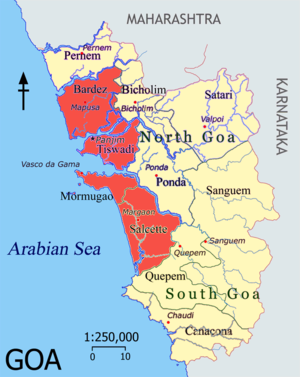
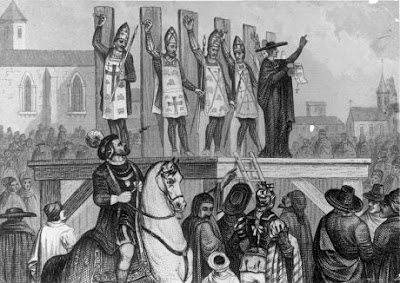
In the annals of world history, the period of  “The Inquisition” introduced by Portuguese rulers of Goa, India was  the worst and scary chapter no body can ever think of, all in the  name of Christ, an embodiment of love and compassion. In 1542, Fr. Francis Xavier, co-founder of the Society of Jesus, arrived in Goa  with a view to taking  the message of Christ among the native Indians who followed altogether different religions. He observed that the newly converted Christians were still practicing their old customs and traditions and were not serious about  following the true Christian faith. Indian Christians, having turned  a deaf ear to the European missionaries’ clarion call and subsequent warning, kept joyfully following their traditional Indian customs. Terribly disappointed, Fr. Francis Xavier took the  extreme recourse available for him and he, at last, asked the Portuguese government in Portugal to introduce the most dreaded Inquisition in Goa, then a citadel of Portuguese power in India.  He urged King John the III of Portugal to set up the Inquisition in Goa  also to suppress Judaism  because Jews refused to reconvert to Roman Catholicism. There was also Jewish population present in the other colonies in the west like Cochin and Goa. 


Pope to apologise Protest in New York city.. 09/2015 Goan  inquisition www.justiceforhindus.org

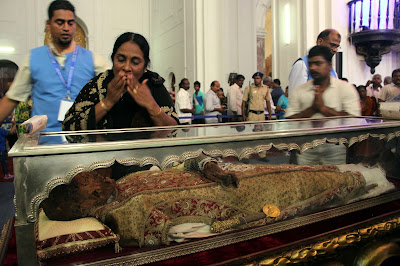
relics of St Francis Xavier,Basilica of Bom Jesus church Goa. 
ians.in

Fr. Francis Xavier’s embalmed mortal remains are today kept in a silver casket inside the Bom Jesus Basilica in Goa and are taken out for public viewing every ten years. It is unfortunate that those thousands who come there to do their prayers reverentially to get his blessings had no idea whatsoever about him, who was responsible for the horrible atrocities he had let lose on the innocent people in ten of thousands, including Muslims, Jews and Hindus, many of whom were tortured to death and whose families underwent untold miseries  and pain in the loss of their loved ones.
The following are the disgusting and, nauseating facts of Goa Inquisition during the Portuguese colonial period:

01.  It is estimated that by the end of the 17th century,  the Portuguese carried out ethnic cleansing of Hindus and Muslims  who constituted  less than 20,000 people who were non-Christians out of the total Goan population of 2,50,000. Among the severely punished – 4,046, out of whom 3,034 were men and 1,012 were women.

02.  Indigenous people  were  forced to adhere to Portuguese religious beliefs, abandoning their faith.

03. The  new  Christian Missionaries from Portugal mandated that all Hindu temples be closed by 1541. 

04. By 1559 Portuguese  missionaries ordered the destruction of  Hindu temples in that region. In 1567, in Bardez  300 Hindu temples  were destroyed. From 1567 on Hindu rituals, including marriages and cremations, were banned for good. Everyone above 15 years of age was compelled to listen to Christian preaching, on pain of punishment.

05. With the introduction of Goa Inquisition-religious tribunal for suppression of heresy and punishment of heretics, whose prime architect was Fr. Francis Xavier, the situation turned worse for Hindus, Muslims and also  for Jews. The latter were mostly traders.

06. Goa Inquisition was almost on par with Inquisition in Spain -1478 in terms of  gory treatment and violence let lose in the name of religion.

07. Introduced in 1560, both Indian Christians and non-Christians went through hell and mental agony caused by  Portuguese  preachers in their mother land.

08. The beautiful Goa enclave  with fine beaches and azure waters,  in particular, became a horrible place of horrors of unimaginable proportion just for the simple reason that the natives refused to accept Portuguese religious beliefs and refused to get converted under compulsion or duress to Christianity.

09.  Xavier commented “The Hindus are an unholy race. They are liars and cheats to the very backbone. Their idols are black—as black as black can be— ugly and horrible to look at , smeared with oil and smell in a evil manner…” 

10.  It is a paradox that  Francis Xavier, the devil in the guise of a priest, who forced the King of Portugal to legally introduce the Inquisition in  Goa and ordering the torture of tens of thousands of Hindus and Jews, using various innovative methods, was canonized by Pope Gregory XV in 1622.

11. Numerous Jewish families came to India to lead a peaceful life. Earlier they faced Inquisition in Spain and later in Portugal. They never thought the same fate would drive them to the wall here in India.

12. The preachers used many dreaded methods of torture to force the innocent people to swallow their preaching of Gospel . According to Richard Zimler, who wrote “Guardian of the Dawn” on Inquisition in Goa mentioned the missionaries used the machinery of death” for forceful conversion.

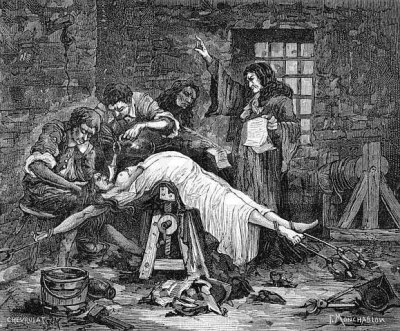
  Portuguese Water boarding. bharatabharati.wordpress.com

13. Using torture, people were required to pass the ‘act of faith’ (auto-da-fe) by being stretched out on the rack.  If not they would be  burnt at the stake.

14. The following are the disgusting, brutal, inhuman punishments the faithfuls gave the gullible – tearing off the tongues,  skinning of the accused alive, blinding the victim with sharp sticks or red-hot iron spikes, pulling of the flesh of victims hard with pliers and quartering – hammering a stake hard through the body (avoiding vital organs). Not be content with the above methods they used sharp iron fork  to mangle breasts, red hot pincers to tear off flesh and red hot irons to insert up vagina and rectums.

15. Dismembering children limb by limb in front of their parents whose eyes were taped continued till they agreed to convert was the most cruel method used by the catholic faithfuls and they found this method very effective. 

16. According to Zimler ” Over that period of 252 years, any man, woman, or child living in Goa could be arrested and tortured for simply whispering a prayer or keeping a small idol at home. Many Hindus — and some former Jews, as well — languished in special Inquisitional prisons, some for four, five, or six years at a time.”

17. In the Portuguese colonies, the government provided incentives for baptized Christians – rice donations for the poor, good positions in the Portuguese colonies for the middle class and military support for local rulers. Missionaries of the Society of Jesus acted as agents. 

18. Even before Fr. Francis Xavier’s own letters about  Inquisition sent to the king, missionaries, with glee, encouraged the destruction of Hindu temples and religious artifacts.

19. The Jews who secretly practiced Judaism, feigning Catholics were very much affected by Goa inquisition, in particular,  Cochin Jews who began to migrate to deeper parts of Present day Kerala for survival. 

20. The palace of Adil Shah, former ruler of Bijapur became the “palace of horror” where the Hindus who tried to flee the place with their deities were punished severely. There were special Inquisition prisons for the offenders of religion. Aleixo Dias Falcão and Francisco Marques were the ones who chose the palace as their venue to punish the apostates and heretics as well.

21. Possession of a small idol of a Hindu God, or a whispering prayer in Hebrew by the small Jewish community means serious trouble. Even Muslims had similar fate awaiting them.

22. Death awaited those non Christians or heretics  (kept in shackles by priests) who refused to give up their faith or divulge the names of those who are non Christians. Death was by strangulation or burning alive in public Acts of Faith. These atrocities continued till 1812 until inquisition was finally abolished.

23. Hindus were not allowed to have Tulsi (basil plant, considered holy by the Hindus) maadam in their houses. Brahmin’s were forced to remove their tuft. The Portuguese colonial administration enacted anti-Hindu laws aimed at  encouraging conversions to Christianity. The public worship of Hindu gods was made unlawful.

24. As for converted Christians, they were forced to say the prayers in Portuguese. Indian preachers were compelled to learn Portuguese to give their services in that language, not in their mother tongue – Konkani.Konkani language faced decline.

25. Numerous  Gowda Saraswat Brahmins were forced to become Christians and were compelled to follow the western diets. Consequently numerous converted  Gowda Saraswat Brahmins migrated to Mangalore (in Karnataka) and other regions. The Hindu  Gowda Saraswat Brahmins, who escaped the religious persecution, also  moved over to southern Canara. Part of the community moved farther down to Kochi and settled down there in places like Mattancherry.. 

26. Francis Buchanan, a Scottish physician, who visited Canara in 1801, in his book, ‘A Journey from Madras through the Countries of Mysore, Canara and Malabar (1807)’,  stated that ” Goan Christians – roughly 8000 left Goa, came and settled in South Canara at the invitation of the King of Bednore.
In 1664 and later, the Maratha rulers’ invasions also one of the causes of exodus of Indian Christians. The Marathas were under the wrong impression that the native Christians were hostile to the Hindu population and forced them to convert to Christianity.

28. The inquisition was headed by a judge from Portugal who was answerable to (and only to) the General Counsel of the Lisbon Inquisition. He handed down  punishments in line with the Rules that governed that Inquisition. The Inquisition was used as an instrument of social control, aiming at spreading Christian faith as followed by the Portuguese and  Inquisition proceedings were conducted in secret.

29. Because of secrecy maintained by the Inquisition council and subsequent destruction of the records, numerous instances of atrocities inflicted by the Portuguese God men on  Indian natives were not brought to light.

 30. Da Fonseca  recorded the violence and brutality of the inquisition. He mentioned the need for hundreds of prison cells to accommodate the accused.  Those convicted of lesser crimes had  to work in  ship galleys and gunpowder factories.

31. Hindus were not allowed to enter the capital city on horseback or palanquins. Nor were they allowed to keep Hindu Gods’  images or idols at home. Christians were instructed not to employ Hindus for any purpose. Violations against the royal orders resulted in imprisonment.

32. Viceroy António de Noronha issued an order which applied to the entire area under Portuguese rule: 
 “I hereby order that in any area owned by my master, the king, nobody should construct a Hindu temple and such temples already constructed should not be repaired without my permission. If this order is transgressed, such temples shall be, destroyed and the goods in them shall be used to meet expenses of holy deeds, as punishment of such transgression.”

33. In 1620, legislation was passed prohibiting  the Hindus from performing weddings. At the instigation of  Franciscans, the PortugueseViceroy  banned the use of Konkani in 1684,  decreeing that within three years, the local people should speak the Portuguese tongue and use it in all their dealings in Portuguese territories. If not obeyed, people will face imprisonment.

34. Those who persistently refused to give up their ancient Hindu practices were declared apostates or heretics and condemned to death. In 1736, over 42 Hindu practices were prohibited.

35. The Inquisition did not leave the  local Jews and Syrian Christians in Kerala, representatives of an early Christian tradition older than Roman Catholicism, that survives today as the Jacobite Christianity. In 1599 the Synod of Diamper authorized the forceful conversion of the “Syriac Saint Thomas Christians.”St. Thomas established the first seven and half churches in the coastal Kerala way back in 52 AD. The St. Thomas Christians also became the victims of Goa Inquisition because Syriac Christians later swore the “Coonan Cross Oath,” severing relations with the Catholic Church.

Ref:

Salomon, H. P. and Sassoon, I. S. D., in Saraiva, Antonio Jose. The Marrano Factory. The Portuguese Inquisition and Its New Christians, 1536–1765 (Brill, 2001), pp. 345–7.

T. R. de Souza. “The Goa Inquisition”. VG Web. Retrieved 1 November 2012.

“බොරු ප්‍රදර්ශන එපා, මරණ දඩුවම ප්‍රකාශිත නීතියෙන් ඉවත් කරන්න.”

July 2nd, 2019

ශ්‍රී ලංකා මානව හිමිකම් කේන්ද්‍රයේ වැඩබලන විධායක අධ්‍යක්ෂිකා සුරංගි ආරියවංශ

මරණ දඩුවම ක්‍රියාත්මක කිරීම සඳහා විධායක ජනාධිපතිවරයා වෙත පැවරී ඇති බලතල අහෝසි කර දැමිය යුතු බව ශ්‍රී ලංකා මානව හිමිකම් කේන්ද්‍රය කියයි. ආණ්ඩු ක්‍රම ව්‍යවස්ථාව යටතේ විධායක ජනාධිපතිවරයකුට පැවරී ඇති බලතල අතර ඇති මරණ දඩුවම ක්‍රියාත්මක කිරීමට ලැබෙන බලතල අතිශය භයානක බව ශ්‍රී ලංකා මානව හිමිකම් කේන්ද්‍රයේ වැඩබලන විධායක අධ්‍යක්ෂිකා සුරංගී ආරියවංශ මහත්මිය පවසයි.

මානව හිමිකම් ස්වේච්ඡා ක්‍රියාකාරිකයින් පිරිසක් සමඟ ඊයේ (30)රාජගිරියේ පිහිටි ශ්‍රී ලංකා මානව හිමිකම් කේන්ද්‍රයේ දී පැවැති වැඩමුළුවක් අමතමින් ඇය මේ බව කියා සිටියාය. එහිදී ඇය පෙන්වා දුන්නේ මරණ දඩුවම ක්‍රියාත්මක කිරීමේ විධායක බලතල සීමා කිරීමේ හැකියාව ව්‍යවස්ථාදායකය සතුවන බවයි. පාර්ලිමේන්තුවේ බහුතර කැමැත්ත මත මෙම බලතලය අහෝසි කළ හැකි බව ඇය සඳහන් කළාය.

1976 වසරින් පසුව ශ්‍රී ලංකාව මරණ දඩුවම ක්‍රියාත්මක නොකිරීම හේතුවෙන් ජාත්‍යන්තර පැසසුමට පාත්‍ර වී ඇති අතර මරණ දඩුවම ක්‍රියාත්මක නොකිරීම සම්බන්ධයෙන් 2016 වසරේදී එක්සත් ජාතීන්ගේ මහා මණ්ඩලය ඉදිරිපත් කළ යෝජනාවකට ද පක්ෂව ශ්‍රී ලංකාව ඡන්දය ප්‍රකාශ කර තිබේ. ලොව ශිෂ්ට සම්පන්න ප්‍රජාතන්ත්‍රික රටවල් සියල්ලම පාහේ මරණ දඩුවම අහෝසි කර දමා ඇති වකවානුවක යළි මරණ දඩුවම ක්‍රියාත්මක කිරීමට ගෙන ඇති තීරණය කිසිසේත්ම අනුමත කළ නොහැකි බව ආරියවංශ මහත්මිය පෙන්වා දුන්නාය.

සෞදි ආරාබිය වැනි රටවල මරණ දඩුවම ක්‍රියාත්මක කරන නමුත් අපරාධ සිදුවීම නතරවී නොමැති බව පෙන්වා දුන් ආරියවංශ මහත්මිය කියා සිටියේ ලොව අනිකුත් රටවල් දිනෙන් දින සමාජයීය වශයෙන් වේගයෙන් ඉදිරියට යමින් සිටින යුගයක ශිෂ්ටත්වයේ සිට අශිෂ්ටත්වය දක්වා සමාජය පසුපසට රැගෙන යාමේ තීන්දුවක් ලෙස මෙම තිරණය සැලකිය හැකි බවයි. මත් උවදුර සහ ළමා අපචාර බරපතල සමාජයීය ගැටළුවක් බවත් මරණ දඩුවම වැනි ක්ෂණික විසඳුම් මඟින් ඊට පිළියම් සෙවිය නොහැකි බවත් ඇය සඳහන් කරයි.

මත්ද්‍රව්‍ය ජාවාරම මැඩලීම සඳහා පවතින නීති රීති පද්ධතිය විධිමත් කිරීමේ වගකීම පසෙක තබා වරදකරුවන් එල්ලා මැරීමෙන් විසඳුම් අපේක්ෂා කළ නොහැකි බව ශ්‍රී ලංකා මානව හිමිකම් කේන්ද්‍රය අවධාරණය කරයි. ලොව කිසිදු රටක එල්ලා මැරීමෙන් හො ඝාතනය කිරීමෙන් මත්ද්‍රව්‍ය වැනි ජාවාරම් මර්ධනය කර ඇති බවට කිසිදු සාක්ෂියක් නෙමැති බව සඳහන් කරන ඇය කියා සිටින්නේ මත් ජාවාරම් පසුපස සිටින දේශපාලඥයින් පිළිබඳ සොයා බලා කටයුතු කිරීම පසෙක තබා වරදකරුවන් එල්ලා මැරීමට තීරණය කිරීම හුදු ජනප්‍රියත්වය සඳහා ගත් දේශපාලනික තීන්දුවක් බවයි.

ශ්‍රී ලංකාව තුළ යුක්තිය පසිදලීමේ ක්‍රමවේදය පිළිබඳව වන විශ්වාසය පළුදු වී ඇති මෙවන් වකවානුවක මරණ දඩුවම ක්‍රියාත්මක කිරීම පසුපස ඇති පක්ෂපාතීත්වය පිළිබඳව බරපතල සැකයක් මතුවිය හැකි බව පෙන්වාදෙන සුරංගී ආරියවංශ මහත්මිය අවධාරණය කරන්නේ ඕනෑම පාලකයෙකුට සිය විරුද්ධවාදියෙකු වරදකරුවෙකු කර මරා දැමීමේ අත්තනෝමතික බලයක් මේ ඔස්සේ ගොඩනැගෙන බවයි.

මාධ්‍ය ඒකකය
ශ්‍රී ලංකා මානව හිමිකම් ‍කේන්ද්‍රය
2019/07/02

The ship that has lost its bearings; of both the helm and the helmsman-The metaphor

July 2nd, 2019

Laksiri Warnakula

What would you expect from an unfortunate ship that has lost its helm and the helmsman, owing to bearing-malfunctioning, of the helm and the head of the helmsman, as well? Inevitably, it will become uncontrollable and lose all sense of direction resulting in becoming incapable of sailing safely and soundly along mapped-out lanes towards its desired destination. It won’t be seaworthy anymore.


It will become an ailing ship that will be tossed to and fro by the waves, battered from all sides by the water and the wind and sooner or later will succumb to the inevitable. It will sink.


Now leaving aside the above passage that I have written with a somewhat metaphorical slant and tone, let’s muse about what our country has been going through, particularly since ‘Yahapalanaya’ took over the reins, even though this has already been done, most likely for an umpteenth number of times by an equally umpteenth number of people.


We all know that it came in with lots of fanfare and full of pledges and promises. And the people probably may have sighed in relief, telling themselves; ‘Oh at last the bright lights of decency, fair play, justice and eventual prosperity in sight at the end of the tunnel, which was kept dark far too long. Now no more to white vans, cronyism, nepotism, deals, plots and thuggery, so on and so forth’.


And just four years on, we find ourselves on a cursed ship, which has lost direction in every conceivable sense and is adrift, left to float on its own, in stormy seas bereft of accountability and responsibility, full of chaos, disarray and lies. And to top it off, it is, having been already hit hard with the massacre of more than two hundred and fifty innocent worshipers including children, now facing a new form of threat, different from what Mr MR fought and finished off. (The good part of him, in spite of the bad and the ugly justifiably attributed to his conduct during his tenure as president for the second time, in particular).


In fact, there is hardly anything new that I could add here. Many concerned citizens including the editor himself have voiced their opinion on paper without mincing words and many times over, at that. Almost everything is in the doldrums. The accusation, denial, denigration, manipulation, you name it and it’s there, but fair play, sensible, sustainable and far-sighted economic plans, policies without political bias, law enforcement, much needed reforms in many a sector and industry-building, to mention a few.


Yet, the corrupt, dirty deals of the nation builders and their cronies continue uninterrupted, with scant regard for decency and honesty. And the perpetrators are frolicking amidst the riches with gay abandon, enjoying what has already been gained and salivating at what is in the offing and yet to come. Their adventures are too numerous and so varied, one would find it hard to assign an identity to each one of them, whether it’s betrayal, corruption, sell-off, mischief, theft, sheer daylight robbery or whatever.


And there is always something to keep people busy; blabbering, discussing, dissecting and guessing. There is a mind-boggling array of events and happenings so varied and weird, akin to a kaleidoscope, an ugly one though, that it’s hard to keep track of them, let alone make any sensible analysis of each one, as one becomes lost amidst hearsay, rumour and divided expert-opinion. 


From inexplicable silence that many of the Diyawanna Oya inhabitants maintained, yet knew in advance of an impending terrorist attack, through a case relating to female reproductive system, then onto a Ven. monk going into a ‘fast unto death’ protest and now to the current hot topic of ‘whether to hang them or let the noose rest in peace’, we are never short of drama, be it comic, tragic or downright stupid. Perhaps, this is how they want it; keep us busy arguing, debating, fighting and fuming over who, what, where and why and make us forget that we are in reality being ceremoniously, yet cunningly led down the garden path by them.

All in all, anything and everything is possible in ‘la-la land cruise ship’ helmed by ‘la comedian’, who seems to have lost few bearings in his head and helm too.

Laksiri Warnakula

Why did Army Commander make contradictory statements on Bathidueen’s call – Gammanpila (English)

July 2nd, 2019

Ada Derana

THE SHEEP IS HANGED AS A LAMB

July 2nd, 2019

RANJITH SOYSA

A number of prominent personalities who pounce on the Sinhala Buddhists at the drop of a hat, has denounced vehemently Mahanayke thero of Asgiriya regarding his recent statement alleging that he wanted ‘ the Muslims to be stoned . Among, those who reviled was one prominent NGO activist  who wanted legal action be taken against the Mahanyake for his ‘hate speech’!.  Some leading Muslim spokespersons such as Assad Sally too adverted to the allegation that Muslims should be stoned and condemned the Mahanyake thero,

But, a very few had listened properly to Maha Nyake thero’s said speech. He DOES NOT AT ALL mention that the Muslims should be stoned. Instead he refers to the suspected actions of some Muslim shop owners and a doctor in Matale who are involved in questionable practices and said that some women have  said that they should be stoned to death. He immediately continued his speech and said THAT HE DOES NOT AGREE WITH THE PRPOSITION. He also said that if some are involved in such unsavoury practices he thinks that they deserve this punishment. He appealed to the Sinhala Buddhists to get together to protect themselves. He mentioned that if such crimes  were committed against another ethnic group by the Sinhala Buddhists. the offenders will be sliced to death.

Maha Nyake thero NEVER MENTIONED THAT THE MUSLIMS SHOULD BE STONED. But, he said that if some are guilty of criminal acts they have to be punished.

It is unfortunate that the killing of nearly 300 people and injuring over 500 persons by the Islamic terrorists have been pushed into the oblivion and the main focus of the anti Sinhala Buddhist individuals and organizations is continuing to fly off the handle.

Where a sheep is hanged as a lamb , the white sepulchres rule unabated,

RANJITH SOYSA

Eye witnesses at executions

July 2nd, 2019

By Dr. P. G. Punchihewa
Of the former Ceylon Civil Service

July 2, 2019, 9:08 pm 

(A shorter version of this article appeared in the Sunday Island August 5,2018)

Why do we kill people who kill people to show people that killing people is wrong? — R. Chandrasoma

Since the announcement was made by the government recently to reintroduce the capital punishment much has been written in support or against the move.

But I wonder whether there is anybody from either group who would have seen the penalty being implemented and convicts executed? There are two such reports from two officials who witnessed the event.

Let me reproduce them. The first from Chandrasoma as reported in his “Vignettes of the Ceylon Civil Service 1938 -1957” and the second from Leonard Woolf in his autobiography “Growing”. I quote from Chandrasoma first as it gives the background for his presence at the execution.

“Why do we kill people who kill people to show people that killing people is wrong? The cadet had to officiate at every fifth hanging. The GA took the first, the AGA the second, the OA third, the Extra OA the fourth and if you were the cadet, [it was] your baby. Mine had been three days ago. I was given two days’ notice of my ordeal ….

“Representing the fiscal I was the last to speak to the condemned man. He was a Tamil from an estate in the district and it was some little consolation to me that I then had not enough Tamil to speak to him except through an interpreter. In the cold Kandy dawn, he was in a sweat shivering and his teeth chattering, as he stood at the door of the condemned cell. I was in little better state. I had to ask him whether he was the man condemned to death in the Supreme Court in case number so and so, presumably to make sure that the wrong man was not killed. He nodded speechlessly It was then my duty to ask him whether he wished to make a will, make any disposition, or convey any message to anybody. That was the sum of it and then I stepped back to see him hooded and walked to the gallows. I had finally to witness and certify that he was duly hanged by the neck till he was dead.

“I scratched my signature on the official paper and staggered away. Despite the superintendent of the prison telling me the grisly details of how this man had hacked his young wife to death and showing me the knife with which the deed was done in a vain attempt to help me regain my composure, I had not been able to eat and sleep.” (Pages 2-3) This was in 1938.

Woolf’s account in his biography “Growing” is more detailed and gruesome.

“In Kandy executions took place in the Bogambara Prison in the early morning before breakfast. To be present at them was a horrifying experience and the more I had to witness, the more horrible I found them – and I think this was the experience of almost everyone who had to be present … The procedure was that I first went to the condemned man’s cell, read over to him the warrant of execution, and asked him whether he had anything to say. Some said no; several of them asked that their bodies after execution should be handed to their relatives. After I read the warrant, the condemned man was led out of the cell, clothed in white, on his head a curious white hat which at the last moment was drawn down to hide his face. In most cases they seemed to be quite unmoved as they walked to the scaffold, but one man in a state of terror and collapse and had to be almost carried to the gallows by the warders and all the way he kept repeating some words of a Sinhalese, prayer, over and over again, and even as he stood with the rope round his neck waiting for the drop. The man was led on to the scaffold by the warders, his arms were pinioned, and the hat drawn over his face. I had to stand immediately facing him on a kind of verandah where I could see the actual hanging. In two out of the six or seven hangings which I had to certify something went wrong.

In one case the man appeared not to die immediately; the body went on twitching violently and the executioner went and pulled on the legs. In the other case four men had to hang one morning and they were hanged two by two. The first two were hanged correctly, but either they gave one of the second two too big a drop or something else went wrong for his head was practically torn from his body and a great jet of blood spurted up three or four feet, covering the gallows and the priest praying on the steps.

“I give these repulsive details because those who support capital punishment in the 20th century pretend that it is a necessary, humane, civilized form of punishment. As a form of punishment, it is disgusting and as I saw it disgustingly inefficient. From the point of view of society and criminology, in my opinion, it is completely useless. The men whom I saw executed had all committed unpremeditated crimes of violence, killing from passion, anger or in a quarrel. Not one of them was deterred from killing by the fact that hundreds of other men in Ceylon had been hanged for precisely similar killings. All the evidence, in all countries and at all times goes to show that capital punishment is not a deterrent of crime; in fact ,by the mystique horror which creates it tends to induce the crimes for which men have recently been executed.” — p 167 and 168 (italics mine)

This was in 1905. The CCS cadets who came after 1958, appreciated the humane decision taken by the then Minister of Justice , M. W. H. de Silva, who did away with the capital punishment as they did not have to go through the agony of witnessing a human being hanged in their presence as Chadrasoma and Woolf explained above.

Capital Punishment: A foolish response to serious crime

July 2nd, 2019

By Ruwan Rajapakse Courtesy The Island

July 2, 2019, 9:00 pm

article_image

“I do not believe that any of the hundreds of executions I carried out in any way acted as a deterrent against murder.” Albert Pierrepoint, Hangman, UK (1931-1956)

After a few false starts, the incumbent President of Sri Lanka seems to have acted upon his well-known belief in the utility of Capital Punishment [1]. This institutionalised crime is now due to take place in our land of ahimsa, after a hiatus of 43 years. Whether The President sprang into action because of the purported rise in drug trafficking, as he publicly espouses, or whether it was an attempt at gaining ignoble popularity prior the upcoming elections (Capital Punishment is quite a popular “solution” to serious crime in some ignorant quarters of Sri Lanka [2]), is not our concern here. Our purpose here is to discuss the value of Capital Punishment as a social instrument for mitigating the spread of serious crime, and examine its moral underpinning.

There are three popular arguments in favor of Capital Punishment:

1. It allows society to punish a wrongdoer, thereby balancing “the celestial scales of justice”.

2. It serves as a deterrent for persons who may be contemplating violent or serious crimes.

3. It serves as a redress for the victims of violent or serious crimes.

A mere century and a half ago, judicial experts and the intellectual community at large were in favour of leveraging Capital Punishment. Even that great rationalist luminary of the 19th Century, John Stuart Mill, famously argued in parliament in favor of capital punishment, albeit for the most extreme of cases: “…when the attendant circumstances suggest no palliation of the guilt, no hope that the culprit may even yet not be unworthy to live among mankind, nothing to make it probable that the crime was an exception to his general character rather than a consequence of it, then I confess it appears to me that to deprive the criminal of the life of which he has proved himself to be unworthy, solemnly to blot him out from the fellowship of mankind and from the catalogue of the living is most appropriate.” [3]

However, times have changed since the days of JS Mill. We saw two entire new branches of science emerge, which has something definitive to say about the efficacy of Capital Punishment; namely psychology and sociology.

We know today that argument #2 (i.e. Capital Punishment is a deterrent) is empirically false [4] [5] [6] [7] [8], and we know that arguments #1 (“punishment”) & #3 (“redress”) are a mere window dressing of a primitive, Darwinian instinct that was useful in stone-age tribal societies. Contrary to this vengeful instinct, many a moral philosopher, both ancient [9] and modern [10], has rejected capital punishment, and the use of retribution as a solace for victims, as an uncivilized way of conducting human affairs.

Albert Camus, that outstanding French libertarian and writer, highlighted the concern pointedly:

“But what is capital punishment if not the most premeditated of murders, to which no criminal act, no matter how calculated, can be compared? If there were to be a real equivalence, the death penalty would have to be pronounced upon a criminal who had forewarned his victim of the very moment he would put him to a horrible death, and who, from that time on, had kept him confined at his own discretion for a period of months. It is not in private life that one meets such monsters”.

The utopian human being with perfect mannerisms and an unfailing character is an imaginary socio-psychological construct, a conceptual role-model for children. The uneasy truth is that human intent is fickle, governed by a nervous system whose structure and function is fraught with aberrations, which cannot be eliminated through nurture alone. A psychopathic personality, for example, could be the direct consequence of a poor endowment of mirror neurons, as a result of generic mutations that attenuate empathy from birth [11] [12] [13]. Those with such subtle birth “defects”, no matter how peaceable their childhood influences may have been, may be saddled with a fundamental inability to empathize with other living creatures. They may not even be able to empathize with themselves, in a self-reflective manner. Not being able to feel for someone (or even for one’s own self) makes it easy for one to cause injury or distress to others. When children with such genetic predispositions for low empathy experience trauma in early childhood, psychopathy and “Cluster-B” personality disorders emerge.

An Iowa Supreme Court Justice made this observation as far back as 1840:

“Crime indicates a diseased mind in the same manner that sickness and pain do a diseased body. And as in the one case we provide hospitals for the treatment of severe and contagious diseases, so in the other, prisons and asylums should be provided for similar reasons.”

If society ends up killing every such person who yields to their natural instinct (to strike, rape or unscrupulously exploit), rather than finding ways to curb or neutralize their behavior, we then get into a fascinatingly diabolical downward spiral. The more we kill those who lack empathy, in order to better the lives of those who have it, the more we lower the empathy of the empathetic. We know that a taste for judicial killing brutalizes society [14], as was the case in Victorian England, where public hanging made life cheap, and people more and more violent. We find such a brutal society today in Saudi Arabia, where domestic workers are abused [15], and where murder and sex crimes are rampant. The executioner hacks away to no avail.

That is precisely why more enlightened nations, including Sri Lanka, aspire to practice Restorative or Preventative Justice [16].

We should also not make any mistake on the legitimacy of the actual act; Capital Punishment is a premeditated violent crime committed by the state, according to modern jurisprudence. It is not an act of self-defence (as Camus and others have clearly pointed out). Perpetrators are often executed years after their bad acts were committed, and by that time their attitudes have changed dramatically for the better, or they at least have been neutralized as a damaging force. There are ample such cases widely publicized in the media [17].

There probably are a dozen other reasons [18] for permanently abolishing capital punishment and resorting to a lengthy prison sentence, ranging from the danger of punishing the innocent, to the cost of the entire procedure outweighing the cost of a life sentence. To quote Jeffrey A. Fagan, Professor of Law at Colombia Law School:

“As states across the country adopt reforms to reduce the pandemic of errors in capital punishment, we wonder whether such necessary and admirable efforts to avoid error and the horror of the execution of the innocent won’t—after many hundreds of millions of dollars of trying—burden the country with a death penalty that will be ineffective, unreasonably expensive, and politically corrosive to the broader search for justice.” There is one very special reason why Sri Lanka should not take this extreme measure. Sri Lanka is the Asian poster child for a country operating a genuinely restorative system of justice, supposedly drawing inspiration from the compassionate philosophy of Gautama Buddha [19]. Our restorative system of justice serves as a beacon for sociocultural progress, in comparison with our neighboring countries. It is disappointing to see our President succumb to a belief in Capital Punishment, rather than stand upright and explain to people the hard truth that we cannot win the war against drugs, crimes or deviance, through mere attrition.

Advocates of Capital Punishment (including our President) often hide behind the fact that the USA and China leverage it. Let us quote that preeminent American moral philosopher Sam Harris, who refutes the pride in this assertion:

“Especially in the United States, is a barbaric system of imprisonment—to say nothing of capital punishment—that should make all citizens ashamed.”

Our own experts are unequivocal on the matter. Dr. L.B. L. De Alwis, ex-Chief JMO, had published an excellent analysis of the Lankan situation [20] in The Sri Lanka Journal of Forensic Medicine, Dec-2011, where he strikes at the core of the problem, along with a superb background analysis. Let us quote.

“In my opinion it is not the Non-implementation of the death penalty that has contributed to the rise of grave crime, especially murder, in Sri Lanka, but the release of murderers, rapists, drug barons, extortionists, highway robbers etc. sentenced to death or to long term rigorous imprisonment by the Judiciary, but later released by the executive in the shortest possible time for petty political advantage”.

Yasantha Kodagoda and other Lankan legal luminaries have held similar views [21] over the years.

It’s simply awful when drug barons rule the roost, or when terrible crimes happen. Our hearts go out to the victims and their kin, and our minds scream for justice. The state owes four things to society in instances of serious crime:

• Dispense justice swiftly and accurately, where the perpetrators are correctly identified, tried fairly and sentenced appropriately.

• Provide the next of kin of the victims with psychological counseling and support, to the utmost degree possible.

• Learn lessons from the crime and share them for the broader education of the general public.

• Firmly discourage lawlessness and mob-justice, which would interfere with criminal investigations.

The third point above is important and not to be underestimated in its value. Education, awareness and vigilance are the real weapons against serious crimes. Profiling of violent or deviant persons, cautioning parents and children about how to stay safe in ungated, low-income neighborhoods where dangers lurk, enforcing better policing etc. are all steps to be facilitated by the state. Furthermore, in counterpoint to The President’s current reasoning, a “war on drugs” is arguably a futile one [22]. There is ample expert opinion which shows that drug abuse is best mitigated through education, counseling, better parenting and social awareness. Of course we must proactively dismantle drug smuggling operations and imprison heavy traffickers for life. But laws alone are insufficient. We must “raise consciousnesses” against the use, manufacture and import of hard drugs, like we did against cigarets, and like we do for the accommodation of multiple sexualities. We must have a social awakening that makes the use of hard drugs unfashionable, and shun traffickers, not reward them (some of the largest importers were linked to Lankan politicians in the recent past [23]).

Poor parenting (and associated personality disorders in children) is not to be underestimated as a causal factor for the consumption of hard drugs. Lack of self-confidence in teenagers due to the indifference, over-control or violence of parents, is still fairly commonplace in Sri Lanka, even amongst upper middle income and wealthy homes. Such teenagers and young adults are far more susceptible to easy escape routs, like drugs, gangs or cults. We must also differentiate between hard drugs and marijuana. Experts tell us that the latter is less addictive and much less damaging to the body than alcohol or tobacco [24], and could reasonably be consumed in a safe form by psychologically balanced adults, to enjoy its soothing or psychedelic properties. Understanding this fact would help to focus the war, and not waste police resources and public money.

What the state does not owe society is a reactionary, “quick fix”, which would prejudice or pervert the broader course of justice in our country, and create an unhealthy punitive culture amongst our children. We leave the reader with these two quotes:

“I have never heard a murderer say they thought about the death penalty as a consequence of their actions prior to committing their crimes.” – Gregory Ruff, police lieutenant in Kansas

“I do not believe that any of the hundreds of executions I carried out in any way acted as a deterrent against murder.” – Albert Pierrepoint, Hangman, UK (1931-1956)

References:

1. President Sirisena on Capital Punishment (listen to the clapping as he expresses his personal approval): http://www.adaderana.lk/news/32381/capital-punishment-if-parliament-approves-president

2. Political motivation reported behind Sirisena’s move on reintroducing Capital Punishment: https://www.bbc.com/news/world-asia-48812576

3. Mill on Capital Punishment: http://ethics.sandiego.edu/books/Mill/Punishment/

4. Capital Punishment: Deterrent Effects & Capital Costs: https://www.law.columbia.edu/law_school/communications/reports/summer06/capitalpunish 5. 88% of criminologists do not believe the death penalty is an effective deterrent: http://www.deathpenaltyinfo.org/study-88-criminologists-do-not-believe-death-penalty-effective-deterrent

6. The Death Penalty and Deterrence: http://www.amnestyusa.org/our-work/issues/death-penalty/us-death-penalty-facts/the-death-penalty-and-deterrence

7. The death penalty is ineffective and indefensible: http://www.usnews.com/opinion/articles/2014/09/29/the-death-penalty-is-ineffective-and-indefensible

8. Failure to Deter Crime: http://nccadp.org/issues/deterrence/

9. Buddhism on Capital Punishment: http://www.bbc.co.uk/religion/religions/buddhism/buddhistethics/capitalpunishment.shtml

10. Sam Harris on capital punishment: “The result, especially in the United States, is a barbaric system of imprisonment—to say nothing of capital punishment—that should make all citizens ashamed”. http://www.samharris.org/blog/item/reflections-on-free-will

11. Psychopathic criminals have empathy switch: http://www.bbc.com/news/science-environment-23431793

12. Do Mirror Neurons Give Us Empathy? http://greatergood.berkeley.edu/article/item/do_mirror_neurons_give_empathy

13. How Empathy Can Be a Luxury: http://bengraves.hubpages.com/hub/Psychopaths-and-Mirror-Neurons-How-Empathy-can-be-Absent

14. Brutalizing society: http://www.bbc.co.uk/ethics/capitalpunishment/against_1.shtml

15. GCC declares war on domestic violence: http://www.arabnews.com/featured/news/657236

16. Restorative Justice: https://en.wikipedia.org/wiki/Restorative_justice

17. The case of Karla Faye Tucker: https://en.wikipedia.org/wiki/Karla_Faye_Tucker

18. 13 Reasons to Oppose the Death Penalty: http://www.oadp.org/facts/13-reasons

19. Buddhism and capital punishment: http://www.bbc.co.uk/religion/religions/buddhism/buddhistethics/capitalpunishment.shtml

20. DEATH PENALTY versus LIFE IMPRISONMENT: http://www.pdn.ac.lk/med/departments/forensic/Vol2No2.pdf

21. Death penalty not the answer, expediting dispensation of justice is: http://www.island.lk/index.php?page_cat=article-details&page=article-details&code_title=69674

22. The “War on Drugs” is lost: https://samharris.org/a-war-well-lost/

23. Political links to Drug Traffickers: http://www.ft.lk/article/255408/At-sea-over-drugs- 24. Alcohol vs Cannabis: https://www.livescience.com/61786-marijuana-versus-alcohol-brain.html

SL leaders and US interests

July 2nd, 2019

N. A. DE S. AMARATUNGA Courtesy The Island

There is a perceived threat of a major intrusion into the country’s sovereignty and the country being turned into a military base for the US, as part of its strategy for dominance in the Indian Ocean. Several agreements with the US and supportive parliamentary acts are said to be in the pipeline hidden from the public eye. The proposed agreements are (1) Status of Forces Agreement, (2) Acquisition and Cross Service Agreement and (3) Millennium Challenge Corporation Compact. The first would enable the US to deploy their armed forces in any part of our country with the freedom of not coming under the law of the country. The second envisages the building of an economic corridor from Colombo to Trincomalee and the third agreement would establish a corporation to utilize the land that comes under the economic corridor. Going hand in hand with these agreements are the following proposed parliamentary acts; the Land Special Provisions Act and the State Land Bank Act. These acts of parliament would facilitate acquisition of land by foreign investors and the formation of corporations for the development of these lands.

Obviously, the primary interest of the US is in the military sphere, and the secondary interest is to tighten the grip it has on the country with a strong economic involvement making us dependent on them. Our land would be made available to their armed forces and also to their investors. The economic corridor could eventually be American owned and would connect the two ports also, Colombo and Trincomalee for military and economic purposes. The US and also our prime minister seem to be in a great hurry to get our government to enter into these agreements as there is an election around. The US has indicated that they want future governments to honour these agreements, probably aiming to take an insurance against a possible defeat of this government at the forthcoming elections. The legality of these agreements and their future validity have to be seriously looked at in relation to the relative powers of the executive and the legislature, given their far reaching and obvious adverse impact on Sri Lanka’s sovereignty and land ownership.

The PM seems to be under obligation to the US for helping him to come to power and would not attempt to stop them from doing what they want. The President, going by his past performance, though he had raised objections, cannot be relied upon to demonstrate a firm and consistent stand on these vital issues. His handling of the bond scam, Hambantota Port take over, Easter Sunday attacks, and his latest position on the 19th Amendment are just a few glaring instances characteristic of a dithering nature. Prime Minister, on the other hand, apart from his apparent hurry to get it over with, has a blemished past regarding inimical agreements. The infamous Peace Agreement drafted by Erich Solheim that he signed in 2002 comes to mind. At that time there was an executive president elected by the people with full powers. All international and also national agreements have to be signed by the person who represents the people’s sovereignty. There was no provision in the 1978 Constitution for delegation of authority to sanction agreements. Yet the PM without consulting the president signed the Peace Agreement which gave parity of status to the LTTE vis-a-vis the government. The legality of PM signing the Peace Agreement in 2002 is, therefore, questionable.

Thus, at a crucial time of existential importance we are between the devil and the deep blue sea with a vulture hovering above. The President tends to waver and the PM has a tendency to act in breach of the Constitution. The PM in 2002 was doing what the west asked him to do and he is doing the same in 2019. The President in 2002 was constitutionally more powerful than the incumbent in 2019 and was able to get rid of the government. The present president hasn’t got that power as was shown in October 2018. Despite the 19th Amendment, the president may have the necessary powers to abrogate agreements entered into without his approval, but whether he would do it may depend on the factors that influence his political future and his final decision in that regard. If he aligns with the pro-US camp he may go along with the decision to enter into the agreements and, on the other hand, if he returns to the national camp he may not approve the signing of the agreements. Notwithstanding these considerations the PM, like in the past and in secret, may sign the agreement. And as it was in 2002 the agreements would be deemed to have been duly entered into and implementation may proceed by the use of force if necessary as hinted by the US. Stakes are high for both the PM and the US. Only hope is the dissenting voice within the UNP against these agreements, which at present is only a whimper.

For the US, Sri Lanka has assumed greater geopolitical importance in view of the proposed Chinese Belt and Road Initiative, and the vital role Sri Lanka may be called upon to play in that project. US Secre tary of State has stated in no uncertain terms that they would not hesitate to militarily intervene to protect their interests anywhere in the world, including sea routes for trade. Further their global economic policy is to make countries dependent on them rather than improve the quality of life in those countries. Thus they want to get a grip on Sri Lanka’s economy and make us dependent on them, which would make it easy to convert Sri Lanka into a US military base for all practical purposes. The latter is crucial for them for they may soon lose the right to have their base in Diego Garcia.

The proposed economic corridor from Colombo to Trincomalee envisages the construction of five metropolitan centres connected by super highways covering several districts, and involving a large swath of land between the two cities. All activities in this corridor will be controlled by the US owned corporations. The above mentioned parliamentary acts relating to land will provide for the acquisition of land for this purpose. US armed forces will have the freedom of movement anywhere in the country and will have diplomatic immunity. Therefore, what is proposed is virtually a military take over and total control of the economy, the one facilitating the other.

What is important to the citizens of Sri Lanka, at a time when an election is looming, is the question whether we have the political leadership needed to resist the pressure applied by the US. Today the President is not very strong either constitutionally or politically. His political future is uncertain and he is trying hard to find a foothold to launch his next move aimed at salvaging some political space. PM desperately needs US assistance to remain in power. Large scale foreign involvement in the forthcoming elections is a distinct possibility; it happened at the last election and would happen with greater force at the coming elections. Neither the US nor China would like to be mere observers and leave it to our people to decide on their future rulers, they both have huge investments in areas of geopolitical importance. China has the Hambantota Port strategically positioned in relation to its ambitious Belt and Road Initiative, and the US and India would like to prevent its progress. India may acquire Mattala Airport and it too would be interested in our elections. Our people who have a reputation for resisting foreign invasions will have to unite, forget their political affiliations and rise up against foreign hegemony, their local lackeys, and decide on their future. Our very existence as a free and independent nation would depend on their decision.

SLFP wants SOFA put on hold till conclusion of 2019 Presidential polls

July 2nd, 2019

By Shamindra Ferdinando Courtesy The Island

article_image

SLFP General Secretary Dayasiri Jayasekera, MP, speaking on behalf of President Maithripala Sirisena, said yesterday that a final decision on the Status of Forces Agreement (SOFA) with the US should be delayed till the conclusion of the 2019 presidential election.

Similarly, the proposed Millennium Challenge Corporation (MMC) agreement, too, should be delayed till after the next presidential election. Jayasekera said.

MP Jayasekera said so in response to a query raised by The Island at the weekly media briefing at SLFP Headquarters on T. B. Jayah Mawatha.

The Island sought the SLFP’s reaction to recent US Embassy statement that the US expected whoever wins the next presidential election to honour agreements entered into by the two countries.

MP Jayasekera said that SOFA and MCC could be put on hold though Sri Lanka was now duty bound to follow ACSA (Acquisition and Cross Servicing Agreement).

The SLFPer said that President Sirisena had declared he wouldn’t approve SOFA and MCC under any circumstances.

Jayasekera dealt with several issues, including the ongoing controversy over President Sirisena’s decision to resume judicial executions, ACSA, SOFA and MCC, an agreement between Parliament and the US, the SLFP’s stand on the No Confidence Motion (NCM) moved by the government and President Sirisena’s candidature at 2019 presidential poll.

The MP faulted the UNP for a number agreements successive UNP administrations had entered into such as Voice of America (VOA) station. He recalled the circumstances under which in Feb 2001 the UNP had entered into a Ceasefire Agreement (CFA) with the LTTE and co-sponsored Geneva Resolution against the country in Oct 2015. On both occasions Presidents weren’t consulted, MP Jayasekera said.

Commenting on Sri Lanka entering into ACSA in March 2007 during the Rajapaksa administration and the current dispensation extending an expanded version of it recently, MP Jayasekera claimed that President Sirisena wasn’t briefed of the ACSA.

The Island sought an explanation as to why accusations were directed at the UNP with regard to ACSA because it was President Sirisena, in his capacity as the Defence Minister who placed agreement on ACSA before the cabinet and later signed by the then Defence Secretary Kapila Waidyaratne, PC.

Jayasekera said that ACSA hadn’t been discussed at the Cabinet and in Parliament. Asked whether the ACSA had been subjected to scrutiny by relevant Parliamentary Sectoral Oversight Committees (SOC), MP Jayasekera said that SOC system hadn’t been in operation at that time.

The finalisation of ACSA took place over a year before President Sirisena’s UPFA quit the government. However, he is the head of the government.

The Island pointed out that the signing of the Sri Lanka Singapore Free Trade Agreement (SLSFTA) had taken place in Colombo in January 2018 in President Sirisena’s presence. When he was askedwhether President would inquire into the circumstances under which ACSA was entered into, MP Jayasekera said that proposed SOFA was far more dangerous than ACSA. He alleged that the government had not followed specific advice given by President Sirisena in respect of SLSFTA.

When the media pointed out how Finance Minister Mangala Samaraweera had recently defended ACSA, SOFA and MCC, Jayasekera said that Sri Lanka shouldn’t join any particular camp.

The MP added that the US push for military agreements with Sri Lanka should be examined against the backdrop of United Nations highest court – International Court of Justice ruling the occupation of Chagos Islands illegal and that it be handed back to Mauritius ‘as rapidly as possible.’Chagos Islands are home to strategic US military base of Diego Garcia, MP Jayasekera pointed out. The SLFPer queried whether the US was looking for alternative bases for re-deployment of forces in case Chargos Islands were returned to Mauritius in accordance with the UN ruling.

Sri Lanka Attorney General: Officials Should Face ‘Crimes Against Humanity’ Charge for Easter Jihad

July 2nd, 2019

Courtesy breitbart

Attorney General Dappula De Livera of Sri Lanka ordered the arrests of the nation’s former defense minister and police chief Tuesday on charges of gross negligence in relation to the Islamic State attack on Christian churches and hotels on Easter Sunday.

De Livera has suggested on Monday that the two former officials, former Defense Secretary Hemasiri Fernando and former Inspector General of Police (IGP) Pujith Jayasundara may also be guilty of crimes against humanity – an international crime – for having information suggesting that jihadists were planning a series of terrorist attacks in Sri Lanka shortly before the Easter attacks and not acting on it.

The attacks killed over 250 people, including many children. Witnesses say the suicide bombers, who targeted three hotels serving Easter brunch and three churches, appeared to attempt to detonate as close to as many children as possible.

The Islamic State took credit for the attacks and police identified an imam named Zahran Hashim, head of the fundamentalist National Thowheed Jamath (NTJ) Muslim group, as the mastermind of the attacks. Shortly after police identified Hashim, federal officials began accusing each other of having intelligence that may have prevented the attacks.

President Maithripala Sirisena ordered Fernando and Jayasundara to resign after a letter surfaced from Indian intelligence agents warning of an attack on Easter. Sirisena, Prime Minister Ranil Wickremesinghe, and other senior officials claimed that intelligence leaders did not inform them of the warnings.

In a dramatic 24 hours for the country, Fernando and Jayasundara both checked into a Colombo hospital following De Livera’s comments on Monday. Police entered the hospital and arrested them despite their alleged medical issues.

Sri Lanka’s Daily Mirror reported Tuesday that De Livera had instructed the current acting IGP to arrest the two men last week on charges of gross criminal negligence and carelessness and bring them to magistrate court. After the AGP refused to act, De Livera reportedly sent him a letter Monday asking why he had not yet arrested the two former officials.

On Tuesday morning, the Colombo Telegraph reported that Fernando and Jayasundara both checked into the Colombo National Hospital complaining of heart problems, settling into the hospital’s cardiac unit. The newspaper did not offer details on what symptoms the men claimed to present or any medical details of their check-in, nor if they had a prior history of cardiovascular disease. Sri Lanka’s New First outlet contradicted this report, stating that only Fernando checked in at the Colombo hospital, while Jayasundara visited the Narahenpita Police Hospital.

The Telegraph reported that the two men are facing charges of murder and could face death penalty and up to 52 years in jail as a result of the charges brought against them.”

It remains unclear if De Livera will pursue prosecution against the men for crimes against humanity at the international level, which typically occurs at the International Criminal Court at the Hague. De Livera expressed an interest in prosecuting them for these crimes on Monday.

The two officials should be brought before a magistrate for their criminal negligence to prevent the April 21 attacks,” de Livera said in the letter sent to the interim IGP last week. Their negligence amounts to what is known under international law to be grave crimes against humanity.”

The bombings, which killed over 250 and injured more than 500, occurred amid a bitter political struggle between President Sirisena and PM Wickremesinghe. Almost immediately after the bombings, Wickremesinghe’s cabinet began accusing Sirisena of blocking them out of key intelligence meetings, where officials had reason to know about the impending attacks and could have acted to stop them.

Some intelligence officers were aware of this incidence,” Minister of Telecommunications, Foreign Employment & Sports Harin Fernando wrote on Twitter, publishing photos of documents detailing the potential of a jihadist attack on Easter.

Sirisena claimed that his officials left him in the dark, as well, and accused Hemasiri Fernando and Jayasundara in particular of withholding the information. Shortly before his forced resignation, Fernando claimed that, even if he did know the attack was coming, there was nothing he could do about it.

It was quite impossible to protect a large number of Churches last Sunday despite receiving prior information on these attacks,” Fernando claimed. The hotels, meanwhile, are conducting private businesses. They have to ensure their own security. Usually the star class hotels employ top military personnel in their security divisions. Hence, they are more than capable of ensuring their own protection.”

Colombo’s swift dispatching of security to mosques following the attacks – to protect against mob raids by the angry Buddhist majority – appeared to contradict Fernando’s statement that Sri Lanka’s government could not protect houses of worship from impending attack.

State Intelligence Service (SIS) head Sisira Mendis confirmed to the nation’s legislature at a hearing on the ISIS bombings in May that some intelligence agents were aware of the plot against Christians and that they took no action to prevent it. He said he received a letter from a foreign intelligence service warning of an attack on Easter.

I had placed the letter I received on April 7 in front of me when I sat for the meeting. Since it was not brought up, when the meeting was about to close, I brought it up. I informed them that the gravity of this information can only be gauged by SIS Director,” he said, but the threat was never a main point for discussion.”

US deal will let uniformed US troops to walk into anywhere in Sri Lanka – Bandula

July 2nd, 2019

Courtesy Adaderana

A great ‘seven-fold crisis’ has sprung up within the United National Party (UNP) over the party’s candidate for the Presidential elections, stated United People’s Freedom Alliance (UPFA) MP Bandula Gunawardane.

He mentioned this addressing a press conference held in Colombo today (02).

Speaking on the agreement with the United States of America, he said that under this agreement the US Army can enter and leave the country without VISA.

He also said that this would allow US troops to walk into any place in the country in uniform.

Gunawardane further said that the US can import and export war equipment and they will not be inspected at the Customs.

Further, if a US Army personnel commits a crime while in the country, he cannot be brought to courts in Sri Lanka, he added.

Former Defence Secretary and IGP remanded until tomorrow

July 2nd, 2019

Courtesy Adaderana

UPDATE: (7.25 p.m.) – Inspector General of Police Pujith Jayasundara has also been remanded until tomorrow (03).

Colombo Chief Magistrate Lanka Jayaratne visited the Police Chief at the Narahenpita Police Hospital, a short while ago, and ordered that he be placed in remand custody until tomorrow.


Former Defence Secretary Hemasiri Fernando has been remanded until tomorrow (03) by the Colombo Chief Magistrate Lanka Jayaratne.

The magistrate visited the former Defence Secretary, who was being treated at the Colombo National Hospital, this evening and ordered that he be remanded.

Fernando was taken into custody by a team of CID officers who visited the hospital earlier today. He continued to remain at the hospital under the CIDs custody.

Meanwhile IGP Pujith Jayasundara was also arrested by the CID while receiving treatment at the Police Hospital today (2).

The former Defence Secretary and the Police Chief were summoned to appear before the Criminal Investigations Department (CID) today, however they were both admitted to hospital this morning.

Fernando was admitted to the Coronary-Care Unit (CCU) at the General Hospital Colombo while the IGP was admitted to the Police Hospital in Narahenpita.

Attorney General Dappula de Livera yesterday wrote to the acting police chief urging him to bring charges against his predecessor, IGP Pujith Jayasundara, and the former defence secretary, Hemasiri Fernando.

There is sufficient information to prove negligence of official duties … and criminal negligence. It is also considered a grave crime against humanity under international law,” Livera said in the letter.

The Attorney General had further instructed the Acting IGP to produce the duo before courts.

For lesser charges of negligence leading to damage of property, the two officials could face up to 52 years in prison, according to the AFP news agency.

Detrimental Acts & Agreements turning Sri Lanka into a US colony & Western base in Asia

July 2nd, 2019

Sri Lanka is not just a country. It has a very long history & heritage that majority of citizens wish to preserve. The constitution clearly enshrines the Land & Resources as belonging to the People and for future progeny. A government is only custodian of the land & resources. Essentially this denies any Government arbitrarily taking decisions that would affect the clearly stated premise that the land & resources belong to not only the living citizens but to future citizens too. 83% of land is vested in the State for the people means that no law can be changed to deceitfully enable foreigners to buy State land being privatized via hurriedly rushed Bills prepared by foreigners. When laws that prevented foreigners from owning/buying land are being relaxed to enable foreigners and foreign companies to buy land while simultaneously 83% of state owned land is being privatized – it clearly showcases the hidden intent. Why are lawyers not taking these fundamental facts to legally address the illegalities taking place?

Let us connect the dots and understand the dangers we are today faced with following the Land Special Provisions Act being tabled in Parliament formulated by foreigners and question why they should be so interested to take so much trouble to formulate land laws for our people’s benefit unless there’s a catch – which is what we need to find out by connecting the dots to all the new changes being made to our statutes by arm twisting our corrupt politicians to sign the seal of approval.

Land Special Provisions Act

Includes virtually all elements that is differently worded in past Acts related to land. The only new element in this Act is the PROVISION TO SELL LAND which did not exist in earlier Acts.

Moreover, the new Act carries various strings & regulations that would adversely affect poor farmers leaving them in worse situation than they are in now and with no one to turn to for relief – as the Act removes land powers from the Centre and the President.

This is the most dangerous aspect of the new Land Act.

Why is this Land Special Provisions Act only valid for 7 years – is the plan to acquire all land within this stipulated period?

The present land Act is going to throw to the dustbin the following existing laws/Acts

  • Land Acquisition Act 1950
  • Prescription Ordinance 1871 – already repealed
  • Land Reform Law 1972
  • Land Grants Act 1979
  • State Lands Act 1979
  • State Lands Ordinance 1947
  • Land Development Ordinance 1935
  • Partition Law 1977 – already repealed

Already co-ownership has been nullified by 1998 Land Act.

State Land Privatized means, Personal Laws apply – ETHNIC LAWS are a violation of the Constitution

When 83% of state land becomes privatized it means ‘personal laws’ apply – in other words Thesavalamai and Muslim Laws enables or restricts sale to others which means non-Tamil/non-Muslim owned lands will be up for sale – this is a fundamental right violation of Sinhalese and a discrimination to them and violation of the Constitution giving equal rights to all citizens. Why are politicians silent on this key aspect?

Who are the people deciding – a whole list of Secretaries are named – is this an opportunity for more people like the Speakers international advisor to betray the nation for foreign interests?

Is the new Act a Trojan horse? The Land Bank Act claims to consolidate all state land given to corporates and sub-leased by them … but then why is Millennium Challenge Corporation (a US state dept entity) seeking 10 land registries. A country must have only 1 land registry! Isnt this a violation of Act 21 / Land Registry?

Moreover why does the new Land Act claim that after 10 years the registry will be destroyed – removing all evidence of land records? What kind of guinea pig is the US taking Sri Lanka for?

When reading the Act, it is clear that even the Judicial powers have been usurped. How can an Act take away the powers of one of the 3 main pillars of a democracy?

BIM SAVIYA

World Bank used the argument of helping digitalized Sri Lanka’s land records to bring a new land law that would in future benefit US. In 1998 US was able to get Sri Lanka to pass The Registration of Title Act 21 of 1998 known as ‘Bim Saviya’ & initially financed by World Bank under Chandrika Kumaratunga presidency. Bim Saviya mandates all lands (primary lease/secondary lease – sub leased or sub-sub-leased) to be registered in ‘Land Registry’ with plan of land, parties to the Agreement. How is it that such details are not available already for people to question transactions!

Similar Land Acts have been set up with US assistance in 51 sovereign nations

The land ownership certificate issued by Bim Saviya would enable land owner to transfer or sell land to anyone within 1 day!

By 2017 – 27 of the 43 land registries have been converted to ‘Bim Saviya’.

Judiciary removed of powers to adjudicate land disputes

The Act removed Judicial powers to decide on ownership of land and passed powers to the Minister of Lands who cannot be held accountable for granting ownership of land to anyone.

Bim Saviya law facilitated land sale. US surveyed Sri Lanka’s land computerized means, any foreigner can access land and purchase it influencing the Minister!

Bim Saviya makes Minister of Lands immune from prosecution for land transactions

People no longer could challenge ownership of disputed land by seeking judicial intervention.

It is no coincidence that the State Printing Dept has been brought under Ministry of Lands by special gazette notification in April 2019.

World Bank & US pumping money

World Bank view was that ‘Land’ was a commodity to be bought & sold! However, in Sri Lanka & countries with historical heritage ‘land’ is considered sacred and selling of land to foreigners is ‘unthinkable’.

Role of Trimble / Land Surveying by US

Is it a surprise that Wickremasinghe’s LTTE-linked financial advisor proposed to give Sri Lanka’s Survey Department to CIA Partner company Trimble Inc to do aerial survey & mapping of Sri Lanka? Trimble is a close associate of ‘Raytheon’ US spy agency. Trimble specialized in GPS & drone technology. Isn’t Trimble a threat to Sri Lanka’s National Security when Trimble surveys Sri Lanka’s land, uses GPS & Raytheon that can not only create catastrophic weather conditions but carry out drone assassinations too!

Note Land Ministry website mysteriously crashed for nearly a month!

The Ranil Wickremasinghe Govt has outsourced land surveying to US company Trimble. Over 80% of Sri Lanka’s land belongs to the State (the citizens of Sri Lanka)

Foreigners can own land

In 2015 the Ranil-Sirisena govt permitted foreigners and foreign-owned companies to buy & own land overruling Act 38 of 2014 (Restrictions on the Alienation of Lands in Sri Lanka to Foreigners)

Foreigners given up to 5000 acres of land to carry out projects… how can foreigners enjoy such land ownership only if it is privatized and out of State control.

Foreigners can do business without paying 100% tax on leasing of land (public-private partnership agreement) 

What is the solution?

Amend Bim Saviya and restore authority on land to Judiciary and revoke powers given to Minister of Lands. File FR in courts enabling judiciary to refer to Case Law.

Sri Lanka’s Constitution / ‘Colombo International Financial City’ Bill.

Drafted by Baker Mackenzie (US law firm with US State Dept) at a cost of $1.2m

Sri Lanka’s constitution states all land belongs to the people & land is held in custody by the Government for the People.

However, Baker Mackenzie proposal grants 269hectares which can be sub-leased to any person, company or country for 200 years with provision to annex territory within Sri Lanka.

The new constitution drafted by the threesome who drafted the 19a (Jayampathy-Sumanthiran-Pakiasothy as claimed by President Sirisena) proposed to devolve land powers to provinces. Had this new constitution gone through the annexing of land would have become a piece of cake.

This Bill repealed provisions in the ‘Crown Land Ordinance No 12 of 1840, Land Settlement Ordinance No 20 of 1931 and Act No 8 of 1947 which gave the President powers over land.

Amending – Paddy Lands Act, No. 1 of 1958 and the Agricultural Lands Act, No. 42 of 1973 to allow the farming of alternate crops. Encouraging cash crops and GMO crops is to export food and eventually ruin our fertile soil.

Release of state lands for foreign ownership – 2017 budget announced removal of restrictions limiting land ownership rights of listed companies with foreign owners / yahapalana also removed restrictions on foreigners purchasing condominiums below 4th floor.

Removing taxes on lease of land to foreigners & removed restrictions on ownership of investments enabling foreign companies to set up shop & reside in Sri Lanka which will impact small & medium local industries. Offering 5 year multiple visas to foreign investors & their labor confounds matters further. Tax concessions & visa extensions were given to those who invested over $1.5m

Special Deposit Account Act in 2017 that allows foreigners with a deposit of $500,000 to obtain resident visa to a period of 10 years. Spouse & minors also eligible to stay. These foreigners can also invest in Sri Lanka. No State monitoring authority is mentioned in act.

Millennium Challenge Corporation & Economic Corridor where American law will apply for 200 years – transnational companies will all gobble up the land!

MCC is a US state dept entity, US Secretary of State is the Chair of the Board of Directors. It is proposing a 200miles long stretch of land from Colombo to Trincomalee via Dambulla comprising 1.2m acres of mineral-rich & ancient heritage lands. Japan is chipping in with an electric fence along the railway track which virtually means anyone attempting to cross it will be electrocuted. State Land Bank Bill (will register all State lands & powers to a Land Reform Commission and enable public institutions to lease lands by repealing Part 4 – 6 of the Land Reform Act No 1 of 1972 (removes foreign ownership limit of 50acres), Land (Special Provisions) Bill are statutes being changed to facilitate this project.

ACSA & SOFA (Visiting Forces Agreement)

Why promote in secrecy if harmless.

ACSA apparently has already been signed in August 2017. SOFA will enable US boots on Sri Lankan soil and be given full immunity for any crime. ACSA will enable any military equipment to be flown into Sri Lanka without Sri Lankan permission or check. All these have direct impact on Sri Lanka’s sovereignty and are a national security concern given America’s bad record of illegal interventions and also America’s role in protecting US transnational corporations.

A closer look at how US operates globally, it is not difficult to realize that US government operates globally via US companies, NGOs and faith-based organizations all of which are given US government troop protection – with MCC land privatization project and ACSA and SOFA what it means is that not only does US plan to take over strategic land areas across Sri Lanka but it will ensure its investments are protected by its own troop presence who will have immunity for whatever crime it commits.

Is it now too difficult to connect the dots & understand the underlying dangers for Sri Lanka & its citizens?

Shenali D Waduge

IGP Pujith Jayasundara arrested

July 2nd, 2019

Courtesy Adaderana

Inspector General of Police (IGP) Pujith Jayasundara, who was sent of compulsory leave in the wake of the Easter Sunday terror attacks, has been arrested by the Criminal Investigation Department (CID). 

He was taken into custody by a CID team at the Police Hospital in Narahenpita, the Police Spokesman said.

Meanwhile former Defence Secretary Hemasiri Fernando was also arrested, a short while ago, while receiving treatment at the Colombo National Hospital. 

Hemasiri Fernando arrested at hospital by CID

July 2nd, 2019

Courtesy Adaderana

A team of CID officers have arrested former Defence Secretary Hemasiri Fenando, who was receiving treatment at the General Hospital in Colombo, the police spokesman said.

He stated that Fernando was taken into custody by CID officers who visited the hospital, a short while ago. 

The former Defence Secretary and IGP Pujith Jayasundara were summoned to appear before the Criminal Investigations Department (CID) today, however they were both admitted to hospital this morning.

Fernando was admitted to the Coronary-Care Unit (CCU) at the General Hospital Colombo while the IGP was admitted to the Police Hospital in Narahenpita.

Attorney General Dappula de Livera yesterday wrote to the acting police chief urging him to bring charges against his predecessor, IGP Pujith Jayasundara, and the former defence secretary, Hemasiri Fernando.

There is sufficient information to prove negligence of official duties … and criminal negligence. It is also considered a grave crime against humanity under international law,” Livera said in the letter.

The Attorney General had further instructed the Acting IGP to produce the duo before courts.

For lesser charges of negligence leading to damage of property, the two officials could face up to 52 years in prison, according to the AFP news agency.

EASTER SUNDAY BOMB BLAST IN SRI LANKA Part 7

July 1st, 2019

KAMALIKA PIERIS

REVISED 3.7.19

There is evidence that Saudi Arabia is connected to the bomb blasts. one of the masterminds who orchestrated the Easter Sunday bomb blasts , Milshan  was arrested in Saudi Arabia.  Later came the information that four key members of National Thowheeed Jamaath (NTJ), hailing from Batticaloa and Ampara had fled to Saudi Arabia prior to the Easter Sunday suicide bombings. A team of police intelligence officers were sent to Saudi Arabia to interrogate them. The SLFP meanwhile said at a news conference in Colombo in May 2019   that Qatar and Saudi Arabia were funding terrorism in Sri Lanka . Qatar protested.  But Army chief Mahesh Senanayake said  on  22nd May  2019 that at least two suspects have been arrested in Qatar and Saudi Arabia.

Saudi Arabia has known before hand about the  Easter Sunday bombings . A leaked ‘urgent, confidential and top secret’ document obtained by Lebanese website Al-Ahed News claims that Saudi Arabia had alerted its Ambassador to Sri Lanka regarding a possible security threat some five days before the Easter Sunday attacks.

The Lebanuese  website shows a letter, which carries the date of April 16, allegedly sent by Saudi Foreign Minister Ibrahim bin Abdul Aziz al-Assaf’s to Saudi Ambassador to Sri Lanka, Abdul Nasser al-Harethi.

The document says:

                                           Urgent – Top Secret                                                            

His Excellency Ambassador Abdul Nasser bin Hussein al-Harethi

You should carry out the following measures immediately:

First: You should delete all documents, computer data and latest correspondence with domestic and foreign members and groups, in addition to imposing a curfew for the embassy personnel unless it is necessary

Second:  You should inform all those related to the Kingdom of Saudi Arabia including counselors, security forces and intelligence during the three coming days, especially on the Christian Easter Day, to avoid presence in public and crowded places namely churches

Third: You should send written news about the Sri Lankan authorities and their viewpoints regularly to this ministry

Ibrahim bin Abdul Aziz al-Assaf
Foreign Minister

(Source  http://www.adaderana.lk/news.php?nid=54893  date   4.5.19)

HANGING TO HANG ON

July 1st, 2019

By Rohana R. Wasala

We are dismayed by these reports that will see Sri Lanka surrender its positive record on the death penalty. Executions will not rid Sri Lanka of drug-related crime. They represent the failure to build a humane society where the protection of life is valued. The last thing that Sri Lanka needs right now is more death in the name of vengeance” 

  • Biraj Patnaik, South Asia Director at Amnesty International (AI), in a final appeal from the international body  to Sri Lanka concerning the imminent execution of some prisoners on the death row for drug related crimes/June 25, 2019/www.amnesty.org 

It is reported that the president has signed the death warrants of some condemned prisoners awaiting execution, having been convicted for drug-related offences, and that all arrangements are now in place for hanging them before the June 21 – July 1 National Drug Eradication Week ends. As that period is drawing to a close, the hangings must be considered imminent. I hope the condemned persons are still alive when you read this (which I am writing on June 28). However, it is not too late for the president to desist from the rash course of action he has decided on. As AI’s South Asia Director Biraj Patnaik says executions will not rid Sri Lanka of drug-related crime. Patnaik is expressing a commonsense view, which many people share. The damning criticism implicit in the rest of the extract quoted above, though baseless, should not be taken lightly.  The president doesn’t seem to have consulted his advisors about the matter (which is a costly waste of resources). Decisions can be retracted if later found to be erroneous, but deaths are not reversible once committed, if it is subsequently discovered that they resulted from a miscarriage of justice. If someone must be executed as a judicial necessity for crimes committed, so be it. But there need not be an unexplained hurry or suddenness in executing them, as in this case there obviously is. 

It is true that Sri Lanka has a devastatingly  serious drugs problem. It must and can be contained as demonstrated in the past, until total eradication is achieved. The surest way is to enforce the law strictly, rehabilitate addicts and traffickers, break the nexus between politicians and drug dealers, and the rest of a whole host of measures as advocated by relevant experts and law enforcement specialists. It will be a never ending process like normal policing. The president’s avowed commitment to the eradication of the menace is commendable. However, his mission is doomed by what has become the order of the day since 2015: politicizing and personalising all issues from constitution making to crime busting. The current rulers do this for the dual purpose of just staying on in power ignoring the ‘Curses, not loud, but deep’ of the masses that elected them to power, now disillusioned, and of keeping their rivals out of power, or even out of politics if possible. Some reflection will show the impartial observer that little more than that has happened in Sri Lanka since 2015.

After a visit to the Philippines where the president met with his counterpart there the formidable Duterte who has adopted some drastic measures to overcome a hopelessly severe domestic drug addiction and trafficking problem in his country with a population of more than 100 million to Sri Lanka’s 21 million, he has decided to take a leaf out of the latter’s book. That won’t do. There are huge differences between the two countries, their peoples, cultures and especially the personalities of the two leaders. A tiny quail can’t match an elephant in the size of its droppings, as the Sinhala saying goes. However, the most significant difference between the two must be mentioned. Duterte stood up to the US president when the latter expressed concern about his merciless campaign against the problem that resulted in thousands of summary executions; and he launched his controversial operations without thinking of its political fallout on himself; and the other thing is that Duterte enjoys more recognition than the Sri Lankan president at the UN as a substantially large contributor of funds to the world body. In contrast, the sudden intensification of the fight on the drug menace in Sri Lanka seems to have been motivated by a desire to salvage at least the semblance of credibility that the champion thinks he still has. 

But one cannot become a hero by hanging, be it hanging for killing oneself, for carrying out judicial execution or for committing plain murder. But the lame duck president, at the tail end of his disastrous presidency, seems determined to go on with the hangings, come hell or high water, for that ‘heroic’ purpose. And in effect, he will be doing all three in an utterly meaningless ‘suicide hanging’ (on the analogy of suicide bombing), if such a thing is conceivable by any stretch of the imagination. Circumstances, for most of which he must share responsibility with his Yahapalana partners, have paradoxically lulled him into a state of self-hypnosis induced by a Macbethian sense of false security. 

The sudden ending of the thirty-three year long moratorium on the death penalty (there hasn’t been an execution since 1976 in Sri Lanka) as a desperate measure is not likely to cause the war on drugs to gain any special traction among the public other than what is already there. The reason is that, although the drug problem is a crucial issue, there are immediately more pressing problems to be addressed  before that, such as the problem of threatened national security that came to light with the April 21 Easter Sunday bombings, which, according to opposition politicians, could be a harbinger of worse trouble from geopolitical players in the region.

It will be a more dignified thing for the president to do to listen to the advice of the Most Venerable Mahanayake Theras and that of His Eminence the Cardinal to call off the executions than to seem to accede to the demand of the AI which has always had a jaundiced view of Sri Lanka due to false propaganda to ‘Halt plans for executions, once and for all’. However, though Amnesty International, as a pro-Western organization, is a biased entity as far as Sr Lanka is concerned, its request on this occasion is not unreasonable. 

SOME QUESTIONS TO EU

July 1st, 2019

Sugath Samarasinghe 

We read in an editorial in ‘The Island’ newspaper of this country that the Colombo Office of the EU had stated that: “We are deeply concerned by political and religious pressure being directed at Sri Lanka’s Muslim community which is undermining peace and reconciliation in the country.” We believe that the EU office referring here to the incident of suicide bomb explosions committed by some Muslim extremists on 21st April in this country in 9 different places such as Catholic churches and Tourist hotels that resulted in an unprecedented over 250 deaths of men women and children in churches and over 500 other people who have been injured some of whom are still under treatment in hospitals. We are curious to know why the EU is not accusing the Muslim extremists in this country for causing such horrendous crimes on the rest of the communities by way of political and religious pressure”. How are these crimes committed on the other communities by the Muslim extremists be ignored by EU? When such incidents happen in EU countries too, do you arriange your comments that way? Could you please tell us which of these incidents did not undermine peace and reconciliation going on in this country?

Now that you have shown concern on the ‘political and religious pressure directed at the Muslim community in Sri Lanka, tell us whether following freedoms provided to Muslims here, is afforded to them in your countries?        

  • The Muslims in this country who comprise a mere 10% of the population enjoy the facility of calling their flock to prayer daily, five times a day over the public address system fitted on top of the mosques though some people among the other 90% sometimes consider it a public nuisance. We are curious know whether any of your countries provide such a facility?
  • The Muslims in this country stop their work in work places at noon on Fridays and rush to mosques to pray. That is not counted against their leave. Do they enjoy that kind of facility in your counties?
  • The Muslims here enjoy food stuffs classified as ‘Hallal’ which only is considered wholesome food for their  consumption, marked so on packets, available in our supermarkets etc. Do you have such a facility available to them in your countries?
  • Do you have as Public Holidays in your countries, days that are considered Holy by Muslims such as Ramadhan, Haj Festival and Prophet Mohamed’s Birth Day etc. where the 90% of the rest of the community also enjoy a holiday? 
  • Is it possible according to the common law prevailing in your countries for Muslim males to take more wives than one which facility is not provided to males of the other communities who constitute 90% of the population though it is discriminatory against them? If they afford themselves such a facility it is construed as polygamy which is a criminal offence here.  As a result, even some members of the 90% rest of the community who wished to enjoy such freedom started converting to Mohamedism. Curiously, this practice was ruled as illegal. More curiously no body challenged this ruling as discriminatory or as unequal treatment of one section of the community! Yet more curiously, no such freedom is made available the Muslim women!!
  • Similarly, does the law prevailing in your EU countries permit males to marry girls under 12 years of age even without their express consent? If not, are you devastated to know that this is possible exclusively under the Muslim Marriage Law in this country? Do you know that if any other member of the 90% of the community do such a thing, he will be arrested, charged and convicted for a criminal offence of rape according to the prevailing criminal law of this country? Do you know that this practice is not challenged as cruelty to children or a violation of children’s right or even discriminatory against them for the fear of bringing undue pressure on them endangering peace and reconciliation? Very strangely, this issue is not an issue for Human Rights groups in this country or outside our country, even in spite of the fact that we have an Independent Commission for Human Rights? Does that offend the righteous sentiments prevailing in your countries?
  • Do you have in your countries, separate courts called Kathi Courts to settle disputes among Muslims, which other communities do not have? We do have.
  • Do the Muslims have in your countries a variety of schools called ‘Madrasas’ to teach the Quranic doctrine to Muslim Children? We have. In fact we have allowed our Muslims to import some 600 foreign teachers to teach religion in these schools. Will our countries allow such facility? 
  • Quite apart from that, do you have Schools exclusively for Muslim children run by the state as we do have?
  • If so are such schools given holidays for three months when the students are required to observe ‘fasting’?
  • We learn that in 2016 – 137 mosques were attacked – 60 in France, 54 in Germany, 21 in Sweden & 2 in Switzerland. Is this true or mere blasphemy? In fact the Muslim Affairs Ministry here has reported that there are in this country 180 unauthorized mosques already. In such circumstances, how valid do you think your assertion that political and religious pressure being directed at Sri Lanka’s Muslim community which is undermining peace and reconciliation in the country”? Or, is it the other way about?
  • On the other hand we have heard some disturbing information about your good countries. It is reported that1700 mosques exist in UK and half of these were attacked since 9/11. 57% of British public support burka ban in UK (YouGov poll) in 2016. After the Manchester attack a mosque was torched in Oldham.
  • We have another curious situation in our country in that an ancient Buddhist temple at a place called Kuragala is taken over by some Muslims claiming that it is a Muslim shrine. In another place called Mudu Maha Viharaya, we have a situation where the entrance to an ancient Buddhist temple is blocked by Muslim encroachers. Does that kind of things happen to ancient churches and other places of worship in your EU countries? If such a thing happens your counties, what will they do? Here again, isn’t it being political and religious pressure directed at Sri Lanka’s Muslim community which is undermining peace and reconciliation in the country” in the reverse?

In our country hitherto, Muslim women were wearing ‘hijab’, ‘niqab’ or whatever else they call such dresses covering their heads and faces, without any problem. After the recent bomb attacks, the Secy. Public Administration ordered a dress code for public servants, with view to enhance sense of security in public offices. The Secy. was questioned at a Parliamentary Select Committee sittings as to how dare he did that apparently violating Human rights. Does that kind of thing happen in your EU countries?

Again we are told that Netherlands – bans full face veil in government buildings, schools, hospitals and public transport. Party for Freedom declares to ban all mosques in Netherlands. Could this be true? Isn’t Netherlands an EU country?

  •  Furthermore, we are told that the European Court of Justice interprets law for the EU and decisions are binding of member states. ECJ allows employers to ban hijab. Accordingly, it is reported that France was the first EU country to ban burka & niqab wearing in 2011. France has shut down 20 mosques and prayer halls for preaching radical ideology since 2016. After Paris bombs pigs head were thrown at mosques. Could such political and religious pressure” be exerted on Muslims in a highly civilized and democratic EU country like France? If it is not true, please tell us so that we could disabuse our minds. This information is claimed to have been found in http://www.independent.co.uk/news/world/europe/thousands-take-part-in-anti-islam-pegida-protests-across-europe-a6857911.html.

Again, in Italy- in Lombardy burka ban was approved in local government buildings and hospitals. Taken in this light, has our Secy. Public Administration violated any Human Rights of anybody?  

  •  Austria had banned foreign sources of financing and Imams must speak German. 156 assaults against Muslims in 2015. Austria’s new ‘integration law’ banned full face veil in 2018. Isn’t Austria an EU country? Could this information be true?
  •  Belgium has banned halal animal slaughter. Belgium is the 2nd country after France to ban burka in public in 2011. We believe Belgium is an EU country? Could they exert such political and religious pressure on Muslims living in their country? Are they violating any Human rights laws? 
  •  In Denmark TV2 survey is alleged to have revealed that a third of respondents believed Denmark was at war with Islam – 5 Muslim hate speakers were banned and 6 radical Islamic preachers were banned from entering Denmark. Halal animal slaughter was banned in Denmark in 2014. Could this, if true, be considered Religious and Political pressure being brought on the Muslims in this country? Isn’t Denmark an EU country? 

In view of all this we in this country are confused. Could you please enlighten us as to how we could reconcile these confounding positions in EU countries and your comments on Sri Lanka?

Sugath Samarasinghe                         

Western Province Governor pressurizing PHIs over raid of grain storage?

July 1st, 2019

The country is been swindled by two importers of grains, especially RED LENTILS and YELLOW LENTILS over a period of many years.

By Noor Nizam – Peace and Political Activist, Political Communication Researcher, SLFP/SLPP Stalwart, July 1st, 2019.

The above news which appeared in http://www.adaderena.lk should be noted with utmost importance by those concerned and political authorities who are hoping to establish a news government in 2020.

The country is been swindled by two importers of grains, especially RED LENTILS and YELLOW LENTILS over a period of many years.

They operate very large warehouses and also operate large LENTIL SPLITTING PLANTS and packaging production lines in Sri Lanka with the co-operation of Canadian Pulse farmers and exporters. The capacity of one of these importers is 340 MT per day.

Sri Lanka’s consumption of red lentils is around 150,000 Metric tons. We import around 18,000 metric tons of Chick Peas 25,000 MT of Yellow Split Peas, 16,000 MT of Mung Beans per year. Red lentils are also a major item among our principal food commodity imports. In 2016 we imported more than 154,000 metric tons of red lentils which was around 7% of the total tonnage of our principal food commodity imports of that year. In 2018 Sri Lanka’s annual imports of RED LENTILS was estimated at approximately $114 million.

Politicians and government officials who have been involved in the Ministry of Finance and Ministry of Commerce and trade have supported these two major Pulse importers to swindle millions of dollars at the cost of the poor tax payers of our “MAATHRUBOOMIYA”, with the Canadians adiding and abetting.

The new President or government hoping to be elected should set-in-motion a high powdered probe on this subject immediately they come into power. Consumers in Sri Lanka who can get Red Lentils at a much much lower price which are sold the produce at high prices by this mafia, which has to stop. The exposure made by The Chairman of the Public Health Inspectors (PHI) Association Upul Rohana that over 700,000 kg of grain including dhal not suitable for human consumption had been discovered at one of the storage warehouses reveals how this MAFIA is making money selling dhal not suitable for human consumption. These two companies are the suppliers to the CWE and SATHOSA. They also supply wholesale produce distributers in Pettah and the the local super market chains.

Plantation companies decry land grab by henchmen of politicians

July 1st, 2019

Dr Sudath Gunasekara

I request all patriotic Sinhala people who love their country to read the following alarming news item and my comments that follow and do all whatever you can to stop this national tragedy and crisis immediately.

(I hope the Plantation Companies also will pay their attention to this).

Dr Sudath Gunasekara 01.7.2019

Plantation companies decry land grab by henchmen of politicians

By Shamindra Ferdinando The Island June 27, 2019, 10:16 pm

A political project is threatening stability in plantation regions with certain politicians encouraging estate workers to occupy sections of land leased to plantation companies, according to sources.

 The land had been sought allegedly for cultivation purposes though the real intention was to take gradual control of leased land, estate sector sources told The Island.

 Asked whether plantation companies had brought the situation in the plantations to the government’s notice, sources said that the administration was aware of the crisis but reluctant to take action.

A major plantation company recently resorted to legal action to prevent an alleged bid to occupy 53 acres of land under it.

Although an order obtained from the Bandarawela Magistrate Court thwarted the move, those responsible were yet to take meaningful measures to address the issue, sources said, alleging that some influential politicians based in the region brazenly promoted taking over of land by organised groups.

The situation could get worse in the run-up to 2019 presidential and 2020 parliamentary elections, sources said, warning of dire consequences unless action was taken to prevent the fragmentation of lands leased to plantation companies.

 Sources accused Plantation Industries State Minister Suresh Vadivel (UNP Badulla District) of interfering in police investigations. The UNPer requested DIG, Badulla, in writing recently not to initiate legal action against those occupying ‘unutilised’ land before obtaining consent of the ministry. Sources said that in addition to the DIG, State Minister Vadivel had copied the letter to SSP in charge of Badulla and Bandarawela.

MP Vadivel received the appointment as the State Minister in Dec 2018 following the failed Oct 2018 constitutional coup.

Asked whether he had written to DIG Badulla and SSP Badulla and Bandarawela regarding encroachment of state land leased to plantation companies, State Minister Vadivel said that he had intervened to prevent a confrontation between law enforcement authorities and the persons against whom plantation companies had lodged complaints over the issue. He said he had tried to ensure that those living in estates were given the opportunity to cultivate unused land. Unfortunately, some had deliberately misinterpreted ministerial intervention, Vadivel, leader of the Lanka Jathika Estate Workers’ Union, affiliated to the UNP said.

State Minister Vadivel stressed that he had acted in terms of the ‘Collective Agreement’ involving the plantation companies and trade unions.

Acknowledging State Plantation Ministry’s right to inquire into the plantation dispute, sources said organised gangs caused trouble in the estate sector. State Minister Vadivel couldn’t be unaware how they prevented stocks of tea being moved out of three estates and the forcible takeover of Kalugala bungalow, sources said, adding that they had extorted as much as Rs 50 mn recently from a top businessman in the plantation sector after warning of trouble in estates managed by his company. Another top executive had been under pressure to pay up or face the consequences, sources said, noting that the government conveniently ignored what was going on.

Responding to another query, sources said that though the matter had been taken up with the Uva Provincial Council following a bid to occupy 53 acres of land forcibly, the situation remained the same.

Sources alleged that some of those responsible for trouble were close to Akalan Senthil Thondaman, an influential minister of the provincial administration and the government should inquire into the deteriorating situation in the estate sector.

My observations

1.7.2019.

The Government should act very fast and arrest this forcible and illegitimate occupation of Tea estates owned by Planation companies, before it is too late and it escalates in to an uncontrollable and irreversible national crisis. If the Government fails to nip it in the bud immediately, or delay action for petty political reasons as it usually does, it will definitely expand in to unexpected proportions beyond anybody’s imagination like a Tsunami. Failure to curb the above trend of lawlessness and forcible invasion and occupation of public property belonging to the plantation sector, by the estate Tamil labour will definitely escalate it in to a national crisis and disaster that could be even far more disastrous with much greater consequences than even the April 21st Easter Sunday canard or what the LTTE had done for 30 years. If the Government fails to prompt action it will definitely develop in to a no return situation for which the present Government will have to take full responsibility.

If not promptly arrested, this Estate Tamil labour invasion will rapidly expand to other plantation area as well in the whole country. In the present context of anarchy prevailing in the country this will invasion might e spread like wild fire to all districts like Matale, Kandy, Nuwareliya, Monaragala, Kegalla, Rantnapura , Galle and even Matara, where tea and rubber are grown. This invasion together with the ongoing mono Tamil village development taking place all over tea plantation areas going up to Pidurutalagala will definitely get support from India and the so-called International Community on humanitarian grounds as thy say. They might also hail this as a step forward in reconciliation, their pet child.  You can just imagine as to what scale with leaps and bounds it will spread. That is why I request the Government to curb this menace immediately before it becomes uncontrollable.

If immediate action is not taken the angered Sinhala population living in villages around the plantation areas might rise against this invasion on the part of estate labour on the one hand and silence on the part of the Government at any moment. No one knows at what moment they will run riot against this national disaster. Organized gang invasion by the Sinhala villagers living in the fringe areas in very inevitable, as they know that this is their ancestral lands plundered by the British invaders in the latter part of the 19th century and now being taking over forcibly by Indian Tamils who came to labour for the colonial British, another foreign power, using the advantage of the prevailing anarchy in the country and more particularly the forthcoming elections. Going by past experience both the Government and the opposition might not take any action fearing losing the support of the estate Tamils at the forthcoming elections.  But I appeal to both the Government and the opposition not to play cheap politics with this extremely volatile issue. I call upon the Government to take the strict measures to curb this lawlessness and the Opposition also to support it with no reservation. Both parties should treat this as a national issue going beyond petty party politics.

I would see this as an extremely provocative action taken by the Tamil Politicians in the plantation sector well- conceived and pre-planned to coincide with the forth coming elections. It is definitely well timed, perhaps with Indian and other foreign involvement:  to make hay while the sun shines. This invasion of the plantations by the South Indians Tamils labour force I foresee as a follow up action by the British and their allies to create the Malayanadu right at the centre of the Island as planned by the British way back in 1840s as revealed by correspondence between us Governor Torrington and the Colonial Secretary in 1845. If the government fails to nip it in the bud, this invasion could bring far more devastations even than the British occupation. British did it with the gun. These Tamils do it with the power of the vote. This invasion will be definitely far more dangerous and have far reaching repercussions than all previous invasions we have had both by the Indians in early history and the Westerners in contemporary times. All those invaders in the past were finally chased out after some time. For example all major South Indian invasions that ended with the most devastative 12th century Magha invasion were defeated and aggressors and chased out by our great Sinhala Kings like Dutugemunu, Walagamba and Vijayaba (1). All major European colonial powers that destroyed this country for 443 years one after the other, were also finally compelled to leave by 1948 and we regained the mother land leaving bahind

But if we fail to arrest this wave of illicit Tamil invasion it would be almost nearly impossible to get rid of them as a foreign enemy force for the following reasons. Although they have been here only for 70 years, almost all of them have been given Sri Lankan citizenship illegitimately by our unpatriotic politicians as they considered the Tamil vote more precious than the motherland and the Sinhala nation without realizing the crime they were committing against their own people and the motherland. As a result they have a voter strength of about 4 lahks with which they elect few of their own people who in turn join the party who ever that forms the Government alternatively by winning the highest bid. They never vote a Sinhala candidate. The present election system has made it worse. As all ethnic groups unlike the Sinhala fools, they together cast their all three preferences to their men only flooding the Parliament with their ethnic communities, often more than they the number they could get under a direct voting system. Since the Sinhala electorate is divided in to diehard sworn enemy camps like UNP, SLFP and JVP they can’t get the majority in Parliament to form a Government. This situation force them to harp on these Tamil and Muslim MPP to form the Government at very high cost often detrimental to the national interests. Thus unfortunately the minorities have come to stay as the deciding factor in Government making in this country at the expense of the interest of the county and the nation.

Secondly, the Indian factor behind them also has complicated the situation.  India treats the estate workers as Indians although they are Sri Lankan Citizens. Therefore these Tamils have come to stay as a politically formidable and dangerous force in Sri Lanka politics. This strength has enable the leaders to win all their demands incrementally at each election.

The native Sinhalese  on the other hand are disgusted with the way their elected representatives as they have completely failed over the past 71 years to restore their birth rights in spite of the far reaching recommendations made by the Report of the Kandyan Peasantry Commission of 1951 for their restoration and rehabilitation. And also by now have fully realized that within the existential political system where all Governments depend on Estate Tamil politicians for power they will never address their problems. Therefore they might opt to invade the adjoining estates in thousands in desperation as they know that there is no alternative. This will give rise to Sinhala Tamil clashes of unimaginable scale. One can imagine the scale and the proportions in to which it will escalate. Just try to imagine a free for all Sinhala Tamil war taking place at a time like this when total anarchy is prevailing in the country.

As such if the government fails to take immediate steps to curb this forcible occupation of State property, I predict we are going in for a major socio political  disaster.  

The only way to avoid this disaster is

First, (short term)

Order the encroachers to get back to previous places and arrest those responsible for the crimes committed in the following list and initiate legal action against them.

Second,

The Government should arrest Plantation Industries State Minister Suresh Vadivel (UNP Badulla District and Akalan Senthil Thondama(UNP) who have instigated, provoked and prompted these innocent estate labourers to take to the these illegal actions immediately and take legal action against them as well and ban Parliament and PC until they are proved innocent.

For the following crimes.

1Provoking and encouraging estate workers to occupy sections of land leased to plantation companies, according to newspaper sources.

2 Preventing implementation of court orders

3 Obstructing Police carrying out court orders with impunity

4 For preventing stocks of tea being moved out of three estates  

5 forcible takeover of Kalugala bungalow,

6 extorting as much as Rs 50 m recently from a top businessman in the plantation sector after warning of trouble in estates managed by his company.

7 For keeping another top executive under pressure to pay up or face the consequences, sources said, noting that the government conveniently ignored what was going on

8 Akalan Senthil Thondaman, an influential minister of the provincial administration and the government for provoking the state workers to commit these crimes.

9 Using political power to threaten the government leave it or lose Estate Tamil votes

10 Taking the law in to their hand and creating ethnic clashes and unrest and losses in the estate sector

Third,

Immediately abolish the Ministry of Upcountry Tamil Villages and Infrastructure Development and all other Institutions set up by this Government that has already established more than 20 mono Tamil villages with nearly 20,000 houses by destroying good tea estates going up to 7500 feet above sea level and temporally but immediately stop this housing programme sponsored by India and the West. That will destroy the physical stability of the Geographical Heartland, through land degradation, soil erosions and deforestation on the prime watershed of the country that provides the main source for all the rivers in the country. If we fail to stop these encroachments we are destined to lose the civilization and the entire life system in this whole country due to the drying up of all the 103 rivers that have their sources on these watersheds.

Fourth,

At least now set up a powerful institutional system under the Head of the State to ameliorate the burning issues of millions of neglected and discriminated landless and jobless Kandyan Peasants currently buried in abject poverty with a powerful Ministry with an implementing Authority as recommended by the KPC Report of 1951badly and criminally a neglected duty of all Governments in the post Independent period.

Fifth

The government should immediately take action to inquire into the deteriorating situation in the estate sector without sleeping and allowing to flare up countrywide lawlessness and serious political and social tension without allowing to flare up communal clashes that will further ruin the national economy.

Sixth,

The law enforcing authorities to enforce the law of the country and stop this invasion of our motherland. To me it appears to be a mass invasion through the ballot by Indians this time in place of the British invasion that took place in 1815 through deceit and conspiracy. I am also warning all Sinhala politicians to intervene to stop this nonsense immediately

Seventh,

I am calling upon the stupid Sinhala politicians who represent these areas first, and second, all over the country to forget your blind and mad party politics with UNP. SLLP. JVP or any P for that matter and immediately think of this small Island as  the only piece of land on this planet where you as a Sinhala man or woman could do, not only politics but also  proudly say with your head above shoulders this is our own our native land”. Therefore if you allow these Indian invaders to grab it for a few votes for temporary political power,  please remember that you will not only lose your motherland for  your children but you all will go down in history as a bunch of traitors who have betrayed your motherland for a few votes. Also immediately after you die you all will go directly to the aviicimahaa naarkadiya for betraying your motherland and the Sinhala nation.

Finally a word to these estate Tamil Leaders

Not only these two MPP, but all Tamils politicians should realize that these are not your  grandmother’s property or land brought from India when, your ancestors were herded to this country by the colonial British as their slaves to toil for them and who were left behind high and dry mercilessly as a set of stateless  labourers in the late 19th century. You also must remember all your ancestors have served only the English masters to fatten the English coffers and every cent they saved here annually they took it to their motherland India and deposited in Indian Banks. Neither your ancestors nor you have ever treated this country as your motherland. You never loved it. You also can never love it because you have all your allegiance to India. It was only a work place for you to earn a living as you had no work there. As such there is absolutely no justification for you to claim this land belonging to some other nation, across the sea, that was protected in war with sweat, blood and lives. The patriotic Sinhala people of this country will never allow you to make the hill country the Heartland of the nation to be converted in to an Indian exclave.

If you dream to be owners of land in this country then you have to completely renounce your Indian mentality and get ready to integrate with the native Sinhala people if you want to be their equals. If you can’t do it then for heaven’s sake please go back to your cherished motherland       without            trying   to         grab     this            land by thug-gery                                                                                                                                                                              and force.   Even today you people always treat the government of India as your Government. Besides having your own communal political parties you join local political parties only to get your ends fulfilled. You have only your physical body here; your hearts and minds are always in India. These are stark truths no one can deny. You treat the Indian Prime Minister as your King.  . Even today you treat India as your motherland.   

These lands that you are trying to grab by force belong to the native Sinhala people. They are the ancestral lands of the native Sinhalese who owned them from the dawn of history and fought and died in tens of thousands in battle to protect them for their posterity. They were plundered by British invaders at gun point illegitimately using devices like the Crown land Encroachment Ordinance no 12 of 1840, Temple Land Ord of 1853 and the Wasteland Ord of 1897 and sold to British plunderers for a song to plant Coffee and Tea.

Your ancestors were a mere set of slaves implanted here by the British to toil for a pittance as the brave and proud native Sinhalese refused to work for the white invaders. Your often quoted slogan that you and your ancestors have contributed to the development of this country is a first class myth.  Prior to 1950 all what your ancestors earned was annually taken to India and you do the same even now on the sly. Since of 1950s using your numbers as a political clout your trade union leaders like Thondaman have hijacked the unpatriotic Sinhala politicians and got your political rights. Sinhala politicians on the other hand have betrayed the Sinhala nation and the country just to get your vote. Let curse be upon them!

The danger of this forcible occupation of tea plantations by Tamil labourers instigated by Tamil politicians of the Government has to be evaluated along with the ongoing large scale Housing projects carried out by the Ministry of Upcountry Tamil Village Development and Infrastructure Development Ministry of Digambaran, a Cabinet Minister of this Government with Indian assistance all over the hill country and even in the tea growing areas of Southern and Uva Provinces by this government. It has also to be noted that this programme is funded not only by India and the Western countries under ADB funding but also the money provided under the Ministry of Hill Country Development. This clearly shows that all these betrayals are done with the open support of the present government

Meanwhile reader’s attention is also drawn to the fact that the toothless and lingering Department of Kandyan Peasantry was also closed down in 2014.  I see all these activities as a part of a long term coordinated and well planned conspiracy to wipe out the Sinhala people first, from the Heartland of this Island with Indian assistance and second to convert it to an Indian exclave and third, to convert the whole country in to a vassal state of India or an eternal battle ground of global power struggle in the Indian Ocean?

Lest you misunderstand me as an anti -Tamil or anti-Muslim Sinhala Buddhist chauvinist, I must also tell you very clearly, as a true Buddhist, definitely I am not. I am only trying to defend my motherland and nation as a Sinhala patriot against foreign invasions and to save my cherished land of birth for posterity from foreign domination. I have no bone to pick with anyone or any objection for humanitarian treatment of any community or a man or a woman who has legitimately got Sri Lanka citizenship.

Requirements for Citizenship

  1. who is prepared to accept this land as the motherland of the Sinhala nation and agrees to abide by the conditions laid down within that inviolable and non-negotiable framework,
  2. no one should seek permanent settlement on land 3500 feet above sea level
  3.  Prepared to accept that the Sinhala Buddhist culture is the bedrock of the civilization od this county
  4. Prepared to swear that he or she will not challenge that basic principle laid down for citizenship
  5. pass an examination in Sinhala language and the history of Sri Lanka 

6    swear that he/she will treat this country as his /her sole motherland

7) prepared to integrate with the native society within five years, in addition to any other condition laid down by the Government of the country from time to time for the      grant of citizenship.

All others who disagree to comply with these conditions have to leave this country immediately or within a stipulated time to their own countries.

Meanwhile the million dollar question I pose to the Sinhala politicians at all levels, Parliamentary, Provincial, Pradesiya and village level is what the hell are you doing,  while the present Government is doing nothing to arrest this blatant violation of the law of the land by plantation Tamils in the hill country. Why are you keeping your eyes, ears and mouths closed and shut like a bunch of monkeys while the Government is sleeping with an eye on the minority votes for the next election. After they take over the land and destroy its only water shed that provides water for the whole country and wipe out the Sinhala Buddhist civilization from the surface of this planet, where the hell are you going to do politics? Is it in the North Pole or South Pole or in the hell or the Moon”?  Don’t you people know that this is the only tiny Island of 25,000 Sq miles on the surface of this planet you can call your native motherland and your own land. 

‘Charge Sri Lanka police chief with crimes against humanity’

July 1st, 2019

Courtesy aljazeera

Attorney general says the police chief and ex-defence secretary should be charged for failing to prevent Easter attacks.

A view of St Sebastian's Church damaged in blast in Negombo, north of Colombo [File: Chamila Karunarathne/AP]
A view of St Sebastian’s Church damaged in blast in Negombo, north of Colombo [File: Chamila Karunarathne/AP]

Sri Lanka‘s police chief and a top defence official should be charged with “grave crimes against humanity” for failing to prevent the attacks on churches and luxury hotels that killed more than 250 people in April, the country’s attorney general has said.

The bombings, claimed by the Islamic State of Iraq and the Levant (ISIL or ISIS), took place despite repeated warnings from Indian intelligence that an attack was imminent.

Attorney General Dappula de Livera wrote to the acting police chief urging him to bring charges against his predecessor, Pujith Jayasundara, and the former defence secretary, Hemasiri Fernando.READ MORE

“There is sufficient information to prove negligence of official duties … and criminal negligence. It is also considered a grave crime against humanity under international law,” Livera said in the letter.

For lesser charges of negligence leading to damage of property, the two officials could face up to 52 years in prison, the AFP news agency said.

‘Criminal suspects’

Both should be treated as “criminal suspects”, de Livera said, strongly hinting that the two should be arrested. He ordered acting police chief Chandana Wickramaratne to record statements from both men and produce them before a magistrate without delay.

Sri Lankan President Maithripala Sirisena has accused Fernando and Jayasundara of failing to act on an April 4 intelligence report about an attack planned for April 21, Easter Sunday.

Jayasundara and Fernando have denied all allegations.

Jayasundara last month told a parliamentary committee led by allies of Sirisena’s rival, Prime Minister Ranil Wickremesinghe, that the president had asked him to take the blame for the bombings and resign, promising him a diplomatic posting in return.

Jayasundara refused to quit and was later asked to go on leave, with his deputy standing in for him.

Fernando, who resigned as defence secretary, told parliament that Sirisena had given instructions to keep Wickremesinghe, with whom he fell out in October, out of security council meetings. The defence secretary reports to the president, who heads the defence ministry.

Sirisena has not publicly addressed the accusations but said after the testimonies last month that he would not accept the committee’s conclusions.

Sri Lankan authorities have admitted that warnings sent by India of an impending attack by a local group, the National Thowheed Jamath (NTJ), were ignored.

Three churches and three luxury hotels across the island nation were hit by suicide bombers who pledged allegiance to ISIL. Some 45 foreign nationals were among the dead and 500 people were injured.

The South Asian tourist hotspot has been under a state of emergency since.

Sri Lanka AG Accuses Police Chief, Defense Minister of Crimes Against Humanity

July 1st, 2019

By VOA News

FILE - A priest conducts religious rituals during a mass burial for Easter Sunday bomb blast victims in Negombo, Sri Lanka, April 24, 2019.

Sri Lanka’s police chief and the nation’s former defense secretary should be charged with crimes against humanity as a result of their inability to prevent the Easter bombings that killed 258 people, the state’s prosecutor said Monday. 

According to Attorney General Dappula de Livera, the Inspector General of Police Pujith Jayasundara and Defense Secretary Hemasiri Fernando ignored intelligence information forecasting the attack. 

“The two officials should be brought before a magistrate for their criminal negligence to prevent the April 21 attacks,” wrote de Livera to the acting police chief.  

FILE - Sri Lanka police chief Pujith Jayasundara ia seen at police headquarters in Colombo, March 7, 2017.
FILE – Sri Lanka police chief Pujith Jayasundara ia seen at police headquarters in Colombo, March 7, 2017.

“Their negligence amounts to what is known under international law to be grave crimes against humanity.” 

Fernando has since resigned his position and Jayasundara was suspended. 

Indian Intelligence shared a report of targets for an attack with Sri Lankan officials on April 4, over two weeks in advance of the attacks on April 21. President Maithripala Sirisena alleged that the police chief and defense minister failed to act on the intelligence.  

Both Fernando and Jayasundara have denied the allegations that they were negligent in the weeks leading up to the attacks.  
  
Jayasundara told a parliamentary committee that the president offered him a diplomatic job if he were to take the blame for bombings. 

Fernando told parliament that the president had ordered him to keep a member off Sri Lanka’s security council. 

Both men also accused Sirisena of not doing enough to prevent the attacks. 

Following the testimonies by Fernando and Jayasundara, the president has said that he would not accept the committee’s conclusion.

Police chief faces crimes against humanity charge over S.Lanka attacks

July 1st, 2019

Courtesy AFP

AFP/File / ISHARA S. KODIKARAThe Easter Sunday attacks in Sri Lanka killed 258 people

Sri Lanka’s police chief and a top defence official should be tried for “grave crimes against humanity” over failure to prevent Easter bombings that killed 258, the state prosecutor said Monday.

Dappula de Livera said Inspector-General of Police Pujith Jayasundara and Defence Secretary Hemasiri Fernando failed to act on advance warnings of the deadly April 21 suicide attacks.

“The two officials should be brought before a magistrate for their criminal negligence to prevent the April 21 attacks,” de Livera said in a letter to the acting police chief.

“Their negligence amounts to what is known under international law to be grave crimes against humanity.”

There was sufficient evidence to prosecute both officials for murder which carries the death penalty, de Livera said. For lesser charges of negligence leading to damage of property, they could face up to 52 years in prison.

Both should be treated as “criminal suspects”, de Livera said, strongly hinting that the duo should be arrested.

He ordered acting police chief Chandana Wickramaratne to record statements from both men and produce them before a magistrate without delay.

AFP/File / Ishara S. KODIKARASri Lanka police chief Pujith Jayasundara failed to prevent the April 21 attacks, according to the state prosecutor

The attorney general said a presidential commission of inquiry had found “major lapses” by Fernando, who has since resigned from his position which was directly under President Maithripala Sirisena.

While Fernando is the most senior defence official to face action, Sirisena suspended police chief Jayasundara after he refused to step down over the handling of the attacks.

Another nine senior police officers have also been named by the attorney-general as suspects who should be prosecuted for their role in the security lapses.

Jayasundara and Fernando have testified before a parliamentary inquiry and accused Sirisena of failing to follow established protocols in assessing threats to national security.

Jayasundara who continues to occupy his official residence in Colombo, has petitioned the Supreme Court challenging his suspension. The case is yet to begin.

-Warnings ignored-

Authorities have admitted that warnings sent by India of an impending attack by a local group, the National Thowheeth Jama’ath (NTJ), were ignored.

AFP/File / ISHARA S. KODIKARAAuthorities have admitted that warnings sent by India of an impending attack by a local group, the National Thowheeth Jama’ath (NTJ), were ignored

Three churches and three luxury hotels in Colombo were hit by suicide bombers who pledged allegiance to the Islamic State group.

Some 45 foreign nationals were among the dead and 500 people were injured in the attacks. The tourist hotspot has been under a state of emergency since.

Sri Lanka’s State Intelligence Service (SIS) has also been criticised for failing to act on the Indian warnings issues as early as April 4, nearly two and a half weeks before the attack, but no-one from the state spy service has been put under investigation.

Sirisena, who is also defence minister and law and order minister, has faced allegations that he too could have prevented the attacks if he took intelligence reports seriously.

The president has objected to a parliamentary investigation into the attacks and ordered police not to co-operate. The hearings, however, have gone ahead.

AFP/File / LAKRUWAN WANNIARACHCHISri Lanka’s President Maithripala Sirisena has faced allegations that he too could have prevented the attacks if he took intelligence reports seriously

Indian intelligence shared information about the targets — gleaned from a jihadist in Indian custody.

Local Muslim groups have also alerted both police and intelligence units to a potential threat posed by a radical cleric, Zahran Hashim, who led the suicide bombings.

The minority Muslims have faulted the authorities for not arresting Hashim when they complained his radical preachings and calls for violence against non-believers.

PHU alleges Army Commander lied about Rishad’s call

July 1st, 2019

Courtesy The Daily Mirror

The Pivithuru Hela Urumaya (PHU) today said Army Commander Mahesh Senanayake has lied with regard to a call made by former minister Rishad Bathiudeen asking him about an arrested suspect in the Army custody.

Addressing a news conference, PHU Leader Udaya Gammanpila said Army Commander Senanayake has said in an interview with the state-owned ‘Silumina’ Newspaper on May 5 that there was undue influence from a powerful minister from Mannar to get an arrested suspect released.

“This was the first charge mentioned against the then minister Bathiudeen in the no-confidence motion compiled by the opposition. We handed over the no-confidence motion on May 16 and the army commander had until that day to ask the newspaper to correct the news if his comment had been altered, which did not happen. On May 17, he said in a news briefing that there was a request from Bathiudeen to release a suspect. However, he said the minister’s call can be termed as both a request and an influence,” he said.

Meanwhile, he said the army commander has told the Parliamentary Select Committee (PSC) on June 26, a different version of the story.

He had said the former minister inquired only about someone who was in the army custody. Then, Field Marshall Sarath Fonseka had asked the Army Chief whether it was only as a joke that he had told Bathiudeen he would get back to him in one and half years time,” MP Gammanpila said.

He said if the Army Commander takes one and half years to confirm whether someone was in their custody, it was a dangerous precedent.

“The Army Commander has no need to tell the minister to call back in one and half years if he did not receive any undue influence. In his own words, the Army Commander said the army can detain a suspect for one and half years. This only proves that he has lied to the PSC and has told the truth to the media,” he said.

He said this showed that the Army Commander had received undue influence afterwards. (Lahiru Pothmulla)

What is Yahapalana Government cooking

July 1st, 2019

By Shivanthi Ranasinghe Courtesy Ceylon Today

Behind the tightly closed doors, a few select politicians are busy finalising two highly controversial agreements with the US. These secretive deals are carefully kept out of Parliament and the Cabinet. These Parliamentarians and Ministers too seem quite content to be left in the dark. There is speculation that Maithripala Sirisena himself might not be aware of the true contents of these agreements. 

This is not something Tissa Vitharana appears to believe, though, for he had questioned the release of Gnanasara Thera who has a reputation of inciting violence against the Muslims.


These agreements that the Yahapalana Government is cooking with the US are: (1) SOFA – Status of Forces Agreement (2) ACSA – Acquisition & Cross Service Agreement (3) MCCC – Millennium Challenge Co-operation Compact.


Already, the Yahapalana Government had agreed to the ACSA, as far back as in 2017. Yet, up to date, the terms and conditions of this agreement are not in the public domain. Even though the other two agreements are yet to be agreed, these are rumoured to be in its final stages. It is also being noted that certain new laws are being introduced, with one already in effect to clear the obstacles in attaining the goals of these agreements.


These agreements, by the contents of the available documents related to the subject, are clearly a threat to our sovereignty. This threat is compounded as these do not seem to have any exit clauses. Thus, once these contracts are agreed upon, they will remain irreversible.

SOFA

From the original document of the SOFA, that the American High Commission in Colombo sent to the Yahapalana Government they helped instal, the following contentious points warrants further scrutiny by the people of our country: (1) The persons included in the SOFA Agreement are classified as USSD Persons. This will include armed personnel from the US Forces as well as civil servants from the US Department of Defence. It has been estimated that this group constitutes nearly 2.86 million persons.


(2) It has been stipulated in the Agreement that these persons should be granted diplomatic immunity.


(3) While performing their official duties, they are to be allowed to be armed and in uniform.


(4) They are to be exempted from tax.


(5) Both these persons classified as USSD Persons and the US Ministry of Defence would be allowed to,


a) Use any personal property


b) Without being subject to any inspection, license, any form of restrictions or duty, be able to import, export and use any equipment, supplies, material, technology and services and also any training as per their activities according to the Agreement.


(6) To be allowed for any US vessel, air craft or vehicle to enter Sri Lankan territory without being subject to any restrictions or inspection.


(7) Licenses issued by the US Government as well as any Federal State to be recognised. Similar immunity should also be granted to the US contractors.  


(8) To be allowed to operate their telecommunications system.


(9) For this Agreement to be binding, the one and only requirement would be for a Minister of the Yahapalana Government to sign a letter of willingness.


 It must be noted that the US Government had entered Status of Forces Agreement with at least 100 countries. Most of these countries, however, have Defence or Security Arrangements with the US. Sri Lanka does not have such an agreement or arrangement with the US Government. Even when, such agreements are in existence, it still does not guarantee a fair deal for the host country.


Okinawa Island


The classic example is the prevailing situation in Okinawa, Japan. Japan enjoys strong and cordial relations with the US. Yet, successive Japanese Governments have been helpless and unable to resolve the growing social and criminal issues the people in the Okinawa Island undergo because of the US military base and unruly behaviour of the US military personnel.


For years, there has been growing protest by the Islanders against this US military base, which up to date had fallen into stoically deaf ears. It is therefore deeply ironic that the US officials firmly believe that the Sri Lankan military must reduce its military presence within Sri Lanka.


Acquisition and Cross Servicing Agreement


Whenever the attention turns to the Acquisition & Cross Servicing Agreement, the Yahapalana Government and its proponents are quick to point out that the first ACSA was signed during the Rajapaksa Administration in 2007. However, that is not a satisfactory answer because there are glaring differences between the Agreement that was signed by the Rajapaksa Administration in 2007 and what the Yahapalana Government signed in 2017.


Some of the key features in the ACSA Agreement signed by the Rajapaksa Administration on 5th March 2007 are: (1) The Agreement consisted of only seven pages without any annexure. The ACSA that was signed by the Yahapalana Government consists of over 80 pages with an additional 50 annexure. However, as the contents are yet to be released to the public domain, one can only guess as to what might be included in these 80 pages plus 50 annexure. Therefore, clearly the Agreement signed in 2007 is not the same that was signed in 2017.  


(2) Had an exit clause by giving a 180 day notice.


(3) Was valid only for 10 years. It was only upon its expiry that the Yahapalana Government renewed it.


(4) Only food supplies, petroleum and transport services could be exchanged and not any form of lethal weaponry.


This Agreement signed at the height of the war against terrorism proved to be extremely valuable, especially to the Sri Lanka Navy who received from their US counterparts, intelligence of LTTE ships and floating armouries.  


It is interesting that this Agreement was first tabled by the US Government in 2002. Then also, the Premier was Ranil Wickremesinghe and the President was Chandrika Kumaratunga but the two did not see eye to eye just as at present with Ranil Wickremesinghe and Maithripala Sirisena. However, India did not give a chance to the Wickremesinghe led Government to consider this Agreement for they saw this as allowing the US to have a free military base in its domain.


 The fact, that five years later the Rajapaksa Administration was able to go ahead with this Agreement further attests to their ability to balance various powers to the advantage of our country. India too must have had faith in the Rajapaksa Administration to allow this Agreement to come into force.


Millennium Challenge Cooperation Compact


The Millennium Challenge Cooperation Compact was an institution foundered by the US Congress in 2004. Though it is said to be independent of the US Government, it is managed by top officials of the US Government. The purpose of this institution is said to be to provide development financial assistance, especially in infrastructure projects.


Within four days of the Easter Sunday Massacres, the Financial Minister Mangala Samaraweera was ecstatic that the MCCC had offered USD 460 million, in aid, to build an economic corridor from the Colombo Port to the Trincomalee Port.


 However, this constitutes 28 per cent of our territory. Furthermore, this territory will be subject to American Law and no longer be under the Sri Lankan Law. 

Adding salt to this contention is MCCC’s history of not honouring their word.


They made a similar financial pledge in 2006-7. However, up to date, this pledge had not budged beyond a verbal assurance. Indeed, given that they had made extravagant financial pledges to over 50 countries which the US Congress is yet to approve, it will not be surprising if they cannot deliver. 

Thus, there is always the possibility that we may give up more than a quarter of our land mass to a company that cannot honour their end of the Agreement. Even if they could, the question remains whether there is a price good enough for us to hand over our sovereignty, country and freedom.

ranasingheshivanthi@gmail.com

AG files indictments against 10 related to Treasury Bonds scam

July 1st, 2019

K.S. Udaya Kumar Courtesy Ceylon Today

Attorney General Dappula de Livera yesterday (28) filed indictments against former Central Bank Governor Arjuna Mahendran and nine others in the Special Permanent High Court Trial-at-Bar.

The indictments were before a three-Judge Bench comprising Justices Sampath Abeykoon, Sampath Wijeyaratna and Champa Janaki Rajaratna.

Coordinating Officer to the Attorney General, State Counsel Nishara Jayaratne, said that the Court has summoned the accused to appear before the Court on 19 July for the serving of indictments.

She said that the prosecution has already named 115 persons as witnesses in the case while one million Court productions have also been submitted.

The Attorney General has indicted the suspects on 23 counts, under the Offences against the Public Property Act and the Registered Stocks and Securities Ordinance.

Earlier this month, the Attorney General had sought approval from Chief Justice Jayantha Jayasuriya to file indictments against the 10 defendants over the Central Bank Treasury Bonds scam, in the Permanent High Court-at-Bar. On 13 June, the Attorney General received the Chief Justice’s approval to file the case before the Permanent High Court-at-Bar in the Western Province.

Content with the information filed by the Attorney General in the Bond scam case involving the former Central Bank Governor, former Deputy Governor P. Samarasiri, Perpetual Treasuries Limited (PTL) and its Directors, Chief Justice Jayasuriya ordered the Permanent High Court-at-Bar in the Western Province to try the case in respect of the offences stated in the information submitted to him.

Issuing a statement, she said that having considered the information referred by the Attorney General, under Section 12A(4)(a) of the Judicature Act as amended by Act, No. 09 of 2018 and the Chief Justice being of the opinion that the information satisfied criteria (i) (ii) (iii) and (v) specified in Section 12A(4)(a), has made the Order under Section 12A(4)(b) of the said Judicature Act directing that Criminal Proceedings in respect of the offences stated in the said information be instituted before the Permanent High Court-at-Bar in the Western Province against the suspects.

The defendants include Lakshman Arjuna Mahendran, Paththinige Samarasiri, the PTL, PTL Owner Arjun Joseph Aloysius, PTL Chief Executive Officer Kasun Oshadhi Palisena, PTL Chairman Geoffrey Joseph Aloysius, PTL Directors Pushyamithra Gunawardena, Chitta Ranjan Hulugalle, Muthuraja Surendran and Ajahn Gardiye Punchihewa.

The indictments have been filed pertaining to the Central Bank Treasury Bond auction on 27 February 2015.

Seven of the charges against the suspects are as follows;

  • Conspiracy to commit criminal misappropriation in respect of Treasury Bonds to the face value of Rs 10.058 billion. (against all suspects)
  • Criminal breach of trust in respect of Treasury Bonds to the face value of Rs 10.058 billion (against Mahendran and Samarasiri, the first and second suspects) and thereby causing a loss to the Government in a sum of Rs 688,762,100
  • Abetting Mahendran to commit criminal breach of trust in respect of Treasury Bonds to the face value of Rs 10.058 billion (against Samarasiri)
  • Criminal misappropriation in respect of Treasury Bonds to the face value of Rs 5 billion (against the PTL)
  • Abetting the PTL to commit criminal misappropriation (against all the other suspects)
  • Committing insider dealing by the PTL
  • Abetting the PTL to commit insider dealing (against all the other suspects)

 K.S. Udaya Kumar 11:34 AM Jun 29 2019

IGP and fmr Defense Secretary to be named suspects of Easter attacks

July 1st, 2019

Courtesy Adaderana

The Attorney General has directed the Acting Inspector General of Police (IGP) to name Inspector General of Police (IGP) Pujith Jayasundara and former Defence Secretary Hemasiri Fernando as suspects of the Easter attacks.

Further, the Attorney General has requested the Acting IGP to produce them before courts, stated the Attorney General’s Department.

Coordinating Officer to the Attorney General, State Counsel Nishara Jayaratne said the Acting IGP was instructed on the matter last Thursday, however, no action has been taken in this regard.

Accordingly, the Attorney General has directed a letter to the Acting IGP, calling him to state reasons for not implementing the instructions.

The Attorney General last Thursday instructed the Acting IGP to name the former Defence Secretary and the IGP as suspects of Easter attacks, on the evidence revealed through investigations that the duo is culpable for the deaths and the major property damage caused by the attacks.

The special investigation board, after considering the facts and documentary evidence, has uncovered that the former Defence Secretary and the IGP’s criminal negligence and excessive delinquency have caused the casualties and property damage in the terrorist attacks on the 21st of April.

State Counsel Nishara Jayaratne added that the Acting IGP is yet to respond to the letter directed to him today.


Copyright © 2026 LankaWeb.com. All Rights Reserved. Powered by Wordpress