Terrorism of any type, destroying
human life & property, deserves Zero Tolerance.
A three decades of death &
destruction by the Tamil Tiger Terrorists LTTE ended by the Leadership of
President Rajapaksa & Defence Secretary Gothabhaya Rajapaksa.
Sri Lanka suffered the thirty years
of a dirty war, supported by several foreign governments, led by Velupillai
Prabhakaran, aided by the likes of Erik Solheim of Norway.
A leading question is, What were the
political and economic involvement of the current Prime Minister Ranil
Wickremesinghe with the stalwarts of LTTE?
Now under the watch of Prime
Minister Ranil Wickremesingha, an Act of Terrorism repeats, which begs to ask
multiple questions.
The bottom line is that, Prime
Minister Ranil Wickremesingha, Failed as a Leader to prevent this horrid
atrocity, described by many, as the Second 9/11.
In one fell sweep, Sri Lanka’s main
Bread & Butter economy of foreign tourism, was blown to smithereens along
with hundreds of innocent lives, including children.
The President of Sri Lanka might
claim anything he wants in terms of excuses, blaming others for his negligence
and inept incompetence.
If both the President and the Prime
Minister, have an inkling of Self Respect and Honour, both should Tender their
Resignations, and make way for Regime Change.
Prime Minister Ranil Wickremasingha
is a “Has Been” Failure from the start. A pawn of the Indians and
other Western Governments.
President My3 Sirisena was a puppet
forwarded by a combined joint political force to displace the Rajapaksa
Government.
President Sirisena should now demand
the Resignation of the Wickremesingha Government, forthwith, and let the Voters
of Sri Lanka to decide whom they wish to be led by.
Thereafter, President Sirisena should
make-way to hold a Presidential Election, and let the people of Sri Lanka be
allowed to exercise their Democratic Right.
President Sirisena may not have the
education, experience to Act as a Leader, but hopefully, as an honourable man,
he may give way to Democracy.
Sri Lanka cannot fall into another
Terrorist Trap, now led by Muslim-Islamic Terror of ISIS / Al Qaeda.
It is crystal clear that the
Planning & Implementation of the Easter Sunday Massacre, had
direct/indirect Links to external sources.
Generally Muslims in Sri Lanka, have
contributed to the economic & cultural well-being of the Island, unlike the
Tamils who supported the LTTE, in collusion with Tamil Nadu of India.
Number one Priority Today is –
National Security.
A Secure Sri Lanka will allow the
Return of the Tourism.
This is an Urgent Desperate Disease.
And Demands an Equally Desperate
Remedy.
Sri Lanka needs a National Leader
with Vision & a Back-bone!
Express
Your Opinion – Read What Others Say!
The Independent Interactive Voice of
Sri Lanka on the Internet.
In its efforts to complete investigations into the Easter Day carnage and to revamp the national intelligence services the Government is obviously seeking the assistance of the FBI and other similar organizations in the West and India. The government should first draw up suitable guidelines when seeking such advise to prevent the situation drifting from bad to worse. Or, it should not turn out to be another case of returning ginger and replacing same with chilies. When USA is bent on leading the international drive against Islamic Terrorism with little success and much destruction , Sri Lanka should consider not to be a direct partner for such a venture as Sri Lanka will end up as a center for continuous circle of violence. Further, if the FBI recommends inviting of the US armed personnel to Sri Lanka, it is bound to have political repercussions similar to some of the Middle Eastern countries and Latin American countries where the US forces play a decisive role.
Sri Lanka’s stable future lies on strict adherence to
non-aligned policies.
Sri Lankan government should be honest and admit the mistakes made in the intelligence establishment and reinstate the officers now in prison and on bail without being prosecuted and revamp the organization giving them the required independence to carry out their crucial tasks. The government’s policy of disrupting the intelligence services have resulted in over 300 deaths and 500 injured civilians. Foreign advise can be obtained including the Russian and the Chinese and the Singaporean in the revamping but the experienced Sri Lankans should lead. Finally Sri Lanka should not be a place, to station foreign forces.
It is often
asked why educated youth coming from good homes” join extremist
organizations. Simple references to
brain washing”, or the stupidity of the young are no explanations.
There is no scientifically recognized
process called brain washing”.
It is also naive to assume that educated youth join the IS (Islamic state) to go to heaven and get their 21 virgins!
Many youth radicalized in British Universities ended up fighting for the ISIS.
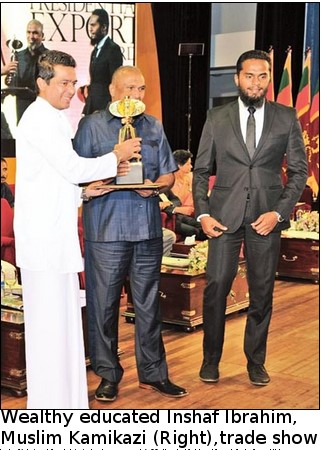
At least one of the Sri Lankan Muslim Kamikazi had a British training, had four
children, a flourishing business and
lived in a million dollar home in Colombo. A British education in a narrow subject like information technology”
not touching any broad scientific or
cultural subjects, given in a British
red Brick” university can have no effect on already acquired belief systems.
Don’t our most educated” ministers go to Tirupathi, India, at the drop of a pin?
These radicals are
no different from the young intellectuals of an earlier generation who believed
in a simplistic theory of capitalists versus the workers, and how the workers
would unite to bring down the capitalists and create a classless society where
even state power has disappeared! They
believed that “THE END JUSTIFIES THE MEANS” – so we
had Stalin, Mao Tse Tung, Pol Pot, Kim Il Sung, countless
Left-Terrorist Maoist-Guevarist-Naxalite groups, and Wijeweera’s JVP in Sri Lanka killing innocents to achieve their
“objective”. This objective is
given a historical destiny by dialectical materialism formulated as historical
materialism”. Contrary to the predictions of historical materialism, these
movements have only produced ghoulish Gulags.
Similarly, these
brain-washed” young Muslims are educated in the Islamic fundamentalist view of
the world consisting of Muslims (good), and infidels (bad). Many educated Arabs do not believe that the
9/11 World Trade Center attack was done by Arab Kamikazes. They think it was a
put-up job by Jewish groups and the Bush government to give them an excuse to
attack the Oil Rich Middle Eastern countries on the economic front, and to
relaunch the Crusades against Islam.
This is the rationale for the
counter-attack on luxury hotels frequented by Westerners, and on
Christian Churches.
Just as
Dialectical materialism calls for a
revolution leading to a necessary final
state which is an article of faith of Marxists, Islam defines that history must
necessarily lead to the Islamic state after a Jihadic step. The “holy
war” replaces the revolution of the Red Comrade. The historical destiny
taught to young Muslims by impassioned Arabic Teachers who have come from the
Middle East is as simple and clear as the JVP five lessons. Their role is to
establish the Islamic State, with everyone practicing the Sharia law which
encompasses not only morality, but economic activity as well – a complete
ideology is sold.
Just as many Sri Lankans, or even ministers are
over-whelmed enough to readily accept ideas cooked up in the West, because they are from the
West, these young people are also
over-whelmed by “renowned” and fiery teachers from the Middle East
who paint a glorious picture of the old Caliphate. The idealistic young Muslim has a clear
jihadist mission, taught to him by these fundamentalist “international
teachers”. Achieving this
designated noble cause, the Islamic Caliphate in the name of Allah becomes their mission.
Achieving this END is justified by ANY
means whatever. It is a sacrifice that they make, in much the same way as “rathu sahodarayas” (red comrades)
are ready to fight the capitalist army and die in the process of the
revolutionary capture of the state by the “working class”.
The young
university students who readily absorbed the “five lessons” of the
JVP, although almost stupid in content, attempted to overthrow the legitimate
government because the message fitted in with their pre-conceived notions. These notions were about the need to change the economic framework by
“hook or crook”, hammered
into the Sri Lankan youth by the LSSP and CP politicians who came prior to the
JVP. The tremendous disparity between
their power and state power seemed irrelevant to a just cause.
The early Marxists
in Sri Lanka had fomented the trade unions to rise in militant
“hartals”, hoping to capture
power. They were sure of being the “Bolsheviks” who will replace the “Menshevick” government of Bandaranaike. So, the LSSP, a
revolutionary party did not worry about popularity at the polls. Dr. Osmond Jayaratne, and Engineer C. B.
Wijedoru, both central committee members of the LSSP assured me that Language
Parity was a policy strategically crafted
to the revolution using unions with more than 50% Tamils, and not designed for
elections. When they abandoned the “revolution” and joined Mrs.
Bandaranaike, they jettisoned parity and
embraced the majority language, as one
language is more efficient for the classless, divisionless, unethnic communist state.
In the case of the
radicalized young Muslims, they too hope to change what they see is an utterly
immoral world. The world must conform to the draconian morality taught to them
by the fundamentalist Arab teachers. Martin Luther had found such a moralistic
message xplosively successful in an earlier era. These young people find an
outlet to their moral and idealistic energy, and an identity thorough these extremist organizations. Their parent’s society has failed to provide them with valid
idealistic objectives suitable to the 21st century, and allowed extremist teachers to infect them with a new
passion. This process is not brain washing”, but more analogous to the spread
of an infection of virulent memes.
The Ilanaki Tamize
Arasu Kadchi (ITAK) declared in 1949 that the Ceylon Tamils – a mere 10% of the population – must have an
exclusive homeland” in Ceylon, and that their struggle is to establish their
own Raj where they will manage their own affairs”. The leaders were wealthy upper-caste”
land owners of the North, but living in Southern Ceylon, and in the best
parts of Colombo. They blamed the
southern politicians (them excluded) for all the problems of the North. This
was an an inflammatory, racist and exclusive ideology crafted to attract the
fervour of the youth, with some of its leaders identifying with the Chola
empire. The move towards Swabasha with
the cry of Sinhala ONLY became fuel for further
polarization. By a strange twist
of history, Vaddukkoddai, a town named
‘Batakotte’ till the dawn of the
20th century because it was a Sinhalese garrison town against Chola invasions, was the venu of the Vaddukoddai resolution.
It called for separatist armed struggles to achieve Eelam”, the ethnically exclusive Tamil
homeland.
Educated Tamil
parents with liberal values could not
understand why their well educated children joined violent Eelamist
racist movements. In the end the parents
themselves were infected by the same bug, when
the majority reaction erupted
into a horrific pogrom in 1983, and escalated
into brutal war. Notably, Jeyaratnam Wilson’s political
writings had evolved from its empirical approach to a separatist stance within a dozen years, moving to support a
view of Sri Lankan history about Tamil homelands that he would have vehemently
rejected in an earlier decade.
The same
phenomenon exists in the highly literate world of Judaism. The young
fundamentalist Jews in Israel fight and kill to build Zion. They too are driven
by an utterly medieval, jingoist Judaism
that underpins Likud ideology.
The moral right” of the Zion or the Caliphate, the dialectical
necessity of the communist state, or the rights of an Eelamist
historical claim, these
overshadow mere human rights or,
say, Palestinian claims to existence.
Leaders of Zionist terror organizations like the IRGUN, e.g., Menachem Begin
and Benjamin Natanyahu, became prime minsters with US support. Another terrorist group, LEHI, proclaimed that the Armed struggle is the
duty of all Israel; every Jew has to be a warrior. Religion … raises the
armed struggle to a ritual above any other facet of human endeavour. Hallelujah
with machine guns”! The Zionist terror, at first directed against the British,
was later directed against the Palestinians who suffer enormous aggression but remain protected from
the UNHRC by the Western powers. A more just British policy could have produced
co-existence between the Israelis and the Palestinians. The Palestinians have
mounted equally horrific counter-terror
groups like the Hezbollah who are funded by the Arab states. All these
terror organizations easily recruit their educated youth to engage in terror. A
leader of the LEHI, Yitzhak Shamir served as a prime minister of Israel. The
end justifies the use of violent means
for those in the faith.
The Zionist
terrorist movements against the British arose during a time when Nazism with
its credo of violence arose in Europe,
misrepresenting Drawinian evolution and
using it as a theoretical underpinning. This misrepresentation of Darwin, initiated
by literary men like Tenyson who pictured nature as being red in Tooth and Claw”, is
scientifically incorrect. Darwinian evolution works when a large number of
genes and cells COOPERATE to take
advantage of fitness landscapes, and not when acting by competition. I have discussed this at length in my book A
Physicist’s view of Matter and Mind
(World Scientific), Chapter 3” and elsewhere in that book.
Dr. Jane Russell,
in her ever topical, sadly no longer available
book Communal Politics Under the
Donoughmore Constitution, 1931-1947 (Tisara Publishers) ” writes that nationalist leaders like SWRD Bandaranaike
and GG Ponnambalam were glowingly referred to as pocket Hitlers” by their
respective admirers in the two ethnic
camps. Prabhakaran with his Child soldiers wearing Cyanide capsules graduating
into Kamikaza cadre was the final
product of one such nationalism. Its Hindu ideology, nourished in ultra-conservative Jaffna
Christianity makes Shiva into a
destroyer and the Christian God into a partisan Shiva.
Societies that
fail to provide for the idealism and rebelliousness of youth through opportunity in adventure, in the arts, sciences and professions become the
theater of extremist ideologies. Just as
young plants need protection against insects, weeds and extremes of
weather during their early growth, young nations need protection. Even flourishing open societies”
cannot allow subversive forces supported by external money to crush the traditional structures in their
societies.
Sri Lanka had
evolved a compassionate society that gave refuge to all faiths since Asokan
times, with near equality to women and lower castes”, when compared with other ancient societies. No heretics were burnt. The END, however
desirable, could not justify THE MEANS used to achieve the end, since the
righteous path was the essential element of Buddhist and Jain doctrines, and in
forms of Hinduism that evolved under
teachers like Nagarjuna. Lanka’s rulers
gave asylum to Catholics and Muslims in the face of Dutch-Lutheran
repression. More recently, the nation’s ancient
wholesome values were
jettisoned in favour of virulent doctrines coming from the political left, and
from the political right which uses religion to anchor its claims.
The Irish and
Tamil diaspora fed and fomented the
Irish and LTTE violence. The US and its NGOs feed and foment disaster
capitalism in young nations and interfere with their elections by propping up
US favorites. In such operations, the
‘manifest destiny of the US’ overshadows
all human rights. Similarly, the
fundamentalist oil sheiks build Mosques, Madarassis and push fundamentalist
agendas causing dissension in Myanmar, Sri Lanka or elsewhere, while heaping
the blame on the intolerance” of the
majority community. These
ideologies reject dissent and open discussion. They threaten
to eliminate the other by force.
But many
politicians, tempted by money and
influence, allow the camel into
the tent, and then it is too late.
President Maithripala Sirisena says he would not excuse himself from the lapse on the part of intelligence information sharing and the government should bear the responsibility for failing to prevent the attacks on Easter Sunday.
The President stated this addressing the Heads of media institutes today (26).
Stating that a major search operation has been undertaken and every household in the country will be checked, the President said lists of permanent residents of every house will be established to ensure no unknown persons could live anywhere. He pointed out that during the fight against LTTE terrorism, similar methods were adapted.
On 4th of April, an intelligence agency letter from a friendly foreign country sent on April 4, warning about possible attacks, however, he was not notified of this, the President says. He blamed on the weakening of military intelligence forces and needless imprisonment and suppression of military officers as the main reasons for the lapse.
President says this intelligence information had been received by the IGP, the Defence Secretary and five other DIGs of Police, yet only one of them acted on it. President commended DIG Priyalal Dassanayake, in charge of Colombo’s special security division, for fulfilling his duty by notifying the relevant authorities in this regard.
The President had left for India on April 16th for a personal visit and then for Singapore. This letter containing intelligence information on the attacks had whirled around only between the IGP and the Defence Secretary from 4th to 16th of April. Yet, neither of them had let him in on the relevant letter prior to his departure to India, claims the President. President Sirisena says he was slated to return to the country on April 21st after concluding his personal foreign tours. The President says learned of the Easter Day attacks through social media and that the authorities failed to inform him. IGP and the Defence Secretary have neglected their responsibilities by failing to at least telephone him to impart this piece of information, the President accused. President Sirisena added that the IGP and the Defence Secretary had visited him on April 14th to greet him for the Sinhala and Tamil New Year, yet they had not mentioned anything concerning the intelligence information even at that encounter.
He says that he believes the IGP would resign during the course of the day and that a new Defence Secretary would be appointed to the already vacated position by Hemasiri Fernando. The IGP was not able to respond when confronted at the Security Council on April 22nd regarding who is to be held accountable for this unfortunate situation, the President further says.
Addressing the press conference, the President urged all Sri Lankans not to look at the entire Muslim community as terrorists. ‘There is an ample link between religious extremism and drug trafficking in the world. It is possible that the attacks hastened due to the drug eradication programme carried out by me,’ he stated.
Speaking on the ongoing investigations and search operations, the President stated that at least 70 suspects have so far been arrested in connection with the attacks. However, information was received that there are 130-140 persons in the country with links to the Islamic State, he added.
The security forces are expediting investigations to arrest these suspects, while a group of experts has also arrived in the country to provide assistance in this regard. President ensured that he would take all the necessary measures to wipe out terrorism from the country.
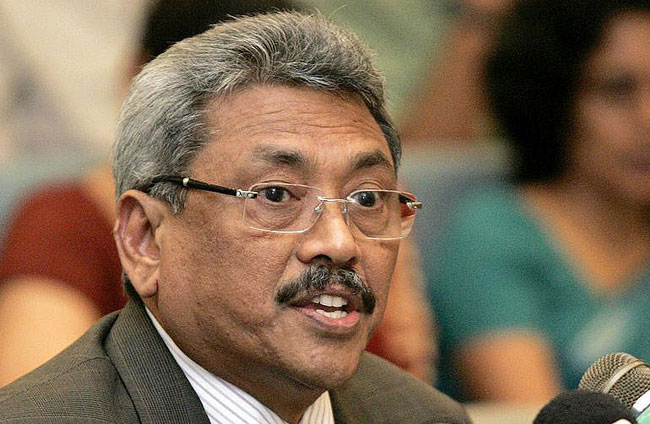
Sri Lanka’s former defence secretary, Gotabaya Rajapaksa, said on Friday he would run for president in elections this year and would stop the spread of Islamist extremism by rebuilding the intelligence service and surveilling citizens.
More than 250 people were killed in bomb attacks on hotels and churches on Easter Sunday that the government has blamed on Islamist militants and that Islamic State has claimed responsibility for.
Gotabaya said the attacks could have been prevented if the island’s current government had not dismantled the intelligence network and extensive surveillance capabilities that he built up during the war and later on.
Because the government was not prepared, that’s why you see a panic situation,” he said in an interview with Reuters.
Gotabaya said he would be a candidate 100 percent”, firming up months of speculation that he plans to run in the elections, which are due by December.
He was critical of the government’s response to the bombings. Since the attacks, the government has struggled to provide clear information about how they were staged, who was behind them and how serious the threat is from Islamic State to the country.
Various people are blaming various people, not giving exactly the details as to what happened, even people expect the names, what organisation did this, and how they came up to this level, that explanation was not given,” he said.
On Friday, President Maithripala Sirisena said the government led by premier Ranil Wickremesinghe should take responsibility for the attacks and that prior information warning of attacks was not shared with him.
Wickremesinghe said earlier he was not advised about warnings that came from India’s spy service either, presenting a picture of a government still in disarray since the two leaders fell out last October.
Gotabaya is facing lawsuits in the United States, where he is a dual citizen, over his role in the war and afterwards.
The South Africa-based International Truth and Justice Project, in partnership with U.S. law firm Hausfeld, filed a civil case in California this month against Gotabaya on behalf of a Tamil torture survivor.
In a separate case, Ahimsa Wickrematunga, the daughter of murdered investigative editor Lasantha Wickrematunga, filed a complaint for damages in the same U.S. District Court in California for allegedly instigating and authorising the extrajudicial killing of her father.
Gotabaya said the cases were baseless and only a little distraction” as he prepared for the election campaign. He said he had asked U.S. authorities to renounce his citizenship and that process was nearly done, clearing the way for his candidature.
‘DISMANTLE THE NETWORKS’
He said that if he won, his immediate focus would to be tackle the threat from radical Islam and to rebuild the security set-up.
It’s a serious problem, you have to go deep into the groups, dismantle the networks,” he said, adding he would give the military a mandate to collect intelligence from the ground and to mount surveillance of groups turning to extremism.
Gotabaya said that a military intelligence cell he had set up in 2011 of 5,000 people, some of them with Arabic language skills and that was tracking the bent towards extremist ideology some of the Islamist groups were taking in eastern Sri Lanka was disbanded by the current government.
They did not give priority to national security, there was a mix-up. They were talking about ethnic reconciliation, then they were talking about human rights issues, they were talking about individual freedoms,” he said.
President Sirisena’s government sought to forge reconciliation with minority Tamils and close the wounds of the war and launched investigations into allegations of rights abuse and torture against military officers.
Officials said many of these secret intelligence cells were disbanded because they faced allegations of abuse, including torture and extra judicial killings.
It is laughable to note that ‘experts’ emerge after any conflict. So is the case with the last Sunday’s Diabolical bombing. In fact, this would have been the most catastrophic incident in Sri Lanka’s recent history where both locals and foreigners perished.
As expats have noted our country lacks professionalism in dealing with situations such as these. Partly it could be attributed to rigid, regimentalism in the form of bureaucracy which is ingrain in our officials and politicians, blindly following a PROCEDURE where there should be INSTANT action, through common sense. Every government administrator and security person in this country worry about the losing a pension on a flawed action or a flawed statement and in fact they work in fear of even being kicked out by a higher up in the ladder. as dirty politics rule the country.
The President talks about banning social media and at the same time he divulges how he got to know about the infamous letter” through social media, which has being hovering over the security personnel!
Lack of
being Proactive rather than Reactive is another problem which is widespread in
our Sri Lanka society.
An appropriate simile would be the role of Quality Control and Quality Assurance. The latter is the preventative step to be taken before anything happens so that QC testing will be superfluous. A complaint by a person of a threat is taken lightly by Police and NO action will be taken until the murder takes place. And that too should be instigated through lodging a complaint to initiate an investigation! This is a joke!
All these
decades the Police never felt the need to take Preventative steps to avoid an
‘incident’.
This must
change and must be inculcated to the psych of the Police personnel.
Another significant flaw in dealing with a situation is the lack of identifying priorities and jumping into action without giving much thought and bungling along the way. With a lot of experience gained with 30 years of a terrorist war, the security people should by now be in a position to assess a situation quickly and take appropriate actions swiftly.
One of the major flaws seeing in operations especially after the Sunday bombings was a lack of Control over an area – a swift cordon off an area under investigation. People are seen running around along with army and Police personnel, side by side with media personnel. The unfortunate incident of 3 officers being killed when the terrorist detonated the bomb while they were conducting a search was mostly unwarranted and which could have been avoided if more caution was taken deploying a number of security personnel. It was unbelievable to observe women running away from the scene, the house while the only capture was by cameras of media personnel!
Mastermind Zahran Hashim was killed in blast at Shangri-La hotel in Colombo, says Sirisena
Zahran Hashim, head of extremist group National Tawheed JamathPicture by AP
Zahran Hashim, a radical Muslim preacher accused of masterminding the Easter Sunday attacks on churches and hotels in Sri Lanka, never hid his hatred.
He railed against a local performance in which Muslim girls dared to dance. When a Muslim politician held a 50th birthday party, he raged about how western infidel traditions were poisoning his hometown, Kattankudy.
In Colombo on Friday, Lankan President Maithripala Sirisena said Hashim, the head of extremist group National Tawheed Jamath, died in the blast at the Shangri-La hotel. Hashim led the attack on the hotel and was accompanied by a second bomber identified as Ilham Ahmed Ibrahim.
The President said the information came from military intelligence and was based in part on CCTV footage recovered from the scene.
There were, Hashim said in one of his online sermons, three types of people: Muslims, those who had reached an accord with Muslims, and people who need to be killed”.
Idolaters, he added, need to be slaughtered wherever you see them.” Hashim has been described by Sri Lankan officials as having founded an obscure group with inchoate aims: a defacement of a Buddha statue, a diatribe against Sufi mystics.
But in his hometown, and later in the online world of radical Islam where his sermons were popular with a segment of Sri Lankan youth, it was clear for years that Hashim’s hateful cadences were designed to lure a new generation of militants.
He was influential, very attractive, very smart in his speeches, even though what he was saying about jihad was crazy,” said Marzook Ahamed Lebbe, a former Kattankudy politician and member of a local Islamic federation. We all underestimated him. We never thought he would do what he said.”
The Easter Sunday attacks, which included suicide bombings of three churches and three luxury hotels, took at least 253 lives. Through its news agency, the Islamic State claimed the attackers as its fighters and released a video with Zahran appearing to be front and centre.
Standing among seven masked men in black, Hashim is the only one with his face exposed. Sri Lankan investigators believe that eight suicide bombers carried out the attacks on the hotels and churches on April 21, one of the bloodiest assaults ever claimed by the Islamic State.
Investigators said on Thursday that they believed Hashim was one of the two suicide bombers who targeted the Shangri-La Hotel in Colombo, the Sri Lankan capital. (The police have also identified him as Mohammed Zaharan.)
Muslims in Kattankudy said they had repeatedly contacted the police to warn that Zahran was dangerous, but that the authorities played down the threat.
Adding to questions about the government’s competence, the Sri Lankan authorities on Thursday vastly revised their earlier count of fatalities, saying that about 253 people had been killed as a result of the bombings, not 359.
One of the targeted churches — where more than 20 people were killed, many of them children — was in Batticaloa, a religiously mixed city just to the north of Kattankudy.
I cannot digest this, even if it was done by my own brother,” said Madaniya, Zahran’s sister, who lives in Kattankudy and who goes by one name. I strongly condemn this.”
Growing up in Kattankudy, an oasis of Islam on a majority Buddhist island with significant Hindu and Christian minorities, Hashim’s religiosity was unremarkable. Most houses here have a picture of Mecca on their wall, and road intersections are decorated with golden monuments in Arabic.
Hashim and his brothers were sent by their father, a small-time seed and spice seller, to a madarsa, where teachings adhered to a strict interpretation of Islam.
But even as he impressed with the fluency of his recitation and easily made friends, Hashim confronted his teachers and accused them of failing to adhere to true Islam.
A Muslim man reaches out to shake hands with policemen standing guard during Friday prayers in ColomboPicture by AP
Like other Kattankudy youth lured by new overseas fashions, he had come under the spell of foreign preachers whose sermons were being passed around town by DVD, said M.B.M. Fahim, one of his classmates and now a lecturer at the same madarsa.
He spread misinformation about us,” Fahim said. He said the school should close because it was teaching the wrong way. He was just a student and he was saying like this.”
Hashim was kicked out of school. He enrolled at another Islamic college but never graduated, his acquaintances said. Still, by listening to the sermons of charismatic but extremist preachers based in India and Malaysia, Hashim was honing his oratory.
He was a very good talker and a good researcher of how Islam was developing worldwide,” said M.L.M. Nassar, an administrator of a Kattankudy mosque federation.
Hashim was unafraid of taking on the powerful, a rarity in a society bound by respect for those richer or older.
He would criticise big shots, he would criticise anybody,” said Marzook, the former politician.
People were attracted to his lack of fear.”
After getting ejected from serving as imam of one mosque for his extremist views, aharan started a group in 2014 called National Tawheed Jamath, which drew from the austere Wahhabi tradition that claims to follow the faith as practiced in the age of its founder.
Hashim preached that the Sri Lankan national flag was a worthless piece of cloth, and that the country should be ruled by Shariah law — an unlikely outcome in a country where only about 10 per cent of the population is Muslim.
My impression was that it was preoccupied with outflanking other Wahhabi groups to attract Middle Eastern funding,” said Gehan Gunatilleke, a researcher who wrote about National Tawheed Jamath last year.
It was focused on symbolism and rhetoric.”
Hashim founded his own mosque with funding from India, according to members of a Kattankudy mosque association, even though Hashim’s mosque never received official religious certification.
Still, an Islamic school dropout with an unlicensed mosque was gaining followers in Sri Lanka and beyond.
Security forces in Sri Lanka were involved in a shootout — and seized bomb-making equipment as well as ISIS flags and uniforms — during sweeping raids within the country’s eastern region Friday, according to a new report.
In addition to the flags and uniforms, authorities found 50 sticks of the rock-blasting explosive Gelignite, 100,000 ball bearings and a drone camera, according to the report.
Three explosions were also reported in the city of Kalmunai, the outlet reported. Security forces got into a shootout with a suspected group there, Sri Lanka News outlet Nidahasa News tweeted.
The raids came after Sri Lankan president Maithripala Sirisena ordered a major search operation during a Friday press conference.
Every household in the country will be checked,” Sirisena said. The lists of permanent residents of every house will be established to ensure no unknown persons could live anywhere.”
Sri Lankan prime minister Ranil Wickremesinghe previously told CNN that authorities were working to root out possible sleeper” cells who could launch even more attacks.
Sri Lankan security troops standing guard at Jami Ul-Alfar mosque in Colombo yesterday. Worshippers were searched before entering and security forces cordoned off the surrounding blocks. Fears of retaliatory sectarian violence have already caused Muslim communities to flee their homes amid bomb scares, lockdowns and security sweeps.PHOTO: EPA-EFE
Bombs, ISIS uniforms found in raid; Easter death toll cut to 253
COLOMBO • A gun battle broke out between Sri Lankan police and a group of men during a raid on a house in an eastern Sri Lankan town yesterday, with the premises believed to have been used to make suicide vests for the Easter Sunday serial bombings in the country.
The raid took place in the town of Ampara Sainthamaruthu, near Batticaloa. A military spokesman said there was an explosion in the area and when soldiers went to investigate, they were fired upon.
No details of casualties were immediately available.
Britain’s Daily Mirror reported that after the battle was over, police recovered gelignite sticks and 100,000 metal bombs used in bomb-making and uniforms of the Islamic State in Iraq and Syria (ISIS). A drone camera was also found at the scene.
Sri Lankan police are trying to track down 140 people believed linked to ISIS, which claimed responsibility for the bombings of churches and hotels, President Maithripala Sirisena said yesterday.
The Archbishop of Colombo, Cardinal Malcolm Ranjith, told reporters he had seen a leaked internal security document warning of further attacks on churches and that there would be no Catholic masses tomorrow anywhere on the island.
The authorities dramatically revised the death toll in the attacks on Thursday from nearly 360 dead to 253. The revision came after the authorities said some victims had been “double-counted” because bodies were blown apart in the attacks and misidentified.
Sri Lanka’s top police official, Inspector-General of Police Pujith Jayasundara, has resigned over security failures that led to the deadly attacks, Mr Sirisena said yesterday.
The resignation came after the top defence ministry official, Defence Secretary Hemasiri Fernando, resigned on Thursday.
Mr Sirisena also said yesterday that a major reorganisation of the security services would occur in the coming days.
Sri Lankan Prime Minister Ranil Wickremesinghe yesterday apologised to the nation for the failure to protect the victims of the blasts.
In a statement on his official twitter account, Mr Wickremesinghe said: “We take collective responsibility and apologise to our fellow citizens for our failure to protect victims of these tragic events.”
Armed police and sniffer dogs guarded mosques in Sri Lanka yesterday as Muslims trickled to Friday prayers, with many staying away amid fears of revenge attacks over the Easter suicide bombings carried out by Islamists.
Fears of retaliatory violence have already caused Muslim communities to flee their homes amid bomb scares, lockdowns and security sweeps.
Other Muslims have expressed fears that they could be targeted by Islamist hardliners after the community’s religious leadership said the attackers would not be buried at mosques in the country.
Some mosques cancelled prayers yesterday, and Sri Lanka’s Muslim Affairs Minister called on Muslims to pray at home instead, in solidarity with churches that have closed over security fears.
But at the Kollupitiya Jumma Masjid, hundreds defied the government calls to stay at home, attending a service they say was focused on a call for people of all religions to help return peace to Sri Lanka.
Among mosques that did hold prayers yesterday in the capital, Colombo, attendance was thin.
At Colombo’s 100-year old Jami Ul-Alfar mosque, worshippers were searched before entering and security forces cordoned off the surrounding blocks.
“I wanted to come to say my prayers for all the victims of this terrible killing, that God should welcome them in heaven,” said Mr Nizam Wellampitia, 81, a white-bearded cloth seller.
“Both Jesus and our Prophet said we should never harm others. We do not even like to kill a bird – the people who did this are brainwashed and they will go to hell.”
AGENCE FRANCE-PRESSE, REUTERS, WASHINGTON POST, XINHUA
A devastating series of eight bomb blasts ripped through churches holding Easter services and high-end hotels in Sri Lanka on 21 Apr 19, killing nearly 300 people, including dozens of foreigners and injuring nearly 500. International media especially that of India are in the forefront in reporting that a local Islamist extremist group called the National Tawheed Jamaath (NTJ) was behind the deadly suicide bomb attacks although no one has claimed responsibility.
Sri Lanka Tawheed Jamaath (SLTJ) is an associated arm of Indian Tamil Nadu Tawheed Jamaath (TNTJ). Other branches are in Middle East, US, UK, France and Australia. TNTJ is a non-political Islamic organization which was founded in 2004. TNTJ claims to preach Islam and is involved in social activities and encourages followers to observe peaceful protests. It held demonstrations and protests across Tamil Nadu several times on various issues including reconstruction of Babri Masjid, removal of liquor shops and load shedding. Hence, the organization and its subsidiaries do not have a pronounced history of terror activities.
Indian RAW’s involvement to destabilize neighbourhood of India is nothing new as it is part of a larger Indira Doctrine. One of the clauses of Indira Doctrine stated, India will not tolerate external intervention in a conflict situation in any South Asian country, if the intervention has any implicit or explicit anti-Indian implication. No South Asian government must, therefore, ask for external military assistance with an anti-Indian bias from any country”. The timing of promulgation of Indira Doctrine in early eighties coincided with the implosion of civil war within Sri Lanka which converted this beautiful tourist paradise into a hell hole for next three decades.
As of 2011 census, 70.2 % of Sri Lankans are Theravada Buddhists, 12.6% are Tamil Hindus, 9.7% are Muslims (mainly Sunni) and 7.4% Christians. Buddhism is the state religion of Sri Lanka. However, the country provides freedom of religion and right to equality amongst all its citizens. There is negligible religious dissention in Sri Lanka – unlike India.
According to a recent McKinsey Global Institute (MGI) study, Sri Lanka is amongst few countries that are well-prepared to rise amongst emerging markets in the next decade.
China’s role in Sri Lanka has grown remarkably in recent years. Recent developments have shown a pro-China” slant to Sri Lanka’s current foreign policy which is evident in the continued Chinese investment in Sri Lanka and the country’s support of China’s position in the Indo Pacific. Sri Lanka is an important country which is part of the Chinese strategic initiative in the Indian Ocean, known as the Maritime Silk Road and is part of the bigger development strategy known as the One Belt, One Road.
Sri Lanka’s emerging market is a matter of concern for India for obvious reasons. However, the China factor has put some other countries in an uncomfortable position too, including India. Indo-Pacific alliance and Quad comprising India, US, Australia and Japan has been created to contain China.
Pakistan maintains the best of relationship with Sri Lanka which encompass economic, security and diplomatic ties. The relationship also fosters on strong mutual Sino-Pakistan and Sino-Sri Lankan relationship. Relations are generally warm and have grown into strong ties during recent times. Pakistan was a key supplier of weapons and training to Sri Lanka’s military in its decades-long, bloody war against the Liberation Tigers of Tamil Elam (LTTE) that ended in May 2009. Even after this incidence, Pakistan has extended all out help and support to Sri Lanka.
Who could benefit from latest bombing Incident? Christchurch terror attack against Muslim community had greatly boosted the concept of Islamophobia and presented Muslims as target of Right Wing Neo Nazi groups; this narrative was not acceptable to Neo Cons, Neo Nazis, Israeli lobby as well as RSS backed Modi government. It is important to carry out an appraisal as to who could be the beneficiary of this attack. Following are some of the conclusion
It is prudent to look at this incidence in Sri Lanka in context with the massacre of Muslims that took place in Christchurch New Zealand recently. There has been a wide ranging sympathy for the Muslims across the world after Christchurch massacre. Such a compassion for Muslims was against the prevailing Islamic Terror narrative” of the West, India and Israel. Therefore, a balancing act was required to again push the Muslims in the swamp of terrorism that would foster hatred against Muslims.
Putting blame of Sri Lanka bombing on Muslims is also in line with the Modi’s anti-Muslim election campaign narrative that strengthens Modi and RSS rhetoric that Muslims are terrorists. No wonder Modi has started using it as an election slogan by asking the voters to vote for him as he is the strongman who can fight terror in the region. Use of ISIS Kerala and ISIS Bangladesh for fulfilling RAW’s evil designs and putting blame on Muslims in India and elsewhere also needs to be comprehended.
As the reports pour in from Sri Lanka, it is being highlighted that some of the suicide bombers came from affluent Muslims in Sri Lanka who had studied in UK and Australia, should this ring some alarm bells in London and Canberra, as to how these Muslim students were being radicalized. The ISIS enterprise being dismantled in Syria had lot of newly converted White Europeans as well as Muslim cadres from different part of the world. It is also suspected that Ajit Doval and RAW had tried hard to bring Syrian ISIS cadres into Afghanistan to create a new terror network against Pakistan, after they saw that Pakistan had dismantled the TTP network in its bordering areas with Afghanistan.
Unfortunately, infighting in Sri Lankan political leadership and some of their security institutions created a dangerous gap in surveillance system which allowed these ISIS terrorists to strike Sri Lanka at time and place of their choosing. As India claims that she had warned Sri Lankan leadership about impending terror attack, it may be noted that the leads were picked from Indian State of Tamil Nadu, is India playing a double game with Sri Lanka.
From the above discussion, one can decipher the riddle of Sri Lanka tragedy. The incident served only those who wanted to draw certain benefits out of it as discussed above. As in investigation of a crime scene, one must look at who benefited the most from these attacks; its Neocons, Israel and India.
Three suspects were taken into Sri Lanka Navy custody with one kilogram of C-4 explosives and a three-wheeler near the Wellawatte railway station today, Navy Spokesman Isuru Suriyabandar said.
He told Daily Mirror that the suspects were handed over to the Army and they would handover them to the police. (
Sri Lanka’s tourism industry fears losing around $1.5 billion in revenue this year due to Sunday’s attacks, the country’s Finance Minister Mangala Samaraweera said.
Tourism will be the worst affected,” Samaraweera told reporters in Colombo on Friday.
We expect a 30 percent drop in arrivals and that means a loss of about $1.5 billion in foreign exchange.”
He said the country could take up to two years to fully recover from Sunday’s attacks, which devastated three luxury hotels and three Christian churches and killed 253 people killed, among them many foreigners.
Typically, countries that suffer isolated IS-style attacks see tourism recovering within one-to-two years, as long as root causes are addressed and security measures taken are well communicated,” the minister said.
He pointed to Belgium, France, Spain and Tunisia as countries which recovered their tourism markets within a short time.
Samaraweera said tourism was emerging as Sri Lanka’s success story when Sunday´s blast shattered hopes of reaching a revenue of $5.0 billion, up from last year’s $4.4 billion.
Official figures show that tourist arrivals in the first quarter of this year jumped 4.6 percent to 740,600 from a year earlier.
Samaraweera said he was hoping to unveil a package of concessions to help the tourism sector weather the impact of the suicide bombings.
Most of the deluxe hotels in Colombo have stepped up security and curtailed bookings amid fears of more attacks.
The history of terrorism in Sri Lanka reveals a clear
pattern. The first to take up arms in the post-Independent era were the
misguided Sinhala youth. They were educated youth desperately running in search
of a quick solution to establish their classless paradise. Their violence did
not take them anywhere.
The Tamil youth were the second to take up arms. Most
of their cadres too consisted of educated Tamil youth running in search of a
speedy route to establish their mono-ethnic paradise. At the end of a
three-decade war they ended up in the bottom of the Nandikadal Lagoon.
Now the Muslim youth have bombed their way into the
global headlines. They shot into the limelight on the morning of Easter Sunday
taking everyone by surprise. Unlike the two preceding terrorist groups the
local Muslim terrorists who carried backpacks loaded with explosives seems to
be dummies carrying out the orders and agenda of a hidden hand directing them
from abroad. To begin with they were echoing the imported hate politics fed to
them by the extremist local agents running fragmented jihadist cells. Nor have
they produced a calculated, well-defined ideology against the state, like the
other two terrorist organisations, arguing that it should be destroyed and
replaced with their political models. However, it is known that the preachers
in their cells and madrassas have been indoctrinating the youth with violent
interpretations of the Koran with the aim of converting Sri Lanka into an
Islamic Caliphate. That constitutes a part of the larger agenda of ISIS,
without any local content in it.
Running through all three violent movements of the
youth is a manufactured ideology tailored to radicalise and convert them into
violent politics as the solution to their indoctrinated, imagined and real
problems. The Sinhala youth took to Marxists revolutionary ideology reduced to
five lectures. The Tamil youth took to the ideology of the Saivite Jaffna
Vellala supremacists to create Eelam – the paradise of mono-ethnic extremism.
And the Muslim youth seems to have jumped into a similar ideology believing
that they could achieve their Islamic salvation at the end of violence.
If history is any guide then the preceding two violent
movements point to a bitter end. Like the other two preceding terrorist groups
the Muslim terrorists too are doomed to end up achieving nothing. Besides, the
odds are tilted heavily against the Muslim terrorists, both internationally and
locally. (More of this later).
They have begun with a big bang which had echoed round
the world. That is about all they could achieve: making big noises if
they are to continue down this path of violence. Whether they have the capacity
to sustain the violence of the Easter Massacre on a mass scale for a prolong
period is questionable. Based more on the historical evidence of the past two youth
revolts than on the skimpy details available on the Muslim youth, my conclusion
is quite simple: neither the prevailing hostile international climate against
every kind of Muslim violence, nor the national ethos of a thriving and
conservative Muslim trading community dependent on peace and stability, is
conducive for the Muslim youth to sustain their campaign of violence for
long.
Besides the wobbly Yahapalanaya government, which was
going softly-softly on rising Muslim radicalisation and violence, has at last
woken up to the grim and destabilising realities that had blown their tops off.
It is the magnitude of the simultaneous explosions hitting three points of the
compass – east, west and the immediate north – that shook the foundations of
Sri Lankan establishment
The Easter Sunday blast is likely to change – at least
in the short run — the conventional image of the Muslims. They were seen
as the more emancipated and liberal Muslims not committed to radical Islam. But
after the East Sunday Massacre it is likely that they will be bundled with the
rest of the ideologically driven Muslim fanatics abroad committed to irrational
violence. The latest Reuter’s report which reveals the ISIS hand behind the
Easter Massacre can only reinforce the image of being ruthless religious
fanatics.
Radicalisation takes sense sensibility out of the
minds of the impatient youth looking for instant solutions. And politicised
religion is packed with hate. Both are incendiary forces that can drive the
impulsive youth
into insane fits of violence.
Of course, the initial blast that shook Easter Sunday
was massive and impressive. The (1) precision timing that went of like
clockwork, (2) the gigantic scale of the blasts hitting targets in east, west
and the near north simultaneously,(3) the selected targets of Christian
Churches and hotels packed with Western tourists (4) the organisation capacity to
piece together the various arms of the military-style operation that exploded
on Easter Sunday (5) the blind faith of the suicide bombers that walked the
lethal distance to their fatal end and that of 350 other victims, point clearly
to hidden brains beyond the borders of the local Muslims.
There is, no doubt, that the suicide bombers were on a
political mission. But what was it? Also, terrorist acts are executed to convey
a political message. What is the message behind the biggest ever terrorist
operation on Sri Lanka soil?
This explosion which hit like a bolt from the blue
makes no sense in the Sri Lankan context. Apart from sporadic tensions – some
of which have been caused by National Thowheeth Jamaat (NTJ) – the
Sinhala-Muslim relations had not stretched to breaking point to provoke an
attack of this magnitude. Mainstream Muslim politics was for co-existence
without resorting to extremist violence. Interventions at the highest levels
from both sides have succeeded in snuffing out any communal conflagration and
containing the violence. In fact, Muslim leaders have been complaining to the
authorities that the NTJ is a serious threat to their lives too. Nor has there
been a mass following for Islamic extremism either at the top or at the bottom
layers of Muslim society.
As of now Muslim violence has been confined to a
minority. But it is a minority that has crept up, sedulously and
surreptitiously, to parts of the highest echelons of the Muslim hierarchy. If
allowed to go unchecked it can become the majority. The description of this
group given by Ruwan Wijewardene, State Minister of Defence, is revealing and
alarming, to say the least. He said: What I can
also say about this group of suicide bombers is that most of them were
well-educated and come from middle or upper middle class, so they are
financially independent and their families are quite stable financially. That
is a worrying factor in this. Some of them studied in other countries, they
hold degrees and were quite well-educated people.”
This explains the background and the potential threat
to the future but not the cause behind the stunning Easter Sunday massacre.
Invariably political protests and violence target the state. But the Muslim
suicide bombers did not target the state per se. They went straight to two
non-state, non-Sinhala-Buddhist targets: 1. Christian churches packed with
Easter Sunday devotees and 2. hotels packed with Western holiday-makers
lining up for their Sunday breakfast.
Both targets were selected to make global headlines in
the Christian West. Any harm to the Christian worshippers inside churches in
one of the holiest days in the Christian calendar and Western holiday-makers
would instinctively pull the heart strings and the conscience of the West.
It is the selection of these two targets that do not
make sense. Why should local suicide bombers target the Churches and the hotels
when their grievances are supposed to be against the Sinhala-Buddhists with
whom they have been having some sporadic sparring in recent times? Besides, none
of these two institutions has rubbed against the local Muslims. So why did the
strategists behind Operation Easter Massacre target the Churches and the
hotels? Is the message coded in these two targets?
It is at this point that Ruwan Wijewardene’s explanation
gains credibility. He said that the targets were chosen as retaliation for the
massacre of the Muslims at Christchurch by the Australian white-supremacist
Brenton Hanson Terrant. But is the local Muslim that concerned about what
happened in far away New Zealand to blow up Churches and hotels? No. But the
vindictive politics of their masters in the failed Islamic State, pursuing
.anti-American, anti-Christian agenda, are bent on targeting the sacred symbols
of the West. Since the Sri Lankan Muslims are committed ideologically to follow
the political line laid down by their Islamic masters abroad they became the
latest suicidal messengers of death to the West. They even went as far as
imitating their counterparts abroad by videoing their martyrdom, a la the
jihadists in the Middle East.
Second, the Easter Massacre was to deliver a political
message to Donald Trump. He was boasting that the ISIS is dead. On the morning
of East Sunday they told him that they are still alive and kicking. The
ideology behind the Easter Massacre is clearly expressed in the two main
targets allied to Western interests. It also contains a direct message to
Trumpian braggadocio and arrogance. They picked Sri Lanka because it was fast
turning into a base for American expansion in the Indian Ocean.
Like all terrorists they have picked the most iconic
targets for maximum impact in the minds of the West. Targeting them selectively
on one of the holiest days of the Christian world delivers an unambiguous
political message to the West saying: If we can’t get you in the
West we can get you in soft spots prepared by incompetent, complacent and
back-biting rulers in the East who, incidentally, are cozying up to the West.
The tattered remnants standing as sad ruins of
churches and hotels and the 350 victims debunk the usual fiction spun by some
local political pundits who continue to blame the Sinhala-Buddhists. Their spin
is to white-wash the Muslim terrorists saying that the suicide bombers were on
a mission to get even with the Sinhala-Buddhists for sporadic attacks that had
occurred in recent time. This line of attack on the Sinhala-Buddhist runs
against the evidence of the bloody ruins staring in their face. If the Easter
Massacre was to teach the Sinhala-Buddhist a lesson why did they attack the
Christian Churches and hotels packed with Westerners? This is the most notable
facet of the Easter Sunday attack. The suicide bombers skipped the
Sinhala-Buddhists, they skipped the Hindu Tamils and they went straight for the
Christians in churches and the Westerners holidaying in hotels.
If the Easter Sunday massacre was to send a clear
message to the West then the international and local agents have succeeded
beyond their expectations. This initial message is now reverberating globally.
It says unmistakeably that the Jihadist power, packed with religious
fanaticism, has found a new base to attack the West. But what is going to be
their next step? Will they turn inward and intensify their attacks against the
other religionists?
Violence of any sort will not take the Muslim
terrorist anywhere. If the other two varieties of terrorism (Sinhala and Tamil
youth) failed to win against the state what are the chances of the Muslim
variety winning? The state is sufficiently prepared and experienced now to meet
challenges of terrorists having beaten the world’s deadliest terrorist, the
LTTE. Most of all, it has the tacit support of the majority of the Muslims in
the mainstream. ISIS and its local agents have had some beginners luck by
taking the state by surprise. But the chances of Muslim terrorists becoming a
formidable challenge to the state are very remote. Besides, before they take on
the state they will have to grab power from the established Muslim hierarchy.
They will also have to combat the anti-Muslim counter-terror forces of the West
and also India.
The upshot of the Easter Massacre has been to increase
and reinforce Islamaphobia. Until East Sunday the Muslims in the democratic
mainstream have been a formidable force negotiating craftily behind the scene,
with both main parties, bargaining with the non-violent votes. But the
exploding bombs have devastated their image and reduced the power of bargaining
with both major parties. They cannot be seen to be honeymooning, or playing
footsy with the Muslims after the backlash of East Sunday sweeping the nation.
The government, in particular, will have to face the charge of putting Bodu
Bala Sena in jail and letting NTJ run amok without any restraint.
The state is now in a favourable political climate to
crack down on Muslim extremism with hardly any pressure from international or
national interventionists. Besides, the Muslim terrorists can never reach
the militarised power of the Tamil Tigers and challenge the state to yield to
their demands, whatever they may be. Of the three varieties of terrorism
the Muslims will be the weakest, purely on demographic counts.
When the dust settles down, the democratic state of
Sri Lanka will rise again triumphantly, hoping that the last remaining Indian
Tamil youth will not decide to go the way of the other three failed terrorists
Sri Lanka before regime change had zero
terror attacks since 2009, tragically just 4 years after a well-coordinated
US-RAW-LTTE-TNA-JVP-UN-US-EU joint regime change over 350 dead on just one day
with hundreds more injured or battling for life. While, those that were brought
into power in 2015 are pointing blame fingers at each other, it serves no
purpose for a nation now returning to the fear psychosis that prevailed
throughout LTTE terror. This is not the change they were promised. Sri Lanka is
today dealing with a weak & spineless government at the mercy of those that
brought them to power caught between giving in to the demands made by those
that brought them to power at the cost of angering their vote base &
likelihood of a future election defeat. No amount of false flags engineered by
their foreign support bases are likely to bring the present government back to
power as things stand which explains why the government is reluctant to hold
any form of election & increasing its unpopularity by not doing so. While our
own security lapses are many, what we also need to take stock of is this ISIS
movement & connect that to the sudden demand for foreign presence in Sri
Lanka where Islamic terror provides the super camouflage to justify their
entry.
2 articles provide a key to placing Sri
Lanka’s situation in proper context.
First is an article by Shwe Kalaung titled Islamic state training
camp busted in Sri Lanka” mentioning hike in ISIS in Sri Lanka, culminating
in the death of a ISIS Sri Lankan fighter in Syria in 2017 who was eulogized as
a martyr throughout Sri Lanka. Incidentally a Syria is claimed to be arrested
after the Easter Sunday attacks. In January 2019 authorities came across an IS
training camp in Wanathawilluwa near Puttalam lagoon where 100kg of explosives
were found when the authorities searched for 2 suspects vandalizing Buddhist
statues. The imam arrested at the camp confessed that the explosives were meant
to bomb sacred Buddhist sites in Anuradhapura. Even by January 2019 CID were
looking for 50 names IS suspects. Is that imam still under arrest, has he being
charged under terror acts, have the 50 IS suspects been found & arrested –
no one knows!
Jihadis
– Organ trafficking & Narcoterrorism
Shwe Kalaung connects Islamic groups to illegal organ trafficking &
narcoterrorism links drug money to purchase of weapons, properties, training
and bribery, all happening, across SAARC
countries supported by jihadists from Gulf Cooperation Council.
Shwe Kalaung links the arrest of Sri Lanka’s drug kingpin Makandura
Madhush with the funding of Islamic State training camp in Puttalam claiming
his network even includes ex-LTTE combatants. LTTE dealt in illegal drug
trafficking too. Madhush operated from Dubai where he was arrested and the
jewel heist investigations revealed a conspiracy to kill President Sirisena
which again raises the question who benefits from the death of the President?
Arakan Rohingya Salvation Army (ARSA) formed
in 2012 in Myanmar which masterminded the August 2017 insurgency by Saudi imam
Ata Ullah confirms our doubts about Rohingya-jihadi links. ARSA is claimed to
receive support from Saudi & funded via yaba pills, methamphetamines
manufactured & sold to Islamic gangs in Bangladesh where ARSA gets training
from near Rakhine State border.
Bangladeshi’s are regularly caught
trafficking in Sri Lanka. Bangladesh being the epicentre for the Golden
Horseshoe Caliphate. Coincidentally, a family member of the Bangladeshi PM also
died in one of the hotel blasts in Colombo.
Golden Horseshoe
Caliphate & 786 movement
Shwe Kalaung says Caliphate spans from western side of Indonesia, includes
Singapore, Malaysia, Thailand, Myanmar, Bangladesh, India & Sri Lanka
covering Andaman Sea, Bay of Bengal and Indian Ocean while on Eastern side it
covers Cambodia, Laos, Vietnam. Coincidentally all countries covered under US ‘pivot
to Asia’ policy!
786 Movement is a doomsday prophecy according
to author signaling complete global Islamic takeover by 21st century
(7-8-6 adds to 21) This number was displayed in Myanmar food items imported
from Middle East supporting jihadi cause. Myanmar Buddhists responded with 969
counter-movement.
Shwe Kalaung highlights a complicated network of illegal players. GCC
countries (Saudi & UAE) masterminding terror funded by drug trade against
Asian counterparts using ex-combatants also funded by drugs & linked to
Islamic gangs. Both these groups probably have some unwritten understanding
with foreign intelligence whose objectives are to create conflict &
instability in targeted regions for geopolitical policy objectives of their
governments.
The targeting of Shangri-la hotel in the
recent Easter Sunday multiple bombings provides a clue to that geopolitical
significance.
What are the foreign countries/foreign intelligence
linked with National Thowheeth Jamaath or is it just a façade?
Since when has NTJ been training from Tamil Nadu-Chennai
(where LTTE too had its initial training)
How did NTJ from vandalizing Buddhist statues a few
months back pull off multiple attacks that claimed over 350 lives on a single
day, something even LTTE could not do in 30 years!
Are the NTJ attackers’ pawns” in a larger geopolitical
game – if so who are their real handlers?
Which foreign countries/foreign intelligence seek to gain
from orchestrating such an attack weakening Sri Lanka politically &
economically?
Are the attacks in Sri Lanka connected to provocations
against Pakistan resulting in the shooting down of 2 Indian jets?
Adam Garrie does not mince words about the
possible links to RAW & the NTJ attacks given that all of the warnings
about the attacks are coming from India knowing Sri Lanka has its guard down as
a result of forcing Sri Lanka’s Govt to open up its security apparatus to
foreign-UN interference while placing mediocre officials to top posts.
In terms of foreign interference India joins
list of countries regularly involved in meddling into Sri Lanka’s internal
affairs.
How did Islamic
terrorism originate?
More important than who are members of Al Qaeda, ISIS or
any of its associate bodies is the question who created these entities, who
arms them, who trains them and who supports & transports them from one
country to the next to stir trouble.
Isn’t ISIS nothing more than a name change for al-Qaeda?
9/11 justified the invasion of Afghanistan in 2001.
Zbigniew Brzezinski Jimmy
Carter’s National Security Adviser was instrumental in creating the Al Qaeda
and steered policy against the Afghan government and the Soviet Union. Brzezinski admitted
in an interview in 1998 and in 2001 to the Le Nouvel Observator that US funded
Al Qaeda/Mujahideen 6 months before Soviets invaded Afghanistan.
Former Director of Central
Intelligence Robert Gates in his 1996 memoir admitted that $500 million in
nonlethal aid was given to Mujahideen.
We can all recall Hillary
Clinton’s admission the people we are fighting today we funded them twenty
years ago… and we did it because we were locked in a struggle with the Soviet
Union.”
Brandon Turbeville claims ISIS is being directed by
Western intelligence, the GCC, and Israel that killing of James Mark Foley, US journalist working in Syria was used to justify
aerial bombing of Syria.”
Tony Cartalucci writes that as early as 2007 – the
United States has been arming, funding, and supporting the Muslim Brotherhood
and a myriad of armed terrorist organizations to overthrow the government of
Syria, fight Hezbollah in Lebanon, and undermine the power and influence of
Iran, which of course includes any other government or group in the MENA region
friendly toward Tehran”.
He also claims ISIS was harbored on NATO territory,
armed and funded by US CIA agents with cash and weapons brought in from the
Saudis, Qataris, and NATO members themselves. The non-lethal aid” the US and
British sent including the vehicles we now see ISIS driving around in”
Pulitzer Prize-winning journalist Seymour Hersh says
Extremist groups that espouse a militant vision of Islam” and are sympathetic
to Al Qaeda” – is a verbatim definition of what ISIS is today”
Michael J. Springmann, chief of the visa section at the
U.S. Consulate in Jeddah, Saudi Arabia, claims that the CIA insisted that the
consulate approve visas for Afghanis so that they could travel to the United
States and be trained in terrorism so that they could then be sent back to
Afghanistan to fight the Soviets.
Closer to present Kosovo comes to mind and how the Kosovo
Liberation Army was supported by US & NATO. Is it a surprise Kosovo was
given independence with a massive NATO base inside Kosovo? Michel Chossudovsky
writes Bill Clinton Worked Hand in Glove with Al Qaeda: Helped Turn Bosnia into
Militant Islamic Base,”….
British SAS Special Forces in bases in Northern Albania were training the KLA,
military instructors from Turkey and Afghanistan financed by the Islamic
jihad” – the US and UK counter terror experts are now in Sri Lanka for what?
The plot to overthrow Gaddafi takes shape in much the
same way – by supporting proxy Islamic groups clothing them as ‘rebels’.
After creating the ‘extremists’ as ‘freedom fighters’ and
helping fan their extremism the patrons US-UK-NATO next denounce them as ‘extremists’
and justify going after them by force sending their troops often illegally.
What is bizarre about fighting terrorists created by
their own is that every US-UK-NATO soldier getting killed in all of the
countries US/UK/NATO stations them are killed by the very terrorists the
US-UK-NATO have created, armed and support!
A Fox News
report in March 2015 claims one of the alleged leaders of ISIS in North Africa
is Libyan Abdelhakim Belhadj, who was seen by the U.S. as a willing partner in
the overthrow of Libyan dictator Muammar Gaddafi in 2011.”
The report goes on to say It is clear that the West is not fighting ISIS, but
instead, has clearly both created it and is intentionally perpetuating it to help
justify its military and geopolitical maneuvering across the Middle East and
North Africa (MENA) region, and advance its aspirations toward regional and
global political, military, and economic hegemony.”
The next question is where
does Indian intel fit into the scheme of things given that all of the advance
warnings have been coming from India? We can all recall how Indian intel
referred to LTTE as ‘our boys’ and functioned virtually with a carte blanch often
without the knowledge or approvals of its government. Let’s hope the same is
not being repeated. India must at all times remember that Yugoslavia &
Soviet Union were fragmented and the balkanization of India is also very much
on the cards.
Islamic jihad terrorists have
found a great pawn in Muslims & Islam – rich or poor, ready-made suicide
bombers are now easy to lure and if Sri Lanka is not to turn into another
Middle Eastern theatre, Muslims must help authorities nip every avenue radicalism
is encouraged because these are the areas that everyone who wishes to pivot to
Sri Lanka taking over its geopolitically significant ports, trade lane access
will now eye.
Time Sri Lankans learn to look at the larger picture and realize that anyone they elect in future has to be a person who puts country first & not some agent of those creating radical and extremist elements. It is advised to also screen the type of investments, the location & other factors by countries linked to these terror groups. These investments are likely to have bigger agendas in mind.
We are no experts on security however common sense
would suggest the following.
Declare a 24-hour curfew and round up all
Wahaabis (Saudi influenced radical islamists). both men and women and
politicians and incarcerate them indefinitely, under emergency laws. If Human Right lobby such as AI cry foul,
request them to keep the terrorists in their homes.
Negligence by even former government led to this catastrophe. Begin clean up from MUHUDU MAHA VIHARA precincts in Pottuvil. Drive out all wahabis from the temple land they encroached with the help of wahabi politicians.re is There is an undeclared protection of wahabis by some ministers in the cabinet and that has to be investigated.
All wahabis in Eastern province and Colombo and other provinces should come under the microscope from this day onwards. Pottuvil is the equivalent of Velveteturai where during 70s no police could enter that area without being shot at. The same situation now in Pottuvil – no law and order.
Ban the burka dress asap as suggested by
an MP.
Take even the minor things seriously and
be PROACTIVE not just REACTIVE. A person
who made an offensive remark on linking IS to a person was questioned by Police
in Kandy and every one, not confined to security personnel, should be vigilant
like the LTTE days.
There
could be cyber-attack on government websites initiated by a foreign country
with links to IS, to cripple the country.
So let the internet security beefed up to meet this challenge.
International Network for Sri Lankan Democracy (INSD), Stuttgart
We at International
Network for Sri Lankan Democracy (INSD) condemn the terrorist attacks
carried out targeting churches and hotels in Sri
Lanka claiming lives of over 300 innocent civilians including foreigners, and
injuring nearly 500.
We commend the people
of Sri Lanka for the patient manner in which they reacted at a time of shock
and immense grief.
A close look at the
facts shows that the government of Sri Lanka could have avoided this disaster
if due consideration had been given to the information provided
by international intelligence with regard to the attacks. The fact that
the Minister of Defense who is also the President, to whose attention this
information had been brought, completely ignored the matter at the heavy cost
of civilian lives, is appalling. Further, it has been brought to light that the
Minister of Defense failed to inform the Prime Minister, the second citizen of
the country, about this crucial matter concerning the security of the people.
This appears to be purposeful. The Minister of Defense, with his stubbornness
and arrogance, has once more failed the country and should be held responsible
for the innocent lives lost.
We call upon the government
of Sri Lanka to bring to justice all involved in the terror attack as well as
all officers guilty of unethical conduct.
Finally, we request
all citizens to remain composed and cautious, to extend your fullest
corporation to bring the terrorists to justice and to disregard the actions of
individuals and groups who are trying to gain political advantage using this
situation.
This series
presents some events relating to Buddhism in the north in the last three
decades. New Buddhist temples were erected in the north during this period. Admiral
Daya Sandagiri, then Commander Northern
naval area built a Buddhist temple,
Sanghamitta Seya, at Dambukola patuna,
where Sanghamitta is said to have
landed in Sri Lanka. The foundation
was laid in 1997. The pinnacle was unveiled in 2005, again by Sandagiri,
then Chief of Defense staff and Commander of the navy.
The headquarters of 643 Brigade in Oddusuddan
has a large vihara within its premises, which is visible from the outside,
built after 2009. On the south side of
Vadduvaakal Bridge, the military constructed the Sri Raja Maha Vihara after
capturing the area in 2009. The
military established another Buddhist temple in Mankulam, adjacent to a
military camp, which was ceremoniously opened by Defence Secretary Gotabhaya
Rajapaksa in 2013. The
Nayaru Rajamaha Vihara was constructed in Nayaru after 2009, across the road
from the military camp of the 19th Gemunu Watch Battalion.
Kankesanturai
Thaiyiddi Tissa Viharaya was repaired in 2018 with plans to construct a
sanghawasa and a dharmasala. The origins of the
viharacould be traced to 1946. ‘The
deed had been written in 1946’, the media reported. The last Wesak festival
celebrated there was in 1954. The temple was damaged during the Eelam war.
The main temple in Jaffna town is the well known
modern Naga Vihara. I am unable to find out the year in which the modern Naga
Viharaya in Jaffna was established. My guess is that it would have been built
in the 1950s or possibly late 1940s. The Vihara somehow survived the Eelam
wars. It had ‘resumed’ religious activities from 1997, including Katina puja. The first ever Buddhist Perahera organized
by Naga Vihara in Jaffna was held on Esala poya day, 2003, with participation
of Sri Lanka army, said the media.
The pinnacle for Naga Vihara chaitya was
handed over to the viharadhipathi in 2002 by two Catholics, Dr Jayalath
Jayawardene and Fr. Ranjan Silva. Buddhist organizations objected. It should
have been done by a monk or Buddhist leader, they said. The signatories were
National Council of Buddhist women, ACWBC, International Buddhist centre,
Dayake Sabhawa, Sadaham charika, SUCCESS Colombo, Dhammacharini, Lanka Buddha
Sanrakshana Sabhawa, Dharmavijaya Foundation, and Buddhist Doctors Society.
The media reported that the Katina Puja at
Naga Vihara was resumed in 2009. The
next available news is that the Katina puja was held on a grand scale in 2012.
It attracted thousands, said the media. The religious activities were conducted
by the Naga Vihara Development Foundation, Jaffna, and the Tamil Buddhist
Association. The Nandarama Tamil Dhamma School under the auspices of the
Association also participated. The army
helped. Bhikkhus from many parts of the country participated. There was also a
Perahera in 2012, with elephants and dancers.
The elephants were sent from Gangaramaya in Colombo.
Wesak celebrations were organized in Jaffna in
2005 by army commander, Jaffna and his
team. Religious activities were
at Naga Vihara and Kadurugoda temple. Large crowds had thronged to Jaffna for
Wesak to view the celebration. There were lanterns and dansalasa at the Alfred
Duraiyappah stadium.
Jaffna celebrated Wesak in 2009 too. Families
of the forces personnel in Jaffna observed sil at the Naga Vihara Jaffna. The celebration lasted for three days. Wesak
lanterns were lit along the main trunk roads,
main junctions and at the army camp. Wesak
was also celebrated at Lumbini Vihara,
Kilinochchi. Daily News carried a photograph showing the Perahera there.
In 2014, Wesak celebrations were
organized in Jaffna by the Jaffna Buddhist Society” with the assistance of the
army. This too attracted large crowds. There was a special Wesak zone with a giant pandal
and a dansela run by the army. The Wesak
zone attracted over 100,000 on first day.
Bhakthi Gee were sung by soldiers, students of Jaffna schools and the
students of the Manipay Nandarama Tamil Buddhist Dhamma School.
Wesak
celebrations organized by the Jaffna Security Force Headquarters in 2018 were
very popular, judging from the crowd turnout.
The Wesak Dansela catered to over 15,000 people each day. The Wesak
pandals attracted large crowds. Previously, if a person from Jaffna needed to
witness the Wesak celebrations, they would have to travel either to Anuradhapura
or Colombo, but now with the Wesak celebrations being held in the North, the
Northern people too could enjoy this festival,” the public said . Both the young and old come for the Wesak
celebrations. They enjoy seeing the lanterns and pandals and it also gives them
an understanding of the Buddhist culture. Tamil politicians, however, objected
to the Wesak celebrations.
In 2010 Sunday
Leader said that Wesak is a modern
Buddhist festival started in 1950. Celebration is centered on the display of
lights and lanterns and elaborate
sponsored displays in the streets. In
2010 the military had organized Buddhist celebrations in traditionally Tamil
Hindu areas of the country including Jaffna. They are trying to show that the
north is a Buddhist area said Jaffna MP Suresh Premachandran. This could be
seen as communal triumphalism. It ‘confirms the fear that this is a Sinhala
Buddhist country’’ concluded Sunday Leader.
There appears
to have been two Tamil Buddhist Associations, in Jaffna one after the other. A Tamil Dhamma Buddhist
Association was started around 1959 by Maruthar Vairamuttu (1918- 2012). He
lived in Manipay and was a handicrafts teacher. He had converted to Buddhism
and had associated with Ven. Akuretiye Amarawansa, Madihe Pannaseeha,
Kanaweththewe Nandarama and Ganegama Saranankara. Vairamuthu had worked with Nissanka Wijeratne
when Wijeratne was Government Agent,
Jaffna. He had also helped individuals from depressed castes obtain jobs.
This
Association seems to have died a
natural death. A second Tamil Buddhist Association started by A. Ravi Kumar of
Manipay, Jaffna. This was launched in 2010 at the All Ceylon Buddhist Centre in
Colombo. ‘Divaina’ newspaper, May
11, 2014 told his story.
Arunnethwaraththam
Ravi Kumar’s father was an Inspector of Police. The permanent residence of the
family was in Jaffna, but he studied till Grade 10 in Bandarawela. I associated mostly with the Sinhalese”. He
thereafter lived in Jaffna where he clashed with Prabhakaran, received death
threats and for his safety went to India.
He lived in Chennai and Mumbai, working as a travel agent. His wife was
abducted and his daughter was taken in by relatives. He was depressed and
looked for solace. He tried Hare Krishna, Pentecostal and Sikhism. ‘One day I
chanced upon a meditation centre. I practiced meditation for ten days. I liked
it’. He then turned to Buddhism.
On his return
to Sri Lanka, he wanted others also to share ‘the feeling of the soothing peace
of mind Buddhism brings’. He founded the
Jaffna Buddhist Association. Tamil politicians had told the Tamils in Jaffna that Buddhism is a
Sinhalese Religion. They misled the Tamil people, and made them keep away from
Buddhism and the temple. They should not be deceived any longer. They should
experience the Dhamma for themselves, he said.
Ravi Kumar
started Nandarama Tamil Dhamma School, in Chunnakam in 2012 in his home.. It is
the first Buddhist Dhamma School in the Tamil Language. When I started
the Buddhist Dhamma School, Suresh Premachandran accused me of trying to
destroy the Tamil culture by doing so. I pointed out that the Christian
religion had already done that.
Ravi
Kumar carries on with his work by himself, said Divaina in 2014. 50 Tamil children are taught the Dhamma at this
school. The school manages with difficulty. It lacks a suitable building. They
study under a thatched roof. There is no
offer of help, Ravi told Divaina. 11 students
of this school, under the patronage of Chief Incumbent of Naga Viharaya
Ven. Megahajadure Siri Vimala went on a pilgrimage to Bodh Gaya in 2013. In
2014 the
students observed sil on the Poson poya day. Around 53 children
participated in the sil progamme. The
progamme was organized by Naga
Vihara, ACBC, Sambodhi Vihara, Colombo with the help of the security forces in
Jaffna.
Jaffna was
used as the venue for Buddhist conferences on two instances. The Karuna
International Buddhist Convention organized by the Triple Gem Foundation, Bengaluru, held its annual conference in 2015 at
Weerasingham Hall, Jaffna. The co-sponsors of the event are Tripitaka
Tamil Foundation, Chennai, Dhamma Vijaya, Maha Vihara, Madurai, Buddhist Trust
of Andhra Pradesh, East Godhavari, Sarvodaya Wisvaanikethan, Sri Lanka, Sri
Lanka Mahabodhi Society, Sri Wardanarama Purana Vihara and Naga Vihara,
Jaffna. Chief Organizer of Karuna International Convention Ven. Bodhipala said he had been visiting Sri
Lanka three times a year since 1999 and was a guest of Siri Perakumba Viharaya,
Pita Kotte.
The very
first Buddhist Congress in the North with the participation of Buddhist monks
from the Northern Province was planned for March 22 2019 at Vavuniya Sri Bodhi
DhakshinaramaTemple, under the
patronage of the Chief Sanghanayaka of Northern and Eastern provinces, the
Chairman of the Vavuniya District ‘Sasanarakshaka Balamandalaya’ Ven. But Suren
Raghavan and North East Chief Sanganayaka Most Ven. Siyambala Gaswewa
Wimalasara. ( continued)
The Bodu Bala Sena is a movement under the leadership of group of distinguished, academically accomplished, and deeply patriotic Bhikkhus and lay Buddhists, dedicated to the task of revitalizing and reinforcing cultural nationalism in Sri Lanka, the only motherland of the Sinhala community. In spite of varied challenges and threats to which they were subject in the recent past, it continues to have a steadfast support base among concerned Buddhists both ordained and lay, across the country and overseas. Its aim is to save our nation from spiritual decay and disintegration, to halt the erosion of Buddhist social values and to peacefully counter the varied local and foreign forces that are hell-bent on undermining Buddhist culture and related heritage of Sri Lanka. It aims at directing society towards a cultural rejuvenation based on traditional Buddhist norms, principles and values which have been the foundation of this nation for over 2200 years.
Sri Lanka’s Bhikkhus, should necessarily be in the forefront in
movements aimed at protecting and promoting the Buddha Sasana or the historic
Buddhist establishment, especially when it is under threat. Bhikkhus of the
Bodu Bala Sena have voluntarily made their choice to take an open public stand
on issues surrounding Buddhism and Buddhist culture which is the greatest
treasure that Sri Lanka could offer to the world or to humanity. Why should
anyone feel uncomfortable when the traditional spiritual leaders of our
country, the Bhikkhus, take the initiative and provide necessary leadership
to protect the greatest wealth of this nation – our Buddhist cultural heritage?
Like anyone else, under a democratic system, Bhikkhus are eligible to
exercise their rights, including political rights. They are traditional leaders
of this nation. Those who object to the initiative taken by our Bhikkhus
of the Bodu Bala Sena, appear to be those with ulterior motives, those having
their own self-interests to promote, those attempting to promote blind beliefs
and establish unwholesome lifestyles based on such beliefs, those opposed to
further strengthening and consolidation of Buddhist culture in this
country, and those resorting to unwholesome activities that are contrary to
Buddhist norms and principles and all those who are inclined to undermining the
Buddha Sasana and Buddhist values which have been preserved and promoted for
thousands of years in this country, by the large majority of its inhabitants.
These undesirable elements may feel uncomfortable about the Bodu Bala Sena
activities which are, on all counts, legitimate, wholesome and timely.
Non-violence and compassion form the basis upon which the programme of activities
of the Bodu Bala Sena is structured. Our Bhikkhus have become a thorn in the
flesh of religious extremists, the recent breed of inter-faith dialogue
facilitators, those in the ethnic and human rights businesses and above all
those who are funded or backed by extremist anti-Buddhist elements.
Genuine and practicing Buddhists of our country should be closely and
actively involved in politics. They have a duty by the nation, which is founded
on Buddhist principles, to be fully involved and participating in their
nation’s political life. Most of the ills of our country’s political life could
be attributed to the absence of genuine Buddhists in the political arena. This
is particularly relevant today owing to the fact that our nation is severely
threatened at present by diverse negative forces, especially by Muslim
fanatics. They are trying hard to undermine the wholesome Buddhist cultural
heritage and values of our nation.
It is the Buddhist perspective to public life and decision-making, that
is most needed today in the country’s political domain. We need compassionate
politicians with unselfish and mindful interest in the welfare of the country.
This alone can bring about needed positive changes in public life which at
present is infected with dishonesty, crime and corruption. The impact and
influence of such people can make a big difference. They can help to generate a
wholesome political culture, that is characterized by Buddhist approaches and
attitudes and a truly Buddhist atmosphere, conducive to the development of a
healthy political climate in our nation, so that all nationals will benefit
irrespective of their diverse origins and cultural-religious inclinations.
Politics in actual fact is simply about deciding how to live together
peaceably while bringing together the wide variety of perspectives available in
the human realm. It is something necessary and something creative.
Politics is part of our life. If we regard all life as sacred and politics is a
part of life, then politics must be sacred. Politics is not an inherently
unclean and base activity. It becomes dirty in the way that everything else
becomes dirty. That is, through lack of attention, through lack of mindfulness,
through ego, all of which resulting in greed, hatred and delusion. The best
kind of politics can take the profound viewpoints and virtues of spiritual
practice and apply them in the public realm. Buddhism can be of fundamental
help in this regard.
If we do not bring spiritual virtues to the public arena, we are
destined to both a selfish kind of spirituality and a selfish kind of
government, devoid of vision and meaning. It is time that more and more of our
genuine and practicing Buddhists entered the political arena in various
influential capacities. We are grateful to and value the initiative and
leadership provided, in this regard by the highly esteemed movements such as
the Bodu Bala Sena, Sinhala Ravaya, Ravana Balaya among others.
SOCIALLY
ENGAGED BUDDHISM
Buddhism has always been engaged in various socio-political contexts.
The idea of interdependence is widely associated with Buddhism. Buddhism is the
religion of Human Ecology. Engaging in the lives of others through compassion,
sacrifice and service is the worthy spiritual path that we need to observe in
the contemporary world. We need to expand our approach or shift somewhat away
from those traditional customs that excessively promote monasticism and
individual salvation, and become more socially engaged and be more concerned
about service to the community, the human habitat and the environment in
general. We need to broaden our spiritual practices to include both
family and community and the social and environmental concerns of the broader
world. We need to approach meditation not as a way of escaping from society or
getting out of society, but to prepare us for a re-entry into society so that
we will be better able to identify and understand social hardships, misery and
perils, and be able to do something tangible to relieve them. It is time
that we as Buddhists involve ourselves in an organized manner, become socially
engaged and apply Buddhism to matters of everyday life, individual work,
family, politics and the community. It needs to be a direct application
of Buddhist principles and concepts to the overall development of our motherland,
to the varied social, economic and political issues that have implications for
the short and long term welfare and development of our motherland, the only
country of the Sinhala
community.
The great mass of Sinhala Buddhists continues to be lethargic and appear
to be adopting an indifferent attitude towards the plight of their fellow
Buddhists. It is a pity that today, being a Buddhist is of secondary importance
to many Sinhala Buddhists. This explains the lack of unity and a common
stand when it comes to matters pertaining to securing and promoting the rights
and privileges of Sinhala Buddhists. They get together in temples to perform
common Buddhist rituals, but are reluctant to join forces when it comes of
securing or promoting the legitimate rights of Sinhala Buddhists of this
nation. They show indifference to the idea of joining hands as Buddhists, in an
organized manner, to deal with forces that violate Buddhist rights and are a
threat to Buddhist culture and values. As long as this prevails, they
will fail to become a force to counter the threats and violations of their
legitimate rights in their only homeland. It is their motherland whose cultural
foundation has been inspired by Buddhism.
Buddhist cultural norms and values are being threatened today by Muslim
extremists. The violation of the historic rights of Sinhala Buddhists by
Muslims is clearly evident today. Under the circumstances, the initiative of
some of our Mahasangha, providing leadership to the Bodu Bala Sena
organization is timely and most admirable. In spite of challenges from
various quarters, they are determined to provide a genuine leadership to this
movement to save the Buddhas Sasana and the Buddhist heritage of this
country. This is demonstrated well by the courage, forthrightness,
fearlessness, determination and foresight that they have shown.
THE BUDDHA SASANA
Of all the institutions and organizations of the country, the Buddha
Sasana is the oldest and the most fundamental of organizations of our country
for over 2200 years. It is this institution that promoted and protected the
Buddha Dhamma and fostered Buddhist culture and values among us. It is this
institution that formed the foremost advisory body of our kings, royalty and
leaders. It is this institution that was instrumental in laying the cultural
foundation of our country. It is this institution that endured the harshest of
punishments and atrocities during invasions of our country by the South Indian
Tamil-speaking Pandyans, Cholas and others, and the Christian Portuguese, Dutch
and British. It is this institution that endured the murder of Bhikkhus, the
burning of Buddhist scriptures, the destruction and demolition of Buddhist
shrines, monasteries and stupas. It is this institution that helped to develop
and enrich our language – Sinhala which is spoken only in our motherland. It is
this institution that produced the greatest of our Sinhala scholars, writers,
poets, artists among other leaders in various fields.
It is this institution that salvaged and protected the priceless ola
books and scriptures containing valuable information for eternity when the
country was under threat by ruthless foreign invaders and ethnic and religious
terrorists. It is this institution that provided us with the Mahavamsa,
Chulavamsa, Deepavamsa, Thupawamsa, among many other chronicles and works that
outline the history of our country, making our country one of the very few
countries in the world with a well-recorded history that extends to over 2500 years.
It is the structures and historic sites connected with this institution which
have preserved for us the rich, exquisite and most fascinating collection of
our indigenous sculpture, paintings, architecture, wood carvings, and unique
fine arts. It is this institution that was instrumental in the preserving for
us one of the greatest cultural events of the country – the Dalada Perahera,
which has been able to preserve for us the richness and uniqueness of our
indigenous visual culture and most enchanting heritage of performing arts. It
is this glorious and invaluable historic institution of ours, the Buddha
Sasana, that is being threatened today by the extremist Muslim
menace.