Unparliamentary language used in House

April 1st, 2019

Yohan Perera and Ajith Siriwardana Courtesy The Daily Mirror

Unparliamentary language was used in the House today during a heated argument which broke out between UPFA Mohan Priyadarashana de Silva and State Minister Ranjan Ramanayake with regard to the selling of vehicle permits.

The argument popped up when State Minister said he helped a poor girl by giving some of the money he collected from selling his vehicle permit. He said monetary help was given through the foundation he had formed by selling his permit.

Mr. de Silva who shot back said Mr Ramanayake had to face a court case for selling his vehicle permit. You had to face a court case for selling your vehicle permit to women,” he said.

State Minister then responded saying Mr. De Silva had also sold his vehicle permit. More than 90 percent of MPs have sold their vehicle permits and Mr. de Silva himself had sold his permit. A thief is calling another person a thief,” he said.

MP De Silva used un-parliamentary words in snapping back Mr. Ramanayake. However, he justified the use of such an obscene word saying that it should be construed as a negative word. ()

ඉහළ කොත්මලේ හදන්න එපා කියලා උද්ගෝෂණ ආවා.නොරොච්චෝලය හැදුවොත් මරාගෙන මැරෙන තරමට විරෝධතා ආවා.මහින්ද යුද්ධය මැද ඒවත් සම්පුර්ණ කලා.

April 1st, 2019

ලංකා තිලක FB

මහින්ද රටේ තත්පරයකට රැ 750 වියදම් වෙන යුද්ධයක් කළා.

ඒ අතරේ රටේ ඉහළ යන විදුලිබල ඉල්ලුම ගැන විදුලි විශේෂඥයන් පුරෝකථන කලා.

ඉහළ කොත්මලේ හදන්න එපා කියලා උද්ගෝෂණ ආවා.

නොරොච්චෝලය හැදුවොත් මරාගෙන මැරෙන තරමට විරෝධතා ආවා.

මහින්ද යුද්ධය මැද ඒවත් සම්පුර්ණ කලා.

ඒ හංදා මහින්දට ලයිටි කපන කාලසටහන් රටේ ජනමාධ්‍ය තුලින් ප්‍රචාරය කරවන්න අවශ්‍ය වුනේ නෑ.

ලංකාවේ අධිවේග මාර්ග විතරක් නෙවේ වෙනදා පළාත් සභා ප්‍රාදේශීය සභා පාරවල් වල කලේ තාර දාලා උඩින් වැලි දාලා පාරට තාර දැම්මා කියලා පෙන්නන එක. වැලි ටික හෝදගෙන ගිහාම පාර ඉවරයි.

මහින්ද යටතේ මුල්වරට ග්‍රාමීය පළාත් බද පාරවල් පවා කාපට් කලා ප්‍රාදේශීය සභා පාරවල් කොන්ක්‍රීට් කලා.

ඒ හංදා මහින්දගේ කාලේ පාරක් හැදෙන එක පළාත් විෂයට අයිති පුංචි පාළමක් විවෘත.කරන එක.අද වගේ සංවර්ධන පුවත් යහපාලන පුවත් ලෙස විශේෂයෙන් පෙන්නන්න වුනේ නෑ

මේ ලංකාවේ ආසන්න වසර 10 තුළ තෙල් මිළ බැරලයක් ඩොලර් 120 ට ඉහළ ගියේ නෑ. හැබැයි මහින්දට යුද්ධයක් මැද ඒකට මුණ දෙන්න වුනා. එහෙම වුනා කියලා මහින්ද රටේ ජනතාව දවස් ගනන් තෙල් ගන්න පෝළිම් වල තිබ්බේ නෑ.

කොටින්ම මහින්දගේ කාලේ අපි කවදාවත් තෙල් නැවක් එනකල් බලා හිටියෙත් නෑ.

ඒ හංදා මහින්දට තෙල් වලට මිළ සූත්‍ර කියලා දෙයක් පෙන්න පෙන්න ඉන්න අවශ්‍ය වුනේ නෑ.

මහින්ද ජනාධිපති වුන අළුත (2006 විතර) විදේශ කටයුතු ඇමති වුන මංගල සමරවීර ඇමරිකාව ⁣පලස්තීනයට එරෙහිව ගෙනාපු යෝජනාවකට ලංකාව පක්ෂ වෙනවා ජිනීවා වල ( එතකොට මහින්ද පලස්තීන මුස්ලිම් සහයෝගිතාවයේ සභාපති) එයට පලස්තීනයෙන් සහාව අයදින මහින්ද මංගලගේ විදේශ කටයුතු ඔහුගෙන් ඉවත් කරනවා.

ඒ හංදා මහින්දට රටේ ජනතාවට මම දන්නේ නෑ මට කීවේ නෑ කියලා වගකීමෙන් මිදෙන ටෝක් දෙන්න ඕන වුනේ නෑ

අද වගේ රටේ ජනාධිපති නොදන්න ගිවිසුම් වලට ලංකාව එකග වුනාට එදා මහින්ද සෘජුව ක්‍රියා කලේ එහෙමයි.

ලංකාවේ රැකියා දෙන්නනම් අදායම වැඩිකර ගන්න ඕන. රටේ ඉදිකිරීම් අංශය පණ ගැන්වූ විට ගම්මාන තුළ අවිධිමත් රැකියා නියුක්තිය( ⁣ගඩොල් පෙදරේරැ වඩු පේන්ටින් වයරිං සුළු පරිමාන නිෂ්පාදන බෙදා හැරිම්) ඉහළ යන බව ආර්ථික සහ මුල්‍ය සංසරණ ක්‍රියාවක්. එය මහින්ද අතිහදා බලනවා. ඒ නිසා 2005 මහින්ද එනවිට රටේ තිබුන රාජ්‍ය අංශයේ සේවා නියුක්තිය ලක්ෂ 7 සිට ලක්ෂ 14, දක්වා 2015, වන විට ඉහල නංවන්න වගේම

රටම වැඩ බිමක් ලෙස ආදායම් ගලා යන සක්‍රීය තත්වයට පත් කරන්න හැකිවුනා.

කොටින්ම 2014 මහින්ද රැකියා විරහිත.උපාධි ධාරී කියන කුලකය නවත්වා තිබුනා.

ඒ හංදා මහින්දට මම රැකියා හදනවා කිය කිය යන්න වුවමනාවක් වුනේ නෑ.

මහින්දගේ කාලේ සිරිසේනලා චම්පිකලා රාජිතලා විජිතමුණි සොයිසලා මහින්ද චින්තනයට එරෙහිව වැඩ කරනවා කියලා මහින්දට වැටහෙන්න ඇති ඒත් ඒකට පිළියම ලෙස මහින්ද රනිල් වගේ තමන්ගේ පාර්ලිමේන්තු කංඩායමේ නවක මන්ත්‍රීන්ට කියලා රනිල් වගේ ඇමතිවරැන්ට බන්නන්න තර්ජනය කරන්න අමාත්‍යංශ වැය ශීර්ෂ පරාද කරවලා දණ ගස්වන්න වුවමනා වුනේ නැතුව ඇති.

අදටත් පවතින්නේ රජය මහින්දගේ වසර 10 ඉක්මවා යන්න කරන තරගයක් විතරයි.

ඒ වසර දහය තුළ ජනතාවට සාධනීය ලෙස මහින්ද ලබා දන්න දේවල් වලට අලගු තියන්නවත් මේ රජය⁣ට බැරි වෙලා තියනවා.

ඒකයි චන්ද්‍රිකා නොරොච්චෝලය මගේ වැඩක් මම පටන් ගත්තේ කියන්නේ.

ඒකයි චන්ද්‍රිකාලා චම්පිකලා ජවිපයේ අනරලා යුද්ධය අපේ පංගුව මේක.කියලා පෙන්නන්නේ.

ඒකයි රනිල් මහින්ද කරපු ව්‍යාපෘති රටට පාඩු බව අසාර්ථක බව පෙන්නන්න මේ තරම් රටේ ධනය කාබාසිනා කරන්නේ.

කොටින්ම 2015 ඉදන් අද මම මේ ලියන මොහොත දක්වාම යහපාලන අන්ඩුවයි ගෙනාපු අයයි උදව් කරපු අයයි

තොර තෝංචියක් නැතුව අපි මහින්දට වඩා යමක් රටට කරලා තියනවා කිය කිය ජනතාවගේ ඇහැට ඇගිල්ලෙන් ඇන අැන පෙන්නන්නේ

මහින්ද ඉක්මවා යන්න බැරි හේතුව මිසක් වෙන දෙයක් නොවේ.

මහින්දත් තමන්ගේ ගමන යන්නේ වුවමනාවෙන් සටන් වදින්න යමක් මේ ආන්ඩුවේ නැති නිසාමයි.

මහින්ද අගලක් හරි ඉක්මවා ලන්න පුළුවන් වුනානම් මේ අය හෙට පළාත් සභා ටික තියලා දිනාගන්නවා බං.

………….. නුවන් මොණරවිළ …………….

Open letter to Mr. Pujitha S.B.Jayasundara, Inspector General of Police of Sri Lanka.

March 31st, 2019

By Charles.S.Perera

Mr.Pujitha S.B.Jayasundara,

Inspector General of Police,

Sri Lanka

Dear Sir,

I am presently living abroad but I am a man from a small village in Sri Lanka. Sir it is we the villagers who feel more for our country to the extent to  even shed tears in secret when we are unable to put right the wrongs that are being done to our country.

I have read you are also from  a village Mahamukalaanayaaya in Bogamuwa. That means you are a real son of the soil and must have seen youths from your village also joining the Armed Forces to fight the ruthless terrorism that we had thought for a long time was an invincible force. Many of those  Sinhala Buddhist village youth whowent to defend our country, came back in coffins, while some had gone missing, and others have escaped after sacrificing  their limbs  in the terrorist war. It was in their heroism that our country was saved and we live tody in peace and security.

But we pay only lip service to these war heroes who  are our own children. This is while those who should take responsibility for deaths, disappearances and mutilation are today demanding that our war heroes be taken before International Criminal Courts.  This had been going on ever since the elimination of terrorists and even the International Community treats our war heroes as their war criminals and the terrorists as their heroes.  This has to end without  our Government treat the terrorists and who aided abetted  them  with soft gloves, while  our war heroes are being sacrificed for a seemingly unachievable reconciliation with the Tamils- specially the TNA Tamils politicians.

The  TNA which keeps calling to take revenge from the Sri Lanka Armed Forces for the elimination of the terrorists, disappearances, violation of human rights, was a part of the terrorist equip terrorising the people  along side Prabhakaran.   In English Law it is said that you cannot go to court with blood on your hands. Therefore  neither the TNA no the Tamils of the diaspora who financed the  terrorism purchasing arms and equipment for them  terrorists cannot now  accuse the armed forces for war crimes when they were a part of the terrorists aiding     and abetting the terrorists.

In 2001 the LTTE during the heights of its ruthless terror against the people, wanted a political arm  to defend and be their spokes persons in the Parliament and outside the terrorists controlled areas.  Terrorist leader Prabhakaran selected the present set of TNA Parliamentarians. They set up an alliance along with Tamil Political parties such as  ACTC (All Ceylon Tamil Congress), the EPRLF (Eelam People’s Revolutionary Liberation Front), TELO (Tamil Eelam Liberation Organization), TULF (Tamil United Liberation Front).

Thereafter  TNA under Sampanthan of ITAK declared that the  LTTE is the sole representative of the Tamil people, Ananda Sangaree of TULF who disagreed  left the Alliance and TNA became the political arm of the terrorists.

The activities of TNA since then had been organised by the terrorist leader and for all intents and purposes TNA was a part of the LTTE terrorist set up.  Please see the article by Ms.Shenali Waduge in the Lankaweb entitled: Haul TNA to Court for links with LTTE terrorists & Separatist Demands- https://www.lankaweb.com/news/items/2019/03/25/haul-tna-to-court-for-links-with-ltte-terrorists-separatist-demands/

 -for details of the involvement of TNA with  terrorism since 2001 to date even after the elimination of terrorism.

After elimination of terrorism in May,2009,  the then Government of ¨President Mahinda Rajapakse should have disbanded the TNA but for whatever reason  it had not been done and we are today suffering the consequence of that failure.

Dear Sir, since 2001 TNA which  had been involved with the terrorists and terrorism never raised a voice against  the savagery of the terrorists and their massacres of innocent villagers, passengers of busses and trains and mass killings by placing claymore bombs in markets and public places, and assassination of many political figures and officers of the Armed Forces and the Police. 

In their silence through out the period of terrorism the TNA and its members were aiding and abetting terrorists in those massacres, assassinations, without directly participating in  the bloody savagery of the terrorists.

Even today the TNA Parliamentarians continue in terrorising the  newly settled Sinhala people in the villages calling for their identity cads and property Deeds. Recently  a group of Tamils  supported by some TNA politicians occupied the Mulathiu Nayaru Khandha Ancient Buddhist temple on the Pongal Day , threatened the resident monk Venerable Kolamba  Medalankara Kiththi Nayaka thero, and even dug a foundation for a Kovil in the temple premises.

Though no killing had been done this too amounts to a terrorist activity, to frighten  persons and make them leave the area in fear  for life.

These TNA politicians continue to criticise and condemn Sri Lanka in international forums and contact foreign countries  complaining about imagined discriminations against the Tamils by the Government calling for their assistance to  win  separate rights and priviledes to the Tamil people and to cooperate  with them for the setting up of a separate Tamil only Province in the North and East. Their statements against the Government are in breach of the Constitution and amounts to criminal defamation

Despite these activities which are  in contravention of the Constitution, the law is not being applied against the TNA Parliamentarians. They are not even been called to the Police Stations and warned against making such statements.

Most often when questioned as to why the TNA Parliamentarians are not taken to custody when they make seditious and libellous statements, authorities cite  an on going reconciliation, and state that the law is kept silent not to hamper  the reconciliation process.

The reconciliation is not a one sided activity. If TNA wants the other communities of Sri Lanka to reconcile with the Tamil Community they should reciprocate these acts of reconciliation by he Government. But so far they   continue to make more demands without making any advance towards reconciliation with the Sinhala.

The Tamil people are kept silent by threat, and made to follow the TNA through fear of them and fear of retaliation. If the Law is applied to the TNA politicians and make them understand that they are not outside the law of the country, the ordinary Tamil people will trust in  law and order and act freely without blindly following the TNA MPs  through fear and for favour.

One Mr.Jayantha Liyanage of  Sinhala Mahasabha once filed an FR action against the TNA, but the courts advised that as there was a move for reconciliation with Tamils   it is good that the legal action is not taken against them for the moment.

But this is not correct any more as the law should be applied when it is broken or in the process of being broken. What is the use of a police force Sir, if you are absent in the North and allow the TNA politicians go free despite their criminal  activities that hamper peace security and freedom of the people.

TNA Parliamentarians Shritharan’s  recent statement that Gotabhaya Rajapakse had killed over 140,000 Tamils  which is false and therefore a statement of criminal defamation.  It is not  acceptable that he is allowed to go free after making such seditious statements. He should be called to the Police Station and warned not to make such false accusations which makes him liable for criminal prosecution.

There is no reconciliation in  the police allowing these TNA Parliamentarians to break the law, and still go free.  The Police should call Shritharan to the police station  to warn  him about making such statements of criminal defamation, and warn him against making such statements in future.

I do not intend to write more as you may already be aware of these unlawful activities and pronouncements of the TNA Parliamentarians. They are citizens of Sri Lanka and the laws of the country should be applied to them as well, no matter whether there is an ongoing reconciliation process.

As a member of the Public I implore you not to be a onlooker of breach of law and order by the TNA Parliamentarians,  and request you to intervene to make them understand that they  too should respect the law.

Yours Sincerely,

Charles.S.Perera

Copy to: President of Sri Lanka Mr. Maithripala Sirisena,

              Leader of the Opposition  of the Parliament of Sri Lanka:Mr.Mahinda Rajapakse

              Prime Minister of Sri Lanka Mr. Ranil Wickramasinghe

Cut the crap UN – your foreign Missions have failed, your tribunals are dead ducks & UN is corrupt & biased

March 31st, 2019

Proof is in the pudding they say and so when anyone in Sri Lanka tries to promote UN as the savior the best response is to ask them where ha the UN succeed. UN has had 49 Missions across the world since it started and all of them are virtual failures and none of these countries can say that UN has helped them solve their problems. UN has held tribunals too and none of these have ended with justice to victims except the judges and staff have got rich. Therefore, we in Sri Lanka clearly say we do not have any faith in UN missions, UN tribunals, UN judges or even UN officials who meet a select group of NGOs compile reports based on information they give and expect the whole world to believe these lies.

UN Missions in AMERICAS

  1. 1965-1966 – Dominican Republic
  2. 1989-1992 – UN Observer Group in 5 countries –  in Costa Rica / El Salvador / Guatemala / Honduras / Nicaragua
  3. 1991-1995 – UN Observer Group in El Salvador
  4. 1993-1996 – UN Mission in Haiti (after 1991 coup)
  5. 1996-1997 – UN Support Mission in Haiti (Haiti’s new democracy)
  6. 1997 – UN Verification Mission in Guatemala
  7. 1997 – UN Transition Mission in Haiti (training Haitian National Police)
  8. 1997-2000 – UN Civilian Police Mission in Haiti (training Haitian National Police)
  9. 2000-2001 – UNGA International Support Mission in Haiti (training Haitian National Police)
  10. 2004-2017 – UN Stabilization Mission in Haiti (after 2004 rebellion) – United Nation (UN) peacekeepers left Haiti in October 2017 after claiming Haiti was stabilized.
  11. 2017 – United Nations Mission for Justice Support in Haiti

There has been 10 UN Missions in the America’s since 1965 and what is the UN’s record sheet of success against all of its templates that it boasts to roll out through the UN rapporteurs and other officials sent to these countries to review ‘new democratic systems’ in place?

From 1997 UN has been training Haiti’s National Police which was created only in 1995. More than 8,500 police officers have completed training with plans to increase force to 14,000. Countries are even bidding to train Haiti’s police. Canada is one such bidder https://canada-haiti.ca/node/226 – a contract worth $15-million.

This UN POLICE FORCE was responsible for killing 21 unarmed civilians in Haiti on 16 January 2019. This was not the only incident involving UN Police – in 2017 UN Police raided a school killing 9 civilians and UN was exonerated. Only in 2016 did UN apologize for its role in the 2010 cholera outbreak in Haiti but then UN has immunity for crimes though it tries to bring others to justice!

UN Missions in ASIA

  1. 1949 – United Nations Military Observer Group in India and Pakistan
  2. 1962-1963 – UN Security Force in West New Guinea to transfer sovereignty from Indonesia to West New Guinea
  3. 1965-1966 – UN India-Pakistan Observation Mission following the Indo-Pak War
  4. 1988-1990 – UN Good Offices Mission in Afghanistan & Pakistan after the Soviet-Afghan War
  5. 1991-1992 – UN Advance Mission in Cambodia
  6. 1992-1993 – UN Transitional Authority in Cambodia
  7. 1994-2000 – UN Observer Mission in Tajikistan
  8. 1999 – UN Mission in East Timor (Indonesian invasion of East Timor)
  9. 1999-2002 – UN Transitional Administration in East Timor
  10. 2002-2005 – UN Support Mission in East Timor
  11. 2006-2012 – UN Integrated Mission in East Timor

From 1962 the UN has been operating Missions in West New Guinea, India, Pakistan, Afghanistan, Cambodia, Tajikistan and from 1999 UN has been in East Timor.

If, complicity of US & Britain in supplying arms to Pol Pot’s Khymer Rouge in Cambodia – what good is a tribunal to find truth & justice for crimes committed?

In 1991 an Agreement on a Comprehensive Political Settlement of the Cambodia Conflict was signed by 19 participating countries ( wanting ‘peace’ on their terms only) creating the UN tribunal for Cambodia that employed 25,000 people spending over $3 billion. UN was blamed for bringing the legacy of AIDS to Cambodia (1992 Richard Holbrook it is clear that the UN personnel are going to both spread AIDS & bring AIDS home with them”.

The UN Transitional Authority in Cambodia recruited military & civil police – 30% of Bulgarian battalion were former prisoners. Some police didn’t even have drivers license! UNTAC chief Yasushi Akashi (whom Sri Lanka knows very well) was called spineless. UNTAC soldiers were referred to as mercenaries. Even when UN scheduled elections in 1993 it was marred by violence, murders, intimidations and undemocratic practices & vote buying but Akashi declared elections ‘free & fair’ with support of Inter-Parliamentary Union & other foreign observers (so you know what to expect)

UN Missions in EUROPE

  1. 1964 – UN Peace Keeping Force Cyprus
  2. 1992-1995 – UN Protection Force in Bosnia & Herzegovina, Croatia, Macedonia, Former Yugoslavia
  3. 1993-2009 – UN Observer Mission in Georgia
  4. 1994-1996 – UN Confidence Restoration Operation in Croatia
  5. 1995-2002 – UN Mission in Bosnia & Herzegovina
  6. 1995-1999 – UN Preventive Force in Macedonia
  7. 1996-1998 – UN Transitional Authority in Eastern Slavonia, Western Sirmium
  8. 1996-2002 – UN Mission of Observers in Prevlaka (Croatia/Former Yugoslavia)
  9. 1998 – UN Civilian Police in Croatia
  10. 1999 – United Nations Interim Administration Mission in Kosovo

In 1995 in Croatia a summary execution took place in a refugee centre right next to a UN mission who were well aware of what took place. All that the UN did was to shed crocodile tears and say ‘they should have done something to stop it’ – what good is foreign troop presence if they do nothing at the time of an incident and thereafter cry over spoilt milk!

Macedonia is one of the co-sponsors of the recent UNHRC resolution against Sri Lanka. Macedonia became a UN member only in 1993 but still struggling to register its name.

If UN cried over its failure to prevent genocide in Rwanda, UN didn’t do much in Yugoslavia either.

What have Kosovo got from independence? Can it eat independence? Today Kosovo is a narcotics hub and lawlessness abounds.

UN Missions in MIDDLE EAST

  1. 1956-1967 – First UN Emergency Force in Egypt & Israel
  2. 1958 – UN Observation Group in Lebanon
  3. 1963-1964 – UN Yemen Observation Mission
  4. 1974 – Disengagement Observer Force Israel/Lebanon
  5. 1973-1979 – Second UN Emergency Force in Egypt & Israel
  6. 1978 – UN Interim Force in Lebanon
  7. 1988-1991 – UN Iran-Iraq Military Observer Group
  8. 1991-2003 – UN Iraq-Kuwait Observation Mission
  9. 2012 – UN Supervision Mission in Syria

Has Middle East had any relief inspite of these UN Missions? Whose side is the UN really on?

UN Missions in AFRICA

  1. 1991 – UN Mission for Referendum in Western Sahara
  2. 2007 – UN/African Union Mission in Sudan
  3. 2010 – UN Stabilization Mission in Congo
  4. 2011 – UN Interim Security Force for Sudan
  5. 2011 – UN Mission in South Sudan
  6. 2011 – UN Support Mission in Libya
  7. 2013 – Multi-Dimensional Integrated Stabilization Mission in Mali
  8. 2014 – UN Multi-Dimensional Integrated Stabilization Mission in Central African Republic

What is the ‘peace’ that UN has given Mali inspite of over 13,000 UN presence?

South Sudan was given independence in 2011 but conflict erupted 2 years later. UN peace mission in South Sudan are accused of ignoring threats to civilians including rape of women – so what good is a UN peace force.

Libya is another of UN’s failures. Libya was the most richest country in North Africa. Today it is among the poorest & most deadliest. There were no slaves under Gaddafi rule, today Libya is a slave trading hub.

UN has had at least 49 Missions in Americas, Africa, Asia, Middle East in at least 40 countries none of these countries can the UN claim to have successfully rolled out UN ‘democracy’ ‘human rights’ ‘justice’. All of these countries continue to suffer, none of the templates, agreements, truce deals or initiatives that UN boasts about has given any sustainable development, confidence to the ordinary people or improved the lives of the people the UN claims to be helping.

These examples are enough to completely shut the doors to any UN presence in other countries for the failure of UN presence in the above countries is enough proof that UN has no solutions to any conflict that countries suffers when UN troop presence and UN funding is by the very countries that have created the problems in the countries UN is wishing to be present in. How can UN investigate any issue if UN is omitting from investigation the countries culpable for conflicts – Cambodia’s Pol Pot couldn’t do what he did without US & British help same goes for many of the other conflicts around the world. No Tribunal can point fingers at Yugoslavia or Serbia if NATO crimes are also not brought on to the same table and given impartial hearing.

Besides, how can UN officials who are stationed in Geneva, New and other modern capitals pay periodic visits – meet the same local NGO heads who are infamous for feeding lies and distortions and base their reports on what they say and the bogus ‘witnesses’ they produce to substantiate their reports? This farce will soon get exposed for lies cannot go on forever and people can only be misled for a short time – when they wake up and realize who have been lying UN will not know what template to follow.

Everyone in Sri Lanka who are running behind the bogey of international judges & tribunals must first ask themselves how many tribunals has UN held with international judges and what are the outcomes… and the justice for the victims of these international tribunals have been zero and includes truth commissions as well.

Shenali D Waduge

AIADMK probe

March 31st, 2019

Asoka Weerasinghe  Kings Grove Crescent. Gloucester. Ontario .K1J 6G1. Canada

28 March 2019

Chief Minister Hon. Edappadi K. Palaniswami

Office of the Chief Minister of Tamil Nadu

Veda Nilayam

81/36  Poes Garden

Chennai -600 086

Tamil Nadu

India.

Cc:Michelle Bachelet, UN High Commissioner for Human Rights

      UNHRC, Geneva

      Lord Naseby, House of Lords, Westminster, London, UK

      Tilak Marapana, Sri Lanka’s Minister of Foreign Affairs. Sri Lanka.

Dear Chief Minister:

Namaste!

I just read the news item in Colombo Gazette of 25 March 2019, which said,, AIADMK seeks probe into Human rights violations”  during the Tamil Eelam war in Sri Lanka.

At first blush, my reaction was, No, can’t be.  Surely these are not the same Tamil Nadu politicians who in the early 1980s, with the help of Indira Gandhi, took over bare-foot Tamils from the North of Sri Lanka, who couldn’t shoot straight to fight the Sri Lankan armed forces, to give them military training to go to war, to claim their  mythical separate mono-ethnic, racist, Tamil State, Eelam, carved out of 33% of the real estate and bordered by 66% of the coastline in the North and East of the island.  Military warfare,  was training them how to shoot AK47s and throw hand-grenades like leather cricket balls at targets and not fighting with catapults and stones as in a High School backyard.  It was sophisticated military training to violate the ‘Right-to-life’ of innocent Sinhalese peoples in border villages of their de facto, Eelam,  by killing them”

And then I realized that these were the aging, friends or siblings of the same Godfathers of Tamil Tiger  terrorists who trained them to violate  the most paramount Human Right, the right-to-life, by killing innocent fisher- and farming Sinhalese folk,  in the process of ethnic cleansing, They happen to be my people.  I am a Sinhalese-Buddhist.

That’s pretty rich on you Tamil Nadu politicians calling for a probe on Human Rights violations in Sri Lanka, having disguised yourselves painting your faces lily-white like scary Halloween ghouls, and sitting on high-horses pretending to be angelic Paragons-of Virtue.  That is a stomach-somersaulting Ha! Ha!! joke, Chief Minister.  You got that one wrong!

That was pretty rich and you Tamil Nadu politicians got the gall and temerity requesting UNHRC to probe alleged Human Rights violations”  by the armed forces in Sri Lanka, when you guys were the Godfathers of those Tamil Tiger Human Rights violators of unarmed innocent people in the scores of. hundreds.  Don’t you guys understand this collusion?

I notice that these Tamil Tiger terrorist human rights violations during the Eelam War are no great concern to you Tamil Nadu politicians nor to the UNHRC.  Little wonder why the US quit UNHRC saying that it is a cesspool of political bias”, and leaving the stink to foolish ‘bully’ countries and politicians like you to inhale and cope with. You all just cannot wriggle out of that horrible fact,  That was nasty, Chief Minister, and you know it.  You all should be ashamed of yourselves and hang down your heads like Tom Dooley every day, when walking into your legislatures.  Look at your palms and you will find a film of red Sinhalese blood in every one of  your palms.  That is the blood of my innocent Sinhalese people and my anger is visceral. And after almost 40 years my eyes are  still cartwheeling with anger spitting dragon breath at you, Tamil Nadu Godfathers of Tamil Tiger terrorists, who killed thousands of my innocent Sinhalese people for almost 30 blooding years.

Come on Chief Minister, give me a break, cut out that Tamil Nadu political  blarney, and get off your high-horse, come down to earth, and take a reality check and don’t be so disingenuous as you will be a good

candidate for the role of Mirror, mirror, on the Wall, who is the liar of them all,” when a fist would punch through the mirror pointing its index finger at you saying, It is You, Sir.”

Chief Minister, I won’t be surprised if you tell me that We are not only Paragons-of-virtue’ we are also Babes in the woods, and we are innocent of your charge that we were involved in training the Tamil Tigers to violate the Human Right of the right-to-life of the Sinhalese people when the Tamil Tiger terrorists massacred thousands of innocent Sinhalese people, by shooting, claymore mining them and chopping them with machetes as if they were animal carcasses  hanging in a Chennai  Street butcher’s stall.   Haro..Hara!  And you from the South of all of Tamils in India requesting the UNHRC to probe the human rights violations in Sri Lanka during the last gasping five-months of the 30-year Eelam War is a call of bull-headed insanity.

Let me nudge your memory, Chief Minister, and tell you that you all in the early 1980s trained the Sri Lankan- Tamil militants from the Eelam People’s  Revolutionary Front (EPRLF); Tamil Eelam Liberation Organization (TELO);  Peoples Liberation Organisation of Tamil Eelam (PLOTE); Eelam Revolutionary Organisation (EROS), and Tamil Eelam Liberation Army (TELA).

Once they graduated from their military training they were sent back to Sri Lanka’s North in Tiger-striped khaki fatigues and jack boots, cradling Kalashnikovs like babies in their arms, and festoons of live bullets around their necks.  They were now fully fledged cyanide capsuled  Tamil Tiger Terrorists, assassins and massacers, ready not only to take on the Sri Lankan Armed Forces, but also the Indian Armed Forces who trained them.  And that was embarrassing for Prime Minister Rajiv Gandhi and his RAW advisors. Ha! What a miscalculated adventure when your Indian Peace Keeping Force of 100,000  soldiers were forced to get back home to India, taking with them 120 of their brother-soldiers in body-bags,  That bully-boy-adventure cost your India  US$3 million a day, a huge country characterized by the gaunt drawn out faces of the starving, when you all could have used that money to feed your starving.  Shish! What a bunch of blithering fools.

Here are some locations of camps in Tamil Nadu where the Tamil Tigers were trained by Indian retired army soldiers: Parangamali, and a place about 40 km from the Chennai airport;  Salem;  Kollimalai KanjipuramKollimalai Kakavel; Anna Nagar; Sengalpattu Presawakkam;  Valachchari and Theniukramama, and so forth.

The weapons training by your Tamil Nadu Indians to kill and violate the Sinhalese innocent victims right-to-lifewere AK47s; pistols and revolvers; SLRs; LMGs; Rocket launchers: 2” Mortars and other modern sophisticated weapons.  Definitely not stones, catapults, and Indian Police crowd controlling bamboo-sticks.

So Chief Minister, it is pretty rich for you Tamil Nadu politicians to paint yourselves lily-white and pretend that you are  Holier than the Sri Lankan Armed Forces whose job training was to safeguard the island’s sovereignty, its territorial integrity and her much loved peoples.  And that included the Tamil communities.   And as you know, the Sri Lankan Armed Forces did a pretty good job annihilating Indira Gandhi’s proteges, Sri Lanka’s Tamil Tigers. on 19 May, 2009. The last Tamil Tiger was shot dead on the sandy beach of the Nandikadal lagoon on the east coast.

AIADMK seeks probing by UNHRC  Human rights violations in Sri Lanka during the last 5-months of a 30 year long war, which I read in the news item was a crock full of chilli-smarting masala wadai.

Let me be frank and tell you bluntly, that you have sold your soul for geo-

political reasons, ‘bully’ western country pressures at the UNHCR in Geneva,and your domestic Tamil votes at home, and turned your back on your puny neighbour, Sri Lanka, to help crucify her.  And I  have difficulty to swallow Sri Lanka’s brand of foolishness when her governments keep trying to convince me by repeating that Manthra, India is a good friend of ours, and she has been so for donkey’s years.”

That unconvincing tosh I never believed for the simple reasons that a good friend would never park a warship in the International waters outside Colombo’s harbour as a psychological threat, while this  ‘bully-boy’ good neighbour on June 4, 1987 violated Sri Lanka’s airspace  by flying over 5 Russian Antonov 32s Indian Air Force Transport planes escorted by 4 screaming Mirage 2000 fighter jets, to drop 25 tons of red lentils, rice, milk powder and medicines onto the Jaffna peninsula to feed 800,000 Tamils who India said were deliberately been starved by the Sri Lankan Government. 

You know what, Chief Minister, that was mischievous, that was India flexing her gingerly-oil massaged muscles, and that was sordid. That ‘parippu drop’ of 25 tons, was cruel and I strongly believe that Rajiv Gandhi got some sadistic gratification knowing that the majority of the 800,000 Tamils in the North and East of Sri Lanka, were pushing and shoving each other, fighting and clawing the sun dried earth to collect some grains of rice and lentils to boil and eat, as according to him, they were being starved deliberately by the Sri Lanka government.  Was Rajiv Gandhi nuts or what, Chief Minister.  That was cruel!  What drivel!  What poppycock!   What kind of a bleeding heart did he have?  

I have difficulty to accept this huge good neighbour of Sri Lanka’s Manmohan Singh’s Indian Government providing nails to the UNHRC  to nail Sri Lanka onto a wall by refusing to commit Sri Lanka, their friendly neighbourliness, and support against the US-sponsored UN resolution accusing its military of committing war crimes in the final assault on the Tamil Tigers in 2009. Do I really consider India a good friend of Sri Lanka.  Na…I suspect this neighbour of Sri Lanka as a cunning  hegemonistic fox.

 And my final comment on what you said printed in that news item: …The party will urge the Union Government, United Nations and International Communities to order a credible international probe into the human rights violations, war crimes and genocide committed by the Sinhalese by the then Sri Lankan Government……”

What Genocide” may I ask?  Man…O…man, Chief Minister Edappadi Palaniswami, you are on a slippery slope on that one, and don’t you  walk on thin ice, as you might slip and hurt yourself, or drown in a lake of confounding stupidity by breaking through the layer of thin ice,  which was only meant for stupids and no good liars to skate on.

Here’s my problem with your accusatory word Genocide”  Tell me how you would reconcile the fact that by the end of the Eelam war on 19 May 2009, the Sri Lankan Sinhalese” soldiers rescued 295,873 Tamil

refugees from the clutches of the Tamil Tiger serial killers who used them as a human shield for 30 long months, marching them like unwashed cattle from the west coast to the east coast under a scorching Jaffna-Kilinochchi sun,  The  soldiers could have popped them with bullets at close range, as how on June 11,1990, Indira Gandhi’s Tamil Tigers did to 700 surrendered  Sinhalese unarmed  and blindfolded,  policemen with their hands tied at their backs, popping bullets into their heads, at close range in the jungles in the east.  Well, the good news is that the Sinhalese soldiers were not that brutal and didn’t.  They all had compassionate hearts well guarded in cages of ribs.  And you call this Sinhalese act of compassion, respecting the lives of 295,873 of their Tamil brothers and sisters, Genocide How come?  You make me croak with disgust!

Having saved the 295,873 Tamil refugees they were housed in temporary camps and sustained them  with hearty breakfasts, lunches and dinners every day which they gobbled down in haste to fill their hunger, having been starved during the Tamil Tiger Human Shield days of 30 months.  That means, the majority Sinhalese people cooked a million meals a day.  That act of humanity deserves a Nobel Peace Prize and not a penalty sought by you from the UNHRC.  That was a bummer.  What the Sri Lankan soldiers did was an amazing act of loving kindness, to a separatist Tamil community who killed and maimed for life members of their Sinhalese community for 30 bloodying years. It is time that you Tamil Nadu politicians stop ignoring this amazing event.

During the final days of the Eelam War, the soldiers, all of them from the Sinhalese community, carried  frail Tamil grandmothers and grandfathers in their arms like babies and ran to safety, dodging Tamil Tiger bullets.  These acts were recorded on film and one Tamil grandmother kissing the young Sinhalese soldier on his cheek and blessed him for his act of valour saying Puthata Buddhu Sarani” (Son, you will be blessed by Buddha’s Triple gem.)

For Pete’s sake don’t you come out with a ‘hole-in-the-head’ comment telling me that these acts were acts of Genocide.”

And here is a litmus test for you to be fair on your loving Mother who brought you up to be an honest man and not to project yourself as a community and an International Humbug.  

Here is my riddle and it is not a tricky one   According to war statistics, the ratio of casualties, those killed to those injured are 1:2.  For you to request a probe into Human Rights violations  during the last five months of the Eelam War from UNHRC, it is obvious that you have accepted the 40,000 number killed as mentioned in the roguish Darusman Report  If that is so, there should have been roughly  80,000 fatally injured casualties during the last five months of the Eelam War.

Lets try your smarts’ and your common sense and find out from Ban Ki Moon, who used to moon Sri Lanka often, and his anti-Sri Lankan panel of three Musketeers Darusman-Ratner-Sooka, and his UNHCR High Commissioner Navi Pillay who endorsed the Darusman Report.

as to what happened to these 80,000 casualties, who may have been bleeding and scared, may have been wounded heavily,  lost an eye, may have been hobbling on one foot having lost the other.    Were they taken care at makeshift hospitals, or at hospitals in Kilinochchi, Jaffna, Vavuniya or in other cottage hospitals with, may be  a maximum of 50 beds the most.  Or were they left to die by the roadsides by foreign bleeding-heart foreign human rights organization personnel rushing by in air-conditioned SUVs kicking dust at the wounded soldiers faces.  That will expose the bleeding-heart Humbugs among the foreign NGOs.  Eighty thousand (80,000) fatalities are a colossal number for a puny developing country to be taken care of immediately.

If you do not get honest, convincing, acceptable answers, your conscience has every right to conclude that the cut and paste Darusman Report is a Report of Humbugs and dismiss it.  Throw it into the wastepaper basket in your office or make a bonfire out of it.

For your Mother’s sake, make that lady, where ever she is, extremely happy, by showing your honesty which she had inculcated in you when growing up. Don’t turn your back on your neighbour  Sri Lanka, as her Government is convinced that India is their honest and good neighbour, and apologize to the Sri Lankan Government and her peoples  for your faux pas and tell the High Commissioner of the UNHRC that you are withdrawing your request to probe into Human Rights violations” during the Tamil Eelam War in Sri Lanka, Genocide” in particular.

Go ahead and do it Chief Minister of Tamil Nadu.  I will be the first person to tip my hat to you, Being a teetotaller, I will toast you with a

fine hot cup of the best Ceylon Orange Pekoe Tea.

Bless you.  Shanthi…shanthi…shanthi.

Sincerely

Asoka Weerasinghe (Mr)

Ottawa, Canada

Carbon dating report: TNA, Geneva unable to stomach US lab contradicting false claims

March 31st, 2019

By Shamindra Ferdinando Courtesy The Island

article_image

Udaya Gammanpila

Pivithuru Hela Urumaya (PHU) leader Udaya Gammanpila, MP, yesterday said that former Northern Province Chief Minister C.V. Wigneswarazn’s rejection of scientific findings of Beta Analytic Institute of Florida, USA, in respect of samples of skeletal remains sent from the Mannar mass grave site, underscored the difficulties in post-war national reconciliation process.

Attorney-at-law Gammanpila said that he was really shocked by the stand taken up by the retired Supreme Court judge.

Responding to a query, MP Gammanpila alleged that members of the four-party Tamil National Alliance (TNA) played politics with the Mannar issue. They reacted with shock and dismay over the US laboratory setting the record straight, the lawmaker said,

pointing out that the Colombo-based German Ambassador Joern Rohde and a British delegation visited the Mannar site in Nov and Dec 2018 as they were convinced of Sri Lanka Army’s accountability.

MP Gammanpila recalled how such visits received huge media coverage. Answering another query, Colombo District MP said obviously the Mannar project was meant to be used in a big way at the recently concluded Geneva sessions. Human Rights Commissioner Michelle Bachelet went to the extent of commenting on Mannar mass grave in her latest report that dealt with the period from Oct 2015 to January 2019, MP Gammanpila said. Had the US lab issued a report to suit their strategy, would they have accepted fresh tests in case the government of Sri Lanka requested, Gammanpila asked.

The PHU leader said that HRC Bachelet owed Sri Lanka an explanation as to how she arrived at damaging conclusions and whether reassessment could be made in the wake of the US lab report.

The following is relevant section bearing No 23 from Bachelet’s report: “On May 29, 2018, human skeletal remains were discovered at a construction site in Mannar (Northern Province), Excavations conducted in support of the Office on Missing Persons, revealed a mass grave from which more than 300 skeletons were discovered. It was the second mass grave found in Mannar following the discovery of a site in 2014. Given that other mass graves might be expected to be found in the future, systematic access to grave sites by the Office as an observer is crucial for it to fully discharge its mandate, particularly with regard to the investigation and identification of remains, it is imperative that the proposed reforms on the law relating to inquests, and relevant protocols to operationalize the law be adopted. The capacity of the forensic sector must also be strengthened, including in areas of forensic anthropology, forensic archeology and genetics, and its coordination with the Office of Missing Persons must be ensured.”

Gammanpila appreciated one-time Attorney General Foreign Minister Tilak Maparana, PC, raising the Mannar issue in his response to Bachelet. The Joint Opposition heavyweight also noted that though Bachelet reacted angrily to Northern Governor Dr. Suren Raghavan comments on her report she remained conveniently mum on Marapana’s criticism of the report.

MP Gammanpila alleged that those who couldn’t stomach Sri Lanka’s triumph over LTTE terrorism were still pursuing anti-Sri Lanka campaign. The lawmaker pointed out that in addition to the US lab, the disclosure made by wartime US defence attache Lt. Col. Lawrence Smith in June 2011 and Lord Naseby in Oct 2017 strongly countered unsubstantiated allegations directed at the war winning military.

The TNA, a section of the foreign funded civil society grouping and Western powers continue to turn a blind eye to evidence which contradicted the Panel of Experts’ accusation pertaining indiscriminate killings on the Vanni east front, Gammanpila said.

The MP said that Minister Marapana referred to the reluctance on their part to take evidence supportive of Sri Lanka into consideration.

Gammanpila faulted the Foreign Ministry for not using Lord Naseby’s disclosure at much earlier stage for Sri Lanka’s benefit.

Blaming the government for its failure to protect Sri Lanka’s interests in Geneva on previous occasions, the JO front-liner said the government should now go the whole hog. Raising of Lord Naseby’s disclosure and other related matters received the appreciation of vast majority of people. But that wouldn’t be enough, MP Gammanpila said, the government should press Geneva to review its position. It would be necessary to keep in mind that Geneva Resolution 30/1 was based on unsubstantiated allegations. Now, the main allegation pertaining to the massacre of 40,000 had been proved quite wrong hence the need to revisit the process, the MP said.

Budget deficit-unscientific solutions

March 31st, 2019

By Prof. O. A. Ileperuma Courtesy The Island

The budget 2019 reports a massive 2000-billion-rupee deficit. This is going to affect the man on the street via taxes, both direct and indirect and cause severe economic hardships to ordinary people. Combined with the depreciation of the rupee, prices of all consumer items will increase. This budget is full of rhetoric but no substance. Massive handouts in the form of building toilets, houses and other welfare programmes will certainly add to inflation. This budget lacks even a single project where national productivity can be enhanced. It is only through increasing national productivity that economic salvation is possible. Economic pundits at the Finance ministry are capable only of increasing taxes on cigarettes, liquor and services provided to generate revenue. They are woefully illiterate about using our natural resources to bridge this gap. Let me give at least two examples. There was a proposal to commence a soluble phosphate fertiliser plant using Eppawela apatite last year during the period of the previous minister of agriculture. This plan never saw the light of the day owing to some unknown reason. This could have saved Rs. 5 billion annually in savings from the fertiliser subsidy. The other example is the ilmenite deposit at Pulmoddai which is currently sold in raw form at around US $ 150 a tonne. It is possible to produce pigment grade titanium dioxide using a simple process which fetch a price of about US$2000 a tonne. Our politicians and the economists who advise them totally ignore such productive ventures because of their ignorance. Another case is our rare metal resource at Beruwela which has a ready market and even the raw sand has a price of about US$ 500 per tonne. This valuable resource can be sold to bring substantial economic benefits.

Another neglected area in the budget is the lack of emphasis on agriculture. We import spices, dhal, mung beans, potatoes, onions, milk powder and a host of other food related items. All these can be produced in Sri Lanka and it is possible to become self-sufficient in milk powder if there is a will on the part of the government. Massive amount of foreign exchange goes to import these items and our governments, both the previous one and the present one, have never considered this as a priority.

Spending massive amounts of money on social welfare projects such as housing do not help an ailing economy. What is required is to empower people economically so that they can build their own houses. As the ancient Chinese proverb goes “give a man a fish and you feed him for a day; teach a man to fish and you feed him for a lifetime”. Instead of working hard to build a house, some people wait for the government to give them a house free of charge. There must be a different mechanism to provide houses such as low interest bank loans and encouraging entrepreneurship. Building hundreds if not thousands of houses is not going to solve the housing problem. Is there any country in the world that provides free houses for its people? Scare resources from tax payers’ money meant for development should not be spent on projects such as free housing. Of course it helps to enhance the images of politicians who want to grab political power at the expense of the tax payers. The same applies to toilets. It is hard to understand why this was ever brought up at a budget speech.

Politicians of this government never had it so good. Recently they got an increased allowance of Rs. 100,000 merely for postage! These are ruses to get the allowances of MPs increased. Duty free car permits enable members to the parliament to earn millions by selling these permits. A single day’s sittings in the parliament costs the taxpayer around 4.6 million rupees! My personal opinion that the parliament of Sri Lanka is a waste of resources and should be closed for at least five years and use the money saved to bridge the budget deficit. The provincial councils are all dissolved and this has created no problems for the general public and in the same vein, closure of the parliament will be no big deal. It has been reported in the newspapers that every time a ministry changes hands, the new minister wants to buy a new luxury car for his personal use. Ordinary public have to watch these antics and cannot voice any dissent except at an election. However, this government which came to curb the corrupt practices of the previous one is acting even worse. Extravagant spending by politicians for their personal glorification and for earning millions in kickbacks goes on unabated. No leader has the courage to say that austerity should prevail. Leaders are busy trying to keep their members of the parliament happy by giving them various perks and privileges. Recently prime minister reported that the government will recruit 7500 A.L. personal assistants to work on government policy implementation, again a ruse to provide jobs to party supporters. This will make only those M.P.s happy if they get a quota of jobs to be given to those in their electorates.

Mr. Anura Kumara Dissanayake raised in parliament, the issue on the need to import two bullet proof vehicles for the prime minister at a cost of Rs, 594 million. Minister Sagala Ratnayake claimed that these were necessary since there is a security threat on the prime minister. There are enough bullet proof vehicles imported during the previous regime and the government can surely use them instead of ordering new ones. According to Mr. Dissanayake, the government is slapping the people with taxes, the farmers can’t sell their crops, tea and rubber industries are in crisis, but the government has money to buy two vehicles for almost Rs. 600 million.

Our leaders should learn from what the Prime Minister of Pakistan, Imran Khan is doing to reduce government expenditure. It has been reported that the earlier prime minister had 524 employees, 33 bulletproof cars, helicopters, aeroplanes and lived in a super luxury house. The country also had massive Governor’s houses and elected officials were enjoying all luxuries. Prime Minister Imran said that he would keep only two servants and only two vehicles and the rest of the fleet will be auctioned and the money returned to the treasury. `It is inconceivable that our leaders will act like how the Prime minister of Pakistan has done. They are hell bent on glorification, promoting corruption and working for the next election.

‘Investment in Lankan oil plant is at a very preliminary stage’

March 31st, 2019

 Bharani Vaitheesvaran, ET Bureau

The proposed refinery near the Hambantota port is the largest foreign direct investment project in Sri Lanka.

By Bharani Vaitheesvaran, ET Bureau|
Read more at:
//economictimes.indiatimes.com/articleshow/68641214.cms?utm_source=contentofinterest&utm_medium=text&utm_campaign=cppst

As ‘Snowden angels’ start new life in Canada, other asylum seekers in Hong Kong are filled with greater anxiety, hope

March 31st, 2019

Raquel Carvalho  Courtesy SCMP.com

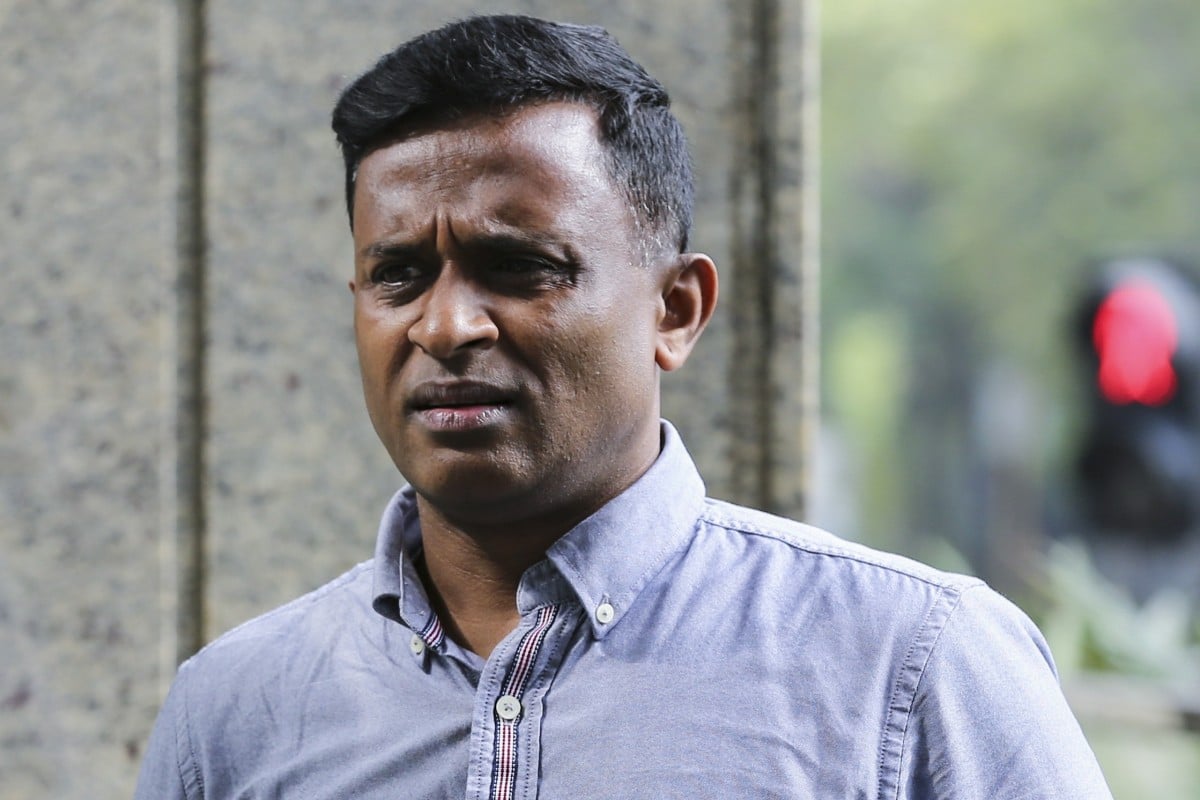
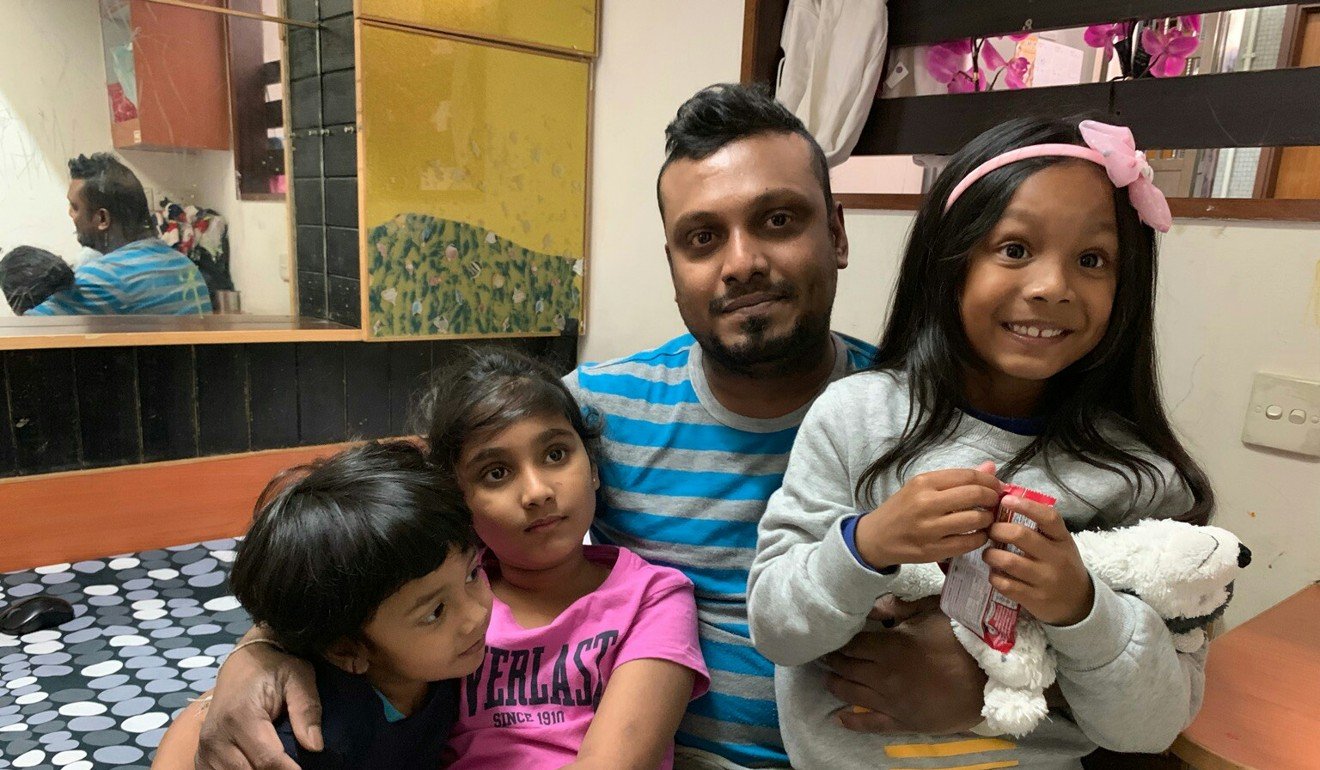
  • Former soldier Ajith Pushpakumara and a family of four from Sri Lanka hope to regain their freedom soon
  • They had all sheltered Edward Snowden when he was in Hong Kong
Ajith Pushpakumara, a Sri Lankan refugee who sheltered Edward Snowden. Photo: Edward Wong

Ajith Pushpakumara, a Sri Lankan refugee who sheltered Edward Snowden. Photo: Edward WongWhen Ajith Pushpakumara, an asylum seeker from Sri Lanka in Hong Kong, hears the word Canada”, his smile turns wider and his brown eyes brighter. That word isn’t just the name of a country, it means hope to him – an apparently distant and yet tenable possibility.He is one of the four adults who sheltered American whistle-blower Edward Snowdenwhile he was in the city back in 2013. They filed refugee claims for themselves and their children with the Canadian government a couple of years ago.This week, the news that one of them, Vanessa Mae Rodel, from the Philippines, and her seven-year-old daughter Keana, had been granted asylum and were leaving for Montreal, shook his world all over again.

I am really happy for them. We were all in the same situation … I hope it’s like a chain, maybe our time will also come,” he says.‘Snowden refugees’ feel free in Canada after ‘living in hell’ in Hong Kong

But I also feel more tension. It’s like it will go one way or another for me.”Pushpakumara, who has been in Hong Kong for about 15 years, knows that his life is at a crossroads and it can soon take dramatically different turns. I may go to Canada or I may be detained in Hong Kong and sent back to Sri Lanka, where my life is going to be over.”SUBSCRIBE TO THIS WEEK IN ASIAGet updates direct to your inboxSUBMITBy registering for these newsletters you agree to our T&C and Privacy Policy

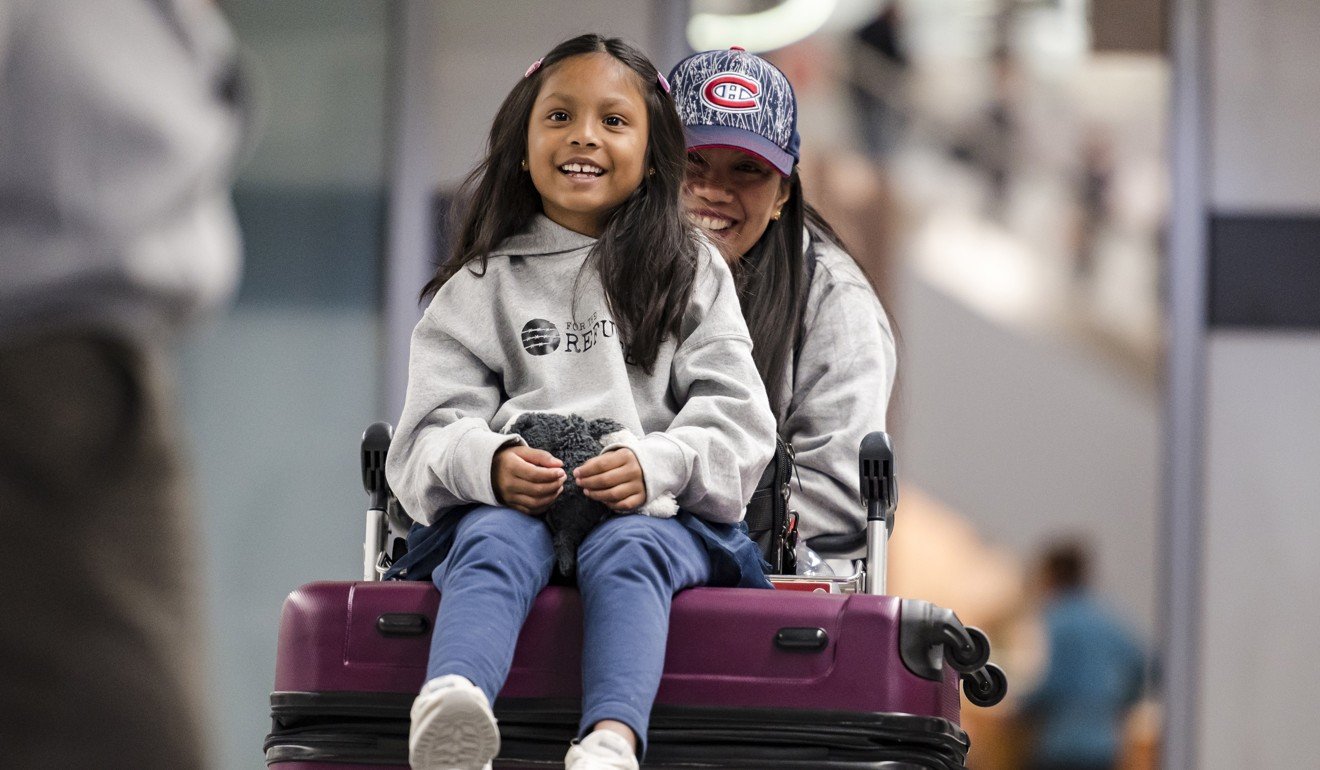
Vanessa Rodel and her seven-year-old daughter Keana talk to the media after arriving at Lester B. Pearson Airport in Toronto, on March 25. Photo: AP

Vanessa Rodel and her seven-year-old daughter Keana talk to the media after arriving at Lester B. Pearson Airport in Toronto, on March 25. Photo: APShare:In a similar situation is a family of four from Sri Lanka.

Legal experts – who were not involved in the applications and who prefer not to be named due to the sensitivity of the case – say that it is very hard to predict the future of the three adults and two stateless children who still remain in Hong Kong.  TOP ARTICLES1/5READ MOREAs ‘Snowden angels’ start newlife in Canada, other asylum seekers in Hong Kong are filled with greater anxiety, hope  TOP ARTICLES2/5READ MORESaudis ‘had access’ to AmazonCEO Jeff Bezos’ phone, his security chief claims

Even though they all filed their claims with the Canadian authorities at the same time and helped Snowden, the applicants came from different backgrounds, a lawyer says.

Another notes that each country has a number of internal procedures and criteria that we are not necessarily aware of. For instance, some prioritise women over men”.

Robert Tibbo, who has been their legal adviser since 2012 and who is now in Canada, says that each case is being handled by a different Canadian immigration officer. Each one goes at their own pace – that’s what I have seen in terms of documentation,” he says.

It is also likely that the US or the ‘Five Eyes’ [alliance of intelligence agencies] have put pressure on Canada.”

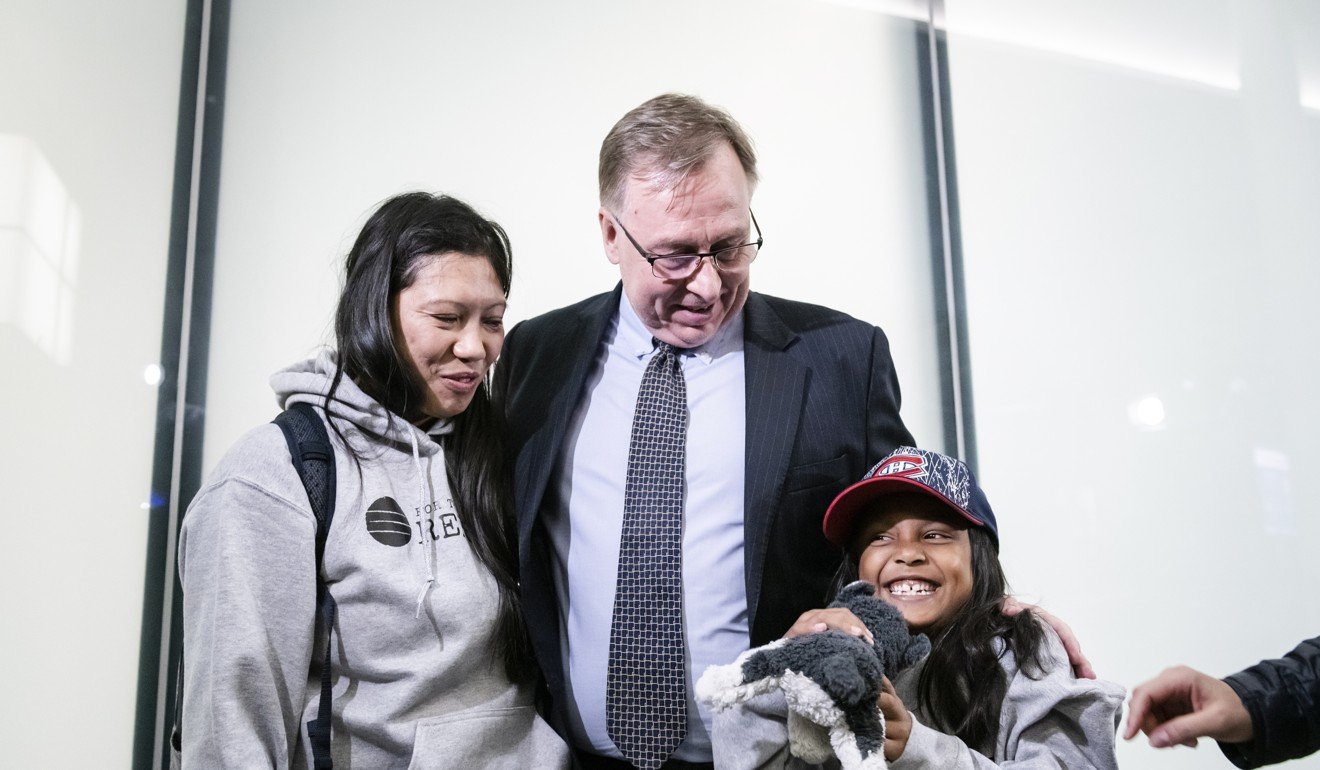
Vanessa Rodel and her daughter Keana with lawyer Robert Tibbo. Photo: AP

Vanessa Rodel and her daughter Keana with lawyer Robert Tibbo. Photo: APShare:This group of refugees helped Snowden after the former National Security Agency contractor fled the US and went into hiding in Hong Kong for several weeks in June 2013. He was on the run after leaking classified documents that exposed details about global electronic spying programmes used by the United States and other governments.

These are clear-cut cases,” Tibbo argues. They should all have been approved and be brought together to Canada.”

THE CANADIAN DREAM

Pushpakumara has thought of what he would say to Canadian Prime Minister Justin Trudeau if both men were to meet.

Thank you for helping Vanessa,” he would say. I am not safe in Hong Kong. I am stuck and very, very tired. Please, take care of us.”Canada accused of ‘dragging its feet’ over asylum seekers in Snowden case

The 47-year-old wears an inscrutable expression, until he talks about Canada. Then, his face lights up. He has been through three interviews with Canadian authorities and imagines the country to be a place where poor people face less discrimination”.

I think Canadians are very good people, who like to help others,” he says. I also think it’s a very quiet place, and cold – I am a bit afraid of that, but I will be happy in summer,” Pushpakumara says, grinning.

If he is given a chance, he would like to work as a carpenter. I have no studies, but my hands can do many things … I can be a good handyman,” Pushpakumara says. I will probably need help in the first two or three months there and then I can buy my own tools and even set up my own business.”

Ajith Pushpakumara, right, Vanessa Rodel, second from right, with her daughter Keana, Nadeeka Dilrukshi Nonis, third from left, and Supun Thilina Kellapatha, second from left, and their children pose for a photo in front of the Torture Claims Appeal Board building in Hong Kong in July 2017. Photo: AFP

Ajith Pushpakumara, right, Vanessa Rodel, second from right, with her daughter Keana, Nadeeka Dilrukshi Nonis, third from left, and Supun Thilina Kellapatha, second from left, and their children pose for a photo in front of the Torture Claims Appeal Board building in Hong Kong in July 2017. Photo: AFPShare:

Pushpakumara, who now relies on donations, says he is looking forward to being independent. Asylum seekers are not allowed to work in Hong Kong – one of the world’s most expensive cities to live in.

If I go to Canada, I can work, make money and provide for my mother and daughter,” he says. I could take care of them.”

Pushpakumara has a 17-year-old daughter living with his mother back in Sri Lanka. My daughter knows my story, but she keeps asking ‘when are we going to be together?’”

‘UNSAFE’ IN HONG KONG

Hong Kong had never been part of his plans.

When he fled Sri Lanka, his initial intention was to reach Canada. My agent told me to wait in Hong Kong for a week and he would pick me up a week later. I am still waiting,” he says.

Pushpakumara was a soldier for three years in Sri Lanka. His refugee claim says that he decided to desert the army after being sexually assaulted by superiors, but he was caught and tortured before being able to escape.

He landed in 2003 in Hong Kong, where he later filed a protection claim that was rejected about two years ago.

Pushpakumara needs to report every four weeks at the Castle Peak Bay Immigration Centre in Tuen Mun, a facility for detainees awaiting repatriation or deportation. I am still waiting for the result of my appeal. But every time I have to report to the Hong Kong authorities, I am very scared of being arrested,” he says.Hong Kong rejects asylum claims by refugees who sheltered Edward Snowden

If his appeal fails, the last avenue for recourse is a judicial review. But he says that his fears have become greater as proposals to tighten the current regulations have emerged.

The city’s Immigration Department has recently suggested amending the existing law and introducing tougher procedures. If their proposal is approved, authorities will be allowed to remove an asylum seeker from Hong Kong even if he had filed a judicial review or a legal aid application – unless the court had already agreed to hear the case.

I don’t think I would be able to cope with detention … And if I am sent back to Sri Lanka, forget it. My life is finished,” Pushpakumara says.

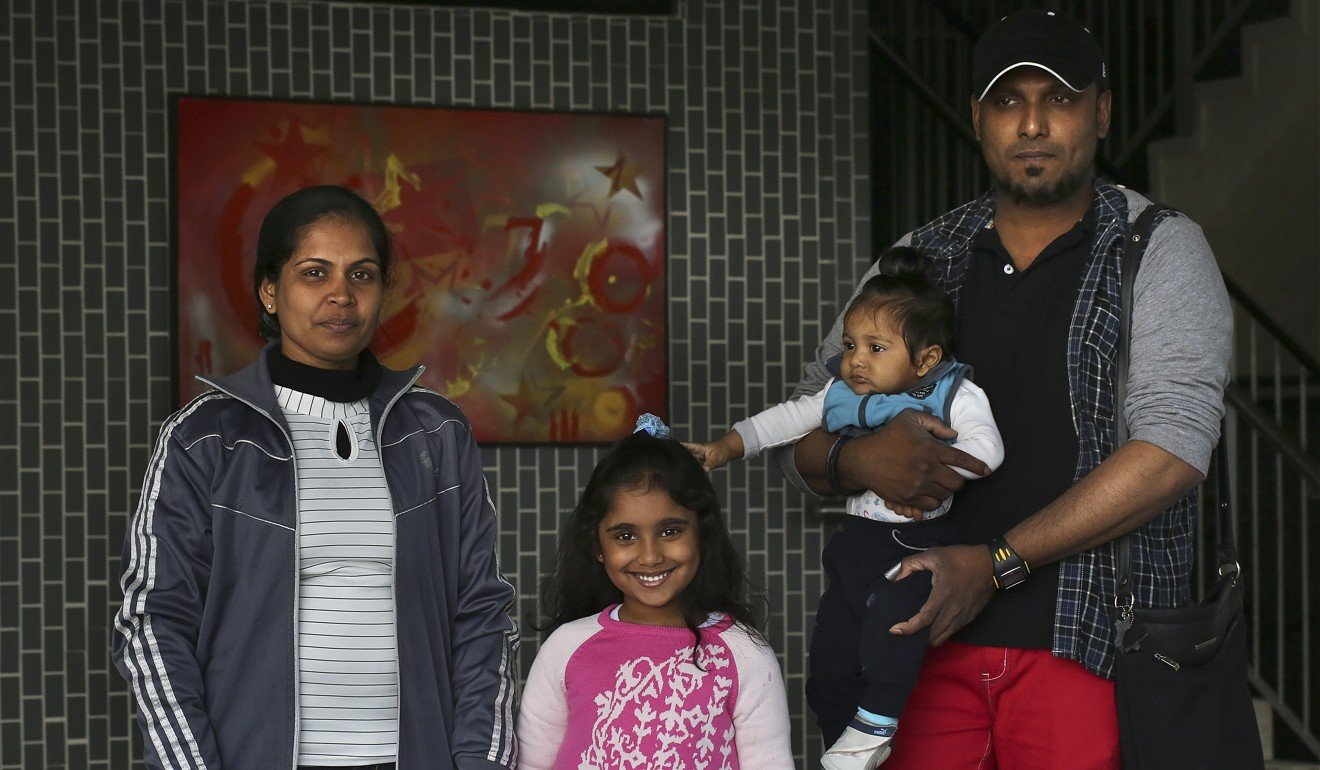
Supun Thilina Kellapatha and his family. Photo: Jonathan Wong.

Supun Thilina Kellapatha and his family. Photo: Jonathan Wong.Share:

At an even greater risk of arrest and deportation is the Sri Lankan family of four who also helped Snowden.

Supun Thilina Kellapatha who, according to his claim, was nearly killed because of a relationship with a woman linked to an opposition political party, fled Sri Lanka and met Nadeeka Dilrukshi Nonis in Hong Kong. She had also to leave her home country after being raped and held against her will by individuals linked to the government.

They meanwhile had two children in the city, who are stateless: Sethmundi, 7, and Dinath, 2.

Both their protection claims in Hong Kong and their appeals have been rejected. They have already filed a judicial review.Families who sheltered Snowden in Hong Kong say whistle-blower ‘gave them hope’

Their lawyer Tibbo says that they are now under great stress in Hong Kong, noting that Supun had to be hospitalised twice in the past month. They are currently unavailable for comments, the barrister says.

A previously undisclosed link between Supun and Rodel – the asylum seeker who has moved to Canada – was revealed this week. He is also the father of Keana.

Keana (R) with her father Supun in Hong Kong. Photo: Handout

Keana (R) with her father Supun in Hong Kong. Photo: HandoutShare:

Both Rodel and her lawyers are calling on the Canadian government to grant refugee status to Supun’s family. Keana should grow up with her father and stepbrother and stepsister,” Rodel says.

Meanwhile, Montreal is receiving her with open arms. People here are really amazing and warm. They already gave us many things, like clothes and toys … And Keana is enjoying it a lot, playing in the snow, seeing birds and squirrels.”

But Rodel, who is being helped by non-profit For the Refugees and other local organisations, insists that their happiness will only be complete when the rest of the group is given the chance to rebuild their lives in Canada.

MEETING SNOWDEN AND THE LIMELIGHT

Pushpakumara, who has been diagnosed with severe post-traumatic stress disorder, has lived in about 15 different houses in Hong Kong – either because of rent going up or safety issues.He recalls an episode from 2016, when he was told that Sri Lankan police investigators were in the city looking for the asylum seekers from the country.

I am still afraid … Life here is very hard. Hong Kong is like a jail,” he says, adding that he sometimes needs to take medication to help him get through the day.

My mind is not the same and sometimes I cannot control my feelings. My body starts shaking and I cannot sleep,” he says.

Despite all the pressure, he says he does not regret having helped Snowden. I would help anyone with a life problem,” he says. We, asylum seekers, know how it is to go through problems, living with no money, no accommodation, in fear.”

Pushpakumara says he monitored the area while Snowden went to the United Nations High Commissioner for Refugees’ office in Hong Kong. He says he also travelled several times with the former NSA contractor by taxi.

EXCLUSIVE: Whistle-blower Edward Snowden talks to South China Morning Post

I helped protect him while he was here and at the time I was very happy, because I was useful,” he says. And I think he is a good guy. He did not forget us. He is still not safe, but he still speaks up for us.”

US whistle-blower Edward Snowden now lives in Russia. Photo: Nora Tam

US whistle-blower Edward Snowden now lives in Russia. Photo: Nora TamShare:

Snowden landed in Moscow from Hong Kong in 2013. He ended up stranded in Russia – where he still lives – while he was in transit to Latin America, after the US revoked his passport.

The lives of the asylum seekers and their children dramatically changed in 2016, when their role in helping the former CIA analyst was revealed to the media.Their names and photos were plastered all over the world press shortly before the release of filmmaker Oliver Stone’s Snowden biopic.

Tibbo, who advised Snowden while he was in Hong Kong, argued that their identities were revealed to ensure their safety – but some lawyers and experts criticised the move.

Stone wrote this week on Twitter: Two of the Snowden Refugees (Vanessa and Keana) are now safe in Canada. But the remaining five are still in danger in Hong Kong. It’s time for Prime Minister Justin Trudeau to bring them home.”

Snowden also made a similar appeal on his account. After so many years, the first of the families who helped me is free and has a future,” he wrote in French. But the work is not over – with solidarity and compassion, Canada can save them all.”

Pushpakumara talked on the phone with Rodel just before her plane took off on Monday. I told her to be happy and take care. ‘You are now a free bird, you can do your own things’.”

He hopes that such a day will come for him too – so he can enjoy freedom, provide for his daughter and help others, he says.

Every day, I dream about this. ‘Maybe they will call me tomorrow’. Then, I see the phone: no call, no messages.”

Sri Lankan-backed Hungarian Airline Taxiing for Takeoff

March 31st, 2019

Robin Marshall Budapest Business Journal

A Sri Lankan-based company with a 50-year history in tourism is launching what it calls the newest Hungarian airline to take to the skies”: RonanAir.

RonanAir is a scheduled Hungarian airline set to commence operations in summer 2019,” Rihaab Mowlana, media & marketing consultant for the company told the Budapest Business Journal.

Initial phases will see RonanAir fly to approximately 11 European destinations, and consecutive phases will eventually include Asia, the Middle East and the Americas.”

Although no schedule has yet been published, the airline’s website (ronanair.com) lists cities in Austria, Bulgaria, Croatia, Greece, France, Italy, Romania, Switzerland and Ukraine among its featured destinations”.

RonanAir Kft. is owned by the Sri Lanka-based R-Group, which traces its roots back to 1945 and the establishment of Ceylon Carriers by the late Charles Nanayakkara. According to the group’s website (rgroup-intl.com), Ceylon Carriers handled both goods and tourists, and partnered with many operators in this region, including Ibsuz in Hungary.

R-Group is now chaired by Charles’ eldest son, Rohan Nanayakkara, who is also an Honorary Consul of Hungary, a post he has held for 25 years.

Full Service

The business model will be for a full service airline, rather than a low cost operation. Although unable to give exact fares at this stage, Mowlana says ticket prices will certainly be competitive”, and are expected to go on sale within the next three-four months”. 
The airline will fly Bombardier and Airbus aircraft, the spokesman told the BBJ, with staff recruitment currently under way. Although based in Hungary and registered in this country, back office support will be provided in Sri Lanka in order to facilitate Ronan Air with the know-how and backup of R-Group assets etc. that have been built since 1945.”

Nanayakkara is clealy well connected in Hungary. The R-Group website says its chairman is receiving massive support from [the] Hungarian government in promoting Hungary within and beyond Sri Lankan territory”. That seems to be a two-way street. We will engage in actively promoting Hungarian culture, cuisine and products in the destinations we will be flying to,” Mowlana told the BBJ.

Fallen Falcon

The last attempt to launch a Hungarian airline was Sólyom Hungarian Airways Ltd. (sólyom being the Hungarian for falcon”), which was founded in 2013 with service initially due to start in August of that year. Its business model was openly questioned by analysts, finance from Oman never materialized, the company declared itself bankrupt in October 2013, and it was sold to Hungarians based in Africa the following month. In March 2014, the new owner apparently shot himself dead as police searched his property. Sólyom Airways has never flown commercially.

Hungary’s state-owned flag carrier, MALÉV Hungarian Airlines, collapsed under the weight of its debts in February 2012 after 66 years of continuous operation.

The only recent Hungarian aviation success story is Wizz Air Hungary Ltd., which describes itself as CEE’s largest low-cost airline. With its head office in Budapest, it was established in September 2003 and made its first flight in 2004 (from Poland). Its boss, József Váradi, is a former CEO of MALÉV. According to its website (wizzair.com), it carried 2,548,062 passengers in February 2019.

Ronan Air Kft.

According to Opten Kft.’s company information database, Ronan Air Kft. was established on August 19, 2014, with its offices in Vecsés. It had zero net revenue listed for 2017 (the latest date for which figures are available), and an after tax loss of HUF 1.364 million. Its own capital was put at HUF 5.476 million. There were no employees, with the owner and managing director given as Godaliyanage Rohan Nanayakkara.

Chronic kidney disease of undetermined causes, described originally in Central America and Sri Lanka

March 31st, 2019

BARCELONA INSTITUTE FOR GLOBAL HEALTH (ISGLOBAL) Courtesy  Eurekalert

 E-MAIL

IMAGE
IMAGE: CHRONIC KIDNEY DISEASE OF UNDETERMINED CAUSES (CKDU) IS ALSO PRESENT IN INDIA, PARTICULARLY IN SOUTHERN RURAL AREAS. view more CREDIT: NANDHU KHUMAR / UNSPLASH

Chronic kidney disease of undetermined causes (CKDu), initially reported among agricultural communities in Central America and Sri Lanka, is also present in India, particularly in Southern rural areas, and could be common in other tropical and subtropical rural settings. These are the main conclusions of a new study published in BMJ Open and in which the Barcelona Institute for Global Health (ISGlobal), an institution supported by “la Caixa”, participated.

CDKu is considered an epidemic in Central America and it is devastating in Nicaragua and El Salvador, where it affects mainly the working age populations of agricultural communities. CKDu is characterized by a gradual loss of renal function and it is not associated with diabetes or hypertension, the main causes of the traditional chronic kidney disease (CKD). Its clinical evolution, a gradual loss of kidney function, tends to be faster than in other forms of CKD. The disease causes are not clear, but risk factors such as heat stress, strenuous work, climatic conditions, agrochemical use, or heavy metal exposure have been suggested.

In this new study, the researchers set out to assess whether CKDu is also present in India, and identify the risk factors. To do so, they combined cross-sectional data of 12,500 people from three population studies (CARRS, UDAY and ICMR-CHD) in urban and rural areas of Northern (Delhi and Haryana) and Southern (Tamil Nadu and Andhra Pradesh) India.

The participants had previously answered questionnaires on dietary habits, alcohol consumption, education level, and other sociodemographic data. Their body mass index and blood pressure were also measured, as well as biomarkers of renal function.

The results indicate a disease prevalence of 1.6% among adults under 60 years of age, but this figure varied markedly between regions, being highest in rural areas of Southern India, where it reached 4.8%. The major risk factors were being in working age (under 60), living in a rural area, alcohol consumption and less education.

Cristina O’Callaghan, ISGlobal researcher and first author of the study, explains that “these risk factors are similar to those previously described in Central America and Sri Lanka”. Exposure to possible disease risk factors, including agricultural work and agrochemical exposure, may be greater in rural areas.

These results have “important implications for global health, since they indicate that CKDu may have a substantial public health burden that has been previously unrecognized”, concludes O’Callaghan.

She emphasizes that “further population-based studies in other tropical and subtropical countries are needed in order to evaluate the global patterns of disease burden”, such as the DEGREE study -international collaboration for the epidemiology of eGFR in low and middle income populations, led by Neil Pearce and Ben Caplin from the London School of Hygiene & Tropical Medicine (LSHTM) and University College London (UCL) and in which Cristina O’Callaghan also participates-.

###

The study has been coordinated by the Public Health Foundation of India and the Centre of Control of Chronic Conditions in India.

Reference

O’Callaghan-Gordo C, Shivashankar R, Anand S, Ghosh S, Glaser J, Gupta R, Jakobsson K, Kondal D, Krishnan A, Mohan S, Mohan V, Nitsch D, P A P, Tandon N, Narayan KMV, Pearce N, Caplin B, Prabhakaran D Prevalence of and risk factors for chronic kidney disease of unknown aetiology in India: secondary data analysis of three population-based cross-sectional studies. BMJ Open 2019; 10.1136/bmjopen-2018-023353corr1

OMAN OIL CONSIDERS UP TO 30% STAKE IN SRI LANKAN REFINERY

March 31st, 2019

Muscat Daily staff writer

MUSCAT – 

Clarifying Oman’s intention to invest and participate in a large oil refinery project in Sri Lanka, H E Dr Mohammed bin Hamad al Rumhi, Minister of Oil and Gas has said that Oman Oil Company is considering the feasibility of participation in the Sril Lankan project.

In a statement to Oman News Agency H E Rumhi said the sultanate, represented by Oman Oil Company, is currently considering the feasibility of participation of up to 30 per cent share of this oil refinery project.

Sri Lanka last week began construction of a nearly US$3.85bn oil refinery, which it hopes will revive foreign interest in its shipping facilities. This refinery project is the single largest foreign investment in Sri Lanka’s history, according to media reports.

The new refinery project will produce 200,000 barrels a day when completed.

Fraudsters and corrupted will be punished under my term – Mahinda

March 31st, 2019

Courtesy Adaderana

People who commit fraud and take commissions will be punished severely during his administration, says Opposition Leader Mahinda Rajapaksa.

He pointed out that the incumbent government is responsible for the prevailing crisis in the country.

He mentioned this following an event held in Welimada area today (31).

Meanwhile, addressing a function held at Balangoda earlier today, he said that the public has been oppressed due to the administration of the current government without any proper management.

Stating the current government runs the country without any management, focusing only on taking commissions, he says that the political leaders of this government have no idea on the sufferings of the general public.

The government is run with the support of the Tamil National Alliance, said Rajapaksa.

This government is a defeated government. Not just us politicians, but even the people just watch the country deteriorating by the day,” he added.

According to Rajapaksa, there is no place for Buddhism in the new constitution and that it mentions only of a ‘religion’ instead of ‘Buddhism’.

These days antiquities and ruins are bulldozed. This government was trying to build houses by flattening Vijithapura ruins. Even forest reserves are deforested today. If we continue to just watch this, the country will end up a desert,” said he.

The Opposition Leader, attending a function at the Carlton kindergarten in Maligawatte, stated that a winning candidate will be presented for the upcoming presidential elections.

How our water becomes Power, is sold in Rupees, but profits go out in $: Our Debt increases

March 30th, 2019

by Garvin Karunaratne

Sri Lanka is a country which is rich in resources. Sadly we, our leaders, do not realize that we can develop these resources and save our foreign exchange.

Even our water in our streams is being converted to foreign exchange and is being sent abroad as profits by multinationals. In the Papers (the LBO) it is reported that a Japanese Firm is investing a million dollars on a mini hydro plant at Eratna in Ratnapura. It means that the waters of the Kalu Ganga will be used to generate power and sold to the Electricity Board and to people in the area and the profits, in terms of payment for the electricity consumed will be sent off to the owners of the Japanese company in hard foreign exchange.

In a recent paper of mine, I highlighted how the waters of a stream that flows into the Mahaweli River at Udugama on the Gampola Nuwara Eliya Road, are being developed into a mini hydro plant by a German company, and once it is done the power will be sold and the profits will flow in foreign exchange to Germany from Sri Lanka.

That is how our water resources are being turned into foreign exchange to be taken out of our country.

It is a simple thing to develop a mini hydro plant. Many of our tea estates had mini hydro- plants and generated power to run the factories. Instead of developing better designs we encourage foreigners to come in and convert our water resources to power, and then convert power to foreign exchange and take it away.

Currently there is a group of protesters who are very active against developing mini hydro plants. They say it is against the environment. It is up to our leaders to direct that our engineers build designs that will develop mini hydro plants that do not damage the environment and get them implemented. Mini Hydro plants can be designed and built in months, not years and we can face the onslaught of power cuts that are expected.

Garvin Karunaratne

Recall Azeez, arrest Mano Tittawela: SB Dissanayaka

March 30th, 2019

Sudath Gunasekara 29.3.2019.

What SB says here has good sense, although often it does not? As I was listening to the news when the President was referring to the Geneva Ambassadors action, I told the same thing to my wife. I think the time has come for the President to talk less and act more. At least now he should act. Then only people will admire him and they will feel that they have a President in this country and they will stop calling him NATO (no action talks only) Sirisena and again will begin to call him Hon Maitripala Sirsena.

Meanwhile I also propose that the President should immediately sack the errant Minister Rishard Badurdeen as well who has been Minster of Trade and Commerce from 2001 to date in all governments doing irreparable damage to the country and all Governments more particularly by destroying the Wilpattu National Park

There is no point in putting the blame for Badurdeens crimes on Basil as many people do to cover up Badurdeen’s crimes and their own. The whole country knows Basil has done a big blunder to harp on Muslim votes. This is what all politicians do. Neither the President or Ranil nor MR or any other Sinhala politician can escape this charge. This is the tragedy and the curse mother Lanka is ever suffering from 1948, since the British left after planting the seeds of communal and Party politics in this country.

If the President sacks him all other politicians who commit this betrayal will learn a good lesson. People will adore and appreciate it and the President will rise above all other politicians who have sold the motherland for few Muslim or Tamil votes ever since 1948 and are continuing to do so even today.

Sri Lanka Land Reclamation Corp to buy dredger for sea sand mining News Item,,,

March 30th, 2019

Dr Sarath Obeysekera

Mar 27, 2019 19:23 PM GMT+0530 | 0 Comment(s)

ECONOMYNEXT – Sri Lanka Land Reclamation & Development Corporation is to buy a dredger to mine sand from the deep sea to meet the requirements of the construction industry, the state information office said.Sea sand now meets about 10 percent of the local requirement for building construction, it said in a statement.
But with construction activity expected to increase in future, more sea sand dredging would be required to meet the growing demand.
A proposal to buy a dredger for the Land Reclamation & Development Corporation was approved by the Cabinet of Ministers this week on a proposal by Megapolis and Western Development Ministers Champika Ranawaka. 
(COLOMBO, March 27, 2019-SB)

We have a serious problem in Sri Lanka .Neither Government nor Cabinet of ministers have any clue how to identify specific the  skills and qualification of various corporations and the departments .

When Ceylon Electricity Board decided to install Coal Powered Power Generation plants, electrical engineers who dominate the board functions, never allowed mechanical or marine engineers to provide any input when they procured the coal power plants and barges and tugs to transport coal powder from large ships to the plant .

Outcome is that we have a malfunctioning power plant and unusable three barges and two tugs which are supplied by Chinese .These barges are nor self-propelled hence controlling the barges in high seas is very cumbersome .

Three barges and two tugs have been handed over to Sri Lanka Navy and CEB is hiring some Indian self-propelled barges to transport coal to pier .

Sri Lanka Land Reclamation Corporation ( SLLRDC) planning to buy a dredger may be a good idea assuming that a  Dutch Company is eying to supply the trailing suction hopper  dredger .SLLRDC should  have a team of marine engineers not only to draw up the correct specification but also  to plan operation  and maintenance  of  the dredger .

If they intend to buy a dredger, they should use an  another company or  an organization to  handle such sophisticated equipment.

One might think that Ceylon Shipping Corporation should undertake the operation and maintenance of the dredger .By looking at their pastr performance during last few decades ,  country has seen how they have failed to maintain their own vessels which were  sent for scrap ,Hence government should think twice who should undertake the operation,

By best bet is Sri Lanka Navy to operate and maintain the dredger

 Dr Sarath Obeysekera

YAHAPALANA AND CORRUPTION Part 3D

March 30th, 2019

KAMALIKA  PIERIS

Revised 1.4.19

Yahapalana reacted strongly against the bond scam investigation. Yahapalana tried to use influence to  cover up the bond scam.  The Auditor General was told by Prime Minister  that the AG’s calculations of the  loss  from the bond scam was all wrong. UNP tried to move court to prevent the release of the first COPE committee report. Footnotes were added to the second COPE report saying that no fraud had taken place. UNP State Minister Sujeewa Senasinghe wrote a book stating that no fraud had taken place at the bond auctions. A spate of attempts had been made to sabotage the COPE  inquiry , said DEW Gunasekera .

UNPers on the COPE team, dubbed the ‘footnoters ‘had been on their hand phones during  sittings in Parliament,  Obviously, they were receiving instructions from Aloysius and shared information and perhaps allowed him to listen to proceedings, MPs charged. So what if there were calls made by Ministers and MPs who were members of the Committee on Public Enterprises to Arjun,” asked columnist Don Manu. Is it a crime to dial a friend’s number, an offense to receive a call from a friend even if he is accused of a wrongdoing?

However, Speaker Karu Jayasuriya decided to seek legal opinion   regarding four parliamentarians  were named before the Commission of Inquiry for making telephone calls to Arjun Aloysius when in Parliament. The MPs were at the time serving members of the COPE team inquiring into the  bond scam. The Speaker wanted to ascertain whether the disclosures warranted action since no precedent exist over such matters.

These  MPs  met Speaker Jayasuriya  to explain the phone calls. Explanations had varied from calls being made for personal reasons to a few complaining that their political career has been damaged. They said that checking on their telephones by the CID violated the privileges they enjoyed under Standing Orders of Parliament.

A very senior official of the Central Bank was found removing a haul of files and documents from the bank recently, said the media in July 2017. The official in question arrived at the bank around 7.30 pm and took the documents in his personal car without following the due procedure  of first obtaining a gate pass. Details of the documents being taken out of the Central Bank have to be recorded at the Security Division of the Bank. The official had claimed that he was removing some files belonging to him. The files were removed while inquiry was going on.     The fact that the official had been linked to the Bond scam and was due to retire  seemed to indicate that he might have been eliminating vital evidence.

Yahapalana    tried to scuttle the  COPE inquiry. A Fundamental Rights petition was filed in 2017  by Ven. Thiniyawala Palitha challenging the various findings and statements made in a report prepared by the Committee on Public Enterprises (COPE) regarding the bond issues by the Central Bank of Sri Lanka in the year of 2015 and 2016. Lawyer S.A. Parathalingam appeared for him. Senior state counsel was S Gnanarajah.

Ven.  Thiniyawela Palitha asked Supreme Court to declare that the bond auctions were done correctly according to Central Bank rules.  The Petitioner further stated that COPE report is littered with inconsistencies, contradictions, misrepresentations, which makes certain findings and statements in the COPE report unsafe, prejudiced, biased, and a violation and infringement of the Petitioner’s fundamental rights guaranteed under Article 12(1) of the Constitution of Sri Lanka.

The petitioner is seeking an declaration that any findings, statements, suggestions in the   COPE report that say that the direct and private placement method in the issue of Treasury Bonds by the Central Bank has been properly, lawfully and correctly used by the Central Bank from the month of January 2009 up until the date of the COPE report, is wrong.

The petitioner is further seeking an Order or Declaration that as at the time of the Treasury Bond auctions of the Central Bank that was held on February 27, 2015 and March 29, 2016, the proper, lawful process or method as regards the issue of Treasury Bonds was the auction process/method, and not the direct/private placement process/method.

When all this failed and  the Bond scam report was ready, Yahapalana decided to block the report. President  Sirisena dissolved Parliament  on the night of June 26, 2015   just when D.E.W.Gunasekera was about to present the first COPE Committee report on the bond scam to Parliament. Had President Sirisena allowed the explosive report to be tabled, the outcome of the general election in August 2015 would have been different.  This action also paved the way for far bigger Treasury bond scam in March 2016. The President didn’t appoint an investigating committee to probe these massively corrupt transactions till  January 2017.

 President Sirisena, as the Leader of this UNP-SLFP government, went to the incredible extent of dissolving Parliament, one day before the DEW Gunasekera COPE Report was to be presented to the Speaker, said Nivard Cabraal. By such single action, he was able to save all the wrong-doers of the initial Bond Scam of February 2015,  and he paved the way for the same wrong-doers to carry out the second Bond Scam of even greater proportions, in March 2016.

The Commission of Inquiry finished its work and submitted a full report to President Sirisena. Yahapalana played with this report.

The President put  the Commission report  on his website, but with omissions. The section  which   faulted the Prime Minister for not taking action against the then Central Bank governor Arjuna Mahendran and also blindly believing in him was removed. The deleted para read: “The Commission is of the opinion that the Prime Minister made his statement in Parliament regarding the appointment of Mr Mahendran believing in the facts presented by Mr. Mahendran and Mr.Samarasiri, especially the promises made by Mr Mahendran..”

The President’s website also  carried  a statement by the President  on the findings of the Commission. The first English translation of the President’s Sinhala statement was reasonably close to the original, but a subsequent version removed all references to Wickremesinghe and finance minister Ravi Karunanayake.  References to Ravi Karunanayake  were brought back later.

Yahapalana government did not release  the full report of the Commission of inquiry to Parliament.  Even the MPs in Parliament did not get the full report”. The main report and annexures I, II, IV and V were released  to Parliament,  but not annexure No III, which contains marked documents and evidence notes, said Campaign for Free and fair Elections (CaFFE). Annexure three has neither been given to the MPs nor released to the public via the Presidential secretariat website,

The missing section included Section C 350 (together with C 71, C 123, C 279, C 281, C 67),which  contained detailed phone records collected by the CID of conversations of journalists, politicians, religious leaders and civil society members who had received money from Perpetual Treasuries (Pvt.) Limited (PTL). In the main report there are observations based on a document titled C 350,  but this is not available in the released documents. 

The Bond Commission report was then  sent to the Department of National Archives    where it came under the National Archives Law No. 48 of 1978. Section 2 of the Act  said that such documents shall be closed for public inspection until the lapse of 30 years after their creation”.

Campaign for Free and Fair Election (CaFFE) Executive Director Tennekoon  tried to get the full report, including all its annexes, from the Department of National Archives  and discovered  this embargo.  He found that the Right to Information Act did not cover the Archives. A written directive from the Presidential Secretariat was needed  to view the documents.  

After a delay of  several months   the National Archives gave him the report. 12 pages were missing. The missing section was the  C350 report, containing phone records of COPE members, and former Finance Minister Ravi Karunanayake.”. What was given only contained details of records of calls between Central Bank officials and some other individuals.  

Shamindra Ferdinando made a pertinent observation. The  joint AG, CID and Central Bank team  examining the Central Bank Bond scam proved beyond any doubt that Sri Lanka had the required expertise to undertake complex investigation,  commented Shamindra Ferdinando. Had investigators been given a free hand to inquire into revelations made by COPE and Public Accounts Committee (PAC), many Ministers would have been found guilty of waste, corruption and irregularities. But Parliament did  not amend Standing Orders to enable the watchdog committees to summon ministers, he added.

The team investigating the Bond Scam were: Senior Additional Solicitor General Dappula de Livera, PC, ASG Yasantha Kodagoda, PC, ASG Priyantha Nawana, PC, Senior DSG Milinda Gunathileka, DSG Dilan Ratnayake, Senior State Counsel Shahida Barrie, Senior State Counsel Nayomi Wickremasekera, Senior State Counsel Dr Avanthi Perera, State Counsel Dhanushan Ganeshayogan, State Counsel Jehan Gunasekera. The Attorney General team was assisted by five-member teams from the Central Bank as well as the Criminal Investigation Department.

To conclude, it has become clear to   the public, thanks to the publicity given to the bond scam on TV and newspapers, that  a very serious financial scam had been carried out, which those responsible  thought would not be discovered, because of  its complexity. This was essentially a colossal bank heist.

It was planned and carried out by those who were expected to protect the finances of the country. They did so with no concern for the country  and with no remorse. The scam was pulled not once, but twice, very successfully.  The second one took place after the first bond scam had been discovered. 

D. E. W. Gunasekera yesterday said that the top UNP leadership couldn’t absolve itself of the responsibility for the bond scams.  W. A. Wijewardena said that both politicians and officials  had acted in contravention of rules and regulations governing banking operations. They had carried out the ‘business’ with impunity and  weren’t bothered at all about the fact that it was a  serious violation [of trust]. 

The bond scam came to light only due to the courage and integrity of a few officials, a relentless media, concerned citizens, and some Parliamentarians.  The outrage of the presenters of the evening news as the Presidential Commission report was released was palpable as they hosted a special segment dedicated to this misdemeanor, said the media. DEW Gunasekera paid a glowing tribute to those members of both the print and electronic media who had relentlessly followed the Treasury bond scam.

Appendix

Shamindra Ferdinando has provided the following time line for the bond scam:

Jan. 8, 2015: Presidential electionJan.9, 2015: Maithripala Sirisena sworn in as PresidentJan.9, 2015: Ranil Wickremesinghe sworn in as Prime MinisterJan.23, 2015: Then Finance Minister Ravi K recommended Arjuna Mahendan as Governor, CBSLJan. 26, 2015: President Sirisena appointed Singaporean Mahendran as Governor, CBSL.Feb. 26, 2015: Mahendran met ministers, Ravi K, Kabir H and UNP Chairman Malik S at CBSL, allegedly to discuss a massive fund requirement of Rs 18 bn (All three politicians were present when President Sirisena lambasted the UNP over treasury bond scams on Dec 16, 2018 at the Presidential Secretariat. PM Wickremesinghe and Mrs Wickremesinghe were also present.)Feb 27, 2015: First bond scam perpetrated. Within hours, those who mattered knew how PTL had carried out the operation in connivance with Mahendran. The PTL is a fully owned subsidiary of Perpetual Capital (Pvt) Limited, owned by Geoffrey Joseph Aloysius and Arjun Joseph Aloysius. The Central Bank was under the purview of Premier Wickremesinghe, though previously it functioned under the Finance Ministry. June 26, 2015: Sirisena dissolved parliament to thwart CoPE presenting its report on treasury bond scam. General election set for Aug. 17, 2015. (President Sirisena paid a very heavy price for his action).The dissolution prevented the CoPE Chairman Dew Gunasekera from presenting his report on the first treasury bond scam. In a related action, UNP Deputy Justice Minister Sujeewa Senasinghe moved court to bar Gunasekera from releasing his report to the media.The writer sought an explanation from Gunasekera, in January this year, at a media briefing, as to the responsibility of Sirisena and the SLFP in the second bond scam, perpetrated on March 29, 2016. Asked whether, a far bigger second treasury bond scam could have been prevented if not for the dissolution of parliament in June 2015; Gunasekera said that question should be posed to President Sirisena as he had done so. Nov 16, 2017: Evidence at the Bond Commission revealed how Arjun Aloysius had been in touch with some members of the COPE during its hearings.Aloysius had spoken a total of 227 times to Sujeewa Senasinghe, 18 times with Dayasiri Jayasekara, 176 times with Harshana Rajakaruna and 73 times to Hector Appuhamy during the period commencing January 2015. Nov 20, 2017: Wickremesinghe received kid glove treatment at P-CoI with AG Jayantha Jayasuriya assigned to question him. But Wickremesinghe’s affidavits received by P-CoI in response to questions sent to him by the P-CoI and the AG’s department and PM’s responses to AG Jayasuriya established the UNP’s leader’s complicity and failure to thwart the scams beyond doubt. However, Wickremesinghe and the UNP have repeatedly denied involvement whatsoever in bond scams.  Strangely throughout this period, Western powers conveniently refrained from publicly commenting on the bond scam though they worked overtime to discredit the previous Rajapaksa administration with the US pledging to help Sri Lanka recover stolen funds. India also pledged to assist yahapalana efforts. In fact, the current political leadership certainly owed an explanation to the public as to how Mahendran, Aloysius and PTL CEO Kasun Palisena had committed the second bond scam, 13 months after the first. Obviously, they had been so sure that nothing could go wrong. Most probably, they believed Mahendran was going to have his own term as the Governor after having completed the period allocated to his predecessor Ajith Nivard Cabraal. Cabraal quit immediately after the Jan 2015 presidential polls.The public should be grateful to former CBSL Senior Deputy Governor Dr W. A. Wijewardena, and the media for relentlessly pursuing the treasury bond scamsDec 30, 2017: P-CoI report handed over to Sirisena.Jan. 4, 2018: Sirisena addressed the nation regarding the P-CoI report. Sirisena mounted a devastating attack on the UNP over treasury bond scams in the run-up to the Feb. 10 local government polls. Sirisena’s strategy caused heavy damage to the UNP at the Feb. 10 polls.  (Concluded)

Visas-on-arrival and visa-free travel now possible for in-bound tourists-minister

March 30th, 2019

Dr Sarath Obeysekera

March 29, 2019, 7:54 pm

From left MD CDC Events & travels ( Pvt). Ltd.Imran Hassen, Harith Perera, Minister John Amaratunga, Kishu Gomes, Chairman, Sancharaka Udawa 2019, Nishad Wijetunga Pic by Samana Ranaweera

By Steve A. Morrell

Visa – on – arrival and visa – free travel in Sri Lanka are now possible for all in-bound tourists, Minister of Tourism Development, Wildlife and Chistian Religious Affairs, John Amaratunga said.

Hurrah ,Finally politicians have understood the necessity . There are few other steps need to be taken.

  • Airport should have fleet of metered taxis like in all other countries for tourists to hail as soon as they arrive
  • Regular Train service to re commence from airport to Colombo with change over in Ragama to go to East and mid country
  • Regular bus service from Karutanayake to Colombo for back packers
  • Proper eating places outside airport at a reasonable price
  • When super luxury passenger vessels  arrive in Colombo Harbour  high quality terminal to be built with dedicated walkway and entrance for them to go out from Port
  • At the exit of the main  gate of the Colombo port Old Customs building to be converted for night life and pubs etc
  • Legalised Canabi smoking place to be established for tourists to enjoy in this building
  • Legalise cannabis in selected areas in Colombo (So much of drugs coming in with no control)
  • Chatam Streel and Bristol street in Colombo to be a walking area with many eating stalls like in Thailand and Singapore
  • Russian and Thai lasses to be given special discounts to Come to Colombo and legalize the oldest trade in the world

Dr Sarath Obeysekera

THE REIGN OF MAHINDA RAJAPAKSE (4)

March 30th, 2019

This essay carries four statements made by Mahinda Rajapaksa

STATEMENT NO 1 YAHAPALANA GOVERNMENT” (Island 9.1.18)   

In a statement issued to media on 9.1.18 the former President said: On 9 January 2018, the so-called Yahapalana government completes three years in office. During this short period they have created numerous crises running through virtually every sector in Sri Lanka. The main subject of public discussion today is the bond scam and the attempts being made by the Yahapalana leaders to sweep it under the carpet.

We are awaiting the release of the full report of the Bond Commission. The bond scam is only one of the many disasters brought upon this country by the Yahapalana government. As this government marks its third anniversary, I wish to draw the attention of the public to another danger they have brought upon this country.

During the short period of 36 months that this government has been in power, they have borrowed over USD 14.6 billion in foreign currency loans alone, the breakdown of which would be as follows – USD 7.2 billion through the issue of Sri Lanka Development Bonds from January 2015 onwards, USD 3.6 billion from sovereign bonds issued in 2015 and 2017, USD 2.2 billion through currency swap arrangements with India in 2015 and 2016, USD 1.7 billion through syndicated loans arranged through several international banks in 2016 and 2017 and USD 1.5 billion from the IMF Extended Fund Facility in 2016. No previous government has borrowed so much money through foreign currency loans in such a short period of time.

Even though 14.6 billion USD would suffice to build five Norochcholai power plants, five Hambantota harbours with enough money being left over to build two more Southern Expressways, the Yahapalana government has not built even a culvert with that money.

 I have made reference so far only to foreign currency loans. From January 2015 to date, the Yahapalana government has borrowed well over Rs. 5.7 trillion in Rupee loans as well, through the issue of treasury bills and treasury bonds. The government commissioned the Moragahakanda project and opened the Rajagiriya flyover to coincide with its third anniversary so as to answer the critics who say that the Yahapalana government has not built anything tangible despite massive foreign borrowings.

However, the Moragahakanda project was planned, financial allocations were made and construction commenced under my government way back in 2007 in accordance with the 2005 Mahinda Chintana programme. Likewise the Rajagiriya flyover was planned and money was allocated for its construction by my government. Cabinet approval was granted to call for bids to select contractors for the construction of the flyovers in Rajagiriya, Polgahawela and Ganemulla at the cabinet meeting held on 4 December 2014.

The Yahapalana government has marked its third anniversary by claiming credit for projects for which money was allocated and started by the previous government. They came into power in 2015 claiming that there was a debt crisis in the country due to the loans taken by my government to build power plants, harbours, airports, expressways etcetera. However the total cost of these major development projects were as follows: USD 1,350 million for all three phases of the Norochcholai power plant; USD 740 million for the Southern Expressway from Kottawa to Matara; USD 1,300 million for phases I and II of the Hambantota harbour and its bunkering facility; USD 292 million for the Colombo-Katunayake expressway and USD 209 for the Mattala airport.

All these development projects put together cost less than USD 3.9 billion. The claim that the present government has been forced to borrow heavily to repay the project loans taken by my government is a complete lie. With the 14.6 billion USD in foreign currency loans that this government has borrowed up to now, the loans taken for all the above mentioned development projects could have been repaid four times over.

 The debt now being incurred is used to meet the day to day expenses of the Yahapalana government and not to repay the project loans taken by my government. From January 2015, there was a massive and unplanned increase in government expenditure as a result of state funds being utilized to meet political objectives. The present debt crisis came about due to the Yahapalana government borrowing heavily in Rupees and in foreign currency in order to meet this increased expenditure.

Foreign currency loans should always be taken with the utmost care. Since it is necessary to purchase foreign currency to repay such loans, even a slight change in the exchange rate can give rise to a massive increase in a country’s indebtedness. According to the 2015 and 2016 Central Bank reports, due to the depreciation in the value of the Rupee as a result of the economic downturn that took place after the Yahapalana government took office, an extra Rs. 478 billion has been added to the national debt. It should be noted that the increase in the interest rate by about 50% due to the bond scam, has also added to the debt burden.

My government was always very careful in taking foreign currency loans. According to the Finance Ministry, the repayment of foreign loan installments plus interest during the period 2008-2014 was as follows:

2008 – USD 881 million

2009 – USD 1,041 million

2010 – USD 826 million

2011 – USD 971 million

2012 – USD 1,620 million

2013 – USD 1,160 million

2014 – USD 1,306 million

Since these are not unmanageable amounts, my government never had a problem with foreign loan repayments. The present crisis is entirely a creation of the Yahapalana government. The foreign loan installments and interest thereon that have to be paid after 2015 is as follows:

2015 –  USD 1,828 million

2016 – USD 1,604 million

2017 –  USD 2,132 million

2018 –  USD 2,891 million

2019 –  USD 4,217 million

2020 –  USD 3,699 million

2021 –  USD 3,344 million

2022 –  USD 3,743 million

2023 –  USD 2,120 million

2024 –  USD 2,067 million

2025 – USD 4,155 million

2026 – USD 2,758 million

2027 – USD 3,448 million

These figures amply explain the difference before and after the change of government in 2015. The immediate increase in repayments from 2015 onwards is due to the huge short term commercial loans taken by the Yahapalana government to be repaid in a few months or one or two years.

 What Sri Lanka experienced in 2015 was a borrowing frenzy. Central Bank records indicate that before the Yahapalana government came into power, Sri Lanka Development Bonds were issued only twice a year with the amount borrowed per year not averaging even USD 350 million between 2010 and 2014. It should be borne in mind that this was at the height of the biggest infrastructure building programme in recent history.

 But in the year 2015 without a single new infrastructure project being initiated, the Yahapalana government issued Sri Lanka Development Bonds on no less than nine occasions. The number of SLDB issues made in 2016 were six, with four being made in 2017.

The government has now obtained cabinet approval to borrow a further USD 5 billion in foreign currency commercial loans in 2018 as well. In order to repay these loans taken for consumption purposes, the government has increased the tax burden on the people to an unbearable level by increasing the VAT, vehicle import duties, commodity import taxes, various levies and fines and stamp duties etcetera. From April 2018 onwards, the government will commence a programme to bring virtually every adult in the country into the income tax net.    

Since the massive loans taken by the Yahapalana government cannot be repaid simply by increasing taxes, they have now started selling off all available national assets ranging from government owned hotels to harbours, expressways to power plants. Though the government claims that the Hambantota port was sold off because the loan taken to build it could not be repaid, the proceeds of the sale have not been used to repay the project loan but is to be sent instead to the Treasury to be spent on consumption – which reveals the actual motive in selling off these assets. Since the Hambantota harbour was built with long term loans at concessionary rates of interest, the government is in no hurry to repay the loan taken to build it.

However there is an urgent need to repay the short term foreign currency commercial loans taken by this government for consumption purposes even if the payment has to be made with the money realised through the sale of national assets. If such commitments are not met on time, Sri Lanka will get locked out of the international financial markets. I request all voters to use the opportunity that will come their way on 10 February to register their protest at the disaster brought upon the financial system of this country by this corrupt, incompetent government.   END

STATEMENT NO 2.  HAMBANTOTA”( Island 11.1.17)

Former President Mahinda Rajapaksa     issued a statement in January 2017 regarding his much maligned Hambantota project. Since the future of the Hambantota port is now under discussion, I wish to explain to the public, my position on this matter. The loans taken for the construction of this harbour were 450 million USD for the first phase, 70 million USD for the bunkering facility and 802 million USD for the second phase bringing the total to around 1,322 million USD. When complete the harbour would have four terminals and 12 berths. This was meant to be a free port covering an area of 2,000 hectares where goods could be manufactured or value added and shipped overseas. All the necessary feasibility studies were done before these loans were taken and the annual interest plus capital repayments would amount to about 111 million USD. My government had planned to raise that money through the Ports Authority itself.

The first phase of the Hambantota harbour became partially operational in 2011. The transshipment of vehicles began in 2012 with 70% of the vehicles coming into Hambantota being transshipped to other countries. In 2014, 335 vessels called at the Hambantota harbour followed by 295 in 2015. The port made an operating profit of Rs. 900 million in 2014 and Rs 1.2 billion in 2015. These are investments that last centuries and a new harbour cannot be expected to produce large profits in the first few years. Our plan was to break even within ten years.

My government had signed a Supply Operate and Transfer (SOT) management contract with a joint venture between China Harbour Co and China Merchant Co to supply equipment such as cranes and operate the Hambantota container terminal for 40 years. The Ports Authority was to receive a rental of 35,000 USD per hectare per year for the 56 hectares in the container terminal (a total of 1.96 million USD per year), a royalty of 2.5 USD on every container loaded or unloaded, warfrage of 30 USD per container for cargo coming into Sri Lanka and all other usual harbour charges for navigation, piloting, tonnage, etc.  Other than the container terminal, all other terminals in the harbour and the 2,000 hectare industrial zone was to be controlled by the Ports Authority and they would have derived the income from the cargo of the free port passing through their terminals.

The new government made some unwise decisions. Firstly, they disregarded the management contract for the Hambantota container terminal entered into by my government with China Harbour Co and China Merchant Co. Secondly, the Ports Authority had developed the Colombo East container terminal and upon its completion by 2016, this terminal would have produced a revenue of more than 100 million USD a year which the Ports Authority had earmarked to pay off the Hambantota loan until the latter generated sufficient income. The Yahapalana government halted the Colombo East terminal development. Thirdly, by the end of 2014, my government had signed agreements with several foreign and local companies to lease out about 80 hectares in the Hambantota port industrial zone at the minimum rate of 50,000 USD per year per hectare with minimum guaranteed volumes of cargo and minimum guaranteed royalties. All those agreements were disregarded by the new government.

Then the government said the Hambantota port was a white elephant and that it had to be privatized to raise the money to pay off the loans taken to build it. They called for bids, not just for harbour operations but for the rights of the landlord over the entire 2,000 hectare free port so that whoever takes the long lease will operate the entire harbour and have complete control over the industrial zone as well. The two companies China Harbour Co and China Merchant Co which made a joint proposal to lease out the Hambantota container terminal for 40 years during my government are the same companies that have made rival bids to lease the entire free port under the present government.

A framework agreement has been signed by the govt. with China Merchant Co to lease out the entire free port for 99 years for a payment of 1.08 billion USD on an 80%-20% equity sharing basis. No other income will accrue to the Ports Authority for 15 years, after which they will receive dividends for their 20% stake only if dividends are declared. The lease will be extendable for another 99 years and a 44 hectare artificial island outside the port has been included in the deal. There is provision for the construction of another 20+ berths and the rights over these too have been given to the lessee.

 The amount of the lease seems to have been based only on the construction cost of the port without an accredited international valuation reflecting the strategic location value of the port, the value of the 99 year period, its 2,000 hectare land, the oil tank farm and the value of its present commercial operations.

This bid has been accepted in a situation where the other company China Harbour Co. had (according to information available to us) put in a much more favorable bid to lease the free port on a 65-35 equity sharing basis for 50 years with an upfront payment of 750 million USD plus the payment of all the charges they had earlier agreed to with regard to the container terminal management contract. The government has chosen the least favorable bid despite (according to information available to us) the Ports Authority having recommended the other bidder. Details of how the two proposals were evaluated have not been disclosed.

A 99 year lease impinges on Sri Lanka’s sovereign rights because a foreign company will enjoy the rights of the landlord over the 2,000 hectare free port while operating the entire harbour as well. This is not an issue with China or with foreign investors. It is about getting the best deal for Sri Lanka. The agreement that my government negotiated with both China Harbour Co and China Merchant Co to manage the Hambantota container terminal for 40 years is the best deal yet. The bid made by China Harbour Co for a 50 year lease is obviously more favorable than the bid made by the other company.

 As a matter of principle, I am against the leasing of the entire harbour for 99 years and giving the rights of the landlord over the industrial zone to a foreign private company. The industrial zone and the harbour should be controlled by the Ports Authority while harbour operations may be given on management contracts to the private sector. For example, the Colombo port is run by the Ports Authority and two private operators. The Ports Authority has full control over the Colombo harbour as well as equity in the two privately run terminals. I believe this should be the approach to the Hambantota port as well.

Apart from the entire Hambantota free port, the government has decided to lease a further 15,000 acres outside the free port to a foreign company for 99 years. In a situation where even the 2,000 hectares within the free port have not been utilized yet, on what grounds can we justify the leasing of another 15,000 acres to a foreign company?

The total land area of all the Board of Investment economic zones in the country at present put together do not amount to 2,000 hectares. A 15,000 acre zone in Hambantota will be disproportionate to our country’s economy. Furthermore, the disruption caused to the people of the area will be immense if 15,000 acres of land were to be acquired for this purpose.

 The government should fill the free port with investments first before opening more zones. Furthermore the government should have supervision over the kind of factories that will be opened in these industrial zones, the fuel they use and the waste they produce. My government agreed only to the use of LNG gas, even though some potential investors wanted to use coal.

The Hambantota dispute is not an issue that can be resolved by baton-charging or tear gassing protesters or having them assaulted by thugs and remanded. There are real issues relating to the financial benefits that will accrue to the country from this deal, and issues of control and sovereignty over the free port and possible environmental issues that need to be addressed said Mahinda Rajapaksa concluding his statement. END

 STATEMENT NO 3. HAMBANTOTA” ( Island 2.8.17)

Former President Mahinda Rajapaksa, condemning the way Hambantota port had been handed over to a Chinese company, said  the incumbent administration was selling of what his government had built.

The manner in which the government privatised the Hambantota port has shocked the nation. Parliament was not allowed to debate the Agreement to privatise one of Sri Lanka’s most important strategic assets. No one knows who did the valuation of this asset. No one appears to have seen any technical/financial evaluation report. The government has also not explained to the public on what criteria they selected the company that won the bid when there was clear evidence that the other bid was much more favourable.

This headlong quest to sell state assets is a direct result of the economic crisis that the government has plunged this country into. After the yahapalakayas lied their way to the presidency in January 2015, they knew it would not be possible to win the parliamentary election that was soon due by the same means, so they increased the salaries of government servants, reduced the price of fuel, gas and certain foodstuffs in order to bamboozle the people in a different way.

Thereby, they increased government expenditure while simultaneously reducing revenue, creating the present financial crisis. According to the Auditor General’s reports, the Budget deficit which was 5.7% of the GDP in 2014, had almost doubled to 10.5% in 2015 in just one calendar year. The lack of money to meet day to day expenses including the salaries and pensions of state sector employees resulted in massive foreign currency borrowings.

In just two and a half years, the Yahapalana government has taken foreign currency loans amounting to over USD 13.7 billion. All this money has been spent on consumption. USD 13.7 billion is the equivalent of ten Norochcholai power plants or ten Hambantota Ports, or more than twenty Southern Highways. But the government has nothing to show for all this money that has been borrowed and spent.

Under IMF instructions, the value added tax and other taxes were increased in 2016 to raise money to repay these debts. After imposing taxes even on terminally ill patients, the government was still not able to raise enough money to repay the USD 13.7 billion they borrowed and they have now resorted to increasing non-tax revenue through the sale of state owned assets.

The Budget proposals of the Yahapalana government make it clear that they intend privatising all state owned assets ranging from non-strategic business establishments like the Colombo Hilton to strategic assets like the Norochcholai power plant. The sale of the Hambantota port was just the beginning.

 The Prime Minister has already announced that the Mattala airport would be next. Other assets like the Colombo -Katunayake Highway, Southern Highway, Water Board and Electricity Board are also due to be privatised.

In their desperation to justify the sale of government owned assets, the government has been deliberately running down the enterprises they want to sell, as for instance by stopping bunkering operations in the Hambantota port. The total amount that has to be paid for the Hambantota port is USD 1,266 million capital + USD 495 million in interest – a total of USD 1,761 million by 2036. By the end of 2016, nearly USD 500 million of this total amount had already been repaid.

 There was never any problem about meeting the payments for the Hambantota port because it was paid out of the profits of the Ports Authority. With its privatisation however, the loan taken to build the Hambantota port will be transferred from the Ports Authority to the Treasury to be paid by the tax payer.  

The government has been trying to justify the privatisation of the Hambantota port  on the grounds that the land for the Shangri La hotel was sold outright by my government. The few acres on which a non-strategic asset like a hotel is built cannot be compared to a strategically important port with four terminals, 12 berths and a 5,000 acre industrial park. The Shangri La land moreover was given on the specific condition that it can be used only for a hotel in accordance with the government’s urban development plan.

 The government has also been saying that my government gave land to a Chinese company in the Port City. The Port City is new land that is being reclaimed from the sea. This land has commercial value but is not of strategic importance like a major harbour.

Once the new land mass was created, the company carrying out the construction was to have the use of a very small part of it subject to Sri Lankan law, in lieu of payment. The entire project would not have cost the Sri Lankan government anything.

 It should also be borne in mind that my government enacted the Land (Restrictions on Alienation) Act No: 38 of 2014 which restricts the ability of foreigners and foreign owned companies to buy land in Sri Lanka but the present government removed all such restrictions by Land (Restrictions on Alienation) (Amendment) Act No 3 of 2017.

 My government built or created new things. The present government is making a living by selling what my government built. The government will not be using the 1.12 billion USD that comes from the lease of the port to pay the loan taken to build the port. Instead the money is to go to the treasury to meet the day to day expenditure of the government.

 The USD 1.12 billion raised from the privatisation of the Hambantota port is small change for this government and will soon vanish just like the USD 13.7 billion they raised earlier.

 As public indignation mounts at the manner in which the Hambantota port was privatised, Yahapalana ministers are now going around saying that my government too had planned to sell the entire Hambantota port to the  Chinese. This is a diabolical lie. Everyone knows that my government had an explicit anti-privatisation policy. Not only did my government refrain from privatising any State assets, we reacquired several important assets that had been privatised by previous governments.

 STATEMENT NO 4.   UMA OYA”  (Island 11.1.17)

Former President Mahinda Rajapaksa says he would like to remind those who are blaming his government for implementing the Uma Oya project that successive governments since 1959 had tried to launch it. 

The Uma Oya project has come in for much criticism in recent times. A few days ago it was reported in the media that the Kirindi Oya tributary which flows past Bandarawela had suddenly gone dry as a result of this project. The leader of the JVP stated in Parliament some weeks ago that as a result of ground water seeping into a tunnel being constructed as part of the Uma Oya project, 2,333 wells, streams and springs in the Bandarawela area had run dry, and cracks had appeared in 4,625 houses, six temples, one mosque and three schools in the area due to the change in ground conditions, and further that thousands of acres of agricultural land have been affected.

 After things started going wrong, members of the JVP, ministers in the Yahapalana government and various NGO activists have been making statements aimed at laying the blame for all this on me and my government. One minister said that this situation had come about because I had wanted to divert water to Hambantota to irrigate land in my village. The President also stated that this project had been carried out due to ‘political requirements’.

 The Uma Oya project consists of constructing a dam and reservoir across the Uma Oya at Puhulpola from where water would be diverted via a 4 km tunnel to another dam and reservoir constructed across the Mahatotilla Oya in Dyraaba. Water from this second reservoir would be channeled through a 15.3 km tunnel to a hydroelectricity powerhouse. The outflow from the powerhouse is to be diverted via a 4 km tunnel into the Kirindi Oya, to provide water to parts of the Moneragala and Hambantota districts.

 The diversion of the Uma Oya has been under discussion for well over sixty years. The idea was first mooted in 1959 in a study carried out by the United States Operations Mission and the Canadian Hunting Survey Corporation. It also featured in the United Nations Development Programme/Food and Agriculture Organisation Master Plan (1968-1969) for the Mahaweli project. Studies regarding the Uma Oya diversion project were also carried out by the Lahmeyer International Company of Germany in 1989, by the Central Engineering Consultancy Bureau (CECB) in 1991 and by SNC Lavalin Inc of Canada in collaboration with the CECB in 2000.

 During the UNP led government of 2001-2004, at inter-ministerial meetings held in December 2003 and February 2004, chaired by the then ministers of power and energy and irrigation Karu Jayasuriya and Jayawickrema Perera with the participation of all the ministers and MPs of the Uva province, it was decided to implement the proposed Uma Oya scheme as a high priority project.  On 26 January 2005, under the Chandrika Kumaratunga government, Cabinet approval was granted to proceed with the Uma Oya project, based on a cabinet paper submitted by the then Minister of Agriculture, Livestock, Land and Irrigation, Anura Kumara Dissanayake. The Deputy Minister of this ministry at that time was Bimal Ratnayake.

 The JVP Minister’s Cabinet Paper bearing No: 05/0036/039/002 dated 4 January 2005 stated the following: “For the development of the South East Dry Zone in Sri Lanka, (particularly Hambantota and Moneragala districts) there is no other alternative unless water is diverted from Uma Oya to the South East Dry Zone.” “Strategy for economic development of both Hambantota and Moneragala districts changed during the recent past and diversion of Uma Oya to Kirindi Oya is now seen in the perspective of recently conceived Ruhunupura development.

The infrastructure of Ruhunupura development consists of the development of the Hambantota harbour into one of the modern harbours in the region, international airport in the Moneragala district, and an oil refinery. It is expected that the Hambantota harbour will attract a large number of ships sailing in the Indian Ocean. Also a large number of industrial activities are expected to take place in and around Hambantota including tourism. For all these new developments, projected water requirement has been estimated as 100 MCM in the year 2030.

In the absence of a reliable source of water in the area, water from Uma Oya is seen as the only alternative to supplement this requirement.””Therefore high priority should be given for this project.”   It was only after all of the above had taken place under previous governments that the Uma Oya project appeared in my 2005 presidential election manifesto as a priority project.

The JVP supported my candidacy at the 2005 presidential elections and Uma Oya was made a priority project of my government. From winning the war against terrorism to building highways, harbours and power plants, my government did many things that previous governments had only been able to dream about, but never implement. Uma Oya was one such project.

 On 27 November 2007, consequent to consultations held earlier that year by the then Minister for Enterprises Development Sarath Amunugama and the then Minister for Power and Energy John Seneviratne with the Export Development Board of Iran (EDBI) and Farab Company of Iran, an MOU was signed with the Iranian government under the terms of which the EDBI would finance the project and Farab Company, would prepare the detailed engineering design and carry out the physical construction. 

The contractor Farab Company is owned by the Iranian government and a team of engineers from the Irrigation Ministry, CEB and CECB had checked the credentials of this company and its experience in handling similar projects. In 2008 a Cabinet Appointed Negotiating Committee got the contract price fixed at USD 514 million. Though the contract was signed in 2008, construction did not commence until 29 November 2011 until the Central Environmental Authority gave it clearance and a full feasibility report acceptable to the engineers of the Irrigation Ministry, Ceylon Electricity Board and the Central Engineering Consultancy Bureau had been received.

 Ground water seepage is inevitable when drilling tunnels and measures have to be taken to prevent it. According to information available to me, the water seepage has taken place because the German manufactured drilling machine did not have the additional components to fully seal the tunnel as it moved forward. This was apparently due to the project consultants failing to provide the correct advice.

The first seepage of water had taken place only in late December 2014 just days before the present government came into power. The environmental harm it has caused could have been averted if remedial measures had been taken in time. However the new government took no action because they were too busy persecuting the opposition.

The JVP was also too busy persecuting the Rajapaksas and helping the UNP to run the FCID to make representations to the government to rectify a problem that had arisen in the only major project ever initiated by a JVP Minister.  I now learn that the necessary equipment has been obtained from Germany. 

 Whenever a large scale infrastructure project is implemented, there will be communities that are adversely affected. When the accelerated Mahaweli project was implemented, the entire Maskeliya town had to be shifted to make way for the Maussakele reservoir and the Teldeniya town had to be shifted to make way for the Victoria reservoir.

The extent of water seepage during the drilling of the Uma Oya tunnel may not have been anticipated. But in projects of this magnitude, even unanticipated contingencies have to be provided for. Many large projects were implemented during the nine year tenure of my government, and some displacement of people did take place, but there was no public unrest because problems were identified early on, and compensation packages provided to the satisfaction of those

of the affected. Such alertness and efficiency is however lacking under the present government.

Today, the situation is such that if a citizen loses his house in a landslide or flood or some man-made disaster, he will be living in a tent or a school until the next government comes into power. There is now agitation over issues that have emerged in the construction of the Central Highway which have not been resolved by the government. Those affected by the unforeseen problems that have emerged in the implementation of the Uma Oya project have had to endure the consequences inherent inefficiency of the present government.[1]  (continued)


[1] Island 29.9.17 p 4 Modern used no 18 .

Sumanthiran’s threat to establish a criminal tribunal

March 30th, 2019

By Udaya P Gammanpila Courtesy Ceylon Today

MP M.A. Sumanthiran recently threatened in Parliament to take the Sri Lankan Government before an International Criminal Tribunal unless it establishes a hybrid justice system to inquire into war crime allegations. A hybrid justice system means participation of foreigners as judges, prosecutors and investigators. In a criminal investigation, Police Officers conduct the investigation and collect evidence and witnesses. Usually, the Attorney General prosecutes the defendants in Courts.

Judges deliver judgments after hearing both sides. Tamil separatists demand to get foreign Police Officers, prosecutors and Judges involved in inquiring war crime allegations.

Reason

MP Sumanthiran had reason to make this threat. The resolution cosponsored by Sri Lanka in October 2015 contained a demand to establish a hybrid justice system to probe alleged war crimes. The new resolution co-sponsored by the Government in March 2019 contains the same demand. The only difference is the Foreign Minister’s stand. Although Minister Managala Samaraweera fully endorsed this demand in his speeches at the UNHRC, Minister Tilak Marapana, at its 40th session held in this month, refused to establish a hybrid justice system claiming it was unconstitutional. Minister Marapana’s speech made Tamil separatists frustrated and furious. That is why MP Sumanthiran was compelled to make the above-mentioned speech in Parliament.

He is a brilliant lawyer and a knowledgeable person. Hence, he is fully aware of the facts about international tribunals. In this backdrop, why does he make this baseless threat? Obviously, he wants to instil fear in the minds of Government leaders. He has good understanding about behaviour of the leaders of the present Government. Because of their inferiority complex in respect of their former colonial masters, they are in fear of Western nations. They are ready to even betray the motherland to appease these vicious forces. Therefore, the Government may take this threat seriously. Hence, let us look at legal and political aspects of establishing war crime tribunals.

Criminal tribunals
International Criminal Tribunals can be established only by adopting a resolution at the UN Security Council. The Security Council has established two such criminal tribunals to prosecute leaders in former Yugoslavia and Rwanda.
The Security Council consists of fifteen members of which five are permanent. 

Permanent members are USA, UK, France, Russia and China. These members have veto power to reject a resolution. Hence, in addition to support of at least nine members, the resolution should not be opposed by any permanent member, to ensure its adoption. A large number of resolutions brought before the Security Council against Israel failed to see the daylight since the USA exercised its veto power

There is a risk of mooting a resolution to establish an International Criminal Tribunal against Sri Lanka in the Security Council. Since two permanent members, namely, USA and UK, have brought resolutions against Sri Lanka in the UNHRC, these States are capable of repeating it in the Security Council because of lobbying by Tamil separatists. However, there are two permanent members with veto power in the council who are of the opinion that Sri Lanka has not committed war crimes or genocide attempts. These States are China and Russia.

China and Russia have been continuously voting with Sri Lanka in the UNHRC since 2009. These States never deserted Sri Lanka when Sri Lanka was facing humiliating defeats at votes. Present Government betrayed and embarrassed these friendly nations by cosponsoring the anti-Sri Lanka resolutions brought by our enemies.


When Sri Lanka co-sponsored anti-Sri Lanka resolutions, it was obviously a slap on the faces of nations who supported Sri Lanka for previous resolutions. By siding with the enemy, Sri Lanka has told its friends that those nations have committed a blunder by supporting Sri Lanka for the previous resolutions.
Fortunately, these nations have realised Sri Lanka is presently under the control of its enemies and it is a temporary turbulent situation. 

Their sympathy and support towards Sri Lanka was reflected in their speeches in the UNHRC in the recent past. In this backdrop, Sri Lanka can confidently expect its friendly permanent members of the Security Council, China and Russia, to veto any resolution to establish a tribunal to punish Sri Lanka. Collective veto by China and Russia is a common feature in the council in the recent past.

In the light of the above, the Government should not panic and commit irreversible mistakes by establishing Hybrid Courts. Instead, the Government should avoid any action or inaction which could question the independence of the judiciary.


The conduct of the Constitutional Council is crucial in this regard. The Parliament and public vehemently criticised the appointments made by the Constitutional Council to the Superior Courts. The Council failed to provide reasons for ignoring several senior Judges when it recommended junior Judges as the Chief Justice and Presidents of the Court of Appeal. Similarly, they ignored senior Judges in the High Court when appointments were made to the Court of Appeal.

Biased conduct

The Constitutional Council’s biased conduct was not limited to the Judiciary. It was extended to other branches of the justice system.


When the head of prosecution (Attorney General) and the head of investigation (Inspector General of Police) were appointed, the council ignored the senior officers without any valid reason.


Hence, speculation is rife that the Council was politically motivated in recommending persons for high posts in the justice system.

 Hence, we are in genuine fear that the Constitutional Council is on a deliberate attempt to discredit our justice system with a view to justifying the hybrid justice system with foreign Judges, prosecutors and investigators.

Deal for new Sri Lanka oil refinery will take at least a year to finalize – investor

March 30th, 2019

Courtesy NewsIn.Asia

New Delhi/Colombo, March 29 (Reuters): An agreement to build a proposed $3.85 billion oil refinery in Sri Lanka will take at least a year to be finalized as its main investor, India’s Accord Group, says it is yet to recruit partners and conduct an assessment of the plan’s viability.

The comments add to confusion about the project, which was announced last week by the Sri Lankan government as the nation’s largest single foreign direct investment ever, but has since been the subject of conflicting statements by various parties.

Accord’s Chairman S Jagatrakshakan, a former Indian government minister, said he has submitted a preliminary proposal to the Sri Lankan government to invest in the project but has not finalized any terms of the deal.

The project assessment and financial viability assessment will take at least a year. We have not sorted out any of the equity partners for the projects, but are in talks with investors from many countries,” he told Reuters over the phone from the southern Indian state of Tamil Nadu.

The 68-year old politician is campaigning in Tamil Nadu for a seat in the current general election. He was an MP and minister in the last Congress-led government in 2009-2014.

CHINA-INDIA STRUGGLE

When the Sri Lankan government made the announcement on March 19, it said the oil refinery would be a joint venture between Oman’s oil ministry and Accord and cost $3.85 billion.

A day later, Omani officials denied involvement in the project, but the middle eastern country’s oil minister arrived in Sri Lanka three days later and said he was excited” to inaugurate the project though there was no indication of a firm deal in place.

India and China have been vying for political influence in Sri Lanka in recent years, with investment a key part of the battleground.

The refinery’s proposed site is 585 acres of land near the site of the new Humbantota International port and a related industrial zone – both run by Chinese entities – on Sri Lanka’s southern coast.

A Sri Lankan government document seen by Reuters showed the previously proposed deal would have a debt to equity ratio of 51:49, and said the Accord Group’s Singapore entity, Silver Park International Pte Ltd, would fund 70 percent of the equity, with Oman funding the rest.

However, Jagatrakshakan said he expected 70 percent of the project to be bankrolled by debt from financial institutions, adding that Silver Park would get more investors to fund the equity stake.

We are looking at getting 20-30 investors on board for the 30 percent equity investment in the project. We expect 70 percent of the project to be bankrolled by debt from financial institutions,” he said.

POTENTIAL RISK

A senior official at Sri Lanka’s Strategic Development and International Trade ministry, speaking on the condition of anonymity, said he was confident of the terms of the deal as originally announced by the government.

He said Jagatrakshakan’s son Sandeep was also present when the deal was signed. Sandeep Jagatrakshakan did not respond to repeated calls seeking comment.

China is the biggest buyer of Omani oil, importing about 80 percent of the Middle Eastern nation’s overall crude exports in January, according to Oman government data.

Grade Five Scholarship Examination

March 30th, 2019

– Kumari Courtesy Ceylon Today

The question in the minds of the teaching fraternity and parents of children around the age of ten, island-wide, is: Is it on or is it out? Is the Grade Five Scholarship Examination scrapped or is it going to be held this year too. (At the time of writing 27 March)


The confusion is justified. The President announces one action; education officials seem to pronounce another; the President was shown on TV news to emphatically and definitely say that he has decided to scrap the examination for these young kids. This was on Tuesday (26).  

He said he recommended the cancellation and now is declaring the examination non-existent. The same news broadcast announced that an Education Department big-wig said no decision had been taken.  So that’s where we are. But, Kumari assumes and presumes HE the President will have his say and way.


History


The Scholarship Examination (also known as the Grade 5 Exam) is a highly competitive Sri Lankan examination conducted by the Department of Examinations of the Ministry of Education. It is optional for students to undertake it during the final year of Primary School (Grade 5, usually ages nine to10)). Based on the results of the exam, students could transfer to prominent National Schools. The exams are held in two mediums: Sinhala and Tamil. The examination was introduced by the late Dr. C.W.W. Kannangara, who took the initiative in establishing Free Education when he was the Minister of Education. Under this initiative the Government established Madhya Maha Vidyalayas (MMV – Central Colleges) that were scattered around the island. The Scholarship Examination was a means for gifted students from villages to move to better schools with Government scholarships.”


That was the Wikipedia article retrieved by googling. Leaves much to be desired, as no dates are given so vital for factual histories.  Also, a list of Colombo boys schools is given with the cut off marks – Royal 187 (of 200 we presume); the mark being the cut off dividing those who are eligible for entry to a better school. I was avid to see what the mark was for Kandy schools, rural schools – those in backward areas. No info.


Free education came in the latish 1950s and the Central Schools were excellent, one in each province or district, I believe. These schools produced many who shone in Sri Lanka, mostly in the public sector.  From the scholarship exam being a feeder to the MMVs in the district or province, it soon became a means to get into Grade A1 Schools in cities, like Royal and Visakha being the utopias.


Negatives and positives


The exam now is a torture to kids, having encouraged unhealthy competition and over-ambitious parents, mothers more particularly, slave driving their young kids of Grades 4 and 5 to study, study and study. And in many cases, woe betides if the little one fails to be above the cut-off point. Also glory, too much attention and prizes with banks sponsoring those who top the lists. This too is not so healthy for an impressionable kid. Very many Grade 5 children have no childhood; they jump or crawl mentally damaged from early childhood to teenage. Tuition is resorted to, for kids who have only outgrown infancy!


Of course the positives are present: Teachers and kids work hard at the Grade 4 and 5 levels and the very original aim of the scheme – education in a better endowed school with competent teaching faculty.  Here again it’s we humans who have distorted the good intentions.


The best and almost the only solution that should follow the scrapping of the exam, is better equipping rural and small town schools. The National School scheme is fine where smaller schools are feeders to the best school in the district – the model National School. Cut-off need not be a highly competitive exam. It could be judging a child’s ability, intelligence and so forth through sustained checking over a period of two years – Grades 4 and 5 of Primary School.


Steps have been taken recently to have better teachers and amenities and school buildings have been constructed or refurbished. But with less than 10 per cent of the annual Budget allocated  to the Ministry of Education, wide as its responsibilities are, how much  progress can be made to have at least a  Mahanama College  if not a Royal in every Province?


Patricia Butenis and Paul Carter: American Duality

March 30th, 2019

Prof. Rajiva Wijesinha Courtesy Ceylon Today

Given what Dayan had told me about what the Americans were up to, given too that Bob Blake, who had been more positive about us previously than the British, had changed and explained that this was because he now served a different administration, I was wary about the new Ambassador, Patricia Butenis. And the first time I saw her in action seemed to justify this, for she was clearly plotting with the EU Ambassador, Julian Wilson, a crafty creature, and Mr Sambanthan, the leader of the Tamil National Alliance.


This was at a Boxing Day party given by the American Political Affairs Officer, Paul Carter. He had been cultivating me assiduously, doubtless having noted that the Embassy had a very positive view of me – Blake having asked me, along with just a few others he described as close friends of the United States; to the party he threw for Obama’s inauguration, way back in January. And again I was one of the few people asked to dinner by his Deputy, Valerie Fowler, to meet him informally, when he paid a visit to Sri Lanka in December 2009. He had by then been elevated to the position of Assistant-Secretary of State for South and Central Asian Affairs.


Carter soon enough found that, though I was committed to pluralism, I was not the sort who would let down the Government I worked for to other countries. While, I would argue for more forceful efforts to promote reconciliation, which included investigation of particular incidents during the war, I was certainly not going to acquiesce in indiscriminate attacks on our forces as having engaged in war crimes.


By 2010 Carter had realised this, after one more lunch meeting at which I was brusque with him than previously.


This was because I had sensed what he was up to at the Boxing Day Party, which he had been keen I attend, to enjoy what he called traditional Southern hospitality. He was from Georgia, and served excellent mint juleps, but I was surprised to find that I was about the only person there from the Government. And it was clear, when I went to join Patricia and her friends, in the garden, that I was intruding.


Paul steered me away and I spent some time talking to Shavindra Fernando, a Thomian I had known previously, who now worked in the Political Affairs section. And then I left quite early, to get to my cottage that night, but when the TNA soon afterwards announced that it would support Sarath Fonseka, who had expressed excessively chauvinist views during the war, I realised what had happened.


American plans


I should note though that I believe initially the Americans had had a different plan, which was getting Sarath Fonseka to stand to split what it thought of as the chauvinist vote.


I say this because, at a Christmas drinks party given by the British Deputy Head of Mission, Mark Gooding, and Paikiasothy Saravanamuttu, who was evidently not happy about having to support Sarath Fonseka, told me that it was all Ranil’s fault for withdrawing.


Ranil had of course realised that he had no chance of winning, but the Western hope had been that he would come through with Mahinda Rajapaksa and Sarath Fonseka splitting the Sinhala Buddhist vote. I think they had assumed extremists such as Champika Ranawaka and Wimal Weerawansa would support Fonseka, and perhaps it was because they stuck with him that Mahinda allowed them undue influence after he won the election.


They had been given great prominence during the campaign, as when Weerawansa dominated the press conference to deal with Sarath Fonseka’s allegations about the killing of those who surrendered, instead of the moderate Mahinda Samarasinghe.


Gooding’s party had been small and again, I was, I think the only person from Government who had been asked. Amongst the other guests was the American Deputy Chief of Mission,  James Moore, whom I rather liked though I knew he was more critical of the Rajapaksa Government than Bob Blake had been.


Patricia Butenis


But Moore too soon went away and was replaced by a lady who seemed more moderate. And Patricia Butenis also seemed to change after Mahinda Rajapaksa won the Presidential Election easily. She was a professional rather than a partisan diplomat, and knew she had to work with the new Government. While obviously she would have wanted it to move on a political solution to Tamil problems, and to work positively towards reconciliation, she was not the sort to, therefore, concentrate on support for the Opposition.


So, I think on Jeff’s recommendation, she hosted several gatherings to bring Government and Opposition personalities together, and in fact participated more actively in discussion, than other diplomats did. 

Obviously, she had a particular perspective to advance, and this sometimes led to criticism, I suspect because some of those I asked, such as Thilanga Sumathipala, knew that what happened would be reported back to the President, and they wanted to affirm their own total support for him. But on the whole the meetings were lively and productive, and as time passed she and I got quite close. I still recall her being quite solicitous when I dropped in on her to discuss progress just before I was due to go abroad.
I was suffering from a bad cold, and was fed hot lemon and honey with great care and attention.


I would like to think we might have been able to do much together to develop better understanding between the two countries as well as facilitating provision of American support for those who had suffered in the war, without seeming to be partisan and hyper-critical of the forces that had won. She was deeply concerned for instance about the former combatants who were being rehabilitated, and quite prepared to accept what Government was doing. This was made easier, I should add, by the International Organisation for Migration, essentially a body the Americans had set up when they thought the United Nations High Commission for Refugees was unreliable, being actively involved in the rehabilitation process.


This was what made nonsensical the claim of the Europeans that we were ill-treating the former combatants, who were held in secret. Unfortunately, because of suspicions about the conduct of some ICRC officials during the war, the ICRC had been banned from the centres, even though it had been initially involved in the registration of these combatants. But IOM was in regular attendance, and confirmed that the combatants were able to have visitors, and indeed when I checked I found that practically all those being detained had been in touch with their families.


Paul Carter


But Patricia’s positive approach was set at naught by Paul Carter. He was determined to undermine the Government, and for this purpose he sought to subvert officials, still thinking on the lines American covert agencies had adopted with regard to Sarath Fonseka.


I have no idea what else he did in this respect, but matters came to a head when he tried to win over the military spokesman Prasad Samarasinghe, by offering him passage to America and care for his family.


Sadly, Gotabaya was not able or willing to raise the issue publicly, and G.L. Peiris was quite incapable as Minister of External Affairs of advising him sensibly or taking up the issue himself. So Patricia could take the initiative, when she realised Carter had blundered, and she went to the Ministry of Defence and told Gotabaya that there had been a misunderstanding. Gotabaya did not take the matter further, but it obviously simmered, and that put paid to any hopes of a better relationship between the two countries.


My view was that such matters needed to be exposed and so I wrote about the incident. The result was that, when I was next due to meet Patricia, I was asked to come to the Embassy, where Jeff told me that she was deeply upset. So she was, and there almost seemed a catch in her voice when she told me that she could not work with me again, because I had made an allegation that was untrue.


Both she and I knew what had happened, but obviously Carter had demanded action and, given his position, she had to stand by him. Jeff seemed very upset and, though he could not take my side, he did say when I left that there were some very strange people in the Embassy.
Carter was not deterred by Prasad reporting him, for some months later it was reported that he had tried the same thing with Maithripala Sirisena, who was the Secretary of the SLFP. Sirisena promptly reported the effort to suborn him to the President, and once again Patricia had to engage in damage control.


Though we were no longer working together, we were civil when we met – and indeed I kept in touch with her after she had gone back to the States – and I asked her what had happened. Her answer was that Sirisena did not understand English, and the conversation had been through interpreters so a misunderstanding had occurred. But when I checked with Sirisena, the first time indeed that I spoke to him, he told me there had been no misunderstanding at all, and an effort had been made to get him to dissociate himself from the Government. 

Labour abuse exposed

March 30th, 2019

By Lisa Fuller Courtesy Ceylon Today

Plantations in Sri Lanka that supply tea stamped slavery-free to top global companies are under investigation by ethical label groups, after an expose found illegal wage deductions that have left some workers ill and unable to afford healthcare.


An investigation by the Thomson Reuters Foundation found some workers at tea estates, certified by Rainforest Alliance and Fairtrade, were  taking home as little as 26 Sri Lankan Rupees (14 US cents) a day after fees and deductions levied without consent.


Wage slips from 17 workers at nine Rainforest certified tea estates, six of which were also backed by Fairtrade, showed daily earnings widely being cut by more than three-quarters for debt repayments, salary advances and a laundry list of fees.


Labourers in Nuwara Eliya, a district in Sri Lanka’s central highlands, said their wages were also halved if they failed to meet a daily picking quota or arrived to work late.


Such deductions violate several labour laws – the Industrial Disputes Act, Wages Board Ordinance and the Allowances to Plantation Workers Act, said four lawyers including Lahiru Dissanayake, who used to work at the Attorney General’s Department.


The Labour Ministry declined to comment on the findings despite repeated requests over a two-week period.


The Minister of Plantation Industries, Navin Dissanayake, said he “disagreed” that workers’ wages were being halved.


Rainforest Alliance and Fairtrade both said they were investigating the findings as deducting wages without workers’ consent was not allowed by law and contravened their standards.


“The allegations you have reported to us … if confirmed, represent serious violations of the Fairtrade Standards,” said a Fairtrade spokeswoman, adding that the group’s independent certifier, FLOCERT, would follow up on the findings.


Investigations launched


A spokeswoman for Rainforest Alliance said it was investigating the findings, and the estates in question could “have their certification status suspended or cancelled”.


Consumer goods giant Unilever – which owns a dozen well-known tea brands from PG Tips to Lipton – said it was “deeply concerned” and would investigate.


Major tea company Tetley – which is owned by India’s Tata Global Beverages – said it was in touch with the Rainforest Alliance regarding the findings.


The expose raises questions about the effectiveness of ethical label schemes – which are used by major tea brands and can mean higher prices – and their ability to detect and combat labour abuses of workers at the bottom of global supply chains.


“Tea estate workers are still not treated as citizens,” said lawyer Thambiah Eliyathamby, adding that halving workers’ wages violated the legally binding collective bargaining agreement between Estates and Unions within the Industrial Disputes Act.


“They are treated as inferior and face discrimination,” said Eliyathamby, who heads Thambiah Law Associates, a private firm, and is General Secretary of the People’s Workers’ Union.


Dissanayake, who was appointed Minister of Plantations in 2015, said he was unaware of earnings being cut over quotas.


“(However) I concede that estate workers are one of the most impoverished communities with the highest rate of malnourishment,” he said. “The situation has improved over the past 20 to 30 years, but that doesn’t mean we should be happy.”


Sri Lanka is the world’s third biggest tea exporter behind China and India, earning $1.4 billion last year, and about 4 per cent of a 21 million population live and work in tea estates.


Wages halved


Sumathi, 25, a tea picker who works on a Rainforest Alliance and Fairtrade-certified estate, said her daughter was born with a heart condition and needed frequent medical care.


The deductions on her monthly payslip – taken without her consent – amounted to $35, enough for 10 trips to hospital.


“Why would I let them take my money when I don’t even have enough to bring my baby to the doctor?” she said.


Tharshini, 51, who also works on an estate backed by the two certifiers, said she was suffering from malnutrition and anaemia.


Her most recent monthly payslip showed she took home $4.50 after the estate deducted 87 per cent of her earnings for debt repayment and various fees to pay towards an estate funeral fund, a co-op fund, tea and the salary slip itself.


“I’m sick a lot because I don’t have enough money to buy food or medicine,” she said.


Tharshini said if she picked less than 18 kg of tea, the estate paid her for a half-day; regardless of how many hours she worked, adding that she rarely met the quota due to exhaustion.


The same quota policy was in effect at several other tea estates, according to both estate managers and workers. Wages were also halved if workers arrived late by just 15 minutes.


According to the payslips gathered by the Thomson Reuters Foundation, workers at Fairtrade-certified estates were subject to 74 per cent wage deductions on average, while those at Rainforest Alliance-backed estates saw 65 per cent taken away.


Several of the payslips showed deductions of over 75 per cent – and slashing wages by more than three-quarters is illegal under the Wages Board Ordinance and the Allowances to Plantation Workers Act, said Lahiru Dissanayake.


The 17 wage slips showed labourers taking home an average of US $1.54 daily after debt repayments, salary advances, and fees. In reality, some workers earned less, as wages being halved for not meeting quotas or arriving late, does not appear on the payslips.


Several labourers also complained that their estates only abided by the certifiers’ ethical standards during audits but they were afraid of reprisals if they revealed this to auditors.


“Normally we don’t wear the protective gear when we spray chemicals, but on the day that Fairtrade comes, the manager tells us we have to,” one worker said on condition of anonymity.


Four tea estate managers defended their working conditions, with one saying his plantation did not do anything to prepare for audits because “we implement the standards perfectly”.


“I’m under pressure from the workers on one side, and from the management on the other side to maximize profits,” said one of the estate managers, declining to be identified.


Indra Gallearachchi, deputy general manager at the Rainforest Alliance-certified Robgill Estate, said wage deductions paid for services to make “workers’ lives easier”.


Bottom of the chain


Major tea companies have increasingly relied on certification schemes to assure consumers over ethical produce. Some firms are now setting their own standards, but, leading brands, including Tetley and Twinings, still say they source all or most of their tea via Rainforest Alliance and Fairtrade.
Tetley said it was in contact with Rainforest Alliance but had not sourced tea from the certified estates visited by the Thomson Reuters Foundation in the past year, although seven of them feature on Tetley’s supplier list that is available online.


Twinings’ Head of Social Impact, Céline Gilart, said the firm was fully committed to ethical sourcing, but that it has “limited leverage” because it does not own the tea estates.


The Thomson Reuters Foundation’s investigation echoed a 2018 report by Britain’s Sheffield University, which found little difference in the conditions of 600 tea workers on certified and non-certified farms in Assam and Kerala, in India. Genevieve LeBaron, a politics professor who led the two-year research, said major tea companies must shoulder some of the blame for labour exploitation on plantations.


“There just simply isn’t enough money going to the bottom end of the supply chain,” she said.


“Companies could most certainly address that if … they paid enough for tea to ensure that workers had a living wage.” 

UN torture prevention body to visit Sri Lanka

March 30th, 2019

Courtesy Adaderana

The United Nations Subcommittee on Prevention of Torture is set to carry out its first visit to Sri Lanka from 2 to 12 April to examine the treatment of people deprived of their liberty and the safeguards in place for their protection against torture and ill-treatment.

The four-member delegation will meet government officials and hold discussions with relevant ministries, as well as meeting with the Human Rights Commission and civil society organizations, a press release said. 

Their talks in Colombo will focus on advising and assisting the Sri Lankan authorities regarding the measures they must take to be in compliance with the obligations contained in the Optional Protocol to the UN Convention against Torture.

The Subcommittee will be visiting places of deprivation of liberty and will hold discussions on Sri Lanka establishing an independent National Preventive Mechanism. The Optional Protocol, which Sri Lanka ratified in 2017, requires such a mechanism to be established with the authority and capacity to undertake preventive visits to any place where persons may be deprived of their liberty.

During our visit we will be exploring the steps Sri Lanka needs to take to effectively prevent torture and ill-treatment of people deprived of their liberty,” said Victor Zaharia, who will head the delegation. We will also advise the authorities on the full implementation of their treaty obligations, including how they can best establish a national independent body to visit places of detention.”

The delegation will be composed of Victor Zaharia, Head of Delegation (Republic of Moldova), Satyabhooshun Gupt Domah (Mauritius), Petros Michaelides (Cyprus), and June Lopez (Philippines).

Sri Lanka to set up more police units to ensure safety of tourists

March 30th, 2019

Courtesy NewsIn.Asia

Colombo, March 28 (newsin.asia) – The Sri Lanka Tourism Development Authority (SLTDA), on Thursday said it had launched 22 new police units in tourist areas across the island to ensure the safety of tourists and locals.

In a statement, the SLTDA said that presently there were 11 tourist police units in the country and another 22 new Tourist Police Units had been established.

Due to the lack of lands, the police units have been set up using containers in a small area of land.

Locals and foreigners who face any difficulties are able to seek the assistance of the police who are deployed in these special police units.

Sri Lanka’s tourism sector has faced criticism in recent months due to a rising number of sexual harassment allegations and fraud.

Tourism Development and Christian Religious Affairs Minister, John Amaratunga said recently that the government would take immediate measures to provide a safe environment for tourists to the island nation.

Amaratunga said the tourism industry was concerned about the increasing number of complaints of exploitation and harassment of foreign tourists and pledged to take stern action against those involved.

The Minister added that with tourist arrivals hitting record figures in recent years, the number of complaints was also increasing.We are very much aware of the ground situation and plan to take stern measures so that the good name of theindustry and the country is not spoiled by a few miscreants,” he had said.

Sri Lanka’s tourism industry, which was once heavily scarred by a 30-year civil conflict, has emerged as the leading foreign exchange earner with an increasing number of tourists.China has emerged as one of the leading markets for Sri Lanka Tourism.

Watch a video and read about the iconic elephants of Sri Lanka

March 30th, 2019

By Sisira Kumara/Lanka.com Courtesy NewsIn.Asia

Known as the pearl of the Indian Ocean, Sri Lanka is a wondrous island endowed with a plethora of resources such as an bundant biodiversity, rich culture, great history, varied landscapes and many more. However, when we talk about the wildlife of the island, it is the jumbos that come to mind at once.

An iconic constituent of the country’s wildlife, elephants have over thousands of years been living in Sri Lanka where they have been revered for centuries. What’s more, it is Sri Lanka that cares for the world’s largest herd of orphaned elephants. So, if you have planned a trip to Sri Lanka, you will without a doubt take home fond memories of these gigantic yet gentle mammals.

Globally there are mainly two extant species of elephants – the African elephant (Loxodonta) and the Asian elephant (Elephas maximus), but after recent extensive studies and DNA testing, the African elephant was further subdivided into two distinct species called African bush elephant (Loxodonta africana) and African forest elephant (Loxodonta cyclotis).

The Asian elephant falls into three distinct subspecies: Elephas maximus maximus (living in Sri Lanka), Elephas maximus indicus (living in mainland Asia), and Elephas maximus sumatranus (living in the island of Sumatra). All these species of elephants are of the Elephantidae family and The Proboscidea order.

However, the largest of the Asian elephant’ genus, Elephas maximus (Linnaeus, 1758) is found only in Sri Lanka and it is a distinct subspecies of the Asian elephant while thought to be closely related to the Indian elephant. When compared with the African elephant, the Sri Lankan elephant is smaller in size but more attractive in appearance. It possesses smaller ears with dorsal borders folded laterally. The skin of this species is relatively smoother and darker with larger and more distinct patches of depigmentation on ears, face, trunk and belly.

They have two humps on their forehead and the back is arched and convex while the trunk is more rigid with less rings ending in a single lip, a finger-like projection with which it can scoop tiny objects up. Lighter in weight, weighing between 2 and 5.5 tons, an adult male of the Sri Lankan species stands from 2.5m to 3.5m tall at the shoulder.

Elephants in Colombo for the Perahera at the Gangarmaya Buddhist temple: Video -Tang Lu

Inhabiting tropical forests of the island, mainly lowland dry deciduous woodlands, scrubs etc. and frequenting nearby grasslands and cropped lands, the Sri Lankan elephants, whose lifespan lies between 55 and 70 years, travel in cohesive herds that consist of about 8-12 individuals especially female adults and their offspring headed by the matriarch, but herd sizes can vary.

Elephants in Colombo for the Perahera at the Gangarmaya Buddhist temple: Video -Tang Lu/Xinhua

Anyway, males who leave natal herds when they reach sexual maturity can be sighted wandering on their own or in temporary bachelor herds. Their cohesiveness is enforced by a complex communication system. A range of vocalizations, from low rumblings to high-pitched screams and trumpets, along with assorted visual signals is employed when they are close to each other. Some of their rumbling, growling, bellowing, and moaning sounds of varied low frequency may travel long distances.

These herbivorous proboscideans, that wander miles a day mostly in search of food and water, feed on a wide variety of vegetation including grasses, leaves, climbers, shoots, barks, roots, fruits, nuts and seeds and a large number of plant species have been identified to be fed on by elephants in Sri Lanka. Besides, an adult elephant can consume up to about 300 pounds of vegetation on a day.

Anyway, a high degree of sexual dimorphism is seen between the two sexes. The bull elephant is larger than the cow. A bull elephant has large trunk bases, bulges below and in front of their eyes, and swelling above the eyes as well. The cow elephant on the other hand has narrower trunk bases and lacks the prominent bulge above eyes. Bull’s back is more rounded and curves more gradually into its hindquarters but the cow’s is straighter and boxier with vertical hindquarters.

Elephant dressing up for the Perahera in Gangaramaya temple. Photo: Tang Lu

A female elephant usually becomes reproductive when she reaches about 9 – 12 years of age and can calve every 2 1/2 to 4 years, while less favorable conditions includes 5-8 years allowing for about 7 offspring during her lifespan. Males become sexually mature at about their 14th — 15th year, sometimes at the age of 9 years, but bulls do not mate until their twenties due to social hierarchy. Cows come into oestrus every 3 months, during which they are receptive to mating.

When a female becomes pregnant, her oestrus cycle halts and she does not mate. Soon after she calves, her oestrus cycle begins again and she mates even if she is nursing. Anyway, after a 22-month gestation period, the longest of any mammal, they give birth to a single calf (very rarely twins) which weighs between 75-115kg standing 2.5-3.5 ft tall.

A baby elephant that may consume about 12 litres of milk a day is taken care of not only by its mother but also by other cows in the herd whilst being weaned usually between 2 and 4 years of age. When referring to males, it is the oldest and largest ones that do most of the breeding during any time of the year. Bull elephants tend to breed during musth” because during this period they become sexually active as well as extremely aggressive.

Furthermore, Sri Lankan elephants are highly intelligent, self-aware, social, emotional as well as strong. It is reported that they move to safer places when natural disasters occur. A classic example is that in 2004 when the tsunami hit the island, elephants that were roaming in the coastal areas at the time had moved inland moments before the tsunami reached after sensing the looming calamity.

Tying the caparison on the elephant with ropes. Photo: Tang Lu

These emotional beasts express their emotions using their trunk, ears, head, and tail. Also these species can easily be tamed and is capable of working under human instructions.

In Sri Lanka, elephants have been domesticated and used for various purposes over thousands of years. These powerful beasts have been used for transportation of people on their back, carrying, hauling and lifting logs and other heavy objects like stones used for construction purposes. In addition, these majestic proboscideans have been used for religious and cultural as well as other ceremonial occasions and this human-elephant relationship dates back to a period of over 5,000 years.

Ancient Sinhalese kings of Sri Lanka used captive elephants even to wage war.

Currently, in Sri Lanka elephants are mostly used for ceremonial occasions while they are rarely used for hauling and heavy labour. elephants, colourfully decorated in elegant costumes, are a common sight in Buddhist festivals especially Peraheras (processions) held by Buddhist temples all around the island. Among these grand festivals, the Kandy Esala Perahera” is the most well known festival in which a large number of nicely adorned majestic march along.

The most magnificent tusker (usually the longest-tusked) carries the casket of the Sacred Tooth Relic with pride and dignity, an opportunity enjoyed by only a few tuskers in Sri Lanka. This procession is annually held by the Temple of the Sacred Tooth Relic in Kandy since ancient times while it is the grandest and the most popular not only locally but internationally as well. Moreover, the elephant has today become part and parcel of Sri Lanka’s ecotourism.

The most unique feature of this animal is its tusks which give a sense of true majesty above other animals. The tusks are being used for various tasks. It is their incisor teeth that develop into tusks which grows up to about 6 feet throughout the animal’s life and elephants are usually right- or left-tusked as humans.

The Sri Lankan elephant’s tusk which is slimmer and lighter can weigh up to about 35kg. Of the Sri Lankan elephants, only the bull has long tusks, though many bulls have no tusks at all. Cows have short tusks usually hidden under their rashes. The only other teeth they have are four molars that are replaced seven times throughout their lives.

As the animal ages and the teeth are worn away with use, they are replaced from behind with the next set. If an elephant lives long enough to have used up all of its teeth, it then may starve to death. Anyway, of Sri Lankan elephants only a few bear tusks and the tusker population in Sri Lanka stands at less than 3% of the total population of elephants.

Nonetheless, Sri Lanka was once home the Asia’s longest-tusked elephant known as Millangoda Raja” who carried the casket of the Sacred Tooth Relic in the Kandy Esala Perahera for about four decades until he died in 2011 at the age of 70 years.

Elephant cooling off with water from the Beira lake. Photo: Tang Lu

This gigantic herbivorous mammal needs a large amount of habitat as they need enormous quantities of food and water to sustain their massive bodies, but unfortunately they are currently threatened primarily by the loss of habitat, in addition to habitat degradation and fragmentation.

Deforestation for human settlements and cropping, leads to the loss and increased fragmentation of the elephant habitat in Sri Lanka.

Every year in Sri Lanka, nearly 120 wild lephants are killed by people in order to protect their crops and houses and also to hunt for ivory. However when elephants roam to settlements and are not often killed, in return about 65 people die annually after being attacked by elephants.

These numbers of deaths may be higher in certain years, with about 160 jumbos being reported to have been killed in 2006 alone. Besides, this human-elephant conflict is compounded by the elephant’s predilection for crops, such as sugarcane, bananas and other fruits grown by farmers.

Even during the 19th and 20th centuries, elephants of this island had undergone very pathetic circumstances. During British rule, Sri Lanka lost a remarkable percentage of her elephant population; Major Thomas Rogers, famously known as 1400 & lost count”, had ruthlessly killed over 1400 elephants including more than 60 tuskers, at least one jumbo per day until he was killed by a stroke of lightning.

In addition, during the same era, Major Thomas Skinner and Capt Galway had gunned down over 600 and 700 jumbos respectively for their sporting pleasure.

Meanwhile, in 2004 a rare albino elephant was for the first time spotted in Sri Lanka wandering in the Yala National Park, while this pale skinned jumbo was a member of a herd that comprised of about 17 elephants. The elephant has been sighted many times during the recent past. Albinism is a condition characterized by insufficient melanin production of the body. It is the melanin that gives colours to skin, hair and eyes. Albinism can be observed rarely among the animals, reptiles and birds due to various genetic reasons.

Anyway, according to the elephant census carried out in 2011 by the Wildlife Conservation Department, Sri Lanka is home to 5,879 elephants out of which 1,107 are babies and 122 are tuskers. However, centuries ago this island had been inhabited by oodles of elephants, but when we look at the current elephant population, we can understand the extent as to why they are endangered by today. Hence, conservation of these valuable animals is a sine qua non of time.

However, tourists who travel to Sri Lanka can have a memorable experience of these gigantic proboscideans of the island. They can enjoy watching, photographing and riding on elephants, in addition to going on elephant back safaris in national parks. Sri Lanka’s main national parks where tourists can watch Sri Lanka’s iconic giants of the wild include: Yala National Park,Minneriya National Park, Kaudulla National Park,Wasgamuwa National Park, Wilpattu National Park, Gal Oya National Park,Udawalawe National Park, andLahugala Kitulana National Park. Minneriya, Kaudulla, Udawalawe and Yala National Parks are more popular for elephant back safaris.

The Elephant Transit Home at theUdawalawe National Parkis also a fantastic place to watch elephants. Here, orphaned elephant babies are rehabilitated and then released back into the jungle after they become strong enough to survive in their natural habitat.

Yet another fantastic place to experience the earth’s biggest land mammals is the world famousPinnawala Elephant Orphanagethat cares for nearly 90 orphaned elephants, the world’s largest herd of captive elephants. Tourists have the opportunity not only to observe the entire herd bathing in the river but also to feed them with fruits and milk. The difference between the elephant transit home and elephant orphanage is that elephant orphanage does not release elephants back into the jungle whereas the transit home releases them.

References: Tourist Directory 2013

(Photos and video by Tang Lu)

YAHAPALANA AND CORRUPTION Part 3B

March 28th, 2019

KAMALIKA  PIERIS

There were three sets of inquiry into the Central Bank bond scam, the Pitipana committee, the Presidential Commission of Inquiry   and the COPE inquiry. These bodies could only probe and make recommendations. They could not issue charges.

Prime Minister Ranil Wickremasinghe appointed a three-member commission of lawyers, Gamini Pitipana (Chairman) Mahesh Kalugampitiya and Chandimal Mendis.  This committee was critiqued on two counts.  Firstly, they were dubbed UNP lawyers. They had been affiliated to the ruling UNP at one time or the other. Secondly, they knew nothing about the subject. A new committee with relevant expertise should be appointed said critics.  

In Parliament, some of the MPs refused to accept the UNP report. Therefore Speaker Chamal Rajapaksa set up a 13-member COPE team, headed by DEW Gunasekera, to inquire into the matter. This report faced two obstacles. Parliament was dissolved before the COPE report could be presented. Also UNP MP Sujeewa Senasinghe   went to District court of Colombo to obtain an injunction to stop the release of the COPE report ahead of the general election of August 2015.

A Presidential Commission of Inquiry appointed by the President on January 27, 2017. The Presidential Commission of Inquiry was only a fact finding one. It could not declare anyone guilty. It lacked the power to take action against the culprits. Therefore In its present form this Commission would not be able to achieve what the public really wants to see happen, said critics. The Commission should have been appointed in accordance with the Special Presidential Commission of Inquiry Act. The Commission would then have comprised three sitting Supreme Court judges and it would have had greater powers.  The commission sat for 11 months. Its report was handed over to the President and was thereafter submitted to the Attorney General.

The Presidential Commission of Inquiry   and the COPE report provided the eager public with the ‘inside story’ of the Bond scam.  The Presidential Commission of Inquiry, in particular, exposed much information on the bond scam. 

Preparations for the scam had started early. A major shuffling of Department Heads took place in the Central Bank after former Governor Arjun Mahendran took office, said an official at the Presidential inquiry. Altogether, 34 transfers took place in 2015 among 30 CBSL department heads. I have worked under eight governors and never in my entire service did I witness such a major shuffle,” the official said. “The CBSL usually undergoes around 250 Department Head transfers. After Mahendran came, it went up to a 500”. Previously not more than five to six departmental heads and 195 of general staff had been transferred. The internal transfers were done in a justifiable manner without upsetting the workings of the departments. 

14 heads of department had been transferred along with 20 other key persons. “Among those transferred were heads of four vital departments of the Central Bank   the transfers made were not helpful. Head of International Operations was transferred to the Communication Department. The Head of Supervision was transferred to Exchange Control. The Head of Exchange Control was sent to the Regional and so on. Other experienced officers were also removed from their positions. Pathuman of the EPF was transferred to Public Debt Department. He was one of the most experienced officers in the EPF and the head of department wanted him back.

These transfers of key officers had ‘shaken the very foundations of the Central Bank’. Mahendran’s action had caused dissent and dejection among the senior officers of the bank. The earlier practice had been to consult Deputy Governors and Departmental Heads prior to effecting transfers and to appoint persons with relevant expertise to head the departments.

Evidence presented at the Presidential Commission indicated that Mahendran had made these transfers with an ulterior motive. Mahendran had put in place as the Head of the Public Debt Department an officer who was not an expert in the subject. Deepa Seneviratne who was promoted to the post of Superintendent of the Public Debt Department in February 2015 told the Special Presidential Commission of Inquiry that she was surprised when she was appointed to that post because she did not have any experience or knowledge of the duties and functions of that department. It appeared that she had been appointed, so that the Governor could brush her aside and interfere with the decision making process.

From January 2014 till January 2015, money needed for the government was raised mostly through direct placements. Auctions were certainly held during this period, but only for very small amounts compared to the amounts being sold through private placements. But after the new government came into power in January 2015, and especially after March 2015, direct placements ceased completely and bonds are sold exclusively by auction.

 Mahendran told the Commission that it was Prime Minister Ranil Wickremesinghe who gave the directive to stop direct placement method. Mahendran under cross examining stated that Prime Minister Ranil Wickremesinghe ordered him to issue TBs only through public auctions, reported the media.

Doing away with the direct placement method is not within the purview of the Governor, said former Deputy Governor of the Central Bank Dr. W. A. Wijewardene .Governor Mahendran did so without obtaining Monetary Board approval.  He had claimed that the move would bring in foreign investors to the country.  Stopping direct placement also meant that the government could not obtain loans at lower interest rates, Wijewardene said.

 Auditor General observed that the auctions system has increased costs and worked to the benefit of the primary dealers who were able to dispose of their bonds in the secondary market at higher rates. If the government wanted funds immediately to settle payments, a one-year Treasury Bill could have been issued and rolled over periodically.

Central Bank Deputy Governor Dr. Nandalal Weerasinghe, said that the Central Bank had been compelled to print a large amount of money in 2015 and 2016 as the then Governor Arjuna Mahendran opted for long-term bond auctions. Never in the history of the Central Bank had such a large amount of money been printed before.

Governor Arjuna Mahendran had ordered Deepa Seneviratne to accept Rs. 10 billion worth of bids on Treasury bonds. Seneviratne said that the order had been given in the presence of two Deputy Governors and officials of her department and she had been left with no alternative but to comply with the Governor’s order. Governor Mahendran had used the words, “Do it”, in ordering her to proceed with the particular bond sale, Seneviratne said, giving evidence before the Commission.

Additional Director Dr M. Z. M. Azim had tried to point out the negative repercussions of the bond sale, four times but in vain, while the two Deputy Governors were keeping silent, she said. Seneviratne put up a note registering her strong opposition to Mahendran’s move.

Mahendran had walked into the Bank’s Market Operations Committee meeting on February 27, 2015 and told those present that the standard deposit rate of 5 percent would be removed and an auction held to issue 30-year Treasury Bonds. There was no discussion and no reason given. Officials were surprised when Mahendran walked in. CBSL Governors did not usually attend meetings of the Operations Department.  When questioned as to why they followed Mahendran’s orders, officials said that the Governor has enormous power within the CBSL.’ The officers will yield to what the Governor says.’

the need to issue 30-year bonds as opposed to those of shorter tenure was queried at the inquiry. According to Mahendran, the Secretary to the Treasury was facing the crunch” on massive payments including the unpaid bills of the year 2014 which were amounting to a large sum of Rs. 1.4 trillion. 

The decision to scrap the 5 percent deposit rate was highly sensitive and if that information leaked to one of the bidders, it would have given the bidder a definite advantage over others, said the Bank’s Deputy Governor Nandalal Weerasinghe. If a primary dealer had found out that the interest rate had been raised while the bond auction was ongoing, that particular dealer would have stood to profit far more significantly than others who were not privy to the information.

Thereafter, Mahendran instructed the Operations Department to draft a circular raising the rate to 6.5 percent. The instructions were given while a bond auction was taking place.  They were also instructed to take all the bids that had been received. There were dummy bids as well.

The 30 year Bond carrying a fixed interest rate of 12.5% was advertised by the CB for a value of Rs.1 Billion for the Auction to be held on 27th February 2015. Most dealers had made preparations to provide bids for the already announced Rs. 1.0b. . But at the auction, the amount was increased to Rs 10 billion, on the instructions of Mahendran.

 Raising the bids to Rs 10 billion has been done before ,but  the February 27 issue was of a scale) that was totally unprecedented, said Bank officials.  It was ten times the original offer. There was also a difference in the bid offer ratio. This was usually around two to four times the offer, but the bids on February 27 were 20 times the original offer.  In the earlier Rs 10b bids, the Bank had accepted offers which exceeded by 50% at the most, In the February 2015 issue the Bank accepted ten times the amount originally offered.

The media reported that  money markets were in an uproar on Friday, February 27 when the CBSL announced that it was accepting bids worth Rs. 10.0b at 9.50%-12.50% whereas clients and most primary dealers had made bids between 9.50% and 10.50%. Only a few bids, including those by Perpetual Treasuries were made in the 12% range. As a result, Perpetual Treasuries was the successful bidder, getting 50% of that amount at the highest price.

Bonds which would have been sold in the market for Rs.121/= was sold around Rs.91/=to Perpetual Treasuries , causing losses amounting to Rs.1.5 billion immediately to government  This caused heavy losses to other primary dealers and investors too. The biggest loser was the National Savings Bank.

The Bank of Ceylon (BOC) had submitted a bid on behalf of their customers at 9.5% and Rs 121. However, after getting an extension of the closing time of the bid (during the last 30 minutes before the closure of the tender) the same BOC submitted bids at prices ranging between Rs.87 and Rs.97 on behalf of another Primary Dealer, Perpetual Treasuries. The Chief Dealer of BOC when questioned about this strange behavior said that the CEO of Perpetual Treasuries told him Awoth atha thamai” meaning tremendous profits, if successful.

Clearly Perpetual had access toinformation that other dealers did not have, which enabled them to come to the February 27 auction fully prepared to bid for bonds worth Rs 10b or more and also get the Bank of Ceylon to bid on its behalf for an additional Rs 3b.

The Treasury bond dealings had been planned in such a way that the company which gained the most couldn’t be identified. “There was a pattern of trading designed to mask the real beneficiary.” “Through this pattern of trading the lion’s share of profits went to Perpetual Treasuries while the lion’s share of the entire loss went to the EPF. Small net cash inflows went to Pan Asia Bank and DFCC.” Former Pan Asia bank chairman had attempted to influence a witness, regarding giving evidence at the bond scam. (Sunday Times 9.7.17 p 20)  

The pattern of activity of Perpetual Treasuries before, at, and after the auction gives rise to reasonable suspicion of that company having acquired some inside, privileged knowledge, said Samarasinghe and Mendis.

 Perpetual had sold large amounts of bonds in the market on February 26 when the market was under the impression that CBSL policy interest rates would remain unchanged at 5% and were not aware of the CBSL decision to scrap the 5.0%. The abolition of the 5% window meant that those who held the old bonds will see the market value of their bonds halved if they try to sell them before maturity. . Perpetual thereafter purchased bonds in the market the following week thus making a massive profit.

 An official of the Central Bank pointed out that the state had suffered an immediate loss of Rs. 878 million because of decision to raise funds by selling treasury bonds only through auction. Mahendran had ordered that bids for Rs 10 bn be accepted without direct placements and, therefore, the government had received only Rs 9.6 billion. If both direct placements and auction methods had been employed the government could have raised as much as Rs 10.5 billion. The Central Bank could have raised Rs 2.6 billion through auction method and the rest could have been raised through direct placements in accordance with the then current market interest rates, he said.

After the auction, Perpetual Treasuries, along with a few other Primary dealers also made high profits by selling the bonds to the Employees’ Provident Fund, Sri Lanka Insurance Corporation, the University Grants Commission, National Savings Bank and Mahapola Scholarship Fund.

Perpetual Treasuries bought treasury bonds worth Rs. 8,594 million and resold them to Sri Lanka Insurance Corporation for Rs. 12,708 million, within a few days, said the Centre for Human Rights. The company made a profit of Rs. 4,114 million. loss to Sri Lanka Insurance Corporation was over Rs 4.11 billion.

National Savings Bank and Perpetual Treasuries had at least five transactions. The company made a profit of Rs. 819 million while the NSB lost over Rs. 819 million. On March 17, 2015 the Secretary of the University Grants Commission (UGC) issued a gazette to utilize Universities Provident Fund for long and short term investments. UGC invested around Rs. 1 billion in the Bond deal,   said the Centre for Human Rights. the minimum loss made by the UGC was Rs. 146 million. the Centre also said it might not be the only time that Universities Provident Fund (UPF) had been misused in a similar fashion.

The total loss incurred by Employees’ Provident Fund (EPF)  due to the bond scam alone was over Rs. 26 billion said  Campaign for Free and Fair Elections (CaFFE. Employees Provident Fund Department sources at the Central Bank said   EPF had suffered losses due to the bond scam. They attributed the loss to buying Treasury Bonds from primary dealer Perpetual Treasuries without buying them at the auction direct. They said details about the losses had been already reported to the Central Bank and the Bank had launched an inquiry. The CB had initially asked for a committee consisting of outsiders for the probe as some CB employees were also to be investigated.

A special investigation, commissioned by the Monetary Board of the Central Bank of Sri Lanka, in March 2017, showed that bond scams under the current government led to a staggering loss of about Rs. 10 billion to the Employees’ Provident Fund (EPF). the report set out in detail the manner in which the EPF scam had been carried out by the two high ranking CBSL officials. The deals were done directly with the primary dealer or routed through other intermediary primary dealers. The team had looked into the investment of EPF monies in Treasury bonds in 2015 and 2016.

a CB official accused of committing irregularities had submitted his resignation on hearing about the proposed investigation, but the CB hierarchy had not accepted his resignation in view of the investigation.

At the Monetary Board meeting on March 23, board members demanded that the two officials found guilty for swindling public funds be interdicted immediately and disciplinary action taken against them. However, all that was done was sending two ‘show-cause’ letters to the officials, clearly named in the report as offenders. he soft-peddling of the issue and not taking clear action against the corrupt officials and allowing them to remain in the service at the same positions would result in they doing further damage and intimidating other officials who were against corruption, sources said.

One particular name had emerged in the investigations. P.H.I. Saman Kumara was transferred to the EPF on 08 June 2015.( Island 1.8.17 p 6)  The staff at the EPF  warned me against Saman Kumara whom they claimed to be a questionable dealer said Assistant Governor  Jayalath. Dealers carry a big responsibility. So I was scared. I put Saman Kumara in the Risk Management Division of the EPF.”

 Then I received a telephone call from the then Governor Arjun Mahendran, continued Jayalath. He called me and shouted at me for placing Saman Kumara in the Risk Management Division.” Mahendran told him I sent a fellow with CFA qualification and this fellow tells me he was not assigned to the EPF Front Office.”

Mahendran had wanted Saman to be put in the front office. And directed Jayalath to do so. I told Governor Mahendran that we cannot rely on Saman Kumara, concerns have been raised on his conduct. Then Mr. Mahendran asked me whether these rumors had any proof. I told him we do not have proof. Then he asked me ‘so with no proof how can you say Saman Kumara’s conduct as a dealer is questionable?’”

Jayalath was unhappy about the order,  but did not want to shift Saman Kumara to another position because if I (Jayalath) had shifted him (Saman Kumara) I would also have to walk out of my position.” He had heard what happened to some of the persons in the Central Bank who were against the then Governor Mahendran.”

as the Chief Dealer of the EPF ,Saman Kumara was responsible for buying treasury bonds purchased by Perpetual Treasuries in the secondary market. Saman Kumara had violated regulations by conducting dealings exceeding his daily limits. Daily dealing limit for a Chief Dealer in the EPF is Rs.2 billion.

Further, Saman Kumara was difficult to control, said  Jayalath. he was regularly not in his seat and continuously used the mobile phone, disregarding the instruction not to use mobile phones to carry out deals.” Saman Kumara was close to  Governor Mahendran and it seemed Saman Kumara was divulging details of discussions held at the EPF to Mahendran said Jayalath. (Island 1.8.17 p 6)

The government said initially  that it has not incurred any loss because the frozen PTL assets amounts to Rs. 12 billion while the total loss was Rs 11 billion. This was hotly contested. The total loss incurred by the state due to the bond scam was over Rs 33 billion  said Campaign for Free and Fair Elections (CaFFE)  .”Our experts have gone through the transactions and found that the loss to be around Rs. 33 billion.

Nalaka Godahewa, former SEC Chairman,  pointed out that  Rs. 11 billion is just the profit made by Perpetual Treasuries in one year through the bond scam. there are other factors to be taken into account such as the increase in the interest rates. This is no ordinary scam (horakama) but one that has affected the whole country and added to the cost of living of every citizen, Godahewa said.

Lastly, the Treasury bond scam had caused a 10 billion-rupee loss to the government coffers alone, former Deputy Governor of the Central Bank Dr. W. A. Wijewardene  said. there had been an immediate loss of Rs. 532 million to the government and the total loss for the 30 years would be Rs. 10 billion, he said, presenting a document outlining his calculation of the loss.

The loss to the government resulting from the interest rate increase alone is in the range of Rs. 126 billion. Further, he pointed out that as a result of the flight of foreign money from the bond market following this scam and other reasons, the value of the rupee depreciated by about 16% which resulted in the increase of the government foreign debt by about Rs 512 billion. As a result of the increase in the interest rates, the debt of companies and individuals had increased by about Rs. 280 billion. Thus the actual direct and indirect loss to the government and the people of Sri Lanka from the bond scam is over one trillion rupees. 

the Central bank will get back Rs 10.0b in interest earnings in about 8.5 years. Thus Sri Lanka will be paying the amount of the original amount borrowed at least three times over by way of interest payments only. the bond issue also  raised interest rates causing a loss to the taxpayer. The taxpayer is also affected, thought he does not know it.

A second controversial bond auction took place on the 29 march 2016. this second scam,  was even worse than the first scam. Central Bank issued treasury  bonds worth Rs 80 billion in March 2016 after announcing that they will  only issue bonds to Rs 40 million. The amount accepted by the Central Bank at this auction was 07 times greater than the amount accepted in 2015. Bank of Ceylon, the People’s Bank and the National Savings Bank had  twice received instructions    at this auction to make bids at lower rates.

Again Perpetual Treasuries benefited. PTL obtained 34% and 31% of the relevant bonds. Perpetual Treasuries borrowed from the Employees Provident Fund (EPF), the DFCC Bank and the Pan Asia Bank to pay for these bonds. Perpetual  was also helped by the Central Bank  which allowed Perpetual to borrow from the Central Bank under the ‘Intra-day Liquidity Facility’ (ILF).

 Thereafter, Perpetual  had been charged an additional Rs. 88 million  because of  an increase in the market rate. Central bank thereafter returned Rs. 88 million to Perpetual  after the market value went up. the payment of Rs. 88 million had been done with the approval of the Central Bank. Central bank officials said it was against the Central Bank regulations to pay money back  in this way. This had never been done before. it was unusual and unprecedented.

Critics commented, we have now  heard how a  primary dealer borrowed money from the Central Bank at low interest rates to buy high interest yielding bonds issued by the Central Bank itself. Perpetual Treasuries Ltd made a Net Profit of Rs. 5.124 billion in the
Financial Year ended 31 March 2016 and a Net Profit of Rs. 6.365 billion in the Financial Year ended 31 March 2017.

DEW Gunasekera said that if Yahapalana  had allowed  COPE to present its report to Parliament, the second treasury bond scam could have been  prevented. the 2016 scam was much bigger than the one perpetrated soon after the change of government. The PTL had, with political backing, borrowed from the state and then the same funds were given back at a higher interest,  DEW Gunasekera  observed.

The Pitipana commission, though dismissed as ignorant and biased made several very  significant recommendations. The Pitipana Commission said, inter alia, ‘We have  determined that Mr. Mahendran directed that bids to the value of Rs. 10.058 billion be accepted for the improper, wrongful and Bala fide collateral purpose of enabling Perpetual Treasuries Ltd to obtain a high value of Treasury Bonds at that Auction, at low Bid Prices and high Yield Rates’.

We also find that Mr. Mahendran provided inside information (price sensitive information) to Perpetual Treasuries Ltd., which Perpetual Treasuries Ltd used to its benefit at the Treasury Bonds Auction held on 27th February 2015 and that Mr. Mahendran acted in collusion with Perpetual Treasuries Ltd.

 in view of the determinations referred to above. the Commission to Investigate Allegations of Bribery or Corruption and the other appropriate authorities should consider whether the aforesaid acts of Mr. Mahendran amount to acts of “Corruption” as defined in Section 70 of the Bribery Act and, if so. prosecute Mr. Mahendran under the Bribery Act and other applicable law.

the Pitipana Committee continued, Perpetual Treasuries Ltd has made the major part of its profits by using ‘inside information’ (price sensitive information) and by market manipulation in the Secondary Market and, thereby, knowingly violated and acted in breach of the provisions of the Code of Conduct for Primary Dealers, which has been issued by the CBSL under and in terms of the Regulations issued under the Registered Stock and Securities Ordinance No. 7 of 1937.

given the complexity of the task and the expertise needed. a Forensic Audit or similar process should be carried out to accurately estimate the quantum of the sum to which Perpetual Treasuries Ltd gained and benefited from the ‘inside information’ (price sensitive information) at the Treasury Bond Auction on 29th March 2016.

Pitipana committee continued, we recommend that, appropriate proceedings be  instituted against Perpetual Treasuries Ltd for the recovery of these monies. we consider that, the provisions of Section 21D (5) of the Registered Stocks and Securities Ordinance are likely to be relevant.

we recommend that. the Hon. Attorney General and other appropriate authorities consider whether Mr. Arjun Aloysius and Mr. Kasun Palisena are parties to and directly responsible for the commission of an offence under section 56A(1) of the Registered Stock and Securities Ordinance and, if so, proceed against these two persons too, in terms of Section 56B of the Registered Stock and Securities Ordinance, concluded  Pitipana committee. ( continued)

YAHAPALANA AND CORRUPTION Part 3C

March 28th, 2019

KAMALIKA  PIERIS

CID had been directed by the Commission of Inquiry, to probe links between Aloysius and the MPs who had added footnotes to the  COPE report on the Treasury bond scam. The investigation, conducted by the Criminal Investigation Department (CID), showed a spate of telephone conversations between Arjun Aloysius and some members of the COPE team that probed the bond scams. There were 227 with Sujeewa Senasinghe, 176 with Harshana Rajakaruna, 73 with Hector Appuhamy and 18   with Dayasiri Jayasekara.    Some at least, of these calls,   were taken during the COPE hearings.

The CID informed the Commission of inquiry that Deputy Minister Sujeewa Senasinghe had had the highest number of telephone conversations with Aloysius during the period under investigation. The total number of telephone calls to and from Senasinghe to Aloysius between the periods July 4, 2015 to March 3, 2017, which coincided with COPE sessions,  was 227. Sujeewa Senasinghe had been put onto to the COPE team probing the alleged Central Bank bond scam when Velu Kumar resigned on July 5, 2016. 63 of the calls were during his tenure as a member of the COPE team probing Aloysius.

Sujeewa Senasinghe immediately called a news conference. He said he spoke to Aloysius to obtain information on the book he was writing on the Bond scam. ‘I did not have the information and therefore got details from Arjuna Mahendran and other officials. Is it wrong that I spoke to Aloysius? Aloysius is not an accused anywhere. After the second COPE was set up, I never spoke to him,’ announced Senasinghe.

Sujeewa did not explain, however, why he felt impelled to write a book on the subject whist being a member of COPE, said critics.  It was pointed out also that his book Maha Bankuwe Badhumkara Nikuthuwe Attha Nattha,” was published in 2015. The telephone records  produced by the CID took place during the COPE sittings,  6th May to 28th October 2016. These 62 calls were made one year after his bond book was published.

SLFP MP D. V. Chanaka had asked Sujeewa in Parliament,  whether Sujeewa  can tell the House what he spoke to Aloysius about. Sujeewa replied Merely because we are on the COPE Committee, why cannot we talk to a private person? Tell me a legal reason. Aloysius has not been made an accused. And if I need to get some information from him, why cannot I talk to him?

D.V.Chanaka read from the Senasinghe book on the bond issue. If you have something to buy and if your uncle has a shop, and if that item is available for sale at your uncle’s shop and if you purchase that item from your uncle’s shop in the normal course of trade, then who, in his right mind, can say the transaction was based on family relationship?” D.V. Chanaka then asked Sujeewa, Do you think that this is a case of  a person going to his father in law’s shop and buying a loaf of bread?

Sujeewa Senasinghe   had  also accepted money from Aloysius. He had  accepted three cheques to the tune of Rs. 3 million from W. M. Mendis & Company, belonging to Arjun Aloysius. The first cheque  was for one million rupees, issued from W. M. Mendis Company, a Bank of Ceylon account, to Senasinghe was dated August 24, 2015. The cheque was cashed by Ministerial Security Division (MSD and the money handed over to one of Senasinghe’s aides.

The second cheque also for one million rupees,  was issued on Nov. 12, 2015 from the same account. It  was cashed by Ministerial Security Division (MSD) . It was said by Senasinghe’s campaign team that the  money was spent on the election campaign. They did not know who gave the cheques. However, there was no election at that time. The third one-million-rupee cheque was issued on March 31, 2016 from the same account

There Finance Minister Ravi Karunanayake’s name came up frequently, although he himself denied any special relationship” with    Aloysius,  said Namini Wijedasa. Ravi Karunanayake’s name had come up frequently  in the investigation that Namini had conducted.   The CID   found 387 calls between Finance Minister Ravi Karunanayake and  Arjun Aloysius. You are linked with the Mahendra family , Ravi was told. This is ludicrous, replied Ravi. We have been family friends for years.  His son-in-law and my grandfather were known to each other. (sic)The family are also good friends of Premier Wickremesinghe.

Finance Minister Ravi Karunanayake had at been at a meeting of CEOs of Primary dealers  in March 2015. This  was unprecedented, said Bank officials. Former Deputy Governor of the Central Bank, Ananda Silva,  said he had been informed  on February 26, the day before the  Bond auction that  a meeting would be held at the Central Bank cafeteria   on the 26th attended by three powerful ministers of the government and he had been asked to attend.

Those present at the meeting chaired by Arjuna Mahendran had  included  Ministers Ravi Karunanayake, Kabir Hashim and Malik Samarawickrama, Finance Ministry Secretary Dr Samaratunge and some officers of the Road Development Authority. The discussion  was on obtaining funds for some road development projects. It was most unusual for politicians to visit the Central Bank and participate in meetings in this manner. The practice was for CB officials to visit the respective ministries and hold discussions with the senior officers or ministers, Silva said.

 Chairmen and senior officials of three major state banks, Bank of Ceylon, the People’s Bank and the National Savings Bank, testifying before the presidential commission of inquiry probing the bond scams  said that on two occasions in 2016,  Finance Minister Ravi Karunanayake had instructed them to make bids at the treasury bond auctions held on March 28, 2016 and March 30,2016, at lower interest (yield) rates. Prime Minister Ranil Wickremesinghe’s Senior Advisor R. Paskaralingam had also been present .As a  result, their institutions had been deprived of an opportunity to make substantial profits.

General Manager of the People’s Bank N. Wasantha Kumara said it was the first time in the country’s history that a finance minister had asked the state banks to bid for treasury bonds at lower interest rates. In answer to a question why the state banks had carried out Karunanayake’s instructions, Hemasiri Fernando of Peoples bank, said the state banks belonged to the Treasury and therefore they had to abide by those instructions. Karunanayake was the line minister therefore they had followed instructions.

The senior officials of the three banks also said that though they had followed the instructions given by Minister Ravi Karunanayake, the latter had failed to honour his promise that the Central Bank would not accept bids at rates higher than the yield rate range he had mentioned to them.

Perpetual Treasuries it  was said,  had   two ‘Things to Do files’ . one   for father in law, Arjuna Mahendran the other for   Ranil Wickremasinghe  . From the beginning, we have repeatedly said Prime Minister Ranil Wickremesinghe is responsible for the bond scams and it happened with is blessings and instructions. Now, his involvement has been proved and he should resign at-least now,” MP Aluthgamage said. there has been enough of evidence before the Commission against those responsible and now it was time to take legal action against them.” Derana news  of 4.1.18 aired the  statement  Ranil must resign.  He appointed Mahendran”.

Business Times (BT)  did an opinion poll on the bond scam in January 2018.  The survey, conducted over just 10 hours, attracted a wide response from a cross-section of people including company directors, public officials, social activists and students. It reflected the public’s anxiety to ascertain the findings of the Commission whose widely-publicized proceedings itself attracted a lot of attention amongst scandalous profit-making by  Perpetual Treasuries. (PTL)

In a quick BT survey through email 82 per cent of the respondents said  Bond Commission’s findings is a fair and independent view of corrupt deals in the disputed bond trades.  a resounding 99 per cent said Yes” when asked whether strong action should be taken against those named in the report as being involved in the corrupt deals, while 90 per cent agreed that the report should be speedily released to the public.

asked whether the Government will definitely take action against the accused persons”, 53 per cent responded with Undecided,” 26 per cent said No” and 21 per cent said Yes”.  Some respondents who did their own polls on a Twitter account found the same result. people are not convinced that the government would take action.

The Commission seems to be too lenient in its statements on the PM’s role, respondent said. The politician mentioned (in the report) will be let off. So will the head of the bank. The rest of the guys named will be punished then bailed out,” said another disappointed respondent people are not convinced that the government would take action. Given the poor track record of this Government in its action against the so-called crooks” of the last regime, taking action” is a debatable point.

There could be some legal hurdles. Can a court of law pass judgment on the basis of the findings of a Commission? Unlikely. So the AG’s Department will have to prove fresh cases against each of the accused. The government may go through the motions for appearances sake, but the chances of all parties being adequately punished are slim, said respondents.

Yahapalana as usual, tried to put the blame on the Rajapaksa regime. There have been issues over bond transactions since 2007/2008 period. Nobody spoke of them,” said President Sirisena in 2017. investigations should cover a ten-year period of bond issues by the CBSL.

Prime Minister Ranil Wickremasinghe  said that bond sales had been made from 2008 to 2014 on private placements without informing the Monetary Board of the Central Bank or Parliament.  90 percent of these had been done on private placements using EPF, ETF and National Savings Bank funds. ”  Ranil Wickremasinghe announced that  the government would launch a special probe into bond sales related issues from 2008 to 2014 to the tune of Rs 5,147,751,210,000. 

Ajit Nivard Cabraal replied these allegations. My attention is drawn to the statement made by President Sirisena on 3rd January 2018, on the Report of the Presidential Commission of Inquiry. In his statement, it is said, inter alia, that the “Commission is of the opinion that similar incidents as revealed in the Commission Report had happened even in 2008. The Commission recommends that the Central Bank of Sri Lanka should first conduct a forensic audit with regard to the alleged fraud and corrupt practices from 2008 and based on such findings legal steps should be taken”

Cabraal said that he did not see  any references to improper Bond issues of 2008 to 2014, emerging in the Commissions proceedings. however, if President Sirisena wishes to ascertain for himself as to whether there have been “fraud and corrupt practices from 2008” and whether such practices had caused losses to the government he has only to refer to the Auditor General’s Special Examination Report.

Cabraal observed that Prime Minister Ranil Wickremasinghe in Parliament referred to the time-tested and highly-effective “auction cum direct-placement” method of issuing Treasury Bills and Bonds as a corrupt and un-regulated “private placement” system and   said that massive frauds took place  in  the Rajapaksa period  due to this method.

Cabraal replied, the “auction cum direct placement” system that was in place from 1997 up to 27th February 2015 enabled the Central Bank to obtain the best possible interest rates and consequently borrow at the least cost to the Government. That system also ensured that no undue advantage was enjoyed by any primary dealer, since all dealers were required to invest in the Government Securities at around the prevailing market yield curve. Accordingly, this time-tested, transparent and well-thought-out system (contrary to the baseless allegations of the Prime Minister), enabled the Government to issue Treasury Bills and Bonds through the Central Bank without any substantiated allegations of fraud and/or misconduct and/or major controversy for over 18 years!

Cabraal said that at the invitation of the Bond Commission, on 25th October 2017, he  submitted a comprehensive assessment of the loss suffered by the Bond scam, which places the direct loss to the Government,  (using Auditor general’s data), at Rs.1,674 million, and the loss due to the increase in the interest burden of the Government as a result of the unnecessary and unwarranted increase in interest rates at Rs. 144,598 million. In addition, there is also the loss suffered by the general public due to the increase in interest rates, losses suffered by the economy due to the erosion of confidence as a result of the bond scam, as well as the losses suffered by the EPF and other Government institutions.

in response to President Sirisena’s comments about the Treasury Bond issues from 2008 to 2014, former President Mahinda Rajapaksa has already stated that he would welcome a forensic audit on the bond issues pertaining to the period of the UPFA government. In like manner, I would also welcome any examination or investigation in order that the suspicions raised by the Prime Minister relating to the bond issues during the period that President Sirisena himself was a senior Cabinet Minister, could be either confirmed or dismissed.

 Lastly, Cabraal pointed out that  Perpetual Treasuries  did not rob  money from the EPF and other government institutions at gunpoint or by breaking their safes. These institutions willingly handed over funds to PTL  in return for personal benefit. In such a case, aren’t they the real culprits who caused losses to the government?

I believe the existing laws are adequate to prosecute them if the government has the will.PTL was able to make this enormous profits only because of the help it got from insiders in these government institutions, who probably were well compensated. It was a game played by PTL together with insider in these government institutions to siphon off public funds. Therefore, without pointing the finger at PTL alone, authorities should immediately prosecute the relevant officials in these other institutions for aiding and abetting PTL for robbing them. They should also be made liable to pay back the money they earned through these transactions.( continued)

Does increasing use of cell-phone and Wi-Fi radiation pose an increasing health risk?

March 28th, 2019

Chandre Dharmawardana

A 2016 talk by an engineer which may be accessed at:

(https://www.youtube.com/watch?v=F0NEaPTu9oI&feature=youtu.be) gives a wake-up call” about-the danger of cell-phone use and Wi-Fi radiation. It is titled:

Wireless wake-up call | Jeromy Johnson | TEDxBerkeley

A Silicon-valley engineer turned technology-health advocate, Jeromy Johnson discusses our attachment to technology.

This video is  once again making the e-mail rounds. Some of you may have seen this before, and our discussion then. Such talks are found in the internet all the time. Of course, it is better to be safe than sorry, and so one may wish to take some precautions if the risk is substantial. But is it?

At every stage of human existence, humans had to judge the amount of risk they have to face, in order to exist and move forward. This was true for the hunter gatherers as well as the first people who learnt how to tame fire.

Is the radiation from smart power meters, cell phones, home wif-fi etc.  dangerous, carcinogenic, or capable of causing nausea, sleeplessness etc, and incapacitate you as stated in these reports?

The main-stream professional and scientific organizations do not support the view that there is any risk from Wi-Fi radiation. Of course, the frightened public will immediately point out to examples of collusion between industry and scientific regulatory bodies. This can be significant in the USA where Capitalism is King.   Nevertheless, when the professional and academic associations of a majority of countries say the same thing, I prefer to follow main-stream science instead of claims made by small, seemingly very concerned groups using anecdotal accounts.

So let us look at the science from the main-stream point of view.

The American Cancer Association, and other professional associations do not support the view that radiation from smart meters or cell phones cause cancer.

Smart Meters  transmit the reading to the power company at frequent intervals (e.g., every hour or in full real time). See, for example, the ACA’s comments on smart meters.

(https://www.cancer.org/cancer/cancer-causes/radiation-exposure/smart-meters.html)

The amount of radiation that we get from the sun at all frequencies is a usually many  times higher than what comes from these devices and from cell phones. The sun radiates at low frequencies as well as at very high frequencies, and it is the very high frequencies (short wavelengths) that are most dangerous,

compared to Wi-Fi and radio waves.

1.  Johnson’s argument that the radiation density has substantially increased because of Wi-Fi is not correct. Typical cell-phone or smart-meter radiation is at 2.4 GHz which is about 12.5 cm. The sun radiates at wavelengths of 100 nanometers to about 1 mm strongly, and beyond into radio frequencies as well. So it is radiating in the Wi-Fi range as well. In fact, 52% of the sun’s radiant energy is in the near infra red and millimeter range.

A Wi-Fi wave of 12.5 cm is more than 10 million times larger than a micron sized cell in the body or in the brain. Think of a boat in the ocean, and a wave which takes a very long time to swell up because its wavelength is a million times longer than the boat. The boat  merely gets gently lifted up, and nothing happens. It is only if the wavelength is comparable to the boat and turbulent (i.e., many short wavelengths and eddies mixed up with long ones) that the boat gets into trouble. So Wi-Fi radiation, which is largely monochromatic (single wavelength) near 12.5 cm cannot latch onto the electric circuits of the cell either due to size based electrodynamic effects, Q-cavity effects, or due to resonance effects unlike a cell phone which picks up” the wave as it is constructed to have a circuit  in resonance with the 12.5 radiation.

One may imagine that if the wave were very strong (i.e.,if  it had a large amplitude), as wold be the case near a Wi-Fi tower, then its effect would be correspondingly stronger. This is in fact not so, as Einstein showed in 1905. Unlike with ordinary water waves or sound waves, it is the quantum theory that controls the interaction of radiation with matter, and here it is the frequency, and not the amplitude that matters.

2. The total number of cell phones and Wi-Fi sources in the world is over 5 billion according to some estimates. Such radiation is in my view a negligible increment over the existing background. But you can make your own estimates. Also,  such cell phones have existed now for several decades. Scientists haven’t still been able to pin point any cases (e.g., of brain cancer) exactly linked to the illness and the presence of cell phone radiation – i.e., there is no evidence. There has been NO INCREASE in brain cancer while the amount of Wi-Fi has increased exponentially. In fact the incidence of brain cancer in the US has slightly decreased, over the years.

3. Of the 3 billion users, let us say we have perhaps a some thousands of  people who complain of nausea, inability to sleep etc., as stated by this engineer Jeromy Johnson. He refers to a paper by an Australian Doctor  Frederica Lamech published in 2014 in a fringe journal known as “Alternative therapies“. The report is anecdotal, and does not compare a group of patients with a control group. There are many such reports, published in predatory” journals which have no scientific standing, and reveal  poor “experiments” that are simply not up to scientific standards. We have the same problem in many environmental studies. A most notorious case is that of a Sri Lankan Psychic Lady from kelaniya publishing a paper with  academics from the Rajarata University, claiming that kidney disease in the Rajarata is caused by arsenic acting together with residues of the  herbicide glyphosate claimed to present in the hard water of the region.  No evidence was presented, but a hypothesis” was published in a predatory journal. The  journal  had no connection with a learned society or professional body, but it is maintained by a Chinese businessman who publishes what is  sent to the journal as long as you pay a page charge, although there may even be a pretense of peer review”..

Do you know of ANYONE who has faced the conditions described by Engineer Johnson that you can be ascribed to the use of a cell phone? Most people  don’t.

However, let us we assume that there is actually a problem, and that 5,000 such people have been definitively identified, and that there are 5 billion sources of Wi-Fi radiation in the world. Then we have  5,000/(5 billion) = 5/5000,000,000 gives us one chance in a million that this is probably going to affect us within the next decade. There is a much bigger risk from second hand smoke, and an even bigger risk from fumes from motor vehicles, or falling in your bath tub. The risk for getting hit in the street by a car and dying is about 30 times higher (for New York, and much higher in Colombo or Cairo). Ten times more kids are killed in bath tub accidents in the US alone, compared to the 5000 that we assumed here. That figure may be contested. If so, any one is free to use their own figures and make the risk calculation, and do it in a more sophisticated way using advanced notions of probability distributions etc.

4. So, even if the fringe science reports are not up to standard, it is important to check if there is a danger, by carrying out good experiments with double-blind controls. The WHO has sponsored or carried out several such studies on the effect of cell phone radiation. In 2015, the European-Commission Scientific Committee on Emerging and Newly Identified Health Risks concluded that, overall, the epidemiological studies on cell phone radio-frequency electromagnetic radiation exposure do not show an increased risk of brain tumors or of other cancers of the head and neck region.

Cell Phones and Cancer Risk. See:

(https://www.cancer.gov/about-cancer/causes-prevention/risk/radiation/cell-phones-fact-sheet)

This is a WHO fact sheet that outlines the available evidence regarding use of cellular/mobile telephones and cancer risk, but does not indicate a definite risk. And yet this engineer seems to say that the WHO arrived at the opposite conclusion. So what he says is, in my view,  incorrect.

5. The engineer Jeromy Johnson says that our body is electric, and that cells communicate by electric signals, and so this some how makes wi-fi dangerous. This is a truly naive argument.

Cells communicate using chemicals at the synapses of the neurons. The chemicals shoot across the synaptic gap when the tiny currents in neuron circuits exceed certain thresholds. Unless the thresholds are exceeded, nothing happens.

We can follow all the electric signals in the body using ECG, EEG and other such devices. Modern fitness trackers, wristbands, optical heart-rate monitors, photo-plethysmography devices etc are now quite commonplace. More sophisticated PET and brain NMR are also now available to clinical researchers. In-body telemetry, as attempted in using  sensors which are a mere one millimetre in size (e.g., those  named “neural dust”), may also be used to monitor organs in real-time, as well as their being using to stimulate nerves and muscles.

No one has seen any effects on these bodily electric signals, PET or NMR signals being affected when the cell phone rings. There is no justification for calling for a ban claiming a precautionary principle”. In fact the correct use of the precautionary principle is to not to ban the product, but to take some simple precautions to minimize exposure if you have worries about the Wi-Fi radiation.

In my view,   one should wait for reliable evidence, since the current estimated risk is about 1 parts in a million,  instead of acting in fear, like the animals in the Dadabba Jataka.

Chandre Dharmawardana

[The author is a professor of Physics at the University of Montreal and a Principal Research Scientist  in the Quantum Theory group of the National Research Council of Canada.]


Copyright © 2026 LankaWeb.com. All Rights Reserved. Powered by Wordpress