ලිහිණියාව හලවල්කැලේ, බුලත්සිංහල දොළ රක්ෂිතයේ රුක් රෝපණ වැඩසටහන

March 20th, 2019

පේශල පසන් කරුණාරත්න සභාපති සමනල යෞවන සමාජය නාවලකන්ද

ඉහල ජෛව විවිධත්වයකින් යුත් පහත රට තෙත් කලාපීය වැසි වනාන්තර ගණනාවක්ම කළුතර දිස්ත්‍රික්කයේ  වලල්ලාවිට ප්‍රාදේශීය ලේකම් කොට්ඨාසට අයත් සීමාවේ  පිහිටා තිබෙන අතර මෙම වනාන්තර පද්ධති මෑත කාලයේදී නොයෙකුත් ආපදා තත්වයන් නිසා විශාල වශයෙන් විනාශ වෙමින් පවතී. මේ නිසා ප්‍රදේශයේ ජල මූලාශ සිඳි යාම, පරිසර සමතුලිතතාවය බිඳ වැටීම, ජන ජීවිත වලට තර්ජන එල්ල වීම ආදී ගැටළු ඇති වී ඇති අතර එම ගැටළු වලට  විසඳුම් වශයෙන් ප්‍රාදේශීය ලේකම් කොට්ඨාසයේ පවතින්නා වූ වනාන්තර පද්ධති තුළ පරිසර සංරක්ෂණ ව්‍යාපෘති රැසක් ආරම්භ කරන ලදී.

එහි එක් ව්‍යාපෘතියක් ලෙස වලල්ලාවිට ප්‍රාදේශීය ලේකම් කාර්යාලය, වලල්ලාවිට යෞවන සමාජ ප්‍රාදේශිය මණ්ඩලය සහ නාවලකන්ද සමනල යෞවන සමාජය එක්ව, අනවසර පදිංචි කරුවන්ගේ ග්‍රහණයට නතුව  විනාශ වී යාමේ තර්ජනයට ලක් වෙමින් පැවති  සංවේදී පරිසර පද්ධතියක් වන ලිහිණියාව, හලවල්කැලේ ග්‍රාමයේ පිහිටි  බුලත්සිංහල දොළ රක්ෂිතය” තුළ ආදර්ශ වන වගා කිරීමේ ව්‍යාපෘතියක් සාර්ථකව සංවිධානය කරන ලදි.  2019.03.20 වන මැදින් පුර පසලොස්වක පොහෝ දින පැවැත්වූ මෙම රැක් රෝපණ වැසටහන මගින් ප්‍රදේශයට පරිසර පද්ධතියට ගැලපෙන පැළ 200 කට අධික ප්‍රමාණයක් රෝපණය කරන ලදි.

මෙරට අති සංවේදී පරිසර පද්ධති සඳහා එල්ල වන මිනිස් බලපෑම් හේතුවෙන් එම පරිසර පද්ධති තුළ වෙසෙන්නා වූ වන ජීවීන්ගේ ජීවන පැවැත්මට බලපෑම් එල්ලවී ඇත. වාසස්ථාන, ආහාර වැනි ඔවුන්ට ජීවත් වීමට අත්‍යවශ දෑ අහිමි වීම හේතුවෙන් මෙම වනාන්තර වල වෙසෙන වනජීවීන් ඔවුන්ගේ අවශ්‍යතාවයන් සපුරා ගැනීම සඳහා වනාන්තර අවට ඇති ගම්මාන කරා පැමිණේ. මේ හේතුව නිසාවෙන් ගම්වාසීන් හා වනාන්තර තුල වෙසෙන සතුන් අතර ගැටම්කාරී තත්වයන් හට ගනී. 

වලල්ලාවිට ප්‍රාදේශීය ලේකම් කොට්ඨාසයේ පිහිටි මෙම ප්‍රදේශයද එවැනි වන සතුන්ගෙන් පීඩා විඳින ප්‍රදේශයක් වන නිසාවෙන් මෙම වැඩසටහන තුළදී  ප්‍රදේශයට ගැලපෙන්නා වූ පලතුරු පැල සිටවීමට කටයුතු කල අතර එමගින් ප්‍රදේශයේ ජෛව විවිධත්වයටත් ප්‍රදේශයේ වෙසෙන කුරුල්ලන්, දඩුලේනන්, වඳුරන්, රිලවන් වැනි වන ජීවීන්ටත් ප්‍රදේශයේ ජීවත්වන ගැමියන්ටත් විශාල වාසියක් අත් වේ. එමෙන්ම බුලත්සිංහල දොළ රක්ෂිතය” තුළ දොළට මායිව විශාල පුවක් පැළ ප්‍රමාණයක් රෝපණය කල අතර එමගින් දොල දෙපස ඛාදනය වීම අවම වන අතර ප්‍රදේශයේ ජනතාවට අමතර ආදායමක්ද උපයා ගැනීමට හැකියාව ලැබේ.

මෙම රුක් රෝපණ වැඩ සටහන සාර්ථකව සිදු කර ගැනීම සඳහා වලල්ලාවිට අතිරේක ප්‍රාදේශීය ලේකම්තුමිය සමගින් ප්‍රාදේශීය ලේකම් කාර්යාලයේ නිලධාරීන් සහ  වලල්ලාවිට යෞවන සමාජ ප්‍රාදේශීය මණ්ඩලයේ සාමාජිකයන් හා ප්‍රදේශවාසීන් විශාල පිරිසක් සහභාගී විය.

තමන්ව පෙළන ලද කුල පීඩනය ගැන නන්දන වඩුතන්තිරි අදහස් දක්වයි

March 20th, 2019

Dr Ruwan M Jayatunge M.D.

නන්දන වඩුතන්තිරි

කලුවා හකුරු දුරයලාගේ නන්දන වඩුතන්තිරි තමන්ව හඳුන්වා ගන්නේ කුල පීඩිතයෙකු ලෙසටය. ළමා කාලයේ සිටම කුල පීඩනය ඔහු අත් දකියි. නන්දන වඩුතන්තිරි පවසන අන්දමට ඔහු ජීවත්වූ ප්‍රදේශයේ ධනවත් සහ කුලවත් අසල්වැසියෝ ඔවුන් ගේ දරුවන් සමග කුඩා  නන්දන වඩුතන්තිරි සමග සෙල්ලම් කිරීමට අවසර නොදෙති. එසේම පාසලේදී ද ඔහුව ගුරුවරු මෙන්ම සිසුන් ද කොන් කරන්නේ නන්දන වඩුතන්තිරි අඩු කුලයේ ළමයෙකු බව පවසමිනි. තවද ඔහුට පාසලේදී ශිෂ්‍ය නායකයෙකු වීමට සුදුසුකම් තිබුනද ඔහුගේ කුලය නිසා විදුහල්පතිවරයා නන්දන වඩුතන්තිරිගේ නම කපා දමයි. 

යොවුන් වියේ ඔහු තම ප්‍රථම ප්‍රේමය අරඹන්නේ කුලවත් පවුලක තරුණියක සමගය. එහෙත් එම තරුණියගේ සොහොයුරන් ඔහුට නිර්දය ලෙස පහරදී තමන් ගේ කුලයට අයත් තරුණියක සොයා ගන්නා ලෙස පවසති. මේ නිසා ඔහු ප්‍රේමයෙන් පරාජය වෙයි. රැකියාවන් ගනනාවකටට ඉල්ලුම් කලද නන්දන වඩුතන්තිරි පවසන පරිදි ඔහුට සම්මුඛ පරීක්‍ෂණ වලට වත් කැඳවීම් නොලැබෙන්නේ ඔහුගේ කුලය නිසාය. මෙම කුල පීඩනය නිසා තමන් ද පෙරලා සමාජයට වයිර කල බව ඔහු සඳහන් කරයි. 

අවසානයේදී ලංකා සමාජයේ තමන්ට හිස එසවීමට ඉඩක් නොමැති නිසා විදේශ ගතවී රැැකියාවක් සොයා ගැනීමට ඔහු පිටරට යයි. 1971 සහ 1988 කාලයේදී කුල පීඩනය නිසා තමන් ගේ ඥාතීන් බොහෝ දෙනෙකු ජවිපෙ කැරලි වලට සහභාගී වූ බවත් බොහෝ දෙනෙකු මිය ගිය බවත් නන්දන පවසයි. තමන් අත් විඳි කුල පීඩනය තම දරුවන්ට උරුම කර නොදෙනු වස් විදේශ ගතවීම තමන්ට තිබූ විකල්පය බව ඔහු වැඩිදුරටත් සඳහන් කරයි.

පසුගිය වසර 4 තුළම වුනු අදක්ෂ පාලනය හොරකම නිසා වුනු දෙයක්. බැදුම්කර වංචාව නිසා ලොකු අවිනිශ්චිතතාවයක් හැදුනා.

March 20th, 2019

අද (20)පැවැති මාධ්‍ය හමුවට සහභාගි වු හිටපු මහ බැංකු අධිපති අජිත් නිවාඩ් කබ්රාල් මහතා 

පසුගිය දින කිහිපය තුල රජය පුන පුන කිව්වේ ඒ අය ඩොලර් බිලියන 2.4ක් ලබා ගත්ත බවයි. එය විශාල ජයක් විදියටයි පෙන්වා දුන්නේ. එයින් වුනු ප්‍රතිවිපාකයි මම පෙන්වා දෙන්නේ.පළමුව ජාත්‍යන්තර ස්වෛරීය බැදුම්කර කියන්නේ මොකක්ද කියන දේ අපි පැහැදිලි කර ගන්න වෙනවා. සාමාන්‍ය බැදුම්කර නිකුත් කරන්නේ රුපියල්වලින්. මාස තුනේ බිල්පත් නිකුත් කරනවා වගේ මේ වෙද්දි වසර තිහක් දක්වා අපි බැදුම්කර නිකුත් කරලා තියෙනවා. ඊට අමතරව රජය ජාත්‍යන්තර මුදල්වලින් බැදුම්කර නිකුත් කරනවා. ඒවා ඩොලර්වලින් නිකුත් කරද්දි ජාත්‍යන්තර ස්වෛරිය බැදුම්කර කියනවා. ඩොලර්වලින් පොලිය ගෙවන්නත් රජය බැදී සිටිනවා. මෙය 2007දියි පටන් ගත්තේ.

මුලින්ම 2007 ඔක්තොම්බර් මාසයේ පටන් ගත්තේ. යුද්ධයක් තිබුණා. ඒ අවස්ථාවේ තිබුණු තත්ත්වය අනුව ඇමරිකානු ඩොලර් මිලියන 500ක් නිකුත් කරන්නයි බලාපොරොත්තු වුනේ. ඒ වෙලාවේ කට්ටියක් ගිහින් එච්. එස්. බි. සි බැංකුව වැටලුවා. අපේ රජයක් ආවොත් අපි මෙය ගෙවන්නේ නැහැ කියලා ලොකු අවිනිශ්චිතභාවයක් ඇති කළා. ඒ වෙලාවේ යුද්ධය මෙහෙයවිම සහ දැඩි මුල්‍ය අවශ්‍යතාවයක් තිබුණ බව දැන දැනත් රනිල් වික්‍රමසිංහ ඇතුළු පිරිස ලෝකයට ප්‍රකාශ කලේ අපි බලයට ආවම මේ බැදුම්කරය ගෙවන්නේ නැති බවයි. මේ නිසා ඒ බැදුම්කරය නිකුත් කිරිම දුෂ්කර කාර්යයක් වුනා. ඒ වෙලාවේ අපි බැදුම්කරය නිකුත් කලේ පොලී අනුපාතය සියයට 8.25ටයි නිකුත් කලේ. නැවතත් 2009දි 2010 දි 2011 දි 2012,2014 දි එවැනි බැදුම්කර නිකුත් කළා ඇමරිකානු ඩොලර් මිලියන 5500ක් වෙනතුරු. ඒ සියලුම බැදුම්කර ඒ කාලයේ නිකුත් කරද්දි ඊට පෙර නිකුත් කළ බැදුම්කරයට වඩා අඩු පොලියකටයි අපි නිකුත් කලේ. රටේ ප්‍රගතිය, ආර්ථක ශක්තියේ වර්ධනය වගේම ජාත්‍යන්තරයේ ශ්‍රී ලංකාව ගැන තිබුණ අවිනිශෟචිතභාවය අඩු කර ගැනිම නිසයි අපිට එලෙස කරන්න හැකි වුනේ. මුලින්ම 8.25ට නිකුත් කළා. ඊළග පාර 7.4 දක්වාත්, නැවත 6ටත් ඊටත් පස්සේ 2014දි 5.125 පොලි අනුපාතයකට. එයින් පේන්නේ ශ්‍රී ලංකාව කෙරෙහි විශෟවාසය ගොඩනැගුණු ආකාරයයි. ජාත්‍යන්තරව අපේ රට ගැන තිබුණු විශ්වාසය වර්ධනය කර ගන්න පුලුවන් වුනා විතරක් නෙවෙයි. 2014දි එහි උපරිමයට පැමිණියා. අපේ ආන්ඩුව ඉවත් වෙන විට අවුරුදු 5ට නිකුත් කර තිබූ බැදුම්කර වල පොලී අනුපාතයට 5.125 දක්වා අඩු කර ගන්න හැකි වුනා. ඒ වගේම අවුරුදු 10 බැදුම්කර මුලින්ම 2010දි නිකුත් කළා. ඒ වෙලාවේ 6.25ක පොලියකටයි නිකුත් කලේ. 2011දිත් 6.25යි. 2012 වෙද්දි 5.875ට අඩු වුනා. අවුරුදු 7ක් තුලදි ඒ රජය ඩොලර් මිලියන 5500 බැදුම්කර නිකුත් කළත් ඒ සෑම බැදුම්කරයක්ම නිකුත් කලේ පෙර බැදුම්කරයේ පොලී අනුපාතයට වඩා අඩු පොලියකට විම විශේෂත්වයක්. 2015දි අලුත් රජයක් ආවා. ඒ රජය 2015 සිට 2019 දක්වා ඇමරිකානු ඩොලර් මිලියන 10050ක බැදුම්කර නිකුත් කළා. අපේ රජය වසර 9ක කාලය තුල නිකුත් කළ බැදුම්කර වලට සාපේක්ෂව සියයට 71ක්. අපි ඉන්නේ ණය කන්දරාවක. අපි ආවම ණය ගන්නේ නැහැ. අපි ණය අඩු කර ගන්නයි බලයට එන්නේ කියලා බලයට ආපු රනිල් වික්‍රමසිංහ ආන්ඩුව මේ වෙද්දි ඇමරිකානු ඩොලර් මිලියන 10050ක ණය අරන්.

2015 සිට සෛවරී බැදුම්කර තුනක් වසර 5 කාල සිමාවට නිකුත් කරලා තියෙනවා. අපේ කාලයේ තිබුණු 5.125 පොලී අනුපාතයෙන් පටන් අරන් ඒ අය 2016 වෙද්දි 5.750 දක්වා වැඩි කර ගත්තා. 2018දි 5.750යි. 2019 වෙද්දි 6.850 දක්වා වැඩි වෙලා. ජාත්‍යන්තරව පිළිගැනීම මෙයින් පෙනි යනවා. ලෝකයේ ඉන්න ආයෝජකයින් මේ ආර්ථික ඔස්තාර්ලා ගැන තියෙන පැහැදීමයි මෙයින් පෙන්නේ. අවධානම වැඩි වෙන්න වෙන්න පොලී අනුපාතය වැඩි වෙනවා. අවුරුදු 5 බැදුම්කර සදහා 6.85 දක්වා වැඩිවීම ක්‍රමක්‍රමයෙන් සිදුවෙලා.

2012 අපි අන්තිම වසර 10 බැදුම්කරය නිකුත් කලේ 5.875ට. දැන් නිකුත් කරන බැදුම්කරවල පොලී අනුපාතය වැඩියි. 2019දි වසර 10ක් සදහා වුනු සෛවරි බැදුම්කර නිකුත් කරන්නේ 7.850 ට. ඉතාම ඉහළ පොලියක්. මේ ප්‍රවණතාවය නිසා මුලු ලෝකයම ලංකාවේ පොලී අනුපාතය වැඩිවෙන බව පිළීගන්නවා. දුර්වල ආර්ථක කළමණාකරණය, අවධානම වැඩි වීම අනුව ජාත්‍යන්තරව වැඩි පොලී අනුපාතිකයන් ආයෝජකයින් ඉල්ලා සිටිනවා. 2015 සිට නිකුත් කළ බැදුම්කර නිකුත් කිරීමේදි පැවැති පොලී අනුපාතයමවත් තියා ගත්තා නම් මෙවැනි පැඩු වෙන්නේ නැහැ. පොලි අනුපාතය වැඩිවිම නිසා පමණක් ඇමරිකානු ඩොලර් මිලියන 834ක් වෙලා. ඒ කියන්නේ රුපියල් බිලියන 151ක් අද වැඩිපුර ගෙවන්න වෙලා මේ අදක්ෂ පාලනය නිසා පමණක්. ආර්ථික ඔස්තාර්ලා අපේ රටේ ආර්ථිකයට කරලා තියෙන දේ පේනවානේ.

අපිට කොළඹ කටුනායක අධීවේගි මාර්ගය ගොඩනගන්න වියදම් වුනේ රුපියල් බිලියන 48යි. නොරොච්චෝලේ ගල් අගුරු තාප බලාගාරය හදන්න ගියේ බිලියන 103යි. ඒ දෙක එකතු කළාම බිලියන 151යි. රටේ දැවැන්ත ව්‍යාපෘති දෙකකට සමාන ගානක් මේ රජය පොලි අනුපාතයෙන් පමණක් ගෙවලා. ඒ ගානට සමාන ගානක් මේ රජය කාබාසිනායා කරලා බැදුම්කරවලට වැඩිපුර ගෙවලා තියෙනවා. රුපියලේ අගය රුපියල් 50කින් වැඩි කරගත්තා. පොලී අනුපතය වැඩිවිම නිසා බැදුම්කර හොරකමින් වුනු පාඩුව රුපියල් බිලියන 145ක්. වෙන වෙන පාඩුත් වුනා. ස්වෛරී බැදුම්කර හරහා බිලියන 151ක් . රැපියල අවප්‍රමාණ වීමෙන් හැම ඩොලරයටම වැඩිපුර ගෙවනවා. මේ දේවල් වලින් රටට දිනපතා පාඩුමයි වෙන්නේ.

අපිට සාපේක්ෂ රටවල් ගැනත් බලන්න වෙනවා. හිටපු මුදල් ඇමැති රවි කරුණානයක මහතාත් මේ ගැන කිව්වා. තායිලන්නය අවුරුදු 10ක බැදුම්කරයකට ගෙවන්නේ 2.5යි. වියට්නාමය ගෙවන්නේ 4.7යි. මැලේසියාව ගෙවන්නේ 3.8යි. ග්‍රිසිය ගෙවන්නේ 3.8යි. බොස්වානා ගෙවන්නේ 5.2යි අපි 7.8ක් ගෙවනවා. මොනතරම් විශාල අවපාතයකට අපේ ආර්ථිකය ඇදදාලාද කියලා පේනවා. එදා තිබුණු ප්‍රවණතාවය අනුව කටයුතු කළා නම් අද වෙද්දි පොලී අනුපාතය සියයට 4ට පොලී අනුපාතය හැදනෙවා. ඩොලර් වලට වැඩිපුර ගෙවලා රටක් ගෙනියන්න බැහැ.

මංගල සමරවිරගේ බජට් එක ඉලෙක්ෂන් බජට් එකක් නෙවේ. විනයක් ඇති බජට් එකක් කිව්වා. එහෙම වෙලා තියෙන්නේ එතනින් එහාට දෙයක් දෙන්න බැරි නිසයි. බිලියන 151ක් පොලි ගෙවනවා නම් ඒ රජයට ජනතාවට කිසිම දෙයක් දෙන්න බැහැ. මේ බැරිකම නිසා දැන් කියනවා විනයක් සහිතව කටයුතු කරනවාලු . විනයක් තිබුණා නම් මෙහෙම වෙන්නේ නැහැ. මේ යන ගමන දැන්වත් නැවතුවේ නැත්නම් රටට මොනවා වෙයිද දන්නේ නැහැ. තව ටික දවසින් ඇවිත් අපි සෛවරී බැදුම්කර සියයට 10කට නිකුත් කරනවා කිව්වත් අපිට කට පියාගෙන ඉන්න වෙනවා. ජාත්‍යන්තරය කෙරෙහි අපේ රට ගැන විශෟවාසයක් ගොඩනැගිය යුතුයි.

මාධ්‍ය – මංගල සමරවීර අයවැය කතාවෙදි කිව්වා ඔක්තෝම්බර් 26 ආන්ඩු පරිච්චේචය අදුරුතම කාලය කියනවා. ඒ කාලේ ආර්ථකමය වශයෙන් නුසුදුසු දේවල් වුනා. පොලිය වැඩියෙන් ගෙවන්න වුනා. කිව්වා.

අජිත් නිවාඩ් කබ්රාල්- එහෙම කියන බව දන්න නිසා තමයි සියලු බැදුම්කර ගැන මම පෙන්වා දෙන්නේ. දවස් 51 ප්‍රශ්නයක් නෙවෙයි මෙතන තියෙන්නේ. අවුරුදු 4ක ප්‍රශ්නයක්. මේ වසර 4 තුලම අපි දිගින් දිගටම පිරිහුනා. ඒ පිරිහිම දින ගණනකින් එහෙට මෙහෙට කරන්න බැහැ. ඒ අය කියනවා රේටින් එක අඩු කලාලු. ඒක දිගින් දිගටම තිබුණු තත්ත්වයක්. ණය ශේණිය දිගින් දිගටම අඩුවීමක් වුන ප්‍රවණතාවයිය වුනේ. අද වෙද්දි වර්ධන වේගය සියයට 2ටත් අඩු වෙනවා. උද්ධමනය වැඩි වෙනවා. දළ දේශිය නිෂෟපාදනයට සාපේක්ෂිතව ණය ප්‍රමාණය සියයට 91ක් වෙලා. කොටස් වෙලෙද පොලේ කිසියම් ඉහළ යාමක් නම් වුනා. උසාවියේ නඩු කියන කොට අවිනිශ්චිතභාවයක් නම් ආවා. මේක පසුගිය වසර 4 තුළම වුනු අදක්ෂ පාලනය හොරකම නිසා වුනු දෙයක්. බැදුම්කර වංචාව නිසා ලොකු අවිනිශ්චිතතාවයක් හැදුනා.

මාධ්‍ය – ජාත්‍යන්තර වෙලෙදපොලනේ ණයගනිද්දි පොලී අනුපාතය ඉහළ යාම දේශිය වෙලෙද පොලේ පොලි අනුපාතයට බලපානවාද

අජිත් නිවාඩ් කබ්රාල් – අනිවාර්යයෙන්ම.ආන්ඩුව පෙන්වලා තියෙනවා ජාත්‍යන්තරයට අපි ඩොලර්වලින් 7.85ක් ගෙවාලි ණය ගන්න සූදානම් බව. රුපියල්වලින් ණය දෙන අයත් මේක දකිනවා. ඒ අයත් වැඩිපොලියක් ගන්න බලනවා. ඊළග සති කිහිපය තුල අපිට ඒ දේ දකින්න පුලුවන්. ව්‍යාපාරිකයෙකුට ණයක් ගන්න පුලුවන් වෙන්නේත් මේ පොලී අනුපාතයට සාපේක්ෂවයි. රටේ අවදානම ගණණය වෙන්නේ 7.58 පොලි අනුපාතයක් නම් ඊට වැඩි ගාණක් දේශීය ව්‍යාපාරිකයාට ගෙවන්න  සිදුවෙනාව. රටක සාර්ව ආර්ථික සාධක මනා ලෙස කළමණාකරණය කරන්න වෙනවා. මෝටර් සයිකලයක් ලිස් කරද්දි එයටත් බලපානවා. ඒ ගැන කල්පනාකාරිව කටයුතු කරන්න වෙනවා.

මාධ්‍ය – මේ සම්බන්ධයෙන් මහ බැංකුවටත් වගකිමක් තියෙනවා නේ

අජිත් නිවාඩ් කබ්රාල් – මහ බැංකුවේ මුලික කාර්යය රජයට උපදෙස් දීම. රජය අපදෙස් ගන්නේ නැත්නම් ඒක ප්‍රසිද්ධියේ කියන්න වෙනවා. අපේ කාලයේ රජය උපදෙස් අරන් ඒ උපදෙස් අනුව කටයුතු කළා. අපි ආර්ථකය කළමණාකරණය කලේ ඒ උපදෙස් අනුවයි. අද රජයේ අගමැති මැති ඇමැතිවරු ඔක්කොම හිතන් ඉන්නේ ඒ අය සියල්ල දන්න වා කියලයි. ඇයි අද 7.8ක් ගෙවන්න වෙලා තියෙන්නේ. මේ අය දිගින් දිගටම වුනු පරිහානියට වග කියන්න වෙනවා.මහ බැංකුවේ වගකිම ඉෂ්ඨ කරලාද නැද්ද දන්නේ නැහැ. මුදල් මණ්ඩලය හරහා මහ බැංකුවේ දක්ෂ නිලධාරින් උපදෙස් දෙන්න ඇති.

මාධය – මහ බැංකුවට උපදෙස් දෙන්න නෛතික බලයක් තියෙනවා වගේ, ඒ උපදෙස් පිළිපදින්න නෛතික බලයක් නැද්ද

අජිත් නිවාඩ් කබ්රාල් – නැහැ . එහෙම දෙයක් නැහැ. මහ බැංකුවට ආන්ඩුවට උපදෙස් දෙන්න පුලුවන්. මම දන්න විදියට මහ බැංකුව ඒ කාර්යය කළා. අපේ කාලයේ ආන්ඩුව අපි දුන්න උපදෙස් පිළීපදින්නේ නැහැ වගේ පෙනුනාම අපි කිහිප වතාවක් උපදෙස් දිලා නිවාරදි කරලා තියෙනවා. ඒ විදියට මහ බැංකුවඋපදෙස් දෙනවා ඇති. රජය උපදෙස් ගන්නේ නැත්නම් මහ බැජකුව අසරණ වෙනවා. රට අසරණ වෙන නිසා එවැනි අවස්ථාවක ප්‍රසිද්ධයේ ඒ උපදෙස් කිව්වාට ප්‍රශ්නයක් නැහැ කියලා මම හිතනවා. මේ අවස්ථාවේ වැඩි පොලියට ණය ගැනීම වෙනුවට වෙනත් විකල්පයක් තිබුණා නම් මහ බැංකුව කියන්න තිබුණා. මහ බැංකුව එවැනි කතිකාවක් පටන් ගැනීම රටට යහපතක් වෙයි.

මාධ්‍ය – සේවක අර්ථ සාධක අරමුදල හානි කරපු පුද්ගලයා සිංගප්පූරුවේ ඉන්නවා.

අජිත් නිවාඩ් කබ්රාල් – බැදුම්කර වංචාවෙන්ම පැහැදුලි වුනා මේ අයට අයුතු ලාභ ලබන්න උත්සාහ කරන බව. කරලා තියෙන දේවල් නිසා සැකයක් ඇති වෙනවා. ඇයි මේ තරම් ලොකු මුදලක් පොලියක් ලෙස ගෙවන්නේ.සේවක අර්ථ සාධක අරමුදලට ප්‍රාථමික වෙලෙද පොලට එන්නේ නැතිව ද්විතියික වෙලදපොලට එන්න කියලා අණ කළා. සාක්ෂි තිබුණා. බැදුම්කර කොමිෂමෙන් මේ සාක්ෂි එළියට ආවා. දඩුවම නිහඩයි. ඒවා හොයලා බලන එක හොදයි.

මාධ්‍ය – ග්‍රිසිය 3.8 නම් ආර්ථික නිති රෙගුලාසි වල මේ තරම් පරතරයකට යන්නේ කොහොමද

අජිත් නිවාඩ් කබ්රාල් – ග්‍රිසිය 3.8 නම් . අපි ඊට වඩා වැඩි නම් ආපේ ආර්ථික ඔස්තාර්ලා තමන්ගේ දුර්වල කම පිළීගන්න වෙනවා. එහෙම පිළිගන්නේ නැත්නම් අපි මේතරම් පොලියක් ගෙවන්න වෙන්නේ නැහැ. අපි දක්ෂයි කියලා පිළීගන්නවා නම් සැකයක් තියෙනවා.

මාධ්‍ය – ග්‍රිසිය සම්බන්ධයෙන්නේ ඔබට චෝදනාවක් ආවේ. අපි බොරුවට චෝදනා කරලාද

අජිත් නිවාඩ් කබ්රාල් – අපි ශ්‍රි ලංකා මහ බැංකුව ආයෝජනය කරද්දි ග්‍රිසියේ රේටින් එක දැන් තියෙනවා වගේ අධීයර 4කින් ඉහළ තිබුනේ. කවුරු හරි මට චෝදනා කරනවා නම් අද ශ්‍රී ලංකාවේ ආයෝජනය කරන හැම කෙනාටම හතර ගුණයකින් චෝදනා කරන්න වෙනවා. අද ලංකාවේ තියෙන්නේ එදා ග්‍රිසියේ තිබුණ ණය ශ්‍රේණියට වඩා පහළයි.  ඒ ඒ රටවල් වල ශ්‍රේණිය අනුවයි ජාත්‍යන්තරව ආයෝජනය කරන්නේ. ග්‍රීසියේ ඒ කාලේ තිබුණු ශේණිය අනුව පොලී අනුපාතය වැඩි වෙන්න තිබුණා. අපිට අවස්ථාව තිබුණා වැඩිපුර මුදල් හොයන්න. අපි අපේ සංචිතයෙන් කුඩා කොටසක් ආයෝජනය කරලා විශාල ලාභයක් මහ බැංකුවට හොයා ගත්තා. පාඩුවට මම වගකිය යුතුයි නම් ලාබයටත් මම නේ වගකියවන්න වෙන්නේ. මහ බැංකු ඉතිහාසයේ ඇමිරිකානු ඩොලර් 430ක් වැඩිපුර හෙව්වා.

මාධ්‍ය – අපේ ශ්‍රේණියට පහළින් තියෙන තවත් රටවල් තියෙනවද

අජිත් නිවාඩ් කබ්රාල් -තියෙනවා. හදිසියේ කියන එක හොද නැහැ. බලලා කියන්න වෙනවා. මම මහ බැංකු අධීපති කාලයේ ලංකාවේ හිටියේ හොදම ශ්‍රේණියමත් නෙවෙයි. ඒ වුනත් අපිට පුලුවන් වුනා හොද පොලියකට යන්න. ආයෝජකයෝ ලංකාව නැගී එන රටක් විදියටයි දැක්කේ. ඒ අය දන්නවා ශ්‍රේනියවර්ධනය වුනාම හොද ලාභයක් ගන්න පුලුවන් කියලා. ඒක තමයි මහ බැංකු වංචාවෙන් නැති කර ගත්තේ.

අපේ ආර්ථීකයට නිශ්චිතභාවයක් ලබා දෙන්න අපිට හැකිවුනා. මේ මේ දේවල් අපි කරනවා කිව්වාම ආයෝජකයෝ කැමැති වුනා. වසර අවසානයේ මේ මේ දේවල් අපි කළා කිව්වා. අපි ගැන විශ්වාසය වැඩිවුනා. අපි විශෟවාසයකින් වැඩකිරිම හරිම වැදගත්. ඒ විශෟවාසය හරහා අපිට හැකිවුනා රටේ ආර්ථකය යන දිසාව ගැන හොද ප්‍රවණතාවයක් ඇති වුනා.

මාධ්‍ය – අයවැයගැන වෙලද දැන්විම් යනවා. යෝජනා වලට මෙහෙම කිරිම සාධාරණද. තාම සම්මත නැහැනේ.

අජිත් නිවාඩ් කබ්රාල්- මමත් දැක්කා. අයවැය පුස්සක් බව දැනගෙන මාධ්‍ය හරහා ශක්තියක් දෙන්න හදනවා. එන්ටර්ප්‍රයිස් ශ්‍රී ලංකා කියන්නේ සාමාන්‍ය ණය ක්‍රමයක්. සුන්දර නමක් දාලා ණය ක්‍රමයක් හදුන්වා දෙනවා. අපේ මුදල් ඇමැතිගේ ණය යෝජනා ක්‍රම වගේ ණය ක්‍රම බැංකුවල තියෙනවා. ක්‍රෙඩිට් කාර්ඩ්වලින් විතරක් අපේ ජනතාව රුපියල් බිලියන 1300ක් ණය අරන්. මුද්ල ඇමැති එන්ටර්ප්‍රයිස් ශ්‍රී ලංකා කියලා බිලියන 48ක් දෙන්න හදනවා. ඒකෙන් ආර්ථීකයට ශක්තියක් එයි කියලා හිතනවා නම් ඒ අයට කවුරු හරි උපදෙස් දෙන්න වෙනවා.නැත්නම් ඔලුවට එන දේවල් කියනවාද මන්දා. ආර්ථ විද්‍යාව දන්නවා නම් මෙහෙම කියන්නේ නැහැ.

මාධ්‍ය – ජනාධිපතිවරයාත් කිව්වා අරුජ්න මහේන්ද්‍රන් ගෙන්වා ගැනීම ගැන සාකච්ඡා කරනවා කිව්වා. මේ ජනාධීපතිමයි කෝප් වාර්තාව පාර්ලිමේන්තුවට ඉදිරිපත් කරන්න කලින් පාර්ලිමේන්තුව විසුරුවා හැරියේ. පාස්පෝට් තහනම් කලානම් මෙහෙම කියන්න වෙන්නේ නැහැනේ.

අජිත් නිවාඩ් කබ්රාල් – අර්ජුන මහේන්ද්‍රන් චූදිතයෙක් වෙන බව පොඩි ළමයිත් දන්නවා. අගමැ ඇවිත් කිව්වා ඔහු වෙඩින් එකකට යනවා කියලා. බොරු කියලා යන්න ඇරලා ගෙන්න ගන්නවා කියන එක විශ්වාස කරන්න බැහැනේ. විශ්වාස කරන්න නම් මීට පෙර කටයුතු කරපු ආකාරය ගැන බලන්න වෙනවා. අනෙක් දේවල් සම්බන්ධයෙන් මොනතරම් කඩිනම්ද. ගෙන්වා ගන්න අපි මෙහෙම දෙයක් කළා කියලා පෙන්වපු සාක්ෂිය මොකක්ද. මේ කියන්නේ ඔහුට යන්න ඉඩ දුන්න අයමයි.

මාධ්‍ය – ඒ වෙලාවේ අගමැති පාර්ලිමේන්තුවේදි සියලුම වගකීම් මම බාරගන්නවා කිව්වා. ජනාධීතිට අවශ්‍ය වුනත් අගමැතිව නතර කරන්න බැහැවගේ පෙන්නේ.

අජිත් නිවාඩ් කබ්රාල් – මටත් පේන්නේ අගමැතිවරයා ජනාධිපති කියන දේවල් තුට්ටුවකටවත් ගණන් ගන්නේ නැති බවයි. අපිට හැමදාම ජනාධිපති කියන කතා සහ හැසිරෙන විදිය දකිනවා.

මාධ්‍ය- අපි දින 51 ආන්ඩුවෙන් මේ සම්බන්ධයෙන් පියවරක් ගන්න බැරිවුනා. වෙඩින් එකේ ප්‍රධාන අමුත්තා වුනේත් රනිල් වික්‍රමසිංහ. මහින්ද රාජපක්ෂ ආවත් මොකුත් වෙන්නේ නැහැ කියලා මතයක් තියෙනවා.

අජිත් නිවාඩ් කබ්රාල් – මේක අපිට පැනලා යන්න පුලුවන් දෙයක් නෙවෙයි. ඔප්පු කරන්න පුලුවන් ප්‍රවණතාවක් තියෙනවා. නිතිමය පැත්තෙන් මේ තත්ත්වය විසදෙයි කියලා මම හිතනවා. දැනට කෙරිලා තියෙන දේවල් විශ්වාස කරන්න බැහැ. ඔය වාර්තා මම ගණන් ගන්නේ නැහැ. ලියකියවිලි තියෙන්නේ අවශ්‍ය පුද්ගලයින් රැහැනට හසු නොවන විදියටයි. අනාගත රජයක් තුලින් නිතිය ක්‍රියාත්මක වෙයි කියලා මම විශ්වාස කරනවා.

මාධ්‍ය – මහ බැංකු කතාවට දෙදෙනෙක් බන්ධනාගාර ගත වුනා. ඒ අය ප්‍රාථමික වෙලෙද පොලේ හිටපු අය. ඒ අය සිරගත වෙනවා නම් මහ බැංකුවේ දෙතුන් දෙනෙක්වත් සිරගත වෙන්න වෙනවානේ.

අජිත් නිවාඩ් කබ්රාල් – අනිවාර්යයෙන්ම. ඒ  අය ලන්සු ඉදිරිපත් කලා. ලන්සු බාර ගත්තේ කවුද. ලන්සු භාර දෙන්න අණ දුන්නේ කවුද. ඒවාට මුදල් වෙන් කරලා බැංකු හරහා මුදල් දුන්නේ කවුද. ඒවා කරපු අය ගැන කිසිම හෙවීමක් බැලීමක් නැහැ. ඒ අයගේ වරදත් හොයලා දඩුවම් කරන්න වෙනවා.ලංකා බැංකුවෙන් මිලයන 10ක් දුන්නා. මොකටද දුන්නේ. කවුද දුන්නේ. මේවාට කොමිෂමෙන් උත්තර ලැ‌බෙයි කියලා හිතුවත් ලැබුනේ නැහැ. ඒනිසා නැවතත් උත්තර හොයා ගන්න වෙනවා.

Spencer Eye Hospital gets three more corneas from Sri Lanka for transplants

March 20th, 2019

Courtesy The International News

The Lions of Pakistan (Lions Club Pakistan) on Tuesday handed over three more corneas donated by Sri Lankan Eye Donation Society to the administration of the Spencer Eye Hospital of Lyari for corneal transplants at a ceremony.

The ceremony was attended by Karachi Mayor Wasim Akhtar and Senior Director Health and Medical Services Dr Birbal Genani of the Karachi Metropolitan Corporation (KMC).

Corneal transplants resumed at the Spencer Eye Hospital after 15 years of suspension in February this year when a team of eye surgeons led by Dr Birbal Genani grafted four corneas to patients who had lost their eyes due to disease and accidents.

Today, we have received three more corneas from Sri Lanka, thanks to the Lions of Pakistan, who have helped the KMC to resume corneal grafting at this facility after years of suspension,” Mayor Akhtar said while speaking at the ceremony to receive the corneas from the Lions Club officials at the hospital.

Abukar Karim and Arshad Islam of the Lions Club handed over the three corneas to the hospital administration, vowing that their cooperation with the hospital would continue to help more people regain their eyesight.

Four patients who underwent corneal grafting at the hospital last month were also present on the occasion and thanked both the hospital’s management and the Lions Club for enabling them to see the world again.

Speaking at the ceremony, the mayor said it was a happy day for Karachiites that corneal grafting had been resumed at the Spencer Eye Hospital after 15 years and three more people would be able to regain eyesight tomorrow after four patients who underwent transplant surgery last month.

Lions Club is helping us in improving facilities at this hospital and, in the days to come, this hospital would once again be the best eye hospital in the city and country,” he maintained.

Speaking to media persons on the occasion, the mayor warned that the city could face water issues in the coming summer and urged the provincial government to take up this issue at the earliest before it got worse and went out of the control of authorities.

The people of Karachi are suffering, but the government is not paying any heed to the issues facing the masses. I would urge them to resolve the issues of Karachi, which are hurting everybody in the city,” he added.

Responding to the doctors’ protest at the Abbasi Shaheed Hospital over the non-payment of salaries, he said the KMC was facing an acute shortage of funds and as soon as they got money from the government, they would pay the salaries of the doctors.

Dr Genani said it was a glad moment for the people of Karachi as they were having the corneal transplant facility back at the Spencer’s Eye Hospital free of charge, saying they were now offering state of the art eye surgeries at the institution.

He said the hospital was one of the leading health facilities in the region where people from across Pakistan and even from Afghanistan used to come to avail medical services, but due to negligence it lost its importance and glory in the recent years.

But now we have revived the glory of this hospital by restarting corneal transplants and Phaco surgery. We are providing these services as well as medicines free of charge with the help of philanthropists, but we need government support to make it a world-class facility once again,” he maintained.

Terrorists know they have the upper hand on social media

March 20th, 2019

Sanjana Hattotuwa Courtesy Stuff

Prime Minister Jacinda Ardern says the live streaming of the Christchurch killings is an issue she will take up with Facebook, writes Sanjana Hattotuwa.
GETTY IMAGESPrime Minister Jacinda Ardern says the live streaming of the Christchurch killings is an issue she will take up with Facebook, writes Sanjana Hattotuwa.

OPINION: Coming out of a long meeting, the first I heard of the violence in Christchurch was from those in Sri Lanka who had got breaking news alerts. I was both very disturbed and extremely intrigued.

Terrorism as popular theatre or spectacle is not new, and some academics would argue is a central aim of terrorists, who want their acts recorded and relayed, not redacted or restrained.

The use of social media to promote and incite hate, violence and prejudice is also not new. From ISIS to politicians elected into office through populist, prejudiced campaigns, social media is foundational in contemporary terrorist recruitment and political propaganda.

What events in Christchurch last Friday brought to light was something entirely different, new and very unlikely to be resolved easily or quickly. The killer’s intentional use of the internet will have far-reaching implications, requiring significant, urgent reform around the governance of large social media platforms as well as oversight mechanisms, including regulations, on parent companies.

Though Facebook New Zealand, Google and Twitter all issued statements hours after the attack that they were working with the New Zealand Police to take down content associated with the attack, the content had by then spread far and wide across the web.

The video moved from platform to platform, edited, freeze-framed, downloaded off public streams which risked being taken down and then re-uploaded to private servers, which in turn served up the video to thousands more.

As Washington Post journalist Drew Harwell noted, The New Zealand massacre was live-streamed on Facebook, announced on 8chan, reposted on YouTube, commentated about
on Reddit, and mirrored around the world before the tech companies could even react”.

The challenge is significant because of the scale of the platforms, with billions of users each creating or consuming vast amounts of content every second. Managing the platforms is now largely algorithmic, meaning that only machines can cope with the scale and scope of content produced every second. There are serious limitations to this approach.

Terrorists know and now increasingly exploit it, weaponising the unending global popularity of social media to seed and spread their ideology in ways that no existing form of curtailment, containment or control can remotely compete with. And that’s partly because of the way algorithms tasked with oversight of content are trained, which is entirely opaque.

It is entirely probable that algorithms trained to detect signs of radical Islamic terrorism are incapable of flagging a similar violent ideology or intent promoted in English, anchored to the language and symbolism of white supremacism or fascism.

In March 2018, Facebook’s Chief Technology Officer (CTO) Mike Schroepfer noted that the company was using artificial intelligence (AI) to police its platform, and that it was fairly effective” in distinguishing and removing gore and graphic violence”.

Last Friday’s killings highlight the risible falsity of this claim. Hours after the killings, dozens of videos featuring the same grisly violence as the original live stream were on Facebook.

One had generated 23,000 views an hour, with nearly 240,000 seeing it. Though Facebook notes it blocked 1.5 million videos in the days after the killings from being uploaded, it has tellingly withheld statistics on how many the original live stream reached or why 300,000 related videos were not identified soon after upload, which means they too were viewed – even for a short time – by hundreds of thousands.

And this isn’t the first time graphic, wanton violence has resided on the platform for hours before it was taken down, by which time, the strategic aim and intention of producers has been met.

The use of social media to promote and incite hate, violence and prejudice is also not new, writes Sanjana Hattotuwa.
http://The use of social media to promote and incite hate, violence and prejudice is also not new, writes Sanjana Hattotuwa.

123RFThe use of social media to promote and incite hate, violence and prejudice is also not new, writes Sanjana Hattotuwa.

The problem doesn’t end there. Neal Mohan, YouTube’s Chief Product Officer, is on record saying how Christchurch brought the company’s moderation and oversight to its knees.

It was unable to deal with the tens of thousands of videos spawned across its platform that showed the grisly killings – one every second at its peak. In two unprecedented moves for the company based on the severity of the challenge, his team decided to block search functionality that allows users to search recent uploads and also completely bypass human moderation, trusting even with the possibility of false positives, content possibly linked to the violence in Christchurch flagged by its algorithmic agents.

Mohan has no final fix. The company just has no better way – even in the foreseeable future – to deal with another incident of this nature. Terrorists simply have the upper hand.

The Christchurch killer knew this and used it to his advantage. He won’t be the last. The appeal to internet subcultures, famous personalities, memes, the very choice of music, expressions, gestures and popular references are a new argot of communications intentionally designed to use online cultures as means to amplify and promote violent ideology (called red-pilling).

At the same time, malevolent producers can almost entirely bypass existing controls and checks on the distribution of such material. The scale of social media is the hook, with the inability to oversee and inadequacies around governance, weaponised. Academics call this a wicked problem – a challenge that is so hard that even partial responses to any single aspect or facet increase the levels of complexity, often exponentially.

Generating greater friction around the production, promotion and spread of content is not in the interests of social media companies, who will continue to maintain – not without some merit – that billions of users producing vast amounts of mundane yet popular content daily is what primarily drives research and development. Read: profits.

Not without some irony, Facebook’s Chief Operating Officer Sheryl Sandberg wrote in 2018 a glowing tribute to New Zealand’s Prime Minister in Time magazine’s list of 100 ‘Most Influential People’. After Prime Minister Jacinda Ardern noted that the live streaming of the grisly killings would be an issue she takes up with the company and perhaps mortified that this incident will strengthen calls around more robust regulation in the US, Sandberg had reached out after the violence, though it is unclear with what intent or assurances.

This rough sketch of the context I locate my doctoral studies in masks far greater complexity, anchored to community, culture, context and country. What is true of social media in Sri Lanka, my home and the central focus of my research, doesn’t always hold sway in New Zealand. There are however strange parallels.

Repeated warnings around the weaponisation of Facebook to incite hate and violence, since 2014, went entirely unacknowledged by the company until severe communal riots almost exactly a year ago.

In Myanmar, the company’s platforms were flagged by the United Nations as those that helped produce, normalise and spread violence against Muslims.

Till 2018, the company did little to nothing to address this, despite warnings and ample evidence from local organisations. YouTube’s recommendation engine – the crucial algorithm that presents content that may interest you – has long since and openly been flagged as extremely problematic, beguilingly guiding users towards far-right radicalisation.

The Christchurch killer’s release of a document before his rampage shows an acute understanding of how all this works, by transforming tired conspiracy into highly desirable material through strategic distribution just before an act that serves as the accelerant to infamy.

Alex Stamos, the former Chief Security Officer at Facebook, posted in the aftermath of
Christchurch a sobering reminder of just why this violence goes viral. He notes that the language used, links provided and even excerpts of the violent video broadcast by news media only served to pique interest in the killer’s original document and full video. This is a disturbing information ecology where content produced by terrorists cannot be taken down easily or quickly because the surge of interest generated around discovery and sharing will overwhelm attempts to delete and contain.

If this is the world we now inhabit and by using social media, contribute to cementing, the questions directed at companies and governments may be better directed at ourselves. How many of us searched for the video, and shared it?

How many of us, without having any reason to, searched for, read and shared the killer’s document? If we cannot control our baser instinct, then we become part of the problem.

The terrorists are counting on this, and us, to succeed. We should not let them win.

Sanjana Hattotuwa is a PhD student at the National Centre for Peace and Conflict Studies (NCPACS), University of Otago.

Singapore rejects Sri Lankan leader’s allegation on trading scam suspect

March 20th, 2019

Courtesy Mailonline

Former Sri Lanka central bank governor Arjuna Mahendran is wanted by Colombo to face charges related to a $74 million insider trading scandal

Former Sri Lanka central bank governor Arjuna Mahendran is wanted by Colombo to face charges related to a $74 million insider trading scandal

Singapore rejected Wednesday Sri Lankan President Maithripala Sirisena’s allegation it was sheltering a former central bank chief wanted for fraud, saying Colombo failed to provide documents to support its extradition request.

Sirisena on Monday accused Singapore of sheltering Arjuna Mahendran, one of his country’s former central bank chiefs wanted in connection with a high-profile $74 million insider trading scam.

Sirisena said he appealed to Prime Minister Lee Hsien Loong in January to return Mahendran, who is believed to be in Singapore, but claimed nothing had been done.

Mahendran, a Singapore national of Sri Lankan origin, was accused in 2015 of passing sensitive information to his bond-dealer son-in-law to make millions.

The pair are accused of manipulating bond auctions in 2015 and 2016, causing losses of over $11 million to the state.

A spokesperson for Singapore’s Ministry of Foreign Affairs said authorities in the city-state have been cooperating with their Sri Lankan counterparts on the case since January.

However, Sri Lanka’s request to return Mahendran “lacked certain information required under Singapore´s extradition laws” and the city-state has requested Colombo to provide them, the spokesperson told AFP.

“To date, Singapore has not yet received the requested supporting information and documents,” the spokesperson said.

“We look forward to receiving the requested information from Sri Lanka, so that we can consider the request further in accordance with our laws.”

Singapore can extradite fugitives to declared Commonwealth countries, which include Sri Lanka.

In February last year, Mahendran was named a key suspect in the multi-million dollar bond scam in Sri Lanka. He fled abroad, failing to appear in court to respond to charges.

A damning presidential report into the scandal accused Mahendran of insider trading and recommended the state recover its losses from Mahendran and his son-in-law.

Sri Lanka’s central bank also launched a forensic audit to ascertain the extent of insider trading during Mahendran’s tenure at the bank.

The fallout deepened acrimony between Sirisena and his coalition partner Prime Minister Ranil Wickremesinghe, who handpicked Mahendran to head the central bank in 2015.

The pair’s strained relationship collapsed entirely in late 2018, when Sirisena sacked Wickremesinghe, plunging the country into political chaos as both men competed for power.

Wickremesinghe was reappointed after months of limbo when the Supreme Court intervened and ruled that Sirisena had acted outside the constitution by dismissing the prime minister and parliament.

Oman denies it has agreed to invest in Sri Lanka oil refinery project

March 20th, 2019

Courtesy Reuters

NEW DELHI, March 20 (Reuters) – Oman’s oil ministry on Wednesday denied being part of a $3.85 billion plan to build an oil refinery in Sri Lanka, a day after the government in Colombo announced the Arab country’s participation.

Sri Lankan officials told a news conference on Tuesday that a joint venture between the Oman oil ministry and a Singapore investment vehicle owned by India’s Accord Group had agreed to build the 200,000 barrel per day refinery near Chinese-controlled Hambantota port on the island’s south coast.

The ministry was to take a 30 percent stake, the officials said, representing what would be Sri Lanka’s biggest single foreign direct investment.

No one on this side of the panel is aware of this investment in Sri Lanka,” Salim al-Aufi, undersecretary of Oman’s ministry of oil and gas, told a news conference on Wednesday.

It came as news to me, I don’t know who is signing the cheque for $3.8 billion.”

Sri Lankan officials could not be reached for immediate comment on the Oman denial. It was a public holiday in Sri Lanka on Wednesday.

Any big deal in Sri Lanka involving Indian investment will pose a challenge to China, which had until recently been on track to be the dominant foreign investor on the island.

India has become concerned in recent few years about China muscling into Sri Lanka and other countries in a region where India is the traditional power.

China is the biggest buyer of Omani oil, importing about 80 percent of the Middle Eastern nation’s overall crude exports in January, according to an Oman government website.

SL rejects two main proposals by UNHR Chief

March 20th, 2019

Courtesy The Daily Mirror

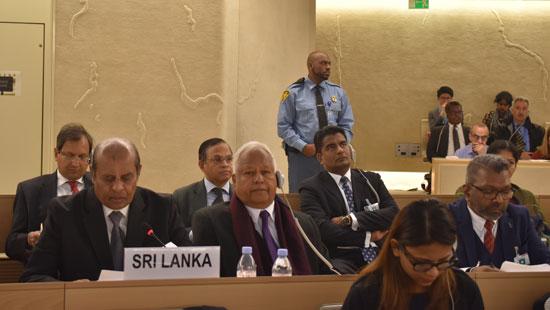
Sri Lanka today rejected UN High Commissioner for Human Rights Michelle Bachelet’s proposals to establish an Office of the High Commissioner for Human Rights (OHCHR) in Sri Lanka and calling to implement a detailed and comprehensive strategy for the transitional process with a ‘fixed timeline’.

We all are eager to see results. However, pressing for time bound benchmarks to show quick results on decades old, sensitive and complex issues, is bound for failure,” Foreign minister Tilak Marapana in a statement to the 40th Session of the Human Rights Council said.

Sri Lanka also rejected calls for setting up an international judicial mechanism to probe alleged human rights violations during the final phase of the the war, claiming that non-citizen judges are not allowed according to country’s constitution.

He also said that as a sovereign state, Sri Lanka must set its priorities in addressing the well-being and sustainable peace for her people. Various historical, cultural, and religious sensitivities therefore need to be managed while pursuing the ultimate objective of upholding and protecting human rights.

In developing these transitional justice mechanisms, Sri Lanka does not believe there is justification for the setting up of an Office of the High Commissioner for Human Rights in Sri Lanka,” the minister said.

Full statement:

Mr. President,

Madam High Commissioner/Deputy High Commissioner,
Members of the Council and Delegates to the 40th Session of HRC,
Ladies and Gentlemen.

I am pleased to be at the 40th Session of the HRC to share Sri Lanka’s significant progress on human rights since the last review in 2017. I am joined by my parliamentary colleague Hon. (Dr) Sarath Amunugama, the Governor of the Northern Province Hon (Dr) Suren Raghavan, senior government officials including Foreign Secretary Ravinatha Aryasinha and Deputy Solicitor General Nerin Pulle, and Permanent Representative Ambassador A.L.A. Azeez.

Sri Lanka’s engagement in these Council sessions is in keeping with our government’s vision for a country that embodies the universal values of human rights, justice, rule of law and good governance, while striving to eradicate poverty and ensure economic dividends to all – providing the people a fundamental assurance of security and a sustainable future.

Madam High Commissioner,

At the outset we thank you for the acknowledgement throughout your report of the open, constructive and cooperative approach adopted by the Government of Sri Lanka, towards all stakeholders, both within and outside the country, and with the processes and mechanisms of this Council. Our intention has been to engage comprehensively so that our deep-rooted commitment to achieving reconciliation is made evident. Sri Lanka remains committed to achieving reconciliation and has made steady progress in pursuit of that objective. We have reported to this Council at consecutive sessions on the substantial progress made among others, with regard to civil and political rights, including advances with respect to freedom of expression and assembly, civil society consultation, establishment of a robust right to information framework, the strengthening of independent commissions, including the Human Rights Commission, among others.

You would agree that the post-conflict milieu of each country is unique. There are no two post-conflict situations where similar prescriptive remedies can be applied. We can learn from others’ experiences but our own path to reconciliation will be primarily driven by the domestic context, in which we function. The basic tenet of a Transitional Justice process is the focus on its theoretical principles on State obligations. It is the State that must pursue Truth, Justice, Reparations and Guarantees of Non-Recurrence. Sri Lanka committed to such a process in 2015, and has been taking concrete action since, to move forward on these pillars.

In the area of Truth Seeking, an Office of Missing Persons (OMP) has been established by law and fully operationalised. The Cabinet of Ministers is currently considering draft legislation to establish a Truth and Reconciliation Commission. In the area of Justicereview of cases under the PTA have taken place and trials under the PTA have been expedited, while consultations are ongoing in Parliament to replace the PTA with proposed legislation for Counter Terrorism (CTA) ensuring its conformity to international standards and best practices. As for Reparations, the Office for Reparations Act passed by Parliament in October 2018 has provided for the establishment of an Office of Reparations in terms of the said law and three Commissioners have been recommended for appointment by the Constitutional Council. These institutions are empowered to look into, ascertain, acknowledge and address complaints made to the same. It must be noted that statutory duties performed by such bodies have to accord with a process of fairness and rules of natural justice, in achieving the objectives in respect to which such bodies are established. To ensure Non-recurrence of conflict, we are firmly resolved to fulfilling the agenda on reconciliation.

All these mechanisms and processes have been put in place within a short span. During this period, the Secretariat for Coordinating the Reconciliation Process and the Task Force also undertook a wide-ranging consultation process prior to operationalizing measures.  You would agree Madam High Commissioner that such a consultative approach was essential in order to ensure transparency and ownership of these mechanisms by the people of Sri Lanka.

While noting the contents in paragraphs 10-13 of the OHCHR report Madam High Commissioner, on the political developments of late 2018, it is also recalled that during the period in question, the Supreme Court embarked upon resolving the constitutional issues that had arisen, in an expeditious manner, giving credence to the independence of Sri Lanka’s judiciary. Furthermore, law and order was maintained by the security forces and the police, and the public service conducted itself in an exemplary manner. This clearly demonstrated Sri Lanka’s strong democratic credentials and institutional stability.

In the context of paragraph 15, the institutions already established to take the transitional justice measures forward would require that they adhere to the rule of law, and the results of the work carried out by such institutions should be able to withstand the test of any potential judicial process. Thus, while appreciating the acknowledgment in the report that steps have been taken for institution building, it may be recalled that the benefits arising from the functions of such institutions that accrue to individual rights holders should accord with the principles of natural justice as decisions made in haste compromise on principles of natural justice.

With regard to paragraph 17, contrary to the view that the Government of Sri Lanka has lagged in the actual implementation of the commitments beyond the establishment of coordinating bodies, it must be noted that the OMP has been fully operationalized and the Office for Reparations Act passed by Parliament has provided for the establishment of an Office forReparations in terms of the said law. These institutions are empowered to examine, ascertain, acknowledge and address complaints made to the same, and perform its statutory duties in accordance with a process of fairness and rules of natural justice. Funding for the Office for  Reparations has been allocated in the 2019 National Budget.

In the context of paragraph 19, it may be noted that under the Reparations Act which was passed into law in October 2018, three Commissioners have been recommended for appointment by the Constitutional Council and in the 2019 Budget, the Government has allocated Rs. 500 million to pay a monthly allowance for families of disappeared persons who have received the certificate of absence.

With reference to paragraph 23 of the Report with regard to the discovery of human skeletal remains in Mannar on 29th May 2018, this matter is a case in point for the need to exercise caution in approaching issues of this nature. Contrary to pre-conceived notions, it was scientifically established that the recovered skeletal remains had no nexus to the conflict. Having been facilitated through the Office of Missing Persons (OMP), the test results obtained from a USA laboratory have revealed that the said skeletal remains date back to 1499-1719 AD – a period when Sri Lanka was largely under European colonial rule. This is yet another instance that demonstrates that allegations and mere collection of data should not be pre-judged to cast unjustified aspersions. It also amply demonstrates the need for allegations to always be subject to the due process of investigation in accordance with established legal procedures and not be hastily credited to support unfounded assumptions.

With reference to paragraph 25 of the Report, the amendments suggested by the Supreme Court to the content of the Bill on the Office for Reparations” complies with the basic structure of our Constitution that recognizes a functional separation of powers pertaining to organs of government. The incorporation of amendments suggested by the Supreme Court, considered by the Parliament to make amendments to the Reparation Law, is a mandatory process that ensures the constitutionality of the said law.  Furthermore, contrary to your observation , it may be noted that the proposed amendments suggested by the Supreme Court broadens its applicability to  persons who could seek redress before the Office for Reparations, since complaints that can be received and considered, both individually and collectively by the Office, would no longer be limited to alleged violations of human rights or International Humanitarian Law, but would inter alia in terms of the definition provided in section 27 of the Act, include – persons who have suffered damage as a result of loss of life or damage to their person or property – such damage being in the nature of prolonged and grave damage suffered by individuals groups or communities of people of Sri Lanka.

Madam High Commissioner,

At a time the world is confronted with increasing acts of terrorism and violent extremism, as I stated before this Council last year, the action by the Sri Lankan security forces during the conflict was against a group designated as a terrorist organization by many countries, and not against any community. The  modus operandi of this terrorist group, which for the first time in recent history deliberately targeted civilians, have now been adopted by terrorist groups all over the world. All communities in Sri Lanka were united against terrorism, and now that terrorism has been defeated, all communities are working in unison towards reconciliation and economic progress.

Hence, in the context of paragraph 27 and 29, with reference to criminal accountability, it must be re-stated that Sri Lanka guarantees to all its citizens their rights in accordance with the constitutional and judicial process of Sri Lanka. However, the reference in the said paragraph to the abundant evidence that the ordinary criminal justice system is unable to deal with the nature of the allegations, and the complexity of the crimes is misconceived. On the contrary, the judicial system in Sri Lanka is adequately equipped to deal with complex crimes.. Criminal investigations pertaining to cases referred have been taken congnizance of  by the investigating agencies to be conducted under established legal procedures and are periodically being monitored in terms of the judicial process. Any complex criminal investigation is time consuming. The acknowledgement in paragraph 20 of the report that ‘victim tracing procedures’ require thorough assessments in multiple areas and takes time, is an indicator that establishes the said assertion. It also negates the alleged inability of the Sri Lankan criminal justice system to deal with the nature of allegations and complexity of crimes.

Further, it must be asserted that there are no proven allegations against individuals on war crimes or crimes against humanity in the OISL report of 2015 or in any subsequent official document. It is an injustice to deprive any serving or retired officer of the Sri Lankan security forces or the police their due rights.

There has been persistent and repeated reference in official documents of the OHCHR and this Council to exaggerated numbers as the alleged death toll during the last stages of the conflict. These assertions remain in direct contradiction to independent assessments sent by foreign missions, UN agencies as well as other international organizations, including the ICRC – and  some heavily redacted accounts of which have been presented not only in the House of Lords in the UK on 12 October 2017, citing dispatches by the UK Defence Attaché in Colombo during the last stages of the conflict, but also in writings by academics and journalists which is found in the public domain .

The Government of Sri Lanka believes that it is indeed erroneous that more attention has not been paid to the above mentioned information, by agencies including the OHCHR, which is required to seek the truth.

With reference to paragraph 31, it must be noted that constitutional reform is a continuing process conducted in accordance with the procedures of Parliament, which has moved forward unimpeded notwithstanding other political developments in the country. This process requires addressing all issues relevant to the diverse populace of Sri Lanka and is necessarily embarked upon taking cognizance of the concerns of all stakeholders.

Madam High Commissioner,

With reference to paragraph 32, it may be noted that the draft legislation with regard to the counter terrorism law had inputs from a multiplicity of stakeholders, as well as technical assistance from UN agencies, who were fully engaged in developing the proposed draft to ensure compliance with international norms and best practices. In this exercise, all stakeholders were afforded the opportunity to contest the contents of the proposed Bill before the Supreme Court of Sri Lanka, which was availed of by several parties. Accordingly, the contested sections have received consideration of the Supreme Court and its views on the contents of the Bill are now before the Sectoral Oversight Committee on International Relations in Parliament, where committed discussions have been held, including with civil society. It is also pertinent to note that certain segments of Sri Lanka’s civil society have advocated the repeal of the PTA and non-introduction of any further legislation to deal with terrorism-related issues.  These matters that have been placed before the Oversight Committee of Parliament, have resulted in a further prolonged deliberation process in enacting the CTA.

With reference to the paragraph 35, Sri Lanka appreciates the recognition by the Council of the considerable efforts taken by GOSL in releasing lands held by the security forces.

As I pointed out in the Sri Lanka Parliament on 14th March 2019, I would like to emphasize that the data reflected in the High Commissioner’s report that only 75% of the land held in 2009 by the security forces has been released is at significant variance with the actual numbers.  

–    Of the 71,172.56 acres of State lands held by the Security Forces, since May 2009, 63,257.48 acres have been released, as at 12th March 2019, i.e. a release of 88.87% of land originally held.

–    Of the 28,215.29 acres of the private land held by the Security Forces since May 2009, 26,005.17 acres (92.16%) have been released as at 12th March2019.

These significant figures highlight the utmost priority accorded by the Government to the incremental and expeditious release of lands held by the security forces.

However, the remaining lands, which are a necessity in the context of national security, would continue to be held by the security forces, with compensation being paid in respect of privately owned lands.

I wish to emphasize here that President Maithripala Sirisena’s pledge to complete the release of land and the appointment of a Presidential Task Force on Northern and Eastern Provinces Development through the Gazette Notification (No 2074/11 of 5 June 2018), considerably expedited the process over the past year. This Task Force which meets regularly to monitor and advice on development activities in the two Provinces, includes the Hon. Prime Minister, Cabinet Ministers, Governors of the Northern and Eastern Provinces, Chief Ministers, Chief Secretaries, all Heads of Departments and Members of Parliament representing the Northern and the Eastern Provinces, as well as the Secretaries of the Ministries of Defence, Finance and Foreign Affairs.

With regard to the issue of lack of Infrastructure”, 66,100 houses have been constructed and handed over in the North and East to civilians during the period of 2009 to 2018. In 2019, work commenced, on the construction of 4,750 houses on an owner driven model”.  It is anticipated that this programme would be completed by June 2019. The Hon. Prime Minister has taken keen interest to see to the progress of the development in the North and East. On his recommendation a programme to construct 10,000 houses has commenced.

Other infrastructure development projects that have taken place since 2015 – 2018 are as follows:  

1. Livelihood Assistance        –    23,548 families (Rs. 100,000/- per family)
2. No of domestic common wells     –    1,817 nos.
3. No of Water Connections         –    10,245 families (Rs. 25,000/- per family)
4. Electricity Supply             –    14,374 families
5. Internal Roads             –    254 nos.
6. No of Sanitation facilities                –    14,238 families (Rs.60,000/-  per family)
7. Hospitals/Health Centers         –    56 nos.

The above represent only a few of the many development projects launched by the Government of Sri Lanka for the economic well-being of the people of the Northern and Eastern Provinces.

With reference to the concern raised on the alleged destruction of property before return, it needs to be categorically stated that there is no such government policy. On the contrary, the security forces have dismantled military infrastructure before the handover in the interest of the safety and facilitation for civilians.

It must also be noted, Madam High Commissioner, that the Government of Sri Lanka has no policy of Colonization” of either the Northern Province or Eastern Province, or as a matter of fact, of any province in the country. As regards the contention that land owners are deprived their land by declaring their land as forest cover or as archeological projects, it must be clearly and categorically stated that the Government has not resorted to any such measures. However, it must be born in mind that the protection of forest land and archaeological projects is an obligation cast on any State in accordance with its international obligations that mandate protection and preservation of the environment and of cultural heritage. Furthermore, in identifying the relevant forest land and the cultural heritage, respective provincial administrations are also consulted.

While fully acknowledging the mandate of this Council in the prevention of human rights violations and responding promptly to human rights emergencies around the world, Sri Lanka believes that this Council knows only too well the comparative experiences of countries which have traversed the path of post-conflict transition and reconciliation. These countries have often made deliberate efforts to maintain a careful balance between the speed of the transitional justice process and the desired quality, inclusiveness, comprehensiveness and sustainability of the outcomes. This is particularly true for countries like Sri Lanka, where unlike in certain other post-conflict situations, the challenge is not one of ‘State building’, but of ‘peace building’. The Government of Sri Lanka is committed to finding effective and culturally sensitive and viable practices of healing and social co-existence.

However, the considerable unevenness in the standards of proof applied to the Government of Sri Lanka, compared to those applied to the unsubstantiated allegations made by Sri Lanka’s detractors is problematic and confounding. In this context, the Mannar graves referred to in para 23 of the High Commissioner’s Report and elaborated earlier is a case in point. While this report may have been compiled over several months ago, at the time of its release, a determination on the dating of the remains had already been made based on forensic evidence.  We do not see this important detail included in the report. Moreover, the report presupposes other mass graves might be expected to be found in the future”. An assumption of this nature in a public report, on a matter of this magnitude and seriousness, is not acceptable, and may even cast a doubt as regards other assertions in the report.

Conventional wisdom teaches us that when facts do not fit a theory, the theory has to change. However, conventional wisdom does not seem to be applied to Sri Lanka’s case. It seems that even if the theory is disproved through hard evidence that absolves Sri Lanka, as in the case of the Mannar graves, a matter in which some sceptics sought to implicate the Government of Sri Lanka, such facts are cast aside for further inquiry.

At the same time, as stated earlier, when evidence surfaces, which contests the culpability of the Sri Lankan security forces and police in having deliberately caused civilian casualties during the last phase of the conflict, this evidence is summarily disregarded.

Madam High Commissioner,

In referring to para 68 (C) of the OHCHR Report (A/HRC/40/23), which pertains to the Recommendations to GOSL, to ‘to adopt legislation establishing a hybrid court to investigate allegation of violating and abuses of international law and violations of international humanitarian law’, I wish to make it clear that our position on this matter is as follows’,

The Government of Sri Lanka at the highest political levels, has both publicly and in discussions with the present and former High Commissioner for Human Rights and other interlocutors, explained the constitutional and legal challenges that preclude it from including non-citizens in its judicial processes. It has been explained that if non-citizen judges are to be appointed in such a process, it will not be possible without an amendment to the Constitution by 2/3 of members of the Parliament voting in favour and also the approval of the people at a referendum.

In this backdrop, while countries including the co-sponsors acknowledge these ground realities in conversations, these incongruities should be corrected in letter as well, and Sri Lanka should be encouraged and assisted in finding innovative and viable local mechanisms and processes which incorporates international best practices, particularly at a time when as recently demonstrated our judicial, public service  and defence institutions have shown independence, resilience, robustness and resolve. It is only then, that we will be able to bring closure to these events, which would enjoy the confidence of victims and society at large”, as referred to in the High Commissioner’s Report.  

We all are eager to see results. However, pressing for time bound benchmarks to show quick results on decades old, sensitive and complex issues, is bound for failure. As a sovereign state, Sri Lanka must set its priorities in addressing the well-being and sustainable peace for her people. Various historical, cultural, and religious sensitivities therefore need to be managed while pursuing the ultimate objective of upholding and protecting human rights. Sri Lanka’s engagement and close cooperation with this Council and with all other human rights mechanisms derive indeed from political will and pledges by the Government in 2015 to the people of Sri Lanka, to build the nation’s future guaranteeing equal rights, justice and dignity for all citizens respecting and celebrating the diversity of the nation as a united and prosperous country.

Madam High Commissioner,

In developing these transitional justice mechanisms, Sri Lanka does not believe there is justification for the setting up of an Office of the High Commissioner for Human Rights in Sri Lanka.

This said we welcome the benefit extended by the expertise and support of the UN and OHCHR, and in particular technical assistance from the technical advisers of the Special Rapporteur on the promotion of truth, justice, reparation and guarantees of non-recurrence. We also appreciate the understanding shown and the technical and financial assistance offered by other bilateral and multilateral partners. We would also welcome further capacity building, particularly training for judicial, prosecutorial, and investigation officers, in enhancing specialized skills in their respective areas and further improving the functions and credibility of the ongoing local processes.
The Government of Sri Lanka looks forward to continuing our engagement with the Office of the UN High Commissioner for Human Rights, UN Human Rights mechanisms and procedures, and working in close cooperation with the international community in our journey towards achieving civil, political as well as socio-economic and cultural rights, and consolidating durable peace and reconciliation for our people.

I thank you.

Co-sponsoring Int’l agreement or not is President’s decision – Wijeyadasa

March 20th, 2019

GAGANI WEERAKOON Courtesy Ceylon Today

President Maithripala Sirisena has not given his consent to co-sponsor the United Nations Human Rights Council Resolution to extend the 2015 Resolution by another two years, Parliament was told today (19).

United National Front Parliamentarian Dr. Wijeyadasa Rajapakshe (PC) claimed that it is the President who has the powers to decide as to whether the country should co-sponsor an international agreement or not.

The MP, taking the floor during the Budget debate, said that co-sponsoring 2015 resolution was an ‘unwise act’, adding that he had told Minister Mangala Samaraweera, that the US, the UK and the European Union delegations were not in line with Sri Lanka’s Constitution.

Under the previous administration, MP Sajin Vaas Gunawardena, who oversaw the External Affairs Ministry, was above then External Affairs Minister Professor G.L. Peiris and he was allowed even to exert muscle power against anybody. That was how the previous Government handled the foreign policy. The same happens even today. Foreign Affairs Minister Thilak Marapana or Ministry Secretary Ravinatha Aryasinghe is not aware of most of the decisions. The decisions related to the foreign affairs are taken at the Finance Ministry. Some of those meetings were held at the official residence of the Finance Minister with the participation of his close associates and Non-Governmental Organizations-men. Today, Senior Advisor Mano Tittawela is the one who gives instructions to our Ambassador in Geneva. What authority does he have to decide the country’s foreign policy,” MP Dr. Rajapakshe questioned.

MP Rajapakshe further alleged that Singapore was covering former Central Bank Governor Arjuna Mahendran because of the Free Trade Agreement with Singapore from which it reaped a host of benefits.

Sri Lanka wins record foreign investment in oil project

March 20th, 2019

Courtesy Adaderana

Sri Lanka announced Tuesday that an overseas joint venture had committed $3.85 billion to a new oil refinery – the single largest foreign investment in the country’s history.

The Board of Investment of Sri Lanka said construction would begin this weekend on the refinery and storage facility jointly financed by Oman’s Ministry of Oil and Gas and a Singapore-registered company.

Deputy international trade minister Nalin Bandara said he expected the refinery, which will eventually produce 200,000 barrels a day, to be fully operational within four years.

This is the biggest single foreign investment (in Sri Lanka’s history),” he told reporters in Colombo.
It is more than double the next largest foreign investment – a $1.4 billion land reclamation project next to Colombo port.

Oman will fund 30 percent of the new oil project while Singapore-based Silver Park International, which is majority owned by a business interest in India, will finance the rest.

It is being constructed near the port of Hambantota, which was leased to a Chinese state-owned enterprise in 2017 for 99 years after Sri Lanka was unable to service a loan from Beijing.

The circumstances surrounding China’s acquisition of that port, along one of the world’s busiest shipping lanes, generated concern in neighboring India and beyond over Beijing’s expanding presence in the Indian Ocean.
Bandara said new lines of cash pouring into the region showed foreign investors were not deterred by that experience.

The latest investment shows that companies in other countries too are interested in going to Hambantota,” Bandara said.

Sri Lanka attracted a record $2.37 billion last year in foreign direct investment, up 38 percent compared to the previous year, official figures show.

Several significant proposals were put on ice late last year as Sri Lanka reeled from a constitutional crisis, with rival factions of government claiming the right to rule the country.

Calm was restored after the Supreme Court ruled President Maithripala Sirisena illegally sacked his prime minister and parliament and called snap elections.

Sirisena’s opponents blamed the president for unnerving foreign investors at a time Sri Lanka desperately needs to spur its ailing economy.

Source: AFP

Huawei to introduce 5G in Sri Lanka this year

March 20th, 2019

Courtesy NewsIn.Asia

Colombo, March 19 (newsin.asia) – China’s global telecommunications giant Huawei, has reiterated its commitment to grow in the Sri Lankan market and introduce the 5G technology this year, the Daily FT reported here Tuesday.Huawei Technologies Lanka CEO Shunli Wang, quoted in local media reports said that Huawei had the potential to grow better in Sri Lanka with the government’s commitment and enterprises zeal to embrace digitization.Huawei, posted a global revenue of 102 billion dollars in 2018, with Sri Lanka being among its main markets.

In recent years it has launched MIMO (multiple input, multiple output) technology for home broadband service via wireless LANs, 3G mobile phone networks, and 4G mobile phone networks, as well as CloudAir, Huawei’s innovations in the field of radio air interfaces.Wang said following commercial success in Sri Lanka, Huawei had rolled out MIMO and CloudAir in other parts of the world including developed markets.Wang further said that in 2019, Huawei would focus on four areas in Sri Lanka.

Firstly, investment in knowledge transfer and human capital development, introduce latest technologies such as 5G, IOT, AI and Cloud to help widespread digital transformation, share and facilitate global expertise for ICT development; and offer Smart City solutions.All of these initiatives will create jobs, improve efficiency, reduce cost for businesses and enhance convenience to people,” Wang said.Whilst Huawei serves 70 percent of the population in Sri Lanka through the solutions and equipment via telecom operators, it helped Sri Lankan telecom carriers to become the first in South Asia to start commercial operations of 4G-LTE services, after introducing 3G in 2006.

Recently, Sri Lanka’s Minister of Digital Infrastructure and Information Technology Ajith P. Perera and Minister of Telecommunication, Foreign Employment and Sports, Harin Fernando had endorsed Huawei and confirmed no security concerns on Huawei or Chinese products being used in Sri Lanka.

‘How can we know the dancer from the dance?’ A comment on the recent dialogue about the anatta doctrine in Buddhism

March 20th, 2019

By Rohana R.Wasala

There was recently an exchange of views published in The Island newspaper between February 22 and March 14, 2019 and here in Lankaweb in the same period concerning the concept of ‘anatta’ in Buddhism (traditionally translated into English as soullessness, no-soul, non-self, etc). One of the most definitive responses, in my view, was from Ven. Bhante Dhammika of Australia (‘myself, yourself, no-self’/The Island, March 8, 2019). He has hinted that he might further elaborate his explanation in the future, which will definitely prove useful for all of us students of Buddhism. Except for Bhante Dhammika, all the others who contributed to this discussion in their own admirable ways, I think, are in the same category (of students of Buddhism).Of course, even learned monks including Bhante Dhammika, in my view, would prefer to describe themselves as students of Buddhism until they are ultimately ‘Awakened’.

Bhante Dhammika’s use of a billiard ball analogy to suggest how, probably, mental energy passes on at the death of a person to be reborn elsewhere would be quite attractive to those who think that the concept of rebirth is indispensable for Buddhism. Science teacher Bodhi Dhanapala from Canada (The Buddha’s ‘Anatta’ doctrine and mathematical thinking’ Lankaweb, March 12, 2019) has a thought provoking thesis relating to the same subject from a mathematical point of view (which I am still trying to grasp as a layman, though). He thinks that the cycle of rebirth in the Buddha’s teaching is a PROCESS or a becoming, and that the Buddha’s focus in his first sermon is the cycle of rebirth within one lifetime, which is SAMSARA; there is no reference to a next birth. This, I think, is not to say that belief in a cycle of deaths and births that goes beyond this life should be rejected. It’s only that such a belief, whether true or false, does not matter to Buddhism. We are dying and being born again all the time; cells in our bodies are replaced everyday and we change physically every moment; we change mentally even faster. The pali term ‘nama rupa’ (Name and Form, or physical and mental energies, as Ven. Dr W. Rahula translates the term – Pl. see below) refers to these two changing phenomena. The process of arising and dying (Samsara) exists whether there is a next life or not. I am among those who are attracted to Bodhi Dhanapala’s opinion. Bhante Dhammika’s view (expressed in the two concluding paragraphs of his article) is uncertain in this regard. Bhante Dhammika’s illustration of the changing nature of the physical identity of a person over time within their lifetime by comparing the current physical image of a grandmother to a childhood photograph of her is an effective way of explaining the illusion of continuity in flux (illusion of a fixed identity or self) that we experience everyday. He draws our attention to the Buddhist teaching’s insistence on the necessity of the experiential ‘realization’ of the ultimate truth as distinct from a mere intellectual grasp of the same.

With the exception of Bhante Dhammika and Bodhi Dhanapala, none tried to spell out their own understanding or interpretation of the term ‘anatta’ precisely or at all; nor did the others try to offer a/the commonly accepted definition of the anatta concept. Of course, this was not an omission on their part. It was probably because the initial focus of the dialogue was not ‘anatta’ itself, but the challenges the idea faced in history and still faces from religio-ideological rivals of what is considered pristine Buddhism.

Incidentally, Ven. Dr Walpola Rahula, an undisputed authority on Buddhism (including both the dominant sects of Theravada and Mahayana) explains Samsara as ‘continuity of existence, cycle of existence’. There is a very good explanation that touches on this subject in Chapter III of his classic treatise on Buddhism ‘What the Buddha Taught’(1959) under the heading The Second Noble Truth: Samudaya: ‘The Arising of Dukkha’.

Dr Asoka Weerakkody (‘Anatta’ – what’s in a name?’/The Island, February 27, 2019) wrote: Buddhism (or preferably, Dhamma) is a uniquely logical form of belief, compared to all others. But anatta is its Achilles’ heel. The basic triad of dhamma, anicca, dukkha is easy enough to comprehend. They are real; you see them and feel them. But anatta in contrast is a metaphysical concept, which does not sit easily with the rest of the concepts”. Logical or illogical mere unquestioning belief or faith has no place in Buddhism.  Bodhi (Awakened or Awakening) through one’s own effort without the help of an external agent is the goal of Buddhism. To talk about a ‘basic triad of dhamma, anicca, dukkha’ that excludes ‘anatta’ is unusual. The actual formula is ‘anicca, dukkha, anatma’. In what sense Dr Weerakkody used ‘dhamma’ here is not clear to me. (The term dhamma is applied in Theravada Buddhism in multiple senses as explained by Dr Walpola Rahula in ‘What the Buddha Taught’: the word has the meanings of ‘Truth, Teaching, righteousness, piety, morality, justice, nature, all things and states conditioned or unconditioned, etc.) Dr Rahula explains nibbana/nirvana as an unconditioned state. In this connection (that is, regarding the term ‘dhamma’), he refers to three verses in the Dhammapada  as ‘extremely important and essential in the Buddha’s teaching’. They are nos 277, 278 and 279. The three verses together enumerate the three characteristics of ‘anicca, dukka, anatta’ (transience, suffering, no-self). These traits are collectively called ‘Tilakkhana’ or the Three Characteristics (of Existence); all three are metaphysical concepts (i.e., philosophical ideas about the nature of reality or what we conventionally take to be reality). The three Dhammapada  verses state in turn: ‘All conditioned things (samkara) are anicca or impermanent’, ‘All conditioned things (samkara) are dukkha or suffering’, but ‘All states (dhamma) are without self or anatta’ (I have here marginally modified Dr Rahula’s English renderings of the opening lines of the three verses without altering their meaning.) He explains why the Buddha said ‘All states (dhamma) are without self’, instead of ‘All conditioned things (samkara) are without self’: That is because the Buddha wanted to categorically deny an unchanging eternal Soul or Atman either within an individual or outside. In order to do this, he replaced ‘samkara’ with ‘dhamma’ in the third verse. The term samkara (or conditioned things) means the Five Aggregates, all conditioned things and states, physical and mental. But ‘dhamma’ includes both conditioned and non-conditioned things, the Absolute, Nirvana; all are without self. So, the Buddha teaches that ‘All dhammas are without Self’, there is no Self, no Atman, not only in the Five Aggregates, but nowhere else too outside them or apart from them”, as Dr Rahula puts it.

The concept of anatta is of pivotal importance to  Buddhism; it is its lynchpin, not its Achilles’ heel.  Dr Rahula explains why anatta should be considered crucial to the Buddha’s teaching and how the anatma doctrine is unique to Buddhism. He also suggests how it distinguishes Buddhism from other religious teachings. This information is found in Chapter VI titled ‘The doctrine of no-soul: Anatta’ in ‘What the Buddha Taught’, where he writes:  

Two ideas are psychologically deep-rooted in man: self protection and self-preservation. For self-protection man has created God, on whom he depends for his own protection, safety and security, just as a child depends on its parent. For self-preservation man has conceived the idea of an immortal Soul or Atman, which will live eternally. In his ignorance, weakness, fear and desire, man needs these two things to console himself. Hence he clings to them deeply and fanatically. ……. …………………  According to Buddhism, our ideas of God and Soul, are false and empty. Though highly developed as theories, they are all the same extremely subtle mental projections, garbed in an intricate  metaphysical and philosophical phraseology. …………….. The Buddha knew this quite well. In fact, he said that his teaching was ‘against the current’ (patisotagami), against man’s selfish desires…..”.

Hence, the anatma doctrine separates the Buddhist teaching from other religious traditions that are based on the concept of Soul or Atman. Professor Carlo Fonseka’s gracefully lighthearted claim that he has formulated the aphorism that the anatta doctrine divides Buddhism from all other religions, and unites all forms of Buddhism” (The Island/February 22) is a well authenticated one.

Finally, a word about the verse line ‘How can we know the dancer from the dance?’ in the title of this essay. It is from Irish poet W.B. Yeats’ poem Among School Children (1926). This poem lends itself to a Buddhist interpretation. It can be read as a meditation on the impermanence, insubstantiality, and unsatisfactoriness of our existence. We know that, by his time, many English and other European intellectuals had long been taking a special interest in Eastern languages, cultures, religions, and philosophies, and had been deeply impressed by what they discovered. Yeats himself was interested  in Indian ‘mysticism’. In Buddhism, however, he came across something very different. Among School Children can be described as a reflection on Tilakkhana or the Three Characteristics (the subject of the three Dhammapada  verses referred to above): anicca, dukkha,and  anatma (impermanence, unsatisfactoriness, and soullessness), the realization of which is the Path to Purity. He relates these to his own sixty year old life and the unrequited love that he had in his youth for a very beautiful woman (Maude Gonne, Irish nationalist and fiery revolutionary). He himself was not bad looking as a young man; he too ‘had pretty plumage once’, he modestly claims. Though Yeats loved the woman passionately, she rejected his four times repeated marriage proposal, before marrying someone else. In the poem, Yeats (then a Senator, ‘a … public man’ at sixty years of age) makes an official visit to an elementary school in Dublin. He is shown around by a nun. Looking upon ‘one child or the other there’ he dreams of the Ledaean  beauty (Maude Gonne) whom he loved in the distant past. Her present image  (‘hollow of cheeks’, lean and haggard) ‘floats into the mind’. Thinking of his own similar decrepit condition, he muses whether a youthful mother, were she to visualize her sixty-year-old son, would think him

A compensation for the pang of his birth,
Or the uncertainty of his setting forth?

(i.e., whether he was worth the pain of bearing him and the anxieties involved in launching him into the world as a separate individual). Youth passes; beauty decays; love doesn’t last. We worship only images of our own making. There is no essence to them. The images that the nuns worship are not different. They also break hearts, because they are insubstantial. They are  products of their imagination, too. What we take to be substantial are only empty images, mere self-born mockers of man’s enterprise” (creations of our own imagination) as Yeats derisively describes them in this philosophical poem.

The four lines at the end of the poem deal with the theme of insubstantiality.

 O chestnut tree, great rooted blossomer,

Are you the leaf, the blossom or the bole?

In the above two lines, the poet addresses an imaginary chestnut tree and asks it what is its true identity, its substance or essence, or its ‘soul’ as it were: is it the leaf, the flower, or the trunk? We know it’s none of these. The name chestnut tree is applied to all of them together as a single living organism that ‘blossoms’. When the constituent parts are taken apart, the chestnut tree disappears, no essence is left. There is nothing by way of any ‘chestnuttreeness’. The metaphor here is from nature.

The last two lines use an image from the human world, that of the dancer. 

O body swayed to music, O brightening glance,

How can we know the dancer from the dance?

 ‘How can we know the dancer from the dance?’ presents another fine illustration of the anatma concept. The dancer is lost in her dancing. She is not conscious of herself during the dance. That is, in her complete absorption in her performance, she’s apparently got rid of even the illusion of  ‘Self’ that she normally experiences in life like all of us. (According to Ven. Rahula, getting absorbed in what one does, without having the consciousness ‘I am doing this’, is real Mindfulness.) As far as the spectators are concerned, the dancer ceases to exist when the dancing stops (you can’t separate the dancer from the dance). Yeats’ dancing figure helps one to make sense of the Buddhist teaching that there is doing, but no doer; there is suffering, but no sufferer, etc. That is, in the case of what we conventionally identify as an individual, suffering is a reality, a truth, but the ‘sufferer’ is an illusion, is non-self.

THE DANGER INHERENT IN CO-SPONSORING YET ANOTHER UNHRC RESOLUTION

March 20th, 2019

DHARSHAN WEERASEKERA, 19TH March 2017 

[Author’s note:  The present paper is part of a much longer paper being reviewed for publication in an international journal.  I am posting it here because of the urgency of the hour, given that the Government is planning on co-sponsoring yet another resolution at the UNHRC, a resolution that will reaffirm Sri Lanka’s commitment to resolution 30/1 of October 2015.  Very briefly, l think the co-sponsorship is a mistake, because it binds Sri Lanka to fulfilling the remaining provisions of resolution 30/1, the most dangerous of which is the recommendation to enact constitutional measures to facilitate a ‘political settlement’ for the problems of the minorities, especially the Tamils (Paragraph 16).  The recommendation in the way it is phrased in resolution 30/1 seems innocuous on the face of it, but can be exploited at a future date by Sri Lanka’s enemies to get the international community to endorse a referendum on secession for the Tamils.  Such a thing would be very useful if a pro-nationalist Government were to take over in Sri Lanka, say, starting in January 2020, and the international community needs a tool with which to destabilize the country and topple such Government.  So, it is crucial that the Sinhalayo prepare for the ‘worst-case’ scenario, namely, the moment a new Government is installed in Sri Lanka, the international community including the Tamil Diaspora starting the drumbeat for an international endorsement for a referendum on secession for the Tamils, claiming that the Government has failed to live up to its ‘commitments’ under the co-sponsored resolution.  If the ‘worse-case’ scenario does not materialize, that’s fine, because then the Sinhalayo will have won.  However, if it does, the Sinhalayo need a plan with which to fight it, and the sooner they start devising one the better.]

One of the key goals of the Constitutional Reformists in Sri Lanka has been to provide a political settlement” to the purported problems of the minorities, especially the Tamils.[1]  The international community especially the UNHRC has also been keen that such a ‘settlement’ be reached.[2]  Paragraph 16 of resolution 30/1 not only calls for a ‘political settlement’ in Sri Lanka, but sets out the Council’s view on what the settlement should be, that is, the form and substance of the settlement.   

In this section, I shall discuss how Paragraph 16 might be exploited by interested parties to do mischief to Sri Lanka, for instance, to encourage, incite or foment separatism or secessionism in the country in order to destabilize the country and thereby make it more amenable to control by outsiders, reminiscent of events in Kosovo and South Sudan. For now, I shall not discuss who might want to do this or why, and the probability or likelihood of it happening. (I shall turn to those issues in the next two sections.)

At the outset, it is necessary to address two crucial legal questions, the answers to which help highlight the advantage that Paragraph 16 gives to interested parties that for whatever reason might wish to destabilize Sri Lanka.  The two questions are:

  1. Does a resolution constitute interference for purposes of Article 2(7) of the U.N. Charter?
  • How is the term matters that fall within the domestic jurisdiction of states,” defined or understood for purposes of Article 2(7)?

I rely on the authoritative book, The Charter of the United Nations:  Commentary and Documents, by Leland M. Goodrich and Edward Hamro (1949) for the answers to these two questions.  The answer to the first question is that, a resolution could constitute interference for purposes of Article 2(7).  For instance, Leland and Goodrich state:

The practice of the United Nations makes it clear, as indeed does the phraseology of Article 2(7), that the word intervention” as used in the paragraph is not to be given a narrow technical interpretation.  While discussion does not amount to intervention, the creation of a commission of inquiry, the making of a recommendation of a procedural or substantive nature, or the taking of a binding decision constitutes intervention under the terms of the paragraph.[3]

A resolution of the U.N. or one of its subsidiary organs contains various recommendations of a procedural or substantive nature—for instance as Paragraph 16 does—that the target of that resolution is expected to carry out.  Therefore, in my view, a resolution would constitute an ‘intervention’ under Article 2(7).

The answer to the second question is that, a matter that falls within the domestic jurisdiction of a state,” is understood as any matter that has not been internationalized in some way or other.  The relevant passage from Goodrich and Hamro is as follows:

The rule of international law that a matter ceases to be within the domestic jurisdiction of a state if its substance is controlled by the provisions of international law, including international agreements, has been accepted [vide Advisory Opinion of the PCIJ in the case of the Nationality Decrees in Tunis and Morocco, PCIJ Publications, Series B.  No. 4][4]

There are two important points in the above that are relevant to Sri Lanka.  First, the form and substance of a political settlement in a country, which under normal circumstances would be up to the citizens of that country to decide and therefore essentially a matter within the domestic jurisdiction of that country, would cease to be so if it is internationalized in some way or the other by being brought under the purview of an international instrument or agreement. 

Second, by necessary inference, if a country were to co-sponsor a resolution, or a impose a resolution on itself, such a resolution would for all practical purposes constitute an agreement” between the country in question and the U.N. organ that ultimately adopts the resolution.  This because, by co-sponsoring, the country is question is voluntarily agreeing to carry out the conditions set out in the resolution.    The picture as to what exactly has happened to Sri Lanka by virtue of Paragraph 16 now becomes clear. 

Under normal circumstances, the UNHRC could not and should not have been able to make recommendations as to the form and substance of a ‘political settlement’ in Sri Lanka.  However, since Sri Lanka co-sponsored resolution 30/1, that bar has now been removed.  Furthermore, since the issue of the ‘political settlement’ is internationalized, the international community can continue to agitate the issue at the UNHRC and other U.N. venues, as long as the original co-sponsored resolution is legally valid. 

Therefore, the protection that Sri Lankans would normally be able to enjoy or claim under Article 2(7) of the U.N. Charter against attempts by the U.N. to intervene in the internal affairs of its members has arguably been removed, in respect of the very important issue of a political settlement” to solve the purported problems of the minorities.  

I shall now turn to the substance of Paragraph 16, and explain how an interested party can exploit it in order to destabilize Sri Lanka.  Admittedly, on the face of it, Paragraph 16 seems quite innocuous.  For instance, a skeptical reader might ask, All that Paragraph 16 seems to be saying is that Sri Lanka should go beyond the 13A  in devolving power to the Provinces, and furthermore, comply with the provisions of the 13A that have already been enacted.  So, what is wrong with that?”

(For those unfamiliar with the 13th Amendment to the Sri Lanka Constitution, it was enacted in 1987 and established a system of Provincial Councils.  Successive governments have avoided implementing two of the 13A’s clauses, the first authorizing a separate police force for each Province, and second giving the Provincial Councils power over State lands.  Whenever one sees a reference to full implementation” of the 13A it is a call to implement the two aforesaid clauses as well.)  

There is nothing wrong with Paragraph 16 if one forgets the lessons of Sri Lanka’s ordeal at the UNHRC over the past few years.  However, if one considers those lessons there is plenty to worry.  Recall that, the key component of the tactic that the U.S. perfected by experimenting with Sri Lanka is to first level a series of allegations against a country, and then, without ever substantiating those allegations, keep passing resolution after resolution in order to get the targeted country to do what the U.S. wants.

The genius of the tactic is that, no matter what the targeted country does to satisfy the terms of a particular resolution, as long as the U.S. and its allies get a majority of UNHRC members to back a vote on a resolution, they decide whether or not to pass yet another resolution against the targeted country, and what extra conditions to impose.  

Therefore, the conditions have now been created for an interested party operating through the UNHRC to dictate the content as well as pace of a political settlement” in Sri Lanka without reference to or independent of the practical realities that either the Sinhalese on the one hand or the Tamils on the other may be facing at any given time in the course of negations to make various concessions, and the merits of their arguments as to those difficulties.

It is reasonable to suppose that, a problem that led to a thirty-year civil war probably involves complexities that are not susceptible of quick solutions.  The various parties to the conflict are sure to have deep-seated prejudices and fears that need to be genuinely and thoroughly addressed if negotiations are to move forward.

I shall digress a moment at this stage to address an important question.  A curious reader might ask, Is there any particular reason for either the Sinhalese or the Tamils, or both, to suspect that the other is negotiating in bad faith?”  I cannot speak for others, but, as a Sinhalese at least from my point of view there certainly is. 

The constraints of time do not permit to dwell on this matter at length, but, I draw the reader’s attention to the following two remarks by R. Sampanthan, the Leader” of the Tamil National Alliance, the Tamil group that is demanding the political settlement.”  He makes these observations in the course of a seminal speech in March 2012 at an Annual Conference of the Illangai Tamil Arasu Kadchchi (ITAK) the political party under which members of the TNA contest elections.  He says:  

The softening of our stance concerning certain issues, and the compromise we show in other issues, are diplomatic strategies to ensure that we do not alienate the international community.  They are not indications that we have abandoned our fundamental objectives….Our expectation for a solution to the ethnic problem of the sovereignty of the Tamil people is based on a political structure outside that of a unitary government, in a united Sri Lanka in which Tamil people have all the powers of government to live with self-respect and dignity….Our acceptance of this position does not mean that we consider the 13th Amendment to be an acceptable solution, nor that, in the event of our right to internal self-determination is continuously denied, we will not claim our right under international law to external self-determination.  It only means that this is the only realistic solution today.’[5]

He also says:

The current practices of the international community may give us an opportunity to achieve, without the loss of life, the soaring aspirations we were unable to achieve by armed struggle.’[6]

To the best of my knowledge, no one from the TNA has publicly objected to or rejected Mr. Sampanthan’s sentiments above, which can be taken as evidence that he is expressing the general views of most members of the TNA.  Three things become clear from Mr. Sampanthan’s sentiments.  First, he is quite forthright in admitting that any concession the TNA is willing to make is only a ruse to placate the international community.  Naturally, a Sinhalese person would have a problem with this. 

Second, on the 13th Amendment, he is saying that his group does not consider the 13A an acceptable solution,” meaning that, even if the Sinhalese agree to implement the 13A completely (as for instance Paragraph 16 recommends) Mr. Sampanthan and his friends might still not be satisfied, and according to him, retain the right to move for external self-determination.”  In other words, no matter what the Sinhalese do to please the TNA, at the end of it they might still ask for a separate State. 

Finally, he is suggesting that his group should exploit the current practices of the international community”—by which he obviously means geopolitics—to gain what they could not gain through force of arms.  Again, a Sinhalese person might be forgiven for having a problem with such a sentiment. 

The following matters are also relevant.  The TNA is generally regarded as having been the political arm of the LTTE.[7]  The LTTE sought to create a separate State encompassing the Northern and Eastern Provinces.  This is exactly the area over which the TNA now wants full internal self-determination.”[8] 

Today, the Northern Province is completely denuded of the Sinhalese and Muslims. In October 1990, the LTTE gave 48 hours notice to the Muslims (the Sinhalese had by then been driven out) to vacate the province on pain of death.[9]  In the Jaffna Peninsula, they were given as little as two hours notice.[10]  But, in the Eastern Province, the three ethnic groups still live side by side in roughly equal proportions.[11]

I leave it to the reader to decide whether, given what happened in the Northern Province, a Sinhalese person would have a legitimate concern as to what might befall the Sinhalese and the Muslims in the East if a group that avowedly shares the soaring aspirations” of the LTTE were to take full control of the area.        

To return, Paragraph 16 permits an interested party, if they can muster enough votes at the UNHRC, to decide a priori what is the best political settlement” in Sri Lanka and the pace at which such settlement” should be pursued, and if at any given time they decide that it is not being pursued in the manner or at the pace they like, regardless of the reasons that the Sri Lankans may give as to why they are having difficulties with negotiations, impose further conditions.

Under the circumstances, just as the series of accountability” resolutions began with a two-paragraph resolution calling on the UNHRC to monitor” the situation in the country, an interested party could obtain a resolution calling on the Council to monitor” the progress of the political settlement,” and in subsequent resolutions ratchet-up the pressure until, claiming that the Government is shirking its responsibilities, adopt a resolution authorizing the Council to intervene in order to bring about the settlement.

In this situation, it is conceivable that an interested party might at some future date move a resolution calling on the Council to endorse a referendum on secession for the Tamils. And if this happens, in my view, it could potentially set up a repeat of the type of events that have transpired in Kosovo and South Sudan.  (I discuss the situations in those countries in Part Eight of this essay.)     

The important point is that, all of this could happen without a consideration of the merits of the arguments that the Government might present as to why the political settlement” has stalled if it has, or rather, in spite of them.   On the other hand, if Sri Lankans had been accorded the protection of Article 2(7) of the U.N. Charter, they would never have had to face this situation to begin with.  So, that is the danger in Paragraph 16.

I shall now turn to the question as to how probable or likely it would be that an interested party will exploit Paragraph 16.  For instance, a skeptical international reader might ask, Is there really an interested party with the means and the motive to do something like this?”  There are at least two:  The U.S. and the U.K.  I shall start with the latter.   

To be continued….


[1] See for instance, Ranil promises radical constitutional reforms to solve ‘national problem,’” Saman Indrajith, The Island, 21st January 2015

[2] See for instance, Report of the U.N. High Commissioner for Human Rights, A/HRC/32/CRP.4, 28th July 2016, www.ohchr.org, paragraphs 8-9; also, Report of the U.N. High Commissioner, A/HRC/34/20, 10th February 2017, www.ohchr.org,  paragraphs 24-26; also Report of the U.N. High Commissioner for Human Rights, A/HRC/37/23, 25th January 2018, www.ohchr.org, paragraph 21    

[3] Leland M. Goodrich and Edward Hamro, Charter of the United Nations:  Commentary and Documents, Stevens and Sons, London, 1949, page 120

[4] Ibid, page 120

[5] ‘Text of Presidential Address of R. Sampanthan at the 14th Annual National Convention of ITAK in Batticaloa,’ www.dbsjayaraj.com, 27 May 2012

[6] Ibid

[7] See for instance, TNA’s response disingenuous, selective and promotes polarization,” Arun Tambimuttu, The Island, 23rd March 2012, www.island.lk

[8] See for instance, TNA-Parliamentary Election Manifesto, 2015, Full Text,” 26th July 2015, www.colombotelegraph.com

[9] See for instance, The Quest for Redemption:  The Story of the Northern Muslims,”  The Final Report of the Citizens’ Commission on the Expulsion of the Muslims from the Northern Province by the LTTE in October 1990, Law and Society Trust, 2011 and 2012, www.lstlanka.org

[10] Ibid, Final Report

[11] The Sinhalese – 23%, Muslims – 37% and the Tamils – 34% (Eastern Province of Sri Lanka,” www.citypopulation.de

LEADERSHIP AND MOTIVATION FOR POLICY CORRECTIONS IN SRI LANKA

March 20th, 2019


BY EDWARD THEOPHILUS

To achieve a rapid economic development and sustainable economic growth, the most essential desideratum in Sri Lanka is policy correction in relation to political, economic, social and cultural areas. It is a gigantic task with a strong political and social motivation.  Since the political independence in 1948, Sri Lanka continuously involved in policy development tasks, which were misguided by a lack of clear vision, mission, objectives and activities. The other issue that related to the policy development is that the task doesn’t involve in a policy monitoring, variance analysis and remedial management process for redevelopment of policies consistent to international initiatives, directions, innovations and changes.

It is possible to make many mistakes or incurring weakness at the stage of policy development and the correction of policies, developed in the past.  In fact. it is a quite difficult task. For example, Sri Lanka introduced new language policy after 1956 election, later the country wanted to correct policy and it had many hurdles as UNP opposed with a public protest and in 1965 elected government attempted to develop a policy for political administration (Rata Saba), it was unsuccessful due to public protest but same policy introduced with the 13th amendment to the constitution, which has now a strong opposition in the country.

Policy monitoring and remedial management roles were purely the responsibility of bureaucrats and they never informed the outcomes of the role to public. It may have the ignorance of them or politicians did not direct them to do so.  The elected government in 1972 introduced a political authority for the purposes, later it became a tactic of taking revenge from opponents and making special treatments to political supporters.  Obviously, politicians and bureaucrats have poor knowledge, skills and experience for policy development and correction.

Therefore, the policy development and monitoring process had a clear division between the government, bureaucrats and public. The way bureaucrats were playing the role supported to the development of Machiavellian politics in the country to cheat each other. These are major reasons for the requirement of policy corrections and the current government has no opportunity to engage in policy correction, most probably it will cease to exist in 2020. The reason to achieve this type of situation by the current government was misguided so-called yahapana policy without a clear and strong political leadership.  Therefore, the next head of state will be elected by the presidential election should essentially need to engage in policy correction.  As people of Sri Lanka strongly believe that Mr Gotabaya Rajapaksa can give a political leadership and motivation for this giant task, SLPP needs educating voters on this issue.  My feeling is that IBRD, IMF and other international financial organizations would have informed to the government the requirement of honest policy process, but the government was reluctant to openly talk with public and show the nakedness of yahapalanaya to public as the government had to take responsibility to what they have done and October 26, in 2018 president Sirisena attempted to change the yahapalanaya but it was too late.

Party politics in Sri Lanka have been dominated since the era of the State Council and people must have realized that party politics have been Machiavellian than a real loyalty to the country. According to Machiavellian advices political leaders as well as public are bamboozlers in the society. The best example was that last stage of Sir John Kotelawala’s administration presented a Four-Year Development Program, which focused on a middle path between private sector and public sector economic strategies, but the program was cancelled after 1956 election. If there was a policy monitoring and remedial management at that time the shape of Sri Lanka would have different.

All political parties are still standing on Machiavellian politics than an honest intention to achieve a balance and rapid development and sustainable growth. People of the country also are behaving within a self-centred framework and politics in Sri Lanka seems that political parties attempt to mislead people in one time and people endeavours to mislead political patrician in another time. That is why I state politics in Sri Lanka obviously Machiavellian. Attitudes of people badly turned to selfishness and the of tele drama in Sri Lanka educates this dirty behaviour to kids and young generation.   

In fact, it seems that current politicians of the government are like crabs in a cooking sauce pan until get it heat at the next general election.  I read this interesting poem in a book written during the Kotte era, while I was studying in primary schools. The most regrettable experience is that people of Sri Lanka has not learnt lessons from this bad politics and next elections must lead to educate and go beyond the self-centred Machiavellian attitudes.  Today people need to positively response and create the stability eliminating Machiavellian politics in the country.

In this situation, people of Sri Lanka have realized that the best leader to change the current environment and to launch the country with a right leadership and motivation is Mr Gotabaya Rajapaksa and either, UNP, or SLFP or any other political party cannot stop him.  SLPP must announce his candidacy and commence election work.

නාගානන්ද, ජිනීවා සහ නීතිඥ වෘත්තියේ ස්වාධීනත්වය රැක ගැනීම වෙනුවෙන් ආණ්ඩුක්‍රම ව්‍යවස්ථා සංශෝධනයක කඩිනම් අවශ්‍යතාවය.

March 19th, 2019

අරුණ ලක්සිරි උණවටුන B.Sc(Col), PGDC(Col) නීතිඥ

නාගානන්ද සහෝදර නීතිඥවරයාට අභියාචනාධිකරණ හිටපු සභාපති විනිසුරු මලල්ගොඩ මහතා විසින් එල්ල කළ පැමිණිල්ලක් විභාග කිරීමෙන් පසු ලබා දී ඇති දඩුවම මේ වන විට මාධ්‍යයේ පළවී ඇත. ලංකාදීප එසැණ පුවත් යටතේ එකී පුවත පළ වී තිබුණේ මෙසේ ය.

නාගානන්ද කොඩිතුවක්කුගේ නීතීඥභාවය වසර 3කට අත්හිටුවයි

(තිළිණි ද සිල්වා සහ රංජන් කටුගම්පොළ)

සිවිල් සමාජ කියාකාරියෙකු වන නීතීඥ නාගානන්ද කොඩිතුවක්කු මහතාගේ නීතීඥභාවය වසර තුනකට අත්හිටුවීමට ශ්‍රේෂ්ඨාධිකරණය අද ( 18) තීන්දු කළේය.

2015 වසරේ එවකට අභියාචනාධිකරණය සභාපතිව සිටි විජිත් මළල්ගොඩ මහතාට අපහාසවන අන්දමින් අධිකරණය තුළ හැසිරීම සම්බන්ධයෙන් කොඩිතුවක්කු මහතාට එරෙහිව ශ්‍රේෂ්ඨාධිකරණය කළ විභාගයක් අවසන් කිරමින් මෙම නියෝගය ප්‍රකාශයට පත් කෙරිණි .

අගවිනිසුරු නලින් පෙරේරා , සිසිර ද ආබෘ සහ ප්‍රසන්න ජයවර්ධන යන විනිසුරු මඩුල්ල විසින් මෙම තීන්දු ලබා දුන්හ.

උපුටා ගැනීම…..

http://www.lankadeepa.lk/latest_news/නාගානන්ද-කොඩිතුවක්කුගේ-නීතීඥභාවය-වසර-3කට-අත්හිටුවයි/1-547433

එම පුවත http://www.lankatruth.com/si/නාගානන්දගේ-නීතීඥභාවය-වසර/ වෙබ් ලිපයේ මෙසේ දැක්විය.

වත්මන් ශ්‍රේෂ්ඨාධිකරණ විනිසුරු විජිත් මළල්ගොඩ මහතා අභියාචනාධිකරණයේ සභාපතිවරයා වශයෙන් කටයුතු කරමින් සිටියදී 2015 වසරේ 23දා රේගු නඩුවකදී විජිත් මළල්ගොඩ මහතාට අපහාසවන අන්දමින් අධිකරණය තුළ හැසිරීම සම්බන්ධයෙන් වැරදි කරු වූ නාගානන්ද කොඩිතුවක්කු මහතාගේ නීතීඥභාවය වසර තුනකට අත්හිටුවීමට ශ්‍රේෂ්ඨාධිකරණය අද ( 18) තීන්දු කර තිබේ.

ඒ සම්බන්ධයෙන් නාගනන්ද කොඩිතුවක්කු මහතාට එරෙහිව ශ්‍රේෂ්ඨාධිකරණය කළ විභාගය අවසන් කිරමින් අගවිනිසුරු නලින් පෙරේරා, සිසිර ද ආබෘ සහ ප්‍රසන්න ජයවර්ධන යන විනිසුරු මඩුල්ල විසින් මෙම තීන්දු ලබා දී ඇත.

අවධියේ නීතිඥ නාගානන්ද කොඩිතුවක්කු මහතාට එරෙහිව කර ලද පැමිණිල්ලකට අනුව පැවති විභාගයකින් අනතුරුව ශ්‍රේෂ්ඨාධිකරණ ත්‍රිපුද්ගල විනිසුරු මඩුල්ල මෙම තීන්දුව අද ප්‍රකාශයට පත්කර තිබේ.

එම රේගු නඩුවේදී විජිත් මළල්ගොඩ මහතා අපහසුවට පත්වන අයුරින් නීතිඥවරයෙකුට නුසුදුසු ආකාරයේ ප්‍රකාශයක් සිදු කිරීම සම්බන්ධයෙන් නාගානන්ද කොඩිතුවක්කු මහතාට එරෙහිව මෙම පැමිණිල්ල ඉදිරිපත් කර තිබුණි.

නීතිඥ නාගානන්ද කොඩිතුවක්කු මහතා සිදුකල මෙම ප්‍රකාශය ඉතා බරපතළ එකක් බවත් ඒ තුළින් අධිකරණ ක්‍රමය කෙරෙහි පවතින විශ්වාසය පලුදු වීමට හේතුවන බවත් තීන්දුව ප්‍රකාශයට පත්කරමින් විනිසුරු ප්‍රසන්න ජයවර්ධන මහතා ප්‍රකාශ කර ඇත.

නීතිඥ කොඩිතුවක්කු විසින් විනිසුරු විජිත් මලල්ගොඩ මහතා වෙත එල්ල කළ චෝදනාව පදනම් විරහිත අසත්‍ය චෝදනාවක් බව පෙන්වාදෙමින් ශ්‍රේෂ්ඨාධිකරණ විනිසුරු ප්‍රසන්න ජයවර්ධන මහතා ඒ තුළින් ඔහු නීතිඥවරුන්ගේ ආචාරධර්ම සංග්‍රහයේ 60 සහ 61 වන වගන්ති උල්ලංඝනය කර ඇති බව ද කියා තිබේ.

ඒ අනුව නීතිඥ නාගානන්ද කොඩිතුවක්කු මහතා අධිකරණ සංවිධාන පනතේ 42(2) වගන්තිය උල්ලංඝනය කර ඇති බවත් ඒ අනුව අදාළ චෝදනාවට ඔහු වරදකරු කර ඔහුගේ නීතිඥ භාවය වසර තුනකට තහනම් කරමින් නියෝගයක් නිකුත් කරන බවත් ප්‍රසන්න ජයවර්ධන මහතා සිය නඩු තීන්දුවෙන් කියා ඇත. (පුවත අවසන්)

අධිකරණය තුළදී තමන් හා භාෂණයේ සහ විවාදයේ යෙදෙන නීතිඥවරයන් හෝ පාර්ශවයක් සම්බන්ධව විනිසුරුවරයා සිය අභිමතය සහ බලය භාවිතා කිරීමේදී පාර්ශවයන් අතර සම්බන්ධතා ගැටීම අවම කරමින් සාධාරණ ලෙසත්, දෙපාර්ශවයටම යුක්තිය ඉටු කරන ආකාරයටත් ඒ ගැටුම නිරාකරණය කළ යුතු ආකාරය සම්බන්ධ විද්වත් කතිකාවක් ඇති කිරීම සහ විනිසුරුවරයෙක් විසින් නීතිඥවරයෙකුට එරෙහිව සිදුකරන පැමිණිල්ලකදී අධිකරණයේ සවාධීනත්වයට ඉන් සිදු කරන බලපෑම සහ ස්වාධීන නීතිඥ වෘත්තියක් වෙනුවෙන් ආණ්ඩුක්‍රම ව්‍යවස්ථා සංශෝධනයක් ගෙන ඒමේ කඩිනම් අවශ්‍යතාවය  පිළිබද කරන විග්‍රහයකට මේ ලිපිය විෂය වේ.

ලංකාවේ දොස්තරකම සක්විති පදවියක් වෙන්නේ කොහොමද ? මැයෙන් වෛද්‍ය රුවන් එම්. ජයතුංග විසින් ලියන ලද ලිපියක් පහත වෙබ් ලිපිනයෙන් කියවිය හැකිය. එයද දොස්තරලාට අමතර තව බොහෝ වෘත්තීන්වල නියැලෙන ඇත්තන්ද සක්විති රජවරුන් ලෙස විරාජව සිය ධූරවල රාජකාරිය කරවන හෙයින් එම ලිපියද කියවන ලෙස ඉල්ලමි.

https://www.lankaweb.com/news/items/2019/03/16/ලංකාවේ-දොස්තරකම-සක්විති/


ආරම්භය

තමාගේ නඩුව තමා නොඇසිය යුතුවා / Nemo judex in causa sua මෙන්ම තම සගයාගේ හෝ තම මිතුරාගේ හෝ තම සාමාජිකයාගේ නඩුවද තමා නොඇසීම අධිකරණයේ ස්වාධීනත්වයට අවශ්‍යයම වේතම මිතුරාගේ හෝ තම සාමාජිකයාගේ නඩුව තමා විසින් නොඇසිය යුතුබවට අපරදිග නීතියේ දක්වා නොතිබෙනවා විය හැකිය. නමුත් තමන් හා සම්බන්ධතාවයක් පවතින විටක අපක්ෂපාතී තැනැත්තෝ එකී විභාගවලින් බොහෝ විට ඉවත් වෙති. ස්වභාවික යුක්ති මූලධර්මයනට අනුව කටයුතු කිරීමේදී එසේ සිදු වේ. පවතින නීතිය සහ ස්වභාවික යුක්ති මූලධර්ම අතර ගැටීම් ඇති අවස්ථාවක නීතියට මුල් තැන දීමට සිදු වේ.

නීතිය යනු එක් තැන නතර වී කල් ගෙවන මෙවෙලමක් නොවේ. එය ස්ක්‍රීය සමාජ අවයවයකි. නීතිය සමාජ අවශ්‍යතා අනුව නිරතුරු අලුත් වේ.වර්තමාන ආණ්ඩුක්‍රම ව්‍යවස්ථාව 19 අවස්ථාවක් සංශෝධනය වූයේ ඒ අනුවය.

නීතියට පහසුවෙන් ප්‍රවේශ විය හැකි විය යුතුය. නීතිය බොහෝදුරට පහසුවෙන් අවබෝධ කර ගත හැකි විය යුතුය. නීතිය පැහැදිලි විය යුතුය. නීතිය කලින් කිව හැකි විය යුතුය. යන්න නීතියේ වැදගත් සිද්ධාන්තයකි. ඒ අනුව සමාජයේ සෑම තරාතිරමක තැනැත්තෙක් වෙතම නීතියේ පාලනය සාධාරණව ව්‍යාප්ත වීම අපේක්ෂා කරයි. ප්‍රජාවේ බහුතරයක් ආරක්ෂා වන්නේ එසේ සිදු විමෙනි. එය සඵල කරගැනිම සමාජ අපේක්ෂාවයි. ඉන් බාහිරව සමාජය දියුණු නොවේ.

ආණ්ඩුක්‍රම ව්‍යවස්ථාව යටතේ පිහිටුවන ලද නැතහොත් පාර්ලිමේන්තුව විසින් නියම කොට පිහිටුවන ලද සෑම අධිකරණයක, සෑම විනිශ්චය අධිකාරයක ම හෝ වෙනත් සෑම ආයතනයක ම නඩු විභාග, ආණ්ඩුක්‍රම ව්‍යවස්ථාවේ විධිවිධානවලට යටත්ව ප්‍රසිද්ධියේ පැවැත්විය යුතු බවත්, සියලූ තැනැත්තන්ට, ඒ නඩු විභාගවලට නිදහසේ පැමිණ සිටීමට හිමිකම් ඇති බවත් ආණ්ඩුක්‍රම ව්‍යවස්ථාවේ 106 ව්‍යවස්ථාවේ පැහැදිලි විධානයි.

ජනාධිපතිවරයා ගේ 2018.11.09 දිනැති අංක 2096 / 70 දරන පාර්ලිමේන්තුව විසුරුවාලීම කරන ලද ගැසට් පත්‍රයේ ප්‍රකාශය සහ 2019 ජනවාරි 05 වන දින පාර්ලිමේන්තු මැතිවරණය පැවැත්වීම අවලංගු කරමින් 2018.12.13 දින ශ්‍රේෂ්ඨාධිකරණ හත් පුද්ගල විනිශ්චය පීඨයක් ලබා දුන් තීරණය මේ දක්වා රාජ්‍ය භාෂාවෙන් ලබා දීමට විධායකය හෝ ව්‍යවස්ථාදායකය ක්‍රියා නොකිරීම ප්‍රජාතන්ත්‍රවාදය දුර්වල කිරීමක් වන අතර තොරතුරු දැන ගැනීමේ අයිතිය, භාෂාව මත වෙනස්කමකට ලක් නොවී සිටීමේ අයිතිය, සිතීමේ නිදහස, අදහස් පළකිරීමේ අයිතිය ඇතුලු මූලික අයිතිවාසිකම්වලට මෙමගින් බලවත් අනතුරු ඇති කරන බවත් ජනාධිපතිවරයා විසින් 2019 ජනවාරි මස 05වන දින කැදවා තිබූ පාර්ලිමේන්තු මැතිවරණය නොපවත්වන ලද්දේ කවර නීතිමය හේතුමතද යන්න අවබෝධයෙන් තොර බවත් ජනතාච අතර සාකච්ඡා වෙමින් පවතී. රාජ්‍ය භාෂාවට විධායකය – අධිකරණය සහ ව්‍යවස්දායකය දක්වන අවම සැලකිල්ල මෙයට හේතුවයි.

රාජ්‍ය භාෂාවට විධායකය – අධිකරණය සහ ව්‍යවස්ථාදායකය අවම සැලකිල්ලක් දක්වමින් තිබෙන අවස්ථාවකදී පොදු  ජනතාවට සත්‍ය තොරතුරු දැන ගැනීම භාෂාව මත වාරණය වී ඇති අවස්ථාවක මේ පිළිබද සාකච්ඡා කිරීමට සිදු වී ඇත.

ජනාධිපතිවරයා සිය ධූරයේ කටයුතු කරද්දී දෝෂාභියෝගයට සහ නඩු පැවරීමට යටත් කළද උපරිමාධිකරණ විනිසුරුරුන් දෝෂාභියෝගයට පමණක් යටත් කර අධිකරණයේ ස්වාධීනත්වය ආරක්ෂා කිරීම

ආණ්ඩුක්‍රම ව්‍යවස්ථාවේ 35 ව්‍යවස්ථාව ජනාධිපතිවරයට එරෙහිව නඩු පැවරීම සම්බන්ධ විධිවිධාන දැක්වෙන අතර 38.2 ව්‍යවස්ථාවේ ජනාධිපතිවරයා ධූරයෙන් ඉවත් කිරීමට අදාල දෝෂාභියෝග පියවර දැක්වේ.

35 ව්‍යවස්ථාව මෙසේ ය.

  1. (1) යම් තැනැත්තකු ශ්‍රී ලංකා ජනරජයේ ජනාධිපතිවරයා ලෙස ධූරය දරන අවස්ථාවක දී, ඔහු විසින් පෞද්ගලික තත්ත්වයෙහි ලා හෝ නිල තත්ත්වයෙහි ලා කරන ලද හෝ නොකර හරින ලද කිසිවක් සම්බන්ධයෙන් ඔහුට විරුද්ධව කිසිම සිවිල් හෝ අපරාධ නඩු කටයුත්තක් පැවරීම හෝ පවත්වාගෙන යාම හෝ නොකළ යුත්තේ ය :

එසේ වුව ද, ජනාධිපතිවරයා විසින් ඔහුගේ නිල තත්වයෙහි ලා කරන ලද හෝ නොකර හරsන ලද කිසිවක් සම්බන්ධයෙන් නීතිපතිවරයාට විරුද්ධව 126 වන ව්‍යවස්ථාව යටතේ ඉල්ලීමක් කිරීමට යම් තැනැත්තකුට ඇති අයිතිය සීමා කරන ලෙස මේ අනු ව්‍යවස්ථාවේ කිසිවක්, කියවා තේරුම් නොගත යුත්තේ ය:

එසේම තවදුරටත්, ජනාධිපතිවරයා විසින් 33(2ඔඋ) ව්‍යවස්ථාව යටතේ බලතල ක්‍රියාත්මක කිරීම මත ප්‍රඥාපනය කිරීමට, ශ්‍රේෂ්ඨාධිකරණයට අධිකරණ බලය නොතිබිය යුත්තේ ය.

(2) කවර වූ හෝ තැනැත්තකුට විරුද්ධව, කවර හෝ විස්තරයක නඩුවක් පැවරිය හැකි කාලය සීමාකරමින් නීතියෙන් විධිවිධාන සකසා ඇති විට, ඒ තැනැත්තා යම් කිසි කාලයක් ශ්‍රී ලංකා ජනරජයේ ජනාධිපති ධූරය දරා ඇත්නම් එකී නඩුව පැවරිය හැකි කාල සීමාව ලෙස නීතියෙන් නියමව ඇති කාලය නිශ්චය කිරීමදී ඒ තැනැත්තා ජනාධිපති ධූරය දැරූ කාලය නොගැනිය යුත්තේ ය.

(3) මේ ව්‍යවස්ථාවේ (1) වන අනු ව්‍යවස්ථාවේ විධිවිධානවලින් පැවරී ඇති මුක්තිය, 129 වන ව්‍යවස්ථාවේ (2) වන අනු ව්‍යවස්ථාව යටතේ හෝ ජනාධිපතිවරයා තෝරා පත්කර ගැනීමේ ඡන්ද විමසීම හා සම්බන්ධව හෝ ජනමත විචාරණයක වලංගු භාවය හා සම්බන්ධව 130 වන ව්‍යවස්ථාවේ (අ) ඡේදය යටතේ ශ්‍රේෂ්ඨාධිකරණයේ පැවැත්වෙන නඩු කටයුතුවලට හෝ අදාළ නොවන්නේ ය.

38.2 ව්‍යවස්ථාවේ ජනාධිපතිවරයා ධූරයෙන් ඉවත් කිරීමට අදාල දෝෂාභියෝග පියවර දැක්වේ.

උපරිමාධිකරණ විනිසුරුරුන් සිය ධූරයේ කටයුතු කරද්දී දෝෂාභියෝගයට පමණක් යටත් කර අධිකරණයේ ස්වාධීනත්වය ආරක්ෂා කිරීම

ආණ්ඩුක්‍රම ව්‍යවස්ථාවේ 107 ව්‍යවස්ථාවේ මේ සම්බන්ධව විධිවිධාන දැක්වේ.

  1. (1) අග්‍රවිනිශ්චයකාරවරයා ද අභියාචනාධිකරණයේ සභාපතිවරයා ද ශ්‍රේෂ්ඨාධිකරණයේ සහ අභියාචනාධිකරණයේ වෙනත් සෑම විනිශ්චයකාරවරයෙක්ද ජනාධිපතිවරයා විසින් ආණ්ඩුක්‍රම ව්‍යවස්ථා සභාවේ අනුමතයට යටත්ව ස්වකීය අත්සන යටතේ වූ අධිකාර පත්‍රයක් මගින් පත්කරනු ලබන්නා හ.

(2) ඉහත කී සෑම විනිශ්චයකාරවරයෙක් ම යථා පැවැත්මෙන් සිටින තාක් ධුරය දරන්නේ ය. ඒ යම්කිසි විනිශ්චයකාරවරයකු ඉවත් කිරීම සඳහා ඔප්පු වී ඇති විෂම පැවැත්ම හෝ අබලතාව හෝ පදනම් කොටගෙන (නොපැමිණි මන්ත්‍රීවරයන් ද ඇතුළුව) පාර්ලිමේන්තුවේ මුළු මන්ත්‍රීවරයන් සංඛ්‍යාවෙන් බහුතර සංඛ්‍යාවක් විසින් සම්මත කරන ලද පාර්ලිමේන්තුවේ යෝජනාවක් ජනාධිපතිවරයා වෙත ඉදිරිපත් කරනු ලැබීමෙන් පසුව ජනාධිපතිවරයා විසින් කරන ලද නියමයකින් හැර ඒ විනිශ්චයකාරවරයකු ඉවත් කළ නොහැක්කේ ය:

එසේ වුව ද, එවැනි යෝජනාවක් ඉදිරිපත් කිරීම සඳහා වූ යෝජනා සම්මතය පිළිබඳ දැන්වීම පාර්ලිමේන්තුවේ මුළු මන්ත්‍රීවරයන් සංඛ්‍යාවෙන් යටත් පිරිසෙයින් තුනෙන් එකක් විසින් අත්සන් තබා ඇත්නම් හා චෝදිත විෂම පැවැත්ම හෝ අබලතාව පිළිබඳ සම්පූර්ණ විස්තර එහි දක්වා ඇත්නම් මිස කථානායකවරයා විසින් එවැනි යෝජනාවක් ඉදිරිපත් කිරීම සඳහා වූ කිසිම යෝජනා සම්මතයක් භාර ගැනීම හෝ පාර්ලිමේන්තුවේ න්‍යාය පත්‍රයට ඇතුළත් කිරීම හෝ නොකළ යුත්තේ ය.

(3) ඒ යෝජනා සම්මතය සම්මත කිරීමේ කාර්ය පටිපාටිය ද ඇතුළුව එවැනි යෝජනාවක් ඉදිරිපත් කිරීම සම්බන්ධව වූ ද චෝදිත විෂම පැවැත්ම හෝ අබලතාව විමර්ශනය කිරීම සහ ඔප්පු කිරීම සම්බන්ධව වූ ද විනිශ්චයකාරවරයාට පෞද්ගලිකව ම හෝ නියෝජිතයකු මගින් හෝ පෙනී සිටීමට සහ කරුණු දක්වා සිටීමට ඇති අයිතිය සම්බන්ධ වූ ද සියලූ කාරණා සඳහා පාර්ලිමේන්තුව විසින් නීති මගින් හෝ ස්ථාවර නියෝග මගින් හෝ විධිවිධාන සැලැස්විය යුත්තේ ය.

ඒ අනුව අග්‍රවිනිශ්චයකාරවරයා ද අභියාචනාධිකරණයේ සභාපතිවරයා ද ශ්‍රේෂ්ඨාධිකරණයේ සහ අභියාචනාධිකරණයේ වෙනත් සෑම විනිශ්චයකාරවරයෙක්ද අධිකරණයේ ස්වාධීනත්වය වෙනුවෙන් ඔවුන්ගේ චෝදිත විෂම පැවැත්ම හෝ අබලතාව විමර්ශනය කිරීම සහ ඔප්පු කිරීම සම්බන්ධව පාර්ලිමේන්තුව විසින් ස්ථාවර නියෝග 84 වගන්තිය මගින් විධිවිධාන සලසා ඇත. ඒ මෙසේ ය.

  1. (1) වෙනත් යම් නීතියක පටහැනිව කුමක් සඳහන්ව තිබුණ ද, විෂම පැවැත්ම හෝ අබලතාව යන හේතු මත අග්‍රවිනිශ්චයකාරවරයා, ශ්‍රේෂ්ඨාධිකරණයේ විනිශ්චයකාරවරයකු, අභියාචනාධිකරණයේ සභාපතිවරයා,සහ අභියාචනාධිකරණයේ විනිශ්චයකාරවරයකු එම ධුරයෙන් ඉවත් කරනු ලැබීම සඳහා ජනාධිපතිවරයා අමතා යෝජනා සම්මතයක් ඉදිරිපත් කිරීම සඳහා දැනුම් දිමක් ආණ්ඩුක්‍රම ව්‍යවස්ථාවේ 107 වැනි ව්යෙඅවස්ථාව ප්‍රකාරව, කථානායකවරයාට භාර දි ඇති අවස්ථාවක දී, කථානායකවරයා විසින් එම යෝජනා සම්මතය පාර්ලිමේන්තුවේ න්‍යාය පත්‍රයෙහි ඇතුළත් කරනු ලැබිය යුත්තේ ය.

(2) (අ) ඉහත (1) වැනි ඡේදයේ දක්වා ඇති යෝජනා සම්මතයක් පාර්ලිමේන්තුවේ න්‍යාය පත්‍රයෙහි ඇතුළත් කරනු ලැබ තිබෙන අවස්ථාවක දී, කථානායකවරයා විසින් අග්‍රාමාත්‍යවරයා සහ පාර්ලිමේන්තුවේ විරුද්ධ පාර්ශ්වයේ නායකවරයා විමසා, එම යෝජනා සම්මතයේ දක්වා ඇති විනිශ්චයකාරවරයාගේ විෂම පැවැත්ම හෝ අබලතාව සම්බන්ධයෙන් විමර්ශනය කිරීම සඳහා විශ්‍රාමලත් ශ්‍රේෂ්ඨාධිකරණයේ විනිශ්චයකාරවරයන් තිදෙනෙකුගෙන් සමන්විත විමර්ශන මණ්ඩලයක් පත් කරනු ලැබිය යුත්තේ ය.

(ආ) කථානායකවරයා විසින්, එම විමර්ශන මණ්ඩලයේ එක් සාමාජිකයකු එහි සභාපතිවරයා වශයෙන් පත් කරනු ලැබිය යුත්තේ ය.

(3) එසේ පත් කරන ලද විමර්ශන මණ්ඩලය විසින් මාස දෙකක කාල සීමාවක් ඇතුළත දී, විමර්ශනය අවසන් කරනු ලැබිය යුතු අතර, ඒ සඳහා අදාළ කාර්ය පටිපාටිය නීති ප්‍රතිපාදනවල සඳහන් වනු ඇත. කෙසේ වුවද, කථානායකවරයා විසින් විමර්ශන මණ්ඩලයේ ඉල්ලීම මත, එම කාල සීමාව, එක වරකට මාසයක් නොඉක්මවන්නා වූ වැඩිදුර කාල සීමාවකට දීර්ඝ කරනු ලැබිය හැකි ය.

(4) විමර්ශනයේ වැඩකටයුතු අවසන් කරනු ලැබීමෙන් අනතුරුව, එසේ පත් කරන ලද විමර්ශන මණ්ඩලය විසින්, එකී මණ්ඩලය ඉදිරියේ සටහන් කර ගන්නා ලද සාක්ෂි සම්බන්ධ කාර්යසටහන් ද සමඟ එහි තීරණය කථානායකවරයාට වාර්තා කරනු ලැබිය යුතු අතර, එම විමර්ශන මණ්ඩලය විසින්, අදාළ චෝදනා ලත් විනිශ්චයකාරවරයා විෂම පැවැත්මට හෝ අබලතාවට වරදකරු බව තීරණය කරනු ලැබ තිබේ නම් පමණක් කථානායකවරයා විසින් විමර්ශන මණ්ඩලය විසින් වාර්තා කරන ලද කරුණු පාර්ලිමේන්තුවට ඉදිරිපත් කරනු ලැබිය යුත්තේ ය. අදාළ විනිශ්චයකාරවරයා වරදකරු නොවන බව විමර්ශන මණ්ඩලය විසින් සොයා ගනු ලැබ ඇත්නම්, කථානායකවරයා විසින් ඒ බව පාර්ලිමේන්තුවට දැනුම් දෙනු ලැබිය යුතු අතර, එම යෝජනා සම්මතය සම්බන්ධ සියලු වැඩකටයුතු අවසන් කරනු ලැබිය යුත්තේ ය.

(5) විමර්ශන මණ්ඩලය විසින් අදාළ විනිශ්චයකාරවරයාට එරෙහිව ඇති විෂම පැවැත්මට හෝ අබලතාවට වරදකරු බවට තීරණය කරනු ලැබ තිබේ නම්, කථානායකවරයා විසින් එය පාර්ලිමේන්තුවේ අනුමැතිය සඳහා පාර්ලිමේන්තුවට ඉදිරිපත් කරනු ලැබිය යුත්තේ ය. එම යෝජනාව (නොපැමිණි මන්ත්‍රීවරයන් ද ඇතුළුව) පාර්ලිමේන්තුවේ මුළු මන්ත්‍රීවරයන්ගේ බහුතරයකින් සම්මත වුවහොත්, කථානායකවරයා විසින්, එසේ ඔප්පු කරන ලද විෂම පැවැත්ම හෝ අබලතාව මත අදාළ විනිශ්චයකාරවරයා ධුරයෙන් ඉවත් කරනු ලැබීම සඳහා එය ජනාධිපතිවරයා වෙත ඉදිරිපත් කරනු ලැබිය යුත්තේ ය.

(6) පාර්ලිමේන්තුව වාරාවසාන කිරීම හෝ විසුරුවා හැරීම නොසලකා විමර්ශන මණ්ඩලය විසින් සිය වැඩකටයුතු අඛණ්ඩව පවත්වාගෙන යනු ලැබිය හැකි ය.

අග්‍රවිනිශ්චයකාරවරයා ද අභියාචනාධිකරණයේ සභාපතිවරයා ද ශ්‍රේෂ්ඨාධිකරණයේ සහ අභියාචනාධිකරණයේ වෙනත් සෑම විනිශ්චයකාරවරයෙක්ද අධිකරණයේ ස්වාධීනත්වය වෙනුවෙන් පුළුල් ලෙස ආරක්ෂාකර ඇති අතර එය නීතියේ පාලනය පවතින රටකට අවශ්‍යම වේ.

නීතිඥවරයන්ගේ ස්වාධීනත්වයද අධිකරණයේ ස්වාධීනත්වයේ කොටසකි.

ආණ්ඩුක්‍රම ව්‍යවස්ථාවේ , අධිකරණ සංවිධාන පනත, අපරාධ නඩු විධාන සංග්‍රහය සහ සිවිල් නඩු විධාන සංග්‍රහය ඇතුළු නීති මගින් නීතිඥවරයන්ට අධිකරණය ඉදිරියේ පෙනී සිටීමට පුළුල් ලෙස අවස්ථාව සළසා දී ඇත.

ආණ්ඩුක්‍රම ව්‍යවස්ථාවේ 15.3 ව්‍යවස්ථාව මෙසේ ය.

15(3) වරදක් සම්බන්ධයෙන් යම් තැනැත්තකුට විරුද්ධව චෝදනා නගනු ලැබ ඇත්තේ ද, ඒ තැනැත්තාට, නිසි අධිකරණයක් විසින් පවත්වනු ලබන සාධාරණ නඩු විභාගයක දී පෞද්ගලිකව ම හෝ නීතිඥවරයකු මගින් හෝ කරුණු ක්‍රියා සිටීමට හිමිකම් ඇත්තේ ය.

ආණ්ඩුක්‍රම ව්‍යවස්ථාවේ 126.2 ව්‍යවස්ථාව මෙසේ ය.

126(2) තමාට සම්බන්ධ එවැනි යම් මූලික අයිතිවාසිකමක් නැතහොත් භාෂා අයිතිවාසිකම යම් විධායක ක්‍රියාවක් මගින් හෝ පරිපාලන ක්‍රියාවක් මගින් කඩ කොට ඇති බවට හෝ කඩ කිරීමට අත්‍යාසන්නව පවතින බවට යම් තැනැත්තකු විසින් දෝෂාරෝපණයක් කරනු ලබන අවස්ථාවක ඔහු විසින් ම නැතහොත් ඔහු වෙනුවෙන් පෙනී සිටින නීතිඥවරයකුගේ මාර්ගයෙන්, එතැන් පටන් මාසයක් ඇතුළත, එම කඩ කිරීමෙන් සහනයක් හෝ පිහිටක් ලබා දෙන ලෙස ශ්‍රේෂ්ඨාධිකරණයෙන් අයැද සිටින ඉල්ලීමක්, තත්කාලයේ බලපවත්නා අධිකරණ රීතිවලට අනුකූලව ශ්‍රේෂ්ඨාධිකරණය අමතා ඉදිරිපත් කරන ලිඛිත පෙත්සමක් මගින් කළ හැක්කේ ය. එවැනි ඉල්ලීමක් පිළිබඳව ක්‍රියා කිරීමට ශ්‍රේෂ්ඨාධිකරණයෙන් පූර්ව අවසරයක් ලබා ගැනීමෙන් පසුව පමණක් එවැනි ඉල්ලීමක් පිළිබඳව ක්‍රියා කරගෙන යා හැක්කේ ය. එසේ අවසරය ඉල්ලා සිටි විට අවස්ථාවෝචිත පරිදි ඒ අවසරය ප්‍රදානය කිරීම හෝ අවසරය දීම ප්‍රතික්ෂේප කිරීම හෝ විනිශ්චයකාරවරයන් දෙදෙනකුට නොඅඩු සංඛ්‍යාවක් විසින් කළ හැක්කේ ය.

අධිකරණ සංවිධාන පනතේ 41  වන වගන්තිය මෙසේ ය.

සේවා දායකයන්ට සහාය වීමේ හා උපදෙස් දීමේ දී යුක්තිය පසිඳලීම සඳහා නීතියෙන් පිහිටවනු ලැබූ සෑම අධිකරණයක ම හෝ වෙනත් ආයතනයක ම පෙනී සිටීමේ උත්තරවාද ඉදිරිපත් කිරීමෙන් හෝ ක්‍රියා කිරීමෙන් හෝ ක්‍රියා කිරීමෙන් හිමිකම සෑම නීතිඥවරයකුට ම තිබිය යුතු අතර එකී යම් අධිකරණයක හෝ එකී වෙනත් ආයතනයක හෝ නඩු කටයුත්තක පාර්ශවකරුවකු වන්නා වූ හෝ ඒ නඩු වූ හෝ ඒ නඩු කටයුත්තක දී කරුණු ඉදිරිපත් කිරීමට අයිතිවාසිකමක් ඇති හෝ ඇතැයි හිමිකම් පාන්නාවූ හෝ සෑම තැනැත්තෙකුටම නීතීඥවරයෙකු විසින් තමා නියෝජනය කරනු ලැබීමට හිමිකම තිබිය යුතුය.

අපරාධ නඩු විධාන සංග්‍රහය 260 වගන්තිය මෙසේ ය.

යම් අපරාධ අධිකරණයක් ඉදිරියෙහි චෝදනා ලැබ සිටින සෑම තැනැත්තකුම විසින් අයිතිවාසිකමක් වශයෙන් මේ සංග්‍රහයෙහි සහ යම් ලිඛිත නීතිය විධිවිධාන වලට යටත් නීතිඥවරයකු මාර්ගයෙන් විත්තිවාචක ඉදිරිපත් කරනු ලැබිය හැකි විය යුතු අතර අතෘප්තියට පත් සෑම පාර්ශවකරුවෙකුටම නීතිඥවරයකු මගින් අධිකරණයේ දී තමා නියෝජනය කරන ලැබීමේ අයිතිවාසිකම් තිබිය යුතුය.

සිවිල් නඩු විධාන සංග්‍රහය 24 වගන්තිය මෙසේ ය

යම් අධිකරණයට පෙනී සිටීමට, යම් අධිකරණයක් වෙත ඉල්ලීමක් ඉදිරිපත් කිරීමට හෝ යම් අධිකරණයක දී යම් ක්‍රියාවක් කිරීමට තත්කාලයෙහි යම් නීතියකින් අධිනීතීඥවරයන්ට හෝ නීතිඥයන්ට පමණක් බලය දෙනු ලැබ ඇති අවස්ථාවක හා එවැනි යම් නීතියකින් ප්‍රකාශිතවම අන්‍යාකාර විධිවිධාන සලස්වා ඇති අවස්ථාවක හැර, යම් අධිකරණයක නඩුවක් හෝ අභියාචනයක පාර්ශවකරුවකු විසින් කිරීමට මේ පනතින් නියම කර ඇති හෝ බලය ලබාදෙනු ලැබ ඇති යම් පෙනී සිටීමක්, ඉල්ලීමක් ඉදිරිපත් කිරීමක් හෝ ක්‍රියාවක් ඒ පාර්ශවකරු විසින් පෞද්ගලිකවම හෝ ඔහුගේ පිළිගත් අනුනියෝජිතයා මගින් හෝ ඔහු වෙනුවෙන් පෙනී සිටීම සඳහා එකී පාර්ශවකරු විසින් නැතහොත් ඔහුගේ ඒ අනු නියෝජිතයා මගින් යථා පරිදි පත්කරන ලද නීතිඥයෙකු මඟින් හෝ කළ හැකිය.

එසේ වුවද, ඒ පාර්ශවකරු පෞද්ගලිකවම අධිකරණයේ පෙනී සිටිය යුතුයැයි අධිකරණය විසින් විධාන කරනු ලැබුවහොත් ඔහු විසින් එසේ කළ යුතුය. මේ කාර්යය සඳහා නීතිඥයෙකුගේ උපදෙස් පිට පෙනී සිටින අධිනීතිඥවරයකු අධිකරණයේදී නීතිඥයා නියෝජනය කරන්නේ ය.

මේ ආකාරයට ලංකාවේ සම්මත වෙනත් බොහෝ නීති මගින් සේවාදායකයන් වෙනුවෙන් නීතිඥවරයන්ට අධිකරණය ඉදිරියේ පෙනී සිටීමේ අයිතිවාසිකම ලබා දී ඇත.

නීතීඥවරයන්ගේ විනය සහ වෘත්තීය කටයුතු පාලනය කිරීම‍

වෙනත් වෘත්තීන් මෙන් නීතිඥවරයන්ගේ ද විනය සහ වෘත්තීය කටයුතු පාලනය කිරීම සමාජ අවශ්‍යතාවයක් වේ. ඒ සදහා නීති පනවා ඇත. ප්‍රධාන කොටම ආණ්ඩුක්‍රම ව්‍යවස්ථාවේ 136 ව්‍යවස්ථාවේ ඒ සදහා විධිවිධාන සළස්වා ඇත.

  1. (1) ආණ්ඩුක්‍රම ව්‍යවස්ථාවේ සහ යම් නීතියක විධිවිධානවලට යටත්ව, අග්‍ර විනිශ්චයකාරවරයා සහ ඔහු විසින් නම් කරනු ලැබූ ශ්‍රේෂ්ඨාධිකරණයේ යම් විනිශ්චයකාරවරයන් තිදෙනකු විසින් –

(උ) නීතිඥවරයන් පිළිගැනීම, බඳවා ගැනීම, වෘත්තියෙහි යෙදී සිටීම, අත්හිටුවීම හා ඉවත් කිරීම හා ඒ නීතිඥවරයන් සඳහා විනය රීති හා ආචාර රීති

ඇතුළු අධිකරණයේ පරිචය සහ කාර්ය පටිපාටිය විධිමත් කිරීම සඳහා කලින් කල රීති සෑදිය හැක්කේ ය.

ඒ අනුව නීතිඥවරයන් පාලනය සදහා 1988 ශ්‍රේෂ්ඨාධිකරණ රීති යනුවෙන් රීති මාලාවක් පවතින අතර එම රීති  නීතිඥවරයන් සදහා වූ වෘත්තීය පැවැත්ම සහ ආචාර ධර්ම පිළිබද රීති යනුවෙන්ද හදුන්වනු ලැබේ. ඒවා 1988.12.07වන දින අංක 535/7 දරන අති විෂේශ ගැසට් පත්‍රයේ ප්‍රසිද්ධ කර ඇත.

එහි 60 සහ 61 රීති මෙසේ ය.

  1. වැදගත් සහ ප්‍රවීණ නීතිඥවරයකු සම්බන්ධයෙන් වූ විට වෘත්තීයේ ඔහුගේ සම වෘත්තිකයන් විසින් අවමානය සලකනු ලැබිය හැකි අපකීර්තිමත් හෝ අගරු හෝ ලෙස සාධාරණව සැලකිය හැකි වන්නා වූ හෝ ඔහු නීතිඥවරයකු ලෙස සිටීමට නුසුදුසු කරන්නා වූ හෝ සමාවක් දිය නොහැකි වන්නා වූ හෝ කිසියම් ආකාරයකට හැසිරීම නීතිඥ විසින් කරනු නොලැබිය යුතුය.

61.නීතිඥවරයකුට නුසුදුසු ආකාරයකට හැසිරීම නීතිඥවරයකු විසින් කරනු නොලැබිය යුතු ය.

අධිකරණ සංවිධාන පනතේ 42.2 වගන්තිය මෙසේ ය.

නීතිඥවර වශයෙන් පිළිගනු ලැබූ සහ බඳවා ගනු ලැබූ සහ යම් වංචාවක් අයථා ක්‍රියාවක් අපරාධයක් හෝ වරදක් සම්බන්ධව වරදකරු වන්නා වූ වන්නාවූ වූ සෑම තැනැත්තකුම නීතිඥ වෘත්තිය යෙදීම අත්හිටුවීම හෝ ඔහු ධූරයෙන් ඉවත් කිරීම හෝ ශ්‍රේෂ්ඨාධිකරණයේ එකට රැස්වන යම් විනිශ්චකාරවරයන් තිදෙනෙකු විසින් කළ හැකිය.

වෙනත් වෘත්තීන්ට වඩා නීතිඥ වෘත්තියේ ඇති විනිවිද භාවය සහ වගකිවයුතු බව

නීතිඥ වෘත්තියට අමතරව වෙනත් බොහෝ වෘත්තීන් තිබේ. ඒ වෘත්තීන් සහ නීතීඥ වෘත්තිය අතර ඇති කැපී පෙනෙන වැදගත් වෙනස වන්නේ ආණ්ඩුක්‍රම ව්‍යවස්ථාව මගින්ම නිතීඥ වෘත්තිය බැදීම් සහ යුතුකම් සහ වෘත්තීය පැවැත්ම සහ ආචාර ධර්ම පිළිබද සීමා නියම කර රීති වශයෙන් සිංහල, දෙමළ සහ ඉංග්‍රීසි භාෂාවෙන් ගැසට් පත්‍රයේ පළකරමින් ජනතාවට සන්නිවේදනය කර තිබීමයි. එමගින් නීතිඥ වෘත්තිය අනෙක් සියලු වෘත්තීන්ට වඩා සුවිශේෂී පිළිගැනීමක් ලබා ගෙන ඇත. වෙනත් වෘත්තීන්වල නියලෙන වෘත්තිකයන්ගේ මෙවැනි විනිවිද භාවයක් තිබෙන්නේද? යන්න මැදිහත්ව විමසිය යුතු අතර එකී රීතිවලට පටහැනිව කටයුතු කරන නීතිඥවරයන් සම්බන්ධව විවෘතව ශ්‍රේෂ්ඨාධිකරණයේ නඩු විභාග කරන අතර වෙනත් වෘත්තීන්වල එවැනි විවෘත භාවයක් දක්නට නැත.

අධිකරණයේ ස්වාධීනත්වයට බලපෑමක් ඇති කරන විදේශීය නඩු විභාග කරන යාන්ත්‍රණ සහ විදේශීය විනිසුරුරුන් ගෙන ඒම සදහා වන බලපෑම

වර්තමානයේ ලංකාවේ අධිකරණ පද්ධතිය ස්වාධීන නොවන බවත් විධායක, ව්‍යවස්ථාදායක සහ අධිකරණය යන පාලන ආයතන දූෂණය වී ඇති බවට මැසිවිලි ඉදිරිපත් කරන තැනැත්තන් ඒ වෙනුවට විදේශීය නඩු විසදන යාන්ත්‍රණ, විදේශීය  ලංකාවේ කටයුතු වලට හදුන්වා දීමට අවශ්‍ය බවට කරුණු ඉදිරිපත් කරයි. 2019 මැයි මාසයේ අවසන් වූ උතුරු නැගෙනහිර සන්නද්ධ ගැටුම් යුධ අපරාධ ලෙස අර්ථ දක්වමින් වසර ගණනාවක් ජිනීවා මානව හිමිකම් කොමිසමේ පක්ෂ විපක්ෂ කරුණු ඉදිරිපත් වන්නේ දේශීය නීතියේ සහ ස්වාධීන අධිකරණයක් ලංකාවේ නැති බවටද කරැණු ඉදිරිපත් කරමින් ය. එවන් තත්ත්වයක් හමුවේ දේශීයව සහ විදේශීකව ඉල්ලීම් මත ජාත්‍යන්තර විනිසුරුවරුන් ලංකාවට ආගමනයට පෙරමග බලා සිටිති. මෙරට සිටින විවිධ පිරිස් ඒ සදහා ඔවුන්ට ආරාධනා කරති.

ශ්‍රේෂ්ඨාධිකරණය විසින් තමනගේම සාමාජික විනිසුරුවරයෙක් අභියාචනාධිකරණයේ සිටියදී කරන ලද පැමිණිල්ලක් සම්බන්ධව නීතිඥවරයෙකුට ලබා දී ඇති දඩුවම දෙස බැලිය යුත්තේ යුක්තිය පසිදලන දේශීය යාන්ත්‍රණය ශක්තිමත් කරන දෘෂ්ටියෙන් මිස තව තවත් දේශීය අධිකරණ යාන්ත්‍රණය හෑල්ලු කරන ආකාරයට නොවේ. නීතිඥ නාගානන්දගේ දඩුවම දෙස බැලිය යුත්තේ ජීනිවා කෝණයෙන් නොව දේශීය කෝණයෙනි.

නීතිඥවරයෙකුට එරෙහිව විනිසුරුවරයෙක් කරන පැමිණිල්ල සුවිශේෂී තත්ත්වයේ ලා සැළකිය යුතු බව සහ එම පැමිණිලි විභාග කිරීම ශ්‍රේෂ්ඨාධිකරණයෙන් ඉවත් කළ යුතු බව

යම් පුරවැසියෙකුට එරෙහිව නීතිඥවරයෙකු යම් අපරාධයක් හෝ සිවිල් වරදක් සිදු කළ විට අධිකරණය විසින් එකී නීතිඥවරයා සම්බන්ධව නඩු විභාග කිරීම සහ යම් අධිකරණයක විනිසුරුවරයෙක් නඩුවක් අතරතුර යම් නීතිඥවරයකුට එරෙහිව පැමිණිල්ලක් කිරීම සමාන තත්ත්වයක් නො වේ. නඩුව විසදන විනිසුරුවරයාටද පෞද්ගලිකත්වයක් තිබේ. එමෙන්ම නීතිඥවරයාටද පෞද්ගලිකත්වයක් තිබේ. මේ සියලු දෙනා මිනිසුන් ය. එහිදී විනිශ්චයාසන ගත වීමෙන් ලබන වාසිය තමන් ඉදිරියේ කරුණු ඉදිරිපත් කරන නීතිඥවරයා තලා, පෙලා, මිරිකා දැමීමට විනිසුරුවරයා ප්‍රයත්න දරන අවස්ථාක දී නීතීඥවරයාට ගත හැකි සහන සීමා සහිතය. මෙය සිදු කරන්නේ උපරිමාධිකරණ විනිසුරුවරයෙක් නම් එයට ගොදුරුවන නීතිඥවරයා අන්ත අසරණභාවයට පත් වේ. එම තත්ත්වයට පත්වන නීතීඥවරයාට ඇත්තේ එකම පිළිසරණ ආණ්ඩුක්‍රම ව්‍යවස්ථාවේ 107 ව්‍යවස්ථාව යටතේ පාර්ලිමේන්තුවේ පිහිට පැතීම පමණි. ආණ්ඩුක්‍රම ව්‍යවස්ථාවේ 107 ව්‍යවස්ථාව උපරිමාධිකරණ විනිසුරුවරුන්ට ඉහළම ආරක්ෂාවක් ලබා දී ඇත. මෙය වැරදියැයි මා කිසි විට කියන්නේ නැත. මන්ද උපරිමාධිකරණ විනිසුරුවරුන්ගේ ස්වාධීනත්වය ආරක්ෂා කිරීම වෙනුවෙන් එසේ පැවතිය යුතුය.

මෙහි ඇති ගැටළුව ඇති වන්නේ  උපරිමාධිකරණ විනිසුරුවරුන් විනිශ්චයාසනයේ සිටිමින් තමන් හමුවේ කරුණු ඉදිරිපත් කරන නීතිඥවරයන්ට එරෙහිව ක්‍රියා කිරීම ආරම්භ කරමින් තමන්ගේ සහෝදර විනිසුරුවරුන් මගින් නඩු විභාග කරවා ගන්නා විටය. එවිට ඔවා දෙනු පරහට තමා සම්මතයේ පිහිටා සිට” යන්න සිහියට නැගේ. තම සහෝදර විනිසුරුවරයෙක් විසින් කර ඇති පැමිණිල්ලක් අපක්ෂපාතීව විභාග කිරීමට එකී විනිසුරුවරයා සමග දීර්ඝ කාළයක් එකට ඇසුරු කළ, එකට විනිශ්චයාසන ගතවන අනෙක් සහෝදර විනිසුරුවරයන්ට හැකිද? යන්න ජනතාව බුද්ධියෙන් විමසිය යුතුය. එකට සිට නඩු තීන්දු ලියන, එකට සිට උත්සවවලට සහභාගීවන උපරිමාධිකරණ විනිසුරුවරුන් ඔවුන්ම චෝදනා නගන නීතීඥවරයාට එරෙහිව නඩු විභාග කරමින් යම් නීතිඥවරයෙක්ට එරෙහිව දඩුවම් ලබා දෙන්නේ නම් වැටත් නියරත් ගොයම් කා නම් කාට කියනුද ඒ අමාරු යන්න සනාථ වේ.

විධායක ඒකාධිපතිවාදයත්, ව්‍යවස්ථා ඒකාධිපතිවායත් බැහැර කරන ජනතාව අධිකරණ ඒකාධිපතිපතිවාදය ගැන කථා නොකරන්නේ ඇයිද? යන්න ප්‍රජාතන්ත්‍රවාදය පිළිබද ගැටළුවකි. 1505 සිටම යටත් විජිත කරණයට හසු වී සිටින ස්වදේශීය ජනතාව නිදහස පිළිබද විධිමත් අධ්‍යයනයක් මේ දක්වා සිදු කර තිබේද? විදේශයන්ට ගැතිවී දේශීය නිෂ්පාදන පසෙකලන බහුතරයක් වෙසෙන ලංකාවේ බලය අත දරන අය සිත්සේ සිය බලතල බුක්ති විදිති.

විසදුම සහ සමාප්තිය

දෙවන ලෝක යුද්ධය සමයේ ජර්මනියේ පාර්ලිමේන්තුව සම්මත කරන ලද නීතිවලින් පුද්ගලයෝ අනන්ත දුක් වින්දහ. පාර්ලිමේන්තුව පැනවී පමණින්නම, ශ්‍රේෂ්ඨාධිකරණය පැනවූ පමණින්නම ඇතැම් නීති හෝ රීති සාධාරණ නොවේ. යුක්ති සහගත නොවේ. සාධාරණ නඩු විභාගයකට පදනම නොවේ.

නීතිය යනු දිනෙන් දින අවශ්‍ය වෙනස් කම් සිදුකරමින් ඉදිරියට යන සමාජ යාන්ත්‍රණයකි. සමාජයේ පුරුෂාර්ථ නීතියෙන් විවරණය කරයි. ඒ අනුව විනිසුරුවරුන් සහ නීතිඥවරුන් අතර ඇතිවන ආරවුල් හෝ ගැටුම් නිරාකරණය සදහා ආණ්ඩුක්‍රම ව්‍යවස්ථාවේ 136.1.උ ව්‍යවස්ථාව වහා සංශෝධනයට ලක් කළ යුතු බව මාගේ අදහසයි. එනම් වෙනත් අයෙක් නීතිඥවරයෙක් සම්බන්ධව පැමිණිලි කිරීමක් මෙන් නොව විනිසුරුවරයෙක් නීතිඥවරයෙක් සම්බන්ධව යම් පැමිණිල්ලක් කළ විට එය විභාග කිරීමට අධිකරණයට වග නොකියන ස්වාධීන විනිශ්චය අධිකාරයක් පැවතිය යුතුය. එයට සාමාජිකයන් පත් කිරීම ආණ්ඩුක්‍රම ව්‍යවස්ථා සභාවෙන් කළ හැකිය. එහි සාමාජිකයන්ගේ සුදුසුකම් කවරක් විය යුතුද? යන්න පාර්ලිමේන්තුව තීරණය කළ යුතුය.

නාගානන්ද සහෝදර නීතිඥවරයාට ශ්‍රේෂ්ඨාධිකරණය ලබා දී ඇත්තේ පවතින නීතිය තුළ ලබා දිය හැකි දඩුවමකි. වෙනස් කළ යුත්තේ ඒ දඩුවම නොව එවැනි පැමිණිලි විභාග කිරීමට ශ්‍රේෂ්ඨාධිකරණයට ඇති අධිකරණ බලයයි. නොඑසේ නම් ස්වාධීන නීතිඥ ප්‍රජාවක් නොව විනිසුරු වන්දනාවේ යන නීතිඥ ප්‍රජාවක් පමණක් ලංකාවේ ඉතිරි වේ. හිටපු අගවිනිසුරු මොහාන් පීරිස් ශ්‍රේෂ්ඨාධිකරණයෙන් ඉවත් කරන ලද්දේ ජනාධිපතිවරයා සතු බලය භාවිතා කිරීමෙනි. එහිදී ජනාධිපතිවරයාට කිසිම නීතිමය කෝණයක් හෝ සදාචාරමය කෝණයක් නො තිබුණි. තමන්ට අවශ්‍ය පැත්තේ නොසිටින්නා දඩයම් කිරීමට සමත් නීති යාන්ත්‍රණයක් ලංකාවේ තිබේ. නිවැරදි කළ යුත්තේ එයයි. නොඑසේ නම් විදේශීය විනිසුරුවරයන්ගේ ආගමනයට අත වැනීමක් අප විසින්ම කර ගනී.

මෙම ගැටළුවේදී ශ්‍රී ලංකා නීතිඥ සංගමය කිසිවක් කරණු ඇතැයි සිතිය නොහැකිය. නීතීඥවරයන්ගේ ස්වාධීනත්වය තබා ජනතාවගේ නෛතික සාක්ෂරතාවය වර්ධනය කිරීමට ඔවුන්ට සඵල ක්‍රියාමාර්ග නැත. සුපිරි ප්‍රේක්ෂකාගාරවල නීති වැඩමුළු පැවැත්වීමෙන් හෝ නීතිය ඉංග්‍රීසියෙන් ඉගැන්වීමෙන් පමණක් ජනතාවගේ නෛතික සාක්ෂරතාවය වර්ධනය කළ නොහැකි බව ඔවුන්ට වැටහීමක් නැත.

රටේ අනන්‍යතාවය, ජනතාවගේ මූලික අයිතිවාසිකම්, ජනතා පරමාධිපත්‍යය ආරක්ෂා කිරීමේදී පාලකයන්ට සහ පාලන ආයතන ප්‍රධානීන් වන්දනාවේ යන නීතිඥ ප්‍රජාවක් ජනතාවට බලවත් අනතුරකි.


අරුණ ලක්සිරි උණවටුන 

B.Sc(Col), PGDC(Col) නීතිඥ

2019.03.19

“Towards a ‘Civilization State’ for Sinhale (Sri Lanka) and a Government without Political Parties; the best solution to rescue this country and the nation out of the existing politico-social and economic quagmire”: Key to a New Political Culture in Sri Lanka.

March 18th, 2019

Dr Sudath Gunasekara Hanthana Pedesa Mahanuwara   

                                                                    (Summary)

Dr Sudath Gunasekara (SLAS) Re tired  Permanent Secretary to Sirimavo Bandaranaike, President Sri Lanka Administrative Services Association (1991-1994) and President Mahanuwara Sinhala Bauddha Jesta Purawesiyange Sanvidhanaya. 17.3.2019

(This open letter envisages a new system of Government based on our own culture under a new Constitution to put an end to the present state of anarchy and Jaathidrohi palanaya in this country and restore political stability and sanity to save the Motherland and the Sinhala Buddhist culture for posterity, as it had been done by our ancestors for millennia and to make this country once again “The Wonder of Asia.

I present this message as A Plea to the Mahasangha and all patriotic segments of this country to take the lead to end the current political, legal, economic and social instability in this country and bring back sanity and law and order to this land to save the Motherland, the Sinhala Nation and the Sambuddha Sasana, from the present critical crisis and protect it for posterity).

2/‎23/‎2019.

Introduction

The whole country knows that there is no Government in this country today, in spite of the fact that there is a President, a Prime Minister, a Parliament with 225 MPP (196 elected and 29 appointed), 9 Provincial Councils with 9 Governors, all political rejects and misfits, (California State USA, 6 times bigger than this country has only 1 Governor), nearly 157 Ministers (112 Central Government (until recently), and 45 Ministers with 5 Chief Ministers in the Provincial Councils), with nearly 700 PC Members, and 336 Pradesiya Sabhas with 8825 Members,  maintained at enormous cost, bleeding the nation, with facilities and privileges not heard or given to politicians anywhere in the world. Moreover for every 16 people in this country we have 1 public servant (1/16) and for every 2235 people we have 1 politician (1/2235). Thus we have the top heaviest political machinery and public Service in the whole world (a world record) but conversely with zero return to the country or the people who maintain all these wasteful institutions plagued with thousands of liars and thieves. Isn’t this total anarchy and naked day light gang robbery of a nation by corrupted politicians and their supports with impunity?

In fact this had been the glaring anomaly ever since this Government was installed in power in January 2015, a sad trend started in 1987 with the inauguration of the JR regime with an open economic policy.  The so-called Public Service today also has got pused to the level of a domestic service of the political party in power, with very few exceptions found once in a blue moon. The situation is getting aggravated every day. Therefore the crying need to seriously address this grievous national problem as soon as possible before the country collapses completely beyond redemption.

In order to achieve this noble objective, which, I consider will be a historic land mark in the political history of this country if implemented, I propose below a comprehensive list of 50 steps needed to be taken immediately to arrest this appalling situation. I do not claim this list to be perfect. I request you to read all documents referred to in this document, to fill the gaps and to get a better idea about what I am trying to say here.

The 50 steps                                                                                                                                                                                  

1 To replace an utterly corrupt, disastrous, treacherous and non-functioning government, by the politicians, for the politicians and of the politicians and their families, cronies and their government servants, with a “True Yahapaalanaya” by the people, of the people and for the good of the people and to set up a Civilization State” as Martin Jaques  proposed in his When China Rules the World” (2009), based on our own indigenous systems of governance headed by an honourable set of Statesmen and  True Public Servants, who love the country, its people and their culture.

2 To take the reins of power of Governance in to the hands of 75% Sinhala majority and end the tyranny of minority politics in this country, which has ruined this country since 1948 while ensuring minority rights and their due place in this country.

3 To ban all Political Parties named after ethnic, religious, regional or divisive basis like Federal, TNA, TELO, SLMS, TC and EPRLF or any other like who go against the Non-negotiable conditions of the Sri Lankan State. (See Annex 1 for the 15 Non-negotiable conditions)

4 To end the age of keeping everything in the hands of corrupt politicians by getting the politicians to implement an election manifesto prepared by the people like in 1956, instead of hitherto prevailed practice of politicians imposing their election manifestos to get the votes and get their things done, while ruining the country.

5 To get all people to give up their kepuwath, meruwath UNP/ SLFP/ JVP type of blind party political affiliations, which has divided the Sinhala people and made the minorities the King makers, and to organize the Nation as a ‘We Sinhala Movement’ as one mighty patriotic force who will put the country before the party and all other petty considerations like religion and caste to unite the nation as one formidable and undefeatable ‘Force’ and to end the minority power of hijacking the  Sinhala Buddhist nation in to political wilderness. United we stand and divided we fall. Our failure to understand this simple gospel truth and getting blindly trapped in the divisive noose of party politics set by the colonial British to ruin this country are the main reasons of our down fall as a nation.                     

6 To restore the lost heritage of the Sinhala nation and the main aspects of their Independence and identity, starting from 1505 to date, which the politicians of this country have miserably failed to do during 71 years of so-called Independence (See Mahanuwara Charter 2019 for details).Teaching true history of this country from 543 BC should commence immediately in all schools as a compulsory subject for citizens to differentiate between fact and fiction.

7 To scrap the Indian imposed 13th Amendment and Provincial Councils, a white elephant and a curse imposed upon us by India, that has completely destabilized the once effective and less costly District Administration and Governance in this country, by multiplying and duplicating public institutions, number of parasitic politicians and public servants, dividing the country in to 9 semi-federal units paving the way for permanent division of the country in to a no return situation, wasting billions of public funds with zero benefit to the country, that could otherwise have been gainfully spent on the development of the country. Concurrently the abolition of Rajiv/JR Accord of July 29th 1987 that gave birth to PCC and many other serious political disasters, like 1) the Traditional Tamil Homeland in the North and East, 2) granting Official status to Tamil Language in this country (when it is not given even in India where over 70 million Tamils live) and 3) granting Citizenship to all Indian Estate labour on the plantations on an affidavit from a JP, also has to be removed forthwith.

8 To punish all involved in the CB mega Robbery starting from Ranil Wickramasinha, the chief conspirator-cum schemer and the first accused ending in recovering the total loss to the country, life imprisonment, confiscation of property and ending in death penalty for those found guilty.

9 To cancel all disastrous agreements entered in to by this Government with Foreign countries to sell or lease out the nation’s assets and making prior Parliamentary approval mandatory before signing any international agreement in future.

10 To declare all land 5000 feet above sea level as strictly reserved forests as in the days of the Sinhala Kings to protect the country’s geographical Heartland that provides the source for all rivers in this country which in turn determines and dictate the entire life system and the civilization in this Island nation: limit all human settlements to areas below 3000 feet, to protect the physical stability of the central hill country” of the country, thereby increasing the water resources for agriculture, hydro- electricity, industries and domestic use.

11 To restore all lost rights of native Kandyan Sinhalese who fought for 443 years against three enemy invaders Portuguese, Dutch and British to protect this nation for us.

12 To set up the separate Ministry for Kandyan Peasants, the Authority and the Institutions recommended by the Kandyan Peasantry Commission of 1951, to rehabilitate them immediately to rectify the historical injustices done to them and to abolish the newly formed Hill country Tamil Village and Infrastructure Development Ministry and all so-called development programmes started under it with ADB assistance by this Government that will ultimately lead to the formation of a permanent Indian enclave right at the centre of this country. (These people were brought by the British after 1840, as slaves who worked for the British to enrich the British Treasury. While toiling for their British masters they earn their living and transferred all their savings to India annually up to 1948). My question to Ranil and his government and all politicians who pamper these alien people is, as to why they are giving these lands outright and privileges to decedents of an alien slave force, while the Kandyan Peasants, the real owners of these lands are being blatantly discriminated.

13 To drastically reduce the number of politicians and institutions at all levels starting from Parliament and Ministries to an economic level the country could afford.

14 To limit granting Citizenship to Estate Tamils only according to Nehru-Kotalawala Agreement of 1954 and annul all Citizenships given under any other politically motivated treacherous agendas since 1954 and to enact strict laws on giving citizenship to foreigners;

15 Limit it to only persons who accept the 15 non-negotiable conditions laid down in the Mahanuwara Charter 2019, who learn the Sinhala language and who accept and respect this country as the land of the Sinhala nation and agree not to challenge this inalienable status at any date even in future (please see Annex!)

16 To take immediate steps to restore and protect the ancient archaeological and historical monuments to protect the Sinhala Buddhist Civilization and culture all over this country and pat special attention to restore all place names, names of rivers, all damages done during the Portuguese, Dutch, British rule, LTTE war and destruction done at present in the North, East and some areas of the NCP

17 To allocate all employments under Government strictly according to ethnic ratios and have strict rules even in the private sector, to protect rights of our citizens.

18 To follow a Non-align Foreign policy protecting the Sovereignty, freedom and Independence of the country and to assert as an Independent nation without cowing and bowing down to anybody.

19 To give pride of place to Agriculture, Livestock, Fishing industry, Export promotion, Shipping and Aviation as key sectors in the economy

20 to stop all wasteful public functions such as foundation laying and opening petty projects at state expense and talking shops (meetings) organized by and for politicians with expensive flower decorations and also expensive pavilions etc. to exhibit their vanity spending millions of public funds and wasting millions of valuable man hours and to compel the politicians to go for actions at least now and stop talking which they have done for the past 71 years and also stop forthwith all meetings organized to hand over appointments  etc and post all such letters by post to recipients as it was done in the past.

 21 To revise the pension scheme for all retired public servants so that every pensioner will be placed on the same pension salary point entitled to a person retiring from the corresponding post at present irrespective of the date on which the former has retired, in order to do justice to nearly 600,000 pensioners, who are struggling to keep their heads above water.

22 To Ban sending slave labour (especially women) to other countries including domestic servants to Middle East and to provide employment avenues for them locally to stop our cultural erosion, and instead to start a program of sending skilled professionals only, like Doctors, Engineers, Technicians and Managers etc enabling creation of jobs for those who pass out from our Universities and technical colleges as a major source of foreign exchange

23 To ban all Schools under the ‘International’ labels so that we will have only National Schools that will implement the national Education policy of Sri Lanka in this country in future, as only a broad based National Educational policy that suits the country in the context of the new world, could lay the sound foundation that could meet the challenges of this emerging world, for proper nation building.

24 To Reduce annual Public holidays (currently in the range of 125 -135) not to exceed 12, to maximize productivity in the country. (as proposed under item 10 of Siya Panatha)

25 To stop poaching and robbing all our marine resources in our territorial waters by any foreign country, including India that leads the game depleting our marine resources

26 To impose death penalty for all found guilty on all serious and anti-social crimes starting with narcotics

27 To lay down special qualifications for politicians. Things like impeachable character, a Clean record, minimum educational qualifications, reasonable assets, unassailable patriotism and character, etc + five years compulsory permanent residence in the electorate for which he/she  seeks nomination and an upper age limit of 75 years with recall provisions and finally to make the JRS  once again the most august assembly in the country.

28 To have a strict code of ethics and conduct to politicians and public servants with clear and strict performance targets, including a ban on all politicians and public servants other than Cabinet Ministers and National level officers attending state functions outside their areas of authority unless the chief guest invites him/her for some special duty, as the present practices involves a wanton wastage of enormous amounts of public funds.

29 To demand that all politicians have to agree to work free for one year under the new system

30 To appoint a permanent commission to inquire in to malpractices of all politicians and high officials from 1987 and punish those found guilty with confiscation of property illegally acquired, removal of civil rights and any other punishment courts deem fit for the offences committed.

31 To restructure the present system of Govt Machinery with lesser number of public servants under 15 Ministries, Departments and Statutory Boards and institutions that will continue as implementing agencies policies and programmes of the Government.

32 To set up an independent professional Judiciary and a Public Service where all recruitments, placements and promotions will be purely made on merits based on competitive examinations. Meritocracy should be the hall mark in the seats of Government in all these fields including politics.


33 Main features of the new Government under the new Constitution

A

1) An Uttareetara Purohita Saba/ Advisory Council of 17 members (see Sec.  05 of Mahanuwara Charter 2019 for details (Instead of one Purohita in the past) 

2) Uttareetara Jatika Selasum Mandalaya/Permanent Supreme National Planning Council  consisting of 10 or 15 eminent persons in fields like Economics,  Law, Finance, Agriculture, Environment, Industry, Education, Trade and Commerce, History and Culture of this country etc, to prepare the overall National Plan so that politicians will have only to implement national policies after they get elected. This will also has to be regularly evaluated, monitored and corrective measures taken to get this programme and the broad work plan given in the Mahanuwara Charter 2019 to be implemented by the new Government to the end without flaws. This Council should be chaired by the Prime Minister.

3) An Executive President elected by all the people in the country who shall be the Head of the State, Head of the government and the Chief Commander of the Three Forces

4 Prime Minister; The Chairman of the 15 Executive Committee

5 Jatika Rajya Sabhava JRS/ (Parliament) of Elected Members representing 198 electorates (No National list MPP thereafter) Five years permanent residence within the respective electorate for all candidates should be made compulsory to get nomination.

6) JRS to have 15 Executive Committees whose Chairmen will form the Cabinet of 15 assisted by 15 Deputy Ministers, representing the 15 Districts that have not got a Minister. Of the 15 Chairmen 1 will get elected as the Prime Minister. (For details see Towards a Government without Political Parties” mentioned in Mahanuwara Charter 2019)

7) The present system State machinery of Ministries and Departments with semi-government institutions will continue, of cause reduced in n umber.

8   To enact a new Constitution base on our own civilization as more fully described in Mahanuwara Charter 2019.                                                

(No man or woman who is not prepared to agree to the conditions given in Annexes 1 &11 and Charter2019, even if he/she is Sinhala should be appointed as a Minister or a Deputy).

Local Government

9 To form 1) Grama Sabha, 2) Village Councils at Korale leve for villages and, Urban Councils and Municipal Councils for Urban center s.. Pradesiya Sabhas will be abolished under this system.

34 To restore former District and Divisional Agricultural and Coordinating Committees to be presided over by District and Divisional Secretaries (Disapathi and Upadisapathi)

35 To completely reorganize and upgrade the present Grama Seva System with resident village level officers to be named Gampathi  in place of present itinerary Grama Seva Niladhary system, transferable only within the respective divisions, transferable once in 5 years, as both the Village officer Gampathi and the Village formed the rock foundation of the effective administration in this country from the inception of history, at least from 307 BC

36 To divide the Island again in to Tun Rata with 10 districts for each totaling 30 for the whole country. Five new districts to be set up Mahiyanganaya, Wellavaya and Seruwavila for Ruhunu Rata. Yapahuwa (kurunegala  2) for Maya and Willpattuwa for Pihitirata (Dividing Anuradhapura in to 2)

37 To ban clergy of all religions from contesting elections to Jatika Rajya Sabhava or any other political body

38 To ban appointing defeated politicians and their family members to any post under the government violating all recruitment procedures to government and semi-government institutions or local and foreign services.

39 To stop all special privileges to all politicians and public servants like Duty free and official vehicles and punish all those who have misused this facility from 1987 as given in Siyapanatha item 88.

40 To abolish the Pensions rights of politicians and convert it once again to an Honourable public service as it had been in the past and to end politics being pursued as a fraud and a big business

41 To disqualify persons like RW, Kiriella, Mangala, Rajitha Senaratna, S.B Dissanayaka, Champika, Mutuhettigama, Richard Badurdeen, Rauf Hakeeem, Mervin Silva, Vigneswaran, Sivajilingam. Sumanthiram and most present day and any other person including all those who violate the 6th Amendment to the Constitution or found guilty of any treacherous action against the State or the country. They also should be debar from holding any public position for life including removing civil rights for life and confiscating illegally acquired property in addition to any other punishment the authorities deem fit.

42 To stop all interference by foreign countries or any foreign organization in the internal affairs of this country and to govern only according to the wishes and aspirations of the Bhoomiputras of this country.  The age of Navi Pillay, Samantha Power, the British Prime Minister, Geneva and all other similar organizations like Amnesty International and UNCHR, ordering us what to do should be put to an end immediately.

43 To Terminate diplomatic relations with all countries that do not conform to these  Sri Lankan national policies and who consistently act against  the interests of the Sri Lanka Government and support the LTTE remnants  both at Home and abroad  and the so-called Tamil Diaspora  operating from New York and London  and many other countries.

44 all recruitments to State jobs to be done through open competitive examinations and viva voce with no political interference.

45 To resettle all displaced people due to LTTE atrocities or during the war in their original places within six months.

46 To ban all types of Communal segregations and make the whole Island open to people of all communities without any discrimination and to punish persons like Vignesvaran who openly preach and act against this principle.

47 All Universities to be made independent seats of higher learning catering to the development needs of the country and cultural resurgence, subject to the implementation of the Government’s National education policy.

48 To Minimize foreign travel both for politicians and State Officials. Both politicians and State officials going on foreign study tours or training should submit their reports within one month after they return, as to what lessons they have learnt, that could be made useful to the country, to the JRS by politicians and by officials to the Secretary/Head of Department to the relevant Ministry/ Department.

49 To channel disbursement of all public funds through State Official as it was done in the past and stop the present practice of allocation of public funds to politicians either by seats or through Decentralized budget invented for political bribing to minimize financial mismanagement

50 To make the Secretary to the Treasury and the Ministry of Finance once again the Head of the Public service and the Secretaries to Ministries to be appointed only from the Secretaries Service (see Siya Panatha Sec.3 for details). This will insulate Public Service from political messing and restore independence, discipline and quality of public service.

(For details on each item please see relevant sections in the Mahanuwara Charter 2019).

(As no man or woman who is not prepared to agree to these conditions is fit to be a citizen of this country or to take to national politics or get appointed to public service in Sinale, no such person should be elected or appointed to any public position).

Lastly, let there shall be no Ambalamas (stoppages) in this “Great National Leap Forward” until the final destination is reached!

Annex 1

The 15 non -negotiable conditions

1 Name of the country shall be Sinhale as it had been known at least from 543 BC up to 1972 (2515 years).

(All historical and literary sources have referred to it as Sinhale, Sinhala Dveepa or Seehala Deepa, Lakdiva or Lanka, but never as EELAM. Only ancient Malayalam people of South India had referred to this country as EELAM by which they simply meant the land of the Sinhala people. The country that was ceded to Britain in 1815 by the Kandyan Convention of 2nd March 1815 was Sinhale, translated to English as Ceylon, meaning the land of the Sinhala people. Therefore that original name of the country has to be restored. Note both Sinhale and Lanka had been used synonymously from very ancient times to this country. The prefix Sri was added in 1972 Constitution when they named the country as The Republic of Sri Lanka and today it is known internationally as Sri Lanka and it has got permanently established by now. As such it could be called either Sinhale or Sri Lanka, if necessary after public consensus. Thereafter this country shall be known in all languages either as Sinhale or Sri Lanka. To call it by any other name like EELAM, Ilankai or Kalisthan thereafter will have to be declared as treason).

 2 Name of the Nation of this country shall be Sinhala as it had been in vogue at least from 543 BC up to 1815. But again the nation could be called either Sinhala or Sri Lankan for reasons given in item 1 above. Tamils or Muslims thereafter shall not be referred to or called as nations in this country any more. They shall be called minor communities only (Sulujana kotas not minorities which is erroneously translated as Sulu Jati).

3 Its citizens shall be known as Sinhala or Sri Lankan. There shall be two categories of citizens.

  1. a) Citizens by decent: all those who were citizens before 1815.
  2. b) Citizens by registration. This includes citizens who are registered after accepting the conditions laid down in Annex 1 and 11 included here in, subject to the conditions prescribed in Mahanuwara Charter 2019 item 7 regarding citizenship.

4 Buddhism shall be declared the State Religion while freedom of practicing other religions, with no right to manifest or propagate will be guaranteed as it had been done from the beginning of history of this country up to 1815. Buddhism has to be accepted by people of all other religions as he State religion of this country as it had been accepted by Kings and subjects alike in the past and even in contemporary times ‘as the main tree where all other religions are only small branches’ as Rev Malcolm Ranjith Fernando has aptly said.

5 There shall be one Law for the whole country for all Citizens as it had been up to 1815. Details have to be worked out by religious, legal and social leaders, based on the traditional native laws. Simultaneously ethnic laws such as Thesawalamei (Law for Malabar inhabitants) and Muslim law introduced to this country by the Dutch and British to divide the Lankan nation shall be abolished and banned.

6 Sinhala should be made- The official language of the State as it had been from 543 BC while Tamils will be provided the right of reasonable use of their Language by a competent committee appointed for that purpose. No one who does not know the language of the natives, that is Sinhala, shall be given full Citizenship of this country

7 One country, One Nation, One National Flag and one National Anthem concept must be enshrined in the Constitution. It should be sung only in Sinhala as given in the Constitution.(This will enhance and consolidate the unity and patriotism as one nation)

8 This country shall be declared the Historical Mathrubhumi of the Sinhala race and all other communities have to accede to that non-debatable and non -negotiable fact of history.

9 Sinhala people also must have the right to live in any part of the country of their choice and have the right to have their religious establishments like temples and shrines just as the Tamils and Muslims currently enjoy. If anyone objects or refuses this condition then they should leave for their motherlands in India or Arabia.

10 Sinhala Buddhist culture has to be legally recognized as the national/dominant culture of the Sri Lanka nation, while the freedom of practicing their own cultures for all minor communities will be guaranteed.

11 Under this proposal all Political Parties named after ethnicity, religion, region or divisive basis like Federal, TNA, TELO. SLMS, TC and EPRLF or any other etc, will have to be banned by law.  Even the Marxist parties like LSSP, CP and JVP should be banned as their political ideologies do not suit this country. There is no need to talk about the UNP,

12 The international community has to honour this Sri Lankan identity. Discontinue diplomatic relations with all countries that do not agree to these conditions and deport their Diplomatic representatives immediately and terminate all relations with such countries until they agree to do so.

13 This country will not get aligned with any World power. We will strictly adhere to the Non-aligned policy as a free, Independent and sovereign nation. Any attempt by any country to interfere or intervene with the internal affairs of this country will be rejected and defeated.

14 No national asset within the Island and its territorial waters shall be sold to or otherwise divested in any foreign country or agency.

15 To restrict recruitments to public service strictly to ethnic ratios (Please refer to Mahanuwara Charter 2019 and Siyapanatha for details) 


Annext 11

The New Sinhale/Sri Lanka Constitution should be based on the following historical foundation and premises.

1 Historically this country had remained the Traditional Homeland of the Sinhala Nation, at least from 543 BC up to date.

2 Since 307 BC it had been the only Sinhala Buddhist nation in the world.

3 Sinhalese Buddhists were the people who found, developed and fostered the unique Sinhala Buddhist civilization on this Island. It was also they who protected it from all foreign devastations firstly, the Indians, more particularly, South Indians, starting in the 2nd century BC up to the 12th century AD (culminated in the barbaric Magha devastation), who razed Anuradhapura and Polonnaruwa civilizations (that ranked among the best in ancient and medieval world) to the ground.

Secondly, it was virtually destroyed for 443 years from 1505 to 1948 by the Portuguese, Dutch and British invasions. In all these wars it was the Sinhala Buddhists who had to face the brunt of the invader and die in battle in millions in defense of their Motherland. Among the long list of brutal and savages atrocities carried out by these invaders, shooting all those who could not be arrested, hanging them then and there, burning down all fields, houses and barns and slaughtering all animals of the natives to feed the soldiers of the invader could be cited as few example of the cruel crimes carried out by these invaders.

4 The name of the country ceded to British in 1815 was Sinhale as given in the Kandyan Convention of March 2. 1815. Except Taprobane and Serendib all other names over 23 like Zeylan and Ceylon simply meant the Land of the Sinhala people. Even the Tamil word EELAM means the land of the Sinhalese. This clearly shows that, right throughout history it was the Sinhala imprint that has flourished on this land.

5 It was the Sinhalese Buddhists, the architects of the civilization in this country, who fought relentlessly for millennia against the South Indian and thereafter Portuguese, and British invaders from 1505 to 1948and died in millions in battle to defend their motherland in the savages and brutal 1818 and 1948 especially in Uva and Matale historic uprisings against the British. It was they who lost all their lands in battles fighting against the enemies to defend the motherland for posterity.

6 None of the Tamils or Muslim at any time has supported the native Sinhalese in these wars. Instead they took the side of the enemy and particularly the Muslims, both in the Uva and Matale freedom struggles who supported the British by transporting their provisions, guns and ammunitions from the harbours to the interior and by spying against the Native Sinhalese. When Muslims were brutally murdered by Portuguese in 1665 and when those who survived ran to the King in Kandy it was the Sinhala King who saved them and settled in the Panampatuwa (these are the ungrateful people now asking for a separate State in the South East)

7 In the period of early political agitations even Tamil scholars wrote on the Sinhala Buddhist civilization in this country and accepted that this had been the Land of the Sinhalese from the dawn of history and they were the architects of the unique civilization in this Island nation. See what P. Arunachalam in his Sketches of Ceylon History (1906) and Ananda Coomaraswamy in his classic Medieval Sinhalese (1905) wrote and concluded about the Civilization of the country. It is a tragedy and a pity too that the present day Tamil politicians don’t understand what these great Sri Lankans had said. I invite extreme communalists like Sambandan, Vignesvarana and Sumanthiram to read these books and find out as to where they should stand in this country. Instead today they all follow a Malaysian born Catholic Tamil Chelvanayagam, who had migrated to this country (around 1903) as a 4 year old boy who later became the Father of Ilankai Tamil Arsukachchi idea (1947) and Grandfather of modern Tamil extremism in this country.

8 Even as late as 1965 K. Indrapala professor of History in his PhD Thesis Dravidayan settlement in Ceylon concluded that there were no Tamil settlements in the interior of this country and they were confined to a narrow coastal strip in the north and East. I am talking here on  Indrapala, who wrote  his PhD  Thesis in 1965 and not what he had said recently at LTTE gun point in his “The Tamils of Sri Lanka”: (300 B.C.-1200 A.D.)-

9 All minority races including Tamils and Muslims are thus only descendants of immigrants who had come to this country from time to time either as traders, invaders, slaves of colonial powers or illicit immigrants. Tamils in the North and East were brought as slaves after 1505 by the Portuguese, Dutch and British to work in their projects. There are very few who descend from those left behind by early invaders. The last category is the Estate Tamils who were brought as indentured labour by British to work on their Coffee and Tea plantations after 1840. Therefore they were British citizens who were left behind by the British when they left in 1948. As such none of these categories   has any legitimate right to call this country their motherland unless and until they become full citizens of this country after learning the Language and history of the land and integrate with the native Sinhalese. The irony is none of these people accept this country as the land of the Sinhalese. Instead they all want separate independent and self-ruling regions carved out from this Land. Some people like the LTTE and their proxies have declared even war against the natives claiming the land of the Sinhalese for 30 years. All native politicians who are supposed to have ruled this country since 1948 are responsible for this unfortunate situation.

All these crazy people must learn the wisdom of Rev Cardinal Malcolm Ranjith (one of the greatest sons of Sri Lanka in modern times} latest statement where he said “Buddhism in this country is the big tree and other religions are only small branches of the big tree.’ In my opinion this is by far the best description of the Sri Lankan society made by any religious dignitary or a historian ever. The same thing could be said with regard to ethnicity as well. Accordingly, I will put it as “Sinhala race in this country is the big tree and other communities are only small branches of that big tree“.

Why can’t the Tamil and Muslim politicians, the treacherous NGOs, Colombian Sinhala politicians and the so-called International Community also understand this all-time reality and learn to live together without quarrelling with the Sinhala people who are the true Bhoomiputras of this land. Both Tamils and Muslim could be compared to ‘parasitic plants on a Sinhala banyan tree’ struggling to kill it and trying to be the banyan tree. Now the time has come for Sinhala Statesmen to compel these immigrants either to accept this gospel truth and try to live amicably with the native Sinhalese or leave for good for their own motherlands.

If all these five categories could understand the wisdom of Rev Cardinal Malcolm Ranjith, the day they do so, on that day, ends the ethnic and religious clashes in this country.

                                                                The end

‎3/‎17/‎2019     

Dr Sudath Gunasekara

Hanthana Pedesa Mahanuwara

Look back at the reactions of the UN & International Community Jan-May 2009

March 18th, 2019


The news reports of Sri Lanka’s military cum humanitarian rescue operation is poignant for several reasons. It provides us some real time news sans politicization & influence and now 10 years on it helps us to understand the scale of lies & hypocrisies that have been prevalent since June 2009.


31 January 2009

UN Secretary General commends Sri Lanka on efforts to release civilians in LTTE custody.

He said that the LTTE is bound to protect the rights of the civilians.

UNSG said the UN was ready to assist in any efforts to help these civilians.

https://www.youtube.com/watch?v=M_Xetubw9TE


5 February 2009

UN accepts Sri Lanka did not possess cluster bombs

UN spokesman in Colombo Gordon Weiss confirms that Sri Lanka has not bought or used cluster bombs in Sri Lanka. Weiss also informed that the UN has accepted the statement by Military Spokesman in this regard.

https://www.youtube.com/watch?v=-NhL1hAQMFM


15 February 2009

British PM attacked on Lankan fiasco

Decision to appoint Des Brown as a special envoy to Sri Lanka has received adverse reactions from Britain’s Opposition Conservative Party Liam Fox.

https://www.youtube.com/watch?v=mXj0VskGQqA


16 February 2009

India tells LTTE to disarm and surrender

Indian External Affairs Minister P Chiddambaram tells LTTE to disarm & surrender. India chides LTTE for ignoring the 48hours given by the GOSL to release civilians kept by LTTE. All political parties in India including those supporting LTTE too feel it is now time for LTTE to lay down arms & surrender.

https://www.youtube.com/watch?v=1tj6gskrDfk


Protest against the British Government’s interference into Sri Lanka’s internal affairs in London

More than 5000 demonstrated including Buddhist, Catholic & Islamic clergy participated.

https://www.youtube.com/watch?v=5Yikhmg2C0U


17 February 2009

EU condemns the appointment of a special representative by Britain

The appointment of Des Brown by Britain as a special envoy to Sri Lanka in the midst of a military operation is a violation of Sri Lanka’s sovereignty was the statement made by EU against Britain.

https://www.youtube.com/watch?v=l8BEQC6saow


17 February 2009

UN says LTTE should stop recruitment of civilians

UN demands LTTE stop recruitment of civilians especially children. Poignant that the UN mentions the figure of 100,000 civilians. UN also accuses LTTE of keeping UN workers & their families. UN also cites some civilians facing health issues too.

https://www.youtube.com/watch?v=QNKLkNihjD4&t=28s


17 February 2009

World Children’s Fund stresses that LTTE child conscription should be stopped

The WFP demands LTTE stop recruiting children as child soldiers some even younger than 14 years. LTTE has conscripted over 6000 children since 2003

https://www.youtube.com/watch?v=fjGOWX6zXWk


19 February 2009

UN Under Secretary General calls on LTTE to free civilians

UN Under-Secretary General for Humanitarian Affairs and Emergency Relief Coordinator John Holmes arrived in Sri Lanka on invitation of the Sri Lankan Government. A press conference held reiterated Holmes request for LTTE to release civilians.


20 February 2009

UN representative monitors displaced civilians who say they are satisfied with relief measures

Civilians at the Social Welfare Camps in Vavuniya speaking to UN Deputy Secretary General John Holmes voiced satisfaction for the relief given by the GOSL. School children speaking to Holmes said they were given opportunity to pursue studies and a vocational training school had been launched in Menik Farm camp

https://www.youtube.com/watch?v=ivo-hjlPmjg


23 February 2009

Japan slams LTTE for using humanitarian issues to promote military offensive

Japans Ambassador  & President of the UNSC Yukio Takasu decried the Tamil tigers for exploiting humanitarian issues. The UNSC also spoke on the situation faced by civilians in the Wanni and LTTE was using this situation as a ruse for its own objectives.

https://www.youtube.com/watch?v=MS71qoAkvrQ


24 February 2009

United Nations and the European Union calls on LTTE to disarm and renounce violence.

EU has said a ceasefire is only possible if LTTE disarms and renounce violence and stop recruiting children. GOSL reiterates that the military operation is against LTTE not civilians and the humanitarian operation is for the civilians not LTTE.

https://www.youtube.com/watch?v=sMRcO3G_yPA


28 February 2009

UN Ambassadors say LTTE should disarm

UN Ambassadors call upon LTTE to unconditionally lay down arms & free civilians in their detention. Japan as President of the UNSC told reporters that LTTE is banned internationally and should stop killings. UNSC members said the issue is Sri Lanka’s internal problem.

https://www.youtube.com/watch?v=hf2X-TNh8WY


28 February 2009

UN Under Secretary General tells UNSC that LTTE must free civilians & no ceasefire to bail LTTE

UN Under Secretary General for Humanitarian Affairs Sir John Holmes on an invitation of the GOSL appealed to those with influence over LTTE to force them to release civilians. Holmes was critical of LTTE not allowing civilians to leave the conflict area. Holmes said the transit camps were ‘reasonably well’

https://www.youtube.com/watch?v=XdqQc062wzs


1 March 2009

British MP Keith Vaz pledges not to express pro-LTTE views

He apologized if he had done harm to Sri Lanka. Leicester Police arrested 4 pro-LTTE for attempting to sabotage the demonstration.

https://www.youtube.com/watch?v=VHm4-gO41Ck&t=22s


11 March 2009

Britain condemns the LTTE suicide attack in Akuressa

Lord Malloch Brown, Foreign and Commonwealth Office Minister of State in Britain has condemned the suicide attack in Matara

https://www.youtube.com/watch?v=DeyL5LqQZ5A


13 March 2009

EU Parliament condemn LTTE violence & intimidation

EU adopted a resolution condemning LTTE.

EU MP Jeoffrey Van Orden said LTTE is engaged in a desperate game and called on LTTE to release civilians.

EU Parliamentarian Charles Tannock pointed out that they should be resolute in their support for President Rajapakse.

European MP Jo Leinen was of the view that the LTTE should lay down arms renouncing terrorism to enthrone peace.

Parliamentarian Ferraro   Waldner claimed that the LTTE had ignored the call to lay down arms.

https://www.youtube.com/watch?v=P1uhghh3a_A


16 March 2009

UN accuses LTTE of conscripting UN staffers

UN accused LTTE of seizing its staff & forcing them to work for LTTE – one staff member & 3 members of his family including a 16year old girl. Another UN staffer is yet to be released.

https://www.youtube.com/watch?v=6I_CS3jqdQ8


19 March 2009

UN debunks report of Human Rights Commissioner

The UNHRC head Navi Pillay’s special statement was based on information from pro-LTTE website though the GOSL strongly opposed the statement.

https://www.youtube.com/watch?v=JPjBbBmyQNo


21 March 2009

Australia condemns LTTE terror tactics

The Australian Government in a statement by Foreign Minister Stephan Smith condemned LTTE terror tactics and demanded the immediate release of civilians in their custody.

https://www.youtube.com/watch?v=pvGtwXz6JuI


23 March 2009

Majority of UN members against throwing lifeline to terrorists

Co-Chairs of Sri Lanka’s peace process in their last statement called on LTTE to discuss surrender modalities & accept amnesty. The diplomats also stated that LTTE was blocking civilians trying to escape LTTE to safety and the LTTE was abusing the food & medicine supplies sent by the GOSL.

https://www.youtube.com/watch?v=0zyckboqO8k


27 March 2009

UNSC tells LTTE to disarm or perish

Under Secretary General Sir John Holmes and Sri Lanka’s Ambassador to the UN H.M.G.S. Palihakkara talked to members of the UN Security Council on the plight of the civilians held by the LTTE as human shields. Key UNSC members speaking to the media called on the LTTE to disarm and surrender as the quickest way to end the conflict.


3 April 2009

UNSC says good cooperation with Sri Lanka

The UN Security Council says it has very good cooperation with the Sri Lankan Government on the humanitarian situation in the island.

President of the UNSC Ambassador Claude Heller of Mexico said the Council in recent weeks had interactive briefings of great value from Sri Lankan officials on the humanitarian issue.

https://www.youtube.com/watch?v=r2s-yKyQws0


4 April 2009

UN Special Representative for internally displaced persons, Walter Kalin praises facilities provided to civilians  

Walter Kalin lauded the welfare facilities including food, granted to about 60,000 civilians who have fled from LTTE hellholes. He praised the Governments efforts to direct young men and women to earn an income. Walter Kalin toured the social welfare transitional village at Kadirgarmarpuram in Chettikulam. He exchanged views with the civilians and inquired into their problems. The civilians said the Government was meeting all their requirements. He also visited the Omanthai area.

https://www.youtube.com/watch?v=BVjE1PzQ7UY


4 April 2009

UN issues ultimatum to LTTE to free civilians kept as human shields

A strongly worded statement read out by UN Spokes-person Michelle Montas, UN Chief Ban Ki Moon again warned the LTTE to permit the civilians to leave the conflict area at their own free will. Severe restrictions of the LTTE on freedom of movement violate international law. The UN Chief is deeply distressed by continuing reports from the Wanni region that civilians are at extreme risk. The Secretary General deplored the forced recruitment of civilians, particularly children. Observers in New York said this is the strongest condemnation made by the UN.

https://www.youtube.com/watch?v=P_F0b-fzj1s


5 April 2009

Co-Chairs (US, Norway, Japan, EU) order LTTE to free civilians kept as hostages.

Norwegian Embassy sources said Norwegian Minister for International Affairs Eric Solheim has given notice to Nadesan. Solheim has emphasised to the LTTE that more attention should be adverted to safeguarding human rights, fulfilling humanitarian needs and granting necessary facilities to the civilians.


15 April 2009

The Hindu – No right for the LTTE to enter No Fire Zone with weapons  

The Indian newspaper – Hindu says the LTTE, facing annihilation, had no moral right to move into the No Fire Zone with heavy weapons and use civilians as a last ditch shield.

The Hindu stated that there can be no other explanation for the LTTEs refusal to heed international humanitarian appeals. The civilians who had escaped to Government controlled areas give the lie to the LTTEs claim that the Tamil people are staying with them voluntarily. The UN Chief wanted international pressure exerted on the LTTE to allow civilians wishing to leave the conflict zone to do so without hindrance. That is the real solution to the humanitarian crisis. The Indian paper added it will inevitably mean the final defeat of, or surrender by, the LTTE leaders.


16 April 2009

UK and France call on the LTTE to release human shields, disarm and surrender

In a joint statement on Sri Lanka, British Foreign Secretary David Milliband and his French counterpart Bernard Kouchner welcomed the halt announced by the Sri Lankan Government to defensive operations. They said it did not bring the civilians out as expected since it was clear that the LTTE had been forcefully preventing them from leaving the No Fire Zone.


18 April 2009

UNHCR calls on the LTTE to release civilians

The United Nations Humanitarian Agency has called on the LTTE to immediately allow civilians in the conflict zone to move to areas where they feel safe.

The UN agency commended the Sri Lankan Governments initiative to improve conditions in transitional villages sheltering displaced persons. UNHCR Spokesman Ron Redmond welcomed the positive steps taken by the Government to address several protection concerns at the sites in Vavuniya. He told reporters that short visits by friends and relatives to the sites are now allowed and it monitored the first round of visits. He urged international organsiations to help in the de-mining process in cleared areas to facilitate the speedy re-settlement of the displaced persons.


18 April 2009

Links between LTTE and NGOs uncovered

President Rajapakse during his visit to Kilinochchi said he saw no development and queried about the large funds secured from abroad and said that LTTE had built bunkers from these funds. He said he saw Tamilselvans house and his bunker. The iron, cement & other building material used to make palatial houses for LTTE leaders was from funds sent to the people but no roads, nos he was able to notice that no development had taken place. He queried as to what had happened to the large funds secured from abroad as well as given by the government? He said the LTTE had built bunkers with these funds. He had a view of the house and the bunker of Thamil Shelvam. The iron, cement and all the other building material had been used to build bunkers and palatial houses for the LTTE leaders. No roads or schools had been built. But the NGOS were always active in the area.

https://www.youtube.com/watch?v=911Ptya9H38&t=133s


19 April 2009

President tells those influencing him to influence LTTE to free civilians:

President Rajapakse has said that his govt has undertaken work on mega projects to areas that had been neglected. He said some foreigners asked him to stop the offensive but his response to them was to ask them to tell LTTE to release the civilians.


23 April 2009

UN Security Council demands LTTE release civilians, disarm and surrender

President of the UN Security Council Claude Heller addressing the media following an informal meeting of the Security Council. International media including the BBC had announced the Security Council statement. At the meeting, the security exchanged views on the LTTE activities and the programme mooted by the Sri Lankan Government. The Security Council President demanded the LTTE to immediately prevent using innocent civilians as human guards.

https://www.youtube.com/watch?v=xCmo4PKuFJ8


29 April 2009

British and French Ministers told that civilians will not be harmed

President Rajapaksa assured British Foreign Secretary David Milliband and his French counterpart Bernard Kouchner that no civilians will be harmed.


29 April 2009

No need for the international community to protect Prabhakaran: Britigh & French Ministers.

British and French Foreign Ministers have emphasised that there is no need for the international community to protect the LTTE. Noteworthy is that by end April 2009 about 200,000 civilians had been saved.


29 April 2009

British and French Ministers praise facilities provided for civilians

British Foreign Secretary David Milliband and his French counterpart Bernard Kouchner toured the welfare camps. A Tamil civilian told the French foreign minister that LTTE kept them as unofficial prisoners for years and now they are breathing relief.

https://www.youtube.com/watch?v=qPGFuDjBUD0


3 May 2009

Sri Lanka’s future is secure – Japan’s Akashi

Japans Special Representative Yasushi Akashi said that Sri Lanka’s future is secure under the present leadership. He expressed delight that the Government had already unveiled a resettlement programme in the North. He was confident that the Government would be able to complete about 80 percent of the resettlement by December. Thereafter, the civilians who are being sheltered in welfare camps will be able to lead a normal life. Mr. Akashi expressed Japans willingness to support the Sri Lankan Government in these endeavours.


27 May 2009

Sri Lanka Prevails at UNHRC


UN Human Rights Council 11th Special Session adopting Resolution on Assistance to Sri Lanka in Promotion and Protection of Human Rights

  • Encouraged GOSL to continue to pursue existing cooperation with relevant UN organizations basic humanitarian assistance – safe drinking water, sanitation, food, medical and health care services to IDPs
  • Urged GOSL to strengthen activities to ensure no discrimination against ethnic minorities (this is where GOSL failed to correct the wrong assumption)
  • Resolution was voted 29 in favor – 12 against – 6 abstained.
  • The UNHRC commended Sri Lanka for the measures taken to address IDPs


As the news releases from January to May 2009 reveal every allegation is against LTTE and not the Sri Lankan troops. However since end of conflict everything has turned upside down simply because of lobbying as a result of the power of money & geopolitics. Truth has got hidden and fabrications, lies and hypocrisies prevail.


Shenali D Waduge


ආන්ඩුක්‍රම ව්‍යවස්ථාව ඒ අයගේ අධීක්ෂණය යටතේ වෙනස් කරන්න, පාර්ලිමේන්තුවේ සම්මත වෙලා තියෙන පනත් අහෝසි කරලා ඒ වෙනුවට වෙනත් පනත් ආදේශ කරන්න තව වසර දෙකකට අපේ රට පිළීබද අධීක්ෂණ බලය ජිනීවා මානව හිමිකම් කවුන්සිලයට බාරදිලා තියෙනවා.

March 18th, 2019

ශ්‍රී ලංකා පොදුජන පෙරමුනේ අද දින පැවැති මාධ්‍ය හමුව

අද දින පැවැති මාධ්‍ය හමුවට සහභාගි වූ කතිකයින් 

ශ්‍රී ලංකා පොදුජන පෙරමුනේ සභාපති මහාචාර්ය ජි. එල්. පීරිස් මහතා

පාර්ලිමේන්තු මන්ත්‍රී රෝහිත අබේගුණවර්ධන මහතා 

ශ්‍රී ලංකා පොදුජන පෙරමුනේ සභාපති මහාචාර්ය ජි. එල්. පීරිස් මහතා

ජිනිවා නගරයේ මානව හිමිකම් කොමිෂමේ සැසියට රජය මුහුණ දෙන්නේ අනුවන විදියටයි.අනාගත රජයකට අභියෝග රැසක් මෙයින් දැයැද කරන්න හදනවා. අපි ඔ්වාට සුදානම්. අසාධාරණ වාර්තාවක් මේ වෙද්දි ඉදිරිපත් වෙලා තියෙනවා. අපේ රණවිරුවන්ට යුද අපරාධ චෝදනා එල්ල කරමින් ඔවුන් විදේශගතව සිටින්නේ නම් ඒ රටවල අධිකරණවලදී අපරාධ නඩු විභාග අරඹන්නයි මානව හිමිකම් පිළීබද මහ කොමසාරිස්වරිය ඒ වාර්තාවෙන් කියනවා. ඒ අනුව රටවල 14ට විතර  නිත්‍යාණුකුලය අයිතියක් තියෙන බවයි ඔවුන් කියන්නේ. විදේශ ගත නොවී මෙරට සිටින රණවිරුවන් වෙනුවෙන් දෙමුහුණ් අධිකරණ ක්‍රියාත්මක කරන්න අවශ්‍ය බවත් එහි සදහන් වෙනවා. මේක සිද්ධ වුනේ රජය සියලු වගකීම් හා බලතල ඒ ආයතනයට පවරා තිබීම නිසයි. 

සරත් අමුණුගම මහතා කියනවා මේ වාර්තාවේ සමහර දේවල් සියයට සියයක් බොරු, සමහරක් දේවල් සියයට පනහක් බොරු බව සදහන් කර තිබෙනවා. අමුණුගම මහතා ශ්‍රී ලංකාව නියෝජනය කරන ධූත පිරිසේ සාමාජිකයෙක්. ශ්‍රි ලංකා රජය ඒ වාර්තාව සම්පූර්ණයෙන් අනුමත කර තිබෙන බව එතුමාට අමතක වෙලා. අපේ ජනතාව නොමග යැවීමට මේවා බොරු කියලා සරත් අමුණුගම මහතා කරන ප්‍රකාශය වැනිම ප්‍රකාශයක් තිලක් මාරපන ඇමැතිවරයාත් පාර්ලිමේන්තුවේදී කිව්වා. ඒ ප්‍රකාශය පාර්ලිමේන්තුවේ කරන අතරේ මේ යෝජනාව ජිනීවා වල අත්සන් කෙරුණා. ඒ යෝජනාවේ පළමුවැනි සදහන් වෙන්නේ වාක්‍ය මහ කොමසාර්ස්වරියගේ වාර්තාව අනුමත කරමින් හා අගය කරමින් අන් සියලු දේවල් පිළීබද කටයුතු කරන බව. ඒකටයි ශ්‍රී ලංකා රජය අත්සන් කලේ. අත්සන් කරලා පාර්ලිමේන්තුවට කියනවා අපි මේකට එකග නැහැ කියලා. 

ශ්‍රී ලංකා රජය පිළිඅරන් තියෙන්නේ ප්‍රබල බැදීම්ව. තව වසර දෙකකට අපේ රට පිළීබද අධීක්ෂණ බලය ජිනීවා මානව හිමිකම් කවුන්සිලයට බාරදිලා තියෙනවා. ආන්ඩුක්‍රම ව්‍යවස්ථාව ඒ අයගේ අධීක්ෂණය යටතේ වෙනස් කරන්න, පාර්ලිමේන්තුවේ සම්මත වෙලා තියෙන පනත් අහෝසි කරලා ඒ වෙනුවට වෙනත් පනත් ආදේශ කරන්නත් පොරොන්දු වෙලා තියෙනවා. අපේ ත්‍රිවිද හමුදාව හා පොලිසියි ප්‍රතිව්‍යුහගත කිරීමට පොරොන්දු වුනා. එහෙම නම් ශ්‍රී ලංකා පාර්ලිමේන්තුවට කිසිම වගකීමක් ඉතුරු වෙලා නැහැ. අභිමානයක් තියෙන කිසිම රටක් මෙවැනි දෙයක් පිළිගන්නේ නැහැ. මහකොමසාරිස්වරියගේ වාර්තාවේ ශවේන්ද්‍ර සිල්වා මහතා යුද හමුදා මාණ්ඩලික ප්‍රධානීන් ලෙස පත්කිරීමත් දැඩිව හෙළා දකිමින් විවේඡනය කරනවා. අපේ රටේ ස්වාධීනත්වය හා අභිමානය මොකක්ද. ඒ වගේම දේශපාලන චරිතවලට විරුද්ධව විමර්ශනය කරන නිලධාරින්ගේ හොද නරක සම්බන්ධයෙනුත් ඒ වාර්තාවේ සදහන් වෙනවා. පොලිසියේ ස්ථාන මාරුකිරිම් පවා හරි වැරදි එහි සදහන් වෙනවා. මෙහෙ මොනවා කිව්වත් ජිනීවා නගරයේදී රජය මේ සියල්ලට එකග වෙලා තියෙනවා. 

අයවැය ලේඛණය පාර්ලිමේන්තුවෙ දෙවැනි වරට කියවීමේදී අවශ්‍ය ප්‍රමාණයට ඡන්ද ආණෟඩුවට තියෙනවද නැද්ද කියලා සැකයක් ඇති වුනා. ඒ සැකයට පදනමක් තිබුණා. එජාපයේ මන්තීවරු 30ට ආසන්න ප්‍රමාණයක් ඊට  විරුද්ධව ඡන්දය දෙන බව කියා තිබුණා. ඒ අතරේ ශ්‍රීලනීපය ඒකාබද්ධ විපක්ෂය එක්ක අයවැයට විරුද්ධව ඡන්දය දෙන බවට පැහැදිලි තීරණයකට එළැඹුණා. ඒ නිසා පැහැදිලි අවධානමක් තිබුණා රජය පරාජයට පත්වීමේ. නමුත් අවසානයේ එවැන්නක් වුනේ නැහැ. ශ්‍රීලනීපයේ මන්ත්‍රීවරු අයවැයට විරුද්ධව දැඩි ප්‍රකාශ නිකුත් කරළත් ඡන්දය ගන්න අවස්ථාවේදි එජාප රජය ආරක්ෂා කළා. ඒ විදියට ශ්‍රිලනීපය තමන්ගේ තීරණය වෙනස් කිරීම නිසා අයවැය පරාජය කිරීමට නොහැකි වුනා. මේ තුලින් නව සන්ධානයක් බිහිකිරීමේ සාකච්ඡාවටත් ප්‍රශ්න ඇති වෙනවා. මේ සාකච්ඡාවල ප්‍රධාන අරමුණ පුතිපත්ති පිළීබචද එකගත්වයකට එළැඹීමයි. විශෞෂයෙන් ආර්ථක ප්‍රතිපත්ති. දැන් අපේ පාක්ෂිකයින් ප්‍රශ්න කරනවා ප්‍රතිපත්ති සම්බන්ධයෙන් මොන එකගතාවයකට පැමිණියත් තීරණාත්මක අවස්ථාවක එජාපය රකිනවා නම්, එජාපයේ ආර්ථික ප්‍රතිපත්තිය වෙනුවෙන් පෙනී සිටිනවා නම් විශ්වාසනීයභාවය පිළීබද ගැටලුවක් තියෙනවා නේද කියලා. කෙසේ නමුත් මේ අවිනිශ්චිත තත්ත්වය හේතුවෙන් දෙමළ ජාතික සන්ධානයේ සහාය ගන්නත් රජයට සිද්ධ වුනා. දෙමළ සන්ධානයේ ඡන්ද අයවැයට ගන්න කියන දෙයක් කරන්න රජය ලැහැස්ති වුනා. ඒ අනුවයි මේ මහා පාවාදීම ජිනීවා නගරයේ දි සිදුවුනේ. 

සිවාජිලිංගම් මන්ත්‍රීවරයා සුරේන් රාගවන් ආන්ඩුකාරවරයා හරහා මානව හිමිකම් කවුන්සිලයෙන් ඉල්ලීමක් කරනවා කිව්වා ශ්‍රී ලංකාවේ ත්‍රිවිද හමුදාවට එරෙහි යුධ අපරාධ චෝදනා ජාත්‍යන්තර අධිකරණයක් හරහා විභාග කරන්නයි කියලා. ඒ වගේම උතුරු පළාතේ හිටපු මහ ඇමැති සි. වි. විග්නේස්වරන් ජිනීවා කවුන්සිලයට ඉදිරිපත් කරන්න තොරතුරු එකතු කිරීමේ කාර්යාලයක් කිලිනොච්චියේ පිහිටවනවා. මේක කොයි තරම් සාධාරණ ක්‍රියාමාර්ගයක්ද. මන්නාරම සමූහ මිනිී වලේ ඇට ඇකිලි ගැන ඇමරිකාවේ චී කෙරුණු පරික්ෂණ මගින් පෘතුග්‍රීසි යුගයේ සිදුවීමකට සම්බන්ධ බව ඇටසැකිලි කියලා තහවුරු වුනත් දෙමළ ජාතික සන්ධානය මේක ප්‍රතික්ෂේප කරනවා. ඔවුන් කියන්නේ මේ සම්බන්ධයෙන් නැවත පරික්ෂණ කෙරෙන්න අවශ්‍ය බවයි.  අතුරුදන් වුවන් සම්බන්ධයෙන් විමර්ශන කෙරෙන්න අවශ්‍යයිලු. අතුරුදන්වුනා කියන බොහෝ දෙනෙක් නිරුපද්‍රිතව යුරෝපීය රටවල ජිවත් වෙන බවට තොරතුරු තියෙනවා. අනිවාර්යයෙන්ම අලුත් රජයක් බිහිවෙනවා මේ වසර අවසානයට පෙර. එදාට අපි මේ සම්පූර්ණ ක්‍රියාදාමයම ආපස්සට හරවනවා.  වර්තමාන රජය මේ යෝජනාවට දීලා තියෙන අනුග්‍රහය අපි සම්පූර්ණයෙන්ම නිශේදනය කරනවා. අපේ රටේ ස්වාධීනත්වය අභිමානය , රණවිරුවන් රැක ගැනීමට අවශ්‍ය කටයුතු කරන බව අපි  ජනතාවට ප්‍රකාශ කරනවා. 

පාර්ලිමේන්තු මන්ත්‍රී රෝහිත අබේගුණවර්ධන මහතා 

පහුගිය දිනවල එජාප නායක අගමැති රනිල් වික්‍රමසිංහ මහතා විවිධ ප්‍රකාශ කළා. මහින්ද කල්ලියට ගණන් කර ගන්නවත් බැරි ව්‍යාපෘති අරඹපු බව කිව්වා. ඒ තරමට අධීවේගීවයි සංවර්ධනය ආරම්භ වෙලා තියෙන්නේ. මේ අධිවේගී සංවර්ධනය රනිල් වික්‍රමසිංහ අගමැතිවරයාට මතක් වෙන්නේ අවුරුදු හතරකුත් මාස තුනකට පස්සේ. එතුමා සංවර්ධනයක් කළාද නැද්ද කියලා රටේ ජනතාව බොහොම හොදට දන්නවා. තමුන්නාන්සේ සංවර්ධනය කළාද නැද්ද කියලා දන්නවා. මාවනැල්ලේ මාර්ග තුනක් විවෘත කළා හදවත් යා කරන රන් මාවත කියලා. මේවා කවුද හැදුවේ. මහින්ද රාජපක්ෂ සමයේයි. දෙවුන්දර තුඩුව සිට පේදුරුතුඩුව දක්වා යා කරන මාර්ග පද්ධතිය හිතාගන්න බැරිවිදියට හදලා දුන්නේ අපේ මහින්ද රාජපක්ෂ ජනාධිපතිතුමායි. 2005 යුද්ධයක් තියෙන වෙන් වුනු රටක් භාරගන්න අවස්ථාවේ කාපට් පාරවල් තිබුනේ තුනයි. ගාලු පාර , නුවර පාර, හයිලෙවල් පාර විතරයි ඒ කාලේ තිබුනේ. අධීවේගී මාර්ග හින. අධිවේගී මාර්ග දැකලා තිබුනේ රූපවාහිනියෙන් විතරයි. ගිහින්ලාත් නැහැ. සජිවීව දැකලත් නැහැ. එදා තිබුණ මාර්ග තුන වෙනුවට අද තියෙන මාර්ග හැදුවේ මහින්ද රාජපක්ෂ ජනාතධිපතිවරයායි. එතුමා කැබිනට් ඇමැතිවරයා. මම එතුමාගේ ව්‍යාපෘති ඇමැතිවරයා. ඒ නිසා රනිල් වික්‍රමසිහ මහතාට කියන්න වෙනවා කරුණාකරලා මේඅවුරුදු හතරයි මාස තුන ඇතුළත එක තැනකින් පටන් අරන් තවත් තැනකින් ඉවර කරපු මාර්ගයක් පුලුවන් නම් පෙන්වන්න. අනිත් කාරණය අපිට ගණන් කරගන්න බැරිදේවල් කරලා පෙන්නනවා වෙනුවට පොරොන්දු වුන දේවල් කරලා පෙන්වන්න. ඔබතුමා පොරොන්දු වුනා මේ රටේ ජනතාවට වසරකට රැකියා දශ ලක්ෂයක් දෙන්න. ඒ කියන්නේ අවුරුද්දට ලක්ෂ දෙකයි. අවුරුදු හතරට ලක්ෂ අටයි. මාස තුනට පනස්දාහයි. අටලක්ෂ පනස්දාහක් මේ කාලය තුල දීලා තියෙන්න අවශ්‍යයි. අපිට පුලුවන් නම් පෙන්වන්න දුන්න එක රැකියාවක්. තිබුණු රැකියා නම් නැති වුනා. එතුමා කරන සංවර්ධනය අපිට ගණන් කර ගන්න බැහැ කියන කතාව ඇත්ත. කුලියාපිටියට ගියාම එතුමාගේ වොක්ස්වැගන් කොම්පැනියේ කාර් පැටව් ගහනවා. එක පැත්තකින් යකඩ දාද්දි අනෙක් පැත්තෙන් කාර් පැටව් ගහනවා. තිරු බදු ගෙවන්න වෙන්නෙත් නැහැ. වොක්ස් වැගන් මවු ආයතනය දන්නෙත් නැහැලු මෙහෙ වොක්ස් වැගන් පැටව් ගහනවා කියලා. සිංහල අලුත් අවුරුදු අත්සව කාලයට හොදම බොරුව කීමේ තරගයට අපේ අගමැති වික්‍රමසිංහ ගෙන්වන්න. ඒ තරම් බොරු කියන අගමැතිවරයෙක් ඉතිහාසයේ නැහැ. දැන් රාජ්‍ය සේවය කඩිනම් කරන්න ඩිජිටල් කරනවාලු. අද පත්තරේ තියෙනවා යාපනේ වැලි හොරුන්ගේ සිද්ධියක්. ගහන්නේ විශේෂ කාර්ය බලකායට. මේක පොඩි සිද්ධියක් විදියට නොසලකා ඉන්න බැහැ. මේකත් එක්ක සිදුවීම් මාලාවක් තියෙනවා. මේ රටේ මත්ද්‍රව්‍ය ජාවාරම් , නිති විරෝධී වැඩ නීතියට හසු කරන විශේෂ කාර්ය බලකායේ නිලධාරින්ට අපේ ප්‍රණාමය පුද කරනවා. ලංකාවේ හතර වටේම කුඩු අල්ලනවා. යාපනේ වැලි හොරුන් අල්ලද්දි ගහනවා. ඒකට ලොකු හයියක් තියෙන්න අවශ්‍යයි. වෙනම රාජ්‍යයක් ගැන හිතන උතුරේ කොටසක් හිතනවා මේ ආන්ඩුව තියෙන්නේ අපේ මන්ත්‍රීවරු නිසයි. ඒ නිසා අපිට නිතිය අතට ගන්න පුලුවන්. මේ වෙද්දි රජයේ අදාල අංශ වලට බලපැම් වෙනවා. තුන්වෙනි වර කියැවෙීමේ ඡන්දයේදී තීන්දුව ගන්නේ මේවායේ හැසිරිම් විලාසය අනුවයි.ආණ්ඩුව  යන්තම් පණටික අදින්නේ දෙමළ ජාතික සන්ධානයේ හයියෙන්. ඩි. අයි. ඩි. ලතීප් මහත්තයාලත් එක්ක අපි ඉන්නවා. නිතිය අකුරට ක්‍රියාත්මක කරන්න. මේ හොරුත් එක්ක මේක කරන අය හොයන්න. බය නැතිව විශේෂ කාර්ය බලකායට ගැහුවේ කාගේ හයියෙන්ද බලන්න. 

මේ දවස්වල දෙමළ ජාතික සන්ධානයට හරි හරියට දොල පිදේනි දෙනවා. පාර්ලිමේන්තුවේ වසර 120ට වැඩි පාර්ලිමේන්තුවේ හිටපු අපිට ලැබෙන වරපුසාද තියෙනවා. අපිට දැනගන්න අවශ්‍යයි විශේෂ වරප්‍රසාද ලබන පාර්ලිමේන්තු මන්ත්‍රීවරු ඉන්නවාද. හිටපු ජනාධිපතිවරයෙකුට නිල නිවසක් කාර්ය මණ්ඩලයක් දෙනවා. නමුත් හිටපු අගමැතිවරයෙකුට විපක්ෂ නායකවරයෙකුට යමක් දෙන්නේ කුමන පදනමින්ද. නමුත් ආර් සම්බන්ධන් හිටපු විපක්ෂ කායකට නිල නිවසක් වාහන දෙනවා. දැන් සම්බන්ධන් හා රෝහිත අබේගුණවර්ධන කියන්නේ සාමාන්‍ය පාර්ලිමේන්තු මන්ත්‍රීවරු. මෙහෙම ගියෝත් අනාගතයේ පාර්ලිමේන්තුවේ හිටපු අයට දොල පිදේනි දෙන්න වෙනම අමාත්‍යංශයක් හදන්න වෙයි. අපි මේ රජයෙන් අහනවා මෙවැනි දේ සදහා පාර්ලිමේන්තුව භාවිතා‌ කරන්නේ කොහොමද. 

සිරිකොත ගමට ආවා. ආවේ කලුතරට. මගේ ගමට. සිරිකොත කලුතරට පෝස්ටරේ යටින් හිරිකිතයි කියලා ගහලා තියෙනවා. අද කුලියාපිටියේ ප්‍රදර්ශනයක් තියෙනවා. පක්සයේ මහ ලේකම්ට විශේෂ ඇල්මක් තියෙනවාද දන්නේ නැහැ. කුලියිපිටියෙමයි. එහෙ සිල්ප සේනා පෙන්වනවා. දැනුයි වික්‍රමසිංහ මහත්තයා සිල්ප සේනා පෙන්වන්නේ. හදවත් යා කරන රන් මාවත ගමට සිරිකොත මේවා මතක් වෙන්නේ ඡන්දයක් ලග නිසයි. සමහරුන්ට මැරෙන මංචකයේදී කරපු පව් පේනවානේ. ඒ වගේ ඡන්දයක් ළග නිසා මේවා පෙන්න අරන්. 

ශ්‍රී ලංකා පොදුජන පලාත් සභා මන්ත්‍රී සංසදයේ ප්‍රධාන ලේකම් කාංචන විජේරත්න මහතා සහ ශ්‍රී ලංකා පොදුජන පෙරමුනේ පාලක ලේකම් රේණුක පෙරේරා මහත්වරුද මේ අවස්ථාවට එක්වුනා. 

මාධ්‍ය – ඉස්සර කාලේ පොලිස් විශේෂ කාර්ය බලකාය හා යුද හමුදා බලකායේ අභිමානයට පහර දෙන්න කුවුරුත් ආවේ නැහැ. කවුද ඒක කලේ. 

රෝහිත අබේගුණවර්ධන – මේ තත්ත්වටය ඇති කලේ රජය. රණවිරුවාව පහත් කලේ රජයයි. කරන්නාගොඩ නාවික හමුදාපතිවරයා මිනිස් ඝාතන කරපු බවට සාක්ෂී තියෙන බව  සරත් පොන්සේකා කියනවා. ඉස්සරවලො ඔහුව ගේන්න වෙනවා ප්‍රශ්න කරන්න. අපේක්ෂිත ඇප ලබා ගැනීම විලාසිතාවක් වෙලා කියනවා. මේ කරන්නේ ශ්‍රේෂිඨාධිකරණයට අපහාස කිරීමක්. ඒ තැනට එජාප මන්ත්‍රීවරු ඇවිත්

මාධ්‍ය – වෙල්ගම මහතා කියනවා ප්‍රජාතන්තුවාදි නායකයෙක් එන්න අවශ්‍ය බවයි. 

රෝහිත අබේගුණවර්ධන – ගෝඨාභය රාජපක්ෂ කියන්නේ ප්‍රජාතන්ත්‍රවාදි නායකයෙක්. ඔහු ආයුද අතට ගත්ත පිරිසක් විනාශ කලා. එතුමාගේ පුකාශ අපිට නිතරම අහන්න ලැබෙනවා. රජයක් වෙනස් වුනාට ප්‍රතීපත්ති වෙනස් නොවිය යුතු බව ඔහු කියනවා. ඒක තමයි දේශීය ආයෝජකයාටත් විදේශීය ආයෝජකයාටත් අවශ්‍ය වෙන්නේ. එවැනි සුබවාදි දැක්මක් තියෙන නායකයෙක් තමයි ගෝඨාභය රාජපක්ෂ කියන්නේ. 

මාධය – හමුදා නිලධාරීන් විදේශ රටවල දි අත් අඩංගුවට ගන්න පුලුවන් කිව්වාට ආරක්ෂක අමාත්‍යංශයනේ එවැනි නිල වාර්තාවක් ලැබිලා නැති බවයි කියන්නේ. 

රෝහිත අබේගුණවර්ධන – නිල වාර්තාව ලැබිලා නැති වෙන්න පුලුවන්. අත් අඩංගුවට ගත්තාම හිරේ ලගින්නයි වෙන්නේ. 


2019 අයවැයෙන් අයාලයේ යන සුනඛයින්ට රුපියල් මිලියන 100ක් වෙන් කරනවා. 57000ට වැඩිය ඉන්න උපාධිදාරින්ට එක රුපියලක් නැහැ.

March 18th, 2019

 ශ‍්‍රී ලංකා පොදුජන උපාධිධාරී සංගමයේ සභාපති උපතිස්ස කුමාරතුංග මහතා අද දින පැවැති ශ්‍රි ලංකා ‌ෙපොදුජන උපාධිධාරින්ගේ සංගමයේ මාධ්‍ය හමුව

නිදහස් අධ්‍යාපනයේ සුවිශේෂි ප‍්‍රතිපළය වන උපාධිධාරියා මේ යහපාලන රජය විසින් දිගින් දිගටම හැල්ලූවටත් අවමානයටත් ලක්කරනවා.
57000ට වැඩි උපාධීදාරින් සිටින අවස්ථාවක රාජ්‍ය සේවයේ විතරක් 78000ක් පමණ රැුකියා පුරප්පාඩු තියෙනවා.

මේ රටේ දේශපාලන දිසානතිය අලූත් මගකට යොමු කරපු පක්ෂයක ප‍්‍රධාන අනුබද්ධ සංවිධානයක් අපි. මේ රටේ නිදහස් අධ්‍යාපනයේ සුවිශේෂි ප‍්‍රතිපළය වන උපාධිධාරියා මේ යහපාලන රජය විසින් දිගින් දිගටම හැල්ලූවටත් අවමානයටත් ලක්කරනවා. උපාධියක් ලබා ගන්නේ රත්තරන් එළපු මල් මාවතක නෙවෙයි කියන කාරණය මේ ආණ්ඩුවට මතක් කරන්න අවශ්‍යයි.

එකවර උපාධිදාරින් 60000ට වැඩි පිරිසකට රැුකියා ලබා දෙමින් ආර්ථිකයේ අලූත් නැම්මක් ඇති කලේ මහින්ද රාජපක්ෂ ජනාධිපතිතුමායි. මේ ආන්ඩුව පත්වෙලා ගෙවුනු සිව්වරසක කාලය තුල උපාධිදාරින් වෙනුවෙන් මොනවද කලේ. මේ වෙද්දි ලංකාව පුරා රැුකියා විරහිත උපාධිදාරී 57000ට වැඩියි.

මේ වෙනතුරු යහපාලන රජයට විදිමත් වැඩපිළීවෙලක් යටතේ උපාධිදාරින් බදවා ගන්නත් ඔවුන් රැුකියා ප‍්‍රශ්නය විසදන්නත්. 57000ට වැඩි උපාධීදාරින් සිටින අවස්ථාවක රාජ්‍ය සේවයේ විතරක් 78000ක් පමණ රැුකියා පුරප්පාඩු තියෙනවා. මේ ප‍්‍රමාණය පුරවා ගන්නවත් වැඩපිළීවෙලක් ආන්ඩුවට නැහැ. 2019 අයවැයෙන් අයාලයේ යන සුනඛයින්ට රුපියල් මිලියන 100ක් වෙන් කරනවා. 57000ට වැඩිය ඉන්න උපාධිදාරින්ට එක රුපියලක් නැහැ. මේකට අපේ දැඩි විරෝධය ආන්ඩුවට අපි එල්ල කරනවා.

දිගින් දිගටම උපාධිදාරියගේ ප‍්‍රශ්නය විසදන බව කිව්වත් ලංකාවේ මේ වෙද්දි ගුරු සේවයේ විතරක් පුරප්පාඩු 45000ක් මේ වෙද්දි තියෙනවා. විද්‍යාපීඨවලින් පිට වෙන ඩිප්ලෝමාධාරින්ට රැුකියා දීලත් තව ගුරුපුරප්පාඩු ඉතිරි වෙනවා. ආන්ඩුවට කිසි වැඩපිළීවෙලක් , දැක්මක් උපාධීධාරියා වෙනුවෙන් නැහැ. උපාධීධාරින්ට රැුකියා දෙනවා කියලා අරලියගහ මන්දිරයේ ලොකු උත්සවයක් තියලා 4100ට රැුකියා දුන්නා. 2017 අගෝස්තු මාසයේ ජාතික ප‍්‍රතිපත්ති අමාතයංශය 20000ක් බදවා ගන්නවා කියලූ සම්මුඛ පරීක්ෂණ තිබ්බා. ජනාධිපතිවරයා වගකියන එතුමාගේ පොලෙන්නරු දිස්ත‍්‍රික්කයේ 123ටයි රැුකියා ලැබුනේ.

මේක ලැජ්ජා සහගත කාරණයක්. බැසිල් රාජපක්ස මහතා ආර්ථික කටයුතු අමාතළුරයා අවදියේ යෝධ සංවර්ධන ව්‍යාපෘති දියත් කළා. රටේ ආර්ථීකය ප‍්‍රසාරණය වෙන්න නම් මිනිස්සු අතට සල්ලි යන වැඩපිළිවෙලක් තියෙන්න අවහයයි. මේ අන්ඩුවට තියෙන්නේ ලස්සන වැකි එක්ක යෝජනා විතරයි. පළාත් ගුරු විභාග තිබ්බාත් කිසිම පළාත් සභාවක බදවා ගැනීම් නැහැ.

ආන්ඩුව බොරු පොරෙන්දු දෙමින් දිගින් දිගටම උපාධිදාරියා හෑල්ලූ කරනවා. දේශපාලකයාගේ සප්තුවට පෑගෙන්න උපාධිධාරියා ලෑස්ති නැහැ. උපාධිධාරියා සදහා නිර්මාණහිලි වැඩපිළීවෙලක් සකස් නොකලොත් අපි ආන්ඩුවට එරෙහිව උපාධිධාරීන් පෙල ගස්සනවා. අපිට ඒකට අයිතිය තියෙනවා. අපි මහින්ද රාජපක්ෂ මහතාගේ සමයේ උපාධීධාරියා වෙනුවෙනු වැඩපිීළවෙලක් ඇති කරන්නේ කොහොමද කියන දේ භාවිතයෙන් ඔප්පු කරලා පෙන්නුවා.

රටක අධ්‍යාපනය. ආර්ථිකය එකට සමපාත විය යුතුයි. අධ්‍යාපන ප‍්‍රතිපත්තියත් ආර්ථික ප‍්‍රතිපත්තියත් ඒකාබද්ධ වුනොත් තමයි රට උදිරියට යන්නේ. 2030 වෙද්දි සැම පුරවැසියෙක්ම අපාධීධාරියෙක් කරන එකයි තායිලන්තයේ අරමුණ. මේ රටට ඒ වගේ ඉලක්කයක් තියෙනවාද. උපාධිධාරියාට රැුකියාවක් දෙන්නවත් වැඩපිළිවෙලක් නැහැ. 2017 වසරේ 30500ක් උපාධීධාරීන් එළියට ආවා. ඒ වගේ ප‍්‍රමාණයක් තව විශ්ව විද්‍යාලවල ඉන්නවා. වාර්ෂිකව විශ්ව විද්‍යාලවලින් එලියට එන අය සම්බන්ධයෙන් වැඩපිළිවෙලක් නැති ආන්ඩවුක්. දිගින් දිගටම අකිල විරාජ් කාර්යවසම්, රනිල් වික‍්‍රමසිංහත් කරන්නේ මේකයි.

ජනාධීපතිවරයාවත් පොලොන්නරුවෙන් කිසිම ව්‍යාපෘතියක් ඇරඹුවේ නැහැ. අඩුම තරමේ ඔහුට තිබුණා පොලොන්නරුවෙන් ව්‍යාපෘති අරඹලා උපාධාධාරියාට රැුකියා දෙමින් ආදර්ශයක් දෙන්න තිබුණා. රැුකියා නිෂ්පාදනය කරන්නේ මෙහෙමයි කියලා පෙන්වන්න තිබුණා. මේ බොරුපොරොන්දු දුන්නාට යහපාලන සංකල්ප 12න් එකක්වත් ක‍්‍රියාත්මක කලේ නැහැ.

මේ රටේ තරුණ , උපාධීධාරීන් ආන්ඩුව ගෙදර යවන්න සූදානම්. ඉදිරි දින කිහිපයේ රටේ සියලූ උපාධාරීන් මහ මගට ගෙනත් ආන්ඩුවට දැඩි විරෝධයක් දක්වන්න අපි සූදානම්.

Nagananda debarred from practising as lawyer for three years

March 18th, 2019

Courtesy The Island

The Supreme Court, yesterday, issued a restraining order preventing Nagananda Kodituwakku from practising as a lawyer for three years.

A three-member bench comprising Chief Justice Nalin Perera, Justices Sisira de Abrew and Prasanna Jayawardena issued the order over a 2015 defamation case. The case was filed by Justice Vijith Malalgoda, while he was the President of the Court of Appeal.

The Supreme Court initiated a disciplinary inquiry in respect of attorney-at-law Nagananda Kodituwakku’s conduct in the Court of Appeal on May 21, 2015 before the then President of the Court of Appeal justice Vijith Malalgoda, PC and justice H. C.J. Madawala, based on the complaint.

article_image

Justice Prasanna Jayawardena, who read the verdict, said that the actions of Kodituwakku had tarnished the image of the judiciary and would lead to public losing faith in the institution. Kodituwakku, on March 13, declared that he would withdraw the allegations he had levelled at Malalgoda and tendered an apology. “However, the Supreme Court is compelled to give this verdict, given the grievous nature of Kodituwakku’s statement,” Justice Jayawardena said.

During the proceedings, which commenced in 2017, Kodituwakku, who holds Sri Lankan and British dual citizenship, was told to show cause why he shouldn’t be suspended or removed from the Office of Attorney-at-Law in accordance with Section 42 (2) of the Judicature Act No 02 of 1978 read with Supreme Court rules (Part Vll) of 1978 made in line with Article 136 of the Constitution.

The Supreme Court has listed four specific allegations on the basis of submissions made by Kodituwakku on May 21, 2015 in respect of a case filed by two persons against the Director General of Customs in the Court of Appeal seeking the transfer of the case to a different bench. Having examined the representations made by the Court of Appeal to the Supreme Court, the latter declared, in summons issued to Kodituwakku, that his submissions were contemptuous and his conduct disgraceful, dishonourable, deplorable and essentially unworthy of an attorney-at-law.

ගෝටාභය ජනාධිපති අපේක්‍ෂක ලෙස නම් කර අවසන්.. මා හෝ බැසිල් යෝජනා වූයේ නෑ..- චමල් රාජපක්‍ෂ

March 18th, 2019

lanka C news

ගෝටාභය රාජපක්‍ෂ මහතා මීලග ජනාධිපතිවරණයේදී ශ‍්‍රී ලංකා පොදුජන පෙරමුණේ ජනාධිපති අපේක්‍ෂකයා ලෙස පත් කර අවසන් යයි තමන් සිතන බව හිටපු කතානායක චමල් රාජපක්‍ෂ මහතා සදහන් කරයි.

තමන් හෝ බැසිල් රාජපක්‍ෂ මහතා ජනාධිපති අපේක්‍ෂක ලෙස යෝජනාවක් ඉදිරිපත් වී නොමැති බවත් ඒ මහතා පවසයි.

ගෝටාභය ජනාධිපති අපේක්‍ෂක ලෙස නම් කර අවසන්.. මා හෝ බැසිල් යෝජනා වූයේ නෑ..- චමල් රාජපක්‍ෂ

උත්සව සභාවකට සහභාගී වීමෙන් අනතුරුව මාධ්‍ය වෙත අදහස් පල කරමින් ඔහු මෙම අදහස් පල කලේය.

රාජපක්‍ෂ පවුලේ සියළු දෙනා අතර පැවති සාකච්චාවකදී ගෝටාභය රාජපක්‍ෂ මහතා මීලග ජනාධිපති අපේක්‍ෂක ලෙස පත් කිරීමට තීරණය කර ඇති බවට මාධ්‍ය විසින් වාර්තා කිරීම සම්බන්ධයෙන් කල විමසීමකදී චමල් රාජපක්‍ෂ මහතා මෙසේ කියා සිටියේය.

S’pore should clearly state whether Mahendran is there or not: President Maithripala Sirisena

March 18th, 2019

Courtesy The Daily Mirror

President Maithripala Sirisena today faulted the Singaporean Government of not making a clear and open statement as to whether the main respondent in the Central Bank bond scam was in the country.

What I am concerned about is that the Singaporean Government has not made a clear statement about this yet. That is the prevailing situation. I see a certain lapse in international support in arresting the main respondent. The Singaporean Government should take more responsibility in this matter or else make a clear statement saying he is not in Singapore,” he said.

Speaking at a ceremony held in Colombo to launch the national action plan against bribery and corruption, the President said: We have not been able to nab the main respondent in the Central Bank bond scam. That is the true situation. When I met the Singaporean Prime Minister, I spoke to him personally about this matter. I told him that this person has international warrants and to hand him over to us. What he told in response was that they would not hesitate to do so whether or not he was a Singaporean citizen.

I appointed four commissions. One of them was to probe corruption at SriLankan Airlines and another was a presidential commission to probe the frauds and corruption under the present government during the past four years. When I went to the Cabinet meeting after appointing and gazetting the commission to probe corruption in this government, some ministers asked me as to why I appointed a commission to probe corruption of this government without probing the previous one. I wondered at that moment whether those who asked so were in their proper senses because they had forgotten that I appointed a commission to probe the previous government and its report was presented in Parliament as well.”

Height of Hypocrisy: US demands international probes against Sri Lanka but denies US war crimes probe!

March 17th, 2019

In November 2017, ICC Prosecutor Fatou Bensouda asked judges for authorization to open an investigation into alleged war crimes in Afghanistan. US & NATO bombed and invaded Afghanistan immediately after 9/11 blaming Afghanistan though none of the hijackers were even remotely connected to Afghanistan. US & NATO have been occupying Afghanistan since 2001. The war crimes cover period 2003-2004 and include countries CIA has prisoners in. According to Bensouda more than 10,000 civilians were said to have been killed from 2007 to 2011 alone. While US left UNHRC calling it a ‘cesspool of bias’ UK has taken over from US to co-sponsor another UNHRC resolution against Sri Lanka. The hypocrisies are such that the ICC is even investigating UK for war crimes in Iraq, is the UNHRC not aware that those seeking war crimes against small countries like Sri Lanka are the biggest perpetrators of war crimes for which the ICC is now attempting to investigate but are not being allowed to do so while both US & UK are demanding international investigations on Sri Lanka. US & UK and the UNHRC are hypocrites of the highest order.


The US has threatened to revoke or deny visas to ICC officials seeking to investigate war crimes by US forces in Afghanistan & elsewhere. US threat will apply to ICC officials if they purse war crimes against Israel too. So said US Secretary of State Mike Pompeo we are determined to protect the American & allied military and civilian personnel from living in fear of unjust prosecution for actions taken to defend our great nation”. Not stopping there Pompeo also add the ICC is attacking America’s rule of law” … Pompeo also made vile threats against anyone assisting too I’am announcing a policy of US visa restrictions on those individuals directly responsible for any ICC investigation of US personnel’… which includes anyone who takes or has taken action to request or further an investigation.


ICC wants to investigate allegations of torture, cruel treatment, outrages upon personal dignity, rape, sexual violence against detainees in Afghanistan and other locations during 2003-2004 period by US military & intelligence agencies.


US is not a member of the ICC. US signed the Rome Statute in 2000 which created the ICC but did not ratify it.

In 2001 after George Bush came to power the American Service Members Protection Act was passed which made US troops immune from potential prosecution by ICC.

In 2002 US exited from the Rome Statute.

Afghanistan is a member of the ICC


Fatou Bensouda, chief prosecutor at the international criminal court in The Hague, has declared there is a reasonable basis” to believe that UK soldiers committed war crimes against detainees during the Iraq conflict and will investigate claims that British troops abused and unlawfully killed prisoners after the US-led invasion.


November 2009

US Calls on Sri Lanka to Investigate Alleged War Crimes

https://www.voanews.com/a/a-13-2009-10-22-voa63/415022.html


December 2010

US lawmakers urged a global probe into alleged rights violations by Sri Lanka in the last stages of its civil war

http://www.dailymirror.lk/breaking_news/us-lawmakers-call-for-probe/108-8468


March 2013

Eliot Engel US Congressmen calls for international probe,

http://srilankabrief.org/2013/03/us-congressman-calls-for-international-probe-into-lankan-war/


January 2014

US to lead on calls for international investigation into war crimes in Sri Lanka at UNHRC

https://www.tamilguardian.com/content/us-lead-calls-international-investigation-war-crimes-sri-lanka-unhrc


US calls for ‘credible, independent’ Sri Lankan rights probe

https://www.ucanews.com/news/us-calls-for-credible-independent-sri-lankan-rights-probe/70070


August 2015

U.S. to Support Sri Lanka Plan to Investigate War Crimes

https://www.nytimes.com/2015/08/27/world/asia/united-states-supports-sri-lanka-investigation-of-war-crimes.html


3 successive resolutions drafted by US against Sri Lanka was presented at the UNHRC in 2012, 2013, 2014 and in 2015 having successfully carried out a regime change to install a puppet government co-sponsorship of the resolution assuring a series of treacherous acts including changing of the constitution removal of the prevention of terrorism act and changes to the country’s penal codes, privatizing of land, removal of armed forces and trimming down of armed forces was agreed upon. Now in 2019 that same government has agreed to co-sponsor a resolution extending more time frame to realize what was promised in 2015.


No UN Resolutions are binding of any UN member state. UN officials have no mandate to raise the sword of Damocles upon any Member state either. Scores of irregularities and questionable illegalities are being committed by the UN and its Officials in violation of the UN Charter. Members cannot raise much noise because the system is entirely held by crooks as the spiraling allegations of corruptions taking place inside the UN foretells.


So what is hilarious is that US & UK being investigated for war crimes by the ICC are threatening to deny visa even sanction if investigations proceed against its troops while at the same time drafting resolutions demanding Sri Lanka be investigated for war crimes by international judges. UNHRC fully aware of US & UK being investigated are complicit in allowing sham resolutions against Sri Lanka that violate the UN Charter interfering beyond levels of acceptance into the internal affairs of a sovereign state.


Sadly, the whole UN system is corrupt that the citizens of Sri Lanka who are aware of the treacheries taking place doesn’t even have an honest mechanism of INDEPENDENT international authorities to even appeal to against the bias & illegalities taking place. It is disgusting to accept that even in the 21st century an international body such as the UN has become a puppet, corrupt in every corner and functioning totally against peace but creating new & worse issues for countries to handle by demanding changes to a country’s constitution, removal of terrorist laws, release of terrorists, removal of military bases, pruning of military and a plethora of internal structures that every new UNHRC resolution is demanding Sri Lanka accept on the flimsy excuse that it will promote reconciliation.


Shenali D Waduge


The stand Sri Lanka should take in Geneva

March 17th, 2019

MEDIA RELEASE Mahinda Rajapaksa Leader of the Opposition

 The government has announced that they will co-sponsor yet another resolution against Sri Lanka in the UN Human Rights Council. Resolution 30/1, the first such co-sponsored resolution in October 2015 committed the government to among other things, setting up a hybrid war crimes court with the participation of foreign judges, prosecutors and investigators and to removing by administrative means, individuals in the armed forces suspected of human rights violations even if there is insufficient evidence to charge them in courts. By co-sponsoring Resolution 30/1, the Sri Lankan government officially accepted Report No: 30/61 dated 28 September 2015 prepared by the Office of the High Commissioner on Human Rights (OHCHR), which directly accused the Sri Lankan armed forces of many crimes including torture, enforced disappearances, deliberate targeting of civilians and the denial of humanitarian assistance to civilians.

In partial fulfillment of the numerous pledges given in Resolution 30/1, the government forced through Parliament the Office of Missing Persons Act after a farcical debate of less than 40 minutes in August 2016. The Office of Missing Persons can issue summons, examine witnesses, and hold hearings and is actually a tribunal in all but name. Its officers can search any police station, prison or military installation at any time without a warrant and seize any document or object they require. Government bodies at all levels including the armed forces and intelligence services are mandatorily required to render fullest assistance to the OMP even in contravention of the Official Secrets Act.

In March 2018, acting against the repeated requests of the Maha Sangha, the government passed the Prevention of Enforced Disappearances Act No: 5 of 2018 to incorporate into local law, the provisions of the International Convention against Enforced Disappearances. This enables an alleged enforced disappearance in Sri Lanka to be investigated and prosecuted in a foreign country as if it was an offence committed in that country. The country that arrests a Sri Lankan citizen on such grounds, has the option of handing that individual over to the International Criminal Court. Furthermore, foreign governments can request the extradition of persons suspected of having committed enforced disappearances in Sri Lanka to stand trial in their countries.

In August 2018, the government passed amendments to the Mutual Assistance in Criminal Matters Act No: 25 of 2002 to widen its applicability to a larger number of countries and also to international organisations such as the International Criminal Court. This law relates to facilitating cooperation between Sri Lanka and foreign countries and organisations in locating witnesses or suspects, issuing summons and other documents on such persons, the obtaining of evidence, the execution of search and seizure requests etcetera. The UN Human Rights Commissioner in her report on Sri Lanka to the current session of the UNHRC, has called on member states of the UNHRC to investigate and prosecute those suspected of war crimes in Sri Lanka under the principle of universal jurisdiction. The direct connection between this request and the new laws passed by Sri Lanka, is self-evident.

The contents of the UN Human Rights Commissioner’s latest report in addition to similar reports in previous years, gives rise to the question whether Sri Lanka is any longer a sovereign nation. From Geneva, she has stressed the need for the Sri Lankan government to devolve of political authority. She has expressed her displeasure at the appointment of Major General Shavendra Silva as the Chief of Staff of the Sri Lanka Army. She has stated that the panel of experts report tabled in the Constitutional Assembly by the Prime Minister could be the basis for a new constitution for Sri Lanka. With such supervision of our affairs from Geneva, why do we need an elected government?

Resolution 30/1 which sought to betray our armed forces and wartime leaders to interested foreign parties was co-sponsored by the yahapalana government at a time when they were expecting large inflows of foreign aid. Quisling regimes established through foreign intervention in certain other countries were in fact rewarded with increased aid in exchange for handing over the deposed political and military leaders to interested foreign powers in order to ensure that the nationalist forces in those countries never rise up again. I am quite convinced that the open and unashamed treachery in co-sponsoring Resolution 30/1 was due to such expectations on the part of this government.

This year, the British government is driving the process against Sri Lanka in the UNHRC because the USA has left the UNHRC calling that body ‘a cesspool of political bias’. Governments change in all countries and with it attitudes and policies also change. The international order that saw the passage of Resolution 30/1 is changing, but because we still have a government that identifies with the old world order, Sri Lanka has not been able to reap the benefits of the changes that have taken place in the world since 2016.

In Britain Lord Naseby has been trying to persuade the British government to drop the campaign against Sri Lanka in the UNHRC. He has in his speeches in the House of Lords explained how the 2011 Darusman report compiled by an unofficial committee appointed by the then UN Secretary General Ban Ki Moon had arbitrarily plucked the figure of 40,000 civilian deaths out of thin air. He has recounted how the then British Defence Attaché in Sri Lanka Lieutenant Colonel Anton Gash, had told him in January 2009 that he was surprised at the ‘controlled discipline’ of the Sri Lankan army and the solicitous manner in which they looked after the civilians who escaped from LTTE captivity. Lord Naseby has obtained from the British Foreign and Commonwealth Office copies of the dispatches filed by Lt Colonel Anton Gash which despite being heavily redacted, prove that it was never a policy of the Sri Lankan Government to kill civilians.

Furthermore, five renowned international experts in the law of armed conflict namely, Sir Desmond de Silva QC, Professor David Crane, Sir Geoffrey Nice QC, Rodney Dixon QC, and Professor Michael Newton have examined the allegations against Sri Lanka and provided written opinions to the effect that no violation of the law of armed conflict had taken place during the final stages of the war. Major General John Holmes, a highly decorated British Special Forces Commander has done a technical evaluation mainly of the allegations of the indiscriminate use of artillery during the final stages of the war and stated in writing his conclusion that there is no indication that the Sri Lanka Army deliberately or disproportionally targeted the civilian population. He has criticized the interpretation of satellite imagery in the Darusman report of 2011 on which these allegations are largely founded.

Most of these experts who have expressed views in favour of Sri Lanka are British citizens, yet the Sri Lankan government has not engaged with the British government to have the passage of these resolutions stopped. There is now a government delegation in Geneva with representatives of both the President and the UNP government attending the 40th Session of the UNHRC. Speaking of the new draft resolution that is now on the table, Minister Lashman Kiriella said in Parliament that Sri Lanka has been praised for the progress made and that there was nothing wrong in co-sponsoring that resolution. Indeed, there are some words of praise in the draft resolution, but that is for things like the treachery committed by this government in readily cooperating with their foreign overlords and passing the new laws that we mentioned earlier. What is seen in a positive light by the foreign masters of this government translates directly into a betrayal of Sri Lanka.

In reply to a question that I posed in Parliament, the minister of foreign affairs said that the government does not agree to everything in the UN Human Rights Commissioner’s latest report on Sri Lanka to the UNHRC and as an example of something that the government does not agree to, he mentioned an error in that report relating to the amount of land in the North released for civilian use. Disagreement on such trivialities means nothing. What the people of this country would like to see is a public announcement by the government which is also officially communicated to the UN Human Rights Commissioner and members of the UNHCR stating:

  1. That Sri Lanka will no longer co-sponsor resolutions against itself in the UNHRC.
  2. That Sri Lanka does not accept the allegations made in OHCHR Report No: 30/61 of 28 September 2015.
  3. That hybrid war crimes courts with foreign judges and prosecutors will never be set up in Sri Lanka.
  4. That Acts No: 14 of 2016, No: 5 of 2018 and No: 24 of 2018 which are highly detrimental to Sri Lanka’s sovereignty and the fundamental rights of its citizens, will be repealed and replaced with legislation more in keeping with our national interest.

All members of the delegation representing the government in Geneva should clearly understand that anything short of the above will effectively, be a betrayal of the people of Sri Lanka.


Mahinda Rajapaksa

Leader of the Opposition

ජිනීවාහිදී ශ්‍රී ලංකාව ගත යුතු ස්ථාවරය

March 17th, 2019

මාධ්‍ය නිවේදනය මහින්ද රාජපක්‍ෂ විපක්‍ෂ නායක

එක්සත් ජාතීන්ගේ මානව හිමිකම් කවුන්සිලය තුළ ශ්‍රී ලංකාවට එරෙහිව ගෙන එන තවත් යෝජනාවකට සම අනුග්‍රාහකත්වය දක්වන බවට ආණ්ඩුව ප්‍රකාශයට පත්කොට ඇත.  2015 ඔක්තෝබර් මාසයේ මේ ආකාරයට මුල් වතාවට සම අනුග්‍රාහකත්වය දක්වා සම්මත කර ගනු ලැබූ අංක 30/1 දරණ යෝජනාව තුළින් වත්මන් ආණ්ඩුව භාරගත් එක් කාර්‍යයක් වන්නේ ලංකාවට විරුද්ධව තිබෙන යුද අපරාධ චෝදනා විභාග කිරීමට විදේශීය විනිශ්චයකාරවරුන්, පරිචෝදකයන් හා විමර්ශණ නිලධාරීන්ගේ සහභාගීත්වය සහිත ‘දෙමුහුන්’ අධිකරණයක් පිහිටුවීමයි. උසාවියේ නඩුවක් ගොනු කිරීමට තරම් සාක්‍ෂි නැති වුවත් මානව හිමිකම් උල්ලංඝනය කළාය කියා සැකයට භාජනය වී සිටින සන්නද්ධ හමුදා සාමාජිකයන් පරිපාලන ක්‍රියාදාමයක් තුළින් සේවයෙන් ඉවත් කිරීමටත් ඔවුන් එම යෝජනාව තුළින් එකඟ විය.  30/1 යෝජනාවට සම අනුග්‍රාහකත්වය දැක්වීම තුළින් මානව හිමිකම් කොමසාරිස් කාර්යාලය විසින් ලංකාව සම්බන්ධයෙන් සම්පාදනය කර තිබූ 2015 සැප්තැම්බර් 28 දින දරණ අංක 30/61 වාර්ථාවද ශ්‍රී ලංකා ආණ්ඩුව විසින් නිල වශයෙන් පිළිගැනීම සිදු විය. එම වාර්ථාවෙන් සැකකරුවන්ට වද බන්ධන පැමිණවීම, අතුරුදහන් කරවීම, සිවිල් ජනතාව හිතාමතාම ඉලක්ක කර ප්‍රහාර එල්ල කිරීම, යුද කළාපය තුළ සිටි සිවිල් ජනතාවට මානුෂීය ආධාර සැපයීම වැලැක්වීම වැනි චෝදනා විශාල ගණනක් ලංකාවට විරුද්ධව එල්ල කර තිබුණි.

30/1 යෝජනාව තුළින් දෙනු ලැබූ ඇතැම් ප්‍රතිඥා මේ ආණ්ඩුව දැනටමත් ක්‍රියාත්මක කර ඇත. 2016 අගෝස්තු මාසයේදී පාර්ලිමේන්තුවේ විනාඩි 40 කටත් වඩා අඩු කාලයක් විවාද කිරීමෙන් පසු ඔවුන් අතුරුදහන් වූවන්ගේ කාර්යාල පනත බලහත්කාරයෙන් සම්මත කර ගත්තේය. මෙය ‘කාර්යාලයක්’ හැටියට හැඳින්වුවද, එය ඇත්ත වශයෙන්ම සිතාසි නිකුත් කිරීමට, සාක්ෂි කරුවන් කැඳවීමට  හා විභාග පැවැත්වීමට බලය සහිත විනිශ්චය සභාවකි. එහි නිලධාරීන්ට ඕනෑම හමුදා කඳවුරක්, පොලිස් ස්ථානයක් හෝ බන්ධනාගාරයක් ඕනෑම වෙලාවක වරෙන්තු නොමැතිව සෝදිසි කොට ඔවුන්ගේ විමර්ශන වලට අවශ්‍ය ඕනෑම ලියවිල්ලක් හෝ භාණ්ඩයක් තමන් සන්තකයට ගැනීමට බලය ඇත. රාජ්‍ය රහස් පනතේ විධිවිධාන වලට පටහැනිව වුවත්,  බුද්ධි අංශ, සන්නද්ධ හමුදා  ඇතුළු සියලුම රජයේ ආයතන මේ අතුරුදහන් වූවන්ගේ කාර්යාලයට සම්පූර්ණ සහයෝගය දැක්වීමට  අනිවාර්යෙන්ම බැඳී සිටී.

2018 මාර්තු මාසයේ දී මහා සංඝරත්නයේ විරෝධයත් නොතකා  බලහත්කාරයෙන් අතුරුදහන් කරවීම් වලට එරෙහි ජාත්‍යන්තර ප්‍රඥප්තියේ විධිවිධාන ලංකාව තුළ බලාත්මක කිරීම සඳහා ආණ්ඩුව 2018 අංක 05 දරණ පනත සම්මත කර ගත්තේය. ලංකාව තුළ සිදු වූවා යැයි කියන අතුරුදහන් වීමක් තමන්ගේ රට තුළ සිදු වූවාක් මෙන් විදෙස් රටකට වුවද විභාග කිරීමට මින් ඉඩ සැලසේ. එවන් චෝදනාවක් මත ශ්‍රී  ලාංකිකයෙකු හිර භාරයට ගන්නා රටකට එම පුද්ගලයාව   ජාත්‍යන්තර අපරාධ අධිකරණයට ඉදිරිපත් කිරීමට වුවද බලය ඇත. මේ නව නීතිය යටතේ ලංකාව තුළ අතුරුදහන් කරවීමක් සිදු කළාය කියා සැක කරන පුද්ගලයෙකු විදේශීය රටකට උදර්පණය කරගෙන ඔහුට විරුද්ධව එම රටේදී නඩු පැවරීමත් සිදු කළ හැක.

2002 අංක 25 දරණ අපරාධ කටයුතුවලදී අන්‍යෝන්‍ය උපකාර සැලසීම් පනතට 2018 අගෝස්තු මාසයේදී ගෙන එනු ලැබූ සංශෝධන තුළින් එම පනතේ විධිවිධාන රටවල් විශාල ගණනකට හා  ජාත්‍යන්තර අපරාධ අධිකරණය වැනි ජාත්‍යන්තර සංවිධානවලටත් වලංගු වෙන ආකාරයට පුළුල් කරනු ලැබුවේය. ලංකාව තුළ විදේශීය රටවලට අවශ්‍ය සැකකරුවන් හෝ සාක්‍ෂිකරුවන් සොයා ගැනීම, එවන් පුද්ගයන්ට සිතාසි ඇතුලු වෙනත් ලියවිලි ලැබීමට සැලැස්වීම, සාක්‍ෂි සොයා ගැනීම, වරෙන්තු අනුව සෝදිසි සිදුකිරීම, වැනි කාරණා වලට මෙම නීතිය අදාල වේ. එක්සත් ජාතීන්ගේ මානව හිමිකම් කොමසාරිස්වරිය, මානව හිමිකම් කවුන්සිලයේ වර්ථමාන සැසි වාරයට ලංකාව සම්බන්ධයෙන් ඉදිරිපත්කර තිබෙන වාර්ථාවේ ශ්‍රී ලංකාවේ යුද අපරාධ කළ බවට සැක කරන අයට විරුද්ධව තම තමන්ගේ රටවල යුනිවර්සල් ජූරිස්ඩික්ශන්” සංකල්පය යටතේ  නඩු පවරන මෙන් මානව හිමිකම් කවුන්සිලයේ සියලුම සාමාජික  රටවලට උපදෙස් දී ඇත.  මේ ඉල්ලීම අපේ රටේ මෑතකදී සම්මත කරගත් ඉහත සඳහන් අලුත් පනත් තුනට ඍජුවම සම්බන්ධ වන අකාරය කාටත් පැහැදිලි විය යුතුය.

එක්සත් ජාතීන්ගේ මානව හිමිකම් කොමසාරිස්වරියගේ නවතම වාර්තාවේ අන්තර්ගතය දෙස බලන විට  ලංකාව තවදුරටත් සෛවරී රාජ්‍යයක්ද යන ප්‍රශ්නය පැණ නැගේ. එතුමිය ජිනීවා වල සිට ලංකාවේ බලය බෙදීමේ අවශ්‍යතාවය අවධාරණය කර ඇත.  ශ්‍රී ලංකා යුද හමුදාවේ මාණ්ඩලික ප්‍රධානියා හැටියට මේජර් ජෙනරාල් ශවේන්ද්‍ර සිල්වා පත් කිරීම ගැන ඇය අප්‍රසාදය පල කර ඇත. අගමැතිවරයා මෑතකදී ව්‍යවස්ථා සම්පාදක මණ්ඩලයේ සභාගත කළ විශේෂඥයන්ගේ වාර්ථාව ලංකාවට අලුත් ව්‍යවස්ථාවක් සඳහා හොද පදනමක් සපයන බව ඇය ප්‍රකාශ කර ඇත. ජිනීවා නුවරින් එවන් අධීක්‍ෂණයක් සිදු වෙන විට ලංකාවට ඡන්දයෙන් පත්වෙන ආණ්ඩුවක් කුමටද?

අපේ රණවිරුවන් හා යුද්ධයට නායකත්වය දුන් දේශපාලන බලධාරීන්  විදේශ රටවලට පාවා දීම සඳහා 30/1 යෝජනාවට යහපාලන ආණ්ඩුව සම අනුග්‍රාහකත්වය දැක්වූයේ  ඔවුන්ට විදේශ ආධාර විශාල වශයෙන් ලැබේවිය යන බලාපොරොත්තුව තිබුණ කාල වකවානුවකය.  විදේශීය මැදිහත්වීම් තුළින් ඇතැම්  රටවල අලුත් ආණ්ඩු පිහිටුවීමෙන් පසු අදාල  රටවල බලයෙන් පහ කරනු ලැබූ දේශපාලන හා හමුදා නයකයන් විදේශ බලවතුන්ට පාවා දෙනවාට තෑගි වශයෙන් විශාල ආධාර ප්‍රමාණයක් එම රටවලට ලැබුණ අවස්ථා මීට පෙර අපි දැක ඇත. විදේශ බලවතුන් එවන් ක්‍රියාමාර්ග ගනු ලබන්නේ, ඒ යටත් කරගත් රටේ ජාතිකවාදී බලවේග නැවත නැගිටින්නේ නැති තැනට වගබලා ගැනීම සඳහාය.  වර්ථමාන ආණ්ඩුව කිසිම ලැජ්ජාවක්, හිරිකිතයක් නොමැතිව  30/1 යෝජනාවේ සියලුම ජාතිද්‍රෝහී විධිවිධාන වලට එකඟ වූයේ එවන්  බලාපොරොත්තු නිසා බව  මම තදින්ම විශ්වාස කරමි.

මෙවර මානව හිමිකම් කවුන්සිලය තුළ ලංකාවට එරෙහි සටන මෙහෙයවනු ලබන්නේ  බ්‍රිතාන්‍යය විසිනි.  කළින් මේ සටන මෙහෙය වූ ඇමරිකා එක්සත් ජනපදය, මානව හිමිකම් කවුන්සිලය දේශපාලන පක්‍ෂත්ග්‍රාහීත්වයෙන් පිරුණු අසූචි වලක්” ලෙස හඳුන්වා එයින් ඉවත් වී ඇත. සෑම රටකම ආණ්ඩු වෙනස් වේ. එයත් සමඟම ආකල්ප හා  ප්‍රතිපත්තිත් වෙනස් වේ. අද පවතින්නේ 30/1 යෝජනාව සම්මත වූ අවස්ථාවේදී පැවති  ජාත්‍යන්තර තත්වය නොවේ. නමුත් අපේ රටේ තවමත් ලෝකය පුරාම අභාවයට යමින් පවතින දේශපාලන ප්‍රවාහය සමඟ ගැට ගැසුණු ආණ්ඩුවක් තිබෙන නිසා 2016 සිට ලෝකය පුරා සිදු වීමට පටන්ගත්  පෙරළි වලින් ලංකාවට ලැබිය යුතු වාසි ලබා ගැනීමට නොහැකි වී ඇත.

බ්‍රිතාන්‍යයේ නෙස්බි සාමිවරයා මානව හිමිකම් කවුන්සිලය තුළ ශ්‍රී ලංකාවට එරෙහිව ගෙන යන ව්‍යාපාරයෙන් බ්‍රිතාන්‍ය ආණ්ඩුව ඉවත් කරවා ගැනීමට ප්‍රබල උත්සාහයක යෙදි සිටී.  2011 දී එකල එක්සත් ජාතීන්ගේ සංවිධානයේ මහ ලේකම් වූ බෑන්කී මූන් මහතා විසින් පත් කරන ලද නිල නොවන කමිටුවක් විසින් සම්පාදනය කල දරුස්මාන් වාර්ථාවේ යුද්ධයේ අවසන් කාලයේදී දෙමළ සිවිල් පුරවැසියන්  40,000 ක් මිය ගිය බවට සම්පූර්ණයෙන්ම මනංකල්පිත ලෙස නිගමනය කර තිබූ අකාරය ඔහු බ්‍රිතාන්‍ය සාමි මන්ත්‍රී මණ්ඩලයට පැහැදිලි කර ඇත. යුද්ධයේ අවසන්  කාලයේ ලංකාවේ බ්‍රිතාන්‍ය මහ කොමසාරිස් කාර්යාලයේ ආරක්‍ෂ සම්බන්ධීකරන නිලධාරියා වූ ලුතිනන් කර්නල් ඇන්ටන් ගෑෂ් මහතා,  ශ්‍රී ලංකාවේ යුද හමුදාවේ විනය ගැනත්, කොටි බල ප්‍රදේශයෙන් මිදී ආ සිවිල් වැසියන්ව යුද හමුදාව විසින් මනාව රැකබලාගත් ආකාරය ගැනත් 2009 ජනවාරියේ දී තමන් සමඟ ඉතා ප්‍රසංශාත්මකව කතා කල හැටි  නෙස්බි සාමිවරයා විස්තර කර ඇත.  ඒ කාලයේ ලුතිනන් කර්නල් ගෑෂ් ලංකාවේ සිට බ්‍රිතාන්‍යට යවා තිබුණු වාර්ථාවල පිටපත් ලබාගෙන ඒවායේ සාක්‍ෂි අනුවත් ශ්‍රී ලංකාවේ ආණ්ඩුවට දෙමළ සිවිල් වැසියන් ඝාතනය කිරීමේ ප්‍රතිපත්තියක් නොතිබුණු බවට නෙස්බි සාමිවරයා ඉතාම පැහැදිලිව පෙන්වා  දී ඇත.

එමෙන්ම  යුද නීතිය පිළිබඳ ප්‍රධානම පෙලේ ජාත්‍යන්තර විශේෂඥයන් පස් දෙනෙකු, එනම්, රැජිනගේ නීතීඥ ශ්‍රීමත් ඩෙස්මන්ඩ් ද සිල්වා, මහාචාර්යය ඩේවිඩ් ක්‍රේන්, රැජිනගේ නීතීඥ ශ්‍රීමත් ජෙෆ්රි නයිස්, රැජිනගේ නීතීඥ රොඩ්නි ඩික්සන් හා මහාචාර්යය මයිකල් නිව්ටන් යන නීති විශාරදයන් පස් දෙනා ලංකාවේ යුද්ධයේ  අවසන් මාසවලදී යුද නීතියේ විධිවිධාන කිසිවක් උල්ලංඝනය නොවුණු බවට ලිඛිත වාර්ථා සපයා ඇත.  බ්‍රිතාන්‍යයේ විශේෂ හමුදා බලකායේ හිටපු අණ දෙන නිලධාරියෙකු වන මේජර් ජනරාල් ජෝන් හෝම්ස් බර අවි භාවිතය ගැන වෙනම තාක්‍ෂණික විමර්ශණයක් සිදු කර, යුද්ධයේ අවසන් අදියරේදී බර අවි භාවිතය අයුතු ලෙස සිදු නොවුණු බවට වාර්ථාවක් සපයා ඇත.  ශ්‍රී ලංකා යුද හමුදාව සිතාමතාම සිවිල් ජනතාව ඉලක්ක කළාය යන අදහසත් ඔහු පැහැදිලිව ප්‍රතික්‍ෂේප කර තිබේ. 2011 දරුස්මාන් වාර්ථාවේ බර අවි භාවිතය සම්බන්ධයෙන් චන්ද්‍රිකා ඔස්සේ ලබාගෙන තිබෙනවා යැයි කිවූ සාක්‍ෂිද ඔහු තදින්ම විවේචනය කර ඇත.

ලංකාවට පක්‍ෂව මේ ආකාරයට අදහස් ප්‍රකාශ කර තිබෙන විශේෂඥයන්ගෙන් බහුතරය බ්‍රිතාන්‍ය ජාතිකයන් වේ.  නමුත් මේ යෝජනා සම්මත කිරීම නවත්වා ගැනීම සඳහා බ්‍රිතාන්‍ය ආණ්ඩුව සමඟ කිසිම සාකච්ඡාවක් ශ්‍රී ලංකාවේ ආණ්ඩුව සිදු කර නැත. මේ අවස්ථාවේදී එක්සත් ජාතීන්ගේ මානව හිමිකම් කවුන්සිලයේ 40 වන සැසිවාරයට සහභාගී වීම සඳහා ජනාධිපතිවරයා සහ යූ.එන්.පී ආණ්ඩුව නියෝජනය කරමින්  ජිනීවා නුවරට ආණ්ඩුවේ දූත පිරිසක් ගොස් සිටී. එහිදී සම්මත කිරීමට යන අලුත්ම යෝජනාව ගැන ආණ්ඩුව වෙනුවෙන් කතා කරමින් ලක්‍ෂමන් කිරිඇල්ල ඇමතිවරයා පාර්ලිමේන්තුවේදී කියා සිටියේ ලබා ඇති ප්‍රගතිය ගැන එම යෝජනාවෙන් ලංකාව ප්‍රසංශා කර ඇති බවින්, එයට සම අනුග්‍රාහකත්වය ලබා දීම ප්‍රශ්නයක් නොවන බවයි. ලංකාව ගැන ප්‍රසංශාත්මක වචන කිහිපයක් එම යෝජනාවේ ඇත්ත වශයෙන්ම තිබේ. නමුත් ඒ කියන ප්‍රසංශාව හිමිව ඇත්තේ අප ඉහත සඳහන් කළ රණවිරුවන් පාවාදෙන නව නීති සම්මත කිරීම වැනි ආණ්ඩුව විසින් සිදු කර ඇති මහා ජාතීද්‍රෝහීකම් වලටය. වත්මන් ආණ්ඩුවේ විදෙස් හාම්පුතුන්ගේ ප්‍රසංශාව හිමි වෙන්නේ පාවාදීමකට පමණි.

පාර්ලිමේන්තුවේ මා ඇසූ ප්‍රශ්නයකට පිළිතුරු සපයමින්, විදේශ කටයුතු ඇමතිවරයා කියා සිටියේ මානව හිමිකම් කොමසාරිස්වරයා ලංකාව සම්බන්ධයෙන් මානව හිමිකම් කවුන්සිලයේ වත්මන් සැසිවාරයට ඉදිරිපත් කර  තිබෙන වාර්ථාවේ සඳහන් සියළුම දේවල් වලට ආණ්ඩුව එකඟ නොවන බවයි. එසේ එකඟ නොවෙන කරුණකට උදාහරණයක් සපයමින් විදේශ කටයුතු ඇමතිවරයා කියා සිටියේ උතුරේ ඉඩම් නැවතත් සිවිල් වැසියන්ට මුදා හැරීම සම්බන්ධයෙන් එම වාර්ථාවේ සඳහන් දත්ත වලට ආණ්ඩුව එකඟ නැති බවයි. එවැනි නොවැදගත් කාරණා වලට විරුද්ධ වීමෙන් කිසිදු පලක් නැත. මේ රටේ ජනතාව සැබවින්ම බලාපොරොත්තු වෙන්නේ, එක්සත් ජාතීන්ගේ මානව හිමිකම් කොමසාරිස්වරියටත්, මානව හිමිකම් කවුන්සිලයේ සාමාජික රටවලටත් නිල වශයෙන් දන්වමින්, පහත සඳහන් ආකාරයේ පැහැදිලි ස්ථාවරයක් ආණ්ඩුව විසින් ප්‍රකාශයට පත් කරනු දැකීමටයි.

අ)  මානව හිමිකම් කවුන්සිලය තුළ ශ්‍රී ලංකාවට එරෙහි යෝජනාවලට ශ්‍රී ලංකා ආණ්ඩුව තවදුරටත් සම අනුග්‍රාහකත්වය දක්වන්නේ නැත.

ආ) එක්සත් ජාතීන්ගේ මානව හිමිකම් කොමසාරිස් කාර්යාලය විසින් 2015 සැප්තැම්බර් 28 වෙනිදා  නිකුත් කළ අංක 30/60 දරණ වාර්ථාවේ ඇති චෝදනා කිසිවක් ශ්‍රී ලංකාවේ ආණ්ඩුව පිළිගන්නේ නැත.

ඇ) විදේශීය විනිශ්චයකාරවරුන්, පරිචෝදකයන් හා විමර්ශකයන්ගේ සහභාගීත්වයෙන් ශ්‍රී ලංකාව තුළ ‘දෙමුහුන්’ යුද අධිකරණයක් කිසිදාක පිහිටුවන්නේ නැත.

ඈ) ශ්‍රී ලංකාවේ ස්වාධිපත්‍යට හා ශ්‍රී ලංකා පුරවැසියන්ගේ මූලික අයිතීන්වලට බෙහෙවින්ම හානිකර වන 2016 අංක 14 දරණ පනතත්, 2018 අංක 05 සහ 24 දරණ පනත් දෙකත් අවලංගු කර ඒ වෙනුවට ලංකාවේ අවශ්‍යතා වලට ගැලපෙන ආකාරයේ නව නීති සම්පාදනය කරනු ඇත.

එවන් පැහැදිලි ස්ථාවරයක් නොගෙන වෙන කුමක් කළත්, එය රට ජාතිය පාවාදීමක් මිස අන් කිසිවක් නොවන බව මේ අවස්ථාවේදී ශ්‍රී ලංකාව නියෝජනය කිරීමට ජිනීවා නුවරට ගොස් සිටින ආණ්ඩුවේ නියෝජිත කණ්ඩායමේ සියලුම සාමාජිකයන් අවබෝධ කරගත යුතුය.

මහින්ද රාජපක්‍ෂ

විපක්‍ෂ නායක


Kandyan Convention of 1815 – A Convention violated and dishonoured

March 17th, 2019

by Senaka Weeraratna

(This is an edited version of a paper read out at a Public Seminar on the ‘ Kandyan Convention of 1815’ held at the University of Peradeniya, Arts Theatre, on March 09, 2019)

The Kandyan Convention (‘Ingrisy – Sinhale Givisuma’) must be examined in the context of British colonial policy seeking British supremacy all over world. The British developed ingenious ways of grabbing other people’s lands under various pretexts. The Kandyan Convention is a classic example of this ploy. In India, under its policy of Subsidiary Alliance the British used Treaties to make Indian States, subordinate to British Colonial administration. The British agenda under the Kandyan Convention, whatever the wording in the provisions was not very different.

Kingdom of Kandy was never conquered. It was ceded to the British retaining several provisions favourable to the Kandyan Sinhalese. Articles 4, 5, 6 and 7 of the Kandyan Convention were meant to protect the Kandyan Sinhalese and allow them to govern the Kingdom as they did under their deposed King Sri Wickrama Rajasinghe. Nevertheless, once the British had obtained full control of the land they began to interpret the provisions in an insincere self – serving manner that was highly prejudicial to the interests of the Kandyans, who had foolishly trusted the British.

Evidence of Viscount Torrington

This was clearly explained by Viscount Torrington who was the Governor of Ceylon from 1847 – 1850 in his evidence before the Select Committee of the British Parliament (1848 – 1850). He said Sir R. Brownrigg acted too hastily in making that treaty… The treaty was understood in different senses by the two parties. The chiefs thought they would still continue to govern the country, and that we were simply to have the regality of the territory. We, on the other hand, when we undertook all the duties appertaining to the King of the Kandyans, never intended that the chiefs should govern the country at all; but on the contrary, we considered it essential to appoint our own administrators. I believe that this misunderstanding was the original cause of the rebellion in 1818, as well as of all the disturbances which have broken out since”.

Torrington further says The Kandyans have ever, in fact, been dissatisfied with our rule. They have seen their power, their position, their religion declining. They have ever looked for an opportunity of freeing themselves.”

Juliette – novel by Marquis de Sade

The biggest casualty was the status accorded to Buddhism in Article 5 of the Convention. Despite agreeing to the inviolability of Buddhism being the national religion, missionaries who had by then entered the country with diabolical plans lobbied the British Govt. to remove this Article or dishonor it in violation of the Convention, and they seemingly relied on the advice proffered by Sade to the imperialist in De Juliette “take their god from the people that you wish to subjugate, then demoralize it; so long as they worship no other god than you, and has no other morals than your morals, you will always be their master” (Juliette was a novel written by the Marquis de Sade and published in 1797 – 1801) p324.

Gary Brecher’s views

An English Writer Gary Brecher, author of the book War Nerd” has written a long article on British crimes in Sri Lanka to a web site called  Exiled on Line” under the title When Pigs Fly-and Scold: Brits Lecturing Sri Lanka”.

He says that destroying Buddhism was a big part of Brit policy. The Buddhist routine, the temples, begging monks, long boring prayers–it was the glue that kept Kandy together. So the Brits decided to destroy it. They even said so, in private memos to each other. They weren’t shy in those days. Here’s the Brit governor in 1807: Reliance on Buddhism must be destroyed. Make sure all [village] chiefs are Christian”.

Governor Robert Browning in a letter dated Nov. 5, 1816 to Earl Bathurst (Secretary of State) says that it was his intention to establish a Seminary in Kandy, and adds that as a first step towards spreading Christianity in Kandy I have reason to believe that this Nilame (Ekniliagodde Nilame) would have no objection to have his son and nephew brought up in the Christian religion, but I dare not in this early stage of our Government, venture the éclat which such an event would infallibly produce”.

Gary Brecher, in a scathing attack, accuses the British establishment of destroying the Sinhalese people completely. Completely and deliberately, sadistically. Stole their land, humiliated and massacred their government, made it Imperial policy to erase every shred of self-respect the Sinhalese had left.  He says You can talk about the Nazis all day long, but nothing they did was as gross as what you find out when you actually look into the history of British-Sinhalese relations. If you can even call them relations”; I guess a murder-rape is a relation, sort of ” .

Making a comparison between Nazi and British atrocities he says that the British were great masters at grabbing some paradise island in the tropics, then using the British Royal Navy to wall it off separating the island from the rest of the world, and crushing the local tribe without any qualms of conscience. If the locals put up a resistance, the Brits would take measures to starve them to death, shoot them down, infect them with smallpox or get them addicted to opium (as in China) –whatever they had to do to gang-rape the locals so bad that they the victims would thereby lose the will to resist.

Brecher further points out that the Nazis governed for only one decade but the Brits were able to quietly carry out their extermination programs for three hundred years, and to this day they have no remorse nor have any guilty feeling about it.

He further says that by all accounts, the Sinhala / Kandyans were harmless people, who didn’t need or want much from the outside world. All they asked was for people to leave them alone up on their big rocky highlands to indulge in their Buddhist way of life. Unfortunately that wasn’t British policy. It irked the red coats that Kandy still had a king, an army, all this impudent baggage that went with independence. The British decided to break the Sinhalese completely and crush the whole society”

By this time, i.e. the early 1800s, the Brits had perfected their techniques in little experiments all over the world. Those Clockwork Orange shrinks were amateurs compared to the Imperial Civil Service. The British Empire knew dozens of ways of undermining and suppressing native kingdoms.

Masters of ‘Divide and Rule’ policy 

European powers like Spain and Portugal depended on bloody conquest and massacres in colonial expansion, especially in South America. Britain was not far behind, given what the British did to Australian Aborgines in Tasmania and mainland Australia. The British were the masters of the game of ‘ Divide and Rule’. The ethnic and religious tensions in the post – independence period of Sri Lanka  are very much a legacy of colonial rule. If the target country had many ethnic groups or tribes like in India, North America, Fiji, Malaysia, or Sri Lanka, the British first looked for any potential allies that have distinctive differences from other groups, particularly the majority. Then the British undermine the authority of the majority by promoting unfairly selected members of a minority community with a view to creating tension and conflict between various groups. The appointment of Haji Marikar (Muslim) as the Muhandiram to be in charge of roadways in Wellassa is a case in point. This appointment was resented by the Sinhalese as it undermined the authority of Dissawa Mellewa. This was the spark that led to the 1818 uprising.

British intrigue in Kandy under the directions of successive Governors, namely, North, Maitland and Brownrigg was also intended to achieve British supremacy in Ceylon as in India, by subduing the Kingdom of Kandy through a vicious campaign of propaganda and character assassination directed against the ruler of the Kandyan Kingdom, King Sri Vikrama Rajasinha. He was demonized. He was accused of being a tyrant. Killer of women and children (of persons who had committed treason). A common punishment for treason in most countries including imperial Britain.  A drunkard. And as he was of Indian origin the British discredited his Malabar ancestry as a ploy to alienate him from his Adigars, his chiefs and rejected his right to the throne.

In fairness it must be said that as a young King, Sri Vikrama Rajasinha was popular among the people of his Kingdom. He took charge of the administration which was fair and efficient. He displayed aesthetic sensibility regularly listening to music and commissioned the Royal Architect and Master Craftsman, Devendra Mulachari to design and build the Paththripuwa (1802) and the Kandy Lake (1807), among other novel creations. The King supervised the artists who enlarged and decorated the Kandy City.

Today, the West preaches human rights, demands accountability and upholding of universally accepted standards on human rights. The British Govt. points accusing fingers at Sri Lanka in Geneva on fabricated evidence.  Yet, a detailed scrutiny of colonial rule in British occupied Ceylon (1796 – 1948) reveals a sad saga of human rights violation of a gross kind such as tyranny, plunder, divide and rule, and a vicious policy of violence and discrimination directed mainly against Kandyan Sinhala Buddhists and confiscation of their precious inherited lands.

The rectification of Historical Injustices is a prime duty of any self – respecting nation. Independence is never complete without meting out Justice to those who were wronged by an unjust colonial system.  21st century international legal doctrines need to be availed of by modern day Sri Lanka to present a case for compensation from the current British Government for genocide and mass murder of people of Uva – Wellassa, among other crimes.

Sri Lanka must consider joining former colonies of the British Empire such as in the Caribbean, Africa and Asia to strengthen the quest for adequate compensation from Britain. A preliminary International Conference between affected countries to map out a common strategy for claiming compensation is worthy of consideration.

Australian High Court Ruling on Compensation to Aborgines 

Recently the Australian Aborgines won a landmark case in the High Court of Australia. It was a ground breaking case that can pave the way for billions of dollars in compensation claims for colonial land loss, as well as loss of spiritual connection.

The High Court of Australia ruled in favor of the Ngaliwurru and Nungali groups from the Northern Territory in the biggest ‘native title’ ruling on indigenous rights to traditional land and water in decades. It said that the Northern Territory government was to pay $2.53mn in damages to the Ngaliwurru and Nungali groups for an earlier federal court ruling which found the NT government had extinguished” the native title rights of Aborgines when the Govt. had built infrastructure on their land in the 80s and 90s.

Around $1.3 million of the damages was awarded for spiritual or cultural harm.  Though the court gave an award calculated mainly on the basis of economic  loss, it is the court ruling on spiritual loss that makes this case interesting not only for Aborgines but also for people in other former British colonies. It is also the first time that the Australian High Court has set out the principles for compensation by taking into consideration the monetary value of the removal of land rights, including economic loss and loss of spiritual connection.

As much as the land of the Australian Aborgines were unjustly compulsorily acquired by Governments, the Kandyan Sinhalese people were likewise dispossessed of their native lands by the British colonial rulers under unjust waste lands laws, and in a manner not dissimilar to what the white settlers did to the Aborgines in Australia, native people of North and South America, and Africa. This judgment is also relevant to Sri Lanka in another sense i.e. to claim compensation from the colonial rulers for the great harm they caused to the practice and sustenance of the national religion of the country, namely Buddhism.

Some of the Western countries that champion human rights in the modern era, are the very same countries that had in the past systematically violated the human rights of the subject people in European colonies in Asia and Africa, and are now shamelessly evasive when it comes to accountability for the crimes committed by colonial rulers in European colonies.

Proposals for future action:

1)      Conduct of Re – Trials to exonerate national heroes convicted of treason by British ‘Kangaroo’ Courts

2)      Establishment of a National Museum to preserve the historical memory of the darkest chapter of Sri Lanka’s history i.e. colonial period from 1505 – 1948

3)      Production of a Film documentary entitled ‘British Crimes in Ceylon (Sri Lanka)(1796 – 1948) – the case for Accountability and Reparation’

4)      Seek compensation separately for destruction of the livelihood of the Kandyan Sinhala peasantry under rapacious Waste Land laws

5)      Seek compensation for extermination of over 10, 000 elephants in the hill country b the British Raj

6)      Prepare a list of items (artifacts) which belong to Sri Lanka but taken away unlawfully by the British and are kept in various British Museums and other institutions.

7)      Re- print the Report of the Kandyan Peasantry Commission

8)       Re- print books related to British Colonial Crimes in Ceylon like ‘Revolt in the Temple’ by D.C. Wijewardena and ‘Colonialism in Sri Lanka: The Political Economy of the Kandyan Highlands, 1833-1886’ by Asoka Bandarage

Senaka Weeraratna

The mass grave in Mannar  –  Do we need further studies?

March 17th, 2019

Chandre Dharmawardana, Canada

When construction workers excavating the site of the Sathosa Store  in Mannar  unearthed skeletal remains in  late 2013, they had accidentally found one of the largest mass graves in the country.
Radio-carbon dating has now put the skeletal remains to the 15th -18th century. However, the TNA and a number of NGOs have called for further radio-carbon dating. It is important to understand how  this has acquired such political significance, and why  further studies are scientifically warranted.

The pro-Eelamist Tamil Net used the news   on Tuesday, 24 December 2013 to indict the Sri Lankan army as follows:
Northern Provincial Council minister of fisheries Mr Deinswaran,.. said the bones bore marks of torture … The second largest camp of the occupying Sri Lanka Army in Mannaar was located at the locality from 1993”.

The discovery  unearthed some 330 skeletons, 30 being of children. Just then, the United Nations Human Rights Commission (UNHRC) had already indicted the Sri Lankan Army of  alleged killing of over 40,000 Tamils in the last months of the Eelam war IV leading to the rout of  the LTTE in May 2009. The Darusman report” alleged the killing of 40,000 using what it called credible reports” that it was unwilling to divulge. The report was contested from the start,  firstly with satellite data as analyzed by the American Physical Society that negated the numbers, and by the lack of evidence (https://dh-web.org/cansl1-HRW.html#deathtoll) for collaterally injured at the level of least 3-4 times the number of the dead. The UNHRC indictment was contested more recently by Lord Naseby using  British Government diplomatic dispatches, and using arguments based on the Paranagama commission report.

The graves was thought to at last provide some substance to the UNHCR indictments. The allegation that bones bore marks of torture” was repeated virtually every time the Mannar excavations were mentioned. Lawyers of  families for the disappeared” expressed dissatisfaction with the investigations,  and on 11th February 2014 the TNA demanded an international probe into the mass grave, just as it had demanded international judges to investigate the war crimes alleged by the Darusman report.

An Island newspaper report by veteran journalist Shraminda Ferdinando says that: a section of local and foreign media spearheaded a high profile campaign, based on the Mannar Sathosa mass grave site. … German Ambassador …, Joern Rohde, visited the site on November 27, 2018. … followed by a British delegation on Dec 11, 2018. The British visit took place close on the heels of the discovery of two pieces of human bones, bound by a cable, on Dec 7, 2018. The recovery prompted some … to speculate whether … the people buried had been tortured … Interests shown in the Mannar mass grave site by those … pushing for … the Geneva Resolution co-sponsored by Sri Lanka in Oct 2015, strengthened the campaign directed at the Army. A section of the Catholic clergy, too, facilitated the project meant to blame the Army over the Mannar mass grave”.

The Bishop of Mannar, Rt Rev Emmanuel Fernando, … stated  (28-Dec-2018) that  We could sense the fate .of.. the enforced disappeared people while witnessing the hundreds of human skeletons discovered … at the … Mannar town”.

The Sri Lankan Magistrate T. Sarvanaraja – no foreign judge – who presided over the judicial investigation wanted firm evidence. The excavations were carried out under the guidance of Dr. Somadeva, a reputed archeologist-historian, and the Mannar judicial medical officer Dr. Rajapaksa. They decided to go for dating  the bones using  modern radio-carbon   techniques. The office of the missing persons funded the radio-carbon testing of the bones.  A laboratory in Florida, USA found that the bones were from a time period between 1499 and 1720 A.D.

A MASSACRE DATING TO THE 15th – 18th CENTURIES.
Given that the time period  and the  arrival of Portuguese, one obvious hypothesis would be in major civil conflicts of that period. Dr. Ajith Amarasinghe, writing in the Sunday Times about Mannar mass graveyard and the martyrs of 1543”  gives a historical account of the massacre of 600 Christian Tamils in Mannar in 1953 by Cankili-I who had proclaimed himself the king of Yalpanam” by bloody palace intrigue. He suggests that the mass grave could be from those massacred Catholics who had not been given a proper Christian burial! This is indeed a strong hypothesis that should be investigated further.

Another hypothesis, though somewhat weaker in strength, is the possibility that the dead are victims of the plague that ravaged Europe from the 14th century and spread to other lands. It was the great plague of  1665 that made Issac Newton to return to his rural home and allegedly ponder  about gravity under an apple tree! The so-called black death swept across Europe, Asia, and North Africa, killing up to 50% of the population in some cities, forcing the cities to bury their dead in Plague Pits”. The  plague bacterium Yersinia pestis, carried by fleas infesting rodents and by other vectors spread along the silk road to the East. Furthermore, this was a period when European ships arrived in south-east Asia,  bringing with them colonial rule as well as new microbes and diseases like the Plague and Small Pox.  In fact, there is new evidence, based on an analysis of ancient-DNA (aDNA) as well as historical records,  that the plague bacterium had even crossed the Sahara Desert. Historians have found previously unknown mentions of epidemics in Ethiopian texts from the 13th to the 15th centuries, including one that killed all  people so that none was left to bury the dead.” Historian Marie-Laure Derat of the French National Center for Scientific Research in Paris found that by the 15th century, Ethiopians had adopted two European saints associated with plague, St. Roch and St. Sebastian.

It is noteworthy that Kerala in India, a province subject to Portuguese Catholicism  as well as Syrian Orthodox Christianity has a very strong tradition in the veneration of St. Sebastian. Even today, many devout communities believe that  plagues, pestilences and disease are punishments sent from heaven, and that prayer to St. Sebastian and St. Roch are essential to escape  such tribulations. It is up to the historians to investigate if the present day St. Sebastian’s Cathedral in Mannar was pre-dated by a centuries-old shrine that dated back to the 17th century when plagues were rampant (I have merely speculated on this in my place-names  study available at
http://dh-web.org/place.names/index.html   under Mannar).

Interestingly, the locations of other churches and shrines in Sri Lanka  dedicated to St. Sebastian, or to St. Roch (known as Shaantha Rogus” in Sinhala) are in regions  where the Dambadeniya kings  and the Portuguese fought it out, and where the plague imported from Europe may have been important. Some historian should study  the incidence of Plague in medieval Sri Lanka.

WHAT SHOULD THE THRUST OF FURTHER STUDIES?
All this, and the political demands of a highly suspicious powerful minority backed by the Western governments, provide the possibility that funds may become available for further studies on the mass grave. It was the political motivation (weather misdirected or not) that provided the funds  for even the radio-carbon dating. Further studies should be made to cover the following.
(i) A study to evidence  the massacre of Christians as could have happened under Cankili, by searching for devotional objects like crosses. (ii) Evidence to determine if the plague or any such  disease led to mass burials, by looking at bacterial profiles and skeletal remains of dead vermin. (iii) A  study of the ancient-DNA that may be found in the skeletal  remains MUST  be undertaken.

The science behind aDNA is  recent. The first fully sequenced ancient human genome  was from a man who lived about 4 millenia   ago in Greenland  (published in 2010).  An important breakthrough  has been the discovery that a small part of the skull, viz.,  the bony casing around the inner ear known as the petrous is a rich source of aDNA, even in poorly preserved skeletons from the tropics. This finding led to a massive increase in  aDNA studies throughout the world. The Mannar bones are only a few centuries old, and the likelihood of finding suitable DNA sources in the skeletons is high. In addition to millenia-old specimens, studies from populations from the 14th century (e.g., Norris farm studies) have been reported by molecular anthropologists. Just as radio-carbon dating revolutionized archeology in the 20th century, the study of aDNA is set to revolutionize the field in the 21st century.

More light should be shed on the mystery of the Mannar grave by studying any ancient DNA found there. Similarly, there are many more such graves scattered all over Sri Lanka, not only from disease, but also from more recent conflicts associated with the blood-lettings and counter terror associated with the JVP, and the LTTE. Some 600 policemen were killed by the LTTE during the time of President Premadasa who was hoodwinked by Anton Balasingham into getting the unarmed police to surrender to the LTTE. Similar massacres targeting one or the other ethnic group  happened in many locations during the Eelam wars.

Bones, Naseby and Kiriella

March 17th, 2019

N.A. DE S. AMARATUNGA Courtesy The Island

Bones found in a mass grave in Mannar have been found to be more than 300 years old by a laboratory in Florida, USA. Lord Naseby has called on all the countries sponsoring the Resolution against Sri Lanka to bring down the official figure of deaths during the last stages of the war against the LTTE to 5,000. Minister Kiriella has warned the Geneva delegation not to make any adverse changes in the latest resolution against Sri Lanka to be taken up at the UNHRC Conference. These three occurrences, though not apparently connected, tell the pathetic story of present Sri Lanka.

Judgments on the bones were passed by many even before the carbon dating reports were available and separatists were in great expectation that evidence for their genocide claims were forthcoming. UN’s High Commissioner for Human Rights, Michelle Bachelet herself took the lead in this respect and issued a statement in consonance with the separatist sentiments. She spoke about past mass graves and future ones too, and the important role the Office of Missing Persons has to play in this regard. She had obviously jumped the gun and also given hopes to the separatists. All their hopes have been dashed to the ground by the lab reports. Ironically it was a laboratory in the US, the chief architect of the UNHRC resolution against Sri Lanka which carbon-tested the bones. If it had been China or Russia there would have been a howl of protest. Yet the TNA wants another country to carry out further tests on the bones. Is it because the US has withdrawn from the UNHRC after calling it a “cesspool of political bias”? Further the TNA wants the bones to be identified! Is it to find out whether the bones belong to Sinhalese or Tamils? They also want excavations to continue. Each and every inch of the Island may have to be dug up to satisfy the TNA in order to get their votes.

article_image

This government did nothing to make use of Lord Naseby’s findings. To top all this blatant treachery Minister Kirielle in Parliament, faulted Mahinda Samarasinghe MP for drawing the attention to the possibility of the presence of adverse factors in Geneva.

The influx of officials of various kinds from the West into our country so frequently, and the statements they issue after holding discussions with separatists and their ilk, show how serious the matter is. The gradual erosion of our independence and sovereignty is clearly seen. To be forced into agreeing to cosponsor such a Resolution that recommends these laws is an insult to the collective intelligence of our people, and a slavish capitulation to say the least. The worst is yet to come, in the form of a federal constitution. Khema’s boy could take the full credit for this pathetic state the country has been surreptitiously dragged into, under the nose of the parliament and the president as it were. And the obedient boy gets hosannas sung by all the Powers.

Kirielle probably wanted to make sure that the TNA would not carry out its threat to vote against the budget. Leader of the House doesn’t want the Geneva Delegation to rock the boat that is being navigated with difficulty in choppy waters until the safety of land could be reached. TNA is a shrewd boatman who knows how to get what he wants. Why cannot the Government and the TNA face up to reality? Why cannot they accept the overwhelming evidence that no war crimes of any significant magnitude or of genocidal proportion have been committed? Can’t the UNP stomach the fact that it was their enemy who defeated the LTTE? Does the TNA want to take revenge from those who defeated the LTTE?

Should we be guided by the West and dance to their tune that says “there cannot be lasting peace without Truth, Justice, and Guarantee of Non-recurrence”? Coming from the West isn’t this hypocrisy of the lowest type? Do they want lasting peace anywhere in the world? In West Asia, in the Far East, in South Asia? They, who carpet-bombed Cambodia, which was not involved in the Vietnam War, caused the death of a million children in Iraq with their sanctions, destroyed the rich cultures of Iraq, Libya and Syria and turned them into eternal cauldrons? Are they genuinely interested in reconciliation among different communities in Sri Lanka? My foot! They would be the losers if there is to be peace in Sri Lanka. They did their utmost to prevent the ending of the war and now they are doing their utmost to divide the people and the country.

People in Sri Lanka, Sinhalese, Tamils and Muslims must realize the gravity of this situation, the danger to their very existence, and the duplicitous role some of their politicians are playing. They must believe Lord Naseby and not their politicians. They must believe the lab reports of the mass grave in Mannar and not what the biased HR Commissioner wants them to believe. They must realize that peace is not possible if there is unjust and biased treatment of one community, if there is punishment to one side of the conflict and reparation to the other. They must realize how and why the West and the politicians are playing the game of reconciliation. It is aimed not at peace but eternal mistrust, separation and division. Then only the racist politicians could be in power and the West could have strategic Sri Lanka as their base in the Indian Ocean. All Sri Lankans must get together in their common interest, if nothing else, if the country is to survive this grave peril.

Future of SLPP-SLFP grand alliance in the making uncertain

March 17th, 2019

The outcome of talks between the SLPP and the SLFP, for a grand coalition against the UNP was in the balance, political sources told The Island. The SLPP and SLFP are scheduled to meet again on March 21 following their first round of talks on March 14 at the Opposition Leader’s Office. SLPP Chairman Prof. G.L. Peiris and SLFP General Secretary Dayasiri Jayasekera led the two delegations.

article_image

Some SLFP MPs reneged on their pledge to vote with the Joint Opposition/SLPP against the second reading of budget 2019 on March 12.

One-time SLFP General Secretary Anura Priyadarshana Yapa yesterday described the SLFP move as atrocious. The UPFA unanimously agreed in parliament at around 11 am on March 12 to vote against the second reading of the budget and a section of the SLFP had shamelessly violated the agreement, Kurunegala District MP Yapa said. He was responding to The Island, which sought an explanation as to why the UPFA couldn’t adopt a common stand at the first crucial vote following the unification of SLFP factions on Oct 26, 2018.

Though the SLFP went back on its word, four lawmakers, National List MP Dilan Perera, Lakshman Wasantha Perera (Matale), Sriyani Wijewickreme (Digamadulla) and Nishantha Muthuhettigama (Galle) had voted with the JO, MP Yapa said.

Responding to another query, MP Yapa said that the budget 2019 had been passed with a majority of 43 seats due to the SLFP’s treacherous move. However, the SLFP move had resulted in four of its members switching allegiance to the JO/SLPP on March 12, MP Yapa said.

Participating in ongoing SLPP countrywide programme ‘A Conversation with village’ at Yatiyantota, on Saturday, (March 16), the former SLFP General Secretary blasted those who betrayed the March 12 move against the UNP, Yapa warned of dire consequences unless the SLFP took a firm decision.

SLPP delegation comprising Jagath Wellawatta and Dullas Alahapperuma would take up this issue with the SLFP at the next round of talks, a senior SLPP official told The Island. Asked whether the SLPP was concerned over the SLFP move, the official said: “In our approach to the next round of talks on March 21, this is at the forefront of our planning.”

Several UPFA lawmakers, including Rohitha Abeygunawardena and Piyal Nishantha de Silva, on Saturday (March 16) criticised the SLFP decision following the conclusion of the ‘A Conversation with village’ programme, spearheaded by SLPP Chief Basil Rajapaksa.

Basil Rajapaksa, last week, declared that the project was meant to decide on an action programme to be implemented by the party following the 2019 presidential election.

Kalutara District MP de Silva yesterday told The Island that there was absolutely no point in continuing talks with the SLFP unless that party firmly committed itself to the ongoing operation against the UNP. Asserting that the SLPP should take up the issue at the next round of talks, De Silva said that the top SLFP leadership was engaged in a strategy inimical to those opposed to the UNP.

Responding to another query, the SLFPer dismissed attempts to justify the SLFP skipping the vote on UNP decision to prevent a division on President Maithripala Sirisena’s Expenditure Heads. How could the UNP backbenchers voted against the President’s Expenditure Heads when he functioned as the head of the UNP cabinet, MP de Silva queried. The SLFPer said that the SLFP would have to prove its sincerity by voting against the budget on April 5, 2015 at the third reading. According to the MP the April 5 vote would help the JO/SLPP to take a firm decision.

Altogether 119 voted for the budget whereas 76 voted against. Rebel UNP lawmakers Wijeyadasa Rajapakse and Ananda Aluthgamage as well as MP Susil Premjayantha who were expected to vote against the budget accompanied President Sirisena on a visit to Kenya. UNP MP S.B. Navinna, too, was among President Sirisena’s delegation.

In spite of her father’s funeral on that day, Gampaha District MP Dr. Sudarshini Fernandopulle, rushed to parliament after 5.00 pm to vote against the budget. Fernandopulle was on her way to parliament when President Sirisena, accompanied by Dayasiri Jayasekera and Mahinda Amaraweera arrived at her Welihena residence to pay their last respects. Fernadopulle was among Group of 16 comprising SLFP lawmakers who resigned from the government just over a week after a no-confidence Motion moved against Premier Ranil Wickremesinghe over Central Bank treasury bond scams, by the Joint Opposition in the first week of April 2018 failed to muster the required simple majority.

Need a proper policy on foreign investors – Gotabaya

March 17th, 2019

Courtesy Adaderana

When inviting foreign investors, it is important to create an economic policy which can protect the local entrepreneur stated former Defense Secretary Gotabaya Rajapaksa.

If foreign investors are invited into the country they should generate some foreign exchange and employment opportunities for the country, he said.

He further said that the investors also need to change their technology to suit Sri Lanka.

Gotabaya Rajapaksa expressed these views at the ‘Eliya’ conference held in Badulla today (17). Reportedly, the conference was attended by experts from various fields.


Copyright © 2026 LankaWeb.com. All Rights Reserved. Powered by Wordpress