ORIGINAL BUDDHIST AND A NORMAL CATHOLIC

March 16th, 2019

Dr Sarath Obeysekera

Today in the supermarket I heard an interesting conversation, a person seems likes businessman was talking to either his wife or a friend about their daughter or son about a matrimonial proposal.

It was not the nicest thing to do to listen to tele conversation, but ci could not resist. His conversation was as follows.

Mother is original Buddhist and father is normal catholic .Father observes SIL (Panchal Sheela) with mother .But whole family believes in Original Buddhism I was wondering what he meant by Original Buddhist and a Normal Catholic?

I am a normal practicing Buddhist following the technique taught by Goenka who states in his speeches that Theravada Original Buddhism from the time of Buddha was propagated to Burma .Later during Dharmasoka time Buddhism was introduced to Sri Lanka

Method of Vippassana meditation taught by Goenka is based in identifying sensation thru the five panchaskanda and learn to be Equanimeous and also consider them as none permanent (he always says arising and passing away)

After practicing above I felt that Original Buddhism is based on this teaching in addition to the theory of Abidhamma

There is another globetrotting priest who claim that Samadhi is not essential to achieve some state of enlightenment but learning and understanding Thripitaka is god enough. He claims that you reach Jana and achieve the enlightenment >

I am lost to understand the meaning of ORIGINAL BUDDHIST

May be he is referring to some converted Buddhist from other religions?

When I attended a 10  day Goenka’s meditation session in Anuradhapura ,I met a Catholic Father from Chilaw who spent 10 days to understand the Buddhist meditation .At the end of 10 days he was quite happy .to understand the real Buddhism ( not original)

In the same centre there was a Muslim Scholar who spent all 10 days.

In these centres you hardly see even a Buddhist statue

Can anyone enlighten me about Original Buddhism?

Chinese loans are 10% of Sri Lanka’s total foreign debt, and of this, 60% was lent on concessional terms

March 16th, 2019

By Dr.Dushni Weerakoon and Dr. Sisira Jayasuriya Courtesy NewsIn.Asia

Colombo, March 16 (Channel Asia News): Global media and numerous experts” routinely assert that Sri Lanka was forced to cede a strategically important port to China after being lured into a debt trap by easy Chinese loans.

This story has now become part of the wider narrative of how China is using the Belt and Road Initiative (BRI) to achieve its diplomatic and strategic aims through debt diplomacy. But it is a story based more on fiction than fact.

Sri Lanka did (and still does) face a debt crisis. It has borrowed large amounts from China in recent years. And it did agree in 2017 to grant a 99-year lease of the strategically important Hambantota port to China on a debt-equity swap, though with the proviso that it cannot be used for military purposes.

But it is a myth that the port was ceded to China because Sri Lanka faced problems paying back Chinese loans.

Chinese loans are 10% of Sri Lanka’s total foreign debt, and of this, 60% was lent on concessional terms

Debt problem caused by commercial borrowing

Sri Lanka’s debt repayment problems had very little to do with Chinese loans.

Chinese loans comprise about 10 per cent of Sri Lanka’s total foreign debt. Of this debt, over 60 per cent was lent to Sri Lanka on concessional terms that, while not as generous as those from Japan — Sri Lanka’s largest bilateral source of loans — were not really excessive (typically at fixed rates of 2 per cent, with other fees of 0.5 per cent and average maturity of 15 to 20 years).

The remaining 40 per cent of non-concessionary loans from China comprise only 20 per cent of Sri Lanka’s total debt from such borrowings.

Dr.Dushni Weerakoon, Center for Policy Studies, Colombo

The rest was borrowed from international capital markets in the form of sovereign bonds, term financing facilities and foreign holdings of gilt-edged securities.

From an initial US$500 million international sovereign bond (ISB) issue in 2007, Sri Lanka went on to amass US$15.3 billion in debt from subsequent ISB issues and foreign currency term financing facilities from 2007 to 2018.

Sri Lanka’s debt problem was (and is) really about avoiding default and meeting its obligations to international investors and commercial lenders from this growing and costly form of foreign borrowing.

cade was part of a global phenomenon. Global economic conditions in the aftermath of the 2007 to 2008 financial crisis depressed export prospects for emerging market economies. But they also provided an unexpected opportunity for cheap” borrowing in global capital markets as low yields in developed countries led to a scramble for higher returns by investors.

Faced with a restive electorate with rising expectations — and unable to implement policies to attract non-debt creating capital flows, enhance productivity and achieve sustained growth — successive Sri Lankan governments tapped cheap debt markets to finance persistent fiscal and current account deficits.

Today, the country is caught up in a classic vicious cycle of ever-increasing borrowings to pay past debts and finance ongoing deficits.

Billions to be paid by this year

These high interest borrowings now exceed a third of Sri Lanka’s total debt. As a result, Sri Lanka faces a record foreign debt repayment of nearly US$6 billion in 2019 — of which US$2.6 billion must be paid in the first quarter of 2019 alone.

With low reserves and tightening market conditions, finding ways to meet these repayment obligations is an effort. Leasing the Hambantota port was part of a strategy to find cash and stave off pressures on the available fund of reserves.

Dr.Sisira Jayasuriya, Monash University

The search for funds has pushed the country to borrow even more in recent months from non-concessional sources, including commercial bank borrowings from China, while searching for still cheaper funds.

In January, the Central Bank announced that Sri Lanka was seeking to raise nearly US$5 billion through sovereign bonds, a bilateral loan from China and a currency swap with the Reserve Bank of India.

Why Sri Lanka is so widely showcased as an example of the dangers of Chinese debt diplomacy despite the fact Chinese loans are clearly not the primary cause of Sri Lanka’s debt imbroglio has more to do with global politics than the real facts of the Sri Lankan case.

Meanwhile, developing countries face a growing challenge. The favorable conditions under which emerging economies like Sri Lanka borrowed excessively are starting to unwind, multiplying the risks associated with exposure to a large external debt stock.

Developing nations are thus likely to find that they have even fewer options to access external funds.

All this makes funding from China’s Belt and Road Initiative even more attractive. But it also means that safely navigating the new financing landscape will become even more difficult for emerging economies in the context of intensifying global and regional geopolitical tensions.

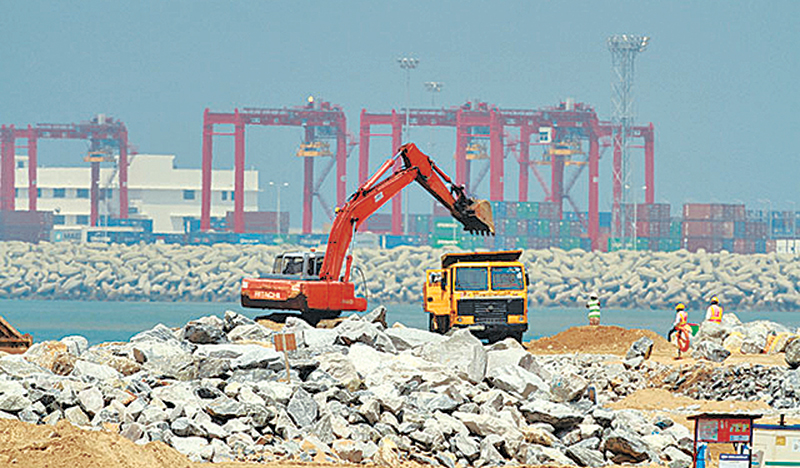
(The featured image at the top shows the Colombo Port City being built by China Harbor Engineering Co.)

Abject capitulation in Geneva

March 16th, 2019

by C.A.Chandraprema Courtesy The Island

The latest resolution in the UNHRC that is to be co-sponsored by Sri Lanka has the following 31 countries as its sponsors: Britain, Albania, Australia, Austria, Belgium, Bulgaria, Canada, Croatia, Czechia, Denmark, Finland, France, Georgia, Germany, Greece, Iceland, Ireland, Italy, Luxembourg, Malta, Montenegro, Netherlands, New Zealand, North Macedonia, Norway, Poland, Romania, San Marino, Slovakia, Sri Lanka, Sweden. This list tells a story that no person interested in Sri Lanka or Sri Lankan affairs should overlook. We all recall that when the Rajapaksa government was in power, the then Obama administration in the USA passed three resolutions against Sri Lanka. Despite the strenuous efforts that the USA put into the campaign against Sri Lanka, all those resolutions passed only with a barest of margins.

article_image

By any moral standard, if one is to consider that a particular body has approved something, it should have the assent of the majority of its membership. To show such a majority, one needs the assent of 50% plus one more, with the others acquiescing in the majority view. Going by that yardstick, the first USA sponsored resolution in 2012 obtained 24 votes with 15 voting against it and 8 abstaining in the 47 member UNHRC. The second USA sponsored resolution in 2013 got 25 votes with 13 voting against and 8 abstaining. The third resolution actually failed to get a clear majority in the 47 member Council with only 23 voting for the resolution and 12 voting against and 12 abstaining. The last US sponsored resolution won only on the technicality that abstentions are not counted, and voting in the UNHRC does not require an absolute majority to be considered to have been passed.

So the 2014 US sponsored resolution against Sri Lanka was passed in a situation where the majority of the body that is supposed to have passed it, has not voted for it. We have seen that kind of thing happening in our Parliament where an Act may be considered to have been passed even though it may have got only 56 votes in the 225 member Parliament. The reason why even that kind of Act is considered legitimate is only because the government that passed that Act would have an absolute majority in Parliament and it is that majority that lends legitimacy to the laws passed by that government even though the individual piece of legislation may not have obtained an absolute majority in Parliament at the time it was passed. However, there is no government as such in the UNHRC and if a resolution has not been passed by an absolute majority of the 47 member Council, the legitimacy of that resolution will be questionable.

Sri Lanka in captivity

The fact that the Obama administration managed to get a clear majority in the UNHRC only twice and that too with the narrowest of margins and failed to get even that on the third occasion shows how the power of the USA has waned. This writer was told by a Sri Lankan government delegate who attended the Geneva sessions at that time that the US State Department had deployed dozens of officials to canvass for votes for the resolution against Sri Lanka. Their strategy was to persuade countries to vote against Sri Lanka or at the very least to abstain so that the Americans could win by default. The recordings of the UNHRC sessions in 2012, 2013 and 2014, show that all those who abstained, spoke in favour of Sri Lanka in the Council and then abstained only due to relentless pressure from the USA.

The countries that abstained are ones that are either dependent on US aid, or military cooperation or has some other compelling reason to be unable to turn down a request from the USA. Donald Trump has now pulled the US out of the UNHRC. But that should have happened in 2014, when the mighty USA took on Sri Lanka and failed to obtain a clear majority in the UNHRC. For the countries in the UNHRC, voting for, against or abstaining is serious business. Such decisions are not lightly taken. Decisions to sponsor or co-sponsor resolutions are also not lightly taken in that body.

When we look at the countries that will be co-sponsoring the resolution against Sri Lanka we see that they are the very same countries that consistently voted against us in 2012, 2013, and 2014. The countries that voted against Sri Lanka in 2012 were as follows: Austria, Belgium, Benin, Cameroon, Chile, Costa Rica, Czech Republic, Guatemala, Hungary, India, Italy, Libya, Mauritius, Mexico, Nigeria, Norway, Peru, Poland, Republic of Moldova, Romania, Spain, Switzerland, United States of America, Uruguay.

The countries that voted against us in 2013 were as follows: Argentina, Austria, Benin, Brazil, Chile, Costa Rica, Côte d’Ivoire, Czech Republic, Estonia, Germany, Guatemala, India, Ireland, Italy, Libya, Montenegro, Peru, Poland, Republic of Korea, Republic of Moldova, Romania, Sierra Leone, Spain, Switzerland, United States of America.

Those that voted against us in 2014 were as follows: Argentina, Austria, Benin, Botswana, Brazil, Chile, Costa Rica, Côte d’Ivoire, Czech Republic, Estonia, France, Germany, Ireland, Italy, Mexico, Montenegro, Peru, Republic of Korea, Romania, Sierra Leone, the former Yugoslav Republic of Macedonia, United Kingdom of Great Britain and Northern Ireland, United States of America.

The connection between those who consistently voted against Sri Lanka in the past and the sponsors of the latest resolution against Sri Lanka should be obvious. When Sri Lanka started co-sponsoring the resolutions that were being brought against it from 2015 onwards, there was no division in the UNHRC and no vote was taken because these were resolutions that Sri Lanka was co-sponsoring against itself. Since there was no one who voted for or against the resolutions that Sri Lanka co-sponsored, we have to go by the list of sponsors of these resolutions.

The countries that sponsored Resolution 30/1 in 2015 were as follows: Albania, Australia, Germany, Greece, Latvia, Montenegro, Poland, Romania, Sri Lanka, the former Yugoslav Republic of Macedonia,United Kingdom of Great Britain and Northern Ireland, United States of America

The countries that sponsored Resolution 34/1 in 2017 were as follows: Australia, Canada, Germany, Israel, Japan, Montenegro, Norway, Sri Lanka, the former Yugoslav Republic of Macedonia, United Kingdom of Great Britain and Northern Ireland, United States of America.

The embarrassed silence of our friends

It should be noted that even though all countries that vote on a resolution will always be current members of the UNHRC, those sponsoring resolutions may not always be current members. Whether they were current members of the UNHRC or not, it can be clearly seen that the countries that voted against Sri Lanka in 2012, 2013, and 2014 are the same countries that have been sponsoring the resolutions that Sri Lanka has been co-sponsoring against itself since 2015.

The most significant thing to note is that the countries that had been either voting in Sri Lanka’s favour or abstaining did not join the group of countries that have been hounding Sri Lanka even after Sri Lanka capitulated and started co-sponsoring resolutions against itself.

The countries that voted for Sri Lanka or abstained in 2012 were as follows: Bangladesh, China, Congo, Cuba, Ecuador, Indonesia, Kuwait, Maldives, Mauritania, Philippines, Qatar, Russian Federation, Saudi Arabia, Thailand, Uganda, Angola, Botswana, Burkina Faso, Djibouti, Jordan, Kyrgyzstan, Malaysia, Senegal.

Those that voted for us or abstained in 2013 were as follows: Congo, Ecuador, Indonesia, Kuwait, Maldives, Mauritania, Pakistan, Philippines, Qatar, Thailand, Uganda, United Arab Emirates, Venezuela, Angola, Botswana, Burkina Faso, Ethiopia, Japan, Kazakhstan, Kenya, Malaysia.

And those that either voted for us or abstained in 2014 were Algeria, China, Congo, Cuba, Kenya, Maldives, Pakistan, Russian Federation, Saudi Arabia, United Arab Emirates, Venezuela, Vietnam, Burkina Faso, Ethiopia, Gabon, India, Indonesia, Japan, Kazakhstan, Kuwait, Morocco, Namibia, Philippines, South Africa.

Of the countries that either voted for us or abstained in 2012, 2013 and 2014, only Japan (which abstained) had joined the group of countries that sponsored resolutions against Sri Lanka after 2015. That too happened only once in 2017. Even though Japan was a sponsor of Resolution 34/1. They did not sponsor Resolution 30/1 nor have they come in as a sponsor of the latest draft resolution that is before the UNHRC. One would think that because Sri Lanka also started co-sponsoring the resolutions being brought against it, Sri Lanka’s friends would also join in co-sopnsoring those resolutions. But that is not what has happened.

The divide in the international order becomes clear from all this. The countries that either voted for Sri Lanka  or abstained  when Sri Lanka was fighting the resolutions being brought against it, forms one bloc and the countries that brought the resolutions against Sri Lanka forms another block centred on the Western powers. Sri Lanka has now become a part of the Western bloc under a Qusisling government and is sponsoring resolutions against itself jointly with their foreign masters. The other bloc of nations obviously takes a very dim view of what Sri Lanka has been doing to itself. What Sri Lanka is doing after having capitulated to the West is also putting the other countries that identify as the non-aligned, or developing nations or the non-Western or anti-Western bloc into a difficult position.

They all know that the government was changed in Sri Lanka through a Western sponsored conspiracy and the entire non-aligned or non-Western bloc appears to be waiting for Sri Lanka to get out of this situation so that we can join our natural allies once again. At the moment, it is clear that we are a pariah nation among the non-aligned, non-Western group of nations. Even though our own government may argue strenuously that the Western tutelage that we are under now is good and beneficial for Sri Lanka and that the resolutions against Sri Lanka that are being co-sponsored by Sri Lanka against itself is the best thing that ever happened to this country, that story is not being bought by the non-aligned bloc to which we once belonged.

Further time to do what?

The latest resolution that is going to be co-sponsored by Sri Lanka is to give us a further two year’s time to fully implement the undertakings given in Resolution 30/1. The first thing that Sri Lanka did by co-sponsoring Resolution 30/1 is to accept the allegations of war crimes made in the report of the Office of the High Commissioner which was tabled in the UNHRC at the same Session in 2015. The undertakings given by Sri Lanka all relate to those allegations. The undertakings given by Sri Lanka in Resolution 30/1 were the following:

=   To undertake a comprehensive approach to dealing with the past by setting up among other things a commission for truth, justice, reconciliation and non-recurrence, an office of missing persons and an office for reparations=    To allow each such mechanism the freedom to obtain financial, material and technical assistance from international partners,including the OHCHR

=   To establish a judicial mechanism to investigate allegations of war crimes with the participation of Commonwealth and other foreign judges, prosecutors and investigators

= To reform Sri Lanka’s domestic law to ensure that it can implement its own commitments

=    The removal from the security forces anyone credibly implicated in war crimes through an administrative process (even if there is insufficient evidence to take them to courts.)

=   To review the Public Security Ordinance and to repeal the Prevention of Terrorism Act, and to replace it with anti-terrorism legislation in accordance with contemporary international best practices

=   To sign and ratify the International Convention for the Protection of All Persons from Enforced Disappearance

=   To effect a political settlement through the devolution of political authority by taking the necessary constitutional measures

An exit strategy?

This year, there is absolutely no reason for the Sri Lankan government to demean itself, to demean this nation, and to demean, embarrass and disappoint the entire group of non-aligned, non Western bloc countries by once again co-sponsoring a resolution against itself. Now that the principal sponsor of the UNHRC has left that body in a huff, we might as well take advantage of the situation and allow this whole thing to die a natural death. Britian is leading the charge against Sri Lanka this year and they just don’t have the clout that the USA had to be able to twist the arms of reluctant nations to force them to at least abstain if not vote against Sri Lanka. What is possible in a context like this was demonstrated in May 2009 when Dayan Jayatilleke was the Representative to Geneva under the Rajapaksa government.

On 19 May 2009, the very day on which Prabhakaran’s dead body was found in the marsh by the Nandikadal lagoon, a letter was sent to the President of the UNHRC by the Representative of Germany requesting the convening of a Special Session of the Council on 25 May 2009 to address the human rights situation in Sri Lanka. Such special sessions can be convened at the request of a member of the Council if one third of the membership of the Council supports that request. When we look at the ‘one third’ of the then membership of the UNHRC that supported the call for a Special Session, we see the same group of countries that have been hounding Sri Lanka all along. In that instance they were the following countries: Argentina, Bosnia and Herzegovina, Canada, Chile, France, Germany, Italy, Mauritius, Mexico, the Netherlands, the Republic of Korea, Slovakia, Slovenia, Switzerland, Ukraine, the United Kingdom of Great Britain and Northern Ireland and Uruguay.

South Korea was the odd man out in the group of nations that requested a special session. The requested Special Session was then fixed for 26 and 27 May 2009. Given the fact that the request for this Special Session had been made on the very day that Prabhakaran’s dead body was displayed to the entire world, one can only imagine the state of mind of those who wanted to talk of the human rights situation in Sri Lanka. The phrase ‘chewing one’s own backside in anguish’ which this writer often uses to describe such a state of mind would be an understatement in this context.

Fortunately for us, Sri Lanka had a motivated and capable Representative in Geneva at that time, who basically hijacked the Special Session by putting to it Sri Lanka’s own resolution co-sponsored by Bahrain, Bolivia, China, Cuba, Egypt, India, Indonesia, Malaysia, Nicaragua, Pakistan, the Philippines and Saudi Arabia.

Subsequently, Algeria, Bangladesh, Belarus, Bhutan, Brazil, Cambodia, Côte d’Ivoire, the Democratic People’s Republic of Korea, the Islamic Republic of Iran, the Lao People’s Democratic Republic, Lebanon, Maldives, Myanmar, Nepal, Oman, Qatar, the Russian Federation, Singapore, the Sudan, the Syrian Arab Republic, Thailand, the United Arab Emirates, Uruguay, Venezuela and Viet Nam had also joined the sponsors of the Sri Lankan resolution which gives an indication of the international backing that Sri Lanka received at the time. This was followed by a major drama with Germany trying to introduce amendments to the Sri Lankan draft resolution and Cuba, moving to block Germany. Anyway the long and short of it was that Sri Lanka turned the tables on those who tried to penalize us for winning the war against terror.

Now that the USA is no longer in the picture, there is once again an opportunity for Sri Lanka to gain the upper hand. Yet what we see happening in Geneva is abject capitulation once again – this time for no reason other than the ingrained servility of this government. Once again our natural allies in the non-aligned, non-Western bloc will have to stand by passively and watch the painful and embarrassing spectacle of a once proud nation, now under a Quisling government; groveling in the dust before the Western bloc and their allies. What Sri Lanka is doing to itself sets precedents that are inimical to the national interests of every nation in the non-aligned, non-Western bloc. The problem is that everyone else in the world seems to realize this except our government.

Amunugama slams U.N. HIgh Commssioner’s report “Atrocious piece of writing with lies, half-lies & highly contestable statements”

March 16th, 2019

Courtesy The Island

The report of the U.N. High Commissioner for Refugees, due to be discussed at the ongoing proceedings of the U.N. Human Rights Council in Geneva was yesterday slammed by senior politician Sarath Amunugama as “an atrocious piece of writing containing lies, half lies and highly contestable statements” on the situation in Sri Lanka in the last few years.

Amunugama, who has held senior cabinet appointments in UNP and UPFA governments, leaves for Geneva tonight as a member of the delegation led by Foreign Minister Tilak Marapona to attend the UNHRC sessions.

article_image

He said yesterday that the Sri Lanka mission in Geneva has been asked to seek an appointment for the delegation, in which he is a nominee of the president, with the High Commissioner for Refugees “which is usually granted.”

Amunugama who has held a senior position with UNESCO in Paris said that the high commissioner’s report was “methodologically incorrect.”

It has referred to the Mannar skeletons which is of relevance to the Office for Missing Person which have been dated as going back to the Portugese period as signaling culpability of the armed forces.

Further the report included “totally unwarranted statements” such as the return to the original owners of military-held land in the theatre of war. Nearly 90% of such land (71,172 acres) have already been returned.

He said alleged misdemeanors of armed forces personnel have been mostly picked up from newspaper reports. The high commissioner has presented a very wrong picture in a ‘catchall’ report. There had to be a very strong response to this.

He made a further point that the good work done by organizations like Sarvodaya and the forces themselves have not been included.

Couldn’t defeat budget because of SLFP – Mahinda

March 16th, 2019

Courtesy Adaderana

Opposition Leader Mahinda Rajapaksa stated that the opportunity to defeat the budget was lost as Sri Lanka Freedom Party (SLFP) members refrained from voting at the second reading of the Budget 2019.

Attending an event held in Matale area, he said that although it has been 10 years since the defeat of terrorism, the United Nations Human Rights Council (UNHRC) in Geneva still doesn’t see the peaceful state within the country.

I saw on a Sunday newspaper that 9 military personnel have been issued travel bans stating that they are not let into those countries. The reason is defeating terrorism. Even though we eliminated terrorism from our country, certain countries still suffer from terrorism. We instructed the armies to defeat the terrorism without harming civilians”, said Rajapaksa.

Speaking on the current economic situation, he says living conditions have become hard today that certain families get on by drinking just tea. He said that prices of spices and minor exports have gone down and the people living off agriculture are suffering.

He further said that children should grow up in a religious environment and more focus should be given to drugs destroying the children.

HIDDEN AGENDAS IN CONSTITUTIONAL REFORMS

March 16th, 2019

By W.A.De Silva Courtesy The Daily Mirror

Constitutional reforms to whose benefit? Will it provide any consolation to the national economic crisis? Was there a demand from the masses for a new Constitution? You may find answers to these questions once you peruse this article.


Article 3 of Chapter 1 of the Constitution states that in the Republic of Sri  Lanka, sovereignty is in the people and it is inalienable.” Article 4 of same chapter states that sovereignty of people shall be exercised and enjoyed in the manner that legislative power through Parliament consisting of elected representatives of the people and by the people” and executive power of the people through President elected by the people” and judicial power of the people shall be exercised by Parliament through court.”


In terms of the above articles, it is absolutely clear that the legislature and the executive could be considered as arms to be used by the people to exercise sovereignty. In that context, it may be noted that the concept Supremacy of Parliament” is applicable in our Constitution subject to the sovereignty of people. In our Constitution, people are supreme. Accordingly, the legislature and the executive should act and exercise people’s sovereignty delegated to them essentially in congruence with the interests and aspirations of the people of this country. In that process, parliamentary democracy priority should be given to the interests and aspirations of the masses with due consideration being given to the interests and aspirations of minorities. What is happening in our legislature is quite contrary to the above proposition. Once elected to the legislature (Parliament), politicians simply assume the role of masters of people and their performance gives an impression that they act in accordance with their personal agendas, totally disregarding the interest and aspiration of the people. A classic example of this irresponsible behaviour is an attempt to introduce a new Constitution, disregarding protests against the same from people, political and religious leaders and various segments of our society.

The campaign for a new Constitution has been initially launched by architects of Yahapalanaya together with their supporters at the last presidential and general elections in order to oust the Rajapaksa regime

It is worth to analyse from that point of view as to what the leader of the incumbent government is trying to do through constitutional reforms and the proposed new Constitution. It may be noted that an aggressive campaign for a new Constitution, in the present context, has been launched by the leader of the present government, the JVP and the TNA. The government leader has shown extraordinary interest in this process despite hundreds of national issues which require utmost priority over and above so-called constitutional reforms.

The campaign for a new Constitution has been initially launched by architects of Yahapalanaya together with their supporters at the last presidential and general elections in order to oust the Rajapaksa regime. It is a strategy adopted for that purpose to coordinate and consolidate the support of those who were against the Rajapaksa Government namely the international community led by the US and allied forces and the TNA. Who are the active supporters of the architects of Yahapalanaya in this process? It was not a secret that international forces led by the US and its allies through UNHRC and TNA have played a very vital role in the process of ousting the Rajapaksa regime and to establish a new government under leadership of Wickremesinghe. In reality, the need for a new Constitution has been brought up by Wickremesinghe in order to satisfy these parties that rendered their support to oust the Rajapaksa regime.

Joint UNHRC Resolution 30/1 of year 2015 could be considered as vital evidence available to corroborate the above presumption. Joint UNHRC Resolution 30/1 could be identified as a tripartite agreement in which the US and allied forces play the role of first party, the TNA as second party and Wickremesinghe (being the co-sponsor) could be considered as third party. These three parties have their own agendas to be realised through implementation of proposals set out in Joint UNHRC Resolution 30/1. The agenda of the US and allied forces seemed to be setting up of a conducive environment for their global power politics in this country. The agenda of TNA is nothing but devolution of power up to the level acceptable to UNHRC and TNA based on separatism. Agenda of Wickremesinghe seems to be consolidation of power with the support of the TNA and international forces led by the US by implementation of their agenda through constitutional reforms.

The agreement entered into with the leader of the LTTE outfit Prabhakaran – with the intervention of foreign forces – reminds us that Wickremesinghe had kept a record on the betrayal of people’s sovereignty even in the past.

It is a fact that it is not possible to give effect implementation of proposals set out in Joint UNHRC Resolution 30/1 of year 2015 under the present Constitution such as delegation of power up to the extent acceptable by the UNHRC and TNA, setting up of the hybrid court mechanism to investigate so-called war crimes, human rights violations, missing persons and so forth though Wickremesinghe has given a firm undertaking to the UNHRC, US and allied forces and the TNA, to do so having assumed the role of co-sponsor to Joint UNHRC Resolution 30/1 on his own violation for which no mandate had been given by masses of this country at the presidential or general elections. This act of assuming the role of co-sponsor to Joint UNHRC Resolution 30/1 could be considered a great betrayal of people’s sovereignty of this country by Wickremesinghe for his survival in power politics in lieu of the reciprocal support extended from UNHRC,  US and allied forces, and the TNA. In other words, a new Constitution would be an instrument which facilitated the implementation of agendas of aforementioned three parties.

The abolition of executive presidency is considered one of the vital requirements in the proposed new Constitution.  It may be noted that the executive presidency was created by President Jayawardena due to some shortcomings he experienced in the Westminster system of parliamentary democracy, in which the prime minister is considered one among equals elected to Parliament. In case of a hung Parliament, the prime minister would be under obligation to satisfy self-centred interest of party leaders, who made pulls and pushes in different directions disregarding national interest. The executive president being a single person not one among equals elected by the people can avoid such shortcomings confronted by the prime minister when exercising power vested in him in the Constitution. It is our experience that unprecedented achievements such as the Mahaweli Project, liberalization of the Sri Lankan economy from the grip of closed economy, creating export processing zones under President Jayawardena, eradication of terrorist outfits which had caused devastation to this country over a period of thirty years, huge development projects such as Port City, Hambantota Port, Mattala Airport, highways etc. under President Rajapaksa couldn’t have been achieved without power vested in executive presidency.

Apart from the proposed new Constitution, there are some constitutional reforms implemented under the 19th Amendment to the Constitution.

Although there are some progressive steps taken on constitutional reforms through 19A such as restricting presidential immunity to some extent, restoration of number of terms a person can hold and contest the post of executive president to two, setting up of a Constitutional Council and independent commissions there are some intrusions in 19A that have adversely impacted on unity, stability and sovereignty of the people. The provisions laid down in Articles 46(4) and 46(5) of Chapter VIII of the 19th Amendment for the formation of the national government and a Jumbo Cabinet” have paved way for political parties that were elected to Parliament to abuse the mandate given to them for their own benefit disregarding public interest.

One of the cardinal principles of parliamentary democracy is that there should be a government party and an opposition in Parliament. This principle has been flouted in the so-called national government, formed under the leadership of Yahapalanaya by appointing the TNA leader who is considered a vital partner of the government party who secured only 14 seats in Parliament, rejecting the party that had secured majority of seats next to the government party.

This mechanism adopted by the Yahapalanaya Government is considered as a kind of bonus offered to the TNA in lieu of support extended to the government for its survival. This mistake has now been rectified by appointing MR as the opposition leader.

From the foregoing facts it may be observed that there is a sinister attempt to give effect to hidden agendas of the US and allied forces and the TNA on the pretext of urging for a new Constitution. The commitment given to implement proposals set out in Joint UNHRC Resolution 30/1 being assumed the role of co-sponsor thereto is considered the first step taken in that direction by present government.

Implementation of those hidden agendas would extremely be detrimental to the unity, integrity and sovereignty of this country. People should take appropriate measures to arrest this situation through the general elections sooner than later.

TUITION: A BANE OR A SPUR?

March 16th, 2019

By Goolbai Gunasekara Courtesy The Daily Mirror

Can good teaching in schools outwit the tutor’s hold on students of today? Ravi Nagahawatte’s thoughtful article motivated me to make these observations on WHY tuition is so popular and why so many students (even very bright ones) seem to need this special help.

There are many reasons why children seek tuition and it is not always because there is a poor teacher in school. I can speak with a certain authority on behalf of private and international schools because I know what happens in these institutions. One can be fairly sure that teachers in such schools are good (mostly) the reason being that the principal has the authority to keep teachers on their toes.

A good principal (especially in international schools doing British examinations) will regularly check on work being done, corrections being made, syllabuses being completed and generally keep a beady eye on the staff. So then why is tuition still sought? There are several reasons.

Sometimes we seem to jump in where angels fear to tread. The Education Ministry shows a remarkable aptitude to ruin any sensible idea because of foolish methods of application and a total inability to get ‘educated’ advice

One of the main and very reprehensible reasons is the desire to compete. Parents, mostly mothers, are foolishly anxious for their clever child to win prizes, come first in class, beat all friends (often relatives) and shine at the annual prize day. This is why most educationists agree competitive atmospheres kill real love of study.


Many foreign universities do not give out grades to masters and higher degree students nowadays. It is just a pass/fail business and yet students study just as hard.
Then there is the situation of overcrowding. Too many children in a classroom naturally means half the class trails behind the smarter lot who grasp concepts quicker. Of course a teacher can slow down. Most good teachers repeat themselves to make sure they are being followed. But if a teacher goes too slow, he or she loses the interest of others. Believe me, classes consisting of over 25 pupils are not easy to teach. The students are all at varying ability levels in absorbing knowledge and its a rare teacher who knows how to handle all of them.

The ideal number of students in a class has been fixed at ten by educationists in advanced countries who have studied the advantages of small class numbers. This is only possible in schools that are so expensive they are beyond the reach of the average man. When the number of students is ten, a teacher has time to give each child a certain amount of personal attention which even most conscientious teachers cannot do when classes number around 30 or so.

Private schools in Sri Lanka cannot afford to keep classes too small as finances are often vexatious. I can truthfully say, however, that as a former principal of an international school, we always did our best to ensure each child received the attention to which he or she was entitled.

We come to another problem. There are teachers without conscience who deliberately do not complete the syllabus and tell students to attend their private classes. Most principals are aware of that little ploy and forbid students from seeking tuition from teachers of their own school. But what happens in government schools is anyone’s guess.


Have the four universities mentioned already AGREED to accept Sri  Lanka’s choice of four students into their programme?


Tuition is sometimes legitimately sought for a child who finds it difficult to follow class explanations. At such times, one-to-one sessions with a tutor may be helpful. Take my own case. Attending schools in three different countries played havoc with the state of my mathematics. Eventually, the time of my O/Ls (then Sri Lankan SSC) rolled round. My mother hired a tutor for three months before the exam. She decided that lessons twice a week for three months gave me 24 hours of concentrated work to try to get through that terrible paper. I managed the minimum grade pass. But I passed. So obviously tutors have their uses! Short-term!
And my last problem with those who seek tuition is the lack of trust parents often display. I do not blame them. The press daily highlights the egregious doings of teachers and principals in government schools. In private schools, the situation is better but I am not a believer in PTAs. On one occasion, I was invited to speak at the PTA meeting of a leading private school in Colombo. The meeting took place before I spoke and to my surprise, one parent got up and held forth for over 15 minutes.

The principal could not stop him in mid-flow so to speak, but no one else had either the time or the inclination to follow his diatribe. Any interaction between teacher and parent on a personal basis is not possible in large PTA meetings.

Therefore, at AIS, I usually held specially arranged, one-to-one meetings with parents and the teachers who were staggered over three days. Parents needed to come on only one day, unless they had several children in school in different classes. Parents were given definite times and they had to keep within that allotment but they got the chance to speak to every teacher and ascertain if tutoring was really necessary.


Private schools in Sri Lanka cannot afford to keep classes too small as finances are often vexatious


THOSE PROPOSED SCHOLARSHIPS ANNOUNCED IN THE BUDGET 
To deviate completely from the subject of tuition, I come to the announcement in the budget that government scholarships to Harvard, MIT, Oxford and Cambridge would be awarded to top students with the best results at the local A/L exam who must then return to the country and serve the government for 10 years. An excellent idea, but like most of the decisions taken by the Education Ministry, not carefully or even intelligently thought out. Here are my reasons:

1. How socially-prepared will the chosen youngsters be? Will they be misfits in the sophisticated atmosphere of the best universities in the world? There are far better choices.

2. Will the government ensure their standard of English would be adequate to deal with the workload of those four universities? MP Kanchana Wijesekera highlighted this problem in his parliamentary speech on March 7 while discussing the budget. Mr. Wijesekera has done British exams himself and understands the problems that will be faced by students whose English is weak.

3. These top four colleges sound wonderful on paper but why didn’t the minister seek the opinion of principals of schools that regularly send children to these places? Most of us have sent pupils to Cambridge, Harvard, Yale, Columbia, Brown, John Hopkins, Cornel, Duke, NYU and so forth. Why not ask us what our experiences have been? I feel this good idea is going to be messed up, alas!

4. Let us take the university of MIT. I have sent several students to MIT. A few years ago, one of them got a full scholarship on the basis of outstanding achievement. In addition to academics, he was a Chess Champion and had many outside interests. In his letter of acceptance, MIT told me he was one of their best candidates that year. But MIT is not necessarily a happy place. It is full of ambitious foreigners pushing hard, notably the Indians and Chinese. They are not friendly. I am told the suicide rate was worrying. My brilliant student was not happy there and took a year’s break after the first year. He eventually finished his degree of course, but my advice would have been to tell the ministry to choose another from America’s top universities where our Sri Lankan students would be happier.

5. Often, a Sri Lankan student may be the only Sri Lankan on the register at that time. Indians and Chinese are many in number and have each other for support. This may or may not matter as Americans are friendly and a Sri Lankan child may blend happily.

But why not choose good universities which are more student-friendly? They are as well known as MIT and Harvard. In Britain, likewise, there are excellent options without the government sending Sinhala-educated youngsters to their bastions of privilege.

6. The good international schools have turned out doctors, engineers, accountants, lawyers, economists et al after their students have studied in universities all over the world. The principals of those schools should have been the first to be consulted before naming four universities which, in my opinion, are not always best suited to our students. What better example than our own clever Minister/Economist Dr. Harsha de Silva who is a graduate of Truman University – a top-rated American college?

7. And my final pertinent question is this. Have the four universities mentioned already AGREED to accept Sri  Lanka’s choice of four students into their programme? They have their own method of choosing entrants and what is to say they will accept our students simply because they gained the highest marks at a local exam? Kanchana Wijesekera very sensibly asked if all these factors had been taken
into consideration.

8. Knowing the way things are done in Sri  Lanka, I can be fairly sure that bribery and corruption will ensure the best students are not chosen for these scholarships. Does anyone disagree?

Sometimes we seem to jump in where angels fear to tread. The Education Ministry shows a remarkable aptitude to ruin any sensible idea because of foolish methods of application and a total inability to get ‘educated’ advice.

Teaching students from Grades 1-5 in English should stop: Ven. Ratana Thera

March 16th, 2019

Yohan Perera and Ajith Siriwardana  Courtesy The Daily Mirror

National List MP Venerable Athuraliye Ratana Thera yesterday urged the government to stop teaching school children from Grades one to five in the English medium.

Speaking during the committee stage debate on the budget in Parliament, the Venerable Thera said Sri Lanka is currently following a concept which is not followed in any other country of providing primary education in another language other than the child’s mother tongue.

If a child is given a primary education in a language other than their mother tongue that child would not be a citizen of that country,” the Venerable Thera said.

The Thera said it is important to regulate international schools as well as such schools can be run by anyone without any standards being adhered to. Therefore the Thera said it is important to regulate them.

Making another suggestion, he said education should be a component which builds national unity. Accordingly he said children in the North and the East should be provided education in Tamils while children in other areas should be allowed to have their education in Sinhala. Additionally, he said a majority of Tamils and Muslims who reside in areas other than the North and the East can be provided an education in Sinhala as a majority of them are fluent in the Sinhala Language. 

1,987 students discard University education due to ragging: Hakeem

March 16th, 2019

Ajith Siriwardana and Yohan Perera  Courtesy The Daily Mirror

Higher Education Minister Rauff Hakeem said yesterday 1,987 students had abandoned their education because of ragging after they were enrolled at state universities.

He told Parliament that the government had adopted a zero-tolerance policy whee ragging was concerned, but it was continuing.

“We are taking effective action to prevent this from happening in universities. The Vice Chancellors and councilors of all the universities were vested with powers to take action against such inhuman activities,” the minister said.

He said a hot-line had been set up to lodge complaints on sexual and gender-based violence in universities.

The minister said the Vanni or the Vavuniya campus of the Jaffna University would be gazetted as a separate fully-pledged university in the Northern Province shortly.

Sri Lanka Bans Chewing Betel Within State Institutions

March 16th, 2019

By 

The issuance of a Sri Lankan public administration circular to prohibit the consummation and sale of products made using betel, tobacco and areca nut at state institutes has been approved by the Cabinet. The relevant cabinet paper was presented by the Minister of Health, Nutrition & Indigenous Medicine Rajitha Senaratne.

Issuing a release, the Health Ministry stated this decision was taken considering the adverse effects of betel chewing on one’s health and the environment.Although betel chewing is accepted as a social and a cultural habit, it is a major reason behind the massive number of mouth cancer cases reported in the country, stated the Ministry. Spitting after chewing betel is also a cause of unpleasantness in the environment, pointed out the Ministry.

Under a Gazette Extraordinary issued on 01.09.2016, the production, import, and sale of products containing tobacco have been banned around the country.

According to the Health Minister, issuing a public administration circular to ban the consummation and sale of products made using betel, tobacco and areca nut will make it easier for heads of all state institutes to take necessary administrative procedures against this.

Betal, or Areca, nuts

Betal, or Areca, nuts


‘There Is No Excuse’: Amsterdam’s Rijksmuseum in Discussions to Return Looted Colonial Art

March 16th, 2019

SriLanka’s  International Debt.

March 15th, 2019

By Garvin Karunarathe

Economist Uswatta Aratchi  criticises the role played by the Chinese in his Paper:Capital Cheap in Chong Guo and expensive in Sri Lanka”(The Island 20/2/19)

If not for the support Sri Lanka received from China with the provision of weapons, all on loans, we could never have defeated the LTTE.

It is true that China has financed many projects.  It was a time when Sri Lanka was heavily indebted and it was very difficult to find funds. Of our international loans,  loans from China amounted to only 2% in 2008,  and 2013 while in 2017 it amounted to 9%.

Regarding loans it is important to note that there is  a major difference between getting loans for projects and getting loans to feed the luxury appetite of the rich- foreign travel, import of luxuries, expenses for study abroad, – free use of foreign exchange. In loans for projects,  the projects remain- an asset, while in the case of loans for consumption the funds are meant to serve the appetite of the rich, the funds are spent overseas,  for air travel- luxury hotel stay abroad, for luxury imports- mainly from the Superpower countries and the money obtained on loans at high interest goes back in some form or other back to the donor countries, leaving our country in debt. It is my opinion that obtaining loans for projects can be justified while loans to feed the appetite of the super rich who earn over a million rupees a month- a minority- less than 5 % of our population cannot be justified.

Gone are the days when Sri lanka had funds of its own for projects. We had funds of our own to build the Gal Oya Project- that was in the early Fifties.

Many countries have funded projects for us. The Victoria Dam was a gift from the British. The BMICH was a gift from the Chinese. The loans on the Hambantota Sea Port and the Mattala Airport can be justified as these are assets that carry a value even within the few years up to date. . They are in a category with the Mahaweli and the Colonies. Prime Minister D.S. Senanayake was severely heckled and criticized in the State Council for his colonization schemes.  Prime Minister Mahinda Rajapaksa despite his petty mistakes  stands out as one of our very few Prime Ministers/ Presidents  that had a vision for Sri Lanka. His achievements easily outweigh his mistakes.

Our country was not an indebted country when it was handed over to President Jayawardena in 1977. It was in debt only to the extent of $ 750 million and that too on projects. Chandra Maliyadda, a former Permanent Secretary has questioned how a country that did not have a foreign debt in 1976, became heavily indebted so soon.. Then the IMF and World Bank did not allow any loans for consumption purposes.  They changed their methods in 1978 and gave us loans freely even with long grace periods, for consumption purposes in order to make us indebted.

Till 1977 Sri Lanka somehow managed its economy without falling into debt.  This was done by controlling the foreign exchange that comes in and carefully spending it first for essentials and for development purposes. There were import controls and restrictions on the use of foreign exchange. Many today think of import controls as authoritarian. However I happened to be one of the administrative officers that handled-rather controlled the issue of foreign exchange for small industrialists in 1970/71. Any small industrialist who required foreign exchange to import any ingredient that was required for an  industry to manufacture any useful product had to submit an application to the Small Industries Department. I had a staff of inspectors who would inspect to find out whether the applicant was a genuine manufacturer and an allocation was made. I can assure that every genuine applicant was given a suitable allocation. We were never authoritarian. Instead we helped small industrialists.

It was the IMF that played the role of the Pied Piper of Hamelin and took Sri Lanka for a ride  when President Jayawardena went asking for Aid. We were made to believe  by the IMF and the World Bank that we would be on the path to prosperity. In fact our Minister of Finance, my good friend Ronnie de Mel stated in his Budget Speech of 1978, that we cannot go round the world begging for aid like international beggars. We must get out of this vicious circle  of no growth, stagnation and mounting internal and external debt.” As advised by the IMF,  the entire development infrastructure that we had before the IMF came on the scene,  the Marketing Department’s Cannery, which ushered in self sufficiency in fruit juice etc., its Vegetable Purchasing and Sales Scheme that ensured high prices to producers and low prices to city consumers,  the Small Industries Department with its handloomers and powerlooms that brought self sufficiency in textiles, the Agricultural Programme with its Seed Farms were all  abolished or privatized”(From How the IMF Sabotaged Third World Development. We liberalized the use of foreign exchange and we got loans from the IMF at interest to fund this spending spree. The IMF in order to entice us even gave long grace periods when we need not pay to make us accept their loans. This ploy of the IMF.  instead of bringing us to prosperity, made us an indebted country.  The World Bank itself admitted that By 1986, the deterioration of the economy had become evident. The growth rate of the GDP slowed to under 4%,unemployment increased to 17% and foreign reserves  declined to less than 2 months’ imports.(Page 496, Trends in Developing Economies)Quoted from my book: How the IMF Ruined Sri Lanka,P.75)

In 1986 the foreign debt was at $ US 4063 million. Following on the path af the Structural Adjustment Programme of the IMF Sri Lanka gradually increased its foreign debt in the process of borrowing loans to fund the luxury appetite of the rich. The international debt today stands at around $ 60 billon.

It would be found on any analysis of the loans taken that easily the major part well over 50% has been used to ensure luxury living for the rich. The amount spent for projects like the Mahaweli, Mattala Airport and the Hambantota seaport plus the foreign exchange spent to obtain weapons to fight the LTTE are easily less than 50% of our debt.  Our country is facing a foreign debt because we lived beyond our earnings as advised by the IMF.

The problem today is that our economists as well as those at the Central Bank yet continue to implement the provisions of the Structural Adjustment Programme of the IMF which takes us further and further into debt.

Even our celebrated economists who worked for the World Bank, the IMF and such allied institutes yet fail to discern between loans for projects and loans taken to satisfy the luxury appetite of the rich. I can see top range limousines on the Colombo roads far more than  in London. The only one economist from that category that understood the wrong doings of the IMF happened to be John Perkins, who unable to bear up his own misdeeds wrote a book: Confessions of an Economic Hitman, published in 2004.   Perkins confesses that he designed development projects with false statistics to be funded with massive loans and the projects  were designed to fail, with the loaned funds reaching back to the donors in some form or other for expert contracts, import of machinery, travel and commissions,  leaving the country with a failed project, while simultaneously saddling the country with a debt. Even today many projects are afoot in Sri Lanka, establishing the  Kantale Sugar and Avissawella Plywood” Type factories that can never find the raw material and will have to be closed down in a few years leaving the country with a massive debt.  A read of John Perkins’ book is a must to understand how our international debt was built up.

It is important to note that our economists yet fail to understand the ills of the Neoliberal Structural Adjustment Programme foisted on our Third World countries in 1978 and yet continue to advise our countries to continue with obtaining loans to service the loans. While servicing the loans is something that is mandatory, what has to be done today is to plan and provide for  massive import substitution type of industries to make what we import and to have import controls.

Our economists know to critique but not to remedy. My book, Microenterprise Development: A Strategy for Poverty Alleviation and  Employment Creation in the Third World: The Way out of the World Bank and IMF Stranglehold, published in 1997(Sarasavi) happens to be the first complete critique of the IMF policies, with an alternative model of self reliant development to be followed. .

Today,  unknown to our economists, the neoliberal Structural Adjustment Programme  is being pursued by the IMF on our country through various means by which foreign exchange is being spirited away from our coffers to the Developed Countries. It was some eight to ten years ago that on the advice of the IMF we allowed local currency account  holders to be allowed withdrawals of foreign exchange abroad, with some restrictions like withdrawing only a few hundred pounds a day and meeting this with foreign exchange from our coffers.

A further method is  Foreign Direct Investment (FDI)which our countries are forced to pursue on the pretext that it is developmental, on IMF advice, and brings in foreign exchange to our country.. Under this scheme a Multinational comes in with a small investment and establishes a venture- be it  in pizza, burgers, ice cream etc, trades in the local currency while importing everything with our foreign exchange and repatriates the profits also from our foreign exchange. Please calculate and we are the net loser in foreign exchange. Another method is for the investment to put up a hydro plant provide power to locals, charge them local Rupees and repatriate  profits in our foreign exchange. Here our local water is turned into foreign exchange going out to the investors, mainly from Developed Countries.

The latest is a very smart-method: the internet has taken over hotel bookings- where payment is made to the hotel in local currency, but the hotelier is charged 15% commission for the booking that has to be paid in our foreign exchange. Tourists cash foreign exchange not at banks where endless forms have to be  filled and questions asked but at Private Foreign Currency Exchange Dealers, within minutes, with no questions asked, where the incoming foreign exchange does not get into our exchequer. Into the fray is yet another international taxi firm, trading in the local rupee but repatriating profits via our foreign exchange. By these various methods the earnings of US Multinationals in 2007 from overseas trade  outlets amounted to $ 99.1 billion. From Africa the earnings netted $ 6.1 billion while from Asia it was $ 22.2 billion.(Tax Foundation:26/4/2011, Quoted in How the IMF Sabotaged Third World Development.)

There are many gogley balls being bowled at us by the IMF and the World Bank to make us further indebted. Take the $ 125 million loan for smart agriculture in Sri Lanka(World bank approvesUS $ 125 m. for smart agriculture in Sri Lanka”:Daily News:11/3/19) where we are offered a grace period of 12 years and a maturity period of 27 years, all to get some small changes done in agricultural development, which we can easily get done with our present staff without any aid.  We are being coaxed and pushed to become further indebted. In the Seventies, the IMF crippled our agricultural extension system by introducing the Training & Visit System by offering loans and grants. “The T & V was financed under IDA Credit whre funds are brought in under foreign aid  to meet the salaries of local officers. IDA Crdit has a grace period of 10 years so that the Government that takes the loan need not worry about repayment. “(From Karunaratne: Administering Rural Development in the Third World:1983) This T&V loan was in the late Seventies when we were hardly indebted. Making us indebted was done in a shrewd manner and the total responsibility falls on the IMF and the World Bank.

While all the above methods are used to pillage our foreign exchange, we find an easy scapegoat in President Mahinda Rajapaksa’s project loans to explain the increase in our foreign debt. There were two  projects- the Conference Hall and the Stadium, more done for prestige. The rest are assets even today and do hold the potential to usher in development for the backward South. Development requires close action on a long term basis and for this the entire development infrastructure that we once had has to be brought back. There is no other way to bring about development. The Marketing Department’s Cannery alone could have developed the lives of all Dry Zone peasants that includes Hambantota and Moneragala in the South. This Cannery made Sri Lanka self sufficient in all fruit juice and food preparations and we were building up pineapple exports  when the IMF dictate privatized the Cannery. I worked as an Assistant Commissioner in the Marketing Department and speak from sheer experience.

We have to fight our cause to understand and counter  the new methods employed by the IMF and its Multinationals to take away foreign exchange when the payment is received or trading is done in the in local currency. The only method is to control our foreign exchange, which right we ceded to the market forces in 1978. We have to restrict outflows of foreign exchange and also have import controls.

We have also to make a massive effort at import substitution industries and bring employment and incomes to our people instead of concentrating on importing what we can make and keep the poor happy with welfare handouts like Samurdhi. The Saying goes- Do not provide fish to the people. Instead teach them to fish.

We do have administrators at hand that can  easily tackle this task. They get paid and are under utilized today. Once in the Seventies when these administrators were put to work one administrator- the AGA at Kotmale,  produced paper  out of waste paper. The paddy straw which now go to waste can be turned into Paper and we can be self sufficient in all our paper requirements. This can be done in two to three years.  We once produced all the textiles we needed. That was done by the Small Industries Departnment with the Government Agents and the AGAa.  In Matara under my direction we struggled for three months in the evenings locked up in the Rahula Collage science lab and my Planning Officer, a chemistry graduate found the art of making crayons equal to the best of the West; the Crayola and we set up a factory within three weeks and sold Coop Crayon islandwide till it was stopped by the policies of President Jayaswardena. These are only a few instances. Many administrators established small projects which were sustainable and found employment opportunities for the youth.  A mechanized boatyard making 40 foot deep sea boats was also established in Matara, mind you all done within three months. The boats sent our fishermen in boats on the seas to fish. That boatyard was stopped and yet we import fish and youths are unemployed today.

I may also add how I designed and implemented the Youth Self Employment Programme of Bangladesh,  merely by altering the remit of all Vocational Training Institutes to include the task of motivating youths who were being trained to make something for sale or get into production. Every youth was guided in the manufacture and  marketing.  This was a grand success and today this Youth Self Employment Programme has guided two million youths to become self employed by 2011. It is an on going programme run by the Ministry of Youth where 95% of the time of youth workers is spent to guide the youth to develop their abilities to  become entrepreneurs. It is easily the premier employment creation programme one can find, a task which the ILO failed to do in Bangladesh in the preceeding three years(1978-1981).

This detail of achievement is necessary to prove that all my suggestions are practical. Most economists only speak from theory- most of them have never established a single project in their lives.  That is the type of doctranaire economists that hog our institutions. If they had an inch of wisdom the IMF could not have decimated our countries to their severe indebtedness of today.

To tackle this task we also need  a different breed of economists- economists who go beyond Keynes and  Adam Smith. Today all Third World Countries have  their economies restructured through IMF economics of Professor Milton Friedman.

We need economic thinkers to get us out of the mire to which the IMF pushed all Third World countries. . It is hoped that our  Central Bank and our   professors of economics at our prestigious universities will put on their  thinking cap for the cause of our Motherland.

Garvin Karunaratne. Ph.D. Michigan State University

Author of

How the IMF Ruined Sri Lanka & Alternate Programmes of Success(Godages,2006)\

How the IMF Sabotaged Third World Development(Godges/Kindle,2017)

15 th March 2019

Sri Lanka: Put UNHRC inside the war zone

March 15th, 2019

The UN/UNHCR and all of its Rapporteurs & Officials love to quote from the international textbooks on how wars should be waged, the rights of the civilians, the rules of war, international humanitarian laws, human rights laws and what not. But they are quoting all of these seated in air conditioned rooms in Geneva, New York and clueless about what it is really like to be inside a war zone. Therefore, let us put UNHRC officials into numerous scenarios of terror that Sri Lanka faced & question what UNHRC would have done in those instances.

30 November 1984 – LTTE attacks Kent & Dollar Farms in Mullaitivu district

62 Sinhalese killed including pregnant women & children

If UNHRC officials were inside Kent & Dollar Farms what would they have done to stop LTTE killing unarmed civilians – premeditated murder & would LTTE have listened & what would the fate of UNHRC officials be too

https://www.youtube.com/watch?v=NHZPCw9UCR8&bpctr=1552610787

Late 1980s LTTE committed ethnic cleansing of Sinhalese & Muslims from North Sri Lanka giving them 48hours to evict their homes with only what they wore & what they could carry

If UNHRC officials were with these Sinhalese & Muslims while being ethnically cleansed what would they do to stop the eviction? Has the UNHRC even helped a single of these evicted people return to their original habitats?

UN Commission on Human Rights Resolution 1994 declared perpetrators of ethnic cleansing as war criminals.

LTTE recruitment of children as child soldiers – LTTE violated fundamental rights of a child to education/violated Article 26 of the UN Declaration of Human Rights / Geneva Convention IV Article 50/ Additional Protocol I of 1977 Article 77(2) / Additional Protocol II of 1977 Article 4(3)(c) / Convention on the Rights of the Child 1989 Article 38(3) /

If UNHRC officials were inside a school stormed by LTTE picking children to kidnap & take with them and witnessed principal and teachers who opposed shot dead, what would UNHRC do?

Suicide terrorism – using cyanide capsule

In the 1980s children & women were directly trained by Adele Balasingham as trained combatants & ordered to commit suicide by using cyanide capsule. Kenneth Roth, Executive Director of HRW says ‘the people who carry out suicide bombings are not martyrs, they’re war criminals, and so are the people who help to plan such attacks.” * [Rome Statute of the International Criminal Court, Article 28(b), U.N.Doc. no. A/CONF. 183/9 (17 July, 1998), 37 I.L.M. 999]. Suicide terrorism has no legitimacy – there is no ‘just cause’ in homicide. Suicide attacks fall into category of murder with mens rea – willingness to kill and willingness to die.

If UNHRC officials were inside these training camps where they witnessed children being trained to kill and trained to commit suicide what would UNHRC do to save these children? Would reading out the international laws stop LTTE from recruiting children, training them as child soldiers and teaching them to commit suicide?

LTTE having chased out Sinhalese & Muslims from their original habitats and taken over their lands & property in 1980s these have yet to be returned

If UNHRC is well aware of this – what have they done about it?

  • LTTE storm villages, cuts people & children to pieces
  • If UNHRC officials had been inside these villages witnessing LTTE chop people ransack their peaceful homes, destroy their livelihoods, cause fear & harm, what would these officials do as Additional Protocols of Geneva Conventions prohibit acts aimed at spreading terror among civilian populations?

LTTE carried out over 300 suicide attacks over 30 years virtually every day

What if UNHRC was a witness to every LTTE suicide attack and bomb placed inside buses, trains, office buildings, roadside targeting passenger buses and these were all violations of Article 3 of Universal Declaration of Human Rights denying people right to life, liberty & security – what would UNHRC officials do?

Tamilini the female political head of LTTE in her book before her death writes that rampant rape of Tamil combatants inside bunkers took place

What if UNHRC officials were aware of these rapes by male LTTE combatant leaders upon junior Tamil combatant females – what would UNHRC do to stop the rape?

15 June 2006 LTTE targets passenger bus in Kebethigollawa killing 60 including children

What if UNHRC officials were also travelling in this same bus that succumbed to a claymore mine attack during a ceasefire leading to 60 civilian deaths. What would UNHRC do against the LTTE?

21 July 2006 LTTE closes Mavil Aru sluice gates denying water to some 30,000 farmers

Denying water is a war crime

If UNHRC officials were among these families who were denied water as a result of LTTE closing the sluice gates, what would UNHRC do?

Read out the international laws and expect LTTE to open the sluice gates? Call them over for ‘peace talks’ (oh by the way the LTTE did this during the peace talks/ceasefire)! Will UNHRC threaten to sanction LTTE – that might be a little too risky given that UNHRC is without water!

LTTE took civilians with them as they retreated against military operations

Article 5 of IHL says civilian population & individual civilians shall enjoy general protection against dangers arising from military operations.

What if UNHRC officials were among these civilians taken by force by LTTE. What would UNHRC officials do – read out Article 5 of IHL and expect LTTE to free all civilians? Fat chance!

  • LTTE denied food & water to Tamil civilians who were not from LTTE families
  • What if UNHRC were among the civilians taken by LTTE & saw LTTE purposely inflate food requirements as more than required amounts would be useful if the conflict gets protracted but none of the food & medicines sent were given to non-LTTE Tamil families. What would UNHRC do, complain to LTTE & read out the law books?

LTTE fired at Sri Lankan Military from among civilians

Article 23 (Third Geneva Convention) specifically states that a prisoner of war is not to be used to render certain points or areas immune from military operation”. (Geneva Convention III)

Article 28 declares illegal the practice of employing human shields under IHL Fourth Geneva Convention the presence of a protected person may not be used to render certain points or areas immune from military operation”.

Additional Protocol 1 to the Geneva Convention – Article 51(7) says the presence or movements of the civilian population or individual civilians shall not be used to render certain points or areas immune from military operations, in particular in attempts to shield military objectives from attacks or to shield, favour or impede military operations”. This clearly applies to passive and active human shields whether they are voluntary human shields or not.

What would UNHRC officials do if LTTE were firing from where civilians were held as prisoners & not allowed to escape. Will LTTE release UNHRC officials and the rest of the civilians if Article 23 of Geneva Convention 3 & Article 28 of Geneva Convention 4 or Article 51 (7) is read out?

LTTE violation of Sri Lanka declared No Fire Zone (Civilian Safety Zone)

A no fire zone becomes official only if both parties are signatory to it. In this case the NFZ was only created by the GOSL on 2 occasions (21 January 2009 & 12 February 2009) using loudspeakers & leaflets in Tamil directing civilians where to escape to & enable security forces to evacuate them to safety. LTTE entered this zone with civilians to make LTTE immune from attack using civilians as scapegoat. LTTE used civilians as human shields while shooting them to prevent them escaping. LTTE shot at the Sri Lankan Armed Forces keeping civilians around them. Returning fire is perfectly legitimate because the ground rule is LTTE cannot shoot from within civilians. http://www.youtube.com/watch?v=9C3uYsnHIkw Anna Niesat of Human Rights Watch

What if UNHRC officials were also herded by LTTE along with the other civilians & realized that any attempt to escape would end up being shot at while also witnessing LTTE with their armoury firing at Sri Lankan Forces – what would UNHRC do? Certainly not much …

LTTE blurring distinction between combatant & civilian

LTTE combatants fought in uniform & civilian clothing.

LTTE had a trained, armed civilian force

Though LTTE does not have legal status under IHL LTTE is legally obliged to respect IHL

What if UNHRC officials watched LTTE fight in uniform & civilian clothing and instructed its civilian force to shoot soldiers would UNHRC still hand over the international law books to the Sri Lankan soldier & tell them that they cannot shoot at ‘civilians’ knowing LTTE were shooting at the soldiers in civilian clothing and civilians were part of LTTE armed group? To whom should UNHRC give the international law book?

LTTE used hospitals to fire from and look after their injured combatants

What if UNHRC officials part of the civilians taken by LTTE were operating from hospitals and firing from inside hospitals while using the doctors & medicines to care for only LTTE combatants and their families. What would UNHRC officials do – remind the LTTE what its duties are & that hospitals cannot be used to fire from … and what would be the fate of these UNHRC officials?

On 9 July 2009 US Ambassador to Geneva Clint Williamson met Jacque de Maio ICRC head of Operations for South Asia & sent a cable to US on 15 July 2009.

The cable disclosed what De Maio had told the US envoy

  • the army did not deliberately shell civilians
  • the army delayed the inevitable victory taking to consideration the civilian factor
  • LTTE purposely kept civilians & LTTE continued to be among civilians (proof seen when LTTE suicide bomber dressed as civilian blew herself up at a makeshift refugee reception centre killing military personnel & Tamil civilians)
  • LTTE kept civilians as a ‘protective asset’
  • LTTE’s objective was to keep the distinction between civilian & LTTE military assets blurred
  • Army could have won the military battle faster with higher civilian casualties, yet chose a slower approach which led to a greater number of Sri Lankan military deaths.

UNHRC officials were well aware of the fact that LTTE kept civilians to blur distinction and LTTE must shoulder all blame for putting civilians in harm’s way as well as using civilians in combat.

If UNHRC officials were in the thick of this civilian populace could UNHRC have stopped the use of civilians by LTTE by reading out the law books to LTTE?

LTTE killed its own injured combatants – nothing to be surprised when LTTE shot at the people who they were keeping as hostages & human shields

What if UNHRC witnessed LTTE injured cadres being put into buses & blown up to prevent them from being captured and divulging information on LTTE. What would UNHRC do in such an instance?

Allegations of 40,000 or more dead

Imagine UNHRC officials inside the conflict zone now confined to a small strip of land near the Nandikadal lagoon with ICRC closing its operations on 15 May 2009 satisfied that civilians have moved to safety & only the LTTE and Sri Lankan Forces are engaged in the final battle.

Can UNHRC officials explain how the hell Sri Lankan forces can while fighting the LTTE in this small strip of land have time to dig graves to put 40,000 to 175,000 dead bodies?

These are just a handful of instances that demands UNHRC to remove itself from its high & mighty position of know-it-all & UNHRC must be asked to be physically present in a war zone to fathom what must be going on in the mind of an ordinary soldier knowing what his orders are, knowing the restrictions that he is bound by vis a vis international laws but also knowing that the enemy does not care a fig about any of these laws.

Doesn’t the life of a soldier matter?

Does the UNHRC want the soldiers to be live bait for the LTTE?

UNHRC can never forget two important factors

  1. LTTE fought in both uniform & civilian clothing
  2. LTTE has a trained armed civilian force

Both these factors completely blurs the distinction for any soldier.

Can UNHRC officials inside a war zone be able to identify a LTTE cadre in civilian clothing from a civilian?

Can UNHRC officials inside a war zone identify a civilian from a LTTE combatant in civilian clothing?

UNHRC can sit in Geneva and pull out every international Convention and quote pages from it after a conflict has ended & like a matron preach about how a war should be fought – if so then UNHRC should take the soldiers place and see if all the laws that the UNHRC are today throwing at Sri Lanka’s Army can be followed by UNHRC in uniform and inside the war zone? This is a challenge all other countries facing conflicts and being preached by UN/UNHRC should also demand.

Shenali D Waduge

වඩිගාගමනය

March 15th, 2019

ආචාර්ය වරුණ චන්ද්‍රකීර්ති

වඩිගාගමනය ගැන කතාව කියන්නම්. දෙමළ භාෂාව කතාකළාට වඩිගයෝ කියලා කියන්නේ දෙමළ ජනවර්ගයක් නෙවෙයි. ඒ අය වැඩිපුර නෑදෑකම් කිව්වේ ආන්ද්‍රා ප්‍රදේශයේ ඉන්න තෙළිඟු මිනිස්සුන්ට. ඒත් කාලයක් තිස්සේ මධුරෙයි නගරයේ ජීවත්වෙච්ච හින්දා ඒ අය කතාකළේ දෙමළ. ඉස්සර විදිහට කියනවා නම් මධුරාපුරය කියලා කියන්නේ පාණ්ඩ්‍ය රටේ අගනුවර. ඒක දෙමළ මිනිස්සු හිටපු රටක්. ඊට අමතර ව තවත් රටක දෙමළ මිනිස්සු හිටියා. ඒකට කිව්වේ චෝළ කියලා. මේ රටවල් දෙක ම තිබුණේ එකකට එකක් මායිම්වෙලා. නැගෙනහිර පැත්තට වෙන්න තිබුණේ චෝළ රට. බටහිර පැත්තට වෙන්න තිබුණේ පාණ්ඩ්‍ය රට. දැන් තමිළ්නාඩුව කියලා ප්‍රාන්තයක් හදලා තියෙන්නේ ඒ රටවල් දෙකට ම අයිති බිම් එකතුකරලා. තමිළ්නාඩු කියන වචනයේ තේරුමත් දෙමළ රට” කියන එකනේ.

හැබැයි චෝළ රටත් පාණ්ඩ්‍ය රටත් සැරෙන් සැරේට පාලනය කළේ වෙන වෙන වංශවලට අයිති මිනිස්සු. දෙමළ මිනිස්සුන්ට කවදාවත් ම තමන් ගේ කියලා රාජ වංශයක් හදාගන්න බැරිවුනා. ඉතින් මේ කියන කාලයේ මධුරාවේ බලය අල්ලගෙන හිටියේ වඩිගයෝ. ඒ අයට කිව්වේ මධුරෙයි නායක්ලා කියලා. ඉතින් ඒ වඩිග රජ පරම්පරාවට අයිති අයට පුළුවන් වුනා අපේ සිංහල රජ ගෙදරටත් රිංගන්න. මේක වුනේ කොහොම ද? මේ අය අපේ රටට ආවේ කොහොම ද? ඉතින් මේ ප්‍රශ්නයට උත්තරයක් හොයාගන්න පුළුවන් වෙන විදිහට මුලින් ම අපි වඩිගාගමනය පිළිබඳ කතාව කියවමු.

අපේ රටේ බිහිවෙච්ච මහා වීරයෙක් තමයි පළමුවැනි විමලධර්මසූරිය රජතුමා. රජවෙන්න කලින් එතුමා ව හැඳින්වුනේ කොනප්පුබණ්ඩාර කියලා. එතුමා රජ පවුලකින් පැවැත ආපු කෙනෙක් නෙවෙයි. ඉතින් එහෙම කෙනෙක්ට රජකම උරුමවුනේ කොහොම ද? රජකමේ උරුමය පිළිබඳ ප්‍රශ්නය එතුමා විසඳගත්තේ කුසුමාසන දේවිය එක්ක විවාහවෙලා. අපි හැමෝ ම දන්න විදිහට කියනවා නම් දෝන කැතරිනා එක්ක විවාහවෙලා. එතුමිය අයිතිවුනේ සිංහල සිංහාසනයට උරුමකම් කියපු සේනාසම්මත වික්‍රමබාහු ගේ පරම්පරාවට. ඇත්තෙන් ම එතුමිය කන්ද උඩරට රැජින බවටත් පත්වුනා. ඒ, ක්‍රිස්තු වර්ෂ 1581 දී. ඒකට උදව්කළේ පරංගි. ඒත් සීතාවක රාජසිංහ රජ්ජුරුවන්ට පුළුවන් වුනා ඒ රැජින ව එළවලා පරංගීන් ගේ සැලසුම් පරාජයට පත්කරන්න. ඒත් පස්සේ කාලෙක ඒ කුසුමාසන දේවිය කන්ද උඩරටට ආපහු ආවා. ඒ වතාවේ එතුමිය ආවේ කොනප්පු බණ්ඩාරත් එක්ක. ඉතින් කොනප්පු බණ්ඩාරට පුළුවන් වුනා පළමුවැනි විමලධර්මසූරිය කියන නමින් කන්ද උඩරට රජවෙන්න. ඒ වගේ ම, කුසුමාසන දේවියත් එක්ක විවාහවෙලා හිටපු හින්දා ඔහුට පුළුවන් වුනා කන්ද උඩරට රාජ්‍යයේ නීත්‍යානුකූල හිමිකාරයා බවට පත්වෙන්නත්.

පළමුවැනි විමලධර්මසූරිය රජතුමාට පස්සේ බලයට ආවේ සෙනරත් රජ්ජුරුවෝ. එතුමා රජවෙන්න කලින් මහණවෙලා හිටියේ. විමලධර්මසූරිය රජතුමා ගේ සහෝදරයෙක් එහෙමත් නැතිනම් මස්සිනා කෙනෙක් කිව්වාට එතුමාටත් රජකමට උරුමයක් තිබුණේ නෑ. ඉතින් සෙනරත් රජ්ජුරුවොත් කුසුමාසන දේවීය එක්ක ම විවාහවෙලා සිංහාසනයේ අයිතිය තහවුරු කරගත්තා. ඊට පස්සේ එතුමාට ඕනවුනා තමන් ගේ පුතාලා ගේ රජ උරුමය තව තවත් තහවුරුකරන්න. ඉතින් එතුමා තීරණය කළා තමන් ගේ පුතාලට මුධුරාපුරයෙන් මනමාලියෝ ගෙනැවිත් දෙන්න. ඉතින් මෙන්න මේ විදිහට තමයි වඩිගයෝ අපේ රජ මාළිගාවට මුලින් ම ඇතුල්වෙන්න පටන්ගත්තේ. සෙනරත් රජ්ජුරුවන්ට පස්සේ ඔහු ගේ පුතා – ඒ කියන්නේ මහා අස්ථාන කුමාරයා; දෙවැනි රාජසිංහ කියන නමින් රජවුනා. එතුමා අපිට හිටිය ඉතාමත් ශ්‍රේෂඨ රජකෙනෙක්. අවුරුදු පනහකටත් වැඩි කාලයක් කන්ද උඩරට රජකිරීමෙන් ම ඒ බව පැහැදිළියි. පරංගින්ට විරුද්ධ ව කරපු යුද්ධවලට විජයනගර් අධිරාජ්‍යයෙන් පවා උදව් ලබාගන්න එතුමා කටයුතු කළා. මේ වැඩවලටත් එතුමා ගේ වඩිග නෑදෑයෝ එතුමාට උදව්කරන්න ඇති.

ඉතින් මොන මොන ක්‍රමයෙන් හරි මහනුවරට වඩිග සනුහරේ ඇදිලා එන්න පටන්ගත්තා. රජ මාළිගාවේ සම්බන්ධකම් හින්දා ඒ අය විශාල බලයකුත් අත්පත් කරගත්තා. දෙවැනි රාජසිංහට පස්සේ රජවුනේ දෙවැනි විමලධර්මසූරිය. වඩිග අම්මා කෙනෙක් ගේ පුතෙක් වෙච්ච නිසා එතුමාට වඩිගයොත් එක්ක තිබ්බ සම්බන්ධකම් තවත් වැඩියි. ඉතින් රජ සැප විඳින්න මහනුවරට එන වඩිගයෝ ගණන දවසින් දවස ම වැඩිවුනා. දෙවැනි විමලධර්මසූරිය රජ්ජුරුවෝ මිය පරලොව ගියාට පස්සේ – ඒ කියන්නේ ක්‍රිස්තු වර්ෂ 1707 දී; එතුමා ගේ පුතා ශ්‍රී වීර පරාක්‍රම නරේන්ද්‍රසිංහ කියන නමින් රජකමට පත්වුනා. ඒ තමයි අපිට හිටපු අන්තිම සිංහල රජ්ජුරුවෝ. හැබැයි අපි දන්නවා එතුමා ගේ අම්මාත් වඩිග. ඒ විතරක් නෙවෙයි එතුමා ගේ ආච්චි අම්මාත් වඩිග. ඉතින් ඔහු ගේ කාලය වෙද්දී වඩිගයන්ට මහනුවර තිබුණු බලයේ තරම අපිට හිතාගන්න පුළුවන්.

ශ්‍රී වීර පරාක්‍රම නරේන්ද්‍රසිංහ රජ්ජුරුවෝ බොහොම සෙල්ලක්කාර පුද්ගලයෙක් බවටත් කතාවක් තියෙනවා. එතුමා බොහොම උගත් ශ්‍රද්ධාවත් කෙනෙක් බවටත් කතාවක් තියෙනවා. මේ විදිහේ එකකට එකක් විරුද්ධ කතා දෙකක් හැදීමෙන් පැහැදිළිවෙන්නේ ඒ කාලයේ අපේ මිනිස්සු අතර තිබුණු බෙදීමේ තරම. රාජ සභාවෙත් මේ බෙදීම බොහොම බරපතල විදිහට තිබුණා. සිංහල රදළ ප්‍රධානියෝ තමන් ගේ බලය වර්ධනය කරගෙන තිබුණා. රජ්ජුරුවෝ වැලිවිට සරණංකර සංඝරාජ හිමියන්ටත් තමන් ගේ වඩිග නෑදෑයන්ටත් වැඩි වැඩියෙන් ළංවෙන්න පටන්ගත්තා. බුරුමයෙන් උපසම්පදාව ගෙන්නලා දෙන්නත් මහන්සිවුනා. ඒත් ඒක සාර්ථක වුනේ නෑ. ඒත් ඒ වගේ වැඩ හින්දා සරණංකර හාමුදුරුවොත් එතුමාටත් එතුමා එක්ක හිටපු අයටත් වැඩි මනාපයක් පෙන්නුවා. නරේන්ද්‍රසිංහ රජ්ජුරුවන් ගේ අග බිසවට දරුවෝ හිටියේ නෑ. ඉතින් එතුමා මිය පරලොව ගියාට පස්සේ රජකමේ උරුමය පිළිබඳ ප්‍රශ්නයක් මතුවුනා. නරේන්ද්‍රසිංහ රජතුමා ගේ යකඩ දෝලියට නම් දරුවෙක් හිටියා. ඒ තමයි උනම්බුවේ බණ්ඩාර.

රාජ සභාවේ හිටපු අදිකාරම්ලා ඇමැතිලා සෑහෙන ප්‍රමාණයකට උවමනා වුනා උනම්බුවේ බණ්ඩාරට රජකම පවරන්න. ඒත් ඇතිවෙලා තිබුණු බෙදීම් හින්දා සරණංකර හාමුදුරුවෝ ඒකට වැඩි කැමැත්තක් පෙන්නුවේ නෑ. උන්වහන්සේ වැඩියෙන් කැමැතිවුනේ ඉතිරිවෙලා තිබුණු අනිත් විකල්පයට. ඒ තමයි, මිය පරලොව ගිය නරේන්ද්‍රසිංහ රජ්ජුරුවන් ගේ මස්සිනා. ඒ කියන්නේ අග බිසව ගේ සහෝදරයා. මේක වඩිග සම්ප්‍රදායටත් එකඟයි. ඒ සම්ප්‍රදායේ හැටියට රජකම දෙන්න ඕන මිය පරලොව ගිය රජ්ජුරුවන් ගේ බිසව ගේ සහෝදරයාට. ඉතින් ක්‍රිස්තු වර්ෂ 1739 දී පළමු වතාවට වඩිගයෙක් අපේ රජ්ජුරුවෝ බවට පත්වුනා. ඒ තමයි ශ්‍රී විජය රාජසිංහ රජතුමා.

මේ වෙද්දි තවත් දෙයක් වෙලා තිබුණා. ඒ තමයි ක්‍රිස්තු වර්ෂ 1736 දී සිද්දවෙච්ච මධුරාපුර වඩිග පාලනයේ බිඳවැටීම. මූගල් අධිරාජ්‍යයේ ඒජන්තයෙක් වෙච්ච චන්දා සහීබ් කියන මුස්ලිම් පාලකයාට මධුරාපුරය අයිතිවුනා. ඉතින් මධුරාවේ හිටපු වඩිගයන්ට රජ සැප ලබාගන්න පුළුවන් තැනකට ඉතිරිවෙලා තිබුණේ මහනුවර විතරයි. තමන් ගේ ම එකෙක් මහනුවර රජවුනා ම වඩිගයන්ට කොච්චර නම් අස්වැසිල්ලක් ලැබෙන්න ඇති ද?

ශ්‍රී විජය රාජසිංහ රජ්ජුරුවන්ටත් රට බිසවක් කැන්දගෙන එන්න උවමනා වුනා. ඉතින් මධුරාවේ බලය පරිහිලා හිටිය වඩිගයන්ට එල්ලෙන්න වැලකුත් හම්බවුනා. ඒ වෙද්දි මධුරාවේ වඩිගයන්ට සම්බන්ධ බංගතිරුමාල් ගේ පවුල පදිංචිවෙලා හිටියේ දකුණට වෙන්න තිබුණු ශිවගංගා කියන ප්‍රදේශයේ. ශ්‍රී විජය රාජසිංහ රජ්ජුරුවන් ගේ නියෝජිතයෝ බංගතිරුමාල් ව හොයාගෙන ගියා. ඒ නියෝජිතයන්ට මුලින් ම මුණගැහුණේ රාම ක්‍රිෂ්ණප්පා කියන වඩිගයාත් නාරන්නප්පා කියන වඩිගයාත්. මේ නාරන්නප්පා කියන වඩියාට වැඩිවියට පත්වෙච්ච දුවෙක් හිටියා. ඉතින් ඒ අය එකඟවුනා නාරන්නප්පා ගේ දුව ශ්‍රී විජය රාජසිංහ රජ්ජුරුවන්ට විවාහකරලා දෙන්න. ඉතින් ඒ මනමාලියත් එක්ක ඒ පවුල්වල අයත් ලංකාවට ආවා. ඒ අය ගේ නෑදෑ හැතිකරයත් ඒ පස්සෙන් එන්න පටන්ගත්තා.

ශ්‍රී විජය රාජසිංහ රජ්ජුරුවන් ගේ මාමණ්ඩිය බවට පත්වෙච්ච නාරන්නප්පාට පුතාලා දෙන්නෙකුත් හිටියා. ඒ එක පුතෙක්ට ඒ වෙද්දි – ඒ කියන්නේ ක්‍රිස්තු වර්ෂ 1740 වෙද්දි; වයස අවුරුදු 5 කට 6 කට වැඩි නෑ. අනිත් පුතා අත දරුවෙක්. මේ කියන කතාවට ඒ පුතාලා දෙන්නත් වැදගත්. මොකද ඒ දෙන්නා ම පස්සේ කාලෙක අපේ රජවරු බවට පත්වුනා. ඒ අය ගැන පස්සේ කියන්නම්.

මේ වෙද්දි රජ මාළිගාවේ කතාකරන භාෂාවත් දෙමළ බවට පත්වෙලා ඉවරයි. ශ්‍රී විජය රාජසිංහ රජතුමා ගේ මව් භාෂාවත් දෙමළනේ. මේක හරියට අපේ නායකයෝ දැන් ඉංග්‍රීසි කතාකරනවා වගේ තමයි. අපේ රට අවුරුදු 150 කට වැඩි කාලයක් ඉංග්‍රීසි යටත්විජිතයක් වෙච්ච හින්දා අපේ ලොකු පවුල්වල මිනිස්සු ඉංග්‍රීසි කතාකරන්න පටන්ගත්තා. එතැනින් නවතින්නේ නැතුව තමන් ගේ දරුවන්ට ඉංග්‍රීසි නම් දෙන්නත් පටන්ගත්තා. ඒ විදිහටනේ අපිට දොන් ස්ටීවන් සේනානායකලා, සොලමන් වෙස්ට් රිච්වේ ඩයස් බණ්ඩාරනායකලා, ජූනියස් රිචඩ් ජයවර්ධනලා වගේ නායකයෝ ලැබුණේ. මේක නායක පවුල්වල එවුන්ට විතරක් බෝවෙච්ච ලෙඩකුත් නෙවෙයි. දැන් දැන් අපේ ගම්වල එවුන්ගෙනුත් සෑහෙන ප්‍රමාණයක් ඉංග්‍රීසියෙන් අත්සන්කරනවානේ. ගුඩ් මෝර්නිං” ගුඩ් නයිට්” කියන චාරිත්‍රත් අපි පිළිපදිනවානේ. ඉතින් ඒ දේවල් එක්ක සංසන්දනය කරලා බැලුවා ම අපිට ම තේරුම්ගන්න පුළුවන් වඩිග බලපෑම හින්දා අපේ රාජ සභාවට ආ ගිය අය දෙමළ කතාකරන්න පුරුදුවෙච්ච විදිහ.

ශ්‍රී විජය රාජසිංහ රජතුමා මිය පරලොව ගියාට පස්සේ රජකමට පත්වුනේ අර කලින් කියපු නාරන්නප්පා ගේ ලොකු පුතා. වඩිග සම්ප්‍රදායේ හැටියට රජකම දෙන්න ඕන මිය පරලොව ගිය රජතුමා ගේ මස්සිනාටනේ. ඉතින් බොහොම සම්ප්‍රදායානුකූල ව ඒ වැඩේ සිද්දවුනා. ඒ පුත්‍රයා කීර්ති ශ්‍රී රාජසිංහ කියන නමින් රජකමට පත්වුනා. කීර්ති ශ්‍රී රාජසංහ රජතුමා අපේ බෞද්ධ සම්ප්‍රදාය හොඳින් හඳුනාගෙන වැඩකරපු කෙනෙක්. වඩිගයෙක් වුනාට එතුමා කෙරෙහි අපේ ලොකු ගෞරවයක් තියෙන්නෙත් ඒ හින්දා. පරංගින් ගේ ලන්දේසින් ගේ බලපෑම් හින්දා, ඒ වගේ ම ඉවරයක් නැති ව ඇතිවෙච්ච යුද්ධ කෝලාහල හින්දා පිරිහිච්ච අපේ ශාසන කටයුතු නැවත පුබුදුවන්නත් එතුමා අතහිත දුන්නා. නැතිවෙච්ච උපසම්පදාව සියම් රටෙන් ගෙනැල්ලා නැවත ඇති කළෙත් එතුමා ගේ කාලයේ දී. මහනුවර දළදා පෙරැහැර බොහොම උත්සවශ්‍රීයෙන් පවත්වන්නත් එතුමා කටයුතු කළා. ඉතා ම හොඳ බෞද්ධයෙක් විදිහට එතුමා කටයුතු කළ බවට අපිට සැකයක් නෑ. ඉතින් එතුමා කළ ඒ දේවල් අපි අමතකකරන්න හොඳ නෑ. ඉතින් එතුමාට පුළුවන් වුනා ඉතාමත් ශක්තිමත් විදිහට අවුරුදු තිස්පහක විතර කාලයක් කන්ද උඩරට රජකම් කරන්න.

රජතුමා ශක්තිමත් වුනා ම එතුමා ගේ සනුහරේත් ශක්තිමත් වෙනවා. ඒක ඉතින් වළක්වන්න පුළුවන් දෙයක් නෙවෙයි. මහනුවර රජ මාළිගාවත් මාළිගාව අවට වීදිත් වඩිගයන්ගෙන් පිරෙන්න පටන්ගත්තා කියන කාරණාව මේ කරුණුත් එක්ක තේරුම්ගන්න පුළුවන්. දෙමළ භාෂාවට අමතර ව වඩිගයෝ පිළිපැදපු හින්දු ආගමික චාරිත්‍රත් අපේ සංස්කෘතියට කාන්දුවෙන්න පටන්ගත්තා. ඒ එක්කම අපේ සිංහල බෞද්ධ චාරිත්‍ර යටයන්න පටන්ගත්තා. ඉතින් මේ සිද්දවෙමින් තිබුණ දේවල් ගැන අපේ මිනිස්සුන් ගේ කැමැත්තක් තිබුණේ නෑ. අපේ මිනිස්සු අතරින් ඒ සංකර වැඩවලට විරෝධයක් මතුවෙන එක ස්වභාවිකයි. ඉතින් ඒ විරෝධය විවිධ විදිහට අපේ මිනිස්සු ප්‍රකාශකරන්න පටන්ගත්තා.

වඩිග වසංගතයට විරුද්ධ ව අපේ මිනිස්සු අතර ඇතිවෙච්ච විරෝධය විවිධාකාර කුමන්ත්‍රණ විදිහටත් එළියට ආවා. එක වතාවක් අපේ මිනිස්සු හාමුදුරුවරුත් එක්ක එකතුවෙලා කීර්ති ශ්‍රී රාජසිංහ රජ්ජුරුවන් ව බොරු වලක වට්ටවලා මරලා දාන්න උත්සාහ කළා. ඒත් හුලංගමුවේ බුද්ධරක්ඛිත හාමුදුරුවොත් ගල‍ගොඩ දිසාවේත් ගෝපාල මුදියන්සේ කියන මුස්ලිම් පුද්ගලයාත් රජ්ජුරුවන්ට ඒ ගැන ඔත්තුවක් දුන්නා. ඉතින් රජ්ජුරුවෝ ඒ උගුලට අහුවුනේ නෑ. අන්තිමට සිද්දවුනේ සංඝරාජ හාමුදුරුවන්වත් තිබ්බොටුවාවේ හාමුදුරුවන්වත් මහනුවරින් ඈත ප්‍රදේශවලට පිටුවහල් කරපු එක. සමරක්කොඩි මහ අදිකාරමත් මැටිහන්පොළ නිලමේතුමාවත් මොළදණ්ඩේ නිලමේතුමාත් ඇතුළු සිංහල නායකයෝ සෑහෙන ප්‍රමාණයක් මරලා දාපු එක.

මොන විදිහට මර්දනය කළත් සිංහල නායකයෝ තමන්ට පුළු පුළුවන් තරමින් මේ වඩිග වසංගතය දුරින් දුරු කරන්න උපක්‍රම යෙදුවා. බුද්ධ ශාසනයේ සුරක්‍ෂිත බව වෙනුවෙන් කැපවෙලා හිටපු කීර්ති ශ්‍රී රාජසිංහ රජ්ජුරුවන්ට අපේ මිනිස්සුන් ගේ ලොකු විරෝධයක් තිබුණේ නෑ. ඒත් කොච්චර හොඳ කළත් ඉවරයක් නැතුව පැතිරෙන වඩිග වසංගතය හින්දා මිනිස්සු අසහනයෙන් අසහනයට පත්වුනා. අන්තිමට අපේ මිනිස්සු බලාපොරොත්තුවක් ඇති කරගත්තේ රාජාධි රාජසිංහ රජ්ජුරුවෝ බලයට ආවාට පස්සේ.

රාජාධි රාජසිංහ කියලා සිංහාසනයට ආවේ ක්‍රිස්තු වර්ෂ 1740 අවුරුද්දේ දී අපේ රටට ආපු නාරනප්පා ගේ බාල පුත්‍රයා. ඒ පුතා ලංකාවට ආවේ අත දරුවෙක් විදිහට. ඒත් අවුරුදු 40 කට කිට්ටු කාලයක් තමන් ගේ අයියා රජකම කරපු හින්දා රාජාධි රාජසිංහ රජතුමා ඔටුන්න පැළැඳගනිද්දි තරමක් වයසට ගිහිල්ලා මැදි වයසේ පුද්ගලයෙක් බවට පත්වෙලා හිටියේ. රාජාධි රාජසිංහ කියලා කියන්නේ එතුමා ගේ වැඩි මහළු සහෝදරයා තරම් බලවත් පුද්ගලයෙක් නෙවෙයි. ඉතින් ක්‍රිස්තු වර්ෂ 1882 අවුරුද්දේ සිංහාසනයට ආපු රාජාධි රාජසිංහ රජතුමා අවුරුදු 16 ක් ම රජකම් කළත් ඔහුට විරුද්ධ ව යම් ප්‍රමාණයකින් හරි සංවිධානය වෙන්න අපේ සිංහල නායකයන්ට පුළුවන් වුනා.

ක්‍රිස්තු වර්ෂ 1898 දී රාජාධි රාජසිංහ රජ්ජුරුවෝ මරණයට පත්වුනේ මහා අභිරහස් විදිහකට කියලා කියනවා. අශ්වයෙක් පිටේ නැගලා උද්‍යානයට ගිය ඔහු ගේ ඇඟේ අත්තක් වැදිලා තියෙනවා. ඔහු අසු පිටේ යද්දි ගසක අත්තක හැප්පුනා කියලා තමයි කියන්නේ. ඒත් උගුලක් විදිහට ඇදලා බැඳලා බිබිච්ච අත්තක රැහැන කැපුවා ම ගැස්සිලා ඇවිල්ලා එතුමා ගේ ඇඟේ වැදිච්ච බවකුත් කියනවා. කොහොම හරි රාජාධි රාජසිංහ රජතුමා පරලොව ගියා. ඊට පස්සේ වඩිග සම්ප්‍රදායේ හැටියට ඔටුන්න හිමිවෙන්න තිබුණේ මුත්තුසාමි කියන වඩිගයාට.

ඒත් පිළිමතලව්වේ මහ අදිකාරම ඇතුළු සිංහල නායකයෝ වඩිග වසංගතය අවසන් කරනවා කියන අධිෂ්ථානයෙන් වෙන වැඩක් කළා. ඒ තමයි මුත්තුසාමි කියන වඩිගයා වෙනුවට ඊට වඩා ලාබාල වයසක හිටපු කන්නසාමි කියන වඩිගයාට අපේ සිංහාසනය බාරදෙන එක. ඉතින් කන්නසාමි කියන වඩිගයාට ශ්‍රී වික්‍රම රාජසිංහ කියන නමින් ඔටුණු පැළැන්දුවා. රජකමට පත්වෙද්දි කන්නසාමි ගේ වයස අවුරුදු 18 යි. ඉතින් පිළිමතලව්වේ ඇතුළු සිංහල නායකයෝ හිතුවේ මොකක් හරි උපක්‍රමයක් යොදලා ශ්‍රී වික්‍රම රාජසිංහ ව බලයෙන් පන්නලා ඇතිවෙලා තිබුණු වඩිග වසංගතය රටින් දුරින් දුරුකරලා දාන්න.

ඉතින් මුල් කාලයේ දී පිළිමතලව්වේ මහ අදිකාරම් ප්‍රධාන සිංහල නායකයන්ට ඇහුම්කන්දීපු රජතුමාට අවුරුදු කීපයක් ගතවෙද්දී අනතුරක ඉව වැටෙන්න පටන්ගත්තා. ඒ වෙද්දී ඉංග්‍රීසිනුත් කොළඹට ඇවිල්ලා. සිංහල නායකයෝ ඉංග්‍රීසින් එක්කත් සම්බන්ධකම් පවත්වන්න පටන් ඇරන් තිබුණේ. මේ හැම දෙයක් ගැන ම කල්පනා කරපු ශ්‍රී වික්‍රම රාජසිංහ රජතුමා කලබලවුනා. ඉතින් එතුමා මහා වියරුවකින් වගේ හැසිරෙන්න පටන්ගත්තා. ක්‍රිස්තු වර්ෂ 1812 අවුරුද්දේ දී ඔහු පිළිමතලව්වේ මහ අදිකාරම්වත් තවත් ලොකු ලොකු සිංහල නායකයෝ ගණනාවකුත් වැරැදිවලට පටලවලා මරලා දැම්මා.

ඊට පස්සේ මහ අදිකාරම් තනතුරට පත්කළේ ඇහැළේපොල ව. එතුමා ගැන විස්තර වෙනම කතා කරන එක වටිනවා. ඒත් මේ කතාව ඉවරකරන්න කලින් ඇහැළේපොල වාර්ණනාව” පොතේ තියෙන කවි කිහිපයක් කියවන එක වැදගත්. ඒ කාලයේ ඇතිවෙලා තිබුණු වඩිග වසංගතය මොන තරම් දරුණු ද කියන එක මේ තෝරාගත් කවි කීපයෙන් වුනත් හොඳින් ම පැහැදිළිවෙනවා. පාඨකයන්ට පුළුවන් ඇහැළේපොල වර්ණනාව” හොයාගෙන කියවන්න.

වසින් සකරජ එක් දහස් සත්සියෙ විසිවන වස                            පෙ මා

මෙවන් සිරිලක සතුන් පෙර කළ පවක් පලදෙන                       විලස මා

නපුන් සකදිටු අරිටු මිසදිටු දෙමළෙක්                                        රජව මා

යසුන් වවමැයි කියා සිරිලක නැසී මෙලෙසින් දින                          හැ මා


පොරණ නිරිඳුන් වවා සුමඟුල් ගෙයක් ලෙසටම තිබූ ‍                සිරිල ක

කරන කම හැම තබා අකමින් මිනීමැරුට සැදී නොව                    සැ ක

පුරන සුචරිත අරව්වාවෙල අදිකරණ මැති සමඟ එම                      ව ක

දෙරණ පරසිඳු දෙනගමුවේ මැති එවක මරවා රැගෙන          දනෙන ක


එතැන් සිට ලක මිනීමැරුමට පටන්ගෙන විලසට                        සො රා

ඔවුන් සන්තක මුදල් ගම්බිම් මරාලෙට ගෙන                         වැඩි ක රා

බුදුන් දෙවියන් සතුව තිබූ ගම් රැගෙන එහි දෙමළුන්                     පු රා

ලෙවන් සිත් බිය ගන්වමින් පත් ලෙසින් අංගුලිමල්                      සො රා


නුවර තැන තැන පිහිටමින් තිබූ බෝදි කොටවා ඉවත්                 කරවා

පතර වම එම ආරච්චාවෙල මැතිඳු තිබූ පින් පිණිස                      කරවා

ළකර බණ සාලාව බිඳුවා මුනිඳු පතිමා බිදැර                                අ රවා

කවර කලවත් නුදුට නොම ඇසු රදළවරුනුන් ජෝඩු                    කරවා


වියරු වෙස් ගති යකුන් වැනි කිසි ගුණක් නැති මිසදිටු                රැග ත්

නපුරු ගුණ ඇති වඩීග රාසිය නැයනැයි පවසා                             මහ ත්

අතුරු නොව සියදාස් ගණනක් රාසිකරගෙන ලෙස                     සම ත්

මිතුරු සිංහල සෙනඟ නොතකා ඔවුන් හට කරමින්                    විප ත්


කුමා රුප්පේ පටන් බුවැලිකඩට තනවා ගෙවල්                               රා සී

තමා නැවත වඩිග දෙමළුන් සලස්වා ඉන්නා                                වීලා සී

සමා ගම කළ දෙමළ රාසිය ඒ දළඳා වීදියට                                     පෑ සී

නිමා වක් නැති සැවුල් එළුවන් කැපූව දිවි කරමින්                        මුලා සී


දහස් සුවහස් සිටින එම දෙමළුන්ට ආයත්තමට                     දෙන්න ට

නිදොස් වන සොඳ මුලෑදෑනින් ගමදෙටුන් අල්වා ගෙනැත්               සි ට

දහස් හැට හැත්තෑ බැගින් වද බෙරගසා හැර ඉන්ට                   උල්පි ට

සතොස් කර උන්නේ පිළී රන් මුදල් රැස්කර දෙමින්                 වරිගෙ ට‍


වැවක් බඳි මැයි කොටුගොඩැල්ලේ සියක් බඹයක් විතර              උසටම

වැඩක් නැතිකර ගෙවතු ගහකොළ කොටා වනසා ගෙවල් සහ     හැම

නොයෙක් රටවල දිසාවල මහ සෙනඟ රැස්කරවා ගමින්                 ගම

යමෙක් ලෙස රැක ඉඳන බැමිවටා පස් අද්දවන ලෙසට කර            පෙම


කඩින් කඩ සිටුවමින් සෙබළුන් මුගුරු පොලු දී                       රැකව ලේ

ගමන් බඩ දනවටත් යා හැකි නොදී කරමින්                           කලබ ලේ

නිතින් දිවරෑ උරිස්වල අලු වැටෙන තුරු දුක් දී                                 බ ලේ

සයින් පීඩිත දනන් විදි දුක් කියනු කවුරු ද                              මිහිත ලේ


නිමල් මුනිඳුගේ දකුණු දළඳා‍ සමිඳු වැඩසිටි හැම                            දී නේ

දෙමල් පායට උසින් මහ පත්තිරිප්පුවකුත්                             තනම් නේ

සියල් ඇඳපුටු තබා එහි ඉඳ ගැනු සහ                                  දවසරිමි නේ

විපුල් කරගති එයින්වන වැඩ ඔහුට ප‍රලොව                       ගිය තැ නේ


වඩිග හැත්තට කන්ට වම්බටු කෙසෙල් පොල් හදනා                 මෙ නේ

සමග තල්වතු තොහැර ගඟදිග හාරගම දක්වා                         ගෙ නේ

එළඟ එගොඩින් තිබුණු පල්ලේකැලේ වනසා                      කොටමි නේ

සෙනඟ හට කළ කේඩු මගෙ එක මුවෙන් වනමිද             කෙලෙසි නේ


ආචාර්ය වරුණ චන්ද්‍රකීර්ති


සියලුම කාරණා නිහඩව අහගෙන ඉදලා බැදුම්කර සිද්ධිය හැන්සාඩ් කරන අවස්ථාවේදී පමණක් ඒ් විදියට විරෝධයක් පළකලේ ඇයි.

March 15th, 2019

ශ්‍රී ලංකා පොදුජන පෙරමුන අද දින පැවැති මාධ්‍ය හමුව

අද දින (15) පැවැති මාධ්‍ය හමුවට සහභාගි වූ කථිකයින් 

  • පාර්ලිමේන්තු මන්ත්‍රී සෙහාන් සේමසිංහ මහතා
  • පාර්ලිමේන්තු මන්ත්‍රී ඉන්දික අනුරුද්ධ මහතා

පාර්ලිමේන්තු මන්ත්‍රී සෙහාන් සේමසිංහ මහතා 

රටේ ආර්ථිකය, ප්‍රතිපත්ති සම්පාදනය සම්බන්ධයෙන් වූ අගමැතිවරයාගේ වැය ශීර්ෂයේ විවාදය පැවත්වුනා. ඒ සාකච්ඡාවේදී අගමැතිවරයාගේ කතාව තුලත්, රනිල් වික්‍රමසිංහ මහතාගේ පැරණි පාර්ලිමේන්තු කතාවලත් තිබුනේ දිගින් දිගටම මහින්ද රාජපක්ෂ මහතාගේ ආන්ඩුව විවේචනය කිරිමයි. ඒතුමා කියන ආකාරයට වර්තමාන අවුරුදු හතරක කාලය අපේ රට සීඝ්‍රව ඉදිරියට ගිහින්. නමුත් සංඛයා ලේඛණ වල ආර්ථිකය කඩා වැටීම පෙන්වනවා. ඒ් වගේම ඒතුමාගේ කතාව හා හැසිරීමෙන් පේන්නේ බැදුම්කර සිද්ධිය අපේ රටට විශාල හානියක් වූ බවයි. වාසුදේව නානායක්කාර මහතා පාර්ලිමේන්තුවේදි අගමැතිවරයාට සෘජුව ප්‍රශෟන 20ක් විතර යොමුකළා. අගමැතිවරයා ඒ් ප්‍රශ්න සාවදානව අසාගෙන සිටියා. හිටපු මහ බැංකු අධීපති අජිත් නිවාඩි කබ්රාල් මහතා බැදුම්කරය සම්බන්ධයෙන් ජනාධිපති කොමිෂමට ඉදිරිපත් කළ ලේඛණයක් හැන්සාඩ් කරද්දි සාවදානව හිටපු අගමැතිවරයා නැගිට්ටා. නැගිටලා ඒ් වාර්තාව හැන්සාඩ් කිරිමට ඒරෙහිව දැඩි විරෝධයක් දැක්වූවා. සියලුම කාරණා නිහඩව අහගෙන ඉදලා බැදුම්කර සිද්ධිය හැන්සාඩ් කරන අවස්ථාවේදී පමණක් ඒ් විදියට විරෝධයක් පළකලේ ඇයි. අජිත් නිවාඩ් කබ්රාල් මහතාට ඒරෙහි චෝදනාවක් තියෙනවා කියමින් අගමැතිවරයා විරෝධතාවය දැක්වූවත් අපි නම් චෝදනාවක් ගැන දන්නේ නැහැ. නමුත් මේක වංචාවක් ගැන දුන්න වාර්තාවක්. ඒ් වාර්තාව හැන්සාඩ්ගත කිරිමට විරුද්ධ වෙන්නේ අජිත් නිවාඩ් කබ්රාල් මහතාට චෝදනාවක් තිබෙන නිසානම් බැදුම්කර චෝදනාව ඒල්ල වන රනිල් වික්‍රමසිංහ මහතාට අගමැති පුටුවේ වාඩිවෙලා ඒ් සම්බන්ධයෙන් ප්‍රශ්න කිරීමට සදාචාරාත්මක අයිතියක් තියෙනවාද.මේ විදියට තමයි රට දිගින් දිගටම ගෙනියන්නේ. බැදුම්කර වංචාවට චෝදනා ලැබූ මහමොලකරු සැලසුම්කළ ආකාරය, බිලියනයක් බැදුම්කර නිකුත් කරන්න ගිහින් ඒ්ක බිලියන 10ක් දක්වා ඉහළ නංවපු අය, මහ බැංකුවේ රැස්විම් තියපු අය චෝදනා ලබපු අයගේ වාර්තාව හැන්සාඩ්ගත කිරීම වැරදියි කියනවා.අගමැතිතුමා කෙතෙක් දුරට බැදුම්කර සිද්ධියෙන් අපහසුතාවයට පත්වෙලාද කියලා මේකෙන්ම පේනවා. 

අගමැතිතුමා නිතරම ණය උගුලක් ගැන කියනවා. අගමැතිතුමාගේ ආණ්ඩුව දිගින් දිගටම අසාමාන්‍ය විදියට දෛනිකව ණය ගැනීම නිසා අපේ රට අද ණය උගුලක හිරවෙලා සිටිනවා. මහින්ද රාජපක්ෂ මහතා 2005 බලයට ඒද්දි රුපියල් මිලියන 2222ක ණය බර, රටේ දල දේශිය  නිෂ්පාදනයට සාපේක්ෂව සියයට 90.6යි. මහින්ද රාජපක්ෂ මහතා තුල වැඩපිළීවෙලක් තිබුණා. රට ගමන් කළ යුතු ක්‍රමය ගැන, ලෝකය ඉදිරියේ රට ස්ථානගත කරන්නේ ‌කොතනද කියන දේ ගැන අවබෝධයක් තිබුණා. ඒ් අනුව 2010 වෙද්දි දළ දේශීය නිෂ්පාදනයෙන් ණය ප්‍රමාණය සියයට 71.6ට අඩු වුනා.2014 වන විට දළ දේශිය නිෂ්පාදනයෙන් ණය ප්‍රමාණය 71.6ට අඩු වුනා. 2014 වෙද්දි සම්පූර්ණ ණය ප්‍රමාණය රුපියල් බිලියන 7391ක් වුනා.ඒ් කියන්නේ දළ දේශීය නිෂ්පාදනයෙන් සියයට 71.3යි.  2018 වෙද්දි ට්‍රිලියන 12000ක් දක්වා ණය අරගෙන ගිහින්. දළ දේශීය නිෂ්පාදනයෙන් සියයට 91ක්. ඒ් අගමැතිතුමා කියනවා මේ රට ණය උගුලක හිර කලේ මහින්ද රාජපක්ෂ ආණ්ඩුව කියනවා. මේ විදියට අත්තනෝමතික විදියට, අසාධාරණ ලෙස තමන්ට හිතවත් අය හා තමන්ගේ පක්ෂය පෝෂණය කරන්න රටේ ආර්තිකය පිළීබද දැක්මක් නැති කණ්ඩායමක් ණය අරගෙන තමයි අපේ රට ණය උගුලක හිරවුනේ. 1993 අවුරුද්ද වෙනකල් මේ රට පාලනය කලේ එක්සත් ජාතික පක්ෂය. ඒ් කාලයේ ණය බර දළ දේශීය නිෂ්පාදනයෙන් සියයට 91ක් වුනා. ඒය සියයට සියය ඉක්මවු අවස්ථා තිබුණා. 103 ක් වුනු අවස්ථා තිබුණා. රටේ ප්‍රශ්න විසදමින් ජනතාවට බරක් නොදෙමින් රට ලෝකය ඉදිරියේ ශක්තිමත් රටක් බවට පත් කරන්න අවශ්‍ය වැඩපිීලවෙලක් අපේ ආණ්ඩුව දියත් කළා. 

ඒ් නිසා මේ බොරුව දිගින් දිගටම සමාජ ගත කිරිම නතර කරන්න කියලා අපි රනිල් වික්‍රමසිංහ අගමැතිවරයාගෙන් ඉල්ලා සිටිනවා රජයක් විසින් මහ බැංකුව හොරකම් කළා කියන අපකිර්තිය වහ ගන්න මහින්ද රාජපක්ෂ මහතාට අපවාද කිරීම නතර කරන්න. සියයට 7ක ආර්ථ වර්ධන වේගයක් තිබුණු රටක් සියයට 3ක ආර්ථික වර්ධනයක් දක්වා පහළ වැටිලා තියෙන්නේ ඇයි.  ආසියාවේ වේගයෙන්ම ඉදිරියට ආර්ථිකය අද අවසාන තැනට වැටිලා. ඒ්කට වගකියන්නේ කවුද. මේ වගේ මහ බැංකුව නිකුත් කරන සංඛ්‍යාලේඛණ අප සතුව තිබියදි ජනතාවට බොරු කියන්න ඒපා. බොරු කියලා කියලා බොරුව අගමැතිවරයාගේ සාමාන්‍ය තත්ත්වයක් බවට පත්වෙලා. අද පාර්ලිමේන්තුව හැල්ලු වෙලා. අගමැති ඇතුළු කිසිදු ඇමැතිවරයෙක් වගකීමෙන් පාර්ලිමේන්තුවේ නිවැරදි සත්‍ය තොරතුරු ප්‍රකාශ කරන්නේ නැහැ. මේ නිසා තමයි පාර්ලිමේන්තුව හෑල්ලු වෙලා තියෙන්නේ. 

රටට විරුද්ධව මානව හිමිකම් සම්බන්ධයෙන් චෝදනාවක් ඒල්ල වෙද්දි ශ්‍රී ලංකාවේ රජය ඒ් උල්ලංඝනය සනාථ කරන්න ඇමරිකාව ඒක්ක සම අනුග්‍රහයෙන් යෝජනා ගේනවා. ඇමරිකාව ඉවත් වුනත් ලංකාව කලේ ඇමරිකාව වෙනුවට බ්‍රිතාන්‍යත් ඒක්ක සම අනුග්‍රාහකත්වය සම්බන්ධ යෝජනාවේ කාලය දිගු කළා. රජය මේ විදියට කටයුතු කිරීම අපි හෙළා දකිනවා. 

කිරිඇල්ල ඇමැතුමා ඒක්සත් ජාතීන්ගේ සංවිධානය අපරටේ බලය බෙදීම පදනම් කරගෙන නව ආන්ඩුක්‍රම ව්‍යවස්ථාවක් හදුන්වා දීමට පියවර ගත්තොත් මානව හිමිකම් කමුටුව අපිට විරුද්ධව ලිහිල් ප්‍රතිපත්තියකට යන්න සූදානම් බව කිව්ව. ඔහුගෙන් ඒ් බව නැවත ප්‍රශ්න කළාම ඒය සනාථ කළා. ඒක්සත් ජාතීන්ගේ සංවිධානය මේවිදියට හැදි දෙකකින් බෙදන්න බැහැ. රජය වගකිම් විරහිතව කටයුතු කිරීම ගැනත් අපි කණගාටු වෙනවා. මේ

 අය වැය ඉදිරිපත් කළාට පස්සේ රජයේ හැසිරීමෙන් ඔවුන්ගේ තත්ත්වය තේරුම් ගන්න. දෙවන වර ඡන්ද විමසිම දක්වා ආන්ඩුව නිහඩව හිටියා. දෙවන වර ඡන්ද විමසීම සුමන්දිරන්ගේ සහයෝගයෙන් සම්මත වුනාට පස්සේ  05 වැනිදා මධ්‍යම රාත්‍රියේ සිටම තෙල් මිල වැඩිකළා. තෙල් මිල වැඩිකරන්න පාර්ලිමේන්තුවේ ඡන්ද විමසීම අවසන් වෙනකල් හිටියේ. මේක තමයි රජයේ මානසිකත්වය. ඊට අමතරව මේ අයවැය ජනතාවගේ ජිවන වියදම පහත හෙළන්න දුන්න සහන මොනවාද. ගොවියාගේ රාජ්‍ය සේවකයාගේ ප්‍රශ්න විසදුවද. ණය මත යැපුම් ආර්ථීකයක මානසිකත්වයෙන් රටක් කටයුතු කරද්දි ඊට වඩා දෙයක් අපිට බලාපොරොත්තු වෙන්න බැහැ. රනිල් වික්‍රමසිහ මහතාට කොන්දේසි විරහිතව සහාය දීමෙන් දෙමල ජනතාවට මොනවාද ලැබුනේ. මහින්ද රාජපක්ෂ රජය සමයේ ලැබුනු රැකවරණය ,ඔවුන්ගේ ජිවන තත්ත්වය ගොඩනගන්න ලැබුණු සහායවත් දැන් ලැබෙන්නේ නැහැ. සුමන්දිරන් මන්ත්‍රීවරයා පුද්ගලික න්‍යාය පත්‍රයක් මුල් කරගෙන රනිල් වික්‍රමසිංහ මහතාගේ කඩා වැටෙන අසාර්ථක ආන්ඩුවක් ආරක්ෂා කිරිමයි. මෙය රටේ සමස්ත ජනතාවට සාධාරණයක් ඉටු කිරිමක්ද. අවම  වශයෙන් දෙමළ ජනතාවට සාධාරණයක් ඉටු කිරීමද. මේ අතුරේ වගේම දකුනේ ජනතාව මුලා කරන්නේ බලය රැක ගැනිම පිණීසයි. 

පාර්ලිමේන්තු මන්ත්‍රී ඉන්දික අනුරුද්ධ මහතා 

අපි පාර්ලිමේන්තුවේ අභාග්‍ය සම්පන්නම කාලයයි මේ ගත කරන්නේ. ජනතාව හැමදේටම පාර්ලිමේන්තු මන්ත්‍රීවරු චෝදනාවට ලක්කරනවා. ආණෟඩුව මොනවාද ජනතාවට දෙන සහනය කියලා අහන ගමන් 225 දෙනාටම චෝදනා රකනවා ඇයි මේ අණ පනත් වලට විරුද්ධව කටයුතු කරන්නේ නැත්තේ කියලා අහනවා. පසුපෙල මන්ත්‍රීවරු කිව්වේ ජනාධිපති වැය ශීර්ෂය පරාජය කරන බවයි. ලොරි ටෝක් දුන්නාට ඒදා දවසේ මේ අයගේ කොදු කැඩුනු හැටි මම සජීවීව දැක්කා. ඒ් උදවියගේ පැත්තෙයි මාව අසුන් ගන්වලා තිබුනේ. අපි අයවැයට විරුද්ධවයි ඡන්දය දුන්නේ.අපි දන්නවා ඒජාපයේ ගේන්නේ සාපකාරී අයවැය බව. දැන් ඉන්න ජනාධීපතිතුමා අපිව ගෙන්වලා අපිව වාඩි කරලා ඡන්දෙ දෙනවාද ඇහුවමත් අපි කිව්වේ ඡන්දය දෙන්නේ නැති බවයි. මෙනාවද මේ වෙනකල් ගෙනාපු අයවැය වලින් වුනේ. දැන් 3.3ට ආර්ථික සංවර්ධනය වැටිලා. රටට ජනතාවට සෙතක් වෙලාද. ඒජාප පසුපෙල මන්ත්‍රීවරු ගෙනාපු රජගනය මොකක්ද. අගමැති කතාකරලා ඡන්දේ දෙන්න ලැහැස්ති වෙන්න කිව්වාම හරි සර් කියලා පැත්තකට වුනා. 

චමින්ද විජේසිරි මන්ත්‍රීවරයා ඡන්දයක් ඉල්ලුවා. ඒ් වුනාට ප්‍රජාතන්තුවාදයේ පියා වුනු කතානායකතුමාට චමින්ද විජේසිරි ඡන්දය ඉල්ලනවා ඇහුනේ නැහැ. පාර්ලිමේන්තුවේ ඡන්දයක් ඉල්ලන්න මන්ත්‍රිවරයෙක්ට අයිතයක් තියෙනවා. කතානායකවරයා අත්තරයක් දෙන්නේ නැහැ. අගමැතිවරයායි සභානායකවරයායි සම්මතයි කියනවා. ඇයි මේ විදියට කොලොප්පම් කරන්නේ . ජනතා මුදල්නේද මේ නාස්ති කරන්නේ. මේ උදවිය ලක්ෂ දෙකේ දීමනාව අවුරුදු තුනක් කැත නැතිව ගත්තානේ. ජනතාව වෙනුවෙන් වැඩ කරනවා නම් වැඩකට නැති ප්‍රකාශ කරලා ඊට  පස්සේ ඡන්දේ දෙනවා. ඡන්දෙට කලින් ජනාධිපතිවරයාට කොදු කැඩෙන්න ගැස්සුවා. වැය ශීර්ෂයට කොළඹ පුත්තලම් පොලොන්නරු දිස්ත්‍රික් මන්ත්‍රීවරු ජනාධිපතිවරයාට පහර දුන්නා. ඒ්ක කලෙත් පක්ෂ නායකයෝ. සමහරු ඇවිත් කතිකයා කතා කරලා ඉවර වුනාම අහනවා අර ටිකත් කිව්වා නෝද කියලා. මම මේ හැමදෙයක්ම අහගෙන හිටියේ. ඒ් නිසා ජනාධිපතිවරයා ඒක තැනක, අගමැතිවරයා ඒක තැනක, ආන්ඩුව තව තැනක තියාගෙන ආන්ඩුවක් ගෙනියන්න බැහැ. අපි ආන්ඩුව පටන් ගත්ත දවසේ ඉදන්ම මේ ගැන කිව්වා. මේ සම්මුතිවාදී ආන්ඩු ගහගත්තේ ජනතාව කොල්ලකාලා. රාජ්‍ය දේපල මංකොල්ල කාලා. ඒකටයි 19 වැනි සංශෝධනයෙන් ආන්ඩුව වසර හතරහාමාරක් යනකල් විසුරුවන්න බැහැ කියලා යෝජනාවක් සම්මත කර ගත්තේ . මාධ්‍යවේදීන්ව රැවැට්ටුවා.ජනතාව රැවටුවා. අයවැය ගෙනත් තියෙන්නේ හොදම කුපාඩියෙක්ගේ දරුවෙක්. මේක රට ජාතිය ඔසවනවා වෙනුවට ජාත්‍යන්තරය සනසන්න ගෙනාපු අයවැයක්. ගහනාවට හදපු බදු ප්‍රතිපත්තිය අපිට ගෙනාවේ. රක්ෂණ සංස්ථාව, ශ්‍රී ලංකන් ගුවන් සේවය කඩාවැටිලා. අපේ කාලයේ මේවා දියුණු වුනා. එදා මිලියන 20000ට කඩා වැටුනා කියලා චෝදනා කරපු ගුවන් සේවය අද 49000ට ගිහින් .පරිප්පු ටිකෙන්,ගම්මිරිස් ඇටෙන්, රටට ආයෝජනයක් මොනවා හරි එනවා නම් ඒ හැමදේකින්ම මංකොල්ල කන්න බලන් ඉන්නේ. තව මාස කිහිපයක් තියෙන ආන්ඩුවෙන් අවුරුදු ගානකට මංකොල්ල කන්න තමයි බලන්නේ. අපි ටොප් 10 කියලා කරපු චෝදනා කිසිවක් සම්බන්ධයෙන් පියවර අරන් නැහැ. අපි තවත් චෝදනා ටිකක් අල්ලස් කොමිෂමට ඉදිරිපත් කරන්න සූදානම්. සියල්ලේ සාක්ෂි එක්ක අපි ලබා දුන්න හොරකම් 10න් එකක් හෙළීකරගන්න කොමිෂමට බැරි වුනා. මේ වෙද්දි කිසිදු පුද්ගලෙයක්ගෙන් කට අත්තර අරන් නැහැ. අපිට කොමිෂන් සබා ගැන විශෟවාසයක් නැහැ. රටේ නිතිය ගැන අපි විශ්වාසය තියාගෙන ඉන්නවා. වැඩපිළීවෙලවල් හොදයි. සුරක්ෂා රක්ෂණය හොදයි. නමුත් දෙන්නේ නැහැ. ආන්ඩුවේ ප්‍රතිපත්තිමය යෝජනා හොදයි. ගෙයක් හදාගන්න ණයක් දෙන යෝජනාව හොදයි. තරුණයෙක්ට 30000ක් හොයි ගන්න රැකියාවක් දෙන්නේ නැතිව ණයක් දෙන්න ගියාට ණය ලැබෙයිද. බැංකු දොරවහගෙන ඉන්නේ. ශාඛා සමිති සභාපති, ආසන සංවිධායක ණය දෙන්න කියලා ලියුම් එවනවා. මේ තරම් කාලයක් රටේ ඉඩම් විකිණීමේ අයිතියක් තිබුනේ නැහැ. දැන් ඔප්පු දෙන්නේ ඉඩම් ටික විකුණන්න හදනවා. අයවැය සුන්දර නම් සාර්ථකයි ම් කඩිනමින් පළාත් සභා මැතිවරණයට යන්න. අපි බලමු කවුද ජයගන්නේ කියලා. මේ වෙද්දි අලෙවි කරමින් ඉන්නේ උතුරු නැගෙනහිර තරුණයින්ගේ ජිවිත. අපි බෙල්ලේ සයනයිඩ් කරල ඉවත් කළාම දැන් වහ කුප්පි එල්ලමින් ඉන්නවා. කුලියාපිටියෙන්, කුරුණෑගලින් පාසල් කම්කරුවෝ උතුරට යවද්දි දෙමළ සන්ධානයේ මන්ථ්‍රීවරු මෙහෙට වෙලා වරප්‍රසාද භුක්ති විදිනවා. මේ අයවැයට දෙමළ ජාතික සන්ධනාය ඡන්දේ දුන්නේ ඇයි කියලා අපිට පුදුමයි. උතුරේ නව නායයකත්වයක් ගොඩ නැගුනාම දෙමළ ජාතික සන්ධානයට මේවාට වන්දි ගෙවන්න වෙනවා. 

මාධ්‍ය – සන්ධනායක් හදන්න සාකච්ඡා පවතිනවා. නමුත් අයවැයට ඡන්දේ දෙන කොට එකතුවක් නැහැනේ. එහෙම එකට ඉන්න බැරුව මේකරන්නේ බොරැවක්නේ. 

සෙහාන් සේමසිංහ – එකතු වීමේ අවශ්‍යතාවය ජනතාවටතියෙනවා. ජනතාව සූදානම් එජාපය පරාජය කරන්න. පුලුල් එක්සත් ජාතික පක්ෂ විරෝධී සන්ධානයක් හදන්න සාකච්ඡා ඇරඹුවත් සමාජයේ ඒ ගැන සැකයක් තියෙනවා. ඡන්ද විමසීම වෙලාවේ ශ්‍රීලනිපය ඡන්දය නොදීම හරහා බරපතල වරදක් කළා. රටට හානිකර ප්‍රතිපත්ති ගෙනියන එජාප රජය පරාජය කරන්න අපි එක න්‍යාය පත්‍රයක ගමන් කරන්න අවශ්‍යයි. මේ සන්ධානය ගොඩනැගීමේදී ජනතාවට විශ්වාසවන්ත විදියට කටයුතු කිරිමයි අවශ්‍ය වෙන්නේ කියලා අපි ශ්‍රීලනිප මන්ත්‍රීවරුන්ට කියන්න සූදානම්. 

Fantasyland of the crooked

March 15th, 2019

By Lucien Rajakarunanayake  Courtesy The Island

Columnist Kusal Perera of the Daily Mirror has today (15) described many of the latest Budget proposals, especially on education, as fantasies — imaginary or improbable things. He has got it right. But such fantasy is now the stuff of all aspects of governance and certainly goes beyond supposed scholarships abroad for Educational Excellence at the GCE A Level or toilets for unsanitary schools.

article_image

What we see today in governance is both farce and fantasy.President Sirisena has taken a step back from his ‘naadagam’ move of sending his own delegation to the UNHRC Sessions in Geneva. He must have heard the drumbeat of diplomacy in his ears, to have the Foreign Minister lead the official, government delegation. The real farce here is the unity of thinking among the Presidential and Prime Ministerial teams on the controversial UNHCR Resolution. What both Maithripala and Ranil will seek is to extend the term of the Resolution by two more years. Sirisena has to give into the realities of governance and diplomacy, whatever fanciful thinking he may have of kicking away the political basin he was elected from more than four years ago.

The spread of fantasy is the stuff of politics and governance today. Didn’t we hear and read Mahinda Rajapaksa say only last week how the Mangala Budget 2019 would be defeated in parliament? What happened? He placed too much faith in the ‘naadagam’ politics of Sirisena. The pro-Sirisena SLFP team kept away, and the Budget was passed with a good majority. Mahinda’s ‘pohottuva’ team could not come anywhere near it.

Another piece of fantasy we are fed today is about the presidential candidacy for Sirisena, under an SLFP-SLPP alliance. The talks between the two parties are progressing, but the Rajapaksas have not even hinted about a non-Rajapaksa candidate for the presidency. Sirisena will have to do plenty of ‘naadagam’ performance if he faces the election, for which he will need much better drummers than the recent provincial governors appointed. Their drum beats in several provinces go beyond a ‘naadagama’ to a ‘vikaara netuma’- or a dance of madness.

The leading light or gloom in the coming presidential candidacy, none other than Gotabhaya Rajapaksa, is certainly engaged in a different ‘naadagama’ — ‘adhikarana naadagama’ – judicial theatrics. There seems to be no court he will avoid from the Magistrates to the Supreme, in his performances against being charged with fraud, corruption, and misuse of public funds, when he was Secretary/ Defence under the Rajapaksa Family Regime.

Budget 2019: Fantasies for short term debate

March 15th, 2019

By Kusal Perera  Courtesy The Daily Mirror

What is a collection of fantasies called?
Fantasy is defined in the Oxford English Dictionary as ….Imagining impossible or improbable things”.
But what is a ‘collection’ of such imaginations called? Here in Sri Lanka it simply is a Budget.
The latest budget for 2019 now debated in Parliament proposes to give full scholarships to fourteen (14) students who come on top at the Advanced Level examination this year.
All island firsts in all five streams and the first in all nine Provinces are offered scholarships to Harvard, MIT, Oxford, Cambridge etc.Next year the numbers will be increased to 28 scholarships, the Parliament was told.

The only condition is, they will have to return to serve the country for 10 years,” said Finance Minister Mangala Samaraweera.
The first lie in this is, for such excellent achievements, all these universities offer international scholarships and the SL Government does not have to fund them.
Apart from the fact that this would in no way help improve the quality of education in Sri Lanka, it also proves, this Government knows little about our education.


How would they choose the all-island top five students for this Scholarship for Educational Excellence (SEE)?
Would they be the top five in Sinhala medium? Aren’t their firsts in Tamil and English medium as well?
There is an all-island first in every stream in all three media of education and therefore the number would be 15 (fifteen). To say the first from the nine Provinces are also eligible for SEE, proves neither the Minister nor his advisors know that in all nine provinces students sit for the same A/L exam which is a national exam.
Therefore, in every province, there is a first in each stream and in all three media of education.
It would be 135 firsts from all nine provinces.

At every A/L exam there is always a total of 150 firsts.
This in a way shows the dominant Sinhala mindset, that decides everything Sinhala as National.
Most of the people forget that national education in Sri Lanka is provided in three media.
What do these miscalculations in a Sinhala mindset say?
It says the government is not serious. It doesn’t don’t have to, for the budget is about rattling out fantasies.
Rattling out what people want to believe as good for them.
The SEE was one such fantasy on education, middle-class spoke well about. One Sinhala FB post liked and shared by hundreds, introduced it as unseen side of the budget concluding by saying, the best in the budget.

None ever wondered why old American and British universities were used to market the proposal.
Those who drafted the proposal are way behind time.
Those universities do have very rich histories. But what these advisors here do not know is, there are many competing universities in our neighbourhood that now stand as equally or even more recognised than those Ivy League universities and are certainly very modern.
The Indian Institutes of Technology (IIT), the Nanyang Technological University in Singapore and the prestigious Chinese Tsinghua University are ranked among the best in the world.
A study compiled by PitchBook Data, US-based private equity and VC Research firm says:
IITs are ranked fourth (just ahead of Harvard) in a new ranking of the top 50 universities that have produced venture capital (VC), -backed founders.”
And the study that sifted data and information over a period of five years from 2009 to 2014 goes on to say why IIT products are in demand.

They have one of the toughest entrance-exams in the world and possess a close alumni network. Their top tech talent has been emigrating to the US for over three decades, they have a globally recognised brand name, and their students are entrepreneurial and risk-takers.”
All other proposals on education are no better. The budget allocation for education and higher education totalled at Rs.344 billion for 2019 says, Envisaged education reforms will help nurture the analytical and creative skills required to thrive in the modern economy”.
What these education reforms” are and who formulated and decided them is unknown.
We need far-reaching Reforms in education no doubt, but not a few bamboo sticks for a broken barbed wire fence to lift it from here and there. We need a White Paper on reforms for social discourse before they are tabled in Parliament.
These reforms the 2019 Budget is talking of are perhaps foreign-funded projects and would not have the rural poor within delivery range.
Those reforms apart, the budget proposals say,
Rs.16 billion is allocated to upgrade overall school facilities including laboratories, libraries, classrooms and sanitation facilities.”
For most urban children, a water bottle has become an integral and important inclusion with the heavily loaded school bag. Schools don’t have drinking water. In the vast majority of rural schools, water is a major issue.

“The first lie in this is, for such excellent achievements, all these universities offer international scholarships and the Sri Lanka Government does not have to fund them”

So are toilet facilities.
Before allocations were decided the most important necessity was to have estimated the required toilets and washrooms for each school with children and teachers counted and separately for girls and boys in mixed schools”. Wonder if the most important aspect with such facilities, a system for good and clean maintenance had ever been thought of. Mere talking of upgrading” only proves the Rs.16 billion allocation if available, would be decided by the school Principal and the politician in how the money would be spent.
It was the same in the year 2018. Most have forgotten those proposals. There was a proposal to establish high end technical colleges with assistance from Germany and Switzerland.
Another above the cloud proposal was to introduce subjects like genetics, robotics and nanotechnology to the school curriculum to prepare students for jobs in the future.
Rs.750 million was allocated for the Smart Class RoomProject. They remain failed projects to date.
Introducing genetics, robotics and nanotechnology is out of reach for even most Colombo schools.
These highbrow subjects cannot be introduced to the school curriculum on budget allocations alone. They need carefully prepared syllabi and at least 200-300 trained teachers on the subject to begin even a pilot project.

Smart Class Rooms are also for popular city schools.
For schools that can afford to gather resources. This would further discriminate children in rest of the urban and rural schools leaving over 60 per cent of pupils from over 9,000 Types 1C, 02 and 03 schools” aliens in a heavily city-oriented school system that caters to the middle class.
Another Rs.1.25 billion was allocated to establish medical faculties in Wayamba, Sabaragamuwa and Moratuwa universities. Special health insurance was proposed for university students. Vidhya Peeta (National Colleges of Education) students were provided with an increased stipend from Rs.3,500 to Rs. 5,000 per month. The status of these 2018 budget proposals is not discussed with 2019 budget proposals.
Nor does the present 2019 budget say, how those 2018 proposals would continue this year. They go without explanations.
This is one major reason the populist demand by FUTA for an annual allocation of 06 per cent of GDP for education, is irrelevant to date. In Colombo and probably in economically large cities like Kandy, Galle, Matara and Kurunegala the norm though not the rule is, Past Pupils decide and bring in funds for what they decide for the school; a playground, a tech lab, a swimming pool or a multi-storeyed building with classrooms for more intake at Grade I. Rural
schools depend on State allocations. How State funds are channelled to schools have no priorities and accepted criteria.
Very often around 4,000 Type 03 schools” get overlooked. Allocations depend on how politically influential the Principal is and what interest the governing party local politician has in the school.

Politicians don’t go for the construction of toilets and no Principal proposes toilets for the school.
There is no glamour in declaring open a toilet as declaring open a playground, a laboratory or a two-storey building with a big engraved stone slab to unveil.
Yet, another serious issue with allocations is inefficiency and corruption in the State.
State institutes have no capacity to utilise allocations efficiently and within timeframes. There are instances where the second quarter allocation is not even asked for and often allocations stop with the third quarter.
If the Finance Minister can provide a breakdown of monies utilised from 2018 budgetary allocations, it would show how (in)efficient the State is.
That leaves all 2019 proposals as fantasies.
There is Rs.100 million for continual professional development for teachers. With what resources available is a mega question. Another Rs.500 million for Tamil teacher training.
Again, the same issue; resources for such training. Another Rs.1.1 billion for early childhood development with no indications of who is responsible and what plans there are to handle them efficiently and effectively. For universities, an allocation of Rs.25 billion for upgrading and improving facilities necessary.

There are many such proposals and the worst out of them is to have the military for petty skills development. No democratic government would use a battle-hardened military for civilian activities.
In fact, the LLRC concluded this country needs immediate de-militarisation for better and more space for civil life.
This proposal denies opportunities for civilians to develop and employ themselves in these trades and disciplines while allowing the military to decide what their impact in civil society should be.
That is what the budget 2019 is for parents, teachers and students. Fantasies for short term debate. With the approval of the budget comes the end to these fantasies.
And the urban, in particular, would move on, looking for possible presidential candidates.

Are some Sri Lankans suffering from an inferiority complex

March 15th, 2019

By Dr. Tilak S Fernando Courtesy Ceylon Today

When any language is considered in a broad generalisation, the structure of words pertaining to every society, is used to express and communicate one’s opinion to another and it varies from society to society, and culture to culture. In such a backdrop, every nation tends to adapt one’s mother tongue to befit individual customs and their own culture.

Thought process

Humans interact through a thought process from the brain, which transforms into either verbal or written forms. Language is the most powerful tool to preserve and develop palpable and tangible heritage of a society. Even animals, are believed to use  body language, sound and smell for communication purposes. According to modern scientists, plants too are capable of communicating through an extensive and complex network of sending red alerts of warnings against  any possible outcome or plagues, so that every plant will be able at least to build a certain natural defence system for self survival.

According to new trends within  developing societies, each nation has chosen its own language as its official language, especially in multi-cultural societies. The United Nations adopts six languages, English, French, Spanish Russian, Chinese and Arabic  as the ‘official languages’ used on official written documentation.
S.W.R.D.Bandaranaike

In1956, when the late Mr. S.W.R.D Bandaranaike returned from Oxford University, UK, somewhat disappointed with the English, he was once quoted as addressing some of his colleagues thus:

The thing I must do is to apologise to you for speaking to you in English. Owing to my long absence from my country, I am not sufficiently fluent in Sinhalese to be able to address you in Sinhala. That is a fault that can be easily remedied. What is more important is that my heart should be sound, and I can assure you my heart is Sinhalese to the core”

True to his words, he managed to enact the Sinhala Only Bill in Parliament in 1956. However,  Sinhala and Tamil languages both became official languages of the country in 1978. This meant the English language, which had been in use  from  colonial rule started to diminish in usage drastically, although it was used as a third language to communicate, particularly in commerce.

English is considered as an international language where the majority of businesses are carried out. In  Sri Lanka those who were fluent in English  prior to  1956 were considered as an elite group until the Sinhala Only Bill gave English language a sledgehammer blow, the effects of which were felt up to  three to four generations in schools, government  service and universities alike.

Social impact

The social impact was even more serious than education. Those who could not speak English were in a way compelled to wear sarongs while those conversant  in English embraced  western suits, collar and tie  and  identified by society as ‘gentlemen’ (mahattayas).

After  the late S.W.R.D. Bandaranaike returned  to ‘Ceylon’ from the UK and entered politics, he decided to shelve western outfits and adopted  the traditional  dress, which consists of a sarong (sarama in Sinhala) with   long long-sleeved shirt.

This obviously  blended with his craving for Sinhala. Such ‘ pseudo political gimmicks’,  helped towards a gradual social metamorphosis of society where people  of all classes began to let tradition slip away, and men folk of all classes, and even females started to adorn trousers! Some politicians somehow began to emulate S.W.R.D. Bandaranaike, and up to date   politicians (except a handful) attend Parliament wearing this traditional white dress of outward purity and hiding behind all kinds of sins of  egocentrism  within!

The gap between the English  and Sinhala language, which started losing ground in education became a quandary where  a particular generation  of youth who  had to adopt Sinhala and  mastered the language became unemployable in the private sector due to their lack of English knowledge. Those who were educated to University level in the Sinhala Medium excelled  in Sinhala and transformed the once simple Sinhala language into a cutting-edge style with high-flown and grand sounding words where  even the pronunciation of some words went beyond  the average Sri Lankan’s head. Today, there are many such words in the Sinhala language used in official documents where it simply sounds  Greek to those  fluent in Sinhala  three to four decades ago !

Difference

Unlike in the English language, there is a variation in written and spoken Sinhala. The beauty of any language should be to write simple and should be easily understood by the  majority rather than trying to impress the  world with ‘glorified’ high flown words and phrases, which tend to go above the average person’s head. It is regrettable, even today, in some of the TV channels and Radio stations how adulterated Sinhala is used where if one listens carefully its a mixture – Singlish – a mixture of Sinhala and English,where the  whole language tends to lose its demeanour.

When two Sri Lankans happen to casually meet will they jaw jaw in Sinhala, English or’ Singlish’? This is where the attitude problem crops up ! People are being conditioned to feel inferior if one is not able to carry out a dialogue in English fluently.

Even those who have studied the English language and are quite capable of conducting a dialogue in English  may feel shy to speak in English thinking they might slip up and  avoid becoming a laughing  stock in public! After all, English is a foreign language and no one should feel embarrassed even if one were to make a mistake. In such a backdrop why should anyone be shy or feel inferior about it? This is the kind of false notion some of our Sri Lankan folk are conditioned to believe  in our society, even in the 21st Century .

A common feature among Sri Lankans is when one speaks in Sinhala the other tends to reply in English!  Maybe the person  replying in English maybe thinking it is far below his/her  dignity to reply in Sinhala! This happens in every strata of Sri Lankan society, especially with the Colombo crowd. Do they really suffer from a deep inferiority complex, one might wonder!

False values

There are so many false values still in existence in Sri Lankan society, where people seem to think if one does not wear a tie or wears casual slippers and walks into an office, it is not a ‘done thing’!  Perhaps people have been conditioned to believe that by wearing a tie and shoes makes a person above others and a gentleman. Should it be so ? There is absolutely no need to suffer, especially in the present extremely hot weather, to suffocate oneself in the blistering heat  wearing long-sleeved shirts with strangulating tie knots and  socks with shoes.  One should wear what is comfortable and not to be judged  by others.

In the cold climes, of course,  it becomes a compulsion to cover oneself  from head to toe, so that one will  not suffer from intense cold which could  penetrate through ones clothes and into one’s bones.

Therefore,  men have to wear ‘long Johns’ (flannel underwear up to waist level ), while women  wear ‘tights’ as a fashion. Then comes the trousers or skirts, tie or scarves to cover the neck area, and special  rubber sole shoes or boots to avoid slipping on ice,   and of course wearing  gloves to prevent fingers  from frostbite and extreme bracing winds during winter months.
The standard convention for human beings should be to dress decently, so that the person who adorns clothes may feel comfortable with whatever one puts on and not to please or impress others.

tilakfernando@gmail.com

THE TAMIL LANGUAGE IN SRI LANKA Part 13

March 14th, 2019

KAMALIKA PIERIS

Tamil reached the position of a national language through an artificial route, not a natural one. Sri Lanka has not adopted the Tamil language spontaneously. Tamil became a national language overnight through the efforts of the Tamil Separatist Movement. From the 1940s onwards, the Tamil politicians wanted to get Tamil recognized on par with Sinhala. The strategy of the Tamil Separatist Movement, whether for language or land, was to ‘get it into the statutes’. It took time, but eventually Tamil language entered the statutes as a national language.

Raja Collure, then Chairman, Official Language Commission, said that Neelan Tiruchelvam was the force behind bringing the Tamil language legislation to Parliament. B.  Shanthakumar explained In his critical role in the drafting of constitutional reform proposals particularly during the People’s Alliance government from 1994 onwards and culminating posthumously in the draft Constitution Bill of 2000, Dr. Tiruchelvam was conscious of entrenching parity of status for Tamil.  The role and functions of an Official Languages Commission, inspired by its Canadian equivalent, was first urged by Dr. Tiruchelvam in a joint seminar with the Official Languages Department in 1989.”  (Language rights in Sri Lanka LST 2008)

Once Tamil became a national language, the Tamil lobby   drew attention to Tamil .Tamil is the mother tongue of one in every four Sri Lankans. It is the first language of three ethnic minority communities: Tamils living in or originating from the Northern and Eastern provinces; Tamils who originated from India in the 19th and early 20th century now described as Up-Country Tamils; and Muslims.

While Tamil is predominantly used in the North and East, the majority of Tamil speakers (61%) live in other regions of the island; including in urban centers such as Colombo and Kandy and districts such as Nuwara Eliya and Puttalam where their proportion in the local population is considerably higher than the national average, said Shanthakumar. But the different groups, namely, Northern, Eastern, Up country, Urban Tamils and the Tamil speaking Muslims all speak Tamil in totally different ways, said Bishop Shantha Francis.

Analysts observed that the UN Human Rights instruments give the minorities a very limited cultural right to language. This right is limited to their right to speak and study in their mother tongue within their ‘respective territory’ which means – reservations. Therefore the Tamil minority in Sri Lanka were in no position to dictate as to what language they were to be governed in. Therefore they fell back on the moral concept of ‘parity’.

Nadesan, in 1955 described ‘parity status’ as equality of status for the two languages throughout the island, specifically in administration and law courts. He advocated a bilingual policy where all transferable public officers should know both languages.  Tamil must be the main language in areas which were geographically Tamil speaking, but that all public officers must be compulsorily bi-lingual so that they can serve in all parts of the Island and administer Tamil in the Tamil language.

The Tamil language lobby became language confident, once Tamil became a state language. ‘The Tamil community has the right to live with dignity peacefully without discrimination and pursue their interests,’ the Tamil language lobby declared. ‘Tamils are in the majority in north and east. They can decide as they wish.’  They are a regional majority too.

Tamil language rights are now firmly entrenched in the constitution and they cannot be taken away easily, said the Tamil lobby, triumphantly. Thanks to the 13th Amendment of 1987 and 16th Amendment in 1988 Sri Lanka now has all the constitutional provision needed to ensure the use of the Tamil language. The government must now enact legislation for the implementation of these provisions.

Language rights of Tamil speaking people must be recognized and respected, the   Tamil lobby declared. What was objectionable was the fact that only one of the native languages was made the official language while relegating the other to an inferior status and denying the minority linguistic community of its language rights, babbled the Tamil lobby. Sinhala speakers are now probably over 75% and Tamil speakers less than 25%, but the law in respect of Tamil has changed.

The Tamil language lobby decided that they now had coercive power, regarding their language.

They became aggressive over their ‘language rights.’ In 1999 Arumugam Thondaman MP for Nuwara Eliya had a fight with the Dickoya Hospital DMO because he, Thondaman had spoken in Tamil and the doctor had not been able to answer in Tamil. The doctor had been threatened. Central Province doctors went on strike.

  1. Vijayasingham complained that when 4 new stamps were issued in October 1998, the invitation was in Sinhala and English and the announcements were in Sinhala only. (Island 24.12.98 p 9). Balasuntheram said that in places like Salu sala, Osu Sala, operating in cosmopolitan areas like Colombo, ‘shopping must be made easier for the less educated, innocent Tamils by staff conversing with them in Tamil”. (Island 7.5.98 P 9)

‘Arul’ complained that the plaque at the statue of Christy Perera in Kotahena is in Sinhala only. it should be in Tamil, English, Malay and Malayalee as well. (Sunday Observer. 20.12.98 p 35). Viewers want films to be subtitled in Tamil as well as Sinhala.  Tamil are demanding that all bus stands, road signs, railway stations, hospitals and even cricket commentaries be in Tamil  reported the media in 2003.

The Tamil lobby ignored these trivialities. They concentrated on the big picture. In 2007 the Foundation for Coexistence launched a movement to demand the full implementation of the official language policy. The Foundation placed large advertisements calling for the official language policy to be practiced and carried out in schools, hospitals, police state and any public institution, ‘Language equality is essential for a peaceful country and a just society’ the Foundation said.

The Tamil lobby carried out surveys and held seminars and published the findings.  The publications included A.  Theva Rajan’s ‘Tamil as official language” (ICES, Colombo 1995) Language rights in Sri Lanka: enforcing Tamil as an official language” (   Law and Society Trust, 2008) and Devanesan Nesiah’s Tamil language rights in Sri Lanka” (Centre for Policy Alternatives 2012) Law and Society Trust stated that it engaged in regular research and advocacy on language in its regular publications, LST Review and the annual State of Human Rights” report.

A.Theva Rajan’s book ‘Tamil as official language” (ICES, Colombo 1995) provides a very compact description of the position as seen by the Tamil community. Theva Rajan’s study was done in response to complaints as to the non-implementation of Tamil as an official language in various spheres. He examines the problem in great detail from 1956 to 1995. He examines the legislation of the period 1956 to 1966 and illustrates that during this time there was a ‘plurality of directives which offered a variety of shelters for those resistant to the official use of Tamil’ (p48)

He argues that the Tamil language provisions in the 1972 and 1978 constitutions were never enforced. . He has done a ten year study of the ‘Ministry of Tamil Language’ from 1978-1988, showing the inaction of the Ministry'(p124). He concludes that the main weakness has been poor implementation of policy.  He lists in the appendixes numerous concrete examples of the lack of support for the use of Tamil.

The International Centre for Ethnic Studies, in association with the Ministry of Justice held a seminar in 1998 on the implementation of the language policy. Here are some of the things they wanted. There should be a group of multilingual clerks and administrators, centrally recruited. There should be sufficient budget allocation for a multilingual public administration. The officers responsible for the non-implementation of the language policy should be identified and charged. The participants wanted greater sensitivity to language issues. They wanted a cadre of language monitors, set up by the Official Language Department, for vigilance.

The Tamil lobby took a ‘Rights approach’. Tamil speakers living anywhere in Sri Lanka have the right, of communicating with any government office or officer in their own language and of receiving communications in that language.

The Tamil speakers are becoming conscious of their rights and have started to demand that the government services are provided in their own language, said Selvakumaran in 2008. They now   complain of a lack of sensitivity towards their language needs.

The public must be made aware of the right of every person to transact business with any government office in any part of the Island in Sinhala, Tamil or English, and of the obligation on the part of the offices and officers concerned to provide such services including replying letters in the language used by the writer and issuing any extract or translation, the Tamil lobby said.

In 2008, a survey showed that 66.5 percent of respondents were unaware of the Official Languages policy and 71.6 percent were unaware of the Official Languages Commission. This is despite government claims to have conducted through the Official Languages Department island-wide public advocacy programmes between 1994 and 2000 to educate public servants and the general public on the language law, using poster campaigns, distribution of handouts and brochures, seminars, workshops, book exhibitions, public meetings and publication of newspaper articles.

Centre for Policy Alternatives, headed by Pakiasothy Saravanamuttu  had, filed over 1000 complaints on language rights with Human Rights Commission of Sri Lanka (HRCSL) and the law courts by 2017. They included language equality in legislation, National Identity Cards (NICs), pharmaceuticals, currency notes, signboards on buses and railway announcements.  We had to lodge complaints even to ensure destination boards on buses are displayed in all three languages,” CPA said.

The CPA had filed a Fundamental rights petition in Supreme Court seeking an order directing health authorities to ensure that all labels on medicines are in Sinhala and Tamil. The lack of this was infringement of petitioner’s language rights as in article 18 of the Constitution.  A fundamental rights petition was also filed saying that over 100 laws and gazettes had still to be translated from English to Sinhala. More than 200 (sic) of them haven’t yet been translated into Tamil, CPA said.

The Tamil language lobby was very watchful and very critical as to the implementation of Tamil.  An enormous gap exists between the constitutional provisions and their application, complained the Tamil lobby. There is a widespread failure to implement Tamil as an official language. Parity of language is still not achieved. Language policy implementation has moved at a snail’s pace. Tamil language rights have been recognized very grudgingly and incrementally, the lobby complained.

There were some positive aspects, certainly. Government servants have to acquire language skill within five years. Tamil was a mandatory second language in schools for Sinhala speakers and public notices were now displayed in all three languages. Some government offices had a ‘Language relief counter’   and in   some departments Heads of Department were designated as Chief Language Implementation Officers and their Deputies as Language Implementation Officers. Despite all this, there is very little benefit to Tamil speakers declared the Tamil lobby.

While Tamil is predominantly used in the North and East, the majority of Tamil speakers live in other regions of the island, including urban centers such as Colombo and Kandy. However, outside of the Northern and Eastern provinces (and imperfectly even there), Tamil speakers continue to be discriminated against  when they go to government departments, police stations, courts, public transport and health service. This is due to non-compliance with the official languages law. This is denial of equality said the Tamil lobby.

Even where the administration divisions are officially bilingual, Tamil speakers are no better off than before, there is the same lack of facilities. The Tamil are in the same boat, whether they come from these bilingual areas or mono-lingual Sinhala divisions.  In both, Tamil face the problems of inability to communicate and transact official business in Tamil, the inability to obtain copies or extracts from official records in Tamil and inability to obtain official translations in Tamil of documents issued to them.

There were several reasons for this, said the lobby. Firstly, the absence of political will, hostility or disinterest on the part of the bureaucracy. This has hindered the enforcement of Tamil as an official language.  Secondly there is no compelling reason for Sinhala-speakers to become proficient in a minority language which is of no importance to political, economic and social power. Thirdly, the legal frame work is in place but the human resources are lacking. Therefore enforcing language rights in Sri Lanka is a complex task, admitted the Tamil lobby.

The Tamil lobby had a wide range of demands and remedies. Here is a selection. To start with there should be better awareness of language obligations, on the part of the government officers. All induction courses and some of the training courses should incorporate modules relating to the language policy of the state, creating awareness of relevant provisions of the Constitution.

The language arrangements in government department was not satisfactory. Even officers who had passed Tamil proficiency examinations and drawn incentive allowances appeared to be mostly unable to work in Tamil, particularly in relation to correspondence the lobby complained. Sinhala government servants tend to acquire paper qualifications in Tamil without actually using them. This must be stopped.

Interpreters and translators from Tamil into Sinhala and vice versa were in short supply. Therefore the lobby wanted more Tamils in the government service. There was a gross under- representation of Tamil speakers within government employment outside of the North, they said.

Convert all monolingual and bilingual name and direction boards into trilingual name and direction boards. The cost of doing this will be minimal and it is unlikely that any additional resources will need to be allocated for this exercise, said the Lobby. .  Withdraw all forms in the Department that are not trilingual, destroy them and have the forms printed by the Government Printer in all three languages on the same paper. The Government Printer should be asked to give top priority to this work.

The lobby also wanted greater surveillance. They wanted ‘language auditors’ . The Law and Society Trust,    had a non-governmental Language Rights Monitor to inspect public institutions for their compliance with the official languages policy, receive complaints from members of the public alleging violation of their rights, and to initiate investigations and remedial action with the relevant state authorities.

The Tamil lobby  wanted to punish, it had a punitive streak. Official Language Commission Act must be amended so that legal action could be taken against all violators of language policy, said the lobby. The Commission should report any lethargic attitude in any Ministry or Department to the President and the President must take action, they said.

The Tamil language lobby knows that the position of the Tamil language in Sri Lanka is neither rosy nor secure. Unlike the passions unleashed in the ‘Sinhala Only’ movement, the present rise of Tamil has been received with calmness by the Sinhala public, observed Shanthakumar. Thanks to Sinhala Only, the Sinhala community is now over-represented in public sector employment and the Sinhala language is the lingua franca of administration and politics. That has reduced earlier insecurities, Shanthakumar observed. However, ‘It is difficult to see how decades of Sinhala majoritarianism could be reversed through policy papers, government circulars, even legal reform and constitutional change’, admitted Shanthakumar.

The fortunes of the Tamil language in Sri Lanka are rising and falling simultaneously, with the help of the Tamils themselves. The Sinhala community has accepted the arrival of Tamil very placidly. School children, are learning Tamil readily.  Tamil is a compulsory subject in Sinhala medium schools. Tamil teaching tutories have sprung up in the South. Translators’ Courses have commenced in the private sector.   Tamil classes are conducted in the Open University. In 2008 it was reported that Kelaniya University and Peradeniya University also had Tamil classes.

Some say they do not see why they should learn Tamil when it is not of any real or substantial help to them. But the general attitude is ‘let us learn Tamil’ .The reason is ominous. ‘We must know what the Tamils are saying’.

On the other hand, there is a voluntary abandonment of Tamil by the Tamil public. Selvakumaran observed in 2008 that there is a general reluctance on the part of Tamils and Tamil speaking people to use their own language for communication and transaction of business with government institutions. It is felt that the use of Tamil in communicating with these offices will result in bias against them and would also lead to delays in getting their work done. They are willing to get someone else to write or transact business for them.

The Official Language Commission also stated that Tamil speakers when possible will write official communications in Sinhala, fearing that use of Tamil will delay or deny them a response. This has reduced the pressure on public officers to provide a bilingual service.

In November 2018, a Tamil customer at the NSB branch Kollupitiya,  in my presence, refused the Tamil  form and readily signed the Sinhala document which gave his wife access to his locker, saying ‘all three documents will be the same’

Tamil government officers are also turning away from Tamil. In the Nuwara Eliya District, there are sufficient Tamil officers, but ‘there seems to be some reluctance on the part of these officers to function in Tamil’. Many members of the public who were interviewed expressed the view that there have been many instances where police officers who are Tamil speaking did not want to speak in Tamil, reported Selvakumaran in 2008.  (Continued)

30 Questions for UNSG & UN Human Rights Council regarding Sri Lanka

March 14th, 2019

  1. UN Secretary General Ban Ki Moon commissioned 3 members (Ban Ki Moon Panel of Experts) selected personally by him to submit a personal report on the ‘final months’ of Sri Lanka’s conflict. This report was not commissioned by the UNGA or UNSC. This report was never tabled at the UNGA, UNSC or even UNHRC. This report was actually leaked to the public. How can the UNHRC head quote from this leaked personal report & how can 3 successive UNHRC resolutions be based on a personally mandated leaked report?
  2. How can a personally commissioned report (Darusman Report) become the basis for successive resolutions against Sri Lanka when it was never officially tabled for Sri Lanka to officially respond to it?
  3. How legal are these UNHRC Resolutions, OISL investigations & ever demand & recommendations given that the Darusman Report is the basis for every action being taken against Sri Lanka? What is the platform within the UN system that Sri Lanka can seek answers for these legally questionable acts? UNSG’s actions are illegal under UN Charter Article 2(7), 99 and 100
  4. Article 97, 98 & 99 of the UN Charter covers the role of the UNSG but UNSG can only use Article 99 (Commission report) if there is a threat to international peace & security. UNSG commissioned his personal panel more than a year after Sri Lanka’s conflict ended & there was no threat to international peace & security, if so UNSG was bound by Article 97,98 & 99 to bring that to the attention of the UNSC & seek approval to commission reports on Sri Lanka. These are legal questions for UNHRC to now answer. Isn’t this why the Darusman Report was leaked instead of placing it officially for Sri Lanka to respond to? What UNSG did constitutes an ‘ultra vires’ to the UN Charter & the spirit of goodwill among UN member states. UNSG is violating Article 2(7) REPEATEDLY by meddling in affairs that fall ‘within the domestic jurisdiction of members’.
  5. When a UNHRC head demands a sovereign country to change its constitution & openly denigrates Sri Lanka’s judicial system & judges is the UNHRC head not violating Article 2.7 of the UN Charter? Article 2(7): Nothing contained in the present Charter shall authorize the United Nations to intervene in matters which are essentially within the domestic jurisdiction of any state or shall require the Members to submit such matters to settlement under the present Charter;  http://www.un.org/en/sections/un-charter/chapter-i/ Not stopping there the UNHRC head has also asked Sri Lanka to delist LTTE fronts, praising constitutional amendments that were promoted by western governments (19a), praising that Sri Lanka is holding a Remembrance Day’ instead of ‘Victory Day’ while UNHRC is silent about UK & Allies celebrating Victory Day since 1945, demanding the repealing of the terrorism prevention act, commenting on ‘white vans’ when no one can even give a list of the missing or their names or even numbers that warrant it to be regarded as a national issue. UNHRC reports are full of passing comments of ‘some groups’ with sensationalized allegations sans details or evidence.
  6. On 21 July 2007 LTTE closed the Mavil Aru sluice gates denying water to some 30,000 farmers in East Sri Lanka – did UNHRC force LTTE to return the supply of water as denying water is a war crime? What did UNHRC do against the LTTE for its actions?
  7. Immediately after closing the Mavil Aru sluice gates LTTE began attacking several villages in the East forcing the Govt to order its troops to counter-attack & defend the lives of the civilians. Did UNHRC prevent LTTE carnage? Did UNHRC take action against the LTTE for these acts of terror?
  8. LTTE began attacking villages since mid-1980s killing innocent men, women, children babies & even pregnant women. What did UN system do to stop LTTE carnage throughout 30 years? Were these not civilians that LTTE were killing? Give us evidence of how UNHRC or UN system has assisted the victims of LTTE terror? Not once has any UNHRC head visited victims of LTTE terror attacks.
  9. What has the UN / UNHRC / International Community done about LTTE fronts that have been providing material support & engaged in propaganda on behalf of the LTTE raising funds that purchased the arms & ammunition for LTTE to fight & controls the LTTE international kitty from illegal & legal business ventures?
  10. It is because the LTTE engaged in acts of terror that Sri Lanka’s Government deployed its troops to safeguard the lives of civilians and protect the country’s public property that LTTE was targeting. The list of airports, trains, passenger buses, buildings, banks that LTTE attacked are many. What did UN/UNHRC do to stop these LTTE acts of terror?
  11. UNHRC that is today quoting 24×7 on ‘civilians’ must explain why UN did not go after LTTE for targeting and killing civilians throughout 1980s, 1990s, 2000 up to 2009? Were these civilian lives not important? How many innocent farmers, villagers, people going to work, school children were killed by LTTE? Why have they been neglected by UN and their deaths simply subject to an official statement recirculated with every attack.
  12. The UN/UNHRC that has become overactive since the fall of the LTTE has never shown the same enthusiasm to go after LTTE as it is doing questioning how the Sri Lanka Army engaged itself in the final months of the conflict. We want to know why?
  13. The UN that speaks so highly about human rights & rights of the child – did you stop LTTE forcible kidnap & recruitment of children turned into child soldiers? This was happening openly since 1980s. These children were initially trained by Adele Balasingham who now lives in UK where LTTE still remains banned. Adele Balasingham even instructed these children to bite the cyanide capsule & commit suicide in the event they may face capture by the armed forces. Teaching children to kill and training to commit suicide are two crimes that the UN system is well aware of and her own books are evidence enough of her crime. What has the UN & UK done about her crimes against children & their human rights?
  14. Allegations of war crimes against Sri Lankan Forces is determined based on evidence of killing. The alleged 40,000, 100,000, 150,000 has no basis without names of the dead or at least skeletons of the dead. We are into the 10th year since the end of the conflict and apart from recirculating allegations there are no list of 40,000 names & there are no skeletons in the area where the conflict ended because 3 days after the conflict ended Ban Ki Moon travelled by helicopter over the year and he & all others travelling with him should have seen newly dug graves – 40,000 is no small number to dig graves for & hide full bodies. Without details of dead or their skeletons how can an army be accused of war crimes is the question UNHRC must answer. OISL investigation should have had 40,000 dead names but no such list has been sent. Presidential Commission on Missing Persons too has a list of less than 20,000 which includes 5000 missing soldiers & missing covering period after 1983.
  15. The UNHRC list of war crimes allegations against Sri Lanka include: killing of civilians, shelling hospitals & humanitarian objects, denial of humanitarian assistance, human rights violations suffered by victims & survivors, human rights violations outside conflict zone including media & other critics (last point is outside of the conflict subject) Throughout the conflict the Government of Sri Lanka set up a Consultative Committee on Humanitarian Assistance (CCHA) which met twice a month with foreign envoys, select NGO heads, Sri Lankan Officials, Armed Forces officials. This was the best place to ask direct questions and get direct answers. Meeting minutes has not seen any of the questions asked after the conflict been asked at these bi-weekly meetings.
  16. Though LTTE is not signatory to any international conventions, the laws of war is applicable to LTTE therefore it is LTTE who is at fault for using hospitals to store its military equipment and firing from these sites. LTTE is at fault for firing from among civilians not forgetting that LTTE also had a civilian armed force.
  17. The Government transported 534,227 metric tons of food and medicines to the conflict which the ICRC has not disputed. Therefore, the allegation that the GOSL did not supply adequate supplies of food is totally uncalled for.
  18. Why has UNHRC ignored the SL Govt census by Tamil teachers in Feb/Mar 2012 placing war dead at 7432 including LTTE killed in combat. Of the 2600 missing 1600 had been with LTTE
  19. Why has the UNHRC ignored the population survey by Tamil Teachers of the North in July 2011 covering migration, deaths, untraceable persons from 2005-2009 giving 7896 dead including LTTE and 1102 dead from natural illness & sickness. Assuming 5000 to be LTTE dead, a 30 year old conflict ending with less than 3000 collateral damage deaths is commendable. US war on terror since 9/11 has killed over 1million people!
  20. Why has the UNHRC ignored the UN Country Report 2009 giving estimated deaths between August 2008-May 13 2009 as 7721 (which is close to the 7934 deaths given by the Census Dept of SL)
  21. Why has the UNHRC ignored the aerial photos of the conflict zone by the American Association for the Advancement of Science clearly negating the allegation of 40,000 dead
  22. How can UNHRC ignore embedded Indian journalist Murali Reddy & instead accept versions of 3rd party / 4th parties living overseas? Murali was present in the conflict zone upto 19th May 2009? His reports give detailed accounts & he also claims that ICRC suspended operations on 15 May 2009 (4 days before LTTE was defeated) satisfied that the majority of civilians were in safety & only the LTTE & military were engaged in final combat. His reports cites speaking to civilians none of whom claimed military was killing them. His reports however confirm that LTTE were firing at civilians trying to escape LTTE as well as LTTE denying water & food to civilians who were not family members of LTTE.
  23. How can UNHRC ignore David Gray Reuters reporter who toured the battlefield in April 2009 – his report details Sri Lankan forces sharing their own food rations with the civilians.
  24. On what grounds is the UNHRC promoting a Truth & Reconciliation Commission for Sri Lanka similar to that of South Africa when the 2 countries cannot be compared? South Africa faced an apartheid problem when invader whites subjugated the black inhabitants. Sri Lanka faced a terrorist problem.
  25. Why has UN/UNHRC not appreciated what Sri Lanka has achieved since ending 30 years of terror in just 3 years & within 3 years a magnanimous program launched that covered resettling 295,873 IDPs (while there are still 27.5m IDPs worldwide & over 62m refugees). From 2009-2012 Sri Lanka completed 5000sq.km of demining, rehabilitated & reintegrated 11,989 LTTE combatants that surrendered, 594 child combatants given education, offered vocational training and given a presidential pardon, restoring irrigation infrastructure, canals, tanks, reviving agriculture & farming, restoring over 1000 schools and healthcare facilities, renovated and even built kovils.
  26. UN/UNHRC or any other body cannot frame charges of war crimes against Sri Lankan troops without answering these fundamental questions
  • Does the UN know how many civilians did not take part in hostilities?
  • Does the UN know how many civilians took part in one or two acts of hostilities making distinction further complicated?
  • Does the UN know how many civilians volunteered to take part in hostilities?
  • Does the UN know how many civilians may have died while taking part in hostilities?
  • Does the UN know how many of LTTE’s CIVILIAN ARMED FORCE died during hostilities?
  • Does the UN know how many will admit and own up to being a civilian but took part in hostilities during the last phase?
  • Can the UN rely on these civilian accounts if all those saved claim they did not take part in hostilities and thus provide them the package of witness protection for no reason?
  • How many LTTErs fought in civilian clothing (pl note all 11,989 combatants who surrendered to the Sri Lanka military were wearing civilian clothing)
  • How many LTTE combatants died in combat wearing civilian clothing?
  • How many LTTE combatants killed were in uniform?
  1. UNHRC has no grounds to establish any courts without answering above questions as well as proving that 40,000 were killed. With no names so far even after 10 years what is the case that the UNHRC has against the Sri Lankan troops? OISL does not have 40,000 names, Presidential Commission on Missing Persons (covering 1983-2009 period) as of 16th June 2016 has only 19,006 civilian missing of which 5000 are soldiers. There are no police entries for 40,000 missing the most basic requirement to even investigate a case of missing. Would Sri Lanka save 295,873 Tamils and accept 11,989 LTTE combatants but kill 40,000, 70,000, 100,000 or 125,000? The numbers just don’t make sense.
  2. Questioning those that made the allegation figures to prove their claims. All of the below must be asked to produce evidence to their allegations. They simply cannot throw numbers & expect to put a national army in prison without evidence or proof.
  • Based on what evidence is Robert Blake, former US envoy quoting 40,000 dead at the US Congressional Hearing
  • How is Siobhain McDonagh (UK Labor MP) declaring 100,000 dead and 40,000 as civilians.
  • How did Charles Petrie reviewing the UNSG’s report come up with 70,000 dead
  • How did The Times of London come up with 20,000 dead
  • How did Amnesty International quote 40,000 dead
  • How did Bishop of Mannar, Rayappu Joseph claim 147,000 as missing but did not log a single name with the Presidential Commission or the OISL investigators
  • How did Alan Keenan Project Director of International Crisis Group Sri Lanka come up with civilians killed between 40,000-147,000
  • How did UK Guardian quote 40,000 dead
  1. UNHRC please answer – How many more Thayaparaja’s are classified as ‘refugees’ ‘asylum seekers’ ‘dead’ ‘missing’ ‘killed’ but actually living overseas – On 5 May 2014 Dhanushkodi police in Tamil Nadu arrested some Tamil refugees one of whom was K Thayaparaja who was listed as being tortured & killed by Sri Lankan Security Forces on 13 September 2009 a story confirmed by the University Teachers of Human Rights report (Special Report No34/Dec 13, 2009) which claims he was tortured in Avissawella by Sri Lankan Army and shot on 13th September 2009 and died while being taken to Kalubowila hospital. His death was mentioned in the Australian Government Refugee Review Tribunal in 2010. How is it that a man supposed to have been killed in 2009 is alive in 2014? How many more people included in these international reports as ‘MISSING’ or ‘KILLED’ by the Sri Lankan Security Forces are actually alive as in the case of K Tharayaparaja has revealed.
  2. UNHRC – Name 1 Tribunal that has delivered justice to the victims? While UNHRC must first name who the victims are we would like to first ask the high & mighty UN from all of the international courts/hybrid tribunals held how many have been success stories for the victims? The ICC set up in 2002 spent 10 years & completed 1 trial spending $900m where all investigations were against Africa. The Chief Judge in the ICC case against Kenyan President was not even a lawyer. The Chief Prosecutor was accused of withholding information on Lubanga the Congolese military leader. ICC has never taken up West’s illegal military interventions, war crimes, use of illegal weapons, arming rebel movements & terror groups globally.

The Tribunal against former Yugoslavia in 1993 took 23 years spent $2b and has been accused of selective bias in the indictments and completely omitting NATO crimes from investigations. Serbian leader was exonerated eventually but he died before the verdict in prison. Allegations of war crimes exceeding 100,000 eventually resulted in just 2788 dead bodies and that ended the ‘mass genocide’ story.

Yugoslavia tribunal was established to deter future crimes – indictments in Bosnia didn’t prevent atrocities in Kosovo, indictments for Kosovo didn’t stop atrocities in Sudan nor Libya nor Syria.

Rwanda Tribunal in 1994 again excluded foreign involvement including the UN from investigation & spent 20 years, £1 billion taking 8 years to find 2 arrested in 1999 as not guilty in 2011 citing ‘errors’ in initial judgement. So much for greatness of foreign judges!  95 indictees cost £11 million each.

Cambodia hybrid Tribunal in 2006 took 8 years spent $200m but only 5 indictments and 1 conviction for alleged killing of 1.7m by Khmer Rouge in mid 1970s by Pol Pot! US, UK complicity in these crimes were never taken.

Sierra Leone Special Court 2002 had a 65hectacre court complex, costing $1,066,300 to the taxpayer (who live on $30 a day), prosecution lawyers were mostly from US or US influenced countries and no local judges. Court spent $23m on every defendant but only 22 have been indicted.

Special Court for Lebanon 2007 tried suspects in absentia. 4 years of investigation cost $325m with 49% of court funded by Lebanese govt where poverty rate is over 60% and money wasted on the court could have easily be spent on the people.

Special Hybrid Court East Timor for crimes committed between 1975-1999. 75% of the people indicted remain at large. Only 1 person is in prison. There was no sovereign East Timor when the Tribunal was created. East Timor became independent in May 2002. UN ended Mission in 2005. Relationship between Indonesia & East Timor can be compared to Sri Lanka & India.

East Timor, Cambodia & Sierra Leone, Kosovo were hybrid courts – combining international & national element. Hybrid tribunals were set up to cover crimes committed prior to establishment of ICC. Hybrid courts do not have direct authoritative backing of the UNSC and will apply domestic & international law & international & domestic lawyers which is probably career prospects for some local lawyers in Sri Lanka.

The answers to the 30 questions posed clearly establishes UNHRC has no case against Sri Lanka or its National Army and looking at the controversial courts that UN has held the wastage of money & years as well as the biased judgements justifies our refusal to agree to such for Sri Lanka while any Truth & Reconciliation cannot omit role of India, role of West, role of UN & INGOS/NGOs and their local stooges, role of the Church, LTTE Tamil Diaspora and a plethora of others who had operating from behind the scenes in what is far more than a terrorist problem in Sri Lanka.

Shenali D Waduge

Exploring quantum mechanics and confirming the true meaning of Buddhism–Mr. Zhiyu: the change of birth and death of electronic mechanics, echoing the scriptures of the Diamond Sutra

March 14th, 2019

Courtesy Buddhistdoor

On the 9th of March, Fo Guang Shan Jin Guangming Temple held a lucky lecture on the eight-pass fasting and human Buddhism, and invited the Master of the Faculty of the Faculty of Buddhism and the Ministry of Education to teach “quantum mechanics and emptiness.” Despite the continuous rain and cold weather, the scene attracted nearly 350 people to listen to the scientific perspective of the Dharma and explore the truth of the universe.

Master of Knowledge, Faculty of Public Affairs, Fo Guang Shan Jungle College (Photo: International Fo Guanghui World Federation)

Growing up in a Buddhist family, he has a Master of Science in Systems Science and Mathematics from the University of Washington, USA. He has verified the true meaning of the Dharma from the perspective of quantum mechanics and talked about the truth. “Newton found gravity under the apple tree because of the apple falling, but the Buddha under the Bodhi tree realized the law.” The Master Yu said that the Buddha had said that the earthly beings had the wisdom and virtue, but because of the desire to be persistent It is proved that while participating in the eight-level fast and practicing six degrees, washing the mind, you can get as deep as wisdom.

“The wave-particle two-phase of quantum mechanics can be said to be empty and unique in Buddhism. It is expressed mathematically.” Masters use the changing things of the world to describe the “law of energy immortality”, and the flow of mind energy, Corresponding to the “Heart Sutra”, “the law of the air is not born,” and understands this emptiness so that he does not cling to it. In the sea, “a drop of water” becomes a vapor, a cloud, and finally becomes a raindrop. The law of “mass energy exchange” is explained. The essence of water is unchanged. Because of the background of time and space, the quality constantly changes, showing a different state.

Diamonds and graphite are also composed of carbon molecules. However, because of the different combinations of chemical elements, different elements are produced under different karma. Therefore, because of the empty space, different “yes” can be created, so lay down. Perseverance, return to the original face, create the air is wonderful.

The Master said that all matter has wave-particle two-phase, the change of electron mechanics and the “Diamond Sutra” “all the law, such as the dream bubble, such as the dew is like electricity” echoes, science can not understand the phenomenon, and Human consciousness is the main part of the universe. The “uncertainty principle” proves that “the three realms are ideal, and the law is universal.”

Fo Guang Shan Master Hsing Yun mountains promote Humanistic Buddhism, we encourage the achievements of “Pure Land”; abbot of Fo Guang Shan heart Paul Monk said: “The heart is our world, the beauty in life, communicated to more people.”

Know Jade Master stressed Science and Buddhism complement each other; to explore the truth of the universe, to confuse the heart, to obtain free liberation, to rationally pursue the truth behind all phenomena, to control materials, and to seek life progress. According to the master, with confidence, suspicion, enlightenment, and unintentionality into the Dharma, “unintentional” means “empty and omnipotent.” There is no attachment, no difference.

All roads lead to Rome. From the perspectives of philosophy, science, literature, medicine, etc., only the existing phenomena can be observed. The Buddha has already enlightened the truth 2,600 years ago. Therefore, the Buddhist outlook on life can guide humanity. Peace brings happiness and happiness.

The Jinguangming Temple deputy lived with the fruit mage, and the positive energy generated by the pendulum resonance experiment encouraged everyone to return to the positive energy environment. As a result, it always corresponds to the Dharma, and the happiness grows in joy.

Saga of a Child Genius – Bertram Elibank Devepurarathna

March 14th, 2019

Senaka Weeraratna

This is a story of a child genius who shone brilliantly at Royal College, Colombo when the school was located at St. Sebastian Hill, Hulftsdorp.

A Royal College Magazine of that period devotes 3-4 pages to his invention and heaps praise on him.

Bertram Elibank Devepurarathna was the inventor of a mechanism that improved the Reversing Gear in Steam Engines and his patent was registered in London in 1910. He was again successful in registering a Patent in London in 1913 in respect to a device that improved the valve mechanism for internal combustion Engines.

His name was always on the lips of the late Judge of the World Court, Christie Weeramantry, as Bertram Devepurarathna’s sister Enid later became Christie Weeramantry’s mother, and wife of Gregory Weeramantry (father of Lucien, Christie and Douglas).

Christie Weeramantry during the time he was a Professor of Law at Monash University had no clue of the whereabouts of his maternal uncle. He mentions this in his autobiography.

Fortunately, Thiru Arumugam, an Engineer has done the hard research and published an article recently in a Magazine called ‘ The Sri Lankan ‘ based in Australia.

Bertram had his residence at No. 1, Hulftsdorp street (not far from Royal College at San Sebastian Hill). His father was David Devapuraratna, leading Proctor and prominent member of the Royal Asiatic Society of Ceylon, who had the means to educate his son in England.

Bertram Devepurarathna after completing his studies at Royal College had left for England for further studies in Mechanical Engineering in Glasgow in 1912. He was able to register his second patent in 1913. It is said that during the war he was flying a test plane and that it crashed and he was seriously injured. It was then decided to send him back to Colombo to convalesce in a warm climate.

After completing his studies in 1917 ( he had graduated as an Engineer by this time) he had embarked on a ship ‘ P & O Nyanza’ to return to Ceylon.

On the way the ship, within 25 miles off the shores of England, was attacked by a German Submarine and badly damaged.

Both Bertram Devepurarathna and another gentleman from Ceylon called Walter de Silva, were seriously injured and died in Hospital after they were taken back to England in the badly damaged ship.

Available records reveal that Bertram Devepurarathna had died in 1918, when he was 23 years old, and ashes interred in a British cemetery.

I must thank Hugh Karunanayake currently resident in Melbourne for sending me this article written by Thiru Arumugam, pursuant to an inquiry by me about Bertram Devepurarathna, having read a substantial account on him (3-4 pages) published in an old Royal College (pre – First World War) magazine.

Senaka Weeraratna

අයවැය දෙවැනිවර කියැවීමේදී විපක්සයේ බහුතර ඡන්දයෙන් පරාජය කරන්න එකගතාවයකට ආවා, නමුත් එජනිස මහලේකම්වරයා ඇතුලු කණ්ඩායම ඡන්දය ප්‍රකාශ නොකර පාර්ලිමේන්තුවෙන් ඉවත් වුනා.

March 14th, 2019

ශ්‍රී ලංකා පොදුජන පෙරමුන අද දින පැවැති මාධ්‍ය හමුව

පාර්ලිමේන්තු මන්ත්‍රී රන්ජිත් සොයිසා

ජනාධිපති වැය ශීර්ෂය ඡන්දය ප්‍රකාශ කිරීමේදී මන්ත්‍රීවරුන් කියපු විදියට යමක් වෙයිද කියලා අපි බලන් හිටියා. ඒ වගේම පෙරේදා අයවැය දෙවෙනිවර කියැවීමේ  ඡන්ද විමසීමේදී අපි බලාපොරොත්තු වුනා යම් ආකාරයකින් තර්ජනයක් ආන්ඩුවට එල්ල කරන්න හැකිවෙයි කියලා.  නමුත් අයවැය සදහා ඡන්දය විමසීමේදී  ශ්‍රී ලංකා නිදහස් පක්ෂයේ මන්ත්‍රීවරු ගත්ත තීරණය ගැන විපක්ෂය ලෙස අපි කණගාටු වෙනවා. දවස් 11ට මහින්ද රාජපක්ෂ විපක්ෂ නායකතුමාගේ ප්‍රධානත්වයෙන් සාකච්ඡාවක් පැවැත්වුනා. අයවැය දෙවැනිවර කියැවීමේදී විපක්සයේ බහුතර ඡන්දයෙන් පරාජය කරන්න ඒ වෙලාවේදී සියලු දෙනා එකගතාවයකට ආවා. ඒ වගේම ආන්ඩුවේ පැත්තෙන් ජනාධිපතිවරයාගේ වැය ශීර්ෂය පරාජය කරන්න උත්සාහ කලොත් ඒ උත්සාහය පරාජය කරන්නත් අපි තිරණය කළා. කණ්ඩායමක් ලෙස ඒ ස්ථාවරයට අපි එකග වෙලා සභා ගැබට ගියා. අවසානයේ ඡන්දය ප්‍රකාශ කිරීමේදි අපි නොසිතූ දෙයක් සිද්ධවුනා. එජනිස මහලේකම්වරයා ඇතුලු කණ්ඩායම ඡන්දය ප්‍රකාශ නොකර පාර්ලිමේන්තුවෙන් ඉවත් වුනා. ඒක අපි බලාපොරොත්තු නොවුනු තත්ත්වයක්. එවැනි තත්ත්වයකත් අපි ඡන්ද 76ක් අයවැයට එරෙහිව ප්‍රකාශ කරන්නත් තුනෙන් දෙකේ බහුතරයෙන් අයවැය සම්මත කර ගත්තා කියන අභිමානය නැති කරන්නත් අපිට හැකි වුනා.

ඊයේ දවසේ ජනාධිපති වැය ශීර්ෂය වගේම ආන්ඩුවේ කැබිනට් ඇමැතිවරු අට දෙනෙක්ගේ වැය ශීර්ෂ පරාජය කරන්න පියවර ගන්න බව එජාප පසුපෙල මන්ත්‍රීවරු කාලයක් තිස්සේ කිව්වා. ඒ අය කිව්වා මිසක් අපි ඒක විශ්වාස කලේ නැහැ. අපි දන්නවා එජාපයේ ඒ වගේ කෂේරුකාවක් තියෙන මන්ත්‍රීවරු නැති බව. ඊයේ ජනාධිපති වැය ශීර්ෂයට ඡන්දය ප්‍රකාශ කිරීමේදී වැය ශීර්ෂය හොදයි කියලා කට්ටියම ඡන්දය දුන්නා. අප විපක්ෂය නියෝජනය කළ නිසා අපිට ගැටලුවක් ඇති වුනේ නැහැ.  මලික් සමරවික්‍රම, කබීර් හසිම්,  වගේ අයගේ වැය ශීර්ෂවලට වෙන දේත් අපි බලන් ඉන්නවා. ඒ විදිහට ඉතාම හොද දේශපාලන රංගනයක් ඊයේ අවසන් වුනා. මේ දේශපාලන රංගනයේ තිර පිටපත හා අධ්‍යක්ෂණය රනිල් වික්‍රමසිංහ මහතාගේ බව අපි දන්නවා.

දැන් නම් අපිට සැකයක් තියෙනවා ඇතැම් අයගේ ක්‍රියාමාර්ගත් එක්ක තුන්වැනිවර කියැවීමේදී අය වැය පරාජය කරන්න පුලුවන් වෙයිද කියලා. ඒ කෙසේ වෙතත් 2015 සිට සැබෑ විපක්ෂයේ භූමිකාව විපක්ෂ නායක මහින්ද රාජපක්ෂ මහතාගේ ප්‍රධානත්වයෙන් පාර්ලිමේන්තුවේ ක්‍රියාවට නංවන මන්ත්‍රීවරුන් විදියට අපි අයවැයට දැඩි විරෝධයක් ප්‍රකාශ කරන්න බලාපොරොත්තු වෙනවා. මේ අයවැය තනිකරම නිස්සාර පුස්සක් බව හෙළිදරව් වෙලා තියෙන්නේ.

මංගල සමරවිර මුදල් ඇමැතිවරයා පාර්ලිමේන්තුවේදි කියනවා පොහොසත් බබාලාට දැන්ම ඉදලා බදු ගෙවන්න පුරුදු කරනවාලු. ලක්ෂ 12ක් පොතේ තිබුනොත් ඒකට පොලිය රුපියල් 5000ට වැඩිවෙන නිසා පොහොසත් බබෙක් වෙනවාද. ලක්ෂ 12 තැන්පතුවක් බැංකුවේ තියෙනවා නම් පොහොසත් දරුවෙක් වෙනවාද. දරුවාගේ ආතා, කිරිඅම්මා, නැන්දා මාමා වගේ නෑයෝ දරුවෙක්ගේ උපන්දිනයට කියක් හරි පොතට දාලා දෙන එක සිරිතක්. ලක්ෂ 12ක් කියන්නේ මහ ලොකු ගානක් කියලා මංගල සමරවිර ඇමැතිතුමා හිතාගෙන ඉන්නේ. දැන් පොලියෙනුත් පොලිය කපන බව ඔප්පු වෙලා තියෙන්නේ. අපි අහන්නේ මේ රටේ ප්‍රධානපෙලේ කෝටිපති ව්‍යාපාරිකයින්ට නීත්‍යාණ්‍ුකූල නොවන ආකාරයට මොන තරම් බදු සහන පසුගිය කාලයේ මේ යහපාලන ආන්ඩුව දුන්නාද. ඇලෝසියස් ගේ මෙන්ඩිස් සමාගමට, ප්‍රාඩෝ ගෙන්වන අයට, ගම්මරිස් මුහුද මැදදි පටවන අයට බදු සහන දීලා පුංචි නොදරු කිරි සප්පයාගේ සිට මිනිස්සුන්ගෙන් බදු පිට බදු ගහන අයවැයක්. මේක තමයි අපි දකින අයවැයේ ස්වරූපය.

මේක මැතිවරණ වර්ෂයක්. අපිට කැමැති වෙලාවක මැතිවරණයකට මුහුණ විපක්ෂය ලෙස අපිට හැකියාව තියෙනවා.මේ වෙද්දි ශ්‍රිලනිපය හා පොදුජන පෙරමුණ අතර නිල සාකච්ඡා ඇති වෙලා තියෙනවා සන්දානයක් ඇති කිරීමට.පවතින එජාප ආන්ඩුව ලැබෙන පළවෙනි මොහොතේම පරාජය කිරිමට පුලුල් සන්ධානයක අවශ්‍යතාවය අපි පිළිගන්නවා. දේශප්‍රෙමී සන්ධානයක් රටට අවශ්‍යයි. රට විකුණන ප්‍රතිපත්තියට එරෙහි එජාපයේ කවුරු හෝ ඉන්නවා නම් සන්දානයට එන්න කියලා අපි ආරාධනා කරනවා. මේ සන්ධානය පිරිසිදු එකක් විය යුතුයි. මහ බැංකු හොරු මිට ඇතුළත් විය යුතු නැහැ. බැදුම්කර සිද්ධිය හරහා යම් යම් දේ ලබා ගත්ත පිරිස් එකතු කර ගන්නේ නැහැ. විවිධ ආකාරයෙනක් දීමනා ගත්ත අය මේ සන්ධානයට ඇතුලත් වුනොත් රටේ ජනතාව තුළ මේ සන්ධානය ගැන විශ්වාසයක් නැති වෙයි. මේක ශුද්ධ වු සන්ධානයක් විය යුතුයි. විනය හා නිතිය තදින් ක්‍රියාත්මක වෙන සංවරශිලි රටක් අපි බිහි කරන්න අවශයයි.

පාර්ලිමේන්තු මන්ත්‍රී දිලුම් අමුණුගම මහතා

ඊයේ පාර්ලිමේන්තුවේ කෙරුණ කතාවලින් ඒ අයම පත්කරපු ජනාධිපතිවරයාව දැඩිව විවේඡනය කරනවා අපි බලන් හිටියා. ජනාධිපති වැය ශිර්ෂය පරාජය කරන බව පම්පෝරි ගැහුවා. අවසානයේ සියලු දෙනා වැය ශීර්ෂයට පක්ෂව ඡන්දය දුන්නා. මේ සංදර්ශන පෙහොට්ටුවට ඡන්දය දෙන අය බලන්නේ නැහැ. මේ රවටන්නේ එජාපයේ පාක්ෂිකයින්. එජාප පාක්ෂිකයින් රැවටිලා රැවටිලා තවත් රැවටෙන්න එපා කියලා අපි ඉල්ලා සිටිනවා. ගැලරියට කතා කරලා අතයටින් සහාය දෙන එකයි වෙන්නේ.මේකත තමයි එජාපයේ ඉදිරිපෙල පසුපෙල කවුරුත් කරන්නේ.  අපි සන්ධානයට යන්න සාකච්ඡා පැවැත්වෙනව. නමුත් මට පොඩි බයක් තියෙනවා.  ඒ සන්ධානය මැතිවරණයකට ගිහින් අයවැය ඡන්දයට වුනුදේම වෙන්න ඉඩ තියෙනවා. විශ්වාසය තියන්න බැරි මිනිස්සු එක්ක සන්ධාන ගහපුවාම එහෙම සැකයක් ඇති වෙනවා. අයවැයට එරෙහිව ඡන්දය දෙන්න එකග වෙලා ඉදලා අවසානයේ ශ්‍රිලනිප කණ්ඩායම පැනලා ගිහින් හැංගිලා හිටියා.අවසනායේ අපිත් එක්ක සන්ධාන ගහලා අපේ අපේක්ෂකයා දිනන කොට ,  ගිය වතාවේ දින්නත් අගමැති කම දෙන්නේ නැහැ කිව්වා වගේ දෙයක් වෙයිද දන්නේ නැති නිසා ඒ බව ඇති වෙනවා. සන්දනායක් හදන කොට මේ සියල්ල පිළීබද අවධානය යොමු කළ යුතුයි. විශ්වාස කරන්න බැරි පුචද්ගලයෝ එක්ක සන්ධාන ගහලා අවධානමකට වැටෙන්න අවශ්‍ය නැහැ. ජනතාව ඉන්නේ අපිත් එක්ක. අපිටත් ටිකක් කල් යද්දි අමතක වෙනවානේ.  ඒ නිසා  නැවතත් අතීතය මතක් කරලා දෙනගමන් පැනලා ගියපු  ශ්‍රී ලංකා නිදහස් පක්ෂයේ මන්ත්‍රීවරුන්ට බොහොම ස්තූතියි. නැවත අපිට සන්ධානයක් හදද්දි දෙවරක්කල්පනා කරන්න. අමාරුවේ වැටෙද්දි පැනලා දුවන අය එක්කයි අපි සන්ධාන ගහන්නේ කියන කාරණය දැන් අපිට සැලකිල්ලට ගන්න පුලුවන්.

ජනාධිපති වැය ශීර්ෂය යටතේ කොමිෂන් සභා වැය ශීර්ෂ ගැන සාකච්ඡා වුනා. ඉතිහාසයේ වැය සදහා යොදා ගන්නේ රාජ්‍ය ව්‍යාපාර. ස්කාගාර,කැලනි ටයර්, වානේ සංස්ථාව, එයාර් ලංකා වගේ දේවල් තිබුණා රාජ්‍ය ආදායම ලැබෙන. අද වැය ශිර්ෂවලට වැය කරන්නෙ ජනතාවගෙන්. අද වෙද්දි ජනතාවගේ  ඉහට උඩින් බදු නග්ගලා තියෙනවා. ඩියුටි පී වාහන 225 යන අය අහිංසක අයට ගන්න තියෙන වැගන් ආර් එකේ බදු ලක්ෂ 35ක් දක්වා වැඩි කරනවා. අපිට ඉනධනවලට කීය වුනත් කමක් නැහැ ලීටර් ගානට සල්ලි ගෙවනවා. අපි දින 51 තුන්වතාවක් තෙල් මිල අඩු කළා. මේ දින කිහිපයට මේ ආන්ඩුව තුන්වරක් තෙල් මිල වැඩි කළා. පාර්ලිමේන්තුවේ 225ට ඒක ප්‍රශ්නයක් නෙවෙයි. අපිය පත්කරන්න ඡන්දය දෙන ජනතාවට පෙට්‍රල් ගහගන්න විදියක් නැහැ. හොද නැහැ කියමින් අරක්කු සිගරැට් මිල වැඩි කරනවා. හොද නැත්නම් තහනම් කළා නම් හරි. සිගරැට්ටුවක් බොන කොට රැපියල් 60ක බදු බොන්න වෙනවා. අරක්කු බෝතලයක් බොද්දි 1000 බදු බොනවා. මේ විදියට ගියොත් බදු බිලා වෙනම ලෙඩක් හැදෙන්න ඉඩ තියෙනවා. වාහනයක් නිෂ්පාදනය කරන ජපානයේ කොම්පැනියකටවත් ලංකාවේ වගේ ආදායමක් ලැබෙන්නේ නැහැ. කාබන් බද්ද වගේ දෙයක් අයකරනවා නම් ඒ අය කරන මුදල් කාබන් නිශේදනය කිරීමේ ව්‍යාපෘතියක් තියෙන්න අවශ්‍යයි. අපි මංගල සමරවීර ඇමැතිතුමාගෙන් අහනවා එතුමා යෝජනා කරන කාබන් නිශේදනය කිරීමේ ව්‍යාපෘතිය මොකක්ද කියලා. අලුත් වාහනවලට කාබන් බද්ද අඩුයි. අලුත් වාහනයෙන් කොළඹ  වටේ රවුම් 100 දුවන මිනිහාට කාබන් බද්ද අඩුයි. 7 ශ්‍රී වගේ කාරයක් වෙසක් පෝයට විතරක් එළියට අරන් වෙසක් බලන්න යන දුප්පත් මිනිහාට කාබන් බද්ද වැඩියි. අවුරුද්ද පරණ නිසා. කාබන් බද්දෙත් ධනවතාට බදු අඩුයි. දුප්පතාට බද්ද වැඩියි. ත්‍රිරෝද රියදුරන් රජයේ රැකියා ඉල්ලන්නේ නැහැ. පාඩුවේ ජිවත් වෙනවා. විශාල ජනතාවක් ප්‍රවාහනය කරනවා. ඔවුන්ගෙනුත් මේ කාබන් බද්ද අයවෙනවා. මැතිවරණ කොමිෂම තියෙනවා. සභාපති ඉන්නවා. නිලධාරින් ඉන්නවා. සේවකයෝ නඩත්තු වෙනවා. වාහන තියෙනවා. මැතිවරණ නැහැ. පොලිස් කොමිෂම තියෙනවා. හරියාකාරයව උසස්විම් නැහැ. පොලිස් නිලධාරීන්ට ශ්‍රීලනීප මන්ත්‍රීවරු පිටිපස්සේ යන්න වෙලා. අල්ලස් කොමිෂම තියෙනවා. අපි පැමිණිලි සෑහෙන ප්‍රමාණයක් කරලා තියෙනවා. මේවා ගැන විභාගයක් නැහැ.හොදම දේ  විමේ වහලා දාලා වියදම් අඩු කරලා ජනතාවට ජීවත් වෙන්න පහසුකම් සලසන එකයි. ඒ අයගේ නහයට උඩින් වතුර යන්නත් දැන් ළගයි.

පාර්ලිමේන්තු මන්ත්‍රී තාරක බාලසුරිය මහතා

මොන මාධ්‍ය සංදර්ශනයක් ආන්ඩු පක්ෂයේ මන්ත්‍රීවරු ඉදිරිපත් කළත් ලංකාවේ මුල්‍ය අර්බුදය උග්‍ර වෙලා. ඒෂියා  මිල දර්ශකයේ 7.6    අඩුවෙලා. මේ වගේ දේවල් නිසා අයවැයේ සමහර යෝජනා දැනටම විහිලු වෙලා ඉවරයි. එන්ටර්ප්‍රයිස් ශ්‍රී ලංකා වලින් මිලියන 300ක් හැම පළාත්පාලන ආයතනයකටම වෙන් කරලාලු. ජනාධිපතිතූමා කියනවා මොරගහකන්ද ව්‍යාපෘතියට බිලියන 6ක් ගෙවන්න තියෙනවා තවම මුදල් වෙන් කරලා නැහැලු. ව්‍යාපෘති කරපු අයට තවම මුදල් වෙන් වෙලා නැහැ. මේ විදියට එන්ටර්පුයිස් ශ්‍රි ලංකා පටන් අරන් ගමේ ඉන්න පොඩි ව්‍යාපාරිකයාත් අමාරුවේ දාන්නයි මේ කට්ටිය උත්සාහ කරන්නේ. මෑතකදි රජය ණයක් ගත්තේ 7.85 පොලියට.අවුරුදු 5 බැදුම්කරයකට 6.85 පොලියකටත්, අවුරුදු 10ක බැදුම්කරයකට 7.85ට පොලී අනුපාතයකටත් තමයි මේවා ගන්නේ. අපි අනිත් රටවල් එක්ක බලද්දි තායිලන්තය 2.51යි. වියට්නාමය 4.78, ග්‍රීසිය 3.85යි. මැලේසියාව 3.87යි. අපි ඩොලර් ගෙවද්දි පොලිය විතරක් නෙවෙයි ගෙවන්නේ. රුපියල බාල්දු වුනු මුදලත් ගෙවන්න වෙනවා. උදාහරණයක් විදියට මේ අවුරුද්දේ රුපියල සියයට 26කින් බාල්දු වෙලා. ඩොලර් වලට ගෙවද්දි 8.5ට අමතරව තව රුපියල් 26කුත් හොයා ගන්න වෙනවා. මේ ව්‍යාපෘති කිසිවක් සාර්ථක වෙන්නේ නැහැ.. එහෙමනම් කෝහොමද මේ ආන්ඩුව පවත්වා ගෙන යන්නේ.

මේ මුල්‍ය අර්බුදය විසදන්න නම් ආයෝජකයින් තුල විශ්වාසයක් ඇති කළ යුතුයිත මේ ආන්ඩුව කෙරෙහි නම් ආයොජකයින්ට කිසිම විශ්වාසයක් නැහැ. මෙහෙම ගියොත් වෙන්නේ ආර්ථකය කඩා වැටීමයි. එන අවුරුද්දේ මොකක්ද වෙන්නේ. අයවැයෙන් ණය ගෙවන්න තියෙන මුදල් ප්‍රමාණය වැඩි වෙනවා. මේ ණය අර්බුදයේ අපි දැනටමත් ඉන්නවා. මේ නිසා අපි පුලුවන් ඉක්මනට ණය අර්බුදයෙන් මිදෙන්න ජාතික ප්‍රතිපත්තියකට යන්න වෙනවා. එජාප මන්ත්‍රීවරු මාධ්‍ය සංදර්ශන නොකර රටට ආදායම් ලබා ගන්න පුලුවන් විදි පෙන්වා දෙන්න අවශයයි. අයවැයෙ ආදායම් ලබා ගන්න පුලුවන් එක යෝජනාවක් තියෙනවාද. කෙටිකාලිනව මුදල් සොයා ගැනීමේ ක්‍රමවේද සොයා ගන්න වෙනවා බදු වලට අමතරව.ආර්ථික විද්‍යාවේ කියනවා බදු ගන්න ප්‍රමාණය වැඩි වුනාම රජයට මුදල් ලැබෙන ප්‍රමාණය අඩු වෙනවා. සියයට 100ක් බදු ගත්තොත් කවුරුත් බදු ගෙවන්නේ නැහැ.සියයට 0 බදු තිබුණත් මුදලක් ලැබෙන්නේ නැහැ. දැන් සීමාව ඉක්මවලා තියෙන්නේ. හැකි ඉක්මනින් මැතිවරණයකට ගිහින් විශ්වාසයක් ගොඩ නගා ගැනීමේ අවශ්‍යතාවයක් දැන් ඇති වෙලා තියෙනවා.

ප්‍රශ්න – ශ්‍රී ලංකා නිදහස් පක්ෂය රැවටිමක්ද කරන්නේ

රන්ජිත් සොයිසා – ශ්‍රී ලංකා නිදහස් පක්සය රවටමින් ඉන්නවා නෙවෙයි. ඇතැම් පුද්ගලයෝ අවස්ථාවට උචිත ආකාරයෙන් කටයුතු කරන්න යාම නිසා ඇති වුනු තත්ත්වයක් තියෙනවා. අපි තවමත් විශ්වාස කරනවා මේ ආන්ඩුව පලවා හැරීමට පොදු සන්ධානයක් අවශ්‍ය බව. ඒ වෙනුවෙන් අපි කැප කිරිම් කරමින් සිටිනවා. හොද අවබෝධයකින් යුක්තව අපි කටයුතු කරන්නේ.හිතා මතා රටත් ජනතාවත් අමාරුවේ දමන ක්‍රියාමාර්ගවලට අවතිර්ණ වෙන්නේ නැහැ.

ප්‍රශ්න – ජනාධිපතිතුමාගේ වැය ශීර්ෂය පිළිබද ඡන්ද විමසිමක් ආවානම් ඔබලා ඡන්දය දෙනවාද

රන්ජිත් සොයිසා – ආවේ නැහැනේ.

තාරක බාලසූරිය – කණ්ඩායම් රැස්වීමේදි සහයෝගයක් දෙන්න අවශ්‍ය බවයි සාකච්ඡා වුනේ.

රන්ජිත් සොයිසා- දෙවැනිවර ඡන්දය පරාජය කරන්නත්, ජනාධීපතිවරයාගේ වැය ශීර්ෂය සදහා බෙදීමක් ආවොත් ඒ සදහා සහාය පලකිරීමක් කරන්නත්  විපක්ෂ නායකතුමා දැන්ම්දීලා තිබුණා. අවාසනාවට එහෙම දෙයක් ආවේ නැහැ.

මාධ්‍ය – මේ විදියට ශ්‍රීලනිපය කටයුතු කරද්දි සාකච්ඡා සාර්ථක වෙයි කියලා බලාපොරොත්තු වෙන්න පුලුවන්ද

දිලුම් අමුණුගම – එල්. ටී. ටී. ඊ එකත් එක්කත් සාකච්ඡා නම් තිබුනේ. සාකච්ඡා සාර්ථක වෙන්නත් අසාර්ථක වෙන්නත් පුලුවන්. ශ්‍රීලනිපය පිටි පස්සේ යාමේ අවශ්‍යතාවයක් අපිට නැහැ. බහුතර ජනතාව අපිත් එක්ක ඉන්න නිසා මැතිවරණ දිනන්න නම් ඒ අයට අපි පස්සේ ඒමේ අවශ්‍යතාවයක් තියෙනවා. මේ දේවල් සැලකිල්ලට ගනියි සාකච්ඡා පවත්වන අය. ඒ නිසයි මම කිව්වේ සාකච්චා කරන අයට ඉතිහාසය මතක් කර ගන්න මේක හොද අවස්ථාවක්

මාධ්‍ය – සාකච්ඡාවලට සම්බන්ධ වෙන නියෝජිතයින්ට මේ සිද්ධි සම්බන්ධයෙන් දැනුම්දීලාද තියෙන්නේ.

දිලුම් අමුණුගම – එතුමන්ලාව දැන්ම්වත් කරන්න දෙයක් නැහැනේ. එතුමන්ලා පාර්ලිමේන්තුවේ හිටියානේ මේ අවස්ථාවේදී. සියලු දෙනා අයවැයට විරුද්ධව ඡන්දෙ දෙන්න පාර්ලිමේන්තු ඇවිත් පැනලි ගිය බව දැක්කනේ. අපි කියන්න අවශ්‍යයි මන්ත්‍රීවරු කිහිප දෙනෙක් අපිත් එක්ක එකතු වෙලා ඡන්දය පාවිච්චි කළා. කොන්ද තියෙන අයත් ඒ අතරේ ඉන්නවා.

මාධ්‍ය – ජනතාව පෙලන බදු ගැන කතා කරනවා. මහින්ද රාජපක්ෂ සමයේත් ඒ විදියට බදු වැඩි කළා. ඇයි මේ තරම් ජනතාව ගැන කැක්කුමක් දැන්.

දිලුම් අමුණුගම – බඩු අඩුකිරීම් වැඩි කිරීම් ඒ කාලෙත් වුනා. ඒ කාලේ වැඩි නොකළ යුතු දෙයක් අපි වැඩි කළා නම් ඒක වැරදිලි. අදත් කිරිපිටි තව රැපියල් 60කින් වැඩි වෙන්න තියෙනවා. බදු නැතිව රටකට දුවන්න බැරි බව අපි පිළිගන්නවා.දුප්පත් ජනතාවට බලපාන සියලු කාරණාවලට බදු ගහනවා. ජනතාවට ජිවත් වෙන එකෙන් වැඩක් නැති තත්ත්වයක් ඇති වෙනවා. ජනතාව යන්ත්‍රසූත්‍ර වගේ වෙනවා. අපි බදු ගත්තේ නැහැ කියන්නේ නැහැ. දුප්පත් ජනතාවට සාධාරණයක් වෙන්න අවශ්‍යයි.

රංජිත් සොයිසා – බදු සරල විය යුතුයි. වාහන වලට දුම් වියෝනය කරන බද්දකුත් අය කරනවා. කාබන් බද්දකුත් අය කරනවා. කිසිම රටකට බදු නැතිව දුවන්න බැහැ. ණය ගන්නේනැතිව රටක් ගෙනියන්න බැහැ. අපි බලයට පත්වුනත් මේ දේවල් කරනවා. මහින්ද රාජපක්ෂ ජනාධිපතිවරයාගේ සමයේ කිව්වේ මේ බදු සරල විය යුතු බවයි. සමහර බදු අපි අත හැරලා දැම්මා.

තාරක බාලසුරිය – අපි කතා කරන්නේ සමස්ත බදු ප්‍රතිපත්තිය ගැන.ඒ කාලේ ආර්ථික වර්ධන වේගයක් තිබුණා.  අද තියෙන්නේ 3.3 ආර්ථක වර්ධනයක්. රටේ මුදල් නැහැ. ඒ වගේ අවස්ථාවක හැම ක්සේත්‍රයකින්ම බදු ගහලා ජනතාව අමාරැවේ දැමිම ගැනයි අපි කතා කරන්නේ.

මාධ්‍ය – ශ්‍රිලනීප එක්ක සම්මුතියක් තවම නැද්ද

රංජිත් සොයිසා – තවම සම්මුතියක් නැහැ. සම්මුතියක් සදහා උත්සාහ කරනවා.

මාධ්‍ය – දයාසිරි ජයසේකර උත්සාහ කරනවා ශ්‍රීලනිපයෙන් අපේක්ෂකයෙක් ගේන්න.

රන්ජිත් සොයිසා – ඒක සාධාරණයිනේ.එතුමා ශ්‍රිලනීප අපෙක්ෂකයෙක් විය යුතුයි කියලා. ජනතාව කියන්නේ පොහොට්ටුව ලකුණින් පොහොට්ටුවේ කෙනෙක් ජනාධිපති කරන්න කියලා. ඒ ප්‍රකාශයේ ගැටලුවක් නැහැ. දැන් සාකච්ඡා පැවැත්වෙනවා. සම්මුතියකට ආවම ප්‍රශ්නය විසදෙනවා. බහුතර මතය ජය ගනියි.

ප්‍රශ්නය – අයවැයේදි ඇයි මේ වගේ සම්මුතියකට එලැඹුනේ නැත්තේ

රන්ජිත් සොයිසා – ඒක හෘද සාක්ෂිය පිළිබද ප්‍රශ්නයක්

දිලුම් අමුණුගම – සම්මුතියකට එළැඹිලා පැයකට කළින් පැනලා ගියා. ඒක තමයි ඇත්ත කතාව. අර සම්මුතිය ගැනත් බලන්න වෙයි සාකච්ඡා කරද්දි. ඡන්දෙට පැයකට කලින් පැනලා ගියොත් අමාරැවේ වැටෙනවා.

තාරක බාලසූරිය – ශ්‍රීලනිපයේ සමහර අය තුන්වැනි බලවේගයක් විදියට කටයුතු කලොත් ඒ අයට හැමදාම කැබිනෙට්ටුවේ ඉන්න පුලුවන් කියලා විශ්වාස කරනවා. ඒක තමයි යථාර්ථය. ඒ අය දේශපාලන ඉතිහාසය දිහා බැලුවාම ආන්ඩුවක් පෙරලන්න යද්දි බහුතරයක් ජනතාව කේන්ද්‍ර වුනේ ශක්තිමත් බලවේගයත් එක්ක. 1989 මහජන එක්සත් පෙරමුනෙන් මන්ත්‍රීවරු තුන් දෙනෙක් හිටියා. 94දි එක්කෙනෙක්වත් ආවේ නැහැ. එජාපය පරාජය කරන්න නම් පොදු ජන පෙරමුණට ඡන්දය දෙන්න අවශ්‍යයි කියලා ජනතාව තිරණය කරපු නිසයි එහෙම වුනේ.මේ අය තුන්වෙනි බලවෙග්යක් වෙනවා කිව්වාට රටේ අවශ්‍යතාවය තියෙන්නේ තියෙන්නේ ඒ අය තුන්වෙනි බලවේගය වෙන එක නෙවෙයි. මේ ආන්ඩුව පුලුවන් ඉක්මනින් ගෙදර යැවිමයි

ආණ්ඩුව ප්‍රජාතන්ත්‍රවාදය උගසට තබා බලය තර කර ගැනීමේ උත්සාහයක නිරත වෙනවා

March 14th, 2019

කැෆේ සංවිධානයේ වැඩබලන විධායක අධ්‍යක්ෂ අහමඩ් මනාස් මකීන්   මාධ්‍ය නිවේදනය

ප්‍රජාතන්ත්‍රවාදය විකුණා බලය ලබාගැනීම වෙනුවට මැතිවරණය පවත්වා නියම  ප්‍රජාතන්ත්‍රවාදය ආරක්ෂා කිරීමට කටයුතු කරන්නැයි නිදහස් හා සාධාරණ මැතිවරණයක් සඳහා වන ජනතා ව්‍යාපාරය ඉල්ලයි. එහි වැඩබලන විධායක අධ්‍යක්ෂ අහමඩ් මනාස් මකීන් මහතා පසුගියදා කොළඹ පැවති වැඩ මුළුවකදී මේ බව අවධාරණය කළේය.

වත්මන් ජනාධිපතිවරයා සහ අගමැතිවරයා ජනතාවගේ ප්‍රජාතන්ත්‍රවාදය ආරක්ෂා කරදීම වෙනුවට  තම බලය තර කර ගැනීමේ අරමුණ ඇතිව කටයුතු කරන බව පැහැදිලි වන්නේ යැයි ද හෙතෙම පැවසීය.  ජනාධිපතිවරයා   මැයි 31 වන දිනට පෙර පළත් සභා  මැතිවරණය පැවැත්විය යුතු බව අවධාරණය කරමින්  ඒ පිළිබඳව කැබිනට් මණ්ඩලයෛන් උපදෙස් විමසමින් කල් මරමින් සිටින බවත්, අගමැති වරයා සිය බලය තර කරගැනීම සඳහා ප්‍රජාතන්ත්‍රවාදී පෙරමුණක සිහින දකිමින් සිටින බවත්  ඒ මහතා මෙහිදී වැඩිදුරටත් පැවැසීය.  

ජනාධිපති වරයා පවසන ආකාරයට මැයි 31 වන දින  පළාත් සභා මැතිවරණය පවත්වන්නේ නම් ඊට  දින 56 කට  පමණ පෙර එනම් අප්‍රේල් මාසයේ දෙවන සතිය තුළ නාම යෝජනා කැඳවිය යුතු  බව අවධාරණය කළ මනාස් මකීන් මහතා වැඩිදුරටත් කියා සිටියේ සියලුම පළාත් සභා මැතිවරණ එකවර පවත්වන්නේ නම් ක්‍රියාත්මක පළාත් සභා විසිරුවා හැරීම ආදී කටයුතු රැසක් ඇති බවයි. නමුත් එ සම්බන්ධයෙන් කිසිදු ආකාරයක සූදානමක් පවතින බවට පිළිගත හැකි සාක්ෂි නොමැති බව සඳහන් කළ හෙතෙම කියා සිටියේ පළාත් සභා මැතිවරණය පවත්වන බව අඟවා ජනතාව මුළා කොට තමන්ට වාසිදායක වන අවස්ථාව බලා මැතිවරණය ප්‍රකාශයට පත් කිරීමට රජය සැරසෙන බවයි.

මීට පෙර පැවැත්වූ පළත් පාලන  මැතිවරණය ද රජයේ වුවමනාවට වඩා ජනතා ඉල්ලීම් නිසා පැවැත්වූ එකක් බව අවධාරණය කළ කැෆේ සංවිධානයේ වැඩ බලන විධායක අධ්‍යක්ෂ අහමඩ්  මනාස් මකීන්  මහතා කියා සිටියේ  නිදහස් හා සාධාරණ මැතිවරණ  පැවැත්වීමට අවශ්‍ය මූලික පසුබිම සකස්  කර ජනතා පරමාධිපත්‍යය ආරක්ෂා කිරීමට සියලු පාර්ශව කටයුතු කළ යුතු බවයි.


මාධ්‍ය ඒකකය

කැෆේ සංවිධානය

Facilitating terrorism through the Constitution and the law The Constitutional Madhouse – Part 7

March 14th, 2019

Courtesy The Island

We are living through an era when there is growing unease in the country due to the rise of anti-social gangs in the North. They may still be at an incipient stage, but networks are being built and a lifestyle is evolving. One never knows what it will develop into, given the fact that there are thousands of unemployed youth in the North, who are averse to local work and dream of migrating overseas. Then there is the rise of the drug related underworld in the South. On top of all this, comes the problem of extremists who have graduated from smashing Buddha statues to actually trying to kill detractors within their own community. Their hideouts and weapons have been detected. In such a situation, one may think that the public security laws that we have should not only be protected but even strengthened where necessary.

Concerning the matter of public security, the proposed draft Constitution has the following general provisions. The President may, on the advice of the Prime Minister, declare a state of emergency where there is a clear and present danger to public security or maintenance of supplies and services essential to the life of the community. The declaration of emergency shall state the basis on which such a state of emergency was declared. The Governor of a Province, on the advice of the Chief Minister, may advise the Prime Minister that a situation warranting a declaration of a state of emergency has arisen within such Province. Upon the declaration of a state of emergency, the President may on the advice of the Prime Minister promulgate such Emergency Regulations on any matters as are necessary to address the situation giving rise to the state of emergency.

article_image

Where the Emergency Regulations vest special powers or functions in the Police, Provincial Police officers shall, for the purpose of the exercise of such powers and functions, be under the control of the National Police. Where the danger arises only in one or more provinces, the declaration of emergency will be applicable only within that Province. Where a situation has arisen in which a provincial administration is promoting armed rebellion or insurrection or engaging in a violation of the Constitution which constitutes a danger to the territorial integrity and sovereignty of the Republic, the President may on the advice of the Prime Minister assume all or any of the functions of the Governor, Chief Minister and the Board of Ministers in the Province and where necessary even dissolve the Provincial Council. So far, so good. The above mentioned provisions in the draft Constitution appear robust enough for the purpose.

Stay orders in an emergency

It is what comes after this that poses a problem. Under the provisions of the draft Constitution the declaration of Emergency will be subject not only to Parliamentary approval as at present but also to judicial review. What this means is that under the proposed new Constitution, the declaration of emergency will be subject to the whole panoply of court procedures. A case will be filed and a stay order requested on the declaration of emergency. Dates will be given for the hearing. All kinds of objections will be raised and each objection will have a separate hearing. In the meantime, the terrorists will be killing all whom they please. If this proposed Constitution had been in place in 1971, the JVP would have captured power before the government got around to imposing a state of Emergency on the country. Even after running the gauntlet within the courts system to get the declaration of emergency upheld, the government will not have a free run. Such a declaration of Emergency will be valid only for one month at a time. If the declaration of Emergency is to be continuously in force for a period in excess of three months or a period of more than 90 days within a 180 day period, that will have to be approved by a two-thirds majority in Parliament.

So, we see that the proposed draft Constitution seeks to make it virtually impossible to declare or maintain a state of emergency in the country. The ushering in of the new Constitution is to be combined with the repeal of the Prevention of Terrorism Act of 1979 and its replacement with a new counter terrorism law. If a government manages to run the gauntlet of court procedure and parliamentary approval by a two-thirds majority in order to maintain a state of Emergency, the next hurdle it will have to clear is the proposed counter terrorism law. The counter terrorism law that is to replace the PTA is actually not designed to ‘counter’ terrorism but to facilitate it. It seeks to provide terrorist suspects with a degree of safety and comfort not available to suspects being tried under the ordinary criminal law. For example, the punishment for the offence of terrorism is restricted to a maximum of 20 years in prison. It is only if deaths have taken place as the result of a certain act that a life sentence can be handed down. Whereas the ordinary law of the land prescribes the death penalty even for the murder of a single person, any act of mass murder by a terrorist will attract only a life sentence at most.

Aiding and abetting in an act of mass murder by terrorist will attract only a sentence of 15 years and a fine! Under the ordinary law even helping a person to commit suicide attracts the death sentence. Under the proposed counter terrorism law, there is a category of offences called “terrorism related offences”, which include the following: a) committing the death of a specified person. b) committing the death of any person in the course of committing a terrorism related offence c) attempting to cause the death of a specified person. d) committing the abduction or wrongful confinement of a specified person. e) taking a specified person or a member of his family or a person of importance to such person hostage f) committing criminal intimidation of any person.

The list includes 36 other offences including killing witnesses, robbery, destroying state property, digital data theft, recruiting people to a terrorist movement. Many people would be hard put to figure out how these terrorism ‘related’ offences differ from terrorism per se. But these ‘terrorism related offences’ carry an even lighter sentence of a maximum of 15 years, a fine and confiscation of property. In the case of a terrorism related offence, too, a life sentence can be handed down only if death occurs as a result of that act. One gets the impression that this category of offences called terrorism related offences has been created only to hand down lighter sentences to terrorist suspects. As for deaths occurring as a result of a certain act, this needs to be proved in court and if the prosecution is unable to prove that a certain person died due to a terrorist attack then the terrorist gets a light sentence.

Many terrorist leaders would be charged with aiding and abetting in the commission of a terrorism related offence and this carries only a sentence of 10 years and a fine whereas under the ordinary law aiding and abetting carries the same penalty as the offence itself. Knowing of the commission of a terrorist or terrorist related offence and failing to inform the authorities carries a sentence of three years imprisonment plus a fine.

When the arrest of terrorism suspects takes place under the proposed counter- terrorism law, at the time of arrest, the person arrested has to be informed of the identity of the person carrying out the arrest and the reason for the arrest. Any person arrested by the armed forces or the coast guard has to be handed over to the Officer in Charge of the nearest police station within 24 hours. The only exception is if the person arrested outside the territorial waters or on a plane or ship and then, too, he has to be handed over to the police as soon as it is practically possible. If the armed forces or coast guard makes and arrest, they have to immediately inform the police of the arrest.

Following the arrest of a person and when he is handed over to the police, the latter will make note of any injuries on the persons arrested and he will be examined by a judicial medical officer or a forensic medical specialist. When female terrorist suspects are arrested as far as possible the arrest is to be carried out by female officers. The law also stipulates that “every practicable measure shall be taken to protect such persons from physical harm.” When a person is arrested, in addition to issuing an acknowledgement to a person nominated by the arrestee, the arrest has also to be notified to the Sri Lanka Human Rights Commission within 24 hours. The IGP has to maintain a central register and database of those arrested under the counter- terrorism law. All suspects arrested have to presented before a Magistrate within 72 hours. Detention orders on suspects may be issued by a DIG on an application by the OIC of a police station and will be valid for 30 days. The HRC has to be informed within 72 hours of a detention order being issued. Any Magistrate or officer of the HRC can visit any detention facility at any time and interview detainees without advance notice.

Terrorism a safer career than crime

The maximum number of detention orders that can be issued in respect of one person is six. Detention beyond 90 days will only be with the approval of a Magistrate on the basis of a confidential report which has to be filed before the Magistrate by the police giving reasons as to why further detention is necessary. The decision of the Magistrate in this regard can be challenged in the High Court and the latter is obliged to dispose of the appeal within three weeks. If a detention order has been issued, the Magistrate will direct that the suspect be detained in accordance with the detention order. If not, the Magistrate will remand the suspect if the police make the request. However, to remand a suspect, the Magistrate has to be convinced that the request is reasonable. What this means is that the Magistrate has the discretion to refuse a request to remand a suspect under the proposed law and to personally see the suspect and inquire into his wellbeing and welfare. Such interviews will be held in private in the absence of any police officer investigating the offence.

The Magistrate can direct the suspect to a forensic medical examination and if evidence of torture is found, he may direct the police to detain the suspect in a different place. In such an event, police officers who previously had access to the suspect will no longer have access to him. No person can be held in remand for longer than one year unless criminal proceedings have been initiated against him. If a suspect is to remain in remand beyond one year, the high court will have to issue an order sanctioning it on an application made by the Attorney General. The extension of the period of remand in that manner should not exceed another year and after that bail will be mandatory. After indictment if the High Court cannot conclude the case within two years, the accused will have to be granted bail unless the delay is caused by the accused himself or his lawyer. All detainees on detention orders have to be presented before a Magistrate once every 30 days and the magistrate has to inquire into the welfare of the suspect. In addition to all those relief measures, there is also to be a Board of Review chaired by the relevant Ministry Secretary and two other persons appointed by the Minister in charge of the subject. Any detainee can appeal against his detention to this Board of Review and the latter has to hand down a decision within two weeks. The decision of the Board of review can then be challenged in court if the suspect so wishes.

After the recording of the first statement by police following an arrest, the arrestee will have access to a lawyer after 48 hours. From pages 25 to 40 of the proposed draft law, there are some strict sounding provisions about the formation of a specialized counter terrorism unit in the police force, the manner in which this unit is to function and the powers it will exercise. However, the obvious intention of such window dressing is to camouflage the laxity and indeed the solicitude this proposed law displays towards terrorists. The proposed counter terrorism law has an inbuilt amnesty mechanism through provisions for the suspension or deferment of indictment at the discretion of the Attorney General. If death or grievous bodily injury has not been caused by the terrorist act, and if the security of the state has not been affected seriously, or serious harm to property has not been caused, the AG can defer the indictment for not less than five years and not more than 10 years or even to withdraw the indictment altogether after taking into account the views of the IGP, the views of the victims and the representations made by the accused.

The AG can impose conditions such as a public expression of remorse before a Magistrate, the provision or reparations to the victims as directed by the AG, voluntary participation in a programme of rehabilitation, social service or community services and a pledge to refrain from committing similar acts in the future. A confession made to a police officer will be valid only if the person who made the confession is presented for a medical examination both before and after the statement is given. The burden of proof will be on the prosecution to prove that such statement was made voluntarily. We see from the above that the purpose of the proposed counter terrorism law is to give more protection and lighter sentences to terrorists than ordinary criminals committing the same crimes.

JVP exposes ‘rape film industry’ in the North

March 14th, 2019

By Saman Indrajith  Courtesy The Island

Women and children in the Northern Province were being exposed to a sinister racket of producing rape films sponsored by members of the same community who were resident abroad, JVP MP Bimal Rathnayake, yesterday, told parliament.

Participating in the Committee Stage Debate of the Appropriation Bill 2019 on the Ministry of National Policies, Economic Affairs, Resettlement and Rehabilitation, Northern Province Development, Vocational Training and Skills Development and Youth Affairs, MP Ratnayake said that there was now a ‘rape film industry’ in the area.

article_image

“This is a tragedy. I think you all can remember the rape and murder of a school girl in Punguduthivu. That was not just a rape. The rapists filmed the brutal incident and they got paid for that similar to what is happening in the Northern Province and it is an open secret now. The real tragedy is that the racket is sponsored by the members of their own community who live abroad and return to the country, occasionally. They pay maniacs to rape women and children and to film those savage incidents. Then they sell those video tapes for large amounts of money.”

MP Ratnayake said the government’s definition of a ‘war widow’ was erroneous.

“It is recorded that in the North there are 90,000 widows and 38,000 of them are in Jaffna. When I consulted a women’s activist in the area she said that at least 50,000 of them are below 40 years of age. They are undergoing great hardships and sexual harassment daily. During the years of the bloody war men and women got married when they were very young, many of them were just teens to avoid being conscripted by the LTTE.

“Now, the government says that a war widow is a person who has lost her husband during the war and is entitled to state assistance. It could be a militant or other person. Let me point out the errors in this definition. Some of these widows got married during war; they did not have time to sign papers. Therefore, they did not have government documents to prove that they were married. The same goes for divorcees.”

These definitions should be changed because the actual female headed households in the North might increase by more than 30,000, Rathnayake added.

Furthermore, alcoholism, sexual abuse, domestic violence and poverty were high in the North, he said.

“This is because the government did not have a plan to address social and psychological issues of the people living in war torn areas. At least from now on the government should set up a special task force and pay extra attention to social and psychological problems of these people.”

Opposition leader Mahinda Rajapaksa urges Govt. to withdraw from proposed resolution at the 40th session of the United Nations Human Rights Council (UNHRC) in Geneva.

March 14th, 2019

Ajith Siriwardana and Yohan Perera Courtesy The Daily Mirror

Opposition leader Mahinda Rajapaksa today urged the government to withdraw from the proposed resolution co-sponsored by Sri Lanka to be presented at the 40th session of the United Nations Human Rights Council (UNHRC) in Geneva.

He told parliament that the government should consider the true information and observations revealed by Lord Naseby of the British parliament and withdraw from it.

He said even United States of America had withdrawn from the UNHRC claiming that it was politicised.

Raising a question under 23/2 in parliament, he said the government should immediately mediate to stop the foreign intervention in domestic affairs which undermines the judicial system in Sri Lanka through the proposed resolution.

He said, based on the co-sponsored resolution in 2015, several laws detrimental to the sovereignty, national security, fundamental human rights of Sri Lankans and the security forces of Sri Lanka were being drafted in parliament hiding behind human rights.

He said it is reported that the resolution of the human right commissioner to be presented at the 40th session has proposed to set up a hybrid court in Sri Lanka on human rights violations, set up a UNHRC office in Sri Lanka and to continue the subject of human rights in Sri Lanka in the UNHRC agenda.

He said it is obvious that the stance of the President and the government headed by the Prime Minister was contradictory on this resolution and added that this clearly proves the narrow political objectives of the government on this resolution co-sponsored in 2015 against the advice of the officers with diplomatic experience.

Mr Rajapaksa said the proposed current resolution co-sponsored by Sri Lanka would be a continuation of the resolution 30/1 co-sponsored in 2015 which was based on inaccurate information such as the Darusman report.

Poverty and Unemployment

March 14th, 2019

By Ananda Ariyarathne Courtesy Ceylon Today

National Prosperity is the reflection of the ultimate capacity that is maintained by a Government providing the best possible environment for the sustenance of life. A Government is the power house that should generate the energy required in turning the environment to be sustaining life with ease. When a Government finds it difficult to solve at least the most crucial problems, it is from there, the deterioration starts extending its effect radiating in all the directions causing stagnation and ultimate collapse of the systems. Poverty is the inability to acquire what sustains life. That inability is the direct result of not having the purchasing power to acquire whatever is needed and that in turn is the direct result of not being meaningfully employed.

Inability to acquire essentials

When a household becomes helpless due to the absence of revenue generating avenues and that is a clear indication of the failure of a Government in assessing the human resources as well as the other national resources in a sensible and in an ‘objective oriented’ manner.

That is what happens when our Planning Principles are not ‘Objective Oriented’. My mentioning that our Planning Principles are not ‘Objective Oriented’ I might provoke many who are traditional and are trying to find answers to clearly specific objectives through very simple and general approaches. For example let us take a simple family in a ‘shanty environment’ where  in some places, family members take turns, even in their daily chores as the space available is so limited.

Let us see how they spend a day. The traditional English term – The Bread Winners’ shall no longer be applicable as the bread won by one shall not be sufficient for the family and that prompts others also to be engaged in ‘winning bread’ and such an environment prompts ‘cut-throat competition’ even at home.

Misled youth

As a result the children of such a family would not be interested in education, as it is beyond their reach on one hand and on the other hand the time they spend after school is not conducive with rigours of survival. The male children are trained to follow their elders and those elders know only their traditional occupations like providing labour as and when the need arises to man a variety of fields ranging from going for regular opportunities in the nearby factories, road works, or in divisions of municipalities and so forth; while, some opt to make some money selling fish vegetable and fruits; at locations where people mingle. Some who may be bolder than others may opt to distilling or selling illicit brews for the toilers who cannot afford the officially produced and sold, only at selected places. The latest and the most lucrative opportunity is in ‘drug-pushing’ which gives the takers a more challenging and a thrilling way to make a living with fast moving motor bikes and cars on one hand, and on the other thrilling night life and drinking and sex orgies with groups of daredevils with quick tempers who have access to all types of guns and blades that are linked to heroes in the world of cinema.

The glamour exhibited by those gun-toting drug pushers who would not need permanent places to rest, at night, would have the capacity to support their families and the skirmishes with the Police would not deter them.

Those who live the most comfortable lives are those who live off drugs and cannabis – pushing and illicit liquor selling; the rest lead very uncomfortable lives suffering and grumbling. The females have the least possible opportunities while the most decent opportunities they get may be in garment manufacturing units close to their homes. Out of them, most of the good looking females get entangled in love affairs which would take them away from their homes and some get stranded during these adventurous opportunities to end up as well known prostitutes, who would get enough income; but not for long.

Of the younger generation the boys and girls who attend schools end up somewhere as their fates may direct.

Now, let us see whether Government could find solutions or not. What are the avenues available to improve the living conditions of those? There are NGOs bragging about their training programmes to train young girls to sew. Some promote better toilets and have no answers to disposing sewerage.

It has become a jungle where only the fittest can survive. While the old and the unemployed are burdens on the Government, those who survive resorting to nefarious activities are not burdens that way but can a Government be happy about the fates of those human resources?  Of all of them how many can be considered as leading really prosperous lives?

No income and inability to acquire

All the grown ups are expected to fend for themselves, as wage earners in a family they help their families only for a very limited period, as their wish is to escape from their ‘Shanty Environment’.

In a family where the parents are too old, sickly and unemployed, when and if the grownups leave, younger siblings and the old parents who would be lost in a world where they have no hopes.

Where will such persons get the ability to acquire their daily needs? They have no means to meet their daily minimum needs because they have no means or revenues. How can there be any revenue if the persons have not been employed or had been holding pensionable jobs? No jobs, means no revenue.

Jobs are created by the planners who assess the resources and organise activities. It may not necessarily be direct Government provided employment opportunities but opportunities facilitated by the Government and private sector entrepreneurs. What is important is the commitment to direct. Let us take for example a ‘Food Processing’ facility. Such a processing plant can turn out products based on the locally available vegetable fruits, fish and so forth, and the households can be guided to produce certain products maintaining the standards and a monitoring facility can ensure hygienically produced pickles, jams and cordials and marketed through a marketing arm planned and activated through Government officials who are paid to do a job.

Employment does not have to be Government only. It can be initiated by the private sector also and can be self-employment too. By ensuring some kind of employment, the ‘revenue factor’ can be established. Once, that is in place and the employee gets assured of a sum of revenue periodically, allowing him or her to plan life.

However, it becomes clear that the employment becomes possible only if the resources are planned well. Just as an example. Let us take the shoe manufacturing industry. Due to the high management costs the in-house production of shoes has become very complicated and too costly. But if ‘Shoe Uppers’ can be out sourced then the factory can fix the cost and that way profitability can be achieved. For the workers who would be completing shoe uppers in their small domestic units, the costs can be kept low all the time. As the worker can be more flexible operating at home, the output targets also can be achieved.

It is only one example of the possibilities for main factories to outsource their production. Related to the same product the shoe manufacturing how many cottage industries and workshop industries can be organised as small production units to manufacture hand-tooled shoes and boots. Those are rare products with very high potential to earn revenue.

But, who has to take that initiative, This is where the Governments in Sri Lanka have always failed. It is a matter of setting standards, finalising organisational approaches and some mechanism to coordinate and monitor. Artisans can be organised into cooperatives and the coordination and financial control can always be made through Government mediation. It is a condition that shall never emerge naturally. It will need some guidance initially and with the progress achieved employment shall become more regularised while the revenues also shall be streamlined and made into some self-propelled activities which need only monitoring and supervision by some authorities of the Government or the private sector.

Lack of resource planning  

Employment is the engagement by a human to do a certain activity according to accepted norms and guidelines. The person representing the human factor contributes his or her skills and knowledge to convert some physical item into something which has a commercial value. That means it needs some material as inputs and processes as preparation of human skills development.

That indicates that the most crucial aspect is the identification of the resources which can be identified as the factors of production, too. Once it is in place, then, there is entrepreneurship which is undoubtedly another human skill.

It can be done in two ways. One is to decide on the availability of resources and the other is to determine what has to be done. Then mark what are the available resources at the place marked as factors that are in favour. That reduces the burden to identify what items have to be sourced from outside. Having done that, the attention can be given to the available human resources.

The available human resources are the people in the area and they are the beneficiaries who would get the benefits. That means the revenue that they get through employment. Who would make it possible?

It is the Government. The attention is on the population and the Government has the ways and means to identify the opportunities. By identifying the resources the Government has to plan how to use these in planning activities, for the people who would end up as the employees. Is not that what we wish to do?

We assess the resources and then determine the possible activity and that way launch the activity so that the people shall be benefited. It depends totally on the capabilities of the officials of the Government sector. If the bureaucrats are not creative that is where it shall collapse as the resources will remain hidden and not utilised if those bureaucrats are inactive.

Professional ignorance

Resource planning shall never become an activity if the bureaucrats are professionally ignorant. Professional ignorance is a condition that can be there due to the inferior calibre of personnel in authority, or due to other factors that affect negatively.

Mangala in Retreat: Budget 2019

March 14th, 2019

By sumanasiri liyanage Courtesy Ceylon Today

Presenting his first budget in November 2017, Mangala Samaraweera behaved like a bull in a china shop informing that he would amend the laws that were enacted by the previous governments in order to protect the lower rung of the society for the satisfaction of the greed and needs of the local and foreign bourgeoisie. When the Budget 2018 was presented to Parliament, academics trained in conventional economics appeared to have found their saviour in Mangala Samaraweera, well-known for his anti-populist thinking.

They praised him as someone who could complete without any reservation the neo-liberal mission first introduced in 1977 and implemented by different regimes since then although with some hesitation. I am certain that he has disappointed these conventional economic gurus when the Budget 2019 was delivered. Samaraweera was even forced to put some of the IMF conditionalities like restructuring State-owned enterprises (SOEs), under the carpet. IMF appears to have thought that as far as its politics is concerned, one step back” from its economic logic and general loan conditions is imperative at this conjuncture in order to keep the present regime in power.

A day before the budget, almost all the newspapers published a photograph showing Minister Samaraweera with the Treasury Secretary in his Gorakana retreat. How do we explain Mangala’s retreat from his first budget? This may be attributed to three factors. First, his budget proposals that included an amendment of laws that affect peasants and workers, restructuring in the form of sales of shares of the State banks, tax reforms met so much opposition from the trade unions and peasant organisations.

The measures that were taken in association with the budget like mila sutra” (price formula) for gas price and the Singapore-Sri Lanka Free Trade Agreement were also subjected to constant resistance. Secondly, Samaraweera has failed miserably as the Minister of Finance. The rate of growth of the economy for 2018 was 3 per cent and that was the lowest after the Katunayaka debacle. Sri Lanka rupee has depreciated against all the major currencies. Rate of inflation in spite of Central Bank’s emphasis on inflation control has risen, though marginally. Although the blame should go to the entire Cabinet, the responsibility of the Finance Minister cannot be forgotten. Thirdly, 2019 and 2020 are election years. The pressure may have come from his colleagues of United National Front that the budget should offer some goodies to delude the masses.

Ignorance in Budget-making

Minister Samaraweera is not only in full retreat, he has shown his ignorance about public finance. The Government i.e., Ministries and Departments prepare their annual estimates for the Ministry of Finance and the Ministry gets the revenue estimates on the basis of existing taxes and other revenues. Hence, we knew in advance that the total revenue is Rs 2,390 billion while the total estimated expenditure was Rs 4,550 billion.

So the pre-budget budget deficit was Rs 2160 billion. The task of the Finance Minister is to announce her or his proposals how this deficit be financed. The way in which she or he proposes to finance the deficit will reflect the policies of the Government. It is necessary to pinpoint two issues. First, there is an issue of correctness of the data issued by government agencies. MP Sumanthiran, the chairperson of the Government Finance Committee of Parliament has revealed that at different times different data was submitted by the Treasury. He also informed that usually expenditure was underestimated and the revenue overestimated.

Although the revenue target was 15.6 of GDP in 2018 the actual revenue was 14 per cent of GDP. Similarly, we can see a difference in data given by the IMF and the World Bank. So we can see clearly, data has been manipulated in order to show a positive outcome. Secondly, take the new proposals that were painted as with radical welfare implications. Rs 4 billion is allocated to provide sanitary facilities for one million people. This type of expenditure should be included not in the budget speech but in the expenditure estimates of the relevant ministry. The non-inclusion of such expenditure in the budgetary estimate shows poor planning at Ministry level. Another example is so-called Home Sweet Home loan to young people at a 6 per cent interest. What is the objective of this loan? What does the Government try to achieve? To encourage young people to marry?

Or is there an issue of population growth so that young people should be encouraged to marry and have a home? None of them is needed as such issues have not reached a problem level. What are the fiscal or economic implications? One may also ask a question as to how much these young couples have to pay at the end of the month as loan instalment and interest. My back of the envelope calculation says it is close to Rs 75,000 per month. That may explain why only two young MPs of the Opposition have so far expressed their interest in this loan facility.

 For a Debt Economy

Mangala’s Budget if approved by Parliament would have two serious repercussions on the economy. First, it is a budget that forces people of all walks of life depend more and more on various types of debt. So far indebtedness has forced 170 people to commit suicide. At the International women’s day in three places in the country women have campaigned against so-called micro credit which was once painted as the panacea for all the ailments of the poor people. It has eventually turned into a debt trap foreclosing the future of indebted families. The Budget 2019 proposed to continue this dangerous trend covering almost the entire population from young business people to students seeking education in higher educational institutions.

Secondly, it may be incorrect and unrealistic for people to think that Minister Samaraweera has dropped his proposals included in budget 2018.

In extending EFF, the IMF expressed the need of privatising SOEs in multiple forms. The trade unions in the State banks must realise that the proposal was put in the back burner. Similarly, price formulas will surface once again. Depicting as a measure that would liberate women, the budget went back to its previous theme of flexibilisation of the labour market by proposing amendment of labour laws allowing part-time, flexi hours etc.

Hence, Budget 2019 is still a dangerous document.

E-mail: sumane_l@yahoo.com

Sri Lanka to purchase cranes from China to handle larger container ships

March 14th, 2019

Colombo, March 14 (newsin.asia) – The state owned Sri Lanka Ports Authority, on Thursday said that it would purchase three ship-to-shore gantry cranes from China for its deep water terminal at the Colombo Port in order to handle bigger container ships this year.

 The Government Information Department said that the cabinet of ministers, had this week approved a proposal by Minister of Ports, Shipping and Southern Development, Sagala Ratnayaka to buy the cranes for the Jaya Container Terminal from China’s Shanghai Zhenhua Heavy Industries Company Limited.
Sri Lanka, very interesting spot for the maritime industry, says Norway
Shanghai Zhenhua Heavy Industries Company Limited, known as ZPMC, is the world’s largest container handling equipment manufacturer.
Sri Lanka’s Port of Colombo, last year, was ranked the world’s top port with the highest container growth.
It consists of the Jaya Container Terminal of the Sri Lanka Ports Authority, South Asia Gateway Terminal of the John Keells Holdings and Colombo International Container Terminal of China’s CM Ports.

Copyright © 2026 LankaWeb.com. All Rights Reserved. Powered by Wordpress