The UN ‘s highest court recently ruled that the UK’s claim of sovereignty of the Chagos Isands is illegal. It was stated that the UK’s continued administration of the islands ” constitutes a wrongful act entailing the international responsibility of that state”. Mauritius reported to the courts that the UK forced her to give up the territory of Chagos islands in exchange for her rightful claim for Independence from the UK in 1968.
The UN court accepted the position of Mauritius and rejected UK’s claims. The sad story of the people of Chagos Island began in 1965 when the UK ” purchased ” the Island and then signed an agreement in 1966 for 50 years with the United States for them to build an airbase in Deo Gracia the largest of the Islands. The onus of getting rid of the inhabitant population fell on the British as per the agreement.
In fact the indigenous people who lived for centuries in these island were treated disdainfully when the UK high official referred to the ‘acquisition’ as an ” exercise was to get some rocks which will remain ours: there will be no indigenous population except sea gulls who have not yet got a committee”. This naked
aggression took place in 1960s when there was a compendium of human rights and concept of a civilized world!
In 1968 the British with covert support of the USA began the driving away of the islanders who have been living there for centuries. The islanders were threatened with being shot. bombed and gassed. Finally this epic human rights violation of ethnic cleansing resulted in about 5000 islanders moving away and settling down in Mauritius as paupers and homeless.
Meantime, Deo Gracia became one of the largest navel base being the center for launching attacks in the Middle East by the USA and also being used as operational base for notorious rendition program. The US government does not want any native people to be resettled in Deo Gracia as indicated in a diplomatic cable to the UK in 2006.
ICJ ordered the UK to hand back the Islands to Mauritius as rapidly as possible was a landmark ruling with the judgement reached with 13 to 1 majority and obviously and decently USA voting against. The UK government in its determination to hold on to the airbase rather than considering the just rights of its
native people, has rejected both the ICJ ‘s order and the overwhelming majority ruling. We should get now back to Samantha Power who was hoping Sri Lanka to be a civilized society to tell us the essence of the story of the Chagos Island and why the UK and the US do not want to display their decency when the highest UN court had given a clear order in keeping with the principles of justice.
We get another chance to examine Samantha Power’s insistence on Sri Lanka’s decency when we consider how the people in Okinawa voted in the last month to relocate the US Naval base which many Japanese in Okinawa do consider as a burden on the small islands. They voted for relocation.But, the US will stay put against the majority wish registered at the polls. Again, we are faced with the dilemma of the Western mindset.
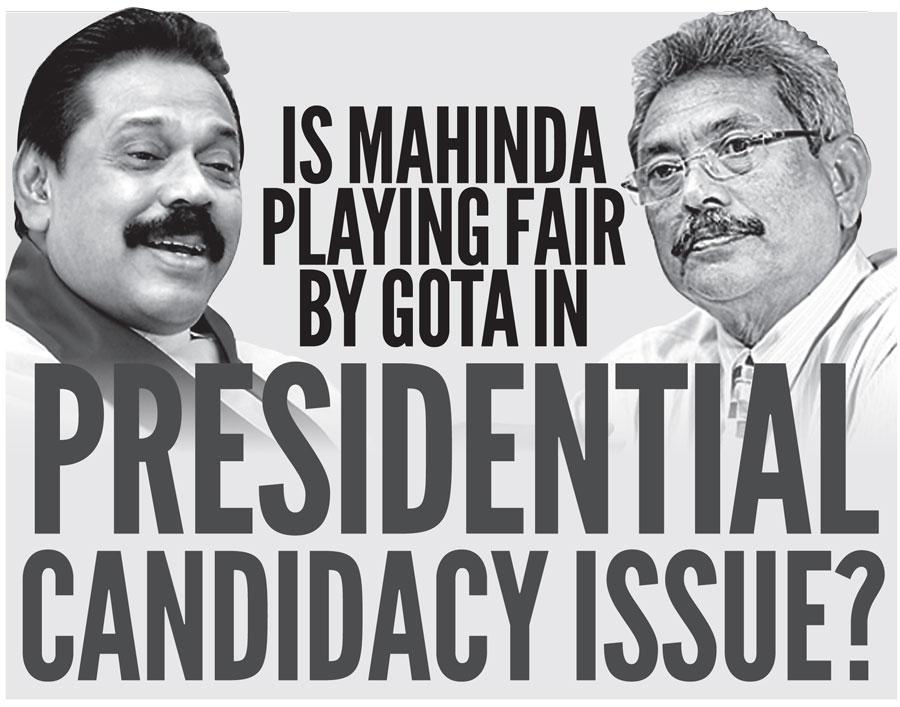
Gota would’ve been a political casualty if MR-MS’ Oct. 26 coup succeeded Imperative for Rajapaksas to pick candidate with best chance of winning
Is former President Mahinda Rajapaksa playing fair by his younger brother Gotabaya as far as the presidential election candidate issue is concerned? This question has popped up in the minds of many observers of Sri Lanka’s political landscape in recent times. Although the Rajapaksa brothers present an outward image of monolithic unity, the political grapevine has hummed many times about strong political differences existing within the ‘Kurakkan Sataka’ clan. This has been particularly so in the case of a family decision on publicly announcing the candidate for the presidential election this year.
While it is unofficially” presumed that Gotabaya Rajapaksa is the chosen candidate, the fact remains that the former defence secretary is yet to receive the green light from sibling Mahinda officially.” This is all the more striking because Gotabaya has been going ahead resolutely with the spadework necessary for being a presidential contender in 2019. This gives rise to the belief that Mahinda has already sanctioned Gota’s candidacy and will announce it at the right time. What jars however are some acts of commission and omission by Mahinda that seem to run contrary to the ‘Gota as presidential candidate’ project. This makes many feel – though few have dared to express it openly – that the Medamulana Machiavelli” may be having other ideas and is not playing fair by Gota in a political sense.
Of course it must be said that a powerful segment of pro-Rajapaksa loyalists would pooh-pooh” these doubts. They would say – and are saying – that there are no chinks in the Rajapaksa armour and that the family is marching to a single drum.” There may be minor points of disagreement among family members but they are all firmly united on the presidential candidacy issue. Mahinda being politically astute is only biding his time to make the announcement at the right time. He may be wanting to protect Gotabaya from being politically persecuted” by delaying the announcement. Furthermore, there are some who opine that the Rajapaksas are projecting an image of dissension and division as a political tactic to put opponents off their guard. At the right time the Rajapaksas would announce Gota’s candidacy and close ranks behind him.
With the ex-President being debarred from contesting the presidency again, it is of utmost importance that the candidate endorsed by him should romp home the winner. A defeat would result in the eventual decline and fall of the Ruhunu Rajapaksas
One obvious factor that cannot be ignored in the current scenario is the political desperation of the Rajapaksa dynasty, particularly Mahinda. With the ex-President being debarred from contesting the presidency again, it is of the utmost importance that the candidate endorsed by him should romp home the winner. A defeat would result in the eventual decline and fall of the Ruhunu Rajapaksas. Right now, the Rajapaksa camp candidate with the best possible chance of winning the poll seems to be Gotabaya Nandasena Rajapaksa. A Gotabaya victory would ensure the consolidation and preservation of the Rajapaksa family’s political fortunes. Hence, the family has no option but to rally around Gotabaya in the final analysis. Those rooting for Gota would subscribe to the above stated view. Indeed, Gota himself has been operating on that premise.
THE TREE DESIRES TO REMAIN STILL BUT THE WINDS WON’T STOP”
In fairness to Gotabaya, it must be said that the ex-defence secretary was not a person who wanted to contest the presidential elections willingly. Having lived in the USAfor many years and gained citizenship there was every chance that Gota may have opted to retire” peacefully to California and fade away gradually from Sri Lankan politics. That did not happen. There is a Chinese idiom; The tree desires to remain still but the winds won’t stop.” In Gotabaya’s case, his decision to enter active politics was greatly influenced by the political adversaries of the Rajapaksa family. The 19th Constitutional Amendment was the primary cause.
19A reversed the 18th Amendment by restricting the presidential terms of office to two. Since Mahinda Rajapaksa had served two terms as president, he was disqualified from contesting the elections again. This was the first blow. The 19th Amendment also debarred dual citizens from contesting presidential and parliamentary polls. This rendered Mahinda’s brothers Basil and Gotabaya ineligible to contest. This was the second blow. 19A also raised the age limit to be President. Earlier, it was 30 but now it was 35. Mahinda’s eldest son Namal was born in 1986. As such, he would only be 33 in 2019 and therefore cannot seek the presidency even if he wanted to. This was the third blow.
The 19th Amendment was seen by the Rajapaksas as one that targeted the family. With Mahinda being Constitutionally debarred from contesting the presidency again, it appeared that the political fortunes of Ruhunu Rajapaksas were on the wane. A number of inquiries probing the alleged corruption and abuse of power by various Rajapaksa family members were initiated. Cases were filed in court and a few Rajapaksas like Basil and Namal were even imprisoned for short periods. Gotabaya continues to wage many legal battles to ward off arrest and potential detention.
The pre-emptive strike by the Sirisena-Wickremesinghe Government of yore to prevent the potential presidential candidacy of Gota proved counter-productive. In a rather convoluted sense, it amounted to a self-fulfilling prophecy. There was pressure on Gotabaya to enter the political fray directly by family and party. This mounting pressure was further enhanced by an influential section of society consisting of retired defence services personnel, administrators, professionals, mercantile sector bigwigs, academics and Sinhala Buddhist ultra-nationalists. The cumulative result of all this was the willingness of Gota to contest the presidential poll. He was prepared to renounce his US citizenship in order to contest the presidency poll. His decision resulted in the launching of a well-coordinated campaign by a powerful segment of Sri Lankan society to project Gotabaya as a potential candidate at the next presidential elections. Gota was portrayed as a visionary and strong leader who would cure Sri Lanka of its troubles and lead the country towards a bright future.
ORGANISATIONS LIKE VIYATH MAGA,” ELIYA” AND HARI MAGA”
Gotabaya Rajapaksa was the first potential presidential contender for the 2019 hustings apart from the incumbent President Maithripala Sirisena. Gota’s campaign however had to be somewhat restrained as he had not been promulgated or acknowledged as candidate by any party. So organisations like Viyath Maga,” Eliya” and Hari Maga” were set up to promote the undeclared candidacy of Gota. Gotabhaya himself did not make any declaration in public of his candidacy and maintained a non – committal stance for quite some time. However, the contender recently confirmed that he was prepared to throw his hat into the ring by declaring publicly I am ready.” Gota has also been meeting with different sections of society in different parts of the country with the emphasis on youth.
While pro-Gota organisations like Viyath Maga” and Eliya” promoted his candidacy at one level, there was another support group within MPs, provincial councillors and local authority representatives too. While vociferous MPs like Wimal Weerawansa and Udaya Gammanpila have been hogging the microphone in this regard, Gotabaya’s sources of support are much wider and deeper within UPFA-SLPP and even SLFP folds. These sections have been promoting Gotabaya’s candidacy at what may be termed as a subterranean level. It could be seen therefore that Gotabaya Rajapaksa’s presidential candidacy is being pulled” externally by organisations like Viyath Maga” and Eliya” while his supporters among MPs and other elected representatives are pushing” for it within party folds.
Mahinda being a seasoned politician would have realised or will soon realise that his tentative moves to make common cause with the UNP and other parties to abolish the executive presidency will backfire on him
In spite of all this, Mahinda Aiya is yet to give the go ahead to Gota Malli. This delay by itself would not amount to a serious problem or give rise to doubts but for Mahinda Rajapaksa’s questionable conduct in matters relating to this issue. Watch what we do, not what we say,” was the famous saying attributed to former US President Richard Nixon’s first Attorney General John Mitchell who later fell from grace due to the Watergate scandal. Against the backdrop of Mitchellian wisdom watching what Mahinda Rajapaksa has been doing in recent times sheds much light on the question of Gotabaya’s presidential candidacy.
Two courses of action by Mahinda Rajapaksa in recent times raise grave doubts about the Medamulana Machiavelli’s real intentions on fielding Gotabaya as the presidential candidate. While Gotabaya Rajapaksa’s camp followers and fellow travellers go about the country promoting Gota’s candidacy, Mahinda has engaged in and is currently engaged in attempts to seek power through alternative methods thereby negating the rationale behind Gota’s presidential candidacy. In short, Mahinda has been trying to change the rules and nature of the game while his brother practises ardently to play the game as determined earlier. The two courses of action pursued by Mahinda in this regard are the abortive October 26 anti-constitutional coup and the on going attempts to abolish the executive presidency.
MAHINDA’S OBJECTIVE WAS TO GRAB POWER THROUGH BACKDOOR
In the political crisis triggered off on October 26 last year, Mahinda Rajapaksa’s objective was to grab power through the backdoor by getting appointed prime minister without a majority and then cobble together a majority by enticing MPs through various incentives. When that failed he and President Sirisena opted to dissolve Parliament unconstitutionally and hold elections earlier than scheduled. Resistance by a majority of MPs and commendable rulings by the Supreme Court thwarted those plans. Had Mahinda succeeded in that attempt, he would have ended up as prime minister with a viable majority in Parliament after elections. Thereafter, presidential elections would have been held with Maithripala Sirisena as the SLPP-SLFP-UPFA combine candidate. Sirisena would have been a puppet President with Mahinda wielding real power. If possible, Mahinda may have tried to procure a two-thirds majority and restore the 18th Amendment after negating 19A. If that happened, Mahinda had the option of becoming President for the third time. Mercifully for the country and democracy that did not happen.
What is important however is to note that Gotabaya too would have been a political casualty if the Mahinda–Maithripala duo’s October 26 coup had succeeded. Gota’s presidential ambitions would have been foiled. It may be recalled that Gota remained rather aloof and quiet during the 52-day crisis apart from paying lip service to the need for having fresh elections. Most of Gota’s non–MP supporters were also conspicuous by their deafening silence at that time. Parliamentarians from the Gota camp did accept ministerial portfolios in that illegitimate government.” What may have happened if Mahinda had seized power as premier and nominated Sirisena as presidential candidate at the expense of Gota is hard to tell and merely of academic interest now. But if Gotabaya had protested vehemently and encouraged dissent, Mahinda may have had a revolt on his hands.
The second course of action by Mahinda Rajapaksa that has the potential to dash Gotabaya’s presidential hopes once again is the current exercise of attempting to abolish the executive presidency. Mahinda Rajapaksa, Maithripala Sirisena and Ranil Wickremesinghe are all on the same page in this for different reasons. Mahinda debarred from contesting the executive presidency by the 19th Amendment would like to abolish it altogether and become a powerful executive” prime minister with a ceremonial President. Ranil whose chances of winning a presidential election against an ultra-nationalist” opponent are rather slim also would like to do away with the presidency and opt for prime ministership where his prospects are much brighter. Maithripala is the least important in this calculation but he too would prefer to be a ceremonial President without power than to hold no post at all. Sirisena already a lame duck President has no hope at all of winning a presidential election. In the context of such a triangular configuration, the executive presidency could easily be done away with if the JVP sponsored 20th Amendment is fully supported.
The abolition of the executive presidency would also abolish the presidential aspirations of Gotabaya. It is highly unlikely that Mahinda Rajapaksa would be having this ulterior motive in trying to abolish the executive presidency. What impels Mahinda in this regard is the compulsion to seize power completely as a full-fledged premier and not play second fiddle to an executive President downsized by the 19th Amendment (In any case Maithripala Sirisena has demonstrated through his shameful and shameless conduct how even a lame duck President with restricted powers could wreak havoc and obstruct the progressive work of a duly elected government). By the same token, Mahinda’s abortive October 26 coup too was more of an attempt to seize power rather than deprive Gota of a chance to become President.
MAY VERY WELL TRIGGER OFF AN INNER-PARTY AND INTRA-FAMILY CRISIS
Nevertheless, the fact remains that both these attempts in general and the current exercise in particular will have the – unintended perhaps – consequence of eliminating Gotabaya Rajapaksa’s likelihood of becoming the president of Sri Lanka. Whatever the motives of Mahinda Rajapaksa in toying with the idea of abolishing the executive presidency, there is no doubt that he is not being fair by his brother Gota in this regard. After encouraging Gotabaya Rajapaksa to prepare himself as a presidential stakes contender and then abolishing the executive presidency itself amounts to meting out shabby treatment by Loku Aiya to Podi Malli. It is like getting an athlete to train for an event and cancelling it when the person concern has peaked physically. Gota withdrew into silence during the October 26 coup but it is highly improbable that the ex-defence secretary would take the abolition of the executive presidency lying down. If Mahinda Rajapaksa persists with his efforts to collaborate with the UNP and JVP to abolish the executive presidency, he may very well trigger off an inner-party and intra-family crisis.
Gota himself has not confronted his brother Mahinda publicly over the question of abolishing the executive presidency but it is crystal clear that the ex-defence secretary is opposed to the idea. This is not merely because Gota’s presidential aspiration would evaporate but also due to a conviction that abolishing the executive presidency is inappropriate at this juncture. Gota’s mindset on this matter is clearly revealed in a recent interview to P.K. Balachandran of NewsIn Asia” website. Here is the relevant excerpt – As regards the move to abolish the executive presidency through the proposed 20 th Amendment, Gotabaya said that abolition should not be done piecemeal. The executive presidency should not be discarded before changing the election system. The present Proportional Representation System should be abolished before the executive presidency is done away with. The PR System creates instability in Parliament. You can’t have a divided and weak Parliament as well as a ceremonial Presidency. I don’t think that there are many takers for the abolition of the executive presidency,” he said.
Mahinda Rajapaksa being a seasoned politician would have realised or will soon realise that his tentative moves to make common cause with the UNP and other parties to abolish the executive presidency will backfire on him. The Rajapaksa camp has for long been supportive of the executive presidency and critical of attempts to undermine it or abolish it. Thus it would appear to be a complete U” turn if Mahinda collaborates with other parties to do away with the executive presidency. Furthermore, if suspicion gains ground that Mahinda is trying to abolish the executive presidency to prevent Gotabaya from becoming President, it would go badly against the elder brother. Mahinda Rajapaksa is certainly the single-most popular mass figure in the seven provinces outside the North and East. However, the popularity of Gotabaya is not to be underestimated. Although untested so far in hurly-burly politics there is a strong possibility that Gota may come a close second to Mahinda in mass popularity. Even the slightest suspicion that Mahinda is undercutting Gota may therefore cause an unexpected upheaval.
Already such signs are beginning to be visible. The firebrand Wimal Weerawansa has openly stated that the move to abolish the executive presidency is a sinister plot to deprive Gotabaya Rajapaksa of the executive presidency. He has threatened to break away from the UPFA if the moves to abolish the executive presidency continue. Weerawansa’s outburst and threat should not be taken lightly as he seems to be voicing the inarticulated opinion of the silent majority within the Rajapaksa camp. Already Mahinda seems to have realised the implications of the prevailing volatile situation. The meeting with the JVP proved to be a damp squib without any forward movement on the executive presidency abolition issue. It appears that Mahinda the consummate politician is extricating himself from the executive presidency abolition exercise.
GOTA HAS BEEN LAYING THE GROUNDWORK FOR HIS CANDIDACY
The recent political turns and twists indicate that Mahinda Rajapaksa cannot keep the presidential candidate carrot dangling in front of Gotabaya for long. The elder brother must play fair by the younger one and confirm the candidacy formally and officially soon. Gotabaya Rajapaksa has been laying the groundwork for his presidential candidacy so far. He has been patient as it was not his intention to launch an election campaign too early because it would have been difficult to sustain the momentum. So Gota and his campaign planners have been engaged in preparatory efforts. But what they seem to be aiming for is an intensive ,whirlwind campaign lasting for about 4 to 6 months and culminating with the presidential election that has to take place on or before December this year. Time therefore is running out and a formal announcement confirming Gota’s candidacy is needed soon. Gota has to launch his campaign by June this year. Therefore Mahinda will have to give the green light anytime after the April New Year.
It is also very likely that Mahinda may not be able to proceed at his own, leisurely pace in this matter. Gotabaya so far has never been overtly critical of his elder brother and it is unlikely that he will depart from this practice now. But it seems highly improbable that Gota will simply watch and wait patiently for Mahinda to make the announcement. Gotabaya’s strength has been his quiet confidence in the inevitability of his candidacy. Despite the many political storms threatening his potential candidacy and the prolonged delay by Mahinda, Gotabaya has not lost his cool. He has not faulted Mahinda publicly and is never likely to do so in the future either. Gotabaya’s strength lies in the confidence that he and he alone has the capacity to harvest votes in the absence of Mahinda as a presidential candidate. Gota perceives himself as a winner and knows that if the Rajapaksa camp has to have a winning candidate then it is he Gotabaya Rajapaksa who would be the only choice. It is this supreme confidence that has enabled Gota to wait patiently so long for the decisive announcement.
In spite of the stoic patience displayed so far by Gota, he cannot afford to continue with this state of affairs. With time’s winged chariot drawing near” Gota needs to force the pace and is now engaging in initiatives to do so. It is noteworthy that the Gotabaya Rajapaksa who remained outwardly non – committal about his presidential candidacy bid changed his approach after the October 26 political crisis. It was after the crisis that Gota said in January this year I am ready if you are ready.” This was to show that he was still ready, able and willing to be a contender despite the October 26 crisis generated confusion. With Mahinda’s ill-advised abortive attempt to abolish the executive presidency it is very likely that Gota too will take steps to pressurise Mahinda into announcing the presidential candidate soon.
One such initiative is the staging of meetings in different districts with UPFA/SLPP political representatives in attendance. Gotabaya’s candidacy is endorsed by these politicians at these meetings. The candidacy campaign gathers momentum steadily. On the other hand, Gotabaya Rajapaksa has also demonstrated firmly that he was not prepared to tag along without his candidacy being endorsed and authorised. When a series of political meetings were organised in different districts by the SLPP with the expectation that Gota would be on stage the ex-defence secretary refused point blank. He made it known that he should not be taken for granted and that he would not mount a political party platform without being officially recognised as the presidential candidate.
GOTA AWAITS HIS INEVITABLE TRYST WITH DESTINY
All this shows that matters are drawing to a head in the Rajapaksa camp. Mahinda Rajapaksa has to act speedily and dispel the impression that he is not playing fair by Gotabaya Rajapaksa in the presidential candidacy issue. It is time to formally announce the UPFA/SLPP presidential candidate also. It is imperative for the Rajapaksa camp to pick the candidate with the best chance of winning. Many opine that Gota is the winning candidate. It is in this evolving situation that Gotabaya Nandasena Rajapaksa awaits his inevitable tryst with destiny!
Colombo, March 8 (newsin.asia) – Sri Lanka’s Transport and Civil Aviation Ministry, on Friday, launched special ‘all female compartments’ in passenger trains travelling throughout the island in order to ensure the safety of female passengers, local media said.
The additional compartments were unveiled on Friday morning, coinciding with International Women’s Day, on the Sagarika, Samuddra Devi, Maho, Bangadeniya, Rambukkana and Fowzie local trains which travel throughout the country.
The Transport and Civil Aviation Ministry said the compartments would help minimize the complaints of harassment faced by women in public transport while special security officers would also be deployed in each compartment to prevent any unruly behavior.
The additional all women compartments would also help reduce overcrowding in trains.
Sri Lanka, has in recent years faced a rise in women facing sexual harassment on public transportation, according to the United Nations Population Fund (UNFPA).
In a recent report titled ‘Sexual Harassment on Public Buses and Trains in Sri Lanka’ by the UNFPA, it said that at least 90 percent of women have faced harassment on trains and buses and incidents of sexual harassment is on the rise because victims refuse to speak up and opt to suffer in silence.
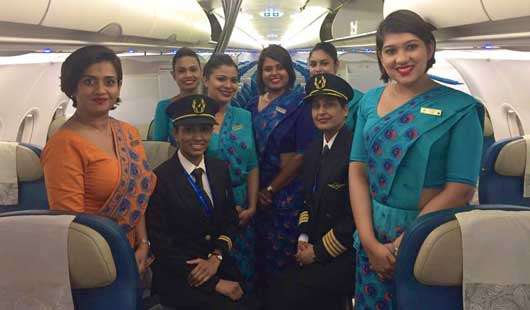
Colombo, March 8 (newsin.asia) – Sri Lanka’s national air carrier, Sri Lankan Airlines, operated its first all female crew flight from Colombo to Singapore and back on Friday to celebrate International Women’s Day, the airline said in a statement.
The UL306 flight took off from Colombo’s Bandaranaike International Airport on Friday morning carrying over 170 passengers on board.
The flight landed back in Colombo from Singapore on Friday afternoon.
The flight was piloted by Captain Simran Ghumman and First Officer Maneesha Nambuge.
Sri Lanka held several events to celebrate International Women’s Day including launching an all female compartment in passenger trains.
The Presidential Commission of Inquiry has decided to investigate a complaint lodged against a financial irregularity committed through the ‘Suraksha’ insurance operated by the Ministry of Education.
The complaint was filed by UNP Parliamentarian Wijeyadasa Rajapakshe yesterday (07).
He claims that this insurance has not drawn any benefit for school children and irregularity of Rs 2300 million has taken place as a result.
The minister further says that Rs 29 million has been misappropriated by printing school textbooks, which contained the image of the Education Minister, for the year 2018.
Furthermore, an additional Rs 538 million has been spent for the distribution of vouchers for school uniforms to students, the parliamentarian has mentioned in the complaint.
Accordingly, the Presidential Commission of Inquiry has assigned the complaint to its special investigation unit for probing.
The commission stated that it has received nearly 522 complaints and the deadline to accept the complaints was extended to March 14th.
The CID officer arrested in the act of accepting a bribe of Rs 80,000 has been remanded until March 22nd by the Colombo Magistrate.
The suspect, who was arrested by the Bribery Commission yesterday (07), was produced before the Colombo Magistrate Lanka Jayaratne.
The Bribery Commission informed the court that the officer in question has initially solicited a bribe of Rs 513,000 from a businessman to prevent a purported lawsuit against him over a cheque fraud committed by an intermediary acquainted to him.
He has later solicited another bribe of Rs 100,000 from the said businessman saying that it was to be given to Maligakanda Magistrate and had accepted Rs 20,000 from the promised amount at a previous occasion.
The Bribery Commission had arrested him in the act while he was accepting the rest of the amount yesterday (07).
The Bribery Commission informed the court that investigations into the incident have not yet concluded and sought an order to further remand the suspect.
The UN High Commissioner for Human Rights Michelle Bachelet says the lack of progress” shows that the situation of human rights in Sri Lanka should remain firmly on the agenda of the UN Human Rights Council.
In the latest report on Sri Lanka by the Office of the United Nations High Commissioner for Human Rights (OHCHR), the High Commissioner therefore urges the Council to remain closely engaged with the Government of Sri Lanka and to continue to monitor developments in the country.
The report said that in 2015, by co-sponsoring Human Rights Council resolution 30/1, the Government of Sri Lanka recognized the need to address the past in order to build a brighter future, grounded in accountability, respect for human rights and the rule of law.
The lack of decisive steps to that end, and of appropriate communication, has generated widespread frustration,” it said.
The lack of accountability for past actions likely contributed to the return of violence against minorities in March 2018, and played a role in undermining the principles of democracy and the rule of law in October and November 2018.”
The High Commissioner notes the constructive engagement of the Government of Sri Lanka with OHCHR and United Nations human rights mechanisms since January 2015.
The report said that the Government has made progress in human rights issues and its engagement with civil society in some areas. Progress in its commitments to transitional justice has, however, been inconsistent and subject to considerable delay, partly because of the lack of a time-bound comprehensive strategy.”
Such important achievements as the establishment of the Office on Missing Persons and the Office for Reparations, and the national consultations have been neither adequately supported by the political leadership nor sufficiently linked to the accountability and truth-seeking components that should be at the core of the reconciliation and accountability agenda, it said.
The High Commissioner nonetheless praises the commitment of and efforts made by some officials, particularly in several ministries, the Secretariat for Coordinating Reconciliation Mechanisms, the Office on Missing Persons, the Office for National Unity and Reconciliation and the Human Rights Commission, who have relentlessly endeavoured to push the human rights and reconciliation agenda forward.
The lack of progress shows that the situation of human rights in Sri Lanka should remain firmly on the agenda of the Human Rights Council. The High Commissioner therefore urges the Council to remain closely engaged with the Government of Sri Lanka and to continue to monitor developments in the country.”
The High Commissioner also expresses concerned that, despite its lengthy preparation and the consultation of expert advice, the final bill on counter-terrorism law might not comply fully with international human rights norms and standards.
Even in its present form, the bill contains problematic features, such as an overly broad definition of terrorism,” it stressed.
The High Commissioner also urges Sri Lanka to continue to uphold the moratorium on the death penalty and to work towards prohibiting the practice altogether, recalling the fact that the United Nations opposes the use of capital punishment in all circumstances.
The High Commissioner encourages the Government to seek the opinion of the Human Rights Commission of Sri Lanka when drafting legislation, bearing in mind the mandate of the institution to advise on human rights compliance of draft legislation.
The report also states that the regular criminal justice system in Sri Lanka continues to suffer from serious structural weaknesses, which are reflected in lengthy delays in investigations and in judicial processes in general, also characterized by long periods of detention on remand and a bail system that is applied inconsistently and in a discriminatory way.
Consequently, while prisons are overcrowded with petty criminals (even minor drug possession charges, which are not subject to bail, can lead to pretrial detention), individuals charged with serious crimes, including enforced disappearances, are able to obtain bail,” the report said.
The High Commissioner stresses that the risk of new violations increases when impunity for serious crimes continues unchecked. To date, Sri Lanka has failed to seize the opportunity provided by the Human Rights Council to establish a trustworthy domestic mechanism to address impunity or to show, by consistent progress in emblematic cases, that such a mechanism is not necessary.”
It said that some segments of civil society have continued to call for international investigations and for the Security Council to refer the situation in Sri Lanka to the International Criminal Court for international prosecutions and adjudication of those most responsible for these crimes.
The High Commissioner once again encourages Member States to prosecute Sri Lankans suspected of crimes against humanity, war crimes or other gross violations of human rights, in accordance with universal jurisdiction principles.”
OHCHR says it has continued to receive credible information about cases of abduction, unlawful detention, torture and sexual violence by Sri Lanka security forces, which allegedly took place in 2016 to 2018.
A preliminary assessment of the information received indicates that there are reasonable grounds to believe that accounts of unlawful abductions and detention and of torture, including incidents of sexual violence against men and women, are credible, and that such practices might be continuing in northern Sri Lanka.”
Such allegations should be the subject of prompt, effective, transparent, independent and impartial investigations,” the report said.
The High Commissioner also expresses her concern at the appointment, on 9 January 2019, of Major General Shavendra Silva as the Chief of Staff of the Sri Lanka Army.
The High Commissioner is deeply concerned” at the aggravation of intercommunal tensions, in particular at several attacks conducted by militant Buddhist groups targeting cultural, religious (including the Muslim community and evangelical Christians) or sexual minorities, the report said.
The UN High Commissioner for Human Rights will formally present the report to the UN Human Rights Council on March 20.
Being a woman, mother, sister, aunt – name it, it’s something women wake up to daily and they love it. None of them question about being enumerated for these roles. We marvel and revel in the roles.
Women want to work, and they want to stay in the workplace.
What they seek is balance: a gender-balanced workplace, a gender-balanced management, and more gender-balance in sharing wealth and prosperity.
In that sense, it’s heartening to see some of the proposals put forth in the government of Sri Lanka’s budget: more daycare centers, flexible work hours, and incentives to promote maternity leave. A Sri Lankan woman is hand painting fabric in a local Batik fabric factory. Matale, Sri Lanka. Credit: Shutterstock. January 3, 2017.
These are very welcome changes to think equal, build smart, innovate for change—the 2019 International Women’s Day campaign theme—and we encourage those with jobs to implement these policy changes.
1. What the law says to support part-time work: Under the Termination of Employment of Worker Act (TEWA) (Special Provisions) Act No. 45 of 1971, employers must give part-time and full-time workers the same compensation on retrenchment (termination), making them less likely to hire women who may need flexi-hours.
What Sri Lankan women and their advocates say: Advocates consider this ‘low-hanging fruit’ – simply addressing this issue could bring many more homemakers into the workforce and help both businesses and their employees.
2. What the law says to address the challenges for women working at night: The Employment of Women, Young Persons and Children Act No. 47 seeks to prevent female employees from being forced to work at night. It has a tough set of provisions – requiring that employers who want to hire women to work after 10pm must get written sanction of the commissioner of labor for women. Employers must also hire female wardens to ensure the safety of female employees at night. Another provision is that no woman can be employed for more than ten days on night work per month.
What Sri Lankan women and their advocates say: There are certain exemptions and this law was clearly formulated to protect women from exploitation. Unfortunately, it now works against women, discouraging them from seeking employment in fields such as ICT, where offices often work odd hours for the convenience of their international customers.
3. What the law says to provide pregnant women legal protection from dismissal: The purpose of the Maternity Benefits Act No. 32 is to provide pregnant women legal protection from dismissal based on pregnancy.
What Sri Lankan women and their advocates say: Currently, the amount of maternity leave a woman receives is based on how many children the couple already has – a couple about to have their first or second child are entitled to 12 weeks of paid leave, while a woman who has two or more children, is only entitled to 6 weeks of maternity benefits.
Under this legislation, fathers are only allocated three days for paternity leave, which further discourages men from taking on roles as caregivers and active parents.
Finally, different provisions in the Maternity Benefits Ordinance No.32 and the Shop and Office Employees’ Act, mean that maternity benefits are not uniform but different for white-collar and blue-collar workers, with shop and office employees receiving more days than factory workers due to different clauses regarding the inclusion of holidays.
Human rights advocates have responded to this law by arguing that pregnancy-related needs should be conceptualized as a right and not a benefit. The same benefits should be offered to women regardless of the sector they work in, while paternity leave should be increased to allow fathers to spend more time with their infants.
4. What the law says to protect the rights of domestic workers: The Registration of Domestic Servants Ordinance of No. 28, focuses on ensuring that ‘masters’ and domestic workers provide a registrar with details of the latter’s employment history, criminal record, and duration of employment.
What Sri Lankan women and their advocates say: However, advocates argue that law is insufficient and needs to be revised. It should be updated to cover the challenges domestic workers, many of whom are women, face today by promoting measures such as the establishment and enforcement of laws pertaining to minimum wages, maximum work hours, and equal pay for equal work, as well as safe working conditions for some of the most vulnerable women workers in Sri Lanka.
5. What the law says to address sexual harassment: The Penal Code Act No. 2 of 1883 and its subsequent amendments were put in place to recognize, define and criminalize sexual harassment. However, despite media campaigns, there is inadequate understanding of sexual harassment.
What Sri Lankan women and their advocates say: This law is quite sound, but victims say they are reluctant to complain to the police. Organizations can support their employees by creating a zero-tolerance policy for sexual harassment which treats such complaints with seriousness, utmost confidentiality and a genuine desire to create safe workplaces for all.
It’s true that many of these laws are clearly well-intentioned and meant to protect women.
Unfortunately, some are also very outdated and play heavily to gender stereotypes. Why do we need an age limit on a job application? Doesn’t that block women from coming back into the workforce?
Moreover, implementation of the laws remains a challenge, and monitoring and compliance with existing laws has been lacking for years, particularly when it comes to the provision of crèches and washing facilities at workplaces.
In the end, advocates argue that what is required is not protectionist laws, but laws that substantially address issues around violence, safety, health and working conditions in the workplace – and then enforce them. Share your thoughts in the comments thread below!
Her story is an inspiration to youth (male and female) and women who are afraid of failure and taking risks.
Starting from a modest home-based business, 50 years ago, today Aban is a household brand name that is island wide in Sri Lanka.
The company employs people from different walks of life in diverse jobs from street cleaners to those employed in a mega mall. The business ranges from Electronic Retailing to Sri Lanka’s most Modern Mall, to Logistics, Manufacturing, Environmental Services, and even City Cleaning Services.
Interview with Aban Pestonjee, interviewed by Geoffrey Jones, Mumbai, India, July 13, 2017, Creating Emerging Markets Oral History Collection, Baker Library Special Collections, Harvard Business School.
Sithum Chathuranga and Romesh Madusanka Courtesy The Daily Mirror
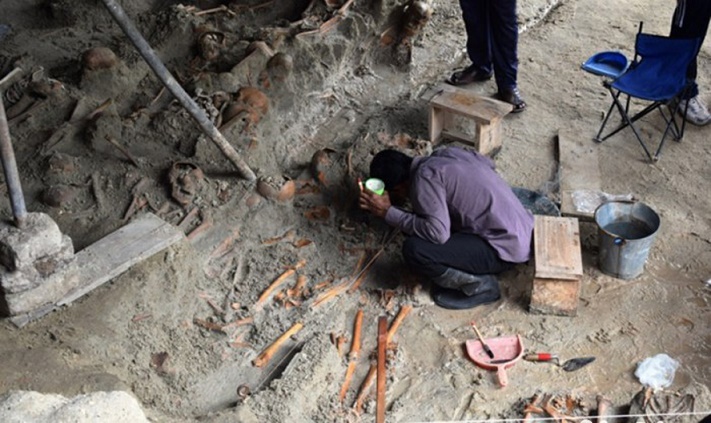
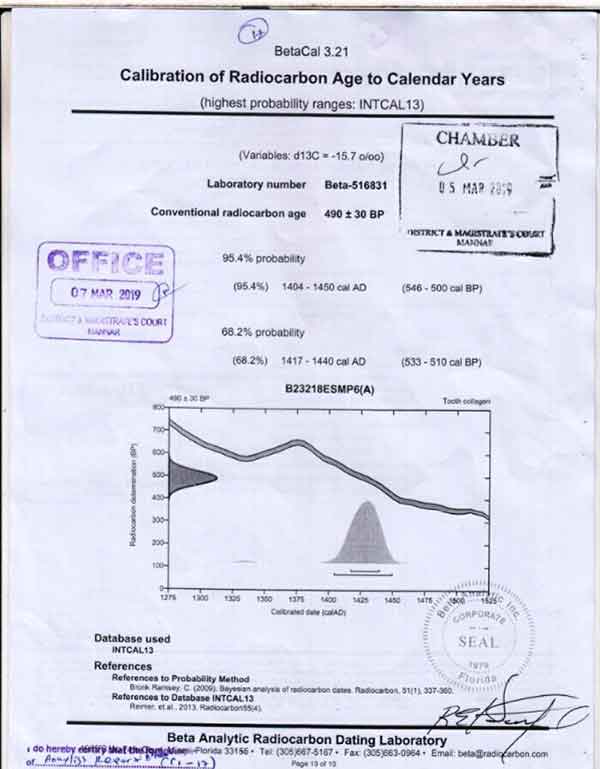
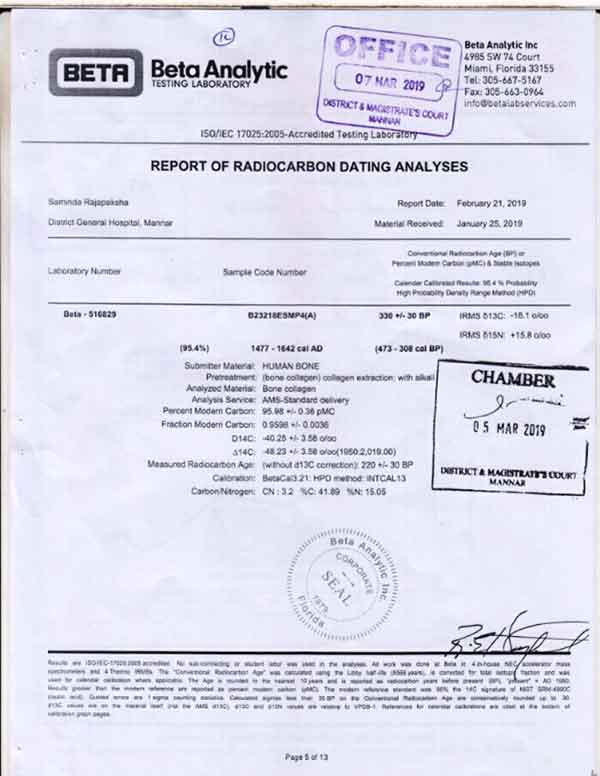
The Carbon dating report from the Beta Analytic Institute of Florida, USA has revealed that the skeletal remains found in the Mannar mass grave dates back to a period between 1499 and 1719 AD (Anno Domini).
However, the analysts are of the opinion that it was impossible to determine the specific time period.
Skeletal remains of 325 bodies were recovered during the investigation carried out for 155 days. Skeletal remains of 318 bodies have so far been unearthed including those of 29 children
Six samples of skeletal remains were sent to the laboratory in Florida for carbon testing on January 23, 2019.
The investigations on the mass grave commenced after recovering a few skeletal remains following the demolishing of the old CWE building in Mannar.
Meanwhile, Mannar Magistrate T. Sarawanaraja today directed that the carbon test report received on the skeletal remains from USA be released to the public domain.
Earlier, Mannar Magistrate T. Swarnarajah said he was unable to reveal the contents of the report submitted by the JMO on the findings of the Mannar mass grave, until the Beta Analytic Institute of Florida directly provides in writing about the Carbon dating report on the time frame to the courts.
Lately we find that there are over seven Buddhist channels in Sri Lanka .In other religious countries you will not find so many religious channels .When you scroll internet you will find thousands of YOUTUBE Buddhist sermons and mediation classes.
Some monks and laymen who practice meditation and deliver sermons claim the meditation is not required to become enlightened to achieve Sothapana”- the first stage of enlightenment .They say that people should listen to analysis given in Tripitaka by Buddha
They criticize each other,One prominent monk has severely criticized another one who globe troll in the world practicing Nirpekshatwaya which he claims is the corrects word for Nirvana .He was blamed for misguiding the laymen in finding the path to attain Nirvana at the end of current life,General opinion among everybody is that you have to go thru many re births and collect Karma to reach Nirvana .
It is essential that Chief Prelates of Buddhist Priests should hold a Buddhist Sangayana and categorize such statements made by some monks as blasphemy ?
The Supreme Court was called upon to deliver a judgment relating to the provisions of the 19th Amendment for the first time when several political parties including the UNP petitioned the apex court against the dissolution of Parliament and the declaration of a general election, late last year. The instance in which the 19th Amendment was considered by the Supreme Court before that was when it was still a Bill. The document that went before the Supreme Court, in early 2015, as a Bill to amend the Constitution was very different to what we have today in the form of the 19th Amendment. The SC shot down many of the provisions that were in the original 19th Amendment Bill on the grounds that the change envisaged would have to be approved by the people at a referendum in addition to being passed with a two thirds majority in Parliament.
As the country has now found out, the one change that the Supreme Court missed when examining the 19th Amendment Bill, was the provision in the amended Article 70(1) prohibiting the dissolution of Parliament before the lapse of four and a half years unless a resolution is passed to that effect with a two thirds majority. Many lawyers believe that the reason why the SC overlooked the change that had been made to Article 70(1) was the introduction, by the 19th Amendment itself, of Article 33 (2) (c), which appeared to give the President unfettered power to dissolve Parliament as a special discretionary power ‘in addition’ to the other powers conferred on him by the Constitution. It was only much later that the public found out that Article 33 (2) (c) was only the ‘driving licence’ and that the ‘road rules’ were contained in Article 70(1)!
The case, filed in the Supreme Court, by several political parties against the dissolution of Parliament and the declaration of a general election still does not have a name by which it is known to the public, but going by the first petitioner and the first respondent, one can refer to it as Rajavarothiam Sampanthan vs The Attorney General. This is the judgment that confirmed that under the 19th Amendment, Sri Lanka has a Parliament that cannot be dissolved. The dangers inherent in this situation were explained in earlier articles in this series and need not be repeated here.
Some days before the Supreme Court started hearing the case against the dissolution of Parliament and the declaration of a general election, former President Mahinda Rajapaksa made a special statement that it was completely contrary to the Parliamentary tradition to have a Parliament that could not be dissolved. He pointed out that the Parliamentary system could not function unless Parliament could be dissolved on occasions such as the defeat of the government at a vote on the budget or the passage of a no-confidence motion or the rejection of the government’s statement of policy.
However, the Supreme Court upheld the change made to Article 70 (1) to the effect that the only way Parliament could be dissolved before the lapse of four and a half years was if Parliament passed a resolution by a two thirds majority requesting the President to dissolve it. The court held that though Article 33 (2) (c) conferred on the President the power to dissolve Parliament, the only ‘way’ in which it could be done was laid out in Article 70 (1). In arriving at his decision, the Supreme Court based itself on certain principles which it has laid down in pages 59 to 69 of the judgment. I would like to draw attention, in particular, to the following verbatim extracts therefrom:
What the Court said
*”Where, by the use of clear and unequivocal language capable of only one meaning, anything is enacted by the legislature, it must be enforced however harsh or absurd or contrary to common sense the result may be.” (P. B. Maxwell on the Interpretation of Statues states 12th ed. at p. 28-29
*”If the language employed is plain and unambiguous, the same must be given effect to irrespective of the consequences that may arise.” (Kesavananda Bharati v State of Kerala (1973) 4 SCC 225, p 690 Per Palekar J)
* “It is not competent for the court to proceed on the assumption that the legislature knows not what it says, or that it has made a mistake. We cannot assume a mistake in an Act of Parliament. If we think so, we should render many Acts uncertain by putting different constructions on them according to our individual conjectures. The draftsman of the Act may have made a mistake. If so, the remedy is for the legislature to amend it.” (N.S.Bindra 12th ed. at p. 205)
*”How should the words of this provision of the Constitution be construed? It should be construed according to the intent of the makers of the Constitution … we have to interpret the Constitution on the same principles of interpretation as apply to ordinary law and that we have no right to stretch or twist the language in the interest of any political, social or constitutional theory… The question before us is not as to the expediency, still less as to the wisdom of these provisions, but is one of law depending on the construction of the relevant articles of the Constitution.
It is no doubt a legitimate and in the case of a Constitution, a cogent argument, that the framers could not have meant to enact a measure leading to manifestly unjust or injurious results to the nation and that any admissible construction which avoids such results ought to be preferred. Having regard to the precise and comprehensive provisions of chap. III of the Constitution, we are not in the happy position of a learned Judge of the United States, who is said to have observed that there was no limit to the power of judicial legislation under the “due process” clause of the 5th and 14th Amendments, except the sky. I consider it to be both legally and constitutionally unsound, even though the invitation has been extended to us by learned counsel, to eviscerate the Constitution by our own conceptions of social, political or economic Justice”. (A.R.B.Amerasinghe J, in SOMAWATHIE vs. WEERASINGHE 1990 2 SLR 121 at p. 124)
*”…it is to be kept in mind that the task of interpreting a statute must be done within the framework and wording of the statute and in keeping with the meaning and intent of the provisions in the statute. A Court is not entitled to twist or stretch or obfuscate the plain and clear meaning and effect of the words in a statute to arrive at a conclusion which attracts the Court.”
*”It is necessary to state here that our Law does not provide for a Court to review or question the validity of a statute which has been enacted by the Legislature. Thus, in GAMAGE vs. PERERA [2006 3 Sri L.R. 354 at p.359] Shirani Bandaranayake CJ stated: “Article 80(3) of the Constitution refers to a Bill becoming law and reads as follows: “Where a Bill becomes law upon the certificate of the President or the Speaker, as the case may be, being endorsed thereon, no Court or tribunal shall inquire into, pronounce upon or in any manner call in question, the validity of such Act on any ground whatsoever”. The aforesaid Article thus had clearly stated that in terms of that Article, the constitutional validity of any provision of an Act of Parliament cannot be called in question after the certificate of the President or the Speaker is given. Reference was made to the provisions in Article 80(3) of the Constitution and its applicability by Sharvananda, J. in Re the Thirteenth Amendment to the Constitution and had expressed his Lordship’s views in the following terms: `Such a law cannot be challenged on any ground whatsoever even if it conflicts with the provisions of the Constitution, even if it is not competent for Parliament to enact it by a simple majority or two third majority.”
In the opinion of this writer, what the SC has said here in so many words is that it is not the business of the Court to look into the merits and demerits of a law that has been passed by Parliament and that once something is passed into law, the courts are bound to enforce it “however harsh or absurd or contrary to common sense the result may be” and further that the Court “cannot assume a mistake in an Act of Parliament” and that if the draftsman of the Act may have made a mistake, the remedy is for the legislature to amend it. Some people who find themselves in the unenviable position having a raving lunatic in the family whom they can neither control nor maintain admit the patient to the Angoda mental hospital and then disappear.
It may be argued that the judiciary has basically done in Rajavarothiam Sampanthan vs The Attorney General is to wash its hands of the 19th Amendment and place the responsibility for any consequences that may arise out of it squarely on the doorstep of Parliament, which passed it into law.
The direction is now clear. Day before yesterday, it was students of higher education institutions. Yesterday, it was unemployed graduates seeking employment. Then Government teachers raised their grievances. These events have shown at least symbolically the direction towards which the country is moving. As some observers tend to define the present Government as liberal democratic, they would also argue that these oppositionist forces, which are on the other side of the fence, support, wittingly or unwittingly, non-liberal and anti-democratic forces in the country.
Hence, they may say that the suppression of these forces can be legitimised on the ground that such brutal Police action were/are and will be imperative to defend democracy. These observers seem oppositionists and the neo-liberalism which the present Government practices is nothing but a continuation of classical liberalism that the political science text books talk about. Is it true? Does neo-liberalism represent a continuation of or a rupture from classical liberalism? Answering this question may lead us to look at those protests from a different perspective?
Encyclopaedia Britannica defines liberalism as a political and economic doctrine that emphasises individual autonomy, equality of opportunity, and the protection of individual rights (primarily to life, liberty, and property); originally against the State and later against both the State and private economic actors; including businesses”. Its most humane views can be found in the writings of John Stuart Mill; who advocated that the laws of distribution of wealth and income should be different from the objective laws that govern production.
The extension of Mill’s ideas can be found in the writings of John Rawls. According to Rawls, Social and economic inequalities are to satisfy two conditions: First, they are to be attached to positions and offices open to all under conditions of fairness and equality of opportunity; and second, they are to be to the greatest benefit of the least advantaged members of society”(emphasis mine).
Of course, one may criticise these views as utopian arguing, I think justifiably, that these goals cannot be achieved if the means of production are privately owned and used to exploit others. Nonetheless, the moral and political principles that lie behind the idea of liberalism are to be appreciated and valued to protect individual from many kinds of tyrannical rule. In spite of the presence of many deviations, Sri Lanka has had a reasonably good record, until 1977, in maintaining these values.
Neo-liberalism
What had happened, in 1977 and after, was not a continuation of these values and principles but a complete rupture although the process of rupture was slow and creeping. Neo-liberalism attempts to maintain a formal resemblance with classical liberalism, but completely emptying its content. To understand what neo-liberalism is the following description by David Harvey would be useful.
Neo-liberalism is a theory of political economic practices proposing that human well-being can best be advanced by the maximisation of entrepreneurial freedoms within an institutional framework characterised by private property rights, individual liberty, unencumbered markets, and free trade. The role of the State is to create and preserve an institutional framework appropriate to such practices.
The State has to be concerned, for example with the quality and integrity of money. It must also set up Military, Defence, Police, and juridical functions required to secure private property rights and to support freely functioning markets. Furthermore, if markets do not exist (in areas such as education, health care, social security, or environmental pollution), then they must be created, by State action if necessary.
But beyond these tasks the State should not venture. State interventions in markets (once created) must be kept to a bare minimum because the State cannot possibly possess enough information to second-guess market signals (prices) and because powerful interests will inevitably distort and bias State interventions (particularly in democracies) for their own benefit.”
Qualitative difference between liberalism and neo-liberalism is not hard to diagnose. In neo-liberalism, unlike in classical liberalism, the most important element is not an individual with specific rights, but markets. It posits that individual should be thrown into markets in every sphere of her life for it to be improved and advanced. So it is neither an individual nor the State that determines her destiny but the markets in which as Mandel informed us money and power decide.
Amalgam of three aspects
Neo-liberalism is to be understood as an amalgam of three elements. First, it is an ideology that influences and moulds our way of thinking. Since 1977 our way of thinking was moulded so that we look at events and try to understand phenomena from this neo-liberal prism. A justifiable and legitimate protest by one group of people (say students, unemployed graduates and teachers) will be deciphered as public nuisance” from another section of people until they were forced to face a similar situation. Because, that is how we were led to think.
Secondly, neo-liberalism is a technique of governmentality. Elections may be held. It is necessary to remember in passing that since 2015, this right was also taken away from the people of Sri Lanka. Real governance is controlled by local and international technocrats and econocrats. Democratic governance has become nothing more than a chimera.
Thirdly, neo-liberalism is package of policies. Since 1977, this policy package has produced de-industrialisation, deficit in trade balance, indebtedness, unemployment and many other ailments leaving Sri Lanka to all whims and fancies of globalisation.
Protests and resistance
Protests and resistance thus marked the dissatisfaction of social groups; especially in the lower-rung of society. Different social groups would express their dissatisfaction and grievances at different spatial and temporal fields.
As a result, it may be difficult to understand them as an outcome of a structural crisis that was created by neo-liberalism because we were tied to neo-liberal ideology. Is this, what is called ‘false consciousness’ that we should overcome? If someone is trying to paint neo-liberalism as classical liberalism, he may not be able to distinguish cheese from cocaine just because they both are white.
E-mail: sumane_l@yahoo.com
Situated in the small fishing village of Kottegoda, K House was designed by Danish practice Norm Architects and Chinese studio Aim Architecture to make the most of its tropical setting.
“Because of the beachfront location, the aim was to achieve a rough luxury experience that embraces nature,” explained Peter Eland, lead architect at Norm Architects.
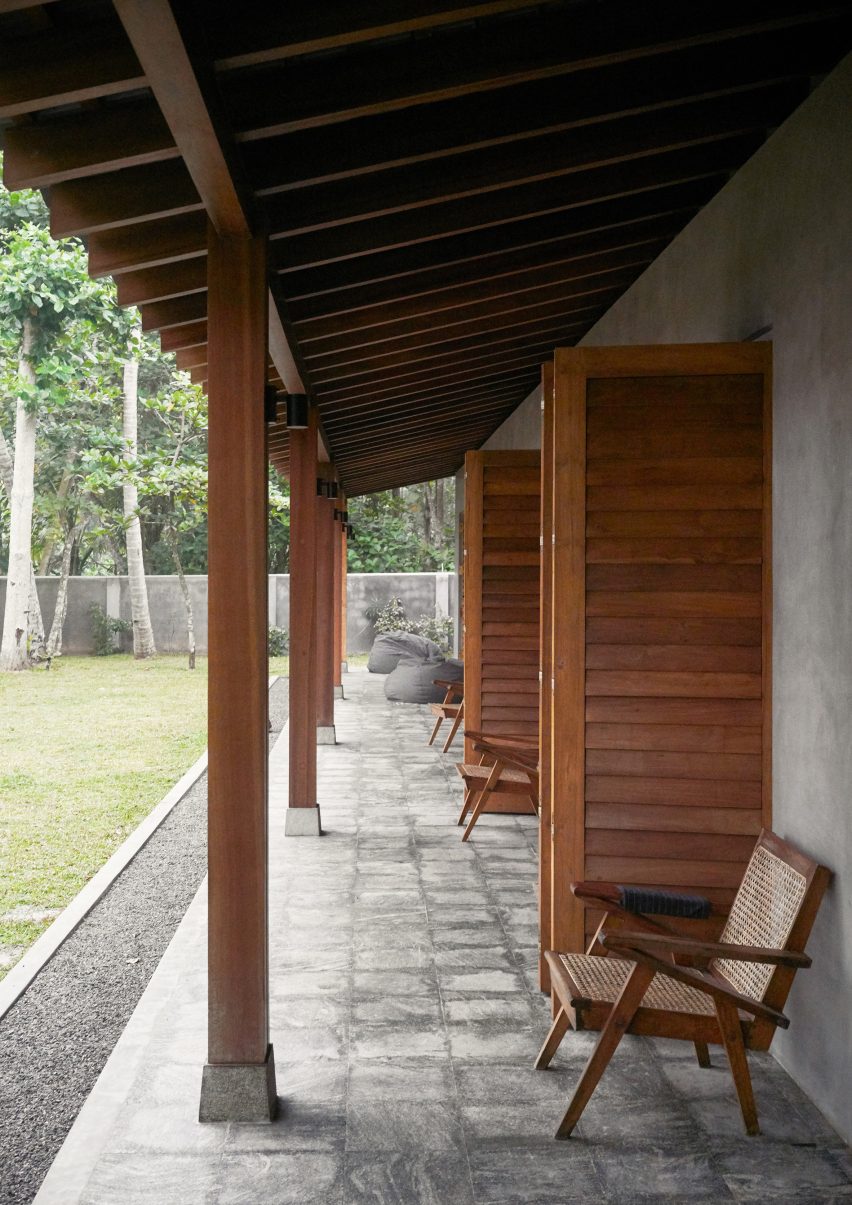
The site plays host to two peaked-roof concrete properties – East House and West House – which are loosely arranged in an L-shape to frame a central garden and pool area that slopes down towards an unspoilt sandy beach.
Both buildings feature a series of shuttered doors on their front elevations that can be pushed back to reveal the surrounding landscape.
However, while East House perches on a hilly part of the grounds that directly overlooks the ocean, West House is nestled slightly further back behind a patch of leafy trees, providing guests with a more “sheltered feel”.
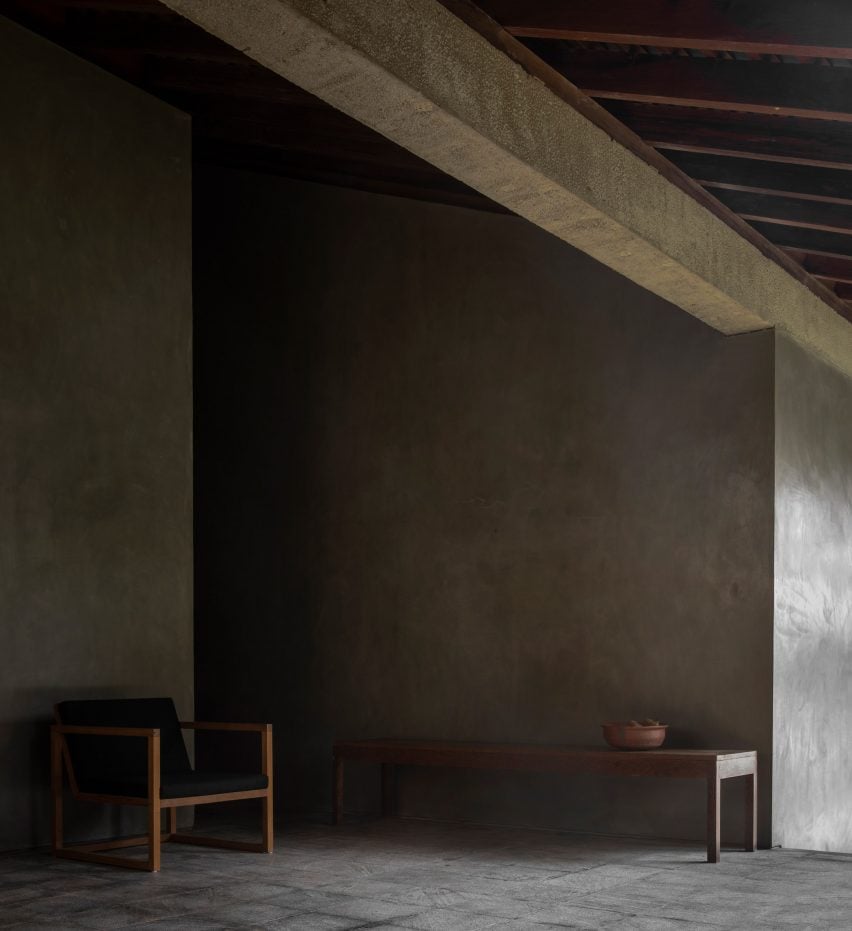
Living spaces inside West House are therefore intended to evoke a more intimate, enclosed atmosphere, with polished cement walls and floors.
Dark grey terrazzo forms chunky sink basins in the bathrooms, two of which open onto private, stone-walled courtyards where guests can shower outdoors.
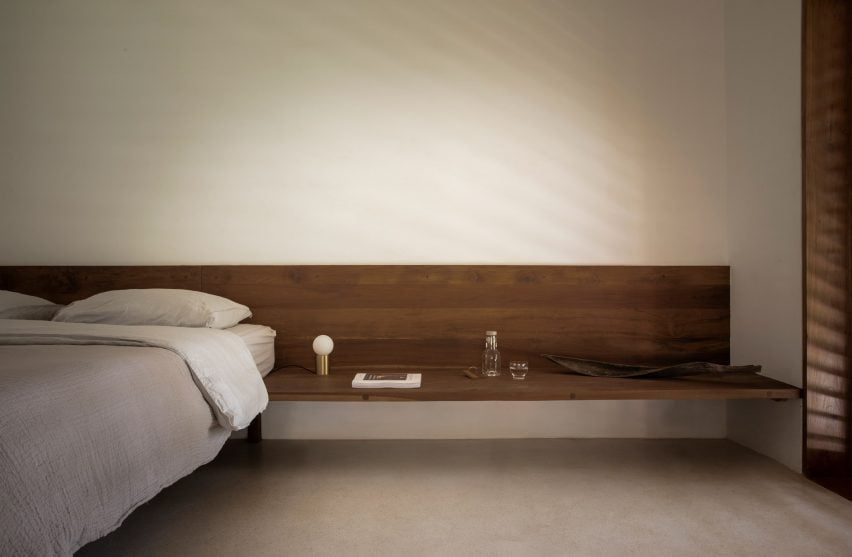
Touches of warmth are offered by teakwood dining tables, chairs, and headboards that extend the full length of bedroom walls.
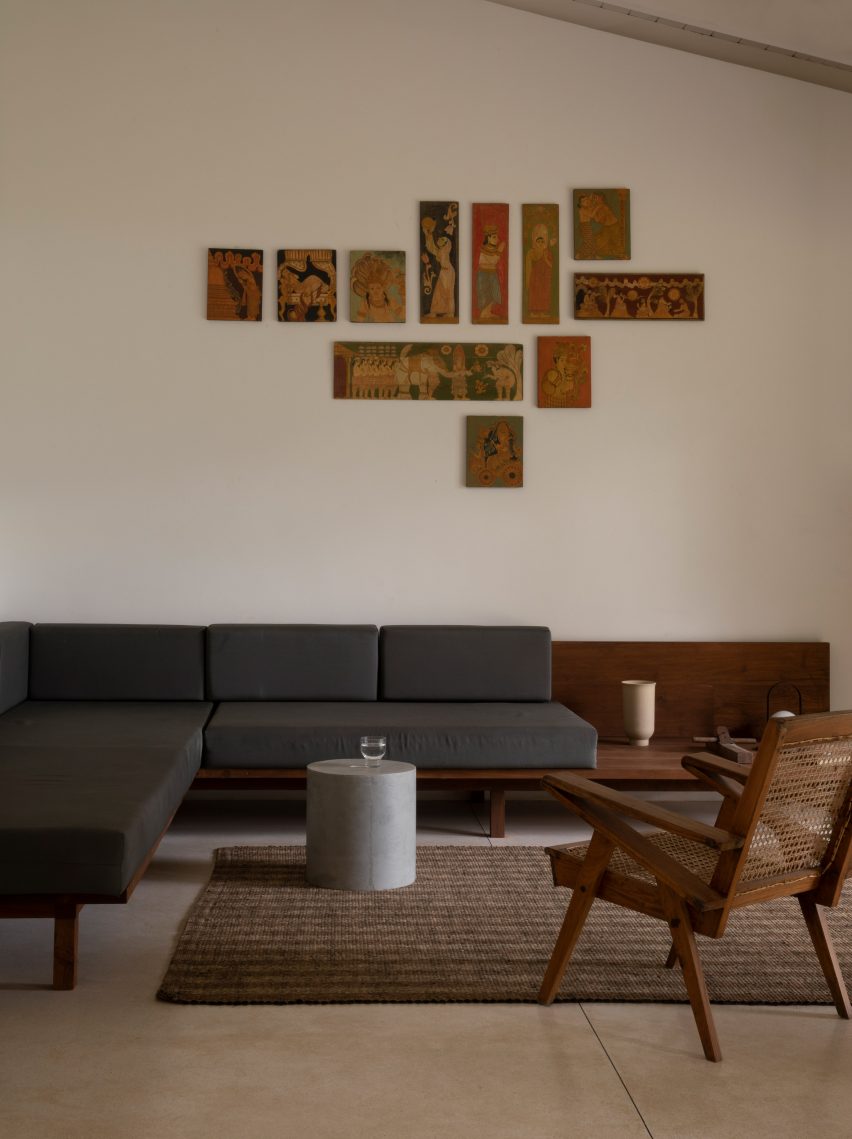
The interiors of East House have a more open-plan design. Surfaces are painted white in the joint living and dining area, which is dressed with locally sourced antique artworks.
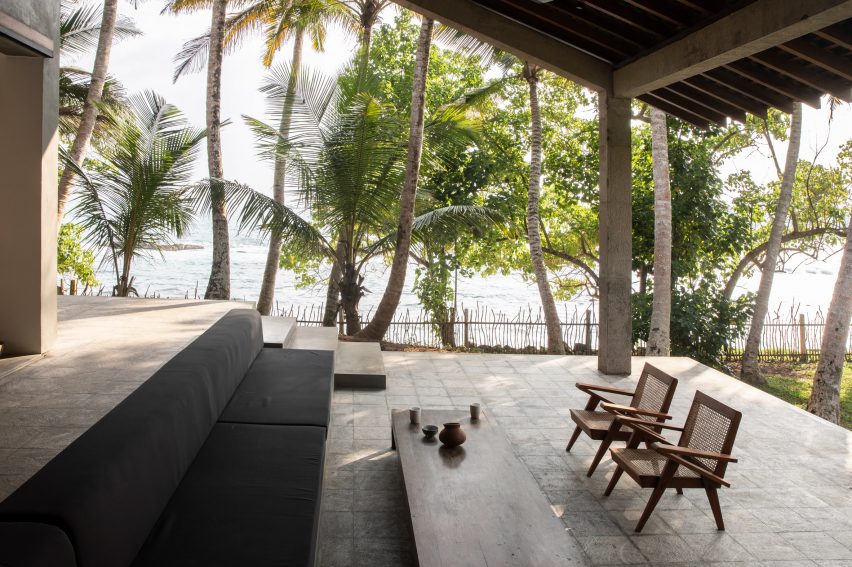
Granite tiles clad the adjacent verandah, which sits underneath a terracotta roof.
“The main challenge in this location is the climate: onshore winds from the Indian Ocean contains a lot of salt from the sea that can be quite tough on materials,” Eland told Dezeen.
“But those chosen for this project – concrete, terrazzo, oiled teak, terracotta – take that into consideration.”
Both Norm Architects and Aim Architecture often favour pared-back aesthetics in their designs.
Previous projects by Norm Architects, which is based in Copenhagen, include the hygge-influenced Gjøvik House and the earthen-toned Seaside Abode. Meanwhile the portfolio of Shanghai-based Aim Architecture includes Ruff Well Water Resort, a spa resort in the Chinese countryside.
Photography is by Jonas Bjerre-Poulsen and Noah Sheldon.
Project credits:
AIM Architecture: Wendy Saunders, Vincent de Graaf Norm Architects: Peter Eland Design team: Qing Ye, Zihan Zhao, Alejandro Felipe Project manager: Gabriela Ka Po Lo Builders: Crystal Construction
Prime Minister Ranil Wickremesinghe on Thursday appeared to be on collision course with President Maithripala Sirisena over Sri Lanka’s commitment to the UNHRC on war-time atrocities against Tamils as he reiterated the government’s commitment to implementing the UN resolution.
The Prime Minister’s Office in a joint statement with the Foreign Ministry on Thursday said Sri Lanka will continue to demonstrate its commitment and determination towards a steady and long-lasting reconciliation process through a co-sponsored resolution.
It said the government will seek an extension of the timeline of the UHRC resolution 30/1 of October 01, 2015, through a co-sponsored roll-over resolution at the ongoing 40th session of the UN Human Rights Council.
The statement stands in contrast with President Sirisena’s comments on Wednesday that he would send his own team to the UNHRC session later this month to seek a reprieve. He said the UN must allow Sri Lanka to resolve its own issues without digging into past.
The Foreign Ministry statement said that Sri Lanka’s co sponsoring of the resolution had attested to the country’s ownership of the implementation process and to its continued policy of constructive engagement and dialogue with the UN and bilateral partners.
The UNHRC resolutions since 2013 had censured Sri Lanka on its alleged human rights abuses. They called for probing of rights abuses by both LTTE and the government troops by setting up an international investigation.
The current session is expected to review Sri Lanka’s progress since the resolution co-sponsored by Sri Lanka along with the US in 2015. Although Sri Lanka has taken some steps to implement the resolution, the Tamil community has complained about the slow speed and the inadequacy of the progress.
Taking a U-turn on Sri Lanka’s pledges to the UNHRC over war-time atrocities against Tamils, Sirisena said the country needs space” to settle its own problems without interference” over the issue.
Sirisena, who after coming to power in January 2015 had pledged to ensure accountability for war-time abuses, said Sri Lanka had moved on after the end of the separatist war now for over 10 years.
We need space to settle our own problems without interference,” Sirisena said.
His team would be appealing on behalf of the government at the UN rights body.
Sirisena sending his own men, who are not ministers, adds an interesting dimension to the issue as he and his Prime Minister Wickremesinghe are clashing with each other over the issue of governance.
In October last year, Sirisena sacked Wickremesinghe in a move seen as unconstitutional. The prime minister was later restored after the Supreme Court intervened.
The government has come under fire from the main opposition for agreeing to co- sponsor the resolution.
The government’s defense has been that this strategy will prevent international war crimes allegations being continuously levelled against Sri Lankans through strengthened ownership of the implementation process.
The Tamil groups, however, remain disgruntled that even after four years of the current government who pledged redress for Tamil grievances had achieved very little in its reconciliation agenda.
The Tamil parties have called for the setting up of a UN rights body office in Sri Lanka to monitor the progress. They urge that the government should not be given any more time to implement the resolution.
Colombo, March 6 (AFP/newsin.asia): Sri Lanka’s President Maithripala Sirisena went back Wednesday on pledges to the UN Human Right s Council (UNHRC) to investigate war-time atrocities, saying he did not want to re-open old wounds”.
But the government led by Prime Minister Ranil Wickremesinghe has struck a different note saying that it will go ahead with the implementation of the co-sponsored UNHRC resolution of 2015 and harshly criticized those who oppose this move.
Sri Lankan government troops were accused of killing at least 40,000 ethnic Tamil civilians in the final months of the island’s 37-year guerrilla war that ended in May 2009.
President Sirisena said he will formally ask the United Nations rights body to reconsider a 2015 resolution which called for credible investigations into alleged atrocities.
It is a decade since we have established peace in this country,” Sirisena told reporters at his official residence in Colombo. I want to tell them (the UN) not to pressure us.”
What I want to tell them is don’t dig the past and re-open old wounds. Let us forget the past and ensure that we all live in peace.”
Soon after coming to power in January 2015, Sirisena pledged to ensure accountability for war-time abuses.
Exactly two years ago, Sirisena bought two years from the UN rights body after a previous deadline ended without any progress in bringing war criminals to justice.
A UN Human Rights Council resolution in October 2015 granted Sri Lanka 18 months to establish a credible investigation. The two-year extension expires this month with no results.
The President said that he is sending a three-man team of senior people to Geneva to present his case to the UNHRC. The team comprises Dr.Sarath Amunugama, Mahinda Samarsinghe and Dr.Suren Raghavan, Governor of the Tamil-majority Northern Province which bore the brunt of the 30 year war.
I hope they (the UN) will respond positively,” Sirisena said
Besides the President’s team, there will be Sri Lankan officials arguing the case of the Wickremesinghe government on this issue.
Wickremesinghe Government’s Case
The case government case is aptly expressed in an official press release which said:
Sri Lanka will continue to demonstrate its commitment and determination towards a steady and long-lasting reconciliation process through a co-sponsored resolution, and will seek an extension of the timeline of resolution 30/1 of October 01, 2015, through a co-sponsored roll-over resolution at the ongoing 40th session of the UN Human Rights Council.”
This initiative will further attest to Sri Lanka’s ownership of the implementation process and to its continued policy of constructive engagement and dialogue with the UN and bilateral partners.”
At the 34th Session of the Human Rights Council held in February-March 2017, the Government of Sri Lanka closely liaised with the core group (US, UK, Macedonia, Montenegro) to have the timeline of Resolution 30/1 of 01 October 2015 extended for a period of two years. Accordingly, as per resolution 34/1 of 23 March 2017, co-sponsored by Sri Lanka and adopted by consensus at the 34th Session of the Human Rights Council, the High Commissioner for Human Rights is required to present a comprehensive report, followed by a discussion on the implementation of Council resolution 30/1 at the 40th session of the Council. The action of the High Commissioner’s office on Sri Lanka is entirely based on this report which will be presented to the Council on March 20, 2019. A further extension of two years through a co-sponsored roll-over resolution accordingly needs be viewed in this backdrop.”
With the withdrawal of the US from the Human Rights Council, UK has taken the lead in the core group on Sri Lanka in the Council, with Canada and Germany joining the core group. Therefore, Sri Lanka will join hands with the core group leader UK in co-sponsoring this roll-over resolution.”
This strategy will prevent international war crimes allegations being continuously leveled against Sri Lankans through strengthened ownership of the implementation process.”
The resolution of 2015 and subsequent efforts of Government of Sri Lanka follow as a sequence to the commitments given to the then Secretary General of UN HE Mr. Ban Ki Moon who visited Sri Lanka in 2009 by the Government of the then President Mr. Mahinda Rajapaksa.”
The following is the last paragraph of the Joint Communique issued by the Government of Sri Lanka and the UN at the conclusion of UN Secretary General’s visit to Sri Lanka in 2009.”
‘’Sri Lanka reiterated its strongest commitment to the promotion and protection of human rights, in keeping with international human rights standards and Sri Lanka’s international obligations. The Secretary General underlined the importance of an accountability process for addressing violations of international humanitarian and human rights law. The Government will take measures to address those grievances.’’
In the last few years the Government of Sri Lanka has taken concrete steps such as establishment of Missing Persons’ Office and Office for Reparations to establish long lasting peace and reconciliation in Sri Lanka in addition to the establishment of Independent Commissions, enhanced by the enactment of a number of enabling laws, including for the Right to Information. This led to the people of Sri Lanka benefiting from economic dividends, including in particular, EU GSP+ concessions. A few more laws will be introduced to strengthen the ongoing processes. The entire mechanism and process of reconciliation is under the control of Government of Sri Lanka.”
‘Those who shed crocodile tears on behalf of War Heroes of Sri Lanka conveniently forget the fact that our brave soldiers are right now engaged in peace keeping in Mali, a State in West Africa, and in other places. This became possible due to our co-sponsoring of the Resolution. Further, military to military cooperation has expanded considerably, with more training opportunities for Sri Lankan soldiers. The pride of our war heroes has been protected and the confidence of international community has been gained through owning up of the Human Rights Council process. We were able to witness this during the funerals of our two Army peace keeping soldiers recently.”
The draft roll-over resolution recognizes the strong role played by the democratic institutions in the peaceful resolution of the political situation that arose in Sri Lanka from October to December last year, which is a strong testimony to the independence, credibility and resilience of our national institutions.”
The allegations made against the co- sponsoring of the roll-over resolution by the GOSL is part of the campaign to mislead the public and gain undue political advantage. However, the general public of this country is aware how the Government came to power in 2015, and helped to avert a looming international catastrophe by co-sponsoring the resolution at that time. The current initiative is nothing but seeking more time for the GOSL to address the issues of reconciliation, peace building and national integration. For instance, the Government of Sri Lanka was unable to finalize some of the required legislation due to the infamous Constitutional Coup of 26th October, 2018.Those who try to seek cheap political advantages shamelessly of a situation in which the country needs to be salvaged are the real traitors of our Motherland.
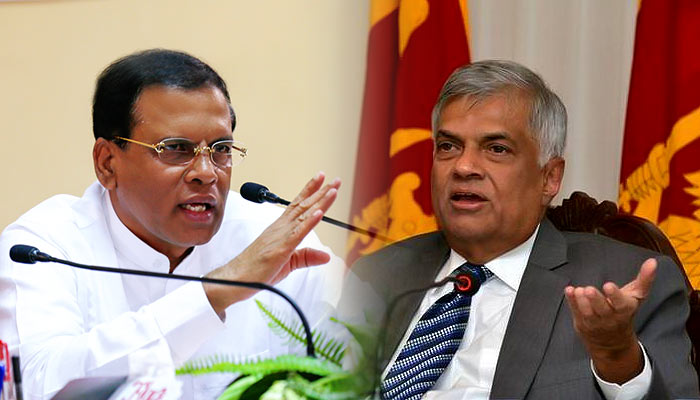
(The featured image at the top shows President Maithripala Sirisena and Prime Minister Ranil Wickremesinghe)
The Supreme Court has issued an order preventing the Criminal Investigation Department (CID) from arresting or detaining the Retired Admiral Wasantha Karannagoda over the abduction of 11 youths.
The Supreme Court judge bench consisting of Justices Buwaneka Aluwihare, Vijith Malalgoda, and Preethi Padman Surasena issued the injunction considering the Fundamental Rights (FR) petition filed by the Retired Admiral.
The Supreme Court has, reportedly, advised Karannagoda to refrain from threatening the witnesses of the case.
He was also ordered to appear before the CID at 9.00 a.m. on March 11th to record a statement.
Karannagoda has submitted an affidavit to the Supreme Court, assuring that he would appear before the court and would not travel abroad without obtaining the court’s permission.
Considering his affidavit and the submissions regarding the FR petition, the Supreme Court decided to issue the injunction preventing Karannagoda’s arrest.
However, this injunction does not prevent the Attorney General or the CID from taking legal actions against the Retired Admiral, the judge bench emphasized.
Representing the petitioner, President’s Counsel Romesh de Silva informed the court that the CID is preparing to arrest his client without any legal grounds.
Sri Lanka Navy and several other parties had conducted investigations into the disappearance of 11 youths in 2008 soon after the incident took place, however, none of these investigations had levelled any charges against Karannagoda, the President’s Counsel said.
Over 10 years have passed since the incident, hence the CID’s sudden attempt to arrest Karanngoda is a result of the influence of non-governmental organizations and it focuses UN Human Rights Council (UNHRC) session currently underway in Geneva, he further claimed.
He said that he has no objection against the decision of Attorney General’s Department to serve indictments on Karannagoda. He pointed out that, however, arresting his client at the moment is unnecessary.
PC Romesh de Silva noted that his client would not abscond the court under any circumstances.
Hence, he requested the Supreme Court to allow the hearing of the petition and issue an interim order preventing the arrest of his client until the investigations into the incident are concluded.
Representing the Attorney General, Additional Solicitor General Viraj Dayaratne stated that investigations pertaining to the incident are nearing completion and recording a statement from the petition is required.
Meanwhile, appearing on behalf of the disappeared persons, President’s Counsel J.C. Welamuna has said that preventing the arrest of the petitioner can obstruct the investigations on the incident.
On February 25th, Retired Admiral Karannagoda filed a Fundamental Rights (FR) petition seeking an order preventing the CID from arresting him.
He had named the Inspector General of Police (IGP), the Director of Criminal Investigation Department (CID), the Attorney General and the OIC of the Gang and Robbery Unit of CID as the respondents of the petition.
Karannagoda has stated that the CID launched an investigation on him for allegedly threatening a witness of the case on the disappearance of 11 youths in Colombo and suburbs in 2008.
In order to abolish the Executive Presidency, the 13th Amendment to the Constitution and the electoral system should be changed, says Leader of Opposition Mahinda Rajapaksa.
The Opposition Leader stated this during the special meeting held between Janatha Vimukthi Peramuna today (06).
Issuing a statement to clarify the matters pertaining to the discussion, he had stated earlier today that ‘it is his duty and responsibility to conduct discussions with any party in the Opposition as the Leader of the Opposition’.
In his statement, the Opposition Leader had further informed that Leader of the Mahajana Eksath Peramuna (MEP) MP Dinesh Gunawardena, and MP Dullas Alahapperuma would also participate in this discussion.
Representing Janatha Vimukthi Peramuna (JVP) the party Leader Anura Kumara Dissanayake, Parliamentarians Vijitha Herath and Sunil Handunnetti arrived at the Office of the Opposition Leader this evening.