
17 Years After the Defeat of the LTTE: The Internationalization of Sri Lanka’s Conflict & the Politics of Selective Accountability
Posted on May 18th, 2026
Shenali D Waduge
Seventeen years after the military defeat of the LTTE in May 2009, Sri Lanka remains one of the few countries where a concluded internal conflict continues to be repeatedly revisited in international forums, resolutions, lobbying campaigns, and geopolitical discussions.
The war ended militarily after 3 decades of repeated failures – negotiations, peace talks, ceasefires with UN, foreign mediators and even peace troops and foreign monitoring missions.
But internationally, the conflict became transformed into a permanent political narrative that catered to their objectives at times individually advanced then joining forces against Sri Lanka. Their combined attack posed a formidable challenge.
This transformation did not happen accidentally – it evolved through a combination of players and their combined assault:
- overseas LTTE-linked lobbying networks,
- international NGO ecosystems,
- Western political interests,
- regional geopolitical calculations,
- media narrative construction,
- and institutional activism centered around Sri Lanka.
As a result, the battlefield gradually shifted to diplomatic warfare:
from armed confrontation inside Sri Lanka between an armed non-state actor engaged in terror against the state of Sri Lanka to narrative confrontation outside Sri Lanka.
Ironically the victims became not only the Tamils living in LTTE controlled territory but all citizens. Not only were they targeted by LTTE suicide squads – internationally too they had to weather a plethora of anti-Sri Lanka assaults.
That their involvement in Sri Lanka’s conflict was for varying reasons was why the external actors could not provide a permanent solution.
Each of these external actors were looking at the conflict from the prism of their own strategic, institutional, political, ideological, financial lens.
India placed its own regional and security calculations tied to South Indian politics, maritime influence, and geopolitical leverage in the Indian Ocean.
Sri Lanka’s Tamils were only a pawn.
Faith-based organizations and missionary-linked networks operated within their own ideological and expansionist frameworks.
Western governments used the tools of human rights, grievances to diplomatically arm twist the governments in power.
The overseas LTTE-linked networks benefited from prolonging narratives of persecution as these narratives assisted asylum pathways, refugee claims, fundraising campaigns, lobbying structures, and international political mobilization.
International media platforms often preferred emotionally simplified narratives and dramatic conflict framing that generated global attention, viewership, and political traction, while the complex realities of LTTE terror, internal Tamil repression, and geopolitical manipulation received far less sustained visibility.
Meanwhile, international institutions, NGOs, UN mechanisms, and advocacy ecosystems became deeply invested in recurring cycles of resolutions, reporting structures, investigations, conferences, and accountability campaigns surrounding Sri Lanka. Entire professional, institutional, and political ecosystems evolved around the continuation of the Sri Lankan conflict narrative long after the war itself had ended.
Advisors, negotiators, facilitators, consultants, experts, foreign monitors, and conflict-resolution structures continuously rotated through the Sri Lankan theatre for decades while ordinary Sri Lankans — Tamil, Sinhala, Muslim and others — continued burying their dead and struggling to survive the consequences.
The modern battleground is no longer the jungles of Mullaitivu.
It is:
- Geneva,
- foreign parliaments,
- international media platforms,
- university activism,
- human rights forums,
- and lobbying institutions.
The military structure of the LTTE was dismantled in 2009.
But the political and narrative structure survived overseas.
This is why seventeen years later Sri Lanka continues to face:
- allegations of genocide,
- recurring war crimes campaigns,
- international resolutions,
- calls for external accountability,
- and continuous attempts to keep the conflict internationally alive.
One of the most important questions ordinary Sri Lankans now ask is:
- Why has Sri Lanka’s conflict continued to receive sustained international political attention long after the military defeat of the LTTE?
The answer can be understood by examining how international geopolitics function.
Human rights tools are the preferred choice to advance geopolitical interests.
Powerful states use human rights, justice, grievances to influence:
- which conflicts receive attention,
- which violations become global campaigns,
- which countries face recurring scrutiny,
- and which narratives are amplified internationally.
Sri Lanka entered this international environment when:
- the global War on Terror began,
- regional strategic competition in the Indian Ocean increased,
- China’s growing presence in Sri Lanka was becoming significant,
- diaspora lobbying networks became highly organized politically.
The final phase of Sri Lanka’s war therefore became not only a humanitarian issue — but also part of a wider geopolitical and diplomatic framework. Many had invested in the LTTE for 3 decades. They were not too happy with losing their investment.
This is why many Sri Lankans increasingly ask whether accountability mechanisms are always driven solely by humanitarian concerns — or whether strategic interests also influence international pressure.
The issue becomes more complex because the LTTE itself was one of the world’s most sophisticated terrorist organizations:
- pioneering suicide bombings,
- assassinating Tamil, Sinhala, and Muslim leaders,
- recruiting child soldiers,
- ethnically cleansing Muslims from the North,
- carrying out massacres of civilians,
- and eliminating rival Tamil political movements.
Yet, seventeen years after the defeat of the LTTE, international discussions frequently focus overwhelmingly on the final months of the war while comparatively little institutional emphasis is placed on:
- decades of LTTE terror – killings by LTTE
- decades of attacks on civilian property
- internal Tamil repression,
- the genocide of Tamil childhood through child soldier recruitment,
- or the destruction of democratic Tamil political space.
This imbalance has created growing perceptions of selective accountability.
Ordinary Sri Lankans increasingly ask:
- Why are certain victims internationally visible while others remain largely invisible?
- Where are the international campaigns for Tamil child soldiers?
- Where are the resolutions on Tamil political leaders assassinated by LTTE?
- Where are the international memorials for expelled Northern Sinhalese & Muslims?
- Where are the accountability campaigns for the hundreds of Buddhist monks, Sinhala villagers, Muslim worshippers, and civilians massacred by LTTE?
- Why are only certain categories of suffering repeatedly amplified internationally?
These questions do not arise because people oppose accountability.
They arise because people seek consistency.
Another issue that continues to generate concern is the role of sections of the international NGO and advocacy teams.
For some organizations, Sri Lanka became a permanent conflict industry:
- recurring reports,
- recurring funding cycles,
- recurring conferences,
- recurring resolutions,
- recurring investigations,
- recurring lobbying campaigns.
The continuation of grievance became institutionalized.
The war ended physically.
But professionally, politically, and financially, the conflict narrative continued to sustain entire advocacy structures internationally.
This is why many Sri Lankans increasingly believe that parts of the post-2009 accountability architecture evolved beyond justice and entered the realm of narrative preservation.
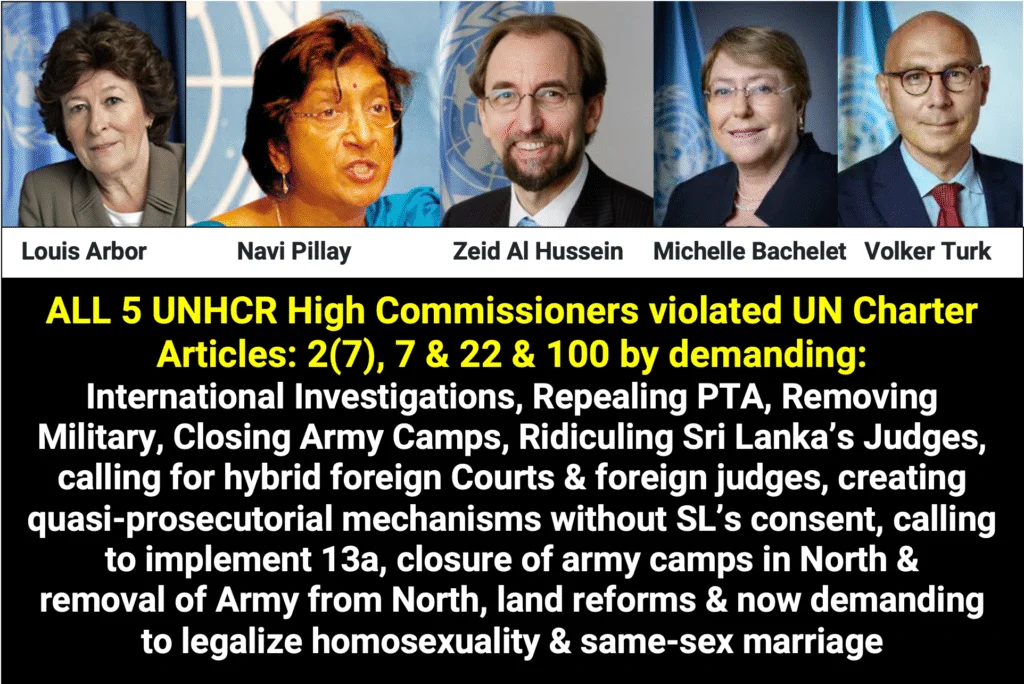
The UNHRC and the Problem of Selective Accountability
One of the most controversial developments after the defeat of the LTTE was the unprecedented manner in which Sri Lanka became subjected to repeated international scrutiny through UNHRC resolutions, external evidence-gathering mechanisms, and expanding accountability mandates.
Many Sri Lankans increasingly question whether these actions remained fully consistent with:
- the UN Charter,
- state sovereignty principles,
- non-interference norms,
- and the original mandate limitations of UN institutions themselves.
The controversy intensified after the appointment of the UNSG’s Panel of Experts (PoE) by then UN Secretary-General Ban Ki-moon following the end of the conflict.
- the Panel had no formal intergovernmental mandate,
- was not established through the UN General Assembly or Security Council,
- had no judicial authority,
- accepted anonymous testimonies,
- denied cross-examination,
- and operated outside traditional evidentiary standards expected in international legal processes.
Yet, despite these concerns, the report became the foundation for continuing international pressure against Sri Lanka.
This marked a major turning point:
a non-binding advisory process gradually evolved into a long-term international accountability architecture targeting a sovereign member state.
Many Sri Lankans therefore ask:
How did an advisory report without judicial standing become treated internationally as quasi-established fact?
Thus, the legality of the UN Panel subsequent to which successive resolutions were slapped against Sri Lanka continues to be valid & Sri Lanka preserves the right to question.
The controversy deepened further with successive UNHRC resolutions that increasingly expanded beyond traditional human rights monitoring into internal domestic constitutional, judicial, military, and governance affairs.
Why were similar international mechanisms not pursued with equal intensity against numerous other conflicts involving terrorism, separatist violence, regime-change wars, invasions, or civilian casualties elsewhere in the world?
This imbalance depicted a selective accountability being applied through geopolitical influence rather than universal standards.
Certain UN officials, rapporteurs, investigators, and institutional actors increasingly appeared to function not as neutral facilitators, but as participants within a wider political narrative surrounding Sri Lanka. Some regularly appeared at LTTE events and even issued statements commemorating LTTE dead.
The role played by some former UNHRC officials, investigators, advisors, and advocacy-linked actors continues to generate controversy because many publicly engaged in activism-like conduct while simultaneously presenting themselves as impartial institutional voices.
The contradiction becomes even sharper when ordinary Tamils living inside Sri Lanka simply seek
- jobs,
- education,
- economic stability,
- infrastructure,
- investment,
- and peaceful coexistence.
Those living in Sri Lanka seek normalcy — not permanent emotional mobilization rooted in conflict-era politics.
Thus, seventeen years after the defeat of the LTTE, Sri Lanka faces a new form of struggle:
not armed separatism,
but narrative separatism.
A struggle over:
- memory,
- victimhood,
- legitimacy,
- and international political perception.
The tragedy is that many ordinary Sri Lankans across all communities have already learned to coexist far better than some external political narratives are willing to admit.
People:
- work together,
- study together,
- conduct business together,
- and increasingly move forward together.
But conflict narratives continue because unresolved grievance remains politically useful for multiple actors:
- diaspora political networks,
- foreign lobbying structures,
- sections of international advocacy institutions,
- regional political forces,
- and geopolitical actors competing for influence.
Those living in Sri Lanka cannot prevent the international charade but Sri Lanka must stand firm against the controversial external mechanisms being pushed through international bodies that have nothing to do with the conflict but using the conflict to achieve geopolitical goals.
Shenali D Waduge