
17 Years After the Defeat of the LTTE: The LTTE’s First Victims Were Tamils
Posted on May 12th, 2026
Shenali D Waduge
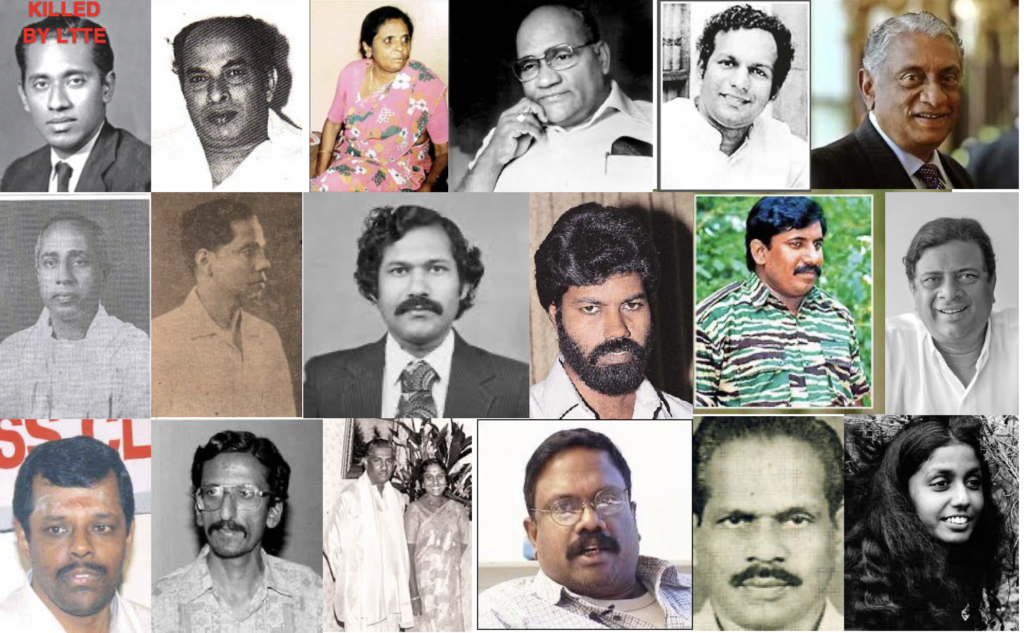
Before the LTTE turned its guns on the Sri Lankan State, it turned them on Tamils.
Yet, even 17 years after LTTE defeat there are attempts to continue to portray LTTE as the sole representative of the Tamil people”. This is deliberately suppressing an ugly truth: the LTTE’s first victims were Tamils themselves. Any Tamil who openly opposed, questioned or challenged the LTTE risked intimidation, isolation or elimination. Over time, fear replaced free expression. It became a case of either openly supporting LTTE or silently pretending to support them in order to survive. An entity seeking a separate state: self-determination for Tamils gave no democracy to Tamils. It was dictatorship and obedience based on fear.
LTTE began the systematic elimination of Tamil politicians, Tamil policemen, Tamil intellectuals, rival leaders of Tamil movements, ordinary Tamil civilians who refused to submit to its ideology. These killings were carried out even abroad. LTTE’s first killings overseas was not the assassination of Rajiv Gandhi in 1991 but the 19 May 1982 assassination of Uma Maheshwaran in Pondy Bazaar, Madras in broad daylight. Fear replaced dissent. Assassinations replaced debate. Armed absolutism replaced democracy for Tamils. These facts have a way of being kept hidden from public discourse.
The 1st political assassination by the LTTE was that of Jaffna Mayor Alfred Duraiappah. His assassination marked the beginning of a dark transformation within Tamil politics: disagreement would no longer be answered with debate but with bullets.
Thereafter, LTTE guns turned on Tamil policemen on duty in the North. Soon after it became moderate Tamil leaders, rival Tamil militant group leaders, public servants, academics & civilians. The LTTE gradually eliminated every independent Tamil voice that stood outside its control. By the time the war intensified Tamil society’s democratic and intellectual leadership was decapitated. Only those willing to be mouthpieces or pawns of the LTTE remained. Ironically, majority of the LTTE fronts operating overseas were created only after Prabakaran’s demise in May 2009.
The international media speaks volumes on Tamil suffering during the last phase of the conflict, but few speak of how Tamil society itself was internally terrorized for decades by the LTTE.
How many knew that parts of the North were denied electricity or any means of communication because the LTTE wanted to keep the people ignorant from what was happening outside their terrain. Many who saw the Sinhalese for the first time later were to tell how they were made to hate the Sinhalese.
This was how a movement claiming to fight for liberation systematically silenced the very people it claimed to represent.
The LTTE did not unify Tamil society. It monopolized it through fear & united those that had selfish agendas and ulterior motives.
This is why LTTE created TNA in 2001 and why TNA included LTTE was their sole representative” in their election manifestos. Any TNA leader going out of script knew his / her fate.
What kind of self-determination movement for their own people carries out assassination campaigns against fellow Tamil militants? How many are aware that the so-called Mullaivaikkal Commemorations as well as the Mahaveera Naal celebrations are only for LTTE dead and not for the Tamil men & women from EPRLF, PLOTE, TELO, EROS etc. The mothers of these movements are not allowed to openly mourn their children. Why should only LTTE mothers be allowed & not other mothers?
The LTTE understood that to dominate Tamil politics, all competing centres of influence had to be neutralized. There was no room for moderate politicians, Tamil intellectuals. They were all regarded as obstacles to the cause. How many of the Tamil elite can tap their conscience and admit that they too lived in fear.
Thus, seventeen years after LTTE defeat, one uncomfortable question remains unanswered by LTTE supporters worldwide: If the LTTE truly represented the Tamil people, why did LTTE fear Tamil dissent more than anyone else?
The LTTE’s brutality against Tamils extended far beyond assassinations.
Tamils lived under intimidation, forced taxation and extortion. They could not leave the North without some form of proof they would return.
Parents hid their children to prevent forced recruitment. Young boys and girls were taken into militant camps – some never to return.
Yet another ugly fact is kept hidden. These kidnapped children came from low-caste & poor homes. Some were orphans kept in orphanages in the middle of the jungles and administered by those in cloaks. No one has counted how many children were taken to be turned into child soldiers. No one has counted how many Tamil children died in these terror training camps. No one has counted how many Tamil children were shot dead trying to flee & return home. No one has counted how many female child soldiers also functioned as comfort women for men inside bunkers.
All those displaying placards in Geneva and the worlds capitals never ask these questions on behalf of their Tamil children. Why not? Why are Tamil child soldiers omitted from human rights slogans? Weren’t these Tamil children denied their fundamental rights to live as children, to study, to play, to be loved by their parents to dream of becoming somebody one day instead of being confined to the thick jungles and killing for a living. One of the greatest tragedies of the conflict was the destruction of Tamil childhood itself. What could these generations of youth become if they did not hold a gun?
They would have been doctors, teachers, engineers, accountants, artists and scholars. Instead they were kidnapped, handed rifles, a tiger uniform, sent to the jungles, taught to kill & commit suicide biting cyanide capsules.
This was not liberation.
This was the militarization of an entire generation.
The so-called liberation movement transformed Tamil civilian life into a militarized existence – obedience became their survival. The LTTE supporters overseas did not mind so long as this suffering enabled them to obtain asylum and refugee status.
The relief that came in May 2009 understandably was not vocalized. LTTE ground forces was eliminated but the LTTE political force remained. The remnants continue glorifying the movement from foreign shores, happy to come out for anniversary dates in their numbers, make profits selling their LTTE souvenirs, hold events charging entry fees – continuing LTTE campaigns is another lucrative market. As in all cases someone has to foot the bill while others benefit.
The loudest voices demanding separation of Sri Lanka ironically come from individuals and organizations safely living abroad. They were always away from the battlefield. They never sacrificed their children, they never cared that the child soldiers had no education, no right to live as a child – but they sent their children to the best of schools, dressed them in the best of clothes and now get them to do social media reels.
Ordinary Tamil families lost their children. Did the LTTE fronts overseas send a penny to these families who lost their children from the LTTE kitty? Did these LTTE fronts send monthly stipends to the LTTE members injured or maimed for life? Yet they are happy to take flight to Geneva, hold placards, romanticize separatism overseas but they never sacrificed their own sons or daughters except for media lens.
The LTTE fronts overseas are guilty of exporting emotion
Ordinary Tamils paid with blood.
Another truth rarely discussed is how LTTE emerged – within long-standing internal social frustrations inside Tamil society itself. What was originally acts of violence against their own was quickly repackaged into a militant outfit & branded anti-Sinhalese and for a separate state. This served the numerous co-partners to the cause that propped LTTE and its leadership. LTTE however did not reform society, LTTE destroyed its internal balance altogether. One-man authoritarian rule was centred around fear, martyrdom and militarized obedience. The only plus point of this was the manner Prabakaran was able to keep geopolitical hawks out of the North and Eastern terrain for 30 odd years. Considering the manner geopolitics are creeping and taking over Sri Lanka’s national assets and natural resources post 2009 in these areas – if Prabakaran was not around we may not even have a North or East by now.
Where external actors failed to exploit Sri Lanka’s natural resources/assets, they used this phase to exploit Sri Lanka’s ethnic tensions for political & geopolitical interests.
Regional politics in India, emotional mobilization from Tamil Nadu, foreign lobbying structures, and overseas propaganda networks all contributed to sustaining separatist narratives long after ordinary Sri Lankans desperately wanted peace.
External actors treated Sri Lankan Tamils as geopolitical instruments while ordinary Tamil families carried the suffering.
Even today, seventeen years after the defeat of the LTTE, commemorations continue under LTTE flags, LTTE symbols, and imagery glorifying militants.
Yet one must ask:
- Where are the memorials for Tamil victims killed by the LTTE?
- Where are the candles for Tamil policemen murdered by LTTE?
- Where are the tributes to moderate Tamil leaders silenced by assassination?
- Where are the memorials for children forcibly recruited into war?
- Where are the flowers for Tamil civilians shot while trying to flee LTTE?
If these commemorations are truly about civilians, why are the symbols always those of the LTTE?
The answer is uncomfortable but increasingly clear.
For many political actors, the goal is no longer mourning.
It is narrative control.
Seventeen years after the defeat of terrorism, Sri Lanka faces a new battle — not against bombs and bullets, but against the rewriting of history itself.
The defeat of the LTTE in May 2009 was not the defeat of the Tamil people.
It was the end of a movement that had already turned against the Tamil people long before the conflict itself started or ended.
Tamils should never forget that their own politicians travelled the seas to object to the 1957 Social Disabilities Act that enabled Tamil low castes to enter schools and obtain education. It was not the Tamil political leadership that paved way for low caste Tamils to gain education – it was the Sinhalese.
Real reconciliation cannot be built upon selective memory, political mythology, or the glorification of terror.
It must begin with the courage to tell the truth.
And the truth is this:
The LTTE’s first victims were Tamils and when considering the men, women, children kidnapped to become militants – how much have Tamils lost to a conflict created for whom & against whom?
Shenali D Waduge