I have accomplished far more difficult tasks – MR Reducing taxes by 20%:

June 11th, 2018

The same people who challenged him to end the war a decade ago were now daring him to reveal how he could reduce the taxes by 20%, former President Mahinda Rajapaksa told The Island yesterday.

“I took up their challenge and enabled our military, police and the civil defence force to neutralise terrorism. Some of my detractors belittled the war effort and the sacrifices made by the troops. I think everyone remembers how some people derisively asked us at the height of the war whether our troops had mistaken Pamankada for Alimankada (Elephant Pas) and Medawachchi for Kilinochchi. Most of these people didn’t even think of going to the north and the east when the LTTE was active and now they have all become tough guys.

article_image

“Some of them would wet their pants when Prabhakaran roared in the Wanni. They were hiding under beds fearing the Tigers. We defeated terrorism and, today, they are moving about freely like heroes while conspiring with foreign powers and LTTE fronts against the national military.

“They even demeaned the capture of Toppigala by calling it a barren rocky terrain”, Rajapaksa said.

Speaking to The Island a few weeks ago, Rajapaksa said that he would reduce the taxes by 20% under a future administration. In response, speaking at a function in Ranwala, Dompe, Prime Minister Ranil Wickremesinghe asked Rajapaksa how he would repay the country’s debt after reducing taxes.

Prime Minister Ranil Wickremesinghe challenges former President Mahinda Rajapaksa: Tell me how to repay loans while reducing taxes

June 11th, 2018

Upali Ranaweera Courtesy The Daily Mirror

Responding to a claim by former President Mahinda Rajapaksa that he would reduce taxes by 20 percent after regaining power, Prime Minister Ranil Wickremesinghe challenged him on Saturday to reveal the country how the latter is going to repay the huge amount of loans the country owes to the other countries after reducing taxes.

Speaking at a function that was organised to declare open the iron bridge that has been constructed over the Kelani River connecting Siyane Korale and Hapitigama Korale at Ranwala, Dompe, the Prime Minister stated that he wanted to know how Mr. Rajapaksa is going to reduce taxes while at the same time repaying the foreign debt with interest.

The Prime Minister was referring to a statement made by the former President during an interview with a Sinhala newspaper days ago.

Claiming that his government had to pay the loans including one amounting around Rs. 21,000 million obtained by the previous regime for acquiring lands from all over the country, Mr. Wickremesinghe said that his government was paying for the sins of Mr. Rajapaksa.

The Prime Minister referred to the proverb “people who live in glass houses shouldn’t throw stones” when he recalled how the government of former President who accuses the incumbent government now that it sells national assets to foreigners, sold 50 acres from the Port City outright to China and the land where the Army Headquarters was situated to a Chinese hotel.

He said that the country had to face several natural disasters such as floods, drought and the collapse of Meetotamulla garbage dump, yet the government has embarked on development projects such as the construction of Ranwala and Milleniya bridges.

Missing the wood for the trees

June 11th, 2018

Editorial Tuesday 12th June, 2018 Courtesy The Island


A complaint has been lodged with the Commission to Investigate Allegations of Bribery or Corruption (CIABOC) against MP Dayasiri Jayasekera, who has owned up to receiving funds from Perpetual Treasuries Ltd. (PTL), as we reported yesterday. The CIABOC will decide whether it could conduct a probe thereinto. Such action is welcome, but much more remains to be done. Several complaints have been made to the anti-graft commission against government top guns and the public has a right to know who they are, whether investigations have got underway and, if not, why. The Presidential Commission of Inquiry which probed the bond scams recommended action against certain individuals. Have these recommendations been carried out?

Some government panjandrums claim that the bond probe commission report does not contain a list of the names of MPs who took money from PTL. It is also doubtful whether PTL owner Arjun Aloysius will go out of his way to expose those he has helped financially. Only a thorough probe will help identify the beneficiaries of his largess. However, now that the image of the entire Parliament has been tarnished, the onus is on all MPs to submit affidavits, suo motu, protesting their innocence, if they can, with a promise to resign in case they are found to have lied.

UPFA MP and Joint Opposition firebrand Udaya Gammanpila has made the aforesaid suggestion in Parliament, but it has not found favour with his parliamentary colleagues, we are told. Let him be urged to prevail on his JO comrades to submit affidavits declaring that they received no funds from PTL or its subsidiaries and, thereby, set an example to their rivals. The JO has to put its own house in order before asking others to clear their names. We bet our bottom dollar that some of the holier-than-thou JO members will not dare do so, for obvious reasons.

One wonders whether the ongoing media hype, surrounding the individual MPs who are believed to have taken PTL money, is consequent to an exercise in smoke and mirrors, on the part of the masterminds of the bond scams, to obfuscate the main issue. Politicians who have sold their souls to unscrupulous businessmen with deep pockets and hidden agendas need to be exposed, but the public should not fail to see the wood for the trees.

Many critics have been baying for the blood of Jayasekera and State Minister Sujeewa Senasinghe, who has also got money from a PTL subsidiary. Among them are notorious crooks who helped themselves to public funds and abused their positions to put various crooked deals through under the previous government and successfully covered their tracks. It is a case of sinners stoning sinners. However, even if the efforts being made to get rid of the MPs who sullied their hands with PTL money, reach fruition by any chance, the problem of moneybags greasing the palms of lawmakers will not go away. The present-day rulers came to power, condemning their predecessors for malpractices and promising a radical departure from the culture of corruption, but, today, they have got exposed for mega scams. The practice of politicians benefiting from anti-social elements with huge slush funds at their disposal will continue unless action is taken to remedy the systemic flaws they exploit to get away with their offences. What is called for is to put in place robust legal and regulatory mechanisms, as a national priority, to prevent black money being lavished on politicians et al.

The need for new laws to impose a cap on campaign funds has been felt for a long time. At present, no politician is legally bound to declare how much he receives by way of campaign funds or the amount he actually spends on electioneering. The sky is the limit, and needless to say this sorry state of affairs nurtures corruption. Moneybags bankroll prominent politicians’ election campaigns, on both sides of the political divide, and bend governments to their will, later on. This may explain why the interests of big businesses always take precedence over those of the ordinary people under all governments.

Parliament is not short of self-righteous members who pontificate on good governance. Will, at least, one of them move a private member’s motion calling for new laws to regulate campaign funds?

LTTE village & a Sri Lankan Military Officer show the world what Reconciliation & Peaceful Coexistence is all about.

June 11th, 2018

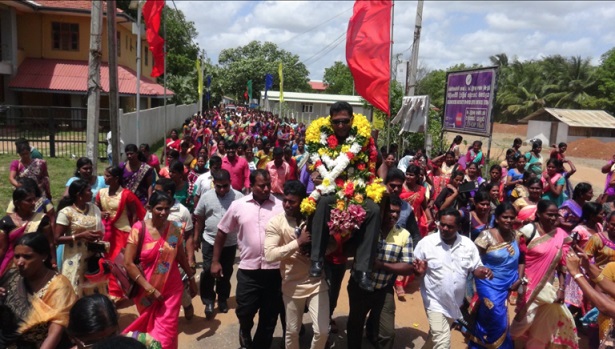
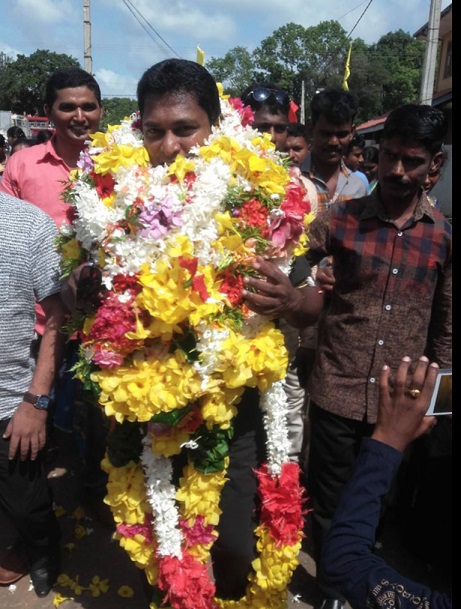
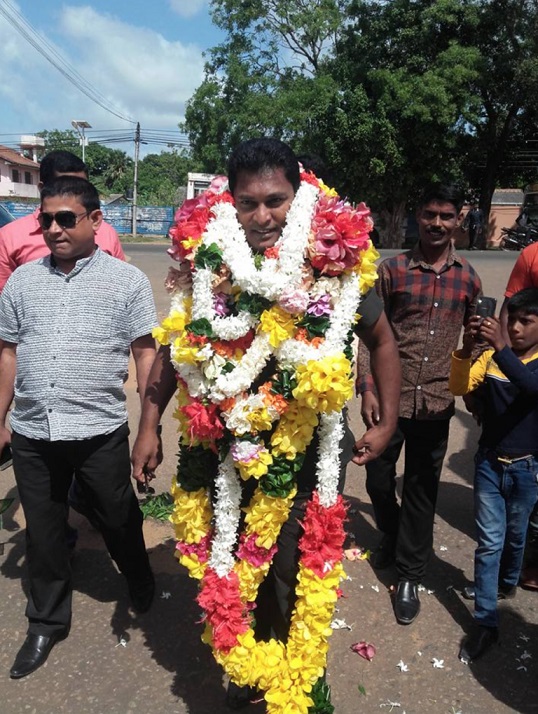
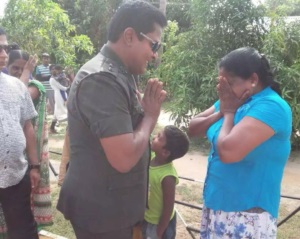
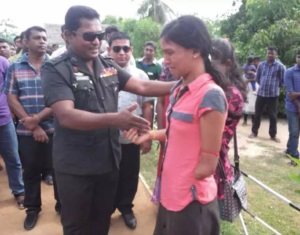
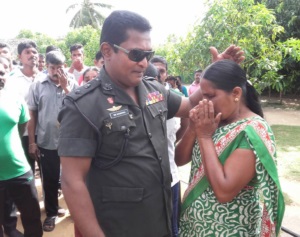
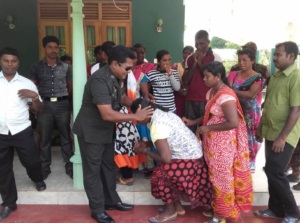
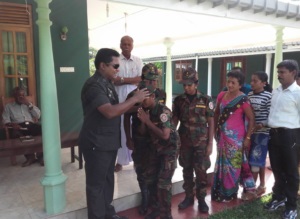
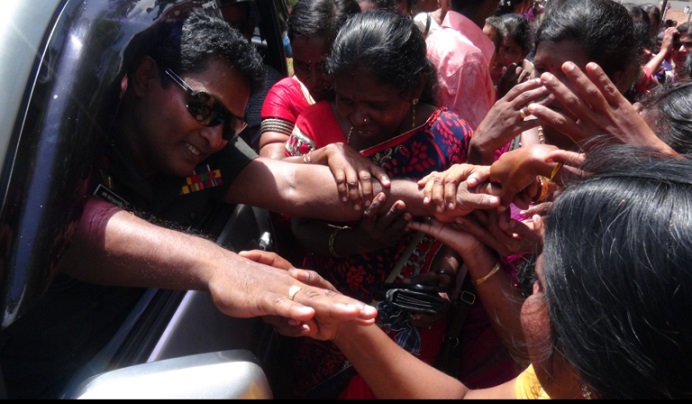
It was a farewell that has shocked & left plenty of critics speechless. It has put to rest & completely nullified the lies that have been spread against Sri Lanka’s Army. The culprits include foreign governments/envoys, INGOs/NGOs, UN & even the present government in particular the Tamil leadership & the LTTE diaspora who must be startled at the pictures emerging of an entire village weeping as they bid farewell to a military officer who had played the role of their mentor, their father, their brother, their advisor & virtually their leader. Col. Rathnapriya Bandu has done what Prabakaran, Wigneswaran, Sivajilingam, Sumbanthiran, Sambanthan or even Tamil Nadu politicians could not do & do not want to do. In a world that plays divisive politics of divide & rule he has shown that it takes a hero to unite & Col. Bandu is one hero that we must all salute. No former LTTE village would ever carry a Sri Lankan Military officer on their shoulders & weep as he bid goodbye if he was no hero in their eyes.

Lesson 1: No Caste difference

Vishwamadu was an one time tiger den. Many LTTE cadres were enlisted from Vishwamadu. It was also a village of only low caste & impoverished Tamils. They were virtually outcastes of their own Tamil people. No Tamil politician desired to look into their needs. They were good enough only to be fighters & have their dead bodies exhibited in photos across the world for political gain. To Col. Ratnapriya these villagers were not low caste or poor. They were people & he opened up to them & they in turn opened up to him. These images can fill the rest of the story. These pictures have shattered the myths & lies that have been floated.


Lesson 2: Sinhalese & Tamil do not need to live separately

No TNA politician has been honored by LTTErs in this manner. No TNA politician has been carried by the people of any Tamil village in the North but these Tamil villagers not only carried Col. Rathnapriya they were all seen crying. It is a sight that has stupefied all of us because it has completely negated the lies that the Tamils & Sinhalese cannot live together, it has completely dislodged the argument that a new constitution is needed with an asymmetrical federated state separately for Tamils. When an entire LTTE village showers love & affection for a military officer the incident must surely shake the entire world in particular the foreign governments & the UN.

Lesson 3: Artificial barriers

We are drilled day in and day out that the Sinhalese cannot live with Tamils & Tamils do not want to live with Sinhalese. We are brainwashed to think the soldiers are cruel & mean to Tamils & the military should be removed from the North. But then, we have an entire LTTE village carrying a soldier on their shoulders, crying as each line up to bid farewell. What the hell is going on, we all are now asking. Well, the pictures tell the story & we really just need to look at the tearing eyes of these Tamil villagers & in digesting the love & affection that has taken place to realize that we have been fed lies & fake news & distortions & these are all artificial barriers created for political agendas. When one soldier has won an entire village, no wonder the TNA & the present government together with the lying machines want him transferred & away from the people.


Lesson 4: Third Parties & Foreign Templates useless

The third parties sitting either across the world, in some hotel or AC room in Colombo, or UN rapporteurs arriving on business class with files & folders of templates on reconciliation & peaceful coexistence should not waste their time, money or our time because one soldier & an entire LTTE village have shown the rest of the country that we don’t need external parties, we don’t need foreign paid NGOs, we don’t need damn rocket science to live in peace with mutual respect & sharing ups & downs together. Let everyone remember that this one officer changed an entire village of hardcore LTTErs. No foregin document can have the answers to that! Without these international community & other meddling parties the LTTE families & the Sri Lankan Military have shown that they have mended & bonded & the trust & harmony that has been cemented must be a shocker to all the critics. The incident has shown that reconciliation doesn’t need foreign interference, doesn’t need foreign templates, doesn’t need NGOs, INGOs, foreign envoys & it has shown that reconciliation is easy & is very much possible without the external interferences & interventions.

Lesson 5: TNA / Tamil high castes / LTTE Diaspora don’t fool your own people

Vishwamadu is just one village with virtually a 100% low caste & poor Tamil populace. They were used and good enough only to be enlisted to take a gun & die for a cause that would benefit the Tamil higher castes. They had no voice, they had no one to care for them. TNA, the Tamil high castes & the LTTE diaspora must feel ashamed just as they must be reeling with envy & jealousy seeing how these low caste & poor Tamils are treating with honor a Sri Lankan military officer. They have given a strong message to the TNA/the Tamil high castes & the LTTE diaspora – they no longer wish to kill. They only wish to live. So be it & we must reach out & make many more Vishmadu villages where the hearts & minds have opened to reconcile & usher peaceful coexistence that we were made to believe was never possible. What lies we have all been fed by the same parties that wish to keep us divided promoting bogus reconciliation templates.

Col. Rathnapriya Bandu has completely shattered the lies & myths that have been floating.


The Tamils of Vishwamadu a village that produced hard core LTTE cadres are crying as they bid farewell to a Sri Lankan Military Officer. The message is very clear – remove all interfering parties, remove racist TNA politicos, remove the Sinhalese/Muslim racist politicos, remove Tamil caste system & do not allow LTTE diaspora to divide any further & the Tamils & Sinhalese will be at peace, will be living in peace & harmony as they have done for centuries.

If Vishwamadu had to elect a chief minister it would not be Wigneswaran or the TNA, Col. Rathnapriya would win hands down!

We salute this gallant officer who has silenced all, shattered the lies & myths & shown what true reconciliation, peace & harmony are all about.


Shenali D Waduge


http://www.colombotoday.com/carnal-rannapriya-bandu-2018-6-10/


http://sinhala.adaderana.lk/news/90670/රණවිරුවෙක්-ස්ථාන-මාරු-වෙලා-යද්දි-%C2%A0කවුරුත්-නොහිතපු-විදියට-හිටපු-LTTE-සාමාජිකයෝ-කරපු-වැඩේ-මෙන්න

Linking Colonial Imperialism to NeoColonial Imperialism & Future of Nation States

June 11th, 2018

Nothing happens in isolation. Everything has a connection & it is left to us to join the dots & make the distinctions. Where is the world going, what is the future for the global community can be seen in understanding the geopolitics & global dynamics at play. It is in understanding how industrialization, the capitalist system of free markets, liberalization, private ownership & who controls these entities that we can better understand who controls the world & where the world is going.

Retracing backwards by 500 years to the Colonial Project of Colonial imperialism

The present international systems & concepts emerged as an off shoot of Western European Christian colonization of the world.

Therefore, it is imperative that we put into context how the world changed as a result of colonial imperialism & the changes that took place thereafter. It saw a complete shift in the not-so-developed Europe becoming industrialized after draining the once rich-fertile & resource-rich invader nations & turning them into what they are today classified as developing nations suffering consequences of European divide & rule policies which conquerors used as a means of portraying their power & their rule over people & territory which they partitioned & drew according to their advantage. This was how new countries were created including all of the countries of Africa.

What British East India Company, a private profit seeking corporation representing the British Government did during colonial reign is no different to what the Transnational Corporations/Multi-National Corporations are presently doing. We see a subtle movement to remove the Westphalian sovereign nation system & have corporates govern the world. Corporates/INGOs are using political clout to acquire land often for 200 year lease and the buy-in for the scheme is seen in the manner politicians are now turning into corporate heads are heading these supposed to be non-for-profit entities.

Is the world Anglo-European centric?

International laws, education systems, international organizations & the common goals & concepts being rolled out have little place to absorb any of the civilizational cultures, traditions, laws, social systems that existed far before Europeans set out to discover the world. In fact ever since European invaders landed in the Americas, Africa & Asia Pacific their indigenous laws, social systems, traditions, cultures,, education etc all came under the European gavel & everything indigenous became diluted, changed or were completely annihilated. All the laws, conventions, treaties, agreements were all designed by the West, to suit the West & adjudicated according to what the West deemed as right, wrong, ethical, moral etc.

Societies were turned into consumers – divided as rich-poor, have-have-nots, black-white, slaves, elite-working class, rural-urban etc.

There were no constitutions before the Europeans compelled all colonized countries to adapt a new constitution at the time of independence. No one has yet questioned in what capacity invaders can decide a country’s independence & force countries to create constitutions that would bind them to the monitoring of these invader nations who were giving a bogus ‘independence’.

The world is Western-centric

International trade law is based on theories of economic liberalism developed in Europe and later the United States from the 18th century onwards (GATT/WTO)

The next step was to create the modern monetary system tying all nations of the world substituting gold for US dollar as the global currency. The modern monetary theory was created to allow governments the power to issue their own flat currency & force people to use it through taxation. According to the Bretton Woods Agreement signed by 43 countries in 1944 after World War 2 countries promised their central banks would maintain fixed change rates between their currencies & the dollar. Countries could regulate currencies only under conditions. US became the only country with the ability to print dollars.

What is noteworthy is that the UN was established AFTER all these international systems of control were set up thus leaving no room for the developing nations or former colonies to include their demands. The Universal Declaration of Human Rights in 1948 completely ignores the social differences of 191 UN member states and the 58 nations that existed when it was drafted. All Conventions & Treaties are drafted from looking at issues from the angle of the West – their morals, their ethics, their stands giving no podium to the laws that existed under indigenous rule with older civilizations that the West can boast of.

The Bretton Woods Agreement also created the World Bank & the IMF. IMF could print money & countries could borrow from IMF, adjust their currency value, The World Bank was initially set up to lend to the European countries devastated by World War 2.

The International Monetary Fund (IMF) and World Bank are run by their member governments on the basis of shares they hold. The US government has the largest share of votes in both the IMF and World Bank. United States, Germany, Japan, the U.K. and France control about 40% of the shares in both institutions. the president of the World Bank has always been a U.S. citizen, and the head of the IMF has always been a European. IMF and the World Bank lends money to government on conditions.

Of the 185 members that make up the IMF, six colonial masters and their allies – comprised of the United States, Germany, Japan, the United Kingdom, France and Italy – control 42 per cent of the votes.

The IBRD & IDA make up the World Bank

The World Bank Group consists of 5 international organizations

  1. International Bank for Reconstruction & Development (IBRD)
  2. The International Development Association (IDA)
  3. The International Finance Corporation (IFC)
  4. The Multilateral Investment Guarantee Agency (MIGA)
  5. The International Centre for Settlement of Investment Disputes (ICSID)

But who controls the money supply of the world? The Bank for International Settlements which is the Central Bank of Central Banks & located in Basel, Switzerland, founded by the global elite & operates for their benefit. It is immune from taxation & international laws. 58 global central banks belong to the BIS. Only North Korea & the islands of Micronesia do not have a central bank.

How many are aware that the US Federal Reserve (FED) is also a privately owned company. The following banks all of whom are connected to the London Banking Houses have shares in the FED.

  • Rothschild Bank of London
  • Warburg Bank of Hamburg
  • Rothschild Bank of Berlin
  • Lehman Brothers of New York
  • Lazard Brothers of Paris
  • Kuhn Loeb Bank of New York
  • Israel Moses Seif Banks of Italy
  • Goldman, Sachs of New York
  • Warburg Bank of Amsterdam
  • Chase Manhattan Bank of New York

FED prints the money for the US Government but the US Govt has no stocks in the FED yet it has the right to print money through the Treasury. The FED creates money from nothing, and loans it back to us through banks, and charges interest on our currency. The FED also buys Government debt with money printed on a printing press and charges U.S. taxpayers interest.  https://www.globalresearch.ca/who-owns-the-federal-reserve/10489

According to a study by Swiss Federal Institute of Technology on 37 million companies and investors worldwide & concluded that 147 mega-corporations controls 40% of the entire global economy.

According to Stockholm International Peace Research Institute (SIPRI) the United States remains the world’s top arms exporter since 1990. https://www.armscontrol.org/act/2017-03/news/us-leads-rising-global-arms-trade Sales of arms and military services across the world totaled $374.8 billion in 2016 of which $217.2 billion were American companies. Lockheed Martin sold $41 billion of military equipment.

6 giant media corporations control more than 90% of what people watch & read in the US.

According to UNCTAD (United Nations Conference on Trade and Development) report Transnational corporations TNCs – 40,000 parent firms and 250,000 foreign affiliates – account for two-thirds of the world trade in goods and services,

According to OXFAM – 10 companies control the world’s food

  1. Associated British Foods PLC
  2. The Coca-Cola Co
  3. Groupe Danone S.A.
  4. General Mills, Inc.
  5. Kellogg Co.
  6. Mars, Inc.
  7. Mondelez International, Inc.
  8. Nestlé S.A.
  9. PepsiCo Inc.
  10. Unilever Group

Oxfam also declares 8 men own wealth equivalent to the combined wealth owned by 3.6billon of the world’s populace. In other words, what half the world own equals what 8 individuals own!

  1. Bill Gates
  2. Amancio Ortega (Spanish founder of Inditex)
  3. Warren Buffett
  4. Carlos Slim (Mexican businessman)
  5. Jeff Bezos
  6. Mark Zuckerberg
  7. Larry Ellison
  8. Michael Bloomberg

According to Dean Henderson The Four Horsemen of Banking (Bank of America, JP Morgan Chase, Citigroup and Wells Fargo) own the Four Horsemen of Oil (Exxon Mobil, Royal Dutch/Shell, BP Amoco and Chevron Texaco)”

The numbers of active MNCs went from being roughly 7,000 in the 1970’s to 78,000 in 2006, being responsible for over half the global industrial output. Some of these companies are now even taking governments to court & tax payers end up paying massive compensations for agreements that have been unethically signed between governments & corporates.

The value of the top 10 corporations was $285tn (£215tn) is more than 180 countries which include Ireland, Indonesia, Israel, Colombia, Greece, South Africa, Iraq and Vietnam (Global Justice Now study)

Tax avoidance by corporations involves the use of low-tax countries and preferential tax regimes.

According to a study by the European Parliamentary Research Service corporate tax-dodging has cost the EU between $54.5 billion and $76.4 billion a year.  Companies are dodging taxes by funneling their profits made in Europe to low-tax countries. To the guilt list includes Google, Apple, Starbucks, Ikea, Amazon, Gap Microsoft, http://fortune.com/2016/03/11/apple-google-taxes-eu/  if the EU are gunning after these MNCs shouldn’t third world countries that provide these tax havens on the claims of foreign investment also increase country claims without offering further tax holidays & incentives for tax dodgers?

Global Financial Integrity says that ‘$900 billion is secreted each year from underdeveloped economies, with an estimated $11.5 trillion currently stashed in havens. More than one quarter of these hubs belong to the UK, while Switzerland washes one-third of global capital flight.’ Of this $900 billion, $150 billion comes from Africa.

According to United Nations University World Institute for Development Economics Research the estimated tax losses by profit shifting (tax evasions) by multinational companies, the global losses are around $500 billion a year. https://www.taxjustice.net/2017/03/22/new-estimates-tax-avoidance-multinationals/

Khadija Sharife writes:

‘This policy is especially lethal for developing countries where the poor are now caught in tax brackets, courtesy of the IMF and World Bank’s structural adjustment programmes (SAPs), instituting policies ranging from tax holidays” to the privatisation of state services [and] carving out huge slices of natural capital at corporate auctions… Africa has collectively lost more than $600-billion in capital flight, excluding other mechanisms of flight including ecological debt (globally estimated at a potential $1.8-trillion per annum), the cost of liberalised trade (just under $300-billion) … and the list goes on…’

While Jerry Brown says “Multinational corporations do control. They control the politicians. They control the media. They control the pattern of consumption, entertainment, thinking. They’re destroying the planet and laying the foundation for violent outbursts and racial division.” 

In his book, “Confessions of an Economic Hitman” (2004) [7] , John Perkins states how he was hired by such organizations to coerce leaders of developing countries to take high levels of un payable loans in favor of a quick short time gain. He states that by doing so, the country would eventually default or ask for more time, upon which these multinationals would sweep in and monopolize the markets.

Meanwhile, the UN says the cost of pollution and other damage to the natural environment caused by the world’s biggest companies would wipe out more than one-third of their profits if they were held financially accountable”

https://www.theguardian.com/environment/2010/feb/18/worlds-top-firms-environmental-damage

According to The Economist though multinationals account for only 2% of the worlds jobs, they own or orchestrate the supply chains that account for over 50% of world trade; they make up 40% of the value of the West’s stock markets; and they own most of the world’s intellectual property”

Who says MNCs are not corrupt – look at the extent of the crimes they engage in

http://www.thefiscaltimes.com/Articles/2011/12/13/The-Ten-Largest-Global-Business-Corruption-Cases

http://www.businessinsider.com/11-examples-of-recent-corruption-on-wall-street-2010-4#repo-105-6

The corporate clout has been such that even governments & leaders have been toppled – South America & even Iran’s Mossadegh is an example & reveals the extent to which corporates can manipulate even the strongest of governments through money & lobbying. Transfer of MNCs to developing countries results in unemployment in western countries as statistics clearly reveal (200,000 are jobless in US)

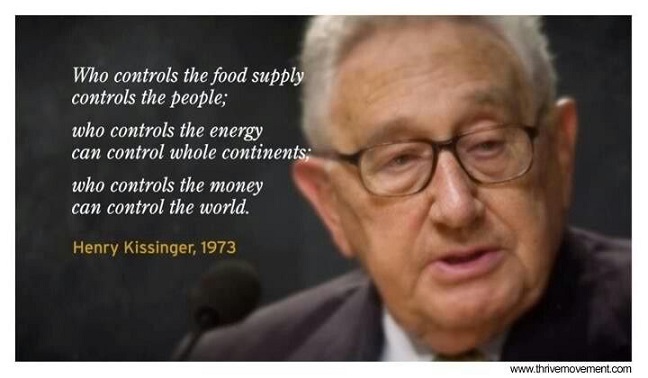
Orchestrated economic crisis will have IMF force governments to privatize national assets – energy, agriculture, transport etc which will fall into private hands and soon citizens will become employees of global corporates whose rules & regulations will conform to national laws. It will place people in servitude. This would entail the curtailing & reducing of both police & military & the manner military is being clipped in terms of manpower & equipment (Salawa incident) – all aimed at denying any nation state to challenge any external power. Notice the build-up of the UN as the sole one world government – the decider of all laws, the decider of what morals people follow, the decider of who gives justice & who are the enemies. Notice too how people are being electronically filed to identify & monitor them. The use of terror organizations to curtail people’s freedoms by introducing laws & legislations has worked to perfection. The manner that a handful of organizations are controlling the food flow globally which is tied to various issues of chemicals & other saturated elements have seen increase in death by artificial substances, poisons, contaminations & cancers. Do we consume anything natural today?

The next player is the media that controls society through strategy of distraction. Keeping people busy with sensationalized item is the name of the game. Watch our people’s emotions are being tapped & how education is being experimented in such a way that children grow up not thinking for themselves but to think it is fashionable to be stupid, vulgar & hippie & this failure of intelligence makes them blame themselves & draw them to suicidal & depressants that again make the handful of companies richer. Look at how the West is on prescription drugs – even children.

The other method now liberally used is to create the problem, create the desire reaction & then set out the solutions that had already been designed before the problem or the reactions were created. Put this scenario against several conflicts for which the reactions have resulted in unbelievable solutions that have only curtailed people’s freedoms & rights.

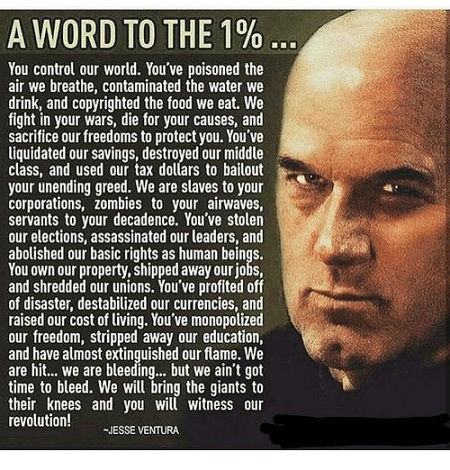
Yes, politicians & the political system may be corrupt but then it is we who elect them & it is we who can change them. The people essentially have a voice. Imagine if the nation state was abolished & in its place corporates & NGOs ruled, they own the resources, they own the assets & they even own us – we don’t elect them, we can’t even change them and they are not accountable or answerable to any of us.

Is this a good arrangement as an alternative to a corrupt government/governance?

Shenali D Waduge

An open letter to President Sirisena

June 10th, 2018

Dr Sudath Gunasekara

6.10.2018

I hope you have seen today’s newspaper headlines this morning, especially the Irida Divaina banner headline where Vignesvaran Chief Minister NPC has made two very serious statements

1 That you must break up the Sri Lanka Army in to 9 parts and relocate in the other 8 Provinces as the people in the north don’t want the Sri Lanka Army to remain there, as if he is already reigning over his dream EELAM.

2 He also has said that the NPC has passed another resolution that they will not give any land  to the Sri Lankan Army within the NPC area without the approval of the Council

Has the Northern Province already ceased to be a part of the Republic of Sri Lanka. If not how can a man like Wignesvaran who is supposed to be a learnerred retired judge of the Supreme Court makes such drastic statements in public. Should the Sri Lankan Government get permission from a head of a local Authority within its territory to deploy armed forces to protect the country and its people which falls within the domain of its main functions under the Constitution.

I would like you to make a public statement as to whether your yahapalanaya Government has already granted Independence to the NP as a separate Tamil State or at least the Prime Minister has done so without your knowledge. I have a feeling that you or your Prime Minnister may have, at least given an undertaking that it will be officially confirmed before your term of office ends. Who knows whether it is a part of your election promisess. The way things happen in the North, the people of this country have every reason to think so.
Otherwise how can he make such bold statements when the 6th Amendment to the 1987 Constitution which read as follows is, I think, is still vin force and therefore valid.

157A (1) No person shall directly or indirectly, in or outside Sri Lanka, support, espouse, promote, finance, encourage or advocate the establishment of  a separate State within the territory of Sri Lanka

2 No political party or other association or organization shall have as one of its aims or objects the establishment of a separate State within the territory of Sri Lanka

Isn’t what Wignesvaran has said and done not a violation of the law enumerated in 157A. The whole country poses this question to you as the Head of the State, the Head of the, Executive and of the Government and the Commander in Chief of the Armed Forces.

Punishment for such acts are enumerated under 157A (3) a) b. c and d as be subject to civil disability, forfeit his movable and immovable, property, not been entitled to civic rights for seven years and cease to be such member in Parliament or any position referred to paragraph 1 of Article 165 This should apply to any politician holding positions in any local council as well, though it is not mentioned under 157A 3, (d).

Under these circumstances why don’t you Mr. President immediately dissolve this rabid monkey cage and communal piggery called the NPC and take legal action against these errant politicians?

I am asking the question as to why this section  has not being invoked so far by the President against the CM  and other lunatics like Sivajilingam who have been indulging in this type of lose talk for the past three years. Now that it has come to an unmanageable climax, why don’t you deal with them at least now?

Mr. President you owe an explanation as well as a duty by the people of this country as they are the people who have elected you as the President of this country and you too have taken the oath under the fourth schedule to the Constitution to faithfully perform duties and discharge the functions of the office of President in accordance with the Constitution of the Republic of Sri Lanka and the law and to be faithful to the Republic of Sri Lanka and that to the best of your ability to uphold and defend the Constitution of the Democratic Socialist Republic of Sri Lanka.

You may forget things like the promises you made to the people in your election manifesto and things like how the 100 days programe was made and by whom etc but surely you can’t forget your Constitutional obligations by the country and the people who have elected you, particularly at a time where you have already declared your candidacy for the Presidential election 2020.

Furthermore I would earnestly request you to abolish the 13th A and close down all these wasteful and devastative monkey cages called the Provincial Councils that have ruined the whole governing process in this country, as I have said more clearly in another letter published in the Lankaweb (5. 10, 2018) in the following words.

Abolish these monkey cages and dens of thieves that have exponentially increased waste and corruption and completely ruined the decent political culture of this country for the past 31 years and multiplied separatists tendencies and communal agitations dragging the nation to complete disintegration on ethnic lines with no chance of redemption in future.

This is the billion Dollar question I pose to the entire nation in view of the President’s above statement which he appears to have made after a deep slumber?

I know it very well that no political party, including the UNP as well as all those who were against them in 1987 will ask for their abolition as they use these Councils members to net votes at the general elections. But for the general public these Councils are an eye sore when they see the way how public funds are been wasted criminally on the upkeep of these useless lotus eater Governors, Chief Ministers, Ministers, Members, plethora of officials and the institutions that house them. Other than enjoying the luxuries of office, attending openings, weddings, funerals school functions like sport meets, temple functions, and various other social and private tamsas, roaming all over the world on pleasure trips and running all over the country to show their loyalty to their political masters,  misusing public funds, and collecting votes and funds for their political leaders in Colombo and herding people for their meetings like May day rallies and propaganda meetings of their masters in Parliament who in turn ruin the whole country and throwing their weight on the innocent and helpless masses on the other hand, I ask these parasitic creatures as to what service they to the people or the country that pay their salaries and ill-gotten fabulous perks”

I can assure you for certain that even if you have the elections to these Councils at the end of the year, going by the present political situation in the country, you want win a single Council. That will only further depreciate your chances at the next election in 2020. Why add pain to injury.

John Argue -Amnesty International’s Coordinator for Sri Lanka

June 10th, 2018

Asoka Weerasinghe Kings Grove Crescent . Gloucester . Ontario .Canada

10 June 2018

John Argue
Amnesty International’s Coordinator for Sri Lanka
Toronto
Ontario.

Dear John:

I stumbled onto your interview with Sulochana Ramaiah Mohan which was headlined 40,000 death claim should be researched. Reading it, I wasn’t sure whether I should laugh at it or cry. In fact I was disappointed in you, for your typical covering of the dishonest AI’s rear-end, the self-appointed Policeman of Human Rights around the world.  I understand, as you are part of this cabal.

You know, that you guys at AI were crowned as the spokesperson for the Canadian Tamil Congress (CTC), a longtime supporter of Tamil Tigers, from the moment you and Alex Neve  stretched your beggar’s palms to accept that $50,000 largess as a donation in September 2011..  Remember John, when it was about to happen, I told you that your AI should not accept that gift as it was going to  come and bite you guys at some point in time.   And it has, not once but several times.  And I suppose it was a too bigger sum to refuse when you all were hungry for funds. And since then you have supported their cause of their wanting their Eelam damning the majority Sinhalese community.  That is sick, John! I resent it, and it so happens that I am a full-blooded Sinhalese to boot.

John, you guys were lucky that Asoka Weerasinghe was not the Prime Minister of Sri Lanka.  I wouldn’t be that stupid to give you all a space in Colombo to build your nest to have your decentralized HQ to monitor Human Rights violations in South Asia, until you returned that $50,000 to the Canadian Tamil Congress and cleanse yourselves of the sin of being bias in favour of the  minority Tami  community. I would have demanded that you prove to me and my administration that AI has become a truly neutral INGO, as I just don’t trust Amnesty International one bit,  AI is suspect.  And I have told you this not once, not twice, but several times.

You know John, you guys at AI have the gall and temerity to claim your moral right to make statements about human rights violations of the Tamils in Sri Lanka when it was your Amnesty International  that abdicated that moral right long time ago, in 1975 when your outfit, Amnesty International devoted a modest half page to Kampuchea in its annual report covering 1975, the year Phnom Penh fell to the Khymer Rouge.  And I learn that your Secretary General sent a cable expressing concern for civilians detained in areas of conflict”, while noting prudently those allegations of mass executions were based on flimsy evidence and secondhand accounts.”  This was when it was a known fact that nearly one-fifth of the population of Kampuchea were exterminated by the Khymer Rouge in the early 1970s.  It was also interesting to note that Amnesty International sent a cable congratulating the new regime of Kampuchea on the large national union without distinction of class, religious belief or political tendency”, it had just proclaimed. Shish!, what a bunch of disingenuous Yahoos!

John, your interview announces that you had said that the 40,000 death claim should be researched..  Sweet Mother of Jesus!  First use your common sense AI, before you attempt to embark on your research project.”.

Don’t you guys at AI want to ask the 40,000 Tamil death believers,  alleged to have been killed by the Sri Lankan soldiers during the last five months of the Eelam War, Show us the bodies, show us the skeletons of the 40,000 deaths before we believe you.”

John, 40,000 Tamils killed in five short months mainly along a sliver of land when the Tamil Tigers were on the run, there weren’t much land to dump the average 5’8” bodies even in pyramidal  piles. This is a hard to believe number of deaths.

And you know what, John? No one, not even your Amnesty International  told us that the Government soldiers forced the retreating Tamils to claw the sun-baked Mullaithivu earth and feverishly dig big holes to dump these 40,000  dead Tamil bodies.  No one, not even your AI told us that they sighted 5 to 10 backhoes digging large craters to dump the 40,000 dead Tamil bodies.  No one, not even your AI  told us of the stench of black plumes of smoke snaking towards the heavens from the burning  mounds of the dead Tamil bodies that were burnt to get rid of them in a hurry.  No one, not even your Human Rights Police, Al, told us that they sighted fast moving fiberglass boats loaded with dead bodies, speeding through the indigo-nights to dump them in the mid-Indian Ocean to get rid of them.  No people in the villages of the east coast of South India in places like Chitambaram,  Cuddalore and  Pondicherry reported that there were several  dead bodies, presumably those of the dumped Tamil’s washed onto their shores. Nor did anyone nor Amnesty International reported some weird things going on in the Mullaitivu  theatre of war where hundreds of dead bodies of Tamils were strewn around.  And that Sri Lankan Army higher-ups were skipping through the bodies, like skipping through our Spring tulips with very effective Made in China disappearing wands and waving over the dead bodies saying A-B-R-A-C-A-D-A-B-R-A and doing the disappearing act and wooossshhhh”’; the dead bodies disappear into the thin air,  How else would they disappear that quickly John.  It has to be an act of magic.  Right!

You smart Alec’s at Amnesty International should be able to tell us how that 40,000

dead bodies disappeared.  If you don’t know, ask Ban-Ki Moon’s Cut-and-Paste Brigade’s, Ban-Ki Moon, ask Navi Pillay, ask Marzuki Darusman, ask Steven Ratner, ask Yasmin Sooka.  If they cannot provide you with an honest answer, then slap on their backs stickers saying, in red I am a right Royal HUMBUG, trying to hang Sri Lanka from the UN’s rafters”  Do it, John. This is a vicious game of Bullying the small guy

Tell me, John, did you all at Amnesty International comment on the 100,000 Tamils being killed by the Sri Lankan soldiers during the last five months of the Eelam War as claimed by the British Labour Party’s,  Siobhain McDonagh, MP for Mitcham and Morden, in Surrey,   If you all didn’t then why not?  It is a hellava gory numbers game that you all keep playing as if, in a gambler’s den called, HUMAN RIGHTS HUMBUGS  ON KILLERS OF SRI LANKAN-TAMILS BINGO”.  A game to target Sri Lanka, to crucify that little island nation, Sri Lanka, where I come from.  What a bunch of Dodo’s, John.  I know McDonagh’s constituency is peppered with Tamil refugees and immigrants. That  doesn’t give her the  legitimacy to lie about Sri Lanka’s last 5 months of the Eelam War  She as a British politician  has NO moral right to come up with these  unproven atrocious  Fairy Tale numbers.

I did ask her in a letter, what  she smoked when she woke up that morning on the day she made that statement.  There was no response.  So she sells her soul for a Tamil vote as what most of our Canadian Liberals, Conservatives and NDPers do.

You know what, John, Siobhain McDonagh’s claim of 100,000 killed is a whole population of a town like Ontario’s Waterloo of 104,986; like British Columbia’s town of Delta  of 102,238 people;  like Ontario’s town of Chatham-Kent of 101,647 people, and that of Alberta’s Red Deer of a population of 100,418.   Can you imagine trying to bury those populations within a few days, within a few weeks before their skin and flesh starts to deteriorate under a hot tropical sun!  This woman is nuts, and AI didn’t speak on it to be fair on Sri Lanka who eradicated Tamil terrorism after the Tamil Tigers haemorrhaged that island for 27 blooding years killing over 100,000 soldiers and innocent people.  Too bad.

John, here’s what I am resentful of.  Not a single Human Rights outfit, in the world and that includes your Amnesty International, and of course, every Sri Lanka watching-Canadian parliamentarian haven’t had the honesty, the gumption and the dignity of their conscience, to stand up and be counted,  telling the world, that – Sri Lanka is the only country in the world that eradicated terrorism, by annihilating the Liberation Tigers of Tamil Eelam (LTTE aka Tamil Tigers), the ruthless of them all, on May 19, 2009, by their armed forces.  And by doing so gave back to their 20.5 million peoples, the most paramount Human Right, their RIGHT-TO-LIFE, which was hijacked by the Tamil Tiger terrorists,  for 27 long  bombing-years.  All these International Human Rights Organizations who call themselves activists are a bunch of pathetic jokers!

John, when you were asked about the charges of ”genocide” attributed to the Sri Lankan armed forces, your answer was, I feel sympathy for those  who feel it was Genocide, but AI has not come up with the conclusion that it was Genocide.”

Come on John you can do better. Let’s not waffle about this charge of Genocide”. Let’s be honest,  let’s be conclusive, and let’s not be iffy about your answer. You are dodging it consciously, aren’t you!  Bad John!

If there was Genocide, the Sri Lankan Soldiers would not have rescued 295,873 Tamils  by the end of the Eelam War, on 19 May, 2009.  They were rescued  from the clutches of the Tamil Tiger terrorists who herded them for 30 scorching months  from the west coast to the east coast under the hot Jaffna sky, like unwashed cattle as a ‘human-shield’.  It would have been easy for the soldiers to tie their hands behind their backs, blindfold them, ask them to kneel and shoot them through their skulls as what the Tamil Tigers did to the 700 Sinhalese policemen who had surrendered to them in the Eastern Province on 11 June, 1990.  Well, the Sri Lankan soldiers didn’t do a copycat cold blooded massacre.  There was affection and love for these Tamil refugees whom they considered as brothers and sisters.  I am not kidding!

Not only that John, they were the very same soldiers, all Sinhalese, who joined the other Sinhalese civilians to prepare  one million hearty meals of breakfasts, lunches, and dinners to feed them every day when they were temporarily housed in  refugee camps.  So what is your difficulty to come to a conclusion that there was no Genocide, John?  Open your mouth and spit out the truth  Spit out the good humanitarian words.  For Pete’s sake, Amnesty International,  be honest for once and say so what is a Fact.   You know what John, not a single International Human Rights Organization has uttered a word and acknowledged this amazing humanitarian deed by the Sri Lankan soldiers who won the war against terrorism. And who also won the hearts of feeble Tamil grandmothers and grandfathers who were carried to safety in their arms like babies, and who  kissed the soldiers cheeks and said, Puthata Buddhu Saranai” (Son, I wish you Blessings from the Buddha)..

That itself is good enough reason for me to point my finger at everyone of those organizations and yell at them calling them, ”You Bloody Humbugs!”. By now you know me enough John, I don’t hold my punches back to anyone who is ever ready to hurt my Motherland, Sri Lanka, unfairly. That is my Mission and I will sing my Anthem heartily –

O Mother-Lanka,  my home and native land

True patriot love in me you command

After being haemorrhaged by Tamil Tigers

I see you proudly rise

As a true democracy and free

From far away I will love you

And not let you being cut in to two.

From far away Canada, O Mother-Lanka

You bet, I will stand on guard for thee”

Tell the Canadian Liberal Party’s  TERRIBLE FIVE – Robert Oliphant, Jim Karygiannis, Judy Sgro, Derek Lee and Albina Guarnieri (some are not MPs anymore) who stood on Canada’s Parliament Chamber floor during the Emergency Debate on Sri Lanka, at sundown on 4th February 2009, and, charged the Sri Lankan Government of Genocide of the Tamils, looking up at the Gallery. Do  you know why they were looking up at the Gallery, John?  It was sardine packed with Tamils, almost saying to them,.You witnessed us lying for you all, now give us your votes.”   What a bunch of lying Yahoos.  This is why i wouldn’t hold my nose and drop my ballot into the ballot box with a X against the Liberal candidate at the Federal and Provincial elections. No more…Never!

Come on Amnesty International don’t pussyfoot around the Genocide” charge.  There was no GENOCIDE, period. Surely, not when Sri Lankan soldiers carried frail Tamil grandmothers and grandfathers in their arms like babies and ran dodging Tamil Tiger bullets to safety  And that is the rub John.  You waffle, and I tighten the screws on you  lot as DISINGENUOUS  HOG-WASHED  HUMAN RIGHTS  HUMBUGS.

John, you said, 40,000 death claim should be researched.” Don’t be silly and waste your time.and AI funds unless you are hoping to seek  more donations from the Canadian Tamil Congress who might fork out Canadian dollars in the 50,000s.

The research has already been done by  British  Lord Naseby  by accessing confidential reports compiled by none other than London’s own Defence Attache present in Sri Lanka during the infamous last phase of the Eelam War in 2009.

Lord Naseby came up with some startling discoveries during his research which has kept nailing deep into the coffin of lying International  Human Rights Organizations including the UN as despicable Humbugs’ that claimed  there had been 40,000 Tamil deaths  during the last five months of the war. Or, may be, 100,000 deaths as claimed by that silly woman British MP Siobhain McDonagh.  I am still curious to find out what she smoked when she woke up that eventful day when she plucked that number of 100,000 Tamils killed by the Sri Lankan soldiers from the air, when the Sri Lankan soldiers were on the war path to decimate the Tamil Tiger terrorists who were on a daily killing spree with bullets and claymore-mines of innocent people for 27 years  And they did it Big time, when they shot the  last Tamil Tiger on the sandy beach of the Nandikadal lagoon on the east coast.

Lord Naseby said, I’ve tracked the war carefully because I just couldn’t’ believe these official figures – they didn’t stack up to the information I was getting.  So I then invoked our freedom of information inquiry.

I asked for the dispatches sent by our Defence Attache to our foreign office during the last days of the war.  The application was refused twice by our foreign office.  I then applied directly to the Information Commissioner -which is my right – and got 26 pages of redacted dispatches.  Missing were the last six weeks of them.  So I applied again. And lo and behold, another 12 arrived.  I went through them very carefully.

And in there, there was more than enough evidence that no one in the Sri Lankan government had said anything about killing civilians at all.  That was not the objective of the exercise.  And from our Defence attache’s dispatches.  I thus gleaned that about 7000 were probably killed.  And even the Attache  says, that about a quarter of those killed were possibly Tamil Tigers (LTTE) because they’d thrown away their uniforms.”

Well, there you are John.  You Guys at Amnesty International couldn’t do any better than Lord Naseby’s research and I can bet my last dollar on that.  But here is  the final conclusion as I could comprehend.  This saga of 40,000 Tamil killed during the last five months of the war, is a bunch of baloney, buckets of hogwash,  piffle, poppycock, crotches of codswallop,,  buckets of crap, and loads of  elephant dung patties.

But here’s what it is John, the 6th Salome veil has come off the 40,000 Tamil, killing promoters and believers and they are in deep tanks in boiling water, doing  the Last Credibility Waltz.  And when the 7th veil of lies comes off, which will be pretty soon according to my Crystal Ball reading. there will tattoos on all the naked bodies saying

Yes, I  lied”, I am a disingenuous bastard”, Sorry Sri Lanka, I know I acted like a no good pariah, I am mad with you separatist-Tamils for making me believe you, and I look a dunce-capped stupid fool!. Sri Lankan soldiers, you are the best  there was, there is, and the best that will ever be”. Teach us how to eliminate terrorism”,  and many more slogans..  Some tattoos will be with neon ink so that they could be read in the dark.

John, you have heard me, loud and clearly, as clearly as the ding-dong of a Sunday Church bell calling you for confession to absolve you of your sin wanting to crucify my Motherland, Sri Lanka,..unfairly.

You looked good  and well in that photo accompanying the article.  Keep well, and my advice to you as an older brother is, get off that Amnesty International choo-choo train at the next stop, as it is going nowhere on Sri Lanka.

Take care,

Warmly

Asoka

(Weerasinghe)

SRILANKA, GOVERNANCE- ACCOUNTABILITY & PERFORMANCE SINCE 2015,

June 10th, 2018

Kanthar Balanathan DipEE(UK), GradCertRelEng(Monash), DipBus&Adm(Finance-Massey), CEng.MIEE

SriLankan government since snatching power in 2015, have been in corrupt practice which has led the country to tiptoe towards bankruptcy. The term accountability” does not mean anything today, to the people of SriLanka or the members of parliament anyway. Parliamentarians think that they are the god which has freed them from conviction and that they can do anything they wish.

It is beyond the scope of this document to discuss government accountability”. However, it is good to discuss a few of those in government accountability”. The framework that forms government accountability mechanism: (i) Political accountability mechanisms, (ii) Legal accountability mechanisms, (iii) Administrative accountability mechanisms

The question is: does the GOSL has a framework for government accountability, and if so, do they practice?

Of course, we know that the current GOSL has no political accountability mechanisms”, which we have seen from their actions in political blunders and slip-ups in the past and in continuation. With the power GOSL has embraced, they seem to shovel through the docks with no hesitation.

The question of Administrative accountability mechanisms” and Legal accountability mechanisms”, can also be questioned.

Why do we need a parliament? Quote: we need a parliament to ensure that you have freedom of speech, movements, and association, and to ensure that there is no misuse of authority by elected leaders as constitution describe their powers and limitations to select the national government to control guide and inform the government for making laws

Why do we need MPs: Quote: MPs have three major responsibilities: legislating in Parliament, representing their riding and political party, and serving their constituents’ needs. MPs are elected to represent the interests of the people in their constituencies where they maintain an office.

Of course, SriLankan Parliament is like a DOSA KADE”, cos, how many of them have the educational background and/or knowledge. Do they have 1.25 to 1.5 kg of the brain with perception/intelligence? How many of them want to be a role model for people (young ones) to follow them? Could CB be considered a Kasappu Kade?

My previous article Ref: http://nrnmind.blogspot.com/2018/06/srilankademocracy-barter-system.html explains how MP candidates are selected.

Each MP receive a sum to develop his/her electorate. Where is the money channeled to? Do they invest in any small-scale development?

Treasury Bills, Treasury Bonds, & Development Bonds:

Th public Debt Department accepted Rs 10,000 million treasury bills in an auction where bids received was Rs 55,688 million to be settled by the 8th June 2018. (Ref: https://www.cbsl.gov.lk/) This may be good planning of the value accepted according to the muscle of SriLankan debt trap crisis.

However, we must note one action: GOSL owns the land and the infrastructure. Well, in other words, the people, citizens of SriLanka own the assets and they have elected some people to manage and govern the assets.

It looks like GOSL to manage their immediate debt crisis, raise Treasury bills, Treasury Bonds and collect their funds, and do not invest to collect the funds for repayment. For example, how many of these people will be in parliament for the next 10-20 years. Even if they are they manage to go scot-free without any imprisonment for any crimes committed. A reference article on US debt crisis; The US economy is caught in a debt trap. Avoiding a major economic downturn requires alleviating the burden of servicing public and private debt. The key is restructuring federal debt, which will diminish the country’s net interest burden. Ref: Escaping the US debt trap Now is the time to strike deal with creditors Ref: by Joergen Oerstroem Moeller in Singapore, Fri 11 May 2018

Q1.

Does the Governor of the CB advise GOSL on the risk of issuing large bonds for a longer period? Does he advise on the necessity and the risk of Treasury Bills sale? Does CB do an analysis before deciding on a sale of Bond?

It looks GOSL Treasury has more activity in the sale of Bills and Bonds rather the governance carries out any development other than foreign countries involved in a couple or two.

Q2.

Why would GOSL sell valuable lands to foreign companies? Have the lands been sold to settle the bond repayment? It is a must that land sales shall be approved by the people, citizens of the country. Maybe the representative for the electorate or by other approved means.

Q3.

Why cannot GOSL sell lands in the Northern sector? Ie. Jaffna, Vavuniya, Kilinochchi etc.

Q4.

What is the reason for handover of the Port and the Airport in the South to foreigners?

Finally, Sri Lankans would be left with no lands and assets, except their toilets.

The main reason for selling assets to overseas companies is to receive kickbacks in foreign currency to an overseas bank.

Sri Lanka Development Bonds Outstanding, as at 30 January 2018, is US$ 4,239.45 Billion. Can GOSL show proof whether they have completed any development to the value of such amount. Or do the Opposition Leader R. Sambanthar has the guts to ask questions on this development bonds. (Ref: CB)

Financial System Financial System Stability Review 2015, the report was prepared and signed by Arjuna Mahendran in 2015. How often is this report prepared and released?

It is recommended that readers view the page as given here.

Ref: https://www.cbsl.gov.lk/sites/default/files/cbslweb_documents/Treasury%20Bond%20Series%20Available%20for%20Investments%20as%20at%2001.06.2018.pdf.

As of 2nd May 2017, the Treasury Bond for Foreign Investors amounts to Rs.4,089,965,085,500.00. This is over four Trillion Rs. Of which Rs 504,250,120,000.00 is supposed to have been settled between 15th May 2017 and 1st June 2018.

Q5.

Was the land sale a collateral for this amount to the parties?

Hope the LOP has the guts to raise this in parliament rather talking about missing persons & self-determination”. How many of Sri Lankans assets are planned to be sold?

If the current GOSL cannot manage then they should leave office and hand over to credible people to run. Maybe Mr. Gotabaya Rajapaksa? The only choice in SL with the blessings of Mahinda Rajapaksa.

It is recommended that citizens and professionals become quite acquainted with the CB operations. It’s their right and duty.

රෝගී සමාජයක් ඇතිවීම

June 10th, 2018

(වික්ටර් අයිවන් -රාවය පුවත්පත )

මෙම අශීලාචාර කාලයේදී සියලු මිනිසුන් ජීවත් වූයේ අඩු වැඩි වශයෙන් සැකයෙන් හා මරණ බියෙනි. ඔවුන්ට නිතර නිතර දකින්නට හෝ අසන්නට ලැබුණේ මනුෂ්‍ය ඝාතනයන් ගැනය. අතුරුදන්වූ පුද්ගලයන් හා වදහිංසාවන්ට ලක්වූ පුද්ගලයන් ගැනය. හිංසාව හිංසාවට ලක්වන්නන් කෙරෙහි පමණක් නොව හිංසා කරන්නන් කෙරෙහිද බලපායි. ඒ දෙපිරිසම මානසික රෝගීන් බවට පත් කරයි.

යුද හමුදාවේ සේවය කළ සමහර සොල්දාදුවන් මානසික රෝගීන් බවට පත්ව තිබෙන ආකාරය හා ඒ තත්ත්වය පෙරළා ඔවුන්ගේ පවුල් ජීවිත කෙරෙහි බලපා තිබෙන ආකාරය පිළිබඳව කදිම විග්‍රහයක් යුද හමුදා රෝහලේ මානසික වෛද්‍යවරයෙකු ලෙස සේවය කළ රුවන් එම්. ජයතුංග විසින් ලියා පළ කර තිබෙන ‘සංග්‍රාමයෙන් පසු – ඊලාම් යුද්ධයට මුහුණ දුන් සොල්දාදුවන්ගේ කතා’ යන කෘතියට ඇතුළත්ය.

යාපනේ විශ්වවිද්‍යාලයේ වෛද්‍ය පීඨයේ සේවය කළ මහාචාර්යවරයෙකු වන දයා සෝමසුන්දරම් විසින් ලියා පළකර තිබෙන Scared Minds – The Psychological impact of war on Sri Lankan Tamils” නමැති පොත දෙමළ කොටි සංවිධානය, ආරක්ෂක හමුදා හා ඉන්දියානු සාම හමුදාව විසින් කරන ලද යුද්ධය විසින් උතුරේ දෙමළ සමාජය කෙරෙහි ඇතිකර තිබෙන සාමූහික ව්‍යසනය ගැන තමන්ගෙන් ප්‍රතිකාර ලද රෝගීන් ආශ්‍රයෙන් කරන ලද විශිෂ්ට අධ්‍යයනයක් ලෙස සැලකිය හැකිය.

එය සාමූහික ප්‍රචණ්ඩත්වය ඊට ගොදුරු වන පුද්ගලයන් කෙරෙහි පමණක් නොව ඒ පවුලේ සාමාජිකයන් කෙරෙහිද අවසාන විග්‍රහයේදී මුළු මහත් දෙමළ සමාජය කෙරෙහිද බලපා තිබෙන ආකාරය ගැන කර තිබෙන කදිම විග්‍රහයක් ලෙස සැලකිය හැකිය. එම මහාචාර්යවරයාද උතුරේ දෙමළ සමාජය පිළිබඳව එහි දක්වා තිබෙන චිත්‍රය සමස්ත සමාජයටද අදාළ කරගත හැකිය.


Link : http://ravaya.lk/?p=168814


China withholds Hambantota Port deal’s final tranche of USD 585 mn to Lanka over dispute

June 10th, 2018

Courtesy wionews.com

 PTI Colombo, Sri Lanka Jun 10, 2018, 11.19 PM (IST)

China has withheld the Hambantota Port deal’s final tranche of USD 585 million to Sri Lanka due to Colombo’s objection over its plan to use a man-made island for entertainment purposes, a media report said here today.

In December last year, Sri Lanka handed over the control of the southern sea port of Hambantota to China on a 99-year lease for USD 1.12 billion, amid concern over Beijing’s efforts to expand influence in the region.

Opposition leaders have dubbed the deal as a sell out to China.


File photo of Hambantota Port. Photograph: (Others)

The SundayTimes reported that the last tranche of USD 585 million has been held back by China’s state-owned China Merchants Port Holdings which want the land to be used for entertainment purpose.

However the Sri Lanka Ports Authority insists that the facilities at Hambantota should only be used for marine and port-related activities and not for entertainment tourism purposes, the report said.

It quoted the Chinese firm as saying that the money would only be transferred after the issue is resolved.

The Hambantota port was a major Chinese-assisted infrastructure project in the home district of former president Mahinda Rajapaksa, whose nearly a decade-long rule was ended by President Maithripala Sirisena in 2015.

Rajapaksa’s administration had been criticised heavily for high commercial borrowings from China.

The other project in Hambantota funded by the Chinese, the Mattala Rajapaksa International Airport is already in trouble.

Dubbed as the world’s emptiest airport, its only flight operation -? the service of Fly Dubai — was halted this week.

The company cited commercial and flight security reasons for halting the service as birds had hit their planes often.

Pound of flesh?

June 10th, 2018

Editorial Courtesy The Island

Monday 11th June, 2018

The UNP, during the last government, condemned the Hambantota Port as a white elephant and Prime Minister Ranil Wickremesinghe keeps calling it the world’s biggest swimming pool. Some UNP notables said the Rajapaksas were waiting on the Hambantota beach and waving at passing ships in a bid to get them to call at the deserted inland port.

Today, it looks as if the yahapalana leaders were waiting, near the Chinese embassy in Colombo, for the release of the next tranche of more than half a billion US dollars for the lease of the Hambantota Port. The desperation of the Sirisena-Wickremesinghe government knows no bounds. It has to shore up the dwindling foreign reserves.

The rupee has hit a record low against the US dollar. The government has pinned its hopes on the Chinese funds to stabilise the falling rupee. But the signs are that it will not get the money soon due to its failure to fulfil some obligations in the port lease agreement.

The yahapalana leaders may have thought they had succeeded in taking the Chinese for a ride by leasing out the Hambantota ‘swimming pool’. But, it has turned out to be the other way around. The China Merchants Port Holdings Company Ltd. is reported to have called for sorting out some issues pertaining to an artificial entertainment zone, agreed upon in the port deal, expeditiously for the next tranche to be released. Entertainment is a broad term, which can mean virtually anything, and casinos are expected to be set up in the case of the port agreement being fully implemented. Nobody knows what else will be there in that zone. The Sri Lanka Ports Authority (SLPA) has reportedly said the existing laws do not provide for the use of port land for entertainment related activities.

The government finds itself between a rock and a hard place. It is willing to do anything to get the Chinese funds, but it cannot allow an entertainment zone to be set up without amending the SLPA law. The yahapalana leaders have overcome some legal barriers previously by steamrollering bills through Parliament. They are likely to make a similar effort once again to please the Chinese. However, it will be interesting to see the reaction of the self-proclaimed moralists within the yahapalana ranks to the setting up of casinos.

Most of the allies of the current administration resisted, tooth and nail, a move by the Rajapaksa government to bring in gaming mogul, James Packer, who undertook to build a USD 350 million luxury resort, which was to include a casino. They let out howls of protest and the Rajapaksa government got cold feet. When Packer announced his decision to abandon the project after the 2015 regime change, Prime Minister Wickremesinghe demanded to know who had asked him to come. The PM said that Sri Lanka, under the new dispensation, wanted only good investors and did not want an economy which relied on casinos. Among other vociferous critics of casinos were the JHU.

The Sirisena-Wickremesinghe government has earned notoriety for policy U-turns. In the run-up to the 2015 presidential election, its leaders vowed to scrap the Colombo Port City project, first thing, after forming a government. They considered it an environmental disaster. But, today, it has become the jewel of their Megapolis crown. China has tamed the yahapalana leaders over the years and the latter are now ready to do anything to humour the Chinese; they are even promoting the Belt and Road initiative much to the chagrin of their western well-wishers.

At this rate the yahapalana leaders might have to swallow their pride and perform some political pole dancing in Parliament to entertain the Chinese in a bid to get the much-needed USD 585 million.

Anti-corruption activists being sent on wild goose chase

June 10th, 2018

By Rathindra Kuruwita

The Secretary to the President and other officials who could release the Presidential Commission of Inquiry (PCoI) report on the bond scams had sent the anti corruption activists on a wild goose chase in the hope that they would get tired and drop the issue, Campaign for Free and Fair Elections (CaFFE) Executive Director Keerthi Tennakoon said.

In a letter to Speaker Karu Jayasuriya Tennakoon said, on Friday, that he had been attempting to obtain the full PCoI report from January 18, 2018. “I have written to you on several occasions and I know that you are trying to obtain these documents to safeguard the dignity of the MPs. The Secretary to the President has promised to provide these documents several times and asked a number of persons to obtain the documents from the National Archives. But the National Archives states that they can’t release these documents for another 30 years,” he said.

article_image

“They are trying to demoralise us by making us run in circles. I have spent 3,360 hours trying to get these reports and there are many others who have done likewise.

Sujeewa got money from Mendis Co. after general election

June 10th, 2018

It has been revealed that State Minister of International Trade, Sujeewa Senasinghe accepted three cheques to the tune of Rs. 3 million from W. M. Mendis & Company, belonging to Arjun Aloysius, after the 2015 general election.

The last parliamentary election was held on August 17, 2015.

article_image

The first cheque for one million rupees, issued from W. M. Mendis Company’a Bank of Ceylon account, to Senasinghe was dated August 24, 2015. The cheque was cashed by Ministerial Security Division (MSD) Sub Inspector E. G. Priyantha Vipula Sampath at the BOC Lake View branch and the money handed over to one of Senasinghe’s aides. Sampath was questioned by the CID on May 28, 2018. The second cheque also for one million rupees, issued on Nov. 12, 2015 from the same account was cashed by Ministerial Security Division (MSD) PC BR Gunasena. The cheque was given to him by Amal Ravindranath Dias, one of the persons who handled Senasinghe’s election campaign. Gunasena was questioned by the CID on May 30, 2018.

The third one-million-rupee cheque was issued on March 31, 2016 from the same account and cashed by Ministerial Security Division (MSD) Sergeant Ranjith Lal Jayasena. The cheque was given to him by Amal Ravindranath Dias. Jayasena was questioned by the CID on May 30, 2018.

Dias was also questioned by the CID on June 05, 2018 for accepting Rs. 2 million by way of encashed cheques, on Nov. 13, 2015 and April 05, 2016. Dias has insisted, like Senasinghe, that the money was spent on the election campaign and that he is not aware who gave the cheques. However, there was no election at that time, and the CID has instructed him to return for a statement on June 06, 2018. He has said that he can’t come on June 06 as he has a prior engagement on June 06. When CID officials went to his residence on June 06 to ask him to come the following day, there was no one at home, and he did not answer his phone on June 07 morning.

The troika and the truth A CONSTRUCTIVE COMMENTARY ON LALITH WEERATUNGA’S TESTIMONY

June 10th, 2018

By Dr. DAYAN JAYATILLEKA Courtesy The Island

I was delighted to read Lalith Weeratunga’s revelatory article ‘The Troika’ (Counterpoint, Daily FT). I regard him as a friend and I respect him as one of the finest public servants we have had. President Mahinda Rajapaksa could not have had a better Secretary to the President at a crucially testing time in our contemporary history. I have long encouraged Lalith to write his memoirs and I hope what I see in the newspaper is but a ‘teaser’, which will eventuate in a full volume.

Lalith Weeratunga’s account of the Troika is the truth. However, while it is the truth, it is not the whole truth and nothing but the truth. There are important pieces that requires inclusion to establish a clearer account of the times and issues. These are of crucial importance because unless we insert them back in and complete the diplomatic history of that time, we shall be unable to understand what happened in President Rajapaksa’s second term, how we got mired in the war crimes quagmire in Geneva, and the problems we shall have in extricating them even if the Troika returns, even with some in significantly and qualitatively elevated roles.

Lalith’s account is of a golden moment in Sri Lanka’s foreign relations, where we avoided the fate that the Jayewardene administration suffered when it rightly attempted to defeat the LTTE in 1987. That attempt triggered intervention. Under President Rajapaksa, the Troika helped avoid it and secure the space necessary to win the war.

However, Lalith’s account omits the two crucial and inextricably interrelated factors that enabled this success.

Let me back up a bit. The Indians had been negotiating a political settlement with President Jayewardene since 1984. In late 1985, HW Jayewardene signed off on an agreement on Provincial level devolution. Further talks took place in December 1986 and early 1987. LTTE provocations and national Security Minister Lalith Athulathmudali’s faith in his Israeli military connection delayed the agreement. The Vadamaarachchi offensive therefore took place without the cover of a political agreement with Delhi, which only be devolution-centered. When the electorally powerful MGR lobbied Rajiv Gandhi, he caved in to pressure for intervention because he had nothing with which to neutralize Tamil Nadu. Later, after the Indo-Lanka Accord was signed, the Indian stance pivoted so drastically that the IPKF was in combat with the Tigers by October that very year, 1987.

What this goes to show is that if we had this political solution in place (which had been in the pipeline for years) before launching the Vadamaarachchi operation, the Indians would not have intervened to stop us, because Delhi would have had something to balance off Tamil Nadu.

Which brings me to my main point. What Weeratunga’s account omits is the heart of the matter; the meat in the sandwich. The policy and politics of it.

The Troika was brilliantly managing the relationship with Delhi, but they were representing and operating on the pragmatic policy decided on by President Rajapaksa, namely the promise to his Indian counterpart, to proceed with the implementation of the 13th amendment. The Troika’s managerial excellence was building on the policy equation and axis with Delhi decided upon by President Mahinda Rajapaksa. Any account of its success without specific mention of that understanding is like Hamlet without the Prince of Denmark.

It is this promise that kept India on side and gave us the space to finish the war even in the face of US-UK pressure. President Rajapaksa was able to play the Delhi card to ward off the Hillary-Miliband-Norway driven ‘evacuation attempt’ by the US, the goalposts of which kept shifting.

That this policy was at the very heart of the Indo-Lanka equation during the war years, was amply and irrefutably proven by the content of the Joint Statement between the Government of Sri Lanka and the visiting Indian Troika (the Delhi counterparts of the Sri Lankan Troika that Lalith, a member, writes of).

The text of the Press Statement issued on May 21, 2009 after the top-level meeting with the Indian team and posted on the GoSL website read:

“Mr. M.K. Narayanan, National Security Advisor and Mr. S. Menon, Foreign Secretary of India visited Sri Lanka on May 20 and 21. They called on His Excellency Mahinda Rajapaksa, President of Sri Lanka and met with senior officials, including Hon. Basil Rajapaksa, MP, Mr. Lalith Weeratunga, Secretary to the President and Defence Secretary, Mr. Gotabhaya Rajapaksa.

They also interacted with a number of political parties in Sri Lanka…Both sides also emphasized the urgent necessity of arriving at a lasting political settlement in Sri Lanka. To this, the Government of Sri Lanka indicated that it will proceed with implementation of the 13th Amendment. Further, the Government of Sri Lanka also intends to begin a broader dialogue with all parties, including the Tamil parties, in the new circumstances, for further enhancement of political arrangements to bring about lasting peace and reconciliation in Sri Lanka.” (May 21, 2009)

Note that Colombo’s commitment to ‘proceed with implementation of the 13th Amendment’ was not contingent upon the statement that GoSL ‘…also intends to begin a broader dialogue with all parties, including Tamil parties…’ and was therefore not contingent on the obstreperous behavior of the TNA in 2011 (when the GoSL-TNA dialogue began) but was seen as preceding that ‘broader dialogue’.

I wrote earlier that Lalith’s testimony about the Troika omits two, not just one, crucial and interrelated points. The second point is what went wrong, postwar, despite this wonderful arrangement.

Three years after the war ended, in 2012 India voted against us in Geneva. It did not return to our side in 2013 and 2014, though it did abstain. Now, what is of greatest salience is the fact of continuity in leading personalities and managerial personnel! The Troika was still in place in Colombo. The President was the same as during years of successful management of Indo-Lanka relations. The government in New Delhi was that of the Congress, with the same Prime Minister in place. If so, what had gone so wrong? What could have?

If one sticks simply to Lalith’s account, one would not find the answer to the question. One would not even know there is a question. Let me reiterate: same Troika, same leaders in both capitals, no change in government in either capital, but a complete turnaround in Indian behavior. Why so? Because our policy had changed or was not being implemented. We were perceived to have reneged on our promises– public, official promises which Lalith’s article makes no mention of! The Troika worked not only because they were good chums with their Indian counterparts but because they represented a policy pledge which was not being honored, perhaps being blocked, and therefore made the Indians increasingly vulnerable to pressure from Jeyalalitha, Hillary Clinton and civil society opinion. We did nothing to help them help us, though even our best friends the Chinese kept signaling us to do so.

By the time we held the Provincial Council election in the North (with Japan’s nudging) it was 2013. India had already voted against us in Geneva. The warning signals from Delhi were coming in by 2011, but were ignored by Colombo. However, the Indians were still not on board with the West and were still running interference for us in 2011, which is why the US pulled back and did not back the Canadian attempt against us, which folded. But months later, when the West knew we no longer had India with us, it moved against us in 2012. When the Non Aligned knew that India was no longer with us, our traditional support from the BRICS and the global South began to flake off. Rising Islamophobic discourse and unprosecuted violent activism in Sri Lanka even neutralized Malaysia’s vote.

We could have kept India with us but we didn’t. What happened to the Troika? The Troika had nothing to sell. It was either internally divided or had shifted collectively from its wartime stand.

None of this is merely history. It is serial defeats in Geneva in 2012, 2013 and 2014 (with the Troika still intact in Colombo) that paved the way for the surrender in Geneva under the new government in 2015. I have been and remain a harsh critic of the 2015 and 2017 resolutions and fervently hope to see us roll them back. But that cannot and will not happen by returning to the failed post war policy of the second Rajapaksa term, which resulted in the serial defeats of 2012, 2013 and 2014. That failure was due to a deviation from or at the least the non-implementation of or the imprudently delayed implementation of President Rajapaksa’s correct wartime policy agreement with India.

I have no doubt that there could be a 1977 or rather a “reverse 1977″ (the UNP at the receiving end) result at the next election. That is not my main concern. We all lived through the aftermath of that spectacular electoral victory and the rapid growth (a phenomenal 8% at one moment) of the economy. All that came to naught with the mishandling of the Tamil question and the concomitant mishandling of the equation with India, notwithstanding excellent relations with the US Republican administration (President Reagan) and strong security cooperation with Israel.

So, winning an election by a landslide, experiencing a rapid spike in economic growth, and an embrace of or by Washington and Tel Aviv, is only half of the story. Not plunging over the precipice is the more important half of that story. I do not think Sri Lanka can withstand a repeat performance after the experience of the 1980s. And that experience cannot be avoided by having a supposedly tougher, more patriotic leader than President Jayewardene. In fact, a leader without President Jayewardene’s pragmatic flexibility could result in a permanently divided island. After all, Serbia’s Slobodan Milosevic was regarded as a more nationalist Serbian leader (who also spoke of ‘socialism”) than the enlightened multiethnic socialist President Tito! Milosevic abolished the autonomous status of Kosovo. The result was the end of Yugoslavia.

There can be no sustainable Sri Lankan foreign policy which does not deal with the “intermestic” issue (to use Kissinger’s category) of the State and the Tamil people as a community. Good relations with India cannot be restored except by acknowledging the Indo-Lanka accord and its concomitant political commitment the 13th amendment. Without the Indian umbrella or shield supplementing the Chinese, we shall be vulnerable to Western pressure. The Indo-Lanka Accord cannot be ignored or bypassed without consequence.

We shall be unable to rebuild the broad coalition, beginning with India that would enable Sri Lanka to neutralize the Geneva 2015 Resolution, and exit what outgoing US Ambassador Athul Keshap calls “the Geneva framework”.

Any delusion about an Israeli option of exit from the UN Human Rights Council in Geneva will only trigger a shift back to New York where the Darusman Report originated, and the activation of prosecutions under universal jurisdiction by a variety of countries, ending in unilateral sanctions by some.

Today in Sri Lanka there is a growing social sentiment that all it takes is a return to the competent management– as represented in this case by the Troika. While it is crucial, it is not enough.

What is necessary is the correct political policy and it is only then that a managerial and technocratic stratum can implement it because it will have something to implement.

The basic distinction posited by rightwing neoconservative American scholar Thomas Sowell, with its implicit appreciation of the “doers” over the “talkers”, if taken to a logical conclusion, would place Hitler over Heraclitus, Attila the Hun over the Buddha, Genghis Khan over Socrates, Pol Pot over Pope Francis, and Donald Trump over Dr. Martin Luther King.

This ‘doers/talkers’ hierarchy of practices and values is dangerous, because you can “do” right and you can “do” wrong. “Doing” and “doing the right thing” aren’t the same. Destruction, which is doing, is not the same as creation/construction. Thanos, in ‘The Avengers: Infinity War’, is the ultimate “doer”.

Wrong discourse cannot yield right deeds, only wrongdoing. That is why the Buddha preached (“talked”) right thinking, right mindfulness. That is why the Bible says “In the beginning was the Word”– rendered as Logos, a complex Greek term, principally meaning “Reason”.

Speciality of corrupt politicians

June 10th, 2018

By Sugeeswara Senadhira Courtesy Ceylon Today

The exact number of people who received illegal funds either from Perpetual Treasuries Limited or its subsidiary W.M. Mendis & Company Limited is anybody’s guess. In addition to politicians, there could be high-ranking officials and others among those bribe-takers.

However, all of them are capable of lying effortlessly with a straight face, even when they are confronted with solid evidence of receiving illegal money. Earlier, we have seen utterances of untruths or pretention of memory lapses by very high ranking politicians including former Minister Ravi Karunanayake and Dayasiri Jayasekara. Field Marshal Sarath Fonseka acknowledged receipt of “about 1 lakh” from Arjun Aloysius. Now, the latest name that has come up, though not unexpectedly, is that of Sujeewa Senasinghe.

According to a B report filed in Court on 7 June by the prosecution in connection with the probe into the Central Bank Bonds Scam, State Minister Sujeewa Senasinghe had received three cheques (each for the sum of Rs 1 million) in 2015 and 2016 from W.M. Mendis & Company Limited, a subsidiary of Perpetual Treasuries Limited. The B report says that a member of the State Minister’s security detail, a former Sub Inspector had encashed one of the three cheques received in 2015 at a bank in Slave Island. The other two cheques received in 2015 and 2016 were encashed by two other Police Officers attached to the State Minister’s security detail.

Conducting research

Last year, Senasinghe pretended that the 62 telephone conversations he had with Aloysius were necessary to obtain information for the book titled Eththa Neththa, which he wrote to reinforce the fact that no fraud took place during the issuance of Bonds at the Central Bank. “How else could I obtain information?,” he arrogantly asked the journalists. However, it was revealed that many of the calls were made after he had published the book.

Sujeewa Senasinghe was appointed to the Parliamentary Committee on Public Enterprises (COPE) due to the resignation of UNP MP Velu Kumar on 7 July 2016. The investigation by COPE, chaired by MP Sunil Handunnetti was carried out between 6 May 2016 and 28 October 2016. It has also been stated that between 4 July 2015 and 3 March 2017 there had been 227 telephone conversations between State Minister Sujeewa Senasinghe and Arjun Aloysius.

The Attorney General’s Department revealed in the Chief Magistrate’s Court in Colombo that Perpetual Treasuries Limited, owned by Arjun Aloysius, gave former Central Bank Governor Arjuna Mahendran three cheques for the sum of Rs 3.2 million. On the same day, Prime Minister Ranil Wickremesinghe said in Parliament that he did not know the whereabouts of Mahendran, the man who was appointed by him as the Central Bank Governor, despite objections from President Maithripala Sirisena.

Addressing the media to explain the telephone calls and the publication of a book to protect the defrauders, by stating that there had not been any malpractices in the Central Bank Bonds Deal, Sujeewa Senasinghe said he had acted to save the United National Party (UNP).

The analysts who studied the issue are of the opinion that the party has to be saved only if the leaders and members made mistakes. Prime Minister Ranil Wickremesinghe too said, after appearing before the Presidential Commission of Inquiry (PCoI) into the Bonds Issue, that mistakes were made. In such an environment, attempting to save Bonds scammers and UNP leaders who were a party to such crimes and slandering after everything has been revealed will further expose the guilty party. When the Bond Scam exploded two years ago, it was revealed that the main beneficiary of the Central Bank Bond Issues in 2015 and 2016 was Perpetual Treasuries Limited, headed by Mahendran’s son-in-law (Arjun Aloysius). The Prime Minister, at the time, defended Mahendran, the man he hand-picked for the Central Bank Governor’s post. Mahendran had to vacate his post when President Sirisena refused to extend his tenure.

Regarding the funds, Senasinghe claimed that he was unaware that his election campaign teams had received money from W.M. Mendis & Company Limited. “Had I known that the contribution was from W.M. Mendis & Company Limited, I would not have allowed the teams handling campaign donations to accept it,” he said. Furthermore, he did not explain why election funds were collected in 2016, one year after the 2015 Presidential and Parliamentary Elections and two years prior to the Local Government Election of 2018.

Dayasiri Jayasekara

The Attorney General’s Department informed Court that the Criminal Investigation Department will also obtain a statement from UPFA MP Dayasiri Jayasekara regarding the cheque of Rs 1 million, which he allegedly received in 2015 from Walt & Row Associates, part of the Perpetual Group. Jayasekara admitted that he had indeed received this amount, but said that he did not know where the donation had come from. When Jayasekara received his Rs 1 million ‘donation’ too, there was no election in the country.

Knowing our politicians, the average citizen will not expect the people who were directly or indirectly involved in this scam to resign. However, people are shocked by some actions and statements made by certain people mentioned in the report. They must have thought the people are so naive and gullible to believe their absurd explanations. Ravi Karunanayake resigned when he was forced to do so. Dayasiri Jayasekara, fortunately, resigned in the context of voting in favour of the No-Confidence Motion against Prime Minister Ranil Wickremesinghe, a few days before the revelation that he had received funds from Arjun Aloysius. Now, it is Sujeewa Senasinghe’s turn.

Shifting the focus: Putting on a show

June 10th, 2018

Former United National Party General Secretary Kabir Hashim is on record that he had no need to accept money from Perpetual Treasuries. He claimed that he has enough personal wealth that he could even lend money to Perpetual Treasuries. He is clearly trying to disassociate himself from the 118 MPs to have allegedly accepted money from Arjun Aloysius. In the meantime, Maithripala Sirisena is on the war path with the UNP. He is clearly trying to pin the blame of the country’s present economic woes on the UNP and absolve himself from the sin of destroying a fast growing economy. For all appearances the Unity Government is crumbling. However, in reality it is not so.

The Unity Government was installed by foreign powers to achieve a certain agenda and it is very much on track. The government worthies are aware that this course is killing their political careers. Yet, they not only remain committed to the course, but are doing it in a manner that keeps the public distracted over other issues. The recent shut down of Ranil Wickremesinghe’s brother’s TNL TV station transmission centres without prior warning is a case in point. Both Mangala Samaraweera and Harsha de Silva have expressed their disapproval. All the trappings to howl over media freedom are in place.

However, recently in Parliament Joint Opposition MP Wimal Weerawansa exposed the inimical agenda of this government. This government’s economic policy is not in the interest of the people, but to fulfil the neo-liberal policies of the foreign masters, who from behind the scenes, helped to install them to power. When analyzing the economic decisions this government took over the past three years, there is clear evidence that it is to cater and pave way for the neo-liberalists and for the money launderers, he accused.

In a previous budget proposal a number of decisions to aid the global liberalization of the economy were taken. For instance, the previous Exchange Control Act was replaced with a new one. This new Act removed the authority the Central Bank had to monitor and control the foreign exchange that was coming and leaving the country. Instead, it now allows black money to flow into the country and using that money to invest in property. The main aim of this new Act was to make this country a haven for money launderers. Already, internationally we are being discredited as one of the top five destinations to legitimize black money.

Property tax on foreigners

During the previous administration, foreigners buying property in Sri Lanka were subjected to a hundred per cent tax. Thus a foreigner had to pay Rs 400 million for a property worth Rs 200 million. The objective was two-fold: one was to discourage foreigners buying our land and the other was to benefit the Government coffers. Weerawansa asked when did the Yahapalana voter asked this tax to be removed. The Act was amended to ease money launderers to convert black money. The easiest way to convert was to invest in property and that was the reason to remove this tax. This will not only encourage money launderers, but other racketeers as well. For instance, it was decided to sell the EAP Group assets to the UK Lyca Group, which Weerawansa accused of being funded by Liberation Tigers of Tamil Eelam terrorist organization’s money. This was given to Lyca Group when a local investor had already placed a higher bid for the assets, he revealed. Likewise, with these underworld racketeers will come to this country drug traffickers and other dangerous underworld characters, he warned.

This is not the only evidence that can be presented of this government’s commitment to neo-liberal policies. The engine oil of neo-liberalism is institutionalizing and legalizing fraud, he noted. Though the Central Bank Bond scams were exposed and two are in remand prison, while Arjuna Mahendran is carefree in Singapore. As the Bonds scams were exposed, a new Amendment was brought that legalized the borrowing of ten per cent of the total loans obtained to date from any lender at any interest. This Amendment simply legalized the Bond scams, he accused.

VAT fraudulence is a crime. However, this government gives tax breaks to companies, like the one to the wheat company. Yet, the prices of wheat-based products were not reduced, he noted. Then, what happened to the concession that cost the Government coffers an annual income of Rs 34,000 million, he asked. This is much greater than the immediate damage caused by the Bond scams, though the long-term damage from the Bond scams to the economy would be much greater.

For milk powder companies a concession of Rs 18,000 million was given without a thought to the local milk producer and the industry. Still, it did not reduce the price of any of the milk products. From this concession, did the consumer of this country benefit or did the economy get a push, he questioned. Is it not for the subject minister to earn a commission from these concessions that these tax breaks are given, questioned Weerawansa.

What was the purpose of signing a free trade agreement with Singapore when all our produce sent to Singapore had always been hundred per cent free of tax. Yet, without proper Cabinet approval but producing falsified documents to show such approval, hoodwinking the Ministers and the President, Minister Malik Samarawickrema and his Secretary quickly signed this agreement with Singapore, Weerawansa accused. This document has not been presented to the Parliament.

The Singapore Government is on record stating that the immediate benefit from this FTA to Singapore with just the current exports to Sri Lanka is USD 10 million. However, it is not the current exports from Singapore that is of utmost concern. This FTA allows man-power companies to bring in labourers and domestic workers to Sri Lanka. The companies are registered in Singapore, but the workers can be from India, Malaysia, or China. If a construction company needed 1,000 workers, these companies can get them down. This will in turn reduce the labour cost. If the mason is now earning a daily wage of Rs 1,500, it can be halved.

Now, there is no need to sign the ECTA with India, he asserted for now Indian, Malaysian and Chinese labourers can just come to the country. This will adversely affect our professionals and labourers. It is from the forex earned by our citizens working as house maids in the Middle East that will be used to pay for these foreign labourers. This FTA even includes produce that are not even produced in Singapore, like rice. This is to redirect the excess harvest of Thai rice at low prices via Singapore with Singaporean label with a tax concession.

According to Minister Eran Wickramaratne this government will present the deeds of State land currently leased by the paddy farmers. On the face of it, this is a very humane gesture, but its real motive is not, noted Weerawansa. Over seventy per cent of our land is still free from urbanization, but with all necessary infrastructure. This has protected our agriculture industry. First, this government paved the way for foreigners to easily purchase land in Sri Lanka. Whilst doing so, instead of the prices promised during elections, the government has reduced the price of rice to about Rs 30 per kg. This forces the farmer into debt to continue with his cultivation. Once the land deeds are handed over, the farmer – whether he likes it or not – is forced to sell the land he had been cultivating to settle his loans. This will destroy the agriculture industry of this country, which is the neo-liberal agenda. Currently, there is a feasibility study being conducted with a foreign company to install solar power panels in those lands.

He concluded his speech by comparing the economic growth of the previous administration and this government. Even at the height of the war, the average economic growth of the previous administration was close to seven per cent; in 2015 it reduced to five per cent, in 2016 it was 4.5 per cent and fell further to 3.1 per cent in 2017. The debt at the end of 2014 was Rs 7,391 billion; by 2017 it was Rs 10,312 billion. That is an increase of 40 per cent without any investment to show for it. The Rupee had unprecedentedly depreciated by 19 per cent. This is where our attention needs to be and not on the circus show enacted by government worthies.

ranasingheshivanthi@gmail.com

Where’s Arjuna? Wither Ranil?

June 10th, 2018

By Narada

The Prime Minster has assured Parliament that he has no clue on the whereabouts of Arjuna Mahendran. On Thursday last week, this paper reported the story with an interesting profile of the Prime Minister that betrayed him experiencing his Pontius Pilate moment of truth. Just as the procurator of Rome failed in washing his hands off that historical travesty, the Prime Minister will not succeed in washing his hands off the Bonds scandal that decidedly derailed the ‘good governance’ agenda.

The Prime Minister seems convinced of his capacity to hoodwink us and our capacity to absorb his deceptions.

He has asserted that he had no dealings with Arjuna Mahendran after he ceased to be Governor of the Central Bank. That is not an accurate statement. After he stepped down from his position in the Central Bank, he continued to be a close confidant and advisor of the Prime Minster.

When the President declined to re-appoint him as Governor of Central Bank, the Prime Minister co-opted him to his economic team.

Arjuna Mahendran accompanied the Prime Minister to Indonesia within weeks of his ceasing to be the head of the ‘big bank’.
Arjuna Mahendran was listed as the ‘Head of the Five-Year Planning Unit’ in the official delegation.

The Prime Minster has also confessed to some intimate insights into Arjuna Mahendran’s residential preferences in Singapore. Mahendran had a habit of changing houses from time to time. That is a general practice of Singaporeans as well.”

This again is an exorbitant cock and bull spiel. Mr. Arjuna Mahendran belongs to that category of privileged Singaporeans who can afford a detached home amidst lush canopied greenery of tall trees. Such homes are lifetime investments.
With disarming detachment, he insists, He left the country without informing me and I have no clue about his whereabouts now.”

Hypocrisy and deceptive statements are regarded as legitimate and permissible tools in policy debates. However, deliberate falsehoods in explaining the personal conduct are another matter.
The Prime Minster with his response on the whereabouts of Arjuna Mahendran has established that his politics lacks authenticity. He has achieved something more. He has demonstrated that he commands a vast reservoir of slime.

Sujeewa’s ethical gymnastics

There are two things important in politics. First is money. The second important thing is to remember the first thing – money!
According to a report published in this paper on Saturday, the Attorney General’s Department has informed Court, that State Minister Sujeewa Senasinghe has received three cheques of Rs 1 million each, from W.M. Mendis & Co. Ltd.

The State Minister reacted swiftly. He held a press conference and explained.
Anyone – even criminals can fund political campaigns of candidates. How could he know who funded? Are you going to ask me to check their biodata whenever someone gives me money? How can you know when you’re running a political campaign? Keeping accounts is not what is important. What is important is doing the campaign,” he stated.
The man is right. What is important is doing the campaign and wining the campaign.
The sanctimonious humbuggery of the man is astonishingly authentic. At the time he received money from W.M. Mendis and Company, he had no idea that the Mendis distillery and liquor manufacturers had any connection to the primary dealer Perpetual Treasuries Limited (PTL).

Only he and a few others who are new to politics are being unfairly targeted for receiving funds. All others who dealt with the PTL have been ignored.
The B Report submitted to Court does not say that I or the other politicians whose names have been revealed have committed a crime.”
He was willing to donate the funds that he received through the Mendis distillery to a charity.

This is what crony capitalism is all about. In crony capitalism, private parties make undue profit from abuse of public authority. Corporates benefit from the public purse by virtue of their group membership and relationships with public office holders. Sujeewa Senasinghe is incapable of differentiating between a corporate campaign contributor and the individual and universal citizenship.

Sujeewa Senasinghe will never understand what he is accused of or blamed for. Favouring a few at the expense of many is the sum total of his political existence. He awaits the next floods to demonstrate his undiminished capacity to help the homeless poor.
It is no wonder, that people are cynical and apathetic about politicians. Big money interests dominate the public discourse. This government has lost its legitimacy.

Waves over Air Waves

Precipitate action taken by the Telecommunications Regulatory Commission against the TNL TV channel created some political waves. The channel is owned by and operated by the brother of the Prime Minister. The TRC is under the direct purview of the President. The Secretary to the President chairs the Commission and his brother is its top executive.

Minister of Finance and Mass Media Mangala Samaraweera told Parliament that closing down any media institution by the Government would be unethical and undemocratic. He was responding to opposition parliamentarian Wimal Weerawansa who raised the issue. He scored some bright brownie points.

We do not agree with the political views of the TNL which is owned by the brother of Prime Minister Ranil Wickremesinghe. The channel has slung mud at us many times. But we do not approve of the sealing of that institution. It is undemocratic. This Government came to power promising five-star media freedom. Therefore, the Minister should let us know as to what had happened,” Weerawansa said.

Minister Samaraweera agreed with ample enthusiasm. Shutting down a media institution was not democratic. There are many TV stations which sling mud at us, but we do not have anything against them. In fact, I am a friend of the owners of those media stations and it would not be changed. We should be able to keep our politics in one box and our friendships in another box as professional politicians. I disapprove of what you say, but I will defend to death your right to say it.”
The affected party had no doubts about the reason why it happened. Recent criticisms levelled at the president was the immediate provocation.

The incident tells us that we are yet to evolve an independent intuition that regulates the technology pivotal to mass communication. We must establish verifiable systems to arrive at impartial truth. We must devise methods to counter attempts to bend regulations to serve partisan ends, the whims and fancies of the powerful and their ulterior motives.

The Hardship of Accounting

Never ask of money spent Where the spender thinks it went. Nobody was ever meant To remember or invent What he did with every cent.  – Robert Frost

Lone Lankan student bags gold medal in Delhi-based South Asian University

June 10th, 2018

Courtesy NewsIn.Asia

New Delhi, June 10 (newsin.asia): Niroshika Sanjeewani Liyana Muhandiram, the only Sri Lankan national to have graduated from the New Delhi-based South Asian University (SAU) this year, has topped the Master of Laws programme in the university bagging a Gold Medal, a press release from SAU  says..

Niroshika, who works for the Faculty of Law at the Open Univesity of Sri Lanka, received the  Gold Medal for her outstanding academic performance in Legal Studies” at the third convocation of the SAU  held at the Pravasi Bhartiya Kendra, Chanakyapuri, New Delhi on June 7.

Bangladeshis have been bagging gold medals in computer science at the New Delhi-based South Asian University (SAU). At the Third Convocation, Main Uddin of Bangladesh received a Gold Medal for his outstanding academic performance’ in the MSc Computer Sciences program. With that, Main Uddin became the second Bangladeshi to have got the top award in computer sciences.

Lone Lankan student bags gold medal in Delhi-based South Asian University

SAU also awarded its first set of PhD Degrees, along with 10 MPhil and 160 Masters Degrees this year.

A total of 176 students were conferred Masters, MPhil and PhD Degrees in various programmes that include Applied Mathematics, Biotechnology, Computer Science, Development Economics, International Relations, Legal Studies and Sociology. 7 programme toppers were honoured with the SAU Gold Medal – one each from Bangladesh and Sri Lanka, and 5 from India.

Out of the total number of graduates, 21 were from Afghanistan, 17 from Bangladesh, 5 from Bhutan, 11 from Nepal, 5 from Pakistan and one from Sri Lanka and France while the rest 99 are from India.

Ten students will get their MPhil Degrees – two from Nepal, one from Bangladesh and 7 from India. For the first time since its inception, South Asian University handed out its PhD Degrees to 6 of its scholars – one each from Afghanistan and Bangladesh and 4 from India, representing various Departments and Faculties.

The convocation was presided over by Giriraj Mani Pokhrel, Minister for Education, Science and Technology, Government of Nepal. Among others who              graced the occasion were Dr.. Vinay Sahasrabuddhe, President, ICCR and Member of Rajya Sabha (Chief Guest) and Amjad Hussain B Sial, the Secretary General of SAARC.

Speaking on the occasion, Pokhrel said: South Asia has a common enemy called poverty and the young minds of the region should find ways and means to unleash the true potential of collective strength to transform the region through rapid economic growth and defeat this common enemy.”

He further said as the current chair of the SAARC, Nepal would give full support and cooperation to the SAARC process and particularly to SAU,  which he said, was a dream of the visionaries of the region.

Dr Vinay Sahasrabuddhe reiterated the importance of the day i.e. 7 June as it was on this day Mahatama Gandhi resolved to fight injustice when he was thrown off of the first class compartment of a train in South Africa.

Empowered youth of the region should fight for unity and harmony in the region and SAU could be converted into a universal fraternity university, Sahasrabuddhe said.

Dr. Kavita Sharma, President SAU, congratulated the graduates and shared her hope for the region as more and more young minds of the region are equipped with cutting-edge knowledge in the fields of Science and Social Sciences, in an inimitable environment of camaraderie.

Co-operation among the students in South Asian University drawn from different parts of South Asia is nothing but inspiring,” Dr.Sharma said.

Mandated to inculcate a sense of regional consciousness among the young minds of the South Asia region while imparting cutting-edge knowledge, South Asian University was established by the governments of the eight SAARC nations. The university took off in 2010 with two Masters Degree Programmes. Today, SAU offers seven Masters and an equal number of Doctoral Programmes.

The high table at the SAU convocation; Dr.Sasanka Perera from Sri Lanka, who is Vice President of SAU, is at the extreme left.

SAARC Secretary General, Mr. Amjad Hussain Sial said that with the knowledge and education that the graduates have acquired from the University will play an important role in the development of the South Asian countries and the region.

He also thanked the Government of India for allocating a 100 acre land in New Delhi and its magnanimous contribution for constructing the permanent campus of the university.

The construction of the permanent campus of the South Asian University is going on in Maidan Garhi in New Delhi.

Composition of the Student Population Skewed 

As per SAU rules, 50 percent of the students should come SAARC countries other than India, and the remaining from India, the host country.

We have been maintaining this ratio but there has been a shortfall of students from Bhutan, Maldives and Sri Lanka,” Dr Sasanka Perera, Vice President of SAU and Dean of the Faculty of Social Sciences, told BDNews.com.

Himself a former Professor of Sociology from Colombo University in Sri Lanka, Dr Perera said that there has been a lack of initiative from the governments of the countries like Sri Lanka which send fewer students.

We have been pushing the case for more applicants from these countries have made significant progress vis-à-vis Bhutan. From 5 or 6 applicants from Bhutan, a few years ago, it has now gone up to 120 and the number of Bhutanese admitted has gone up to 25, which is significant,” Dr Perera said.

Students have to sit for an entrance examination.

On Sri Lanka, Prof Perera said, he plans to visit the island soon to talk to university authorities and show them a promotional video he had made for a State broadcaster on the opportunities and prospects offered by SAU.

(The featured image at the top shows Niroshika Sanjeewani Liyana Muhandiram (at the extreme right) after she received the Gold Medal)

India, the only country not to support China’s Belt and Road Initiative in Qingdao Declaration

June 10th, 2018

Courtesy NewsIn.Asia

Qingdao, June 10 (The Hindu): India was the only country in the eight-nation Shanghai Cooperation Organisation (SCO) on June 10 which refused to endorse China’s ambitious Belt and Road Initiative (BRI)  for which Beijing has signed pacts with nearly 80 countries and international organisations.

A declaration issued at the end of the two-day summit of the SCO said Russia, Pakistan, Kazakhstan, Uzbekistan, Kyrgyzstan and Tajikistan have reaffirmed their support for the Belt and Road Initiative (BRI). But India does not find mention.

India, the only country not to support China’s Belt and Road Initiative in Qingdao Declaration

The Member States express appreciation for the joint efforts taken towards its implementation, including efforts to coordinate the development of the Eurasian Economic Union and the BRI and call for using the potential of the regional countries, international organisations and multilateral associations to create a broad, open, mutually beneficial and equal partnership in the SCO space,” it said.

Signing of Qingdao Declaration

In his address at the Summit, Indian Prime Minister Narendra Modi, in an oblique reference to the BRI, said any mega connectivity project must respect sovereignty and territorial integrity and assured India’s support to projects  which ensure inclusivity.

India has been severely critical of the BRI, the pet project of President Xi Jinping, as the $50 billion China-Pakistan Economic Corridor (CPEC), which is part of the BRI, passes through Pakistan-occupied Kashmir (PoK). India says it cannot accept a project that ignores its core concern on sovereignty and territorial integrity.

China had unveiled the BRI in 2013 with an aim to link Southeast Asia, Central Asia, the Gulf region, Africa and Europe with a network of land and sea routes.

Chinese President Xi Jinping has already announced that China would invest around $126 billion for the project.

However, there has been suspicion among several countries that the main aim of the project is to expand China’s influence globally.

In his address, in presence of Mr. Xi, Prime Minister Modi said India’s commitment to connectivity projects is reflected in its involvement in International North South Corridor project, development of the Chabahar port and the Ashgabat agreement.

Connectivity with the neighboring countries is India’s priority. We welcome the connectivity projects which are sustainable and efficient and which respect territorial integrity and sovereignty of the countries,” he said.

(The featured image at the top shows Indian Prime Minister Modi in Qingdao) 

ඇලෝසියස්ගේ මුදල් ජනාධිපතිවරණයටත්.. – ෆොන්සේකා ආන්දෝලනාත්මක හෙලිදරවුවක..

June 10th, 2018

lanka C news

අර්ජුන් ඇලෝසියස් විසින් දුන් මුදල් ඇතැම්විට ජනාධිපතිවරණයදට විදයම් වන්නට ඇතැයි ඇමති සරත් ෆොන්සේකා මහතා පවසයි.

මැතිවරණ කාලවලදී විවිධ පුද්ගලයන් පැමිණ මුදල් දෙන බවත් එම පුද්ලගලයන් එලවා දැමීමට හැකියාවක් නැති බවත් ඇමතිවරයා කියයි.

ඒ ආකාරයේ මුදල් ලබා ගත් අය අස් කරන්නේ නම් මුළු රටේම සිටින දේශපාලයන්ට ගෙදර යාමට සිදුවනු ඇතැයිද ඇමතිවරයා කියා සිටී.

උත්සව අවස්ථාවක් අවසානයේ මාධ්‍යවේදීන් විසින් කරන ලද ප‍්‍රශ්ණ කිරීම් හමුවේ ඔහු මෙම අදහස් පල කලේය.

Fear of the Abaya in Sri Lanka

June 9th, 2018

By Meera Sreenivasan/Courtesy The Hindu

The arch above the school gate sits like a crown over the pillars that support it on either side. It bears the name ‘Sri Shanmuga Hindu Ladies’ College’, painted in a turquoise blue that must have been vibrant once but looks faded now. Beyond the arch, a couple of two-storied pink buildings face each other. Their proximity amplifies the commotion that erupts when the bell rings. It is break time.

This school, many in Sri Lanka’s eastern port-city of Trincomalee will tell you, is for girls who study well. It was founded in 1923 by Thangamma Shanmugampillai, a local advocate of women’s education. Shanmuga ‘College’, as many secondary schools in Sri Lanka are called, steadily built its reputation and has preserved it for nearly a century.

Fear of the Abaya in Sri Lanka

However, when the school made headlines in late April, it was not for an academic feat. It drew national attention when controversy erupted over a few of its teachers wearing the abaya, a full-length, gown-like dress of Arab origin that many Sri Lankan Muslim women have begun to wear in recent decades. Seeing this as an aberration from earlier practice, where Muslim teachers wore the saree in Tamil style accompanied by a headscarf, a group of parents and teachers from the Hindu community protested, demanding that the teachers abide by an unwritten but apparently entrenched school ‘dress code’.

At first, this seemed like a case of Tamils objecting to the Muslim teachers’ change of attire in a ‘Hindu school’. But beneath the surface are cracks that manifest in small and big ways, at times exploding into visceral hate speech. With its almost equally proportioned ethnic mix of Sinhalese, Tamils and Muslims, Sri Lanka’s Eastern province could be an ideal site to demonstrate reconciliation and coexistence among the different communities. For the same reason, it is the most challenging too.

In two of the Eastern province’s three districts, Ampara and Trincomalee, Muslims are the majority, whereas in Batticaloa district there are more Hindus, and the Muslim minority, comprising around 26% of the population, is concentrated in pockets along the coast and inland. The districts skirting Sri Lanka’s east coast are among the most scenic parts of the country, where lagoons, lakes and lush fields paint the landscape in shades of blue and green.

Deriding Difference

The protesters who gathered outside the school in the last week of April held placards in English and Tamil with messages such as, Hindu schools are for Hindus, let us not entertain racism here”, and Even if you don’t speak in pure Tamil, do not speak in crass Tamil”, indicating that the issues at stake were larger than what teachers should wear to school.

The Tamils unleashed a commentary on the Muslims’ culture and language in unmistakably derogatory terms, provoking hard-line Muslim groups to return the favour in a counter-protest. Social media was rife with charges reeking of prejudice and suspicion – of spreading Wahhabism” by one side and of continuing the separatist Eelam struggle” by the other.

Though mostly Tamil-speaking, Sri Lankan Muslims, who comprise about 10% of the island’s population, have historically identified themselves as a separate ethnicity. A majority of the Tamils in the island’s north and east are Hindus, accounting for most of Sri Lanka’s nearly 13% Hindu population. The island’s Tamils see themselves as an ethnicity distinct from the Muslims, despite a common language. They often speak of Muslims, many of whom are engaged in agriculture, fisheries and trade, as a prosperous” community, well networked and upwardly mobile.

As recent incidents stirred up latent tensions between the Tamils and Muslims, some within both communities are visibly troubled. We thought the situation was going to escalate. Everyone was forwarding hate messages and rumours via social media. It was getting dangerous,” recalls a Tamil youth, who manages a small business minutes away from the school. But the fact is Shanmuga has traditionally been a Hindu school. That must be respected, don’t you think?” he says, requesting anonymity.

He was echoing what veteran Trincomalee parliamentarian and leader of the Tamil National Alliance (TNA, a political alliance of Tamil nationalist parties) R. Sampanthan highlighted in response to Rishad Bathiudeen, the Minister of Industry and Commerce, who had taken up the cause of the Muslim teachers. Appreciating the changes in the culture of attire among all communities, and noting it was each community’s right to make its choices, Sampanthan urged education authorities to resolve the matter in a way that respects the traditional dress code followed in the [said] school” and ensure no community introduces new ways of dressing.”

His seemingly conciliatory tone, however, hardly concealed an uncompromising message: Muslim teachers teaching in a traditionally ‘Hindu school’ must abide by the ‘traditional Tamil attire’ for female teachers — the saree. However, Shanmuga College, though denominated as Hindu, is a state-funded school under the education department. Students from all communities are admitted — 120 Muslims are enrolled among the 2,000-odd students — and teachers from any community may be appointed.

Among Sri Lanka’s 353 such ‘national schools’, there appears to be an implicit recognition of the role played by religious movements in establishing them, as seen in their official self-identification as ‘Hindu’ or ‘Muslim’ schools. Despite some diversity within, most national schools are ethnically marked, including in the mixed Eastern province. Since the controversy, all the four Muslim teachers at Shanmuga College, according to an authoritative source, have sought a transfer to a Muslim school in the same district, so they can wear the abaya to work.

A victim of anti-Muslim riots in Digana Sri Lanka

Symbolic Clothing

For the men from both communities, who voice strong views on the abaya, the attire worn by Muslim women is symbolic, signifying either adherence to religious convention or defiance of ‘Tamil culture’, depending on their religion. On the other hand, women, including those who use it, offer a more complex reading in which history is not incidental.

Mainstream narratives around Sri Lanka’s almost three-decade-long internal war focus on the north, where Tamil militant organisations were based, but the east has seen its share of action and suffering. Several thousand people lost their lives in indiscriminate shelling by government forces and bloody massacres by all sides. From the violence unleashed by the Liberation Tigers of Tamil Eelam (LTTE) on Muslims in the 1990s, to the 2004 split within the LTTE when its eastern commander Karuna Amman broke away, the Indian Ocean tsunami the same year, and the armed forces’ capture of LTTE-controlled territory in 2007, the Eastern province has endured profound losses and devastation. The impact of that is still seen in the large number of women-headed-households, the wide prevalence of poverty in the province — Batticaloa is among the island’s poorest districts — and the high rates of out-migration, in the form of low-skilled labour, to West Asia. Resilient locals are labouring hard to rebuild their lives, but recent bouts of communal tension foreshadow a difficult future.

I grew up in Kattankudy and have always lived here,” says Fahmiya Shareef, an activist in this Muslim-dominated locality of Batticaloa district. A narrow alleyway leads from the main road to her house right at the end. She can recall the August 1990 mosque massacre, when over 100 Muslims, kneeling in prayer, were mowed down in gunfire by the LTTE.

Now 41, Shareef remembers a time when Tamils and Muslims lived in amity in the 1980s. Many of our boys joined the Tamil militant movement. Muslims were very sympathetic to their struggle, and at the same time tried being a bridge to the state.” Once, when the state security forces were hunting Tamil youth suspected to be linked to the LTTE, her father, who was a school vice-principal, disguised some of his Tamil students as Muslims and smuggled them to distant border villages.

In the years of heightening conflict, the relationship soured. Mutual distrust replaced respect, and hostility overwhelmed cordiality. Tamils increasingly viewed Muslims as accomplices of the state, and Muslims in turn saw Tamils as an oppressive local majority trying to carve out a separate state in which Muslims were either discriminated against or displaced. Ties spiralled downward from the early 1990s, when the LTTE attacked eastern Muslims and forcefully evicted northern Muslims overnight.

Unveiling Prejudice

That trust deficit remains intact today and dominates all debates, ranging from a proposed re-merger of the north and east (from 1988 to 2006, the Northern and Eastern provinces were temporarily merged to form the North Eastern province) to allocation of local, provincial and national resources. Unlike the Northern Tamil parties, Muslim political parties are coalition partners of the government, holding key portfolios. This leads Tamils to accuse them of favouring their ethnoreligious electoral base while distributing government jobs or public funds.

There is certainly truth in that allegation, but the Tamil community cannot get too far by resorting to hatred and divisive politics in return, can it?” asks K. Thurairajasingam, general secretary of the TNA’s main constituent, the Ilankai Tamil Arasu Katchi, and a former minister in the Eastern Provincial Council. As far as the east is concerned, it is home to Tamils and Muslims. We have to work together in a way that is fair to all the people here.”

Protesters outside the Trincomalee school derided the Tamil spoken by Muslims as impure” and crass”, forgetting that some of their northern Tamil brethren do not consider their eastern dialect pure” enough. Objections to Muslims span other spheres of culture too, including dietary habits. In May, a hardline Tamil Hindu organisation protested against the sale of beef, mainly by Muslims, in parts of Jaffna, claiming Sri Lanka to be a land of Hindus and Buddhists where the cow is revered and therefore cannot be slaughtered. Muslim women’s changing attire also appears to be contentious to Tamils. Why must they suddenly wear these new outfits imported from Saudi Arabia?” asks a senior academic in Batticaloa.

His barb brought to mind what Shareef had said earlier: The abaya issue was not really a problem of our udai (clothing). It was about our urimai (right).” Young Batticaloa lawyer Jawshana Musammil, herself dressed in an abaya, concurs with Shareef. In her view, to tell someone that their attire is inappropriate is a violation of their fundamental right.

To many Muslim women, the abaya is about following a convention. For some, it is about convenience too. Working women find it quicker to wear the abaya during their morning rush, as compared to the pleated saree. Some of them have received abayas as presents from a relative returning from West Asia, others buy the dresses in the local market. Some of them wear it in black, others like experimenting with brighter colours. Even many Tamil women today prefer wearing the salwar kameez to the saree. Can we say that it is wrong? Culture keeps changing with time for all of us,” Shareef notes.

In the 20 years that she has spent working with women of all communities in the East, Tamil activist Lakshmi (name changed on request) has seen many changes to women’s clothing and attitudes about them. So many Tamil women tell me that their husbands force them to wear the sari or the thali. Similarly, there are Muslim women who are not particularly fond of the abaya. If you ask these women, they will tell you it is an issue of patriarchy more than religion,” she says, adding that the battle against male dominance is common to all religions.

However, in Sri Lanka’s east, everything is seen through a communal lens first. Further, in recent times, sections within all communities are showing signs of becoming more conservative and insular, many living here observe.

You must remember that religion has its own power base,” says Jesuit priest Fr. Veeresan Yogeswaran, at the sea-facing office of the Centre for the Promotion and Protection of Human Rights in Trincomalee, which he heads. In a setting as complex as in the Eastern province, where religion is not merely a matter of personal belief but also a means to accessing resources from public and private actors, people of all faiths appear to be asserting their identities and cultures.

Pointing to the growing number of evangelical groups among Christians and Muslims as a cause of concern for Hindus, Fr. Yogeswaran says, Putting up churches in predominantly Tamil villages will be seen as an attempt to disrupt coherence.”

Local Tamils speak of new mosques that have sprung up in the last few years, and of the massive Batticaloa Campus of Sri Lanka, a private higher educational institute. It is chaired by an influential regional Muslim politician.

Further, there is concern over possible a north Indian influence”, says Fr. Yogeswaran, referring to more aggressive Hindu organising in the east. The Tamil Hindus of Sri Lanka, especially in the north and east, are essentially Saivites. Their kovils are all Siva temples. But increasingly, you notice many Vishnu temples coming up here.”

Murmurs of a likely Rashtriya Swayamsevak Sangh influence, coupled with the efforts of organisations such as the Siva Senai, which led the anti-beef campaign in Jaffna and has claimed links to Hindutva groups such as the Shiv Sena, RSS and Vishwa Hindu Parishad in India, have fuelled these fears.

In the Sinhala-majority south, where many Sri Lankans worry about the growing incidence of anti-Muslim attacks over the last five years, hardline Buddhist organisations have been talking about combating a growing threat of radical Islam”.

Targeted Both Ways

That is perhaps why Shareef worries about Muslims getting beaten on both sides.” The Muslims of the Eastern province, sandwiched by the Tamils at its northern end and Sinhalese in the south, are feeling squeezed. More so after Sinhalese mobs carried out a spate of attacks targeting Muslim eateries and shops in Ampara in February, alleging that a Muslim-run restaurant had mixed sterilisation pills in food served to Sinhalese customers.

Weeks after the anti-Muslim violence and destruction, which also spilled over to Kandy in the Central province, where it claimed at least two lives, lab tests of the food sample found the complaint to be false. We live in constant fear of being attacked again,” says Mohamed Mustafa Junaideen, leader of a cooperative society in Ampara. Both the Tamil and Sinhalese instigators of the two protests have political reasons, some suspect.

There are forces who know that if you disrupt peace in a [multi-ethnic] city like Trincomalee, it will affect the whole country. They use that for their political gain,” says social worker M. Noorul Ismiya. Whatever the conflict might be, you will find women at the receiving end of it. As a feminist I am uncomfortable with the idea of an abaya, but at the same time I believe that no one in the world has the right to tell a person what she must or must not wear.” The abaya has become a prop for a more virulent prejudice, she adds.

Lawyer Musammil, who has many Tamil clients, says that she keeps hearing about a host of issues in Tamil society ranging from domestic violence and alcoholism to indebtedness caused by microfinance. There are so many big problems around us and silence about them, but some people harp on a matter like women’s attire which has no consequence to their lives,” she says.

Those like Shareef fear that in the long term, if the two minorities can’t stand in solidarity with each other, then the future for the individuals in either community would remain bleak. She cannot see why identities must complicate coexistence. Like in a fruit salad, we could be in a common dish but still retain our distinct colour and flavour. But when you try to blend us all into a juice, then the one fruit you add more will dominate the taste. That will be at the cost of others.”

(Photo Credit: Getty Images)

දඹර අමිල, රත්නප‍්‍රිය, වියන්ගොඩ, ධර්මසිිරි බණඩාරනායක, සමනලී බැදුම්කර ලයිස්තුවේ.. මිලියන ගණන් සල්ලි අරන්…

June 9th, 2018

 lanka C news

දඹර අමිල හිමි, සමන් රත්නප‍්‍රිය, ගාමිණි වියන්ගොඩ, ධර්මසිිරි බණඩාරනායක, සමනලී ෆොන්සේකා යන අයගේ නම්ද බැදුම්කර කොමිෂන් වාර්තාවේ දැනට පාර්ලිමේන්තුවට ඉදරිපත් කර නැති කොටස්වල සදහන්ව ඇතැයි පාර්ලිමේන්තු මන්ත‍්‍රී රංජිත් සොයිසා මහතා පවසයි.

සාධාරණ සමාජයක් යයි කියමින් මෙම පිරිස් ඇලෝසියස් සමග ගණුදෙනු කර ඇති ආකාරය ඉන් පැහැදිලි බවත් වාර්තාවේ එම කොටස්ද ප‍්‍රසිද්ද කල විට මොවුනගේ සැබෑ තත්වය හෙලි වනු ඇති බවත් මන්ත‍්‍රිවරයා කියයි.

මෙම තොරතුරු සගවාගෙන සිටීම ගැටළුවක් බවත් කී ඔහු ජනතාවට සත්‍ය දැනගැනීම සදහා ඒවා ප‍්‍රසිද්ද කල යුතු බවත් මන්ත‍්‍රීවරයා කියා සිටියේ පාර්ලිමේන්තුවේදීය.

පසුගිය කාලය පුරාම බැදුම්කර මංකොල්ලය සාදාරනය කරමින් රට වටා ගිය මෙම පිරිස් මිලියන ගණන් මුදල් ලබාගෙන ඇතැයි පාර්ලිමේන්තු මන්ත‍්‍රී සිසිර ජයකෝඩි මහතාද පාර්ලිමේන්තුවේදී කියා සිටියේය.

ලක්‌ෂ තිහේ චෝදනාව; සුජීවගේ නම හංගන්න හදලා-සී.අයි. ඩියට – නීතිපති දෙපාර්තමේන්තුවට දේශපාලන බලපෑම්

June 9th, 2018

හේමන්ත රන්දුණු උපුටා ගැන්ම දිවයින

පර්පචුවෙල් ට්‍රෙෂරීස්‌ සමාගමෙන් රුපියල් ලක්‌ෂ තිහක මුදලක්‌ ලබාගත් බවට චෝදනා ලැබ සිටින රාජ්‍ය ඇමැති සුජීව සේනසිංහ මහතාගේ නම ප්‍රසිද්ධියට පත් නොකරන ලෙස රජයේ ප්‍රබලම දේශපාලනඥයන් කීපදෙනකු නීතිපති දෙපාර්තමේන්තුවේ සහ අපරාධ පරීක්‌ෂණ දෙපාර්තමේන්තුවේ උසස්‌ නිලධාරීන්ට දැඩි බලපෑම් එල්ල කර ඇති බව වාර්තා වෙයි.
 
 බලපෑම් නොසලකමින් නීතිපති දෙපාර්තමේන්තුවේ නිලධාරීන් විසින් රාජ්‍ය ඇමැති සුජීව සේනසිංහ මහතා පිළිබඳව අධිකරණය හමුවේ පෙරේදා 7දා හෙළි කර තිබිණි. 
 sugee333
 පර්පචුවෙල් ට්‍රෙෂරීස්‌ සමාගමෙන් රුපියල් තිස්‌ලක්‌ෂයක මුදලක්‌ සුජීව සේනසිංහ මහතා විසින් ලබාගත් බවට විමර්ශනවලින් හෙළිවීමත් සමගම කලබලයට පත් වූ මෙම රජයේ ප්‍රබල දේශපාලනඥයන් කීපදෙනකු ඒ මහතාගේ නම අධිකරණය හමුවේ හෙළි නොකරන්නැයි ඉල්ලමින් විමර්ශන කණ්‌ඩායම්වලට දැඩි බලපෑම් එල්ල කර ඇත.
 
 එම බලපෑම් දැඩි වීම නිසා එක්‌තරා අවස්‌ථාවක නීතිපති දෙපාර්තමේන්තුවේ නිලධාරීන් බැඳුම්කර වංචා විමර්ශන නඩුවෙන් ඉවත් වීමටද තීරණය කර තිබූ බව ආරංචි මාර්ග කියා සිටියේය.
 
 ඡායාරූපය – දිමුතු ප්‍රේමරත්න

බැඳුම්කර කොමිසම් වාර්තාව සැඟවීමට ගැසූ අලුත්ම තුරුම්පුව

June 8th, 2018

 මතුගම සෙනෙවිරුවන්

හිටපු ජනාධිපති ජේ.ආර්. ජයවර්ධන මහතාගේ බටහිර ගැති ආර්ථික ප්‍රතිපත්තිය තුල ආසියානු නැඹුරුවකට වඩා ඇමරිකන් නැඹුරුවක් තිබූ බව කවුරුත් දනිති.නමුත් ලංකාවට නිදහස ලැබීමෙන් පසුව බලයට පත් ආණ්ඩුවල විශේෂයෙන්ම එක්සත් ජාතික පක්ෂ ආණ්ඩුවල සිටි පාලකයන් සෑම දෙනෙක්ම මෙලෙසම ඇමරිකන් ගැතිව සිටි බව හෙළි දරව් වීමට පටන් ගත්තේ ඉතා මෑතක සිටයි.2015 ජනධිපතිවරණයේදී මහින්ද රාජපක්ෂ මහතා පැරැද්දවීමටත්  මහ මැතිවරණයේදී යහපාලන රජය සුරක්ෂිත කරලීමටත් දියත් කළ ඇමරිකානු තානාපති කාර්යල වල කාර්ය භාරය කාටත් නොරහසකි.පසුගියදා ඉදිරිපත් වූ විශ්වාස භංගයේදී අගමැතිවරයා ආරක්ෂා කර ගැනීම පිණිස මෙම දූතයන් කටයුතු කල ආකාරය ගැනද තොරතුරු හෙළිව ඇත.

ඇමරිකාවේ මෙලොන් විශ්ව වද්‍යාලයේ මහාචාර්ය වරයෙකු වූ ඩොව් ලෙවින් මෑතකදී ලෝකයේ රටවල් 117 ක  මැතිවරණ ගැන විශ්ලේෂණයක් කරමින් වාර්තාවක් ඉදිරිපත් කර තිබේ. එම වාර්තාවට අනුව 1946 සිට 2000 වසර දක්වා සිදු වූ පාර්ලිමේන්තු මහා මැතිවරණ වලදී විශේෂයෙන්ම එක්සත් ජාතික පක්ෂ රජයන්හි අපේක්ෂකයන්ට කරන ලද මූල්‍ය ප්‍රතිපාදන සහ ආධාර ගැන විශේෂ සඳහනක් කර ඇත. ඔහු පළමු වෙන්ම සඳහන් කර තිබෙන්නේ හිටපු අගමැති ශ්‍රීමත් ජෝන් කොතලාවල ගැනයි.1956 මැයි 04 දින පවත්වනු ලැබූ මහා මැතිවරණයට සතියකට පෙර ඇමරිකන් රජ්‍ය ලේකම්  ජෝන් ෆෝස්ටර් මහතා ලංකාවේ සංචාරයක නියුක්ත විය.එහිදී පැවැත්වූ ප්‍රිය සම්භාෂණයකදී ජෝන් ෆෝස්ටර් මහතා සහ එවකට ඇමරිකානු තානාපතිවරයා වූ පිලිප් ක්‍රෝ මහතාතටද ආරාධනා ලැබුණි. එහිදී එළඹෙන මැතිවරණයේදී කොතලාවල රජය ජයග්‍රහණය කර ගැනීමට තිබෙන අවස්ථා ගැන කරුණු ඉදිරිපත් කිරීමක් විය.ලේකම් වරයා ලංකාවට පැමිණෙන්ට ප්‍රථම මෙම මැතිවරණය සඳහා ඇමරිකන් ඩොලර් පහක ප්‍රදානයක් ලබා දීමට පොරොන්දු වීම මෙම සාකච්ඡාවට හේතුවයි.

මී ළඟට මෙම මහාචාර්යවරයාගේ විශ්ලේෂණය යොමුවන්නේ 1965 දී පැවැත්වූ මහ මැතිවරණයයි. පැවති සිරිමා බණ්ඩාරනායක රජය විසින් ක්‍රියාත්මක කළ ජනතාවාදී ජාතික වාදී වැඩ පිළිවෙල නිසා 1962 කුමන්ත්‍රණයකින් රජය පෙරලීමේ තත්ත්වයක්ද ඇති විය. විශේෂයෙන්ම කැල්ටෙක්ස් සහ ෂෙල් වැනි බලගතු තෙල් සමාගම් සතුව පැවති ලංකාවේ තෙල් සැපයුම ජනසතු කොට බණ්ඩාරනායක රජය කළ විප්ලවය ආපසු හැරවීම පිණිස 1965 මැතිවරණයට ඇමරිකන් රජය බහුලව මුදල් වියදම් කළ බව මෙම හෙළිදරව්වෙන් පැවසෙයි.කෙසේ වෙතත් අවසානයේ සිරිමා රජය පෙරළා ඩඩ්ලි සේනානායක මහතා බලයට පත් කිරීම වෙනුවෙන් ඇමරිකා එක්සත් ජනපදය ඩඩ්ලි සේනනායක මහතා ගෙන් බලපොරෙත්තු වූයේ බටහිර ආරථික පිළිවෙතකට නැඹුරු වීම හෝ ඇමරිකන් හිතවාදී පිළිවෙතකට අවතීරණ වීමයි.ඩඩ්ලි සේනානායක රජය සිය පාලන කාලය තුළදී මෙම පොරොන්දු අණුව කටයුතු කළහ. 1968 දී පිලිපීනයේ අන්තර් ජාතික සහල් පර්යේෂණායතනයත් සමග අත්සන් කරන ලද ගිවිසුමෙන් මෙරට කෘෂි කේෂ්ත්‍රය සම්පූර්ණයෙන්ම රසායනික කරණය විය. සිරිමා රජය විසින් ඉන්දියාවට පිටත් කරන්නට නියමිතව සිටි දෙමළ වතු කම්කරුවන් ද  මෙරට නවත්වා ගැනීමට කටයුතු කල රජය ද්‍රෝහී අණපණත් රාශියක් සම්මත කළහ. එසේම ජනවාරි 08 දින රාජ්‍ය භාෂා පණතට විරෝධය පා ගමන් කළ රැළියකට පහර දීමෙන් දම්බරාවේ රතනාසාර සාමණේර හිමි නම අපවත් කරන ලදී.

දේශපාලකයන් හට මැතිවරණ වලදී මුදල් වියදම් කොට තම ව්‍යාපාරික ඉඩකඩ හදා ගැනීම අතීතයේ සිටම පැවති පුරුද්දකි. ලංකාවට මෙන්ම ඉන්දියාවේ ද මේ පුරුද්ද අසීමාන්තිකව සිදු වේ. මනාප මැතිවරණ ක්‍රමය නිසා මේ පුරුදු තව තවත් සීඝ්‍ර යෙන් වර්ධනය විය.නමුත් මහ බැංකුව මංකොල්ල කෑම සඳහා මෙහෙය වූ කුමන්ත්‍රණය වසා ගැනීමට මන්ත්‍රී වරුන්ට වියදම් කළ මුදල එවැනි සීමිත අරමුණක් උදෙසා යෙදවූවක් නොවේ.ලංකාවේ  ආර්ථිකය ඝාතනය කොට ඇමරිකාව ඉදිරියේ ලංකාව අවසාන වශයෙන් දණ ගස්වා ජාතික සම්පත් විකිණීම සහ උතුරු නැගෙනහිර වෙන්කර වෙනම රාජ්‍යයකට අවශ්‍ය තත්ත්වය සාදා ගැනීම යන කරුණු වේගවත් කරලීමට මෙම මහ බැංකු කොල්ලය සිදු කළ බව ඔප්පු වෙමින් ඇත. නමුත් මෙම කුමන්ත්‍රණයේ ප්‍රධාන ක්‍රියාධරයා රටින් පැන ගොසිනි.අනෙක් පුද්ගලයා මෙරට ප්‍රධාන දේශපාලන දහරාවට නායකත්ව ය දෙමින් ජාතික සම්පත් විකිණීම ට අවශ්‍ය පණත් සම්මත කරමින් සිටී.ඒ අතර මහ බැංකු කොල්ලය පිළිබඳ සොයා බැලීමට පත් කළ ජනාධිපති කොමිසම් වාර්තාවද නිකුත් විය.එයින් කිසිවකුට දඬුවම් නොලැබුණු අතර එම වාර්තාවට අනුව ෆර්පෙක්චුවල් ට්‍රෙෂරීස් සමාගමේ ප්‍රධානී අර්ජුන් ඇලෝසියස් ගෙන්  මුදල් ලබා ගත් ඔහුට දුරකතන ඇමතුම් දුන් මන්ත්‍රීවරුන් රාශියකගේ නම්  දූෂමාන ආරංචි මගින් පළ  වෙමින් පවතී.එහෙත් මුදල් ලබා ගත් අයගේ නම් හෙළිනොකර දුරකතන ඇමතුම් දුන් අයගේ නම් පමණක් හෙළිකිරීම කතානායකවරයාට භාර රාජකාරිය බවට පත් වී තිබේ.  මෙය අළුත්ම තුරුම්පුවක් බවට පත් වන්නේ තවමත් මෙම බැඳුම්කර වාර්තාව මහජනතාවට ප්‍රසිද්ධ කර නොමැති හෙයිනි.එය ජාතික ලේඛනාගාරයට භාරදුන් බව ජනාධිපති ලේකම් වරයා පවසන අතර රහස්‍ය ලේඛනයක් වශයෙන් වසර තිහකට පසුව එය මහජනයාට විවෘත වන බවද ප්‍රකාශයට පත්ව ඇත.

ලංකාවේ අතීත පුරා ලේඛන සැම සුරක්ෂිතව පවතින්නේ ජාතික ලෙඛනාරක්ෂක දෙපාර්තමේන්තුව යටතේ තිබෙන  ජාතික ලේඛනාගාරය තුළයි.1973 අංක 48 දරණ ලේඛනාරක්ෂක පණත අනුව ලේඛන සුරක්ෂිත කිරීම ඇතුළු කාරණා රාශියක් එම පණත මගින් විග්‍රහ කර තිබේ.ඉන්පසු ලංකාවේ විධායක ජනාධිපතිවරුන්ගේ ලිපි ලේඛන ආවරණය වන පරිදි 1981 අංක 30 දරන ලේඛනාරක්ෂක සංශෝධන පණත සම්මත කර ඇත..මෙම ලේඛනාරක්ෂක පණතේ 16(ඈ) ඡේදය යටතේ රහස්‍ය ලේඛන මහජනයාට විවෘත කරවීම ගැන සඳහන් ව තිබේ.එම නියෝග මෙසේ දැක්වේ.1973 අංක 48 දරන ජාතික ලේඛනාරක්ෂක පණතෙහි දෙවන උපලේඛනය යටතේ දැක්වෙන රජයේ කාර්යාලයකින් හෝ එම පණතෙහි 10 වන ඡේදය 11 වන ඡෙදය සහ 18 වනඡේදය යටතේ ජාතික ලේඛනාගාරයට ආබද්ධ වන ලේඛන මහජනයාගේ පරිශීලනය සඳහා විවෘත වන්නේ එම ලේඛන ආරම්භක දින සිට අවුරුදු 30 ක් ඉකුත් වීමෙන් පසුවය. ජනාධිපති ලේකම් ඔස්ටින් ප්‍රනාන්දු මහතා දක්වන්නේ මෙම කාරණයයි. නමුත් එම පණතෙහිම නියෝග යටතේ එහි තෙවෙනි කොටසේ (ඇ) යටතේ  දැක්වෙන්නේ එවැනි ලේඛනයක් මහජනයාට විවෘත කරන්නේ කෙසේද යන්නයි.එය මෙසේය.

මෙහි ඉහත දෙවන ඡේදයේ සඳහන් පනතේ 11 වන ඡේදය යටතේ ආබද්ධ වන ලේඛන ආවෘතව ඇති කාලය තුළදී එම ලේඛන පරීක්ෂා කිරීමට අවශ්‍ය වුවහොත් ඒ සඳහා ලිඛිත අවසරය පරීක්ෂණ කොමිසම් පණත යටතේ පත් කරනු ලබන කොමිසම පිලිබඳ ඇති වූ ලේඛන සම්බන්ධයෙන් ජනාධිපතිවරයාගේ ලේකම්ගෙන්ද පරීක්ෂණ කොමිසම් පණත යටතේ අමාත්‍යවරයෙකු විසින් පත් කරනු ලබන පරීක්ෂණ කමිටු පිලිබඳ ඇතිවූ ලේඛන සම්බන්ධයෙන් ඒ අවස්ථාවේදී ඊට අදාල අමාත්‍යංශ ලේකම් ගෙන්ද ලබා ගත යුතුය. මෙලෙස රහස්‍ය ලේඛන මහජනයාට ලබා ගත හැකි ක්‍රම වේද කීපයක්ම නියෝග යටතේ සඳහන් කර තිබේ. ඊට අමතරව තොරතුරු දැන ගැනීමේ පණත යටතේ ද මහජනයාට මේ තොරතුරු ලබා ගැනීමට හැකි විය යුතුය. ඉන්පසු එය නොදී සිටීමට තිබෙන බලය ගැනද එහි කියැවෙයි. රාජ්‍ය ලේඛන පරිශීලනය සඳහා ඉහත (අ) සහ (ඇ) ඡේද වලින් ඉල්වනු ලබන අවසරය දෙනු ලැබීමේ හෝ නොදෙනු ලැබීමේ තීරණය ඒ සම්බන්ධව ක්‍රියාකරනු  ලබන වගකිව යුතු නිළධාරියාගේ හෝ ජාතික ලේඛනාගාර අධ්‍යක්ෂකගේ අභිමතය අනුව කළ හැකිය..යනු එහි නියමයයි.බැඳුම්කර කොමිසම් වාර්තාව සැඟවීමේ තුරුම්පුවේ ආරම්භය ඇත්තේ එතැනයි.

බැදුම්කර කොමිසම් වාර්තාව පසුගියදා එම ලේකම් වරයා විසින් ජාතික ලේඛනාගාරයට භාරදෙන අවස්ථාවේදී එහි මාණ්ඩලික නිලධාරීන් විසින්  වාර්තාව භාර ගැනීම ප්‍රතික්ෂේප කරනු ලැබ ඇත. ඊට හේතුව ඔහු එම ස්ථානයට එම වාර්තාවේ ඡායා පිටපත්  පමණක් රැගෙන පැමිණීමයි. සාමාන්‍ය යෙන් ලේඛනයක් යනු මුල් වාර්තා පිටපතයි. ඡායා පිටපතක් ලේඛනයක් ලෙසට ගණන් නොගැනේ. මෙම ලේඛන යම් කිසි රාජ්‍ය ආයතනයකින් භාරගන්නා  විට අධ්‍යක්ෂ වරයා මෙන්ම එහි මාණ්ඩලික නිළධාරියෙකු ගේ සාක්ෂි සහිතව එම පිටපත් භාර ගත යුතුය. පළමු අවස්ථාවේදී බැඳුම්කර වාර්තාවේ ඡායා පිටපත් භාර ගැනීම ප්‍රතික්ෂේප කරනු ලදුව දෙවනුව එම ඡායා පිටපත්ම අධ්‍යක්ෂක වරිය විසින් භාර ගනු ලබන්නේ ඉහළ නියෝගයකින් බව පැහැදිලිය.ඒවා භාරගෙන තිබෙන්නේ මුල් පිටපත නොහොත් වාර්තාව හා සංසන්දනය කර අත්සන් තබාලීමෙන්  ද නොවේ.මෙම අධ්‍යක්ෂක වරිය ගේ පත්වීම දේශපාලන පත්වීමක් බැවින් ඉහළ දේශපාලන බලධාරීන්ගේ වුවමනාව ඉටු කිරීමට ඇය බැඳී සිටීමට ගිවිසගෙන ඇතිය යන සැකය මතුවේ. කෙසේ වෙතත් පසුගිය මාස හයක පමණ කාල සීමාව තුළ ඇය ගේ අධීක්ෂණය යටතේ මහජනයාට ඇතුළු විය නොහැකි කොෂ්ටාගාරයක් නෙදර්ලන්ත පර්යේෂකයන් දෙදෙනෙකුට විවෘත කර දී තිබේ. එහි අදහස නම් ලංකාවේ තැන්පත්ව තිබෙන අතිශයින් වැදගත් ලන්දෙසි ලේඛන වල පිටපත් ඉතා සිල්ලරට විකිණීමට ලක් වීමට හැකි වීමයි. මෙවැනි බලධාරියෙකු ගේ සේවා කාලය තුළ බැඳුම්කර කොමිසම් වාර්තාවේ මුල් පිටපත් ලේඛනාගරයට භාර නොගැනීම යනු අළුත්ම තුරුම්පුවේ යාථාර්ථයයි. මෙම ක්‍රියාව බරපතල වරදකි.මන්ද යම් නීතිමය කටයුත්කදී ලේඛන වල උධෘතයක් ඉල්ලා සිටි අවස්ථාවක එහි මුල් පිටපත ජාතික ලෙඛනාගාරයේ තැනපත්ව තිබීම අත්‍යවශ්‍ය බැවිනි.නමුත් සියල්ල මුදුලට විකිණෙන දේශපාලනය තුළ තව වසර තිහකින් එළියට එන බැඳුම්කර වාර්තාව කොළපත් වාර්තාවක් වීමටද තිබෙන ඉඩකඩ වැඩිය.ඒ වනවිට මේ මංකොල්ලයේ මහ මොළ කරුවන් රටේ ජාතික සම්පත් නොරටුන්ට හිමිකර දී අවසන්ය.එවිට අපට තිබෙන්නේ එම කොළ පත්ගෙන ගොටු ගසා හිඟමනේ යන්නටයි.

මතුගම සෙනෙවිරුවන්

බැදුම්කර මුදල්වලින් ජනමාධ්‍යවේදීන්ට මුදල් ගෙවා ඇත්තේ මහ බැංකු විගණන නිලධාරීන් එය දුෂිත/වංක/නීතිවිරෝධී ක්‍රියාවක් ලෙස නම් කිරීමෙන් ද පසුවයි.

June 8th, 2018

කීර්ති තෙන්නකෝන් කියයි  මාධ්‍ය ඒකකය කැෆේ සංවිධානය 

බැදුම්කර වංචාවෙන් මුදල් සහ වෙනත් දීමනා ලබා ගත් මාධ්‍යවේදීන්ට එම තෑගි, අරමුදල් ලැබී ඇත්තේ ශ්‍රී ලංකා මහ බැංකු අභ්‍යන්තර විගණන නිලධාරීන් එය දුෂිත/වංක/ නීතිවිරෝධී ක්‍රියාවක් ලෙස නම් කිරීමේන් ද පසුව එය වරදක් බව දැන දැනම බව කැෆේ සංවිධානයේ විධායක අධ්‍යක්ෂ කීර්ති තෙන්නකෝන් මහතා ප්‍ර‍කාශ කරයි. අද (8) රාජගිරියේදී පැවති මාධ්‍ය හමුවකදී ඒ මහතා මේ බව සඳහන් කළේය.

‘දුෂණ විරෝධී පෙරමුණ‘ විසින් 2017  ජනවාරි මස අල්ලස් හෝ දුෂණ විමර්ශන කොමිෂන් සභාවට අර්ජුන් මහේන්ද්‍ර‍න් රජයේ මුදල් සාවද්‍ය පරිහරණය සදහා යොදා ගෙන ඇතැයි පැමිණිල්ලක් ඉදිරිපත් කළා.  එම පැමිණිල්ල දැන් විභාග කර අවසන්.  පූජ්‍ය උලපනේ සුමංගල හිමියන් එම පැමිණිල්ල සමග පිටු 5 ක මහ බැංකු අභ්‍යන්තර විගණන වාර්තාවක් ද විමර්ශනය සදහා ලබාදුන්නා. එහි ‘මාධ්‍ය කටයුතු පිටස්තර අයට පැවරීම‘ යන අනු මාතෘකාව යටතේ නිරීක්ෂණ 7 ක් ඉදිරිපත් කර තිබෙනවා.  එයින් කියවෙන්නේ මහේෂ් සේනානායක යන අය විසින් සිදු කළ යෝජනාවක් මත ගොඩනැගිලි පවිත්‍ර‍ කිරීමට විශේෂඥතාවක් සහිත අබාන්ස් නම් සමාගමක් හරහා ගෙවීම් සිදු කොට මාධ්‍ය හා සමාජ මාධ්‍ය සන්නිවේදන කටයුතු සිදු කර ඇති බවයි. 

මහේෂ් සේනානායක නැමැත්තා ‘ද ෆිනෑන්ස් හි සේවය කළ අයෙකු බව විගණන වාර්තාවේ දැක්වෙනවා.‘  ඊයේ පාර්ලිමේන්තුවේ දී ඔහු බැදුම්කර මුදල් බෙදූ බවටත් චෝදනා එල්ල වුණා.  මේ පුද්ගලයා තමාගේ නොවන ක්‍රෙඩිට් කාඩ්පතකින් ගෙවීම් රැසක් සිදු කර තිබෙනවා. ‘වැල්ලවත්ත ප්‍රදේශයේ ප්‍ර‍කට අවන්හලකට මේ ගනුදෙණු සිදුවී ඇති බව ඉදිරියේ දී අනාවරණය වූවහොත් ඒ ගැන පුදුම විය යුතු නෑ.

මේ විගණන වාර්තාව හෙළිදරව් වූ රජයට අය විය යුතු රුපියල් මිලියන 3.2 ක් චෙක්පත් 3 කින් පර්පචුවල් සමාගවේ අනුබද්ධ ආයතනයක් විසින් රජයට ගෙවා දමා තිබෙනවා. ඒ බව ඊයේ අධිකරණයේ දී හෙළිදරව් වුණා. 

දැන් මේ විමර්ශන සදහා දැවැන්ත දේශපාලන බලපෑමක් එල්ල වී තිබෙනවා.  දේශපාලනඥයෝ පොලිස් නිලධාරීන්ට බලපෑම් කරන බව ඉතා පැහැදිලියි.  පාර්ලිමේන්තුවට ගෙනත් බනිනවා. මුදල් ගත්ත අය කට්ටියක් කට වහගෙන ඉල්ලවා. තවත් අය හයියෙන් කෑ ගහනවා.  දැනට සෙලාන්, ලංකා, සම්පත්, යූනියන් බැංකුවලින් ගෙවපු මුදල් ගැන විතරයි විමර්ශන කෙරෙන්නේ.  කොමර්ෂල් බැංකුව හරහා මුදල් ගෙවූ අයත් ඉන්න පුළුවන්. මේ විගණන වාර්තාවෙත් 7 වෙනි පිටුව ඇයි ප්‍රසිද්ධ කරන්නේ නැත්තේ?  ඒක පිටිපස්සේ ඉන්න බලවතා කවුද? යනුවෙන් විමසීය.

මෙම මාධ්‍ය හමුවේදී නොරොච්චෝලේ බලාගාරය සහ බලශක්තිය නිපදවීම පිළිබඳව ද සාකච්ඡා කෙරුණු අතර ඒ සඳහා පරිසර විද්‍යාඥ හේමන්ත විතානගේ සහ ඛණිජ තෙල් සම්පත් පිළිබද විශේෂඥ උපුල් කුලසිංහ යන මහත්වරු සහභාගි වූහ. 


මාධ්‍ය ඒකකය 

කැෆේ සංවිධානය 

‘Cleanse sitting parliament, restore public confidence’ Dew zeroes in on Sujeewa Senasinghe

June 8th, 2018

By Shamindra Ferdinando Courtesy The Island

General Secretary of the Communist Party (CP) and former Chairman of the Committee on Public Enterprises (COPE) Dew Gunasekera yesterday urged the parliament to take immediate remedial measures or face the consequences.

In a brief interview with The Island, Gunasekera said it would be the responsibility of the parliament to cleanse the institution. Political parties and groups represented in parliament should be held accountable for taking tangible measures in that regard, Gunasekera said.

article_image

Gunasekera

Gunasekera said the parliament was facing the worst post-independence crisis with financial scandal involving still undisclosed number of lawmakers and tainted primary dealer, Perpetual Treasuries Limited (PTL) now suspended by the Central Bank of Sri Lanka.

The CP leader alleged that payments received by lawmakers from Walt and Raw Associates and W.M. Mendis & Company, subsidiaries of PTL in the run-up to the August 17, 2015 parliamentary polls and after had caused irreparable damage to the parliamentary system.

Referring to recent revelations regarding UPFA MP Dayasiri Jayasekera and State Minister Sujeewa Senasinghe receiving Rs 1 mn (July 13, 2015) and 3 mn (Aug 24, 2015-March 31, 2016) respectively, Gunasekera said the parliament should review its recent decision to re-appoint them to the COPE. In fact, the political parties, they represented could turn a blind eye to very serious accusations directed at the lawmakers.

Gunasekera pointed out that attorney-at-law Senasinghe made a desperate bid to prevent him from releasing the first COPE report that extensively dealt with the first treasury bond scam perpetrated on the morning of Feb. 27, 2015.

Why did Deputy Justice Minister Senasinghe, in spite of being a member of the Special 13-member COPE moved District Court of Colombo to prevent the releasing of the report? Gunasekera asked.

The veteran CP Leader said that when the then Speaker Chamal Rajapaksa called for unprecedented inquiry by the parliamentary watchdog committee into the treasury bond scam, he established a 13-member team to handle it expeditiously. Senasinghe, Rosy Senanayake (now Mayoress of Colombo) and Eran Wickremaratne represented the UNP. Gunasekera alleged that both Senanayake and Senasinge strongly objected to COPE presenting its report to parliament on the morning of June 24, 2015.

Responding to another query, Gunasekera emphasized that obviously the decision to dissolve parliament was taken on June 23, 2015 to prevent the tabling of the report. Whatever the differences between the UNP and its coalition partner, the SLFP now, the latter responded positively to call to dissolve parliament to pave the way for early parliamentary poll, Gunasekera said.

The coalition worked together to save those responsible for the first bond scam, Gunasekera said. Had the SLFP not interfered with the COPE procedure, much bigger second bind scam could have been averted, Gunasekera said.

Gunasekera said that PTL earned massive profits at the expense of the Employees’ Provident Fund (EPF), National Savings Bank, Mahapola Scholarship Fund and Sri Lanka Insurance Corporation (SLIC). Therefore the enterprise had the wherewithal to influence lawmakers and officials, he said. The PTL had, with political backing, borrowed from the state and then the same funds were given back at a higher interest, Gunasekera said. He said it was absurd for the government to borrow funds through a third party from state institutions.

Gunasekera recalled how Senasinghe moved Colombo District court in July 2015, about four weeks before parliamentary polls to block the COPE report. Senasinghe was able to obtain an interim injunction preventing the releasing of the report, Gunasekera said. The veteran politician said that Senasinghe, though being a lawyer and probably his associates hadn’t understood the implications of the court action. “In response to his move, I wanted to file the report in court as part of my submissions. When Senasinghe heard of my move, he quickly announced his decision to withdraw the case though I opposed. The case is still pending in Colombo High Court though the original ruling was dissolved.”

The CP leader said that his investigation was certainly facilitated by courageous and bold action of the then Superintendent of the Public Debt Department Mrs Deepa Seneviratne, who opposed the Feb 27, 2015 transaction, in writing. “She appeared before the first COPE Committee and her stand certainly influenced and strengthened those who opposed the fraudulent deal. If not for her note, the then Governor could have probably found it easier to challenge the investigation. But Mrs. Seneviratne’s note, in spite of Feb. 27, 2015 transaction being her first after receiving the appointment established the Governor’s direct involvement without any doubt.”

“Such courageous public officials should be recognized to strengthen anti-corruption drives. Instead, the government and a section of the international community squandered precious funds on costly but useless exercises,” Gunasekera said.

Gunasekera insisted that the treasury bond scam exposed many politicians and it also proved the judiciary, officers of the Attorney General’s Department as well as the Criminal Investigation Department (CID) could tackle any case if they were given a free hand.

Gunasekera pointed out that Senasinghe had no option but to go out of his way to save bond thieves. “Give me one valid reason to justify Deputy Justice Minister Senasinghe authoring a book to defend Feb 27, 2015 transaction. Who funded that book? If Senasinghe did it on his own, what he expected to achieve? Gunasekera asked.

The UNP leadership could never absolve itself of the responsibility for treasury bond scams, Gunasekera said, asserting they certainly changed the Sirisena-Wickremesinghe government’s direction.

Commenting on a statement issued by the Office of the Speaker Karu Jayasuriya, Gunasekera said that the parliament had denied the existence of a list containing the names of 118 recipients of PTL money. But the day, the Speaker issued that statement, the Fort Magistrate court was told how the then Deputy Minister (now a State Minister) Senasinge received Rs. 3 mn in three cheques and CBSL Governor Mahendran obtained Rs 3.2 mn, also in cheques to settle credit card payments, Gunasekera said.

Gunasekera faulted the parliament for initiating measures of its own to restore public confidence in the system. The House has been transformed into a local government authority, Gunasekera alleged, urging political parties to act now.

Tainted ex-VC sworn in as new MP – Minister of Higher Education and Cultural Affairs Dr. Wijeyadasa Rajapaksa

June 8th, 2018

by Saman Indrajith Courtesy The Island

Minister of Higher Education and Cultural Affairs Dr. Wijeyadasa Rajapaksa yesterday raised concern over former Vice Chancellor of the South Eastern University of Sri Lanka, who was under fire for allegedly misusing university funds, being sworn in as an MP.

Seeni Mohamed Ismail was sworn in before Speaker Karu Jayasuriya as a parliamentarian of the UNF government. He filled the seat which fell vacant following the resignation of M.H.M Navavi of the SLMC.

article_image

Wijeyadasa

Rajapaksa said that the Former Vice Chancellor was alleged to have misused funds allocated to the South Eastern University for maintaining his private residence and also paid his electricity and water bills using university funds.

“These facts were revealed before the Committee on Public Enterprises (COPE). I think former members of the COPE can recall it. The COPE has given instructions to conduct an investigation into the alleged misuse of the university funds. Accordingly, the University Grants Commission (UGC) is carrying out an investigation.

“It is this same person who took oaths before the Speaker this morning (08 June). I was astonished to see that.

I do not have a personal problem with him. This is not a matter of a party. This is the situation of this country right now. This has to be changed.”

මැතිවරණයට ඇලෝසියස්ගේ සල්ලි ගත් කතාව බොරු.. චෙක් තුනම දී ඇත්තේ මැතිවරණ අවසන් වී කලකට පසුයි..

June 8th, 2018

lanka C 

අර්ජුන් ඇලෝසියස් මුදල් දුන්නේ තම මැතිවරණ ව්‍යාපාරයට යයි රාජ්‍ය ඇමති සුජීව සේනසිංහ මහතා විසින් කරන ලද ප‍්‍රකාශය සම්පූර්ණ අසත්‍ය බව හෙලිව ඇත.

2015 වසරේ මහ මැතිවරණය සදහා නාම යෝජනා බාරගත් අවසන් දිනය 2015.07.13 වන අතර මහ මැතිවරණය පැවැත්වූයේ 2015.08.17 දිනයි.

කෙසේ වෙතත් නීතිපති දෙපාර්තුමේන්තුව විසින් අධිකරණයට දන්වා ඇත්තේ අදාල චෙක්පත් තුන ලබා දී ඇත්තේ,

  • 2015.08.24,
  • 2015.10.12,
  • 2016.03.31 යන දිනවලදී බව බව පාරිභෝගික අයිතීන් සුරැකීමේ ජාතික ව්‍යාපාරය සදහන් කරයි.

ඒ අනුව චෙක්පත් තුනම ලබා දී ඇත්තේ මැතිවරණය අවසන් වූ පසු නිසා මැතිවරණ කටයුතු සදහා සිය ප‍්‍රචාරක කටයුතු මෙහෙයුවූවන් විසින් මුදල් ගත්තේ යයි කියන ප‍්‍රකාශය අසත්‍ය වෙයි.

“WAR CRIMES” IN EELAM WAR IV Part 4

June 8th, 2018

KAMALIKA PIERIS

REVISED 18.7.18

Yahapalana government has gone out of its way to create a whole series of mechanisms by which the Sri Lanka armed forces could be tried for war crimes. These mechanisms are labeled ‘Enforced Disappearance’  ‘Torture’ and ’Missing Persons’ but they are all directed solely at the Sri Lanka armed forces. ‘Hybrid courts’ and a ‘Special Prosecutor’ have also been discussed.

UN CONVENTION ON ENFORCED DISAPPEARANCES

Sri Lanka signed the UN International Convention for the Protection of all Persons from Enforced Disappearances (ICPPED) in December 2015 and in March 2018 passed a Bill to incorporate its provisions into Sri Lanka law. The Bill was passed, without amendments, amidst disturbances from the Joint Opposition. There were 53 votes in favor, 16 votes against. The Joint Opposition voted against while the JVP walked out. This Act will be referred to in this essay as ‘Bill”.

The bill was withdrawn twice by the government, due to protests from the Maha Sangha and the Joint Opposition. They observed that that all matters that relate to an enforced disappearance, abduction, illegal confinement, murder and the illegal disposal of dead bodies  are adequately covered by the Penal Code and the existing criminal law in Sri Lanka. Further, the Joint Opposition pointed out that the Bill was directed only at the armed forces, not the LTTE, despite the many thousands of enforced disappearances that they were responsible for.

After withdrawing the Bill, the government launched a propaganda offensive to justify the proposed law. The persistent campaign of misinformation that the Yahapalana government  conducted on the matter and the fact that it was presented to Parliament twice despite public protests and the opposition of the Maha Sangha, shows how important this piece of proposed legislation is in the Yahapalana scheme of things, observed Chandraprema. Why was the Yahapalana government so interested in pushing this legislation?

Many countries have kept away from this Convention altogether, because of its intrusive nature, observed critics. Australia, Britain, Canada,  China, Russia and Pakistan and United States have not signed this Convention. Denmark, Finland, Ireland, India, Norway, and Sweden signed but never ratified it.” Sri Lanka was therefore signing a convention which other countries were avoiding, observed Mahinda Rajapaksa.

G.L.Pieris reported that ambassadors of several EU nations has been present at the meeting held in December 2016, to finalize the new Bill. Those present included the British High Commissioner, Ambassadors of France, European Union, Netherlands, Germany, Italy, and Romania. Pieris deplored the fact that the ambassadors of foreign countries were directly involved in the process of drafting legislation which related to the public security of the country.

We are replacing the notorious Prevention of Terrorism Act, said Mangala Samaraweera.  This Act is a draconian piece of legislation that has been frequently misused for political ends. It led to enforced disappearances, torture, and secret detention. The authorities used this legislation mainly against members of the Tamil community, said UN’s Emmerson.

However, analysts observed that abolition of the Prevention of Terrorism Act (PTA) would weaken the state security apparatus. The changes could result in members of the security forces and police, being subjected to legal action, at provincial level. Further, under the existing PTA, the detention order in the first instance is up to three months and can be extended up to 18 months with no court of law being able to question such detention. But under the Disappearances Bill a detention order is valid only for 30 days and cannot be extended beyond six months and if a detention order is to be extended beyond three months, a magistrate has to grant his approval. The suspect can challenge the magistrate’s ruling in the High Court. This gives terrorist suspects maximum protection

The use of the word ‘disappearances’ makes this Bill look like an attempt to trace missing persons. But the purpose of this Bill is not to trace missing persons but to hunt down and prosecute those who won the war. The proposed law is an attempt to subject our armed forces to an international court by rephrasing ‘war crimes’ as ‘disappearances’.

Article 2 of ICPPED says  “For the purposes of this Convention, ‘enforced disappearance’ is considered to be the arrest, detention, abduction or any other form of deprivation of liberty by agents of the State or those supported by the State followed by concealment of  the disappeared person. There are no exceptions to this. ‘Enforced Disappearances’ cannot be justified even in an emergency.

The armed forces have already categorized the thousands of soldiers who disappeared as ‘assumed to be dead’. Therefore, the only ‘disappeared’ persons, whose cases will be dealt with under this proposed law, will be the LTTE. LTTE combatants who have either died in battle or fled overseas are still categorized as having ‘disappeared’.

The Convention is applicable only to ‘State Actors’ which means that this is aimed only at the armed forces.  Arrests, prosecutions, requests for extradition of Sri Lankans, handing them over to international criminal courts and so on, will only apply to the Sri Lankan armed forces and other agents of the State. No action will be taken by any foreign country against LTTE members, because ICPPED does not include non-State actors.

Not only are Non-state actors, like the LTTE expressly excluded from this legislation, they are protected as well. This Bill is designed to protect future terrorists, not to combat terrorism, said Chandraprema. Everything that this government does seems to go in a certain direction, he declared.

The provisions relating to the arrest and detention of terrorist suspects in the Bill has been designed with a view to ensuring the welfare of the terrorist suspect. Terrorists will be able to get away with minimal punishment by pretending to be remorseful or undergoing ‘rehabilitation’ or doing any of the other things recommended to win lighter sentences.

If the terrorist suspect agrees to fulfill conditions such as tendering a public expression of remorse or an apology, provision of reparations to victims, voluntary participation in a program of rehabilitation, giving a public undertaking not to commit any offence in this act and engagement in specific community service, he will win a lighter sentence

Even when a terrorist is found guilty, the sentencing guidelines proposed in the new counter terrorism law stipulate that publicly denouncing terrorism, expression or remorse, young age or old age at the time of sentencing, coercion or duress under which the offense had been committed, consent on the part of victims to pardon to the terrorist, voluntary provision of reparations by the convict to the victims of the crime, public denouncement of violence and terrorism, genuine commitment to the preservation of the territorial integrity and sovereignty of Sri Lanka, participation in a program of rehabilitation prescribed by the judge will act as mitigating factors to reduce the sentence.  This gives even a convicted terrorist a way to avoid long jail sentences.

Under Article 10 of the ICPPED any person suspected of causing enforced disappearances can be arrested in the home state or any other member state. After  the arrest, the individual concerned can under Article 11 of the Convention be either extradited to another country, prosecuted in the country carrying out the arrest or handed over to an international criminal tribunal,  regardless of whether there is an extradition treaty or not.

Article 13 states that any member state may request the extradition of a person suspected of enforced disappearances and all member states must respect such requests for extradition. Sri Lanka is now a signatory to the International Convention for the Protection of All Persons from Enforced Disappearance. Therefore, the provisions of Articles 10, 11 and 13 form a part of our obligations under this Convention.

Clauses 8, 21 and 23 of the Sri Lanka Bill read together with Articles 10, 11 and 13 of ICPPED   confirm the gravity of this legislation, said Chandraprema. Clause 8 of the Sri Lanka Bill enables foreign countries to seek the extradition of a Sri Lankan who is suspected of having caused enforced disappearances in Sri Lanka. Any member state of the ICPPED can get a Sri Lankan believed to have been involved in enforced disappearances in Sri Lanka, extradited to their country, to be prosecuted or handed over to an international criminal tribunal.

Clause 21 seeks to gives ‘full effect’ to the International Convention Against Disappearances in Sri Lanka. Clause 23 says the provisions of this Act shall have effect notwithstanding anything to the contrary in any other written law and accordingly in the event of any inconsistency or conflict between the provisions of this Act and such other written law, the provisions of this Act shall prevail.”  This means this Act will override all other written law  and the Extradition Act No. 8 of 1977 becomes ineffective.  The right of a Sri Lankan to move court against extradition is taken away.

The Bill accommodates disappeared persons irrespective of when they disappeared. It can apply to a person who disappeared 10 or even 20 years ago. Therefore this law is retroactive, said analysts.

A person could be extradited on a mere accusation. Such accusations could originate in Sri Lanka or in another State. Either way, the Bill has no provision for any procedures that should be followed within Sri Lanka or outside; not even a preliminary investigation, other than what the Minister proposes. The lack of any formalized procedures to establish the credibility of the accusation prior to extradition presents ample opportunities for victimization, said Ladduwahetty.

Manohara de Silva pointed out the discrepancy in the meaning of the word ‘arrest’, in the English and Sinhala texts. The intentional discrepancy could result in a police officer, responsible for the arrest of a particular person, to be hauled up before war crimes for the subsequent disappearance of the latter for a different reason.

Article 32 of the ICPPED enables any member State to complain to the 10-member ‘Committee on Enforced Disappearances’ in Geneva that Sri Lanka is not fulfilling her obligations under this Convention and the Committee can investigate such complaints. Put together, this means that foreign countries which are members of the ICPPED will have complete jurisdiction over Sri Lankans who are alleged to have carried out enforced disappearances in Sri Lanka.

the Bill seeks to give foreign countries complete and untrammeled criminal jurisdiction over Sri Lankans with regard to ‘enforced disappearances, said analysts.’ The purpose of this law is to take our war veterans to be tried in other countries, pointed out Chandraprema. Those extradited to one country could be handed to another country pursuing war crimes allegations.

Allowing our war veterans to be tried in other countries is worse than being tried by an international criminal tribunal. An international criminal tribunal is a multilateral body with certain control imposed. ‘A single country is a different matter altogether’. No one who is prosecuted in the courts of a foreign country or by an international criminal tribunal which is controlled by a foreign country can really expect justice. Such prosecutions are always politically motivated.

Sri Lanka can be taken before the ICC, though Sri Lanka is not a signatory to the ICC. If the country carrying out the arrest has accepted the jurisdiction of the ICC then any Sri Lankan who is arrested in such a country or is extradited to such a country by our own government can in fact be handed over to ICC which is the sole standing international criminal tribunal in the world.

Yahapalana government wanted public support for this legislation. Therefore an article titled “Extradition Clause in Enforced Disappearances Bill is Identical to Section 7(2) of Torture Act Passed in 1994” appeared on a website. It said that there is absolutely nothing to worry about in Clause 8 of the Bill because this was a standard Clause and that we have had an identical provision in a very similar statute for over 20 years. Chandraprema challenged this.

Thereafter there were no more well argued articles from the Yahapalana camp on the matter. It appears that since it is not possible to argue the matter out, the best fallback position is to resort to an outright campaign of lies and misinformation, said Chandraprema.

Here are some of the false statements of Yahapalana regarding the Bill. Yahapalana said that nobody, especially those under suspicion of having caused enforced disappearances during the war, can be extradited because, said Yahapalana. the requesting state has to demonstrate that the offence, for which the person is requested to be extradited to the requesting state, is also recognized as a criminal offence punishable under the law of the sending state and that this principle is expressly provided for under Section 6(1) (c) of our Extradition Act No. 8 of 1977.  Yahapalana did not point out that the Extradition Act becomes ineffective once the Disappearances Bill is passed.

Here are three other whoppers. Yahapalana repeatedly claimed that
nothing in the Bill is retrospective and its content applies only to the offences committed in the future. That the law will take effect only after it is passed and will not therefore have retrospective effect. That no Sri Lankan can be hauled before the International Criminal Court because Sri Lanka is not a signatory to the Rome Statute and therefore does not come under the jurisdiction of the ICC. All three assurances were incorrect.

Chandraprema lashed out at the government for adopting the Disappearance Bill at the expense of various laws in place today. He said that the armed forces had never before been harmed in this way,

Ladduwahetty took a different view. This Bill   contains articles that contradict each other, he said. Also provisions in the Bill violate the Constitution of Sri Lanka. The Constitution permits arresting and locking up people   during an emergency, but the Bill does not.  Constitution does not permit retrospective legislation. The Bill is   retrospective. Since provisions in the   UN Convention also violate provisions in the Constitution of Sri Lanka, the Government should be held accountable for signing and ratifying the UN Convention on Disappearances. Further under provisions of Article 33 (f) the President does not have the authority to sign and ratify this UN Convention

Manohara de Silva said that the government was paving the way for Sri Lankans to be tried overseas, instead setting up accountability mechanisms here. Accountability mechanisms, comprising local and foreign judges, were unlikely to be set up here he said. I do not think they have any intention of prosecuting anybody in Sri Lanka. They will get the information and then prosecute abroad because our government has agreed to universal jurisdiction, he concluded.

OFFICE OF MISSING PERSONS

Yahapalana government promised to create an Office of Missing Persons in accordance with the UNHRC Resolution on Sri Lanka, co sponsored by USA and Sri Lanka in 2015. the Office of Missing Persons Bill was duly passed in Parliament on 12.8.16.

The Bill on Enforced Disappearances differs from the Bill on the Office of Missing Persons. The latter is only a very specific instance of a “missing person” who could be “missing” for a variety of reasons, an “enforced disappearance” is carried out by agents of the State. It is on account of this difference that there are 2 separate Bills, said Ladduwahetty.  However, the OMP Act is nowhere near as dangerous as the Disappearances Bill, said Chandraprema.

There is need of an independent credible domestic mechanism, said Mangala Samaraweera. The Office of Missing Persons is truth-seeking investigative agency. It does not make judgments on disputes. In fact, the legislation states that the findings of the OMP shall not give rise to any criminal or civil liability.” Its primary function is to establish whether a missing person is dead or alive and, if they are dead, discover when, how and where they died, Samaraweera concluded.

Nowhere in Asia has a mechanism such as the OMP been set up, replied Dayan Jayatilleke. The only OMPs set up so far were for persons missing under military juntas in Latin America. Sri Lanka was a democratic state with democratically elected government, whose legitimate army fought a war within its borders against a secessionist group and won an outright victory.

The OMP bill was rushed through parliament amidst Joint Opposition protests, shouting and chanting, within less than two hours. The original plan was to have a two day debate and have a vote at the end, but this was not followed and the opposition was deprived of its time to speak on the bill. Sittings were suspended for a time, then it was suggested that they should go on debating till 9.30 that night but this was not agreed to.

The Bill was steamrollered through parliament, in an undemocratic manner, said Island editorial. It was rammed through in just 40 minutes disregarding objections of the Joint Opposition. The JVP voted for it.  The Bill was not referred to Supreme Court.

Joint Opposition refuse to accept OMP Bill as properly passed. Parliament had not followed proper procedures in adopting it.  It was passed against the Standing Orders of Parliament. Only a bill passed in accordance with the Standing Orders could be accepted as a proper piece of legislation.  Also, a Bill cannot be deemed to have been passed when more than half of the MPs were standing on the floor of the House. Even government MP were not in their seats.

There was a delay in getting the OMP going. The legislation regarding it had to be amended. Then there was a delay in allocating the OMP to a ministry. Finally in July 2017 President Sirisena allocated the OMP to the Reconciliation Ministry which comes under his direct purview.

The OMP is a permanent body with a standing not less than that of the Human Rights Commission of Sri Lanka. The four main functions for the OMP are : (i) searching and tracing of missing persons, (ii) clarifying the circumstances in which such persons went missing and their fate, (iii) making recommendations to relevant authorities in order to reduce incident of missing and disappeared persons, (iv) identifying proper avenues of redress. OMP can  establish committees, division or units for the administration of the OMP and can delegate its power to them. .

The OMP will consist of seven persons appointed by the Constitutional Council. but Its composition must reflect the pluralistic nature of the Sri Lankan society. OMP work need not be done by these seven, they can delegate it to others who  can be  foreigners.  Critics noted that the Constitutional Council is dominated by western funded NGOs   who work to an agenda.

The members of the OMP must statutorily have experience in investigating Human Rights Law (HR) and International Human Rights Law (IHL) and they need not be citizens of Sri Lanka. This means that the appointees will be mainly foreign. They can be representatives of Western funded NGOs or those who have worked with Western sponsored international war crimes tribunals, said analysts.

OMP   is allowed to   bring in foreign personnel   and OMP can appoint foreigners as officers and staff of the OMP. The OMP has complete authority to raise funds from national or international sources. They can receive foreign funding directly. OMP will have the power to enter into any kind of agreement with any foreign or domestic person or organization to obtain information, technical support and training, including  UN agencies like OHCHR. Since  these UN organizations have been taken over by the west through funding, it is a foregone conclusion that the OMP will be operated not so much by the government of Sri Lanka as by the West, said critics. OMP can have agreements with LTTE as well, observed critics..

The Office of Missing Persons is no Office’. It is a fully fledged quasi judicial tribunal operating outside the state justice system, which can examine witnesses, issue summons and hold hearings. This is a tribunal which will operate entirely outside the country’s institutions, said G.L. Pieris. It can arrive at ‘findings’ relating to serious crimes like abduction and murder without any of the routine safeguards availed to suspects in ordinary courts. OMP can operate in complete secrecy, with no right to information available even to the highest court in the land.

OMP can summon any persons in Sri Lanka  before it.  Anyone who fails or refuses to cooperate with the OMP may be punished for contempt of court.” OMP is equated with the Court of Appeal of Sri Lanka.

the procedures to be used in the OMP are a gross travesty of natural justice, said Pieris.. OMP can initiate an inquiry on the basis of a complaint,  which is then kept secret. This means that people can charge  each other in secret.  The provisions of the Official Secrets Act will not apply The provisions of the Right to Information Act will not apply either.

OMP must preserve confidentiality with regard to matter communicated to them in confidence. No court, not even the Supreme Court can order any officer of the OMP to submit to courts any material communicated to him in confidence. Not even Supreme Court of Sri Lanka can penetrate this fog of secrecy, remarked Pieris

All government bodies, including the armed forces and intelligence services are mandatorily required to give fullest cooperation to OMP   All local authorities are below the OMP. OMP officers have been conferred immunity.  they are above the law.  OMP officers can ,without warrant, at any time of day or night, enter any premises, including sensitive military installation and seize any documents or object they require for investigations.  Documents supposedly seized form military organization can be circulated all over the world. The OMP has extensive coercive power to compel the giving of testimony and production of documents and other material, observed G.L.Pieris.

The evidence Ordinance will not be operative, this is most dangerous,  said Manohara de Silva.. the OMP can admit as evidence statements which contravene the Evidence Ordinance  or is considered inadmissible in civil or criminal proceedings. Any    unreliable organization can made a complaint, false statements included, without having or face any consequences. They can admit any kind of evidence in building up a story against a person which could cause serious damage to that person’s reputation and career . The OMP is rigged in such a manner that a  person can be removed from the armed forces because a ‘case’ can be  built up against him in the OMP without safeguards of the Evidence Ordinance, observed Chandraprema,

If missing persons is found, the OMP need not announce the fact. if that person so wishes he can remain missing   though he may be hale and hearty and living abroad..  Unless he agrees, his relatives will not be informed. Many of those listed missing during the war could have obtained new identities courtesy of foreign governments, observed Gotabhaya Rajapaksa. Foreign governments including Australia had refused to assist Sri Lanka in investigations aimed at locating missing persons now living overseas under new identities,. Thousands have received new identities, especially in Europe.

National Peace Council issued a statement that the OMP bill was a good thing. The NPC welcome the new law and the legal foundation of the first of the four transitional justice mechanisms that the government has pledged to establish. The underlying rationale of the OMP was that people need to know what happened to their loved ones so that they can stop the endless search for them. It is to help in this that OMP was set up; to find out what happened to those missing. That is why evidence that is not admissible in courts of law is admissible in the investigation. The OMP will not find their task easy, observed Perera. The disposal of the bodies of the victims will mean it is going to be very difficult to find out what actually happened to them individually.

The Missing Persons Act places the terrorists and the members of the armed force on the same pedestal in entertaining the ’missing status’ of persons. When this was pointed out, Jehan Perera maintained that ‘both are human beings and therefore has to be treated equally’ reported a critic angrily. This is deranged thinking, treating those who perpetrated crimes against humanity with kid gloves he said..

Maxwell Paranagama, retired High Court judge  who headed the Presidential Commission on Missing Persons   told the media that investigations undertaken by his special team were terminated due to the Yahapalana government decision to set up Office of Missing Persons (OMP) in accordance with Geneva Resolution co-sponsored by Sri Lanka in Oct 2015.

UN CONVENTION AGAINST TORTURE

UN Convention against Torture and Other Cruel, Inhuman or Degrading Treatment or Punishment (UNCAT) came into    force in Geneva in  1987. Sri Lanka ratified the Convention in January 1994 and incorporated the Convention into Sri Lankan law by enacting the ‘Convention against Torture and Other Cruel, Inhuman or Degrading Treatment or Punishment Act, No. 22 of 1994’, more commonly referred to as the ‘Convention against Torture Act’ (CAT ACT).   Sri Lanka should never have acceded to this Convention, said Chandraprema. it was signed at the tail end of the UNP government.

The Sri Lanka Act was better than the UN Convention,  said analysts. It made torture a separate non-bailable criminal offence punishable with a prison sentence of between 7 to 10 years and a fine. Most importantly, its application was not restricted to officers of the state but to citizens of Sri Lanka and non-citizens who are within the jurisdiction of Sri Lanka. The Act also provides for extradition of a foreigner suspected of committing torture to his own country or another country asking for his extradition. These provisions were already in operation in the Sri Lankan legal system even  before the Sri Lanka Act.

The Convention against Torture  envisages the setting up of a  UN Committee against Torture made up of representatives of member states to investigate allegations of torture in member states. All member states are required to co-operate in the investigations of the committee. The Convention specifically states that “No exceptional circumstances whatsoever, whether a state of war or a threat of war, internal political instability or any other public emergency, may be cited in mitigation of any violations..

Under the   UN Convention against Torture every member state is required to make torture a separate criminal office which will apply only to the police and armed forces and other forces of the state.. Non –state actors, like LTTE  are exempt from the provisions of this Act. Furthermore, the provisions of the Convention against Torture give foreign countries that are member states of the Convention the power to arrest former or serving state officers suspected of committing torture in any other member state.

What this means is that officers of the state will be hunted not only by their own government but the governments of foreign countries as well whereas terrorists will not be hunted either in Sri Lanka or overseas for committing torture.  the armed forces of the State will get hauled up for the graver offence of torture while a terrorist who does the same or worse will get hauled up if at all, only for a lesser offence like ‘assault’ and that too only in instances when crude physical torture has been used. Physical torture that leaves no marks or psychological torture by terrorists will never even make it to a charge sheet. Pottu Amman’s group can never be brought to justice under the provisions of the Convention against Torture, observed Chandraprema.

There are two important provisions in the Convention against Torture to which Sri Lanka has mercifully not acceded. Those two provisions  would have given  foreign countries a direct handle over Sri Lanka’s internal affairs and for individuals in Sri Lanka to be able to make complaints directly to the Committee Against Torture.

The provisions state that a member state has the option of declaring that it recognizes the competence of the Committee against Torture to receive and consider communications by one member state that another member state is not fulfilling its obligations under this Convention.

This would have enabled a foreign state to write directly to Sri Lanka  saying that there are allegations that Sri Lanka  is not fulfilling its obligations under this Convention and Sri Lanka  will be obliged to explain things to that foreign country. If the foreign country is not satisfied with the answer provided by SL, it can take the matter before the Committee against Torture and the Committee in turn can set up an ad hoc conciliation commission to resolve the matter.

This Convention has an ‘Optional Protocol’. The decision to join the Optional Protocol of the International Convention against Torture” was taken by the Yahapalana Cabinet on 14 November 2017. The decision was implemented soon afterward on 5 December and  would come into force from 4 January 2018.

Despite the gross inefficiency that this government has demonstrated in the day-to-day running of this country, they have demonstrated incredible in efficiency in implementing anything that gives the Western powers a handle over Sri Lanka’s internal affairs. The latest move made in this regard is acceding to the Optional Protocol of the Convention against Torture,  said  Chandraprema in December 2017.

The question now is what the Optional Protocol to the Convention against Torture to which Sri Lanka has just acceded requires us to do,  continued Chandraprema.

The primary objective of the Optional Protocol is to establish a system of regular visits  by a UN committee to  places of detention. Therefore, the optional Protocol established a  UN Subcommittee of the Committee against Torture. The members of this Subcommittee will serve not as representatives of their countries but in their individual capacity. Members of this Subcommittee will visit member states and make recommendations to the relevant governments. The Subcommittee must pay regular visits to places of torture, and make confidential reports.

The  Sub Committee may designate one or more of its members to make a confidential inquiry and to report back to the Committee and this may entail a visit to the country concerned. Once the Committee has completed the inquiry, their findings and their observations will be submitted to the state party concerned. The proceedings will be confidential and the Committee will include a summary of its findings in their annual report  with the agreement of the member state concerned.

The Protocol  stated firmly, that the Sub Committee has the right to choose the places it wants to visit and the persons it wants to interview  Objections to a visit to a particular place of detention may be made only on urgent and compelling grounds and  that can only be temporary. The existence of a state of emergency cannot be used as an objection. Persons and organization  must be free to communicate with the Sub Committee. The state  must not prevent this. The state must also not retaliate against these groups for having communicated information  to the Subcommittee, whether true or false,

Under the Optional Protocol, Each member state is also expected to set up at the domestic level one or more national preventive mechanisms. The state must            guarantee the independence of these mechanisms” and their staff. Mechanisms established by decentralized units may  also be designated as national preventive mechanisms. The national mechanisms are to have unrestricted access to places of detention and information and exercise all the powers the international Subcommittee is entitled to.

The Sub Committee will  maintain direct, and if necessary confidential, contact with the national preventive mechanisms and offer them training and technical assistance.  the national mechanisms must be given unrestricted contacts with the Subcommittee, to send it information and to meet with it and no sanctions can be applied to anybody who provides information, whether true or false to the national mechanism.

A special fund   set up within the Office of the High Commissioner on Human Rights of the UN   finances the activities of the Subcommittee of the Committee on Torture. This special fund is financed through ‘voluntary contributions’ made by governments, intergovernmental and non-governmental organizations. Western governments provide funding to UN bodies for particular projects. Needless to say the Sri Lankan project will receive plenty of funds. This is the first physical intrusion into Sri Lanka that the foreign powers have managed to make since the Yahapalana government came into power, observed Chandraprema.

Thus by acceding to this Optional Protocol, what we have done is to agree to give a body functioning under the Office of the UN Human Rights Commissioner unrestricted access to all places of detention in Sri Lanka and to provide them with all such information regardless of the situation prevailing in the country and to set up local mechanisms which can maintain direct links with the international Subcommittee and feed information to foreign parties without any restriction, he said.

Yahapalana  government has, through its hasty action   given foreign powers the opportunity to intervene directly in Sri Lanka’s internal affairs. This shows that if these foreign powers are unable to get in through the front door, they will enter through a window or even a chink in the roof. . The question is whether we need foreign parties  nosing around in Sri Lanka and maintaining fifth columns in this country at this point in time?

Previous attempts to bring in foreign judges, investigators, and prosecutors fell by the wayside due to stiff public opposition. The attempt to use the Office of Missing Persons as an entry point also failed. The provision that would have given the OMP unrestricted power to enter into agreements with foreign parties was dropped also due to public opposition. Now the government has signed this Optional Protocol to the Convention against Torture to give their foreign masters an opportunity to intervene directly in Sri Lanka, said Chandraprema.

SPECIAL PROSECUTOR

It appears that the Prime Minister Ranil Wickremasinghe  has given a personal assurance to Ben Emmerson, UN Special Rapporteur on Human Rights and Countering Terrorism, that…the Government would…set up an Office of the Special Prosecutor to bring criminal charges against those involved in the most serious atrocities committed on both sides of the conflict.  Emmerson reported this at a media conference. It was seen and heard by anyone who watched the TV news said Dayan Jayatilleke  this information was also posted on a UN website and re-posted on Groundviews, he added.

The job description of the Office of the Special Prosecutor, as contained in Ben Emmerson’s statement is “to bring criminal charges against those involved in the most serious atrocities committed on both sides of the conflict”. The wording of the written statement clearly presupposes that “serious atrocities” were committed by both sides, meaning by the Sri Lankan armed forces as well. As for “both sides”, since the Tigers are either dead, in self-exile, rehabilitated and released or (a handful) in jail, this means the only target that’s left standing is Sri Lankan military, observed Dayan.

HYBRID COURTS

The only UN  body that can institute  an international war claims tribunal against Sri Lanka is the UN Security Council. Security Council refused to do so when approached by USA in 2015. The  alternative  therefore was  to get  Sri Lanka to cooperate voluntarily with the UN to set up a hybrid war crimes tribunal. The OISL report of the UNHRC  obligingly   recommended that Sri Lanka cooperate voluntary with the UN to set up a hybrid war crimes tribunal.   There was no other  way of instituting  an inquiry except by getting it done internally, by getting the government itself to set up a war crimes inquiry, confirmed analysts.  .

With the UNHRC Resolution  30/1 of 2015 in Geneva, Sri Lanka gave an assurance that it would establish a  ‘judicial mechanism’ to try war crimes, which will include the participation of foreign judges, defence lawyers,  authorized prosecutors and investigators.  No firm decision has been taken by the Yahapalana government yet  on ‘hybrid courts’ for Sri Lanka   But there has been  vigorous discussion on the subject.

The Tamil separatists wanted the  Hybrid court. TNA MP Sumanthiran told the  US  ‘Congressional caucus for ethnic and religious freedom in Sri Lanka’ meeting  in Washington  in 2016, that a tripartite consensus has been reached, regarding ‘foreign judges, attorneys, and investigators in the Sri Lanka judicial mechanism to probe war crimes’. The tripartite  group  consisted of the government of Sri Lanka, representatives of the Tamils and a ‘core group from the UNHRC.  Global Tamil Forum’s Surendiran said they settled for a hybrid model though they had originally asked for an international inquiry. The agreement on foreign judges was not negotiable..

U.S. Senator Patrick Leahy, of the  Senate Judiciary Committee, speaking on Sri Lanka at the U.S. Senate, in June 9, 2015 strongly recommended hybrid mechanism to address post-war accountability issues in Sri Lanka. Tamara Kunanayagam reported that Human Rights Watch, an NGO closely linked to the US foreign policy elite and one of the most influential pro-interventionist lobbies, was campaigning  in 2016 that the proposed hybrid court for Sri Lanka contain a majority of international judges and an international chief prosecutor “to best insulate the court from improper political and other interference”.

There was support in Sri Lanka too for a Hybrid Court. The victims are demanding an international or hybrid system of courts in which foreign judges will be active as they are mistrustful of the efficacy of the national system of justice  said Jehan Perera.  J.C. Weliamuna, Attorney at Law, formerly head of Transparency International said   the Sri Lanka judiciary lacked the capacity to investigate system crimes.  He also said that International community could not be expected to have faith in our judiciary since we ourselves have no faith in it.

Hybrid courts are a parallel system of justice to the normal system. They are composed of both foreign and domestic judges, hearing cases prosecuted and defended by local and foreign lawyers  using both international and national law..  Hybrid courts  are generally funded, managed and run by Western countries and cater to Western interests,. They cost too much for the host country  alone. Sri Lanka  also has agreed  to accept financial assistance and its hybrid court will be also  paid for by the west, said analysts.

Hybrid courts have functioned in Kosovo, Timor Leste, Bosnia and Herzegovina, Sierra Leone, Cambodia, Burundi, and Lebanon. Sri Lanka is not comparable to any of these countries , observed critics, contemptuously. They also wanted d to know, what is the impact of having foreign investigators and judges in such a court? Are the judgments pronounced by such foreign judges more valid”, than those pronounced by Sri Lankan judges .

Hybrid courts have now lost credibility, said Kunanayagam, they have undermined the domestic judicial system, wherever they have been established. Evidence rules are lower than those in the  national legal systems and life sentences can be handed down on little evidence.

MUTUAL ASSISTANCE IN CRIMINAL MATTERS ACT, NO. 25 OF 2002.

In May 2018, the government gazetted sweeping amendments to the Mutual Assistance in Criminal Matters Act, No. 25 of 2002. The Bill was to be tabled in 26 June 2018, but this has been postponed due to a technical flaw in the draft. The bill is expected to be submitted within the next two weeks. .

The purpose of the original Act, said Chandraprema, was to facilitate the provision of mutual assistance from foreign countries in the location of witnesses or suspects, the service of documents on such persons, the examination of witnesses, the obtaining of evidence, the execution of requests for search and seizure, the temporary transfer of persons in custody to appear as a witness, facilitation of the personal appearance of witnesses, the location of the proceeds of any criminal activity, and mutual enforcement of orders for the forfeiture or freezing of property, etc.

Requests for assistance were to be made to the ‘Central Authority’ in Sri Lanka by the appropriate authorities in the countries that come under the ambit of this Act. The Secretary to the Ministry of Justice was to be the ‘Central Authority’ for the purposes of that Act. The Central Authority is also enjoined to ensure prompt action in respect of all requests from abroad and to have a dedicated unit to maintain a proper system to manage incoming and outgoing requests.

The original Act applied only to specified Commonwealth countries and non-Commonwealth countries which have signed the relevant agreements with Sri Lanka  but the amendments now before Parliament seek to extend the scope of the Act to all countries that have signed any international convention relating to a criminal matter to which Sri Lanka has become a party.  Furthermore, while the original Act applied only to States, the amendments seek to bring international organisations as well within its ambit.

the amending Bill seeks to lay the country open completely too all foreign states and organizations, regarding the granting of assistance in investigations and judicial proceedings, connected with criminal matters,  observed Chandraprema.

This Bill furthermore seeks to make documentary evidence obtained in a foreign country admissible in a judicial proceeding; and also to make admissible evidence led from a foreign country through video conferencing technology.

Another new feature in the amending Bill is that the Central Authority in Sri Lanka (the Secretary to the Ministry of Justice) can authorize any other officer not below the rank of a Senior Assistant Secretary, to act on his behalf and the Central Authority can also designate ‘competent authorities’ (which can be a law enforcement authority) who will process information to requests as directed by the Central Authority.

Requests can also be forwarded by electronic means directly to the relevant competent authority through the appropriate authority of a foreign country or organization. The competent authority is then obliged to immediately proceed to implement the request after forwarding a copy of the relevant request to the Central Authority.

The Central Authority and the officers holding delegated authority from him including the competent authorities are to maintain strict confidentiality with regard to requests made under this Act. If confidentiality cannot be upheld, the appropriate authority of a specified country or specified organization will be informed and this foreign body will then determine whether the request should nevertheless be executed.

Any person who fails to comply with this confidentiality requirement commits an offence and the High Court of the Province can impose a fine on that person ranging from a minimum of Rs. 100,000 to a maximum of Rs. 5 million. The Right to Information law will therefore, not apply to anything done under this amended Act.

These sweeping amendments to the 2002 Mutual Assistance in Criminal Matters Act are being brought in a specific context. This government has already established the Office of Missing Persons Act No: 5 of 2018 and the passed the legislation to make International Convention for the Protection of All Persons from Enforced Disappearance operational in Sri Lanka

It is in that context that we have to view the changes contemplated to the Mutual Assistance in Criminal Matters Act, No. 25 of 2002. On the one hand the number of foreign countries coming within the ambit of the original Act has been expanded to include every country that is a party to an international Convention relating to mutual assistance in criminal matters, to which Sri Lanka has become a party – which automatically includes the International Convention for the Prevention of Enforced Disappearances.

Furthermore, the amendment will make the Mutual Assistance in Criminal Matters Act, No. 25 of 2002, applicable to organizations associated with combating international crime as well – which will of course automatically be applicable to the International Criminal Court. The punitive measures contemplated by the International Convention for the Prevention of Enforced Disappearances cannot really be implemented without the facilities that will be extended by the proposed amendment to the Mutual Assistance in Criminal Matters Act, No. 25 of 2002.

In view of the dangers posed by this proposed amendment to the 2002 Mutual Assistance in Criminal Matters Act, several petitioners including Admiral Sarath Weerasekera went before the Supreme Court asking for a determination that the Bill before parliament was unconstitutional. He was represented by Manohara de Silva PC, with Canishka G. Witharana. Another petitioner  .Ven. Maduruoye Dhammissara   was also  petitioned.

The SC Bench hearing the petitions consisted of Justices B. P. Aluwihare PC, Sisira J. de Abrew and H.N.J Perera. One of the provisions in the proposed amendment which engaged the attention of the Supreme Court was Clause 5(3) which stipulated that when requests are forwarded by foreign nations or organisations by electronic means directly to the relevant competent authority, the latter is mandatorily required to immediately proceed to implement the request. (The word used was ‘shall; which denotes a mandatory requirement)

The Supreme Court observed that Section 6 of the original Act of 2002 obliges the Central Authority to refuse a request if it violates the Constitution, but that no such restrictions have been put in place to regulate the conduct of the Competent Authority who is to be appointed by the Central Authority under the terms of the proposed amendment.

The SC observed that this omission carries significant constitutional implications because Clause 5 (3) of the Bill makes it mandatory for the Competent Authority to directly receive and immediately proceed to implement requests from overseas and furthermore, this is given further impetus by Clause 5 (4) of the Bill which only requires the Competent Authority to inform the Central Authority by forwarding a copy of the relevant request before he responds to it. Therefore, the SC determined that Clause 5(3) is inconsistent with Article 12 (1) of the Constitution which guarantees that all persons are equal before the law and are entitled to the equal protection of the law. The SC held that it is imperative that the Competent Authority have the power under Section 6 of the original Act to refuse a request. This would enable both the Competent Authority and the Central Authority to filter requests.

The SC also made a reference to Clause 5B in the proposed amendment which went as follows: “Nothing in this Act shall prevent the Central Authority from directing a competent authority to spontaneously transmit the information requested relating to a criminal matter to an appropriate authority of a specified country or specified organization on the assurance of reciprocity and on such conditions as may be necessary for the purposes of confidentiality.

In this regard, the SC held that to the extent that clause 5B sets an exception to the normal process, there must be a corresponding justification or a circumstance which warrants the invocation of clause 5B. The clause in its present form permits digression from the normal process in an ad hoc manner and thereby violates Article 12 (1) of the Constitution. The SC stated that if Clause 5B is amended reserving it as a response to exigencies, this inconsistency would cease to exist.

The question that we have to ask ourselves is where we stand now after the Supreme Court determination on the Bill to amend the Mutual Assistance in Criminal Matters Act, No. 25 of 2002. The first thing to learn is that petitioning the Supreme Court is not an alternative to political action. There are many things that may not necessarily be unconstitutional but are politically and morally unacceptable. With the SC determination on the proposed amendment to the Mutual Assistance in Criminal Matters Act, No. 25 of 2002 which will enable it to be passed with suitable amendments, we see that the yahapalana government’s war crimes project is now ready for take-off.

If there was opposition to having foreign judges to hear war crimes cases, that problem has been solved by having a mechanism whereby members of the armed forces can be tried overseas and even if the person concerned is living in Sri Lanka where he can be requested by a foreign country to stand trial in that country. The only way to prevent what the government has been angling for is through political action.

( continued)

PC polls before year end of 1018-Declared President Maithripala Sirisena (A News item)

June 8th, 2018

Dr Sudath Gunasekara

7.6.2018

  Why Provincial Councils at all, so why talk of elections, instead of abolishing this curse immediately? This is a crucial political decision long overdue some patriotic Statesman has to take in order to save this country   from an imminent political, economic, social and cultural disaster in the offing.  That will put an end to all divisive political manipulations and all federal, self-determination, self-rule and EELAM dreams of the Tamils. It will also save billions of dollars now spent for the upkeep of these monkey cages and piggeries, a classical political appendage that has burdened the nation for the past 31 years. Finally it will also relive us from the future subversive Indian invasions of this Island nation and conspiracies hatched to divide this country on ethnic basis with a dream of Indianization of this country.

Why don’t the people of this country get on to the streets and demand and force the Government at least now, to abolish these monkey cages and dens of thieves that have exponentially increased waste and corruption and completely ruined the decent political culture of this country for the past 31 years and multiplied separatists tendencies and communal agitations dragging the nation to complete disintegration on ethnic lines with no chance of redemption in future.

This is the billion Dollar question I pose to the entire nation in view of the President’s above statement which he appears to have made after a deep slumber?

I know it very well that no political party, including the UNP as well as all those who were against them in 1987 will ask for their abolition as they use these Councils members to net votes at the general elections. But for the general public these Councils are an eye sore when they see the way how public funds are been wasted criminally on the upkeep of these useless lotus eater Governors, Chief Ministers, Ministers, Members, plethora of officials and the institutions that house them. Other than enjoying the luxuries of office, attending openings, weddings, funerals school functions like sport meets, temple functions, and various other social and private tamsas, roaming all over the world on pleasure trips and running all over the country to show their loyalty to their political masters,  misusing public funds, and collecting votes and funds for their political leaders in Colombo and herding people for their meetings like May day rallies and propaganda meetings of their masters in Parliament who in turn ruin the whole country and throwing their weight on the innocent and helpless masses on the other hand, I ask these parasitic creatures as to what service they to the people or the country that pay their salaries and ill-gotten fabulous perks

As all Sri Lankans know

1 These Provincial Councils were set up under the 13th Amendment stemming from the Rajiv/JR Accord of 29 July 1987       imposed on JR under duress by Indian manipulations to achieve its vicious  objectives of political ,economic and strategic ambitions in the Indian Ocean

2 This was designed by India to divide and destabilize this country as a part of its political invasion of this country firstly to appease Tamils in this country and secondly those in Tamilnadu to consolidate power at home.

3 13th A was opposed by the SLFP the main opposition at that time and JR got it passed undemocratically, against the wishes of the MPP using his dictatorial powers by imprisoning them in a hotel  I Gall face just before the Election Day.

4 It was rejected by a majority of Supreme Court judges, led by Judge Raja Wansundara, who heard the case against it, as unconstitutional

5 The past 31 years since its implementation it has taken the country from bad to worse

6 It also has destabilized the country’s governance beyond redemption and wasted billions of national wealth for no gain at all to the country and become a virtual curse to the nation, which otherwise could have been used for development and would also have reduced the  nation’s debt burden7

Why can’t the SLPP, as a group who constitutes the majority who opposed the 13th A in 1987 at least now agitate for the abolition of this tragic national curse. The people hate this system, their members and wanted them abolished for the past 30 years with no politician paid any head. Now that they already have the Local Government bodies in their hand to organize the election campaign for them at the village and the local levels there is no need for them to depend on a Provincial apparatus for elections. The Provincial Councils politicians are a non-entity now in this regard. In view of this hate of the masses against the Provincial system, if the SLPP can get them abolished, its vote base will undergo exponential rise at all future election.  Therefore the SLPP will not lose anything by getting them abolished. Instead people will definitely rally round the party as a mark of appreciation and gratitude for relieving them of this 31 year curse and disaster. But the UNP on the other hand need them to garner votes in all future elections at local levels hey have already lost the grass root level. As for President Sirisena, it is utterly irrelevant whether they are there or not for two reasons. Firstly the moment the elections are declared majority of these sitting Provincial Councilor’s will jump to the MR Camp and secondly, even otherwise his chances of getting his nominees elected are almost zero. Also whether they jump or not, over 95 % of the SLFP voters at the grass root level will vote with the MR Camp.

Furthermore MR also can make use of this golden opportunity to punish all those ungrateful rascals who have betrayed him after the 2015 elections and send them permanently to political wilderness. In this backdrop if the SLPP do this, I can assure that the grateful masses who have suffered for the past 31 years under this curse will rally round it in a manner nobody would ever imagined.  Besides increasing its vote base it will also be doing a yeoman service by this country and the nation, for liberating this country out of this wishful Indian trap that has already done enormous political and economic damage to this country and that will definitely play the main role in dividing and destabilizing this Island nation. I can assure you that the abolition of the Provincial Council curse on the part of MR will not be second to liberating the country from the LTTE in 2009 and it will definitely go down in history as another historic landmark in Rajapaksa legend.

Over to you SLPP brains to make use of this golden opportunity.


Copyright © 2026 LankaWeb.com. All Rights Reserved. Powered by Wordpress