උන්මත්තකයෙකුයැයි මා, හංවඩු නොගසන්න රෝගියෙකුගේ ඉල්ලීමක්…

May 30th, 2018

වෛද් රුවන් එම් ජයතුංගගේ  A Schizophrenic – Please Don’t Label me – A Request by a Patient නම් කවියේ සිංහල අනුවාදයයි

උන්මත්තකයෙකුයැයි මා, හංවඩු නොගසන්න

රෝගියෙකුගේ ඉල්ලීමක්….
= = = = = = = = = = = = = = = = = =

පටුය මා ලෝකය
බෝහෝ පටුය
පිරී ඇත එය
විවිධ යන්ත්රයන්ගෙන්
කවන ලද
හඬවලින්
පෙනේ මට
රොකි මාර්ෂියානෝ
කලහ කරණා හැටි
වූඩි ඇලන් හා

බොහෝමත්ම කලකට
පෙරාතුව
පිටසක්වලුන් පැමිණ
පැහැර ගනු ලැබිණ මා
සවි කර මා හිසට
යන්ත්
බට
වයර
ඉවත් කලෙහිය
ඔවුන්
මා මොළ කොටස්

පාලනය කළ නොහැකිය
මා සිතුම්
මා හට
අනෙකක් නිසා නොව
සිතුම්
මා පාලනය කරණා බැවිනි
යම් ශක්තියක් වෙයි
මා තුළ
දිගින් දිගටම
මා වෙත
අණ දෙන

පිළිකුල් සහගතය මට
ලන්ඩනයෙහි
බුෂ් නිවස වෙත යාම
එහි සිටය
බී. බී. සී.
විසුරුවා හරින්නේ මා සිතුවිලි
ලෝකයට
හාසයෙන් සිනාසෙයි මිනිසුන් බොහෝ විට
කියවා මා අදසහස්
මා වෙත

කළු ලෝගුවක් හැඳි මිනිසෙක්
කේ. ජී. බී. ඔත්තු සේවයේ
නියෝජිතයෙක්
ඔත්තු බලමින් සරයි මා පසු පස
සැරසෙයි මා ග්රහණයට ගන්නට
මම හිතන්නෙ
ඔහුට ඇවැසි
රැගෙන යන්නටය මා
මොස්කව් වෙත

මම ලුබියන්කා හි සිටියෙමි
ලොරෙන්දි බෙරියා ගේ
දැඩි ප්රශ්ණ කිරීමට ලක් විය
NKVD
මගින් නිදහස ලැබී
පෙනිසිල්වේනියාවට විසි විය

මරා දමන විට කෙනෙඩිව
මම දැන සිටියෙමි රහස
මායිම් නොකළහ කිසිවෙක් එය
බරපතළෙට
අවමයෙන් මගේ
වෛද්යවරයා පවා

උන්මත්තකයෙකුයැයි කී
ඔවුන් මට
ගැසී හං වඩු
මගේ ඉදිරි මුළු දිවියට
තවදුරටත් කීහ ඔවුන්
හානි කර විය හැකි බව මා
එල්ල කරගෙන
විමසුම් සහගත
සැක මුසු
බිය මුසු
බැළුම්
මා දෙස

මා කුමන ඇඳුමක් ඇන්දද
අලවා ඇතැයි
කිසියම් ලේබලයක් පිටෙහි
සැම විටම හැඟින මට
බොහෝ විට ඉන් කියැවෙන්නේ
උන්මත්තකයෙකුය යන්නය……

(අන් බසින් සිය බසට පෙරළීමේ වෑයම, යසනාත් ධම්මික බණ්ඩාර.)

13 ට එරෙහිව හැට දහසක් දිවි පිදුවේ 20 න් බෙදුම් වාදීන් ශක්තිමත් කිරීමටද ?

May 30th, 2018

“සාධාරණ සමාජයක් හදන්න ආපු අය බැදුම්කර, ගල් අගුරු ,මාෆියා සල්ලි වලින් සෝභිත හිමියන්ගේ පිළිම හදනවා“ – කීර්ති තෙන්නකෝන් කියයි

May 30th, 2018

කීර්ති තෙන්නකෝන් විධායක අධ්‍යක්ෂ

සාධාරණ සමාජයක්  හදන්න ආපු අය බැදුම්කර, ගල් අගුරු ,මාෆියා සල්ලි වලින් සෝභිත හිමියන්ගේ පිළිම හදනවා – කීර්ති තෙන්නකෝන් කියයි

සෝභිත හිමියන් ප්‍රාර්ථනා කරපු ‘සාධාරණ සමාජය හැර අන් සියල්ල දැන් ලංකාවේ ඉදි වෙමින් තිබෙනවා‘.  අද සෝභිත හිමියන් වෙනුවෙන් ගුණ සමරු උත්සව පවත්වනවා. පිළිම හදනවා. පාලම් නම් කරනවා. ඉන්දියානු ආධාර යටතේ නිවාස ව්‍යාපෘති ඉදි කරනවා. .බස් හෝල්ට් හදනවා. කොටින්ම කිව්වොත්, සෝභිත හිමියන් ප්‍රාර්ථනය කළ ‘සාධාරණ සාමජය‘ හැර අන් සියල්ල මේ ආණ්ඩුව කරමින් සිටිනවා යැයි කැෆේ සංවිධානයේ විධායක අධ්‍යක්ෂ කීර්ති තෙන්නකෝන් මහතා පැවසීය. 

අද රාජගිරියේ පැවති පුවත් පත් සාකච්ඡාවක දී තෙන්නකෝන් මහතා ප්‍ර‍කාශ කළේ සෝභිත හිමියන් ප්‍රාර්ථනා කරපු සාධාරණ සාමජය බෝඩ් ලෑල්ලට මුවා වෙලා  බැදුම්කර හොරු , ගල් අඟුරු මාෆියාව, ඩීසල් විදුලි මාෆියාව, හොරණ රබර්, ෆොක්ස්වැගන් කාර්,කරුංකා පුවක්, කොකේන්, මත්කුඩු, වැලි ඇතුළු ජාවාරම්කරුවෝ  තමයි අර විදිහට සමරු  උත්සව  තියන්නේ. පිළිම හදන්නේ. සමරු උත්සවවල කථා පවත්වන්නේ.  ඒ කථාවලට අත්පුඩි ගහන්නේ. 

සාධාරණ සමාජ ව්‍යාපාය හැදුවේ ‘සෝභිත හිමියන්ගේ පිලිරු හදන්න, ගෙවල් හදන්න, බස් හෝල්ට් හදන්න, සමරු උත්සව තියන්න නෙවෙයි.  සාධාරණ සමාජයක් හදන්නයි.  අද සාධාරණ සමාජයක් හැර අන් සියල්ලම අපට ලැබී තිබෙනවා.  ඒ අතර මුලික දේ තමයි ගල් අගුරු මාෆියාව. විදුලිබල මාෆියාව.  2020 ඡන්ද ව්‍යාපාරය කරන්න ගල් අගුරු, ඩීසල් විදුලි මාෆියාව අතරයි.

මෙහිදී වැඩිදුරටත් අදහස් දැක්වූ කීර්ති තෙන්නකෝන් මහතා 

තවමත් පාර්ලිමේන්තුවට ඉදිරිපත් කර නොමැති, බැදුම්කර වාර්තාවේ පිටු 874 ක් හෝ එයට වැඩි සංඛ්‍යාවක් තිබෙනවා.  ඒ අතර රහස් පොලීසිය බැදුම්කර වංචාව සම්බන්ධයෙන් පැවැත්වූ පරීක්ෂණයේ වාර්තාව තුළින් මේ මුදල් ලැබු පුද්ගලයින් කවුද කියා හෙළි වෙනවා.  මේ වාර්තාව ප්‍ර‍සිද්ධ කරන්නේ නෑ.  ආණ්ඩු පක්ෂයත්, විපක්ෂයත්, සිවිල් සමාජයත් එකම වල්ලේ කියලා බැදුම්කර මුදල් ගත්ත නම් ලැයිස්තුවෙන් හෙළිවෙයි!

මධ්‍ය පරිමානයෙන් බැදුම්කර මුදල් ලැබුණු දේශපාලනඥයින් 16 ක් ඉන්නවා.  මොවුන් විවිධ අවස්ථාවල පර්පචුවල් සමාගමට උපකාර කළ අය මිසක් මහ මොළකරුවන් නොවෙයි.  ජනමාධ්‍ය හා සිවිල් සංවිධාන ක්‍රියාකාරීන් රාජපක්ෂ රජය ගැන හැමදේම කතාකළ, අද අද ගොළු බිහිරන් වී සිටින පිරිස යි.  බැදුම්කර වාර්තාව නිකුත් වී දැනට මාස 6 ක් ගතවී අවසන්. එක් මහ මොළකරුවෙක් සිංගප්පුරුවේ ඉන්නවා. අනිත් මහමොළකරුවෝ පාර්ලිමේන්තුවේත්, මහ බැංකුවෙන් පැන්ෂන් ගිහිල්ලත් ඉන්නවා. අගමැතිවරයා දෙවන කෝප් කමිටු විවාදයෙන් පස්සේ නිතිපතිට යවපු වාර්තාවට මොකක වුනේ?  ජනාධිපති කොමිෂන් සභා වාර්තාවට මොකද වුනේ?  ආණ්ඩු පක්ෂයෙන් විපක්ෂයට ගිය මොහොතේ දී, එක එක නම් එළියට දානවා.

බැදුම්කර වාර්තාව පාර්ලිමේන්තුවට ලබාදීමේ දී එයට අදාළ අතිරේක ලේඛන පිටු 5000 ක් පමණ පාර්ලිමේන්තුවට ලබා නොදුන් බව කැෆේ සංවිධානය සංවිධානය මුල්වරට 2018 ජනවාරි 20 දින අනාවරණය කරණ ලදී.  ජනවාරි 24 දින අප මේ ගැන ජනාධිපති ලේකම්ට, කථානායකතුමාට දැනුම් දුන්නා.  ඒ නිසා ඉතුරු ලේඛන පාර්ලිමේන්තුවට ලබා දුන්නට ඒමා මහජනතාවට විවෘත කළේ නෑ.  ජනවාරි 24 අප කියූ කථාව අද සත්‍ය වෙලා තියෙනවා.  ජනාධිපතිවරයා අපේ චෝදනාවට පිළිතුරු ලෙස 2018 ජනවාරි 23 කිවේ ‘එළියට දෙන්නට බැරි, නඩුවලට බලපාන, මේ කොමිෂන් සභා වාර්තාවට අයිති, ලේඛන කිහිපයක් තිබෙනවා.‘ කියාය.    බැදුම්කරේ දුරකතන සංවාද වලින් කොටසක්, මුදල් ලැබූ පිරිසෙන් කොටසක් අදටත් වසන් කරලා තියෙනවා!

සෘජුව චෙක්පත් මගින් ද, මුදල් චෙක්පත් මගින් ද, සමාගමට සම්බන්ධ පුද්ගලයින් විසින් බැංකුවෙන් චෙක්පත් මාරු කොට එම මුදල් බාර දුන් පුද්ගලයින් පිරිසක් ද මේ අතර වෙති.  මැලේසියාවේ ආණ්ඩු වෙනස් වෙලා දවස් පහකින් හොරු ඇල්ලුවා.  පාඩු කරපු අයගෙන් ඒ මුදල් අය කර ගන්නවා. දුෂිතයින් හිරේ දානවා.  දුමින්ද දිසානායක ඇමතිවරයා කියනවා මැලේසියාව වගේ කරන්න ඕනි කියලා.  එහෙම වුනොත්, රාජගිරියේ ‘සබීතා ගේ කොඩගැගිල්ලට සල්ලි ගෙවපු දුමින්ද ඇමතිතුමාගෙනුත්, ඒකකට කැබිනට් පත්‍රිකා දාපු අගමැතිතුමාගෙනුත් ඒ මුදල් අයකර ගත යුතුයි.


Stones Pelted On The Hotel Where Ranil Had Dinner in Jaffna

May 30th, 2018

Courtesy Asiantribune.com

Jaffna, 29 May,

The hotel where Prime Minister Ranil Wickremasighre and his entourage were having dinner yesterday was pelted with stones.Prime Minister – Ranil Wickremasinghe

Sri Lankan Prime Minister arrived in Jaffna on Sunday evening – 27th May and stayed at the Jetwing hotel, located on the Clock tower Rroad, Jaffna.

Yesterday, he attended two Development Council meetings at the District Secretariat Offices in Kilinochchi and Jaffna respectively.

In the evening, he attended a dinner organized in an infamous hotel in Jaffna, located on the Hospital Road.

There were numerous allegations that the owner of the hotel, as well as a leading Jaffna – Colombo – Jaffna Private luxury bus owner were involved in the smuggling of Kerala Ganja to the South, in big quantities.

‘Asian Tribune,’ learnt that some individuals brought to the notice of the Prime Minister about the stories surrounding the hotel and told him to cancel the dinner arrangement. However, the dinner took place and by 9.45 in the evening, when there was a power outage, the hotel was pelted with stones.

According to reports the identities of the attackers were not known.

– Asian Tribune –

We changed the map of Sri Lanka – Former President

May 30th, 2018

ලංකාවේ සිතියම වෙනස් කළේ අපියි… හිටපු ජනපති පවසයි

Tamil Guardian report on Genocide Remembrance Day irks GSLF

May 30th, 2018

Tamil Guardian posted a series of messages, from sitting British politicians and other schemers, issued to mark what they called ‘Tamil Genocide Remembrance Day.’ The Island carried the Tamil Guardian report in its Saturday, May 27, 2018, printed edition. The full report can be accessed online.

The Global Sri Lanka Forum (GSLF), in a letter to The Island, alleged that the pro-LTTE Diaspora had paid a person in the editorial to publish the Tamil Guardian report. The grouping also called for an inquiry to establish how the report, without a byline, was carried. The writer, in his capacity as the News Editor of The Island, carried the Tamil Guardian report on page 4 of May 26 edition of our newspaper. Let me assure GSLF that the writer takes the full responsibility for carrying Tamil Guardian report and will continue to accommodate news reports which the GSLF may feel anti-Sri Lanka and also statements issued by UK headquartered Global Tamil Forum (GTF). In fact, by the time, the GSLF complained, the writer had almost finished the Wednesday piece that dealt with ‘Tamil Genocide Remembrance Day.’

article_image

Sri Lanka brought the war to a successful conclusion on the morning of May 19, 2009, on the banks of the Nanthikadal lagoon.

The spineless current administration gave up Sri Lanka’s right to celebrate its triumph over terrorism, with a Victory Day Parade, immediately after the change of government, in January 2015. War-winning President Mahinda Rajapaksa inaugurated the Victory Day Parade in May, 2009. It was last held in May, 2014, in Matara.

British MPs right to call the commemoration ‘Tamil Genocide Remembrance Day’ shouldn’t be disputed under any circumstances. In fact, it would be unfair on Sri Lanka’s part to oppose the British playing politics with the Sri Lanka conflict for their advantage. When our present and former members of Parliament had exploited/continue to exploit the conflict and pursued agendas of their own, it would be foolish to expect others to be mindful of Sri Lanka’s plight.

The UK never expected the Liberation Tigers of Tamil Eelam (LTTE) to lose the war, though the Sri Lankan military made steady battlefield progress on the Vanni front, after having liberated the Eastern Province, by mid 2007. The war commenced in August 2006 with devastating simultaneous LTTE attacks, both in the northern and eastern theaters of operations. The British believed the LTTE could mount a massive counter offensive and reverse the ground situation in late 2008 as fighting formations converged on the Vanni east theatre.

As long as the UK believed the LTTE could somehow overwhelm the Sri Lanka Army (SLA) on the Vanni east front, British politicians never bothered to push the LTTE to give up arms. Those MPs, shedding crocodile tears today, never demanded the LTTE to give up holding its own civilian population as human shields or surrender. It would be pertinent to mention that MPs remained silent because the UK-based Tamil Diaspora really believed the LTTE was on the verge of defeating the Sri Lanka Army (SLA). Had the Tamil Diaspora realized by Dec 2008/Feb 2009, the LTTE was cornered by several fighting formations and counter attack wasn’t realistic, interested Britishers would have called for their governmentintervention. Unfortunately for them, it wasn’t the case.

Ryan’s relationship with GTF

And some British politicians benefited by the LTTE’s defeat. Let me briefly examine the case of British Labour Party politician for Enfield North.

Among those who had been quoted in the Tamil Guardian report headlined ‘British MPs release messages to commemorate Mullivaikkal Genocide’ was Labour Party MP Joan Ryan, former Chief Executive and Policy Advisor of UK headquartered Global Tamil Forum (GTF).

Ryan is the Vice Chair of All Party Parliamentary Group for Tamils (APPGT). The APPGT came into being years before the conclusion of the war, whereas the GTF was established in Feb, 2010, less than a year after the LTTE’s demise.

Tamil Guardian quoted Joan Ryan, MP for Enfield North, Vice Chair of APPGT, as having said: “My thoughts and best wishes are with you all as we commemorate the tragic events of Mullivaikal. 9 years on from the end of Sri Lanka’s armed conflict, I share your deep concerns that the Sri Lankan Government has made no meaningful progress on truth, justice and reconciliation. Justice delayed is justice denied.

“Unless the culture of impunity on the island is tackled, and there is a genuine reckoning with the country’s past, Sri Lanka will be unable to lay the foundations for a sustainable peace.

“I can assure you that I will continue to support all efforts to ensure an enduring peace in Sri Lanka and the recognition of the Tamil people’s fundamental rights and freedoms.”

Having represented Enfield North from 1997, Ryan was rejected by the electorate at the 2010 parliamentary polls and soon joined the GTF as its Chief Executive and Policy Advisor. Ryan gave up the assignment in 2015 when she regained Enfield North.

The Labour Party politician had been also embroiled in parliamentary expenses scandal and was one of those beneficiaries of highly controversial claims and was directed to repay.

Oh McDonagh

Another Labour Party MP, Siobhain McDonagh, who declared in the UK parliament, in Sept. 2011, that the Sri Lankan military killed 100,000 Tamils, including 60,000 civilians, in the final phase of the war, too, issued a statement to the Tamil Guardian.

The Tamil Guardian quoted Siobhain McDonagh MP for Mitcham and Morden, Senior Vice Chair of APPGT, as having said: “Dear All, today we pause to mark the 9th anniversary of the massacre at Mullivaikal. We reflect and remember all those who died during Sri Lanka’s civil war. And we reaffirm our strong belief that only truth, justice and accountability will set Sri Lanka on a path to lasting peace. Each of you will be fully aware of the failure of the Sri Lankan Government to live up to its promises on justice and reconciliation. The Tamil community has valiantly brought the damning evidence of the Sri Lankan Government’s war crimes to the attention of the world. And yet, the overwhelming majority of the commitments made by the Sri Lankan Government remain unachieved. None of the four key transitional justice mechanisms pledged have even been operationalised.” McDonagh, too, has been embroiled in parliamentary expenses scandal.

Those, who had been quoted in the Tamil Guardian report, conveniently refrained from mentioning the accountability on the part of the LTTE whose British theoretician, of Sri Lankan origin, Anton Balasingham, was allowed to operate freely in the UK in spite of the massive death and destruction caused by the group. The British turned a blind eye to the LTTE assassination of former Indian Prime Minister Rajiv Gandhi, in May 1991. Soon after the LTTE assassinated Sri Lankan Foreign Minister Lakshman Kadirgamar, in Aug. 2005, UK-based Balasingham was allowed to receive top Norwegian representatives to discuss ways and means to overcome the latest high profile killing. The Independent newspaper, in a piece titled ‘negotiator for Tamil Tigers’ posted on Dec. 18, 2006, described how Britisher Balasingham received international recognition. The Independent obituary referred to how the Norwegian Prime Minister addressed Balasingham as ‘Excellency.’ Let me reproduce the first paragraph of that obituary: “Anton Balasingham was the international face of the militant group that pioneered suicide bombing, yet he was welcomed in the drawing rooms of Europe. The Prime Minister of Norway addressed him as “Excellency”, as if he were an ambassador for an internationally recognized state, instead of chief negotiator for the Tamil Tigers, banned as a terrorist organization in the European Union and the United States”.

Balasingham died, in London, on Dec. 14, 2006, four months after the LTTE launched Eelam war IV expecting swift and decisive battlefield victories, especially in the northern theatre. The UK turned a Nelsonian eye. On the basis of British High Commission diplomatic cables from Colombo, the Foreign and Commonwealth Office believed the LTTE was right on top of the situation. The British remained confident, even after the SLA regained Pooneryn, on the Vanni mainland, in Nov. 2008, and swiftly turned east and rapidly advanced across the Kandy-Jaffna A9 road to seize Paranthan, and then moved northwards and southwards to liberate Elephant Pass and Kilinochchi, respectively.

The fall of Kilinochchi, in early January 2009, sealed the LTTE’s fate.

UK diplomats visit The Island

The writer received New Delhi-based British diplomat at The Island editorial a few months before the fall of Kilinochchi. The visitor was accompanied by a British diplomat, based in Colombo (not the defence attache). They inquired about the ground situation on the Vanni front where the Army was making progress. But when the writer, having showed them the latest battlefield map and explained that the LTTE couldn’t hold Kilinochchi much longer and the re-opening of the Kandy-Jaffna A9 road was on the cards, the Britishers looked amused. Obviously, The Island assertion certainly was contrary to that of other media as well as political party spokesmen who knowingly or unknowingly propagated the lie the LTTE had strong conventional forces deployed on the Vanni east front. They continued to believe the propaganda, even after the SLA had Kilinochchi partially cut off, thereby leaving demoralized defenders with no option but withdrawing eastwards.

The likes of Ryan and McDonagh remained mum throughout this period. They never felt the need to discourage the LTTE from continuing the unwinnable war. They never called for punitive measures against Balasingham, who obviously abused his British citizenship and exploited the coveted British passport to promote and justify terrorism, along with his wife Adele. They readily accepted all those terrorists who had obtained British citizenship after having entered the UK over the years. But, the duo demanded immediate expulsion of Sri Lanka’s defence attache Brig. Priyankara Fernando whose throat cutting gesture in response to unruly protest outside the Sri Lankan diplomatic mission in London on Feb. 4, 2018, drew condemnation. The UK forced the Sirisena-Wickremesinghe government to recall Fernando of the Gemunu Watch (GW), one of the infantry formations engaged in anti-terrorist operations.

Ryan and McDonagh found Brigadier Fernando’s gesture unacceptable especially as he was there as a guest of the UK. The writer is of the opinion that whatever the provocation, Brigadier Fernando shouldn’t have run a finger across his throat.

Wouldn’t it be interesting to know whether the British at least sought an explanation from Balasingham in the wake of Kadirgamar’s assassination in Aug 2005? Did the UK warn Prabhakaran, through Balasingham, that war shouldn’t be resumed under any circumstances? The abortive bid to assassinate Army Chief Lt. Gen. Sarath Fonseka, in April 2006, made it clear the LTTE was ready for final war. Obviously, the UK didn’t care or felt the need to pressure the LTTE to return to the negotiating table which it quit in April 2003.

The UK government accepted the stand taken by the two Labour Party MPs. If Brigadier Fernando was found fault with running a finger across his throat, could the UK explain a British citizen allowed to represent a terrorist organization responsible for massive death and destruction and at least three dozen of political assassinations, including one President (Ranasinghe Premadasa, May 1993) and one former Prime Minister (Rajiv Gandhi, May 1991) and presidential candidate (Gamini Dissanayake Oct.,1994). Balasingham not only represented the LTTE but actually advised the LTTE on strategy.

Did the UK ever threaten to deprive Balasingham of its citizenship if he did not dissociate from the LTTE at least after the NATO power proscribed the organization in Feb 2001? Had they been comfortable with a British citizen being a key member of a proscribed international organization?

The Amirthalinghams

Those who had been upset of the LTTE’s defeat remained mum on atrocities committed by the LTTE on the Tamil community. Mangaiyarkkarasi Amirthalingam moved to the UK soon after the LTTE assassinated her husband, Illankai Thamil Arasu Kadchi stalwart, Appapillai Amirthalingham, on July 13, 1989. Mrs Amirthalingham, too, received British citizenship. Before the LTTE assassinated Appapillai, his sons had moved to the UK, where a substantial number of Tamils, who fled the LTTE, lived. However, British political parties realized the importance of developing relationship with those who took extremely anti-Sri Lankan stand for their advantage. They needed continuation of anti-Sri Lanka sentiments for political purposes as some of those who had fled Sri Lanka, fearing the LTTE as well as other Tamil terrorist groups sponsored by India, propagated lies primarily to ensure British acceptance of bogus political refugees.

Mrs. Amrthalingham passed away in the UK a few years after the end of the war.

Over nine years after the end of the conflict, British politicians continued to talk of abductions and disappearances, in Sri Lanka, for obvious reasons.

Thanks to Wiki Leaks, the world knows how one-time British Foreign Secretary David Miliband intervened on behalf of the LTTE in a bid to win over British voters of Lankan Tamil origin.

Miliband’s strategy to win the support of expatriate Tamils living in key Labour marginal seats came to light when US diplomatic cable, quoting one of his own Foreign Office staff, was posted in Dec. 2010.

Tim Waite, a Foreign Office team leader on Sri Lanka, was quoted, in a leaked cable, explaining why Miliband gave so much attention to the war in Sri Lanka.

“Waite said that much of (the government) and ministerial attention to Sri Lanka is due to the ‘very vocal’ Tamil diaspora in the UK, numbering over 300,000, who have been protesting in front of parliament since 6 April,” wrote Richard Mills, a political officer at the US Embassy in London.

“He said that with UK elections on the horizon and many Tamils living in Labour constituencies with slim majorities, the government is paying particular attention to Sri Lanka, with Miliband recently remarking to Waite that he was spending 60 per cent of his time at the moment on Sri Lanka.”

Had there been over 300,000 Tamils there, by early 2009, one could imagine their strength nearly 10 years after the war. British political parties, especially Labour politicians, will continue to exploit the Tamil community there for their advantage. Politicians world over are the same. They cannot be faulted for seeking to enter parliament, or retain their seats, under any circumstances.

The bottom line is that as the group of British of citizens of Sri Lankan Tamil origin grow, major political parties will bash Sri Lanka to secure their votes.

(To be continued on June 6)

 Mohamed Muammar  Gaddafi’s Prophecies & ACCOMPLISHMENTS

May 30th, 2018

A Message from Middle East

“I will not go into exile to any foreign country. I was born here in Libya, and I will die here”. “This  country was a desert, and I turned it into a forest, where everything can grow. No one loves this land more, more than its citizens”. “If Europe or America tells you that they love you, be careful”.  “They love the wealth of your land. The oil and not the people”. “They are helping you to fight against me but, it will be more wise for you to fight against them because they are fighting against your future and progress”. “My message to you the people of Libya is, they are helping you to kill me but you will pay the price because you will suffer”.  “And my message to you, America and Europe is, you will kill me, but be ready to fight a never ending war”.  “Before you realise your ignorance, terrorists will be hitting you at your doorstep”. GADDAFI

It’s good we look at these 16 REAL REASONS WHY COL. GADDAFI WAS KILLED:

  1. There was no electricity bill in Libya, electricity was free for all its citizens.
  2. There was no interest on loans, banks in Libya were state-owned and loans given to all its citizens were at a 0%  interest by law.
  3. Home was considered a human right in Libya. Gaddafi vowed that his parents would not get a house until everyone in Libya had a home.
  4. All newlyweds in Libya received $60,000 Dinars (US$50,000) from the government to buy their first apartment.
  5. Education and medical treatments were free in Libya. Before Gaddafi, only 25% of Libyans were literates. Today, the figure stands at 83%.
  6. Libyans taking up farming as a career received farm land, a farm house, equipment, seeds and livestock to kick- start their farming activities all for free.
  7. If Libyans could not find the education or medical facilities they needed in Libya, the government funded them to go abroad for it.
  8. In Gaddafi’s Libya, if a Libyan buys a car, the government subsidized 50% of the price.
  9. The price of petrol in Libya was $0.14 per liter.
  10. Libya had no external debt and its reserves amounted to $150 billion – now frozen globally.
  11. If a Libyan was unable to get employment after graduation, the state would pay the average salary of the profession as if he or she is employed until employment was found.
  12. A portion of Libyan oil sale was credited directly to the bank accounts of all Libyan citizens.
  13. A mother who gave birth to a child under Gaddafi, received US $5000 as child benefit upfront.
  14. 40 loaves of bread in Libya costed $ 0.15  15. 25% of Libyans had a university degree
  15. Gaddafi carried out the world’s largest irrigation project, known as the Great Man-Made River Project, to make water readily available throughout the desert country. If this is called “Dictatorship”, wonder what type of Leadership Democrats and Republicans have!!


*Share this to remember Gaddafi*

AN OPEN LETTER TO MR. MAHINDA RAJAPAKSA, FORMER PRESIDENT OF SRI LANKA RE THE JVP’S 20A AND ALSO CONTINUING ATTEMPTS BY THE GOVERNMENT TO BRING A NEW CONSTITUTION

May 29th, 2018

DHARSHAN WEERASEKERA, Attorney-at-Law

Dear Mr. President:  The newspapers report that the JVP has filed the 20A with the Speaker.  Independently of this, there are reports that the Constitutional Steering Committee has requested its ‘experts’ to prepare a Final Report and Constitutional Proposal.[1]  The Steering Committee filed its Interim Report in September 2017, and at least as far as is known to the public, debate on the said Report in Parliament was put off indefinitely in January 2018.

The point is this.  Having studied the tactics of Sirisena and Ranil (‘Siri-Wiki’) for nearly three years now, I am confident these latest attempts at amending the Constitution are their last ditch effort to postpone elections in 2020, and either stay in power till 2025 or beyond, or at any rate ensure that the ‘Yahapalayana’ agenda, so devastating to the interests of the Sinhalas as well as the country as a whole, continues beyond 2020.

You are the undisputed Leader of the Sinhalas.  I am convinced that, what is now shaping up is the ‘Final Battle’ between Siri-Wiki and those backing them on the one hand, and the Sinhalas on the other.  Your conduct will be the decisive factor in who ultimately wins this battle.  The question is whether you take a rock-solid stance against these attempts to change the Constitution, or waver, hedge and equivocate?  I would like to take a few moments to bring the following five matters to your attention:

  1. The Peril that the Sinhalas are facing
  2. Siri-Wiki’s options at the moment
  3. Siri-Wiki’s Plan
  4. The tactic they have used to trap you during these past three years, and what I think will be done this time also
  5. My appeal to you

1).The Peril of the Sinhalas

I’ll confine myself to just the 20A because it is not yet clear how the Steering Committee will play its hand.  The fact that the JVP with four seats in Parliament has even dreamt of bringing a constitutional amendment means that Ranil is behind this attempt.

If Ranil is behind it, then the UNP will back it.  Also, if Ranil is behind it, it is a safe bet that Sirisena is behind it as well, or at any rate will provide his 45 SLFP’ers – I have called them ‘sleazebags’ in a previous article and that judgment still stands[2] – to help Ranil get a 2/3 majority and push the amendment/s through Parliament.

To digress a moment, at the 10th February 2018 LG polls, SLFP voters gave Sirisena a terrific body-blow, making it absolutely clear that he had no right to use his 45 ‘sleazebags’ to carry on a ‘National Government’ with the UNP.  However, Sirisena has managed to survive this setback because of the Joint Opposition’s (JO’s) debacle with the Vote of No Confidence against the PM.  He has cleverly divided his forces, keeping about 10 with him, ‘releasing’ about 20 to the UNP, and sending 16 to you.

It is my considered opinion that, Sirisena still has as firm a grip over the ‘45’ as he ever did, and will use them to his advantage as and when he chooses.  That leaves your 50 JO’ers.  Of this, I think about 10 – 15 are shaky, i.e. they might back Sirisena under the right circumstances.  That means you (along with the Sinhalas) are left with roughly 35 MP’s on whom to rely in a crunch.

In short, if the 20A or any other constitutional amendment that Siri-Wiki table in Parliament goes to the wire, it will pass.  That’s the reality.  I hope I am wrong in this, but it is better for the Sinhalas to mentally prepare for this nightmare scenario.  It means that, the only safeguard left for the Sinhalas is the Referendum.  Unfortunately, there’s a huge problem with this as well, to which I will turn in a moment.  But first, let’s look at Siri-Wiki’s options.

2). Siri-Wiki’s Options

I take as a premise that, at the 2020 Parliamentary Elections, Siri-Wiki will suffer a crushing defeat.  If Siri-Wiki lose in this fashion, a) they will have nothing to look forward to in their respective retirements but endless trips to courtrooms and/or jails in order to account for their actions during the past few years, and b) the Sinhalas will finally get a chance to put the country on the right track by inter alia bringing fundamental constitutional changes including the repeal of the 13A.

Needless to say, Siri-Wiki can’t afford to let the above happen.  More important, the Foreign Powers – the U. S., India and the U.K. along with the Tamil Diaspora, that, each for their own reasons helped bring Siri-Wiki to power – cannot afford to let it happen.  They will therefore put their full weight behind Siri-Wiki to ensure that the latter continue in power beyond 2020, or at any rate the main thrust of the ‘Yahapalanaya’ agenda continues, albeit even with a change of faces at the top.

There are only two ways to prevent the aforesaid crushing defeat of 2020:  a)  to somehow or other postpone the 2020 Elections, or b) have those Elections held earlier than 2020, that is, when the Sinhalas have not yet fully mobilized, and also when they have not yet fully formulated their post-elections plans including constitutional changes.  Siri-Wiki can achieve either of these goals by pursuing a constitutional amendment such as the 20A followed by a Referendum.  In my view, they have three options, as follows:

a) Go for a referendum and win.

Siri-Wiki have a good chance of winning a referendum if they can marshal the same coalition that got Sirisena elected, plus, rig the referendum just to be on the same side.  If they win the referendum, they can claim that the people have renewed the ‘January 8th Mandate’ or some other such excuse and postpone the 2020 Elections, for instance by way of another referendum, the tactic J.R. used in 1980.

b)Go for a referendum and lose, and hold early elections.

If Siri-Wiki lose the referendum, they’ll have to dissolve Parliament and go for elections.  But, this is not such a bad idea at the moment, if one looks at it from their point of view.  The simple fact is that, your Party the SLPP is not in a position to win a national election at the moment.  One would have thought they were, but the No Confidence Vote fiasco proved otherwise.

If the UNP fields a strong team, and also has the support of the minorities, it will probably come out on top.  This is especially so if Sirisena’s ‘sleazebags’ contest under the SLPP banner.  The simple fact is that, most voters simply can’t stand the sight of these ‘sleazebags.’  I can’t speak for others, but I for one will not vote for the SLPP if a single ‘sleazebag’ of Sirisena’s contests under the Party’s list.  At the very least, they should sit out a term as penance for their ‘sins.’

The point is that, if the elections were held today, the SLPP will not crush Siri-Wiki, which is what the Sinhalas need, and what Siri-Wiki want to avoid at any cost.

c)Cut a deal with the JO that if they support the 20A there will be early elections.

This is the deal that was dangled in front of the JO a few weeks ago, and if I’m not mistaken a JO’er had even said they might be interested in it.  That was before you shut it down.  Anyway, this option leads to the same results as point ‘b’ above.  I will now turn to the trap that I think they will lay for you in order to get you to take one of the above routes, preferably ‘A’ because that is the best one from their point of view.

3). Siri-Wiki’s Plan

The trick for Siri-Wiki is to get you to support the 20A (or whatever other amendment they bring) or at any rate to be lukewarm in your opposition to it, so that  it sails through Parliament with a 2/3 majority and even a number of JO’ers will vote for it.  This will set up the referendum, which is where Siri-Wiki plan to bury you.

Siri-Wiki hope to confuse, divide and demoralize the Sinhalas in the run-up to the referendum, while they (i.e. Siri-Wiki) along with the minorities and the NGO’s with their unlimited funds from foreign backers mount a focused campaign.  For the Sinhalas, imagine the following scenario at any given JO rally in the run-up to the referendum:

On the same stage, the 16 ‘rebels,’ many of whom were rejected by the voters in 2015, (as I said earlier many voters can’t even stand the sight of these ‘sleazebags’), a good number of JO stalwarts, who made complete asses of themselves in the No Confidence Vote against the PM, and finally, the Left ‘intellectuals’ all braying at the top of their lungs against the 20A, or whatever other amendments Siri-Wiki put on the table.  Who will believe this lot?  It’ll be a complete circus.  This is exactly what Siri Wiki want.

On the other hand, if you fight the amendment in Parliament, it’ll give the Sinhalas time to mobilize, and also, more important, set out from the very start the main points on which the amendments in question must be rejected.  That way the arguments that will be made in the course of the campaign are clear from the very start.   The line that divides the ‘For’ camp from the ‘Against’ camp is absolutely clear from the very start.  Siri-Wiki can’t afford to let this happen.  This is where the trap comes in.

4) The Trap

In order to understand the trap, I must briefly review the tactic that they have used to trap yoo on at least 3 key occasions in the past three years, to wit:  a) get you to contest the 2015 General Elections under the UPFA banner with Sirisena’s blessing, b)  to get the JO to sign on to the Framework Resolution that established the ‘Constitutional Assembly’ on 9th March 2016 so that the resolution could be adopted unanimously, and c) get the JO to file a No Confidenec Motion against the PM.

I have discussed the tactic used in ‘a’ and ‘b’ above in an article titled, ‘The Constitutional Deathtrap,’ published on lankaweb.com on 23rd August 2016, and refer you to that for more details, but in brief, the tactic has 6 steps, as follows:

  1. By way of an interview or an article, a mole (usually an ‘intellectual’) working in cahoots with Siri-Wiki puts out the desired goal: for instance, that the best thing for MR to do is to contest under the UPFA, that [the aftermath of the 10th February 2018 LG Pools] is the perfect chance to get rid of Ranil, etc.
  2. Then, a faction within the JO also takes up the aforesaid position.
  3. Then, a group of Sirisena’s men make a pretense of quarrelling with him over the matter in ‘ii’ above. They subsequently leave Sirisena and go over to the JO, to pursue ‘ii’.
  4. Many rounds of ‘discussions’ between the ‘rebels’ and the JO follow, until finally the ‘rebels’ also embrace the JO’s position in ‘ii,’ with a few minor changes.
  5. The JO adopts the position in ‘ii’ and acts on it, the result being that Siri-Wiki get exactly what they wanted all along.
  6. After a few days, the ‘rebels’ go back to Sirisena.

I invite you to consider how the JO came to file a Vote of No Confidence on the PM.  First, recall that SLPP voters – who were in effect UPFA and SLFP voters of 2015 – never called for Ranil’s head either going into the LG polls or immediately afterwards.  I was a Pohottuwa voter, and I couldn’t care less if Ranil continued as PM.  My concern was that Sirisena had no right to continue with the ‘National Government’ because his 45 ‘sleazebags’ did not have a mandate from their voters to engage in such action.

So, the idea that Ranil should be got rid of, rather than the ‘National Government,’ was put to the people:  it was planted in a very clever way.   Next, a number of JO stalwarts began to make a hullabaloo calling for Ranil’s head.  It seemed as if, all of a sudden, these JO’ers couldn’t live a single second if Ranil remained PM.

Then, predictably, a number of Sirisena’s men also started calling for Ranil’s head.  To make a long story short, the JO’ers filed the No Confidence Motion thinking that Sirisena’s men were firmly behind them, which they were not.  No doubt the JO’ers were also assured (by Sirisena’s men) that a significant number of UNP’ers would join the plot at the right moment.  And so the JO filed the motion.  Sirisena’s men left them holding the bag.  The promised UNP defections didn’t happen.  And it was a disaster.

The result:  Sirisena lived to fight another day.  I won’t belabor the point.  Now, Sirisena has moved his men into place gain, and is poised to strike again.

I predict the following.  In the coming days and weeks, there will be a steady barrage of articles and interviews by various pundits suggesting that the 20A is the perfect chance to get rid of the Government.  All that needs to be done is to go for a referendum that [we will be told] the Government will surely lose.

Next, there will be a group of JO stalwarts who start saying the same thing.  And then, Sirisen’as ‘16’ will join the chorus as well.  Then, the JO stalwarts and Sirisena’s 16 will start having ‘discussions.’  And so, the farce will go…until the 20A or whatever other amendment Siri-Wiki want sails through Parliament with the JO’s tacit backing!

5)My Appeal

My appeal to you is, ‘Please do not fall into the aforesaid trap!’   Instead take an unequivocal stance against the 20A or whatever other constitutional amendment Siri-Wiki or their agents put on the table.  This will:

  1. Keep the ‘shaky’ JO’ers within your ranks.
  2. Perhaps get Sirisena’s ‘Sleazebags’ to vote against the amendment/s in Parliament, which will deprive Siri-Wiki of a 2/3 majority for once, and end the amendment/s in Parliament itself. This is the optimal result for the Sinhalas.
  3. Most important, give the Sinhalas time to mobilize.

Some people might say, But, isn’t it a good idea to at least discuss the pros and cons of abolishing the Executive presidency, devolving more power to the Provinces, etc.?’  I reply, ‘Certainly, but not at the moment.’ The Sinhalas can discuss all those questions and more when they have a Government of their own.

The only question right now is whether it is in the interests of the Sinhalas to trust a Government as corrupt, dishonest and scheming as the present one to meddle with the Constitution.  As far as I’m concerned any person who thinks the aforesaid is a good idea is either an idiot, a glutton for punishment, or in on it with Siri-Wiki.

Those then are some of my thoughts on the related issues, Mr. President.  I apologize for asking so much of your time.  I trust this finds you well.

[1] I am relying for this on an article in the Daily Mirror of 26th May 2018, titled, ‘Constitution-making Experts’ Committee Asked to Submit Paper Within Two Weeks.’

[2] An article in the Daily Mirror of 26th May 2018 titled, ‘Yes, I Received 1M Cash Cheque,’ details how a prominent member of this group of ‘16’ has now admitted that he received a million rupee ‘donation’ from disgraced bond scammer Arjun Aloysius’ Company.  From what I understand, the position of the aforesaid member is in essence, ‘Yes, I took the money, but I was not the only one.  Other people took even more.’  In short, ‘Everyone is a crook, so no one is a crook!’  I repeat, my judgment as to the ‘sleazebags’ remains.

“WAR CRIMES” IN EELAM WAR IV Part III

May 29th, 2018

KAMALIKA PIERIS

The War Crimes” charge made against the government of Sri Lanka needed proof. It was necessary to show that war crimes had actually happened. The UN therefore sponsored two panels of inquiry, which, in turn, produced two reports, the Darusman Report, and the OISL report. These were used to support the resolutions at the UN Human Rights Council.

A  Panel of Experts on Accountability in Sri Lanka was appointed by UN Secretary General Ban Ki-Moon in June 2010. The panel consisted of Marzuki Darusman, (Chairman) former Attorney General of Indonesia, Yasmin Sooka, High court judge, South Africa and Steven R. Ratner, Bruno Simma Collegiate Professor of Law, University of Michigan.

The panel was asked to advise the   UN  Secretary General on’ the modalities, applicable international standards and comparative experience  relevant to the  fulfillment of the joint commitment to an accountability process having regard to the nature and scope of the alleged violations’. The Panel focused on the last stage of Eelam War IV, period between September 2008 and May 2009.

The Panel started investigation in September 2010 and the report was published in   September 2011. The report was promptly forwarded by Moon to the Human Rights Council and the Office of the High Commissioner for Human Rights (OHCHR) . This Report, formally titled Report of the Secretary-General’s Panel of Experts on Accountability in Sri Lanka is referred to as the ‘Darusman report’ or ‘PoE report’.

The Panel admitted that they had difficulty in finding reliable material. Due to the scarcity of objective reporting it was difficult to determine precisely what happened in the final military assault.  The Panel then devised a solution. Panel would determine an allegation to be credible if there was reasonable basis to believe that the act or event occurred. Allegations would also be considered credible when based on primary reports which the panel deemed relevant and trustworthy. (sic)

the Panel also found it difficult to obtain complaints. They put a prominent notice on the UN website, seeking evidence against the Sri Lankan political leadership and the armed forces. They didn’t receive the expected response and the deadline had to be extended. However, Darusman panel was supported by interested parties. The Center for War Victims and Human Rights (CWVHR) a Canada based organization, made a public appeal for submissions. The Center provided 25 sample letters, available online, for the writers to choose from, in case they could not write on their own.

Unfortunately, however, these letters and the rest of the data used by the Panel will not be available for checking. On the advice of the UN Office of Legal Affairs, the Panel has made use of the Secretary General’s Bulletin titled ‘Information sensitivity, classification and handling” (ST/SGB/2007/6). This makes provision for classifying documents as ‘strictly confidential’ and placing them in closed access for 20 years. Even after the mandatory 20 years, further retention or release would be subjected to a declassification review. The Darusman Panel stated, to the scorn of its readers, that nearly all of the Panel records will be labeled ‘strictly confidential’ and locked up for the next 20 years.

The Panel  reported that it had found credible allegations that comprise five core categories of potential serious violations committed by the Government of Sri Lanka: (i) killing of civilians through widespread shelling; (ii) shelling of hospitals and humanitarian objects; (iii) denial of humanitarian assistance; (iv) human rights violations suffered by victims and survivors of the conflict, including both IDPs and suspected LTTE cadre; and (v) human rights violations outside the conflict zone, including against the media and other critics of the Government.

The Panel said its findings reveal a very different version of the final stages of the war than that maintained by the Government of Sri Lanka. The Government says it pursued a “humanitarian rescue operation” with a policy of “zero civilian casualties”. In stark contrast, the Panel found credible allegations, which if proven, indicate that a wide range of serious violations of International Humanitarian Law and International Human Rights Law were committed both by the Government of Sri Lanka and the LTTE, some of which would amount to war crimes and crimes against humanity. Indeed, the conduct of the war represented a grave assault on the entire regime of international law designed to protect individual dignity during both war and peace.

The Report stated that the Government shelled on a large scale in three consecutive No Fire Zones, where it had encouraged the civilian population to concentrate, even after indicating that it would cease the use of heavy weapons. It shelled the United Nations hub. Its shells fell near food distribution lines and the International Committee of the Red Cross (ICRC) ships that were coming to pick up the wounded and their relatives from the beaches. It shelled in spite of its knowledge of the impact, provided by its own intelligence systems and through notification by the United Nations, the ICRC and others. Most civilian casualties in the final phases of the war were caused by Government shelling.

The Report said the army had advanced into the Vanni with widespread shelling causing a large number of civilian deaths. Most of the causalities were caused by government shelling. The army had used cluster munitions. It had systematically shelled hospitals on the frontlines. All hospitals in the Vanni were hit by mortars and artillery. Some of them were hit repeatedly, despite the fact that their locations were well-known to the Government. There was aerial bombardment, long range artillery, and close range fire. There was a sharp contrast between the hospital area and the surrounding area. The surrounding area showed no indication of any firing. Landmines were recovered by the Sri Lanka army outside the public eye in a process that may have resulted in the destruction of evidence. Tens of thousands lost their lives from January to May 2009, many of whom died anonymously in the carnage of the final few days. The Sri Lankan army had intentionally targeted Tamil civilians.

The Government also systematically deprived people in the conflict zone of humanitarian aid, in the form of food and medical supplies, particularly surgical supplies, adding to their suffering. To this end, it purposely underestimated the number of civilians who remained in the conflict zone. The UN food convoys were shelled on the way, The Ministry of Defense had even opposed a high nutrition biscuit which UNICEF wanted to send saying it would be used by the LTTE. The Defense Ministry has also imposed restrictions   on tarpaulins saying it could be used for war.

The Report  said the government ‘imposed extensive restrictions on convoy participants’ and on ‘food and medical supplies’, and that ‘the Government downplayed the number of civilians present in the LTTE-controlled area, using the low estimates to restrict the amount of humanitarian assistance that could be provided, especially food and medicine. It states that the ‘different calculations of need’ were ‘deliberately kept low’ and that as a result ‘the food delivered by WFP to the Vanni was a fraction of what was actually needed, resulting in widespread malnutrition, including cases of starvation. ‘The Report also concludes that ‘the medical supplies allowed into the Vanni were grossly inadequate to treat the number of injuries incurred by the shelling” and that the absence of the needed medical supplies imposed enormous suffering and unnecessarily cost many lives.’

The Government subjected victims and survivors of the conflict to further deprivation and suffering after they left the conflict zone. Screening for suspected LTTE took place without any transparency or external scrutiny. Some of those who were separated were summarily executed, and some of the women may have been raped. Others disappeared, as recounted by their wives and relatives during the LLRC hearings. All IDPs were detained in closed camps, with inhuman conditions. Massive overcrowding led to terrible conditions, breaching the basic social and economic rights of the detainees, and many lives were lost unnecessarily. Some persons in the camps were interrogated and subjected to torture. Suspected LTTE cadres were removed to other facilities, with no contact with the outside world, under conditions that made them vulnerable of further abuses.

Darusman Committee recommended:

  1. In light of the allegations found credible by the Panel, the Government of Sri Lanka, in compliance with its international obligations and with a view to initiating an effective domestic accountability process, should immediately commence genuine investigations into these and other alleged violations of the international humanitarian and human rights law committed by both sides involved in the armed conflict.
  2. The Secretary-General should immediately proceed to establish an independent international mechanism, whose mandate should include the following concurrent functions:

(i) Monitor and assess the extent to which the Government of Sri Lanka is carrying out an effective domestic accountability process, including genuine investigations of the alleged violations, and periodically advice the Secretary-General on its findings;

(ii) Conduct investigations independently into the alleged violations, having regard to genuine and effective domestic investigations; iii) Collect and safeguard for appropriate future use information provided to it, which is relevant to accountability for the final stages of the war, including the information gathered by the Panel and other bodies in the United Nations system.

Panel further recommended that the Government of Sri Lanka should issue a public, formal acknowledgement of its role in and responsibility for extensive civilian casualties in the final stages of the war. Sri Lanka should initiate a process, with strong civil society participation, to examine in a critical manner, the root causes of the conflict, including ethno-nationalist extremism on both sides, the conduct of the war and patterns of violations, and the corresponding institutional responsibilities.

The victims of the final stages of the war   are entitled to realize their rights to truth, justice, and reparations. The Government of Sri Lanka should institute a reparations programme, in accordance with international standards, for all victims of serious violations committed during the final stages of the war, with special attention to women, children, and particularly vulnerable groups. The Human Rights Council should be invited to reconsider its May 2009 Special Session Resolution (A/HRC/8-11/L. 1/Rev. 2) regarding Sri Lanka, in light of this report.

The Report was greeted with delight and love by just one group only, the Tamil National Alliance. Tamil National Alliance issued a statement saying it welcomes the findings and recommendations by the advisory panel on Sri Lanka appointed by UN Secretary General Ban Ki-moon, the Darusman Report. TNA says it observes that the Report confirms the truth of what happened to the unarmed Tamil civilians in the conduct of the recently concluded war and is an irrefutable confirmation of the accounts of the events as reported by us to Parliament as and when they occurred’.

Elsewhere there was heavy criticism of the contents of the Report. The Darusman report is flawed in terms of method and content said G.L.Pieris. There is a clear bias. The Panel has openly stated that they have given priority to the rights and needs of the victims.    there is no mention of LTTE killings. The Report deals only with the army and the civilians.

Durand Appuhamy noted that the report is full of general allegations against the security forces, none of which are proved.  The number of civilians killed is quoted in round numbers. This alone is evidence that nobody counted them. The mass escape of Tamils to the government territory is evidence that the government did not operate a policy of shooting down civilians. Army took risks to save them, concluded Durand Appuhamy.

Some of the findings are unacceptably vague. E.g. that some women ‘may have been’ raped. Some observations are made without any proof. e.g. The Government sought to intimidate and silence the media and other critics of the war through a variety of threats and actions, including the use of white vans to abduct and to make people disappear.”

The data used by the Panel can be questioned by any sensible person. For instance, the Report is full of photographs of dead persons. They all carry the same caption, ‘Submission by photographer’. There is no authentication, no independent verification of place and time. The photograph   of ‘civilian deaths in second NFZ in May 2009” on p 35   can be from anywhere.

The Panel has used the two highly controversial Channel 4 films   about the war, uttering nonsensical observations  such as  in a photo taken before execution the prisoner is clearly terrified’, also young boy tied to a tree and covered in blood’  and ‘prisoners  naked and blindfolded , made to cower in the mud before shot in the head’ .  The Panel has taken public domain satellite imagery from UNOSAT,  looked at the positions of the government artillery  and  concluded that the army had fired at the hospitals.

Darusman Report was considered ineligible for UN action since it was not prepared by UN staff. Therefore a second investigation was commissioned by the   Office of the UN Commissioner of Human rights (OCHCR),to be   known as the ’OISL Report’ .

this investigation arose from In Resolution 25/1, adopted in March 2014,  where the Human Rights Council requested the Office of the High Commissioner for Human Rights to undertake a comprehensive investigation into alleged serious violations and abuses of human rights and related crimes by  both  parties  in  Sri  Lanka  during  the  period  covered  by  the  Lessons  Learnt and Reconciliation Commission (LLRC) and to establish the facts and circumstances of   such alleged violations and of the crimes perpetrated with a view to avoiding impunity and ensuring accountability, with assistance from relevant experts and special procedures mandate holders”.

The team consisted of  Martti Ahtisaari, a trained primary school teacher and President of Finland (1994–2000), Silvia  Cartwright  ,  District Court Judge and  Governor-General of New Zealand,  (2001 – 2006), Asma  Jahangir   human rights lawyer,  social activist and  chairman, Human Rights Commission of Pakistan. The team started work in July 2014 and the report was ready in September 2015.

OISL panel said that its mandate was to carry out a human rights investigation, not a criminal investigation. Therefore OISL has based its findings on the standard of reasonable grounds to believe”. Where the information gathered was sufficiently credible and corroborated there are reasonable grounds to believe” those violations, some of which may amount to crimes, did occur, concluded the Report. Critics observed that ‘reasonable grounds to believe” is considered the lowest form of proof.

There is nothing in this Report to indicate that this team looked anew at the   issues. They do not seem to have elicited new evidence or new testimonies. They have clung to the existing reports and the evidence contained in them.  In view of the extensive documentation already available on the period covered by the OISL investigation, the team initially carried out a desk review of existing material. The OISL team latched   on to the Darusman Report, like a limpet. OISL team met the three members of the Darusman Panel and had discussions with them. They had access to the documentation gathered by the Darusman Panel that is presently locked up until 2031.

The OISL’s witness statements and other confidential material, like the Darusman material, are also locked up as strictly confidential. Details which could reveal the identity of victims or witnesses such as names, dates, and places have been omitted in many cases described in the report in order to ensure that the victims, witnesses and their families cannot be identified.

The Report said, inter alia, that the army attacked the NFZs, though there was absolutely no reason to do so. They used powerful weapons like Multi-Barrelled Rocket Launchers which are area weapons, not designed for hitting a point target, instead of more suitable weapons. There was repeated shelling of hospitals in Vanni. Also that the government denied food; drink and medicine to those in LTTE controlled areas.

OISL report says it is a ‘human rights investigation’ not a criminal one, but its findings are directed towards a war crimes investigation against the Sri Lanka army. The report openly advocates hybrid special courts and foreign judges for the investigation as well.

The OISL Report came up for discussion at the UNHRC meeting of September 2015. The High commissioner admitted that the OISL report is ‘rather unique’ and it is the first of its kind by his office in respect of any country.

High Commissioner, HRC said that there are reasonable ground to believe that the Sri Lanka security forces and armed paramilitary forces were implicated in widespread and willful killing of civilians and other protected persons. There was also widespread torture by the armed forces, also rape. civilians were detained on a mass scale. There was repeated shelling of hospitals, denial of medical supplies and food, IDPs were deprived of their liberty in camps, far beyond what is acceptable in international law, and discriminated against because of their Tamil ethnicity. That may amount to crime against humanity. He recommended a hybrid court of international judges, prosecutors, lawyers and investigators mandate to try war crimes and crimes against humanity.

Unlike the Rajapaksa administration which responded to the Darusman report, the Yahapalana government said nothing against the OISL report. G.L.Pieris however, made a statement. The report makes drastic recommendations relating to demilitarization of the north and east, downsizing the military, removing the indispensable security mechanism embedded in the Public Security Ordinance and impinging on the command structures of the military observed G.L.Pieris

The other recommendations are breathtaking in the degree of intrusive impact, continued Pieris. They include fundamental land reforms, distributing political, and administration powers within the country, and the est. of special courts outside the country’s legal system. countries are exhorted to prosecute Sri Lanka ‘under universal jurisdiction.’ Sri Lanka is castigated for delays in resettling persons without mentioning the presence of land mines.  All member states of the UN are asked to re-consider applications by Sri Lanka military and police for participation in peace keeping and training programmes across the world.

The Federation of National Organizations, in association with the Global Sri Lanka Forum, observed that there has been no proper evaluation of the facts given in OISL report. Instead, Yahapalana government and also the UN HRC had accepted and endorsed without reservation the conclusions and recommendations of the report”. They commissioned a report from Darshan Weerasekera. Darshan challenged the observations and recommendations of the OISL Report.

These two UN reports and the HRC resolutions were intended for decision makers. But it was necessary to also whip up public opinion against Sri Lanka. the best medium for this was television. It was hoped that if staggering untruths about the war were repeated, over and over again, on television, people will start to believe.

The British televisions channel Channel Four” produced four documentaries on the last phase of the Eelam war IV. The first was broadcast on   25. August 2009, it showed Sri Lanka army brutally executing naked persons during the final stages of the war. The Channel News admitted that It is impossible to independently authenticate the pictures in the video.   There is no indication of the ethnicity of the dead men either. But the group which obtained the pictures claim the victims are Tamils,   the killers are speaking Sinhala. they are wearing what appear to be Sri Lankan Army uniforms, said Channel Four.

Government of Sri Lanka took this video very seriously, since it affected the reputation and image of the country, its government, and the armed Forces. The government responded as soon as this telecast appeared. The government of Sri Lanka got the video examined by four experts. All four experts said the video was a fake. They said that the video had been filmed by a digital camcorder, not a mobile phone camera. The sound had been dubbed separately. ‘the video was a fabrication designed to discredit security forces, said the government.

The government issued a statement. ” The High Commission of Sri Lanka categorically deny that the Sri Lankan armed forces engaged in atrocities against Sri Lankan Tamil community. They were only engaged in a military offensive against the LTTE. The High Commission has noted that in many instances in the past, various media institutions used doctored videos, photographs, and documents to defame the Sri Lankan government and the armed forces. Therefore, we request you to verify the authenticity of the video footage before the telecast.

These criticisms were brushed aside by the western powers meddling in the Eelam issue. They had plans for this video. They wished to use the video to hit Sri Lanka at the UN. Philip Alston, UN Special Rapporteur on Extra-judicial, Summary or Arbitrary executions took on the task. He agreed with the video and dismissed the Sri Lanka analysis on the flimsy grounds that two of the Sri Lanka experts were from the army. Alston instead appointed his own team to investigate the footage. That team said the video is authentic

Alston declared, Given these conclusions, and in light of the persistent flow of other allegations of extrajudicial executions by both sides during the closing phases of the war I call for the establishment of an independent inquiry to carry out an impartial investigation into war crimes and other grave violations of international humanitarian and human rights law allegedly committed in Sri Lanka”.

Channel 4 issued its second video, titled Sri Lanka’s Killing fields” on 14 June 2011.  The documentary was made by ITN Productions and presented by Jon Snow, of Channel 4 News using a dossier compiled by Channel Four. The footage consisted of three segments. The first segment showed the   summary execution of bound, blindfolded, and naked Tamils by Sri Lankan soldiers. Second segment showed images of dead females who may have been sexual assaulted and the third showed suffering civilians in the conflict zone. The images contained in the footage are truly gruesome and shocking, irrespective of whether the incidents are ‘real’ or ‘staged’ ones,   agreed viewers.

The documentary was watched by an estimated 700,000 to 1 million viewers and drew a lot of publicity. Channel 4 waived its international copyright, and viewers outside UK could view the documentary on its on-demand service and via YouTube. This was an unusual move. The documentary was subsequently broadcast in Australia, India, and Norway in July 2011 and drew comments. It was discussed in the UK and Australian parliaments. .  Former Sri Lanka President Chandrika Kumaratunga also recognized the film.   The audiences reacted suitably, saying they were appalled by what they were shown.

This film was shown at the 17th session of the United Nations Human Rights Council, June 2011 in Geneva. with much advance publicity, Thereafter, Amnesty International, Human Rights Watch,  and  International Crisis Group screened   the film at the Congressional Auditorium, Washington, D.C. on 15 July 2011 to an audience of senators, congressmen, officials and diplomats. The film was then shown at the European Parliament, Brussels on 12 October 2011.

Government of Sri Lanka again protested. The documentary was rejected by computer experts. This is the old video clip with added drama but this video is worse than the previous one, said one expert. The whole video is fake, he said. The   video has been done by ‘hired guns with an agenda’.  The technical foot print is identical on both videos indicating it is edited by the same software and by the same idiot.

Serena Davies reviewing for Telegraph asked what was the purpose of viewers being exposed to such horror and why focus on   the British public Surely these are matters for the experts, for the international arbiters of justice and human rights. TV with its sensationalizing soundtrack and its graphic intimacy was not the correct medium for such highly political information, concluded Davies. Columnist A. A.  Gill, reviewing the documentary in  Sunday Times (London) said the footage was unattributed and uncorroborated”. Not a second of this has been shot by Channel 4. None of the eyewitness accounts comes from journalists”. He criticized Jon Snow’s narration as “intemperate and partisan”, and stated that “it was all held together by assumptions”.

Shyam Tekwani, who has extensively covered the Sri Lankan conflict, compared the “tone and tenor” of the documentary to that of productions by the LTTE’s propaganda wing. “Clearly an effort to sensationalize and shock with carefully selected and edited footage, the documentary weakens its case and invites an investigation into its own credibility and accountability to journalistic norms. The volume of testimony it uses as evidence is not enormous and most of it is derived from leading questions. The slant is pronounced,” said Tekwani    .

Channel  Four   undaunted, then produced a third version titled  Sri Lanka’s killing fields: War Crimes Unpunished” .This film was a sequel to  the  previous film, Sri Lanka’s Killing Fields., with new evidence concerning the final days of the conflict. This was a commissioned follow-up film. This documentary was broadcast on 14 March 2012 at 10.55pm to coincide with the 19th session of the United Nations Human Rights Council in Geneva. The Independent‘s Tom Sutcliffe described the documentary as “essentially a work of frustration, a reiteration of the original charges and a repeat of a call for action that went nowhere last time” though it did have some new facts.

One year later, came a fourth film No Fire Zone, the Killing Fields of Sri Lanka. No Fire Zone was directed by the Nobel Peace Prize nominee Callum Macrae, The documentary was broadcast on 14 March 2012 at 10.55pm in UK to coincide with the 19th session of the United Nations Human Rights Council in Geneva. It was also shown at the 10th International Film Festival and Forum on Human Rights No fire Zone” was released online for free in India and Malaysia as well as Sri Lanka and Nepal.  In November 2014 the producers released an updated version of the film. Since then, as far as I aware, there have been no further versions and no new documentaries either.

The government of Sri Lanka responded with its own documentary, Lies Agreed Upon”, and a publication, Factual Analysis of a Humanitarian Operation 2006-2009”.

Sri Lanka Ministry of Defence produced a counter documentary titled ‘Lies Agreed Upon’ in August 2011, as a response to the allegations made in Sri Lanka’s Killing Fields”. It disproves the claims made by Channel 4.  This   film took up each issue discussed in Killing fields” documentary and showed each issue to be false. It features interviews from eyewitnesses of the final stages of the war, former LTTE cadres, the Tamil doctors who had worked in the hospitals mentioned, and women and girls in refugee camps. The documentary implied that the LTTE may have executed the soldiers it was holding prisoner.

My observations on this video is that is very weak, starting with the choice of presenter, the charming Minoli Ratnayake, who is the very opposite of Jon Snow of Channel Four. This was not about Power Women, this was about power politics. Further, the presentation is too academic, with emphasis on facts. It is not at all cinematic and is quite boring.  Sri Lanka has many skilled documentary producers and dynamic presenters who could have made an effective documentary on the subject. However, the points made in the film are very important.

Fortunately, there was a better reply. On 1 July 2011 Swarnavahini, a privately owned Sri Lankan TV station, broadcast on their Live at 8 programmes what they claimed to be the original version used on the Channel 4 documentary showing uniformed men summarily executing eight bound and blindfolded men. In the version broadcast by Swarnavahini the men in uniform were speaking in Tamil. This Tamil version was not new .it had appeared on YouTube on 25 August 2009. An investigation by a UN commissioned panel of independent experts found that the Sinhala version was authentic, said Wikipedia.

There is an assortment of persons in the west who strongly support Tamil separatism. Yasmin Sooka is an example. she is the   Executive Director of the Foundation for Human Rights in South Africa, and the International Truth and Justice Project (ITJP).  She was on the Darusman panel of 2011. She has now emerged as a high profile supporter of Tamil separatism. In 2015 Sooka took part in the Sri Lanka Campaign for peace and Justice, demonstration in London against the inclusion of Desmond de Silva QC in the Paranagama Commission investigations.

In 2017, Sooka declared that Gen. Jagath Jayasuriya and Maj. Gen Shavendra Silva, who had commanded the celebrated 58 Division in the Eelam War, were notorious war criminals. She also wrote to Coca Cola Company criticizing it for sponsoring Gajaba Supercoss 2017 held at Saliyapura, Anuradhapura, organized by the Gajaba Regiment of the 58 Division.  She said the commander of the Gajaba Regiment, Maj Gen. Silva has been accused of war crimes.

Sooka’s organization, International Truth and Justice Project issued the report ‘Forgotten Sri Lanka’s exiled victims’ to coincide with 32nd sessions of the UNHRC in 2017. Five years after the release of the Darusman report, Sooka, proudly claimed to possess unhindered access to those who had fled Sri Lanka during the Eelam War, and post-war period, as well as the largest collection of witness testimony and other evidence, outside Sri Lanka, pertaining to the final phase of the conflict and post-war torture and sexual violence.

There is also Gordon Weiss, who has been speaking out on the War and has written a book on it, titled ‘The Cage’ .Weiss was the UN spokesperson in Sri Lanka at the end of the Eelam war IV. He was a journalist who had worked for international organizations in numerous conflict and natural disaster zones. He left the UN after the war, to write ‘the Cage’ and started speaking publicly about the war.

Weiss has been doing the media circuit to air his views on the last stages of Sri Lanka’s war against the LTTE, observed Lasanda Kurukulasuriya. The string of articles and interviews he has arranged appears to be aimed at garnering advance publicity for a book he is to publish. Having left the UN as well as Sri Lanka towards the end of 2009, Weiss seems to be exercising a new found freedom to speak out on his version of what happened during the last months in the battle zone.”

He appeared several times on Australian news, on the ABC Channel. He made strong forceful comments about the war.  He said forcefully, that Mahinda Rajapaksa, Gotabhaya   Rajapaksa, Palitha Kohona and the rest of the Rajapaksas    were the main persons guilty of war crimes. The UN quickly distanced itself from Weiss comments. The UN does not endorse any statements made by former UN spokesman Gordon Weiss. His comments are his personal views.”

His book The cage’, was snapped up by foreign embassies in Colombo. they bought 20- 30 copies in block purchases. however, The Cage” was heavily criticized.

Padraig Colman said the writing was imprecise. That in my view is a very damaging criticism for a journalist. Weiss had written about a ‘Potemkin-like pretence’ and reviewers wanted to know what on earth he meant.’ Sanjana Hattotuwa, in Groundviews, said the text was irresponsibly written”. Rajiva Wijesinghe found all sorts of distortions and omissions, for instance in the section on Convoy 11. There is also the question of authenticity. There is a photograph of the carnage, said to be of January 2009’. Hattotuwa points out that the photo was taken on 22nd August 2008 at 5.08pm, and not in late January 2009. Colman concluded that Weiss cannot support the Darusman Panel findings either, because he was not there and they were not there.

Weiss criticized D S Senanayake for settling Sinhalese in Anuradhapura and Polonnaruwa, which according to Weiss were part of Tamil majority ‘dry zone’ as opposed to the Sinhalese majority ‘wet zone’”. Sinhalese view those areas as the cradle of their ancient civilization rather than part of a Tamil homeland pointed out Hattotuwa.

Jason Burke who gave a positive review of The Cage praised President Rajapakse in the process. ’Rajapaksa’s various political victories are not the result of electoral fraud. The end of the war in Sri Lanka has sparked an economic boom that is forecast to double the wealth of Sri Lankans – if not of northern or plantation Tamils – within a few years and possibly triple it within a decade as foreign investment and tourists flow in. If that is so, his continued rule seems assured,” said Burke.

There are two world powers which are active in the cause of Tamil Seperatism, the United States of America and the United Nations. Let us look first at the USA.

Here are some instances of US activity in Sri Lanka. The USA regularly meddled in the war. The US recommended in 2012, that the 53rd Division, be removed from Jaffna. The 53rd Division consisting of army commandos, Special Forces and the air mobile brigade was deployed as a reserve Division in the Jaffna peninsula. It was one of the finest fighting formations ever deployed against the LTTE and was responsible for liberating Jaffna in 1995. USA said to scale down the Division, allocate its arms and artillery to other Divisions, and use its staff for other duties, such as training and military school. The army however, took a firm stand, they said it was foolish to pull out 53rd Division from Jaffna and ignored the recommendations. The Division remained in the Jaffna peninsula.

The Wikileaks cables between the United States Department of State and its diplomatic missions around the world included some from Sri Lanka. In a cable dated 15 January 2010 on the subject of war crimes accountability, the US ambassador in Colombo Patricia A. Butenis had cabled that the person most responsible for war crimes was President Mahinda Rajapaksa. .

Rajiva Wijesinha   writing in 2011 speaks of a meeting held at the house of the American ambassador, reportedly at the request of Pakiasothy Saravanamuttu, of the CPA, to discuss how the Darusman report could be used to precipitate an external war crimes investigation. . This meeting was also attended by UN officials and NGOs. on another occasion, Wijesinha had met Sambandan ‘in close conclave with the US Ambassador and the European Union representative’, at the residence of the Political Affairs Officer of US embassy.

UK, Australia, and Canada supported the USA in its pro-Tamil stance. Gotabhaya Rajapaksa observed in 2013 that successive UK government had collaborated with the Tamil terrorist groups  starting from the 1980s.  British polecat establishment is presently in contact with GTE, BTF and ‘Tamils against genocide’. EU passed a resolution in Parliament In 2013,     stating the Sri Lanka government must fully implement the recommendations re demilitarization and establishment of land dispute resolutions mechanisms, amongst others.

I now turn to the most important of these two agencies, the United Nations. The United Nations was used by the USA to help the war.  We know this from the resolutions passed at the UNHCR. The United States remains the single biggest donor to UN coffers and the UN Secretary General was ready to keep USA happy, reported the media in 2017. Today, the UN Secretary General is treated with great respect all over the world.  But In the 1970s, the Secretary General of UN was not regarded as equal to a head of government, observed Leelananda de Silva.

There is evidence of UN meddling in the Eelam war. The Darusman Report stated that the UN had networks of observers in LTTE controlled areas. The propriety of UN setting this up needs to be questioned, said Rajiva Wijesinha. This matter has not received the attention it requires.

UN mission  had secretly  communicated with the LTTE in a bid to secure the release of Tamil employees, of the UN, accused of helping civilians to flee the war zone.  Convoy 11 of the UN mission, entered the Vanni without authorization and stayed there for over a week, holding back army operations. Rajiva Wijesinghe thought they were there to confirm that large numbers of civilians were being killed. LLRC therefore wanted the government to consider the accountability of UN and international organization in the war. Government should scrutinize  UN activity in the war.

The Sri Lanka United National Association of Canada wrote to the UN Secretary General, in 2011 objecting to the appointment of Chris du Toit as the UN Security Chief in Sri Lanka, Du Toit had trained and advised terrorists in Angola. Further,  he has established a network of observers In Sri Lanka  described as ‘a ring of paid informers and questionable snoopers”. The Association wanted him removed. The Secretary General took no notice. Du Toit continued in Sri Lanka  till the end of the war.

Clearly the UN has to be brought to heel. Darshan Weerasekera  asked  What the true scope of the UNHRC is and what are its limits? Weerasekera points out that the UNHRC functions under two controlling documents, one is the UN Charter and the other is Resolution /60/251 of 2006 which created the UNHRC,

The UN Charter  says the UN must always respect the sovereignty, territorial integrity and domestic jurisdiction of member state of the UN. Resolution 60/251  says there must be impartiality, objectivity, non-selectivity, constructive international dialogue and cooperation  in whatever work the UNHRC  engages in.

Weerasekera points out that when UNHRC accepted the OISL report,   and then used it to support Sri Lanka resolution A/HRC/30/L.29, without debate or discussion, it violated both the UN Charter and Resolution 60/251. This is a serious matter said Weerasekera and the UN must be asked to intervene. If there is  clear evidence that the UNHRC and the OHCHR, two subsidiary organs of the UN, are behaving in an unfair, unjust and inequitable way  towards a member state of the UN, then  it is a  very serious violation of the UN Charter and the UN  General Assembly must take action, said Weerasekera.

The Federation of National Organizations and its affiliates must now  take immediate action to inform the UN General Assembly of what has been taking place at the UNHRC and compel  UNGA to assign a Special Rapporteur to investigate the entire matter. Also, to impose a moratorium on the UNHRC from pursuing any further measures  relating to the resolution A/HRC/30/L.29, on Sri Lanka , until such investigation is complete, concluded Weerasekera.

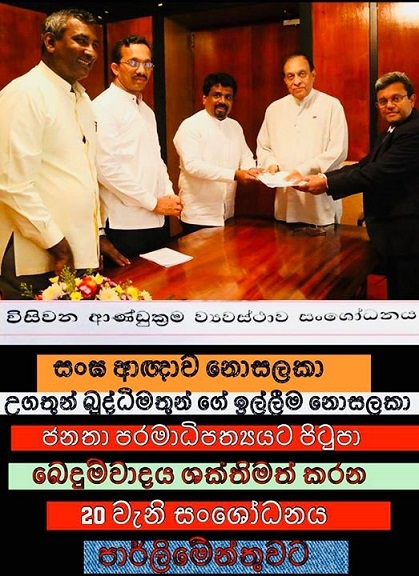
An Open Letter to Anura Kumara Disanayaka

May 29th, 2018

Jay Deshabandu

We are now getting more information on the central bank bond issue scam. Politicians are now saying they were paid by Arjun Aloysius, ex-central bank governor of Sri-Lanaka. This is most likely how Arjun Aloysius became the governor of the central bank, possibly favored by all politicians, who accepted money for their political campaigns. He must have given a large sum of money to get the post of governor of central bank in Sri-Lanka.  We all know who appointed him.  To say the least, our leaders are influenced by money. They can put our country’s security at risk for money! This is why our leaders appointed a non-citizen to this responsible post, a non-citizen’s signature on our currency notes! This is a good example to reason why we should oppose 20th amendment to the constitution.

According to the proposed 20th amendment, not only certain powers of the executive president are clipped, but also the country’s economy,stability and security are placed in a sinking ship. The country would be in a position of void of a strong leader without vision. According to this amendment, the president would be an independent person without having any inclination to a party, and hence without clear vision.

Under the proposed 20th amendment to the constitution, by J.V.P., the executive president will be more less a ceremonial leader who will be elected by the members of the parliament; not directly by the people for the people. So why should a normal citizen respect him?  Why should I respect him, I would ask Anura,  if I or general public  did not elect him but get elected by parliament members who take money for their vote?  Someone like Arjun Alosyus,  or someone with black money can pay our parliament members for their vote. Given the reality that most of our parliament members can be bought easily, any crook or thief with money in the country will be able to become a president. Is this what J.V. P. wants?

Did you or your party receive  money for this?

Asia’s Buddhists should pave the way to sustainable development

May 29th, 2018

by Kalinga Seneviratne

Buddhists across Asia are going to temples, bathing the baby Buddha, giving food to monks, lighting lamps and offering incense sticks accompanied by chanting paying homage to the Buddha on Vesak day, May 29 this year. While keeping with these traditions is important, Asia’s Buddhists are letting go a great opportunity to shape the global development path in an ecologically friendly, compassionate and a sustainable manner.

As the centre of gravity of the world’s economy shifts to Asia, Buddhism – which has shaped Asian civilizations for over 2000 years – has much to offer in guiding Asia’s development path. Buddhist philosophy has a rich reservoir of ideas on living sufficiently and comfortably without exploiting nature and people, ideas that anyone can adopt irrespective of your religious affiliations, as the mindfulness fad in the West shows. Mindfulness itself is rooted in the age-old Buddhist meditation practice of ‘Vipassana Bhavana’.

Often, I find it sad, when I hear young Asians – whose ancestors for generations have been Buddhist – saying proudly “we are free thinkers”, and refuse to identify as Buddhists. I have often explained to them that Buddhists indeed are free thinkers” – as reflected in Buddha’s sermon to Kalama on free inquiry – and they are essentially atheists – as Buddhists don’t accept a dependency on a creator God. This makes it possible to adopt Buddhist ideas without converting to a religion.

However, this liberalism has also created problems, such as in the Mindfulness craze in the West, where in order to secularize” mindfulness, westerners have taken out the spiritual aspects of the teaching such as the development of compassion and loving kindness.

Thai Buddhist social critic Sulak Sivaraksa is critical of the way the West has appropriated a Buddhist practice. It will be a wonderful thing to practice; for some, it will bring wonderful benefits (but) to seek mindfulness exclusively has the potential to evolve into something unwholesome, something negative,” argues Sivaraksa in a recently published book on mindful communication for sustainable development.

Pointing out that CEOs of many big global corporations have been sent for mindfulness training, he warns: When building up empires, taking up this meditation practice without the ethics (wisdom) will not see his mind changing for the better (of humankind) or becoming benevolent, more compassionate, more wise.”

The foundation of Buddhist ethics is in what is called the three poisons – greed, hatred and delusion. To eliminate suffering in the world, Sivaraksa says we need to understand these poisons and mindfulness training needs to guide you to this – to eliminate what he calls the structural violence” of our economic systems. These include the exploitation of the poor and the environment; issues of climatic change and environmental sustainability.

If we look at the results of the ‘Arab Spring’, it is a good example of how the three poisons have taken the better of humanity. A greed for resources (oil and gas) has led to a widespread manifestation of hatred from all sides, who were initially fed a delusion of freedom and democracy, by parties, that were merely interested in grabbing the resources of the region for themselves. This also reflects the structural violence of the global economic system that is creating conflict rather than cooperation.

In the past two years, I was involved with a project at Chulalongkorn University in Thailand, which was originally funded by UNESCO, to development of curriculum to introduce mindful communication methodology into journalism training programs in Asia. We have developed curriculum where we promote a concept called human-centric journalism” and in the economic and development reporting we introduce ‘sufficiency economics’ principles.

In economic reporting curriculum, we have used the concepts enshrined in the Buddhist ‘Four Noble Truths’, on understanding suffering (dissatisfaction), its causes and manifestations, cessation or extinction of suffering, and the path leading to the cessation of suffering.

This is a path of investigative journalism we promote, where the journalist is not just a watchdog, but an advocate or facilitator for finding solutions – to map a sustainable development path sans the structural violence of the current economic system. This also leads us to ‘sufficiency economics’, a concept the late Thai King Bhumibol Adulyadej promoted at the height of the Thai economic meltdown in 1997 and has been recently revived by the military led government. The concept emphasizes community development that strengthens the community to the self-supporting level.

This concept has been adopted by Bhutan, where they have rejected the GDP-based method of measuring progress, and they have adopted the ‘Gross National Happiness’ (GNH) concept based on the ‘sufficiency economics’ principles. In 2015, at the Climate Change Conference, the UN adopted Bhutan’s call for a holistic approach to development, a move endorsed by 68 countries. Now, a UN panel is looking at ways how this model can be replicated across the globe.

The current methods of journalism we teach – borrowed from the West – are too adversarial and promote conflict rather than cooperation and wellbeing of humanity. We may need to call the new mindful journalist a communicator – rather than a journalist – one, who could use a variety of digital communication tools to analyse, report and advocate for sustainable development.

If Asia is to give leadership to such a sustainable development movement and shape the UN’s sustainable development goals funds need to be mobilized, especially from within the Buddhist communities. This is where rich Buddhist temples, individuals and foundations could help. Rather than spend millions on building huge Buddha statues and grand temples – there are enough of them across Asia – Buddhists need to fund media networks and training programs that promote these Buddhist concepts.

* Kalinga Seneviratne is a Sri Lankan born Buddhist journalist and communication scholar currently based in Singapore.

Removing Wesak from the (Wesak) Vaishakha month

May 29th, 2018

Ramanie de Zoysa

Dear editor,

Today is Wesak full moon day; it is Wesak for the United Nations and it is Wesak for the other few Buddhist countries – namely Thailand, Myanmar and Laos- but not for Sri Lanka. Sri Lankan Buddhists have been conned into removing Wesak from the full moon day of May- is this to accommodate the growing aggression of the 12 Muslim ministers within the NGO paid Sri Lankan Government? Sri Lanka Muslim is now offended by the Buddha statutes by the roadside and pirith chanting in the temples while no one condemns the use of loudspeakers to do the call to prayer 5 times a day. Quran demand that idol worshipers be beheaded during Ramazan – is this the precursor to that?

Day of Vesak Observances

Holiday currently only shown for years 2000–2049.

Weekday Date Year Name Holiday Type
Thu May 27 2010 Day of Vesak United Nations observance
Tue May 17 2011 Day of Vesak United Nations observance
Sun May 6 2012 Day of Vesak United Nations observance
Sat May 25 2013 Day of Vesak United Nations observance
Tue May 13 2014 Day of Vesak United Nations observance
Mon Jun 1 2015 Day of Vesak United Nations observance
Fri May 20 2016 Day of Vesak United Nations observance
Wed May 10 2017 Day of Vesak United Nations observance
Tue May 29 2018 Day of Vesak United Nations observance
Sun May 19 2019 Day of Vesak United Nations observance

Sri Lankan citizenry that was on a mission to remove the leader who delivered freedom from terror have gone silent. We took the release of Tiger terrorists from prisons without a whimper; we said nothing while most of our war heroes were sent to prison some on death row for killing Tiger terrorists; our silence was deafening when army camps were dismantled and land handed over to Tigers (some returned from hiding overseas); more silence when Buddhist priests were hounded and thrown in jail; tails were between our legs when the Provincial Councils started banning the erection of Buddhist temples in the North or East or even when roadside Buddha statues were being routed in the rest of the country for fear of Muslims being ‘offended’; we have nothing to say when out heritage landmarks in the North and East are being dozered; we pretend not to hear when the native rain forests are being sold to Islamic colonisers from the Middle East; Sinhala youth such Amith Weerasinghe has been jailed for ‘racism’ and has been brutally beaten up in secret for the crime of speaking up about the Islamic rape and colonisation of the Sinhala country. 20th amendment to the Constitution is being hauled in to remove the only obstacle to carving out the country into Eelaam and the Eastern Caliphate. In short, we are more or less where we were when the Tamil terrorists were pummeling us in their heyday!

What do we do as Sinhala Buddhists to protect our land, people and culture?

We need to start from the beginning- we need to start with Mavil Aru and end in Nadikadal- again!

Mavil Aru today has a different name- its Colombo! and the address is C/-o the Parliament. Let’s start with the two enemy chiefs- Ranil and Maithree!

Ramanie de Zoysa

රාජපක්‍ෂවරයෙකු ඉදිරි ජනාධිපතිවරණයේ දී තරග කිරීම ඇමරිකාවේ අභිලාෂය මතයි… එරට පුරවැසිභාවය ලෙහෙසියෙන් අවලංගු කල නොහැක.. ඇමරිකානු නිල නිවේදනය මෙන්න..

May 29th, 2018

lanka C news

මීලග ජනාධිපතිවරණය 2019 ජනවාරි 9 වෙනිදායින් පසුව වර්තමාන ජනාධිපතිවරයාගේ අභිමතය පරිදි ඕනෑම අවස්ථාවක පැවත්විමට ශ්‍රීලංකා ආණ්ඩුක්‍රම ව්‍යවස්ථාව අනුව ප්‍රතිපාදන ඇත.

එසේ නොවුවද 2019 නොවැම්බරයෙන් පසුව මැතිවරණ කොමිසම විසින් අනිවාර්යෙන්ම ඉදිරි ජනාධිපතිවරණයක් සඳහා අවශ්‍ය කටයුතු සුදානම් කල යුතු අතර කොමිසම විසින් 2020 ජනවාරි 8 වෙනිදාට පෙර නව ජනාධිපතිවරයා දිව්රුම් දීම සඳහාද අවශ්‍ය කටයුතු සූදානම් කල යුතුය.

වර්තමාන ජනාධිපති මෛත‍්‍රීපාල සිරිසේන මහතාගේ නිල කාලය එදින අවසන් වෙයි.

කරුණු එසේ හෙයින් තව මාස 7 ක් වැනි කෙටි කාලයකින් පසු ඔ්නෑම මොහොතක කැදවිය හැකි ජනාධිපතිවරණයක් පැවත්වීමේ සටන සඳහා මෙරටේ ප්‍රධාන පක්ෂ විසින් තමන්ගේ අපේක්ෂකයන් සඳහා අවශ්‍ය මූලික සුදුසුකම් සපුරා ගත යුතුය.

රාජපක්‍ෂවරයෙකු ඉදිරි ජනාධිපතිවරණයේ දී තරග කිරීම ඇමරිකාවේ අභිලාෂය මතයි… එරට පුරවැසිභාවය ලෙහෙසියෙන් අවලංගු කල නොහැක.. ඇමරිකානු නිල නිවේදනය මෙන්න..

මේ වනවිට මෙරටේ ලාබාලම පක්ෂය මෙන්ම රටේ ජනතාවගෙන් බහුතර බලය දීනාගැනිමට මහින්ද රාජපක්ෂ හිටපු ජනාධිපතිවරයාගේ මෙහෙයවීමෙන් යුතු ශ්‍රීලංකා පොදුජන පෙරමුණ හෙවත් පොහොට්ටුව සමත් වී ඇති අතර මෑතකදී පැවැති පලාත් පාලන මැතිවරණයේ දී දිවයින පුරා පිහිටි පලාත්පාලන ආයතන 341 න් 238 න් දීනගෙන 2/3 කට වඩා බලයක් ලබාගෙන ඇත.

ජනාධිපතිවරණයකදී එම එම පක්ෂයේ අපේක්ෂකයන් ලෙස මහින්ද රාජපක්ෂ මහතාගේ ආශිර්වාදය මත පුද්ගලයෙකු නම් කෙරෙනු ඇති බවත් එම පුද්ගලයා රාජපක්‍ෂවරයෙකු වීමේ වැඩි සම්භාවිතාවක් ඇති බවද දැනටමත් තොරතුරු හෙලිව ඇත.

කෙසේ වෙතත් ගෝටාභය රාජපක්‍ෂ හා බැසිල් රාජපක්‍ෂ යන මහත්වරුන් දෙදෙනාම ශ‍්‍රි ලංකාවේ හා ඇමරිකා එක්සත් ජනපදයේ පුරවැසියන් වෙයි.

ආරංචි මාර්ග සඳහන් කරන පරිදි මීට මාස 6 කට පෙර හිටපු ආරක්ෂක ලේකම් ගෝඨාභය රාජපක්ෂ මහතා ශ්‍රීලංකාවේ ඇමරිකානු තානාපති කාර්යාලය හරහා තම ඇමරිකානු පුරවැසිභාවය අත් හැරිමට අයදුම් කර ඇත.

ඇමරිකානු රාජ්‍ය දෙපාර්තමේන්තුවේ අනුමැතිය ඊට හිමි වනුයේ ඊට අවශ්‍ය සුදුසුකම් සපුරා ඇද්ද යන්න පරීක්ෂාකොට බලා අවසන් වශයෙන් ඇමරිකානු බලධාරීන් විසින් පවත්වනු ලබන සම්මුඛ පරීක්ෂණයකින් පසුව බව පැහැදිලිව ඇමරිකානු රාජ්‍ය දෙපාර්තමේන්තුවේ වෙබ් අඩවියට පිවිසීමෙන් දැකගත හැකිය. එම වෙබ් අඩවිය මෙතනින්

ඒ අනුව එරටෙහි රාජ්‍ය බදු සම්බන්ධයෙන් මෙන්ම දේශපාලන හා ආරක්ෂක වශයෙන් එරටට එම පුරවැසියාගෙන් සිදු විය හැකි තක්සේරුවක් ඇමරිකානු රාජ්‍ය දෙපාර්තමේන්තුව මෙන්ම ස්වදේශීය ආරක්ෂක දෙපාර්තමේන්තුව විසින් සිදු කරනු අතර ඒ සඳහා අවම වශයෙන් වසරකට නොඅඩු වැඩි කාලයක් එරටෙහි අවශ්‍යතාවය සහ අදාළ පුද්ගලයාගේ අරමුණ සම්බන්ධයෙන් සිදු කරනු ඇත.

එමෙන්ම මොනයම් හේතුවක් නිසා හෝ ඇමරිකානු පුරවැසිභාවය අත්හරින්නෙකුට නැවත ඇමරිකාවට ඇතුලුවිමට අවශ්‍ය පහසුකම් සීමා කෙරෙනු ඇති බව ද එහි සඳහන් වේ.

මීට හොඳම උදාහරණයක් ලෙස මෙරටේ ඇමතිවරයකු ලෙස මෛත්‍රීපාල සිරිසේන ජනාධිපතිවරයා සමඟ පසුගියදා එක්සත් ජාතින්ගේ සංවිධානය මහා සමුළුවට සහභාගි වීමට හිටපු හමුදාපති ෆීල්ඩ් මාර්ශල් සරත් ෆොන්සේකා විසා පහසුකම් ඉල්ලූ අතර ඒ සඳහා හෝ ඔහුට ඇමරිකානු රාජ්‍ය දෙපාර්තමේන්තුව අවසර ලබා නොදුනි. දැනටත් ෆොන්සේකා අමාත්‍යවරයාගේ පවුලේ පිරිස ඇමරිකාවේ ජීවත්වන අතර මේ දක්වා ඔහුට ඇමරිකාවට ඇතුළුවීමට එරට ඉඩ ලබාදි නොමැත.

ඉහත කරුණු සලකා බැලීමේදී මේ වනවිට ගෝඨාභය රාජපක්ෂ මෙන්ම බැසිල් රාජපක්ෂ මහත්වරුන්ගේ පවුලේ සමාජිකයින් සිය දරුවන් ඇතුළු දැනට ඇමරිකාවේ පදිංචිව සිටින අතර පුරවැසි කම අතහැරියහොත් නැවත ඇමරිකාවට ඇතුළුවීම ඇහිරෙනු වනු ඇත.

එබැවින් ඉදිරි ශ‍්‍රි ලංකාවේ මීලග ජනාධිපතිවරණය සඳහා ඇමරිකානු පුරවැසිකම දරන්නෙකු ඉදිරිපත් වන්නේ නම් ඉදිරිපත් වන්නේ නම් එය රදා පවතින්නේ ඇමරිකානු රාජ්‍ය දෙපාර්තමේන්තුවේ හා එරට ස්වදේශීය ආරක්ෂක දෙපාර්තමේන්තුවේ කැමත්ත මත වනු ඇත.

BEING DARK SKINNED IN BEIRUT

May 29th, 2018

  Courtesy gal-dem.com

I’ve lived and travelled the Middle East for years. The first time I moved to the Gulf I was soul-ridden from seeing the migrant domestic workers (MDW) that looked like members of my family and the community I grew up in. There was the Sri Lankan maid who’d knock on my door asking if I wanted her services, the Filipina women pushing strollers, running after Arab children, and the Bengali woman sweeping close to the table I sat at with my white and Arab friends. I’d always smile, almost embarrassed if I was wearing short shorts in front of an aunty, guilty for my company with white expats and the Arab majority. I knew while the organisation I worked for held my passport for three months, theirs were held for years.

***

My maid’s stupid. She knows nothing. She can’t do anything. She’s useless,” a Lebanese woman shared with me. In Lebanon having a maid is a status symbol.”

According to the International Labour Organization’s (ILO) 2016 report on Lebanon, there are over 250,000 migrant women in domestic work. The majority are Ethiopian. Sri Lankan women were once the most popular after other Arab women in the early 70’s, hence the term Sri Lanki.” Currently, Bangladeshi women earn the least, and there’s more likelihood to obtain Ethiopian women due to high supply. Filipina women earn the most because they usually speak English and have had experience in domestic work.

The Kafala is a sponsorship system in the Middle East that ties an employee to their employer. It gives employers reign of their employees’ movement and work hours, inhibiting them from leaving their sponsored work. It’s a form of slavery, sitting within a structure of an endemically racist capitalist system which affects MDW, but also working class Lebanese and Arab communities who suffer as part of this. Despite the fact that some countries in the Middle East have reformed or abolished Kafala, power still remains in the employers’ hands.

It sits within a structure of an endemically racist capitalist system which affects migrant domestic women, but also working class Lebanese and Arab communities”

At Beirut Airport, it’s common to see an immigration officer with a queue of Ethiopian women waiting to be numbered. This is usually the point when their documents and passports are taken by their sponsors. Although I am Sri Lankan, when I travel I’m able to embark on my journey freely, thanks to my Canadian passport and the life that comes with my upbringing in the West.

Madams (female employers) are known to shower and bathe maids when they arrive, using lice shampoo, teaching them how to disinfect the bathroom after use, as many perceive their maids as dirty”. Many of the migrant women arrive with little or no English, Arabic or French skills making it difficult to connect with their employer and their family. The MDW tend to feel isolated. The ILO states almost half of MDW aren’t given their own rooms. They sleep in the kitchen, the parlour or in a glass-enclosed veranda.

Some MDW are locked indoors, as employers worry they will run away, or fear what they’ll do, as they’re responsible for their actions. There have been cases such as Halima‘s, a woman who was locked away” for ten years without receiving wages. While minimum wage in Lebanon is $US450, this doesn’t apply to MDW – the average wage for migrant women is just $US180.

Ethiopian women returning from working in the Middle East have psychiatric morbidity rates that are two to five times more than those remaining in Ethiopia”

On a flight to Ethiopia from Beirut, there were many Ethiopian women either returning or visiting home. There was one woman I noticed who was despondent to those around her, as were the flight attendants. 40% of Ethiopian women are bipolar – I read a study. Our maid used to throw plates on the floor,” said the Lebanese woman beside me on the plane. If I was a MDW, I’d throw more than just plates. I researched her claim and learnt that Ethiopian women returning from working in the Middle East have psychiatric morbidity rates that are two to five times more than those remaining in Ethiopia.

Though some MDW work for caring families, there are those who endure verbal, physical or sexual abuse. My first six months were horrible. I ran away. They don’t treat us like women. We’re slaves. I still don’t have my passport. We really suffer here,” said a 27-year-old Ethiopian woman I spoke with. She explained that some women feel pressured after running away and look for sex work. She also said that the authorities often stop women, knowing that they’re unlikely to have their documents. Some of these men will ask for money and knowing the women don’t have any, they demand sex. They see us as bitches. That’s what we are to them.”

A few weeks prior, I was followed by a uniformed officer into my building and through the secluded stairwell. He wanted my phone number for sex. I was able to tell him off in English in my North American accent, my privilege spraying as potent as pepper spray. It’s because you’re Sri Lankan,” said the Filipina maid who works in our building as she pointed to my skin. Even with my privilege as a Sri Lankan from the West, with a white Arabic speaking husband that looks Lebanese, I notice how people avoid speaking to me when I’m with him, even when English is spoken. I can’t help but wonder if some of the stares we get when we’re together are out of curiosity by the nature of our relationship. Did a Lebanese man marry his Sri Lanki?

***

If, with my privilege, I feel the obvious racism in the power imbalance between migrants and locals, I can’t imagine what it’s like for a MDW. They leave their families and children, often working for the sole purpose of sending money back home. For every case where a vulnerable woman is subject to such terms of oppression, this is often accompanied by violence, control and death. There are organisations of some Lebanese in solidarity with some of these women, and those run by former workers themselves. We can support their efforts to force the Lebanese elite to abolish the Kafala system, and put pressure on employers who are exploiting their workers. Let’s strive towards justice and change, rather than sit by and watch.

Sinhale Buddhists – Your Nation Needs You more than ever

May 28th, 2018

You are the majority in our Island. History is witness to your status as majority.  History is also witness to how you came forward to defend your soil & protect fellow citizens as the majority should when confronted by invaders from South India and the 3 Christian European countries. History stands witness to the many ways in which you have been divided & kept divided – some of you are even proud to be divided. History is also sadly witness to how your own betrayed for titles & perks and tragically the same is repeating again.

When the island needed to be defended – there were no PR firms or modern day communication channels that beckoned people to come forward to serve the nation. People knew their duty & they did what they knew was the right thing to do. To serve the nation there was no salary and it came with no strings. No one compromised. The nation came first. For Sinhale Buddhists the nation & its alignment with the Buddha’s teachings was a sine quo non – both could not exist without the other. This is what is being now targeted for annihilation & that is exactly why we need to rally in defence of it.  


Sinhale denoted essentially the civilization of the Sinhale Buddhists together with others who were living with them. Plugging new nomenclatures as ethnic, races, religion began only after the Europeans invaded & left a legacy of new terms which could keep people ever divided.


In the island of Sinhale, before these Europeans arrived the people were not divided by race, religion was never a problem & they were all citizens of Sinhale – the royal governance followed the dasa raja dhamma, the people followed the concepts of Buddhism while there has been no instances of Hindus & Islam logging any qualms of complaint.

 People knew their limits, they knew to respect the other’s space & any incursions were dealt with punishments that were equal to all & known by all. There was certainly better law & order than what exists today! 


All that simple living that prevailed across majority of the ancient civilizations changed as a result of the sword & military might by groups that sought to terrorize people & take over their territory & expand their turf. People were forced to replace their hearts & minds with things foreign, they were taught to live & adjust to new cultures, they were presented a totally cosmetic notion of the pastoral life they had been living. Thus, a society that was divided, segregated, separated came into being.

 You were also divided. A new socio-religious group came into existence – the Sinhale Christians/Catholics. Unfortunately, many of them have become pawns in the greater game of politics. They religious hierarchy decides which leaders they ought to bring to power. Some are wiser, well-read & they know they have to put country first. Now, more than ever, we need many more of them to come forward to defend the nation.


With time our people were made to forget the great men that built our ancient marvels – the world’s only man-made irrigation systems, the magnificent dagobas, chaityas, Buddha statues – we even built ships on foreign orders. Today we cannot even manufacture a toy ship! There were no architects, there were no engineers, there were no heavy machinery or quality or even quantity surveyors. These marvels stand erect & epitomizes everything we should be proud of. But are we proud? Have we forgotten? Can we forget? There is no future or present without the past. Are there programs in place for us to forget? Can we forget all that our forefathers toiled to achieve? Should we allow our education syllabus to omit this all important past simply because to some it is not fashionable enough or some other foreign cultures are deemed more fashionable?


Is it more fashionable to memorize the achievements of nations with blood soaked hands? The very countries that are bombing the world are the very countries that stole nations & territories, committed genocide of man & animal, disenfranchised people who had been living on lands for centuries & these are the people dictating & writing human rights laws & how international laws should be adjudicated!

 That is a question for you to ask your heart & mind. You can copy any other tradition, values, cultures but your roots as a Sinhalese are found in this soil, in these marvels created by our ancient forefathers & mothers. The soil that has shed blood and sacrifice to safeguard it from foreign invaders. These roots cannot be easily broken. Those who deem it a pride to copy & follow other cultures & values, all that we ask is, do not demean the heritage Sinhale culture & its people. Go your own ways peacefully.    

 Every person who says ‘I hate being Sinhalese’ ‘I hate being a Buddhist’ exactly what have these people as Sinhalese done to even be associated as a Sinhalese. What have they done as a Buddhist to find fault with Buddhism? Their statements only make the world laugh at them and we must pity them.

 Of course, we must learn to respect other cultures, other traditions but we don’t need to replace ours with theirs or have theirs replaced with ours.

 Respect comes in understanding that there is no reconciliation without reciprocity. You cannot take or demand what you are not prepared to give or forsake. Such a simple thought but people today make demands only. What have they given in return. They ridicule our nation, they have countless lists of its faults – but what have they contributed to make the nation a better place? Our actions decide the state of a nation. Our inputs turn a nation to greatness. If our nation is on the decline it depicts the weaknesses of our own inputs. We need to uplift ourselves to turn Sinhale once more into a great nation.  

As we look around the world, what is the happiness we see. All but 11 countries in the world do not have some sort of conflict. What 8 people own is equivalent to the combined wealth of 3.2billion people. There are millions of people who are hungry, who do not have a roof over their heads, who earn just $1 a day, who have no access to water, who cannot read or write & these figures are not relevant to only the third world but to first world developed countries too. So where or who has developed? Is this the formula we want to continue?


We suffered for over 400 years under colonial rule – are we to suffer another 400 years of neocolonial rule?


Why must Sinhalese defend our nation?

In 1815 our own handed over our island to our enemy. That sealed our fate for 133 years. We are in our 70th year of independence and the signs we see are no good. Handing over land ownership to foreigners, allowing them zones that treat citizens as trespassers, signing detrimental agreements without exit clauses and overlooking the national security aspects in such agreements are all signs that our island is seeing the same betrayals as that which happened in 1815.

Our people were showered with goodies in return for handing over an entire island and the same is happening now probably the same treacherous DNA bloodline continues. If that be so, the DNA of those that defended the nation must still be in those that must now come forward to defend the nation, to inspire others to do the same.

Sinhale Buddhists remember & never forget – We have nowhere else to go to. No other nation will welcome us.

We evolved on this island. We have a distinct language, distinct culture, values & an unbroken Buddhist heritage. We must protect, defend & preserve that.

People who say they live in fear here have not seen how people are tased, how people are pepper sprayed, how people are even anus searched in other countries simply if a police claims he is suspicious of a person. The incidents taking place in the West are really shocking & it should make any to value our island as a real paradise.

No country is perfect. No people are perfect. We are all humans with shortcomings. We may have different colour skins, follow different religions, customs, traditions & cultures but we all die one day & death makes no differentiation whether a person is rich or poor, comes from the First World or Third World, is educated or not.

We all, have a duty – we have a duty to first be good people, lead lives of integrity, follow a virtuous path, look after our elders our children & home, respect others & be good citizens. All that cannot prevail if we do not have a safe country to call our own & for that we must together protect the land of our birth the land that has roots to our heritage & the land that our history evolved from.

Come forward – protect & defend all that you grew up in because you need to keep our nation in tact so that your child can pass it down to his/her children and they need to pass it down to theirs too.

Imagine One Nation for Our children. That is Our future.

When the enemy comes to your doorstep – what do you do?

Runaway or Defend your Nation?


Shenali D Waduge


“WAR CRIMES” IN EELAM WAR IV Part 2

May 28th, 2018

KAMALIKA PIERIS

The Eelam War was not a local war. It only appeared to be a local war. It was initiated by the west and funded by the west. The LTTE and the Tamil separatist movement were mere tools in this operation. Sri Lanka is now beginning to realize this. How    else was the LTTE able to survive as a fighting force against the government of Sri Lanka for nearly 30 years, asked one analyst.

Bishop Shantha Francis observed, ‘this is not a war that began and ended in a couple of years. The LTTE became powerful enough to take on the elected government. They possessed the most powerful weapons and good combat training. They also had enough funds. How did they acquire all this? It is obvious that the international community gave the terrorist arms, motivation, and funds and just watched the scene for 30 years.’

Jayantha Dhanapala giving evidence before the  LLRC referred to states which encouraged the war, by nurturing the terrorists groups, letting them have HQs there, do fundraising, helped with weapons. He thought  those states too should also be held responsible for the consequences of the war.

The Eelam war arose because the west wanted to get its hands on  Sri Lanka ‘s coastal belt, which was the most  valuable part of Sri Lanka .The eastern coast has Trincomalee harbor with its command of the Bay of Bengal, and the Pulmoddai mineral sands, the west has  the gas and petroleum belt   of Mannar and easy access to Tamilnadu in India. The new Exclusive Economic Zone of 200 nautical miles  will  further increase the   value of this belt. The Exclusive Economic Zone, all-island, is approximately 7.5 times the land area of Sri Lanka.

Eelam is not a new idea. Eelam can be seen   in the very first Census map of 1871. The British created a brand new set of provinces, starting  in 1833 and  finishing in 1845, each hugging the coastline, and   cutting the coastal areas off from the hinterland. These coastal provinces  had common boundaries. When the common boundaries of the  Northwestern, Northern, and Eastern provinces are  joined together  a ‘’natural‘ Eelam is formed.

The LTTE consisted of Tamil boys who did not know warfare, did not know English, and had  no knowledge of the rest of the world. They were  merely the front, also cannon fodder. The west provided the powerful weapons the LTTE was using,  which gave the LTTE the appearance of great military strength. Powerful telecommunications equipment came in, secretly through the BOI, so that the LTTE could keep in touch with its masters in the west and take instructions. The LTTE was given the title of ‘world’s most feared, ruthless terrorist organization’ by the western media, but the LTTE was viewed with contempt by the Sri Lanka military. The Eelam wars went on for thirty years. During that period the west tried everything possible, including the Ceasefire Agreement and PTOMS to establish Eelam..

In the first three Eelam wars, Sri Lanka succumbed to international pressure   and the military offensive was stopped when the army was about to win. Eelam War IV was different. The government under Rajapaksa was determined to squash the LTTE and regain the northern and eastern provinces. Rajapakse went for the jugular of the LTTE, unswayed by the pressure of the ‘international community’, observed the media. When USA found that that the prolonged war was making the Sri Lanka military strong, they tried to stop the war by helping Sri Lanka blow up LTTE  armaments ships.

When it became clear that the government was going to win the war, the western powers wanted President Rajapakse to stop the war. There were appeals made to the government of Sri Lanka, to “pause” hostilities during the final stages of the conflict. The Rajapakse government refused to do this. The fact that all these appeals were made to the Government and none to the LTTE convinced the Government that all these efforts were to save the LTTE leadership. President Rajapakse firmly stated that he was not going to stop the war. They were going to fight to the finish.  Nothing short of unconditional surrender could save the LTTE.

The pressure exerted on President Rajapakse was enormous. When Kilinochchi fell in January 2009 USA, UK, Norway and France followed by India and Japan met Rajapaksa. These countries were trying to save the badly cornered LTTE. There were    visits by Foreign Secretaries from the U.K. and France, Milliband and Kouchner. Representatives of UN, UNDP, ICRC together with the ambassadors for USA, India and European Union met the Foreign Minister. USA threatened to withhold the promised 9 million loan unless a ceasefire was declared and foreign intervention was allowed. UN Secretary General Ban Ki Moon sent his chief of staff, Nambiar to meet the President. UN wanted an immediate ceasefire.  USA wanted a meeting between the UN representative and Prabhakaran as well.

About two months before the final battle at Nanthikadal lagoon, USA had offered to evacuate the top LTTE leaders and their families. There were secret negotiations to take away Prabhakaran, Sea Tiger wing leader, Soosai, intelligence wing leader Pottu Amman and their families, numbering over 100.  US wanted them to surrender to a third party. Sri Lanka insisted that LTTE must surrender to Sri Lanka and not to a third party.

USA also wanted President Rajapakse to offer a general amnesty to the LTTE. This coincided with the unilateral ceasefire declared by the LTTE when they found they were losing. President Rajapakse refused. The government could not offer an amnesty, he said. Even if the top leaders surrendered the government would go ahead with legal proceedings against them for crimes committed. It was also too late for the LTTE to negotiate a deal with the government.   President said that he would not accept Prabhakaran as party to any future settlement. Nothing could be more ridiculous than allowing LTTE to take part in negotiations when it had lost it fighting capability.

The government of Sri Lanka     defeated the LTTE  and declared victory on 19. May 2009.” The military victory in the final war was total said analysts.” A euphoric Colombo awaited the deluge of congratulatory messages for having accomplished what even the authors of the global war on terror had not been able to achieve,”   said Indian  analyst Tekwani. However, the messages that flooded in were negative ones. Mostly condemnatory, the chorus of messages chided the triumphant victor for unbecoming conduct on the battlefield and included accusations of war crimes and crimes against humanity. The allegations against Eelam war IV were prepared in advance even before the war ended, noted analysts.   The west would  have had their next scenario ready, by the time the Eelam war IV ended. ‘  Once the war crimes charge is over, they will put in fresh charges’ said Gotabhaya Rajapaksa.

Island editorial in April 2010 warned  that the western countries are sure to resume their anti-Sri Lanka campaign sooner or later. Under the veneer of bonhomie, there is bubbling hatred. So it is best for the government to get its act together without leaving any room for external forces to meddle with the affairs of this country.

The west was not prepared to accept this defeat. They turned to the  United Nations, Ban Ki-moon, UN Secretary-General  arrived in Sri Lanka on 23 May: observers said he came for the sole purpose of holding Sri Lanka accountable for  the military strategies used during the final phase of the armed conflict.

He held talks with the President, Foreign Minister as well as other senior leaders of Sri Lanka.  He also consulted ‘other relevant stakeholders’, members of international humanitarian agencies and civil society.  He visited the internally displaced persons (IDP) sites at Vavuniya and flew over the area, near Mullaitivu  which saw the final  conflict.

A  joint statement was issued by the Government of Sri Lanka and the United Nations at the conclusion of the visit. This is a very peculiar joint statement. It did  not  affirm the unity of Sri Lanka  and the end of a secessionist effort. Instead, it supported Tamil separatism and even used Tamil separatist jargon.

The statement said,  that Sri Lanka had entered a new post-conflict beginning. .this ‘new situation’  should be used  for the long-term development of the north. The government must ensure  relief, rehabilitation, resettlement and reconciliation in the north. Also  the government must now start addressing the aspirations and grievances of all communities and working towards a lasting political solution.

The government must  begin a broader dialogue with all parties, including the Tamil parties in these ‘new circumstances ‘. There must be a national solution acceptable to all sections of people. Lastly, the Secretary-General underlined the importance of an accountability process for addressing violations of international humanitarian and human rights law.  This  marks the formal start of the  war crimes” issue.

But USA  was not satisfied. They  wished to kill this victory. In 2009 itself,  US, working through Britain, France and Austria, tried to get the UN Security Council to examine the deaths in the last stage of the Eelam War. This was to be at a Security Council briefing.  But US was not able to secure the 16 signatures needed   and UN Security Council refused to discuss the situation in Sri Lanka.

The move was ‘strenuously warded’ off by seven countries led by China and Russia. These seven, China, Russia, Japan, Turkey, Uganda, Vietnam and Libya,   said that the current situation in Sri Lanka did not warrant a briefing in the Security Council. China vehemently” opposed any discussion in the Security Council on the issue of civilians trapped in the fighting between government Security Forces and the LTTE, arguing that it was “purely an internal matter”.

The US then turned to the UN Human Rights Council (HRC). The Human Rights Council, unlike Security Council, could be manipulated easily by the US. It was short of funds and  gladly accepted donations. The US was influential in the HRC.

In May 2009 UN Human Rights Council in Geneva held a special session, called at the request of US, UK, EU and Denmark  to discuss a Swiss-EU resolution against Sri Lanka.  The sponsor was the United States, and the resolution was known as the US resolution on Sri Lanka.

Many NGOs had supported the EU resolution.  The NGO website, Inner City Press presented what it said were UN statistics of civilian killings in the Wanni since January 2009, and quoted the UN Human Rights High Commissioner Navaneethan Pillay as saying that war crimes “may” have been committed in Sri Lanka by both the LTTE and the Sri Lankan government.

There was also vigorous lobbying by the Tamil Diaspora. Many  a Special Rapporteur who had not previously been interested in Sri Lanka, issued a press release calling for an independent inquiry into the situation in Sri Lanka, said Dayan Jayatilleke. Rajiva Wijesinghe added, hordes of LTTE sympathizers turned up to buttonhole various ambassadors, and to brief the UN Commissioner for Human rights, and to make aggressive interventions in the debate. They were aided and abetted by a number of NGOs. However, some Pro-Eelamists  did not like the  text of the resolution. ‘This text is too little,   they said, ‘ also it is toothless’.

The US thereafter sponsored three resolutions against Sri Lanka at the UN Human Rights Council (HRC) in 2012, 2013 and 2014. They were all challenged by the government of Sri Lanka and they were all voted in and accepted by the HRC. The US subsequently said that if Sri Lanka wanted to permanently close its dark chapter it cannot walk alone. Analysts observed that in all these resolutions the US was able to influence the votes and get reluctant countries to at least abstain. Those countries that refrained from voting made speeches in Sri Lanka’s favor and then refrained from voting – which was their way of indicating that they were refraining from voting in favor of Sri Lanka only under duress.

2012 resolution was presented amidst much fanfare .A resolution calling upon Sri Lanka to fully investigate who was responsible for the deaths of thousands of Tamil civilians and to establish genuine reconciliation ‘is to be tabled during a meeting of the UN Human Rights Council (UNHCR), which opens tomorrow, ‘ shouted the media.

Many thousands of Sri Lankan civilians died or suffered other violations in the final weeks of the long-running civil war in 2009. There has been no complete accounting of those deaths or other violations and no pursuit of accountability for them,” said Eileen Donahoe, the US ambassador to the UNHCR in Geneva. We believe that real reconciliation must be based on accountability, not impunity. There cannot be impunity for large-scale civilian casualties, and that if there is to be real reconciliation it must be based on an accounting of the truth and serious implementation of changes,” concluded Donahoe

Fred Carver of the Sri Lanka Campaign for Peace and Justice, said, If successful, this motion will show that  the opinion of the world, and in particular the opinion of nations in the global south, has shifted and that the Sri Lankan government can no longer turn a blind eye to war crimes and crimes against humanity.

Pakiasothy Saravanamuttu, Sunila Abeyesekera and Nimalka Fernando were in Geneva at the time, reported the media.  They attacked the Rajapaksa administration as undemocratic, repressive and militarized, with abductions and open killings. They called Sri Lanka a ‘hell hole’. Diplomats had privately wondered how these people were tolerated in Sri Lanka, said the media.

However, Sri Lanka representative, Tamara Kunanayagam had   informed the Office of the Commissioner for Human Rights that the OHCHR had acted outside its mandate in facilitating the US resolution. OCHCR has played to the political agenda of the USA, raising serious doubts about the impartiality of the OHCHR. The OHCHR is bound by the UN Charter to be neutral, she said.

In Sri Lanka ,TNA   welcomed the US resolution against Sri Lanka. TNA said that this is the first step in the pursuit of justice and accountability   and thanked those organizations which showed a firm commitment to the achievement of a future for the Tamils in Sri Lanka  that is marked by equality, dignity, justice and self respect.

Elsewhere in Sri Lanka the resolution was condemned as interference in the internal affairs of Sri Lanka by the Committee of Vice Chancellors of Sri Lanka. It was also condemned by the Ceylon Petroleum Corporation Engineers Association. Rev. Cyril Fernando, of the Diocese of Colombo, said that the action was equal to a direct intervention against Sri Lanka’s independence and sovereignty and an insult to the intelligence of the people.

The Geneva resolution of 2012 was not a surprise, said the government of  Sri Lanka.  We knew that some western countries had launched a conspiracy against Sri Lanka. We saw this at the time of the humanitarian operation in Eelam War IV. At that time these same parties used various tactics to turn the operation back. They took the position that Sri Lanka should give in to LTTE terrorism and divide the country. These agents will continue their project aimed at dividing Sri Lanka into two like Sudan. The project will continue from foreign lands and they will try to create instability and anarchy within the country, concluded the government .

UN’s Human Rights Council has passed a resolution highly critical of Sri Lanka’s record, reported the BBC in 2013. The resolution encourages Sri Lanka to conduct an independent and credible investigation into alleged war crimes .The 2014 resolution wanted an international inquiry into alleged war crimes committed by both the Sri Lankan Government and the Liberation Tigers of Tamil Eelam (LTTE) in the final stages of a decades-long conflict that ended in 2009.

Unlike the resolutions of 2009, 2012 and 2013, this resolution asked the United Nations High Commissioner for Human Rights (OHCHR) to ‘investigate, assess and monitor’ the human rights situation in Sri Lanka. This undermines national sovereignty, observed the media. The resolution was adopted with 23 members voting in favor of the resolution, while 12 voted against. Russia, Cuba, Venezuela, China, Russia, Maldives voted against it. India, South Africa, Japan, and Indonesia voted for. There were 12 abstentions. Which showed that those who supported the Resolution numbered less than half of the HRC, commented G.L.Pieris.

Both groups of countries, for Sri Lanka and against Sri Lanka, commented on the resolution. The intrusive manner in which the investigations are carried on against Sri Lanka is unwarranted they said. The resolution ‘went beyond the mandate of the High Commissioner said Russia,  ‘double standard of play” (Cuba), “aimed at developing countries forcing them into submission” (Philippines), intolerable interference in the internal affairs of Sri Lanka” (Pakistan)  “people have the right to choose their own path” (China), serious risks created by intervention” (Venezuela), “the biased approach to specific countries” (Ecuador).failure “to take into account continuing progress” (Thailand)  and ‘ attempt to stifle the “energy” (Indonesia).

UN High Commissioner for Human Rights, Navaneeethan Pillay noted that in recent years, the Sri Lanka Government has established various mechanisms with the task to investigate past violations. But none have had the independence to be effective or inspire confidence among victims and witnesses”, she stated. New evidence continues to emerge, and witnesses are willing to come forward to testify before international mechanisms in which they have confidence and which can guarantee their protection, the High Commissioner added.

This shows that an international inquiry is not only warranted, but also possible, and can play a positive role in eliciting new information and establishing the truth where domestic inquiry mechanisms have failed. The Council has in the past called on the Sri Lankan Government to take credible steps to ensure accountability for alleged serious violations committed during the final months of the conflict ‘.

HRC requested the Office of the UN High Commissioner for Human Rights (OHCHR) to undertake a comprehensive investigation” into alleged serious violations and abuses of human rights and related crimes by both parties, and hold perpetrators accountable.  The OCHRC did as it was told and prepared a report, known today as OISL report.

In 2015, after the Yahapalana  victory, US Assistant Secretary of State for Central and South Asian Affairs Nisha Biswal announced that the US intended to The US intention to sponsor a fresh resolution backing a domestic probe in Sri Lanka to address issues of accountability. At the 30 sessions of the UNHRC, In October 2015, Sri Lanka announced its co-sponsorship of the new US-sponsored resolution titled ‘Promoting Reconciliation, Accountability and Human Rights in Sri Lanka’.(Resolution 30/.) Section 17 said that members of the security forces who had violate the humanitarian  laws of war  would be investigate and punished.

In 2017  at the Universal Periodic Review of Sri Lanka , USA   wanted Sri Lanka to fully implement the commitments agreed to in HRC Resolution 30/1 and hold security forces and government officials accountable for human rights violations and abuses.  Palitha Kohona observed that the High Commissioner had  noted  ‘ominously’, that in the absence of progress on the implementation of Res. 30/1, other countries could invoke the ‘universal jurisdiction’ principle to start judicial proceedings against persons accused of having committed war crimes.  ( continued)

SRILANKA, DEMOCRACY, BARTER SYSTEM (COLLATERAL) AND DEMOCRATIC CORRUPTION

May 28th, 2018

Kanthar Balanathan

Democracy is defined as a set of principles and practices that protect human freedom. It is defined as the codification and management of freedom. It is also said as to rest upon basic, entrenched principles, not uniform practices. It is also known that Democratic societies are committed to the values of tolerance, cooperation, and compromise.

Principles of Democracy is, Majority Rule while protecting Minority Rights.  Nowhere in the world democracy is defined as bribery, collaterals, barter system, and corruption to grab power.

Uganda Office of the Konrad- Adenauer-Stiftung, in its document A Guide for Peer Educators”, states Democracy as Quote (1 of 8): A system of rule by the poor and disadvantaged”. This may not be accepted as true, liberal, democracy in the third world.

It is questionable whether ideal or practical democracy prevails in any third world/developing country. The main reason is lack of understanding of the principles of democracy, shared benefits, cooperation, and acceptance. The absence of readiness to accept propositions from alternative body or person(s), and give up a handful of their own, is mainly the dominance character of humans around the world. Mainly, positive, constructive suggestions and submissions from one group can be disregarded and discounted, due to self-assumed, inflated nous of being better than others.

The first world (West, Europe, Australia) is presumed to practice democracy to at least near ≈ 90%-95%. The reason attributed to the shortfall of ≈ 5%-10% could be questionable, whether the country is policing and controlling political activities under cover of national security or any other reason. This is debatable anyway. Some political party in the West earn their collateral in the form of votes from refugees and migrated (legal & Illegal) minorities which are considered an inferior form of democracy. Some political parties also support refugee migration, not having a liking, however, to gain their support for votes. It’s slapdash, haphazard and disgraceful in democracy.

In SriLanka, the electoral system is totally different. The election for MPs is conducted by proportional representation, where an electoral system in which parties gain seats in proportion to the number of votes casted for them. This results in no MP is responsible for any electorate. MPs go scot-free for inefficiency, incapability, corrupt practices, and laziness. Government allocates money to be spent to develop an electorate. However, these MPs keep the funds in their pockets and use for their private purpose or election spending(bribery)

For example, within the Northern Provincial Council boundary, no Councillor is responsible for any electorate. Same for the other Councils. Same as parliamentary MPs. Some good patriotic councilor(s) select an area based on their own caste and use a small amount to buy tables, buckets, and chairs.

Three general types:

  • Plurality electoral systems. Also called first-past-the-post” or winner-take-all” systems, plurality systems simply award a seat to the individual candidate who receives the most votes in an election.
  • Majority of electoral systems.
  • Proportional representation.

Why do the parties in power formulate such a political framework?

Rich, astute, calculating & foxy men form a club and form a political party. Only people who will become to act a slave to the top hierarchy will be admitted to the party. No intellectual may be admitted unless he will act a slave. Therefore, in a proportional representation system, it is a club of the rich and the cunning run the system. Once they come to power they twist and shape up the constitution and the legal system so that they can trickle out of the legal system.

The top hierarchy studies the weakness of the people and campaign they will work for it. In the case of SriLankan Tamils, since 1949, the slogan of Federalism and Tamil Eelam consolidated by SJVC is still the show running full house. However, in the recent decades, we are able to see the shift of the Tamils towards the patriotic move. Some have shifted towards, SriLanka as their country and consolidated the concept of one nation, one country.

However, the Federal party stooges are still moving with the blind theory and blunt sword of separation fooling the masses, and recent decade, the University students come out and fight.

The SriLankan political club members have evaded from their responsibility of serving their people by the proportional system of government. People in Matara, Vaddukoddai does not know who their Member of Parliament is. Recently a media published that a Provincial Council member got her relative a job in his/her division, however, the said person hardly come to work. Another media statement published that a council minister was collecting a salary for ghost workers. This was happening in the 50s: some Tamil engineers were titled Casual Sun”, as they collected a salary for non-working (Ghost staff) staff under the casual register. These are all the illegal practices carried by politicians, however, can the voters punish these hoodlums?

In SriLanka and India, politicians buy their votes from voters by paying them money, packets of Biriyani, bottles of liquor, or in some form to get their votes. Voters do not realize the act of the politician that they are been purchased for votes. Uneducated and some educated fools vote for the politician. Virtually there exist some form of collateral for the campaign. This can also be understood as a form of Barter system. Well theoretically, ethically, and logically, this means that the politician has no responsibility to offer any services to the electorate.

Finally, the democratic system is kinked with a political bow distorting the democratic process and lead the country to corrupt practices.

In 2015 when the current good governance (in theory) came into power by hook or crook with the aid of the West and corrupt practice, was there a barter system threaded in with the sale of the Reserve bank bond? Why was the bond sale approved? Was it for funds for the election campaign?

Finally, whom can the system blame?

  1. Democracy?
  2. Politicians?
  3. Citizens / Voters?
  4. Political system?
  5. Political Culture?
  6. The culture of the people?
  7. If it is a culture of the people, then what is the grass root of the problem?
  8. Who is gaining financially, politically?
  9. Finally, what happens? Does it blow to an unproportionate size and drive the country to poverty?

The situation in SriLanka is that Tamil politicians maintain their political seat by campaigning for secession, separation and with the racial campaign. They have absolutely no responsibility for the development of the region. Somehow Tamil younger generation with their free education, qualify and leave the country. What happens next? These people go to foreign countries and campaign for secession. The world should be able to see from the media, the amount of rowdyism around the countries by the LTTE hoodlums. Some Heads of States in the West are sucked into their campaign, by their absurdity or what?

Getting closer to the election Tamil politicians intensify their demand for separation and Tamil Eelam. The people do not understand the actions of the politicians that they are fooling around. They cannot even question as to what development they have done so far?

The morality of a person, politician, and citizen plays the foremost, imperative role in understanding and practising factual democracy. An immoral person cannot be a good person to enter politics, as his actions would be against moral principles”

This is 21st-century democracy in the third world.

CHINA CAN HELP SRI LANKA TO BECOME A DEVELOPED NATION (PART 1)

May 28th, 2018

BY EDWARD THEOPHILUS

The major dream of Sri Lankans since the political independence from Western colonial rules is to become a developed nation which could deliver the prosperity to citizens of the country.  The evidence in the past displayed that the economic policy of monarchical reigns of the country was able to accomplish the expectations of people to a reasonable extent as in the history wants and needs of people were limited to day to day affairs of households.   The society was reasonably aligned to a seclusion status, in which the expectations of people were bounded to basic needs.  The ethnic groups in the country also restricted to few and they did not demonstrate the desires of dividing the country with the support of foreign forces.  In such a background Sinhala kings satisfied the anticipation of people despite the minor opposition remained against the style of rules at that time.

The historical evidence further confirms that Buddhism as the major religion of the country played a central and critical role to unite people and guided the political authority to make right economic policies, justice in administration, cultural development and advancement of civilization with a system of concrete social values.  The Buddhist philosophy focuses to control the desires of people, encouraged sharing the wealth and looking after poor.  People in the historical society were listening to religious guidance and attempted to implement religious principles in the day to day life of people.  The Buddhist philosophy effectively contributed to managing the country as a peaceful state and guided Sinhala kings to follow the ruling quality, which was called Dasa Raja Dharmaya”, which was equal to the concept of good governance.

However, the peaceful political, economic and cultural environment of Sri Lanka was challenged by Indian invaders who attempted to destroy the economic, political, social and cultural stability of the country.  The different kinds of invaders arrived from South Indian provinces such as Sena, Guththika, Elara and Maga attempted to destroy Sri Lanka with a secret agenda and they had vicious elements against Sinhala people and attempted to destabilize the country by economic, cultural, social and religious destructions.  There was no evidence that ruling governments at that times in India supported to those invaders but later especially after the independence in 1948 provides clear evidence that the Indian government directly involved in disturbing Sri Lanka’s administration creating the LTTE terrorist movement with the financial and arming outfits from India.

As a result of Indian influences, the dream of people of Sri Lanka visibly backward in many occasions. The current challenge of the country is defeating this divisive attempt with a view to achieving the major dream of people in order to convert the dream into a reality, Sri Lanka desperately needs broader policies and supports from the outside.  Sri Lanka has a very small market inside and the quality of products and services of the country need to be improved to international level with the support of the outside world.  The current market conditions also indicate that Sri Lanka cannot be a strong industrial nation without exportable high-quality productions but the country has a cogent potential to be a nation with high – quality services such as real estate, financial, fuel supply, leisure, tourism and many others.

After the 2015 Presidential and general elections, it proved that India and Western nations have failed to honestly help Sri Lanka as promised before the elections to realize the dream of people.  India secretly influenced to defeat the Rajapaksa regime, which especially concerned on achieving development targets and uniting people associating with China. The current official economic statistics demonstrate that Sri Lanka’s economic achievements have transposed to a lower level and the foreign forces targeted to defeat the Rajapaksa regime with a view to breaking the association with China. The governor of the Central Bank of Sri Lanka stated in many times that the country is desperately needed the support of China and the country is in a difficult situation to find large-scale investors, who can support to get out from current problems. In fact, during the election period, the current regime ruthlessly criticized China without knowing the truth about the economic strength of China and now they are gradually realizing the fact that China can honestly help Sri Lanka’s people to achieve the dream.

International news of CNN published in 2017 expressed that China is becoming to replace the USA in international aid, the total Chinese aid from the year 2000 to 2014 was US $ 354 billion of which a considerable quantum of aid has gone to African nations where combinedly received the US $ 32 billion for 704 projects. Many African countries with rich mining resources were under the rule of European countries, which indiscriminately exploited the resources but never provided sufficient economic supports.  An assistant professor of Politics at the University of British Columbia University found in a research, Chinese aid was more attractive to developing countries because no political strings attached to them and Chinese aid which quickly and efficiently disbursed than the assistance from Western nations.

The current Chines Leader Xi Jingping initiated many changes in the Chinese economy after election to the leadership in 2012 and China’s Communist Party Conference held in 2017, Mr. Xi Jingping clearly indicated that opening its economy further to the world and CNN pointed out that Huge sums are also expected to be channeled into Xi’s grand plan for building up roads, ports and other infrastructure along the historic silk road” trading routes across Asia, Europe, and Africa. Dubbed the belt and road initiative it aims to create a growing trade network with China at its heart.”

China has played a critical role in Asian region’s economic development and the growth objectives of all countries in the region are being depended on the Chinese economy because China has involved in trade with all countries.  Sri Lanka had a close relationship with China for a long period and the relationship had a broader feature such as religious, cultural exchanges and the supports for infrastructure development of the country.  The impartial American analysis is that Chinese aid supported to 0.4% increase in world economic growth.  Many developing countries concerned about the effects of Western aid, which is pushing for political reforms that are highly unpopular.  People of Sri Lanka clearly observed that after the defeat of Rajapaksa regime in 2015 Western nations pushed for a new constitution, the abolition of the power of elected president and changing the election system in the country.  People of Sri Lanka do not like such forceful reforms to change the political system. As impartial analysis indicates Chinese supports have significantly lift the economic growth to more than 6% in Sri Lanka after finishing the civil war.  During the Rajapaksa regime, China helped Sri Lanka to maintain a higher economic growth but under the Sirisena -Wickramasinghe regime the growth has declined to 3.2% and many corrupt practices incurred in the country despite the promises given during the elections in 2015.

Western rulers in Sri Lanka bought democratic political principles to the country but they were unable to win the hearts of people as the motives of Western rulers involved in destroying the religious and cultural values of the country, which were rooted in Sri Lanka’s society during many centuries.  One of the examples that people did not trust in the Western values was the story written by Lenard Wolf, the Village in the Jungle.  Lenard Wolf, who was a British administrator in Southern Province of Sri Lanka, clearly indicated that how democratic justice system of Western rulers worked against the poor Sri Lankans.  Justice means justice which should be equal to everybody but British justice system has failed to give justice to a poor person.

In fact, the democratic values bought to Sri Lanka were significant to changing the society. Despite the purpose of democratic values, Western rulers attempted to interpret values in contrasting ways and used the values to divide the society.  Western rulers in Sri Lanka did not support for achieving the dream of people. It seems that people of Sri Lanka would never see Western democratic philosophy as a superior doctrine and many views that democratic philosophy divided the unity of the country and deranged the community.  A former Indian foreign secretary commented in a book written by him that the last period of civil war in the country, Norway wanted to stop the killing of Prabhakaran and allow the terrorist leader to kill more people in the country.  Many time Western countries promised to provide financial support for economic revival but they never provided supports as promised.  During 2015 election, Mr. Ranil Wickramasinghe who strongly opposed to Chinese assistance and later people saw that he was bow down to China looking for assistance. Some English journalists in Sri Lanka were of opinion that Mr. Wickramsinghe’s hate speeches against Chinese aid and China caused to Sri Lanka many consequences after 2015 elections and after the election, many Chinese aid projects halted and several big projects changed as the way China wanted.

CHINA CAN HELP SRI LANKA TO BECOME A DEVELOPED NATION (PART 2)

May 28th, 2018

BY EDWARD THEOPHILUS

When Sri Lanka gained independence in 1948, the traditional feudalistic thinking pattern or attitudes were not changed by the influences of democratic philosophy.  The experience indicated that how white people treated to aborigines in Australia and Canada and South Africa they attempted to treat similar way to Sri Lankans too.

During the Korean boom Sri Lanka had an opportunity to manage a good trade balance but when the boom ended the country faced to the most critical issues in the economy.  It had an excess production of rubber and a shortage of staple food rice.  At this moment. China embarked to Sri Lanka as a survivor of the economy through China Sri Lanka rubber rice pact, which was initiated by RG Senanayake, in spite of the opposition of JR Jayawardene within the cabinet.  Many Western countries or India did not come to help Sri Lanka during that difficult period.

Since China Sri Lanka rubber rice pact, which was a bilateral aid agreement, China extended supports to Sri Lanka in a variety of aid packages and India looked at them with a negative point of views because Indian attitudes towards neighbouring countries were based on hegemony rather than friendship and coexistence between countries.  Under the administration of current prime minister in India, the attitudes of foreign policymakers toward neighbouring countries wanted to change but it does not appear that India has radically changed its attitudes toward neighbours.

When a country is seeking economic supports from another country it needs understanding that the supports are successfully working and sustain if it contains mutual benefits to both countries.  When Sri Lanka seeks supports from China, Sri Lanka needs supporting to China in return for the benefits.  A traditional Sinhala saying was that if you drink water from a river and attempt to praise the ocean for the enjoyment gained is not the way of expressing gratitude.  The experience in Sri Lanka shows that it obtained supports from China in many instances but the country did not attempt to express the gratitude in right ways.  For example, after the civil war, Sri Lanka faced a grave international situation with human right issues and war crimes investigations.  At that time the Rajapaksa regime was given a strong support by China and Russia, if a situation to let down Sri Lanka arises, both countries promised to exercise their power, most probably veto power against the international attempts to condemnation.  However, the election campaign in 2015 was manipulated to a hidden motivation of international forces against China, but the frustrated domestic politicians got caught to international forces with knowing or without knowing of undisclosed hidden objectives of foreign forces especially NGOs are indirectly playing a role for Western policies.  The politics of domestic front to defeat the Rajapaksa regime was an unholy collision with contradictory hidden objectives and they used to criticize China against the Rajapaksa regime in the political platform.  That was the mistake that the current regime has done during the election period.

Current Sri Lanka’s economy has gone to a bad backwardness in relation to foreign assets, international trade, employment generation, inflation, interest rate, poverty and many other areas. The live television shows indicate that people were demanding the government to reduce inflation and relief for day to day difficulties. The president and the prime minister give many promises but they do not tell the truth to people.  The speeches to the public should be that the president or the prime minister cannot order to economic growth or to reduce the prices, they are an effect of the market process.  The solution to this backwardness is increasing the pace of economic growth and current Sri Lanka needs injecting the US $ 50 billion to the economy during the next ten years, however the economy of the country has no such a capacity and many political reforms, which were taken after 1980 have increased spending, which was covered by corruption in the country.  China provides about the US $ 400 billion foreign assistance to 140 countries it is obvious from current international aid statistics that Sri Lanka cannot get the US $ 50 billion cash aid from China during the next 10 years but Sri Lanka can share this requirement with China using non-cash supports opening the country to Chinese investments in private business and the government sector.  Many cash assistance needs to pay back and it would impact on the repayment capacity of the country.  The attraction of investment has a positive impact on the debt services. The policy makers of Sri Lanka need understanding how country could get supports from China without going into a debt trap.

Sri Lanka urgently needs Chinese helps from several vital areas.  Tourism development based on cultural and religious base would enhance foreign exchange earning quickly, however, there are several barriers in the area.  Tourism has identified as an effective to foreign exchange and employment generation, nevertheless, the tourism sector suffered from constraints of planning and investments because the policymakers are lacking knowledge and skills in planning sectoral policies to competitively improve the industry.  The tourist arrivals from China should be annually increased to 5 million.  The current economic trend in the region shows that this is an achievable target with many improvements in the sector with supports of China, they are direct cash injections as loans but they are cooperative investments sharing the benefits to both sides.  The current government is looking for cash injections like how Gorbachevian sought cash inject when the Soviet Union collapsed in the early 1990s, it would not happen.

Sri Lanka requires tourism sector employees with the ability to speak in the Chinese language.  Educating the Chinese language to Sri Lankan tourism sector employees is an essential condition to attract tourists from China while expanding tourism infrastructure, which needs large scale hotels as well as many medium size and small hotels. The revenue of tourists is the major in selecting residence and usually people tours once in three years or four years.  Chinese tourists like the place where they visit, if they have an environment with a Chinese style speaking in Mandarin language, opportunities with light gambling services, leisure activities, good security, excellently clean services in a residential environment.  Sri Lanka has thousands of religious places related to all religions and they need to organize and develop as shrines and worshiping places to domestic and tourists. Many religious administrators have no clear understanding of the management of places in relation to the management of the environment, religious programs and finance and many matters. The most significant characteristics of Shinto Buddhism in Japan is to maintain a very clean attractive place to visitors of the shrines bring them the second time.  It needs training of religious administrators.  The best example for this is Japan how they use shrines as an attractive place to tourists.  Although these activities are costly, they will generate a massive volume of employment to the country. The other essential requirement is the abolition or reducing to the charges for a tourist visa to US$10 for 30 days period because Sri Lanka needs to maintain the sustainability of the industry rather than exploiting tourists. As a result of radical changes in the tourism industry, the country can increase tourist arrivals from China to five million annually during next ten years.

With these supports Sri Lanka needs improving the security of tourists.  There were many reports that tourists were subject to harmful actions of local thieves and the government responsibility is to provide security to tourists like in other countries. Many times, it has recorded that political henchmen involved in harming to tourists.

Without cash injecting to the economy of Sri Lanka China can encourage their business community to invest in Joint ventures in Sri Lanka.  The concept of joint ventures directly helps Sri Lankans to learn business management and the application of technology.  The process should not be limited to a specific area of the country.  There are potential to develop joint ventures for agriculture, industry, construction, and services and the investment ratio in a joint venture should not be limited to or specified to a ratio identified by the government, in fact, Chinese investor can offer shares of the business to Sri Lankan and convert business project to joint ventures.  This type of investment would not affect the debt level of the country and the government role is to protect such ventures and liberalize to control in relation to the repatriation of earned profits.

The current government in Sri Lanka did a serious damage to the port and industrial park development initiated by China during the Rajapaksa regime. It is quite clear that Sri Lanka did not gain any advantage through impediments enforced after the election to the office in 2015. Whichever the political party in Sri Lanka needs understanding that short-term political rhetoric should not mix with long-term economic development policies.

China has effectively and massively engaged in economic development in the Asian region without involving in political or ideological differences.  Chinese investments in Korea, Taiwan Vietnam, Singapore, Malaysia and the Philippines positively impacted on economic development and similar way Sri Lanka must allow Chinese investors to engage in economic activities.  In this way, Sri Lanka should allow Chinese banks to open branches in Sri Lanka because the baking system in the country has no sufficient capital to finance for foreign investors.  A massive volume of lending capacity of trading banks in Sri Lanka stuck with non- performing credits to government and private sectors, the saving capacity of Sri Lanka is not sufficed to maintain required capital adequacy to make massive quantum of investment finance.  The basic incentive to attract Chinese private investments is allowing Chinese banks to open branches in Sri Lanka.

When the market economic system began in 1978, Sri Lanka’s government allowed foreign banks to open branches, in spite of the opposition directed by domestic banks for paying interest on current balances, liberalized credit conditions of foreign banks, many American and European bank branches were opened but they left the country after July riots in 1983.  Now Sri Lanka’s war is over and there is a good environment for investments in domestic front despite Indian and Western opposition to Chinese investments.

Do Chinese investments limit to industrial activities?  This is a critical question because of political opinion concerns that investments in agriculture and plantation industry should be in the hands of Sri Lankans, however, agriculture especially the production of rice and agriculture-based industries such as sugar production and many others desperately need modernization with new technology, product invention and cost minimization with improved product qualities. Agriculture and plantation industry alone could be double the production and product quality if the right innovations and qualities applied, therefore, Sri Lanka could massively improve agriculture and plantation sectors with Chinese investments and need opening these two sectors to Chinese investment as joint ventures.

Microbeads causing macro levels of harm to humans and nature

May 28th, 2018

Kamanthi Wickremasinghe Courtesy The Daily Mirror

When the Meethotamulla garbage dump collapsed in April last year, President Maithripala Sirisena immediately banned the sale of plastic bags, cups, plates and burning of refuse containing plastic.   


A similar ban was imposed from January with regard to the use and production of polythene less than 20 microns. The ban was imposed without a proper plan to introduce an alternative product. According to observations made by the Environmental Foundation Limited (EFL), Sri Lanka generates 700 metric tonnes of solid waste per day with the Western Province accounting for nearly 60% of waste generation. Adding to this menace is the uncoordinated collection of garbage where in most instances they are collected, but not segregated. Although many moves were made to reduce the use of plastics and its harmful effects on the environment, Sri Lankans continue using plastic bags, making the ban on plastics look ridiculous. Making things worse, Sri Lanka was listed fifth among the world’s biggest marine polluters. In a recent video published by our sister video channel W NOW, the harmful causes of microbeads were highlighted. Microbeads are manufactured solid plastic particles of less than one millimetre in dimension. They are frequently made of polyethylene, but can be turned out of other petrochemical plastics such as polypropylene and polystyrene. Hence the Daily mirror   sheds light on the adverse effects of microbeads, a PET bottle manufacturer’s point of view and the present status of solid waste management in Sri Lanka.

Video

‘Micro beads are a threat to marine environments’

The formation of plastic is a chemical process. There are plasticizers which are added to bring about features such as hardiness, strength etc in order to promote plasticity and flexibility and reduce the brittleness
-Dr.Waruna Gunathilake

According to Dr.Waruna Gunathilake, former Head of the Department of National Poisons Information and Toxicology and Expert Adviser on Essential Drugs and Antidotes attached to WHO’s South- East Asia Regional Office (SEARO) microbeads itself is a type of polythene and they contain several chemicals. Microbeads have micron particles and are used in cosmetics

Their primary purpose is exfoliation or rather a rinsing effect and that is why they are used in cosmetics such as facial scrubs, lotions and creams. In addition to that micro beads could also be found in over-the-counter products such as toothpaste. Microbeads are a threat to marine environments because aquatic species ingest on these micro particles which leads to the extinction of these species. They also carry various health risks with regard to humans as well. Although various alternatives have been suggested in place of plastics, people still tend to use plastic bags when they shop and for other purposes. If plastic users and providers are taxed then its use may be minimized. Other alternatives such as brown paper bags and paper bags could be used.

Speaking further Dr. Gunathilake added that all plastics aren’t the same. They have different chemical structures and other external materials. The formation of plastic is a chemical process. There are plasticizers which are added to bring about features such as hardiness, strength etc in order to promote plasticity and flexibility and reduce the brittleness. These materials are often toxic and would have a dangerous effect on the environment. Therefore it’s important that the law will be enforced by the authorities. It should in turn bring about a change in behaviour and attitude. The Government also needs to introduce alternatives in place of the use of plastics and make these alternatives available to the people,”said Gunathilake.


‘Responsible recycling will reduce harmful effects of plastics’ 

Speaking to the  Daily Mirror  Snackings Pvt. Ltd Managing Director Muttiah Prabagaran said that when considering the manufacture of plastic and glass bottles, glass bottles require more energy. Plastic manufacturing doesn’t require that much energy. In terms of raw materials, glass needs more silica and that requires mining sand. In turn that contributes to an environmental hazard as well. When it comes to the beverage industry, plastic bottles need not be washed before adding the beverages. But this is not the case with glass bottles. They need to be washed thoroughly. In fact one litre would require three to four litres of water for washing. Polyethylene terephthalate (PET) bottles need not be washed now, thanks to the technological advancements. Glass bottles need a chemical wash which also leads up to chemical contamination,”Prabagaran explained.

One of the key issues identified by Prabagaran is the lack of responsible recycling. We don’t see garbage being segregated today and that is one of the main reasons why this problem associated with plastic has become an environmental issue. Even Singapore uses more plastics than we, but they have effective garbage collection strategies. From bin setups to collection, segregation and recycling should take place accordingly in order to reduce the risks of pollution. If glass bottles are recycled, then it has to be a coloured bottle and this also requires a lot of energy.

People misunderstand the underlying issues as they are not highlighted and therefore keep attacking the plastic industry. Everything around us is made of plastic and having glass around us is impractical in the first place,” he added.  


There are several small manufacturers who are involved in the milk industry who make a few products,” he continued. For example, those involved in the yoghurt industry would make a few cups because the Government is not supporting them to use reusable cups. Therefore the cottage industry may not be able to survive, given the situation.

Plastic manufacturing doesn’t require that much energy. In terms of raw materials, glass needs more silica and that requires mining sand. In turn that contributes to an environmental hazard as well

-Muttiah Prabagaran

Everybody says plastic is bad, but there is no system to collect and segregate garbage properly. Instead of banning plastic the Government could get together with companies and societies and launch an area-wise programme where people can be educated to use plastic responsibly. We are not finding solutions and the environmental authorities have to be involved in this process. At the moment we are considering a project that’ll help recycle PET bottles. There has to be a channel like the Municipal Council, but the authorities are not equipped with sufficient data. They don’t have statistics and this handicaps our objectives. There is a plant which now recycles PET bottles to make fibre filaments. However, if plastic is recycled responsibly there would be no harm to the environment,” he concluded.

Present status of solhttp://www.wnow.lk/world/Microbeads-Polluting-Sri-Lankanwaters/243-374id waste management in Sri Lanka

A Gazette (Extraordinary) Notification bearing number 2015/53 dated 20th of April 2017, states that all services, related to waste disposal, including clearance, collection, treatment and separation are to be considered as essential services under section 17 of the Public Security Ordinance.

People misunderstand the underlying issues as they are not highlighted and therefore keep attacking the plastic industry. Everything around us is made of plastic and having glass around us is impractical in the first place

-Muttiah Prabagaran

It focuses on steps that are being taken when disposing, collecting, transporting, storing, preparing, segregating garbage and disposing garbage collected from households as well as that which is collected from the road and related services. According to the Ordinance, anyone who is guilty of such offences mentioned or if there is reason to believe that someone was responsible for such a crime, they could be arrested by a police officer, any moment, even without an arrest warrant. Anyone thus arrested could be sentenced by a Magistrate following a trial. Offenders could be fined Rs. 10,000 and jailed for a period of two years.

  • The Government also needs to introduce alternatives in place of the use of plastics
  • Even Singapore uses more plastics than Sri Lanka
  • Everybody says plastic is bad, but there is no system to collect and segregate garbage properly


Waste collection and disposal responsibilities are vested with the local authorities of the particular Divisional Secretariat, either a municipal council (as per the Municipal Councils Ordinance -1947), urban council (Urban Councils Ordinance – 1939) or local council (PradeshiyaSabha Act – 1987). Provisions related to waste management and disposal, are made under the National Environmental Act No.47 of 1981 and Public Nuisance Ordinance.

At the onset of the Meethotamulla garbage dump collapse, several other sites were identified as possible garbage dumping spots; one being the Muthurajawela Bird Sanctuary. It was then suggested that garbage will be transported to Aruwakkalu in the Puttalam District as a long-term plan. During the 2018 Budget announcement, Rs. 3 billion was allocated to accelerate the Aruwakkalu Waste Management Programme which includes the construction of a sanitary landfill site. The project will see the transfer of solid waste by train in sealed containers from the yet-to-be-established transfer station in Kelaniya to the proposed site in Aruwakkalu.

The current govt. gains money by oppressing the public – Mahinda Rajapaksa

May 28th, 2018

වත්මන් ආණ්ඩුව ජනතාව පීඩාවට පත් කර මුදල් ලබා ගන්නවා

A GENTLEMAN FROM INDIA

May 28th, 2018

ALI SUKHANVER

Misguided are those who blame the whole of Indian nation of being an extremist Hindu nation; neither all Indians are extremists nor they all follow the Hindutva philosophy. The best example of moderate India is of Abhay Kumar who is at present a doctoral scholar at Centre for Historical Studies, Jawahar Lal Nehru University New Delhi. He has recently sent an open letter to the President of India in which he has requested him to look into the matter of a newly introduced course for its scholars with the name of ‘Islamic Terrorism.’

According to Jawaharlal Nehru University Act 1966, this university would promote social justice, secularism, democratic way of life; it would work for the solution of the problems of society with scientific approach. But by introducing this new course the university administration has simply crushed the whole ideology which was the basis of existence of this university.

It seems that the same Hindutva philosophy has seeped into the system of the university which already has made India a hell for the Muslims and other minorities. The decision of the JNU of offering this new course is being strongly criticized by the minorities living in India. In his letter, Abhay Kumar has given very logical arguments in favour of Islam and the Muslims.

These arguments are however an eye-opener to the handful Muslims also who are involved in the menace of terrorism. He said, History tells us that Islam plays a great role in the field of knowledge, science and production. Contrary to the charges against Islam for being ‘anti-modern’, the historical reality is that the western renaissance owes a lot to Islam. The India history also affirms the same fact. Islam brought about many positive changes in this society, contributing to every walk of life from knowledge to production, from art and culture to architecture and music.

Egalitarian ideas of Islam also confronted the caste society and gave much relief to Dalits and lower castes. The Historian Sulaiman Nadvi who was associated with the establishment of Jamia Millia Islamia has shown that before the coming of Islam, education was denied to the lower castes but things began to change under the egalitarian influence of Islam.

History also tells us that the country’s relations with Muslim/Islamic countries have always been friendly. Even today, lakhs of Indians work in Muslim countries and send huge remittance back home, boosting Indian economy. Needless to say, the country’s energy security is very much dependent on these Muslim countries.” Concluding his letter he said, I make an urgent appeal to you as the Visitor of JNU to look into the matter. If such a course called ‘Islamic Terrorism’ is introduced, it may help some people and a few organizations gain some personal benefits, but ultimately it will create religious tension in our society and bring a bad name to our country outside.”

It is very much possible that Abhay Kumar might have to face the rage and anger of the extremist elements of the Indian society but by writing this letter and by raising his voice in favour of the Muslims, he has made himself a part of the history.

Stamping a country as a terrorist country or a religion as a religion of extremists is always unjust and unfair. No country encourages terrorism and no religion promotes extremism; it is always a group of people which brings a bad name to the whole country or defames a religion. India is not a terrorist country but there are some people, certainly very few in numbers, whose notorious actions are defaming the whole nation. Let us see back to the horrible Gujrat massacre of 2002.

According to the official figures, 660 people were killed in that massacre, 1074 people were injured and over 48,000 lost their property. Unofficial reports claim as high as 2000 deaths. The Muslim community suffered the majority of the losses. Out of the 512 deaths reported in the police complaints, 430 were Muslims. Property worth 42 million rupees was destroyed during the riots, with Muslims losing 32 million worth of property. But at the same time, there are examples of local Hindus who did a lot to save their Muslim neighbours from the rage and violence of that out of control mob.

The fact of the matter is that so many things on national level depend upon the leaders who are running the government. Rulers are everywhere the policy-makers. They can promote rather patronize hatred, violence and hostility among different sections of their society and at the same time they can support and sponsor love, forbearance, tolerance and patience also.

Certainly it is the responsibility of the BJP government to keep an eye on such notorious activities which would directly affect the Muslims living in India. Being a secular state, India must take care of the rights of its entire citizens. It is something very strangely unfortunate that in spite of Pakistan’s all efforts; the world is not willing to exclude its name from the so-called list of ‘supporters of terrorism’. From India to Israel, there are so many countries which are directly involved in terrorist activities but they are always dealt with kindness and courtesy.


ජනතාව විසින් සෘජුවම සිය රාජ්‍ය නායකයාව තෝරා ගැනීමට තිබූ අයිතිය අත්හැරීම, ජනමතවිචාරණ අයිතිය අත්නොහැරීම, 83 ව්‍යවස්ථාව සහ වැනීසියේ වෙළෙන්දා…!

May 28th, 2018

නීතීඥ අරුණ ලක්සිරි උණවටුන

මේ දිනවල සමාජයේ ප්‍රධාන කතිකාව වී ඇත්තේ විධායක ජනාධිපති ධූරය අහෝසි කිරීම සම්බන්ධව ඇති කතාවයි. විධායක ජනාධිපති ධූරය අහෝසි කිරීම සමග බද්ධවී ඇති නීතිමය පදනම ජනතාවගේ පරමාධිපත්‍යය ඇසුරෙන් සාකච්ඡා කිරීමට මේ ලිපිය මගින් අපේක්ෂා කරනු ලබයි.

විධායක ජනාධිපතිධූරය අහෝසි කිරීම යනු ජනතාව විසින් සෘජුවම ජනාධිපතිවරණය මගින් තමන්ගේ රාජ්‍ය නායකයා කවුද? යන්න තෝරා ගැනීමට තිබූ අවස්ථාව අහිමිකර ගැනීමයි. 1977 පැවති පාර්ලිමේන්තු මැතිවරණයට පෙර ජනතාවට දුන් පොරොන්දුවක් අනුව ජේ.ආර්. ජයවර්ධන මහතා විසින් රටේ රාජ්‍ය නායකයා කවුද? යන්න ජනාධිපතිවරණයකින් තෝරා ගැනීමට ජනතාවට ලබා දුන් අයිතිය තමන්ට අනවශ්‍ය බව ජනතාව විසින් 2015 ජනවාරි පැවති ජනාධිපතිවරණයේ දී සහ 2015 අගෝස්තු පැවති පාර්ලිමේන්තු මැතිවරණයේදී ජනවරමකින් ප්‍රකාශ කළේය. එකී මැතිවරණ වලදී විධායක ජනාධිපතිධූරය අහෝසි කිරීමට ජනතාව විසින් පැහැදිලිවම ඡන්දය ප්‍රකාශ කළ අතර එසේ  කිරීමෙන් සිදුකරන ලද්දේ රටේ රාජ්‍ය නායකත්වය කවුරුන් ද යන්න රටේ බහුතර ජනතාව විසින් සෘජුවම තෝරා ගැනීමට එතෙක් තිබූ අයිතිය තව දුරටත් අනවශ්‍ය බව රටේ ජනතාව විසින් තීරණය කිරීමත් එයට එකගවිමත් ප්‍රකාශ  කිරීමයි.

1977 පැවති පාර්ලිමේන්තු මැතිවරණය සහ එහිදී දුන් ඡන්ද පොරොන්දු….

1977 පැවති පාර්ලිමේන්තු මැතිවරණයේදී එක්සත් ජාතික පක්ෂය විසින් මැතිවරණ පොරොන්දු රාශියක් ලබා දෙන ලදී. ඒ අතර ජනතාව විසින් සෘජුවම සිය රාජ්‍ය නායකයා තෝරා ගන්නා ජනාධිපතිධූරයක් ඇති කිරීමත් ජනතාව විසින් නීති පැනවීමේ සහ සිය මතය ප්‍රකාශ කරන ජනමතවිචාරණ පැවැත්වීමත් ඒවා අතුළත් නව ආණ්ඩුක්‍රම ව්‍යවස්ථාවක් කෙටුම්පත් කර ඉදිරිපත් කිරීමත් වෙනත් කරුණු අතර විය. ඒ අනුව අතිවිශාල බහුතර ඡන්දයෙන් බලයට පැමිණි එක්සත් ජාතික පක්ෂය එකී පොරොන්දු අතරින් ජනතාව විසින් සෘජුවම සිය රාජ්‍ය නායකයා තෝරා ගන්නා ජනාධිපතිධූරයක් ඇති කිරීමත් ජනතාව විසින් නීති පැනවීමේ සහ සිය මතය ප්‍රකාශ කරන ජනමතවිචාරණ පැවැත්වීමත් අතුළත් නව ආණ්ඩුක්‍රම ව්‍යවස්ථාවක් ජනතාව හමුවේ තබන ලද අතර එය 1978 ආණ්ඩුක්‍රම ව්‍යවස්ථාව ලෙස මේ දක්වා බලාත්මකව පවතී.

1977 මැතිවරණයෙන් පසු ඉදිරිපත් කළ එකී 1978 ආණ්ඩුක්‍රම ව්‍යවස්ථාව ජනතාව විසින් නැවත අනුමත කිරීමක් අවශ්‍ය නොවූයේ ඒ සදහා මැතිවරණයෙන් ජනවරමක් එවකටත් ලැබී තිබූ හෙයිනි. ඒ අර්ථයෙන් ගත්විට ජනතාව විසින් සෘජුවම සිය රාජ්‍ය නායකයා තෝරා ගන්නා ජනාධිපතිධූරය ජනතාවට අනවශ්‍ය බවට 2015 ජනතාව විසින් ජනාධිපතිවරණය සහ පාර්ලිමේන්තු මැතිවරණය යන ජනවරම් 2ක් මගින් තීරණය කර ඇති හෙයින් විධායක ජනාධිපති ධූරය අහෝසි කිරීමට නීති පැනවීමට එනම් ආණ්ඩුක්‍රම ව්‍යවස්ථාව සංශෝධනය කරමින් විධායක ජනාධිපති ධූරය ඉවත් කිරීමට වර්තමාන පාර්ලිමේන්තුවට සහ වත්මන් ජනාධිපතිවරයාට හැකියාව ඇති බව බැලූ බැල්මට පෙනී යයි. එසේ වුවත් ආණ්ඩුක්‍රම ව්‍යවස්ථාව පිළිබද වැඩිදුර හැදෑරීමේදී එහි ඇති ගැඹුර සහ පරිධිය අප සිතනවාට වඩා විශාල බවත් පෙනී යයි.

ඒ සදහා ආණ්ඩුක්‍රම ව්‍යවස්ථාවේ 83 ව්‍යවස්ථාව හොදින් අධ්‍යයනය කළ යුතුය.

(83) 82 වැනි ව්‍යවස්ථාවේ විධිවිධානයන්හි පටහැනිව කුමක් සඳහන්ව ඇත ද –

(අ.) 1වැනි, 2 වැනි, 3 වැනි, 6 වැනි, 7 වැනි, 8 වැනි, 9 වැනි, 10 වැනි සහ 11 වැනි ව්‍යවස්ථාවල හෝ මේ ව්‍යවස්ථාවෙහි හෝ විධිවිධාන සංශෝධනය කිරීම සඳහා වූ හෝ පරිච්ඡින්න කොට ප්‍රතියෝජනය කිරීම සඳහා වූ හෝ ඒ ව්‍යවස්ථාවල යම් විධිවිධානයකට අනනුකූල වන්නා වූ හෝ පනත් කෙටුම්පතකට සහ

(ආ) 30 වැනි ව්‍යවස්ථාවේ (2) වැනි අනුව්‍යවස්ථාවේ නැතහොත් 62 වැනි ව්‍යවස්ථාවේ (2) වැනි අනුව්‍යවස්ථාවේ විධිවිධාන සංශෝධනය කිරීම හෝ පරිච්ඡින්න කොට ප්‍රතියෝජනය කිරීම හෝ සඳහා වූ නැතහොත් ඒ විධිවිධානවලට අනනුකූල වන්නා වූ දඅවස්ථාවෝචිත පරිදි ජනාධිපතිවරයාගේ ධුර කාලය සාවුරුද්දක් ඉක්මවා දීර්ඝ කරන්නා වූ නැතහොත් පාර්ලිමේන්තුව පවත්නා කාලය සාවුරුද්දක් ඉක්මවා දීර්ඝ කරන්නා වූ ද පනත් කෙටුම්පතකටපක්ෂව දෙන ලද ඡන්ද සංඛ්‍යාව (නොපැමිණි මන්ත්‍රීවරයන් ද ඇතුළුව) මුළු මන්ත්‍රී සංඛ්‍යාවෙන් තුනෙන් දෙකකට අඩු නොවේ නම් දජනමත විචාරණයක දී එය ජනතාව විසින් අනුමත කොට ඇත්නම් ද, 80 වැනි ව්‍යවස්ථාවට අනුකූලව ජනාධිපතිවරයා විසින් එහි සහතිකයක් ස්වකීය අත්සන ඇතිව සටහන් කොට ඇත්නම් දඒ පනත් කෙටුම්පත නීතිය බවට පත් වන්නේ ය.

30.2 ව්‍යවස්ථාව යනු ජනරජයේ ජනාධිපතිවරයා ජනතාව විසින් තෝරා පත් කර ගනු ලැබිය යුතු අතර පස් අවුරුදු කාලයක් ධූරය දරන්නේ ය

ඉහත 30.2 ව්‍යවස්ථාව පමණක් නොව ආණ්ඩුක්‍රම ව්‍යවස්ථාවේ 1වැනි, 2 වැනි, 3 වැනි, 6 වැනි, 7 වැනි, 8 වැනි, 9 වැනි, 10 වැනි සහ 11 වැනි ව්‍යවස්ථාවල හෝ 83 ව්‍යවස්ථාව සහ 62.2 ව්‍යවස්ථාව සංශෝධනය කිරීම හෝ පරිච්ඡින්න කොට ප්‍රතියෝජනය කිරීම හෝ සඳහා වූ නැතහොත් ඒ විධිවිධානවලට අනනුකූල වන්නා වූ ද පනත් කෙටුම්පතක් පක්ෂව දෙන ලද ඡන්ද සංඛ්‍යාව (නොපැමිණි මන්ත්‍රීවරයන් ද ඇතුළුව) මුළු මන්ත්‍රී සංඛ්‍යාවෙන් තුනෙන් දෙකකට අඩු නොවේ නම් දජනමත විචාරණයක දී එය ජනතාව විසින් අනුමත කොට ඇත්නම් ද, 80 වැනි ව්‍යවස්ථාවට අනුකූලව ජනාධිපතිවරයා විසින් එහි සහතිකයක් ස්වකීය අත්සන ඇතිව සටහන් කොට ඇත්නම් දඒ පනත් කෙටුම්පත නීතිය බවට පත් වන බව දක්වා ඇත.

එනම් 83 ව්‍යවස්ථාව මගින් ජනතාව විසින් තෝරා ගන්නා ජනාධිපතිවරයාට නියම කර ඇති වගකීම් රාශියක් පවරා ඇත. 1977 පැවති පාර්ලිමේන්තු මැතිවරණයෙන් පසු රටට හදුන්වා දුන් ජනමතවිචාරණවල වගකීම ප්‍රධාන වශයෙන් පවරා ඇත්තේ ජනතාව විසින් තෝරා පත් කර ගනු ලැබිය යුතු ජනාධිපතිවරයාටය. එමෙන්ම එකී ජනමතවිචාරණයේ ප්‍රතිඵලය අනුව එය නීතියක් බවට පත්වන්නේ ජනතාව විසින් තෝරා පත් කර ගනු ලැබිය යුතු ජනාධිපතිවරයා විසින් ස්වකීය අත්සන ඇතිව සටහන් කොට ඇත්නම්ය. එමෙන්ම 86, 87 සහ 88 ව්‍යවස්ථා අනුවද ජනමතවිචාරණවලදී ජනතාව විසින් තෝරා පත් කර ගනු ලැබිය යුතු ජනාධිපතිවරයාට ඇති වගකීම දක්වා නියම කර ඇත. 4.(අ) ව්‍යවස්ථාවේද ජනමතවිචාරණ සම්බන්ධව දක්වා ඇත.

ජනතාව විසින් සෘජුවම සිය රාජ්‍ය නායකයාව තෝරා ගැනීමට තිබූ අයිතිය අත්හැරියද, ජනමතවිචාරණ අයිතිය ජනතාව විසින් අත්නොහැරීම….

2015 ජනාධිපතිවරණයේ දී සහ පාර්ලිමේන්තු මැතිවරණයේ දී ජනතාව විසින් සෘජුවම සිය රාජ්‍ය නායකයාව තෝරා ගැනීමට තිබූ අයිතිය අත්හැරියද කිසිම අවස්ථාවක ජනතාව විසින් ආණ්ඩුක්‍රම ව්‍යවස්ථාවේ ඇති ජනමතවිචාරණ අයිතිය අත්නොහැරි බව විධායක ජනාධිපතිධූරය ඉවත් කිරීමට ජනවරමක් ඉල්ලා සිටීමෙන් සහ ජනමතවිචාරණ අයිතිය අත්හැරීමට ජනතාවගෙන් ජනවරමක් ඉල්ලා නොසිටීමෙන්ම සනාථ වේ. ඒ අනුව ජනතාව විසින් සෘජුවම සිය රාජ්‍ය නායකයාව තෝරා ගැනීමට තිබූ අයිතිය අත්හැරියද කිසිම අවස්ථාවක ජනතාව විසින් ආණ්ඩුක්‍රම ව්‍යවස්ථාවේ ඇති ජනමතවිචාරණ අයිතිය අත්නොහැරි බව පැහැදිලිය. 

වැනීසියේ වෙළෙන්දාට අනුව මස් රාත්තල ලබා ගැනීමේදී රුධිරය ගැලිමට ඉඩ නොදීම සහ විධායකය තෝරා ගැනීමට ජනතාවට ඇති අයිතිය අහිමි කර ගැනීම සහ ජනමතවිචාරණ අයිතිය අහිමිකර නොගැනීම අතර ඇති සම්බන්ධය.

වැනීසියේ වෙළෙන්දාට අනුව ෂයිලොක් විසින් ඇන්ටෝනියෝගෙන් මස් රාත්තල ඉල්ලා සිටි අවස්ථාවේ එය විසදන ලද්දේ මස් රාත්තල ලබා ගත හැකි නමුත් රුධිරය සෙලවීමට නොහැකි බවට තර්කයක් ඉදිරිපත් වීමෙනි. ජනතාව විසින් සෘජුවම සිය රාජ්‍ය නායකයාව තෝරා ගැනීමට තිබූ අයිතිය අත්හැරීමට 2015 දී ජනවරමක් ලබා දුන්නද ජනාධිපති ධූරය සමග බැදී ඇති ජනමතවිචාරණ අයිතිය ජනතාව විසින් අත්හැරීමක් නොකළ අතර වත්මන් ජනාධිපතිවරයා හෝ පාර්ලිමේන්තුව විසින් ඒ සදහා ජනවරමක්ද ජනතාවගෙන් ඉල්ලා සිට නැත. ඒ අනුව වත්මන් ජනාධිපතිවරයාට සහ පාර්ලිමේන්තුවට ජනාධිපතිධූරය ඉවත් කිරීමට ජනවරමක් ලැබී තිබුණද ජනමතවිචාරණය සම්බන්ධව සිදුකළ යුතු වෙනස්කම් සිදු කිරීමට ජනවරමක් ලැබී නැත. 83 ව්‍යවස්ථාවේ ජනතාව තෝරාගන්නා ජනාධිපතිට අදාල කොටස් සංශෝධනය කිරීම පාර්ලිමේන්තුව විසින් පමණක් කිරීමට ජනවරමක් ලැබී නැත.

ජනාධිපතිධූරය ඉවත් කිරීමට යාමේදී ජනමතවිචාරණ සම්බන්ධව සිදුකරන්නට යන වෙනස් කම් සිදුකළ යුත්තේ අලුතින් ජනතාවගෙන් ජනවරමක් ලබා ගෙන පමණි. මන්ද විධායක ජනාධිපතිධූරය අහෝසි කිරීමට ලබා ගත් ජනවරම වෙනත් ක්ෂේත්‍ර සදහා ව්‍යාප්ත කිරීමට ජනාධිපතිවරයාට හෝ පාර්ලිමේන්තුවට හැකියාවක් නැති අතර එසේ සිදුකරන්නේ නම් එය ප්‍රජාතන්ත්‍රවාදයටත්, යහපාලනයටත් ප්‍රතිවිරුද්ධ වේ. ජනමතවිචාරණ සම්බන්ධව සිදුකළ යුතු වෙනස්කම් පාර්ලිමේන්තුවට පමණක් තනිව සිදුකළ නොහැකි අතර එය ආණ්ඩුක්‍රම ව්‍යවස්ථාට සහ 1977 ජනවරමටත් 2015 ජනවරමටත් පටහැනි වේ.

ඒ අනුව විධායක ජනාධිපතිධූරය අහෝසි කිරීමට යාම එකක් කඩතොලු මකන්නට ගොස් සියක් කඩතොලු හදාගත් ඉදුරුවේ ආචාරීට වූ නස්පත්තියම වත්මන් පාර්ලිමේන්තුවට අත්නොවේ යැයි කිව හැකිද?

නීතීඥ අරුණ ලක්සිරි උණවටුන

SLFP to use RTI to obtain bond scam full probe report

May 28th, 2018

By Rathindra Kuruwita Courtesy The Island

The 16 Sri Lanka Freedom Party (SLFP) MPs who left the government will file a Right To Information (RTI) application next week to obtain the full report of the Presidential Commission of Inquiry (PCoI) on the bond scam which contains the names of 118 MPs who had taken money from the Perpetual Treasuries, MP Dayasiri Jayasekara said yesterday.

“The United National Party (UNP) is attempting to tarnish my reputation saying I got a cheque from Arjun Aloysius. But everyone knows that I have campaigned against him and lobbied to punish him over the bond scam. What would be more interesting is to find out MPs who got money from Aloysius while they were MPs and were in the Committee On Public Enterprises (COPE),” he said.

The PCoI report was publicized by the President’s Office earlier this year but several hundred pages of the report were withheld. Jayasekara added that those withheld pages contained the names of MPs who received donations amounting to Rs 1.3 billion from Aloysius.

“The President’s Secretary should release the full document. A lot of people are asking me to reveal the names of the MPs who got money. The best thing is to release the full PCoI report,” he said.

The SLFP rebel 16 have all signed the COPE report on the bond scam, Jayasekara said adding that Deputy Minister Ranjan Ramanayake who was leading the campaign to tarnish his reputation, did not sign the COPE report.

“All the UNP MPs signed a COPE report with footnotes. Is Ramanayake seriously suggesting that he does not receive donations for election campaigns? Did he spend his own money when he contested for the Sabaragamuwa provincial council election? This is a man who didn’t want to sign the COPE report implicating Perpetual Treasuries. Unlike these actors who wear wigs, we have always been straight forward,” the SLFP MP said.

The unp establishment’s and the opposition’s choices

May 28th, 2018

Dr. Dayan jayatilleka Courtesy The Island

There are two reform proposals on the agenda, both of which are likely to be rejected and rightly so. The two proposals are the JVP’s 20th amendment and the government’s draft constitution. There are many reasons that rejection is likely. One is timing. The mass mood is for change, but not of Constitutional reform. The mood is one of regime change; of rejection of the government. The one thing that the people are sure of is that an exit ramp is coming up next year—that of the Presidential election. There is absolutely no appetite for risking that exit by tinkering with the Constitution, which might open the window to a postponement of national elections. If the executive presidency is abolished, the next election will be the parliamentary election of 2020 and not the presidential election of 2019. There is no way the masses will welcome such a deferral. There is also no way that any Opposition party will be able to be seen to accede to such a postponement of the day of reckoning with this government.

The second factor that is related to mass mood and mistiming of initiatives, is that both proposals, the 20th Amendment and the draft Constitution, entail a weakening of the state and the center of power. The proposals if implemented will go beyond the multi-polarity that has set in due to the 19th Amendment. The mass mood is for the restoration of order through a strong state and leadership. No Opposition party which hopes to win the next national election can be seen to support a further weakening of the State.

article_image

Not even the justifiable desire to see Mahinda Rajapaksa return to lead the country — a sentiment I share in no small measure– will enable an Opposition party to collaborate with a reform proposal that weakens the state. The Sinhala society already sees a win-win solution in which Mahinda is a powerful, highly popular and respected Prime Minister, while the System remains undiluted. That win-win solution is one of MR as PM and any one of his nominees as the presidential candidate (with Gotabhaya a favourite in many, but not all circles).

It is the acme of stupidity to present the Opposition with a choice of the 20th Amendment or the new Constitution, in the hope that factional rivalry will force it to choose. On the contrary, all the opposition has to do is to stay put, while the government’s unpopularity does the rest. Thus the boot is on the other foot. It is the UNP and the liberals who have to choose.

For those liberals in particular and the UNP in general, whose very worst case scenario is Gotabhaya as President, there is a choice on the table; and only one: revise the 19th Amendment now, so as to allow Mahinda to run for President, or face Gotabhaya next year.

The Establishment also has a second choice to make: run Sajith Premadasa as UNP candidate, adopt a Premadasist platform, and make it a race, reducing the time lag for bounce-back as a strong opposition, or run with Ranil, and keep the party out of reach of the country’s top national leadership post for another quarter century, making it a half century in all.

Frankly, from my point of view, the only real debate that is happening now is one that is taking place slightly beneath the surface, in the ranks of the Opposition. And that is with regard to the possibility of changing the parliamentary balance before the presidential election and moving Mahinda to center–stage (which is my overwhelming personal preference) or, if it fails, the best choice of candidate. What the Government says, thinks or does is of less importance because this is a government that is doomed to defeat.

Within the Government it is President Sirisena who still has options and he has cannily exercised them by permitting the SLFP’s Sixteen rebels to move into Opposition and open a second front against the UNP. The ranks of the Opposition have now broadened and this gives both Mahinda and Maithri more options than Ranil has with his belated Constitutional moves by proxy.

The UNP has to face the facts. The SLFP has been in office and more strikingly, has held the highest office for quarter century. The SLFP has produced three presidents: Chandrika, Mahinda, and Maithri. The UNP has yielded none since Premadasa was elected in late 1988 and took office in early January 1993. Why then should the SLFP abolish the system? Even though the official SLFP is down to 14% of the vote, the Pohottuwa, which has 40% is the SLFP in disguise or rather, in its normal Populist guise and its breakaway mode. Taken together the Pohottuwa (JO+SLPP) and the SLFP can win any election, notwithstanding the minority vote. The resounding approval that Dr. Sarath Amunugama, a stalwart of the status-quoist SLFP faction, accorded Gotabhaya Rajapaksa’s policy peroration simply goes to show that even the SLFP Right will support his candidacy. It is quite possible that if Sajith is not the UNP candidate, many UNP rebels may do so too.

Analytical argumentation apart, the latest news gives us all the reasons why the 20th Amendment and the new constitution should not be entertained and why we need a strong state and leadership—though I would prefer progressive “Sri Lankan Model of Development” (Godfrey Gunatilleke) to an attempt to imitate a Chinese or any other model, especially when we do not have a market of a billion people and we do have competitive multiparty elections!

Anyway, back to the newspapers. In any other country, including in South Asia, the clear photographs of staffers of the Hatton National Bank in Kilinochchi commemorating May 18th with a large graphic of a lion with a sword, hovering over a fallen Tamil damsel, would have led to a massive withdrawal of money from the HNB by the citizenry. If I had money in that bank, I would have pulled it out. There should have been demonstrations outside the head office! In the Sri Lanka I grew up in, the HNB would have been promptly nationalized, preceded by newspaper editorials and parliamentary speeches calling for such a step!

Worse still, is the recent speech given by Chief Minister Wigneswaran in which he spotlights the weakness of the Sinhala leadership and argues that the Tamils must fight like Muhammad li, punching while the rival is tired.

C V Wigneswaran while addressing Tamil People’s Council (TPC) meeting for youth in the Jaffna library auditorium on Saturday May 26th, said the following:

“Tamils have our rights according to international law. As the earliest people of this country, we have the right to claim self-rule over our area we live in…We have forgotten that we have rights as ancient people according to UN charter.

We have now a weakness that has spread among our youth. After our arms were silenced, a defeatist mentality has set in. We have hopelessness of who is going to deliver our expectations. We have to change all this and instill confidence in our people. You should know the behavior boxing champion, Muhammad Ali. He avoided the punches of his opponents and made them tired. When his opponents were tired, Mohammed Ali punched them profusely. Our moves should be like that of Mohammed Ali.

Sinhala political leadership which is denying our rights is getting weakened. They are facing political issues, economic problems, debt and intense international pressure. Sinhala political leadership is asking for more time to fulfil the promises given to the international community. This action has lowered the image of the Sri Lankan government in the eyes of the international community.

At such a time, Tamils should be united and tell the world our suffering which has happened in the past and present. Sinhala leadership should give us self-rule. We should have firm confidence that for its own reasons, the Sinhala political leadership should concede our self-rule at some point of time.”

This text appeared in the pro-Wigneswaran website Pathivu entitled ‘We Should Follow the Moves of Muhammad Ali’ and in the Sunday Thinakkural (May 27th, 2018) under the heading ‘Sinhala Political Leadership Is Getting Weakened’.

This dangerous thinking does not come from a lunatic fringe or a radical base in Tamil politics; it comes from the mainstream, and the top; from the Chief Minister of the Northern Provincial Council. In the face of this challenge, we need a strong state, a strong center and a strong leadership which crucially includes Mahinda Rajapaksa and may well include Maithripala Sirisena. If the challenge from the North becomes even more strident, the automatic result will be a pan-Sinhala recourse to the Gotabhaya option.

British role in anti-LTTE operations insignificant – retired Navy Chief of Staff ‘..can help us by releasing Jan-May 2009 BHC dispatches from Colombo’

May 28th, 2018

The Foreign and Commonwealth Office (FCO) side-stepped The Island query whether documents that had been destroyed as reported in a section of the British and other media included diplomatic cables originating from the British High Commission in Colombo during eelam war IV.

Asked whether the FCO consulted British HC in Colombo before the destruction/removal of files/documents and among them were diplomatic cables sent from British HC in Colombo during the eelam war IV (Aug 2006-May 2009), a FCO spokesperson said: “We do not accept any files have been wrongly destroyed. These files have been destroyed in compliance with the Public Records Act.

Sri Lanka brought the war to a successful conclusion in May 2009.

article_image

“The FCO’s recommendations for the preservation or destruction of records take place under the guidance and supervision of The National Archives. FCO decisions are guided by The National Archive’s records collection policy and existing FCO policy.”

The Island received FCO response yesterday (May 28) to query submitted to the British High Commission in Colombo last Thursday (May 24).

However, journalist and researcher Phil Miller, who had revealed the destruction of those files pertaining to early British ‘role’ in Sri Lanka in The Guardian (International Edition) asserted there was almost no record ‘of the British government’s work with the Sri Lankan authorities at the start of a brutal civil war.’
According to online report posted on May 23, 2018, the files that had been destroyed dealt with the situation between 1978 to 1980. The report claimed that MI 15 and Special Air Services (SAS) had secretly advised Sri Lanka in counter-insurgency operations at that time.

Miller quoted Vairamuttu Varadakumar, Executive Secretary of Kingston, London based Tamil Information Centre as having said that “The Tamil community is taking strenuous efforts to collect and preserve records on history and the human rights situation in post-independence Sri Lanka. We are horrified to learn that the UK’s Foreign Office has destroyed vital information on the British government’s training and arming of Sri Lankan security forces, which were involved in widespread human rights violations against the Tamils.”

Reacting to the FCO claim that the information contained in the files was insignificant, Varadakumar said: “It is improper for the UK government to deceive the public, who have the right to know. It appears that the Foreign Office’s action is designed to cover up the involvement of the SAS and MI5 in the training of Sri Lankan security forces that might be potentially embarrassing to her majesty’s government.”

Former Navy Chief of Staff Sarath Weerasekera yesterday said that the wide coverage given to destruction of 1978-1980 files should be examined against the backdrop the FCO declining to divulge Lord Naseby’s request in early Nov. 2014 to release confidential British High Commission dispatches that dealt with the situation during January-May 2009 period.

Lord Naseby was able to secure only a section of the documents he had asked for following UK Information Commissioner’s intervention, Weerasekera, a former UPFA MP told The Island, emphasizing that Sri Lanka didn’t receive any tangible British support after war erupted in July 1983.

Weerasekera, who had represented the Global Sri Lanka Forum (GSLF) at the Geneva-based United Nations Human Rights Council (UNHRC) at various side-events, where he countered unsubstantiated war crimes allegations said that obviously British advice at the onset of the conflict was inadequate. Had there been genuine British intervention on behalf of Sri Lanka at that time Tamil terrorism could have been crushed during JRJ administration, Weerasekera said. Instead, the British had allowed the LTTE international Secretariat in London which coordinated operations directed against Sri Lanka. In fact, it would be interesting to know whether British security services advised the then political leadership to allow LTTE a free hand, the naval veteran asked.

Responding to a query, Weerasekera alleged that a foolish attempt was being made to show that destruction of those old files would be detrimental to the Tamil community. Weerasekera said that he was really keen to know the basis the UK allowed Britisher of Sri Lankan origin Anton Balasingham, one-time British High Commission employee to function as the theoretician of the LTTE, even after it was proscribed in the UK.

Weerasekera alleged that the FCO declined to release war time British High Commission dispatches claiming that such a course of action would jeopardize their relations with Sri Lanka. A full disclosure would have certainly exposed much touted claim that over 40,000 civilians died during the final phase of the combined security forces offensive, the former Navy Chief of Staff said.

Weerasekera said that those who had been worried about destruction of 1978-1980 files were mum on FCO’s suppressing information vital for the proposed Geneva led investigation.

The outspoken retired officer said that UK had never been a major supplier of arms, ammunition and equipment to Sri Lanka.

‘විසිවැනි සංශෝධනය කෙටුම්පත් කර ඇත්තේ වැස්සකටවත් නීතී විද්‍යාලයකට ගොඩ නොවුණ කෙනෙක්‘ – ගම්මන්පිල

May 28th, 2018

විනීතා එම් ගමගේ උපුටාගැණීම ලංකාදීප

විසි වන සංශෝධනය කෙටුම්පත් කර ඇත්තේ වැස්සකටවත් නීති විද්‍යාලයකට ගොඩ නොවුණු කෙනෙක් විසින් යැයි බිය නැතිව කිව හැකියැයි  පිවිතුරු හෙළ උරුමයෙ නායක පාර්ලිමේන්තු මන්ත‍්‍රී උදය ගම්මන්පිල මහතා ප‍්‍රකාශ කළේය. 

එකී කෙටුම්පත අඩුපාඩු පිරි එකක් බවත් තමන් හඳුනා ගත් අඩුපාඩු 9ක් තිබු බවත් කී ගම්මන්පිල මහතා එය පොඩි එකාගේ ලියුම වගේ යැයි ද පැවැසීය. 

මේ කෙටුම්පත පිළිබඳ විවාදයක් පැවැත්වුණහොත් එකින් එක එම අඩුපාඩු පැහැදිලි කළ හැකි යැයි ද හෙතෙම කියා සිටියේය. 

කෙසේ වෙතත් මේ සංශෝධනය කරන්නට යන්නේ රටේ උත්තරීතර නීතිය මිස පොඩි එකාගේ ලිපිය නොවන බව ජවිපෙට මතක් කර දිය යුතුව ඇතැයි ද ඔහු සඳහන් කළේය.

ගම්මන්පිල මහතා මේ අදහස් පළ කළේ පිවිතුරු හෙළ උරුමය ප‍්‍රධාන කාර්යාලයේ දී අද  (28) පැවැති මාධ්‍ය හමුවක් අමතමිනි. එහි දී තව දුරටත් අදහස් දැක්වූ ගම්මන්පිල මහතා මෙසේ ද කීය. 

‘‘ආණ්ඩුක‍්‍රම ව්‍යවස්ථාව කියන්නේ රටක තිබෙන උත්තරීතර නීතිය.  එම ව්‍යවස්ථාවේ වැරදි වෙනසක් කළොත් රටම අවුලෙන් අවුලට යනවා.  ඒ නිසා ව්‍යවස්ථාව ගැන ටිකක් දන්න අය ව්‍යවස්ථාවට අත තියන්න බයයි.  ඒක විෂය පිළිබඳ විශේෂඥයින්ට භාර දෙනවා.  

නමුත් මේ ගැන මෙලෝ දෙයක් දන්නේ නැති අය බය නැතුව ව්‍යවස්ථාවට සංශෝධන ගේනවා.  මොකද ඒ අය කරන දෙයින් රටට විය හැකි අනතුර පිළිබඳ මෙලෝ අවබෝධයක් නැති නිසා.  මේක හරියට පණ්ඩිතයින් පය ගහන්න බය තැන මෝඩයෝ බඩ පිනුම් ගහනවා වගේ වැඩක්.

ගැඹුරු නීතිමය කාරණා පැත්තකින් තියලා සරල උදාහරණයක් කියන්නම්.  මේ කෙටුම්පත අනුව විධායක ජනාධිපති ධූරය අහෝසි වන්නේ 2020 ජනවාරි 09 දිනයි.  නමුත් ආණ්ඩුක‍්‍රම ව්‍යවස්ථාවේ 31(3) වගන්තිය අනුව ධූරය දරණ ජනාධිපතිගේ ධූර කාලය අවසන් වීමට මාස දෙකකට නොඅඩු  මාසයකට නොවැඩි කාලයක් ඇතුළත ඊළග ජනාධිපතිවරණය පැවැත්විය යුතුයි.  

වත්මන් ජනාධිපතිතුමාගේ ධූර කාලය අවසන් වන්නේ 2020 ජනවාරි 9 දා.  එහෙම නම් 2019 නොවැම්බර් 9 සහ දෙසැම්බර් 9 අතර ජනාධිපතිවරණය පවත්වා අවසන් විය යුතුයි.

ඒ කියන්නේ අලුතෙන් පත් වන ජනාධිපති 2019 නොවැම්බර් 9 වුණත් වැඩ භාර ගන්න පුළුවන්.  විසි වන සංශෝධනය අනුව 2020 ජනවාරි 9 දිනෙන් විධායක ජනාධිපති ධූරය අහෝසියි.  එතකොට නව ජනපතිතුමා 2019 නොවැම්බර් 9 වුණත් වැඩ භාර ගන්න පුළුවන්.  විසි වන සංශෝධනය අනුව 2020 ජනවාරි 9 දිනෙන් විධායක ජනාධිපති ධූරය අහෝසියි.  එතකොට නව ජනපතිතුමා 2019 නොවැම්බර් 9 වැඩ භාර ගත්තොත් තනතුරේ වැඩ කරන්න වෙන්නේ මාස දෙකකට අඩු කාලයක්.  

නව ජනාධිපතිට වැඩ භාර ගන්න ව්‍යස්ථාවෙන් සති දෙකක් කල් දෙනවා.  

දෙසැම්බර් 9 ජනපතිවරණය පවත්වලා සති දෙකකට පස්සේ ඒ කියන්නේ දෙසැම්බර් 23 වැඩ බාර ගත්තොත් ජනපති ධූරයේ කටයුතු කරන්න තිබෙන්නේ දින 16යි.  දින 16ක් ජනපති ධූරය දරන්න කෝටි ගණන් මහජන මුදල් වැය කර ජනාධිපතිවරණයක් පවත්වන්න  ඕනෑ ද?

2020 ජනවාරි 9 දින සිට මේ පනත ක‍්‍රියාත්මක වීමට නියමිතයි.  එදාට විධායක ජනාධිපති ධූරය අහෝසියි.  එවිට ආණ්ඩු ප‍්‍රධානියා වන්නේ අගමැති.  එදාටත් තිබෙන්නේ මේ අට වන පාර්ලිමේන්තුවයි. 

 එතකොට 2020 ජනවාරි 9 දින සිට ආණ්ඩුවේ ප‍්‍රධානියා වගේම ඇමති මණ්ඩලයේ ප‍්‍රධානියා වෙන්නේ මේ පාර්ලිමේන්තුවේ අගමැති ධූරය දරණ රනිල් වික‍්‍රමසිංහ මැතිතුමා. මෙම 20 වන සංශෝධනය අගමැති රනිල්ට විධායක බලය පැවරීමේ කුමන්ත‍්‍රණයක් බව අපි කියද්දි  එහෙම වෙන්න ඉඩ දෙන්නේ නෑ කියල පොලවේ අත ගහල අනුර කුමාර මන්ත‍්‍රිතුමා මේ දවස්වල  දිවුරනවා අපි රූපවාහිනියෙන් දකිනවා. එක්කෝ එතුමන් රට රවටන්න උත්සහ කරනවා.  එහෙමත් නැති නම් තමන් පාර්ලිමේන්තුවට භාර දුන්නු ලේඛනයේ තිබෙන්නේ මොනවාද කියා එතුමාවත් කියවලා නෑ.

4 වන ව්‍යවස්ථාවේ (ආ) ජේදයෙන් ජනාධිපතිවරයාට ලබා දුන් විධායක බලය මේ කෙටුම්පත මගින් ජනාධිපති සහ ඇමති මණ්ඩලය අතර බෙදා හරිනවා. ඒ වගේම අගමැතිවරයා ආණ්ඩුවේ ප‍්‍රධානියා කරනවා.  19 වන සංශෝධනයෙන් ජනපතිගේ බලතල කප්පාදු කරලා අගමැතිව සවිමත් කළා.  දැන් රටට නායකයෝ දෙන්නෙක් ඉඳ ගෙන දෙපැත්තට අදිනවා. මුකුත් වෙන්නේ නැතුව රට එක තැන පල් වෙනවා. 

Gammanpila challenges Anura for public debate on 20A

May 28th, 2018

Sheain Fernandopulle Courtesy The Daily Mirror

While claiming that the 20th amendment to the constitution had been drafted in an immature manner and full of mistakes, Pivithuru Hela Urumaya (PHU) leader and MP Udaya Gammanpila challenged Janatha Vimukthi Peramuna (JVP) leader Anura Kumara for a public debate to point out the shortcomings of the draft.

According to the draft, the executive Presidency would be abolished on January 09, 2020. The term of the present president will end on January 09, 2020. Hence, the next presidential election should be held on a date between November 9 and December 9, 2019,” he said in a news briefing.

The newly elected president will have two weeks to take his oaths. It means he can assume office on December 23, 2019. The executive presidency will be abolished in 16 days after the newly elected president assumes office. Why should we waste billions of Rupees of public funds for a presidential election if the president can hold the office only for 16 days?” he asked.

The need for professional Ministers

May 28th, 2018

By Prof. Rajiva Wijesinha Courtesy Ceylon Today

Though I am no longer a member of the National Human Resources Development Council (NHRDC), I am still working with the Organization of Professional Associations trying to promote reforms that will give us a more efficient public sector. I could not attend the last discussion they had, to fine tune the recommendations our NHRDC Sub-Committee produced, but we decided on the telephone that they would concentrate on a few essentials rather than going for root and branch reform.

Amongst the most destructive practices that have built up over the last few years, is the compulsion Ministers feel to put their own people in place in institutions under their purview. This is a practice that has been creeping in, but its institutionalization took place under Ranil, who was brazen enough to tell me that I could even reappoint people to positions but they should all resign first, so that they knew they had received their appointments from this government and not from the Rajapaksa regime.


Appointments

A corollary of this was Ajith Perera, at the first group meeting of the government group I attended, declaring his supporters needed positions and should be granted appointments and the perks that went with them. Given that even someone relatively decent – and so I still think him though he has shown himself prepared to go along with inefficiency and dishonesty – made no bones about the fact that he thought executive and advisory positions were about perks and privileges, not work and results, it is not surprising that our whole public sector has become moribund, a tool of politicians and a place of profit for their friends.

Chandima Weerakkody, the SLFP equivalent of Ajith to my mind, a lawyer with greater intelligence and commitment to service than the majority of politicians, put into practice Ajith’s philosophy when he got ministerial office. A year ago he became Minister of Skills Development and Vocational Training, and informed me that he would keep me on but was changing all other officers in positions under his purview.

I think he thought I should be grateful for this, and seemed surprised when I told him he should reconsider and keep on the good ones, two of whom I specifically mentioned, the VTA Chairman and Nigel Hatch who had provided invaluable advice to the Board of the University of Vocational Technology.

Needless to say Chandima ignored me, and in fact he did not reappoint me to the UNIVOTEC Board though he had assured me he would. His excuse was that he had not realized he had only a few positions at his discretion and he needed to satisfy others. Obviously he could not understand the need for coordination between the TVEC which I chaired and UNIVOTEC, given that we presided over the first 6 levels of National Vocational Qualifications and UNIVOTEC over the 7th level.

Two month back, Chandima decided to have me removed, after first appointing an Acting Chairman while I was abroad and ensuring that a Commission meeting was held to push through appointments which I had resisted. I nevertheless hoped that he and my replacement would build on what had been achieved, but there was no sign of this happening, not before a new Minister took over, to repeat the new broom process.

I had not thought to get in touch with Chandima but he sent me a birthday card, which was a surprise. After much thought, I decided to respond, with some suggestions which I hope he will take seriously if he achieves success in politics – which comparatively speaking he deserves. Here is the letter –
Dear Chandima,
Thank you for your card and good wishes on my birthday. I had not expected you to get in touch after you had got me removed from the Chairmanship of the Tertiary and Vocational Education Commission in March. But I thought I should respond since I appreciate the fact that you voted for the No- Confidence Motion against the Prime Minister, and were willing to give up Ministerial office.

I hope therefore that your political career flourishes. But I thought I should perhaps give you some advice with regard to how to ensure that it is productive as well as successful.

I was happy when you took over the Ministry since, though I had found Mahinda Samarasinghe a very effective Minister, I realized that you too cared about the subject. This is to be welcomed in a context when Ministers are appointed for other reasons and many do not think about contributing to the subject of which they are put in charge.

But though you had some admirable ideas, you did not initially study what had been going on. Thus the Skills Day pronouncements you made dealt with subjects as to which the Ministry was already engaged in innovation, but there were overlaps and contradictions.

I would suggest that for the future you begin by getting a thorough briefing from the Secretary to the Ministry, in addition to a setting up a handover session if possible with the previous Minister. Of course you may want to make changes, but that will ensure that previous efforts on the lines you wish to work on are not wasted, but rather you will be able to build on them.

This principle should also have been followed when you got rid of me and appointed someone else. It is of course your prerogative to appoint someone who knows nothing of the subject, and you have every right to assume that an experienced Civil Servant can turn their hand to anything.

But it would help them immeasurably if you arranged a handover session, so they could build on what was positive, and make adjustments, if they thought fit, to programmes they did not wish to pursue. What has happened now is that all the new initiatives we started are at a standstill, and nothing productive is happening in their place.

I also feel that the issue as to which you were most upset with me suggested a less than professional view of your responsibilities. You wanted me to make appointments that I felt were inappropriate. At the earnest request of the Director General I bent over backwards to allow your candidates, though their applications were late, to sit the competitive exam we had asked the Department of Technical Education and Training to conduct. And then we interviewed all of them even though many failed to get enough marks. But they were simply not good enough, with one exception.

I am aware that an active politician is expected to provide jobs for supporters, but this should not be at the expense of institutions required to serve the nation. For the future I would suggest that you work as my father did, which was not to make appointments as favours to positions requiring high capacity levels, but rather to coach prospective candidates to do well in examination and interview.

And even for minor positions, where I had told the Director General that I would not get involved and she could make appointments as requested by you, please make sure as I advised her that candidates have the required qualifications. And try to ensure that they are trained to respond well at interview and thereafter work productively rather than resting on the laurels of having been appointed at the Minister’s behest.

I was sorry to be told then when I was away that you had appointed the VTA Chairman to act as TVEC Chair and precipitated a Commission meeting which only made appointments. And then I was surprised to be told that I had been removed, and someone who worked for you previously had been appointed in my stead. Though I gather she is an able and honest public servant, you might at least have ensured that she understood all the innovative programmes we had embarked upon, the teacher training and soft skills in particular, as well as the increased commitment to work in the service sector, since these are important for the country’s progress and to enhance opportunities for youngsters.

I do however, acknowledge that I was at fault in not informing you when I went abroad. I had asked you for a meeting but you told me to wait until the crisis in government was resolved, and I thought this made sense since it had been reported that your portfolio might be changed. But I should nevertheless, when the crisis continued, have dropped in on you the week I left. Unfortunately I was so busy, since I had taken on additional responsibilities in bodies on which I served ex officio, that I failed to do this.

I have no regrets then personally about your precipitate action the week before you vacated office, and I am proud of you for the manner in which you did this last. But I am sorry that the work we had begun was interrupted, and I fear that progress in the field will not now be steady and swift. And given that the TVEC was punching above its weight at the NEC and NHRDC meetings, the fact that those initiatives too will now die away, with regard to making up for at least some lapses in secondary education and also promoting better ways of working in the public sector, is again most unfortunate.

I hope then that you will in the future adopt a more professional approach to executive office, which is very different in character from winning election. With all good wishes for the future.”

India to develop Ven. Maduluwawe Sobitha Thero village in Lanka for US$ 1.9 million

May 28th, 2018

Courtesy NewsIn.Asia

Colombo, May 28 (newsin.asia): India is to help build the Most Venerable Maduluwawe Sobitha Thero Village (Elapathagama) in Anuradhapura District with a grant of LKR 300 million or US$ 1.9 million.

The project envisages construction of 153 new houses, a multipurpose community building and alms hall, internal water supply system and renovation of Monk’s Quarters & a library.

India to develop Ven. Maduluwawe Sobitha Thero village in Lanka for US$ 1.9 million

The project is part of India’s development cooperation with Sri Lanka. The Ministry of Housing and Construction is the Implementing Partner from Sri Lanka.

The foundation stone laying ceremony was performed on Sunday by the Speaker of the Sri Lankan Parliament Karu Jayasuriya, the Minister of Housing and Construction Sajith Premadasa and the Acting High Commissioner of India Arindam Bagchi

In addition to the above project, in collaboration with the Ministry of Housing and Construction, two other projects to construct model villages in each district and model villages in the Southern Province of Sri Lanka comprising of a total of 1200 houses are also under progress ,a press release from the Indian High Commission said.

Others present on the occasion of the foundation laying ceremony on Sunday were: the Minister of Land and Parliamentary Reforms Gayantha Karunathilake, Minister of Primary Industries Daya Gamage and the Minister of Social Empowerment P Harrison.

The ceremony got the blessings of the Mahasangha,

Several Hon. Members of Parliament, senior Officials from Government of Sri Lanka, Board members of Ven. Maduluwawe Sobitha Thero Commemoration Foundation and a large number of public participated in the event.

(Sri Lankan parliament Speaker Karu Jayasuriya and the Deputy High Commissioner of Indian Arindam Bagchi at the foundation laying ceremony)


Copyright © 2026 LankaWeb.com. All Rights Reserved. Powered by Wordpress