Sri Lanka’s PM faces tight confidence vote as key ally plans to defect

April 3rd, 2018

COLOMBO (Reuters) – Sri Lanka’s Prime Minister Ranil Wickremesinghe faces a no- confidence motion on Wednesday that could go down to the wire and lead to political instability in the island nation, even if the government manages to scrape a win.

Wickremesinghe leads a national unity government in alliance with President Maithripala Sirisena’s party, which has said it would vote against the prime minister, blaming him for failing to prevent an alleged scam in the bond market.

The opposition, which swept local elections last month, aims to drive a deeper wedge within the ruling coalition with the no-confidence motion and bring forward a national election due in 2020.

There is common consensus in the party to vote in favour of the no-confidence motion,” said Lakshman Yapa Abeywardena, a minister of Sirisena’s Sri Lanka Freedom Party (SLFP).

Clearly the SLFP is of the view that the prime minister should step down.”

Wickremesinghe has faced criticism for failing to deliver on economic growth which slumped to 3.1 percent last year, its worst pace since a recession in 2001. The rupee currency is hovering at a record low.

The government is also under pressure as it tries to manage China’s expanding infrastructure push in Sri Lanka, located near key shipping lanes in the Indian Ocean, but which has raised fears that it could push the tiny country deep into debt.

Wickremesinghe’s United National Party-led coalition has 107 members in the 225-member parliament and, until now, the support of 42 members of the SLFP, which gave it a comfortable majority.

But if the SLFP votes against the government, Wickremesinghe could lose his majority. He would then need the backing of minority parties in the opposition to stay in office.

Eran Wickramaratne, the junior finance minister, said the UNP had asked for a quick vote to end any uncertainty people will have in their minds” and hoped for a stronger government to emerge afterwards.

Political instability is weighing on the economy, he said.

You are not going to get 6-percent-plus kind of growth because of the political issues. We will move into 4-percent-plus in 2018,” he told Reuters.

The yields on Sri Lanka’s benchmark bonds have risen 83 basis points since early this year, and the central bank chief has also warned of risks to economic growth from political instability.

POPULISM WILL RISE

Shailesh Kumar, Asian director at consultancy Eurasia group, foresaw limited cooperation between the UNP and the SLFP after the no-confidence motion, even if the prime minister survived.

This means there will be limited appetite for economic legislation and instead the two will likely indulge in populism to shore up their positions ahead of the 2020 elections,” he told Reuters.

Foreign direct investments (FDI) doubled to $1.6 billion last year, but more than 40 percent of that was from China, for two key projects that have dragged on for more than a year.

A trade pact signed with Singapore in January and expected free trade agreements with China and India later this year are seen boosting Sri Lanka’s export revenue through new FDIs. But officials of the Board of Investment say investors have been waiting for clarity on the political front.

(This version of the story corrects to read coalition in paragraph 8)

THE FIRST INDIGENOUS SRI LANKAN CAR WILL ROLL OUT NEXT YEAR

April 3rd, 2018

Colombo, April 4 (newsin.asia): Towards the end of 2019, automobile loving Sri Lankans will see something they have been longing to see – a locally manufactured Sri Lankan” car vying for road space with international brands.

Ideal Motors’ small car, not named yet, is to be made in collaboration with India’s automobile behemoth, the US$ 19 billion Mahindra and Mahindra (M and M), at a plant in Kalutara district south of the capital Colombo.

This will be the second Sri Lankan attempt to make a car in the country, the first being the late business magnate Upali Wjewardene’s UMC Mazda and Upali Fiat in the 1970s.

But there is a vital difference between Upali’s cars and what Ideal Motors wants to do. While the earlier plants were assembly units putting together imported parts brought down in a completely knocked down condition, the Ideal Motors’ car will be an indigenous one up to at least 35% eventually.

The parts will be made in-house or in a Vendors’ Park located near the main factory.

Briefing the media about the Joint Venture here on Tuesday, the Chairman of Ideal Motors, Nalin Welgama, said that the recently inked JV, will initially turn out 100 small cars per year and then graduate to Light Commercial Vehicles to serve the rural market, where LCVs are in heavy demand.

The LKR 3 billion (US$ 19.2 million) Joint Venture, in which Ideal Motors will have a 65% stake and M and M the rest of the 35%, will also involve technology transfer and training to personnel.

Mahindra vehicles

The Vendors Park will have units from the Mahindra and Mahindra stable of auto parts manufacturers in India as well as locally owned units. The local units will work under the supervision of M and M experts to ensure international standards,” Welgama said.

The idea is to give a boost to industrialization in Sri Lanka and train its entrepreneurs and employees to work at the higher reaches of automobile technology,” the Chairman of Ideal Motors said.

The cars and other vehicles made in the Sri Lankan plant will be exported, as Sri Lanka is too small a market to absorb the entire production.

And one of the first markets to be serviced will be the Indian one next door, Welgama said.

Describing the venture in cricketing terms, Aravinda de Silva, the cricketer turned Vice Chairman of Ideal Motors, said that if the JV succeeds, it will be a game changer in Sri Lankan economic history, akin to the Sri Lankan cricket team’s lifting the World Cup.

The relationship between Ideal Motors and M and M was established in 2009, when the Sri Lankan company became agents for the M and M stable of vehicles in the island.

Due to the excellent relationship between the two entities and good after-sale-service, Ideal Motors’ share is certain sections of the Sri Lankan automobile market went up from 5 to 8 % in 2009 to 50% now, Welgama said.

At present there are 65,000 M and M vehicles on Sri Lanka roads.

As M and M has a penchant for skills development and training, it has, in collaboration with Ideal Motors, started training quality workers” to work on the latest cars.

The first batch of 25 workers are being trained now. Eventually, 200 quality workers will be trained every year.

In fact, in 2012, Ideal Motors set up a fully recognized automotive and management training school  with gives NVQ level 4 certification.

(The inauguration of the Ideal Motors-Mahindra and Mahindea Joint Venture  in Colombo, February 3,2018) 

The Interim Report of the Constitutional Steering Committee of Sri Lanka:  A Brief Analysis, Part 1

April 2nd, 2018

Dharshan Weerasekera, Attorney-at-Law

[Author’s note:  A portion of the present paper was presented at a side-event during the recently concluded 37th Session of the United Nations Human Rights Council in Geneva]

On 9th March 2016, the Parliament of Sri Lanka converted itself by resolution[1] into a Constitutional Assembly in order to draft a new Constitution or to amend the present Constitution to a degree that for all practical purposes would turn it into a new Constitution.  The constitution-making process thus begun is now in its final stages.

According to the framework resolution, the final two steps of the constitution-making process is, one, for the Constitutional Steering Committee after consulting the various reports of the Subcommittees on Constitutional Reform to produce an Interim Report[2] (hereinafter ‘IR’), and two, if Parliament approves the Interim Report, to produce a final report and/or a constitutional proposal.  If Parliament approves the final report or the constitutional proposal by a 2/3 majority, it is to be put to a referendum of the People.

Since March 2016 if not earlier, many Sri Lankans particularly Sinhalas argued that the present Parliament lacks a mandate to bring a new Constitution.[3]  But, they had no way to prove their claims, because the only way to do so was with an election and the Government kept postponing elections for two years.[4]  The Government finally relented and held local government elections on 10th February 2018.

The results of those elections provide the clearest possible evidence that the vast majority of the people disapprove of the Government’s conduct over the past years.  More important, they show that voters who voted for the United Peoples Freedom Alliance (UPFA) at the 2015 General Elections did not authorize their candidates, in the event they lost, to join with the United National Party (UNP) and form a ‘National Government.’ [5]

Not surprisingly, the results of the LG polls put the brakes on the Government’s rush to bring the new Constitution.  However, there is a grave danger that the Government will survive its present ‘crisis of credibility’ or reconfigure itself into a different coalition – which like the present coalition does not enjoy the support of the people but commands a 2/3 majority in Parliament – and using such majority undertake a renewed push for the new Constitution, or at any rate the main proposals of the IR.

This danger is made more acute because of two reasons.  First, key factions in the Government including the official opposition have made it known that they want a new Constitution enacted as soon as possible, and they expect such Constitution to be based on the IR.  For instance, R. Sampanthan, the Leader of the Opposition, is on record as telling the representative of the European Union in Sri Lanka:

‘Soon after the local government elections the process must be expedited and the draft Constitution must be submitted to Parliament and eventually it must be approved by the people at a referendum’[6]

(Since there is no ‘draft Constitution’ at least as far as is known to the general public, and the last document that the Steering Committee presented to Parliament is the IR, what Sampanthan must mean by ‘draft Constitution’ has to be either the IR, or a constitutional proposal based on the IR.)

Second, the international community, especially the United Nations High Commissioner for Human Rights – who has been promoting constitutional reform in Sri Lanka for the past few years – has publicly commended the IR, which means that if there is a renewed push by the Government to bring the new Constitution, it will most probably be based on the IR.

For instance, the High Commissioner in his report A/HRC/37/23 to the Human Rights Council in February 2018 (the report updates the Council on Sri Lanka’s implementation of 30/1 of October 2015) says inter alia:

‘On 21st September 2017, the Prime Minister presented the interim report of the Steering Committee on Constitutional Reform.  This is a step towards the implementation of commitments under resolution 30/1 ‘on the devolution of political authority, which is integral to reconciliation and the full enjoyment of human rights by all members of its population.’[7]

It is essential that Sri Lankans especially Sinhalas study the IR carefully in order to understand exactly what was about to happen to them, indeed might still happen to them.

To the best of my knowledge, a systematic analysis of the IR has not been done thus far.  For instance, during the 3-day Parliamentary ‘debate’ on the IR in mid-December 2017 the official opposition supported the IR.

Meanwhile, even where parties disagreed with the IR, they did so only with respect to particular clauses, and confined their arguments to making various counter-proposals that they felt would be more palatable to their voters.  They did not go into the intrinsic merits (or demerits) of the IR’s proposals.[8]  The purpose of the present paper is to provide a paragraph-by-paragraph analysis of a number of the IR’s key proposals.  I discuss three of the most blatant problems with the IR, to wit:

  • With its recommendations for changing Article 2 of the present Constitution – i.e. that the term ‘Unitary’ be replaced by ‘aekiya rajyaya/orumiththa nadu’ – the IR does not identify a problem or problems that the proposed change is expected to rectify, and this makes it impossible for anyone to assess the efficacy of the purported solution. Notwithstanding the aforesaid prolem, indeed independently of it, the IR’s argument as to why Sri Lanka should be turned into an ‘aekiya rajyaya/orumiththa Nadu’ considered purely in terms of the logic and facts offered in support of it, is patently absurd and sophomoric.
  • With its recommendations on maximizing devolution of power to the provinces, the IR says that it is guided solely by the ‘Principle of Subsidiarity.’ However, he Principle of Subsidiarity is a principle for distribution of powers between the center and peripheral units that is ideal for a confederation.  For instance, the best known application of the Principle at present is in the Maarstricht Treaty which established the European Union.  The EU is in essence a confederation.[9]  So, what is intended through the proposed Constitution is to turn Sri Lanka into a confederation consisting of the nine designated Provinces, something for which the Government does not have a mandate from the people, especially the Sinhalas.
  • The recommendation that the Principle of Subsidiarity guide devolution, in conjunction with the recommendations on the proposed senate, plus the recommendation to abolish the Concurrent List, create a situation or the potential for a situation where the Tamils can consolidate power in the Northern Province, and at a time of their choosing issue a Unilateral Declaration of Independence and have it recognized by segments of the international community in a manner similar to what happened in Kosovo. (The tactic used in Kosovo was subsequently approved if not condoned by a ruling of the International Court of Justice.)[10]  In short, the new Constitution will put in place the irrevocable legal conditions for a future secession of the Northern Province of Sri Lanka, with the members of the majority community in the island, who also have moral and historical rights in the said Province, having little or no say in the matter.

The paper is intended mainly for Sri Lankans, but is relevant to international readers as well, especially persons connected with the Human Rights Council, because of the following reasons.  Article 21(3) of the Universal Declaration of Human Rights, which the Council is duty-bound to honour, states:

‘The will of the people shall be the basis of the authority of government; this will shall be expressed in periodic and genuine elections which shall be by universal and equal suffrage and shall be held by secret vote or by equivalent free voting procedures.’[11]

As explained earlier, the 10th February LG polls have shown that the majority of Sri Lankans reject the ‘National Government.’  If the Government (with the assistance of the international community especially the Council) pushes through constitutional changes that the people do not want, and it results in violence and mayhem in the country, the Council must bare its share of moral and legal responsibility for such consequences.

  • With its recommendations for changing Article 2 of the present Constitution the IR does not identify a problem that the proposed change is to rectify; independently of the aforesaid problem, the IR’s argument, both in logic as well as facts, is patently absurd

The IR, in essence, recommends that Article 1 be kept intact but Article 2 changed.  It wants to change Sri Lanka from a ‘Unitary State’ to something called an ‘aekiya rajyaya/orumiththa Nadu.’  The question that immediately arises is, ‘Why make such a change?

Article 1 of the present Constitution states:

‘Sri Lanka (Ceylon) is a Free, Sovereign, Independent and Democratic Socialist Republic and shall be known as the Democratic Socialist Republic of Sri Lanka.’[12]

Article 2 states:

‘The Republic of Sri Lanka is a Unitary State’[13]

If someone wants to change Sri Lanka from a ‘Unitary State’ to an ‘aekiya rajyaya/orumithatha nadu’ (whatever that might mean) it must be because they consider that this country has some want or need that the ‘Unitary’ form of government cannot provide but the ‘aekiya rajyaya/orumiththa nadu’ form can.  So, what is the want or need – in a word the problem – that the ‘aekiya /orumiththa’ form is supposed to solve?

To the best of my knowledge, the IR does not articulate any such problem, which makes it impossible to assess the recommendation on its merits.  In my view, the aforesaid defect is fatal to the IR’s overall argument and one can dismiss it at this stage.

However, as I mentioned earlier, the IR’s argument considered purely on its own logic and facts, is patently absurd and sophomoric.  I shall turn to this matter in the present section.  I shall do two things:  i) quote the IR’s entire discussion for Articles 1 and 2 and the related recommendations, and ii) provide a brief analysis of the aforesaid paragraphs.

  1. The IR’s words

The following is the IR’s entire discussion of Articles 1 and 2 of the present Constitution along with the proposed changes.  I have added capitalized letters in front for convenience.

  • The President whilst speaking on the Resolution to set up the Constitutional Assembly stated that whilst people in the south were fearful of the word ‘federal,’ people in the north were fearful of the word ‘unitary.’ A Constitution is not a document that people should fear.
  • The classical definition of the English term ‘unitary state’ has undergone change. In the United Kingdom, it is now possible for Northern Ireland and Scotland to move away from the union.  Therefore, the English term ‘Unitary State’ will not be appropriate for Sri Lanka.
  • The Sinhala term ‘aekiya raajyaya’ best describes an undivided and indivisible country. The Tamil language equivalent of this is ‘orumiththa nadu.’

In these circumstances, the following formulation may be considered: 

  • Sri Lanka (Ceylon) is a free, sovereign and independent Republic, which is an aekiya rajyaya/orumittha nadu, consiting of the institutions of the Centre and of the Provinces which shall exercise power as laid down in the Constitution.
  • In this Article aekiya rajyaya/orumiththa nadu means a state which is undivided and indivisible, and in which the power to amend the Constitution, or to repeal and replace the Constitution, shall remain with the Parliament and the People of Sri Lanka as provided in this Constitution.[14]
  1. ii) Analysis
  2. Paragraph [A]

The problem with Paragraph [A] is that, without knowing why the word ‘unitary’ is feared in the North and the word ‘federal’ feared in the South, we cannot tell if the new term, ‘aekiya rajyaya/orumiththa nadu’ will not also create fear in either the North or the South.

For instance, if X is defined by attribute A (which attribute the North fears) and Y is defined by attribute B (which the South fears), and P is suggested as an alternative for A and B, without knowing if P contains either attributes A or B or both, it is impossible to evaluate whether P will in fact alleviate the fear of either the North or the South.

To use a more homely example, if  Anil fears the word ‘chocolate’ and Ranjith the word ‘honey,’ and someone suggests that the word ‘rasa-kevili’ be substituted to allay both Anil’s and Ranjith’s fears, without knowing why Anil fears the word ‘chocolate’ and Ranjith the word ‘honey,’ we cannot tell if they will also fear the word ‘rasa-kevili,’ in the event that the attribute in ‘chocolate’ or ‘honey’ that causes fear in Anil and Rankith respectively, is present in ‘rasa-kevili’ as well.

  1. Paragraph [B]

There are two problems with Paragraph [B].  First, as I shall explain in a moment, the classical notion of a ‘Unitary State’ no longer applies to Sri Lanka, i.e. Sri Lanka has already moved away from it.  The fact that the UK may also have done so does not mean that Sri Lanka should follow a model of devolution to the same degree and manner as the UK has done.

Second, the examples of Northern Ireland and Scotland are irrelevant as far as considerations as to why more power should be devolved to the Provinces, especially the Northern Province, in Sri Lanka.  The conditions under which Northern Ireland and Scotland became part of the UK are quite different from those under which the various Provinces came into being in Sri Lanka.

The reasons and historical circumstances that might justify Northern Ireland and Scotland ‘moving away from the union,’ cannot be considered as justifying a similar attempt by the Provinces especially the Northern Province of Sri Lanka, which today is dominated by Tamils, but in which the Sinhalas have undisputed historical and moral rights.

2(a)   The ‘Classical definition of the English term, ‘Unitary State’ does not apply to the Sri Lanka Constitution

First, what is the ‘Classical definition of the English term ‘Unitary State’?’  How does one find the ‘classical definition’ of anything? I submit that, a reputed dictionary, lexicon or encyclopedia is a good place to start, because such sources usually provide definitions that have stood the test of time, that is, definitions that have been accepted by the native speakers of a language for long periods of time.

It is reasonable to suppose that, if the word in question is a technical term, the way that eminent practitioners of the related field have used or understood the term is also a good way to get at its ‘classical definition.’

I quote below the definition for the term ‘Unitary State (Government)’ found in, one, the Random House Dictionary, two, the Encyclopaedia Britannica, and finally, a discussion that appears in the draft minutes of the Union Constitutional Committee (India) of which the later Prime Minister of India Mr. Jawaharlal Nehru was the Chairman.

The Random House Dictionary:

‘Unitary (Govt.):  Of or pertaining to a system of government in which the executive, legislative and judicial powers of each state in a body of states are vested in a central authority.’[15]

The Encyclopedia Britannica:

‘Unitary system (Government):’ A system of political organization in which most or all of the governing power resides in a centralized government. It contrasts with a federal system.  In a unitary system the central government commonly delegates authority to sub-national units and channels policy decisions down to them for implementation. A majority of nation-states are unitary systems. They vary greatly. Great Britain, for example, decentralizes power in practice though not in constitutional principle. Others grant varying degrees of autonomy to sub-national units. In France, the classic example of a centralized administrative system, some members of local government are appointed by the central government, whereas others are elected. In the United States, all states have unitary governments with bicameral legislatures (except Nebraska, which has a unicameral legislature). Ultimately, all local governments in a unitary system are subject to a central authority.’[16]

Finally, the following comment is found in the draft minutes of the Union Constitution Committee (India) of a crucial meeting where the Committee discussed whether India was to be a Federal State or a Unitary State:

‘Pandit Nehru stated that the point [i.e. whether India should be a unitary State with provinces functioning as agents or delegates of the central authority, or a federation of autonomous units leaving certain specified powers to the centre] was discussed… and its conclusions were as follows:  1)  that the Constitution should be a Federal structure with a strong centre…etc., etc.’[17]

It is clear from the definitions above that, the classical definition of a ‘Unitary State’ is of a State where the Central Government or Parliament delegates authority to sub-national units, meaning that the sub-national units if such exist carry out the policies generated and framed ultimately by the central authority.  I assert that, the aforesaid definition does not apply to Article 2 of the Sri Lanka Constitution, because of the following reasons.

The Constitution itself does not have an interpretation clause that gives the meaning of ‘Unitary State’ that should apply to Article 2.  However, in the judgment in the 13th Amendment to the Constitution, Chief Justice Sharvananda gave an interpretation that he considered much apply to Article 2, and that interpretation has been accepted by our courts to this day.

For instance, the Supreme Court, in the recent case, H. K. D. Chandrasoma v. Mervai Senathirajah and others (SC/SPL/03/2014) re-affirmed emphatically that the term ‘Unitary State’ must be understood exactly as Justice Sharvananda set out in the 13th Amendment judgment.  The court repeated the relevant portion of the 13th Amendment judgment, as follows:

‘The term ‘Unitary’ in Article 2 is used in contradistinction to the term ‘Federal’ which means an association of semi-autonomous units with a distribution of sovereign powers between the units and the center.  In a Unitary State the national government is legally supreme over all other levels.   The essence of a Unitary State is that sovereignty is undivided – in other words, that the powers of the central government are unrestricted.  The two essential qualities of a Unitary State are 1) the supremacy of the central Parliament and 2) the absence of subsidiary sovereign bodies.  It does not mean the absence of subsidiary law-making bodies, but it does mean that they exist and can be abolished at the discretion of the central authority.’[18]

Therefore, the valid definition for the term ‘Unitary State’ as far as such term applies to Article 2 of the Sri Lanka Constitution is the aforesaid definition given in the 13th Amendment judgment.  The reader will see that, the said definition is different from the generally accepted definition of that term found in reputed dictionaries, encyclopedias, and also as understood by reputed practitioners of Government such as Nehru.

To repeat, the generally accepted definition of ‘Unitary State’ is of a State where the central government delegates authority to sub-national units, whereas the way that the term is understood in Article 2 is of a State where the sub-national units have the power to generate policy and legislation over specified topics subject to the authority of the central government, i.e. where the central government is ‘legally supreme’ over the subsidiary units, and can override the policies and legislation of the latter if needed.

To explain this difference in a little more detail, and also why it is so important to Sri Lanka at the moment, it is necessary to discuss at some length the seminal case H.K. D. Chandrasoma v. Mervai Senathirajah referred to earlier.  I shall therefore turn to that task now.

  1. K. D. Chandrasoma v. Mervai Senathirajah Secretary of the Illangai Tamil Arasu Kadchchi

For the convenience of readers who may be relatively unfamiliar with Sri Lankan constitutional jurisprudence especially interpretations of Article 2, I shall begin with the briefest possible introduction to the background to Chandrasoma’s case, i.e. the reasons that make the case important.

As explained earlier, the Sri Lanka Constitution does not have an interpretation clause that defines the term ‘Unitary State’ in Article 2.  Nevertheless, the judgment in the 13th Amendment case has provided an interpretation for that term, an interpretation that has been accepted by our courts to this day.

The 13th Amendment to the Constitution, enacted in 1987, instituted a system of Provincial Councils exercising limited legislative powers over certain specified subjects.  The Central Government is in overall control of the Provincial Governments, first through the powers of the Executive president, and ultimately through Parliament.  For instance, with a 2/3 majority and a referendum Parliament can abolish the Provincial Councils.

However, since the enactment of the 13th Amendment there have been persons, especially Tamils, who have been demanding that more and more power be devolved to the Provinces.  They have justified these demands by claiming that all they are asking for is federalism or a federal form of government, which permits sharing of sovereignty between the Center and the Peripheral Units.

For nearly thirty years after the enactment of the 13A the Supreme Court of Sri Lanka did not define the term ‘federalism’ Because of this, it was possible for certain of the aforesaid persons to demand that the Central Government be weakened to an extent[19] where the Provinces would become virtually autonomous, including gain the right to unilateral secession, either by action of the Provincial Governments or a referendum held just for the residents of the Province seeking secession.

It is not in dispute that, under federalism or a federal government as that concept is generally understood, that is, the definition of federalism found in reputed dictionaries and commentaries by eminent practitioners of the art of government, the Provinces do not enjoy a right to unilateral secession.[20]

I now come to Chandrasoma’s case.  Chandrasoma filed action against the Illangai Tamil Arasu Kadchichi (ITAK) under the 6th Amendment to the Constitution.  (Section 4 of the 6th Amendment permits a Petitioner to petition court for a Declaration that a party or organization has separatist intentions.  The burden of proof is always on the accuser.  If  the court grants the Declaration certain consequences such as proscription follow for the impugned organization.)

In Chandrasoma’s case, court ruled that the Petitioner failed to prove that the phrases in the ITAK’s Constitution on which the Petitioner had relied to establish that ITAK harboured separatist intentions, in fact showed such intention, or at any rate that the phrases in question were susceptible of a more benign interpretation.   But, that is not important for purposes of the present discussion.  The case is of seminal importance regardless of the personal outcome for Chandrasoma, because of the following reasons.

First, to the best of my knowledge, for the first time in Sri Lankan constitutionalhistory, the Supreme Court gave an in-depth definition of the term ‘federal’ or ‘federal government’; second, the court took judicial notice of the fact that, as a result of the 13th Amendment, Sri Lanka now has a federal form of government, or at any rate that the distinction between a ‘Unitary State’ and a ‘Federal State’ has been irrevocably blurred.

I shall do two things below.  First, present three definitions of the term ‘federal government’:  a) the Court’s definition, b) the definition found in the Oxford Law Dictionary, and c) a relevant discussion of the term in The Federalist Papers, universally acclaimed as the best commentary on the U.S. Constitution.[21]  Second, present the relevant quote where the court discusses the effect of the 13th Amendment on the term ‘Unitary State’ in Article 2 of the Constitution.

With the first, I wish to highlight the principle of federalism that is now valid for purposes of Sri Lankan constitutional jurisprudence, and with the second, draw out the implications of the aforesaid principle to contemporary discussions of devolution of power in Sri Lanka.

The following is the court’s definition of ‘federal government,’ which is from Black’s Law Dictionary:

The system of government administered in a nation formed by a union or confederation of several independent States.’

‘In strict usage, there is a distinction between a confederation and a federal government.  The former term denotes a league or permanent alliance between several States, each of which is fully sovereign and independent, and each of which retains its full dignity, organization, and sovereignty, though yielding to the central authority a controlling power for a few limited purposes, such as external and diplomatic relations.  In this case, the component States are the units, with respect to the confederation, and the central government acts upon them, not upon the individual citizens.  In a Federal Government, on the other hand, the allied States form a union (e.g. the United States) not, indeed, to such an extent as to destroy their separate organization or deprive them of quasi sovereignty with respect to the administration of their purely local concerns, but so that the central power is erected into a true national government, possessing sovereignty both external and internal—while the administration of national affairs is directed and its effects felt, not by the separate States deliberating as units, but by the people of all, in their collective capacity, as citizens of the nation. The distinction is expressed by the German writers by the use of two words ‘Staatenbund’ and ‘Bundesstaat’; the former denoting a league of confederation of states, and the latter a federal government or state formed by means of a league of confederation.’[22]

The following is the definition for ‘Federal State’ given in the Oxford Law Dictionary:

‘Federal State:  A State formed by the amalgamation or union of previously autonomous or independent States.  A newly created federal state is constitutionally granted direct power over the subjects or citizens of the formerly independent states.  As such, the new federal state becomes a single composite international legal person.  Those former entities that comprise it have consented to subsume their former sovereignty into that of the federal State, although they retain their identity in municipal law.  Examples of Federal States include the USA and Switzerland.  COMPARE Confederation.’[23]

Finally, the following is a portion of a key discussion of federalism in the Federalist Papers, Federalist 15 to be exact, by Alexander Hamilton:

‘But if we are unwilling to be placed in this perilous situation [i.e. a confederation]; if we still will adhere to the design of a national government, or, which is the same thing, of a superintending power under the direction of a common council, we must resolve to incorporate into our plan those ingredients which may be considered as forming the characteristic difference between a league and a government:  we must extend the authority of the Union to the persons of the citizens – the only proper objects of government.’[24]

From the above quotes it is possible to extract the two defining characteristics of federalism:  first, in a federal government the power of the central government reaches to the individual citizens resident within the Provinces (whereas in a confederation such power reaches only to the Governments of the Provinces); and second, the central government is legally supreme over the peripheral units, which is to say, the central government can override the decisions of the Provincial legislatures if needed.

The reader will see that, the above point is exactly the one captured by Chief Justice Sharvananda’s definition of a ‘Unitary State,’ the key part of which, if I may repeat, states:

‘In a Unitary State the national government is legally supreme over all other levels.   The essence of a Unitary State is that sovereignty is undivided – in other words, that the powers of the central government are unrestricted.’[25]

I shall now turn to the crucial passage where the court discusses the effect of the 13th Amendment on the definition of ‘Unitary State’ as that term is to be understood for purposes of Article 2 of the Constitution.  The court says:

‘It is established that there is a clear distinction between the words ‘federation’ and ‘confederation.’  The main issue in this case is whether advocating the establishment of a federal state is tantamount to establishment of a separate state….The labeling of states as unitary and federal sometimes may be misleading.  There could be unitary states with features or attributes of a federal state and vice versa.  In a unitary state if more powers are given to the units it could be considered as a federal state.  Similarly, in a federal state if the centre is more powerful and the power is concentrated in the centre it could be considered as a unitary state.  Therefore, sharing of sovereignty, devolution of power and decentralization will pave the way for a federal form of government within a unitary state.  The Thirteenth Amendment to the Constitution devolved power to the provinces.  The ITAK is advocating for a federalist form of government by devolving more powers to the provinces within the framework of a unitary state.  Advocating for a federal form of government within the existing state could not be considered as advocating separatism.’[26]

Note that, in the above the court first states, ‘It is established that there is a clear distinction between ‘federalism’ and ‘confederation.’

Second, the court states:  ‘the labeling of States as unitary and federal may be misleading.’  How is this possible, since Chief Justice Sharvananda specifically juxtaposes the terms ‘Unitary State’ and ‘Federal State’ in his definition of the former?

The court next states:  ‘The 13th Amendment devolved power to the Provinces….Advocating for a federal form of government within the existing State [i.e. Unitary State] could not be considered as advocating separatism.’

Under the classical definition of ‘Unitary State’ where the central government delegates power to sub-national units, advocating for devolution of power to the sub-national units would be to go beyond the ‘existing State,’ whether or not that can be considered as separatism being a different question.  However, advocating for more devolution within an existing federal State is perfectly possible, under federalism or federal government  as classically defined.

Therefore, it is reasonable to suppose that, as the court sees it, as a result of 13th Amendment, Sri Lanka is no longer a ‘Unitary State’ as classically defined, but rather a Federal State, or at any rate a State with federal attributes.  The crucial point is that, the relevant distinction as far as Sri Lanka is concerned is between ‘federalism’ and ‘confederation,’ not ‘unitary’ and ‘federal.’

I shall now turn to the implications of the above for contemporary discussions of devolution in Sri Lanka.  It is convenient to consider the implications for the Sinhalas and the Tamils separately.  The implications are as follows.  For the Sinhalas, if they want to go back to a Unitary State as that concept is understood in much of the rest of the world, they must repeal the 13th Amendment.

For the Tamils, if they want more devolution, they can have it under the present system, but there is a limit, such limit being reached when the centre can no longer effectively control the Provinces.

The crucial point, the one that in my opinion makes Chandrasoma’s case so important, is that the ruling has affirmed that there is a natural limit to the amount of power that can be devolved under the existing system, and that such limit is ultimately determined not by the persons demanding devolution, but by the dynamics of the system itself.

It appears that, what the IR is attempting to do by replacing ‘Unitary State’ with ‘aekeeya rajyaya/orumiththa nadu’ in Article 2 is to remove the aforesaid limit, and give the Tamils (and whoever else wants to join them) a license to demand devolution to a degree that is not possible anywhere in the world even under a federal system!

To return to Paragraph [B], when it says that, ‘The classical definition of the English term ‘Unitary State’ has undergone change,’ implying that this warrants a drastic change in Sri Lanka’s posture towards devolution, it is doing so either in ignorance of, or in spite of, the aforesaid latest developments in Sri Lankan constitutional jurisprudence.  Both possibilities thoroughly discredit the IR’s argument.

2(b)   Northern Ireland and Scotland are irrelevant to discussions of devolution in Sri Lanka

I turn now to the second part of Paragraph [B], to wit, the IR’s suggestion that, because Northern Ireland and Scotland have begun to ‘move away’ from the union with England, Sri Lanka should also adopt a model of devolution that would permit similar conduct by its own Provinces.  As I said earlier, this part of the IR’s argument is also wrong.

The conditions under which Northern Ireland and Scotland united with England are quite different from the conditions under which the several Provinces were created in Sri Lanka, and the fact that the people of Northern Ireland and Scotland may have retained, or acquired, a right to secession does not mean that the residents of the several Provinces especially the Tamils in the Northern Province have also acquired such a right, or have the moral or historical claims to such a right.

In this section, I shall do two things:  first, briefly discuss the conditions under which Northern Ireland and Scotland united with England, and the legal and moral right of the people of people of Northern Ireland and Scotland, based on the circumstances of the aforesaid union with England, to demand secession if and when they desire it; I shall then contrast this with the situation of the Tamils in the Northern Province.

Second, I shall discuss the moral and historical rights of the Sinhalas to the Northern Province in order to bolster the argument that the Tamils in the Northern Province do not have an inherent right to secession in that Province, and to also point out that, on account of the moral and historical rights of the Sinhalas to the Northern Province, any further devolution of the Provinces especially the Northern must be halted until the right of return of the Sinhalas to that Province is recognized and honoured.

  1. i) Northern Ireland and Scotland
  2. Northern Ireland

The whole of Ireland came under English control as a result of the Act of Union of 1800.  However, in the late 1920’s, other than Northern Ireland, the rest of Ireland separated from England to become the Republic of Ireland.  Northern Ireland remained constitutionally connected to England.

It is impossible to discuss the relationship between Northern Ireland and England without at the same time considering the context in which that relationship has developed.  That context is the history of English domination and oppression of the Irish people during the period roughly spanning 1691 – 1914.[27]  During the aforesaid period, the English nobility worked hand in glove with the Irish nobility.

Northern Ireland became a hub and center of operations for the English.  Naturally, over the years the ‘native’ Irish who inhabited the region became close to the English, in language, religion and cultural habits.  For instance, the majority of Irish people are Catholic, whereas the people in Northern Ireland are Protestant.

To the best of my knowledge, the Northern Irish chose to remain constitutionally connected to England when the rest of Ireland became independent in the late 1920’s because of the aforesaid religious and cultural ties, and the fear that, were they to join the rest of Ireland, they would eventually be dominated by the Catholics.  But the Northern Irish are Irish people; their native country is Ireland, not England.

I do not see a similarity between the above situation and the situation of the Tamils in the Northern Province of Sri Lanka.  For there to be a similarity we would have to envision a situation such as the following.  Suppose India, a powerful neighbor, invades and occupies Sri Lanka for two hundred years, and in the process converts the residents of the Northern Province – be they Sinhalas, Tamils or Muslims – to Indian ways.

Suppose also that, when the rest of the island eventually gains independence, the Northerners choose to remain constitutionally connected to India.  Under those circumstances, no one will question the moral right of the Northerners, if at some point or other they decide to sever constitutional connections with India, and assert independence in their own country, or join with their brethren in such country who are already independent.

  1. Scotland

Scotland united with England under the Act of Union of 1707.  Prior to that, Scotland was an independent sovereign State with its own Monarchy, Parliament and other institutions, many of which – particularly the Parliament – continued to function under the Act.

Since the Scottish people united with England of their own free will, no one can question their moral and legal right to sever constitutional connections with England if at some point they decide to do so.  And indeed, if I’m not mistaken the English have conceded this right, as demonstrated by the referendum on Scottish Independence in 2014.

It is impossible to equate Scotland and the Northern province of Sri Lanka and try to argue that, because the Scots may have a right to demand secession, the Tamils have, or should be given, such a right.  The Northern Province was not an independent State in 1987 when the 13th Amendment created the present nine Provinces of Sri Lanka.

The residents of the Northern Province – be they Tamil, Sinhala or Muslim – did not sign an agreement with the central government stipulating the conditions under which they will remain in the union.  So, there is no question of a moral or legal right for the residents of the Northern Province indeed the residents of any Province, to ‘move away’ from the union, if and when they choose.

The residents of the Northern Province, indeed of all the Provinces, were first and foremost citizens of Sri Lanka at the time 13th Amendment came into effect, and remained so after it.  They cannot claim rights and privileges over and above the rights and privileges enjoyed under the Constitution by all the citizens of Sri Lanka at the time of enactment of the 13th Amendment.

However, certain Tamils might claim that at in the distant past – say, before the arrival of European colonial powers in Sri Lanka circa 1500 – the Northern Province was an independent Tamil Kingdom, which the colonials forcibly took away from them, and they (i.e. Tamils) have a right to reconstitute such State.

In my view, for the aforesaid argument to be valid, its proponents must first adduce cogent evidence that the colonial powers, when they conquered the region of Sri Lanka that is now the Northern province, recognized that they were conquering a different country and a different people, that is, a country and a people not subject in some way or other to the Sinhala king.

To the best of my knowledge, there is no such evidence.  For instance, the British, the last of the colonials and the ones to have the most impact on Sri Lanka, never considered the Northern Province a separate country, or the Tamils a separate people:  they always considered the Tamils an ethnic/linguistic minority in Sri Lanka, that is to say, one among several such groups that called the island home.

At the time of independence, the King of England by Order in Council conferred Dominion Status on the country of Sri Lanka (then Ceylon) and the people of such country, not on two countries, and two peoples.[28]  So, the Tamils do not have special rights in the Northern Province.  Under the circumstances, they cannot be compared to the Scots, who have such rights in respect of their native country Scotland, rights expressly stipulated in a treaty of union.

  1. The Moral and Historical Rights of the Sinhalas in the Northern Province

If the Sinhalas have moral and historical rights in the Northern Province, then before one discusses devolution of power to the Provinces one must first address the issue of the right of return of the Sinhalas to that Province.  This is because, if the Tamils consolidate power in the Northern Province and move for separation as in Kosovo – a matter I shall explain later – the Sinhalas and their descendants will never again be able to return to an area of the country that is their ‘homeland’ also.

Census data indicate that, as late as the 1970’s there were close to 20,000 Sinhalas living in the Northern Province.  However, in this section I am interested in more ancient times.  I shall cite three experts of unimpeachable authority – the first on the ancient inscriptions of Sri Lanka, the second on the ancient irrigation system, and the third on place-names – to show that there is indisputable evidence that the Northern Province was once home to large Sinhala settlements.

I turn first to Dr. Senarath Paranavithana, the Dean of Sri Lankan archeology, and his observations on the famous Vallipuram Gold-Plate Inscription dated to the reign of King Vasabha, circa 126 -170 AD.  The Gold-Plate, found in 1936, reads:

‘Hail!  In the reign of the great king Vaha[ba] and when the Minister Isigiriya was governing Nakadiva, Piyaguka Tisa caused a vihara to be builtn at Badakara-atana.’[29]

(If a Minister of the Sinhala King was governing Nagadipa, which is an island off the coast of Jaffna, that is indisputable evidence that the writ of the Sinhala king ran in Jaffna and its environs, which is to say the Northern Province, at the times in question.)

The following is part of Dr. Paranavithana’s commentary.  He says inter alia:

Vallipuram, a village in the Vadamaracci division of the Jaffna District, is one of the places in the Jaffna Peninsula, now densely peopled by Hindu Tamils, where have been found remains of the Sinhalese Buddhist civilization which flourished in this extreme northern district of Ceylon during the earlier periods of its history, as it did in the rest of the island.  The stretch of sandy waste between the village and the sea is said to be strewn with vestiges of ancient human habitations over an area about four miles in length and a mile in breadth, foundations of buildings, bricks, pottery and coins being occasionally brought to light by villages digging here.’[30]

I next turn to R. L. Brohier (1892 – 1980), a Dutch-Burgher, recognized as the leading authority on the ancient irrigation system of Sri Lanka.  His two books on the subject are considered classics in the field.  In Part One of Volume 1, he turns to the Northern Province ad discusses the largest tank (man-made lake) in the Province.  His succinct conclusion is as follows:

‘Like all other large tanks in the Province, it is of Sinhalese origin.’[31]

If all the large tanks in the Northern Province are of Sinhala origin, there had to be Sinhala people who not only built, maintained, and farmed using water from those tanks, and that undoubtedly means that there had to be a large Sinhala population in the region at the relevant times.

Finally, I turn to B. Horsburgh, a British Civil Servant (hardly a Sinhala nationalist!) widely recognized as the leading authority on the provenance of place-names in Sri Lanka.  The following are some of the things he says in an article titled, ‘Sinhalese Place names in the Jaffna Peninsula’:

‘That the Sinhalese occupied the northern portion of the mainland which is now Tamil country, there is ample evidence carved in stone all over the Mannar and Mullaitivu Districts, but the fact that they were settled also in the Jaffna Peninsula before the Tamils came, depends for its proof mainly on the evidence furnished by place-named they left behind, corroborated by the very few stone relics that have been found.’[32]

He goes on:

‘One of the most common endings in Sinhalese place names is gama or gamuwa, meaning ‘village.’  The Tamil form of this is kamam, as is shewn by existing place names in the Sinhalese country which also have Tamil names, eg. Kathirkamam for Kataragama.

It should be noted that there is a Tamil word kamam meaning ‘town’ or ‘village’ stated by Winslow to be [pronounced as] ‘kiramam.’  Now, kiramam is from the Sanskrit grama, from which the Sinhalese word gama is derived; so that both kamam and gama came from anterior stock.  I am, however, of the opinion that, where kamam is found in place-names of the Jaffna Peninsula, it is the Tamilized form of gama; because the Tamil word kamam is not used by Tamils of the Peninsula, and is found only in which there is every reason to believe are of Sinhalese origin.

The following are the place names ending in kamam now found in Jaffna:

Valikamam, Vimankamam, Kodikakam, Tampakamam

Valikamam is undoubtedly the Sinhalese name Weligama or ‘Sandy Village.’  It has no meaning in Tamil, whether we translate vali as ‘way’ or as ‘strength,’ or as ‘whirlwind’

Vimankamam also has no meaning in Tamil, whether we take Viman as ‘fearfullness,’ or as the name of the son of Pandu and supposed son of Vayu, God of the Wind…etc. etc.’[33]

I assert that, the aforesaid evidence from Paranavitana, Brohier, and Horsburgh, to name just a few, helps establish beyond any shadow of a doubt that the Sinhalas have been present in large numbers in the Northern Province since time immemorial, which is to say, the Sinhalas as a people have moral and historical rights in that Province.

Under the circumstances, it is unreasonable for anyone to suggest that the Tamils have a right to secession in the Northern Province similar to the one that the Northern Irish and the Scots might have in their respective countries vis a vis the English.  On the other hand, it would appear that the Sinhalas have an indisputable right of return to their ancient ‘homeland’ before any more power is devolved to that region in their absence, thereby setting the stage for a possible secession by the Tamils.

To return to Paragraph [B], when it says that, ‘In the United Kingdom it is now possible for Northern Ireland and Scotland to move away from the union,’ thereby suggesting that Sri Lanka should adopt a similar posture towards the Northern Province, or any other Province that might also want to ‘move away,’ there is not the slightest hint that the writers of the IR considered any of the aforesaid complications.  And this further erodes the IR’s argument.

  1. Paragraph [C]

The problem with Paragraph [C] is that, the IR’s claim that, ‘The Sinhalese term ‘aekiya rajyaya’ describes an undivided and indivisible country,’ is simply wrong.  There are two perfectly good Sinhala equivalents for the English words ‘undivided’ and ‘indivisible,’ to wit:  ‘nobeduna’ (undivided) and ‘bediya noheki’ (indivisible)

Therefore, the Sinhala term that best describes an undivided and indivisible country, if that is indeed what the IR wanted to capture, is ‘nobeduna/nebediya heki rajyaya.

Conclusion

It is universally recognized that, if the premises of an argument are bad, then the conclusion is also bad.  I have shown that, all of the IR’s premises with respect to its conclusion that the term ‘Unitary State’ in Article 2 be replaced by ‘aekiya rajyaya/orumiththa nadu’ are wrong. Therefore, the IR’s aforesaid conclusion is wrong, indeed patently absurd.


To be continued…

[1] Framework Resolution of 9th March 2016

[2] The Interim Report of the Steering Committee, 21st September 2017, www.constitutionalassembly.lk

[3] See for instance, Dharshan Weerasekera, ‘The Illegality of the Ongoing-Constitution-making process in Sri Lanka,’ 1st January 2015, www.lankaweb.com

[4] Under the Sri Lanka Constitution, a simple majority is sufficient to win a referendum.  So, it is possible for a Constitution to become law even if close to 49% of the population oppose it.  A Constitution rejected by close to half the population of a country can hardly be considered as having the moral legitimacy to be the Supreme Law of the Land.  Therefore, it is essential that the 2/3 majority in Parliament that approves constitutional changes has the requisite mandate to bring such changes.  This is especially so if the 2/3 majority in question is the result of a coalition of political parties formed after a particular General Elections.

[5] The present Government or ‘National Government’ is the result of a Memorandum of Understanding between the United Nation Party (UNP) and the Sri Lanka Freedom Party (SLFP).  The SLFP is the main constituent of the United Peoples Freedom Alliance (UPFA).  At the 2015 General Elections, the UNP won 106 seats in the 225-seat Parliament, while the UPFA came second with 95.  To have a majority in Parliament one needs 113 seats, so the immediate option open to the UNP was to form an alliance with one or more of the minority parties and form a government.  However, soon after the elections, 45 SLFP MP’s loyal to President Sirisena joined the UNP to form a so-called ‘National Government.’ The aforesaid 45 included SLFP’ers had contested under the banner of the UPFA, and also a number of persons who had been rejected by the voters at the elections but were appointed to Parliament through the National List, at Sirisena’s behest.  The addition of that 45 not only gave the UNP a simple majority, it got them close to a 2/3 majority, with which one can do almost anything in the Sri Lanka Parliament.  Therefore, the 10th February 2018 Local Government Elections were seen by many as a referendum on whether UPFA/SLFP voters who had voted at the 2015 General Elections approved of what Sirisena’s SLFP’ers did after the elections.  At the LG polls, UPFA/SLFP voters voted overwhelmingly for the Sri Lanka Podujana Peramuna (SLPP) a new party formed under the patronage of former President Mahinda Rajapaksa, and expressly advertised as an alternative to the SLFP.  The SLPP got 45% of the vote, while the UNP got 35% and the SLFP, now led by President Sirisena, a mere 13%.  This is conclusive proof that UPFA/SLFP voters did not – indeed could not have – approved of what ‘Sirisena’s ‘45’’did after the 2015 General Elections.

[6] ‘TNA wants draft Constitution presented to Parliament soon after LG polls,’ The Island, 24th January 2018

[7] A/HRC/37/23, 25th January 2018, para 21

[8] The counter-proposals offered by the various political parties in Parliament are annexed to the Interim Report

[9] The distinctive characteristic of a confederation is that each of the Members retains their inherent right to secession.  If one makes the ‘Principle of Subsidiarity’ the sole basis for relations between the Center and the Provinces in Sri Lanka, it necessarily means granting or conceding to each of the Provinces an inherent right to secession, a right they don’t have at present and something which Provinces don’t have even under a Federal system.

[10] Accordance with International Law of the Unilateral Declaration of Independence in Respect of Kosovo, International Court of Justice, Advisory Opinion of 22nd July 2010, www.icj-cij.org

[11] Universal Declaration of Human Rights, Article 21(3)

[12] Article 1, Sri Lanka Constitution

[13] Article 2, Sri Lanka Constitution

[14] Interim Report, pgs. 1 – 2

[15] The Random House Dictionary of the English language, Unabridged Version, 1983

[16] Encyclopaedia Britannica, www.britannica.com

[17] Collected papers of Jawaharlal Nehru, Vol. 3 (Second Series) page 53

[18] Judgment in case SC/SPL/03/2014 decided on 4-8-2017, www.supremecourt.lk

[19] For instance to expand the Provincial List, limit the reserved List to a bare minimum, and abolish the ‘Concurrent List’

[20] See for instance the judgment of the Canadian Supreme Court in Reference Re Secession of Quebec, 1998, 2SCR 217

[21] The U.S. Constitution is universally regarded as the best example of a Federal Constitution.

[22] Judgment in SC/SPL/03/2014, Pages 9-10

[23] Oxford Law Dictionary, Oxford University Press, 2015

[24] James Madison, Alexander Hamilton and John Jay, The Federalist Papers, (ed. Issac Kramnick), Penguin, London, 1987, p. 149

[25] See page 8 for the rest of the quote

[26] Ibid, judgment, p. 17

[27] ‘A Sketch-Map History of Britain 1688 – 1914’ Ed. Irene Richards et al, George Harap and Co. London, 1940, p. 111

[28] See Ceylon (Constitution) Order in Council, His Majesty the King Of England, 15th May 1946, www.lawnet.gov.lk

[29] ‘Vallipuram Gold-Plate Inscription of the Reign of Vasabha,’ S. Paranavthana, Epigraphia Zeylanica, Vol. IV, 1934 – 1941, p. 237

[30] Ibid, Paranavitana, p. 229

[31] R. L. Brohier, Ancient Irrigation Works in Ceylon, Part 1 (1934), Chapter 3, ‘The Northern Province and the Peninsula of Jaffna.’

[32] B. Horsburgh, ‘Sinhalese Place Names in the Jaffna Peninsula,’ The Ceylon Antiquary (1916)  Vol. 2, Part 1, p. 54

[33] Ibid, Horsburgh, pgs. 54 – 55

TEA IS OUR PRIDE

April 2nd, 2018

Sarath Wijesinghe – former Ambassador UAE and Israel

Tea is our pride

Tea is our pride for which we are proud of as the leading exporter to the world has come down below due to our own mistakes, we are now trying to solve victoriously. Other exporters to the world are Kenya, India, China, apart from other countries such as Vietnam, and Myanmar where tea is grown is considerable short supply. Introduced 150 years ago (1884) with tea smuggled by British Colonial rulers from China as a merchandise crop for them to export to the colonies worldwide, by disturbing and destabilizing our tank based agriculture, by clearing 400000 acres of land, and unlimited jungles were cleared and the properties of peasants were acquired by an act to take over at cheapest prices of few pence’s per acre, developed a road network and factories in upcountry for their benefit followed by low lying areas subsequently resulting soil erosion, change of climatic conditions including pattern of rain, and long term side effects on the agriculture crops countrywide with side effects of entering poisonous fertilizer to the rivers emerging from hills. Our Tea of 2.5 of the GDP with income of 1.5 billion dollars being the 4th large producer, exporting quality tea largely purchased by Russia, Iraq, Iran, Turkey, USA, China, Japan Germany and many states worldwide maintaining a good will and a brand with excellent quality and unique taste. Episodes with Russia due to one insect in a consignment, mixing with powered waste tea, lack of vision and proper advertising methods when we have 52 Embassies worldwide at the cost of the tax payer money are recoverable drawbacks with a proper leadership the Minister appears to be working on. It is the mandate/duty of the Minister Ministry and the governance to work hard to recover the lost glory and pride to be the leading export of the best quality again.

Most consumed liquid next to water

Tea is the most consumed liquid of the mankind next to water grown in many parts of the world as a commercial crop with Sri Lanka, which needs large acre of land and labor for a better yield. In Sri Lanka other sources of income have emerged such as foreign employment which brings a considerable amount to our GDP out of the foreign labor force spread worldwide in place of traditional tea, rubber, coconut, with new challenges to Sri Lanka to look for new and innovative sources or to improve quality and productivity of traditional crops still in demand if presented with modern innovations and value additions. Sri Lanka with excellent rainfall, humidity, cool temperature in upcountry and moderate temperature in down hills is a contributory factor to produce quality and unique teas of diversity unlike other brands in the competing countries while maintaining orthodox nature using traditional physical methods in planting and picking up and packing are contributory factors for the quality of our pride Sri Lankan Tea also known as Ceylon tea.

Standards expected

Differed standards and qualities are expected in different counties due to varying needs of the consumer demands in the midst of many other beverages in trade war such as coffee, junk sugary beverages in the markets backed by ferocious advertising campaigns buying over governments and multinational companies. United Kingdom, USA and the West requires quality, traditional tea in the traditional way prioritizing quality over the price, which is not the case in countries like Russia and Middle East where they prefer tea bag concept for which different kind of tea could be utilized. Sri Lanka Tea Board being the main regulator, promoter, and the government representative on tea will be planning enhancing the tea production and sale worldwide with the Ministry of Plantations and the private sector introducing new models and strategies for manufacture, promotion and regulatory feathers which is a complicated process of decision-making on policies, production, distribution, and regulation.

Production and propagation

Production of tea is conducted by large and small holders with the network of over 740 tea factories now managing with hardships with labor issues, fluctuation of prices, outdate and old specialized machineries used only in tea industry, taxes, and difficulties in selling the products in complicated tea auctions conducted under peculiar circumstances with no say or control to us. Once lucrative industry/plantation today has transformed into a limping horse when the competitors of Sri Lanka has overstepped us hijacking our own experience and technology developed with modern innovations and decades long experiences, despite the fact that the tea produced in many countries are still not quality and up to Sri Lankan standards due to lack of fortunate climatic and other unique circumstance Sri Lanka is fortunate with. Propagation of tea is done by the Ministry of Trade, Tea Board, Ministry if Plantations and government machinery in a hap – hazed manner with no proper or organized plan of action linked to the Embassies spread worldwide with Ambassadors and Staff expected to promote SrI Lankan products and goodwill as a main duty as a part of diplomatic relations with the rest of the world. To what extent the State is making use of the Embassies on propagation of Sri Lankan products and tea is a moot issue.

Used as a Blending Hub

There is a proposal from some schools of thoughts that Sri Lanka could be used as a Blending Hub”, permitting foreign tea companies to import tea to be blended with Sri Lanka for re- export. There is strong protest from quality Sri Lankan products that it will devalue the reputation of Sri Lankan tea and leave room to misuse the goodwill generated for decades with irreparable and irrecoverable loss when the Sri Lankan machinery is finding difficult to propagate the existing good will generated with tourism and the favorable conditions in the country. On the other hand the new methods and machineries are in the hands of the multinational companies in the blending process leaving Sri Lankan sector helpless. Any way blending is conducted in UK and Middle East using the Sri Lankan original Tea with little resistance from Sri Lanka due to inefficient and inert attitude of the governance. France which is the center and Hub of wine will not allow foreign wine to import for blending but blending continues exporting is blended quality wine to the world.

Labor, Fertilizer, water, drought, and land issues

Labor has become a major issue with difficulties to find new labor looking for new and better avenues more recognized in the society. Estate schools are well equipped and the products are

seeking government jobs or at least to be a three wheel driver to be self-employed, and add to the one million three wheel forces stationed in junctions with a smart phone. Land is shrinking due to fragmentation, distribution to the workers instead of constructing communes so save land, nonuse under use or neglect, and lack or non-availability of proper fertilizer which is a main disputed issue on use of Glyphosate are main contribute factors of reduction of the crops and declining the development of the tea industry. Water is in short supply due to drying of water resources and water falls due to de – forestation, environmental destructions, arbitrarily diverting water canals affects the industry heavily for want of water which is the main ingredient for the tea planation.

Tea as a Beverage

Tea is not properly used as a sophisticated beverage as coca cola, Pepsi Nescafe or similar drinks which are unhealthy, expensive and unnatural products are thriving. Tea is popular as a fast healthy and natural drink in many parts of the world. Tea is a natural and a harmless drink and it is time tea research institute develop innovative methods to popularize instant hot/cool healthy tea in Sri Lanka and outside world. Green tea, cold tea, ginger tea, and other modes are kinds of teas of not high quality which is cheap and popular in food chains worldwide. Tea is expensive in UK and USA and consumed in style on traditional functions using the best and expensive tea. Still Sri Lankan tea is reputed and popular despite sale of dust and adulterated by errant traders small and large. In Sri Lanka tea is consumed with milk and excess sugar which is unhealthy and in the absence of original pleased original aroma. In villages plain tea with Jiggery is healthy and popular in chains if small shops countrywide.

Way out to promote preserve and enhance our pride- TEA”

Though colonial masters have disturbed/destroyed our agriculture, and culture based economy for their benefit inheriting a different culture and economy dependent on outside world in place of self-sufficiency, it is too late for us to revert back to the agro economy, and should think of a strategy identifying the areas we failed with mistakes before. The Minister wisely and correctly declined to the proposal for Indiana labor which would have been another historical tragedy we solved at a high cost burden forced us by the colonial masters, which would have given rice to endless problems again. Innovative methods should be adopted to popularize and attract labor by raising standards, salaries based on incentives and future prospects to the family. Sri Lanka can consider to follow the concept of Kibbutz” cluster of economic groups on innovations in Israel ( Kibbutz a cluster of economic and development groups – communes-with all facilities within shared by all members which is the startup nucleus of new Israel now a world power and leaders in agriculture and innovations), and drip irrigation utilizing 95% technology in agriculture/water management with concept of adding treated water drops with fertilizer to the root( not entire soil) with controlled water drops, while saving the land preventing large land areas for housing schemes, housing schemes with all modern facilities will attract young to be a part of new tea culture based on economic benefits with education with Kibbutz clusters beneficial to the members and the nation at large solving cluster of problems for a better tea revolution based on new innovations. (Reading materials- Tea Russia and Sri Lanka dispute Telegraph 19/12/2017- Tea is our pride SL guardian 30/7/2012/ Author who is the former Ambassador to UAE and Israel could be contacted on Sarath7@hotmail.co.uk)

Ethnic clashes in Sri Lanka and how to overcome them? Part 11

April 2nd, 2018

Dr Sudath Gunasekara, Retired Permanent Secretary. (SLAS)

1 The sad legacies of

  1. a) Colonial policies of 443 years of divide and rule, particularly those left behind by the British, still active on this soil
  2. b) Colonial tools of governance like a) The Constitution. b)The system of Government, c) Parliament. d) Political Parties e) legal systems, f) Administrative machinery and g) Interference by ex-colonial countries, individually and jointly in the internal matters of this country

In this section I will address only those colonial policies of divide and rule the British adopted. Among them I list the following strategies as most important. Geopolitical, political, social, demographic, ethnic and religious

To begin with the 1815 March 2nd Kandyan Convention was a masterpiece colonial intrigue of British Machiavellian strategy by Doily to trap the Sinhala Chieftains of the Kandyan Kingdom with false promises. Particular reference must be made to 1, 2, 3, 4, and 5 by which they were enticed to cede the Kingdom to the British.

The convention upheld many of their traditional rights and powers. In addition, the convention specified that the traditional laws, customs, and institutions of the Kandyans were to be maintained and administered by the usual native authorities. Clause 2 they agreed to depose the Malabar king from throne and abolish and extinguish all claims the Malabar Tamils had to rule the Kingdom of Sinhale. No sooner deceptively taken over had they begun to show their true colours. Ahelepolas dreams of becoming the ruler were shattered and the British began to blatantly violate agreement especially those mentioned in Section 4 of the Convention regarding the rights and powers of the local Chieftains. The Kandyans came to regret this 1815 agreement and, in 1817, rebelled. By 1818 the rebellion was put down, and an ensuing British proclamation took away from the Kandyans most of the rights that had been guaranteed them by the convention.

Consolidating British hegemony had to follow. On 21 Nov 1818 Brown Wrigg Issued a Royal Proclamation drastically curtailing the privileges and powers  of native leaders violating the Kandyan Convention and thereafter the Island was run by British Royal Proclamations and directives ignoring the provisions of the Kandyan Convention, until dominion status was granted in 1948 under the Soulbury Constitution.  In 1833 the Island was artificially carved out in to 5 Provinces North, South, East, West and Central. They were increased to 9 by 1897. The boundaries of the Northern and Eastern Provinces were carefully carved out to ensure separate Tamil areas which I consider was the beginning of the present day idea of the EELAM territory. Thus the division of the Island in to provinces with artificial boundaries and a large area was the first step in their long term conspiracy to divide the country in to separate Sinhala and Tamil regions in future to implement their divide and rule policy in Sri Lanka. This British policy ran against the clause 2 of the Kandyan convention where they have promised to put an end to Malabar Tamil rule in this country. Unfortunately the British continue to do the same even today. But no one raise this issue against the British violations.

The artificial boundaries of new Provinces replaced the natural boundaries of Disavas and Ratas which kept the country intact for centuries as one country and one nation sans communal or ethnic strife. Meanwhile they also imported South Indian Tamils coolies in large numbers to the North and East to work in projects like roads and newly opened tobacco farms. This was the first step introduced by British for the divide and rule strategy geopolitically as well as ethnically setting Tamils against the native Sinhalese thereby planting the first seed of ethnic strife between Tamils and Sinhalese in this country. Fortunately their early plans to import south Indian Tamils to settle down in the Dry Zone plains for paddy failed. Had that been a success the subsequent settlement of landless native Sinhala peasants in the present day Dry Zone villages would have been a day dream and by now the entire DZ would have been populated by Tamils and all the vestiges of ancient Sinhala Buddhist civilization would have been vandalized and obliterated. Instead today we would have seen sprawling   Hindu Kovils and a replica of south Indian civilization in 2/3rd of the country.

This was followed by importing South Indian coolies in large numbers to work in the new plantations on the hills. Plantation areas were made out of bounds to the native Sinhalese. The hill country covering about 600 000 acre of newly cleared  which they converted in to an enclave of south Indian Tamil coolies speaking a different language following practicing a new religion, Hinduism, thus a cultural enclave was created to serve as a future threat to the surrounding Kandyan villages.

Importation of South Indian labour by British and leaving them behind on the plantations when British left to upset the demographic balance and create future political and economic problems and social unrest and setting India against Sri Lanka at the same time, creating regional instability and destabilizing Sri Lankan State as well

Providing special English Educational facilities to minority Tamils (12%), which enabled them to invade, flood and monopolize the job market (for ex Engineering, Medical, Legal., University staff, Accountancy, Civil service and even Clerical Service over 65 % and sometime even more in almost all these fields. Thus Government service at that time almost became the monopoly of the Tamil minority at the expense of the Sinhalese majority (>85 %) then.

Meanwhile American Missionary schools were opened up in large numbers in the peninsula Jaffna where the best of English education was provided for the high cast Tamils.  Coomaraswamies, Ponnambalams, Arunachalams and Lingams were elevated to elite position. Some of them were married to English women. For example Ananda Coomaraswamy’s mother was a British. Some of them were taken to England for higher education. Ponnambalan Arunachalamwas, the first Sri Lankan, to be recruited to the then Ceylon Civil Service. By 1845 out of 103 English schools in the Island 45 were located in the peninsula of Jaffna. Rests were located in Colombo, Batticalloa and Galle. Thereby the British planned to get a new generation of Tamils to the Public service.  This kept the native Sinhalese badly backward and uneducated during their entire rule. The impact of this conspiracy of discrimination was found even in late fifties. This educational advantage also gave a superiority complex to Tamils over the Sinhalese who were badly deprived and neglected without such educational facilities.  How this British treatment benefitted the Tamils could be clearly seen if you study the employment figures in the public sector even in late fifties especially in areas like Medicine, Engineering, Accountancy, law and Railways. The cumulated discrimination against the native Sinhalese caused by these colonial actions is perhaps the mail reason for the Sinhala Tamil ethnic strife.

At the same time with political reforms they provided equal representation to Tamils (12 %) and Sinhalese (75%) when unofficial members were appointed. This is why G.G.Ponnambalam demanded his famous 50 50 formula in 1932 before the Donoughmore Commission

Thus if you carefully follow the British policy towards Sri Lanka since 1818 up to date you will clearly see how all their actions throughout have been inconsistent and diametrically opposed to the promises made by them in the Kandyan Convention are. In fact all what the British had done since 1818 and which they continue to date is aimed at restoring the Malabar Tamil rule back on this Island and they have completely violated the covenants of clause 2 of the Kandyan Convention.  As the Kandyan Convention has never been annulled at any time, in my view it is still a legally valid International Convention and therefore all what actions taken by British since Nov 21st 1818 could be challenged.

The socio-political changes brought about in 1956 by Bandaranayaka along with the Kannagara educational reforms and change over to Sinhala medium drastically turned this situation upside down. The doors of public service in all spheres from the lowest of the highest level including the Civil Service and other higher echelons were opened for the Sinhalese majority who were thus far neglected and remained backward. This situation badly reduced the disproportionate numbers thus far got by the Tamils. This, the Tamils now call discrimination against them. But they conveniently forget the discrimination done against the majority Sinhalese by the British for 150 years and continues up to date.

To be followed in Part 111

Ethnic clashes in Sri Lanka and how to overcome them?

Colonial tools of governance like a) The Constitution. b)The system of Government, c) Parliament. d) Political Parties e) legal systems, f) Administrative machinery and g) Interference by ex-colonial countries, individually and jointly in the internal matters of this country

YAHAPALANA AND THE ECONOMY Part 8

April 2nd, 2018

KAMALIKA PIERIS

This essay describes five contracts entered into by Yahapalana that have been contested by stakeholders. Ceylon   Oxygen Limited has challenged in Supreme Court, the award of a multimillion rupee tender to Gas World, in November 2016, for the supply of medical gases to 40 government hospitals. Ceylon Oxygen says there had been bias and also ‘procedural impropriety’.

Ceylon Oxygen complained that  that the terms and conditions given in the tender document were ambiguous and vague and that this was deliberately done  by the Ministry Procurement Committee (MPC) and Technical Evaluation Committee (TEC), to help award the tender as they wished. The tender, they say, had been designed to favor Gas World.

Ceylon Oxygen complained that the tender document and  evaluation of bids was not in accordance with the Government Guidelines for Procurement of Pharmaceuticals and Medical Devices of  2006, specially pre-qualification, post qualification criteria, long term contracts to multi-source products, inspections and general technical specifications.

Two Consultant Anesthetists of the National Hospital, who sat on TEC, had not been in favor of Gas World. They had doubts about Gas World’s ability to meet island-wide medical gas requirements, when they looked at the production, storage capacity, distribution fleet (three bowsers of Gas World as opposed to 20 bowsers of Ceylon Oxygen ) and manpower, together with non-availability of a back-up plant critical in times of unanticipated events leading to a breakdown.. The anesthetists are the best persons to comment on the matter. They are end users of medical gases in day to day practice in operating theatres and critical care environments” said Ceylon Oxygen.

The TEC’s decision to award the tender was arrived at without consulting these two anesthetists. However, MPC and TEC had obtained letters from the National Medicine   Regulatory Authority (NMRA) and Director, Kurunegala hospital saying that Gas World was satisfactory.

Ceylon Oxygen   said that it has been a supplier of medical gases to the Health Ministry for over 80 years with an unblemished safety and quality assurance records. Just prior to the tender under discussion, a tender was called for the supply of medical gases to the Colombo South Kalubowila Teaching Hospital. After a detailed evaluation, the TEC recommended Ceylon Oxygen instead of Gas World though their price was less, because of the guaranteed quality of the products and unquestionable safety mechanisms followed by Ceylon Oxygen, said Ceylon Oxygen.

TEC/MPC had not considered the unparalleled quality standards of Ceylon Oxygen. It has disregarded the Liquid Oxygen tanks/pipelines already installed and maintained at the cost and expense of Ceylon Oxygen at nine hospitals forming part of the tender. The entire tender document was silent on this all important aspect to ensure continued supplies to these hospitals, complained Ceylon Oxygen. It has also ignored the outstanding payments due to Ceylon Oxygen for medical gases supplied previously to government hospitals, included in the said tender, which as that date amounted to over Rs. 832 million.

Ceylon Oxygen said it locally manufactures all its medical gases, whereas Gas World, only manufactures some. Gas World was also not equipped with a comprehensive laboratory to carry out periodic testing of cylinders and medical gas analysis even though they claimed so. the questionable quality and safety mechanism of Gas World is already the subject matter of action in the Colombo Magistrate’s Court, after two divers lost their lives allegedly on account of the oxygen tanks supplied by Gas World. MPC has not considered the drastic consequences that may arise due to inferior quality products and poor safety standards when they award tenders in this manner said Ceylon Oxygen.

Then comes a contract about granular urea. The Government is set to make a loss of US$2.7mn (Rs412mn) in importing, outside of tender procedure, a massive consignment of granular urea at the same price as the more expensive prilled urea,  complained a group of  local fertilizer importers. They want this award stopped.

The outside importers have offered to supply a cargo of granular urea at USD 280 per metric tonne (cost and freight), as opposed to the price the Ministry of Agriculture is now getting it at which is USD 316.20 per metric tonne.

The last purchase of 36,000mt of granular urea was done in August 2015, and a part of this is still unused, over 2 years from the date of purchase. Ceylon Fertiliser Company and Colombo Commercial Fertilisers Ltd, two associated companies of the Agriculture Ministry , have  said that they do not need granular urea as it cannot be sold. Prilled urea is preferred. It is made up of smaller particles and is softer.

Public sector purchases of fertilizer were previously on open tender, publicized through newspapers or via request to all pre-qualified registered suppliers. The evaluation was done by a Cabinet Approved Tender Board. And the tenders adhered to Cabinet Approved Tender Conditions which specified that such offers should be on Letter of Credit (L/C) terms.

In October 2017, however, the Ministry of Agriculture attempted to bypass transparent tender procedure and L/C procurement terms by submitting a Cabinet paper for the direct procurement of 100,000mt of prilled urea for the Yala season. This was more than double the quantity of the previous purchases for Yala. Furthermore, the product was to be purchased from an unknown supplier, not registered with the Ministry of Agriculture, with no previous history of supply. The purchase was to be done on DA [documents against acceptance] terms, totally outside of the L/C terms as per tender procedure.”

The Ministry maintained that the purchase was necessary via special Cabinet approval as there was an emergency requirement for urea. The fertilizer industry blocked the deal by protesting to President Sirisena. They pointed out that there was a Cabinet approved tender procedure for emergency purchases and that an open tender should be called.

A tender was then called in November 2017 for 72,000mt of prilled urea. But it specified that offers should be on DA terms, contrary to usual practice L/C terms typically attract lower prices. There were five bids but only one was on DA terms from a non-prequalified, unregistered, first-time supplier. The other four were on L/C terms from pre-qualified, registered suppliers.

The offer on DA terms, by JAT Holdings, was the highest while the others were much lower. The L/C offers were rejected and the contract granted to JAT to supply the cargo by December 15, 2017. But the tender was then cancelled because JAT could not meet the required specifications. The Ministry did not charge JAT for not being able to complete the supply.

On December 7 2017 the Ministry of Agriculture called yet another tender to purchase 36,000mt of prilled urea in bags for Ceylon Fertiliser Co Ltd and Colombo Commercial Fertilisers Ltd on L/C or DA terms. Once again, the tender was cancelled without, any explanation to the tenderers”.

The Ministry of Agriculture then awarded a contract for double this quantity (that is, 72,000mt) to the fourth-ranking bidder of the last tender, Agri Commodities for a consignment of granular urea at the same price as the more expensive prilled urea. The order, therefore, changed from prilled to granular and was given to the fourth-ranking bidder, Agri Commodities, with no price reduction for switching to the cheaper urea

Furthermore, the price of prilled urea offered by the fourth-ranking bidder was US$316.20pmt while the lowest prilled urea offer at tender closing on December 7 was US$289.29 – a difference of US$26.91.  In the world market, granular urea is US$20.00 cheaper than prilled urea, complained the importers.

Agriculture Minister Duminda Dissanayake, however, dismissed any allegations of irregularities in urea procurement. He said there was no problem with changing from prilled to granular urea as the latter was as slow release application. He also said the tender of December 7 was cancelled because the consignments would only have been delivered at the

end of January 2018 – too late for farmers.  That’s why we took a special Cabinet decision to procure the fertiliser through a company,” he said. We will get the consignment on December 27.

”The Minister confirmed that the company was supplying the granular urea at the same price as the prilled urea. Asked why prilled was changed to granular, he said, Only granular is available. If we go for prilled, we have to wait till the end of January. We can get granular faster.”The JAT Holdings contract was cancelled owing to a specifications problem, he continued. When the specs are wrong, we could not have brought that urea to Sri Lanka. This whole problem is because Pakistan stopped exporting urea,” he said, blaming delayed urea imports on a policy decision by Pakistan rather than the lopsided recent tenders.

Senok Trade Combines Limited has filed a fundamental rights petition in the Supreme Court against the Cabinet, the Minister of Power and Renewable Energy and several public entities over the alleged non -granting of a tender to the company, amounting to Rs. 3 billion, in violation of the established tender procedure, for the purpose of installing 50 power generation sets in the country.

Despite our company being the most suitable and qualified bidder out of 18 bidders recommended by the Technical Evaluation Committee (TEC) of the Ceylon Electricity Board (CEB), it was granted to an Indian company called Sterling and Wilson Private Limited, by the Standing Cabinet Appointed Procurement Committee (SCAPC), overruling CEB’s TEC committee recommendations, said Senok.

This tender was a package tender where the successful bidder has to commission and install containerized transformer sets, fuel tanks and emission sets. ‘Applications of two companies, including those of Sterling and Wilson, were rejected due to non compliance with tender rules. However, the SCAPC overruled the decision without any justification and arbitrarily requested the TEC to re-evaluate the two bidders who had been rejected by the TEC for non compliance and being incomplete bids.

SCAPC thereafter overruled TEC recommendations and awarded the tender to Sterling and Wilson in July 2017, continued Senok. We have made an appeal to the Procurement Appeal Board (PAB) at the Presidential Secretariat, protesting against the move, calling it an unfair and unjust award, ignoring proper tender procedure, said Senok in January 2018. However,

Deputy General Manager, CEB, told the media that the Cabinet took the decision and that he cannot comment on the matter because a court case is pending in the Supreme Court.

The Government will open for procurement under the Swiss Challenge method a South Korean proposal for a free-of-charge floating Liquefied Natural Gas (LNG) terminal tied to an annual order of 1 mn metric tonnes of LNG for two decades at international market prices reported the media in January 2018.

The floating storage regasification unit (FSRU) will be provided free-of-charge. The LNG pipeline will be funded by the Sri Lanka Government and, if necessary, SK E&S will provide technology for pipeline engineering, construction, and operation. The LNG price is to be at competitive level,

The terms of the contract will be Take or Pay”. The buyer either takes the product from the supplier or pays the supplier a penalty. The SK E&S proposal says, If Buyer fails to take any scheduled cargo, Buyer shall pay Seller an amount equal to the Contract Price multiplied by the quantity which Buyer failed to take”.

The Korean proposal has suggested the starting date for the LNG sale and purchase agreement (SPA) as the second half of 2020, ending on March 31, 2040. The Sri Lanka Ports Authority has, in principle, approved the site of the LNG receiving terminal to be the western breakwater.

The bid from the Korean Government-backed SK E&S Company was first submitted by President Maitripala Sirisena, according to a letter sent by Power and Energy Ministry Secretary to the Chairman and General Manager of the Ceylon Electricity Board (CEB).

A joint memorandum was then put forward by Power and Energy Minister Ranjith Siyambalapitiya and Special Assignments Minister Sarath Amunugama to request Cabinet approval for the CEB to call the tender based on the Korean proposal under a Swiss Challenge” concept. Cabinet of Ministers gave approval for the CEB to call tenders for the purchase of LNG for existing power plants and upcoming 300MW power plant based on a Swiss Challenge concept using the Korean proposal.

However, there are at least three other   separate unsolicited bids for LNG terminals under consideration, said the experts.  Japan and India have submitted two separate proposals. There is also the proposed Sri Lanka, India, and Japan government-to-government joint venture initiative for a floating storage re-gasification unit (FSRU) with LNG supply. A 400 mw LNG power plant and terminal in Hambantota is also coming up with Chinese participation in Hambantota.

Cabinet has called for the Korean proposal to be subjected to a Swiss Challenge. This is a system by which a party makes an unsolicited proposal to the Government. It is then opened out for third parties to make better offers for the same project. The original party then has the right to counter-match those offers. A Swiss Challenge usually grants an advantage to the original proposer.

Swiss Challenge is one of the least-used methods of procurement in the world, said Saliya Wickramasuriya, former Director General of Petroleum Resources. Credible international bidders are usually reluctant to respond to a Swiss Challenge because it comes on the back of an unsolicited proposal. They don’t know if the proposal has been informally solicited, and is simply being ‘laundered’ via a Swiss Challenge process.”

Swiss Challenge is not a smart procurement method. It is typically only used to shift State assets in which few have expressed interest. It is hardly ever used to select partners for strategic projects. ” If the structure of the Swiss Challenge is bad, it carries little incentive for serious players to make the effort to compete. It is not a competitive process, although it may appear to be, The Government should go to the market with a proper Request for Proposals (RFP) document not a Swiss Challenge,” Wickramasuriya said.

This is the most expensive tender ever to be floated in Sri Lanka, say experts. Therefore, say industry and procurement experts, any tender for a terminal and for LNG, especially in such vast quantities, must be in keeping with the principles of open international competitive bidding to ensure Sri Lanka gets the best prices and widest participation of global players. In view of the high level of interest Sri Lanka’s natural gas market has generated, it would be far better to compile a proper tender document, with specific timelines, prices and volumes, and offer it to the entire market place.

Energy experts have urged the Government to introduce a legal and regulatory framework and choose open, transparent bidding for Sri Lanka’s first ever Liquefied Natural Gas (LNG) tender. The long-term gas supply to Sri Lanka is a quantifiable, strategic national project.   At present there is no RFP document. There is also no legal framework or regulator. The subject of downstream gas has not been assigned to any authority. And no competitive bids have called encompassing liquidated damages for non-performance, said experts.

Sri Lanka must also factor into its plans the very real prospect” of producing its own gas in the future, pointed out Wickramasuriya.  The possibility has existed since October 2011. The Treasury has set up a subsidiary called Sri Lanka Gas Terminal Company (SLGTC) with a view to entering into a joint venture (JV) with India and Japan to build an LNG terminal.

The SLGTC will have the Sri Lankan shareholding in the joint venture, sources from the Ministry of Development Strategies and International Trade said. India’s Petronet nominated

by the Indian Government, will hold a 47.5 percent stake while the Japanese consortium of Mitsubishi and Sojitz Corp will have 37.5 percent and SLGTC will control 15 percent.

Sri Lanka’s new bio-metric E-passport project has been embroiled in a legal mesh as a result of the attempt made by the authorities to award the contract to De La Rue Lanka Currency and Security Print Ltd (De La Rue Lanka Ltd) through a non-transparent and unsolicited, single-source procurement process.

In July, 2017, the Secretary, Ministry of Public Administration sent a letter to  Secretary, Ministry of Internal Affairs saying that the Government Printer  was willing to supply e-Passport to the Department of Immigration and Emigraiton (DIE) at a cost of Rs.650 million.

A feasibility study conducted by the Government Printer to set up the facility for e-Passports was included with the letter, to show that the Government Printer was capable of producing the e-Passports required by DIE. Government Printer was a 100 per cent state-owned entity and was the main body for security printing for the Government.

Secretary, Ministry of Internal Affairs wrote back to Secretary, Ministry of Public Administration saying that Cabinet had taken a decision to call proposals for the E- Passport under the Swiss Challenge method. Government Printer   could also submit a proposal for this Swiss Challenge.

In the meantime, Information Communication Technology Agency (ICTA) together with the Ministry of Telecommunication and Digital Infrastructure (MTDI) had proposed to the Cabinet Committee on Economic Management (CCEM) in early 2017 that they undertake the task of implementing an E-passport system for Sri Lanka.  E-passport came under Ministry of Internal Affairs (MIE) not MTDI But this was ignored by ICTA and MTDI, observed critics.

A Cabinet Memorandum dated May 25, 2017 was submitted by the Prime Minister seeking Cabinet approval to proceed with ICTA’s proposal to implement an E-passport with De La Rue. President Sirisena however, wanted a joint cabinet memorandum on the matter by  MTDI and MIA. The authorities were ordered not to engage in single source bidding but to call multiple bids or to call bids under the ‘Swiss Challenge’ process. The Cabinet of Ministers met on June 13, 2017 and deferred the E-passport project.

Despite the Cabinet decision and the President’s directives, Muhunthan Canagey, Managing Director ICTA presented a Board Paper on June 27, 2017 to obtain ICTA  board approval to enter into a MOU between the ICTA and De La Rue Lanka Ltd to conduct a requirement study and to propose an E-passport solution for the DIE. (Sunday Times 31.1.18 )

MTDI then forwarded a draft cabinet memorandum to the Ministry of Internal Affairs requesting its consent for this purpose. MIA rejected  it. MTDI  then submitted a fresh Cabinet

Memorandum under the signatures of Ministers S.B. Navinna , Minister for DIE and Harin Fernando, Minister of Telecommunication and Digital Infrastructure and it was approved by the Cabinet on August 17, 2017

Disregarding the objections made by Minister S.B. Nawinna, Minister Harin Fernando  thereafter moved a Cabinet Paper in November, 2017 seeking Cabinet approval to award the contract to De La Rue Lanka under direct contracting method without following the Swiss Challenge process or any competitive bidding process., for which Cabinet approval had been granted previously. Minister Harin Fernando stated that De La Rue Lanka has committed to invest over Rs.1.2 billion being the capital investment required to migrate the country from the current machine readable passport (MRP) system to a new e-Passport system. (Sunday Times 4.3.18)

EPIC Lanka (Pvt) Ltd then   filed a fundamental rights case in the Supreme Court objecting to the award,  requesting an open, competitive tender,  in terms of the applicable Government Procurement Guidelines. Epic Lanka is challenging the decision of the Cabinet of Ministers to award  the project to De La Rue Lanka.

Epic Lanka,  also submitted an unsolicited proposal, which stated that the cost to migrate the country from the current MRP Passport to an ICAO standard e-Passport would be only Rs. 185 Million. Epic would absorb the migration  cost if the contract is awarded to them, thus the Government will not have to make any capital investment for the migration.

Epic Lanka,  said that it was  a Sri Lankan company which has been serving the Department of Immigration and Emigration (DIE) for the past 15 years in the supply of passports and maintenance of the passport printing system.  It has 257 Sri Lankan IT engineers among its staff members and has so far supplied approximately 8 million passports since 2003. It is the ‘only’ company in Sri Lanka qualified to bid for international tenders for passports and secure ID cards.

Epic  has also asked  court to issue an interim order suspending the operation of the project and preventing the authorities from entering into any kind of Memorandum of Understanding, contract, agreement, or such similar arrangement with De La Rue Lanka Ltd to issue E-passports until the final hearing and conclusion of this application.

De La Rue  then submitted a report titled Sri Lanka Passport Survey” dated 26th January 2018, In this report De La Rue Lanka modified its initial offer  which was end-to-end system connecting 05 local immigration offices and 56 overseas missions.  Now, it   said that it would  only provide a ‘centralised’ e-Passport Personalisation System with the capacity to personalise ‘one day process’ passports, and this will be installed at the DIE head-office   This will will integrate with the existing infrastructure of DIE.

This in  turn showed that the existing IT Infrastructure at DIE was  sufficient to issue e-Passports. Department of Immigration and Emigration (DIE) said that the cost to upgrade the existing infrastructure at the DIE to issue e-Passports would be less than Rs.50 million. De La Rue also proposed to implement another similar personalisation system at the De La Rue Lanka facility at Biyagama to personalise and issue ‘normal process (10 days)’ passports.

The Cabinet paper that handed over the contract to De La Rue Lanka Ltd had said a tender process is not needed as 40 per cent of the company’s shares are owned by the Finance Ministry making it a state-affiliated company. However, Epci Lanka, pointed  out that To be a state-affiliated company the state should obtain either 50 per cent or more shares of the business.  The case is pending.

පළාත් පාලන මැතිවරණය- 2018 පෙබරවාර ි 10

April 2nd, 2018

ආචාර්ය ප්‍රදීප්  එන්‘ වීරසිංහ, බුද්ධ ිනී රාමනායක වැජසටහන් කළමනාකරු ජනමාධ්‍ය ප‍්‍රත ිව්‍යුහගතකරණය ස`දහා වන ජාතික ලේකම ි කාර ්යාලය.

මැතිවරණ කොමිසම් සභාව විසින් හ`දුන්වා දී ඇති මාධ්‍ය උපමාන සහ මාධ්‍ය භාවිතය ජනමාධ්‍ය විසින් මැතිවරණ ආවරණයේදී
යොදාගත් ආකාරය පිළිබ“දව අවසන් තක්සේරු වාර ්තාව මැතිවරණ කොමසාර ිස්තුමන්ට පිළිගැන්වීම

මැතිවරණ යනු රටක ප්‍රජාතන්ත්‍රවාදී ක්‍ර ියාදාමයේ තීරණාත්මක සන්ධිස්ථානයකි.මැතිවරණ සමය තුළ අදහස් ප්‍රකාශ කිර ීමේ නිදහස
මෙන්ම මාධ්‍ය නිදහසද මාධ්‍යයන්ගේ වෘත්තීමයභාවය ,නිදහස් සහ සාධාරණ මැතිවරණයක් කෙරෙහි තීරණාත්මක මැදිහත්වීමක්
සිදු කරයි. එබැවින්, මැතිවරණ සමයේ ජනමාධ්‍ය විසින් මැතිවරණ ක්‍ර ියාදාමය සහ මැතිවරණ ප්‍රචාරණ ක්‍ර ියාවලිය ආවරණය කරන
ආකාරය තක්සේරු කිරීම මැතිවරණ නිර ීක්ෂණයේ ප්‍රධාන අංගයක් වෙයි.

ජනමාධ්‍ය ප්‍රත ිව්‍යුහගතකරණය ස`දහා වන ජාතික ලේකම ි කාර ්යාලය විසින් 2018 පළාත් පාලන මැතිවරණය සහ මැතිවරණ
ප්‍රචාරණය මාධ්‍ය ආවරණය කරන ආකාරය නිර ීක්ෂණය කර,ඒ පිළ ිබ`දව අවසන් තක්සේරු වාර ්තාව මාර ්තු මස 29 වන දින උදෑසන
10.30ට මැතිවරණ කොමසාර ිස් කාර්යාලයේදී , එහි සභාපතිතුමන් සහ අධ්‍යක්ෂ ජනරාල්තුමන් වෙත පිළිගැන්විණ.

අදාළ වාර ්තාව ස`දහා මාධ්‍ය අන්තර ්ගත විශ්ලේෂණ ක්‍රමවේදය යොදාගත් අතර ඒ ස`දහා ජනමාධ්‍යය, දේශපාලනය සහ පර්යේෂණ
ක්‍රමවේද පිළ ිබ`ද විශේෂඥභාවයක් සහ අත්දැකීම් සහිත පර්යේෂණ කණ්ඩායමක සහයෝගය ලබාගෙන තිබේ. එ ් අනුව, අදාළ
වාර ්තාවෙන් මැතිවරණ කොම ිෂන් සභාව නිකුත් කර ඇති මාධ්‍ය උපමාන නිර ්ණායකයක් වශයෙන් ගෙන 2018 ජනවාර ි 20 දින
සිට පෙබරවාර ි 10 වන දින දක්වා දිවයිනේ පළවන සියලූ පුවත්පත් සහ රූපවාහිනි නාලිකාවල අන්තර ්ගතය වි ී ශ්ලේෂණයට
පාත්‍ර කර ඇත .

අදාළ ත්‍රෛභාෂික වාර ්තාව ම`ගින් ඉදිර ිපත් කෙරෙන කරුණු සහ නිර ්දේශ සමිබන්ධව මැතිවරණ කොම ිසම සම`ග වඩාත් පු`ඵල්
සංවාදයක් මෙම මස 04 වැනි දින ප.ව. 3ට මැතිවරණ කොමසාර ිස් කාර ්යාලයේදී පැවැත්වීමට අද දින මැතිවරණ කොමසාර ිස්
මහින්ද දේශප්‍රිය මැතිතුමා විසින් යෝජනා කෙරුණු අතර ඉන් පසුව මෙ ි සමිබන්ධව මාධ්‍ය දැනුවත් කිර ීමක්ද සිදුවනු ඇත.
මේ සම ිබන්ධව ඔබ ආයතනයේ මාධ්‍ය ආවරණය ලබා දෙන්නේ නම ි අගය කර සිටින අතර ඔඛෙන් ලැඛෙන සහයෝගය ඉතා
අගය කර සලකම ු.

ETCA ඇතුලු ජාත්‍යන්තර වෙළඳ ගිවිසුම්වල අක්‍රමිකතා පිළිබඳව ජනාධිපතිතුමා දැනුවත් කිරීම

April 2nd, 2018

තොරතුරු තාක්ෂණ වෘත්තීයවේදීන්ගේ සංසදය

තොරතුරු තාක්ෂණ වෘත්තීයවේදීන්ගේ සංසදය විසින් ETCA ඇතුලු ජාත්‍යන්තර වෙළඳ ගිවිසුම්වල අක්‍රමිකතා පිළිබඳව ජනාධිපතිතුමා දැනුවත් කිරීම සඳහා එතුමා වෙත විවෘත්ත ලිපියක් යොමු කරන ලදී. එහිදී සංවර්ධන උපායමාර්ග සහ ජාත්‍යන්තර වෙළඳ කටයුතු අමාත්‍යාංශය විසින් ජාතික අභිලාෂයන්ට පටහැණිව ක්‍රියාකරන ආකාරය පැහැදිලි කිරීමට අපි කටයුතු කළෙමු.
ඒ ලිපිය මෙහි දක්වා ඇත. මේ සම්බධයෙන් පුවතක් ඔබ මාධ්‍යයේ පළ කරන්නේ නම් කෘතඥ වෙමු.
එම ලිපිය:
2018.04.02

අතිගරු ජනාධිපති මෛත්‍රීපාල සිරිසේන මැතිතුමා

ශ්‍රී ලංකා ප්‍රජාතාන්ත්‍රික සමාජවාදී ජනරජය
අතිගරු ජනාධිපතිතුමනි,
සංවර්ධන උපායමාර්ග සහ ජාත්‍යන්තර වෙළඳාම අමාත්‍යංශය විසින් ජාතික අභිලාෂයන්ට පටහැණිව ක්‍රියාකිරීම වළක්වා එය නිවැරදි කරන්නට මැදිහත්වන ලෙස ඉල්ලා සිටීම
සංවර්ධන උපායමාර්ග සහ ජාත්‍යන්තර වෙළඳ කටයුතු අමාත්‍යංශය පසුගිය කාලය තුළ ක්‍රියාත්මක වූ ආකාරය ශ්‍රී ලංකාවේ ආර්ථිකය පසුබෑමකට ලක් වීමට බෙහෙවින්ම බලපා ඇත. එම අමාත්‍යාංශය ශ්‍රී ලංකාවේ ආර්ථිකය සම්බන්ධයෙන් ඔබතුමා විසින් පොදුවේ දරන මතයට පටහැණිව දේශීය නිෂ්පාදන අධෛර්යමත් කරමින් ආනයන පමණක් දිරිගන්වන ප්‍රතිපත්තියක් අනුගමනය කළේය. එසේම ඒ සඳහා ක්‍රියාත්මක වීමේදි යහපාලනයේ මූලිකාංග නොතකා හරිමින් අත්තනෝමතික ලෙස ක්‍රියා කර ඇත. 
සංවර්ධන උපායමාර්ග සහ ජාත්‍යන්තර වෙළඳ කටයුතු අමාත්‍යංශය විසින් සිදු කළ රටට අහිතකර ක්‍රියාවන් කිහිපයක් ඔබතුමාගේ අවධානය පිණිස පහත දක්වන්නෙමු.
  1. සංවර්ධන උපායමාර්ග සහ ජාත්‍යන්තර වෙළඳාම අමාත්‍යාංශයේ ප්‍රධාන කටයුතු හැසිරවීමේ වගකීම ඇමරිකානු ජාතිකයන් තුන්දෙනෙකුට (වැටුප් ගෙවා) පැවරීම හරහා ජාතික අභිලාෂයන්ට පටහැනිව ක්‍රියාකරමින් ශ්‍රී ලංකාවේ සංවර්ධන උපායමාර්ග මෙන්ම ජාත්‍යන්තර වෙළඳාමද විදේශීය බලපෑම්වලට සෘජුවම යටත් කරවීමට කටයුතු කිරීම.
  2. ඉන්දියාවෙන් සහ චීනයෙන් විශාල වශයෙන් භාණ්ඩ ආනයනය කරන බහුජාතික සමාගමක ශ්‍රී ලංකා ශාඛාවේ සභාපතිවරයෙකු වශයෙන් කටයුතු කළ ආචාර්ය සමන් කැලේගම මහතාව එට්කා ඇතුලු ද්විපාර්ශවික ගිවිසුම්වල සාකච්ඡා සඳහා ශ්‍රී ලංකා නියෝජිත පිරිසේ ප්‍රධානියා වශයෙන් පත් කරමින් බැඳියාවන් අතර ගැටුමක් නිර්මාණය කිරීම සහ අයතා වාසි ලබා ගැනීමට ඉඩ සැළසීම.
  3.  ඒකාබද්ධ ඇඟලුම් සංගම් සංසදය (Joint Apparel Association Forum ) වෙත ජාත්‍යන්තර වෙළඳ ගිවිසුම් මඟින් වාසි ලබා ගන්නා ආකාරය පිළිබඳව උපදේශකයෙකු ලෙස සේවය සපයා මුදල් ලබා ගන්නා පුද්ගලයෙකු වන කේ. ජේ වීරසිංහ මහතා   එට්කා ඇතුලු ද්විපාර්ශවික ගිවිසුම්වල සාකච්ඡා සඳහා ශ්‍රී ලංකා නියෝජිතයෙකු ලෙස පත් කිරීම මඟින් අල්ලස් ලබා ගැනීම හා සමාන ක්‍රියාවකට අනුබල දීම සහ ඒ හරහා අනෙකුත් දේශීය කර්මාන්තවලට පාඩු සිදු වන ආකාරයේ තීන්දු සඳහා දායක වීම.
  4. නවසීලන්ත පුරවැසිභාවය හිමි ආචාර්ය රවී රත්නායක Bridging the Gap නමැති එන් ජී ඕ ආයතනයේ සාමාජිකයෙකි. එම ආයතනය හරහා මේ පුද්ගලයා ASEAN සංගමයේ සාමාජික රටවලට ශ්‍රී ලංකාවට භාණ්ඩ අපනයනය සඳහා පෞද්ගලික උපදේශකයෙකු ලෙසද කටයුතු කරයි. මෙම පුද්ගලයා එට්කා ඇතුලු ද්විපාර්ශවික ගිවිසුම්වල සාකච්ඡා සඳහා ශ්‍රී ලංකා නියෝජිතයෙකු ලෙස පත් කර ඇත. ඊට අමතරව ශ්‍රී ලංකාවට ආනයනය කරන භාණ්ඩවලින් බදු සහන ලබාදෙන භාණ්ඩ ලයිස්තුව සකස් කිරීමේ වගකීමද මොහුට පවරා ඇත. ඒ මඟින් ශ්‍රී ලංකාවට අවාසි සහගත තත්වයක් නිර්මාණය කරමින් ඔහු සේවය කරන වෙනත් රටවලට අවශ්‍ය ආකාරයට ශ්‍රී ලංකාවේ ආනයනය වර්ධනය කිරීමට අවස්ථාවක් ඔහුට නිර්මාණය කරදී ඇත.
  5. ඉහත කී ආචාර්ය රවී රත්නායක නමැති නවසීලන්ත පුරවැසියාට ශ්‍රී ලංකාවේ ජාතික වෙළඳ ප්‍රතිපත්තිය සකස් කිරීමද භාරදීමට ක්‍රියා කිරීම සහ දේශීය ව්‍යාපාර වසා දමා ආනයන දිරිගන්වන ප්‍රතිපත්තියක් සකස් කරමින් ඔහු උපදේශකයෙකු ලෙස මුදල් ලබා ගන්නා ආයතනයන්ට අවශ්‍ය පරිදි ශ්‍රී ලංකාවේ වෙළඳ ප්‍රතිපත්තිය වෙනස් කිරීමට අනුබල දීම සහ එම ව්‍යාජ වෙළඳ ප්‍රතිපත්තියට කැබිනට් මණ්ඩල අනුමැතිය ලබා ගැනීම සඳහා ගරු ජනාධිපතිවරයා ඇතුලු කැබිනට් මණ්ඩලය නොමඟ යැවීම.
  6. සිංගප්පුරු වෙළඳ ගිවිසුම සඳහා සාකච්ඡා ආරම්භ කිරීමට පෙර ශ්‍රී ලංකා සාකච්ඡා කණ්ඩායමේ පුද්ගලයන් කිහිපදෙනෙකු සිංගප්පුරු සාකච්ඡා කණ්ඩායමේ පුද්ගලයෙන් වෙතින් පුහුණුවක් ලබා ගැනීම සඳහා සිංගප්පුරුව වෙත යැවීම මගින් ශ්‍රී ලංකා සාකච්ඡා කණ්ඩායමේ නොහැකියාව සහ අඩුපාඩු සිංගප්පුරු සාකච්ඡා කණ්ඩායම වෙත නිරාවෘත්ත කිරීම සහ ඒ මඟින් ශ්‍රී ලංකාවට ඉතාම අවාසිදායක ගිවිසුමක් සිංගප්පුරුව සමඟ ඇති කරගැනීමට කටයුතු සිදු කිරීම. 
  7. සිංගප්පුරු වෙළඳ ගිවිසුම මඟින් ආනයන බදු මඟින් පමණක් ශ්‍රී ලංකාවට වාර්ෂිකව අහිමි වන මුදල රැපියල් මිලියන 1500ක් පමණ වේ. මෙම ගිවිසුම තුළ ශ්‍රී ලංකාව සඳහා සිංගප්පූරුව විසින් බදු සහන ලබා දුන් භාණ්ඩවලින් 99% ක්ම මෙම ගිවිසුම නොපැවතියද, ශ්‍රී ලංකාව ඇතුලු ලොව ඕනෑම රටක් සඳහා සිංගප්පූරුවේදී ආනයන බදුවලින් නිදහස් කර තිබූ භාණ්ඩ වීම. 
  8. සිංගප්පූරු ගිවිසුම මඟින් වෙනත් රටවල නිපදවෙන භාණ්ඩද සිංගප්පූරුව හරහා ලංකාවට ඇතුලු වීමට විශාල ඉඩකඩක් නිර්මාණය කරදීම. එසේම, වෘත්තිකයන් ලෙස සිංගප්පූරු පුරවැසියන්ට පමණක් නොව සිංගප්පූරුවේ ස්ථිර පදිංචි කරුවන්ටද සිංගප්පුරු වෙළඳ ගිවිසුම හරහා ශ්‍රී ලංකාවට ඇතුළු වීමට ඉඩ සලසා ඇත.
  9. ලොව පිළිගත් නිර්දේශයන් නොතකා හරිමින් දැනට සාකච්ඡා පවත්වන කිසිදු වෙළඳ ගිවිසුමක් පිළිබඳව ශක්‍යතා අධ්‍යනයක් සිදු කර නොමැති වීම, පාර්ශව කරුවන්ගෙන් අදහස් විමසීමට අසමත් වීම, ඒ සඳහා කිසිදු විනිවිදභාවයක් පවත්වා ගැනීමට අපොහොසත්වීම යනාදි දුර්වලතාවයන් ඇතිව ශ්‍රී ලංකාවේ ආර්ථිකයට තීරණාත්මක ලෙස බලපාන අතිශය සංවේදී ආර්ථික ගිවිසුම් සම්බන්ධයෙන්  දුර්ධාන්ත ලෙස කටයුතු කිරීම සහ ඒ අනුව මෙම ආර්ථික ගිවිසුම් රට හිතකරද යන්න සොයා බැලීමට හිතාමතාම කටයුතු නොකිරීම මඟින්ව ශ්‍රී ලංකාවේ ආර්ථිකය සහ ජනජීවිතය දැඩි අවදානමක හෙළීම.
ඉහත දැක්වූ කරුණු අනුව මෙම අමාත්‍යාංශය ශ්‍රී ලංකාවේ ආර්ථිකයට හානිදායක අයුරින් ක්‍රියාකර ඇත. එසේම වර්තාමානයේ සිදු කරගෙන යන කාර්යයන්ද ශ්‍රී ලංකාවේ ආර්ථිකයට ඉතා නරක ආකාරයෙන් බලපානු ඇත. ජාතික අහිලාෂයන්ට පටහැණිව සංවර්ධන උපායමාර්ග සහ ජාත්‍යන්තර වෙළඳාම අමාත්‍යංශය විසින් සිදු කරගෙන යන ක්‍රියාදාමයන් නතර කරලීම සඳහා ඔබතුමා සෘජුවම මැදිහත් විය අවස්ථාව එළඹ ඇති බව අපි විශ්වාස කරමු.
ඒ සඳහා පහත සඳහන් ක්‍රියාමාර්ග අනුගමනය කරන මෙන් ඉතා ගෞරවයෙන් ඔබතුමාගෙන් ඉල්ලා සිටිමු.
  1. සංවර්ධන උපායමාර්ග සහ ජාත්‍යන්තර වෙළඳාම අමාත්‍යාංශය ගරු අමාත්‍ය මලික් සමරවික්‍රම මහතාගෙන් ඉවත් කර වෙනත් ඇමතිවරයෙකු වෙත පවරා දී  ඉදිරි කටයුතු ජාතික අභිලාෂයන්ට අනුව සිදුවන බව තවුරු කර ගැනිම.
  2. ඉහත සඳහන් සියලු ක්‍රියාදාමයන් සඳහා වගකිවයුතු අමාත්‍යංශ ලේකම් චාන්දනී විජේවර්ධන මහත්මිය එම තනතුරින් පහකිරීම
  3. දූෂිත පුද්ගලයන්ගෙන් සැදුම්ලත් ඉන්දු- ලංකා ආර්ථික සහ තාක්ෂණික සහයෝගීතා ගිවිසුම සඳහා වන ශ්‍රී ලංකා සාකච්ඡා කණ්ඩායම විසුරුවා හැරීම.
කපිල පෙරේරා ලසන්ත වික්‍රමසිංහ
සභාපති
තොරතුරු තාක්ෂණ වෘත්තීයවේදීන්ගේ සංසදය
ලේකම්
තොරතුරු තාක්ෂණ වෘත්තීයවේදීන්ගේ සංසදය

Govt exists, but utterly useless – Samantha Vidyaratne

April 2nd, 2018

ආණ්ඩුවක් නම් තිබෙනවා… මෙලෝ රහක් නෑ… සමන්ත කියයි

Govt never had a Finance Minister with understanding about taxes – Badula

April 2nd, 2018

වත්මන් රජයේ බදුගැන අවබෝධයක්‍ ඇති මුදල් අමාත්‍යවරයෙක් සිටියේ නෑ… බන්දුල

What Happened in Geneva? – Dr. Nalaka Godahewa

April 2nd, 2018

නාලක ගොඩහේවා මහත්තමයා, මොකද වුණේ ජිනීවා වලදී…

TNA – Is this the true opposition?

April 2nd, 2018

Lionel Rajapakse

Usually the official opposition´ is the largest party sitting in the opposition side of the parliament. However, against the will of the people, TNA, only with 16 members of the parliament was appointed as the opposition after the August 2015 general election. In one sense, it was a reason for everyone to feel happy as it was great recognition for a party (or parties) representing the Tamil people who suffered the most during the thirty-year-old war against the terrorism. On the other hand, it was a golden opportunity for Tamil representatives to win the hearts of the majority and set the stage for true reconciliation. But looking at their actions, now it is the time to ask the question, what they are up to”.

The opposition’s main role is to question the government and hold them accountable to the public. It doesn’t mean the opposition has to question or oppose every move of the government. But when it comes to a national issue, it is the duty of the opposition to dig deep and expose the offenders and their supporters on behalf of the people. When the debate on the Central Bank bond scam, the biggest monetary fraud in Sri Lankan history was taken up in the parliament, the current so called official opposition” TNA, wanted to postpone it demanding the Sinhala version of the presidential commission report. What a joke!

According to the recent news reports, TNA has indicated they are going to vote against the No Confidence Motion against PM Ranil Wickramasinghe. The Central Bank bond scam was already proven in front of a Presidential Commission. The current No Confidence Motion is based on the Central Bank bond scam and actions related to it by PM Ranil Wickramasinghe.  Allegations against the PM include, paving the way for the bond scam by removing the Central Bank from the finance ministry and placing it under the PM, appointing Arjuna Mahendran who is a non- citizen of Sri Lanka for the position of Governor of the Central Bank, protecting the first accuse Arjuna Mahendran, misleading parliament, exerting pressure on COPE members etc, etc. How ridiculous, that the official opposition” announce they are going to vote against these allegations, even before the motion is debated in the parliament. At one stage of the current crisis, it was reported even the President wanted the PM to step down.  But why this opposition is so supportive of this government? What is their ulterior motive behind protecting PM Ranil Wickramasinghe? Why are they trying to keep the weakest link as the leader of this country? What is their ultimate goal? These are the questions Sri Lankans should find answers to.

By looking at their actions so far, it is reasonable to assume, if Arjuna Mahendran was still the Governor of the Central Bank and there was an impeachment motion to oust him from that position after the bond scam, TNA will blindly raise their hands to protect him!

If TNA speak and vote against the current No Confidence Motion on April 4th, it will be recorded as the worst ever opposition in the parliament history.

Lionel Rajapakse

Chapter Close : අගමැතිට වහා ඉල්ලා අස්වෙන්නැයි ශ‍්‍රිලනිපය දන්වයි.. විශ්වාස භංගයට ඒකමතිකව පක්‍ෂයි.. ශ‍්‍රිලනිප පාර්ලිමේන්තු කණ්ඩායමේ තීරණ මෙන්න..

April 2nd, 2018

 lanka C news

Chapter Close : අගමැතිට වහා ඉල්ලා අස්වෙන්නැයි ශ‍්‍රිලනිපය දන්වයි.. විශ්වාස භංගයට ඒකමතිකව පක්‍ෂයි.. ශ‍්‍රිලනිප පාර්ලිමේන්තු කණ්ඩායමේ තීරණ මෙන්න..

හෙට දිනයේ විශ්වාස භංගය විවාදයට ගැනීමට පෙර අගමැති ධුරයෙන් ඉල්ලා අස්වන්නැයි රනිල් වික‍්‍රමසිංහ මහතාගෙන් ඉල්ලා සිටීමට ශ‍්‍රි ලංකා නිදහස් පක්‍ෂයේ පාර්ලිමේන්තු කණ්ඩායම ඒකමතිකව තීරණය කර ඇත.

ජනාධිපතිවරයාගේ ප‍්‍රධානත්වයෙන් පැවති මෙම හමුවේදී ඇමතිවරුන් සිවු දෙනෙකු පමණක් සදහන් කර ඇත්තේ තව දුරටත් රනිල් වික‍්‍රමසිංහ මහතා අගමැති ධුරයේ තබාගෙන ඉදිරියට යා යුතු බවයි.

එහිදී ජනාධිපතිවරයා සදහන් කර ඇත්තේ තමනට තව දුරටත් රනිල් වික‍්‍රමසිංහ අගමැති දුරයේ තබාගෙන ගමනක් යා නොහැකි බවත් ඔහු අගමැති ධුරයේ තවත් සිටියහොත් රටට මහා විනාශයක් වන බවත්ය.

ඒ අනුව මෙම තීරණය අද පෙරවරුවේ අගමැතිවරයා වෙත දැනුම් දීමට නියමිත අතර අගමැතිවරයා එකග නොවන්නේ නම් විශ්වාස භංගයේදී අගමැතිවරයාට විරුද්දව ඡුන්දය දෙන බවත් දැනුම් දීමට නියමිතය.

The public are burdened due to tax increase – Former President (English)

April 2nd, 2018

The public are burdened due to tax increase – Former President (English)

SLFP decides to request PM to resign before no-confidence vote

April 2nd, 2018

The Parliamentary Group of the Sri Lanka Freedom Party (SLFP) has unanimously decided to request Prime Minister Ranil Wickremesinghe to step down from his position, Minister Chandima Weerakkody said.

The decision was taken after the SLFP MPs met with President Maithripala Sirisena, short while ago, for crucial talks.

Speaking to reporters following the meeting, the minister said that the SLFP parliamentary group unanimously decided to request the UNP leader to resign as Prime Minister before the vote on the no-confidence motion which has been brought against him.

The debate in Parliament on the no-confidence motion against Prime Minister Ranil Wickremesinghe is set for April 4.

President Sirisena also held discussions with the Prime Minister and UNP Cabinet Ministers at the President’s official residence this evening.

The Working Committee of the United National Party (UNP) last week unanimously agreed to vote en bloc to defeat the no-confidence motion which has been brought by the Joint Opposition.

දුම්බර අඩවියේ මහා ඉඩම් කොල්ලයක්.. අක්කර විසිඑක්දාහක් කබීර් හෂීම්-කිරිඇල්ල නෑ හිතවතුන්ට දෙයි..

April 2nd, 2018

සජීව චාමිකර ඉඩම් හා කෘෂිකර්ම ප‍්‍රතිසංස්කරණ ව්‍යාපාරය

දුම්බර අඩවිය හෙවත් නකල්ස් කදුකරයේ පිහිටි අක්කර 21,000 ක පමණ වතු ඉඩම් විවිධ ව්‍යාපෘති කි‍්‍රයාත්මක කිරීම සදහා රාජ්‍ය ව්‍යවසාය හා මහනුවර සංවර්ධන අමාත්‍යංශයේ හිටපු අමාත්‍ය කබීර් හෂීම් හා වත්මන් අමාත්‍ය ලක්ෂ්මන් කිරිඇල්ල යන මහත්වරුන් විසින් ඔවුන්ගේ හිතවතුන් හා ඥාතීන් වෙත පවරා දී තිබේ. මෙලෙස විවිධ පුද්ගලයින්ට පැවරීම සිදු කර ඇත්තේ රාජ්‍ය වැවිලි සංස්ථාව හා ඇල්කඩුව වැවිලි සමාගම ම`ගින් කළමනාකරණය කරනු ලබන වතු ඉඩම් ය

නකල්ස් සංරක්ෂිත වනාන්තරය මායිමේ පිහිටි අලකොළේ, කොටගල, ගල්පිහිල්ල, ගෝමරේ, හග්ගල්ල, හෙයාර් පාර්ක්, හුන්නස්ගිරිය, කැළෑබොක්ක, මැදවත්ත, නිකොලොය, රංගල හා ඕපල්ගල යන රාජ්‍ය වැවිලි සංස්ථාවට අයත් හෙක්ටයාර 9675 ක් වන වතු ඉඩම් වලින් හෙක්ටයාර 6192 ක් සහ ඇල්කඩුව වැවිලි සමාගමට අයත් බණ්ඩරපොළ, ඇල්කඩුව, හුණුගල, පිටකන්ද, රත්වත්ත, සැලගම, හපුගස්පිටිය, මිල්ලවාන හා නාලන්දා වතු ඉඩම් වලට අයත් හෙක්ටයාර 3693 න් හෙක්ටයාර 2363 ක් වශයෙන් විවිධ පුද්ගලයින් හා සමාගම් වලට හෙක්ටයාර 8555 ක් නැතහොත් අක්කර 21,400 ක වතු ඉඩම් පැවරීම සිදු කර ඇත. මෙම පැවරීම සිදු කර ඇත්තේ අක්කරයකට වාර්ෂික ව රුපියල් 2857 ක මුදලකට තිස්පස් අවුරුදු බදු පදනම යටතේ ය.

දුම්බර අඩවියේ මහා ඉඩම් කොල්ලයක්.. අක්කර විසිඑක්දාහක් කබීර් හෂීම්-කිරිඇල්ල නෑ හිතවතුන්ට දෙයි..

නකල්ස් සංරක්ෂිත වනාන්තරය මායිමේ පිහිටි හෙයාර් පාර්ක් වත්තේ අක්කර 900 ක් පමණ මේ ආකාරයෙන් මහ පරිමාණ කුකුළු ගොවිපොළක් ස`දහා කි‍්‍රස්බ්‍රෝ සමාගමට ලබා දී තිබේ. සංරක්ෂිත වනාන්තරය මායිමේ පිහිටි රත්වත්ත වතු යාය රෝස තිරුවානා ඛණිජ කැණීම ස`දහා ලබා දී ඇති අතර මේ වන විට මහ පරිමාණයෙන් නීති විරෝධී ලෙස මෙම ඛණිජ කැණීම් කටයුතු සිදු කෙරේ. මැදවත්ත වතු යායේ අක්කර 35 ක් මහ පරිමාණ හෝටල් ව්‍යාපෘතියක් ස`දහා ලබා දී තිබේ. මේ සියල්ල මේ වන විට සිදු වන්නේ ජාතික පාරිසරික පනත උල්ලංඝනය කරමින් නීති විරෝධී ලෙස ය.

කි‍්‍රස්බ්‍රෝ සමාගම දිගින් දිගට ම මේ ආකාරයෙන් සංවේදී පරිසර පද්ධති ආක‍්‍රමණය කරමින් සිටී. 2007 වසරේ දී මහවැලි ‘‘සී’’ කලාපයට අයත් ඇළකොටලිය හෙවත් මහපිටිය අලිමංකඬේ අක්කර 150 ක තෘණ භූමි පවරාගෙන කුකුළු ආහාර ලෙස භාවිතයට ගැනීමට බඩ ඉරිගු වගා කිරීම ඇරැුඹින. මෙම ව්‍යාපෘතිය ස`දහා එවකට මධ්‍යම පරිසර අධිකාරියේ හිටපු සභාපති උදය ගම්මන්පිල මහතා විසින් අවසර ලබා දීම සිදු කෙරින. මේ ආකාරයෙන් ම කි‍්‍රස්බ්‍රෝ සමාගම දුම්බර අඩවියේ ඉතා සංවේදී ඉඩම් අත්පත් කර ගෙන මහ පරිමාණ කුකුළු ගොවිපොළවල් සැකැසීමට සූදානම් වේ.

දුම්බර අඩවිය යනු සුවිශේෂී ජෛව කලාපයකි. දේශගුණික විවිධත්වය, මහවැලි ගෙ`ග් ප‍්‍රධාන ජල පෝෂකයක් වීම නිසා මෙහි ඇති වටිනාකම ඉතා අධික මට්ටමක පවතී. මේ සියල්ල දුම්බර අඩවියේ ඉඩම් අවභාවිතාව හේතුවෙන් විනාශ වී යාමට ඉඩදිය යුතු නැත.

සමස්ත දුම්බර කඳුකරය ම ලංකාවේ දිග ම ගංගාව වන මහවැලි ගෙඟ් ප‍්‍රධානතම ජල පෝෂක ප‍්‍රදේශය යි. මහවැලි ජල පෝෂක ප‍්‍රදේශ අතුරින් 30%ක් පමණ ආවරණය වන්නේ දුම්බර කඳුකරයෙනි. හෙක්ටයාර 21,000 ක් පමණ ප‍්‍රදේශයක් පුරා ව්‍යාප්ත ව ඇති දුම්බර කඳුකරයෙන් ලංකාවේ මුළු භූමි ප‍්‍රමාණයෙන් 0.32‍්‍ර ක් පමණ ආවරණය වී ඇත. මධ්‍යම පළාතේ මහනුවර දිස්තී‍්‍රක්කයේ මිණිපේ, උඩදුම්බර, පාතදුම්බර හා පන්විල යන ප‍්‍රාදේශීය ලේකම් කොට්ඨාස හතරේ සහ මාතලේ දිස්තී‍්‍රක්කයේ උකුවෙල. රත්තොට, ලග්ගල, පල්ලේගම හා විල්ගම යන ප‍්‍රාදේශීය ලේකම් කොට්ඨාශ පහේ දුම්බර කඳුකරය ව්‍යාප්ත ව තිබේ. 2009 අංක 65 දරන පනතින් සංශෝධිත 1907 අංක 16 දරන වන සංරක්ෂණ ආඥා පනතේ 3අ(1* වැනි උප වගන්තිය යටතේ 2000 මැයි මස 05 වන දින අංක 1130/22 දරන ගැසට් නිවේදනය මඟින් දුම්බර කඳුකරයේ රජයට අයත් වනාන්තර හෙක්ටයාර 17825 ක් පමණ වන භූමි ප‍්‍රමාණයක් ලංකාවේ ප‍්‍රථම සංරක්ෂණ වනාන්තරය ලෙස ප‍්‍රකාශයට පත් කර තිබේ. සංරක්ෂණ වනාන්තරය ලෙස ප‍්‍රකාශයට පත් කළ භූමියේ පෞද්ගලික ඉඩම් හා වෙනත් රජයේ ඉඩම් හෙක්ටයාර 2000 ක් පමණ වේ. එ්වා මේ වන විට ක‍්‍රමාණුකූල ව වන සංරක්ෂණ දෙපාර්තමේන්තුව යටතට පවරා ගැනීමේ කටයුතු සිදු වෙමින් පවතී. එහෙත් එහි මන්දගාමි ස්වරූපය හා වන්දි ගෙවීම්වල ප‍්‍රමාද වීම් හේතුවෙන් මේ වනාන්තර ඉඩම් පවරා ගැනීමේ කටයුතු ව්‍යාකූල තත්ත්වයට පත් ව තිබෙන අතරතුර එම ඉඩම් විවිධ සමාගම් වලට හා ව්‍යාපාරිකයන්ට පැවරීමේ කටයුතු සිදු කෙරෙමින් පවතී.

මෙම ඉඩම් පවරා ගැනීම කඩිනම් කිරීමට අවශ්‍යවන ඉතා වැදගත් වන අමාත්‍ය මණ්ඩල තීරණයක් 2004 වසරේ දී ගැනිණ. එහෙත් එය අද වන තෙක් නිසි පරිදි කි‍්‍රයාත්මක නො වේ. අංක පීඑස්/සිපී/26/2004 හා 2004 ජූලි 22 වන දින දරන අමාත්‍යමණ්ඩල සංදේශයට අනුව නකල්ස් සංරක්ෂණ වනාන්තරයට යාව හෝ ඉන් කිලෝමීටර් බාගයක් ඇතුළත පිහිටි සියලූ ම ඉඩම් ප‍්‍රතිසංස්කරණ කොමිෂන් සභාවට අයත් වනාන්තර, 1972 අංක 01 දරන ඉඩම් ප‍්‍රතිසංස්කරණ නීතියේ 22(1*ඊ සහ 44(එ්* වගන්ති ප‍්‍රකාරව වන සංරක්ෂණ දෙපාර්තමේන්තුවට පැවරීම සඳහා නිර්දේශ ලැබී තිබේ. එහෙත් මේ සම්බන්ධයෙන් පරිසර අමාත්‍යංශය හා වන සංරක්ෂණ දෙපාර්තමේන්තුව ඉදිරි කටයුතු කඩිනමින් සැලැසුම් කිරීම හෝ ඉඩම් පවරා ගැනීමට අවශ්‍ය කි‍්‍රයාමාර්ග ගැනීම හෝ මේ වන තුරු අවසන් කර නොමැත.

මේ කි‍්‍රයාමාර්ගයන්ට එළැඹීම පැහැර හරින සෑම දිනයක් පාසා ම ඒ වනාන්තර බිම් වෙනත් සංවර්ධන කටයුතු ස`දහා ක‍්‍රමක‍්‍රමයෙන් යොදා ගැනේ. මේ නිසා අවසානයේ ඉතිරි වන්නේ හුදෙකලා වූ නකල්ස් සංරක්ෂණ වනාන්තර කුට්ටි කිහිපයක් පමණි. මේ තත්ත්වය පාලනය කිරීම සඳහා පළමු ව සිදු කළ යුතු වන්නේ නකල්ස් සංරක්ෂණ වනාන්තරය ලෙස ප‍්‍රකාශයට පත් කළ භූමි ප‍්‍රදේශය තුළ පිහිටි පෞද්ගලික වනාන්තර බිම් විධිමත් ව වන සංරක්ෂණ දෙපාර්තමේන්තුව යටතට පවරා ගැනීමේ කටයුතු කඩිනමින් සිදු කිරීම යි. ඊට අමතර ව මේ ප‍්‍රදේශයේ පිහිටි ඉඩම් ප‍්‍රතිසංස්කරණ කොමිෂන් සභාවට අයත් හා වැවිලි සංස්ථාවට අයත් වනාන්තර බිම් නකල්ස් සංරක්ෂණ වනාන්තරයට පවරා ගැනීම සිදු කළ යුතු ය. ඉන් පසු ව නකල්ස් සංරක්ෂණ වනාන්තරය වටා කිලෝමීටරයක් පමණ ප‍්‍රදේශයක් ජාතික පාරිසරික පනත යටතේ නකල්ස් හෝ දුම්බර පරිසර ආරක්ෂක ප‍්‍රදේශය ලෙස ප‍්‍රකාශයට පත් කර ඒ ප‍්‍රදේශය තුළ සංවර්ධන කටයුතු පාලනය කළ යුතු ය. මෙමඟින් දුම්බර අඩවියේ සුරක්ෂිතතාව තහවුරු කළ හැකි ය. නමුත් සිදු වන්නේ මේ සුවිශේෂී ජෛව කලාපය වැනසීම ස`දහා වන කි‍්‍රයාවලීන් කි‍්‍රයාත්මක කිරීම ය.

දුම්බර කඳුකරයේ වනාන්තරයන්ට පළමු ව ආරක්ෂාව ලබා දෙන ලද්දේ ඉංගී‍්‍රසින් විසිනි. එ් 1873 දී දුම්බර කඳුකරයේ මීටර 1500 ට වඩා ඉහළ (අඩි 5000 ට වඩා ඉහළ* වළාකුළු වනාන්තර ප‍්‍රදේශ දේශගුණික රක්ෂිතයක් ලෙස ප‍්‍රකාශයට පත් කරමිනි. ඉන් වසර 127ක ට පසුව 2000 වසරේ දී වන සංරක්ෂණ ආඥා පනත යටතේ සංරක්ෂණ වනාන්තරයක් ලෙස ප‍්‍රකාශයට පත් කෙරින. පසුව 2007 වසරේ දී ජාතික පාරිසරික පනත යටතේ පරිසර ආරක්ෂණ ප‍්‍රදේශයක් ලෙසත් 2008 වසරේ දී පස සංරක්ෂණ පනත යටතේ පස සංරක්ෂණ ප‍්‍රදේශයක් ලෙසත් ප‍්‍රකාශයට පත් කර ඇත. මෙවන් වූ නීතිමය ආවරණයන් ගණනාවක් දුම්බර අඩවියට ලබා දී ඇත්තේ එහි ඇති මිල කළ නොහැකි භූ විද්‍යාත්මක, ජෛව විද්‍යාත්මක හා සාම්ප‍්‍රදායික ජන උරුමයේ වටිනාකම නිසා ය. ඒ හේතුවෙන් ම 2010 වසරේ දී ලංකාවේ ඉහළ කඳුකරයට අයත් දුම්බර අඩවිය ලෝක උරුම ප‍්‍රදේශයක් ලෙස එක්සත් ජාතීන්ගේ යුනෙස්කෝ ආයතනය මඟින් ප‍්‍රකාශයට පත් කරනු ලැබ තිබේ.

මෙවන් වූ සුවිශේෂී නීතිමය ආවරණයක් සහිත භූමි ප‍්‍රදේශයක පිහිටි ඉඩම් දේශපාලකයන්ට වුවමනා පරිදි විවිධ පුද්ගලයින්ට හෝ සමාගම් වලට පැවරිය නොහැකි ය. 2000 අංක 53 දරන පනතින් අවසන් වරට සංශෝධිත 1980 අංක 47 දරන ජාතික පාරිසරික පනතේ 24ඇ සහ 24ඈ වගන්ති වලට අනුව 2007 ජූලි 23 වන දින අංක 1507/9 දරන ගැසට් නිවේදනය යටතේ නකල්ස් පාරිසරික ආරක්ෂක ප‍්‍රදේශයක් ලෙස ප‍්‍රකාශයට පත් කර ඇති භූමියක ඉඩම් සංවර්ධන කාර්යයන් ස`දහා නිදහස් කළ නොහැකි ය. මෙම ගැසට් නිවේදනයට අනුව නකල්ස් සංරක්ෂිත වනාන්තරයට අයත් රජයේ ඉඩම් හැර ඉතිරි රජයේ ඉඩම් හා පෞද්ගලික ඉඩම් සියල්ල ආවරණය වන පරිදි මෙම පාරිසරික ආරක්ෂක ප‍්‍රදේශය ප‍්‍රකාශයට පත් කර තිබේ. මෙම ප‍්‍රදේශය කළමනාකරණය ස`දහා රාජ්‍ය හා රාජ්‍ය නොවන සංවිධානවල නියෝජිතයින්ගෙන් සැදුම්ලත් නකල්ස් පාරිසරික ආරක්ෂක ප‍්‍රදේශ කළමනාකරණ කමිටුවක් පිහිටුවා තිබේ. එම කමිටු නිර්දේශ වලින් පරිබාහිර ව කිසිදු සංවර්ධන කාර්යයක් මෙම කලාපය තුළ සිදු කළ නොහැකි ය. නමුත් දැනට මෙම ඉඩම් විවිධ පුද්ගලයින්ට බදු පදනම මත ලබා දී ඇත්තේ එවන් කිසිදු අනුමැතියකින් තොරව ය.

ජාතික පාරිසරික පනතේ 23බ උප වගන්තිය අනුව ප‍්‍රකාශිත 1993 ජුනි 24 දින අංක 772/22 දරන ගැසට් නිවේදනයට අනුව වන සංරක්ෂණ ආඥා පනත යටතේ ප‍්‍රකාශිත සංරක්ෂිත වනාන්තරයක මායිමේ සිට මීටර සියයක් ඇතුළත හෝ පස සංරක්ෂණ පනත යටතේ ප‍්‍රකාශිත ප‍්‍රදේශයක් තුළ යම් සංවර්ධන ව්‍යාපෘතියක් කි‍්‍රයාත්මක කරන්නේ නම් ඒ ස`දහා පරිසර බලපෑම් ඇගයීම් කි‍්‍රයාවලියට යටත් ව පූර්ව ලිඛිත පාරිසරික අනුමැතිය ලබා ගත යුතු ය. එසේ තිබිය දී නකල්ස් සංරක්ෂිත වනාන්තරය මායිමේ හා පස සංරක්ෂණ ප‍්‍රදේශය තුළ පිහිටි ඉඩම් විවිධ පුද්ගලයන් ට හා සමාගම්වල ට විවිධ ව්‍යාපෘති කි‍්‍රයාත්මක කිරීම ස`දහා පරිසර බලපෑම් ඇගැයීම් කි‍්‍රයාවලියෙන් තොර ව පැවරීම නීති විරෝධී කි‍්‍රයාවකි. මෙම අණ පනත් පිළිබ`ද ව අවබෝධයක් නොමැති ව මෙම අමාත්‍යවරුන් දෙදෙනා මෙන් ම ඔවුන්ගේ කාර්යය මණ්ඩලය ද කටයුතු කර ඇති බව පෙනෙන්නට තිබේ.

දුම්බර අඩවිය ආරක්ෂා කර ගැනීමට හා එය අවභාවිතය වැළැක්වීමට පියවර ගත යුතු වන්නේ ඊට ලබා දී ඇති නීතිමය ආවරණය නිසා පමණක් ම නොවේ. එහි පවතින මිල කළ නොහැකි වටිනාකම නිසා ය. මීටර් 760 සිට මීටර් 1900 දක්වා උච්චත්ව පරාසය ඇසුරේ පිහිටි ක`දුවැටිවලින් සමන්විත දුම්බර කඳුකරයේ විවිධ වූ ස්වාභාවික පරිසර පද්ධතීන් හි අධික විවිධත්වයක් දැකගත හැකි වේ. තෙත් කඳුකර වනාන්තර (වළාකුළු වනාන්තර*, කුරු වනාන්තර, තෙත් උප කඳුකර වනාන්තර, අතරමැදි කලාපීය කඳුකර වනාන්තර, වියළි මිශ‍්‍ර සදාහරිත වනාන්තර, ගංගාශි‍්‍රත වනාන්තර, තෙත් පතන තෘණ බිම්, වියළි පතන තෘණ බිම්, ළඳු කැලෑ බිම් දුම්බර කඳුකරයේ ව්‍යාප්ත ව ඇත.

දුම්බර අඩවියේ විවිධ වූ පරිසර පද්ධතීන්හි ශාක විවිධත්වය පිළිබඳ ව පුළුල් අධ්‍යයනයක් මේ වන විට සිදු කර නොමැති වුව ද ලෝක සංරක්ෂණ සංගමය මඟින් සිදු කැරුණු අධ්‍යයනයට අනුව කුල 141 කට අයත් සපුෂ්ප ශාක විශේෂ 1033 ක් මේ ප‍්‍රදේශයෙන් හඳුනාගෙන තිබේ. එ් අතුරින් ශාක විශේෂ 160 ක් ලංකාවට ආවේණික වේ. මේ අතර ශාක විශේෂ 225 ක් දැවමය විශේෂ වන අතර, ඉතිරිය පඳුරු හෝ පැළෑටි වෙයි. ලංකාවේ වාර්තා වී ඇති සමස්ත ශාක විශේෂ අතුරින් 27.4‍% ක් පමණ සහ, ලංකාවට ආවේණික ශාක විශේෂ අතුරින් 17.3‍්‍ර ක් පමණ දුම්බර කඳුකරයෙන් වාර්තා වීම මේ වන අඩවියේ සුවිශේෂත්වය යි. මුළු ලොවින් ම දුම්බර අඩවියට පමණක් සීමා වූ ශාක විශේෂ හයක් වෙයි. විශේෂයෙන් කඳුකර තෙත් වනාන්තර, උප කඳුකර තෙත් වනාන්තර හා ගංගාශී‍්‍රත වනාන්තරයන්හි උඩවැඩියා හා මීවන ශාක බහුල ව දැකගත හැකි වේ.

දුම්බර කඳුකරයේ සත්ත්ව විවිධත්වය පිළිබඳ ව සැලැකීමේ දී පෘෂ්ඨවංශී සත්ත්ව කාණ්ඩ පහ පිළිබඳ ව හා අපෘෂ්ඨවංශී සත්ත්ව කාණ්ඩ වන සමනළයන් හා ගොඩ ගොළුබෙල්ලන් ගේ විවිධත්වය පිළිබඳ ව සැලැකිය යුතු අධ්‍යයනයන් සිදු කර තිබේ. ලෝක සංරක්ෂණ සංගමය, විවිධ පර්යේෂකයන් සහ මේ ලියුම්කරු විසින් ඉහත සත්ත්ව කාණ්ඩ හත පිළිබඳ ව සිදු කළ අධ්‍යයනයන් ගේ දත්ත සම්පිණ්ඩනය කැරුණු විට මෙහි සත්ත්ව විවිධත්වය පිළිබඳ ව මනා අවබෝධයක් ලබාගත හැකි වේ.

උභයජීවීන්, උරගයන්, මත්ස්‍යයන්, පක්ෂීන්, ක්ෂීරපායින්, සමනළයන් හා ගොඩ ගොළුබෙල්ලන් යන සත්ත්ව කාණ්ඩ හතට අයත් විශේෂ 479 ක් දුම්බර කඳුකරයෙන් වාර්තා වේ. එය ලංකාවේ අභ්‍යන්තර ප‍්‍රදේශයෙන් වාර්තා වන මේ කාණ්ඩ හයට අයත් සත්ත්ව විශේෂ 1294 ප‍්‍රතිශතයක් ලෙස ගත්විට 37‍්‍ර ක් තරම් ඉතා ඉහළ අගයක් ගනී. ලංකාවේ මුළු භූමි ප‍්‍රමාණයෙන් 0.32‍්‍ර ක් පමණ වන දුම්බර කඳුකරයේ මේ තරම් විශාල සත්ත්ව ප‍්‍රජාවක් ජීවත්වීම මේ ප‍්‍රදේශයේ සංරක්ෂණ අවශ්‍යතාව කඩිනම් හා විධිමත් කිරීමට ප‍්‍රධාන හේතුවක් වේ.

ලංකාවේ අභ්‍යන්තර ප‍්‍රදේශයේ වාර්තා වන පෘෂ්ඨවංශී සත්ත්ව විශේෂ 813 අතුරින් විශේෂ 272 ක් දුම්බර අඩවියෙන් වාර්තා වී තිබේ. එය 33‍්‍ර ක ඉහළ ප‍්‍රතිශතයකි. ලංකාවට ආවේණික පෘෂ්ඨවංශී සත්ත්ව විශේෂ 310 අතුරින් විශේෂ 16 ක් ජීවත්වන්නේ දුම්බර කඳුකරයේ පමණකි. නැතහොත් ලංකාවට ආවේණික පෘෂ්ඨවංශී සත්ත්ව විශේෂ අතුරින් 5‍්‍ර ක් වාර්තා වන්නේ දුම්බර කඳුකරයෙනි. ලංකාවට ආවේණික පෘෂ්ඨවංශී සත්ත්ව විශේෂ 310 අතුරින් විශේෂ 91 ක් නකල්ස් කඳුකරයෙන් වාර්තා වන අතර එය 29‍්‍ර ක ඉතා ඉහළ ප‍්‍රතිශතයකි. දුම්බර කඳුකරයේ සුවිශේෂත්වය වන්නේ එහි වාර්තා වන ලංකාවට ආවේණික පෘෂ්ඨවංශී සත්ත්ව විශේෂ 91 අතුරින් විශේෂ 16 ක් නැතහොත් 18‍්‍ර ක් දුම්බර කඳුකරයට ආවේණික පෘෂ්ඨවංශීන් වීම ය.

දුම්බර කඳුකරයේ වාර්තා වන උභයජීවීන් අතුරින් විශේෂ අටක් වාර්තා වන්නේ දුම්බර කඳුකරයෙන් පමණි. ඒ විශේෂ රැුකොෆොරිඬේ කුලයට අයත් විශේෂ හතක් සහ ඩික්රොග්ලොසිඬේ කුලයට අයත් එක් විශේෂයක් වශයෙන් වර්ග කළ හැකි ය. රැුකොෆොරිඬේ කුලයට අයත් දුම්බර පඳුරු මැඬියා හොෆ්මාන් ගේ පඳුරු මැඬියා විශාල පාදැති පඳුරු මැඬියා, මුරි ගේ පඳුරු මැඬියා, ස්ටෙයිනර් ගේ පඳුරු මැඬියා ස්ටුවර්ට් ගේ පඳුරු මැඬියා හා හැන්කනයිගේ පඳුරු මැඬියා සහ ඩික්රොග්ලොසිඬේ කුලයට අයත් දුම්බර ගල්පර මැඬියා යන විශේෂ අට දුම්බර කඳුවැටියට ආවේණික වෙයි.

දුම්බර කඳුවැටියෙන් වාර්තා වන මත්ස්‍ය විශේෂ අතුරින් තුනක් දුම්බර කඳුවැටියට ආවේණික වන අතර තවත් විශේෂ දෙකක් වන ගඩයා හා දුම්බර පෙතියා දුම්බර කඳුකරයට හා ඒ අවටින් පිහිටි මහවැලි ගෙඟ් ප‍්‍රදේශ කිහිපයකින් වාර්තා වේ. දුම්බර කඳුකරයට ම පමණක් ආවේණික මත්ස්‍ය විශේෂ තුන නම් දුම්බර ගල්පා`ඩියා , මල් පෙතියා හෙවත් දන්කුඩු පෙතියා හා දුම්බර කරඇදයා ය. බොහෝ විට දුම්බර පෙතියා දුම්බර කඳුකරයට ආවේණික විශේෂයක් ලෙස විස්තර කළ ද ඒ විශේෂය මහවැලි ගෙඟ් දෙකේ ඇළ දක්වා ම වාර්තා වන බව පර්යේෂණයන් ගෙන් තහවුරු වී තිබේ. මීට අමතර ව තවත් මත්ස්‍ය විශේෂ කිහිපයක් දුම්බර කඳුකරයට ආවේණික විශේෂ බවට ඉදිරියේ දී පත් විය හැකි බව එ් පිළිබඳ ව පර්යේෂණ සිදු කරන විද්වතුන් ගේ විශ්වාසය යි.

සිවුපා උරගුන් අතුරින් විශේෂ හතරක් හා එක් සර්ප විශේෂයක් දුම්බර අඩවියට ආවේණික වේ. එනම් ඇගමිඬේ කුලයට අයත් කටුසු විශේෂ දෙකක් වන දුම්බර අඟ කටුස්සා හෙවත් පත‍්‍ර අඟ කටුස්සා , දුම්බර කුරු බෝදිලිමා හෙවත් දුම්බර කුරු කටුස්සා, ගෙකොනිඬේ කුලයට අයත් දුම්බර මහ කැලෑ හූනා සින්සිඬේ කුලයට අයත් චතුරාංගලී සර්ප හිකනලා සහ පාංශුවාසී සර්ප විශේෂයක් වන යුරෝපෙල්ටිඬේ කුලයට අයත් ඉරිවකටුල්ලා ය.

මීට අමතර ව ලංකාවට ආවේණික පක්ෂි විශේෂ 33 අතුරින් 30 ක් ම දුම්බර කඳුකරයෙන් වාර්තා වේ. දුම්බර කඳුකරයේ වාර්තා නොවන්නේ සබරගමු කඳුවැටියෙන් පමණක් වාර්තා වන ආවේණික පක්ෂි විශේෂ තුන පමණකි. ලංකාවට ආවේණික දුර්ලභ පක්ෂි විශේෂ වන මයිලගොයා , ගුරුකොණ්ඩයා, ලංකා අරංගයා ලංකා හම්බු කුරුල්ලා , අ\ුරු නිල් මැසිමාරා හෙවත් කොපි කුරුල්ලා කඳුකර මල් කුරුල්ලා , කැහිබෙල්ලා වැනි පක්ෂීහු රැුසක් දුම්බර කඳුකරයේ විවිධ පරිසර පද්ධතීන්හි ජීවත් වෙති.

දුම්බර අඩවියේ වාර්තාවන මකුළුවන් පිළිබඳ ව පුළුල් අධ්‍යනයක් සිදුකර නොමැති වුව ද 2000 වසරේ දී විද්‍යාඥයන් විද්‍යා ලොවට හඳුන්වාදුන් ලංකාවට ආවේණික මකුළු විශේෂය වාර්තාවන්නේ දුම්බර අඩවියෙන් පමණි.

මීට අමතර ව දුම්බර අඩවියේ පමණක් ජීවත් වන ලංකාවට ආවේණික මිරිදිය කකුළු විශේෂ හතරක් ද වේ. මේ ජීවී විශේෂ දුම්බර අඩවියේ අද්විතීය ජෛව උරුමයේ මහා සාධකයන් වේ.
මෙවන් සුවිශේෂී වූ පරිසර පද්ධති ඇතුළු ව අප රටේ ඉඩම් දේශීය හා විදේශීය සමාගම් වලට මෙන් ම මහ පරිමාණ ව්‍යාපාරිකයන්ට පැවරීම ස`දහා අලූතින් ඉඩම් පනතක් ගෙන ඒමට ද වත්මන් රජය කි‍්‍රයා කරමින් සිටී. රජයේ ඉඩම් බැංකු පනත නමින් මෙම පනත ගෙන එ්මට මේ වන විට සැලැසුම් කර ඇත. වගන්ති 33 කින් සමන්විත මෙම පනත ම`ගින් ඉඩම් බැංකු පිහිටුවීම, රාජ්‍ය බැංකු කොමිෂම පිහිටුවීම හා බලය පැවරීම ඇතුළු ව කොටස් 7 කින් සමන්විත ව මෙම පනත සකස් කර ඇත. මෙම පනතින් බලාපොරොත්තු වන්නේ ඉඩම් ප‍්‍රතිසංස්කරණ කොමිෂන් සභාව සතු ඉඩම් ඇතුළු ව රජයට අයත් ඉඩම් වෙළෙ`දපොළ යාන්ත‍්‍රණයට ඇතුළත් කිරීම ය.

නව ලිබරල් ආර්ථික සැලැසුම් කි‍්‍රයාත්මක කරමින් ජාත්‍යන්තර මූල්‍ය අරමුදලේ කොන්දේසි මත පූර්ණ විවෘත ආර්ථිකයක් ගොඩනැගීමට උත්සාහ දරන වත්මන් රජය අප රටේ සියලූම ස්වාභාවික සම්පත් ඇතුළු ව පොදු දේපොළ විකුණා දැමීමට කි‍්‍රයා කරමින් සිටී. මේ තත්ත්වය නතර කිරීමට අවශ්‍ය කි‍්‍රයාමාර්ග කඩිනමින් ගත යුතු අතර රාජ්‍ය ඉඩම් බැංකු පනත සම්පූර්ණයෙන් ම පරාජය කළ යුතු ය. එපමණක් නොව නකල්ස් ක`දුකරයේ පිහිටි ඉඩම් විවිධ සංවර්ධන ව්‍යාපෘති ස`දහා සමාගම් සතු කිරීම වහාම නතර කිරීමට අවශ්‍ය බලපෑම කළ යුතු ය. එපමණක් නොව දැනට මෙරට සිදු වන ඉඩම් අව භාවිතාව හා ඉඩම් කොල්ලය නතර කිරීම ස`දහා ජනතාවාදී සැබෑ ඉඩම් ප‍්‍රතිසංස්කරණයක් සිදු කළ යුතු ය. ඒ ස`දහා ඉඩම් ප‍්‍රතිපත්තියක් සකස් කළ කිරීමට ජනතාව එක් විය යුතු ව ඇත.

සජීව චාමිකර
ඉඩම් හා කෘෂිකර්ම ප‍්‍රතිසංස්කරණ ව්‍යාපාරය

Anti-Buddhist Sri Lankan Government attempt to ban Vesak pandals echoes Vietnam under Nieg Diem & US foreign policy

April 1st, 2018

On 30 March 2018 the Daily Mirror carried a caption No pandals on Vesak, Poson Poya days” declared by the Buddhasasana Minister Gamini Jayawickrema Perera. The reaction was immediate & quite rightly the majority Buddhists saw it as an act of an appeasing Government adopting an anti-Buddhist policy for its own political survival. It also echoed a similar chilling historical incident that took place in Vietnam also under a US-puppet rule. Vietnamese President Ngô Đình Diệm a Catholic & US puppet in 1963 ordered the ban on Buddhist flag display, days prior to Vesak triggering a mass demonstration that resulted in many deaths, the famous self-immolation of Ven. Thich Quang Duc that ultimately led to a military coup & the assassination of the Vietnamese President by the US in view of the global embarrassment that resulted.

Vietnam April 1963

As per Geneva Accords of 1954 North & South Vietnam were to exist for 2 years as temporary states.

South Vietnam had been a French colony and much of its wealth had been plundered. If the West is present in non-Western climes it is because of oil, gas, natural assets or geopolitical interests. Vietnam was where the opium trade thrived.

South Vietnam rulers were backed by the US & Western allies who installed Ngo Dinh Diem a Catholic as Prime Minister who assured to rule based on Western political & economic values & of course American advisors as well as his 4 brothers though nothing was said against nepotism when it came to Western interests. All of the key posts went to friends & family & of course the Catholic Church. It also meant plenty of gangsters & criminals with state patronage. To the world Ngo Dinh Diem rule was an epitome of democracy. To the South Vietnamese citizen’s the rule became a nightmare & the military too was not so gaga about him. Elections were rigged, freedom of the press was non-existent, private armies & torture chambers echoed of our own Batalanda days. Just like we do not know how many died during the 1980s-/1990s JVP-UNP terror reign, no one knows how many Diem’s Western-backed government killed. Another feature shared by Diem & present Sri Lankan US-propped Government was the rampant corruption and the verbal economic plans presented by both leaders!

Another area that Vietnam under Diem & Sri Lanka under yahapalana draw similarities in is the persecution of Buddhists. In Vietnam it made headlines & resulted in the eventual assassination of Diem.

More than 80% of the South Vietnamese population were Buddhists but Diem’s government favored minority Catholics. In May 1963 on the eve of Vesak (Buddha’s birth, enlightenment & death) Diem issued a ban on the display of Buddhist flags in public. The shock is no different to the announcement in Sri Lanka of the Government banning Vesak pandols.

Diem’s orders banning the Buddhist flag came a week after government sponsored Papal flags had been displayed for Diem’s elder brother who was the Catholic Archbishop.

The Vietnamese Buddhists ignored the order & flew their flags while also engaged in peaceful rallies & hunger strikes.

Diem’s response was to attack the peaceful demonstrators with battery acid. On 11 June 1963 an incident took place that shook the world. A 73 year old Buddhist monk Thich Quang Duc peacefully sad down, delivered a short speech & set himself on fire. He sat motionless as the flames spread over his entire body. Đức set fire to himself in protest against religious discrimination and persecution of Buddhists in Vietnam.


American journalist Malcolm Browne captured & relayed the pictures all over the world & the photo won Photo of the Year Award & the Pulitzer Prize. David Halberstam, a journalist accompanying Browne, described the event graphically: ‘Flames were coming from a human being; his body was slowly withering and shriveling up, his head blackening and charring. In the air was the smell of burning human flesh; human beings burn surprisingly quickly. Behind me I could hear the sobbing of the Vietnamese who were now gathering. I was too shocked to cry, too confused to take notes or ask questions, too bewildered to even think … As he burned he never moved a muscle, never uttered a sound, his outward composure in sharp contrast to the wailing people around him.’

Thich Quang Duc’s last words before his supreme sacrifice was in a letter:

Before closing my eyes and moving towards the vision of the Buddha, I respectfully plead to President Ngo Dinh Diem to take a mind of compassion towards the people of the nation and implement religious equality to maintain the strength of the homeland eternally. I call the venerables, reverends, members of the Sangha and the lay Buddhists to organise in solidarity to make sacrifices to protect Buddhism.”


Madame Nhu, Ngo Dinh Nhu’s vicious and hated wife called it ‘Buddhist barbecue”. John F Kennedy said, No news picture in history has generated so much emotion around the world.”

Diem showed no remorse. He declared martial law and ordered Buddhist temples to be raided & over 1400 Buddhist monks were arrested & some vanished. The pagodas were destroyed & Diem’s forces were uncontrollable. Students of University of Saigon came forward in support of the Buddhists as did all the Buddhists in Vietnam which triggered the change in the US policy – a lesson that all the Buddhist forces in Sri Lanka must take advantage of.

It was too much for the US administration & days after the anti-Buddhist raids President John F Kennedy asked the US State Dept to investigate the options as Diem was now a liability. US envoy was Henry Cabot Lodge to whom US announced its change policy. US had decided to stop its support to Diem. the American mission in Saigon maintained secret contacts with the plotting generals through one of the CIA’s most experienced and versatile operatives, an IndoChina veteran, Lieut. Col. Lucien Conein. https://www.nytimes.com/1971/07/01/archives/us-and-diems-overthrow-step-by-step-pentagon-papers-the-diem-coup.html

When anyone becomes a liability to the US, the US will get rid of them. Similarly, the US envoy in Sri Lanka would not be able to stop any changed US decision in Washington either! The nod was given to the South Vietnamese military whom US already had links too.

Diem and his brother were thus captured & assassinated on 1 November 1963. Ironically, 3 weeks later US President Kennedy himself was assassinated. But, there was no relief for the Buddhist majority, US became more involved in Vietnam.

Ever since the Ranil-Maithri Government came to power helped by US & India, the majority Buddhists & their heritage had been a key target. Funds were withdrawn, Buddhist priests were arrested on flimsy charges & put into prison without bail, Buddhist sites were attacked & desecrated with little or no international reaction or condemnation, Buddhist heritage sites were being turned into multicultural sites, attempts to change the constitution with insidious attempts to remove the foremost place given to Buddhism in Article 9 are just a handful of anti-Buddhist actions. Going overboard with the latest announcement to ban Vesak pandols requires the present government to refer to Vietnam & how US-propped President Diem lost his legitimacy when he alienated the Buddhists. Diem planted the seeds of his own downfall & the actions of both the Sri Lankan President & Prime Minister are taking that same self-destructive path. Diem was hailed as the miracle man” of Southeast Asia just as the PM was promoted as Mr. Clean a fast waning title.

It is prudent that we step back in time to Ceylon during Diem’s rule. L.H. Mettananda, leader of the Bauddha Jatika Balavegaya (BJB) and N.Q. Dias key members of Prime Minister Sirimavo Bandaranaike’s government were all vociferous in their speeches on the persecution of Buddhists in Vietnam. Mrs. Bandaranaike took a bold stance by instructing her envoy R S S Gunawardena to speak on behalf of the Buddhists of Vietnam at the UN which led to a fact finding mission headed by Gunawardena proceeding to Vietnam in October 1963 which became a key trigger that led to President Kennedy deciding to depose of Diem just days later.

Returning to the present announcement by the Ranil-Maithri Government to ban Vesak pandols and then immediately afterwards reverse their statement clearly indicates that this Government does not know what it is doing or the Government is being advised by some dimwits whose objectives to alienate and remove Buddhism is turning an already unpopular Government into a laughing stock by its actions. Vesak is celebrated even as a UN holiday since 1999 thanks to the initiative of the then Foreign Minister Lakshman Kadirgamar.

Therefore, the present Yahapalana government are advised to be mindful of their actions as history does repeat & their current friends are likely to be their worst enemies.


Shenali D Waduge

Martyrdom of Vietnamese Buddhist monk Thich Quang Duc

http://archives.dailynews.lk/2013/06/12/fea01.asp

End of an anti-Buddhist tyranny


බෞද්ධ මධ්‍යස්ථානය කුඩු කරනකම් නිදි වැදුණු පොලිසිය හාමුදුරුවන්ට එරෙහි වූ හැටි

April 1st, 2018

උඩරට අමරපුර මහ නිකාය සතු මහනුවර හන්තාන ජාත්‍යාන්තර බෞද්ධ මධ්‍යස්ථානයේ ගොඩනැගිලි පසුගියදා කිසියම් පිරිසක් කඩා බිදදමා විනාශ කර තිඛෙනවා.

මේ සම්බන්ධයෙන් අද එහි විමර්ශන චාරිකාවක නිරත උඩරට අමරපුරපුර මහා නිකායේ මහනායක අතිපූජ්‍ය නුවරඑළියේ චන්ද්‍රජෝති නාහිමියන් ඇතුළු පිරිසකට පොලීසියෙන් බාධා එල්ලවුණා.

අමරපුර මහ නිකාය සතු මෙම ජාත්‍යන්තර බෞද්ධ මධ්‍යස්ථානය කිසියම් මැර පිරිසක් විසින් මෙලෙස කඩා බිද දමා විනාශ කර තිබුණේ පසුගිය 16 වැනි දිනයි.

මේ සම්බන්ධව බෞද්ධ මධ්‍යස්ථානයේ විහාරාධිපති හිමියන් පොලීසියට පැමිණිලි කර තිබුණද මෙම විනාශය කල පුද්ගලයන් සම්බන්ධයෙන් කිසිදු ක්‍රියාමාර්ගයක් ගෙන නොතිබීම හේතුවෙන් එම ස්ථානය නිරීක්ෂණය කිරීම උඩරට සදහා අමරපුර නිකායේ මහනායක අතිපූජ්‍ය නුවරඑළියේ චන්ද්‍රජෝති නාහිමියන් අද එම ස්ථානයට වැඩම කළා.මෙම අවස්ථාවේ කිසියම් පිරිසක් පොලිස් හදිසි ඇමතුම් අංශයට කල පැමිණිල්ලකට අනුව එම ස්ථානයට පැමිණි පොලිස් නිලධාරීන් අදාල භූමියට ඇතුළළුවූ හේතුව මහනායක හිමියන් ඇතුළු පිරිසෙන් විමසා සිටියා.

” අමාත්‍ය ජෝන් ඇන්තනී එම්මානුවෙල් අමරතුංග අදාළ නව ගැසට් පත්‍රය හරහා එම අක්කර 14ක ප්‍රමාණය හොටල් ව්‍යාපෘතිය සදහා වෙන්කර දි ඇති අතර ඒ වෙනුවෙන් රුපියල් කෝටියකට අධික කප්පම් මුදලක් ලබාගැනිමට අමතරව සිය පවුලේ සමාජිකයෙකු එම ව්‍යාපෘතියේ කොටස් කරුවෙකු ලෙසද සම්බන්ධ කර තිබේ.


මේ අදාළ සිදුවීම පිලිබඳ සම්පුර්ණ විස්තරරයි

වසර 15ක පමණ කාලයක් හන්තාන ජාත්‍යන්තර බෞද්ධ මධ්‍යස්ථානය පවත්වාගෙන ගිය අක්කර 148කට අධික හන්තාන රක්ෂිතයේ අක්කර 14ක ප්‍රමාණයක් බලහත්කාරයෙන් සහ ව්‍යාජ අන්දමින් ආණ්ඩුවේ ප්‍රබලයෙකු හොටල් ව්‍යාපෘතියක් සදහා පවරා ගැනිමට කටයුතු කරමින් සිටින බව මාධ්‍ය  මීට කලකට පෙර අනාවරණය කළා.අදාළ ඉඩම 1987 වර්ෂයේදි එවකට ජනාධිපතිව සිටි ජේ.ආර් ජයවර්ධන මහතා විසින් අති විශේෂ ගැසට් පත්‍රයක් හරහා නිවාස අධිකාරියට පවරා දුන් අතර වත්මන් යහපාලනය බලයට පත්විමත් සමග ඉතාමත් කූට ආකරයට එම ඉඩමේ අක්කර 14ක ප්‍රමාණයකට හොර ඔප්පුවක් සාදා නිවාස අධිකාරියට පවරා දුන් ඉඩමක් පවරා ගැනිමට නෛතීක බලයක් නොමැතිව තිබියදි විශේෂ ගැසට් පත්‍රක් හරහා එම කොටස හොටල් ව්‍යාපෘතියක් සදහා පවරාදිමට කටයුතු කරමින් සිටි.

සුද්දගේ කාලයේ සිට මෙය රක්ෂිතයක් වන අතර ජේ ආර් ජයවර්දන ජනාධිපතිතුමාගේ කාලයේ මෙය නිවාස වැඩසටහනකට ජනවසමට පවරා ගෙන එතැන් සිට මෙම ඉඩම හිස්ව තිබු නිසා 2000 වසරේ බුද්ධ ශාසනයට ලබාදි තිබේ.

එතැන් සිට මහා නාහිමිවරු ප්‍රමුඛ දායකයින් මෙම විහාරය හා භුමිය ඉතා සාර්ථක්කව කරගෙන ගිය අතර එහෙත් 2017 වසරේ අප්‍රේල් මස විශේෂ ගැසට් නිවේදනයකින් හිමි කරුවෙකුට පවරා හෝටල් ව්‍යාපෘතියකට කොටි ගණනකට විකි”මට කටයුතු යොදවා ඇති අතර මේ වනවිටත් එම ඉඩම් කොල්ලය සදහා අදාළ එජාප ප්‍රභලයා කෝටි ගණනක මුදල් කප්පම් වශයෙන් ලබාදි තිබේ.

අදාළ කොල්ලකරු පසුපස එජාපයේ ප්‍රභල අමාත්‍යවරයෙකුව සිටින ඉඩම්,සංචාරක හා ක්‍රිස්තියානි කටයුතු (වර්තමානයේ ඉඩම් අමාත්‍යධුරය ඔහුගෙන් ඉවත්කර ඇත. ) අමාත්‍ය ජෝන් ඇන්තනී එම්මානුවෙල් අමරතුංග අදාළ නව ගැසට් පත්‍රය හරහා එම අක්කර 14ක ප්‍රමාණය හොටල් ව්‍යාපෘතිය සදහා වෙන්කර දි ඇති අතර ඒ වෙනුවෙන් රුපියල් කෝටියකට අධික කප්පම් මුදලක් ලබාගැනිමට අමතරව සිය පවුලේ සමාජිකයෙකු එම ව්‍යාපෘතියේ කොටස් කරුවෙකු ලෙසද සම්බන්ධ කර තිබේ.

අදාළ ඉඩම අත්පත් කර ගැනිම සදහා 2017 අප්‍රියෙල් මස 26 වැනිදා අති විශේෂ ගැසට් පත්‍රය හරහා එම ඉඩමේ අක්කර 14ක ප්‍රමාණයක් පවරා ගැනිමට කටයුතු ලිහිල් කර තිබේන අතර ඉඩම් ප්‍රතිසංස්කරණ කොමිෂන් සභාව විසින් රහසේ ගැසට් පත්‍රයට පටහැනිව යමින් අදාළ ඉඩමේ කොටසක් ජාතික නිවාස සංවර්ධන අධිකාරියෙන් පවරාගෙන වෙනත් අයෙකුට පැවරිමට කටයුතු කිරිම කෙතරම් සදාචාරාත්මක ද යන්න අප මිට පෙර ප්‍රශ්ණ කර සිටියා.

(අදාළ හෝටල් ව්‍යාපෘතිය සදහා හොර ඔප්පු සාදමින් ලබාදි තිබේන ඉඩම් කොටස හන්තාන රක්ෂිතයේ ලස්සනම කොටසට අමතරව මහනුවර ශ්‍රී දළදා මාලිගාවේ පත්තිරිප්පුව එක එල්ලෙම පෙනෙන ස්ථානයක්ද වනවා.)

2000 වසරේ සිට පවත්වාගෙන ආ විහාරස්ථානය 2017 වසරේ හෝටල් ව්‍යාපෘතියකට විකි”මට කුට ලේකන සකසා අවසන් කර ඇති එජාප ප්‍රබලයන් මේ වනවිට පන්සලේ හිමිවරුන්ගේ කුටි මර බලයෙන් විනාශ කොට බිය ගන්වා පලවා හැරීමට කටයුතු කරමින් සිටි.

අදාළ ඉඩම කොල්ලය සම්බන්ධයෙන් වත්මන් ජනාධිපතිවරයා දැනුවත් කරමින් මහනායක හිමියන් 2017 07 13 වැනිදා ලිපියක් යොමුකර ඇති අතර ඒ සම්බන්ධයෙන් අපකල සොයා බැලිමේදි අනාවරණය වුයේ අදාළ ලිපිය මේ වනතෙක් ජනාධිපති මෛත්‍රීපාල සිරිසේන මහතාගේ අවධානයට යොමුකර නැති බවයි.අදාළ ලිපිය ජනාධිපති කාර්‍යාලයේ සිටින ඉඩම් කොල්ලකරුගෙන් කප්පම් ලබන් අයෙකු විසින් අතුරුදහන් කර ඇති බවද අප විශේෂ වාර්තාකරු අනාවරණය කරගෙන තිබේ. හන්තාන ඉඩම් කොල්ලකරුවන්ගේ මැරයන් හිමිවරුන්ගේ කුටි මර බලයෙන් විනාශ කොට බිය ගන්වා පලවා හරින බවට පොලිසියටද පැමිණිලි කර තිබේ.


හන්තාන බෞද්ධ මධෞස්ථාන ගොඩනැගිලි උත්සවාකාරයෙන් විරුත කෙරුණු හැටි


Sri Lanka: Bank Of China Opens First Branch

April 1st, 2018

By 

The Bank of China opened its first branch in Sri Lanka’s capital Colombo on Wednesday evening.Sri Lankan Prime Minister Ranil Wickremesinghe, who was the Chief Guest at the ceremony said the opening of the Colombo branch was an important step in strengthening the island’s economy and it opened a new chapter in the modern history of bilateral relations.


Bank of China opens branch in Sri Lanka. Photo Credit: Sri Lanka government.

Bank of China opens branch in Sri Lanka. Photo Credit: Sri Lanka government.

The Bank of China is opening in Sri Lanka at a time when Colombo city is transforming into a megapolis. Bank of China has a crucial role to play in helping this island by strengthening our local businesses while also being able to attract more Chinese investments into the country,” Wickremesinghe said.

The prime minister added Bank of China’s success was also a testament to the rapid economic growth of China in the past three decades and while it was the fourth largest bank globally, it would not be too long before it emerged as the leading bank in the world.

Governor of the Sri Lankan Central Bank Indrajit Coomaraswamy, speaking at the ceremony, hailed the entry of the Bank of China into Colombo as a major landmark” in the history of the Sri Lankan economy.

He said the bank, with its large network of branches in China and other parts of the world, will not only help expand trade in Sri Lanka but help small and medium enterprises grow and tie up with manufacturers overseas as part of international supply chains.

Chairman of the Bank of China Wang Xiquan said that the hundred-year-old institution now has 600 branches overseas and links with 1,600 financial institutions across the world.

He said, the opening of its Colombo branch will mark the beginning of a new era for the Chinese financial industry to serve Sri Lanka and its Colombo branch was an opportunity to closely focus on the overall strategic cooperation between China and Sri Lanka.

Chinese Ambassador Cheng Xueyuan described Sri Lanka as a time tested friend” of China and thanked Prime Minister Wickremesinghe for the support he had given to set up a branch in Colombo.


Facebook struggles in Sri Lanka to respond to incendiary posts against Muslims

April 1st, 2018

SS Sagaing: WW2 shipwreck refloated by Sri Lanka navy

April 1st, 2018

Courtesy BBC

A British passenger ship that sank after it was bombed in a Japanese air strike in World War Two has been raised off the Sri Lanka coast after 75 years.

The SS Sagaing, whose passengers and cargo were largely saved back in 1942, has been refloated with the help of a team of divers from Sri Lanka’s navy.

It had been resting about 35ft (10.7m) under the water at Trincomalee harbour.

The wreck of the SS Sagaing after it was floated by Sri Lanka's navyImage copyrightSRI LANKA NAVYImage captionDivers from Sri Lanka’s navy had to reinforce the vessel’s frame before raising it

The salvage operation took several months and was carried out by Sri Lanka’s Eastern Naval Command unit.

The wreck of the British World War Two ship the SS Sagaing after it was floated by Sri Lanka's navyImage copyrightSRI LANKA NAVY
Image captionThe operation to bring the wreck to the surface took several months

It required the strengthening of the 452ft long vessel’s main structural framework, which began on 11 September 2017, Sri Lanka’s navy said in a statement on Saturday.

The team of divers also erected an artificial side to the ship in order to seal an area before “dewatering” it to recover lost buoyancy.

Prior to the ship’s refloat, the damaged sunken vessel was used as a pier for other naval ships in the harbour.

The British navy ship the SS SagaingImage copyrightSRI LANKA NAVY
Image captionThe SS Sagaing before the Japanese bombing

‘Kill all Muslims, don’t let even one child of the dogs escape’: in Sri Lanka, Facebook struggles to curb hate speech

April 1st, 2018

Courtesy South China Morning Post

As Facebook confronts a scandal over data privacy in the United States and Britain, it faces widening criticism in Asia for stoking discord in countries with few legal protections for minorities

With Sri Lanka under a state of emergency after a spasm of anti-Muslim bloodshed, lawyer Jeevanee Kariyawasam went on Facebook to complain. The company hadn’t blocked users inciting violence, she wrote, and the government hadn’t arrested those sending out the offending posts.

Facebook’s response was swift: it suspended Kariyawasam’s account.

The company restored her account within 24 hours but the incident this month highlighted how Facebook has become a powerful vehicle for hate speech worldwide, and how the Silicon Valley giant’s efforts to police incendiary rhetoric in distant countries have often fallen short.

 As Facebook confronts a scandal over data privacy in the United States and Britain, it faces widening criticism in Asia for stoking discord in countries with few legal protections for religious, ethnic and political minorities.

When a Sri Lankan Facebook user complained in March of a post that said, Kill all Muslims, don’t let even one child of the dogs escape,” it took the company six days to respond. Then it said the post did not meet its definition of hate speech.

In Myanmar, United Nations investigators said in March that Facebook had turned into a beast” by propelling racism and calls to violence against Rohingya Muslims. In Cambodia and the Philippines, authoritarian leaders have used Facebook to disseminate propaganda and whip up animosity toward journalists and political opponents.

In Sri Lanka the government accused Facebook of failing to take down posts and videos that encouraged the violence in Kandy in early March.

Kill all Muslims, don’t let even one child of the dogs escape
FACEBOOK POST

As extremists from the island nation’s Buddhist majority torched Muslim-owned houses and businesses, authorities directed internet providers to block Facebook and its two popular apps, WhatsApp and Instagram, along with other social media platforms.

The ban was lifted a week later, after officials from Facebook’s regional office in India flew down to meet with government representatives in Colombo, Sri Lanka’s capital. Over a two-hour meeting at the seafront presidential offices, company officials pledged to act more swiftly to remove hate speech in Sri Lanka’s native languages.

We wanted them to be concerned about the fact that if you go on like this, you will create bloodshed unnecessarily,” said Austin Fernando, a senior aide to Sri Lanka’s president.

Facebook has been shaken by the criticism across Asia, the company’s fastest-growing regional market with half a billion daily users, nearly three times the number in the United States. In emerging economies where internet access is expanding and space for public expression is often limited, Facebook’s popularity has grown faster than its ability to monitor what its users are saying.

Company officials say they have invested heavily in technology to more quickly identify and remove content that violates its community standards” barring racist and discriminatory posts. Over the last year, Facebook says, it has also doubled its number of content monitors, with about 14,000 people now checking posts and reviewing complaints in more than 40 languages. But that is less than half of the more than 100 languages Facebook supports.

In Sri Lanka – with an estimated 6 million users – Facebook said it increased its capacity to monitor posts in Sinhala, the language spoken by the Buddhist majority, and ran notices atop users’ news feeds about how to report hate speech.

It took down some accounts, including one belonging to Amith Weerasinghe, a Buddhist radical with more than 150,000 followers, who was seen on a video prodding Sinhalese to attack Muslims in Kandy.

We have been working with the government and non-government organisations in Sri Lanka to identify and remove hate speech
FACEBOOK STATEMENT

Weerasinghe and several suspected associates were arrested, among dozens jailed in connection with the violence.

We have clear rules against such content and will remove it when we’re made aware of it,” Facebook said in a statement. We have been working with the government and non-government organisations in Sri Lanka to identify and remove hate speech.”

Still, the company has privately acknowledged mistakes. During the violence in Kandy, which left three people dead and caused millions of dollars in damage, Kariyawasam emerged as one of the most prolific online activists reporting accounts with names such as Sinhala Racist”, which claimed that Sri Lanka was the exclusive domain of the Sinhalese race”. But Facebook chose to not block that and many other accounts, she said, while hers was peppered with death threats.

It makes you think that Facebook is either under capacity to monitor what’s happening in Sinhala, or that some of their Sinhala-speaking monitors share the same biases as the people that are being reported,” said Yudhanjaya Wijeratne, an author and internet researcher in Colombo.

For decades, Sri Lanka has been riven by violence between Sinhalese Buddhists, who make up about 70 per cent of the country’s 21 million people, and minorities including Muslims and Tamil-speaking Hindus. Since a long civil war against Tamil rebels ended a decade ago, Buddhist extremists have periodically led attacks against Muslims, who account for about 10 per cent of the population.

Under then-president Mahinda Rajapaksa’s authoritarian, Buddhist nationalist government, hardline monks enjoyed virtual impunity, stoking fears of terrorism and forced conversions to Islam. The Muslim Council of Sri Lanka has documented several hundred incidents of violence and intimidation, nearly all at the hands of Buddhist groups.

 People were searching for another ‘other’ and Muslims were an easy target,” said Mario Gomez, director of the International Centre for Ethnic Studies, a Colombo think tank. There was always some animosity, but not this level of venom. The manipulation of social media enabled a lot of myths to spread.”

In 2014, the independent Centre for Policy Alternatives produced a study of anti-Muslim hate speech on 20 Sri Lankan Facebook groups. Co-author Sanjana Hattotuwa said the posts, which clearly violated Facebook standards, remained online for months because the company had zero capacity to monitor Sinhala”.

People were searching for another ‘other’ and Muslims were an easy target
MARIO GOMEZ, INTERNATIONAL CENTRE FOR ETHNIC STUDIES

In Myanmar, Facebook has acknowledged the long-term challenge” of determining when certain words – such as kalar, a slur for Rohingya Muslims that the company said had benign roots – are being used to encourage violence. The posts that Hattotuwa studied were so vile, he recalled, that he advised his co-author to seek counselling.

It didn’t require a nuanced understanding of language,” Hattotuwa said, adding, It was blatant. If you translate it directly into German or French, it would still be obnoxious.”

In January 2015 elections, minority voters, including Muslims, helped unseat Rajapaksa. But his successor, Maithripala Sirisena, has sought to accommodate Buddhist hardliners.

Days after the violence in Kandy, Sirisena made an official visit to Japan, where he addressed a group of saffron-robed monks. Among them was Galagodatte Gnanasara, founder of an extremist group called Bodu Bala Sena, or Buddhist Power Force, who has been charged with inciting pogroms in 2014 that left four people dead.

The group has used Facebook to spread false information about Muslims – including that one Muslim-owned shop was selling candy that would turn Buddhist women infertile.

Sirisena’s office denied that Gnanasara – who is free on bail and reportedly visited Kandy the day the attacks broke out – was part of the government delegation. But officials acknowledged that a top aide to the notorious monk had travelled with the president.

Former Sri Lanka president Rajapaksa hopes incumbent Sirisena will support no-confidence motion against PM Wickremesinghe

April 1st, 2018

Courtesy Firstpost

Colombo: Sri Lanka’s former president Mahinda Rajapaksa has expressed hope that incumbent Maithripala Sirisena — who was responsible for his ouster in 2015 — will support a no-confidence motion backed by the Joint Opposition against Prime Minister Ranil Wickremesinghe.

The motion scheduled for 4 April was handed over to Speaker Karu Jayasuriya by the Joint Opposition last week against Wickremesinghe, accusing him of financial mismanagement and failing to tackle anti-Muslim riots early in march in the central Kandy district.

“It is now up to the President (Sirisena) to ensure the victory of the motion by getting his SLFP members to support it,” Rajapaksa told reporters.

The Sri Lanka Freedom Party (SLFP) which is part of the unity government with Wickremesinghe is yet to decide on the way they will vote on the motion.

Mahinda Rajapaksa. AFP

File image of Mahinda Rajapaksa. AFP

Wickremesinghe, 68, had resisted a call from Sirisena to resign following a crushing defeat to Rajapaksa’s new party Sri Lanka People’s Front in the 10 February local election. It is no secret that Sirisena wants Wickremesinghe’s ouster so that he could replace him with his own choice.

Wickremesinghe was recently replaced as law and order minister after clashes erupted in the Kandy district. Last week, the president also removed key institutions, including the Central Bank, from the control of Wickremesinghe. Sirisena in 2015 quit the Rajapaksa government to join hands with Wickremesinghe, the then main opposition leader, to defeat Rajapaksa in the presidential election ending his 10-year rule.

 Rajapaksa said if Wickremesinghe were to be defeated in the motion on 4 April, the Joint Opposition would press Sirisena to dissolve parliament to hold a fresh election for parliament. Constitutionally, the current parliament could not be dissolved before February 2020. It requires a motion adopted with two-thirds in the 225 member assembly to call for snap elections.

Rajapaksa is constitutionally barred from contesting for the presidential election for a third time. However, he can become the prime minister.

Yahapalanaya Is An Undefinable Concept Thrown In For Election Purpose – Dr. Charitha Herath

April 1st, 2018

www.yuthukama,com

Head Of The Department Of Philosophy At University Of Peradeniya, Dr. Charitha Herath Speaks To Daily Mirror About The Current Political Trends And The Future. Dr. Herath Also Served As The Media Ministry Secretary During The Former Rule And As The Chairman Of The Central Environment Authority.
The Excerpts:-  

  • It Is Nothing But Name-Throwing!
  • Pooling Votes Polled By All At LG Polls To Show As A Majority Against SLPP Is Wrongful Argument
  • It Is Similar To Grade 5 Student Ranked Fourth Trying To Be First By Staking A Claim For Marks Received By Others
  • Only This Government Held Ministry Officials Answerable To Implementing Cabinet Decisions

How Do You Look At The Current Political Situation?

It is a complex situation. It is a sad situation we are facing now. Politically, what happened at these local government elections is that the so-called 2015 mandate for the government has been challenged and defeated.To me, that mandate is gone now. It is not the number of votes that matter here. The 2015 mandate has been challenged ideologically as well.
There is no atmosphere for that ideology to prevail now. The government is functioning without a mandate from an ideological point of view. As a result, the government is confronted with an internal struggle to get out of the mess it is entangled in. This is the drama we see ever since the results of the local elections were put in the public domain. People cannot see real governance today.
Those who govern tend to forget what happened at the elections on February 10, 2018. It is the second episode of the political drama we see today. Only those within the government believe that there is a government. Others do not believe in it.

There Is An Argument Emanating From The Government That The Number Of Votes Polled At These Elections By The Parties That Were Together In 2015 Still Exceeds The Total Votes Obtained By Sri Lanka Podujana Peramuna (SLPP). It Is Argued That The 2015 Mandate Is Still Intact As A Result. What Is Your View?

The nature of that argument is wrong. The United National Party (UNP), for example, sought votes based upon their performance. In fact, Sri Lanka Freedom Party (SLFP) headed by President Maithripala Sirisena disputed the performance of the UNP at the elections. I read the votes polled by the President’s party as an expression against the Prime Minister. The Prime Minister received votes in contrast to votes of the President. If somebody tries to pool the two baskets of votes into one for the sake argument, it will be misleading. The President and the Prime Minister were placed in contrast with each other at the election.
As I have said at television debates, such an argument by pooling the votes of SLFP/UNP/TNA and JVP to show as a majority against the SLPP is similar to an argument that a Grade 5 student, who ranked 4th in the class text, is claiming that he should be considered as the first by giving marks of the Second, the Third and the Fourth rankers together! By the way, the Tamil National Alliance (TNA) is the main opposition. At least it is what public knows. How can one put the votes polled by the main opposition along with those obtained by the ruling parties?
This is a complicating argument. It is a ridiculous argument. It does not make any political sense.
At the 1956 election, Mahajana Eksath Peramuna (MEP) – led front headed by SWRD Bandaranaike polled 36% of votes. But, they had got the parliamentary majority. Likewise, one has to consider the number of local bodies won each by party in correspondence with the number of votes polled. This was an election meant for securing power at the local bodies. The SLPP won 70% of local bodies this time.

There Is An Argument That The Government Lost Because It Failed To Take Action Based Upon The 2015 Mandate. The Civil Society Organizations That Backed The Government Say The Defeat Was Due To The Failure To Punish Those Involved In Corruption And Frauds. What Is Your View?
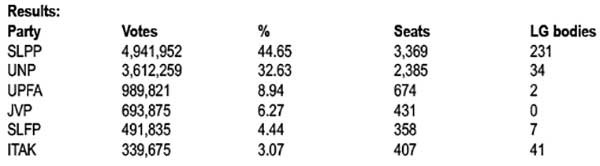
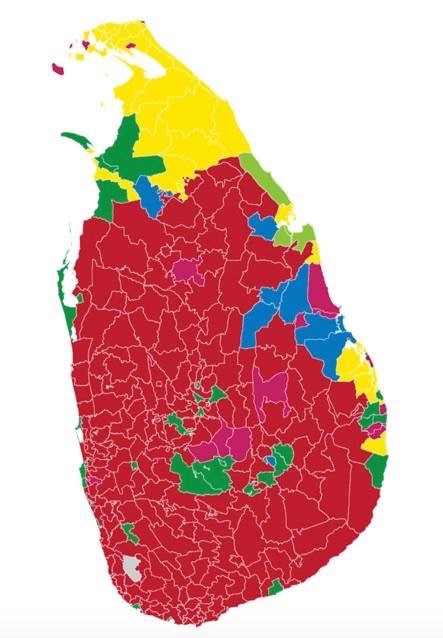
 One part of their argument is correct. The government is lost. That is true. But, why the government lost is a different story. First, the government was not intelligent enough to manage of any of the affairs it was supposed to do. They raised expectation of the people that there would be an impressive economic growth.
They compared it to a Singapore-like growth. They created dreams for people. They acted in the exact opposite way after coming to power. They did a lot of damage to the economy of this country. The bond fraud at the Central Bank was a grave crime. There is a mismatch of what they preached and what they did.
Next, they harboured suspicions about people in the government apparatus – bureaucrats etc. As a result, the government machinery was not working properly. It is not working up to now. The officials of the state machinery were under the impression that they would be faulted if they worked.
They thought they would be penalized by the CID or the FCID. So, they stayed away from taking decisions. The government cannot understand the kind of influence they made on these people in the state machinery. Bureaucrats were not working at all. They have justification for that position. It was difficult for them to decide what to be done or not. For an example, this government disputed the Cabinet decisions of the previous government and implementation of them.
For running a government, you have to have a mechanism identified. The Cabinet of Ministers is considered as the high ranking decision making body. It should be read as ‘If you implement a Cabinet decision, it amounts to the implementation of people’s mandate’. The Cabinet of Ministers is governing side of the people’s representation.
Never in history were the Cabinet decisions questioned as this government does today. This government questioned the decisions of the then Cabinet and held officials who implemented them answerable. How can the officials respond to it?

“I Do Not Know What The Country Needs In The Name Of Yahapalanaya. I Think The People Voted Against The Previous Rule In 2015 As Things Did Not Happen In The Proper Way As Per Their Thinking”

The Government Talked A Lot About Concepts Such As Good Governance And Reconciliation. How Do You Look At Them From The Western And Our Indigenous Points Of View?

In election mechanism, we sometimes bring undefinable concepts. Definitions are not suresuch election rhetoric typed concepts. It is something like salvation or Nirvana. The Yahapalanaya is such a kind of concept. You can interpret anything as yahapalanaya and not as yahapalanaya as well. There are not definite meanings for these kinds of words.  Some people thought Yahapalanaya is something about punishing wrong doers. The other people though it is the continuation of development work that was started. Some think that Yahapalanaya is something related to removing the executive presidency.
There are those who thought yahapalanaya is nothing but punishing those involved in fighting the war. Likewise, there were thousands of meanings for these Yahapalanaya. It is not a concept that should be tested in a political domain. Different people see it in different ways. The JVP had its own way of looking at it. The TNA also had its own interpretation.The UNP thought differently. They thought they were in the opposition for 20 odd years. For them, Yahapalanaya means ensuring some benefits for their supporters. The Jathika Hela Urumaya (JHU) thought that punishing those whom they do not like is Yahapalanaya.
Then, the Prime Minister referred to the Lichchavi principles found in the Buddhist texts. In fact, Yahapalanaya and Lichchavi Dhamma are two different concepts. This is nothing but name –throwing as we call in philosophy. You can throw a lot of names. But, you cannot deliver on them.
Now look at the issue created by this government on Social Media. I know this subject since I remained engaged with the media works as the permanent Secretary to the Ministry of Media and Information during the 2012/2015 period. Today, social media is not only a platform but also a network for people. People live within that network. It is now part of their lives. People engage in their routine work and businesses in this network. If you block it, people will assume that their rights are taken away.
How can one read yahapalanaya and the ban on social media together? How can one read Lichchavi Dhamma and the postponement of elections together? You cannot do it.
If you maintain Lichchavi principles, you will have to sustain democracy.

What Does The Country Need Under These Circumstances In Your View?

I do not know what the country needs in the name of Yahapalanaya. I think the people voted against the previous rule in 2015 as things did not happen in the proper way as per their thinking. There was much bogus political rhetoric was created against the previous government.True, there were a lot of mistakes that happened. I think the people thought of a proper mechanism to replace that regime in order to speed up development. But, this government, I think, took it in a different way. They stopped the development momentum overnight. They unleashed a witch-hunt of those who governed. Now, three years have lapsed. We do not find any mega development projects started afresh. Nothing happened but a lot of talks continue.

“The Government Is Lost. That Is True. But, Why The Government Lost Is A Different Story. First, The Government Was Not Intelligent Enough To Manage Of Any Of The Affairs It Was Supposed To Do”

You Served In That Government As A Bureaucrat. What Went Wrong With That Government?

There were certain things that the previous regime was not addressing properly. The one main issue was criticism coming from one part of the government. For example, MP Ven. Athuraliye Rathana Thera was making some criticism as a government member. There were some internal squabbles in the party. There was some imbalance among the ministries. There was the belief that some ministers were given more and better responsibilities than others. There were some issues that should have been addressed. Some sections of the government broke away as a result.
There was a very clear Western Bloc that is against the government due to the fact that Mahinda Rajapaksa ignored the western countries in making the decision on the final stage of the war. Those Western actors (of cause, including some big Eastern powers as well) worked against the government in many different ways. Those campaigns operated from Geneva to Colombo. That was one main issue which was not able to manage.  In the social media, young people were given prospects of better lives under a new regime. Young people got carried away. We also faced anti-incumbency feelings. The SLFP-led alliances were in power for the last 20 odd years. It means young people were familiar only with such form of governance.

What Is Your View On Western Model Of Democracy In The Context Of New Powers Rising In The World?

There are a lot of issues to be addressed. But we failed in fronts. We were not able to find a mechanism to address our social issues through this system?
People are represented by 225 members in Parliament. The members are assigned to devise policies and laws. People were doing their job people whereas their representatives were not. These representatives should engage in serious decision making.

Do You See Any Mismatch Between What This Government Promised And What It Implements Now In Terms Of Democracy?

There is a complete mismatch. They raised expectations of people saying that their economic projects and plans were very advanced. Today, everybody experiences that these are way below those of the last government.
www.yuthukama,com
යුතුකම සංවාද කවය
අනාගතයේ කෙටුම්පත

An eye opener to all airlines

April 1st, 2018

By Dr.Tilak S. Fernando Courtesy Ceylon Today

A friend in Melbourne sent me a stimulating email last week, about a novel experience inside the SriLankan Airlines, single aisle Airbus 320, Karachi-Colombo Flight (UL184). The incident which occurred on 8 March, has been already been brought to the notice of the Director Flight Security of the airline by a passenger, who witnessed the incident inside the economy class cabin of this single aisle aircraft.

It is necessary to emphasise, at the outset of this article, that neither the passenger nor the writer has any prejudices or racial connotations in highlighting this event, except what the passenger has brought to the attention of the Director of Security about an incident that took place in ‘God’s land,’ the repetition of such behaviour, which may lead towards setting a precedence in future flights, on any airline, for that matter. The passenger has advised SriLankan Airlines to take serious note of the possibility of evil masterminds, who might imitate such behaviour to plan acts of terrorism, where they consistently gather intelligence about weaknesses in flight security operations that would give them an opening to perform terrorist acts!

Cockpit of a airplane – Picture credit : Ceylon Today

Air Travel

Air travel has become one of the fastest modes of transport in the jet age, from one destination to another even around the world in twenty-four hours. Air travel, as a part of travel for pleasure or on business, has become much safer than other modes of transport.
Air accidents, by far, are rare, yet there have been certain instances where human error or sheer negligence on the part of pilots, technical hitches and or poor maintenance from engineering sections of airlines, and terrorist attacks becoming accountable. In this respect, it needs to be highlighted that SriLankan Engineering has become a holder of the prestigious EASA 145 certification from the European Aviation Safety Agency, and was recognized as the Best Global Operator of both A330 and A340 from the Airbus Industry in 2012.

Experience inside an aircraft during a stormy weather or turbulent conditions could be quite nerve-wracking. The skill of the pilot depends on how he controls his aircraft during take-off and particularly during landing operations in order that passengers do not feel uncomfortable. By the same token the cabin crew takes the responsibility for cosiness and the security of passengers.

Praying on the aisle.
When this aircraft had reached the cruising altitude, and the seat belt signs had gone off, a Muslim passenger had blocked the aisle between the economy and business class cabins (the curtain between the cabin was closed), placed a prayer mat on the floor and started performing his ritual prayer, thus blocking the single aisle of this small aircraft.

A lady steward having noted this unusual behaviour of the passenger in the economy class cabin failed to act. This was followed by a steward emerging from the business class cabin and drawing the curtain, while another standing passenger had gestured the steward to wait until his friend finished his prayer routine. Despite the steward’s advice and the lady steward’s comments that such praying was non-acceptable on board a plane, the standing passenger had continued to block the passage, while the other continued to conduct his prayers.

This has created a situation where the economy class passenger in a front row taking  charge of a section of the cabin of this single aisle aircraft for the purpose of conducting a prayer ritual. The plane was full of passengers from Pakistan, who had shown signs of appreciation about the prayer routine. Thankfully, the prayer session had ended, and the aisle was free, and the rest of the flight was normal and peaceful.

The passenger, who observed the drama, had written to the Director Flight Security, SriLankan Airlines, pointing this out as an extremely serious incident.  The writer speaking to the passenger found out that he is a regular Karachi-Colombo sector flier who said that he had observed previously too, passengers attempting to conduct prayer rituals, but only at the back of the plane without inconveniencing other passengers. His emphasis was that no other international airline would ever permit such an act!

Tradition
Islamic tradition dictates that Muslims must perform five formal prayers daily. A missed prayer is a serious event for them, and not one that should be dismissed as inconsequential.

Practicing Muslims are expected to acknowledge every missed prayer and to make it up according to accepted practice, later. While it is understood that there are times when prayer is missed for unavoidable reasons, the door to repentance is always open. If a prayer is missed, it is common practice among Muslims to make it up as soon as it is remembered, or as soon as they are able to do so. Depending on the circumstances, during the defined prayer times, one could always conduct one’s prayers while even being seated.

This also brings up a controversial issue about the direction in which prayer is offered while seated or praying inside a moving plane. It is an accepted fact that Muslims should face the Qubla, which is in Mecca, when prayer is offered. Inside a moving plane, at an altitude of 33,000 feet above ground level, how is it possible to ascertain the direction of the Qubla? It is a universal veracity that every person is free to practice his own religion, but to do so, by disturbing another’s composure should be frowned upon.

With this passenger’s previous experience on PIA flights on domestic routes, he states that he had never observed such rituals conducted on the aisle of an aircraft. He is absolutely certain that even the PIA staff would firmly have dealt with such a problem, if it were to take place on a PIA flight.  The question that arises out of this incident is whether SriLankan Airlines staff are not trained and instructed to act in order to avoid any friction or tension between staff and passengers who seek to demonstrate religious fervour? The airline’s responsibility should be to train the cabin crew to deal with such situations during their training sessions on the ground, but certainly not inside a flight, up in the sky.

With ethno-religious conflict frequently occurring in Sri Lanka, an aircraft in flight could be an ideal platform for a committed group to draw attention to a cause. The more frightening scenario would be, if a fanatical group, with suicidal tendencies, were to create mayhem by taking control of the cabin, it would jeopardise the safety of passengers, cabin crew and the aircraft.

As a passenger who had to gone through this unusual experience, he has sincerely informed the Director Flight Security, that his narrative was not meant to be anti-Pakistani or anti-Muslim. He is married to a Pakistani lady, and his son, he says, was born in Pakistan and he is a frequent traveller who has cultivated wonderful Pakistani friends and enjoys an excellent relationship with the power sector professionals in Pakistan”.

Having travelled to many parts of Pakistan, he admires and acknowledges the friendly nature of the Pakistani people, and describes the country itself as an incredible adventure travel destination.

Pakistanis are weighed down with a monstrous negative socio-political baggage with the country consistently drawing bad publicity worldwide. If any person personally experiences such a situation inside a flight, that person is bound to have zero tolerance in the face of such undisciplined individuals who seek to rub their mind-sets on others’ faces. The million-dollar question is whether anyone would be comfortable in an aircraft when a passenger acts in a manner that disturbs the composure of a full complement of passengers in terms of the security of the aircraft in flight?

tilakfernando@gmail.com

WHO IS MOST UNPOPULAR IN SRI LANKA – PRIME MINISTER MR RANIL WICKREMASINGHE OR PRESIDENT MR MAITHREEPALA SIRISENA

March 31st, 2018

By M D P DISSANAYAKE

Currently all guns are directed at the Hon Prime Minister Mr Ranil Wickremasinghe.   President Maithreepala Sirisena is occupying the highest office of the land at the behest of Mr Ranil Wickremasinghe.

In the most recently held local government elections, Mr Ranil Wickremasinghe’s  political wing was placed second, in spite of Bond Scam allegations and mis-management of the economy. Popularity of the UNP was not shattered at the election.  Popularity of Mr Wickremasinghe was not shattered at the election.  To his credit, during the election campaign he did not blame the President Sirisena, he was far more diplomatic.    He openly admitted that the economy was not progressing during past two and half years, but he strongly portrayed and promised the voters that the remaining period in office, a significant progress will be achieved.  To that extent Mr Wickremasinghe displayed ‘last minute honesty’, for which he should be given full credit.

On the other hand, how did Prez. Sirisena conduct himself at the election.  With a view of preventing anti UNP votes flowing to the SLPP, the President suddenly portrayed himself as the strongest enemy of the UNP.  He attacked his own PM on grounds of dishonesty.  He attacked his own PM as unfit to manage the economy.  He virtually played the role of  Manuel of the Fawlty Towers, pretending ” I KNOW NOTHING”   to  absolve  himself  from the cardinal sins committed by the Yahapalana Government.

  • The President presided at all Cabinet Meetings,
  • the President allocated Ministerial portfolios to his Ministers, including allocation of the Central Bank to the PM,
  • the President  appointed RW  as Prime Minister with only 46 seats in Parliament  out of 225,
  • the President appointed RW, without dismissing or seeking resignation of the then Prime Minister Mr D M Jayaratne,
  • the President gave the nod for the formation of Hybrid Court,
  • the President gave his blessings to arrest Ranaviruvo,
  • the President approved the appointment of Arjun Mahendran as Governor of the Central Bank,
  • the National Anthem was sung in Tamil in the presence of the President
  • the President’s brother Dudley Sirisena now owns the largest number of Rice Mills in Sri Lanka,
  • the President approved the appointment of Mr Sambandan as the Leader of the Opposition with only 16 seats in the Parliament,
  • the President has provided STF security to Mano Ganeshan just before the recently held elections for Colombo Municipal Council, in order to obtain favours from Mano for the SLFP.

If PM RW is accountable for ruining the country, its culture and economy, the President Sirisena is also equally accountable on grounds of Contributory Negligence.

The President Sirisena will never go against the PM RW.  The developing latest political  drama point to RW becoming the President as President Sirisena step down, allowing a SLFP MP to become the Prime Minister and continue Yahapalana Government.  Needless to say, that this political development  will be embraced by the Westerners, Tamils etc.

NO CONFIDENCE MOTION: QUOVADIS J.O?

March 31st, 2018

Sugath Samarasinghe

I do not understand the strategy of the JO in moving this No Confidence Motion against Ranil Wickramasinghe. What is their ultimate goal, I wonder?

Immediately after the victory of Israel after their famous Six Day War where they trounced the braggart UAR in 1967, a journalist asked Israeli General Moshe Dayan, What is the best way to win a war?. General Dayan quipped Have the Arabs on the other side!”  Similarly, the easiest way for the JO to win the elections in 2019 and 2020 is to have Ranil leading the UNP. Surely that is not rocket science? He has a proven track record of losing multiple elections for UNP other than in August 2015; and that too a lame victory. In fact Mahinda Rajapaksa, a shrewd tactician, helped Ranil to continue as leader of the UNP several times as if by mutual understanding, during his time as President.

Ranil has even proved this point himself in the recent Local Government by polling only 32% for the UNP. What more proof of his inability to lead? If it was in another country, when it became clear that he was ultimately responsible for the  unheard of daylight robbery” at the Central Bank by his ‘Golaya’ whom he brought from Singapore, he should have resigned on his own in the true democratic tradition. But he was so thick skinned that he didn’t. So why is the JO sweating to remove him when he is their sure winning factor? After all, we know that the track record of the JO is not squeaky clean either! They are only there for the lack of an alternative.

On the other hand, if they succeed in ousting Ranil as PM at this juncture, the JO will find it that much more difficult to defeat the UNP at the hustings if they appoint a new leader. Whoever that person would be, he will offer some hope to the disgusted UNPers to return to their fold at least in temporary hope. So why do the JO want to queer the pitch?

The only area of concern if Ranil is allowed to continue is, what further damage he could do to the country during the interim period? Besides the Central Bank Robbery he has sent this country to gallows with the co-sponsoring of the UNHRC Resolution in collaboration with his fellow traitor Mangala. He had sold the Hambantota Port to China, causing so much inconvenience to India and now bent on selling the Hambantota Air Port and Trincomalee harbor to India to compensate. He will push through the deadly ETCA agreement with India to ruin this country further. The biggest damage to this country will be his tireless effort to push the dangerous New Constitution proposal, converting this country into a federal state. It is the responsibility of the President assisted by the JO, to prevent these disasters from the brink working with dedication, if the President has any hope of asking the country for a second Term.

I believe that we are a short sighted nation. I mean all Communities. We are not adept at seeing the bigger picture. I think the same problem afflicts the JO who are engaged in a short sighted self-defeating  exercise in vain

In Management, ‘do nothing’ option too is a positive strategy in certain circumstances. This is such a situation for the JO. Do nothing, and let Ranil lead the UNP to its grave, the way that Pied Piper of Hamlin did.

Sugath Samarasinghe

No confidence motion against Ranil should have first initiated by the UNP long ago and not by the JO?

March 31st, 2018

Sudath Gunasekara

31. 3. 2018.

Though already it is too late, the country must thank the JO for presenting a no–confidence motion at least now against the clumsiest and one tracked minded Prime Minister. He is a classic example of a true product of Black Whites” planted by the British to destroy the Sinhala Buddhist nation in this country, who never had his feet on this soil, its traditions or never had a place in the hearts of the majority community in this country. None of the votes polled by him at any date was attracted by his personality, charisma, stature or his public appeal. It was the diehard UNP block vote and the floating minority that decides the election results in this country as usual that has voted him.  He has proved over time beyond all reasonable doubts that he is  the number one man , even surpassing Chandrika, utterly unfit to lead this Sinhala Buddhist country, we ever had since Independence. The sooner he is removed the better it is for the country and even more for the UNP before any more irretrievable damage is done to this country.  Had he by any chance got elected as the President in 2005, by this time, we would have completely ceased to be a Sinhala Buddhist country any more by now. His heart and soul are both wedded to power and self-aggrandizement far away from public good that is enshrined in statecraft of this country as the whole mark of governance.

Thanks to the Guardian gods and the blessings of the Triple Gem and the blessings conferred upon this land by Lord Buddha we got Mahinda elected as the President. If he dint, Ranil would have by now completed the job initiated by Don Juan Dharmapala in the 16th century and furiously after 1818 by the British colonial invaders.

As everybody knows he was never a born, a made or a leader on whom leadership was thrust upon. First he was pushed to the path of leadership by this uncle JR in 1977 for obvious reasons JR may have had in his head. His ascendancy to the Premiership, both in 2001 and 2015, were mere accidents. The deaths of people like Gamini and Lallith had provided an irreparable vacuum for UNP leadership, for him to be accepted as it leader not by consensus but by circumstances and subsequent manipulations by himself. Even D.B Wijetunga did not select him as his successor that is why he opted for Gamini. As I see he did not know what democracy is. He first ran away in front of giants like Gamini and Lalith and thereafter wiped out all potential leaders like Senanayakas, Sajith, Jayasekaras and Aluvihares. Look at those who are in his inner circle instead, Ravi karunanayaka, Sagala Ratnayaka, Samarawickrama, Rajita Senaratna, Champika Ranawaka, Kiriella,  Mangala Samaraweera, John Amaratunga and Gamage with economic wizards like Arjuna Mahendran, Paskaralingam, and Charith Ratwatte just to name a few (wait and see all the politicians in this group se will lose even their deposits  at the next elections if they contest).

In the midst of all these only Mairtipala Sirisena selected him as leader and appointed as PM rather illegally and unconstitutionally in 2015, in return to the UNP block vote that won him the elections unexpectedly as President. He took three years and three months to realize that he has done a serious blunder. But I am happy at least now wisdom has dawned upon even him even at last. But I mark a note of caution as I have done several time before, the possibility of the most unexpected for him could happen, as that is the only way for Ranil to be the President of this country.  I only pray that such calamity should never happen.

So far only solitary figures like Maitri Gunaratna have been making some noise against Ranil in the UNP None of the other fools have been able to realize to what abyss Ranil has taken the UNP after the death of Gaminis tragic death. They provide the best example for modern classical golayas of Mahadenmutha the wise. Ranil first ran away from Leadership after the death of Wijetunga making room for a cake walk for Gamini. Then in 1910 he brought Fonseka for the Presidency and Sirisena at the instigation of Chandrika in 2015 as he knew that he can never get elected as the President by public vote. Going by his record I am surprised that he did not conspire to remove Sirisena so that he could be the President automatically under the Constitution. In fact I had made this warning several times to President Sirisena, although he has not heeded it worthwhile. Ranil has lost all elections since 1994 and the total number is reckoned as 29 of which the latest is 2018 Feb 10th. All this has made him the worst leader the UNP ever had since 1948 in its history. When people are dying of hunger he talks of wyfys, braze-lets, Laptops and denims trousers, 1 million jobs and Voxwagon car factories where even a fox is not to be seen after 3 ½ years of his Government. His conspiracy to ruin the Central Bank and how he did it and the irrevocable damage he has done to the country’s economy and the only other national political party, the UNP, which had a deep rooted public appeal and the way he spoke and behaved like a Maradana chandiya  in Parliament with Kiriella a new comer to UNP,  bypassing all old stalwarts and the failure to build up a second generation of leadership in Parliament for the past 3 years alone should have opened the eyes of these UNP fools to ask him to step down immediately without ruining the UNP beyond recovery and bringing disgrace to a giant political organization founded and nursed by giants like DS, JR and Premadasa.

Now all that have failed do these people have any option other than supporting the no-confidence motion brought up by the JO and rescue the UNP from this veritable and incurable cancer that is Rani, if they love the Party and the country and elect a patriotic, dynamic and charismatic leader first who has his both feet on the motherland, so that he could lead the party to come out of its present abysmal depths and restore it on a firm footing as the people of this country badly needs a second political party in any case to act as  watchdog of the peoples rights.

Majority of people in this country as shown at the Feb 10th elections hold this view. So if you don’t fall in line with the direction of the wind, I can assure you all will lose even your deposits in the next general election and the UNP will disappear from Sri Lanka. Therefore think not only twice but many a time before you commit political harikiri by not supporting the No confidence motion in Parliament. Even if the UNP wins the NCM on the 4th the demise of UNP under Ranil no one can stop. Ranil will go down in Sri Lanka’s history as the man who killed and buried the UNP in 2018, the same way as Chandrika and Sirisena who have already entered Mahavamsa as the woman and man who jointly murdered and buried the SLFP by conspiracy.

YAHAPALANA ELECTIONS AND ‘REGIME CHANGE’ Part 8

March 31st, 2018

KAMALIKA PIERIS

February 2018 saw the third Yahapalana election take place. This was the long postponed local government elections, which for the first time   were all held on the same day, making it feel like a general election. The elections were contested on a political party basis with UNP, SLFP, UPFA, JVP, and TNA fighting it out. This election saw the emergence of a new party, Sri Lanka Podujana Peramuna.

This is not an election that Yahapalana wanted. Therefore, there were obstacles. Nominations were rejected for flimsy reasons. Nominations of the United Left Front   for Nivitigala Pradeshiya Sabha was rejected because there were 15 names instead of 12.  The        returning officer refused to allow a correction. When the ULF representatives went away and   came back with the revised list, they were detained at the gate till 12 noon. When they finally met the returning officer, he said that nominations closed at noon and had refused to accept the list! Over ten nominations lists were rejected. Supreme Court refused to touch the matter.

The Local Government elections were held on February 10, 2018. The election was peaceful with no major incidents being reported  said CaFFE Executive Director Keerthi Tennekoon. The election had a very high voter turnout, especially for a local government election. Television news showed long queues, grim looking voters and many feeble senior citizens, determinedly, going to vote, helped by others.

According to the District Returning Officers    district-level voter turnout was   85% at Anuradhapura and Trincomalee, 80%  at Kalutara, Matale, Moneragala,  75%- 78% at  Batticaloa, Galle Gampaha, Kilinochchi , Kurunegala, Mannar, Mullaitivu, Polonnaruwa and  Ratnapura,

This local government election had assumed national importance. People took it as an opportunity to give vent to their suppressed anger with the government over its performance. It became an unofficial referendum on the government, said Rohana Wasala

The results were:

sourcehttps://www.colombotelegraph.com/index.php/lessons-from-lg-elections- /

The important result of this election was the emergence of the   Sri Lanka Podujana Peramuna (SLPP) as the most popular party. This SLPP was a new, untested, political party, registered only in November 2016. Yet it succeeded in beating the three government parties, UNP, SLFP and UPFA as well as the reserve party, JVP. SLPP polled 44.69 per cent, 2 per cent less than the other three parties put together. This is the first time since 1948 that a government in power lost at LG polls, said Rohana Wasala.

The large number of votes for Sri Lanka Podujana Peramuna (hereafter Pohottuwa or SLPP)    was not a surprise for those who had watched the numerous rallies held after 2015 presidential election and the huge attendance at Pohottuwa election meetings. The popularity of this party was never in doubt. From the time Yahapalana came to power, there were huge pro-Rajapakse rallies and marches and the election campaign saw massive crowds at the Pohottuwa meetings.

But it was an unpleasant surprise for the Yahapalana government. ‘We are not where we hoped to be by this time, said Mangala Samaraweea.” For about a week or ten days after the elections, the President and Prime Minister stayed out of the public eye. They were not seen on television news giving away prizes, opening buildings, speaking at functions as they used to do before. USA, though active also kept a low profile, until on the 24 of February, we were told that USS Mercy   would visit. Some observers see a similarity between 1815 and 1818 and now 2015 and 2018.

Before the elections, the JVP really believed that it could comfortably gain votes at the expense of the UNP and the SLFP. A confident JVP went to the extent of declaring intentions to achieve kingmaker status at the next Presidential and Parliamentary polls. Instead, the electorate has delivered a humiliating snub to the JVP, perhaps for its in backing the government at crucial junctures, especially in helping to get certain anti-democratic legislation passed with 2/3 majority in Parliament, observed Shamindra Ferdinando.

CaFFE Executive Director Keerthi Tennekoon said What we have seen in this election is a very unique situation. The flower bud party very clearly won the election. No government in power has ever lost so badly. This clearly indicates that during the past two-and-a-half years this government has failed miserably. The people had given the government a clear sign to step down. He warned that if the government fails to respect the people’s verdict, there will definitely be a mass uprising against the government from next week.

The people have given their verdict. Honest crooks are better than dishonest crooks. Naked ambition is preferred to ambition wrapped in false altruism. Better to have good war winning crooks than crooks who shield other crooks”, said a cynical observer.

The triumphant Pohottuwa held a media conference after the election. Its leaders paid a glowing tribute to both print and electronic media for ensuring sufficient coverage for them in spite of difficulties.

This was a historic victory. Never before had an Opposition political party defeated the governing party at a local government election.  UNP had spent over Rs. 1 billion for propaganda and  SLFP a little less than that, yet they couldn’t overcome growing public resentment.  President Sirisena and Prime Minister Wickremesinghe couldn’t even win their Polonnaruwa and Colombo districts. Former President Chandrika Kumaratunga could not win Attanagalla either.

A smiling Dinesh Gunawardena said that President Sirisena and PM Wickremesinghe had suffered an unprecedented heavy defeat at the first Yahapalana election in three years. “This is nothing but a shameful defeat for the President and the Prime Minister “, he said. Never before had a new political party defeated both leading political parties in Sri Lanka’s political history.  Not only the village, but most of the towns and cities have placed their trust and confidence with the SLPP.

Yahapalana must now give up power. They have been rejected by the people. . Even the people of the Polonnaruwa district have placed their confidence with the SLPP as it had won with more than 5,000 vote majority, concluded Dinesh. The Yahapalana leaders, Sirisena and Wickremesinghe should realize what they badly lost was a referendum on the performance of three-year coalition, said G.L.Pieris.

Wimal Weerawansa said the people had been so disappointed with Yahapalana mismanagement of the country, they overwhelmingly voted for SLPP proxy at Maharagama and Thirippane to inflict losses on Yahapalana partners. SLPP had backed independent groups contesting Maharagama Municipal Council and Thirippane Pradeshiya Sabha since their nominations had been rejected.

Weerawansa said that there had never been an instance of a party in power losing local government polls like this. This victory was even bigger than the 1956 revolution. I agree. I was also thinking the same. I remember the 1956 election.

The 1956 result was looked down on. It was seen as the push of a backward group of Sinhala speakers who should never have been given a say in politics. The Pohottuwa vote, on the other hand cannot be dismissed lightly. It was a carefully considered vote of a seasoned electorate who had been going to the polls for years and years.

Pohottuwa is not a breakaway party of the SLFP. Chamal Rajapaksa made this clear on television. ‘This is a new party’, he said, ‘not a branch of the SLFP or UPFA’. Pohottuwa votes were also not   votes of disenchanted UNP and SLFP voters. Such votes would have gone to the JVP who were eagerly awaiting them. Pohottuwa was not the refuge of the floating vote either. That too would have gone to the JVP. It is possible; however, that some of the floating vote has now come to roost in the Pohottuwa, provided the Pohottuwa delivers what is expected of it.

Pohottuwa is a pure Mahinda Rajapaksa party, unconnected to the SLFP of the Bandaranaikes. In fact Pohottuwa has no links to anything except to   the much reviled Mahinda Rajapaksa, probably to the great surprise of Rajapaksa himself.

The Pohottuwa victory is a   Mahinda Rajapaksa victory. At all election rallies, Mahinda Rajapaksa was cheered like mad when he arrived on the platform. (E.g. see Derana news 4.12.17 Podujana rally at Badulla.) It reminded me of the 1960s singer, Elvis Presley. Elvis Presley was virulently hated and deeply loved in equal proportions throughout his career. Elvis did not care, he continued singing.

Pohottuwa victory has had a positive impact on Mahinda Rajapaksa. He is visibly more confident and determined. He told Indian Express It is quite clear from the massive victory of the Sri Lanka Podujana Peramuna in the recent local elections that people of Sri Lanka want to see us return to power. They want to see an end to the chaos that has reigned in this country since January 2015.” After Putin’s election in Russia Mahinda Rajapaksa was visited by the Russian ambassador to Sri Lanka. Rajapaksa had sent his best wishes to   President Putin.

Pohottuwa is yet a   fledgling, untested political party. But it is directed by very seasoned politicians, who know the game. Therefore   it will not be easy to squash it. Further, Pohottuwa is not simply an anti-Yahapalana party. It is a part of the new wakeup call in Sri Lanka. Pohottuwa may mark a new beginning in the political history of Sri Lanka provided of course Pohottuwa   manages to get its act together and deliver.

An analysis of the votes will probably show that Pohottuwa, unlike the SLFP, has a strong following among the urban intelligentsia. In Kandy Municipal Council,     Pohottuwa came second with 23,300 while UNP got 26,798. In Colombo MC UNP got 131,353 and    Pohottuwa got 60,087 of which one vote was mine! It was a good showing, I thought. Pohottuwa also won elsewhere in the Colombo district, such as Kotte MC, Kaduwela MC, and Kesbewa UC.

Pohottuwa clearly has the formidable support of the Maha sangha. Rows of bhikkus were present at the launch of Pohottuwa. The Maha sangha are virulently anti-Yahapalana today. They appear on television, in groups, never singly,   looking grim, fearlessly using strong words against the Yahapalana government. Critics say that sangha should not meddle in politics. These critics forget that the sangha are citizens of Sri Lanka and are entitled to all political rights enjoyed by a citizen.

The resounding victory of the Sri Lanka Podujana Peramuna (SLPP) symbolized by the Pohottuwa (Lotus Bud) at the recent local government election is something that was eagerly wished for and confidently expected by the sensible majority of the Sri Lankan electorate, said Rohana Wasala.. The extremely unpopular Yahapalana government will be unable to follow its original plans through, including its controversial constitution making project. The anti-government vote means that the Yahapalana regime can no longer find refuge in the so-called popular mandate they claimed to have got in 2015 concluded Wasala.

Pohottuwa is starting to bloom in some local government bodies. The Mayors of Galle and Negombo were appointed from Sri Lanka Podujana Peramuna (SLPP) despite the UNP having won those Municipal Councils. One vote was by secret ballot, the other an open vote. Mayor and Deputy Mayor for Kurunegala, Chairman, and Vice Chairman of Attanagalla Pradeshiya Sabha were from SLPP. Ven. Karagahawela Nandawimila (SLPP) was elected Chairman, Bandarawela PS with the support of three UPFA members. ( continued)

Endangered Nations and Endangered Cultures

March 31st, 2018

R Chandrasoma

Few countries in the world are now in peril because of the marauding spirit of powerful neighbours. This is a recent turn in history –across the centuries powerful nations were imbued with an expansionist spirit that spelt doom for those fated to be close to the ‘hegemonic power’. Protracted wars resulted when neighbours were well matched as fighting machines. Britain’s history – until recently – was dominated by that of warding off the intrusions and threats of the Continental Powers. We in Sri Lanka have been threatened for long centuries by our powerful neighbor India and it is a miracle that we have survived as a civilization for over two thousand years. Times have changed and the use of brute strength to overawe a weak neighbouring state is no longer militarily or politically feasible. But the threat to nationhood exists and we in this country must be vigilant  – because our historical weakness as a small island remains while big-power expansionism is now taking the guise of subtle forms of cultural subversion. There is a new ‘imperialism’ that gets its strength through the cunning manipulation of racial power-bases in politically weak nations.

How does all this apply to Sri Lanka and its polity? It is the weakening of our cultural cohesiveness that is the first victim. This is achieved by a brainwashed and Westernized elite that equates modernism with the erosion of the historic and the indigenous traditions that have long shaped our socio-politcal evolution. It is this ethnicity and sense of belonging to a uniquely endangered culture that is currently being assailed by lackeys of Western Imperialism posing as ‘modernist reformers’. A prime instrument used in this sordid adventure is the ‘foisting’ of a new constitution inspired by an alien elite bent on destroying our historic standing as an independent and culturally distinctive species of humankind. Our greatest enemies are the falsifiers of history – those ‘uprooted’ kinds that promote a bogus modernism – one that sees culture and history as outmoded in the modern world and and that ‘jobs are prior to roots’. Sinhala-Buddhist culture has survived for over twenty centuries – a record that few nations and races in the world can match. It would be historic tragedy if this ancient heritage falls victim to the machinations of power-hungry politicians and their lackadaisical followers.


Copyright © 2026 LankaWeb.com. All Rights Reserved. Powered by Wordpress